Nina Mirnig, Peter-Daniel Szanto and Michael Williams
Puṣpikā: Tracing Ancient India Through Texts and Traditions
Contributions to Current Research in Indology
December 2013
One: Defining the Svara Bearing Unit in the śikṣāvedāṅga literature: Unmasking a veiled debate
§ 1.1 Sanskrit as a common ground
§1.2 Phonetics and phonology in the Sanskrit tradition
§ 5 Defining the Svara Bearing Unit
§ 5.3 Nāradīyaśikṣā, Vājasaneyiprātiśākhya, and Yājñavalkyaśikṣā
§ 5.4 Śaunakīyā Caturādhyāyikā
Two: Purāṅic transformations in Coḻa Cidambaram: The Cidambaramāhātmya and the Sūtasaṃhitā
Appendix 1: SūSa l:4.17cd—39 and
Appendix 1: SūSa l:4.17cd—39 and
CidMā 8.3—23 compared (cont’d)
Appendix 2: SūSa 4:24.1—10, 21—27
Three: Unfuzzying the fuzzy. The distinction between rasas and bhāvas in Bharata and Abhinavagupta
II. Verbal effectuation according to Prakāśātman’s Sābdanirṇaya
III. Maṇḍana Miśra’s Vidhiviveka: a possible source of Prakāśātman’s account of śabdabhāvanā ?
I. A comparison between the legal norm and the KSS
2) Women are statutorily dependent, hence they should be closely guarded
II. Women’s stereotypes in the KSS
III. The adventuress in the KSS
2) A young princess who goes her own way
3) A young kṣatriyā woman leaves her husband, an old Brahman
Notes on the editorial conventions used in this article:
Six: Towards a new edition of the corpus of Pallava inscriptions
Defining what may be termed a Pallava inscription
Evaluation of Mahalingam’s corpus
Reading the published inscriptions again
Bibliography: Epigraphic sources
Bibliography: Secondary sources
Seven: Did Mīmāṃsā authors formulate a theory of action?
§1. Philosophical background: Action as movement in Vaiśeṣika
§2. Exegetical background: Śabara
§5.1 Effort as evidence for the self
§6. Conclusion: what is an action?
1. Abhinavagupta’s evaluation of dance
2. Dance as a charming element of the performance
3. Dance and Representation in the image of the fire-wheel
Ten: Rituals in the Mahāsāhasrapramardanasūtra
A Ritual for the Protection of the State
Eleven: The Liṅgodbhava Myth in Early Śaiva Sources
1. The version of the Liṅgodbhava myth in the Śivadharmaśāstra
2. The Liṅgodbhava myth in early Purāṇas
3. Iconographical representation of the myth
4. The prevalence of the Liṅgodbhava myth
Twelve: Yantras in the Buddhist Tantras — Yamāritantras and Related Literature
1. The Yamaritantras and Related Literature
2. Yantras and their Rites in the Yamāritantras and Related Literature
2.1. The Procedure of the Nine Rites
2.2. The Procedure of a Yantra
1. Rationalizing Śrāddha in Śaiva terms
2. Underlying structures envisaged by our sources
2.1 Kiraṇa: Śiva-, Rudra-, and Laukikaśrāddha
2.2 Śrāddha in the Saiddhāntika manuals and the controversial term rudrāṃśa
3. Towards a social reality of its practice?
2. The Ninth Chapter of the Mahāyānasūtrālaṃkāra
Fifteen: The gaṇacchandas in the Indian metrical tradition
Sixteen: Anātmatā, Soteriology and Moral Psychology in Indian Buddhism
Primary sources (a): manuscripts
Danger and Benevolence: Ugratā and Saumyatā
The Wrathful Amazon in Legend and Art
The Caṇḍīstotra in the Haravijaya
The hymn to Vindhyavāsinī in the Gaüḍavaho
The “fierce lotus-foot” and the Caṇḍīśataka
Nineteen: Minor Vajrayāna texts II. A new manuscript of the Gurupañcāśikā
Twenty: Can we infer unestablished entities? A Mādhva contribution to the Indian theory of inference
The Flaw of “Unestablished-qualifier-ness” (aprasiddhaviśeṣaṇatā)
The Absence of an Absence is a Presence
Eliminative inferences and unestablished sādhyas
The Case of “Smoky-water-vapour”
One: Refuge and Reform: Snakes, Gleaners, and Niṣādas in Early Kāvya
Introduction: Janamejaya, Aśoka, and Postcoloniality
Appendix: Kṛṣṇa, Bāṇa, and the Vṛṣṇis
Two: Like a Howling Piśāca: A Note on the Pronunciation of the Ṛgvedasaṃhitā
About the definition of vedalakṣaṇa
Three: Does the Subject Have Desires? The Ātman in Prābhākara Mīmāṃsā
2. The Prābhākara Mīmāṃsā approach
3. Is desire directly connected to the subject?
3.1 Rebuttal of intermediate entities
3.2. Rebuttal of the quality/substrate model
3.3 What kind of subject is a desirous one?
4. Tests: Other occurrences of subject-theory in Mīmāṃsā
4.1. The subject as an agent of knowledge
4.2 Śālikanātha on the ontology of the ātman
4.2.1 The subject and the psychic functions: buddhi, ahaṅkāra, manas
5.1 What happens in the Prābhākara Mīmāṃsā context?
Bibliography and Abbreviations
Four: Kārakas in Cāndra Grammar: An Interpretation from the Pāli Buddhist Śāstras
2. Kārakas in the Pāṇinian Tradition
3. Karakas in the Candra Tradition
5. Karakas in the Moggallana Tradition
Five: The Three Jewels and the Formation of the Pāñcarātra Canon
2. Divisions within the Pañcaratra
3. The Formation of the Pañcaratra Canon
Six: Preliminary Survey of Sanskrit Manuscripts of the Bodhicaryāvatāra
The hitherto consulted manuscripts for the previous editions
La Vallée Poussin 1898 and 1901–14
Seven: Asiddha vs asiddhavat in Patañjali’s Mahābhāṣya
Examples in the Asiddhavat Section
Examples in the Pūrvatrāsiddha Section
Abbreviations and Bibliography
Eight: Continuity and Change in Chāndogya Upaniṣad 6.1–4
1. The cognitive process of inference
2. The linguistic process of inference
2.1. Stating an inference in two steps
2.2. Five relations ensuring certainty
3. On the delimitation between the cognitive and the linguistic side of the inferential process
3.1. A linguistic approach to negation
3.2. The four forms of inference
Two: Between Theism and Atheism: a journey through Viśiṣṭādvaita Vedānta and Mīmāṃsā
2. Mīmāṃsā, Anti-Realism and God
2.1. The chapter on deities (devatādhikaraṇa) in the PMS and its commentaries
2.2. Anti-theological arguments in Kumārila
4.2. Yāmuna etc. on the denial of deities as an instrumental move
4.3. The specificity of Veṅkaṭanātha’s Seśvaramīmāṃsā: apūrva
4.6. Some yet-to-be established conclusions
5. What Do We Mean by “God”, “Atheism”, and “Empiricism”?
Three: The pre-eminence of men in the vrātya-ideology
2. The pre-eminence of Prajāpati in the AVŚ
2.1. The creation of Prajāpati
2.2. The knowledge of Prajāpati and the knowledge of man
3. The pre-eminence of man in the AVŚ
3.1. The pre-eminence of the Brahmacārin
3.2. The pre-eminence of the Vrātya
Secondary Sources and Translations
Five: A New Reading Of The Meghadūta
3. Absence of the Romantic idea of Nature in India
4. The Meghadūta as an innovation
5. The meaning of kelikāvya in Vallabhadeva’s commentary
Six: Banārasīdās climbing the Jain Stages of Perfection
1. Fourteen Stages of Qualities (guṇasthāna)
2. Banārasīdās’s Avasthāṣṭaka and the categories of the self
3. Eleven Steps of Perfection (pratimā)
4. Stages of Perfection in History
1. The Baul tradition: a premise on a negotiable category
2. Bahurūpī Bhaba Pagla: an introductory profile
3. Representing Bhaba Pagla in academic and popular literature
Eight: Revisiting Sanskrit Teaching in the Light of Modern Language Pedagogy
1. History and methods of language pedagogy at western universities
Argument 1: Sanskrit is a dead language, therefore non-analytical exercises are not required.
Argument 2: Modern textbooks use “fake Sanskrit” and not “authentic” texts.
Argument 3: Modern methods are infantile.
2. Practical examples for the teaching of Sanskrit
Volume 1
It is perhaps commonplace to say that India is one of the world’s richest and most enticing cultures. One thousand years have passed since Albiruni, arguably the first “Indologist”, wrote his outsider’s account of the subcontinent and two hundred years have passed since the inception of Western Indology. And yet, what this monumental scholarship has achieved is still outweighed by the huge tracts of terra incognita: thousands of works lacking scholarly attention and even more manuscripts which still await careful study whilst decaying in the unforgiving Indian climate.
In September 2009 young researchers and graduate students in this field came together to present their cutting-edge work at the first International Indology Graduate Research Symposium, which was held at Oxford University. This volume, the first in a new series which will publish the proceedings of the Symposium, will make important contributions to the study of the classical civilisation of the Indian sub-continent. The series, edited by Nina Mirnig, Péter-Dániel Szántó and Michael Williams, will strive to cover a wide range of subjects reaching from literature, religion, philosophy, ritual and grammar to social history, with the aim that the research published will not only enrich the field of classical Indology but eventually also contribute to the studies of history and anthropology of India and Indianised Central and South-East Asia.

Copyright
Published in the United Kingdom in 2013 by
OXBOW BOOKS
10 Hythe Bridge Street, Oxford OX1 2EW
and in the United States by
OXBOW BOOKS
908 Darby Road, Havertown, PA 19083
© Oxbow Books and the individual authors, 2013
Paperback Edition: ISBN 978-1-84217-385-5
E-pub Edition: ISBN 978-1-78297-042-2; Mobi: ISBN 978-1-78297-043-9;
PDF: ISBN 978-1-78297-044-6
A CIP record for this book is available from the British Library
All rights reserved. No part of this book may be reproduced or transmitted in any form
or by any means, electronic or mechanical including photocopying, recording or by any
information storage and retrieval system, without permission from the publisher in writing.
For a complete list of Oxbow titles, please contact:
UNITED KINGDOM
Oxbow Books
Telephone (01865) 241249, Fax (01865) 794449
Email: oxbow@oxbowbooks.com
www.oxbowbooks.com
UNITED STATES OF AMERICA
Oxbow Books
Telephone (800) 791–9354, Fax (610) 853–9146
Email: queries@casemateacademic.com
www.casemateacademic.com/oxbow
Oxbow Books is part of the Casemate Group
Contents
Preface
1 GIOVANNI CIOTTI
Defining the Svara Bearing Unit in the śikṣāvedāṅga literature: Unmasking a veiled debate
2 WHITNEY COX
Purāṅic transformations in Coḻa Cidambaram: The Cidambaramāhātmya and the Sūtasaṃhitā
3 DANIELE CUNEO
Unfuzzying the fuzzy. The distinction between rasas and bhāvas in Bharata and Abhinavagupta
4 HUGO DAVID
A contribution of Vedānta to the history of Mīmāṃsā: Prakāśātman’s interpretation of “verbal effectuation” (śabdabhāvanā)
5 IRIS IRAN FARKHONDEH
Married women and courtesans: Marriage and women’s room for manæuvre as depicted in the Kathā-sarit-sāgara
6 EMMANUEL FRANCIS
Towards a new edition of the corpus of Pallava inscriptions
7 ELISA FRESCHI
Did Mīmāṃsā authors formulate a theory of action?
8 ELISA GANSER
Trajectories of dance on the surface of theatrical meanings: a contribution to the theory of rasa from the fourth chapter of the Abhinavabhāratī
9 ALASTAIR GORNALL
Dravya as a Permanent Referent: The Potential Sarvāstivāda Influence on Patañjali’s Paspaśāhnika
10 GERGELY HIDAS
Rituals in the Mahāsāhasrapramardanasūtra
11 NIRAJAN KAFLE
The Liṅgodbhava Myth in Early Śaiva Sources
12 KENICHI KURANISHI
Yantras in the Buddhist Tantras — Yamāritantras and Related Literature
13 NINA MIRNIG
Śaiva Siddhānta Śrāddha
Towards an evaluation of the socio-religious landscape envisaged by pre-12th century sources
14 AYAKO NAKAMURA
Constituents of Buddhahood as Presented in the Buddhabhūmisūtra and the 9th Chapter of the Mahāyānasūtrālaṃkāra: A Comparative Analysis
15 ANDREW OLLETT
The gaṇacchandas in the Indian metrical tradition
16 ANTOINE PANAÏOTI
Anātmatā, Soteriology and Moral Psychology in Indian Buddhism
17 ISABELLE RATIÉ
Pāramārthika or apāramārthika? On the ontological status of separation according to Abhinavagupta
18 BIHANI SARKAR
Thy Fierce Lotus-Feet: Danger and Benevolence in Mediaeval Sanskrit Poems to Mahiṣāsuramardinī-Durgā
19 PÉTER-DÁNIEL SZÁNTÓ
Minor Vajrayāna texts II.
A new manuscript of the Gurupañcāśikā
20 MICHAEL WILLIAMS
Can we infer unestablished entities? A Mādhva contribution to the Indian theory of inference
Preface
We are delighted to present the first volume in the new Indological series “Puṣpikā: Tracing Ancient India Through Text and Traditions”. This book contains the proceedings of the first International Indology Graduate Research Symposium (IIGRS), held at St. Hilda’s College, University of Oxford, 2009. The purpose of this conference series is to draw together early career researchers in the field of Indology on a regular basis in order for them to present and discuss topics from their current research projects. Given the relatively small circle of Classical Indological study in most universities, such an international platform for fruitful exchange and cooperation already seemed a desideratum for some time.
The IIGRS itself grew out of the Indology Graduate Seminar (IGS) which was held at the University of Oxford. With the financial help of the Oriental Institute, Nina Mirnig established the IGS at the university in 2008. The Seminar, originally held on a bi-weekly basis at Magdalen college, Oxford, provided a platform for graduate students of Sanskrit and related subjects to present and discuss their research among an audience of their peers. The success of the IGS, in turn, led Nina Mirnig and Michael Williams to draw up plans for organising a similar forum on an international level. Subsequently, they were joined in this endeavor by Virginia Greenfield, Bihani Sarkar, and Péter-Dániel Szántó. In order to make the findings of these early-stage researchers available to a wider audience, the decision was made to initiate a publication series based on the conferences. Oxbow Books very kindly agreed to take on the project, and the editors would here like to express their gratitude towards Claire Litt, Publishing Director at Oxbow, for her assistance and cooperation.
The first IIGRS, held over two days in the congenial surroundings of St. Hilda’s College, was attended by researchers from all around the world, including India, France, Italy, Germany, Hungary, and the UK. The symposium was opened by Dr. James Benson (Oxford University), who as Lecturer in Sanskrit also has opened the gateways to Sanskrit learning for the organisers. The inaugural lecture The Hidden Collections: The Possibility for a Census of Indie manuscripts in the UK, was delivered by Prof. Christopher Minkowski (Balliol College, Boden Professor of Sanskrit), who also held a workshop on “Dating Systems used in Indian Texts and Manuscripts” on the same day. Beyond these immediate contributions, Prof. Minkowski has also given generous support to the project in a myriad of ways. The second day was opened by the keynote lecture of Prof. Alexis Sanderson (All Souls College, Spalding Professor of Eastern Religions and Ethics), in which he gave inspiring insights into the study of Early Śaivism. We would like to express our utmost gratitude to these three scholars for their support and participation at the various stages of the project.
The contributors to this volume were all in the earlier stages of their academic careers at the time of the conference, including M. Phil, and M.A. graduate students, PhD candidates and those already holding postdoctoral jobs. Our criteria was simply that participants should have at least a master’s degree, and that they should not have held a doctorate for more than five years. The subject matter of the contributions ranges across a tremendous variety of Indological fields, including epigraphy, poetry, drama, narrative literature, grammar, philosophy, epics and ritual. What unites all of them, however, is what we take to be one of the key components of Indological research: they are all based on detailed, philological readings of texts written in Indic languages.
In the first contribution, Giovanni CIOTTI discusses a long-standing debate in the Sanskrit grammatical tradition about which part of a word bears the svara (“pitch modulation”), which, as he points out, echoes a fundamental debate in modern Western linguistics, namely the question of the “Accent Bearing Unit”.
Through a comparative analysis of three parallel versions of the same legendary narrative in two South Indian purāṅic texts, the Cidambaramāhātmya and the Sūtasaṃhitā, Whitney Cox, in the second contribution, demonstrates the transformative relationship between these two Sanskrit texts and their connection to the political, social, and religious changes taking place in the city of Cidambaram as it rose to prominence in the twelfth century, CE.
Daniele CUNEO, writing on the aesthetic concept of rasa, analyses the works of Bharata and Abhinavagupta, and shows that much of the controversy regarding the nature of rasa can be resolved if we regard it not as a defined concept but as a semantic field with multiple meanings in different contexts.
Beginning from a close analysis of Prakāśātman’s Śābdanirṇaya (“An Inquiry into Verbal Knowledge”), Hugo DAVID takes up the evolution of the philosophical concept of śabdabhāvanā (“verbal efficacy”), especially as it developed in Mīmāṃsā schools in the 7th-10th centuries.
Iris Iran FARKHONDEH studies the eleventh-century Kathāsaritsāgara for what it might reveal regarding the status of women in North India at the time — for in contrast to their almost total subordination to men in normative śāstric texts, this work of Sanskrit story literature features several instances where women appear to have a certain “room for manæuvre” through which they are able to break stereotypes, go on adventures, and achieve, at least momentarily, a kind of independence.
Emmanuel FRANCIS’S essay first catalogues the types of inscriptions produced during the Pallava period in South India, and then, through a discussion of the insufficiencies and inaccuracies present within Mahalingam’s existing corpus of Pallava inscriptions — including novel re-readings of a few published verses — argues the need for an updated and revised corpus, organized along criteria of material, status, content, and language.
Elisa FRESCHI, drawing on her study of the works of leading Mīmāmsakas, including Sabara, Kumārila and Someśvara, explores theories of action in Indian philosophy, and asks whether these ideas, which grew out of Vedic exegesis, can have wider implications for the study of Indian philosophy and philosophy in general.
In her chapter on Abhinavagupta’s understanding of the concept of rasa in his Abhinavabhāratī, Elisa GANSER asks about his understanding of the role of dance in the overall aesthetic process of performance.
Alastair GORNALL, writing about Patañjali’s views on ākṛti (universal property or shape) and dravya (an individual thing or matter) as expressed in his Mahābhāṣya, speculates on whether Patañjali’s views were influenced by the Buddhist monk Dharmatrāta.
Gergely HIDAS’S “Rituals in the Mahāsāhasrapramardanasūtra” presents a textual study of this Buddhist Tantric ritual text, featuring first an introduction detailing its sources and contexts, antiquity, provenance, structure and contents, followed by a survey of the rites discussed in the text, and finally an edition and translation of a passage describing a ritual for the protection of the state.
Examining different versions of the Liṅgodbhava myth found in early Śaiva texts, purāṅic sources, and iconographical representations, Nirajan KAFLE argues that this myth (detailing how Viṣṇu and Brahmā install and worship the first liṅga of Śiva) finds its earliest articulation in the Śiva-dharmaśāstra, and traces its later development as the liṅga comes to have anthropomorphic and theomorphic form.
In a study of “Yantras in the Buddhist Tantras”, Kenichi KURANISHI examines a range of peaceful and aggressive yantra-based rites outlined within the Kṛṣṇayamāritantra, a ninth-century Buddhist Tantric text; in addition to presenting detailed ritual procedures for two of the nine rites, Kuranishi demonstrates how yantras are employed through a critical edition and translation of select textual passages describing their production and deployment.
Through an examination of the earliest extant sources of Śaiva Śrāddha rituals (pre-12th century), Nina MIRNIG discusses the adaption of this ritual cycle into the Śaiva ritual repertoire in the light of the tradition’s movement towards the Brahmanical mainstream of householders in the early medieval period, pointing to doctrinal and socio-religious ramifications expressed in the texts.
Ayako NAKAMURA’S contribution tackles the intertextual relationship between two important works in the Yogācāra school of Mahāyāna Buddhist philosophy: the ninth chapter of the Mahāyānasūtrālaṃkāra and the Buddhabhūmisūtra; her close textual study of passages discussing the notion of Buddhahood reveals that the latter text does not feature a systematization of the four types of gnosis (jñāna) found in the former, leading Nakamura to suspect it to be the earlier composition.
Andrew OLLETT’S chapter on the classical Indian metrical tradition contains an exposition of the traditional analysis of the gaṇacchandas family of metres, and a discussion of the historical context of the texts which have been handed down to us.
Antoine PANAÏOTI investigates the soteriological dimensions of the Buddhist doctrine of anātmatā, asking about its grounding in the canonical Buddhist discourses and how the ideas in question became prevalent in classical Indian Buddhist circles.
Isabelle RATIÉ shows how the ambiguities introduced by the process of euphonic combination (sandhi) in Sanskrit texts can have very important implications for philosophy when she examines a passage from Abhinavagupta’s Īśvarapratyabhijñāvimarśinī.
Through a reading of various ferocious (ugra) depictions of the goddess Durgā within a range of early medieval purāṅic and poetic texts, Bihani SARKAR argues that the early mediaeval Śākta understanding of her ferocity (ugratā) involved both a connection with antinomian practices as well as a synthesis with a benevolent and auspicious nature.
In advance of a new critical edition of the Gurupañcāśikā, a brief Buddhist Tantric work describing the ideal characteristics of gurus and disciples, Péter-Dániel SZÁNTÓ’S contribution presents a complete diplomatic edition of a previously unknown Sanskrit manuscript of this text, archived in Nepal.
Working from a close reading of a portion of the Dvaita philosopher Jayatīrtha’s commentary on Madhva’s critique of Non-Dualist thought, the Tattvoddyota, Michael WILLIAMS explores Indian philosophers’ understanding of the nature and limits of inference, in particular the long-standing question of whether we can infer unestablished (aprasiddha) entities.
The title of the present volume has a dual significance. On the one hand, ‘puṣpikā’ denotes a scribal flourish used by scribes in manuscripts to set apart different parts of a text — chapters, colophons, endnotes – in manuscripts. We thus wished to allude to the fact that most of the research presented herein is text-based, and that many of these texts are only available to us in unpublished manuscripts. On the other hand, given that ‘puṣpikā’ in Sanskrit also means ‘a small flower’, we also hope that the new generation of Indological scholars whose works are published in this volume will continue to flourish and further the field in their future careers.
We would like to express our most sincere thanks to the Arts and Humanities Research Council and the Oriental Institute, Oxford, who both provided generous financial support to the project at different stages. We are also grateful to another contributor — who wishes to remain anonymous — for making it possible to invite young scholars from as far away as Pondicherry. Beyond those already mentioned we would like to thank the following: Shubhani Sarkar for designing the logos; Adrian Cîrstei who has very kindly agreed to help us with his expertise in IT matters and designed the website of the IIGRS (still active today and already advertising the fifth such event); Dr. Csaba Dezső (ELTE Budapest), who acted as a senior adviser and provided us assistance in typesetting; Christina Adams; the Warden and Fellows of Merton College, Oxford; the staff at Oxbow with special thanks to Clare Litt, Val Lamb, and Julie Gardiner; the staff at St. Hilda’s College with special thanks to Sarah Brett. Finally we should thank the participants and contributors for their hard work and patience.
The editors
One: Defining the Svara Bearing Unit in the śikṣāvedāṅga literature: Unmasking a veiled debate
Giovanni Ciotti
§ 1 Defining the framework
A long-standing unspoken debate within the Sanskrit grammatical tradition concerns the definition of the nature of the Svara[1] Bearing Unit [SBU], i.e. which part of a word bears the svara. The very label of “SBU” does not in fact correspond to any specific Sanskrit term, but is a caique — here used for the first time — from the highly controversial concept of Accent Bearing Unit [ABU]. The latter has been at the centre of Western Linguistic speculation at least since the 1930s,[2] and its elaboration has substantially contributed to the reshaping of the overall interpretation of the architecture of the phonological component of grammar.[3] Through the survey of various treatises, it will be shown that the Sanskrit grammarians have also been engaged in an effort to describe the characteristics of a specific set of linguistic entities and their relation to the svaras, a speculation which echoes the quest for the definition of the ABU and which has led to the formulation of different views.
However, before moving any further, it is essential to say a few words about the similarity that is postulated here between the SBU and the ABU. The very nature of the language speculation is in fact intrinsically manifold: it depends on the point of view of its composer, on the tools — both intellectual and technical — which have been used in its formulation, and on the aims which have been pursued.[4] As a consequence, it should be asked whether the topic that will be treated here represents or does not represent the same problem for the Sanskrit and the Western traditions.
§ 1.1 Sanskrit as a common ground
As with any sort of language speculation, including both the Sanskrit and the Western linguistic traditions, the aim consists in formulating an interpretative and descriptive representation of its object by gathering general observations from a variety of (epi-)phenomena, i.e. by representing its grammar. Since this can be done either through comparisons with different languages, or through the analysis of a single language, although the Sanskrit grammatical tradition has no comparative interests, it is possible to compare its methodologies and achievements with those of the Western Linguistic tradition.[5]
Therefore, Sanskrit itself provides the common ground in which the two traditions can operate: on the one hand describing the characteristics of this language is the very aim of the Indian grammatical tradition and, on the other hand, Sanskrit represents – as any other language might do – a suitable field for testing the validity of the theoretical models provided by Western Linguistics.
Furthermore, although quite problematic in its definition, in particular within the Western tradition, the object under investigation is basically one, namely accentuation. As it will be shown in § 3, it is possible to state that the two traditions have gathered the same general observations while dealing with articulatory phenomena such as the modulation of the vibration of the vocal cords. A remarkable consequence of this common understanding can be seen in the fact that, according to both traditions, it is necessary to split words into minor subunits and to assign to them the property of being bearing units. In fact, just like some strands of the Western Linguistic tradition have divided words into minor units, i.e. units different from morphemes, like segments, syllables, or, more generally, prosodic constituents (see § 4), in the same way, the Sanskrit grammarians have dealt with varṇas and akṣaras in order to understand which part of a pada (“word”) bears the svaras (see § 5).
§1.2 Phonetics and phonology in the Sanskrit tradition
However, what seems to represent a common problem to which a similar answer has been provided should actually be embedded in two remarkably distinct systems concerning the overall architecture of (Sanskrit) grammar. As a matter of fact, the frameworks in which Sanskrit accentuation, or Sanskrit svaras (cf. § 3), have been analyzed are remarkably different from those of the Western tradition, and it would be rather naive to start our comparison without clarifying this point. In fact, Western Linguistics distinguishes two separate modules concerning how the grammatical architecture of a language deals with the sounds of the language itself, namely the phonetic component and the phonological component,[6] whereas the Sanskrit tradition never operates – at least manifestly – within such a formal distinction.
Although within Western Linguistics the debate about where to draw the precise limit between phonetics and phonology is still open (cf. Purnell [2009]), it is possible to define phonetics as the study of the articulation and perception of the sounds that human beings use in speech, whereas phonology consists in the study of the sound patterns characterizing the overall properties of contrastive sound inventories, of the distribution of sounds and of their variable realization in different contexts (alternations) (cf. Blevins[2009: 325]). In other words, phonology studies the phenomena concerning the sound repertoire of a language while they are used in speech production.
It is particularly important here to highlight a peculiar characteristic of the phonological constituent as formulated by many strands of the Western Linguistic speculation: phonology may contain abstract entities. The postulation of these entities is justified by the urge to establish an interface with the cognitive apparatus of the brain, along with the principle of descriptive economy which has led to the formalization of the phonetics/phonology dichotomy itself. According to Vaux and Wolfe[2009: 131], “by postulating highly abstract formal entities such as syllables […], we begin to bring order to a vast array of seemingly disparate facts that would otherwise remain unconnected and unhelpful.”[7]
On the other hand, the Sanskrit grammatical tradition displays, in more or less systematic arrangements according to each treatise, the description of the articulation of sounds and the list of phenomena pertaining to them (in the sense of their contextual distribution, i.e. sandhi). Even when it seems to formalize entities bigger than a single sound (e.g. the akṣara, broadly an entity made of a vowel plus a consonant), it never openly states that they may have no articulatory reality, nor are they said to represent any kind of cognitive entity.[8]
Therefore, it should be expected that any kind of comparison between the speculations made by the Western and the Sanskrit traditions will be affected by this radical difference.[9]
§ 2 Defining the sources
When I refer to the ‘Sanskrit grammatical tradition’, I mean here the huge textual production embedded in the literary label called vedāṅga. This corpus of six ancillary sciences was initially developed in ancient India in order to study and preserve the Vedic scripture and knowledge. Among these six sciences, vyākaraṇa and śikṣā pertain to the speculation concerning the Sanskrit grammar.
The first work testifying to a vyākaraṇa (lit. “discrimination”) kind of speculation have been lost, and the most ancient known text we possess is Pānini’s Aṣtādhyāyī (“The Eight Chapters”, ca. 6th-4th century B.C.E.), a sample of an already fully developed degree of grammatical speculation. Roughly, the whole of the subsequent vyākaraṇa literature is constituted by commentaries on the Aṣṭādhyāyī: those produced by the so-called pāṇinīyas, i.e. the grammarians who followed more strictly Pāṇini’s teachings – in particular Kātyāyana (ca. 3rd century B.C.E.) and Patañjali (ca. 2nd century B.C.E.) – and those produced by the non-pāṇinīyas. A definition of vyākaraṇa through Western Linguistic terms would state that it is the science studying the morpho-phonological, morphological, and morphosyntactic components of the language. Included in the pāṇinīya tradition, although not fully in line with it (cf. § 3), we find Śāntanava’s Phiṭsūtra (“Aphorisms on [the accentuation of] the nominal bases”),[10] a treatise about the principles according to which the positions of the svaras are assigned within the word.
The śikṣāvedāṅga literature includes two categories of texts: the prātiśākhyas (“[belonging to] each [Vedic] school”), from ca. 500 to 150 B.C.E.,[11] and the śikṣās (“teachings”), ca. 11th-15th century C.E.[12] In Western Linguistic terms, whereas every prātiśākhya deals systematically with what we could define as the phonetic and phonological aspects of specific subsets of the Vedic literature called Saṃhitās, the śikṣās are mostly short monographs about specific phonetic and phonological topics, which seem to pertain to Sanskrit grammar in general rather than to a small literary corpus. Both genres are usually attributed to specific Vedic families or schools, most of which remain almost completely unknown except for their names.[13]
Hereafter, the vyākaraṇa speculation will be investigated to trace a parallel between the definition of svara and that of accent (see § 3), whereas the śikṣāvedāṅga speculation will be used in the discussion concerning the definition of the SBU (see § 5). In particular, the following texts will be referred to:
(a) Ṛgvedaprātiśākhya: prātiŝākhya of the Ṛgvedasamhitā;
(b) Vājasaneyiprātiśākhya: prātiŝākhya of the Śuklayajurvedasaṃhitā;
(c) Śaunakīyā Caturādhyāyikā: prātiŝākhya of the Atharvavedasaṃhitā;
(d) Pāṇinīyaśikṣā: the most renowned among the śikṣās, traditionally not attached to any specific Vedic school;
(e) Yājñavalkyaśikṣā: śikṣā of the Śuklayajurvedasamhitā;
(f) Nāradīyaśikṣā: śikṣā of the Sāmavedasaṃhitā;
(g) Lomaśīśikṣā: śikṣā of the Sāmavedasaṃhitā.[14]
§ 3 Defining a prominence
Providing a definition for the notion of accent has been one of the most challenging tasks Western Linguistic scholars have been engaged in. Here, I will present a concise summary of the most recent ideas concerning this notion (cf., for instance, Cairns [2009], Hayes [1995], and Idsardi [2009]). Nowadays, the majority of scholars believe that accent represents a syntagmatic prominence – realized by various phonetic means –, i.e. a prominence characterizing one out of a certain number of constituents proper to a specific subdivision of the spoken chain, corresponding to the word in the case of the lexical accent.[15]
Do the svaras correspond to this notion? There is an overall agreement among the Indian treatises in recognizing three main types of svaras, namely udātta (“raised”), anudātta (“non-udātta”) and svarita (literally “sounded”)[16] – the latter being defined as the combination of an udātta plus an anudātta.[17]
As Pāṇini clearly states, there is only one udātta for each pada (“word”):
anudāttam padam ekavarjam || 6.1.158 ||
“A word is without udātta with the exception of one.”
Every udātta is then followed by a svarita, and these two are surrounded by a variable number of anudāttas. Therefore, the translation of the term svara as “accent” is rather inaccurate as it does not properly fit the phonological theory developed by Western linguistics. In this sense, only the udātta can be said to be the accent – i.e. the prominence – whereas the anudātta simply represents the absence of accent.
On the other hand, another possible translation of anudātta is “unraised” so that its meaning would refer to its phonetic characteristics: in this sense the ambiguity of the translation works to our disadvantage, making any classificatory effort concerning the theoretical framework of the Indian tradition difficult to define. In fact, it is not possible to discern whether the terminology concerning the svaras is strictly phonetic-based, or possessed of a ‘phonological flavour’ in the sense that it provides a piece of information concerning the distribution of the accent within each word.[18]
Therefore, a suitable translation for svara is “pitch modulation”, a translation which renders its etymological meaning more closely. It should be noticed that the term svara is used also to indicate the vocalic sounds. The consequences of this ambiguity will be shown in § 5.
However, at present, it is possible to state that both Western Linguistics and the Indian tradition recognize the existence of the same phenomenon – i.e. the prominence – labeling it either as accent or as udātta, respectively. But through which representational model do these two traditions outline the same phenomenon? In other words, how do they define the concept of prominence?
From a phonetic point of view, Western Linguistics describes the nature of this prominence as “parasitic” (cf. Hayes [1995: 7]): its articulation can in fact be realized through quite a large variety of articulatory means used for other purposes at the same time. Typologically, two kinds of accent have been postulated: stress accent and non-stress accent (cf. Beckman [1986]). The former is realized by a combination of more than one phonetic means, usually a combination of the vibration of the vocal cords (whose perceptual correlate is ‘pitch’), duration, intensity (whose perceptual correlate is ‘loudness’), and variation of segmental quality (for instance, in English), whereas the latter is mainly realized by a faster vibration of the vocal cords (for instance, in Japanese).[19] In this sense, the etymological meanings of the three svara names and their comparison with musical notes – quite common within the Sanskrit grammatical tradition –[20] is at the base of the communis opinio that according to the Indian tradition, pitch is the main phonetic characteristic of Vedic accent. Western Linguistics – in particular Historical Linguistics according to some of its strands – reaches the same conclusion through the comparison of the svara system with the accentual characteristics of other Indo-European languages (cf. Clackson [2007: 75–8]) and through a particular interpretation of the nature of the svarita. In fact, a well-known property of tone languages, i.e. languages in which pitch is used for lexical oppositions (for instance, Mandarin Chinese), is that pitch can spread its characteristic either backward, merging then with the preceding low tone and realizing a rising tone, or forwards, merging in this case with the following low tone and producing a falling tone. Once we take the traditional definition of svarita into account as well as the constraint governing its position within the word, it seems therefore plausible to define the svarita as a falling pitch modulation, resulting from the merging of an udātta and an anudātta (cf. Halle [1997: 286–7, fn. 9]).
On the other hand, phonology provides a different approach to the concept of prominence. At present, although Hyman’s [2009] brilliant article demonstrates that our understanding of the phonology of the accent is far from having reached a satisfactory stage,[21] the two main phonological typologies according to which accent is placed within a word are considered to be the rhythmic accent and the morphological accent (cf. Hayes [1995: 31–3]). The former represents the tendency proper to all languages to arrange its elements in rhythmic patterns, whereas the latter represents the outcome of a complex interaction of phonemic, morphological or syntactical contrasts and structures, commonly known as morphological accent. Vedic accent is usually assigned to the latter typology: its position within the word would depend in fact on the accentual properties of the morphemes composing the word. During the derivational process from the underlying representation and through various cycles, the position of the accent is adjusted according to the specific properties of the morphemes, i.e. for instance accentuated vs. non-accentuated (cf. Halle and Vergnaud [1987b: 57–61]).[22] In keeping with this interpretation, Pāṇini assigns to each suffix the property of modifying the position of the accent within the word.[23] Unfortunately, this represents a further complication: from the Western point of view, such operations do not simply happen in the phonological component but in the morphophonological one,[24] i.e. they – understood either as rules or as constraints – pertain at the same time to the domains of sounds arrangement and of word formation.
On the other hand, a different explanation for the position of the prominence is provided by Śāntanava’s Phiṭsūtra. According to this treatise, the position of udātta does not depend on the property of the morphemes composing a specific pada, but on the lexical properties of the pada itself, either semantic or phonetic (cf. Devasthali (ed.) [1967]).[25] This shows that the same topic can be treated in different ways also within the Indian grammatical tradition. Nevertheless, even in this framework, the position of the udātta depends to some extent on the abstract properties that are attributed to some sounds so that they govern the position of the accent.
The fact that the two Sanskrit grammarians, although from different points of view, provide general observations regarding the position of the accent within words, instead of simply compiling a list of words with the indication of the accent position, is somewhat reminiscent of the representational device of Western Linguistics which is phonology (or morphophonology). If this is admitted, it seems plausible to infer that, although the very idea of phonology is not found in the Sanskrit speculation, nevertheless some of the Sanskrit grammarians moved beyond the simple description of the articulation of sounds towards a certain degree of abstraction.[26] At the very basis of this step lies the principle of lāghava (“economy”) which, although devoid of any cognitive implication, leads the grammarians to provide general rules instead of lists of exceptions. In other words, lāghava is not the core of the (cognitive) plausibility of language description but rather of its effectiveness.[27] As a consequence, as Kiparsky[2009: 34] remarks, “[…] “syntax”, “morphology”, and “phonology” […] are […] emergent constellations of rules rather than predetermined components into which the description [of the grammar] is organized.” Therefore, the whole speculation of the Sanskrit tradition is characterized by a tension between the assumptions based on articulatory evidence and the abstractions devised for the effectiveness of the description of the language. On the other hand, the fact that sometimes Western Linguistics and the Indian tradition reach similar conclusions is due to the application of the Ockham’s razor principle by the former for the sake of the cognitive plausibility of language description.
§ 4 Defining the Bearing Unit
Besides the definition of the nature of the accent, Western Linguistics has also been engaged in the definition of what element of the word bears the accent, i.e. occupies the prominent position. This task has turned out to be remarkably challenging, in particular because it implies an interpretative analysis of the available phonetic data characterized by a high level of abstraction.
From a phonetic point of view, accent may generally be defined as multisegmental: specific combinations of sounds within the same syllable allow a better perception, in fact, of its accentual characteristics. For instance, the vibration of the vocal cords, which is the primary characteristic of the Vedic accent, is more easily heard when the consonants following the vowel are sonorants:[28] in fact, to each fundamental frequency produced by the vibration of the vocal cords during the articulation of voiced sounds, corresponds a series of harmonic frequencies, which are refractions of the fundamental one within the articulatory channel. The lower harmonics are particularly intense in the sonorant segments, whereas they are absent – since the speaker does not even vibrate the vocal cords – in the articulation of unvoiced segments (cf. Gordon [2006: 85–90]).
On the contrary, the ABU has proved to be a powerful abstraction used to explain various phonological phenomena and whose very definition – still under debate (cf. Cairns [2009] and Raimy and Cairns [2009b]) – has deeply contributed to redefining the shape of the overall architecture of phonology. The ABU is nowadays mainly defined either as a single segment – namely a phoneme or a slot within the word structure, depending on the different theoretical frameworks – or as a syllable.[29]
In the first case (cf. Halle and Vergnaud [1987a]), syllable and accent information belong on orthogonal planes where segments are arrayed along the line defined by their intersection. The syllabic plane contains the syllables, which are the domains for specific phonological operations, whereas the metrical plane contains the so-called metrical feet, i.e. sequences of segments, whose shapes depend on the specific accentuation properties of each language. In other words, the metrical plane represents the locus for the application of rhythmic principles either with or without morphological constraints.
In the second case (cf. Nespor and Vogel [1986]), the ABU is usually the syllable, understood as the prosodic constituent – phonological subunit – of the word. Each word is in fact said to possess a prosodic structure, i.e. a phonological structure different from the morphological one, having the form of a node-tree, where lower constituents are governed by higher ones: segments are governed by syllables, syllables by metrical feet, and so on. Accentuation operates on the tree constituents – i.e. the syllables – along with other phonological operations. The syllabic option for the definition of the ABU is supported by a long tradition (cf. Hayes [1995: 49–50]), in particular because it leads to more straightforward generalizations as it allows one to account for the influence of the syllabic weight on the accent position within words.[30]
To summarize, the ABU can be either a single segment of a word or some sort of sequence of its segments (e.g. a syllable) and it can occupy either an independent plane from the locus where the segments are arrayed to form a word, i.e. the metrical plane, or the same locus, i.e. the prosodic tree:[31] does this complex multi-linear[32] representation find any parallel within the Sanskrit tradition?
Because of the absence of a formalized distinction between phonetics and phonology, the Sanskrit tradition does not question the mono-linear approach to the sounds phenomena, i.e. it does not introduce different planes in the architecture of the grammar in which these phenomena operate. Nonetheless, the idea of singling out different non-morphological subunits of a word seems to find a straightforward parallel in the Sanskrit tradition. According to the common interpretation of the śikṣāvedāṅga views, in fact, varṇas and akṣaras are seen as subunits of a pada (“word”).[33] While the former are well-known entities corresponding to the “speech-sounds”, whether vowels or consonants,[34] akṣaras (literally “imperishable”, “indivisible”) are indeed more ambiguous entities. Allen[1953: 80] presents some instances from the primary literature in order to show the reasons which support an interpretation of the term akṣara as “syllable”, adding that it has also been ambiguously extended to indicate a “simple vowel”.
However, taking a closer look at the definitions provided for akṣara, it appears that often this entity corresponds to a simple vowel, either with or without consonant(s) (see § 5).[35] In other words, it seems that the notion of akṣara depends on a property of vowels, namely their being independently articulated sounds, contrary to the consonants that cannot be articulated without the support of a vowel.[36] This interpretation of the term akṣara seems to be remarkably consistent with the phonetic grounding which seems to be characteristic of most terms in the śikṣā tradition. Therefore, it also prevents the interpretation of akṣara as “syllable”.[37] Unfortunately, an exhaustive survey concerning the definition of the term akṣara is still missing: there are in fact contexts in which this term seems to be used in a sense close to that of “syllable”, in particular if one takes the Indian graphic systems into account (cf. Allen[1953: 80]).
Nonetheless, certain treatises define the SBU as a combination, to different extents, of either a vowel or an akṣara with one or more consonants. In this sense, like the ABU, also the SBU corresponds to a sequence of sounds within a given word.
Finally, it should be remarked that the Sanskrit treatises refer to the svaras (“pitch modulations”) and not only to the udātta when defining the accent bearing unit: this surely represents a more phonetically based approach to the language, focused on providing a definition of the pitch modulation bearers rather than based on the phonological notion of prominence. Unfortunately (see § 6), since the phonetic foundations for this speculation are not spelled out, a real understanding of the nature and aims of the Sanskrit speculation remains quite unclear.
§ 5 Defining the Svara Bearing Unit
It is now time to look at the various definitions of the SBU. Here, it should be noted that it is impossible to state which definition is the most widespread or authoritative, since a comprehensive survey of the topic throughout the śikṣāvedāṅga literature is still a desideratum.
§ 5.1 Pāṇinīyaśikṣā
In the following verses, the Pāninīyaśikṣā seems to define the SBU as a vowel:
so ’dīrṇo[38] mūrdhny abhihato vaktram āpadya mārutaḥ |
varṇāñ janayate teṣāṃ vibhāgaḥ pañcadhā sṃrtaḥ || 9 ||
svarataḥ kālataḥ sthānāt prayatnānupradānataḥ |
iti varṇavidaḥ prāhur nipuṇaṃ taṃ nibodhata || 10 ||
udāttaś cānudāttas ca svaritaś ca svarās trayaḥ |
hrasvo dīrghaḥ pluta iti kālato niyamā aci || 11 ||
“Once this breath, which has been upraised and has thumped at the head, enters the mouth, it produces the speech-sounds, whose classification is transmitted as fivefold (9), according to svara (“pitch modulation”), length, place of articulation, prayatna (“primary effort”), and anupradāna (“additional effort”). So say those who are learned in the sounds: listen to this carefully (10). The restrictions [i.e. the qualifications] concerning the vowels are the three svaras (“pitch modulations”), namely udātta, anudātta, and svarita, and [those] based on [their] length, namely short, long, and protracted (11).”[39]
This translation follows Allen’s[1953: 83] interpretation: in his opinion, in fact, the three svaras (“pitch modulations”) seem to be characterizations of the vowels. Allen seems to read aci in connection to both svarāḥ (“pitch modulations”) and kālato (“based on [their] length”).[40] On the other hand, if one divides verse 11 into two independent sentences, the following translation would be possible: “The svaras (“pitch modulations”) are three: udātta, anudātta, and svarita. Short, long, and protracted are restrictions [i.e. qualifications] concerning the vowels, based on [their] length.” According to this interpretation, the Pāṇimyaśikṣā would simply present a list containing the three svaras (“pitch modulations”), without giving any specific indication about the nature of their bearer.
Because of the ambiguity of the term svara, once divided into two parts, its first half could also be read as follows: “The svaras (“vowels”) are three: [articulated with] udātta, anudātta, and svaritaľ Although this interpretation seems to be the less plausible one – the definition of svara as “vowel” is already given in verse 4 – it does not really invalidate the meaning of the verse as given in the first translation above.
§ 5.2 Ṛgvedaprātiśākhya
By employing the notion of akṣara, the Ṛgvedaprātiśākhya exemplifies a different definition of the SBU:
udāttaś cānudāttaś ca svaritaś ca trayaḥ svarāḥ |
āyāmaviśrambhākṣapais ta ucyante || 3.1 ||
akṣarāśrayāḥ || 3.2 ||
“The svaras (“pitch modulations”) are three: udātta, anudātta, and svarita. They are articulated through stretching, relaxing, and carrying across (3.1). They are based on the akṣara (3.2).”
In this case, it seems reasonable to translate svaras as “pitch modulations” since sūtra 3.2 specifies that they are to be understood as characteristics of the akṣara which, in turn, is elsewhere defined as follows:
aṣṭau samānākṣarāṇy āditah || 1.1 ||
tataś catvāri saṃdhyakṣarāṇy uttarāṇi || 1.2 ||
ete svarāḥ || 1.3 || […]
anusvāro vyañjanaṃ cākṣarāṅgam || 1.22 ||
“The first eight [sounds of the varṇasamāmnāya] are simple akṣaras (1.1). Then [there are] four more combinatory akṣaras (1.2). These [akṣaras] are the svaras (“vowels”) (1.3).[41] […] Both an anusvāra and a consonant are [to be considered as] an appendix to akṣara (1.22).”
In these sūtras, the SBU is depicted as an akṣara not in the sense of a syllable, i.e. a sequence of sounds in a word, but in the sense of a vowel, depicted as an independent articulatory sound, i.e. either with or without consonants attached to it.
§ 5.3 Nāradīyaśikṣā, Vājasaneyiprātiśākhya, and Yājñavalkyaśikṣā
Other treatises define the SBU in connection with the combination of svaras (“vowels”) and vyañjanas (“consonants”), without an explicit use of the term akṣara. For instance, the Nāradīyaśikṣā states:
svara uccaiḥ svaro nīcaḥ svaraḥ svarita eva ca |
vyañjanāny anuvartante yatra tiṣṭhati saḥ svaraḥ || 2.5.2 ||
svarapradhānaṃ traisvaryam ācāryāḥ pratijānate |
maṇivad vyañjanaṃ vidyāt sūtravac ca svaraṃ viduḥ || 2.5.3 ||
“A svara (“pitch modulation”) can be uccaiḥ (“high”), nīca (“low”), or svarita. Where there is that pitch, the consonants imitates [it] (2.5.2). The teachers assert that the traisvarya (“triplet of pitch-modulated vowels”) has the svara (“vowel”) as [its] basis. They believe that the consonant is like a bead, while the svara (“vowel”) is the string (2.5.3).”
Similarly, the Vājasaneyiprātiśākhya describes the synergy of vowels and consonants in the articulation of the pitch modulation:
vyañjanaṃ svareṇa sasvaram || 1.107 ||
“The consonant shares the svara (“pitch modulation”) with the svara (“vowel”).”
Likewise, the Yājñavalkyaśikṣā is also explicit in stating that:
svara uccaḥ svaro nīcaḥ svaraḥ svarita eva ca |
svarapradhānaṃ traisvaryyaṃ vyañjanaṃ tena sasvaram || 118 ||
“A svara (“pitch modulation”) can be high, low, and svarita. The traisvarya (“triplet of pitch-modulated vowels”) has the svara (“vowel”) [as its] basis. The consonant shares the svara (“pitch modulation”) with it.”
Although, in other passages, both the Vājasaneyiprātiśākhya and the Yājñavalkyaśikṣā employ the term akṣara in connection with the term svara (“pitch modulation”), the remark on the capacity of consonants to be part of the SBU is made in connection with the vowels (svareṇa) and not the akṣaras.[42] Therefore, it is possible to state that these three treatises provide an interpretation of the nature of the SBU as consisting of ’vowel plus consonant(s)’, i.e. as a sequence of sounds within the word.
§ 5.4 Śaunakīyā Caturādhyāyikā
As far as the definition of the SBU is concerned, the Śaunakīyā Caturādhyāyikā does not provide a final answer but presents two different views on the topic: on the one hand, a view corresponding to an akṣara-only solution and, on the other hand, a view according to which akṣaras and consonants bear the svaras (“pitch modulations”) together, i.e. a combination of the two solutions shown in §§ 5.2 and 5.3. First of all, in fact, this treatise states:
samānayame ’kṣaram uccair udāttam nīcair anudāttam ākṣiptaṃ svaritam || 1.1.16 || […] svaro ’kṣaram || 1.4.2 ||
“In the same vocal range, a high-pitched akṣara is udātta, a low-pitched is anudātta, and an ākṣipta (“cast down from high to low”) is svarita. (1.1.16) […] A vowel is an akṣara. (1.4.2)”
Thereafter, the Śaunakīyā Caturādhyāyikā presents two different opinions on the role consonants may have in bearing the svaras, but it does not state which one should be chosen:
asvarāṇi vyañjanāni || 3.3.26 ||
svaravantīty ānyatareyaḥ || 3.3.27 ||
“Consonants have no svaras (“pitch modulations”) (3.3.26). Ānyatareya says that [consonants] bear svaras. (3.3.27)”[43]
Moreover, an interesting discussion – although not devoid of ambiguities – is reported in the following sūtras, where the Śaunakīyā Caturādhyāyikā agrees with the grammarian Sāṅkhamiti:
kim akṣarasya svaryamāṇasya svaryate || 3.3.31 ||
ardhaṃ hrasvasya pado dīrghasyety eke || 3.3.32 ||
sarvam iti śāṅkhamitri || 3.3.33 ||
akṣarasyaiṣā vidhā na vidyate yad dvisvarībhāvaḥ || 3.3.34 ||
“Of an akṣara having a svarya (“svarita”), which part bears it? (3.3.31)[44] Some say that it is [the first] half of a short vowel, and the [first] quarter of a long vowel (3.3.32). Śāṅkhamitri says that the entire [akṣara bears it] (3.3.33), [since] it is not the pattern of an akṣara to bear two svaras (“pitch modulations”) (3.3.34).”
In § 5.3, svarya has been translated as svara (“pitch modulation”) but, according to Deshpande [1997: 448–50], it means svarita.[45] This interpretation implies that this group of sūtras is to be connected to the well-known debate concerning which part of the S’BU is to be considered high-pitched and which part low-pitched in case the svara is a svarita. However, one should not overlook the fact that here the terms hrasva and dīrgha are mentioned in connection with akṣara, i.e. the SBU: these terms are usually employed to indicate the length of a vowel, so that akṣara here would simply mean vowel. Furthermore, if one agrees with Ānyatareya (see sūtra 3.3.27), the definition of the SBU advanced by the Śaunakīyā Caturādhyāyikā seems to be closer to the one ‘vowel+consonant(s)’ found in the treatises discussed above (see § 5.3).
§ 5.5 Lomaśīśikṣā
The last treatise that will be considered is the Lomaśīśikṣā which presents a couple of verses where the term akṣara is not mentioned but – unusually for the patterns of the śikṣāvedāṅga speculation – a pseudo-syllabic definition of the SBU seems to be upheld:
naitat svarati pūrvāṅge na parāṅge kadācana |
na vyañjane na mātrāyāṃ kathaṃ yogo vidhīyate || 3.1 ||
svarasyaiva tu pwrvārddhe vyañjanārddhārddhapaścime |
tayor arddhārddhasaṃyoge svaraṃ kuryād vicakṣaṇaḥ || 3.2 ||
“It [i.e. the svara (“pitch modulation”)] does not resound in the preceding part (pūrvāṅge) [of the vowel], nor in the following part (parāṅge) [of the vowel (?)],[46] nor in a [single] consonant, nor in a [single] mora: how is its production (yoga) [then] prescribed? (3.1)
The learned should pronounce the svara (“pitch modulation”) at the connection of the two halves of these two [sounds], [that is] the first half of the svara (“vowel”), [and] the last half (arddha-paścima) of the [preceding] half consonant (vyañjana-arddha). (3.2)”
The interpretation of the expression vyañjanārddhārddhapaścime is rather dubious: the proposed translation does not seem to match with the next half-verse, where we find the expression tayor arddhārddhasamyoge (“the connection of the two halves of these two [sounds]”). This, in fact, implies that the svara is found at the juncture between the two halves of the two sounds, rather than between the quarter of a consonant and the half of a vowel.[47] Regardless of the correct interpretation of this passage, what matters here in connection with the definition of the SBU is the term saṃyoga: the pitch modulation, in fact, emerges as something pertaining not only to a single sound, but to a combination of more than one sound. Therefore, the Lomaśīśikṣā seems to be in favour of a syllabic definition of the SBU, although not in the sense – proper to the Western Linguistic speculation – of a sequence of sounds, but of a sequence of two parts of two contiguous sounds.
According to two manuscripts preserved at the University Library of Cambridge,[48] svaraṃ in verse 3.2 is to be read as svāraṃ, usually a synonym for svarita. If this variant were the correct one, it would mean that this couple of verses do not refer to all the three svaras but only to the svarita. In this case, the Lomaśīśikṣā would be presenting a view on what part of a word bears the high-pitched part of the svarita that is close to the Śaunakīyā Caturādhyāyikā (see § 5.4). In any case, this would not invalidate my interpretation of the verses since the notion of consonant is used in order to define the SBU.
§ 6 Open conclusions
The rich variety of viewpoints on the definition of the SBU expressed by the different treatises bears witness to ‘a lively speculation’ on this topic among different grammarians. To wit, the Śaunakīyā Caturādhyāyikā openly quotes two proper names, i.e. Ānyatareya and Śāṅkhamitri, whereas both the Pāṇinīyaśikṣā and the Nāradīyaśikṣā respectively speak of varṇavidaḥ (“those who are learned in the sounds”) and ācāryāḥ (“teachers”) using the plural.[49]
However, the reasons behind such a variety of views remain unfortunately unknown, since the treatises simply state what part of the word bears the svaras without providing any kind of explanation. In particular, those treatises according to which the SBU consists in a sequence of sounds are the most intriguing from a theoretical point of view: they in fact presuppose some sort of multi-linear speculation. Two plausible motivations for the formulation of this last approach are here listed:
(a) according to a strict phonetically-oriented explanation, it is possible that the grammarians understood that the articulation of the svaras, in particular of the udātta, were more audible when accompanied by voiced consonants (see § 3), and therefore extended this observation to consonants in general;
(b) to define a sound as akṣara implies that a fundamental characteristic of the sound has been singled out, i.e. its independence. Therefore, it is possible that some grammarians thought that it was plausible to attribute to a sound seen in such a perspective other characteristics, such as the fact of bearing the svaras, whereas other grammarians simply attributed it to the vowels.
However, the main reasons preventing us to reach any definitive, or even plausible, conclusion concerning the motivations behind this speculation are that, on the one hand, the śikṣāvedāṅga genre – just as the vedāṅga literature in general – possesses an assertive character, and very little space is given to explanations and, on the other hand, this tradition lacks a well-developed commentarial literature.[50]
Bibliography
Allen, William Sidney [1953] Phonetics in Ancient India, London-New York: Oxford University Press.
Beckman, Mary E. [1992] “Evidence for Speech Rhythm across Languages” in Y. Tohkura, E. Vatikiotis-Bateson & Y. Sagisaka (eds.) Speech Perception, Production and Linguistic Structure, pp. 457–463, Amsterdam: IOS Press.
Beckman, Mary E. [1986] Stress and Non-Stress Accent, Dordrecht: Foris.
Bhise, Usha R. (ed.) [1986] Nāradīyā śikṣā: With the Commentary of Bhatta Śobhākara, Poona: Bhandarkar Oriental Research Institute.
Blevins, Juliette [2009] “Phonetic Explanations for Recurrent Sound Patterns: Diachronic or Synchronic?” in Raimy, Eric and Charles E. Cairns (eds.) [2009a], pp. 325–36.
Cairns, Charles E. [2009] “Phonological Representation and the Vaux-Wolfe Proposal” in Raimy, Eric and Charles E. Cairns (eds.) [2009a], pp. 145–64.
Cardona, George [1976] Pāṇini: A Survey of Research, The Hague-Paris: Mouton.
Cardona, George [1988] Pāṇini: His Work and its Tradition, Delhi : Motilal Banarsidass.
Chomsky, Noam and Morris Halle [1968] The Sound Pattern of English, New York: Harper & Row.
Clackson, James [2007] Indo-European Linguistics: An Introduction, Cambridge: Cambridge University Press.
Clements, G.N. [2009] “Does Sonority have a Phonetic Basis?” in Raimy, Eric and Charles E. Cairns (eds.) [2009a], pp. 165–75.
De Lacy, Paul (ed.) [2007] The Cambridge Handbook of Phonology, Cambridge: Cambridge University Press.
Deshpande, Madhav M. (ed.) [1997] Śaunakīyā Caturādhyāyikā: A Prātiśākhya of the Śaunakīya Atharvaveda, with commentaries Caturādhyāyībhāṣya, Bhārgava-Bhāskara-Vṛtti and Pañcasandhi, London: Harvard University Press.
Deshpande, Madhav M. [2006] “The role of linguistics in India society and education” in Sylvain Auroux, E.F.K. Koerner, Hans-Josef Niederehe, and Kees Versteegh (ed. by) History of the Language Science: an International Handbook from the Beginnings to the Present, Vol. 1, pp. 173–177, Berlin-New York: Walter de Gruyter.
Devasthali, Govind Vinayak [1967] Phiṭsūtras of Śāntanava, Poona: University of Poona.
Garde, Paul [1968] L’Accent Paris: Presses universitaires de France.
Ghosh, Manmohan (ed.) [1938] Pāṇinīyaśikṣā, Calcutta: University of Calcutta. (Reprint: [1986])
Gordon, Matthew Kelly [2006] Syllable weight: phonetics, phonology, typology, New York-London: Routledge.
Hall, T.A. [2007] “Segmental features” in De Lacy, Paul (ed.) The Cambridge Handbook of Phonology, pp. 311–34, Cambridge: Cambridge University Press.
Halle, Morris [1997] “On Stress and Accent in Indo-European” in Language 73, pp. 275–313.
Halle, Morris and Jean-Roger Vergnaud [1987a] An Essay on Stress, Cambridge: MIT Press.
Halle, Morris and Jean-Roger Vergnaud [1987b] “Stress and the Cycle” in Linguistic Inquiry 18, pp. 45–84.
Harris, John [2007] “Representation” in De Lacy, Paul (ed.) The Cambridge Handbook of Phonology, pp. 119–37, Cambridge: Cambridge University Press.
Hayes, Bruce [1995] Metrical Stress Theory, Chicago-London: The University of Chicago Press.
Hyman, Larry M. [2009] “How (not) to do phonological typology: the case of pitch-accent” in Language Sciences 31: 213–38.
Jakobson, Roman [1931] “Die Betonung und ihre Rolle in der Wort- und Syntagmaphonologie” in Travaux du Cercle Linguistique de Prague 4, pp. 164–82, Prague: Jednota československych matematikû a fysikû.
Kanta, Surya (ed.) [1970] Ṛktantram: A Prātiśākhya of the Sāmaveda, Delhi: Meharchand Lachhmandas.
Kiparsky, Paul [2007] “Pāṇini is slick, but he isn’t mean” in Nagoya Studies in Indian Culture and Buddhism: Saṃbhāṣā 26, pp. 1–28.
Kiparsky, Paul [2009] “On the Architecture of Pāṇini’s Grammar” in Huet, Gérard, Amba Kulkarni, and Peter Scharf (eds.) Sanskrit Computational Linguistics: First and Second International Symposia, pp. 33–94, Berlin-New York: Springer.
Idsardi, William J. [2009] “Calculating Metrical Structure” in Raimy, Eric and Charles E. Cairns (eds.) [2009a], pp. 191–211.
Laver, John [1994] Principles of Phonetics, Cambridge: Cambridge University Press.
MacDonell, Arthur Anthony [1916] A Vedic Grammar for Students, Oxford: Oxford University Press.
Mishra, Vidhata [1972] A Critical Study of Sanskrit Phonetics, Varanasi: The Chowkhamba Sanskrit Series Office.
Mohanan, K.P. [1995] “The Organization of the Grammar” in Goldsmith, John (ed.) The Handbook of Phonological Theory, pp. 24–69, Blackwell: Cambridge (Mass.)-Oxford.
Nespor, Marina and Irene Vogel [1986] Prosodic Phonology, Dordrecht: Foris.
Parameswara Aithal, K. [1991] Veda-Lakṣaṇa Vedic Ancillary Literature: A Descriptive Bibliography, Stuttgart: Franz Steiner Verlag.
Pāṭhaka, Yugalakiṣora Vyasa (ed.) [1889–93] Śikṣasaṃgrahaḥ, A collection of Sikshás by Yájñavalkya and others, Varanasi: B.B. Das & Co.
Purnell, Thomas [2009] “Phonetic Influence on Phonological Operations” in Raimy, Eric and Charles E. Cairns (eds.) [2009a], pp. 337–54.
Raimy, Eric and Charles E. Cairns (eds.) [2009a] Contemporary Views on Architecture and Representations in Phonology, Cambridge: MIT Press.
Raimy, Eric and Charles E. Cairns [2009b] “Architecture and Representation in Phonology” in Raimy, Eric and Charles E. Cairns (eds.) [2009a], pp. 1–16.
Rastogī, Indu (ed.) [1967] Kātyāyanācārya-praṇītaṃ Śuklayajuḥ-prātiśākhyam: athavā, Vājasaneyi-prātiśākhyam, Varanasi: Caukhambā Saṃskrta Āphisa.
Scharfe, Helmut [1977] Grammatical Literature Vol. V, Fasc. 2, in Jan Gonda (ed.) History of Indian Literature, Wiesbaden: Otto Harrassowitz.
Shastri, Mangal Deva [1937] The Ṛgveda-prātiśākhya with the commentary of Uvata, Punjab Oriental Series 24, Lahore: Moti Lai Banarsi Das.
Trubetzkoy, Nikolai Sergeyevich [1939] “Grundzuge der Phonologie” in Travaux du Cercle Linguistique de Prague 7, Prague: [s.n.].
Varma, Siddheshvar [1929] Critical Studies in the Phonetic Observation of Indian Grammarians, London: Royal Asiatic Society.
Varma, Virendra Kumar (ed.) [1970] Ṛgveda-prātiśākhya: Uvaṭa-bhāshya-sahitam, The Banaras Hindu University Sanskrit Series 5, Varanasi: Kāśī Hindu Viśvavidyālaya Śodha-Prakāśana.
Vaux, Bert and Andrew Wolfe [2009] “The Appendix” in Raimy, Eric and Charles E. Cairns (eds.) [2009a], pp. 101–43.
My thanks to Dr. Vincenzo Vergiani and Mr. Alastair Gornall for their valuable comments on earlier drafts. All faults remain mine alone.
Two: Purāṅic transformations in Coḻa Cidambaram: The Cidambaramāhātmya and the Sūtasaṃhitā
Whitney Cox
The goal of this essay is quite modest: I aim here to establish the relationship of priority and indebtedness between three parallel passages as they occur in two texts of South Indian purāṅic Sanskrit. However, in working out the details of this relationship, I realized that it raised questions beyond the strictly technical, and that its interest extended beyond these two particular texts. I hope to demonstrate that a clearer understanding of the textual history of these two works allows us to obliquely capture something of the wider histories of the institutions and societies from which they emerged and in which they were disseminated. This suggests that philology and social history can not only prove complementary in their methods but that each can provide the other with new research questions and new angles of vision on existing problems.
Of the two works, by far the more extensive is the Sūtasaṃhitā (SūSam), which describes itself as the second of the six saṃhitās of the Skandapurāṇa, in six thousand granthas or thirty-two syllable verse-units (l:1.19cd-20). The SūSaṃ is subdivided into four khaṇḍas: the Śivamāhātmya° (700 granthas), the Jñānayoga° (737 granthas), the Mukti° (637 granthas) and the massive Yajñavaibhava° (4000 granthas; the total grantha-count is thus actually 6074). The published text is accompanied by the commentary (the -tātparyadīpikā) by Mādhavamantrin, a scholar-official of the Vijayanagara empire. The lower limit of the composition of the SūSaṃ is thus furnished by this commentator, whose floruit RAGHAVAN dated to 1368–1384 CE. RAGHAVAN also proposed that the text’s upper limit could be inferred from the absence of any reference to the main shrine at Cidambaram as the kanakasabhā (‘the golden assembly’). This pointed, he claimed, to composition prior to the rule of either Āditya or Parāntaka Coḻa in the first half of the tenth century.[51] It was my dissatisfaction with this argument on slender negative evidence that partly prompted this investigation.
As a whole, the SūSaṃ is given over to a didactic purpose: arguing for the soteriological primacy of a Śaivised version of Advaita Vedanta. Composed in a pedestrian and dull style, much of its interest is source-critical: it serves as a great digest of Upaniṣadic and other sources, giving a common-reader’s eye view of the medieval reception of Advaita (among other things). The main didactic thrust of the work is enlivened by a number of māhātmyas and mythical narrative asides, most of which are centered on Śaiva sites around the Kaveri river delta, the heartland of Coḻamaṇḍalam in what is now central Tamilnadu. As this serves to show, the SūSaṃ is certainly a work of the far South.
Also assigned in its chapter colophons to the Skandapurāṇa, the Cidambaramāhātmya (CidMā), as its name indicates, is itself a product of the Tamil country, being a collection of narratives centered on the great Śaiva shrine of Cidambaram. The CidMā consists of twenty-seven adhyāyas, each averaging between fifty and eighty verses. It was to provide the basis for a Tamil reworking, the Koyirpuṟāṇam attributed to the Saiddhāntika theologian and poet Umāpaticivaṉ, active in the early fourteenth century (his Cañkaṟpanirākaraṇam was completed in Śaka 1235 [= 1313 ce]). While there are no strong grounds to uncritically adopt this attribution, the Tamil text did receive a commentary that, judging from its language, has been said to date to the sixteenth century or earlier.[52] The CidMā is much shorter and more tightly constructed than the SūSaṃ, and is sometimes very sophisticated within the confines of its genre—complex and beautiful forms are frequently met with, and it contains a relatively high number of vipulā quarter verses.[53]
The CidMā is best known from KULKE’S dissertation, which was my point of entry into it.[54] In brief, KULKE argued for a stratigraphy of the CidMā based on its narrative and descriptive content; most interestingly, but also most controversially, he argued for the decisive influence upon the work’s final chronological ‘layer’ of a key event in the political history of the Coḻa dynasty, the contested accession of the emperor Kulottuṅga I (r. 1070–1120). Kulke argued that the māhātmya’s final narrative cycle relating to the northern (or eastern) king Siṃhavarman/Hiraṇyavarman (his name changes in the course of the narrative) is a mythic transposition of the events surrounding Kulottuṅga’s rise to power, and that the same king or his immediate successors were responsible for the creation of the composite māhātmya text as a means of legitimating what Kulke styles his “coup d’etat”. Much more speculatively, Kulke goes on to argue that the final version of the text could not have post-dated the career of Kulottuṅga I’s grandson Kulottuṅga II.[55]
There are both empirical and theoretical questions that this argument leaves unanswered, which I cannot explore here. With some qualifications, however, I accept KULKE’S central contention of the (at least partial) identification of the text’s Hiraṇyavarman with the historical Coḻa king. What is centrally important for my argument here is that both the SūSaṃ and the CidMā are concerned with Cidambaram.[56] This importance is patent in the case of the māhātmya text, while in the SūSaṃ (at least in its later sections, for which see below) the site is given pride of place in lists of pan-Indian and Coḻamandalam Śaiva holy places.
The three parallel passages which will be examined here—one from the CidMā and one each from the SūSaṃ’s first and fourth khaṇḍas—can be found in the two Appendices that accompany this essay. The brief narrative of all three passages is essentially identical: it is a straightforward and rather typical bhakti parable of a sinner redeemed. In all three we begin with a moral monster—a brahminicide, cow-killer and bandit who, despite all of this happens to receive some very good advice from a brahman (who in two of the versions happens to be the anti-hero’s best friend, and is almost equally degenerate, being, we are told, sexually dissolute). Go to Cidambaram and make up for your crimes, the protagonist is told; either through the vagaries of fate or the working-out of the karmic traces of his earlier lives, he takes the advice. Taking up residence five krośas outside of town, where he can see the temple’s Little Hall at a distance, our hero becomes an unofficial town watchman, while distributing the loot from his earlier depredations to local brahmans. Continuing this way for the rest of his life, he receives Śiva’s favor, and as a result liberation, either at the moment of his death or after his elevation to universal kingship.
It was KULKE who first pointed out the similarities between CidMā 8:1–23 and SūSaṃ 4:24.1–27.[57] He argued that this shows the dependence of the māhātmya on the earlier text, depending in large part on the supposed ‘change’ of the protagonist’s name from the SūSaṃ’s Durghata to the name of a particular lowly caste Pulkasa, thus allegedly domesticating the story to the CidMā’s own concerns. Had KULKE noticed that the SūSaṃ contained an earlier version of the story (l:4.17cd-39), in which the protagonist’s name was in fact Pulkasa, he would have certainly altered his conclusions. It is demonstrable that it is this earlier SūSaṃ version, and not some other source, that provided the model for the CidMā, as a close comparison will readily bear out. In the first Appendix I give the evidence for this relationship of dependence through words given in bold, and some indications of the direction of influence, where it is apparent. Throughout the two passages there is a close accord between the two, in narrative matter and often to the point of identical phrasing. There are, however, notable points of dissimilarity at the level of language, and this allows an inference as to the direction of indebtedness. My understanding of this relationship is as follows:
-
SūSaṃ 1:4.21cd (kṛtāni sarvadā mūḍhatvaṃ ho kiṃ te phaliṣyate) presents a very awkwardly constructed half-verse, especially so in the case of the noun mūḍhatvam (‘idiocy’), as it is stretched across the line’s caesura. This, of course, presumes that the reading found in the edition is in fact correct.[58] CidMā 8.7cd (kṛtāni sarvadā mūḍha nānutāpaṃ karoṣi ca), by contrast, reads much more smoothly.
-
SūSaṃ 1:4.23 includes a stylistically infelicitous sāpekṣasamāsa (janmāntarasahasreṣu kṛtapuṇyavaśena); while this is by no means uncommon in certain registers of Sanskrit, it is notably unparalleled in the corresponding part of the CidMā.
-
In a verse where the two texts are otherwise almost entirely identical (SūSaṃ 1:4.33 ≈ CidMā 8.18), instead of the vocative dvijāh (‘oh brahmans’) found in SūSaṃ we find a weak kvacit (‘somewhere’) in CidMā. This suggests that the latter may have been scrubbed of inappropriate speaker indicators, as at this point in the CidMā narrative the speakers are Vyāghrapāda and his father Madhyandina.
-
Two closely related usages in the SūSaṃ—snātvā in 1:4.32b and snānaṃ kṛtvā in 1:4.38a (both meaning ‘bathing’)—differ in the CidMā, where we find respectively jñātvā (‘knowing’), 8.16d and sthānam krtvā (‘taking up position’), 8.22a. The CidMā readings are not completely senseless in either case (though jñātvā, lacking an object, is very poor), but the SūSaṃ readings are clearly superior, and furnish evidence of orthographic confusion in the transmission of the CidMā; this is a good example of SANDERSON’S dictum about source texts forming “the most valuable of testimonial[59]
-
In all cases but one where the SūSaṃ calls the site of Pulkasa’s good works vyāghrapura (‘Tigertown’), the CidMā has the metrically equivalent and synonymous tillavana (‘the forest of Tilla’; cf. Tamil tillai, the shrub exoccaria agallocha, whence Tillai, the oldest of the attested names of the town now called Cidambaram). Changing this name is narratively necessary in the CidMā, as Vyāghrapāda has not yet taken up ascetic residency in the future town’s vicinity (this is narrated in the next adhyāya[60]). There is however one place where the toponym is retained (8.20c).[61]
-
Finally, and most significantly, the compound pūrvoktaprakārena (“[he worshipped Śiva] in the manner previously described”), found identically in SūSaṃ 1:4.38 and CidMā 8.22, only makes sense in the SūSaṃ, where the narrative of Pulkasa is preceded by an abbreviated śivapūjāvidhi. There is nothing in the immediately preceding context of the CidMā to account for this, and it makes little sense to suppose that the composers of the SūSaṃ included the ritual ordinances simply to fill out the reference. This, then, supplies definitive evidence of the direction of influence, while suggesting that the CidMā compilers must have had the text of the SūSaṃ more or less as it appears in its edition available to them.[62]
Thus, while the compiler-authors of the CidMā took some care in revising their source-text, enough details escaped their notice to make it clear that the direction of influence could only have been from the SūSaṃ to the CidMā and not the other way around, while the closeness of these two versions of the Pulkasa story rules out their mutual influence by another, third version. This sort of close accord is lacking between either of these two texts and the third passage found in the SūSaṃ’s fourth khaṇḍa (given in Appendix 2), the passage that KULKE had proposed to be the source for CidMā 8:3–23.
All of this might seem like a lot of work in the service of pedantically establishing that a different text-place in the SūSaṃ served as a model for the CidMā’s Pulkasa narrative. It might also seem that this conclusion leaves unchanged the relation between the two texts, as well as the received ideas about their relative and absolute dating. As I will now proceed to demonstrate, this is not the case, and our understanding of these texts and of their historical context can be considerably altered in the light of the relationship between these passages.
This will however require a brief excursus into the early history of Cidambaram and its connection with the complex ruling society of Coḻamaṇḍalam in the twelfth century. The site had for centuries held an important place in the spatial imagination of the theistic religions of the Tamil country, both Śaiva and Vaiṣṇava. Both of the canons of bhakti hymns dating to the latter part of the first millennium—the Tevāram and the Nālāyirativiyapirapantam—contain references to the town that the hymnists variously called Tillai or Puliyūr, as well as its residents, the famous three thousand brahmans of Tillai (tillaimūvāyiravar). These references to the place and its inhabitants were, however, the product of itinerant poets, none of whom themselves were resident in Cidambaram or its surroundings, and for whom it was part of a far-flung network of other sacred sites.
The growth of the town into a temple city of great importance is linked with the fortunes of the Coḻa emperors, although this connection is, in certain ways, highly anomalous. Early in the dynasty, Parāntaka (r. 907–955) was allegedly responsible for what would prove to be the paradigmatic act of royal charity to the temple, the gilding of the roof of the central ciṟṟampalam shrine. This event was celebrated in the twentieth patikam of the Tiruvicaippā, a hymn supposedly composed by Parāntaka’s son Kaṇṭarātittiyan, and would go on to become a topos in later eulogistic writing. This claim, however—which, as we have already seen, supplied RAGHAVAN with the cornerstone for his dating of the SūSaṃ—is problematic, as the Śaiva hymnist Appar/Tirunāvukkaracar (the earliest of the Tevāram poets, usually dated to the first half of the seventh century) already celebrates the gilding of the Cidambaram shrine.[63] By the eleventh century—the noontide of Coḻa power—royal interest in the growing temple site and the habitations that had emerged around it seems certain, although there is little trace of this interest that can be found in Cidambaram itself.[64] That the imperial kings of the dynasty were devotees of Naṭeśa is widely accepted, despite the thin evidentiary basis of this claim. Rājarāja I (r. 985–1014) is often said to have taken the Cidambaram Śiva as his iṣṭadevatā or personal deity on the strength of the title śivapādaśekhara (‘he who is crowned by Śiva’s foot’) that he adopts in his inscriptions commemorating the construction of the Brhadīśvara temple in Tañcāvūr (e.g. SII II:1, In. 55); this supposition however has little to no probative value.[65] The Tañcāvūr temple itself incorporates a subsidiary shrine to Naṭeśa, among many others subordinated to the central massive liṅga shrine and to an iconographic program centering on the martial figure of Śiva as Tripurāntaka.[66] I am unaware of any evidence to suggest that the Coḻa coronation ritual or rājyābhiṣeka was held at Cidambaram prior to the time of Kulottuṅga II (r. 1133–1150).[67] Of greater evidentiary significance is the claim of Vīrarājendra (r. 1063–1070) to have made a conspicuous donation to the Śiva at Cidambaram, a gem called Trailokyasāra. This deed is described in the seventy-ninth verse of that king’s Kanyakumari pillar inscription (Epigraphia Indica [El] 18: 4, 11. 406–413, fragmentary, A) and his Chārāla plates (El 25: 25, 11. 151–153, B), both dated to his seventh regnal year (1069–70 CE):
devasyādrisutādhipasya mahatas tmilokyasārābhidhaṃ
śrīmaddabhrasabhānaṭasya makuṭe māṇikyam āropitam |
manye vairikulādimasya śaśinaś śnkaṇṭhacūdāmaṇer
bhaṅgārthan nijavaṃśakṛt sa bhagavān bhānus samāropitaḥ ||
mahatas] B; ma[ta][vi] A • māṇikyam] A; māṇikkam B (a Tamilism) • ° dimasya… bhaṅgārthan] B; A lacunose • sa bhagavān] B; A lacunose • samāropitaḥ] A; samāropitam B
A ruby called the Essence of the Triple World was set [by that king] in the crown of the great Śiva, Pārvatī’s husband, who dances in the glorious small assembly hall. [In so doing] it seems to me as if the blessed Sun, the founder of his own lineage, had been mounted there to spell the ruin of the Moon, the first member of the family of his foes, who serves as Śiva’s crest-jewel.
Thus, despite the claims about the paradigmatic act of royal patronage of the gilding of the ciṟṟampalam shrine, early epigraphic references to Coḻa royal or court interest in Cidambaram are quite limited prior to the early twelfth century. Other than the presence of a single (albeit significant) inscription of Rājendra I’s time (1036 CE),[68] there is no royal attention given to the area or to its temple that can be gathered from epigraphy, prior to the final years of the reign of Kulottuṅga I. In fact, this connection goes some way towards providing historical justification to KULKE’S argument that this king supplies the prototype for the CidMā’s Hiraṇyavarman.
The second decade of the 1100’s mark the sudden appearance of a cluster of conspicuously major donations. Two of these are by Kulottuṅga’s sisters Rājarājan Kuntavaiyālvār and Maturāntikiyālvār. These consist of notably grand gifts: in the first record, besides yet another claim to gilding the temple’s shrine, we learn that the princess gave a gift of gold, an ornamental mirror, and a ‘stone that had been presented as a wonder to Srīrājendracola [= Kulottuṅga] by the king of Kamboja’; the second records a donation of land (in the name of a local Brahman) for the establishment of a hospice to feed Śaiva devotees.[69] Undated, but almost certainly from this same period, is the bilingual verse eulogy describing the donations of Naralokavīra, a lord from the northern Tamil country owing allegiance to the Coḻa emperor. The massive project of building and donation described in this record would have totally transformed the built environment of the temple.[70]
This transformation in the courtly and royal interest in the Cidambaram temple seems to have been sealed by the acts of Kulottuṅga’s son and successor Vikrama Coḻa, who unprecedentedly announces a series of major benefactions to the site in the official eulogistic preamble (měykkīrtti) to this records beginning in his eleventh regnal year:[71]
varumuṟai muṉṉe maṉṉavar cumant’
uḷḷ’iṟai niraittuc cǒrinta cĕmpoṟkuvaiyāṟ
taṉkulanāyakaṉ tāṇṭavam puriyuñ
cĕmpǒṉampalañ cūḻ tirumāḷikaiyuṅ
kopuravāyiṟkūṭa cāḷāmum
ulakavalaṅkŏṇṭav ŏḷiviḷaṅku nemik
kulavaraiy utayakkuṉṟamŏṭu niṉṟ’ ĕnap
pacumpŏṉ mĕyntu […]
pattām āṇṭir cittiraittiṅkaḷ
attam pĕṟṟa ātittavārattut
tiruvaḷarmatiyiṉ trayodaśipakkattu
iṉṉana palavum initu camaitt’aruḷit
tan ŏrukuṭai niḻaṟ talamuḻutun talaippa…
From the heap of pure gold that was gathered together and poured out before [him] by the lords [of the kingdom] out of the abundant tax revenues of his tenth regnal year, he gilded the beautiful enclosure that surrounds the hall of fine gold where his family deity performs the tāṇḍava dance, and the hall along with the temple-gateways, such that it appeared as if the shining mountain range which encircles the earth had been joined with the mountain of the sunrise […] this along with many other such donations, the king was pleased to accomplish in his tenth year, on the Sunday that marked the thirteenth tithi of the bright half of the month of Cittirai, as the moon was in Hasta [= Sunday, 15 April, 1128 CE[72], so that he might make flourish the entire world [that lay beneath] the shade of his singular royal parasol.
This very public reference of the king’s charitable interest in the temple is remarkable for three reasons: it marks a notable departure from the model of earlier Coḻa mĕykkīrttis, which are almost entirely martial in character; it punctiliously dates the occasion of his generosity (no other earlier or later mĕykkīrtti includes a precise date); and—most interestingly—the record of donations that Vikrama claims to his credit are evidently the exact same as those claimed by Naralokavīra some years earlier.
Vikrama’s extraordinary connection with Cidambaram and its deity (whom he calls for the first time taṉkulanāyakaṉ, his family god) finds surprising confirmation in the so-called Gotrasantati appended to the expanded text whose core is provided by Aghoraśiva’s mid-twelfth century Kriyākramadyotikā :[73]
tacchiṣyo gauḍavṛṣabhaḥ śrīkaṇṭhaśivadeśikaḥ |
śrīmaddabhrasabheśānadidṛkṣāto gatas tu yaḥ ||
śrīvikramādicoḷeśāḥ svagurutve nyaveśayan |
His pupil was the teacher Śrīkaṇṭhaśiva, an easterner, who went forth out of his desire to see Śiva in the Dabhrasabhā [i.e. in Cidambaram], The lords of the Coḻas, beginning with Vikrama,[74] accepted him as their master.
Over the course of just a few decades, then, Cidambaram was transformed from a Śaiva site of some importance and antiquity to the linchpin of the religious culture of the Coḻa court. This sudden rise in significance can be linked to the new political order inaugurated by Kulottuṅga’s contested accession. The amount of resources directed to the burgeoning temple town appear to have been prodigious, while dual claims made in the name of Naralokavīra and Vikrama Coḻa—marked by a seemingly deliberate transfer of institutional charisma from lord to king—suggest that it may have been a site of symbolic contestation, and of the working-out of a newly forged political order.
The long history of the temple and its urban surrounding in the 1100s and 1200s, however, is not simply that of these courtly elites. Even in the cases where figures from the court appear in the records, they do so alongside and, at times, at the behest of local people, seemingly the leading families and individuals of the Cidambaram microregion. Unusually for Coḻa period inscriptions, these groups tend disproportionately to be brahmans (about half of the 1600 individuals). Individual brahmans seem to have been among the major landholders in the environs of Cidambaram: the temple’s epigraphical corpus presents numerous instances where such figures are the donors of parcels of privately held property to the temple and dozens more cases where these brahmans are adventitiously mentioned, as when their lands provide a boundary for a donation, or when they serve as witnesses to a transaction. The impression that emerges of the Cidambaram brahmans is not of temple functionaries, much less of a single homogenous group like the legendary Tillai Three-Thousand, but of a substantial and powerful landed elite.[75] The rising fortunes of these landed Brahman groups seems more significant given their seemingly anomalous status. Most of the named Brahman figures are united by their unusual gotras or brahmanical ‘clans’: Kavuciyaṉ, Vācciyaṉ, and Uḻaiccaraṇaṉ, names that appear to be concentrated in Cidambaram itself, with the last and most anomalous of these being by far the most frequently encountered.[76] This unusual onomasty suggests perhaps a period of recent brahmanization, where local elites adopting a place within the genealogical ideal of the pan-Indic caste hierarchy had yet to accommodate their collective identities to translocal norms.
I propose that it was from these local Brahman groups that the compilers of the CidMā emerged, as they sought to provide a textual warrant to represent their newfound prosperity and significance in the kingdom. The seemingly recent and perhaps insecure foundations of their brahmanical pedigree may have induced such men to craft a text like the CidMā, in an effort to narrate themselves into the new political and cultural order of twelfth century Coḻamaṇḍalam.[77] I further propose that members of this brahmanical society were responsible for the redaction and expansion of the SūSaṃ into its present form. This redaction I believe can be dated to the mid-12th century at the earliest. Partially, this conclusion rests on circumstantial evidence: the rising importance of Cidambaram in the latter portions of the text congrues with its rising significance in this period. It is in the final adhyāyas of the Muktikhaṇḍa and the vast bulk of the Yajñavaibhavakhaṇḍa where the centrality of Cidambaram is most evident; further, these two contiguous sections of the SūSaṃ evince narrative and formal features setting them apart from the earlier sections of the text, suggesting an already existing version.[78]
It is in the final khaṇḍa that we find the third narrative of our sinner redeemed by Naṭeśa’s grace (Appendix 2), the version in which KULKE suggested we see the source for the CidMā’s Pulkasa story. Here the central figure is called Durghata (“Difficult” or “Obstreperous”). The narrative is much more attenuated here, and the language less sophisticated than either of the other two versions.[79] What this version lacks in polish it makes up for with chutzpah: the list of Durghata’s crimes is heavily inflated, up to and including such anti-social activities as polluting wells and tanks.[80] While it lacks on the whole the close correspondences that are so striking in passages given in Appendix 1, it can be demonstrated that it is based on SūSaṃ 1:4:17–39, that is, on an earlier portion of the text in which it is found, yet again suggesting the final khaṇḍa to be a more recent addition.[81]
It is however the final concluding verse in Appendix 2 that is most significant, as it supplies firm evidence for the dating of the composition of this passage, and so for the compilation of the SūSaṃ as we now have it, a date that is considerably later than the one assigned by RAGHAVAN. Unusually for the Yajñavaibhavakhaṇḍa, this final verse is written in a lyric meter (u-pajāti, mixing vaṃśastha and upendravajrā). It concerns the two gifts that Durghata receives thanks to Naṭeśa’s favor. Both of these are significant: the first is that our redeemed sinner became a world-ruling emperor, samastalokādhipatir babhūva. This is an innovation seen only in this version of the story, and one that makes sense only in the context of the new courtly and royal investment in the site, really only after 1128 CE, when Vikramacoḻa so spectacularly linked his and his family’s imperial fortunes with the temple.
The second of the two boons granted to Durghata is the summum bonum of mukti. This is described in an unusual and, for the Vedāntic SūSaṃ, highly unorthodox way as parapramātṛprathanaikalakṣaṇām (“characterised by the manifestation of the highest cognizer”).[82] Mādhavamantrin tries, unsuccessfully, to explain this term:
pramātā ’ntaḥkaraṇopahitaḥ sākṣī paraṃ niratiśayaṃ pramātur upādhivilayena yat prathanaṃ tad ekam eva lakṣaṇaṃ yasyās tām ity arthaḥ
The ‘cognizer’ is the soul, the witness [to all apparent phenomena] as it is equipped with the apparatus of internal sensation, and it is the ‘highest’ or ultimate manifestation of this cognizer that is the sole characteristic of this [liberation]. That is the meaning.
From this we can see that—despite his real Śaiva learning—Mādhavamantrin fails to understand the nuance of this compound, and tries rather unconvincingly to slot it into a conventional Vedāntic framework. Rather than having an upaniṣadic antecedent, the term parapramātṛ has here been taken over from the Pratyabhijñā idealism of the Śaiva nondualists, for whom it denotes Śiva as the unlimited and transindividual conscious agent. This is not, in fact, a usage distinctive of Utpaladeva’s Īśvarapratyabhijñākārikā, but is rather a term of art from Abhinavagupta’s Vimarśinī, whence it was to go on to be widely used throughout later and allied literature, from Kṣemarāja’s time onward. The same is true, although less decisively and more anecdotally, of the next element of the compound -prathana-, as derivatives of the verb prathate are frequently met with in that system’s intellectual jargon.
This then gives us an absolute limit for the final redaction of this section of the SūSaṃ, sometime after the mid-eleventh century at the very earliest; more likely several generations later, giving time not only for these Kashmirian works to transmit the length of the Subcontinent,[83] but also to have become enough a part of the local Sanskrit discourse that it would have been recognized by the middle-brow audience for which a work like the SūSaṃ would have been intended, while still retaining some of the trendy glamour that seemed to have attached itself to these avant-garde speculative writings. This brings us in all likelihood into the early or the middle of the 1100s, exactly the time that I suggested the linkage between Cidambaram and imperial power first became a prominent element of royal self-presentation. The creation of the CidMā and the expansion and redaction of the SūSaṃ were thus closely parallel processes, likely to have been undertaken by members of the same brahmanical sodalities.
We can thus see here the ways that these particular purāṅic works recast or simply take over the language of their sources, whether these are materials external to themselves or even out of their own textual substance, as in the case of the internal recycling evident in the SūSaṃ. In certain cases, as here, this allows us to situate the acts of text-making through which these works are constituted both relatively and, to some degree, absolutely in time and in space. These sort of purāṅic transformations are potentially of interest to Indological readers of a wide spectrum of interests, as the case of the adaptation of the Pratyabhijñā here shows. This is because these transformations provide useful evidence of reception history—sometimes more intellectual-historically useful than even works of learned exegesis, as we can trace how terms and ideas percolate more widely in literate society, as the purāṅic audience is definitionally a wider constituency than that of works of śāstric scholarship. That the SūSaṃ redactors could draw upon the stock of Pratyabhijñā jargon and presume it to be intelligible or appealing to their presumed target audience casts light on the later success of works on that and allied systems in the far South or indeed in Cidambaram itself, such as the Parātriśikātātparyadīpikā (a verse epitome of the Laghuvṛtti that is attributed to Abhinavagupta) or the Mahārthamañjarī of Maheśvarānanda.[84]
Equally important however is the transformation of the historical world in which these works emerged and were initially disseminated. Purāṇas, as eminently public texts, served an enunciatory or articulatory function within their cultural orders. The changing place of Cidambaram within the twelfth century world of the Coḻas seems to have been an especially powerful inducement to this sort of articulation, seen in these two texts claiming for themselves the status of purāṇa but also critically for a novel claimant for that genre, the Tirutǒṇṭarpurāṇam of Cekkilār (better known by its popular title, the Pĕriyapurāṇam or “Great purāṇa”). This was a work that in its own way sought to articulate a particular gloss on the textual horizon, Sanskrit and Tamil both, in which it was located.[85] Cekkiḻār completed his work there during the reign of Kulottuṅga II (r. 1133–1150 CE): that at least three such purāṇas were underway or brought to fruition in Cidambaram over the middle decades of the 1100s allows us to track in remarkable detail the complex world of literary and Śaiva religious culture at work there, and gives us some indication of its stakes.
References
ALI, Daud 2000. “Violence, Gastronomy and the Meaning of War in Medieval South India.” Medieval History Journal. Vol. 3 no. 2, pp. 261–90.
ARUNĀCALAM, MU. 2005. Tamiḻ ilakkiya varalāṟu: pattāṟām nuṟṟāṛtu, iraṇṭām pākam. Cěṉṉai: Ti Pārkār (reprint).
BALASUBRAHMANYAM, S.R. 1979. Later Chola temples: Kulottuṅga I to Rājendra III (A.D. 1070–1280). Madras: Mudgala Trust.
CHAMPAKALAKSHMI, R. 1996. Trade, Ideology, and Urbanization: South India 300 BC to 1300 CE. Delhi: Oxford University Press.
Cidambaramāhātmayam. Ed.: Edited by Somasundara Dikshitar, Kadavasal, 1968; A [= KULKE’S CM1]: transcript of GOML D. No. 19347 (paper, Devanāgarī); B [= CM2]: transcript of GOML R.7632 (paper, Devanāgarī).
COX, Whitney 2005. “The Transfiguration of Tiṇṇaṉ the Archer (Studies in Cēkkiḻār’s Periyapurāṇam I).” Indo-Iranian Journal. 48 (3–4), pp. 223–252.
———. 2006. Making a tantra in Medieval South India: the Mahārthamañjarī and the Textual Culture of Cōḻa Cidambaram. Ph.D. Dissertation: Department of South Asian Languages and Civilizations, University of Chicago.
———. 2007. “From Āvaṇam to Purāṇam” in Barrett, T. H., ed., Dimensions of South Asian Religion. SOAS Working Papers in the Study of Religions. The School of Oriental and African Studies, pp. 5–34.
———. 2011. “Saffron in the Rasam” in Yigal Bronner, Whitney Cox and Lawrence McCrea, eds. South Asian Texts in History: Critical Engagements With Sheldon Pollock. Ann Arbor, Michigan: Association of Asian Studies, pp. 177–201.
CUPPIRAMAṆIYAM, Pū. 1983. Měykkīrtikaḷ. Cěṉṉai: Ulakat Tamiḻārāycci Niṟuvaṉam.
Epigraphia Indica. 1933—. Archeological Survey of India. Delhi: Manager of Publications.
GOODALL, Dominic 1998. Bhaṭṭarāmakaṇṭhaviracitākiraṇavṛttiḥ: Bhaṭṭa Rāmakaṇṭha’s commentary on the Kiraṇatantra. Pondichéry: Institut Français de Pondichéry/École Française d’Extrême-Orient.
HALL, Kenneth R. 2001. “Merchants, Rulers, and Priests in an Early South Indian Sacred Centre: Cidambaram in the Age of the Cōḻas” in Kenneth R. Hall, ed. Structure and Society in Early South India. Essays in Honour of Norboru Karashima. Delhi: Oxford University Press.
IRĀKAVAIYAṄKĀR, MU. 1935–36. Pèruntǒkai. Maturai: Maturait Tamiḻc Caṅkamutiracālai.
Īśvarapratyabhijñāvimarśinī of Abhinavagupta. Edited by Mukund Ram Shastri. KSTS No. 22, 33. Bombay: Nirnaya Sagar Press, 1918, 1921.
KARASHIMA, Noboru, Y. SUBBARAYALU, and Toru MATSUI 1978. A Concordance of the Names in the Coḻa Inscriptions. Madurai: Sarvodaya Ilakkiya Paṉṉai.
KULKE, Hermann 1970. Cidambaramāhātmya: eine Untersuchung der religionsgeschichtlichen und historischen Hintergründe für die Entstehung der Tradition einer südindischen Tempelstadt. Wiesbaden: Harrassowitz.
———. 1993. “Functional Interpretation of a South Indian Māhātmya: The Legend of Hiraṇyavarman and the life of the Coḻa king Kulottuṅga I” in Kings and Cults. Delhi: Manohar.
MONIUS, Anne 2004. “Love, Violence, and the Aesthetics of Disgust: Śaivas and Jains in medieval South India” Journal of Indian Philosophy Vol. 32, pp. 113–172.
NILAKANTA SASTRI, K. A. 1932. Studies in Coḻa History and Administration. Madras: University of Madras.
———. 1955. The Coḻas. Second edition. Madras: University of Madras Press.
ORR, Leslie 2004. “Temple Life at Chidambaram in the Chola Period: An Epigraphical Study.” In Srī Puṣpāñjali: Dr. C.R. Srinivasan Commemoration Volume. Edited by K.V. Ramesh. Delhi: Bharatiya Kala Prakashan.
RAGHAVAN, V. 1947. “The Sūtasaṃhitā.” Annals of the Bhandarkar Oriental Research Institute. Vol. 22, nos. 3–4, pp. 236–253.
SANDERSON, Alexis 1990. “The Visualization of the Deities of the Trika.” In L’lmage Divine. Culte et Méditation dans I’Hindouisme. Edited by Andre Padoux. Paris: Centre Nationale de la Recherche Scientifique.
———. 2001. “History through Textual Criticism in the Study of Śaivism, the Pāñcarātra, and the Buddhist Yoginītantras.” In Les Sources et le Temps. Edited by François Grimal. Pondichéry: Institut Français de Pondichéry/École Française d’Extrême-Orient, pp. 1–47.
SCHWINDLER, Gary J. 1987. “Speculations on the Theme of Śiva as Tripurāntaka as it Appears during the Reign of Rājarāja I in the Thanjavur Area, c. A.D. 1000” Ars Orientalis. vol. 17, pp. 163–178.
South Indian Inscriptions. Mysore: Archaelogical Survey of India, 1986-(reprint).
South Indian Temple Inscriptions. Edited by T.N. Subrahmaniam. Madras, Govt. Oriental Manuscripts Library, 1953-.
SUBRAHMANYA AIYAR, V. S., Jean-Luc CHEVILLARD and S.A.S. SARMA 2007. Digital Tēvāram. Pondichéry: Institut Français de Pondichéry/École Française d’Extrême-Orient.
SUBRAHMANYAM, S.R. 1942. “The Oldest Chidambaram Inscriptions (Part 2).” Journal of Annamalai University. Vol. 13, pp. 55–91.
Sūtasaṃhitā. With the Tātparyadīpikā of Mādhavamantrin. Edited by Wasudev Laxman Shastri Panshikar. Anandāśrama Sanskrit Series No. 25. Pune, 1893.
SWAMY, B.G.L. 1979. Chidambaram and Naṭarāja: Problems and Rationalization. Mysore: Geetha Book House.
SWAMY, B.G.L. and K.R. NANJUNDAN 1973. “Two Inscriptions from the Naṭarāja temple, Cidambaram.” Journal of Indian History Golden Jubilee Volume, pp. 333–348.
Tamiḻk kalveṭṭuccollakarati (Glossary of Tamil Inscriptions) 2002–2003. Madras: Santi Sadhana Charitable Trust.
WITZEL, Michael 1993. “Toward a History of the Brahmins.” Journal of the American Oriental Society, Vol. 113, No. 2 (Apr.–Jun., 1993), pp. 264–268
ZVELEBIL, Kamil 1995. Lexicon of Tamil literature. Handbuch der Orientalistik. Zweite Abteilung, Indien; 9. Bd. Leiden: Brill.
Appendix 1: SūSa l:4.17cd—39 and
brāhmaṇānāṃ kulaṃ hatvā gavāṃ vedavidāṃ varāḥ |
apahṛtya dhanaṃ marge prāṇihiṃsāpuraḥsaram || 18
svacchandaṃ nirghṛṇo viprāś cacāra pṛthivītale |
tasya mitram abhūt kaścid brāhmaṇo gaṇikāpatiḥ || 19
tasmai dattaṃ dhanaṃ kiṃcit pulkasena dvijottamāḥ |
sa punar brāhmaṇas tuṣṭo matiṃ tasmai pradattavān || 20
brāhmaṇa uvāca
subandho mama durbuddhe tvayā pāpāni nirghṛṇa |
kṛtāni sarvadā mūḍhatvaṃ ho kiṃ te phaliṣyate || 21 →
ity evaṃ bahudhā vipraḥ pulkasaṃ pratyabhāṣata |
so ’pi vipravacaḥ śrutvā bahuśaḥ paṇḍitottamāḥ || 22
kālena mahatā dāntaḥ pulkasah puruṣādhamaḥ |
janmāntarasahasreṣu kṛtapuṇyavaśena ca || 23 =
praṇamya daṇḍavad vipraṃ papraccha brahmavittamāh |
pulkasa uvāca
deva vipra subandho me mayā sarvatra sarvadā || 24
mahāghorāṇi pāpāni kṛtāni mama nāyaka |
kiṃ karomy aham adyāsmiṃl loke mūḍho ’tinirghṛṇaḥ || 25
tad vadātibhayāvisṭaṃ mānasaṃ mama saṃtatam |
brāhmaṇa uvāca
sādhu sādhu tvayādyoktam tava vakṣye hitaṃ śṛṇu || 26
puṇyakṣetre mahātīrthe purāṇe vasudhātale |
munibhiḥ siddhagandharvair amaraiś ca susevite || 27
śrīmadvyāghrapure yatra pranṛtyaty ambikāpatiḥ |
CidMā 8.3—23 compared
kṛpāṇena sutīkṣṇena kulaṃ hatvā dvijanmanām || 3
mārge ’pi dhanam āhṛtya prāṇihiṃsāpurassaram |
svecchāvṛttiś ciraṃ bhūmau cacāraiṣa hi niṣkṛpah || 4
dhūrtaḥ kaścid abhūn mitraṃ dvijanmā tasya nirghṛṇaḥ |
hṛtād ardhaṃ dhanaṃ prītaḥ pulkaso ’smai pradattavān || 5
dhanalābhena saṃtuṣṭaḥ kṛpaṇo ’pi ca sa dvijaḥ |
dadau tasmai matiṃ śāntāṃ pulkasāya sukhāvahām || 6
brāhmaṇaḥ
pāpaśīlena durbuddhe tvayā pāpāni nirghṛṇa |
kṛtāni sarvadā mūḍha nānutāpaṃ karoṣi ca || 7
ity evaṃ bodhitas tena durātmā sa hi pulkasaḥ |
daivād āsīt tadā putra bhṛśaṃ nirviṇṇamānasah || 8
aho pāpāni ghorāṇi kṛtāny eva mayā dvija |
kiṃ karomi pramūḍho ’ham adya niṣkṛpamānasah || 9
upāyaṃ pāpanāśāya vada tvaṃ dvijapuṃgava |
cintāviṣṭan tu me cittaṃ naiva jānāti kiṃcana || 10
brāhmaṇaḥ
sādhu sādhu tvayā pṛṣṭam atra vakṣye hitaṃ śṛṇu |
puṇyakṣetrottame divye purāṇe vasudhātale || 11
munibhis siddhagandharvair amaraiś ca niṣevite |
śrīmattillavane yatra pranrtyaty ambikāpatiḥ || 12
3b nāmataḥ] AB; mānavah Ed. 4b prāṇi°] Ed. BApc; prāṇa Aac 4c °vrttiś ciram] Ed.B; vṛttis svayaṃ A 4d cacāraiṣa] Ed.Apc; cacāreṣa AacBpc; cacāreva Bac 5a dhūrtaḥ] Ed.B ; ārttaḥ A 5b dvijanmā tasya] AB; dvijanmān asya Ed. 6b kṛpaṇo ’pi ca] Ed. BApc; kṛpāhanno ’pi Aac 7b nirghṛṇa] Ed.; nirghṛṇaḥ AB 7d nānutāpaṃ karoṣi] AB nānutāpa karoṣi Ed. 8c bhṛśaṃ| nirviṇṇa°] Ed.BApc; nirvāṇa° Aac 9a-d A omits 11b atra] Ed.B; adya A 11b vakṣye hitaṃ] Ed.B; vakṣye (’hi) haṃ taṃ śṛṇu Apc pri.man. 11d vasudhātale] Ed.; vasudhāgate AB 12d ambikāpatiḥ] Ed.; āmbikāpatiḥ A; ambikāpatim B (cancelled sec. man.)
Appendix 1: SūSa l:4.17cd—39 and
dṛṣṭvā dabhrasabhāṃ dūre praṇamya bhuvi daṇḍavat |
yogināṃ bhogināṃ nṝṇāṃ dattvā sarvasvam arjitam || 29
sthānasyāsya bhaye jāte rakṣaṇaṃ kuru yatnataḥ |
sūta uvāca
evaṃ dvijottamenoktaḥ pulkasaḥ puruṣādhamaḥ || 30
śrīmadvyāghrapuraṃ puṇyaṃ gataḥ śraddhāpuraḥsaram |
brāhmano ’pi sahānena śraddhayā munipuṅgavāḥ || 31
prāptavān etad atyantaṃ śraddhayā sthānam uttamam |
pulkasaḥ śraddhayā snātvā brāhmaṇā vedavittamāḥ || 32 →
yogibhyaś ca tathānyebhyo dattvā sarvasvam arjitam |
śrīmaddabhrasabhāṃ nityaṃ brāhmaṇā vedapāragāḥ || 33
dūre dṛṣṭvā namaskṛtvā pañcakrośād bahir dvijāḥ | →
uvāsa suciraṃ kālam evaṃ kṛtvā dine dine || 34
evaṃ ciragate kāle pulkasaḥ puṇyagauravāt |
sthānasaṃrakṣaṇavyājāt tatraiva maraṇaṃ gataḥ || 35
sa punar maraṇād ūrdhvaṃ bhuktvā bhogān anekaśaḥ |
śrimadvyāghrapureśasya prasādād ambikāpateḥ || 36 →
avāpa paramāṃ muktim avighnena dvijottamāḥ |
brāhmaṇo ’pi tathaivāsmin sthāne prātaḥ samāhitah || 37
snānaṃ kṛtvā mahādevam ambikāpatim īśvaram | →
pūjayāmāsa pūrvoktaprakāreṇa maheśvaram || 38 → !
tasyāpi brahmavicchreṣṭhāḥ pūjayā parameśvaraḥ |
śrīmaddabhrasabhānāthaḥ pradadau muktim īśvaraḥ || 39
CidMā 8.3—23 compared (cont’d)
dūre dabhrasabhāṃ dṛṣṭvā praṇamya bhuvi daṇḍavat || 13
yogināṃ bhogināṃ nṝṇāṃ dattva sarvasvam arjitam |
sthānam etad bhaye jāte rakṣa nityaṃ prayatnataḥ || 14
evam ukto dvijendreṇa pulkasaḥ prītamānasaḥ |
śrīmattillavanaṃ puṇyaṃ śraddhayā sahito yayau || 15
dvijanmāpi samaṃ tena sādaras tad avāpa saḥ |
pulkaso ’sau prahṛṣṭātmā jñātvā sadayamānasah || 16
yogibhyaś ca tathānyebhyo datvā sarvasvam arjitam |
śrīmaddabhrasabhāṃ divyāṃ nitya-m-adbhutavaibhavām || 17
dṛṣṭvā dūre namaskṛtya pañcakrośād bahiḥ kvacit |
uvāsa paramaprītir evaṃ kurvan dine dine || 18
iti kāle katipaye samatīte sa pulkasaḥ |
sthānasaṃrakṣaṇavyājāt tatraiva maraṇaṃ gataḥ || 19
śrīmān asau tataḥ puṇyād bhuktvā bhogān yathepsitān |
śrīmadvyāghrapureśasya prasādād ambikāpateḥ || 20
atra muktiṃ parāṃ lebhe saccidānandalakṣaṇām |
brāhmaṇo ’pi tathaivaitat sthānaṃ prāpya mahāmatiḥ || 21
sthānaṃ kṛtvā mahādevam ambikāpatim avyayam |
pūjayāmāsa pūrvoktaprakāreṇa naṭeśvaram || 22
pūjāṃ kṛtavate tasmai dvijendrāya dayānidhiḥ |
śrīmaddabhrasabhānāthaḥ pradadau muktim uttamām || 23
13b prātaḥ] Ed.A; prītiḥ B (cancelled sec. man.) 13c dūre dabhrasabhāṃ] Ed.A; dūrād abhrasabhāṃ B 14a yogināṃ bhogināṃ] Ed.A; yogināṃ yogināṃ B 14d nityaṃ prayatnataḥ] Ed.B; nityaprayatnataḥ A 15b prītamānasaḥ] Ed.BApc; prīṇamānasaḥ Aac 15cd-16ab A omits 17b arjitam] Ed. ārjitam AB 17c śrīmaddabhrasabhāṃ] Ed.A; śrīmadabhrasabhāṃ B 18c paramaprītir] Ed.A (cancelled sec. man.); paramaprītaḥ B (with bad sandhi) 19b samatīte] Ed.A; sumatīte B (cancelled) 19c sthānasaṃrakṣaṇavyājāt] Ed.BApc; sthānaṃ saṃrakṣaṇaṃ vyājāt Aac 23b dayānidhih] Ed. A; yathāvidhih B 23c śrīmaddabhrasabhā°] Ed.A; śrīmadabhrasabhā° B
Appendix 2: SūSa 4:24.1—10, 21—27
jātyā śūdro mahākruddho mahāsāhasiko ’dhamaḥ || 2
aśrutena mahāmohād brāhmaṇānāṃ śataṃ hatam |
gavāṃ śataṃ hataṃ tena dagdhaṃ gehaśataṃ tathā || 3
atha cauryaṃ krtaṃ tena narāṇām avicārataḥ |
balāt parastriyo bhuktā bahuśo dṛṣṭigocarāh || 4
vāpīkūpataḍāgādijalaṁ tenaiva dūṣitam |
varṇāśramasamācāramaryādā tena bheditā || 5
sahasrajanmataḥ pūrvaṃ durghaṭena munīśvarāḥ |
śivayogikare tena suvarṇaṃ niṣkam uttamam || 6
dattaṃ tena matis tasya jātā kālena śobhanā |
aho mohena pāpāni krtāni subahūni ca || 7
mayā teṣām na paśyāmi vināśasya tu kāraṇam |
brāhmaṇā vedavidvāṃso vadanti narakān mama || 8
iti vyākulacittasya durghaṭasya durātmanaḥ |
matipradānaṃ kṛtavān brāhmaṇaḥ kaścid āstikaḥ || 9
brāhmaṇa uvāca
śrīmadvyāghrapuraṃ nāma sthānam asti mahītale |
yatra nṛtyati viśvātmā śivaḥ saṃsāramocakaḥ || 10
[…]
ity evaṃ brāhmaṇenokto durghaṭaḥ puṇyagauravāt |
śrīmadvyāghrapuraṃ gatvā śraddhayā parayā saha || 21
pradakṣiṇatrayaṃ kṛtvā snātvā nityam atandritaḥ |
namo’ntaṃ śivamantraṃ tu japitvāṣṭottaraṃ śatam || 22
śrīmaddabhrasabhāmadhye pranṛtyantam umāpatim |
dṛṣṭvā bhūmau mahābhaktyā daṇḍavat praṇipatya ca || 23
rudrabhaktāya viprāya bhasmanoddhūlitāya ca |
śivajñānaikaniṣṭhāya dattvā dhānyaṃ dhanaṃ mudā || 24
satyavāk śaucasaṃpannaḥ kāmakrodhādivarjitaḥ |
vatsarāṇāṃ trayaṃ tatra uvāsātipriyena saḥ || 25
devadevo mahādevo mahākaruṇikottamaḥ |
prasādam akarot tasya durghaṭasya durātmanaḥ || 26
śivaprasādena sa durghaṭaḥ punaḥ
samastalokādhipatir babhūva |
vimuktim apy āpa mahattarām imāṃ
parapramātṛprathanaikalakṣaṇām || 27
2d °sahasiko ’dhamaḥ] Ed.’s ms. ṅa; °sahasikottamaḥ Ed.
Three: Unfuzzying the fuzzy. The distinction between rasas and bhāvas in Bharata and Abhinavagupta
Daniele Cuneo
Rasa as a semantic field
raso vai saḥ
rasaṃ hy evāyaṃ labdhvānandī bhavati
Taittirīya Upaniṣad 2.7
It is well known among scholars of Sanskrit studies that what is usually called Rasa Theory has been first outlined in Bharata’s Nāṭyaśāstra. Obviously enough, in the course of time, many different authors have interpreted, developed and transformed it by creating, so to say, their own Rasa Theory. However, in the history of the scholarly reception of the theory, there has been a tendency to consider Abhinavagupta’s interpretation — expounded in both the Dhvanyālokalocana [Locana ad DhvĀ], a commentary on Ānandavardhana’s Dhvanyāloka [DhvĀ] and the Abhinavabhāratī [ABh], a commentary on Bharata’s Nāṭyaśāstra [NS] itself — as the transhistorical embodiment of the whole Rasa Theory as such. Differently, but with similar results, the historical development of the theory has also been regarded as a progressive development, a sort of gradual blossoming, culminating in Abhinavagupta’s version, which would represent ‘the right interpretation’ or ‘the full realization’ of the theory of rasas. Incidentally, this is, for obvious reasons, Abhinavagupta’s own stance too.[86]
In my somewhat unoriginal but rarely explicitly maintained interpretation of the issue, much of the controversy and fuzziness about the question ‘what is rasa?’ lies in the failure to recognize the obvious, namely, that the idea conveyed by the term rasa is not to be seen as a defined concept, but as a semantic field[87] that embraces different meanings in different theoretical formulations elaborated by different authors.[88]
Similarly, some recent publications – especially a pioneering article on Bhoja by Pollock (1998) and a ground-breaking book on courtly culture by Daud Ali (2004) – have explicitly recognized and underlined the historical character of the Rasa Theory, in particular by highlighting the crucial difference between Bharata’s and Abhinavagupta’s versions of the theory. To put it briefly, the divergence between the respective theories of Bharata and Abhinavagupta is to be located in the different ways of conceptualizing the distinction between bhāvas and rasas.
My present aim is, on the one hand, to delineate – and to improve the cogency of – this very useful and comparatively clear-cut theoretical difference and, on the other hand, as a brief deconstructive corollary, to partially challenge this neat and clean division by pointing at the cases that threaten its broad-spectrum adequacy, i.e. its capacity to account for all the details of the texts of Bharata and Abhinavagupta. Thus, in partial disagreement with the explicit promises of my title, the tentative unfuzzying of the fuzzy will be followed by a re-fuzzying of the unfuzzied.
As it is often customary in scholarly practice, a semantic analysis of the terms to be dealt with can prove useful to pave the way for the necessarily interpretive appraisal of the theories in which concepts and meanings are constructed and negotiated.
In his introduction to the translation of Ānandavardhana’s Dhvanyāloka along with Abhinavagupta’s Locana, Ingalls states (1990, 15) “The word rasa in its most literal sense means juice, taste, flavour.” According to the Monier-Williams, the term has the following meanings: “the sap or juice of plants, juice of fruit, the best or finest or prime part of anything, essence, marrow, water, liquor, drink, milk, a constituent fluid of the human body, mercury, quicksilver, taste, flavour, pleasure, delight, the taste or character of a work, the feeling or sentiment prevailing in it, condiment, sauce, spice, seasoning.”[89]
The meanings recorded in the Monier-Williams already include an aesthetic sense, expressed in very general terms as “the taste or character of a work, the feeling or sentiment prevailing in it.” However, it is reasonable to surmise that the, so to say, ‘original’ meaning of the term included such concrete elements as the sap or juice of plants (Pflanzensaft is the first meaning given by Mayrhofer [1986–2001, sub voce], who adds that the term might be etymologically connected with the Latin term ros ‘dew’). Then, the concrete grew into the abstract and rasa became the taste or the flavour of a given fluid, or even of an elaborate beverage or food; besides that, then, it ended up meaning also the pleasure acquired from savouring those beverages and foods. Hence, the idea of ‘extract’, ‘best part of’ and ‘essence’ of something. Then, in a fairly plausible interpretation of the famous passage of Taittirīya Upaniṣad 2.7, quoted in exergo, rasa becomes the essence of everything, the absolute to be acquired with difficulty and pleasurably savoured by the seeker of the truth.[90]
To tip my hand, at least partially, my contention is that two ‘opposite’ meanings of the term rasa[91] have been chosen by Bharata and Abhinavagupta to flesh out their idea of aesthetic experience into a viable concept for their respective aesthetic theories. On the one hand, Bharata uses the term rasa having especially in mind the idea of ‘taste’ or even better ‘flavour’, in the sense of a complex and manifold taste, which — though having a single identity (for instance, the taste ‘sweet’) — is made up of many different elements, like all the ingredients in the case of an elaborated kind of pastry or pie.[92] Hence, the aesthetic experience is seen as a full-blown and full-fledged experience of relishing that is the result of an expert blending of the various elements of ordinary experience. On the other hand, Abhinavagupta uses the term rasa having especially in mind the idea of ‘extract’ or ‘essence’, in the sense that the aesthetic experience is, in other words, the sublimated counterpart of ordinary experience. The functioning of art encompasses a sifting of reality that brings about the separation of the wheat of a purified and intrinsically blissful emotional experience from the chaff of attachment, egotism and practical interests.
Bharata and the ‘Ancients’
na hi rasād ṛte kaścid arthaḥ pravartate
Bharata, Nāṭyaśāstra 6, prose after 31
From many expressions in the Nāṭyaśāstra, such as the one just quoted in exergo,[93] it is clear that, according to Bharata,[94] the purpose of a theatrical pièce is to represent a situation that is imbued with a rasa, which for the time being we might call ‘an emotive mood’. All the components of a theatrical representation must therefore be thought and structured with the only aim of ‘producing’ the rasa. According to NS 6.15 there are eight of these emotive foci, these flavours, rasas, viz., the erotic (śrṅgāra), the comic (hāsya), the pathetic (karuṇa), the furious (raudra), the heroic (vīra), the fearsome (bhayānaka), the loathsome (bībhatsa) and the wondrous (a-dbhuta).[95] These are obviously correlated to ordinary human emotions, the sthāyibhāvas, literally ‘Stable States’, which are named and enumerated in NS 6.17.[96] They are, respectively, delight (rati), laughter (hāsa), sorrow (śoka), anger (krodha), valour (utsāha), fear (bhaya), disgust (jugupsā) and wonder (vismaya). In order to properly gauge the import of the distinction between bhāvas and rasas, it is necessary to be acquainted with some technical vocabulary of dramaturgy with regard to the basic elements, so to say, for ‘constructing’ a rasa.
As the renowned rasasutra has established: vibhāvānubhāvavyabhicārisaṃyogād rasaniṣpattiḥ, namely, “The rasa is produced by the union of the Determinants (vibhāvas), the Consequents (anubhāvas) and the Transitory States (vyabhicāribhāvas).”[97] The vibhāvas (“Determinants”) are those factors that make the emotion possible, that determine, or even cause it.[98] Thus, they are both the subject and the object of the emotion, as well as the whole array of stimulating ‘environmental’ factors that determine the rise of the emotion, namely, the whole emotional situation.[99] For instance, in a ‘love situation’, the lover and the beloved are the subject and the object of the emotion, while the stimulating factors are springtime, garlands, splendid mansions, and so forth.[100] The anubhāvas (“Consequents”) are the consequences, the effects or, one might say, the ‘symptoms’ of an emotion, namely, in the case of love, both voluntary acts, such as verbal expressions of one’s feelings, sidelong glances and the like and involuntary responses, such as perspiration, horripilation and so forth.[101] Obviously enough, these acts are the very object of representation on the part of the actors. The vyabhicāribhāvas (“Transitory States”) are a whole set of thirty-three complementary, or secondary,[102] emotions such as anxiety, envy, shame and indignation.[103] Hence, the combination of all these elements on the stage determines the ‘production’ of rasa.
The difference between bhāvas and rasas is not ‘explicitly’ stated in the Nāṭyaśāstra. Rather, Bharata treats them in two separate chapters, clearly presupposing and implying a distinction between the two sets of items.
The bulk of the sixth chapter of the Nāṭyaśāstra consists in the definitions of the eight rasas. Such definitions, in turn, consist in stating the sthāyibhāva (‘Stable State’) to which every rasa is related and the Determinants, the Consequents and the Transitory States that pertain to it. The bulk of the seventh chapter of the Nāṭyaśāstra, on the other hand, consists in the definition of the eight Stable States and the thirty-three Transitory States. Such definitions merely consist in stating the Determinants and the Consequents that pertain to them. By cross-checking the Determinants and the Consequents of the various rasas and their respective bhāvas, one finds out that they are often very similar and sometimes identical, the list for the rasas being usually longer and more detailed.[104]
Even from a superficial reading of the sixth and seventh chapter of the Nāṭyaśāstra, it is quite evident that vibhāvas, anubhāvas and vyabhicāribhāvas are nothing but the theatrical counterparts of real-life causes, effects and concomitant factors of an emotion. By piecing together the elements of this jigsaw, it might be puzzling to discover that rasas and bhāvas seem to be caused by the same causes and to determine the same effects. This would imply that the only difference between rasas and bhāvas is the presence of the Transitory States, i.e. of the array of secondary emotions.
A further clue on the specific nature of rasas is offered by Bharata himself when, just after the rasasūtra, he gives the paradigmatic example (dṛṣṭānta) in order to illustrate how rasas come into being. The text reads:
What is a [possible] example? So he says in this regard: As the rasa (taste) arises out of the combination of various condiments, herbs and other substances, in the same way the rasa (aesthetic experience) arises out of the coming together of various States. To illustrate: just as the rasas (tastes or juices) such as the ṣāḍava, etc. are produced by substances, such as jaggery, etc., by condiments and herbs, in the same way the Stable States, brought to the fore by the various other States, achieve the state of rasa. In this connection, he says: what is the sense of the term rasa? It is replied: [rasa is so called] as it can be savoured. How is rasa savoured? Just as competent persons, while eating a dish prepared with various kinds of spices, savour the tastes and achieve joy, etc., in the same way, competent spectators savour the Stable States, when they are manifested by the enactments of the various States[105] and endowed with words, gestures and psychophysical intentness (sattva),[106] and [in this way] achieve joy, etc.[107]
Therefore, the ‘production’ (niṣpatti) of rasa in a theatrical representation is similar to the production of a particular taste in an elaborate food; and the ways of appreciating them are similar too. This is tantamount to saying that rasa is the result of a well-disposed combination of various elements/ingredients. In the case of rasa, these ingredients are the Determinants, the Consequents, the Transitory States and, arguably,[108] the respective Stable State.
As their definitions are laid out in the same way as the definitions of rasas, namely, in the terms of causal relations with specific vibhāvas and anubhāvas, the Stable States and the Transitory States can also be understood in the light of the food-simile. Consequently, in their case, the ingredients that literally constitute them are nothing but the Determinants and Consequents only. Therefore, along the lines of the food-simile propounded by Bharata, the bhāvas are only a less elaborate kind of food than the rasas, i.e. a meal prepared with fewer ingredients.[109]
One further passage from Bharata’s text is, in my opinion, very telling with regard to the relation and the distinction between rasas and bhāvas:
Just as a king surrounded by numerous attendants receives this epithet and not any other man be he ever so great, so the Durable Psychological States [i.e. the Stable States] only followed by Determinants, Consequents and Complimentary Psychological States [i.e. Transitory States] receive the name of Sentiment [i.e. rasa].[110]
Therefore, the rasa is nothing but the Stable State that has obtained the status of rasa, insofar as it is accompanied by the whole assortment of Determinants, Consequents and Transitory States. To put it bluntly, the rasa is more than a bhāva, is wider than a bhāva, is a sort of super-bhāva, a complete and wide-ranging emotional experience. Rasa is, therefore, an intensified and heightened emotion.
The three ‘clues’ I have, here, gleaned from Bharata’s text – the parallelism in the definitions of rasas and bhāvas, the food-simile and the kingsimile – point to the interpretation propounded by those commentators of the Nāṭyaśāstra that Abhinavagupta calls the ‘ancients’,[111] namely that rasa is nothing but the sthāyibhāva intensified by the vibhāvas, the anubhāvas and the vyabhicāribhāvas.[112]
With respect to such a version of the Rasa Theory,[113] however, Abhinavagupta’s re-interpretation will prove to be more successful, probably because it ‘directly’[114] entails a central feature of the ‘commonplace’ experience of art, i.e. the aesthetical distance[115] that allows also the appreciation of unpleasant situations and emotions.[116]
Nevertheless, the soundness of the theory of rasa as a heightened bhāva did not depend only on aesthetic grounds, but also on a cultural worldview that imbued the society of ancient and medieval India.[117] Such a Weltanschauung was founded on the assumption that the royal court was the paradigmatic cultural institution, an institution in which a pivotal role was played by the concept of rasa as the experiential peak of an innate as well as cultivated capacity of emotional intensity. This issue has been masterfully dealt with by Ali’s pioneering study (2004).[118] In order to flesh out the idea of rasa as an enhanced emotional experience, we need to briefly outline some of his arguments here.
On the basis of a close analysis and a creative interpretation of a huge quantity of literary and epigraphical data, Ali argues for the existence of a courtly culture in which particular emphasis was placed on symbolic constructs such as ‘beauty’, ‘refinement’, ‘enjoyment’ and ‘emotionality’. The ideal ‘courtier’ was therefore a man of highly refined character, a man endowed with dākṣinya, ‘courtesy’ or ‘courtly refinement’. This paradigmatic quality was reflected in a set of behavioural dispositions, psychical structures and interpersonal relations, epitomized in “an eminent yet graceful carriage (Ali 2004, 159).” The cornerstone of this peculiar conduct consisted in a playful nonchalance,[119] a sort of charming and cultivated spontaneity, not far from the idea of sprezzatura as propounded by Baldassarre Castiglione (1478–1529) in Il Cortegiano.
The aesthetical discourse of the Nāṭyaśāstra – as well as the ideal of ornamentation (alaṃkāra),[120] prominent in the history of Sanskrit poetics – was a central keystone of courtly culture, exactly insofar as literature and art were implicitly reckoned amongst, on the one hand, the enjoyments that sanctioned the hierarchical superiority of the courtiers and, on the other hand, the practices of education, refinement and beautification that were at the disposal of the courtly institution itself for the sake of its own reproduction as an “interpretive community (Ali 2004, 19).”
Moreover, Ali argues that the underlying ‘rationality’ of courtly life was an affective dimension that permeated all relationships at court. Life at court was therefore constantly suffused with emotionality. If the mark of courtly life was enjoyment, a crucial badge of distinction for the courtier was the capacity of emotionally savouring life as such, i.e. the capacity of experiencing an intense emotional life. However, this potentially disruptive emotional intensity was harnessed by the cultivated and formalized demeanour that characterized the ideal ‘courtier’. The result of the blend between intense emotionality and controlled bearing as the characteristics of the ruling élite was the ability to experience everything as in a game, with a sort of playfully involved detachment. The name of such a mode of savouring life was indeed rasa.[121]
Consequently, the significance of Bharata’s Rasa Theory exhibits its soundness only in the light of Ali’s analysis of the courtly ethos. Rasa is therefore an extremely intense and culturally mannered emotional experience. Enjoying rasa meant enjoying, in the words of Ali (2004, 203), a “once-removed savouring of emotion” that reflected the particular kind of engagement that the people of the court were expected to have with the world around them. Hence, one might say that the aesthetical soundness of the Rasa Theory as propounded by Bharata lies on the very inclusion of the aesthetic distance within the common emotional experience of the world.[122]
Abhinavagupta
rasanātmakavītavighnapratītigrāhyo bhāva eva rasaḥ
Abhinavagupta, ABh ad NŚ 6, prose after 31,
rasasūtra, vol. 1, p. 279
Abhinavagupta’s aesthetics is characterized by an actual paradigm shift[123] embodied in a revolutionary theoretical novelty: the acknowledgement of a clear distinction between aesthetic and common-life (one might also say, pragmatically oriented) emotions, i.e. between emotions aroused by an artwork and emotions aroused by every-day situations.
In brief, aesthetic emotions (rasas) are essentially different from ordinary emotions (bhāvas) insofar as the unique ontological status,[124] neither real nor unreal, of the characters and the situations depicted, for example, in a theatrical performance[125] provokes in the spectator a particular type of emotional response, devoid of any form of attachment (rāga) or aversion (dveṣa) with respect to the emotional stimuli.[126]
The speculative pivot on which this account of aesthetic experience turns is the concept of sādhāraṇīkaraṇa, which one might translate as ‘generalization’, ‘universalization’ or even ‘transpersonalization’.[127] To illustrate, the emotions represented in art are felt by the connoisseurs as ‘generalized’ or ‘universalized’, namely as deprived of any spatial or temporal qualifications, as well as non-belonging to any specific individual, be it the artist (say, the poet or the playwright), the represented character (say, Rāma), the actor[128] or the spectator himself. The emotion, so experienced, is therefore felt as if it were undifferentiated or ‘transpersonal’, devoid of any reference to personal characterization such as ‘I am the one who is feeling such-and-such’, ‘he is experiencing this or that emotion’ or ‘I should be feeling such-and-such, as this or that emotion is being experienced by him, with whom I have a particular relationship, which should make me feel such-and-such’.[129] Emotions felt in such a position of ‘unrelatedness’ are, so to say, elevated to a different plane of reality, removed from the ordinary world of pleasure and pain and freed from individuation and limitation. The fetters of the various ‘empirical’ selves are temporarily shattered: emotions shine, unconnectedly, in their own generalized essence. In Gerow’s words (1994, 187), the point is that “[w]e experience, in art, not love for X, but love as such.”
But how is it that such a process of ‘generalization’ does take place at all? Abhinavagupta argues that in every aesthetic experience there is a sort of clash between cognitive stances. On the one hand, we do have the deeply grounded foreknowledge that what we are experiencing is unreal, obviously and intrinsically unreal, as it has been fictionally created by the artwork. On the other hand, we have the clear, straightforward data of our immediate perception.[130] The result of this cognitive incongruence is the generalization of emotions. In Abhinavagupta’s own words, the generalization occurs “on the basis of a complete suppression of limiting causes such as time, space, subject and so forth – those really existent as well as those evoked by poetry – as a result of their reciprocal opposition”[131] (vastusatāṃ kāvyārpitānāṃ ca deśakālapramātrādīnāṃ niyamahetūnām anyonyapratibandhabalād atyantam apasaraṇe).[132] On the one hand, the enjoyer of art is engrossed in the sympathetic contemplation of the emotional focus represented by art. Yet, on the other hand, he remains aware of the ultimate and built-in unreality of the imaginary universe created by the artistic medium. Therefore, rasa is ultimately an experience cognized within a frame of detachment from our immediate egotistic interests, though still within a general structure of involvement determined by one’s personal engagement with the fictional story.
In order to mark the unbridgeable ontological divide between the status of ordinary life, in which bhāvas, real-life emotions, are felt, and that of the artistic universe, in which rasas, ‘aesthetic’ emotions, are felt, Abhinavagupta uses a binary terminological opposition: laukika vs. alaukika, “worldly” vs. “non-worldly”, or, in equivalent terms, laukika vs. lokottara, “worldly” vs. “transcendent”.[133]
To conclude, rasas are alaukika and enjoyable precisely insofar as they lack reference to spatial and temporal coordinates as well as reference to any particular knowing subject.[134] In fact, the nonexistence of these characteristics – determined in turn by the special alaukika nature of the emotional situation represented by the artwork that is kindling the rasa – determines an absence of the hedonic response, pleasure or pain, “which would otherwise be an inseparable part of every emotional phenomenon. The absence of this hedonic component causes the absence of the desire to remove pain or preserve pleasure, and consequently the absence of the impulse to act.” (Cuneo 2009, 30). It is this very interconnected chain of absences that allows the beatific nature of consciousness to shine through the appreciation of art, i.e. in the blissful experience of rasa.[135]
To sum up, hence, Abhinavagupta’s very innovative interpretation of the Rasa Theory implies that rasas (aesthetic emotions) are, somehow, less than bhāvas (common-life emotions), insofar as the former lack some of the elements that pertain to the latter, i.e. all the elements that determine the inevitably pleasurable-cum-painful nature of real-life emotional existence.[136] Consequently, rasas become a sort of distillation or sublimation of bhāvas. The term rasa is therefore understood as meaning ‘sap’, ‘juice’ or better ‘essence’, ‘extract’ or ‘elixir’ of bhāva.
As already stated, the experience of rasa, so conceived, consists of a simultaneously detached and involved emotion, as it is aroused through a sympathetic involvement with the portrayed fictional situation, but cannot but be saturated with the psychical detachment determined by the awareness of the ultimate unreality of the emotional stimuli. Therefore, this special detached-cum-involved quality of the aesthetic emotion is common to both the interpretations of the Rasa theory outlined so far, the ‘ancient paradigm’ of Bharata as well as the ‘new paradigm’ of Abhinavagupta.[137] However, in the former case, it is conceived to be possible even in every-day life as the mark of the cultural and emotional superiority of high class individuals, whereas, in the latter case, it is restricted to the domain of artistic appreciation.[138]
A Deconstructive Corollary
Mit dem Wissen wächst der Zweifel
Goethe, Sprüche in Prosa
In spite of what has been argued so far, as far as Bharata’s text is concerned, the relationship between bhāvas and rasas is not always homogeneous. In other words, on close scrutiny, not every rasa seems to be nothing but an intensified or heightened version of its respective bhāva.
As mentioned above, according to NŚ 6.15 and 17, the eight rasas and the respective bhāvas are the following: the erotic (śṛṅgāra) and delight (rati), the comic (hāsya) and laughter (hāsa), the pathetic (karuṇa) and sorrow (śoka), the furious (raudra) and anger (krodha), the heroic (vīra) and valour (utsāha), the fearsome (bhayānaka) and fear (bhaya), the loathsome (bībhatsa) and disgust (jugupsā), and, the wondrous (adbhuta) and wonder (vismaya).
If the model of ‘intensification’ is evidently valid in cases such as anger (krodha) intensified in fury (raudra) or valour (utsāha) intensified in heroism (vīra), this explicative pattern does not seem to work in the case of śṛṅgāra and rati, and even more clearly in the case of karuṇa and śoka.
It can be considered safe to maintain that rati means delight, joy, pleasure, even sexual pleasure. However, the term śṛṅgāra is somehow not unambiguous. According to Warder (1980–81, 629), “[e]tymologically, it would mean ‘pointed’ (like an arrow) or ‘peaked’ (like a mountain)”, as it probably derives from the term śṛṅga ‘horn’. Warder continues: “This might refer to heightened sensibility or sensitivity.” Therefore, it is reasonable to think, or at least to conjecture, that the original nuances of the meaning of the term śṛṅgāra oscillated between the various unspecific manifestations of emotive arousal such as a general thrill or excitement. In this not implausible interpretation, it is sound to postulate, at least on a hypothetical ground, that some features of a response-oriented aesthetics – just like Abhinavagupta’s theory – were already present in Bharata’s formulation of the Rasa Theory as it can be found in the Nāṭyaśāstra. In other words, the use of the very term śṛṅgāra might suggest that – in a somewhat unrefined aesthetic theory as that of the Nāṭyaśāstra, primarily a dramaturgical treatise for practitioners – a sort of thrill, some kind of unspecified excitement, was considered as the emotional response appropriate to a love scene. This is tantamount to saying that, in Bharata’s theory, a rasa could be qualitatively – and not only quantitatively — different from its corresponding bhāva. However, it might be argued that there is a concrete possibility that, already since the time of Bharata, the term śṛṅgāra could relate specifically to the emotion ‘love’ only.[139] This would clearly contradict the argumentation just developed.
However, the analogous interpretation of the other case referred to, that of karuṇa and śoka, rests on much more uncontroversial grounds. The meaning of the term karuṇa is safely understood as ‘compassionate’ or ‘compassion’. This fairly straightforward, and hence highly probable, understanding of the term strongly suggests that, in Bharata’s theory itself, the response to represented sorrow or grief (śoka) was considered to be some sort of compassionate or sympathetic attitude or feeling. This does undermine the broad-spectrum validity of the model of intensification, as it is quite forced to interpret the relation between śoka and karuṇa as that between a commonly felt emotion and a strongly felt one of the same kind. Karuna and śoka seem to be two qualitatively different emotions, one being felt in response to the ‘presence’ of the other one.
Moreover, as a further confirmation of this way of understanding the term karuṇa and its relation to śoka, there is the indirect though very telling testimony of Abhinavagupta. He reports – and is in a way obliged to refute – the interpretation of the word karuṇa as karuṇā, namely as sadayahṛdayatā ‘the fact of having a compassionate heart’.
In my opinion, this view – although directly attributed to Śrī Śaṅkuka – represents the common-sense understanding of the passage.[140] Moreover, in order to smuggle his interpretation as the right one,[141] Abhinavagupta is rather clumsily forced to state that it is the term nāma – used in the text of the Nāṭyaśāstra – that serves to indicate that the term karuṇa means nothing but a generalized, and hence desireless and inherently blissful, version of śoka.[142]
Finally, a further – and, in my opinion, rather conclusive – clue about both the homogeneity of nature between śṛṅgāra and karuṇa and their heterogeneity with respect to the other rasas can be gleaned from Bharata’s text itself. In defining the eight rasas, the author of the treatise does not use one single expression, but two different formulations. The most common one consists in defining a rasa as consisting in its corresponding bhāva. With the expression ‘consisting in’, I am translating the Sanskrit ātmaka; for instance, raudra is said to be krodhasthāyibhāvātmaka (“consisting in the Stable State of anger”) or bhayānaka is said to be bhayasthāyibhāvātmakaḥ (“consisting in the Stable State of fear”).[143] The very same pattern is followed for hāsya, vīra, bhayānaka, bībhatsa and adbhuta. However, in the case of śṛṅgāra and karuṇa, Bharata uses a different formulation. He maintains that śṛṅgāra is ratisthāyibhāvaprabhavaḥ and that karuṇa is śokasthāyibhāvaprabhavaḥ.[144] Therefore, they are not said to ‘consist’ in their Stable State – in particular, in a heightened version of it, according to our understanding of Bharata’s theory –, but to originate or derive from it.[145]
In my opinion, a quite plausible interpretation of this set of ‘raw’ data is the following. The case of śṛṅgāra and karuṇa have to be considered ‘eccentric’ with respect to the other six rasas, insofar as these two rasas cannot be simply regarded as an intensified version of rati and śoka, respectively. Quite the contrary, already in the mere text of the Nāṭyaśāstra, they must be considered as specific and qualitatively different emotional experiences felt in response to the ‘presentation’ of two very specific, and dramatically very common, emotional situations: a love scene and a ‘tragic’[146] or ‘pathetic’ scene of some kind.
Concluding remarks
The dialogic situation is still open
Halbfass, Preliminary Postscript
To conclude, at least for the time being: it is sound, in general terms, to attribute to Bharata a theory that conceives rasas as heightened bhāvas, especially, in opposition with Abhinavagupta’s reinterpretation of the Rasa Theory that conceives rasas as distilled, and hence, blissful bhāvas. However, this seemingly viable pattern of intensification cannot be considered valid for all rasas, as two of them – śṛṅgāra and karuṇa – are definitely ‘eccentric’ in their being a direct response to, and not a mere strengthening of, their respective bhāvas.
Consequently, these two rasas seem to represent both a challenge to the unitary nature of Bharata’s theory and a possible stimulus for Abhinavagupta’s own interpretation of rasa and bhāva as two qualitatively distinct emotional experiences, the former being experienced as a response to the ‘presence’ or the ‘(re-)presentation’ of the latter.
Furthermore, as a speculative elaboration, one might argue that the comparatively high frequency of love scenes and ‘pathetic’ scenes in Indian dramaturgy might have represented a concrete spur, or the very trigger, to the development of the theoretical speculations on theatre in the direction of a full-fledged response-oriented aesthetics as that elaborated in the works of Abhinavagupta. However, given both the relative briefness and aphoristic style of Bharata’s Nāṭyaśāstra and the absence of early commentaries thereon, many of these musings of mine are, at least to an extent, doomed to remain on hypothetical terms.
Bibliography
Primary Literature
Abhinavagupta, Abhinavabhāratī, ed. R.S. Nagar, Delhi: Parimal Publications, 4 Vols., 1998.
Abhinavagupta, Dhvanyālokalocana, ed. Pattābhirāma Sāstrī, Benares: Kashi Sanskrit Series 135, 1940.
Abhinavagupta, Parātriṃśikātattvavivaraṇa, see Gnoli (1985).
Abhinavagupta, Tantrāloka with commentary by Rājānaka Jayaratha, ed. M. K. Shastri, vol. 1–12, Allahabad-Srinagar-Bombay: Kashmir Series of Texts and Studies XXIII, XXVIII, XXX, XXXVI, XXXV, XXIX, XLI, XLVII, LIX, LII, LVII, LVIII, 1918–1938.
Ānandavardhana, Dhvanyāloka, ed. Pattābhirāma Śāstrī, Benares: Kashi Sanskrit Series 135, 1940.
Bharata, Nāṭyaśāstra, ed. R.S. Nagar, Delhi: Parimal Publications, 4 Vols. 1998.
Daṇḍin, Kāvyādarśa, ed. Pt. Rangacharya Raddi Shastri, Poona: Bhandarkar Oriental Research Institute, 1938.
Dhanañjaya, Daśarūpaka, with the commentary Avaloka by Dhanika, and the subcommentary Laghutīkā by Bhaṭṭanṛsiṃha, ed. T. Venkatacharya. Madras: Adyar Library and Research Centre, 1969.
Secondary literature
Ali, D. (2004) Courtly Culture and Political Life in Early Medieval India, Cambridge: Cambridge University Press.
Apte, V.S. (1965) The Practical Sanskrit-English Dictionary, Delhi: Motilal Banarsidas.
Bhaṭṭacarya, K. (1972) “Śāntarasa et Advaita”, Journal Asiatique 160: 89–105.
Bhaṭṭacharya, S.P. (1976) Śānta Rasa and its Scope in Literature, Calcutta: Sanskrit College.
Böhtlingk, O.; Roth, R. (1855–1875) Sanskrit-Wörterbuch, Sankt Petersburg: Buchdruckerei der kaiserlichen Akademie der Wissenschaften.
Bullough, E. (1912) “Psychical Distance as a Factor in Art and as an Aesthetic Principle”, British Journal of Psychology 5: 87–117.
Cuneo, D. (2008–2009) “Emotions without Desire. An Interpretive Appraisal of Abhinavagupta’s Rasa Theory. Annotated Translation of the First, Sixth and Seventh Chapters of Abhinavagupta’s Abhinavabhāratī”, unpublished PhD Thesis, ‘Sapienza’ University of Rome, Rome.
Cuneo, D. (2009) “The Emotional Sphere in the Light of the Abhinavabhāratī”, Rivista di Studi Orientali 80: 21–39.
Cuneo, D. (forthcoming) “Smuggling Novelty – Dismantling Tradition. Abhinavagupta and Bhoja on the derivations of rasas”, paper presented at 14th World Sanskrit Conference, Kyoto lst-5th September 2009.
Cuneo, D.; Ganser, E. (forthcoming) “The Aesthetic Experience of the Actor”.
Ganser, E. (forthcoming) “The Concept of sattva in Indian Theatre”, paper presented at the XIV World Sanskrit Conference, Kyoto, 2nd September 2009.
Gerow, E. (1994) “Abhinavagupta’s Aesthetics as a Speculative Paradigm”, Journal of American Oriental Society 114: 186–208.
Gerow, E.; Aklujkar, A. (1972) “On Śānta Rasa in Sanskrit Poetics”, Journal of the American Oriental Society 92: 80–87.
Ghosh, M. (1950–1967) Nāṭyaśāstra of Bharata, Edition and Translation. Varanasi: Chowkhamba Sanskrit Series, 4 Vols. (Vol. 1. Text; Vol. 2. Text; Vol. 1. Translation; Vol. 2. Translation) [Reprint 2003].
Gnoli, R. (1968) The Aesthetic Experience according to Abhinavagupta, Varanasi: Chowkamba Sanskrit Studies 72, 2nd ed.
Gnoli, R. (1985) II Commento di Abhinavagupta alla Parātriṃśikā (Parātrimśikātattva-vivaraṇa), traduzione e testo, Roma: Istituto italiano per il Medio ed Estremo Oriente.
Gonda, J. (1963) The Vision of the Vedic Poets, The Hague: Mouton & Co.
Goodwin, R. (1998) The Playworld of Sanskrit Drama, Delhi: Motilal Banarsidass.
Hardikar, A.R. (1994) “The Aesthetic Appreciator or sahṛdaya”, Annals of the Bhandarkar Oriental Research Institute 75: 265–272.
Ingalls, D.H.H., (ed.) (1990) The Dhvanyāloka of Ānandavardhana with the Locana of Abhinavagupta, translated by D.H.H. Ingalls, J.M. Masson and M.V. Patwardan, London: Harvard Oriental Series 49.
Jhanji, R. (2003) “Abhinavagupta’s concept of pratibhā”, Sandhana 3/2: 67–78.
Kamimura, K. (1986) “Is the word mukhyā vṛtti synonymous with abhidhā according to Bhaṭta Lollaṭa?”, Adyar Library Bulletin 50: 418–430.
Kaviraj, S. (2005) “The Sudden Death of Sanskrit Knowledge”, Journal of Indian Philosophy 33: 119–142.
Krishnamoorthy, K. (1944) “Observations of Sanskrit Literary Critics on Poetic Imagination”, Poona Orientalist 9: 123–132.
Krishnamoorthy, K. (1968) The Dhvanyāloka and its Critics, Mysore: Kavyalaya Publishers.
Krishnamoorthy, K. (1980–81) “The Nature of Creative Pratibhā according to Kuntaka”, Indologica Taurinensia 8–9: 223–232.
Kuhn, T.S. (1970) The Structure of Scientific Revolution, second enlarged edition, Chicago: University of Chicago Press.
Kulkarni, V.M. (ed.) (1986a) Some Aspects of the Rasa Theory, Delhi: Bhogilal Leherchand Institute of Indology.
Kulkarni, V.M. (1986b) “Abhinavagupta on the Alaukika Nature of Rasa”, in Kulkarni (1986a: 28–42).
Kunjunni Raja, K. (1997) “Sahṛdaya: the Ideal Art-Connoisseur”, in Lienhard; Piovano (1997: 419–423).
Lienhard, S.; Piovano, I. (eds.) (1997) Lex et Litterae. Studies in Honour of Professor Oscar Botto, Torino: Edizioni dell’Orso.
Masson, J.M.; Patwardhan, M.V. (1969) Śāntarasa and Abhinavagupta’s Philosophy of Aesthetics, Poona: Bhandarkar Oriental Series 9.
Masson, J.M. (1979) “The Sahrdaya”, in Sinha (1979: 313–316).
Matilal, B.K. (1986) Perception. An Essay on Classical Indian Theories of Knowledge, Oxford: Clarendon Press.
Mayrhofer, M. (1986–2001) Etymologisches Wörterbuch des Altindoarischen, Heidelberg: Winter.
McCrea, L.J. (2008) The Teleology of Poetics in Medieval Kashmir, Cambridge, MA – London: Harvard University Press.
Monier-Williams, M. (1956) A Sanskrit-English Dictionary, Oxford: Clarendon Press.
Pollock, S. (1998) “Bhoja’s Śṛṅgāraprakāsa and the Problem of rasa. A Historical Introduction and Annotated Translation”, Asiatische Studien/Etudes Asiatiques 52/1: 117–192.
Pollock, S. (2010a) Epic and Argument in Sanskrit Literary History. Essays in Honor of Robert P. Goldman, New Delhi: Manohar.
Pollock, S. (2010b) “What was Bhaṭṭa Nāyaka Saying? The Hermeneutical Transformation of Indian Aesthetics”, in Pollock (2010a: 143–184).
Prabhakara Sastry, J. (1965–66) “Lollata’s Theory of Rasa”, Journal of the Oriental Institute of Baroda 15: 157–165.
Raghavan, V. (1967) The Number of Rasas, Madras: Adyar Library and Research Centre.
Ratié, I. (2010) “A Five-Trunked, Four-Tusked Elephant is running in the Sky. How Free is Imagination According to Utpaladeva and Abhinavagupta?”, Asiatische Studien/Etudes Asiatiques 64/2: 341–385.
Sen, R.K. (1965) “Imagination in Coleridge and Abhinavagupta: A Critical Analysis of Christian and Shaiva Standpoints”, Journal of Aesthetics and Art Criticism 24: 97–107.
Sharma, A. (1991) Essays on the Mahābhārata, Leiden: E.J. Brill.
Sharma, M.M. (1980–81) “On an Extract from the Abhinavabhāratī”, Indologica Taurinensia 8–9: 405–414.
Shulman, D. (2008) “Illumination, Imagination, Creativity: Rājaśekhara, Kuntaka, and Jagannātha on Pratibhā”, Journal of Indian Philosophy 36: 481–505.
Sinha, J.P. (ed.) (1979) Ludwik Sternbach Felicitation Volume, Lucknow: Akhila Bharatiya Sanskri.
Squarcini, F. (2008) Tradens, Traditum, Recipiens. Studi storici e sociali suH’istituto della tradizione nell’antichità sudasiatica, Firenze: Società Editrice Fiorentina.
Sreekantaiya, T.N. (1937) “Imagination in Indian Poetics”, Indian Historical Quarterly 13: 59–84.
Srinivasan, S.A. (1980) On the composition of the Natyaśastra, Reinbek: Wezler.
Tieken, H. (1998) “Review of Poétique du theatre Indien: Lectures du Nāṭyaśāstra by Lyne Bansat-Boudon”, Asian Folklore Studies 57/1: 171–175.
Tubb, G.A. (1991) “Śāntarasa in the Mahābhārata”, in Sharma, A. (1991: 171–203).
Vatsyayan, K. (1996) Nāṭyaśāstra of Bharatamuni, Delhi: Sahitya Akademi.
Warder, A.K. (1980–81) “The Origins of the Technical Senses of the Word Rasa”, Adyar Library Bulletin 44–45: 614–634.
Four: A contribution of Vedānta to the history of Mīmāṃsā: Prakāśātman’s interpretation of “verbal effectuation” (śabdabhāvanā)
Hugo David
The brahmanical exegetical system developed, at least from the time of Maṇḍana Miśra and Śaṅkara (end of the 7th – beginning of the 8th century CE) into two divergent – and most of the time rival – “systems”, which came to be recognized, though probably much later,[147] as two distinct “[philosophical] points of view” (darsana).[148] These two systems of exegesis, respectively named Pūrva-Mīmāṃsā (“Exegesis of the prior [part of the Veda]”) and Uttara-Mīmāṃsā (“Exegesis of the latter [part of the Veda]”) are more commonly known as “Mīmāṃsā” (“exegesis”, thus considered as unique)[149] and Vedanta, the basic texts of which are the Mīmāṃsāsūtra-s attributed to Jaimini and the Vedanta- or Brahmasūtra-s ascribed to Bādarāyaṇa, respectively. Although the opposition of these two schools is often considered a purely doctrinal one – especially ontological or soteriological –, their principal dissension is actually exegetical: besides the classification of Vedic sentences into mantra (“formula”) and brāhmaṇa (“ritual instruction”), the second school distinguishes a third kind of sentences, called vedāntavākya (“sentence from the final part of the Veda [= Vedanta]”), stating the existence and nature of a “realized” (siddha) entity, the knowledge of which would constitute a second purpose (tātparya) for the Veda. The separation of the “two Mīmāṃsā-s” is then, above all, the opposition of two irreconcilable views of the Vedic text as a whole.[150]
It is therefore logically relevant – if not necessarily fruitful –, for a historian of Indian exegetical praxis, to take into consideration its realization and reflexive awareness inside both traditions, and not only inside one of them, namely the first one, as it is generally done.[151] Accordingly, two kinds of resuits view which is external to Pūrva-Mīmāṃsā, conceptual innovations advanced by the Vedāntin-s in relation to the set of principles (nyāya) and theses established in the Mīmāṃsāsūtra-s, in Śahara’s Mīmāṃsābhāṣya and in their commentaries; (2) from an internal point of view, indirect information about the evolution of [Pūrva-]Mīmāṃsaka concepts and arguments.
Without denying, of course, the interest of the first perspective, I wish to give an example of the second kind of result, by examining the evolution of the concept of śabdabhāvanā (“verbal effectuation”) between the 7th and the 10th centuries CE.[152]
As is well known, this concept is the cornerstone of the explanation of the relationship between (secular or sacred) speech and human action proposed by the [Pūrva-]Mīmāṃsaka author Kumārila Bhaṭṭa (7th century) – one of the two main commentators on Śahara’s Bhāṣya – and by the “Bhaṭṭa” school claiming his heritage.[153] It is the basis of an “enlarged” theory of action which encompasses, besides an explanation of human acts in general, a more specific account of acts performed in a context of interlocution.
One of the most striking features of these comparatively early stages in the reflexion on action within the brahmanical schools – particularly when we compare it with later philosophical developments – is indeed the fact that the authors who wrote during this period considered (at least provisionally) that, when an act is the consequence of an injunctive statement, it should possibly require a fundamentally distinct interpretation in comparison to an act performed independently of any directly related speech (what the Indian theoreticians call an “independent” [svatantra] act).[154] The main advocates of this “equivocal” interpretation of action (in the sense that the concept of “action” would thus comprise heterogeneous realities) were, certainly, the Bhāṭṭa-Mīmāṃsaka-s.
It is thus around the time of Kumārila, and probably to a large extent in his wake, that a new area of reflexion was developed, which centred around the concept of vidhi. This was of course linked to the old concept of vidhi understood as “injunction”, but it came to refer more specifically to “that which provokes an agent’s activity when it is the consequence of a speaker’s utterance”[155], the element thus characterized being either verbal or nonverbal. As a consequence, around the same time we witness the appearance of a new class of philosophical works entirely devoted to the discussion of this concept. The prototype of this new “śāstric genre” was certainly Maṇḍana Miśra’s Vidhiviveka (“An examination of vidhi”), which served as a constant reference – and sometimes even as a model – for later works like Pārthasārathi Miśra’s Vidhinirṇaya (12th century?) or the Vidhivāda of Gaṅgeśa Upādhyāya’s Tattvacintāmaṇi (14th century). Maṇḍana Miśra’s very detailed and skillful analysis also partially formed the basis for treatises of wider interests, such as Śālikanātha’s Vākyārthamātṛkā (8th-9th century) and, as I will argue later on, Prakāśātman’s Śābdanirṇaya.
This enlarged reflexion on action is coupled, within the Bhāṭṭas’ theoretical framework, with an equally enlarged theory of language, reaching towards what we could call a general theory of the efficiency (or efficiencies, in the plural) of speech. In fact, even if “verbal knowledge” (śābdabodha) – that is the mediate (parokṣa) knowledge of an external complex of (realized or non-realized) entities through the combination of speech units endowed with “expressive power” (abhidhānaśakti) – remains for all (Uttara- and Pūrva-) Mīmāṃsaka-s the model for an explanation of what language actually does, this does not prevent them from conceiving more direct effects of (written or spoken) speech on people who are confronted with it.[156]
The combination of these two complementary perspectives on action and on language is meant to account for a very common fact, namely that certain sentences – whether secular statements, such as the instructions for preparing a dish in a recipe book, or a Vedic (or Veda-inspired) statement like darśapūrṇamāsābhyāṃ svargakāmo yajeta (“Let one who desires heaven perform the New- and Full-moon sacrifice”) – have a direct effect on the people hearing or reading them and, at least in some cases, this happens without any real reflexion on the motives of the action consequently undertaken or on the situation in which this is actually about to take place. It is indeed part of our common experience as (at least partially) independent agents that we sometimes start to act immediately after having heard or read a prescriptive sentence which obviously does not provide us with sufficient information about the reasons why we should undertake such an action. For instance, if one hears a sentence like “Close the door!” or “Please, take a sheet of paper!”, one may act accordingly even without having a clear idea of the utility of one’s action, or even without being convinced that it actually has any utility. This fact is even more surprising in the case of prescriptions issued by a text the author of which is unknown to us, like the instructions for the performance of a religious ritual. In many cases, there might certainly be a clear idea of the motives of action, but the reflexion on these motives does not necessarily precede the undertaking of the action.
In the following pages, I will first present the salient features of Kumārila’s interpretation of action in a context of interlocution by means of a twofold “effectuation” (bhāvanā), and then I will try to show that some important consequences of his theoretical innovations were not considered by him, nor inside the Mīmāṃsā tradition as it has come down to us, but only outside it in little-known works, mostly prakaraṇa-s, written by Advaita-Vedāntin-s such as Prakāśātman (10th century), Ānandabodha Bhaṭṭāraka (11th century?) and Ānandapūrṇa (alias Vidyāsāgara) (14th century).[157] As a corollary to this demonstration, I would like to suggest the existence, besides the well-known divisions of the Vedāntic tradition into distinct “line[s] of interpretation” (prasthāna), of a direct textual and philosophical filiation between these three renowned authors. Finally, I will consider the hypothesis that the complete and well articulated theory found in Vedāntic sources may be a reinterpretation of some ideas scattered in the first part of Maṇḍana Miśra’s Vidhiviveka.
I. Kumārila’s distinction of two types of “effectuation”: “objective effectuation” (arthātmikā bhāvanā) and “verbal effectuation” (śabdātmikā bhāvanā)
Kumārila’s analysis of human action in a verbal context is comparatively well-known from its account in late didactic works introducing the Mīmāṃsā system.[158] Detailed studies of some crucial passages of the Tantravārttika[159] have also been published by Erich Frauwallner and, more recently, by Kei Kataoka,[160] from which a clear picture of Kumārila’s thought can be sketched. Since these studies are of easy access, I will only sum up in this section a few ideas from his commentary on Śābarabhāṣya I.2.7[1] and from the first chapter of the second adhyāya (ad Śābarabhāṣya II.1.1-4[1]) of the same work which are relevant to the present demonstration.
In order to understand Kumārila’s conception of action in general, and of prescribed action in particular, it is necessary to start from his linguistic reflexion on the expression of an action through a finite verb. A very broad distinction is drawn in the Tantravārttika between two kinds of verbs: those the ending ([tiṅ]vibhakti or ākhyāta) of which expresses a state or a change of/in the agent (kartṛ)- for instance, the verbal forms asti (“[He/she/it] is”) and bhavati (“[He/she/it] becomes”)[161] – and those the ending of which expresses a change in something else (anya): verbs like yajati (“[He/she] sacrifices”), dadāti (“[He/she] gives”), gacchati (“[He/she] goes”) or paṭhati (“[He/she] reads”) [K70.16–71.3; A2341.19–342.2], which are the only ones susceptible of having an object (karman).[162] One can easily isolate the latter category by analysing the verbal form through the procedure called vivaraṇa or vyākhyāna (“explicitation”) (in fact, by glossing the verbal affix) with the help of the root kṛ-, a procedure which turns out to be impossible for verbs of the first type. For example the form yajati can be analysed with the help of the periphrasis yāgaṃ karoti (“[He/she] performs a sacrifice”), but a form like asti cannot.[163] In other words, verbs of the latter kind are characterized by the property of being possible answers to the question kim karoti? (“What does he/she/it do?”), to which a verb like bhavati can never be a meaningful reply [K71.7–10; A2342.5–8].
On the basis of the principle according to which every factor (kāraka) of the “main action” (pradhānakriyā) expressed by the verb of a sentence is also the agent (kartṛ) of an “intermediate (or secondary) action” (avān-tarakriyā) [K71.14–72.1; A2342.12–14], Kumārila defines the general structure of actions expressed by verbs of the latter type as a causative structure (that is, a structure which, when explicitated, will be expressed by a causative sentence), based on the relationship between an instigator (prayojaka), namely the “agent” (kartṛ) of the main action, and an instigated person or thing (prayojya), namely the agent of a secondary action of the former type described above, also named bhavitṛ (“that which becomes”) [K72.14–15; A2343.3–4], In other words, a relationship is established between what “causes [something] to become” (bhāvayati) and what “becomes” (bhavati). It is defined as follows: bhavatikriyāyāḥ kartā karoteḥ karma saṃpadyate; “The agent of becoming becomes the object of making” [K72.2; A2342.15, translation by Kei Kataoka[164]].
For example, a simple sentence describing an action occurring at the present time, such as rāma odanaṃ pacati (“Rāma cooks [cooked!] rice”) will be understood as referring to two distinct though complementary processes: (a) the coming into existence (prādurbhāva or niṣpatti) of cooked rice (odana) by the process of getting soft (viklitti) of the (raw) rice grains (taṇḍula) and (b) Rāma’s incitation, which causes this first process to happen. Hence, the action described in a sentence having the form “A causes B to do C”, comprising an explicit causative sign – ay[a] (ṇic, in the Pāṇinian system) – as in the sentence devadattah pāthayati yajñadattam (“Devadatta causes Yajñadatta to read”) for instance – is just a particular (and in fact more complex) case or rather a reduplication of a more general scheme, applicable even to actions described by morphologically “non-causative” sentences such as devadattah pathati (“Devadatta reads”).[165]
The relationship between bhāvanā (literally: “causing-to-become”; “effectuation”) and bhāva (“becoming”) thus provides us with a model for the analysis of any (physical or mental) action, unless it concerns “the mere obtaining of the agent’s state of being” (kartrātmalābhamātra) [K70.18; A2341.21].[166] Consequently, following Kumārila’s terminology, an “action” can be thought of in two different ways, and thus referred to by two different words. In a very general way, the concept of kriyā virtually includes everything that can be expressed by a finite verb, even if it is an obviously action-less state like mere being. In a more restricted sense, an action is an effectuation (bhāvanā), defined as “the action of an instigator” (prayojakakriyā)[167], and it is expressed exclusively by verbal endings; in other words, it is the operation by which one initiates another process, taking place in a distinct entity.[168] To distinguish it from the second kind of effectuation (see below) Kumārila calls this kind of effectuation arthātmikā bhāvanā or arthātmabhāvanā (“objective effectuation”).[169]
This [arthātmikā] bhāvanā requires three elements or “parts” (amśa), answering to the triple “expectation” (ākāṅkṣā) manifest in the three questions kiṃ bhāvayati (“What [does he/she effectuate]?”), kena (“By means of what?”) and katham (“How?”). These three elements are: (1) an entity which is an “[expected] result” or “to-be-effectuated” (bhāvya), in other words an entity “to-be-accomplished” (sādhya), (2) an “instrument” (karaṇa) or “means of realization” (sādhana), by which the fruit gets produced and (3) an “auxiliary” or “subsidiary factor” (literally a “procedure”) (itikartavyatā) assisting this instrument. Some later expositions, for example Prakāśātman’s (see below), consider the agent (kartr) of the bhāvanā as a fourth “part”. However, this does not constitute a major modification of this well-spread threefold scheme.
As I said before, actions described by explicitly causative sentences are nothing but a particular case or a reduplication of the essentially causative structure of every action (with the above stated restriction). Then, the situation where the activity of an agent is, in its turn, “instigated” by a verbally expressed command – an imperative sentence like “Bring a pot!” for example – is nothing but a particular case of this “second-degree” analysis, which has to be understood as a special case of “effectuation” (bhāvanā), that is, as an instance of the more general “instigator/instigated” (prayojya/prayojaka) structure. The astonishing fact is not, then, that Kumārila considered the operation of speech as a form of bhāvanā, but rather that he felt the necessity to isolate it as a second kind of bhāvanā: śabdātmikā bhāvanā (“effectuation consisting of speech”) [A212.16], otherwise called abhidhābhāvanā [K74.6; A2344.8] or abhidhātmikā bhāvanā (“effectuation consisting of an expression”) [K74.13; A2344.15–16].[170] The term vidhi is considered a synonym of these compounds: sā dvitīyā śabdadharmo ’bhidhātmikā bhāvanā vidhir ity ucyate; “This second effectuation, consisting of an expression, which is a property of speech, is what [we] call vidhi” [K74.13–75.1; A2344.15–16].[171]
The definition of verbal effectuation as a “property of speech” (śabda-dharma) seems to disqualify its confusion, at least in non-scriptural usage, with an intention (abhiprāya) of the speaker, such as those described by Pāṇini,[172] a widespread opinion in later didactic expositions of the doctrine.[173] Kumārila makes this point perfectly clear in the chapter on arthavāda-s: “In this respect, the injunctive endings (liṅādi) are the agent of the instigation (prayojakakartṛ), while the instigated (prayojya) is a person. (…) And even if [somebody says that] injunctive endings cannot operate such an instigation because they are insentient, even so, since the person [who utters the injunction] cannot be the instigator of the instigated [person], the injunctive [endings] are the instigators, by means of [the person’s] consciousness.”[174]
Finally, since verbal effectuation is nothing but a species of “effectuation” in general, the homogeneity of the bhāvanā-theory requires a threefold structure of śabdabhāvanā, similar to that of its “objective” counterpart. The entity “to-be-effectuated” (bhāvya) or “to-be-realized” (sādhya) by verbal effectuation is nothing but “the activity of the agent” (puruṣapravartana), in other words “objective effectuation” (arthabhāvanā), as was described above [A212.19–20]. The itikartavyatā is the knowledge of the excellence (prāśastya) of the action enjoined, since nobody begins to act if he does not consider the action to be begun of any value [A212.25–13.2]. In the case of a Vedic injunction, this excellence is suggested by brāhmaṇa-sentences which are not directly prescriptive, the arthavāda-s (see above).
More problematic is, however, the instrument (karaṇa) of verbal effectuation. The problem of its definition is very close to that of the nature of śabdabhāvanā itself. Kumārila simply says that it is “the consciousness of a vidhi, dependent on the prior knowledge of a relationship [between a verbal element and its object]” (pūrvasambandhānubhavāpekṣ[aṃ] vidhivijñān[am]) [A212.24–25].
The later tradition often equates the knowledge of vidhi with “the knowledge of injunctive endings” (liṅādijñāna), in other words, with an injunctive element of speech (vidhiśabda).[175] Moreover, if we believe Āpadeva’s rendering, this point would be agreed upon by the two principal older branches of the Bhaṭṭa school – that of Someśvara Bhaṭṭa and that of Pārthasārathi Miśra –, which both consider śabdabhāvanā as the object (artha) of vidhi (understood as a synonym of liṅādi [“injunctive endings”]).[176]
Such a reading would imply that the word vidhi should be understood in two different ways: (a) in the definition of verbal effectuation in the second adhyāya, vidhi and śabdabhāvanā would be considered as synonyms; (b) in the explanation of its instrument in the chapter on arthavāda-s, vidhi would be taken as an abbreviation of the compound vidhiśabda (“an injunctive unit of speech”). This is certainly not impossible. Still, one cannot exclude the possibility that the author of the Tantravārttika made a consistent use of the term vidhi, intending then the same thing in both occurrences. If it were so, the instrument (karaṇa) of verbal effectuation would be nothing but a consciousness (in the hearer) of verbal effectuation itself. In other words, speech would be efficient in that it would reveal its own efficiency in the mind of the agent.
I will try to show, in what follows, that the version of Kumārila’s theory found in Vedāntic sources can be read as an attempt to explore this possibility.
II. Verbal effectuation according to Prakāśātman’s Sābdanirṇaya
Prakāśātman’s Śābdanirṇaya [henceforth ŚN] (“An enquiry into verbal knowledge”), was probably written around the 10th century CE.[177] This “independent treatise” (prakaraṇa) in “mixed” (miśraka) style, comprising 75 anuṣṭubh verses (72 in T. Gaṇapati Śāstrī’s editio princeps) with the author’s own vṛtti, is tightly linked with the eighth and ninth books (varṇaka) of the [Pañcapādikā-] Vivaraṇa, Prakāśātman’s voluminous commentary on the Pañcapādikā (itself a detailed gloss on the first five sections of Śaṅkara’s Brahmasūtrabhāṣya composed in the 8th century by his alleged disciple, Padmapāda). It was commented upon only once, around one century later, in the Nyāyadīpikā (otherwise known as Śābdanirṇayadīpikā) of Ānandabodha Bhaṭṭāraka (11th century?), the celebrated author of the Nyāyamakaranda, where it is explicitly referred to.[178]
Despite being strongly anchored within the textual and doctrinal building of Advaita, the ŚN also shows a style typical of certain independent treatises, the best examples of which are earlier found in the works of Sālikanātha Miśra (8th-9th century), Prakāśātman’s most obvious source of inspiration. More precisely, the similarity of construction of both treatises, as well as a profusion of (generally “mute”) quotations, both suggest that the ŚN is, to a large extent, a non-dualist response to Śālikanātha’s Vākyārthamātṛkā, assimilating some of the most central concepts of Prābhākara semantics and hermeneutics while giving them a fully new shape. This proximity, suggesting, among other clues, a prominence of Prābhākara-Mīmāṃsā within the Indian philosophical debate around the turn of the millennium, may also provide us with a partial explanation of Prakāśātman’s decision to compose the only incontestably Advaitic work dealing exclusively, and in fact quite exhaustively, with the philosophy of language.
The second half of the ŚN[179], beginning with kārikā 42, discusses two major and highly dependent features of Prābhākara semantics as is exposed in the second part of the Vākyārthamātṛkā: Śālikanātha’s hypothesis about the meaning of sentences (vākya) and his understanding of injunctive endings (liṅādi). As a preamble to this discussion, a rather long pūrvapakṣa restates some of Śālikanātha’s arguments in favour of his typical semantic thesis, namely the pre-determination of the object of any sentence as something “to-be-accomplished” (kārya), and consequently the ascertainment that the object of every word is “linked with [an entity] to-be-accomplished” (kāryānvita).
As one might expect, most of the arguments found in Prakāśātman’s text as put in the objector’s mouth, and even some of his quotations, can be traced back to Śālikanātha’s treatise. A striking exception to this rule is his exposition and consequent refutation of Kumārila’s theory of the two “effectuations”. To be more precise, Śālikanātha does consider and extensively refute this theory,[180] but Prakāśātman moves away, most of the time, from his treatment. What is more, this attitude strongly contrasts with the refutation of the same theory, this time by Prakāśātman himself, in the second varṇaka of the Vivaraṇa, where Prakāśātman very “faithfully” follows Śālikanātha’s wording, and where only some of the innovations encountered in the ŚN can be found.[181]
Prakāśātman starts his exposition in the ŚN with a general definition of both “objective” and “verbal” effectuations:[182]
tatra ke cid āhuḥ: śābdavyavahāre śabdabhāvanā pravṛttihetur iti. tatrābhūtaprādurbhāvaphalaṃ karotyarthamātraṃ bhāvanā. tatrārthavyāpāro ’rthabhāvanā; śabdavyāpāras tu svābhidheyajñānajananalakṣaṇaḥ śabdabhāvanā*.
“On this topic, some say: in a verbal exchange, verbal effectuation is the cause of [the agent’s] activity. “Effectuation” is the general object of [the verbal root] kṛ- (“to effectuate”), the [expected] result of which is the coming into existence (prādurbhāva)[183] of an [entity] which has not yet come into being. Among [entities coming under this concept,] we distinguish between “objective effectuation”, that is the operation of an object, and “verbal effectuation”, that is the operation of a verbal [element,] defined as the production of the cognition of its own expressed [entity] (svābhidheyajñānajanana)”.
The definitions of “effectuation” in general, and even of “objective effectuation”, are mere restatements of Kumārila’s ideas. The same does not hold for “verbal effectuation”, the application of which is considerably widened. In fact, defined as it is here, this operation does not only apply to each and every verbal ending (without exception), but also to all verbal units capable of referring to an object (more precisely: of producing [jan-] a cognition [jñāna] having for its content a certain expressed entity). As a consequence, since a word denoting a mere substance – the word ghata (“pot”) for instance – can produce a knowledge having for its content a pot, which is its “expressed” (abhidheya), its operation will be brought under the concept of “verbal effectuation”. Thus understood, śabdabhāvanā is extremely close to what is more commonly called [abhidhāna]śakti (“[expressive] power”) or abhidhānasāmarthya (“expressive capacity”). The only real (and ontologically significant) difference I can see between these two broadly used concepts and śabdabhāvanā itself is that this bhāvanā is the result (the actual production [janana] itself), and not a mere capacity.
Prakāśātman’s description of the three – in fact, four – “parts” (aṃśa) of the second type of effectuation confirms this extended range of śabdabhāvanā :
sā ca śabdakartṛkārthajñānabhāvyaniṣṭhā śabdajñānakaraṇikā sambandhajñānasaṃskāretikartavyatākā ca[184] sarvaśabdānām aviśeṣavatī.
“And this [verbal effectuation], the agent of which is speech, resting on the [expected] result which is the knowledge of [its] object, the instrument of which is the knowledge of speech, and the subsidiary factor of which are the traces left by the knowledge of the relationship [between a word and its object,] is common (aviśeṣavatī) to all [elements of] speech”.
As I said before, one should not be misled by the adjunction of a fourth part – the consideration of the “agent” (kartṛ) – to the classical threefold structure of every bhāvanā, for in spite of this, the Kumārilian scheme remains essentially the same.
Nonetheless, as far as I can see, the purpose it serves exceeds Kumārila’s intentions. The concept of śabdabhāvanā developed in the Tantravārttika was meant to explain the specific causative operation of one category of speech units, the injunctive endings. Prakāśātman gives it the dimensions of a general theory of the production of knowledge through language, by integrating the elements traditionally recognized within brahmanical exegetical schools as the causal complex giving rise to “verbal knowledge” (śābdabodha) – the hearing of an articulate sound, the memory of the previously apprehended relationship between this series of phonemes and a class of objects, etc. – as “parts” of śabdabhāvanā. The incitation of the hearer of a sentence to act, then, is nothing more than a particular case of a generalized theory of expression, understood as a type of causative operation: a “causing-to-become” (bhāvanā), initiating the “becoming” (bhāva) of a cognition about the object of a speech unit.
This, however, is only the preamble of Prakāśātman’s explanation of the specific class of injunctive endings, which remains, above all, the topic of his investigation:
liṅādiśabde tu bhidyate. sā hi[185] liṅādikartṛkārthabhāvanālakṣaṇapuruṣapravṛttibhāvyaniṣṭhā svajñānakaraṇikā stutinindārthavādādijñānetikartavyatākā ca samāśrīyate.
“But in speech [units] such as the injunctive endings (liṅādi), [verbal effectuation] is distinct, for [in that case] we consider that it has liṅ [“the optative ending”], etc. for its agent, that it ends up in the [expected] result which is the activity of a human being – defined as “objective effectuation” –, that its instrument is its own knowledge (svajñāna), and that its subsidiary factor is the knowledge of [sentences] such as the discourses on things (arthavāda), [which express] praise and blame.”
This passage is very close to Kumārila’s definition of śabdabhāvanā in the arthavādādh° (Tantravārttika I.2.7[1] – see above). The characterization of its instrument, however, is slightly different. Kumārila spoke of “the consciousness of vidhi” (vidhivijñāna), whereas Prakāśātman simply says it is “its own knowledge” (svajñāna). This rather cryptic formula, found in the same context in the Vivaraṇa,[186] can be understood in two different ways: either the particle sva- stands for liṅādi (“the injunctive ending[s]”), mentioned at the beginning of the sentence, or it stands for śabdabhāvanā itself, recalled by the pronoun sā (“it”).[187] In the general description of the threefold part of śabdabhāvanā as is found in all speech units (see above), Prakāśātman stated that its instrument was “the knowledge of speech” (śabdajñāna). This, certainly, is a good argument in favour of the first reading, according to which the instrument of the śabdabhāvanā would be the hearing of an injunctive ending.
Nonetheless, I maintain that the second reading is not only equally plausible, but is in fact the only possible one. According to this interpretation, verbal effectuation would operate through the recognition, on the part of the hearer, of its (that is, the effectuation’s) very existence.
I believe the justification for such a claim can be found in Prakāśātman’s reasoning itself:
katham? pākaṃ karotīti pacatītyākhyātārthasya karotinā vyākhyānāt sarvākhyātānāṃ tāvat karotyartho ’bhidheyaḥ. liṅādīnāṃ tu vidhivivakṣayā prayujyamānānāṃ cetanaviṣayapravṛttiyogitvāt[188] puruṣaprayatnaḥ puruṣārthabhāvyaniṣṭho dhātvarthakaraṇaḥ prayājādītikartavyatāko ’rthabhāvanālakṣaṇaḥ karotyartho ’bhidheyaḥ. tatra svābhidheyārthabhāvanājñānajanano liṅādiśabdavyāpāraḥ svābhidheyārthabhāvanām api bhāvayatīti viśeṣaḥ.
katham? liṅādiśabdaśravaṇānantaraṃ pravṛttidarśanāc chabdamātrasyāgṛhītasambandhasyāpravartakatvāt pravṛttihetuṃ kañ cid artham abhidhāya śabdaḥ pravartayatīti gamyate. tatrārthāntarābhidhānakalpanāyāṃ kalpanāgauravāt svābhidhānavyāpāram abhidheyajñānajananalakṣaṇam abhidhāya taddvāreṇa arthabhāvanāṃ pravṛttiṃ[189] janayatīti pariśeṣārthāpattibhyāṃ gamyate.[190]
“How [is it proved]? First of all, the explanation (vyākhyāna) of the object of a verbal ending by means of [the root] kṛ-, by [a periphrasis such as] pākaṃ karotīti pacati (“[The expression] pacati [“He/she cooks”] stands for pākaṃ karoti [“He/she accomplishes the cooking”]”), proves that every verbal ending expresses the object of [the root] kṛ-. But injunctive endings, which are uttered when one intends to give a command (vidhi)[191], are used [to provoke] the activity of a conscious being (viṣayal). Hence, they express the effort of a human being, resting on the [expected] result which is one of the goals of men, the instrument of which is the object of the [corresponding] verbal root, [and] the subsidiary factor of which are the preliminary offerings, etc.; [that is to say, they express] the [specific] object of [the root] kṛcharacterized as “objective effectuation”.[192] Then, the particularity of speech units such as liṅ (“the optative ending”) is that their operation, [consisting in] the production of the knowledge of that [entity] they express – that is, objective effectuation – also effectuates (bhāvayati) that very objective effectuation they express.
How [does this happen]? Since we can see the activity [of an agent] following immediately the hearing of a speech unit (śabda) such as liṅ, and since a mere sound (śabda), of which we have not grasped the relationship [with any object] cannot produce any activity, we understand that this sound activates [the agent] after having expressed an object which is the cause of [his] activity. Concerning [its nature,] since the supposition of the expression of any other object would contravene the economy principle, we suppose, by presumption and by eliminative [inference], [the following process:] having expressed its own operation of expression (svābhidhānavyāpāram abhidhāya), consisting in the production of the knowledge of what it expresses, [it] produces, by means of [this operation,] [the agent’s] activity, that is to say, objective effectuation.”
Prakāśātman’s reasoning in this rather terse passage is organized in two main stages.
In the first one (corresponding to the first paragraph), he defines a double specificity of injunctive endings. First, they are the only verbal endings expressing invariably an objective effectuation, or the activity of a human being. An ending of a different type, lat (“the present ending”) for instance, sometimes expresses such an activity – in a verb like paṭhati (“He/she reads”) for example –, sometimes it does not – in a verb like gacchati (“It goes”) when it is used in a sentence like ratho gacchati (“A cart goes”) for instance. But in all sentences comprising a verb in the imperative (lot), the optative (liṅ), or one of their nominal equivalents, the ending does express such a bhāvanā, for a verbal form like gaccha (“Go!”) cannot (if not metaphorically) be employed talking to a cart or to any inanimate (acetana) object. Then, their operation of expression, common to all endings, and even to all meaningful speech units, is doubled by a second operation: they do not only speak of an agent’s activity, they also cause it.
The second stage of the reasoning aims at explaining this last operation, that is to say the causation of the agent’s activity by that class of verbal endings. Recall that the operation by which an injunctive ending, just like any word, expresses its object, is just another name of verbal effectuation. The simple knowledge of an agent’s operation by means of it, however, is not enough to produce the agent’s activity, as we can see in a present verbal form like gacchati (“He/she goes”), or even gacchasi (“You go”). Hence, another object has to be expressed to provoke the action. Since no other object is at hand, we must assume that verbal effectuation expresses itself, or that the cause of action is the knowledge of śabdabhāvanā itself, conveyed by means of its own expressive operation.[193] Subjectively, this probably corresponds to the recognition by the hearer that there is an invitation to act, something like the conscious thought: “This sentence encourages me to act” (*māṃ prerayatīdaṃ vākyaṃ).[194]
Having put forward this main hypothesis, Prakāśātman is finally able to solve the problem of the instrument of verbal effectuation:
tataś cārthabhāvanābhāvyaniṣṭhā śabdabhāvanā na kevalaṃ tajjñānabhāvyaniṣṭhā. abhidhānajanyaṃ śabdabhāvanāviṣayaṃ vi-jñānaṃ pravartakajñānatvāt pravṛttilakṣaṇabhāvyaniṣpādanadvāreṇa śabdabhāvanāṃ prati karaṇatām[195] aśnute. aṃśatrayasahitārthabhāvanāviṣayastutinindārthavādādijñānam api prarocanādvārena pravrttihetutvāc chabdabhāvanām pratītikartavyatām anubhavati.
“So, verbal effectuation, resting on the [expected] result that is an objective effectuation, does not only end up in the [expected] result that is the knowledge of such [an objective effectuation]. The consciousness, produced by the [operation of] expression, which has for its content verbal effectuation, is a driving knowledge; hence, it becomes, by means of the production of [its expected] result – [the hearer’s] activity –, an instrument (karaṇa) of verbal effectuation.[196] The knowledge of [non-injunctive sentences] such as discourses on things, etc., [expressing] praise or blame about the objective effectuation with its three parts, is also the cause of [the hearer’s] activity, by means of the seduction (prarocanā) they exert. Hence, they enjoy the status of a subsidiary factor of verbal effectuation.”
Let us now sum up the contribution of the author of the ŚN (or of the source he takes his inspiration from). It is threefold:
(1) The operation called “verbal effectuation” (śabdabhāvanā) is not only that operation of speech which causes somebody’s action, and it is not found only in the case of injunctive endings. It is, more generally, an operation of all speech units, which ends up, ordinarily, in the cognition of an object, and, in specific cases only, in a bodily movement.
There are three instances of this operation: (a) the reference made to an object in general (in a word like ghaṭa); (b) the mere reference to arthabhāvanā (in non-injunctive endings referring to the operation of a conscious being); (c) the reference and causation of arthabhāvanā (in injunctive endings).
(2) The driving power of speech cannot be a property of its mere phonic form – technically said, “speech in its own form” (śabdasvarūpa) –, but it implies a process of expression (abhidhāna).
(3) The result of this process is the self-expression of the expressive operation of speech.
This amounts to saying that hearing an injunctive sentence is one of the rare situations – maybe the only one – where the causal operation of speech, which normally has to be inferred from its effect (the knowledge of an object) can also be experienced by the hearer in a quasi perceptive way, since it is present in his mind along with the expressed object. Thus, the knowledge of the efficiency of speech should be considered as twofold: a theoretical one, gained by means of an inferential process, and a practical one, directly arrived at through one’s own act.
It is not easy to trace the legacy of Prakāśātman’s critical exposition of the double bhāvanā in the ŚN. Very few direct quotations of this treatise are found in later non-dualist literature. Even Ānandabodha’s Nyāyamakaranda, which is often a mere rewriting of his presumably earlier Nyāyadīpikā, does not contain any mention of the theory of bhāvanā. Still, an almost identical development – with the addition of some sentences taken from Ānandabodha’s commentary – is found a few centuries later in the Nyāyacandrikā, a prakaraṇa written by Ānandapūrṇa/Vidyāsāgara (14th century). This nowadays little-known treatise seems to be, after Ānandabodha’s works, the most direct heir of the ŚN, and suggests that the latter was still an authority on the topic, at a time where Mīmāṃsā itself had undergone substantial changes from the age of Prakāśātman.
The correlative question of Prakāśātman’s sources can find, I think, the beginning of an answer, despite the gaps in our knowledge of the early history of Mīmāṃsā. I will try to show, in the concluding part of this article, that at least some dispersed elements of the “Vedāntic” version of the bhāvanā-theorj can be found in Maṇḍana Miśra’s Vidhiviveka.
III. Maṇḍana Miśra’s Vidhiviveka: a possible source of Prakāśātman’s account of śabdabhāvanā ?
Maṇḍana Miśra’s Vidhiviveka (“An examination of vidhi”) is probably the most direct continuation of Kumārila’s elaborations on śabdabhāvanā in the Tantravārttika, and it is also one of the most constant authorities for Advaitin-s such as Prakāśātman and his followers in their elaboration of a theory of human action. It is therefore legitimate to ask whether the three points I have just spelled out in Prakāśātman’s exposition of the bhāvanātheory as major innovations with regard to Kumārila, could not be traced back to this ground-breaking work.
I would like to suggest that, even if the full theory developed by Prakāśātman is not mentioned in the Vidhiviveka, its elements can be found in isolation, scattered in Maṇḍana’s pūrvapakṣa.[197]
As we have already seen at length, the most difficult part of Kumārila’s theory was to determine the exact nature of the instrument of verbal effectuation: the “consciousness of vidhi” (vidhivijñāna). This question, precisely, is the one Maṇḍana raises in the very first prose sentence of his work, immediately following the introductory stanza, and to which the whole treatise is a possible answer: “This [vidhi,] which is the cause of [the hearer’s] activity, has to be considered either as a kind of speech [unit] (śabdabheda), such as liṅ, etc., or as a supplement in its operation (tadvyāpārātiśaya), or else as a particular object, by the expression of which a speech [unit] would also be called [vidhi]”.[198]
Without entering into all the details of Maṇḍana’s very complex refutation of the first hypothesis, we must keep in mind its main defect: the assimilation of injunctive endings to the efficient cause (kārakahetu) of a movement, such as a very strong wind for instance, would imply that a knowledge of the relationship (sambandha) of this sound – allegedly causing the hearer’s activity – with an object of any kind would become superfluous; thus, the action would follow automatically, even if the enjoined person did not understand the language in which the injunction is pronounced, which is absurd. Moreover, the agent’s wish to act would not come into consideration, like in the case of somebody carried away by the flow of a river for instance.
However, these difficulties can be avoided, even without supposing in the agent the knowledge of any other object, if one accepts that the operation of speech prompting the hearer’s activity is itself expressed:
nanv anabhidheya ete doṣāḥ, abhidheya eva tu liṅādiśabdānāṁ puruṣaṃ prati prayojakavyāpāra ātmīyaḥ pravartanā. evaṃ hy uktam: “abhidhābhāvanām āhur anyām eva liṅādayaḥ” (Tantravārttika II.1.1[1]) iti. tathā ca jñāpakatvāt prāmāṇyam. pravṛttihetuṃ buddhvā puruṣasyecchayā pravṛttiḥ. sambandhabodhāpekṣā cābhidheyasambandhaniyamaś ca, abhidheyatvāt.[199]
“Still, these are defects of something unexpressed, but in fact the own operation of speech [units] such as liṅ, etc., which incites human beings [to act], [that is to say their] instigation, is expressed, for it is said: “In reality, injunctive endings convey another [effectuation]: the effectuation [consisting of] an expression”. Then, they are means of knowledge, since they are knowledge-effecting [causes] (jñāpaka). [Further], human beings act, after having known a [possible] cause of activity, [only] according to their will (icchayā). Finally, the knowledge of the relationship [between a speech unit and something expressed] is required, and the relationship between what is expressed [by liṅ and what is expressed by the verbal base] is constant, because [vidhi] is [itself] expressed.[200]”
It is easy to recognize in this second hypothesis – equally rejected by Maṇḍana’s final siddhānta – two of Prakāśātman’s main points in the ŚN (n° 2 and 3): to be really efficient, and to match with the concrete variations of human actions, the instigative power of speech implies a process of expression, and the object of this process is none but bhāvanā itself. This possibility is supported, besides the use of the verbal form āhuḥ in the verse of the Tantravārttika quoted by Maṇḍana, by Kumārila’s statement about the instrument of the śabdabhāvanā: it “depend[s] on the prior knowledge of a relationship [between a verbal element and its object]” (pūrvasambandhānubhavāpekṣa) [quoted above].
However, there is no trace here of the first aspect of bhāvanā underlined in the ŚN (n° 1): its identification with the expressive operation of all speech units. This can be found in a second opinion (mata), different from the one I have just reported, which is very briefly stated in the introduction to kārikā 4, where it is refuted by Maṇḍana:
atha matam: abhidhaiva bhāvanā vidhir liṅādyartha iti*.[201]
“Or else, the [following] opinion [is given]: the effectuation, which is expression itself, is [called] vidhi; it is the object of injunctive endings.”
The partial identification of this last opinion with the one detailed in the ŚN can be inferred from the beginning of its refutation by Maṇḍana:
abhidhā ced vidhiḥ sarvaśabdānāṃ yathāsvam abhidheyeṣu tadbhāva iti ghaṭādiśabdebhyo ’pi pravṛttiprasaṅgaḥ, tasyā aviśe*ṣ*āt*.[202]
“If vidhi was expression [itself], then it would be found in every individual speech [unit], about the [object] it expresses; then, one would act even after [hearing] a word like ghaṭa (“pot”) – which is absurd –, for [expression] is the same [in such a word and in injunctive endings]”.
The teaching of this refutation is twofold. First, the mention of a word like ghaṭa indicates that the expressive operation in question is the one present in all elements of speech. Then, however, this opinion does not take into account the teaching of the first view mentioned by Maṇḍana, for this difficulty disappears if we accept that the expression of something extends itself as far as language can reach, but that the self-expression of the operation of speech is, on the contrary, specific to injunctive endings. Hence, either we have to suppose that Maṇḍana considers these two views as completely independent, or we must admit that he consciously refuses the isolation of the verbal effectuation’s own expression to the case of endings such as liṅ. This last supposition is supported by the fact that he qualifies abhidhā as “the object of injunctive endings” (liñādyartha), which clearly implies that the second objector takes into account the limitation of the process of expression to injunctive endings.
To conclude, the few elements gathered in the present study do not certainly claim to be an exhaustive reconstruction of the process by which this “advanced” version of the bhāvanā theory came to be read in a Vedāntin’s treatise as an objection raised against his main pūrvapaksa. Nor do they allow any conclusions about Prakāśātman’s exact role in this process. Nonetheless, I believe they suggest that the development of Indian philosophical schools should not be traced exclusively from their internal evolution, but should also take into account the permeability of their limits and the complexity of their relationships.
Bibliography
Sanskrit texts
Arthasaṃgraha of Laugākṣī Bhāskara. Ed. A.B. Gajendragadkar & R.D. Karmarkar. Delhi: Motilal Banarsidass. 1984.
Tantravārttika of Kumārila Bhaṭṭa: A2 = Mīmāṃsādarśan[am], śrīmajjaiminipranīt[am]. Vol.2. Ed. Subbaśāstrī (revised by P. Gaṇeśaśāstrī Jośī). Pune: Ānandāśramamudraṇālaya. 1981. • K = KATAOKA 2004.
Nyāyakaṇikā of Vācaspati Miśra: See Vidhiviveka.
Nyāyacandrikā of Ānandapūrṇa (alias Vidyāsāgara): Nyāyacandrikā of Ānandapūrṇamunīndra, with the commentary Nyāyaprakāśika of Svarūpānandamunīndra. Ed. N.S. Anantakrishna Sastri and K. Ramamurthi Sastri. Madras: Government Oriental Manuscript Library (Government Oriental Series n° 154). 1959.
Nyāyadīpikā (= Śābdanirṇayadīpikā) of Anandabodha [Bhaṭṭāraka]: See Śābdanirṇaya [Ed2].
Nyāyamakaranda of Ānandabodha [Bhaṭṭāraka]: Nyāyamakarandaḥ, a treatise on Vedānta Philosophy by Ānandabodha Bhaṭṭārakācārya, with a commentary by Citsukha Muni, Pramāṇamālā and Nyāyadīpāvalī. Ed. N.S.N. Swâmî Bâlarâma Udaseen Mândâlika. Benares (The Chowkhamba Sanskrit Series n° 38, 62, 87 & 117). 1907.
Brahmasūtrabhāṣya of Śaṅkara: Brahmasūtraśāṅkarabhāṣya, with the commentaries Bhāmatī, Kalpataru and Parimala. Ed. N.S. Anantakrishna Shastri and Vasudev Laxman Shastri Pansikar. Benares (Vārāṇasī): Krishnadas Academy (Krishnadas Sanskrit Series n° 25). 2000.
Mīmāṃsānyāyaprakāśa (= Āpadevī) of Apadeva: See EDGERTON 1929.
Mīmāṃsāparibhāṣā of Kṛṣṇa Yajvan. Ed. Haridāsa Gupta. Benares (Vārāṇasī): Caukhambā Saṃskrit Sīrīj Office. 2006.
Vākyārthamātṛkā and Vākyārthamātṛkāvrtti of Śālikanātha Miśra: Prakaraṇapañcikā of Śālikanātha Miśra, with Nyāyasiddhi of Jaipuri Nārāyaṇa Bhaṭṭa. Ed. A. Subrahmanya Sastri. Benares: Banaras Hindu University. 1961.
Vidhiviveka of Maṇḍana Miśra: S = STERN 1988. • T = Vidhiviveka of Śrī Maṇḍana Miśra, with the commentary Nyāyakaṇikā of Vācaspati Miśra. Ed. Mahāprabhulāl Gosvāmī. Benares (Vārāṇasī): Tārā Publications (Prācyabhāratīgranthamālā n° 8). 1978.
Vivaraṇa (= Pañcapādikāvivaraṇa) of Prakāśātman:[203] Pāñcapādikā of Śrī Padmapādācarya (…) and Pañcapādikāvivaraṇam of Śrī Prakāśātman with Tātparyadīpikā of Citsukhācārya and Bhāvaprakāśikā of Nṛsiṃhāśrama. Ed. S. Śrīrāmaśāstrī and S.R. Kriṣnamūrtiśāstrī. Madras: Government Oriental Manuscript Library (Government Oriental Series n° 155). 1958 (Reprinted – Tirupati: Rashtriya Sanskrit Vidyapeetha. 1985).
Śābdanirṇaya of Prakāśātman: Ed1 = The Śābdanirṇaya by Prakāśātmayatīndra. Ed. T. Gaṇapati Śāstrī. Trivandrum (Trivandrum Sanskrit Series n° 53). 1917. • Ed2 = Śrīmadānandabodhakṛtaśābdanirṇayadīpikāyāh sampādanam. Ed. Prabhākaraprasāda. Delhi: Nāg Publishers. 2003.
Studies and translations
BRONKHORST 2007 = Bronkhorst, Johannes. “Vedānta as Mīmāṃsā” in Bronkhorst, J. (ed.) Mīmāṃsā and Vedānta. Papers of the 12th World Sanskrit Conference. Delhi: Motilal Banarsidass.
CAMMANN 1965 = Cammann, Klaus. Das System des Advaita nach der Lehre Prakāśātmans. Wiesbaden: Otto Harrassowitz (Münchener indologische Studien n° 4).
DASGUPTA 2000 [1932] = Dasgupta, Surendranath. A history of Indian philosophy. Vol. 2. Delhi: Motilal Banarsidass.
EDGERTON 1929 = Edgerton, Franklin. The Mīmāṃsā Nyāya Prakāśa or Āpadevī: A treatise on the Mīmāṃsā system by Āpadeva. London / New Haven: Yale University Press / Oxford University Press.
FRAUWALLNER 1938 = Frauwallner, Erich. “Bhāvanā und Vidhih bei Maṇḍanamiśra”. Wiener Zeitschrift für die Kunde des Morgenlandes 45: 212–252.
GERSCHHEIMER 2007 = Gerschheimer, Gerdi. “Les “six doctrines de speculation” (ṣaṭṭarkī). Sur la catégorisation variable des systèmes philosophiques dans l’Inde classique” in PREISENDANZ (ed.), Expanding and Merging Horizons: Contributions to South Asian and Cross-Cultural Studies in Commemoration of Wilhelm Halbfass. Wien: Österreichische Akademie der Wissenschaften (Philosophisch-Historische Klasse, Denkschriften 351; Beiträge zur Kultur- und Geistesgeschichte Asiens 53).
JACOBI 1911 = Jacobi, Hermann. “The dates of the philosophical Sutras of the Brahmans”. Journal of the American Oriental Society 31: 1–29.
KATAOKA 2001 = Kataoka, Kei. “Scripture, men and heaven: causal structure in Kumārila’s action-theory of bhāvanā”. Journal of Indian and Buddhist Studies 49.2: 10–13 (= 1031–1028).
KATAOKA 2004 = Kataoka, Kei. The theory of ritual action in Mīmāṃsā: critical edition and annotated Japanese translation of Śābarabhāṣya and Tantravārttika ad 2.1.1-4- Tokyo: Sankibo Press.
MAṆIDRĀVIḌA (UNPUBLISHED) = Maṇidrāviḍa, Uttaramīmāṃsāyāṃ pūrvamīmāṃsāyāḥ prabhāvaḥ. PhD thesis (in Sanskrit). Madras, Sanskrit College. Date unknown.
NAKAMURA 1989 = Nakamura, Hajime. A History of Early Vedānta Philosophy. Vol. 1. Translated into English by Trevor Leggett, Sengaku Mayeda, Taitetz Unno and others. Delhi: Motilal Banarsidass.
PARPOLA 1981 = Parpola, Asko. “On the formation of the Mīmāṃsā and the problems concerning Jaimini, with particular reference to the teachers quotations and the Vedic schools”. Wiener Zeitschrift für die Kunde Südasiens 25: 145–177.
PARPOLA 1994 = Parpola, Asko. “On the formation of the Mīmāṃsā and the problems concerning Jaimini, with particular reference to the teachers quotations and the Vedic schools (part II)”. Wiener Zeitschrift für die Kunde Südasiens 38: 293–308.
STERN 1988 = Vidhivivekah of Maṇḍana Miśrah, with commentary Nyāyakaṇikā of Vācaspatimiśrah and supercommentaries Juṣadhvaṅkaraṇī and Svaditaṅkaraṇī of Parameśvaraḥ. Critical and annotated edition: the pūrvapakṣaḥ [Sanskrit text] by Elliot M. Stern. University of Pennsylvania. 1988 (unpublished).
Five: Married women and courtesans: Marriage and women’s room for manæuvre as depicted in the Kathā-sarit-sāgara
Iris Iran Farkhondeh
In the present article I propose to investigate what the Kathā-sarit-sāgara[204] (a famous collection of tales composed by Somadeva in Kashmir at the end of the 11th century) can tell us about women’s status in early medieval India, and more particularly, about women’s room for manæuvre in Indian society at that time. I chose this book to deal with this particular topic for several reasons. First of all, in India at that time, women had access to stories; whereas normative texts (i.e. smṛtis and other śāstras) were almost entirely meant for men. Admittedly, there is an edifying literature in Sanskrit for women, but it appeared much later and is composed of indoctrination texts that summarize the normative treatises: an example of this is the Sanskrit Strī-dharma-paddhati edited by the late J. LESLIE[205] (there are also some vernacular writings of this kind: see e.g. the gujarātī Satī-gīta edited by F. MALLISON). Indian tales, on the other hand, have been used as a teaching aid for a long time, offering a means to instruct by way of example while entertaining as well. Unlike in the Pañca-tantra, the KSS does not refer to itself, from the outset, as a work intended to educate the prince. In the epilogue, Somadeva tells the reader that he composed the book in the hope of entertaining the virtuous queen Sūryamatī, wife of the Kashmiri king Ananta. In this case, the stories appear as a pleasant feature of courtly life. The prince welcomes his close courtiers and ministers into the inner apartments where they tell each other stories in mixed company. Women could also be storytellers, as the KSS shows (book 7, taraṅga 2): the day after her wedding with Naravāhanadatta, Ratnaprabhā tells a story to the king and his companions in the gynaeceum, and a discussion of women’s nature follows. There are three discussions on this topic in the text. Depending on the context in which they are told, the ending of each differs. When the queen is present, the discussion ends thus: some wives are truly devoted to their husband and faithful wives can, indeed, be found. If the storytellers wish to turn the monarch away from courtesans, those ministers who once supported the idea that women may be faithful will, on a sleepless night before an audience of men, uphold that a woman’s mind is nothing but deceit. The third and last discussion about women’s nature, set at the end of the book, ends on a positive note; there exist some devoted wives and all women in all circumstances are not shamelessly misbehaved. As Nalini BALBIR points out:
The skill of the author consists in giving a multitude of opposing portraits, which when confronted one with the other make sense. Nobody escapes from the penetrating eye that Somadeva sets on human nature. As a good moralist, he stresses the permanence of certain traits, independently from social affiliation. The tales pass over harsh edges with a fine-tooth comb.[206]
This remark also applies to women’s characters, acting as examples and counterexamples of the attitude considered becoming of women. These women’s stories of the KSS also suggest to men the correct behaviour they should adopt towards women. In this paper I shall focus on the opposition between women whose behaviour and character are predictable against those heroines who show initiative. A survey of these characters will help define what I shall call a woman’s room for manæuvre in the KSS. To begin with, I will briefly present the limitations that were set for women by the legal norm. Which of these rules settled by normative texts are applied in the KSS? The article also examines a number of characters in the KSS who are in accordance with common assumptions regarding women’s nature as conveyed by Indian literature. Finally, it focuses on portraits of women whom we might call adventuresses. They are quite unexpected and they enable us to see that some women took liberties with the role that normative tradition assigned to them.
I. A comparison between the legal norm and the KSS
1) Marriage
According to tradition, marriage is virilocal.[207] The very term vivāha refers to the transfer of the bride from her father’s house to that of her husband. The importance of the agnatic kinship is such that it cuts the woman off from her original lineage. Virilocality explains why fathers are distressed when a daughter is born to them – a girl is brought up for others. Yet, in a case where there is no male descendant in a family, the bride’s parents may opt to take their son-in-law into their home (the custom of putrikā). In the KSS we come across some Brahmans who marry princesses; they reside in the comfortable abode of their royal in-laws and finally inherit the kingdom.
The normative tradition[208] prescribes isogamy[209] or, failing that, hypergamy[210]. In the KSS isogamy is much more frequent. The normative texts reprove hypogamy[211]. The only examples of what may resemble hypogamy in the KSS are, in fact, cases where women have fallen from their caste and their social status because they lived with several men.
The normative literature constantly repeats that daughters should be sent to their husband’s house as soon as they reach puberty. Finding a good husband for their daughters becomes a major source of worry for fathers who have to find a good match rapidly, taking into consideration different criteria including that of caste. Yet, even if marrying off their daughter well as soon as she reaches puberty does matter to parents, they nonetheless consult her opinion. In the KSS parents inquire as to their daughter’s disposition to be married, and some girls refuse to do so. There are a few examples in the text of girls who are described as puruṣa-dveṣiṣī, i.e. disliking men. If the girl refuses to marry, it gives the parents grief but it would not occur to them to force their daughter to get married; for the assent of the girl guarantees the success of the marriage. The Brahman Guṇaśarman thus says to his future father-in-law, the Brahman Agnidatta (book 8, taraṅga 6, verse 216), that “a wife, who falls in love of her own accord with a man, is sure to be chaste, but if she is given away by her father against her will, she will be like Aśokavatī”,[212] i.e. depraved (cf. infra, II. 2):[213]
jāyā ca sva-rasā raktā bhaved avyabhicāriṇī |
avaśā pitṛ-dattā tu syād aśokavatī yathā || KSS 8.6.216
The normative texts list eight types of marriage. In the KSS almost all of the marriages belong to two of these eight types:
• 1. The traditional marriage called Brāhma.
The bride is provided with a dowry and given to the bridegroom by her father. The definition of the Brāhma marriage is the following according to Manu:
acchadya carcayitva ca śruta-śilavate svayam |
āhūya dānaṃ kanyāyā brāhmo dharmaḥ prakīrtitaḥ || Manu 3.27
The gift of a daughter, after decking her (with costly garments) and honouring (her by presents of jewels), to a man learned in the Veda and of good conduct, whom (the father) himself invites, is called the Brāhma rite. (Trans. BÜHLER)
• 2. The Gāndharva marriage.
icchayānyo-’nya-saṃyogaḥ kanyāyāś ca varasya ca |
gāndharvaḥ sa tu vijñeyo maithunyaḥ kāma-saṃbhavaḥ || Manu 3.32
The voluntary union of a maiden and her lover one must know (to be) the Gāndharva rite, which springs from desire and has sexual intercourse for its purpose. (Trans. BÜHLER)
This marriage by mutual consent is the regularization of a consummated union. Marriage rites are celebrated subsequently so that honour is preserved. In the KSS this type of marriage is the more frequent, undoubtedly because of its storybook features. The important number of Gāndharva marriages produces more often than not a joyous atmosphere in the text as the girls often choose their husbands themselves. However, it is not as simple as it might appear at first sight, as the Gāndharva marriage is somewhat hazardous and may also lead to more worrying results (cf. for example the first tale of the Vetāla[214]).
The normative texts strongly censure the Āsura marriage or marriage by purchase.[215] The authors’ and commentators’ idea is that the parents who will accept a bride-price or śulka[216] in compensation for their daughter sell her as a slave or even a prostitute, since the term śulka also applies to the “wages of prostitution” (cf. MW., p. 1084, col. b). In the definition of the Āsura marriage given by the Artha-śāstra (3.2.7) the author uses the term śulka:
śulkādānād āsuraḥ.
On receiving a dowry, it is the Āsura. (Trans. KANGLE)
When Manu gives the definition of the Āsura marriage he does not use the word śulka, but simply draviṇa, i.e. goods. However, in Medhātithi’s commentary on Manu’s verse 3.51 on śulka, Medhātithi specifies that śulka is to be understood in connection with the Āsura marriage.
na kanyāyāḥ pitā vidvān gṛhṇīyāc chulkam aṇv api |
gṛhṇañ chulkaṃ hi lobhena syān naro ’patya-vikrayī || 3.51
No father who knows (the law) must take even the smallest gratuity for his daughter; for a man who, through avarice, takes a gratuity is a seller of his offspring. (Trans. BÜHLER)
Medhātithi’s commentary on this verse begins thus:
āsure śulka-pratiṣedho ’yam uttaratra ca kanyārtha-samgrahopādānāt | vidvān grahaṇa-doṣa-jñaḥ | kanyā-pitā svalpam apy arthaṃ dhanaṃ na gṛhṇīyāt | gṛhṇāno ’patya-vikraya-doṣeṇa yujyate | (JHA’S edition, vol. 1, p. 232.)
This prohibition of bride-price (is intended) for the Āsura marriage, since further in the text it is permitted to accept goods for the bride. A wise (father) knows that receiving (a śulka) is a fault. The father of the bride should not receive wealth, i.e. he should not make even the smallest material profit (from it). He who would receive (such material profit) would behold the fault of selling his offspring. (My translation).
This aversion for śulka is perceptible in the KSS: even when Somadeva describes a marriage in a mere few lines, he always makes a point of stressing the fact that the father gives plenty of wealth to the bride and groom so as to clarify that the father did not receive any śulka.
In the Indian tradition, once the marriage is settled, it is supposed to be indissoluble. According to Manu, a woman should obey her husband as long as he lives, even if he is devoid of good qualities (Manu 5.154). This same text hopes that a wife will remain faithful to the memory of her husband, refusing even to mention the name of another man after her husband has died (Manu 5.157). The satī custom, upon which there has been so much debate, has long been the pathetic symbol of the devotion of Indian women in the minds of varying theorists, and although it is not mentioned in the metrical smṛtis, it occurs frequently in the KSS.
Yet there are times when Indian women are not so devoted and some women do leave their husbands. The normative tradition calls them parapūrvā. Manu refers to them briefly (5.161), whereas Nārada (12.45 to 52[217]) gives a precise definition of the different types of pam-pwrvā:
pam-pwrvāḥ striyas tv anyāḥ sapta proktā yathā-kramam |
punar-bhūs tri-vidhā tāsāṃ svairiṇī tu catur-vidhā ||
kanyaivākṣata-yonir yā pāṇi-grahaṇa-dūṣitā |
punar-bhūḥ prathamā soktā punaḥ saṃskāram arhati ||
kaumāraṃ patim utsṛjya yānyaṃ puruṣam āśritā |
punaḥ patyur gṛhaṃ yāyāt sā dvitīyā prakīrtitā ||
asatsu devareṣu strī bāndhavair yā pradīyate |
savarṇāyāsapiṇḍāya sā tṛtīyā prakīrtitā || (12.45–48)
There are seven other types of wives. They have previously been with another man and are listed in order. Three of them are punar-bhūs, four are svairiṇīs. The first type of punar-bhū is a girl who is still a virgin and who is only sullied to the extent that she has joined hands in the wedding ceremony. She may undergo the sacrament of marriage again. The second type is a woman who abandons her childhood husband to take up with another man and then returns to the house of her husband. When a woman has no brothers-in-law and is given by her relatives to a man of a same caste who is not a sapinda, that is the third type. (Trans. LARIVIERE, NS, p. 387)
strī prasūtāprasūtā vā patyāv eva tu jīvati |
kāmāt samāśrayed anyaṃ prathamā svairiṇī tu sā ||
mṛte bhartari yā prāptān devarān apy apāsya tu |
upagacchet paraṃ kāmāt sā dvitīyā prakīrtitā ||
prāptā deśād dhana-krītā kṣut-pipāsāturā ca yā |
tavāham ity upagatā sā tṛtīyā prakīrtitā ||
deśa-dharmān apekṣya strī gurubhir yā pradīyate |
utpanna-sāhasānyasmai sāntyā vai svairiṇī smṛtā || (12.49–52)
The first type of svairinī is a woman whose husband is still alive, and who, whether or not she has children, takes up with another man. When a widow rejects her brothers-in-law, even though they are suitable, and takes up with someone else out of passion, this is the second type. A foreigner, one who was purchased as a slave, or one suffering from hunger and thirst and who comes forward, saying, “I am yours” – this is the third type. A woman who has been raped and then given to another man by her elders in accord with local custom is the last type of svairiṇī. (Trans. LARIVIERE, NS, p. 388)
As will be seen below (cf. Ill), the KSS offers accounts of some of these women’s lives.
2) Women are statutorily dependent, hence they should be closely guarded
The traditional position towards women is that “her father guards her during her childhood, her husband guards her during her youth and her sons guard her during her old age: a woman is never fit for independence.”[218] Here I translate √RAKṢ-[219] as “guard” because this root means taking care of and protecting, and by extension, watching over. It is used to describe the herdsman who looks after cattle[220] or the king who protects his subjects.[221] Husbands should watch over their wives in the same manner. According to tradition, a woman should always be subject to the man who has authority over her. In theory, she cannot decide by her own initiative to leave her parents’ home or her marital home (Manu 5.147). It falls to her father to transfer his authority over his daughter to her husband by giving her in marriage to him. However, the stories of the KSS do mention girls who choose of their own accord to go off with a young man that they like.
As for married women, Manu recommends to guard them carefully. Yet he admits that this is not an easy task. To keep watch over them, one may resort to trustworthy servants, but in the end, only virtuous women who guard themselves are truly well-guarded.
arakṣitā gṛhe ruddhāh puruṣair āpta-kāribhih |
ātmānam ātmanā yds tu rakṣeyus tāḥ surakṣitāḥ || Manu 9.12
Women, confined in the house under trustworthy and obedient servants, are not (well) guarded; but those who of their own accord keep guard over themselves, are well guarded. (Trans. BÜHLER)
In the KSS (7.2.6–8), Ratnaprabhā appropriates this idea when she upholds that it is unnecessary to keep a watchful eye on women. Those who are fickle will eventually take a lover, even if shut away in the exclusive company of women, whereas good women have their virtue to guard them:
ārya-putra prasaṅgena vadāmi tava tac chṛṇu |
nīti-mātram ahaṃ manye strīṇāṃ rakṣā-niyantraṇam ||
īrṣyā-kṛto ’thavā mohaḥ kāryaṃ tena na kiṃ cana |
mahattareṇa rakṣyante śīlenaiva kula-striyaḥ ||
dhātāpi na prabhuḥ prāyaś capalānāṃ tu rakṣaṇe |
mattā nadī ca nārī ca niyantuṃ kena pāryate ||
My husband, I am going to say something which occurs to me, so listen. I consider that the strict seclusion of women is a mere social custom, or rather folly produced by jealousy. It is of no use whatever. Women of good family are guarded by their own virtue, as their own chamberlain. But even God himself can scarcely guard the unchaste. Who can restrain a furious river and a passionate woman? (Trans. TAWNEY)
A brief summary of normative texts vs. KSS reveals some change as the texts become more flexible and are forced to admit to certain existing practices. More recent normative texts than Manu such as Nārada or the Artha-śāstra allow women to remarry under certain conditions.
II. Women’s stereotypes in the KSS
Most of the women described in the KSS accord with the stereotypes regarding women’s nature. However, it would be unfair towards the author to say that these women are totally devoid of personality. Somadeva takes good care to give a number of realistic details which make his characters more appealing to the reader. These women, however, do not take any original initiatives and therefore cannot be considered heroines. In the following I shall distinguish three main stereotypes of female characters, namely insignificant women, bad women and, lastly, courtesans.
1) Women who are nonentities
The last riddle of the Vetāla offers an extreme example of what insignificant women may be (12.31). A notable named Caṇḍasiṃha and his son, Siṃhaparākrama, are hunting in a forest. They notice two sets of footprints – no doubt, two women have left these footprints. They are alone, one of them has little feet and the other has larger feet. It is settled that the son shall take the one with little feet, probably the girl; and the father, whose wife is deceased, shall take the one with the larger feet. They find the two women; it turns out that the mother has little feet and the daughter large ones. Notwithstanding, the two men stick to their agreement, so that the father takes the young one, and the son takes the mother. Left alone in the forest without any man to protect them, the two women are obliged to comply. It is true that they do not have any alternative. However, they do not express their opinion and in the KSS these two women constitute a non-entity, i.e. they are women without character. The story itself is quite improbable and its goal is to put an end to the tales of the Vetāla by a legal trick: at the end of the story, the Vetāla asks king Trivikramasena what the kinship position of the sons born from these two unions would be. The puzzled king has no answer.
2) Bad women
There are plenty of examples of bad women in the KSS. They are of three different sorts. First, married women who slander men who have rejected them, accusing these men of attempting to seduce or even force them (see, for example, book 8, taraṅga 6, where the queen Aśokavatī falsely slanders the Brahman Guṇaśarman). The other two types of bad women are those who take lovers and those who, in addition to being adulterous, are criminals as they attempt on the lives of their husbands. It frequently happens in the KSS that a notoriously unfaithful woman succeeds in killing her husband (see for example book 6, taraṅga 6, where the adulterous wife of a śabara leader kills her husband). The repeated occurrence of this type of female character eventually establishes a stereotype. The husband catches his wife with her lover; he immediately kills the seducer of his wife, as the custom of private revenge allows him to do; he spares his wife for a while so that her punishment is pending; the wife takes advantage of this opportunity to kill her husband. However, she seldom gets away with it – almost all the unfaithful wives are punished in the KSS.
3) Courtesans
Courtesans become stereotyped in Sanskrit literature. There are two types of courtesans. The first type is the courtesan who follows the recommendations of the normative texts like the Kāma-sūtra. She is a venal woman who pretends to be in love in order to take hold of men’s wealth more easily (see for example book 10, taraṅga 1, where Sundarī almost ruins the young merchant Iśvaravarman). Eager for their fortune, she is an accomplished courtesan and a bad woman. The second type of courtesan is the generous one who is attached to her lover because of his personal qualities (see for example book 2, taraṅga 4, where the courtesan Rūpiṇikā finally settles with her lover, the Brahman Lohajaṅgha). The character of Vasantasenā in Bhāsa’s Cārudatta has probably inspired a literary cliché, and one can find courtesans who settle down not only in the Mṛc-chakaṭikā but also in Daṇḍin’s Daśa-kumāra-carita as well as in the KSS.
III. The adventuress in the KSS
Among all the women in the KSS, some figures stand out. These are determined and principled women who hold strong convictions, are able to make plans and accomplish them. Their common point is to be able to leave their parents’ or their husband’s home where they are guarded. They can do without protection for a while and thus avoid supervision. In this category, one can find both shrewd and virtuous women, as well as girls and women who wish to escape from the decisions that others have made for them. These characters meet a more or less happy end.
1) A shrewd and virtuous wife
The sixth book (6.3.65–196) tells the story of a shrewd and virtuous young wife. This young merchant’s wife is mistreated by her widowed mother-inlaw who is the mistress of the house. The merchant goes off on a business trip. His mother takes advantage of his absence to confine and beat her daughter-in-law. The shrewd young bride runs away dressed as a man and goes to seek her husband. She eventually reaches a king’s court and cures the king’s worrying disease. As a reward, the monarch gives her gold and many valuable goods which she asks him to keep under his supervision. Finally, the merchant arrives to the very same city. His wife reveals her identity to all and asks the king to hand her reward over to her husband.
The text describes Kīrtisenā, the young woman, as irreproachable. However, there is room for doubt. During her trip she met several men. She either stayed at their home for a moment, or walked along with them. According to the Artha-śāstra, it is enough to find a married woman in the company of a man in a deserted place to suspect her of adultery (AŚ, 3.4.21). Somadeva does not stress her chastity but emphasizes the fact that she puts her riches under the protection of the king and that she then delivers them to her husband when he arrives. It appears that the material aspect matters to the author more than the moral one.
This story mentions other important elements concerning a woman’s status, namely: 1) the problematic relationship between mother-in-law and daughter-in-law, 2) the fact that if the bride returns to her parent’s home she may be suspected of a misdemeanour, 3) the fact that any form of slander can compromise a woman’s reputation. Thus, in the sequel of the story under examination, the widow starves her daughter-in-law in the hope that the young woman will rapidly die, and she plans to tell her son that his wife left him. When the young woman runs away, she forsakes the idea of returning to her father’s house; for a married woman who returns to her parents’ home is immediately suspected of a misdemeanour. Kīrtisenā understands that her mother-in-law will tell her son that his wife has abandoned him. In order to elude this slander, the young woman has to join her husband.
In the KSS, several other women have the courage to leave their marital home alone without a protector when they want to escape from danger or from a difficult situation. They generally disguise themselves as men in order to travel with less risk. Besides, the shrewd and virtuous women are mainly those who use cunning to reject suitors in their husband’s absence.
2) A young princess who goes her own way
In the KSS, there is an episode in which a young girl leaves her parental home to see what her future spouse is like. In the sixth book, fifth taraṅga, Princess Kaliṅgasenā goes to see the old king Prasenajit whom she is supposed to marry. She then visits King Udayana of Vatsa whom she prefers. She asks him to marry her and stays in his town for a while, waiting for the promised marriage. A vidyādhara takes the appearance of the king and marries her according to Gāndharva marriage. Hence, she cannot marry King Udayana anymore. One night Udayana visits her and makes advances towards her. She refuses since she is somebody else’s wife (taraṅga 8). The king replies that she is now equivalent to a prostitute[222] since she is known to have been in the company of three men – thus if he has sexual intercourse with her, he will not be an adulterer. Kaliṅgasenā refutes the accusation by stating that she has only known one man. The young lady regrets not having been wise enough to avoid such disgrace. She succeeds in convincing Udayana that she is respectable and he finally provides her with refuge and protection:
tṛtīyaṃ puruṣaṃ prāptā yatas tvam asi bandhakī |
para-dāra-gato doṣo na me tvad-gamane tataḥ ||
evaṃ kaliṅgasenā sā rājñoktā pratyuvāca tam |
tvad-artham āgatā rājann ahaṃ vidyādhareṇa hi ||
vyūḍhā madanavegena svairaṃ tvad-rūpa-dhāriṇā \
sa evaikaś ca bhartā me tat kasmād asmi bandhakī ||
kiṃ vātikrānta-bandhūnāṃ svecchā-cāra-hatātmanām |
imās tā vipadaḥ strīṇāṃ kumārīṇāṃ kathaiva kā || (KSS 6.8.4–7)
“Since you have resorted to three men, you are now (equivalent to) a prostitute. I shall not by approaching you incur the guilt of adultery.” When the king said this to Kaliṅgasenā, she answered him, “I came to marry you, O king, but I was married by the vidyādhara Madanavega at his will, for he assumed your shape. And he is my only husband, so why should I be considered as a prostitute? But such are the misfortunes even of ordinary women who desert their relations, having their minds bewildered with the love of lawless roaming, much more of princesses?” (Trans. TAWNEY, slightly modified)
Nevertheless, it is worth nothing that later in the story, people still consider Kaliṅgasenā as a prostitute:
kaliṅgasenā tvarate sutodvāhāya tat katham |
kurmo yad bandhakīty etāṃ loko vakty uttamām iti ||
lokaś ca sarvadā rakṣyas tat-pravādena kiṃ purā \
rāmabhadreṇa śuddhāpi tyaktā devī na jānaki || 6.8.235–236
Kaliṅgasenā is impatient for the marriage of her daughter: so how are we to manage it, for the people think that this excellent woman is (equal to) a prostitute? And we must certainly consider the people: did not Rāmabhadra long ago desert queen Sītā, though she was blameless, on account of the slander of the multitude? (Trans. TAWNEY, slightly modified)
This case shows that some girls take the risk of leaving their parental home, but that they may bring disgrace upon themselves and lose their reputation even if they do not really misbehave.
3) A young kṣatriyā woman leaves her husband, an old Brahman
The KSS provides several examples of women who leave their husbands. Aśokamālā (9.2.31–55) is the daughter of a Kṣatriya. An old rich Brahman whom Aśokamālā finds repugnant fasts in front of her father’s house, forcing Aśokamālā’s father to give him his daughter in marriage against her will. She protests loudly – she would abandon this man if she were given to him regardless of her refusal. As soon as she is married to Hathaśarman (“One whose refuge is violence/obstinacy”), she leaves him. She successively stays with three Kṣatriyas but they abandon her one after the other; the old Brahman bribes the first man to get Aśokamālā back, but she escapes from him and goes to a second Kṣatriya. The Brahman burns this man’s house and does the same for the third one. She wanders for a while, finally becoming the servant (dāsī) of one of Naravāhanadatta’s ministers.
The story is almost the only example in the KSS of a marriage that is contracted against a girl’s will. As we have seen previously, a woman who comes to know several men falls from her rank. The example at hand confirms this loss of status. In this story, the young kṣatriyā woman knows three men and then settles as a dāsī. Becoming a dāsī means that she lives in a man’s home and that the owner can have sexual intercourse with her as long as he provides for her. In other words, she is relegated to the role of a concubine.
The position of women who leave their husbands is seldom enviable. Nevertheless, some of them make their own careers. Anaṅgaprabhā (book 9, taraṅga 2), whose story follows the story of Aśokamālā, is an example of this kind of career: after seven unions, Anaṅgaprabhā becomes the main wife of a king to whom she gives a crown prince.
Conclusion
The KSS allows us to qualify the statements of the normative texts. It also confirms that the normative texts were forced to adapt to social realities to some extent. The observations on remarriage in the Nāra-dasmṛti or the Artha-śāstra integrate existing practices into the norm. Some traditional practices are considered as unchanging. However, in spite of traditional restrictions, a great number of women in the KSS make use of the room for manæuvre that they have.
Moreover, most women in the KSS have a personality. They express their wishes. They have faults and a real character, a personality, which makes them tangible. A few among them live a real adventuress’s life. Admittedly, these picaresque women are marginal and their behaviour may disgrace them; but sensible people who live original lives through shrewdness are sometimes rewarded.
The marginal behaviour of some characters results in their being assimilated into fantasy or semi-fantasy characters. The fantastic element in the KSS is a means of entertaining (and of gaining time in the narration), but it also intervenes very often to justify marginal practices: thus the woman who has seven unions and who ends up as a queen is a vidyādharī, and the man who succeeds in entering the inner apartments and takes the appearance of Udayana is a vidyādhara. However, it is most likely that Indian readers were not fooled by the element of fantasy, since the constant advice given within the text is to act sensibly: it therefore seems more appropriate to consider the fantastic as a tool rather than a genre (as professor Jean Fezas pointed out to me), and the attempts to distinguish realistic stories from fantastic ones in the KSS do not seem relevant.[223]
In any case, in spite of the fantastic we can learn from the KSS about many aspects of Indian society at the time of Somadeva. Of course, the text does not reflect an exact reproduction of the society in which it was written – thus Kṣatriyas are over-represented, and overall there are only a small proportion of stories that mention difficult situations such as those examined here. One reason for this is that the book is meant to entertain Queen Sūryamatī, so that only a few stories can be considered “unhappy”. However, by comparing female status as described in the normative texts with the variety of female behaviours in literary texts, we can get a somewhat more precise notion of the actual social practices in India from the 8th century to the 12th. These practices most probably occur halfway between the rigours of an orthodox author such as Manu – whom we know was read and commented upon at that time – and a number of picaresque characters’ behaviours depicted within the KSS. One must also bear in mind that each type of text has its specificity: in order to gain an adequate representation of social practices, it matters to read normative texts alongside descriptive texts – be it literature or epigraphy. Thus in the case at hand, confronting normative and literary texts enables us to see how the status described in normative texts later than Manu’s (such as Nārada’s) results from the integration of existing practices into the theoretical norm: literary texts display examples of women getting closer to what Nārada defines as svairiṇī and punar-bhū – some leaving their husbands, others consecutively contracting different unions, others still, momentarily escaping male control in order to undertake a voyage which eventually enables them to regain their spouses.
References
BÜHLER, G., The Laws of Manu, translated with extracts from seven commentaries. Sacred Books of the East, vol. 25, 1886, reprinted by Low Price Publications, Delhi, 2008.
FEZAS, J., “De quelques idées reçues sur le droit hindou”, in Droit et Cultures, n° 22, 1991, pp. 7–9.
FEZAS, J., “La dot en Inde: des textes classiques aux problèmes contemporains”, in Annales de Clermont, vol. 32, 1996, pp. 183–202.
FEZAS, J. Le Code népalais (Ain) de 1853, 2 vols., Corpus Juris Sanscriticum, Torino, 2000.
GHARPURE, J.R., Yājñavalkyasmṛti with the commentaries of the Mitākṣara by Vijñāneśvara and the Viramitrodaya by Mitramiśra, an English translation with notes, The Collection of Hindu Law Texts, Bombay, 1936.
JHA, G., edition and translation of The Manusmṛti, with the “Manubhāṣya” of Medhātithi, Calcutta, 1920–1939, reprinted by Motilal Banarsidass, Delhi, 1999.
JOLLY, J., Mānava dharma-śāstra, the code of Manu: original Sanskrit text, critically ed. according to the standard Sanskrit commentaries, with critical notes, Trübner & co., London, 1887.
KANGLE, R.P., edition and translation of The Kauṭihya Arthaśastra (3 vols.) Bombay, 1963–1965, reprinted by Motilal Banarsidass, 2000.
LARIVIERE, R. W., The Nāradasmṛti, critical edition and translation, Motilal Banarsidass, Delhi, 2003. (abbreviated NS)
LESLIE J., The perfect wife: the Orthodox Hindu Woman according to the Strīdharmapaddhati of Tryambakayajvan, OUP, Delhi, 1989.
MALLISON, F., L’épouse idéale: la “Satī-Gītā” de Muktānanda (1761–1830), translated from the gujarātī, Institut de Civilisation Indienne, Paris, 1973.
MAYRHOFER, M., Kurzgefasstes etymologisches Wörterbuch des Altindischen, A concise etymological Sanskrit dictionary, Heidelberg, 1956–1976. (abbreviated KEWA)
MONIER-WILLIAMS, M., A Sanskrit-English Dictionary, Oxford University Press, Oxford, 1899, reprinted by Munshiram Manoharlal, Delhi, 2004. (abbreviated MW.)
SOMADEVA, Kathāsaritsāgara, edited by Pandit Durgāprasād and Kāśināth Pāṇḍurang Parab, revised by Wāsudev Laxman Shāstri Paṇsikar, Bombay, Nirnaya Sagar Press, 1915, reprinted by Motilal Banarsidass, Delhi, 1970. (abbreviated KSS)
SOMADEVA, The Ocean of Story, translated by C.H. TAWNEY, with introduction and notes by N. M. Penzer, London, 1924–1928, 10 vols., reprinted by Munshiram Manoharlal, 2 vol., Delhi, 1968. (abbreviated OS)
SOMADEVA, Océan des rivières de contes, French translation by N. BALBIR, M. BESNARD, L. BILLOUX, S. BROCQUET, C. CAILLAT, C. CHOJNACKI, J. FEZAS, J. P. OSIER and L. RENOU, chief editor N. BALBIR, Bibliothèque de la Pléiade, Gallimard, 1997.
SUDYKA, L., “Genres in the Kathāsaritsāgara”, in Cracow Indological Studies, Proceedings of International Conference on Sanskrit and Related Studies, September 23–26, 1993, vol. 1, pp. 253–268.
Yājñavalkyasmṛti, with the Mitākṣara of Vijñāneśvara, the Bālambhattī and the commentaries of Viśvarūpa and Aparārka*, Sanskrit edition by Nārāyana Rāma Acārya, Nāg Publishers, Delhi, 2003.
Notes on the editorial conventions used in this article:
-
The transcriptional conventions used in this article are as defined by the tenth congress of Orientalists held in Geneva in 1894.
-
The Sanskrit words are transcribed in italics, except proper nouns.
-
An -s is added at the end of Sanskrit words in the plural.
-
To make reading smoother, when quoting Sanskrit passages, the elements of compounds are separated (except for lexical compounds), and hyphens are used as far as possible, i.e. whenever vocal saṃdhi does not intervene. Prefixes and suffixes are not separated. Proper nouns are not hyphenated whereas Sanskrit titles are (although in the bibliography I reproduced the titles as issued by the editors).
Six: Towards a new edition of the corpus of Pallava inscriptions
Emmanuel Francis{1}
The Pallava kings settled in Andhra Pradesh and in the northern tip of Tamil Nadu from the 4th to the mid 6th century CE and, afterwards, up to the 9th century, mainly in the northern half of Tamil Nadu. They played a crucial role in the history of South India, as they were propagators of north-Indian Brahmanic Sanskritic culture in the far South and the patrons of the first durable architecture in Tamil Nadu. To evaluate the impact of the Pallava dynasty we have at our disposal—besides several rock-cut caves and structural temples, as well as a very few literary works such as the Nantikkalampakam—a fairly manageable corpus of inscriptions, which amounts to merely a several hundred inscriptions compared to the many thousands from the Cōḻa period.
This paper presents an overview of the current state of research on the Pallava epigraphical corpus, and argues for the need of a new edition. I have used—as one of the main primary sources for my doctoral thesis on the royal ideology of the Pallavas (Francis 2009 and forthcoming)—nearly 100 inscriptions that I think were directly commissioned by Pallava kings. Having checked the printed text of many among these against the originals readings, I cannot avoid the conclusion that the most recent and most complete corpus of Pallava inscriptions—Inscriptions of the Pallavas (New Delhi) by T.V. Mahalingam, published in 1988 from a manuscript completed in 1976—is unreliable.[224]
Useful as it is, with lists of copper-plates, sites, and kings, as well as references to the original editions, Mahalingam’s corpus needs to be replaced. It is in fact merely a compilation of published editions and summaries from the Annual Reports on Epigraphy of the Archaeological Survey of India. It is rife with misprints, probably due to the fact that his premature death prevented Mahalingam from proof-reading his text. No text is provided in the case of unedited inscriptions (i.e. IP 314–375, “Noticed Items”). Moreover, after almost four decades, new discoveries have rendered Mahalingam’s work quite incomplete.[225]
To improve this corpus, three steps have to be taken:
To take into account inscriptions overlooked by Mahalingam, and scrutinize those he included in his corpus.
To take into account inscriptions discovered after the completion of Mahalingam’s corpus.
To check and improve the readings—and consequently the interpretation—of inscriptions already known to Mahalingam. Moreover, newly discovered portions of already published inscriptions also have to be taken in account.
Defining what may be termed a Pallava inscription
Before proceeding, it is first of all necessary to give a definition, as clear as possible, of the label “Pallava” as applied to an inscription. In its narrower sense this label designates inscriptions directly commissioned by Pallava kings, that is inscriptions in which they appear as donors or founders (i.e. all copper-plates and some stone-inscriptions). These are what I call royal inscriptions. In its larger sense, the label “Pallava” applies to records in which there is no trace or hint indicating the involvement of Pallava kings in the transaction and where reference to them sometimes amounts to no more than their regnal year. These are what I call, for want of a better designation, local inscriptions.
With this Pallava corpus composed of royal inscriptions and those local inscriptions which comprise a Pallava regnal year as internal date[226] it is possible to demarcate the limits of the Pallava realm in place and time, in order to take into account other local inscriptions without any mention of a Pallava king.
The task remains difficult for the period between 300 to 600 CE because of the scarcity of royal Pallava inscriptions and because of the nature of those few inscriptions that we do have. We have at our disposal mostly copper-plates instituting gifts and it may be surmised that some of these pious donations were made in the realms of rival dynasties at the occasion of forays. This is particularly clear in one instance in Karnataka (IP 9) and plausible also for some grants in Andhra Pradesh (see Francis 2009, p. 28 and n. 128, p. 281). For this reason, it is extremely hazardous to delimit the zone of Pallava control in the said period. Consequently, I have not included in the Pallava corpus any inscription of that period that does not mention a Pallava king.
For the period 600–900 CE, with local inscriptions dating to the reigns of Pallava kings becoming relatively common, the extent of the Pallava realm is clearer. We may circumscribe it in its smallest extent to the present districts of Vellore, Tiruvallur, Kanchipuram, Tiruvannamalai, Dharmapuri (or only the eastern portions of it), Viluppuram, Perambalur, Cuddalore, and the northern portions of Nagapattinam district. Provided it is palaeographically compatible with known Pallava records, any inscription from these regions may be considered Pallava, even though it does not now (due to a lacuna) or did not ever mention any Pallava regnal year or any Pallava king. Such inscriptions from neighbouring districts may also be taken into account. However, the inclusion of any inscription without mention of a Pallava king remains a matter of appreciation and debate for two reasons. Firstly, the geographic extent of the Pallava realm is not a permanently fixed entity, especially in the case of the peripheral regions of the realm. Secondly, palaeography has its limitations, and it does not always help to secure the date of an inscription.[227]
Other inscriptions, ostensibly hailing from the Pallava realm and dated on palaeographical grounds to the Pallava period, present specific problems. For instance some inscriptions are dated in years of minor chiefs (Muttaraiyars, Bāṇas, and Irukkuvēls) who were at a certain point of time feudatories of the Pallavas, but not necessarily always. There are also internally undated inscriptions in which only chiefs and not Pallava kings are mentioned. I would argue for preparing separate corpora for these inscriptions of identified minor dynasties and for not incorporating them in the Pallava corpus when they are not dated in the reign of a Pallava king or when they do not mention any such monarch. Other inscriptions contain a regnal year, but the king is not easily identifiable (e.g. because of a lacuna or because of the use of a peculiar name). These may be in fact inscriptions of minor dynasties and their inclusion in the Pallava corpus is thus debatable.
To sum up, we can distinguish three different kinds of Pallava inscriptions:
The royal inscriptions, directly commissioned by a Pallava king, i.e. all the copper-plates and some of the stone-inscriptions. These are mostly in Sanskrit.
The local inscriptions, i.e., on the one hand, inscriptions dated to years of Pallava kings and, on the other hand, inscriptions not dated to years of Pallava kings and/or not mentioning Pallava kings but safe to be included in the Pallava corpus on the basis of their provenance and of their palaeographical features, since they come from a place that was clearly in the Pallava realm at the period of their putative date. These are mostly in Tamil and start to appear in the middle of the 6th century.
The local inscriptions not dated to years of Pallava kings and not mentioning Pallava kings the inclusion of which in the Pallava corpus on the basis of their localisation and of their palaeography remains debatable.
Evaluation of Mahalingam’s corpus
With this definition of what may be termed a Pallava inscription, let us now evaluate Mahalingam’s corpus. It contains 375 inscriptions, spanning from the 3rd to the 9th centuries, that is up to the end of Aparājitavarman’s rule. Mahalingam provides a summary, bibliography, and, for 313 inscriptions, the published text.
A first observation is that I disagree from time to time with the way Mahalingam counts inscriptions. I follow his convention in counting as many inscriptions as monuments when the same inscription is engraved on different monuments (IP 48 at the Gaṇeśaratha and IP 49 at the Dharmarājamaṇḍapa at Mahābalipuram for instance). However, in some cases I adopt a different way of counting. I consider IP 32–33 (at Tiruccirāppaḷḷi on both pilasters flanking a Gaṅgādharamūrti) as two parts of one and the same inscription; the same goes for IP 55–56 (birudas in four lines on the base of the chapels of the prākāra of the Rājasiṃheśvara temple in the Kailāsanātha complex at Kāñcīpuram). I split IP 39 on the Dharmarājaratha at Mahābalipuram into three inscriptions on palaeographical grounds, and IP 66 at Cāḷuvaṉ Kuppam into two inscriptions (Mahalingam gives a unique number to two inscriptions of exactly the same content, but engraved in a different alphabet at two different places of the cave). Finally, I suspect that IP 356 (Śivaṉ Vāyal) and IP 358 (Ekāmbaranātha at Kāñcīpuram) are fragments of IP 41 and IP 314 respectively. In total, 81 inscriptions from Mahalingam’s corpus are, according to my designation, royal but amount to 80 according to my own counting (see table 6.1).
Secondly, there are some inscriptions that Mahalingam had overlooked and should have included in his corpus. I count three royal inscriptions (see table 6.1 and notes xvi and xvii thereto). Mahalingam also mentioned in his notes two other royal inscriptions, which deserve a number of their own (see table 6.1 and note xvi thereto). Moreover Mahalingam had also overlooked three local inscriptions (see table 6.1 and note xxv thereto).
Among the remaining 294 inscriptions included in Mahalingam’s corpus, I would exclude 13 inscriptions for various reasons. These are:
IP 18 (ca 600) at Cejarla which actually seems to be a portion of a longer inscription of a Pṛthivīyuvarāja. This king is apparently a vassal of Mahendravarman I and is linked through his maternal lineage to the Ānandagotra dynasty.
A set of musical inscriptions from the Putukkōttai region that was attributed to Mahendravarman I (IP 22–23, 25, and 30–31; ca 600–650). This attribution has rightly been questioned.[228] It follows that other inscriptions from the same region also attributed to the Pallavas may similarly not be considered as such in absence of mention of any Pallava king (IP 251, 260, 268, and 360). Some of these inscriptions may belong to what should be designated as the Irukkuvēḷ corpus.[229]
The Hāldipūr copper-plates (IP 258; ca 8th century) which record the creation of a brahmadeya (i.e. a gift of land in favour of Brahmins) in Karnataka by a certain Gopāladeva described as Pallavarāja and belonging to the Kaikeyavaṃśa. Since his name is not known in any genealogy of the Pallavas and since his titulature is modelled on that of the Cāḷukyas, Gopāladeva may be considered as a pseudo-Pallava or as a distant cousin acknowledging the suzerainty of the Cāḷukyas.
IP 269 at Lālkuṭi which is dated to the year opposite to 4 (i.e. in the fifth year current?) of an unnamed king identified as Varaguṇa Pāṇḍya II (ca 867). This epigraph thus belongs to the Pāṇḍya corpus. Somewhat unusually it records a donation by a Pallava king, a fact that explains why Mahalingam included it in his Pallava corpus.[230]
IP 271 (ca 1215) which is an inventory of earlier endowments to the god of the Tiruppulivaṉam temple near Uttaramērūr, the first being by the Pallava Aparājitavarman (end of the 9th century). This is a Cōḻa inscription.
To sum up, out of the 375 epigraphs of Mahalingam’s corpus, I would keep 81 royal Pallava inscriptions that amount to 80 according to my own counting and 281 local Pallava inscriptions, that is a total of 361 inscriptions. To these are to be added six inscriptions that Mahalingam had overlooked (three royal and three local) and two inscriptions to which he has not given a number.
It is however to be noticed that for many local inscriptions the application of a Pallava label may, in accordance with what I have said (supra, pp. 125–126), still be debated (see Table 1, penultimate line). This concerns inscriptions without clear mention of a Pallava king: inscriptions without a Pallava regnal year (by nature or by lacuna) or inscriptions with the regnal year of a not clearly identified king who could be a Pallava under an alias name, a minor feudatory chief, or a minor rival chief.
Newly discovered inscriptions
The corpus obtained after examination of Mahalingam’s work is now to be supplemented with Pallava inscriptions discovered during the last four decades. These have been made available in publications such as the ARE, Āvaṇam, Kalveṭṭu, and the Journal of the Epigraphical Society of India. There is also a list of 90 inscriptions provided by Dayalan (2005, see Appendix No. 1, “Text of recently noticed inscriptions”, pp. 1233–1328). In the current state of my research I know of 115 further Pallava inscriptions. These can be classified according to their content, status (royal or local), and material, as follows:
-
9 sets of royal copper-plates. Some of them have been already edited, but generally rather poorly.[231] Others have been noticed and are, as far as I know, still unedited.[232] These 9 sets of copper-plates are to be added to the 29 known to Mahalingam.[233]
-
7 royal stone-inscriptions. The following five are or may be attributed to Narasimhavarman II (ca 700–725): three inscriptions found at the Shore Temple at Mahābalipuram in the early 1990’s—one on the pedestal of a newly found Ādivarāha, one on the edge of the tank in which this Ādivarāha is found, and one on what is apparently the capital of a pillar (see Lockwood 2001, pp. 223–224 and 263–265 for the best annotated edition)—and two apparently so far unnoticed inscriptions in the Kailāsanātha complex at Kāñcīpuram. One, engraved in a northern script, similar to that of the lower series of birudas of Narasimhavarman II on the base of the small chapels of the prākāra of the Rājasiṃheśvara (IP 56), is found on the western base of the eastern wall of the small prākāra of the Mahendreśvara. It is fragmentary, but lists birudas, most probably those of Narasiṃhavarman II, just as IP 55–56. The placement of this new inscription could mean that all these birudas were engraved at the same time, that is when Mahendravarman III, son of Narasiṃhavarman II, who predeceased his father, added the Mahendreśvara at the entrance of the Kailāsanātha complex. The other new royal stone-inscription at the Kailāsanātha is engraved on two blocks incorporated in the southern wall of the Mahendreśvara. There is no certainty that this is their original location. The inscription consists of four fragmentary lines that are partially covered by plaster from a recent renovation. It is in Sanskrit written with Grantha characters. The content is not entirely decipherable but what is clear is that it starts with the mythical genealogy of the Pallavas. From its palaeographical features and from the content, it can be assigned to Narasiṃhavarman II since he is the only Pallava known to provide mythical genealogy in stone-inscriptions (see IP 54 on the Rājasiṃheśvara and IP 62 at Paṉaimalai). It can be surmised that it is composed in verse as Pallava mythical genealogies usually are. Next, Lockwood (2001, p. 268) reports an inscription found on the steps of the Maṅgalatīrtha (a tank, in front of the Ekāmbaranātha temple at Kāñcīpuram). It consists of a single half-verse identical to verse lab of IP 48 and 49. Finally, two Sanskrit birudas are engraved on pillars in the Mātaṅgeśvara at Kāñcīpuram (see ARE 1972–73.B.261–262).
-
4 stone-inscriptions, probably royal. These were also found in the Kailāsanātha at Kāñcīpuram by N. Ramaswamy alias Babu (EFEO). The royal status of these inscriptions may be inferred from their placement in a royal foundation as well as from their Sanskrit language and Grantha script. There are traces of a Grantha inscription on the eastern base of the mandapa of the goddesses. Three other inscriptions (at the back of the chapel No. 24 of the prākāra of the Rājasiṃheśvara; on the lateral wall inside the chapel No. 55 of the same prākāra; under a Kiṃnara sculpted on the lateral wall of the Śiva Ūrdhvatāṇḍava on the west face of the vimāna of the Rājasiṃheśvara) may be labels indicating to sculptors and painters the subject to be represented in those particular places.
-
45 local Tamil stone-inscriptions with the year of a Pallava king as internal date and thus safely labelled as Pallava. These are either published or only noticed.
-
50 local Tamil stone-inscriptions the Pallava status of which is debatable since no year of a Pallava king is used or because the king of the internal date is not identified with certainty. These are also either published or only noticed. They are provisionally considered as Pallava since they are located in the core of the Pallava realm and datable on palaeographical grounds to the period of Pallava hegemony.
Thus we have 361 inscriptions from Mahalingam’s corpus, plus six inscriptions that were overlooked and two others that were left unnumbered by Mahalingam, plus 115 newly-discovered inscriptions—that is a total of 484 inscriptions. New figures of the Pallava corpus can thus be tabulated as follows (Table 1). It should be noted that these figures are provisional since I still have to peruse some publications and to check inscriptions in situ, especially those still unpublished. This may entail new additions and exclusions respectively.
Table 6.1: updated figures of the corpus of Pallava inscriptions.
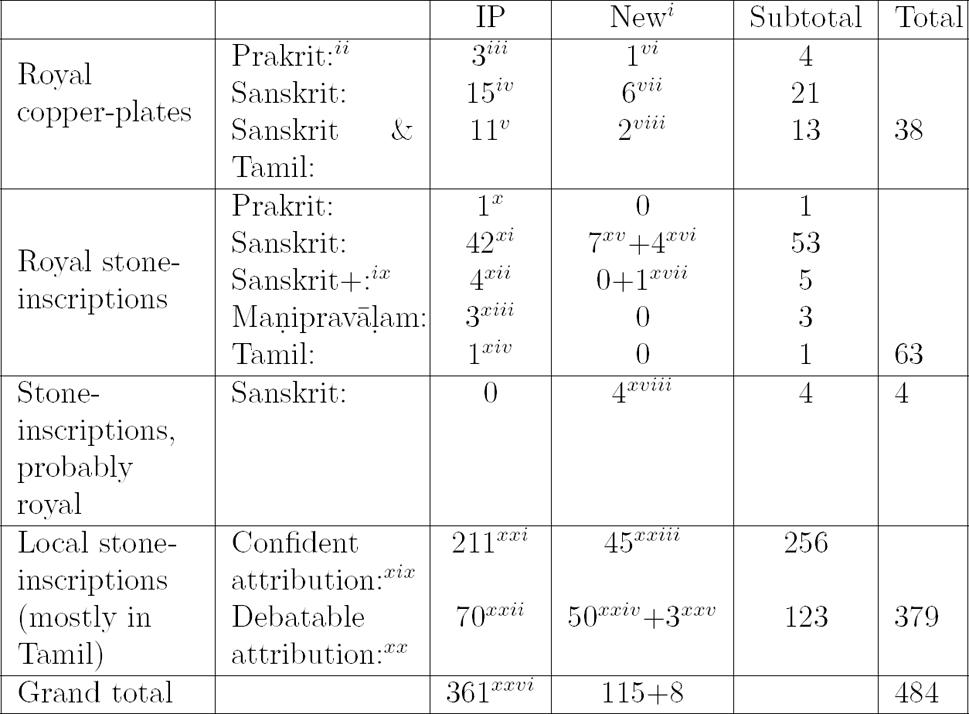
NOTES TO THE TABLE
i. I.e. mostly inscriptions discovered after completion of Mahalingam’s corpus. Those preceded by “+” are inscriptions overlooked or unnumbered by Mahalingam. Only the most recent reference is provided.
ii. Some of these Prakrit copper-plates do actually contain minor portions in Sanskrit, i.e. imprecatory verses and auspicious formulae. See Francis (2009, p. 246).
iii. IP 2–4.
iv. IP 5–16, 45, 53, 247.
v. IP 17, 46, 76–77, 81, 89–90, 121, 152, 155, 257.
vi. Alavakoṇḍa copper-plates (Reddy & Krishna Reddy 2000).
vii. Chuvviūru grant (Visweswara 1987), Babbēpalli copper-plates (Parabrahma Sastry 1992), Peddamuḍiyam copper-plates (Ramesh 1993), and presumably the two sets of copper-plates found at Duddukūru and the Pātūru copper-plates (see supra, p. 129, n. 9).
viii. Kumaraḍimaṅgala grant (Ramesan 1976) and Vēḷancēri copper-plates (Nagaswamy 1979).
ix. These are inscriptions in Sanskrit and in other language(s), i.e. mostly Tamil and Telugu, but also Kannaḍa, Prakrit and even Khmer according to some scholars.
x. IP 1.
xi. IP 19, 24, 26–27, 29, 32–33 (= one inscription in my reckoning), 35, 37, 39 (= three inscriptions in my reckoning), 41+356 (= one inscription in my reckoning), 47–51, 54, 55–56 (= one inscription in my reckoning), 57–65, 66 (= two inscriptions in my reckoning), 67–70, 250, 259, 270, 314+358 (= one inscription in my reckoning), 316–319.
xii. IP 21, 28, 34, 359.
xiii. IP 40, 43, 93.
xiv. IP 262.
xv. Birudas on pillars in the Mātaṅgeśvara at Kāñcīpuram (see ARE 1972–73. B.261–262); three inscriptions found at the Shore Temple at Mahābalipuram in the early 90’s (see Lockwood 2001, pp. 223–224 and 263–265); one inscription on a step of the Maṅgalatīrtha at Kāñcīpuram (see Lockwood 2001, p. 268); two inscriptions apparently unnoticed in the Kailāsanātha at Kāñcīpuram (on the western base of the eastern wall of the small prākāra of the Mahendreśvara; on the southern wall of the Mahendreśvara).
xvi. Temple name engraved on the stairs of the Mahendreśvara in the Kailāsanātha at Kāñcīpuram (see SII 1, p. 22 n. 2; Mahalingam 1988, p. 213 n. 1); fragmentary Sanskrit inscription on the base of the exterior wall of the cella of the upper cave at Tiruccirāppaḷḷi (see SII 12, p. 5 n. 1; Mahalingam 1988, p. 130 n. 1); fragmentary inscription from the Vaikuṇṭhaperumāl at Kāñcīpuram (see SII 4, p. 8 n. 2); series of Sanskrit inscriptions on the prākāra of the Shore Temple at Mahābalipuram provisionally counted as one inscription (see ARE 1966–67.B.189 and infra, p. 136).
xvii. Inscription in Sanskrit followed by a Tamil portion, on the base of the Airāvateśvara temple at Kāñcīpuram (Jouveau-Dubreuil 1917, p. 46 and plate III.C, facing p. 38). In actual fact it is possible that the Tamil inscription is an independent inscription.
xviii. Four stone-inscriptions found by N. Ramaswamy alias Babu (EFEO) in the Kailāsanātha at Kāñcīpuram. See supra p. 130.
xix. I.e. inscriptions with the regnal year of a Pallava king.
xx. I.e. inscriptions with the regnal year of an unidentified king, inscriptions with a fragmentary regnal year, inscriptions without regnal year, all of which can be dated on palaeographical grounds to the Pallava period.
xxi. IP 20, 44, 71–75, 78–80, 82–88, 91–92, 94–95, 97–120, 122, 124–144, 149, 153–154, 156–212, 214–233, 235–243, 246, 273, 276–286, 293–296, 298–304, 306–312, 315, 320–337, 339, 343–347, 349.
xxii. IP 36, 38, 42, 52, 96, 123, 145–148, 150–151, 213, 234, 244–245, 248–249, 252–257, 261–267, 272, 274–275, 287–292, 297, 305, 313, 338, 340–342, 348, 350–355, 357, 361–375.
xxiii. See ARE 1975–76.B.219; Āvanam 14.2, 17.6 = 20.1.2, 20.1.1; Dayalan (2005, app. I, No. 9–10, 16–21, 23–24, 30–31, 34–36, 39–40, 42, 48, 54–58, 60 = 61, 62–64, 66–71, 73); four inscriptions at Cāḷuvaṉ Kuppam (see Rajavelu 2008); a fragment of an inscription from Māmpākkam (see Śivaramamurti 1974, fig. 217; http://www.chennaimuseum.org/draft/gallery/01/04/inscrip2.htm, last date of access: 1st April 2010); a fragmentary inscription on a hero-stone apparently dated to a year of Kampavarman at Kāyampattu pointed out to me by Dr. G. Vijayavenugopal.
xxiv. See ARE 1995–96.B.33; Āvaṇam 10.3.1, 15.3, 17.7.1, 17.22.1, 18.11.1, 20.2, 20.61.1; Dayalan (2005, app. I, No. 5–7, 11–15, 22–23, 25, 27–29, 32–33, 41, 43–46, 51–53, 74–80, 83–90); two inscriptions at Vallam (see Irācavēl & Cēṣāttiri 2000, p. 37 and 39); an inscription without regnal year on a hero-stone at Kāyampattu pointed out to me by Dr. G. Vijayavenugopal who assigns it to Pallava period on palaeographical grounds.
xxv. See ARE 1916.281; SII, p. 8 n. 1; SII 23.359.
xxvi. This figure is according to my own counting and corresponds to 362 numbered inscriptions in Mahalingam’s corpus.
In total, we see that this provisional new corpus is almost 30% more extensive than the one established by Mahalingam. This alone would justify its publication.
Reading the published inscriptions again
In addition to new discoveries, there is another fact pointing to the need for a revised publication of the Pallava corpus. Unbelievable as it may sound, it is probable that most of the Pallava inscriptions have been read in situ by a single person and have been edited, sometimes only years later, on the basis of transcripts made in situ and of facsimiles, when available. It is thus unavoidable that some inscriptions have been only partially recorded or misread.
Nagaswamy already made a significant correction in a verse from an inscription in the upper cave at Tiruccirāppaḷḷi.[234] Lockwood (2001, p. 149–153) noticed that the inscriptions on the small chapels at the entrance of the Kailāsanātha at Kāñcīpuram have been partially misplaced in the edition of Hultzsch, who probably worked only on the basis of a facsimile (SII 1.29–30; IP 58–59 where verse 3 of IP 58 actually belongs to IP 59). In actual fact, there is one verse there in addition to the five edited. Some akṣaras are clearly readable before the misplaced verse. It is nevertheless difficult to make sense of them.
When I checked and examined in situ some of the known and published inscriptions I found that other improvements and sometimes important corrections had to be made. I will first provide detailed instances concerning some inscriptions of Narasimhavarman II (ca 700–725).
In Vāyalūr, an inscription of Narasimhavarman II is engraved on a pillar re-used in the entrance porch. It consists of a list of kings followed by two verses. In the last pāda of the last verse (sragdharā) Krishna Sastri (1926, p. 151 = El 18.18) who first edited this inscription, read the compound dvīpalakṣam. An examination in situ revealed that the correct reading is varṣalakṣam (see figure 6.1):
śambhoḥ pādāravinda[dvayapari]caraṇe nityam atya[n]takāmaḥ
śrīmegho viprasasyākaravibhavakare[235] [vyo]maratnoghaca[ndr][o?][236]
rā[j]yānt[ā]kāva[gra]haviditamahāmallaśabda[ḥ*] prajānāṃ[237]
rakṣ[ā]dīkṣādhikāraṃ vahatu raṇajaya[ḥ] śrīnidhir vvarṣalakṣam[238]
“He who constantly has an unlimited desire to worship the pair of lotuses that are the feet of Śambhu, He who is a cloud of prosperity in making the wealth that is the multitude of grains of the Brahmins, he who is the moon (from which flows) a flood of gems in the sky (vyomaratnoghacandro)[239] /the moon among the multitude of gems in the sky (vyomaratnoghacandro)/the gem in the sky (i.e. the sun) as well as the moon (vyomaratno ’tha candro), He whose name Mahāmalla is known (on account of his being) the destroyer (ant[ā]ka emended to antakal) and seizer (avagraha = graha?) of kingdoms,[240] Ranajaya (i.e. He who is victorious in battle) Śrīnidhi (i.e. He who is a treasure of prosperity), may he carry for one hundred thousand years a rule which is dedicated to the protection of his subjects.”
Krishna Sastri (1926, p. 152) had some difficulty with the reading dvīpalakṣam. He translated the last pāda as “may he exercise royal prerogative and take up the vow of administering (his) subjects up to the extremities of his kingdom, as even to include the thousand-islands” and admitted (p. 152 n. 1) that these last words were a doubtful translation of dvīpalakṣam. He proposed to analyse this word as an avyayībhāva compound, glossed as dvīpā lakṣyante yasmin karmaṇi iti.[241] According to him “If this interpretation is correct, it shows that the Pallava rule must have extended in the time of Rājasimha even to the distant islands in the ocean” (p. 152 n. 1). Krishna Sastri also proposed to correct dvīpalakṣam to “dvīpalakṣāt and, with ā repeated” to translate it as “up to the thousand islands” (p. 152 n. 1).
Krishna Sastri further suggested that there could be a reference by dhvani in dvīpalakṣam to the Laccadive islands called laksadvīpa (“the 100,000 islands”) in Sanskrit. He thought this inscription could answer the objection raised by Vogel (1918, p. 192) against the reality of overseas military conquests by the Pallavas. Vogel argued that, had such feats been achieved by the Pallavas, they would have been extolled in their prasasti as much as their victories over the Cāḷukyas. According to Krishna Sastri, this passage even though not in a prasasti, would be “at least a significant hint that the Pallava dominion was ambitious enough to extend to the distant islands”. Krishna Sastri’s reading and interpretation have been followed in the secondary literature (Subramaniam 1967, p. 14) and later translations (see Brocquet p. 606 and n. 1082).
The reading in situ, however, reveals that there is no such claim to overseas expansion in the Vāyalūr inscription. The sole so-called explicit reference to this—except purely conventional cases of describing the king as a universal ruler beyond the seas—in the whole Pallava corpus, based on this incorrect edition, thus vanishes. We can understand the statement as an hyperbolic vow of long reign (rakṣ[ā]dīkṣādhikāraṃ)[242] or of protection granted by the king even after his death.
At the Shore Temple at Mahābalipuram, a few words were noticed on the eastern face of the western wall of the prākāra (see G in Dumarçay, 1975, pi. XIX; ARE 1966–67.B.189 and ARE 1967, p. 35). In fact there are many more readable words and yet more lines on this western wall, more inscriptions on the northern face of the southern wall of this prākāra (on what I call G’, a layer of stone placed on the southern wall as G is on the western wall) as well as on some of the detached narrative panels illustrating the dynastic history, which are now deposited on the base of building D (see Dumarçay, op. cit.). It is difficult to assess how many inscriptions were in fact engraved, but at least we may surmise that they were linked to the narrative panels since some of these overhang the inscriptions on wall G. It also has to be noted that the sculpted and written walls G and G’ are in fact thin stone layers added on this, south-western, part of the prākāra. From its palaeography, language, and script (Sanskrit and Grantha), this series of fragmentary inscriptions may be assigned to Narasimhavarman II, the only Pallava king to whom inscriptions in the Shore Temple can be safely attributed. One small understandable fragment confirms this: I was able to read the words [XX]s[iṃ]ha[X] śrīmaheśvaracūḷāmaṇi[…] (i.e. °cūḍāmaṇi) on G (see figure 6.2), the latter word being a biruda already attested for Narasiṃhavarman II with the same meaning as his other exclusive birudas.[243] If my reading and interpretation are correct, this king would be responsible for the inclusion of narrative panels depicting the history of the dynasty and, as such, would stand as a precursor to Nandivarman II who later had similar panels sculpted in the Vaikunthaperumal at Kancipuram.[244]
In Paṉaimalai, the foundation inscription by Narasimhavarman II has been known for almost a century. When edited at the beginning of the 20th century, the beginning and the end of the epigraph were reported to be “concealed by a structure of bricks built in front of the temple” (Jouveau-Dubreuil 1916, p. 12) or “covered by the paved floor of a maṇḍapa in front of the temple” (Rangacharya 1928, p. 109). The structure or floor was removed at an unknown date, but few scholars seem to have been aware of this, although a new report was issued in the ARE 1975 (see pp. 4 and 33; ARE 1974–75.B.109) but published in 1990 only! We can read today new portions of this foundation inscription: the first three pādas and the beginning of the fourth pāda of the first stanza; an almost complete seventh stanza with just a few akṣaras still covered by a wall at its beginning. Somewhat surprisingly, a portion of the sixth stanza, which is missing in the existing editions, is actually perfectly readable in situ. Since the published facsimiles (ARE 1915–16, plate 3; Jouveau-Dubreuil 1916, pi. I, facing p. 20) are also missing this portion (whereas they preserve some part of the same stanza now erased), it is possible that it was also covered or that the facsimile of it was not made or has been lost. The first stanza (sragdharā) reads (newly found portion in bold, see figure 6.3):
viśvārambhādibījād a[ja*]ni kila kaver aṃgirā nāma putro
vidyeśaṃ sa[t]ya[p]ū{tat}r{ida}śa[g]ur[u]m[245] abh[ū*][t] tasya śaṃyus tanūjah
tatsūnor jjanma tejonidhir akṛta bharadvājanāmno munīndrān[246]
droṇa[s te]nodapādi prathitabhujabalo droṇir[247] aṃśah purāreḥ//
“From the kavi (i.e. Brahma, as uttering the Vedas) who is the primordial seed (which gave) beginning to the universe, the son names Aṅgiras engendered, as said, the lord of knowledge Tridaśaguru (‘the preceptor of the thirty [gods],’ i.e. Brhaspati) purified by truth. His son was Śaṃyu. From his son, the best among munis, named Bharadvāja, was born a treasure of fiery energy (tejas): Drona. By him (tena?) was born Drauṇi (i.e. Aśvatthāman) who is renowned for the strength of his arms and is a partial incarnation of the enemy of Pura (i.e. Śiva).”
That the Paṉaimalai inscription begins with the mythical ancestry of the Pallavas we already knew from the published editions. The newly discovered portion shows that we have probably another example of the canonical mythical genealogy, the one more often attested in other Pallava inscriptions: Brahma,[248] Aṅgiras, Bṛhaspati, Śaṃyu, Bharadvāja, Drona, and Aśvatthāman. Also noteworthy is the last and seventh verse (in a metre apparently measured by morae). It provides an interesting detail hitherto unknown, viz. the name of the liṅga that also serves as name for the temple:
sthitim etu maheśvaro maheśvaracūḷāmaṇipallaveśvare[251]//
“In the Maheśvaracūḍāmaṇipallaveśvara (i.e. the Lord of the Pallava in whose diadem is Maheśvara[252]) built by Maheśvaracūḍāmaṇi (i.e. He in whose diadem is Maheśvara) let Maheśvara come into residence!”
In addition to these substantial improvements to the Vāyalūr, Shore Temple, and Paṉaimalai inscriptions of Narasiṃhavarman II, others may still be mentioned. Some have already been published but were not taken into account by scholars who have recently dealt with the Pallava corpus.
In several Sanskrit copper-plates (5th–7th centuries) we find a recurrent epithet prajāsaṃrañjanaparipālanodyogasatatasa[t*]travratadīkṣita. This epithet occurs complete or truncated, sometimes corrupted. We can distinguish forms with °satra° to be read as °sattra° (°satata-satra-vrata-dī-taksita-,[253] °satata-satra-vmta-dīkṣita-,[254] °śatata-satṛ-bmta-dīkṣita-[255]) and, in later copper-plates, forms with °satya° (°satata-satya-vmta-dīkṣita-,[256] °satata-satya-vratā-dīkṣita-[257]). We encounter also in later copper-plates the epithets satata-satya-vrata-saṃyukta-[258] and satya-vrata-.[259] It seems thus that the wording satya° is more recent and acceptable maybe only for the later examples, contra Brocquet (1997), who, for the early occurrences, unduly reads °satya° (p. 450) or emends °satra° to °satya° (pp. 378, 385, 397, and 405), understanding that the king in question is dedicated to a true and permanent vow of undertaking to please and protect his subjects. I would keep the wording °sa[t*]tra° every time it is attested since the compound is perfectly understandable as such (“initiated in the vow of a permanent sacrificial session that is to undertake to please and protect his subjects”) in a metaphorical description of royal duty as sacrifice.
In the Paḷḷaṉ Kōvil copper-plates (IP 17) stanzas 3 and 4 (pṛthvī and upajāti) have to be read in enjambment. This solves the problems that arise when trying to understand each stanza separately.[260]
tataḥ pra[⌣ ⌣ – ⌣ ⌣ ⌣ ⌣ –]kaśokeṣv[261] iteṣv
aśoka[⌣ ⌣ – ⌣ – ⌣ ⌣ ⌣]pallaveṣu kramāt
praṇamranṛpakamramolyaruṇaratnaraśmyātapat-[262]
prabuddhapadapaṃkajeṣv ajani siṃhavarmmādhipāt //
śrīsiṃhaviṣṇur jjitasiṃhaviṣṇur
bbalena jiṣṇur ddhanuṣāpi jiṣṇum
bhmji[ṣṇu*[263] vaṃśaṃ svam alaṃkariṣṇur
nnirākariṣṇus samareṣu dhṛṣṇūn //
“Then, after the Pallava (kings) Aśoka … (and others—who dispelled) the misfortune (of the kali age?) and whose lotus-feet were woken up (or: lit) and were radiating heat (ātapat[264]) on account of the rays of red jewels on the beautiful diadems of bent kings—were gone one after the other,[265] from king Siṃhavarman was born śrī-Siṃhaviṣṇu who overcame Siṃhaviṣṇu in force, who surpassed even Jiṣṇu (i.e. Arjuna or Indra) in archery,[266] who is the ornament of his shining lineage (or: of Bhrājiṣṇu’s lineage, i.e. Viṣṇu’s or Śiva’s), who repelled intrepid (enemies) in battles.”[267]
All the above improvements concern royal epigraphy, a corpus that tends to be more often edited and in principle better studied than local Pallava records. We may expect that similar improvements could be made concerning the local inscriptions.
Towards a new corpus
If one considers the amount of unedited and newly-discovered Pallava inscriptions, as well as the improvements that must be made to the readings of some inscriptions already known, it appears that an updated and revised edition of the epigraphical corpus of the Pallavas would be a welcome endeavour. In this regard certain steps have already been made, such as the localization of the Pallava inscriptions and the preparation of a corpus of digital photos. The team of the École Française d’Extrême-Orient centre at Pondicherry (especially N. Ramaswamy alias Babu and G. Ravindran alias Ravi) is engaged with the task of locating and documenting Pallava inscriptions copied sometimes more than a century ago.
This revised Pallava corpus could be published in four volumes. The coherence of each volume would stem from different criteria: material form (copper-plates, stone-inscriptions), status (royal, local), content (herostones), and language. With the following scheme we move from the “most royal” in volume 1 to the “most local” in volume 4. Inscriptions would be presented according to the chronological succession of kings, with undated inscriptions given at the end in a separate section along with a tentative classification on palaeographical grounds.
Volume 1 would be devoted to the 38 sets of copper-plates. These, by definition, royal inscriptions—since they are royal orders of gifts (devadāna, brahmadeya, paḷḷiccantam)—are the longest of the corpus. The earliest among these were composed in Prakrit (with some minor portions in Sanskrit), then in Sanskrit, then in Sanskrit for the panegyric portion and Tamil for the business part.
Volume 2 would deal with the Prakrit, Sanskrit, Maṇipravāḷam and multilingual stone-inscriptions. This is a set of approximately 70, mostly royal Sanskrit inscriptions from royal temples: foundation inscriptions, lists of birudas, names of temples. There is only one inscription in Prakrit (IP 1). The multilingual epigraphs are mostly lists of birudas of Mahendravarman I, mixing Sanskrit and Dravidian birudas. Maṇipravāḷam instances are labels for portraits in Mahābalipuram (IP 40 and 43) and narrative inscriptions attached to narrative panels depicting the history of the dynasty in the Vaikuṇṭhaperumāl at Kāñcīpuram (IP 93). Instances of Sanskrit local inscriptions, such as the one mentioning an architect at Uttaramērūr (IP 95), are rare.
In volume 3 Tamil stone-inscriptions would be gathered with the exception of hero-stones. This is a set of approximately 300 inscriptions, mostly local and very rarely royal, or sometimes in-between those two categories, such as IP 80 in the Mukteśvara at Kāñcīpuram in which a Pallava queen speaks in the first person. These inscriptions are mostly found on floors, walls, bases, and pillars in temples, and sometimes also on rocks (IP 52 at Pūñcēri for instance) or on stelae (for instance IP 159 and 161 at Parameśvaramaṅgalam or a newly found inscription at Ayan Kuñcaram, which is actually close in format to a hero-stone, see Āvaṇam XVII.6 and XX.1.2). This volume would be divided into two parts: part one for datable inscriptions, unmistakably Pallava, because they begin with the regnal year of a Pallava king; part two for inscriptions to which the application of the Pallava label on the basis of their localization and palaeography is debatable by want of a regnal year, identification of the king of the regnal year, or mention of Pallava kings.
Volume 4 would be concerned with the hero-stones, which form a corpus of approximately 100 local Tamil inscriptions, generally in Vatteiuttu script.[268] Most of them are internally dated to a year of a Pallava king, but there are exceptions and lacunae. Sometimes the identification of the king of the regnal year is unclear, his name being unknown in the genealogies of the royal inscriptions. In such cases one may wonder whether this name is an unknown alias of a Pallava king, the name of a feudatory of the Pallavas or the name of a rival king. In some cases the presence of the prefix “kōvicaiya” to the king’s name could indicate that he is a Pallava.
A fifth volume would provide integral texts or extracts from inscriptions belonging to other corpora that mention the Pallavas: the Cejarla (IP 18), Lālkuṭi (IP 269, a Pāṇḍya inscription), Tiruppulivanam (IP 271, a Cōḻa inscription) inscriptions and Hāldipūr copper-plates (IP 258), for which see supra pp. 127–128; inscriptions selected from the corpora of the Kadambas, the Cāḷukyas, the western Gaṅgas, the Rāṣṭrakūtas, the Muttaraiyars (see Centalai inscriptions, EI 13.13), the Irukkuvēḷs (see Kotumpalūr inscription, SII 23.129), the Bāṇas (recently found inscription at Taccūr, see Francis, Gillet, & Schmid, 2006); medieval inscriptions from Andhra Pradesh and Karnataka mentioning Trilocanapallava.
Abbreviations
ARE: Annual Report on Epigraphy. Followed by year of copying, if necessary appendix number, and inscription number.
EI: Epigraphia Indica. Followed by volume number and inscription number.
IP: Inscriptions of the Pallavas. Followed by inscription number.
SII: South Indian Inscriptions. Followed by volume number and inscription number.
Bibliography: Epigraphic sources
Epigraphic sources are quoted as follows: engraved letters that have been damaged but remain somehow readable stand between []; restored letters, that is to say letters not engraved that are supplied or vowels with unmarked length supplied stand between [] and are marked by an asterisk. All readings of inscriptions in the main text are mine.
Alavakoṇḍa copper-plates. Reddy, A.K.V.S., & Krishna Reddy, N. (2000). A newly discovered Prakrit Copper Plate Grant of Pallava Viṣṇugōpavarman, Year 1. In S.S. Ramachandra Murthy, B. Rajendra Prasad & D. Kiran Kranth Choudary (Ed.), Sāṅkaram: Recent Researches on Indian Culture (Professor Srinivasa Śaṅkaraṇarayanan Festschrift) (pp. 68–70). New Delhi: Harman Publishing House.
Annual Report on Epigraphy [first published as Government Order, then as Annual Report on Epigraphy, Annual Report on South-Indian Epigraphy, and Archaeological Survey of India Annual Report on Indian Epigraphy]. Madras, New Delhi: Government of Madras, Government of India, Archaeological Survey of India, 1885–.
Avaṇam. Tañcāvūr: Tamiḻakat tolliyal (āyvuk)kaḻakam, 1991–.
Babbēpalli copper-plates. Parabrahma Sastry, P.V. (1992). Babbēpalli Plates of Pallava Kumāra Vishṇu. Epigraphia Indica, 42 (1977–1978), pp. 44–56.
Cāḷuvaṉ Kuppam pillar-inscriptions. Rajavelu, S. (2008). Recent discoveries near Mamallapuram. In R. Kalaikkovan et al. (Ed.), Airāvati: Felicitation Volume in Honour of Iravatham Mahadevan (pp. 177–190). Chennai: Varalaaru.com.
Ceṅkam naṭukarkaḷ. Nagaswamy, R. (Ed.). Madras: Tamil Nadu State Department of Archaeology, 1971.
Chuvviūru grant. Visweswara, M.V. (1987). Chuvviūru grant of Paramesvaravarman – I. Journal of the Epigraphical Society of India, 14, pp. 77–84.
Epigraphia Indica. 42 volumes. Calcutta, New Delhi: Archaeological Survey of India, 1892–1992.
Inscriptions of the Pallavas. Mahalingam, T.V. (Ed.). New Delhi: Indian Council of Historical Research & Delhi: Agam Prakashan, 1988.
Journal of the Epigraphical Society of India (alternate titles: Studies in Indian Epigraphy and Bhāratīya Purābhilēkha Patrikā). Dharwar, Mysore: The Epigraphical Society of India. 1975–.
Kalveṭṭu. Ceṉṉai: Tamil Nadu State Department of Archaeology. 1974–.
Kumaraḍimaṅgala grant. Ramesan, N. (1976). Kumaradimangalam Plates of the Pallava King Nandivarma III. In R. Subrahmanyam (Ed.), Sri Mallampalli Somasekhara Sarma Commemoration Volume (pp. 193–205). Hyderabad: Government of Andhra Pradesh (Journal of the Andhra Historical Society).
Paḷḷaṉ Kōvil copper-plates (IP 17). Subramaniam, T.N. (1959). Paḷḷaṉkōvil Jaina Copper-plate Grant of early Pallava Period. Transactions of the Archaeological Society of South India 1958–1959, pp. 41–83.
Pallavar ceppēṭukaḷ muppatu. Thirty Pallava Copper-plates (prior to 1000 A.D.). Subramaniam, T.N. (Ed.). Madras: Tamil Varalatru Kazhagam, 1966. [Reprint, Chennai: International Institute of Tamil studies, 1999]
Peddamuḍiyam copper-plates. Ramesh, K.V. (1984). A Pallava Charter and two Medallions from Peddamuḍiyam. In A.V.N. Murthy & I.K. Sarma (Ed.), Śrī Rāmachandrikā (Professor Oruganti Rāmachandraiya Festschrift): Essays on Indian Archaeology, History, Epigraphy, Numismatics, Art and Religion (pp. 117–121). Delhi: Book India Publishing Co.
Reyūru grant (IP 53). Desai, P.B. (1952). Reyuru Grant of Pallava Narasiṃhavarman; Year 12. Epigraphia Indica, 29 (1951–1952), pp. 89–97.
South Indian (South-Indian) Inscriptions. 27 volumes. Madras, New Delhi: Archaeological Survey of India, 1890–.
Uruvapalli grant (IP 6). Fleet, John Faithfull (1876). Sanskrit and old Canarese Inscriptions No. 12. Indian Antiquary, 5, pp. 50–53.
Utayentiram copper-plates (IP 10). Foulkes, Thomas (1879). Grant of the Pallava King Nandi Varmâ. Indian Antiquary, 8, pp. 167–173.
Utayentiram copper-plates (IP 10). Kielhorn, F. (1895). Udayendiram Plates of Nandivarman. Epigraphia Indica, 3 (1894–1895), pp. 142–147.
Vēḷañcēri copper-plates. Nagaswamy, R. (1979). Aparajita’s plate. In R. Nagaswamy, Tiruttani and Velanjeri Copper Plates (pp. 3–22). Madras: Tamil Nadu State Department of Archaeology (Tamil Nadu State Department of Archaeology Publications; 55).
Vāyalūr inscription. Krishna Sastri (1926). The Vayalur Pillar Inscription of Rajasimha II, Epigraphia Indica, 18 (1925–1926), pp. 145–152.
Bibliography: Secondary sources
Brocquet, Sylvain (1997). Les inscriptions sanskrites des Pallava : poésie, rituel, idéologie, 2 volumes. PhD dissertation, Université de Paris III. Villeneuve d’Ascq: Septentrion.
Dayalan, D. (2005). Computer Application in Indian Epigraphy (Pallava Period), 3 volumes. New Delhi: Bharatiya Kala Prakashan.
Desai, P.B. (1952). See Reyūru grant in Epigraphic sources.
Dumarçay, Jacques (1975). Étude architecturale. In Jacques Dumarçay & Françoise L’Hernault, Temples Pallava construits. Étude architecturale. Étude iconographique (pp. 1–75). Paris: École Française d’Extrême-Orient (Mémoires Archéologiques; 9).
Filliozat, Pierre-Sylvain (1984). Les inscriptions sanskrites du roi Pallava Mahendravarman Ier. Bulletin des Études Indiennes, 2, pp. 99–116.
Fleet, John Faithfull (1876). See Uruvapalli grant in Epigraphic sources.
Foulkes, Thomas (1879). See Utayentiram copper-plates in Epigraphic sources.
Francis, Emmanuel (2009). Le discours royal. Monuments et inscriptions pallava (IVème-IXème siècles). PhD Dissertation, Louvain-la-Neuve: Institut Orientaliste, Université Catholique de Louvain.
Francis, Emmanuel (forthcoming). Le discours royal dans l’Inde de Sud ancienne. Inscriptions et monuments pallava (IVme-IXme siècles). 2 vols. Louvain-la-Nouve: Institut orientaliste (Publications de l’Institut Orientaliste de Louvain; 64–65).
Francis, Emmanuel, & Gillet, Valérie, & Schmid, Charlotte (2005). L’eau et le feu : chronique des études pallava. Bulletin de I’École Française d’Extrême-Orient, 92, pp. 581–611.
Francis, Emmanuel, & Gillet, Valérie, & Schmid, Charlotte (2006). Trésors inédits du pays tamoul : chronique des études pallava II. Vestiges pallava autour de Mahabālipuram et a Taccūr. Bulletin de I’École Française d’Extrême-Orient, 93, pp. 431–481.
Gopalan, R. (1928). History of the Pallavas of South India. Madras: University of Madras (Madras University Historical Series; 3).
Irācavēl, Cu. & Cēṣāttiri, A. Ki. (2000). Tamilnāttuk kutaivaraik kōyilkal. Ceṉṉai: Paṇpāṭṭu Veḷiyīṭṭakam.
Jouveau-Dubreuil, Gabriel (1916). Pallava Antiquities: Volume 1. London: Probsthain & Co. [Reprint, New Delhi: Asian Educational Services, 1991]
Jouveau-Dubreuil, Gabriel (1917). The Pallavas. Pondicherry: the author. [Reprint, New Delhi: Asian Educational Services, 1995]
Kielhorn, F. (1895). See Utayēntiram copper-plates in Epigraphic sources.
Krishna Sastri (1926). See Vāyalūr inscription in Epigraphic sources.
Lockwood, Michael, with collaborations of A. Vishṇu Bhat, G. Siromoney & P. Dayanandan (2001). Pallava Art. Madras, Tambaram: Tambaram Research Associates.
Mahalingam, T.V. (1988). See Inscriptions of the Pallavas in Epigraphic sources.
Mohan, V.K. (1996). Art and Architecture of the Telugu Cōḻa Temples. New Delhi: Kaveri Books.
Nagaswamy, R. (1975, June 28). What Mahendra meant, The Indian Express (Madras edition).
Nagaswamy, R. (1979). See Vēḷañcēri copper-plates in Epigraphic sources.
Nilakanta Sastri, K.A. (1974), Some Pallava Inscriptions. In S.P. Gupta (Ed.), Aspects of India’s History and Culture: Collected Articles of Professor K.A.N. Sastri (pp. 85–88). Delhi: Oriental Publishers, on behalf of The Indian Archaeological Society.
Padmanabha Sastry, C.A. (2003). Three Seals from three Pallava Copper Plates. In I.K. Sarma & Srinivasan Srinivasan (Ed.), Studies in South Indian Coins, 13 (pp. 31–34). Chennai: New Era Publications.
Parabrahma Sastry (1992). See Babbēpalli copper-plates in Epigraphic sources.
Ramesh, K.V. (1984). Indian Epigraphy: Volume 1. Delhi: Sundeep Prakashan.
Subramaniam, T.N. (1959). See Paḷḷaṉ Kōvil copper-plates in Epigraphic sources.
Subramaniam, T.N. (1966). See Pallavar ceppēṭukaḷ muppatu in Epigraphic sources.
Subramaniam, T.N. (1967). The Pallavas of Kanchi in South-East Asia. Madras: Swadesamitran Press.
Venkata Raman, K.R. (1957). A Note on the Sittanavasal and Kudumiyamalai Monuments. Transactions of the Archaeological Society of South India 1956–1957, pp. 87–94.
Vielle, Christophe (2007). La Jaiminīyasaṃhitā du Brahmāṇḍapurāṇa. Madhyamabhāga. Adhyāya 1–15. Introduction, édition et traduction. These présentée a la faculté de philosophie et lettres de l’UCL en vue de l’obtention du grade d’Agrégé de l’enseignement supérieur. Louvain-la-Neuve: Institut Orientaliste, Académie Universitaire Louvain.
Vogel, J.Ph. (1918). The Yūpa Inscriptions of King Mūlavarman, from Koetei (East Borneo). Bijdragen tot de Taal-, Land- en Volkenkunde van Nederlandsch-Indiě, 74, pp. 167–232.
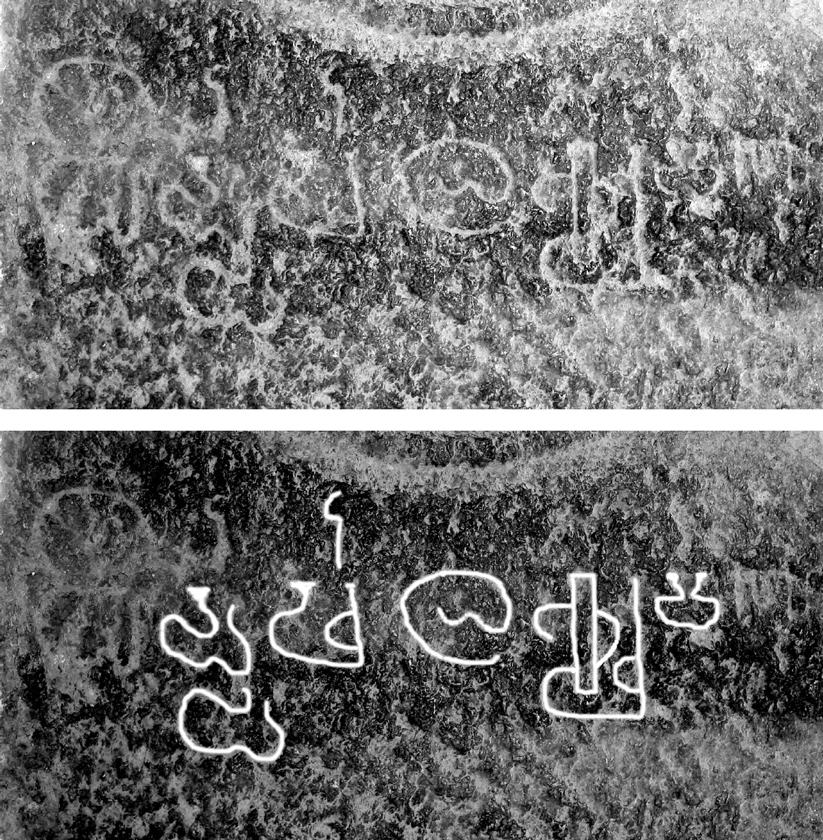
Figure 6.1: End of second (and last) stanza on a pillar of the main (eastern) gopura of the Vyāgrapurīśvara temple at Vāyalūr. Enhanced in white: vvarṣalakṣam. Photo: the author.

Figure 6.2: Portion of inked impression (courtesy of ASI, Chennai) from the eastern face of the western wall of the prākāra of the Shore Temple at Mahābalipuram. Read: śrīmaheśvaracūḷāmaṇi… Photo: the author.
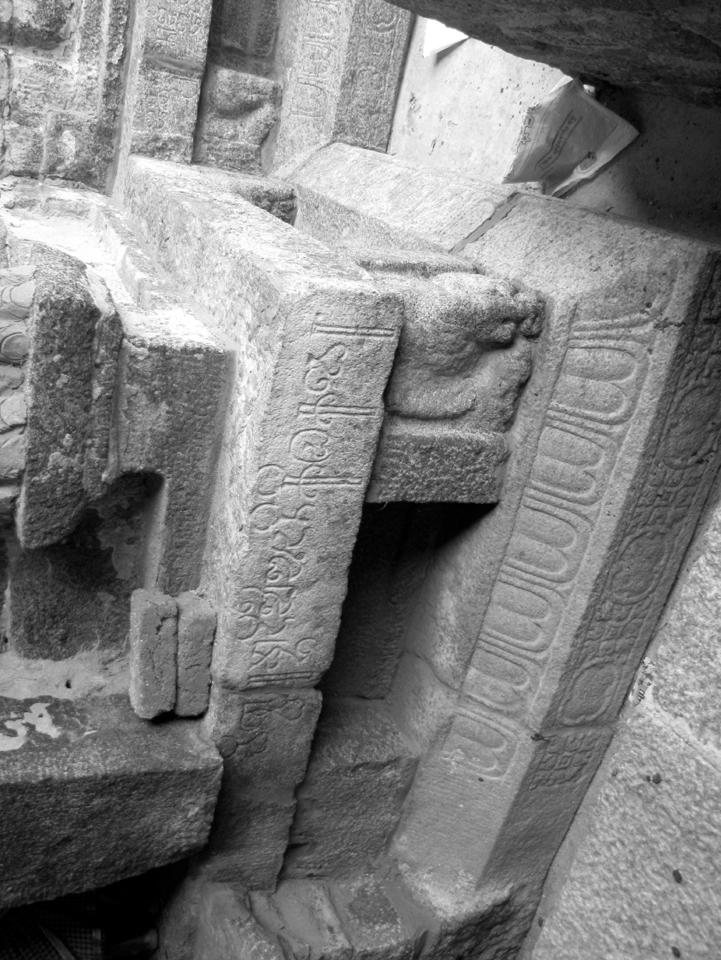
Figure 6.3: Beginning of the first stanza on the eastern base of the maṇḍapa of the Maheśvaracūḍāmaṇipallaveśvara temple (today known as Tālagirīśvara) at Paṉaimalai. Read: viśvārambhādibījād a[ja*]ni kila kaver aṃ… Photo: the author.
Seven: Did Mīmāṃsā authors formulate a theory of action?
Elisa Freschi
It is not uncommon in India that language issues develop into more general theories. Some scholars (notably Johannes Bronkhorst[269] have even stated that the specificity of “Indian thought” actually lies in the implicit postulate that language reflects reality and that, hence, analyzing language is a first step to the description of reality. Karl Potter sees it the other way around and states that Indian authors anticipated the “linguistic turn” of analytic philosophy, that is, the emphasis on the language as the key link between thought and reality which has determined Western Philosophy after Frege and through Wittgenstein and Heidegger.[270] Whatever the case, issues such as causation, exhortation and inducement, have been discussed using linguistic instances as case studies.
As for Mīmāṃsā, its main focus is the Veda and, hence, all philosophical discussions arise purely in connection with a particular exegetical point. Moreover, it is hardly the case that such discussions are presented independently of their occasional motive or that they are developed irrespective of it. Mīmāṃsā texts may seem often obscure to today’s Western interpreters just because of this close link to ritual matters. In the following, I will try to see whether, in the case of theories of action, a theory produced in the context of Vedic exegesis may indeed have a more general significance for Indian Philosophy and, notwithstanding the linguistic bias hinted at above, also for Philosophy in general. The first point to be made is that “action” does not exist as an already established entity to inquire about. Rather, different authors and schools identified “action” in different ways (consequently, kriyā, karman, vyāpāra, bhāva and other substantives deriving from the root kṛ-may have different shades of meaning in different schools). In other words, a description of, e.g., a rabbit, deals with something the existence of which is obvious to everyone. On the other hand, a theory of action describes something the very existence of which has to be proved. In fact, different schools analysed reality in different ways and only some of them recognised “action” as a part of it.
§1. Philosophical background: Action as movement in Vaiśeṣika
When Mīmāṃsā thinkers started to deal with the issue of action from a philosophical and not simply an exegetical point of view, other philosophical systems had already considered this theme. The nature-philosophical schools which later crystallized into Vaiśeṣika (Frauwallner 1956:15) acknowledged a third category, beside substance and quality, called karman. This was further defined as parispanda (movement) of the atoms (aṇu). Nothing in its effect differentiates an intentional action from an unintentional one, although the former is caused by effort (prayatna) on the part of its doer. In turn, effort is said to be caused by desire, and this by ignorance. Prayatna is not in itself a sort of karman, but a quality of the self (ātman). The latter is composed of a single atom and, hence, its changes cannot be thought of as atoms’ movements. Hence, karman is “movement” and intentionality is just one of its possible causes. Every kind of mental act is excluded from karman.[271]
§2. Exegetical background: Śabara
As already mentioned, Mīmāṃsā authors are primarily concerned with the exegesis of the Veda, and above all, of its sacrificial prescriptions. Their standard example of a prescription is “One who is desirous of heaven should sacrifice” (svargakāmo yajeta). In this statement, Mīmāṃsā authors point out an active component, embedded in the verb and corresponding to the fact that one undertakes an activity (bhāva or karman) in general. This component, they maintain, is expressed by the verbal ending, whereas the verbal root expresses the specific activity undertaken. So, the verbal ending informs one of the sheer fact that an activity is being initiated and one turns to the verbal root in order to name it.[272] Śabara (possibly before 5th c. AD), who wrote the first extant commentary on the foundational text of the Mīmāṃsā system, was presumably the first who called this generic activity bhāvanā (lit. “the causing to be”), an action noun from the causative of the root bhū-. Thus, he defined an activity in general as the fact of bringing about (“causing to be”) an aim (in the example mentioned above, heaven). Conforming to the pan-Indian way of making the meaning of a morpheme explicit through a paraphrase, Śabara paraphrases svargakāmo yajeta as follows.[273]
svargakāmaḥ (“one who is desirous of heaven”) → svargah (“heaven”)
yaj- (verbal root “to sacrifice”) → yāgena (“through sacrifice”)
-ta (optative suffix) → bhavati (“occurs”)
That is, “Heaven occurs through sacrifice”. The role of desire is thus implicitly limited to the identification of the one who should perform the sacrifice (on this topic, see Freschi 2007).
The other sentences found close to this one in Vedic texts convey the procedure, since the bhāvanā is deemed to be in need of three elements, namely an object (svarga, heaven), an instrument (yāga, sacrifice) and a procedure explaining how the object can be acquired through that instrument:[274]
| bhavana |
object to be brought about, e.g., heaven instrument, e.g., sacrifice procedure, e.g., rites composing the sacrifice |
All later Mīmāṃsakas agree on the necessity of these three elements. What they do not agree upon, however, is the role of the object and that of the agent, and –consequently– the nature of bhāvanā itself. Thus, they all agree on the exegetical part of the above-mentioned account (hence, in the following I will leave behind Vedic examples and matters related to instrument and procedure). Instead, disagreements arise mainly where a philosophical understanding of “action” is also at stake.
§3. Kumarila
Kumārila (7th c. AD[275]), one of the foremost Indian philosophers and the commentator on the work of Śabara, dedicated many thoughtful pages in his Tantravārttika (bhāvārthādhikaraṇa, ad MS 2.1.1–4[276]) to this subject. For him, bhāvanā is of central significance and he uses it as a paradigm to also interpret the process of exhortation (vidhi-tattva), through which others are incited to act.
Kumārila stressed the productive component of the bhāvanā by paraphrasing it with the verb “to do” (karoti). For instance, he paraphrases pacati (“[s/he] cooks”) as follows:
pac- (verbal root “to cook”) → pākaṃ (“cooking”)
-ti (verbal suffix of the present indicative) → karoti (“[s/he] does”)
Kumārila’s paraphrase, unlike Śahara’s, makes it clear that the bhāvanā is necessarily connected to an agent, i.e., it is the “activity of an inciting [subject]”.[277]
Further, the bhāvanā is linked to a result which has yet to be realised (sādhya), insofar as the result needs an instrument realizing it, that is, the result needs one to undertake the action instrumental to its arousal. Without this undertaking (the bhāvanā), the result would never get connected to the instrument it requires:
The relation between what has to be realized and the instrument to realize [it] has in every case the bhāvanā as [its] abode | Hence, this (thing to be realized) cannot be realized without the suffix [expressing] the bhāvanā ||[278]
Hence, Kumārila did not classify the acts defined by verbs such as “to be”, “to abide”, etc. as bhāvanā.[279]
It is less clear whether, according to Kumārila, the term “bhāvanā” solely meant the bodily performance of an activity or also its mental aspect. In favour of the first hypothesis is the very fact that Vaiśeṣikas understood karman in a physical way, namely as movement, and that traces of this notion can be detected also in Kumārila and Maṇḍana.[280] See, for instance, the following definition of bhāvanā by Kumārila:
The bhāvanā is what is determined as having the form of movement (parispanda) through a general departure from passivity.[281]
On the other hand, an objector in TV states that according to the definition of bhāvanā as the “activity of an inciting [subject]”, activities defined by the verbal root, such as laying the vessel on the fire in the case of cooking, or the mental decision (manasa saṃkalpa) to sacrifice would also count as bhāvanā.[282] Kumārila answers that there is no fault in that:
[Obj.:] But if the bhāvanā is accepted as the activity of an inciting subject, then placing a kettle on the fire in the case of cooking and the mental decision in the case of sacrificing would [also] be bhāvanā s. And these [activities] are [well known to be] the meaning of the verbal root, hence the bhāvanā would end up being expressed by the verbal root.
[R:] This is not a fault: Even if it (bhāvanā) is not known as distinct from the meaning of the verbal root, nonetheless it is understood through its form consisting in what is common to all [particular actions designated by each verbal root].[283]
This seems to imply that Kumārila accepted the opponent’s suggestion, but neither he nor his commentators[284] went into further detail. They rather discussed the distinction of the bhāvanā from the meaning of verbal roots, and not whether it includes mental acts or not. While commenting on a different passage, on the other hand, Someśvara included sacrificing, together with meditating, as typical activities of the self, not implying any movement (see infra, §5.1). But this is hardly a piece of conclusive evidence, since Someśvara (as will be seen infra) was a philosopher in his own right and constantly innovated on Kumārila’s thought. So, one is left in doubt whether mental acts were admitted as actions by Kumārila.
§4. Maṇḍana
Maṇḍana Miśra, who lived shortly after Kumārila, wrote a separate study on bhāvanā called Bhāvanāviveka (“Discernment about bhāvanā”). This is composed in stanzas with an auto-commentary and has been commented on by Umveka Bhaṭṭa (8th c.). Apart from its intrinsic philosophical value, Maṇḍana’s text is extremely valuable also because it reproduces many, otherwise unrecorded, objections raised against Kumārila’s theory. The main objector maintains, à la Zeno of Elea, that movement simply does not exist. Instead, it can be reduced to the conjunctions and disjunctions with a certain region of space (Zeno suggested that it was nothing but a succession of moments of rest).
Truly, this movement is acknowledged as having as [its] result the disjunction from a previous region of space and the conjunction with a subsequent one, and these conjunction and disjunction are directly perceptible. Consequently, this notion [of movement] can refer to these two alone [since nothing else is seen apart from these two]. Nobody is aware that “s/he walks”, if s/he has not apprehended the abandonment of the previous region of space and the obtaining of a subsequent one.[285]
In fact, movement is nothing but the qualities of being conjunct and being disjunct (saṃyoga-vibhāga) inhering in a thing. For instance, walking is nothing but conjunctions and disjunctions (saṃyoga-vibhāga) inhering in feet, ground and space. Only conjunctions and disjunctions are actually perceived and on the basis of them one infers movement later on:
Moreover, it is correct to assume that conjunctions and disjunctions –which have been established– are directly perceptible, and not the unestablished act. It is through these two, conjunction and disjunction, alone, then, that we infer action.[286]
Hence, the action is inferred at a time when the alleged movement has actually already vanished and one only sees a new disjunction or conjunction:
At the moment right after one has known that a conjunction has occurred, the inferred act ending with the conjunction is not present. Conjunction and disjunction, on the other hand, are present. And a [cognition’s] content corresponds to the nature of [its] cognition, not to its opposite. Hence, these two alone are the content of the notion “s/he walks”, not the act.[287]
Even more explicit is Uṃveka’s commentary thereon:
“S/he walks” is the sudden perception (pratibhāsa) of something present. Hence, this cognition cannot rest on an inferred action. Rather, it is a piece of direct perception resting on a present conjunction.[288]
It is possibly worth clarifying that the foundations of the objector’s argument are common-sense in Indian philosophy. The idea that one does not directly perceive movement, but that one only sees the conjunctions of, e.g., a foot with different positions in space and ground, is in fact a pan-Indian theme. Observe the matter-of-fact attitude in the following, short, statement, in a Prābhākara Mīmāṃsā primer:
Action, on the other hand, can only be inferred. In fact, motion is inferred from the succession of conjunctions and disjunctions. In the [Śābara]bhāṣya it has been fully explained how one infers the movement of the sun out of the fact that from one region of space it reaches another.[289]
However, the BhV objector asks, since conjunctions and disjunctions are enough to explain what one sees, why should one postulate a further entity?
Turning back to the linguistic background of the discussion, the opponent claims:
Hence, the [so-called] action is only a specific quality, delivered by the verbal root, and not a category –“action”– intrinsically separated from this [quality], and denoted by the suffix or by the root.[290]
And, finally:
Through a specific quality also the notion “[s/he] cooks” can be established. Hence, no inference of a different category “action” can be devised.[291]
One could be tempted to complete the argument by specifying that the illusion of a separate category, namely movement, is just created by the succession of disjunctions and conjunctions (see the TR text quoted above, n. 21).
This interesting position has been criticized by Maṇḍana. Since conjunctions and disjunctions do not cease to be present, Maṇḍana argued, one would keep on inferring an activity even when one pauses after having walked, or even after a falcon has long left a tree:
Nor is this notion [of action] only based [as its external referents] on the conjunctions and disjunctions, which [we] regard as having been produced by it. […] In fact, there is no absence of disjunction from the previous spot and conjunction with a subsequent one –[conjunction and disjunction which have been] originated by an action– in someone who stays after having walked. Hence, the notion of activity, which is based on them, should not at all be abandoned.[292]
Moreover, [if the notion of “action” were only dependent on conjunctions and disjunctions,] there would be the notion of “activity” [also] with regard to a trunk, in force of the conjunction with a previous falcon and its subsequent disjunction from it.[293]
The objector might argue that it is only the sum of conjunctions and disjunctions that leads to the postulation of movement. But — Maṇḍana contended — if the sum were the only cause of the notion of movement, then one would not be able to get to this notion unless one gets to the sum by counting:
Just as with regard to twenty or [more things] the cognition of twenty and the [other numbers] occurs for one who has counted following the sequence from one onwards, not for one who has not counted, similarly in this case, the notion “he walks” would occur [only] for one who has counted the conjunctions and disjunctions, not for one who has not counted [them]![294]
Moreover, one could argue, the sum of conjunctions and disjunctions is never to be seen. One only experiences the final result, since one does not seize at once all successive conjunctions and disjunctions.
Maṇḍana then pointed out further flaws in the application of the objector’s theory (p. 85) and finally stated that movement (kriyā) is a separate category:
Therefore, the category of “action”, the synonym of which is bhāvanā [and] which exceeds the specific [kind of actions] obtained through the verbal roots and imposed on it, actually exists![295]
Linguistic and philosophical analysis are closely connected in this and the following statements (pp. 86–87). Together with the underlying assumption that whatever exists must be linguistically expressible, Maṇḍana speculated further on the equation of kriyā and bhāvanā, thus showing that he considered the latter not merely as an exegetical category, but also as an alternative explanation of movement and action.
If the action/bhāvanā is not tantamount to movement, then, an objector suggests, it is identical with effort alone. But that the bhāvanā cannot be tantamount to effort alone is made clear in the following appeal to common sense (and linguistic usage):
In this regard, some [say]:
In the Bhāṣya through the word “s/he should make an effort” the effort is conveyed. [R.:] This is not a metaphorical notion, because of the abundance of its usage in regard to unconscious [entities].[296]
[Obj.:] In “s/he should make an effort, so that there is something”, it has been shown that the meaning of verbal endings is just the effort, which leads to the bringing about (bhāvanā) of a result. With regard to an unconscious [entity], on the other hand, the usage of verbal endings is metaphorical. [R.:] But, due to the abundance of [such] usages, the suffix cannot be metaphorically [used]![297]
In fact, metaphors can only be exceptions with regard to the normal, direct signification. To settle the issue of the real meaning of bhāvanā, Maṇḍana echoed (p. 91) Kumārila’s definition of it as the “interruption of a previous state of rest (audāsīnya)”,[298] and interpreted this “rest” rather loosely, in both a physical and a mental sense. Accordingly, he further defined the bhāvanā as consisting in effort (prayatna) and movement (parispanda). In this way, Maṇḍana can make sense of sentences attributing actions to unintentional agents, such as, the chariot in “the chariot goes”. This is a typical Mīmāṃsā example, where the linguistic evidence of ‘the chariot’ fulfilling the role of the agent seems to clash with the ontological fact that a chariot does not perform any (conscious) action. In fact, no effort is actually found on the part of the chariot, so if action were just tantamount to effort, this sentence should not be conceivable, or should be only metaphorically valid. Instead, if action means both effort and movement, as claimed by Maṇḍana, the sentence makes good sense since the chariot does perform a movement.
Further, through Maṇḍana’s double rendering of action, mental activities can also be labelled kriyā by him and expressed as bhāvanā:
The meaning of “s/he does” is the cessation of a state of rest, since if one is in rest there is neither action nor cognition. And [this] “interruption of rest” is twofold, since in the case of the self it is effort and in the case of [unconscious entities] such as the chariot it is movement.[299]
Noticeably, Maṇḍana referred here to Kumārila in order to adjust the definition of his great predecessor to his own interpretation of bhāvanā. The explanation is then continued as follows:
To elaborate, one understands that the self endowed with effort, that is, which makes an effort, [and is hence] not in rest, is other than what does [something], which performs an activity and moves. Hence, effort and movement have the common form of being an aspect within the cessation of rest. They constitute the category of action, through [their] being the content of the notion of its (the action’s) appearance. Therefore, it (action) is not absent also in [efforts] done by the self.[300]
In sum, kriyā acquires a wider meaning than karman in Nyāya-Vaiśeṣika. It designates also mental acts, it stresses the undertaking of all sorts of acts, and it designates metaphorically movements of unconscious agents. Eventually, Maṇḍana explicitly acknowledges the differences between his position and the Vaiśeṣika one:
For us, movement alone is not the only action (kriyā), as it is for Kaṇāda[301] (the author of the Vaiśeṣikasūtra, the foundational text of the Vaiśeṣika school).[302]
As for the objector’s claim, one could integrate Maṇḍana’s exposition by making explicit that conjunctions and disjunctions inhering in a thing as their qualities are instead simply the result of the movement.[303]
§5. Someśvara
Someśvara Bhaṭṭa (possibly 12th c. AD) –a commentator of Kumārila– followed in Maṇḍana’s footsteps, but eventually identified action (bhāvanā) and effort (prayatna).
In Someśvara’s work, Kumārila’s analysis of the components of bhāvanā relies on a firmer distinction between the meaning of the verbal root and that of the ending:
| bhavana (expressed by the verbal ending) |
object to be brought about, e.g., heaven instrument, i.e. movement (expressed by the verbal root) procedure, e.g., rites composing the sacrifice |
Like Kumārila, Someśvara stated that an agent is necessarily involved in the bhāvanā.[304] Further, effort is, according to him, caused by icchā (desire), and desire aims at something which has not been realized yet.
And: (1) effort is originated by desire, (2) no desire is possible in regard to something which is not a [desirable] result, and (3) the achievement of the result cannot be realized through the mere production of the [specific kind of movement] meant by the verbal root because the comprehension [of the result] relies on the fact that it is something to be brought about (bhāvya) [which necessarily requires a force bringing it about, the bhāvanā]. Hence, the mere production of it (specific kind of movement) is not fit to complete [the prescription]. Therefore, there is no hindrance to the fact that the effort, whose instrument is the [specific kind of movement] meant by the verbal root, is the instrument to realize the result. Hence, there is no flaw in the [definition] of bhāvanā as effort.[305]
The crucial point of this argument is that the result is something still to be brought about and, hence, requires an action directed to its coming into existence. The specific movement expressed by the verbal root lacks this oriented component and is, hence, not enough.
In other words, Someśvara specified Kumārila’s indication of a sādhya through the necessity of an object which is still not there (no bhāvanā is conceivable in regard to an already existing object); and defined the bhāvanā as the “activity of an inciting [subject] with regard to an [object] which has to be brought about” (bhāvyaniṣṭhaprayojakavyāpāra, p. 577, ll. 2–3; p. 577, l. 16). The stress on an object to be brought about (bhāvya), apart from its probable ritual origin, also underlines the active component of the bhāvanā, more precisely, its productive aspect (anyotpādānukūlatva, “the fact of leading to the production of [something] else”, p. 576, l. 31). At the same time, the necessary presence of something to be realized further differentiates “action” (bhāvanā) from sheer “movement” (parispanda).[306]
In this way, Someśvara could specify better the distinction between the meaning of the verbal ending (that is, the bhāvanā) and that of the verbal root. The latter is movement (spanda) and it is the cause of conjunctions and disjunctions. As usual, he did not overtly dissent from Kumārila, but rather reinterpreted him. Commenting on Kumārila’s definition of bhāvanā as “mere (mātra) interruption of rest” (see above, n. 13), Someśvara, in fact, states:
The word “mere” aims at showing that [the bhāvanā] is different from the movement, etc., meant by the verbal root [and] caused by conjunctions and disjunctions.[307]
Maṇḍana’s point was that action is distinct from conjunctions and disjunctions. Someśvara accepted the latter as causes of movement but added that action is distinct from movement altogether.
That is, on an ontological – and not just linguistic – level, Someśvara separated the Vaiśeṣika category of karman from the productive/intentional component of an action. Movement is no more tantamount to action. Rather, it is the result of an (intentional) action. As for the example used by the objectors to falsify this view, namely, that there is action also in “the chariot goes”, Someśvara answers that this is only a metaphorical usage:
The usage “the chariot goes” can also be justified once the effort belonging to the draught-horse or [another intentional agent] is applied metaphorically to the chariot or [another unconscious entity], since in this case the chief meaning is incongruous [and, hence, one resorts to the metaphorical meaning].[308]
Language does not always correspond to reality, Someśvara explained, like in the case of feminine endings used with regard to inanimate objects, such as khaṭvā, the mat (which are not in themselves “feminine”):
Just as the feminine suffix is also used with regard to “mat” and other words, although there is nothing feminine [in them], so the verbal ending is used with regard to an unconscious [entity], although [it performs] no effort.[309]
Consequently, effort is not a quality of the self anymore:
It has been refuted before that the effort is a characteristic of the self.[310]
Rather, it is an activity (karman) in itself, like cognition (buddhi), desire and aversion – all deemed to be qualities by Nyāya-Vaiśeṣika authors:
Cognition, desire, aversion, effort are accepted as actions by the experts of words (i.e., the Grammarians). Therefore, also the teacher (Kumārila) designated the effort as “activity”.[311]
§5.1 Effort as evidence for the self
The distinction of self and effort could have had major consequences, insofar as the effort was the probans (liṅga) in the arguments for the existence of the self devised by Naiyāyikas. In fact, prayatna was believed to be a quality of the self (and, hence, inseparable from it). Hence, by seeing other people moving, one could infer the existence of other selves (in contemporary terms one would say: the existence of other minds), because movement is caused by effort and is a quality of the self:
all movements of a body are caused by effort,
other people’s bodies move,
hence, their movements are also caused by effort.
And:
whenever a quality is present, its substrate is also necessarily present,
effort is a quality of the self,
whenever effort is present, the self is also present.
Hence:
other selves also exist, since other people move.
However, according to Someśvara, the self can still be inferred from effort insofar as effort is a typical activity of the self. In fact, Someśvara explained that every bodily movement (śarīraparispanda) is caused by an effort (prayatna). Thus, he developed an inference akin to the Naiyāyika one. In fact, one knows through mental perception (mānasapratyakṣa, the kind of direct perception allowing one to seize one’s own inner states) that one’s bodily movements while going, sacrificing, cooking, etc., are caused by the effort of a self. Thus:
-
all movements of one’s body (svaśarīraparispanda) are caused by the self’s effort (ātmaprayatna), as one knows through mental perception (mānasapratyakṣa),
2. other bodies also move,
3. hence, their movements (paraśarīraspanda) are also caused by a self’s efforts, just like in one’s own case.
In Someśvara’s words:
There is an invariable concomitance (vyāpti) between the movements of one’s body and the self’s effort which causes them. Hence, in another body one infers effort because one sees movement. And one’s own effort is knowable through mental perception also, and delimited by the movement meant by a verbal root such as “to go” – [in cases such as] “I make an effort in regard to going”, “I make an effort in regard to cooking” – or by the [movement] consisting in an [inner] agitation [meant by a verbal root] such as “to sacrifice” – [in cases such as] “I make an effort in regard to the sacrifice” (i.e., I try to sacrifice), “I make an effort in regard to meditation”.[312]
The rationale behind this argument is that one is aware of something else beyond the movements one performs in sacrificing, etc.
Through his stress on effort and his limitation of movement, Someśvara fully developed what was merely a hint in Kumārila and Maṇḍana: what is worth describing is the initiation of the action (pravṛtti), whereas its actual realisation does not really matter. Later Mīmāṃsakas (e.g., Rāmānujācārya TR IV, §9.12, p.57) hence describe the process leading to action as threefold: cognition-wish (icchā)-effort. On the contrary, Nyāya authors added the actual performance of the action at the end. It is possible that Mīmāṃsā reacted against the stress laid on the actual implementation of the action due to the objections presented by the anonymous objector in Maṇḍana’s Bhāvanāviveka.
§6. Conclusion: what is an action?
The theories I have outlined above are originally exegetical/linguistic devices. But do they also constitute or presuppose a general theory of action? My provisional answer is yes, insofar as:
-
they are not solely applicable in an exegetical context (see the pacati example mentioned above, §3)
2. they are used to address topics such as intentionality, effort, movements of atoms, which have nothing to do with either exegesis or linguistic analysis
3. they are used in debates against opponents of other schools who speak about movement and do not share the Mīmāṃsā theory of bhāvanā
4. they are, at least in Someśvara’s case, explicitly stated to be independent of their linguistic form.
The following table sums up the increasing role of intention and the decreasing space attributed to qualities from the objector in Maṇḍana’s Bhāvanāviveka through Vaiśeṣika to Someśvara.
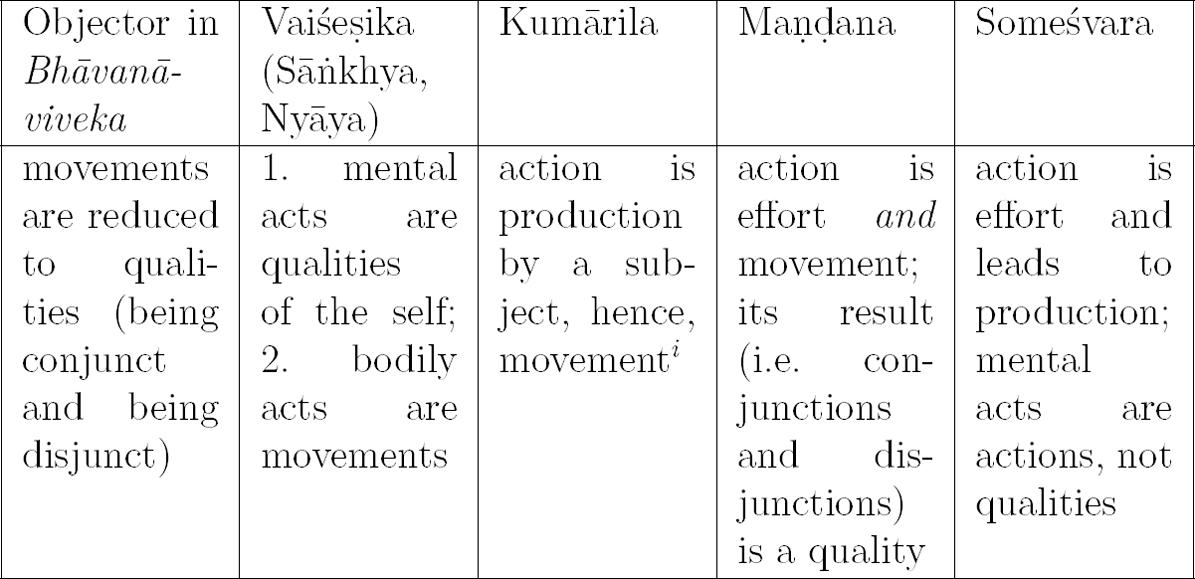
NOTE TO TABLE:
i. Hence, the stress is now on the fact of bringing about, which presupposes an inciting subject and an object which is brought about, rather than on the physical aspect of movement.
Abbreviations
BhV Maṇḍana Miśra’s Bhāvanāviveka
PP pūrvapakṣin, opponent
S siddhāntin, upholder of the final view
ŚBh Śahara’s Śābara*bhāṣya
TR Rāmānujācārya’s Tantrarahasya
TV Kumārila Bhaṭṭa’s Tantravārttika
Bibliography
Texts
Anantanārāyaṇa, Vijayā, see Harikai 1990.
Āpadeva, Mīmāṃsānyāyaprakāśa, edited by Franklin Edgerton, Yale University Press, New Heaven 1929.
Jayanta Bhaṭṭa, Nyāyamañjarī, edited by Mahāmahopādhyāya Gaṅgādhara Śāstrī Tailaṅga, Vizianagram Sanskrit Series No. 10, E.J. Lazarus & Co., Benares 1895.
Kumārila Bhaṭṭa, Tantravārttika in Mīmāṃsādarśana, edited by Kāśinātha Vāsudeva Śāstrī Abhyaṅkar and Gaṇeśaśāstrī Jośī, Ānandāśrama Saṃskṛtagranthāvaliḥ, 1970 (TV).
Kumārila Bhaṭṭa, Tantravārttika ad 2.1.1, see Kataoka 2004.
Maṇḍana Miśra, Bhāvanāviveka, edited by Gaṅgānātha Jhā and Gopinātha Kavirāj (1st vol.) and Gaṅgānātha Jhā (2nd vol.), The Princess of Wales Saraswati Bhavana Texts, Kuppuswami Sastri Research Institute, Madras 1922.
Paritoṣamiśra, Ajitā, see Harikai 1990.
Rāmānujācārya, Tantrarahasya, see Freschi 2012.
Rāmānujācārya, Tantrarahasya. A primer of Prābhākara Mīmāṃsā, edited with Introduction and Appendices by K.S. Ramaswami Śāstrī Śiromaṇi, Oriental Institute, Baroda 1956.
Śabara Svāmin, Śābarabhāṣya, in Mīmāṃsādarśana, edited by Kāśinātha Vāsudeva Śāstrī Abhyaṅkar and Gaṇeśaśāstrī Jośī, Ānandāśrama Saṃskṛtagranthāvaliḥ, 1970 (TV).
Someśvara Bhaṭṭa, Nyāyasudhā ad TV, in Mīmāṃsā Darśana of Jaimini with Śābarabhāṣya with the commentaries Tantravārttika and its commentary Nyāyasudhā, edited by Mahāprabhulāla Gosvāmī, Tara Book Agency, Varanasi 1984.
Uṃveka’s Tīkā on BhV, see Maṇḍana Miśra.
Studies
Bronkhorst, Johannes, Langage et Réalité: sur un épisode de la pensée indienne, Brepols, Turnhout 1999.
Bronkhorst, Johannes, “Does India think differently?”, in Denkt Asien anders?, edited by Birgit Kellner, V&R Unipress, Göttingen 2009.
Frauwallner, Erich, “Bhāvanā und Vidhiḥ bei Maṇḍanamiśra. I. Bhāvanā.”, Wiener Zeitschrift für die Kunde des Morgenlandes 45 (1938), 212–252.
Frauwallner, Erich, Geschichte der Indischen Philosophie. Band II. Die naturphilosophischen Schulen und das Vaiśeṣika-System, das System der Jaina, der Materialismus, O. Müller, Salzburg 1956.
Freschi, Elisa, “Desidero Ergo Sum: The Subject as the Desirous One in Mīmāṃsā”, Rivista di Studi Orientali, 80 (2007), 51–61.
Freschi, Elisa, “Indian Philosophers”, in A Companion to the Philosophy of Action, edited by Constantine Sandis and Timothy O’Connor, Wiley-Blackwell, Oxford 2010.
Freschi, Elisa, Duty, Language and Exegesis in Prābhākara Mīmāṃsā. Including an edition and translation of Rāmānujācārya’s Tantrarahasya, Sāstraprameyapariccheda, Brill, Leiden 2012.
Harikai, Kunio, “Ajitā [of Paritoṣamiśra] and Vijayā [of Anantanārāyaṇa] on the Verbal Meaning (Bhāvārtha Adhikaraṇa, Mīmāṃsā Sutra 2.1.1–4)”, Acta Eruditorum, 9 (1990), 1–50.
Kataoka, Kei, “Naraseru no Kaishaku-gaku.” [Mīmāṃsā Theory of Causal Action: Śahara’s Concept of Bhāva, Kriyā, Bhāvanā] (in Japanese with English summary) Indo-tetsugaku Bukkyô-gaku Kenkyû (1995), 47–60.
Kataoka, Kei, Koten Indo no Saishiki Kôi-ron: Śābarabhāṣya & Tantravārttika ad 2.1.1–4 Genten Kôtei Yakuchû Kenkyû [The Theory of Ritual Action Mīmāṃsā: Critical Edition and Annotated Japanese Translation of Śābarabhāṣya & Tantravārttika ad 2.1.1–4], in Ritual Action in Mīmāṃsā, Sankibô Press, Tokyo.
Krasser, Helmut, “Bhāviveka, Dharmakīrti and Kumārila”, in Chūgoku-Indo syūkyō-shi tokuni bukkyō-shi ni okeru syomotsu no ryūtsū-denpa to jinbutsu-idō no chiiki-tokusei [Regional characteristics of text dissemination and relocation of people in the history of Chinese and Indian religions, with special reference to Buddhism] (A Report of Grant-in-Aid for Scientific Research (B): Project Number 19320010. March, 2011), by T. Funayama, 193–242.
Potter, Karl (ed.), Encyclopedia of Indian Philosophies. Indian Metaphysics and Epistemology: The Tradition of Nyāya-Vaiśeṣika up to Gaṅgeśa, Motilal Banarsidass, Delhi 1977.
Eight: Trajectories of dance on the surface of theatrical meanings: a contribution to the theory of rasa from the fourth chapter of the Abhinavabhāratī
Elisa Ganser
Introduction
From the time of Abhinavagupta onwards, if not already from that of his immediate predecessors, Indian aesthetics has been mainly focusing on rasa, the essence of the play, as experienced by the spectator witnessing a work of art.[313] In the Abhinavabhāratī [ABh], a commentary on the Nāṭyaśāstra [NŚ],[314] all the elements of theatre are organized around this spectator-oriented rasa theory, so that even in the chapters dealing with scenic techniques, constant reference is made to the central discussion on the theory of art reception presented by Abhinavagupta in the sixth and seventh chapters of his work, consecrated to rasas (‘aesthetic emotions’) and bhāvas (‘mental states’) respectively. This interpretative attitude, by which every element of the performance finds its proper place in so far as it contributes to the arousal or ‘production’ (niṣpatti) of rasa, is traceable in the whole Abhinavabhāratī; I shall hence adopt this same perspective as a point of departure in the present enquiry about the place and purpose of dance in Indian dramatic theory. As part and parcel of the theatrical device, dance (nṛtta) is discussed by Abhinavagupta in the fourth chapter of his commentary. Given the premises just outlined, are we justified to attribute an active role to it within the aesthetic process culminating in the rasa experience, or should dance be regarded as a simple embellishment of the dramatic performance?
Apart from the peculiar way in which every element of theatre is treated in the Abhinavabhāratī in its relation to the rasa, an inquiry about the specific role of dance as an art ancillary to theatre finds further justification in the place already attributed to it by Bharata. The position of the fourth chapter, where dance is dealt with, deserves to be considered in the larger configuration of the Nāṭyaśāstra and its narrative structure. According to the story which provides a frame to the exposition of the ‘Treatise on Theatre’, its mythical author Bharata, requested by an assembly of sages, starts to explain the theatrical art, replete with all its intricacies. This preliminary narrative, set as a dialogue, corresponds to what I will call here the ‘primary level of narration’, that is, Bharata’s instruction about theatre, as carried forward through the questions of the sages. Bharata’s exposition begins with the account of the circumstances which led to the creation of theatre as an object of diversion that could be audible (śravya) as well as visible (dṛṣya). Bharata describes how Brahmā actually created the theatrical object by assembling together various elements taken from the Vedas, and how subsequently he and his troupe of actors prepared for a performance. When the play was first presented to Brahmā however, a group of obstacles (literally, the ‘vighnas’) disturbed the performance, so that it became necessary to build a playhouse in order to ward them off. Also, various deities were appointed to the different areas of the stage in order to protect the actors. These events belong to a ‘secondary level of narration’, corresponding to the mythical account about the origins of theatre and removed in time from the events taking place in the primary narration. Unfolding in the first chapter of the Nāṭyaśāstra, where the (primary) narrative frame for the entire treatise is set up and the theoretical bases for the exposition of the theatrical art are laid down, the account of the origins is interrupted by two ‘accessory’ chapters in which minute details about the construction of the playhouse and the consecration of the scenic space are provided. These two sections, forming the subject of the second and third chapter of the Nāṭyaśāstra, constitute a sort of digression with respect to the secondary narration and, since they are occasioned by the sages’ demand for further technical instruction, they may be considered as actually part of the primary narrative level. The mythical account, in fact, ideally proceeds only in the fourth chapter: having failed to present the first play to Brahmā, Bharata and the actors are requested to get ready for another representation to be shown, this time, to Śiva. According to the myth, the introduction of dance into theatre should be regarded as the main contribution of Śiva himself, who, after watching the performance, suggested its introduction in the ‘preliminary rite (pūrvaraṅga)[315] so as to make it variegated.[316] The details about the performance of the preliminary rite are given in the fifth chapter, followed by two chapters, central in importance, concerning rasas and bhāvas, in which Bharata first delineates an aesthetic theory. The rest of the text is devoted to the systematic exposition of all the spectacular elements of theatre, starting with the fourfold representation (abhinaya) (ch. 8–12, 14–19, 21–25) and ending with a long section devoted to vocal and instrumental music (ch. 28–34). The secondary narration about the origins of theatre is brought to an end in the last chapters (ch. 36–37), with an account of its descent among humans as a result of a curse put upon the actors.
The position of the fourth chapter is thus peculiar since, even though it is closely linked with the secondary narration, this chapter does not naturally fit in with the exposition of the whole of the theatrical material to the sages found further on in the text. Even if treated earlier within the narrative structure of the Nāṭyaśāstra, dance represents a later addition to the other elements of theatre, the exposition of which it nevertheless presupposes.[317] According to the myth, theatre is conceived at once by Brahmā, as a complete whole endowed with ordered parts, whereas dance is introduced only at a later time. Furthermore, it is said that dance was added to the preliminary rite, the origins of which are themselves quite problematic. Indeed, the pūrvaraṅga does not seem to be present in the first theatrical representation, but was apparently required to prevent the interferences, brought about by the obstacles on that occasion, to occur again in future performances.[318]
Now that dance has been characterized as a later addition, initially justified by the need to have a variegated kind of preliminary rite,[319] the text raises questions about its nature and the reasons for its creation. Immediately after the description of the technique of dance, the text of the Natyaśastra reads:
Since representation (abhinaya) has been conceived by those who know it for the sake of grasping the meanings, why has this dance (nṛtta) been made [and] what is the essence to which it conforms? It is not connected to the meanings of a song, nor does it put into being any meaning [itself]. Why has this dance been devised in [connection with] songs and āsāritas?[320]
It is not easy to evaluate the exact purport of this sentence in Bharata’s order of ideas. It is true that the second part of the question might be quite safely related to the sphere of the preliminary rite, since the āsāritas are songs specific to the pūrvaraṅga, and since the details about the course of action combining dance, songs and instrumental music, follow immediately after in the same chapter. Moreover, in NŚ 5.153–154 it is specified that dance is performed as a sort of intermezzo between the various lines of the invocation (nāndī), the words of which, sung and accompanied by instrumental music, are represented through a system of codified bodily gestures (āṅgikābhinaya) by the actor/dancer, so that an alternation of abhinaya a representation of the words of the song, and nṛtta, performed along with the music intervening between each verse of the nāndī, actually occurs. The presence of dance side by side with representation, the latter directly linked to the meanings of the song, the former apparently devoid of any relation to them, might have triggered a doubt about their respective uses within the pūrvaraṅga.[321] However, the question could be seen, from a broader perspective, as one referring to the status of dance as an independent art form and to its later inclusion into theatre alongside its most characteristic feature, abhinaya. There are hints in the Nāṭyaśāstra itself which point to the fact that dance was not exclusively restricted to the preliminary rite. At the end of the fourth chapter, for instance, Bharata enumerates a number of situations, all dramatic, where the use of dance would be suitable –festivities, spring season, etc.– and those where, on the contrary, it would be forbidden –when the heroine is sorrowful, for instance.[322]
The definition of representation is given in NŚ 8.7: “The verbal root nī-, preceded by [the prefix] abhi-, [is used with the sense of] bringing the meanings [directly] in front [of the spectator], [The representation] is called abhinaya because it carries the word meanings [in the presence of the spectator].”[323] Representation, described as fourfold,[324] is hence defined according to its function within theatre, namely to communicate the meanings of the dramatic text to the audience. Regardless of how we conceive of the specific purport of the question raised in the fourth chapter, it is thus legitimate to ask: what could be the function of the new object called ‘dance’, apparently unconnected to the meanings expressed in the songs or, more generally, incapable to produce any theatrical meaning?
The laconic answer provided by Bharata is as follows: “On this point, we say that dance does not conform to any meaning at all, but it can generate beauty (śobhā): that is why it has come into use.”[325] A straightforward translation of the term śobhā by the word ‘beauty’ may sound a little reductive and not unambiguous, given the fact that even in Western terminology, the concept of beauty in art and in aesthetic theory has received a multiplicity of interpretations.[326] The task proves even more arduous when one considers that, in the Nāṭyaśāstra, a full-fledged aesthetics, which might be of help for the evaluation of this statement, is nowhere to be found. Indeed, no clear idea about a supposed aesthetic function of dance can be traced in NŚ ch. 4, nor is it possible to get any definite picture about the status of dance within the play itself from a limited set of verses of difficult interpretation. In other words, the question about how, when and where dance –along with its ‘meaning-bearing’ counterpart, representation (abhinaya)– was meant to be used within the theatrical performance remains a matter of speculation.[327]
1. Abhinavagupta’s evaluation of dance
With respect to the question raised in the Nāṭyaśāstra, the Abhinavabhāratī supplies a long commentary where more pūrvapakṣas intervene, in the typical śāstric form of debate, putting forth different interpretations of the issue before coming to the established position. Despite its difficulty, given the highly corrupt state of the text[328] and the number of interlocutors advancing a variety of preliminary views, this long discussion represents an articulate and sophisticated attempt to assess the status of dance and its aesthetic implications with regard to the rasa theory outlined by Abhinavagupta. Moreover, the text of the Abhinavabhāratī offers many insights into the practice of theatre and its allied arts, dance, music and singing, as they were popular in tenth-century Kaśmīr. I will here concentrate on some extracts exclusively, taken from the long commentary to NŚ 4.261b-263a (translated above), and on some related passages found elsewhere in the text. These will provide a key to the interpretation of the status of dance within the aesthetic process. At the end, I will outline a working hypothesis for the evaluation of dance as an element of the performance.
The first part of the discussion in Abhinavagupta’s commentary is devoted to the question whether dance should be considered identical or different from theatre and, in this connection, to whether its purpose is identical or different from the one of theatre. After examining various opinions, a difference is proposed on the basis of the absence of representation (abhinaya) in dance. The text reads:
But that which is devoid of the various kinds of representation (abhinaya), consisting only of turning, revolving, stretching the eyebrows, moving the pupil of the eye, displacing the feet, shaking and oscillating, splitting the hips, [performing] the recakas etc., is what we mean by [the word] ‘dance’ (nṛtta).[329]
Of course, the mere description of the physical characteristics belonging to dance could apply even to the bodily representation (āṅgikābhinaya). Nevertheless, since it lacks the representative or narrative function, dance is described in negative terms as devoid of this fundamental feature of theatre, on which its possible assimilation to it depends.[330]
What then is the use of dance? Before looking at its specific function as envisaged by Abhinavagupta it would be useful to give a brief outline of the theory of representation put forth in the Abhinavabhāratī. The techniques of representation take up the largest portion of Bharata’s treatise (roughly from chapter eight to chapter twenty-six), but the commentary on the eighth chapter, the first dealing with abhinaya, or, more precisely, with āṅgikābhinaya, is at present lost.[331] I deem it legitimate to suppose that a fullfledged theory of representation must have been present at that point, since Abhinavagupta declares on various occasions that he will later engage in its explanation.[332] Even though it is not possible, due to the present state of the text, to have a complete picture of Abhinavagupta’s conception of abhinaya, relevant textual loci that could elucidate his standpoint on such a central topic are not lacking in the Abhinavabhāratī. In this perspective, the discussion about dance and abhinaya dealt with in the fourth chapter assumes a new relevance for the study of Abhinavagupta’s ‘missing’ theory of representation.
Theatre is indeed a complex object made up of various elements which could be grouped into the three broad categories of representation (abhinaya), instrumental music (vādya) and song (gīta), to which dance (nṛtta) is further added. These elements, which could also be taken as representatives of the various independent arts commingled into theatre, have to be organized and harmonized so that, even if they and their subcategories are perceived by different sense faculties, theatre can nevertheless be grasped, in the mind of the spectator, as a single unity. Once they have become limbs of the theatre, the various arts assume a purpose which is different from their own and, conceived by Abhinavagupta in their relation to rasa i.e. the emotional kernel of the play, they help to bring about the aesthetic experience.
I will not discuss here in detail the importance attributed to abhinaya in connection to the arousal of the rasa in the spectator, or expatiate upon the relationship between emotions and their theatrical representation.[333] I will merely briefly summarize Abhinavagupta’s views on abhinaya, as far as it can serve the purpose of the present discussion. As already stated, Bharata explains abhinaya as that which brings (nayati) the meanings (arthān) in front of (ābhimukhyam) the spectators. While it is not immediately clear what the term ‘artha’ refers to in the Nāṭyaśāstra, in Abhinavagupta’s theorization the represented meanings (abhineyārtha) can be the various bhāvas, and finally, even the rasas, which, even though not directly represented, have to be expressed by the performance.[334] Representation is what makes the theatrical meanings the object of an evident determinate cognition (sphutādhyavasāya), defined as a determination similar to a direct perception (sākṣātkārakalpānuvyavasāya),[335] since it brings the meanings to the direct presence –and this is the sense of the prefix abhi- glossed by ābhimukhyam– of the spectators. However, as Abhinavagupta will argue, representation alone is not enough to manifest the rasa.[336]
Instrumental and vocal music, on the other hand, are repeatedly said to provide variety, entertainment or attractiveness (all notions encompassed by the term ‘uparañjaka’) to the performance. In the pūrvapaksa, an argument is put forward for attributing a similar function to dance, but the opponent, eager to prove that dance and theatre are not different, argues that even under this perspective we cannot establish a function which would be specific to dance, resulting in a differentiation of the latter from theatre. In the case of vocal music, he says, songs are supposed to provide information about the type of character, the mood and the situation which are being represented, by supplying what is not explicitly stated in the dramatic text. Instrumental music, in turn, is said to enhance the rhythm.[337] While refuting this position, Abhinavagupta corners his opponent by disclosing the flaws hidden in his reasoning. It is true that a function is easily attributable to music and songs within theatre, but this is possible only in so far as songs are endowed with a poetic text and music is connected to it, that is to say, only because their meaningful portion –the poetic text which is sung– may be seen as part of the vocal representation. But that is not what the entertaining or charming elements are really expected to achieve.[338] The opponent imprudently tries to adjust his position, but ultimately gets cornered:
[-The opponent argues:] “As [you] have previously said, that charming [element], which is the door of access into the heart for the multitude of meanings, [namely] the deeds, to be accepted or rejected, belonging [respectively to characters such as] Rāma or Rāvaṇa, is akin to a needle, since it has the quality of entering the heart spontaneously.” [-Abhinavagupta retorts:] “Then, this is exactly the use of dance (nṛtta) within theatre, that dance which, consisting of turns (valanā), revolutions (vartanā) and so forth, is internal to [theatre]. For specifically, since [theatre] is comparable to a circle of fire (alātacakrapratimatve), without [dance] it could not be mentally grasped by the [spectators as such]. That is why theatre is like the thread which binds together the bracelet of the clear rubies of the [single] representations (abhinaya) [and,] due to [its] proximity [to dance] –[namely] the fact of being homogenous to dance which consists of turning and so forth– theatre pervades [also] the songs etc. which form part [of it].”[339]
This crucial passage seals the commentary on the first part of the siddhānta, where Bharata states that “[…] dance does not conform to any meaning at all” (NŚ 4.263b), and provides a sort of introduction to the next line, where a positive assessment of the function of dance is provided: “but it can generate beauty (śobhā), that is why it has come into use” (NŚ 4.264a). Ideally, one can divide the quoted passage in two parts. In the first section, the purpose of dance is stated in relation to that of theatre as appearing in the theoretical frame outlined by Abhinavagupta, namely in a reception perspective, while in the second part –the one that starts with ‘viśeṣato hi’ etc.– its practical functioning among the elements of theatre, seen in a larger performance perspective, is presented. Broadly speaking, these two lines of reasoning will set the boundaries for the present discussion, before we come to some conclusions. The second aspect will be privileged here, since it has been less explored in the field of theatre studies.[340] Particular attention will be given to the discussion of the image of the fire-wheel, which is seem to provide a key to the interpretation of the role of dance within the theatrical performance, encompassing both the production and reception process.[341]
2. Dance as a charming element of the performance
As he has done systematically with all the elements of theatre, Abhinavagupta implicitly relates the function of dance to his aesthetic theory. The twofold aim of theatre has been stated in the Abhinavabhāratī as consisting of instruction (vyutpatti) accompanied by pleasure (prīti).[342] The appropriate display of the deeds of Rāma and Rāvaṇa on stage results in an instruction for the spectators about the moral value of action. In this perspective, however, it is said that dance is just the door of access to meaning. In other words, dance itself does not say anything about the actions represented on stage, whether they should be accepted or rejected.
In contrast to actions that have some practical purpose, the action of dance is described in ABh ad NŚ 4.30 merely in terms of movement. The basic units of dance, called karaṇas and canonized in the Nāṭyaśāstra as a hundred and eight in total,[343] are described by Abhinavagupta in the following terms:
Karaṇa means ‘action’. Of what is it an action? Of dance, which is a playful throwing of limbs. That is to say: karaṇa is the action of [dance], which is different from actions concerning [things] to be rejected or accepted […] The meaning is: a karaṇa is a single action [performed] by quitting contact with the precedent place, extending up to the attainment of a different place that is suitable. In fact, an action has in every case its conclusion in a subsequent contact, and this very desired subsequent contact is well-known in the world as the conclusion of the action, this is nothing new. [But still,] in [dance], there is something more, namely playfulness, on account of the introduction of beauty.[344]
As the gloss of the term ‘karaṇa’ by ‘kriyā’ suggests, dance is, broadly speaking, an action, and it is described here as a movement, similar to walking and so forth, devoid of any further expectations outside itself. This amounts to saying that dance is different from theatre, which, on the contrary, results in an instruction about what to do and what to avoid.[345]
The prerequisite for the spectator to adhere to the meanings represented and thus obtain an instruction from the play is charm, since, it is argued, the elements endowed with this quality spontaneously pierce the heart. Such is said to be the use of dance as internal to theatre, that is, of dance not just seen as an independent art, such as the one displayed in the preliminary rite. So far, in the perspective outlined above, that of the twofold purpose of theatre, the equation ‘dance’ = ‘pleasure’ (prīti as leading to vyutpatti) could appear a quite straightforward one.[346] However, this quite superficial interpretation is invalidated by the following statement: “Dance, in fact, is not performed with the intention: ‘the spectators should be pleased or instructed’. But rather, [pleasure and instruction] may be attained since [dance] is invariably connected [to them].”[347] While pleasure, just like instruction, is something to be actively sought after as an effect of the performance on the spectator, already implicit in the dramatic material, charm is more akin to a quality inherent in some elements of the performance, whose main aim may not necessarily be to please. Dance, indeed, is not used with the aim of pleasing somebody, but it is pleasant in itself (and this could be, I believe, the sense of the word ‘svayam’ in the passage translated in §1, namely in the expression svayaṃ hṛdayānupraveśitvād).
The idea that the meanings are expressed through representation but that, in order to arrive at the rasa, charm or beauty are required, has been clearly expressed by Abhinavagupta in the first chapter of his commentary, where dance makes its first appearance in the body of theatre as part of the ‘gorgeous manner’ (kaiśikī vṛtti). The gorgeous manner, containing elements of dance as well as instrumental and vocal music, is added by Bharata following the suggestion of Brahmā to the already existent material. This includes the three manners called the ‘vocal’ (bhāratī), the ‘psychophysical’ (sāttvatī) and the ‘dynamic’ (ārabhaṭī), which emphasize in turn the speech element, the mental element and the physical one. Abhinavagupta defines the kaiśikī as a ‘heart-catching multifariousness’ (hṛdayahāri vaicitryam),[348] necessary for the manifestation not only of the śṛṅgāra rasa quite intuitively connected to beautifying elements such as dance but even for all the other rasas. Without such a beautiful multifariousness, representation cannot be the cause of the manifestation of rasa, as it would not appeal to the spectator.[349]
The first part of the passage could hence be interpreted in the light of these remarks. Through representation, the meanings are brought to the presence of the spectator, but, for the spectator to adhere to them, beautifying elements are required. This is indeed the use of dance as an element of theatre, a use which can be attributed to vocal and instrumental music as well.[350] It appears, however, that along with such a general use as a charming element, Abhinavagupta suggests another function specific to dance alone.
3. Dance and Representation in the image of the fire-wheel
Theatre is an entity made up of different art forms such as dance, songs, instrumental music and representation, which, when properly combined, make up a unitary image, grasped by the spectator through a single mental act. The preoccupation with the unity of theatre is referred to again and again in the Abhinavabhāratī,[351] and its problematic cognition is addressed in the first chapter: “If the [various] ancillaries [of theatre] are performed simultaneously, how is it possible to have a cognition of theatre as one, as it is impossible to be simultaneously aware [of objects] perceived by different sensory faculties? In addition, if [they are] performed in succession, it is even more problematic [to cognize theatre as one]. Therefore, how is the performance possible?”.[352]
Considerations of a similar order certainly match well with a spectatorcentred aesthetics like the one developed by Abhinavagupta. Despite this, the attempt at finding unity beyond multiplicity is already present in Bharata, though its purpose is not made explicit. The nature of the theatrical performance as a single whole encompassing its parts is explained in the Nāṭyaśāstra through the image of the fire-wheel (alātacakra). In NŚ 28.7, Bharata says: “In this way, theatre practitioners should make songs, music and drama, having different bases, similar to a fire-wheel.”[353]
The example of the fire-wheel (alātacakra) produced by the quick rotation of a firebrand (alāta) has been extensively exploited in the literature of South Asia,[354] and has been given different shades of meaning by the exponents of the various speculative traditions who have made use of it. In the grammatical tradition for instance, the alātacakra image is used to describe the nature of an action. Just as the fire-wheel corresponds, in fact, to the points in time and space touched by the revolving brand, an action is actually composed of innumerable micro-actions, but it is conceived by the intellect as a single and unitary idea.[355]
Similarly conceived, theatre is a composite art which seeks to create a unitary image in the mind of the spectator. In the Abhinavabhāratī, Abhinavagupta makes use of the fire-wheel image to describe different but related phenomena. Starting from Bharata’s employment of it, in its broadest and most patent application to the discontinuity of the elements of theatre enveloped by a whole image, Abhinavagupta situates it in the realm of cognition, without withdrawing the attention from the production of the theatrical machinery, requiring an effort from its practitioners. He says, commenting on Bharata’s statement:
Since [theatre] is based on various [elements], i.e. has the form of various actions grasped by different organs of perception, its unity must be produced by [theatre practitioners] through an effort, by means of which it may become, for the spectator, the object of a single cognition. For in reality, a spark of the flame of a firebrand cannot be connected simultaneously to several points in space. However, just as [the fire-wheel] is brought to homogeneity through an effort [to achieve] speed, so is also the performance. For similarly, [the performance] does not consist of a single action, but it can be produced in the same way [as the fire-wheel] through an effort aimed at achieving a harmonization [of its different parts]. Therefore, [Bharata] says that this [theatrical performance] is ‘similar to a fire-wheel’.[356]
The three basic elements singled out by Bharata as song (gāna), instrumental music (vādya) and theatre (nāṭya) actually stand for the various means of performance appointed to three different groups of practitioners. The first group, that of the singers, along with the players of stringed and wind instruments, is responsible for the melodic part. The second, to which the drummers belong, for the rhythmical part, and the last, formed by the actors, is responsible for the representation.[357] In theatre, these three groups should function interdependently, but even in isolation, each group is responsible for the harmonization of its peculiar means of performance, forming in itself a complex unity. Each of these ensembles has to produce through an effort the image of a fire-wheel. In the case of the third group, this image has been adopted by Abhinavagupta in the chapter on the harmonious representation (sāmānyābhinaya), in which the rules for the simultaneous functioning of the four means of representation and for the organic temporal succession of the various blends of representative devices are laid down.[358]
Analogously, the same should apply to each of the three elements, and not to abhinaya exclusively. Whence Abhinavagupta continues:
When it is brought to unity by force of representation, the homogeneous representation (sāmānyābhinaya) is said to form a single group (rāśi). There is no disagreement about this. But also the group responsible for the melody, commingled together [in its various parts], has to be made similar to a fire-wheel. The regulation of the orchestra, having in its turn various bases, i.e. concerning [different elements] such as the vīṇā, the flute and the singer, has to be [similarly] brought to unity. Therefore, all the three [groups] have to be made into a lump then. That is why what is said [in the verse, i.e. in NŚ 28.7] is tenable.[359]
If such a unitary image, whose unifying process has been shown to function on multiple levels, represents, despite its ultimately illusory nature, the very condition for grasping the reality of theatre, or, in the grammarian’s version, an operational device for describing the functioning of language, in many philosophical systems the very illusory character of such a perception has been commonly regarded in negative terms.[360]
In the Āgamaśāstra of Gaudapāda [ĀŚ], the image of the alāta is developed in six verses [ĀŚ 4.47–52], where the various trajectories created by the moving firebrand stand as a metaphor for the illusory movement of consciousness (vijñānaspanda) appearing as fragmented into an act of perception (grahaṇa) and a perceiver (grāhaka).[361] Without entering into Gaudapāda’s philosophical tenets, never-mind the possible origin of this example in a Madhyamaka milieu, as some have suggested, it is quite evident that the alātacakra stands here for the illusory character of reality as it appears in the perceptive act.
If, in Gauḍapāda’s metaphor, one is expected to overcome appearance to arrive at reality, in theatre it is quite the opposite: illusion has to be accepted in order to attain a unitary perception of the theatrical reality. To be more precise, it is the very judgement of a cognition according to the criterion of truthfulness and falsity that has to be suppressed. One could well imagine the consequences if the spectator, eager to unmask the theatrical device, would make the attempt to recognize one of his friends in the actor impersonating some given character, or, with a contemporary example, if someone watching a horror movie would start wondering at the brand of ketchup being used in a scene involving the presence of blood. This suspension of judgement is provided by the special cognition one has of theatre in general and of the character in particular, as neither real nor unreal, defined as a ‘determinate cognition’ (anuvyavasāya or adhyavasāya) similar to an evident direct perception (pratyakṣasākṣātkārakalpa). It is, indeed, in order to compose such a unitary image that the actors have to unfold all their skills in the means of representation.
Two opposite trends are at play in the process which triggers the relishing of rasa for the spectator, the real protagonist of the aesthetic experience: the first operates by distancing from the events represented, the other entangles and accounts for the spectator’s adherence to the same events. This two-fold tension, which alone can provoke an aesthetic experience, is then threatened by a series of obstacles which would invalidate the production of rasa.[362] In this perspective, the fourfold representation (abhinaya), along with the other elements of ‘realism’ or worldly convention (lokadharmī), is prescribed in order to eliminate the obstacle consisting in the ‘lack of vividness’ (sphuṭatvābhāva). Sticking to the primacy of direct perception over the other means of valid knowledge, Abhinavagupta maintains that even when we are perceiving something illusory, such as a fire-wheel, our perception can be invalidated only through a more forceful direct perception, subsequent to it.[363] Even if it may be quite evident that the representation should aim at creating a unitary and coherent image, one must not forget that this image has been given the status of an alātacakra. The spectator is indeed well aware that what he is witnessing is not the ordinary reality. He has in fact already taken a distance from the events represented in occasion of the pūrvaraṅga, where all the spectacular elements were displayed in front of him and the identity of the actor was revealed.[364]
Furthermore, another obstacle is seen in the fact that the spectator may not be able to rest his mind on something else, namely on the spectacular object, or, the fire-wheel image, since he may be overwhelmed by his own sensations of pleasure, pain etc. The means for eliminating this obstacle consists in the display of charming elements such as music and songs, damsels, and I deem one could add with a certain degree of certainty dance, which, says Abhinavagupta, are capable to turn even an unrefined person (ahṛdaya) into a refined spectator (sahṛdaya).[365]
Roughly, three stages could be identified in provoking this ‘detachedcum-involved’ quality proper to the aesthetic cognition: starting from a position of detachment the spectator is initially allowed to see the fire-brand and the hand holding it. Then, the fire-brand begins to turn, that is, the various single representations are displayed and the image of the fire-wheel is formed. The next stage corresponds to the turning of the spectator towards the illusory image, and thus to an adherence to the meanings represented, operated by the charming elements.[366]
Now that a possible aesthetic function of dance within theatre has been identified, its relationship to the alātacakra image, as given in the second part of the obscure passage under consideration, remains to be interpreted. In theatre, the cognition of the real state of things has no importance. It does not matter if the image provided by the revolving fire-brand is illusory. As long as the circle is perceived as unitary and the stick is unseen, the image has validity in the mind of the spectator who grasps it. I believe that the issue at stake here is definitely the creation of the cognition of theatre as a unitary and ordered entity from disparate and inhomogeneous elements, since all the occurrences for the alātacakra image examined up to now appear to point to such a difficulty rather than to the fact that, since theatre is created as a fire-wheel image, it is impossible to grasp.[367]
Another occurrence of the same image in the ninth chapter of the Abhinavabhāratī, which treats hand-gestures, might provide some further evidence to this interpretation. In it, dance is more directly related to the alātacakra image. The context in which the passage is found is the following: after the description of the hand-gestures commonly used for representing (abhinayahasta), along with their application to specific meanings, a separate group of hand-gestures is described, called hand-gestures for dance (nṛttahasta). Since these hand-gestures do not represent anything, their treatment in one of the chapters devoted to representation appears quite unnatural. One would have expected to find them, instead, in the chapter devoted to dance, namely the fourth one. The commentator feels obliged to give an explanation for this fact and says:
In order to show that these hand-gestures for representing (abhinayahasta) are similar to a fire-wheel since, through the removal of accidents, [they] enter a single course [of performance] (ekavartānupraveśa), and in order to reveal [the] restfulness [of the various representations] in a single sentence meaning, since it is in [their] nature to [follow] a course [sometimes] smooth [sometimes] bumpy, […] [Bharata] designates the thing to be qualified by the word ‘nṛtta’ (dance), with [the words] ‘nṛttahastān etc.’[368]
In my understanding of this passage, dance provides the necessary link between the various single representations, so as to encompass the whole performance. However, one should not be misled and imagine that each representation, intended as a unitary scene, necessarily had to be linked to the following by means of a ‘danced intermezzo’. Even though it is possible that moments of dance were present in the play, as one can gather from the available specimens of Sanskrit drama, where scenes of dance are certainly seen as integrated into the plot, I would not overemphasize the presence of dance in theatre. It seems to me that Abhinavagupta’s analysis is more subtle and is meant to operate within the smallest significant units. If, at the level of the sentence, Abhinavagupta prescribes the use of dance in order to emphasize the sentence meaning which is represented, even when the single word meanings are given a visual representation through the display of successive hand-gestures, the use of dance, in the form of karaṇas, is explicitly encouraged, so as to mark their belonging to a single sentence, or a single course of performance. This is what Abhinavagupta explains in the fourth chapter, throwing at the same time light on the preceding passage through the use of a similar vocabulary:
Whenever the representation of the sentence meaning is seen as principal, the karaṇas themselves are predominant. But even when [single] representations of the word meanings are carried out, a karaṇa –[used] at the beginning, in the middle or at the end [of a sentence], according to opportunity– is necessary in announcing the inclusion [of the various words] in one single sentence (ekavākyānupraveśa) as the main thing. This is the secret teaching. For this very reason [Bharata] will say [in NŚ 8.15]: ‘Its śākhā, dance (nṛtta) and aṅkura are elements of the [bodily] representation’, for the inclusion [of the single word-meanings] in a [unique] course of action (vartananupraveśa) by means of the śākhā alone would make no sense.[369]
Pushing the reasoning a little further, the definition given by Abhinavagupta to the nṛttakaraṇas, seen above, could be extended so as to include any beautiful movement leading from an initial position in space to a final one, hence, even to movements occurring between one representation and the other, or between one expressive gesture and the one immediately following it, without restriction to the canonical hundred and eight karaṇas ranging from talapuṣpapuṭa to gaṅgāvataraṇa.[370]
Such an interpretation, accounting for an extended meaning of the term ‘dance’ and, through the extension of the meaning of dance’s main constituent, the karaṇa, for its irruption into the realms of representation, is, I believe, supported by another passage in the fourth chapter: after the enumeration of the hundred and eight karaṇas, the question of their number is raised, since not all of the karaṇas listed actually occur in the thirty-two aṅgahāras of the preliminary rite. Bharata gives, in reply, a list of occasions where karaṇas are used outside the pūrvaraṅga, on which Abhinavagupta comments: “Dance, which will be said to be an element (vastutvena) in representation (abhinaye), is employed because it hides the gaps occurring between the various representations.”[371] Abhinavagupta thus attempts to establish the autonomy of dance outside its canonical performance as part of the aṅgahāras, at the same time accounting for its autonomous function inside theatre and representation. This might in turn throw some light on an obscure passage in the Nāṭyaśāstra, which has led to much confusion in evaluating the role of dance within the theatrical performance, the already quoted NŚ 8.15: “Its śākhā, dance (nṛtta) and aṅkura should be known here by practitioners as the elements of the [bodily] representation (abhinaya).”[372] As already mentioned, the Abhinavabhāratī on this chapter is lost, with, at present, little hope that it will ever surface. However, it has been shown to be possible to reconstruct the context for Abhinavagupta’s understanding of Bharata’s words, namely, the problematic relation between dance and representation which I have tried to delineate in this article.
4. Preliminary conclusions
In the Abhinavabhāratī, dance is no longer intended to be performed for the mere sake of providing variety to the pūrvaraṅga, nor can it be confined to the hundred and eight karaṇas described by Bharata. By an extension of the term karaṇa, dance can apply to any action, having no practical result nor mimetic function, but endowed with a beautifying character. Hence it applies even to all those intervening movements which are not formally codified under the category of abhinaya, but which account for a necessary continuity and unity of the action. While treating dance in the larger sphere of theatre, Abhinavagupta succeeds in integrating it into his aesthetic discourse, refining at the same time his views on the functioning of abhinaya. But he might have been aiming at something more that that.
If, on the one hand, Abhinavagupta legitimizes the inclusion of dance within theatre, side by side with representation, on the other, he has the freedom to introduce in the long discussion in chapter four many ‘new’ spectacular genres which, difficult to establish as forms of either theatre or dance, were not contemplated in the Nāṭyaśāstra, and to treat them at length without exceeding the boundaries of Bharata’s tenets.[373]
Bibliography
Sanskrit texts
Abhinavabhāratī [ABh] of Abhinavagupta: see Nāṭyaśāstra.
Abhinavabhāratī [ABh2] of Abhinavagupta: edited by Madhusudan Shastri. Varanasi: Banaras Hindu University. 1971–1981. Vol. 1 (ch. 1–7) 1971.
Abhinavabharati [ABh3] of Abhinavagupta: edited by P. Dvivedi. Varanasi: Sampurnanand Sanskrit University, 1996. Vol. 1 (ch. 1–5) 1992.
Āgamaśāstra [ĀŚ] of Gauḍapāda, see Bouy 2000.
Avaloka [AL] of Dhanika: see Daśarūpaka
Daśarūpaka [DR] of Dhanañjaya, with the commentary Avaloka of Dhanika and the sub-commentary Laghuṭīkā by Bhaṭṭanṛsimha, edited by T. Venkatacharya. Madras: Adyar Library and Research Centre. 1969.
Īśvarapratyabhijñākārikā of Utpaladeva with the Author’s Vṛtti, see Torella 2002.
Nāṭyaśāstra [NŚ] of Bharata, with the Abhinavabhāratī [ABh] of Abhinavagupta, edited by M.R. Kavi. Baroda: Oriental Institute. 1926–1964. 4 volumes. Vol. 1 (ch. 1–7), 2nd ed., revised and critically edited by K.S. Ramaswami Śāstri. 1956; vol. 2 (ch. 8–18), 1934; vol. 3 (ch. 19–27), 1954; vol. 4 (ch. 28–37) edited by the late M.R. Kavi and J.S. Pade. 1964.
Vākyapadīya of Bhartrhari, with the Commentary of Helarāja, edited by K.A. Subramanya Iyer, Kaṇḍa 3. Delhi: Motilal Banarsidass. 1983.
Saṅgītaratnākara [SR] of Sārṅgadeva, with the Kalānidhi of Kallinātha and the Sudhākara of Siṃhabhūpāla, edited by Pandit S. Subrahmanya Sastri. Madras: Adyar Library. 1943–1953. Vol. 4 (ch. 7), 1953.
Studies and translations
Ali, D. (2004) Courtly Culture and Political Life in Early Medieval India. Cambridge: Cambridge University Press.
Bansat-Boudon, L. (1989–90) “The Sāmānyābhinaya or How to Play the Game”. Indologica Taurinensia 15–16: 67–77.
Bansat-Boudon, L. (1991) “The Lāsyāṅgas in Bharata’s Theatre Treatise”. Indo-Iranian Journal 34: 247–265.
Bansat-Boudon, L. (1992) Poétique du théâtre indien. Lectures du Nāṭyaśāstra. Paris: Publications de l’École-française d’Extrême-Orient.
Bose, M. (1991) Movement and Mimesis. The Idea of Dance in the Sanskritic Tradition. Dordrecht: Kluwer Academic Publishers.
Bouy, C (2000) Gauḍapāda. L’Āgamaśāstra. Un traité vedāntique en quatre chapitres. Paris: De Boccard (Publications de l’Institut de Civilisation Indienne).
Cuneo, D. (2008–2009) “Emotions without Desire. An Interpretive Appraisal of Abhinavagupta’s Rasa Theory. Annotated Translation of the First, Sixth and Seventh Chapters of Abhinavagupta’s Abhinavabhāratī”, unpublished PhD Thesis. Rome, ‘Sapienza’ University of Rome.
Ganser, E. (2009) “The Spectacular Dimension of Emotion in Indian Theatre”. Rivista degli Studi Orientali 80: 63–79.
Gnoli, R. (1985, 3rd ed.) (1st ed. 1968) The Aesthetic Experience according to Abhinavagupta. Varanasi: Chowkamba Sanskrit Studies 72.
Ingalls, D.H.H. (1962) “Words for Beauty in Classical Sanskrit Poetry” in Indological Studies in Honor of W. Norman Brown. New Haven: 87–107.
Ingalls, D.H.H., (ed.) (1990) The Dhvanyāloka of Ānandavardhana with the Locana of Abhinavagupta, translated by D.H.H. Ingalls, J.M. Masson and M.V. Patwardhan. London: Harvard Oriental Series 49.
Lidova, N. (1994) Drama and Ritual of Early Hinduism. Delhi: Motilal Banarsidass.
Masson, J.L., Patwardhan M.V. (1970) Aesthetic Rapture. Vol. 1 and 2. Poona: Deccan College.
Naidu, V.N., Naidu P.S., Pantulu V.R. (1980, 3rd ed.) (1st ed. 1936) Tāṇḍava Lakṣaṇam or the Fundamentals of Ancient Hindu Dancing. New Delhi: Munshiram Manoharlal.
Nemec, J. (2012) “The Two Pratyabhijñā Theories of Error”. Journal of Indian Philosophy 40/2: 225–257.
Pollock, S. (1998) “Bhoja’s Śṛṅgāraprakāsa and the Problem of rasa. A Historical Introduction and Annotated Translation”. Asiatische Studien/Études Asiatiques 52/1: 117–192.
Pollock, S. (2010) “What was Bhaṭṭa Nāyaka Saying? The Hermeneutical Transformation of Indian Aesthetics”, in Pollock, S. (ed.), Epic and Argument in Sanskrit Literary History. Essays in Honor of Robert P. Goldman. New Delhi: Manohar. (2010a: 143–184).
Ramanathan, N. (1999) Musical Forms in Saṅgītaratnakāra. Chennai: Sampradaya.
Rastogi, N. (1986) “Theories of Error According to Abhinavagupta”. Journal of Indian Philosophy 14: 1–33.
Ratié, I. (2012) “Pāramārthika or apāramārthika? On the ontological status of separation according to Abhinavagupta” infra.
Schmithausen, L. (1965) Maṇḍanamiśra’s Vibhramavivekaḥ. Mit einer Studie zur Entwicklung der Indischen Irrtumslehre. Wien: Hermann Böhlaus Nachf.
Torella, R. (2002) The Īśvarapratyabhijñākārikā of Utpaladeva with the Author’s Vṛtti. Critical edition and annotated translation. Delhi: Motilal Banarsidass.
Tieken, H. (2001) “The pūrvaraṅga, the prastāvanā, and the sthāpaka”. Wiener Zeitschrift für die Kunde Südasiens 45: 91–124.
Nine: Dravya as a Permanent Referent: The Potential Sarvāstivāda Influence on Patañjali’s Paspaśāhnika
Alastair Gornall{2}
Bhartṛhari has famously called Patañjali’s Mahābhāṣya (ca. 2nd century)[374] “a composition of all seeds of reasoning”.[375] This observation is particularly true for the first chapter, the Paspaśāhnika, which contains many strands of linguistic philosophy. In one argument within the Paspaśāhnika Patañjali proposes that when a referent of a word is permanent, the word, its meaning and their relationship are also permanent.[376] In his discussion, Patañjali entertains the possibility that the permanent referent of a word can either be the ākṛti (a universal property or shape) or the dravya (an individual thing or matter).[377] With respect to his discussion of a permanent dravya and impermanent ākṛti, Joshi and Roodbergen have stated that Bhartṛhari’s commentary, the Mahābhāṣyadīpikā, indicates that this section originates from a Sāmkhya or Buddhist kṣaṇikatvavādin theory of causality.[378] More recently, John Kelly has questioned the Buddhist influence on this passage and states that he has not found any Buddhist discussions on dravya from Bhartṛhari’s time, “let alone from Patañjali’s time or before.”[379] However, within this paper, I postulate that Bhartṛhari did not necessarily understand that Patañjali’s argument of a permanent dravya and impermanent ākṛti originated from Sāṃkhya or Buddhist sources. I propose that he introduces these two schools as examples of the common applicability of Patañjali’s thought and not as a historical claim regarding the origins of Patañjali’s discussion. I suggest that the use of this dichotomy to discuss the sources of Patañjali’s discussion neglects the fact that philosophies in Patañjali’s time were not as clearly defined as this paradigm for investigation implies. Therefore, in the main body of this paper, I re-evaluate the sources for Patañjali’s discussion and explore an alternative possibility that he was influenced by the views of a heterodox Sarvāstivādin monk, Dharmatrāta.
The Paspaśāhnika is the first chapter of the Mahābhāṣya, a commentary on Pāṇini’s Aṣṭādhyāyī that is largely focused on the sūtras commented on by Kātyāyana’s vārttikas. In the Paspaśāhnika, Patañjali outlines most of his philosophical arguments on grammar within his commentary on the first vārttika:[380]
“siddhe śabdārthasambandhe lokato ’rthaprayukte śabdaprayoge śāstreṇa dharmaniyamaḥ, yathā laukikavaidikeṣu”[381]
“Since speech, its object, and the relationship between the two are established (and are known) from ordinary usage, and since one uses speech prompted by meanings in accordance with ordinary usage, the science (of grammar) restricts (usage to correct speech forms) for the sake of dharma just as (other sciences restrict behavior) in ordinary and Vedic affairs.”[382]
In his discussion, Patañjali divides this vārttika into three parts, viz. (1) siddhe śabdārthasambandhe, (2) lokato ’rthaprayukte śabdaprayoge śāstreṇa dharmaniyamaḥ and (3) yathā laukikavaidikeṣu. The section “siddhe śabdārthasambandhe” provides the most philosophically terse analysis in the Paspaśāhnika and contains the discussion of how only dravya is a permanent referent. The discussion is preceded by the introductory questions; “is the referent the ākṛti or the dravyal”[383] and “is a word permanent (nitya) or produced (kārya)?”[384] Patañjali notes that both ākṛti and dravya were accepted by Pāṇini as possible referents.[385] Patañjali’s aim within this section is to prove that the term siddha means “permanent” (nitya), rather than “established”, and that the compound “śabdārthasambandhe” should be analysed as “siddhe sabde ’rthe sambandhe ca”, meaning “when a word, its meaning and their relationship are permanent”. Within Patañjali’s thought, meaning and referent are interdependent and both can be represented by the term artha.[386] Therefore, to prove the permanence of meaning, he must prove the permanence of the referent (ākṛti/dravya). In addition, Patañjali must reconcile his need to prove the permanence of the referent with Pāṇini’s view that either the ākṛti or dravya may be considered as possible referents of a word. Patañjali thus provides explanations for how both the ākṛti and dravya can be permanent to allow for the interpretation “siddhe śabde ’rthe sambandhe ca”. It is Patañjali’s discussion on how only dravya can be considered a permanent referent that I examine in this paper (Bh. 76). Due to the extensive references I will make to specific details of Patañjali’s discussion, I will quote it in full here:
“athavā dravya eva padārtha eṣa vigraho nyāyyaḥ siddhe sabde ’rthe sambandhe ceti. dravyaṃ hi nityam ākṛtir anityā. kathaṃ jñāyate. evaṃ hi dṛṣyate loke. mṛt kayācid ākṛtyā yuktā piṇḍo bhavati. piṇḍākṛtim upamṛdya ghaṭikāḥ kriyante. ghaṭikākṛtim upamṛdya kuṇḍikāḥ kriyante. tathā suvarṇaṃ kayācid ākṛtyā yuktaṃ piṇḍo bhavati. piṇḍākṛtim upamṛdya rucakāḥ kriyante. rucakākṛtim upamṛdya kaṭakāḥ kriyante. punar āvṛttaḥ suvarṇapiṇḍaḥ punar aparayākṛtyā yuktaḥ khadirāṅgārasavarṇe kuṇḍale bhavataḥ. ākṛtir anyā cānyā ca bhavati dravyaṃ punas tad eva. ākṛtyupamardena dravyam evāvaśiṣyate*.”[387]
Or rather, when only dravya is the meaning of the word, this analysis is fitting: “when a word, its meaning and their relationship are permanent”. For dravya is permanent and ākṛti is impermanent. How is (this) known? For it appears in this way in the world. Clay, conjoined with a certain ākṛti (shape), becomes a lump. Having destroyed the ākṛti of the lump, water-jars are made. Having destroyed the ākṛti of the water-jars, pots are made. Likewise, gold, conjoined with a certain ākṛti, becomes a lump. Having destroyed the ākṛti of the lump, rings are made. Having destroyed the ākṛti of the ornaments, bracelets are made. Again the lump of gold reverts (to the state of a lump), is again connected with the next ākṛti, and becomes a pair of earrings the colour of Khadira wood embers. The ākṛti (shape) is every time different but the dravya (matter) is the same (tad). With the destruction of ākṛti, only dravya remains.[388]
The first point of note here is that Patañjali changes the meaning of his terminology. The terms ākṛti and dravya, which mean “universal” and “individual” in the rest of the Paspaśāhnika, become “shape” and “matter”, respectively. The use of ākṛti and dravya to mean “universal” and “individual” is especially evident in the section preceding the above discussion (Bh. 73–75), where Patañjali argues for the permanence of ākṛti and impermanence of dravya. To reconcile the apparent contrast between the meanings of these words, fit-all definitions have been produced for the terms. For instance, Sarma concludes that ākṛti in the Paspaśāhnika means “structural pattern”.[389] However, others, such as Scharf, have concluded that ākṛti and dravya have two meanings in the Paspaśāhnika. He states that dravya can mean “permanent material”, as well as “individual thing”, and that ākṛti means both “universal property” and also “shape”. Scharf concludes that the attempt to find a single meaning for these terms within the Paspaśāhnika is erroneous.[390] The problem of the change of meaning might be resolved if the terms used by Patañjali had originated from outside his intellectual sphere. This possibility is proposed by Joshi and Roodbergen who state that “the first part (specifically Bh. Nos. 73–75) is based on Mīmāṃsā doctrines which because of their connection with the Veda may be regarded as the older ones. In the second part (Bh. Nos. 76–78) the Bhāṣyakāra, changing the meaning of the word dravya, presumably brings in a philosophical doctrine (the satkāryavāda as taught by the Sāṃkhya, or a doctrine developed in the Buddhist vijñānavāda) from elsewhere, because he thought that this doctrine might be helpful to throw light on the topic of discussion, namely, the nityatva of word-meaning.”[391]
Perhaps in support of an external origin to these terms, Patañjali, later in the Paspaśāhnika, is open to the idea that some words have different meanings in different regions.[392] Also, elsewhere in the Mahābhāṣya, Patañjali defines dravya and states “guṇasaṃdrāvo dravyam” (dravya is a concretion of qualities) and “guṇasamudāyo dravyam” (dravya is a collection of qualities).[393] The doctrine that informed these statements is evidently similar to that which influenced the passage in the Paspaśāhnika. Like these definitions, the Paspaśāhnika passage also describes dravya as equal to its qualities by highlighting that the continuation of gold is marked by the continuation of gold colour (the colour of Khadira wood embers). Bronkhorst states that the two definitions of dravya given in the Mahābhāṣya “do not seem to express the opinions of Patañjali.”[394] Therefore, within the Mahābhāṣya, the doctrine of a permanent dravya, equal to its qualities, is likely to be of external origin.
Joshi and Roodbergen state that Bhartṛhari understands this passage as being influenced by either Buddhist kṣaṇikatvavādin or Sāṃkhya doctrine:
“The question is, which theory of causation provides the framework for the opinions stated in Nos. 76–78? Actually, as explained by the author of the MBD, two theories may be considered here, the Sāṃkhya theory and that of the Buddhist kṣaṇikatvavādins.”[395]
However, I propose that Bhartṛhari’s mention of Buddhist and Sāṃkhya doctrine does not concern the historical “framework” of Patañjali’s thought. The mention of Sāṃkhya and Buddhist alternatives occurs in Bhartṛhari’s explanation of Patañjali’s conclusion – that so long as the referent is permanent (nitya) the analysis siddhe śabde ’rthe sambandhe ca can be made.[396] With respect to this conclusion, Bhartṛhari states: “for this śāstra is not a support for a certain particular (philosophy), it is common to all” (na hīdaṃ śāstraṃ kasyacid ekasya sahāyabhūtaṃ sarvasādhāraṇam).[397] I take “idaṃ śāstraṃ” here to refer to the Mahābhāṣya itself rather than vyākaraṇa in general. Following this statement, Bhartṛhari mentions the Sāṃkhya and Buddhist theories to demonstrate the applicability of Patanjali’s conclusions to other philosophies. He states:
“yathaiva sānkhyādīnāṃ dravyāder vipratipattiḥ, rūpādisamavāyo ghaṭo ’rthāntarabhūto veti yasya yo ghaṭas tasmin ghaṭaśabdaṃ prayuṅkte evaṃ yasya yādṛśī nityatābhipretā tāṃ nityatām āśrityārthasyāyaṃ vigrahaḥ kriyate. tatra kṣaṇikatvavādinām avicchedena pravṛttir yā sā nityatā. itareṣāṃ pradhānādyavasthānadarśanena nityatā.”[398]
As there is doubt about dravya etc. among the Sāṃkhyas and others, as to whether a pot is a collection of shapes etc. or whether it is a different thing, what it is about the pot, for which one uses the word “pot”, and, further, whatever it is (about the pot) that is accepted as permanent, it is relying on that permanence that this analysis is made (siddhe śabde ’rthe sambandhe ca). In this connection, for those who expound the doctrine of momentariness permanence is continuous (lit. uninterrupted) existence. For the others (i.e. the Sāṃkhyas etc.) permanence is conceived as the condition of primary matter etc.
Therefore, Bhartṛhari introduces the Sāṃkhya and Buddhist positions as examples of the common applicability of Patañjali’s thought and is not making a historical claim regarding the framework of Patañjali’s discussion. Since Joshi and Roodbergen proposed Buddhist or Sāṃkhya thought as a framework for Patañjali’s discussion, subsequent analysis of this passage, such as by Kelly, has largely followed this dichotomy.[399] Therefore, having questioned the historical viability of Bhartṛhari’s comments, a reassessment of the debate on the origins of this passage is needed.
With respect to Patañjali’s general theory of the permanence of words, Joshi and Roodbergen assert that he was influenced by Mīmāṃsā philosophy.[400] As noted above, this is evident in Patañjali’s preceding discussion (Bh. 73–75) on the permanence of ākṛti and impermanence of dravya, where ākṛti refers to a universal property and dravya refers to an individual. Patañjali certainly did not have to look outside the vaidika sphere for doctrines of eternal language. However, to reconcile his belief in an eternal link between eternal words and things with Pāṇini’s pragmatic approach that either the dravya or ākṛti can be the referent, Patañjali perhaps had to look outside the vaidika sphere for a framework that would facilitate his discussion of a permanent dravya and impermanent ākṛti. With respect to Patañjali’s discussion, there are great similarities with Sāṃkhya doctrine. I have shown above that elsewhere in the Mahābhāṣya, Patañjali defines dravya with “gunasamdrāvo dravyam” and “guṇasamudāyo dravyam”. Wezler has attributed these statements to the influence of Sāṃkhya philosophy.[401] Bronkhorst has also demonstrated in detail that early forms of Sāṃkhya considered materiality as a collection of qualities (guṇa).[402] However, Sāṃkhya became a defined system of philosophy in Īśvarakṛṣṇa’s Sāṃkhya-kārikā, dated within the Gupta dynasty (320–540 CE), far later than Patañjali.[403] The Sāṃkhya-kārikā does discuss the theory of causality in terms of the transformation of matter, but it lacks any of the key terminology or examples present in Patañjali’s discussion. The examples of clay and gold are found within Gauḍapāda’s commentary to the kārikā.[404] However, most historians place him at some point in the second half of the first millennium CE, too late for the intellectual context of Patañjali.[405]
It is possible that Patañjali’s sources might have been those texts dubbed “proto-Sāṃkhya”.[406] By proto-Sāṃkhya, I refer to works produced before the Sāṃkhya-kārikā that exhibit doctrines similar to the classical Sāṃkhya system.[407] The texts that contain material usually termed proto-Sāṃkhya can perhaps be generalised as some sections of the early Upaniṣads, sections of the Bhagavadgītā, the Mokṣadharma, especially chapter twelve, and also chapter twelve in Aśvaghoṣa’s Buddhacarita.[408] My investigation of these texts, while being far from comprehensive, has not provided any passage similar to Patañjali’s. Also, the term “proto-Sāṃkhya” is problematic as extremely similar doctrines existed within other spheres, such as early Sarvāstivāda Buddhism. The problem of investigating Patañjali’s context through the divisions of later philosophical schools is evident here. While the later Sarvāstivāda and Sāṃkhya philosophies are distinct, the earlier manifestations of their doctrines on matter are very similar. For instance, Banerjee states that “the Sāṃkhya view of satkārya which holds a dharma to be existent in all the three times is basically allied to the Sarvāstivāda in certain aspects.”[409] In any case, taking these historical issues into account, Bronkhorst has recently concluded that “there is however no reason to think that Sāṃkhya as a developed philosophy existed already at the time of Patañjali. His Mahābhāṣya, at any rate contains no clear indication that he was acquainted with this school of thought.”[410]
An early Buddhist influence on Patañjali, particularly by the Sarvāstivāda, is perhaps more likely. Bronkhorst has argued in several publications (1987, 1994, 2002) that Patañjali was influenced by Buddhists and, in particular, by the Sarvāstivāda. I will only summarise his findings here and refer the reader to the publications for a more substantial analysis. Bronkhorst has provided evidence to indicate that Patañjali was perhaps familiar with passages present in northwestern Buddhist literature, e.g. the Milindapañha,[411] the Srāmaṇyaphalasūtra[412] and the Mahāparinirvāṇasūtra.[413] In “A note on Patañjali and the Buddhists”, Bronkhorst also links Patañjali’s expression about “śāstras which are auspicious in the beginning, middle and end” (maṅgalādīni maṅgalamadhyāni maṅgalāntāni sāstrāṇi) to the Buddhist description of the dharma as being “auspicious in the beginning, middle and end” (Pāli: ādikalyāṇaṃ majjhe kalyānam pariyosānakalyāṇaṃ, Sanskrit: ādau kalyāṇaṃ madhye kalyāṇaṃ paryavasāne kalyāṇaṃ). This expression is found throughout the Pāli canon and also in the Sanskrit Mahāparinirvāṇasūtra, the Daśottarasūtra and the Nidānasaṃyukta.[414]
There may also be influences from the Sarvāstivāda categorisation of language. For instance, Bronkhorst states that, for Patañjali, a word, rather than its individual sounds, has an independent existence and is eternal.[415] He highlights two expressions, “padasaṃghāta/padasaṃghāṭa” and “varṇasaṃghāta/ varṇasaṃghāṭa”, given as examples by Patañjali on P. 3.2.49 vt. 3.[416] Through examining the only other attestation of the term “padasaṃghāta” in the Mahābhāṣya under P. 1.1.51 vt. 9, Bronkhorst shows that, within the context of P.l.1.51 vt.9, this term cannot mean “pratyayasamudāya” (a collection of suffixes) as the commentators suggest or, even, a commonsensical translation such as “a collection of words”, but refers to a single independent linguistic entity.[417] He states that this term may originate from outside the grammatical sphere. He suggests that the terms “varṇasaṃghāta” and “padasaṃghāta” relate to the Sarvāstivāda linguistic dharmas vyañjanakāya and padakāya/nāmakāya. In early Chinese translations these dharmas are taken as karmadhāraya compounds, with the term “kāya” meaning “totality”. Therefore, vyañjanakāya meant “a sound as a totality” and padakāya meant “a word as a totality”. These dharmas represent single, indivisible and independent linguistic entities and thus are similar to Bronkhorst’s interpretation of “padasaṃghāta” and “varṇasaṃghāta”.[418] While conclusions on the precise nature of the relationship between Patañjali and the Sarvāstivāda are tentative, the works of Bronkhorst do suggest some form of shared intellectual culture.
However, I propose that Patañjali was not influenced by the Sarvāstivāda as found in its later, systematised and developed form. I consider an alternative possibility that Patañjali’s discussion of a permanent dravya was potentially influenced by a strand of heterodox Sarvāstivādin thought commonly associated with a monk named Dharmatrāta. I evidence below that the concerns of Patañjali are replicated in Dharmatrāta’s discussion of how a dharma persists in the three times (past, present and future). Dharmatrāta is one of four Sarvāstivāda monks (Dharmatrāta, Ghoṣaka, Vasumitra and Buddhadeva) first named in an early abhidharma work, the Mahāvibhāṣā. Their views are represented throughout abhidharma literature in such texts as the Abhidharmakosa, *Nyāyānusāraśāstra and *Saṃyuktābhidharmahṛdaya.[419] The Mahāvibhāṣā has various authors attributed to it. For instance, the compilers of the text state that it was composed by the Buddha.[420] This attribution was most likely intended to lend authority to the text. The Chinese abhidharma scholars, on the other hand, state that the text was compiled at a council presided over by King Kaniṣka (r. ca. 144–178 CE).[421] This is the most commonly accepted date for the text. However, the narrative regarding its compilation at the council of King Kaniṣka is also not without its own mythologies. For instance, the narrative states that the four main monks (Dharmatrāta, Ghoṣaka, Vasumitra and Buddhadeva) were present at the council. However, this is impossible since these historical figures lived in different places and periods. The compilers of the Mahāvi-bhāṣā must have examined these old doctrines and accepted or rejected them according to the Sarvāstivāda orthodoxy at the time.[422]
The date of Dharmatrāta is largely unknown. There are four main texts that mention a monk of this name. The first Dharmatrāta is the Sarvāstivāda monk mentioned in the Mahāvibhāṣā. The second Dharmatrāta is the compiler of the Udānavarga, dated between the 1st century BCE and 2nd century CE. The third Dharmatrāta is the author of the * Pañcavastuvibhāṣāśāstra (T. [Taishō] 1555) of unknown date. Finally, the fourth Dharmatrāta, author of the *Abhidharmasārapratikīrṇakaśāstra (T. 1552), is dated to the fourth century and, therefore, cannot be equated with the Dharmatrāta of the Mahāvibhāṣā.[423] The only certainty among these options is that, as Dharmatrāta is mentioned as a historical figure in the Mahāvibhāṣā, he was active earlier than the 2nd century CE. However, I will propose that he, or at least the ideas he expounded, were contemporary with Patañjali.
The Mahāvibhāṣā names four different views of the Sarvāstivāda regarding how all dharmas exist in the three time periods (past, present and future). As mentioned, the masters named are Dharmatrāta, Ghoṣaka, Vasumitra and Buddhadeva. All agree that a dharma exists in the past, present and future through a constant dravya (matter).[424] However, the masters differed on the means by which time passes. Dharmatrāta posited that when a dharma moves through time it alters its mode (bhāva). Ghoṣaka states that, instead, it alters its characteristic marks (lakṣaṇa). Vasumitra states it alters its condition (avasthā). For instance, a counter on square 1 would be counter 1, on square 2, counter 2 etc. Finally, Buddhadeva argues that there is a change in relation (anyonya). For instance, the same woman can be both mother and daughter.[425] In the Mahāvibhāṣā, Vasumitra’s position is accepted as orthodox and the others are considered as heterodox. However, it is likely that all of these doctrines were in vogue at different times and that these monks were well known.
The section of the Mahāvibhāṣā that names the monks has been dubbed a “doxographical appendix” by Frauwallner, who states that this section belongs “in terms of content” to an earlier period. Frauwallner proposes that the views of Dharmatrāta are the oldest of the four theories and, therefore, are rejected first.[426] He has also proposed that the third monk mentioned in the Mahāvibhāṣā, Vasumitra, is the author of an abhidharma work, the Dhātukāya, which dates to the 1st or 2nd century BCE.[427] I will evidence below that views similar to Dharmatrāta’s are also contained in an early section of a Theravāda abhidharma manual, the Kathāvatthu, which deals with the doctrine of “sabbam atthi” (everything exists). Therefore, Dharmatrāta can be considered older than the 2nd century CE and the ideas propagated by him could well have been contemporary with Patañjali. Also, it is noteworthy that the early Sarvāstivādins were based in Mathurā, a town which has been proposed as the home of Patañjali.[428] The views of Dharmatrāta, as represented in the Mahāvibhāṣā, seem to be unique in his interpretation of Sarvāstivādin doctrine and I have not found similar descriptions in other works of this period. Unfortunately, the Mahāvibhāṣā is lost in Sanskrit and is only extant in classical Chinese, classified in the Taishō Tripiṭaka as T. 1545. De la Vallée Poussin translates the doctrine of Dharmatrāta from T. 1545 as follows:
“Le partisan de la difference de bhāva ou de ‘manière d’etre’ (bhāvānyathika) dit: Les dharmas, circulant dans les époques, se différencient par le bhāva, ou manière d’ être, sans qu’il y ait difference dans la chose même (dravya). C’est ainsi qu’un vase en or peut être brisé, qu’on en fait d’autres objets: la figure est différenciée, mais la couleur (varṇarūpa) n’est pas différenciée. Ou encore, quand le lait evolve en petit lait, il perd sa saveur, sa force, etc., mais il ne perd pas sa couleur. De même les dharmas-. quand ils arrivent du future dans le present ils abandonnent leur bhāva de future, acquièrent le bhāva de present; toutefois leur arrivent du present au passé, de même.”[429]
De la Vallée Poussin translates dravya as “la chose même”. However, it is clear that dravya in Dharmatrāta’s doctrine means “matter”. This is evident from descriptions of the four monks’ views found reiterated in later texts. For comparison’s sake, I shall present the views of Dharmatrata as described in Vasubandhu’s Abhidharmakośa, dated to the 5th century[430]:
“bhāvānyathiko bhadanta-Dharmatrātaḥ. sa kilāha – dharmasyādhvasu pravartamānasya bhāvānyathātvaṃ bhavati, na dravyānyathātvam. yathā suvarṇabhājanasya bhittvānyathākriyamāṇasya saṃsthānānyathātvaṃ bhavati, na varṇānyathātvam. yathā ca kṣīraṃ dadhitvena pariṇamad rasavīryavipākān parityajati, na varṇam. evaṃ dharmo ’py anāgatād adhvanaḥ pratyutpannam adhvānam āgacchann anāgatabhāvaṃ jahāti, na dravyabhāvam. evaṃ pratyutpannād atītam adhvānaṃ gacchan pratyutpannabhāvaṃ jahāti, na dravyabhāvam iti.”[431]
The Venerable Dharmatrāta held a doctrine of differing modes (bhāva). It is reported that he said: “A dharma which exists in the (three) times changes its mode (bhāva) but not its matter (dravya). For instance, a gold vessel, once broken and being made into another [shape], has a different shape but not a different colour. And also, milk, transforming into curds, abandons its taste, potency and digestive value [but] does not abandon its colour. Likewise, a dharma from the future, coming into the present, abandons the future mode (but) does not abandon materiality (dravyabhāva, lit. mode of matter). In the same way, from the present, going to the past, it abandons the present (but) does not abandon materiality.”
Due to the shared content and structure of the passages in the Abhidharmakośa and Mahāvibhāṣā, it is possible that the summary of these four historic views was repeated verbatim throughout abhidharma literature. Already in the Mahāvibhāṣā the description is very formulaic and, therefore, it may be that these descriptions were well known prior to the creation of the Mahāvibhāṣā.
I will now compare the views of Patañjali in the Paspaśāhnika with those of Dharmatrāta, contained in the Mahāvibhāṣā and Abhidharmakośa. The principal similarity between Patañjali’s and Dharmatrāta’s views is their shared structure. For instance, both posit that dravya (matter) is fixed; Patañjali proves that a word is permanent through the permanence of its dravya referent and Dharmatrāta proves that a dharma exists in the three time periods through the persistence of its dravya (matter). Likewise, both posit a change in ākṛti (shape) or bhāva (mode); Dharmatrāta accounts for the passing of time through the impermanence of bhāva (mode) and Patañjali, also, needs to explain change through the impermanence of ākṛti (shape). The use of the term bhāva in the Abhidharmakośa may help to refine understanding of the meaning of the term in Dharmatrāta’s doctrine. The Abhidharmakośa discusses the change of a dharma’s bhāva, but the permanence of dravyabhāva. Dravya is simply the form of a dharma and therefore the entities discussed are actually the dharmabhāva and the dharma’s dravyabhāva. The dharmabhāva is linked to shape and taste and the dravyabhāva to colour. Thus, due to its dual function here, the word bhāva can only mean “mode” and not “essence”, as in later abhidharma theory. In any case, the discussions in the Mahāvibhāṣā, the Abhidharmakośa and the Paspaśāhnika are united in their need to prove the permanence of dravya and the impermanence of ākṛti/bhāva.
There is also similarity in terminology between the texts. For instance, both Patañjali and Dharmatrāta use the term dravya for matter. Dharmatrāta, in the Abhidharmakośa, does not use the term ākṛti, but bhāva for the “mode” (shape, taste etc.) and samsthāna for “shape”, specifically. However, it is noteworthy that Kaiyata, in his commentary on this section in the Paspaśāhnika, glosses ākṛti with “saṃsthāna”.[432] Also, it is significant that Willemen and Cox, in summarising Dharmatrāta’s views as contained in the Mahāvibhāṣā, Abhidharmakośa, *Nyāyānusāraśāstra and *Saṃyuktābhidharmahṛdaya, use the term “ākṛti” for “shape”, perhaps based on their readings of the Chinese.[433] The use of Dharmatrāta’s, or at least Sarvāstivāda, terminology may thus explain the change in meaning of ākṛti and dravya in the Paspaśāhnika.
Of particular significance are the similarities in the examples of the texts. Patañjali uses the illustrations of clay pots and gold ornaments, whereas, Dharmatrāta uses the illustration of a gold pot and milk. In Dharmatrāta’s descriptions of gold and milk the continuance of dravya is shown by the maintenance of the substances’ colour. Likewise, in the example of gold in the Paspaśāhnika, the continuance of gold colour is emphasised by stating that the earrings have the colour of khadirāṅgāra – Khadira wood embers.[434]
As already shown, Patañjali, elsewhere in the Mahābhāṣya, equates dravya with its qualities through the statements “guṇasaṃdrāvo dravyam” and “guṇasamudāyo dravyam”. It is possible that the doctrine that informed these definitions was the same that informed Patañjali’s description of dravya as a permanent referent. I mentioned above that Wezler considered these expressions to relate to aspects of Sāṃkhya philosophy. It is thus noteworthy that some of Dharmatrāta’s later interpreters also considered his thought to be similar to Sāṃkhya philosophy. For instance, Vasubandhu (5th century) states that Dharmatrāta can be refuted along with the Sāṃkhyas.[435] However, a commentary on the Mahāvibhāṣā refutes Vasubandhu’s view and states that Dharmatrāta’s discussion is not similar to Sāṃkhya as Dharmatrāta teaches the activity and non-activity of a dharma’s bhāva (mode) and not the Sāṃkhya concept of an eternal dharma.[436] Therefore, later Buddhist tradition debated whether Dharmatrāta’s doctrine was the same as the Sāṃkhya position. Vasubandhu’s comments highlight the problem of discussing the Sāṃkhya influence on Patañjali when the earlier Sarvāstivāda shared such similar views. In addition, his comments show how Dharmatrāta, an early orthodox patriarch of the Sarvāstivāda, can be marginalised as heterodox by later orthodoxies. It is clear, therefore, that to truly apprehend the full range of possible influences on Patañjali it is necessary to historicise philosophical traditions and to reappraise the influence of doctrines that were later marginalised.
Bronkhorst has demonstrated that in the early Sarvāstivāda dharmas were not considered separate from their qualities. He states:
“Man kann also sagen, daß der Sarvāstivāda ein atomisches Weltbild entworfen hat, in dem der Unterschied zwischen Substanzen und Eigenschaften einigermaßen ins Gedränge geraten war. Solange man nur über Dharmas sprach, konnte man sagen, ihr System erkenne nur Eigenschaften an, keine Substanzen. Sobald aber Atome, die ja sicher Substanzen sind, ins Spiel kommen, kann man nur noch schließen, daß im Weltbild der Sarvāstivādins die Substanzen nichts anderes als Anhäufungen von Eigenschaften sind.
Es ist schon bemerkt worden, daß die Atomlehre der Sarvāstivādins alt sein muß, so alt oder vielleicht sogar älter als ihre Augenblicklichkeits-lehre. Dieser Schluß läßt sich nicht auf Grund von textlichen Belegen beweisen, und beruht letzten Endes nur auf Überlegungen, die der inneren Logik der Entwicklung entsprechen.”[437]
However, while it is true that Sarvāstivāda abhidharma texts do not date to the time of Patañjali, there is evidence that Dharmatrāta’s doctrine, or antecedents to it, are represented in Theravāda literature existent at the time of Patañjali. Nalinaksha Dutt, in a brief footnote in Buddhist Sects of India, mentions that the views of Dharmatrāta are contained within the Theravādin abhidharma manual, the Kathāvatthu (Topics of Discussion).[438] The section refuting the doctrine of “sabbam atthi” (everything exists) is one of the earliest parts of the text. Its linguistic features suggest a North Indian origin and can tentatively be dated to around the 3rd century BCE.[439] Therefore, it is likely that the discussions on the Sarvāstivāda in this text are earlier than Patañjali. In support of Dutt, there are indeed certain passages in the Kathāvatthu that seem to reflect the views of Dharmatrāta. For instance, the Kathāvatthu challenges the Sarvāstivāda notion of continuous matter, a doctrine shared by all four masters represented in the Mahāvibhāṣā:
“rūpaṃ rūpabhāvaṃ na jahatīti? āmantā. rūpaṃ niccaṃ dhuvaṃ sassataṃ avipariṇāmadhamman ti? na h’ evaṃ vattabbe. nanu rūpaṃ rūpabhāvaṃ na jahatīti rūpaṃ aniccaṃ adhuva*ṃ asassataṃ vipariṇāmadhamman ti? āmantā. hañci rūpaṃ aniccaṃ adhuvaṃ asassataṃ vipariṇāmadhammaṃ, no ca vata re vattabbe – ’rūpaṃ rūpabhāvaṃ na jahatī’ti.”[440]
Does matter not abandon its materiality? Yes. Is matter permanent, fixed, eternal and not subject to transformation? It should not be said so. So matter does not abandon its materiality and is impermanent, not fixed, not eternal, and not subject to transformation? Yes. In that case, as matter is impermanent, not fixed, not eternal, and not subject to transformation, it certainly should not be said – “matter does not abandon materiality”.
The Kathāvatthu thus represents a Sarvāstivāda doctrine in which form does not abandon its materiality (rūpabhāva) in the three time periods and yet is not considered permanent (nicca). It concludes that form which exists in the three time periods and maintains its materiality must be permanent and thus refutes the Sarvāstivāda position as a contradiction. This description of the Sarvāstivāda view corresponds to the positions of the four monks of the Mahāvibhāṣā, who also posited the constant existence, but not the permanence, of form (dravya). The passage in the Kathāvatthu that reflects the views of Dharmatrāta specifically represents a view in which form (rūpa), even though equal to time, passes through time by altering its bhāva (mode):
“paccuppannan ti vā rūpan ti vā rūpan ti vā paccupannan ti vā paccupannaṃ rūpaṃ appiyaṃ karitvā esese ekaṭṭhe same samabhāge tajjāte ti? āmantā. paccupannaṃ rūpaṃ nirujjhamānaṃ paccuppannabhāvaṃ jahatiti? āmantā. rūpabhāvaṃ jahatiti? na h’ evaṃ vattabbe*.
paccupannan ti vā rūpan ti vā rūpan ti vā paccupannan ti vā paccuppannaṃ rūpaṃ appiyaṃ karitvā esese ekaṭṭhe same samabhāge tajjāte ti? āmantā. paccupannaṃ rūpaṃ nirujjhamānam rūpabhāvaṃ na jahatiti? āmantā. paccuppannabhāvaṃ na jahatīti? na h’ evaṃ vattabbe.”[441]
(For the terms) “present” “matter”, (whether stated as) “matter that is present” or “present matter”, (do you) conflate (the two) as single, the same, equal and akin? Yes. Does matter, being destroyed, abandon its present state? Yes. (Then) does it (also) abandon its materiality? It should not be said so.
(For the terms) “present” “matter”, (whether stated as) “matter that is present” or “present matter”, (do you) conflate (the two) as complete, single, the same, equal and akin? Yes. Does matter, being destroyed, not abandon its materiality? Yes. (Then) does it not (also) abandon its present state? It should not to be said so.
This passage has direct parallels with the doctrine of Dharmatrāta due to the use of the term “bhāva”. For instance, in exactly the same way as Dharmatrāta, there is mention of both “rūpabhāva” and “paccupannabhāva”. Like Dharmatrāta, the Kathāvatthu states that a present dharma, going to the past, abandons the present mode (paccupannabhāva) but does not abandon the mode of matter (rūpabhāva). For instance, compare the final sentences from the passages in the Abhidharmakośa and Kathāvatthu, respectively:
“evaṃ pratyutpannād atītam adhvānaṃ gacchan pratyutpannabhāvaṃ jahāti, na dravyabhāvam iti.”[442]
“paccupannaṃ rūpaṃ nirujjhamānaṃ paccuppannabhāvaṃ jahatīti? āmantā. rūpabhāvaṃ jahatīti? na h’ evaṃ vattabbe.”[443]
The fact that there is the abandonment of “paccupannabhāva” means this doctrine cannot be identified with the other three monks mentioned in the Mahāvibhāṣā, including Vasumitra, who was accepted as orthodox. For instance, Ghoṣaka considered the passing of time to be explained through a change in characteristics (lakṣaṇa). The Abhidharmakośa states: “dharmo ’dhvasu pravartamāno ’tīto ’tītalakṣaṇayuktaḥ” (A past dharma, existing in the [three] times, is connected to the characteristic of being past).[444] Vasumitra, on the other hand, argued for a change in condition (avasthā). The Abhidharmakośa states: “dharmo ’dhvasu pravartamāno ’vasthām a-vasthāṃ prāpyānyo ’nyo nirdiśyate avasthāntarataḥ, na dravyāntarataḥ” (a dharma, existing in time, having obtained various conditions, is assigned a [different temporal] relation, due to a different condition and not a different dravya). The condition (avasthā) is directly related to time in the commentary of Yaśomitra. To give but one example, he states: “anāgatāvasthāṃ prāpya …” (having obtained the future condition).[445] Finally, Buddhadeva considered a change in relation (anyonya). The Abhidharmakośa states: “dharmo ’dhvasu pravartamānaḥ pūrvāparam apekṣayānyo ’nyo ucyate avasthāntarataḥ, na dravyāntarataḥ” (a dharma, existing in time, is said to be in [temporal] relation with what is before and after, due to a change in condition and not due to a change in dravya). Yaśomitra glosses this statement as “pūrvam aparaṃ cāpekṣayā atītānāgatavartamānā ucyanta ity arthah” (the sense is ‘[the expressions] past, future and present are said with respect to what is before and after’).[446] Thus, Buddhadeva posits a doctrine of relative time. It is evident therefore that the connection of time and bhāva, such as in the expression “pratyutpannabhāva”, is never used for the other monks and is solely reserved for Dharmatrāta’s theory of bhāvānyathika (differing modes). However, I propose that the views challenged in the Kathāvatthu are perhaps antecedents to Dharmatrāta’s. For instance, the views of the Sarvāstivāda doctrine of “sabbam atthi” in the Kathāvatthu are framed around the continuous existence of the five khandas (aggregates, Sk. skandha), viz. rūpa (form), vedanā (feeling), saññā (perception), saṅkhāra (mental formations) and viññāna (consciousness). It is possible that the framework of the early Sarvāstivādin doctrine of continuous skandhas was a foundation for Dharmatrāta’s views on dharmas. The fact that similar views to Dharmatrāta were challenged in the Theravāda Kathāvatthu suggests these ideas were prevalent and influential before the time of Patañjali.
In conclusion, it is clear that Patañjali did not need to borrow doctrines of permanence from the Sarvāstivāda as they were prevalent in the Mīmāṃsā belief in an eternal Veda. However, I have argued that Patañjali possibly borrowed a framework from outside the Vedic sphere to facilitate his discussion of a permanent dravya and impermanent ākṛti (Bh. 76). Joshi and Roodbergen were the first to propose a non-vaidika influence on this section and I have questioned the historical value they placed on Bhartṛhari’s commentary on this passage, where he discusses Sāṃkhya and kṣaṇikatvavādin thought. I assessed the debate on the potential sources used by Patañjali for the framework of this passage and have suggested a strand of heterodox Sarvāstivādin thought, often associated with the monk Dharmatrāta, as an alternative avenue of investigation. In doing so, I have also responded to John Kelly’s statement that he has not found any Buddhist discussions on dravya from Bhartṛhari’s time, “let alone from Patañjali’s time or before”. While much of this discussion has been inevitably speculative, I hope to have at least evidenced the value of taking into consideration the importance of marginal thinkers and heterodox philosophies when historicising ancient South Asian intellectual cultures.
Bibliography
Abhyankar, K.V. and Limaye V.P., eds. Mahābhāṣyadīpikā of Bhartṛhari, Pune: Bhandarkar Oriental Research Institute, 1970.
Banerjee, Anukul Chandra. Sarvāstivāda Literature. Calcutta: D. Banerjee, 1957.
Bronkhorst, Johannes. Three Problems Pertaining to the Mahābhāṣya. Poona: Bhandarkar Oriental Research Institute, ix + 81, 1987. (Post-Graduate and Research Department Series, No. 30. “Pandit Shripad Shastri Deodhar Memorial Lectures” [Third Series].)
Bronkhorst, Johannes. “The qualities of Sāṃkhya”. In Wiener Zeitschrift für die Kunde Südasiens 38 (Orbis Indicus, Festschrift G. Oberhammer), 1994, 309–322.
Bronkhorst, Johannes. “A note on Patañjali and the Buddhists”. Annals of the Bhandarkar Oriental Research Institute 75, 1994 [1995], 247–254.
Bronkhorst, Johannes. “Die buddhistische Lehre”. In Der Buddhismus I. Der indische Buddhismus und seine Verzweigungen. Von Heinz Bechert et al. Stuttgart: W. Kohlhammer, 2000, (Die Religionen der Menschheit, vol. 24,1.) 23–212.
Bronkhorst, Johannes. “Patañjali and the Buddhists”. In Buddhist and Indian Studies in Honour of Professor Sodo Mori. Hamamatsu: Kokusai Bukkyoto Kyokai (International Buddhist Association), 2002, 485–491.
Buswell, Jr., Robert E. and Jaini, Padmanabh S. “The development of Abhidharma Philosophy”. In The Encyclopaedia of Indian Philosophy: Abhidhamma Buddhism to 150 A.D., edited by Karl H. Potter et al. Delhi: Motilal Banarsidass, 1996.
Colebrooke, H.T. and Wilson, H.H., trans. The Sankhya Karika. Oxford: The Oriental Translation Fund of Great Britain and Ireland, 1832.
Cousins, Lance. “The ‘five points’ and the origins of the Buddhist schools”. In The Buddhist Forum: Seminar Papers 1988–1990, edited by Tadeusz Skorupski. Vol. 2. London: School of Oriental and African Studies, 1991.
Dutt, Nalinaksha. Buddhist Sects in India. Delhi: Motilal Banarsidass, 1978.
Frauwallner, Erich. “Das Eindringen der Sprachtheorie in die indischen philosophischen Systeme”. Indologen-Tagung 1959: Verhandlung der Indologischen Arbeitstagung in Essen-Bredeney, Villa Hügel, 13–15. Juli 1959. Göttingen, 1960, 239–243. Reprinted: Kleine Schriften (Franz Steiner: Wiesbaden, 1982), 279–283.
Frauwallner, Erich. “Mīmāṃsāsūtram I, 1, 6–23”. Wiener Zeitschrift für die Kunde Südasiens 5, 1961, 113–124. Reprinted: Kleine Schriften (Franz Steiner: Wiesbaden, 1982), 311–322.
Frauwallner, Erich. Studies in Abhidharma Literature and the Origins of Buddhist Philosophical Systems. Translated by Sophie Francis Kidd. Albany, N.Y.: State University of New York, 1995.
Houben, J. The Sambandha-Samuddeśa (chapter on relation) and Bhartṛhari’s philosophy of language: a study of Bhartṛhari’s Sambandha-samuddeśa in the context of the Vākyapadīya, with translation of Helarāja’s commentary Prakīrṇaprakāśa. Groningen: Egbert Forsten, 1995.
Joshi, S.D. and Roodbergen, J.A.F., ed. and trans. Patañjali’s vyākaraṇa-Mahābhāṣya Paspaśāhnika. Pune: University of Pune, 1986.
Hirakawa, Akira. A History of Indian Buddhism: from Śākyamuni to early Mahāyāna. Translated and edited by Paul Groner. Honolulu: University of Hawaii Press, 1990.
Iyer, Subramania K.A., ed. Vākyapadīya of Bhartṛhari with the commentary of Helārāja. Kāṇḍa II. Delhi: Motilal Banarsidass, 1983.
Kelly, John D. “Meaning and the Limits of Analysis: Bhartṛhari and the Buddhists, and Post-Structuralism”. In Bhartṛhari, Philosopher, Grammarian: Proceedings of the First International Conference on Bhartṛhari (University of Poona, January 6–8, 1992), edited by J. Bronkhorst and S. Bhate. Delhi: Motilal Banarsidass, 1992.
Kielhorn, F., ed. The vyākaraṇa-Mahābhāṣya of Patañjali Vol. 1. Poona: Bhandarkar Oriental Research Institute, 1962.
Larson, Gerald James. Classical Sāṃkhya; an interpretation of its history and meaning. Delhi, Motilal Banarsidass, 1969.
de la Vallée Poussin, M.L. Documents d’Abhidharma: la controverse du temps. «Mélanges chinois et bouddhiques» 5, 1937, 7–158.
Nakamura, Hajime. Indian Buddhism: a survey with bibliographical notes. Delhi: Motilal Banarsidass, 1987.
Ronkin, Noa. Early Buddhist Metaphysics: The Making of a Philosophical Tradition. London: Routledge Curzon, 2005.
Sarma, S. “The words ākṛti and jāti in the Mahābhāṣya”. Adyar Library Bulletin 21, Nos. 1–2 (May, 1957), 54–65.
Sastri, P.P.S and Śaṅkaran, A., eds. The vyākaraṇa-Mahābhāṣya, Part 1 (Ahnikas 1st-4th) by Bhagavat Patañjali with Pradīpa by Kaiyaṭa and Mahābhāṣya-pradīpoddyotana by Annambhaṭṭa with an introduction by T. Chandra Sekharan. Madras: The Superintendent Government Press, 1948.
Scharf, Peter M. “Early Indian Grammarians on a Speaker’s Intention”. Journal of the American Oriental Society, Vol. 115, No. 1 (Jan. – Mar., 1995), 66–76.
Scharf, Peter M. “The Denotation of Generic Terms in Ancient Indian Philosophy: Grammar, Nyāya and Mīmāṃsā”. Transactions of the American Philosophical Society, New Series, Vol.86, No.3 (1996), i-336.
Shastri, Swami Dwarikadas, ed. Abhidharmakośa & Bhāṣya of Ācārya Vasubandhu with Sphutārthā Commentary of Ācārya Yaśomittra [sic!], Part II (VI and VIII Kośasthāna). Varanasi: Bauddha Bharati, 1981.
Taylor, Arnold C., ed. Kathāvatthu. 1894–1897, 2 Vols. London: Pali Text Society, Reprinted: 1975.
Wezler, A. “A Note on Mahābhāṣya II 366.26”. In Buddhism and its Relation to other Religions: Essays in Honour of Dr. Shozen Kumoi on his Seventieth Birthday. Kyoto, 1985, 1–33.
Willemen, Dessein and Collet Cox. Sarvāstivāda Buddhist Scholasticism. Handbuch der Orientalistik. Zweite Abteilung, Indien = Handbook of Oriental Studies; 11. Leiden: Brill, 1998.
Witzel, Michael. “Brahmānical Reactions to Foreign Influences and to Social and Religious Change”. In Between the Empires: Society in India 300 BCE to 400 CE, edited by Patrick Olivelle. Oxford: Oxford University Press, 2006.
It has already been noticed that the atomic theory of the Sarvāstivādins must be old, as old or even older than their doctrine of momentariness. This conclusion cannot be proven on the basis of textual evidence, and is based ultimately on considerations that correspond to the internal logic of this development.” (My translation.)
Ten: Rituals in the Mahāsāhasrapramardanasūtra
Gergely Hidas{3}
The Mahāsāhasrapramardanasūtra (MSP) contains a number of ritual instructions in its last section which give a glimpse into Buddhist practices related to the dhāraṇī-literature in the first half of the first millennium. This paper, after a general introduction to this scripture, intends to survey these rites briefly and provides an edition and translation of a passage containing a ritual for the protection of the state.[447]
Previous Research
There are a few publications connected with the MSP. An early account of this scripture appeared in MITRA 1882: 166–167, a Central Asian fragment was edited in OLDENBURG 1899, a Roman transcript of the Sanskrit text was published in IWAMOTO 1937, a compact description was given in SKILLING 1992: 141, a treatment of a Chinese-Khotanese excerpt came out in MAGGI 1996, an English summary was provided in LEWIS 2000: 141–146,[448] a Devanāgarī transcript was published in ŚĀKYA 2004: 36–73 and a study of a section included in a fragmentary composite manuscript from Turfan was presented in HARTMANN & WILLE 2010: 375–379.[449]
Sources
The probably earliest Sanskrit sources of the MSP are Central Asian fragments from the second half of the first millennium. Three of these come from Turfan and are kept in the Staatsbibliothek, Berlin catalogued as nos. 983, 1011[450] and 4300.[451] There are a few more fragments from this region in the Petrovsky collection of the St. Petersburg Branch of the Institute of Oriental Studies of the Russian Academy of Sciences listed as SI P/32, 54+56(1), 44a, 44b and 64.[452] The only complete texts I am aware of are found in Pañcarakṣā-collectioms.[453] More than three hundred such composite manuscripts survive from the ninth century onwards. A few originate from Eastern India and the majority come from Nepal.[454]
The MSP was translated into Tibetan as Stong chen mo rab tu ’joms pa by Śīlendrabodhi, Jñānasiddhi, Śākyaprabha and Ye shes sde around 800 CE. Two early catalogues, the Ldan/Lhan kar ma and the ’Phang thang ma list this scripture under nos. 330 and 317 respectively.[455] Three Tibetan manuscripts from ca. the tenth century survive from Dunhuang in the Stein collection in the British Library, London, catalogued as IOL TIB J 399/1, 400/1, 1252/1.[456] This scripture is included in various Kangyurs, e.g. Derge 558 = 1059, Peking 177, Narthang 492 with its translation revised by Gzhon nu dpal (1392–1481) in the fifteenth century. The *Mahāsāhasrapramardanīsūtraśatasahasraṭīkā (Stong chen po rab tu ’joms pa’i mdo’i ’bum ’grel), a commentary on this text by one *Karmavajra, Las kyi rdo rje, survives only in Tibetan, translated by Don yod rdo rje (1462/63-1512) and catalogued in the Tengyur, e.g. Derge 2690, Peking 3514.
There is a ninth-century Chinese-Khotanese excerpt of the MSP kept in the British Library, London, catalogued as Stein 117.1-3=Ch. 00217 a-c.[457] The Chinese translation proper was done relatively late by Dānapāla (Shihu) in 983 CE.[458] It is titled Shu-hu ta-ch’ien-kuo-t’u and listed as T 999 in the Chinese Buddhist Canon.
The MSP is one of the first Buddhist scriptures translated into Mongolian along with the other Pañcarakṣā texts in the first half of the fourteenth century. The translation, titled Yeke mingγan-i masi daruγči, is traditionally attributed to Chos kyi ’od zer but likely to have been done by Shes rab seng ge.[459]
There are a number of texts which seem auxiliary to the MSP. Those still extant in Sanskrit are the Mahāsāhasrapramardam-dhāraṇī/Mahāsāhasrapramardanī-nāma-vidyādhāraṇī, Mahāsāhasrapmmardanī-mantra-dhāmṇī, Mahāsāhasrapmmardanī-nāma-mahāyānasūtradhāraṇī, Mahāsāhasrapramardanī-sādhana, Mahāsāhasrapramardanī-vidyārājñī-nāma-dhāraṇī and the Sāhasrapramardam-stotra.[460]
Title
The title of this scripture shows variations, similarly to numerous other texts of Buddhist literature. While the most widespread name for this work is Mahāsāhasrapramardam, it seems that titles in the masculine predate this.[461] These masculine forms are (Mahā)sāhasrapramardana-(mahāyāna)sūtra ‘The Crushing of the (Great) Thousand, (Mahāyāna) Sūtra’ and (Mahā)sāhasrapramardana-(mahā)sūtra(rāja) ‘The Crushing of the (Great) Thousand, (Great) Sūtra (King)’. The bracketed words are not always present, therefore they may indicate expansions in the title. This ‘(Great) Thousand’ most probably refers to the ‘Triple Thousand Great Thousand Universe’ (trisāhasra-mahāsāhasra-lokadhātu) and thus the text seems to claim control over harmful forces in the entire universe. The feminine title of this scripture is (Mahā)sāhasrapramardanī-(mahā)vidyārājñī ‘The Crusher of the (Great) Thousand, (Great) Queen of Spells’. This shift of gender may have to do with the deification of this text when a protective goddess, Mahāsāhasrapramardanī, appears so as to embody its apotropaic properties.[462]
Contexts
It is not completely straightforward where to place the MSP among the different traditions within Buddhism. SKILLING 1992: 143 positions this scripture (among others) principally under the Śrāvakayāna and adds that “[t]here is no doubt that they were [and are] used by practitioners of the Mahāyāna and Vajrayāna.” When tantric (i.e. magical and ritualistic) texts became classified this scripture was listed in the Kriyā-tantra category[463] similarly to other pieces of dhāraṇī-literature.[464] By the eighth century at the latest the MSP became a member of the Pañcarakṣa, ‘The Five Protections’ and was transmitted mainly in this collection.[465]
Antiquity
The MSP itself claims to have come from the historical Buddha. This claim has some validity as there is the Ratana-sutta in the Pāli Canon (Suttanipāta 2.1, Khuddakapāṭha 6) which is likely to have been the core around which it was formed by anonymous authors.[466] Compared with other pieces of the Pañcarakṣā it is plausible that the MSP already existed in the fourth century CE, or perhaps even in the third in some early form.[467]
Geographical Origins
This scripture is likely to have been composed in North India as it is taught in Rājagṛha, and there are fourteen Mahājanapadas mentioned from Kamboja and Gandhāra in the North-West to Avanti in the South and Magadha in the East in a list of fourteen Yakṣas dwelling in various places.[468]
Structure and Contents
The MSP contains prose, verse and dhāraṇī sections. As SKILLING 1992: 141 has pointed out, this scripture “… enshrines a complete *Ratna-sūtra, concealed by a tangled overgrowth of mantras and long verses.” The opening part (nidāna) takes place in Rājagṛha. Then one learns about the earthquake, storm and plague in Vaiśālī. The Buddha decides to help, goes there and recites the Mahāsāhasrapramardanī-dhāraṇī and the svasti-gāthās and the city is freed from all calamities. Finally, instructions for various rituals are detailed. Throughout the text its manifold benefits are presented parallel with lists and descriptions of harmful beings and the illnesses they cause. Besides the Buddha, the main characters of the MSP are the Four Great Kings[469] who offer protection from all harm in the four directions.
Ritual instructions
While the MSP as a whole clearly communicates that the primary function of the dhāraṇīs in this scripture is recitation (vācana/pravartana/paṭhana), in the last section of the text[470] there are ritual instructions with prescriptions of more complex ways of use, including, of course, recitation in the majority of cases. These refer to sealing the boundaries of the state (i.e. the protection of the state) (rāṣṭrasīmābandha),[471] the elimination of illness and release from sickness (roganighātana/glānamocana),[472] the destruction of poison (viṣanāśana),[473] the removal of Kākhordas[474] and Vetālas[475] (kākhordavetādacchedana),[476] the protection of foetuses and children (garbha-/dārakarakṣā),[477] the writing down/copying of the text along with turning it into a book (likhana/granthana)[478] and keeping it as an apotropaic object,[479] the use of an amulet-thread (sūtra/sūtraka),[480] the use of a caitya-image or an image of a deity (caityapratimā/pratibimba),[481] the performance of worship (pūjā),[482] and the application of herbal ointments (oṣadhilepana).[483]
As we can see the main functions of this text were various sorts of protection and healing and many of the above kinds of use appear in other pieces of the dhāraṇī-literature, too.[484] As the scope of users indicates, anyone in the monastic or lay community could employ this spell.[485] While there are various deities and their images mentioned in the MSP, it is notable that there is no reference to the goddess, Mahāsāhasrapramardanī, who most probably emerged later with the deification of this scripture.
A Ritual for the Protection of the State
Following below is an edition and translation of a passage which gives instructions for the protection of the state.[486]
Sigla
| A : | Pañcarakṣā ms. A reproduced in Śatapiṭaka Vol. 267,[487] in the private collection of Prof. Lokesh Chandra, New Delhi. A Nepalese paper manuscript from ca. the nineteenth century. The MSP is the second of the five Pañcarakṣā texts: ff. 37r-69v[488] numbered 74–140 in the facsimile edition. For a detailed description see HIDAS 2012: 76–77. |
| B : | Pañcarakṣā ms. B reproduced in Śatapiṭaka Vol. 267, in the private collection of Prof. Lokesh Chandra, New Delhi. A Nepalese paper manuscript from 1810 CE. The MSP is the second of the five Pañcarakṣā texts: ff. 49v-102v, numbered 98–204 in the facsimile edition. For a detailed description see HIDAS 2012: 77. |
| J : | Pañcarakṣā ms. No. Or. 3346 kept in the British Library, London. An Eastern Indian palm-leaf manuscript from the second half of the eleventh century. The MSP is the first of the five Pañcarakṣā texts: ff. 1r-20v. For a detailed description see HIDAS 2012: 83–84. |
| S : | ŚĀKYA’S edition of the Pañcarakṣā based on transcripts and notes of various Vajrācāryas of the Kathmandu Valley.[489] |
| W : | IWAMOTO’S transcript based on two Pañcarakṣā mss.[490] |
Symbols and abbreviations
om. – omission
ac – ante correctionem
pc – post correctionem
< > – foliation/pagination
Silent standardisations
Geminations after ‘r’ have been standardised. Degeminations before a semivowel have been standardised. Variations between ‘n/n’ ‘b/v’ ‘r/l’ and ‘ś/ṣ/s’ have been standardised. Final anusvāras before vowels or at the end of sentences have been changed to ‘m’. Homorganic nasals have been changed to anusvaras when needed. Daṇḍas have been added or removed without indication.
Text
<A59v, B85v, J14v, S61.8, W30.3> atha catvāro mahārājānah[491] prāñjalayo[492] bhagavantam etad avocat | imaṃ[493] bhadanta[494] bhagavan mahāsāhasrapramardanaṃ[495] sūtrarājaṃ[496] sarvagrahapramocanīyaṃ[497] buddhamudrādharmaparyāyaṃ yaḥ kaścic[498] chikṣāpadaṃ[499] parigṛhītvā[500] kāṣāyadhārī udgṛhya dhārayitvā vācayitvā[501] deśayitvā[502] paryavāpya likhitvā granthayitvā[503] dhārayiṣyati[504] tasya sarva īti[505] bhayopadravopasargopāyāsā[506] vairakalikalahavigraha[507] bhaṇḍanavivādā[508] yāvat paiśunyakā[509] akuśalā dharma[510] nābhikramiṣyanti[511] | ajayaś[512] ca bhaviṣyati[513] sarvaviheṭhakebhyaḥ | tena rāṣṭrasya sīmābandhayitukāmena susnātena[514] triśuklabhuktena[515] pañcāmiṣaparivarjitena[516] sarvamānuṣa[517] śikṣāpadaparigṛhītena sarvasattvasa-macittena vastrābharaṇayuktena[518] grāmanagaranigama[519] śṛṅgāṭakakulāny apagatasaṃkārakūṭāni[520] kṛtvā madhyamāyāṃ[521] rājadhānyāṃ puṣpāvakīrṇāṃ dharaṇīṃ kṛtvā nānāgandhā[522] dhūpayitavyāḥ[523] | caturdiśaṃ[524] catasraḥ kanyakāḥ susnātavibhūṣitāḥ[525] śastrahastāḥ sthāpayitavyāḥ | catvāro ghaṇṭāś[526] catvāri ratnabhājanāni gandhodakapuṣpaphalaparipūrṇāni sthāpayitavyāni[527] | pūrvāhnakālasamaye udgate sahasrakiraṇe[528] vidyā āvartayitavyā[529] | palaṣaṣṭikayā[530] sūtraṃ[531] kartayitavyam | likhitvā cīrikāyāṃ mūrdhni mahācaityeṣu[532] mahāvṛkṣeṣu mahādhvajeṣu cocchrāpayitavyā[533] | nānāpuṣpair nānāgandhaiś[534] ca pakṣamātraṃ pūjā kartavyā | divase divase[535] caikavāraṃ vidyā āvartayitavyā | evaṃ rāṣṭraḥ parimocito[536] bhaviṣyati |
Translation
Then the Four Great Kings spoke this to the Lord with their hands put together, “Venerable Lord, whoever, having taken up the precepts and wearing a robe, retains[537] this Crushing of the Great Thousand Sūtra King that liberates from all Grahas and that is a teaching with the seal of the Buddhas,[538] having comprehended, memorised, recited, taught and mastered it and having written it down and made it into a book, to him no calamities,[539] dangers, trouble, misfortune, irritations, hostility, discords, strifes, disputes, arguments, quarrels and even slanderous and unwholesome things will go near. He will be invincible by all those who injure.
He who wishes to seal the boundaries of the state,[540] having bathed well, having taken the three white foods,[541] having avoided the five ‘meaty’ foods,[542] having taken up all the precepts, having generated equanimity towards all beings, having put on [clean] clothes and ornaments, having cleared the heaps of rubbish in villages, towns, market-towns, crossways and residences and having scattered flowers on the ground in the middle of the royal capital,[543] should burn various incense. Four maidens, well bathed and ornamented, should be placed in the four directions with swords in their hands. Four bells and four jewel-vessels filled with scented water, flowers and fruits should also be placed. In the morning at sunrise this spell is to be recited. A thread should be spun[544] from sixty palas [of cotton].[545] After writing [the spell] on strips of cloth it should be mounted on the top of great caityas, great trees and great banners.[546] Worship should be performed for half a month with various flowers and incense. Each day this spell should be recited once. Thus the state will be saved.”
References
AALTO, P. (1954) Prolegomena to an Edition of the Pañcarakṣā. Studia Orientalia Fennica 19: 5–48.
BAILEY, H. W. (1956) Khotanese Texts. Vol. III. Cambridge.
BENDALL, C. (1880) The Megha-sūtra. Journal of the Royal Asiatic Society 12: 286–311.
BENDALL, C. (1902) Catalogue of the Sanskrit Manuscripts in the British Museum. London.
BETHLENFALVY, G. (ed.) (2005) Pañcarakṣā. A Mongolian Translation from 1345. Introduced by S. Mönhsaihan. Budapest.
COPP, P. (forthcoming) The Body Incantatory: Spells and the Ritual Imagination in Medieval Chinese Buddhism. New York.
DALTON, J. & VAN SCHAIK, S. (2006) Tibetan Tantric Manuscripts from Dunhuang. A Descriptive Catalogue of the Stein Collection at the British Library. Leiden.
DEZSŐ, Cs. (2010) Encounters with Vetālas. Studies on Fabulous Creatures I. Acta Orientalia Academiae Scientiarum Hungaricae 63: 391–426.
EDGERTON, F. (1953) Buddhist Hybrid Sanskrit Grammar and Dictionary. Vol. I-II. New Haven.
GELLNER, D. (1992) Monk, Householder, and Tantric Priest. Newar Buddhism and its Hierarchy of Ritual. Cambridge.
HARTMANN, J.-U. & WILLE, K. (2010) Apotropäisches von der Seidenstrasse: eine zweite ‘Löwenhandschrift’. In: E. Franco & M. Zin (eds.) From Turfan to Ajanta. Festschrift for Dieter Schlingloff on the Occasion of his Eightieth Birthday. Lumbini: 365–388.
HIDAS, G. (2010) Mahāpratisarāvidyāvidhi. The Spell-manual of the Great Amulet. Acta Orientalia Academiae Scientiarum Hungaricae 63: 473–484.
HIDAS, G. (2012) Mahāpratisarā-Mahāvidyārājñī. The Great Amulet, Great Queen of Spells. Introduction, Critical Editions and Annotated Translation. Śata-piṭaka Series Vol. 636. New Delhi.
IWAMOTO, Y. (1937) Mahāsāhasrapramardam. Beiträge zur Indologie, Heft 1. Pañcarakṣā I. Kyoto.
LESSING, F. D. & WAYMAN, A. (1968) Introduction to the Buddhist Tantric Systems, translated from mKhas grub rje’s Rgyud sde spyiḥi mam par gźag pa rgyas par brjod, with Original Text and Annotation. The Hague.
LEWIS, T. T. (2000) Popular Buddhist Texts from Nepal. Albany.
LOKESH CHANDRA (1981) Pañca-Rakṣā, Two Sanskrit Manuscripts from Nepal. Śatapiṭaka Vol. 267. New Delhi.
MAGGI, M. (1996) A Chinese-Khotanese Excerpt from the Mahāsāhasrapramardanī. In: La Persia e I’Asia Centrale da Alessandro al X Secolo. Roma: 123–137.
MAY, J. (1967) “Chingokokka” in Hōbōgiṅn, fasc. IV. Paris/Tokyo: 322–327.
MEVISSEN, G. J. R. (1989) Studies in Pañcarakṣā Manuscript Painting. Berliner Indologische Studien 4–5: 339–374.
MEVISSEN, G. J. R. (2010a) Hitherto Unidentified Metal Sculptures of the Pañcarakṣā Goddess Mahāsāhasrapramardam from Nepal and Tibet. In: P. Callieri & L. Colliva (eds.) South Asian Archaeology 2007, Vol. 2: Historic Period. Oxford: 213–224.
MEVISSEN, G. J. R. (2010b) Mahāsāhasrapramarddanī pūrvvavad eva. An ambiguous statement and its different interpretations. In: E. Franco & M. Zin (eds.) From Turfan to Ajanta. Festschrift for Dieter Schlingloff on the Occasion of his Eightieth Birthday. Lumbini: 725–739.
MITRA, R. (1882) The Sanskrit Buddhist Literature of Nepal. Calcutta.
OLDENBURG C. (1899) “Otryvki Kasgarskich i sanskritskich rukopisej iz sobranija N.F. Petrovskago. II. Otryvki iz Pañcarakṣā.” In: Zapiski vostocnago otdelenija imperatorskago russkago archeologiceskago obscestva 11: 215–264.
ORZECH, Charles D. (2011) Translation of Tantras and Other Esoteric Buddhist Scriptures. In: Charles D. Orzech et al. (eds.) Esoteric Buddhism and the Tantras in East Asia. Leiden & Boston: 439–450.
RHYS-DAVIDS, T. W. & STEDE, W. (1921–1925) Pāli-English Dictionary. London.
SANDERSON, A. (2003–2004) The Śaiva Religion among the Khmers. Part I. Bulletin de I’École française d’Extrême-Orient 90–91: 349–463.
SANDERSON, A. (2004) Religion and the State: Śaiva Officiants in the Territory of the King’s Brahmānical Chaplain. Indo-Iranian Journal 47: 229–300.
SANDERSON, A. (2009) The Śaiva Age – The Rise and Dominance of Śaivism During the Early Medieval Period. In: S. Einoo (ed.) Genesis and Development of Tantrism. Tokyo: 41–349.
SANDERSON, A. (forthcoming) Religion and the State: Initiating the Monarch in Śaivism and the Buddhist Way of Mantras. Heidelberg.
ŚĀKYA, M. B. (2004) Pañcarakṣā Sutra. Lalitpur.
SCHOPEN, G. (1978) The Bhaiṣajyaguru-sūtra and the Buddhism of Gilgit. Doctoral thesis. Australian National University, Canberra. Unpublished.
SCHOPEN, G. (2009) On the Absence of Urtexts and Otiose Ācāryas: Buildings, Books, and Lay Buddhist Ritual at Gilgit. In: G. Coḻas & G. Gerschheimer (eds.) Écrire et transmettre en Inde classique. Paris: 189–219.
SKILLING, P. (1992) The Rakṣā Literature of the Śrāvakayāna. Journal of the Pali Text Society 16: 109–182.
SKILLING, P. (1994) Mahāsūtras: Great Discourses of the Buddha. Volume I: Texts. Oxford.
SKJÆRVØ, P. O. (2002) Khotanese Manuscripts from Chinese Turkestan in the British Library. A Complete Catalogue with Texts and Translations. London.
TSUKAMOTO, K. et al. (1989) A Descriptive Bibliography of the Sanskrit Buddhist Literature. Vol. IV. The Buddhist Tantra. Kyoto.
VOROBYOVA-DESYATOVSKAYA, M. I. (2006) The Central Asian Manuscript Collection of the St. Petersburg Branch of the Institute of Oriental Studies of the Russian Academy of Sciences. Annual Report of the International Research Institute for Advanced Buddhology at Soka University for the Academic Year 2005: 61–78.
WALDSCHMIDT, E. (1971) Sanskrithandschriften aus den Turfanfunden. Teil III. Wiesbaden/Stuttgart.
WALEY, A. (1931) A Catalogue of Paintings Recovered from Tun-huang by Sir Aurel Stein. London.
WILLE, K. (2008) Sanskrithandschriften aus den Turfanfunden. Teil X. Wiesbaden/Stuttgart.
Eleven: The Liṅgodbhava Myth in Early Śaiva Sources
Nirajan Kafle{4}
There is no clear historical evidence as to exactly when and why the tradition of worshipping Śiva in the form of a liṅga started. The Liṅgodbhava myth is an aetiological myth associated with liṅga worship in which it is related that Brahmā and Viṣṇu were the first to worship the liṅga and were followed by various gods, demons, sages and others.[547] Precisely when this myth begins to appear in textual sources and in the material record also remains an issue of some speculation. It is certainly not found in Vedic literature, nor in the Rāmāyaṇa or the Mahābhārata. These sources do, however, contain some references to the practice of liṅga worship.[548] It is equally certain that the Liṅgodbhava myth does not appear in any iconographic programme before the sixth century, nor have any inscriptions referring to this myth been found. The myth, then, would appear to have developed in the centuries postdating the redaction of the aforementioned textual sources and before the sixth century. The first known appearance of the myth in the Purāṇas is in the Vāyupurāṇa.
This is as far back as we are able to trace this myth in the available sources. There exists, however, a set of relatively unstudied early Śaiva sources in which the references to the Liṅgodbhava myth cast new light on its origin, and there are good reasons, which I shall adduce, to support the view that these are the earliest known textual accounts of this myth.
This paper aims to examine major developments of the Liṅgodbhava myth in the light of early Śaiva sources (i.e. pre-10th-century Śaiva sources), namely the Śivadharmaśāstra,[549] the Niśvāsamukha,[550] the Śiva-dharmasaṅgraha,[551] and the Brahmāyāmala,[552] and early Purāṇas, viz. the Vāyupurāṇa (C 200–500 A.D.), the Brahmāṇḍapurāṇa (C 200–500 A.D.), the Kūrmapurāṇa (C 550–800 A.D.) and the Liṅgapurāṇa (C 600–1000 A.D.).[553] Further I shall argue that the myth found inside early Śaiva sources predates the versions known from Purāṅic sources and iconographic representations. I conclude that the earliest traceable form of the myth is in the Śivadharmaśāstra.
1. The version of the Liṅgodbhava myth in the Śivadharmaśāstra
Chapter three of the Śivadharmaśāstra records the myth as follows:
nandikeśvara uvāca |
‘Nandikeśvara spoke:’
tvam atīva śive bhaktaḥ padmayonisutottama[554] |
tena te nikhilaṃ vakṣye śṛṇuṣvaikāgramānasaḥ[555] || 3:1 ||
‘O you best among the sons of Brahmā! You are excessively devoted to Śiva, therefore I will tell you everything [about the Liṅgodbhava]; listen with a one-pointed mind.’
pūrvam ekārṇave ghore[556] naṣṭe sthāvarajaṅgame |
vivādaḥ sumahān[557] āsīd brahmaviṣṇvoḥ[558] parasparam || 3:2 ||
‘Long ago, when all was one terrible ocean and all not moving and moving creatures were destroyed, there took place a great dispute between Brahmā and Viṣṇu.’
ahaṃ kartā tv ahaṃ kartā na madanyo jagatpatiḥ[559] |
evaṃ āha hariṃ brahmā brahmāṇaṃ ca[560] haris[561] tathā || 3:3 ||
‘“I am the creator.” “[No,] I am the creator; there is no Lord of the world other than me.” Thus said Brahmā to Hari (i.e. Viṣṇu), and Hari said the same to Brahmā.’
madhye samutthitaṃ[564] liṅgam aiśvaryan tejasaḥ[565] param || 3:4 ||
‘To remove their pride (i.e. of Brahmā and Viṣṇu) and to make them understand [the truth], there arose a divine liṅga, consisting entirely of fire (tejasah param)[566] in the middle of the two gods.’
yojanāyutavistīrṇṇaṃ sthitaṃ tad vimale ’mbhasi[569] || 3:5 ||[570]
‘[That] divine [liṅga,] covered with a wreath of fire, endowed with immeasurable qualities, extending over ten thousand yojanas in the stainless water (i.e. the sea).’
tadā[573] vismayam āpannau paśyantāv amarādhipam[574] || 3:6 ||
‘The two highest gods, deluded by the flame [covering] that liṅga, then became astonished, seeing the lord of the gods.’
gatāv ūrdhvam[575] adhas tasya saṃpradhārya parasparam |
adho ’valambayad[576] viṣṇur agād ūrdhvaṃ[577] pitāmahaḥ || 3:7 ||
‘Having made an agreement (saṃpradhārya) between themselves, they (i.e. Brahmā and Viṣṇu) went up and down that [liṅga]. Viṣṇu went downward, [and] Brahmā went upward.’
adṛṣṭvā tadadhaś[578] cordhvaṃ tau sametya parasparam |
kṛtāñ*jalipuṭau bhūtvā[579] liṅgan tuṣṭavatus tadā[580] || 3:8 ||[581]
‘Then, finding neither the pinnacle nor the base of that [liṅga], they convened and praised the liṅga with their hands clasped in reverence.’
liṅgamadhye ’paraṃ liṅgaṃ sthitaṃ prādeśamātrakaṃ[582] |
samādhistotrasampannau dṛṣṭavantau śivātmakam[583] || 3:9 ||
‘Those two, accomplished in meditation and eulogy, saw another liṅga, consisting of Śiva, situated within the [fiery] liṅga, [having] the size of the span between the thumb and forefinger.’
naiva tat[584] kāñcanaṃ raupyaṃ tāmraṃ sphāṭikamauktikam[585] |
lakṣyamātraṃ sthitaṃ śāntaṃ[586] kevalan tac chivātmakam[587] || 3:10 ||
‘It was made neither of gold, silver, copper, crystal nor pearl; it was just about perceivable, peaceful [and] consisting solely of Śiva.’
tayos tuṣṭo mahādevaḥ provāca varam uttamam[588] |
kāraṇatvam anujñāya[589] tatraivāntaradhīyata[590] || 3:11 ||
‘Then the great god, being pleased with them, proclaimed the most excellent boon: he granted them the state of being the cause [of the universe]; he vanished from that very spot.’
pūrvaṃ liṅgaṃ samabhyarcya[593] tadā kāryāṇi cakratuḥ[594] || 3:12 ||
‘Viṣṇu bowing with his hands together, and Brahmā being intent upon the Vedas (vedatatparaḥ), worshipped the liṅga first, [and] then performed [their] deeds.’
brahmā brahmākṣarair divyair liṅgaṃ[595] pūjayate sadā |
gandhapuṣpādibhir nityaṃ viṣṇuḥ[596] pūjayate śivam || 3:13 ||
‘Brahmā always worships the liṅga with the divine sacred syllables of the Vedas (brahmākṣaraiḥ), [and] Viṣṇu always worships Śiva (i.e. the liṅga) with fragrances, incense, flowers and the like.’
tadāprabhṛti brahmādyāḥ[597] pratiṣṭhāpya surāsurāḥ |
talliṅgānukṛtaṃ liṅgam[598] ījire munayas tathā[599] || 3:14 ||
‘From then onwards Brahmā and others – gods as well as demons – installed a liṅga in imitation of that [primaeval] liṅga, and worshipped it; so did the sages.’[600] paraṃ gūdhaśarīrasthaṃ liṅgakṣetram anādimat[601] |
yad ādyam aisvaran tejas tal liṅgaṃ paṅcasamjṅakam[602] || 3:15 ||
‘Situated in a highly secret body,[603] the sphere of the liṅga (?) is without beginning. That primaeval and divine splendour was the liṅga, having five names (i.e. Sadyojāta, Vāmadeva, Aghora, Tatpuruṣa and Īśāna).’
kalpānte tasya[604] liṅgasya līyante sarvadevatāḥ |
dakṣiṇe līyate brahmā vāme viṣṇuḥ sanātanaḥ[605] || 3:16 ||
‘At the end of the aeon (kalpa) all gods merge with the liṅga; Brahmā merges on the right; Viṣṇu, the eternal, merges on the left.’
hrdaye caiva gāyatrī sarvavedottamottamā[606] |
mūrdhni tiṣṭhanti vai vedāḥ[607] saṣadaṅgapadakramāḥ[608] || 3:17 ||
‘At the heart [of the liṅga] is where Gāyatrī merges, the most excellent among all excellent Vedas; on the top is where the Vedas merge, with their six ancillary texts, pada, and krama.’
jaṭhare līyate sarvaṃ[609] jagat sthāvarajaṅgamam |
punar utpadyate tasmād brahmādyaṃ[610] sacarācaram || 3:18 || …[611]
‘The rest of the world, moving and unmoving entities, merge at the level of the abdomen. [At the commencement of the next aeon], from that liṅga all moving and unmoving entities, starting with Brahmā, will be generated again.’
I shall now highlight some noteworthy variations found in the other three early Śaiva sources on the basis of which the pedigree of this myth may be assessed.
The extent of the opening of the myth— In the Niśvāsamukha and the Śivadharmasaṅgraha the opening of the myth is similar to the above mentioned account, but in the Brahmāyāmala a more elaborate background is given in which a description of the emanation of the world— right from māyā to earth, Brahmā, and and Viṣṇu—is depicted (chapter 81, verses 100–122, in Shaman Hatley’s transcription).
The manner of praising Śiva— In the version of the Śivadharmaśāstra (3:8) Brahmā and Viṣṇu praise the liṅga merely by cupping their hands. However, in the Nepalese recension a hymn is given at the end of the myth. It seems likely that this hymn was added later since, first, the hymn appears suddenly without any preceding sequence as an independent segment of the text; secondly, it is a hymn to Sadāśiva and not to Śiva;[612] thirdly, the hymn found in some of the South Indian recensions of the myth varies (we find two different versions of the hymn), and we can also see an attempt to include the hymn as part of the myth, since in these source of the myth the hymn has been transmitted to the middle of the text (see footnote 35 above); fourthly, what we recognize above as the characteristic of Śiva in the myth, śivātmaka, is altered in the hymn to anantāsanasamsthita and the rest (see footnote 35 above). In the Niśvāsamukha Brahmā and Viṣṇu are said to have simply praised Hara with a hymn,[613] and in the Śivadharmasaṅgraha they praise Hara with many hymns, (correcting the irregular Sanskrit of the Niśvāsamukha).[614] However, there is no mention of the hymn or hymns used in praising Śiva in either text; this we encounter for the first time in the Brahmāyāmala as a part of the myth.[615] It is not impossible that the idea of praising Śiva with a hymn or hymns, which is absent in the early text viz. the Śivadharmaśāstra as a part of the myth, has been incorporated into the later texts, viz. the Niśvāsamukha, the Śivadharmasaṅgraha and the Brahmāyāmala.
**The characteristics of the liṅga***— In the Śivadharmaśāstra (3:9), the liṅga which was seen by Brahmā and Viṣṇu is characterized as śivātmaka ‘consisting of Śiva-nature’. This idea is emphasized in the following verse (3:10): “It was made neither of gold, silver, copper, crystal nor pearl; it was just about perceivable, peaceful; [and] consisting solely of Śiva”. This idea is absent in the Niśvāsamukha and in the Śivadharmasaṅgraha. A similar description of the liṅga is found in the Brahmāyāmala, which does not however mention that the liṅga consisted of Śiva-nature.[616]
The characteristics of Śiva— In the version of the Śivadharmaśāstra (3:11–3:18), Śiva neither transforms himself into any other form nor takes on any of his own forms. In the version of the Niśvāsamukha, however, he takes on a human form and asks Brahmā and Viṣṇu what boon they desire. We may note that there appears to be a suggestion that the human form Śiva adopts here is not especially his own.[617] In the version of the Śivadharmasaṅgraha, however, the wording of the Niśvāsamukha has been altered to develop Śiva’s anthropomorphism. In this version of the myth, Śiva reveals his wonderful form, revered by all beings, to grant a boon to Brahmā and Viṣṇu. While Śiva addresses Brahmā, Brahmā consults Viṣṇu on the subject; Viṣṇu gives Brahmā a trick answer. Viṣṇu is then cursed by Brahmā to the effect that ‘whoever worships him will go to hell’. Then Viṣṇu asks Śiva for a way to rid himself of this curse and Śiva says that he (i.e. Viṣṇu) will be born as Buddha in the Kaliyuga and that whoever worships him at that time will go to hell.[618] In the Brahmāyāmala Śiva takes on the form of Bhairava to grant a boon to Brahmā and Viṣṇu. Thus the Brahmāyāmala’s depiction of the Liṅgodbhava myth is no longer relevant widely to Śaivas, but rather to a narrow sectarian audience of worshippers of the terrible form of Śiva, i.e. Bhairava.
It is apparent from the above discussion that the Śivadharmaśāstra does not record any anthropomorphic or theomorphic form of Śiva; the Niśvāsamukha and the Śivadharmasaṅgraha record an anthropomorphic form of Śiva, and the Brahmāyāmala records a theomorphic form. This development can probably be used as the basis for establishing a relative chronology of the myth attested in “early Śaiva sources”, and suggests that the Śivadharmaśāstra represents the earliest version of the Liṅgodbhava myth.
Phyllis Granoff (2006), in her article Śiva and his Ganas: Techniques of Narrative distancing in Purāṅic Stories, is of the opinion that in early versions of certain Śaiva myths Śiva is not directly involved in the action; instead, he employs one of his ganas or his weapons to do his work for him. In support of the above mentioned view she discusses three examples of early Śaiva myths viz. the destruction of Dakṣa’s sacrifice; the destruction of Andhaka; and the Bhikṣāṭana ‘Mendicancy’. She writes (p. 79):
Śiva acts by proxy; he summons a being, usually identified as one of his gaṇas, who does what needs to be done. For example in the developed Purāṅic account of Dakṣa’s sacrifice, it is Vīrabhadra or Haribhadra, depending on the version you read. Similarly in the stories of the destruction of Andhaka, it is Śiva’s Gaṇa Nandin who actually goes out and does battle with the demon. Śiva is a passive observer. At most, we shall see, he glares at one of his weapons that scuttles off to finish up the job when Nandin falters. Even the familiar form of Śiva as Bhikṣāṭana, the beggar doing penance for his crime of cutting off Brahmā’s fifth head, is not really Śiva at all, in some versions of the myth. It is Nīlalohita, a Rudra, a Gaṇa’.
She goes on to say that ‘there is no doubt that eventually some or all these gaṇas could be identified with Śiva; later texts like the Śivapurāṇa or the Haracaritacintāmaṇi even come to speak of avatāras of Śiva on the model of the avatāra of Viṣnu […]’.
The reflection of the above mentioned phenomenon may be seen in the case of the Liṅgodbhava myth attested in the Śivadharmaśāstra in which Śiva does not assume a human form. But in the versions of the Niśvāsamukha and the Śivadharmasaṅgraha he becomes anthropomorphic, and in the Brahmāyāmala theomorphic, as do the other gods, and is thus conceived of as an agent of direct action on the same level as those gods. On the strength of Granoff’s observation, the version of the Śivadharmaśāstra can be classed as “an early Śaiva type of myth” and hence its account of the myth precedes the other three sources.
2. The Liṅgodbhava myth in early Purāṇas
This myth is quite commonly recorded in Purāṅic literature, for example in Vāyupurāṇa 55, Brahmāṇḍapurāṇa 2:26, Kūrmapurāṇa 1:26, Liṅgapurāṇa 1:17, Matsyapurāṇa 60, Skandapurāṇa (e.g. chapter 1 and 9–16 of the Aruṇācalamāhātmya), Śivapurāṇa (chapter 7 and 8 of the rudrasaṃhitā) etc. It is noteworthy that the myth unaccountably missing in the old Skandapurāṇa.[619] Hikita 2005:243, fn.7, quoting Roy:1985, mentions that Roy takes notice of some of the Purāṅic records of the myth and divides them into four groups. It is, however, worth noticing that Roy’s references are not only to the accounts of the Liṅgodbhava myth itself, but also to accounts of emanations of the three qualities: sattva, rajas and tamas. In this section I would like to show the development of the Liṅgodbhava myth found in some early Purāṇas.
Vāyupurāna— Chapter 55 of this text appears to be the first Purāṇa to mention the Liṅgodbhava myth. This version of the myth is close to the one found in the Śivadharmaśāstra,[620] This Purāṇa records a hymn which Brahmā and Viṣṇu recite to please Śiva, as well as a number of epithets describing Śiva as anthropomorphic: pinākapāṇiḥ (he who has the Pināka-weapon in his hand), vṛṣāsanaḥ (he whose mount is a bull), śūladhṛk (he who wields a spear) and so forth.[621]
Brahmāṇḍapurāṇa— The version found in the Brahmāṇḍapurāṇa is almost identical to the one in the Vāyupurāṇa, with a few minor variations. Christophe Vielle (2005) suggests that such variations are the result of the particular development of the text in which we have one original *Vāyuproktapurāṇa which later split and developed into two separate Purāṇas, the Vāyu and the Brahmāṇḍa.
Kūrmapurāna—In the Kūrmapurāṇa, the myth is relatively short compared to the account of the Vāyupurāṇa and the Brahmāṇḍapurāṇa. In this version of the myth Śiva splits himself into three parts as Brahmā, Viṣṇu and Hara.[622] The hymn to Śiva is also slightly different from the version in the Vāyupurāṇa. Furthermore, being pleased by their hymn, Śiva proceeds to embrace Brahmā and Viṣṇu,[623] which suggests that here too Śiva appears in an anthropomorphic form.
Liṅgapurāna— When the myth reaches the Liṅgapurāṇa we find certain verses which appear to have been passed down through the Vāyu, Brahmāṇḍa and Kūrmapurāṇas. However, this version of the myth is markedly different from that of its fore-runners. This version begins with a lengthy description of the dissolution of the world (1:17:5–9) and goes on to develop the idea of the three qualities (1:17:12), the emanation of ahaṅkāra, tanmātrās, and so forth (1:17:30–31), showing the influence of Sāṃkhya philosophy. At the point where Brahmā and Viṣṇu traverse the extent of the liṅga, this version of the myth adds that the two gods take on the form of a goose and a boar respectively.[624] An explanation is also given of why Brahmā is called haṃsaḥ, after which the emanation of oṃ is described in great detail, with an exposition of the correlations of the Devanagari letters to the different body-parts of Śiva.[625] Lastly, Viṣṇu sees Śiva and knows him as brahman which suggests the influence of Vedānta.[626] Interestingly, there is no mention of a boon in the myth.
In Purāṅic sources as in early Śaiva sources we see a clear development in the myth as it comes down from one text to another.
3. Iconographical representation of the myth
In addition to the development of the myth in the textual sources mentioned above, we can also observe a clear development in the iconographical representation of the myth. I shall discuss here three iconographical representations viz. from the Undavalli cave in Andhra Pradesh (fig. 11.1 and 11.2),[627] from the Kailasanatha temple (seventh-eighth century, fig. 11.3) in Kancipuram and from the Irattai Koil in Ariyalur (end of the ninth century, fig. 11.4). On the Liṅgodbhava icon from Undavalli in Andhra Pradesh the liṅga is not depicted in the realistic phallic form found in later representations. It does not depict Brahmā and Viṣṇu in the form of animals traversing the extent of the liṅga; instead, it depicts them in their own forms. On the icon of the Kailasanatha temple of the Pallava period, Brahmā, taking his own form, and Viṣṇu, taking the form of a boar, are depicted above and below the liṅga. In the Irattai Koil of the Cola period, Brahmā and Viṣṇu are depicted in the form of a goose and a boar respectively while traversing the liṅga. Therefore, on the strength of the direction of the development in the iconographical representation of the Liṅgodbhava myth, it seems possible that the icon from Undavalli is earlier than the icon of the Kailasanatha temple of the Pallava period; next comes the icon of Irattai Koil, since our textual evidence of the myth makes it clear that Brahmā and Viṣṇu taking animal forms is a later phenomenon. It is in the Liṅgapurāṇa, which is a relatively late source of the myth, that for the first time Brahmā and Viṣṇu take the form of a goose and a boar respectively to traverse the liṅga.
4. The prevalence of the Liṅgodbhava myth
As Granoff (2009:2) observes there are two early Jaina narrative sources which make allusions to the Liṅgodbhava myth. The first is in the Niśīthaviśeṣacūrni, a commentary on a canonical text, the Niśītha of Jinadasa Gani of the seventh century (see Sen 1975: 8–9),[628] and the second is in the Dhūrtākhyāna, a satirical narrative on Hindu myths and legends by a eighth century writer, Haribhadra (Jacobi 1944: xv–xvi).[629]
5. Conclusion
From the above discussion it is apparent that the myth of the Liṅgodbhava has undergone certain changes from time to time as attested in different versions of the myth recorded in various early Śaiva sources. As I have already discussed in this article, the Purāṅic sources of the myth precede iconographical representation, and the non-Purāṅic sources of the myth precede that of the Purāṅic sources. Among those versions of the Liṅgodbhava myth found in non-Purāṅic sources, the version of the Śivadharmaśāstra seems to be the earliest due mainly to the fact that this text does not depict the supreme god (i.e. Śiva) in any form, neither anthropomorphic nor theomorphic. The other non-Purāṅic sources, the Niśvāsamukha and the Śivadharmasaṅgraha do mention the anthropomorphic form of Śiva, and the Brahmāyāmala records the theomorphic form of him which is one further development of the myth as I have already outlined above.
Abbreviations
| BORI | Bhandarkar Oriental Research Institute |
| IFP | Institut Français de Pondichery/French Institute of Pondicherry |
| NAK | National Archives of Kathmandu |
| NGMPP | Nepal-German Manuscript Preservation Project |
| Ms | Manuscript |
| T | Transcript |
Bibliography
Manuscripts
Niśvāsatattvasaṃhitā, NAK MS 1–227, NGMPP Reel No. A 41/14. Palmleaf, early Nepalese ‘Licchavi’ script. Described by Hara Prasad Śastri (1905:lxxvii and 137–140). Two apographs, both in Devanāgarī and on paper: NAK MS 5–2401, NGMPP Reel No. A 159/18, and Wellcome Institute for the History of Medicine, London, Sanskrit MS 1.33.
Brahmāyāmala, NAK MS 3–370, NGMPP Reel No. A 42/6. Palm-leaf, Newari script.
Śivadharmaśāstra, NAK MS 5–738, NGMPP Reel No. A 11/3. Palm-leaf, Newari script. NAK MS 1–1075, NGMPP Reel No.B 7/3. Palm-leaf, Newari script. Cambridge University Library MS Add. 1445. Palm-leaf, Newari script. Also IFP T. 32, and 514. Paper transcripts in Devanāgarī. See also Atreya and Thapa 1999 (2055).
Śivadharmasaṅgraha, NAK MS 5–738, NGMPP Reel No. A 11/3. Palm-leaf, Newari script. NAK MS 1–1075, NGMPP Reel No.B 7/3. Palm-leaf, Newari script. The Asiatic Society Manuscript Number G 4077/3, Newari script. Also Cambridge University Library MS Add. 1445. Palmleaf, Newari script. See also Acharya 2010 and Atreya and Thapa 1999 (2055).
Printed sources
Kūrmamahāpurāṇa, of Kṛṣṇadvaipāyana Vyāsa with Hindi translation, ed. and trans. Kanhaiyalal Joshi. Delhi: Parimal Publications, 2003.
Dhūrtākhyāna of Haribhadra Sūri together with Saṃgatilakācārya’s Sanskrit chāyā and Gujarati translation, ed. Jacobi Hermann (with an introduction of Jina Vijaya Muni). Amahavad: Sarasvati Pustak Bhandar, 1944 (reprint 2002)
Niśīthaviśeṣacūrṇi, of Jinadasa, ed. Vijayapremasuri. 4 vols. Agra: Sanmati Jnanapith, 1957–1960.
Paśupatimatam śivadharmamaśāstram paśupatināthadarśanam, ed. Visnu Prasad Aryal Atreya and Sris Thapa. Kathmandu, 1999 (2055).
Brahmāṇḍapurāṇa of Vyāsa, ed. Jagadīśa Śāstrī. Delhi: Motilal Banarsidas, 1973.
Manusmṛti, with critical edition and translation ed. Patrick Olivelle with the editorial assistance of Suman Olivelle. Delhi: Oxford University Press, New Delhi, 2006.
Mahābhārata, ed. V. Sukthankar, with the cooperation of S.K. Belvalkar, A. B. Gajendragadkar, V. Kane, R. D. Karmarkar, P. L. Vaidya, S. Winternitz, R. Zimmerman, and other scholars and illustrated by Shrimant Balasaheb Pant Pratinidhi. (Since 1943 ed. S. Belvalkar). 19 Vols. Poona: BORI, 1927–1959.
Mahimnastava, ed. and trans. Norman Brown. Poona: American Institute of Indian Studies, 1964. of Puṣpadantācārya Kashi Sanskrit Series. (Haridas Sanskrit Granthamālā) 21. Stotra Section No. 1. Benares: Vidya Vilas Press, 1924.
Yājñavalkyasmṛti of Yogīśvara Yājñavalkya with the commentary (Mitākṣarā) of Vijñāneśvara, ed. Narayan Ram Acharya. 5th edition. Bombay, 1949.
Rāmāyaṇa, ed. J. M. Mehta, Hansaben Mehtha, C. P. Divanji, P. L. Vaidya, K. C. Chattopadhyaya, G.C. Jhala, D.R. Mankad, P.M. Modi, B.J. Sandesara, G.H. Bhatt, and other scholars and illustrated by the Faculty of fine arts, M.S. University of Baroda. (Since I960). 7 vols. Baroda: Oriental Institute, Baroda.
Liṅgapurāna, with Hindi translation ed. Dvārakāprasād Śāstrī. Chaukhamba Sanskrit series 129. Varanasi: Chaukhambha Sanskrit Sansthan, 2008.
Vāyupurāṇa (no editor accredited). Delhi: Nag Publishers, 1995 (first edition 1983, in turn reprinted from Veṅkatesvara Steam Press edition, but with corrections incorporated).
Viṣṇusmṛti, with the commentary Keśavavaijayantī of Nandapaṇḍita ed. V. Krishnamacarya. Madras: The Adyar Library And Research Centre, 1964.
Old Skandapurāṇa, ed. Adriaensen R., Bakker H. T., and Isaacson H., 1998. The Skandapurāṇa Volume I Adhyāyas 1–25 Critically Edited with Prolegomena and English Synopsis. Groningen: Egbert Forsten.
——— ed. Bakker H. T., and Isaacson H., 2004. The Skandapurāṇa Volume II Adhyāyas 26–31.14, the Vārāṇasī Cycle, Critically Edited with Prolegomena and English Synopsis and Philological and Historical Commantary Groningen: Egbert Forsten.
Skandapurāṇa, with fifth volume (Uttarārdham). Gurumandal Series No. XX. Kolkata: Gopal Printing Works, 1962. No mention of editor.
Secondary material
Atreya and Thapa 2055. See [Paśupatimatam śivadharmaśāstram paśupatināthadarśanam]
Acharya, Anil Kumar, 2010*. Śivadharmasaṅgrahasya ādyādhyāyatrayasya samīkṣātmakapāthasampādanam adhyayanañ ca. Unpublished thesis submitted to the University of Pondicherry.
Bakker and Isaacson. See [Skandapurāṇa,] 2004.
Bisschop, Peter, 2009. “Śiva”, in Encyclopedia of Hinduism. Volume 1: Regions, Pilgrimage, Deities: Leiden/Boston: Brill, pp. 740–754.
Granoff, Phyllis, 2006. “Śiva and his Ganas: Techniques of Narrative distancing in Purāṅic Stories”, in Voice of the Orient, ed. Raghunath Panda and Madhusudan Mishra. Delhi: Eatern Books Linkers.
——— 2009. “Other People’s Stories: Haribhadra and the Decapitation of Brahmā” in Indo-Iranian Journal 52, pp. 1–14.
Hatley, Shaman, 2007*. The Brahmāyāmalatantra and early Śaiva cult of Yoginīs. Unpublished thesis submitted to the University of Pennsylvania.
——— Brahmāyāmala,. Electronic transcription of the Nepalese manuscript, NAK 3–370 = NGMPP A 42/6.
Hazra, R. C., 1940. Studies in the Purāṅic records on Hindu rites and customs. Calcutta: General printers and publishers Ltd.
——— 1952–53. “The Śivadharma”, Journal of the Canganath Jha Research Institute, Allahabad, Vol. XIII.
Hikita, Hiromichi, 2005. “Liṅga Worship as Prescribed by the Śivapurāna pp. 241–282, in From Materials to Deity ed. Shingo Einoo and Jun Takashima. Japanese Studies on South Asia No.4. Delhi: Manohar Publishers & Distributors.
Muller, Max, ed. 1877. The Hymns of the Rig Veda in the Samhita and Pada texts. 2 Vols. 2nd Ed. London: Trübner.
Olivelle, Patrick, 2000. Dharmasūtras, the law codes of Āpastamba, Gautama, Baudhāyana, and Vasiṣṭha with annotated text and translation. Delhi: Motilal Banarsidas.
Sen, Madhu, 1975. A critical study of the Niśītha Cūrṇi, Prashvanatha Vidyashram Series, 21. Amritsar: Sohanlal Jaindharma Pracharak Samiti.
Vielle, Christophe, 2005. “From the Vāyuprokta to the Vāyu and Brahmāṇḍa Purāṇas: Preliminary remarks towards a critical edition of the Vāyuprokta Brahmāṇḍapurāṇa”, in Epics, khilas, and Purāṇas: Continuities and ruptures. Proceedings of the Third Dubrovnik International Conference on the Sanskrit Epics and Purāṇas, September 2002, ed. P. Koskikallio, Zagreb : Croatian Academy of Sciences and Arts, pp. 535–560.
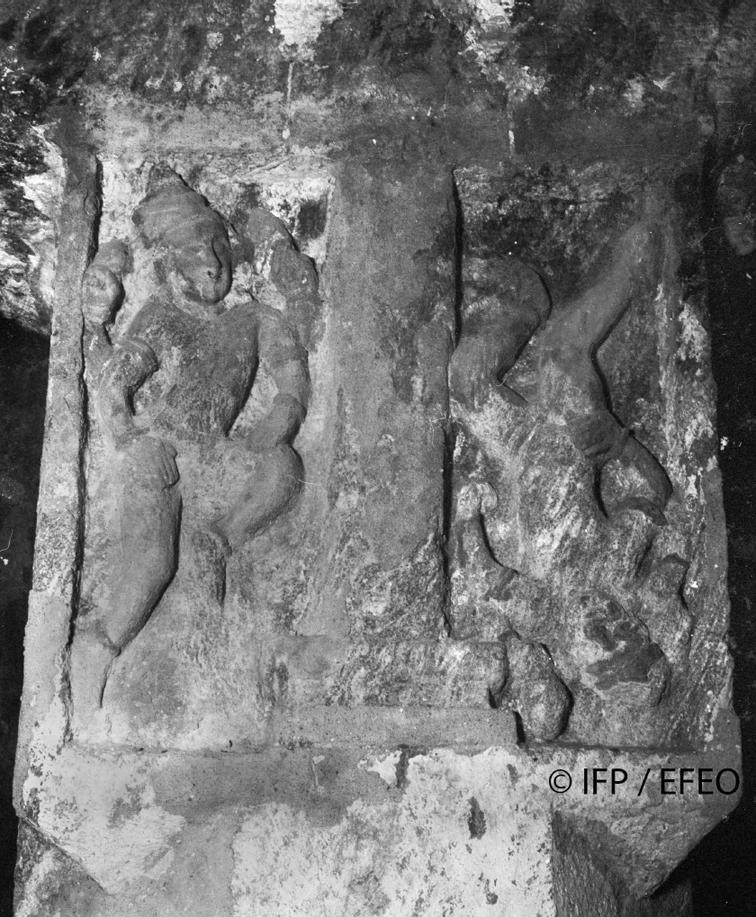
Figure 11.1: The Liṅgodbhava representation from Undavalli cave, Vijayawada, Andhra Pradesh. Photo: IFP/EFEO.
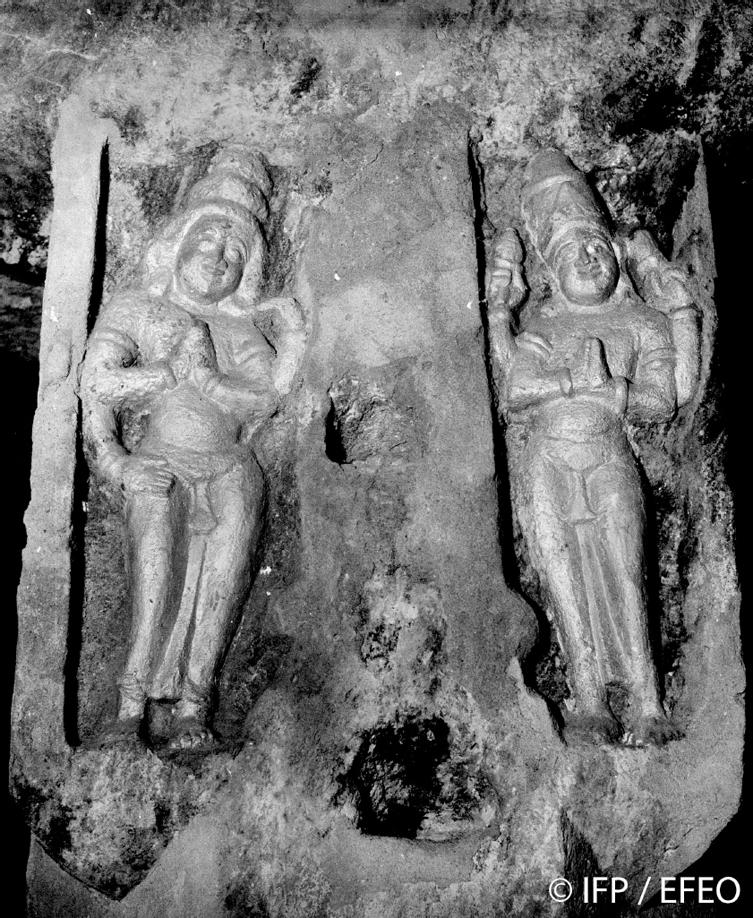
Figure 11.2: The Liṅgodbhava representation from Undavalli cave, Vijayawada, Andhra Pradesh. Photo: IFP/EFEO.
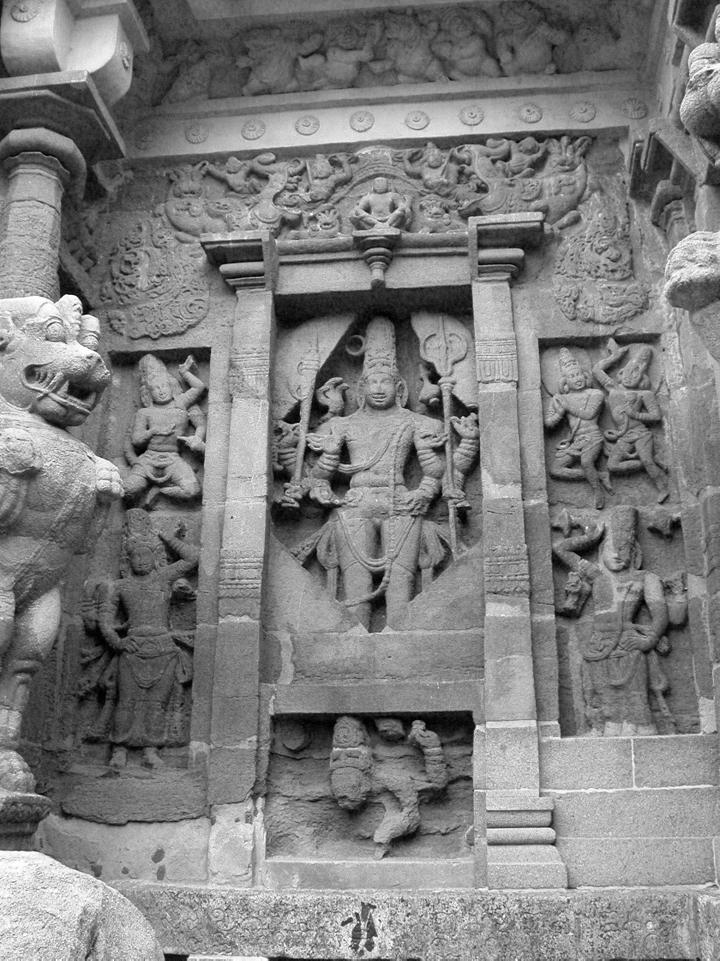
Figure 11.3: The Liṅgodbhava representation from the Kailasanatha temple, Kancipuram, Tamil Nadu. Photo: G. Ravindran, EFEO.
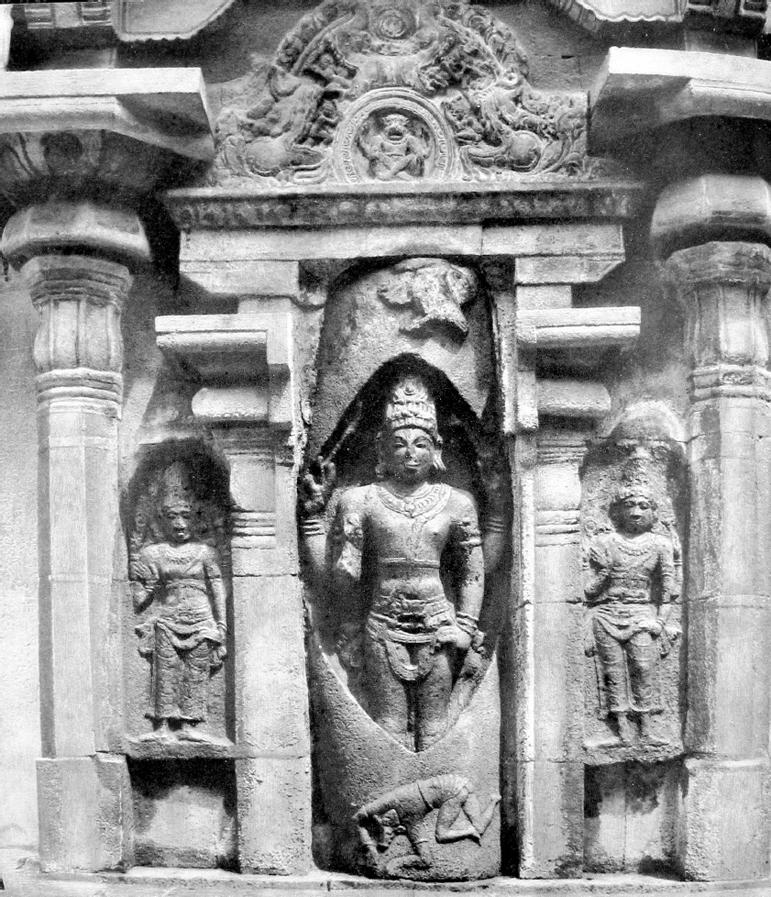
Figure 11.4: The Liṅgodbhava representation from Irattai Koil, Ariyalur taluk, Tamil Nadu.
Twelve: Yantras in the Buddhist Tantras — Yamāritantras and Related Literature
Kenichi Kuranishi{5}
Introduction
Yantras have been employed as instruments for many purposes in South Asia since ancient times. The word yantra is derived from the verbal root yam[630] and originally designated implements for fastening or for controlling, or, alternatively, mechanical devices.[631] Yantras as magical devices, the focus of this paper, are also called cakras.[632] Yantras are generally small in size, mobile, and are described as geometric in shape with lines and inscribed syllables such as seed syllables and mantras. While maṇḍalas normally depict the images of deities, such images are not used in yantras. Moreover, unlike maṇḍalas, they basically use one color which varies according to the Yantra’s purpose. The colour is only for lines and syllables; the space between lines is only very rarely filled with colours. The procedures for yantras vary depending on the purpose of the rite. First, concerning pigments, the following materials were used: gallstones of cows (gorocanā),[633] turmeric, sap of plants (e.g. thorn apple), human blood and ashes. Concerning the substratum, yantras are drawn on birch-bark, bamboo bark, metal, cloth (e.g. a rag from the cremation ground), or on paper by writing implements such as a pen made of a twig of bilva or made of human bone, or a quill from a crow.
Yantras are often categorized into three types according to their purpose.[634] Recently BüHNEMANN et al. 2007 (pp. 32–39) has suggested the following tentative classifications after examining the previous scholarly discussion:
| type 1 | yantras establishing a foundation (e.g. a statue of deity, a temple), |
| type 2 | yantras for worship,[635] |
| type 3 | yantras for desire-oriented rites performed on special occasions. |
Although it is still problematic to classify yantras, we will not discuss this question in this paper, because all the yantras in the Yamāritantra and related literature mentioned here clearly fall only into the third category.
Although there are many books and articles about yantras, no comprehensive study focused on the yantras in the Buddhist Tantras has been undertaken yet. This may in part be because fewer descriptions are extant in Vajrayāna texts than in the Hindu Tantric literature. The Yamāritantras and related literature appears to have placed high emphasis on worldly desire-oriented practice and contain much more explanation of the yantras compared with other Buddhist Tantras. Therefore, it is significant that the Yamāri literature should be studied in order to learn something of the practice of yantras, at least in the Buddhist Tantric usage.
The aim of this paper is to provide an overall picture of the Yamāritantras and related literature and to present the details of the yantras described therein, focusing especially on chapters four to six of the Kṛṣṇayamāritantra.
1. The Yamaritantras and Related Literature
There are a number of classifications of Buddhist Tantras.[636] The Yamāritantras and related literature are often classified in the Yogottaratantra (or Mahāyogatantra) class.[637] A Kṛṣṇayamāritantra commentary, the Sahajālokapañjikā[638] written by Śrīdhara (ca. 950–1050)[639], who was known as a master of the Yamāri cycle, shows the following classification of Buddhist Tantras in the first chapter: kriyā-, caryā-, yoga-, *yoganiruttara- (Tib. rnal ’byor bla na med pa). Further it states that the Yamāritantras are classified into the *Yoganiruttaratantra.[640][641]
There are nearly two hundred texts related to Yamāri in the Tibetan canon[642] and a great number of them contain the descriptions of yantras. Bu ston (1290–1364) had this to say on yantras in the Yamāritantras in the beginning of his work, the ’Khrul ’khor cho ga:
In this respect, in chapter six of the Kṛṣṇayamāritantra, how to draw the yantras is explained, and in its chapter four and five the accomplishment of rites (karmasiddhi-) are explained.i In the second kalpa of the Vajrabhairavatantra,[643] how to draw the yantras and the accomplishment of rites are explained.ii In first kalpa of the Six-faced tantra (i.e. gShin rje gshed nag po’i ’khor lo las thams cad grub par byed pa),[644] the yantras and the accomplishment of rites are explained.iii In chapter two of the nineteen-chapter Raktayamāritantra,[645] the accomplishment [of rites employing] yantras are explained and in its chapter thirteen, how to draw the yantras is explained.iv Moreover, in the first kalpa of the three-kalpa vyākhyātantra[646] [the yantras are explained].v,[647]
Although Bu ston lists here five tantras which contain the descriptions of yantras, the second chapter of the dPal rdo rje ’jigs byed kyi rtog pa’i rgyud (Toh470 = 0tal06) also explains how to draw the yantras and the accomplishment of yantra-rites.
Moreover, as mentioned above, there are a great number of related non-scriptural texts: commentaries, ritual procedures, sādhanas, and so forth. Among these, we can find many texts dealing with or focusing on yantras many more than in the exegetical corpora related to other tantras.[648] Considering the circumstances above it can be suggested that not only the compilers of Yamāritantras but also the authors of the commentaries and the other texts had the conviction that the yantras were essential to the rites and the practices of Yamāri (including Yamāntaka and Vajrabhairava).
2. Yantras and their Rites in the Yamāritantras and Related Literature
This section mentions the details of the yantras and the accomplishment of the rites (karmasiddhi) in the Kṛṣṇayamāritantra and its commentaries.[649] The Kṛṣṇayamāritantra, which consists of eighteen chapters, devotes almost three chapters to the detailed explanation of yantras: the nine rites employing the yantras; pacification (śāntika), prosperity (pauṣṭika), subjugation (vaśya | vaśīkaraṇa), attraction (ākarṣaṇa), immobilization (stambhana), rendering one mute (vākstambhana), liquidation (māraṇa), causing enmity (vidveṣaṇa), expelling (uccāṭana) (Ch. 4–5 vv. 1–10); summarising the rites (Ch. 5 vv. 11–17); how to treat yantras after they have served their purpose, especially in the case of the śāntika rite (Ch. 5 vv. 18–19); how to draw them (Ch. 6 vv. 10–19[650]).
2.1. The Procedure of the Nine Rites
Due to limitations in space, I will discuss only two out of the total of nine rites: the peaceful śāntika rite and the aggressive māraṇa.
The Kṛṣṇayamāritantra considers the first three types, pacification (śāntika), prosperity (pauṣṭika), and subjugation (vaśya | vaśīkaraṇa), to be peaceful rites. These three procedures are similar. The procedure of the śāntika rite is as follows:
-
The performer draws a yantra—the base is the same for all rites (see figure 12.1)—on birch-bark or bamboo-bark with ink made from gallstones of cows;
2. He inscribes the name of the client enclosed by the word ‘namaḥ’ (नमः [NAME] नमः) in certain places on the yantra (see figure, ®×4);
3. He puts the yantra inside two joined vessels (śarāvadvayasaṃpuṭe) smeared with ghee and honey and ties it with a white string;
4. While scattering white flowers, facing east, he visualizes himself as white Yamāri;
5. He places the yantra on a visualised white moon-disc;
6. He starts reciting a certain mantra while visualising it (the yantra) consecrated with water from a white vase.
śāntika mantra: oṃ hrīḥ ṣṭrīḥ, Ugly one! hūṃ hūṃ phaṭ phaṭ svāhā. oṃ namaḥ! Placate for [insert client’s name]! namaḥ svāhā.[651]
After the peaceful rites, the Kṛṣṇayamāritantra lists six aggressive rites.[652] Unlike the peaceful rites above, which are given more or less under the same heading, these six aggressive rites are all different. Among the nine rites māraṇa was presumably the most important, because it is the one that receives the most extensive explanation. This is appropriate, since Yamāri was considered to have power over life and death, as he dominates Yama, the god of death. The procedure for a case of māraṇa is as follows:
-
The performer obtains a rag from the cremation-ground, then draws a yantra with a quill from a crow using black mustard seed ink mixed with salt or poison or the juice of Nimba fruits[653] on the night of the fourteenth day of the dark fortnight[654];
2. He inscribes the target’s name enclosed by the seed-syllable ‘hum ’ (हूं [NAME] हूं) in certain places on the yantra;
3. Facing south, he visualises himself as the furious Yamāri[655];
4. He puts the yantra in front of himself[656];
5. He starts reciting a certain mantra while visualizing that this rite causes the target to fall into various miserable situations.[657]
After this procedure, the Kṛṣṇayamāritantra shows the justification for liquidation (māraṇa) as follows:
Ah! [How wonderful] this so-called killing! It is killing which is not killing. Because [the target] is freed from [his] sins, [the one who is] killed is not simply killed. [Otherwise,] having committed myriad sins, he would stay in the Avīci and other [hells]. || 64-65ab ||
Ah! [How wonderful] the greatness of the Buddha [that] he who is killed may reach liberation! [The yogin], having exercised intense compassion, should slay slayers of beings.
Ah! The splendid power of compassion! One weak in compassion never accomplishes. || 65cd–66 ||[658]
We can find many texts which have such justifications for killing, not only in Vajrayāna texts but also in those belonging to the non-esoteric Mahāyāna. In a nutshell, all cases that I am aware of sanction the performance of a māraṇa as the compassionate act of helping and teaching others.[659]
2.2. The Procedure of a Yantra
2.2.1. Drawing a Yantra
The yantra is made of three concentric squares layered on top of each other and has thirty-seven cells in total: the first layer divides into eight; the second layer divides into twelve; the third layer (i.e. outside) divides into sixteen; plus one cell at the center. Each cell is assigned a certain syllable or syllables. To explain the details of drawing this yantra, I refer to the most significant and reliable commentaries, especially, the Ratnāvalīpañjikā and the Sahajālokapañjikā, whose Sanskrit texts are available. In order to understand more easily, see figure.
Firstly, the way to divide into cells is explained in detail in the Ratnāvalīpañjikā. The practitioner draws the three-layered square and two lines from east to west (i.e. from top to bottom), then two more lines from north to south (i.e. from left to right). Then he draws a line diagonally from inside outwards on each of the four corners of the second layer beginning with the south-east corner and proceeding clockwise. Finally he draws two lines from the inside outwards in each of the four corners of the third layer beginning with the east-side corner and proceeding clockwise. Thus the frame of the yantra is completed.[660]
Then the syllables (i.e. the seed syllables and the syllables of the mūlamantra) are placed in the frame. The first layer has the seed syllable YA in the center, KṢE in the east, MA in the south, ME in the west, DA in the north. These five syllables which are seed syllables of five main Yamāris, are installed as in the Yamāri maṇḍala.[661] The remaining four cells in the first layer are left blank. Then the twelve syllables, YA CCA NI RĀ JĀ SA DO RU ṆA YO NI RA, are installed one by one in each cell beginning in the upper left side of the second layer clockwise. They are the same as the seed syllables of the gate-keepers, yoginīs and the four Kapālas but they are not installed as in the Yamāri maṇḍala.[662][663] Chapter six, verse thirteen in the Kṛṣṇayamāritantra is sometimes called the Yamarājaśloka. According to the Ratnāvalīpañjikā, this śloka is composed of the syllables of the first and the second layers.[664] Then, in the third layer, the syllables of the mūlamantra: OṂ HRĪḤ ṢṬTRĪḤ VIKṚTĀNANA HŪṂ HŪṂ PHAṬ PHAṬ SVĀHĀ are installed from the upper left side. Each cell has two syllables in order. To be precise, two syllables should be placed with a second syllable behind a first syllable.[665] Therefore, eight cells out of the sixteen contain the syllables of the mantra, but the remaining eight are left blank.[666]
The following figure is the base of every yantra in the Yamāri system. However, after placing the syllables thus, there are still twelve blanks: four cells in the first layer, eight cells in the third layer. These blanks are filled according to the purpose of the yantra. For instance, in the case of māraṇa each of the first four blanks is filled with ‘हूं [NAME] हूं’. The eight remaining blanks are each filled with an imperative form, ‘मारय’.
2.2.2. What to do with a Yantra after its purpose has been served
Yantras should normally be destroyed after the purpose is fulfilled. However, as far as the case of the śāntika rite is concerned, the yantra could be kept as a charm even after fulfillment. Certain syllables, however, must be erased first:
As for [the yantra of] śānti, erasure of the syllable YA on the edge, and erasure of two NIs [should be done]. After that, erasure of the central YA [should be done]. [As for] the rest of the letters [can be erased] at will.[667]
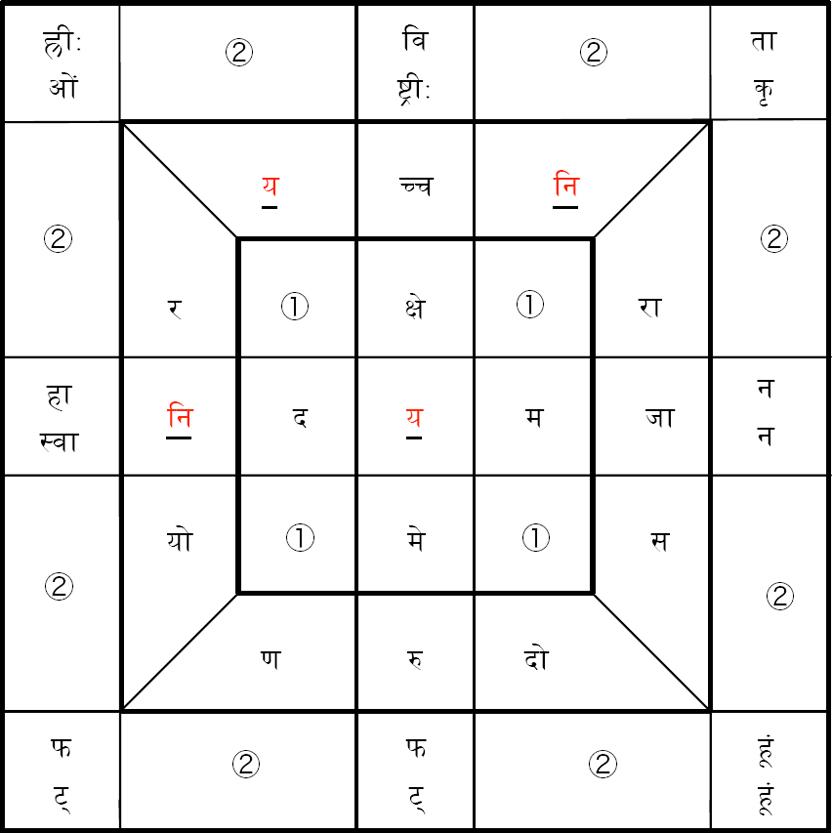
Figure 12.1: the base of a yantra
(e.g. māraṇa case: ➀ हूं [NAME] हूं ➁ मारय)
According to the interpretation of the Sahajālokapañjikā, the syllables which should be erased are four: ‘YA on the edge’ is in the eastern corner of the second layer; ‘two NIs’ are in the second layer; ‘the central YA’ is the center of the yantra. These syllables are underlined in the figure above. Moreover, according to another important commentary, the Ratnāvalīpañjikā written by Kumāracandra, although it does not explain about the syllables which should be erased, it mentions the necessity of erasing the syllables.[668] In addition, after this verse the Kṛṣṇayamāritantra warns that if someone does not erase the syllables and keeps the yantra intact, there would continuously be discord in his house.[669]
Conclusion
To sum up, the aim of this paper is to show how yantras are employed in the Buddhist Tantras, especially in the Kṛṣṇayamāritantra which is the chief tantra of the Yamāritantras. In short, the rite employing the yantra in the Yamāri literature is accomplished by synthesizing external actions, namely preparations of the yantra, and internal actions: visualizing the target himself as the yantra by means of his/her inscribed name, and then imagining the effect reaching the target. Even though we can see that some Buddhist Tantric texts[670] have descriptions of yantras, to my knowledge there are no Buddhist Tantras that describe the yantras in such detail as the Yamāritantras do. The description of the Kṛṣṇayamāritantra is quite significant inasmuch it clearly shows the practices of the yantra which had been widely performed around the ninth century when the Yamāritantra was compiled. Although in Hindu Tantric literature we can find some detailed procedures of yantras similar to the Kṛṣṇayamāritantra, they are of a much later date.[671] My future study will focus on defining the position of the Yamāri cycle among not only Buddhist Tantric but also Hindu Tantric traditions.
Bibliography
Primary Sources
Cakrasaṃvaratantra PANDEY, Janardan S.: Śrīherukābhidhānam Cakrasaṃvaratantram with the Vivrti commentary of Bhavabhatta, 2 vols. CIHTS, Sarnath 2002.
Guhyasamājatantra MATSUNAGA Y.: THE GUHYASAMAJATANTRA. A New Critical Edition, Toho Shuppan, Osaka 1978.
Hevajratantra SNELLGROVE, D.: The Hevajra Tantra. A Critical Study, 2 vols. Oxford University Press 1959.
Kalpacintāmaṇi SHARMA, N. N.: Kalpacintāmaṇi of Dāmodara Bhaṭṭa Text, Translation, Diagrams, Eastern Book Linkers 1979.
Kālacakratantra UPADHYAYA, J.: Vimalaprabhāṭīkā of Kalki Śrï Puṇḍarīka on Śrī*laghukālacakratantrarāja by Śrī Mañjuśrīyaśa, 3 vols. CIHTS, Sarnath 1986–1994.
Kṛṣṇayamāritantra K1 = NGMPP A140/15, paper, 16 fols., Devanāgarī, complete; K3 = IĀŚWR MBB-I-2, paper, 66 fols., Newari, complete; K4 = NGMPP A135/14, paper, 21 fols., Devanāgarī, complete; K5 = NGMPP A141/16, paper, 20 fols., Newari, incomplete; K6 = NGMPP A140/8, paper, 35 fols., Newari, complete; K7 = Royal Asiatic Society of London MS. No.41, paper, 33 fols., Newari, complete. Edition: Dvivedi, V. and S. Rinpoche: Kṛṣṇayamāritantram with Ratnāvalīpañjikā of Kumāracandra, CIHTS, Sarnath 1992.
Niṣpannayogāvalī LEE, Y.H.: The Niṣpannayogāvalī by Abhayākaragupta – A New Critical Edition of the Sanskrit Text (Revised Edition), Baegun Press 2004.
Raktayamāritantra NGMPP D37/11 = NGMPP E1323/2 = IĀŚWR MBB 3–42, paper, 37 fols., Newari, undated, incomplete. See KURANISHI 2004, forthcoming in detail.
Ratnāvalīpañjikā of Kumāracandra P1 = Bibliothèque Nationale Paris MS No. 29, paper, 217 fols., Newari, complete; P2 = NAK 5/1 = NGMPP A140/18, paper, 29 fols., Newari, incomplete; P3 = NAK 4/122 = NGMPP A140/12, palm-leaf, 40 fols., Newari, incomplete. Edition: See Kṛṣṇayamāritantra.
Saṃvarodayatantra TSUDA S.: The Saṃvarodayatantra. Selected Chapters, Hokuseido Press 1974.
Sarvatathagatatattvasaṃgraha 『初會金剛頂経の研究梵本校訂篇』(上) (1997) (上) (1983), Shoe-Kongōchōgyō no Kenkyû: Bonpon Kōtei hen, vol. 1, 2. 高野山大学密教文化研究所.
Sahajālokapañjikā of Śrīdhara IĀŚWR MBB-II-150-153, palm-leaf, 5 fols., Bhujimola script, undated, incomplete = Tucci collection, 15/LVIII (Box Tucci sscr 7), paper, 24 sheets, Devanāgarī, undated, incomplete (apograph of other fragments of IĀŚWR). Edition: see KURANISHI forthcoming.
Vajrabhairavatantra NGMPP A994/3 = NGMPP A1306/32, palm-leaf, 11 fols. Newari, undated, incomplete. = NGMPP B112/16 (apograph of former two MSS), paper, 8 fols., Newari, undated, incomplete. Edition: Ch. 1–3 Dhīḥ vol. 43, pp. 163–176, CIHTS, Sarnath 2007.
Vimalaprabhā of Kalki Puṇḍarīka See Kālacakratantra.
Yantracintāmaṇi TÜRSTIG, H.: Yantracintāmaṇiḥ of Dāmodara, Beiträge zur Südasienforschung Band 121. Südasien-institut, Universität Heidelberg 1988.
’Khrul ’khor cho ga of Bu ston gShin rje’i gshed kyi ’khrul ’khor gyi sgo nas ’phrin las sgrub pa’i cho ga ’khrul ’khor gnad kyi man ngag. Toh5100. CHANDRA, L: The collected works of Bu ston, Part 10, Śatapiṭaka Series 1967.
Chos ’byung of Bu ston bDe bar gshegs pa’i bstan pa’i gsal byed chos kyi ’byung gnas gsung rab rin po che’i mdzod. Toh5197. CHANDRA, L: The collected works of Bu ston, Part 24, Śatapiṭaka Series 1967.
Secondary Sources
BÜHNEMANN, Gudrun 1999 “Buddhist Deities and Mantras in the Hindu Tantras: I The Tantrasārasaṃgraha and the Īśānaśivagurudevapaddhati”, Indo-Iranian Journal 42, pp. 303–334.
BÜHNEMANN, Gudrun et al. 2007 (revised) maṇḍalas and Yantras in the Hindu Traditions, D.K.Printworld (P) Ltd. New Delhi
DECLEER, Hubert n.d. Lightning Terror Vol. II, Kathmandu.
DALTON, Jacob 2007 “A crisis of doxography: how Tibetans organized tantra during the 8th-12th centuries”, Journal of the International Association of Buddhist Studies vol. 28, no.1, 2005.
KURANISHI Kenichi 2004 “A study on the relationship between the Kṛṣṇayamāritantra and the Raktayamāritantra”, 『北條賢三博士古稀記念論文集•インド学諸思想とその周延』, (Hōjō Kenzō Hakase Koki-Kinen Ronbunsyū Indogaku Syosisou to Sono Syūen), pp. 61–68, Sankibō-Busshorin.
———.2008 “Śrīdhara and his works on the Yamāri cycle”, Esoteric Buddhist Studies: Identity in Diversity, Proceedings of the International Conference on Esoteric Buddhist Studies, pp. 179–183, Koyasan University.
———.2009 ヤン卜ラ考ヤマーリ文献を中心に (“On Yantras – Yamāritantra and related literature-”), 「佛教学」 (Bukkyō-gaku) vol.50, pp. 69–92, 仏教思想学会 (Bukkyō-shisou-gakkai).
———.forthcoming “Fragments of the Sahajālokapañjikā – A Critical Edition of the IĀŚWR Manuscript –”, Tantric Studies 2, Centre for Tantric Studies, Universität Hamburg.
MIMAKI Katsumi 1994 “Doxographie tibétaine et classifications indiennes”, Bouddhisme et cultures locales: Quelques cas de réciproques adaptations. Ed. FUKUI F. and FUSSMAN, G., Actes du colloques franco-japonais de septembre 1991, Études thématiques no. 2, pp. 115–136, École française d’Extréme-Orient.
NISHIOKA Soshū 1983 『プトゥン仏教史』目録部索引 III (“Index to the Catalogue Section of Bu-ston’s “History of Buddhism””), 「東京大学文学部文化交流研究施設研究紀要」 (Annual Report of the Institute for the Study of Cultural Exchange) vol. 6, pp. 47–201, Tokyo University.
PADOUX, André et al. 1986 Mantras et Diagrammes Rituels dans I’Hindouisme, table ronde, Équipe de recherche no 249 <L’Hindouisme-textes, doctrines, pratiques>, Centre National de la Recherche Scientifique.
RENOU, Louis and Jean FILLIOZAT 1947–1953 L’Inde Classique: Manuel des études indiennes, 2 vols, Payot.
SANDERSON, Alexis 1994 “Vajrayāna: Origin and Function”, Buddhism into the Year 2000: International Conference Proceedings, Bangkok and Los Angeles, Dhammakaya Foundation.
———.2009 “The Śaiva age—The Rise and Dominance of Śaivism during the Early Medieval Period”, Genesis and Development of Tantrism, Institute of Oriental Culture, University of Tokyo, Tokyo.
SFERRA, Francesco 2008 “Sanskrit Manuscripts and Photographs of Sanskrit Manuscripts in Giuseppe Tucci’s Collection”, Sanskrit Texts from Giuseppe Tucci’s Collection Part 1 (Manuscripta Buddhica 1), Is.I.A.O, Roma.
SIKLÓS, Bulcsu 1996 The Vajrabhairava tantras. Tibetan and Mongolian versions, English translation and annotations, Tring.
[672]Chapter four lists four aggressive rites: ākarṣaṇa, stambhana, vākstambhana, māraṇa. Chapter five which is titled cakrānupūrvalikhana lists two rites: vidveṣana and uccāṭana.
Sahajālokapañjikā (Tucci MS [17r1–3]): samprati cakralikhanam āha kṛtvetyādi | aṣṭau madhyamakoṣṭhaṃ tyaktvā maṇḍalikāṃ, tadbāhyato ’pare dvādaśe koṣṭhe maṇḍalikāṃ, tato bahiḥ ṣoḍaśe koṣṭhe maṇḍalikāṃ likhet / yathoktaśāntipuṣṭyādividhānena tattatkarmāṇi tattadyogāni prājño bhāvanātmakaḥ / sarvata iti sarvaprakāreṇa nyased ity arthaḥ / • ’pare] em.; ’para MS • ṣoḍaśe] em.; ṣoḍaśa MS • koṣṭhe maṇḍalikāṃ] conj. Lacuna ∪∪∪ ṇḍalikāṃ • tattadyogāni prājño] em. Tib.; tattadyogadigmukho MS
Sahajālokapañjikā (Tucci MS [17v3–5]): mantrāṇi*** dvādaśākṣarāṇi ya-cca-ni-rā-jā-sado-rū-ṇa-yo-ni-rābhidhāni dvādaśakoṣṭhake nyaset / asya māhātmyam āha sidhyatī**tyādi / na vidyate śeṣāśeṣas tasya niḥśeṣaḥ sidhyati / kiṃ tu trailokyaṃ trilokabhavaṃ karmeti śeṣaḥ / sacarācaraṃ*** sthāvarajaṅgamam / mūlamantram āha ya me**tyādi ya-madhyeti koṣṭhe kṣe-ma-me-da-pūrvādicaturdik / hūṃkāradvayagarbhitaṃ sādhyanāma sarvakarmasu nyased ity āha sādhyasyetyādi / uktadvādaśakoṣṭhīyamantram āha vāmetyādi \ bāhyata ity aṣṭakoṣṭhād bahir dvādaśakoṣṭheṣu / vāmam iti viparītaṃ / • mantrāṇi dvādaśā °] conj. Lacuna ∪∪∪ daśā° • śeṣāśeṣaḥ] conj. Lacuna śe ∪∪ śeṣaḥ MS • niḥśeṣaḥ] em.; niśeṣa MS • vāmetyādi] conj. Lacuna ∪∪ tyādi MS
Sahajālokapañjikā (Tucci MS [17v5–10]): tṛtīya iti ṣoḍaśakoṣṭhakāntariteṣu tatra prathamakoṣṭhe oṃ-kāraṃ tatpṛṣṭhe hrīḥ, tato dvitiye ṣṭrīḥ tatpṛṣṭhe vi, tṛtīye kṛ tatpṛṣṭhe tā, caturthe na tatpṛṣṭhe na, pañcame huṃ tatpṛṣṭhe huṃ, ṣaṣṭhe pha tatpṛṣṭhe ṭa, saptame pha tatpṛṣṭhe ṭa, aṣṭame svā tatpṛṣṭhe hā iti likhanasamudāyaḥ / hrīḥ oṃ vi ṣṭrīḥ tā kṛ na na huṃ huṃ ṭ pha ṭ pha hā svā aṣṭakoṣṭheṣu nyāsaḥ / ayaṃ punar abhicāramātra iti śāntyādau tu yathā[kramaṃ] / • ṣoḍaśakoṣṭhakāntariteṣu ***]* em.; ṣ*odaśakoṣṭhaikāntariteṣu MS • hrīḥ] conj. Lacuna ∪∪ tato MS • tatpṛṣṭhe hūṃ] omit. MS • pha ***]* em.; ha MS • tatpṛṣṭhe ***]* conj. Lacuna ta ***∪∪ MS • Note: Tib. shows ‘oṃ hrīḥ ṣṭrīḥ vi kṛ tā na na hūṃ hūṃ pha ṭ pha ṭ svā hā’. According to the MS, originally the second character of each cell is first given: hrīḥ oṃ vi ṣṭrīḥ tā kṛ na na hūṃ hūṃ ṭ pha ṭ pha hā svā. • The Tucci MS ends here.
Sahajālokapañjikā (Tucci MS 16v10–11, D92v4, P112rl): śāntau śāntike / antyayakārasyeti pūrvayakārasya / nidvitayasya nikāradvayasya / tato madhyayakārasyety arthaḥ // • antyayakārasyeti ] em.; anupakārasyeti MS, Tib. does not interpret the anupakārasyeti • nidvitayasya ] conj.; omit. MS, haplographical eyeskip • madhyayakārasyety ] em.; madhyapakārasyety MS
The other commentary, the *Prekṣaṇapathapradīpaṭīkā written by Kṛṣṇa, also gives a similar interpretation (D204r2, P244r2 omits): mtha’ ya ni sngon gyi yi ge ya’o / ni ni nub byang gi yi ge gnyis so / *phyi nas dkyil ’khor yi ge ya spangs pa’i yi ge lhag ma ci bder gzhag go //
Thirteen: Śaiva Siddhānta Śrāddha Towards an evaluation of the socio-religious landscape envisaged by pre-12th century sources
Nina Mirnig{6}
The emergence of Śrāddha rites in Śaivism marks a stage in the religion’s development in which its promulgators wished to extend their reach from its original milieu of Śaiva ascetics functioning outside society to the mainstream of brahmanical householders during the early medieval period, a development recently extensively discussed in Sanderson’s monumental work “The Śaiva Age: The Rise and Dominance of Śaivism during the Early Medieval Period” (2009). Consequently, the ritual repertoire initially revolving around ascetic practices was customized to include the range of rites indispensable to this newly emerging clientele[673] primarily concerned with fulfilling their ritual duties inherent in their status as married householders. This process was characterized by the adoption and reinterpretation of brahmanical prototypes, a strategy particularly visible in the rites of post-mortuary ancestor worship, the very performance of which implies notions concerning afterlife that fundamentally contradict the core Śaiva doctrine, namely that any candidate who has undertaken the liberating initiation (nirvāṇadīkṣā) will attain ultimate liberation at the time of death[674]. This should render any rites that envisage a post-mortem existence of the soul, such as that of the ghost (preta), not only redundant but incompatible[675].
For the earliest stratum of the Śaiva tradition we have no testimony for the performance of Śrāddha rites by Śaiva priests. The first extant scriptural injunction is found in the Saiddhāntika scripture Kirana, which is one of the “demonstrably early works whose name appears in lists of the twenty-eight tantras of the Śaiva Siddhānta” (GOODALL 1998, p. xxxvi)[676].
Of these works it is only the Kirana that provides instructions for Śrāddha, which suggests that the redactor(s) of this scripture were more concerned to actively propagate rites that correlate with those of wider society. Incidentally, TAKASHIMA has argued that it is the Kiraṇa that contains the earliest extant treatment of the installation (pratiṣṭhā) of public temples, as opposed to private places of worship for the adept[677], a fact which further suggests its movement towards a wider circle.
Another Saiddhāntika scriptural source to contain instructions for Śaiva Śrāddha is the eclectic Bṛhatkālottara, composed no earlier than the middle of the ninth century[678]. Further, this portion has been demonstrated by SANDERSON to have been redacted with minor changes from the Pāñcarātrika scripture Jayākhya[679].
More testimony for these rites is found amongst the ritual manuals (paddhati). The earliest extant Saiddhāntika manual, the Naimittikakriyānusandhāna of Brahmāśambhu, is only available in a single damaged Nepalese manuscript, in which regarding the chapter on Śrāddha only the colophon remains. However, we find detailed instructions in the other three major pre-12th century manuals, namely the Somaśambhupaddhati (or Kriyākramāvalī) (1073/4 or 1096/7[680]) by Somaśambhu, the Kriyākramadyotikā (1157/8) by Aghoraśiva and the Jñānaratnāvalī by Jñānaśiva (second half of the 12th century[681]).
In all of these works various modes of Śrāddha worship are prescribed, sometimes even using the same terminology. However, at a closer look it appears that some of them applied these modes to a slightly different effect, probably reflecting the differing social structures underlying the composition of the respective sources, which is the topic I would like to discuss in this paper.
1. Rationalizing Śrāddha in Śaiva terms
In its original context rites of post-mortuary ancestor worship constitute an essential part of the brahmanical householder’s ritual duty and are famously classed as one of the three debts a person has to pay during his lifetime[682]. Essentially, they evolve around the worship of the deceased father, grandfather and great-grandfather with offerings of piṇḍa balls and water, and the feeding of Śrāddha Brahmins representing the three ancestral generations and the Viśvedevas, that is to say the undifferentiated totality of ancestral deities.
In keeping with the principle that the soul of the initiate has attained liberation at death, the worship of deceased ancestors in the Śaiva version is re-interpreted as the worship of the deceased in their increasingly potent Śiva manifestations[683], that is to say, effectively as an act of Śiva worship. Hence, in what comes to be the default version of the rite, the father (pitṛ) is addressed as Īśa, the grand-father (pitāmaha) as Sadāśiva and the great-grand-father (prapitāmaha) as Śānta. The Viśvedevas are invoked as Kālāgnirudra and Ananta, the governors of the lowest and highest levels of the impure universe respectively.[684] Accordingly, though the basic timing and structure remain precisely that of the brahmanical model, the Mantras used are Śaiva rather than Vaidika and the invitees for the Śrāddha meal preferably Śaiva Ācāryas and Sādhakas instead of ordinary Vaidika Brahmins[685]. In terms of procedure, the only substantial addition[686] is found in the Jñānaratnāvalī, in which the worship of a liṅga (liṅgapūjā) is integrated into the ritual sequence before the piṇḍas are offered to the ancestors.
In doctrinal terms, the function of the series of post-mortuary rituals can be seen to assist the deceased in a process through which he is gradually made to advance into higher levels of liberation, therewith completing the process that had been initiated by the Dīkṣā ritual. This has led to the notion that in Śaiva writings Śrāddha is referred to as having the same benefit as initiation and as bestowing union with Śiva, as, for example, expressed in the Kiraṇa (61.34ab and 61.41):
śrāddham evaṃvidhaṃ śaivam śivasāyojyadaṃ param |[687]
Of such procedure is the supreme Śivaśrāddha that bestows union with Śiva.
kartavyaṃ tena tac chrāddhaṃ dīkṣā yena tadantikā | proktaṃ samāsataḥ śrāddhaṃ pañcabrahmamayaṃ śivaṃ ||[688]
He should perform the Śrāddha because (yena) the Dīkṣā (initiation ritual) ends with it. [Thus] the Śivaśrāddha that consists of the five Brahmāmantras has been taught in brief.
The Saiddhāntika manual Jñānaratnāvalī (Śrāddhapaṭala 105ab) expresses a similar sentiment:
dīkṣāmayam idaṃ śrāddhaṃ yathoktaṃ sugatipradam |
This Śrāddha, since it is a form of initiation, bestows liberation in the manner stated.
However, this theoretical rationalization that followed the rite’s introduction was rather weak[689] and had no fundamental impact on the basic ritual procedure, which remained analogous to the brahmanical version. On the contrary, the rigid preservation of the brahmanical structure in Śaiva Śrāddha gives rise to the presence of certain ritual gestures that enact notions that are incongruous with the Śaiva super-structure. For example, the brahmanical worship of the Viśvedevas and the ancestors is different in that the former are worshipped in an auspicious manner, that is to say with the sacred thread on the left shoulder and by offering barley grains[690], while the latter are worshipped in an inauspicious manner, namely by putting the sacred thread over the right shoulder and offering not barley grains but sesame seeds, which are considered to have apotropaic powers[691]. This symbolic distinction is inappropriate in the Śaiva context, since the ancestral Śiva manifestations in the pure universe who take the place of the ancestors are superior to the representatives of the Vaidika Viśvedevas Rudra and Ananta, who are part of the impure universe. The mode of worship, however, remains the same.
Shifting the focus away from the importance of performing Śrāddha rites for the deceased so that he may attain liberation, other passages simply formulate the obligation to perform Śaiva Śrāddha in terms of one’s personal benefit, namely that of freeing oneself from the debt, which is a principle analogous to that of the brahmanical Śrāddha, namely that it is, as seen above, the payment of a person’s debt to his ancestors.
kartavyaṃ tena tat tārkṣya parokṣe ’pi yathoditam |[692]
nirṛṇatvaṃ kathaṃ teṣāṃ yāvad eva kṛtaṃ na hi ||[693]
(Kiraṇa, Śrāddhapaṭala *39)
“Therefore, O Garuda, one should perform this rite even when [the corpse] cannot be found. For how does anyone become free of debt as long as [the Śrāddha] is not performed?”
And further:
atha śrāddhavidhiṃ vakṣye gurvādīnām ṛṇāpaham |
uktaṃ ca
devānām ṛṇam atyarthaṃ pūjāhomādikarmaṇā ||
dadyād askhalitācāro munīnām api nityaśaḥ |
gurvādīnām ṛṇam dadyād dīkṣitaḥ śrāddhakarmaṇā ||[694]
(Jñānaratnāvalī, Śrāddhapaṭala *1–2)
“Next, I shall teach the Śrāddha ritual, which removes the debt to the teachers and so forth. And [the following] has been taught: The initiate should pay [his] debt to the deities by fully performing rites of worship, oblations and the like; to the sages too [he pays his debt by] being of unwavering conduct at all times; and to [his] Gurus and the like he should [pay the debt] by performing the rite of Śrāddha.”
These injunctions, echoing the brahmanical formulations concerning debts, treat the role of Śaiva Śrāddha as part of the post-initiatory discipline essentially performed in keeping with brahmanical religious life, in a manner similar to that in which the daily obligatory rites were absorbed and rationalized in terms of Śaiva obligatory practice[695] so that its omission constitutes a transgression of that discipline.
2. Underlying structures envisaged by our sources
From this scant treatment of the theory behind the efficacy of Śaiva Śrāddha, it appears that offering theoretical justifications was not the main concern of these authors. Rather, due to the rite’s central role to the religious life in medieval India, it was important to be able to offer this service to as wide a clientele as possible, including sometimes uninitiated Śaiva lay devotees and in some cases even the ordinary Vaidika.
The main socio-religious dichotomies along which the prescriptions can be discussed are those between the ascetic and the householder, the initiate and non-initiate, and the full initiate and those who have received lower forms of initiation, including those that would bestow supernatural powers (siddhi) on to the initiand. The latter distinction introduces a particularly awkward level of complication to the system of post-mortuary rites, whose performance is after all justified by their function of completing the soul’s path to ultimate liberation that was promised by undertaking initiation (nirvāṇadikṣā). However, with the system of differentiated levels of initiations that the promulgators of Śaivism gradually developed, some initiates were only granted access to a particular part of the religion and had not advanced to the stage of receiving the full benefit of ultimate liberation. These members were the Sādhakas[696] and the lower level initiates called Samayins[697]. Those that had received the full initiation were referred to as Putrakas[698] and were fit thereafter to take up the Śaiva office of an Ācārya[699], who carries out the religious services such as initiation. Of these categories, the Samayins and Sādhakas should theoretically not receive the same kind of post-mortuary rites evolving around liberation.
The matter of initiatory classes is further convoluted by the introduction of an initiation that would bestow the full benefit of the religion while freeing the candidate of the obligation to carry out the arduous discipline of postinitiatory rules, that is to say the nirbījā dīkṣā (“an initiation without the seed [of performing post-initiatory practice]”). In such a case, as for instance the king, the candidate was instructed to revert to the mode of worship assigned to lay devotees[700].
Thus, reading the instructions below these categories will have to be kept in mind with the aim to discern in what way they are considered in the prescriptions for Śrāddha. It is hitherto difficult to draw an accurate picture of how these groups of initiates were distributed amongst the community and the socio-religious role they held respectively[701]. Some of the indications found in these prescriptions may serve as indicators for certain structures. Certainly, it is apparent that the structure of the initiate community was subject to socio-religious changes.
2.1 Kiraṇa: Śiva-, Rudra-, and Laukikaśrāddha
As mentioned above, the earliest extant scriptural testimony for Śaiva Śrāddha is found in the Kiraṇa, which prescribes three registers of Śrāddha rites – the Śivaśrāddha, the Rudraśrāddha and the Laukikaśrāddha. The Śivaśrāddha is evidently the mode of worship envisaged for the Śaiva initiate, though no differentiation seems to be made concerning which kind of initiate can commission it. The Rudraśrāddha is prescribed for the rudrāṃśa. This term has been argued by Sanderson to denote the uninitiated Śaiva lay devotee in the present context, literally ‘he who has an inclination (aṃśa) towards Rudra’[702]. The last of the triad, the Laukikaśrāddha, is presumably offered to ordinary Vaidikas, that is to members of the brahmanical mainstream.
The structure of the procedure is understood to be the same in all three cases, only with the difference that the deities with which the ancestors are equated and the identity of the Viśvedevas, together with the benefit procured by performing the rite are adjusted to suit the respective level of practice. Thus, (1) in the Śaiva Śrāddha the ancestors are identified in an ascending order with Īśa, Sadāśiva and Śānta; the Viśvedevas with Rudra and Ananta; and the benefit gained from performing the rite enjoined to be the union with Śiva[703]; (2) in the Rudraśrāddha the ancestors are invoked in an ascending order as Rudra, Skanda, and Gaṇeśa; the Viśvedevas as Caṇḍa and Mahākāla[704]; and the benefit gained from performing the rite declared to be the attainment of union with Rudra[705], rather than with Śiva; and (3) in the case of the Vaidika Śrāddha the ancestors are equated with Brahmā, Viṣṇu, and Rudra; the Viśvedevas with Sūrya and Yama[706]; and the reward declared to be his reaching the world of Brahmā[707].
2.2 Śrāddha in the Saiddhāntika manuals and the controversial term rudrāṃśa
The same Śrāddha model as found in the Kiraṇa was adopted by two of the prominent pre-12th century Saiddhāntika manuals, namely the Somaśambhupaddhati and the Kriyākramadyotikā. The former has taken on the three-fold model in a similar manner to the Kiraṇa, that is to say the Śivaśrāddha for Śaiva initiates, the Rudraśrāddha for the rudrāṃśas, and the Laukikaśrāddha for the ordinary Vaidika[708].
However, by the time of composition of the Somaśambhupaddhati, there seems to have been some ambiguity about who these rudrāṃśas are, a complication that is also reflected in the scholarly interpretation regarding this term. As we have seen above, Sanderson has demonstrated that this term referred to the Śaiva lay devotee[709] at the time of the Kiraṇa. Regarding the usage of the term in the Somaśambhupaddhati, Brunner-Lachaux, amongst others, in her annotation has interpreted the term to mean ‘a part (aṃśa) of Rudra (i.e. Śiva)’, and assigns it to the lower level initiate, namely the Samayin, an interpretation based on Nirmalamaṇi’s commentary on the ritual manual Kriyākramadyotikā[710]. It is not surprising that the interpretation of this sort of technical terminology for members of the community should change over time according to the structure the respective authors were envisaging. In the case of the Somaśambhupaddhati we cannot determine for sure whether this was indeed his understanding of the term[711].
However, if we, for example turn to the text of the Kriyākramadyotikā we find that Aghoraśiva allocates the kind of Śrāddha in which the series of deities evoked corresponds to the above classified Rudraśrāddha explicitly to the Samayin[712]. Thus, the Śaiva lay devotee does not get a separate mention here. One may therefore wonder whether in the society envisaged by these instructions this group of lay Śaivas has been offered the same mode of post-mortuary ancestor worship as the ordinary (i.e. laukika) Vaidikas. Alternatively, one could speculate that the shift occurred with a heightened awareness that the Samayins cannot receive the same rites as the full initiates and therefore prescribed that the lower level initiates must de facto revert to the mode of Śrāddha worship that is offered to lay devotees. This could be considered in analogy with the nirbījadīkṣitas discussed above, that is to say Śaivas that have received the full initiation (nirvāṇadīkṣā) but have been freed of the obligation to perform Śaiva post-initiatory practices and are instructed to revert to the religious practice of the Śaiva lay devotee after initiation. This would suggest that the boundary between lay Śaivas and lower level initiates was blurred here.
The next text under discussion, the Jñānaratnāvalī, uses yet another different classification as the basis for allocating different modes of Śrāddha, namely the distinction of initiates into śivadharmins and lokadharmins. In some sources, such as the Mrgendra[713] or Abhinavagupta’s Tantrāloka[714], we see this distinction applied to two types of Sādhaka, that is to say Tantric initiates who follow certain kind of practices to attain supernatural powers (siddhis). However, as we will see below, in the ritual manual Jñānaratnāvalī the classifications envisaged by these labels are less apparent from the formulations and rather suggest a different underlying socio-religious structure at this point.
Thus, in this manual, composed by Jñānaśiva, a South-Indian contemporary of Aghoraśiva active in Benares[715], the different levels of Śrāddha are laid out in the following manner. Rather than using the same threefold model of Śiva-, Rudra- and Vaidikaśrāddha as the sources discussed above, the author provides two sets of prescriptions: (1) one for the śivadharmin, a category which seems to entail both ascetics and householders; and (2) another for the lokadharmin, in which he quotes the Brhatkālottam’s section on Śrāddha. However, as we will see, it appears that these sections are not so much meant to complement each other, but that we have to read the first half independently, and that the quotation of the Bṛhatkālottam was probably added at a later stage.
The first half of the chapter is attributed to discuss the rites for the śivadharmin. Earlier in the manual, Jñānaśiva expounds on the difference between a śivadharmiṇī initiation and a lokadharmiṇī initiation, explaining that the former is given to ascetics and the latter to householders[716]. Thus, we can assume that the categories intended here correspond to this earlier exposition. However, in the prescriptions we find that the recipient of the Śrāddha rites for the śivadharmin can be either an ascetic or a householder, since the manual explains that the series of Śrāddha rites is prescribed to start on the third day after the cremation in the case of an ascetic, and on the first day free of impurity after the cremation for the householder:
saṃskāradivasād wrdhvaṃ tṛtīye ’hni tapasvinām ||
visūtakadinād wrdhvaṃ gṛhasthānām ayaṃ vidhiḥ |[717]
(Jñānaratnāvalî, Śrāddhapaṭala *4cd-5ab)
For an ascetic [he should perform the Śrāddha] on the third day after the cremation. For the householder this rite [is performed] after the day on which the period of impurity has ended.
This might at first seem surprising. However, in the treatment laying out various types of initiates, we learn that the śivadharmin initiate may be of two kinds, the naiṣṭhika and the bhautika, that is to say, the life-long ascetic and the temporary ascetic[718]. Presumably the householder śivadharmin is one of the latter kind, and had been a temporary ascetic (bhautika) at the time of initiation.
Now for the lokadharmin the Jñānaratnāvalī seemingly provides the quotation from the Bṛhatkālottara as the procedural injunction, therewith quoting from a text that uses the same terminology. However, it seems that this was not part of the original model envisaged by the author, since one and half verses before the start of this section we find the following statement:
atha laukikadharmāṇāṃ navaśrāddhapuraḥsarāt |
sapiṇḍīkaraṇād ūrdhvaṃ śivaśrāddhaṃ vidhīyate ||
†bhuvaneśapadārthānāṃ tadīśaśrāddham ācaret† *|[719]
(Jñānaratnāvalī, Śrāddhapaṭala *41-42ab)
Next, for those [adhering to] the [brahmanical] religion of mundane society, the Śivaśrāddha is enjoined after the Sapiṇḍīkaraṇa, which [in turn] is preceded by the Navaśrāddhas. [And] he should perform the Śrāddha [with regard] to [the recipient’s (tad-)] deity [of choice] for those who wish to attain the world of [the respective] Bhuvaneśa.
This passage already seems to refer to the lokadharmins, the bahuvrīhi compound laukikadharma, qualifying the kind of initiate in question, being probably another way of referring to lokadharmins. It appears that two kinds of Śrāddha are here referred to, corresponding to the two kinds of lokadharmins, namely the superior (para) and the inferior (apara)[720]. The former is granted Śivahood at death; thus, the performance of the Śivaśrāddha would be appropriate. The latter seeks a period of enjoyment before attaining liberation. Thus, his bad karma on all levels is destroyed and he can enjoy all his good karma in the world of a Bhuvaneśa (god of a specific world level) before attaining Śivahood[721]. Thus, reading these instructions without considering the quotation of the Bṛhatkālottam we are to understand that the Śrāddha procedure is the same in those cases, only that for the inferior lokadharmin the set of deities Īśa, Sadāśiva and Śānta used to address the deceased ancestors, are appropriated to the names of the deities of the respective world (bhuvana) the recipient wishes to attain.
In terms of procedure, it follows that the Śaiva rites are in all cases performed only after the completion of the brahmanical series of post-mortuary rites of ancestor worship up to the sapiṇḍīkaraṇa, with the emphasis that these are to be performed in accordance with brahmanical convention for the sake of the interaction with the worldly community (as opposed to the belief in their efficacy):
sapiṇḍīkaraṇaṃ yāvad vaidikī ca kriyā matā ||
lokasaṃvyavahārārthaṃ putrādīnāṃ tataḥ param |
śivaśrāddhaḥ prakartavyaḥ śivadharmasthitātmanām ||[722]
(Jñānaratnāvalî, Śrāddhapaṭala *5cd-6)
Up to the Sapiṇḍīkaraṇa the rites are taught to be Vaidika [i.e. according to the brahmanical convention] for the purpose of worldly interaction (lokasaṃvyavahārārtham). After this [point], the Śivasrāddha is to be performed for Putrakas and the like who adhere to the Śaiva teaching (śivadharmasthitātmanām).
We have seen that the same injunction to start the Śaiva rites after the sapindīkaraṇa is given for the laukikadharma initiate in verse 41. If we were to consider the quotation of the Bṛhatkālottam as effective in combination with these statements, however, the instructions would contradict each other, since the section starts with Śaiva versions of the rites before the sapindīkaraṇa, which have just explicitly been enjoined to be performed according to Brahmānical convention. Thus, it is more likely that this portion was added later on, perhaps by a redactor who felt that more than one and half verses on the topic of Śrāddha rites for the lokadharmin are needed. He might also not have been aware of the incongruity these instructions pose, not just on a procedural level, but also regarding the Śrāddha deities invoked, which are only the superior set in the sequence proposed for the lokadharmins, namely Īśa, Sadāśiva and Śānta. However, if the above interpretation is correct, there should be a distinction made for the inferior kind of lokadharmin, since he does not immediately enter that level of liberation, but an inferior world of enjoyment first.
This is not to exclude the possibility that the prescriptions of the Bṛhatkālottara were not used as a guide, but only suggests that they might have been introduced later, when Śaiva versions of the rites up to the sapiṇḍīkaraṇa might have been acceptable. Furthermore, it should be kept in mind that this section has been redacted from a different religious milieu, namely that of the Pāñcarātrikas and is thus perhaps not originally inspired by Śaiva practice but rather adapted for this prescriptive text and superimposed on current practice.
Thus, the Jñānaratnāvalī is concerned only with giving injunctions for Śrāddha rites for its different types of initiates according to its distinction into śiva- and lokadharmins, rather than in reference to the different initiatory levels that are not on the level of the highest nirvāṇadīkṣā. Furthermore, the manual does not provide instructions for the lay devotee.
Brunner-Lachaux[723] has pointed to a passage quoted by Trilocana, contemporary of Jñānaśiva[724], in his commentary on the Somaśambhupaddhati that reveals yet another understanding of these terms. However, it has to be noted that this interpretation is limited as the quotation is incomplete and I currently do not have access to the complete text. Nevertheless, we can see that Trilocana is combining the three-fold model used in the Somaśambhupaddhati and that of the śiva- and lokadharmin as we find it in the Jñānaratnāvalī. Thus, he assigns the Śivaśrāddha to the dīkṣita, whom he correlates with the Gurus; the Rudraśrāddha to the rudrāṃśa, whom he correlates with the śivadharmins; and the Laukikaśrāddha to the lokadharmin. Due to the missing text there is some ambiguity concerning his comments on the lokadharmin. But in the case of the initiate who has received the śivadharmiṇī dīkṣā we clearly see the fusion of various elements. Trilocana explains that someone of this kind on the one hand attains the world of Śiva (śivapada), which would be appropriate for the full initiate, but on the other hand explains that he is to be worshipped with the inferior series of deities starting with Nandin because of his being rudrāṃśa. Whether the initiate is intended as the recipient, despite the inconsistency, or a Samayin or lay devotee[725], is not clear. In any case, there is not much reason to think that Trilocana envisaged Somaśambhu’s categories as he introduces classifications that Somaśambhu himself does not use, and which are therefore certainly a secondary development.
3. Towards a social reality of its practice?
In the context of post-mortuary ancestor worship, it thus appears that the sources discussed above define the categories of initiates according to which their instructions are arranged along slightly different lines. Thus, by way of summary, the first model promoted by the Kiraṇa allows the Śaiva Ācārya to be commissioned by Śaiva initiates as well as Śaiva lay devotees and ordinary Vaidikas, and at the same time does not make a distinction between the different Śaiva initiatory levels. The same model was found in the Somaśambhupaddhati, but with some ambiguity concerning the definition of rudrāṃśa as lay devotee or Samayin. Further, this three level model is promoted by the Kriyākramadyotikā, in which two of those are reserved for the different classes of initiates, the rudrāṃśa explicitly being defined as the Samayin. Lastly, we have seen a different structuring in Jñānaśiva’s Jñānaratnāvalī, which does not explicitly focuses on non-initiates nor the classical distinction of the Śaiva initiatory levels, but seeks to make a distinction between śivadharmin and lokadharmin initiates. And lastly, in Trilocana’s commentary we have seen an attempt to correlate the three-fold model of Somaśambhu with that based on the śivadharmin/lokadharmin distinction.
It appears that there had been several shifts in the socio-religious order during the development of the school, over time and region. Of course, the section presently discussed cannot as such be taken in order to draw general conclusions about the socio-religious landscape, but at least it may indicate to us what the authors of these prescriptions thought necessary or chose to consider. Thus, the Jñānaratnāvalī focuses on different types of initiates without dealing with Samayins, and further rules how to coordinate the Śaiva Śrāddha rites with mundane practice. This could represent a picture in which initiates are well embedded within the householder community. Incidentally, such a structure would accord with a hypothesis put forward by Sanderson, according to which only the head of the household receives Śaiva initiation. If this model applies it would follow that the other members of the household were bound to mundane practice and that at his death the son would receive initiation and perform the Śaiva Śrāddha rites in coordination with mundane post-mortuary practices. The same might be the case in the Kiraṇa and the Somaśambhupaddhati, but these works are silent on this matter.
On the other hand the latter two, at a point much earlier than the Jñānaratnāvalī, as well as the Kriyākramadyotikā, even though they probably envisage a similar social structure, explicitly transcend the closed world of the initiated elite in offering their Śrāddha services to non-initiates. In the case of the Kriyākramadyotikā one might further speculate whether the initiate community itself envisaged by Aghoraśiva was less confined to an elite but constituted a wider clientele. An indication of this might be that the author provides a holistic account of the entire period after death without ever aligning it with brahmanical practice, which suggests that there was no conflict envisaged between the two modes of practices. Might this suggest that Jñānaśiva by carefully taking into account the brahmanical society’s regulations envisages the few amongst many, as opposed to Aghoraśiva, whose holistic account is devoid of any explicit external references represents a tradition that either completely isolates itself against the contemporaneous brahmanical society or has penetrated mainstream society so far that there was simply no need for such concerns?
A further question that was addressed concerns the shifting boundaries between the Samayin initiate and the Śaiva lay devotee, hinging on the interpretation of the term rudrāṃśa. As a consequence of this vague classification, we have seen that the mode of Śrāddha worship prescribed for a Samayin was either that of a full initiate or that of a lower rank initiate, in which case it was probably the same as that of the lay devotee. Thus, the Samayin comes in and out of the picture and is only explicitly mentioned in this context in the Kriyākramadyotikā. The lay devotee, on the other hand, seems to be considered in the Kiraṇa, Somaśambhupaddhati (whether on the level of the Rudraśrāddha or Laukikaśrāddha) and possibly also in the Kriyākramadyotikā, but is not so in the Jñānaratnāvalī.
Regardless of their mention, an indication that lay devotees of Śiva have commissioned Śaiva practitioners for their Śrāddhas already at a very early stage is also found in an early non-tantric source, namely the Śivadharmaśāstra, “the earliest of the texts that make up the lay Śivadharma corpus” (BiSSCHOP 2010, p. 243)[726], prescribing the religious practice for Śaiva lay devotees. Here, the instructions include specific recommendations that Śaiva yogins should be given food during the Śrāddha[727]; that the performance of Śiva worship is explicitly recommended before the feeding of such invitees[728]; and the notion that the forefathers (pitṛs) resort to Śiva[729]. In fact, it may have been through performing Śrāddha rites for the laity that the rite gradually became to be included in the regular Śaiva repertoire, with the rise of householder members, perhaps even with an increase of householders taking up lower levels of initiation.
Of course, these suggestions remain text-internal speculations and are put forward to be considered and evaluated against yet more material and if available external evidence.
In any case, by the mere existence of Śrāddha rites within the Śaiva ritual repertoire we have yet another example of how, regardless of any theoretical justification or awareness of theoretical inconsistency, we find that practice overrules doctrine at times of expansion. These prescription, further, allow us some insight into the direct interaction of Śaiva officiants with the non-initiate community before Śaivism became of the public temple worshipping kind.
References
BHATT, N. R. 1962. Mṛgendrāgama. Kriyāpāda et Caryāpāda. Avec le commentaire de Bhaṭṭa-Nārāyaṇakaṇṭha. Institute Français d’Indologie, Pondichery.
BISSCHOP, Peter. 2010. “Once Again on the Identity of Caṇḍeśvara in Early Śaivism: A rare Caṇḍeśvara in the British Museum?”. In Indo-Iranian Journal 53, pp. 233–249.
BRUNNER-LACHAUX, Hélène. 1977. Somaśambhupaddhati: Troisième Partie. Rituels occasionnels dans la tradition śivaïte de l’Inde du Sud selon Somaśambhu. II: dīkṣā, abhiṣeka, vratoddhāra, antyeṣṭi, śrāddha. Institute Français d’Indologie, Pondicherry.
DAVIS, Richard H. 1988. “Cremation and Liberation: the Revision of a Hindu Ritual”. In History of Religions. An International Journal for Comparative Historical Studies. Volume 28, Number 1 (August 1988). University of Chicago Press.
GOODALL, Dominic. 1998. Bhaṭṭa Rāmakhaṇṭha’s Commentary on the Kiraṇatantra. Volume I: chapters 1 — 6. Critical edition and annotated translation. Publications du département d’Indologie 86.1. Pondicherry: IFP/ÉFEO.
———.2000. “Problems of name and lineage: relationships between South Indian authors of the Śaiva Siddhānta”. In Journal of the Royal Asiatic Society. Series 3 10, pp. 208 – 211.
———.2004. The Pamkhyatantm, a Scripture of the Śaiva Siddhanta. A Critical Edition and Annotated Translation. Collection Indologie. 98. Pondicherry: IFP/ÉFEO.
HAZRA, R.C. 1954. “The Śivadharma”. In the Journal of the Ganganatha Jha Research Institute. Vol X, pp. 1 – 20.
Jñānaratnāvalî of Jñānaśivācārya. M = Ms. No. P. 3801. ORI, Mysore. Palmleaf. Obtained by Dominic Goodall. Tl = Transcript of RE 1025/52 (57) copied by V. Rangasvami, photographed by Dominic Goodall. T2 = Pondicherry IFI Transcript no. T 231. E-text by Dominic Goodall, including annotations.
Kiraṇatantra. N = National Archives Kathmandu 5 – 893 = NGMPP A 40/3. Date A.D. 92 4[730]. GI = Pondicherry IFI 47637. El = Edition. Published in 1932, Devakōṭṭai. Editors Ti. Rā. Pañcāpageśaśivācārya and K.M Subrahmaṇyaśāstrī.
Kriyākramadyotikā by Aghoraśivācārya. Pondicherry IFI Transcript no. T 370.
MIRNIG, Nina. 2010. Liberating the Liberated. A History of the Development of Cremation and Ancestor Worship in the Early Śaiva Siddhānta. Analysis, Texts and Translations. Doctoral thesis submitted to the University of Oxford in 2010.
Mrgendrāgama. Ed. see BHATT 1962.
SANDERSON, Alexis. 1995.“Meaning in Tantric Ritual”, Essais sur le Rituel III: Colloque du Centenaire de las Section des Sciences religieuses de I’École Pratique des Hautes Études, ed. by A.-M. Blondeau and K. Schipper. Louvain and Paris, Peeters, pp. 15–95.
———.2001. “History Through Textual Criticism in the Study of Śaivism, the Pañcarātra and the Buddhist Yoginītantras”, Les sources et le temps. Sources and Time. A Colloquium, Pondicherry, 11–13 January 1997, ed. by François Grimal. Publications du département d’Indologie 91. Pondicherry, Institut français de Pondichéry/École française d’Extrême-Orient, pp. 1–47.
———.2009. “The Śaiva Age: The Rise and Dominance of Śaivism during the Early Medieval Period”. In Genesis and Development of Tantrism, edited by Shingo Einoo, Tokyo: Institute of Oriental Culture, University of Tokyo, pp. 41 – 349.
Śivadharmaśastra. E-text prepared by Anil Kumar Acharya, French Institute of Pondicherry.
Somaśambhupaddhati. Ed. see BRUNNER-LACHAUX 1977.
TAKASHIMA, Jun. 1992, October. “Dīkṣā in the Tantrāloka”. In Institute for Advanced Studies on Asia (Tohyobunkakenkyusho kiyo) Nr. 119, pp. 45–84.
———.2005. “Pratiṣṭhā in the Śaiva Āgamas.” In From Material to Deity. Indian Rituals of Consecration. Edited by Shingo Einoo and Jun Takashima. [Japanese Studies on South Asia No. 4], Delhi: Manohar, pp. 115 — 141.
Tantrāloka of Abhinavagupta with the commentary (-viveka) of Rājānaka Jayaratha, ed. Mukund Rām Śāstrī. Kashmir Series of Texts and Studies.
VASUDEVA, Somadeva 2004. The Yoga of the Mālinīvijayottara. Chapters 1 – 4, 7, 11 – 17. Critical Edition, Translation, and Notes. Collection Indologie 97. Pondicherry. IFP/ÉFEO.
Yājñavalkyasmṛti with the commentary (Mitākṣarā) of Vijñāneśvara, ed. Wāsudev Laxmaṇ Śāstri Paṅśikar. Bombay: Pāṇḍurang Jāwajī, 1926.
Fourteen: Constituents of Buddhahood as Presented in the Buddhabhūmisūtra and the 9th Chapter of the Mahāyānasūtrālaṃkāra: A Comparative Analysis
Ayako Nakamura{7}
1. Prologue
Mahāyāna Buddhist literature is characterised by the tendency to treat Buddhahood as a category above and beyond the personality of the historical Buddha.[731] There are two works on this topic which will be compared here, namely the Mahāyānasūtrālaṃkāra (MSA) and the Buddhabhūmisūtra (BBhS).
First, the Bodhi chapter of the MSA, one of the most important Yogācāra works, focuses on the state of mahābodhi, i.e. Buddhahood, and presents its different aspects, which are related to the significant Buddhological issue: if the Buddha is completely pure, how can the Buddha perceive the mundane world? If he does perceive the mundane world, how can he be pure? If he does not perceive the impure world, how can he act in the world? To resolve this problem, the proponents of the Yogācāra school present theories such as the following: (a) two aspects of Buddha’s gnosis (jñāna), namely, nirvikalpajñāna and pṛṣṭhalabdhajñāna (i.e. non-conceptual gnosis and subsequently gained gnosis), (b) the transformation of the basis (āśrayaparāvṛtti), (c) the threefold body/embodiment (kāya) of the Buddha, and (d) the four types of gnosis (jñāna), namely ādarśa-, samatā-, pratyavekṣaṇā-, and kṛtyānuṣṭhānajñāna—which explain Buddha’s gnosis from the perspective of both non-conceptuality and activity in the world.
Second, the BBhS, too, is concerned with the constituents of Buddhahood, namely the purified ‘sphere of reality’ (dharmadhātu)[732] and the four types of gnosis. A number of modern scholars have already pointed out its close relationship with the MSA.[733]
In the present paper, I will present the content of each of these texts first, then compare their notions of Buddhahood in order to present some evidence which suggests the possibility that the original composition of the BBhS predates the MSA(Bh).
2. The Ninth Chapter of the Mahāyānasūtrālaṃkāra
2.1 The MSA offers four verses (IX. 56–59) to illustrate the purified ‘sphere of reality’ (dharmadhātu) which describe the entire structure of the Yogācāra concept of Buddhahood: here, according to the commentaries,[734] the purified dharmadhātu is explained under six interpretive categories: true nature (svabhāva) [v. 56], cause (hetu) [v. 57ab], result (phala) [v. 57cd], activity (karman) [v. 58ab], concomitants (yoga) [v. 58cd] and function (vṛtti) [v. 59].[735]
The first of these four verses (v. 56) explains the true nature (svabhava) of dharmadhātu.
sarvadharmadvayāvāratathatāśuddhilakṣaṇaḥ /
vastujñānatadālambavaśitākṣayalakṣaṇaḥ //
[The purified dharmadhātu] is characterised by (lakṣaṇa) the purification (śuddhi) of the True Reality (tathatā) of all things (dharma) from the two [kinds of] obstructions. It is [also] characterised as inexhaustible (akṣaya) mastery (vasitā) over objects (vastu) and gnosis (jñāna) which has that [tathatā] as its focus (ālamba).[736]
Verse 57 deals with the cause (hetu) and result (phala) of the purified dharmadhātu:
sarvatas tathatājñānabhāvanāsamudāgamaḥ /
sarvasattvadvayādhānasarvathākṣayatāphalaḥ //[737]
[The cause of its] arising (samudāgama) is the repeated cultivation (bhāvanā) of the insight into the True Reality (tathatā) in all aspects (sarvatas). Its result (phala) is inexhaustibility (akṣayatā) in providing (ādhāna) the two (i.e. hita and sukha) for all beings in all respects (sarvathā).
Further, as far as its activities and concomitants/associated qualities (yoga) are concerned, verse 58 states:
kāyavākcittanirmāṇaprayogopāyakarmakaḥ /
samādhidhāraṇīdvāradvayāmeyasamanvitaḥ //
It performs (karman), through skill (upāya) in application (prayoga), the magical emanations (nirmāṇa) of body, speech, and mind, [and] it is endowed (samanvita) with the door (dvāra) [to liberation], i.e. concentration (samādhi) and retention (dhāraṇī), and with the two “immeasurables,” [i.e. merit (puṇya) and insight (jñāna)][738].
Within the six categories, IX. 59 presents the trikāya as the function (vṛtti) of the dharmadhātu.
svabhāvadharmasaṃbhoganirmāṇair bhinnavṛttikaḥ /
dharmadhātur viśuddho ’yaṃ buddhānāṃ samudāhṛtaḥ //
Its function (vṛtti) differs in terms of [the bodies of] true nature (svabhāva), enjoyment (saṃbhoga) of doctrine (dharma) and magical emanation (nirmāṇa). This is said to be (samudāhṛta) the purified (viśuddha) dharmadhātu of [all] Buddhas.[739]
2.1 MSA IX. 60–66 elaborate upon the three-kāya model, possibly the earliest systematic explanation of the three-kāya doctrine in Yogācāra literature.[740]
Verse 60 speaks of the structure of these three kāyas, and then each of the three bodies is illustrated individually:[741]
svābhāviko ’tha sāṃbhogyaḥ kāyo nairmāṇiko ’paraḥ /
kāyabhedo[742] hi buddhānāṃ prathamas tu dvayāśrayaḥ //
Here, the following text in prose (MSABh) identifies the Body of True Nature (svābhāvikakāya) with the Body of Reality (dharmakāya),[743] which is characterised by the transformation of the basis (āśrayaparāvṛtti).[744] Further, the Body of Enjoyment (sāṃbhogikakāya) is said to be the body/embodiment[745] (kāya) by which [the Buddhas] completely enjoy the doctrine (dharma),[746] while the Emanational Body (nairmāṇikakāya) is defined as magical emanation (nirmāṇa) by which [the Buddhas] work for the sake of living beings.[747]
Verses 61–63 deal with the sāṃbhogika-, the svābhāvika- and the nairmānikakāya respectively.
sarvadhātuṣu sāṃbhogyo bhinno gaṇaparigrahaiḥ /
kṣetraiś ca nāmabhiḥ kāyair dharmasaṃbhogaceṣṭitaiḥ //
In all realms (dhātu), the Enjoyment [Body] differs (bhinna) according to (i) its gathering of retinue (gaṇaparigraha), (ii) its Buddha fields (kṣetra), (iii) its names (nāma), (iv) its bodies (kāya), and (v) its activities (ceṣṭita) of Perfect Enjoyment (saṃbhoga) of doctrine (dharma).
samaḥ sūkṣmaś ca tacchliṣṭaḥ kāyaḥ svābhāviko mataḥ /
saṃbhogavibhutāhetur yatheṣṭaṃ bhogadarśane //
The Essential Body is considered to be equal (sama), subtle (sūkṣma), and associated (śliṣṭa) with that [saṃbhogikakāya]. It is [also] regarded as the cause (hetu) of the mastery (vibhutā) over Perfect Enjoyment (saṃbhoga), so that it [can] manifest (darsana) objects (bhoga) [of the enjoyment] at its pleasure (yatheṣṭam).[748]
ameyaṃ buddhanirmāṇaṃ kāyo nairmāṇiko mataḥ /
dvayor dvayārthasaṃpattiḥ sarvākārā pratiṣṭhitā //
The Emanational Body is considered (mata) [to consist of] the innumerable (ameya) emanations (nirmāṇa) of a Buddha. The accomplishment (saṃpatti) of the two aims (artha) [of self (sva) and others (para)] in all modes is grounded (pratiṣṭhita) on these two, [i.e. the sāṃbhogika- and the nairmāṇikakāya].[749]
2.2 Further, verses MSA(Bh) IX. 67–76 speak of an important conception of a Buddha’s gnosis in Yogācāra texts, namely the four jñānas. The Buddha’s four types of gnosis are the following: (i) Mirror-Like Gnosis (ādarsajñāna), (ii) Gnosis of Equality (samatājñāna), (iii) Discerning Gnosis (pratyavekṣaṇājñāna) and Gnosis of Performing [Beneficial] Activities (kṛtyānuṣṭhānajñāna).[750]
Verse 67 gives the structure of the four jñānas:
ādarśajñānam acalaṃ trayajñānaṃ tadāśritam /
samatāpratyavekṣāyāṃ kṛtyānuṣṭhāna eva ca //
The Mirror-Like Gnosis (ādarśajñāna) is unmoving (acala), and the three [other] types of gnosis, [namely] regarding equality (samatā), discerning (pratyavekṣā) and performing [beneficial] activities (kṛtyānuṣṭhāna), are dependent upon it.[751]
Further, verses 68 and 69, which are concerned with the ādarśajñāna, state:
ādarśajñānam amamāparicchinnaṃ sadānugam /
sarvajñeyeṣv asaṃmūḍhaṃ na ca teṣv āmukhaṃ sadā //
The Mirror-Like Gnosis (ādarśajñāna) is without “mine”[notion] (amama), is unlimited (aparicchinna), always present (anuga). It is not disoriented (asaṃmūḍha) with respect to all objects to be known, and yet never turns towards them (āmukha).
sarvajñānanimittatvān mahājñānākaropamam /
saṃbhogabuddhatā jñānapratibimbodayāc[752] ca tat //
[This gnosis] resembles (upama) a great mine (ākara) of gnosis (jñāna), since it is the cause (nimitta) of all types of gnosis (jñāna). It is furthermore (ca) the Buddhahood (buddhatā) of Perfect Enjoyment (saṃbhoga), since the [other] types of gnosis (jñāna) arise (udaya) as reflections (pratibimba) [within it].[753]
Through the term amama, the text implies the non-conceptual aspect of ādarsajñāna.[754] In the commentaries, such as those of *Asvabhāva and Sthiramati, it is defined as identical with the nirvikalpajñāna,[755] the exclusive object of which is True Reality (tathatā). Thus, ādarsajñāna—in a manner of speaking—knows everything, since it recognises the tathatā of all phenomena.[756]
Verses 70 and 71 deal with samatājñāna:
sattveṣu samatājñānaṃ bhāvanāśuddhito matam[757] /
apratiṣṭhaśamāviṣṭaṃ samatājñānam iṣyate //
The Gnosis of Equality (samatājñāna),[758] regarding [all] sentient beings, is considered (mata) as [a result of] purification (śuddhi)[759] through repeated cultivation (bhāvanā). The Gnosis of Equality (samatājñāna) is asserted (iṣyate) as being immersed (āvista) in nonabiding (apratiṣṭha°) calmness (śama).
mahāmaitrīkṛpābhyāṃ ca sarvakālānugaṃ matam /
yathādhimokṣaṃ sattvānāṃ buddhabimbanidarśakam //
[The Gnosis of Equality (samatājñāna)] is considered (mata) as consistently (sarvakālam) accompanied (anuga) by great benevolence (maitrī) and compassion (kṛpā). It manifests (nidarśaka) the Buddha’s image(s) (pratibimba) to sentient beings according to their faith (yathādhimokṣam).
Note that verses 70 and 71 deal with two kinds of equality (samatā), namely (i) the equality with regard to oneself and other living beings and (ii) the equality of saṃsāra and nirvāṇa. The emphasis on the equality of oneself and others—which is experienced at the first Bodhisattva stage, deepened at each further stage, and accomplished finally at the tenth stage—is made explicit only in the commentaries.[760]
Verses 72 and 73 are devoted to the pratyavekṣaṇajñāna:
pratyavekṣaṇaṃ jñānaṃ jñeyeṣv avyāhataṃ sadā /
*dhāraṇī*nāṃ samādhīnāṃ nidhānopamam eva ca *//
The Discerning Gnosis is always (sadā) unobstructed (avyāhata) regarding [objects] to be known (jñeya). It is just (eva) like (upama) a treasury (nidhāna) of [different types of] retention (dhāraṇī) and concentration (samādhi).
pariṣanmaṇḍale sarvavibhūtīnāṃ nidarśakam /
sarvasaṃśayavicchedi mahādharmapravarṣakam //
[The Discerning Gnosis] manifests (nidarśaka) all miraculous powers (vibhūti) in [all] the circle of assemblies (pariṇanmaṇḍala). It resolves all doubts and causes the rain of the great teaching (mahādharma).
When looking at the delineation of the pratyavekṣaṇājñāna presented here, it is striking that there is no connection between the name of this jñāna, “pratyavekṣaṇā”, and its explanation in these verses. It is described as unobstructed with respect to knowable objects, as being a treasury of retention (dhāraṇī) and concentration (samādhi), as manifesting all miraculous powers, as resolving all doubts and as causing the rain of the great teaching. Among these descriptions there is a conspicuous absence of any expression that could show any association with the name “pratyavekṣaṇā”, i.e. discerning, examining or investigating.
Verses 74 and 75 are concerned with the kṛtyānuṣṭhānajñāna:
kṛtyānuṣṭhānatājñānaṃ nirmāṇaiḥ sarvadhātuṣu /
citrāprameyācintyaiś ca sarvasattvārthakārakam //
The Gnosis of Performing [Beneficial] Activities works for the sake (artha) of all sentient beings (sattva) in all realms (dhātu) through varied (citra), innumerable (aprameya), and inconceivable (acintya) emanations (nirmāṇa).
kṛtyaniṣpattibhir bhedaiḥ saṃkhyākṣetraiś ca sarvadā /
acintyaṃ buddhanirmāṇaṃ vijñeyaṃ tac ca sarvathā //
The emanation of the Buddha (buddhanirmāṇa) should be understood (vijñeya) as being always and under every circumstance (sarvathā) inconceivable (acintya)—with respect to its varieties of completion (niṣpatti) of [their] tasks (kṛtya), its numbers (saṃkhyā), and its realms (kṣetra).
Verse 75 shows that the modes of the Buddha’s activities for all beings are different and that the Buddha takes a infinite variety of different forms.[761] In the course of time the commentaries identify this jñāna with the nairmāṇikakāya/ nirmāṇakāya.
3. The Buddhabhūmisūtra
3.1 The place of the Buddhabhūmisūtra
The Buddhabhūmisūtra (BBhS)[762] is devoted specifically to explaining the nature and functioning of the stage of the Buddha (sangs rgyas kyi sa)[763], which is equated with the five constituents of Buddhahood, i.e. the purified dharmadhātu and the four types of gnosis, namely ādarśa-, samatā-, pratyavekṣaṇā- and kṛtyānuṣṭhānajñāna.[764] In MSA(Bh), on the other hand, the relationship between purified dharmadhātu and these types of gnosis is not very clear.
The original Sanskrit text of this Sūtra is lost, but both Tibetan and Chinese translations exist.[765] The text is divided into three sections. The first part is an introduction that appears in other texts[766] and illustrates the Buddha, the pure land in which he spoke this Sūtra, and the assembly of Bodhisattvas and mahāsrāvakas. The second section is the actual main body of the work and treats the five fundamental constituents of Buddhahood. The third part concludes by offering two metaphors that illustrate the nature of this gnosis, and four verses that summarise the meaning of the entire text.
A number of modern scholars, such as Nishio, Keenan, Naito and others, have shown that the BBhS has a close relationship with the MSA, since one of its concluding metaphors[767] and all of its last four verses[768] are also present in MSA IX. 82–85 and 56–59 respectively.[769]
Nishio,[770] Hakamaya[771] and Keenan[772] hold that the BBhS was composed before the Bodhi chapter (IX.) of the MSA and is the source for the above parallel passages. Takasaki,[773] Makransky[774] and Naito,[775] however, offered the opinion that the BBhS is dependent on the MSA(Bh), and is in fact a comparatively late composition, despite the fact that both *Asvabhāva in his shorter SAT and Sthiramati in his commentary on the MSA (SAVBh) state clearly that the source for the notion of the five constituents of Buddhahood is the BBhS.[776]
3.2 Descriptions of the Five Constituents in the Buddhabhūmisūtra
In the following few paragraphs[777] I will provide a summary of the notion of the five constituents of Buddhahood presented in the BBhS, and attempt to reconstruct its original idea prior to the influence of later commentators’ works.
3.2.1 The purified (viśuddha) dharmadhātu
[1.] The purified dharmadhātu of the Tathāgatas is present in all kinds (mam pa: *ākāra) of knowable (shes bya: *jñeya) objects, and yet, it is not [exhaustively] definable (brjod par bya ba: *abhidheya/*vacanīya, or the like) by them, since it has no differences in itself, and [its essence is] of only one taste (*ekarasa).
[2.] Due to the perfections (yongs su grub pa: *pariniṣpatti) of the state of mind of sameness (sems mnyam pa nyid: *samacittatā)[778] regarding all [other] living beings, it indiscriminately pervades [the minds of all sentient beings], yet, it is not defiled (mi gos: *alipta) by their imperfections (nyes pa: *doṣa).
[3.] It encompasses (go ’byed)[779] all [different] types of gnosis (*jñāna), emanations (*nirmāṇa) and performing [beneficial] activities (bya ba sgrub pa:
* kṛtyānuṣṭhāna),[780] yet it [works] effortlessly (*anābhoga) and free of activities (*anabhisamskāra).
[4.] In the [purified dharmadhātu], all [different] types of gnosis (*jñāna), emanations (*nirmāṇa) and performing [beneficial] activities regarding living beings appear to arise (skye ba) and perish (’jig pa: *nivṛtti), yet it neither arises nor perishes.
[5.] In it the essence (snying khu: *maṇḍa) of the teachings appears to increase (’phel ba) and decrease (nub par ’gyur ba), yet it neither increases nor decreases (’bri ba: *apacaya).
[6.] In it, due to its inexhaustibility (mtha’ thug pa med pa: *akṣayatā),[781] the two kinds of provisions (so sor nye bar gnas par bya ba dag)[782] for all living beings, namely benefit (*hita) and happiness (*sukha), are limitless (mtha’ yas: *aparyanta) and endless (mu med: *ananta), yet it neither comes (’ong ba) nor goes (’gro ba), nor moves (g.yo ba) nor changes (’gul ba: *vikampana).
[7.] Both complete awakening (*abhisaṃbodhi) of all kinds (*sarvākāra)[783] and innumerable parinirvāṇas appear in the purified dharmadhātu, yet it neither [perfects] complete awakening (mngon par rdzogs par ’tshang rgya ba) nor [enters] parinirvāṇa.
[8.] In the realm of sentient beings (sems can gyi khams: *sattvadhātu), which depends upon the Tathāgata’s purified dharmadhātu, various defects (log par grub pa: *vipratipatti) of spiritual training (bslab pa: *śikṣā) and of the acts (las) of body (lus), speech (ngag), and thought (yid), [can] occur,[784] yet it is neither changed (’gyur ba) by them nor is it exhausted (yongs su skyo ba: *parikheda).
[9.] The aggregates (*skandha) of śīla, samādhi, prajñā, vimukti, and vimukti-jñānadarśana appear in the Tathāgata’s purified dharmadhātu, yet it is not characterised (*-lakṣaṇa/*lakṣita) by them.
[10.] Immeasurable (dpag tu med pa) accomplishments (phun sum tshogs pa: *saṃpatti) [in] all kinds of (*sarvākāra) circles of assemblies (*pariṣanmaṇḍala)[785] appear in the Tathāgata’s purified dharmadhātu, yet it [works] effortlessly (*anābhoga) and is free of activities (*anabhisaṃskāra).
3.2.2 Mirror-Like Gnosis (ādarsajñāna: me long Ita bu’i ye shes)
[1] On the surface of the ādarsajñāna appear reflected images (gzugs brnyan: *pratibimba) of the support [of sensation] (skye mched: *āyatana), of their [external] objects (yul: *viṣaya), and of the mind (mam par shes pa: *vijñāna)[786].
[2] Unmoving and located in the abode (gnas: *pratiṣṭhā/pada) of the purified dharmadhātu, it removes (sel ba)[787] pollution (*saṃklesa) and generates (bskyed pa) purification (*vyavadāna).[788]
[3] It is purified of impurities (dri ma: *mala)[789], i.e. the kleśa- und jñeyāvaraṇas.[790] It is completely pure (shin tu sbyangs pa: *pariśuddha), clear and without dust, since it is encompassed (yongs su bzung ba: *parigṛhita)[791] by concentration (*samādhi) based on that [Buddha’s gnosis (*jñana)].[792] It is luminous due to accomplishing tasks for beings.
[4] Depending upon (Itos nas: *adhikṛtya) all the conditions (dus kyi rkyen: *pratyaya) of beings, it is the cause (rgyu: *hetu) for the arising of various reflected images (gzugs brnyan) of gnosis (ye shes: *jñāna).
[5] On the surface of ādarśajñāna a multitude of images of wisdom (shes pa) arises, and yet there are no images at all on the inside. Its surface is effortless (* anābhoga) and is free of activities (* anabhisaṃskāra).
[6] Its surface is neither united with nor separated from these manifold images of wisdom (shes pa), since it is not near to them (nye ba: *āsanna), but its nature (chos nyid: *dharmatā) does not lose them (bsnyel ba mi mnga’ ba: *asaṃmoṣa)[793].
[7] The completely purified ādarśajñāna is the cause (rgyu: *hetu) of arising of reflected images (gzugs brnyan: *pratibimba)[794] of gnosis (shes pa) of the Srāvakayāna, Pratyekabuddhayāna and Mahāyāna.[795]
In this way one gets the impression from the description that Buddhas perceive all phenomena which are present in the ādarśajñāna, and yet their perception is free of dualistic conceptual construction. Thus, in this passage, the non-conceptual aspect of the ādarśajñāna is the most important characteristic of this gnosis. Being located in the abode of the dharmadhātu, it is purified from the kleśa- and jñeyāvaraṇas. What is noteworthy, however, is that, along with the mirror analogy, the BBhS gives numerous derivations of the name ādarśa.[796]
3.2.3 Gnosis of Equality (samatajñana: mnyam pa nyid kyi ye shes)
The samatājñāna should be understood from the perspective of (abl.) the perfection (yongs su grub pa: pariniṣpatti) of realizing (khong du chud pa: *adhigama) sameness (mnyam pa nyid: *samatā) with respect to the following:[797]
[1] characteristics (mtshan: *lakṣaṇa), supremacy (bdag po: *ādhipatya/aisvarya) and delight (dga’ ba: *abhirata/āmoda/ānanda);*[798]
[2] the experience (nyams su myong ba:* anubhava) of dependent origination (*pratityasamutpāda);[799]
[3] being without characteristics (mtshan nyid med pa *alakṣaṇa) due to the absence of characteristics (mtshan nyid dben pa: *lakṣaṇa-rahita or the like);[800]
[4] great benevolence (*mahamaitn) in the form of (rnam pa: *akara) broad refuge (yongs su skyob pa: *paritrāṇa);
[5] great compassion (*mahākaruṇā) in the form of non-rejection (yal bar mi ’dor ba: *avisarjana);[801]
[6] manifesting [itself] (kun tu ston pa: *saṃdarśana) in visible form (gzugs kyi lus: *rūpakāya) according to the faith (*yathādhimokṣam) of all sentient beings;[802]
[7] the words which are to be respectfully received by all sentient beings (gzung bar ’os pa’i tshig: *ādeyavacana);
[8] having a single flavour (ro gcig: *ekarasa) with regard to tranquility (nye bar zhi ba: *upaśama) of the world (*loka);[803]
[9] having a single flavour with regard to [all] worldly concerns (’jig rten gyi chos-. *lokadharma) such as suffering (sdug bsngal: *duḥkha) and happiness (bde ba: *sukha);[804] and
[10] the cultivation/generating (shin tu bskyed pa: *utpāda) of virtues/merits (yon tan: *guṇa).[805]
As mentioned above, the MSA gives two verses concerning the samatājñāna, which deal with only two kinds of equality (samatā), namely (i) the equality with regard to oneself and other living beings and (ii) the equality of saṃsāra and nirvāṇa. On the other hand the BBhS discusses the samatājñāna under the rublic of the tenfold “perfection (pariniṣpatti) of realizing (khong du chud pa: adhigama) sameness”, which suggests that the Tathāgatas realize their own equality in ten ways. For instance, they all share the same experience of dependent origination (pratityasamutpāda). Thus, both texts seem to apply the term “equality” in different ways.
3.2.4 Discerning Gnosis w(pratyavekṣaṇajñana : so sor rtog pa’i ye shes)
[1] The pratyaveksanājñāna[806] serves as the foundation (gnas: *āsraya) for
(a) the door (sgo: *dvāra) [to liberation], i.e. concentration (*samādhi) and retention (*dhāraṇī),[807] (b) [four] kinds of analytical knowledge (*pratisamvid),[808] (c) eloquence (spobs pa: * pratibhā or the like), (d) instruction (bstan pa: *deśanā), and (e) all qualities of the Buddha (*buddhadharma).[809]
[2] It is the cause (rgyu: hetu) for the simultaneous (gcig car: *yugapad) arising of manifold representations (mam par rig pa: *vijñapti) of the knowledge that is unobstructed (thogs pa med pa: *avyāhata) with regard to all knowable objects.[810]
[3] It is luminous because of the Buddha’s various wondrous qualities, i.e. perfections (*pāramitā), the accumulation of factors pertaining to awakening (* bodhipakṣyadharma), strengths (*bala), the [four] kinds of fearlessness (*vaiśāradya),[811] and the uncommon (*āveṇika) buddhadharmas.[812]
[4] [Its] appearances (mam pa: *ākāra) are extremely varied (shin tu mam par phye pa: *suvibhinna), since it examines (so sor rtog pa: *pratyavaīkṣ) degeneration (rgud pa: *vyasana) and prosperity (phun sum tshogs pa: *saṃpatti) both in the world and beyond to the world, and the complete (ma lus pa: *aśeṣa/niḥśeṣa) realizations (yang dag par ’grub pa: *samudāgama) of Srāvakas, Pratyekabuddhas, and Bodhisattvas.[813]
[5] It is great enjoyment (longs spyod chen po: *mahābhoga) of the doctrine (*dharma)[814], since it manifests (kun tu ston pa: *saṃdarśana) the accomplishment (phun sum tshogs pa: *saṃpatti) of all the circles of Buddha assemblies (*pariṣanmaṇḍala).[815]
[6] In this [pratyavekṣaṇājñāna] the five states of existence (’gro ba: *gati) in their unlimited, various kinds, with their causes and results, appear.[816]
[7] In it the three realms (khams gsum po: *traidhatuka) in their unlimited, various kinds, with their causes and results, appear.[817]
[8] In it, the broad, profound instruction (ston pa: *deśanā) endowed with the power (mthu: *anubhāva) of all Buddhas and Bodhisattvas appears.
[9] In it, the dharma teaching (chos bstan pa: *dharmadeśanā) of the profound (zab mo) dharmadhātu, which is unperturbed (mi ’khrugs pa: *aksobhya) by non-Buddhists (mu stegs can: Hīrthika) and proponents of heterodox doctrines (phas kyi rgol ba: *paravādin), appears.
[10] It is encompassed (yongs su bskor [ba]: *parivrta/*parivārita)[818] by freedom from confusion with regard to all kinds of particular (rang gi mtshan nyid: *svalakṣaṇa) and general (spyi’i mtshan nyid: *sāmānyalakṣaṇa) marks of all phenomena (dharma).
In both the MSA(Bh) and the BBhS the pratyavekṣaṇājñāna is illustrated in connection with the instruction of the Buddha (bstan pa: *deśanā). In contrast to the passages in the MSA that do not demonstrate a clear connection with the meaning of the name “pratyavekṣaṇā,” the BBhS gives at least one definition employing the term “Tib. so sor rtog pa/Ch. 観察, i.e. pratyava-īkṣit is called pratyaveksanājñāna, since it _examines_ even the complete realizations of Srāvakas, Pratyekabuddhas and Bodhisattvas (see [4]).
3.2.5 Gnosis of Performing [Beneficial] Activities (kṛtyānuṣṭhānajñāna: bya ba sgrub pa’i ye shes)
[1] They overthrow/repudiate (zil gyis mnan nas: *parāhatya) the arrogance (rgyags: *māna) and haughtiness (dregs pa: *darpa) of living beings, merely by showing (nye bar bstan pa) them artefacts (gnas: *sthāna) of [their] handcraft and art.[819]
[2] They manifest (nye bar ston pa) themselves to sentient beings in the same living conditions (skye ba: *janman).
[3] They show (yang dag par bstan pa) their experiences (nyams su myong ba: *anubhava), namely all the practices that were difficult to undertake (*duṣkara) [namely], both the past events of disciples (*itivṛttaka) and former lives of the Buddha (*jātaka).
By the action/activity of the emanation of speech (ngag sprul pa’i las), the Tathāgatas cause sentient beings to enter [the Buddhist teachings] thus bringing them to maturity and liberation.
[4] They cause sentient beings of little wisdom to enter (rab tu ’jug: *praveśayanti) the [Buddhist] instruction– [merely] by hearing (thos pa) wholesome (bzang po) meanings (don: *artha) and sounds (tshig ’bru: * akṣara), trust [in their words] arises (dad par byed pa: *prasādanakarin).
[5] They establish the foundation (gnas) for the correct training, and praise (stod pa: *praśaṃsā) non-heedlessness (bag yod pa: *apramāda/*apramattatā).[820] Furthermore, they establish (rnam par bzhag par byed)[821] [two possible ways of launching the career of a Bodhisattva, namely one for] those who follow the path of faith (*sraddhānusārin), and one for those who follow the path of practicing the dharma (chos kyi rjes su ’brang ba: *dharmānusārin).
[6] They remove the immeasurable doubts (the tshom[822] / samsaya) of all sentient beings.
By the action/activity of the emanation of mind (yid sprul pa’i las), the Tathāgatas cause sentient beings to enter [the Buddhist teachings] thus bringing them to maturity and liberation.
[7] the Tathāgatas contemplate the eighty-four thousand different mental activities of sentient beings.
[8] The Tathāgatas investigate (dpyad pa[r bya ba]: *vicārayanti) the merits of correct conduct and the disadvantages of incorrect conduct.
[9] The Tathāgatas declare (brjod pa: *abhi-dhā) a corpus (*kāya) of names (ming gi tshogs: *nāmakāya), phrases (tshig: *pada°) and syllables (yi ge: *vyañjana°) in order to show (bstan pa: *nidarsana) the factors which are antidotes (*pratipakṣa) [against the defilements].
[10] The Tathāgatas make known (rab tu myong bar byed do: *pravedayanti) the meanings (*artha) of the past, the future and the present in order to answer questions as appropriate (ci rigs par: *yathāyogam) by means of (i) unambiguousness (mgo gcig: *ekāṃśa), (ii) division (rnam par dbye ba: *vibhajya), (iii) returning the question (dri ba: *pariprcchā), (iv) and the silent answer (gzhag pa ’dri ba: *sthāpanīya).[823]
In both the MSA and the BBhS, the krtyānuṣthānajñāna is regarded as working for all beings through limitless types of manifestations. From the discussion above it becomes immediately clear that the description given in the BBhS is more extensive and detailed: the Buddha’s activities are profusely illustrated by the three kinds of emanations, namely of a body/bodies, of speech, and of mind.
4. Epilogue
Now that the two texts have been presented, we are in a position to highlight the important differences between the two texts.
First, in terms of the four types of gnosis (jñāna) of the Buddha(s), the BBhS concentrates on the numerous derivations of the names or the elaborate descriptions of each of the four types of gnosis and is not concerned with showing the relationship of each gnosis with the others. In contrast, the MSA(Bh) mentions—particularly in the case of ādarśa- and pratyavekṣaṇājñāna—nothing about the motive of the naming, as though the terms existed before, were well understood, and hence did not require further explanation. Furthermore, there do appear to be some signs of a nascent framework inasmuch as ādarsajñāna is called unmoving (acala) in contrast to the other three which are moving, since this unmoving/moving duality is used for explaining the four types of gnosis from the perspective of both non-conceptuality and activity in the world. I would argue that the author(s) or compiler(s) of the MSA(Bh) were seeking to provide support for the system for the four types of gnosis of the Buddha(s).[824]
Second, the three terms, namely svābhāvika, sāṃbhogika and nairmāṇika are mentioned in the last verse of the BBhS (= MSA IX. 59), but without the term kāya.[825] This suggests that the conception of a Buddha’s trikāya cannot necessarily be proved in the BBhS. If the BBhS is based on the MSA(Bh), one would have to wonder why the author of the BBhS would not have used this concept of the three kāya—particularly since it was one of the most significant characteristics of Yogācāra thought. Therefore, it seems more likely to me that the BBhS was composed prior to the MSA(Bh)—though this matter certainly needs further consideration.[826]
Bibliography
Primary Sources
| ĀŚBh | Abhidharmasamuccayabhāṣya. Abhidharmasamuccaya-Bhāṣyam, ed. Nathmal Tatia. TSWS 17. Patna: K. P. Jayaswal Research Institute, 1976. |
| BBhS | Buddhabhūmisūtra. D 275 • P 941 • see Nishio 1940 I: 1–24. (Tibetan) • 佛説佛地経, T. no. 680. • see Nishio 1940 II: 151–164. (Chinese) |
| BBhU | Bandhuprabha, *Buddhabhumyupadeśa. 佛地経論, T. no. 1530. |
| BBhVy | Śīlabhadra, *Buddhabhūmivyākhyāna. D 3997 • P 5498 • see Nishio 1940 I: 25–127. |
| D | sDe-dge bsTan’gyur |
| Guṇavatī | Ratnākaraśānti, Guṇavatīṭīkā. Ms: Kaiser Library 226 = NGMCP C 25/7 • EP: Janardan Pandey et al., eds., Mahāmāyātantram with Guṇavatī by Ratnākaraśānti [sic]. Rare Buddhist Text Series 10. Sarnath, Varanasi: Central Institute of Higher Tibetan Studies, 1992. |
| MSA(Bh) | Maitreya (ascribed), Mahāyānasūtrālaṃkāra(-Bhāṣya). Sylvain Lévi, ed. Mahāyāna-sūtrālaṃkāra: Exposé de la doctrine du Grand Véhicle. Tome I: Text. 1907. Reprint: Kyoto: Rinsen Book Co., 1983. • see Funahashi 1985. • see Naito 2009. |
| P | Peking bsTan-’gyur |
| SAṬ | *Asvabhāva, *(Mahāyāna)sūtrālaṃkāraṭīkā. • D 4029 • P 5530 |
| SAVBh | Sthiramati, *(Mahayana)sutralamkaravṛttibhaṣya. D 4034 • P 5531 • SAVBh 1: 西蔵文献による仏教思想研究第1号安慧造『大乗仏教荘厳経論釈疏』一 菩提品 (I) —, 第二部校訂本文 (1). [A Study of Buddhist philosophy based on Tibetan literature 1 – Sthiramati’s commentary on the Mahāyānasūtrālaṃkāra IX.], ed. 西蔵文典研究会 [Research group of Tibetan literature]. Tokyo: 山喜房仏書林 Sankibō Busshorin, 1979. • SAVBh 2: 西蔵文献による仏教思想研究第2号安慧造『大乗仏教荘厳論釈疏菩提品 (II) —, 第二部校訂本文 (2). [A Study of Buddhist philosophy based on Tibetan literature 2 – Sthiramati’s commentary on the Mahāyānasūtrālaṃkāra IX.], ed. 西蔵文典研究会 [Research group of Tibetan literature] Tokyo: 山喜房仏書林 Sankibō Busshorin, 1981. |
| T | 大正新修大藏經 Taishō Shinshū Daizōkyō. Ed. by. J. Takakusu and K. Watanabe. Tokyo 1924–1932. |
Secondary Sources
Ahn 2003 — Sung-Doo Ahn, Die Lehre von den Kleśas in der Yogācārabhumi. Alt- und Neu-Indische Studien 55. Universität Hamburg. Stuttgart: Steiner Verlag, 2003.
Almogi 2009 — Orna Almogi, Rong-zom-pa’s Discourses on Buddhology. A Study of Various Conceptions of Buddhahood in Indian Sources with Special Reference to the Controversy Surrounding the Existence of Gnosis (jñāna: ye shes) as Presented by the Eleventh-Century Tibetan Scholar Rong-zom Chos-kyi-bzang-po. Studia Philologica Buddhica Monograph Series XXIV, Tokyo: The International Institute for Buddhist Studies, 2009.
BHSD — Franklin Edgerton, Buddhist Hybrid Sanskrit Grammar and Dictionary, 1953. Reprint: Kyoto: Rinsen Book Co., 1985.
Funahashi 1985 — Naoya Funahashi, ネパール写本対照による大乗荘厳経論の研究 [A Study of the Mahāyānasūtrālaṃkāra Based on a Collation of Nepalese Manuscripts]. Tokyo: Kokushokankokai, 1985.
Griffiths & Hakamaya 1989 — Paul J. Griffiths & Noriaki Hakamaya, The Realm of Awakening, Chapter Ten of Asanga’s Mahāyānasaṅgraha. New York & Oxford: Oxford University Press, 1989.
Hakamaya 1971 — Noriaki Hakamaya, “Asvabhāva’s Commentary on the Mahāyāna-sūtrālaṃkāra IX. 56–76.” In Journal of Indian and Buddhist Studies XX, 1971.
Hakamaya 1976 — Idem, 「<清浄法界>考」 “Shōjō hokkai kō”, 南都佛教 Nanto Bukkyō, XXXVII, 1976. Hasegawa 1993 Takeshi Hasegawa, “A Study of the Formation of Panca-Jnana Thought in Esoteric Buddhism (1).” Kyoto: Bulletin of Buddhist Studies, Ryukoku University No. 6, 1993.
Hasegawa 1993 — Takeshi Hasegawa, “A Study of the Formation of Pañca-Jñāna Thought in Esoteric Buddhism (1).” Kyoto: Bulletin of Buddhist Studies Ryukoku University No. 6, 1993.
Jäschke 1881 — Heinrich August Jäschke, A Tibetan-English Dictionary. 1881. Reprint: Delhi: Motilal Banarsidass, 1987.
Keenan 1980 — John P. Keenan, A Study of the Buddhabhūmyupadeśa: The Doctrinal Development of the Notion of Wisdom in Yogācāra Thought. Ph.D. dissertation. Madison: The University of Wisconsin, 1980.
Keenan 1987 — Idem, “Pure Land Systematics in India: The Buddhabhūmisūtra and the Trikāya Doctrine.” In The Pacific World 3, 1987, pp. 29–35.
Keenan 2002 — Idem, “The Interpretation of the Buddha Land by Bandhuprabha.” In BDK English Tripiṭaka 46–II. Hawaii: University of Hawaii Press, 2002.
Maithrimurthi 1999 — Mudagamuwe Maithrimurthi, Wohlwollen, Mitleid, Freude und Gleichmut, Eine Ideengeschichtliche Untersuchung der vier apramānas in der buddhistischen Ethik und Spiritualität von den Anfängen bis hin zum frühen Yogācāra. Stuttgart: Franz Steiner Verlag, 1999.
Makransky 1997 — John J. Makransky, Buddhahood Embodied. Sources of Controversy in India and Tibet. SUNY Series in Buddhist Studies, ed. Matthew Kapstein. Albany: SUNY Press, 1997.
Nagao 2007 — Gadjin Nagao, 『大乗荘厳経論』一和訳と注解一長尾雅人研究ノー卜 (1) [Mahāyānasūtrālaṃkāra — Annotated translation with Nagao’s Note]. Kyoto: 長尾文庫 Nagaobunko, 2007.
Naito 2009 — Naito Akifumi, 『大乗荘厳経論』「菩提品」の講読 – 和訳と注解 – 付•梵蔵漢和対照テキス卜 [Reading of Bodhi Chapter of the Mahāyānasūtrālaṃkāra — Annotated translation —]. Kyoto: 永田文昌堂 Nagatabunshōdō, 2009.
Nishio 1940 I & II — Kyōo Nishio, 仏地経論之研究 [The Buddhabhūmi-Sūtra and the Buddhabhūmi-vyākhyāna of Śīlabhadra]. Reprint: Tokyo: 国書刊行会 Kokusho-kankōkai, 1982 (1940).
Radich 2007 — Michael David Radich, The Somatics of Liberation: Ideas about Embodiment in Buddhism from its Origins to the Fifth Century C.E. Ph.D. dissertation. Cambridge, Massachusetts: Harvard University, 2007
Sakuma 1987 — Hidenori Sakuma, 「<三身 >と< 五法> — 両者の結合関係とその成立 過程」 [The Five Elements and the Three Bodies: On the Development of their Interconnection] In 『高崎直道博士還暦記念論集•インド学仏教学論集』 [The Felicitation Volume for Professor Jikido Takasaki on the Occasion of His Sixtieth Birthday]. Tokyo 春秋社 Shunju-sha, 1987, pp. 387–411.
Sakuma 1989 — Idem, 「玄奘における<仏身>の扱、方」 [Some aspects of Hsüantsang’s treatment of Buddha-bodies] In 『仏教文化』 Bukkyobunka 第22巻通巻25号 = No. 25 1989, pp. 94–108.
Schmithausen 1969 — Lambert Schmithausen, Der Nirvāṇa-Abschnitt in der Viniścayasaṃgrahaṇī der Yogācārabhūmiḥ. Österreichische Akademie der Wissenschaften 264. Band 2. Abhandlung. Vienna: Verlag der Österreichischen Akademie der Wissenschaften, 1969.
Schmithausen 1998 — Idem, “Yogācāra-Schule und Tathāgatagarbha-Richtung” In Buddhismus in Geschichte und Gegenwart I. Hamburg: University of Hamburg, 1998, pp. 190–203.
Schmithausen 2000 — Idem, “Zur Entwicklung der Gestalt des Buddha” In Buddhismus in Geschichte und Gegenwart IV. Hamburg: University of Hamburg, 2000, pp. 5–22.
Schmithausen 2007 — Idem, “On Mahāyānasūtrālaṃkāra VII. 1.” In The Journal of the Pali Text Society, Vol. XXIX, 1997, pp. 191–200.
Takasaki 1974 — Jikidō Takasaki, 「如来蔵思想の形成」 (Nyoraizōshisō no keisei), Tokyo: 春秋社 Shunju-sha, 1974.
Takasaki 1975 — Idem, 「法身の一元論如来蔵思想の法観念」 (Hōshin no ichigenron – Nyoraizōshisō no hōkannen). In 平川彰博士還暦記念論集:仏教における法の研究 (Bukkyō ni okeru hō no kenkyū) [The Felicitation Volume for Professor Akira Hirakawa on the Occasion of His Sixtieth Birthday]. Tokyo: 春秋社 Shunju-sha, pp. 221–240, 1975.
TSD — J.S. Negi et al., Tibetan-Sanskrit Dictionary. 16 vols. Sarnath: Central Institute of Higher Tibetan Studies, Dictionary Unit, 1993–2005.
The BBhVy (Nishio 1940 I: 104, 11ff.) explains: “The cause (*hetu) of Perfect Enjoyment (*saṃbhoga) means the door (*dvāra) for manifesting (*nidarśaka) [their] “miraculous powers” (*vibhūti) by means of/in the form of the saṃbhogakāya, since the Great Bodhisattvas enjoy (rdzogs par longs spyod pa) the dharma and each [of them] experiences (*anubhavati) [the Buddha’s] body (*kāya) (rdzogs par longs spyod pa’i rgyu ni longs spyod rdzogs pa’i skus ’byor pa sna tshogs pa kun tu bstan pa’i sgo nas so // byang chub sems dpa’ chen po mams dang chos la rdzogs par longs spyod pa so sor sku nyams su bstar ba’i phyir ro //)”.
Fifteen: The gaṇacchandas in the Indian metrical tradition
Andrew Ollett
1.1 The Sanskrit term gaṇacchandas refers to a family of metres (chandas) which are counted by units known as gaṇas or ‘groups’.[827] These gaṇas are themselves made up of a certain number (most commonly four) of mātrās. A mātrā is a sub-syllabic prosodic constituent which determines syllable weight: heavy syllables have two mātrās, and light syllables have one. (It is useful, though inaccurate, to think of mātrās as units of relative duration, such that heavy syllables last twice as long as light syllables.) Ganacchandas metres and other metres that count by mātrās are sometimes called jātis, as opposed to vṛttas, or metres that count by syllables (akṣaras).
1.2.1 By the ‘Indian metrical tradition’ I mean texts in Sanskrit, Prakrit and Apabhraṃśa which define metrical forms. A quick survey of these texts will be useful; the editions are cited in the bibliography. Many belong to the tradition of Chandaḥśāstra, the technical discipline of metrics. It is impossible to give precise boundaries to Chandaḥśāstra, but it is characteristic of this tradition to locate authority in the sūtras of Piṅgala. These sūtras, which are themselves often called the Chandaḥśāstra, classify and define both Vedic (āṛsa, 4.9) and non-Vedic (laukika, 4.8) metres. Thus Chandaḥśāstra, though in origin an auxiliary discipline to the study of the Veda (vedāṅga), had thus widened its scope to include non-Vedic metres before or at the time of its earliest systematic text. (Piṅgala’s termini ad quem are furnished by references to him in the Turfan Chandoviciti and Śahara’s Mīmāṃsāsūtrabhāṣya, both probably of the third century CE. I have found no reference to him in the Mahābhāṣya, as mentioned by Pollock 1977: 106). In principle this is not surprising: chandas simply refers to metre, and the Vedas and their associated texts by no means contained the only metrical verse in India around the turn of the first millennium. What is not clear is why Piṅgala or his precursors chose to include laukika metres: what were the ‘target texts’ of their analysis? Weber 1863 inferred from the names of many metres in Piṅgala’s sūtras which referred to female beauty that at least some of these hypothetical ‘target texts’ had erotic themes; these texts might plausibly be described as kāvya or proto-kāvya. After Piṅgala, authors in the tradition of Chandaḥśāstra certainly had kāvya in mind, and theorists of kāvya in turn recognized the importance of chandas.[828]
1.2.2 The discussion of ‘target texts’ might seem irrelevant to a general survey of the metrical tradition, but it is important for at least two reasons: (1) the emphasis on metres from kāvya, a literary style shared between Buddhists, Jains, and Brahmānical authors, allowed Chandaḥśāstra to become a ‘nondenominational’ tradition; (2) as we will see, some metrical texts seem to have different ‘target texts’ than those of the Chandaḥśāstra-tradition, which allows us to ascribe them at least in part to an independent tradition. These two points are consonant with the general picture of the ‘Indian metrical tradition’ presented below, in which a mainstream Sanskritic tradition of Chandaḥśāstra, itself composite, coexisted with and interacted with a distinct Prakritic tradition.
1.2.3 The mainstream tradition, which we may also call the Paiṅgala tradition, is not difficult to trace. Besides Piṅgala’s sūtras, there are the commentaries of Halāyudha (Mṛtasaṃjīvanī, 10th c.), Yādavaprakāśa (11th c.), and Bhāskarācārya (12th c.), and a summary in the Agnipurāṇa (chapters 327–334). The Jānāśrayī Chandoviciti (late 6th c.) and the related Ratnamañjūṣā (early 6th c.: cf. Tripathi 1977) are both written in sūtras with an autocommentary and example-verses. The Jayadevacchandas of Jayadeva, also of the 6th c., uses the lakṣya-lakṣaṇa method whereby a metre is defined and exemplified by the same verse; it was particularly influential, since it was cited by Halāyudha and Bhattotpala in his commentary to Varāhamihira’s Bṛhatsaṃhitā (Velankar 1946). The Chandonuśāsana of Jayakīrti (11th c.) also uses the lakṣya-lakṣaṇa method. Hemacandra’s Chando-nuśāsana (12th c.), a sūtra-text with autocommentary and example-verses, is a synthetic and encyclopedic work. Both Jayakīrti and Hemacandra draw from Prakritic traditions, discussed below, as well as the Paiṅgala tradition. The author of the Ratnamañjūṣā was a Jain, as were Jayadeva, Jayakīrti, and Hemacandra. Uncited by Hemacandra is Kedārabhaṭṭa’s popular Vṛttaratnākara (11th or 12th c.), a practical collection of lakṣya-lakṣaṇa verses which inspired a host of commentaries. The Śrutabodha, falsely ascribed to Vararuci and Kālidāsa, is another such practical collection of unknown date. Ratnākaraśānti’s Chandoratnākara and Jñānaśrīmitra’s Vṛttamālāstuti, both 11th c., are some of the very few Buddhist works on metrics to survive, but they follow Jayadeva closely (Hahn 1993b).[829] The Vuttodaya of Samgharakkhita, a metrical text written in Pali in the 12th or 13th c., seems to be closely based on the Vṛttaratnākara (but cf. Wright 2002). Other works in this tradition include the Chandomañjari of Gaṅgādāsa (18th c.) and the Vāṇībhūṣaṇa of Dāmodara Miśra (prior to 16th c.).
1.2.4 Other Sanskrit texts deal with metre, but stand somewhat outside of the Paiṅgala tradition. Here belong the 15th adhyāya (in the ‘Southern’ recension: cf. Kavi’s introduction) of Bharata’s Nāṭyaśāstra, an encyclopedic text on dramaturgy, and the closely related Turfan Chandoviciti, both of which date to the early 1st millennium CE. The 103rd adhyāya (in Bhat’s edition) of Varāhamihira’s Bṛhatsaṃhitā, an astrological treatise of the 6th c., mentions various metres by way of mudrālaṃkāra, i.e., in describing the effects of planetary movements, Varāhamihira mentions the name of the metre in which he has written the verse. The commentators of the Nāṭyaśāstra and the Bṛhatsaṃhitā, Abhinavagupta and Bhaṭṭotpala respectively, both belong to 10th c. Kashmir; only the latter gives a systematic overview of the metres discussed. Kṣemendra’s Suvṛttatilaka (11th c.) defines a selection of metres, and also uniquely discusses their aesthetic properties and different poets’ metrical propensities.
1.2.5 A number of Prakrit and Apabhraṃśa texts also deal with metre. While in some respects they also stand outside of the Paiṅgala tradition, certain Prakrit texts appeal to Piṅgala’s authority, and the major compendium of Apabhraṃśa metres, the Prākṛtapiṅgala (14th c.), bears his name. The Prākṛtapiṅgala incorporates material from several earlier texts: the Gāthālakṣaṇa of Nanditāḍhya (mid-1st millennium), which limits itself to discussion of the gāthā; the Svayambhūchandas of the renowned Apabhraṃśa poet Svayambhū (probably 9th c.); the Vṛttajātisamuccaya of Virahāṅka (7th c.). Ratnaśekhara’s Chandaḥkośa (15th c.) postdates and refers to the Prākṛtapiṅgala. In his edition of the Svayambhūchandas, Velankar mentions a fragmentary Chandaḥśekhara by Rājaśekhara which seems to be a Sanskrit rendition of the Svayambhūchandas. Finally, the Kavidarpaṇa (probably 13th c.) discusses Prakrit and Apabhraṃśa metres; it is quoted by Jinaprabha in his Gāthāchandasrallakṣaṇa (15th c.), and its commentary (referred to here as the Kavidarpaṇa-ṭīkā) has some analysis that is not found elsewhere.
1.2.6 These are, in overview, the texts that constitute the ‘Indian metrical tradition’. Obviously not everything cited in this tradition survives, in particular the metrical authorities mentioned by Piṅgala (Yāska, Krauṣṭuki, Tāṇḍin, Saitava, Kāśyapa, Rāta and Māṇḍavya) or Virahāṅka (Sātavāhana, Vrddhakavi). I have excluded two kinds of texts: (1) pre-systematic metrical analysis contained in Vedic texts, which is reviewed in Mitra (1989), and (2) texts primarily concerned with languages other than Sanskrit, Prakrit, or Apabhraṃśa. The discourse here circumscribed obviously abuts the metrical discourses of the modern Indo-Aryan and Dravidian languages, but at present I assume that it developed independently of them.
1.3 In what follows I will examine the treatment of the gaṇacchandas in the Indian metrical tradition. First I will review the early history of the gaṇacchandas in Indian literature. Then I will exposit the traditional analysis of the metres of this family, sometimes with reference to empirical data, while attempting to historicise the texts in which this analysis is found and understand their modus operandi. At each stage I will briefly mention some relevant problems of Indian intellectual and literary history—viz. the relationship between literary theory and poetic practice, and the origins of kāvya—with the hope of showing that metrical research may still prove useful in navigating them.
1.4.1 At the onset I will address two methodological questions: how can we justify looking at only one family of metres, and why should we look at the gaṇacchandas family in particular? There are certain indications of a ‘modular’ organization in every metrical text and in the metrical discourse as a whole. To use the gaṇacchandas as an example: modularity means that the coherence and distinctiveness of these metres was a cognitive fact for Indian metrical writers, and was reflected in their texts. There are several ways of motivating a gaṇacchandas module in this sense. (1) For writers that provide a taxonomy, gaṇacchandas metres belong to the same taxon (mātrāvṛtta or jāti). (2) One metre serves as the basis for deriving the others (usually the āryā, but in Svayambhū the skandhaka). (3) Consequently, the metres are grouped together, and hence form a discrete and continuous unit of the text. (4) Perhaps also in consequence of (2), the names for the metres are similar, being based on the words gīti or gāthā. (5) Nanditāḍhya discusses only the gaṇacchandas metres, while Kṣemendra omits them. (6) Distinct analytic units—gaṇas—are specially employed for their description.
1.4.2 The gaṇacchandas holds particular interest as a module of the metrical tradition for two main reasons. First, the relevant unit of measure for these metres is the mātrā, whereas in most Sanskrit metres it is the akṣara or syllable; further, the gaṇacchandas metres observe complex restrictions on syllabic patterns and word-boundaries. In other words, the gaṇacchandas metres are structurally unique, and a priori we would expect them to receive a correspondingly unique description in the metrical tradition. Secondly, the gaṇacchandas metres have a unique history in literature. Unlike Vedic metres, they are not inherited from Proto-Indo-European (cf. Meillet 1923), and when they do appear, they have affiliations with particular communities and genres, as the following section will show in outline.
2.1.1 The history of the gaṇacchandas in literature actually begins with forms which were unknown to the Indian metrical tradition and to Carl Cappeller in his 1872 Habilitationsschrift on the gaṇacchandas.[830] Hermann Jacobi (1884: 596) discovered, while working on texts of the Śvetāmbara Jain canon (Āyāraṅga 1.9 and Sūyagaḍaṅga 1.4), that many verses were composed in a metre which bore clear similarities to the classical āryā (viz. organization into gaṇas, differences between odd and even gaṇas). Unlike the classical āryā, however, this metre was composed of four pādas; wordbreak was obligatory at the end of each pāda, and the syllable before the break could be either light or heavy. Jacobi called this final syllable a close (‘Schlusstact’) because it followed three complete gaṇas. The even pādas were like the odd, except that in addition to the close they had a pickup (‘Auftact’) of one or two syllables before their first gaṇa, and as Alsdorf (1958) later observed, the odd and even pādas allowed different syllabic patterns in their second gana. Jacobi called this metre the ‘old āryā’. Subsequent research (Schubring 1966 [1910]; Alsdorf 1958; Oldenberg and Pischel 1966; Alsdorf 1966; Alsdorf 1967; Alsdorf 2006 [1965]; Warder 1967) found old āryās also in Uttarajjhāyā 8 and in several texts of the Theravāda Buddhist canon (primarily in the Mettasutta, the Tuvaṭakasutta, the Buddhastotra of Upāli, and some of the Theragāthās). The structure, as given by Alsdorf (1958), is given in Table 15.1.
As an example, verse 1.1 of the Itthīparinnā (Sūyagaḍaṅga 1.4), from Alsdorf (1958):
je mayaraṃ ca piyaraṃ ca vippajahai puvva-saṃjogaṃ
ēgĕ ’sahiē carissāmi āraya-mēhuṇō vivittēsī‘(A monk) who leaves mother and father (and his) former (family) connection, (resolving:) “I will live alone, without companion, as one for whom sexual pleasure has ceased, seeking solitary places”—’
Table 15.1:
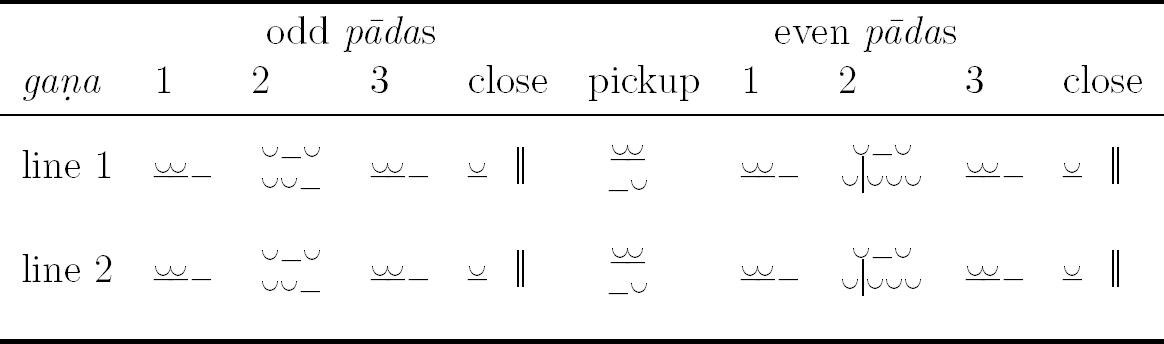
2.1.2 Though a detailed discussion of the old āryā is beyond the scope of this essay, a few points deserve mention. (1) In many cases we can point to ‘transitional forms’ between the old and classical āryā, viz. verses of which the pickup to the even pādas consists of a full four mātrās (i.e., a complete gaṇa), or verses with one line composed according to the old and one according the classical schema. (2) Especially in the Pali texts, there is a tendency for pādas of the āryā—both the old and classical varieties—to combine with pādas of the śloka, no doubt because the sequence __⏑_⏑___ could be analysed as either an āryā- or a śloka-pāda. Some of the apparent ‘instability’ of the old āryā is due to the transmission of the texts, but some is original (hence Smith 1949–1950 recognized the mixed āryā-vaktra as a separate metre). Randle (I960) attributed this instability, probably correctly, to ambiguity of metrical analysis: the old āryā was in some respects a syllabic metre (it tolerated less variation in syllabic shapes per gana than the classical āryā, as shown by comparison of the schemata in examples 15.1 and 15.3) and in others a mātrā-based metre (its gaṇas are defined in terms of mātrās, and hence in certain positions _ alternates with ⏑⏑). This structural instability might help to explain the fact that the metre is only found in the older parts of the Svetāmbara and Theravāda canons—hence only in Ardhamāgadhī and Pali—and therefore, according to Norman (1987: 206), in texts which ‘were probably composed in the Magadha region’. Norman argues that the old āryā was a transitional metre and had fallen out of favor already by the time of the Ardhamāgadhī and Pali texts.
2.1.3 The rest of Norman’s argument is worth summarizing, because it is the most recent and most detailed contribution to the history of the āryā metre. Observing that the classical āryā also appears in older texts of the Svetāmbara and Theravāda canons, he infers that this metre had already reached Magadha (from a putative western region of metrical experimentation) by the 4th c. BCE. He speculates that the Jains, who remained in India, continued to use it, while the Buddhists lost the knowledge of composing in classical āryās as well when they moved to Sri Lanka. Like Jacobi (1884) and Warder (1967), Norman maintains that the old āryā developed from mātrāchandas metres, which count mātrās towards the beginning of the line and syllables towards the end. But he also adduces the veḍha (veṣṭaka in Sanskrit), a metre used in descriptive passages (varṇakas) in Ardhamāgadhī, Pali, and Buddhist Hybrid Sanskrit: this metre consists of any even number of gaṇas—usually four or eight—with the differentiation between odd and even gaṇas characteristic of other gaṇacchandas metres, though in the case of the veḍha it is the odd gaṇas which take the shape ⏑_⏑. Together, the mātrāchandas metres, the gaṇacchandas metres, and the veḍha constitute a variety of ‘popular’ metrical practice based on the commensurability of ⏑⏑ and _, and in the case of the latter two, on gaṇas. Norman is willing to admit some Dravidian influence for this ‘popular’ metrical practice, but his acceptance of the Jacobi-Warder theory of how the gaṇacchandas metres developed within Old and Middle Indic amounts to a rejection of Hart’s (1975) theory that Dravidian metres were their direct ancestors. Most interestingly, he suggests that these ‘popular’ metres were developed by ‘travelling folk musicians’ (210) in an area between Maharashtra and Magadha who brought them to both areas; some such metres, like the old āryā, never quite caught on, while others, like the classical āryā, became especially popular in certain areas. Norman suggests that Buddhists and Jains adopted these metres precisely because they were ‘popular’.
2.1.4 For now I would like to focus on the characterization of the gaṇacchandas metres as ‘popular’. It seems to depend on (1) the characterization of Śramaṇical religions as ‘popular’ in opposition to Brahmānical exclusivity, since gaṇacchandas metres are reasonably frequent in Buddhist and Jain texts but are completely absent from Vedic texts; (2) the characterization of Prakrit poetry, represented by the Sattasaī, as ‘popular’, since in this literature gaṇacchandas metres dominate; (3) the notion that a new prosodic concept, the commensurability of ⏑⏑ and _, can only have been introduced through a ‘popular’ (in the sense of ‘indigenous’ or ‘non-Indo-Aryan’) element. There is nothing extremely problematic in combining these three senses, but individually they are open to doubt. (1) might be too simplistic; (2) depends on a reading of Prakrit poetry which does not call its ‘popular’ self-presentation into question (in other words, there are plenty of reasons to doubt that Prakrit poetry was produced by villagers on the shores of the Godāvarī river who were ignorant of Sanskrit); (3) is false, in my view, since commensurability may well have arisen from within Indo-Aryan, and the similarities between the gaṇacchandas metres and Tamil metres such as the veṇpā are mostly superficial (Ollett 2012).
2.2.1 Outside of Pali and Ardhamāgadhī, the classical gaṇacchandas metres occur in Buddhist Hybrid Sanskrit (Smith 1949–1950) and in a number of technical genres in Sanskrit.[831] The earliest gaṇacchandas verses in Sanskrit are probably the śloka-vārttikas, verses which comment on the sūtras of Pāṇini, that Patañjali cites and discusses in his Vyākaraṇa-mahābhāṣya (2nd-1st c. BCE). Of 240 verses, around 40 are āryās, and one and a half are gītis (Kielhorn 1886). The following example (ad Aṣṭādhyāyī 1.4.51 akathitaṃ ca) is typical in that it is essentially a versified commentary rather than a mnemonic verse:
etena karmasaṃjñā sarvā siddhā bhavaty akathitena
tatrepsitasya kiṃ syāt prayojaṇaṃ karmasaṃjñāyāḥ
‘By this (rule) akathitaṃ (ca) every karman-designation can be justified. This being so, what purpose is served by the designation karma for the īpsita (object)?’ (Joshi and Roodbergen 1975: 226)
In philosophy, Nāgārjuna (2nd c. CE) also used the āryā in his Śūnyatāsaptati (Erb 1990: xxii; only extant in Tibetan translation), Vigrahavyāvartanī, and Pratītyasamutpādahṛdaya, and Īśvarakṛṣṇa (3rd-4th c. CE) used it for his Sāṃkhyakārikās. In astronomy, the āryā was used by Āryabhaṭa in his Āryabhaṭiya and by Varāhamihira in his Bṛhatsaṃhitā, both of the 6th c. CE. Smith (1949–1950) remarked that ‘L’āryā bouddhique, comme celle de Varāhamihira et d’Īśvarakṛṣṇa, est capable de loger tout terme (et toute forme) de la langue scientifique et religieuse dans ses 12, 13, 17, 18 ou 15 mores…’. Once the āryā was available, its flexibility made it a natural choice for technical literature; what is not clear, however, is how the āryā became available in the first place. It may have been introduced into technical discourses by Buddhists, who knew it from their canonical and non-canonical literatures. In any case, the Vyākaraṇa-mahābhāṣya shows relatively clearly that in its milieu—which was, among other things, Sanskritic—the āryā was a technical rather than a poetic metre: āryās make up 40 of 240 or one-sixth of the śloka-vārttikas, but none of the 41 poetic citations collected by Kielhorn (1885).
2.2.2 Gaṇacchandas metres are absent in the Rāmāyaṇa and Mahābhārata, but for a handful of late verses in the latter (Hopkins 1901: 354). They start to appear, however, in other types of poetry in the first centuries CE. In drama, their earliest occurrence is probably in a fragment of Aśvaghoṣa’s Sāriputraprakaraṇa (no. 8 in Lüders 1911): introduced by kiṃ khu dāni, it is spoken by a courtesan in a form of Prakrit, and could be the beginning of an āryā:
suradavimaddakkha[ma]…[832]
Enduring the tramplings of lovemaking…
Gaṇacchandas metres are also found in the Trivandrum plays of Bhāsa and the Mṛcchakaṭikā, and are favoured by Kālidāsa; in all of these texts, the metres are used for both Sanskrit and Prakrit. They also appear in inscriptional prasastis of the Gupta period (for example, the Mandasor inscription of Vatsabhatti).
2.2.3 The gaṇacchandas metres are, however, most strongly associated with Prakrit lyric and narrative poetry. The Sattasaī (also known as the Gāhākosa, or Gāthāsaptaśatī), an influential anthology of mostly erotic verses compiled by Hāla (also known as Sātavāhana) around the 2nd-3rd c. to 1st c., consists of seven hundred āryā (gāthā) verses. It was the model for Govardhana’s Āryāsaptaśatī (12th c.). Other early anthologies include Jayavallabha’s Vajjālagga (Prakrit, pre-10th c.), the Buddhist Āryākośa (pre-9th c., Sanskrit, and extant only in Tibetan translation and some quotations: cf. Hahn 1993a: 53–56), and the Chappaṇṇaagāhāa (mid-1st millennium: Balbir and Besnard 1992–1993). Narrative literature in Prakrit includes the Setubandha (also known as the Rāvaṇavaho) ascribed to Pravarasena, 5th c. (and in āryāgīti or skandhaka verses); the Gaüḍavaho of Vākpatirāja, 8th c.; the Līlāvaī of Koūhala, 8th c. In Sanskrit, the Kuṭṭanīmata of Dāmodara Gupta (8th c.) is, like the Gaüḍavaho and the Līlāvaī, written in āryās.
3.1.1 The metrical tradition is another source for the gaṇacchandas; it has not been effectively utilized in part because the relationship of texts within this tradition has only been partially set out (as in, e.g., Hahn 1971: 49), so some summary remarks on its history are in order. Piṅgala is certainly the starting-point for most authors in this tradition. But one of the implications of the modularity of Indian metrics mentioned above is that different components of a text might reflect different influences, and this is true of Piṅgala’s Chandaḥsūtras. The text is broadly divided into Vedic (2.1–4.7) and non-Vedic (4.8–8.35) sections. The Vedic section probably derives from the analysis of the Vedic śākhās, but in both sections Piṅgala quotes previous metrical authorities, which confirms the assumption that families of metres in different texts were subject to analysis at different times. The texts of these authorities no longer survive, but some are cited as late as the 10th c.[833] Thus, while the metrical tradition—especially the Paiṅgala tradition—tends to look back no further than Piṅgala’s synthetic text, elements prior to or independent of Piṅgala continue to appear.
3.1.2 The gaṇacchandas module of the tradition has been motivated in 1.4.1. Its specific content presents differences across texts which are not likely to be due to authorial preferences alone. This suggests that the authors had different ideas of what the gaṇacchandas module actually contained, which they in turn received from different stages of a tradition or even different traditions. Investigating the differences might help to establish the chronology of and relations between texts in the metrical tradition, and to relate the metrical tradition to actual practices of versification. This essay will draw some modest conclusions along these lines from the treatment of the gaṇacchandas, but I hope it will show that Indian metrics in general is deserving of a more detailed archaeology.
3.2.1 I start with Piṅgala. After beginning the section on non-Vedic metres, he introduces the term gaṇa (4.12–13) and begins defining the metres as follows (his trika-designations are boldfaced and glossed in the translation):
| 4.14 |
svarā ardhaṃ cāryārdham ‘Seven and a half (gaṇas constitutes the first) half of an āryā.’ |
| 4.15 |
atrāyuṅ na j ‘Of these (seven and a half gaṇas), the odd-numbered ones cannot be J (_).’ |
| 4.16 |
ṣaṣṭo j ‘The sixth (gana is) J (_).’ |
| 4.17 |
nlau vā ‘Or (the sixth gana is) NL ().’ |
| 4.18 |
nlau cet padaṃ dvitīyādi ‘If (the sixth gaṇa is NL ()), a word must start on the second syllable.’ |
| 4.19 |
saptamaḥ prathamādi ‘(If) the seventh (gana is NL ()), a word must start on the first syllable.’ |
| 4.20 |
antye pañcamaḥ ‘(If) the fifth (gaṇa) in the latter half (of the āryā is NL (), a word must start on the first syllable).’ |
| 4.21 |
ṣaṣṭaś ca l ‘And (in the latter half of the āryā) the sixth (gaṇa) must be L ().’ |
| 4.22 |
triṣu gaṇeṣu padaḥ pathyadye ca ‘(If in the latter half of the āryā) as well as in the previous half, the first three gaṇas make a pāda, it is called pathyā.’ |
| 4.23 |
vipulānyā ‘Otherwise it is called vipulā.’ |
| 4.24 |
capalā dvitīyacaturthau gmadhye jau ‘It is called capalā if the second and fourth gaṇas are J (_) with a G (_) on either side.’ |
| 4.25 |
pūrve mukhacapalā ‘(If the conditions in 4.24 hold) in the first half, it is called mukhacapalā.’ |
| 4.26 |
jaghanacapaletaratra ‘(If the conditions in 4.24 hold) in the other half, it is called jaghanacapalā.’ |
| 4.27 |
ubhayor mahācapalā ‘(If the conditions in 4.24 hold) in both halves, it is called mahācapalā.’ |
| 4.28 |
ādyardhasamā gītiḥ ‘The gīti is (a metre of which both halves are) the same as the first half (of the āryā).’ |
| 4.29 |
antyenopagītiḥ ‘The upagīti is (a metre of which both halves are the same) as the second half (of the āryā).’ |
| 4.30 |
utkrameṇodgītiḥ ‘The udgīti is (a metre of which the halves are) in reverse order (to that of the āryā).’ |
| 4.31 |
ardhe vasugaṇa āryāgītiḥ ‘If a half has eight (four-mātrā) gaṇas, it is āryāgīti.’ |
Sutras 14–21 define the basic form of the arya, which can be presented schematically in Table 15.3:
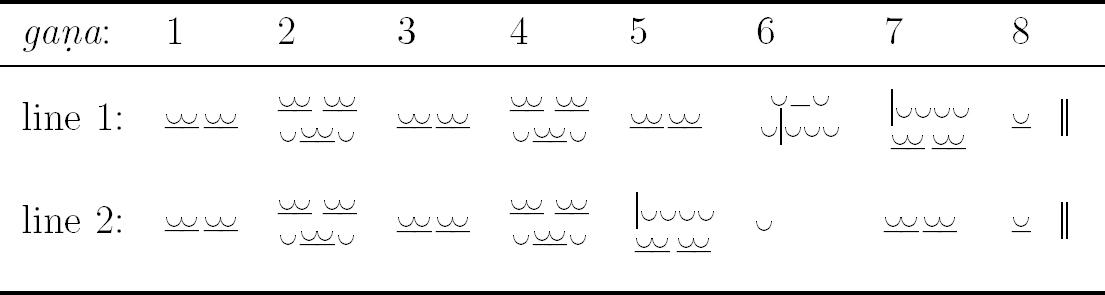
3.2.2 The āryā is the derivationally basic form. The other metres, however, share the element gīti in their names. Warder (1967: §203) took this to mean that the gīti was the ‘original metre from which the others evolved’, and since he quite reasonably sees the gīti as a continuation of the old āryā, this statement is borne out by the chronological precedence of the old āryā in Pali and Ardhamāgadhī texts. In partial agreement with Warder, I propose that the Paiṅgala terminology developed in several stages. In the first stage, the most common gaṇacchandas metre was a ‘balanced’ stanza consisting of two lines of the same length. At this stage it matters little whether we call this stanza an old āryā or a gīti. They differ only in that the gīti has been subject to Katametronisierung, a complete reanalysis of the old āryā’s pickups and closes in terms of gaṇas or parts of gaṇas.[834] Crucially, the reanalysis is cognitive: it reflects how versifiers and theorists would have thought about the metre. This means that any synchronic classification would have been blind to the distinction between the old āryā and the classical gīti. What distinctions might a synchronic classification have captured, then?
3.2.3 The individual metres treated in the Chandaḥśāstra differ in their stanzaic structure; any combination of ‘long’ lines and ‘short’ lines (i.e., lines with a full sixth gaṇa and lines with a single-mātrā sixth gaṇa) is licensed. In the pre-classical period, a stanza of two long lines (i.e., an old āryā) is most common; in the classical period, a long first and a short second line (an āryā) is overwhelmingly dominant. One might assume an intermediate stage in which lines of either type could be freely combined into stanzas. If the most common stanza-type was called the gīti, prefixes might have been an easy way of labelling the other types. Specifically, the prefixes used in the Paiṅgala tradition refer to the position of the short line—in udgīti, the short line is what is ‘on top’—and thus the Paiṅgala āryā might have originally been called something like the *avagīti. This scenario would put the gīti-names in the 4th or 5th c. BCE, since the āryā is already dominant in texts of the 3rd c. The word gīti, which means ‘song’ or ‘singing’, is probably the most directly-signifying name in the Paiṅgala tradition, which might be another argument in favor of an early date for this nomenclature.
3.2.4 At a later stage, when this *avagīti had become the standard form of the gaṇacchandas stanza, it was felt to be a fixed form rather than a particular stanzaic configuration of the gīti. And as a fixed form, it received its own name. The name āryā—the feminine form of the word for ‘noble’, hence probably ‘noble lady’—evokes lyric poetry, like the names for many other non-Vedic metres related in the Chandaḥsūtras. Probably the metre received this name around the same time as them, i.e. at the time that the discipline of metrics turned its attention to laukika literature. This ‘laukika turn’ occurred at least several generations before Piṅgala, in view of his citations of earlier authorities. The āryāgīti is a special case. It differs from the other metres in having a complete eighth gaṇa. Under an analysis similar to that of the old āryā, this would mean that the even pādas had an extra gaṇa instead of a monosyllabic close. It seems more likely that the āryāgīti arose only when Katametronisierung of the other metres had occurred, and thus when their final syllable was analysed as a half-gaṇa. In any case, it falls outside of the old gīti-system, and judging from its later use as a narrative metre (e.g. in the Setubandha), it, like the āryā, attained some popularity as a fixed form. When this metre was brought under analysis—which might have been at the same time as the āryā or afterwards—it received a name which reflected its similarity to the primary metre of the family (āryā); the gīti-element might come from the fact that both lines of the āryāgīti are equal, like the gīti, or simply from the fact that the names of the other metres of the family contain this element.
3.2.5 Piṅgala thus knew a metre called the āryā and several similar metres with names based on the word gīti. His Chandaḥsūtras treat the āryā as derivationally basic because by his time it had already become the most common gaṇacchandas metre, but perhaps also because it included both types of lines and therefore made the derivation more economical: starting from the gīti or upagīti would only provide a model for long or short lines, respectively, and the other type would have had to be introduced in the discussion of another form.
3.2.6 A characteristic feature of Piṅgala’s analysis is his use of metrical ‘subvarieties’: a metre that fits a structural description might receive a certain name, but it can receive other names if it fits more specific descriptions. The gaṇacchandas metres are necessarily either pathyā or vipulā, and optionally either mukhacapalā, jaghanacapalā, or mahācapalā. Piṅgala also uses the terms pathyā, vipulā, and capalā in his discussion of the vaktra (i.e., the anuṣṭubh śloka), where they refer to different syllabic configurations at the end of each pāda (cf. Steiner 1996). With reference to the gaṇacchandas metres, the terms pathyā and vipulā refer not to syllabic configurations but to the presence and absence, respectively, of a word-break after the third gaṇa. The sense of the terms, however, is the same: the pathyā is the ‘normal’ form, and the vipulā is an ‘extension’ (adapting the terminology of Hahn apud Steiner 1996: 228). These meanings are suggested by the words themselves and by the fact that the pathyā form dominates in all texts where the distinction is possible (i.e., excluding old āryās). The idea that a form may deviate from the ‘normal’ pattern but still be metrical is quite original: I know of nothing similar in the Greco-Latin metrical tradition, but it bears some similarity to the idea of ‘gradient metricality’ in modern statistical and generative metrics (e.g. Hayes 2010). Interestingly, Piṅgala does not distinguish between verses that are vipulā in their first, second, or both halves, though Halāyudha and later writers do. The fact that Piṅgala relates different opinions about the application of the term pathyā in 5.15 guarantees that the use of the terms pathyā and vipulā predate him, although he may have been the first to apply them to the āryā.
3.2.7 The wording of sūtra 4.22 was a matter of some consternation: it says that the name pathyā applies when the first three gaṇas constitute a pāda. This might be taken to mean that pathyā verses have four pādas, while vipulā verses have only two (so Velankar on p. 45 of his edition of the Ratnamañjūṣā). This would entail a violation of the de facto principle that pāda-structure hierarchically characterizes metres, or more accurately families of metres, such that subvarieties of a metre inherit the pāda-structure of that metre. But this is precisely the descriptive crux: How can we assign structure to a metre on the basis of one of its subvarieties? Mitra (1989: 294–295) argued that Sanskrit metrical texts considered the āryā a two-pāda metre, while Prakrit texts considered it a four-pāda metre. If this were true, it would mean that Sanskrit texts ignored the major break of the pathyā in order to make their definition of the āryā as inclusive as possible, and that Prakrit texts took the major break of the pathyā to be representative of the āryā in general. But this does not seem to be the case. Some Prakrit texts (the Chandaḥkośa and the Kavidarpaṇa) explicitly mention four pādas, and all divide it into four groups of mātrās, but nowhere is the āryā explicitly described as consisting of only two pādas. It is always described as consisting of two parts or halves (dala, ardha), but these units cannot be equated with pādas, since even texts which recognize four pādas still refer to the two halves. I submit that Piṅgala viewed the āryā, and hence the other gaṇacchandas metres, as consisting of four pādas in accordance with Chandaḥśāstra 4.10 pādaś caturbhāgah ‘the pāda is a fourfold division’. Since pādas are marked by word-breaks, specifying a pāda-boundary at the end of the third gaṇa in the pathyā variety has the effect of fixing a word-break in that position, which is why Halāyudha ad loc. says pādagrahaṇaṃ yatyupalakṣaṇārtham, ‘the word pāda is used to indicate word-break (yati)’. The vipulā is then defined as a verse in which a pāda-boundary does not coincide with the end of the third gaṇa. In other words, in the general schema of the āryā, there were four pādas; the boundaries between odd and even pādas, however, were not fixed. The tendency for such a boundary to occur at the end of the third gaṇa was expressed by specifying a normative subvariety with this property.
3.2.8 This schema implies a ‘floating’ pāda-boundary in the vipulā form. If we start from the assumption that pāda-boundaries are (1) fixed, (2) marked by word-break, and (3) marked by heaviness of the preceding syllable whatever the weight assigned by the general rules of syllabification, the structural articulations of the āryā hardly resemble pādas: the pathyā āryā violates (3), and the vipulā āryā potentially violates (1) and (2) in addition. But the pāda-boundaries of the old āryā fulfill all three requirements. In 3.2.2 the difference between the old āryā and classical gīti was framed in terms of gaṇa-structure alone; the gīti could therefore reflect the pādastructure of the old āryā. Alternation between the old pāda-structure and the pathyā form, and a diachronic tendency towards the latter, has been noted in Pali texts by Warder (1967: §232). Informally, one might say that the weakly-marked pāda-structure of the classical āryā is due to the fact that Katametronisierung, the imposition of gaṇa-structure throughout the line, has made the line (the ‘half’) a more structurally significant unit than the pāda. There are, however, indications that the pāda remained structurally significant, at least in the earlier history of its literary deployment and its theoretical description.
3.2.9 Sūtra 6.1 defines yati as viccheda, ‘break’, and it is commonly understood as ‘word-break’ or ‘caesura’. But Pollock (1977: 43) noted that Piṅgala does not use the term yati at all in his discussion of the gaṇacchandas and suggested that, in the Chandaḥsūtras, yati in part serves to articulate structural units smaller than the pāda. Piṅgala’s avoidance of the term (followed by the Ratnamañjūṣā and Jayadeva, and Jayadeva by Kedārabhaṭṭa) suggests that he was concerned with a ‘structural’ description of the gaṇacchandas: for him, the pathyā and vipulā varieties differed primarily with respect to the location of the pāda-boundary; further, he probably wanted to maintain the general distinction between pādas and the smaller units articulated by yati. Other writers, for whom yati primarily signified ‘word-break’, were content to describe the pathyā form of the āryā using this term: these include Bharata, whose approach we have independent reason to consider more practical and less theoretical than Piṅgala’s, as well as Jayakīrti and, probably following him, Hemacandra.
3.2.10 Another argument in favor of ascribing structural significance to the word-break of the pathyā form revolves around Jacobi’s ‘law of vipulā’ (Jacobi 1886):
‘Wenn die Cäsur vor dem vierten Fusse fehlt, muss dieser ein Amphibrachys [⏑_⏑, AO] oder der gleichwerthige Proceleusmaticus mit Cäsur nach der ersten Kürze [⏑|⏑⏑⏑, AO] sein.’
Jacobi formulated this law, which significantly restricts the possibilities of word-break and syllabic structure in vipulā verses, for the Sattasaī. The fact that the law is observed relatively strictly in earlier texts and loosely in later texts might be taken to support Jacobi’s own view that the law is a relic of the old pāda-structure.[835] The problem with this interpretation is that Jacobi’s law does not categorically require a word-break in the fourth gaṇa of vipulā verses; it requires either ⏑_⏑ and ⏑|⏑⏑⏑, and the word-break of the latter is not an indication of pāda-structure but a feature which makes the two forms rhythmically equivalent. Jacobi’s law is therefore best considered as a rhythmic law. But its conditioning factors must be structural rather than rhythmic: word-break may be a rhythmic feature, but absence thereof hardly is; also, it is uniquely the absence of word-break after the third gaṇa that triggers the law, not after the first. (Absence of word-break after the fifth gaṇa is not probative, since the sixth gaṇa must have the form ⏑_⏑ or ⏑|⏑⏑⏑ anyway.) Thus Jacobi’s law generally supports Piṅgala’s view that the āryā was made up of four pādas.
3.2.11 Jacobi’s law went unnoticed by the entire Indian metrical tradition, probably because it applied to vipulā forms, which were marginal to begin with and became even more marginal as time went on (the Sattasaī contains many times more vipulā verses than its imitation, the Āryāsaptaśatī). But the vipulā form is never entirely absent (except in Bhāsa’s plays, perhaps accidentally), and hence the requirement that the target-text of the analysis which produced the pathyā/vipulā distinction shows variation between these two subvarieties brings us no closer to a dating of this analysis.
3.2.12 The other subvarieties enumerated by Piṅgala are the mukha-, antya-, and mahācapalā. Like the corresponding subvariety of the vaktra (5.16), these subvarieties refer to specific configurations of syllables. But as Cappeller (1872: 74) already noted, the capalā forms of gaṇacchandas verses are rare in actual practice: the fact that two capalā lines almost never combine to form a mahācapalā even suggests that their occurrence is due to chance. In view of the more pronounced rhythmic alternation of the old āryā, it is possible that the capalā forms were better represented in earlier literature not now extant, but this is quite unlikely.[836] Why, then, would anyone single out this particular syllabic configuration as a subvariety? Cappeller suggested that it was because the capalā represented what today we might call the ‘underlying form’ of the metre, which could be realized as any number of ‘surface forms’ (specifically, 81,920,000 in the case of the āryā: a fact noted in Gāthālakṣaṇa 51 and Kavidarpaṇa 2.6). He had already posited a similar ‘underlying form’ on the model of Greco-Latin metres, for which he took the capalā form as confirmation. Compare a line of Cappeller’s schema (15.5) with a capalā line (15.4):
Table 15.4:

Table 15.5:

3.2.13 Cappeller was correct in assigning the capalā forms a structural function, but I think that its function was not exactly a derivational template on the Greco-Latin model. A principle of rhythmic alternation is enforced in the exclusion of syncopated rhythms from the odd gaṇas. But an unsyncopated rhythm in the even gaṇas does not make a verse unmetrical (except in the sixth gana, and in the fourth gaṇa of vipulā verses, by Jacobi’s law): a definition which merely excluded syncopated rhythms from odd gaṇas would be surface-true, but it would leave unstated the principle of alternation which motivates this very exclusion. That is why the capalā forms are introduced: in these ideal patterns, the alternation between unsyncopated and syncopated rhythms in the odd and even gaṇas is made explicit by setting the even gaṇas as ⏑_⏑ and flanking them with heavy syllables. In embodying this alternation, the capalā forms arguably indicate a distinct metrical constituent, composed of an odd and even gaṇa in sequence, which is the domain of rhythmic alternation. (Two other pieces of evidence for an awareness of such a constituent can be found: the first is in the Kavidarpaṇa-ṭīkā, of which verse 5, on Kavidarpaṇa 2.8, distinguishes four subvarieties of gāthā named gādḍhā, agāḍhagāḍhā, daragāḍhā, and saralagādhā, which are composed of the units __⏑_⏑, ⏑⏑_⏑_⏑, _⏑⏑⏑_⏑, and ⏑⏑⏑⏑⏑_⏑ respectively; the second are the ‘extensions’ to the gāthā discussed in 3.7.6, which extend the first line by an odd followed by an even gaṇa.) The names of the forms have an erotic double-meaning (mukhacapalā is both ‘modulating in the front’ and ‘talkative’; jaghanacapalā both ‘modulating in the back’ and ‘with swaying hips’), which suggest they, like the name āryā, come from an analysis for which lyric poetry was the primary target-text. It is much less clear why Piṅgala distinguishes three types of capalā if these forms only existed to imply certain structural details about the metre.
3.2.14 The last important part of Piṅgala’s analysis is his specification of places in the verse where a word must begin, conditional upon certain syllabic configurations. These are ostensibly word-break rules (hence they are called yati in Chandoratnākara 5.4), but because they depend on certain syllabic configurations, they have somewhat of a different status than unconditionally obligatory word-breaks or even the major word-break of the pathyā; hence it is not a surprise that Piṅgala does not use the term yati for them. Cappeller referred to them as ‘Nebencäsuren’, again on the model of Greco-Latin metrics. Their purpose, informally stated, seems to be the maintenance of the gaṇa’s rhythmic qualities. A sequence of light syllables is generally rhythmically ambiguous: ⏑⏑⏑⏑ might be parsed as ⏑(⏑⏑)⏑ or as (⏑⏑) (⏑⏑); the first parse is rhythmically equivalent to ⏑_⏑, and the second to ⏑⏑ ⏑⏑. Word-break, however, can decide in favor of one or the other parse. Thus where a ‘syncopated’ rhythm is structurally required (i.e. in the sixth gaṇa), ⏑⏑⏑⏑ must have a word-break after the first light syllable in order to rule out the parse (⏑⏑)(⏑⏑). The parse (⏑⏑)(⏑⏑) seems to have been the ‘default’ parse for the sequence ⏑⏑⏑⏑, which explains why the assistance of a word-break before the first light syllable is only required in two locations: in the seventh gaṇa of the first line and the fifth gaṇa of the second (i.e., precisely those locations where the following syllable does not belong to a complete gaṇa and therefore might affect the parse of the preceding light syllables). See Ollett (2012) for a detailed analysis of these patterns.
3.2.15 Poets had other ways of enforcing certain rhythms (e.g., by proscribing word-break in certain positions), but these went unnoticed in the metrical tradition. The identification of these ‘Nebencäsuren’, however, is remarkable and unique (Pollock 1977: 61 even claimed that Indian metrists had not noticed any ‘Nebencäsuren’). Two points about their position in the metrical discourse must be made: (1) they are discussed in all Sanskrit metrical texts (excluding those whose discussion of the gaṇacchandas is obviously based on Prakrit texts, such as the Vāṇībhūṣaṇa and presumably the Chandaḥśekhara), but no Prakrit metrical texts; (2) they ought to have been present in the target-text. A preliminary survey of the literature shows that the seventh gaṇa almost never consists entirely of light syllables in most early texts (Nāgārjuna, Iśvarakṛṣṇa, Kālidāsa, Bhāsa, the Sattasaī), but in the Āryāsaptaśatī such a pattern is roughly as common in the seventh as it is in the other odd gaṇas. The rules of the Chandaḥsūtras seem to presuppose a practice in which seventh gaṇas could consist of four light syllables, but no contemporary text seems to fit this description.
3.3 Other texts of the Sanskrit metrical tradition present the same analysis of the gaṇacchandas metres as Piṅgala in content; the form of the analysis, of course, differs (including its presentation in sūtras or ślokas, the choice of terminology and symbols, etc.). The main exception is the Jānāśrayī. This work presents the āryā, gīti and āryāgīti, but it calls the upagīti the vāmanikā (5.39), defines the dhruvā as a gīti with a word-break after the fourth gaṇa (5.41), and adds a gītikā (5.42), which is a gīti with ⏑⏑⏑_ or _⏑_ in its seventh gaṇa. After this, it defines a number of other metres which are ‘current among the people’ (5.45 loke pracarantyaḥ): though based on gaṇas, these are different from the āryā -type metres, but similar to Prakrit and Apabhraṃśa metres. The author of the Jānāśrayī evidently wanted to update and extend the gaṇacchandas module by incorporating some popular names and variants. The sources on which he drew, however, do not seem to belong to the Prakrit tradition discussed below; this tradition knows the gītikā, but does not call the upagīti the vāmanikā.
3.4 Ratnamañjūṣā 2.16, which appears to also extend the gaṇacchandas module by including the galatika metre, is an interpolation (Tripathi 1977: §3.3). The text, however, is a good example of the modularity of Indian metrics, since it draws example-verses from an earlier text (the Turfan Chandoviciti, which Tripathi 1977 has called the Sāmudrika-chandoviciti) but only for certain kinds of metres. Its Jain author apparently composed his own examples for the gaṇacchandas metres. Verses from the Sāmudrikachandoviciti, however, have found their way into the Nāṭyaśāstra’s section on the gaṇacchandas.
3.5.1 The Nāṭyaśāstra’s text is famously jumbled and corrupt, and the section on metre is no exception. Since it largely follows the Paiṅgala analysis of the gaṇacchandas, it would not merit discussion here at all, but scholars have drawn different conclusions about its position in the metrical discourse, which in turn bear on the history of the gaṇacchandas module. Jacobi (1933) concluded that Bharata’s analysis must be more recent than Piṅgala’s, because Bharata uses the trika-symbols which Piṅgala is supposed to have invented. But Bharata may have used Piṅgala for some sections, and cited other, possibly older authorities for other sections. Further, Abhinavagupta suggests that the trika-symbols have been introduced into the Nāṭyaśāstra secondarily.[837] The gaṇacchandas section has been suspected of being an interpolation, either in whole (Ghosh) or in part (Kavi), primarily on the grounds that the details given therein are irrelevant, in varying degrees, to the composition of verses for plays. The example-verses are also absent in some manuscripts (e.g. the one from which Regnaud prepared his edition of the metrical portions of the Nāṭyaśāstra in 1880). But Schlingloff (1958) has argued that Bharata relied on the Sāmudrika-chandoviciti for both its organization and for its example-verses, which indicate the name of the metre by way of mudrālaṃkāra.
3.5.2 After Bharata says (15.193–194)[838] that certain metres are only to be used in songs, he proposes (15.195–197) to discuss the āryās (referring to the āryā and its subvarieties, not to the other gaṇacchandas metres). But the following discussion is somewhat of a mess. It starts without a clear definition of the āryā; half-verses are rearranged and repeated; verses from a probably-interpolated section of prastāra interrupt the exposition; information is repeated in different words. What is clear is that this discussion contains (1) the rules of Piṅgala, expressed in the form of ślokas, regarding the āryā, and (2) example-verses similar to those found in the Turfan text.[839] Less likely to be original are (3) a rule expressed in āryā (212), which is redundant with a śloka-rule (220), and (4) rules regarding prastāra, or calculation of syllables, which are neither found in Piṅgala nor relevant for Bharata’s expository purposes. (1) and (2) can be understood on the assumption that Bharata decided to relate what had already become by his time the traditional rules for the formation of the āryā, and exemplify those rules by citing a text which conveniently ‘labelled’ each metre through mudrā. He might have limited himself to the āryā because it had already become the only gaṇacchandas metre in common use. (3) is probably due to interference from a text that used the lakṣya-lakṣana method. (4) is likely to come from a text of the Prakrit tradition, as discussed below, though the slokas are in Sanskrit. The source for this content is perhaps the Gāthālakṣaṣa, one verse of which (4, on Prakrit phonology) has made its way verbatim into the Nāṭyaśāstra (Nitti-Dolci 1972 [1938]: 72).
3.6 Two other Sanskrit authors who have been influenced by the Prakrit tradition regarding the gaṇacchandas are Jayakīrti and Hemacandra. Though both relate the Paiṅgala rules, they use some of the Prakrit names, as shown below. Jayakīrti had a relatively wide outlook—he is notable for defining Kannada metres alongside Sanskrit metres (the first work of Kannada metrics in Kannada, the Chandombudhi of Nāgavarman, is roughly contemporaneous)—which could explain why his account of the gaṇacchandas is somewhat synthetic of both Sanskrit and Prakrit traditions. Hemacandra envisaged his work as a complete synthesis of Prakrit and Sanskrit metrics. It is perhaps not a coincidence that both authors were Jains, since Jains participated in the Sanskrit tradition but were also critically engaged in the Prakrit and Apabhraṃśa traditions. Two other texts are written in Sanskrit but adapt their treatment of the gaṇacchandas from Prakrit texts: as mentioned in 1.2.4, the Chandaḥśekhara follows the Svayambhūchandas, and the Vāṇībhūṣaṇa probably follows the Prākṛtapiṅgala or a similar text.
3.7.1 The first difference to note between the Sanskrit and Prakrit traditions is their terminology. The difference was already in place by the 6th c., since Varāhamihira refers to it in Bṛhatsaṃhitā 103.54:
sūryasuto ’rkaphalasamaś candrasutaś
chandataḥ samanuyāti yathā
skandhakam āryāgītir vaitālīyaṃ ca
māgadhī gāthāryām
‘Just as Saturn has the same effects as the Sun, and Mercury follows at the will (of its coplanet), so the āryāgīti (follows) the skandhaka, the māgadhī (follows) the vaitālīya, the gāthā (follows) the āryā.’
The parallelism is systematic, i.e. it applies not to one or two metres, but throughout the gaṇacchandas module. The names given for the individual metres are given below (Table 15.6) in Sanskrit form (excluding the Jānāśrayī, discussed in 3.3).
The Paiṅgala nomenclature was discussed in 3.2.2–4. The nomenclature in Prakrit texts presents some variety, but of a transparent kind: each text relates some of the Paiṅgala names, based on the word gīti, and some non-Paiṅgala names, based on the word gāthā (except for the skandhaka). The exception is Nanditāḍhya’s Gāthālakṣaṇa, which only relates the non-Paiṅgala names. The most likely explanation is that Nanditāḍhya relates the original Prakrit names, which other authors have changed in varying degrees under influence from the Paiṅgala tradition, moving from right to left on the table. This would entail giving Nanditāḍhya priority in the Prakrit discourse, in time, in influence, and in independence from the Sanskrit discourse. There are several reasons for granting him this priority anyway. (1) Unlike Virahāṅka and the Prākṛtapiṅgala, Nanditāḍhya does not appeal to the authority of Piṅgala. (2) Nanditāḍhya’s concern was specifically with the Prakrit discourse, as indicated by his mention of pāiyakavva in verse 2 and his contempt of Apabhraṃśa in verse 31. (3) Nanditāḍhya discusses only the gāthā and its varieties, which, as noted in 2.2.3, is the Prakrit metre par excellence and the most common metre of Jain texts. (4) Nanditāḍhya is quoted in a number of other works, such as Hemacandra’s Chandonuśāsana, the Prākṛtapiṅgala, and even the Nāṭyaśāstra. Nanditāḍhya’s Jainism, evident in his maṅgalācaraṇa and example-verses, might constitute another reason for his non-engagement with the Sanskrit metrical discourse, but only if he lived at a time when this discourse was still largely Brahmānical, i.e. before Jayadeva and the Ratnamañjūṛā established the Jains as major contributors to the Sanskrit metrical discourse. If such is the case, Nanditāḍhya might have written around the 5th c. CE.
3.7.2 Nanditāḍhya, however, almost certainly did not invent the Prakrit names for the metres. Gāthā, which like gīti derives from the root √gai ‘sing’, is a generic term for a verse or a composition in verse; the Chandaḥsūtras (in a sūtra that is, however, certainly later than Piṅgala: cf. Weber 1863) refer to any metre not defined in the text as gāthā (8.1 atrānuktaṃ gāthā). Its Avestan cognate gāθā refers to the metrical compositions of Zarathushtra; in the later Vedic period gāthā refers to verses (mostly slokas) which are not affiliated with a particular Vedic text (Horsch 1966); in Pali gāthā refers to the songs—some in the old āryā or āryā metre—of Buddhist monks and nuns; in Prakrit gāthā refers to verses in this metre such as those of the Sattasaī (also, and probably originally, known as the Gāhākosa: cf. Mirashi I960); its Tamil version, kātai, refers to a poetic composition or a chapter of a longer composition.[840] The use of the word gāthā as the name of a particular metre is probably due to a semantic development of VERSE > VERSE-FORM. This development almost certainly took place in a Prakrit discourse, but further specificity is possible. Virahāṅka refers (2.8–9) to Bhuaāhiva (Bhujagādhipa), Sālāhaṇa (Sātavāhana), and Buḍḍhakaï (Vṛddhakavi or Harivṛddha) as metrical authorities.[841] Sātavāhana—also cited as an authority on Prakrit lexicography in Hemacandra’s Deśīnāmamālā—is probably identical with the editor of the Sattasaī, under the biruda or nom-de-plume of Hāla. The fact that nearly all of the verses in the Sattasaī are gāthās implies that the editor had metrical criteria for inclusion.[842] If he can be credited with establishing a Prakrit metrical discourse, his first task would have been the naming and description of the primary Prakrit metre. The term skandhaka is somewhat more difficult to explain. Its meaning (‘aggregate’, ‘grouping’) fits with its use as a kind of composition in Prakrit—narrative poems such as the Setubandha—from which a semantic shift similar to the one posited for the gāthā is possible (COMPOSITION > COMPOSITIONAL FORM).[843] It seems to have been more important in the Prakrit analysis than the āryāgīti was in the Paiṅgala analysis, since Virahāṅka devotes roughly equal attention to the gāthā and skandhaka, and since Svayambhū uniquely treats the skandhaka as the derivationally basic metre.
Table 15.6:
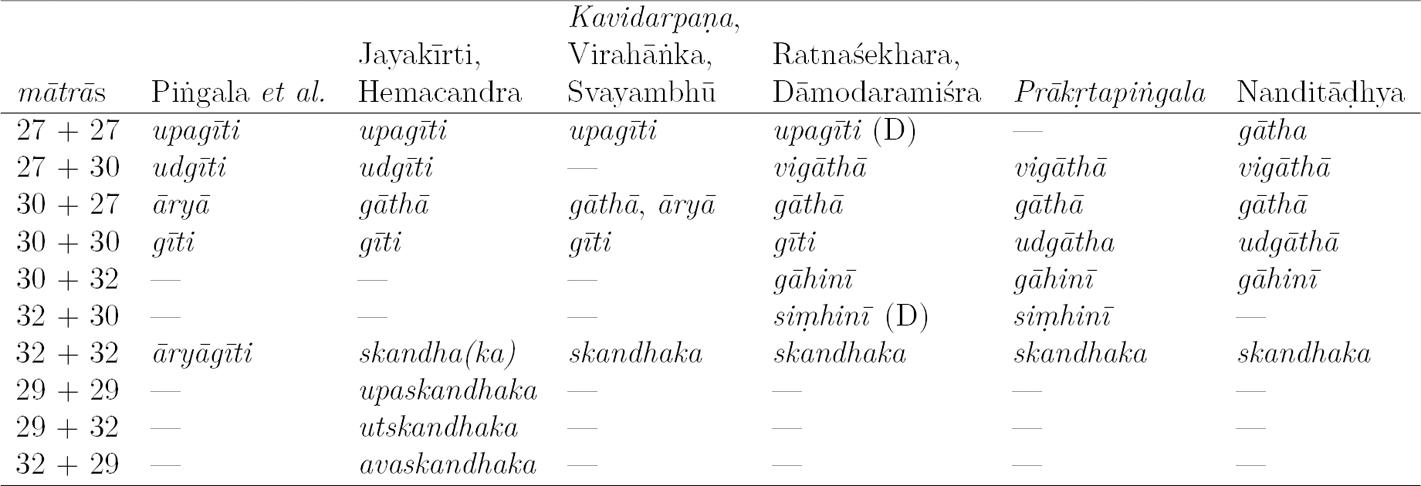
3.7.3 Mitra (1989: 295) noted that Sanskrit texts define the metre first in terms of gaṇas, while Prakrit texts tend to specify the number of mātrās in each pāda before anything else (e.g. Gāthālakṣaṇa 6, Prākṛtapiṅgala 1.54). Ganas are indispensible for the analysis of any gaṇacchandas metre, and are common to both Sanskrit and Prakrit texts, but the mātrā-specification is unique to Prakrit texts (excluding the verses of the Nāṭyaśāstra mentioned in 3.5.2). Implicit in the mātrā-specification is the recognition of four pādas. From a practical point of view, this mātrā -specification is unnecessary, since the number of mātrās can be derived from the number of gaṇas, which are far more important to the structure of the metre. But concern for the ‘theory’ of the metre, its numerical properties and possibilities, is characteristic of the Prakrit discourse. Unique to and common within Prakrit texts is the prastāra of the gāthā, an enumeration of the possible combinations of light and heavy syllables, in which every possibility is assigned a name. The Gāthālakṣaṇa additionally assigns each possibility in the prastāra a number (the number of light syllables less one divided by two) and a corresponding nakṣatra-name (53–55). The number of configurations is different across texts, but 26, the number related by Nanditāḍhya and Ratnaśekhara, is correct, and permits a close mapping of the different configurations to the 27 nakṣatras. The assumption that Virahāṅka’s prastāra is incorrect is supported by the observation that his prastāra of the skandhaka is also inaccurate (cf. Velankar’s note ad 4.9–12).[844]
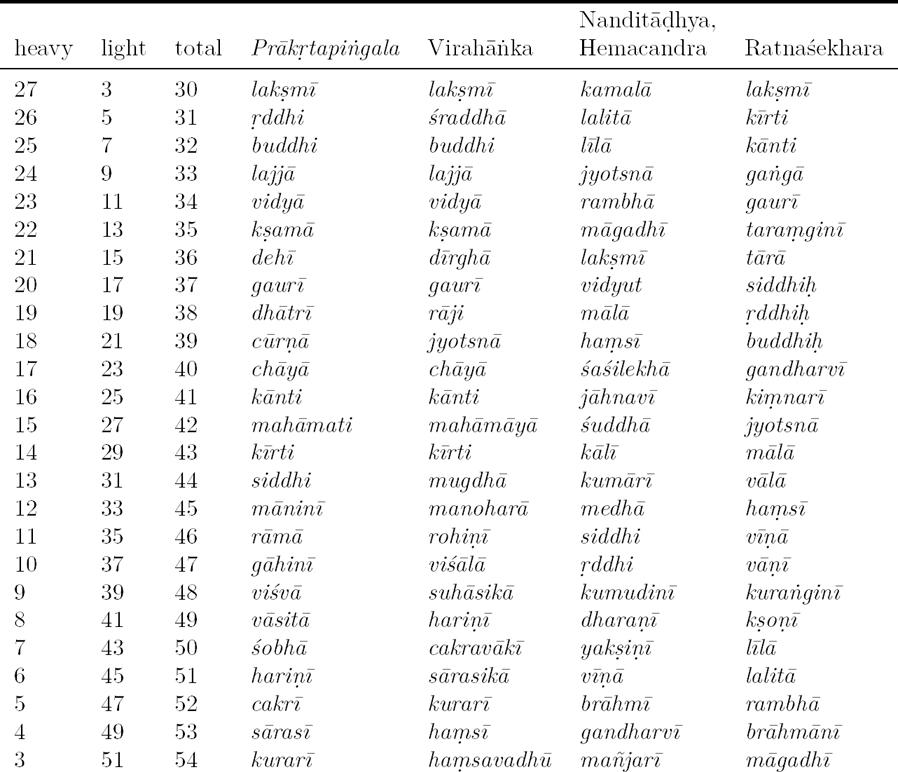

If these varieties are merely theoretical configurations, it is not clear why they should be assigned names. Cappeller had the idea that the prastāra had axiological significance: the greater the number of heavy syllables, the more beautiful the verse was supposed to be. He adduced Prākṛtapiṅgala 1.58:
sattāīsā hārā sallā jassamṃi tiṇṇi rehāĩ /
sā gāhāṇaṃ gāhā āā tīsakkharā lacchi //
The first gāthā of the gāthās is the lakṣmī with thirty syllables, in which there are twenty-seven praiseworthy heavy syllables and three light syllables.
If theorists considered heavy syllables ‘praiseworthy’ (salla), Cappeller could explain the prevalence of the rhythm __ even in the even gaṇas, which were fixed as ⏑_⏑ on his ‘underlying’ schema, as due to these general rhythmic preferences. While the Prākṛtapiṅgala, a 14th-c. compilation, is itself too late to have influenced any of the texts Cappeller discussed in Die Gaṇachandas, the preference for heavy syllables may be much older. I am unwilling, however, to assign much significance to this passage of the Prākṛtapiṅgala, since the occurrence of heavy syllables is likely to be due to the high proportion of heavy to light syllables in the Prakrit language (in a 3000-word sample of the Āyāraṅga, 64% of the syllables are heavy; compare 46% for the Sattasaī). The Prakrit metrical tradition places a value on heavy syllables, but such a value is difficult to motivate on the basis of Prakrit versification. It seems, rather, that this value was purely notional, based on the fact that heavy syllables were ‘worth’ twice as many mātrās as light syllables.
3.7.4 The notion that heavy syllables are preferable to light syllables finds expression in other passages: Gāthālakṣaṇa 33 mentions the vippī, khattiṇī, vaïsī, and suddī (viprā, kṣatriyā, vaiśyā, and śūdrā): on this axiological scale are mapped, respectively, a gāthā with both lines maximally heavy, a gāthā with the first line maximally heavy and the second maximally light, a gāthā with the first line maximally light and the second maximally heavy, and a gāthā with both lines maximally light. The Prākṛtapiṅgala (1.64), somewhat obscurely, assigns these names to gāthās of 13, 21, 27 and more (?) light syllables, respectively. Nanditāḍhya, a Jain, could hardly be the originator of this distinction, which lends support to the idea that the core of the Prakrit gaṇacchandas module comes from a Brahmanical milieu. The varṇa-varieties are certainly not common in literature, and they actually neutralize the characteristic alternating rhythms of the gāthā. But like the prastāra-varieties, they are constructs illustrative of the metre’s possibilities, except that here precise configurations of syllables are on display.
3.7.5 Other purely theoretical explorations of the possibilities of the gāthā include Prākṛtapiṅgala 1.63, which puns on the use of nāyaka as a metrical symbol for ⏑_⏑ by saying that a gāthā with one such pattern is a faithful woman (kulamaṃtī); with two, a remarried widow (saṃgahinī); with none, a whore (raṃḍā); and with many, a prostitute (vesā). The remarks of the Kavidarpaṇa-ṭīkā on gāḍhā or ‘compact’ subvarieties have been mentioned above (3.2.13). Since these distinctions are isolated, they are likely to be late.
3.7.6 Svayambhū, Jayakīrti, and Hemacandra all recognize a number of ‘extensions’ to the gāthā, which are formed by adding 2n gaṇas (i.e., an odd followed by an even gaṇa, multiplied n times) to the first line, and are named by prefixing ud-, vi-, ava-, sam-, and upa- to the term gātha (in Hemacandra also 1n, with the prefixes attached to the term dāma). An arbitrarily long extension of the gāthā goes by the name mālāgātha (mālādāma). Svayambhū and Jayakīrti do not go in for the theoretical distinctions mentioned above, which suggests that they had a practical reason for including these ‘extensions’. Although the matter requires further investigation, I suggest that the metres described in this section are ‘hypermetres’ like the veḍha (2.1.3), and possibly used, like the vedha, for long descriptions (Hemacandra’s example-verses are praśastis).
3.7.7 The main characteristics of the gaṇacchandas module in Prakrit texts therefore include a definition in terms of mātrās, an elaborated prastāra and several other distinctions of theoretical interest, and names based on the words gāthā and skandhaka. Often elements of the Paiṅgala analysis are included as well, such as the definition of pathyā, vipulā, and capalā forms. But these elements were not associated specifically with Piṅgala: they are present, for example, in the Gāthālakṣaṇa, which makes no reference to Piṅgala, but absent in the Vṛttajātisamuccaya, which often refers to him. Interestingly, the ‘Nebencäsuren’ are never mentioned in Prakrit texts. The Prakrit analysis exhibits, in contrast to the Paiṅgala analysis, a preoccupation with the gāthā (and to a lesser extent, the skandhaka) as a way of relating and organizing light syllables, heavy syllables, and mātrās—as a matrix of prosodic calculation. It seems likely that this analysis was not conceived independently of the Paiṅgala (or pre-Paiṅgala) tradition, but as a competitor to it. This would account for its pretensions to exhaustivity in its various subdividisions, and also its assignment of names to each prastāra-variant: inflating its inventory of metres might have been one way of rivalling the rich metrical inventory of the Sanskrit tradition. I suggested (3.7.2) that Sātavāhana may be responsible for the basic Prakrit analysis, not simply to pick out a πρῶτος εὑρέτης for the tradition, but because the attempt to give Prakrit metrics a distinct character, which is undermined by the normativity of Piṅgala in later Prakrit texts, might plausibly be assigned to the person who defined Prakrit literary culture through his poetic, scholarly, and editorial efforts.
4 I thus propose the following line of development. The ‘core’ of the gaṇacchandas module dates back to the 4th c. BCE, and consists of a taxonomy of stanzaic forms: gīti, udgīti, upagīti, *avagīti. This taxonomy was probably used by poets; it was not incorporated into the discourse of Chandaḥśāstra until a century or so later, when Chandaḥśāstra turned its attention towards laukika literature. At this point, the *avagīti had become the standard gaṇacchandas metre (the old āryā having fallen into desuetude) and hence merited its own name, the āryā. The gaṇacchandas module now included a basic definition of the āryā, from which it derived the other gīti-metres. Later, but before Piṅgala, the terms pathyā, vipulā, and capalā were introduced. These are the only distinctions made in the Turfan (Sāmudrika) Chandoviciti, and the earliest Prakrit metrical writers probably were acquainted with this form of the gaṇacchandas module. Piṅgala completed his synthesis of metrics in the 1st c. BCE or CE, in which he astutely added rules for the āryā’s ‘Nebencäsuren’. Around the 1st c. CE, Prakrit authors—including Sātavāhana and Harivrddha—initiated a Prakrit metrical discourse, and formulated an analysis of the gaṇacchandas metres that differed, somewhat superficially, from the Sanskrit analysis that they knew. Some later authors in this Prakrit discourse were less concerned with maintaining their independence from the Sanskrit discourse, and drew on Piṅgala’s work to a greater or lesser extent. This story, parts of which are certainly speculative, should be considered a hypothesis: a history of the gaṇacchandas module, and the history of the Indian metrical tradition reflected therein, constructed from clues in the metrical texts themselves and subject to revision as new evidence (or better interpretations) becomes available.
Primary Texts (Metrics)
Bṛhatsaṃhitā of Varāhamihira: Kṛṣṇacandradvivedī (ed.) Bṛhatsaṃhitā Varāhamihirācāryaviracitā Bhaṭṭotpalavivṛttisahitā. Varanasi: Sampūrṇānanda-Saṃskṛta-Viśvavidyālaya, 1996. Sarasvatībhavana-granthamālā 97. Bhat, R. (ed.) Varāhamihira’s Bṛhatsaṃhitā. Delhi: Motilal Banarsidass, 1981–1982 (2 vols).
Chandaḥkośa of Ratnaśekhara: ed. in Schubring (1921) and as an appendix (pp. 54–61) to Velankar (1933) and pp. 99–110 in his 1962 edition of the Kavidarpaṇa.
Chandaḥśāstra of Piṅgala: Kedāranāth (ed.) Chandas Śāstra by Śrī Piñgalanāga with the Commentary Mṛtasasañjīvanī by Śrī Halāyudha Bhaṭṭa. Bombay: Nirṇaya Sāgar Press, Kāvyamālā no. 91, 1938. (Reprint of 1906 Nirnaya Sagar Press edition.)
Chandonuśāsana of Hemacandra: Velankar, H.D. (ed.) Chando’nuśāsana of Hemacandrasuri. Mumbai: Bharatiya Vidya Bhavan, 1961. Sutras and discussion in Velankar (1949).
Chandonuśāsana of Jayakīrti: see Velankar (1949).
Chandaḥśekhara of Rājaśekhara: see Svayambhūchandas.
Chandomañjari of Gaṅgādāsa: Bhaṭṭacharya, R. (ed.) Chandomañjari. Calcutta: Metropolitan Printing and Publication House, 1935.
Chandoratnākara of Ratnākaraśānti: Hahn, M. (ed) Ratnākaraśānti’s Chandoratnākara. Kathmandu: Nepal Research Centre, 1982.
Cāthāchandasrallakṣaṇa of Jinaprabhasūri: Appendix (pp. 182–184) of Part III of Velankar’s edition of the Kavidarpaṇa in ABORI and pp. 111–119 in his 1962 edition. See also Schubring (1923).
Gāthālakṣaṇa of Nanditāḍhya: Velankar, H.D. (ed.) ‘Gāthālakṣaṇa of Nanditāḍhya: A Treatise on Prakrit Metres.’ Annals of the Bhandarkar Oriental Research Institute 14 (1932–1933): 1–38, and pp. 87–98 in his 1962 edition of the Kavidarpaṇa.
Jānāśrayī Chandoviciti: Narayana Pillai, P.K. (ed.). Trivandrum: University Manuscripts Library, 1949. (A portion also edited in Velankar’s edition of Hemacandra’s Chandonuśāsana.)
Jayadevacchandas of Jayadeva: see Velankar (1949).
Kavidarpaṇa: Velankar, H.D. (ed.) ‘Kavidarpaṇam: A Prākrta Treatise on Metrics.’ Annals of the Bhandarkar Oriental Research Institute. Part I, 16 (1934–1935): 44–89; Part II, 17 (1935–1936): 37–60; Part III, 17 (1935–1936): 177–184. Velankar, H.D. (ed.) Kavidarpaṇa. Jodhpur: Rājasthān Prācyavidyā Pratiṣṭhān. Rājasthān Purātana Granthamālā no. 62, 1962.
Mṛtasaṃjmanī of Halāyudha: see Chandaḥśāstra.
Nāṭyaśāstra of Bharata: Nāṭyaśāstra of Bharata Muni, with the Commentary Abhinavabhāratī by Abhinavaguptācārya. Baroda: Oriental Institute. In 4 volumes: vol. 1 (4th ed. 1992) ed. by K. Krishnamoorthy, vol. 2 (2nd ed. 2001), vol. 3 (2nd ed. 2003), and vol. 4 (2nd ed. 2006) ed. by V. M. Kulkarni and T. Nandi. Gaekwad’s Oriental Series 36, 68, 124, and 145.
Ratnamañjūṣā: Velankar, H.D. (ed.) Ratnamañjūṣā with Bhāṣya. Mumbai: Bharatiya Jñānapīṭha. Jñānapīṭha Mūrtidevī Jain Granthamālā no. 5, 1949.
Prākṛtapiṅgala: Vyas, B.S. (ed.) Prākṛita-Paiṅgalaṃ (A Text on Prākrita and Apabhraṃśa Metres*). Varanasi: Prakrit Text Society, 1959.
Svayambhuchandas of Svayambhū: Velankar, H.D. (ed.) Svayambhucchandas. Jodhpur: Rajasthan Prācyavidyā Pratiṣṭhān. Rajasthan Purātana Granthamālā no. 37, 1962. (With a fragment of Rājaśekhara’s Chandaḥśekhara.)
Suvṛttatilaka of Kṣemendra: Sharma, D.K. (ed.) Suvṛttatilaka of Kṣemendra. Delhi: New Bharatiya Book Corporation, 2007.
Turfan-Chandoviciti: See Schlingloff (1958).
Vāṇībhūṣaṇa of Dāmodara Miśra: Śivadatta and K.P. Parab (eds.) The Vāṇībhūṣaṇa of Dāmodara Miśra. Mumbai: Nirnaya Sagar Press, 1895.
Vṛttajātisamuccaya of Virahāṅka: Velankar, H.D. (ed.) ‘Vṛttijātisamuccaya of Virahāṅka: A Treatise on Prakrit Metre.’ Journal of the Bombay Branch of the Royal Asiatic Society 5 (1929): 34–94. Velankar, H.D. (ed.). Svayambhuchandas. Jodhpur: Rājasthān Prācyavidyā Pratiṣṭhān. Rājasthān Purātana Granthamālā no. 37, 1962.
V ṛttamālāstuti of Jñānaśrīmitra: Hahn, M. (ed.) Jñānaśrīmitras Vṛttamālāstuti: Eine Beispielsammlung zur Altindischen Metrik. Wiesbaden: Harrassowitz, 1971.
Vṛttaratnākara of Kedārabhaṭṭa: See Velankar (1949).
Vuttodaya of Saṃgharakkhita: Siddharatha, R. (ed.) Saṃgharakkhita’s Vuttodaya. Delhi: Sri Satguru Publications, 1981.
References
Alsdorf, L. ‘Itthīparinnā: a chapter of Jain monastic poetry, edited as a contribution to Indian prosody’. Indo-Iranian Journal 2: 249–270, 1958.
Alsdorf, L. The Āryā Stanzas of the Uttarajjhāyā: Contributions to the Text History and Interpretation of a Canonical Jaina Text. Mainz: Akademie der Wissenschaften und der Literatur, 1966.
Alsdorf, L. Die Āryā-Strophen des Pali-Kanons, metrisch hergestellt und textgeschichtlich untersucht. Abhandlung der Geistes- und Sozialwissenschaftlichen Klasse. Wiesbaden: Akademie der Wissenschaften und der Literatur, Mainz, 1967.
Alsdorf, L. Jaina Studies: their present state and future tasks. Mumbai: Hindi Granth Karyalay, 2006 [1965].
Balbir, N. and M. Besnard. ‘“Les strophes des connoisseurs” (Chappannayagāhāo): Anthologie gnomique en Prakrit’. Bulletin d’Études Indiennes 11–12: 235–354, 1992–1993.
Berg, N. ‘Parergon metricum: der Ursprung des griechischen Hexameters’. Münchener Studien zur Sprachwissenschaft 37: 11–36, 1978.
Cappeller, C. Die Ganachandas: Ein Beitrag zur Indischen Metrik. Leipzig: Hüthel and Legler, 1872.
Dimitrov, D. ‘Ratnākaraśānti’s Chandoratnākara and Tathāgatadāsa’s Chandomānikya’. In K. Klaus and J.-U. Hartmann (eds.), Indica et Tibetica: Festschrift für Michael Hahn zum 65. Geburtstag von Freunden und Schülern überreicht, number 66 in Wiener Studien zur Tibetologie und Buddhismuskunde, pp. 113–138. Wien: Arbeitskreis für Tibetische und Buddhistische Studien, 2007.
Erb, F. R. Die Śūnyatāsaptati des Nāgārjuna und die Śūnyatāsaptativṛtti [Verse 1–32]. Ph.D. thesis, University of Hamburg, 1990.
Falk, H. ‘Kunstdichtung in den Höhlen von Rāmgarh’. Asiatische Studien / Études asiatiques 95: 257–276, 1991.
Hahn, M. (ed.). Jñānaśrīmitras Vṛttamālāstuti: Eine Beispielsammlung zur Altindischen Metrik. Wiesbaden: Harrassowitz, 1971.
Hahn, M. ‘Notes on Buddhist Sanskrit Literature’. In E. Mayeda (ed.), Studies in Original Buddhism and Mahāyāna Buddhism, pp. 31–58. Kyoto: Nagata Bunshodo, 1993a.
Hahn, M. ‘Sanskrit Metrics – As Studied at the Buddhist Universities in the Eleventh and Twelfth Centuries A.D.’ Journal of the Nepal Research Centre 9: 57–76, 1993b.
Hart, G. L. The Poems of Ancient Tamil: their milieu and their Sanskrit counterparts. Berkeley: University of California Press, 1975.
Hayes, B. ‘Maxent grammars for the metrics of Shakespeare and Milton’, 2010. Presentation delivered at the meeting of the Linguistic Society of America, January 2010.
Hopkins, E. W. The Great Epic of India: its Character and Origin. New York: Scribner, 1901.
Horsch, P. Die Vedische Gāthā- und Śloka-Literatur. Bern: Francke Verlag, 1966.
Jacobi, H. ‘Ueber die Entwicklung der indischen Metrik in nachvedischer Zeit’. Zeitschrift der Deutschen Morgenländischen Gesellschaft 38: 590–619, 1884. Pp. 142–174 in his Kleine Schriften, ed. Bernhard Kölver 1970, Wiesbaden.
Jacobi, H. ‘Zur Kentniss der Āryā’. Zeitschrift der Deutschen Morgenländischen Gesellschaft 43: 336–342, 1886. Pp. 198–204 in his Kleine Schriften, ed. Bernhard Kölver 1970, Wiesbaden.
Jacobi, H. ‘Über die ältesten indischen Metriker und ihr Werk’. Indian Linguistics 3: 131–141, 1933.
Joshi, S. and J. Roodbergen. Patañjali’s Vyākāraṇa-Mahābhāṣya: Kārikāhnikā (1.4.23–1.4.55). Pune: University of Poona, 1975.
Kane, P. V. History of Sanskrit Poetics. Delhi: Motilal Banarsidass, 1961.
Kielhorn, F. ‘Quotations in the Mahabhashya and the Kasika-Vritti’. Indian Antiquary 14: 326–327, 1885.
Kielhorn, F. ‘Notes on the Mahabhashya’. Indian Antiquary 15: 228–233, 1886.
Kühnau, R. ‘Metrische Sammlungen aus Stenzler’s Nachlass’. Zeitschrift der Deutschen Morgenländischen Gesellschaft 44: 1–82, 1890.
Lüders, H. (ed.). Bruchstücke buddhistischer Dramen. Berlin: Reimer, 1911.
Meillet, A. Origines Indo-Européennes des Métres Grecs. Paris: Les Presses Universitaires des Paris, 1923.
Mirashi, V. V. ‘The original name of the Gāthāsaptaśatī’. In Studies in Indology, volume 1, pp. 70–75. Nagpur: Vidarbha Samshodhana Mandal, I960.
Mitra, A. Origin and Development of Sanskrit Metrics. Calcutta: The Asiatic Society, 1989.
Nitti-Dolci, L. The Prakṛita Grammarians. Delhi: Motilal Banarsidass, 1972 [1938]. Translated by Prabhākara Jhā.
Norman, K. R. ‘The Origin of the Āryā Metre’. In Buddhist Philosophy and Culture: Essays in honor of N. A. Jayawickrema, pp. 203–214. Kelaniya, Sri Lanka: Vidyalankara Press, 1987.
Oldenberg, H. and R. Pischel (eds.). The Thera- and Therī-gāthā. Pali Text Society, 2nd edition, 1966. With appendices by K. R. Norman and L. Alsdorf.
Ollett, A. ‘Moraic Feet in Prakrit Metrics: A Constraint-Based Approach.’ Transactions of the Philological Society 110: 241–282, 2012.
Pollock, S. I. Aspects of Versification in Sanskrit Lyric Poetry. New Haven, CT: American Oriental Society, 1977.
Randle, H. N. ‘Coincidence of Syllabic Patterns in Different Metrical Contexts’. In H. L. Hariyappa and M. M. Patkar (eds.), P. K. Code Commemoration Volume, pp. 292–299. Pune: Oriental Book Agency, 1960.
Regnaud, P. La métrique de Bharata. Paris: Leroux, 1880.
Schlingloff, D. Chandoviciti: Texte zur Sanskritmetrik. Berlin: Akademie Verlag, 1958.
Schubring, W. Ācārâṅga-sūtra, erster Śrutaskandha: Text, Analyse und Glossar, volume 12 of Abhandlungen für die Kunde des Morgenlandes. Leipzig: Brockhaus, 1966 [1910].
Schubring, W. ‘Beiträge zur indischen Verskunde’. Zeitschrift der Deutschen Morgenländischen Gesellschaft 75: 97–121, 1921.
Schubring, W. ‘Zwei Heiligen-Paare im Preislied (Beiträge zur indischen Verskunde Nr. 2)’. Zeitschrift für Indologie und Iranistik 2: 178–203, 1923.
Smith, H. ‘Les deux prosodies du vers bouddhique’. Årsberättelse (Bulletin de la Société Royale des Lettres de Lund) pp. 1–43, 1949–1950.
Steiner, R. ‘Die Lehre der Anuṣtubh bei den indischen Metrikern’. In Suhṛllekhāh: Festgabe für Helmut Eimer, pp. 227–248. Swisttal-Odendorf: Indica et Tibetica Verlag, 1996.
Tripathi, C. ‘Ratnamañjūṣā and ‘Chandoviciti”. In Beiträge zur Indienforschung, pp. 549–560. Berlin: Museum für indische Kunst, 1977.
Velankar, H. D. ‘Apabhraṃśa Metres I’. Journal of the University of Bombay, Arts and Law 2(3): 32–62, 1933.
Velankar, H. D. ‘Varaharamihira and Utpala’. In Dr. C. Kunhan Raja Presentation Volume, pp. 141–152. Madras: Adyar Library, 1946.
Velankar, H. D. ‘Prosodial Practice of Sanskrit Poets’. Journal of the Bombay Branch of the Royal Asiatic Society 24–25: 49–92, 1948–1949.
Velankar, H. D. Jayadāman: A collection of ancient texts on Sanskrit Prosody and A Classified List of Sanskrit Metres with an Alphabetical Index. Mumbai: Haritoṣamālā, 1949.
Warder, A. K. Pali Metre. London: Pali Text Society, 1967.
Weber, A. Indische Studien VIII: Ueber die Metrik der Inder. Berlin: Dümmler, 1863.
Wright, J. ‘The Pali Subodhālaṅkāra and Daṇḍin’s Kāvyādarśa’. Bulletin of the School of Oriental and African Studies 65: 323–341, 2002.
Sixteen: Anātmatā, Soteriology and Moral Psychology in Indian Buddhism
Antoine Panaïoti{8}
Abbreviations
| AKB | Abhidharmakośabhāṣya of Vasubandhu |
| AKBV | Abhidharmakośabhāṣyavākhyā of Yaśomitra |
| AN | Aṅguttaranikāya |
| BA | Bodhicaryāvatāra of Śāntideva |
| BAP | Bodhicaryāvatārapañjikā of Prajñākaramati |
| BC | Buddhacarita of Aśvaghoṣa |
| MMK | Mūlamadhyamakakārikā of Nāgārjuna |
| MA | Madhyamakāvatāra of Candrakīrti |
| MV | Madhyamakavṛtti of Candrakīrti |
| SK | Sāṃkhyākārikā of Īśvarakṛṣṇa |
| ŚN | Saṃyuttanikāya |
| V | Vinayapiṭaka |
From its very inception the doctrine of anātmatā[845] has been the source of interminable debates among Buddhists, Brahmins, Jains and, more recently, contemporary scholars of Buddhism. In this paper I wish to make my own contribution to this millennial and often turbulent intellectual ferment by raising a new question pertaining to the moral psychology[846] which underlies what I shall call the Soteriology of Anātmatā (SA).[847] A number of classical Indian Buddhist philosophers seem to have held a strong form of SA (SSA) according to which it is the Buddhist doctrine of anātmatā that holds the key to liberation. On SSA, one cannot attain nirvana without realising anātmatā. Such a soteriological model may be distinguished from a weak form of SA (WSA) according to which the Buddhist doctrine of anātmatā is one among a number of effective soteriological strategies. The classical Indian Buddhist philosophers’ SSA is grounded in a particular model of moral psychology, namely one which identifies a pre-reflective belief in, or sense of, personal identity as the root cause of duḥkha (‘suffering’). After Sāntideva, who succinctly summarised it with his claim that duḥkha can be traced back to a fundamental ātma-moha (‘self-delusion’), I shall call this model of moral psychology AMP (Ātmamoha Moral Psychology). The problem I would like to address is twofold: (1) while it is obvious that some form of SA finds scriptural backing in a host of Tripitaka passages which present anātmatā as a ‘soteriological strategy,’ it is not obvious that SSA in particular finds such backing; and (2) AMP seems to contradict the fundamental canonical teaching that the source of duḥkha is tṛṣṇā (‘craving’), not some sort of ‘self-delusion.’ This leads to a number of questions: Does SSA have roots in the Tripiṭaka literature? If it does, what does this tell us about the other ‘soteriological strategies’ prescribed in Indian Buddhism? Does AMP have any grounding in the canonical discourses? If it does, how can it be reconciled with the second ‘noble truth,’ which identifies tṛṣṇā, not ātmamoha, as the source of suffering? If neither SSA nor AMP has roots in the canon, finally, then how did these doctrines become so prevalent in classical Indian Buddhist circles? These are some of the questions this paper seeks to answer.
The 4th century Sarvāstivādin philosopher Vasubandhu provides a crisp statement of SSA in the penultimate verse of the Pudgalaviniscaya (‘Analysis of the Person’), the appendix to his monumental Abhidharmakośa. Here he states unequivocally that “lack of ātman” (nirātmatā) is “the only road leading to the city of nirvāṇa” (nirvāṇapuraikavartanī).[848] At the beginning of this text Vasubandhu explains, in a similar vein, that if Buddhism is the only effective path to liberation it is because the followers of all other systems “rely on the false view of ātman” (vitathātmadṛṣṭiniviṣta).[849] The implication, of course, is that only the realisation of anātmatā can lead to the summum bonum. Vasubandhu’s 8th century commentator Yaśomitra quotes a dedicatory hymn written by the poet Mātṛceṭa in the honour of Śākyamuni Buddha to clarify matters, which suggests that SSA was not circumscribed to philosophical circles in classical India:
The continuance of births does not come to an end as long as the mind is affected by the ego-principle (ahamkāra). So long as there is the idea of ātman (ātmadṛṣṭi), the ego-principle does not leave the heart. And since there is no other master in the world who teaches the lack of ātman, there is no path leading to pacification (upaśama) other than your doctrine.[850]
Distinctly philosophical, however, is the connection between SSA and AMP. Such a connection comes out quite clearly in the lines that follow Vasubandhu’s claim concerning the privileged status of Buddhism. Vasubandhu states that non-Buddhists fail to realise that the notion of self is anything more than a concept (prajñapti) which stands for the flow of psycho-physical constituents (skandhasantāna); instead, “they consider the ātman to be a distinct substance (dravyāntara),” unaware of the fact that “all afflictions originate from grasping to the ātman.”[851] This passage makes it obvious how closely SSA and AMP are related for Vasubandhu. What makes the realisation of anātmatā soteriological efficacious — what makes it the only means to attain nirvāṇa — is precisely that grasping to the ātman is what keeps us stuck in saṃsāra.[852]
Such views are far from being specific to the Sarvāstivādin philosophers. On the contrary the 2nd-3rd century thinker Nāgārjuna and his followers adopt a very similar line, though their Madhyamaka school is thought to have begun as a reaction to Sarvāstivāda ontology. Nāgārjuna provides a succinct statement of SSA in his MMK. In the Ātmaparīkṣā (‘Critical Examination of the Self’), he comments on the soteriological pertinence of teaching anātmatā in the following terms: “when ‘mine’ and ‘I’ are destroyed with respect to what is external and internal [respectively], grasping (upādāna) is stopped. The destruction of birth results from the destruction of this [grasping].”[853] The idea here is fairly straightforward. For all Buddhists, grasping is what keeps us bound to cyclical rebirth in samsāra because it is what fuels the psycho-physical constituents (skandha), much as a fire is kept alive by being fed fuel.[854] Nāgārjuna tells us that removing the debilitating illusions of ‘mine’ and ‘I’ is what brings grasping to an end. The doctrine of anātmatā therefore holds the key to attaining nirvāṇa. Commenting on this section of the MMK, Nāgārjuna’s 6th century commentator Candrakīrti makes it obvious that in the Mādhyamika’s case also, SSA and AMP are closely related. Echoing Vasubandhu, he claims that if Nāgārjuna is correct in claiming that destroying the twin notions of ‘I’ and ‘mine’ leads to liberation, it is because “all afflictions have the view of the real self (satkāyadṛṣṭi) as their root, the view of the real self as their origin, the view of the real self as their cause.”[855] As he writes at the beginning of his commentary on this chapter of the MMK, “saṃsāra has the view of the real self as its root.”[856] In his own treatise, Candrakīrti makes himself very clear: “all afflictions and all faults without remainder have their source in the view of a real self (satkāyadṛṣṭiprabhava),”[857] he claims. Ultimately, it is the 8th century Mādhyamika Sāntideva who provides the most succinct statement of AMP. According to him, the ego-principle which grows out of the ‘self-delusion’ (ātma-moha) is simply “the cause of duḥkha” (duḥkhahetu).[858]
I would like to close this short (and by no means exhaustive) exploration of SSA and AMP in classical Indian Buddhist literature with a philosophical point. Theoretically speaking, SSA and AMP stand in a relation of mutual implication. It is no coincidence if, historically, the two are closely related in the writings of both Sarvāstivādin and Mādhyamika authors. Indeed, it seems fairly obvious that AMP grounds and justifies SSA; if realising anātmatā is the only means to attain nirvāṇa, it must be because some fundamental ātmamoha is what keeps us stuck in saṃsāra, i.e., is the primordial psychological source of duḥkha itself. Conversely, if ātmamoha is the fundamental psychological source of duḥkha, then it is obvious that only the realisation of anātmatā can have soteriological efficacy. In this sense, the Buddhist philosophers of classical India present us with a highly coherent and neat theory.
By no means, however, does this imply that SSA and AMP are ‘orthodox’ from the standpoint of early buddhavacana.[859] In fact one runs into two difficulties when it comes to verifying the legitimacy of SSA and AMP in relation to the Buddhism of the canonical discourses. The first difficulty is that it is far from obvious which version of SA — WSA or SSA — is found in canonical texts. There is no doubt that the teaching of anātmatā is often met with in the canon as an efficacious “soteriological strategy.”[860] According to the Vinayapitaka’s Mahāvagga, anātmatā was the second doctrine propounded by the historical Buddha.[861] Just after expounding his four noble truths, he allegedly instructed his followers to abandon any notion of ‘I,’ ‘mine,’ and ‘self’ with regard to any psycho-physical factor on the ground that they are all impermanent (anicca), unsatisfactory (dukkha) and not-self (anattan).[862] He who succeeds in doing so, the Buddha continues, gains insight into things “as they really are” (yathābhūtam), “turns away” (nibbindati) from the five constituents of attachment and “is liberated” (vimuccati).[863] Teachings of this type are repeatedly met with in the Suttapitaka. This makes it obvious that the historical Buddha (as he is portrayed in the Pāli canon) saw the realisation of anātmatā as a privileged means to attain liberation. But in none of these passages does he insist that realising anātmatā is the only means for attaining nirvāṇa, or that it is a necessary condition for doing so, let alone a sufficient one. Canonical SA, in short, is indeterminate; it is not clear whether what we are dealing with is WSA or SSA.
The second problem for the Buddhist philosophers of classical India is far bigger. If a version of SA at the very least finds some basis in the Buddha’s second teaching, AMP seems to fly in the face of his first teaching, namely the noble truths teaching. As argued above, AMP grounds, explains and justifies SSA by attributing the soteriological efficacy of anātmatā to the fact that duḥkha finds its fundamental psychological source in ātmamoha. The second noble truth of the Buddha’s foundational first teaching, however, specifically states that tṛṣṇā is the source of duḥkha.[864] The third noble truth, accordingly, equates the cessation of duḥkha with the cessation of tṛṣṇā.[865] AMP and the Buddha’s first teaching are contradictory. The former states that the cause of duḥkha is a primordial ātman-delusion, the latter that it is tṛṣṇā.
On the face of it, there are two ways of responding to these problems with SSA and AMP. One is to reject AMP as unorthodox. This involves arguing that canonical teachings involve WSA alone, not SSA. Indeed, WSA can stand quite independent of AMP because it states that realising anātmatā is an effective means of undermining tṛṣṇā, which is the real cause of duḥkha, without implying anything more — there might be other effective means to undermine tṛṣṇā, so there need be no special relation between ātmamoha and duḥkha. When it comes to accounting for the development (and apparent popularity) of SSA and AMP in the classical period, a number of possibilities are on offer. For Non-/Anti-Mahāyāna purists, AMP might be seen as a Mahāyānic heresy which came to infiltrate even Non-Mahāyāna circles (such as Sarvāstivādins’) — the Aṣṭasāhasrikāprajñāpāramitāsūtra, after all, is the earliest extant text to state explicitly that the notion of ātman is the principal defilement responsible for cyclical transmigration[866] and this view is indeed firmly entrenched in Mahāyāna sūtra-s. An exaggerated SA — namely SSA — would have followed from this. Alternatively, the causal relation between SSA and AMP could be reversed. One could argue that social and intellectual pressures exerted on Buddhists by other Indian thinkers in the early classical period lead to an excessive emphasis on the doctrine of anātmatā. Polarised around the question of ātman — and perhaps even under the influence of early Sāṃkhya schools[867] —, Buddhists thinkers of the classical period would have adopted SSA and, to substantiate this, developed AMP.[868] Another possibility would be to build on Ernst Steinkellner’s suggestion that anātmatā as an ontological doctrine was only developed in response to Vātsīputra’s Pudgalavāda during the classical period,[869] in contrast to the “purely practical intention” (rein praktischer Zweck)[870] of the anātmatā teaching of early Buddhism. On Steinkellner’s view, the Buddha was an agnostic with regards to the existence of a self and it is only later philosophers who actually denied the existence of the ātman. Following this line, one could argue that the classical philosophers’ categorical rejection of the self in the domain of metaphysics led to a corresponding adjustment in the domain of soteriology and moral psychology — a paradigm shift of sorts —, which resulted in the adoption of SSA and AMP.[871] Such hypotheses aside, the problem remains that in order to make their case, those who wish to discredit AMP and SSA would have to establish that ‘canonical SA’ is WSA. It is not obvious that this possible.
The opposite response fares no better, as an a priori position at least. This would be to argue that the classical philosophers’ SSA and AMP are actually the explicit articulation of what is implicit in the canon. On this view, the heated intellectual climate of classical India and its focus on the question of ātman had the virtuous effect of forcing Buddhist thinkers to express in a systematic philosophical fashion a view which the Buddha’s pragmatism and immediate pedagogical concerns had left ambiguous and hazy. From a theoretical perspective, even the proponent of WSA who claims that realising anātmatā is soteriological effective in that it undermines duḥkha-fuelling tṛṣṇā needs to explain why it does so. The advantage of the classical thinkers’ AMP is that it explains why it is that realising anātmatā is soteriologically efficacious. As stated above, however, AMP’s philosophical neatness does not trump all. Problems arise when it is measured against the standard of the noble truths. How can a Buddhist claim that the ātman-delusion is the source of suffering when the Buddha explicitly claims that it is tṛṣṇā which is the source of suffering? It is not obvious how this question can be answered satisfactorily. Neither of these two a priori speculative responses, then, carries us very far.
One should not give up, however, for there are good reasons to face up to these problems. Indeed, the awkward position of SSA and AMP vis-à-vis Buddhist canonical teachings creates an unfortunate air of confusion when it comes to discussing Indian Buddhist moral psychology in general and the relation between Buddhist soteriology and the doctrine of anātmatā more specifically. This is quite manifest in discussions of anātmatā in contemporary scholarship on early Buddhism. Broadly speaking, three tendencies can be identified. The first is to attribute AMP to the historical Buddha. Consider the following statement by Walpola Rahula:
According to the Buddha, the idea of self is an imaginary, false belief which has no corresponding reality, and it produces harmful thoughts of ‘me’ and ‘mine,’ selfish desire, craving, attachment, hatred, ill-will, conceit, pride, egoism, and other defilements, impurities and problems. It is the source of all the troubles in the world from personal conflicts to wars between nations. In short, to this false view can be traced all the evil in the world.[872]
Rahula’s case might be the most extreme, but he is far from being the only scholar to give the impression that the historical Buddha was committed to AMP.[873] The problem is that these scholars fail to provide any textual evidence for their claims, let alone to recognise the contradiction between AMP and the second noble truth. The second tendency exhibits the other extreme. Here we find more conservative scholars whose work relies heavily on philology, such as Anthony K. Warder and Étienne Lamotte. These scholars discuss the doctrine of anātmatā without even hinting at its soteriological features.[874] The impression one gets from reading such works is that anātmatā is a purely ontological doctrine. Thus, even the very obvious canonical expressions of a SA of some form are obscured. The third tendency is illustrated in more recent works on Buddhism. Paul Williams and Steven Collins, for instance, both emphasise anātmatā’s role as a “soteriological strategy” in Buddhism and thereby provide ample evidence supporting the view that the classical philosopher’s version of SA has at the very least some canonical antecedents. As such, this third tendency is by far the least problematic. Nevertheless, these works do not make it any clearer whether the historical Buddha subscribed to WSA or to SSA. There is a good reason for this, namely that there is nothing explicit in the canonical teachings that prescribe anātmatā as a soteriological strategy which allows us to determine the ‘soteriological weight’ of anātmatā. This failure to determine whether canonical SA is weak or strong means that no progress on the question of AMP’s ‘orthodoxy’ can be made. Because SSA and AMP imply each other, determining that canonical SA is weak would have implied that AMP (and SSA) is an invention of later Buddhist philosophers; alternatively, determining that it is strong would have provide good grounds to suspect that the Buddha subscribed to AMP (though the problem of its incompatibility with the noble truths teaching would remain). The inability to determine whether the canonical SA is strong or weak, however, makes it impossible to verify AMP’s orthodoxy in this way. In short, even the more promising approach to the relation between anātmatā and soteriology exemplified in Collins’ and Williams’ works fails to clarify matters when it comes to SA in the first instance, and to AMP’s relation to canonical teachings in the second.
What is starting to become clear, however, is that it is for AMP that we must look in canonical teachings if there is any hope of solving our problem. This is because the canonical texts prescribing the realisation of anātmatā give no indication as to its soteriological weight. So the question we must ask is whether any canonical passage expresses AMP.
Ultimately, it is precisely the problem with AMP which points to its solution. AMP states that ātmamoha is the source of duḥkha, thereby contradicting the second noble truth’s identification of tṛṣṇā as the source of duḥkha. What ought to be looked for, then, is the relation between ātmamoha and tṛṣṇā. In this connection it may prove fruitful to turn to the 11th century Mādhyamika Prajñākaramati. Commenting on precisely that passage in which Śāntideva claims that the ego-principle born of ātma-moha is the cause of suffering, Prajñākaramati cites the following verse:
He who sees ātman is perpetually concerned with this [ātman], [thinking] ‘I.’ On account of this attachment, he craves for pleasures. [His] craving blinds him to the detrimental consequences [of doing so.] Craving, the [subject] sees qualities and equips himself with the means of gaining these, [thinking] ‘mine.’ Because of that, so long as there is devotion to ātman, there is saṃsāra.[875]
Notice how Prajñākaramati uses three forms derived from the verbal root √tṛṣ to describe the debilitating effects of conceiving of oneself in terms of ātman: the finite verbal form trṣyati, the feminine noun tṛṣṇā and the present participle tṛṣṇat. He also uses the verbal root from which upādāna (‘grasping’) is derived, upa+ā+√dā, to describe the process by which the craving subject endows himself with the means of gaining the pleasures he craves (namely, the upādāna-skandha-s), thereby remaining stuck in saṃsāra. Here, we find a more elaborate account of AMP which promises to reconcile the view that all afflictions and faults — and thus all duḥkha — originate in ātmamoha and the idea that the source of duḥkha is tṛṣṇā. According to this passage, it is the attachment to the ‘I’ which follows from conceiving of a self that leads to the debilitating craving (tṛṣṇā) and grasping (upādāna) responsible for existence in saṃsāra. When it comes to reconciling AMP and the noble truths teaching this is quite promising indeed.
But is there any canonical passage that warrants such a model of moral psychology? It turns out that there is. In the Paṭipadāsutta (at ŚN 111.44) the Buddha sets out to expound the origin and cessation of individuated existence in saṃsāra (which is what the term sakkāya stands for here). He begins by rehearsing the twenty ways of superimposing ātman unto the psycho-physical apparatus: for each of the five constituents, the common person may believe either that it is ātman, that it is an attribute of ātman, that it is contained by ātman, or that it contains ātman.[876] The Buddha then explains that positing an ‘ātman’ in any of these ways constitutes the path leading to origination of existence in saṃsāra (sakkāyasamudayagāminī paṭipat).[877] The ātman-construct, he concludes, is the “conception leading to the arising of suffering” (dukkhasamudayagāminī samanupassanā).[878] Conversely, the elimination of the ātman-construct in all of its forms is the path leading to the end of sakkāya. An-ātman, accordingly, is “the conception leading to the cessation of suffering” (duḥkhanirodhagāminī samanupassanā).[879] That we have an explicit canonical statement of AMP is obvious here. But we also have the solution to the problem of the apparent contradiction between AMP and the second noble truth. To see how this is so, we need only proceed in good geometrical, Spinozian fashion. Knowing, by the second and third noble truths respectively that dukkhasamudaya (the ‘arising of suffering’) corresponds to tanhā and that dukkhanirodha (the ‘cessation of suffering’) corresponds to tanhānirodha,[880] we can arrive at the following result by the simple substitution of synonyms: ‘ātman’ is the ‘conception leading to taṇhā’ (taṇhāgāminī samanupassanā — where taṇhā is substituted for dukkhasamudaya) and ‘an-ātman’ is the ‘conception leading to the cessation of taṇhā’ (taṇhānirodhagāminī samanupassanā — where taṇhānirodha is substituted for dukkhanirodha). According to this sutta, AMP and the noble truths teaching are perfectly compatible. Trsnā is the proximate cause of duḥkha, while the ‘ātman-delusion,’ as the source of tṛṣṇā, is the root cause of duḥkha. Unless it be argued that the Patipadāsutta was interpolated at a later date, then, it seems clear that AMP is an orthodox doctrine which is consistent with the noble truths teaching.
The following model, then, could serve as the tentative outline of a fundamental Indian Buddhist moral psychology rooted in canonical texts and elaborated by the philosophers of the classical period. The common person’s basic problem is some sort of pre-reflective belief in, or sense of, personal identity. This gives rise to a deep-set egotism which manifests itself in various forms of attitudes and behaviours which fall under the banner of tṛṣṇā and gives rise to harmful mental and physical actions (as well as harmful speech acts). Such attitudes and behaviours, in turn, lead to all forms and shades of duḥkha. The cessation of duḥkha requires the destruction of tṛṣṇā through the dismantling of ātmamoha. Hence anātmatā’s soteriological efficacy. AMP, in short, is an orthodox doctrine, and since AMP and SSA are mutually upholding, ‘canonical SA’ must be SSA. It would appear, then, that the historical Buddha (as portrayed in the Pāli canon at least) subscribed to the view that the realisation of anātmatā is, as Vasubandhu put it, the ‘only road to nirvāṇa.’
By way of a conclusion, I would like to look at one important issue related to SSA. In doing so, I will attempt to answer one of the questions I raised at the outset of this discussion, namely: If SSA is rooted in the canon, what does this tell us about other Buddhist soteriological strategies? More specifically: If the historical Buddha as portrayed in the Pāli canon was committed SSA, then why does he not make himself more explicit about AMP and why does he devote so much attention to the fight against craving and attachment rather than the ātmamoha which stands at their basis? I would invoke the concept of upāyakauśalya (‘skilfulness of means’) to address this issue. Indeed, a possible answer is that the Buddha did not feel that a systematic exposition of the aetiology of duḥkha (AMP) was a helpful or even a necessary step in healing people. In his quest to alleviate the duḥkha which afflicts mankind, the Buddha’s main concern was the elimination of its proximate causes, namely the craving at the source of duḥkha and the grasping at the source of rebirth in saṃsāra. The realisation of anātmatā may be the only way to eliminate these completely, but he might not have considered the exposition of an abstruse psychological theory about the sources of the tṛṣṇā-upādāna complex in the ātman-delusion to be helpful to most people, at least to begin with. The task of working out a systematic philosophical account of duḥkha’s aetiology was left to the thinkers of the classical period, whose job it was to defend Buddhism (and its soteriological methods) on philosophical grounds. It is for them that a systematic moral psychology became important. This being said, it would appear that their views had firm roots in their master’s teachings.
Bibliography
Primary Sources
Abhidharmakośa and Abhidharmakośabhāṣya of Vasubandhu, edited by P. Pradhan, Jayaswal Research Institute, Patna, 1967.
Abhidharmakośabhāṣyavākhyā of Yaśomitra, edited by D. Shastri, Bauddhabhāratīgranthamālā Series, Bauddha Bharati, Varanasi, 1981.
Aṅguttaranikāya, vol. 1, edited by R. Morris, Pali Text Society, London, 1885.
Bodhicaryāvatārapañjikā of Prajñākaramati, edited by L. de la Vallée Poussin, Asiatic Society, London, 1901.
Buddhacarita of Aśvaghoṣa, edited by E. H. Johnston, Oriental Books Reprint Corporation, New-Delhi, 1972.
Madhyamakavṛtti of Candrakīrti, edited by L. de la Vallée Poussin, Académie Impériale des Sciences, St-Pétersbourg, 1903.
Majjhimanikāya, vol. 1, edited by V. Treckner, Pali Text Society, London, 1957.
Mūlamadhyamakakārikā of Nāgārjuna, edited by by J. W. de Jong, Adyar Library and Research Center, Madras, 1977.
Samyuttanikāya, vol. 3, edited by L. Féer and R. Davids, Pāli Text Society, London 1888.
Vinayapiṭaka, volume 1, edited by H. Oldenberg, Pāli Text Society, London, 1879.
Secondary Sources
Bhaṭṭacarya, N. N. (1993). Buddhism in the History of Indian Ideas. New Delhi, Manohar.
Blankleder, H. and W. Fletcher (2002). “Translator’s Introduction.” Introduction to the Middle-Way: Candrakīrti’s Madhyamakāvatāra: 1–53. London, Shambala.
Collins, S. (1983). Selfless Persons: Imagery and Thought in Theravāda Buddhism. Cambridge, Cambridge University Press.
De la Vallée Poussin, L. (1925). L’Abhidharmakośa de Vasubandhu, volume six. Paris, Paul Geuthner.
Gethin, R. (1986). “The Five Khandhas: Their Treatment in the Nikayas and Early Abhidhamma.” Journal of Indian Philosophy 14(1): 35–53.
Hamilton, S. (2001). Early Buddhism: A New Approach — The I of the Beholder. Richmond, Curzon.
Harvey, B. P. (2000). An Introduction to Buddhist Ethics: Foundations, Values and Issues. Cambridge, Cambridge University Press.
Hayes, R. (1994). Diṅnāga on the Interpretation of Signs. Dordrecht, Kluwer Academic Publishers.
Johnson, E. H. (1972). “Introduction — Aśvaghoṣa.” The Buddhacarita, or Acts of the Buddha, volume II: xiii–xcviii. New-Delhi, Oriental Books Reprint Corporation.
Lamotte, É. (1958). Histoire du Bouddhisme Indien. Louvain, Publications Universitaires.
Norman, R. K. (1997). A Philological Approach to Buddhism. London, School of Oriental and African Studies.
Panaïoti, A. (2006). “Reductionism, Buddhism and the Myth of Personal Identity: A Buddhist Response to Parfit’s Critics.” Philosophic Fragments 22: 6–20.
Panaïoti, A. (2009). “Wrong View, Wrong Action in Buddhist Thought.” Uneasy Humanity: Perpetual Wrestlings with Evils: 9–23. Edited by N. Norris and C. Balman. Oxford, Inter-Disciplinary Press.
Rahula, W. (1967). What the Buddha Taught. Bedford, Gordon Fraser Gallery Limited.
Steinkellner, E. (2002). “Zur Lehre von Nicht-Selbst (anātman) im frühen Buddhismus.” Der Begriff der Seele in der Religionwissenschaft: 171–186. Edited by J. Figl and H.-D. Klein. Würzburg, Verlag Königshausen und Neumann GmbH.
Warder, A. K. (1971). Outline of Indian Philosophy. Delhi, Motilal Banarsidas.
Warder, A. K. (1980). Indian Buddhism. Delhi, Motilal Banarsidas.
Williams, P. and A. Tribe (2000). Buddhist Thought: A Complete Introduction to the Indian Tradition. London, Routledge.
Seventeen: Pāramārthika or apāramārthika? On the ontological status of separation according to Abhinavagupta
Isabelle Ratié{9}
Every Sanskritist is familiar with the difficulties induced by the process of coalescence (sandhi) through which the final syllable of a Sanskrit word is mingled with the first syllable of the next word. The ambiguities resulting from this process sometimes have important consequences at a philosophical level: I would like to show here how the disappearance of a single phoneme in a sentence due to the rules of sandhi can lead to two very different interpretations and transform our understanding of a whole philosophical system.
The text examined below as an illustration of this belongs to the Pratyabhijñā corpus. The Pratyabhijñā doctrine was elaborated by the Kashmiri philosophers Utpaladeva and Abhinavagupta;[881] its metaphysical background is that of Śaiva non-dualism, but its originality[882] lies in the fact that its authors do not content themselves with explaining the religious dogmas contained in the Śaiva non-dualistic scriptures: they endeavour to transform these dogmas into a philosophical system by engaging in a constant rational dialogue with other philosophical schools, be they Buddhist or Brahmānical.[883] In particular, they defend a kind of idealism according to which all the entities that we apprehend as external to us are in fact nothing but internal aspects of a single, all-encompassing and omnipotent consciousness.
In an intriguing and somewhat ambiguous passage of the Īśvarapratyabhijñāvimarśinī, Abhinavagupta endeavours to expound the Pratyabhijñā’s position regarding the ontological status of the separation (vicchedana) that we usually assume to exist between consciousness and its objects, but also between an object and another object – or between a consciousness and another consciousness. The present article is an attempt at clarifying this position, which constitutes one of the most original features of Utpaladeva’s idealism.
* * *
The problematic passage begins after Utpaladeva has shown against his Buddhist opponents that consciousness cannot be a series of momentary cognitions irreducibly distinct from each other. We must acknowledge consciousness’s unity in order to account for our experience of the world: without it, our practical existence (vyavahāra) would remain a perfect mystery, for memory is the basis of our mundane existence, but in the absence of a unitary consciousness, nothing could explain the synthetic awareness through which consciousness can grasp remembered objects.[884] Utpaladeva concludes from this that one must assume the existence of a unique consciousness possessing the three powers of knowledge, memory and exclusion (jñānasmṛtyapohanaśakti)[885] mentioned in the Bhagavadgītā as the attributes of the supreme deity.[886] In his commentary on verse I, 3, 7 in the ĪPV, Abhinavagupta explains that idealism is the only way to account for the phenomenon of knowledge (jñāna): the relation between the grasped object and the grasping consciousness (grāhyagrāhakabhāva) can take place only if perceptual consciousness, far from revealing an independent reality external to it, is consciousness manifesting itself in the form of the object.[887] In fact, consciousness and the various objects that it perceives are not different entities, but one single entity taking various forms, just as when dreaming, we are aware of objects that do not exist independently of our consciousness and are mere aspects that consciousness takes on.[888] This all-encompassing and infinitely plastic consciousness is precisely what the Śaiva non-dualistic scriptures designate as Śiva, the omnipotent and omniscient “Lord” (īsvara); and the experience of memory (smṛti) shows that it remains one and the same throughout time.[889] Abhinavagupta then remarks that as a consequence, the separation (vicchedana) between consciousness and its objects, between one consciousness and another consciousness, or between one object and another object, is in fact a mere appearance (avabhāsamātra), since all objects and all consciousnesses are ultimately nothing but one single universal consciousness taking on these countless objective and subjective forms without losing its fundamental unity and identity:
idam api pravāhapatitam urīkāryam – yat kila *yad [conj*. SANDERSON: tad KSTS, Bhāskari, J, D, L, SI, S2, SOĀŚ; p.n.p. P] ābhāsyate tat saṃvido vicchidyate, samvic ca tataḥ, saṃvic ca samvidantarāt, saṃvedyaṃ ca saṃvedyāntarāt. na ca vicchedanaṃ vastutaḥ saṃbhavatīti vicchedanasyāvabhāsamātram ucyate.[890]
This too must be admitted as a consequence, namely: that which is manifested is separated from consciousness, and consciousness [is separated] from it; and one consciousness, from another consciousness; and one object of consciousness, from another object of consciousness. And since in reality (vastutas), separation is not possible, [we] call it a mere appearance (avabhāsamātra) of separation.
Before explaining that the capacity to produce this appearance of separation is mentioned in Utpaladeva’s verse as the “power of exclusion” (apohanaśakti),[891] Abhinavagupta adds a somewhat mysterious sentence:
na ca tad iyataparamarthikam, nirmiyamaṇasya sarvasyayam eva paramārtho yataḥ*.[892]
The second part of the sentence is not particularly problematic; literally, it means something like “because this is precisely the ultimate reality (paramārtha) of whatever is created.” The first part is more difficult to understand, though. Faced with this difficulty, the translator of the ĪPV, K. C. Pandey, simply chooses not to translate it – but he omits to warn his readers that he is skipping a sentence.[893] Why is the great pandit thus embarrassed by these few words? He usually relies on Bhāskarakaṇṭha’s late commentary, and the seventeenth-century[894] writer does not seem to find the sentence particularly problematic. For him, it means something like this:
And (ca) because of this much (iyatā), this [separation] (tad) is not real (na… pāramārthikam); it is precisely the ultimate reality (paramārtha) of whatever is created.
Bhāskarakaṇṭha is thus interpreting the passage as meaning that the separation between subjects and objects is not real (na…pāramārthikam) for the reason just stated by Abhinavagupta, i.e., because it is only an appearance; and Bhāskarakaṇṭha explains that of course, appearances cannot be real – otherwise, when someone sees two moons instead of one because of some eye disease, the two moons should be considered as real, which is absurd.[895] As for the rest of the sentence, he understands it not as the justification of the first words,[896] but as the specification that all objects, including objects of action (and not only objects of knowledge that are perceived or remembered) – are nothing but an appearance.[897]
At first sight, this interpretation seems satisfactory: it apparently fits rather neatly with the non-dualism of the Pratyabhijñā, since the passage is then taken to mean that the separation dividing things and consciousnesses into a multiplicity of ontologically distinct entities is a mere appearance devoid of reality, the only ultimate reality (paramārtha) being the absolute non-duality (advaita) of the universal consciousness hiding beyond this illusory differentiation.
There is, however, another way of understanding the sentence, and this ambiguity is probably the cause of K. C. Pandey’s embarrassed silence here; for according to the rules of sandhi, one could take iyatāpāramārthikam (in the sentence na ca tad iyatāpāramārthikam) to be the result of a coalescence between the words iyatā and apāramārthikam. According to this second reading, Abhinavagupta would be saying that the appearance of separation is not unreal (na… apāramārthikam) – in other words, he would mean quite the contrary of what Bhāskarakaṇṭha assumes him to mean. Thus understood, the sentence could be translated as:
And (ca) for all that (iyatā), this [separation] is not unreal (apāramārthika); since it is precisely the ultimate reality of whatever is created.
Several scribes copying manuscripts of the ĪPV have understood the passage in this way, and they have suspended the sandhi accordingly so as to make it clear;[898] so have the editors of the Kashmir Series of Texts and Studies. But why should we choose this reading rather than Bhāskarakaṇṭha’s? After all, from a narrow philological point of view, both interpretations are possible due to the sandhi’s ambiguity.
In this case the context is decisive. First of all, the word iyatā (literally, “because of this much”, that is to say, “for all that”) usually indicates a restriction, and Abhinavagupta has just stated that this separation is an appearance: given the presence of this word, the passage is very likely to mean that although this separation is an appearance, yet it is not unreal. Secondly, Bhāskarakaṇṭha’s interpretation of the rest of the sentence (according to which appearance is the ultimate reality of all objects, including objects of action, and not only perceived or remembered objects) sounds rather forced, whereas one could interpret it more naturally as an allusion to an important point of divergence between the Pratyabhijñā and some followers of the Advaita Vedānta –[899] a point of divergence that, in Abhinavagupta’s eyes, constitutes the justification (hence the yatah, “since”) of the statement that separation, although a mere appearance, is not unreal.
Thus the Pratyabhijñā philosophers accuse these Vedāntins of misunderstanding the nature of reality when assuming that all differences must be illusory on account of the principle that only that which is one and unchanging is real (pāramārthika). On the contrary, Utpaladeva and Abhinavagupta insist that although reality is a unitary consciousness, it is not a static absence of differences, but a dynamic unity capable of encompassing all differences without losing its fundamental oneness. Even though the Pratyabhijñā philosophers defend a full-fledged non-dualism, they consider that differences are not illusory, because they see reality as constituted by this unique consciousness that is first and foremost a power to manifest (literally, a “light”, prakāśa) and because according to them, the differentiated universe is nothing but consciousness manifesting itself in a differentiated form. This means that whatever is manifest – including all the phenomenal differences – partakes in the ultimate reality (paramārtha), the essence of which is manifestation: Utpaladeva and Abhinavagupta refuse to acknowledge the dichotomy drawn by some Advaitins between the absolute reality of the unique ātman-brahman and the mysterious illusion constituted by the differentiated world of māyā.[900] One can therefore interpret the ambiguous sentence in the commentary on IPK I, 3, 7 as meaning that separation is not unreal, because although it is an appearance, appearance or manifestation (avabhāsa) is precisely the ultimate reality (paramārtha), i.e., the manifesting consciousness (prakāśa) that pervades everything and is the essence of “whatever is created” (nirmīyamāṇasya sarvasya), or, in other words, of whatever is made manifest by consciousness through its power of exclusion.[901]
Admittedly, Abhinavagupta sometimes states that the whole differentiated universe – the sphere of māyā, understood as the domain of differentiated appearance – is in fact an illusion, or more precisely, an erroneous perception (bhrānti); and he adds that taking a piece of nacre for a piece of silver, which we ordinarily consider as a kind of illusion (as opposed to the realization of the reality constituted by the piece of nacre) is actually comparable to a dream within a dream, in which illusion is not opposed to reality but to a more complex and inclusive illusion.[902] These passages seem to constitute evidence in favour of Bhāskarakaṇṭha’s interpretation: the separation dividing reality into a multiplicity of distinct entities is not real, since ultimately, everything remains a mere aspect of a single unitary consciousness.
However, in the Pratyabhijñā’s perspective, paradoxically, the appearance of differentiation that constitutes the phenomenal universe cannot be reduced to a mere illusion. For illusion is characterized by a contradiction (virodha, bādha) occurring at some point between a former cognition (for instance: “this is silver”) and a present cognition (for instance: “this is nacre”) that reveals a posteriori the invalidity of the first cognition.[903] But in the case of identity and difference, no such contradiction occurs, since to be aware of the phenomenal world is to be aware of both identity and difference:
ihānuvṛttaṃ vyāvṛttaṃ ca cakāsad *vastv ekatareṇa [conj.: vastu katareṇa KSTS, J, L, SI, S2, SOĀŚ; p.n.p. P, D] vapusā na sa-tyam ucyatām ubhayatrāpi bādhakābhāvāt; satyato hi yadi bādhaka evaikatarasya syāt tat tadudaye sa eva bhāgaḥ punarunmajjanasahiṣṇutārahito vidyudvilāyaṃ vilīyeta, na caivam. ata eva bhedābhedayor virodhaṃ duḥsamartham abhimanyamānair ekair avidyātvenānirvācyatvam, aparais cābhāsalagnatayā sāṃvṛtatvam abhidadhadbhir ātmā paras ca vañcitaḥ. samvedanaviśrāntaṃ tu dvayam api bhāti saṃvedanasya svātantryāt. *sarvasya hi [Bhāskari*., J: sarvasya KSTS, L, SI, S2, SOĀŚ; p.n.p. P, D] tiraśco ’py etat svasaṃvedanasiddhaṃ yat saṃvidantarviśrāntam ekatām āpādyamānaṃ jalajvalanam apy aviruddham.[904]
In this [world], one cannot say about an entity that is manifest both while conforming (anuvṛtta) [to similar entities] and while being excluded (vyāvṛtta) [from entities that are different from it] that it is real (satya) in one of these forms only; because nothing contradicts any of these two [forms]. For if [one of them] really contradicted the other, then, when the one [supposedly contradicting the other] arises, this precise aspect [supposedly contradicted,] being deprived of the capacity to appear again, should vanish as a flash of lightning vanishes – but it is not the case. For this very reason, some, who consider that the contradiction between difference and identity is impossible to justify – [i.e.,] that it is inexplicable (anirvācya) since it consists of nescience (avidyā) –, and others, who talk about [its] ‘relative truth’ (sāṃvṛtatva) because it entirely rests on appearances (ābhāsa), have fooled themselves as well as the others. Rather, both of them, [identity and difference], are manifest [insofar as] they rest on consciousness, by virtue of consciousness’s freedom (svātantrya). For even water and fire, since they receive unity [insofar as] they rest inside consciousness, are not contradictory: this is established by [mere] self-consciousness for all – even for an animal.
Any empirical object is pervaded both by difference and identity: it is distinct from whatever it is not, and we apprehend it as being thus excluded (vyāvṛtta);[905] but we also grasp it as an object insofar as it is identical with other entities (for instance, this pot perceived here and now is grasped both as being different from anything that is not a “pot” and as being similar to any other object that may be called “pot”). And any conscious entity experiences in the most immediate and indubitable way that in this regard, identity and difference are not contradictory, because we are simultaneously aware of them. This point is crucial, because it entails that in the Pratyabhijñā system, identity does not cancel difference (contrary to what the Vedāntins contend, since they consider that only identity is real),[906] nor does difference cancel identity (so that the Vijñānavādins, who think that only difference is real, are equally wrong): neither of them is more real than the other. As a consequence, according to Utpaladeva and Abhinavagupta, the awareness of the differences separating consciousnesses and objects is not a pure and simple illusion that the consciousness of non-duality may abolish. Contrary to illusion and reality, difference and identity are not incompatible; rather, as Abhinavagupta often points out, they appear together, because identity is the background (bhitti) on which all manifestations – including that of difference – can occur.[907]
This notion of background keeps recurring in Pratyabhijñā texts: Abhinavagupta thus compares consciousness to a mirror capable of manifesting a multiplicity of forms without losing its fundamental unity,[908] and he insists that just as reflections in a mirror, objects can be manifest only on the background (bhitti) of consciousness.[909] But Utpaladeva and Abhinavagupta also have recourse to the analogy of a painting and its background to describe the relation between difference and identity. This is partly due to the polysemy of the term citra: as an adjective, it means “colourful”, “variegated” or “varied”, and the substantivized adjective (as well as derived substantives such as vaicitrya) means “variety” in general, but the term also designates a painting or a fresco, for a painting is a whole made of various colours. Utpaladeva plays on these meanings by stating that consciousness is “comparable to the surface of the even background (bhitti) of the painting (citra) that is the variety (vaicitrya) of the universe”,[910] and Abhinavagupta explains the analogy in the following way:
viśvavaicitryaṃ hi tatra parameśvare prakāśaikātmani sati bhāti yathā citraṃ bhittau. yadi hi nīlapītādikaṃ pṛthag eva parāmṛśyate tadā svātmaviśrānteṣu teṣu *tathaivānyonyaviṣaye* [Bhāskari., J, SI, SOĀŚ: tathā vānyonyaviṣaye KSTS: yathā vānyonyaviṣaye L, S2; p.n.p. P, D] jaḍāndhabadhirakalpāni jñānāni svavisayamātranisthitāni, vikalpāś ca tadanusāreṇa bhavantas tathaiveti citram idam iti kathaṃkāraṃ pratipattiḥ? ekatra tu nimnonnatādirahite bhittitale rekhāvibhaktanimnonnatādivibhāgajuṣi gambhīranābhir unnatastanīyam iti citrāvabhāso yuktaḥ, tadvad ekaprakāśabhittilagnatvena vaicitryātmakabhedopapattih.[911]
For the variety (vaicitrya) of the universe is manifest only if there is a Supreme Lord who consists of nothing but a manifesting consciousness (prakāśa), just as a painting (citra) [is manifest only if there is] a background (bhitti). For if one grasped [various objects] such as blue or yellow only separately (prthak) [from each other], then, since these [various objects] would rest [only] in themselves, in the same way, [perceptual] cognitions, being confined to their own respective object, would be as it were insentient, blind and deaf with respect to their mutual objects; and conceptual cognitions, which exist while conforming to the [perceptions that precede them,] would be exactly in the same case; so how could the understanding “this is a painting” (citram idam) [ever occur]? On the contrary, the manifestation of a painting in the form “this [woman] has a deep navel and prominent breasts” is possible on the unitary surface of a background that is [itself] devoid of [the properties] “deep”, “prominent”, etc., [and yet] bears differentiated aspects (vibhāga) such as “deep”, “prominent”, etc. that are differentiated thanks to the lines [drawn on the background]. In the same way, the difference (bheda) which is [the universe’s] variety is possible [only] insofar as this [variety] rests on the background that is the unitary manifesting consciousness (ekaprakāśa).
Apprehending a variety implies the synthetic grasp of diverse elements: as long as the various colours of a painting are apprehended separately from each other, they are only “yellow”, “blue” or “red”, and their respective differences, which constitute the painting, cannot be manifest. The awareness of the painting only arises when the various colours are grasped together, and they can be thus grasped only if a background unites them without dissolving their differences.[912] Besides, a painting is capable of suggesting the very depth that it lacks: someone observing a painting apprehends properties such as “deep” or “prominent” that do not really affect the painting’s background, since they are only suggested by lines drawn on a surface that remains even (sama). The background remains depthless, and yet depth is nothing but the background, because the background is what manifests itself as deep. In the same way, the unitary consciousness remains unaffected by the differences of the phenomenal universe, just as the background of a painting is not really divided by the lines drawn on it; and yet, these differences exist insofar as they are the unitary consciousness manifesting itself as differentiated.
So whether one contemplates a painting or the world, illusion does not consist in seeing differences where in fact there should only be identity – for paintings, just as the world, do manifest a variety, and the painting’s unity does not contradict its variety, just as consciousness’s unity does not contradict the variety of the perceived universe.[913] Rather, illusion consists in perceiving differences as if they were absolute, without apprehending their fundamental relation to identity – without realizing that they can only spread on the background of identity:
ekarasākāro ’nupapadyamāno ’pi yayātidurghaṭakārinyā bheda upapadyate, secchā māyāśaktisṛṣṭeti. yathā hi bhittir eva vartulatvena nirbhāsamānā stano nāma tanurekhāvaśāt, tathā prakāsa eva pṛthubudhnāditayā prakāśamāno ghaṭaḥ. sā tv anadhikāpi prakāśato māyāśaktivaśād adhikevāvabhāti*.[914]
Although the difference (bheda) that appears as absolute (ekarasākāra)[915] is not [in fact] possible, it is made possible thanks to [the universal consciousness’s] will that accomplishes the most difficult [deeds] (atidurghaṭakārin); [this is why Utpaladeva says that this difference] “is created by the power of māyā.” For just as it is the background (bhitti), insofar as it is manifest as a sphere, that is called a breast [in a painting representing a woman], because of a fine line [and not because of some real volume,] in the same way, it is the manifesting consciousness (prakāśa), insofar as it is manifest as [the property consisting in] having a large base and other [particularities of the pot], that is the pot. But although this [property consisting in having a large base, etc.], is not something over and above (anadhika) the manifesting consciousness, it is manifest as if it were something over and above [it], because of the power of māyā.
Illusion does not consist in seeing variety where there is only unity, but in the fact that we do not apprehend this variety as a manifestation of unity, just as, when seeing objects represented in a painting, we do not realize that these objects are part of the painting and appear only thanks to its unitary background. In the same way, in front of a mirror, we sometimes mistake reflections for the objects that the mirror reflects, because we are not aware of the background on which these objects are reflected. Dreams are an illusion of the same kind, since a dreamer believes that he is dealing with objects external to his consciousness without realizing that these objects are only manifest on the background of his consciousness and exist only as manifestations of this background. Only from this point of view can worldly existence be considered as an illusion and compared to a dream: not because the various objects and subjects constituting the world would be devoid of reality, but because whether in dreams or in the waking state, we are not usually aware that these objects and subjects are mere manifestations of consciousness.[916] The transmigrating subject is therefore deluded not because he would be aware of illusory differences, but because his awareness of these differences (which are real) is incomplete – i.e., he grasps them without being fully aware of the background of non-duality that enables this manifestation.[917]
Thus, when describing the process of exclusion (vyapohana) involved in any conceptual elaboration,[918] Abhinavagupta explains that all objects exist within consciousness “as a city in a mirror” (darpananagaranyāyena): phenomenal variety is entirely contained in consciousness, and consciousness manifests its countless differences by taking an infinite number of forms without ceasing to be a single unitary consciousness, just as a single mirror manifests all the details of a complex urban landscape without loosing its unity.[919] However, usually, we do not apprehend phenomenal variety as a way for consciousness of manifesting itself, but rather as a series of entities external to and independent of our consciousness; and we thus apprehend objects and subjects as separated from each other precisely because of the power of exclusion. This power produces the appearance of a shattered universe by excluding each different entity from it whatever it is not, thus radically separating it not only from other objects and subjects, but also from the very background that manifests it.[920] This activity of exclusion, identified with the power of māyā, is repeatedly compared to scissors (takṣaṇa, ṭaṅka) “cutting off” reality,[921] as in the benedictory verse with which Abhinavagupta begins chapter I, 6 in his ĪPV:
svātmābhedaghanān bhāvāṃs tadapohanataṅkataḥ /
chindan yaḥ svecchayā citrarūpakṛt taṃ stumaḥ śivam //[922]
We praise Śiva, who, cutting off (chindan) entities by virtue of His will – although [these entities remain] undivided (ghana) because of their non-difference (abheda) with the Self – with the scissors (tanka) of their exclusion (apohana), is the author of the [universe’s] various (citra) forms.
Objects and subjects are not really cut off from each other or from the consciousness that takes their forms, just as the objects of a painting can only be manifest insofar as they stand out against their background. And yet, through a mysterious effect of trompe-l’æil, in wordly existence they seem to exist independently of their background, just as a city reflected in a mirror can sometimes seem to exist by itself.[923] Cosmic illusion – just as the illusion of dreams or the illusion created by a mirror or a painting – is not the wrong belief in the existence of differences, but the lack of awareness that these differences are manifested by a unique consciousness that is the essence of whatever is manifested.
From this point of view, the power of exclusion is indeed responsible for our mistaken apprehension of reality, and it remains a mere appearance (avabhāsa) insofar as it never undermines in the least the fundamental nondifference (abheda) of consciousness. However, once again, it is not unreal (apāramārthika), because this power itself is the very heart of reality, that is, the freedom (svātantrya) of consciousness, a freedom so absolute that it enables consciousness to appear as fragmented without ceasing to be one, or to appear as what it is not without ceasing to be itself.[924] Thus, at the end of a confrontation with some Advaita Vedāntins who contend that the differentiated universe is unreal, Abhinavagupta concludes:
tena svātmarūpaṃ eva viśvaṃ satyarūpaṃ prakāśātmatāparamārtham atruṭitaprakāśābhedam eva sat prakāśaparamārthenaiva bhedena prakāśayati maheśvara iti tad evāsyātidurghaṭakāritvalakṣaṇaṃ svātantryam aiśvaryam ucyate*.[925]
Therefore the Great Lord (maheśvara) manifests (prakāśayati) the universe, which consists of nothing but Himself (svātman), the form of which is real (satya), which has as its ultimate reality its identity with the manifesting consciousness (prakāśa) [and] which never ceases to be identical with the manifesting consciousness. [He manifests this universe] through a differentiation (bheda) that itself has as its ultimate reality the manifesting consciousness (prakāśaparamārtha). This is precisely what is called freedom (svātantrya) or sovereignty (aiśvarya) – [a sovereignty] characterized by the fact of being the agent of the most difficult deeds.
Although the differentiation (bheda) through which things and people appear as distinct from each other is a mere appearance insofar as nothing ever loses its non-difference (abheda) with the manifesting consciousness, it is perfectly real in the sense that even this differentiation “has as its ultimate reality (paramārtha) the manifesting consciousness”: as Abhinavagupta says in the ambiguous passage previously mentioned, it is an appearance, “and for all that it is not unreal, because this is the ultimate reality (paramārtha) of whatever is created.” Appearing or being manifest is the very nature of consciousness, and separation is real because it is manifest – because it is one of consciousness’s ways of manifesting its sovereign freedom.
* * *
The separation dividing objects and consciousnesses is a mere appearance (avabhāsamātra) insofar as according to the Śaiva non-dualists, ultimately the only reality is an all-encompassing, omniscient and omnipotent consciousness. And yet it is not unreal (na… apāramārthika), because the essence of consciousness is to manifest, and because whatever is manifest is an aspect of reality: the created (nirmīyamāṇa) is nothing but the creator (nirmātṛ) appearing in the form of the created, and the separation through which this creation is performed is nothing but the power of consciousness to appear as what it is not without ceasing to be itself. As a consequence, neither the separated entities nor separation itself can be discarded as mere illusions, although they both have to be recognized as appearances (avabhāsa) taken on by the absolute consciousness.
There is something paradoxical about this view, since far from opposing reality to appearance, it equates the two of them: to be is to appear or to be manifest.[926] And Bhāskarakaṇṭha’s (mis-)interpretation is very telling in this regard: he cannot believe that Abhinavagupta might be defending the view that the appearance of separation is not unreal, because otherwise, the very distinction between reality and appearance would be lost, and one would have to admit that optical illusions such as seeing two moons instead of one are real as well.
Admittedly, Abhinavagupta often playfully blurs the distinction between reality and appearance – for instance when, as we have seen, he presents worldly illusions such as mistaking nacre for silver as “inferior” illusions set inside the cosmic illusion of saṃsāra, and when he says that from the point of view of ultimate reality, we are no less deluded when we realize that there is nacre in front of us than when we mistake nacre for silver. However, he insists that it is not the apprehension of the differentiated universe that is illusory, but only the incomplete perception of it whereby we do not apprehend it as a manifestation of the absolute consciousness; and the Pratyabhijñā’s doctrine does not amount to some kind of universal relativism in which all distinctions between reality and illusion would be lost, because it still entails a fundamental distinction between what is passively manifested (that is, the various objective aspects or appearances taken on by consciousness) and what actively manifests itself (that is, consciousness itself, understood as a pure dynamism that is the source of all manifestation). The Pratyabhijñā system thus involves a shift from the distinction between reality and illusion to that between the manifesting consciousness (prakāśa) and the manifested entities (prakāśya). And indeed, the former is the essence of the latter, since prakāśa is the ultimate reality of everything; nonetheless, the latter differs from the former insofar as it is only a very limited aspect of the former. Ultimately, it is freedom (svātantrya) that constitutes the only criterion of reality: only freedom makes the difference between ultimate reality (paramārtha) and a mere appearance that partakes in that ultimate reality but is only an incomplete aspect of it, since the difference between worldly appearances and the ultimate reality that constitutes their essence is the mere fact that consciousness freely chooses to manifest itself in the form of the phenomenal universe.[927]
From this point of view, Bhāskarakaṇṭha’s understanding of the passage examined here reveals how much of Śaiva metaphysics had been lost by the time he wrote his commentary: although he is obviously aware that there is an important difference between the non-dualism propounded in the Pratyabhijñā treatise and that of Advaita Vedānta,[928] his interpretation of this passage of the ĪPV clearly involves a form of vedānticization (which is also perceptible in his commentary on another Kashmiri text expounding an original kind of non-dualism, the Moksopāya).[929] Admittedly, the point that he misses is subtle (and the mistake easy to make, precisely because of the ambiguity created by the application of the sandhi rule), but it is also crucial: it is the core of Utpaladeva and Abhinavagupta’s explicit disagreement with Advaita Vedanta, and one of the most original features of the Pratyabhijñā metaphysics.
References
Primary sources (a): manuscripts
| D | Īśvarapratyabhijñāvimarśinī, [Vṛtti and Vivṛti], Delhi, National Archives of India (Manuscripts belonging to the Archaeology and Research Department, Jammu and Kashmir Government, Srinagar), n° 30, vol. 9 [“Pratyabhijñāvivṛtiḥ by Utpaladeva,” paper, śāradā] |
| J | Īśvarapratyabhijñāvimarśinī, Jammu, Sri Ranbir Institute, Raghunath mandir, n°19 [birch bark, śāradā] |
| L | Iśvarapratyabhijñāvimarśinī, Lucknow, Akhila Bhāratīya Saṃskṛta Pariṣad, n° 3366 [“Pratyabhijñāsūtravimarśinīlaghvī,” [Saptarṣi]saṃvat [930]42, Vikramasaṃvat 1823 (=1766 CE)[50], paper, śāradā] |
| S1 | Īśvarapratyabhijñāvimarśinī, Śrīnagar, Oriental Research Library, n° 816 = DSO 00001 5659 [paper, śāradā] |
| S2 | Īśvarapratyabhijñāvimarśinī, Śrīnagar, Oriental Research Library, n° 1035 = DSO 00001 8219 [paper, śāradā] |
| SOAS | Īśvarapratyabhijñāvimarśinī, London, School of Oriental and African Studies (SOĀŚ) Library, n° 207 in R.C Dogra’s 1978 catalogue / MS n° 44255 [“Pratyabhijñāsūtra with Abhinavagupta’s Sūtrārthavimarśinīpaper, śāradā] |
Primary sources (b): editions
Bhagavadgītā — Śrīmadbhagavadgītā, ānandagirikṛtaṭīkāsaṃvalitaśaṃkarabhāṣyasametā, [edited by] V. G. Āpaṭe, Ānandāśramasaṃskṛtagranthāvalih 34, Ānandāśramamudraṇālaye, Puṇyākhyapattane, 1936
Bhāskarī — Īśvarapratyabhijñāvimarśinī of Abhinavagupta, Doctrine of Divine Recognition, vol. I & II: Sanskrit text with commentary Bhāskarī, edited by K. A. S. Iyer and K. C. Pandey [Allahabad, 1938, 1950], vol. Ill: English translation by K. C. Pandey [Allahabad, 1954], Motilal Banarsidass, Delhi, 1986
ĪPK — Īśvarapratyabhijñākārikā of Utpaladeva with the Author’s Vṛtti, critical edition and annotated translation by R. Torella, [Roma, 1994], Corrected Edition, Motilal Banarsidass, Delhi, 2002
ĪPV — Īśvarapratyabhijñāvimarśinī, edited with notes by M. R. Shāstrī / M. K. Shāstrī, Kashmir Series of Texts and Studies 22 & 33, Nirnaya Sagar Press, 2 vol., Śrīnagar, 1918–1921
ĪPVV — Īśvarapratyabhijñāvivṛtivimarśinī by Abhinavagupta, edited by M. K. Shāstrī, Kashmir Series of Texts and Studies 60, 62 & 65, Nirnaya Sagar Press, 3 vol., Bombay, 1938–1943
MSV — Mālinīślokavārttika (from I, 1 to I, 399) Abhinavagupta’s Philosophy of Revelation. An edition and annotated translation of Mālinīślokavārttika I, 1–399 by J. Hanneder, Groningen Oriental Studies 14, Egbert Forsten, Groningen, 1998
Spandakārikā, Spandakārikānirṇaya — Spandakārikās of Vasugupta, with the Nirṇaya by Kṣemarāja, with Preface, Introduction and English Translation by M. K. Shastri, Kashmir Series of Texts and Studies 42, Śrīnagar, 1925
TĀ — Tantrāloka of Abhinavagupta with commentary by Rājānaka Jayaratha, edited with notes by M. K. Shāstrī, Kashmir Series of Texts and Studies 23, 28, 29, 30, 35, 36, 41, 47, 52, 57, 58 & 59, 12 vol., Allahabad-Śrīnagar-Bombay, 1918–1938
Vivrti — see TORELLA 1988 and 2007a, b, c, d
Vṛtti — see ĪPK
Secondary sources
J. GANERI (1999), “Dharmakīrti’s Semantics for the Particle eva”, in S. KATSURA (ed. 1999), Dharmakīrti’s Thought and its Impact on Indian and Tibetan Philosophy. Proceedings of the Third International Dharmakīrti Conference, Hiroshima, November 4–6, 1997, Verlag der Österreichischen Akademie der Wissenschaften, Wien, pp. 101–116
B. S. GILLON (1999), “Another Look at the Sanskrit Particle eva”, in S. KATSURA (ed. 1999), Dharmakīrti’s Thought and its Impact on Indian and Tibetan Philosophy. Proceedings of the Third International Dharmakīrti Conference, Hiroshima, November 4–6, 1997, Verlag der Österreichischen Akademie der Wissenschaften, Wien, pp. 117–130
J. HANNEDER (2006), Studies on the Moksopāya, Harrassowitz Verlag (Abhandlungen für die Kunde des Morgenlandes 58, Deutsche Morgenländische Gesellschaft), Wiesbaden
D. P. LAWRENCE (2005), “Remarks on Abhinavagupta’s Use of the Analogy of Reflection”, Journal of Indian Philosophy 33, pp. 583–599
J. NEMEC (2012), “The Two Pratyabhijñā Theories of Error”, Journal of Indian Philosophy 40 (2), pp. 225–257
K. C. PANDEY (1936), Abhinavagupta: An Historical and Philosophical Study, second edition revised and enlarged, Chowkhamba Sanskrit Series Office, Varanasi, 1963
N. RASTOGI (1986), “Theory of Error according to Abhinavagupta”, Journal of Indian Philosophy 14, pp. 1–33
I. RATIÉ (2006), “La Mémoire et le Soi dans l’īśvarapratyabhijñāvimarsinī d’Abhinavagupta”, Indo-Iranian Journal 49 (1–2), pp. 39–103
I. RATIÉ (2007), “Otherness in the Pratyabhijñā philosophy”, Journal of Indian Philosophy 35 (4), pp. 313–370
I. RATIÉ (2010a), “The Dreamer and the Yogin – on the relation between Buddhist and Śaiva idealisms”, Bulletin of the School of Oriental and African Studies 73 (3), pp. 437–478
I. RATIÉ (2010b), “A five-trunked, four-tusked elephant is running in the sky – how free is imagination according to Utpaladeva and Abhinavagupta?” Études Asiatiques/Asiatische Studien 64 (2), pp. 341–385
I. RATIÉ (2011), Le Soi et I’Autre. Identité, différence et altérité dans la philosophie de la Pratyabhijñā, Brill (Jerusalem Studies in Religion and Culture 13), Leiden
I. RATIÉ (forthcoming a), “Some hitherto unknown fragments of Utpaladeva’s Vivrti (I): on the Buddhist controversy over the existence of other conscious streams”, in B. BÄUMER & R. TORELLA (eds.), Utpaladeva, Philosopher of Recognition
I. RATIÉ (forthcoming b), “Some hitherto unknown fragments of Utpaladeva’s Vivrti (II): against the existence of external objects”, in D. GOODALL & P.S. FILLIOZAT (eds.), Mélanges tantriques à la mémoire de N. Ramacandra Bhatt
A. SANDERSON (1988), “Śaivism and the Tantric Tradition”, in S. SUTHERLAND (ed. 1988), The World’s Religions, Routledge and Kegan Paul, London, pp. 660–704
A. SANDERSON (2007), “The Śaiva Exegesis of Kashmir”, in D. GOODALL & A. PADOUX (eds. 2007), Mélanges tantriques à la mémoire d’Hélène Brunner, Pondichéry, Institut Français d’Indologie / École Française d’Extrême-Orient (Collection Indologie 106), Pondichéry, pp. 231–442 (and bibliography, pp. 551–582)
R. TORELLA (1988), “A Fragment of Utpaladeva’s īśvarapratyabhijñā-vivrti”, East and West 38, pp. 137–174
R. TORELLA (1992), “The Pratyabhijñā and the Logical-Epistemological School of Buddhism”, in T. GOUDRIAAN (ed. 1992), Ritual and Speculation in Early Tantrism, Studies in Honor of André Padoux, State University of New York Press (SUNY Series in Tantric Studies), Albany, pp. 327–345
R. TORELLA (2002): see ĪPK
R. TORELLA (2007a), “Studies on Utpaladeva’s īśvarapratyabhijñā-vivrti. Part I: anupalabdhi and apoha in a Śaiva garb”, in K. PREISENDANZ (ed. 2007), Expanding and Merging Horizons. Contributions to South Asian and Cross-Cultural Studies in Commemoration of Wilhelm Halbfass, Verlag der Österreichischen Akademie der Wissenschaften, Vienna, pp. 473–490
R. TORELLA (2007b), “Studies on Utpaladeva’s Īśvarapratyabhijñā-vivṛti. Part II: What is memory?”, in K. KLAUS & J.-U. HARTMANN (eds. 2007), Indica et Tibetica. Festschrift für Michael Hahn zum 65. Ceburtstag von Freunden und Schülern überreicht, Arbeitskreis für tibetische und buddhistische Studien Universität Wien (Wiener Studien zur Tibetologie und Buddhismuskunde 66), Wien, pp. 539–563
R. TORELLA (2007c), “Studies on Utpaladeva’s Īśvarapratyabhijñā-vivrti. Part III. Can a cognition become the object of another cognition?”, in D. GOODALL & A. PADOUX (eds. 2007), Mélanges tantriques à la mémoire d’Hélène Brunner, Pondichéry, Institut Français d’Indologie / École Française d’Extrême-Orient (Collection Indologie 106), Pondichéry, pp. 475–484
R. TORELLA (2007d), “Studies on Utpaladeva’s Īśvarapratyabhijñā-vivrti. Part IV. Light of the subject, light of the object”, in B. KELLNER, H. KRASSER ET AL. (eds. 2007), Pramāṇakīrtiḥ. Papers dedicated to Ernst Steinkellner on the Occasion of his 70th Birthday, Arbeitskreis für tibetische und buddhistische Studien Universität Wien (Wiener Studien zur Tibetologie und Buddhismuskunde 70.2), Wien, pp. 925–940
Eighteen: Thy Fierce Lotus-Feet: Danger and Benevolence in Mediaeval Sanskrit Poems to Mahiṣāsuramardinī-Durgā
Bihani Sarkar{10}
tataḥ kruddha jaganmata caṇḍika panam uttamam /
papau punaḥ punaś caiva jahāsāruṇalocanā // (Devīmāhātmya 3.33)
Then in rage the Mother of the Universe Caṇḍikā quaffed [that] excellent draught again and again. And again and again she roared in laughter, her eyes red in intoxication*.
From at least the time of the composition of the Devīmāhātmya, Śākta theology, popular and scholastic, has embraced, indeed elevated, the idea of a transgressive goddess whose boisterous behaviour simultaneously rouses fear and devotion in the worshipper. However, in later times, the figure of the wild goddess increasingly receded into the background of cultural conceptions of Devī, or became identified exclusively with Kālī and Cāmuṇḍā. From the late mediaeval period (1400 CE onwards), many Śākta cults in India– such as those which had flourished in Tantricized and tribal contexts in Bengal, Orissa and Assam– began to conform to orthodox (brahminized) procedures of worship. As a consequence, the goddesses they venerated, lost many of the qualities viewed as threatening by mainstream Brahminism (Tantric attributes, cremation ground symbolism, occult powers, violence, love of sanguinary sacrifice and alcohol) and began to assume gentler forms. This toning down, even ‘taming’, of Śākta worship is exemplified by a number of benevolent goddesses associated with the home and harvest who became popular during the late-mediaeval period, such as Annapūrnā in Bengal and the village Lakṣmī in Orissa.[931]
With a few exceptions, modern goddess-worship throughout India (except where outside observers are barred because of the secretive nature of the worship) continues in the wake of this change. The demon-slaying goddess known in early literature as Caṇḍī/Caṇḍikā (Sanskrit, ‘The Fiery One’), but now more commonly known as Durgā (Sanskrit ‘She who delivers [men] in crisis’[932]) is a case in point. At present she is worshipped in central, western India and Bengal as a provider of nourishment and a champion of Dharma during her annual autumnal rite. On this occasion in Bengal, she is presented as the image of propriety: her torso is covered while she is surrounded by deities called her “children”: Kārttikeya, Sarasvatī, Lakṣmī and Gaṇeśa. This style of presentation is a relatively recent late-mediaeval development of one her most popular forms, Mahiṣāsuramardinī (“The Slayer of the Buffalo-Demon”), reflecting her burgeoning association with motherhood. Caṇḍī’s ambiguous, dangerous aspect, which, as I shall argue has historical primacy, is now vestigially evoked only during the animal sacrifice during the Navarātra, a rite traditionally associated in this case with the placation of ferocious, bloodthirsty deities.
If we are to trace Durgā’s development through Mahiṣāsuramardinī, we find that this aspect is more fully preserved and elaborated on in earlier representations in literature. These portrayals sought to capture the meaning conveyed by the epithet[s] ‘Caṇḍī/Caṇḍikā’ and are consequently more ferocious (ugra)–and in some ways more unorthodox- than late-mediaeval ones. The goddess in these poems is represented in an ambivalent way: un-Dharmic in many respects, chaotic, blood-thirsty, aligned with yoginīs, bhūtas, pretas, threatening, wrathful beings from the very edge of Brahmānism. The following discussion explores depictions of Durgā as an ugra deity with particular attention to examples in classical Sanskrit poetry (kāvya) from the seventh to the tenth centuries CE.
Danger and Benevolence: Ugratā and Saumyatā
In certain schools of thinking in early mediaeval and mediaeval India, particularly those connected with subversive ritual, the concept of benevolence in a deity was not so sharply distinguished from aspects which in modern conceptions, may be seen as threatening, or violent. Ugratā (Sanskrit, “ferocity”), the quality possessed by an ugra deity, was understood not to be demonic in nature, but rather an epiphany of his/her enormous gnostic and occult powers, that being uncontrollable, exuded forth as primordial, terrifying energy. Such deities were wrathful only in appearance, but unlike, for instance, inimical spirits in European belief, they were not negative forces. For mediaeval Indians believed they could be potentially benign, given the devotee behaved in the appropriate manner and followed a course of ritualized propitiation. During this course, the ugra deity was carefully coaxed over to the worshipper’s side and ritually gratified with various offerings, chief of which were flesh and liquor.[933]. A favourable outcome was held to be the bestowal of auspicious boons on the worshipper by the gratified deity and her[934] protection from demons, crises, disease and inauspicious planetary influences, whom she was believed to control. In fact deities requiring propitiation were held to be an infinite source of gifts and desirable powers, although ostensibly horrific, difficult to please and crabbed of temperament. Durgā was just such a deity in the mediaeval view: ferocious, no doubt, but protective, empowering and boon-bestowing when won over with effort and discipline.
Modern scholarship on the figure/figures of Devī can tend to adopt a schismatic view of her/their ugra and saumya (benevolent) aspects, characterizing one set of goddesses as “gentle”, the other as “wrathful”.[935] Thus, such divinities as Pārvatī, Lakṣmī or Tripurasundarī are known to be gentle forms of śakti, whereas boisterous forms like Caṇḍī, Caṇḍikā, Vindhyavāsinī and Kālī are classified as wrathful. However, in literature we find that the situation is not so straightforward: gentle forms of the goddess can frequently tip over into wrath while wrathful forms can be gentle. In other words, both aspects, ferocity and equanimity, are finely shaded over in the character of such deities who can be bewilderingly kaleidoscopic in identity. Even extremely violent goddesses such as Kālī have subdued forms.
Such bipolar schematization, though useful in our understanding of contradictions that inevitably arise in religious phenomena, is unhelpful in providing a holistic conception of a wild goddess’s ugratā. For ugra/ugratā did not imply ‘not-benevolent/non-benevolence’. Rather the Śākta traditions believed that the benevolence of this special type of deity described as ugra was potentially contained within an outward garb of danger. The subsequent portrayals of Durgā in mediaeval poetic sources were based on this understanding of ugratā and show, therefore, a deity who united dangerous with benevolent qualities.
The Wrathful Amazon in Legend and Art
Let us turn to the earliest scriptural evidence containing her legends–which underlie the poems to Durgā– where we may find the seeds of a dangerous goddess already present. The most recent scholarship on the subject by Yokochi[936] has demonstrated that the earliest traceable form of Durgā is the warrior-deity Kauśikī-Vindhyavāsinī in the Skanda Purāṇa. This work contains the earliest extant version of the myth, dateable to the sixth–seventh centuries CE, of the demon-slaying goddess. Kauśikī, called ‘Vindhyavāsinī’ as she is said to dwell in the forests of the Vindhya mountains, is unmarried, scornful of suitors and slays demons accompanied by her bloodthirsty yoginī retinue. She is dark but effulgent with the tejas that exemplary kings and heroes are imbued with in Sanskrit literature, she is merciless in battle, kills with evident relish and single-mindedness of purpose. The primary legend is an account of her slaying two demon-brothers called Sumbha and Niśumbha who have usurped heaven. The legend is as follows: Śiva teases Pārvatī about her dark complexion. The affronted Pārvatī decides to perform tapas to obtain a fair complexion and a powerful son. Since the power of her asceticism threatens the world with destruction, Brahmā appears and grants her her desires. In her happiness, Pārvatī sheds tears of joy that form a pool. Plunging into its waters, she emerges fair-skinned. Thereafter she is known as Gaurī, the “Fair Lady”. From the sloughed-off dark residue in the pond, a virginal goddess emerges, young and beautiful, girt for battle in cuirass, armlets, weapons, a bow and two quivers. She is named Kauśikī, assigned the Vindhya mountains as her home and appointed the protector of the gods against Sumbha and Niśumbha. In due course, Kauśikī confronts the demon brothers in war and slays them.
After the completion of this tale, the Mahiṣāsura myth is narrated as a separate story (68.10–23). Unlike the Śumbha-Niśumbha story and later interpretations, it is comparatively sparse in detail, indicating that it was either a later addition to the Skanda Purāṇa[937] or represents an archaic kernel of the expanded myth. In this early version, there is no build-up to the main confrontation, nor is the famous moment of Durgā’s creation through the combined streams of tejas emitted by the gods described, only the action of the death-scene is dramatized. Invited to attend a sacrifice performed by the sage Śaradvat Gautama, the goddess is confronted by a buffalodemon, described by the Skanda Purāṇa as the son of Sumbha.[938] When she is attacked by him, she seizes his horn, hurls him to the earth and pinning his head to the ground with her foot, stabs him in the back with her trident. Having killed him, she returns to her abode. Further versions of the Durgā myths appear throughout Purāṅic literature[939] with several variations as a cluster of discrete demon-slaying tales from possibly different sources. But the core-story as it is illustrated in the Skanda Purāṇa remains the same. All display likewise an essentially martial goddess engaged in combat. Battlescenes throughout the corpus bristle with images of gory death, corpses and torrents of blood.
Next, let us consider the locus classicus of this legend, the Devīmāhātmya, a text from the eighth century advocating the idea of Durgā as an omnipotent ‘Goddess’ with numerous epithets who incorporates all other goddesses (mild and wild). Here an attempt is made to integrate the disparate legends of ‘warrior-goddesses’ (who may or may not be connected) into a single coherent narrative within a philosophical outlook that may be broadly described as Vaiṣṇaivite. The expanded version of the older myth from the Skanda Purāṇa contains three demon-slaying stories: the slaying of Madhu and Kaitabha; a now more elaborate account of the slaying of Mahiṣa and the slaying of Sumbha and Niśumbha. These are couched within a frame story of a king called Suratha who has lost his kingdom, and receives edification from an ascetic Sumedhas regarding the true nature of the Goddess’s powers, her ability in reviving political fortune and the form of her worship. Of these myths, the Sumbha-Niśumbha sequence is now relegated to the end of the ascetic’s narration, thereby losing out in importance to the first two. The Mahiṣāsura legend on the other hand occupies the central position in the Devīmāhātmya and by this period is the more widely attested in art and literature, although it is by no means the most elaborate of the triad. It features prominently in later sources such as the Kālikā Purāṇa, an influential East Indian scripture, and is standardized in iconography from as early as the fifth century, in fact, even before the earliest narrative accounts available to us.[940]
This, the expanded form of the myth, can be summarized as follows: Mahiṣa, a buffalo-demon who can assume any form at will (kāmarūpin), takes over heaven and overthrows the cosmic order. The gods appeal to Śiva, Viṣṇu and Brahmā who in their anger radiate streams of light that join to form the shape of a divine woman. She is ten-armed, beautiful and blazes with light like a mountain peak in the sun (jvalantam iva parvatam). The gods give her weapons and a lion for a mount and thus appointed as their champion, she confronts Mahiṣa. After a long and eventful battle, in which Mahiṣa morphs into several forms and is successively defeated in each, he is slain in his final form as the buffalo and order is restored to heaven. The battle-scenes form the central point of focus in the tale. As in the Skanda Purāṇa, here too the goddess is envisaged as a dangerous adversary of the demonic army, in the manner of the Asura-thrashing, Soma-drinking, rabble-rousing Vedic Indra. Often she acts alone; often accompanied by a retinue born from her hot breaths; she quaffs alcohol to increase her warlust; her face is flushed by wine, her speech slurred; before slaying him, she recklessly challenges Mahiṣa with the quip: “Bellow, bellow, O Fool, for a moment while I drink this nectar! But when I slay you here in this battlefield, it is the gods who soon will bellow!”.[941] Such is her ferocity that the earth, filled with the corpses of horses, snakes, chariots and Asuras, cannot be tread on (3.64). In fact she represents everything that convention (as articulated normatively in the Law Books of Manu or metonymically in paradigms such as Sītā) found uneasy in a woman: chaos, disorder, unbridled subversion.
Indeed, out of all the plot-elements in the myths it is Mahiṣa’s deathscene, the magisterial culmination of Caṇḍī’s violence, that holds the most emblematic force. In art, this very act is captured time and again in icons appearing from the Kuṣāna era onwards, and even today it is Caṇḍī’s most popular depiction, demonstrating that the notion of her ugratā was the one most widely held to be her defining characteristic in mediaeval conceptions of the goddess. It is therefore important to dwell for a moment on this particularly exciting, and artistically resonant, moment in the narrative. In the Skanda Purāṇa, the death-scene is, in my view, human and inadvertent: the goddess appears to have had no inkling about the confrontation; she is suddenly accosted by the scheming buffalo, who had been plotting his attack from the beginning; he gets the first strike, brutalizing with his horn the necklace dangling on her breast (abhyahānad vakṣasi lolahāre śṛṅgeṇa), the ornament closest to her person (the suggestion of rape springs to mind); while she defends herself, she remains silent in her concentration (or her surprise); during the fight, she is alone; she has two hands just like any man, while the buffalo, like any other animal, does not have the magical ability to change shape. The method of her killing is dominated by the gesture of her lifting the tail of the buffalo (udgṛhya vāladhim) with the arm that is free, the other pins the animal down with the familiar trident, while one fierce foot restrains his head firmly on the ground. This image, resonant of the proud hunter flaunting his kill as trophy, characterizes Kuṣāna and Gupta era iconography (first to seventh centuries CE) (see note 13). By the time of the Devīmāhātmya myth, the simplicity, in a manner of speaking, is gone, and the death-scene has now become a much more inflated, militarized and supernatural moment: the goddess is a more confident ten-armed Durgā (known as Kātyāyanī) aided by a lion (a new entrant to the myth), not the two-armed human-warrior of the Skanda Purāṇa; she engages with Mahiṣa in a planned encounter, unlike the surprise-skirmish of the old myth; the “rolling necklace” (lolahāra) agitated by the buffalo’s horn is gone (never does Mahiṣa get so close in this story); unlike the silent deity in the former myth, she regularly addresses her opponents with taunts while the buffalodemon, a magical being who changes shape, is, in the moment of being killed, neither man nor beast, but somewhere in-between. The slaughter is dramatized thus:
evaṃ uktvā samutpatya sārūḍhā taṃ mahāsuram /
pādenākramya kaṇṭhe ca śūlenainam atāḍayat //
tataḥ so’pi padākrāntas tayā nijamukhāt tataḥ /
ardhaniṣkrānta evāsīd devyā vīryeṇa saṃvṛtaḥ //[942]
ardhaniṣkrānta evāsau yuddhyamāno mahāsuraḥ /
tayā mahāsinā devyāḥ śiraś chittvā nipātitaḥ // 3.37–39
Saying thus and leaping aloft, that mighty Asura she mounted and, crushing his throat with her foot, rained blows on him with her trident. Then, as for him, trampled by her foot, he was partially squeezed out from his mouth, and was fully hemmed in by the valour of the Empress. That great Asura, battling when he pushed forth half-way, was felled, after his head was chopped off by the goddess’s mighty sword.
Just as the older statuary visually reflects the death-scene in the old myth in the Skanda Purāṇa, icons of Durgā produced during and soon after the eighth century CE match the description above quite closely.[943] As in the above description, they show the goddess (arrayed in ornaments and many weapons) having just decapitated the buffalo, pierce the emergent body of a ‘man’ with her trident, while the head of the buffalo lies at the base of the image. In most examples, her torso is uncovered in contrast to late mediaeval statuary, as she unabashedly bares her breasts in joyful disregard of modesty, and remains unaccompanied by a family, though surrounded by gaṇas, yoginīs or devotees. Despite the variations that appeared in the Purāṅic scenes and their corresponding iconographic representations over time, the scriptural and pictorial images of Mahiṣāsuramardinī remain unchanged in one fundamental respect. All embody, in the goddess killing the Asura, the idea of the dangerous yet benevolent warrior: one who can threaten and can slay horrifically, but for the greater good.
Dharma versus Adharma
The Purāṅic myths present the death-scene as Durgā’s victory (vijaya) over adharma, thereby quite obviously representing her as the champion of convention through her subjugation of Mahiṣa. Given such an interpretation of her ugratā in the Purāṇas, is the mediaeval Durgā actually ‘dangerous’?
Along with her character as an agent of Dharma, literature, particularly the secular traditions between 700 CE-1100 CE, also substantially represents an un-Dharmic, infernal property of Durgā’s character. This aspect is only ever hinted at (but not elaborated in great detail) in the Purāṇas through infrequent references to her drinking alcohol (as in the opening citation to this article), a substance generally condemned by the Law-Books of Manu as being impure. However, on the whole the Purāṇas are circumspect on the matter of Durgā’s ambiguity. Glossed over for instance, is her constant and decidedly un-Dharmic hunger for human sacrifice, widely documented in such non-scriptural poetic sources as the tenth century Kathāsaritsāgara by the Kashmirian Somadeva, a repository of legends from older materials now lost. Several tales (15.1, 12.11.5–132, 12.13.7 ff. 7.8.53–225) discuss the practice of voluntary self-decapitation to please the goddess. The human head, freshly severed, was the body part the goddess greatly relished. Mediaeval ritual manuals such as the Durgābhaktitaraṅginī (sixteenth century) prescribe rules for offering the head of a human victim (naraśiraḥpradāna) to Durgā during her autumnal pūjā, citing a scriptural passage boldly asserting that “Durgā is enormously gratified even up to a hundred thousand years when worshipped according injunction with a human head”.[944]
The efficacy of human blood in obtaining the goddess’s favours is even described in the Devīmāhātmya 13.9ab where the two main characters of the frame-story, the king and the merchant, both of whom have lost their possessions, worship Durgā with balis moistened with blood from their bodies for the duration of three years.[945] Thereafter, Durgā is pleased and grants them wonderful rewards. Human blood was viewed as a potent offering for pleasing hungry deities such as Kālī and Durgā. Regard this vivid description of Caṇḍikā’s shrine in the Kathāsaritsāgara 5.3.143–152 which plays with the notion of her gargantuan appetite for human blood in imaginative ways:
śaśvatkavalitānekajīvaṃ pravitatodaram /
khacadghaṇṭāvalīdantamālaṃ mṛtyor ivānanam //
It was a veritable maw of Death-Wide its entrance like a gaping mouth endlessly swallowing countless creatures and its strings of bells, rows of bared fangs.
In the story, the hero Śaktideva is to be sacrificed to Caṇḍikā (which of course by several twists in the tale that include a timely hymn of praise he escapes). Bound and gagged, he awaits his death in her shrine, no place of serenity in this tale, at the moment when this verse appears. Figurative devices are employed to enhance the horror. Note how the victim’s anxiety about his execution is projected onto the temple. The ‘mouth of death’ (mṛtyor… ānanam) is a prolepsis of his potential beheading, for Caṇḍikā’s ‘terrifying abode’ (caṇḍikāgṛham… bhayakṛt 142d) is metonymic of the goddess herself; it is she who causes terror through the image of her shrine, the mouth of the temple could well be her own mouth wide-open in hunger. In addition to her blood-lust, the Kathāsaritsāgara also describes Durgā as being temperamental by nature and a leader of ghosts. For instance in 15.1, her mood put out of joint by King Naravāhanadatta’s lack of propitiation, she unleashes her rage on his army accompanied by a tribe of bhūtas, vetālas, ḍākinīs and other occult characters.
A Coven of Yoginīs
Such characteristics align the early Durgā with the group of goddesses known as the yoginīs/mātṛs. This group of female deities rose to prominence from the Kuṣāṇa era (1st – 3rd centuries CE) and ample statuary from Mathurā, a rich centre of Kuṣāṇa art, testifies their popularity[946] Royal patronage of their worship is known to have existed as early as the second half of the fourth century from Gupta period inscribed copper plates found in Bagh (Madhya Pradesh).[947] In Indic beliefs, they form one in a small group of deities who stand on the fringes of Vaidika order and pose a potential threat to it. They control the causes of crises, haunt cremation-grounds, cross-roads and inhospitable places, spread disease and threaten to contaminate a rite with their presence unless warded off, like wild animals, with offerings. Purāṅic legends betray Durgā’s close relationship to these dangerous deities by casting her as the leader of an army of yoginīs that defeats the Asuras in the Śumbha-Niśumbha legend. In the earliest Skanda Purāṇa myth, it is this very association of the goddess with the yoginī army that is most manifest in lengthy and vivid descriptive passages, a fact that supports the historical primacy of Caṇḍī’s threatening, untameable aspect. The lists of numbers and names of members vary. In the earlier or the more Tantric myths (Skanda Purāṇa; Kālikā Purāṇa) the army is formed of innumerable multitudes, unmanageable crores of wild women who fill the skies. However in later scripture, the hordes crystallize into a contained group, a development perhaps indicating careful regulation. The Devīmāhātmya comprises a group of nine deadly deities: Cāmuṇḍā, the jackal-headed Śivadūti, and the Seven Mothers (sapta mātrs) namely Brahmānī, Māheśvarī, Aindrī, Kaumārī, Vārāhī, Nārāsiṃhī and Vaiṣnavī. Accompanying Durgā into the battle-field, their appearance brings forth an eruption of menace in the myths: some are theriomorphic (Skanda Purāṇa 64.19–30, Vāmana Purāṇa 21.18–20), fantastically formed with heads of owls, tigers, wolves, elephants and peahens; some have distinct and elaborately described roles such as that of Cāmuṇḍā and her slaying Raktabīja, a gruesome account of the goddess’s parasitic swallowing of Raktabīja’s blood that occupies an entire chapter (Devīmāhātmya 8); some, such as Śivadūtī, a jackal-headed goddess, appear to have specific significance as cremation-ground deities; they wander the battlefield feasting on the carcasses of the dead and the dying, dancing in abandon at the end of the war aroused by alcohol and blood.[948] The legend implies that Durgā is one of them. Towards the end of his battle in the Devīmāhātmya, Śumbha accuses Durgā of foul play since despite her promise of fighting alone, she employs the aid of warrior-women. In answer to this, Durgā absorbs all the yoginīs into her body: a metaphor of appropriation unambiguous in its presention of her as the singular embodiment (ekaiva) of the “Supreme Yoginī”, one who both transcends and incorporates the powers of individual yoginīs into her being (Devīmāhātmya 10.4). This holds true for the other myths which likewise imply that Durgā and the yoginīs are consanguineous: they either spring from her body or (in the case of the sapta mātṛs who are śaktis of the gods) dissolve into her body when their task is complete. Indeed, the most elaborate expression of Durgā’s association with the yoginīs is to be found in the Kālikā Purāṇa, where a substantial section (61.36–117) deals with the worship of different forms of Durgā surrounded in circuits of yoginīs, with their visualizations (passages containing the essential features of the icon employed in meditation), names and their mantras. It says at the end of that section “wherever the goddess should roam, [they] follow her… Caṇḍikā’s yoginīs are renowned in this world as her friends (sakhī).”[949] Weighty sections devoted to yoginī worship are also to be found in mediaeval Eastern paddhatis of Durgā’s Navarātra where rituals on aṣṭamī (the Eighth tithi of the Durgā Pūjā) involve placating these wrathful deities with balis, vegetarian and sanguinary, a practice that remains preserved even in present day-custom.[950]
In the early mediaeval period, the yoginīs spawned propitiatory cults where they were worshipped with alcohol and flesh offerings to assuage their hunger. Should a yoginī be displeased with a worshipper’s lack of homage, she could become malignant, but were she properly worshipped, the belief was that she became ‘tamed’ and compliant to the worshipper’s every demand. This principle also underlies Durgā-worship, captured in statements expressed in scripture warning that should one not worship the goddess in the proper way:
On him angry Bhagavatī will cast a most terrible curse!
and
O Bhairava, wrathful Bhagavatī-Durgā certainly destroys the desired goals of the man who does not worship her during [her] splendid festival because of ignorance, sloth, arrogance or hatred.[951]
It appears that Durgā’s benevolence was predicated on her lethal nature. In times of trouble, her protection was not guaranteed. She had to be won over like all highly powerful ‘whimsical’ spirits through ritual, hymns and deeds of heroism. Only then was she considered to act as a champion of the worshipper and an arbiter of Justice.
On account of their association with the occult, power-bestowing ‘black magic’ and antinomian rituals that subverted norms of purity, some learned orthodox views regarded ugra deities such as yoginīs with suspicion. As an example of this view which prevailed even outside Brahmānical circles, I cite Bhāviveka, the Buddhist Madhyamaka thinker [cca. 500–570 AD] who says on the worship of the terrifying yoginī Cāmuṇḍā:
[H]ow can there be any similarity between the [ritual] knowledge of, for instance, Cāmuṇḍā which is replete with coarse and unbearable affliction, teaching a mundane purpose, and that for instance, [the gentle] Tārā which is knowledge of absolute significance?[952]
Orthodoxy outwardly preferred gentler deities for the obvious lack of risk involved in their worship. Given their suspicion of ugratā, it is perhaps understandable why the Purāṅic scriptures are generally silent about aspects in Caṇḍī that they must have been uncomfortable about. Caṇḍī for instance is never shown drinking blood herself in the Purāṇas, though the yoginīs do, nor indeed is she as terrifying in appearance as, say, a ranged and emaciated Kālī, or as volatile. For a Caṇḍī more true to a yoginī in character and appearance– more Cāmuṇḍā or Kālī-like–one must again turn to the secular literature of the period.
The Caṇḍīstotra in the Haravijaya
Many Sanskrit hymns to Durgā written during the mediaeval era celebrate the figure of the fickle, wild (yet mild) goddess as personifying transcendent omnipotence. The hymn has a special resonance in Durgā’s case. For it was not just a mode of address but also a mode of worship. It was a wellestablished belief that in times of crisis Durgā’s grace could be won simply by the performance of a hymn-the tale of the powerless hero with nothing but the force of his praise to move Durgā occurs frequently in literature[953] – hence a cleverly-crafted and powerful rendition was as important for her placation as offering upacāras, animal-sacrifice and performing fire-rituals. It is thus important in keeping the idea of placation in mind while reading encomiums to Durgā, for it no doubt influenced the mediaeval author. The goddess’s ugratā plays an important role in these compositions for it was that very side the hymn sought to ameliorate. Two beautifully crafted examples of this kind of propitiatory hymn offered in times of conflict or imminent danger spring to mind: one found in the Haravijaya, the other in the Gaüḍavaho. I shall start with the Haravijaya.[954] This work on the subject of Śiva’s war with Andhaka composed by the Kashmirian poet Ratnākara for the entertainment of the boy-king Cippata Jayāpīda/Brhaspati (826–838 CE) contains a highly sophisticated eulogy to Durgā in chapter 47.
A few opening remarks on the form. The structure of the chapter may be envisaged as a gradual progression from popular allusions to the goddess to more arcane depictions. It unfolds in medias res at a place familiar to most readers: the Purāṅic battle-field of the previous chapter where the goddess had just entered the fray with the seven mātrs to aid Śiva. During the battle, she is sung a hymn of praise by the onlooking gods in heaven to placate her, which forms the bulk of the content. As the hymn proceeds, the poet leads his reader through a maze of densely figurative passages woven together into a singular vision of the divine by a thread of assonance stringing every verse with each other.
From the very outset, the goddess is presented as pure Chaos and, like the yoginīs and the mātrs, relishes upheaval. She is ‘surrounded by the corpses of a multitude of Titans, at the forefront of battle’ (verse 1). Her thundering cry causes the circle of enemies to disperse, she carries a sword (verse 5), and a lofty sun-disc as a mirror on her stomach to blind enemyarchers (verse 6). Her very purpose is to ‘violently destroy these countless enemy forces at the vanguard of battle’ while her wrath and battle are as natural as the elements, as necessary as a candle’s flame (dīpaśikhā) in a dark room- ‘For never is the light of a lamp an occasion for astonishment when it shatters the darkness of night permeating a house’, muse the onlooking gods (verse 2).
Several verses (47.12–29) are devoted to the figure of Kālarātri, with whom Caṇḍī is collocated, an eschatological goddess associated with the ultimate resorption of the universe (pralaya) at the end of each aeon (kalpa). Durgā’s battle is a symbol of pralaya, and she herself is Kālarātri incarnate-both as dark as the Final Night and the Night herself :
āviṣkṛtapralayadurdharakālarātri-
mūrter udagravikaṭāvayavāntareṣu /
paryāptim eti tava saṃhṛtasaptalokalokāsthisaṃbhṛtiśatair api maṇḍanaṃ kiṃ // 47.13
Upon the hour of the Aeon’s Death
when you are manifest as untamed Kālarātri,
Can your fearful limbs grown to giant scale
be ever fully decked with ornament,
even by countless heaps of human bones
from seven worlds that you annihilated?
These verses emphasise Kālarātri’s immensity through a series of hyperboles (atiśayokti): such is her size that the wide disc of the world up to the limit of the sun’s rays are her bracelets and her breaths are the waters of the ocean (verse 16); even the ashes produced from the kindling-sticks of the seven worlds burnt by the conflagration during the hour of pralaya are insufficient in forming the sectarian mark on her forehead (verse 17); she is stained with the blood from the universe she has desiccated at the end of the kalpa, that she has quaffed from the lip of a chalice fashioned from Rāhu’s white and fleshless skull, her teeth clotted with large pieces of his pungent flesh (verse 14); resorting to a child’s form she plays with the discs of the sun and moon as if they were jewelled balls, while they rise and set behind the Udaya and Asta mountains (verse 23)[955]; she hurries hither and thither beating aloud on her ḍamaru and ringing her bell, carrying on her shoulders the enormous skeleton of Brahmā (verse 24), she playfully scoops up the seven seas in her fingernails (verse 27). Creation is simply a game: violently she crafts the Egg of Brahmā– the limited universe- into the water-chalice of her sports filled with the seven seas, moulding the upper half into a huge stem simply through volition (verse 20).
In poems to gods, such hyperbole functions in creating the impression that divine nature ultimately sublimates all reality. It dwarfs over the worlds as an awe-inspiring, dynamic and unfathomable entity. But at the same time that it frightens with sheer size, the Divine embodies a paradoxically concomitant aspect that is gentle: for the “demonic” Caṇḍī-Kālarātri is also described as mild Lakṣmī (Kamalākṣī) whose white and delicate feet both surpass a lotus (verse 32) and mirror its perfumed petals in the form of rosy toes overflowing in fragrance (verse 33).
In the middle of this depiction, concealed in outward layers of Paurāṇika allusions – at the very heart one may say – Ratnākara’s true vision of the ‘Goddess’ unfolds:
yogeśvarīruciracakrakarālanābhibaddhāsthabhairavahṛdaṅkagatāṃ janas tvām /
dhyāyann asaṃkalitasaṃkaṭaśokaśaṅkuśaṅkah śaśāṅkamukhi śaṅkaratām upaiti // 47.28
In the very nub of Bhairava’s heart
fixed in fierce orb of dazzling yoginīs,
a Man thus meditating upon you,
counting as nought his inhibitions pricked
into being by barbs of Grief from dangers,
transforms to Śaṅkara, O Moon-faced One.
The poet was writing for a select audience – one that was highly learned and most likely committed in practice and doctrine to the esoteric Śāktism of mediaeval Kashmir. Hence the eulogy presents– in subtle disguise as it were-a goddess antinomian in essence: outwardly Paurāṇika while inwardly Śākta as in the above verse, a notion of overlapping identities embodied in the structure of the poem itself, proceeding as it does from the general to the specialized.
The Haravijaya’s vision of an energetic and terrible goddess appears to have been common in Kashmir and may be found again for instance in the Kathāsaritsāgara 15.1.99–102. This is a short hymn sung by the King Naravāhanadatta to placate the goddess Caṇḍikā-Kālarātri who in her wrath has made his army lose consciousness. Like the Haravijaya, the hymn eulogises Kālarātri as an untamed goddess envisioned as Disorder: bearing a strong similarity to antinomian Śākta goddesses, fierce, independent (though she is described as bhavapriya, the Beloved of Śiva, she is depicted without a consort), who is fickle and easily angered. She is described as skilled in hurling discuses at the heads of enemies; she wields a trident dripping with the blood from Mahiṣa’s throat; she gives succour to the three-worlds as Durgā, or, to interpret further, in a form which is difficult [for enemies] to conquer (āśvāsitatribhuvane durgārūpe); she vanquishes enemies by means of her terrible dance as she wildly circles a skull bowl flowing with the blood of the Daitya Ruru and, though she is Kālarātri, the black night of universal destruction, she blazes forth in her radiance as if with the sun and the moon.[956]
Radiance this is, but counterpoised with the terrifying. So too in the Haravijaya the goddess’s love for blood is often evoked thereby alluding to her ferocious nature:
nistriṃśaghātavinikṛttapaśūpahāra
raktacchaṭāchūraṇaśobhi gṛhājiraṃ te /
dhatte harapraṇatiroṣagṛhītasandhyābandīśatānvitam ivāniśam amba lakṣmīm // 47.43
Mother-Beauteous bespattered in blood sprayed
from offered beasts broken by the sword’s blow
the courtyard of your shrine held it appeared
by night and day a myriad dusks whom you
in rage debarred from Hara’s attendance.
Essentially what we have here is an image of terror. However Sanskrit kāvya tends to refine, embellish and aestheticize violence and true to this spirit, the poet references a well-known literary topos-Śiva’s salutation to the Saṃdhyās and Devī’s consequent jealousy[957] thereby deftly transforming the image of gore into an image of light. Blood is also compared to the light of the Saṃdhyās in 47.26:
raktacchaṭāśavalakuñjararājakṛttisaṃchāditastanataṭāmba vibhāsi kālī /
paurandarī dig iva bāladivākarāṃśubhinnāntarālatimirasthagitodayādriḥ //
Mother,
The Dark-Lady glisters as if she were the East
where the red rays of the new-born sun break
from the depths of Mount Dawn sheathed in sable,
the flanks of her breasts are sheathed in sable hide
from the King of Elephants shot with rays of blood.
Besides the tropes of blood and light, red and white, note that Caṇḍī is being described as Kālī, a further example of the dualism latent in her character in this early strata of poetic literature.
The hymn to Vindhyavāsinī in the Gaüḍavaho
Underlying a great quantity of such descriptions is the Gaüḍavaho, an earlier work which Ratnākara (consciously or unconsciously) echoes in several verses.[958] This Prakrit poem ascribed to Vākpatirāja/Bappaïrāya is about the defeat of the King of Gauḍa by Yaśovarman (725–752 CE), ruler of Kanauj and patron of the poet. On his expedition of conquest (vijayayātrā), Yaśovarman passes through the Vindhya region and halts at the shrine of the buffalo-slaying goddess located on the slopes of the Vindhyas. Verses 285–338 contain his hymn to the goddess, sung to obtain her favour before imminent battle. These stanzas heighten the goddess’s ugratā and make it her most memorable quality. They abound in charnel-ground imagery, portray Durgā mainly in her deadly manifestations as Kālarātri (The Queen of the Night) or as Nidrā (The Sleep of Death) and adopt, on the whole, a less loftier, more bībhatsa (horrific) tone than the Haravijaya. In fact Ratnākara’s hymn, though reliant on the Gaüḍavaho, tones down the bībhatsa elements in the Prakrit poem. For instance the antecedent for Haravijaya 47.36 ab[959] is Gaüḍavaho 300:
pāūṇava uvahārāyaresu saï dhūvadhūmavaḍalāiṃ /
uvvamasi bahularayaṇībhāvesu ṇirantaraṃ timiraṃ //[960]
Having drunk as it were the clouds of incense-smoke on account of your fondness for offered gifts [such as incense, lamps, flowers etc.] you regurgitate perpetual darkness in each incarnation as Night.
When Ratnākara interprets this verse, the goddess is darkened through an internal– and invisible–transubstantiation (pariṇāma…vaśād) of incensesmoke into bodily darkness. But here the goddess vomits forth darkness (uvvamasi… timiraṃ), a far more overt and horrifying image than the one in the Haravijaya.
Further, the antecedent for Haravijaya 47.43 is Gaüḍavaho 294:
tuha dāraṃ thāmatthāmadiṇṇaruhirovahāram ābhāi /
harapaṇayarosavisasiyasaṃjjhāsayalāvaiṇṇaṃva //[961]
The doorway of your [shrine] is [red with] the offerings of blood scattered here and there as if it were daubed with fragments of the Saṃdhyās torn [by you] in rage because of Hara’s fondness [for them].
And Gaüḍavaho 304 for Haravijaya 47.39[962] :
mālürapattamālākaṇṭayakayasoṇiavva āhāsi /
taṃ sarasarattacandaṇaparisoṇathaṇantarā devi //[963]
With the region between your breasts smeared red with an unguent of red sandalwood paste, O Goddess, you appear bloodied, as it were, with the thorn [like tips] of your garland of bilva leaves.
In Ratnākara’s reworking of Gaüḍavaho 294, the goddess had held the Saṃdhyās captive (bandī). In the Gaüḍavaho 29 the Saṃdhyās are torn to pieces (visasiya). In another example, the Haravijaya’’s version of Gaüḍavaho 304, the unguent of red sandalwood is compared to the redness of the Saṃdhyās enveloping Devī’s skin (upagüḍhasaṃdhyārāgeva), while in the above verse Vākpati imagines them to be open wounds.
In contrast to the Sanskrit hymn, Vākpati heightens the sense of the grotesque playing with the topoi of blood, bones and carcasses, so that the overall presentation appears embedded in the context of Tantric worship. We can understand this from verse 319, where her devotees are described as women belonging to the Kula (kaülaṇārīo).[964] It may well be for this very reason that the antinomianism gently hinted at in the Haravijaya is here on full display from beginning to end. Lamps inside the goddess’s shrine burn dimly as if on account of the darkness caused by the hair of numerous heads offered to her (verse 318); Kaula women anxious to catch a glimpse of a human victim being slaughtered alive, climb on top of each other in a confused melee (verse 319);[965] when she shines forth in the form of Night, she holds a skull disguised as the moon while all the planets embellishing her seem to be human bones (verse 302); she walks about in her temple through a love for roaming in cremation-grounds, attracting flocks of geese who resemble skulls by the jingling of her anklet (verse 291); she uses a garland of swords from slain Daityas instead of water-lilies during worship (verse 303); when streaks of blood appear on the three prongs of her trident, they resemble her three eyes, bloodshot in anger and glittering with light, that seem to have been transferred on to the body of the buffalo (verse 305); the door of the arched gateway of her shrine is adorned with a garland of bells, as if they were removed from the throats of Mahiṣa’s kin held captive by her (verse 285); even by day, her sanctum sanctorum is haunted by owls unafraid of the terrible beauty of unsheathed daggers shadowing the innerspaces and offered to her by heroes (verse 306); reflections of red banners on the shrine fall on glossy slabs of stone and are lapped up by jackals mistaking them for streams of blood from plentiful sacrifices made to her (verse 310); before her fall the reflections of ghosts who appear satisfied with blood as if they had drunk the red-lac juice–the consecration fluid during worship–that had melted from her forehead (verse 311); on account of their waving banners dyed red and resembling streams, her temple appears to spew blood issuing forth from decapitated animals that she drinks everyday (verse 322); even at present she assumes a body bedecked with a long row of human heads dripping with blood, as if her own bones had grown slack while she flew into the air when Kaṃsa had dashed her against the rocks (verse 326); from the branches of trees hang the flesh of heroes dripping with blood sold by night in her cemeteries (verse 327); such is her greed for gnawing juicy bones, that her tongue licks the rows of her teeth (verse 328); Revatī (her emaciated attendant) goes before her as if she had lost weight on witnessing the frightful spectacle of the corpse always lying before the goddess (verse 329); trees worship her with red sap oozing from their limbs hacked off by the blow of an axe in lieu of blood (verse 330); the blood-matted feathers of roosters fallen in cock-fights cake the doorway of her shrine (verse 331); even the pillars inside adorned with red flags strike terror as they seem to be adorned with pieces of raw flesh (verse 332); in every incarnation as the Night, she blazes forth in splendour accompanied by the Mothers, ruddy flame spewing from her face, resembling a crested banner dyed red that spreads devotion (verse 334).
Nevertheless, these gory images are interspersed with softer moments, so that grotesque elements are balanced by the poet’s reflections on a gentle goddess, resulting in a richly varied hymn where soft and harsh notes create, as it were, a complete harmony: Mahiṣāsura is irradiated by the lustre from her toe-nails and appears surmounted by a mound of snow gifted by her father, the Himalayas (verse 286); only half of her body dwells in one part of moon-diademed Śiva, while the whole is manifested in his heart (verse 292); the garden round her temple is never abandoned by peacocks as if they were bound in affection to her son Kumāra’s peacock (verse 299); her feet are compared to the Dusk: their glittering toe-nails are like digits of the moon, the red barley touching them–the pink evening sky, and the sweat mingling with the barley produced by the thrill of Hara’s touch–the Ganges flowing through heaven (verse 309); she is like lightning present in a multitude of monsoon clouds as she prepares to fight Mahiṣa, tawny in her anger (verse 316); on the other hand, angry though she is, she is also a woman in love: how is she to master her breaths, asks the poet rhetorically, if they increase in her passion for Śiva (verse 313)? The hymn ends with the king’s observation that ‘in outward form alone she embodies the terrible sport of Kālarātri. As for her heart, it is tender with the nectar of compassion’ (verse 337).
The “fierce lotus-foot” and the Caṇḍīśataka
One of the leitmotifs frequently employed by poets to describe Mahiṣāsuramardinī was the image of her foot under which lay supine the bloodied carcass of the Asura. For the idea was that Mahiṣa was so insignificant next to the power of Caṇḍī, that merely a tread of her foot was enough to destroy him, nothing more. The insignificance of demons next to the humblest physical appendage of the gods was an established view–it is reflected in the myth of Rāvaṇa shaking Mount Kailāsa, when Śiva stops him by trampling the mountain with his foot. The earliest poetic description of Durgā’s foot allied with the slain Mahiṣa is an inscription by Anantavarman, the Maukhari king (first half of the 6th century CE, possibly earlier), recording the installation of the images of Kātyāyanī (Durgā) and Śiva in the Lomaśa Ṛṣi cave in the Nāgārjunī hills and the dedication of a village to Bhavānī/Devī. The opening verse in śārdūlavikrīḍita supplies us with the image:
unnidrasya saroruhasya sakalām ākṣipya śobhāṃ rucā
sāvajñaṃ mahiṣāsurasya śirasi nyastaḥ kvaṇannūpuraḥ /
devyā vaḥ sthirabhaktivādasadrśīm yuñjan phalenārthitāṃ
diśyād acchanakhāṃśujālajaṭilaḥ pādaḥ padaṃ saṃpadāṃ //Throwing to shade with light
the light of full-blown lotuses,
while its tinkling anklet was placed
in disdain on Mahiṣa’s head,
Devī’s foot with nets of moonbeams
pouring forth from her toe-nails.-May they light
for you at every step Fortune
with right reward desired, equal to your steadfast prayer.
Though it is difficult to make precise statements regarding why and how artistic temperament is piqued, the image strikes me as suggesting several paradoxes. Firstly, it conveys both the beautiful and the repulsive: the anklet, a trope of coquetry (śṛṅgāra) in erotic poetry contrasts with the bībhatsa head, and, in the next verse, the tip of Mahiṣa’s horn felled in battle; the blood of the slain contrasts with the spray of nectareous moonlight issuing from her toenails resulting in a juxtaposition between white (or is it silver?) and rich red, a favourite contrast, as we have seen, of hymns to Caṇḍī. For the Śākta poet, blood, though terrible, is an object of beauty, a device of adornment and a medium of worship. Only on the occasion of bloodshed was the goddess thought to manifest her full beauty arrayed in nothing other than the colour of her anger, the natural lustre of her toenails and the redness of blood. A Rāṣtrakūta charter from Chinchani village (926 AD) describes Mahiṣa’s blood as the lac embellishing Caṇḍī’s foot:
śūlabhinnasya vinyasto mahiṣasya balād gale /
durgāyāḥ pātu vaḥ pādas tadraktālaktakāṅkitaḥ //
Besmeared in the scarlet lac of
his blood may the foot of Durgā
clamped on Mahiṣa’s throat protect,
while trident-pierced the Asura.[966]
Furthermore, the liquid of life that colours Durgā’s feet permanently and counterfeits red lac is suggestive of animal sacrifice. In literature and ritual, paśubali is an inevitable price Durgā demands for all favours granted. The buffalo, as one may well recall from current practice, is the preferred animal of sacrifice during the autumnal rite– mediaeval Durgā pūjāpaddhatis are filled with injunctions enjoining innumerable buffalo sacrifices deemed particularly efficacious in transforming the sacrificer into a mahābala (a man of great powers).
Secondly, while the foot displayed the goddess’s lethal nature, it also evoked her justness. Such a view had great impact on Indian kingship, for it resonated with the belief that the ideal Indian king was both dangerous in his anger and benevolent in his justness.[967] In the context of kingship, Durgā is a figure of Retribution and Protection. Such a depiction may be found for instance in the Caṇḍīśataka (A Hundred Verses to Caṇḍī) ascribed to Bāṇa. This work, written sometime during the rule of Harṣa (606–647 AD), uses as its central theme the glorification of Devī’s left foot interpreted as a symbol of benevolent justice in a hundred and two benedictory verses (āśis). As in the myth of Durgā in the Purāṇas, the concept of the just battle is central to the Caṇḍīśataka. In fact the Caṇḍīśataka closely allies itself to the Purāṅic myth of Durgā as its major point of reference, rather than following in the unknown and uncanny footsteps of the black-hued goddess of pralaya in the former poems so far discussed. Morality is schismatic for there are only two sides, the good and the bad. It is very clear who falls on which: Mahiṣa is the criminal on the loose: the enemy of the gods (devadvit), the one who for long had been of corrupt heart (düraduṣṭāśayaḥ). Thus her slaying Mahiṣa is not simply gratuitous, but believed necessary for the stability of Dharma and the salvation of the oppressed: it is described in the poem that the descent of her foot on Mahiṣa, was performed in courage (dhairyāt), that it was proper because it was free of coquettishness (muktalīlāsamucitapatana°) (verse 10). Caṇḍī is the force that disciplines Chaos, though paradoxically her own affiliations to Chaos are glossed over-nowhere are there descriptions of her as the wild leader of ghosts or as being hungry for blood–whereas the poem emphasises her Paurāṇika association with Order.
The poem also plays with the notion of divine punishment as a reward-Durgā’s ugratā rewards Mahiṣa with a noble death. In verse 6, he is said to have acquired a place in heaven (nāke prāpat pratiṣthām) when he fell at her feet despite his reprehensibility. And in verse 8 he is decribed as becoming svastha by the grace of the divine foot both in the sense of being ‘restored’ as if it were a cooling pond (hradam iva) and in the sense of a ‘heavendweller’.[968] Thus, though certainly criminal, Mahiṣa also embodies in many ways the devotee who sacrifices himself to the deity thereby saving himself from his own ‘demonic nature’. One can even detect a note of wry amusement in some of his descriptions (verse 51 for instance) where he certainly does not cut an awe-inspiring figure as in the Purāṇas. Indeed, his bumbling hell-raising and impish jibes are more of the irrepressible prankster than the demon. Here one discerns a departure from the Purāṇas where comical Mahiṣa is not. In the Caṇḍīśataka, he is always held as a point of contrast to the goddess whose sublimity the devotional nature of the poem attempts to enhance.
In contrast to the Haravijaya, the Gaüḍavaho or even the Kathāsaritsāgara, the Caṇḍīśataka eschews the bībhatsarasa dominant in the former works. Thus correlations between Caṇḍī and overtly dangerous goddesses are kept to a minimum. For in this poem she is more a figure of the court than an untamed chaotic presence threatening to cause upheaval. And though her portrayal is on the whole as an ugra slayer, it is a nuanced one. She is comparable to a Dharmic King superseding Indra and indeed taking over his role as the leader of the gods. Indra in the Caṇḍīśataka is a failure, an object of mirth. So are all the male gods (8, 14, 66): Brahmā is rendered powerless by the lassitude of his meditation (9); the Rudras run away (66); Śiva is a veritable post (sthānu: note that this is also one of his conventional epithets) where Mahiṣa removes his itch (88, 92, 100, 101); Mahiṣa devours the Sun’s green horses as if they were tender green shoots; he searches for Viṣṇu like a quagmire to wallow in and Varuna a pool of cooling bath-water (8). Where the gods have failed, the poem implies the goddess succeeds. Caṇḍī’s wrath is the wrath of the warrior-champion of the kingdom of heaven unjustly usurped by the foe. Her foot is a symbol of her protection: her toes are called the other guardians of the world (lokapālāh) when the usual pentad of custodians, Indra, Kuvera, Varuṇa and Fire fled from Mahiṣa in their terror (verse 9); it is exhorted to govern its subjects (or ‘you’ in the plural), its toenails fiery-white with light, a sign of its royalty, and comparable to her father, the Himalayas, in might; it is the fifth royal upāya, the policy of sovereignty dictating how enemies are to be controlled, and the only one which is effective when all the usual four upāyas practised by the gods have failed (verse 46). Indeed such is her kingly valour, that Śiva jests it is unsuitable for a woman (verse 14). The same idea is repeated in 47, where, appearing ashamed (lajjiteva), she describes her behavior as inappropriate for a woman (na sadṛśam idaṃ) acutely aware of her husband watching on and questions the battle she has undertaken. Then she slays Mahiṣa immediately, stubbing him out furtively (savyāja°) with the edge of her left toe so that Śiva would not see her in that way. It is a beautifully unusual verse, in a poem that uniformly (and even monotonously) projects the godhead as confidently assertive of her violence, where conjugal politics rather than cosmic warfare, the deity’s humanity over her divinity, hesitation over self-assurance are playfully emphasised.
Indeed, Bāṇa’s tone throughout the poem is light, gamine and refined: he entreats the goddess like a gallant prostrate before his caṇḍī (fiery paramour) in the first verse to calm her anger. “Do not, O Brow, break your allure (mā bhāṅkṣīr bhrūr vibhramam)”, entreats the poet in the opening verse, “O Lower-lip, what is this distress? (adhara vidhuratā keyam) O Mouth, let go of the redness [of anger] (āsyasya rāgam). O hand, this one [i.e. Mahiṣa] is not alive (paṇe prāṇy eva nāyam). [Therefore] why do you brandish the trident through your conviction in [performing] battle (kalayasi kalahaśraddhayā kiṃ triśūlam)?” And when she hears this plea, the goddess causes her limbs, on which there were signs of rising anger (udyatkopaketūn), to resume their natural state (prakṛtim avayavān prāpayantyeva). The language of placating the goddess is thus cleverly blended with the amorous language of placating a woman.
The emphasis, as we see, is on restraint. Caṇḍī’s ferocity is portrayed as controlled rather than unbridled: first she grows black (kālī) [in unmitigated fury] after having beheld the entire world agitated as it were by the hour of destruction; then red (lohitā) in passion when she sees Mahiṣa’s horn encircling her foot, but in the last resort when she sees him lying crushed at her foot, her colour softens to white by virtue of her original nature (prāksvabhāvena gaurī) (41). Verse 53 describes her as Kālarātri, the same goddess we had encountered in the Haravijaya hymn to Caṇḍī. Here she is not the terrifying form we had seen before. This is a mild Kālarātri, her expression that of mercy:
cakre cakrasya nāśryā na ca khalu paraśor na kṣuraprasya nāser
yad vakraṃ kaitavāviṣkṛtamahiṣatanau vidviṣaty ājibhāji /
protāt prāsena mūrdhnaḥ saghṛṇam abhimukhāyatayā kālarātryā
kalyāṇāny ānanābjaṃ sṛjatu tad asṛjo dhārayā vakritaṃ vaḥ //
Not for the line[969] of the discus
nor indeed for axe nor arrow
nor for sword did her face flinch
while the Foe in guile had conjured
up a buffalo’s form as he made war;
But at the lines of streaming blood
rushing from his lance-riven head
before her eyes did it become
contorted in compassion–
May that lotus-face of Kālarātri
shower on you felicities.
I suspect that the poet deliberately wished to subvert expectations with this verse which reflects an understanding of Durgā, as tender even while embodying destruction. That the poet held a view of the goddess which balanced danger with benevolence appears also to be suggested in Caṇḍī’s primary association in the poem–with the gentle Pārvatī. Śiva is frequently depicted teasing her in battle while lovingly acknowledging his subordination to her. Caṇḍī’s left foot is called Pārvatī’s in a number of verses–and it is not only vāma (hostile) for the buffalo in its ugratā, but also radiant as a lotus and light as a young girl’s (pādas cāyaṃ sarojadyutir anatigurur yoṣitaḥ 97). Thus the role of the wrathful warrior is tempered with that of the consort and the lover.
A Kaula hymn to Durgā
Much of the material known to us from the period suggests that Mahiṣāsuramardinī was mainly worshipped within the edifice of orthopraxy, i.e. via calendrically regulated Purāṅic rituals open to Brahmānical society at large. Some evidence is available indicating that her worship occurred outside the remit of Purāṅic pūjā in Tantric circles. This evidence is to be found in literature composed in the Śākta milieu that flourished in mediaeval Bengal, Orissa and Assam where Tantricised forms of Mahiṣāsuramardinī and their special procedures of worship are frequently discussed. A few works by way of example are the Bhadrakālīmantravidhiprakaraṇa,[970] the Kālikā Purāṇa,[971] the Kaulāvalī ascribed to Jñānānanda Paramahaṃsa, the eclectic Tantrasāra ascribed to Kṛṣṇānanda Bhaṭṭācārya and the Kulacūḍāmaṇi Tantra. A discussion of the Tantricisation of Mahiṣāsuramardinī is beyond the scope of this paper. At present, I am concerned with the last two works. They both contain a short and relatively unknown poem in fourteen stanzas in śārdūlavikrīḍita to Mahiṣāsuramardinī.[972] What sets the poem apart from the others is its inclusion of ritual instructions, namely an encoded mantra, description of Mahiṣamardinī’s yantra, her visualization and benefits thereof. In the final verse, these are described as revealed to the poet in secret (gūḍhopadiṣṭam) and pertaining to the Practice of the Kula (kulācāra), non-dualistic ritual procedures within the more esoteric Śākta cults. Since esoteric Śāktism saw itself as a system transcending lay religion by providing higher revelation to its practitioners, Durgā in this poem is a more subversive figure than the Purāṅic Durgā.
The world of the poem is a hidden one, that of internal worship, of visions, of a form of the goddess enclosed from the outer world and known only to the poet, of risk leading to tranquil self-awareness. It opens with an impassioned plea to the goddess by the speaker urging her to remain in his heart:
maccitte cam caṇḍi cūrṇitadurācārapracaṇḍāsure
svairaṃ dāraya bhūridurdharadaradrohormimarmāpadaḥ /
tenāyaṃ nirupadruto nirupamaśrīpādapadmāṭavī-
prāptānantarasārṇave mama manohaṃsaṃs ciraṃ nandatu // 1
Dwell in my heart Fiery Empress,
The evil, the fierce Asura Thou didst crumble
Tear at will the immense waves, the stress
Piercing ’pon my wound unbearable.
May my Swan-Mind delight eternally
Afflicted not, where the boundless Nectar-sea
Bides by the lotus-blossoms of Your feet
In matchless groves do they meet.
Befitting its emphasis on secrecy, it is not a literal war that the poem is concerned with but an interiorized one. The rhetoric of violence (dāraya, cūrṇita°), amplified even more by the alliteration with the “ra”, is used in reference to personal suffering and bondage: the unliberated state of the speaker’s mind (maccitta) is envisioned as the battlefield deluged by piercing (dara) afflictions (āpadaḥ) which the goddess is exhorted to crush in her fury as if they were Asuras.
What we have here is a different view of ugratā. While in previous works it was treated as an awe-inspiring quality, here ugratā is a form of compassion: an extreme but ultimately therapeutic and liberating mode of action. And while it is viewed with trepidation by orthopraxy, for the speaker, envisioned as a Tantric practitioner, the goddess’s ferocity is a form of gnosis, heightened in meditative visualizations (cintanavidhi) which entail an abjuration of Brahmānical anxiety (saṅkā) regarding the horrific, the impure and the contaminated for the attainment of knowledge superior to the Vedas and ultimate liberation.
In so doing, he risks infamy:
mannindā yadi vāstu te kulapathācārād varaṃ māstu vā
kīrtih keśavakauśikārcanacarī naivāstu matsaṃnidhiḥ /
mātar brahmaharismarārihutabhugdaityārisevāspada-
śrīmatpādapayojacintanavidhau cittaṃ sadaivāstu naḥ // 4
nirdiṣṭo ’smi yadi tvadīyapadayukpūrvāparibhāvane
nirdiṣṭasya tadā mamāpi viralaṃ kiṃ vāstu siddhāspadam /
tasmād devi kṛpābhārāñcitataraṃ śrīpādapadmadvayam
maccitte ’kṣatasampadaṃ prasaratu kṣemaṅkari kṣamyatām // 5
Better Calumny through Thy Kula way
Or that Fame should ne’er attend me,
But never him may I survey
Who Keśava-Kauśika doth glorify.
’Pon lotus-feet served by Fire, Hari,
Brahmā, Indra, Love’s-Enemy[973]
Let Insight in deepest reverie
Gaze for all eternity.
If Thou commandeth me to serve Thy feet,
What state of accomplishment would be left
For even one as I, an ungained feat?
Thus grown more arched by Mercy’s weight the cleft
Of Thy beautiful lotus-feet, Goddess,
May that pair spread upon my consciousness
Undiminished riches and may Thou,
Cause of Treasures, forgiveness on me bestow.
I take the phrase keśavakauśikārcanacarī in the previous verse to mean a worshipper of the Vedic gods Viṣṇu and Indra, and the poet’s wish never to collude with such a follower, as a sign of his contempt for the Vaidika order at large. Thus he welcomes the vision of the deity’s ugratā, whatever the dangers, seeing in it the door to his liberation. Note the tone of intimacy created by the use of the first person pronoun. In striking contrast, the personal pronoun is hardly ever used in the poems I examined previously: the basic syntax of a verse (anvaya) generally articulated the more universal sense of ‘May the goddess protect you’ or ‘May the ‘Goddess’ be victorious’ while the deity celebrated by those poems was in general public (paurānika/smārta) and not Tantric as in this case. However in this poem, with the movement from the outward to the internal, the form of the personalized address is maintained throughout, thereby reflecting the private nature of the speaker’s worship.
Like the Caṇḍīśataka, the central theme of the poem is Durgā’s ‘luminous foot’. Here it acquires a special significance. The play with dark and light is in this instance a play between bondage and liberation. Bondage is envisioned as a state of internal darkness (svāntadhvānta) (verse 8) and utter etiolation (akhila…virasa), filled with the murmurings of the ocean of Delusion which has no source (anādimohajaladhivyāhāraviddha) (verse 7). As they appear in this landscape of the speaker’s consciousness, the goddess’s feet overflow with mead (amṛta), and the light pulsating from her toes, an image familiar to us from the Caṇḍīśataka, the Gaüḍavaho and the Haravijaya, is the flash of enlightenment that permeates–indeed liberates–the dark cavity (svāntadhvāntavisari) of his bound soul. Thus he prays:
yat pādasphuradaṃśujālajatharāc caṇḍāṃśukotisphurat-
svāntadhvāntavisarinirmalacidānandatrayaṃ daivatam /
sargaṃ saṃsṛjati[974] sthitiṃ vitanute sṛṣṭiṃ punar lumpati
prodbhinnāñjananīlanīradamahaś citte sadaivāstu naḥ // 8
Long may that Splendour in our minds remain
Bright as the raincloud’s dark effulgence
That resembles crushed antimony’s stain.
Which is the Three-fold perfect Bliss of Consciousness
That in countless flashing moon beams cascades
From streams of light Your foot irradiates
The heart of our darkness Which dispells,
Creates, preserves and Being again kills.
How is he to visualize the goddess? The poem includes from verses 9 onwards the passage narrating the elements of her icon that will bestow on the practitioner his goal. He is to visualize the goddess Durgā, who ‘removes fear, impediment and damnation’ (bhayadurgadurgatiharā) and ‘delights in victory’ (jayāhlādinī) (verse 9) whirling about intoxicated by battle (raṇamudā ghūrṇāyamānā) (verse 11), ‘in a splendid battlefield’ (cāruraṇāṅgane) which ‘is [like] an ocean where flutter the edges of yak-tail whisks and shields, [enveloped] by a large covering of whizzing discuses and such and [coloured] copper by a multitude of swift arrows effortlessly sent up by spreading soldiers, ablaze with the insatiable hunger and thirst of birds of prey who rend to pieces evil and arrogant Asuras whose heads are made to dance and roll about by the clamorous wind’.[975] He must dwell upon the mantra with the eight syllables drawn in the centre of eight petals in the place between Mahiṣa’s horns with the ‘Vadhu’ and the ‘Mothers’ (verse ll).[976] In her right and left hands, Sivā holds from top to bottom, a discus, a conch-shell, a chopper, a shield, a bow and arrow and a trident. She makes the Abhaya gesture, she is dark, her matted locks are piled high on her head like a black raincloud, her gaping mouth salivates at the convulsions of fallen warriors, she is terrifying with her awful laughter.[977]
What are the benefits of such meditation? ‘They who visualize [the goddess’s] faultless form in this manner, worshipped even by Śakra and other gods, accomplish [such deeds as] the trembling of the enemy’s citadel.’ Governance, victory over enemies, discernment regarding the correct value of objects, the nectar of poetry, invisibility, paralysis [of enemies], [their] expulsion and death [all] spontaneously arise in them. Furthermore, they who recite the hymn and visualize the goddess’s lotus-feet immediately obtain such benefits as good fortune (śrī), liberation (mokṣa) and sexual pleasure (kāma).[978] The poem thus posits a course of visionary worship at the end of which Mahiṣamardinī’s benevolence is manifested through the bestowal of boons of power and liberation.
The ugratā of the goddess is conspicuously heightened in meditation: this amplification is crucial for the prescribed worship since it was believed that by plumbing the very depths of darkness the worshipper overcomes his fear, becomes self-aware and obtains power considered even greater than that obtained through external rites. The vision of this goddess appears to be a secret form of Mahiṣamardinī, more Kaula in essence than mainstream smārta. For in the verses of visualization her form corresponds more closely to the wrathful, transgressive deities of the Kula than to conventional Mahiṣamardinī iconography, while in the final verse the juncture of her foot with the demon is perceived to be the desired locus of the exemplary Kaula supplicant. Danger and benevolence are completely intertwined in such a goddess, who in a sense transcends – in accordance with Kaula philosophy – such dualistic conceptions, her form being ultimately immaterial. The paradox the poem ultimately succeeds in underlining is that the greater the danger and the risk in the worship, the greater the potential for benevolence and reward.
Conclusion
In sum, a variety of portrayals throughout Sanskrit literature celebrate Durgā as a ferocious (ugra) deity who can terrify with her lust for blood and her violence. In these poems, Durgā’s ferocity (ugratā) is not depicted as a threatening quality but one which occasions ardent devotion. It is an expression of her power, dynamism and even of her beauty, summed up in the strange and wonderful image of her foot allied with the dead Asura. Ugratā takes other richly diverse expressions– it can be embodied in overtly aggressive forms such as Kālarātri in the Haravijaya, filtered through grotesque imagery in the Gaüḍavaho, connote royal justice in the Caṇḍīśataka or ultimate non-dualism in the Kaula hymn. At the same time, what also becomes clear in the hymns is that the understanding of her ferocity in mediaeval India was never disjoined from her benevolent, auspicious, protective nature. In contrast, in post-mediaeval and modern conceptions, Dharmic respectability, maternal values (her ability to protect and grant fertility), her restitution of order and virtue overshadow her ancient penchant for ferocity. Thus associations with antinomianism –blood, cremation-grounds and dangerous deities-which, as we have seen, formed a vital part of her character in early depictions in kāvya are largely overlooked in modern representations. Nor are these aspects fully covered by the Brahmānical scriptures in their treatments of Durgā’s myth since they represent aspects of religious practice viewed as threatening by mainstream Brahmānism. The mediaeval poems emphasise and celebrate these facets as essential features of the goddess. They show a different, essentially paradoxical, understanding of her being: benevolent while simultaneously embodying ugratā, for both mildness and wildness were for the mediaeval Śākta poet, like the Coleridgean “reconciliation of opposite or discordant qualities”, two sides of the same coin.
Bibliography
Primary Sources:
Anantavarman’s Cave Inscription, Corpus Inscriptiorum Indicarum, 3, Inscription No. 50, p. 227–8.
Annadāmaṅgal by Bhāratcandra in Bhāratacandragranthāvalī, ed. V. Vandyopādhyāya and S. Dāsa, Vaṅgīya Sāhitya Pariṣat, 1369 Bengali Year = 1958 CE.
Caṇḍīśataka by Bāṇa, ed. Durgāprasāda and Kāśīnātha Pāṇḍurang Parab, Kāvyamālā IV, Chaukhamba Bharati Academy, 1988 (Reprint).
Bhadrakālīmantravidhiprakaraṇa, see Sanderson 2007, pp. 61–101.
Devi Purāṇa, ed. Dr. Śrījīva Nyāyatīrtha, Navabhārata Publishers, Calcutta, Bengali Year 1400= 1991 CE.
Devibhagavata Purāṇa, ed. R. Paṇḍya, Chaukhamba Vidyabhavana, 1969.
Devīmāhātmya i) Durgāsaptaśatī with seven commentaries by Guptavatī and others, edited by Harikṛṣṇa śarman, Venkateshwara Press: Bombay, 1988. ii) Draft electronic edition by Prof. Yuko Yukochi kindly put at my disposal in a personal communication, containing the transcripts of the following manuscripts: a.) NAK Nr. 1–1077 = NGMPP Nr. A 1157/11 b.) NAK Nr. 1–1534 = NGMPP Nr. A 1157/12 c.) Palm-leaf manuscript courtesy of Sam Fogg London.
Durgābhaktitaraṅgiṇī by Vidyāpati edited by Īśāna Candra śarman, Saṃskṛta Sāhitya Pariṣad, Calcutta, 1856 Śaka Era = 1932 CE.
Durgāpūjātattva by Raghunandana Bhaṭṭācārya, edited by Satīśa Candra Siddhāntabhūṣaṇa, Calcutta Saṃskṛta Sāhitya Pariṣad, Bengali Year 1331 = 1922 CE.
Gaüḍavaho by Bappaï, ed. S. Pandurang Pandit, With Sanskrit chāyā by Haripāla, Bombay Sanskrit Series 34, Bombay, 1887.
Haravijaya by Ratnākara ed. Pandit Durgaprasad and Kashinath Pandurang Parab, With the Commentary of Rājānaka Alaka, Kāvyamālā 22, Nirṇayasāgara Press Edition, 1890, Reprint 1982.
Kādambarī by Bāṇa, ed. P. L. Vaidya, Poona, 1951.
Kālikā Purāṇa, edited by B. Shastri, Chowkhamba Sanskrit Series, 1972.
Kathāsaritsāgara by Somadeva Bhaṭṭa, ed. Pandit Durgāprāsāda and Kāśīnātha Pāṇḍuraṅg Parab, 4th edition revised by Vasudeva Lakṣmaṇa Śāstrī Paṃśīkar, Nirṇaya Sāgara Press, Bombay, 1930.
Kaulāvalī ed. Arthur Avalon, Reprinted in March 1985, Bhāratiya Vidya Prakashan, Delhi.
Kulacūḍāmaṇi Tantra ed. Girīśa Candra Vedāntatīrtha, Tantrik Texts, Vol. 4, Calcutta, 1915.
Mahābhārata, Poona Critical Edition by Vishṇu S. Sukthankar and others, Bhandarkar Oriental Research Institute, 1933–1959.
Raghuvaṃśa by Kālidāsa ed. M. R. Kale, Reprint, Delhi, 1992.
Rāṣṭrakūṭa Charter from Chinchani Village, Epigraphia Indica, Vol. XXXII, p. 45.
Śaurapurāṇa, ed. K. Śāstrī et. al, Ānandāśrama, 1924.
Sattasaī by Hāla, ed. Albrecht Weber, Das Saptaśatakam des Hāla, Leipzig, 1881.
Skanda Purāṇa Chapters 34.1–61; 55–69 see Yokochi 2004.
Tantrāloka by Abhinavagupta with the commentary of Jayaratha, ed. Mukunda Rāma Śāstrī, Allahabad, 1918.
Tantrasāra by Kṛṣṇānanda Bhaṭṭācārya, ed. Aśokakumār Bandopadhyaya, Ninth Edition, Bengali Year 1413 = 2004 CE.
Vāmana Purāṇa, ed. A.S. Gupta, All India Kashiraj Trust, 1968.
Secondary Sources
Baldissera, Fabrizia 1996 ‘Caṇḍikā/Caṇḍī, Vindhyāvāsinī and Other Terrific Goddesses in the Kathāsaritsāgara’ in A. Michaels, C. Vogelsanger, A. Wilke ed., Wild Goddesses in India and Nepal, Proceedings of an International Symposium in Berne and Zürich 1994, Studia Religiosa Helvetica, Peter Lang, Berne and Zürich, pp. 73–103.
Brighenti, Francesco 2001 Śakti Cult in Orissa, D. K. Printworld.
Coburn, Thomas B. 1991 Encountering the Goddess: A Translation of the Devī-Māhātmya and a Study of its Interpretation, State University of New York Press: New York.
Dehejia, Vidya 1986 Yoginī Cult and Temples: A Tantric Tradition, New Delhi: National Museum.
Finn, L. M. 1986 The Kulacūḍāmaṇi Tantra and the Vāmakeśvara Tantra with the Jayaratha Commentary, Otto Harrassowitz: Wiesbaden.
Hatley, Shaman 2007 The Brahmāyāmalatantra and the Early Śaiva Cult of the Yoginīs, unpublished Doctoral Thesis presented to the University of Pennsylvania, 2007.
Kapstein, Matthew 2001 Reason’s Traces: Identities and Interpretations in Indian and Tibetan Buddhist Thought, Oxford University Press.
Lienhard, Siegfried, 1999 ‘Kanyākandukakrīḍā– Ballspiel junger Damen: Zur Entwicklung eines Motivs der klassischen Sanskrit-Dichtung’ in Newsletter of the Academy of Sciences in Göttingen, Dept, of Philology and History.
Pal, P. 1975 Bronzes of Kashmir, Akademisch Druck-u. Verlagsanstalt, Graz.
Ramesh, K.V. and Tewari S.P. 1990 A Copper-Plate Hoard of the Gupta Period from Bagh, Madhya Pradesh, New Delhi, Archaeological Survey of India, 1990.
Sanderson, Alexis 2007 ‘Atharvavedins in Tantric Territory’ in The Atharvaveda and its Paippalāda Śākhā, ed. Arlo Griffiths and Annette Schmiedchen, Aachen: Shaker Verlag.
Sanderson, Alexis 2009 ‘The Śaiva Age’ in Genesis and Development of Tantrism, ed. Shingo Einoo, Tokyo, pp. 231–232.
Schmid, Charlotte 2002, ‘Mahiṣāsuramardinī: A Vaiṣṇava Goddess?’ in Foundations of Indian Art: Proceedings of the Chidambaram Seminar on Art and Religion, February 2001, Ed. R. Nagaswamy, Tamil Arts Academy: Chennai, 2002, pp. 143–170.
Smith, David 1985 Ratnākara’s Haravijaya, Delhi: Oxford University Press.
Yokochi, Y. 2004 The Rise of the Warrior-Goddess in Ancient India: A Study of the myth of Kauśikī-Vindhyavāsinī in the Skanda-Purāṇa, Groningen (unpublished PhD dissertation).
huṃkāre nyakkṛtodanvati mahati jite śiñjitair nūpurasya
śliṣyacchṛṇgakṣate ’pi kṣaradasṛji nijālaktakabhrāntibhāji /
skandhe vindhyādribuddhyā nikaṣati mahiṣasyāhito ’sun ahārṣīd
ajñānād eva yasyāś caraṇa iti śivaṃ sā śivā vaḥ karotu //
When the tinkling of the anklet
triumphed over his fearful cry
by which oceans had been humbled;
when the scratch from chafing horns
oozing blood had counterfeited
the redness of her own lac-dye;
her foot plundered Mahiṣa’s life
placed on his scraping shoulder innocently
thinking it must be the Vindhya–
May that Śivā bless you with joy.
sphāyatsainyaśilīsukhocchaladanalpājihmatāmrāmbudhau /
jhañjhāvātavisarpinartitaśiraḥsāṭopaduṣṭāsura-
truṭyatkhaṇḍavikhaṇḍitākhilaśakuntakṣutpipāsojjvale // 10
kheṭaṃ bāṇadhanustriśūlabhayahṛnmudrāṃ dadhānāṃ śivām /
śyāmāṃ nīlaghanoccakuntalacayapronnaddhajūṭāṃ skhalad-
vīrāsphālalasatkarālavadanāṃ ghorāṭṭahāsodbhaṭāṃ // 12
śakrādyair api pūjitāṃ parapurakṣobhādikaṃ kurvate /
rājyaṃ śatrujayaḥ sadarthadhiṣaṇā kāvyāmṛtādarśana-
stambhoccāṭanamāraṇādi kṛtināṃ teṣāṃ svayaṃ jāyate //
stotraṃ te caraṇāravindayugaladhyānāvadhānān mayā
mantroddhārakulopacāraracitaṃ gūdhopadiṣṭaṃ yadi /
ye śṛṇvanti pathanti devi tarasā śrimokṣakāmādayas
teṣāṃ hastagatā bhavanti jagatāṃ mātar namas te jaya // 13–14
Nineteen: Minor Vajrayāna texts II. A new manuscript of the Gurupañcāśikā
Péter-Dániel Szántó{11}
The Gurupañcaśika
The Gurupañcāśikā is a short work of fifty mnemonic stanzas on the Tantric Buddhist guru. It is available only partially in Sanskrit, and complete Tibetan[979] and Chinese[980] translations. Despite its brevity it played a crucial role in the history of Vajrayāna as it was widely quoted and debated in several important commentaries belonging to the tenth and eleventh centuries.[981] We know of only one, rather late, commentary from the Indie world,[982] and the work attracted the learned attention of Tsong kha pa.[983]
The work claims to be an anthology of tantras (v. led), which often contain passages about the qualifications of the guru. After having explained the characteristics of masters that should be followed and of those that should be avoided, the author focuses mainly on the suitable behaviour of the disciple. In effect, the Gurupañcāśikā is a social code for the sub-culture of Vajrayāna gurus and their disciples.
Although its prominence seems well-attested, up to this date only one incomplete manuscript of the Gurupañcāśikā was known to have survived. This ms., which breaks off halfway in the last quarter of verse 33 is presently catalogued as NAK 3–715 = NGMPP B 23/8. The entire composite codex has been edited by Sylvain Lévi in 1929.[984] This manuscript, the Tibetan translation, and the Chinese translation attribute the Gurupañcāśikā to an Aśvaghoṣa, sometimes identified in Tibet with the author of the Buddhacarita. This text has been reprinted by editors working at the Central Institute of Higher Tibetan Studies with what they perceived to be corrections and a re-Sanskritization of the lost portion based on the Tibetan.[985] While this is an interesting and useful exercise, the extant portion given here shows that such endeavours are not always on the mark.
The new manuscript
During a short trip to the NGMPP offices in Hamburg I was fortunate to discover another manuscript of this work under NAK 5–135 = NGMPP B 24/56 (duplicate microfilm A 934/11). Frustratingly this witness is also missing a crucial folio, but there is some more text preserved than hitherto known: f. 3 breaks off after 35b and picks up in the first quarter of verse 48 on f. 5r. Most significantly it contains a colophon which identifies the author as one Vāpilladatta. This name closely echoes the form given by Tsong kha pa in the colophon of his commentary: Bha bi lha.[986]
When I announced my discovery to Prof. Francesco Sferra, he very kindly expressed his interest and I am pleased to announce that we are preparing a new critical edition of the work including the readings of this witness, the pratîkas of the anonymous commentary, and the large body of testimonia from Kālacakra-exegesis and beyond. Here I shall limit myself to giving a diplomatic transcript of the text.
Codicological details
The manuscript was at some point part of a composite codex of which the Gurupañcāśikā was the first item. This is shown clearly by the fact that our work begins on f. 1v (f. 1r was presumably the title page), and that on f. 5r a new text begins in the third line in the same hand. Folio 4 which would have had the largest part of the hitherto unavailable stanzas is not available here, but may be extant somewhere among the shuffled mss. at the NAK.
There is only one instance of secondary correction for a passage on 1. 1 on f. 2r. Lacking the necessary palaeographical experience I hesitate to assign a date to the manuscript based on the script. It should be mentioned however that the rectangular features of the letters are strongly reminiscent of the so-called Pāla Nāgarī script.
Scribal dialect
I will not describe the usual features we may expect from Nepalese or East-Indian scribes of this period (e.g. irregularity of homorganic nasals/anusvāra, gemination, absence of -r- when gemination occurs, inclusion of -rbefore double consonants, absent avagraha, confusion of sibilants, confusion of ṇ/n, khy/kṣ, e/ai, etc.), instead I will limit myself to the slightly less usual cases.
The scribe is particularly weak on equivalents of endings in -s and anusvāra, which are frequently left off (e.g. guro caraṇā- for guroś caraṇā-; guro siddhi samāpnoti for guroḥ siddhiṃ samāpnoti; vajrācārya tathāgataiḥ for vajrācāryas tathāgataiḥ; kṛpālu śāstra- for kṛpāluḥ śāstra-; niskṛpa for niṣkṛpaṃ; stabdha for stabdhaṃ).
There are some rare cases of epenthetic -r-’s (e.g. kathyata-r-iyam for kathyata iyaṃ; samākhyāta-r-ācāryasya for samākhyāta ācāryasya).
There are some cases of hyper-Sanskritization (e.g. lokāvadhyāna hānayet for lokāvadhyānahānaye; kadācanaḥ for kadācana; tatraḥ for tatra).
Two copying mistakes (sthātavya sutthite for sthātavyam utthite, and vākyam munyeṣām for vākyam anyeṣāṃ) gives away that the exemplar the scribe was working from was in a similar script.
Diplomatic transcript
Conventions
| ⊗ | = string space |
| θ | = delete marks |
| ((x)) | = difficult to make out or damaged |
| <x> | = struck out by the scribe |
| + | = damaged or lost |
| ṁ | = circle-line anusvāra |
Text
[f. lv] oṃ namaḥ śrīgurupādebhyaḥ|| śrīvajrasatvapadavīm pratilambhahetoḥ natvā yathāvidhi guro caraṇāravindaṁ | tatpraryupāstir amalā bahutam[1. 2]tragītā saṃkṣipya kathyata-r-iyaṃ śṛṇutādareṇa|| abhiṣe⊗kāgralabdho hi vajrācārya tathāgataiḥ| daśadiklokadhātusthais trikālam etya va[l. 3]ndyate|| triskālaṃ paramayā bhaktyā sapuṣpāṃjalimaṇḍalai⊗ḥ| paryupasyo guruḥ śāstā śirasā pādavaṃdanaiḥ|| saddharmādīn puraskṛtya gṛhī [1. 4] vā navako pi vā vaṃdyo vratadharair bbuddhyā lokāvadhyāna⊗hānayet|| āsanadānaḥ samutthānam arthakriyādigaurava| sarvvam eva vratī kuryā[l. 5]t tyaktvā satkarmavandanāḥ|| prāk śiṣyācāryasaṃbadhaḥ kāryaḥ parīkṣa sūribhiḥ| samānaḥ samayaḥ bhraṃso doṣo hi guruśiṣyayoḥ|| niskṛpa krodhanaṁ
[f. 2r] krūraṃ stabdha lubdham asaṃyataṃ| ātmotkarṣaṇaṃ caiva *na kuryād guru śiṣyaṃ ca buddhimān (correction in top margin: na kuryād guru buddhimān|| 1)|| dhīro vinīto matiṃāna kṣamāvānn āryavo śaṭhaḥ| mantratantrapra((yo))[l. 2]gajñaḥ kṛpālu śāstrakovidaḥ|| daśatatvaparijñāto ⊗ maṇḍalālekhyakarmavit| mantravyākhyākṛd ācāryyaḥ prasanna syāj jiteṃdriyaḥ|| tan nā[l. 3]than nāvamanyeta śikhībhūya kadācanaḥ| sarvvabuddhāpamā⊗nena sa nityaṃ duḥkham āpnuyāt|| ītyupadravacoraiś ca grahajvaraviṣādibhiḥ| mri[l. 4]yate sau mahāmūḍho gurupādābhinindakaḥ|| rājadaṇḍā⊗nalavyāḍair ḍākinījalataskaraiḥ| vighnair vināyakaiś cāpi mārito nara((kaṃ)) [1. 5] vrajet|| na kuryāc cittasaṃkṣobham ācāryasya kadācana| karoti yadi duṣprajño narake pacyate dhruvaṃ|| ye narakā samākṣātā avīcyādyā bhayāna((k+))-
[f. 2v] ḥ| tatraḥ vāsa samākhyāta<ḥ>-r-ācāryasya hi nindanāt|| tasmāt sarvaprayatnena vajrācāryam mahāguruṃ| prayacchan varakalyānaṃ nāvamanyet kadācana[l. 2]|| annarūpaṃ ca tad deyaṃ gurubhaktaṃ sadakṣiṇaṃ| tato jvarāda⊗yas tāvān na bhūya prabhavanti hi|| nityaṃ svasamayācāraiḥ prāṇair api nije bhaje[l. 3]t| adeyaiḥ putradārādyaiḥ kim punar vvibhavaiś calaiḥ|| ⊗ yasmāt sudullabhaṃ nityaṃ kalpāsaṃkheyakoṭibhiḥ| buddhatvam udyogavate da[l. 4]dātīheva janmani|| nityaṃ susamaya sādhyo nityaṃ pūjyā ⊗ tathāgatāḥ| nityaṃ ca guruve deyaṃ sarvvabuddhasamo hy asau|| yad yad iṣṭataram [1. 5] kiñcid viśiṣṭataram eva vā| tat tad dhi guruve deyaṃ tad evākṣayam icchatā|| datte smai sarvvabuddhebhyo dattaṃ bhavati śāśvataṃ| taddānāt puṇya-
[f. 3r] saṃbhāras sambhārād bodhir uttamā|| tasmāc chiṣya kṛpā tyāgī śīlakṣāntiguṇānvitaḥ| nānātvaṃ naiva kurvvīta guro vajradharasya ca|| caityabha+gā[l. 2]dya((s))aṃbhītyā tacchāyām api laṃghanaḥ| pādukāsanayā⊗nādilaṃghanena tu kā kathā|| yatnāt kuryād guror ājñā hṛṣṭacittena mahā[l. 3]matiḥ| aśaktau śrāvayet tasmai upapatyā tadaśakti⊗tāṃ|| guro siddhi samāpnoti guro svargga guroḥ sukhaṃ| tasmāt sarvvapraya[l. 4]tnena guror ājñā na laṃghayet|| jīvam iva guror dra⊗vyaṃ guruvac ca tadaṅganāṃ| bandhuvat tasya lokaṃ ca paśyen nityaṃ samāhitaḥ|| sa((ṁ))[1. 5]rohaṃ puroyānaṃ mūṣṇīṣam avaśaktikāṃ| na kuryād āsane pādaṃ kaṭihastaṃ ca saṃnidhau|| suptena no niṣarṇṇena sthātavya sutthite ((gu))rau| dakṣa u-
[f. 3v] tthānasaṃpannas tatkāryeṣu sadā bhavet|| śleṣmādīnāṃ parityāga pādau pasārya vāsanaṃ| caṅkramaṇa vivādañ ca na vidadhyad guroḥ puraḥ|| na saṅgāya[l. 2]nam anyonyaṃ gāyanaṃ na ca vādanaṃ| na nṛtyaṃ na kathālāpaṃ na ⊗ kurvvāc chrutigocare|| natvāsanāt samuttheyaṃ niṣitavyañ ca <sūmu|> bhaktitaḥ| ni[l. 3]śy apsu sabhaye mārge| prārthādeśaṃ puro bhavet|| nāṃ⊗gāni cālayed dhīmān stambhādīnā((ṁ)) samāśrayet| amgulī sphoṭaye nāpi puraḥ [1. 4] paśyati śāstari|| caraṇākhyālatābhyaṃgodvarttanamardda⊗nādikaṃ| θ θ θ θ θ θ vidheyaṃ vaṃdanā pūrvve tathe[987] vānte yathāsukha((ṃ))|| grāhyaṃ [l. 5] nādiśya tannāma nāmānta padasaṃyutaṃ| vaded viśeṣaṇam vakyaṃ munyeṣāṃ pratipattaye|| adiśati guro brūyāt ka ādeśa iti drutaṃ|
[f. 4 missing]
[f. 5r] -śayāya śiṣyāya gatāya śaraṇatrayaṃ| dadyāt kaṇṭhagatāṅ kartuṃ m-imāṃ gurunuvarttanāṃ|| tato mantrādidānena kṛtvā saddharmabhājanaṃ| pāṭhayed dhā[l. 2]raṇāyeva mūlāpattīś caturdaśa|| iti vidhāya guro⊗r anuvarttanāṃ śakalasatvahitodayāya śālinīṁ| yadi niraṃkuśavihitaṃ ma[l. 3]yā bhavatu tena jagat tvaritaṃ jinaḥ || || guru⊗pañcāśikā samāptā || kṛtir ācāryavāpilladattasya || ||
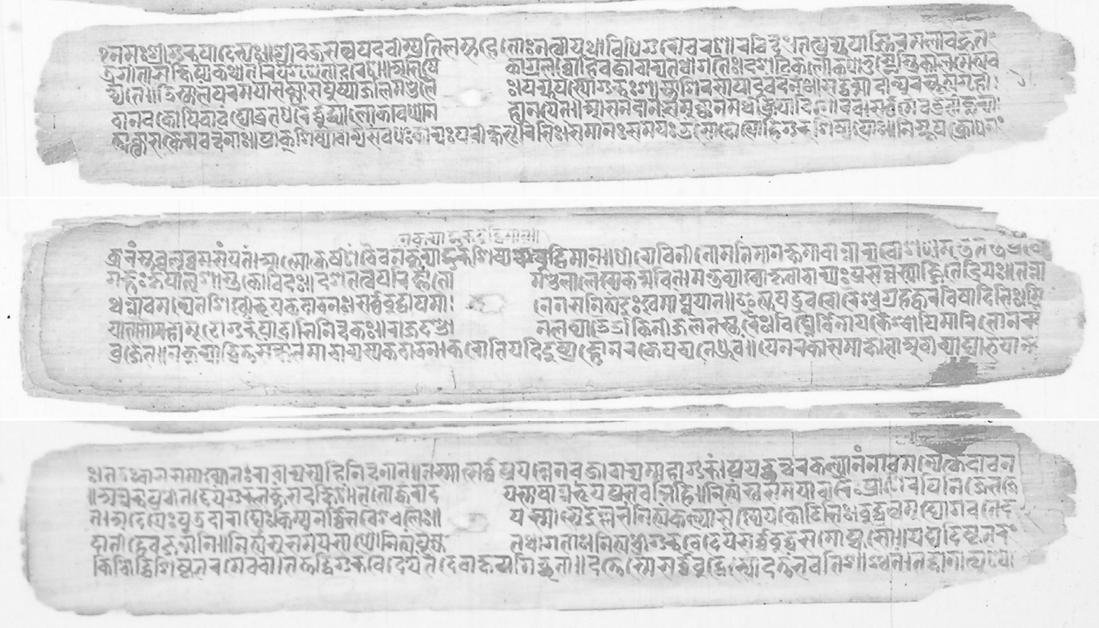
Figure 19.1: Folios lv-2r-2v
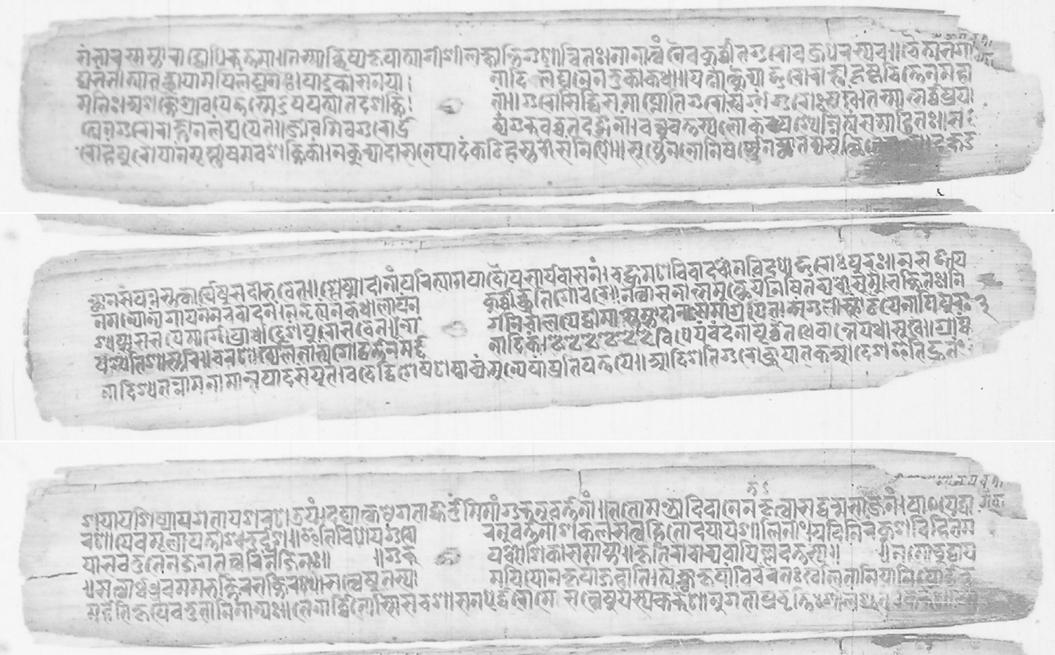
Figure 19.2: Folio 3r-3v-5r
Twenty: Can we infer unestablished entities? A Mādhva contribution to the Indian theory of inference
Michael Williams
Abbreviations
| NK | Nyāyakośa |
| PP | Pramāṇapaddhati |
| TD | Tattvoddyota |
| TDT | Tattvoddyotaṭīkā |
| TDTT | Tattvoddyotaṭīkāṭppaṇī |
| TS | Tarkasaṃgraha |
Introduction
This paper is concerned with the great debate between the Mādhva and Advaita traditions of Vedānta which was initiated by the founder of the former, Madhvācārya (1238–1317). Although the debate covered practically all the problems that preoccupied Vedāntic thought, the central issue remained the metaphysical status of the world and its relationship to brahman identified either as the static, unqualified consciousness of Advaita or the dynamic, quality-laden personal God Viṣṇu. From an early stage, the Advaitins were confronted with a metaphysical dilemma regarding the relationship of the world to brahman. Although the matter was discussed in infinitely more detail by Advaitin thinkers, the underlying problem was that, if the world were regarded as identical to brahman it would not admit of sublation by a veridical cognition of brahman itself; if it were regarded as different, then the Advaitin’s non-dualism would be compromised. One of the most important solutions to this problem (and the one which I will discuss in this paper) was to argue that the world was indeterminable (anirvacanīya) as either real (sat) or unreal (asat).
The Advaitins marshalled support for this metaphysical doctrine in the phenomenon of perceptual illusions. Although Indian philosophers discussed a number of different illusions with sometimes very different properties, later Vedānta thinkers particularly tended to take the “silver-shell” illusion as a paradigmatic case. In this episode, the erring subject, for one reason or another, mistakes a piece of mother-of-pearl (which has similar properties to silver) for a piece of silver. According to the Advaitins, the superimposed component of the illusion (the silver itself, in this episode), like the world, resists determination as either real, unreal or their aggregation. This approach to perceptual illusion became known as “anirvacanīyākhyātivāda”. The Advaitins believed we are forced into this counter-intuitive conclusion because the psychological and epistemological facts of the episode are irreconcilable with the assumption that superimposed component of the illusion was real, unreal or an aggregation of the two. The case made in favour of it was summarised by the oft-quoted argument from circumstantial implication (arthāpatti): “If [the silver experienced in perceptual illusions] were real, it could not be sublated; if it were unreal it could not be perceived” (sac cen na bādhyeta asac cen na pratīyeta).
Advaitin thinkers sought to prove these doctrines in a number of different ways. Here, I am concerned with the approach that attempts to demonstrate them through positive proof. That is, I am concerned with an Advaitin opponent who uses the traditional means of knowledge (pramāṇas), to justify the claim that everything which is not either brahman or totally unreal (asat) must belong to the realm of the false (mithyā). These intricate metaphysical questions demanded a sophisticated apparatus for formal argumentation. Madhva himself built acute arguments against the Advaitins using the contemporary logical methods available to him. In his Pramāṇalakṣaṇa he initiated a tradition of tracts which present and defend a distinctive theory of epistemology which culminated in Vyāsatīrtha’s Tarkatāṇḍava. Later thinkers of the Mādhva tradition expressed and evaluated arguments using the novel language and analytic techniques of the “New” (Navya) school of Nyāya which originated in Mithila among Gaṅgeśa (c. 1325 CE) and his followers. Consequently, the body of literature that grew around the debate is a rich source for the study of the theory, usage and evaluation of formal methods of reasoning. In this paper, I am concerned with a set of problems of logic and inference which were discussed by Madhva’s most celebrated commentator, Jayatīrtha,[988] in his commentary on Madhva’s Tattvoddyota, the Tattvoddyotaṭīkā.[989] Both Vedeśatīrtha and Huligiyadupati wrote commentaries on the work which I have used extensively in reconstructing Jayatīrtha’s arguments.
The Tattvoddyota (“Illumination of the Truth”) is one of Madhva’s ten prakaraṇas, works which are characterised chiefly by their textual independence, brevity and specificity of subject matter. Of the ten works, the Viṣṇutattvavinirṇaya, Mithyātvānumānakhaṇḍaṇa, Upādhikhaṇḍaṇa, the Māyāvādakhaṇḍaṇa and the Tattvoddyota are all devoted to the refutation of the doctrines of other schools. With a few exceptions, the opponent is the Advaita Vedāntin. These prakaraṇas attracted commentaries from Jayatīrtha, undoubtedly Madhva’s foremost commentator. His method, which has been described in some detail by Sharma (1961), is meticulously analytic and uncompromisingly thorough. In commenting on the logical issues raised by Madhva against the Advaitins, he displays a detailed understanding of all the issues developed in the contemporary Nyāya tradition that might bear on the arguments.
The problems explored in this paper have to do with the limits of the traditional model of inference to prove the metaphysical concept of indeterminability. These specific problems, I argue, have more general implications for our understanding of the Nyāya process of inference and its limitations. In particular, I will address two types of inference. The first involves a highly debated form of inference which relies on a pervasion relationship between the negations of the terms involved (kevalavyatirekin inferences). The second uses the form of argumentation known as “remainder-inference” (pariśeṣānumāna). The question is whether either of these types of inference can be used to prove a putatively unfamiliar concept like indeterminability.
The Inferences
I will begin by providing an outline of the history of the formal inferences that were evaluated by the Mādhvas, along with a brief summary of the major points of Nyāya inferential theory. The method of systematically setting out and defending the falsity-inferences which form the subject of this paper was first adopted in Advaita Vedānta traditions by Ānandabodha Yati (12th century?). Madhva was the first thinker to take up the task of developing a detailed critical response to these inferences. His Mithyātvānumānakhaṇḍaṇa (one of the three of the ten independent treatises composed by Madhva which bears the title “refutation” [-khaṇḍaṇa]) is the first complete independent tract written to refute the Advaitin inferences. His Tattvoddyota also deals at length with the inferences. After Madhva, Jayatīrtha wrote commentaries on most of Madhva’s works as well as composing three independent treatises, one of which -the Vādāvalī- is wholly dedicated to the refutation of the mithyātva inferences. Vyāsatīrtha’s great critique of A-dvaita doctrine -the Nyāyāmṛta- is centrally concerned with presenting an elaborate reply to the very same arguments.
Indian philosophers worked within a framework that divided inference into two sorts: private (svārtha) and public (parārtha). As Mohanty (1992: pp. 100–132) has demonstrated in his analysis of inference, they analysed both varieties of inference inference as a psychological process. A typical private inference consists in a series of causally related psychological events which, in the absence of defeating conditions, produces an inferential knowledge (anumiti). A public inference involves essentially the same process as a private inference, except that the cognitive process has to be induced in a beneficiary by a formalised set of speech-acts (avayavas). An inferential knowledge arises because the inferrer (in the case of private inference) or the beneficiary of the formal set of speech acts (in the case of public inference) acquires somehow over some period of time a specific “stock” of cognitions. The absence of any of these cognitions, or a presence of defeating conditions, means that the inferential knowledge will not arise.
A standard inference seeks to establish that some entity is located in a particular substrate. The entity which the inference seeks to establish is termed the to-be-established (sādhya). The substrate in which it is established is known as the subject (pakṣa). The reason for inferring the presence of the sādhya in the subject is the hetu. The key to this process is the relationship of “pervasion” (vyāpti) which holds between the sādhya and the hetu or in some cases, their respective absences. Although a perfect definition of pervasion was the holy grail of Navya-Nyāya inferential theory, we can roughly say that x pervades y if x occurs in all or more than all the locations in which y occurs. In other words, whenever y is present in a substrate, x must also be present in that same substrate. Hence, provided there are no defeating conditions, we are able to move from the psychological certainty that “The hetu is present in the pakṣa” to “The sādhya is present in the pakṣa”.
What were the Advaitin’s inferences? In his Vādāvalī, Jayatīrtha presents a clear tabulation of three major inferences which became current in Advaitin traditions after Ānandabodha. It is important to note that Ānandabodha himself used the traditional “five-membered” presentation format (nyāya) to formulate the inferences. Jayatīrtha, following Madhva uses the three-membered format, consisting of the thesis (pratijñā), reason (hetu) and instantiation (dṛṣṭānta).[990] They can be tabulated as follows:
jagan mithyā, dṛśyatvāt, jaḍatvāt, paricchinnatvāt, śuktirūpyavat. “The world is false, because it is perceptible, because it is insentient and because it is finite, like the shell superimposed on silver.”
It should be clear that this is simply an abbreviation of three separate inferences. Each seeks to prove the same sādhya — mithyātva- in the subject -the world — and each is based on the same dṛṣṭānta – the hackneyed example of the perceptual illusion where silver is superimposed on mother-of-pearl. “Mithyātva”, generally translated as “illusoriness” or “falsity”, was variously defined by the Advaitins. For the purposes of this paper, only one definition is relevant, since this is the one Madhva seems to take for granted in the Tattvoddyota. This is “sadasadvilakṣaṇatvam” or “being different from both the real and the unreal”. Although the sādhya is the same in every inference, each has a separate hetu: perceptibility (dṛśyatva), insentience (jaḍatva) and finiteness (paricchinnatva). According to the Advaitin, the knowledge of the presence of any of these hetus in the pakṣa (pakṣadharmatājñāna) combined with the knowledge that the hetu is pervaded by the sādhya is sufficient to bring about the cognition that the world is subject to the quality of mithyātva.
The instantiation (dṛṣṭānta) is, in each case, the paradigmatic instance of perceptual illusion referred to as the “silvery-shell” (śuktirajata). A good instantiation should, of course, have the quality that the inference seeks to prove in the pakṣa (i.e. the sādhya), in this case, “falsity”. The inference which Madhva and Jayatīrtha critique in the Tattvoddyota(ṭīkā) is not listed in this tabulation:
1. vivādapadaṃ mithyā, bādhyatvāt. yan nānirvacanīyaṃ, tan na bādhyam yathātmā. “The disputed object [i.e. the silver in the silvery-shell illusion] is indeterminable, because it admits of sublation. That which is not indeterminable does not admit of sublation, as in the case of the self.”
It is this inference that I am concerned with in the remainder of this paper. It asserts that the silver which appears in the silvery-shell illusion is indeterminable on the grounds that it is sublatable. Sublatability is a crucial concept in Indian epistemology: a cognition is said to be sublatable if its contents are liable to be corrected by a later, veridical cognition. The classic example is the shell-silver itself: the erring subject has a mis-perception of the form “This is silver”. It is possible (and in this instance highly likely) that the same subject will later benefit from a veridical cognition, “This is not silver, but shell”, which corrects the initial error.
The Flaw of “Unestablished-qualifier-ness” (aprasiddhaviśeṣaṇatā)
Can we make inferences to prove the presence of entities that have not been established by the pramāṇas? Mādhva thinkers contended that indeterminability, the Advaitin’s sādhya in inference 1, is an example of an unestablished entity.[991] In the early portion of the Tattvoddyota, Madhva uses the familiar critical method of cycling through each pramāṇa in turn to show that they cannot be used to prove indeterminability. All the arguments Jayatīrtha makes are based on a rather enigmatic passage from an early portion of the Tattvoddyota, which reads as follows:
anumānasya cāprasiddhaviśeṣaṇaḥ pakṣaḥ. na ca dhūmatvavan mithyātvam ity ubhayasampratipannaṃ sāmānyam asti. na ca bāṣpāropitadhūmena dhūmavattvaṃ vyabhicarati*.[992]
Literally translated, this would read as: “And the subject of the inference has an unestablished qualifier. And, like the case of smoke-ness, there is not a commonality ‘falsity’ which is agreed to by both parties. Nor does havingsmoke-ness deviate as a result of smoke-superimposed-on-water-vapour.”
What is the flaw of unestablished-qualifier-ness, and why does it affect an inference? The flaw found its complement in another known as “unestablished-qualificandum-ness” (aprasiddhaviśeṣyatā), which pertains when the pakṣa (that to which the sādhya is ascribed, the qualificandum) is unestablished. This flaw was thought to pertain when the quantity of instances in which the sādhya (the qualifier) was instantiated in some substrate other than the pakṣa prior to the inference was zero. In other words, if fire is the sādhya then, prior to making the inference, the inferrer must have knowledge of at least one other case where an instance of fire is located in some substrate through some pramāṇa. As we have seen above, an inferential flaw is a defeating condition of some kind which undermines the psychological factors which serve as the necessary and sufficient conditions for the arising of an inferential knowledge.
Although there were slightly different formulations of the process, we can roughly say that according to Nyāya inferential theory, an inferential knowledge is brought about by the confluence of two items of knowledge:1) knowledge of a pervasion relationship between the sādhya and the hetu (or their respective negations in the case of a kevalavyatirekin inference) and 2) the knowledge of the the hetu’s presence in the subject (technically called “pakṣadharmatā”). According to Jayatīrtha, both of these components are affected if the sādhya is unestablished.[993] In the first place, it is difficult to imagine how we could have a cognition of the form “s pervades h” unless we were acquainted with s in the first place. Like the the prācīna-Naiyāyikas, Jayatīrtha[994] regarded the knowledge of pervasion as an inductive process, that is a knowledge acquired through the repeated observation (bhūyodarśana) of the co-presence of the sādhya and the hetu in different locations. It is clear, therefore, that we have to have a cognition of at least one co-occurrence of the sādhya and the hetu in our cognitive inventory if we are to have a cognition of the pervasion.
Jayatīrtha points out a further problem. A particular substrate can only become the paksa in an inference if the inferrer doubts that a particular locatee (i.e. the sādhya) is present there. Now, doubt is an intentional mental state: is it requires an object. We can only doubt a cognition which takes the form a particular locatee (dharma) is (or is not) located in a particular locus (dharmin). It follows that if the sādhya is unestablished, the inferrer cannot be familiar with it and such a doubtful cognition cannot arise. Since both doubt and a cognition of pervasion are indispensable components in the arising of an inferential knowledge, it seems that the sādhya must indeed be established prior to an inference if it is to be successful.
Purely-negative Inferences
Jayatīrtha anticipates an objection to the argument, however. The flaw of aprasiddhaviśeṣaṇatā can self-evidently be applicable to cases of positive concomitance. Does it still apply to instances of negative concomitance, however? As I mentioned earlier, inference 1 is a “purely-negative” (kevalavyatirekin) inference.[995] In this type of inference, the two members of the pervasion relationship are the absences of the the sādhya and the hetu, since no case of a positive concomitance can be found. In other words, the presence of the sādhya does not pervade the presence of the hetu but the absence of the hetu pervades the absence of the sādhya i.e. hetvabhāva is the pervader (vyāpaka) and sādhyābhāva is the pervaded (vyāpya). The later Naiyāyikas, as Matilal (1998: pp. 120–123) points out, were chiefly concerned with this type of inference from the point of view of definition. The traditional example of this sort of inference set out in a five-membered presentation (nyāya) is: 1) The element earth is different from the other elements (pratijñā); 2) Because it has smell (hetu); 3) That which is not differentiated from the other elements does not have smell, as in the case of water (udāharaṇa); 4) And the earth does not not have smell (upanaya); 5) Therefore, it is not not differentiated from the other elements (nigamana).[996]
According to Jayatīrtha, if the sādhya is unestablished we cannot have a cognition of the pervasion relationship which holds between it and the hetu. Given that, in cases of negative concomitance, absence of the hetu pervades the absence of the sādhya, however, does this argument still apply? The answer to this problem seems straightforward. It is a widely accepted principle of Indian logic that in order to have a knowledge of an entity we must have an experience of its counter-positive. In this case, we must, of necessity, have an experience of indeterminability itself in order to have an experience of its absence. Hence we must be acquainted with indeterminability in order to experience the negative concomitance between it and the absence of sublatability.[997] This explanation, however, is problematic. As Jayatīrtha’s pūrvapakṣin points out, this could imply a general refutation of the possibility of kevalavyatirekin inferences which were were considered by the Naiyāyikas and many other schools to be valid. Would this requirement not, asks the pūrvapakṣin, lead us to reject the possibility of kevalavyatirekin inferences altogether? In order to understand this argument, it is worth outlining the major features of the debate that took place in the Navya-Nyāya discussion of kevalavyatirekin inferences which expresses some of the general tensions in this form of argument. The Tarkasamgraha provides a useful summary.[998] A kevalavyatirekin inference has the requirement (a) that the number of known instances in which there is the absence of the sādhya and the presence of the hetu is zero, i.e. there are no instances in which the sādhya is absent and the hetu is present. However, it also has the extra requirement (b) that the inferrer is aware of no positive concomitance between the sādhya and the hetu. Nevertheless, there is a further requirement, applicable to all types of inference, (c) that the sādhya be well-established (prasiddha). Requirement (c) means that the inferrer must be aware that the sādhya is present in one other substrate than the paksa of the inference at hand. Since a substrate must either be subject to the presence of any quality or its absence, one of two things follow from this. Either the hetu is present in the locus where the sādhya is instanced or it is absent. If it is absent, then there is a deviation (vyabhicāra) and the inferential cognition cannot arise. If it is present then it follows that the hetu is not of the kevalavyatirekin sort, but of the anvayavyatirekin variety – i.e. it has both a positive and negative concomitance with the sādhya. Consequently, it seems that requirements (b) and (c) conflict with one another.
The crux of the matter is that inferences of this sort by their very nature do not require that the sādhya (in this case, indeterminability, the counterpositive of which is the pervaded in the concomitance) is established. For, the point of negative concomitance is that we are not able to show a single alternative instance where the sādhya and the hetu occur in the same subject. Consequently, negative concomitance should be possible for cases where we are unable to show that the sādhya is present anywhere at all.
A similar tension is at work in Jayatīrtha’s argument. By insisting that we have a cognition of the sādhya’s counterpositive in order to have a cognition of pervasion, he is effectively insisting that the sādhya be wellestablished. According to Jayatīrtha, the matter can be salvaged as follows. He claims that the requirement that the counter-positive of the negative property be well-established needs to be qualified so that all that is needed is a state of being “generally” (sāmānyataḥ) established. Presumably, this is meant to eliminate the requirement that the sādhya’s counter-positive has been established in some other case, which, as we have seen, should not in theory be required of a purely-negative inference. But just what does it mean for something to be “generally” established? Vedeśatīrtha gives the following example: “self-less-ness (nirātmakatva) is the counterpositive of a constant absence located in some substrate, since it is a deviatinglocatee, like a pot”. In this case, +self-ness (sātmakatva) is the locatee that is generally established. It is said to be “generally” established because it is established in some (kvacid) substrate, though the specific identity of the substrate remains unknown.
The obvious problem that confronts this weaker formulation of the requirement is that it leaves the door open for the Advaitin to offer a “general” establishment of indeterminability. Jayatīrtha proposes an inference similar to Vedeśatīrtha’s to achieve this: “reality and unreality are the counterpositives of constant-absences which co-reside in the same locus, because they are qualities, like form and taste”.[999] If this inference is successful, it would establish that there is at least one entity which is qualified by the absence of both reality and unreality and consequently satisfies the Advaitin’s definition of falsity as indeterminability. According to this strategy, the state having been generally established could then be established specifically with respect to perceptual illusions.
According to Jayatīrtha, however, this inference is fundamentally flawed. The problem is what is known in Nyāya terminology as a “universalpositive” (kevalānvayin). A universally-positive property is a property that is present in every conceivable substrate. These include, for example, nameability (abhidheyatva) and knowability (jñeyatva). These are universalpositives since everything is nameable and everything, according to theistic traditions, is knowable by God. If the concomitance is to to hold, these, being locatees (dharmas), should be the counter-positive of a constant absence which is resident in some entity. The problem is that, as universally-positive properties, they cannot be. Moreover, as Jayatīrtha points out, the very fact that we are able to refer to the entity with the words “some locus” (kiṃciddharmin) demonstrates that the entity in question must be nameable. Hence, nameability is a property which is not the counter-positive of a constant absence which is located in some locus and there is a deviation in the pervasion. If the inference does not hold, then it follows that the Advaitin has failed to demonstrate that the sādhya is even generally established.
The Absence of an Absence is a Presence
The Advaitin may, however, find a way to circumvent the problem of the apprehension of the pervasion. The sādhya in the mithyātva inference takes, as Vedeśatīrtha points out, the form of an absence (abhāva). As we have seen, in a kevalavyatirekin pervasion, we do not apprehend the sādhya itself, but only its absence as the entity which is pervaded by the absence of the hetu (hetvabhāvavyāpya). Mithyātva, defined as “different-from-the-real-and-the-unreal-ness” (sadasadvilakṣaṇatvam) is itself an absence. Although the correct interpretation of a similar definition of falsity (as “not being the locus of exist[ence] or non-existence [sadasattvānadhikaraṇatvam]) was the subject of much controversy in the Nyāyāmṛta, we can say that however the compound is interpreted, it implies the absence of the qualities reality and unreality in a particular locus. In order to apprehend the pervasion, we must therefore apprehend the negation of falsity. The first question is what is the negation of sadasadvilakṣaṇatvam?
Vedeśatīrtha offers the following (somewhat ambiguous) analysis. He argues that the absence of anirvacanīyatva defined as “different-from-thereal-and-the-unreal-ness” must be of the form of reality and unreality (sattvāsattvarūpa). This interpretation seems problematic. It seems we must interpret this definition of falsity to mean “being-different-from-the-real-orthe-unreal (or their aggregation)”. From this it follows that the absence of falsity is present when there is reality, unreality or both. It is not clear whether Vedeśatīrtha had this in mind. Either way, however, the argument still works. All three of these options result in (a) presence(s) (bhāva). This being the case, how can it be said that the cognition of the pervasion (vyāptigraha) is impossible on the grounds that we do not apprehend the counter-positive of an entity? As Vedeśatīrtha points out, the hidden assumption in this argument is that whereas the apprehension of an absence depends upon the apprehension of its counter-positive, the apprehension of a presence is not so dependent.[1000] Jayatīrtha’s response to the Advaitin pū-rvapakṣin is that, whilst it is certainly true that the absence of an absence is a presence, nevertheless it is still necessary that we should have a cognition which takes the form of a negation (pratiṣedha). That is, even though the absence is mithyātva is a presence, the cognition still has the form of a negation (pratiṣedhākāra). It may indeed be a presence, but this does not annul its status as a negation. Vedeśatīrtha interprets this to mean that, even though the vyāpya (the absence of the sādhya) is of the form of a presence since it takes the form of an absence of an absence, it is still necessary that we should have a cognition that has as its predication content (prakāra) the state of being the absence of the sādhya (sādhyābhāvatvaprakāraka).[1001] In other words, though the pervaded entity (vyāpya) in the pervasion (i.e. the absence of the sādhya) takes the form of a presence, its status as the negation of the sādhya cannot be eliminated altogether from the cognition if we are to have a cognition of a kevalavyatirekin-pervasion. Since the cognition of a negation (pratiṣedha) necessarily depends upon the cognition of its counter-positive, the original objection -that the apprehension of the pervasion is impossible if the sādhya is not well-established-still stands.
Eliminative inferences and unestablished sādhyas
Are there certain types of inference other than kevalavyatirekin ones which allow us to infer the presence of unestablished entities? According to Jayatīrtha’s pūrvapakṣin, there are. The pattern of argumentation that underlies this discussion was termed “eliminative-inference” (pariśeṣānumāna). According to the Nyāyakośa, the definition of this type of argument is “an inference which has a general hetu which is aided by the absence of a qualifier”.[1002] The standard example of this type of reasoning has to do with the establishment of the efficacy of the benedictory verse (maṅgalaśloka) of a work. In the first place it is proved that the benedictory verse is efficacious (saphala) in the most general sense of the term i.e. it has some sort of efficacy / produces some sort of result. This is termed a “commonality” (sāmānya). This conclusion is then refined by eliminating all possible entities other than the final sādhya. In this instance the refinement consists in the specification that the result is the completion of the work in question. This is achieved by “re-using” the sādhya from the first component of the argument as a hetu which is further qualified by the absence of another quality, in this case “having-a-result-other-than-completion-ness” (samāptyanyāphalakatva). In other words, we ascertain 1) that the subject must have some sort of result; 2) we eliminate the possibility that it has any result other than the completion of the work at hand; 3) we therefore conclude that it must have as its result the completion of the work. In this way, it is inferred that the benedictory verse must effect the completion of the work.[1003] Can a similar pattern of inference be applied to the case at hand? It could be argued that the term “mithyātva” does have a sense which is agreed to by both parties. For, according to Jayatīrtha (and Mādhva thinkers generally) “falsity” simply means “unreality” (asattva). We could imagine that the initial inference[1004] comes about with this understanding of the term in mind, i.e. it establishes that the quality of falsity, defined as unreality, is present in the subject. The flaw of unestablished-ness would not apply in this case, since unreality is a well-established quality prior to the formulation of the inference. This hardly accomplishes what the Advaitin wants, however: in and of itself it simply establishes that the world is unreal. However, unreality does share with indeterminability a common kernel or “commonality” (sāmānya), namely the property of “different-from-the-real-ness” (satyavivekatva). The term “mithyātva”, the Advaitin might argue, could be taken to refer to this commonality. Now, when the initial inference has come about and established that the subject is different from the real, a further inference might arise on the part of the inferrer which further refines the conclusion established by the previous thesis. As in any eliminative-inference a further qualification is now added: namely, “different-from-the-unreal-ness”. In this way, the Advaitin might argue, indeterminability is established without being established prior to the inference.[1005] Jayatīrtha’s Advaitin pūrvapakṣin suggests that this type of reasoning is precedented not just in the instance of the benedictory verse but also in the inference to prove the existence of a creator-God (īśvara). The argument is none other than that which establishes an omniscient creator (sarvajñakartṛ) on the basis of the world’s entities being effects (kārya). The sādhya in this inference (having-an-omniscient-creator-ness), as in the mithyātva inference, is apparently an unestablished quality: that is, it has not been established prior to the inference that any single substrate has the properties of both creator-ness and omniscience. Vedeśatīrtha suggests that the pattern of reasoning at work in this argument could be analysed thus. We first formulate an argument of the form:
2a. “The earth and so on have a creator, since they are effects”.
In this argument, the commonality (which corresponds to mithyātva in the Advaitin’s inference) is creator-ness (kartṛtva). The two qualities which it is found in are “omniscient-creator-ness” (sarvajñakartṛtvam) and “nonomniscient-creator-ness” (asarvajñakartṛtva). The inference establishes simply that the entities in the world are simply +kartṛ. The complication is that we now need to establish a further property in the subject, namely the presence of an omniscient creator, i.e. a God (īśvara). Vedeśatīrtha construes this portion of the argument as:
2b. “This creator [whose creator-ship of the world has been established through the initial inference] is not non-omniscient. For, he is the creator of all entities – the earth and so on-, as in the negative instance of Devadatta [where it is found that the absence of being-the-creator-of-all-entities is concomitant with the absence of omniscience]”.
This second inference (which is the “eliminative-inference”), like the Advaitin’s proposed scheme, adds a further quality to the initial inference: “having-a-creator-ness” (kartṛvattva) is refined to “having-an-omniscient-creator-ness” (sarvajñakartṛvattva). The conclusion of the first inference is not contradicted per se, but rather refined.
Does this method allow the Advaitin to circumvent the flaw of unestablished-ness? As we have seen, the argument rests on there being a commonality, a generic kernel which is common to two states differentiated by a further qualifying characteristic. Moreover, a public inference is an act of inter-subjective persuasion. If it is to be successful, therefore, it must use terms the meanings of which are agreed to by both parties. In this light, Jayatīrtha finds fault with the commonality. It has to be established in the locus of indeterminability. However, since indeterminability, which serves as the locus of the commonality, is not established prior to the inference itself, it follows that the substrate in which the commonality is to be established is itself not-well established.[1006] The point is that the Advaitin’s argument still requires a degree of familiarity with the state of indeterminability. In the example of the maṅgalaśloka inference, for example, it is still necessary that we should have a cognition of “having-the-result-of-completion-ness” if we are to establish that it has the commonality “with-result-ness”. In order to make the leap from non-existence to indeterminability we must be conscious of the commonality, and we cannot be, unless we have the capacity to locate that commonality (satyavivekatva) in the locus of indeterminability as well as the unreal. If the Advaitin is to persuade his opponent through eliminative-inference, then it is necessary that his opponent should have an experience the commonality in both the unreal and indeterminable. However, since the locus of the commonality (indeterminability) is not established prior to the inference, it follows that no such experience can come about and there can be no commonality assented to by both parties. The precise consequences of this for the inference will become clear when we discuss the next argument that Jayatīrtha considers.
The Creator Argument
What about the creator argument which was used as an example of a eliminative-inference? Does this argument not involve the inference of a previously unestablished entity in the form of an omniscient creator? As we have seen, an eliminative-inference relies on there being a commonality common to the sādhya of both inferences. In the falsity inference this is (supposedly) “being-different-from-the-real”. In the case at hand, this is “creator-ness” (kartṛtva). As Jayatīrtha’s pūrvapakṣin argues, by the Madhva’s own argument, until the inference itself has established an omniscient creator, the commonality “creator-ness” cannot be established in the final sādhya — “omniscient-creator-ness” (sarvajñakartṛtva) since, like falsity, it is not established prior to the inference. Jayatīrtha’s own argument apparently throws the baby out with the bath water: it undermines the Advaitin’s case but in the process undermines what was widely considered to be a successful inference.[1007] According to Jayatīrtha, there are two ways out of this problem. The first is to deny that we need to use an eliminative inference to prove the existence of an omniscient creator. According to this argument, the inference from the effect-ness of the earth and so on (inference 2a, above) simply proves that the entities which populate the world have a creator without supplying any further information as to the qualities of that creator. This hardly proves the existence of an omniscient īsvara, but Jayatīrtha suggests that this need not be accomplished by an eliminative inference. He simply states that a “new undertaking” (punar-ārambha) could follow the initial argument in order to refine the conclusion by proving the omniscience of the creator.[1008] Neither of the commentators clarify what form such an argument would take, and this aspect of Jayatīrtha’s case remains unfortunately obscure.
Although he believes we do not need to use an eliminative-inference in order to prove an omniscient creator, Jayatīrtha is reluctant to undermine it altogether. As we saw above, Jayatīrtha’s objection is that the argument fails since the commonality mithyātva -defined as satyavivekatva- cannot be established in indeterminability prior to the inference. A public inference (parārthānumāna) is an act where one tries to induce an inferential knowledge in another person through language. Its success therefore depends on the nature of the linguistic practices of the inference’s beneficiary. What would happen if the Advaitin tried to persuade another of their thesis?
The problem, as Huligiyadupati points out, is the for the inference to function as an intersubjective act of persuasion, there needs to be a common usage of the term mithyā prior to the inference which contains the commonality satyavivekatva. However, Jayatīrtha believes he has demonstrated that this is impossible. Consequently, when the first inference establishes that the subject is +mithyā, it follows that the inferrer will have an experience of the unreal (asattvasya pratīti). This being the case, Jayatīrtha argues that the hetu in the initial inference (bādhyatva) must be a “false-hetu” (hetvābhāsa) of the “counter-balanced” (satpratipakṣa) variety. A hetu is said to be counter-balanced when there is another hetu which proves the opposite of what the first hetu proves, i.e. the absence of the sādhya (sādhyābhāva) in the subject.[1009] In the case at hand, the second inference, which dismisses unreality, contradicts the sādhya of the first inference. In other words, since mithyātva has no other sense than unreality (asattva) the dismissal of unreality in the second inference proves the absence of the sādhya in the subject. This provides the crucial difference between the mithyātva inference and the creator inference, Jayatīrtha argues. The point is that in the initial inference of the latter, we do not have an experience of non-omniscience (asārvajña) which could be contradicted by the second inference, where we have a dismissive cognition of the form “The creator is not non-omniscient”. Accordingly, the hetu is not of the counter-balanced variety.[1010] The difference is that, whereas mithyātva is taken to refer to unreality, creator-ness (according to Jayatīrtha) is neutral as to the epistemic capacity of the creator which is refined in the second inference.
The Case of “Smoky-water-vapour”
Madhva himself provided an example to illustrate the problems with finding a commonality in the case of mithyātva. It is the instance of a perceptual illusion wherein the erring subject mistakenly perceives smoke where there is only water vapour. In Sanskrit, this is expressed concisely in the compound “smoke-superimposed-on-water-vapour” (bāṣpāropitadhūma). The result of this illusion could well be that the erring subject continues to infer the presence of fire on the same locus as the putative presence of smoke. The connection seems to be that, like mithyātva, smoky-water-vapour is illusory in nature and is consequently unestablished. Madhva’s argument, which Jayatīrtha develops, is that finding a commonality (satyavivekatva) in mithyātva is no different to finding the commonality “smoke-ness” in the case of smoky-water-vapour.[1011] What precisely is the problem in accepting that smoke superimposed on water-vapour has the commonality smoke-ness? According to Jayatīrtha, the problem arises in the case of the hackneyed inference to prove that the mountain has +fire-ness.[1012] In this instance, we infer that the mountain has the quality of +fire-ness on the grounds that it has the quality of +smoke-ness. The basis of this inference is the pervasion relationship: “+fire-ness pervades +smoke-ness”. With the exception of certain Cārvākas, it was accepted by Indian philosophers that this inference is a good one. The problem is that if we accept that the commonality smoke-ness applies to instances of the water-vapour illusion, then it seems to undermine the inference. For, the locus of the superimposition (water-vapour) is present in substrates such as a lake, where fire is absent. In other words, the inference would now be subject to a “deviation” (vyabhicāra): that is, there would be at least one instance in which +fire-ness is present and +smoke-ness absent. This is incongruous with our experience that the inference is generally capable of producing resolute activity on the part of people: if there were a deviation, then the inference would lose its potency. As we have seen earlier, inference was analysed as a psychological process. Jayatīrtha’s argument seems to be that the success of the inference generally indicates that the instance of smoke-superimposed on water-vapour does not have the strength to count as a deviation in an inference.
Jayatīrtha considers an interesting objection to this argument. He suggests that the process of acquiring inferential knowledge demands that we add (perhaps implicit) qualifications to the reasons we use. The example is once again the smoke to fire inference. A little reflection on this particular inference reveals a flaw in the pervasion relationship that it relies on. The problem is that it is possible that smoke and fire are not necessarily found in the same locus at the same time when we consider the example of the extinguished fire (śāntāgni). After all, smoke may linger on the mountain after the fire has been extinguished: hence the the presence of smoke is not pervaded by the presence of fire. Nevertheless, the inference does seem to have epistemic efficacy insofar as it produces fire-directed action on the part of inferrers. Therefore, Vedeśatīrtha[1013] suggests, the only way to explain the epistemic efficacy of the inference is to add further qualifications to the hetu. It is not simply “smoke” that is pervaded by fire, but smoke which has certain properties which indicate that fire must be present. In other words, inference is a process that requires implicit judgments: what we actually mean when we say that “smoke is pervaded by fire” is that a certain sort of smoke is pervaded by fire, according to Jayatīrtha’s pūrvapakṣin, one that has the qualities which are associated with the present existence of fire. For example, we might observe that it is dense, rises upwards and so on (bahulordhvatādi). The inference works because inferring subjects are able to use their judgment to qualify the terms involved in the pervasion relationship.
How does this argument apply to the case at hand? If inferential judgments can (and often must) imply such judgments on the part of the inferrer, then it opens the door for another qualifier to be applied to smoke-ness alongside “uprightness” and the like. The smoky-water-vapour is an instance of perceptual illusion. Jayatīrtha terms this “ābhāsaviveka”: i.e. it is the requirement that the smoke is not an illusion (ābhāsa). This would mean that smoky-water-vapour is now no longer included in the pervasion relationship which would lead to the deviation. It is only non-illusory smoke that is pervaded by fire. As we have seen, Jayatīrtha’s argument is that the psychological fact that inferrers make and act on the inference without doubt implies that it does not suffer from the deviation that adopting the Advaitin’s position would entail. However, according to this argument, we can prove the conviction and consequent resolute activity of inferrers on the grounds that the concomitance relationship does not entail a deviation at all, since smoky-water-vapour is implicitly precluded from the concomitance relationship.
This argument from implicit refinement seems to have a great deal to recommend itself in the psychological context in which the argument operates. It seems to provide a solution whereby we can explain the fact that such inferences can and do prompt conviction and action on the part of inferrers while at the same time acknowledging that, in their explicit form at least, they are subject to problems. However, Jayatīrtha argues that this argument is groundless. Why exactly does the Advaitin wish to adopt this argument? As we have seen, Nyāya theory of inference is one component of the analysis of the cognitive functions of human beings. Consequently, their judgments are relevant to the case at hand. The Advaitin wants to argue that we can only explain the fact that the inference enjoys epistemic efficacy among inferring subjects if we assume they implicitly qualify its hetu.
However, Jayatīrtha believes that the court of popular usage will be unfavorable to the Advaitin’s case. The Advaitin wants to argue that we can discount the possibility of a deviation whilst still maintaining that smokywater-vapour has the commonality “smoke-ness”. There are essentially two ways of explaining why it does not lead to a deviation: 1) accept that it is still smoke and argue that only refined smoke is pervaded by fire or 2) accept that it is not smoke, in which case there can be no deviation. Jayatīrtha’s argument is that the practices of inferrers would favor the second alternative. As he puts it, if it turned out that +smoke-ness leads to a deviation, inferrers would conclude that the instance of the supposedly smoky entity which is not pervaded by fire is not, in fact, smoke.[1014] This seems problematic. The argument seems to have plausibility in the context of smoky-water-vapour. It is plausible that the observation of the dispositions of inferring subjects would favor the alternative that dismisses that particular perception illusion as an instance of a smoky entity. However, Jayatīrtha has himself referred to instances of entities which would clearly be referred to as “smoke” which might not be pervaded by fire (e.g. smoke that is not upright, not thick and so on). Perhaps his blanket statement to the effect that inferrers would dismiss any deviations in a convincing inference as non-instances of the hetu is over-zealous.
Nevertheless, Jayatīrtha believes that this route fails for the Advaitin. The refinement-theory of inference may have a certain plausibility as regards certain refinements (e.g. to upright-smoke, thick-smoke and so on). However it is plausible to suggest that testimony of inferring subjects whose cognitive states the theory is ultimately meant to account for would be unfavourable to regarding smoky-water-vapour an instance of a smoky entity. He therefore believes that the only reason that the Advaitin has for accepting the refinement explanation is that it rescues their own attempt to establish a commonality common to indeterminability and unreality. The fact that an analysis suits one’s theory is hardly a good reason for adopting it. Let us recapitulate. The Advaitin’s argument was that an eliminative inference is possible since there is a commonality agreed to by both parties. The example Jayatīrtha (following Madhva) used against this was that of smoky-water-vapour. Like mithyātva, it is an instance of illusory entity and hence (so the argument runs) cannot serve as the locus for the required commonality. Accepting this would, in the end, undermine a practically universally accepted inference.
Returning to the broader questions we asked at the beginning of this article, do Jayatīrtha’s arguments demonstrate that inference in general is limited to cases where the sādhya is established prior to its formulation? We saw that, since inference was understood primarily as a sequence of causally related mental events, a standard inference which relies (at least partly on a positive concomitance) is very difficult to reconcile with cases of unestablished sādhyas. If there is any room for the unestablished in inference, it is in the purely-negative (kevalavyatirekin) and eliminative (pariśeṣa) forms. Jayatīrtha’s first argument, amply defended, is that the kevalavyatirekin form of inference can take place unless the sādhya is established somehow prior to its formulation. He does, however, relax this requirement and allow that the sādhya should only be generally established prior to the inference. For Jayatīrtha, this type of inference might not allow us to prove an altogether unfamiliar entity, but it does not require that we are acquainted with entities in the same way that we are for other types of inference. As we have seen, Jayatīrtha does argue that the Advaitin cannot prove mithyātva by having recourse to an eliminative inference since, unlike the creator argument, it suffers from the fault of having a hetvābhāsa. In the end, however, his argument not altogether reject the possibility that such inferences can in fact prove unestablished entities such as omniscient creators and so on. Certain metaphysical inferences may be accommodated by the traditional model, but the Advaitin’s is not.
Bibliography
Primary Literature
Nyāyadarśanam of Gautama, ed. according to the Vācaspatimiśrakṛtparakaraṇasahitanyāyasūtrapāṭhaḥ by Ganganatha Jha (Poona, Poona Oriental Series, 1939).
Nyāyakośaḥ of Mahāmahopādhyāya Bhīmācārya Jhalakīkar, ed. and revised by Mahāmahopādhyāya Vāsudev Shāstrī Adhyankar, Bombay Sanskrit and Prakrit series No. XLIX. (Poona, Bhandarkar Oriental Research Institute, 1996).
Nyāyasudhā of Jayatīrtha, ed. with the glosses: Vākyārthacandrikā of Vidyādhīśatīrthayati, the Sudhāvivṛtiḥ of Satyavratatīrthayati, the Parimalaḥ of Rāghavendrayati, the Sudhāṭippaṇī of Yadupatyācārya, the Ṭīkāghṛtasudhāvākyārthavivaraṇam of Śrīnivāsatīrtha and the Capakah of Śrīmanmannārīkṛṣṇācārya by Rāmācārya Kaṭṭi &c. (Bangalore, Sudhāmudriṇamandiram, 1982).
Tarkasaṃgrahaḥ of Annambhaṭṭa, ed. with the Nyāyabodhinī, Padakṛtya, Dīpikā and Kiraṇāvalī by Kṛṣṇavallabhācārya. (Vārāṇasī, Caukambā Vidyābhavan, 2007).
Tattvacintāmaṇi of Gaṅgeśa, ed. by Mahāmahopādhyāya Kamakhyanatha with the Dīdhitiḥ of Raghunātha and Dīdhitiḥ Vivrti of Gadadhara Bhaṭṭacarya Tarkavagisa. (Calcutta, Asiatic Society of Bengal, 1911).
Tattvoddyotaḥ of Ānandatīrtha, ed. with the Ṭīkā of Jayatīrtha by K.T. Pandurangi. (Bangalore, Dvaita Vedānta Studies and Research Foundation, 1992).
Vādāvalī of Jayatīrtha, ed. with the Vādāvalībhāvadīpikā of Rāghavendratīrtha, the Vādāvalīprakāśa of Nivāsatīrtha and the Vādāvalīṭippaṇī of Umarji Kṛṣṇācārya by Satyadhyānācārya Kaṭṭī. (Bangalore, Dvaitavedāntādhyāyanasaṃśodhanapratiṣthānam, 2001).
Secondary literature
Ganeri, Jonardon (2004) Indian Logic: A Reader. Oxon: Routledge.
Jayatirtha, R. Nagaraja (trans.) (1943) The Vādāvali of Jayatīrtha: Edited with an English Translation. Madras: The Adyar Library.
Matilal, B. K. (1968) “Gangesa on the Concept of Universal Property (Kevalānvayin).” Philosophy East and West 18(3): 151–161.
— (1975) “Causality in the Nyaya-Vaisesika School.” Philosophy East and West 25(1): 41–48.
— (1998) The Character of Logic in India. New York: SUNY Press.
Mohanty, J.N. & Bilimoria, Purushottama (ed.). (1993) Essays on Indian Philosophy. Oxford: Oxford University Press.
Potter, Karl (1993) Encyclopedia of Indian Philosophies: Volume 5. Indian Philosophical Analysis: Nyāya-Vaiśeṣika from Gaṅgeśa to Raghunātha Siromaṇi. Delhi: Motilal Banarsidass.
Phillips, Stephen H. & Ramanuja Tatacarya (2004) Epistemology of Perception: Gaṅgeśa’s Tattvacintāmaṇi. New York: American Institute of Buddhist Studies.
Rao, Nagaraja (1976) The Epistemology of Dvaita Vedānta. Madras: The Adyar Library.
Sarma, Sreekrishna E.R. (1960) Maṇikaṇa: A Navya-Nyāya Manual. Madras: The Adyar Library and Research Centre.
Sastri, S. K. (1952) A Primer of Indian Logic. Madras: The Kuppuswami Research Institute.
Sharma, B. N. K. (1961) The History of the Dvaita School of Vedānta and its Literature. Delhi: Motilal Banarsidass.
— (1962) The Philosophy of Madhvācārya. Delhi: Motilal Banarsidass.
Siauve, S. (1968) La doctrine de Madhva. Pondicherry: Institut Français d’Indologie.
— (1971) Les hierarchies spirituelles selon I’Anuvyākhyāna de Madhva.
Pondicherry: Institut Français d’Indologie.
Suryanarayana Sastri and Kunhan Raja, C. (1933) Bhāmatī: Catuḥsūtrī with an English Translation. Madras: The Adyar Library.
Volume 2
Copyright
Published in the United Kingdom in 2014 by
OXBOW BOOKS
10 Hythe Bridge Street, Oxford OX1 2EW
and in the United States by
OXBOW BOOKS
908 Darby Road, Havertown, PA 19083
© Oxbow Books and the individual authors, 2014
Paperback Edition: ISBN 978-1-78297-415-4
E-pub Edition: ISBN 978-1-78297-416-1; Mobi: ISBN 978-1-78297-417-8;
PDF: ISBN 978-1-78297-418-5
A CIP record for this book is available from the British Library
All rights reserved. No part of this book may be reproduced or transmitted in any form or by
any means, electronic or mechanical including photocopying, recording or by any information
storage and retrieval system, without permission from the publisher in writing.
For a complete list of Oxbow titles, please contact:
UNITED KINGDOM
Oxbow Books
Telephone (01865) 241249, Fax (01865) 794449
Email: oxbow@oxbowbooks.com
www.oxbowbooks.com
UNITED STATES OF AMERICA
Oxbow Books
Telephone (800) 791–9354, Fax (610) 853–9146
Email: queries@casemateacademic.com
www.casemateacademic.com/oxbow
Oxbow Books is part of the Casemate Group
Contents
PREFACE
(1) SIMON BRODBECK
Refuge and Reform: Snakes, Gleaners, and Niṣādas in Early Kāvya
(2) GIOVANNI CIOTTI
Like a Howling Piśāca: A Note on the Pronunciation of the Ṛgvedasaṃhitā
(3) ELISA FRESCHI
Does the Subject Have Desires? The Ātman in Prābhākara Mīmāṃsā
(4) ALASTAIR GORNALL
Kārakas in Cāndra Grammar: An Interpretation from the Pāli Buddhist Śāstras
(5) ROBERT LEACH
The Three Jewels and the Formation of the Pāñcarātra Canon
(6) DANIEL STENDER
Preliminary Survey of Sanskrit Manuscripts of the Bodhicaryāvatāra
(7) MAŁGORZATA SULICH-COWLEY
Asiddha vs Asiddhavat in Patañjali’s Mahābhāṣya
(8) PAOLO VISIGALLI
Continuity and Change in Chāndogya Upaniṣad 6.1–4
Preface
Puṣpikā 2 is the outcome of the second ‘International Indology Graduate Research Symposium’ (IIGRS) held at the Faculty of Asian and Middle Eastern Studies, University of Cambridge, on the 23rd and 24th of September 2010.
The purpose of IIGRS is to provide young scholars with an international platform to discuss and share the results of their research on premodern South Asian cultures. All participants focus on textual sources, whether manuscripts, inscriptions, published editions, or oral recitations, in the language in which they were composed.
The papers offered here cover a great variety of topics related to the intellectual traditions of South Asia, which are examined from different disciplinary perspectives, such as intellectual history, linguistics, philosophy, literary criticism and religious studies.
The rich variety of topics presented at IIGRS was a source of inspiration for all those who participated. The symposium provided an open forum to discuss ideas and methodologies in a relaxed and friendly environment, where young scholars could experience presenting their own research in front of their peers and senior scholars. At IIGRS the latter category was represented by Dr. Whitney Cox, Dr. Eivind Kahrs, Dr. Federico Squarcini and Dr. Vincenzo Vergiani, whose contributions to the discussion of each paper were much appreciated.
Here follows the list of the contributors to Puṣpikā 2 along with a brief summary of the contents of their works:
(1) Simon Brodbeck, who offered a keynote lecture during the first day of IIGRS, here (“Refuge and Reform: Snakes, Gleaners, and Niṣādas in Early Kāvya”) further elaborates on some of the issues he touched upon during his presentation. In particular, he engages with the topic of carnage as a means of imperialistic strategy for kṣatriya self-assertion. He gives a close reading of selected passages of the Mdhābhārntd and the Rāmāydṇd, by applying the categories of coloniality and post-coloniality.
(2) Giovanni Ciotti (“Like a Howling Piśāca. A Note on the Pronunciation of the Ṛgvedasaṃhitā”) studies a specific aspect concerning the pronunciation of the Rgvedasamhitā. Using the data offered by the Vedic ancillary literature (vedalakṣaṇa), he casts some light on the traditional view about the pronunciation of the Veda, a feature of the text which Western scholarship has sometimes just marginally addressed.
(3) Elisa Freschi (“Does the Subject Have Desires? The Prābhākara Mīmāṃsā Answer”) suggests an answer to the question ‘Does the subject have desires?’ from the point of view of the Prābhākara Mīmāṃsā school. After a close reading of the relevant primary sources, she argues that in the Prābhākara view there can be no subject without desire.
(4) Alastair Gornall (“Kārakas in Cāndra Grammar. An Interpretation from the Pāli Buddhist Śāstras”) explores the reception of Cāndra Sanskrit grammatical literature in 12th century Sri Lanka and investigates the ways in which Theravāda Buddhist grammarians used this literature to create a new system of Pāli grammar, the Moggallāna system. In particular, he focuses on how Pāli grammarians interpreted the treatment of kārakas as found in Cāndra grammar.
(5) Robert Leach (“The Three Jewels and the Formation of the Pāñcarātra Canon”) investigates the formation of the Pāñcarātra canon. Focusing on three texts belonging to the Āgamasiddhānta tradition, namely the Jayākhyasaṃhitā, the Sātvatasaṃhitā and the Pauṣkarasaṃhitā, he indicates a precise period—the 14th century—in which these texts were adopted as canonical also by non-Āgamasiddhānta Pāñcarātrikas, therefore marking a profound restructuring of the whole Pāñcarātra canon.
(6) Daniel Stender (“Preliminary Survey of Sanskrit Manuscripts of the Bodhicaryāvatāra”) offers a thorough survey of the available manuscripts of the Bodhicaryāvatāra. The article identifies the manuscripts that were used for the previous editions of the text and also locates the newly discovered ones, thereby facilitating future work on a revised version of the critical edition of the Bodhicaryāvatāra.
(7) Małgorzata Sulich-Cowley (“Asiddha vs asiddhavat in Patañjali’s Mahābhāṣya”) investigates one of the key concepts characterising the architecture of Pānini’s grammar, that of asiddha. Critically engaging with previous scholarship, she offers a new interpretation of the terms asiddha and asiddhavat and their function in the application of the rules in the Aṣṭādhyāyī.
(8) Paolo Visigalli (“Continuity and Change in Chāndogya Upaniṣad 6.1–4”) offers a close reading of the initial section of the sixth chapter of the Chāndogya Upaniṣad. In particular, he attempts to delineate the innovation of Uddālaka’s discourse as compared with the preceding Vedic belief system.
We are grateful to those who helped bring this book to completion. Firstly, we would like to thank the authors for their contributions. Secondly, thanks must go to the Faculty of Asian and Middle Eastern Studies, University of Cambridge, for its logistic and financial support both for the organisation of IIGRS and for the publication of the present volume. In particular, we would like to express our gratitude to Dr. Eivind Kahrs, Dr. Vincenzo Vergiani and the faculty administrative staff. We also thank Oxbow Books for publishing this volume.
Cambridge 2013,
Giovanni Ciotti
Alastair Gornall
Paolo Visigalli
One: Refuge and Reform: Snakes, Gleaners, and Niṣādas in Early Kāvya
Simon P. Brodbeck
Introduction: Janamejaya, Aśoka, and Postcoloniality[1015]
The Rāmāyaṇa tells of the war, in distant Laṅkā, between Rāma Dāśaratha of Ayodhyā and Rāvaṇa’s demon hordes – Rāma was the victor, and Rāvaṇa’s estranged brother Vibhīṣaṇa, who fought for Rāma, was installed as king of Laṅkā (Rām 6). The Mahābhārata tells that story too (Mbh 3.258–75), amongst others, and orders events such that Rāma’s righteous war is followed by other bloodbaths: northwest of Ayodhyā, Arjuna and Krsna massacre the inhabitants of Khāṇḍava Forest (Mbh 1.214–25; Hiltebeitel 1976); at Kurukṣetra, the Pāṇḍavas as advised by Kṛṣṇa preside over a massacre of almost all kṣatriyas (Mbh 6–10); at Prabhāsa on the west coast, the Vṛṣṇis kill each other (Mbh 16.4); and at Takṣaśilā, in revenge for the assassination of his father Pariksit, Janamejaya starts to kill all snakes, but then stops, after Āstīka’s intervention, on condition that the surviving snakes behave themselves (Mbh 1.45–53). We also hear details of how other kings of the past, and Kṛṣṇa at other times, did sterling deeds licking various miscreants into shape (Mbh, Hv, passim).
In this paper I take an abstract view of these various events, seeing them, for the sake of argument, as depictions of a single process; and I begin to explore some of its contours and ramifications. This is royal kṣatriya business, conceived in terms of kings milking their wife the land (Bailey 1981; Hara 1973), protecting and growing their land, with weapons and armies, against others (sometimes other kings with armies); and in terms of constitutively iterated royal rites of expansive self-assertion, involving appropriation, the crushing of resistance, and the exploitation of resources thereafter. It is well-known business; imperial business. It can be conceptualised in terms of development, and perhaps as a kind of missionary work, finessed in terms of what is said to be best for the people in the places that it most directly affects. There is an ideological component in the representation of the process. I will look at some passages from the Mahābhārata and Rāmāyaṇa from a Marxist perspective, attending particularly to certain categories of person.
King Janamejaya calls off the snake massacre. Why didn’t Janamejaya’s snake massacre kill all snakes? It was intended to, but Janamejaya changed his mind about it, while listening to Vaiśaṃpāyana’s story about the Pāṇḍavas, and called it off uncompleted (Mbh 1.50–56).
The cause of the ceasefire is variously given. According to the first presented account, it was because, long ago, the snake massacre was set up by the mother-of-all-snakes, Kadrū, who cursed her children to die in it, and by Brahmā, who, later petitioned by those children, specified that only the wicked snakes would die in it.
tad vākyaṃ nānvapadyanta tāñ śaśāpa bhujamgaṃān || Mbh 1.18:7 ||
sarpasatre vartamāne pāvako vaḥ pradhaksyati |
janamejayasya rājarṣeḥ pāṇḍaveyasya dhīmataḥ || 8 ||
śāpam enaṃ tu śuśrāva svayam evapitāmahaḥ |
atikrūraṃ samuddiṣṭaṃ kadrvā daivād atīva hi || 9 ||
sārdhaṃ devagaṇaiḥ sarvair vācaṃ tām anvamodata |
bahutvaṃ prekṣya sarpāṇāṃ prajānāṃ hitakāmyayā || 10 ||
tigmavīryaviṣā hy ete dandaśūkā mahābalāḥ |
When the Snakes did not obey her command, she cursed them that they would be burned in the fire, when the Snake Sacrifice of the royal seer Janamejaya, the wise scion of Pāṇḍu, was to take place. The Grandsire himself, however, heard this all-too-cruel curse pronounced by Kadrū; and, although it went far beyond what fate had ordained, he and all the hosts of the Gods approved her word, for the good of the creatures, as he saw how many Snakes there were. They were powerful and mordacious, their poison was virulent … (Mbh 1.18:7c–11b, tr. van Buitenen 1973: 77)
brahmovāca |
bahavaḥ pannagās tīkṣṇā bhīmavīryā viṣolbaṇāḥ |
prajānāṃ hitakāmo ’haṃ na nivāritavāṃs tadā || Mbh 1.34:9 ||
ye dandaśūkāḥ kṣudrāś ca pāpacārā viṣolbaṇāḥ |
teṣāṃ vināśo bhavitā na tu ye dharmacāriṇaḥ || 10 ||
Brahmā said:
There are too many Snakes, they are harsh, terribly brave, and covered with poison. At that time I did not stop her [i.e. Kadrū], as I wished the creatures well. It is the eagerly biting Snakes, the mean and evil and virulent ones, that are doomed to die, not the law-abiding Snakes. (Mbh 1.34:9–10, tr. van Buitenen 1973: 95)
It seems unlikely that only wicked snakes were killed, until there was a ceasefire just at the point where there were no more wicked snakes to kill, so that by stopping there, Janamejaya would leave only dharmic snakes alive. We would more naturally imagine that some dharmic ones would have been killed before the ceasefire, and/or that some wicked ones would have survived it. So how does Brahmā’s stipulation work?
Āstīka makes the surviving snakes solemnly promise, after the ceasefire, that they will never attack anyone who knows the story of how he saved them.
āstīka uvāca |
sāyaṃ prātaḥ suprasannātmarūpā
loke viprā mānavāś cetare ’pi |
dharmākhyānaṃ ye vadeyur mameda*ṃ
teṣāṃ yuṣmadbhyo naiva kiṃcid bhayaṃ syāt || Mbh 1.53:20 ||
sūta uvāca |
taiś cāpy ukto bhāgineyaḥ prasannair
etat satyaṃ kāmam evaṃ carantaḥ |
prītyā yuktā īpsitaṃ sarvaśas te
kartāraḥ sma pravaṇā bhāgineya || 21 ||
Āstīka said [to the snakes]:
The brahmins and other folk in this world
Who, morning and evening, tranquil of mind,
Will recount this epic of Law of mine
Must never need be in fear of you.
The Bard said:
And serene they spoke to their sister’s son [i.e. Āstīka]:
‘Then this shall be true, we shall do the wish
You have wished, for we all are wholly pleased –
We shall do it willingly, sister’s son!’
(Mbh 1.53:20–21, tr. van Buitenen 1973: 122–3)
So after the massacre, and in connection with certain public statements, there is to be a reform in the behaviour of the snakes. When combined with Brahmā’s stipulation, the implication is that before this reform, all snakes might be wicked.
The referent of dharmākhyānaṃ … mamedaṃ (‘this epic of Law of mine’) has usually been taken to be the story of Āstīka, i.e. the Mahābhārata’s Āstīkaparvan (Mbh 1.13–53; see e.g. Hegarty 2006: 45); but the word ākhyāna is used in preference to parvan, both here and at 1.53:23–6 when the phala is repeated, and in my view its referent should be taken also to be the dharmic tale told by Āstīka, i.e. Mbh 1.50 in miniature (the hymn of praise for Janamejaya and his rite, which wins Āstīka entry and an open boon) and, in fuller form, Vaiśaṃpāyana’s whole discourse (Mbh 1.55–Hv 113; for the implied identity of Āstīka and Vaiśaṃpāyana, see Brodbeck 2009: 233–8; Brodbeck 2009b). The people who need not fear snakes would thus be the same people included by the various phalaśrutis (e.g. 1.56:14–30) relating the benefits of Vaiśaṃpāyana’s discourse.
King Aśoka calls off the Kaliṅga massacre. Compare Janamejaya’s deeds with the situation sketched by Aśoka’s thirteenth major rock edict (Hultzsch 1925: 207–12; Thapar 1961: 255–7). This edict specifically concerns Aśoka’s massacre of the Kaliṅgans (referred to by Tāranātha as nāgas; see Thapar 1961: 36). After the ceasefire the good King Aśoka, the handsome one, beloved-of-the-gods, advertises across his realm that although the high death toll has saddened him deeply, he will resume killing if there is misbehaviour.
[T]he Beloved of the Gods conciliates the forest tribes of his empire, but he warns them that he has power even in his remorse, and he asks them to repent, lest they be killed. For the Beloved of the Gods wishes that all beings should be unharmed, self-controlled, calm in mind, and gentle. (tr. Thapar 1961: 256; Hultzsch 1925: 209–10, lines M–O)
Fitzgerald discusses this edict in the introduction to his Śāntiparvan translation.[1016]
[I]t … contains a clear ultimatum directed at the ‘forest tribes’ of the empire. Those peoples are to accept the peaceful conquest of Dhamma (dhammavijaya), which is ‘pleasant’, or they can expect the same kind of travail the people of Kaliṅga suffered. … [N]ot only does the edict fail to renounce violence, it threatens it explicitly as well as implicitly. (Fitzgerald 2004: 118)
Inconclusive genocides recur in old Indian texts. This theme in the Mahābhārata has been discussed by Minkowski (1991: 396–400) and Fitzgerald (2002: 104–7, 115–19), amongst others. But the implication of Aśoka’s edict is that Aśoka thinks having this inscription put up across his realm (in six locations, though interestingly not in Kaliṅga itself; Thapar 1961: 164) will be instrumental in causing the ‘forest tribes’ (aṭavi, aṭaviyo) to be better behaved – a textological implication equivalent to that which is made explicit in the Mahābhārata.
Postcolonial text in ancient India. Kosambi takes the Mahābhārata’s ‘snakes’ to be human. He infers that the context is one in which plough agriculture was taking up increasingly more land;[1017] practitioners of older types of economy would be made into refugees.
The prime historical and social context of the document [i.e. the Mahābhārata] can only be change (in a comparatively restricted locality between the Punjab and the Ganges) from food-gathering to food-production; the redaction of the epic merely reflects the change.
Nagas were food-gathering aborigines ready to change over. … the name must indicate in a group many thinly scattered, linguistically and perhaps ethnically diverse, primitive tribesmen who had a snake totem or snake worship among other totems and worship. (Kosambi 1964: 36, 38; = Kosambi 2002: 357, 360–61)
The Mahābhārata showcases changes in land use. It depicts good kṣatriyas stripping land of its wild beasts; prior inhabitants must be tamed or perish. The burning of Khāṇḍava Forest by Arjuna and Kṛṣṇa is mythologised as an offering for Agni, but we naturally imagine a simpler explanation: the Pāṇḍavas have been given the outlying region of Khāṇḍavaprastha by their uncle Dhrṭarāṣṭra, and they must make it work for them, so they clear woodland by fire, kill what flees, then move in (Mbh 1.214–19).[1018] Bhīma Pāndava, a man like an elephant, son of the Wind, wins against a rākṣasa in a fight of pulled-up trees (Mbh 1.151:12–20). And there is economic growth; the Pāṇḍavas are soon famous on the high-class circuit – hosting a rājasūya, no less (Mbh 2.1–42).
The operation at Khāṇḍava Forest is replicated on a smaller scale by royal hunting expeditions, whereby dangerous beasts are killed in outlying regions and spoils of the chase are distributed, domesticating the locals and developing the land (Allsen 2006: 168–93, 197–201). Rāma’s activities in the Rāmāyaṇa’s Bālakāṇḍa and Araṇyakāṇḍa can be similarly viewed: Rāma goes to the wilds, kills demons, and is respected by those who remain.
These texts exemplify and explain various ideological moves through which subjects of development are more or less dehumanised, and the expansionist activity of their overlords is presented as a birthright or as manifest destiny (‘Kingship alone is legitimate and its absence can only result in anarchy’, Thapar 1978: 17). In the Indian story, one was reborn into this life as a just desert for activities in previous lives, which could theoretically legitimate any amount of discrimination and repression; and the same idea would encourage self-policing among the population, lest things get worse in the next life.
If the activity and ideology thus depicted were described as colonial, then the Mahābhārata would be a postcolonial text. We can read it as such, even though the prevalent tendency is to use the word ‘colonial’ for activities prosecuted by Europeans in recent centuries.[1019] As the text presents it – with clear disquiet over their methods – the next thing that happened to the Pāṇḍavas, after they had risen to social prominence by bloody means, was they lost Indraprastha and had to live homeless in the forests themselves for many years. But Bhīma carried on pulling up trees and killing rākṣasas (3.154:47–51), and the Pāṇḍavas later returned, many years ago, and killed many more people, and took over more or less properly; and Janamejaya carried it on.
I will explore some of the explicit and implicit textual explorations of the fall-out from such colonial or developmental activities. Overall the impression given is that resistance is futile, and this means the issue is addressed in ways we might not expect; but there are postcolonial voices discernable.[1020] By keeping in mind Kosambi’s notion of economic transformation, and by focusing on identity types, we can read the human consequences of such transformation, even where there is no sign of victimhood as such.
Stories of Gleaners
Padmanābha the snake. At the end of the Mokṣadharmaparvan, Bhīṣma tells Yudhiṣṭhira a story Nārada once told Indra in heaven (Mbh 12.340–53; Brockington 2000: 81–2; Hiltebeitel 2001: 19–20; Smith 2009: 666–7; Fitzgerald 2010: 102–7). A brahmin householder is bewildered by the plurality of soteriological options, and voices his concerns to another brahmin, his guest. The guest says he feels the same, and also says he has heard of a good snake called Padmanābha (‘Lotus-Navel’), who lives in Naimiṣa, by the River Gomatī; he suggests his host go and find that snake, and ask him for advice. Next day, when the guest leaves, the host says goodbye to his people and goes off too, and travels to Naimiṣa. Another brahmin gives him directions, and he finds Padmanābha’s house. Padmanābha is away pulling the sun’s chariot, and his wife tells the visitor he will not be back for fifteen days. So the brahmin waits, fasting, in riverside woods.
Padmanābha returns and is received by his lovely wife, who tells him how good she’s been while he was away, and why.
pativratātvaṃ bhāryāyāḥ paramo dharma ucyate |
tavopadeśān nāgendra tac ca tattvena vedmi vai || Mbh 12.347:10 ||
sāhaṃ dharmaṃ vijānantī dharmanitye tvayi sthite |
satpathaṃ katham utsṛjya yāsyāmi viṣame pathi || 11 ||
It is said that the paramount duty of wives is to be avowed to the husband; and I know that truly, O chief of the nāgas, because you’ve taught it to me. Since I’m dedicated to you who are constant in your duty, I am one who understands duty; so how could I discard the true path and travel the bad path? (Mbh 12.347:10–11)
She then says there is a brahmin waiting for him. Padmanābha is surprised; but his wife tells him to go and see him. Padmanābha says:
abhimānena māno me jātidoṣeṇa vai mahān |
roṣaḥ saṃkalpajaḥ sādhvi dagdho vācāgninā tvayā || Mbh 12.348:13 ||
na ca roṣād ahaṃ sādhvi paśyeyam adhikaṃ tamaḥ |
yasya vaktavyatāṃ yānti viśeṣeṇa bhujaṃgamāḥ || 14 ||
doṣasya hi vaśaṃ gatvā daśagrīvaḥ pratāpavān |
tathā śakrapratispardhī hato rāmeṇa saṃyuge || 15 ||
antaḥpuragataṃ vatsaṃ śrutvā rāmeṇa nirhṛtam |
dharṣaṇād roṣasaṃvignāḥ kārtavīryasutā hatāḥ || 16 ||
jāmadagnyena rāmeṇa sahasranayanopamaḥ |
saṃyuge nihato roṣātkārtavīryo mahābalaḥ || 17 ||
tad eṣa tapasāṃ śatruḥ śreyasaś ca nipātanaḥ |
nigṛhīto mayā roṣaḥ śrutvaiva vacanaṃ tava || 18 ||
ātmānaṃ ca viśeṣeṇa praśaṃsāmy anapāyini |
yasya me tvaṃ viśālākṣi bhāryā sarvagunāṇvitā || 19 ||
eṣa tatraiva gacchāmi yatra tiṣṭhaty asau dvijaḥ |
sarvathā coktavān vākyaṃ nākṛtārthaḥ prayāsyati || 20 ||
Due to the vice of arrogance that resulted from the station of my birth, my pride was plentiful; but my wilful anger has been burned by the fire of your words, good woman. And I don’t see any dullness worse than anger, good woman. Snakes got a bad reputation through their characteristic anger.
The brilliant ten-necked [Rāvaṇa] was overpowered by this vice, and so competed with Śakra; and he was killed in battle by Rāma. Hearing that a youngster had been abducted from the inner chambers by Rāma [Jāmadagnya], the sons of Kārtavīrya were moved to anger; and because of their offensive, they were killed. Powerful Kārtavīrya, who was like the thousand-eyed [Indra], was struck down in battle by Rāma Jāmadagnya because of anger.
Having heard you talk, I have checked anger, this enemy of austerity and ruin of good fortune. And I extol myself in particular for having you as my all-virtuous wife, O constant long-eyed lady. I will go to where this twiceborn is staying; and when he’s spoken, he won’t leave with his purpose unfulfilled – he’ll get everything he asks for. (Mbh 12.348:13–20)[1021]
Padmanābha finds the brahmin, and the two introduce themselves. The brahmin is called Dharmāraṇya. Padmanābha makes sure Dharmāraṇya introduces himself first. Before asking the question he has come to ask, Dharmāraṇya asks what Padmanābha has seen on his trip away. Padmanābha extols the sun, and says he has seen a blazing figure approach, be received by, and merge into the sun; and that the figure was a person purified by performing the uñcha vow (this was revealed by the sun himself, in answer to Padmanābha’s question; see below). Dharmāraṇya says that thanks to Padmanābha’s words, even before asking the question he has come to ask, he has had it answered: he knows he must undertake the uñcha vow And he takes his leave from Padmanābha and goes to find Cyavana Bhārgava, who initiates him into the uñcha vow
The story is known because Cyavana told it to Janaka, who told it to Nārada. It is told to Janamejaya’s great-great-uncle Yudhiṣṭhira, so the narrated events must have taken place long before Janamejaya’s snake massacre. But Padmanābha’s comments about snakes seem to match the situation after the snake massacre. Why not? Despite the fictional setting, the story is told by Ugraśravas the sūta, after the snake sacrifice.
Padmanābha says that because he was born a snake, he has a tendency to anger; he decries anger, and illustrates, through stories of others, how getting angry leads to one’s downfall; he says the natural anger of snakes has led to them being despised, but that he himself has prospered by restraining his anger, thanks to his dutiful wife. We shall return to the dutiful wife, and to Jāmadagnya and Kārtavīrya. But what is the uñcha vow?
The uñcha vow. The uñcha practitioner who merged into the sun is described by the sun:
eṣa mūlaphalāhāraḥ śīrṇaparṇāśanas tathā |
abbhakṣo vāyubhakṣaś ca āsīd vipraḥ samāhitaḥ || Mbh 12.351:2 ||
ṛcaś cānena vipreṇa saṃhitāntar abhiṣṭutāḥ |
svargadvārakṛtodyogo yenāsau tridivaṃ gataḥ || 3 ||
asannadhīr anākāṅkṣī nityam uñchaśilāśanaḥ |
sarvabhūtahite yukta eṣa vipro bhujaṃgama || 4 ||
This fellow gathered roots and fruits, and ate fallen leaves too; he was a steadfast seer, drinking water and eating wind. And verses from within the collections were recited by this seer, by means of which he has gone to the third heaven; his efforts built him a door to heaven. This seer, who was cheerful in mind, without expectations, and whose food was always gleaned or gathered, was harnessed to the welfare of all creatures, O snake. (Mbh 12.351:2–4)
Key here is the livelihood of gleaning, which goes with humility, landlessness, lack of material ambition, and yet also with the dutiful and generous fulfilment of one’s role as householder and host. Gleaning is mentioned in the Rāmāyaṇa, as a livelihood anticipated for Rāma while he is in exile (2.21:2), and as the livelihood of a poor brahmin whom Rāma rewards with the gift of cattle (2.29:23; cf. Mbh 12.192:94). In the Mahābhārata, in addition to the stories of Padmanābha (12.340–53), Mudgala (3.246–7), Satya (12.264), and the story told by the mongoose (14.92–3; for these latter stories, see below), gleaners are mentioned occasionally in passing: Yayāti, after retiring from kingship, lived as a gleaner (1.81:13; cf. Manusmṛti 7:33); Bhṛgu says good gleaners go to heaven (12.184:18; cf. 12.235:22–3; 14.94:30–31); and at 13.27 a gleaner’s guest describes the glories of the Gaṅgā. At Mbh 13.129:35–55 Śiva discourses on the topic of ṛṣidharma and distinguishes different types of gleaning ṛṣis: froth-drinking Phenapas, thumb-sized Vālakhilyas who dress in bark and hides and glean like birds, Cakracaras who live on moonbeams, Saṃprakṣālas who store no food from day to day, Aśmakuṭṭas who break grain with rocks, Dantolūkhalins who break grain with their teeth, and Ūṣmapas nourished by flames or steam (cf. Hiltebeitel 2011: 609–13; Baudhāyana Dharmasūtra 3.1–2; Manusmṛti 4:2–12).
Fitzgerald’s discussion of the Mahābhāratd’s gleaners presents the gleaner as ‘a brahmin family man … who is heroic because he voluntarily embraces poverty and suffering rather than compromise his brahmin svadharma when he cannot earn a living as a proper brahmin’ (Fitzgerald 2010: 92–3; cf. Fitzgerald 2006: 275). This view follows Manusmṛti 10:101 and 112; it implies that gleaning would be a response to brahmin unemployment, and thus implicitly a symptom of bad kingship; and it is consonant with Fitzgerald’s recent general approach – the Mahābhārata as we have it being a response to ‘the fact that the Vedic “golden age” [of funding for brahmins] was never to return’ (Fitzgerald 2010: 94 n. 18; cf. Fitzgerald 2006: 269–84). My interpretation resembles Fitzgerald’s in that it treats the (textually constructed) phenomenon of gleaning in its (textually constructed) economic context, and as a response to a changing cultural situation. But Fitzgerald seems to reify and backdate the category of ‘brahmin’ (many Sanskrit texts do the same; cf. Hiltebeitel 2001: 19, ‘the Mahābhārata was written by “out of sorts” Brahmans who may have had some minor king’s or merchant’s patronage, but, probably for personal reasons, show a deep appreciation of, and indeed exalt, Brahmans who practice the “way of gleaning”’). The brahmin category is under construction (Brodbeck 2009c: 138–43); gleaners, qua gleaners, are categorisable as brahmins, but might not have been had they had a different livelihood. Whatever established brahmins there might already be, the label is open to the opportune, and presumably always was.
The story of Mudgala. Vyāsa tells the story of Mudgala in the Āraṇyakaparvan, while the Pāṇḍavas are living in the woods (Mbh 3.246–7; Hiltebeitel 2001: 54; Fitzgerald 2010: 101–2). Mudgala lived in Kurukṣetra with his wife and sons, living like a pigeon, gleaning grains of rice, but he was able to feed the gods and all his guests. It seems he went off on a fortnight-long gleaning expedition once a month, and held open house for the other fortnight, especially at its beginning and end. This is called the iṣṭīkṛta satra (3.246:4–8; cf. 3.129:1). Mudgala fed even the brahmin Durvāsas, who started coming every month, naked, abusive, shavenheaded, and emptying his cupboards every time.[1022] For six months Mudgala was unperturbed (the power of his generosity is said to have multiplied his gifts, 3.246:9–10), and just went out gleaning again. Durvāsas declared that Mudgala was so perfected he would go to heaven in his own body; and the envoy of the gods came, and invited Mudgala aboard a celestial chariot. Mudgala asked the envoy where he would take him, and the envoy described various heavens, and said the one awaiting Mudgala is very lofty, but that heavens are impermanent.[1023] Mudgala refused to mount.
ity uktvā sa munir vākyaṃ devadūtaṃ visṛjya tam |
śiloñchavṛttim utsṛjya samam ātiṣṭhad uttamam || Mbh 3.247:41 ||
tulyanindāstutir bhūtvā samalostāśmakāñcanah*|
jñānayogena śuddhena dhyānanityo babhūva ha || 42 ||
dhyānayogād balaṃ labdhvā prāpya carddhim anuttamām |
jagāma śāśvatīṃ siddhiṃ parāṃ nirvāṇalakṣaṇām || 43 ||
tasmāt tvam api kaunteya na sokaṃ kartum arhasi |
Having thus spoken the hermit dismissed the Envoy of the Gods. He gave up his life of gleaning and took to complete serenity. He became indifferent to praise and blame; a piece of clay, a rock, and gold were all the same to him; and he was forever immersed in meditation with the pure yoke of insight. Through the yoke of meditation he gained strength, and having acquired an incomparable fortune he attained to the eternal and supreme perfection that is marked by Extinction [nirvāṇa].
Therefore, son of Kuntī, you too must not harbor grief … (Mbh 3.247:41–44b, tr. van Buitenen 1975: 705)
Mudgala was perhaps unlucky to be visited by Durvāsas. His hospitable livelihood was being made hard for him. Was the offer of heaven the offer of a good job in a new regime? Mudgala refused, choosing not to sell out, (then) voluntarily went under. In tandem on another level, there is the soteriological aspect; rejecting pravṛtti, he was the last candle before nirvāṇa of a karmic flame-chain, i.e. mokṣa, and songs can be made about it.
The uñcha vow could be what Padmanābha was away doing when Dharmāraṇya arrived. Dharmāraṇya was hungry only for knowledge, and (arriving in the wrong fortnight?) was not hosted by the family. If Padmanābha is a gleaner, he is the only one said to be a snake – a reformed snake, anger subdued.
The story told by the mongoose. After the Kurukṣetra war, Yudhiṣṭhira, like Aśoka, feels the sorrow of his slaughter (Sutton 1997; Fitzgerald 2004: 100–142; cf. Selvanayagam 1992). His position is also precarious; his nominal victory has come by unpopular means. Duryodhana makes last words for Samjaya the herald, and for the surviving troops, and his parents, and his friends, and the gossips (vātikāṃś cābravīd, 9.63:30; cf. vārtikāṃś, ‘messengers’, Meiland 2007: 386–7), saying that the Pāṇḍavas did wrong. All our narrators agree that they committed war-crimes. Effectively there is a fine paid in many ways, one of which is that Yudhiṣṭhira has to do an inordinately munificent aśvamedha (Mbh 12.8–16, 34–6; 14.2–13, 61, 70–91), at the end of which, when the gifts are being distributed, he is publicly badmouthed by a mongoose (Mbh 14.92–3; Reich 2001; Hiltebeitel 2001: 78–9; Fitzgerald 2010: 98–101; Hegarty 2012: 7–13).
The mongoose ridicules Yudhiṣṭhira’s bloody rite, and says his grandiose gifts do not match those made by a certain gleaner who used to live in Kurukṣetra – a practitioner of the uñcha vow – and his family. This poor but generous householder was visited, in a time of famine, by a greedy brahmin. He gave his own miserable portion of barley-meal to his guest, and then each member of his family surrendered theirs in turn – his loving wife, his good son, and his dutiful daughter-in-law (cf. Mbh 1.145–7). The visiting brahmin was revealed to be Dharma in person; he declared himself well satisfied (in this story the revealed identity stands in for the envoy of the gods), and produced a celestial chariot, and the family got in and went to heaven.
We see the virtues and possible rewards of remaining hospitable under grinding poverty. In place of Durvāsas, there is hidden Dharma. But perhaps by riding the chariot this family have just starved to death (Dharma as Yama); there are no lurid descriptions to tempt them as there are for Mudgala. Then the mongoose’s intervention would be to remind Yudhiṣṭhira that there are folk starving in his realm. The following chapters (Reich 2001: 155–69) contain a two-part charter for ahiṃsā and vegetarianism (14.94, the story of Vasu’s arbitration and condemnation,[1024] and 14.95, the story of Agastya’s victory over Indra on this issue), and then a karmic deconstruction of the mongoose’s intervention (as required to free him, i.e. Anger, from a curse; 14.96). The detail of the mongoose’s real identity serves, amongst other things, to underline the thematic link to the story of Padmanābha.
The stories of Satya and Trijaṭa. Gleaners are vegetarian – the sun’s description of the uñcha practitioner mentions fruits and roots, and other descriptions mention grain and the pigeon. The vegetarianism of gleaners is stressed by the story of Satya (Mbh 12.264; Ganguli 1993: sec. 12.272; Hiltebeitel 2001: 20 n. 78). Satya, gleaner, lives in the forest with his wife. He is a bit kinky; he makes her dress up in peacock feathers. A talking deer comes and asks to be eaten, and when Satya hesitates, it describes the glorious heaven that awaits Satya if he eats it. Satya gives in and agrees to eat the deer, but it reveals itself to be Dharma; it scolds Satya for his lapse, and sets him back on his previous diet, vegetarianism reinforced.
If wilderness is being transformed, then where there once were fruits and roots in season, there might only be stubble-fields and loose grains. Or perhaps pasture-land, with the possibility of some milk. Śamīka lives on the milk-froth that leaks from the mouths of suckling calves (Mbh 1.36:15), and in the Mahābhārata there is respect for this livelihood – that of the Phenapa ṛṣis,[1025] marked by the verb uñch at 13.129:37.
Honest gleaners can be rewarded by the gift of cattle (Rām 2.29:23; Mbh 12.192:94). This presumably does not happen to gleaners who eat deer. In the Rāmāyaṇa episode the gleaner seems keen for another livelihood, and Rāma plays with him:
tatrāsīt piṅgalo gārgyas trijaṭo nāma vai dvijaḥ |
āpañcamāyāḥ kakṣyāyā nainaṃ kaścid avārayat || Rām 2.29:22 ||
sa rājaputram āsādya trijaṭo vākyaṃ abravīt |
nirdhano bahuputro ’smi rājaputra mahāyaśaḥ |
uñchavṛttir vane nityaṃ pratyavekṣasva mām iti || 23 ||
tam uvāca tato rāmaḥ parihāsasamanvitam |
gavāṃ sahasram apy ekaṃ na tu visrāṇitaṃ mayā |
parikṣipasi daṇḍena yāvat tāvad avāpsyasi || 24 ||
sa śāṭīṃ tvaritaḥ kaṭyāṃ saṃbhrāntaḥ pariveṣṭya tām |
āvidhya daṇḍam cikṣepa sarvaprāṇena vegitaḥ || 25 ||
uvāca ca tato rāmas taṃ gārgyam abhisāntvayan |
manyur na khalu kartavyaḥ parihāso hy ayaṃ mama || 26 ||
tataḥ sabhāryas trijaṭo mahāmunir
gavām anīkaṃ pratigṛhya moditaḥ |
yaśobalaprītisukhopabṛṃhiṇīs
tad āśiṣaḥ pratyavadan mahātmanaḥ || 27 ||
There came a sallow brahman then, by the name of Trijaṭa Gārgya, all the way up to the fifth courtyard without anyone stopping him. Reaching the prince, Trijaṭa said, ‘Glorious prince, I am penniless and have many children. I must live by constant gleaning in the forest. Have regard for me.’ Rāma replied to himjokingly, ‘There are one thousand cows I have not yet allocated. You shall have as many as you can cover by hurling your staff.’ In a frantic rush he girded up the rag around his loins and, brandishing his staff impetuously, he hurled it with every ounce of his strength. Rāma then said to Gārgya, seeking to placate him, ‘You must not be angry, truly. This was only a joke on my part.’ Then the great sage Trijaṭa along with his wife accepted the herd of cows and pronounced blessings on the great prince conducive to fame, strength, joy and happiness. (Rām 2.29:22–7, tr. Pollock 2008: 163–5)[1026]
In conjunction with the story of Satya, this shows that if circumstances permit, uñcha may be abandoned in favour of pastoralism, but not in favour of hunting.
Niṣādas and Dasyus
Ekalavya and the niṣādas. Rākṣasas are monstrous and flesh-eating; kṣatriyas, who have a monopoly on human violence, tame them. Gitomer discusses Bhīma Pāṇḍava’s rākṣasa affinities; ‘Bhīma’s entering into rākṣasa-hood is somehow able to transform bad rākṣasas into good rākṣasas’ (Gitomer 1991: 305; cf. Sengupta and Purkayastha 2011: 155–7). Kṣatriyas also tame and receive tribute from lesser kṣatriyas; and they also tame niṣādas, as Arjuna and Droṇa tamed Ekalavya (Mbh 1.123).
Niṣādas are small, dark, dirty, wear deerskins, and live in the wilds, by hunting or fishing. Some are cannibals (niṣādān puruṣādāṃś, Mbh 2.28:44).[1027] Their lives are expendable (as at the burning of the lacquered house, Mbh 1.136–7). They originate from an eponymous ancestor Niṣāda. The ṛṣis who speak brahman killed bad king Vena, churned Niṣāda from the ‘right thigh’ of his corpse (Mbh 12.59:99–103), and told Niṣāda to ‘stay down’ (niṣīda, 12.59:102, tr. Fitzgerald 2004: 309). Niṣāda’s younger brother was the paradigmatic good king Prthu, churned from Vena’s right hand (Mbh 12.59:104–31; Fitzgerald 2004: 130–35; cf. Hv 5:14–21). The friction between niṣādds and royal business is clear; but there is also dependence, since if the niṣādas and their ilk did not need to be kept down, what protective function would the good king exercise?
A young niṣāda, Ekalavya son of Hiranyadhanus (‘Goldenbow’), comes to Droṇa’s school, at which Pāṇḍavas, Kauravas, and others are learning martial arts. Droṇa rejects Ekalavya because he is a niṣāda. Ekalavya goes back into the woods, and using a model of Droṇa as his teacher he practises archery alone. He gets incredibly good, and Arjuna finds out, and tells Droṇa, and Droṇa comes and demands a tuition fee from Ekalavya, and Ekalavya promises to pay it, and Droṇa asks for Ekalavya’s thumb, and Ekalavya severs and gives it. So Ekalavya is nullified, and Arjuna is the best archer in the world.
Ekalavya’s promise to pay Droṇa’s fee is like the promise made by the surviving snakes, to be harmless; it is like Padmanābha’s renunciation of anger. Diplomatic tactics are used against Ekalavya, and he unilaterally decommissions his weapons. Satya would presumably have become a niṣāda had he started eating deer; and Ekalavya, now that he cannot shoot, may have to be a gleaner.
Kāpavya and Guha. Kāpavya (Mbh 12.133; Bowles 2007: 234–40, cf. 226–9) was the son of a kṣatriya man and a niṣāda woman. An expert hunter and gatherer,[1028] he lived the niṣāda life in the forest, and dutifully fed and honoured his parents as they aged, and fed the brahmins and their visitors. He was elected by the dasyus – rogues, bandits – to be their chief. That he was ‘elected’ (root abhi-vṛ, 12.133:10) is interesting given the political usages of the label ‘non-democratic’ in recent times, often to legitimate interventions safeguarding economic interests. Kāpavya made the dasyus agree to a certain code of behaviour.
kāpavya uvāca |
mā vadhīs tvaṃ striyaṃ bhīruṃ mā śiśuṃ mā tapasvinam |
nāyudhyamāno hantavyo na ca grāhyā balāt striyaḥ || Mbh 12.133:13 ||
sarvathā strī na hantavyā sarvasattveṣu yudhyatā |
nityaṃ gobrāhmaṇe svasti yoddhavyaṃ ca tadarthataḥ || 14 ||
sasyaṃ ca nāpahantavyaṃ sīravighnaṃ ca mā kṛthāḥ |
pūjyante yatra devāś ca pitaro ’tithayas tathā || 15 ||
sarvabhūteṣv api ca vai brāhmaṇo mokṣam arhati |
kāryā cāpacitis teṣāṃ sarvasvenāpi yā bhavet || 16 ||
yasya hy ete saṃpraruṣṭā mantrayanti parābhavam |
na tasya triṣu lokeṣu trātā bhavati kaścana || 17 ||
yo brāhmaṇān paribhaved vināśaṃ vāpi rocayet |
sūryodaya ivāvaśyaṃ dhruvaṃ tasya parābhavaḥ || 18 ||
ihaiva phalam āsīnaḥ pratyākāṅkṣati śaktitaḥ |
ye ye no na pradāsyanti tāṃs tān senābhiyāsyati || 19 ||
śiṣṭyarthaṃ vihito daṇḍo na vadhārthaṃ viniścayaḥ |
ye ca śiṣṭān prabādhante dharmas teṣāṃ vadhaḥ smṛtaḥ || 20 ||
ye hi rāṣṭroparodhena vṛttiṃ kurvanti kecana |
tad eva te ’nu mīyante kuṇapaṃ kṛmayo yathā || 21 ||
ye punar dharmaśāstreṇa varterann iha dasyavaḥ |
api te dasyavo bhūtvā kṣipraṃ siddhim avāpnuyuḥ || 22 ||
bhīṣma uvāca |
tat sarvam upacakrus te kāpavyasyānuśāsanam |
vṛttiṃ ca lebhire sarve pāpebhyaś cāpy upāraman || 23 ||
Kāpavya said:
You ought not slay a woman, nor one who is cowering, nor a child, nor an ascetic. A noncombatant man should not be slain, and women should not be taken by force. Under no circumstances should the female of any kind of being be slain by a warrior. Everything must be good for cows and brahmins; one should make war for their sake. But grain should not be trampled down, nor should anyone erect any obstacles to the plowing of the fields, nor where the Gods are paid honor, or the ancestors, or guests.
Of all beings, a brahmin deserves to be let go free. And any recompense that is to be made to them should be made, even if it is the whole of one’s property. In all the three worlds there is no one who will save the man whose ruin they intone when they are furiously enraged. He who insults brahmins or approves their extinction will be ruined as surely as the sun will rise.
He who lives here looks to the benefits of doing so. Our army will attack any who will not remit to us as they are able.
The rod of punishment has been ordained for the purpose of education, not for the sake of inflicting corporal punishment – that is the settled conclusion. Corporal punishment is taught by tradition to be Lawful for [use against] those who harm educated people.
There are some who make their living by damaging the country; for that reason, they are likened to worms upon a corpse. On the other hand, those barbarians [dasyus][1029] who would live in this world in accordance with the Learned Traditions of Law attain perfection directly, even though they are barbarians.[1030]
Bhīṣma said:
They paid homage to Kāpavya’s entire instruction, and they all took up that way of life and quit their evil ways. (Mbh 12.133:13–23, tr. Fitzgerald 2004: 509–10)
The tenor of some of Kāpavya’s speech is redolent of Aśoka’s thirteenth major rock edict. The emphasis on not obstructing agriculture is notable. So is the institutionalisation of brahmin privileges. This last is sometimes taken as evidence of the self-interest of an established authorial class; but it might be seen in connection with the assumption of brahmin identity by some peaceable inhabitants of newly developed land – and we can imagine some antipathy towards those seen to be collaborating with the new regime.[1031]
This passage describes the regulation of non-brahmin behaviours, such that dasyus may facilitate royal revenue without disrupting development. A similar scenario is evident in the Rāmāyaṇa in relations between the house of Ayodhyā and Guha, the ‘overlord’ of the niṣādas (niṣādādhipati, tr. Pollock 2008: 233 etc.), who lives in an outlying realm, by the Gaṅgā. Guha is ‘accompanied by his aged ministers’ (vṛddhaiḥ parivṛto ’mātyair, Rām 2.44:10) and ‘prepared to withstand even a vast army of four divisions’ (caturangaṃ hy api balaṃ sumahat prasahemahi || 2.45:7; cf. 2.80:8), but he tells Rāma that ‘This land, no less than Ayodhyā, belongs to you’ (yathāyodhyā tathedam te, 2.44:12); ‘We are servants, you the master. Come, our kingdom is yours to rule’ (vayaṃ preṣyā bhavān bhartā sādhu rājyaṃ praśādhi naḥ || 2.44:14; trs Pollock 2008: 233–5). Guha affectionately renders assistance as requested by Rāma and, later, by Bharata (Rām 2.78–83). He seems to be a client king within an Ayodhyā empire – someone whose local power Rāma wants to prolong (at 2.46:59 Rāma gives him advice on how to retain it), but whose subordination must also be underlined.[1032] Guha tells Bharata that he offered Rāma a variety of foodstuffs,
tat sarvaṃ pratyanujñāsīd rāmaḥ satyaparākramaḥ |
na hi tatpratyagṛhṇāt sa kṣatradharmam anusmaran || Rām 2.81:15 ||
na hy asmābhiḥ pratigrāhyaṃ sakhe deyaṃ tu sarvadā |
iti tena vayaṃ rājann anunītā mahātmanā || 16 ||
But the truthful Rāma refused it all. He heeded the code of kṣatriya and would not accept it. ‘It is not for us to take, my friend. Ours is always to give’ were the words with which great Rāma entreated us, your majesty. (Rām 2.81:15–16, tr. Pollock 2008: 411)
The relationship between Ayodhyā and Guha is presented here as a fait accompli, but elsewhere – not least in the battle for Laṅkā – we see the diplomatic and military negotiations that might have been required in order to set it up.
Two Curses, and the Good Wife
Arjuna curses Aśvasena. When Arjuna and Kṛṣṇa feed Khāṇḍava Forest to Agni, one of the creatures they terrorise and kill is the wife of Takṣaka the snake (cf. Kāpavya’s ‘Under no circumstances should the female of any kind of being be slain by a warrior’). Takṣaka is away in Kurukṣetra at the time, but his snake wife is in Khāṇḍava Forest with their son Aśvasena. Mother and son are trapped; and the mother responds by trying to swallow the son. Just then, Arjuna shoots her head off with an arrow; and Indra (who opposes the massacre) intervenes to distract Arjuna, and Aśvasena escapes. Arjuna curses Aśvasena as he escapes, and then starts fighting (his own father) Indra. Arjuna’s curse:
śaśāpa taṃ ca saṃkruddho bībhatsur jihmagāminam |
pāvako vāsudevaś ca apratiṣṭho bhaved iti || Mbh 1.218:11 ||
Wrathfully, the Terrifier cursed the Snake – and so did the Fire and Vāsudeva: ‘Thou shalt never find shelter!’. (Mbh 1.218:11, tr. van Buitenen 1973: 419)
Minkowski has noted that this scene sets up an ongoing family feud (Minkowski 1991: 397). In the Kurukṣetra war, Aśvasena tries to get his own back on Arjuna, fails, and is killed; and years after that, Arjuna’s grandson Parikṣit commits a diplomatic faux-pas, and gets cursed by Śṛṅgin and killed by snakebite – the bite of Aśvasena’s father Takṣaka. And Janamejaya begins his snake massacre in order to avenge his own father, Parikṣit.
Vālmīki curses the niṣāda. Compare the curse that Arjuna casts with the one Vālmīki casts at the beginning of the Rāmāyaṇa – the curse which was allegedly the first verse in the śloka metre of which these texts are mainly composed. Vālmīki sees two cranes mating, but a passing niṣāda kills the male, and the female weeps, and Vālmīki, moved, curses the niṣāda:
mā niṣāda pratiṣṭhāṃ tvam agamaḥ śāśvatīḥ samāḥ |
yat krauñcamithunād ekam avadhīḥ kāmamohitam || Rām 1.2:14 ||
May you find no peace, Niṣāda, for all eternity – because you killed the male of this loving krauñca pair when he was intoxicated by desire! (Rām 1.2:14, tr. Leslie 1998: 460)
Vālmīki’s curse upon the niṣāda is variously translated: ‘you shall not live for very long’ (Goldman 2005: 47); ‘mayest thou seek in vain for a resting place forever’ (Shastri 1962: 10; cf. Hara 1972: 121); ‘Never more shall you come home’ (Hammer 2009: 197). Arjuna’s curse upon Aśvasena is practically identical: apratiṣṭho bhaved. The cursed one is to be deprived of pratiṣṭhā – foundation, support, or home. This fits the analogy between snakes and niṣādas; and if we read Aśvasena and this niṣāda as representatives of their type, it fits the situation wherein hunter-gatherers are finding their economy increasingly unsustainable.
Lineal tensions in sexual reproduction. Consider the violent acts immediately preceding these curses. In one case the perpetrator of the violent act is also the pronouncer of the curse; in the other case the curse is cast upon the perpetrator of the violent act. In both cases an arrow is fired, and it kills. I understand these arrows in lineal terms.[1033] In the Mahābhārata, Arjuna’s arrow kills the snake-mother as she is trying to encompass her son. In the Rāmāyaṇa, the niṣāda’s arrow kills the male crane.
Consider the royal lineal ideal, as we see it in Sanskrit texts. In each generation the king dies, and there is a new king: the son of the last king. This ideal, and most especially the difficulties that then attend the plurality of sons, is explored in the Mahābhārata and Rāmāyaṇa; not just for kings, it can apply to any business of the type ‘so-and-so and sons’ – minimally, the possession of a surname (‘the hereditary principle pervades the political system, not just the kingship’, Trautmann 1981: 425; cf. Brodbeck 2011: 93–4). The ideal is patrilineal and patrilocal. Girls are given away in marriage, by their natal family, to their husband’s family; they then have sons under his family name. This is the kind of family that the gleaner has in the story told by the mongoose: his household consists of him, his wife, their son, and his wife. Any daughters would be living elsewhere, with their husbands’ families. The families of Padmanābha, Mudgala, and Satya would by implication be the same kind of family, where wives are relative newcomers, and marital relations are to provide the local son.
At the other extreme a mirrored lineal paradigm can be sketched, whereby women are not given away, and men come along, inseminate them, and either stay or leave. In this paradigm, if a king were to rule the same realm as his biologically connected predecessor, he would perhaps be the son of that predecessor’s co-uterine sister (cf. Vielle 2012, Fig. 2). But it is not clear that the same notion of ‘being king’ would apply under this paradigm.
Neither or both of these two paradigms are instantiated; they are crude ways of thinking about sexual reproduction. We generally have two parents, one the same sex as ourselves, one not, and we have brothers and sisters. But the patrilineal paradigm is obvious in regal discourse; in old Sanskrit texts and elsewhere, it is explored in some detail. In this paradigm sons would identify and be identified with their father’s people rather than with their mother’s. Thus Kāpavya would be more of a kṣatriya than a niṣāda.
Consider the two arrow scenes emblematically. In one case a (snake) mother is killed and fails to keep her son, and in the other a (crane) father is killed but the mother is left alive. Two lineal paradigms are in play here – or rather, one is at play with the other. The royal model, wishing for sons in each generation, would be inconvenienced were daughters-in-law to keep their sons in their own natal houses. That is what Yayāti’s wife Devayānī seems to have done; she left her husband and went back to her father (Mbh 1.78:22–36; interestingly, she was from a brahmin family). In the curse scenes under discussion, Arjuna, the hero, kills the mother who tries to appropriate her son; and Vālmīki, the author, curses the niṣāda who kills the father. Thus although in one scene the killer is the ‘goodie’ and in the other the killer is the ‘baddie’, both scenes can represent the condemnation of the matrilineal paradigm, because a different parent is killed in each case.[1034] The snake is parallel to the niṣāda, both are associated with lineal aberrancy, and the sorrow of the surviving female crane provides a ventriloquised rubber-stamp for the patrilineal judgement.
The matrilineal paradigm is a shadow. It is too natural, visible only as it is rubbed out. It is the feared snakebite that can kill a patriline, as Śṛṅgin’s curse and Takṣaka’s bite killed Parikṣit and threatened to kill Janamejaya’s patriline, before the deal was done at the snake sacrifice (Brodbeck 2009: 217–66; Brodbeck 2009b).
The good wife. In his speech quoted earlier, Padmanābha says the taming of his dangerous snake heritage is due to his excellent wife. She has helped him conquer his wildness. We could envisage the wife as Padmanābha’s moral tutor, but perhaps what has specifically enabled Padmanābha not to bite anybody is the fact that she is a good patrilineal wife, who was given away and is now devoted to him, and will give him a good son for his line. Surely the basis of the famous pativratā ideal – the perfect wife (Leslie 1989) – is lineal, and the devoted wife stands in the same symbolic position as the reformed snakes.
Padmanābha says that even if someone steals a youngster (vatsa, ‘yearling’, usually translated ‘calf’) from one’s inner chambers, as Rāma Jāmadagnya did, one must not take offence; if one does, one may pay with one’s life, as Kārtavīrya and his sons did.[1035] The incident in question is narrated at Mbh 12.49:40–41 (the Kārtavīryas take the calf of Jamadagni’s cow, so Rāma cuts off King Kārtavīrya’s arms and takes it back), and is implied at Mbh 3.116:19–24 (King Kārtavīrya takes the calf of Jamadagni’s cow, so Rāma cuts off his arms and presumably takes it back). I would interpret the vatsa as a boy produced by intermarriage between Jamadagni’s family and Kārtavīrya’s, and the quarrel as over which line gets the child.[1036] Padmanābha implies that Kārtavīrya and sons should have let go of the calf without getting angry; and Padmanābha favours pativratā wifehood, so presumably the cow was a Kārtavīrya daughter.
This interpretation receives support from the story of Aurva (Mbh 1.169–71), which represents the same events, but with the generic ‘Bhārgavas’ standing in for Jamadagni and sons. Here the quarrel is over treasure that was formerly given by the Kārtavīryas to the Bhārgavas, but that the Bhārgavas later withheld from the Kārtavīryas, and so the Kārtavīryas massacred the Bhārgavas ‘down to the children in the womb’ (ā garbhād, 1.169:18). The Aurva story focuses on a wife-of-a-Bhārgava who wants ‘to propagate the line of her husband’ (bhartuḥ kulavivṛddhaye, 1.169:20; trs van Buitenen 1973: 339), and hides an embryo in her thigh; it is Aurva, who defeats the Kārtavīryas and is seemingly a double of Rāma. There is no vatsa in this version, but we can read the treasure as human, and the quarrel as over the lineal placement of offspring.[1037] The implication of Padmanābha’s mentioning Kārtavīrya is that good snakes would let nāga women have sons in non-nāga lines, because they have good wives of their own.
Conclusion
There is more to be said about snakes in early kāvya, and gleaners, niṣādas, dasyus, brahmins, kṣatriyas, ṛṣis, etc., and all the stories I have mentioned. I have suggested experimental interpretations to coordinate different aspects of Mahābhārata discourse.
Prioritising the Mahābhārata and the Khāṇḍava and sarpasatra scenes, I have imagined, in broad strokes, new identities (hence communities) in the wake of economic growth and developmental changes, particularly regarding land use and means of livelihood. Because this imagining is done from the text, it implicates the text’s reciters and audience, who are integrated into the text through its detailed phalas and multiply framed structure (it is usually about what happened to a person when they heard a certain story), and who include all ṛṣis at Śaunaka’s satras in Naimiṣa Forest, whatever their livelihood. But that includes me at Śaunaka’s satra; so I think also in terms of development and its wake in my world, centred on the British Isles, as organised from the foreign office and the home office, which I would imagine to be generic in type, about whose various enclosures, clearances, and massacres I know so few details, but supported by whose funding I work.
In discussing this theme I have come, towards the end of the paper, to the edge of a gendered perspective which needs to be more widely integrated. There was also the edge of a soteriological perspective with Mudgala, whose representation (along with so much more mokṣadharma distinctly framed) must also be a sociological move on the part of the text, but one that is hard to conceptualise (cf. Brodbeck 2007). Also hard to conceptualise is the relationship between early Sanskrit kāvya and its contemporary discourses, and the relationship between the Mahābhārata and Rāmāyaṇa. But though this paper works to some extent on stolen ground, it has linked some textual gobbets together in what I hope are useful ways.
Appendix: Kṛṣṇa, Bāṇa, and the Vṛṣṇis
To finish, I would like briefly to register the also-hard-to-conceptualise relationship between the Mahābhārata and the Harivaṃśa (Brodbeck 2011b), with regard to Kṛṣṇa’s people, the Vṛṣṇis. Their self-slaughter in Mbh 16 is one of the massacres I mentioned at the start. The Harivaṃśa features several incidents, set before that massacre but narrated after it, in which Kṛṣṇa fights his in-laws, or those of his son or grandson. The fight with Bāṇa (Hv 105–13; cf. Couture 2003) is particularly lineally striking. Kṛṣṇa’s grandson Aniruddha and Bāṇa’s daughter Uṣas pair up, and Aniruddha goes to live with Bāṇa’s people. So Kṛṣṇa and various family members go there, defeat Bāṇa and his army in battle, and bring the couple back to live with Kṛṣṇa’s people. Here Kṛṣṇa is an enforcer of patrilocy.
The Vṛṣṇis became refugees after King Jarāsamdha of Magadha’s royal civilising mission on the Yamunā; Kṛṣṇa led them to flee, and they settled in Dvārakā by the western ocean (Mbh 2.13; Hv 25:15–16; Hv 80–82, 84). This seems to have happened before Kṛṣṇa and Arjuna burned the Khāṇḍava Forest, but perhaps not very long before (cf. Mbh 1.199:50; 1.213:42). Kṛṣṇa throws his weight behind the Pāṇḍavas’ patrilineal efforts, and makes sure they win the Kurukṣetra war.
The Vṛṣṇis are presented as Yādavas, descendants of Yadu, one of Yayāti’s sons by Devayānī. As mentioned earlier, she went back to her father; and Yadu disobeyed Yayāti, spurning his primogenitive patrilineal rights and duties (Mbh 1.70:33–40; 1.79–80; Hv 22:19–28). In the Harivaṃśa critical apparatus, in a different account of the origin of the Vṛṣṇis (Hv app18), the Yādavas are descendants of a non-crown prince of the Ikṣvākus, who went to live with his in-laws. And in a passage in the Mahābhārata critical apparatus (Mbh 1.app72) Bhīma Pāṇḍava is recognised as the daughter’s son’s daughter’s son of a snake, which would make Kṛṣṇa’s paternal grandfather (Sūra) a snake, since Bhīma’s mother, Pṛthā Kuntī, is Kṛṣṇa’s father’s sister.
Kṛṣṇa supervises the massacre of the Vṛṣṇis, and Dvārakā is flooded. The last we hear of Kṛṣṇa’s line is that his descendant Vajra is brought back from Dvārakā and finds a home in Indraprastha, near where Khāṇḍava Forest used to be (Mbh 16.4–8). We can imagine that Kṛṣṇa’s descendants through this line would be reformed – after Janamejaya’s snake sacrifice, even if not before.
Bibliography
Allsen, Thomas T. 2006. The Royal Hunt in Eurasian History. Philadelphia: University of Pennsylvania Press.
Bailey, Gregory M. 1981. ‘Brahmā, Pṛthu and the Theme of the Earth-Milker in Hindu Mythology.’ Indo-Iranian Journal 23.2: 105–16.
Baltutis, Michael. 2011. ‘Reinventing Orthopraxy and Practicing Worldly Dharma: Vasu and Aśoka in Book 14 of the Mahābhārata.’ International Journal of Hindu Studies 15.1: 55–100.
Bandyopadhyay, Indrajit. 2007. ‘Karṇa’s Father Found.’ http://www.boloji.com/hinduism/138.htm
Baudhāyana Dharmasūtra. Patrick Olivelle (ed., tr.), Dharmasūtras: the Law Codes of Āpastamba, Gautama, Baudhāyana, and Vasiṣṭha: 191–345. Delhi: Motilal Banarsidass. 2000.
Bowles, Adam. 2007. Dharma, Disorder and the Political in Ancient India: the Āpaddharma of the Mahābhārata. Leiden: Brill.
Bṛhadāraṇyaka Upaniṣad. Patrick Olivelle (ed., tr.), The Early Upaniṣads: Annotated Text and Translation: 29–165. New York: Oxford University Press. 1998.
Brockington, John L. 2000. ‘The Structure of the Mokṣa-Dharma-Parvan of the Mahābhārata.’ In Piotr Balcerowicz and Marek Mejor (eds), On the Understanding of Other Cultures: Proceedings of the International Conference on Sanskrit and Related Studies to Commemorate the Centenary of the Birth of Stanisław Schayer: 71–83. Warsaw: Oriental Institute, Warsaw University.
Brodbeck, Simon P. 2006. ‘Ekalavya and Mahābhārata 1.121–28.’ International Journal of Hindu Studies 10.1: 1–34.
____ 2007. ‘Gendered Soteriology: Marriage and the Karmayoga.’ In Simon Brodbeck and Brian Black (eds), Gender and Narrative in the Mahābhārata: 144–75. London: Routledge.
____ 2009. The Mahābhārata Patriline: Gender, Culture, and the Royal Hereditary. Farnham: Ashgate.
____ 2009b. ‘Janamejaya’s Big Brother: New Light on the Mahābhārata’s Frame Story.’ Religions of South Asia 2.2 (for 2008): 161–76.
____ 2009c. ‘The Bhāradvāja Pattern in the Mahābhārata.’ In Petteri Koskikallio (ed.), Parallels and Comparisons: 137–79. Zagreb: Croatian Academy of Sciences and Arts.
____ 2011. ‘Sanskrit Epics: the Rāmāyaṇa, Mahābhārata and Harivaṃśa.’ In Jessica Frazier (ed.), The Continuum Companion to Hindu Studies: 83–99. London: Continuum.
____ 2011b. ‘Analytic and Synthetic Approaches in Light of the Critical Edition of the Mahābhārata and Harivaṃśa.’ Journal of Vaishnava Studies 19.2: 223–50.
van Buitenen, J. A. B. (tr.). 1973. The Mahābhārata. Book 1: the Book of the Beginning. Chicago: University of Chicago Press.
____ (tr.). 1975. The Mahābhārata. Book 2: the Book of the Assembly Hall. Book 3: the Book of the Forest. Chicago: University of Chicago Press.
Chāndogya Upaniṣad. Patrick Olivelle (ed., tr.), The Early Upaniṣads: Annotated Text and Translation: 166–287. New York: Oxford University Press. 1998.
Couture, André. 2003. ‘Kṛṣṇa’s Victory over Bāṇa and Goddess Koṭavī’s Manifestation in the Harivaṃśa.’ Journal of Indian Philosophy 31.5–6: 593–620.
Dange, Sadashiv A. 2001. Myths from the Mahābhārata, Vol. 2: Study in Patterns and Symbols. Delhi: Aryan Books International.
Fitzgerald, James L. 2002. ‘The Rāma Jāmadagnya “Thread” of the Mahābhārata: a New Survey of Rāma Jāmadagnya in the Pune Text.’ In Mary Brockington (ed.), Stages and Transitions: Temporal and Historical Frameworks in Epic and Purāṇic Literature: 89–132. Zagreb: Croatian Academy of Sciences and Arts.
____ (tr.). 2004. The Mahābhārata. Book 11: the Book of the Women. Book 12: the Book of Peace, Part One. Chicago: University of Chicago Press.
____ 2006. ‘Negotiating the Shape of “Scripture”: New Perspectives on the Development and Growth of the Mahābhārata between the Empires.’ In Patrick Olivelle (ed.), Between the Empires: Society in India 300 BCE to 400 CE: 257–86. New York: Oxford University Press.
____ 2010. ‘The Ethical Significance of Living by Gleaning (Uñchavṛtti) in the Mahābhārata.’ In Andreas Bigger et al. (eds), Release from Life, Release in Life: Indian Perspectives on Individual Liberation: 89–110. Bern: Peter Lang.
____ 2010b. ‘The Boy “Slowpoke” as Deep Thinker: in Defense of “Straying” Wives against Father’s Uxoricidal Rage.’ In Sheldon Pollock (ed.), Epic and Argument in Sanskrit Literary History: Essays in Honor of Robert P. Goldman: 31–59. Delhi: Manohar.
Ganguli, Kisari Mohan (tr.). 1993. The Mahabharata of Krishna-Dwaipayana Vyasa, Translated into English Prose from the Original Sanskrit Text. 4 vols. Delhi: Munshiram Manoharlal.
Gitomer, David L. 1991. ‘Rākṣasa Bhīma: Wolfbelly among Ogres and Brahmans in the Sanskrit Mahābhārata and the Veṇīsaṁhāra.’ In Arvind Sharma (ed.), Essays on the Mahābhārata: 296–323. Leiden: Brill.
Goldman, Robert P. 1996. ‘Vālmīki and Vyāsa: their Contribution to India’s Discourse on Ethnicity’ Journal of the Oriental Institute, Baroda 46.1–2: 1–14.
____ (tr.). 2005. Rāmāyaṇa Book One: Boyhood, by Vālmīki. New York: New York University Press / John and Jennifer Clay Foundation.
Hammer, Niels. 2009. ‘Why Sārus Cranes Epitomize Karunarasa in the Rāmāyaṇa.’ Journal of the Royal Asiatic Society (series 3) 19.2: 187–211.
Hara, Minoru. 1972. ‘Vālmīki, the Singer of Tales.’ In R. C. Hazra and S. C. Banerji (eds), S. K. De Memorial Volume: 117–28. Calcutta: Firma K. L. Mukhopadhyay
____ 1973. ‘The King as a Husband of the Earth (Mahī-Pati).’ Asiatische Studien / Etudes Asiatiques 27.2: 97–114.
Harivaṃśa* [Hv]. Parashuram Lakshman Vaidya (ed.), The Harivaṁśa: being the Khila or Supplement to the Mahābhārata, for the First Time Critically Edited. Poona: Bhandarkar Oriental Research Institute. 1969–71.
Hegarty, James M. 2006. ‘Extracting the Kathā-Amṛta (Elixir of Story): Creation, Ritual, Sovereignty and Textual Structure in the Sanskrit Mahābhārata.’ Journal of Vaishnava Studies 14.2: 39–60.
____ 2012. Religion, Narrative and Public Imagination in South Asia: Past and Place in the Sanskrit Mahābhārata. London: Routledge.
Hiltebeitel, Alf. 1976. ‘The Burning of the Forest Myth.’ In Bardwell Smith (ed.), Hinduism: New Essays in the History of Religions: 208–24. Leiden: Brill.
____ 2001. Rethinking the Mahābhārata: a Reader’s Guide to the Education of the Dharma King. Chicago: University of Chicago Press.
____ 2005. ‘On Reading Fitzgerald’s Vyāsa.’ Journal of the American Oriental Society 125.2: 241–61.
____ 2011. Dharma: its Early History in Law, Religion, and Narrative. New York: Oxford University Press.
Hultzsch, Eugen (ed.). 1925. Inscriptions of Aśoka, new edn. Corpus Inscriptionum Indicarum, vol. 1. Oxford: Clarendon (for Govt of India).
Johnson, W J. (tr.). 2001. Kālidāsa, the Recognition of Śakuntalā, a Play in Seven Acts; Śakuntalā in the Mahābhārata (Mahābhārata 1.62–9). Oxford: Oxford University Press.
Kosambi, D. D. 1964. ‘The Autochthonous Element in the Mahābhārata.’ Journal of the American Oriental Society 81.1: 31–44.
_____ 2002. Combined Methods in Indology and Other Writings, ed. Brajadulal Chattopadhyaya. Delhi: Oxford University Press.
Lal, Makkhan. 1986. ‘Iron Tools, Forest Clearance and Urbanization in the Gangetic Plains.’ Man and Environment 10: 83–90. Reprinted in Rangarajan 2007: 18–32.
Leslie, I. Julia. 1989. The Perfect Wife: the Orthodox Hindu Woman according to the Strīdharmapaddhati of Tryambakayajvan. Delhi: Oxford University Press.
_____ 1998. ‘A Bird Bereaved: the Identity and Significance of Vālmīki’s Krauñca.’ Journal of Indian Philosophy 26.5: 455–87.
_____ 2003. Authority and Meaning in Indian Religions: Hinduism and the Case of Vālmīki. Aldershot: Ashgate.
Mahābhārata [Mbh]. Vishnu Sitaram Sukthankar, Sripad Krishna Belvalkar, Parashuram Lakshman Vaidya, et al. (eds), The Mahābhārata for the First Time Critically Edited. Poona: Bhandarkar Oriental Research Institute. 1933–66.
Malinar, Angelika. 2007. Arguments of a Queen: Draupadī’s Views on Kingship.’ In Simon Brodbeck and Brian Black (eds), Gender and Narrative in the Mahābhārata: 79–96. London: Routledge.
Manusmṛti. Patrick Olivelle (ed., tr.) with Suman Olivelle, Manu’s Code of Law: a Critical Edition and Translation of the Mānava-Dharmaśāstra. Delhi: Oxford University Press. 2006.
Masson, Jeffrey M. 1969. ‘Who Killed Cock Krauñca? Abhinavagupta’s Reflections on the Origin of Aesthetic Experience.’ Journal of the Oriental Institute, Baroda 18.3: 207–24.
Mehendale, M. A. 2008. ‘Kuntī’s Relation with Durvāsas.’ Annals of the Bhandarkar Oriental Research Institute 89: 129–32.
Meiland, Justin (tr.). 2007. Mahābhārata Book Nine: Śalya, Volume Two. New York: New York University Press / John and Jennifer Clay Foundation.
Minkowski, Christopher Z. 1991. ‘Snakes, Sattras, and the Mahābhārata.’ In Arvind Sharma (ed.), Essays on the Mahābhārata: 384–400. Leiden: Brill.
Parasher, Aloka. 1991. Mlecchas in Early India: a Study in Attitudes towards Outsiders up to AD 600. Delhi: Munshiram Manoharlal.
Pollock, Sheldon I. 1993. ‘Deep Orientalism? Notes on Sanskrit and Power beyond the Raj.’ In Carol A. Breckenridge and Peter van der Veer (eds), Orientalism and the Postcolonial Predicament: Perspectives on South Asia: 76–133. Philadelphia: University of Pennsylvania Press.
_____ (tr.). 2008. Rāmāyaṇa Book Two: Ayodhyā, by Vālmīki. New York: New York University Press / John and Jennifer Clay Foundation.
Rāmāyaṇa [Rām]. Govindlal Hargovind Bhatt, Umakant Premanand Shah, et al. (eds), The Vālmīki-Rāmāyaṇa Critically Edited for the First Time. Baroda: Oriental Institute. 1958–75.
Rangarajan, Mahesh. 2001. ‘The Forest and the Field in Ancient India.’ In Mahesh Rangarajan, Indie’s Wildlife History: an Introduction: 1–9. Delhi: Permanent Black. Reprinted in Rangarajan 2007: 42–8.
_____ (ed.). 2007. Environmental Issues in India: a Reader. Delhi: Dorling Kindersley.
Reich, Tamar C. 2001. ‘Sacrificial Violence and Textual Battles: Inner Textual Interpretation in the Sanskrit Mahābhārata.’ History of Religions 41.2: 142–69.
Said, Edward W 1978. Orientalism. London: Routledge and Kegan Paul.
Scheuer, Jacques. 1982. Śiva dans le Mahābhārata. Paris: Presses Universitaires de France.
Selvanayagam, Israel. 1992. ‘Aśoka and Arjuna as Counterfigures Standing on the Field of Dharma: a Historical-Hermeneutical Perspective.’ History of Religions 32.1: 59–75.
Sengupta, Saswati, and Sharmila Purkayastha. 2011. ‘When the King is the Subject: the Play of Power in Kālidāsa’s Abhijñānaśākuntalam.’ In Saswati Sengupta and Deepika Tandon (eds), Revisiting Abhijñānaśākuntalam: Love, Lineage and Language in Kālidāsa’s Nāṭaka: 148–66. Delhi: Orient Blackswan.
Shankar, S. 1994. ‘The Thumb of Ekalavya: Postcolonial Studies and the “Third World” Scholar in a Neocolonial World.’ World Literature Today 68.3: 479–87.
Shastri, Hari Prasad (tr.). 1962. The Ramayana of Valmiki, vol. 1. London: Shanti Sadan.
Smith, John D. (tr.). 2009. The Mahābhārata: an Abridged Translation. Delhi: Penguin.
Sutton, Nicholas G. 1997. ‘Aśoka and Yudhiṣṭhira: a Historical Setting for the Ideological Tensions of the Mahābhārata?’ Religion 27.4: 333–41.
Thapar, Romila. 1961. Aśoka and the Decline of the Mauryas. Oxford: Oxford University Press.
____ 1978. Exile and the Kingdom: Some Thoughts on the Rāmāyaṇa. Bangalore: The Mythic Society.
____ 1997. ‘Forests and Settlements.’ In Paola Manfredi (ed.), In Danger: Habitats, Species and People: 112–19. Delhi: Ranthambhore Foundation. Reprinted in Rangarajan 2007: 33–41.
Trautmann, Thomas R. 1981. Dravidian Kinship. Cambridge: Cambridge University Press.
Vielle, Christophe. 2012. ‘Ravivarman Kulaśekhara the Yādava and Sagara the Son of Yādavī: Real and Ideal Kings in Matrilineal Kerala.’ Religions of South Asia 5 (for 2011): 365–87.
Two: Like a Howling Piśāca: A Note on the Pronunciation of the Ṛgvedasaṃhitā
Giovanni Ciotti
This paper offers a contribution towards a better understanding of what the brāhmanical tradition considers to be the correct pronunciation of the Vedas.[1038] Furthermore, it will also give the opportunity to enter the highly complex and mostly unstudied field of vedalakṣaṇa and to look at certain dynamics through which some Vedāṅgas interact with one another.
Vedalakṣaṇa
Vedalakṣana (lit. “characteristic of the Vedas”) is the field of Brāhmanical scholarship that collects those language-related expertises that have been used in India for more or less the last three millennia in order to preserve and transmit, generation by generation, the Vedic Saṃhitās (“Collections [of hymns]”), in particular as far as their form is concerned.
In fact, the Vedic reciters are expected to master a gamut of topics, including the correct articulation of the Sanskrit speech-sounds (varṇas) and pitch modulations (svaras), the modifications these can undergo in specific linguistic and recitational contexts (sandhis, lit. “combinations”), and the mastering of complex recombinations of the words of the text (vikṛtis, lit. “[textual] modifications”),[1039] which in fact are the mnemonic techniques devised for the preservation of the form of the Saṃhitās.[1040]
Within this field there are hundreds of texts, of which a great number have been listed by Kota Parameswara Aithal in his [1991] Veda-Lakṣaṇa. Vedic Ancillary Literature: A Descriptive Bibliography. This work offers a comprehensive bibliography of almost all known manuscripts and editions of vedalakṣaṇa. texts that are preserved in both Western and Indian institutions.[1041] It is to be noted that the number of works listed reaches the impressive figure of 1,619.[1042]
In his preface to Parameswara Aithaľs volume, Albrecht Wezler stresses the importance of the vedalakṣaṇa texts for a better understanding of Vedic literature, which modern Western philologists should take into consideration during their investigations.[1043]
About the definition of vedalakṣaṇa
At present, I do not know of any passage within Sanskrit literature where the compound veda-lakṣaṇa is explained. However, there are plenty of sources in which the term lakṣaṇa is commented upon in contexts related to Vedic recitation.[1044]
In the primary sources, the sense of the term lakṣaṇa is rather fluid, ranging from that of “rule” to that of “system of rules”.[1045] The same term can be also used to indicate a specific textual category.[1046] Furthermore, it is my opinion that there are passages in the primary sources where lakṣaṇa demarcates a specific field of study, or in other words a specific sub-domain of the various sets of rules pertaining to the form of the Vedas. Here, I mention two of these passages:
(a) According to Uvaṭa’s Pārṣadavṛtti (ca. 12th century), a commentary on Śaunaka’s Ṛgvedaprātiśākhya [RP], lakṣaṇa represents the sum of the knowledge of three Vedāṅgas, namely śikṣā (“teaching [on pronunciation]”), vyākaraṇa (“[grammatical] analysis”) and chandas (“metrics”):[1047]
kimartham idam ārabhyate |
śikṣācchandovyākaraṇaiḥ sāmānyenoktalakṣaṇam |
tad evam iha śākhāyām iti śāstraprayojanam ||
prātiśākhyaprayojanam anena ślokenocyate | śikṣādibhir yat
sāmānyenotsargeṇoktaṃ lakṣaṇam | (Shastri [1931: p. 21, ll. 7–11])
Why is this [work, i.e. the ṚP] begun?
The aim of [this] treatise is that the lakṣaṇa that is taught in general terms (sāmānyena) by śikṣā, chandas and vyākaraṇa, [is taught] in respect to this recension (śākhā).
This verse states the aim of the Prātiśākhya. Lakṣaṇa is that which is taught in general terms (sāmānyena), i.e. by a general rule (utsargeṇa), by śiksā, etc.
evaṃ śikṣācchandovyākaraṇair yat sarvāsu śākhāsu sāmānyena lakṣaṇam ucyate tad evāsyāṃ śākhāyām anena vyavasthāpyate ity etat prayojanam asyāṅgasya | tathā cātharvaṇaprātiśākhya idam eva prayojanam uktam ‘evam iheti ca vibhāsāprāptaṃ sāmānyena’ | asya sūtrasyāyam arthaḥ | sāmānyena lakṣaṇe yad vikalpaprāptaṃ tad evam asyāṃ śākhāyāṃ vyavasthitaṃ bhavatīti prātiśākhyaprayojanam uktam | (Shastri [1931: p. 23, ll. 7–12])
So that lakṣaṇa which is taught in general terms by śikṣā, chandas and vyākaraṇa for all the recensions [of the Vedas], is specified for this recension by this (anena) [treatise]: this is the aim of this work (aṅga) [of the Rgveda]. Similarly, this very aim is stated in the Atharvaṇaprātiśākhya: ‘evam iheti ca’ ‘vibhāṣāprāptaṃ sāṃānyena’ (Śaunakīyācaturādhyāyikā 1.1.3–4).[1048] The meaning of this sūtra is: ‘That which is known from the general lakṣaṇa [as] an option (vikalpa), it is thus fixed in this recension: [this] is said [to be] the aim of a Prātiśākhya’.[1049]
Thus, according to this definition, lakṣaṇa describes in general the features of Sanskrit according to the teachings of śikṣā, chandas and vyākaraṇa. On the other hand, the Prātiśākhyas specify those instructions that are particular to each Vedic recension, in this case to the ṚV In a way, lakṣaṇa can be seen as some sort of curriculum that the Vedic reciter is expected to master. As we will see later, the interaction among the various Vedāṅgas is in fact fundamental in allowing the reciter to collect all the information he needs to deliver the Vedas in their prescribed, and thus correct, form.
(b) A further definition of lakṣaṇa is that it is in opposition to nirukta (“semantic analysis”), the fourth of the Vedāṅgas dealing with language matters. In fact, a conscious distinction between lakṣaṇa (“form”) and artha (“meaning”) of the Vedas emerges from the vedalakṣaṇa literature. An interesting passage that discusses this distinction is found in Viṣṇumitra’s Vargadvayavrtti (possibly, a partial commentary on Uvaṭa’s Pārṣadavṛtti, see Shastri[1922: 15]):
vedābhyāso hi pañcadhā vihitaḥ | adhyayanaṃ vicāro ’bhyasanaṃ japo ’dhyāpanam iti | […]
[…] sa ca vicāro dvividhaḥ | arthato lakṣaṇataś ceti | tathā coktam |
sthāṇur ayam bhārahāraḥ kilābhūd adhītya vedam na vijānāti yo ’rtham |
yo ’rthajña it sakalaṃ bhadram aśnute nākam eti jñānavidhūtapāpmā ||
iti | tathā ca |
lakṣaṇaṃ yo na vetty ṛkṣu na karmaphalabhāg bhavet |
lakṣaṇajño hi mantrāṇāṃ sakalaṃ bhadram aśnute ||
iti | tasmāt tāvat pūrvaṃ lakṣaṇam ucyate | lakṣaṇapūrvakaṃ hy arthaparijñānam |
tathā coktam |
svaro varṇo ’kṣaraṃ mātrā daivaṃ yogārṣam eva ca |
mantraṃ jijñāsamānena veditavyaṃ pade pade || (Shastri [1931: p. 2, ll. 15–6; p. 3, ll. 8–17])
For the practice (abhyāsa) of the Veda is fivefold: recitation (adhyayana), examination (vicāra), exercise (abhyasana), repetition by muttering (japa) and teaching (adhyāpana). […] Examination (vicāra) is twofold: with respect to the meaning (artha) and with respect to the form (lakṣaṇa). In fact, it is said: ‘He is the bearer of a burden only,—the blockhead who, having studied, does not understand the meaning of the Veda. But he who knows the meaning obtains all good fortune and, with his sins purged off by knowledge, attains heaven.’[1050] (Nirukta 1.18) And similarly: ‘He who does not know the lakṣaṇa of the ṛcs cannot partake in the fruits of the sacrificial action. In fact, [only] the knower of the lakṣaṇa of the mantras attains all good fortune.’ Therefore, the lakṣaṇa has to be said first, for the comprehension of meaning [occurs only] once lakṣaṇa [is known]. Thus, it is said: ‘Pitch modulation, speech-sound, syllable, mora, the deity and the ṛṣic way of [its] employment (yogārṣa) (?):[1051] he who desires to know has to understand a mantra step by step (?)’.[1052]
Here, it is openly stated that the focus of lakṣaṇa is the preservation of the form of the Saṃhitās. Understanding the meaning of the texts is a task for other disciplines that the reciter is also expected to master.
Chandas and the Ṛgveda
So far we have seen that chandas is an important discipline in which every Vedic reciter is expected to be well-versed. He should be able to recognise the various meters and to scan the lines in order to count their syllables.
The purposes of chandas are listed in numerous passages of brāhmaṇical literature. One of these is Sāyaṇa’s introduction to his Ṛgvedabhāṣya (14th century) in which the domain of chandas is described as follows:
tathā chandograntho ’py upayujyate | chandoviśeṣāṇāṃ tatra tatra vihitatvāt | tasmāt sapta caturuttarāṇi chandāṃsi prātaranuvāke ’nūcyanta iti hy āmnātam | gāyatryuṣṇiganuṣṭubbṛhatīpañktitriṣṭubjagatīty etāni sapta chandāṃsi | cartur-viṃśaty akṣarā gāyatrī | tato ’pi caturbhir akṣarair adhikāṣṭāviṃśaty akṣaroṣṇik | evam uttarottarādhikā anuṣṭubādayo ’vagantavyāḥ | […] | tatra magaṇayagaṇādisādhyo gāyatryādivivekaś chandograntham antareṇa na suvijñeyaḥ | kiṃca | yo ha vā aviditārṣeyacchandodaivatabrāhmaṇena mantreṇa yājayati vādhyāpayati vā sthāṇuṃ varcchati gartaṃ vāpādyate pra vā mīyate pāpīyān bhavati | tasmād etāni mantre mantre vidyād iti śrūyate | (Müller [1890–2 (1966): p. 21, ll. 22–28])
So the Chandograntha (lit. “book on metres”, possibly the title of a work) is also used, since specific metres are prescribed in various occasions. For it has been handed down: ‘Therefore seven plus four metres [are recited] in the morning recitation (prātaranuvāka)’. The seven stanzas are: gāyatrī, uṣṇih, anuṣṭubh, bṛhatī, pañkti, triṣṭubh, [and] jagatī. The gāyatrī has twenty-four syllables. The uṣṇih has four more, [i.e.] twenty-eight syllables. Similarly, anuṣṭubh and so forth can be understood one by one as having more and more [syllables]. […] In this respect, without Chandograntha it is not easy to understand the distinction between gāyatrī and so forth that is obtained through [the knowledge of] the ganas ma, ya and so forth.[1053] Moreover, it is learnt that: ‘The one who instigates a sacrifice or teaches by means of a mantra whose ṛṣi, stanza, god [and] Brāhmaṇa are not known, he either runs up against a post, is made to fall into a well,[1054] dies or becomes more sinful. Therefore, for every mantra he knows all this’.
Going back to Uvaṭa’s Pārṣadavṛtti, we find an example of what the Vedic reciter is expected to be able to do in order to classify the stanzas according to the right metre:
tathā sarvaiś chandovicityādibhiḥ piñgalayāskasaitavaprabhṛtibhir yat sāmānyenoktaṃ lakṣaṇam | yathā ṣaṭsaptatyaksarā cātidhṛtir bhavati | tathā tatraivoktam ‘pādaḥ’ ‘iyādipūraṇaḥ’ | evaṃ sāmānyalakṣaṇe sati ‘sa hi śardho na mārutam’ iti cāticchandasy aṣṭāpadāyām aṣṭaṣaṣṭyakṣarāyām ṛci saṃdehaḥ | kim iyam aṣṭaṣaṣṭyakṣarātyaṣṭiḥ pādānām avikarṣeṇa | āhosvit pādānāṃ vikarṣeṇātidhṛtiḥ | asmin saṃdeha idaṃ viśeṣalakṣaṇam ārabhyate ‘sakhe ca sa hi śarghaś ca madhyamo varga ucyate’ iti | evam asyāṃ śākhāyāṃ pādavikarṣeṇeyam atidhṛtiḥ | (Shastri [1931: p. 22, ll. 1–9])
Similarly, lakṣaṇa is taught in general by all [the treatises] such as the Chandoviciti,[1055] etc. [and] by Piṅgala, Yāska, Saitava, etc. As [for instance] the atidhrti is [a type of stanza] with 76 syllables, so in this respect it is taught that the filler of the metrical line is iy, etc.[1056] Thus, from the point of view of the general rule, there is a doubt concerning the ṛc [beginning with] sa hi śardho na mārutaṃ (ṚV 1.127.6a), [which is] an aticchandas [stanza type] having 8 padas and 68 syllables. Is this an atyaṣṭi stanza with 68 syllables without separation of words (pādas)? Or [is this] an atidhṛti with separation of the words? Concerning this doubt, a specific rule (viśeṣa-lakṣaṇa) is composed, [which ends with] sakhe ca sa hi śardhaś ca madhyamo varga ucyate (ṚP 16.91). Thus, in this śākhā, this [case] is an atidhṛti with a separation of words.
The whole sūtra 16.91 of the RP is as follows: tam indram pro su susuma trikadrukeṣv ayā rucā | sakhe ca sa hi śardhaś ca madhyamo varga ucyate || (“[The stanzas beginning with] tam indram, pro ṣu, suṣuma, trikadrukeṣu, ayā rucā, sakhe and sa hi śardhaḥ [are examples of] the middle class [i.e., of the seven long metres Atijagatī etc.]”, tr. Shastri[1937: 123]). Sūtras 16.79–86 of the RP give the list of the seven aticchandas, which are the intermediate class of stanzas starting from the atijagatī and ending with the atidhṛti. Thus the stanza beginning with sa hi śardhah, which is the last given in 16.91, corresponds to the atidhṛti.
Note that the restoration of the right number of syllables is a process which directly affects the pronunciation of the text. Let us take into consideration the example (sa hi śardho na mārutam) quoted by Uvaṭa, i.e. ṚV 1.127.6:
sa hi śardho na mārutaṃ tuviṣvaṇir (a) | apnasvatīṣūrvarāsv iṣṭanir (b) | ārtanāsv iṣṭaniḥ (c) | ādad dhavyāny ādadir (d) | yajñasya ketur arhaṇā (e) | adha smāsya harṣato hṛṣīvato (f) | viśve juṣanta panthāṃ (g) | naraḥ śubhe na panthām (h) ||
Let us now consider Van Nooten and Holland’s [1994] metrically restored version of the same passage:
sa hi śardho na mārutaṃ tuviṣvaṇir (a) | apnasvatīṣu urvarāsu iṣṭanir (b) | ā artanāsu iṣṭaniḥ (c) | ādad dhavyāni ādadir (d) | yajñasya ketur arhaṇā (e) | adha sma asya harṣato hṛṣīvato (f) | viśve juṣanta pantha-aṃ (g) | naraḥ śubhe na pantha-am (h) || (van Nooten and Holland[1994: 77])
The strategy followd by Van Nooten and Holland for their pursuit is that of dissolving the sandhi of the text. In particular, they have adopted a disyllabic scansion of certain vowels or of certain clusters made by a semivowel and a vowel. This procedure is in keeping with the various aims of chandas, among which one finds the normalisation of the number of syllables for hypometric and hypermetric lines. Generally speaking, in fact, each line of a stanza should have the same number of syllables. When this does not happen, one of the possible reasons might be that, in the recitation, some phonological phenomena have affected the speech-sounds by either modifying their features (e.g. i + a → y + a) or by merging them into one single speech-sound (e.g. i + i → ī). By dissolving these sandhi forms, it is possible to obtain, for instance, 8 more syllables in ṚV 1.127.6, thereby totalling 76 syllables, i.e. the number of syllables that is prescribed for an atidhṛti verse.
Iyādipūraṇaḥ
The operation carried out by van Nooten and Holland is similar to the one prescribed by the vedalakṣaṇa literature and, in particular, by the texts dealing with metres. However, I argue that the metrically restored version given by van Nooten and Holland can be phonetically improved using further passages from the vedalakṣaṇa literature.
To support my stand, I discuss excerpts from the ṚP the Chadaḥsutra of Piṅgala (along with three of its commentaries) and the Lomaśīśikṣā.
(a) The RP contains the following sūtras:
vyūhed ekākṣarībhāvān pādeṣūneṣu saṃpade || 17.22 ||
kṣaipravarṇāṃś ca saṃyogān vyaveyāt sadṛśaiḥ svaraiḥ || 17.23 ||
In the defective metrical lines, one should split single speech-sound up to the fulfilment (saṃpade) [of the metrical requirements] (17.22).[1057] And, one should separate the consonant clusters (saṃyogas) with semi-vowels (kṣaipras) by means of the homogeneous vowels (17.23).[1058]
This passage does not prescribe that, in the case of CyV (read: consonant-y-vowel), one should restore the metre by changing y into i, thus obtaining CiV Instead, it states that “one should separate […] by means of the corresponding vowels”, i.e. a vowel i has to be inserted in CyV so to obtain CiyV Van Nooten and Holland [1994] follow the CiV model for their metrically restored edition of the ṚV Although this choice does not modify the syllabic computation, I argue that it does not reflect the articulation of the speech-sounds that the traditional scholars prescribe for the Vedas. The pronunciation of CiV is in fact clearly different from that of CiyV[1059]
(b) According to the vedalakṣaṇa scholarship, the same rule works for the whole Vedic corpus. Piṅgala in his Chadaḥsūtra, the seminal work on chandas, states at sūtra 3.2:
iyādipūraṇaḥ ||
The filler of [the metrical line (pāda) 3.1] is iy, etc.
In order to understand the proper meaning of this sūtra, it is helpful to look at some of the commentaries on this passage.
-
Halāyudha states in his Mṛtasaṃjīvanī (ca. 10th century, see Ayodhyānātha [1947]):
pādaḥ ity anuvartate | iyādiḥ pūraṇo yasya sa iyādipūraṇaḥ | ādiśabdena uvādayo ’pi gṛhyante | tatrāyam arthaḥ | yatra gāyatryādicchandasi pādasyākṣarasaṃkhyā na pūryate tatreyādibhiḥ pūrayitavyā | (Ayodhyānātha [1947: 37–8])
‘pādaḥ’ (“metrical line”) is repeated [from the preceding sūtra]. That [metrical line] which is filled by iy, etc. is ‘iyādipūraṇaḥ.’ By the word ‘ādi’ (“etc.”) also uv, etc. are understood. In this respect, this is the meaning: where in a gāyatrī stanza, etc. the number of syllables per line is not complete, it has to be completed by iy, etc.
-
Yādavaprakāśayati explains in his Chandovicitibhāṣya (ca. 10th/11th century, see Sinharay [1977]) that iy can substitute y also when the latter has not been produced by sandhi:
sa ca pādo dṛśyamānair akṣaraiḥ śāstrīyāṃ sampattim anāpnuvann iyādibhiḥ pūraṇīyaḥ, yatra sandhinimitto yakāravakārayoḥ saṃyogo bhavati | yathā – divaspṛthivyāḥ paryoja udbha tam iti | […] kvacid asandhinimitto ’pi saṃyogo vyūhyate[1060] | yathā – pratno hotā vareṇyaḥ iti | […] (Sinharay[1977: 10])
And, where there is a consonant cluster with y or v caused by sandhi, the metrical line, which has not obtained [its] fulfilment in accordance with the treatises on account of [its] visible syllables, has to be completed by iy, etc. For instance: divas pṛthivyāḥ pary oja (→ pariy oja) udbhṛtam (ṚV 6.47.27a) […]. Sometimes, also a consonant cluster not caused by sandhi is separated. For instance: pratno hotā vareṇyaḥ (→ vareṇiyaḥ) (ṚV 2.7.6b) […].
-
Bhāskararāya’s Chandaḥsūtrabhāṣyarāja (ca. 18th century, see Kanjilal [2000]) extends the meaning of this sūtra to include not only the procedure of adding a vocalic epenthesis (CyV → CiyV), but also the conflation of vowels and ‘dubious cases’:
tataś ca pāda iyādibhiḥ pūrayitavyaḥ[1061] pramāpaṇīyaś cety arthaḥ | pūrtisādhanatā tv anyūnānatirekīkaraṇam | tena vihitākṣarasaṃkhyāto nyūnasyābhivardhanaṃ tato ’dhikasya hrāsanaṃ saṃdigdhasya nirṇayanaṃ ceti tritayaṃ pūraṇapadārthaḥ | iś ca y ca iyau aś ca aś ca au | iti dvau dvandvau akāraḥ kevala eka iti trayāṇāṃ punar dvandvasyādipadena bahuvrīhis tasya pūraṇapadena bahuvacanārthena[1062] punar bahuvrīhiḥ | teneyādayo vikarṣā abhivardhanopāyā yasya savarṇadīrghasaṃkarṣādayo nyūnīkaraṇopāyā yasya avasānādayaḥ sandehanirasanopāyā yasya sa iyādipūraṇaḥ | ūno ’dhikaḥ[1063] sandigdhaś ceti pādaviśeṣaṇatrayam ākṣepalabhyam | tenonaḥ pādah iyādibhir vardhanīyo ’dhikaḥ pādaḥ hrasanīyaḥ sandigdhaḥ pādo nirṇetavya ity arthaḥ |(Kanjilal[2000: 101])
Thus, the meaning is [that] a metrical line has to be completed with iy, etc. and made to scan [well]. Moreover, the accomplishment of [metrical] completion (pūrtisādhanatā) is the act of [making the metrical line] neither lacking nor exceeding [syllables] (anyūnānatirekīkaraṇa). Because of that, the meaning of the word pūraṇa is threefold: supply of the lacking [syllables], then diminution of the exceeding [ones] and removal of ambiguity according to the number of prescribed syllables (vihitākṣara) [for each verse]. [The compound iyā is formed of], two dvandva compounds – [i.e.] iy (iyau) [formed of] i plus y and ā (au) [formed of] a plus a – [and] one a, which is absolute (kevala).[1064] In turn, the dvandva compound, [which is formed by] the three [items i plus y, a plus a, and the absolute a], [is made into] a bahuvrīhi compound with [the addition] of the word ādi. Then, this [bahuvrīhi, i.e. iyādi, is made into another] bahuvrīhi with [the addition] of the word pūraṇa, the sense of which is plural.[1065] Therefore, the means for increasing [the number of syllables] are iy and so forth, which are dividers [of words]; the means for diminishing [the number of syllables] is the conflation into homogeneous (savarṇa) long [vowels] and so forth; [and] the means for removing doubts is the pauses (avasāna) [at the end of the verse][1066] and so forth. [These are the means of] iyādipūraṇaḥ [“The filler of [the metrical line] is iy, etc.”]. The three qualifiers of a metrical line, [i.e.] lack, excess and uncertainty, have to be understood as alluded to (ākṣepa) [by the sūtra]. Thus, this means that, through iyā, etc., a defective verse has to be increased, an extrametrical (adhikaḥ) verse has to be diminished [and] an ambiguous verse has to be clarified.
(c) Finally, according to the unknown author of Lomaśīśikṣā:
śūnyagṛhe piśācas tu garjate na ca dṛśyate |
evaṃ yakārā vaktavyā ‘dhi-y-agnir jma’ nidarśanam ||
Like a piśāca who howls in an empty house, but is not seen, so the y [semivowels] should be pronounced as in the example ‘[a]dhi-y-agnir jma’ (← […] adhi | agniḥ | jma […]) (Sāmavedasaṃhitā, kauthuma recension, 4.8.3.17.1a).[1067]
In this passage, the piśāca – a flesh-eating fiend – howling in the empty house represents the semivowel y that has to be articulated in the place of the interval (technically called avagraha “separation”) occurring between the words adhi and agnir. The kind of analysis carried on in this passage suggests that, contrary to the treatises we have seen so far, the Lomaśīśikṣā engages with the word by word version (padapāṭha) of the Vedic text and not with its continuous version (saṃhitāpāṭha, i.e. the version recited during the rituals), which in this case would be adhy agnir jma. In other words, the Lomaśīśikṣā does not prescribe CyV → CiyV, but Ci#V → CiyV.
Already Kielhorn[1876: 196], Varma[1929: 50] and Mishra[1972: 17] attribute, with different degrees of certainty, the Lomaśīśikṣā to the Sāma-vedic tradition, but they do not quote any primary source to justify their claims. This affiliation seems anyway to be correct since the Lomaśīśikṣā is for instance included in the list of Lakṣaṇas ancillary to the Sāmavedasaṃhitā in the Sāmavedasarvānukramaṇī (see fn. 9).[1068]
The form of ṚV 1.127.6
In light of the sources taken into consideration in the previous section, I suggest that, according to the vedalakṣaṇa teachings, the most proper form of ṚV 1.127.6 is the following:
sa hi śardho na mārutaṃ tuviṣvaṇir (a) | apnasvatīṣu urvarāsuv iṣṭanir (b) | ā artanāsuv iṣṭaniḥ (c) | ādad dhavyāniy ādadir (d) | yajñasya ketur arhaṇā (e) | adha sma asya harṣato hṛṣīvato (f) | viśve juṣanta pantha-aṃ (g) | naraḥ śubhe na pantha-am (h) ||
To conclude, I would like to stress the importance of this example for the understanding of the relationship occurring between chandas and śikṣā, two of the Vedāṅgas that compose part of the field of vedalakṣaṇa. In order to obtain the proper form of the Vedic text, i.e. the form that is suitable for recitation, the teachings of these two disciplines have to be mutually integrated. In fact, śikṣā is the discipline that describes the articulatory features of the various speech-sounds. As a consequence, in order to be able to establish that the semivowels y and v correspond respectively to the vowels i and u, the Vedic reciter has to be acquainted with the articulatory properties of these speech-sounds. This information is found in the texts dealing with śikṣā, but not in those dealing with chandas. For instance, to quote the most influential of the Śikṣās, the Pāṇinīyaśikṣā (see Ghosh [1938]) states:
kaṇṭhyāv ahāv icuyaśās tālavyā oṣṭhajā vupū |
syur mūrdhanyā ṛṭuraṣā dantyā ḷtulasāḥ smṛtāḥ || 17 ||
A and h are handed down as guttural [speech-sounds]; i, cu, (i.e., c, ch, j, jh and ñ), y and ś as palatal; v, u and pu (i.e., p, ph, b, bh and m) as labial; r, tu (i.e., ṭ, ṭh, ḍ, ḍh and ṇ), r and ṣ as cerebral; and ḷ, tu (i.e., t, th, d, dh and n), l and s as dental.
In this respect, one should note that the Prātiśākhyas, which are the main form of textualisation of vedalakṣaṇa, list together all this information. This is what Uvaṭa describes as the restriction of the general lakṣaṇa. That i and y share the same point of articulation is learnt from RP 1.42 tālvyāv ekāracakāravargāv ikāraikārau yakāraḥ śakāraḥ (“E and the c-class (i.e. c, ch, j, jh, ñ), the i-class (i.e. i, ī) and ai, y and ś are palatals.”). As a consequence, the reciter can correctly apply the instruction of RP 17.23 kṣaipravarṇāṃś ca saṃyogān vyaveyāt sadṛśaiḥ svaraiḥ (“And, one should separate the consonant clusters with semi-vowels by means of the homogeneous vowels”), since he understands that the term sadrśa (“homogeneous”) is used to refer to the tālvya (“palatal”) feature proper to both i and y.[1069]
Acknowledgements: I would like to thank Victor D’Avella, Alastair Gornall and Paolo Visigalli for their insightful remarks on preliminary versions of this article.
Abbreviations
ṚV = Ṛgvedasaṃhitā
ṚP = Ṛgvedaprātiśākhya
Primary sources
Chandaḥsūtra = Kanjilal [2000]
Chandaḥsūtrabhāṣyarāja = Kanjilal [2000]
Chandoviciti = Chandaḥsūtra
Chandovicitibhāṣya = Sinharay [1977]
Lomaśīśikṣā = see fn. 30
Mṛtasaṃjīvanī = Ayodhyānātha [1947]
Nirukta = Sarup [1921]
Pāṇinīyaśikṣā = Ghosh [1938]
Pārṣadavṛtti = Shastri [1931]
Paspaśāhnika = Abhyankar [1962]
Ṛgvedabhāṣya = Müller [1890–2 (1966)]
Ṛgvedaprātiśākhya = Shastri [1931]
Ṛgvedasaṃhitā = van Nooten and Holland [1994]
Ṛgvedasarvānukramaṇī = Sharma [1977]
Sāmavedasarvānukramaṇī = Suryakanta [1933 (1970)]
Śaunaktyacaturadhyayika = Deshpande [1997]
Vargadvayavṛtti = Shastri [1931]
Secondary sources
Abhyankar, Kāśīnātha Vāsudevaśāstri (ed.) [1962] The Vyākdraṇd-Mahābhāṣya of Patañjali. Edited by Kielhorn, vol. 1, Poona: Bhandarkar Oriental Research Institute.
Allen, William Sidney [1953] Phonetics in Ancient India, London-New York: Oxford University Press.
Ayodhyānātha (ed.) [1947] Piñgalacchandahsūtraṃ – Halāyudayavrtti-sahitam, Banāras Siṭī: Caukhambā Saṃskṛt Sīrij Āphis.
Bhadkamkar, H.M. (ed.) [1918] The Nirukta of Yaska (with Nighaṇṭu) edited with Durga’s Commentary, vol. 1, Bombay: The Government Central Press.
Cardona, Geroge [1993] “The bhāsika accentuation system” in Studien gur Indologie und Iranistik 18, pp. 1–40.
Deshpande, Madhav M. [1975] The Theory of Homogeneity [Sāvarṇya], Ann Arbor: Center for South and Southeast Asian Studies University Press.
Deshpande, Madhav M. (ed.) [1997] Śaunakīyā Caturādhyāyikā: A Prātiśākhya of the Śaunakīya Atharvaveda, with commentaries Caturādhyayībhāṣya, Bhārgava-Bhāskara-Ṿrtti and Pañcasandhi, London: Harvard University Press.
Falk, Harry [1992] “Sāmaveda und Gāndharva”, in A.W van den Hoek, D.H.A. Kolff, and M.S. Oort (eds.) Ritual, State, and History in South Asia: Essays in Honour of J.C. Heesterman, pp. 142–63, Leiden-New York: E.J. Brill.
Ghosh, Manmohan (ed.) [1938] Pāṇinīyaśikṣā, Calcutta: University of Calcutta.
Joshi, Shivram Dattatray and J.A.F Roodbergen [1986] Patañjali’s Vyākaraṇa-Mahābhāṣya, Paspaśāhnika, Introduction, Text, Translation and Notes, Pune: University of Poona.
Kahrs, Eivind [1998] Indian Semantic Analysis: The Nirvacana Tradition, Cambridge: Cambridge University Press.
Kanjilal, Kripamayee (ed.) [2000] Chadaḥsutmbhāṣyarāja of Bhāskaramya, Calcutta: Sanskrit College.
Kielhorn, Franz [1876] “Remarks on the Śikshâs” in The Indian Antiquary 5, pp. 141–4, 193–200. (reprint: Rau, Wilhelm (ed.) [1969] Kleine Schriften I, pp. 158–69, Wiesbaden: Franz Steiner Verlag Gmbh.)
Mishra, Vidhata [1972] A Critical Study of Sanskrit Phonetics, Varanasi: The Chowkhamba Sanskrit Series Office.
Müller, F Max (ed.) [1890–22] The Rig-Veda-Samhitâ the Sacred Hymns of the Brâhmans together with the Commentary of Sâyanâkârya, London: Henry Frowde. (reprint: [1966] volume 1, mandala 1, Varanasi: Chowkhamba Sanskrit Series Office.)
van Nooten, Barend A. and Gary B. Holland [1994] Rig Veda: A Metrically Restored Text with an Introduction and Notes, Cambridge (Mass.): Harvard University Press.
Parameswara Aithal, K. [1991] Veda-Lakṣaṇa Vedic Ancillary Literature: A Descriptive Bibliography, Stuttgart: Franz Steiner Verlag. (reprint: [1993] Delhi: Motilal Banarsidass Publishers.)
Pāthaka, Yugalakiṣora Vyāsa (ed.) [1889–93] Śikṣāsamgrahaḥ, A collection of Śikshas by Yajñvalkya and Others, pp. 456–462, Varanasi: B.B. Das & Co.
Peterson, Peter [1890] Handbook to the study of the Rigveda; Part 1-Introductory [Sāyaṇa’s preface to his commentary with translation into English], Bombay.
Sarup, Lakshman (tr.) [1921] Nighantu and Nirukta: The Oldest Indian Treatise on Etymology, Philology, and Semantics, English Translation and Notes, London-[etc.]: Oxford University Press.
Sarup, Lakshman (ed.) [1927] Nighantu and Nirukta: The Oldest Indian Treatise on Etymology, Philology, and Semantics, Sanskrit Text, Lahore: The University of the Panjab.
Sharma, Unesh Chandra (ed.) [1977] Kātyāyana’s Ṛgvedasarvānukramaṇī, Aligarh: Viveka Publications.
Shastri, Mangal Deva [1922] The Ṛgveda-prātiśākhya with the commentary of Uvaṭa, Vol I (Part of the Introduction), Oxford: Oxford University Press.
Shastri, Mangal Deva [1931] The Rgveda-prātiśākhya with the commentary of Uvaṭa, Vol II (Text in Sūtra-form and Commentary with Critical Apparatus), Allahabad: The Indian Press.
Shastri, Mangal Deva [1937] The Ṛgveda-prātiśākhya with the commentary of Uvaṭa, Vol III (English Translation of the Text, Additional Notes, Several Appendices and Indices), Punjab Oriental Series 24, Lahore: Moti Lal Banarsi Das.
Sinharay, Haridas (ed.) [1977] Chandaḥsūtrabhāṣyam — Yādavaprakāśakṛtam, Calcutta: The Asiatic Society.
Suryakanta (ed.) [1933] Ṛktrantra: A Prātiśākhyas of the Sāmaveda, Lahore. (reprint: [1970] Delhi: Meharchand Lachhmandas.)
Suryakanta (ed.) [1940] Laghuṛktrantrasaṃgraha and Sāmasaptalakṣaṇa, Lahore: Meharchand Lachhmandas (?). (reprint: [1982] Delhi: Meharchand Lachhmandas)
Tripāthī, Rāma Prāsada (ed.) [1989] Śikṣāsaṅgrahaḥ, Vārānasī: Sampūrṇānanda-saṃskṛtaviśvavidyālayaḥ.
Varma, Siddheshwar [1929] Critical Studies in the Phonetic Observation of Indian Grammarians, London: Royal Asiatic Society.
Whitney, William Dwight (ed.) [1862] “Atharva-veda prâtiçâkhya, or, Çâunakîyâ caturâdhyâyikâ: text, translation, and notes”, in Journal of the American Oriental Society VII.
ī̍
Three: Does the Subject Have Desires? The Ātman in Prābhākara Mīmāṃsā[1070]
Elisa Freschi
1. Introduction
The starting point of this paper is the question posed in the title, namely; Does the subject have desires? In other words, are desires something belonging to the subject?
Several answers could be proposed:
(1) It is not the subject who desires, but a different entity (Sāṅkhya).
(2) Desire is a quality of the subject (Nyāya).
(3) The subject is essentially desirous.
The first solution is the Sāṅkhya one, since Sāṅkhya authors postulate a conscious subject (the puruṣa) that is distinct from the psychic faculties to which desire is said to belong. In this sense, qualities such as desire might be said to be adventitious characteristics of the puruṣa, and there is no real connection between the two.
The second solution is the Naiyāyika one. Nyāya authors say that desires are qualities (guṇa) of the subject (ātman). Douglas Berger (Berg er 2012) claims that such qualities are intrinsic to the subject because it is precisely through desire etc. that one infers the existence of the ātman. The seminal text of Nyāya, the Nyāyasūtra, states in fact that “desire, aversion, effort, pleasure, suffering and cognition are the inferential mark of the ātman” (icchādveṣaprayatnasukhaduḥkhajñānāny ātmano liṅgam, NS 1.1.10). But, in fact, Naiyāyikas also stress the fact that the ātman is different from its qualities.[1071] Specifically, an ātman is conceivable even without desire, as, for instance, in the state of liberation.
The third solution is, I will argue, the Prābhākara Mīmāṃsā one. There is no subject without desire.
In order to prove this statement, I will start with an introduction on the Prābhākara Mīmāṃsā approach to the problem of subjectivity and desire, and I will then investigate further the theories about the subject in Prābhākara Mīmāṃsā. Before the conclusion, I will explain that one of the consequences of conceiving the subject as desirous, as it is in the Prābhākara Mīmāṃsā view, is the solving of the so-called conundrum of desire.
One of the dilemmas of every philosophical paper is that it has to presuppose a general understanding of the terms it wants to investigate. Such a preliminary understanding is the conditio sine qua non that makes possible any investigation. However, at the same time, this hampers the investigation because it is a presumption and because its users might not be aware of its philosophical burden. In this paper, terms such as “subject” and “desire” will be defined in a more specific way in due course and it will be shown eventually that the Prābhākara understanding of them might at times be strikingly different from the one common in contemporary Western thought. For the time being, suffice it to say that “subject” and any other term referring to it (such as “psychic”) is used to refer to the “agent” (once again, an ambiguous term) of actions, acts of will and acts of cognition.
2. The Prābhākara Mīmāṃsā approach
2.1 Methodological Premise
Generally speaking, Prābhākara authors elaborate their philosophical theories out of Vedic exegetical concerns. The theories about the subject can be divided into two groups. On the one hand, there are theories primarily based on Vedic exegesis and, on the other, there are those that are also common to Nyāya and/or other schools. I start by focusing on the first ones, for the second group occupies only a liminal position in Mīmāṃsā works. As my sources, I rely upon Śabara (before the V c.), the author of the first extant commentary on the Mīmāṃsāsūtra, and then (in decreasing order of frequency and importance within my argumentation): Rāmānujācārya (XIV c. or later), Sālikanātha Miśra (VIII c.?), Prabhākara Miśra (VII c.?), and other (Bhāṭṭa) Mīmāṃsakas. I preferred Śālikanātha over Prabhākara because of the greater clarity of the former over the latter, and, for the same reasons, I preferred Rāmānujācārya over Śālikanātha. No commentary is available for Rāmānujācārya’s text and for the most relevant portions of Śālikanātha’s one, but much information can be gathered by comparing them and by cross-references to further texts on the same topics. Methodologically, I will apply the principle of charity, that is, all else being equal, I will prefer the interpretation which makes a theory appear more sensible (or less absurd). This methodological approach is — in my opinion — to be preferred both because of intrinsic and extrinsic reasons. Among the former is the fact that Mīmāṃsā authors start their investigation by presupposing the validity of the Veda and then use all their skills to build a consistent system within this framework (see Freschi 2008a). Some of their theories may be extremely complicated, but the system they create is generally intrinsically sound. The probability that a theory is just preposterous and naïve is hence lower than the probability that we do not fully understand it. In fact, as non-Mīmāṃsakas we lack so much that was a necessary part of the Mīmāṃsā background (such as a thorough knowledge of the ritual and of its linguistic aspects). Given such distance from the Mīmāṃsā worldview, much of what will be found below has been reconstructed through a jigsaw of different sources and by filling in the gaps of what is not explicitly stated in the texts preserved but appears to be logically required by their arguments.
2.2 From ritual to subject
Let us now try to think in a Mīmāṃsaka way, namely by starting with the Vedic prescription that is the most quoted one in Mīmāṃsā texts, i.e., “the one who is desirous of heaven should sacrifice with the New- and Full-Moon sacrifices” (darśapūrṇamāsābhyāṃ svargakāmo yajeta). The Prābhākara Mīmāṃsā school begins its investigations on the “subject” by discussing the role of the sacrificer (yajamāna, the one who has some Brahmans perform the sacrifice for his own sake), who is being instructed in this sentence. The contiguity of the concepts of yajamāna and subject is also evident from the Prābhākara interpretation of Upaniṣadic statements about the ātman. For instance, the well-known statement “the ātman has to be seen, to be heard, to be considered, to be meditated upon” (ātmā vā are draṣṭavyaḥ śrotavyo mantavyo nididhyāsitavyo BU 2.4.5) is taken to refer to the agent of the sacrifice (see TR III §7.8.3, [1956 p. 40]).
Rāmānujācārya states that the above-mentioned prescription (darśa-pūrṇamāsābhyāṃ svargakāmo yajeta) refers to four levels:
(1) The desirous one (° kāma).
(2) The enjoined one (niyojya).
(3) The responsible one (adhikārin).
(4) The agent (kartr).
In Rāmānujācārya’s words:
For instance, the one who is desirous of heaven (svargakāma) is firstly connected [to the prescription] as the enjoined one (niyojya), insofar as he understands (budh-) that “I have to do (kārya) something I did not know about before (apūrva) [hearing this Vedic prescription]”. Thereafter, [he is connected] as the responsible one (adhikārin) since [he realises that] “as the ritual act (karman) is an instrument to realise it (heaven), this act has to be performed by me for the sake of realising that”. […] [Lastly, one is connected] as an agent (kartṛ) when one performs it (the ritual act). Thus, the three stages (enjoined, responsible and agent) are the successive [conditions] of only one [type of person] (i.e., the one who is desirous of heaven).[1072]
The level of the desirous one is inevitably the first, because one who is still not aware of oneself as a moral agent, will already recognise that one’s desires are named. The level referring to the enjoined one is preceded by the desirous one, since one becomes aware of being enjoined because the prescription mentions as its addressee a desirous one. Hence, without desire the subject does not exist as such. As for the next stage, “responsible” translates the Sanskrit adhikārin, which refers both to the fact that one is eligible to perform a sacrifice (and the chief requirement is the fact of being desirous) and the fact that the eligible one is bound to perform it. From the point of view of the Veda, one can see how the Veda needs an agent in order for its prescriptions to be performed. And being an agent means being responsible, hence enjoined, hence desirous.
One might object that Rāmānujācārya is a late author and that he is, thus, not representative of earlier positions within the Mīmāṃsā school. However, a passage in Sabara’s text also seems to hint at a similar interpretation and, perhaps more importantly, the same tendency may be detected in a Srautasūtra text, that is, in one of the classes of texts which share a common prehistory with the Mīmāṃsā thought (see Freschi-Pontillo 2012, § 5). In fact, in the Āpastamba Śrauta Sūtra, desire is mentioned among the preconditions for one to be a sacrificer.[1073] Śabara, in his commentary on the Mīmāṃsā Sūtra, spells out the connection with the prescription: “After the prescription (vacana) [‘the one who is desirous of heaven should sacrifice with the New- and Full-Moon sacrifices’] has made the one who is desirous of heaven responsible [for the sacrifice], [it] says ‘he should sacrifice’. In this way, the distinctive mark of the responsibility is established”.[1074]
Śabara’s sequence has the prescription perform two functions, insofar as it makes the desirous one into a responsible person and then makes the latter into an agent:

To summarise, desire is the motive of (ritual) action. Indeed, there cannot be (ritual) action without desire. Moreover, desire operates directly on the (ritual) agent to be. Without desire, the agent is not just inactive, but he or she does not even exist as a subject.[1075] One might argue that one can ontologically be a subject without being phenomenologically aware of it and this topic will be discussed in full infra, §4.2. But this is not the kind of “subject” I am referring to. By “subject” I exclude, e.g., amoebas, which might exist as substances, but are not aware of it and I only refer to subjects who are aware that they are such. The yajamāna becomes aware of his existence as subject when he is enjoined by an injunction. And his/her[1076] awareness of himself or herself as subject becomes possible exactly at the moment in which s/he recognises himself or herself as the desirous one to which the injunction refers (see Freschi 2012 for a full discussion of this point).
To sum up, if my interpretation is correct, before hearing the injunction the desirous one is not aware of himself or herself as a subject. S/he had desires, of which s/he might have had some sort of pre-conscious feeling. These desires, were still not the desires of someone, since no one could have claimed them as her or his own. The injunction initiates a move from a general desire (ontologically existent, but not phenomenologically linked to any subjectivity) to a desire perceived as pertaining to oneself, and from this to one’s responsibility and, last, to one’s awareness of oneself as a moral a ent:

It might be worth stressing that “my” underlines a connection with an indefinite “me”, and that it still does not imply a first person perspective. One feels that the desire pertains to oneself, although one has not yet a fully developed notion of oneself as a subject and (as explained above) one is hence not yet a subject. This means that the experience of desire predates the experience of oneself as a subject and that the latter happens only insofar as it has been promoted by the former.[1077]
3. Is desire directly connected to the subject?
Now, one might ask whether desire is directly connected with the self or with an intermediate organ, such as the ahankāra. It is noteworthy that this is an ontological question, whereas the above account of the subject rather focuses on the way it gradually relates to the sacrifice. In other words, the above account is not determined by an ontological concern. An ontological concern is, by contrast, easily detectable in Prābhākara texts about theories of the ātman shared by Nyāya and other schools (and about which, see infra, §§ 4.2 and 4.2.1). I will, therefore, first try to look for an answer to the question outlined in the title in the proper Prābhākara texts, the approach of which is not ontological, and later test it against the Prābhākara-Naiyāyika background of the ontologically oriented theories of the ātman shared by other schools.
3.1 Rebuttal of intermediate entities
In many Indian schools of philosophy the psychic organ[1078] is described according to the Sā-khya view, i.e., it is made of manas, buddhi and ahaṅkāra. The first (manas) indicates just one’s inner sense, the one which grasps pleasure or pain and all other inner sensations. The second one (buddhi), usually translated as ‘intellect’, indicates the intellectual faculty (possibly akin to Kant’s Ich denke). The third one (ahaṅkāra, literally meaning ‘doing “I”’) is the locus of proclaimed subjectivity, the stage in which one recognizes oneself as an “I”.
Could this scheme also apply to Prābhākara Mīmāṃsā? Probably not, because the ahaṅkāra (just like any similar intermediate organ) is hardly mentioned in Prābhākara Mīmāṃsā literature and because of the role desire plays in the identification of the subject. In this function, desire relates immediately to the subject and this process does not involve any intermediate step. More generally, the account of the stages of desirous/enjoined/responsible/agent is (probably) not ontologically oriented. It describes the phenomenology of the yajamāna as it is experienced by Vedic listeners and probably also the individual arousal of one’s awareness of oneself as a subject while listening to the Veda. In fact, as seen in the above § 2.2, the yajamāna-to-be becomes aware of herself or himself through the fact that s/he becomes aware first of desires and then of himself or herself as the subject of them and so on. This is a purely phenomenological description which would not make sense if seen from an ontological perspective (in ontological terms, how could the prescription “create” the subject it refers to?). Hence, it runs parallel to ontological descriptions. Consequently, ontological descriptions of how the psychic organ is constituted seem alien to this kind of account. In fact, they consider subjectivity as something already there and analyse it, rather than looking at the way it constitutes itself. Furthermore, they consider subjectivity “from the outside”, as an object of study, whereas desire makes one aware of himself or herself as subject “from within”, that is, as a person and not as an object.
3.2. Rebuttal of the quality/substrate model
Mīmāṃsā authors, in general, seem to refute implicitly the Naiyāyika model of an ātman which is in itself motionless and without qualities, and to which characteristics are attached during its saṃsāric existence. Among the Mīmāṃsakas, Someśvara (12th c.?), in his Nyāyasudhā (a commentary on Kumārila’s Tantravārttika), opposes the distinction between mental acts and actions, as well as the Naiyāyika claim that the former are only qualities (dharma) of their possessor (dharmin):
By contrast, the idea that effort could be a quality of the soul has been refuted before.[1079]
Someśvara could here be just opposing the idea that a mental act is different than an action, but his point might have a further implication, insofar as he might be opposing the idea of a “pure” subject, a dharmin, distinct from its qualities, as in the Naiyāyika model.
3.3 What kind of subject is a desirous one?
If the subject as conceived by Mīmāṃsakas is not separated from action, in particular mental acts, how can it be at the same time permanent, since actions are transient by nature? Does not permanence imply changelessness?
Although I have never read it explicitly in any Mīmāṃsā text, the solution might be that of conceiving a subject with a dynamic character. It would not be permanent in a static way, but pravāharūpena (in flux). The concept of a ‘fluxing permanence’ (pravāhanityatva) is formally defined in Gāgābhaṭṭa’s Bhāṭṭacintāmaṇi as “having the form of destroying something of the same species [while being] mutually concomitant with the previous non-existence of something of the same species”.[1080] In less technical terms, it is a permanence of the underlying universal, while its concrete manifestations might be destroyed or might have not arisen yet. The concept is applied in Mīmāṃsā texts to meanings (artha). In fact, although the relation between a word and its meaning is said to be permanent (nitya), words are said to be in themselves permanent, whereas meanings are said to be permanent insofar as they are part of a permanent flux, so that a specific tree, for example, will not be permanent, but it will be substituted by further trees, without interruption.[1081] I am suggesting here that just like the universal character of tree-ness is enough to ensure the permanent relation between the word tree and its meaning, also the subject might be conceived as acting in various ways and changing, if only there is some undergoing continuity. I will address in §4.2 the problem of whether such continuity should have an ontological foundation.
4. Tests: Other occurrences of subject-theory in Mīmāṃsā
4.1. The subject as an agent of knowledge
Apart from the ritual context discussed above, another locus classicus for inquiries about the subject is, in Prābhākara Mīmāṃsā, the epistemological discussion about the way an act of knowledge is apprehended. The Prābhākaras maintain that in every act of knowledge three items are grasped at once, i.e. the cognised object, the cognition itself and the cogniser. The theory is often referred to with the name of svayamprakāśa (‘light for itself’) and it is hence natural to compare it to the Buddhist Pramānavādic doctrine bearing the same name. According to the latter, each cognitive act grasps at the same time its object and itself, like a lamp, which sheds light on outer objects and on itself at the same time. Consequently, there is ultimately only cognition, which is self-aware insofar as it is essentially luminous. Its own-nature is a single act of awareness and it is only at a conventional level that such awareness is distinguished into a knower subject and a known object.
In contrast, the Prābhākara view distinguishes three elements within a cognition and claims that they are also ontologically distinct.[1082] In this view, the three elements are understood in every single cognitive act, insofar as no cognition of an object is possible without a cognising subject and without a cognitive act itself. Nor is one only aware of the mere cognised object, without the frame of the cognition within which this is known. One knows a known object. This also means that, in the Prābhākara view, a cognition is a piece of knowledge only insofar as it is self-aware. It is not, as in Sāṅkhya, a mechanical act to which the conscious subject adds awareness.[1083] For Buddhists and Prābhākaras, in order to count as knowledge, a cognitive act must be intrinsically conscious.
What about acts of cognition which are not self-aware? A cognitive act which is not self-aware could not be a case of knowledge, because it would necessarily lack the important component of being present to itself. But are such cases conceptually possible? An interesting example is discussed by Rāmānujācārya in the epistemological chapter of TR (TR I). Rāmānujācārya mentions a case where the recollection of silver arises in one’s mind upon seeing something shiny on the beach. What one sees is actually mother-of-pearl but one does not recognise it as such. Instead, one only perceives its being shiny and is hence automatically reminded of silver. Thus, one thinks one is perceiving silver In this way, what eventually arises is an incomplete cognition, since it is a jigsaw formed of the present indeterminate thing one sees and the silver one remembers. However, this silver lacks the component of its being remembered (and not directly experienced), and for this very reason it cannot be a piece of knowledge. Now, one could ask, who is the agent in the case of such cognitions? And how is it possible that the cogniser, who is said to be necessarily involved in all acts of knowledge, seems to be absent from such cognitive acts? Do memories arise only due to saṃskāras ‘traces left by previous experiences’ and, hence, automatically, or is a knower nonetheless present? If s/he is nonetheless necessary present even in memories, why does s/he seems to be absent from the incomplete recollection of silver? In fact, the silver-component is driven out of the recollection free from the fact that it is a recollected item and that someone perceived it in the past.
Rāmānujācārya does not explicitly address these questions and the following is hence only my interpretation. In the case of a conscious recollection of silver, one would simultaneously be aware of oneself and of the act of recollection. By contrast, the recollection of silver evoked by a lustrous piece of mother-of-pearl seems to be necessarily unconscious, since if it were conscious, one would be able to distinguish it as a separate piece of cognition and one would not conflate the remembered silver with the apprehended lustrous thing. Does not its “incompleteness” exactly refer to the fact that it lacks the element of a knower and of an act of cognition?
If this interpretation is correct, such cognitions would arise independently of a subject, which would otherwise necessarily be included in the knowledge act. They arise due to saṃskāras and are, hence, not acts of knowledge performed by an agent, but only results of the saṃskāras’ function. Hence, they can occur independently of an agent. Notice the impersonality of Rāmānujācārya’s account:
First of all, once there is a contact between the sense faculty and the object, the mother-of-pearl in general, with no specific characteristic grasped, is grasped in its general aspect, as “this”. Thereafter, due to flaws [in the cognitive process], the silver in general, devoid of that part (the “this”- or “that”-part, i.e., its being or not present to the senses) [and] similar to it (mother-of-pearl), is remembered. In fact, it is commonly experienced (dṛś-) that out of seeing something the recollection of something similar [arises]. And this recollection, due to the fact that that part (i.e. the part regarding its being or not present to the senses) has been removed, has the same form of an experience. So far is uncontroversial for both of us (i.e., the Prābhākara siddhāntin and the pūrvapakṣin who upholds the view that recollection is an instrument of knowledge)
At this point, due to the fact that one does not grasp the difference either between what is being grasped and what is being remembered (i.e., between the vaguely perceived mother-of-pearl and the recollected silver) or between grasping and remembering, there is a specific behaviour (vyavahara) based only on the grasping[1084] of a form in general, and not on a specific idea [as it should be].[1085]
Prābhākara is clearer on this point, since he stresses the fact that memories are usually just memories of an object and do not include the cognitive act of grasping that object. When they occasionally do include the cognitive act, it is because one has inferred the act of cognition (see Chatterjee 1979: 272).
Furthermore, it is also noteworthy that the Prābhākara view on the self-aware nature of cognition (named svasaṃvitprakāśa by Rāmānujācārya) is discussed also in the ontological chapter of TR (TR 2) in order to oppose the claim that the subject might be known through mind-perception (mānasapratyakṣa). The subject cannot be accessed through mind-perception, replies Rāmānujācārya, since s/he is intrinsically a knower (i.e., possibly, an agent).[1086] Hence, one cannot make him/her into an object of knowledge and the only way to know about him/her is to know him/her as a subject of knowledge, a knower. In other words, the subject can only be grasped through his/her own activity of knowledge, insofar as this reveals its agent:
In the same way, the self is not mind-perceptible, since [if it were so] there would be a contradiction between the agent’s and the object’s condition. The assertion “I know myself” is, by contrast, metaphorical. By contrast, when the objects are illuminated (i.e., cognised), [the self] becomes evident (lit. illuminated) as it is the substratum of cognition. Each cognition (saṃvid) is three times illuminating. The knower’s experience (anubhava) is necessarily present among the experiences of the knowable contents. Since otherwise there would be an equivalence (an-atiśaya) between what is intelligible (saṃvid) for oneself and what is intelligible for another.[1087] And since it is so, it is congruous (upapad-) that [the self] is invariably cognised (upalambh-) together with the [knowledge’s] contents (viṣaya). Indeed, the self does not appear separated from the contents nor do the contents appear (bhās-) [in one’s intellect] if the knower does not. Therefore, that very cognition (saṃvid) (namely “I know myself”) is a means of knowledge in regard to [its] content. Although [the person] is part of the result of that cognition (saṃvitti), as far as that very [cognition] turns the person into a content of knowledge, s/he is not an object [of cognition]. S/he is only an agent. The [Grammarians] who know what an object is [state] that the object is what is endowed with the result of an action inherent in something different [i.e., inhering in its agent]. Hence, [the self] is not mind-perceptible [since it is the agent of cognition, and not its object].[1088]
Similarly, Śālikanātha also denies that the ātman is mind-perceptible, since it is always a subject of cognition and never an object. Interestingly, he then adds that the samvid (and not the ātman) is self-illuminating (TĀ ad 2, pp. 333–334). Thus, it is the active nature of the subject as knower (the saṃvid) which can be accessed by knowledge. And this knowledge cannot but be self-awareness, since any other type of knowledge would make the subject into an object of knowledge, thus violating his/her nature of subject of knowledge.
Both Rāmānujācārya and Śālikanātha mention no intermediate entity, such as buddhi, ahaṅkāra, antaḥkaraṇa, in this connection, although one could expect the buddhi to be the real agent of knowledge, as in Sāṅkhya. In general, they tend not to speak of the buddhi as the knower. The subject seems to be at the front line, since what one experiences is nothing but its cognitive agency.
The svasaṃvitprakāśa account also shows the structural similarity of action and knowledge. In fact, in the Mīmāṃsā account, knowledge seems to be just one sort of action (see supra, §3.2 for Someśvara’s explicit claim about it). As in the case of action, knowledge is not secondarily linked to a previously established subject. The subject is not an inert entity to which, at a certain point, the characters of action or knowledge are linked, as in Sā-khya and, to a certain extant, as in Nyāya. The subject himself or herself acts or knows. Consequently, s/he does not need any intermediate link between himself or herself and the action s/he undertakes. Unlike in Sā-khya, for instance, it does not need the faculties of action (karmendriya) to act or the buddhi to know. For Prābhākara authors, the psychic faculties such as the buddhi, if ever they are admitted to exist, are just the subject’s instruments and do not change the unavoidable link between the fact of being a subject, and acting, knowing and desiring.
Outside the Prābhākara school, a similar conclusion might be achieved through Kumārila’s stress on ahampratyaya as an argument to establish the existence of an ātman (see SV, ātmavāda 107–139). The ahampratyaya ‘notion of the I’ is used in order to infer the existence of the subject out of sentences such as “I know”. The ātman, according to this view, is what appears as the aham ‘I’ in every cognition. This means that the conventional I of one’s (spoken or unspoken) sentences, such as “I am running to the office”, “I am making a cup of tea”, etc., is the subject. Such arguments, no wonder, are strongly opposed by Vedāntins, who rather aim at establishing a self as sheer consciousness, well distinct from the conventional “I”.
4.2 Śālikanātha on the ontology of the ātman
What about Prābhākara texts that directly elaborate on the ontology of the ātman? As already mentioned above, such passages are not very frequent in Prābhākara works. In fact, in the TR, which is a compact Prābhākara encyclopaedia of sixty pages (in the 1956 edition), there is no mention at all of this topic. On the other hand, in the PrP several pages are dedicated to the ontology of the ātman in the Tattvāloka section (henceforth TĀ). Though even there, this topic, which is considered crucial in other schools, is treated in a concise manner (approximately 18 pp. out of 499 in the 1961 edition).
In the following pages I will analyse the TĀ in order to see whether its ontological approach radically contradicts the phenomenological one outlined above.
From the very beginning, the TĀ seems to seek a balance between the two opposite tendencies. In its second verse, the first hemistich is rather ontologically oriented, whereas the second one stresses the role of the subject as the agent of cognitions we can experience in everyday life:
The self, distinguished from intellect, sense faculties and from the body, is all-pervasive and stable, different according to each field [of experience] (i.e., according to each empirical individual), it shines forth in the act of understanding of the objects.[1089]
Further in the TĀ, the subject is repeatedly identified as the knower (jñātṛ)[1090] and its necessity is demonstrated through epistemological arguments (such as the need for a reunification of different sensecognitions and the possibility of memory).[1091] Similarly, the empirical subject (i.e., the embodied ātman, see infra) is said to be an experiencer (bhoktṛ).[1092]
Such emphasis on the subject as knower or as experiencer might, however, be interpreted as just instrumental to the ontological foundation of the ātman. That this is not the case is only suggested by the history of the Mīmāṃsā reflection on this topic, which originates from Vedic hermeneutic concerns and not from ontological ones. Historically, it is more probable that ontological arguments have been added in epistemology and ritual hermeneutics in order to firmly ground the subject’s phenomenological role, than the other way around.
Later in TĀ (p. 343), Śālikanātha reinforces the ontological commitment. He says that the ātman is existent (sat), stable (dhruva), indestructible (avināśin) and uncaused (akāraṇa).
Why, then, is the ontological approach added to (or presented along with) the phenomenological one? Hypothetically, one might propose that Śālikanātha adds a further line of argumentation to the standard Prābhākara one, based on the Veda and, therefore, on the phenomenology of the subject and on its role in epistemology. This new line of argumentation is based on ontology and is inspired by the arguments of its interlocutors, mainly Naiyāyika authors. Consider, in the following sequence of arguments, how there is no interruption between the hermeneutical and the ontological approach, but the latter is marked by the usage of ātman instead of “agent” or “experiencer”:
(Vedic-based argument:) In regard to someone who [performs] no action, agency and the fact of being an experiencer would be [merely] ad hoc constructions. [But] an agent and an experiencer, presupposed by the [Vedic] sentence about the one having the sacrifice’s weapons [which refers to the ātman as the sacrificer and as the one who will enjoy heavenly bliss],[1093] must be determined, hence the mention of recognition has been put forth.
(Nyāya-influenced argument:) And when this self has been recognised, consciousness (lit. “what consists of consciousness”) is its characteristic. Nor does this (consciousness) arise at a certain point from it (the self) alone. For an effect whose [single] cause is always present would not arise [only] from time to time. […] Therefore this self, which is the cause in which [consciousness] inheres, requires a [further] cause, one that is inherent to it.[1094]
In this regard, some [opponents] say: “[This required] cause inhering in the inherent cause is another activity, defined as knowledge, inherent to it (the self)”.
[Siddhāntin:] “But this is incorrect, since this also should be followed by a cause inhering in its cause. Therefore let there better be a [cause] of consciousness only. And this is called contact of mind and self. And the cause inhering in this cause is the movement of the mind (which inheres in the contact of mind and self). And of this (movement) the effort, inherent to the self and other than the contact of self and mind, or the unseen [force] is the required cause inhering in its cause. And the effort and the unseen [force] are other than (i.e., different from) the contact of self and mind. Hence, it has to be considered that this succession of cause and effects has no beginning, like sprout and seed”.[1095]
In the first part of the argument, the subject is declared to be intrinsically an agent and an experiencer. This point is confirmed also by the editor of the PrP, who comments on the above as follows:
Through the recognition [the author] does not aim only at establishing the peṛṣistence of the ātman. Rather, he wishes to express also that it is established that the ātman is an experiencer. Fruition, experience, sensation share the same meaning. Sensation is also an action, since it is expressed by a verbal root. Ordinary people say that actions are expressed by verbal roots. Hence the ātman is established to be intrinsically an agent and an experiencer.[1096]
There appears to be a contrast between this part of the argument and the statement immediately following in the TĀ, which is the one quoted above about the fact that consciousness is a quality of the ātman. In fact, the latter seems to imply that at least in principle consciousness is something added to the subject, whereas the Vedic-based argument pointed to a subject which is intrinsically an agent and a knower. Perhaps one might understand Śālikanātha’s last point as a way to smooth the contrast. In fact, the (otherwise obscure) hint at sprout and seed might be meant to stress the fact that the connection of self and awareness has no beginning and is hence not just accidental. For the time being I can only solve the contrast by postulating a second level of influence on Śālikanātha’s teaching about the subject.
To sum up, Śālikanātha (VIII c.?) dedicates several pages to the ontology of the ātman. These pages appear neither innovative nor particularly original, yet Śālikanātha must have deemed the topic important enough to include it in his PrP. By contrast, Rāmānujācārya (XIV c. or later) hardly uses the term ātman and does not discuss at all any ontological argument about it. That the topic of the subject interests him is proved, however, by the many pages concerning its hermeneutical and epistemological phenomenology.
Why does Śālikanātha feel the need to add ontological arguments, probably borrowed from the Nyāya school? And why does not Rāmānujācārya feel the same need? What happened in the intervening period?
The following answer is tentative and it is based mostly on the method of investigating into the history of ideas (Ideengeschichte). It is easy to see that one of Śālikanātha’s principal opponents, namely the Buddhist Pramāṇavādins, is altogether absent in Rāmānujācārya’s work. In fact, Rāmānujācārya was active in South India and at a time when Buddhism was no longer a philosophical concurrent. Consequently, Śālikanātha might have felt the need to defend the ātman also from an ontological point of view, in order to resist to the Buddhist anātmavāda, whereas Rāmānujācārya was active at a time in which the existence of an ātman was common sense among philosophers. Thus, he could rather focus on its epistemological and hermeneutic phenomenology.
However, this cannot be the whole picture, since a philosopher, like Śālikanātha, cannot be thought to just respond to external inputs. On the contrary, he must have replied to the Buddhist objections by formulating an answer which used the principles of his system. In other words, Śālikanātha may well have felt the need to oppose the Buddhists, but he surely did it in a way that he felt was consistent with the rest of his system. Hence, did he adjust his system to accommodate the ātman-ontology or should one presuppose an ontological background also in the works of his predecessors? If so, why is this ontological background lacking in his successors?
To sum up, there are two possible explanations for the presence of ontological discussions in Śālikanātha’s discourse and for their absence in Rāmānujācārya (who usually closely follows Śālikanātha): (1) It was Rāmānujācārya who strongly exhibited the tendency to deal with the topic of subjectivity in a non-ontological way; (2) It was Śālikanātha who was the innovator in admitting ontology within the Prābhākara Mīmāṃsā’s investigations about subjectivity. It is difficult to advance a conclusive explanation, since the Prābhākara texts that were written during the time separating these two authors have been little, if at all, studied.
As a first assessment of the issue, one might note that the term ātman is almost absent in Rāmānujācārya’s text, just like in the works of Śabara and Prabhākara referred to above and in many passages of Śālikanātha dealing with the subject. In all these cases, terms referring to the role of the subject as knower, experiencer and (ritual) agent are preferred (e.g. yajamāna, jñātṛ, bhoktṛ, adhikārin, kartṛ and puruṣa). The term ātman is, by contrast, only found in some specific passages authored by Śālikanātha Miśra. If I am understanding Śālikanātha correctly, the ātman lies beyond the yajamāna, etc. For instance, it is only once embodied that the ātman becomes an experiencer, and it is only thanks to the manas that it gets in touch with sensory perceptions. In itself, it has no direct link to action (including knowledge) and experience alike, it constitutes the bare precondition for these to happen. Since, however, Mīmāṃsā authors mainly focus on everyday experience as we know it, they are hardly interested in this precondition and rather focus on the subject in its empirical form, which is the only one that can be encountered. As stated by Śālikanātha:
Wherever one grasps a quality of the ātman, there alone is the ātman.[1097]
In other words, the ātman is grasped only through its qualities.
4.2.1 The subject and the psychic functions: buddhi, ahaṅkāra, manas
There is a related point regarding the connection between buddhi ‘intellect’ and the subject. In the TĀ, a Pramāṇavādin opponent states that the buddhi is to be equated with the subject insofar as it is a knower:
And the self is the knower, the self is the intellect.[1098]
This has a further, interesting consequence. Unlike the Vedāntic ātman, the Pramāṇavādic intellect is impermanent. The same intellect does not extend throughout one’s life. If it seems it does, it is only insofar as all interruptions (be they caused by sleep or whatever else) do not hinder the previous intellect to produce a further one, which—being its product—closely resembles it:
This self-luminous (intellect), which flows in the beginningless flux of causes and effects, does not attain the course of the synthesising cognition continuously since it is overpowered in cases such as sleep, intoxication and fainting.[1099]
One would expect a sharp retort on the part of the siddhāntin, whereas he just states:
As for what has been said, that the intellect continues to be present during sleep, etc., that also is not the point, because there is no instrument of knowing [about it].[1100]
This doubt might be related to the ahampratyaya (‘notion of an I’) conception sketched above (end of § 4.1). If the self is tantamount to the “I” we experience, we have no way of knowing about its presence or absence when there is no “I”, as in deep sleep.
A last point worth investigating is the link between subject and ahaṅkāra. The ahaṅkāra is the function through which the sense of an I is constituted. Hence, given that the subject is known as an “I” in the ahampratyaya, could not one say that what the Prābhākaras call “subject” is just the ahankāra function? Śālikanātha discusses this point in the TĀ (ad 2, p. 327) and rejects it together with the idea that the subject is nothing but the body. The ahaṅkāra, in sum, is nothing but a physiological function, with ultimately no intellectual nature that could account for the existence or the experience of the subject.
The manas ‘inner sense-faculty’ is discussed in TĀ, especially on p. 332. Its depiction resembles the one common to other darśanas. In fact, the manas is said to be a substance (dravya) of atomic size (paramāṇuparimāṇa), to be permanent (nitya) insofar as it does not depend on a cause (akāraṇa), and to move quickly through the body, for it is only through its contact with one of the senses that the ātman becomes aware of a sense perception. The manas is thus one of the senses, responsible for inner perceptions of pleasure and pain and is co-responsible for outer perceptions of external objects. It is an epistemological instrument of the subject and has little connection with the “mind” as discussed, for instance, in contemporary Analytic philosophy, where the “Philosophy of Mind” is now a distinct branch of philosophy.[1101]
To summarise, Śālikanātha does not seem to be particularly keen either on defending buddhi or ahaṅkāra, probably because they do not play any significant role in the Prābhākara theory about the subject.
5. The conundrum of desire
A related issue is that of the so-called conundrum of desire.[1102] In fact, if desire is needed as a phenomenological trigger to make one become aware of oneself as a subject, should not it be all the more true that desire is the cause of every action?
The conundrum of desire is a well-known puzzle that seems to lead to a logical paradox. Below, I will show that the conundrum does not arise in the Mīmāṃsaka approach to desire, action and subjectivity.
The starting point of the conundrum is the seemingly obvious statement that all action is preceded by one’s desire to undertake it, and by the also commonsensical statements that liberation entails the absence of desire. Hence, if:
(1) Desire leads to action.
(2) Liberation is the absence of desires.
(3) Liberation has to be achieved (through actions).
Then:
(4) The absence of desires is achieved through desire.
This seems paradoxical. There are several ways to resolve the conundrum, for instance, by denying premise (3). Śaṅkara explains how liberation does not need to be “achieved” nor “realised”. It occurs only through knowledge and this knowledge is in itself only an awareness and is not a cognitive act. One is liberated once one is aware of what has always been true. Consequently, there is no need for any action and, consequently, for any desire to undertake it. A similar solution is the one proposed by the Śaiva school of recognition (pratyabhijñā), where liberation occurs through one’s recognition of oneself as identical with the Supreme Lord. Also the Mādhyamaka denial of any difference between saṃsāra and nirvāṇa could lead to a similar output.
Such solutions do not seem to be viable options for Mīmāṃsā authors, who generally oppose the view that liberation can be achieved through knowledge alone.[1103] Let me, therefore, examine other possible ways out. In his essay on this conundrum, Christopher Framarin discusses one of the most common solutions, which solves the paradox by splitting the meaning of “desire”. According to this view, desire is made of passion and will. In Indian terms, I might suggest a distinction between kāma ‘desire, passion’ and icchā ‘will’ (or saṅkalpa ‘resolution’). One has to get rid of passion. By contrast, ‘will’ enables one to act and should not be eliminated. Here is the conundrum rephrased accordingly
If:
(1) Desire leads to action icchā leads to action.
(2) Liberation is the absence of desires kāmas.
(3) Liberation has to be achieved (through actions).
Then,
(4) The absence of kāmas is achieved through icchā.
When understood in this way, consequence (4) no longer contradicts its premises.
Does this solution suit the Mīmāṃsā context? Apparently not, since the kind of desire mentioned in Mīmāṃsā texts, referring to desirous ones, seems to point to an interpretation of desire as “passion”, rather than will or intention (icchā/saṅkalpa). Mīmāṃsā texts address people who are desirous of something as X-kāma (e.g. paśukāma ‘the one who desires cattle’, putrakāma ‘the one who desires a son’, svargakāma, ‘the one who desires heaven’). More importantly, also the kind of desires mentioned, e.g. the desire for a son, cattle, happiness, rain and a village etc., seems to point to desire in the sense of “passion”, or at least not to exclude it. Further, Kumārila implicitly refutes the distinction between desire and will while discussing the Buddha’s absence of desires. In the Buddhist vs. Kumārila debate about the epistemic validity of the Buddha’s words, the Buddhist side maintains that the Buddha was free of desires, i.e., passions, and Kumārila replied that, if so, he could not have been able to speak, since speaking implies the desire to express something.[1104] The Buddhist side, as evident in Dharmakīrti, maintained that he was free of ordinary desires, but not of the resolution to act.[1105] For Kumārila, however, the distinction was just sophistry. Therefore, how could a solution similar to the one rejected by Kumārila be used by the Mīmāṃsakas themselves to explain the conundrum of desire? Lastly, Mīmāṃsakas never accept anything extra-ordinary, unless they have strong evidence in favour of it.[1106] Now, desire is commonly experienced, whereas the distinction between two orders of desires runs the risk to be an unwarranted presupposition, invented ad hoc in order to explain how the Buddha could be able to speak and to solve similar difficulties.
5.1 What happens in the Prābhākara Mīmāṃsā context?
To summarise, the solution that postulates a distinction between passion and will does not apply to the Mīmāṃsā context in general. What could, then, be the Prābhākara Mīmāṃsā solution to the conundrum of desire?
As already explained, the subject is identified due to fact that s/he is desirous. Desire is not a sufficient cause for one to undertake an action. By contrast, it is a necessary cause for a human being to understand an injunction. It is this alone that causes him or her to act. This is evident in the ritual sphere, but can be applied, according to Prābhākara authors, to all sorts of actions, insofar as they are performed in order to fulfil something which has to be done (be it studying, since one is a brahmacārin, or working, or eating, or having a family, etc.). Further, within Prābhākara Mīmāṃsā, liberation is beside the point; the chief concern is to perform what one has to do (i.e., fulfilling one’s kārya ‘duty’). Even in the TĀ, the “ontological” chapter of the PrP, Śālikanātha only speaks of prescriptions as that which leads to liberation. Desire is needed in order to identify the enjoined one even when liberation is at stake:
The prescription “The one who desires immortality should meditate upon the ātman” has to be postulated. The meaning of the sentence is that the enjoined one is the one who desires immortality and what has to be done by him has as content a meditation upon the ātman.[1107]
These premises lead one to a radical rephrasing of the conundrum:
(1) Desire leads to action Desire enables the injunction to lead the subject to action.
(2) Liberation is the absence of desires.
(3) Liberation has to be achieved Liberation is a by-product.
Thus, the paradox is neutralised since the desire is no longer the direct cause of action, but rather the cause of the identification of the agent-subject. Her being desirous constitutes the conditio sine qua non for her acting, but not its cause. The desire is here a precondition for the possibility of a subject and not just for its undertaking an action. In this sense the desire might be equated to the role of the mere existence of a subject. The existence of a subject is also needed in order to perform an action, but this does not lead into a conundrum. Furthermore, although desire is still present as a precondition, the goal is now the performance of what has to be done and the condition of absence of desire is achieved while performing what has to be done. Hence, there is no contrast between precondition and goal.
This shows that the conundrum in fact depends on the assumption that the first premise is true and that there is no desireless action. The belief that desire is the necessary and sufficient cause for action can also be found in David Hume’s analysis of action (see, for instance, Enquiry 1999:293).[1108] However, this claim is controversial. In the Indian world, Simon Brodbeck has, for instance, offered a very insightful discussion of Kṛṣṇa’s injunction of acting without desire in the Bhagavadgītā (Brodbeck 2010). After an analysis of the will/passion interpretation, Brodbeck dismisses it and explains that Kṛṣṇa is literally enjoining a desireless action, which is hence not something inconceivable in the Indian world. In other words, the whole conundrum might not apply to all Indian authors and schools and seems not to apply at all to the Gītā context. The same holds true in the case of Prābhākara Mīmāṃsā, where desire is not the cause of one’s action and the emphasis is rather put on performing what one has to do. It might be interesting to note that Prābhākara authors in the Post-Classical period were often Vaiṣṇavas and sometimes quote verses from the Gītā in the closing stanzas of their Mīmāṃsā works. Therefore, the proximity of the two conceptions is probably no accident.
6. Conclusion
In the preceding pages I hope to have shown that the subject is conceived in Prābhākara Mīmāṃsā as intrinsically desirous. Hence, the subject is also intrinsically a moral subject and an agent. Possibly, as a consequence of these basic links, intermediate psychic faculties (such as buddhi and ahaṅkāra) become marginal in Prābhākara thought and are only confined to the rare ontological discussions about the constituents of the psyche. In other words, the very marginality of buddhi etc. in Prābhākara texts could be a further evidence of the fact that their conception of the subject is a phenomenological one.
If I were to render this phenomenological description in ontological terms, I would suggest that the subject implied in Prābhākara[1109] texts is a dynamic entity, which exists insofar as it acts. It must however be remembered, once again, that Prābhākara texts do not explicitly describe the subject and they rather focus on how it relates to the sacrifice.
The necessity of desire as the trigger for one to become a subject should not be misconstrued as identical with the theory that all actions are undertaken because of desire. Prābhākaras rather think that desire makes one aware of the injunctions addressing him or her and that injunctions alone cause one to act.
Lastly, the ontological treatment of the ātman in Śālikanātha’s Prakaraṇapañcikā raises further questions: is this ontology the presupposed background of the phenomenological approach current in other Prābhākara texts? Or has it been borrowed by Nyāya authors, due to the contingent problem of opposing the Buddhists? A tentative answer is that Śālikanātha spells out the ontological precondition for the phenomenological appearance of the subject.
Bibliography and Abbreviations
ĀpŚrSū, Āpastamba Śrautasūtra: Āpastamba-Śrauta-sūtra: text with English translation and notes (2004). Ed. by Ganesh Umakant Thite, New Bharatiya Book Corp.: Delhi.
ĀTV, Ātmatattvaviveka: Ātmatattvaviveka by Udayanācārya with Translation, Explanation and Analytical-Critical Survey (1995). Ed. by N.S. Dravid, Indian Institute of Advanced Study: Shimla.
Berger, Douglas (2012). The Abode of Recognition: Memory and the Continuity of Selfhood in Classical Nyāya Thought, in Irina Kuznetsova, Jonardon Ganeri, and Chakravarti Ram-Prasad (eds.), Self and No-Self: Hindu and Buddhist Ideas in Dialogue, Dialogues in South Asian Traditions: Religion, Philosophy, Literature, and History Series, Ashgate: Hants and Indianapolis.
Brodbeck, Simon (2010). “Review of Ch.G. Framarin, Desire and Motivation in Indian Philosophy”, Religious Studies 46, pp. 135–140.
BU, Bṛhadāraṇyakopaniṣad: Bṛhadāraṇyakopaniṣad (1988). Ed. by Krishnacharya Tamanacharya Pandurangi, S.M.S.O. Sabha publication: Chirtanur.
Chatterjee, Tara (1979). “Did Prabhākara hold the view that knowledge is self-manifesting?”, Journal of Indian Philosophy 7.3, pp. 267–276.
Framarin, Christopher G. (2009). Desire and Motivation in Indian Philosophy. Hindu Studies Series, Routledge: London and New York.
Framarin, Christopher G. (2005), “Taking Desirelessness (Niṣkāmakarma) Seriously”, Asian Philosophy 15.2, pp. 143–155.
Freschi, Elisa (2012). Action, Desire and Subjectivity in Prābhākara Mīmāṃsā, in Irina Kuznetsova, Jonardon Ganeri, and Chakravarti Ram-Prasad (eds.), Self and No-Self: Hindu and Buddhist Ideas in Dialogue, Dialogues in South Asian Traditions: Religion, Philosophy, Literature, and History Series, Ashgate.
Freschi, Elisa (2007). “Desidero Ergo Sum: The Subject as the Desirous One in Mīmāṃsā”, Rivista degli studi orientali 80, pp. 51–61.
Freschi, Elisa (2008a). “Structuring the Chaos: Bhāṭṭa Mīmāṃsā Hermeneutics as Depicted in Rāmānujācārya’s Śāstraprameyapariccheda. Critical Edition and Annotated Translation of the Forth Section”, East and West 58, pp. 157–184.
Freschi, Elisa and Tiziana Pontillo (2012). When one thing applies more than once: tantra and prasaṅga in Śrautasūtra, Mīmāṃsāand Grammar, in Maria Piera Candotti and Tiziana Pontillo (eds.), Ancient India and Greece Reflections on Denotation in absentia, Anthem: London.
Hume, David (1999). An Enquiry Concerning Human Understanding, ed. by Tom L. Beauchamp, Oxford University Press: Oxford.
Kataoka, Kei (2003). “Kumārila’s Critique of Omniscience”, Indo Shisō shi Kenkyū 15, pp. 35–69.
Mesquita, Roque (1994). “Die Idee der Erlösung bei Kumārilabhatta”, Wiener Zeitschrift fur die Kunde Südasiens 38, pp. 451–484.
MS, Mīmāṃsāsūtra, see ŚBh.
Mylius, Klaus (1995). Wörterbuch des Altindischen Rituals, Institut für Indologie: Wichtrach.
Pandurangi, Krishnacharya Tamanacharya (2004). Prakaraṇapañcikā of Śālikānātha: with an exposition in English. Indian Council of Philosophical Research: New Delhi.
Pecchia, Cristina (2007–8). “Is the Buddha like ‘a Man in the Street’? Dharmakīrti’s Answer”, Wiener Zeitschrift für die Kunde Südasiens 51, pp. 163–192.
PrP, Prakaranapañcikā: Śālikanātha Miśra (1961). Prakaranapañcikā with the commentary Nyāyasiddhi of Jayapuri Nārāyaṇabhaṭṭa, ed. with notes by A. Subrahmaṇya Śāstrī, Viśvavidyālaya: Kāśī.
Perrett, Roy (1998). Causation, Indian Theories of, in Edward Craig (ed.) Routledge Encyclopedia of Philosophy, vol. 2, pp. 244–257, Routledge: London and New York.
ŚBh, Śābarabhāṣya: Śabara et al. (1970). Mīmāṃsādarśana, ed. by Kashinath Vasudev Abhyankar and Ganesasastri Ambadasa Jośi, Ānandāśramasaṃskṛtagranthāvāli n.97, Ānandāśrama: Pune.
ŚV, Ślokavārttika: Kumārila (1978). Ślokavārttika of Śrī Kumārila Bhaṭṭa with the Commentary Nyāyaratnākara of Śrī Pārthasārathi Miśra, ed. by Dvārikādāsa Śāstrī, Prāchyabhārati Series 10: Varanasi.
TĀ, Tattvāloka chapter of PrP.
Taber, John (2007). Kumārila the Vedāntin?, in Johannes Bronkhorst (ed.), Vedānta and Mīmāṃsā: Interaction and Continuity, Motilal Banarsidass: Delhi.
Taber, John (2011). Did Dharmakīrti think the Buddha had desires?, in Helmut Krasser, Horst Lasic, Eli Franco, Birgit Kellner (eds.) Religion and Logic in Buddhist Philosophical Analysis. Proceedings of the Fourth International Dharmakīrti Conference Vienna, August 23–27, 2005, Austrian Academy of Sciences Press (Beiträge zur Kultur- und Geistesgeschichte Asiens 69): Vienna.
TR, Tantrarahasya: Rāmānujācārya (1956). Tantrarahasya. A Primer of Prābhākara Mīmāṃsā, critically ed. with Introduction and Appendices, ed. by Rāmaswami Sāstri Śiromaṇi, K.S., Oriental Institute: Baroda.
TV, Tantravārttika: see ŚBh.
Yoshimizu, Kiyotaka (1997). Der “Organismus” des urheberlosen Veda: eine Studie der Niyoga-Lehre Prabhākaras mit ausgewählten Übersetzungen der Bṛhatī, De Nobili Research Library N. 25: Vienna.
Four: Kārakas in Cāndra Grammar: An Interpretation from the Pāli Buddhist Śāstras[1110]
Alastair Gornall
In all traditional Sanskrit grammars the goal of the treatment of cases is to relate semantics and morphology, ultimately enabling nominal inflection. However, the way in which this is done varies greatly The nature of the treatment of case relations in the Cāndra grammatical tradition and its connection with the closely-related Pāṇinian grammatical tradition has received a fair amount of critical attention, though, due to the lack of editions of commentaries on the Cāndra-vrtti, the inner-workings and mechanisms of the grammatical system have often remained obscure and subject to debate.[1111]
In this article I explore an interpretation of the Cāndra treatment of cases in a highly sophisticated, yet almost completely neglected, system of Pāli grammar, the Moggallāna system. This grammatical literature is of particular relevance since it is largely based on the Cāndra-vyākaraṇa (CV), its vṛtti (CVV) and commentaries. Consisting of the Moggallāna-vyākaraṇa (Mogg), Moggallāna-vutti (Mogg-v) and the Moggallāna-pañcikā (Mogg-p), this system was composed in Laṅkā by Moggallāna Mahāthera in the aftermath of the saṅgha reforms of Parākramabāhu I in 1156. Moggallāna’s pupil, Saṅgharakkhita, later composed a sub-commentary (ṭīkā) on the Moggallāna-pañcikā (Mogg-p-ṭ) as well as a handbook on case relations, the Sambandhacintā (Sambandh).
While this grammatical literature is written in Pāli, it represents the most comprehensive analysis available of a grammatical system that operates on Cāndra principles. In this regard, the Moggallāna grammatical tradition provides a unique opportunity to understand how 12th century Laṅkan grammarians understood the Cāndra tradition’s treatment of cases.
1. Moggallāna and Cāndra
Moggallāna’s treatment of cases is largely based on a CV design and to various degrees a use of the Cāndra tradition permeates the Moggallāna system. For instance, even with only a superficial analysis of the grammars’ sūtras, R. Otto Franke found that 121 sūtras out of Moggallāna’s 813 are translated from the CV.[1112] In addition, Franke demonstrated that many more sūtras are fashioned from only part of a Cāndra sūtra or by amalgamating parts of a variety of sūtras. For instance, Mogg.2.9 dhyādīhi yuttā = C.2.1.50 dhigantarāntareṇayuktāt.[1113] Franke’s research has also shown that Moggallāna has a tendency to follow the sūtra order of the CV and that he occasionally adopts sections of the CV wholesale into the Mogg. He presented a general concordance of these corresponding sections,[1114] which I have adapted below with section headings and revised sūtra numbering:
Mogg.1.13–25 = C.l.1.6–16 (meta-rules [paribhāṣā]); Mogg.2.2–42 = C.2.1.43–96 (treatment of cases); Mogg.2.120–121 and 123–124 = C.2.1.38–39 and 41–42 (the elision of case endings after indeclinables and within compounds); Mogg.2.237–246 = C.6.3.15–26 (specifications for enclitic pronouns); Mogg.3.1–20 = C.2.2.1–49 (defining compounds and their functions); Mogg.3.74–85 = C.5.2.91–106 (substitutions for particles [na, saha etc.] in compounds); Mogg.4.96–113 = C.4.3.8–16; (some secondary adverbial suffixes, e.g. -to, -ttha/ -tra and -dā etc.); Mogg.5.1–13 = C1.1.17–39 (suffixes for verbal derivatives [khādi]); Mogg.5.55–60 = C.1.2.66–77 (defining -tavantu, -tāvī and -ta in the sense of agent [kattu], object [kamma] or state [bhāva]).
The work of Franke, then, suggests a large dependence on the CV and, while this reliance is far from uniform, the sections that most clearly exhibit a Cāndra design are highly significant. For instance, the Mogg follows the CV in its treatment of case endings, compounds, verbal derivatives and, to some extent, in its treatment of verbal voices, all of which are important engines of grammatical theory. In addition, the Mogg adopts meta-rules (paribhāṣā) directly from the CV and therefore operates on Cāndra principles.
However, Moggallāna’s use of the CV in the treatment of case endings appears more nuanced and complex when analysed through the Mogg-v and Mogg-p. From the concordance given below, it is apparent that Moggallāna does not accept all of the Cāndra sūtras in his treatment of case endings and that many of the sūtras he does not include in the sūtra-pātha he treats critically in the Mogg-v and Mogg-p:
A Concordance of the sūtras of the Mogg and CV Treatment of Case Endings[1115]
| Mogg | CV |
| 2.1 | 1.4.148, 2.1.1 |
| 2.2 | 2.1.43 |
| 2.2 (v) | 2.1.49 |
| 2.2 (v) | 2.1.50 |
| 2.3 | 2.1.51 |
| 2.4 | 2.1.44 |
| 2.5 | 2.1.45 |
| 2.5 (v) | 2.1.46 |
| 2.6 | 2.1.47 |
| 2.7 i | 2.1.48 |
| 2.8 ii | 2.1.49 |
| 2.9 | 2.1.50 |
| 2.9 (v) | 2.1.52 |
| 2.10 | 2.1.54 |
| 2.11 | 2.1.55 |
| 2.12 | 2.1.56 |
| 2.13 | 2.1.57 |
| 2.14 | 2.1.58 |
| 2.15 | 2.1.59 |
| 2.16 | 2.1.60 |
| 2.17 | 2.1.61 |
| 2.18 | 2.1.62, 2.1.63 |
| 2.19 | 2.1.65 |
| 2.20 | 2.1.66 |
| 2.21 | 2.1.68 |
| 2.22 | 2.1.69 |
| 2.23 | 2.1.70 |
| 2.24 | 2.1.71 |
| 2.25 | 2.1.72 |
| 2.26 | 2.1.73 |
| 2.27 | 2.1.79 |
| 2.27 (v) | 2.1.97 |
| 2.27 (v) | 2.1.98 |
| 2.27 (p) | 2.1.74 |
| 2.27 (p) | 2.1.75 |
| 2.27 (p) | 2.1.76 |
| 2.27 (p) | 2.1.77 |
| 2.27 (p) | 2.1.78 |
| 2.27 (p) | 2.1.80 |
| 2.28 | 2.1.81 |
| 2.28 (v) | 2.1.87 |
| 2.29 | 2.1.82 |
| 2.30 | 2.1.83 |
| 2.31 | 2.1.84 |
| 2.32 | 2.1.85 |
| 2.33 | 2.1.86 |
| 2.34 | 2.1.88 |
| 2.35 | 2.1.89 |
| 2.36 | 2.1.90 |
| 2.37 | 2.1.91 |
| 2.38 | 2.1.92 |
| 2.39 | 2.1.93 |
| 2.40 | 2.1.94 |
| 2.41 | 2.1.95 |
| 2.42 | 2.1.96 |
It seems likely then that the Moggallāna system’s reliance on the CV is wider and more pervasive than Franke’s analysis of the sūtras would suggest. However, R. Otto Franke did also predict a correlation between the Mogg-v and CVV Using fragments of the CVV obtained by Bruno Liebich, Franke began to prove such a correlation between a few sūtras of the grammars. For instance:
M.’s Comm [Mogg-v]. zu II, 122 (ekatthatāyam*): ekatthibhāve sabbāsam vibhattīnaṃ lopo hoti bahulaṃ: puttīyati, rājapuriso, Vāsiṭṭho.
C.’s Comm [CVV]. zu II, 1, 39 (aikārthye*): ekārthībhāve supo lug bhavati: putriyati, rājapuruṣaḥ, Aupagavaḥ.*[1116]
As a result of his initial discoveries regarding the intimate relationship between the Moggallāna and Cāndra traditions, Franke recognised the important contribution the Moggallāna tradition could make in understanding the Cāndra tradition:
Diese Existenz eines Comm. von Moggallāna zu seiner Grammatik ist ein weiterer Grund, dessentwegen die Sanskritphilologie der Pāli-Philologie zu Dank sich verpflichtet fühlen dürfte…[1117]
From my own analysis of the treatment of case endings, I can conclude that all sūtras but two (Mogg.2.3 and Mogg.2.40) use the CVV as a framework.[1118] Three sūtras, Mogg.2.11, Mogg.2.16 and Mogg.2.21, could even be classed as translations as they exhibit almost no variation from the CVV at all:
| Mogg.2.11 patiparihi bhage ca[1119] | C.2.1.55 pmtiparibhyāṃ bhāge ca[1120] |
| patiparihi yuttamhā lakkhaṇādisu bhāge c’ atthe dutiyā hoti; rukkhaṃ pati vijjotate vijju, sādhu devadatto mātaraṃ pati, rukkhaṃ rukkham pati tiṭṭhati, yad ettha maṃ pati siyā, rukkhaṃ pari vijjotate vijju, sādhu devadatto mātaraṃ pari, rukkhaṃ rukkhaṃ pari tiṭṭhati, yad ettha maṃ pari siyā.[1121] | pratiparibhyāṃ yuktāl lakṣaṇādiṣu bhāge cārthe dvitīyā syāt. vṛkṣaṃ prati vidyotate. vṛkṣaṃ vṛkṣaṃ prati tiṣṭhati. sādhur devadatto mātaram prati. yad atra māṃ prati syāt. vṛkṣaṃ pari vidyotate. vṛkṣaṃ vṛkṣaṃ pari tiṣṭhati. sādhur devadatto mataraṃ pari. yad atra māṃ pari syāt.[1122] |
| Mogg. 2 .16 sattamy ādhikye[1123] | C.2.1.60 saptamy ādhikye[1124] |
| ādhikyatthe upena yuttamhā sattamī hoti; upa khāriyaṃ doṇo.[1125] | ādhikye ’rthe upena yuktāt saptamī bhavati. upa khāryāṃ Droṇaḥ.[1126] |
| Mogg. 2.21 hetumhi[1127] | C.2.1.68 hetau[1128] |
| takkiriyāyogge tatiyā siyā; annena vasati, vijjāya yaso.[1129] | tatkriyāyogye tṛtīyā syāt; annena vasati. vidyayā yaśaḥ.[1130] |
It is possible to conclude therefore that whenever Moggallāna has used sūtras from the CV he also used the CVV as a basis for his Mogg-v. Whether this reliance extends to the Mogg-p is difficult to determine since commentaries to the CVV remain unedited and are often incomplete .
Despite the lack of available Sanskrit commentaries, the internal evidence from the Mogg-p suggests that Moggallāna’s appropriation of Cāndra literature was mediated by his teacher Sāriputta, who wrote the Cāndrālamkāra (CA), a commentary on the Cāndra-pañcikā (CP) of Ratnamati, itself a commentary on the CVV Sanskrit manuscripts of the CP are extant,[1131] though an edition of the work has yet to be published.[1132] A facsimile edition of parts of the CA has been recently published by Dragomir Dimitrov,[1133] though it does not include the CV section on the treatment of case endings.
That Moggallāna utilised a commentarial lineage on the CV, which included Ratnamati’s CP and Sāriputta’s CA, is explicitly confirmed by a 15th century monk, Śrī Rāhula, who states in his Padasādhana-ṭīkā (Pds-ṭ), a commentary on a Moggallāna handbook, that Moggallāna had learned and memorised, among many other grammatical texts, ‘the grammar and critical commentary composed by the Teacher Candragomin, [and] its vrtti, commentary and sub-commentary composed by Jaddugomi (?),[1134] Ratnamati and Sāriputta the Grand Master (mahāsāmi)…’.[1135]
Moggallāna and his pupils appear to have seen both Sāriputta and Ratnamati as authorities and sometimes refer to them in points of grammatical dispute. The reverence paid to Sāriputta as commentator on the Cāndrapañcikā (‘ratnamatipañcikālaṅkārakāra’ [lit. the author of the ornament of Ratnamati’s extensive commentary]) is clear from the Mogg-p-ṭ (Mogg. 2.6) where Saṅgharakkhita states that Moggallāna ‘illuminates the basics points already taught by the teacher (Sāriputta).’[1136]
In addition, Moggallāna and his commentators also saw Ratnamati as a grammatical authority. For instance, Moggallāna justifies his rejection of a particular grammatical issue in Mogg.2.28 pañcamy avadhismā[1137] by stating in the Mogg-p that ‘it has been rejected by Ratnamati etc. (ratanamatippabhuti) [and, therefore,] we are not pressed for a refutation [of our own].’[1138] The use of the term ‘ratanamatippabhuti’ (lit. beginning with Ratnamati) is also important here since Moggallāna is not just appealing to Ratnamati but to a lineage beginning with him. In this regard, Ratnamati’s commentary can perhaps be seen as the stimulus of Cāndra grammatical production within the reformed saṅgha in 12th century Laṅkā. Therefore, it is possible that like the Mogg and Mogg-v, the Mogg-p is also based on Cāndra grammatical literature and therefore preserves clues concerning the ways the Cāndra tradition interpreted the CV In this regard, I illustrate below the way in which the treatment of cases is interpreted in the Moggallāna tradition as a possible means of obtaining an insight into the Cāndra treatment of cases. However, before turning to the Moggallāna tradition it is perhaps beneficial to first compare the treatment of cases in the Pāninian and Cāndra traditions.
2. Kārakas in the Pāṇinian Tradition
In the Aṣṭādhyāyī (A), kārakas are abstract syntactico-semantic categories that mediate between the semantics and morphology of a case suffix.[1139] This separation of semantics and morphology by means of kārakas allows for variation in the phonological representation of underlying semantic structures in Sanskrit nominal inflection. For instance, as I illustrate below, it accounts for such sentences as ‘grāmam adhiśete’ (he lies/sleeps in the village), where the second case suffix -am of ‘grāmam’ is assigned as a karman (grammatical object) in the sense of a locative. The key idea in the As treatment of cases is that there is no one-to-one correspondence between three modules, i.e. between semantics and kārakas, kārakas and morphological cases (vibhaktis) and, ultimately, semantics and morphological cases.[1140] I have adapted Joshi and Roodbergen’s representation of this principle as follows:
(a) one and the same semantic characterisation may be linked to different kāraka- names,
(b) one and the same kāraka-name may be linked to different semantic characterisations,
(c) one and the same vibhakti may be linked with different kāraka-names,
(d) one and the same kāraka-name may be linked with different vibhaktis.[1141]
As part of the derivational process, then, kārakas are linked with various semantic characterisations (A.1.4.24–55). There are six different kārakas: apadāna ‘stable point when there is moving away’, sampradāna ‘recipient; indirect goal’, karaṇa ‘instrument’, adhikaraṇa ‘locus’, karman ‘object; goal’ and kartṛ ‘agent’.[1142] As mentioned, these kāraka labels may be assigned to more than one semantic characterisation and, likewise, a semantic characterisation may be assigned more than one kāraka. For instance, the principal definition of karman (grammatical object) is A.1.4.49 kartur ipsitatamam karma ‘[The technical term] karman denotes what the agent (kartur) most desires to reach (īpsitdtdmdm) through his action’.[1143] This rule is used to derive forms such as kaṭam (mat) in the sentence katam karoti (he makes a mat), where the second case suffix -am is assigned to the kāraka category karman in the sense of object, i. e. ‘what the agent most desires to reach’.
However, the kāraka category karman can also be assigned other semantic characterisations, such as locus (ādhāra) by means of adhiśmsthāsāṃ karma A.1.4.46 (ādhāmḥ # 45, kārake # 23) ‘[The technical term] karman denotes [the locus or substratum] in relation to the verbal stems śīṆ-, “lie down, sleep”, sthā-, “stay, stand”, and ās-, “sit”, all cooccurring with the preverb adhi’.[1144] This rule is used to derive forms such as grāmam (village) in the example ‘grāmam adhiśete’ (he lies/sleeps in the village), where the second case suffix -am is assigned to the kāraka category karman in the sense of locus (ādhāra). The semantic characterisation locus (ādhāra), though, primarily defines the kāraka category adhikaraṇa, by means of A.1.4.45 ādhāro ’dhikaraṇam ‘[The technical term] adhikaraṇa denotes the locus or substratum (ādhāmḥ)’.[1145] This rule is used to derive forms such as kaṭe (mat) in the example ‘kaṭa āste’[1146] (he sits on the mat), where the seventh case suffix -Ṇi is assigned to the kāraka category adhikaraṇa in the sense of locus. Therefore, while kāraka categories, such as karman, have a variety of semantic characterisations, their semantic characterisations may also be assigned a variety of kāraka categories
After a kāraka category has been assigned a semantic characterisation in the derivational process, any of six morphological case categories (2nd, 3rd, 4th, 5th, 6th and 7th cases) are then assigned to a kāraka (A.2.3.1–73). Again, a single kāraka may be assigned to a variety of cases and a single case may be assigned to a variety of kārakas. For instance, the second (dvitīyā) case is assigned to the kāraka category karman by A.2.3.2 karmaṇi dvitīyā ‘The second sUP triplet (dvitīyā) is introduced [when not specified otherwise] to denote the object (karman)’.[1147] However, the third (tṛtīyā) case, as well as the second, is also assigned to the category karman under certain circumstances by A.2.3.3 trtīyā ca hoś chandasi ‘In the domain of Chandas (chandasi) the third sUP triplet, as well as the second, is introduced to denote the karman of the verbal stem hu- “sacrifice”’.[1148] For example, in the sentence ‘payo / payasā juhoti’ (he offers milk), the word ‘payas’ (milk) denotes the grammatical object and can either be in the second or third case. The third case, though, is primarily assigned to the kāraka categories kartr (agent) and karaṇa (instrument) by A.2.3.18 kartṛkaraṇayos tṛtīyā ‘The third sUP triplet (tṛtīyā) [is introduced after a nominal stem] to denote the agent (kartṛ) and instrument (karaṇa)’.
Once a kāraka category has been assigned a semantic characterisation, and a morphological case has been assigned to that kāraka category, it is then possible for phonological representations of the morphological case categories to be assigned. For instance, ‘am’, ‘au’ and ‘as’, representing singular, dual and plural, respectively, are the basic suffixes of the second case. Taking the derivational process of ‘grāmam’ (village) as an example, the interrelation of the different derivational modules described above can be represented in the Pāṇinian system as follows:
1. Semantic characterisation: ādhāra ‘locus’
↓[adhiśīṅsthāsāṃ karma A.1.4.46 (ādhāraḥ # 45, kārake # 23)]
2. Abstract syntactico-semantic structure (kāraka): karman
↓[karmani dvitīyā A.2.3.2]
3. Morphological structure (vibhakti): dvitīyã
↓[sV-au-Jas--am-auṬ-CHas--Ṭā-bhyām-bhis--Ṅe-bhyām-bhyas--Ṅasi-bhyām-bhyas--Ṅas-os-ām--Ṅy-os-suP *A.4.1.2]
4. Phonological representation: am[1149]
Through this flexible mechanism, the variation in the phonological representation of underlying semantic structures in Sanskrit nominal inflection is accounted for.
3. Karakas in the Candra Tradition
In contrast to the A, the CV does not have a formal semantic module that defines the kāraka categories to which morphological structures are assigned. It treats the kāraka categories as semantically meaningful technical terms and relates morphological cases directly to them. In this way, it appears to lose the kāraka module as a mediator between semantics and morphology. In this regard, Joshi and Roodbergen state:
Candragomin…links syntactic meanings, and, in some instances, non-linguistic features directly with case endings. Thus he can do without a kāraka-section proper, and confines himself to a vibhakti section…Moreover, since Candragomin leaves the syntactic meanings undefined, and relates the use of case-endings to vivakṣā: ‘the wish of the speaker’ (to present items in language as he likes)’, it relieves him of problems, such as rule-ordering, conflict procedure, and adjustments due to the definitions.[1150]
Joshi and Roodbergen’s initial statement that the CV links semantics directly to case endings has become almost universally accepted. For instance, more recently Madhav Deshpande has reiterated this view and has stated that ‘Candragomin dispenses with this intervening layer and links semantics directly with morphology’.[1151] While Deshpande agrees with Joshi and Roodbergen in this regard, he has also illustrated that the treatment of case-endings in the CV is not as loosely regulated as Joshi and Roodbergen describe. He has shown that the CV is sensitive to rule-ordering and conflict procedure, and that the notion of ‘vivakṣā’ is not meant to replace automatic operations.[1152] In support of Deshpande, I illustrate below that Moggallāna shows that vivakṣā in the Moggallāna tradition—and therefore by analogy also in the Cāndra tradition—is not a freelance principle that allows one ‘to present items in language as he likes’.[1153]
Since the CV lacks distinct semantic and kāraka modules, it appears to adopt kāraka categories that are designed to encapsulate many of the senses outlined in the semantic module of the Pāninian system. They are six-fold: kriyāpya ‘object’ (lit. reachable by an action),[1154] karana ‘instrument’, sampradāna ‘recipient’, avadhi ‘limiting-point’, ādhāra ‘locus’ and kartr ‘agent’. Pieter Verhagen argues that, although these technical terms are designed to be semantically self-evident, it does not mean that the CV combines the semantic module and kāraka categories into a single module. He argues that one should implicitly distinguish between the semantic module and kāraka categories, despite the fact the semantic module is not explicitly defined. In this respect, Verhagen states:
As the kāraka terms themselves are more obvious reflections of the semantic aspect of the categories, Cāndra grammar gives the impression of combining the semantic and kāraka level in one. I think that this is not the case; if we compare the formation processes (prakriyā) according to Pāṇini and Cāndra we find that the kārakas assume the exact same intermediate position allowing for bilateral mapping in (and from) both the semantic and morphological levels.[1155]
Verhagen concludes that ‘the kārakas occupy the same position in Cāndra grammar as in Pāṇini’s original kāraka system.’[1156] There is some evidence in the CVV that would support such a view. For instance, the CVV does acknowledge some degree of variation between semantic representation and kāraka categories. For instance, the CVV on C.2.1.43 kriyāpye dvitīyā (The second case is introduced to denote that which is reachable by an action) defines ‘āpya’ (reachable) in the sense of ‘īpsitam’ (desired), ‘an īpsitam’ (undesired) and ‘īpsitaṃ nāpy an īpsitam’ (neither desired nor undesired)[1157] in an analogous way to A.1.4.49–51.[1158] The CV too also acknowledges variation between kāraka categories and morphological cases. For instance, by C.2.1.87 stokālpakṛcchrakatipayād asattvārthāt karaṇe, the fifth case, as well as the third, is assigned in the sense of instrument (karaṇa) after the nominal stems stoka ‘a little’, alpa ‘a little’, kṛcchra ‘difficult’, and katipaya ‘a few’, when these do not denote a substance (asattvārtha). While it is difficult to come to definitive conclusions about the relationship between semantic representations and kāraka categories in the Cāndra system, I show below that the closely-related Moggallāna grammatical tradition viewed the Cāndra treatment of cases in a similar way to Verhagen.
In any case, throughout its treatment of case-endings, the Cāndra tradition clearly shows that it does not formally account for separate semantic and kāraka modules as in the A. By way of illustration, I return to the example ‘grāmam adhiśete’ (he lies/sleeps in the village). In the CVV on C.2.1.49, the second case -am of ‘grāmam’ is accounted for by the maxim ‘vivakṣāto hi kārakāṇi bhavanti’ (for kārakas are [used] according to the desire to express [them]). Through this statement, the CVV intimates that since there is a desire to express the grammatical object, i.e. that which is reachable by an action (kriyāpya), the second case is suffixed. Whether or not the grammatical object is employed in the sense of locus (ādhāra) as in the A is not stated. In this instance, then, the CVV does not define kriyāpya in terms of locus (ādhāra) and is certainly unable to do so in the same way the A is able to define ‘karman’, via A.1.4.46 adhiśīṅsthāsāṃ karma. Joshi and Roodbergen interpret the lack of a formal re-cognition of an underlying semantic module, separate from a kāraka module, as meaning that the sense of grammatical object in effect replaces the sense of locus:
In this connection it is interesting to see how Candragomin accounts for usages like grāmam adhiśete: ‘he sleeps in the village’…He accounts for them by appealing to the dictum vivakṣāto hi kārakāṇi bhavanti: ‘as we know, kārakas are (used) according to the wish of the speaker’. Whenever a speaker wants to express the idea of vyāpya, i.e. āpya: ‘to be reached (directly)’ instead of ādhāra: ‘location’…he is free to do so.[1159]
For Joshi and Roodbergen then a comparison between the A and CV could perhaps be represented as follows:
| Paninian | Candra |
| 1. Semantic representation: ādhāra | 1. Semantico-syntactic |
| ‘locus’ | representation: kriyāpya |
| ↓[adhiśīṅsthāsāṃ karma A.1.4.46 | ↓[kriyāpye dvitīyā C.2.1.43] |
| (ādhāraḥ # 45, kārake # 23)] | 2. Morphosyntactic structure: |
| 2. Abstract syntactico-semantic | dvitīyā |
| structure: karman | ↓[am-auṬ-CHas C2.1.1] |
| ↓[karmaṇi dvitīyā A.2.3.2] | 3. Phonological representation: am |
| 3. Morphological structure: dvitīyā | |
| ↓ [am-auṬ-CHas A.4.1.2] | |
| 4. Phonological representation: am |
At face value it would seem that Joshi and Roodbergen were right in their observation that by conflating the semantic module and semantico-syntactic (kāraka) module the CV had greatly limited the scope of variation in the phonological representation of underlying semantic structures.[1160] However, as mentioned above, I will show that the Moggallāna system provides a different interpretation of the Cāndra treatment of cases.
5. Karakas in the Moggallana Tradition
The Mogg’s treatment of kārakas is essentially the same as the CV However, Moggallāna changes the name of the kāraka category ‘kriyāpya’ in the CV to ‘kamma’ (object, S. karman). His kāraka categories are likewise six-fold: kamma ‘object’, karana ‘instrument’, sampadāna ‘recipient’, avadhi ‘limiting-point’, ādhāra ‘locus” and kattu ‘agent.’
The mechanism through which these categories relate to morphological structures is essentially identical to the CV The Mogg accounts for the same level of semantic variation in its kāraka categories as the CV However, it tolerates less variation between morphological cases and kāraka categories. For instance, the prescription of the fifth case in the sense of karaṇa (instrument) by C.2.1.87 stokālpakṛcchrakatipayād asattvārthāt karaṇe is rejected by Moggallāna and is dealt with under Mogg.2.28 pañcamy avadhismā.[1161] However, Moggallāna does not posit a one-to-one correspondence between kāraka categories and morphological cases and still accounts for variation between them. For instance, by Mogg.2.18 kattukaraṇesu tatiyā (the third case occurs in the sense of agent and instrument), the third case can still express the sense of both ‘kattu’ (agent, S. kartṛ) and ‘karaṇa’ (instrument).
Just as in the CV, the lack of recourse to a formal semantic module as found in the A is often explained through the principle of ‘vivakṣā’ (the desire to speak).[1162] To highlight the different approach of the Moggallāna system to the A, it is useful to explore Moggallāna’s treatment of the example ‘grāmam adhiśete’ (he lies/sleeps in the village), represented in the Mogg-v by the canonical quotation ‘pathavim adhisessati’ (he will lie on the ground). This quotation is taken from verse 41 in the Dhammapada:
aciraṃ vat’ ayaṃ kāyo pathavim adhisessati,
chuddho apetaviññāṇo niratthaṃ va kaliṅgara*ṃ.[1163]
Too soon this body will lie on the ground, bloated and devoid of consciousness like a useless log.
I quote the relevant passage of the Mogg-v below alongside the CVV to show that ‘pathavim adhisessati is a direct substitute for ‘grāmam adhiśete’ as found in the CVV:
CVV 2.1.49: ***grāmam adhiśeta* iti vyāpya-vivakṣaiva. evam grāmam adhitiṣṭhati, vṛkṣaṃ adhyāste, dharmam abhiniviśate, trirātram upavasati, grāmam anuvasati, parvatam adhivasati āvasatham āvasatīti.[1164]
[For the example], ‘grāmam adhiśete’ (he lies/sleeps in the village), there is only the desire to speak of that which is pervaded [by an action] (i.e. the grammatical object). Likewise, [there is only the desire to speak of the grammatical object for the examples] ‘grāmam adhitiṣṭhati’ (he stays at the village), ‘vṛkṣaṃ adhyāste’ (he sits at the tree), ‘dharmam abhiniviśate’ (he enters into the dharma), ‘trirātram upavasati’ (he dwells for three nights), ‘grāmam anuvasati’ (he settles at the village), and ‘parvatam adhivasati’ (he lives on a mountain), ‘āvasatham āvasati’ (he dwells at the lodging).
Mogg-v 2.2: paṭhavim adhisessati, gāmam adhitiṭṭhati, rukkham ajjhāsate ti adhisīṭhāsānaṃ payoge ’dhikaraṇe kammavacanicchā vatticchāto hi kārakāni honti.[1165]
[For the examples], ‘pathavim adhisessati’ (he will lie on the ground), ‘gāmam adhitiṭṭhati’ (he stays at the village) and ‘rukkham ajjhāsate’ (he sits down at the foot of a tree), when there is the use of the roots ‘sī’, ‘ṭhā’ and ‘ās’ [preceded by the pre-verb] ‘adhi’, there is the desire to speak of the grammatical object in the sense of locus (adhikaraṇa), for kārakas [are used] when there is the desire to express [them].
When these two discussions are compared, it is clear that Moggallāna has used the canonical quotation ‘pathavim adhisessati’ as a substitute for ‘grāmam adhiśete’. Moggallāna’s discussion is especially significant since he reveals that he interprets the prescription of the second case here along Pāṇinian lines. For instance, while the CVV states that the second case is appointed in sentences such as ‘grāmam adhiśete’ only when one wishes to speak of a grammatical object, Moggallāna makes it explicit that the grammatical object is used in the sense of locus (adhikaraṇa), i.e. he mentions a semantic module. His discussion directly refers to A.1.4.46 adhiśīṅsthāsāṃ karma and his recognition of semantic variation underlying the linguistic choice of kāraka categories can be seen as a more Pāṇinian interpretation of the mechanisms involved in the Cāndra treatment of cases.
That Moggallāna is providing a Pāṇinian-style interpretation of the CVV is made clear in the commentaries on this passage. For instance, the Mogg-p states:
adhipubbasīṭhāsānam ādhāre dutiyābhimatā paresaṃ, sāpīha kammavacanicchāy’ eva siddhā ti dassetuṃ vuttaṃ paṭhavim icc ādi*.[1166]
Others (the Pāṇinīyas) approve the second case in the sense of locus (ādhāra) for the roots ‘s’ ‘ṭhā’ and ‘ās’ preceded by [the pre-verb] ‘adhi’. Here too (i.e. in this grammar), it (the second case) is appointed only when there is the desire to speak of the grammatical object. To show that it is said ‘paṭhavim etc.
In the Mogg-p-ṭ, Moggallāna’s pupil, Sangharakkhita, makes a further explicit comparison between the Moggallāna system and the Pāṇinian grammatical system:
atha adhisīṭṭhāsānaṃ kammaṃ ty ādinā* (A.1.4.46) tena tena kammasañña*ṃ vidhāya paṭhaviṃ adhisessatī ti ādo (tattha*) tattha kamme dutiyā ti (A.2.3.2) dutiyā vidhīyate tehi tehi satthakārehi. sabbatthev’ettha lokassa kamma-vacanicchā ti kamen’etaṃ ’ññasaññāpubbakaṃ kammam upadassento āha adhi-pubba icc ādi.[1167]
Now, the grammarians, having appointed the technical term ‘karman’ by a (rule) such as A.1.4.46 adhiśmsthāsāṃ karma, appoint the second case in [examples] such as ‘paṭhaviṃ adhisessati’ according to A.2.3.2 karmaṇi dvitīyā. In each instance (sabbattha) here, showing that this grammatical object (kamma), which was previously a technical term of others, (is used) since the people (loka) desire to speak of the grammatical object, it is said “preceded by [the pre-verb] ‘adhi’” etc.
Here, Saṅgharakkhita explains that Moggallāna is contrasting the formal appointment of kamma in the sense of locus (ādhāra) in the A with the informal appointment through vivakṣā in the Mogg. In his Sambandh, Saṅgharakkhita makes it explicit that, even though the grammatical object is governed by vivakṣā, it still refers to the same semantic range as in the A. In doing so he quotes the additional examples from the CVV 2.1.49 given above:
paṭhaviṃ adhisessati, gāmam adhitiṭṭhati, rukkham ajjhāvasate, dhammam abhinivisate, rattim upavasati, gāmam anuvasati, pabbatam adhivasati, gharam āvasati, nadiṃ pibati, gāmaṃ carati ty ādīsv ādhāre kammavacanicchāyaṃ kamme yeva dutiyā*.[1168]
The second case occurs only in the sense of grammatical object (kamma) when there is a desire to speak of the grammatical object in the sense of locus (ādhāra), such as in (the examples) ‘pathavim adhisessati’ (he will lie on the ground), ‘gāmam adhitiṭṭhati’ (he stays at the village) and ‘rukkham ajjhāsate’ (he sits down at the foot of a tree), ‘dhammam abhinivisate’ (he enters into the dhamma), ‘rattim upavasati’ (he dwells for a night), ‘gāmam anuvasati’ (he settles at the village), and ‘pabbatam adhivasati’ (he lives on a mountain), ‘gharam āvasati’ (he dwells at the house), ‘nadiṃ pibati’ (he drinks in [from] the river), and gāmaṃ carati (he wanders in the village).
From the discussions above, it is clear that the Moggallāna tradition is aware of the intricacies of the Pāṇinian treatment of cases. In addition, the tradition acknowledges that the relationship between the formal semantic and kāraka modules of the A has been replaced by the intentions of a linguistic community. Importantly, however, Moggallāna shows that these linguistic judgements imply the same semantic range as that which is prescribed in the A. In this regard, the degree of semantic variation underlying kāraka categories would appear to be unchanged from the A, although Moggallāna, following the Cāndra tradition, rejects the formalism of the A. It is therefore possible to compare Moggallāna’s treatment of cases with the As as follows:
| Paṇinian | Moggallāna |
| 1. Semantic representation: ādhāra ‘locus’ | 1. Semantic representation: ādhāra ‘locus’ |
| ↓[adhiśīṅsthāsāṃ karma A.1.4.46 | ↓[vivakṣā: the desire to speak] |
| (ādhāraḥ # 45, kārake # 23)] | 2. Abstract syntactico-semantic |
| 2. Abstract syntactico-semantic | structure: kamma |
| structure: karman | ↓ [kamme dutiyā Mogg. 2.2] |
| ↓[karmani dvitīyā A.2.3.2] | 3. Morphosyntactic structure: dutiyā |
| 3. Morphological structure: dvitīyā | ↓ [aṃ-yo Mogg.2.1] |
| ↓ [am-auṬ-CHas A.4.1.2] | 4. Phonological representation: am |
| 4. Phonological representation: am |
The Moggallāna tradition, then, appeals to vivakṣā as a link between the semantic and kāraka modules, rather than formalising the two modules in his grammar. However, importantly, according to the Moggallāna grammatical tradition, the semantic and kāraka modules are not conflated. The kāraka module holds the same intermediary position as in the A and, while the semantic module is subject to vivakṣā rather than being formalised in the grammar, the senses conveyed by the kāraka categories also appear to be identical to the A. However, as shown above, in contrast to Joshi and Roodbergen’s interpretation of ‘vivakṣā’ in the CVV as meaning ‘the wish of the speaker (to present items in language as he likes)’[1169], Moggallāna provides a different, perhaps more orthodox, understanding of the term. His arguments accord with Madhav Deshpande’s views that vivakṣā in the CV ‘is not meant to replace the automatic operations of Pāṇini’s grammar, but to indicate the source of input for voluntary operations.’[1170]
The way Moggallāna interprets vivakṣā in his grammatical system is most clearly articulated in Mogg-v.2.28, where he rejects the Pāṇinian sūtras A.2.3.34 dūrāntikārthaiḥ ṣaṣṭhy anyatarasyām,[1171] A.2.3.35 dūrāntikārthebhyo dvitīyā ca[1172] and the relevant portion of A.2.3.36[1173] saptamī adhikaraṇe.[1174] Moggallāna states that the cases governed by A.2.3.34–36 can be assigned instead in the sense of their own specific domain (savisaya, S. svaviṣaya), i.e. according to their own governing rules. With respect to this rejection, the Mogg-p states: ‘Here, the linguistic community’s desire to speak (lokiyā…vacanicchā) is the restriction. Therefore, one should not consider the possibility of the over-application [of a rule].’[1175] Moggallāna, then, anticipates that some may interpret vivakṣā as a freelance principle that would allow ‘the over-application [of a rule] ’, meaning that the application of a case-ending would be subject to the whim of the speaker. In this regard, he makes it explicit that ‘vivakṣā’ in the Mogg-v is not a speaker’s desire but the desire of a linguistic community, i.e. a common linguistic convention. On this point, Saṅgharakkhita states the following in the Mogg-p-ṭ:
evaṃ carahi taṃtaṃkārakavacanicchāyam aññā pi vibhattiyo kasmā na ppayujjeyyun ti āha “lokiyā cetthā”ti ādi, ettha vibhattīnaṃ niyame lokiyā eva vacanicchā nibandhanaṃ kāraṇan ti attho*.[1176]
Since, in this case, [it is asked] ‘why could not other cases also be used when there is the desire to speak of this or that kāraka?’, [the statement] beginning ‘lokiyā c’ettha’ is said. The sense is that, here, when there is a restriction of cases, only the linguistic community’s desire to speak is a restrictive cause.
The Mogg-p-ṭ makes it explicit here that there is a restriction in variation due to the common linguistic convention and not due to an individual speaker’s desire. This is, in fact, also the dominant interpretation of vivakṣā in Patañjali’s Mahābhāṣya[1177] and Patañjali defines the term under A.5.1.16[1178] tad asya tad asmin syād iti.
vivakṣā ca dvayī. asty eva prāyoktrī vivakṣāsti laukikī. prayoktrī vivakṣā. prayoktā hi mṛdvyā snigdhayā ślakṣṇayā jihvayā mṛdūn snigdhāñ śabdān prayuṅkte. laukikī vivakṣā yatra prāyasya saṃpratyayaḥ. prāya iti loko vyapadiśyate*.[1179]
The desire to speak is twofold, that pertaining to the user (prayoktrī) [of language] [and] that pertaining to the linguistic community (laukikī). The desire to speak pertaining to the user is when an individual utters soft, slippery words with a soft, slippery and smooth tongue. A linguistic community’s desire to speak refers to the understanding of the majority. The linguistic community (loka) is what is meant by the term ‘majority’.
Like Patañjali, Moggallāna understands that vivakṣā is not a freelance principle but a restriction based on the linguistic usage of a community. Therefore, Moggallāna does not replace the automatic operations of the A’s kāraka section with voluntary ones, but replaces them with the restrictions imposed by common convention. This reliance on the intentions of a linguistic community fundamentally questions the As formalistic approach. How far Moggallāna’s almost Pāṇinian interpretations of the CVV reflect actual discussions in commentaries on the CV is unclear. However, until the commentaries on the Cāndra tradition are edited, Moggallāna’s grammatical insights may provide the first clues on the deeper workings of the Cāndra tradition ’s treatment of cases.
6. Conclusion
This article has compared the general principles underlying the treatment of case-endings in the Pāṇinian, Cāndra, and Moggallāna systems, to highlight the sophisticated and nuanced discussions of linguistic issues in the Pāli grammatical tradition. In doing so, I have shown that a group of 12th century Laṅkan grammarians, who certainly modelled their grammar exceptionally closely on the Cāndra tradition and its commentaries, have interpreted the treatment of cases in their own system in ways that are often quite different from the usual understanding of how Cāndra grammar operates.
In contrast to the almost unanimous opinion of scholars who have worked on the Cāndra treatment of cases, the Moggallāna grammatical tradition appears to support Verhagen ’s view that ‘we find that the kārakas assume the exact same intermediate position allowing for bilateral mapping in (and from) both the semantic and morphological levels.’[1180] In addition, the Moggallāna grammarians support Deshpande’s criticisms of Joshi and Roodbergen ’s argument that ‘vivakṣā’ is ‘the wish of the speaker (to present items as he likes) ’. Such interventions by Pāli gram-marians in pan-South Asian debates only reinforce the importance of Pāli śāstra as source for understanding South Asian intellectual history.
BIBLIOGRAPHY
I. Primary Sources
A (Aṣṭadhyayi): KATRE, Sumitra M., trans. Astādhyāyī of Pāṇini in Roman Transliteration. Austin: University of Texas Press, 1987.
CV (Cāndravyākaraṇa): CHATTERJI, Kshitish Chandra, ed. Cāndravyākaraṇa of Candragomin Part 1 (Chapters 1–3). Pune: Deccan College Postgraduate and Research Institute, 1953.
CVV (Cāndra-vṛtti): CHATTERJI, Kshitish Chandra, ed. Cāndravyākaraṇa of Candragomin Part 1 (Chapters 1–3). Pune: Deccan College Postgraduate and Research Institute, 1953.
Dhp (Dhammapada): FAUSBÖLL, V, ed. and trans. Dhammapadam. Copenhagen, 1855.
Mbh II (Mahābhāṣyay. KIELHORN, F, ed. The Vyākaraṇa-Mahābhāsya of Patañjali, Adhyāyas III, IV and V. Third edition revised and furnished with additional readings, references and select critical notes by MM. K. V. ABHYANKAR. Volume II. Pune: Bhandarkar Institute Press, Bhandarkar Oriental Research Institute, 1965.
Mogg (Moggallāna-vyākaraṇa): Śrī DHARMĀNANDA, ed. Moggallāna pañcikā suttavuttisametā: anurādhapure thūpārāmamahāvihāramajjhāvutthena mahāsaddikena Sirimatā Moggallānamahāsāminā viracitā. Colombo: P.A. Peries Appuhamy Wirahena, Saccasamuccaya Press, 1931.
Mogg-v (Moggallāna-vutti): Śrī DHARMĀNANDA, ed. Moggallāna pañcikā suttavuttisametā: anurādhapure thūpārāmamahāvihāramajjhāvutthena mahāsaddikena Sirimatā Moggallānamahāsāminā viracitā. Colombo: P.A. Peries Appuhamy Wirahena, Saccasamuccaya Press, 1931.
Mogg-p (Moggallāna-pañcikā): Śrī DHARMĀNANDA, ed. Moggallāna pañcikā suttavuttisametā: anurādhapure thūpārāmamahāvihāramajjhāvutthena mahāsaddikena Sirimatā Moggallānamahāsāminā viracitā. Colombo: P.A. Peries Appuhamy Wirahena, Saccasamuccaya Press, 1931.
Mogg-p-ṭ Be (Moggallāna-pañcikā-ṭīkā): CSCD Tipitaka (Roman), s.v. “Moggallānapañcikāṭīkā”.
Pds-ṭ (Padasadhana-ṭika): Sri DHIRANANDA and VACISSARA, ed. Buddhippasadani: A commentary on Padasadhana, Grammar of the Pali language by Sangharaja Sri Rahula, Principal of the College Sri Sanghabodhi Srivijayabahu Parivena, Totagamuwa. Colombo: A.D.A. Wijeyasinha Arachchl, Kalutara, Vidyasagara Printing Works, 1908.
Sambandh (Sambandhacintā): SĀRĀNANDA, ed. The Sambandha-cintā by Venerable Sthavira Sri Sangha Rakshita, translated by Gotama Mahasami. Colombo: K.D. Simon Appuhāmi, Lakrivikirana Press, 1891/2434.
II. Secondary Sources
CARDONA, George. “Pāṇini’s Syntactic Categories”. In Journal of Oriental Institute, Baroda, vol. XVI, 1967: 201–215.
——— “Some Principles of Pāṇini’s Grammar”. In Journal of Indian Philosophy, Vol. 1, 1970: 40–74.
——— “Cause and Causal Agent: The Pāṇinian View”. In Journal of the Oriental Institute, Baroda, Vol.21, 1971: 20–40.
——— “Pāṇini’s Kārakas: Agency, Animation and Identity”. In Journal of Indian Philosophy, Vol. 2, 1974: 231–306.
DEOKAR, Mahesh A. “The treatment of compounds in the Moggallānavyākaraṇa vis-à-vis Cāndravyākaraṇa”, in Ocean of Buddhist Wisdom, Vol.4, edited by Satyaprakāśa Sarmā. Delhi: New Bharatiya Book Corporation, 2009.
DESHPANDE, Madhav M. “Candragomin’s Syntactic Rules, Some Misconceptions”. Indian Linguistics, Vol. 40, 1979: 133–145.
———. Evolution of Syntactic Theory in Indian Grammar: Syntax of the Sanskrit Infinitive –tumUN. Ann Arbor: Karoma Publishers, Inc, 1980.
———. The Meaning of Nouns: Semantic Theory in Classical and Medieval India, Nāmārtha-nirṇaya of Kauṇḍabhaṭṭa. Dordrecht: Kluwer Academic Publishers, 1992.
DIMITROV, Dragomir. The Bhaiksukī Manuscript of the Candrālamkāra: Study, Script Tables, and Facsimile Edition. Cambridge, Massachusetts: The Harvard Oriental Series, 2010.
FRANKE, R.O. “Moggallāna’s Saddalakkhaṇa und das Cāndravyākaraṇa.” In Journal of the Pali Text Society, 1902–3: 70–95.
GORNALL, Alastair. Buddhism and Grammar: The Scholarly Cultivation of Pāli in Medieval Laṅkā. Unpublished PhD Thesis, University of Cambridge, 2012.
JOSHI, S.D. and J.A.F ROODBERGEN, eds. and trans. Vyākaraṇa-mahābhāsya Kārakāhnika (P.l.4.23–1.4.55). Poona: University of Poona, 1975.
KAHRS, Eivind. Indian Semantic Analysis. Cambridge: Cambridge University Press, 1998.
KATRE, Sumitra M., trans. Aṣṭādhyāyī of Pāṇini in Roman Transliteration. Austin: University of Texas Press, 1987.
KIPARSKY, Paul and J.F STAAL. “Syntactic and Semantic Relations in Pāṇini”. In Foundations of Language, 5, 1969: 83–117.
KIPARSKY, Paul. Some Theoretical Problems in Pāṇinis Grammar. Post Graduate and Research Department Series, No.16. Pune: Bhandarkar Oriental Research Institute, 1982.
MATILAL, Bimal Krishna. “Bhāvananda on ‘What is Kāraka?’”. In Pāṇinian Studies: Professor S.D. Joshi Felicitation Volume. Edited by Madhav M. Deshpande and Saroja Bhate. University of Michigan: Centre for South and Southeast Asian Studies, 1991: 263–283.
van NOOTEN, Barend. “Vivakṣā-, or intention to speak, as a linguistic principle”. In PCASS E 9, Proceedings of the International Seminar on Studies in the Astādhyāyī of Pāṇini, edited by S.D Joshi and S.D. Laddu. Pune, 1983: 43–52.
OBERLIES, Thomas. “Studie zum Cāndravyākaraṇa. Eine kritische Bearbeitung von Candra IV4.52–148 und V2”. Alt- und Neu-Indische Studien herausgegeben von Institut für Kultur und Geschichte Indiens und Tibets an der Universität Hamburg. Stuttgart: Franz Steiner Verlag, 1989.
RADICCHI, Anna. “Vivakṣā in the Vākyapadīya’. In Bhartrhari, Philosopher and Grammarian: Proceedings of the First International Conference on Bhartṛhari, edited by Saroja Bhate and Johannes Bronkhorst. Delhi: Motilal Banarsidass, 1994: 221–234.
———. “Two Buddhist Grammarians: Candragomin and Jayaditya.” In Indian Linguistic Studies: Festschrift in Honour of George Cardona, edited by M. Deshpande and P.E. Hook. Delhi: Motilal Banarsidass, 2002: 165–181.
SĀṄKṚTYĀYANA, Rahul. “Sanskrit Palm-leaf Manuscripts in Tibet”. JBORS XXIII, 1937: 1–57.
SCHARF Peter M. “Early Indian Grammarians on a Speaker’s Intention”. Journal of the American Oriental Society, Vol. 115, No. 1, Jan. – Mar., 1995: 66–76.
SCHARF Peter M. “Pāṇini, vivakṣā and kāraka rule-ordering”. In Indian Linguistic Studies: Festschrift in Honour of George Cardona, edited by M. Deshpande and P.E. Hook. Delhi: Motilal Banarsidass, 2002: 121–149.
VERGIANI, Vincenzo. “A Quotation from the Mahābhāsyadīpikā of Bhartrhari in the Pratyāhāra Section of the Kāśikāvṛtti”. In Studies in the Kāśikāvrtti. The Section on Pratyāhāras: Critical Edition, Translation and Other Contributions, edited by Pascale Haag and Vincenzo Vergiani. Società Editrice Fiorentina: Firenze, 2009.
———.“The adoption of Bhartṛhari’s classification of the grammatical object in Cēṉāvaraiyar’s commentary on the Tolkāppiyam”. In Bilingualism and cross-cultural fertilisation: Sanskrit and Tamil in medieval India, edited by Whitney Cox and Vincenzo Vergiani. Pondicherry: Publications de l’Institut Français de Pondichéry, Forthcoming-a (expected date of publication: January 2013).
VERHAGEN, P. “A Ninth Century Tibetan Summary of the Indo-Tibetan Model of Case Semantics”. In Tibetan studies. Proceedings of the 5th seminar of the International Association for Tibetan studies, Narita 1989. Edited by Shōren Ihara, Yūshō Miyasaka, Shigeaki Watanabe, and Shōkei Matsumoto. Narita: Naritasan Shinshoji, 1992: 833–844.
———. A History of Sanskrit Grammatical Literature in Tibet. Volume 2: Assimilation into Indigenous Scholarship. Leiden: E.J. Brill, 2001.
‘The existence of Moggallāna’s commentary to his own grammar is another reason for which Sanskrit philology might feel indebted to Pāli philology.’
In his translation KATRE does not translate ‘anyatarasyām’ (optionally) and therefore I have amended it accordingly.
Five: The Three Jewels and the Formation of the Pāñcarātra Canon[1181]
Robert Leach
General introductions to the Pāñcarātra literature commonly emphasise the exalted status of the so-called “three jewels” of the tradition, namely the Jayākhyasaṃhitā (JS), the Sātvatasaṃhitā (SS), and the Pauṣkarasaṃhitā (PauṣS). However, despite its ubiquity in oral traditions and in the secondary Indological literature, the claim that these three works are supreme in the Pāñcarātra canon is itself contained in only four of the published Saṃhitās, namely the Pārameśvarasaṃhitā (PārS), the Iśvarasaṃhitā (IS), the Śrīpraśnasaṃhitā (ŚrīprśS), and a late, interpolated section of the JS entitled Adhikaḥ Pāṭhaḥ.[1182] Further, only the latter among these works actually refers to the JS, SS and PauṣS as the “three jewels” (ratnatraya). In this brief article, I aim to show that the idea of the supremacy of these three scriptures emerged in South India within a Pāñcarātra tradition known as the ‘Āgamasiddhānta’, and that the textual evidence suggests that it did not gain acceptance among non-Āgamasiddhānta Pāñcarātrikas until as late as the 14th century. The acceptance of the claim of the supremacy of these three works by non-Āgamasiddhānta Pāñcarātrikas, I will argue, was part of a broader process by which “canonical” systems from distinct Pāñcarātra traditions were brought together and subsumed into a single tradition.
The following will consist of three parts. In the first I will address the scriptural passages which contain reference to the supremacy of the JS, SS and PauṣS. In the second I will present an account of the distinct traditions within the South Indian Pāñcarātra. This, I hope, will help contextualise part three, where I will address the integration of these distinct traditions into a single Pāñcarātra “system”.
1. The Three Jewels
The earliest of the four texts which claim the superiority of the JS, SS and PauṣS is most likely the PārS. Rastelli (2006: 54, 98) cautiously assigns the composition of this work to the period 1100–1300 CE, favouring the earlier half of this time frame on account of the social and political upheavals which affected Śrīraṅgam, the PārS’ likely place of origin, during the 13th century. However, bearing in mind that the composition of the PārS very likely occurred after the career of Rāmānuja (Rastelli 2003), we may tentatively suppose that the majority of this work is attributable to the period c. 1175–1223 CE.[1183] As far as we know the latter date marks the first significant disruption to Śrīraṅgam temple polity in the 13th century – namely, the invasion of Śrīraṅgam by the Oddas, the army of the Eastern Gaṅga King Anaṅgabhīma III, who purportedly reinstated Vaikhānasa ritual practices at the Raṅganāthasvāmin temple throughout the two year period of their occupation (Spencer 1978).
In the PārS’ opening adhyāya the SS, PauṣS and JS are listed together and are said to confer both liberation and “enjoyments” (bhoga). This is in contradistinction to the “first teaching”, called here the “secret tradition” (rahasyāmnāya), which grants liberation only.[1184] We are told elsewhere in the first chapter that the three Saṃhitās were revealed for the benefit of those who had, from the time of the tretāyuga, given up the “supreme dharma” (i.e. the secret tradition), which refers only to Vāsudeva, and replaced it with a “mixed dharma” (miśradharma), which refers to other deities and fulfils other desires (kāma).[1185] In the present age these people “long again for that abode [of Vāsudeva]”, and so the three Saṃhitās are revealed, which are accessible to members of each social class (varṇa), and which combine a concern with worldly enjoyments (bhoga) as contained in the “mixed dharma” with the Vāsudeva-oriented soteriology of the “supreme dharma”.[1186] Elsewhere in the PārS, this supreme dharma or “secret tradition” is variously called mūlaveda and ekāyanaveda.
The SS, PauṣS and JS are also mentioned together at PārS 10.376cd, this time in the context of a classification of Pāñcarātra scriptures into three distinct groups, namely the divine teachings (divyaśāstra), the teachings of sages (munibhāṣitaśāstra), and the teachings of men (pauruṣaśāstra).[1187] Although this classification is already present in the SS (22.52c-59b), which was known to the authors of the PārS, the theory that the SS, PauṣS and JS alone among Pāñcarātra scriptures represent the direct revelation of God (divyaśāstra) is, as far as we can tell, here expressed for the first time.[1188]
Like the PārS, the ĪS is included in the canonical list of scriptures found in the Pādmasaṃhitā (PādS) (1.1.99–114), but the ĪS is certainly the later text, probably not composed before the late 13th or 14th century (Matsubara 1994: 28–31). Numerous passages in the first chapter of the ĪS, a short history of the “descent” or genealogy of the Pāñcarātra scriptures (śāstrāvatāra), contain material which is apparently drawn directly from the PārS.[1189] The author refers to the three texts SS, PauṣS and JS again as the “divine” (divya) teachings, which are proclaimed by Hari in the anuṣṭubh metre, and are in accordance with the “original Veda” (mūlavedānusāreṇa).[1190] A few lines later the text partially repeats itself with a verse, the first part of which is the same as PārS 10.376c-377b:
sātvataṃ pauṣkaraṃ caiva jayākhyaṃ ca tathaiva ca || evamādīni divyāni śāstrāṇi hariṇā svayaṃ Imūlavedānusāreṇa proktāni hitakāmyayā ||.
Such divine teachings as the Sātvata, Pauṣkara and Jayākhya were taught by [the Lord] Hari himself, in accordance with the original Veda, for the sake of the wellbeing of others. (ĪS 1. 64c-65)
A ‘Śrīpraśna’ is also mentioned in the canonical list of the PādS but, like both the PārS and the ĪS, the ŚrīprśS is almost certainly later than the bulk of this text. The chronology proposed by Raghavan (1969) places it as roughly contemporary with the ĪS, with the ŚrīprśS likely to be the later of the two works. As with both the PārS and the ĪS, the ŚrīprśS contains a large amount of material drawn from other texts. It reproduces a significant number of verses verbatim from the Kriyāpāda section of the PādS, and also shares parallel verses with the SS and the ĪS. In a similar manner to the PārS and the ĪS, the ŚrīprśS refers to the SS, PauṣS and JS as the “divine” scriptures in a passage which contains strong echoes of PārS 1.77 and ĪS 1.25, and which also refers to an original Pāñcarātra śāstra or mūlaveda.[1191]
Finally we turn to the interpolated section of the JS entitled Adhikaḥ Pāṭhaḥ. This “additional text” offers the most substantial account of the “three jewels” theory, as well as an interesting and unique interpretation as to how the three texts relate to one another. The narrator explains:
pañcarātrasya kṛtsnasya vaktā nārāyaṇaḥ svayam | iti sarvatra vikhyātaṃ bhagavac-chāstragauravam || sāttvataṃ pauṣkaraṃ caiva jayākhyaṃ tantram uttamam | ratnatrayam iti khyātaṃ tadviśeṣa ihocyate || sāraṃ sāttvataśāstrasya rahasyaṃ prājñasaṃmatam | ratnatrayam idaṃ sākṣād bhagavadvaktraniḥsṛtam || pravartitaṃ tathaivedam anyūnānadhikatvataḥ | anyānyāni tu tantrāṇi bhagavanmukhanirgatam | sāraṃ samupajīvyaiva samāsavyāsadhāraṇaiḥ | vyākhyopabṛṃhaṇanyāyād vyāpitāni tathā tathā || vyākhyāmūlanayenaiṣāṃ gauravaṃ sampratiṣṭhitam |.
Nārāyaṇa himself is the proclaimer of the whole of the Pañcarātra. The venerability of the teaching of the Bhagavat is thus known everywhere. The Sāttvata, Pauṣkara and Jayākhya are [collectively] the highest Tantra, called the ‘three jewels’. Its particularity is explained here. The essence of the Sāttvata śāstra is a secret that is honoured by sages. This triad of jewels has come forth directly from the mouth of the Bhagavat, so indeed this [triad] is established as neither deficient nor excessive. After the tantras established themselves (samupajīvya) [out of] the essence emanating from the mouth of the Bhagavat, they supplemented (vyāpitāni, literally ‘pervaded’) one another with a commentary (or ‘explanation’, vyākhyā), [that is] based upon a principle of strengthening (upabṛṃhaṇa) [the ‘root text’], and in such a way [these tantras can be characterised] by their possessing both brevity [i.e. in the form of the root text], and detail [in the form of the commentary]. Indeed the venerability of these [texts] is established on the grounds of [this combination of] commentary and root [text]. (JS Adhikaḥ Pāṭhaḥ 1-6b)
As far as I am aware, this is the only passage in any extant Pāñcarātra text in which the relationship between the “three jewels” is characterised in this way. As we have seen above, the PārS, ĪS and SrīprśS all indicate the common origin of the JS, SS and PauṣS in their references to an “original Veda” (mūlaveda). That which distinguishes the above account, however, is the idea that the three texts remain interdependent even after they have emerged from the same source (here simply “essence”, sāra), and that each of them supplements the other in the manner of root text and commentary. Rastelli (1999: 54) explains their relation in this context thus: “Jede Samhitā beinhaltet einen Teil der von Gott verkündeten Lehre, und zwar in der Weise, dass eine die andere ergänzt bzw. eine den Stoff ausführlicher erklärt, welcher in einer anderen nur kurz angerissen wird”.[1192] In other words, none of these texts can be fully understood except when read in tandem with the others, since the three taken together constitute a single teaching (śāstra). The narrator himself explains this a few lines later:
mūlavyākhyānarūpatvād upajīvyaṃ parasparam || tantratrayam idaṃ vidyād ekaśāstraṃ tathā budhaḥ |.
Owing to the form of root [text] and commentary, the three Tantras are mutually supportive, so the learned should know that this [threefold Tantra] is a single śāstra. (JS Adhikaḥ Pāṭhaḥ 11c-12b)
The Adhikaḥ Pāṭhaḥ is also unique among the aforementioned Pāñcarātra works in that it is the only one which actually contains the term ratnatraya. The prevalence of this term in the secondary Indological literature therefore far outweighs its presence in the Pāñcarātra scriptures themselves, where it occurs only in this late, interpolated section of the JS. In fact, to my knowledge, the only other extant Sanskrit text of this period which contains this term in reference to Pāñcarātra scriptures is the Pāñcarātrarakṣā (PRR) of Veṅkaṭanātha – hereafter referred to as ‘Vedāntadeśika’, the honorific by which he is now more commonly known. This author belonged, at that time, to the Śrīvaiṣṇava community at Śrīraṅgam. In the PRR, as elsewhere, the “renowned” (prasiddha) scriptures called the “three jewels” are characterised by their having come forth directly from the mouth of God.[1193]
The Adhikaḥ Pāṭhaḥ and the PRR, the only two extant works which employ this term ratnatraya to describe Pāñcarātra scriptures, were in all likelihood both written during the 14th century, the former in Kāñcīpuram and the latter in Śrīraṅgam. The Adhikaḥ Pāṭhaḥ was written, at least partly, to eulogise the Varadarājasvāmin temple in Kāñcī (referred to as Hastiśaila throughout). The general date of its composition is provided by Rajan (1981: 27), whose 14th century estimate is based on the correlation of architectural descriptions contained in the text with historical data concerning the construction of the temple building. Meanwhile, although the PRR is likely to have been written during its author’s first stint as an ācārya at Śrīraṅgam,[1194] Vedāntadeśika (whose traditional dates are 1268–1369) did spend his formative years in Kāñcīpuram, and his writings exerted considerable influence in this city during his lifetime as well as after his death (Raman 1975: 70ff, Hopkins 2002).[1195] It is not therefore wholly implausible to suggest that the author of the Adhikaḥ Pāṭhaḥ might have been familiar with the PRR.[1196] At any rate, if Rajan is correct in identifying the gateway (gopura) described in the Adhikaḥ Pāṭhaḥ with one added to the Varadarājasvāmin temple during the Vijayanagar period, it is fairly safe to assume that this interpolated section of the JS was composed during the second half of the 14th century, during the 1360s at the very earliest,[1197] and is therefore almost certainly later than the PRR.
This would mean of course that the composition of the Adhikaḥ Pāṭhaḥ was also subsequent to that of the PārS and the ĪS. That the Adhikaḥ Pāṭhaḥ contains the claim that these two texts serve to elucidate, respectively, the PauṣS and the SS, further bears witness to its later composition. The author of the Adhikaḥ Pāṭhaḥ tells us:
tantre ’py aṣṭottaraśate pārameśvarasaṃhitā || pauṣkarārthavivṛtyarthā vyākhyā-rūpā ’vatāritā | sāttvatasya vivṛtyartham īśvaraṃ tantram uttamam || jayākhyasyāsya tantrasya vyākhyānaṃ pādmam ucyate |.
Also, among the 108 tantras, the Pārameśvarasaṃhitā was transmitted (avatāritā, literally ‘brought down’) in the form of a commentary (vyākhyā), [whose] purpose is the explanation of the meaning of the Pauskara [Saṃhitā]. The Īśvara [Saṃhitā] is the highest tantra [whose] purpose is the explanation of the Sāttvata [Saṃhitā]. The commentary on the Jayākhya Tantra is called the Pādma [Saṃhitā]. (JS Adhikaḥ Pāṭhaḥ 6c-8b)
Whilst the PārS (1.90-92b) and the ĪS (1.69c-71a) themselves claim association with, respectively, the PauṣS and the SS, the Pādmasaṃhitā (PādS) does not link itself to the JS in the manner described above. Indeed, it is tempting to conclude that this single verse in the Adhikaḥ Pāṭhaḥ has provided the basis for the claim, which has been perpetuated in a number of modern exegetical and scholarly works, that the PādS is “based on” or “derived from” the JS. This explanation appeals because although the first section of the PādS appears to have incorporated several passages from the fourth chapter of the JS (Rastelli 1999a), in general the PādS owes little to the earlier work, and contains a wealth of information, especially on the subject of the construction of temples, which is wholly absent from the JS. It is indicative, indeed, that the JS’ 20th paṭala, wherein the majority of this work’s architectural detail is to be found, shares no significant data with the PādS, and describes a style of temple which is not referred to by the latter (see Rajan 1981). It is worth mentioning, in addition, that the status of the PādS as a “commentary” on the JS does not appear to have been accepted always by the traditions which have inherited and used these texts. For example, the 19th century Śrīvaiṣṇava author Alaśiṅgabhatta writes in his commentary on the ĪS, the Sātvatārthaprakāśikā (SĀP), that in fact it is the Lakṣmītantra (LT) that is the commentary (vṛtti) on the JS, and that the PādS is only consulted by the priests of the Hastiśailanātha (i.e. Vāradarājasvāmin) temple on those subjects (specifically “festivals etc.”) which the LT does not cover.[1198]
In the context of the ratnatraya the PādS is important for its presentation of an alternative scriptural hierarchy, not found elsewhere in the extant literature. At the very end of this long text, we encounter the claim that there are “five jewels”, and these do not include the JS, SS or PauṣS:
tantrāṇāṃ caiva ratnāni pañcāhuḥ paramarṣayaḥ | pādmaṃ sanatkumāraṃ ca tathā paramasaṃhitā || padmodbhavaṃ ca māhendraṃ kaṇva tantrāmṛtāni ca |.
Eminent sages name five jewels among the tantras: Pādma, Sanatkumāra, Paramasaṃhitā, Padmodbhava and Māhendra are the immortal tantras O Kaṇva. (PādS 4.33.204-205b)
We are faced here, at least ostensibly, with a somewhat puzzling situation. Whilst the author of the Adhikaḥ Pāṭhaḥ tells us that the PādS is a commentary on the JS, and is in use in the same temple in Kāñcīpuram as that text,[1199] the PādS itself does not include the JS in its list of “five jewels”, those scriptures which, we can presumably infer, the author of the above passage considered superior within his tradition. Leaving aside for the moment the question of why the author of the Adhikaḥ Pāṭhaḥ might have made this claim on behalf of the PādS (I will discuss this question below), we must first attempt to explain why the JS is not included in this list.
There are, on the face of it, at least two possible explanations for its omission. The first is simply that the composition of this portion of the PādS was complete before the idea of the supremacy of the JS, SS and PauṣS became current.[1200] Given that it appears quite probable that the PārS (the earliest extant text to list the JS, SS and PauṣS as the “divine” scriptures) incorporated passages from the PādS and is therefore later than the bulk of that text (Rastelli 2006: 58–59), it is certainly a possibility that the composition of this section of the PādS predated the idea of the superiority of the three aforementioned scriptures. However, we can be certain that the PādS’ list of canonical scriptures (at 1.1.99–114) was added to the main body of the text at a much later date (as can be inferred from the inclusion within the list of demonstrably later works such as the ĪS and the ŚrīprśS), and this shows that additions were still being made to the PādS at a time when the theory of the supremacy of the JS, SS and PauṣS was already quite well established. Indeed, the fact that its list of “five jewels” occurs at the very end of the PādS might well suggest that this passage is itself a later addition.
The second possible explanation is that the author of the passage in question in the PādS belonged to a tradition within the Pāñcarātra which did not at that time accept the supremacy of the JS, SS and PauṣS. It is to the distinct traditions within the Pāñcarātra to which I shall now turn.
2. Divisions within the Pañcaratra
The PādS is one of several Saṃhitās which divide the Pāñcarātra tradition into four separate traditions or ‘Siddhāntas’. The other scriptural works which enumerate four Pāñcarātra Siddhāntas are the PauṣS (38.293-307b), the PārS (19.522–544), the ĪS (21.560–586), the ŚrīprśS (16.31c-35b), the Bhārgavatantra (BhT) (22.87-94b) and, according to Vedāntadeśika, the Hayagrīvasaṃhitā (PRR 8.5–8), the Kālottara (PRR 31.14–18), and the Śrīkarasaṃhitā (PRR 30.18ff).[1201] PādS 1.1.80–82 names the four Siddhāntas as ‘Mantra’, ‘Āgama’, ‘Tantra’, and ‘Tantrāntara’. At 1.1.86cd, the PādS claims that it belongs to the Mantrasiddhānta. This Siddhānta, the PādS tells us elsewhere (4.19.115d), is “foremost” (agrimam). Mantrasiddhāntins primarily worship a single form of god (ekamūrti, 1.1.80ab), which we are told (at 4.21.25c) is Vāsudeva.[1202] The PādS asserts (4.21.28c-29) that Mantrasiddhāntins should “visualise” (dhyāyeyuḥ) and worship Vāsudeva’s image with Vedic mantras (trayīmantra). The Vedic origin of the Mantrasiddhānta is described at PādS 4.21.2ff. Here we are told that a group of 8000 ṛṣis, led by Aupagāyana and belonging to the Kānva and Mādhyandina śākhās (i.e. of the Vājasaneyin recension) asked Brahmā for a means to liberation (mokṣopāya), and in response Brahmā, “desiring to grant favours” (anugrahakāmyayā), initiated these ṛṣis into the Pañcarātra “by way of the Mantrasiddhānta” (7c-8). Having been initiated into the cakravārijamaṇḍala (also known as the cakrābjamaṇḍala), the ṛṣis are instructed to study the Kāṇvī and Mādhyandanī śākhās, and to accompany the performance of Vedic rituals such as somayāga with visualisation (dhyāna) and worship of the Lord (bhagavat) (10c-11b).
The author of the PādS then tells us that Mantrasiddhāntins are those who are born into the lineage (vaṃśa) of Bhagavat worshippers founded by these original Vājasaneyin ṛṣis, and that it is for this reason that they are called ‘Bhāgavatas’. Once these Bhāgavatas have themselves been properly initiated, they are also qualified to perform the ritual worship of Viṣṇu in accordance with the “five times”.[1203] It is further stated (at 4.21.17c-21b) that only Bhāgavatas can perform worship for the sake of others (parārtha-yajana), though this rule is then immediately revised to enable an initiated non-Bhāgavata to do so if commanded by a Bhāgavata.[1204]
This account of the Mantrasiddhānta is followed by a description of the Āgamasiddhānta. We have been told previously (1.1.80cd, 4.19.116–117) that members of this Siddhānta favour worshipping the four forms (caturmūrti) of god, namely the vyūhas Vāsudeva, Saṃkarṣaṇa, Pradyumna and Aniruddha. The author of this section of the PādS clearly regards the Āgamasiddhānta as an inferior tradition, and its inferiority is conveyed by the fact that its members do not undergo dīkṣā (see PādS 4.1.3-5b, 21.53),[1205] and are therefore not qualified to perform certain rites (PādS 4.21.33-35b, 43–46, 53). Both passages that discuss the omission of dīkṣā refer to an ‘Ekāyana’; in the first instance to ekāyanaṃ vedam (4.1. 3c), and in the second instance to ekāyanādhvan (4. 21.53d). This ‘Ekāyanaveda’ or “way of the Ekāyana” is the ritual teaching to which members of the Āgama-siddhānta adhere.[1206] According to the PādS, the Pāñcarātrika ‘Ekāyana’ (this designation is shown to be synonymous with ‘Āgamasiddhāntin’ at 4.21.47ab), in contrast to the Mantrasiddhāntin is not permitted to use Vedic mantras, and recites the davādaśākṣara mantra without the elements “seed” (bīja), “power” (śakti), “limb” (añga), “seer” (rṣi) and “metre” (chandas).[1207] Further manifestly “non-Vedic” characteristics of this Siddhānta include the fact that its followers have no gotra (4.21.41ab), and that its “leading rite” or “rite of guidance” (nayakarma) is enjoined for all four varṇas, rather than only for the highest three (4. 21.36c-37b).[1208]
Among the Pāñcarātra scriptures which contain, or are said to contain, a hierarchical description of the Siddhānta divisions, only the PādS, the BhT (whose account appears to be based on that of the PādS),[1209] and the ŚrīprśS give the highest status to the Mantrasiddhānta.[1210] The PauṣS, the PārS, the ĪS and, according to Vedāntadeśika, the HP and the Kālottara each name the Āgamasiddhānta at the top of the Siddhānta hierarchy.[1211] Moreover, portions of these works, and sections of others which we must assume were authored by Āgamasiddhāntins, explicitly contradict several of the aforementioned descriptions of the Āgamasiddhānta which we find in the Mantrasiddhāntin PādS. Thus, for example, according to the PārS (1.67c-71), the Ekāyanaveda prescribes sacrifices such as the aśvamedha, and it contains all Vedic mantras, as well as teaching the dvādaśākṣara mantra (10.139). The SS (24.333, 25.53-54b, 95c-96b, 113d-115b, 253-257b etc.) and the PauṣS (42.145c-147b, 180) also prescribe the recitation of Vedic mantras for Ekāyanas. Likewise, the PādS’ claim (at 4.21.43–46) that Ekāyanas are not qualified to perform the rites related to the construction of temples and the installation (pratiṣṭhā) of divine images therein, is contradicted by the SS (24.282–25.294) and the PauṣS (42.1-202b), and in passages borrowed from these works by the authors of the ĪS (e.g. 16.139c-287) and the PārS (e.g 15. 14c-20).[1212]
The fact that “internal” descriptions of the Āgamasiddhānta conflict with “external” descriptions of the same should not surprise us. For the textual evidence points to a climate of intra-Pāñcarātrika sectarianism in South India during the early centuries of the second millennium. Rastelli (2006: 186–187) draws attention to the fact that the warnings against “mixing” Siddhāntas which are found in the 19th adhyāyas of both the PādS’ Caryāpāda and the PārS are contained within sections of these texts which deal primarily with the rites of “reparation” (prāydścitta). Given that such rites are also prescribed, for instance, in the event of a tantmsāṅkarya i.e a “mixing” of systems, whether it be Vaikhānasa or Pāśupata (PārS 19.520, 549), the term “sectarianism” does not seem too out of place in a discussion of the Pāñcarātra Siddhāntas of this period. Indeed, the PādS (4.19.125cff) explicitly states the equivalence between a siddhāntasaṅkara and a tantra-saṅkam.
The type of Pāñcarātrika who adheres to the Mantrasiddhānta is commonly referred to as a “mixed sacrificer” (vyāmiśrayājin) by Āgama-siddhāntin or Ekāyana authors who considered such worshippers to be inferior.[1213] A good example of this typically sectarian attitude can be found in the PauṣS:
jñātvaivaṃ bhaktisāñkaryaṃ na kuryād evam eva hi || varjanīyaṃ prayatnena ya icched uttamāṃ gatim || viprā ekāyanākhyā ye te bhaktās tattvato ’cyute || ekāntinaḥ sutattvasthā dehāntān nānyayājinaḥ | kartavyatvena ye viṣṇuṃ saṃyajanti phalaṃ vinā || prāpnuvanti ca dehānte vāsudevatvam abjaja |vyāmiśrayājinaś cānye bhaktābhāsās tu te smṛtāḥ || parijñeyās tu te viprā nānāmārgagaṇārcanāt |.
Knowing thus [i.e. that Purusottama is the ‘inner ruler’ (antaryāmin) of all gods], one should never perform mixed devotion. Indeed one who desires the supreme goal should avoid [that] with every effort. Those Brāhmaṇas that are called Ekāyanas are truly devotees of Acyuta. They who worship Viṣṇu as a duty [that is] without (worldly) fruit, worshipping no other [god], are Ekāntins who [will] exist in their true state after death. [In other words] at death they attain the state of Vāsudeva, O Lotus-born! And the others are mixed worshippers – they are considered to be devotees in appearance only. Those Brāhmaṇas are [easily] recognised on account of their worshipping a multitude of inferior gods in various different ways. (PauṣS 36.259c-263b)
The division between the Āgamasiddhāntins or Ekāyanas and the “mixed worshippers” or the Mantrasiddhāntins appears to have been the most significant schism within the South Indian Pāñcarātra in the early centuries of the second millennium. The BhT (24.17–18) characterises these groups as, respectively, the “pure” (śuddha) and the “mixed” (miśra) Vaisnavas.[1214] Perhaps the most telling distinction between these traditions is the manner in which they position themselves with regard to the Veda. For while the Ekāyanas declare that the Ekāyanaveda is superior to the Veda, the Mantrasiddhāntins claim that their texts are “based on the Veda” (vedamūlatā). One of the earliest clear expressions of this idea within the scriptural corpus appears to be the declaration, found in both the PādS (1.1.91cd) and the Viṣvaksenasaṃhitā (8.5ab), that it is “rooted in śruti, and an authority like the Kalpasūtras” (śrutimūlam idaṃ tantraṃ pramāṇaṃ kalpasūtravat). The same verse is found in the later Mārkandeyasamhitā (1.38ab) as well as the Śrīpuruṣottamasaṃhitā (1.26cd).
Representatives of these two Pāñcarātra traditions are contrasted with each other already in Yāmuna’s Āgamaprāmāṇya (ĀP) (169–171) and, as we have seen above, both traditions produced scriptural works which glorify their own tradition and undermine the other. Conversely, no extant work, as far as I am aware, identifies itself with the Tantra or Tantrāntara Siddhāntas.[1215] In the following section I will show that this climate of sectarianism was succeeded by one of inclusivism and integration. A clear demonstration of this pattern can be found by looking through the prism of the idea of the superiority of the JS, SS and PauṣS.
3. The Formation of the Pañcaratra Canon
As we have seen, three of the four Pāñcarātra scriptures which claim the superiority of the JS, SS and PauṣS also mention a “root-Veda” or an “original Veda” (mūlaveda) within the same context. In each instance, this “original Veda” designates the so-called ‘Ekāyanaveda’,[1216] thus linking these passages, and therefore presumably the “three jewels doctrine” itself, with the Pāñcarātra tradition that is referred to in the PādS and the PārS as the ‘Āgamasiddhānta’.[1217] However, whilst the PārS and the majority of the ĪS are undoubtedly authored by Āgamasiddhāntins, the third work which associates the “three jewels doctrine” with the Ekāyanaveda, namely the ŚrīprśS, is almost certainly primarily a work of the Mantrasiddhānta. This is evident not only from the fact that substantial portions of this text borrow from or are based upon the PādS, as Padmanabhan (1969) has shown, but also from its frequent use of Vedic mantras[1218] allied to its claim (at 16.34c-35b) that among the four Siddhāntas it is only members of the Mantrasiddhānta who are entitled to use Vedic mantras alongside those belonging to the Ekāyana. How, then, are we to interpret the inclusion of these ‘Ekāyana’ passages in the ŚrīprśS?
In the 16th chapter of the ŚrīprśS, the term ‘Ekāyanaveda’ is used to refer to the Pāñcarātra teaching in general. The verse in question reads as follows:
yathaiva karmakāṇḍeṣu dīkṣoktā yāgasiddhaye | tathaivaikāyane vede pūjāyāgādisiddhaye ||.
Just as initiation (dīkṣā) is spoken of [as necessary] for the performance of sacrifice in the ritual portions (karmakāṇḍa) [of the Veda], so too [it is spoken of as necessary] for the performance of worship (pūjā) and sacrifice etc. in the Ekāyanaveda. (ŚrīprśS 16.20)
This verse provides the second instance in the ŚrīprśS (after 2.26-46b) wherein an association is drawn between followers of the ‘Ekāyanaveda’ and the rite of initiation (dīkṣā). Earlier works such as the PādS (4. 21. 51–53) and the PārS (13.114c-115) indicate, contrarily, that followers of the Ekāyanaveda do not undergo dīkṣā.[1219] Of course, the passages from these works which address this issue do not use the designation ‘Ekāyana’ as a name for the Pāñcarātra in general, as is the case in the 16th chapter of the ŚrīprśS. The fact that the above verse (ŚrīprśS 16. 20) occurs in a passage which identifies the ŚrīprśS with the Mantrasiddhānta (see especially 16.31c-35b), means that this is quite a clear example of a Mantrasiddhāntin incorporating the idea of the Ekāyanaveda into his own tradition’s selfunderstanding. The same process also appears to be at work at ŚrīprśS 49.471c-473, which incorporates the apparently Āgamasiddhāntin claim regarding the superiority of the JS, SS and PauṣS. Although we cannot be sure of the “sectarian” identity of the author of this passage, it is quite clear that these verses are borrowed from an Āgamasiddhānta source. This is evident not only from the fact that, as mentioned previously, they strongly echo PārS 1.77 and ĪS 1.25, but also from the fact that the section of the ŚrīprśS in which they are found is replete with borrowings from Āgamasiddhānta sources.[1220]
Why should the SrīprśS, a work which seems to have been authored by Mantrasiddhāntins, incorporate these passages extolling the Ekāyanaveda? It appears that by the time of the composition of this work, the idea of the Ekāyanaveda had, in certain contexts, acquired an authoritative status among non-Āgamasiddhāntin Pāñcarātrikas. Already in Yāmuna’s ĀP we encounter an example of a non-Āgamasiddhāntin (i.e. Yāmuna himself) accepting the validity of the Ekāyanaveda (or the ‘Ekāyanaśruti’), and it should be noted that Vedāntadeśika, whose PRR may well predate the SrīprśS, followed Yāmuna in this respect.[1221] Turning to the scriptural literature, this pattern is also evident in a section of the PādS which addresses the various pañcakāla observances incumbent upon the Pāñcarātrika initiate. In the passage (PādS 4.13.66c-72b) which deals with the study of texts (svādhyāya), the initiate is instructed to study, alongside the various recensions of the three Vedas, the “original recension based on the Ekāyana” (mūlaśākhām ekāyanasamāśrayām). Although, again, the “sectarian” identity of the author of this passage is not absolutely clear,[1222] his allegiance to the three Vedas and the respectful reference, for example, to “experts in the six limbs [of the Veda]” most probably indicates a non-Āgamasiddhānta background.[1223] Certainly the remainder of this chapter exhibits the kind of Veda-congruent Vaiṣṇava devotionalism which is more representative of the Mantrasiddhānta.[1224]
That the PādS should contain a passage wherein an apparently non-Āgamasiddhāntin author invokes the Ekāyanaveda might appear somewhat surprising given that in this work’s descriptions of the Pāñcarātra Siddhāntas (see especially 4.21.30-54b), the Ekāyanaveda is explicitly associated only with the Āgamasiddhānta. We must assume that these two sections of the PādS do not share a common author, and that the summary of the pañcdkāla duties in PādS 4.13 is in all likelihood the later contribution to the text.[1225] This is most likely the case because, in the scriptural literature, the non-Āgamasiddhāntin incorporation of the idea of the Ekāyanaveda is a strategy which is found primarily in the later works, including the ŚrīprśS, as we have just seen, and also the Śrīpuruṣottamasaṃhitā, to which I shall turn shortly.
Yamuna’s acceptance of the validity and authority of the Ekāyanaveda may have been motivated, at least partially, by the prominence of Āgamasiddhāntins at the Raṅganāthasvāmin temple in Śrīraṅgam, where Yāmuna was an ācārya.[1226] Can we advance similar explanations for the non-Āgamasiddhāntin acceptance of the Ekāyanaveda in such texts as the 13th chapter of the PādS’ Caryāpāda, the PRR and the ŚrīprśS? In other words, were these works also produced in environments in which the Āgamasiddhāntins or Ekāyanas continued to exert a significant influence? This is not an easy question to answer, but since we know considerably more about the provenance and likely date of the PRR than we do about PādS 4.13 or the ŚrīprśS, I will address this issue in relation to Vedāntadeśika’s work.
It is difficult to overlook the fact that, in his defence of the Pāñcarātra, Vedāntadeśika lends his support in particular to the Āgamasiddhānta. Thus, in the opening section of the PRR’s first chapter, Vedāntadeśika establishes that the Āgamasiddhānta is the primary Siddhānta. In support of this he quotes (at PRR 6.4ff) PauṣS 38.293c-305, and (at 8.5–8) the Hayagrīvasaṃhitā (otherwise known as the Hayaśīrṣapañcarātra), both of which list the Āgamasiddhānta at the top of the Siddhānta hierarchy. Subsequently, at PRR 9.8–11, he quotes PādS 4.19.111c-113b, which lists the Mantrasiddhānta as the “first” Siddhānta, but in his succeeding commentary, Vedāntadeśika notes that this is a reversal of the sequence (vyutkrama) that is found in the PauṣS, and that this reversal is intended merely as a means of praising the Mantrasiddhānta.[1227] In other words, the hierarchy found in the PauṣS is the canonical one. As if to emphasise this, Vedāntadeśika then claims, at PRR 9.13–14, that the PādS itself acknowledges the superiority (atiśaya) of the Āgamasiddhānta, and that this superiority is conveyed, according to the PādS, by the fact that the Āgamasiddhānta confers liberation alone.
These verses in the PRR are followed by a short quotation of PādS 4.19.117ab: “And in the Āgama [Siddhānta], wherein the renunciation of actions is described.” (karmaṇām api saṃnyāsaḥ kathyate yatra cāgame). Vedāntadeśika quotes this half-śloka in order to issue an important corrective as to its meaning. The “renunciation of actions” mentioned here refers, in fact, to the renunciation of “actions motivated by desire” (kāmyakarma) which is performed in the Āgamasiddhānta, says Vedāntadeśika, in accordance with the teaching of “pure renunciation” (sāttvikatyāga) that is propounded in the 18th chapter of the Bhagavadgītā.[1228] In other words, according to Vedāntadeśika, Āgamasiddhāntins perform rituals relating to their own social class and stage of life etc. (svavarṇāśramādi), and also the daily and occasional rites prescribed in the Gṛhyasūtras of their own śākhā, but they renounce what the Bhagavadgītā (at e.g. MBh 6.40.2) calls the “fruits” of these actions. “Therefore”, concludes Vedāntadeśika, “it should not be erroneously thought that in the Āgamasiddhānta all actions are renounced, for there is a great variety of specific actions [performed therein].”[1229]
These verses are worth summarising because they strongly indicate that the Āgamasiddhānta was still a living tradition in the early part of the 14th century, when Vedāntadeśika composed the PRR. Moreover, this passage very much reads like a defence of the Āgamasiddhānta against a very specific accusation – namely, that of renouncing ritual action. Who, in the eyes of Vedāntadeśika, might have been “erroneously” suggesting that Āgamasiddhāntins do not engage in ritual action? Such an accusation is not, after all, included in the various objections against the Pāñcarātra which are listed in Yāmuna’s ĀP. First of all, it should be noted that Vedāntadeśika’s contention that Āgamasiddhāntins renounce only the desire which ordinarily motivates ritual action – i.e. they do not renounce ritual action itself – is supported by the PādS’ Caryāpāda, from which the above half-śloka is taken, as well as by several Āgamasiddhānta sources.[1230] Furthermore it is significant that the PādS, like the PauṣS and the PārS, does actually on occasion refer to this renunciation of “desire” as simply the “renunciation of action” (karmasaṃnyāsa).[1231] In other words, there is scriptural support for Vedāntadeśika’s aforementioned interpretation of PādS 4.19.117ab, not least in the PādS itself. In the absence of any evidence to the contrary, then, this suggests that the accusation that Āgamasiddhāntins do not engage in ritual action might have come from somewhere other than the Mantrasiddhānta, the tradition to which the majority of the PādS belonged.
The most likely source of this criticism is perhaps the Vaikhānasa tradition. According to Gérard Colas (1990: 24–25), the Vaikhānasa Sdmūrtārcdnādhikaraṇa states that the Pāñcarātra “is esteemed by hermits (vanastha) and ascetics (yatin)”, and several other Vaikhānasa works cited by Colas also include the claim that (in Colas’ words) “while the Vaikhānasa cult is citadine, the Pāñcarātra is prescribed for far away places, outside towns, on a hill or a mountain, near a river or an ocean, in forests”. Such descriptions of the Pāñcarātra as a renunciative tradition as opposed to an urban, temple-based cult must, of course, be assessed alongside the context from which they emerged. Elsewhere, Colas (1995: 117) addresses this issue when he writes of the opposition between “les deux écoles âgamiques, celles-ci s’affrontant pour obtenir le contrôle du rituel dans les temples de l’Inde du Sud.”[1232] Of particular relevance to the question we are addressing presently, Colas (ibid: 117–118) notes that: “À l’époque de Vedānta Deśika, les querelles entre les desservants de temple se réclamant de l’une et de l’autre école âgamique vishnuite ne cessent de croître et de s’étendre avec la prolifération des temples publics”.[1233] Further on, moreover, Colas (ibid: 119) suggests that Vaikhānasa authors may have been directing their criticisms at one Pāñcarātra group in particular, namely those who had abandoned their Vedic sūtra. “C’est peut-être cette partie de l’école pāñcarātra”, writes Colas, “que les manuels des prêtres vaikhānasa visaient à stigmatiser.”[1234]
If Colas is correct, it would seem quite likely, then, that in his PRR Vedāntadeśika is defending the Āgamasiddhānta against criticisms which were coming from within the Vaikhānasa tradition. After all, the Āgamasiddhāntins or Ekāyanas are those Pāñcarātrikas who, according to both the ĀP (169.7ff) and the PRR (4.5ff), had “abandoned” the dharma of the triple Veda (trdyīdhdrmd) in order to follow the Gṛhyasūtras of their “own śākhā”. Irrespective of the source of these criticisms, this discussion raises another possible explanation as to why Vedāntadeśika, who himself did not abandon allegiance to the “triple Veda” as the highest scriptural authority, might have sought to defend the Āgamasiddhāntins, who had abandoned that allegiance. He may have sought to defend them not only because they held positions of influence at the Raṅganāthasvāmin temple in Śrīraṅgam, but also because they were the Pāñcarātrikas who were especially subject to external criticism. Viewed in this way, the success of Vedāntadeśika’s Defence of the Pāñcarātra would have rested in large part on the success of his defence of the Āgamasiddhānta. For if criticisms of the Āgamasiddhānta could be used to denounce the Pāñcarātra in general, a successful defence of the latter could be built upon a persuasive vindication of the former
If authors belonging to the Vaikhānasa tradition occasionally ignored the internal divisions within the Pāñcarātra and resorted to branding the Pāñcarātra in general as “non-Vedic” (avaidika), or as devoted only to the attainment of mokṣa, or as not concerned with temple worship etc.,[1235] then Vedāntadeśika, like Yāmuna before him, also attempted to present a unified and coherent Pāñcarātra “system”, adherence to which would not contravene allegiance to the Veda.[1236] Thus, although the PRR, unlike Yāmuna’s ĀP, does contain a number of descriptions of the Siddhānta divisions, as well as passages drawn from the scriptural literature which warn against “mixing” the Siddhāntas, Vedāntadeśika also attempts to minimise the importance of any internal “conflict”.[1237] Accordingly, as we have seen, in the presentation of the PRR the supremacy of the Āgamasiddhānta is not a “sectarian” issue, but one on which even the PādS, a predominantly Mantrasiddhāntin work, is in agreement. Indeed, it is precisely this depiction of a universally acknowledged hierarchy of Pāñcarātra Siddhāntas which is key to Vedāntadeśika’s mitigating what is probably the most characteristic feature of Pāñcarātrika “sectarianism”, i.e. the prohibition against the “mixing” of Siddhāntas. For it is in this context that he quotes, without attribution, a passage which claims that Pāñcarātrikas are not only qualified to perform the rites of their “own” Siddhānta, they are also eligible for the ritual “systems” (tantra) of those Siddhāntas which are “lower” than their own. Thus, since the Āgamasiddhānta is at the top of the hierarchy, its members are also entitled to worship according to the systems prescribed by the Mantra, Tantra and Tantrāntara Siddhāntas. A Mantra-siddhāntin, meanwhile, is also qualified for the Tantra and Tantrāntara Siddhāntas, while a Tantrasiddhāntin is qualified in addition for the Tantrāntarasiddhānta. Likewise, members of each Siddhānta have the authority to worship in places which have been established by a Siddhānta “inferior” to their own. This means that, according to this account, Āgamasiddhāntins have the entitlement to worship in any Pāñcarātra temple, while Tantrāntarasiddhāntins appear to be restricted to worshipping in their own homes.[1238]
How are we to interpret these claims, and the inclusion of this passage in the PRR? Vedāntadeśika does not name the source of these verses, and I have been unable to locate them in the scriptural literature. The most striking claim contained here is that members of the Āgamasiddhānta have the authority to perform all rites which are prescribed by the Mantrasiddhānta, and that they can execute this entitlement without being guilty of “mixing Siddhāntas”, or of leaving their own Siddhānta and entering another. Could this possibly reflect and validate actual processes which were then taking place? In other words, were Āgamasiddhāntins affiliating themselves with the more Veda-congruent Pāñcarātra traditions, perhaps because the latter had by this time become the more dominant? Can this help explain why apparently non-Āgamasiddhānta scriptures begin to incorporate Āgamasiddhānta canonical systems, such as the idea of the Ekāyanaveda and the supremacy of the JS, SS and PauṣS, within their own? Although these questions are very difficult to answer at present, such a pattern may help explain why the culture of Pāñcarātrika sectarianism gave way to the synthesis of previously distinct groups.
This latter process is especially evident in the opening chapter of the Śrīpuruṣottamasaṃhitā (ŚrīpurS), another scriptural work which appears to have been composed at a relatively late date.[1239] Here, the sage Vasiṣṭha presents the designations Pāñcarātra, Mūlaveda, Sāttvata, Tantra, Ekāyana and Āgama as synonymous terms,[1240] and in explaining why each of these names is an appropriate designation for the Lord’s teaching (bhagavacchāstra), the author incorporates passages from both the PādS and the ĪS, including them alongside each other. In fact, much of the first chapter of the ŚrīpurS is an amalgam of verses borrowed from these two works.[1241] I propose that this section of the ŚrīpurS can be understood as a conscious attempt to accommodate forms of self-understanding found within the more Veda-congruent Pāñcarātra traditions, as represented in the PādS, with those found within the Ekāyana tradition, and articulated in the ĪS, so that both are included within a single, homogeneous Pāñcarātra “system” (tantra).[1242] The inclusion of a canonical list of Pāñcarātra scriptures, which is found at the end of the ŚrīpurS’ first chapter, as well as in several other South Indian works including an interpolated section of the PādS, also derives from this same integrative strategy.[1243] Accordingly, as in the Adhikaḥ Pāṭhaḥ to which I shall turn shortly, there is no mention of distinct Pāñcarātra Siddhāntas in this work. As in the PRR (e.g. 3.7–12), however, the two distinct Pāñcarātrika modes of self-description sit rather uneasily alongside each other in the ŚrīpurS. Thus, the Ekāyana claim that “this is the main root of the great Veda tree – the Rc etc. are its trunk and branches”,[1244] is included beside the PādS’ declaration that “this Tantra, rooted in śruti, is an authority like the Kalpasūtras. There is no teaching superior to the Veda”.[1245]
The only extant non-Āgamasiddhāntin scriptural source that contains an apparently original formulation of the “three jewels doctrine”, then, is the interpolated section of the JS entitled Adhikaḥ Pāṭhaḥ. This 14th century work follows the PādS in invoking the memory of the sage Aupagāyana, said here to be a student (adhīyāna) of the Kanvī śākhā (109ab) and it also prescribes the “mixing” (vimiśrita) of Vedic and “divine” (divya) mantras (118). Having declared that the Jayākhya is superior among the “three jewels” (108ab), Lord Varada (varadarāja), the narrator of this section, asserts:
jayākhyenātha pādmena tantreṇa sahitena vai || mūlavyākhyānarūpābhyāṃ samarcayatu māṃ sadā | na tantrasaṅkaro doṣas tantrayor anayor iha ||.
Thus, one should always worship me according to the Jayākhya [Saṃhitā] along with the Pādma Tantra [i.e.] according to both forms – the root [text] and the commentary. Here, with regard to both Tantras, the defect is in not mixing the Tantras. (JS Adhikaḥ Pāṭhaḥ 111c-112)
Thus, the apparently Mantrasiddhāntin author of the Adhikaḥ Pāṭhaḥ has found a way of incorporating the teaching of the “three jewels” whilst ensuring that the PādS, a work which belongs to the Mantrasiddhānta, is, practically speaking, as essential as those texts. Where the “mixing” of one Tantra with another is normally discouraged as a “defect” or a “fault” (doṣa), in this instance the defect is said to be that of following the JS without also following its “commentary”, the PādS. This case offers a good example, then, not to mention a more seamless process, of forming a single “Pāñcarātra canon”, of bringing together canonical systems from distinct Pāñcarātra traditions and subsuming them into a single tradition. This integrative strategy is a clear development from the Mantrasiddhāntin appropriation of the tradition of the Ekāyanaveda which we have met with in the SrīprśS. Indeed, unlike the Adhikaḥ Pāṭhaḥ and the ŚrīpurS, the SrīprśS contains no deliberate and sustained attempt to present the Pāñcarātra as a single, homogeneous system. The more fully developed integrative approach of the Adhikaḥ Pāṭhaḥ and the ŚrīpurS probably indicates that both of these works post-date the SrīprśS.
References
Sanskrit Texts
Āgamaprāmāṇya of Yāmunācārya, ed. M. Narasimhachary, Baroda: Oriental Institute, 1976.
Īśvarasaṃhitā with the commentary of Alaśiṅgabhaṭṭa, ed. M. A. Lakshmithathachar, revised by V Varadachari, New Delhi: Indira Gandhi National Centre for the Arts, 2009
Jayākhyasaṃhitā, ed. Embar Krishnamacharya, Baroda: Oriental Institute, 1931.
Pāñcarātrarakṣā of Śrī Vedānta Deśika, eds. M. Duraiswami Aiyangar and T. Venugopalacharya, Madras: Adyar Library and Research Centre, 1996.
Pādmasaṃhitā, eds. Seetha Padmanabhan and R. N. Sampath, Madras: Pancaratra Parisodhana Prasad, 1974.
Pārameśvarasaṃhitā, Govindācāryaih samskrtā, Śrīraṅgam, 1973.
Pauṣkarasaṃhitā Part II, ed. P. P. Apte, Tirupati: Rashtriya Sanskrit Vidyapeetha, 2006.
Bhārgavatantram, ed. Caudharī Rāghavaprasāda, Allahabad: Rashtriya Sanskrit Sansthan, 1981.
Markaṇḍeyasaṃhita, Tirupati: Tirumala Tirupati Devasthanams, 1984.
Viśvamitrasaṃhita, ed. Undemane Shankara, Tirupati: Kendriya Sanskrit Vidyapeetha, 1970.
Viṣvaksendsaṃhitā, ed. Lakshmi Narasimha Bhatta, Tirupati: Kendriya Sanskrit Vidyapeetha, 1972.
Śrīpuruṣottamasaṃhitā, ed. A. K. Kalia, Delhi: Nyu Bharatiya Buka Korporesana, 2007.
Śrīpraśnasaṃhitā, ed. Seetha Padmanabhan, Tirupati: Kendriya Sanskrit Vidyapeetha, 1969.
Saṃvitprakāśa by Vāmanadatta, ed. Mark S. G. Dyczkowski, Varanasi: Ratna Printing Works, 1990.
Sātvatasaṃhitā with the commentary of Alaśiṅga Bhatta, ed. Vraja Vallabha Dvivedi, Varanasi: Sampurnanand Sanskrit Vishvavidyalaya, 1982.
Secondary Works
Carman, John B. (1974) The Theology of Rāmānuja: An Essay in Interreligious Understanding, New Haven: Yale University Press.
Colas, Gérard (1990) “Sectarian divisions according to Vaikhānasāgama”, in Teun Goudriaan (ed.), The Sanskrit Tradition and Tantrism, Leiden: E. J. Brill: 24–31.
Colas, Gérard (1995) “Cultes et courantes du vishnouisme en Inde du Sud. Quelques observations à partir des textes”, in M.-L. Reiniche and H. Stern (eds.) Les ruses du salut: Religion et politiques dans le monde Indien, Paris: Editions de l’école des hautes études en sciences sociales: 111–138.
Gonda, Jan (1977) Medieval Religious Literature in Sanskrit, Wiesbaden: Otto Harrassowitz
Hanneder, Jürgen (1997) “Vedic and Tantric Mantras”, Rivista degli Studi Orientali 71: 147–167.
Hari Rao, V N. (1976) History of the Śrīrangam Temple, Tirupati: Sri Venkatesvara University
Hopkins, Steven Paul (2002) Singing the Body of God, Oxford: Oxford University Press.
Matsubara, Mitsunori (1994) Pāñcarātra Saṃhitās and Early Vaiṣṇava Theology, Delhi: Motilal Banarsidass.
Padmanabhan, Seetha (1969) “Introduction [to Śrīpraśna Saṃhitā]”, Tirupati: Kendriya Sanskrit Vidyapeetha.
Parampurushdas, Sadhu and Shrutiprakashdas, Sadhu (eds.) (2002) Catalogue of Pañcarātra Saṃhitā, Amdavad: Swaminarayan Aksharpith.
Raghavan, V (1969) “Foreward [to Śrīpraśna Saṃhitā]”, Tirupati: Kendriya Sanskrit Vidyapeetha
Rajan, K. V Soundara (1981) “Kaustubha Prasada – New Light on the Jayakhya Tantra”, in Glimpses of Indian Culture: Vol. 2, Architecture, Art and Religion, Delhi: Sundeep Prakashan: 26–35.
Raman, K. V (1975) Srī Varadarājaswāmi Temple – Kāñchi: A study of its History, Art and Architecture, New Delhi: Abhinav Publications.
Rastelli, Marion (1999) Philosophisch-theologische Grundanschauungen der Jayākhyasaṃhitā, Wien: Verlag der Österreichischen Akademie der Wissenschaften.
Rastelli, Marion (1999a) “Zum Verständnis des Pāñcarātra von der Herkunft seiner Saṃhitās”, Wiener Zeitschriftfür die Kunde Sudasiens 43, 51–93.
Rastelli, Marion (2003) “On the Concept of Vaikuṇṭha in Viśiṣṭādvaitavedānta and Pāñcarātra”, in Renata Czekalska and Halina Marlewicz (eds.), 2nd International Conference on Indian Studies: Proceedings, Kraków: Ksiegarnia Akademicka: 427–447.
Rastelli, Marion (2006) Die Tradition des Pāñcarātra im Spiegel der Pārameśvarasamhitā, Wien: Verlag der Österreichischen Akademie der Wissenschaften.
Schrader, F Otto (1916) Introduction to the Pāñcarātra and the Ahirbudhnya Saṃhitā, Madras: Adyar Library.
Singh, Satyavrata (1958) Vedānta Deśika: His Life, Works and Philosophy, Varanasi: Chowkhamba Sanskrit Series Office.
Smith, H. Daniel (1975) A Descriptive Bibliography of the Printed Texts of the Pāñcarātrāgama Vol. 1, Baroda: Oriental Institute.
Spencer, George. (1978) “Crisis of Authority in a Hindu Temple Under the Impact of Islam: Śrīraṅgam in the Fourteenth Century”, in Bardwell L. Smith (ed.) Religion and the Legitimation of Power in South Asia, Leiden: E.J. Brill: 14–27.
Young, Katherine K. (2007) “Brāhmaṇas, Pāñcarātrins, and the Formation of Śrīvaisnavism”, in Oberhammer and Rastelli (eds.), Studies in Hinduism IV: On the Mutual Influences and Relationship of Viśiṣtādvaita Vedānta and Pāñcarātra, Wien: Verlag der Österreichischen Akademie der Wissenschaften: 179–226.
Six: Preliminary Survey of Sanskrit Manuscripts of the Bodhicaryāvatāra
Daniel Stender
The Bodhicaryāvatāra (henceforth “Bca”) is the “passing over (avatāra, – introduction) into the course (caryā) of enlightenment (bodhi)”, which can be rendered as “introduction into the course that leads to enlightenment”.[1246] The text is very popular among Buddhists, has been translated several times,[1247] and is well known to Mahāyāna scholars and teachers, who have extensively published on it. The author of the work, Śāntideva, a Buddhist monk and scholar of the Nālandā university, outlines the spiritual career of a Bodhisattva. In the beginning the text deals with the bodhicitta, the “thought of awakening”, which is to be developed and then cultivated by the adept. The author then describes the stages of the “sixfold perfections” (ṣaṭpāramitā),[1248] concluding in the Prajñāpāramitā chapter with a discussion about “emptiness” (śunyatā). This links the work with the Madhyamaka school of Buddhist philosophy.[1249] The work is beautiful classical Sanskrit poetry, and a sophisticated and remarkable piece of Buddhist literature. Furthermore, it is an important text for understanding the relationship between Madhyamaka teachings and the Bodhisattva ideal, and for ascertaining the philosophico-metaphysical foundations of a Bodisattva’s career.
The hitherto consulted manuscripts for the previous editions
In this section, I will try to find out which manuscripts of the Bca have been considered for the available editions.[1250] The Sanskrit Bca[1251] has been edited several times, independently and in combination with Prajñākaramati’s commentary Bodhicaryāvatārapañjikā (henceforth “Bca-Pañjikā”):
Minaev 1889
The first edition of the text without the commentary was made by Ivan Pavlovič Minaev (1840–90)[1252] in 1889 for the Memoirs of the Eastern Section of the Imperial Russian Archaeological Society. In the short introduction to his edition, Minaev gives some information about three manuscripts which were available to him. Two he borrowed from London, the first one (L1) from the India Office:
“7713. 2927. Foil. 1–25, 28–40, 42–55; palm leaf; size 12½ in. by 1¾ in.; Nepālī ornamental (Rañjā or Lantshā) character, very clear and regular, of A.D. 1399?; five lines in a page. […] The colophon is: samāptoyam bodhicaryāvatāraḥ. kṛtir ācāryaśāntidevasya maṃjughoṣaprā (sic) sādāditi. On the outer side of fol. 1 we find [.] damma (sic for dharma) 9 samvat 519 mārggaśiraśuddhi. Thus the date of completion may be Mārgaśiras in Nepal saṃvat 519 = A.D. 1399, or earlier. [B.H. Hodgson]”.[1253]
The second one (L2) was obtained from the Royal Asiatic Society:
“13. Bodhicaryâvatâra. In ten parichchhedas. 47 palm leaves. 12½ in. by 1¾ in. Five lines in a page. Old. The shape of the figures and some letter is very peculiar”.[1254]
The third manuscript at his disposal (M) was privately owned.[1255]
Śāstrī 1894
The second edition of the text was made by Haraprasāda Śāstrī (1853–1931)[1256] in 1894. Unfortunately, no information about the consulted material is given here. However, in an article on Śāntideva from 1913, Śāstrī mentions a palm leaf manuscript of the Bca in the Hodgson Collection of the Asiatic Society of Bengal that he has consulted.[1257] Rājendralāl Mitra’s catalogue of the Hodgson donations to the Asiatic Society from 1882 lists a palm leaf manuscript of the Bca, which presumably is the one mentioned by Śāstrī:
“Old No. 815. – New No. B. 42. […] Substance, palm-leaves, 11×2½. Folia 48. Lines on a page, 6. Extent in s’lokas 1,100. Character, Newárí. Date ? Appearance, old and smudgy. Verse. Generally correct”.[1258]
La Vallée Poussin 1898 and 1901–14
Three manuscripts of Prajñākaramati’s commentary on the Bca are recorded by Śāstrī in the 1917 catalogue of the Government Collection of Sanskrit manuscripts in the archives of the Asiatic Society of Bengal:[1259]
“49. 3830. bodhicaryyāvatāra pañjikā […] Substance, palm-leaf. Character, Newari. Date, N.S. 198=1078 A.D. In good state of preservation. With the first leaf and 26 others missing. Colophon: – bodhicaryyāvatāre prajñāpāramitāparicchedaṭīkā samāptā. kṛtiriyaṃ paṇḍitabhikṣuprajñākarapādānāṃ”.[1260]
“50. 9979. bodhicaryyāvatāra. Bodhicaryāvatāra and the Pañjikā commentary […] Four seasoned palm-leaves. 20×2. Written in old Newari Character. I. Bodhicaryāvatāra with six lines on a page, faded, containing the colophon: – bodhicaryyāvatāre dhyānapāramitā ’ṣṭamaḥ paricchedaḥ. II. Two leaves with five lines on a page – one is marked on the left-hand side aṣa 9 = 127 – the other without leaf mark contains the colophon bodhicaryyāvatārapañjikāyām dhyānapāramitāparicchedo ’ṣṭamaḥ”.
“51. 3829. bodhicaryyāvatāratīkā […] Substance, palm-leaf, 12x2 inches. Folio, 109. Lines, 6 on a page. Extent in slokas, 2725. Character, Bengali of the 12th century. Appearance, fresh but worm-eaten in places. Complete. Written in a neat and small hand. Colophon: bodhicaryyāvatāre prajñāpāramitāparicchedaṭīkā samāptā. kṛtiriyaṃ paṇḍitabhikṣuprajñākaramatipādānām”.
The Bca-Ṭīkā actually is the same as the ninth chapter of Prajñākaramati’s commentary Bca-Pañjikā. The former seems to have been transmitted independently, since it carries its own invocation and closing verses, as found in Louis de La Vallée Poussin’s (1869–1938)[1261] edition published in 1898.[1262] Later, in the years 1901–14 the Belgian scholar edited again the whole extant commentary along with the mūla in seven volumes for the Bibliotheca Indica series.[1263]
However, before Śāstrī’s 1917 catalogue, it was thought that there were only two manuscripts of the Bca-Pañjikā in the Asiatic Society collection. In 1895, in fact, Śāstrī mentions a Nepalese manuscript from 1078 A.D. ending with the ninth chapter of the Bca commentary, and another one containing just the ninth chapter of the Bca commentary (= Bca-Ṭīkā), written in Maithilī script (cf. p. 7). These two manuscripts are the same mentioned in both La Vallée Poussin’s editions (1898, cf p. 233, and 1901–14, cf. p. I). This discrepancy between, on the one hand, Śāstrī 1895 and La Vallée Poussin 1898 and 1901–14 and, on the other hand, Śāstrī 1917 raises the question about the actual number of manuscripts available in the Asiatic Society.
It is evident that manuscript no. 51 of Śāstrī’s 1917 catalogue – probably acquired between 1893 and 1895 – corresponds to the second item mentioned by Śāstrī 1895. This is in fact the one written in Old Bengalī and carrying the Bca-Ṭīkā only.[1264]
On the other hand, if one observes the colophons of manuscripts no. 49 and no. 50 as reported in Śāstrī 1917, one can observe that the former contains only the ninth chapter of the Bca-Pañjikā, i.e. the commentary to the Prajñāpāramitā section of the Bca, whereas the latter contains the first eight chapters of the same text. It is therefore possible that manuscripts no. 49 and no. 50 had been kept together in order to form a complete instance of the Bca commentary until Śāstrī’s 1917 closer examination.
In the Bibliotheca Indica edition (1901–14), La Vallée Poussin also gives the information that for Śāntideva’s text he also made use of Minaev’s previous edition together with two manuscripts from Paris, referred to as “Devanāgarī 78” and “Burnouf 98”. Even if the label do not match exactly (the second one should be “Burnouf 90”), these items are presumably these two described by Filliozat in 1941:[1265]
“78. BODHICARYĀVATĀRA par Çāntideva. Marges, verso à droite: guruḥ, à gauche: bo. va. Debut: namaḥ sarvabuddhabodhisatvebhyaḥ ||sugatān sasutān, Colophon, fol. 56 l. 3: iti bodhicaryāvatāra pariṇāmaparicchedo daçamaḥ ||çubham astu jagataḥ || samāptā bodhicaryāvatāraparikathā krtir iyam ācāryaçrīçāṃtidevapādānām iti ||çreyo stu jagataḥ sadā ||çubham astu sarvadākālaṃ ||namo buddhadharmasaghāya. […] Vol. relié, 56 fol. recto blanc, verso jaune, 265x108 mm., 7 l. – Devanāgarī. Vers 1836. – Prov. Népal. Coll. Hodgson. Don Soc As. 1840 – Anc. cote: S. dév 85”.[1266]
“79. BODCHICARYĀVATĀRA par Çāntideva. Fol. 1a sur papier collé: titre et nombre de fol. en devanāgarī et hindoustani. Debut fol. 1b: namo ratnatrayāya. sugatān sasutān … 1 ligne ajoutée audessus: namāmi buddhān … Colophon, comme 78: … daçamaḥ samāptaḥ. ye dharmmā … bhadram astu sarvvajagatā || çubhaṃ || […] 1 vol. relié, 55 fol. recto bis, verso jaune, 260x80 mm., 7 l. – Ecriture népalie. Dernière feuille: écriture grossière. S.d. (fin du XVIIIe ou début du XIXe siècle). – Prov.: Népal. Coll. Hodgson-Burnouf. – Anc. cote: Burnouf 90”.[1267]
Bhattacharya and Vaidya 1960
In 1960, Vidhushekhara Bhattacharya edited the Bca along with its Tibetan translation also for the Bibliotheca Indica series. In the same year Paraśurām Lakṣman Vaidya (1891–1978)[1268] edited again the Bca-Pañjikā tog ether with the mūla for the Buddhist Sanskrit Text series. Bhattacharya and Vaidya did not include further material, meaning that these editions predominantly assemble their text from the editions which had been published before.[1269] Although it is frequently used in Indology and Tibetology, the Sanskrit text of Bhattacharya’s edition is rather pro-blematic.[1270]
Summary
Apart from the palm leaf manuscripts belonging to the Government Collection of the Asiatic Society of Bengal, most of the above-mentioned manuscripts that have been used to create editions were acquired by Brian Houghton Hodgson (1801–1894) in Nepal.[1271] Hodgson began collecting manuscripts during his first appointment as Assistant Court Resident in Nepal at the beginning of the 1820s. During his second stay in 1824–43, he carried on acquiring manuscripts and made transcriptions, employing the Paṇḍit Amṛtānanda and a team of scribes.[1272] All of these items were given to several libraries and to private scholars in Europe and India.[1273] Out of the Bca manuscripts consulted for the editions above, it seems that only Paris 78 is a transcript, and that the others are original ones.
Unconsulted manuscripts
For this chapter I have collected references to manuscripts that have not been consulted so far.[1274]
Original pieces
Cambridge
A paper manuscript of the Bca, written in Devanāgarī is kept in the University Library, Cambridge:
“Add. 869. Paper; 66 leaves, 7 lines, 10¼×4½ in.; modern, ordinary Devanāgari hand. BODHICARYĀVATĀRA. This is the ninth section of the Açokāvadānamālā (see MS. Add. 1482)”.[1275]
Kolkata
There is an old palm-leaf manuscript of the Bca mūla written in Bengalī script listed in the catalogue of the Government Collection of the Asiatic Society of Bengal. However, as far as I can tell, this manuscript has not been used for any of the previous editions:
“19. 8067. bodhicaryyāvatāra. […] Substance, palm-leaf. 12½×1½ inches. Folia, 66. Lines, 4, 5 on a page. The 60th and the 62nd leaves are missing. Character, Bengali. Copied in Samvat 1492 = 1436 A.D. Appearance, old, discoloured and worn-out”.[1276]
Kyoto
The Kyoto University owns two other manuscripts:[1277]
“No. 72 (E 260) 66 leaves (last fol. numbered, wrongly, ‘67’), 6 lines, 25.7×8.3 cm, ‘Saṃvat 1027’ = c. 1907 A.D”.
“No. 73 (E 261) 60 leaves, 6 lines, 27.9×5.8cm […] 10 Pariccheda-s, both complete”.
Tokyo
The Tokyo University Library owns five other manuscripts:[1278]
“No. 260 (1) Bodhi-caryā-‘vatāra. (2) Paper, 46 leaves, 6 lines, 13½×3 inch., Nepalese character […] The pagination of 23 is missed out. (3) (47b2) iti bodhicaryyāvatāre pariṇāmanāḥ daśamah palīcchedaḥ ||samāptaḥ ||”.
“No. 261 (1) Bodhi-caryā-‘vatāra. (2) Paper, 70 leaves, 7 lines, 10½×4¾ inch. Devanāgarī, modern […] (3) (70b6) iti bodhi-caryā‘-vatāre pariṇāmanā-parichedo daśamaḥ samāpto ‘yaṃ bodhi-caryā-‘vatāra-parikathā śubhaṃ bhūyāt sarva-jagatām ||”.
“No. 262 (1) Bodhi-caryā-‘vatāra (Two fragments of the °). (2) Palm leaf, (I) 17 leaves, (II) 43 leaves, number of lines variable, 10×2¼ inch.; (I) Siddhānta, (II) Nepalese character”.
“No. 263 (1) Bodhi-caryā-‘vatāra [only the beginning]. (2) Paper, 13 leaves, 6 lines, 12×2½ inch., Nepalese character […] (3) (12a1) || bodhicaryāvatare bodhicittāpramādo nāma caturthaḥ paricchedaḥ ||”.
“No. 264 (1) Bodhi-caryā-‘vatāra. (2) Palm-leaf, 60 leaves, 5 lines, 10¼×2 inch., Siddhānta like Kuṭila”.
Kathmandu, NAK
The National Archives in Kathmandu (Rāṣṭriyābhilekhālaya, NAK) stores several manuscripts,[1279] all of which have been made available on microfilm by the Nepal-German Manuscript Preservation Project (NGMPP):[1280]
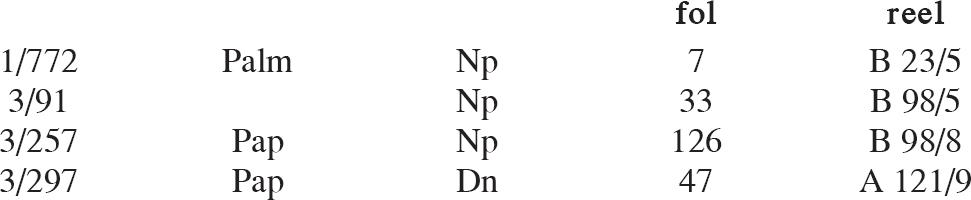
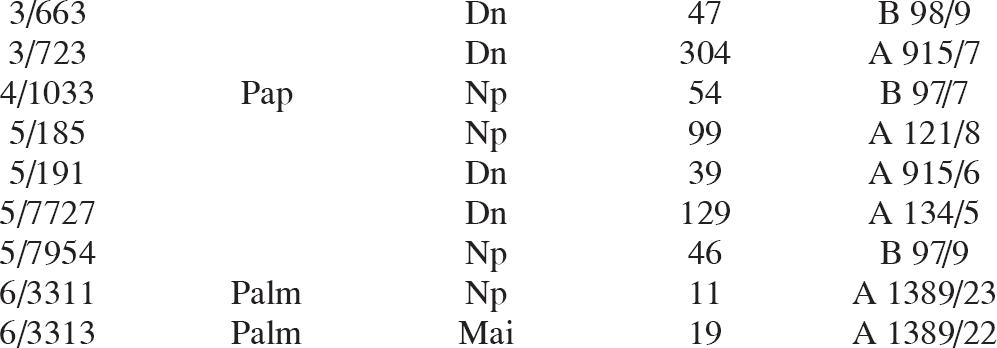
Kathmandu, Kaiser Library
The Kaiser Library in Kathmandu owns two manuscripts of the Bca, and these are also available as NGMPP microfilms:[1281]

Manuscripts from Tibet
Ye 2009 lists seven precious old Bca manuscripts that have survived in Tibet:[1282]
-
One (6.2.1) was catalogued by Rāhula Sāṅkrtyāyana (1893–1963) in the Ngor monastery.[1283]
-
Two of them (6.2.2[1284] and 6.2.3[1285]) were kept in the China Library of Nationalities (Zhongguo Minzu Tushuguan) in Beijing, but have been brought in 1993 to the Tibetan Museum in Lhasa.
-
One manuscript (6.2.4[1286]) has been catalogued in the Norbulingka palace.
-
Two others (6.2.5,[1287] 6.2.6[1288]) have been catalogued in the Drepung monastery.
-
Another manuscript (6.2.7[1289]) was held by the Administrative Committee of Cultural Relics of the Lhoka district.
The Tucci collection in Rome does not contain any more manuscripts of Śāntideva’s poem from Tibet.[1290]
Reproductions
IASWR
The former Institute of Advanced Studies of World Religions (IASWR) at the State University of New York (SUNY) has microfilmed several Sanskrit manuscripts from Nepal. These photographs have been made available in a set of microfiches, a copy of which was sold to the Indological Department of Bonn University. Within these microfiches, two manuscripts of the Bca are found:[1291]
MBB-I-1 (microfilm number MBB-1971-1-1) is a palm leaf manuscript of N.S. 880 in Bhujimola script, 5×28 cm with 7 lines, 38 numbers of leaves, the 2nd one is missing, cf. IASWR 1973. Unfortunately, most of the photographs are blurred, which makes it hardly legible in large sections. The scanned card gives the information that the manuscript contains nine chapters up to the Prajñāpāramitā.[1292]
MBB-II-231 (microfilm number sheet and card not legible) is written in Nepalese characters, 6 lines on 42 fol. Some folios are not legible.
Nagoya
The Buddhist Library in Nagoya owns several microfilms containing Bca manuscripts from private collections in Nepal:[1293]
“CA 10–3. Bodhicaryāvatāre pariṇāmanta pariccheda: (Language) Sanskrit, (Script) Devanāgarī, (Material) Paper, Hartāla on b, (Size) 26x12¼ cm., (Leaves) ff.104 (1b-104b), ex.ff. 3, (Lines) ll.6”.
“CH 257. Bodhicaryā avatāra: (Language) Sanskrit, (Script) Devanāgarī, (Material) Paper, Hartāla on b, (Size) 22x12cm., (Leaves) ff.62 (1b-61b) doubled f.41, (Lines) ll.6 (f.1–54) ll.10 (f.55-last)”.
“CH 314. Bodhicaryāvatāre parikathā kṛtiyamācārya śrī Śāntideva pādānam: (Language) Sanskrit, (Script) Newa: Lipi, (Date of writing) SAMVAT written in letters “NANDA-ŚARA-KHACARE”,[1294] (Material) Paper, Hartāla on b, (Size) 31¾×11 cm., (Leaves) ff.65 (1b-65b), (Lines) ll.7”.
“DH 219. Bodhicaryāvatāre Prajñāpāramitā pariccheda: (Language) Sanskrit, (Script) Devanāgarī, (Material and form of MS) Paper, Hartāla on one side, Banded, (Size) 22¾×15cm., (Pages) pp.57, (Lines) ll.20”.
NGMPP
The NGMPP holds several microfilm rolls in the State Library Berlin (Staatsbibliothek zu Berlin) with photographs of manuscripts from private collections:[1295]
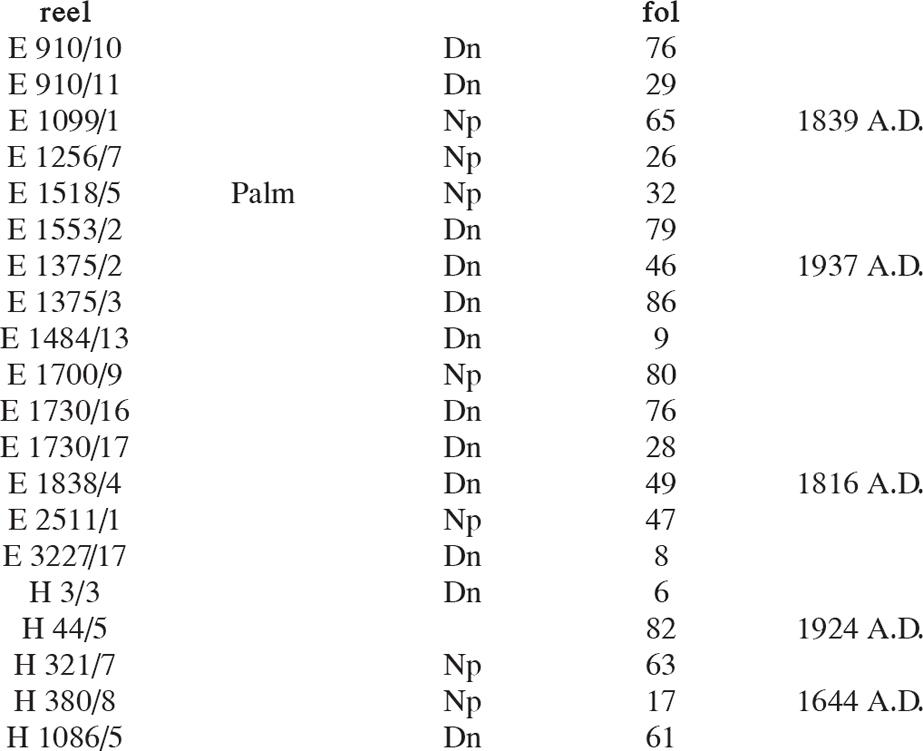
References
Bandurski 1994
Frank Bandurski: Übersicht über die in Göttinger Sammlungen der von Rāhula Sāṅkṛtyāyana in Tibet aufgefundenen buddistischen Sanskrit-Texte (Funde buddhistischer Sanskrit-Handschriften, III). In: Bandurski et.al.: Untersuchungen zur buddhistischen Literatur. Göttingen: Vandenhoeck & Ruprecht 1994 (Sanskrit-Wörterbuch der buddhistischen Texte aus den Turfan-Funden, Beiheft; 5), p. 9–126.
Bapat 1978
P.V Bapat: Professor Dr. P.L. Vaidya. In: Journal of the International Association of Buddhist Studies 1 (1978), p. 91 sq.
Bendall 1883
Cecil Bendall: Catalogue of the Buddhist Sanskrit manuscripts in the University Library, Cambridge. Steiner: Stuttgart 1992 (Verzeichnis der Orientalischen Handschriften in Deutschland, Supplementband; 33 / Publications of the Nepal-German Manuscript Preservation Project; 2) [reprint of: Cambridge 1883].
Bhattacharya 1960
Vidhushekhara Bhattacharya (Ed.): Bodhicaryāvatāra. Calcutta: Asiatic Society of Bengal 1960 (Bibliotheca Indica; 280, fasc. 1580).
Bongard-Levin/Vigasin 1984
G[rigorij] Bongard-Levin, A[leksej] Vigasin: The image of India. The study of Ancient Indian civilisation in the USSR. Moscow: Progress Publishers 1984.
Bṛhatsūcīpattra
Buddhisāgara [Parājuli] (Ed.): Srīḥ Nepālarājakīya-vīrapustakālayastha-hastalikhitapustakānāṃ Bṛhatsūcīpatram. VII, 1–3: Bauddhaviṣayakaḥ. Kāṭhmāṇḍū: Vīrapustakālaya VS. 2021–23 (Purātattvaprakāśanamālā; 29, 38, 39).
Burnouf 1854
Catalogue des livres imprimés et manuscripts composant la bibliothèque de Feu M. Eugène Burnouf. Paris: Duprat 1854.
Cabaton 1907
A[ntoine] Cabaton: Catalogue sommaire des manuscrits sanscrits et pālis. 1er fascicule. – manuscrits sanscrits [nos. 1–1102]. Paris: Bibliothèque nationale, Départment des manuscrits 1907.
Chakravati 1959–60
Chintaharan Chakravarti: Sanskrit manuscripts in the Asiatic Society. In: Indian Studies Past & Present 1,4 (1959–60), p. 663–72.
Colas 1986
Gérard Colas: South Asian documents in the Oriental Division of the Department of Manuscripts of the Bibliothèque Nationale, Paris. In: A. Gaur (Ed.): South Asian Studies. Papers presented at a colloqium 24–26 April 1985. London: British Library 1986 (British Library Occasional Papers; 7), p. 284–89.
Conze 1982
Edward Conze: Buddhist scriptures. A bibliography. Edited and revised by Lewis Lancaster. New York, London: Garland Publishing 1982.
Cowell/Eggeling 1876
E[dward] B[yles] Cowell, J[ulius] Eggeling: Catalogue of Buddhist Sanskrit manuscripts in the possession of the Royal Asiatic Society (Hodgson Collection). In: Journal of the Royal Asiatic Society of Great Britain & Ireland N.S. 8,1 (1876), p. 1–52.
Dietz 1999
Siglinde Dietz: Sāntidevas Bodhicaryāvatāra – Das Weiterwirken des Werkes dargestellt anhand der Überlieferungsgeschichte des Textes und seiner Kommentare [Lecture script]. In: Buddhismus in Geschichte und Gegenwart 3: Śāntideva’s „Eintritt in das Leben zur Erleuchtung“. Hamburg: Universität Hamburg 1999 (Weiterbildendes Studium), p. 25–41.
Dimitrov 2002
Dragomir Dimitrov: Tables of Old Bengali script. In: Dimitrov/Roesler/Steiner (Eds.): Śikhisamuccayaḥ. Indian and Tibetan studies (collectanea marpurgensia indologica et tibetica) [Festschrift für Michael Hahn zur Vollendung des 60. Lebensjahres]. Wien: Universtität Wien, Arbeitskreis für Tibetische und Buddhistische Studien 2002 (Wiener Studien zur Tibetologie und Buddhismuskunde; 53), p. 27–78.
Dimitrov 2007
Dragomir Dimitrov: Ratnākaraśānti’s Chandoratnākara and Tathāgatadāsa’s Chandomāṇikya. In: Klaus/Hartmann (Hrsg.): Indica et Tibetica. Festschrift für Michael Hahn. Zum 65. Geburtstag von Freunden und Schülern überreicht. Wien: Universität Wien, Arbeitskreis für Tibetische und Buddhistische Studien 2007 (Wiener Studien zur Indologie und Buddhismuskunde; 66), p. 113–38.
Dimitrov/Tamot 2007
Dragomir Dimitrov, Kashinath Tamot: Kaiser Shamsher, his library and his manuscript collection. In: Newsletter of the NGMCP 3 (2007), p. 26–36.
Eimer 2006
Helmut Eimer: Buddhistische Begriffsreihen als Skizzen des Erlösungsweges. Wien: Universität Wien, Arbeitskreis für Tibetische und Buddhistische Studien 2006 (Wiener Studien zur Tibeologie und Buddhismuskunde; 65).
Eimer/Paffen 1988
Helmut Eimer, assisted by Roland Paffen: Microfilms, microfiches and other reproductions of North Indian manuscripts kept in the Indological Institute of Bonn University. In: Eimer (Ed.): Indology and Indo-Tibetology. Thirty years of Indian and Indo-Tibetan Studies in Bonn. Bonn: Indica et Tibetica Verlag 1988 (Indica et Tibetica; 13), p. 97–192.
Filliozat 1941
Jean Filliozat: Catalogue du fonds sanscrit. Fasc. 1: Nos 1 à 165. Paris: Bibliothèque nationale, Département des manuscrits 1941.
Gómez 1999
Luis O. Gómez: The way of the translators: three recent translations of Śāntideva’s Bodhicaryāvatāra. In: Buddhist Literature 1 (1999), p. 262–354.
Goshima/Noguchi 1983
Kiyotaka Goshima, Keiya Noguchi: A succinct catalogue of the Sanskrit manuscripts in the possession of the Faculty of Letters, Kyoto University. Kyoto: Kyoto University, Society for Indic and Buddhistic Studies 1983.
Grünendahl 1989
Reinhold Grünendahl: A concordance of H.P. Śāstri’s catalogue of the Durbar Library and the microfilms of the Nepal-German Manuscript Preservation Project. Stuttgart: Steiner 1989 (Verzeichnis der Orientalischen Handschriften in Deutschland, Supplementband; 31 / Publications of the Nepal-German Manuscript Preservation Project; 1).
Hahn 1988
Michael Hahn: Indische und nepalesische Handschriften im Indologischen Seminar der Universität Bonn. In: Eimer (Ed.): Indology and Indo-Tibetology. Thirty years of Indian and Indo-Tibetan Studies in Bonn. Bonn: Indica et Tibetica Verlag 1988 (Indica et Tibetica; 13), p. 81–96.
Hunter 1881
W[illiam] W[ilson] Hunter: Catalogue of Sanskrit manuscripts collected in Nepal, and presented to various libraries and learned societies by Brian Houghton Hodgson. London: Trübner & Co 1881.
IASWR 1973
Buddhist Sanskrit manuscripts. A title list of the microfilm collection of the Institute for Advanced Studies of World Religions. [Stony Brook] 1973.
Janert 1965
Klaus Ludwig Janert: An annotated bibliography of the catalogues of Indian manuscripts. Part 1. Wiesbaden: Steiner 1965 (Verzeichnis der Orientalischen Handschriften in Deutschland, Supplement; 1).
Kaneko/Saito 1954
Ryotai Kaneko, Kojyun Saito: Buddhist manuscripts of the Bir Library. In: Taishō Daigaku Kenkyū Kiyō 40 (1955), p. 55–84.
Kāvyatīrtha 1904
Kunja Vihari Kāvyatīrtha: Catalogue of printed books and manuscripts in Sanskrit belonging to the Oriental Library of the Asiatic Society of Bengal. Calcutta: Baptist Mission Press 1904.
Keith 1935
Arthur Berriedale Keith: Catalogue of the Sanskrit and Prākrit manuscripts in the Library of the India Office. Vol. II: Brahmanical and Jaina manuscripts. With a supplement Buddhist manuscripts by F.W. Thomas. Oxford: Clarendon Press 1935.
Kellner 2010
Birgit Kellner: Rahul Sankrityayan (1893–1963) und seine Tibetreisen im Kontext. In: Masala Newsletter 5,4 (2010), w/o page numbers.
La Vallée Poussin 1889
Louis de La Vallée Poussin: Bouddhisme. Études et Matériaux. Ādikarmapradīpa. Bodhicaryāvatāratīkā. London: Luzac & Co. 1898 [Ṭīkā on p. 233–404].
La Vallée Poussin 1901
Louis de La Vallée Poussin: Bodhicaryāvatārapañjikā. Prajñākaramati’s commentary of the Bodhicaryāvatāra of Çāntideva. Calcutta: Baptist Mission Press 1901–14 (Bibliotheca Indica; 150, fasc. 983, 1031, 1090, 1126, 1139, 1305, 1399).
Law 1933
Narendra Nath Law: Mm. Dr. Haraprasad Sastri (1853–1931). In: Indian Historical Quarterly 9 (1933), p. 307–416.
Lienhard/Manandhar 1988
Siegried Lienhard, Thakur Lal Manandhar: Nepalese manuscripts. Part 1: Nevārī and Sanskrit. Staatsbibliothek Preussischer Kulturbesitz, Berlin. Stuttgart: Steiner 1988 (Verzeichnis der Orientalischen Handschriften in Deutschland; 33,1)
Lindtner 1998
Christian Lindtner: [Review of:] The Mongolian Tanjur Version of the Bodhicaryāvatāra. Igor de Rachewiltz. Wiesbaden 1996. In: Buddhist Studies Review 15,2 (1998), p. 238–40.
Lindtner 1991
Chr[istian] Lindtner: Textcritical notes on Sanskrit texts 1. Bodhi(sattva)caryāvatāra. In: Zheng/Zhongxin (Eds.): Papers in honour of Prof. Dr. Ji Xianlin on the occasion of his 80th birthday. Beijing: Nachang Chi 1991, II, p. 651–60.
Matsunami 1965
Seiren Matsunami: A catalogue of the Sanskrit manuscripts in the Tokyo University Library. Tokyo: Suzuki Research Foundation 1965.
Minaev 1889
I[van Pavlovič] Minaev (Ed.): Spasenie po učeniju pozdnějšich buddhistov [Salvation according to the teaching of the late Buddhists]. In: Zapiski Vostočnago Otdělenija Imperatorskago Russkago Archeologičeskago Obščestva 4 (1889), p. 153–228.
Mironov 1918
N[ikolai] D[mitrievich] Mironov: Katalog indijskich rukopisej Rossijskoj Publičnoj Biblioteki, sobranie I.P. Minaeva i někotoryja drugija. Vypusk 1. Petrograd: Rossijskaja Akademija Nauk 1918.
Mitra 1882
Rájendralála Mitra: The Sanskrit Buddhist literature of Nepal. Calcutta: Asiatic Society of Bengal 1882.
Moriguchi 1989
Mitutoshi Moriguchi: A catalogue of the Buddhist Tantric manuscripts in the National Archives of Nepal and Kesar Library. Tokyo: Sankibou Busshorin 1989.
Mukhopadhyaya 1960
Sujitkumar Mukhopadhyaya: Appendix to the new edition of the Bodhicaryāvatāra [Bhattacharya 1960]. In: Indian Historical Quarterly 37 (1961), p. 287–92.
Nobel 1928
Johannes Nobel: Fortsetzung des Verzeichnisses der Bibliotheca Indica und verwandter indischer Serien. Sonderabdruck aus “Zentralblatt für Bibliothekswesen” Jahrgang 45 (1928). Leipzig: Harrassowitz 1928.
Petech 1984
Luciano Petech: Mediaeval history of Nepal (c. 750–1482). 2nd edition. Roma: Instituto Italiano per il Medio ed Estremo Oriente 1984 (Serie Orientale Roma; 54).
Pezzali 1968
Amalia Pezzali: Śāntideva. Mystique bouddhiste des VIIe et VIIIe siècles. Firenze: Vallecchi Editore 1968 (Testi e richerche di Scienze religiose; 3).
Saito 1993
Aikra Saito: 1990.4–1993.3. Grant-in-aid for scientific reasearch (C). A study of Akṣayamati (=Śāntideva)’s Bodhisattvacaryāvatāra as found in the Tibetan manuscripts from Tun-huang. Project number 02801005. Mie: Mie University [1993].
Saito 1996
Akira Saito: Śāntideva in the history of Mādhyamika philosophy. In: Sankarnarayan/Yoritomi/Joshi (Eds.): Buddhism in India and abroad. An integrating influence in Vedic and Post-Vedic perspective. Mumbai (etc.): Somaiya Publications 1996, p. 257–63.
Saṃkṣpitasūcīpattra
Buddhisāgara [Parājuli] (Ed.): Nepālarājakīya-vīrapustakālayastha-hastalikhitasamastapustakānām Saṃkṣiptasūcīpattram. Kāṭhamāḍauṃ: Vīrapustakālaya VS. 2020 (Purātattvaprakāśanamālā; 18).
Sāṅkṛtyāyana 1935
Rāhula Sāṅkṛtyāyana: Sanskrit palm-leaf mss. in Tibet. In: The Journal of the Bihar and Orissa Research Society 21 (1935), p. 21–44.
Śāstrī 1893
Hara Prasád Shastri: On a new find of old Nepalese manuscripts. In: Journal of the Asiatic Society of Bengal, Part 3: Anthropology 1893, p. 245–49.
Śāstrī 1894
[Haraprasāda Śāstrī (Ed.):] Bodhicaryāvatāram. In: Journal and Text of the Buddhist Text Society of India 2,1 (1894), p. 1–16 & 2,2, p. 17–32.
Śāstrī 1895
Haraprasád Sástri: Notices of Sanskrit mss. Volume XI. Calcutta: Baptist Mission Press 1895.
Śāstri 1905–15
Hara Prasād Śāstri: Catalogue of palm-leaf & selected paper mss. belonging to the Durbar Library, Nepal. 2 Vols. Calcutta: Baptist Mission Press 1905–1915 [reprinted in: Grünendahl 1989].
Śāstrī 1913
Haraprasad Sastri: Santideva. In: Indian Antiquary 42 (1913), p. 49–51.
Śāstrī 1917
Hara Prasad Shāstri: A descriptive catalogue of Sanscrit manuscripts in the Government Collection under the care of the Asiatic Society of Bengal. Vol. 1: Buddhistmanuscripts. Calcutta: Baptist Mission Press 1917.
Schneider 1934
Alexandra Schneider: Professor J.P. Minayeff (the Russian Indologist) 1840–90. In: Indian Historical Quarterly 10 (1934), p. 811–26.
Seyfort Ruegg 1981
David Seyfort Ruegg: The literature of the Madhyamaka school of philosophy in India. Wiesbaden: Harrassowitz 1981 (A History of Indian Literature; VII, 1).
Sferra 2008
Francesco Sferra: Sanskrit manuscripts and photographs of Sanskrit manuscripts in Guiseppe Tucci’s collection. In: Sferra (Ed.): Sanskrit Texts from Guiseppe Tucci’s collection. Roma: Istituto Italiano per l’Africa e l’Oriente 2008 (Serie Orientale Roma; 104 / Manuscripta Buddhica; 1), p. 15–78.
Sieg 1908
Emil Sieg: Verzeichnis der Bibliotheca Indica und verwandter Indischer Serien nach Werken und Nummern. Sonderabdruck aus dem “Zentralblatt für Bibliothekswesen” Jahrgang 24, 1907, Heft 11. Leipzig: Harrassowitz 1908.
Sircar 1965
D[ines] C[handra] Sircar: Indian epigraphy. Delhi: Motilal Banarsidass 1996 [reprint of: Delhi 1965].
Société Asiatique 1837
Catalogue des livres bouddhiques, écrits en sanscrit, que M.B.H. Hodgson a fait copier au Nepal pour le compte de la Société asiatique, et qui ont été présentés au conseil dans sa séance du 14 juillet 1837. In: *Journal Asiatique *troisième série 4 (1837), p. 296 sq.
Steinkellner 2004
Ernst Steinkellner: A tale of leaves. On Sanskrit manuscripts in Tibet, their past and their future [2003 Gonda Lecture]. Amsterdam: Royal Netherlands Academy of Arts and Sciences 2004.
Takaoka 1981
Hidenobu Takaoka: A microfilm catalogue of the Buddhist manuscripts in Nepal. Vol 1. Nagoya: Buddhist Library 1981.
Thapa 2004
Shanker Thapa: Buddhism and Nepal-Japan academic relations: a native perspective. In: Journal of Nepal-Japan Studies 4,1 (2004), offprint w/o page numbers.
Tsukamoto/Matsunaga/Isoda 1990
Keisho Tsukamoto, Yukei Matsunaga, Hirofumi Isoda: A descriptive bibliography of the Sanskrit Buddhist literature. Vol. III: Abhidharma, Madhyamaka, Yogācāra, Buddhist epistemology and logic. Kyoto: Heirakuji-Shoten 1990.
Vaidya 1960
P[araśurām] L[akṣman] Vaidya: Bodhicaryāvatāra of Śāntideva with the commentary Pañjikā of Prajñākaramati. Bombay: Mithila Institute of Post-Graduate Studies and Research in Sanskrit Learning Darbhanga 1960 (Buddhist Sanskrit Texts; 12).
Vielle 2010
Christophe Vielle: Louis de La Vallée Poussin. In: Nouvelle biographie nationale de Belgique. Tome 10. Bruxelles: Académie Royale de Belgique 2010, p. 122–124.
Waterhouse 2004
David M. Waterhouse (Ed.): The origins of Himalayan studies. Brian Houghton Hodgson in Nepal and Darjeeling 1820–1858. London (etc.): RoutledgeCurzon 2004 (Royal Asiatic Society Books).
Weber 1879
Albrecht Weber: Combined review of Wright 1877 and Cowell/Eggeling 1876. In: Indische Streifen. Dritter Band. Leipzig: Brockhaus 1879, p. 520–532.
Weller 1950
Friedrich Weller: Über den Quellenbezug eines mongolischen Tanjurtextes. Berlin: Akademie-Verlag 1950 (Abhandlungen der Sächsischen Akademie der Wissenschaften zu Leipzig, Phil.-Hist. Klasse; 45,2).
Wezler 1986
Albrecht Wezler: Geisteswissenschaftliche Forschung in Nepal (Bericht über das “Nepal-German Manuscript Preservation Project)”. In: Zeitschrift der Deutschen Morgenländischen Gesellschaft 136,1 (1986), p. *2*-*14*.
Wright 1877
Daniel Wright (Ed.): History of Nepāl, translated from the Parbatiyā by Munshī Shew Shunker Singh and Pandit Shrī Gunānand. Cambridge: Cambridge University Press 1877.
Yamada 1959
Ryūjō Yamada: Bongo butten no shobunken. Kyoto: Heirakuji Shoten 1959.
Ye 2009
Shaoyong Ye: A preliminary survey of Sanskrit manuscripts of Madhyamaka texts preserved in the Tibet Autonomous Region. In: Steinkellner/Qing/Krasser (Eds.): Sanskrit manuscripts in China. Proceedings of a panel at the 2008 Beijing Seminar on Tibetan Studies, October 13to17. Beijing 2009, p. 307–36.
Yuyama 1992
Akira Yuyama: Buddhist Sanskrit manuscripts collections – a bibliographical guide for the use of students in Buddhist philology. Tokyo: The International Institute for Buddhist Studies 1992.
Yuyama 2000
Akira Yuyama: Eugène Burnouf. The background to his research into the Lotus Sutra. Tokyo: Soka University, International Research Institute for Advanced Buddhology 2000 (Bibliotheca Philologica et Philosophica Buddhica; 3).
Seven: Asiddha vs asiddhavat in Patañjali’s Mahābhāṣya
Małgorzata Sulich-Cowley
Introduction
The asiddha principle employed by Pāṇini in his Aṣṭādhyāyī (A.) (5th-4th cent. BCE)[1296] allows for the division of the text of the treatise into two parts: the Sapādasaptādhyāyī (comprising seven chapters and the first sub-chapter of the eighth chapter) and the Tripādī (comprising the last three subchapters). Pāṇini uses the term asiddha twice in his treatise in the rules A. 8.2.1 pūrvatrāsiddham (‘[all the following rules are] suspended (asiddha, have not taken effect) with respect to the previous ones’) and A. 6.1.86 ṣatva-tuKor asiddhaḥ (‘[a single substitute of a preceding and a following phoneme is considered] suspended with respect to the augment tuK and the ṣ-substitution’); and once he uses the term asiddhavat – A. 6.4.22 asiddhavad atrābhāt (‘from this sūtra up to the sūtra A. 6.4.129 bhasya[1297] [including the domain of bhasya, the rules are to be applied] as if suspended [with respect to each other]’). There has been disagreement amongst recent scholars such as Bronkhorst, Kiparsky, Cardona and S.D. Joshi as to whether these two terms are synonymous or whether they mean two different things.
I will analyse what Patañjali (2nd cent. BCE),[1298] Pāṇini’s commentator, says about asiddha and whether he is right in his assumptions. In all three places Patañjali quotes Kātyāyana’s (3rd cent. BCE)[1299] vārttika (vt.) on the sūtra A. 6.1.86 – ādeśa-lakṣaṇa-pratiṣedhārtham utsarga-lakṣaṇa-bhāvārtham ca (‘[asiddha is used] in order to prohibit [the application of] a rule [conditioned by] a substitute (ādeśa) and allow [the application of] a rule [conditioned by] a substituend (utsarga)’) – to explain the principles of asiddha and asiddhavat. Patañjali quotes this vt. again under two other sūtras, A. 6.4.22 and A. 8.2.1, on the vt.s 1 and 8 respectively, both of which read: asiddha-vacana uktam (‘it has been explained in the asiddha rule’). Then Patañjali explains what he means by referring to the aforementioned statement. As can be seen, therefore, the author of the Mahābhāṣya uses the same argument in all three cases irrespective of the fact that the term asiddha is used only twice. Patañjali ignores the fact that in the rule A. 6.4.22 asiddhavad atrābhāt the term asiddha is followed by the suffix vatl, which in this case denotes similarity. It seems that he considers both of the terms equal. He pays no attention to the form asiddhavat whatsoever. He does not even try to explain the use of the suffix. Later commentators accept that in all three rules the term should be understood as standing for asiddhavat, even in those two cases when Pāṇini himself uses asiddha only.
The so-called asiddha principle has been discussed frequently over the last thirty years or so as it seems to be one of the most important tools for the application of rules in the A.[1300] The very term asiddha is difficult to translate. It is the past participle of the verbal root ‘sidh’ – ‘to be accomplished, to take effect’ and therefore it can be rendered as ‘that which has not been accomplished, has not taken effect’.[1301] It is important to mention that the term asiddha was not defined by Pāṇini in the A. and that is where the difficulties arise. It was either obvious for those who studied his grammar at the time or it was used in its basic meaning. As the Monier Williams dictionary definition is ambiguous, it is very difficult to define the term properly. Following the dictionary, asiddhavat would therefore mean ‘as if it has not taken effect’. There is a great difference between understanding the sūtras as ‘not having taken effect’ or ‘as if not having taken effect’. According to Patañjali’s commentary, they ‘have not taken effect’ but, according to the later tradition, they are ‘as if not having taken effect’. Which interpretation is right? Or maybe they are both wrong? I will present some arguments supporting the opinion that they are both wrong and that in fact those two terms are not synonymous.
Examples in the Asiddhavat Section
When we look at how the rules are applied in both the asiddha (A. 6.1.86, A. 8.2.1–8.4.68) and asiddhavat (A. 6.4.22–6.4.175) sections, we can see that there are major differences. It has been generally accepted that the asiddha principle establishes the order in which the rules of the A. are applied during the derivational process. In the whole of the A. the rules are applied depending on the derivational context, absolutely irrespective of their place in the treatise. This is not the case as far as the asiddha section is concerned. Contrary to the rest of the A. the sūtras in the Tripādī section (A. 8.2.1–8.4.68) are applied during the derivational process in the order they appear in the A. In the asiddhavat section (A. 6.4.22–6.4.175) the application of rules is determined by other factors, most certainly not by their order. The argument can be advanced that this is the result of the formulation of the sūtras A. 8.2.1 pūrvatrāsiddham (‘[all the following rules are] suspended (asiddha, have not taken effect) with respect to the previous ones’) and A. 6.4.22 asiddhavad atrābhāt (‘from this sūtra up to the sūtra A. 6.4.129 bhasya[1302] [including the domain of bhasya, the rules are to be applied] as if suspended [with respect to each other]’). The words of interest are pūrvatra and even more so the word atra. According to Kiparsky[1303] the latter term allows us to apply the rules in conflict in whichever order we choose. In my opinion, however, it is not entirely the case. If the term atra were to specify the domain in which the asiddhavat principle works, the expression ā bhāt would be superfluous. So it has to serve another purpose which is, as the commentators agree,[1304] to describe the context in which the rule in question takes place. It is used to show that one rule can be suspended with respect to another only when they have the same conditions for operation. I think it is very difficult to deduce from this word that the order of the application of rules is left to our choice. There are other factors that determine which sūtra is to be applied first.
Let us deal with ā bhāt first. There could be two possible interpretations of this term. First, that the scope of this governing rule extends up to the rule A. 6.4.129 bhasya which introduces a new adhikāra, thereby ending the application of asiddhavat. The rule A. 6.4.129 says that from now on all the operations will take place on the stem termed bha. Another interpretation would allow the scope of the governing rule A. 6.4.22 to _include_ the term bha as well. So all the sūtras that belong to the group governed by the rule bhasya (A. 6.4.129) are subject to the asiddha or asiddhavat principle. The term ā bhāt is absolutely necessary because otherwise the principle of suspension would extend outside the domain of bha, which ends in the fourth pāda of the sixth chapter and would apply to the rules that lie outside it, for example in the seventh chapter. This is not what is desired.
What is more, _both_ of the rules in question must belong to the so-called ābhīya section.[1305] Otherwise, the ‘suspension’ does not work at all. Let us see, for example, the derivation of the form abhāji (‘it broke’, aor. pass.):
| bhañj + lUṄ | |
| bhañj + CLI + ta | (A. 3.1.43 CLI lUṄi[1306]) |
| aṬ + bhañj + CiṆ + ta | (A. 6. 4.71 lUṄ-lAṄ-lṚṄkṣv aḌ-udāttaḥ,[1307] |
| A. 3.1. 66 CiṆ bhāva-karmaṇoḥ[1308]) | |
| a + bhañj + i + 0 | (A. 6.4.104 CiṆo luK[1309]) |
| a + bha (ñ → 0) j + i | (A. 6.4. 33 bhañjeś ca CiṆi[1310]) |
| a + bhaj + i | |
| a + bh (a → ā)j + i | (A. 7.2.116 aTa upadhāyāḥ[1311]) |
| abhāji |
First the augment aṬ is added to the stem followed by the suffix CiṆ. The ending ta is further deleted by the rule A. 6.4.104. The problem starts with the deletion of the nasal consonant ñ by the rule A. 6.4.33. It is a sūtra belonging to the asiddhavat section. To derive the correct form abhāji with the phoneme ā we need to apply the rule A. 7.2.116, which prescribes the vrddhi substitution of the penultimate phoneme a in a stem when the same is followed by the suffix marked with Ṇ or Ñ. The suffix CiṆ is such a suffix but, as the deletion of the nasal belongs to the asiddhavat section, it should be treated as if suspended. Therefore the phoneme a of the stem bhañj would not be penultimate; the stem would still have the nasal ñ which would constitute the penultimate phoneme. And as such the stem would not be able to undergo the vṛddhi substitution by A. 7.2.116. However, the sūtra A. 7.2.116 does not belong to the domain prescribed by the sūtra A. 6.4.22, the so-called ābhīya domain; it is outside this domain. Therefore the asiddhavat principle will not apply in this case. As can be seen from the above example, the conflict between the two sūtras has to refer to the rules that belong to the same domain of operation. If one of them lies outside it, the principle of suspension does not work.
Another question arises with respect to the word atra. Patañjali says that it specifies the domain. But the very form of the term ā bhāt restricts the domain already. What is the purpose then in using this additional expression? It is used to show that one rule can be suspended with respect to another only when they have the same conditions for operation (atra). A good example is the word papuṣah (‘of the one who has drunk’, gen. sg.):
| pa+ pā + KvasU + Sas | (A. 3.2.107 KvasUś ca[1312]) |
| pa+ pā + vas + as | |
| pa+ pā + (va → u) s + as | (A. 6.4.131 vasOḥ samprasāraṇam[1313]) |
| pa+ p (ā → 0) + us + as | (A. 6.4. 64 āTo lopa iṬi ca[1314]) |
| pap + us + as | |
| papu (s → ṣ) + as | (A. 8.3. 59 ādeśa-pratyayayoḥ[1315]) |
| papuṣar | (A. 8.2.66 sa-sajuṣo rUḥ[1316]) |
| papuṣaḥ | (A. 8.3.15 khaR-avasānayor visarjanīyaḥ[1317]) |
In this case the rules that are of interest to us are A. 6.4.64 and A. 6.4.131. The deletion of the final phoneme ā takes place only when the stem is followed by the suffix beginning with a vowel marked with K. The suffix KvasU is marked with K and it does begin with a vowel when it undergoes samprasāraṇa. On the other hand, the occurrence of samprasāraṇa for the suffix KvasU depends on the following case ending. Therefore the conditions for both of the operations are different. And because the conditions are different, the samprasārana is not treated as suspended with respect to the deletion of the phoneme ā. In other words, the samprasāraṇa of KvasU allows for the deletion of the phoneme ā, otherwise the correct result would not be possible.
Kiparsky in one of his articles (1982)[1318] claims that the suffix vatI in the word asiddhavat is used in the same way as in other places in the A., for example in the rule A. 1.1.56 sthānivad ādeśo ‘naL-vidhau – ‘the substitute is to be treated like the substituend except for an operation depending on the original phoneme’. He uses this as an argument to support the view that asiddha equals asiddhavat and says that in the case of asiddha Pāṇini simply did not have to use the suffix vatI in the rule as it was obvious. In other words, Kiparsky agrees with the grammatical tradition, which does not see a difference between both terms and explains them both as meaning ‘as if suspended/has not taken effect’. I agree with Kiparsky that Pāṇini could use the suffix vatI in the same way in the rule A. 6.4.22 as in A. 1.1.56. In my opinion, however, it does not prove that the terms asiddha and asiddhavat signify the same thing. On the contrary, it can prove quite the opposite. When we look at the rule A. 1.1.56, we can see that the substitution in question did take place, i.e. the substitute (ādeśa) has been applied; and only for the sake of some operations do we still treat the substitute as if it were the substituend. In the case of asiddhavat we see the same thing; the operation has taken place but we consider it suspended. We treat it as if it has not taken place. The sūtra has applied, the operation has been performed but the result is treated as if it has not taken place. But the important thing is that it _has actually taken place_. In the case of asiddha, though, the operation _has not_ taken place at all!
Let us analyse yet another example. This is the derivation of 2nd sg. impv. of the verb śās – to instruct.
| śās + si → hi | (A. 3.4.87 ser hy-aPiTi ca[1319]) |
| (śās → śā) + hi | (A. 6.4.35 śā hau[1320]) |
| śā + hi | |
| śā + (hi → dhi) | (A. 6.4.101 hu-jhaLbhyo her dhiḥ[1321]) |
| śādhi |
What is of interest to us in this example are the stages of derivation needed to produce śās + hi. To derive a proper form we need to substitute both the stem śās with the form śā and the ending hi with the ending dhi. In this case the substitution śās → śā eliminates the context for the hi → dhi substitution because dhi can come in place of hi only when the preceding stem ends in the phoneme denoted by the term jhaL and the phoneme s is included in it. When the stem has been substituted by the form śā, the conditions for the dhi-substitution are no longer met. If, however, the ending substitution takes place first, the stem substitution cannot take place because it depends on the following suffix hi. That is why the rule A. 6.4.35, prescribing the stem substitution, is treated as suspended with respect to the suffix substitution prescribed by the rule A. 6.4.101.
The question might be asked as to why the order of the rules cannot be reversed. Why cannot the dhi substitution take place first and be treated as suspended and then the śā substitution? The explanation is provided by the rule A. 1.1.56 sthānivad ādeśo ’naL-vidhau – the substitute is treated as the substitutend except when the rule depending on the original phoneme is to be performed. Let us consider in the above example whether this rule can apply here and if so, to what effect. The ending dhi comes in place of the ending hi but it can still be treated as having the hi form according to A. 1.1.56 (sthānivad-bhāva rule). Therefore, there are the conditions for the application of A. 6.4.35 and śā can substitute śās. However, the reverse is not possible. The substitute śā cannot be treated as the substituend śās for the sake of the rule A. 6.4.101 because this very rule, i.e. the hi → dhi substitution, is merely the substitution of single sounds; it is the aL-vidhi. Therefore, because the śā substitution can apply whether the ending substitution has taken place or not, it takes precedence and applies first. Thus it has to be considered suspended. If the sūtra A. 6.4.35 were not treated as if suspended, the result would be this:
| śās + si → hi | (A. 3.4.87) |
| (śās → śā) + hi | (A. 6.4.35) |
| *śā + hi | |
| *śāhi |
The reason why we can refer to the sthānivad-bhāva in this case is that it has not been prohibited. In the vārttika 3 on the sūtra A. 1.1.58 na padānta-dvirvacana-vare-ya-lopa-svara-savarṇānusvāra-dīrgha-jaŚ-caR-vidhiṣu (‘[The substitute of a vowel] is not [treated like the substituend] with respect to the operations regarding a pada final, reduplication, the deletion before [the suffix] varaC, the deletion of [the phoneme] y, accent, homogenous phonemes, the anusvāra replacement, the long vowel replacement, the replacement by jaŚ (voiced unaspirated stops) and the replacement by caR (unvoiced unaspirated stops)’) we read pūrvatrāsiddhe ca (‘And also in the pūrvatrāsiddha [section]’). Had the vārttika read simply asiddhe, we could make use of it also in the ābhīya section. However, it does not say so and in my opinion it implies that Pāṇini treated these two sections, that is the Tripādī and the ābhīya sections, differently.
As mentioned above, Patañjali does not use the term asiddhavat but always asiddha. Now, later commentators only, on the other hand, use the term asiddhavat. I am of the opinion that there is no reason to believe that Patañjali also understood the term asiddha as asiddhavat. Rather, he read the word asiddha in all three rules given above. Does it create any problems in the derivation of the form śādhi then? It most certainly does. The rules A. 6.4.35 and A. 6.4.101 are mutually exclusive. The application of one eliminates the environment of the other. If one of the rules is asiddha, it has not taken effect and therefore after the application of the other, it cannot be applied. What we need, however, in the example given is both rules, to be able to derive the correct form. Asiddhavat lets us do so because the first rule applicable – whichever it is – is considered only ‘as if it has not taken effect’, i.e. it has but the derivational process continues as if it has not.
The forms āgahi (‘come!’, 2nd impv. sg.) and jahi (‘kill!, 2nd impv. sg. are also very good examples:
| āgam + LOṬ → siP | han + LOṬ → siP |
| āgam + ŚaP + si | han + ŚaP + si |
| āgam + 0 + si | han + 0 + si |
| (A. 2.4.72 adi-prabhṛtibhyaḥ ŚaPaḥ[1322]) | (A. 2.4.72) |
| āgam + si → hi | han + si → hi |
| (A. 3. 4. 87 ser hy-aPiTi ca[1323]) | (A. 3.4.87) |
| āgam + hi | han + hi |
| āga (m → 0) + hi | han → ja + hi |
| (A. 6. 4. 37 anudāttopadeśa-vanati- | (A. 6. 4.36 hanter jaḥ[1324]) |
| tanoty-ādinām anunāsika-lopo jhaLi K-ṄiTi[1325]) | |
| āgahi | jahi |
If the sūtras A. 6.4. 36 and A. 6.4.37 were not treated as if suspended, the result would be as follows:
| āgam + LOṬ → siP | han + LOṬ → siP |
| āgam + ŚaP + si | han + ŚaP + si |
| āgam + 0 + si | han + 0 + si |
| (A. 2.4.72) | (A. 2.4.72) |
| āgam + si → hi | han + si → hi |
| (A. 3.4.87) | (A. 3.4.87) |
| āgam + hi | han + hi |
| āga (m → 0) + hi | han → ja + hi |
| (A. 6.4.37) | (A. 6.4.36) |
| *āga (hi → 0) | *ja (hi → 0) |
| (A. 6.4.105 aTo heḥ[1326]) | (A. 6. 4.105) |
| =āga | *ja |
The rule A. 6.4.105 aTo heh (the suffix hi is deleted after the stem ending in the phoneme a), could apply because after the deletion and the substitution of the stem respectively, both of the stems end in the phoneme a. However, when the preceding operation, namely the deletion of the nasal m of āgam is treated as if suspended, the rule A. 6.4.105 has no scope of application. The stem is considered to be ending in a consonant, therefore the conditions for the hi-deletion are not met and the correct form āgahi is derived
A similar issue is found in the derivation of the form jahi. When the ending si is substituted by hi, the sūtra A. 6.4.36 applies which prescribes the substitution of the stem han by ja. At this point A. 6.4.105 could apply deleting the ending hi because it appears after the stem ending in the phoneme a. This is not desired. However, the substitution han → ja is considered suspended and therefore the preceding verbal stem still ends in a consonants. The conditions for the application of A. 6.4.105 are not met. Thus we can derive the correct form jahi.
The rules prescribing the deletion of the phoneme m and the ja- substitution are treated as suspended so that the rule conditioned by those substitutions, namely A. 6.4.105, does not take place.
Examples in the Pūrvatrāsiddha Section
Let us compare the above examples to what happens with the rules within the Tripādī section. The example chosen is paktavya ‘ought to be cooked’ and the derivation is as follows:
| pac + tavyaT | |
| pa (c → k) | (A. 8.2.30 coḥ kuḥ[1327]) + tavya |
In stage one of this derivation two rules can be applied: A. 8.2.30, prescribing the substitution c → k before a non-nasal stop, and A. 8.4.40 stoḥ ścunā ścuḥ,[1328] prescribing the substitution t → c when in contact with a palatal stop. Thanks to the sūtra A. 8.2.1 and the asiddha principle, the only order acceptable is the one shown: first we apply the rule A. 8. 2.30 and then the environment for the application of A. 8.4.40 disappears. Thus, we arrive at the correct form paktavya. However, if we accept that the term asiddha should be interpreted as asiddhavat, we could reverse the order because asiddhavat does not require the rules to apply in order of their appearance in the treatise. We could, therefore, apply the rule A. 8.4.40 first and treat it ‘as if it had not taken effect’ with respect to A. 8.2.30. Afterwards, the rule A. 8.2.30 would apply, but as A.8.4.40 is only ‘as if not having taken effect’ in reality it has, which means that we get both of the substitutions c → k and t → c resulting in the incorrect form *paccavya.
The examples given above show that there is a difference in the way the rules are applied in both of the sections. In the Tripādī (A. 8. 2.1–8.4. 68) section the rules must be applied in order (there are very few exceptions to this and they are carefully thought out by Pāṇini) unlike the asiddhavat section (A. 6.4.22–6.4.175) where this is certainly not the case.
It is true that in some cases within the Tripādī section it does not make much difference whether we interpret the term asiddha as ‘not having taken effect’ or ‘as if not having taken effect’; for example, when we derive the form rājabhis from rājan + bhis. The phoneme n is deleted by the rule A. 8. 2.7 na-lopaḥ prātipadikāntasya.[1329] After the deletion has been made, the ending bhis can be substituted by the ending ais because the preceding stem ends in the phoneme a. This substitution takes place on the basis of the rule A. 7.1. 9 aTo bhisa ais.[1330] This does not happen, however, because the rule deleting the final phoneme n belongs to the Tripādī section. Therefore, with respect to the rule in the seventh chapter it is suspended. In such a way, the deletion of the final phoneme constitutes the final stage of the derivation. In this case the interpretation ‘as if suspended’ would still yield the correct result. However, it is not always the case as I have shown previously.
In my opinion there is also one argument showing that asiddha is not equivalent to asiddhavat. Since rules in the Tripādī apply only in order of appearance, this forces Pāṇini to arrange the rules in this section in a particular manner. A very good example is the derivation of the form amunā (Instr. Sg. m./n. of the pronoun adas ‘that one’). The inflectional process is as follows:
| adas + Ṭā | |
| ada (s → a) + Ṭā | (A. 7.2.102 tyad-ādīnām aḥ[1331]) |
| ad (a + a → a) + Ṭā | (A. 6.1.97 aTo guṇe[1332]) |
| a (da → mu) + Ṭā | (A. 8.2.80 adaso ’ser dād u do maḥ[1333] |
| with A.8.2.3 na mu ne[1334]) | |
| amu +(āṄ → nā) | (A. 7.3.120 āṄo nāstriyām[1335]) |
| amunā |
The first stage is the addition of the instrumental singular suffix Tā to the pronominal stem adas.
The next stage is the substitution of the final s by the phoneme a according to the rule A. 7.2.102. Then the vowel a in a stem is substituted by the vowel a which comes as a result of the s → a substitution. In other words: a + a → a. This process is prescribed by the rule A. 6.1.97. Thus we achieve the stem ada followed by the suffix Ṭā. What results is the stem ada to which the instrumental suffix should be added. This is the moment when the sūtra A. 8.2.80 from the Tripādī section applies, prescribing the substitution da → mu.
The process of derivation mentioned above allows the substitution of the suffix Ṭā by the suffix nā on the basis of the rule A. 7.3.120 āṄo nāstriyām. The rule prescribes the substitution of the instrumental suffixes when the stem is termed ghi (so-called when it ends in i or u [A. 1.4.7][1336]), and when it is not feminine. Looking at our example, we can see that after the rule A. 8.2.80 has applied, and the phonemes da have been substituted by the phonemes mu, we arrive at the stem ending in the vowel u. The conditions for the rule A. 7.3.120 and the substitution of the instrumental singular suffix are met. However, the rule A. 8.2.80 is placed in the pūrvatrāsiddha section and as such is suspended/has not taken effect with respect to the rule A. 7.3.120. For the rule in the seventh chapter, the stem is still ada and as such does not meet the requirements of the operation. The problem was solved by Pāṇini by creating the negative sūtra A. 8.2.3 na mu ne which states that the substitution prescribed by the rule A. 8.2.80 is not suspended/has taken effect when the instrumental suffix is to be added. It is absolutely vital because otherwise the construction of a correct form amunā would be impossible.
If we accept the interpretation asiddhavat instead of asiddha, it would make no difference whether the negative rule A. 8. 2.3 na mu ne is placed before or after A. 8.2.80 adaso ’ser dād u do maḥ because the order of their application would not be determined by the order of their appearance in the treatise. In fact, it would probably be placed after A. 8.2.80 in the A. as this is the usual order Pāṇini employs; he puts negative rules after, rather than before, those that prescribe the operations to be negated.
The other example to be quoted here is the past participle of the verb lih (‘to lick’) – līḍha (‘licked’).
lih + ta
li (h → ḍh) (A. 8.2.31 ho ḍhaḥ[1337]) + ta
liḍh + (t → dh) (A. 8. 2.40 jhaṢas ta-thor ḍho ’dhaḥ[1338]) a
liḍh + (dh → ḍh) (A. 8.4.41 ṣ-ṭUnā ṣ-ṭUḥ[1339]) a
li (ḍh → 0) (A. 8.3.13 ḍho ḍhe lopaḥ[1340]) + ḍha
l(i→ī) (A. 6.3.111 ḍh-ra-lope pūrvasya dīrgho ’Ṇaḥ[1341]) + ḍha
līḍha
The rule of importance is A. 8.3.13 ḍho ḍhe lopaḥ prescribing the deletion of the phoneme ḍh appearing before the phoneme ḍh. The problem is that the rule A. 8.4.41 ṣ-ṭUnā ṣ-ṭUḥ, prescribing the substitution dh → ḍh, belongs to the fourth subchapter of the eighth chapter and is therefore treated as nonexistent for A. 8.3.13. This sūtra would be superfluous if the order did not matter in the Tripādī section as it would have no scope of application. The formulation of the rule A. 8.3.13, namely mentioning the phoneme ḍh twice, shows that in this particular case the sūtra A. 8.4.41 is not asiddha with respect to A. 8.3.13. If the order of the rules did not matter in the Tripādī section, Pāṇini would not have had to use the phoneme ḍh twice; once would be enough. He is forced to do that though, as the rule ‘creating’ the phoneme ḍh in question is placed later in the treatise. It indirectly proves, in my opinion, that the term asiddha cannot be understood as asiddhavat because in the asiddhavat section the order of the rules makes no difference whatsoever.
Type of Operations
One more argument to be advanced is that the types of operations described in both the pūrvatrāsiddha (A. 8.2.1–8.4.68) and asiddhavat (A. 6.4.22–6.4.175) sections are different. First of all it is important to notice that they deal with different types of stems. Their domains of application are different. The pūrvatrāsiddha rules apply to the stem termed pada by Pāṇini defined as suP-tiṄ-antam padam (A. 1.4.14 – that which ends in nominal or verbal endings). It is a general samjñā rule meaning that a pada is a fully inflected word. However, this very term can apply also to some stems, such as the one ending in the phoneme n before the suffix Kya (A. 1.4. 15 naḥ Kye) or an item before the suffix marked with S (A. 1.4.16 SiTi ca), or finally a nominal stem before the case endings excluding the strong ones (i.e. Nom. and Acc. Sg. and Du. and Nom. Pl., A. 1.4.17 sV-ādiṣv asarvanāmasthāne).
The asiddhavat section (A. 6.4.22–6.4.175) deals with other types of stems. In this section, the rules apply when the stem is termed aṅga and, in the latter part of the same section (A. 6.4.129 onwards), they also apply when this term is named bha. The term aṅga is quite wide and it describes that part of a stem that is before a suffix (A. 1.4.13 yasmāt pratyaya-vidhis tad-ādi pratyaye ’ṅgam). For example, when we derive the form bhavati starting from bhū + a + ti, first the root bhū is termed aṅga with respect to the suffix a, and then the form bhava is so termed with respect to the suffix ti. The sūtra A. 6.4. 129 bhasya introduces another domain, the domain of the stem termed bha. It is defined by Pāṇini as y-aCi bham (A. 1. 4. 18 – it is an element before the suffix beginning with a vowel or the semivowel y). The term bha is also extended to such stems which end in the phoneme t or s before a suffix having the same meaning as the suffix matUP, i. e. possessive, (A. 1.4.19 ta-sau matV-arthe) and in the Vedic language onto the stems grouped in the gaṇa ayasmayādi (‘made of metal’ etc.) before any suffix.
The difference lies also in the operations those two sections prescribe. In the pūrvatrāsiddha section (A. 8.2.1–8.4.68), in most of the cases the sūtras describe phonological operations, substitution, making the phonemes retroflex and accented. Furthermore, the Tripādī section contains rules in which Pāṇini describes pronunciation of certain phonemes depending on the meaning of an expression. The asiddhavat section on the other hand describes the changes in presuffixal stems, deletion of phonemes, long substitutions, operations on infixes and the like.
Conclusion
In conclusion, I have argued that both asiddha and asiddhavat refer to two slightly different ways of ordering the application of sūtras. There are major differences between the two sections: A. 6.4.22–6.4.175 and A. 8.2.1–8.4.68. In the former the sūtras are applied irrespective of their position in the section, the order of their application is determined by other factors, whereas in the latter the sūtras apply in order of the appearance in the A. Moreover, in the ābhīya section (A. 6.4.22–6.4.175) the suspension applies only when two applicable rules share the same conditions for operation. This is not the case in the Tripādī section where such a restriction is not imposed.
One more argument I have advanced in favour of my hypothesis is the application of the sūtra A. 1.1.56 sthānivad ādeśo ’naL-vidhau, which can apply for the rules in the ābhīya section but is forbidden in the pūrvatrāsiddha section. In the Tripādī it is not allowed to treat the substitute like the substituend as it would obviously defeat the purpose of the asiddha principle. The fact that this is not the case in the asiddhavat section proves, in my opinion, that these two terms: asiddha and asiddhavat refer to two separate principles.
The possibility, which I find worth considering, is to determine whether actually in both cases it is the rule that is suspended. I would be inclined to think that in the case of asiddhavat (A. 6.4.22–6.4.175) it is actually the operation that is suspended after the rule has been applied. In such a way the operation is performed and it is the result of this operation that becomes suspended. After all the other necessary sūtras have been applied, we can see the result of the suspended rule there. In the case of asiddha (A. 8.2.1–8.4.68), however, it is the rule itself that is under suspension, which means that it is not used after all, unless the conditions for it to apply can still be met at a later stage of the derivation. This solution requires further investigation
Abbreviations and Bibliography
| A | = Pāṇini: Aṣṭādhyāyī |
| (1) Śrīśa Chandra Vasu: The Aṣṭādhyāyī of Pāṇini, edited and translated into English, 2 vols., Motilal Banarsidass, Delhi 1997 [1st edition: The Pāṇini Office, Allahabad 1891]. | |
| (2) Sumitra Mangesh Katre: The Aṣṭādhyāyī of Pāṇini in Roman transliteration, Motilal Banarsidass, Delhi 2003 [1st edition: University of Texas Press, Austin 1987]. | |
| Mbh. | = Patañjali: Vyākaraṇa-Mahābhāṣyam, ed. by F Kielhorn, 3 vols., BORI, Pune 1972 (3rd edition). |
| MPV | = Mahābhāṣya-pradīpa-vyākhyānāni, ed. By M.S. Narasihmacharya, 10 vols., Institut Français d’Indologie, Pondicherry, 1983. |
| CARDONA 1997(a) | = Cardona, George; Pāṇini – A Survey of Research, Motilal Banarsidass Publishers Pvt. Ltd., Delhi 1997. |
| CARDONA 1997(b) | = Cardona, George; Pāṇini – His Work and Its Traditions, vol. 1, „Background and Introduction”, Motilal Banrsidass, Publishers Pvt. Ltd., Delhi 1997. |
| KIPARSKY 1982 | = Kiparsky, Paul; Some Theoretical Problems in Pāṇini’s Grammar, BORI, 1982. |
Eight: Continuity and Change in Chāndogya Upaniṣad 6.1–4
Paolo Visigalli
Eavesdropping might well be despised as a reproachful practice but its allure can generally be opposed only with strong resolve. The more so when we are deftly cajoled into indulging in it and our conciliatory disposition finds sanction in a sacred text.
What is characteristic of the Upaniṣads as a whole, and of Chāndogya Upaniṣad (ChU) 6 in particular, is that we are offered the chance, as silent spectators, to intrude into a secluded circle and listen to dialogues whose nature is most secretive. Uddālaka and Svetaketu, father and son, are ensconced in a highly defined environment whose narrow spatial boundaries are often conjured up by the recurrent use of strong deictic words.[1342] They sit in the shadow under a specific nyagrodha, i.e. a banyan tree, whose actual roots and branches, and one fruit, are resorted to by Uddālaka, who uses them as stepping-stones, to illustrate the successive steps of his teaching and to rub his lesson more effectively into his pupil’s mind.
This dialogic, almost intimate, scene is also enhanced by its grammatically heteroclite forms and vernacular formations; phenomena that have induced some distinguished scholars to argue that in ChU.6 we get glimpses of a late Vedic colloquial register.[1343]
It is in these sequestered and ‘cosy’ surroundings and through the medium of a language open to infiltrations of everyday speech that one of the most famous Upaniṣadic teachings is being imparted.[1344] Paul Thieme (1968: 722–23) has pointed out, in passing, the defining import of ChU.6. Considering it as marking a watershed in the development of Indian thought, he speaks of a ‘significant swerve within the intellectual history’ (bedeutender geistesgeschichtliche Umschwung).[1345] Accepting his conclusions, I will build on them in an endeavour to further delineate this landmark shift. This will be done through a careful reading of ChU.6.1–4. The pertinent elements encountered on our path will be tested against the Vedic backdrop they derive and detach themselves from, in order to put them into perspective.
§1. To begin with, it is appropriate to summarise Thieme’s view. According to him, the mental sea change voiced in ChU.6 is concretised in the new meaning taken on by ādeśa, the term which Uddālaka uses to denote his new doctrine. This term maintains the specific meaning, ‘substitution’ (Ersetzung),[1346] which it used to have in the previous literature, but the nature of this substitution changes drastically. While in the earlier tradition ādeśa denoted a substitution operating on the basis of esoteric affinities, now it comes to mean a substitution operating on the strength of a logic-based reasoning. This is indicative of a paradigmatic shift: the former worldview, relying on the belief in magic, is superseded by a materialistic philosophy of nature whose attitude can roughly be defined as rational and proto-scientific.[1347]
§2. The setting of ChU.6 is well-known. Having completed his traditional Vedic instruction, Svetaketu comes back home swell-headed and arrogant. The son’s pride in his own learning is silenced as his father questions whether he had been acquainted with the ādesa, ‘by which one can learn what has (hitherto) not been heard of (by oneself), can think of what has (hitherto) not been thought (by oneself), can apprehend what has (hitherto) not been apprehended (by oneself)’ (ChU.6.1.3: yena aśrutaṃ śrutam bhavaty amataṃ matam avijñātaṃ vijnātam iti).[1348] Svetaketu knows nothing about this unheard-of rule of substitution (ādeśa) and requests his father to disclose it to him. Uddālaka agrees and starts to expound his wisdom systematically.
In the section under discussion, the progression of Uddālaka’s speech follows a clear path.[1349] Firstly, he sketches a cosmogony, showing how, from the primeval being (sat), the three basic evolutes (tejas, āpas, anna) came into being, engendered one from the other (ChU.6.2). Then, he moves on to describe how the three basic evolutes, after being entered by the living self of the sat, and after acquiring their distinct ‘name and appearance’ (nāmarūpa),[1350] become the three basic substances of the cosmos (ChU.6.3). Lastly, he shows that worldly phenomena, both at the macrocosmic (ChU.6.3.4–4.7a, adhidaivika) and the microcosmic (ChU 6.4.7b-7, adhyātman) level, are in essence a mixture of the three basic substances.
§3. ChU.6.2.1: sad eva somyedam agra āsid ekam evadvitīyaṃ […] |
Nothing but being, my son, was here in the beginning – one only, without a second.
The opening of Uddālaka’s cosmogony is indebted to the cosmogonic narratives of the Brāhmaṇas. Clear indicators of this dependence are the use of the imperfect to denote a remote, ‘mythical’ past[1351] and the two adverbs – agre, which, in this context, typically refers to the primeval time before the creation,[1352] and idam, which oscillates between the pronominal (‘this [universe/world]’) and the adverbial (‘here’, i.e. in this world) meaning.[1353]
A divergent position is introduced and then immediately refuted:
ChU.6.2.1–2: tad dhaika āhur asad evedam agra āsīd ekam eva advītīyaṃ tasmād asataḥ saj jāyata || kutas tu khalu somyaivaṃ syād iti hovāca katham asataḥ saj jāyeteti sat tv eva somyedam agra āsīd ekam evādvitīyam ||
Now with respect to this (point)[1354] some say: “Nothing but non-being was here in the beginning – one only, without a second. From that non-being, being was born”. “But how, son, could that possibly be so?” He said. “How can being be born from non-being?”. “On the contrary, son, nothing but being was here in the beginning – one only, without a second”.
§4. We are in the fortunate position to know the source Uddālaka is arguing against; it is widely recognised that asataḥ saj jāyata is a quotation from Ṛgveda (ṚV) 10.72.2–3. An analysis of that source will help us identify the reasons of Uddālaka’s refutation:
ṚV.10.72.2c,d-3: devanāṃ pūrviyé yugé ásataḥ sád ajāyata || 2 devãnāṃ yugé prathamé ásataḥ sád ajāyata | tád ãśā ánv ajāyanta tád uttānápadas pári || 3
In the earliest age of the gods the existent was born from the non-existent. In the first age of the gods the existent was born from the non-existent. After this (tád) the quarters of the sky were born: this (tád)[1355] was born from her crouching with her legs spread.
This hymn deals with cosmogony in a way that seems to us rather odd and inconclusive. Instead of offering a clear grasp of the matter, the poet churns out different and self-contradictory explanations; he is not aiming at providing one consistent narrative, just the opposite. The thriving of irreconcilable viewpoints is intentionally sought after in order to generate the strong impression that nothing definite can be said of the ‘fernstes Morgengrauen des Weltleben’ (‘the distant daybreak of cosmic life’).[1356] Modern readers are particularly puzzled by the inconsistency of the accounts on the origin of sát.[1357] It is said to have been born from ásat (2d, 3b), and then, in the very next hemistich (3d), this primordial non-existent is vividly rendered with the image of uttānápad ‘one whose legs are spread’,[1358] depicting a woman in childbearing. The explanation we can give of this seeming contradiction may shed some light on Uddālaka’s rejection of this Vedic cosmogony. It may be suggested that the difference in meaning that this pair of terms (sat/asat) show in the two different contexts (ṚV.10.72.2–3 / ChU.6.2.1–2) accounts for Uddālaka’s blunt refusal (he does not feel bound to give any explanation for his dismissal of asat in favour of sat: for him, it seems to be almost a matter of course[1359]).
In ChU.6, both sat and asat have a strong ontological status – therefore my translation with ‘being’ and ‘non-being’. Indeed, sat is a highly refined abstract notion; nothing can be predicated of it except that ‘it was’ (āsīt) and that it was ‘one only’ (ekam eva);[1360] ‘non-being’ follows suit. In this regard, it has been noticed that the passage under discussion is the only passage in Vedic literature in which ‘asat may be interpreted, with a fair degree of certainty, as tò mḕ ó*n*’, i.e. as the non-being in a fundamental sense.[1361] Arguably, the status the two words have in ṚV.10.72.2–3 is rather different, and this difference is what allows the poet-seers to equate ásat and the figure of uttānápad without incurring in a logical-philosophical contradiction. One can argue that, in the Vedic hymn, the adjectival value of sát and ásat (I therefore translated them with ‘existent’ and ‘nonexistent’) is still at the forefront, whereas in ChU.6 they have acquired a substantive force, becoming full-fledged abstract nouns.[1362]
Further, one could say that the weak ontological status of sát and ásat in the Vedic hymn is due first and foremost to a limitation inherent in the Vedic conceptual background itself: no rarefied creatio ex nihilo is conceivable in Vedic cosmogony, the underlying paradigm of the creation of the world being human (and animal) birth, as is graphically exemplified in the figure of uttānápad. As Geldner briefly points out, ‘jan- is the oldest expression to denote “to create”. The image of birth will be always maintained with respect to cosmogony.”’[1363] The whole range of verbs employed in a cosmogonic context, as is illustrated by Oldenberg,[1364] make clear that the creation (no matter whether occasioned by a personal god, as Prajāpati, or an abstract Ursubstanz) is viewed as the passage of a preexisting substance into another state, a passage in the course of which, however, there occurs no change affecting the substantial identity between the cause and its product. To use the much later and colder scholastic terminology, we can say that there is no substantial diversity between the material cause (upādānakāraṇa) and its product (kārya).[1365]
§5. Bearing in mind the newer and ontologically ‘strong’ meanings of sat and asat, Uddālaka could not but reject the Vedic position as blatantly untenable. Then, Uddālaka goes on describing the next step of the cosmogonic process:
ChU.6.2.3–4: tad aikṣata bahu syāṃ prajāyeteti | tat tejo ’sṛjata | tat teja aikṣata | bahu syāṃ prajāyeyeti | tad apo ’sṛjata […] || tā āpa aikṣanta — bahvyaḥ syāma prajāyemahīti | tā annum asṛjanta […] ||
And it (sat) thought to itself: “Let me become many. Let me propagate myself.” It emitted heat. The heat thought to itself: “Let me become many. Let me propagate myself.” It emitted water […]. The water thought to itself: “Let me become many. Let me propagate myself.” It emitted food […]. (Tr. Olivelle).
It is at this stage that a most significant element in Indian cosmogonic narratives makes its somewhat concealed appearance: kāma ‘desire’; it is its stealthy entrance on stage that perturbs the equilibrium and triggers off the process of creation. In this passage the agency of ‘desire’ may not appear as clearly as elsewhere, owing to the seeming (perhaps only for us) lack of ‘emotional involvement’ that a neutral verb such as aikṣata seems to convey.[1366] Nevertheless, the fact that the substances, in turn, express their wishes (in the optative), seems to be reason enough to assume ‘desire’ as the actual if implicit cause of their resolve. A comparison with the cosmogonic narratives of the Brāhmaṇas will bring out the peculiar traits of the cosmogony narrated in ChU.6 and suggests an explanation for the low-profile role ‘desire’ seems to have in it.
Stripped to the bone, Brāhmaṇa cosmogonies follow a simple underlying pattern: the primeval entity, Prajāpati, the generator of all creatures, is overcome by the desire of emitting offspring; in order to do so, he heats himself up by means of tapas. Typically, the texts read: ‘Prajāpati conceived the desire “may I emit offspring” [thus] he heated up himself with tapas’ (prajāpatir akāmayata prajā sṛjeyeti sa tapo ’tapyata).[1367] It is clear that in ChU.6, though desire (yet in a somehow subdued manner) and the cosmogonic verb par exellence (√sṛj)[1368] are present, neither Prajāpati nor tapas are mentioned (unless we want to adopt the unlikely view of considering it as indirectly referred to, though in a different cosmogonic function, under the disguise of tejas, the first product of sat). The very first stage in the cosmogony of ChU.6 can be summarised as follows: compelled by desire, the primeval being (sat) emits the first evolute (tejas). Because of the absence of a markedly gendered masculine Prajāpati the cosmogony appears as a ‘desexualised’ and ‘mechanical’ process which merely involves substances. Passivity and ‘the least possible amount of physical action’ have been identified as the defining traits of cosmogonic narratives as they appear in the Upaniṣads, in sharp contrast to the highly active role played by Prajāpati in the Brāhmaṇas.[1369] As I will show later in detail, the general impression of ‘automatism’ that characterises this cosmogonic narrative is to be understood in relation with the new doctrine expounded by Uddālaka.
§6. As mentioned above, kāma ‘desire’ is a trait which, variously inflected, is invariably present in Indian cosmogonic narratives; its irruption sparks the shift from unity to multiplicity. Its appearance in such contexts can be traced as far back as the tenth book of the Rgveda (10.129). As this hymn had enormous influence on later cosmogonic narratives, ChU.6 included, it is worth dwelling on it. In particular, I shall focus on the fourth verse in which kāma makes its appearance— ṚV.10.129.4a,b: k*ã*mas tád ágre sám avartat*ã*dhi mánaso rétaḥ prathamáṃ yád ã*sīt*.
The interpretation of this hemistich is not straightforward and may lead to two renditions, depending on how we analyse and construe the first pāda. Construing saṃ √vṛt- (sám avartata) with ádhi, and thus intending it as a transitive verb with the sense of ‘to come upon’, ‘to take possession of’, several scholars take tád as its governed object. For instance, Macdonnel translates like this: ‘Desire in the beginning came upon that, (desire) that was the first seed of mind.’[1370] On the contrary, two other scholars (Thieme, Brereton) take tád as an adverb and therefore understand the verb vṛt- as intransitive. Consequently, ádhi is not considered as an upasarga of saṃ √vṛt- but as an independent particle. Thus, taking ádhi as a preposition governing the following ablative mánaso, Joel Brereton (1999: 253) translates as follows: ‘Then, in the beginning, from thought there developed desire, which existed as the primal semen.’[1371] In support of his translation Brereton claims that: ‘although the construction crosses pāda boundaries [ádhi / mánaso],[1372] it is more in accordance with Rgvedic diction to construe mánasaḥ as an ablative with ádhi’, and points to a parallel phrase in RV. 7.33.11ab: ut*ã*si…urváśyā brahman mánasó ’dhi jātáḥ, ‘And you, Brahman, are born from the thought of Urvaśī’ (254). Brereton’s interpretation is however unconvincing, for two main reasons. First, ádhi preferably tends to occur as a postposition (as in the example adduced, in which, incidentally, there is no pāda crossing) rather than a preposition, although, as is well-known, Vedic poetic syntax is rather fluid. Second, and more cogently, it may be observed that in all its occurrences in the tenth book of the Rgveda in the sense of ‘originate’[1373] saṃ-√vṛt governs the ablative, without requiring the preposition ádhi. This can be proven by quoting the relevant passages:
ṚV.10.90.14b: śīrṣṇó dyaúḥ sám avartata |
From [his] head the sky evolved.
ṚV.10.121.7a,b,c: ãpo ha yád brhatī́r víśvam ãyan gãrbhaṃ dádhānā janáyantīr agním | táto devãnāṃ sám avartatãsur ékaḥ |
When the high (deep) waters came, impreganted with the All as an embryo, bringing forth fire, from that one [i.e. the embryo] evolved the life’s breath of the gods as the only [which existed].[1374]
In light of the above, then, it seems better to endorse the first interpretation. Now, a question arises, the answer to which will prove to be fundamental for the right understanding of the hymn: what does the pronoun tád in ṚV.10.129.4a stand for? In order to gain clarity on this point, we need to consider this verse together with verses 1-4a, because they constitute a closely knitted series of argumentation.
ṚV.10.129.1-4a: nãsad āsīn nó sád āsīt tadãnīṃ nãsīd rájo nó víomā paró yát |
kím ãvanvaḥ kúha kásya śármann ámbhaḥ kíṃ āsīd gáhanaṃ gabhīrám || 1
ná mṛtrúr āsīd amŕtaṃ ná tárhi ná rãtriyā áhna āsīt praketáḥ |
ãnīd avātáṃ svadháyā tád ékaṃ tásmād dhānyán ná paráḥ kíṃ canãsa || 2
táma āsīt támasā gūĺhám ágre apraketáṃ saliláṃ sárvam ā idám |
túchyénābhú ápihitaṃ yád ãsīt tápasas tán mahinãjāyataíkam || 3
kãmas tád ágre sám avartatãdhi mánaso rétaḥ prathamáṃ yád ãsīt |
Then there was neither non-existent nor existent;[1375] there was not air, nor the sky beyond it; what stirred? Where? In whose keeping?[1376] Was there water – the deep chasm? (1) Then there was neither death nor non-death; there was no sign of night and day; that, alone, breathed, windless, by its own impulse; other than that there was not anything beyond (2). In the beginning there was darkness, hidden in darkness; a signless ocean[1377] was all this; the germ, which was covered by emptiness, that was born as the one, through the power of heat (3).[1378] Desire in the beginning came upon that (tád), which [i.e. desire] was the first seed of the mind (4a).
Let us focus on the verses 3c,d and 4a,b. In my opinion, these two hemistichs, closely interwoven formally in a chiasmic construction,[1379] do not represent successive phases of the cosmogonic account as is generally admitted. Instead, they both refer back to the primordial time of the origins, thus severing any presumed temporal/causal link between 3c,d and 4a,b; this is corroborated by the following observations. According to both traditional cosmogonic narratives and logic, k*ã*ma (introduced in 4a) always precedes tápas (introduced in 3d), and not vice versa.[1380] Accordingly, if a succession of cosmogonic stages is given at all, it would be more appropriate to consider 4a to describe a stage preceding the one in 3d. However, the hymn does not seek to provide a coherent cosmogony which can be articulated in subsequent stages. In this regard, consider the use of ágre in 4a, which suggests that the episode that is there referred to took place ‘in the beginning’. Indeed, adverbs indicating a mythical past are deftly positioned in the first pāda of each verse,[1381] thus giving the impression that each verse does actually refer to the same primordial stage, rather than depicting subsequent stages of the evolution of the cosmos. As Brereton (1999) has perceptively noticed, all verses up to 4a included, show a similar ‘rewinding’ structure; after describing the primordial situation before creation in the first hemistich, they give some new information in the second hemistich, only to slip back, almost fuelling a sense of exasperation, and start once again this sequence in the first pāda of the next verse. I take tád in 4a as having the same referent as the relative/correlative clause of 3c,d, namely ābhú, the “germ”;[1382] this ābhú is also the tád ékaṃ in 2c.
Furthermore, this interpretation – which identifies only one main referent (i.e., 2c: tád ékaṃ; 3c: ābhú; 4a: tád) for all the verses – seems to be supported by the overall structure of the first half (1-4a) of the hymn. Indeed, these verses can be interpreted as attempts to answer the three questions posited in 1c: kím ã*varīvaḥ kúha kásya śármann*, ‘what stirred? Where? In whose keeping?’. The first question is answered in 2c: ã*nīd avātáṃ svadháyā tád ékaṃ*, ‘that, alone, breathed, windless, by its own impulse’. The second one is answered in 3b: apraketáṃ saliláṃ sárvam ā idám, ‘a signless ocean was all this’. The third one is answered in 3c: tuchyénābhú ápihitaṃ yád ã*sīt*, ‘The germ, which was covered by emptiness’.
In conclusion, we can plausibly reconstruct the following cosmogonic narrative. In the mythical past before creation there was neither the existent nor the non-existent; there ‘existed’ only an embryo (ābhú), placed in the primordial waters, enwrapped in emptiness (tuchyéna). Within its covering, this embryo is said to live a maggot-like life, a form of quiescent existence on the liminary threshold between non-existent and full-blown life.[1383] This life in potentia – this existence preceding actual existence – has its defining activity in breathing without wind.[1384] This phantom of life is stirred by the action of k*ã*ma, which, coming upon the embryo, sets it into imperceptible motion; the embryo begins to breathe and to stir.[1385] It is the entrance on stage of ‘desire’ that triggers off the appearance of tápas, in a causal rapport that is widely attested in the Indian tradition. Through hatching, tápas brings forth the embryo, making it come into actual existence (ajāyata 3d).[1386] At this point the narration of the cosmogonic process stops, and the second half of the hymn shifts to other topics.
It is worth stressing that the cosmogony in RV.10.129 is a model for the cosmogony in ChU.6, inasmuch as it represents ‘one of the oldest attempts in ancient India of a cosmogony deriving from a philosophy of nature, an approach which will reach a peak in the Upaniṣads.’[1387]
§7. Let us go back to the conclusive steps of Uddālaka’s cosmogonic narration.
ChU.6.3.2–4: seyaṃ devataikṣata hantāham imās tisro devatānena jīvenātmanānupraviśya nāmarūpe vyākaravāṇīti || tāsāṃ trivṛtaṃ trivṛtam ekaikāṃ karavāṇīti | seyaṃ devatemās tisro devatānenaiva jīvenātmanānupravisya nāmarūpe vyākarot || tāsāṃ trivṛtaṃ trivṛtam ekaikām akarot | yathā tu khalu somya imās tisro devatās trivṛttrivṛdekaikā bhavati tanme vijānīhīti ||
Then that same deity thought to itself: “Come now, why don’t I establish the distinctions of name and appearance by entering these three deities here with this living self (ātman), and make each of them threefold”. So, that deity established the distinctions of name and appearance by entering these three deities here with this living self (3), and made each of them threefold. Learn from me, my son, how each of these three deities becomes threefold. (Tr. Olivelle)
After the production of the three basic evolutes (tejas, āpas, anna) the creation is still incomplete. Condensed though it may appear, I think that a typical Vedic conception is here implied. According to a widespread Vedic paradigm, the first creation proves to be something of a bungled work brought about by the activity of an awkwardly operating creator who fails to endow his creation with the necessary equilibrium: his product is impaired either by the excessive similarity (jāmi) of its components or by their unbridgeable discontinuity (pṛthak). Stability is generally obtained as a consequence of a second creation (visṛṣṭi),[1388] which is represented as a sacrificial act that marks the passage from a chaotic primary phase to a well-structured cosmos.[1389] Applying this Vedic paradigm to our passage, we could say that, after coming into being, the three evolutes are still in a state of jāmi and need to be differentiated so that a cosmos may be shaped out of them. The primordial divinity achieves this by entering them and making them articulate (vy-ā-√kṛ) in name and appearance (nāmarūpe).[1390]
The verb vy-ā-√kṛ deserves consideration. The meaning it shows in our text has been explained by Thieme as: ‘to drive asunder, to give a specific form.’[1391] We see that by ‘driving asunder’ the devatā (sat) performs a creative act, endowing that which was previously undifferentiated with ‘name’ and ‘form’. In this operation one can legitimately see a far-off reverberation of Indra’s demiurgic act directed against the power of resistance personified by Vṛtra, an act through which ‘a world of mere potentiality became the world of reality.’[1392] The devatā (sat) enters the three basic evolutes, provides them with name and form and, by mingling each of them with the other two, makes each one threefold, thus creating the phenomenic world. At this point, Uddālaka goes on showing how his teaching can find an application on an ‘empirical’ level; he illustrates the validity of his cosmogony by resorting to examples which make evident how particular forms of the first of the basic evolutes (tejas) can be broken down into their constitutive elements.
§8. It will suffice to examine only the first example given by Uddālaka.
ChU.6.4.1: yad agne rohitam̐ rūpaṃ tejasas tad rūpam | yac chuklaṃ tad apām | yat krsṇaṃ tad annasya | apāgād agner agnitvam | vācārambhaṇaṃ vikāro nāmadheyam trīṇi rūpaṇīty eva satyam ||
The red appearance of fire is the appearance of heat, the white, that of water, and the black, that of food. [Thus] the distinct/proper nature (agnitva) of fire has disappeared; the modification[1393] is [merely] a verbal handle, a name – the actual reality is indeed the three appearances.
This is a very dense passage which has been interpreted in different ways. In particular, the latter half has been appropriately called a crux interpretum.[1394] Harking back to Thieme’s observations, I shall attempt to provide a more exhaustive interpretation of this passage. First of all, it is important to point out that in these lines two radically different cognitive modes (one could say epistemologies) are opposed. By deliberately challenging the received wisdom, Uddālaka prompts his son to recognise fire not as a unitary entity but as a composite one, which can be broken down into its three constituents, an operation which seems to rest on a preliminary observation.[1395] Let us have a closer look at Uddālaka’s words.
The received wisdom that is here challenged is briefly yet, I believe, incontrovertibly evoked with the phrase apāgād agner agnitvam ‘[Thus] the distinct/proper nature (agnitva) of fire has disappeared’. Indeed, the expression agner agnitvam can be identified as one of the formulas commonly found in the Brāhmaṇas in which the genitive of a noun precedes its abstract (schematically: x-genitive x-tva). These formulas have been shown to introduce a ‘semantic analysis’ of the name under discussion,[1396] i.e. a semantic etymologising which aims to elucidate the connection between name and entity – these two things being perceived as intimately connected.[1397] Uddālaka’s teaching breaks away from the tradition, for he rejects semantic etymologising as a valid means of knowledge. To this ancient means he opposes an observation-based cognition of worldly phenomena which is both exemplified and sanctioned through the abovesketched cosmogony. It is erroneous to assume an essential nature underlying the empirical manifestation of fire; a nature expressed by the abstract noun in –tva, which is known only to the initiated who uncovers it by means of a semantic etymologising. Uddālaka considers this knowledge as insufficient, because it is solely limited to the verbal level (vācārambhaṇa) and incapable of disclosing the actual nature of the phenomena. The truth (satyam)[1398] is that the name ‘fire’ rests on the three underlying basic evolutes. The innovative core of Uddālaka’s teaching is that the Brāhmaṇa semantic analyses are ousted by the power of an observation-based logic.
§9. To conclude, there are three main elements in ChU.6.1–4 in which a departure from the previous Vedic backdrop comes forth more clearly. First, we observe the difference in meaning and ontological status of sat and asat – from participles capable of a low degree of abstraction to full-fledged abstract notions (see §4 above). Second, unlike the most common cosmogonic narratives in the Brāhmaṇas, in ChU.6.1–4 the creator’s agency fades into the background giving way to a process of creation viewed as the product of a materialistic philosophy of nature. The cosmogonic narrative seems to continue a model already present in ṚV.10.129 (see §§5–6 above). And third, Uddālaka rejects the semantic etymologising which is commonly used in the Brāhmaṇas as a reliable means of knowledge; in its stead, he replaces an empirically based logical analysis of phenomena (see §8 above).
There remains a last question: why does Uddālaka go as far as resorting to a cosmogony to expound his unheard-of teaching? I suggest that Uddālaka’s conscious effort to provide a new method for comprehending reality, a tool which aims to oust the previous one, cannot but involve a new cosmogony. And this is for two reasons.
First, on a general level, cosmogonic narratives are of intrinsic importance; as it has often been noticed, cosmogonic myths have a paradigmatic value. They constitute the paradigm against which many aspects of reality, as is perceived by a given social group, are being continuously tested. To borrow Kuiper’s words, ‘the origin of the world constituted the sacred prototype of how, in an endlessly repeated process, life and this world renewed themselves again and again’.[1399] It seems thus possible to suggest that the implementation of a new method of interpreting reality as the one which is introduced by Uddālaka demands a compatible cosmogony which sanctions and supports it. In essence, the evolution of the world as retold by Uddālaka has the purpose of founding and thereby conferring validity to the notion that all worldly phenomena can be broken down into three basic constituents; in a way, this mental operation of ‘analysis’ is just the reverse of the creative process of evolution.
But I think one can find an explanation rooted in a deeper layer which is in line with the general purpose of most of Upaniṣadic literature. As emphasised by Brereton, one of the ‘broad themes’ underlying much of the Upaniṣadic disquisitions is the aspiration to reach a unifying vision of life and of the world.[1400] In contrast to the uninitiated laymen, those who truly know realise the meaningful unitary fabric underlying the separate phenomena and thereby become aware of the meaningfulness and essential unity of the whole. Uddālaka’s teaching is a powerful tool for providing an integrative comprehension of the seemingly fragmented reality.
Bibliography
BRERETON, J.P. (1990) “Upaniṣads Eastern Canons”. In Approaches to the Asian Classics. Edited by Wm. Theodore de Bary and Irene Bloom, New York: Columbia University Press.
——————. (1999) “Edifying Puzzlement: Rgveda 10.129 and the Uses of Enigm”. In Journal of the American Oriental Society, vol. 119, 248–260.
BRONKHORST, J. (2001) “Etymology and Magic: Yāska’s Nirukta, Plato’s Cratylus, and the Riddle of Semantic Etymologies”. In Numen, vol. 48, 147–203.
BROWN, W.N. (1965) “Theories of Creation in the Rig Veda”. In Journal of the American Oriental Society, vol. 85, 23–34.
VAN BUITENEN, J.A.B. (1957) “Studies in Sāmkhya (III): sattva”. In Journal of the American Oriental Society, vol. 77, 88–107.
——————. (1958) “Vācārambhanam Reconsidered”. In Indo-Iranian Journal, vol. 2, 295–305.
COLLINS, A. (1975) “Reflections on Rgveda X 129: stimulated by Walter Maurer’s paper. In Journal of Indo-European Studies, vol. 3, 271–281.
DEBRUNNER, A. and J. WACKERNAGEL (1957) Altindische Grammatik (Band III); Nominalflexion-Zahlwort-Pronomen. Göttingen: Vandenhoeck & Ruprecht.
DEEG, M. (1955) Die altindische Etymologie nach dem Verständnis Yāska’s und seiner Vorgängen: eine Unterschung uber ihre Praktiken, ihre literarische Verbreitung und ihr Verhältnis zur dichterischen Gestaltung und Sprachmagie. Dettelbach: Joseph H. Röll.
DELBRÜCK, A. (1888) Altindische Syntax. Halle: Verlag der Buchhandlung des Waisenhauses.
EMENEAU, M.B. (1968–69) “Sanskrit Syntactic Particles—Kila, Khalu, Nūnam” In Indo-Iranian Journal, vol. 11, 241–68.
EDGERTON, F. (1929a) “Studies in the Veda”. In Journal of the American Oriental Society, vol. 35, 240–46.
——————. (1929b) “The Upaniṣads: What Do They Seek, and Why”. In Journal of the American Oriental Society, vol. 49, 97–121.
——————. (1965) The Beginnings of Indian Philosophy: Selections from the Rig Veda, Atharva Veda, Upaniṣad, and Mahabharata. London: Allen & Unwin.
ELIZARENKOVA, T.J. (1972) Rigveda: Izbrannye Gimny [Rigveda: Selected Hymns], Moscow: Nauka (In Russian).
——————. (1995) Language and Style of the Vedic Ṝ*ṣis;* edited with an introduction by Wendy Doniger. New York: SUNY.
FALK, M. (1986) Il Mito Psicologico dell’India Antica (1st. ed. 1939) Milano: Adelphi.
GELDNER, K. F. (1907) Der Rigveda in Auswahl. (Theil 1 – Glossar), Stuttgart.
——————. (1908) Zur Kosmogonie des Rigveda mit besonderer Berücksichtigung des Liedes 10.129, Marburg: N.G. Elwert.
——————. (1909) Der Rigveda in Auswahl. (Theil 2 – Kommentar), Stuttgart: W. Kohlhammer.
——————. (1951) Der Rig-Veda. Aus dem Sanskrit ins Deutsche Übersetzt und mit einem laufenden Kommentar versehen. Dritter Teil (9–10).
HAMM, F.R. (1968–69) “Chandogyopaniṣad VI. Ein erneuter Versuch”. In Wiener Zeitschrift für die Kunde Südasiens, vol. 12–13, 149–59.
HANEFELD, E. (1976) Philosophische Haupttexte der älteren Upanischaden, Wiesbaden: Harrassowitz.
HILLEBRANDT, A. (1913) Lieder des Rgveda, Göttingen: Vandenhoeck & Ruprecht.
HOCK, H.H. (2007) An Early Upaniṣadic Reader, Delhi: Motilal Banarsidass.
HOFFMANN, K. (1975) “Zur vedischen Verbalflexion”. In Johanna Aufsätze zur Indoiranistik; edited by Johanna Narten. Wiesbaden: Reichert: 358–372.
HOLTZMANN, A. (1884) Grammatisches aus dem Mahābhārata: ein Anhang zu W.D. Whitney’s indischer Grammatik. (Bibliothek Indogermanische Grammatiken, Band 2. Anhang 1) Leipzig: Breitkopf & Härtel.
JAMISON, S.W. (1991) The Ravenous Hyenas and the Wounded Sun: Myth and Ritual in Ancient India. Ithaca: Cornell University Press.
KAHRS, E. (1998) Indian Semantics Analysis: The Nirvacana Tradition. Cambridge: Cambridge University Press.
KÄLBER, W.O. (1976) “Tapas, Birth, and Spiritual Rebirth in the Veda”. In History of Religions, vol. 15, 343–386.
KRAMRISCH, S. (1956) “An Image of Aditi-Uttānapad”. In Artibus Asiae, vol. 19, 259–270.
KUIPER, F.B.J. (1957) “Vācārambhanam”. In Indo-Iranian Journal, vol.1, 155–159.
——————. (1958) “Vācārambhanam (II)”. In Indo-Iranian Journal, vol.2, 306–310.
——————. (1975) “The basic concept of Vedic religion”. In History of Religions, vol.15, 107–120.
LIMAYE V.P. and R.D. VADEKAR (eds.) (1958) Eighteen principal Upaniṣads, Poona: Vaidika Samsodhana Mandala.
LINCOLN, B. (1975)“The Indo-European Myth of Creation”. In History of Religions, vol. 15, 121–145.
MACDONELL, A.A. (1917) A Vedic reader for students, Oxford.
MAYRHOFER, M. (1963) Kurzgefasstes etymologisches Wörterbuch des Altindischen. A concise Etymological Sanskrit Dictionary. Band II: D-M, Heidelberg: C. Winter.
——————. (1976) Kurzgefasstes etymologisches Wörterbuch des Altindischen. A concise Etymological Sanskrit Dictionary. Band III: Y-H, Heidelberg: C. Winter.
MELI, M. (1996) Inni di Zarathustra, Milano: Mondadori.
MORGENROTH, M. (1970) “Die Lehre des Uddālaka Āruni Ch.-Up. VI”. In Archiv Orientální, vol. 38, 33–44.
ÖRTEL, H. (1931) Zur Chāndogya Upaniṣad. Studia Indo-Iranica. Ehrengabe für Wilhelm Geiger. Edited by Walther Wüst. Leipzig: Harrassowitz, 134–38 (Reprinted in ÖRTEL 1994:272–76).
——————. (1933) “The ‘Background’ of the Pantheistic Monism of the Upaniṣads”. In Oriental Studies in Honor of Cursetji Erachji Pavry; ed. By Jal Dastur Cursetji Pavry. London: Oxford University Press (Reprinted in ÖRTEL 1994: 277–84).
——————. (1937) “Zum altindischen Ausdrucks-verstärkungstypus satyasya satyam ‘das Wahre des Wahren’ = ‘die Quintessenz des Wahren’”. In Sitzungberichte der Bayerischen Akademie der Wissenschaften: Philosophisch-historische Klasse. München, 3–42 (Reprinted in ÖRTEL 1994: 773–814).
——————. (1938) “Asat = Undifferentiated, Formless, Incapable of perception by the senses in Vedic Prose”. In New Indian Antiquary, vol.1, no.5, 317–321 (Reprinted in ORTEL 1994: 459–63).
——————. (1994) Kleine Schriften, edited by H. Hettrich und T. Oberlies. Stuttgart: F. Steiner.
O’ FLAHERTY, W.D. (1981) The Rig Veda: An Anthology, 108 Hymns Translated from the Sanskrit. Harmondsworth: Penguin.
OLDENBERG, H. (1896) “Upaniṣad”. In Zeitschrift der Deutschen Morgenländischen Gesellschaft, vol. 50, 457–462.
——————. (1909–12) Rigveda: Textkritische und exegetische Noten, Abhandlungen der Königlichen Gesellschaft der Wissenschaften zu Göttingen, phil.-histor Klasse, Berlin.
——————. (1915) Die Lehre der Upanishaden und die Anfänge des Buddhismus, Göttingen: Vandenhoeck & Ruprecht.
——————. (1919) Vorwissenschaftliche Wissenschaft. Die Weltanschauung der Brahmana-Texte, Göttingen: Vandenhoeck & Ruprecht.
OLIVELLE, P. (1996) Upaniṣads; Translated from the Original Sanskrit. Oxford: Oxford University Press.
——————. (2004) The Law Code of Manu; a New Translation based on the Critical Edition. Oxford: Oxford University Press.
RENOU, L. (1955) “Remarques sur la Chāndogya-Upaniṣad”. In Etudes Védiques et Pāninéennes, vol. I, 91–102.
——————. (1955b) “Les parties en prose de l’Atharvaveda”. In Etudes Védiques et Pāninéennes, vol. I, 71–90.
——————. (1956) Hymnes spéculatifs du Véda, Paris: Gallimard.
SCHAYER, S. (1925) “Über die Bedeutung des Wortes upanisad”. In Rocznik Orjentalistyczny, vol. 3, 57–67.
SMITH, B.K. (1989) Reflections on Resemblance, Ritual, and Religion. New York – Oxford: Oxford University Press.
SÖHNE-THIEME, R. (1995) “On the Concept and Function of satyam (‘truth’) in Ancient Indian Literature”. In Proceedings of the International Conference on Sanskrit and Related Studies. September 23–26: 1993, 235–244.
TEDESCO, P. (1943) “Sanskrit milati ‘to unite’”. In Language, vol. 19, 1–18.
THIEME, P. (1961) “Idg.* sal-, Salz’ im Sanskrit”. In Zeitschrift der Deutschen Morgenländischen Gesellschaft, vol. 111, 94–117 (Reprinted in THIEME 1984: 170–193).
——————. (1964) Gedichte aus dem Rig-Veda. Stuttgart: Reclam.
——————. (1966) Upanischaden, Ausgewählte Stücke. Stuttgart: Reclam.
——————. (1968) “Ādeśa”. In Mélanges d’Indianisme à la mémoire de Louis Renou, Paris: De Boccard, 715–23 (Reprinted in THIEME 1984: 259–267).
——————. (1982) “Meaning and form of the ‘grammar’ of Pāṇini”. In Studien zur Indologie und Iranistik, vol. 8/9, 3–34.
——————. (1984) Kleine Schriften; edited by G. Buddruss, Wiesbaden: F. Steiner.
WACKERNAGEL, J. (1953) “Indogermanische Dichter-sprache, unpublished lecture delivered in Munich on 29 November 1932”. In Kleine Schriften; vol. 1, 186–204. Göttingen: Vandenhoeck & Ruprecht.
WITZEL, M. (1987) “On the Origin of the Literary Device of the ‘Frame Story’in Old Indian Literature”. In Hinduismus und Buddhismus. Festschrift für Ulrich Schneider. Freiburg: Falk, 380–414.
——————. (1989) “Tracing the Vedic Dialectes”. In Dialectes dans les Littératures Indo-Aryennes, edited by Collete Caillat. Paris: College de France, Institut de civilisation indienne, 97–269.
——————. (2009) “Moving Targets? Text, language, archaeology and history in the Late Vedic and early Buddhst periods”. In Indo-Iranian Journal, vol. 52, 255–299.
Phonetics: A Prakritic phonetic development possibly appears in nibhālayase (<nismārayase) (ChU.6.12.2 / 13.2). It was first suggested by TEDESCO (1943: 12–13); cf. further MAYRHOFER (1963: 482–83), KUIPER (1958: 309), HOFFMANN (1975: 370), and WITZEL (1989: 110 n. 33). ÖRTEL (1931) discusses other Prakritisms.
Morphology: KUIPER (1958: 308) considers jāyata, apahārṣīt (ChU.6.2.1 / 16.1) as unaugmented preterits that ‘are no doubt to be paralleled with analogous forms of the epic idiom’. HOFFMANN (1975: 368–70) explains upasīdathāḥ (ChU.6.13.1.3) as ‘a popular reconstruction of the imperative in –tāt, in order to build a separate form for the 2nd person’; cf. also MORGENROTH (1970: 39). Further, the word vācārambhaṇam (ChU.6.1. 4) has received special attention. DEBRUNNER & WACKERNAGEL (1957: 72) considers it to be a tatpuruṣa whose first member is he instrumental vācā; however, the first member of the compound seems better to be analysed as a nominative vācā; according to KUIPER (1957: 155), ‘the substitution of stems in -ā for feminine root nouns is a well-known feature of popular Sanskrit and Prākrit’; cf. also KUIPER (1958: 306–8) and MAYRHOFER (1976: 180).
Syntax: the future bhaviṣyati (ChU.6.8.3) expresses a presupposition which is perceived as certain; cf. HOFFMANN (1975: 371) ‘der wohl umgangssprachliche potentiale Gebrauch des Futurs’ and KUIPER (1958: 309). For the epic language, some instances of the future used in this sense are collected by HOLTZMANN (1884: 35). Different and more complicated is the case of aprākṣyaḥ (ChU.6.1.3); cf. the discussion in THIEME (1968: 722 n. 1) and HOFFMANN (1975: 370 n. 25).
Further, a remark concerning the sense of √sṛj; if understood in light of the Vedic notion of conception, √sṛj does not simply mean to ‘emit’ but ‘to procreate’. As KÄLBER (1976: 351–55) has shown, according to Vedic ideas, the embryo (garbha) is already fully present in the male’s semen (retas) and is solely transferred into the female (garbhādhāna), without her actual participation in its formation. This means that Prajāpati’s ejaculation is already a kind of procreation.
The use of verbal forms from the same root may be considered as an intentional device used to suggest a link between these two passages of the hymn; HILLEBRANDT (1913: 133 n. 2) too identifies this link but he interprets it differently.
Volume 3
Published in the United Kingdom in 2015 by
OXBOW BOOKS
10 Hythe Bridge Street, Oxford OX1 2EW
and in the United States by
OXBOW BOOKS
908 Darby Road, Havertown, PA 19083
© Oxbow Books and the individual authors, 2015
Paperback Edition: ISBN 978-1-78297-939-5
Digital Edition: ISBN 978-1-78297-940-1
Kindle Edition: ISBN 978-1-78297-941-8
PDF Edition: ISBN 978-1-78297-942-5
A CIP record for this book is available from the British Library
All rights reserved. No part of this book may be reproduced or transmitted in any form or by any means, electronic or mechanical including photocopying, recording or by any information storage and retrieval system, without permission from the publisher in writing.
For a complete list of Oxbow titles, please contact:
UNITED KINGDOM
Oxbow Books
Telephone (01865) 241249, Fax (01865) 794449
Email: oxbow@oxbowbooks.com
www.oxbowbooks.com
UNITED STATES OF AMERICA
Oxbow Books
Telephone (800) 791–9354, Fax (610) 853–9146
Email: queries@casemateacademic.com
www.casemateacademic.com/oxbow
Oxbow Books is part of the Casemate Group
Contents
Preface
1. *Marie-Hélène Gorisse
*Is inference a cognitive or a linguistic process? A line of divergence between Jain and Buddhist classifications
2. *Elisa Freschi
*Between Theism and Atheism: A journey through Viśiṣṭādvaita Vedānta and Mīmāṃsā
3. Moreno Dore
The pre-eminence of men in the vrātya-ideology
4. *Paul F. Schwerda
*“Tear down my Sādhana- and Havirdhāna-huts, stow away my Soma-vessels!” – Jaiminīya Brāhmaṇa 2,269ff.: A typical case of cursing in the Veda?
5. A. Ruiz-Falqués
A New Reading Of The Meghadūta
6. *Jérôme Petit
*Banārasīdās climbing the Jain Stages of Perfection
7. Carola Erika Lorea
If people get to know me, I’ll become cow-dung: Bhaba Pagla and the songs of the Bauls of Bengal
8. *Sven Wortmann and Ann-Kathrin Wolf
*Revisiting Sanskrit Teaching in the Light of Modern Language Pedagogy
Preface
I must admit that when Iris Iran Farkhondeh asked me to join her and Jérôme Petit to organise the third IIGRS, I knew little about the previous editions. I had enrolled in the Indian Studies Programme University of Paris 3, Sorbonne Nouvelle to complement my training in South Asian Art History and I did not feel the urge to participate in the Cambridge and Oxford editions. I am delighted that I accepted the invitation to take part in this project and to see here the edited volume of a selection of the papers presented on the 29th and 30th of September 2011 at the University of Paris 3, Sorbonne Nouvelle.
The conference would not have been possible without the logistic and financial support of the UMR 7528 “Mondes Iranien et Indien” and the kind guidance of Prof. Pollet Samvelian (Université Sorbonne Nouvelle – Paris 3) and Ms. Maria Szuppe (Research Director, CNRS). Prof. Nalini Balbir encouraged our venture from the very beginning and immediately agreed to give the introductory speech, which retraced the long tradition of Indian and Sanskrit studies in France.
Doctoral candidates and young postdoctoral fellows from institutions in six countries – the United Kingdom, France, Austria, Italy, Germany and the United States – were invited to present their work. These were arranged in panels covering diverse disciplines and themes: Grammar, Philosophy, Buddhist studies, Controversy and exchange, Religious Studies, Sanskrit and Vernaculars, Sanskrit and diachrony. In addition, two eminent scholars, Prof. Gopabandhu Mishra and Prof. Ingo Strauch, delivered keynote lectures on, respectively, Grammar in Poetry and The “cult of the book” in early Mahāyāna. The conference was also attended by researchers from various other institutions, and provided a platform for a stimulating exchange between scholars at different stages of their academic careers.
Jessie Pons, Käte Hamburger Kolleg, Ruhr Universität Bochum
The fourth IIGRS was held, on the 4th and 5th of September 2012, at the University of Edinburgh in Abden House, a Victorian villa near Arthur’s Seat which houses the Confucius Institute for Scotland. My sincere thanks to Natascha Gentz, Professor of Chinese Studies at Edinburgh, and Director of the Confucius Institute, who generously allocated funding for our symposium from the coffers of Asian Studies, and who kindly provided us with such a fine venue. My particular thanks go also to Paul Dundas for his support for and participation in the symposium, and for delivering both an entertaining résumé of the professional life and achievements of Arthur Berriedale Keith, lawyer, lecturer in constitutional history, and Regius Professor of Sanskrit at Edinburgh from 1914–1944, and the keynote lecture: a description and analysis of a 12th century eyewitness account of a Śvetāmbara Jain funeral found in Śrīcandrasūri’s Muṇisuvvayajiṇiṃdacariya. I am also very grateful to our invited speaker, Elisa Freschi, whose contribution appears in the following pages, and to all other participants in the symposium – scholars from France, Germany, Italy, Spain, the U.S. and the U.K. – who helped to make it such an enjoyable and instructive couple of days. Finally, my thanks to Val Lamb at Oxbow Books for her generous help during the final stages of preparing the manuscript for publication.
Robert Leach, Institute for Asian and Oriental Studies, University of Zurich
One: Is inference a cognitive or a linguistic process? A line of divergence between Jain and Buddhist classifications
Marie-Hélène Gorisse
Abstract
Theories of inference mainly consist of the study of persuasive reasoning as a reliable source of knowledge. In classical India, investigations of inference (anumāna) are traditionally referred to as “Indian logic” (nyāya) and are performed as part of the treatises on the means to acquire knowledge (pramāṇa). As such, they lie at the junction between theories of knowledge, theories of argumentation and theories of meaning.
While Buddhist and Naiyāyika theories of inference are well documented, those of the Jains still call for further study. In Jainism, the founding teachings of the Digambara master Akalaṅka (640–680) are partly devoted to drawing a clear distinction between Dharmakīrti’s conceptions and those of the Jains. These teachings have been succeeded by those of Māṇikyanandi and a tradition ranging from Prabhācandra to Vādi Devasūri.
The objective of this paper is, from a study of the texts of this tradition, to understand the specificities of the Jain theory of inference, especially in relation with those of the Buddhists, which are very close. Within the framework of this paper, I will focus on the following issue: in the study of inference in both traditions, what is conceived as a cognitive process, and what as a linguistic one? This, in turn, will lead us to investigate different conceptions concerning the natural relations ensuring certainty, as well as different forms of inference.
1. The cognitive process of inference
1.1. Historic presentation
Around the 2nd century BCE, the emergence of rival philosophical schools in India, and the need to preserve and strengthen their respective positions, led to the development of the genre of sūtra, along with its commentarial traditions.[1401] Already, at an early stage, this style of philosophical systematisation included refutations of rival theses, as well as refutations of attacks, or potential attacks, towards one’s own theses. This tradition of debate evolved in such a way that around the 6th century CE, a pan-Indian inter-doctrinal consensus on what constitutes a satisfactory justification (a canonical presentation of a correct inference) was achieved. I will refer to this rich period of philosophical dialogue that occurred especially between Hindu, Buddhist and Jain schools, as the “classical” period of Indian philosophy. This period extends from the composition of the above-mentioned sūtra texts (2nd century BCE) to the Muslim invasions that mark a clear interruption to the Indian philosophical tradition around the 12th century CE.
The present study is more precisely concerned with the theorising on inference by Jain philosophers. Jain philosophy is often marginalised, and a proper reintroduction of Jain philosophical ideas within the broader framework of Indian philosophy is a desideratum in scholarship. I will focus on the period following Dharmakīrti (7th c.), a Buddhist philosopher who made breakthroughs in philosophy, especially in relation with the conception of necessity, and who addressed some virulent criticisms against Jain philosophy of knowledge.[1402] At that time, the biggest challenge for Jain philosophers was to distinguish their conceptions from the conceptions of Dharmakīrti.
The milestone for such a challenge is Akalaṅka’s teachings (640–680). Akalaṅka founded a systematic Jain theory of knowledge, and part of this theory is devoted to the study of inference and other logical considerations. After him, the Jain Māṇikyanandi (9th c.) organised Akalaṅka’s mature philosophy into a concise treatise, the Parīkṣāmukham (henceforth PM), the Introduction to philosophical investigation. This work has itself been commented on by the Jain Prabhācandra (980–1065) in his Prameyakamalamārtaṇḍa (PKM), the Sun that grows the lotus of the knowable. The PKM is of particular importance, first because it presents Akalaṅka’s influential teachings in a more organised and a more detailed way than his predecessors. Second, because it draws special attention to dialogues with other schools.[1403] The reception of the PKM exemplifies the marginalisation of Jain philosophy, because although it is an important text in the classical Indian tradition, only very small parts of it have been translated. A last name of importance is Vādi Devasūri (12th c.), who wrote a commentary to the PKM, namely the Pramāṇanayatattvālokālaṃkāra (PNT), the Commentary on the explanation of the nature of universal and contextual knowledge. These three works constitute a lineage of commentaries, and each of them shares the same conception of inference, which I will refer to as “the tradition of Akalaṅka”. Since the PM is the first work in this line of tradition, I will mainly refer to this text, and will quote from the PKM and the PNT only when considering matters which are absent from earlier works.
This Jaina tradition is very close to the Buddhist tradition as initiated by Dharmakīrti in his comments on Dignāga. Therefore, I will focus on the differences between the two conceptions, and ask the following question: “in what sense can we say that the presentation at stake is specifically Jain?”
1.2. General presentation
Inference is the cognitive process by which a given subject acquires new knowledge using reasoning, in contrast with direct cognitive processes such as perception. This reasoning consists of finding which certainties one can acquire from the observation of a given phenomenon. Therefore, it lies at a junction between theories of knowledge, since investigations on inference (anumāna) are performed as part of the treatises on the means to acquire knowledge (pramāṇa), and theories of argumentation, since investigations on inference mainly consist of the study of persuasive reasoning as a reliable source of knowledge. What is more, this field of expertise traditionally referred to as Indian “logic” (nyāya), is concerned with theories of meaning as well, since one of its core issues is the question of the extension of predicates. More precisely, an inference is usually based on a relationship of inclusion between the range of two properties, although in section 2.2, we will see that Jain philosophers try to extend this conception. The example of inference provided by Māṇikyanandi is that one can acquire the knowledge that sound is subject to change as a result of one’s previous knowledge that sound is something that is produced.[1404] This is due to the fact that everything that is subject to change is necessarily produced, given the very meaning of “subject to change”. This process is defined as follows:
PM.3.14. Inference is the knowledge of the target-property by means of the evidence-property.[1405]
PM.3.15. The evidence-property is characterised by being always absent in the absence of the target-property.[1406]
With anachronistic tools, the inference from the knowledge that sound is produced to the knowledge that sound is subject to change is ensured by the following relationship between the two properties involved:
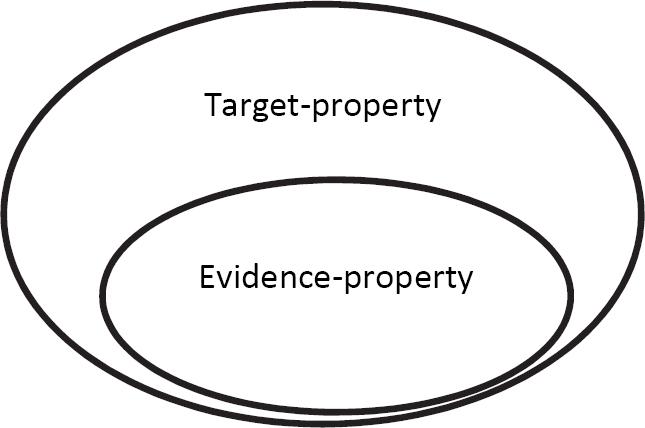
This is the reason why in this case the evidence-property functions as evidence: if we know that the evidence-property is present, then we know for sure that the target-property is present too. The translation of the Sanskrit expressions sādhya by “target-property” and sādhana or hetu by “evidence-property” is motivated by the fact that in the PM, the PKM and the PNT, these two expressions are regularly substituted with, respectively, sādhyadharma and pakṣadharma. This, in turn, is a consequence of the fact that the universal relationship of pervasion that is ensuring the correctness of a given inference can happen only between properties. This is stated in:
PM.3.32. But as far as the universal pervasion is concerned, what one seeks to know is always a property.[1407]
It should be stated that what is called “Indian logic” is principally the study of inference, and the way an inference can be proved within a debate against different types of opponents. That is to say that Indian logic is interested in the knowing subject, as well as in the interactive dimension of the knowledge-acquisition process. But we should keep in mind the fact that from Frege (1848–1925) until recently, logic was conceived in the West as the science of pure relations between propositions, i.e. without any psychological consideration of a knowing subject, and that it is only in recent times that new conceptions that pay attention to the interactive dimension of proof have emerged, for example Dynamic Epistemic Logic and Dialogical Logic.[1408] Therefore, it is in the framework of these recent conceptions that one will find contemporary attempts to answer the types of questions that Indian philosophers also attempted to answer in their logic.
2. The linguistic process of inference
2.1. Stating an inference in two steps
2.1.1. General presentation
So far I have introduced inference as a cognitive process which is undertaken in order to gain new knowledge through reasoning (through the transmission of certainty). But since inference is also the rational means one uses in order to convince persons, the inferential process has to be stated, and when this is done so it is commonly followed by a regulated argumentation aiming to defend and/or refute it. In the following section, which forms the main part of this paper, I will study the modalities of such a stated inference. The stated form of an inference is what Indian philosophers – Naiyāyikas, Buddhists and Jains – call “inference for others” (parārthānumāna), in opposition to “inference for oneself” (svārthānumāna). I will be referring to inference for others as “the canonical display form of an inference”. This urge to separate two types of inference is probably close to Brower’s conception[1409] according to which mathematics is a mental construction that does not need logic, and that only when one intends to make the proofs public is logic needed. This difference between the knowledge act per se and the knowledge statement is reflected in Jain literature in the following quotation:
PNT.23. [What is called] in a metaphoric way an “inference for others” is the statement of the subject and of the evidence.[1410]
In other words, although the knowledge statement displaying an inference is not, properly speaking, an inference itself, since it is not a knowledge act, it can be called metaphorically an inference.
According to Jain philosophers, to state an inference in the proper way, i.e. to perform a convincing line of argumentation, it is necessary and sufficient to state the subject (pakṣa) and the evidence-property (hetu). In order to understand more precisely what each consists in, let us take the following example of a canonical display form of an inference according to Jain philosophers:
PM.3.80. There is no Sissoo[1411] here, because there is no tree.[1412]
In this situation, the Sanskrit expression pakṣa[1413] might (i) designate the state of affairs “there is no Sissoo here”, i.e. refer to the whole ascription of the property “being endowed with a Sissoo” to the subject “here”; or (ii) refer to the subject “here” itself (also called dharmin), if one understands the expression as a synecdoche.[1414] In our case, it designates the state of affairs, and it is a technical term regularly translated as “thesis”.
In the same way, the expression hetu might refer to (i) the target-property “being a tree”; (ii) the ascription of the target-property to the subject, in this example “there is no tree here”; (iii) the ontological cause of a given effect. In the last case, one has to pay attention to the fact that for the Buddhists, the effect, not the cause, can function as a target-property.[1415] In a word: “seed” functions as an ontological cause, and “sprout” as an epistemic one.
Two characteristics of this way to state an inference are worth mentioning. First, the display form of an inference is not in the form “if φ then ψ” but in the form “since φ then ψ”. That is to say that inference is not concerned with possible situations, but only with actual ones. Second, there are implicit epistemic conditions. This means that “there is no Sissoo here, because there is no tree” can be read “I know that there is no Sissoo here, because I know that there is no tree”. The Sanskrit expression “anupalabdheḥ” (“there is no…/I see no…”) bears witness to this state of affairs. I defend the position that it is important to keep these epistemic conditions implicit, because in contemporary logic, making them explicit, that is to say expressing these epistemic conditions within the object language, is usually a technique in order to deal only with the pure relation between propositions. But as previously discussed, logic in India is concerned with the relation between an epistemic subject and a proposition.
In conclusion, when they claim that the thesis and the evidence are the two members of an inference for others, Jain philosophers claim that in order to display a correct proof, it is sufficient to state: (i) The goal one is intending; that is to say, which property will be proved to be ascribed to which subject. (ii) The evidence; that is to say, the fact that another property is ascribed to the very same subject. And this is enough, because again, by virtue of the very nature of the evidence-property, the presence of the target-property is necessarily triggered.
2.1.2. Differences with the framework of the Naiyāyikas
The Jain conception of a correct inference presented in the previous section goes first of all against the Naiyāyika position:
PKM.3.37. […] [in the Aphorisms on logic[1416] verse 1.1.32] it is said that [an inference consists of the following] members: thesis, evidence, example, application and conclusion.[1417]
And in the PM:
PM.3.46. These (example, application and conclusion) may be for the understanding of those who have little knowledge and for this purpose may be discussed only in the Śāstra, but these are quite unfit to be used in logical discussions.[1418]
Firstly, Jain philosophers defend the idea that the purpose of an example is only pedagogical. Indeed, the main purpose of an example is to provide a case on which both disputants have no doubt. Let us consider an inference on which there have been historical disagreements concerning the example. This is the well-known inference designed by the Naiyāyikas to prove the existence of God and attacked by the Buddhist and the Jains:
[Thesis] Earth, etc., has a conscious maker.
[Evidence] Because it is a product.
[Example] Like a pot.[1419]
In this inference, the example “like a pot” clarifies the relationship between the property “being a product” and the property “having a conscious maker”, since it is clear that no pot can be made without the previous intention of a potter to make it. Therefore, such a use of a case devoid of doubt proves efficient in order to strengthen one’s intuitive grasp of the situation. But it does not ensure the certainty that there is an inseparable relationship between the property “being a product” and the property “having a conscious maker”, since one instance of a relationship is not sufficient to guarantee its universality.[1420]
Secondly, Jain philosophers do not recognise the usefulness of the application step. Indeed, if its role is to state that the evidence-property is ascribed to the subject, then it is already taken care of at the evidence step.
Thirdly, Jain philosophers do not recognise the usefulness of the conclusion step. Indeed, if its role is to state that the target-property is ascribed to the subject, then it is already implied by the other steps, and stating something that is already implied is considered a repetition i.e. as an argumentative fault.[1421]
2.1.3. Differences with the framework of the Buddhists
The Jain conception of a correct inference presented in the previous section goes against the Buddhist position as well, when Māṇikyanandi says that:
PM.3.35. In order to teach by means of the evidence-property (sādhanadharma) that the target-property is in the subject, the same way the evidence is explicitly stated, [the same way] the subject [is too].[1422]
PM.3.36. Otherwise, which proponent of the threefold evidence-property[1423] is not displaying the subject while establishing [an inference]?[1424]
In this quotation, it seems that Māṇikyanandi attacks the Buddhists on the grounds that they do not recognise the explicit statement of the subject as a necessary step of the inferential process. But when the Buddhist Dignāga claims that being a property of the subject (pakṣadharmatā) is the first of the three characteristics that correct evidence has to possess,[1425] he does recognise the need to express the fact that the subject is endowed with the evidence-property. And this requirement comes from an awareness of the fact that one does not seek a pure relation between properties, such as “whenever something is a product, it is subject to change”, but the ascription of a property within a given particular subject, such as “sound is subject to change”.
Therefore, Māṇikyanandi could not have this attack in mind. My hypothesis is that Māṇikyanandi’s attack is directed more precisely towards the requirement that the linguistic form of an inference contains not only the expression of the subject as being endowed with the evidence-property, but the expression of the subject as being endowed with the target-property as well. This is already recognised in Siddhasena’s work Nyāyāvatāra (henceforth NA, 5th century), The Guide to logic, when he states that:
NA. 14. […] the pronouncement of the thesis has to be made here as showing the domain of the evidence-property.
NA.15. Otherwise, for [a person] to be apprised, who is confused regarding the domain of the evidence intended by the proponent, the evidence might appear to be suspected of being contradictory, just like…
NA.16. …for a person watching an archer’s skill, the archer who hits without the specific mention of the target [is endowed with both] skill and its opposite.[1426]
The argument is straightforward: if an archer does not tell in advance what goal he is aiming at, one can never be sure that the goal that is reached is indeed the goal he had in mind. In the same way, one has to state his goal before developing the inference, because this is the only way he can be evaluated on his success or failure afterwards. It is worth noticing that if Jain philosophers claim that the statement of one’s goal is a required step, it means that they conceive the inferential process not only as a way to acquire new knowledge, but also as a process enabling one to evaluate this process of knowledge-acquisition. What is more, it is possible that Jain philosophers have in mind the fact that, since the domain of a given predicate might affect its meaning, it is very important to state it. For example, the predicate “being mortal” does not mean the same thing for an animal or for a language; and from the evidence “because it is mortal”, it is correct to infer the presence of sensibility in an animal, but not in a language.
2.2. Five relations ensuring certainty
I have said that inference is the cognitive process by which a given subject acquires a new piece of knowledge by means of a reasoning ensuring universality. This reasoning is usually based on the inclusion of the domain of the target-property within the domain of the evidence-property and, more generally, on whatever ensures that the target-property is present whenever the evidence-property is present. The technical term to express this inseparable presence is “invariable concomitance” (vyāpti, verbatim “pervasion”). In this conceptual framework, Dharmakīrti’s breakthrough was to develop a theory of proper relevance between the target-property and the evidence-property.
In Dharmakīrti’s conception, it is not sufficient anymore that the target-property is always present when the evidence-property is present. One has to seek the precise reasons why it is so, in order to be able to distinguish between arbitrary and necessary inseparable relationships. According to Dharmakīrti, in order to ensure the certainty of the inferential conclusion, one should accept only the necessary inseparable relationships, which fall into three categories.[1427]
In the following presentation, I will introduce not Dharmakīrti’s classification, but the fivefold classification established by Jain philosophers,[1428] indicating when it diverges from the Buddhist theory of the three types of evidence. But although Jain philosophers identify five types of natural relations ensuring certainty in an inferential process, only four of these will be introduced in the present section. This is because the examination of the fifth requires the prior study of how negations function in the display form of an inference. In so doing, I follow the order of exposition found in the PM, the PKM and the PNT.
2.2.1. The presence of a pervaded property (vyāpya) ensures the presence of its pervasive property (vyāpaka)
To begin with, the first type of invariable concomitance is the one that holds between a pervaded property (e.g. “being an oak”) and its pervasive property (e.g. “being a tree”). This type of invariable concomitance defines a type of inference related to class identity. These cases are the less problematic ones, since they are cases of – to phrase it in an anachronistic way – analytic inclusion of one class within another. Analytic, because one only needs to know the linguistic meaning of “tree” and of “oak” in order to know that if there is an oak, there is a tree too. The example put forwards by Māṇikyanandi is the one I have already mentioned, namely:
PM.3.65. Sound is subject to changes, because it is a product.[1429]
In this case, the invariable concomitance is due to a relation of identity of nature between the property of being a product and the property of enduring changes. Here, it is worth mentioning that Māṇikyanandi, Prabhācandra and Vādi Devasūri intend relations in which the two predicates involved do not have the same extension. For example, the predicate “oak” and the predicate “tree”. This will be important to keep in mind in section 3.1 concerning negations. It is to be noted that Dharmakīrti intends both these relations, as well as the ones involving co-extensible predicates, as for example the predicate “perishable” and the predicate “product”. Jain philosophers deal with co-extensible predicates in a distinct category to be introduced in section 3.2.3.
2.2.2. The presence of an effect (kārya) ensures the presence of its cause (kāraṇa), and vice versa
The invariable concomitance between an effect and its cause is the canonical model for the presentation of an inference. The most famous example used to illustrate it is that somebody who cannot see that there is a fire on a remote hill can know that there is one by seeing smoke on the hill in question. The popularity of this type of inference based on causality is due to the fact that it turns an inference into a scientific explanation i.e. an investigation on the causes of a given phenomenon. When presenting this type of inference, Māṇikyanandi uses the following example:
PM.3.66. There is intelligence in this individual, because there is speech ability in this individual.[1430]
Although Jains and Buddhists agree on this example, they would not agree on its converse, because Dharmakīrti considers that only the effect, and not the cause, can serve as evidence in a correct inference.[1431] In other words: knowing that the effect is present enables one to know that the cause is present too. But knowing that the cause is present does not enable one to know that the effect is present. The reason for this is that one can ever be sure that the two following pre-requisites are being fulfilled: (i) no impediment is blocking the potency of the given cause to produce its effect; (ii) all the conditions required for the production of the effect are present. Jain philosophers will answer that with a more finely grained definition of a “cause” as being what already consists of the totality of conditions for the emergence of the effect. In other words, as what already ensures the fact that both pre-requisites are fulfilled.
Contrary to the previous relation on identity of nature and pervasion, this relation is not directly linked to analytic inclusions. But it can be easily rephrased in terms of inclusion when one considers that the total set of causes of a phenomenon is nothing but its nature itself.
2.2.3. The presence of a predecessor (pūrvacara) ensures the presence of its successor (uttaracara), and vice versa
The invariable concomitance between a predecessor and its successor concerns cases of inference related to worldly regularities, by means of which events such as the rising of the stars are predictable. The example put forward by Māṇikyanandi is the following one:
PM.3.68: Aldebaran will rise soon, because the Pleiades are rising.[1432]
With this example, the difference between universality and necessity becomes clearer. Whereas the relationship between the Pleiades and Aldebaran is only universal (the Pleiades are always seen with Aldebaran), the relationship between an oak and a tree is universal and necessary (an oak is always seen with a tree thanks to their very nature). This is what Dharmakīrti pointed out when he developed his theory of proper relevance between the target-property and the evidence-property, according to which it is not sufficient that the target-property is always present when the evidence-property is present. One has to seek the precise reasons why it is so, in order to be able to distinguish between arbitrary and necessary inseparable relationships. To understand the consequences of this difference, let us recall Hume’s questioning of the type of certainty one has concerning the fact that the sun will rise tomorrow. The type of certainty one has concerning the fact that the sun will rise tomorrow, as well as of the fact that the rise of Aldebaran will follow the rise of the Pleiades,[1433] is plainly sufficient as a guideline to everyday life actions. It would be mad, for instance, to act as if the sun won’t rise tomorrow. Nevertheless, stars die, and the possibility that the rise of Aldebaran does not follow the rise of the Pleiades exists. From this, inferences based on the inseparable relationship between predecessors and successors are correct ones insofar as the conditions of emergence of the two phenomena into question stay the same. On the contrary, inferences based on the inseparable relationship between a pervaded property and its pervasive property are correct ones whatsoever, it does not depend on any state of the world. Because although the world might come to an end, and stars and trees may cease to exist, it won’t change the fact that if there is an oak in a given place, then there is a tree in that very place. This example of Aldebaran and the Pleiades has not been discussed by Dharmakīrti to my knowledge. It would be interesting to search for a discussion between Jain and Buddhist philosophers on this issue of the acceptance, respectively refusal, of certainty based on worldly regularities.
2.2.4. The presence of a co-existent (sahacara) ensures the presence of the other co-existent
Another type of invariable concomitance granted by the Jains is the one that holds between two co-existents. This type of invariable concomitance comprises those cases in which two things are never seen without one another, although they are neither causally related nor identical in nature. For example, it is sufficient to see one face of a coin, say tails, in order to know that the other face is heads. Māṇikyanandi uses the following example:
PM.3.70. This has the visible properties of a mango, because this has the taste of a mango.[1434]
But Dharmakīrti disagrees on the fact that this constitutes a separate category, and insists on explaining the correctness of the mango inference only by means of causality and identity of nature. More precisely:
PVs.9. Knowledge through taste of the visible properties and so forth that are dependent upon the same totality [of causes] [comes about] by means of inferring a property of the cause, like [the inference from] smoke of the changing state of the kindling.[1435]
In other words, in the same way that smoke and the changing state of the kindling are two co-effects of the presence of fire, so the taste and the visible properties are co-effects of the same totality of causes, namely the same stage of ripeness of the fruit.
I would like to highlight two important issues addressed in this section. First of all, it seems that what triggers the disagreements between Jain and Buddhist philosophers on the types of relations ensuring certainty is the fact that Jain philosophers accept as a reliable relationship any relationship that ensures universality;[1436] whereas Buddhist philosophers accept as a reliable relationship only those relationships that ensure necessity. In other words, it is not sufficient for Buddhist philosophers that two events have always been seen together in the past, one has to be sure it will still be the case in the future. More generally speaking, when it comes to the burden of a justification, Buddhist philosophers usually call for higher standards. An example linked with what we have just seen is that, according to Buddhist philosophers, it is not sufficient that no counterexample is to be found for one’s thesis to be established, one needs to show that no counter-example is possible.
A second important remark is that one might wonder why in Jain literature these relations are being studied in the sections concerning inference for others, whereas Dharmakīrti introduced them in the section concerning inference for oneself. The next and final section of this article is devoted to answering this question.
3. On the delimitation between the cognitive and the linguistic side of the inferential process
3.1. A linguistic approach to negation
One line of questioning Indian philosophers tackled in detail is that concerning negation and its scope. Concerning the study of inference, the main question related to negation is the following one: if I can acquire new knowledge from the previous apprehension of one phenomenon, can I know something from the non-apprehension of a given phenomenon as well? Since inference is often based upon class inclusions, one should keep in mind that the inferential relation is not a symmetrical one.
Dharmakīrti tackled this issue and offered a classification of different types of nonapprehension as part of his study of inference as a cognitive process. In his PVs for example, the different types of non-apprehension are treated in the first chapter, that is to say in the chapter concerning the study of inferences for oneself. And he defined “nonapprehension” as one of the relations ensuring certainty. In other words, a special kind of “non-apprehension” is good evidence for gaining new knowledge, next to “identity in nature” and to “causality”.
In contrast, Jain philosophers treated this question as part of the study of inference as a linguistic process. And in the study of inference, types of non-apprehension are not considered. What is at issue are rather the different forms of inferential statements in which negations are used.[1437] Let us therefore investigate these forms more closely.
3.2. The four forms of inference
First of all, Jain philosophers define four forms of inference:
3.2.1. One is justified in inferring the presence of the target-property due to one’s apprehension of compatible evidence
This first form of inference is the default form. All the relations ensuring certainty studied in this paper until now were in this form. And the relations ensuring certainty that are not in this form will be introduced only later. In this form of inference, only the following types of evidence are correct:
PM.3.59. [An inference based on the] apprehension of compatible [evidence] is of six kinds, namely [when its evidence is] a pervasive property, an effect, a cause, a predecessor, a successor or a coexistent.[1438]
But one can acquire new knowledge through non-apprehension (anupalabdhi) and apprehension of incompatible [evidence] (viruddhopalabdhir) too. This is what is being dealt with in the next three forms of inference:
3.2.2. One is justified in inferring the absence of a target-property in a case in which one has apprehended evidence incompatible to it
This concerns correct inferences only in cases where the evidence is of the following kinds:
PM.3.71. [An inference based on the] apprehension of incompatible [evidence] is the same (namely its evidence is either a pervasive property, an effect, a cause, a predecessor, a successor or a coexistent).[1439]
For example:
PM.3.75. Aldebaran won’t rise in a muhūrta,[1440] because Revatī has just risen.
Revatī, the “Prosperous”, is the group of stars in the constellation of Pisces which is the last group of stars to rise in the sky. Therefore, no other star will rise after it. As such, Revatī functions as incompatible evidence to the future rising of another star. This is how the presence of some phenomena is sufficient for us to know the absence of others.
One important point is that incompatibility would be better expressed by means of the term negation, according to which there is a mutual exclusion of two given terms, rather than by means of a (standard) propositional negation. To put it in other words, the apprehension of incompatible evidence does not equal the non-apprehension of evidence. For example, saying “he is unhappy” is not the same as saying “he is not happy”. Because in “he is unhappy” the negation concerns a determined domain, i.e. one is speaking about an individual who has feelings. Whereas in “he is not happy”, the negation does not concern a determined domain, and a broader range of meanings can be drawn from this negative statement, e.g. either he has another feeling than happiness, or he has no feelings at all.
In contrast, the absence of the target-property, as well as the non-apprehension of the evidence, would be better expressed by means of a propositional negation. In order to discuss this, let us first introduce non-apprehension.
3.2.3. One is justified in inferring the absence of a target-property in a case in which one has not apprehended its evidence
This concerns correct inferences in cases where the evidence is of the following kinds:
PM.3.78. [An inference based on the] non-apprehension of compatible [evidence] is of seven kinds, namely [when its evidence is] either a pervaded property, an effect, a cause, a predecessor, a successor, a coexistent or an essence.[1441]
For example:
PM.3.80. There is no Sissoo here, because there is no tree.[1442]
First of all, the only difference with correct inferences related to apprehension (whether it is apprehension of compatible or of incompatible evidence) concerns the relation of pervasion. The reason for this is straightforward and has already been stated: from the absence of a tree (pervasive property) one is justified to infer the absence of an oak (pervaded property); but from the absence of an oak (pervaded property), one is not justified to infer the absence of a tree (pervasive property), for there might be a pine in the place in question. And the converse is true for inferences based on apprehension of compatible evidence.
Secondly, let us note that the fifth type of relation ensuring certainty is dealt with by the Jains only here. This relation is the one that holds between a thing and its identity (svabhāva). Therefore, the Buddhist relation of identity of nature (svabhāva) includes both the Jain relation of pervader-pervaded (vyāpyavyāpaka), concerning predicates with different extensions, while this Jain relation of identity of nature (svabhāva) concerns predicates that have the same extension. In the three texts I am considering, only two examples of this fifth relationship can be found. The first example is that there is no pot if one cannot apprehend its nature,[1443] its potness. Therefore it belongs to the third form of inference of the absence of the target-property in the case of non-apprehension of the evidence; and the second example will be studied in the fourth form of inference, namely the inference of the presence of the target-property in the case of non-apprehension of incompatible evidence. This can only mean that when it comes to plain affirmations, Jain philosophers consider that stating predicates with the same extension equates to a repetition. And that only when there is an absence, does it make a difference to state it.[1444]
Thirdly, as I have indicated, the non-apprehension of the evidence, as well as the inferred absence of the establishable property, can be expressed by means of propositional negations. The inferred absence of the establishable property should not be conceived as a refutation of the establishable property, because a refutation is a proof that there is at least one counter-example to the presence of the establishable property. Instead, the inferred absence of the establishable property should be conceived as a negative thesis, because a negative thesis is a proof that there are only counter-examples to the presence of the establishable property.
What is more, since I have shown that two types of negations are used, each of which has an influence on the correctness of the inference at issue, there not two, but four correct forms of inference, the last form being a combination of these two non-redundant types of negations.
3.2.4. One is justified in inferring the presence of a target-property from the absence of incompatible evidence
This concerns correct inferences in case the evidence is of the following kinds:
PM.3.86. [An inference based on the] non-apprehension of incompatible [evidence] is of three kinds, namely [when its evidence is] either an effect, a cause, or an essence.[1445]
In other words, the absence of incompatible evidence can be evidence of the presence of the target-property. But this can be the case only if by “incompatible evidence” one means the exhaustive list of all incompatible evidence. It is comparable to the Jain conception of causality, where they accept that cause can serve as sufficient evidence of the presence of its effect only if by “cause” one means the exhaustive list of all causes.
Let us take as an example of this form of inference one in which the evidence belongs to the category “identity of nature”. This example is of special importance, since it is dedicated to proving the Jain theory of manifoldness:
PM. 3. 89. The manifold nature [of reality is established], because no nature with only one aspect can be found.[1446]
3.3. Conclusive remarks
In conclusion, this conception of four different forms of inference is very typical of Jain philosophers of Akalaṅka’s tradition. I claim that this theory is brought about by the fact that whereas non-apprehension is studied in Dharmakīrti as part of the study of inference as a cognitive process, it is studied by Māṇikyanandi, Prabhācandra and Vādi Devasūri as part of the study of inference as a linguistic process.
This, in turn, explains why the natural relations ensuring certainty are studied in the section devoted to the inference for others. Indeed, the form of the inference has an influence on the certainty brought about by a given natural relation. Because again, from the presence of a pervaded property I can infer the presence of the pervasive property, but from the absence of the pervaded property I cannot infer the pervasive property. From this, it makes no sense to introduce the relations (such as “pervaded”) outside the context of a given form (such as “inference of an absence from another absence”). And the answer to the question why the relations ensuring certainty are studied in the section devoted to the inference for others is probably that it is so because they suppose a given linguistic form and, more precisely, the form in which a presence is inferred from another presence.
In future research, I would like to consider other important specifically Jain conceptions that can have an influence on the issue in question. First, the fact that the inseparable presence between two properties has only one characteristic, its “inexplicability otherwise” (anyathānupapatti).[1447] Second, the Jain philosopher would probably argue that relations ensuring certainty are studied in the section devoted to linguistic process because what is being treated in the cognitive aspect of inference is only the cognitive means itself to directly grasp these relations. This cognitive means is called “tarka”[1448] or “ūha”. In the absence of a proper translation, I call it – only in this Jain framework – the “faculty of recognition of the universal”. Third, one could argue that relations ensuring certainty are studied in the section concerning the study of the linguistic process because the linguistic structure is involved, since the analytic inclusion of one class into another is due to the meaning of the predicates under discussion.
Finally, the four forms of inference as developed by Māṇikyanandi, Prabhācandra and Vādi Devasūri represent a breakthrough in the field of the study of inference. More precisely, they introduce the possibility of working on the forms of the inferential statement, which is nothing less than a first step towards an investigation on the logical structure itself.
Abbreviations
NA = Siddhasena’s Nyāyāvatāra
NS = Gautama’s Nyāyasūtra
PKM = Prabhācandra’s Prameyakamalamārtaṇḍa
PM = Māṇikyanandi’s Parīkṣāmukham
PNT = Vādi Devasūri’s Pramāṇanayatattvālokālaṃkāra
PVs = Dharmakīrti’s Pramāṇavārttikasvavṛtti
SP = Dharmakīrti’s Sambandhaparīkṣā
Bibliography
Balcerowicz, Piotr (2001) Jaina epistemology in historical and comparative perspective, Stuttgart: Franz Steiner Verlag.
Balcerowicz, Piotr (2003) ‘Is ‘inexplicable otherwise’ (anyathānupapatti) otherwise inexplicable?’ in Journal of Indian Philosophy 31, Netherlands: Kluwer Academic Publishers, 343–380.
Balcerowicz, Piotr (2006) ‘Implications of the Buddhist-Jaina dispute over fallacious example in Nyāya-bindu and Nyāyâvatāravivṛtti’ in Peter Flügel (ed.) Studies in Jaina history and culture, London-New York: Routledge Advances in Jaina Studies, 117–153.
Bhattacharya, Hari Satya (1967) Vādi Devasūri’s Pramāṇanayatattvālokālaṃkāra, Bombay: Jain Sahitya Vikas Mandal.
Bossche, Frank van den (1998) ‘Jain arguments against Nyāya Theism. A translation of the Īśvarotthāpaka section of Guṇaratna’s Tarkarahasyadīpikā’ in Journal of Indian Philosophy 26, Netherlands: Kluwer Academic Publishers, 1–26.
Brower, Luitzen Egbertus Jan (1927) ‘Intuitionistic reflections on formalism’ in Jan van Heijenoort (ed.) From Frege to Gödel: A source Book in Mathematical Logic 1879–1931. Cambridge: Harvard University Press, 490–492.
Van Ditmarsch, Hans, van der Hoek, Wiebe and Barteld, Kooi (2007) ‘Dynamic Epistemic Logic’ in Synthese Library Series 337, Netherlands: Springer.
Ghoshal, S. C. (1940) The Parīkṣāmukham of Māṇkyanandi, Lucknow: The central Jaina Publishing House. Reprinted in 1990 in The sacred books of the Jainas 11, Delhi: Today’s and Tomorrow’s printers and publishers.
Gillon, Brendan and Hayes, Richard (1991) ‘Introduction to Dharmakīrti’s theory of inference as presented in Pramāṇavārttikasvopajñavṛtti 1–10’ in Journal of Indian Philosophy 19, Netherlands: Kluwer Academic Publishers, 1–73.
Gnoli, Raniero (1960) The Pramāṇavārttikasvavṛtti of Dharmakīrti. The first chapter with the auto-commentary in Series Orientale Roma 23, Roma: Istituto Italiano per il media et Extremo Orient.
Gorisse, Marie-Hélène (forthcoming) ‘The taste of the mango: a Jaina-Buddhist controversy on evidence’ in the proceedings of the 15th Jaina Studies Workshop ‘Jain logic’, London, March 22nd 2013 in the International Journal of Jain Studies, London.
Gorisse, Marie-Hélène (forthcoming) ‘Still like a pot: the role of examples in Indian theories of inference’ in the proceedings of the Conference ‘Udāharaṇas, dṛṣṭāntas and nyāyas in texts and contexts’, Ahmedabad, February 26th 2014.
Hayes, Richard (1988) Dignāga on the interpretation of signs in Studies of classical India 9, Dordrecht: Kluwer Academic Publishers.
Jha, Ganganatha (1912) The Nyāyasūtra of Gautama, Delhi: Motilal Banarsidass.
Rahman, Shahid and Keiff, Laurent (2005) ‘On how to be a Dialogician’ in Daniel Vanderveken (ed.) Logic, thought and action, Netherlands: Kluwer-Springer, 359–408.
Shastri, Mahendra Kumar (1912) The Prameyakamalamārtaṇḍa of Prabhācandra in Sri Garib Dass Oriental Series 94, Delhi: Sri Satguru Publication (re-ed. 1990).
Two: Between Theism and Atheism: a journey through Viśiṣṭādvaita Vedānta and Mīmāṃsā{12}
Elisa Freschi
1. Terminological Foreword
The general purpose of this article is to show, through the case study of Veṅkaṭanātha’s introduction of God into an atheistic system, that the commonly accepted notions of god, atheism, etc. are not as obvious as one might think.
“God” is not a univocal term, as shown also by the fact that it translates different concepts in Sanskrit, from deva/devatā to īśvara and to paramātman or brahman. Furthermore, theism and atheism are not two mutually exclusive alternatives (there might be philosophical positions which neither advocate the belief in a personal God nor support an explicit denial of it). Last, and more intriguingly, belief in God does not need to be configured as belief in the existence of an external, subject-independent entity.
Within the precincts of this article, I conventionally adopt the term “deity” to translate devatā; “god” to cover the semantic realm of a superhuman being who has much in common with human beings (not least that they are both, ontologically speaking, “substances”, dravya), and who is mostly the efficient cause of the universe, but not its creator ex nihilo; and “God” to denote a non-human being to whom one has a personal and devotional relationship, but who might have no ontological grounding at all. The second “god” is often referred to as īśvara, although one must be aware of the fact that the three levels I have distinguished here, and especially the second and the third, are not strictly and explicitly distinguished in the sources, which often incorporate aspects I have associated with other levels here (so that, for instance, a God is also referred to as “creator of the world” or as bearing a conch).
Apart from these three levels there are the paramātman and the brahman. The former might be a superior being who is to be imitated but who is not necessarily involved in worldly affairs (like the supreme puruṣa in Yoga and Sāṅkhya, see Bronkhorst 1983). The latter term is used for an all-encompassing principle which might resemble an impersonal god comparable to Spinoza’s. The distinction between the Judaic conception of a creation out of nothing and the Indian concept of an efficient cause intervening on pre-existing material elements must also be taken into account.[1449]
2. Mīmāṃsā, Anti-Realism and God
The Mīmāṃsā is a philosophical school, born as a school of Vedic exegesis, and hence its main philosophical inquiries have developed out of Vedic exegetical themes. Its root text, the (Pūrva) Mīmāṃsā Sūtra,[1450] attributed to Jaimini (perhaps 2nd c. BC) is probably the most ancient philosophical sūtra (‘aphoristic work’). It has been commented on by Śabara (dates uncertain, possibly 3rd–5th c. AD). Śabara’s Bhāṣya was again commented on by Kumārila and Prabhākara (7th c. AD?).
The fact that within Mīmāṃsā philosophical thinking emerged out of exegetical concerns also means that the Mīmāṃsā is not primarily concerned with ontology. Contemporary Western readers generally tend to think of metaphysics and ontology as the first elements of philosophical thinking, and accordingly interpret pre-Socratic philosophy in Classical Greece, for example, through the lens of these later assumptions. However, for Mīmāṃsā the main focus was not on metaphysics, but on the Brāhmaṇa portion of the Veda. Mīmāṃsakas looked at the Brāhmaṇas (and at all of the Vedas) as primarily prescriptive texts. Non-prescriptive passages of whatever nature were considered as subsidiary to the prescriptive ones. Accordingly, for Mīmāṃsakas the artha[1451] of Vedic sentences is something to be done (kārya or sādhya). This means that the Mīmāṃsā theory of meaning cannot be direct realist. Thus, an interpreter of Mīmāṃsā should be aware of the need to avoid his/her tendency to use direct realism when reading Mīmāṃsā texts.
The Veda also has a specific epistemic place and role, according to Mīmāṃsā thought. In fact, the Veda is the only source of transcendental knowledge accepted by Mīmāṃsakas, and in all other fields of knowledge Mīmāṃsā authors stick to a strict empiricism. In Kumārila’s words: “Here like in any other case, Mīmāṃsakas do not accept anything else beyond what is commonly experienced”.[1452] It is perhaps noteworthy that this sentence is to be understood not in an ontological context, but rather in an epistemological one (discussing the epistemological value of the Buddha’s word). In other words, Mīmāṃsā authors aim to refrain from postulating unrequired concepts, but this does not mean that they naïvely accept reality as independent of the human beings perceiving it. Its existence independent of a knowing subject just lies beyond question, given that the focus is on the Veda and the Veda presupposes the existence of human beings carrying out the sacrifices it prescribes.
Out of the same refusal of unrequired postulations, Mīmāṃsakas adopt atheism. The belief in god(s), they maintain, contradicts direct perception and logical thinking, since no god is ever seen and since this belief is fraught with contradictions (e.g. how could a bodiless god create the world? And how could an embodied god be worshipped simultaneously by different worshippers in different parts of the world?). It is noteworthy that atheism is neither a main nor a distinct topic of investigation for Pūrva Mīmāṃsakas. Contemporary Western readers are accustomed to explicit discussions about theism and atheism; by contrast, the controversy over theism/atheism is almost “hidden” within the Pūrva Mīmāṃsā Sūtra (in the devatādhikaraṇa, PMS 9.1.4, sūtras 6–9, and within other technical discussions). Theism/atheism is not discussed as a preliminary topic within the theoretical introduction of the MS, namely the tarkapāda (PMS 1.1). Rather, discussions related to the status of devatās are scattered throughout the whole of the PMS, just like discussions about any other element of the sacrifice. devatās are in fact regarded as nothing more than an element of the sacrifice (the one to which the offering is dedicated), and their relation to the other elements is discussed within the broader perspective of the sacrifice.
2.1. The chapter on deities (devatādhikaraṇa) in the PMS and its commentaries
2.1.1. Jaimini
Understanding Jaimini independently of his main commentator is always a complex task. However, in the case of the sūtras later grouped as devatādhikaraṇa it can be seen with some clarity that they are part of a larger context in which the centrality of the sacrificial action over and above the other elements of the sacrifice, such as ritual offerings and deities, is stated:
yajñakarma pradhānaṃ tad dhi codanābhūtaṃ tasya dravyeṣu saṃskāras tatprayuktas tadarthatvāt || 9.1.1 ||
devatā vā prayojayed atithivad bhojanasya tadarthatvāt || 6 ||
[…] tasmād yajñaprayojanam || 19 ||
The sacrificial action is the primary thing, because it has been brought into being by the injunctive word. Hence the preparation of its materials must be regarded as promoted by that [sacrifice], because they occur for its sake (PMS 9.1.1).
[Obj.:] The deity should promote [the sacrifice], because s/he is like a guest, for whose sake a meal is prepared (9.1.6).
[R:] […] Therefore, the sacrifice is the promoter (9.1.19).[1453]
There is no explicit denial of the existence of deities, although they are denied a principal role within the sacrifice, which is the culminating event of Jaimini’s system, the one around which everything else revolves.
2.1.2. Śabara
The objector who initiates the discussion in the devatādhikaraṇa of the ŚBh[1454] starts with the very mention of deities in the dative case in Vedic sacrificial prescriptions, which make the sacrifice look like an act of feeding the deities:
bhojanaṃ hīdaṃ devatāyāḥ yāgo nāma. bhojyaṃ dravyaṃ devatāyai pradīyate, […]. devatāsaṃpradānako hy ayaṃ yāgaḥ śrūyate. saṃpradānaṃ ca nāma karmaṇo ’pīpsitatamād abhipretataram. tasmān na guṇabhūto devatā, devatām prati guṇabhūte dravyakarmaṇī (ŚBh ad PMS 9.1.6, p. 72).
[Obj.:] For, the sacrifice to the deity is this feeding. The food, i.e. the ritual substance, is offered to the deity. […] In fact, this sacrifice is found in the Sacred Texts as including the deity as the recipient. And the recipient is even more intended than the syntactical object, although this is said to be the “most desired one” (Aṣṭ 1.4.49). Therefore, the deity is not a subordinate element, [rather], the ritual substance and the ritual action are subordinate to the deity.
The objector then shifts to a different understanding of sacrifices and adds that sacrifices (yajña) are an instance of worship (pūjā) and that a pūjā is instrumental to the worshipped person (pūjanīya):
api ca, yāgo nāma devatāpūjā. pūjā ca pūjanīyaṃ prati guṇabhūtā loke dṛśyate (ŚBh ad PMS 9.1.6, p. 72).
[Obj.:] Moreover, the sacrifice is a worship of the deity. And the worship is commonly seen in worldly experience as being subordinate to the worshipped [person].
The later claim that the result of a sacrifice is given by the deity, pleased by the offering (tasmād dhavirdānena guṇavacanaiś ca devatārādhyate, sā prītā satī phalaṃ prayacchati, ŚBh ad PMS 9.1.8, p. 74) is probably related to the pūjā-argument.
Beside these two, the opponent speaking in the devatādhikaraṇa seems to have no other theological arguments, and to ground his position on the Smṛti texts about devatās, mythically described as eating, having bodies, etc.[1455]
Interestingly, Śabara (and, seemingly, also Jaimini) starts his reply by putting the Vedic sacrificial prescriptions at the centre, insofar as it is only through them that one knows about the result and is then prompted to act (yajñakarma pradhānaṃ syāt. yajater jātam apūrvam. kutaḥ. śabdapūrvatvāt. yad dhi phalaṃ dadāti, tatprayojakam. idaṃ phalaṃ dadātīty etajjñānaṃ śabdapūrvakaṃ, na pratyakṣādibhir avagamyate, ŚBh ad PMS 9.1.9, p. 75). Next, the reply to the first objection is that deities are like ritual substances (dravya), namely ritual elements subordinate to the sacrifice itself (nanu dravyadevatākriyaṃ yajatyarthaḥ. satyam evan. kiṃ tu guṇatve devatāśrutiḥ, ŚBh ad PMS 9.1.9, p. 75). This subordination is grounded in the Mīmāṃsā thesis that the artha of the Veda (see fn. 3) is something to be done and that all established things mentioned are subordinate to it (dravyadevataṃ hi bhūtaṃ, bhāvayitavyo yajatyarthaḥ, ŚBh ad PMS 9.1.9, p. 75).
As an alternative strategy to the one stressing the centrality of the sacrifice, Śabara introduces with atha a new focus, on the centrality of the human beings involved in the sacrifice, who care for the result, and not for the deities (phalaṃ ca puruṣārthaḥ. puruṣārthā ca naḥ pravṛttiḥ. na cāsau devatāyāḥ. tasmān na devatāprayuktāḥ pravartiṣyāmahe ŚBh ad PMS 9.1.9, p. 76).
Against the second objection, the one stating that a sacrifice is like an act of worship (pūjā), Śabara says that one should not equate sacrifices with worldly acts of worship. In the latter, the worshipped person stands at the centre, whereas in the former the sacrificial act (yajñakarman) stands at the centre. This reasoning connects this sacrifice-centric view with the human-centric view discussed above: the sacrifice is at the centre, because it is through that that one obtains the result (yad dhi phalavat tatprayojakam. tasmād yajñakarma prayojakam, ŚBh ad PMS 9.1.9, p. 76).
The last objection, i.e. the reference to Smṛti passages pointing at deities, is refuted by Śabara by saying that these Smṛtis are based on mantras and arthavādas (and cannot, thus, contradict the Veda — rather, they must be understood as supplements of the prescriptive portion of the Veda, the Brāhmaṇas) (tan na, smṛter mantrārthavādamūlatvāt). The objector counters that since these Smṛtis do convey information about the deities they are surely not based on mantras and arthavādas (yadi naivaṃparā na tarhi mantrārthavādamūlaṃ tadvijñānam). Śabara could have answered that if they are not based on mantras and arthavādas they are simply invalid. Instead, he repeats that whoever observes carefully sees that they are based on them (ye ālocanamātreṇa mantrārthavādān paśyanti, teṣāṃ tatsmṛtimūlam, ŚBh ad PMS 9.1.9, p. 76).
More generally, Śabara (and perhaps Jaimini) seems to aim only at the refusal of Vedic deities, i.e. deities conceived as embodied personal beings, delivering the result of Vedic sacrifices. The objector arguing for the principal role of the deities explicitly says that they are embodied while answering to a counter-argument (nanv evaṃ bruvatā, vigrahavatī devatā, bhuṅkte cety abhyupagataṃ bhavati. ucyate. bāḍham. vigrahavatī devatā, bhuṅkte ca, ŚBh ad PMS 9.1.6, p. 73). And Śabara repeats that “giving” and “feeding” are impossible in the case of a non-embodied deity (na hy avigrahāyai abhuñjānāyai ca dānaṃ bhojanaṃ vā saṃbhavati, ŚBh ad PMS 9.1.9, p. 76), and goes on to discuss Vedic quotes[1456] in which Indra is said to have hands, a powerful neck, reddish brown eyes, etc. (ŚBh ad PMS 9.1.9, pp. 73–79), with the objector urging that the quotes have to be understood literally (asty asau hasto vayaṃ yaṃ gṛtītavantaḥ, ŚBh ad PMS 9.1.9, p. 77). Śabara’s repeated reply is that there is no evidence (pramāṇābhāvāt, ŚBh ad PMS 9.1.9, twice on p. 77, tasyāpi bhāve na pramāṇam asti, p. 78, grīvāsattve nāsti pramāṇam, p. 78) and that these are only assumptions of unseen things (adṛṣṭakalpanā, ŚBh ad PMS 9.1.9, p. 77). In more detail, he points to the fact that the offered oblations should diminish if they were really eaten by a deity and that there is no evidence for the fact that the deity only eats the taste, like a bee. In fact, this behaviour of bees is seized by sense perception, whereas in the case of deities it is not:
api ca, bhuñjānāyai devatāyai prattaṃ haveḥ kṣīyeta. na ca madhukarīvad annarasabhojinyo devatā iti pramāṇam asti. madhukarīṣu pratyakṣam. na ca tadvad devatāyām (ŚBh ad PMS 9.1.9, p. 79).
Moreover, the oblation offered to a deity who [really] eats it should diminish [and this is apparently not the case]. Nor is there any instrument for knowing that the deities eat only the savour of the food, like bees. In the case of [insects] like the bees, this is sense-perceptible, but it is not in the case of the deity.[1457]
The refusal of this sort of deity was — in my opinion — probably not understood as a real threat (see below, section 4.2) to theism by authors of Viśiṣṭādvaita Vedānta, who would not have supported the real existence of deities having bodies like ours, and who actually eat the offered ghee.[1458] In fact, it appears that the theology of Yāmuna etc. was not conceived as an alternative mechanical explanation of the way sacrifices work, nor did it accept all mythical narratives about deities (holding weapons, eating etc., ŚBh ad PMS 9.1.6–9, passim) at face value.
2.1.3. Kumārila
In his short commentary on the devatādhikaraṇa, Kumārila basically gives, much more concisely, some of the arguments used by Śabara, showing that there is no linguistic evidence in favour of the fact that the deities are the principal element in Vedic prescriptions, and that the presence of the deities’ names in Vedic prescription does not require one to postulate the existence of deities in the world outside the Veda. The linguistic reality of the Veda, in other words, does not necessarily entail a corresponding outer world in order to work.[1459]
2.1.4. Conclusions about the refusal of devatās
If one understands “theism” as it is usually employed in the West, i.e. as referring to the levels 2 and 3 discussed in the Terminological Foreword, devatās are beside the point when discussing atheism or theism in India. They are indeed found also in “atheist” religions such as Buddhism and Jainism, and they only represent a further class of sentient beings (in this sense they might be compared to mermaids, fairies etc.). Even Śabara does not altogether deny their existence in other parts of the ŚBh (e.g. ad PMS 6.1.5 where he explains that deities, along with plants and animals are not entitled to sacrifice).
However, a different understanding of god(s) can find its way through the objector’s reference (possibly evoked in the sūtras by atithivat ‘like a guest’ and explicitly in the Bhāṣya) to the worship (pūjā), since the same term is used also in theistic and devotional contexts.
2.2. Anti-theological arguments in Kumārila
By the time of Śabara’s commentator, Kumārila, the debate on god(s) had also turned into a more philosophical topic, probably especially because of the impact on the debate of the Nyāya deism (see Krasser 1999 on the role of the Naiyāyika Aviddhakarṇa). Thus, the debate evolved from the denial of the role of devatās within sacrifice to the denial of an īśvara who created and preserved the world, created language and taught or even composed the Vedas.
Kumārila’s refusal of this kind of god deeply influenced the Buddhist discussion on the same topic (see Krasser 1999 for Kumārila’s influence on Dharmakīrti) in a way which became more and more philosophically engaged. The target of the criticism is a god/īśvara as part of the ontology of a certain school (specifically of Nyāya and of Nyāya-Vaiśeṣika).[1460] Kumārila (and Dharmakīrti) refutes the idea of using an īśvara as a solution to ontological or logical problems on the basis of the idea that S/He creates more difficulties than S/He can solve. For instance, karmic retribution does not need a divine Supervisor and the assumption of one is anti-economical:
kasyacid dhetumātratvaṃ yady adhiṣṭhātṛteṣyate |
karmabhiḥ sarvajīvānāṃ tatsiddheḥ siddhasādhanam || ŚV, SĀP, 75
If you assume that to govern something means being its general cause, then you prove what is already established. For that (cause) is already established by the past karman of all beings.
Śabara’s arguments against the idea of an embodied deity are also expanded upon by Kumārila, who contends that god, in order to intervene in the world, must have a body. If he did not have one, how could unconscious entities like atoms obey him?
kulālavac ca naitasya vyāpāro yadi kalpyate |
acetanaḥ katham bhāvas tadicchām anurudhyate || 81 ||
tasmān na paramāṇvāder ārambhaḥ syāt tadicchayā |
And if his activity is not held to be like that of the potter,
how could an insentient entity [like an atom] obey his will?
Therefore, the atoms [and the other insentient elements in the world] do not start [clinging together or separating] because of his will. (ŚV, SĀP, 81–82 ab)
However, the idea of a body of god is fraught with difficulties, since god’s body also needs to be created (else it would not be a body like ours), but in that case who created it, since god did not yet have a body at that time?
In short, Kumārila rejects the idea of an īśvara which is involved in the creation and maintenance of the world, of language and of the Veda, but which is still very similar to other agents (a “superman” more than an altogether different entity). Specific attacks are reserved for the Buddha, not for Viṣṇu or Śiva and not even for a non-acting Brahman.
3. Viśiṣṭādvaita Vedānta
When Vedānta entered the philosophical scene, the situation changed and the role of “god” was primarily occupied by the paramātman or brahman, with lower deities being accepted only at a worldly (vyavahārika) level.
Viśiṣṭādvaita Vedānta, by contrast, is a philosophical school which became more and more closely connected to the so-called Śrī Vaiṣṇavism. The latter is a general label used to group Vaiṣṇava beliefs which mostly circulated in and were elaborated on in South India, and which attributed a role also to Viṣṇu’s consort Śrī. On the one hand Śrī Vaiṣṇavism is linked with the devotional songs of the Āḷvārs and on the other with the Pāñcarātra Sacred Texts, which are kind of “manuals” for personal and temple-worship. Viśiṣṭādvaita Vedānta adds to those beliefs and practices a philosophical, specifically Vedānta, frame. Thus, whereas Śrī Vaiṣṇavism has Viṣṇu as its central focus, Viśiṣṭādvaita Vedānta rather discusses His philosophical counterpart, called brahman or paramātman. In post-Rāmānuja (traditional dates 1017–1137 AD) times the two traditions merge more and more, and theological topics (such as the relation between Viṣṇu and his consort Śrī, and that between Viṣṇu and his body) are dealt with from a philosophical perspective. Thus, theism (here understood only as the opposite of atheism, in the sense of “belief in God”) is a required presupposition of Viśiṣṭādvaita Vedānta. However, this does not necessarily imply the belief in a personal God, nor in a saving, caring one. As far as I am aware, the latter characteristics are altogether absent from Rāmānuja’s contributions to Viśiṣṭādvaita Vedānta stricto sensu (e.g. in his Śrī Bhāṣya, although they might be present in his devotional and Vaiṣṇava works).
4. Can They be Reconciled?
4.1. Kumārila and vivakṣā
The problem of reconciling something we would call “god” with the authority of the Veda was already present among Pūrva Mīmāṃsakas. Apart from Kumārila’s ŚV-maṅgala which, as shown by Kumārila’s commentator Pārthasārathi, is a double-entendre praising the Veda and Śiva at the same time, similar devices are used also by other authors (see the concluding verse by the late Mīmāṃsaka Rāmānujācārya in his Tantrarahasya, Freschi 2012b, p. 5).
In a different context and work, Kumārila Bhaṭṭa discussed what it means to speak of the Veda’s vivakṣā ‘intention’ and refused to understand it only metaphorically. In a non-metaphorical sense, vivakṣā implies the desire of someone to communicate. Who could this “someone” be? Kiyotaka Yoshimizu (2007, 2008) explains by means of TV verses that it is the paramātman which is embodied in the Veda:
śabdabrahmeti yac cedaṃ śāstraṃ vedākhyam ucyate |
tad apy adhiṣṭhitaṃ sarvam ekena paramātmanā || (TV ad 3.1.13, Subbāśāstrī 1929–1934, p. 703, ll. 6–7, v. 11)
This Sacred Text called “Veda” is referred to as the “brahman consisting of language” |
And this whole is superintended/inhabited (adhiṣṭhā-) by a single Supreme Self ||
Here, the key term śabdabrahman and Kumārila’s mention in the same connection (ibidem, v. 15) of a verse by Bhartṛhari about his concept of a śabdabrahman (‘brahman which consists of language’) should alert the reader. In fact, in what sense can the brahman be ‘superintended’ by a paramātman? In my understanding, the śabdabrahman is not a subform of brahman (still in need of a higher governor), but the brahman itself (and Bhartṛhari’s metaphysics correspondingly sees the all-pervasiveness of language in epistemology and ontology). In this sense, Kumārila could look at the śabdabrahman as tantamount to the Veda and connected to/identical with the paramātman.[1461] What exactly should this connection (expressed by the verb adhiṣṭhā-) be? Verse 12 speaks of the Ṛgveda and of the other Saṃhitās as “bodies” and as “always endowed with consciousness” (tathargvedādayo dehāḥ proktā ye ’pi pṛthak pṛthak | bhogyatvenātmanām te ’pi caitanyānugatāḥ sadā ||). This seems to hint at the idea of the Veda as the paramātman’s body, with “body” pointing at, as usual in Pūrva Mīmāṃsā thought (see Freschi forthcoming[a]), a living body which is inseparable from the self, i.e. so that a corpse is no longer a “body”. This also means that such a conscious body is conceptually not separated from the self “inhabiting” it and that their relation cannot be comprehended as one of ultimate difference. At most, the body might be seen as an inseparable quality of the self.[1462]
4.2. Yāmuna etc. on the denial of deities as an instrumental move
The idea of interpreting Jaimini’s devatādhikaraṇa (although not Śabara’s commentary thereon) as in fact not really aiming at a refusal of the existence of deities, but rather at strengthening faith in the efficacy of sacrifice must have been already commonsensical at the time of Yāmuna, the fourth in the traditional line of teachers of the tradition later called Śrī Vaiṣṇavism. In fact, Veṅkaṭanātha puts forth this argument with almost the same words as Yāmuna, and Yāmuna himself mentions it en passant while discussing a different point of the alleged Pūrva Mīmāṃsā-Pāñcarātra divergences. This cursory mention makes one think that Yāmuna’s readers were already acquainted with the argument:
yathaiva hi bhagavato jaimineḥ karmaphalopanyāsaḥ
karmaśraddhāsaṃvarddhanāyeti*.
Like indeed the revered Jaimini stated that the [rituals’] result comes from the sacrificial action [and not from the deity to whom the sacrifice has been offered] for the sake of augmenting the faith in the sacrificial action.
(Āgamaprāmāṇya, Śāstrī 1937, p. 67).
Should one think that Yāmuna dwelt on this topic longer in his lost works, one should explain why Veṅkaṭanātha, while elaborating on this issue, only mentioned this same passage.
Rāmānuja’s Vedārthasaṃgraha repeats a similar point: In order to avoid the lack of faith in ritual action of people who have not heard the Upaniṣads (aśrutavedānta), some excessive statements (ativāda) have been used in the devatādhikaraṇa, in order for one to have faith in the mere ritual actions. The definitive conclusion of those who know the Veda is that all of this is a single treatise (śāstra).[1463]
Thus, rituals are praised by Jaimini for the sake of people who do not know the Upaniṣads. In fact, Rāmānuja emphasises that rituals lead even people who do not know the Upaniṣads to strive for liberation, thus it is good for them to keep on performing them.
Veṅkaṭanātha developed Rāmānuja’s idea insofar as he chose to distinguish Jaimini from his commentators and attributed all sorts of good intentions to the former, but not to the latter. It might be that this move had also been anticipated by some earlier Viśiṣṭādvaita or Śrī Vaiṣṇava author, as Veṅkaṭanātha took care to tell his readers in the SM and in the MP, where he tried hard to show that the acceptance of Pūrva Mīmāṃsā is perfectly legitimate from the point of view of Viśiṣṭādvaita Vedānta-Śrī Vaiṣṇavism (see below, section 4.4).
4.3. The specificity of Veṅkaṭanātha’s Seśvaramīmāṃsā: apūrva
Rāmānuja seems quite keen on re-establishing the idea that sacrifices work only insofar as they please Viṣṇu, who then bestows on the sacrificer the expected result. This directly counters the Pūrva Mīmāṃsā stress on the centrality of sacrifice. Rāmānuja even goes so far as to reuse the model criticised by Pūrva Mīmāṃsā authors in the devatādhikaraṇa and to affirm that the sacrifice is for the sake of the devatās but that, since the inner ruler (antaryāmin) of the devatās is Viṣṇu, it ultimately pleases him. Consider his commentary on BS 3.2.39 and 3.2.40:
[Obj.:] For this very reason, the teacher Jaimini thinks that, out of congruity and because of the Sacred Texts [stating it], only dharma, in the form of sacrificing, giving, oblating and venerating (upāsana) delivers the fruit. In fact, in worldly experience we commonly see that activities like agriculture and activities like massaging deliver their results by themselves, either immediately (as in the case of massaging and the pleasure it causes) or mediately (as in the case of agriculture, where a seed gives rise to a plant grows only after a certain period of time has elapsed). In the same way, also in the Veda, although sacrificing, giving, oblating do not immediately deliver a result, they can nonetheless deliver a result mediately, through an apūrva. […]
[R:] […] The revered Bādarāyaṇa considers that it is only the supreme person (paramapuruṣa) who delivers the result. […] Because it is indicated (vyapadiś-) in several Vedic sentences that deities (devatā) such as Agni or Vāyu, which have been propitiated (ārādhya) by the sacrifice — which consists of a propitiation of the deities — are the cause of this or that result. […] And in the form of Vāyu etc. only the supreme person (paramapuruṣa) remains as the one who delivers the result because of having been propitiated.[1464]
Thus, Veṅkaṭanātha had in front of him a hard task as he tried to reconcile Pūrva Mīmāṃsā and Viśiṣṭādvaita Vedānta on this issue.[1465] The fact that he managed to create a new synthesis is evidence of his genius as a systematiser, wherein the term “systematiser” does not entail a lower order of philosophising. On the contrary, Veṅkaṭanātha had to find a higher synthesis of contradictory positions, one which could still look acceptable to his Viśiṣṭādvaita fellows.
Veṅkaṭanātha’s general strategy seems to be to accept the Mīmāṃsā approach (which is useful in order to keep Buddhist and other Sacred Texts out of the precinct of validity) while adding to it an exception, namely God. Thus, Veṅkaṭanātha agrees that bodies are created except for God’s body, which is nitya.[1466] Similarly, direct perception cannot grasp dharma (so that it is impossible that the Buddha knew dharma) except for God’s perception. In fact, throughout SM ad PMS 1.1.4, Veṅkaṭanātha shares the Pūrva Mīmāṃsā arguments against the possibility of yogipratyakṣa, and only in the concluding verses does he, surprisingly, add that these arguments do not apply to God. “God” (referred to with the adjective aiśa in the verse) is thus clearly different from a devatā but also from the god Kumārila attacks, since He does not belong to the same categories human beings (puruṣa) belong to; He can have an eternal body, although eternal bodies are inconceivable for us, and can perceptually see dharma, although this is also a priori impossible for other sentient beings. In this way, Veṅkaṭanātha can avoid refuting the Mīmāṃsā stance, while embedding it in a larger frame where a God is indeed possible (this embedding strategy is most likely a distinguishing feature of Veṅkaṭanātha’s approach, see Freschi forthcoming[b]).
The Vedānta school usually accept Pūrva Mīmāṃsā theories, but only within the empirical world (loka). Thus, one might think of Veṅkaṭanātha’s move as just part of his general strategy. However, he embraces even transempirical claims of the Pūrva Mīmāṃsā. Noteworthily, in the case of sacrifices, he makes use of the key Mīmāṃsā concept of apūrva, that is, the ‘unprecedented’, which cannot be known through any other means of knowledge:
The unprecedented [potency] (apūrva) which is realised by the action, though permanent (sthīra), is not perceivable by people like us. This consists, in fact, in the favour (anugraha) of the Deity [to whom the sacrifice has been offered]. For, the intention of one (the pleased Deity who wishes to favour the sacrificer) cannot be perceived by another person.[1467]
Hence, apūrva is imperceptible because it consists in the Deity having been pleased, and the intention of one (the Deity who has been pleased) is not perceptible by another (a person like us). In a simpler scheme, this is the (reconstructed, hence the asterisk) Vedic model:
*sacrifice → deities’ pleasure → result
And the Pūrva Mīmāṃsā model:
sacrifice → apūrva → result
Last, Veṅkaṭanātha’s model:
God’s pleasure
=
sacrifice → apūrva → result
The apūrva is the fact that God is pleased. God’s propitiation is beyond the usual means of knowledge (and hence not empirical) because the intention of one is imperceptible to another; not being empirical, it is not within the boundaries of the Mīmāṃsā empiricism. Thus, Veṅkaṭanātha does not only embed the worldly views of PMS in his system, but also its transempirical views about the Veda and the dharma. This he does by connecting (some of) the highest elements of his system (God and the body of God) with the highest elements of the PMS system (dharma and the Veda).
4.4. Sociological Background
At this stage of my research, I have been focusing on the intrinsic value of Veṅkaṭanātha’s theology, independent of its possible sociological motivations.[1468] Consequently, I have not looked for external evidence through e.g. inscriptions and other artefacts. Nonetheless, some elements are striking just within Veṅkaṭanātha’s texts.
-
Veṅkaṭanātha seems in both SM (Introduction, naming Nārāyaṇārya, and passim for the constant reference to Rāmānuja, see Freschi forthcoming[b]) and MP (MP v. 7cd, MP v. 11, naming Nārāyaṇārya and Dramiḍa)[1469] very keen to show how his forerunners anticipated and endorsed his strategy in regard to the inclusion of Pūrva Mīmāṃsā within Viśiṣṭādvaita Vedānta. That this point was controversial is however shown by the opponents who are sceptical about this inclusion, and whose voices have been recorded in the MP (see MP vv. 6–9 and 11). It is also indirectly shown by the fact that Veṅkaṭanātha could not produce univocal statements for the time before Rāmānuja and that even Rāmānuja’s statements often have a rather different scope (see Freschi forthcoming[b]). At the risk of an illegitimate induction, we might derive from the fact that Rāmānuja’s arguments appear to have been at times stretched to cover Veṅkaṭanātha’s agenda, that the same happened also with his forerunners, whose works are lost. Consider for instance the following quote from the SM:
The ones who, after having themselves superimposed (adhyasta) a fault in the analysis (vyākriyā),[1470] abandoned even a sūtra, these would almost abandon even a crystal [although the faults are not in the crystal, but have only been superimposed on it], because there is a fault in a China rose [behind it].[1471]
From the context, the verse should be attributed to Nārāyaṇārya, a predecessor whose work is lost, but who is credited with a more critical approach to Pūrva Mīmāṃsā (see, again, MP v. 11 for Veṅkaṭanātha’s reinterpretation of this approach). Veṅkaṭanātha interprets it as explaining that Jaimini’s sūtras are authoritative, although their commentators are not, but the passage may have referred only to the Vedānta Sūtra (or some other sūtra).
-
Yāmuna and Rāmānuja use many Pūrva Mīmāṃsā devices, so that the claims by Neevel and Mesquita about the overall hostility between Yāmuna and Mīmāṃsā might need to be at least in part reconsidered: Yāmuna is not hostile to the Pūrva Mīmāṃsā school (in fact, he uses Pūrva Mīmāṃsā arguments to defend the epistemological validity of the Pāñcarātra in his ĀP), but rather to the person or people, possibly connected with Pūrva Mīmāṃsā, who tried to deny the validity of the Pāñcarātra (see Mesquita 1980 with a tentative identification of this person as Sucarita Miśra).
-
At the time of Veṅkaṭanātha there were perhaps no more atheist Pūrva Mīmāṃsakas, and perhaps Pūrva Mīmāṃsā theories in general continued to exist only as a corpus of technical rules, adopted by Vedāntins for their own exegetical needs.
To sum up, the relation between Pūrva Mīmāṃsā and Viśiṣṭādvaita Vedānta was complex and multifaceted. It was not (or not only) the case that Śrī Vaiṣṇavas wanted to be accepted as “orthodox” and were contested by Pūrva Mīmāṃsakas. Resistance was vehement also from the Śrī Vaiṣṇava/Viśiṣṭādvaita Vedānta side, and Veṅkaṭanātha was in a very difficult position.[1472]
4.5. Conclusions: siddha part
Veṅkaṭanātha could introduce a God into the unitary Vedānta-śāstra because He was very different from the deities refuted in the devatādhikaraṇa, and also from the god criticised by Kumārila and by later Mīmāṃsā authors. First of all, this God does not compete with the Veda; secondly, He does not render the sacrifice devoid of significance. Mīmāṃsā authors did not want sacrifices to be directed at pleasing a deity who would have then delivered a desired result because this runs counter to their empiricism and their sticking to economy (Pūrva Mīmāṃsā authors agree with Ockham’s entia non sunt multiplicanda praeter necessitatem), and because it makes sacrifices (and the Veda) just one out of many means to please deities. By contrast, Veṅkaṭanātha does not want to make either the sacrifices or the Veda dependent on something extrinsic. Sacrifices must be performed because of the Vedic injunctions prescribing them, but their performance pleases God and this pleasure is equated with the apūrva.[1473] At the same time, one should not loose sight of Veṅkaṭanātha’s multifaceted approach, which is evident in his poetical as well as his philosophical work (see Hardy 1979) and which constantly enables readers/listeners to reflect upon and appreciate both the epistemological or metaphysical connection of Veda–(śabdabrahman?)–God and one’s personal relationship to God as a person to be worshipped.
4.6. Some yet-to-be established conclusions
This part of the conclusion has a merely heuristic and philosophical concern, since I have not yet been able to ground it in the words of Veṅkaṭanātha and his forerunners.
How should one conceive of a God who is untouched by the Pūrva Mīmāṃsā attacks? How can S/He “be”[1474] without being a superfluous entity like the god whose logical necessity is denied by Kumārila? Possibly because Veṅkaṭanātha’s God is no longer an ontologically given entity, distinct from the Veda and from the sacrifices and pleased through them, as with Indra and other Vedic deities. Nor is He an agent acting in the world, like the (allegedly Naiyāyika) god attacked by Kumārila. He does not need a finite body because the whole world is His body (as stated in the Nyāyasiddhāñjana 1st section, on dravya, p. 178–9, Mikami n.y. par. 1.9.3).[1475]
This means that He is also the metaphysical foundation of the Veda, not (entirely?) different from it, as described in the case of Kumārila. Such a God would be tantamount to the Veda and it would not be an ontological substance:
God = Veda ≠ an ontological substance
A big obstacle in this interpretation is Yāmuna’s care in distinguishing his position (and, thus, what would have become the Viśiṣṭādvaita Vedānta position) from the “Buddhist” and “crypto-Buddhist” (=Advaita Vedānta) position: the self (including the paramātman) is for Yāmuna not tantamount to consciousness (ĀS). Rather, it is endowed with consciousness as its intrinsic characteristic (svabhāva). It is difficult to understand how this position can at the same time be distinguished from the Nyāya position about the Self being intrinsically unconscious, but having consciousness as a characteristic.
However, in a similar context, Walter G. Neevel suggested that the technical term svabhāva applied by Yāmuna to consciousness indicates that consciousness is not identical with the self, but that it cannot be separated from it (unlike happiness, sukha), just like in the case of the Nāvya Nyāya svarūpa upādhi[1476] and going in the direction of the ontological assessment of viśiṣṭa-advaita, understood as “the non-duality of what has been qualified” (Neevel 1977, pp. 130–141). This would make the disidentification of God with an ontological entity again possible.
It might, moreover, be suggested that the paramātman is understood as a person (Yāmuna and Veṅkaṭanātha stress, with Pūrva Mīmāṃsā and against Advaita Vedānta, that it is identical with the “I” appearing in cognitions)[1477] and, thus, as a dynamic melding of consciousness and action. If this were the case, such a “person” would not need to be an ontologically fixed entity and could steer away from the Scylla of the Nyāya ontology and the Charybdis of Buddhist deconstruction.
5. What Do We Mean by “God”, “Atheism”, and “Empiricism”?
The concept of “god” is not as univocal as Western readers who share a similar Judeo-Christian background — but have not dwelled much on it — might think. Furthermore, the link of God first and foremost with ontology is not the only possible way to interpret His/Her role.[1478] We have seen that Veṅkaṭanātha introduced God in Mīmāṃsā through its deontics. Kumārila did something similar due to exegetical reasons.
The notion of “atheism” stands also in need of a parallel redefinition. The Pūrva Mīmāṃsā atheism seems not to address all sorts of “gods” and not all in the same way. Heinrich Zimmer has spoken of transtheism in the case of Jainism, which is more disinterested than hostile towards god(s). Pūrva Mīmāṃsakas are clearly antitheistic but only against a certain interpretation of deities.
Last, the Pūrva Mīmāṃsā commitment to empiricism, though linked with its atheism, is not linked with direct realism in the realm of semantics and of epistemology (both consider also sādhya ‘to be realised’ items the ontological status of which cannot be dealt with through direct realism).
nanv evaṃ śabda eva devatā prāpnoti. naitad asmābhiḥ parihartavyaṃ na hīdam ucyamānam asmatpakṣam bādhate (ŚBh 10.4.23).
[Obj.:] Then, the deity is just a linguistic expression.
[R.:] We do not need to refute this. In fact, this statement does not contradict our view.
Abbreviations
| Aṣṭ | Pānini’s Aṣṭādhyāyī |
| MP | Veṅkaṭanātha’s Mīmāṃsāpādukā |
| PMS | Jaimini’s (Pūrva) Mīmāṃsā Sūtra |
| ṚV | Ṛgveda |
| ŚBh | Śabara’s Śābarabhāṣya |
| SM | Veṅkaṭanātha’s Seśvaramīmāṃsā |
| TV | Kumārila Bhaṭṭa’s Tantravārttika |
References
Bronkhorst, Johannes (1983). “God in Sāṃkhya”. In: Wiener Zeitschrift für die Kunde Südasiens 27, pp. 149–164.
___ (1996). “God’s Arrival in the Vaiśeṣika System”. In: Journal of Indian Philosophy 24.3, pp. 281–194.
___ (2007). “Vedānta as Mīmāṃsā”. In: Mīmāṃsā and Vedānta: Interaction and Continuity. Ed. by Johannes Bronkhorst. Delhi: Motilal Banarsidass, pp. 1–91.
Buitenen, J.A.B. van, ed. (1956). Rāmānuja’s Vedārthasaṃgraha: Introduction, critical edition and annotated translation. Vol. 16. Deccan College Monograph Series. Poona.
Clooney, Francis Xavier (1988). “Devatādhikaraṇa: A theological debate in the Mīmāṃsā-Vedānta tradition”. In: Journal of Indian Philosophy 16.3, pp. 277–298.
___ (1990). Thinking Ritually. Rediscovering the Pūrva Mīmāṃsā of Jaimini. Wien: De Nobili.
Colas, Gérard (2009). “God’s Body: Epistemic and Ritual Conceptions from Sanskrit Texts of Logic”. In: Paragrana 18.1, pp. 53–62.
Freschi, Elisa (2012a). “Action, Desire and Subjectivity in Prābhākara Mīmāṃsā”. In: Self and No-Self: Hindu and Buddhist Ideas in Dialogue. Ed. by Irina Kuznetsova, Jonardon Ganeri, and Chakravarthi Ram-Prasad. Dialogues in South Asian Traditions: Religion, Philosophy, Literature, and History. Farnham: Ashgate, pp. 147–164.
___ (2012b). Duty, language and exegesis in Prābhākara Mīmāṃsā: Including an edition and translation of Rāmānujācārya’s Tantrarahasya, Śāstraprameyapariccheda. Jerusalem Studies on the History of Religion 17. Leiden: Brill.
___ (2014). “Does the subject have desires? The Prābhākara Mīmāṃsā answer”. In: Puṣpikā: Tracing Ancient India Through Texts and Traditions. Contributions to Current Research in Indology. Number 2. Ed. by Giovanni Ciotti, Paolo Visigalli, and Alastair Gornall. Oxford: Oxbow Books Press, pp. 55–86.
___ (forthcoming[a]). “Systematizing an absent category: discourses on “nature” in Prābhākara Mīmāṃsā”. In: The Human Person and Nature in Classical and Modern India. Ed. by Raffaele Torella and Giorgio Milanetti.
___ (forthcoming[b]). “Reusing, Adapting, Distorting. Veṅkaṭanātha’s reuse of Rāmānuja’s commentary ad BS 1.1.1”. In: Proceedings of the Panel on Adaptive Reuse at the DOT conference, Münster, September 2013. Ed. by Elisa Freschi and Philipp André Maas. Wiesbaden: Harrassowitz.
Hardy, Friedhelm (1979). “The Philosopher as Poet — A Study of Vedāntadeśika’s Dehalīśastuti”. In: Journal of Indian Philosophy 7.3, pp. 277–325.
Krasser, Helmut (1999). “Dharmakīrti’s and Kumārila’s Refutations of the Existence of God: A Consideration of Their Chronological Order”. In: Dharmakīrti’s Thought and Its Impact on Indian and Tibetan Philosophy. Proceedings of the Third International Dharmakīrti Conference. Hiroshima, November 4–6, 1997. Ed. by Shoryu Katsura. Wien: Verlag der Österreichischen Akademie der Wissenschaften, pp. 215–223.
Leftow, Brian (1998). “God, Concepts of”. In: Routledge Encyclopedia of Philosophy. Ed. by Edward Craig. Routledge.
Merricks, Trenton (2006). “Split Brains and the Godhead”. In: Knowledge and Reality. Ed. by T.M. Crisp, M. Davidson, and D. Vander Laan. Springer. Chap. 13, pp. 299–326.
Mesquita, Roque (1980). “Yāmuna’s Vedānta and Pāñcarātra: A Review”. In: Wiener Zeitschrift für die Kunde Südasiens 24, pp. 199–224.
___ (1994). “Die Idee der Erlösung bei Kumārilabhaṭṭa”. In: Wiener Zeitschrift für die Kunde Südasiens 38, pp. 451–484.
Mikami, Toshihiro (n.y.). “Nyāyasiddhāñjana of Vedānta Deśika. An annotated Translation”. PhD thesis. available through the website of the University of Tokyo as pdf.
Morris, Thomas V. (2002). Our Idea of God. An Introduction to Philosophical Theology. 2nd (1st 1991). Vancouver: Regent College Publishing.
Neevel Walter G., Jr. (1977). Yāmuna’s Vedānta and Pāñcarātra: Integrating the Classical and the Popular. Harvard Dissertations in Religion. Missoula, Montana: Scholars Press, Harvard Theological Review.
Owen, H.P. (2006 (1967)). “God, Concepts of”. In: Encyclopedia of Philosophy. Ed. by Donald M. Borchert. 2nd. Vol. 4. Detroit et al.: Macmillan Reference USA, pp. 107–113.
Parpola, Asko (1981). “On the Formation of the Mīmāṃsā and the Problems Concerning Jaimini with particular reference to the teacher quotations and the Vedic schools (Part I)”. In: Wiener Zeitschrift für die Kunde Südasiens 25, pp. 145–177.
___ (1994). “On the Formation of the Mīmāṃsā and the Problems Concerning Jaimini with particular reference to the teacher quotations and the Vedic schools (Part II)”. In: Wiener Zeitschrift für die Kunde Südasiens XXXVIII, pp. 293–308.
Sanderson, Alexis (2013). “Pleasure and the Emotions in Tantric Śaiva Soteriology”. Talk within the conference series Emotionen im religiösen Denken — Hinduismus, Buddhismus und Jainismus. Universität Hamburg.
Śāstrī, Rāma Miśra, ed. (1937). Āgamaprāmāṇyam by Śri Yamunachārya Swamin. 2nd (1st ed. 1900 on The Paṇḍit). Vārāṇasī: Tārāyantrālaya.
Subbāśāstrī, ed. (1929–1934). Śrīmajjaiminipraṇitaṃ Mīmāṃsādarśanam. Poona: Ānandāśramamudrāṇālaya.
Taber, John (2007). “Kumārila the Vedāntin?” In: Vedānta and Mīmāṃsā: Interaction and Continuity. Ed. by Johannes Bronkhorst. Delhi: Motilal Banarsidass, pp. 159–184.
Vīrarāghavācārya, T., ed. (1976). Nyāya Siddhāñjana by Vedānta Deśika with two old commentaries. Madras.
Yoshimizu, Kiyotaka (2007). “Kumārila’s Reevaluation of the Sacrifice and the Veda from a Vedānta Perspective”. In: Mīmāṃsā and Vedānta: Interaction and Continuity. Ed. by Johannes Bronkhorst. New Delhi: Motilal Banarsidass, pp. 201–253.
___ (2008). “The Intention of Expressions (vivakṣā), the Expounding (vyākhyā) of a Text, and the Authorlessness of the Veda”. In: Zeitschrift der Deutschen Morgenländischen Gesellschaft 158.1, pp. 51–71.
Three: The pre-eminence of men in the vrātya-ideology
Moreno Dore
1. Introduction
Studies concerning the Vrātyas have a long history. Ever since the famous work by Hauer 1927, the later inquiries by Choudary 1964 and Banerjea 1963, as well as the reconstructions suggested by Heesterman 1962 and Falk 1986, the role and the characteristics of the Vrātyas have become increasingly clear. I shall refer to some of these studies in the following, as well as the recent new interpretation of the vrātya-culture proposed by Candotti and Pontillo (forthcoming). Moreover, Parpola’s hypothesis (1983; 2012) of an acculturation between two waves of Aryan immigrants with different religions – an earlier (vrātya or atharvavedic) wave and a later (ṛgvedic) one – challenges the idea of whether it is possible to find some other evidence in order to try to reconstruct other features of the first atharvavedic wave. This idea of the Vrātyas as older waves of invaders is also shared by Bollée (1981; 2007), that agrees with Hauer (1927: 23) believing that they had taken possession of Magadha, bringing with them pre-Vedic traditions and influencing both the Jains and the Buddhists.
The aim of this paper is to attempt to reconstruct the ascetic ideology found in the Atharvaveda Śaunakīya (AVŚ) – a vrātya source which has very often been quoted but not frequently analysed – in particular providing an explanation for the supremacy and preeminence among the gods achieved by the Brahmacārin and the Ekavrātya, as well as for their role as demiurges. For this purpose, their relations with the gods, and specially with Prajāpati, will be investigated. Attention will be drawn to the relation between the Ekavrātya and the Brahmacārin and their cosmogonic role in connection with Prajāpati. For this reason, the starting point of the present research is the first verse of the first hymn of the Vrātyakāṇḍa. Here the figure of Prajāpati is mentioned as the second figure after the Vrātya (15.1.1: vr*ã*tya āsīd ī́yamāna evá sá praj*ã*patiṃ sám airayat). However, for the comprehension of this verse we must first understand the role of Prajāpati in the Vedas.
We learn from the Ṛgveda (ṚV) that Prajāpati is described as a giver of cows from whom offspring is expected (10.169.4). In 10.184.1 (AVŚ 5.25.5),[1479] Viṣṇu is requested to prepare the womb, Prajāpati is expected to pour the semen, while Dhātar places the embryo. Furthermore, in the nuptial hymn ṚV 10.85.43 the poet asks Prajāpati to generate offspring. The generative role of Prajāpati is even more explicit in the famous hymn ṚV 10.121, where an unnamed creator god is praised, until finally in the tenth stanza[1480] the poet refers to Prajāpati. Although in a different hymn, the same stanza is found again in AVŚ:
AVŚ 7.80.3. prájāpate ná tvád etãny anyó víśvā rūpãṇi paribhū́r jajāna […]
O Prajāpati,[1481] no one but you has generated all these forms, surrounding (them) […]
It is noteworthy that Prajāpati is not only the one who gave birth to the living beings. Yet, by employing the term paribhū which also has the meaning of ‘guiding’ or ‘governing’, the poet establishes the pre-eminence of Prajāpati over the creatures. In his annotation to this hymn, Gonda (1986: 89) states that a passage such as AVŚ 10.7.8 – to which I shall return later – “creates the impression that he was the sole creator and in the variant of ṚV. 10, 121, 10, viz. [AVŚ] 7, 80, 3, this is clearly stated”. Gonda also notes that he “begins with the absolute beginning, viz. his ‘birth’ and being the ‘sole lord’ (st. 1), who established heaven and earth” (143). Kuiper (1970: 101) recalls that the golden embryo “is apparently identical with the ‘embryo of the Waters’ mentioned in stanza 7 of the same hymn and in X.82.6”. Although the concept of the golden eggs survives in later literature, Kuiper thinks that this figure “remains unclear”. He adds (pp. 103–104):
“the first stage of the cosmogony was an undivided unity […] In some ritual speculations, it is true, Prajāpati, the Father of the Universe, finds at last a pratiṣṭhā, a support, by piling the sacrificial fire on the ‘nest of the waters.’ The most prominent characteristic of this primordial world remains, nevertheless, that the mundane egg floats on the waters and that the main concern is where to find a fixed point, a ‘support.’ There can be little doubt that this lack of a settling point is of essential importance in the initial stage of the cosmogony. […] the appearance of a male figure in this primordial world is needed to create such a fixed point from which the earth can develop.”
This is worthy of note, since in AVŚ 15.1 we find:
AVŚ 15.1.2. sá prajãpatiḥ suvárṇam ātmánn apaśyat tát prãjanayat //
He, Prajāpati, saw gold in himself; he begot that.
One may here wonder about the poet’s scheme. A male figure was responsible in the very first moment for the beginning, after which a sort of golden germ is the starting point of the creation. Nonetheless, there was no room in this scheme for another figure: the Vrātya of the first verse of the Vrātyakāṇḍa is something new. We shall see how this can help us obtain a better understanding of the vrātya-ideology.
2. The pre-eminence of Prajāpati in the AVŚ
In the following pages, I shall show that the pre-eminence of Prajāpati is apparent from his constant connection with the creative activity. This is clear when the recurring formula “first-born of ṛta” (prathamaj*ã ṛtásya) is used. It is also important to note the associations made by the poets between Prajāpati and the others great gods (Indra, Agni, etc.), as well as with different abstract concepts (prāṇa, virāj, tapas*, death.). Then, the relation between Prajāpati and bráhman will be also analysed through famous hymns to Time and the Skambha. Finally, a special knowledge connected to man will emerge.
2.1. The creation of Prajāpati
In many verses of the AVŚ we find elements that continue the reflections of the ṚV. In AVŚ 6.69.3 Prajāpati is requested to put glory and splendour (várco átho yáśó) in the poet as the sky is in the sky (diví dy*ã*m iva dṛṃhatu).[1482] Prajāpati is also depicted as a creator in hymn AVŚ 11.3 devoted to the extolling of the odana (rice-mess), out of which the god measures 33 worlds (tráyastriṃśataṃ lok*ã*n nír amimīta). Gonda (1986: 45) has also found a reference to Prajāpati’s creative power in AVŚ 9.3.11, where whosoever builds a house does so in order to obtain progeny and “is a replica or representative of the Creator God”, the Parameṣṭhin Prajāpati (praj*ã*yai cakre tvā śāle parameṣṭh*ī́praj*ã*patiḥ*).
The relation between Prajāpati and Parameṣṭhin is worth exploring further. The latter term is sometimes used as an epithet of the former but it is also used as a proper name of a specific divinity,[1483] In the first verse of the AVŚ hymn 9.7, we find both of them compared to the two horns of a bull (praj*ã*patiś ca parameṣṭh*ī́ ca ś*ṟ*ṅge), thus highlighting their particular closeness. In the last verses of 10.3 where many entities are listed as pairs, Prajāpati is mentioned in association with Parameṣṭhin (v. 24: yáthā yáśaḥ praj*ã*patau yáthāsmín parameṣṭhíni). A quite typical characteristic of atharvanic poetry is the crowding and extolling of the entity with many other divinities. In AVŚ 13.3.5 Virāj, Parameṣṭhin, Prajāpati and Agni Vaiśvānara (yásmin vir*ã*ṭ parameṣṭh*ī́ praj*ã*patir agnír vaiśvānaráḥ) are set in the sun, and in 4.11.7 the bull is Indra-shaped, but also identified with Agni, Prajāpati, Parameṣṭhin and the virāj. (índro rūpéṇāgnír váhena praj*ã*patiḥ parameṣṭh*ī́ vir*ã*ṭ). In hymn 19.9, parameṣṭhin is instead an epithet used with Vāc (v. 3: iyáṃ y*ã parameṣṭhínī v*ã*g dev*ī́) and with Manas (v. 4: idáṃ yát parameṣṭhínaṃ máno). The poet also lists Prajāpati along with other gods as he asks for welfare (śam) in verses 6 and 12.
Moreover, as is well known, the figure of Prajāpati becomes more and more important in the AV and in the Brāhmaṇas. This is suggested, for instance, in AVŚ 3.10, devoted to the *ekāṣṭak*ã.[1484] In verse 12 an embryo (i.e. Indra) is generated,[1485] but in the following verse the *ekāṣṭak*ã itself is Prajāpati’s daughter:
AVŚ 3.10.13ab. índraputre sómaputre duhitãsi prajãpateḥ //
Having Indra as a son, having Soma as a son, you are daughter of Prajāpati.
Elsewhere, Indra is even identified with Prajāpati. AVŚ 17.1 praises Indra and the sun, and verse 18 begins with “You (are) Indra, you (are) Mahendra, you (are) the world, you (are) Prajāpati” (tvám índras tvám mahendrás tváṃ lokás tváṃ praj*ã*patiḥ). The fact that Prajāpati is active during procreation is also evident in 10.8.13, where he moves within the womb and, unseen, is born in many forms (praj*ã*patiś carati gárbhe antár ádṛśyamāno bahudh*ã ví jāyate). Gonda (1986: 9 f.) underlines that “this means that the god of biological procreation is believed to be present or active in the womb” since “[e]very birth is in reality a rebirth of the Lord of Creation”. The expression “first-born of ṛta” (prathamaj*ã ṛtásya) found in AVŚ 12.1.61 and 4.35.1 seems to combine the role of the god in both creation and pro-creation. Gonda (1986: 21 f.), commenting on the poet’s request “what in you is deficient, may Prājapati first-born of ṛta, fill that up for you”,[1486] further notes that it is Prajāpati’s function “to continue his creative and preservative activity with regard of the Earth”.[1487] Finally, in AVŚ 10.5.45, the god is called “lord of earth” (bhuvaspate) and is asked to give food.[1488] In the hymn in praise of the odana (4.35), Prajāpati is explicitly presented as the figure who originally cooked the rice-mess. The first verse refers to “The odana that Prajāpati, first-born of ṛta, cooked with tapas[1489] aiming at the bráhman” (yám odanáṃ prathamaj*ã ṛtásya praj*ã*patis tápasā brahmáṇé ‘pacat). The second verse, however, reports that “the former bráhman cooked aiming at the bráhman”[1490] (pap*ã*ca brahmáṇe bráhma p*ū́rvaṃ). This ambiguity led Gonda (1989: 46) to ask:
“Are Prajāpati and Bráhman the same person? Or is the alternation between the two verb forms – as it usually is in the hymns of the Ṛgveda – motivated, and does the perfect here also, as often elsewhere, express a state, a permanent situation and does the imperfect here also refer to an event in the mythical past? if so – and why not? – does the author refer to Bráhman as a subject that was already cooking before Prajāpati and to Prajāpati as a god who, after Bráhman’s example, as a true originator (once) cooked in the past to introduce a new rite?”
Both forms being used indiscriminately in later texts, Gonda admits that the first interpretation – i.e. the identification of the subjects – is also possible. On the other hand, in 19.9.12[1491] Prajāpati is listed second immediately after bráhman. Given the contradictory nature of the verses, it remains difficult to draw any firm conclusion with regard to their relation here.
Many entities are extolled in the Atharvaveda and Prajāpati is often identified with one of them. As is well known, AVŚ 9.9 and 9.10 mostly repeat the verses of ṚV 1.164. Verse 24 is new, however, and presents a series of identifications where “virāj [is] speech, virāj [is] earth, virāj [is] atmosphere, virāj [is] Prajāpati, virāj became death” (vir*ã*ḍ v*ã*g vir*ã*ṭ pṛthiv*ī́ vir*ã*ḍ antárikṣaṃ vir*ã*ṭ praj*ã*patiḥ vir*ã*ṇ mṛtyúḥ […] babhūva). In hymn 10.10 it is said that “On the cow the gods subsist, also men on the cow; the cow became all this [universe]”[1492] and in verse 30, “The cow [is] the sky, the cow [is] the earth, the cow [is] Viṣṇu, Prajāpati” (vaś*ã dyaúr vaś*ã pṛthiv*ī́ vaś*ã víṣṇuḥ praj*ã*patiḥ).[1493] In 11.4, prāṇa is praised and the poet equates it with many concepts among which virāj, worship, the sun and moon and finally Prajāpati (“they call breath Prajāpati”).[1494] In the third verse of 11.7 the poet also identifies Prajāpati with the entity he is praising (ucchiṣṭa): “In the remnant [are] sat and asat, both death and strength, Prajāpati” (sánn úcchiṣṭe ásaṃś ca ubhaú mṛtyúr v*ã*jaḥ praj*ã*patiḥ*). However, while more abstract concepts are chosen in association with Prajāpati, more concrete ones are connected to Agni and Indra. According to Gonda (1986: 105), this line could imply that “Prajāpati exceeds these pairs of opposites in status and power” and it is “hardly a matter of chance that Prajāpati’s name is associated with two pairs of ultimate principles, of the most fundamental cosmic, metaphysical and existential opposites”.
The importance of Prajāpati in the creation is further evidenced by his association with Time.[1495] According to AVŚ 13.2.39, “the reddish[1496] became Time, the reddish in the beginning (became) Prajāpati”[1497] and then Prajāpati’s birth seems to be only a secondary event. One of the hymns to Time provides complementary information on its association with Prajāpati. Time is praised as the origin of all, as giving birth to heaven, earth and both what is and what is to be (v. 5).
AVŚ 19.53.8. kālé tápaḥ kālé jyéṣṭham kālé bráhma samãhitam /
kāló ha sárvasyeśvaró yáḥ pitãsīt prajãpateḥ //
In Time tapas, in Time the pre-eminent, in Time bráhman is collected;
Time is lord of everything, which was father of Prajāpati.
9. téneṣitáṃ téna jātáṃ tád u tásmin prátiṣṭhitam /
kāló ha bráhma bhūtvã bíbharti parameṣṭhínam //
Moved by it, born by it, and in it this [universe] is founded;
Time, indeed, after becoming bráhman, bears Parameṣṭhin.
As observed in 11.7.3, an entity gathers various abstract concepts within itself. Prajāpati has the role of a son and he seems to be born at a second moment. Indeed, if we accept that Parameṣṭhin mentioned in verse 9 is used as epithet for Prajāpati[1498] (cf. 9.3.11), this would imply that the latter was born after bráhman. From what precedes, it follows that there are at least two moments in creation: firstly, the abstract concept of Time gives birth to a creator and secondly, this son generates beings.
2.2. The knowledge of Prajāpati and the knowledge of man
The hymn to Skambha (10.7) makes clear references to the role of Prajāpati in maintaining the worlds (v. 7: stabdhv*ã praj*ã*patir lok*ã*nt sárvā*ṁ ádhārayat) and to his generative power (v. 8: yát paramám avamám yác ca madhyamáṃ praj*ã*patiḥ sasṛjé viśvárūpam), sometimes in the capacity of sole creator. Srinivasan (1978: 213), underlining the fact that Prajāpati “did not create himself” and that “the imagery of cosmic parturition continues to be closely adhered to”, notes that the same symbolism conveys a new “speculative position” since “[t]he position understands the personal creator to be first produced of primordial matter but not the supreme creative force”. Having both an active and a passive force, Skambha has the duty of procreating the one who will continue the work of creating. As Srinivasan observes, this new “way of conceptualising the supreme creative force is not found in the RV”. Kuiper has also drawn attention to a reference to the creation of the earth in verse 41: “He who knows the golden reed standing in the sea – he verily is in secret Prajāpati”[1499] (Whitney 1905: 593). Kuiper (1970: 103, n. 28) explains the passage in light of a reference to the story in Taittirīya Brāhmaṇa 1.1.3.5–6 where Prajāpati, seeing a lotus leaf standing upright in the waters, decides to establish the earth upon it: the lotus leaf would be “a transformation of an older motif, that of the golden reed”. Another verse of the hymn connects the knowledge of man to that of Prajāpati:
AVŚ 10.7.17. yé púruṣe bráhma vidús té viduḥ parameṣṭhínam /
yó véda parameṣṭhínaṃ yáś ca véda prajãpatim /
jyeṣṭháṃ yé brãhmaṇaṃ vidús te skambhám anusáṃviduḥ //
They who know bráhman in man, they know Parameṣṭhin; whosoever knows Parameṣṭhin and whosoever knows Prajāpati, they (know) the pre-eminent brāhmaṇa (holder of the bráhman), they know together the Skambha.
In this verse, Prajāpati and Parameṣṭhin seem to be identified with bráhman and Skambha, but are also said to be in man (puruṣe). Some questions immediately arises: who is the jyeṣṭha brāhmaṇa? What is denoted by means of this expression? It is likely that this refers to someone who has attained a special knowledge which can be understood as a sort of esoteric knowledge. In order to validate this hypothesis, some verses of the so-called “speculative hymns” of the Atharvaveda can be useful. They connect the figure of Prajāpati, the concept of bráhman, man and references to a particular knowledge.
In the second hymn of the same book, called “The wonderful structure of man” by Whitney (1905: 567), several statements follow a long list of questions:
AVŚ 10.2.21. bráhma śrótriyam āpnoti bráhmemáṃ parameṣṭhinam /
bráhmemám agníṃ pū́ruṣo bráhma saṃvatsaráṃ mame //
The bráhman obtains a learned one (śrótriya), the bráhman (obtains) this Parameṣṭhin, the bráhman [as][1500] man (is) this Agni, the bráhman measured the year.
23. bráhma devãṁ ánu kṣiyati bráhma daívajanīr víśaḥ / […]
The bráhman dwells among the gods, the bráhman (dwells among) the people of the divine hosts, […]
It is tempting to connect the śrotriya in verse 21 with the jyeṣṭha brāhmaṇa of the previous hymn (10.7.17). In the former the bráhman obtains a learned one, while in the latter, knowing the bráhman in man means knowing the jyeṣṭha brāhmaṇa. Since knowledge is the knowledge of the bráhman and the bráhman is one with the jyeṣṭha brāhmaṇa, the preeminence of the brāhmaṇa seems to depend on the same knowledge that makes a man a śrotriya. Moreover, if this interpretation is correct, then it follows that to know the bráhman in man means to know it in the jyeṣṭha. Firstly, if one admits that Agni is “dwelling in beings as speech in the speaker”[1501] (AVŚ 2.1.4: v*ãcam iva vaktári bhuvaneṣṭhã) then it ensues that the “bráhman* in man” – or the “bráhman [as] man” who is Agni – is the one that belongs to the jyeṣṭha. Secondly, verse 23 points to a clear connection between men and gods that still depends on their knowledge of the bráhman as both humans and gods seem to aim at achieving the same goal. This conjecture can be strengthened by a verse in 10.7:
AVŚ 10.7.24. yátra devã brahmavído bráhma jyeṣṭhám upãsate /
yó vaí tãn vidyãt pratyákṣaṃ sá brahmã véditā syāt //
Where the bráhman-knowing gods worship the chief (jyeṣṭhám) bráhman – whose verily knoweth them eye to eye (pratyákṣaṃ), he may be a Brahman (brahmán), a knower. (tr. Whitney)
In a note to his translation, Whitney (1905: 592) adds that “Perhaps an acceptable emendation in d would be bráhma: i.e. ‘he may be (may be regarded as) one knowing the bráhman’ […]”. This interpretation seems to match with my interpretation of verse 27. We find that only those who know the bráhman also know the thirty-three gods,[1502] and they are probably the same people that (v. 28) know the golden embryo as the highest (hiraṇyagarbhám paramám). In both these hymns, the poet quite explicitly alludes to the possibility for man to take the same path of knowledge followed by the gods, thus becoming a bráhman-knower.
AVŚ 11.8.30. yã ãpo yãś ca devátā yã virãṭ bráhmaṇā sahá /
śárīraṃ bráhma prãviśac chárīré ‘dhi prajãpatiḥ //
What waters and what gods, what virāj (are) with bráhman;
bráhman enters the body, on the body (is) Prajāpati.
32. tásmād vaí vidvãn púruṣam idáṃ bráhméti manyate /
sárvā hy àsmin devátā gãvo goṣṭhá ivãsate //
Then, indeed, who knows the man thinks «This is bráhman»;
because all the gods are seated in him, as cows in the stall.
Furthermore, this hymn is also devoted to man, and once again the bráhman is said to be entered into man and more specifically into a human body. Gonda (1989: 42) underlines that “[t]he two, Bráhman and Prajāpati, are clearly different and are obviously considered to have different functions” but it is difficult to fully agree with Gonda that the bráhman’s function is simply that of a psychical apparatus. In verse 32, to know man means recognising that he is bráhman and that all gods are inside him. This imply the existence of a knowledge enabling man to recognise his divine essence, and is thus comparable to a Gnostic path.
3. The pre-eminence of man in the AVŚ
We have seen that there is in these hymns the idea of a pre-eminent Brāhmaṇa (jyeṣṭha brāhmaṇa) as ‘holder of the bráhman’ and that the bráhman resides in man. There are clear references to a special (most likely an esoteric) knowledge coveted by men and gods. Then the jyeṣṭha seems to be the one who knows that Agni in himself as speech in the speaker, and that knows that all the gods dwell in him as cows in the stall (AVŚ 11.8.32). Below I shall discuss the hymns where figures of men are praised.
3.1. The pre-eminence of the Brahmacārin
The next hymn I wish to consider is AVŚ 11.5, where the Brahmacārin is praised. In another article, I focused on the close ties and the special relationship existing between the gods and three Vedic figures (i.e. Keśin, Vrātya and Brahmacārin) as well as the recurring topic of an esoteric knowledge. In this paper I shall not discuss the references to the upanayana in the hymn as all these details and the connections with what is found in the Gṛhyasūtras have already been analysed by other authors.[1503] Rather than concentrating on the ritual background, I will analyse the various ways this human figure is glorified and praised.
Bloomfield (1897: 626) has interpreted AVŚ 11.5 as a solar hymn differing little from that dedicated to the Keśin (ṚV 10.136).[1504] Confirming that it has the same starting point as the hymn to the muni (i.e. the sun), he writes:
“The sun, who contributes elsewhere many of his qualities to the speculations regarding the primeval principle of the universe, is here for the nonce imagined as a Brahmakârin, a Brahmanical disciple, engaged in the practice of his holy vows; next, by an easy transition, all the functions and powers of the Brahmakârin are made the basis of a momentary cosmogonic and philosophical account of the origin and existence of the universe.”
With regard to this hymn, Gonda (1965a: 284 ff.) affirmed that it shows the essential features of the upanayana, and he states that “this ‘praise’ of the brahmacārin views him as a person who ‘devotes’ himself completely to brahman and who endeavours to realize it in his own existence or to realize his being brahman”. Then, the author draws attention to the “ambulatory life” of the Brahmacārin which may be inferred from the use of the verbs eti and carati in the hymn, and his “supranormal power”.[1505] More recently, Olivelle (2007: 176 f.) connected the Brahmacārin to a “life of ceaseless movement to acquire brahman, probably Vedic or another kind of esoteric knowledge” and interprets the beginning of the hymn in AVŚ as emphasising his association with travel.[1506] Moreover, in his famous work on the notion of āśrama, Olivelle (1973: 33 f.) argued that, before the construction of the theory of the four āśramas, each of these was considered a permanent state. This implies that the Brahmacārin himself was a perpetual student. Kaelber (1981: 78) has further stressed the similarities between this figure and the ascetics of later times:
“brahmacārin’s career is in large measure a forerunner and legitimizing model for the initially ‘heterodox’ practices [the author refers here to ascetic and ecstatic practices of persons originally marginal to or outside of the Brāhmaṇic fold; see n. 12] of ascetics later assimilated into orthodoxy as vānaprastha (i.e., forest hermit) and sannyāsin (i.e., homeless wanderer). The activities of the brahmacārin, clearly approved of by the orthodox tradition, thus helped prepare the ground by which the initially ‘unorthodox’ activities of certain ascetics could be accepted into Brāhmaṇic fold. This was possible, in part, precisely because of the assimilation of asceticism and sacrifice in the career of the brahmacārin”.
Regardless of the undeniable references to the upanayana ritual in the Brahmacārin hymn, Kaelber seems to underestimate the importance of the composition when he states (p. 81) that the Brahmacārin is “glorified in exaggerated fashion” and that despite “the exaggerated praise, there is no question that the term brahmacārin in these verses refers to the Vedic student”. Also Oguibénine (1990: 3) – rejecting Bloomfield’s interpretation of the hymn as one of praise to the sun that considers rather “the integration of the Vedic student in the cosmos” – sees hyperbolic rhetoric and affirms:
“there is no sense in denying the hyperbole and so less the rhetoric and stylistic means used in the AV-sūkta and in the ŚB passages; […] intention is however clear: that is to multiply the associations, the ties and the contacts of both the teacher and the pupil with these elements”.
However, as I hope to show in the following pages it is possible to find an explanation for this peculiar and seemingly excessive praise: I think that this praise is the result of a particular ideology characteristic of what can be called vrātya-culture. A connection between the Brahmacārin and the Vrātya has already been posited by Bloomfield (1899: 94) when he wrote that the latter “seems to be a kind of a Brahmacārin”, since “having become holy through his acquired brahmacaryam is emphatically representative of brahma; like the Brahmacārin (11.5) he is apotheosized”. In his much-quoted work on Vrātya, after discussing the figure of the Ekavrātya and Ekaṛṣi, Hauer (1927: 324) adds that “Wir haben noch weitere Typen von heiligen Personen in der vedischen Literatur, die mythologisiert und zu kosmischen Mächten erhoben worden sind, nämlich den Keśin, d. i. den langhaarigen Verzückten, den Brahmacārin und den Vena, den Erleuchtung schaffenden Seher und Licht-Heros.” Although arriving at a different conclusion, Heesterman (1964: 25) suggests that Brahmacārin and Vrātya “are originally variants of the same basic type” since they “belong to the pre-classical stage in the development, where the meaning of brahmacārin was certainly not yet limited to that of a young man learning the Vedas”. Following Heesterman’s line of research, Falk (1986: 70) proposes a more precise hypothesis:
“Bisher fanden wir Vrātya und Sattrin, die sich auf die Organisation erstreckten, auf Gelübde, Absprache, Kleidung, Armut und Beziehung zum Tod. Es fällt auf, daß die Schüler von Sommer- bis Wintersonnwende bei ihrem Lehrer tätig sind, Vrātyas und Sattrins dagegen im darauf folgenden Halbjahr. Sind also Brahmacārin und Sattrin/Vrātya jahreszeitlich bedingte unterschiedliche Benennungen ein und derselben Wesen?”
Candotti and Pontillo (forthcoming) offer a different reconstruction. According to these authors, the vrātya-pattern in Falk’s reconstruction “might rather have been inscribed in a sort of second historical phase of the vrātya-phenomenon, which was probably contemporary with the rise of the so-called ‘brahmanic’ varṇāśrama-system”. They further explain:
“The ancient cyclical exchange of roles described by Heesterman could have been brought about by a crisis at a certain time for some newly coming causes, sorting out two different re-arrangements which might be responsible for such a different treatment in more or less brahmanized works such as Dharma-Sūtras and AV respectively. On the one hand Vrātyas are marginalised, although their way is somehow retrieved as a mere stage of life, and on the other hand the vrātya-life is exalted as a permanent option among the different ways of life and it could match with the socalled ‘Vedic asceticism’ of forest-dwellers.”
In her PhD thesis, in my opinion one of the most complete works on this topic, Kajihara (2002: § 8.1.1) draws attention to the fact that the term brahmacārin is only found once in the ṚV. She states that “[t]his isolation implies that the brahmacārín, or the figure which was called with this term was just arising, but was common yet, in the ṚV.” According to this author, in the period between ṚV and AV this figure rapidly obtained an important position in society accounting for his association with the sun. Kajihara (§ 8.1.3) recognises that the same figure “in the appendix books of the Atharvaveda is quite different from what is found in the older strata”. He is “no longer such magnificent figure, regarded as a gods’ limb” but “becomes more worldly than in the older books”. She ascribes this change to an equivalent change of social position. While discussing the figure of the Brahmacārin in connection with the Dīkṣita, she suggests (§ 8.2.3) that the latter word “seems to have originally had the more general meaning”, and explains:
“the basic features of the dīkṣitá of the Soma ritual appear to have been developed based upon the model of the brahmacārín. It was on the side of the brahmacārín that most of the features common to these two peculiar figures originated”, then “the dīkṣitá in the post-Atharvavedic texts borrowed the major features from the old ‘dīkṣitá’, the brahmacārín in the Atharvaveda.”
Anyway, I think that if one takes into consideration the fact that the Keśin and the Vrātya are archetypal models, and bears in mind the different cultural background that belongs to the Brahmacārin and to the Dīkṣita, one can propose a slightly different reconstruction to that of Kajihara. I have already dealt with these two figures and the particular kind of knowledge they were looking for. Furthermore, I have tried to demonstrate that the figure of the Gandharva in AVŚ 2.1 is an archetypal model[1507] arising from the set of beliefs that belong to the vrātya-culture. This seems to have also affected the hymn to the Brahmacārin. My assumption is that the exaltation of these figures has its roots in beliefs that are connected to the search for esoteric knowledge, a gnostic path that eventually leads to heaven. In these hymns, the poets’ purpose seems to place men – obviously men with a special knowledge that is unattainable for ordinary people – in the divine pantheon, in order to realise a ‘replacement’ through which the wise man comes to be transfigured into a god. Therefore all these compositions, if considered together, can be understood as an ideological manifesto.
The first hymn already provides interesting evidence of a recurring pattern by which the Brahmacārin “sustains heaven and earth” (sá dādhāra pṛthiv*ī́ṃ dívaṃ ca*) as the bull does in 4.11.1 (anaḍv*ã*n dādhāra pṛthiv*ī́m utá dy*ã*m*) and the Skambha in 10.7.35 (skambhó dādhāra dy*ã*vāpṛthiv*ī́ ubhé). We can also refer to the ṛgvedic hymn discussed above in the first verse of the later 10.121 (sá dādhāra pṛthiv*ī́ṃ dy*ã*m) which ends with a reference to Prajāpati. A similar statement in the opening verses of the hymn reveals the poet’s intentions. It is very likely that – as seen in the corresponding verses – the aim is to extol an entity as the first cause of the world. Furthermore, this man has a role of pre-eminence among the gods and the demi-gods:
AVŚ 11.5.2. brahmacāríṇaṃ pitáro devajanãḥ pṟthag devã anusáṃyanti sárve / gandharvã enam ánvāyan tráyastriṃśat triśatãḥ ṣaṭsahasrãḥ sárvānt sá devãṃs tápasā piparti //
After the Brahmacārin, the fathers, the troops of the gods, all the gods follow one by one; the gandharvas have followed him: (they were) thirty-three, three hundred, six thousand. All the gods he supports with tápas;
5. pū́rvo jātó bráhmaṇo brahmacārī́ gharmáṃ vásānas tápasód atiṣṭhat / tásmāj jātáṃ brãhmaṇaṃ bráhma jyeṣṭháṃ devãś ca sárve amṟtena sākám //
Born as first (/in the east) from the bráhman, the Brahmacārin, clothing himself with gharmá, stood up with tápas; from him (was) born the br*ã*hmaṇa, the pre-eminent bráhman, and all the gods together with immortality.
The role of the Brahmacārin and the fact that his role depends on his knowledge both clearly emerge from these two verses. It is true that here we find the motif of a solar hymn exactly as we do in the Keśin hymn. Yet often a Vedic hymn can only be understood by considering it from different points of view. Kajihara also underlines that here “[t]he brahmacārín’s privilege of partaking of the secret knowledge of bráhman is highlighted, and he is said to protect the knowledge (br*ã*hmaṇa) and make it his own. Such a high status must reflect the importance of his enterprise, namely, his learning and sustaining the secret and sacred bráhman” (§ 4.1.6). Therefore the beginning of verse 5 should be understood in two ways: as a reference to the sun on the one hand and to the birth of the Brahmacārin from the bráhman on the other.
We have seen that a connection between the demiurge and the concept of bráhman is found in AVŚ 4.35.1 dedicated to the odana, and that in 19.9.12 Prajāpati is listed immediately after the bráhman. Nonetheless, in one of the afore-mentioned hymns to Time, a similar idea is expressed, since bráhman, tapas and jyeṣṭha are all found. It is noteworthy that these three elements recur in these hymns. Firstly, there is an entity as the starting point for the entire creation (Time, Brahmacārin, Skambha, etc.); secondly, bráhman is in a changing relationship with the first entity; and finally Prajāpati is the god from whom everything else emerges. Although one cannot go so far as to say that this is a fixed scheme that poets strictly apply, it appears to be a recurring model. This can be exemplified by the following hymns. In the hymn on Time it is said “In Time tapas, in Time the pre-eminent, in Time bráhman is collected; Time is lord of everything, that was father of Prajāpati”; and “Time, indeed, becoming bráhman, bears Parameṣṭhin”: in chronological order there was Time, then bráhman and lastly Prajāpati Parameṣṭhin. In 10.7.17 we have seen something similar regarding Skambha, and again, the same three elements are found in 10.2.21 (bráhman, man, Parameṣṭhin) and in 11.8.30 (bráhman, body, Prajāpati). Thus, the poet establishes hierarchies between the entities in order to explain the very first moments of the cosmogony.
Another important question – as we have seen in the previous part – regards the term jyeṣṭha. If the previous interpretation is correct, it is used to refer to special beings who possess an esoteric knowledge shared by men and gods. Then it should refer to a knowledge that can be found in man (AVŚ 10.17.7) and that is now (AVŚ 11.5.5) said to be born in the Brahmacārin, i.e. in man. In AVŚ 10.2.21 the bráhman once more is related to the śrotriya who due to this knowledge can be recognised as Agni and Parameṣṭhin. In their aim to obtain the knowledge of bráhman, men and gods seem identical. This conclusion can also be drawn from AVŚ 10.7.27 which reports that those who know the bráhman also know the thirty-three gods, as well as from verse 24 which indicates that whosoever knows the gods directly (pratyákṣa) is a knower and a brahmán. Therefore, the poet’s intention to proclaim the wise man identical to the gods is made even more obvious in the statement of AVŚ 11.8.32: “who knows man thinks «This is bráhman»; because all gods are seated in him, as cows in the stall.” Although put differently, the same concept is expressed again in the Brahmacārin hymn (v. 22). Here, the bráhman is brought in the Brahmacārin (brahmacāríṇy ã*bhṛtam*).
AVŚ 11.5.7. brahmacārī́ janáyan bráhmāpó lokáṃ prajãpatiṃ parameṣṭhínam virãjam / gárbho bhūtvãmŕ̥tasya yónāv índro ha bhūtvãsurāṃs tatarha //
The Brahmacārin generating the bráhman, the waters, the world, Prajāpati, Parameṣṭhin, the vir*ã*j; after becoming an embryo in the womb of immortality, after becoming Indra, has crushed the Asuras.
The poet repeatedly returns on the cosmogonic activity of the Brahmacārin. There are at least two important features that directly connect this figure with the Vrātya. The first of these concerns the fact that the extolled figure is put in first position as being the very origin of the cosmogonic act, even before both the bráhman and Prajāpati. The second feature pertains to the conquering of Indra’s role, which only comes after Prajāpati. Interestingly, the alternation between Indra and Prajāpati can be encountered elsewhere. If it is true that the latter appears only a few times in the ṚV, and the former is the much honoured king of the gods, in the AVŚ the importance of Prajāpati is on the rise. In 17.1.18 both gods are identified while the sun is extolled, but in AVŚ 3.10.12 the Ekāṣṭakā gives birth to Indra and in the next verse, we read that she who has Indra as a son is also Prajāpati’s daughter. From this overview, one may conclude that the two great gods are still in the midst of the struggle for supremacy. In any case, what should be noticed here is the inversion of the relationship between man and god. This is not merely an exaggeration that depends on the poet’s enthusiasm but rather the evidence of a particular ideological background. Another reference to the relationship between the Brahmacārin, Indra and Prajāpati is provided in verse 16:
AVŚ 11.5.16. ācāryò brahmacārī́ brahmacarī́ prajãpatiḥ / prajãpatir ví rājati virãḍ índro ‘bhavad vaśī́//
The teacher (is) the Brahmacārin, the Brahmacārin is Prajāpati; Prajāpati rules, the virāj became the ruling Indra.
It seems that the aim of the poet to deify the Brahmacārin is achieved through successive substitutions (i.e. identifications) of the different ruling figures with him, the sole protagonist of the hymn. First of all, the pupil takes the role of the teacher,[1508] then he becomes Prajāpati, the ruler that becomes Indra. Are we to understand that as a consequence of his conquering the role of a teacher, the Brahmacārin obtains the role of the supreme gods? This is at least a conclusion which can also be drawn from the Vrātyakāṇḍa in the AVŚ.
3.2. The pre-eminence of the Vrātya
In the second and sixth hymns of AVŚ 15 the Vrātya is depicted as a leader for the gods. It seems that he has the role of the entity that exists before creation, as seen in the previous hymns.
AVŚ 15.2.1ab. sá úd atiṣṭhat sá prãcīṃ díśam ánu vy àcalat //
táṃ bṛhác ca rathaṃtaráṃ cādityãś ca víśve ca devã anuvyàcalan //
He stood up, he moved towards the eastern direction;
after him moved bṛhát and rathaṃtará and the Ādityas and all the gods.
AVŚ 15.6.9. sá sárvān antardeśãn ánu vy àcalat //
táṃ prajãpatiś ś ca parameṣṭhī́ ca pitã ca pitāmaháś cānuvyàcalan // […]
He moved towards all the intermediate directions;
after him moved Prajāpati and Parameṣṭhin and the father and the grandfather; […]
The Vrātya is followed by Prajāpati and Parameṣṭhin and, being the one who knows he becomes their “dear abode” (priyáṃ dh*ã*ma bhavati yá eváṃ véda). Yet the mere fact that the special place assumed by the Vrātya in the Vedic pantheon depends on the knowledge he has conquered, allows him to be connected to both the ṛgvedic Keśin and the Brahmacārin. Moreover, the use of úd atiṣṭhat seems to suggest that the Vrātya shares the responsibility for creation with the latter. In 15.14.11 we read that the Vrātya (yá eváṃ véda again) moved towards the offspring, and that after him Prajāpati came into being and moved (sá yát praj*ã ánu vyácalat praj*ãpatir bhūtvã*nuvyàcalat), and that afterwards (v. 12) when he moved again in all the intermediate directions, Parameṣṭhin came into being (sá yát sárvānn antardeś*ã*n ánu vyácalat parameṣṭh*ī́ bhūtv*ã*nuvyàcalad). AVŚ 15.7.1 also seems to allude to a cosmogony:
AVŚ 15.7.1. sá mahimã sádrur bhūtvãntaṃ pṛthivyã agachat sá samudró ‘bhavat //
That greatness, after becoming sadru, went to the end of the earth; he became ocean.
2. táṃ prajãpatiś ca parameṣṭhī́ ca pitã ca pitāmaháś cãpaś ca śraddhã ca varṣáṃ bhūtvãnuvyàvartayanta //
Prajāpati and Parameṣṭhin and father and grandfather and waters and śraddhā, after becoming rain, followed him.
In the first part of verse 1, the term sadru is quite puzzling and various interpretations have been proposed. It as been translated in various ways: “Seine Grösse, sich in Bewegung setzend” (Aufrecht 1850: 133); “That greatness, becoming sessile”[1509] (Whitney 1905: 7); “Diese Größe nun wurde glänzend” (Charpentier 1911: 381); finally as “He, having become moving majesty” (Griffith 1896: 191). Even if Whitney did not believe Aufrecht’s translation to be correct, one must admit that the latter has the merit of a logical connection with the movement of the Vrātya. On the other hand, the idea of something fixed and stable expressed by Whitney, recalls the support (pratiṣṭhā) which Kuiper[1510] refers to as a requirement for a cosmogony. I take for granted that the greatness to which the poet refers is the Vrātya (or the Ekavrātya), he seems to return to the primordial state of the cosmos, when everything was uncreated. Then, once again, Prajāpati and Parameṣṭhin come after the first entity responsible for creation.
AVŚ 15.1.1. vrãtya āsīd ī́yamāna evá sá prajãpatiṃ sám airayat //
A Vrātya was there, just going around, he set Prajāpati in motion.[1511]
2. sá prajãpatiḥ suvárṇam ātmánn apaśyat tát prãjanayat //
He, Prajāpati, saw gold in himself; he begot that.
The same verbal form is used also in one of the hymns to Time as an act performed by the first entity. Indeed, in AVŚ 19.54.4 we read that “Time set in motion the sacrifice” (kāló yajñáṃ sám airayad). In AVŚ 15.1.1 the Vrātya is invested with the same role identified by Kuiper as “the appearance of a male figure” that begins the creation. Elsewhere (cf. ṚV 10.121.1) we have observed that Prajāpati ‘diachronically’ precedes the embryo who is the lord of creation. In the following verses the same scheme is repeated with the addition of another character.
AVŚ 15.1.3. tád ékam abhavat tál lalãmam abhavat tán mahád abhavat táj jyeṣṭhám abhavat tád / bráhmābhavat tát tápo ‘bhavat tát satyám abhavat téna prãjāyata //
That became one, that became marked, that became great, that became pre-eminent; that became bráhman, that became tapas, that became reality, then he procreated.
4. só ‘vardhata sá mahãn abhavat sá mahādevó ‘bhavat //
He increased, he became great, he became the great god.
Here, clear references are made to the connection between the title of jyeṣṭha and the conquering of the knowledge of the bráhman as an esoteric wisdom shared by the gods and allowing man to gain a divine status. More relevant to the current discussion, though, is the fact that in the first three verses, the poet relates a cosmogonic myth which is very similar to other atharvanic stories. In fact, if we leave out the figure of the Vrātya we have a former entity which is followed by Prajāpati, a golden embryo (the one begot), and then a list of identifications or, better, transformations that ends with a progeny. Nonetheless, in the fourth verse, the poet does not follow the story of the multiplication of beings, as usually happens in the speculative hymns. We do not find the list of abstract concepts, celestial elements, minor gods and so on (see § 2.1). On the contrary, the poet’s attention is directed on the creator, the Vrātya. When he became a mahādeva, the multiplicity of the newly created universe is left aside to follow the evolution of the Vrātya.
AVŚ 15.1.5. sá devãnām īśãṃ páry ait t sá ī́śāno ‘bhavat //
He reached the lordship of the gods[1512], he became ī́śāna.
6. sá ekavrātyó bhavat sá dhánur ãdatta tád evéndradhanúḥ //
He became the Ekavrātya, he took a bow: that (was) just Indra’s bow.
The figure of the Ekavrātya in the sixth verse seems to go back to the opening verse. To say that the Vrātya is identified here with the Supreme Being could be correct, but is of very little significance, and does not provide us with any greater understanding about the figure itself. In verse 5, the Vrātya is said to become ī́śāna, after having reached (páry ait) the lordship, the role of the first god. The verb form páry ait is used in another hymn, previously discussed, devoted to Time. In AVŚ 19.53.4 we read that Time encompasses all the beings (sá evá sáṃ bhúvanāni páry ait). A similar idea, yet referring to Prajāpati, is expressed in AVŚ 7.80.3, where the god’s sovereignty is acknowledge by the use of paribhū. In the Ekavrātya-hymn, the poet seems to point to the same idea of sovereignty. This is certainly confirmed by the sixth verse which reports that the Ekavrātya obtained Indra’s bow. Furthermore, the fact that the Vrātya has become a king among the gods seems to be indisputable. A better understanding of the hymn may be grasped by focussing on the way the story is told, and consequently on the relationship between the Vrātya and the Ekavrātya. Is there a difference between them? And if so, what is this difference? Both of them seem to have the role of a demiurge, and both are strictly connected with creation. Nonetheless, at the same time, the poet apparently places them at the beginning and at the end of the creation process. Therefore, we can assume that the hymn does not merely allude to an evolution of the cosmos, but also to that of the Vrātya that eventually reaches the role of the Ekavrātya[1513] by re-enacting and actualising the creation process.
4. Conclusion
In an article entitled Dharma and Mokṣa, published more than fifty years ago, van Buitenen (1957: 34 f.) states that already in the ṚV “we meet personalities who were evidently outside brahministic sacerdotalism” and recognises them as “remote precursors of the yogins, and among them precursors of a Gautama and a Mahāvīra”. He stresses the significance of the concept of self-creation in later texts (Brāhmaṇas, Āraṇyakas and early Upaniṣads), and the increasing importance of the original state before creation, pointing out that “[p]robably under some influence from the protoyogic circles, there was a tendency to enact ritually and produce such a reversion, which amounts to complete transcension over man’s created, i.e., embodied, condition”. Van Buitenen (p. 38) believed that the search for trance states lays at the root of yoga, and that through a “superstructure of Sāṁkhya-inspired rationalization” is it still possible to see in many kinds of bodily manipulations “the archaic practices of shaman and medicine-man”. Therefore he concludes:
“Sāṁkhya cosmogony was superimposed on the practices, and the yogin was thought to repeat in the gradual slackening and ceasing of supposedly hierarchically ordered functions in reverse order the selfcreation process of the ultimate in himself and to return through a sequence of self-dissolution to the original state of nonmanifestation.”
It goes without saying that the Vrātyakāṇḍa does not include all the ascetic practices cited by van Buitenen. Scholars have often nevertheless underlined several details. For instance, in hymns 10–13 the Vrātya (always singular) is praised as a guest (atithi) and this can be considered as a confirmation of the ascetic practice of wandering, also attributed to the Brahmacārin. In hymns 15–17 reference is made to the three breaths (15.15.2: saptá prāṇ*ã*ḥ sapt*ã*pān*ã*ḥ saptá vyān*ã*ḥ) and at the beginning of the third hymn it is said that the Vrātya stood erect for a whole year (a practice well attested in the texts of the religious traditions of Magadha). However, as I hope to have demonstrated in this article, more than the findings of some precise ascetic practices, it is the search for an esoteric knowledge that can help us single out the particularity of the vrātya-ideology.
This knowledge was thought to lead to the attainment of a role of supremacy and preeminence, referred to by the poets with the term jyeṣṭha and which in the hymns seen above could be equivalent to śrotriya. This terminology alternatingly relates to the first and the second entity or creator. The poets describe a gnostic path, through which a man could obtain divine knowledge, that is to say omniscience.[1514] But in their view, complete knowledge is attainable only with the conquering of the very first moment of creation, since omniscience and omnipotence find their highest expression in the cosmogonic act.
In the introduction, I have mentioned the hypothesis that the pre-Vedic Vrātyas and the religions of Magadha (Jainism and Buddhism) could have a common origin. This point of view is shared by scholars such as Hauer and Bollée. In conclusion, I wish to briefly indicate a resemblance between two ancient stories; a mere reflection on the third hymn of the Vrātyakāṇḍa, and a plausible connection with the culture of Magadha, and particularly with Jainism.
AVŚ 15.3.1. sá saṃvatsarám ūrdhvó ‘tiṣṭhat táṃ devã abruvan vrãtya kíṃ nú tiṣṭhasī́ti //
He stood erect a year; the gods said to him: Vrātya, why are you standing?
2. só ‘bravīd āsandī́ṃ me sáṃ bharantv íti //
He said: Let them together bring a chair for me.
3. tásmai vrãtyāyāsandī́ṃ sám abharan //
For that Vrātya they together brought a chair.
This direct dialogue between the Vrātya and the gods points to the simultaneous presence of man and gods rather than to the presence of a priest who invokes some distant and silent god. Also worth noticing is the fact that the gods give a chair to the Vrātya. Leaving aside the question of the āsandī as a ritual object,[1515] and solely considering what seems to be its immediate function here, namely that of a throne, this particular event can be associated to another story from the Ācārāṅga Sūtra 2.15. This narrates Indra’ reaction as he became aware of the Mahāvīra’s intention to retire from the world:
*S*akra, the leader and king of the gods, quietly and slowly stopped his vehicle and chariot, quietly and slowly descended from it and went apart. There he underwent a great transformation, and produced by magic a great, beautiful, lovely, fine-shaped divine pavilion, which was ornamented with many designs in precious stones, gold, and pearls. In the middle part of that divine pavilion he produced one great throne of the same description, with a footstool. (19) (tr. Jacobi)
Admittedly, the gift of a throne does not prove anything in itself. However, it is noteworthy that the belief in omniscient persons, not only worshipped as gods but also by the gods, emerges in the religions of Magadha, a region to which the Vrātyas are explicitly connected (AVŚ 15.2). The mythology of figures like Mahāvīra or King Nami (who is praised by Śakra in Uttarādhyayana Sūtra 9.55–60) could have had their origins in the same cultural milieu: probably the same milieu from which the concept of pratyeka-buddha originated, a concept that Norman (1983: 100–102) has found to be both pre-Buddhist and pre-Jain.
Primary Sources
ṚV – Ṛgveda
Sontakke, N.S. – C.G. Kashikar, ed. 1933–1951. Ṛgveda-Samhitā – with a Commentary of Sāyaṇācārya. Poona: Vaidika Samshodana Mandala.
AVŚ – Atharvaveda Śaunakīya
Bandhu, V., ed. 1960–1962. Atharvaveda (Śaunaka) with the Padapāṭha and Sāyaṇācārya’s Commentary. Hoshiarpur: VVRI.
Secondary Sources and Translations
Aufrecht, Th. 1850. “Das XV. Buch des Atharvaveda.” In: Indische Studien. Zeitschrift für die Kunde des indischen Alterthums, 1, pp. 121–140.
Banerjea, A.C. 1963. Studies in the Brāhmaṇas. Delhi: Motilal Banarsidass.
Blair, C.J. 1961. Heat in the Rig Veda and Atharva Veda. New Haven: American Oriental Society.
Bloomfield, M. 1897. Hymns of the Atharvaveda together with extracts from the ritual books and the commentaries. Oxford: Clarendon Press.
___. 1899. The Atharvaveda and the Gopatha Brahmana. Strassburg: Trübner. [repr. Allahabad 1975].
van Buitenen, J.A.B. 1957. “Dharma and Moksa.” In: Philosophy East and West, 7, 1, pp. 33–40.
___. 1968. The Pravargya: An Ancient Indian Iconic Ritual. Poona: Deccan College.
Candotti, M.P. and T. Pontillo. (forthcoming). “Aims and functions of Vrātyastomacelebrations: a historical appraisal.” In: The Volatile World of Sovereignty. The Vrātya Problem and Kingship in South Asia and Beyond.
Charpentier, J. 1911. Bemerkungen über die Vrātya’s. In: Wiener Zeitschrift für die Kunde des Morgenalandes 25, pp. 355–388.
Dore, M. (forthcoming). “Some observations about the relationship with gods in the vrātyaculture.” In: S. Bindi, E. Mucciarelli and T. Pontillo, eds., Cross-cutting Asian Studies: An Interdisciplinary Approach. London: Anthem Press.
Dore, M. and T. Pontillo. 2013. “What do Vrātyas have to do with long-stalked plants? Darbha, kuśa, śara and iṣīkā in Vedic and Classical sources.” In: J.Vacek, ed., Pandanus ‘13. Nature in Literature, Art, Myth and Ritual. Vol. 4,1. Prague: Charles University in Prague and Triton, pp. 35–61.
Falk, H. 1986. Bruderschaft und Würfelspiel. Untersuchungen zur Entwicklungsgeschichte des vedischen Opfers. Freiburg: Hedvig Falk.
Geldner, K.F. 1951. Der Rig-Veda. Aus dem Sanskrit ins Deutsche übersetzt und mit einem laufenden Kommentar versehen von Karl Friedrich Geldner. Cambridge: Harvard University.
Gonda, J. 1965a. Change and Continuity in Indian Religion. The Hague: Mouton & Co.
___. 1965b. The Savayajñas. Amsterdam: N.V. North-Holland Publishing Company.
___. 1982. “In the Beginning.” In: Annals of the Bhandarkar Oriental Research Institute, 63, 1, pp. 43–62.
___. 1984. Prajāpati and the Year. Amsterdam-Oxford-New York: N.V. North-Holland Publishing Company.
___. 1985. “Parameṣṭhin.” In: Journal of American Oriental Society, 105, 3, pp. 439–457.
___. 1986. Prajāpati’s rises to higher rank. Leiden: Brill.
___. 1989. Prajāpati’s relations with Brahman, Bṛhaspati and Brahmā. Amsterdam-Oxford-New York: North-Holland Publishing Company.
Griffith, R.T.H. 1896. The hymns of the Atharva-veda traslated with a popular commentary, Vol II. London: Kegan Paul, Trench, Trübner & Co. [repr. Benares 1917].
Hauer, J.W. 1927. Der Vrātya: Untersuchungen über die nichtbrahmanische Religion Altindiens, I. Stuttgart: W. Kohlhammer.
Heesterman, J.C. 1962. “Vrātya and Sacrifice.” In: Indo-Iranian Journal 6, pp. 1–37.
___. 1964. “Brahmin, Ritual and Renouncer.” In: Wiener Zeitschrift für die Kunde Süd- und Ostasiens, 8, pp. 1–31.
Jacobi, H. 1884. The Jaina sūtras, I. Oxford: Oxford University Press. [repr. Delhi 1968]
___. 1895. The Jaina sūtras, II. Oxford: Oxford University Press. [repr. Delhi 1968]
Kaelber, W.O. 1976. “Tapas, Birth, and Spiritual Rebirth in the Veda.” In: History of Religions, 15, 4, pp. 343–386.
___. 1979. “Tapas and Purification in Early Hinduism.” In: Numen, 26, 2, pp. 192–214.
___. 1981. “The ‘brahmacārin’: Homology and Continuity in Brāhmanic Religion.” In: History of Religions, 21, 1, pp. 77–99.
Kajihara, M. 2002. The brahmacarín in the Veda: The Evolution of the “Vedic Student” and the Dynamics of Texts, Rituals, and Society in Ancient India. Ph.D. Dissertation, Harvard University.
___. 2009/2010. “The ‘gṛhya’ Formulas in Paippalāda-Samhitā 20.” In: Zinbun. Annals of Research in Humanities, 42, pp. 39–62.
___. 2004. “The Upanayana and Marriage in the Atharvaveda.” In: A. Griffiths, J.E.M. Houben, eds., The Vedas: Texts, Language and Ritual. Groningen: Forsten, pp. 417–431.
Kuiper, F.B.J. 1970. “Cosmogony and Conception: A Query.” In: History of Religions, 10, 2, pp. 91–138.
Macdonell, A.A. and A.B. Keith. 1912. Vedic index of Names and Subjects, Vol 1. London: J. Murray.
Norman, K.R. 1983. “The Pratyeka-Buddha in Buddhism and Jainism.” In: Buddhist Studies Ancient and Modern. London-Dublin: Curzon Press.
Oguibénine, B. 1990. “Vedic Brahmacārin in the Atharvaveda and in Two Domestic Treatises.” In: Three Studies in Vedic and Indo-European Religion and Linguistics, Pune: Bhandarkar Oriental Research Institute, pp. 1–20.
Olivelle, P. 1973. “The Notion of Āśrama in the Dharmasūtra.” In: Wiener Zeitschrift für die Kunde Südasiens, 17, pp. 27–35.
___. 2007. “On the Road: The Religious Significance of Walking.” In: Theatrum Mirabiliorum Indiae Orientalis: A Volume to Celebrate the 70th Birthday of Professor Maria Krzysztof Byrski, pp. 173–187.
Parpola, A. 1983. “The Pre-Vedic Indian Background of the Śrauta Ritual.” In: F. Staal, ed., Agni. The Vedic Ritual of the Fire Altar. Berkeley: Asian Humanities Press, pp. 41–75.
___. 2012. “The Dāsas of the Ṛgveda as Proto-Sakas of the Yaz I -related cultures: With a revised model for the protohistory of Indo-Iranian speakers.” In: M. E. Huld, K. Jones-Bley, D. Miller, eds., Archaeology and Language: Indo-European studies presented to James P. Mallory. Washington, D.C.: Institute for the Study of Man (Journal of Indo-European Studies Monograph), pp. 221–264.
Renou, L. 1954. Vocabulaire du Ritual Védique. Paris: Librairie C. Klincksieck.
___. 1956. Hymnes spéculatifs du Véda. Paris: Gallimard.
Smith, B.K. 1986. “Ritual, Knowledge, and Being: Initiation and veda Study in Ancient India.” In: Numen, 33, 1, pp. 65–89.
Srinivasan, D. 1978. “The Religious Significance of Divine Multiple Body Parts in the Atharva Veda.” In: Numen, 25, 3, pp. 193–225.
Whitney, W.D. 1905. Atharva-Veda samhita; translated with a critical and exegetical commentary by William Dwight Whitney. Revised and brought nearer to completion and edited by Charles Rockwell Lanman. Cambridge: Harvard University. [repr. Delhi 1962].
Four: “Tear down my Sādhana- and Havirdhāna-huts, stow away my Soma-vessels!” – Jaiminīya Brāhmaṇa 2,269ff. : A typical case of cursing in the Veda?[1516]
Paul F. Schwerda
The Jaiminīya Brāhmaṇa (JB 2,269ff.) contains an interesting passage that deals with a case of cursing or black magic. It belongs to the part of the text that discusses the horse sacrifice (aśvamedha). But the story itself is not concerend with the aśvamedha. Instead it descibes the conflict between a chieftain named Mauṇḍibha and a brahmin called Yavakrī. The one curses the other and is counter-cursed in return. My aim in this paper is to analyse how their respective curses work and to contrast this episode with the normal curse procedure found in other Vedic texts, especially the Atharvaveda and its ritual sūtras. First we must ask: how does a normal curse work? How do you inflict upon your enemy pain, damage, loss of life? What are the mechanics of black magic?
The answer to these questions can be found both in the earlier Vedic tradition, namely in the Atharvaveda, as well as in one of the youngest layers of the tradition, namely in the ritual sūtras.
In the texts we find magical spells used to bind, or bury the enemy. Even in nonmagical utterances, such as Ṛgvedic hymns, the speaker invokes deities like Indra to help smite adversarial armies, among other things. One example of such invocation is the battle of the ten kings described in ṚV 7,18 and 7,33 where Indra provides crucial support in a desperate battle. Invoked by the seer Vasiṣṭha, he makes a river swell and sweep away the enemies of Vasiṣṭha’s chief, thus securing his unlikely victory. Indra is often invoked in battle as the slayer of Vṛtra so that his power may aid the slaying of the foe.[1517]
In the Atharvaveda we find more personal attacks such as spells that make an opponent impotent as well as counter-spells to counter-act such attacks. The text generally abounds in love-spells, healing spells and various other beneficent and harmful magic. In AVŚ 6,138, for example, we find a spell used to make a man impotent. I will cite the first three stanzas:[1518]
tváṃ vīrúdhāṃ śréṣṭhatamābhiśrutásy oṣadhe /
imáṃ me adyá púruṣaṃ klībám opaśínaṃ kŕ̥dhi //1//
klībáṃ kŕ̥dhy opaśínam átho kurīríṇaṃ kŕ̥dhi /
áthāsyéndro grávabhyām ubhé bhinattv āṇḍyaù //2//
klī́ba klībáṃ tvākaraṃ vádhre vádhriṃ tvākaram árasārasáṃ tvākaram /
kurī́ram asya śīrṣáṇi kúmbaṃ cādhinídadhmasi //3//
1. You are renowned, O herb, as the best among the plants; make this man for me impotent (and) the wearer of an opaśa[1519] now!
2. Do make him impotent, the wearer of an opaśa, and make him the wearer of a kurīra; then let Indra with two pressing stones split both his testicles.
3. Impotent one, I have made you impotent; eunuch, I have made you a eunuch; sapless one, I have made you sapless; we set a kurīra and a kumba on your head.
While it begins with such straightforward spells as this example, the Vedic Opferwissenschaft gets more complicated and sophisticated over time. It moves away from freely formulated hymns, invocations, and spells towards a highly developed set of fixed rituals which, when performed in the correct way, ensure a successful outcome.
Thus, we encounter an elaborate system of harmful magic in the ritual sūtras of the Atharvaveda that is grounded on something that was originally intended to have a positive outcome. Besides the large number of solemn rites that permeate the year such as the new- and full-moon rituals, the seasonal sacrifies, and so on, there are also optional sacrifices carried out for specific wishes. A yajamāna, i.e. a sacrificer, who wishes for a long life or cattle or the birth of a son can make an offering with one of the so-called kāmyeṣṭis[1520] to achieve his goals. These sacrifices are modelled on the new- and full-moon rituals and differ only in details. By adjusting the addressed deities or by using verses in a different metre, the sacrificer can change the meaning of the sacrifice and obtain his wishes.[1521]
By manipulating kāmyeṣṭis, however, one can harm one’s adversary. Thus, instead of sacrificing for one’s own long life and health one can just as easily use the ritual to shorten someone else’s life. The mechanics behind this are detailed in some passages of the Kauśika Sūtra, for example.[1522] The opposite effect from the original positive rituals is achieved by performing rituals “the other way round”, i.e. using the left hand instead of the right, wearing the sacred thread on the right shoulder instead of the left, invoking the god Rudra instead of Indra, etc. etc. To establish a connection with the intended opponent, one gets hold of some of his enemy’s hairs or nail clippings. These are then used in the ritual so that the recipient of the ritual’s outcome is clear. Another way to establish the recipient’s identity is to prepare a clay figurine (kṛtyā)[1523] in the foe’s likeness. This effigy is used as a kind of Voodoo doll, as can be seen in the following example from Kauśika Sūtra 39, where the procedures of a counter-spell against such a clay effigy are described:
kŕ̥tyayāmitracakṣuṣā samīkṣan kŕ̥tavyadhani_ity avaliptaṃ kŕ̥tyayā vidhyati /11/
anyatpārśvīṃ saṃveśayati /16/
abhyaktā_iti navanītena mantroktam /18/
darbharajjvā saṃnahya_uttiṣṭhaiva_ity utthāpayati /19/
marmāṇi saṃprokṣante /28/
kŕ̥ṣṇasīreṇa karṣati /29/
If there is an effigy, (the Brahman) aims at the place tainted by the effigy with a hostile eye and pierces it uttering the stanza AVŚ 5,14,9. /11/
He puts it on its back. /16/
Uttering the stanza AVŚ 10,1,25, he performs the action with new butter which is described in the mantra (i.e. he anoints the effigy with butter). /18/
Having bound it with a string of darbha-grass he makes it rise while uttering the quarter verse AVŚ 10,1,20c. /19/
They (the Brahman and his assistants?) sprinkle (water) on the vulnerable spots. /28/
He ploughs (the spot) with a plough (pulled by) black (oxen). /29/
Another way to connect the sacrifice to the opponent is to perform the ritual on the enemy’s land. The sacrificial ground is established on the land of the foe. The sacrificer together with the priests proceeds to the sacrificial ground and performs a distorted version of a regular sacrifice. One distortion is that only half of the normal sacrificial ground is established. Again, details are changed, such as there being different wood for the sacrificial posts. Only half the oblation is offered; the other half is discarded; and so on. It is interesting to see that the overall structure of the rituals is kept, but details get modified to ensure both that the rituals are indeed harmful rather than beneficent, and that they actually harm the right person and not the sacrificer. Keeping these strategies and practices of black magic in mind, then, we shall now consider how the curse is carried out in our JB passage.[1524]
tena haitena mauṇḍibha udanyur īja udanyūnāṃ rājā. tad dha yavakrīḥ saumastambir āstāvaṃ prati niṣasāda. tasya hāyaṃ pūṣā rayir bhaga ity etāḥ pratipadaś cakruḥ. sa hovāca chaṃbaṇ me ‘sthā[1525] mauṇḍibhāpa prāṇān arātsīr iti. eṣa ha tarhy anuvyāhāra āsa. atha ha mauṇḍibha udanyus trayyai vidyāyai kassavita āsa. sa hovācasaṃvŕ̥hata me sadohavirdhāne mŕ̥dā me grahān saṃdihya nidhatta. yarhy ayaṃ brāhmaṇo ‘nuvyāhārī martā tarhi yaṣṭāsa iti. tasya ha mŕ̥dā grahān saṃdihya nidadhuḥ. atha ha yavakrīḥ saumastaṃbis tejasvī brahmavarcasy āsa. sa ha sma yām acchābrūte yā ha smainaṃ kāmayate mriyate ha sma. yo ha smainaṃ na kāmayate mriyata u eva. sa ha yajñavacaso rājastaṃbāyanasya jāyām acchoce. sā hekṣāṃ cakre yadi vā enaṃ kāmayiṣye yadi ca na mariṣyaty eva syā. hantainaṃ kāmayai. brāhmaṇasya cit syā priyaṃ kŕ̥tvā mriyatād iti. taṃ hovācādas tiṣṭha. atha tvābhyeṣyāma iti. /269/
tāṃ hālaṃkurvāṇāṃ rudatīṃ patir ājagāma. tāṃ hovāca kim alaṃkuruṣe kiṃ rodiṣīti.
sā hovāca mariṣyasi hīty ātmānam evaitat kŕ̥paye. yavakrīr vai tyām acchāvocateti. sa hovācājyam ata āharateti. tad dha pavitrābhyām utpūya juhavāṃ cakāra yā no adya trāyāti bhāradvājasya saṃskrtā preṇīm agnipriyām agne tāṃ mahyam ā vaha svāhā
iti. tasyai ha tadrūpām evāpsarasam utthāpayāṃ cakāra. tāṃ hovācāsau yavakrīs. tad ihīti.
dvitīyaṃ ha juhavāṃ cakāra. gandharvam ugraṃ balinam aśmaghātinam aṃsalaṃ, bhāradvājasya hantāraṃ viśvajyotiṣam ā vaha svāhā iti. tasyai hāyaḥkūṭahastaṃ gandharvam īrṣyum utthāpayāṃ cakāra. tam hovācāsau te jāyā yavakriyam abhyagāt. tad ihīti. tasyai hāyatyā upatastāra. sā ha siṣmiye. sa hovāca nāha kila te strike smetavyam. atha smayasa iti. kathā heti. mariṣyasi hīti. sā ha pādaṃ pragŕ̥hṇaty uvāca na khalu tvaṃ puruṣetthaṃpadīṃ striyaṃ peciṣa iti. lomaśau hāsyā adhastāt pādāv āsatuḥ. saṃnipannau vā hāsaṃnipannau vāsatuḥ.
atha hedam evāyaḥkūṭahasto gandharvo ‘bhivicakrame. sa hovāca namas te ‘stu.
kāsya prāyaścittir iti. /270/
asti vā na veti hovāca. yad eva te kiṃ ca pitu svaṃ tasya sarvasya purā sūryasyodetoś śiraś chinddhi. sā vaiva sā vā neti. sa ha tathā chettum upacakrame. te hocur adŕ̥pad yavakrīr vibadhnāmeti. neti ha pitovāca. deveṣito vai me putraḥ karoti. eṣa eva tad veda yad atra śreya iti. tad dha badhiro grāme takṣā pratiṣidhyamānaṃ na śuśrāva. tasya ha ghnan pareyāya. sa ha ko nu no janas tŕ̥ṇeḍhīti. sa evāsya prajaghānety eke. ghnantam evainaṃ sūryo ‘bhyudiyāya. tasyodite sa eva gandharvaḥ prajaghānety eke. yathā ha tu mamāra tathāsa. śaśvad dhāsya sa eva gandharvaḥ prajaghāna. /271/
tad u ha mauṇḍibho ‘nubudhyovāca saṃminuta me sadohavidhāne yājayata mā brāhmaṇāḥ. amŕ̥ta ha vai sa brāhmaṇo ‘nuvyāhārīti. tasya ha tathā cakruḥ. tad uha saumastambir anubudhyājagāma. sa ha tathaivāstāvaṃ pratiniṣasāda. tasya hāyaṃ pūṣā rayir bhaga ity etā eva pratipadaś cakruḥ. sa hovāca na vai kilāyaṃ rājanyabandhur imaṃ yajñakratuṃ vidāṃ cakāra. na vai kila me ‘nenoktena putram avadhīt. etāvad vāva kila tyasya putrasyāyur abhūd iti. taṃ ha tac chaśāpa mariṣyaty ahāyaṃ rājanyabandhuḥ paro ime mauṇḍibhā bhaviṣyantīti. ta ete parābhūtā gotamā bruvāṇāś caranti. […] /272/
Mauṇḍibha Udanyu, chieftain of the Udanyus, sacrificed once with this (horse sacrifice). Yavakrī Saumastambi sat down at the Āstāva (a certain place on the sacrificial ground). They made “ayaṃ pūṣā rayir bhaga”[1526] the initial verse of the sacrifice. He (Yavakrī) said then: “O Mauṇḍibha, you have thrown at me in vain. You have missed (my) lifebreaths!”[1527] This was the curse (anuvyāhāra). But Mauṇḍibha Udanyu had the threefold knowledge. He said: “Tear down my Sadas- and Havirdhāna (-huts), stow away my (Soma-) vessels after besmearing them with clay! When this cursing brahmin dies I will sacrifice.”
They stored his vessels after besmearing them with clay. Yavakrī Saumastambi, however, was powerful and knowledgeable in sacred knowledge. Whichever woman he called to him and slept with died. But when she did not sleep with him she died (as well). He called for the wife of Yajñavacas Rājastambāyana. She thought to herself: If I sleep with him or if I do not sleep with him I will die (regardless). I want to sleep with him! After gaining the affection of a brahmin I will die.” She told him: “Stay there; I will come to you.” (269)
While she was adorning herself crying (her) husband came to her. He said: “Why do you adorn yourself? Why are you crying?” She said: “I mourn myself because I am going to die. Yavakrī has called for me.” He said: “Bring me therefore ghee!” And he sacrificied after he had purified it (with the utterance): “She who is going to protect us from Bhāradvāja’s offspring, this preṇī (lovely one), Agni’s lover bring hither! Svāhā!” Out of it (the fire) he summoned an apsaras in the same shape (as his wife). He said to her: “That Yavakrī, go there (to him)!”
He sacrificed a second time (with the words): “The gandharva, the mighty, powerful, stone-destroying, strong, Bhāradvāja’s murderer who is light entirely, bring hither! Svāhā!” He summoned a jealous gandharva who was wearing an iron rod in his hand. He told him: “Your wife has gone to Yavakrī; go there!” He (Yavakrī) prepared (the bedding). She smiled. He said: “Woman, you should not smile (and) yet you are smiling.” – Why (not)?” – “Because you will die.”
There she said while showing (him her) foot: “You have never let a woman with such feet become ripe (?), O human.” Her feet were hairy underneath. They were lying together or not (yet) lying together when the gandharva with the iron rod came walking towards him. He (Yavakrī) said: “Greetings to you! What is the expiation for this (deed)?” (270)
“There is one or there is none,” said (the gandharva). “Whatever belongs to your father behead it all till dawn! That is the (expiation) or it is not.” (Yavakrī) started to chop off (the heads). They said: “Yavakrī has gone mad. Let us tie him up!” – “No,” said his father, “my son acts driven by the gods. Only he knows what is the best now.” A deaf woodcutter in the village did not hear the warning. After getting close to him he hit him. He said: “Which human crushes us?” “He (the woodcutter) has killed him,” some say. Others (say): “The sun came up while he was (still) killing. After dawn the gandharva killed him.” How(ever) he died, thus it happenend. (But) certainly, the gandharva killed him.[1528] (271)
After Mauṇḍibha heard about it he said: “Erect my Sadas- and Havirdhāna(-huts), assist me, O brahmins! The brahmin who has cursed (me) is dead.” They made it for him in such a way. After Saumastamba (the father of Yavakrī) heard about it he came. He said down at the Āstāva as well. They made “ayaṃ pūṣā rayir bhaga” the initial verse (of the sacrifice). There Saumastamba said: “This kṣatriya (verbatim: this rājanyabandhu) does not know this form of the sacrifice. He did not kill my son with this utterance. My son’s lifespan was (simply) that long.” He cursed him: “This kṣatriya will die. His offspring will live in humiliation.” They live in humiliation and call themselves the Gotamas. [….] (272)
In sum, the JB leaves us in the dark about the cause of Yavakrī’s death. It was either the woodcutter or the gandharva who killed him because he was not finished with the atonement when the sun rose. Whatever the reason, as soon as Mauṇḍibha hears about Yavakrī’s death he orders his sacrificial huts to be re-erected and performs a sacrifice. But Yavakrī’s father Saumastamba goes to the offering ground as his son did before and informs Mauṇḍibha that his curse has been without effect, as Yavakrī had simply reached the end of his lifespan and did not die because of anything Mauṇḍibha did. He states, moreover, that the kṣatriya does not know the right ritual anyway. Now Saumastamba curses Mauṇḍibha in turn, wishing that he die and that his offspring live in humiliation. The story closes by saying that Mauṇḍibha’s progeny live in humiliation and are called the Gotamas.
Ignoring the middle part of the story for the moment, we can actually identify three separate curses operating in this passage. Yavakrī curses Mauṇḍibha, Mauṇḍibha countercurses Yavakrī, and Yavakrī’s father curses Mauṇḍibha. As a probable result of these curses Yavakrī is dead, Mauṇḍibha might be dead, and his offspring live in debasement. Both Yavakrī’s and his father’s curses follow the pattern we can find in other texts, both Vedic and Classical. It reminds one of the case of the “shattered head” in the Brāhmaṇas and Upaniṣads; one example is Bṛhadāraṇyaka-Upaniṣad 3,1–9. This passage is a dialogue between Yājñavalkya and some other sages. Yājñavalkya is asked questions by the others and has to answer them correctly. In two instances he is questioned by Gārgī. When she asks him what the Brahma-world is woven into, Yājñavalkya warns her as follows: “‘Gārgī, do not overask so that your head does not burst! Really, you ask beyond the deity which is not to be asked beyond. Gārgī do not overask!’ Then Gārgī Vācaknavī fell silent.”[1529]
In most cases this injunction not to overask is only a warning to fellow discussants not to wander beyond the realm of things they understand. It is often used in discussions and there are strategies to avoid the flying-apart of one’s head if one does not know the answer. The way to avoid the shattering of one’s own head is either admitting defeat and becoming the disciple of the one with superior knowledge or just remaining silent. If, however, one should overask, one will certainly die. Most of the time it remains just a warning. But in the case of the challenger Vidagdha Śakalya, he actually dies as a result of a verbal dispute.[1530]
These curses are also in line with the reactions of angered ṛṣis we find time and again in Classical texts such as Śakuntalā, where the seer Durvāsa is enraged by Śakuntalā’s neglectful greeting and curses her to be forgotten by her beloved.
Remarkably, the outcome in these cases does not seem to depend on any kind of ritual – no Atharvavedic spell is used, no kāmyeṣṭi performed – but rather on the superior sacred knowledge of the curser, although this is only hinted at and not spelled out in the JB passage. One clue, however, that the outcome of the curse depends on sacred knowledge is the assertion of Yavakrī’s father that Mauṇḍibha as a kṣatriya does not know the right ritual. And Mauṇḍibha’s curse, in contrast, is rather remarkable. Instead of performing a ritual or sacrifice, he just stops sacrificing altogether. I am unable to find this kind of behaviour in any other Vedic text. Mauṇḍibha’s behaviour is certainly not the expected conduct when cursing or counter-cursing an opponent. The mechanics behind it remain unclear. We can speculate that the ceasing of all rituals is meant as an incentive to the gods to do what the sacrificer, or rather the non-sacrificer in this case, asks them to do, so that, when the deed is done and the rituals are resumed, the gods can again partake of sacrificial offerings. This strategy, however, is the opposite of standard Vedic behaviour wherein one asks the gods for a favour (in earlier Vedic times), or expects the gods to react in a certain way after they have received the offerings (in later Vedic times).[1531] But one does not pressure them or blackmail them by withholding offerings. This is certainly not a wise strategy because the gods may be angered and wreak havoc on the life of one who behaves in such a way. Even gods such as Varuṇa, though they are no longer nearly as important or powerful as in Rigvedic times, are able to inflict people with illnesses. Famous examples include Ṛgveda hymns to Varuṇa in the seventh Maṇḍala such as 7,86 and 7,88. In these hymns, the seer Vasiṣṭha asks forgiveness for his sins. Apparently, he is affected with dropsy, the illness associated with Varuṇa, because of a sin he does not even remember having committed. So, he asks both what he has done to anger the god and how he can atone for it. Another case of a possibly harmful god is Rudra, who is often asked to spare family, tribe, and cattle from plagues. He is feared so much that one does not make offerings to him in the normal way. He is excluded from the Soma-ritual and is instead paid off by a verse addressed to him – a verse which carefully avoids the usual “come hither!”.[1532] Punishment by angered gods and the danger of the gods favouring someone else are good reasons not to skip or cease any sacrificial activity. Thus, Mauṇḍibha’s action seems to be all the more misguided, and I tend to agree with Saumastamba’s assessment that Mauṇḍibha’s curse did not work and that Yavakrī did actually die for other reasons. But for what reason, then, is the story included in the JB?
We can, again, only speculate about the reasons. Normally, stories are included in Brāhmaṇas – at least in the Jaiminīya and the Śatapatha Brāhmaṇa – because they help to explain why a certain form of ritual or sāman, melody, worked. They present cases in the past where someone was successful because of the discussed ritual. One of the standard examples is Prajāpati, who desires something such as offspring; he sees such and such a ritual, brings it here, and uses it to make offerings. Thus, Prajāpati obtains his desired outcome – say, offspring; and by performing the same ritual, another sacrificer can obtain offspring, too.
This kind of connection cannot be found in our JB passage. Clearly, there is no allusion to the aśvamedha – the ritual being discussed in this section of the JB – in the story. Nothing going on here has anything to do with the ritual. The only mention of it is the statement of the fact that Mauṇḍibha Udanyu had at some point carried out an aśvamedha. Maybe he was remembered as a chieftain who had carried out the aśvamedha in the past and he became connected with the story of Yavakrī. There seems to be no clear motivation for the story to be included in the discussion of the horse sacrifice – the rest of which, furthermore, is hard to understand. My best guess, therefore, is that the simple fact that Mauṇḍibha has performed an aśvamedha was enough for the composer of the JB to include his otherwise unrelated story here. It remains now to discuss the question of the story’s function. Since I have not found a ritualistic reason for its inclusion here, I would like to offer a different interpretation.
Once we disregard the discussion of ritual, there is another picture emerging in this passage. I assume that what is happening here is a power-play between the two classes of brahmins and kṣatriyas. Although the middle part of the story about Yavakrī’s actual death is distracting, the underlying idea seems to me to be a trial of strength between a brahmin and a chieftain. Much about the first curse uttered by Yavakrī against Mauṇḍibha remains unclear. The content is sketchy, while the reason he says what he says is never stated. The counter-curse by Mauṇḍibha in which he wishes for Yavakrī’s death is, by contrast, very clear. I hope to have shown that his actions are unusual, to say the least, and that, although Yavakrī died, Mauṇḍibha’s curse was not the reason for his demise. It is rather the last execration by Saumastamba that actually works, for Mauṇḍibha’s offspring live in humiliation. This seems to be the only curse for which the JB concedes an impact or effect. Saumastamba’s statement that Mauṇḍibha is a kṣatriya who does not know the correct ritual corroborates the hypothesis that this story is about the affirmation of the superior position of brahmins. Because they have better knowledge of the correct performance of certain rituals, brahmins are superior to kṣatriyas. While kṣatriyas might try to use rituals and sacrifices to harm their opponents, it is only brahmins versed in sacred knowledge that are actually capable of doing this. It is an opportunity to prove their indispensability and, in my opinion, one of the many instances where brahmin superiority is asserted. Following this interpretation, the position of this rebuke of kṣatriyas in the text becomes very significant. The aśvamedha, the horse sacrifice, is used by chieftains to establish sovereignty over other chieftains. It is one of the few rituals that furthers and symbolises the might and power of a ruling kṣatriya. It is the highest religious manifestation of wordly power.[1533] But we have to keep in mind that a Brāhamaṇa is primarily a comment on the rituals composed by brahmins for brahmins. In an attempt to assert their superiority over mundane power, they undermine a chieftain and his knowledge in the discussion of the ritual that should make him more powerful. There are probably few places where such a strategy would be as well placed as here, right in this section. It also reminds us of other attempts by brahmins to assert themselves over worldly might. The most striking example of which is the rājasūya, the consecration of the chieftain.[1534] During the consecration the chief is beaten with wooden sticks on his back by the officiating priests.[1535] It is explained that this procedure shall ensure that the chieftain cannot be beaten by his enemies in the future. But the act itself remains remarkable: the highest ranking kṣatriya is physically beaten by members of the priestly class who usually use other means of claiming the first rank in society.
To fully comprehend the story in the Jaiminīya Brāhmaṇa 2,269ff., it is therefore of vital importance to pay attention not only to the ritualistic aspects of the text but also its societal background.
References
Amano 2009: Amano, Kyoko: Maitrāyaṇī Saṁhitā I-II. Übersetzung der Prosapartien mit Kommentar zur Lexik und Syntax der älteren vedischen Prosa. Bremen, 2009.
Bloomfield 1897: Bloomfield, Maurice: Hymns of the Atharva-Veda: together with extracts from the ritual books and the commentaries. Oxford, 1897.
Caland 1900: Caland, Willem: Altindisches Zauberritual. Probe einer Übersetzung der wichtigsten Theile des Kauśika Sūtra. Amsterdam, 1900.
Caland 1908: Caland, Willem: Altindische Zauberei, Darstellung der altindischen “Wunschopfer”. Amsterdam, 1908.
Caland 1919: Caland, Willem: Das Jaiminīya-Brāhmaṇa in Auswahl. Amsterdam, 1919.
Ehlers 1988: Ehlers, Gerhard: Emendationen zum Jaiminīya Brāhmaṇa (Zweites Buch). Bonn, 1988.
Gonda 1980: Gonda, Jan: Vedic Ritual. The Non-Solemn Rites. Leiden, 1980.
Goudriaan 1987: Goudriaan, Teun: “Vedic kṛtyā and the terminology of magic”. In: W. Morgenroth (ed.): Sankrit and world culture: proceedings of the fourth world Sanskrit conference of the IASS, held at Weimar, DDR, 23–30 May 1979. Berlin, 1987.
Hillebrandt 1897: Ritual-Litteratur, vedische Opfer und Zauber. Strassburg, 1897.
van Nooten 1994: van Nooten, Barend; Holland, Gary: Rig Veda: a metrically restored text with an indtroduction and notes. Cambridge, MA, 1994.
Oldenberg 1917: Oldenberg, Hermann: Die Religion des Veda. Stuttgart, 1917.
Oldenberg 1919: Oldenberg, Hermann: Vorwissenschaftliche Wissenschaft. Die Weltanschauung der Brāhmana-Texte. Göttingen, 1919.
Sadovski 2012: Sadovski, Velizar: “Ritual Spells and Practical Magic for Benediction and Malediction in Indo-Iranian, Greek, and Beyond (Speech and performance in Avesta and Veda, I)”. In: Iranistische und indogermanistische Beiträge in memoriam Jochem Schindler (1944–1994) (= Sitzungsberichte der Österreichischen Akademie der Wissenschaften. Phil.-hist. Klasse, 832. Band: Veröffentlichungen zur Iranistik, 51). Wien, 2012.
von Schroeder 1971: von Schroeder, Leopold: Maitrāyaṇī Saṃhitā. Die Saṃhitā der Maitrāyaṇiya-Śākhā. Zweites Buch. Wiesbaden, 1971.
Sen 1978: Sen, Chitrabhanu: A dictionary of the Vedic rituals : based on the Śrauta and Gṛhya sūtras. Delhi, 1978.
Vira 1954: Vira, Raghu; Lokesh Chandra: Jaiminīya-Brāhmaṇa of the Sāmaveda. Nāgpur, 1954.
Weber 1893: Weber, Albrecht: Über die Königsweihe, den rājasūya. Berlin, 1893.
Witzel 1987: Witzel, Michael: “The case of the shattered head”. In: Festschrift für W. Rau (=StII 13/14). Reinbek, 1987.
Five: A New Reading Of The Meghadūta[1536]
A. Ruiz-Falqués
1. Purpose of this paper
In this paper I suggest a new reading of Kālidāsa’s Meghadūta (MD) as a literary work. I do not intend to clarify its meaning through a new or better philological analysis leading us towards a different translation. In fact, translations of the MD are generally unproblematic, and they do not differ very much when they follow the same edition. Mallinātha’s edition has been favoured by scholars since Wilson’s pioneering translation. In recent times Vallabhadeva’s edition, allegedly the oldest (10th century A.D.), seems to be the standard for translators.
The problem with the MD, I claim, does not lie in the translations, but in the general interpretations of the poem. My aim here is to show how some of these interpretations are not even based on the text or its translations. These interpretations belong to the sphere of literary criticism, not to the sphere of philology. Therefore, I will not resort to philological arguments if it is not necessary.
The novelty of my reading is not that I offer a revolutionary interpretation of the poem. Rather, I try to give some aspects of the poem the relevance that, I think, they deserve.
2. A missed message
A commonplace view regarding the MD is that it is a poem where a banished yakṣa (a demigod, and servant of the god Kubera) sends a message to his wife by means of a cloud.[1537] This idea about the poem is baseless. It is true that a yakṣa wants to send a message, but we do not see, in the poem, how the message is conveyed. We rather should suspect that it will never arrive. Kālidāsa himself tells us, in verse 5, that a cloud cannot convey messages:
A cloud is a conglomeration of vapour, light, water and wind*, and messages must be conveyed by living beings with keen faculties*.[1538]
This seems to indicate that no message will ever reach the city of Alakā – the capital city where the yakṣas live, the destination of the cloud. If Kālidāsa makes this remark at the very beginning, I believe, it is because this information is capital, and it affects the whole poem.
The MD consists of approximately 110–120 stanzas (depending on the edition). The first 5 stanzas contain the words of the narrator (should we say Kālidāsa?). These stanzas constitute a sort of introduction. The rest of the poem, from stanza 6 onwards (independently of the edition) consists of the yakṣa’s words. The poem, therefore, can be read more or less as a monologue. The famous message (saṃdeśa) appears in indirect speech. It is found only at the end of the work, and it consists of 14 stanzas (96–109 in Vallabhadeva’s edition). The largest part of the monologue, as is well known, is an itinerary from the mount Rāmagīri, in the Vindhya Range, to the mythical city of Alakā, in the Himālaya. Some have attempted to draw the map of this journey. I believe, with Nathan,[1539] that this idealised geography must not be taken literally, and therefore the possibility of reading the poem as a map should be excluded.
We should keep in mind that verse 5 extends its shadow throughout the poem. At the end of the monologue, the yakṣa addresses his last words to the cloud. We may have forgotten that he is talking to an insentient being. In that case, it is our fault, not the fault of Kālidāsa. But I suspect Kālidāsa wants us to be absorbed in the state of mind of the yakṣa. At the end of the poem the reader (the audience) probably believes, with the yakṣa, that the cloud is going to perform his “duty”:
I hope, kind sir, that you have decided
to carry out this task for me, your friend*.
In no way do I consider your silence a refusal:
when asked, you give water to the chátaka birds without a
word*,
for the good answer supplicants by doing what they want*.
The yakṣa believes that the cloud is his friend, a good friend who will do a favour to him, “whether through friendship / or pity for me” (v. 111). The reader may easily become credulous. But in the aforementioned verse 5, Kālidāsa has already told us that this yakṣa is not in control of his senses:
Ignoring, in his enthusiasm, this incongruity*,
the yakṣa made a request to the cloud –
those consumed by love
petition the sentient and the dumb
indiscriminately*.
Anxiety (autsukya) is what precludes the yakṣa from recognising the cloud as an insentient (acetana) being.
The commentators Vallabhadeva and Mallinātha, and all the translations that follow these two editions, have no doubt about the meaning of this stanza.
A passage from Bhāmaha’s Kavyālaṅkāra (5th–6th century CE?) possibly refers to this stanza when it says:
ayuktimad yathā dūtā jalabhṛnmārutendavaḥ
tathā bhramarahārītacakravākaśukādayaḥ //
avāco’vyaktavācakaś ca dūradeśavicāriṇaḥ
kathaṃ dūtyaṃ prapadyerann iti yuktyā na yujyate //
yadi cotkaṇṭhayā yat tad unmatta iva bhāṣate
tathā bhavatu bhūmnedaṃ sumedhobhiḥ prayujyate//
The employment, as messengers, of Clouds, Winds, the Moon; also the Bee, Hāritā (a bird of that name), Cakravāka (bird) or the parrot is the Doṣa known as “Ayuktimat.”
Those that cannot speak and those that are of indistinct utterance – how can these, going to distant places, perform their function as messengers? Such descriptions do not fit in with reason.
If these are addressed by one from an excess of longing, as if he were mad, – be it so. This resort is generally used by intelligent [poets].[1540]
Some scholars understand this passage as suggesting the existence of a genre of messenger poems before or at the time of Kālidāsa (“though no examples seem to have survived from that period except his”).[1541] Since we do not have any other instance of this genre before the MD, and the date of Bhāmaha is not settled (he was perhaps a contemporary of Daṇḍin, 6th-7th century CE?), I think we should not exclude the possibility that the MD was the first saṃdeśa poem, whose precedents are simply episodes where animals or insentient beings function as messengers.
The difference between these stories and the MD is precisely that, according to Bhāmaha’s parameters, Kālidāsa is realistic. That is why we cannot compare the message sent by Hanuman to Sītā in the Rāmāyaṇa with the message of the yakṣa in the Meghadūta.[1542] Of course, as Singh has clearly shown in his monographic study on Kālidāsa, the poet’s sources are old, and no one would believe that Kālidāsa is inventing the saṃdeśa theme. But the cloud of Kālidāsa, unlike the ape of Vālmīki, does not really talk. It is a normal cloud, an insentient being, and Kālidāsa never portrays him as talking – only the folly of the yakṣa does.
Summing up the first point, the MD tells the story of a message that will never reach its destination.
3. Absence of the Romantic idea of Nature in India
If you are asking about “ecology” (a modern concept) you’re not asking about the spirits of deceased ancestors inhabiting the trees (are you?).
Eisel Mazard, Vegeterianism and Theravāda Orthodoxy[1543]
In ancient Indian literature we do not meet with the idea of Nature. This idea is a Western construction. Consider, for instance, the dichotomy Natural Science (Naturwissenschaft) vs. Cultural Science (Kulturwissenschaft, today we call it Social Sciences).[1544] When I say that the idea of Nature does not exist in India I mean, specifically, the Romantic idea of Nature: the world untouched (and unpolluted) by human activities. It often boils down to what we would call natural landscape and wild life, the favourite theme of Romantic poets. This idea of Nature is part of the foundations of modern ecology as well. But, however many modern literary critics have praised the description of Nature by Indian poets, I think our idea of Nature does not apply to ancient Indian literary parameters. One will never find, in the list of elements required in a kāvya, the category “description of nature”. What we may find is “description of war”, “description of an embassy”, “description of the seasons”, “description of the rivers”, etc. They are all at the same poetical level. For some reason (probably because modern literary criticism is influenced by Romanticism) we often find praise of Kālidāsa for his descriptions of “nature”, and never for his descriptions (let’s say) of buildings.
If we look up the word nature in Apte’s English-Sanskrit dictionary, the result is the following:
Nature, s.: sṛṣti f. jagat n., bhūmaṇḍalaṃ, viśvaṃ, brahmāṇḍaṃ, sargaḥ. / 2. mārgaḥ, rīti f., kramaḥ, vidhiḥ, niyamaḥ, dharmaḥ, sṛṣtikramaḥ. / 3 prakṛti f., māyā, śakti f. nirmātrī devatā, ādiśaktiḥ – māyā, pradhānaṃ (according to Sāṅkhyas). / 4 prakāraḥ, rūpaṃ, jāti f., rītiḥ, vidhā, in comp. / 5 bhāvaḥ, prakṛtiḥ, svabhāvaḥ, nisargaḥ, dharmaḥ, tattvaṃ, sattvaṃ, guṇaḥ, prakṛti-nisarga-jāti-svabhāvasaṃsiddhi f., svarūpaṃ, svadharmaḥ, śīlaṃ. / 6 svabhāva or prakṛtiguṇaḥ or dharmaḥ, etc.
None of these Sanskrit words reflects the Romantic idea of Nature. And yet, it is hardly possible to find literary critics of the MD who can praise the poem without resorting to this idea. The following is a paradigmatic example:
The Meghadūta is a living picture of natural beauty, presenting a love romance of the newly married couple on the dream-land of fancy.[1545]
Even Mallinson’s introduction to his Messenger Poems cannot do without it:
The theme of viraha is reinforced by allusions to desires found in the natural world.[1546]
I think it is misleading to use the word nature (with or without a capital N) in the context of the MD, and probably in other kāvya works as well. As I have said before, the major part of the poem is the monologue of a deranged man. It is to be expected that such a man will speak in a way that we could probably call irrational (ayuktimat, Bhāmaha). In other words, we do not necessarily need to see the descriptions given by this man as a faithful portrait of the real world. The MD is mainly a monologue of a crazy lover, it is an hallucination, and therefore it is no wonder that all things are mixed together and what we call “the natural world”, that is, mountains, rivers, trees, birds, and so on, are personified.
It is impossible, indeed, to establish a clear-cut boundary that distinguishes Nature from what is not Nature in the MD. Vallabhadeva, for instance, gives upavana “forest” as a synonym of udyāna “garden” (comm. ad MD 7).
But what do critics mean when they talk about “nature” in the MD? If what they mean is Nature as opposed to Man (the realm of Nature vs. the realm of Man), then we know that in India, the idea of what is human (pauruṣeya) is not a negation of what we call Nature, but a negation of what we call non-human (apauruṣeya), for instance: the Veda. And the Divine, indeed, is a prominent aspect of the MD, to the extent that there are some stanzas where it is impossible to draw a line between what we would probably call Nature and Divinity:
When I manage to find you
in the visions of my dreams
and stretch out my arms into space
in the hope of a tight embrace*,
it is from none other than the watching earth-spirits
that teardrops as big as pearls
rain down on the trees’ sprouting leaves*.[1547]
Three spheres: Human, Natural and Divine, are intertwined. Moreover we have to take into consideration that the hero of the poem is a yakṣa, a devayoni or “demigod”. Would we consider him part of Nature? What we could see as three different spheres of reality becomes one single sphere in the mental projection of the yakṣa’s desire.
With this I do not want to enter into a discussion on the reality of this projected world. I think it is clear that Kālidāsa, in the first five stanzas, has portrayed the yakṣa as a crazy lover. The relevant distinction of realms is given, again, in verse 5: cetana vs. acetana: the realm of the conscious and the realm of the unconscious. The yakṣa does not distinguish between them.
Winding up, if we apply the Romantic idea of Nature to the interpretation or literary evaluation of the MD, we will surely miss an essential point of the poem, namely the fact that a lovesick person sees him-/herself in the acetana world, and therefore the acetana world becomes a mirror for the mad. This explains why the cloud falls in love with the rivers, etc. It is not Kālidāsa’s intention to offer a beautiful description of nature in the Romantic sense. Obviously, the poet wants to offer beautiful descriptions of what we call “nature”, but also of other realities that we do not call “nature”: women, gods, cities, agriculture, etc.[1548]
4. The Meghadūta as an innovation
In his work Kālidāsa: A Critical Study, Singh has shown how the messenger theme is very much recurrent in Indian Literature. For instance, in Ṛgveda X 108, Indra sends a bitch with a message to the Paṇis. In Rāmāyaṇa IV.44 Rāma sends a message to Sītā through Hanuman. In Mahābhārata III.45 a royal goose conveys a love message between Nala and Damayantī.[1549] There is no doubt that the messenger theme is older than Kālidāsa. However, the MD seems to set a new model for the saṃdeśa theme, because all the saṃdeśa poems after Kālidāsa consciously follow, or play on, the same model, the MD. This model has been so influential that we cannot but look into earlier versions of the theme through the lens of the MD. This has prevented some critics from seeing the great originality of the MD, but other critics, perhaps more sensitive in literary matters, have noticed it. Pollock, for instance, says:
The Meghadūta stands virtually alone in the classical literature as an example of the narrative lyric poem. Though its theme is an old one, and Kālidāsa’s treatment of it wholly traditional, in point of structure the work is quite innovative. It is one of those rare Sanskrit poems which are of a piece, where we can perceive attention to the design of the work as a whole, something usually sacrificed to attention to detail.[1550]
And even if innovation is found only in the treatment of the theme[1551], I do not think that Kālidāsa blindly follows his sources. As I will now show, I think the MD follows no specific tradition, but it creates one.
The innovation in Kālidāsa lies not in using an “inanimate object” (as Singh claims),[1552] but in that he sticks to literary realism (which is not to say that he lacks imagination). I have already pointed out how, according to Bhāmaha, it does not make any difference if the messenger is a sentient being or not, as long as the messenger is incapable of conveying intelligible messages. In terms of realism, then, a monkey is as unfit as a cloud in the task of conveying a message. In earlier poets, the messengers did actually convey the message. In the MD, on the contrary, the message will never be conveyed. This difference transforms the MD from implausible (ayuktimat) to plausible (yuktimat), and hence the praise of Bhāmaha. Our oldest commentator, Vallabha, points out the trick of Kālidāsa to avoid a poetic flaw: na hi te [kāmārtā] viṣayam aviṣayam vā vivektuṃ samarthā iti bhaṅgyā kaviḥ svadoṣaṃ nirasyati “with this pretext, namely that the lovesick people cannot distinguish between proper and improper object, the poet eludes his own fault”.[1553]
The MD is also innovative in the metre. The verse used throughout the poem is the mandākrāntā. Nathan says that “the mandākrāntā” is “a fixed pattern of short and long syllables that critics have found especially suited to the subject of the poem, as other patterns are suited to other subjects”.[1554] It may be suited to the subject of the poem, but what is, after all, the “subject of the poem”? Nathan gives it for granted – and thus his argument remains incomplete.
If we want to understand the relationship between the subject of the poem and the metre we have to look somewhere else. According to Kāle (whose edition is the most widespread version of the MD): “The metre throughout is Mandākrāntā or the Slow-mover which is well-suited to the serenity of its theme”. This is, I venture to say, a gloss on Mallinātha’s lines:
atra kāvye sarvatra mandākrāntā vṛttam. taduktam ‘mandākrāntā jaladhiṣaḍagairmbhau natau tādguru cet’[1555] iti.
In this kāvya the mandākrāntā metre is used throughout. That is defined (uktaṃ): ‘it is [called] mandākrāntā if (cet) it consists of four (jaladhi) + six (ṣaḍ) + seven (aga) syllables, being: – — – / – u u (mbhau = ma-bha); u u u, – — u (na-tau); – — u, – — (tād-gurū = two heavies after ta).
But Kāle’s explanation is problematic, because it is self-evident that the rasa of the MD is anything but “serenity”. Therefore, if the metre is suited to the theme, then the metre should express longing, suffering, madness or whatever state of mind can be attributed to a lovesick yakṣa. This seems to be a fitting mood for the mandākrāntā. The line is a cycle of three phases, in contrast with each other:
– – – – / U U U U – / – U – – U – –
Slow, fast, waving. It is not always slow; therefore the word manda should stand not for “slow” but for “dull, faint, languid”.[1556] This roller coaster metre does not seem fit to represent a state of mental balance, but rather its opposite.
If that is true, the MD is not only the first saṃdeśa “messenger” poem extant (for there is no real evidence of predecessors), but also the first poem (extant) which uses only the mandākrāntā. This is, I think, an innovation, because everyone would have expected a khaṇḍakāvya in śloka or triṣṭubh, as used in earlier saṃdeśa “scenes”. We should not discard the possibility of Kālidāsa borrowing a dramatic metre and using it in lyric poetry, perhaps for the first time.
In any case, tradition regards Kālidāsa as the creator of this metre.[1557] Among his followers, most of them used the same metre (for instance: Dhoyi uses it, although Rūpa Gosvāmin does not).
A third aspect which needs to be highlighted is the fact that there is no ending or closure in the poem. A powerful ambiguity has been left at the end so that the audience does not know with certainty if the cloud is going to convey the message or not. As we have already said, Kālidāsa makes the clear point that it is impossible. However, the poem is so full of rhetorical devices that we also intuitively understand that the thundering of the cloud are its words, its mere appearance is the message. In other words, what the yakṣa does (from a realistic standpoint) is to recognise the cloud as a messenger. The rain cloud “tells” that the rainy season has arrived, which can be translated, in the MD context, as “the curse of Kubera is approaching its end”. This is actually a message of relief. Even if the cloud is not able to bring verbal messages, Kālidāsa has chosen a cloud, and not the wind, or a monkey, or a bird, because in this particular context the cloud represents itself the message saying that the monsoon has come. Kālidāsa then puts us at a higher level: in the first level, we believe that the cloud will convey the message (this is a commonplace naive interpretation), in the second level we know that this is impossible because the cloud cannot convey messages, but in the third level we know that, even if the cloud will not talk, his mere presence in front of the beloved yakṣiṇī will be like a message of relief.
There is yet another aspect I would like to stress, and that could be a fourth level. This fourth level is rather pessimistic – there is always a balance between the presentation of good and bad omens in the Meghadūta: it is never sure, after all, that the yakṣiṇī will be there to listen to the message. The yakṣa shows clear signs of anxiety in this respect, and he is not completely sure that his wife will be loyal:
Now that you have learned
from this token of remembrance
that I am well*,
don’t let idle talk
make you distrustful of me*,
o dark-eyed girl*.[1558]
The yakṣa has previously imagined his wife in a miserable state due to separation. But this is only his imagination: she could be doing pretty well, actually. This side of the story we totally ignore. We never see the actual wife. We, the audience, only imagine her through the imagination of the yakṣa. And if the yakṣa is confident that his wife is loyal, it is also true that he wants to send a message in order to reassure her belief that the reencounter is near. The possibility remains, indeed, that she might have died, or have broken down, or that she has listened to too much gossip and has forgotten her lover and happily married another yakṣa.
Although these last points are obvious and I think are implicit in many interpretations of the MD, it is necessary to stress them, because they have to be understood against the trenchant realism (or even scepticism) we find in the five introductory verses. This realism is also challenged by the very fact that the main character is not a hero, but an anti-hero, an out-law, a cursed yakṣa – I do not want to say, however, that a yakṣa is a fantastic or mythological being, because the audience may believe that yakṣas exist.
To sum up, the MD is innovative in a) its metre and b) in the realistic treatment of the saṃdeśa theme.
5. The meaning of kelikāvya in Vallabhadeva’s commentary
The true nature of their art is hinted at in the origin myth itself (Nāṭyaśāstra I.11), when the gods ask Brahmā for something that is playful or pleasant krīḍanīyaka as their ‘fifth veda’.
A. K. Warder, Indian Kāvya Literature[1559]
The whole discussion about the way we should read the Meghadūta is directly related its literary genre. It is not easy to define the genre to which the MD pertains. As a matter of fact, this question has never been conclusively answered.
The oldest extant commentary on the MD is Vallabhadeva’s Pañcikā (Kashmir, 10th century A.D.). In Hultzsch’s edition (1911: 1) we find a passage (which might as well be an interpolation) where a literary genre or label for the MD is proposed:
atha yad etad bhavān vyācaṣṭe kim etad. ucyate: mantradūtaprayāṇādyabhavān mahākāvyam api khaṇḍakāvyavan na bhavati. tathākhyāyikāvyapadeśas tu dūrāpeta evātra. prāvṛḍāśrayaḥ pravāsavipralambhaḥ kaver varṇayitum iṣṭo ‘tra. sa ca nāyakam anāśritya varṇyamānas tathā rasavattāṃ na dhārayati. na ca śṛṅgāravidhānam. guhyako ‘tra nāyakatayāśritaḥ. tasya ca virahonmattatvād dūtye meghapreraṇam api nāyuktam iti kelikāvyam ity etat sarvaṃ svastham.[1560]
Now, this passage has been interpreted in two different ways. According to Ambardekar, Vallabha considers the MD as a khaṇḍakāvya (“minor poem” or “lyric poem”) of the kelikāvya (“playful poem”) type. Gary Tubb, on the contrary, offers what I consider a more plausible translation of the first line: “by replying to the question of what the poem is with the statement that because it omits the standard topoi it is neither a mahākāvya (“great poem”) nor a khaṇḍakāvya (…) Vallabha goes on to explain that the poet’s purpose in the Meghadūta was to present the mood of love-in-separation due to being away during the rainy season, and that the choice of protagonist and the employment of the action of sending a cloud as messenger are proper because the poem is actually a kelikāvya (“playful poem”?, “amusement poem”?); Vallabha gives no explanation of what this term means or what the general characteristics of such a poem should be.”
These two interpretations are incompatible. In my “new reading” of the text, I follow the path treaded by Tubb. It does not make sense that Vallabha determines the genre khaṇḍakāvya and afterwards discards the ākhyāyikā (“narrative”) genre as well. I think it is clear that Vallabha also discards mahākāvya and khaṇḍakāvya, because the MD does not fulfill the characteristics of either genre. Then one could say it is an ākhyāyika, for the simple reason that there seems to be a monologue. But that is not correct (“considering it an ākhyāyikā is out of question”) according to Vallabha – and here I add my own translation of Vallabha’s passage – because “since he [Kālidāsa] narrates independently of the hero (nāyaka) there is no display of rasa (rasavattāṃ na dhārayati).” This is very important and it is actually an obvious fact when we read the poem. The yakṣa is the one who talks, but he does not talk about himself, and therefore: 1) It cannot be an ākhyākiyā, and 2) In the absence of a nāyaka, the classical rasa mechanisms do not operate.
To the best of my knowledge, no one has ever noticed these implications before – either because they interpreted the whole passage wrongly (Ambardekar et. al.) or because they were focusing on other aspects (Tubb).
Now, if it is not a mahākāvya or a khaṇḍakāvya, and nor is it an ākhyāyikā, then what is it? Vallabha argues:
Furthermore, we do not find explicit love scenes (śṛṅgāravidhāna) either [i.e. it is not an erotic poem]. Here [in this particular poem] the yakṣa (= guhyaka) functions as a hero. And _because of his madness_ produced by separation [from his wife], it is not irrational (na ayuktam) that _he urges a cloud to send a message_. _That is why (iti) it is_ all well if we call this poem a “jocular poem” (_kelik_ā_vya_).[1561]
I have underlined the words that back up my argument. This is, of course, my interpretation of the passage, which can be supported with a number of playful scenes throughout the poem. My reading is not far away from Tubb’s suggestion of translating literally kelikāvya as “playful poem” or “amusement poem”.
Having said this, I am forced now to examine another powerful interpretation of the concept kelikāvya in Vallabha, namely Wezler’s argument, which I prefer to summarise in his own words:
keli is demonstrably (…) a term used to denote a particular phase in the development of love for another person, viz. that characterized by a constant dwelling of one’s imagination on the beloved, the imaginative “play” with her or him; and this term is used by Vallabhadeva here, by a slight extension, to denote the very similar state of mind and emotions of the Yakṣa separated from his wife.[1562]
Wezler’s argument is strong because it is based on a number of sources defining keli as one of the eight stages of a love relationship. He rightly points out that we find a definition of keli in Viśvanātha’s Sahityadarpaṇa (3.131):
vihāre saha kāntena krīḍitaṃ kelir ucyate
Translated by Ballantyne (1875) as “playing when walking about with one’s lover is called ‘Sportiveness’.” But vihāra seems to mean “(coquetish) playful behaviour [in sex], sexual sportiveness.”[1563] Wezler claims that keli has to do with one of the stages in sexual relationships, during the foreplay and when there is no eye contact yet (absence of eye contact is crucial in Wezler’s argument). And since his argument is philologically sound, I think it is a matter of personal taste to accept it or to dismiss it – in other words, there is nothing in Vallabha’s commentary that verifies or refutes Wezler’s interpretation.
In my opinion, however, Wezler’s argument fails to explain why Vallabhadeva (or Pseudo-Vallabhadeva) gives kelikāvya as a substitute for terms like mahākāvya, khaṇḍakāvya or ākhyāyikā, terms referring, all of them, to literary genres. Wezler’s rendering of kelikāvya as “a particular phase in the development of love” does not answer the question “what kind of poem is this?” (atha yad etad bhavān vyācaṣṭe kim etad), because the question is about the form, not about the content. Wezler thinks that Vallabhadeva is shaping a new concept, taking the part for the whole: if keli means “play” in a general sense, here it only means this “love-foreplay”, a concept which characterises the stage of love of the yakṣa. That would be supported by Vallabha’s statement “there are no explicit love scenes (śṛṅgāravidhāna)”, i.e. we do not have love in union (saṃbhogaśṛṅgāra), involving eye contact, etc. However, we have another classic instance of a sequence of stages in love in separation, which is found in the Nāṭyaśāstra (22.169–171), a text prior to Kālidāsa (unlike the texts quoted by Wezler):
The ten stages of love: abhilāṣa (longing) is the first stage; cintā (anxiety) is the second stage; anusmṛti (recollection) is the third stage; guṇakīrtana (glorification of the qualities of the lover) is the fourth stage; udvega (annoyance, distress) is the fifth stage; vilāpa (lamentation) is the sixth one. unmāda (insanity) is the seventh stage; vyādhi (sickness) is the eighth stage; jaḍatā (stupor) is the ninth stage and maraṇa (death) is the tenth. This holds good in the cases of both men and women. Understand the characteristics of these.[1564]
This list seems to describe in much more appropriate manner the tragic situation of the yakṣa in the MD. Our lover is unmistakenly sunken into the unmāda “insanity” stage. Chances are that he will not survive the ordeal and, as is proper for a lover in separation, he will soon reach the tenth stage: maraṇa “death.” This is not what Kālidāsa wants us to think, because the yakṣa himself utters a message of optimism when he says that there are only four months to go until the end of the curse. But still, the situation is extreme, and the description of the yakṣa in the introductory verses portrays an emaciated being hardly able to stand on his feet (tasya sthitvā katham api puraḥ… “Hardly able to stand on his feet in front of that one who…”, MD 3).
It is true that the word keli has a technical, specific sense. But it has also a more general sense. There is nothing in Vallabhadeva’s commentary which could indicate which one of these meanings is correct.
Now, if we take the word keli in a general sense for the sake of argument, the word kelikāvya becomes much more suitable to shape a new term for a literary genre. We might simply understand that this poem, the Meghadūta, is a playful, jocular piece, not a serious and solemn literary work. The Meghadūta is meant to be funny. It is not a grave romantic poem. In what way is it not grave? In the same way as, for instance, Don Quixote’s insanity is not grave; but at the same time, it is full of pathos and tragedy. There is unanimity among commentators about the yakṣa’s insanity. In this case, insanity is due to love in separation. Mallinātha himself says very clearly: “the rasa of the poem is love, under the category of separation, and it is also the state/stage of madness (unmādavasthā).” Vallabha, realising that the poem has no hero (understood in the traditional sense: dhīrodāttaguṇānvitaḥ “[a character] endowed with the qualities of steadyness and loftyness”[1565]) and that it does not fit into any one of the common categories, calls it a “jocular poem.” From the point of view of the crazy lover, it is love in separation, but from an objective, external point of view – the standpoint of the poet (the first five stanzas) and the audience – the main theme of the Meghadūta is unmistakenly madness (unmāda).
The term kelikāvya was not successfully adopted by later commentators. This is probably because the sense of humor implied in the poem got lost as the centuries passed by.[1566] Sthiradeva (14th century A.D.), author of the Bālaprabodhinī, is the only commentator who picks up this concept, using a synonym: krīḍākāvya (“a sport-poem”, Ambardekar). The difference between Sthiradeva and Vallabhadeva is that the former sticks to the idea that the MD is a mahākāvya (!), whereas the term kelikāvya in Vallabhadeva stands in opposition to mahākāvya, khaṇḍakāvya, ākhyāyikā, etc. It is a new term, designed for a specific class of poems (see point 4). As Ambardekar says, “these nomenclatures [kelikāvya and krīḍākāvya] are not known to Sanskrit rhetoricians”.[1567]
On this point, again, we are biased by the first readings of Kālidāsa by European romantic scholars, who defined the poem according to Western categories such as “lyric”, “elegy”, “monody”, and so on.[1568] The fact that tradition has coined the concept saṃdeśakāvya after the MD, shows that the main formal characteristic of the poem is the sending of a message. One of the alternative titles of the work, apart from Meghadūta or Meghasaṃdeśa is Yakṣasaṃdeśa – the word saṃdeśa or an equivalent is always there, because it is considered the most important feature. Vallabha, on the contrary, coined a new word for what he probably identified as a new genre, a salient feature: its sense of humour.
To conclude, Vallabhadeva is the only author who describes the MD as a kelikāvya, a jocular poem, a farce, a tragicomedy. Plenty of instances show that Kālidāsa is smiling, and wants us to smile, beneath the yakṣa’s despair – consider, for instance, the comparison of the cloud with a flatulent man who has to drink a medicine in order that his flatulence (the thunder) is cured;[1569] or the cloud acting as a pimp (viṭa “facilitator”) who helps loose women to see the road at night.[1570] All these features link the MD with entertainment genres such as the bhāṇa, commonly translated as “causerie”, but actually meaning “recitation” (i.e. a monologue). The conventional definition of the bhāṇa genre is found in the Nāṭyaśāstra (18.107cd-110):
Next I will define the Causerie. The Causerie has many parts but it is performed by a single actor who narrates his own experiences and also recounts what has happened to others. The speech of others is performed by the actor himself with replies, dialogues, speaking to others as if they were present (lit. “speaking to people in the sky”), gestures and mime. Experts should by all means introduce rogues and pimps in it, make it contain various situations and a single act, and make it eventful.[1571]
Although the MD is not a bhāṇa “causerie, farce”, I think it is not totally unrelated to this genre, and in a way it is more related to this genre than to mahākāvyas like the Kumārasaṃbhava or Raghuvaṃśa and dramas like the Abhijñānaśakuntala.
6. Conclusion
Before reviewing what has been said, I think it is not superfluous to anticipate some criticisms.
First: Some could argue that the MD is unmistakably a love-in-separation (vipralambhaśṛṅgāra) poem, and that love-in-separation is the main “flavour” (rasa). There is no doubt about that. Madness (unmāda) is, however, a salient modulation of this rasa “flavour”: it is madness within love in separation. In other words: the general topic is love, more particularly love-in-separation, and even more particularly the stage of madness that arises in love-in-separation. I leave it to more competent philosophers to determine if the particular is more real than the general.
Second: When I interpreted the term kelikāvya as an attempt by Vallabhadeva to categorise the poem within the traditional framework, what I meant to say was that: 1) kelikāvya is probably a proposed name for a new style or genre (and this is related to the fact that the MD is probably the first poem of its class), and 2) it is meant to combine the genre of khaṇḍakāvya with the dramatic genre of parody, comedy or causerie, since the MD partakes of both. I admit this interpretation can be disputed. Others will find Wezler’s analysis more convincing. To me, it solves the philological problem, but not the literary one, for the poem is not about flirtation and coquettishness, but about despair and emotional derangement.
In this respect, I believe the duty of the modern reader of Sanskrit poetry is to extract as much “flavour” as possible. I do not consider Classical Indian poets handicapped in any respect in comparison to modern poets. Therefore, as I read a modern poet in a way that the reading is as rich and complex as possible, I also read Kālidāsa in the richest way possible. That means considering as many layers of meaning as possible. And the Meghadūta is far more interesting if we consider the possibility of its being a kelikāvya in the sense suggested by Tubb. It grows as a literary work, and does not demand a change of perspective. It makes the reading richer, rather than reducing it to a tasteless joke.
As a conclusion, I compile the main ideas of this paper in a Decalogue:
-
The message will never reach its destination.
-
The yakṣa is in the stage of madness, approaching death. His words are like the hallucinations of a dying man.
-
The Meghadūtas’s approach is rational (yuktivat), although the subject is the realm of fantasy.
-
The Meghadūta is probably the first saṃdeśakāvya, the genre-maker.
-
Romantic ideas of nature and the natural world do not apply to Meghadūta, where the divine, human and natural worlds are indissoluble.
-
The main ontological distinction in the Meghadūta is cetana/acetana.
-
Unlike its predecessors, the choice of a cloud as a messenger responds to internal logic.
-
The mandākrāntā metre portrays madness, an unbalanced mind, not solemnity.
-
The term kelikāvya in Vallabhadeva’s commentary means “jocular poem”.
-
The Meghadūta is meant to be funny, a tragicomedy with several superposed, even contradictory, possible readings.
Bibliography
Primary Sources
Bhāmaha, Kāvyālaṅkāra, Kashi Sanskrit Series, 61, Varanasi, 1981.
Kālidāsa, Meghadūta = Hultzsch, 1988.
Kedārabhaṭṭa, Vṛttaratnākaram = Lakṣmaṇadāsa, 1942.
Viśvanātha, The Sāhitya-darpaṇa, or, Mirror of composition : a treatise on literary criticism / by Viśvanat̄ha KaviraJ̄a; the text revised from the edition of the Committee of Public Instructions by E. Roer ; translated into English by J. R. Ballantyne, Asiatic Society of Bengal, Calcutta, 1851.
Secondary Literature
Ambardekar, R. R. Rasa structure of the Meghadūta, Bombay, 1979.
Apte, V. S. The student’s English-Sanskrit Dictionary, Delhi, 1964.
Bharatamuni, The Nāṭyaśāstra Of Bharatamuni, Translated into English By A Board of Scholars, Sri Satguru Publications, Delhi, 2003.
Deo, A. S. “The metrical organization of Classical Sanskrit verse”, Journal of Linguistics, 43 (1), 63–114, 2007.
Dezsö, C. & Vasudeva, S.(ed. trans.) The quartet of causeries, New York University Press, New York, 2009.
Hultzsch, E. (ed.) Kalidasa’s Meghaduta: Edited from Manuscripts with the Commentary of Vallabhadeva and Provided with a Complete Sanskrit-English Vocabulary, with a foreword by Prof. Albrecht Wezler, Delhi, 1998.
Ingalls, D. H. H. “Kālidāsa and the Attitudes of the Golden Age”, Journal of the American Oriental Society, 96 (1), 15–26, 1976.
Kale, M. R. The Meghadūta of Kālidāsa, Bombay, 1969.
Lakṣmaṇadāsa, M. Vṛttaratnākaram. Kedārabhaṭṭapraṇītam, Lahore, 1942.
Mallinson J. (ed., trans.), Messenger Poems, Clay Sanskrit Library, New York University Press, New York, 2006.
Nathan, L. The Transport of Love: The Meghadūta of Kālidāsa, Berkeley, 1976.
Pollock, S. “Review: The Transport of Love: The Meghadūta of Kālidāsa by Leonard Nathan”, Journal of the American Oriental Society, 98 (4), 562–563, 1978.
Ruben, W. Kālidāsa, Die menschliche Bedeutung seiner Werke, Academie Verlag, Berlin, 1956.
Singh, A.D. Kālidāsa : a critical study, Bharatiya Vidya Prakashan, Delhi, 1979.
Warder, A.K. Indian Kāvya Literature, Vol.1, Motilal Banarsidass, Delhi, 1972.
Wezler, A. “On Vallabhadeva’s Characterization of the Meghaduta as a ‘kelikavya’“, in Le parole e i marmi : studi in onore di Raniero Gnoli nel suo 70. compleanno, ed. R. Torella, Roma, 2001.
___ 1998 = Hultzsch, 1998.
Six: Banārasīdās climbing the Jain Stages of Perfection
Jérôme Petit
Banārasīdās (1586–1643) is well known for the autobiography he wrote in 1641, at the age of 55. He gave it the title Ardhakathānaka ‘Half a Story’, because the ideal life span is considered to be one hundred and ten years within the Jain tradition. He wrote in the conclusion of his text that “the best part is about to come”, but this part was indeed very short because he died only two years after having finished his work. Written in Brajbhāṣā, the Ardhakathānaka is considered to be the first autobiography written in Hindi and more largely in any Indian language.[1572] Banārasīdās was a merchant and a jeweller of the Jain community. His parents were pious Śvetāmbaras but he was seen in the 1630s as the leader of a Digambara religious movement known as Adhyātma. Adhyātma means ‘Supreme Self’ and its teachings aim at the attainment of a high level of spirituality. Its members named it ‘Adhyātma śailī’, a Sanskrit word which means, in modern language, a ‘style’, a ‘way of life’, a ‘movement’. The Adhyātma emerged in the sixteenth century in different urban centres in North India. There is no precise ‘Date of Birth’, there is no ‘guru founder’ whose name could be revered. It is a movement of Jain laymen who gathered in assemblies (sabhā) to discuss spiritual topics.[1573]
The intellectual basis of the movement can be found in the work of Kundakunda, a fourth or fifth century Digambara master[1574] whose work marks the beginning of a powerful philosophical tradition. The most well-known of his works is certainly the Samayasāra (‘Essence of the Self’), in which Kundakunda describes the very nature of the Self and the way to realise the supreme Self (paramātman). Written in Prakrit Śaurasenī, it contains 415 stanzas in āryā meter. It has been commented on in Sanskrit by Amṛtacandra in the 10th century. Amṛtacandra included some verses in his prose commentary which give the essence of certain themes elaborated by Kundakunda. Those verses had been separated from the main text to constitute another independent text known as Samayasārakalaśa (‘Water-pots containing the Essence of the Self’). Written in a beautiful and poetical Sanskrit, the 248–verse Samayasārakalaśa was translated into pre-modern Hindi (the ḍhūṇḍārī language of the Jaipur area) by Rājamalla Pāṇḍe in the 16th century. The composition of this Bālabodhavacanikā (‘Prose Commentary for the Awakening of the Beginners’) is sometimes considered to mark the beginning of the Adhyātma movement. Rājamalla’s Hindi translation made this important philosophical work, otherwise reserved for monks, accessible to the lay community. In the case of Banārasīdās (and also in many other cases), reading this work was instrumental in his passage from the Śvetāmbara to the Digambara ideology. He then wrote many poems[1575] inspired by the inner spiritual life as it is described by Digambara masters. He rejected (in theory more than in practice as we will see) all external attributes of ritualised religion like material worship (dravyapūjā).
This crisis ended when the Ādhyātmika group of Agra, to which Banārasīdās belonged, invited a scholar named Pāṇḍit Rūpacand to give lectures on Nemicandra’s Gommaṭasāra. In this important 10th century text, the Jain theory of ‘Stages of Perfection’ is expounded: from delusion to self-realisation, one should climb fourteen ‘Stages of Qualities’ (guṇasthāna) and pass through eleven additional ‘Steps of Perfection’ (pratimā). These stages invite the voluntary layman to take the monastic vows. They also link the four groups of the Jain community (laymen, laywomen, monks and nuns) by including the monastic life in the continuity of the mundane life. Banārasīdās realised that one should act according to one’s position in these stages of perfection. He never wanted to become a monk but his mind was pacified and he could write a Samayasāranāṭaka (‘Drama on the Essence of the Self’, henceforth SSN), a long poem of more than seven hundred verses inspired by Rājamalla’s commentary on the Samayasārakalaśa. Banārasīdās added a supplementary chapter devoted to these stages of perfection to the original twelve chapters. In this 13th chapter, Banārasīdās begins by praying to the image of the Jina. It is very interesting to see a leader of a non-conformist movement opposed to the worship of images singing about the magnificence of those images! Maybe we can read these introductory verses as an homage to his Mūrtīpūjaka (worshipper) family.
jinapratimā jana doṣa nikandai / sīsa namāi banārasi bandai //
phiri mana māṃhi vicārai aisā / nāṭaka garantha parama pada jaisā // SSN_13.4 //
The image of the Jina puts an end to the faults committed by people. Banārasīdās pays homage [to it] after having bowed his head. Then he thinks in his heart: “The book entitled Nāṭaka is a supreme text.[1576]
parama tatta paracai isa māṃhī / gunathānaka kī racanā nāṃhī //
yā maiṃ gunathānaka rasa āvai / to garantha ati sobhā pāvai // SSN_13.5 //
Supreme principles are exposed in this [book, but] the composition of the Stages of Qualities is not included. If the essence of the Stages of Qualities is introduced, the book would attain its full splendour!”
iha vicāri saṃchepa sauṃ, gunathānaka rasa coja /
varanana karai banārasī, kārana sivapatha khoja // SSN_13.6 //
Thinking this way, Banārasīdās is going to show, in the form of a summary, the essential aphorisms of the Stages of Qualities – because these stages are a search for the path of realisation.
Before exploring the details of this chapter, it could be helpful to have a quick look at the guṇasthāna theory.
1. Fourteen Stages of Qualities (guṇasthāna)
The ladder composed of the fourteen ‘Stages of Qualities’ are certainly the most important of the ladders of perfection theorised by Jainism. From complete delusion (i.e. to not be a Jain) to total omniscience (i. e. to be a Jina), the Stages of Qualities invite the laymen to take the difficult path of the realisation of the Self and to progress through different stages:
| 1. | mithyātva, wrong belief |
| 2. | sāsvādana, the taste of right belief |
| 3. | miśra, mixed |
| 4. | avirata-samyagdṛṣṭi, right belief without self-control |
| 5. | deśa-virata, partial self-control |
| 6. | pramatta-virata, complete self-control with carelessness |
| 7. | apramatta-virata, complete self-control without carelessness |
| 8. | apūrva-karaṇa, process against new karmas |
| 9. | anivṛtti-karaṇa, ‘no return’ process against karmas |
| 10. | sūkṣma-saṃparāya, war against the subtle passions |
| 11. | upaśānta-moha, one whose delusion is pacified |
| 12. | kṣīṇa-moha, one whose delusion is destroyed |
| 13. | sayoga-kevalin, omniscient one still with activity |
| 14. | ayoga-kevalin, omniscient one without any activity |
First, the soul is bound by the karma-producing delusion (mohanīya-karman), and it ignores the path of liberation. 2. The second stage ‘rehabilitates’ an adept after a fall from a higher stage. 3. The third stage is a transition between wrong belief (stage 1) and right belief (stage 4). 4. The fourth is important because the adept is now truly Jain and cannot go back to wrong belief (stage 1). He has the right belief but is without self-control yet. 5. During the fifth stage, the adept has partial self-control and is now ready to take the vows of the Jain layman (aṇuvrata). The “believer” becomes an “active member” of the Jain community. 6. The sixth stage marks the passage from secularism to monkhood. The adept has selfcontrol though can still be careless in his actions and he is ready to take the vows of Jain monks (mahāvrata). The step to becoming a monk is very high indeed, which is why the doctrine prepared several degrees between the fifth and the sixth Stages of Qualities, as we will see below. 7. The monk has now complete self-control without carelessness, so he can make the vows correctly. 8. He is engaged in a process against new karmas and ‘makes war’ to stop the secondary passions (nokaṣāya). 9. Then he is engaged in a process that permanently prevents karma from obscuring the soul and makes war to destroy the secondary passions. 10. Then he makes war against the subtle passions (kaṣāya). 11. In the eleventh, the monk becomes an ascetic, free of attachments, who has not yet attained omniscience. Stages 9 to 11 constitute a separate ladder named the ‘Ladder of Pacification’ (upaśamaśreṇi), from which a fall is still possible. 12. The ascetic, free from attachment, has now destroyed delusion. In this stage, one has not attained omniscience but the passions are completely destroyed. From here, there is no possible return. 13. The sayoga-kevalin is an omniscient being who still has activity. This is the stage attained by the revered figures in Jainism like the Jinas, the Arhats, etc. The soul is still embodied in order to achieve the life span (āyus) of the ascetics. 14. Lastly, the ayoga-kevalin is an omniscient being without any activity. This is the instant before death when all the categories of karma are destroyed: life-span (āyus) incarnation (nāma) social status (gotra) and sensations (vedanīya). The end of the journey is mokṣa, the liberation of the perfect soul (siddha), free from all karmic material.
As we can see, the elaboration of the guṇasthāna is linked with the Jain theory of karma which divides the karma into eight main categories (mūlaprakṛti), subdivided into several secondary categories (uttaraprakṛti) to form a set of 148 elements:
— 5 karmas obstructing knowledge (jñānāvaraṇa-k.)
— 9 karmas obstructing belief (darśanāvaraṇa-k.)
— 2 karmas producing sensations (vedanīya-k.)
— 28 karmas producing delusion (mohanīya-k.)
— 4 karmas determining life-span (āyus-k.)
— 93 karmas determining individual characteristics (nāma-k.)
— 2 karmas determining social status (gotra-k.)
— 5 karmas producing hindrance (antarāya-k.)
All the karmic categories are defined by different aspects, of which three are particularly important in the context of the guṇasthāna: enslavement (bandha), maturity/manifestation (udaya), existence (sattā). At the first stage, all categories exist and 117 categories bind the soul and come to maturity. At the second stage, 101 categories bind the soul and 111 come to maturity. At the crucial fourth stage only 77 categories bind the soul and 104 come to maturity. During the fifth stage, 67 categories of karma bind the soul and 87 come to maturity. In the seventh stage, 58 categories bind the soul and 76 come to maturity. In the tenth stage, 17 categories bind the soul and 60 come to maturity. The eleventh stage is an important step as only one category of karma can bind the soul – the sātavedanīyakarman which causes the feeling of what has been obtained. Fifty-nine categories of karma can still come to maturity. In the fourteenth stage, none of the categories bind the soul, 12 categories come to maturity and 85 categories are still in existence.
The chart below presents the number of karmic categories (prakṛti) involved at every stage of the guṇasthāna. The graph shows at a glance how the progression through the stages provokes the decline of karmic enslavement.
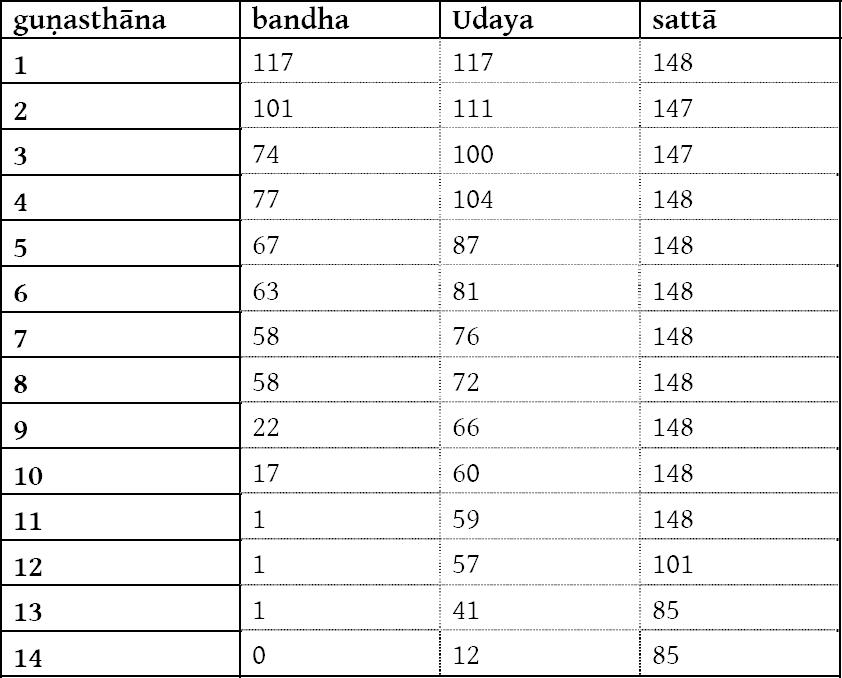
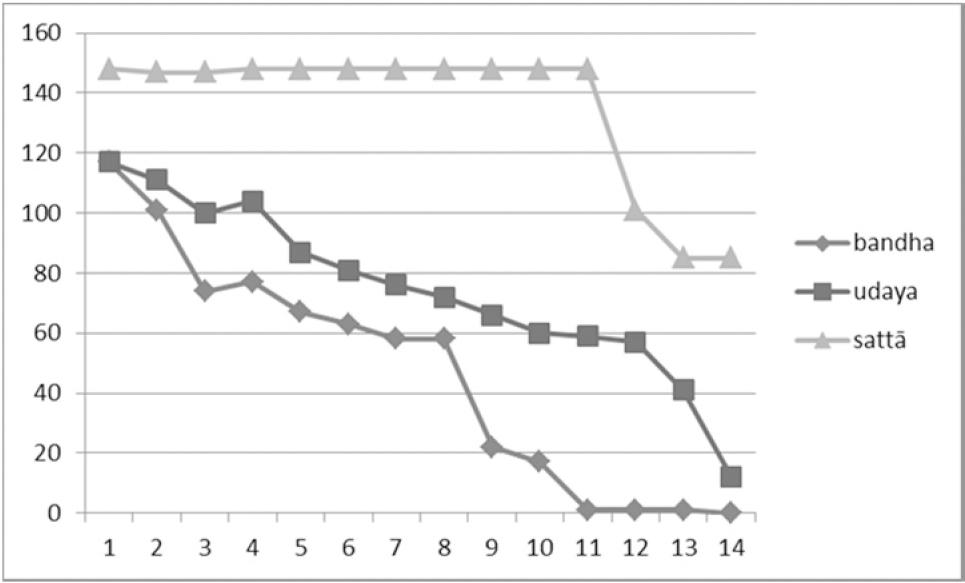
The theory of karma also gives an idea of the time taken by the karma to decline. This is the duration (sthiti) calculated with a minimum and a maximum time. The minimum a karmic category binds the pure soul is one muhūrta – 48 minutes. The maximum can reach 70 koṭakoṭi sāgaropama – 7 x 10225 years. If we consider this maximum, we realise how long the path to omniscience can take to travel.
It is interesting to see how Banārasīdās expresses himself on the subject. The chart below gives the detail of the SSN verses that treat each guṇasthāna. We can easily note that Banārasīdās pays a lot of attention to stages four through six – the crucial moment when the voluntary layman has to make a choice: to be monk and continue to follow the path of realisation or not to be a monk and stop the journey at the fifth stage.
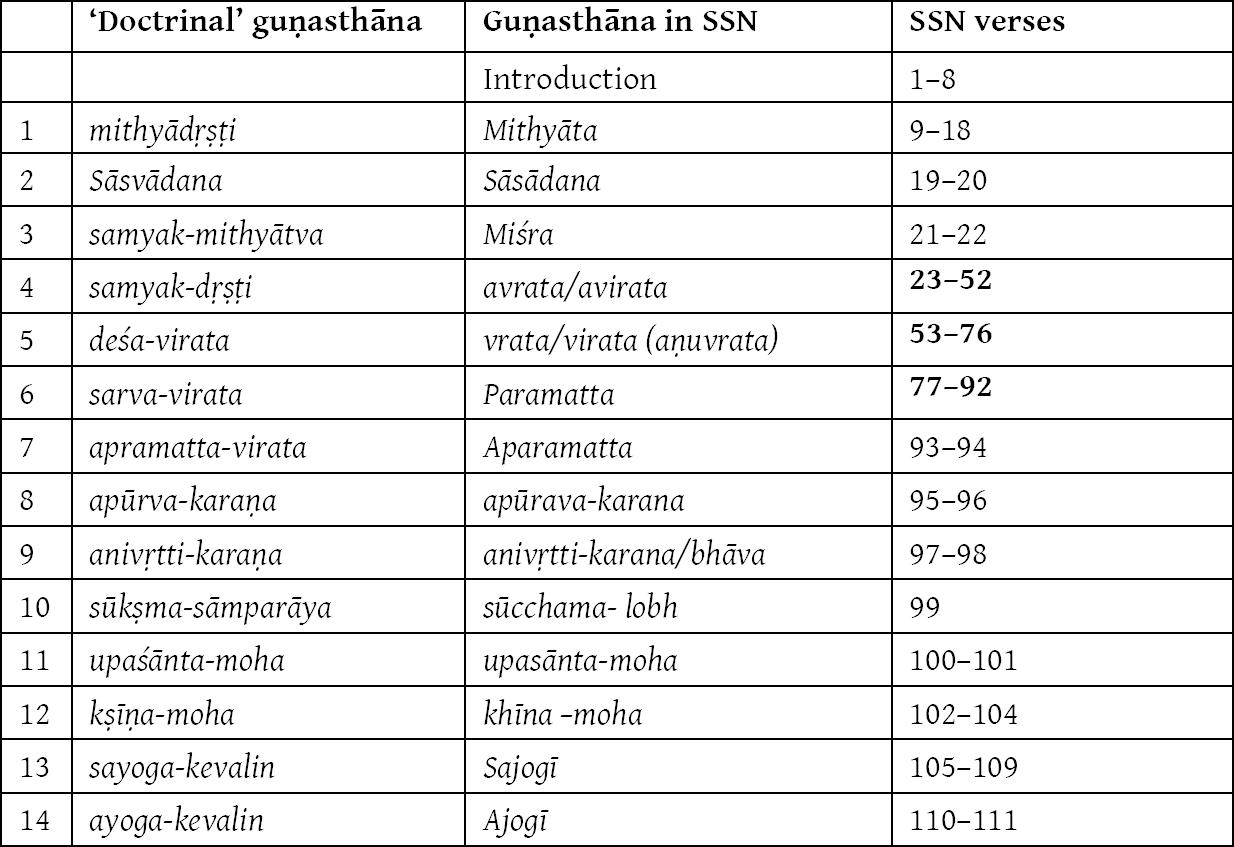
After the introductory verses, Banārasīdās gives the list of the Stages of Qualities. Then he gives the details of each stage: categories of karma involved, duration, consequences, and the many lists associated with the stages. For example, the fourth stage of the right ‘Jain’ belief is the occasion for Banārasīdās to detail all the most important lists theorised in Jainism: the eight aspects of right belief (SSN 13.26–38) in which there are eight qualities (guṇa, SSN 13.30); five ornaments (bhūṣana, SSN 13.31); twenty-five faults (doṣa, SSN 13.32–36) in which there are eight great sources of intoxication (mahāmada, SSN 13.33), eight impurities (mala, SSN 13.34), six karmic sanctuaries (āyatana, SSN 13.35), and three ineptnesses (muḍhatā, SSN 13.36); five causes of destruction (nāśa-kāraṇa, SSN 13.37); five transgressions (aticāra, SSN 13.38); seven sub-categories of delusion-producing karma (mohanīya-karma, SSN 13.40–47). The explanation of the fifth guṇasthāna also details the twenty-one qualities requested for laymen (SSN 13.54), the twenty-two food interdictions (SSN 13.55), and the eleven steps of perfection (pratimā, SSN 13.57–73), which we will address shortly. The expounding of the sixth guṇasthāna finally lists five types of carelessness (pramāda, SSN 13.79), twenty-eight qualities requested for monks (SSN 13.80), five restrictions (samiti, SSN 13.82), and six daily duties (āvaśyaka, SSN 13.83). It would be boring to describe all the lists – the present article contains lists enough! May the patient reader allow us to translate the presentation of the guṇasthāna by Banārasīdās, interesting in the present context.
niyata eka vivahāra sauṃ, jīva caturdasa bheda /
raṅga joga bahu vidhi bhayau, jyauṃ paṭa sahaja supheda // SSN_13.7 //
Unified [from the absolute point of view], the soul knows fourteen categories from the conventional point of view: a naturally white cloth that is dyed with colors becomes multiple.
prathama mithyāta dūjau sāsādana tījau miśra*,
caturtha avrata pañcamau virata rañca hai /
chaṭṭhau paramatta nāma sātamo aparamatta*,
āṭhamo apūravakarana sukha-sañca hai //
naumau anivṛttibhāva daśamo sūcchama lobha*,
ekādaśamo su upasānta mohabañca hai /
dvādaśamo khīnamoha teraho sajogī jina*,
caudaho ajogī jā kī thiti aṅka pañca hai // SSN_13.8 //
The first one is wrong belief. The second one is only the taste of right belief. The third is mixed belief. The fourth is [right belief] without self-control. The fifth is [right belief] with self-control. The sixth is named carelessness. The seventh is an absence of carelessness. The eighth is a process of reduction of new karmas which is full of happiness. The ninth is a ‘no return’ process of karmic reduction. The tenth is the avidity[1577] for subtle passions. The eleventh is a good pacification which undermines delusion. The twelfth is the destruction of delusion. The thirteenth is the stage of the Jina who still has an activity. The fourteenth is the stage of the omniscient without activity whose duration is equal to the time taken to pronounce the five vowels.
baranai saba gunathāna ke, nāma caturdasa sāra /
aba baranauṃ mithyāta ke, bheda pañca parakāra // SSN_13.9 //
The essence of all the fourteen Stages of Qualities is going to be described. I now describe the categories of wrong belief of which there are five kinds. Etc.
2. Banārasīdās’s Avasthāṣṭaka and the categories of the self
The Samayasāranāṭaka is not the only text of Banārasīdās in which he evokes the guṇasthāna. A short text entitled Avasthāṣṭaka (‘Eight Verses on Stages’) can be found in the Banārasīvilāsa collection. The term avasthā designates the stages of spiritual realisation, i. e. the guṇasthāna. The text makes parallels between guṇasthāna and six categories of souls. A complete translation of the text is the best way to understand the process. The short form of the text is an example of the ‘reminders’ genre: the poet has received a teaching which he later transcribes in order to remember it. The Banārasīvilāsa is full of texts of this kind which was also a popular genre in seventeenth-century North India.
cetana-lakṣaṇa niyata-naya, sabai jīva ikasāra /
mūḍha vicakṣaṇa parama soṃ, tri-vidhi rūpa vyavahāra // AA_1 //
From the absolute point of view, all the animate principles are identical: their main characteristic is consciousness. From the conventional point of view, they are divided into three categories: deluded, clear-sighted and supreme.
mūḍha ātamā eka vidhi, tri-vidhi vicakṣaṇa jāna /
dvi-vidhi bhāva paramātamā, ṣaṭ-vidhi jīva bakhāna // AA_2 //
Deluded Self has one sub-category. Know that the clear-sighted Self has three sub-categories. Supreme Self has two sub-categories distinguished by psychic states. The animate principle is described as having six sub-categories.
vidhi niṣedha jānai nahiṃ, hita anahita nahiṃ sūjha /
viṣaya-magana tana līnatā, yahai mūḍha kī būjha // AA_3 //
He does not know rules or hindrances; he does not perceive what is beneficial or harmful; he disappears, totally absorbed in a topic: here is the deluded Self.
jo jina-bhāṣita saradahai, bhrama saṃśaya saba khoya /
samakitavanta asaṃjamī, adhama vicakṣaṇa soya // AA_4 //
He places his faith in Jina’s aphorisms; illusion and doubt are completely destroyed; he has the right belief without self-control (i. e. he has attained the fourth guṇasthāna): here is the common clearsighted Self.
vairāgī tyāgī damī, sva para vivekī hoya /
deśa-saṃjamī saṃjamī, madhyama paṇḍita doya // AA_5 //
He is free from worldly desires; he has abandoned worldly objects; his senses are controlled; he has discernment concerning his own self: there are two kind of average scholar, one with an incomplete selfcontrol (i.e. one who has attained the fifth guṇasthāna) and one with a complete self-control (i. e. one who has attained the sixth guṇasthāna).
apramāda guṇathāna soṃ, kṣīna-moha loṃ daura /
śreṇi-dhāraṇā jo dharai, so paṇḍita śiramaura // AA_6 //
From the stage of quality without carelessness to the destruction of delusion (i. e. from the seventh to the twelfth guṇasthāna), one who cares about the concept of a spiritual ladder is a gem among scholars.
jo kevala pada ācarai, caḍhi sayogi-guṇathāna /
so jaṃgama paramātamā, bhavavāsī bhagavāna // AA_7 //
One who takes the path of omniscience after having attained the stage of quality with activity (i. e. the thirteen guṇasthāna) is the mobile supreme Self – like Bhavanavāsī divinities.
jihiṃ pada meṃ saba pada magana, jyoṃ jala meṃ jala bunda /
so avicala paramātamā, nirākāra niradunda // AA_8 //
In his path, all paths are engaged, like in water, all water particles are engaged: here is the immobile supreme Self, without form, non-dual.
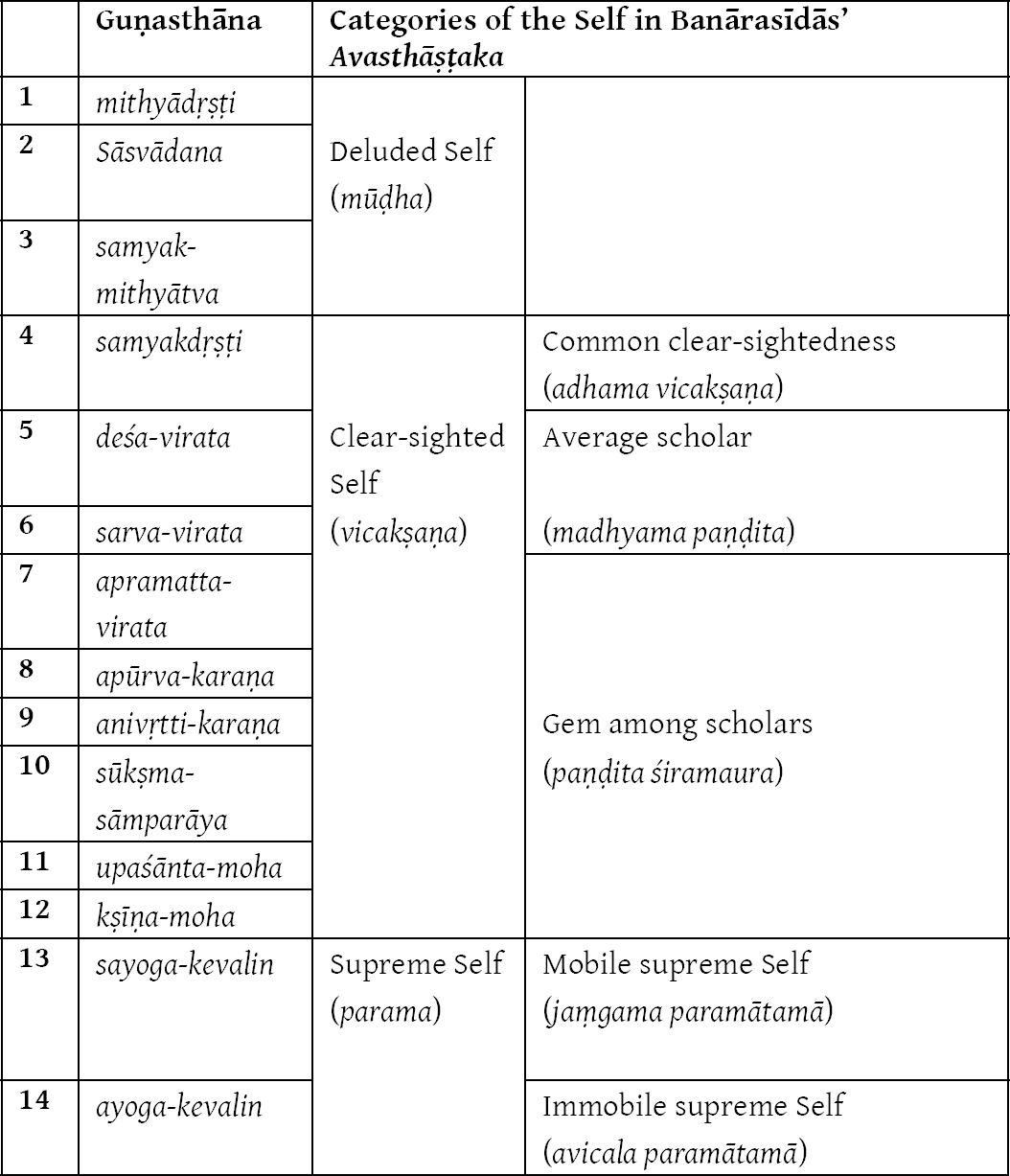
The categorisation of the Self, given by Banārasīdās here, is quite unusual in the Jain literature. The spiritual progression is facilitated by some more significant ‘steps’ to pass through. This three-pronged separation emphasises that during the first three stages the Self is deluded. One must necessarily pass through these stages to attain the fourth stage (the first ‘Jain’ stage), namely the field of a clear-sighted Self. This field is the largest and it has been divided into three sub-categories. The right belief (fourth guṇasthāna), meaning a belief just cleared of delusion, is in the field of a ‘clear-sightedness’ and more specifically in the part of the field considered to be ‘common’, ‘low’ or ‘inferior’ (adhama). This name sounds like an invitation to give it up quickly and to attain the field of an ‘average scholar’ (madhyama paṇḍita). The term paṇḍita is interesting because authors like Kundakunda would use the term jñānī. It was also a popular term in the pre-modern period to designate laymen who reached the status of well-known scholar, like ‘Paṇḍit’ Banārasīdās himself, or Hemerāj ‘Paṇḍe’, Rājamalla ‘Pāṇḍe’, ‘Paṇḍit’ Dyānatrāy etc. It could be said that these Paṇḍits had reached the fifth guṇasthāna and could reach the sixth guṇasthāna by taking the vows of monks (which is a fundamental step) and be called a ‘gem among scholars’ (paṇḍita śiramaura). The two last stages are the field of the supreme Self and are reserved to Realised beings of the Jain mythology. This is an abstract world to which common people – with poetical hearts – composed hymns.
3. Eleven Steps of Perfection (pratimā)
We have seen that in the course of the fifth guṇasthāna, the layman is invited to climb eleven more steps known as pratimā, largely expounded by Banārasīdās. Incidentally, we can notice that Banārasīdās employed a more lively and common vocabulary than the one used by Nemicandra. He also composed some ‘free’ or less official verses to move the reader and to give a new tone to the text. The term pratimā means ‘image’, ‘statue’, and probably refers to the statues of the Jinas represented in kāyotsarga, standing with their arms at their sides, which are seen as a model to follow. Even more so than the other stages, the pratimā here allow the voluntary layman to lead a life-style closer and closer to that of a monk. They are the following:
| 1. | darśana, Step of belief |
| 2. | vrata, Step of taking the vows |
| 3. | sāmāyika, Step of equanimity |
| 4. | poṣadha, Step of fasting during holy days |
| 5. | sacitta-tyāga, Step of renouncing food containing living beings |
| 6. | rātribhakta, Step of renouncing diurnal enjoyment |
| 7. | brahmacarya, Step of complete chastity |
| 8. | ārambha-tyāga, Step of renouncing daily activities |
| 9. | parigraha-tyāga, Step of renouncing possessions |
| 10. | anumati-tyāga, Step of renouncing permitted activities |
| 11. | uddiṣṭa-tyāga, Step of renouncing prescribed food |
During the first step, the layman simply has a firm faith in the Jain teachings. 2. Then, he becomes a full member of the Jain community by taking the fundamental vows of all Jains: to not injure living beings (ahiṃsā), to always tell the truth (satya), to not steal (asteya), to reduce sexuality (brahmacarya), to not own possessions (aparigraha). 3. He practices meditation in the posture of kāyotsarga and tries to consider all things with the same eye, with equanimity. 4. He trains to face the difficulties of fasting – a very hard exercise for Banārasīdās whose gluttony is legendary. 5. Then, the adept is invited to pay attention to his daily life by renouncing food containing living beings. 6. Another difficult exercise awaits Banārasīdās: the step of renouncing diurnal sexual enjoyment, which is a preliminary stage before complete chastity. It is sometimes read as rātri-bhukta-tyāga, the renunciation of eating at night in order to save one from injuring living beings. 7. Known for his numerous affairs during his youth, Banārasīdās puts particular emphasis on this seventh step of complete chastity. Having accorded only one couplet (dohā or caupāī) to the other steps, he composed a quatrain in kavitta meter concerning the step of chastity (SSN 13.67). 8. The step of renouncing daily activities marks a real transition from secularism to monkhood. 9. The adept has to renounce all possessions, a step that permanently transforms the individual’s status from “householder” to monk, also signifying their departure from the home. 10. The adept only accepts what other people give him to eat and does not cook by himself (the ‘permitted’ activity of step ten). 11. Finally, the step of renouncing prescribed food marks a swing from the lay status to the religious life. The adept is now ready to attain the sixth guṇasthāna and to take the vows of monks. The Śvetāmbara tradition names this step the “becoming monk” (śramaṇabhūta) and the Digambara tradition subdivides it into two more steps: the junior monk (kṣullaka), who wears three pieces of cloth, and the monk who wears only one piece of cloth (ailaka).
Banārasīdās evokes the pratimā this way:
aba pañcama gunathāna kī, racanā varanauṃ alpa /
jā maiṃ ekādasa dasā, pratimā nāma vikalpa // SSN_13.56 //
Now I will quickly describe the composition of the fifth Stage of Qualities in which eleven diverse states named ‘pratimā’ take place.[1578]
darsana-visuddha-kārī bāraha virata-dhārī*,
sāmāika-cārī parva-proṣadha vidhi vahai /
sacita kau parahārī divā aparasa nārī*,
āṭhauṃ jāma brahmacārī nirāraṃbhī hvai rahai //
pāpa parigraha chaṇḍai pāpa kī na śikṣā maṇḍai*,
koū yā ke nimitta karai so vastu na gahai /
aite desavrata ke dharaiyā samakitī jīva*,
gyāraha pratimā tinhaiṃ bhagavanta-jī kahai // SSN_13.57 //
One purifies their belief, takes the twelve vows, attains equanimity, leads different fasts during the holy days, renounces [food] containing living beings, does not touch any woman during the day, observes chastity during the eight parts of the day, lives by renouncing daily activities, rejects sinful possessions, does not enhance the learning of sinful things, does not take a meal prepared for someone else. The Lord states these eleven steps for orthodox souls who have attained the stage of self-control (i.e. the fifth guṇasthāna).
saṃjama aṃsa jagyau jahāṃ, bhoga aruci parināma /
udai pratigyā kau bhayau, pratimā tā kau nāma // SSN_13.58 //
When a part of self-control awakens, enjoyment turns into disgust. This manifestation of a promise is what we call a pratimā!
After having described each pratimā in detail (SSN 13.59–72), Banārasīdās subdivides them into three groups. This distinction gives an idea of the way the pratimā were seen – as a transition from one state (the laity) to another (the monkhood):
ṣaṭa pratimā tāṃī jaghana, madhyama nau parajanta /
uttama dasamī gyāramī, iti pratimā viratanta // SSN_13.73 //
They are low up to the sixth step, medium up to the ninth, high through the tenth and the eleventh: here is the story of the pratimā.
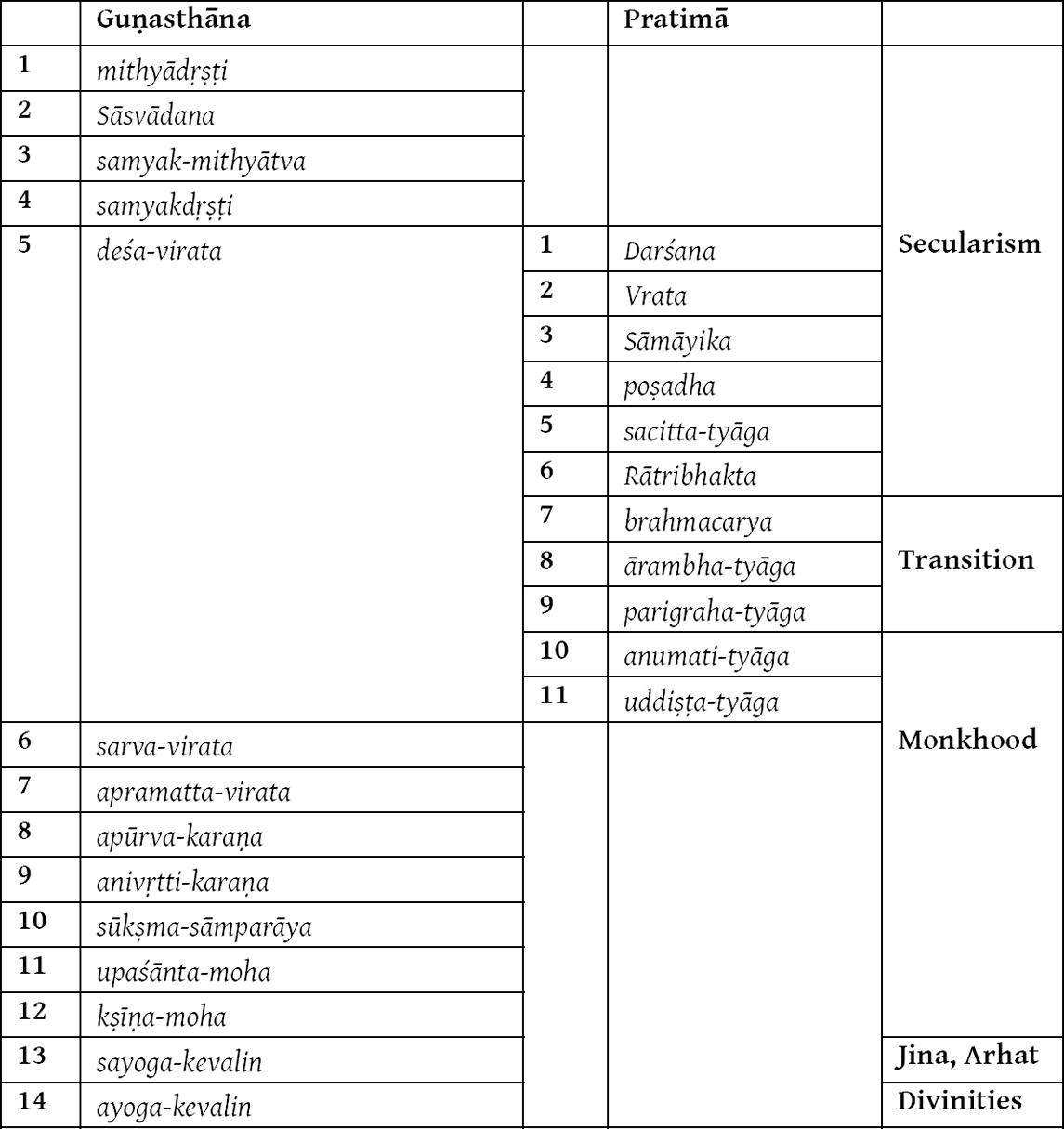
4. Stages of Perfection in History
The history of the guṇasthāna is quite complicated to delineate.[1579] It seems like this concept is not mentioned in the Śvetāmbara Canon, although we can find descriptions of other ladders of perfection such as the pratimā which appear in a manual for laymen. The Uvāsagadasāo (‘Ten Laymen’), the seventh text of the main branch of the Śvetāmbara Canon (Aṅga) which describes the Right Conduct for the Jain lay society, tells the story of Ānanda, a layman who feels ready to progress through the stages of an ideal layman (upāsaka) who is the central figure of the text.
“§ 70. Then Ānanda, the servant of the Samaṇa [Sanskrit ‘śramaṇa’, the Jain ascetic, here for the Jina Mahāvīra himself], engaged in conforming himself to the standards of an uvāsaga. Perfectly, in thought, word and deed, he practised, maintained, satisfied, accomplished, proclaimed and completed the observance of the first standard of an uvāsaga [Sanskrit ‘upāsaka’, the ideal layman] according to the sacred writings, according to the rules prescribed in them, according to the right way, and according to the truth.
§ 71. Then Ānanda, the servant of the Samaṇa, completed the observance of the second standard of an uvāsaga, and likewise that of the third, fourth, fifth, sixth, seventh, eighth, ninth, tenth, and eleventh standards.” (Hoernle translation 1885: 46)
In the Digambara tradition, Kundakunda refers to the stages of perfection, mentions both the guṇasthāna and pratimā, but he never addresses the theory in detail. His own doctrine focuses on the purity of the self and follows the absolute point of view (niścaya-naya) away from the conventional point of view (vyavahāra-naya) where these stages were conceptualised.
The soul possesses neither stages of biological development (jῑvasthāna) nor states of spiritual development (guṇasthāna), all these are modifications of the matter. (Samayasāra 2.17, Translation Zaveri/Kumar 2009)
In the same period, the philosopher Umāsvāti, whose authority is recognised by Śvetāmbaras and Digambaras, described the Stages of Qualities in the ninth chapter of his Tattvārthasūtra. He evokes the Stages in their ancient form: the ladder begins with the fourth stage, at the very moment when the adept becomes a resolved Jain.[1580]
The first complete list is given by the Ṣaṭkhaṇḍāgama (‘Treatise in Six Parts’). It is a voluminous treatise seen as a pro-canonical text by the Digambaras, and the ultimate source of their teachings. Written around the 3rd century, it gives a simple list of the fourteen stages without any technical details.
micchāiṭṭhī //9// sāsaṇasammāiṭṭhī //10// sammāmicchāiṭṭhī //11// asaṃjadasammāiṭṭhī //12// saṃjadāsaṃjadā //13// pamattasaṃjadā //14// appamattasaṃjadā //15// apuvvakaraṇa-paviṭṭha-suddhi-saṃjadesu atthi uvasamā khavā //16// aṇiyaṭṭi-bādara-sāṃparāiya-paviṭṭha-suddhi-saṃjadesu atthi uvasamā khavā //17// suhuma-sāmparāiya-paviṭṭha-suddhi-saṃjadesu atthi uvasamā khavā //18// uvasanta-kasāya-vīyarāya-chadumatthā //19// khīṇa-kasāya-vīyarāya-chadumatthā //20// sajogakevalī //21// ajogakevalī //22//
Wrong belief; taste of right belief; right and wrong belief; right belief with self-control; self-control and non-self-control; self-control with carelessness; self-control without carelessness; pacification is still weak for self-controlled beings for whom purity has begun a process against new karmas; pacification is still weak for self-controlled beings for whom purity has begun a ‘no return’ war against rough passions; pacification is still weak for self-controlled beings for whom purity has begun a ‘no return’ war against subtle passions; non-omniscient ascetics, free from attachments, for whom passions are pacified; nonomniscient ascetics, free from attachments, for whom passions are destroyed; omniscient ascetics with activity; omniscient ascetics without activity (Ṣaṭkhaṇḍāgama, 1.1.9–22).
Nemicandra was inspired by this text when he wrote the Gommaṭasāra (‘Essence of Mahāvīra’s teachings’). The book is divided into two parts: one devoted to the soul (Jīvakhaṇḍa), the other devoted to karma (Karmakhaṇḍa). The first book gives the list of the fourteen Stages of Qualities, here referred as ‘compositions of the soul’ (jīvasamāsa); the second explains the karmic categories involved in every stage.
miccho sāsaṇa misso aviradasammo ya desa-virado ya /
viradā pamatta idaro apuvva aṇiyaṭṭhi suhamo ya // GSJ_9 //
ubasanta khīṇamoho sajogakevalijiṇo ajogī ya /
caudasa jīvasamāsā kameṇa siddhā ya ṇādavvā // GSJ_10 //
Wrong belief; taste of right belief; mixed; right belief without selfcontrol; partial self-control; complete self-control with carelessness; the opposite (i.e. complete self-control without carelessness); process against new karmas; ‘no return’ process;
war against subtle passions; pacification; destroyed delusion; Jina with activity; and Jina without activity must be understood as the fourteen compositions of the soul leading gradually to Realisation (Gommaṭasāra, Jīvakhaṇḍa, 9–10).
The Gommaṭasāra was popular in Digambara circles until the 18th century, as we saw with Banārasīdās. The early 18th-century Digambara author Paṇḍit Dyānatrāy wrote pieces which were collected after his death by Paṇḍit Jagatrāy under the title Dharmavilāsa. Some of his padas are still very famous among Digambaras who continue to sing them during daily ritual. But it is another independent text which is more pertinent to our present study. According to the oral tradition, Dyānatrāy[1581] became a fervent adept of Goddess Padmāvatī who offered to grant him a wish in return for his deep devotion. Dyānatrāy answered that he did not want anything for himself but he wished that everyone would convert to the Jain faith! In her wisdom, Padmāvatī said that such a project was not in her power, nor was it in Jina’s power. So Dyānatrāy just asked her for inspiration for the short treatise on Jainism, the Carcāśataka (‘One Hundred Verses on Conversations’, henceforth CŚ), that he was composing. The term carcā was used by the Ādhyātmika groups to refer to their meetings. The CŚ is a 103-verse poem (mostly in chappay and savaiyā ikatīsā metres) on the soul (jīva) and its journey through the three worlds (infernal, human, divine) towards the Realisation (siddhi). The text is organised around three main concepts: karma theory, doctrine of the Stages of Qualities, and cosmology. Dyānatrāy’s ambition seems to have been to present all the Jain theories of Realisation in detail. And we have seen how Jainism names, classifies and lists doctrinal elements. For example, verse 31 lists the highlights of Jainism: three times (kāla), six substances (dravya), seven principles (tattva), eight qualities (guṇa), etc. “The one who places his faith in these principles”, concluded Dyānatrāy, “is on his way to Jain orthodoxy, so he is close to being delivered”.[1582] We can observe that the guṇasthānas are not included in the list, but they are underlying themes throughout the text.[1583] Dyānatrāy asks what happens after the fourteenth stage: “I bow to he who follows the path of beatitude after having crossed the fourteenth stage, who does not know age nor death.”[1584] He expounds the karmic mechanism: influx (āsrava), enslavement (bandha), and manifestation (udaya) of karmas determining life-span (āyus-k.). His obsession with lists and numbers leads the reader into confusion – it is as if the classificatory system explodes. This obsession reveals the influence of Nemicandra’s Gommaṭasāra. The difference is that the latter is a voluminous treatise and not an extremely condensed one-hundred-verse poem.[1585] An additional verse of the CŚ pays direct homage to Nemicandra and his compendium.
vandauṃ Nemi-jinendra, namauṃ cauvīsa Jinesura /
Mahāvīra vandāmi, vandi saba Siddha mahesura //
suddha jīva praṇamāmi, pañca-pada praṇamauṃ sukha ati /
Gomaṭasāra namāmi, Nemicanda ācāraja niti //
jina siddha suddha akalaṅka vara, guṇa-maṇī-bhūṣaṇa udavadhara /
kahuṃ vīsa parūpana bhāva sauṃ, yaha maṅgala saba vi vighanahara // CŚ_46 //
I worship Neminātha, the excellent Jina; I bow to the twenty-four gods Jina; I worship Mahāvīra after having worshiped every Realised being; I bow to the pure soul; I bow to the five Names (Arhat, Siddha, Upādhyaya, Ācārya, Sāddhu) who assure a supreme bliss; I bow to the Gommaṭasāra which exposes the moral philosophy of Ācārya Nemicandra. They are conquerors, realised beings, pure souls, free from stains, excellent, jewelled ornaments that are, by their qualities, elevated. I will say twenty teachings with all my heart: may they be all auspicious and may they destroy what injures (Carcāśataka, 46).
In the mid-18th century, the Digambara scholar Paṇḍit Ṭoḍaramal wrote a Gommaṭasārapūjā, a poem which praised the qualities of the Gommaṭasāra, demonstrating the popularity of the text. Then, the theory of the Stages of Qualities became much too complicated for the modern Jain lay society. It seems that the laymen of the 19th century preferred to follow an easier path in their spiritual progression. In the mid-19th century, the poet Daulatrām wrote a short treatise for laymen, the Chahaḍhāla (‘Six Chapters’ or ‘Six Shields [against karma]’). This text never directly refers to the guṇasthāna, but the chapters of the book form a progression from delusion to Realisation. This progression evokes the Stages of Perfection. Nowadays, whether the guṇasthāna is more an object of study than a real practice among the Jain lay society is a question that merits further study. In texts, the idea of a progression is present but the technical aspects of the guṇasthāna may not be very popular in practice. At every stage of the guṇasthāna, a certain kind of karma should decline. This is described by the treatises with great precision and a strong mathematical background is advised to fully comprehend the theory, which is based on a calculus of the duration and destruction of all the 148 karmic categories.
5. Conclusion
We can conceptualise the Samayasāranāṭaka, and more largely Banārasīdās’ philosophical position in 17th-century India, as a crossroads between the two Jain points of view: the absolute point of view (niścaya-naya) prescribed by the Samayasāra and the conventional point of view (vyavahāra-naya) described in the Gommaṭasāra. Kundakunda started a lineage of Jain scholars, reformists and poets, that is sometimes called the “Digambara mystical tradition”.[1586] These authors credited his work as the basis of their thought, like the Adhyātma groups did during their time. But the “monk literature” Kundakunda wrote is not accessible nor attractive to laymen. This surely exhibits a kind of mixed thought in this lineage which goes from Kundakunda in the beginning of the common era to Rājacandra at the end of the 19th century: discussions concentrate on the search for the true nature of the Self, all while daily life is organised in a way which allows the layman to continue working in the market-place. If we consider the other Jain authors of this tradition, like Dyānatrāy, Ṭoḍaramal, or Daulatrām, the stages themselves appear to be more or less abandoned during the late 18th century, possibly because of the high level of technical complexity. Rājacandra himself said in the Ātmasiddhi that both absolute and conventional points of view are useful for the voluntary layman who wants to search for the self and to become an ātmārthī (‘seeker of the Self’).[1587] So Banārasīdās (although he is not the only one), by including the guṇasthāna theory within the Samayasāra, included the lay community in the quest for Realisation.
Bibliographical references
Primary Sources
Amṛtacandra. 1964. Samayasāra Kalaśa: Pāṇḍe Rājamalla kṛta Bālabodhanī ṭīkā sahita. Edited by Phūlacandra Siddhāntaśāstrī. Jayapur: Paṇḍit Ṭoḍaramal Smārak Ṭrasṭ.
___. 1991. Adhyātma-Amṛta-Kalaśa: Śrī Amṛtacandrācāryakṛta Kalaśoṃ Kī Svātmaprabodhinī Ṭīkā Va Pravacana. Kaṭaṇī: Śrī Candraprabha Digambara Jaina Mandira.
Banārasīdās. 1876. « Samayasāra-nāṭaka ». In Prakarana-ratnakara, edited by Bhīmasimha Manaka, vol. 2: 345–576. Bombay.
___. 1914. Atha Samayasāranāṭaka prārambha. Hindī vacanike sahīta. Edited by Nānā Rāmacandra Nāga. Kumbhoja.
___. 1922. Banārasīvilāsa. Edited by Nāthūrām Premī. Mumbaī: Jain Granth Ratnākar Kāryālay.
___. 1957. Ardhakathānaka. Edited by Nāthūrām Premī. 2nd ed. with Introduction and Glossary. Mumbaī: Hindī Grantha Ratnākara.
___. 1981. Ardhakathānaka. Half a Tale: A Study in the Interrelationship Between Autobiography and History. Edition and English translation by Mukund Lath. Jaipur: Rajasthan Prakrit Bharati Sansthan.
___. 1987. Banārasī-vilāsa: saṅgraha-kartā Jagajīvanarāma. Jayapura: Akhila Bharatiya Jaina Yuva Phaidaresana.
___. 1997. Samayasāra Nāṭaka: Bhāṣāṭīkā Sahita. Edited by Buddhilāla Śrāvaka. 7th ed. (1st ed. 1971). Jayapura: Paṇḍita Ṭoḍarmala Sarvodaya Ṭrasṭ.
___. 2007. Ardhakathānaka. Hindi translation by Rohini Chowdhury. Delhi: Yātrā Books & Penguin Books.
___. 2009. Ardhakathānak: A Half Story. English translation by Rohini Chowdhury. Preface by Rupert Snell. Delhi: Penguin Books.
___. 2010a. Dhyānabattīsī: 32 Steps to Self-Realisation. English translation by Jérôme Petit. Pandit Nathuram Premi research series, vol. 31. Mumbai: Hindi Granth Karyalay.
___. 2010b, see J. Petit 2010b.
___. 2011. Histoire à demi: autobiographie d’un marchand jaina du XVIIe siècle. French translation, presentation and notes by Jérôme Petit. Paris: Presses Sorbonne Nouvelle.
Daulatrām, Pandit. 1993. Pt. Daulatram’s Chhahadhala. Edited by Kusum Jain, English translation by S. C. Jain. Delhi: Keladevi Sumatiprasad Trust.
___. 2007. Chahaḍhālā ṭīkā sahita. Edited by Māṇekacand Dośī and Maganalāl Jain. 29th ed. (1st ed. 1965). Jaipur: Paṇḍit Ṭoḍarmal Smārak Ṭrasṭ.
Dyānatrāy. 1913. Carcā-śataka. Edited by Nāthūrām Premī. Bambaī: Mahilā Jain Samāj.
Jain, Hiralal (ed.). 1939. The Ṣaṭkhaṇḍāgama of Puṣpadanta and Bhūtabali with the commentary Dhavalā of Vīrasena. Amarāvatī: Jain Sāhitya Uddhārak Fund Kāryālay.
Kundakunda. 1971. Samayasāra of Śrī Kundakunda; with English Translation and Commentary Based upon Amṛtacandra’s Ātmakhyāti. English translation by A. Chakravarti (1st ed. 1950). Edited by A. N. Upadhye. Banaras: Bhāratīya Jñānapīṭha.
___. 2009. Samayasāra : Original Text, Romanization, English Translation and Annotations (with scientific interpretation). Edited by Jethalal S. Zaveri and Muni Mahendrakumar. Ladnun: Jain Vishva Bharati University.
Nemicandra. 1927. Gommatsara Jiva-Kanda (The Soul). English translation by Jagmandar Lal Jaini and Sital Prasad. Lucknow: Central Jaina Pub. House.
___. 1928. Gommaṭasāra (Karmakāṇḍa). Edited by Manoharalāla. Rāyacandra Jaina Śāstra Mālā. Bambaī: Paramaśrutaprabhāvaka-Jainamaṇḍala.
___. 1978. Gommaṭasāra : Śrīmatkeśavaṇṇaviracita Karṇāṭakav*ṟ*tti, Saṃsk*ṟ*ta ṭīkā Jīvatattvapradīpikā, Hindī anuvāda, tathā prastāvanā sahita. Edited by A. N. Upadhye and Kailash Chandra Jain. Jnanapitha Murtidevi granthamala: Prakrta granthanka 14–15; 16–17. Nayī Dillī: Bhāratīya Jñānapīṭha.
Rājacandra. 1957. Ātmasiddhi : Self-realization. Edited by Vecarasvāmi. English translation by Brahmacārī Govardhandas. Aliganj: The World Jain Mission.
Ṭoḍaramal, Paṇḍit. 1974. Mokshamārgaprakāśaka. Edited by Maganalāl Jain and Hukamacanda Bhārilla. Sonāgaṛh: Śrī Jaina Svādhyāyamandira Ṭrasṭa.
___. 2005. Moksha Marg Prakashak : The Illuminator of the Path of Liberation. English translation by Hem Chand Jain and Jamnalal Jain (1st ed. 1992). Mumbai: Shri Kundkund Kahan Digamber Jain Tirth Suraksha Trust.
Umāsvāti/Umāsvāmi. Tattvārthasūtra. See Tatia 1994.
Secondary Sources
Balbir, Nalini. 1999. “About a Jain Polemical Work of the Seventeenth Century”. In Approaches to Jaina Studies: Philosophy, Logic, Rituals and Symbols, N. K. Wagle & O. Qvarnström (ed.). Toronto: University of Toronto, pp. 1–18.
Balcerowicz, Piotr (ed.). 2003. Essays in Jaina Philosophy and Religion. Warsaw Indological studies, 2. Delhi: Motilal Banarsidass.
Bhārilla, Hukamacanda. 1999. Paṇḍit Ṭoḍaramal : vyaktitva aur karttṛtva. (1st ed. 1973). Jaipur: Paṇḍit Ṭoḍaramal Smārak Ṭrasṭ.
Bhārilla, Ratnacanda. 1975. Kavivar Paṇḍit Banārasīdās : jīvan aur sāhitya. Jaipur: Paṇḍit Ṭoḍaramal Smārak Ṭrasṭ.
Bhatt, Bansidhar. 1974. “Vyavahāranaya and Niścayanaya in Kundakunda’s Works”. Zeitschrift der Deutschen Morgenländischen Gesellschaft, Suppl. 2, pp. 279–291.
___. 1989. “The Concept of the Self and Liberation in Early Jaina Agamas”. In Self and Consciousness: Indian Interpretation. Roma: Centre for Indian and Inter-religious Studies, p. 132–172.
___. 1994. “On the Epithet: nāṭaka for the Samayasāra of Kundakunda”. In Jainism and Prakrit in Ancient and Medieval India, N. N. Bhattacharya (ed.). Delhi: Manohar, pp. 431–462.
Bhisikar, Narendra Kumār. No date. “Śrīman Paṇḍit Ṭoḍaramalajī aur Gommaṭasāra”. Shantisagar Janma Shatabdi Mahotsav Smruti Granth, pp. 154–165.
Cort, John E. 2002. “A Tale of Two Cities: On the Origins of Digambar Sectarism in North India”. In Multiple Histories: culture and society in the study of Rajasthan, ed. by L. A. Babb, V. Joshi, and M. W. Meister. Jaipur : Rawat Publications, pp. 39–83.
___. 2003. “Dyānatrāy: An Eighteenth Century Digambara Mystical Poet”. In Essays in Jaina Philosophy and Religion, P. Balcerowicz (ed.). Delhi: Motilal Banarsidass, pp. 279–295.
___. 2013a. “Daulatrām Plays Holī: Digambar Bhakti Songs of Springtime”, Jaina Studies: Newsletter of the Centre of Jaina Studies, Issue 8, March 2013, pp. 33–35.
___. 2013b. “God Outside and God Inside: North Indian Digambar Jain Performance of Bhakti.” Proceedings of the Tenth International Bhakti Conference: Early Modern Literatures in North India, Imre Bangha (ed.). Delhi: Manohar.
___. Forthcoming. “Making it Vernacular in Agra : the Practice of Translation by Seventeenth-century Digambar Jains”. In Tellings and Texts : Singing, Story-telling and Performance in North India, ed. by Francesca Orsini.
Darśanakalāśrī (sādhvī). 2007. Prākṛta evaṃ saṃskṛta sāhitya meṃ guṇasthāna kī avadhāraṇā. Rājagaḍha : Rājarājandra Prakāśana Ṭraṣṭa.
Dhaky, M. A. 1991. “The date of Kundakundācārya”. In Aspects of Jainology Vol. III. Pt. Dalsukhbhai Malvania Felicitation Volume I, ed. by M. A. Dhaky & S. Jain. Varanasi, pp. 187–206.
Dundas, Paul. 1999. “Jainism Without Monks? The Case of Kaḍuā Śāh”. In Approaches to Jaina studies: philosophy, logic, rituals and symbols, ed. by N. K. Wagle & O. Qvarnström. Toronto: University of Toronto, pp. 19–35.
___. 2002. The Jains. 2d ed. London: Routledge.
Flügel, Peter (ed.). 2006. Studies in Jaina history and culture: disputes and dialogues. London: Routledge.
Glasenapp, Helmuth von. 1915. Die Lehre vom Karman in der Philosophie der Jainas nach den Karmagranthas dargestellt. Ausgewählte kleine Schriften, Wiesbaden, Franz Steiner, 1980. Leipzig: Druck von G. Kreysing.
___. 1942/2003. Doctrine of Karman in Jain Philosophy. English translation by Barry Gifford. Varanasi: P.V. Research Institute. Edited by Hiralal Rasikdas Kapadia, Fremont, CA: Asian Humanities Press.
Gupta, Dindayalu. No date. Brajbhāṣā Sūrkośa. Lucknow: Viśvavidyālaya Hindī Prakāśan.
Hilton, Walter. 1494/1908. Scala perfectionis. Westminster: Art & Book Co.
Hoernle, August Friedrich Rudolph. 1885. The Uvāsagadasāo = or, The religious profession of an Uvāsaga expounded in ten lectures : being the Seventh Anga of the Jains ; ed. in the original Prākrit with the Sanskrit commentary of Abhaya Deva and an English translation with notes by A.F. Rudolf Hoernle. 2 vol. Bibliotheca Indica: a collection of Oriental works. Calcutta: Baptist Mission Press.
Jain, Ravindra Kumar. 1966. Kavivar Banārasīdās : jīvanī aur kṛtitva. Delhi: Bhāratīya Jñānapīṭh Prakāśan.
Jain, Sagarmal. 1996. Guṇasthāna siddhānta : eka viśleṣaṇa. Pārśvanātha Vidyāpīṭha Granthamālā, 87. Vārāṇasī: Pārśvanātha Vidyāpīṭha.
Jaini, Padmanabh S. 1979. The Jaina Path of Purification. Berkeley: University of California Press, 1979.
___. 2004. “Hemaraj Pande’s Caurāsi Bol”. In Jambūjyoti (Munivara Jambūvijaya Festschrift), ed. by M. A. Dhaky & J. B. Shah. Ahmedabad: Shreshti Kasturbhai Lalbhai Smarak Nidhi, pp. 374–398.
___. 2008. “Jain Sectarian Debates: Eighty-four Points of Contention (Cauryāṃsī bol) between Śvetāmbaras and Digambaras (Text and Translation)”. Journal of Indian Philosophy, vol. 36, pp. 1–246.
Johnson, W. J. 1995. Harmless Souls: Karmic Bondage and Religious Change in Early Jainism with Special Reference to Umāsvāti and Kundakunda. Lala Sundar Lal Jain research series vol. 9. Delhi: Motilal Banarsidass Publishers.
Mishra, Madhusudan. 1996. Householders’ Discipline in Jainism: A Study of Amṛtacandra’s Puruṣārthasiddhyupāyaḥ with the Edited Text in Sanskrit in Devanāgarī Script. Delhi: Eastern Book Linkers.
Nathamal, Muni. 1999. Samayasāra : niścaya aura vyavahāra kī yātrā. Lāḍanūṃ: Jaina Viśva Bhāratī Prakāśana.
Petit, Jérôme. 2008–2009a. “Review: Banārasīdās, Ardhakathānak, Hindī anuvād: R. Chaudharī, Delhi, Yātrā Books/Penguin Books, 2007”, Bulletin d’Études Indiennes, n° 26–27.
___. 2008–2009b. “Review: Banārasīdās, Ardhakathānak: A Half Story, translated by R. Chowdhury, New Delhi, Penguin Books, 2009”, Bulletin d’Études Indiennes, n° 26–27.
___. 2010a. See Banārasīdās, Dhyānabattīsī.
___. 2010b. “Banārasīdās’s Karmachattīsī – Thirty-six stanzas on Karma”. In Svasti – Essays in Honour of Prof. Hampa Nagarajaiah, ed. by N. Balbir. Bangalore: K.S. Muddappa Smaraka Trust, pp. 231–242.
___. 2011. See Banārasīdās, Histoire à demi.
___. 2013. De la convention à la conviction : Banārasīdās dans l’histoire de la pensée digambara sur l’absolu. PhD thesis under the supervision of Prof. Nalini Balbir. Paris: Université Sorbonne Nouvelle.
___. Forthcoming. “Absolute and Conventional Points of View in Jainism: A Historical Perspective.” Proceedings of the Buddhist and Jaina Conference in Lumbini, February 2013.
Premī, Nāthūrām. 1922. See Banārasīdās, Banārasīvilāsa.
___.1942. Jaina Sāhitya aur Itihās. Edited by Adinath Neminath Upadhye and Hiralal Jain. Mumbaī: Hindī Grantha Kāryālaya.
___. 1957. See Banārasīdās, Ardhakathānaka.
Shaha, S. M. 1975. “Kundakunda’s Concept of Vyavahāra Naya and Niścaya Naya”. Annals of the Bhandarkar Oriental Research Institute, vol. 56, pp. 105–128.
Sogani, Kamal Chand. 2002. Jaina Mysticism and Other Essays. Jaipur: Prakrit Bharati Academy.
Tatia, Nathmal. 1951. Studies in Jaina philosophy. Varanasi: P.V. Research Institute.
___. 1994. That which is: Tattvārtha Sūtra. A Classic Jain Manual for Understanding the True Nature of Reality. Sacred literature series. San Francisco; London: HarperCollins Publishers ; The Institute of Jainology.
Williams, Robert Hamilton Blair. 1963. Jaina Yoga: a Survey of the Mediaeval Śrāvakācāras. London: Oxford University Press (reprint Motilal Banarsidass 1983).
* Many thanks to Patricia Bass who patiently helped me to improve my English.
Seven: If people get to know me, I’ll become cow-dung: Bhaba Pagla and the songs of the Bauls of Bengal[1588]
Carola Erika Lorea
Introduction
When I was studying Bengali literature at the university town of Shantiniketan, in the arid and sunny district of Birbhum, West Bengal, I was living in the rural outskirts close to a village that is densely populated by Bauls. I soon started to appreciate and learn Baul songs from the musicians who lived in the surrounding area. Among the songs the performers were teaching me, many bore the bhaṇitā of Bhaba Pagla (1902–1984): a songwriter and spiritual teacher from East Bengal.[1589] The name of this composer appeared again and again, not only in the last couplets of the songs performed, but also in the Bauls’ personal life stories; for instance, many Bauls used to pay regular visits, or even permanently resided, at the ashram of Kalna (Bardhaman), where Bhaba Pagla spent most of his life on the Indian side of Bengal;[1590] numerous Baul singers and practitioners took initiation with the mantra Bhaba Pagla used to give, either from him directly or from his eldest disciples. Most of the Bauls respect Bhaba Pagla as a mahājan, an enlightened teacher, and publicly show their devotion by displaying Bhaba Pagla’s image on the top of their ektārā (the one-stringed instrument that is peculiar to Baul music).
Travelling around and visiting various gatherings of Bauls and Fakirs, such as the annual melās at Agradwip, Sonamukhi, Jaydev, Sriniketan, and a number of smaller fairs and Baul performances, I soon realised that in the oral repertoire of songs stored in the performers’ memory, Bhaba Pagla’s songs have a very consistent presence, and indeed constitute a central part of it. Together with the lyrics of Lalok Fakir, Gurucand Gosain, Duddu Shah, Haripad Gosain and many more named and anonymous masters of the tradition, Bhaba Pagla’s compositions permeate the landscape of the orature transmitted and played by the itinerant minstrels of Bengal. In an article by Manas Ray and Suparna Tat (2006), a sample survey – probably too small and contextually confined to be of any analytical significance – on the authorship of the songs performed by Bauls shows that four songs out of twenty bore the name of Bhaba Pagla. It would probably be hyperbolic to state that the majority of the songs of the Bauls, a tradition that embraces a multitude of lineages distributed on a territory that could be as big as the old undivided Bengal, appear to have been authored by a single padakartā. It is undeniable though that songs like Gān-i sarbaśreṣṭha sādhanā (Singing is the most excellent practice for self-realisation), Nadī bharā ḍheu (The river is full of waves), Kālī balo manṭi āmār (My heart, repeat Kali’s name), and many others, unavoidably belong to the oral repository of any Baul, notwithstanding his origins and his lineage (paramparā), and there is no public concert or music session among the Bauls of West Bengal in which Bhaba Pagla’s name does not resonate.
In striking contrast to the pervasive presence of Bhaba Pagla’s works in the oral milieu of Bengali devotional and esoteric songs, the written references are scarce and confusing. The secondary sources and the academic literature available on Bauls and Fakirs – an extensively discussed topic in the field of Bengali folklore and folk literature to which a consistent number of publications has been dedicated – rarely cite Bhaba Pagla’s songs. Even in the anthologies and in the collections of Baul songs that appeared in the last fifty years, it is surprising to notice that the inclusion of Bhaba Pagla’s compositions is almost non existent. Apart from the few selections of songs, collected by his devotees, that have been privately published, and circulate among followers and initiates who can purchase them at the temporary stalls in front of the temples when some festive occasion occurs, the widespread circulation of Bhaba Pagla’s songs in the oral literature is not reflected in the vast written (academic as well as popular) literature available on Bauls and Fakirs.
The extraordinary absence of Bhaba Pagla attracted my curiosity and led me to a more in-depth study of the circumstances in which local scholarship on Bauls has developed, and of the way in which Bhaba Pagla came to be known and represented by both local practitioners and scholars. How can we explain Bhaba Pagla’s absence in the Baulsphere as it has been represented in printed texts?[1591] How has his work been discussed in the available references? How do his disciples interpret this exclusion?
Supported by data and evidence, both oral and written, that I gathered in the last few years, the attempt to answer these questions is just the first step of an ongoing doctoral research project on the broader issue of Bhaba Pagla’s oeuvre in his performative context. The textual and contextual sources I am going to use have been collected during two years of field-work (July 2011 – August 2013) in West Bengal, in which time I recorded interviews, songs and oral teachings of Bauls, Fakirs, specialised performers of Bhaba Pagla’s songs and members of his lineage, predominantly in the districts of Birbhum, Nadia, Murshidabad and Bankura.
1. The Baul tradition: a premise on a negotiable category
In this section I am going to provide some background information on the tradition known as ‘Baul’ and, after a very brief description of the Bauls’ identity and system of beliefs, I will consider the way in which Bauls have been represented in academic portraits, from the studies of post-Independence Bengali scholars up until the most recent academic trends. This will form a basis of useful information to understand the constructed category of Bauls and the way in which Bhaba Pagla’s songs failed to respond to the criteria of authenticity defined as necessary to pertain to the Baul class.
In one of the catchiest definitions, Bauls have been defined as the mystic minstrels or the Tantric troubadours of Bengal.[1592] In the most general and shared sense, Baul is used as an umbrella-name that refers to a wide and variegated spectrum of lineages. Their members – mostly low-caste singers, musicians and/or practitioners of an esoteric cult that revolves around a number of techniques for self-realisation (sādhanā) – may belong to both Hindu and Muslim families (the latter would prefer to define themselves as Fakirs since the term ‘Baul’ became more and more associated with Vaishnavism in certain areas of West Bengal). The religious tradition followed by Bauls and Fakirs is essentially Tantric in its fundamental faith in the identity between microcosm and macrocosm, the priority of the guru, and the yearning for transcending conventional polarities.[1593] It is said to be a syncretic outcome of Sahajayana Buddhism, Vaishnava ecstatic devotionalism and Sufism and is generally regarded as a non-institutionalised, heterodox and strongly antinomian movement. The adepts do not recognise the validity of sacred scriptures, which are considered but anumān (understood as ‘mere hear-say’), and they follow the teachings and instructions of a living guru. They consider castes (jāti), classes and religious affiliations (dharma) to be artificial divisions among men and thus do not engage in any caste-based discrimination. Considering exterior ritualism, dogmas and idol worship to be inferior practices for self-realisation, they are not particularly affiliated to any temple or mosque, do not distinguish between the ritually pure and impure, polluting and contaminating, and some of their practices of inner alchemy dealing with substances such as faeces and menstrual blood are seen as despicable and scandalous by Hindu and Muslim orthodoxies. The initiates may prefer to define themselves using different names for a more precise or a broader affiliation (for example darbeś, baiṣṇab, baiṣṇab fakir, see Chakraborti 2001:355–360) but all of them share common festivities and occasions of gathering, common practices and basic beliefs, and a fluid and ever-changing corpus of songs that constitute the ‘encyclopaedia’ of Baul tenets and creed, vis-à-vis the lack of a unified written code or a single founder recognised by the independent lineages.
At the time of Rabindranath Tagore, when Bengali folk culture started being refined and rehabilitated in order to provide a basis for nationalist identity (Sen 1997: 1–5; Narayan 1993: 186–190; Ghosh in Cakraborti 2010: 338–351), Baul songs were brought under the spotlight, and their scandalous elements expurgated in order to fit the need for cultural pride and to embody an example of glorious indigenous heritage. With the writings of Rabindranath Tagore (for instance, the appendix on Bauls in The Religion of Man, 1931), Kshitimohan Sen (1949) and others, the identity of the Baul was idealised and romanticised, and the portrait of a lonely minstrel that moves together with the wind, unattached to worldly matters, whose songs are his only form of worship (Dimock, 1966: 251; Datta, 1978: 445–455), started to permeate the academic as well as the collective imagination.
The generation of Bengali folklorists that worked in the cultural climate of the independence movement sought to deconstruct the orientalist idea of the ‘spiritual East’. The folk literature and folk religions of Bengal had to be analysed in order to demonstrate the non-spiritual character of Indian culture. For example, the nationalist Benoy Kumar Sarkar in his The Folk Elements of Hindu Culture (1917) attempted to demolish the otherworldliness attributed to the Hindu mind in the eyes of the colonisers, and sought to highlight the positive background of folk traditions, where “religiosity is not an obstacle but a handmaid to progress and material prosperity” (Sarkar 1926: 211). He described Bengali folk traditions such as the Gambhira of North Bengal as an example of “strength” and “virility” and interpreted Hindu polytheism as an example of true agnosticism and a manifestation of a spirit of tolerance.
With a similar goal, Dinesh Candra Sen, a doyen of the history of Bengali folk literature, emphasises the secular, this-worldly orientation of folk-tales that, according to him, emerged in the ancient kingdom of Magadha and had a world-wide diffusion during the Pala dinasty, well before the Hinduisation of Bengal and the Muslim arrival in India.
“The striking analogies, which are no chance coincidences, between these stories of the East and West remind us […] that in the olden times the debt of enlightenment and culture was one of Europe to India, as in our times it has been quite the opposite. In India the highest culture and refinement were for ages represented by Magadha, from the ruins of which have now sprung up some of the cities and towns of Bengal […] having been one of the landing shores of enterprising foreign peoples who traded with India, it is no wonder that Bengal […] folk-literature has obtained a world-wide circulation”. (Sen 1920:41)
In his view, the folk-ethos of an “essentially Bengali consciousness” propagated by folktales continues to survive in rural Bengal and provides a common bond between Hindu and Muslim peasants (Sen 1920: xv–xvii).
The studies on Bauls conducted after Independence continue to echo this concern for highlighting the secular, materialist and rational sides of the tradition in contrast to the Tagorean description of Bauls. Shakti Nath Jha suggests the idea of a strong subversive materialist movement that has its roots in the ancient atheistic traditions of Carvakas, Ajivikas, Buddhists and Jains, and survives nowadays in the “body-centered immanentist practices of Bauls” (Jha 1999: 8). He vehemently opposes the use of attributes such as ‘mystic’ and ‘idealist’, for Bauls “explain nature and universe in terms of organic chemistry, they explain human creation through female menstruation and male semen, and natural creation through the four elements” (ibid.: 8–9).
Instead of the previous adjectives that accompanied the romanticised image of the Baul, post-Independence scholarship, starting from the massive book that followed Upendranath Bhattacarya’s long field-work (Bāul o Bāul Gān, 1957), describes the Baul tradition with new attributes, such as bastubādī (translated as ‘materialist’: whose bodycentred practices are based on the control, intake and manipulation of bastu, in the sense of matter, bodily substances and fluids) and bartamān-panthīs (followers of bartamān as a means and object of knowledge: that which is experienced through one’s own senses). Abdul Wahab (2011: 124) suggests the influence of Kapalikas on Baul thought, for Kapalikas were derogatorily called bastubādīs, and recognised bastubādīs were already present in the ancient classical schools of philosophy under the name of Lokayata or Carvaka, thus reiterating the supposed nexus between atheist, materialist philosophers and contemporary Baul lineages.
In this way, as I pointed out in a previous article, a wave of recent scholarship on Bauls started focussing more closely on the hard-core esoteric practices, giving a privileged place to the description of the sexo-yogic techniques of control of the practitioner’s body and concentrating on the private sphere of the tradition. Putting emphasis on their most extreme and socially controversial aspects, the public sphere of Bauls’ activities – their role as performers for an audience of outsiders, the exoteric social message and their interrelation with the broader socio-economic constellation – was disregarded and neglected (Lorea 2013: 439–440).
On the other hand, the widespread influence of Marxist ideas and the pervasive impact of the perspective of subaltern studies affected the realm of the studies on folklore and oral traditions in West Bengal, shaping its theoretical basis. As reported by Bikas Cakraborti (2010: 20), the work of Marxist folklorists led to a certain confusion in the understanding of what should be the subject of folkloristics, for “they failed in facing the relation between folklife and religion from an objective point of view”. Adherents to the Marxist cultural movement, for example, refused to treat Baul music as folk song on the grounds that it was based on religion while in their opinion, folk music is intimately related with only the “hard realities and struggles of life” (ibid.: 20). The limitation of the approach advanced by subaltern studies in recognising the religious dimension of subaltern consciousness has been critically discussed elsewhere (see Hugh Urban 2001: 8). It is important to point out here that the tendency to value the Baul tradition only in relation to its opposition and resistance against the hegemony of religious establishments and the dominant economic system, has excluded a range of phenomena – such as the malleable views on temple-based rites and the dynamic negotiations between Baul performers, remunerated staged performances and urban patronage – thus preventing a holistic understanding of the contemporary repertoire of Baul songs. We will see how similar academic trends may constitute an important factor in explaining the removal of Bhaba Pagla’s lyrics from the scenario of Baul songs in print.
In the last decades, several scholars have pointed to the effects of considering the changeless, perennial character of the tradition and privileging the most intimate practices of Bauls instead of their entanglement with new socio-economic realities (Ray 1994: xi; Mukharjee 2012: 47). As the lyrics and the performances of Bauls increasingly enter the realms of the record industry, show-business, popular culture, commercial movies and Bengali best-sellers, some researchers (e.g. Manas Ray, Manjita Mukharji, Abhisek Basu, Ben Krakauer) have contributed to the field of Baul studies by avoiding the underestimation of Bauls’ interactive and intercultural (Jabbour 2004: 1–13) facade, reevaluating the pivotal importance of the “folklore of the market” against the rooted tendency to investigate merely the “folklore of the hearth” (Abrahams cited in Jabbour, ibid. p. 17–18).
2. Bahurūpī Bhaba Pagla: an introductory profile
The analysis of the works of Bhaba Pagla, and the way he has been defining himself independently from academic taxonomies, may shed some light on the larger theme of the studies on Bengali folklore and folk-songs. In this section we will shortly describe Bhaba Pagla’s life story and corpus of songs, and then observe the versatile ways in which his religious affiliation is perceived by followers and devotees.
In the first place, Bhaba Pagla ascribes to the tradition of “divine madness” (McDaniel 1989) of the non-institutional cults of Bengal that gathers many eccentric characters of poets-saints and ecstatic Tantric masters, such as Ramprasad Sen, Lalon Fakir, Bama Khyepa etc. He is remembered as a thin sādhu in red robes and blue cādar (a cloth that covers the shoulders, see fig. 1) with rebel curly hair, always accompanied by his sonār lāṭhi, a bamboo cane stick covered in decorated foils of gold, that he used to heal and even resuscitate people by vigorously beating the injured part of the body. His qualities as a virtuoso singer, musician and composer are profusely praised by those who attended any of the music sessions that he regularly held at temples and devotees’ houses: he was said to be an impressive harmonium and behālā (Indian violin) player as well as an impromptu composer of both texts and melodies that he would orally improvise or even impulsively write down on a piece of paper (some disciples remembered having been suddenly asked to bring a piece of paper while he was squatting in the toilet since he could not refrain from writing down a new composition).[1594] The fact that he addressed his devotion to the Goddess Kali, sanctified Kali temples and used to perform rituals and offerings to the icon of the Goddess made him fit to be generally labelled as a Shakta worshipper, even if it is difficult to give him a clear religious pedigree: an important part of his corpus of songs is dedicated to the guru as the highest object of devotion (gurutattva gān), many lyrics deal with the love of Radha-Krishna in a typically Vaishnava (or Vaishnava Sahajiya) devotional fashion, several songs use the terminology of mārphati gān (esoteric Islamic songs), and others are composed in tune with the images, metaphors and jargon of dehatattva songs on the doctrine of the body-centred sādhanā practised by Bauls and Fakirs.
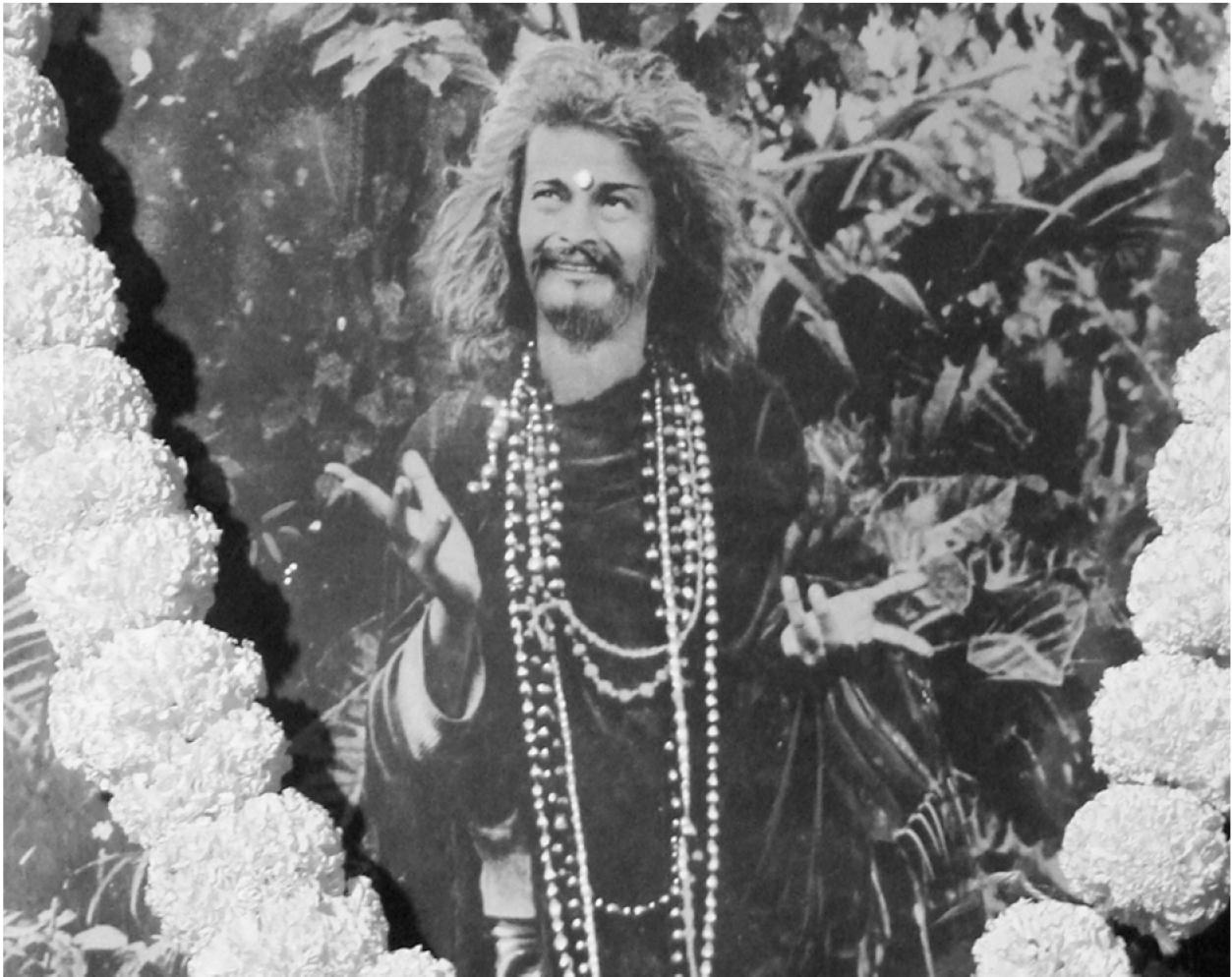
It is undeniably difficult, if not impossible, to record with historical precision and documentation the chronology of Bhaba Pagla’s life and works. His biographies always have a legendary and supernatural tone, and witness the process of divinisation that his personality underwent in the representations offered by his community of devotees. Instead of discarding the anecdotes and life-stories that have been reported by his followers as unreal and analytically insignificant, I prefer to adopt the perspective chosen by McLean in his study on Ramprasad Sen, where he gives relevance to the miraculous events that surround the story of Ramprasad’s life: no matter how incredible and unbelievable, “it is the Ramprasad of myth, not history, that is important for the Shakta tradition” (McLean 1998: 28).
According to the information we can extract from the biographies of Tamonash Bandyopadhyay (1985), Gopika Ranjan Cakrabarti (1995) and Gopal Khetri (1999), Bhaba Pagla was born as Bhabendramahan Ray Chaudhury in the village of Amta (Dhamrai, at present in the Dhaka district of Bangladesh) around 1903. His father, Gajendra Mohon Ray Chaudhury, possibly a descendent of the Chaudhury landowners of Baliyati, worked as a broker for a jute company. Bhabendra was the youngest son, together with his twin brother Debendra. According to the available hagiographies/biographies, since his childhood he was inclined toward a religious life. He used to compose devotional songs dedicated to Kali, roam about in cremation grounds, and offer to the icon of the Goddess rounded sandeś (sweets of unripe curd cheese) made of mud that would magically turn into actual sandeś: a story that probably derives from the famous incident in the childhood of Chaitanya, who was reproached by his mother for eating dirt, and stated he did not see any essential difference between mud and sweets (Caitanya Caritāmṛta, Adi 14.25–14.29). He was sent to Kolkata as a child and got acquainted with Sarada Devi, the widow of Sri Ramakrishna; he used to visit her regularly and entertain her with his devotional songs that she enthusiastically appreciated to the point that she apparently wondered whether he could be the reincarnation of Ramakrishna (Bandyopadhyay 1985: 9–10). Around his late teens, as a reward for saving his older brother’s son’s life when he was seriously ill, he was given some land where he established his first Kali temple, that he called Anandamayi Mandir. His mother arranged his marriage when he was around thirty with a ten-year old girl from the same village. By that time he was already well known as an ecstatic poet-saint and had gathered a number of devotees, both Hindu and Muslim, in virtue of his miraculous powers.
When the communitarian tensions in East Pakistan became unbearable, Bhaba was convinced to migrate to West Bengal. One of his closest devotees bought him some land in the proximity of Kalna (Bardhaman district), where he could establish his temple and ashram, which is still run nowadays by his grandsons. After his arrival in West Bengal, in less than thirty years, Bhaba Pagla attracted a considerable number of followers (one hundred and fifty thousand, according to G. R. Cakravarti, ibid: 44) and founded, on request of his disciples, a number of Kali temples scattered around the whole State. He died in 1984, leaving us an extraordinarily vast canon of orally transmitted songs (twenty-eight thousand, according to the hyperbolic opinion of his disciples) and some hand-written notebooks jealously kept in the main temple, in which about six thousand compositions are preserved. These songs are nowadays learned and performed by first and second generation disciples, by Baul performers, and by Bengali singers and entertainers trained in śyamāsaṅgīt (Shakta devotional songs) and folk-songs; apart from the festivities connected to the temples and ashrams led by Bhaba Pagla’s descendants and disciples, among the performative occasions during which Bhaba Pagla’s songs are sung the Baul gatherings represent the most important ones. From the chronicles on Bhaba Pagla’s life and also from field-work sources, it seems that his music sessions were attended by many Bauls and Fakirs, and he gave initiation to several Bauls. Bandyopadhyay (1988: 131) put it as a matter of fact: “needless to say, a large number of devotees belonging to the Baul Vaishnava class were gathering around Bhaba to share the nectar of his words. […] A large number of mājhi-māllā [sailors, oarsmen] were attracted as well”. In a different publication Bandyopadhyay reports that the songs of Bhaba Pagla were exported to the West as soon as the wave of the success of Bauls in the USA started.[1595] When Bhaba was staying at her devotee Jashoda Devi’s house, he was visited by two Bauls who were “wearing loose clothes and long hair tied in a bun”. One of these Bauls was named Harekrishno, from Manikganj. He was apparently looking for Bhaba for a long time and as soon as he met him, he told him he was in America for a tour together with Purna Das Baul. There he sang many of Bhaba’s songs, such as “Bale kaye mānuṣke ki sādhu karā yāy”, “Kālo haye ki habe re, māyer madhur madhur mūrti”, and “Maraṇ kāro kathā śune nā” (Bandyopadhyay 1985: 87–88).[1596]
Among Baul singers and practitioners, Bhaba Pagla is respected as a mahājan, an enlightened one who shared his accomplishment (siddhi) through his poetic talents. In many of his songs Bhaba Pagla cites the term Baul and defines himself as a Fakir. For example: “In forests and grooves, in the lotus flowers / hundreds of Bauls are drunken by your name.” (Bandyopadhyay 1988: 109); “Bhaba Pagla’s Baul verses are not bad at all/ how much you’ve seen, how much you’ll see, in an ever changing acting./ Rather than laughing you’ll mostly cry, nobody is going with you.” (ibid. pp. 152–153); “Bhaba became a Fakir/ hope, peace, desires, he forgot everything./ He gave away his little life at everybody’s side.” (ibid. p. 85); “Why don’t you let me break, oh Lord the chains of this deception: I am a Fakir.” (ibid. p. 109).
But “Fakir” is not the only title the composer chose to employ to describe his religious path. First of all, the term Fakir does not particularly relate to a religion or a social group but rather serves as an epithet for renouncers and “divine madmen” of different lineages of Bengal, and pertains to Sufi-oriented backgrounds, as well as to sādhakas of the Shakta and Vaishnava tradition. The famous poet-saint Ramprasad Sen, for instance – an emblem of Bengali Shaktism – used to refer to himself as a Fakir in some of his songs. In some cases, if we compare Bhaba Pagla’s and Ramprasad’s biographies, we would find striking similarities and we may suppose certain episodes of Bhaba’s life were constructed in order to parallel the renowned Shakta saint’s life. It is believed that Bhabendra told his father he did not want to apply for a governmental job to become an employee or a policeman and that his only wish would have been to become an “officer of the Mother” (māyer cākri karbo, Bandyopadhyay 1985: 31), echoing the well-known fate of Ramprasad Sen who was working as an office clerk but could not fulfil his duties: his mind was too absorbed in ecstasy and his record notebooks were filled with poems dedicated to the Mother Goddess (McDaniel 2004: 162; McLean 1998: 11–12). The relation between Bhaba Pagla and Ramprasad Sen cannot be underestimated: not only did he compose songs specifying, in the head line, that they were to be performed in prasādi sur (the melodic style that came to be associated with Ramprasad’s songs), he also explicitly claimed to be a reincarnation of Ramprasad (“Ramprasād, Nidhirām, Amar Caraṇ, Bhabār nām / cāri janam āche pramāṇ / tāhā ki mā sab bhulecho//” – With the name Ramprasad, Nidhiram, Amar Caran and then Bhaba/there is proof of my four incarnations/did you forget it mother?).[1597] The belief in the metempsychotic heritage from Ramprasad Sen helps us to understand the perceived importance of the influence of Ramprasad’s compositions on Bhaba’s literary production, but also their constructed overlapping identities as poet-saints who achieved spiritual perfection and acquired supernatural powers through the practice of singing (gāne siddha), and their religious affinity in the path of Tantric sādhanā.
In fact, nowadays several leaders of prominent Tantric lineages of Bengal refer to Bhaba Pagla attributing to him the titles that are typically ascribed to the most realised practitioners (siddha; mahājan; avadhūt, etc.). Khyepa Baba, a guru who is supposedly related to Bhaba Pagla’s lineage through his guru-mother, considers Bhaba Pagla an avadhūt, “one who experiences sannyās within saṁsār”; he had the authority to wear a blue cloth because the avadhūt “wears the color of the sky, of illusion: Maya’s color. While naked Digambaras take a distance from Maya, society, and reality, the blue avadhūts act, take a participative role within society. Thus they cannot be naked, but they choose the colour of the awareness of the illusion [see the verses in note 2, “Bhaba Pagla remains bound to Maya”]”.[1598] Pratap Narayan Cakrabarti, who is described as an erudite śmaśānabāsī bāmācāra tāntrik (“left-hand” Tantric practitioner living in the cremation ground) considered him to be “a hidden avadhūt. A hidden avadhūt wants to maintain his sādhanā secret. His most remarkable characteristic is, his kuṇḍalinī is awake. Whatever he wishes can become true. For him every discrimination, what to eat and what one shouldn’t eat, […] all this is superfluous”. (Bandyopadhyay 1988: 70–71).
By now we can appreciate how difficult it would be to contain the figure of our saintcomposer within a definite category. Fluidly moving from the context of Bauls to the domain of Shaktism and Tantric siddhas, the transreligiosity of Bhaba Pagla reflects the flexible nature of non-institutional sahajiyā cults of Bengal, reluctant to define boundaries which are, for them, constrictive and constantly renegotiable. On the other hand, the religious identity of Bhaba Pagla was constructed in such a way that it could appear multivalent, cross-religious, and free from the cage of crystallised definitions.
Cakraborti (1995: 62) reports that when a devotee asked him “What are you actually?”, Bhaba Pagla replied “I am a bahurūpī (one who assumes many forms, a chameleon-like actor, a quick-change artist)”.[1599] This amusing statement, that perfectly fits the witty character of the composer, can be interpreted in multiple ways. On the one hand, Bhaba Pagla deliberately confused those who were interested in attributing to him a fixed religious subscription: at times he would sing the glory of Krishna’s name; at times he would wear a Muslim hat and sing of Allah and Mohammad; in the temple, he was performing pūjas to the Goddess Kali, and again in some songs he would boldly state all Gods’ mystical identity (see for instance the verses “Kali, Krishna, Allah, Rasul, they are all bound in the same melody” in Bandyopadhyay 1985: 148) or even deny the existence of any deity and sing that the only God is man (see the verses “mānuṣ-i bhagabān, tāre dio sammān” in Khetri 1999: 66). Evading any kind of restrictive classification, Bhaba Pagla always avoided revealing the name of his dīkṣā-guru: in the official version he referred to his devotees, he received his initiatory mantra from Shiva himself while he was meditating at the cremation ground. In a similar way, the well-known Baul master and composer Lalon Fakir never referred to his religious background and carefully kept his family name secret, while scholars and writers are still ferociously debating and inquiring as to his possible Hindu or Muslim origins, dragging his religious identity toward the one or the other group according to the political needs of the moment (Urban 1999: 40–44).
From another perspective, the advantage of wearing the clothes of a bahurūpī are particularly evident if we recognise Bhaba Pagla as a spokesman of a subversive, heterodox tradition that cannot freely display itself in the public eye. The risk of persecution, social disapproval and marginalisation that would derive from the open discussion of certain anti-conventional social views and sexo-yogic practices makes it inappropriate for them to be revealed outside of an esoteric circle. Thus, in order to protect the esoteric knowledge from outsiders, the teachings and the outfit of a guru may embody a safe exoteric facade, socially acceptable and apparently orthodox. In a similar fashion, Dimock described the double-face attitude of Vaishnava Sahajiyas in the need for self-protection as follows:
“Sahajiya was an esoteric school. Its deviation was not always socially visible. […] It seems that Vaishnava Sahajiyas were exemplary citizens, rarely given, like the Pashupatas and other Indian deviants, to demonstrating their convictions of the meaninglessness of the world by public exhibitions of obscenity and sloth. Whatever demonstrations they might have made were largely private. […] The Vaishnava self is the ‘official self’ of a Vaishnava Sahajiya. This self is a social being. The unofficial self is the Sahajiya self, his elect nature goes against all normal standards. The personality of the Vaishnava Sahajiya, it would seem, was somewhat schizophrenic (Dimock, 1966: 109)”
I believe the ‘transformism’ of Bhaba Pagla’s character can parallel the Vaishnava Sahajiyas’ need for a schizophrenic identity, that takes a different form depending on the private sphere or the public sphere of their activities. Other esoteric cults who prescribe strict secrecy regarding the most intimate practices similarly describe their ideal code of behaviour in “chamaleontic” terms. In a śloka of the Kulārṇava Tantra we read: “Secretly Kaula, outwardly Shaiva, and Vaishnava among men” (11,83). In his rainbow-coloured bahurūpi-identity, Bhaba Pagla assumed different colours according to the eyes of those who were looking at, and portraying him. In the next section we will see how he figures in the academic and popular literature and how his prismatic identity was a source of confusion and disorientation that resulted in the forgetful exclusion of Bhaba Pagla’s songs in the publications focused on the Bauls’ literary production.
3. Representing Bhaba Pagla in academic and popular literature
The literature dedicated to folk-songs, and especially to the songs performed by Bauls and Fakirs, has increasingly appealed to the Bengali readership since the first voluminous collection of Upendranath Bhattacarya (1957). In the last decades several compendia and monographs on Bauls’ oral tradition have been published both in English and Bengali. While certain composers of Baul songs found a growing interest and public fortune, others have been systematically removed from printed representation, though their oblivion is counterbalanced by their pervasive presence in the oral repertoire performed by Baul singers. Exalted as the indigenous philosopher of humanism and tolerance, Lalon Fakir attracted academic and popular curiosity to the extent that the incessant production of scientific publications[1600] is densely alternated by popular novels and movies inspired by the life and deeds of the celebrated folk poet.[1601] The commercial fortune of Bhaba Pagla, on the contrary, encountered the resistance of the scholars who opposed his inclusion within the Baul field, and there are virtually no works entirely dedicated to his massive and sophisticated literary production (the book Bhabāpāglār Jīban o Gān, drawn from the Ph.D. thesis of Gopika Ranjan Cakrabarti and published by the Bangla Academy of Dhaka may be the only semi-serious attempt). Some collections of selected songs of Bhaba Pagla are distributed and circulate among his disciples’ temples and ashrams in the form of cheap pamphlets and home-made printings. Besides these few audacious commitments, if one looks at the wide editorial fortune of the literature on Bauls that appeared, both in English and in Bengali, as early as the beginning of the 20th century, it is interesting to note the context in which Bhaba Pagla’s name is mentioned, and how surprisingly heterogeneous his descriptions are.
Some authors include one example of Bhaba Pagla’s songs in their wider anthologies of Baul compositions. For example, in Charles Capwell (1986: 202–203) the song “Nadī bharā ḍheu” recorded from the performance of Subal Candra Das, bears the bhaṇitā of Bhaba Pagla, who appears as the lyricist, with no further information added. Sudhir Cakrabarti, in his collection of dehatattva songs (1985), includes one song by Bhaba Pagla (Deha-aṭṭālikā ati manoram, “Delightful is the palace of the human body”, ibid.: 193) that discusses the components of the esoteric body using the conventional numerology employed by Bauls and Fakirs (nine doors for the nine orifices, sixteen thieves as the ten senses and six vices etc.). Here as well, apart from being named as the lyricist, no additional detail is presented. Abdul Wahab (2011: 216) also decided to insert one composition by Bhaba Pagla in the anthology at the end of his work Bāṅlār bāul, sufi sādhanā o saṅgīt (Bauls of Bengal, Sufi music and spiritual practices): he selected the song on the inner search for the potentially perfected being that lies within ourselves “āmi mānuṣ khuṃji” (I am looking for the man) and gave no information about the author apart from mentioning his name.
The earliest reference to Bhaba Pagla’s songs according to the study of Cakrabarti (1995: 47) appears in the enormous collection of Upendranath Bhattacarya (1957). The song considered by Cakrabarti is Bhāb nā jene preme maje (ibid.: 436), “He enjoys love without knowing divine ecstasy”, about the practices of control and retention of semen during ritual intercourse. Though the bhaṇitā of the song is suspiciously uncommon compared to the rest of Bhaba Pagla’s oeuvre: the last line mentions a “Bhaba”, but it says “Raman Das kay Bhabare” (Raman Das says to Bhaba), following the convention by which the composer refers to the teachings learnt from his guru, ‘signing’ the lyric in his guru’s name. None among the disciples and devotees of Bhaba Pagla have ever heard of this particular composition. On the other hand, many Baul performers knew the lyric and revealed that the Bhaba who authored this song is “a different Bhaba, a more ancient one, whose guru’s name was Raman Das”.[1602] The existence of “a second Bhaba” passed completely unnoticed in the studies on Baul songs. This demonstrates how a purely textual approach to folklore fails at reproducing the emic perspective on orally transmitted knowledge as well as historical veracity. Combining ethnographic field-work with textual sources may provide for a methodologically more appropriate point of departure for a better understanding of a folkloric phenomenon.
In the technically detailed article “Problematic Aspects of the Sexual Rituals of the Bauls of Bengal”, Rahul Peter Das (1992: 416) quotes a line from Bhaba Pagla’s repertoire (Kālī balo manṭi āmār, tr. My heart, repeat Kali’s name) and defines Bhaba Pagla as an “important preceptor for many Bauls in the extreme West of Bengal (!?) particularly influenced by Shakta Tantrism”, thus conceding that a Shakta identity may well be combined with penetration into the Baul traditon.
More popular and narrative publications on Bauls that enjoyed a wide readership of non-specialists also refer to Bhaba Pagla as a key spiritual instructor. Bhaskar Bhattacarya (1992: 23) referred to him as a very influential and revered preceptor of Bauls and included a photograph of the saint-singer in the first pages of his book. In the travelogue and memories of Mimlu Sen among the Bauls of Bengal, together with his partner, the wellknown performer based in Paris, Paban Das Baul, she describes Bhaba Pagla as “an adept on [sic] Kali and a guru for many of today’s Bauls who continue to sing his marvellous songs”. Her partner Paban was highly influenced by the eccentric personality and musical skills of Bhaba Pagla, with whom he spent considerable time in his early days, together with many other Bauls. The music sessions held in the temple of Kalna during his lifetime are vividly described as joyful festive occasions: “Wealth was showered upon him by his disciples who were middle-class people […] He spent his wealth to nourish his disciples, bought the best fish […] and cooked himself to feed all and sundry” (2009).
The most important and assertive references to Bhaba Pagla in the academic literature, and the last ones we are going to take into consideration, are given by the British anthropologist Jeanne Openshaw, whose admirable work offers us an important and accurate contribution to the understanding of the practices and beliefs of the Fakirs of Nadia. Openshaw first mentions Bhaba Pagla in her article on the autobiography of the Baul guru Raj Khyepa and, discussing biographical/hagiographical accounts on these characters’ lives, she says “an extra-ordinary childhood foreshadows and legitimizes the future saint” as in the case of Bhaba Pagla, “whose Baul songs are so popular these days” (1995: 120). Ascertaining the popularity of Bhaba Pagla’s songs, she is here more interested in underlining the characteristics and effects of the process of the divinisation of a human guru. But in her major work, Seeking Bauls of Bengal (2004), Bhaba Pagla appears as a smart composer who conveniently disguised his lyrics under the fashionable outlook of Baul songs, adapting their content to the taste of a well-off audience that would be horrified if subjected to any textually explicit reference to corporeal bastus. “A very popular songwriter” (ibid.: 238), Bhaba Pagla is accused of producing “fakeloric” (Dorson 1976) Baul songs in which the transmitted teaching gives more importance to the sādhanā of singing than to the sexo-yogic practices of body-centred realisation: “The relationship of singing and esoteric practice are hierarchised, an order which is reversed for the bhadralok and those composers who cater to their taste”.[1603] Because of his famous lyric Gān-i sarvaśreṣṭha sādhanā (a song that says “Singing is the most excellent sādhanā / it does not require flowers nor sandal paste / it does not even need rituals and formulas”; see Cakrabarti 1995: 119), Bhaba Pagla is thus labelled as a folk composer that takes advantage of the success of Baul songs among the urban elite, enjoying its patronage and satisfying the demand for “clean” songs that do not scandalise a conservative mentality. Paradoxically, the situation depicted by the disciples of Bhaba Pagla is quite the opposite: whenever they are opposed to the categorisation of Bhaba Pagla’s songs as strictly “Baul”, they explain their perplexity by saying that nowadays Bauls are mere stage performers who do not engage in serious esoteric practice any more, while “each and every song of Bhaba is music for sādhanā, sādhanā saṅgīt”.[1604]
Elsewhere I have pointed out how, in the eyes of the practitioners, singing constitutes a practice that is perceived as equally important as the performance of techniques of dehasādhanā (Lorea 2013: 441–446). Here I would like to remind the reader that, even if many among Bhaba Pagla’s songs (especially those most preferably performed in “public” contexts, such as village fairs and concerts open to a general audience) present a predominantly devotional mood, a consistent number of his lyrics are dedicated to the practices of breath control, regulation of seminal emission during ritualised sexual intercourse and intake of menstrual blood, each of which are supposed to characterise “authentic” Baul songs. Though these kinds of songs are rarely performed on a stage, and their content is concealed under the protective veil of an extremely metaphorical and enigmatic language (see for instance “śeolā bharā nadīr mājhe sāṃtār dili ki kāraṇ” in Bandyopadhyay 1988: 162, or “du kūl bhāsāy yāy, du kūl ḍubāye yāy”, ibid.: 136). In other songs Bhaba Pagla attributed the quality of sarvaśreṣṭha (the most excellent) to different practices, such as the mastering of the techniques of breath control (as in “sāṃtār shikho nā re jele”, tr. Oh fisherman, first learn how to swim, ibid.: 162) or the practice of kuṇḍalinī yoga (as in the song “bhajan sādhan kena habe nā”, tr. Why wouldn’t you be successful in the practice of worshipping).[1605] Other times he says that the most excellent sādhanā is to exercise one’s devotion toward the guru, or to worship and respect humanity. In tune with his self-definition of a bahurūpī, Bhaba Pagla’s teachings, as they emerge from his lyrics, are multifaceted and hard to codify in a rigid system: it is possible that different teachings, related to different practices, are addressed to different disciples, according to their stage in the progression of their personal sādhanā. Rather than compromising with the taste of a sponsoring audience, I would rather consider the idea that Bhaba Pagla’s “clean” songs, appropriate for an exoteric performative context and enjoyable to a non-initiate listener, act as a screen of self-defense, a self-representation as a respectable sadhu in the eyes of a broader society from which the performers ensure their economic sustenance. Is preoccupation with one’s financial subsistence against the rules for an “authentic” Baul? Isn’t any Baul, even those who are not performers by profession, concerned with their means of livelihood, whether or not they rely on the alms offered in exchange for a song?
In a discussion of tourism and cultural displays, the folklorist Regina Bendix explores the relations between market, tourists and performers, and sheds some light on the common paradox by which “authenticity” disappears once the economic dimension corrodes an indigenous tradition: “Equally suspect is the argument that claims meaning disappears once money is introduced […] money has been part of cultural endeavors for centuries, and to claim that its presence in the negotiation of cultural displays robs them of their meaning is both an over-statement and a romanticization of the “folk’s” awareness of cash in their everyday lives” (1989: 143).
It seems that the paradigm delineated by a certain trend of scholarship on Bauls, by which a genuine Baul is a materialist bastubādī with no relation to temple-based ritualism and to the dynamics imposed by show-business, neglects the obvious fact that an esoteric tradition, subjected to social reprisal and ridicule if openly displayed, must have been developing strategies of self-defense and self-promotion that may not clearly emerge until we remove the “search for authenticity” (Bendix 1997) from the intentions of our research.
Bhaba Pagla’s inability to fit into the aforementioned paradigm of authenticity may be one of the reasons why his corpus was not given much attention by scholars who research on Bauls, together with a number of concomitant factors that we are going to discuss more closely in the next section.
4. Escaping classifications, disappointing “the communists”: perspectives on Bhaba Pagla’s absence from the literature on Bauls
Defined by his followers as the master of “the spontaneous way” (sahaj path) and the “distributor of universal love” (biśva mānab premer pheriwālā), Bhaba Pagla’s nature and the variety of his texts’ styles make it quite difficult to pigeonhole his variegated orature into a single genre. Overflowing with puns, jokes and riddles, his uncountable songs touch on different topics and are at times sung in the bhāṭiyāli style, at times jhumur, and even in the prasādi melody or explicitly marked in his note-books as having a “Baul tune”.[1606] If we adopt the method of performance theory of the study of folklore (see Bauman 1986; 1984; Ben-Amos 1971; Abrahams 1968), considering the context of the texts’ performances as an essential element in understanding a folkloric phenomenon, we would easily realise that, in the living realm of “events” rather than “items” (Bronner 2012:30), Bhaba Pagla’s songs are sung and transmitted mainly among the lineages of Bauls and Fakirs. How could this information have so little repercussion in the studies on Bauls and in the collections of Bauls’ songs?
I asked this question to the members of the lineage and to disciples of different branches of the cult that revolves around Bhaba Pagla, and we will examine their opinions and observations as starting points to further develop some ideas that could explain this omission.
The most commonly shared opinion lies in the fact that Bhaba Pagla apparently tried to discourage any kind of self-advertising, and his reserved character passed by unnoticed even when scholars like Upendranath Bhattacarya were travelling in rural Bengal to collect sayings and teachings of influential Baul gurus. Bhaba Pagla’s disregard for selfpromotion and lack of concern for enlarging his circle of disciples through proselytism is well reflected by his famous saying that I chose as a title for this article, Khabar haye gelei gabar haye yābo: if the news spread, if people get to know about me, I’ll become cow-dung. The careful avoidance of publicity and the fear that a public display would spoil the transmitted knowledge is in tune with the need for secrecy of a heterodox system of beliefs. Bijayananda Giri, who is in charge of the Kali temple of Badkulla (Nadia district) said Bhaba Pagla strictly forbade the public diffusion of his message, and “every time a journalist or writer was arriving to interview him he used to chase them away saying ‘Khabar haye gelei gabar haye yābo’”.[1607] Sharply critical of the attempts at proselytism and the institutionalisation of the lineage operated by the grandsons of Bhaba Pagla, the eightythree year old guru Amulya Ratan Sarkar said the transformation of Kalna temple into a business centre that exploits the donations of the devotees is contrary to the tenets of Bhaba Pagla, who opposed “every kind of propaganda by saying ‘Khabar haye gelei gabar haye yābo’”.[1608]
A different opinion was advanced by Khyepa Baba, which we already mentioned in the second section. According to him, Bhaba Pagla regarded disfavourably the academic interest in Bauls because “leader scholars on Bengali folklore, such as Shakti Nath Jha and Sudhir Cakrabarti, belonged to the communist party. Their interest was to depict Bauls as a community without gods and with no respect for outer representations of gods. That is why they neglected the figure of Bhaba Pagla, who was externally performing pūjās and rituals”.[1609] I am not myself privy to the personal political commitments of the aforementioned scholars. Nevertheless, there has certainly been a tendency toward the stress on the this-worldly, atheist and materialist aspects of the Baul tradition (but also of other traditions, such as Gambhira folk-theatre and Chau dance, for example), exalted as the opponents of temple rituals and idol worship. The way in which the authenticity of the Baul practitioners was constructed became incompatible with daily practices of exterior ritualism such as ārati (a Hindu religious ritual of worship) and pūjā. Even if I witnessed several Fakir lineages performing Kali pūjā (the line of Lalon Fakir’s disciple Narayan Fakir of Badkulla, for instance), Bhaba Pagla’s outer identity as a Kali worshipper forbade him to be counted as a revered figure in the Baul milieu. In the search for a secular and rationalist indigenous folk-culture that could represent the ideals of a modern nation, when the Bauls were glorified as rejecting the communal-based superstitions of the orthodoxies, Bhaba Pagla was excluded from the representation of the Baul landscape because of his uncomfortable link with exoteric ritualism that the broader society could accept and identify with. In sum, due to his exterior facade (bahiraṅga), Bhaba Pagla was not able to fit either the image of the Tagorean Baul, or the criteria of the “materialist” Baul, and thus he came to be simply ignored.
A further opinion, as interesting as it is improbable, was elaborated by Gopal Khetry, who runs the Kali temple of Digha (East Midnapore district) and is tirelessly involved in the promotion of philanthropic actions that could transform the humble message of Bhaba Pagla into a universal religion of humanism and brotherhood. Gopal Khetry, who travelled to England to export the teachings of his guru and gave several lectures on local media and television, proposed a conspirational theory: Bhaba Pagla failed to be adequately represented because all the media of Bengal are owned and controlled by the Tagore family and the Ramakrishna Mission, who forbade him to mention his guru’s name during his interview on the TV channel Durdarshan. Besides this, he also proposed the idea that “because of his name, Pagla (a fool, a madman) he was underestimated by bhadraloks.”[1610] Titles like Pagla, Khyepa etc. that literally mean “mad”, are honorific epithets in the sahajiyā traditions and are attributed to practitioners who transcend all dualities in the sense of exalted religious madmen (on the concept of religious madness see McDaniel 1989, Feuerstein 2006, Kinsley 1974, Dowman 2000). The social conduct of these characters is free from conventional norms of behaviour and their actions are judged by mainstream society as obscene and reproachable (as an example of such behaviour, Bama Khyepa, the renowned Tantric saint of Tarapith, used to urinate on the Goddess’s mūrti, and in a similar mood Bhaba Pagla used to consecrate his devotees’ amulets with his saliva). For this and other reasons, Bhaba Pagla may have been an inconvenient character for intellectuals and bhadraloks to represent as a model of folk poetry: the devotion to Bhaba Pagla is particularly strong in the villages of West Bengal inhabited by Bangladeshi refugees and immigrants from what was East Pakistan, who look to their saint countryman with regional pride, as a cultural hero for a lost territorial identity. Besides that, a considerable number among the followers and the eldest disciples of Bhaba Pagla belong to the lowest strata of the Hindu society, and his lineage is particularly strong among outcasts of the namaśūdra community (see Bandyopadhyay 1997). In the academic rehabilitation of Bauls and Fakirs as folk representatives of a dignified Bengali oral literature, and in the public promotion of Bauls as messengers of a political philosophy of indigenously rooted Indian tolerance, perhaps a poet-saint revered by Bangladeshis and very low classes could not be the desired emblem.
What I would suggest as a possible solution to the question of Bhaba Pagla’s misinterpretation and exclusion regards the methodological approach to the subject. On one hand, it has to do with the limits of superficial field-work (or no field-work at all) in the study of an esoteric tradition accessibility to which requires time and personal involvement. On the other hand, it concerns the limitations of a textual approach in the study on an essentially oral tradition.
For instance, a more in-depth look at the teachings of Bhaba Pagla as they are transmitted among insiders would reveal that the “materialistic” premises that have been associated with the practices and beliefs of Bauls are well-known and carefully preserved among certain members of the lineage. These teachings, however, are attentively protected and Bhaba Pagla himself warned his disciples of the need for secrecy. The efficiency of the strategies of concealment and disguise/deception (Stewart 1990) played by the community is probably at the basis of Bhaba Pagla’s mysterious absence in books as opposed to his ubiquity in performance.
The exhortation to secrecy and the encouragement to not discuss one’s personal practice is so widespread in Bhaba Pagla’s corpus of songs that it almost constitutes a literary topos. The verses “bhajan kario man ati gopan” (“Do your worship in extreme secrecy”; recorded in Kalna, 08/05/2013) or “cala yābo mane sādhane / gopane gopane / jānbe nā re keu /tomār premer ḍheu” (“Let’s go oh Mind to do sādhanā / secretly secretly / nobody has to know / the waves of your love”, recorded in Barrackpore, 5/12/2013) are the performed exemplifications of the restricted access to the esoteric teaching, whose core tenets are expressed in the songs through symbols and complicated metaphors. “Bhaba told many things indirectly in his songs. There are hints at many teachings. To explain these, you have to be in an isolated, tranquil place, without any other person around. If other people hear about them, they could be revolted and hostile (bimukhi)”, said the guru and performer Amulya Ratan Sarkar. “We have to separate Bhaba’s bāhiraṅga (outer aspect) from his antaraṅga (inner aspect): in public, he performed pūjā because he wanted to show people that he was celebrating pūjā. But only few people received his actual teaching. Sukumarda has lived with Bhaba Pagla from his very young age. He did not receive his teaching that deals with karma”.[1611] The discrepancy between outer (bahir) and inner (antar), between the exoteric side of the tradition transmitted by Bhaba Pagla and the esoteric teachings reserved for the initiates in a progression of hierarchical levels of spiritual achievement, is repeatedly remarked upon by disciples. The disguise in the clothes of a Shakta and the concealment of the innermost truths made it extremely difficult for previous authors, and for audiences of Baul songs in general, to acknowledge the “bastubādī” side of Bhaba Pagla’s songs.
“The true doctrine is practised in secret. In his bahiraṅga Bhaba Pagla performed pūjās and acted as a pious Vaishnava. In the antaraṅga, where the doctrine is concealed, he was against exterior ritualism (bāhyik baidhik bhakti). One disciple went to him and asked for a tābij (an amulet) to heal his illness. Bhaba Pagla answered: ‘Śālā! Yā tābije, bīje tā!’ (Rascal! The thing that is in the tābij is the same you have in your seed). The supreme power is within the semen.”[1612]
In contrast to the collections elaborated through a literary approach, the archives of Baul songs based on written as well as oral sources show an exorbitant number of Bhaba Pagla’s songs. For example, the comprehensive online archive of Bengali folk songs “Lok Giti” (www.iopb.res.in/~somen/lokgiti.html) born from the laudable efforts of Somen Bhattacarjee and Sudipta Mukharji, lists ninety-eight songs as a result for the key-word “Bhaba Pagla” in the search engine. According to the information the two collectors kindly granted me via email, the lyrics they catalogued were mostly transcribed from the memory of the performer Satyananda Das Baul of Bankura. Some other songs of Bhaba Pagla were collected during their visits to the Baul tent of Paush Mela (the biggest fair held in Santiniketan, Birbhum, and an occasion of gathering for many Bauls and Fakirs), from “unknown singers”, and “often from the unclassified thin nondescript books one gets in remote bus stations, small fairs…”[1613] The problem arose when they had to systematise and classify Bhaba Pagla’s songs in their digital archive: what label can be given to his compositions? Should the attributed genre be based on the musical style associated with a particular song, or rather on the content of the song? The criterion chosen by the archivists seems to be a combination of both.
“We in fact found it difficult to classify Bhaba’s songs. The songs that we heard from Bauls, are kept in Baul category. Those lyrics which contains [sic] words like shyama [one of the names of the Goddess], joba [the red ibiscus flower that is offered to the Goddess], kalee etc are kept in shyama songeet [Shakta devotional songs, as those composed by Ramprasad Sen]. Some of the songs, that we heard and as you said, have ramprasadi sur [the musical style typically associated to the songs of Ramprasad]. Those are kept in shyama sangeet. However, I will have to say, though this is the best we could do, our categorization may also create confusion.”[1614]
The great majority of the songs appears under the genre “Baul”. Though some compositions have been classified as “shyama sangeet” (22 out of 98) on the basis of the occurrence of a terminology that, at the most superficial level of interpretation, refers to the conventional worship of the Goddess’s idol. The presence of a versatile vocabulary of images and metaphors in the works of the same composer, and the recurrence of the lexicon of Shakta devotionalism in songs mostly performed by Bauls is a matter of shock and bewilderment:
“That’s a surprise because baul philosophy is antagonistic to the idea of such symbols (for God). I am not sure if this is a case of a baul turned more traditional to pen these syamasangit or a traditional lyricist became a baul later on*.”[1615]
In any case, the coexistence of the Shakta and the Baul aspect is seen as contradictory, because, in the eyes of the enthusiastic collectors, who brilliantly reflect this deeply rooted prototypical image of the “authentic” Baul, Baul philosophy is “antagonistic” to Shakta devotionalism, and, more generally, to whatever has to do with rites and icon worship.
Conclusions
This article is but an initial step toward a more comprehensive research project dedicated to the literary production of Bhaba Pagla in his performative context. So far I have made an attempt to give a brief account of the “archaeology of knowledge”[1616] in the field of the studies on Bauls and Fakirs, in order to highlight the increasing popularity of this research topic, and its adherence to general cultural trends in the study of folklore; from its birth – influenced by the romantic quest for authenticity and the demands of nationalism – to its post-colonial developments. After that, I offered a brief introduction to the character and work of Bhaba Pagla, focussing on his relation to the Bauls during his lifetime, his eclectic self-definitions and the way his disciples defined him as far as religious affiliation is concerned. From this, we could observe how Bhaba Pagla’s sense of belonging to any particular sampradāya seems to have been unfathomable and/or deliberately avoided.
From the literary survey of the available information about Bhaba Pagla in academic as well as popular publications, Bhaba Pagla emerges in contrasting portraits, and he does not seem to be as prominent in printed texts as he is in oral and performative contexts.
Taking into consideration the insiders’ perspective on the scarce fortune of Bhaba Pagla in academic interest in Bauls, I reasoned on the factors that could lead to his misrepresentation. First, the impossibility of fitting his outwardly orthodox personality into the pattern and features of the “materialist” Baul. Second, the difficulty of transcending the barrier of secrecy to observe the actual practices in the private circuit of the adepts. This protective barrier is built by: the use of an enigmatic code-language (sandhyā-bhāṣā), the emphasis on keeping one’s private practice (antaraṅga) hidden from the general public, and the avoidance of “publicity” (Khabar haye gelei gabar haye yābo!).
A clearer and more holistic understanding of the contemporary repertoire of Baul and Fakir songs would be possible if we reconsider some predominant methodological perspectives. On one hand, as Claus and Korom (1991) have highlighted in their work on the study of folklore in India, Indian scholarship still predominantly operates with a literary approach that leaves little space for the analysis of the multi-layered context in which oral literature is composed, produced and transmitted, a context in which performers, audience, patrons, and places and times of the performance play an equally important role. In this sense, adopting a more performance-oriented premise for the study of folk-songs would help in avoiding serious omissions.
On the other hand, the perspective of subaltern studies, which has contributed a great deal in underlining aspects of opposition and resistance against the oppression and marginalisation perpetuated by religious establishments, neglected the exoteric dimension of the Baul tradition as conforming to the orthodoxies, and ended up inventing a reductionist canon of authenticity.
Seen from a different light, and encompassing the limiting pattern of the discourse on sanskritisation, that interprets the adoption and incorporation of dominant castes’ rites and customs by marginalised groups as an attempt to improve their social status, the adoption of orthodox elements and their accommodation into a “subversive bricolage” may be interpreted as a strategy of subaltern resistance, as some authors have already pointed out (Comaroff 1985: 198).[1617]
The case of Bhaba Pagla here presented will hopefully bring to the surface some problematic aspects of the study of esoteric traditions and folk literature in Bengal, showing the constraints of previous approaches to the subject and encouraging the formulation of new research strategies that could be more appropriate for the analysis of a living folkloric treasure.
Works cited
Abrahams, Roger (1968), “Introductory remarks to a rhetorical theory of folklore”, The Journal of American Folklore, 81(320): 143–158.
Bandyopadhyay, Sekhar (1997), Caste, Protest and Identity in Colonial India: The Namasudras of Bengal, Richmond, Surrey: Curzon.
Bandyopadhyay, Tamonash (1988) Nāmer Pherioyālā Bhabāpāglā, Digha, Harbola Mandir: Sribhaktadas.
Bandyopadhyay, Tamonash (1985), Paramguru Bhabāpāglā (vol-I and II), Kolkata: Nalini Prakashani (B S 1391).
Bauman, Richard (1986), Story, Performance, and Event: Contextual Studies of Oral Narrative, Cambridge: Cambridge University Press.
Bauman, Richard (1984), Verbal Art as Performance, Prospect Heights, IL: Waveland Press, Inc. (originally published 1977).
Ben-Amos, Dan (1971) “Toward a definition of folklore in context”, Journal of American Folklore 84(331): 3–15.
Bendix, Regina (1989), “Tourism and cultural displays: Inventing traditions for whom?”, Journal of American Folklore, 102(404): 131–146.
Bendix, Regina (1997), In Search of Authenticity: The Formation of Folklore Studies, Madison, Wisconsin: University of Wisconsin Press.
Bhattacharya, Bhaskar (1993), The Path of the Mystic Lover: Journeys in Song and Magic with India’s Tantric Troubadours, Rochester: Destiny Books.
Bhattacarya, Upendranath (1957), Bāul o Bāul Gān, Kolkata: Orient Book Company (B.1364).
Bronner, Simon J. (2012), “Practice theory in folklore and folklife studies”, Folklore, 123(1): 23–47.
Brooks, Douglas (1990), The Secret of the Three Cities: an introduction to Hindu Śākta Tantrism, Chicago: University of Chicago Press.
Caitanya Caritāmṛta, ed. Bhaktivedanta Swami Prabhupada (1973), New York: Bhaktivedanta Book Trust.
Cakrabarti, Gopika Ranjan (1995), Bhabāpāglār Jīban O Gān, Dhaka: Bangla Academy.
Cakrabarti, Sudhir (1985), Bāṅlā dehatattver gān, Kolkata: Pustak Bipani.
Cakrabarti, Sudhir (2001), Bāul Fakir Kathā, Kolkata: Ananda Publishers.
Capwell, Charles (1986), The music of the Bauls of Bengal, Ohio: Kent State University Press.
Chakraborti, Bikas (2010), Folk, folklore and folkloristics; interpenetration of society and folklore, Kolkata: Mitram.
Charsley, Simon (1998), “Sanskritization: The career of an anthropological theory.” Contributions to Indian sociology 32(2): 527–549.
Claus, Peter and Korom, Frank (1991), Folkloristics and Indian Folklore, Udupi, India: Regional Resources Centre for Folk Performing Arts, Mahatma Gandhi Memorial College.
Comaroff, Jean (1985), Body of Power, Spirit of Resistance: the culture and history of a South African people, Chicago: University of Chicago Press.
Das, Rahul Peter (1992), “Problematic Aspects of the Sexual Rituals of the Bauls of Bengal”, Journal of the American Oriental Society, 112(3): 388–432.
Dasgupta, Alokeranjan, and Marie Ann Dasgupta (1977), Roots in the void: Baul songs of Bengal, Calcutta: K. P. Bagchi.
Datta, Rajeshwari (1978), “The Religious Aspect of the Baul Songs of Bengal”, The Journal of Asian Studies, 37(3): 445–455.
Dimock, Edward (1966), The place of the hidden moon – erotic mysticism in the vaishnava-sahajiya cult of Bengal, Chicago: University of Chicago Press.
Dowman, Keith and Paljor, Sonam (2000), The divine madman: the sublime life and songs of Drukpa Kunley, Varanasi: Pilgrims Publishing.
Dorson, Richard Mercer (1976), Folklore and fakelore: essays toward a discipline of folk studies, Cambridge, Mass.: Harvard University Press.
Feuerstein, Georg (2006), Holy Madness, Prescott, Ariz.: Hohm Press.
Foucault, Michel (1969), L’Archéologie du savoir, Paris: Gallimard, Bibliothèque des sciences humaines.
Goudriaan, Teun, and Sanjukta Gupta, eds. (1981), Hindu Tantric and Śākta Literature. Vol. 2. Wiesbaden: Otto Harrassowitz Verlag.
Jabbour, Alan (2004) “Intracultural and Intercultural: the Two Faces of Folklore”. In Folklore, public sphere and civil society, M.D. Muthukumaraswamy and M. Kaushal eds., New Delhi: Indira Gandhi National Centre for the Arts; Chennai: National Folklore Support Centre, 17–22.
Jha, Sakti Nath (1999), Bastubādī bāul: udbhab, samāj saṁskṛti o darśan; Kolkata: Lok Sanskriti o Adibasi Sanskriti Kendra.
Khetri, Gopal (1999), Bhabār chande Bhabār jīban līlā, Kolkata: Gopal Khetry (B S 1405).
Kinsley, David (1974), “‘Through the Looking Glass’: Divine Madness in the Hindu Religious Tradition”, History of Religions, 13(4): 270–305.
Kularnava Tantra (1917), A. Avalon and T. Vidyarnava ed., London: Tantrik Texts 5.
Lorea, Carola Erika (2013), “Playing the football of love in the field of the body: the contemporary repertoire of Baul songs”, Religion and the Arts, 17: 416–451.
Mansuruddin, Muhammad (1978), Hārāmoṇi (Vol. I), Dhaka: Bangla Academy.
McDaniel, June (1989), The madness of the saints – ecstatic religion in Bengal, Chicago: University of Chicago Press.
McDaniel, June (2004), Offering flowers, feeding skulls: popular goddess worship in West Bengal, New York: Oxford University Press.
McLean, Malcolm (1998), Devoted to the Goddess: the Life and Work of Ramprasad, New York: State University of New York Press.
Mukharji, Manjita (2012), “Ek rajye holo dujona raja, kar hukume gata hoy praja: metaphors of everyday peasant resistance in Baul songs of colonial Bengal”. South Asian History and Culture, 3(1): 47–69.
Narayan, Kirin (1993), “Banana Republics and V. I. Degrees: Rethinking Indian Folklore in a Post-colonial World”, Asian Folklore Studies, 52(1): 177–204.
Openshaw, Jeanne (1995), “Raj Krsna: Perspectives on the Worlds of a Little-known Bengali ‘Guru’”, in Mind, body and society, life and mentality in colonial Bengal, ed. Rajat Kanta Ray, Delhi: Oxford University Press, 109–51.
Openshaw, Jeanne (2004), Seeking Bauls of Bengal, New Delhi: Cambridge University Press.
Ray, Manas (1994), The Bauls of Birbhum, Kolkata: Firma KLM.
Ray, Manas and Tat, Suparna (2006), “A study on the nature and structure of ritual language of the Bauls of Birbhum, West Bengal”, Journal of Asian Studies (Netaji Institute for Asian Studies), 24: 34–41.
Sarkar, Benoy Kumar (1917), The Folk Elements of Hindu Culture, London: Longmans, Green and Co.
Sarkar, Benoy Kumar (1926), Positive background of Hindu sociology (vol. I), Allahabad: The Panini Office.
Sen, Dinesh Candra (1920), The folk literature of Bengal (being lectures delivered to the Calcutta University in 1917), Kolkata: Calcutta University Press.
Sen, Kshitimohan (1949), Bāṁglār bāul, Kolkata: Calcutta University Press (1993 reprint).
Sen, Mimlu (2009), Baulsphere: my travels with the wandering bards of Bengal, Noida, India: Random House India.
Sen, Mimlu (2012), The Honey Gatherers, London: Rider.
Sen, Suchismita (1996), “Tagore’s “Lokashahitya”: The Oral Tradition in Bengali Children’s Rhymes”, Asian Folklore Studies, 55(1):1–47.
Tagore, Rabindranath (1931), The religion of Man, New Delhi: Rupa&Co (2005 reprint).
Urban, Hugh (1999), “The politics of madness: the construction and manipulation of the Baul image in Bengal”, South Asia: Journal of South Asian Studies, 22(1): 13–46.
Vanadpande, Manohar Laxman (1992), History of Indian theatre/ 2, Loka Ranga : panorama of Indian folk theatre, New Delhi: Abhinav Publ.
Wahab, Abdul (2011), Bāṅglār bāul, sufi sādhanā o saṅgīt, Dhaka: Mowla Brothers (B S 1417).
Eight: Revisiting Sanskrit Teaching in the Light of Modern Language Pedagogy
Sven Wortmann and Ann-Kathrin Wolf
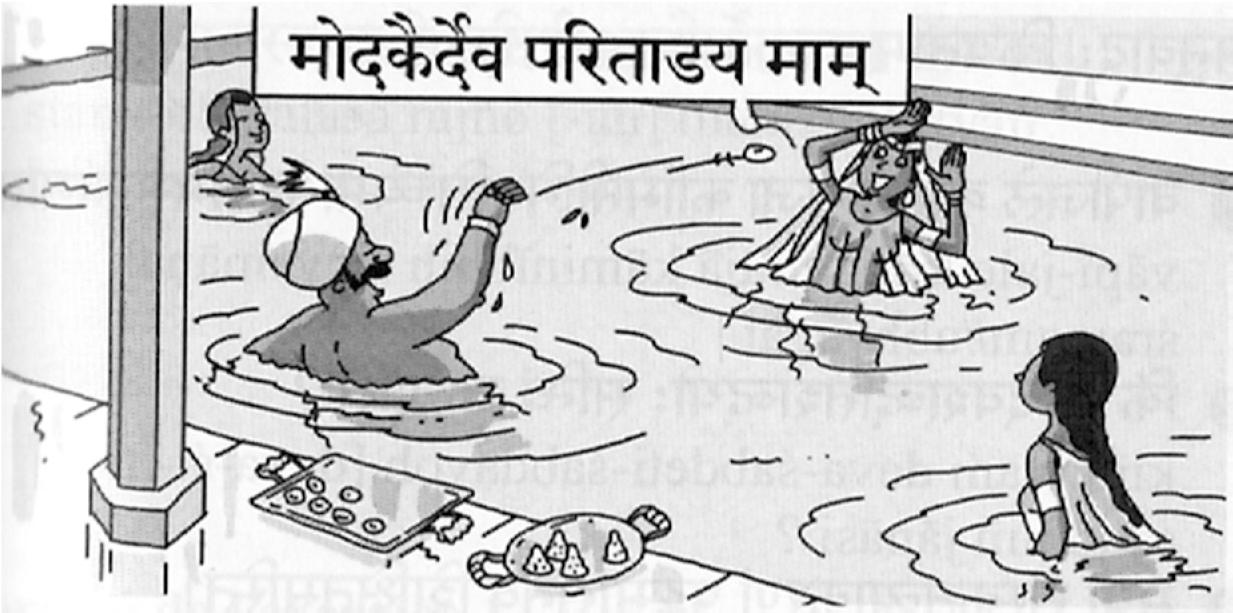
The following paper is a report of our application of modern language pedagogy to the teaching of Sanskrit at the Centre for Religious Studies[1618] at Ruhr-University Bochum, Germany in 2010. This reform was conducted in order to make our introductory Sanskrit course as efficient as possible, given the little time reserved for teaching and learning. The introductory course extends over two terms (each lasting 14 weeks), with two teaching hours per week, and is only worth a total of 4 credit points, imposing a weekly homeworkload of not more than 3 hours for the students[1619]. Our course is therefore half or one third the size of Sanskrit courses elsewhere in Germany. Our methods are derived mainly from courses like the Summer School in Spoken Sanskrit at Heidelberg University, various intensive courses in the Landesspracheninstitut at Ruhr-University Bochum, as well as from workshops offered by the university language centre at Ruhr-University Bochum. The first part of this paper will give a short overview of the history and methods of western language pedagogy in general and of Sanskrit in particular. In the second part, we will give some practical examples as to how to improve a Sanskrit course with efficient methods. We consider language teaching as a core competence of Indology and Religious Studies and we are – in this respect – traditional. However, in order to maintain and improve this competence, we will not hesitate to slaughter sacred cows.
1. History and methods of language pedagogy at western universities
Until and during the 19th Century the most prominent “method” for the teaching of all languages was the so called “grammar-translation method”, also called the “Prussian method” or “the classical method”. It consists basically in formal and abstract teaching of grammar followed by the translation of sample sentences and texts (deductiveprescriptive grammar approach). In the late 19th Century the grammar-translation method was strongly criticised by a reform movement which promoted the so called “direct method”, stressing practical, communicative and monolingual teaching in the target language (see Edmondson & House, 2000: 48–50). The emergence of this reform movement was the starting point of modern academic reflection on language pedagogy. However, due to negative institutional reaction and political circumstances this movement did not have a strong institutional impact, so the “grammar-translation method” remained prominent. It was after 1945 that two closely related methods revolutionised the field of language pedagogy (see Edmondson & House, 2000: 115–125). These were the “audiolingual method” and “the audio-visual method”. Here, students have to repeat phrases and dialogues triggered by words or pictures given by the teacher. The advantages of this approach are clearly the use of audio and visual input and the focus on actual speaking and on useful conversations. However, this behaviouristic approach was criticised during the so-called “communicative turn” in the 1960s because of its rigid and mechanical character. Modern language pedagogy since the communicative turn has tried to avoid a methodological “monoculture” and is based on a variety of multi-sensual methods,[1620] chosen according to the specific needs of the students, and taking into account their active and creative participation.
After this short overview of the history of language pedagogy, we shall now mention some widely accepted concepts and practical implications of modern language pedagogy. One of the most important insights for improving our curriculum is that people have different learning styles (see Grotjahn, 2007). A learning style is defined as a stable preference of a given learner for particular social forms of learning and/or particular sensory faculties. With respect to the last point, one can categorise different types of learners, e.g. (rule-based) analytical, visual, auditory, communicative, haptic etc. When it comes to grammar teaching, which is of particular interest for Sanskrit, it is important to be aware of the distinction between the inductive-explorative and the deductiveprescriptive grammar approach. Whereas in the first, the comprehension of grammar is developed through the reading of texts, in the latter method the grammar is explained before the text is read. The consideration of various learning styles not only exploits equally the potential of different students, but also stretches the comfort zone of each student. It is thus not only a question of efficiency but also one of treating different types of learners equally. Another point is to explain and discuss different methods with the students in order to raise their learning awareness, and in consequence, their learning efficiency. Let us now recapitulate the usual methods of Sanskrit teaching at Western Universities in the light of what has been said about the history and the methods of language pedagogy. In short, most textbooks[1621] and curricula for Sanskrit (and other socalled classical languages) still follow the 19th Century “grammar-translation method”.
“[T]hough it may be true to say that the Grammar-Translation Method is still widely practiced, it has no advocates. It is a method for which there is no theory. There is no literature that offers a rationale or justification for it or that attempts to relate it to issues in linguistics, psychology, or educational theory” (Richards & Rogers, 2001: 5).
It is clear that many philological scholars are not aware of the disconnection between their methods and modern language pedagogy. Even Indological authors who deal explicitly with “Didaktik” (Mylius, 2013; Stiehl, 2007) do not mention alternatives such as audio-visual input or inductive-explorative methods, and they purely follow the grammartranslation method. To our knowledge, the first textbook to harmoniously integrate different teaching methods is Le Sanskrit (Balbir, 2013). It is structured in cycles of 6 short text lessons (in Latin and Devanagari script, translation and as audio files) with exercises and a short cartoon, followed by one formal grammar lesson for each cycle. Listening and repetition are stressed in the preface:
“The principles which have made the success of the Assimil-Method – lessons in the form of dialogues or sketches – are far away from being problematic for Sanskrit, a language which has always lived and still continues to live strongly in pronunciation and orality, recitation, poesy, hymns of praise, theatre or chant” (Balbir, 2013: X [translation S.W.]).
Other progressive developments include intensive courses in spoken Sanskrit, such as the yearly course at the University of Heidelberg (conducted since 1999), as well as the more recent course at the University Sorbonne Nouvelle – Paris 3, where lessons of spoken Sanskrit have found their way also into the weekly curriculum. Apart from these exceptions, what are the reasons for this drastic mismatch between modern methods of language pedagogy and the common methods of Sanskrit teaching? First of all, many if not most Indological scholars are not trained language teachers with formal education in language teaching. So in many cases they just do not know alternatives. Even worse, some defend the status quo, when confronted with new methods. We shall discuss some arguments we have come across so far:
Argument 1: Sanskrit is a dead language, therefore non-analytical exercises are not required.
First of all, this argument ignores the fact that listening, speaking, writing and seeing are actions which generate grammatical and lexical knowledge (see Hirschfeld, 2007: 279; Eßer 2007: 293). Secondly, these actions connect language with physical movement which has an efficient memorisation effect. Furthermore, Sanskrit is not a dead language! Listening comprehension is of high importance when it comes to field work. The main problem with this argument is not the stress on (rule based) analytical teaching. This is indeed important. The problem is that it only stresses analytical teaching, which, as we have seen, contradicts the equal treatment of students and does not use their full learning potential.
Argument 2: Modern textbooks use “fake Sanskrit” and not “authentic” texts.
A frequent critique of modern textbooks is that they have “fake Sanskrit” because a contemporary non-Indian author has written it and it does not belong to the authentic Sanskrit literature – whatever that might be. Adherents of this argument prefer “real Sanskrit” texts right from the start. This leads to the usage of isolated example sentences, which are much more difficult to understand than semantically connected sentences within a narrative. In addition, this argument is shocking if one thinks it through: It is implicitly normative and racist. It is normative because it implies the notion of (a nondefined) canonicity and it is racist because it denies that non-Indians can write real Sanskrit. The inconsistency of this argument becomes obvious by reflecting, for example, on why Thomas Lehmann (present day Heidelberg, Germany) should be less authentic as a Sanskrit writer that Shankara (8/9th Century Kerala, South India). Neither had Sanskrit as his mother tongue.
Argument 3: Modern methods are infantile.
Another traditional argument is that modern methods are infantile and that students are adults, who can learn on their own. If this is so, why should classes be given at all? Perhaps modern methods are infantile. But the relevant parameters are not infantile vs. adult but efficient vs. inefficient. In the best and most expensive intensive language courses, students will be animated to sing, play games, move their body and do role playing, because it works. Efficient methods should not be dismissed out of taste or style. To sum up, we have never encountered arguments against modern methods based on pedagogical considerations or experience. Apart from this we would like to mention the implicit dangers of a language curriculum which is disconnected from modern language pedagogy. In fact, an inefficient curriculum will lead to low numbers of graduates and compromises the maintenance of Indological departments in the long run.
2. Practical examples for the teaching of Sanskrit
The present section will give some practical examples for the application of new methods in the teaching of Sanskrit. What we generally recommend is to take any textbook with narrative texts (not disconnected sample sentences), create audio-visual material for it, and use three or more different types of exercise each lesson while reducing teachercentred teaching (“Frontalunterricht”). One of the points we think is important concerning a holistic and digestible progress is to teach Devanagari, Latin transcription, lexis, grammar and Sandhi synchronistically. For this purpose we use the textbook Sanskrit für Anfänger by Lehmann (2013). The textbook consists of three volumes (covering grammar, texts and Devanagari) for parallel usage, which has the following advantages: It provides a smooth transition from Latin to Devanagari script, a step by step implementation of Sandhi-rules, and texts with appealing narratives (simplified versions of Indian folk-tales). For the sake of frequency and digestibility we have split the two-hours per-week course into two sessions a week, 60 minutes each. In addition, we use an elearning-platform in order to give the students the opportunity to deal with Sanskrit in multiple ways at home: e.g. they can use a simple digital vocabulary trainer and can listen to the texts of the lessons on audio-file and orally repeat them. The audio-files can also be used as a form of dictation to practice either Devanagari script or Latin transcription.
Considering styles of learning – Exercises
There are various exercises which can be implemented while holding a Sanskrit lesson. The following exercises are options from which we try to use at least two or three each lesson. The variation of these exercises is important because different learning styles should be used. As we mentioned, we try to exploit visual, auditory, communicative, haptic and analytical learning potential.
1. The first example is to use a visual vocabulary trainer. On a screen or on cards students see different pictures of objects from the current lesson. In the first cycle, the teacher pronounces first and the students repeat the words which the pictures represent, for example: lion, cave, deer, hunter, net, mouse, hole, tooth. After one or two cycles, the students have to say the words just after seeing the pictures. After some cycles of repeating the teacher then asks simple questions about the pictures, and students have to answer. For example: “What is the lion doing?” “He is eating a deer.” “Who lives in the cave?” “The lion lives in the cave” etc. Employing a visual vocabulary trainer is highly efficient for learning vocabulary, grammatical paradigms and pronunciation at the same time. Because of the usage of the audio-visual faculties it becomes possible to teach a larger amount of vocabulary in a short time. A variation of this is conversation practice in which students can introduce themselves to each other. By doing this it is possible to learn pronouns very quickly. The visual vocabulary trainer is by far the most popular exercise among students.
2. We regularly use Translation after Listening as an alternative to the common readingtranslation practice. The teacher reads out the sentence several times and the students have to translate without looking into the text or notations. Here the auditory faculty is utilised.
3. During Writing Practice the teacher reads out a sentence of the lesson, and students have to write it in Devanagari and/or Latin script. Alternately, the students have to write it down on the whiteboard. As writing implies contour following, it uses haptic learning potential. Furthermore, making the students stand up, move and go to the whiteboard at least once every session is a subtle method to keep them attentive and to reduce tiredness.
4. Arranging Cards with Grammatical Forms is a haptic, visual and analytical practice. Students have to arrange cards with grammatical forms in a special order (see below Fig. 2 and Fig. 3). It is a kind of visualised grammar, and a comfortable alternative to the otherwise unpopular learning of grammatical forms.
5. By Drawing a Lexical Field students create a simple picture with Sanskrit-subtitled scenes of already translated narratives or a map of certain lexical fields (animals, persons, food items etc.). It involves the active construction of Sanskrit, uses the haptic and visual learning potential and repeats and connects contents from previous lessons.
6. Through Thematic Excursions including lists of additional Sanskrit terms which match with the content of the lesson, students get to know and understand the background of the texts which are covered. Furthermore, they can connect their knowledge of Sanskrit at a very early stage with other courses which have a material focus. Examples for such thematic excursions are life-cycle rituals, the Vedic or Hindu pantheon, the caste-system, concepts of afterlife and rebirth as well as Indian text genres.
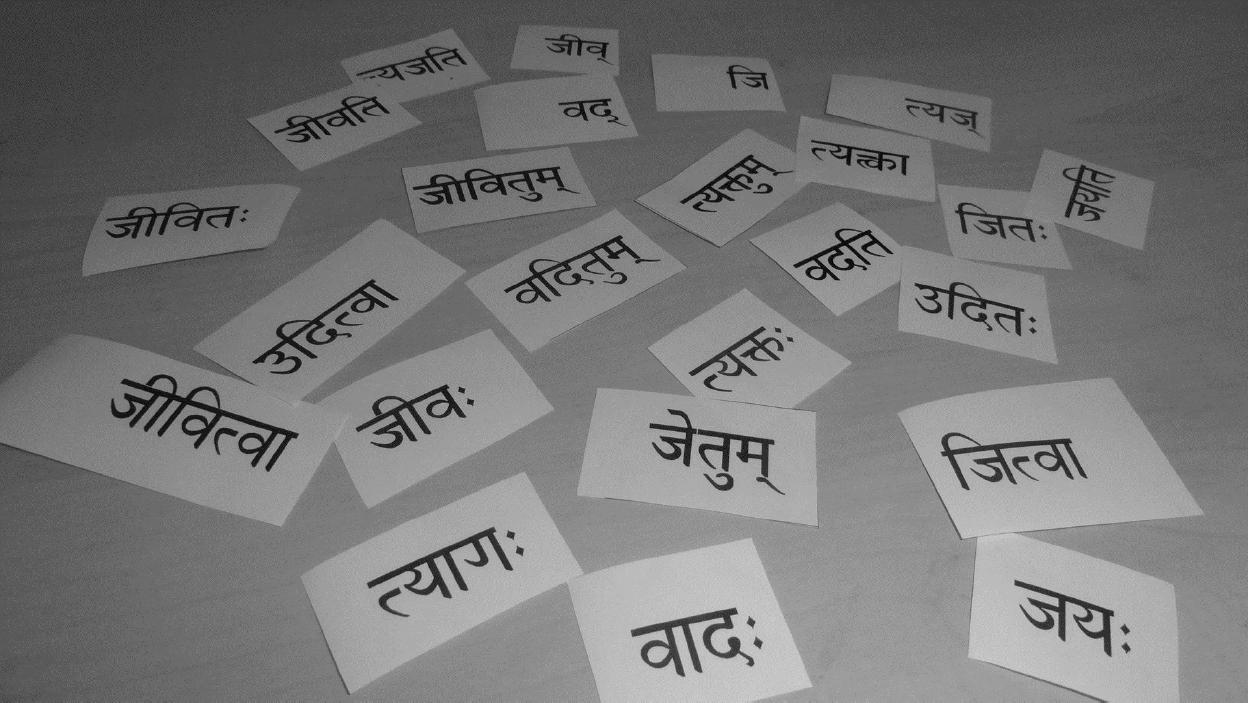
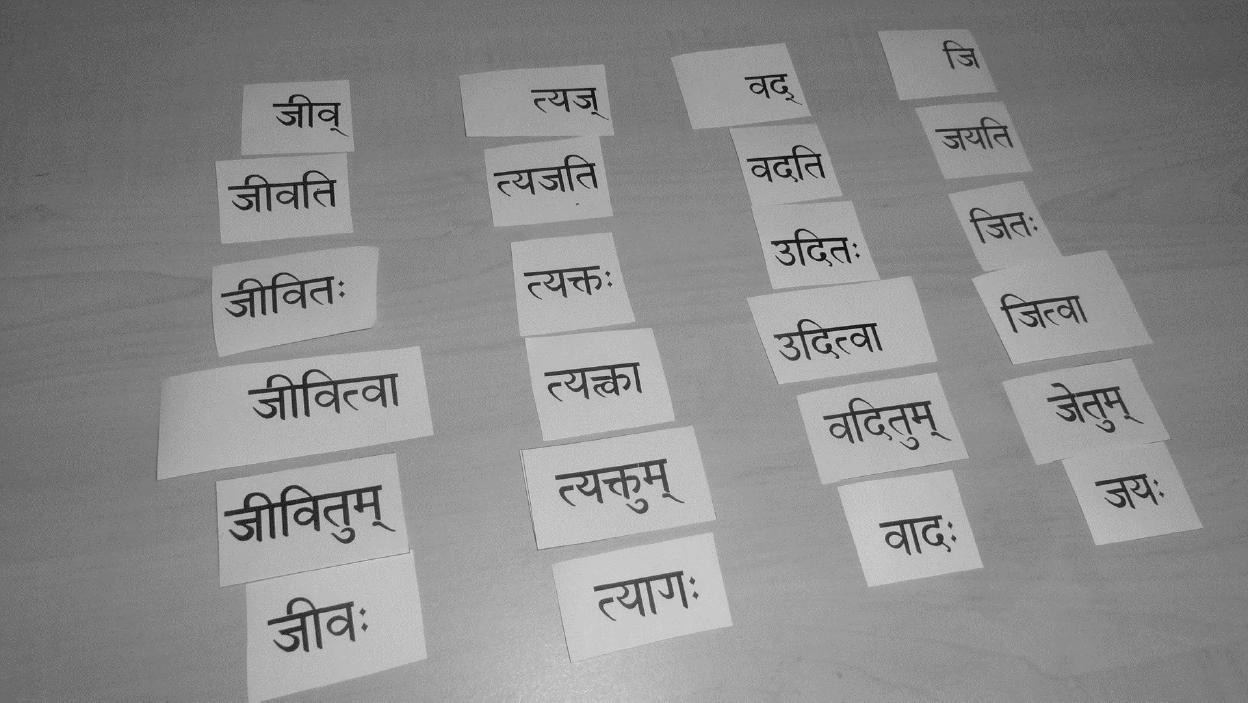
Reading courses
After finishing the introduction course within two terms, students at Ruhr-University Bochum have to attend a reading course where they translate selected Sanskrit texts. An adequate choice for the first reading course would be simple texts from the Pañcatantra, Kathāsaritsāgara or the Bhagavadgītā. It is a better motivation and easier for the students to cover a large quantity of a relatively easy text than a small quantity of a difficult text. Within these reading courses it is then possible to teach grammar which the students have not yet learnt, when it appears in the given texts. In the reading courses, students also have to learn how to use dictionaries and other tools. Although translation of the text covers most of the time, we still leave time for some of the six forms of the abovementioned exercises, as well as learning by heart and reciting some text portions.
Conclusion
As we have seen, there are a lot of possibilities for the teaching of Sanskrit following modern methods of language pedagogy. With the above-mentioned methods, it is feasible to lead students to a reading competence in approximately two thirds of the time (2 terms, 2 hours per week) elsewhere devoted to teaching. In conclusion, we strongly advocate teachers of Sanskrit to accompany their textbooks with additional teaching-/ learningmaterials and to enrich their courses with a variety of exercises to avoid a methodological “monoculture”. This will lead to an improvement both in terms of efficiency and popularity.
Literature
Balbir, N. (2013) Le Sanskrit. Collection Sans Peine. ASSIMIL.
Bausch, K.-R; Christ, H., Krumm, H.-J (ed.) (2007) Handbuch Fremdsprachenunterricht. 5th edition. Tübingen, Basel: A. Francke Verlag.
Coulson, M. (2003) Sanskrit. An Introduction to the Classical Language. London: Hodder & Stroughton.
Council of Europe (n.d.). Common European Framework of Reference for Languages. Learning, Teaching, Assessment. [Online] Strasbourg: Language Policy Unit. Available from: http://www.coe.int/t/dg4/linguistic/Cadre1_en.asp. [Accessed: 6th April 2014].
Deshpande, M. M. (2007) Saṃskṛtasubodhinī. A Sanskrit Primer. Centers for South and Southeast Asian Studies: University of Michigan.
Edmondson, W.; House, J. (2000) Einführung in die Sprachlehrforschung. 2nd edition. Tübingen, Basel: A. Francke Verlag.
Eßer, R. (2007) Übungen zum Schreiben. In: Bausch, K.-R; Christ, H., Krumm, H.-J (ed.) Handbuch Fremdsprachenunterricht. 5th edition. Tübingen, Basel: A. Francke Verlag.
Goldmann, R. R. and Goldmann, S. J. S. (2011) Devavāṇīpraveśikā. An Introduction to the Sanskrit Language. Corrected Edition. Delhi: Motilal Banarsidass
Grotjahn, R. (2007). Lernstile/Lernertypen. In: Bausch, K.-R; Christ, H., Krumm, H.-J (ed.) Handbuch Fremdsprachenunterricht. 5th edition. Tübingen, Basel: A. Francke Verlag.
Hirschfeld, U. (2007) Ausspracheübungen. In: Bausch, K.-R; Christ, H., Krumm, H.-J (ed.) Handbuch Fremdsprachenunterricht. 5th edition. Tübingen, Basel: A. Francke Verlag.
Lehmann, T. (2013). Sanskrit für Anfänger – Ein Lehr- und Übungsbuch. Band 1: Grammatik, Band 2: Texte, Übungen & Vokabular, Begleitband: Einführung in die Devanāgarī-Schrift. [Online] Heidelberg: Abt. Klassische Indologie, Südasien-Institut der Universität Heidelberg. Available from: http://www.rzuser.uni-heidelberg.de/~d53/. [Accessed: 4th October 2013].
Maurer, W. H. (2010). The Sanskrit Language. An Introductory Grammar and Reader. Revised Edition. London, New York: Routledge.
Mylius, K. (2013). Zur Didaktik mittelindischer Sprachen. Wiesbaden: Harrassowitz Verlag.
Richards, J. C.; Rodgers, T. S. (2001). Approaches and Methods in Language Teaching. 2nd edition. Cambridge, New York: Cambridge University Press.
Stiehl, U. (2007). Sanskrit-Kompendium: Ein Lehr-, Übungs- und Nachschlagewerk. Devanagari-Ausgabe. Heidelberg: Economica-Verlag.
[1] On the definition of the term svara, see § 3.
[2] From Jakobson [1931] and Trubetzkoy [1939], through Garde [1968], to Chomsky and Halle [1968], accentuation has been dealt with by many scholars and by many different theoretical frameworks within the modern Western Linguistic tradition. In this article (see §§ 3 and 4), the label ‘Western Linguistics’ refers exclusively to the post-Sound Pattern of English (Chomsky and Halle [1968]) generative strands which are characterized, on the one hand, by the metrical and prosodic approaches to the treatment of accentuation and, on the other hand, by a modular approach to the architectural representation of the language. Cf. Beckman [1986], Hayes [1995], and “Part III: Metrical Structure” in Raimy and Cairns [2009a].
[3] lt should be remembered that, in Western Linguistic terms, ‘grammar’ means ‘Universal Grammar’, i.e. the universal cognitive mechanism which, according to the setting of its parameters, can produce all the possible shapes by which the architecture of a language can be characterized.
[4] Suffice to say that the Sanskrit grammatical tradition seems to have aimed, at the beginning of its history, to provide the Vedas with ancillary sciences (cf. § 2) used for preventing them from undergoing modifications, and, in a second stage, to provide the intellectual and political establishment with an unchanging symbol of prestige (communis opinio), along with a valid tool for the teaching of Sanskrit (cf. Deshpande [2006] and Kiparsky [2007]). However, Western Linguistics is interested in providing an elegant – in the sense that it should comply with the Ockham’s razor principle — representation of the functioning of the cognitive processes whose perceptible manifestation is language itself and whose parameters are the same for all human beings (Universal Grammar).
[5] In this sense, the difference between ‘linguistics’ and ‘grammar’ can be overcome.
[6] In this article the term ‘sound’ refers to the phonetic domain, whereas the term ‘segment’ – i.e. the representational device where a certain number of the articulatory features are said to coexist – refers to the phonological domain (cf. Harris [2007: 124–31]). The latter is preferred to the term ‘phoneme’.
[7] Commenting on Vaux and Wolfe [2009], Clements[2009: 165] states: “[…] not all phonological concepts have phonetic correlates. For example, though the syllable is an essential unit in phonology (and underlies many aspects of phonetic and prosodic patterning as well), it has no universally valid phonetic definition. This fact is not surprising once we recognize that the syllable is primarily a phonological construct, defined over sequences of discrete phonological segments rather than over phonetic primes as such. At this level of abstraction (which includes most of phonology), few constructs have direct phonetic definitions. Vaux and Wolfe rightly emphasize that the ultimate justification for such concepts depends on their success in bringing order to a vast array of seemingly disparate facts. The syllable does just that.” About the importance of the syllable in connection with accentuation, see § 4.
[8] For the implications of the concept of lāghava (“economy”) in the Sanskrit tradition, see § 3.
[9] This field surely deserves to be widened. In particular, a comparison between pre-Saussurean Western Linguistics, i.e. pre-langue/parole dichotomy (e.g. the works of the first scholars engaged in the reconstruction of Proto-Indo-European) and the Sanskrit grammatical tradition could prove to be remarkably interesting, since the former still operates in a framework in which phonology has not yet been defined as a distinct component of grammar.
[10] Although dating the Phiṭsūtra is almost impossible, a sensible guess places it at the end of the first millennium B.C.E. (cf. Cardona [1976: 175–7]).
[11] Also known as pārṣadas (“[belonging to] an assembly”). The two names of this genre clearly refer to the strict relation between these texts and the sacerdotal families, de facto the Vedic schools, in charge of preserving the Vedic texts.
[12] Any attempt to date these texts is necessarily tentative: for a detailed discussion on this topic cf. Scharfe [1977: 127–34, 176–7], who says “The dating of most of these texts is next to impossible” [p. 176], and Varma [1929]. The communis opinio that the prātiśākhyas are older than the śikṣās is based on the fact that the former are composed in sūtras – a style typical of the most ancient vedāṅga treatises –, whereas the latter are composed in verse or in prose.
[13] In a later stage (cf. Parameswara Aithal [1991]), the śikṣāvedāṅga texts are classified under the label of lakṣaṇa, i.e. the literary genre which comprises all the texts containing information about and instructions for the Vedic recitation.
[14] For the attribution of these treatises to their respective Vedic texts, cf. Mishra [1972].
[15] The definition of the notion of ‘word’ is not treated here. For a definition of the term ‘word’ in phonology, cf., for instance, Nespor and Vogel [1986: 109–144].
[16] It should be noted here that, although presented in the treatises as compulsory for the correct pronunciation of the language, the svaras have been probably lost in the translation from Vedic to Classical Sanskrit within an overall change of the accentuation pattern. Additionally, according to some treatises, a few more svara types should be added to this list, but they are probably variations of the main three, pertaining to specific recitational styles (cf. Deshpande[1997: 438]), or particular combinations of the basic svaras.
[17] Aṣṭādhyāyī 1.2.31 says samāhāraḥ svaritaḥ “svarita is the samāhāra (“combination”) [of high pitch and low pitch].”
[18] The translation of Aṣṭādhyāyī 6.1.158 should then be changed to: “[the svaras] of a word are non-raised with the exception of one”. The problem of the double interpretation of the term anudātta is already discussed in Patañjali’s Mahābhāṣya (cf. Cardona[1988: 442]).
[19] In addition, the accent can be enhanced by the fact that it triggers some phonological phenomena. A well-known example is the so-called ‘Verner law’ (cf. Clackson [2007: 75–6]).
[20] For instance, cf. Pāṇinīyaśikṣa 12 and Nāradīśikṣa 1.8.8.
[21] Presumably, Hyman’s article will have a profound influence in reshaping the common knowledge Western Linguistics has developed in interpreting the phonetic correlates of accentuation. Since it is impossible to forecast the results of this reshaping, here are presented the most accepted phonetic and phonological frameworks Western Linguistics has developed so far.
[22] In particular it is here the phonological metric module which interacts with morphology. For the implications of these model in the overall architecture of the linguistic representation, cf. Cairns [2009].
[23] lt should be remembered that Pāṇini does not provide rules for attributing the accent to the underlying representation of nominal and verbal bases.
[24] The definition of morpho-phonology within the Western linguistic tradition is not uncontroversial (cf., for instance, Mohanan [1995]).
[25] For instance, it is not the neuter suffix which determines the position of the accent but it is the property of the word of being neuter that implies a particular position for the accent: athādiḥ prāk śakaṭeḥ || 2.1 || […] nabviṣayasyānisantasya || 2.3 ||“From here the initial syllable (is udātta) prior to śakaṭi. (2.1) […] Of (a word) necessarily neuter in gender (and) not ending in is, (the initial syllable is udātta) (2.3)” (Devasthali’s translation[1967: 56]). According to Śāntanava, it is not the suffix to be neuter but the lexical item, i.e. gender is not a morphological property.
[26] Sandhi phenomena, which are not treated here, are encompassed within the same theoretical horizon.
[27] In this sense, the fact that sometimes the grammarians do provide lists of exceptions should be seen as more in keeping with the idea of lāghava – namely more economical – than providing extremely complex derivational rules. For instance, cf. Aṣṭādhyāyī 2.2.38, 3.1.101, etc.
[28] Sonorants are those sounds whose articulation is voiced, like vowels, nasals, liquids, etc. (cf. Hall [2007: 314–6]).
[29] A more flexible approach to the definition of the ABU is found in Halle and Vergnaud [1987a]. According to them, the ABU is an ‘element X’, i.e. an element which can change from language to language: segments (both vowels and [+sonorant] consonants in particular positions), morae, segments in the rhyme, syllables, or lexically designated segments.
[30] In case the accent is mainly characterized by the pitch, the mora has been said to be the ABU since, in certain languages (e.g. Lithuanian), accent can create oppositions within the same syllable. As Hayes [1995: 49–50] remarks, defining the ABU as the syllable works in particular for the so-called stress languages, whereas “[…] pitch languages […] in the generative phonology they can be treated as involving tonal representation, either in addition to or instead of a metrical representation”, but cf. Hyman [2009] for the fact that ‘pitch language’ represents an improper phonological category.
[31] “The nub of the issue is whether or not the syllable is the inviolable unit for bearing stress (e.g. Hayes 1995 and much recent works). If it were, one would expect syllables to nest neatly within feet; but if some languages were to employ vowels as the stress-bearing unit, then the possibility would exist that the constituents needed for stress might conflict with those needed for syllabic facts” (Raimy and Cairns [2009b: 4]).
[32] Borrowing a Saussurean and then Firthian terminology (cf. Garde [1968]), a multilinear representation of the language corresponds to the necessity of explaining the syntagmatic – vs. paradigmatic – properties of some phonological entities.
[33] Although extremely controversial, mātrās (“morae”) could be added to this list, but they are not relevant to the present discussion.
[34] Usually, after a general statement about the overall number of varṇas, which varies according to the various treatises, the Indian grammarians possibly list them according to their articulatory characteristics.
[35] At least, as it will be shown in § 5, in connection with the definition of the SBU. akṣaras are in fact also classified as either laghu (“light”) or guru (“heavy”), i.e. according to a terminology which echoes the Western Linguistic phonological notion of syllabic weight (cf. Allen [1953: 85–7]).
[36] This refers in particular to the stops: nasals and sibilants for instance can be articulated independently, but cannot be, in Sanskrit, syllable nuclei, i.e. they occupy a secondary place in the sonority scale (cf. Clements [2009]).
[37] According to Western Linguistics, the phonetic definition of a syllable concerns mostly the internal distribution of its sonority, whereas its phonological definition mostly depends on which sound can occupy which position in the sonority scale. This is also the main reason for not translating akṣara as “syllabic nucleus”, i.e. the syllabic segment characterized by the higher degree of sonority.
[38] For the peculiar sandhi of “so ’dirṇo”, cf. Ghosh[1938: 55].
[39] All translations are mine.
[40] Ac is a pratyāhāra (“abbreviation”) used in the pāṇinīya tradition to indicate the vowels.
[41] The varṇasamāmnāya (“collection of sounds”) – which is not presented in the Rgvedaprātiśākhya – contains the list of sounds whose articulation and properties are described in the text. The first twelve are the vowels, namely: a, ā, i, ī, u, ū, ṛ, and ṝ followed by e, ai, o, and au (the sound ḷ is probably regarded as an allophone of ṛ). Shastri [1937: 4] translates samānākṣara as “monophthong” and saṃdhyakṣara as “diphthong”.
[42] The Vājasaneyiprātiśākhya in fact states that: svaro ’kṣaram || 1.99 \\ sahādyair vyañjanaiḥ || 1.100 || uttaraiś cāvasitaiḥ || 1.101 ||“An akṣara is a svara (“vowel”) (1.99), [and it is so] also with the preceding consonants (1.100) and the following ones in pause (1.101).” The Yājñavalkyaśikṣā also employs the term akṣara more than once, at least in one case in direct connection with the term udātta: udāttākṣarayor madhye bhaven nīcas tv avagrahaḥ ||84.b ||“[As in the previous examples,] if [it occurs] between two high-pitched akṣaras, the avagraha (?) should be low-pitched” (here the sense of the term avagraha is not at all clear).
[43] For the interpretation of these sūtras, cf. Deshpande [1997: 447–8].
[44] Here, it is worth noting that the verb svaryate – here translated as “it bears” – literally means “it resounds” or even, in this context, “it is accented”. This shows how, unlike Western Linguistics, each Sanskrit notion and term in the field of śikṣā tends to be grounded on articulation.
[45] Here, if one took svarya as a synonym of svara (“pitch accent”), it would be difficult to find a plausible interpretation for these sūtras.
[46] The term aṅga is rather obscure: the tentative translation proposed here (“part [of the vowel]”) echoes the debate on what sub-unit of the SBU bears the udātta in case of a svarita (cf. § 5.4).
[47] Furthermore, it would be arbitrary to interpret ardha as “half [mora]” instead of “half [sound]” since verse 3.1 clearly states that a svara (“pitch modulation”) does not rest on a mora.
[48] Add. (1925) and Add. (1938).
[49] The Lomaśīśikṣā is an exception since vicakṣaṇaḥ (“the learned”) is in the singular.
[50] An exception is Uvata, who composed a commentary for both the Ṛgvedaprātiśākhya and the Vājasaneyiprātiśākhya. Unfortunately, his work is not useful to elucidate the definition of the SBU.
[50] An exception is Uvata, who composed a commentary for both the Ṛgvedaprātiśākhya and the Vājasaneyiprātiśākhya. Unfortunately, his work is not useful to elucidate the definition of the SBU.
[51] RAGHAVAN 1947: 237–238.
[52] ARUNĀCALAM 2005: 70–71.
[53] All citations of the CidMā refer to the edition of Somasundara DIKSHITAR [=Ed.] as well as two manuscripts A and B (see the Bibliography for details of these). DIKSHITAR’S edition seems to be a transcription of a single good manuscript and was perhaps only brought out for private circulation: other than the copy in the possession of David SMITH of Lancaster University (of which I derived a second-generation xerox from David SHULMAN of Hebrew University, Jerusalem: my thanks to both of them), I know of only a copy in the Library of Congress in Washington DC. I would also like to record my gratitude to Hermann KULKE for allowing me to use his paper transcripts of the two MSS.
[54] KULKE 1970; see also KULKE 1993.
[55] KULKE 1970: 207–213 and 1993: 205–6.
[56] Variously called tillavana, vyāghrapura, puṇḍarīkapura in these texts: the term cidambaram when it occurs is usually restricted to only a part of the Śaiva temple complex in this period, the Tamil ciṟṟampalam or ‘small shrine’. Throughout this essay, I use the name Cidambaram to refer to the temple town, now a taluk headquarters in Cuddalore district, Tamilnadu.
[57] KULKE 1970: 173–176.
[58] The edition actually reads mūḍha tvaṃ, i.e. presumably as a vocative followed by a pronoun in the nominative. This fails to construe; while the slight emendation to mūḍhas tvaṃ (‘you are an idiot’) would yield sense, it would make for an exceptionally choppy verse containing a series of three anacolutha, and would once again awkwardly relate to the yati boundary.
[59] SANDERSON 2001: 2.
[60] Ed. 9.30 [=A p. 38 (numbered as 9:27); B p. 31]: *adyārabhya (ārabhya] A Ed; ārabdha B) *dayādhāra (dayādhāra] AB; dayāsāra Ed.) mama nāmnā puran tv idam | khyātam astu samasteṣu bhuvaneṣv ambikāpate ||, “Śiva, Ocean of Compassion, from this day forward, let this town be known throughout the world by my name.”).
[61] I find that śrīmadvyāghrapuram also occurs in 7.29d.
[62] The pūjāvidhi, incidentally, is itself quite interesting, both in its own right (it gives a very compressed version of a recognizably Mantramārga nityapūjā) and for the comments it elicits from Mādhavamantrin, who cites verses from the Bṛhatkālottara, as well as the paddhatis of Somaśambhu and Jñānaśiva (I thank Dominic GOODALL who, in a personal communication of 21 March 2010, identified the Kālottara recension quoted here).
[63] See for instance the second patikam of the fifth book of the Tirumuṟai, the Tamil Śaiva canon: vs. 2: cěmpǒṉampalatt’ uḷ niṉṟa tāṇuvai… maṟantu, “forgetting Sthāṇu, who stands within the hall of fine gold” and vs. 8 tūya cempoṉṉiṉāl ěḻuti meynta ciṟṟampala kūttaṉai… maṟantu, “forgetting the Dancer of the Little Hall covered in finely worked pure, bright gold.” (Citations taken from SUBRAHMANYA AIYAR, CHEVILlard and SARMA 2007). For Appar’s date, see ZVELEBIL 1995: 51ff.
[64] Thus ORR 2004: 231: “… of the 288 inscriptions, only 6 date from the tenth century and 7 from the eleventh.”
[65] As was already noted in SUBRAHMANYAM 1942: 61n.
[66] See CHAMPAKALAKSHMI 1996: 429–430 (critically extending SCHWINDLER 1987).
[67] See NILAKANTA SASTRI 1955: 348; even this claim depends on the interpretation of an ambiguous phrase in the king’s měykkīrtti.
[68] ARE 118 of 1888, SIIIV: 223; it is this record that provides the sole evidentiary basis for Kenneth HALL’S reconstruction of Cidambaram as an eleventh century ‘economic centre’ (2001:101–106).
[69] Kuntavaiyāḻvār: Kulottuṅga year 44, 1114 ce; ARE 119 of 1888, El vol. 5, p. 105 (in corrected Tamil orthography, the donation of the king of Kambhoja [= Cambodia?] reads (11. 10–11): śr[ī]rājendracoḻadevarku kāmbośarājaṉ [sic] kāṭciyākak kāṭṭina kallu); Maturāntiki: year 46, 1116 ce; ARE 117 of 1888, SII IV: 222, lines 7ff. (the local beneficiary of the princess’ generosity, Vācciyan Iravi Tirucciṟṟampalamutaiyān, is mentioned in In. 10).
[70] The Naralokavīra grant has had a complicated publication history: the earliest published reference to the inscription was HULTZSCH’S notice of it as ARE 120 of 1888, while the first attempt at publication as SII IV: 225 resulted in a poor edition. The Sanskrit text had also been copied down by one of the pandits working under Mackenzie and was subsequently published (with some different readings and a Tamil paraphrase) as South Indian Temple Inscriptions nos. 1271–1273. A somewhat different Sanskrit text was published by B.G.L. SWAMY as an appendix to SWAMY 1979 (which, additionally, is identical to SWAMY and NANJUNDAN 1973). This latter text is accompanied by a very unreliable translation, based probably on the SITI gloss. The Tamil text was reissued in a heavily conjectural version by Mu. Irākavaiyaṅkār (1935–36, nos. 1059–1094). Additionally, partial translations of the grant are included in NILAKANTA SASTRI 1932 and BALASUBRAHMANYAN 1979:23–26. Despite all of these materials, the text remains highly problematic. I plan to publish a revised edition and philological translation of the eulogy in the near future.
[71] Drawn from Vikrama’s inscription in the Āpatsahayeśvara temple in Ālaṅkuti (yr. 11, 1130 CE, SII V: 458, 11. 3, 5, compared with Cuppiramaṇiyam 1983, no. 24 (pp. 113–114), 11. 30–38, 52–56).
[72] The calculations are KIELHORN’S, in El VII: 5.
[73] Quoted as emended by GOODALL 1998:xiv.
[74] SANDERSON has suggested (personal communication) that the vikramādi could alternately be interpreted as a periphrasis for just the king himself (‘he whose name begins with Vikrama,’ the plural number being a mark of respect, ādare bahuvacanam). While this sort of construction is frequently met with, it seems unlikely to me in this instance, as the king’s regnal name is in fact Vikrama (and not, say, Vikramāditya or Vikramasimha or something similar). Nevertheless, I am not certain who these three or more ‘lords of the Coḻas’ might be.
[75] See ORR 2004: 231, from whom I draw my figures.
[76] ORR op. cit: 233n. Of these gotra names, one can recognize in the first the pan-Indic gotra Kauśika. Vācciyan perhaps suggests a role in ritual or other public performance (≈ Skt. vācaka?); the Tamiḻk kalveṭṭuccollakarāti, s.v. vācciyaṅkal gives ‘musical instruments’ (vādiyaṅkal), citing a twelfth century record from the Kannada region [= EC, x, 132]. The name uḻaiccaraṇaṉ—found almost exclusively in Cidambaram—remains opaque; indeed, even its orthography is uncertain: ORR op. cit. ibid. reads iḻaiccāṇaṉ (I follow the transcription in ORR’S prepublication manuscript; the names given in the published version are incorrect). I choose instead to give the name that seems to yield some sense (‘deer foot’); the two renderings are graphically indistinguishable in inscriptional Tamil. Taking KARASHIMA, SUBBARAYALU and MATSUI’S representative (but by no means exhaustive) name concordance (1978) as a guide, only two of the eight figures bearing the name-segment Ulaiccaranan (vv.ll. iḻaiccāṇaṉ, ulaiccālan) are found outside of Cidambaram (the majority of ORR’S references to Ulaiccaranan-identified figures are found in unpublished inscriptions not taken into account in the concordance); of the thirty-seven figures in the concordance with name-segment Vācciyaṉ, seven are from Cidambaram. While the distribution of ninety-eight figures bearing the gotra KavuciyaVācciyaṉ or one of its variants (kavucikaṉ/kavuṇiyan/kaviṇiyaṉ, etc.) show no clear regional focus, it should be noted that among these figures there is a high incidence of personal names connecting their bearers to the Cidambaram temple (e.g. tillaināyakabhattan no. 5146, mūvāyirapaṭṭaṉ no. 4659, āṭaviṭaṅkapaṭṭaṉ no. 4669; aḻakaviṭaṅkapaṭṭaṉ no. 4692; tirucciṟṟampalamuṭaiyāṉ no. 1239, tillaippirāṉ, the father of the single man recorded under nos. 1818 and 1836, etc.).
[77] One may contrast here KULKE’S suggestion that the author or authors of the CidMā might have been among the brahmans transplanted by Kulottuṅga I from Veṅgi to Cidambaram, for which there is no evidence in the epigraphical record (1967: 201–209; 1993: 202–204). KULKE’S hypothesis has been repeated elsewhere as history: see e.g. WITZEL 1993: 267. The present theory has at least the advantage of an actually-existing social constituency in which the text’s authors may be located.
[78] The eighth adhyāya of the Muktikhaṇḍa begins by changing the interlocutors in its frame narration: where the rest of the khaṇḍa is a conversation between Viṣṇu and Śiva, it is an exchange between the Sūta and the Naimiṣa ṛṣis, the primary speech situation of the rest of the SūSaṃ. The same adhyāya contains passages in longer lyric meters demonstrating palpably Dravidian formal features like front-rhyme and heavy rhythmic syncopation; in the ninth and final adhyāya the setting for the frame narrative shifts from the Naimiṣa forest to Cidambaram itself, where the rsis witness Śiva and Pārvatī’s procession under the Ārdrā nakṣatra (see Cox 2006: 68–72). This shift in multiple registers of the text’s language and rhetoric suggests that these two final chapters of the third khaṇḍa were a Cidambaram-specific addendum to an already existing text, as well as a narrative bridge to the fourth and longest of the SūSaṃ’s sections. For its part, while the Yajñavaibhava is equally focussed on Cidambaram among the many Śaiva sites it mentions, the section as a whole is especially repetitive and stylistically clumsy, even by the forgiving standards of the rest of the SūSaṃ, something already noticed by RAGHAVAN (1947: 246). Presumably, the earlier, shorter SūSaṃ was already in circulation, since at the very least the opening khaṇḍa was available to the CidMā compilers.
[79] In the Appendix, I have omitted a tediously catechistic roll-call of the figures who come to worship Naṭeśa (4:24.11–20).
[80] KULKE suggests that the CidMā’s Pulkasa is given a cleaned-up rap sheet, in order to fit into the more settled world of the 12th century and the greater sacrality of Cidambaram (1970: 210). On the contrary, the literary culture of twelfth century Coḻamaṇḍalam seems especially prone to this sort of violent hyperbole, considering such key Tamil works as the Kaliṅkattupparaṇi and the Tirutŏṇṭarpurāṇam (See ALI 2000, MONIUS 2004, COX 2005).
[81] The telltale signs of this dependence are given in boldface in Appendix 2: the reading mahāsāhasiko ’dhamaḥ in 4:24.2d (found only in the edition’s ms. gha) resembles SūSaṃ l:4.17d’s puruṣādhamaḥ; 6a’s sahasrajanmataḥ follows SūSaṃ 1.4.23c janmāntarasaha-sreṣu (itself part of a phrase that is notably unparalleled in the CidMā version, see p. 29, above); while 9c matipradānam seemingly is a paraphrase of matiṃ… pradattavān, SūSaṃ l:4.20d.
[82] Contrast the banal upaniṣadic parallel in CidMā 8.21b, saccidānandalakṣaṇām.
[83] See Cox 2011.
[84] On the provenance of the Parātriśikātātparyadīpikā see Sanderson 1990: 32–33; on the Mahārthamañjarī see Cox 2006.
[85] See Cox 2005 and 2007.
[86] Cf. ABh ad NS 6, prose after 31, vol. 1, p. 277: āmnāyasiddhe kirn apūrvam etat saṃvidvikāse ’dhigatāgamitvam | itthaṃ svayaṃgrāhyamahārhahetudvandvena kiṃ dūṣayitā na lokaḥ || ūrdhvordhvam āruhya yad arthatattvaṃ dhīḥ paśyati śrāntim avedayantī \ phalaṃ tad ādyaiḥ parikalpitānāṃ vivekasopānaparamparāṇām || citraṃ nirālambanam eva manye prameyasiddhau prathamāvatāram | sanmārgalābhe sati setubandhapurapratiṣṭhādi na vismayāya 11 tasmāt satām atra na dūṣitāni matāni tāny eva tu śodhitāni | pūrvapratiṣṭhāpítayojanāsu mūlapratiṣṭhāphalam āmananti || My translation runs as follows: “There should be no wonder in following what is already known in the disclosure of knowledge as established by tradition. [This] being so, does not the world spoil [everything] by quarreling about self-evident arguments of great valour? [No!] Ascending ever higher, the Intellect, unaware of fatigue, beholds the truth, which is nothing but the fruit of the theories conceived by the ancients, along the succession on the ladder of discrimination. Wonderful is, I believe, the first crossing in the ascertainment of the knowable, as it is completely supportless. But, as the right road is progressively taken, no more a source of wonder is the foundation of cities, bridges and so forth. Therefore, the ideas of the wise – that hand down the fruit of the original foundation – are not refuted here, but only refined along the previously established paths.” Although – given the highly polysemic nature of these four beautiful stanzas – such a rendering cannot but be ‘my’ interpretation of the passage, in the light of my general understanding of Abhinavagupta’s thought within the wider context of the śāstric traditional discourse, Abhinavagupta’s self-representation as the culminating point in the ladder of discrimination is beyond any shadow of doubt. For different interpretations of the stanzas, see Gnoli (1968, 51–2) and Kaviraj (2005, 127).
[87] It might be considered safe to maintain that the term rasa in the artistic domain indicates the ‘aesthetic experience’ — in particular, in the form of the emotional content of the work of art but this would just be a vague and underspecified translation that entails no actual definition or explanation of the concept.
[88] In Pollock’s words (1998, 122), “Not everyone seems to have been talking about the same thing when they talked about rasa; their focal points and emphases changed over time.”
[89] Monier-Williams (1956, sub voce). Cf. also Böhtlingk; Roth (1855–1875, sub voce). Apte (1965, sub voce) gives the following meanings: “1. sap (of trees); 2. a liquid; 3. water; 4. liquor; 5. a draught; 6. taste (fig. also); 7. a sauce; 8. an object of taste; 9. taste or inclination for a thing; 10. love; 11. pleasure; 12. charm; 13. pathos; 14. (in poetic compositions) a sentiment; 15. essence; 16. a constituent fluid of the body; 17. semen virile; 18. Mercury; 19. a poison; 20. any mineral metallic salt; 21. juice of the sugarcane; 22. milk; 23. melted butter; 24. nectar; 25. soup; 26. a symbolical expression for the number ‘six’; 27. green onion; 28. myrrh; 29. gold; 30. a metal in a state of fusion; 31. see rasātalaḥ; 32. the tongue (as the organ of taste); 33. (with Vaiṣṇavas) disposition of the heart or mind (the five rasas are śānti, dāsya, sākhya, vātsalya and mādhurya).”
[90] For a very interesting survey of the meanings of the word rasa in Pali texts (mainly, “accomplishment” and “joy”), and a tentative and not always convincing reconstruction of the influence of these meanings on the aesthetic sense of the term, see Warder (1980–81).
[91] The idea of rasa as a semantic field – interpreted in two radically opposite ways by different thinkers – was triggered by Derrida’s essay “Plato’s Pharmacy” and by his thought-provoking interpretation of the polysemic nature of the Greek term pharmakon.
[92] However, one might argue, this particular kind of sum is not just the arithmetical sum of different entities, but a new entity which is created by the accurate and sophisticated blend of disparate entities.
[93] A tentatively unmarked translation might be: “Verily, without rasa, no thing can progress.” However, it is worth remarking that Abhinavagupta (ABh ad NS 6, prose after 31, vol. 1, p. 270) gives three equally possible interpretations of the passage according to three renderings of the term artha, respectively, in relation to the experience of the critics, the actors or the spectators. For a translation of Abhinavagupta’s passage, see M.M. Sharma (1980–81).
[94] The meaningfulness and the cogency of the following discourse depends, at least partially, on my view concerning the authorship of Bharata’s text. Although different materials have been recognizably put together to form the bulk of the Nāṭyaśāstra, it is my opinion that it cannot be just the result of the ‘blind’ accumulation of the works of several authors over a long period of time, because, in Tieken’s words (1998, 172), “[t]he Nāṭyaśāstra is a well-planned, coherent work. Its thirty-seven chapters can roughly be divided into several distinct groups dealing with more or less closely related topics.” This view of unitary authorship goes back, in particular, to Vatsyayan (1996, 6) who argues that “the work reflects a unity of purpose and that it was the product of a single integrated vision, perhaps also of a single author.” For a sustained argumentation in favour of the opposite view – the work being an almost ‘incoherent’ smorgasbord of disparate materials see Srinivasan (1980). Pollock (1998) seems to share, at least partially, the latter view. For some very useful and extremely convincing insights on the concepts of ‘authorship’ and ‘agency’, both in the restricted field of South Asian studies and in the broader arena of history and humanities, see Squarcini (2008, 185–217).
[95] Abhinavagupta follows a probably more recent version of the text that enumerates nine rasas by adding the reposeful (śānta). A discussion on the place and status of this ninth rasa, a much debated and often-treated topic, lies beyond the scope of the present article. For a treatment thereof, see Raghavan (1967, 104–114 and 197–199), Masson; Patwardhan (1969) Bhattacarya, K. (1972), Gerow; Aklujkar (1972), Bhattacharya, S.P. (1976) and Gerow (1994).
[96] The term bhāva, in this context usually translated as ‘emotion’, derives from the root bhū-, ‘to be’, and can refer to such concepts as state of being, condition or disposition of any kind. As summarized in Ali (2004, 186), “[t]he general consensus of both philosophical and aesthetic theory was that bhāvas arose within the ‘mind’ or manas, an internal ‘organ’ (karaṇa) whose function was discriminatory, constructive or analytic (saṃkalpa) in relation to sense faculties (indriyas)
[97] NŚ 6, prose after 31, vol. 1, p. 271.
[98] In particular, at least in Abhinavagupta’s very plausible interpretation, the function of vibhāvas is to awaken the pre-given dispositions (vāsanās, saṃskāras) – accumulated in an infinite number of former births – that form, so to say, the emotional DNA of any human being.
[99] According to a terminology later than Bharata’s text (see, for instance, Daśarūpaka 4.2), these two sorts of vibhāvas are called respectively ālambanavibhāva (“Determinant qua Support”) and uddīpanavibhāva (“Determinant qua Stimulant”). To use T.S. Eliot’s famous formulation, the vibhāvas can be considered the “objective correlatives” of an emotion.
[100] See, for instance, the definition of śṛṅgārarasa in NS 6, prose after 45, vol. 1, p. 298–299.
[101] The number of these ‘involuntary responses’ is fixed. They are called sāttvikabhāvas and listed in NS 6.22: Stupefaction (stambha), Perspiration (sveda), Horripilation (romāñca), Break of Voice (svarabheda), Tremor (vepathu), Change of Colour (vaivarṇya), Weeping (asru) and Fainting (pralaya).
[102] On the possibility to apply contemporary psychological theories to Bharata’s classification of ‘stable’ (or ‘primary’) and ‘transitory’ (or ‘secondary’) emotions, see Cuneo (2009).
[103] They are listed in NS 6.18–21. On a closer inspection, the list is extremely heterogeneous, including what we would commonsensically call ‘emotions’, such as envy (asūya) and shame (vrīḍā), as well as ‘mental states’, such as remembrance (smṛti) and preoccupation (cintā), and ‘physical or physiological conditions’, such as sickness (vyādhi) and death (maraṇa). On the wide semantic field covered by the word bhāva, see Ali (2004, 185–188). In this respect, on the untenability of a waterproof divide between emotional and cognitive phenomena both in the context of Ancient India and in general terms, see again Cuneo (2009).
[104] See the translation of the two chapters in Ghosh (1950–1967, Vol. 1. Translation 108–117 and 122–126). For instance, take the definition of karuṇarasa (“Pathetic rasa”) and of its Stable State śoka (“sorrow”) according to the text and the translation by Ghosh (Vol. 1. Translation, 112–113 and 123; Vol. 1. Text, 87 and 94): “Now the Pathetic (karuṇa) Sentiment [i.e. rasa] arises from the Durable Psychological State [i.e. Stable State] of sorrow. It grows from Determinants such as affliction under a curse, separation from dear ones, loss of wealth, death, captivity, flight accidents or any other misfortune. This is to be represented on the stage by means of Consequents such as shedding tears, lamentation, dryness of the mouth, change of colour, drooping limbs, being out of breath, loss of memory and the like. Complimentary [sic!] Psychological States [i.e. Transitory States] connected with it are indifference, languor, anxiety, yearning, excitement, delusion, fainting, sadness, dejection, illness, inactivity, insanity, epilepsy, fear, indolence, death, paralysis, tremor, change of colour, weeping, loss of voice and the like (atha karuṇo nāma śokasthāyibhāvaprabhavaḥ. sa ca śāpakleśavinipāteṣṭajanaviprayogavibhavanāśavadhabandhavidravopaghātavyasanasaṃyogādibhir vibhāvaiḥ samupajāyate. tasya cāśrupātaparidevanamukhaśoṣaṇavaivarṇyasrastagātratāniśvāsasmṛtilopādibhir anubhāvair abhinayaḥ prayoktavyaḥ. vyabhicāriṇaś cāsya nirvedaglānicintautsukyāvegamohaśramabhayaviṣādadainyavyādhijaḍatonmādāpasmāratrāsālasyamaraṇastambhavepathuvaivarṇyāśrusvarabhedādayaḥ [NŚ 6, prose after 61]).” “Sorrow (śoka) is caused by Determinants such as death of the beloved, loss of wealth, experience of sorrow due to one’s murder or captivity and the like. It is to be represented on the stage by Consequents such as shedding tears, lamentation, bewailing, change of colour, loss of voice, looseness of limbs, falling on the ground, crying, deep breathing, paralysis, insanity, death and the like (śoko nāma iṣṭajanaviyogavibhavanāśavadhabandhaduḥkhānubhavanādibhir vibhāvair utpadyate. tasyāsrapātavilapitaparidevitavaivarṇyasvarabhedasrastagātratābhūmipatanasasvanaruditākranditadīrghaniśvasitajaḍatonmādamohamaraṇādibhir anubhāvair abhinayaḥ prayoktavyaḥ [NS 7, prose after 10]).”
[105] This probably refers to the Transitory States, even if it is possible that, in this case, vibhāvas and anubhāvas might also be included in the expression ‘bhāva’.
[106] The terms ‘word’ (vāc), ‘body’ (aṅga) and ‘psychophysical intentness’ (sattva) refer to the main kinds of abhinaya (“enactments” or “manners of representation”) employed by the actors and listed in NS 6.23. On sattva, see Ganser (forthcoming).
[107] The Sanskrit text reads: ko dṛṣṭāntah. atrāha – yathā hi nānāvyañjanauṣadhidravyasaṃyogād rasaniṣpattiḥ tathā nānābhāvopagamād rasaniṣpattiḥ. yathā hi – guḍādibhir dravyair vyañjanair auṣadhibhiś ca ṣāḍavādayo rasā tathā nānābhāvopagatā api sthāyino bhāvā rasatvam āpnuvantīti. atrāha – rasa iti kaḥ padārthaḥ? ucyate – āsvādyatvāt. katham āsvādyate rasaḥ? yathā hi nānāvyañjanasaṃskṛtam annaṃ bhuñjānā rasān āsvādayanti sumanasaḥ puruṣā harṣādīṃś cādhigacchanti tathā nānābhāvābhinayavyañjitān vāgaṅgasattvopetān sthāyibhāvān āsvādayanti sumanasaḥ prekṣakāḥ harṣādīṃś cādhigacchanti.
[108] As the Stable State is absent from the rasasūtra, it is not easy to assess whether Bharata considered it as an element present in the production of rasa – as, for instance, Bhaṭṭa Lollaṭa will argue – or not – as will be argued, for instance, by Śrī Śaṅkuka. However, in my opinion, on the basis of the food-simile as well as the simile with the king and its attendants (NS 7, prose after 7), it is highly probable that it is the Stable State that, in Bharata’s theory, is to be considered as the very base for rasa, just as rice is the substratum and the base of any meal in Indian cuisine, although it is the combination of rice with the other side-dishes that makes it an ‘actual’ meal. Bhatta Lollata and Śrī Śaṅkuka are two commentators of the Nāṭyaśāstra whose works are not extant but who are often quoted and referred to by Abhinavagupta, especially in the long commentary on the rasasūtra. For a translation of the commentary on the rasasūtra, see Gnoli (1968). On Bhatta Lollata, see also Prabhakara Sastry (1965–66) and Kamimura (1986).
[109] This might be interpreted as postulating only a quantitative difference between rasas and bhāvas, and not a qualitative one. However, as already hinted at, one might argue that the actual taste of a meal changes completely, if the cook uses fewer ingredients, and that this change is not merely a quantitative change, but a qualitative one.
[110] Translation by Ghosh (1950–1967, Vol. 1. Translation, 122). The Sanskrit text (NŚ 7, prose after 7) read: yathā narendro bahujanaparivāro ’pi sa eva nāma labhate nānyaḥ sumahān api puruṣaḥ tathā vibhāvānubhāvavyabhicāriparivṛtaḥ sthāyī bhāvo rasanāma labhate.
[111] However, it is interesting to note here that, in an isolated and undeveloped remark, Bharata already seems to mention and highlight a feature of the aesthetic experience that will come to the fore in Bhatta Nāyaka’s and Abhinavagupta’s theories, i.e. the concept of generality or universality. In particular, Bharata’s text (NS 7, prose after 6) reads: “The rasas arise from them [i.e. from the forty-nine States: the Stable, the Transitory and the Psychophysical ones] when they are imbued with the quality of universality (ebhyaś ca sāmānyaguṇayogena rasā niṣpadyante).” This stray remark might be regarded to be enough to read back into Bharata’s theory Bhaṭṭa Nāyaka’s conception of sādhāraṇīkaraṇa, “universalization” (see below). However, in my opinion, the evidence is definitely too scant to tell.
[112] Cf. Lollata’s statement in NŚ 6, prose after 31, vol. 1, p. 271: tena sthāyy eva vibhāvānubhāvādibhir upacito rasaḥ. Daṇḍin is also to be reckoned among the ancients that maintain such a view, as Kāvyādarśa 2.281 states “Delight becomes śṛṅgāra (Love) thanks to the union with a multiplicity of elements” (ratiḥ śṛṅgāratām gatā rūpabāhulyayogena) and Kāvyādarśa 2.283 states “Having reached such an extreme pitch, anger becomes raudra (Rage)” (adhiruhya [var. lect.: ity āruhya] parāṃ koṭiṃ kopo raudrātmatāṃ gataḥ). As shown by Ingalls (1990, 18), the idea that rasa is nothing but a basic emotion that has been heightened is shared also by Ānandavardhana in his Dhvanyāloka, the most influential text in the history of Sanskrit literary criticism. However, even after Abhinavagupta’s (or, better, Bhaṭṭa Nāyaka’s) revolutionary turn in the understanding of rasa, there remained authors such as Indurāja who “considered a rasa to be simply the basic emotion which has undergone strengthening (Pratīhārendurāja on Udbhaṭa’s Kāvyālaṃkārasārasaṃgraha 4.3–4).”
[113] In his seminal article, Pollock (1998) relates this version of the Rasa Theory – rasas as heightened bhāvas – with a specific interpretation of another important issue concerning the rasa, i.e. its substratum, its locus. Specifically, he argues for a very straightforward answer as regards the view of the ‘ancients’: rasa inheres in the literary character only. Pollock’s investigation, in particular, is centred around what he considers as the culmination of the aesthetic tradition of the ‘ancients’, i.e. Bhoja’s Śṛṅgāraprakāśa, “the most comprehensive and sustained literary analysis in premodern India (Pollock 1998, 117).” In Bhoja’s theory, hence, rasa is an extremely vivid emotional experience enjoyed by the character. In Pollock’s words (1998, 129), the rasa, “insofar as it pre-exists in the character”, is “manifested (vyañjita) by the affective components of literary communication (the female love-object, the description of the scene, etc.); the emotional response of the reader is outside this causal process and ignored by it.” Even if Pollock admits that rasa is “inherently a quasi intersubjective phenomenon”, that the angle of the reader/spectator and that of the character are not “mutually exclusive perspectives to adopt” and that he wishes “to leave this matter open”, in my opinion, he underestimates the importance of the spectator’s role and response in Bharata’s theory and he tends to read back Bhoja’s speculations into Bharata’s text. First of all, it is important to keep in mind that the Nāṭyaśāstra deals with, and outlines, a method of performance rather than a philosophical theory of aesthetics, i.e. a practical method to be followed by the actors and the stage director: the main interest and purpose of the practitioners could not but be the success of the theatrical performance, a success to be gauged by the appreciation of the audience and nothing else (See, for instance, the whole 27th chapter of the Nāṭyaśāstra devoted to siddhi, ‘success’). Moreover, the passage on the food-simile quoted above states clearly that the rasa is so called as it is savoured by the competent spectators. Pollock’s remark (1998, 124) that the passage “does not disallow the assumption that for Bharata the sthāyibhāvas and the rasas they produce are located in the character (though “tasted” by the audience)” appears to me slightly quibbling. As Pollock himself admits, the taste of a food is present both in the food (the character or the theatrical performance) and in the taster (the spectator). Finally, one might read the verses about the ‘ideal spectator’, i.e. NŚ 27.61b-63a: yas tuṣṭau tuṣṭim āyāti soke śokam upaiti ca || kruddhaḥ krodhe bhaye bhītaḥ sa śreṣṭhaḥ prekṣakaḥ sṃrtaḥ | evaṃ bhāvānukaraṇe yo yasmin praviśen naraḥ || sa tatra prekṣako jñeyo guṇair ebhir alaṃkṛtaḥ (“He is considered the best spectator who feels satisfaction when satisfaction is [portrayed], sorrow when sorrow is [portrayed], anger when anger is [portrayed], and fear when fear is [portrayed]. In such a re-creation of the [Stable] States, the man who can penetrate them is to be known as ‘spectator’ in their respect, as he is endowed with these features.”). They clearly imply that the audience had to feel, at least ideally, an emotional experience identical with the one which was being represented. It is hence safe to state that, being the Nāṭyaśāstra a mainly dramaturgical treatise for practitioners, the issue of the locus of rasa was not primarily addressed by Bharata and, probably, not even conceived as such. However, the appreciation of rasa on the part of the audience is at least as important as the production of the rasa, say, in the character or, maybe better, in/by the theatrical performance. Otherwise, as Ali (2004, 202) puts it within the contours of his discourse on courtly culture, “[ultimately, the distinction between taste in the food and the taste in the mouth is false, for one could only perceive rasa in another if one possessed the capacity to feel/produce it within itself.”
[114] One might say that such an issue is ‘indirectly’ dealt with in this version of the Rasa Theory by including the very possibility of the ‘aesthetical distance’ within the common (i.e., not triggered by art) emotional experience.
[115] Compare the idea of ‘psychical distance’ as propounded in a famous article by Bullough (1912).
[116] On the other hand, the view of rasa as heightened emotion highlights the ‘common’ experience of art as exhilaration and passionate absorption.
[117] Thereby, I’m not necessarily implying that the text of the Nāṭyaśāstra was composed or compiled in a courtly milieu.
[118] The study of Goodwin (1998) deserves to be mentioned here, as it was the first attempt to recognize the importance of the hero (nāyaka) of Sanskrit drama as the idealized projection of the paradigmatic sahṛdaya (“the sensitive appreciator” or “connoisseur”) of Sanskrit Poetics or of the nāgaraka (“urbane man”) of Vātsyāyana’s Kāmasūtra, who represented, in their turn, the social ideal of courtly culture as reconstructed by Ali (2004).
[119] For a treatment of the idea of ‘playfulness’ or ‘sportiveness’, and of the various Sanskrit roots (for instance, krīḍ-, lal-, ram-, las-, nud-) that conveyed it, see Ali (2004, 155–159). One might add that this cultural ideal of mirthful behaviour was the symbol of ‘authority’ and ‘lordship’ as such, for the symbolic construction of ‘power’ entailed “an ideological emphasis” on refined enjoyments and pleasures as the representative marks of “the court’s image of itself (Ali 2004, 158).”
[120] An assessment of the poetical tradition of ancient India lies far beyond the scope of the present essay. With regard to the internal logic of the ideal of figuration in Sanskrit poetry and poetics, see Gerow (1971). In Ali’s implicitly foucaltian discourse (2004, 20), “the practice of alaṃkāra, or adornment, functioned both as a ‘technology’ of selftransformation and an idiom of communication.” See also Ali (2004, 162–182).
[121] “[T]he assumption in courtly circles was that rasa was experienced by men and women of rank not merely in art but in their worldly dealings – that the capacity of experiencing rasa was a way of experiencing the affective world around them (Ali 2004, 193).”
[122] However, one might further specify that this aestheticisation of human emotions is restricted to men and women of high rank who had been educated to such a particular way of experiencing the world in a simultaneously detached and engaged manner, as this was the very mark of their hierarchical superiority in the courtly universe. Furthermore, a fundamental part of such educational upbringing of the courtiers was nothing but the appreciation of dramas in which characters of high rank experienced themselves rasa. See, again, Ali (2004, passim).
[123] The expression ‘paradigm shift’ is an obvious reference to Kuhn’s theory of scientific revolutions (Kuhn 1970). The relevance and adequacy of Kuhn’s theoretical framework for the historical analysis of alaṃkāraśāstra was independently advocated by McCrea (2008, 19–29) with respect to Ānandavardhana’s ‘revolutionary’ view of dhvani ‘suggestion’ as the essence of poetry (On Ānandavardhana’s concept of dhvani, see the still very useful Krishnamoorthy 1968). My contention is that it is possible to argue for the occurrence of two paradigm shifts in the history of alaṃkāraśāstra. The first one, pointed out in these terms by McCrea (2008), marks the change from the formalist theory of poetics propounded by the earlier authors (Bhāmaha, Daṇḍin, Vāmana, Udbhata and Rudrata) to the essentialist and functionalist theory of poetics propounded by Ānandavardhana. The second paradigm shift marks the change from a conception of aesthetic experience (rasa) that does not account for the ontological difference between the universe experienced in ordinary reality and the universe created by, and experienced in, art to a conception of aesthetic experience (rasa, again), i.e. Abhinavagupta’s view (more precisely, already Bhaṭṭa Nāyaka’s, see below), that does account for such a difference and makes it the crucial speculative argument justifying and legitimizing the intrinsically pleasurable, or even beatific, nature of the emotions aroused by art.
[124] For instance, in ABh ad NŚ 1.1, vol. 1, p. 3, the experience of theatre is said to be “dissimilar from the worldly entities, and different from their imitation, reflection, portrayal, similarity, superimposition, mental apprehension, fancy, dream, illusion, sorcery and so forth (laukikapadārthavyatiriktaṃ tadanukārapratibimbālekhyasādṛśyāropādhyavasāyotprekṣāsvapnamāyendrajālādivilakṣaṇam).”
[125] Theatre is the paradigmatic art form in Abhinavagupta’s aesthetics, but this reasoning can be theoretically applied, as I am implicitly doing here, to any other art form (or, at least, to any representational art form). In this respect, Abhinavagupta, in ABh ad NŚ 6, prose after 31, rasasūtra, vol. 1, p. 284, quotes two very telling verses by Vāmana (Kāvyālaṃkārasūtra 1.3.30–31): “Best among the literary compositions are the ten types of drama, as they are multifarious by virtue of the completeness of their characteristics, as in the case of a painting. (sandarbheṣu daśarūpakaṃ śreyaḥ. tad vicitraṃ citrapaṭavad viśeṣasākalyāt.)”
[126] Interestingly enough, Abhinavagupta does not directly mention the terms rāga and dveṣa in this very respect, nor the term kāma (desire), which might encompass both. Rather, he mentions the suppression of all the dimensions of ordinary experience that determine the insurgence of desire, namely the restrictions of time and space, the limitations of causality and the reference of the emotional experience to a specific knowing subject, i.e. to a specific individual (See infra for references). As for the reason of his reticence, I intend to explore it in a future publication.
[127] As it is well known, the idea of sādhāranīkaraṇa has been borrowed from Bhaṭṭa Nāyaka’s aesthetic speculations as developed in his lost work, the Hṛdayadarpaṇa. For Abhinavagupta’s account of Bhaṭṭa Nāyaka’s thought, see, in particular, Locana ad DhvĀ 2.4, translated in Ingalls (1990, 219–233) and ABh ad NŚ 6, prose after 31, rasasūtra, passim, translated in Gnoli (1968). For a fairly complete, though very personal, interpretation of Bhaṭṭa Nāyaka’s thought, see Pollock (2010b). Bhaṭṭa Nāyaka’s thought has most likely influenced also Dhanañjaya’s Daśarūpaka and Dhanika’s commentary on it. In fact, these authors seem to have very similar conceptions as to the ‘general’ or ‘universal’ nature of the world created by the artwork (see, for instance, Daśarūpaka 4.38 and Avaloka thereon) and as to the ontological distinction between aesthetic emotions – there called kāvyarasa – and ordinary emotions – there called laukikarasa – (see, for instance, Daśarūpaka 4.39–40 and Avaloka thereon). In this regard, see again Pollock (2010b).
[128] The presence of the actor in such a list is obviously justified by Abhinavagupta’s already quoted idea that theatre is the paradigmatic art form. As for the (im)possibility for the actor to experience rasa, see, for instance, Abh ad NŚ 6.32–33, vol. I, p. 289: “Therefore, the rasa is not in the actor. […] What about the actor, then? [He is] a means of savouring. […] For this very reason, he is called vessel (ata eva naṭe na rasaḥ […] naṭe tarhi kim? āsvādanopāyaḥ […] ata eva ca pātram ity ucyate)” For a thorough study of the issue, see Cuneo; Ganser (forthcoming).
[129] In Abhinavagupta’s own words, ABh ad NŚ 6, prose after 31, rasasūtra, vol. 1, p. 278, such an emotion is experienced by means of “a cognition devoid of obstacles, different from cognitions full of obstacles such as ‘I am afraid, he – my enemy, my friend, someone indifferent to me – is afraid’, as these are bound by the rise of other ideas such as abandoning [accepting or disregarding as indifferent to me], determined by pleasure and pain, (“bhīto ’haṃ bhīto ’yaṃ śatrur vayasyo madhyastho vā” ityādipratyayebhyo duḥkhasukhādikṛtahānādibuddhyantarodayaniyamavattayā vighnabahulebhyo vilakṣaṇaṃ nirvighnapratītigrāhyam)”
[130] It is worth remembering that, in the most widespread Indian philosophical perspective, perception is regarded as the first and foremost means of knowledge, the one which is to be followed and believed. See Matilal (1986).
[131] Abhinavagupta actually seems to maintain that this epistemic incongruence is only the secondary cause of this generalization of emotions, whereas the primary causes are the specific qualities possessed by the ‘ideal connoisseur’, the sahṛdaya. Abhinavagupta’s famous definition of the concept, according to Ingalls’ translation (1990, 70) is the following: “The word sahṛdaya (lit., “having their hearts with it”) denotes persons who are capable of identifying with the subject matter, as the mirror of their hearts has been polished by the constant study and practice of poetry, and who respond to it sympathetically in their own hearts. (Locana ad DhvĀ 1.1: yeṣāṃ kāvyānuśīlanābhyāsavaśād viśadībhūte manomukure varṇanīyatanmayībhavanayogyatā te svahṛdayasaṃvādabhājaḥ sahṛdayāḥ”. A further and similar definition of the ‘ideal spectator’ is given by Abhinavagupta in ABh ad NŚ 1.19–22, p.15: krīḍāprastāvavyājopadeśakā vigatarāgadveṣā madhyasthavṛttayaḥ nirmalahṛdayamukure sati tanmayībhavanayogyatopetā āhitarasāsvādāḥ sāmājikā iti. “‘Spectators’ are those who – beneficiaries of the teachings under the pretext of there being an occasion for an object of diversion – do savour rasa, as they have become deprived of aversion and attachment, detached in their conduct and endowed with the faculty of identification, given that the mirror of their heart has been polished.” For a definition of sahṛdayatva in a different context, see Parātriṃśikavivaraṇā, p. 202, in Gnoli (1985): adhikacamatkārāveśa eva vīryakṣobhātmā sahṛdayatā ucyate. For a definition of ahrdaya, if in a different context, see Tantrāloka 3.240. On sahṛdaya in secondary literature, see Masson (1979), Hardikar (1994), Kunjunni Raja (1997). However, on a close inspection, I think that Abhinavagupta’s contention is simply that the epistemic incongruence can only have the desired effects if the connoisseur has cultivated the sufficient artistic-cultural sensibility proper to a sahṛdaya. Hence, this sensibility (sahṛdayatva) is the prerequisite for the appreciation of art, not its actual cause.
[132] ABh ad NŚ 6, prose after 31, rasasūtra, vol. 1, p. 278.
[133] The locus classicus for the discrimination between laukika and alaukika in Abhinavagupta’s works – in particular in relation with the alaukika nature of vibhāvas and anubhāvas, which represent the very stuff of the theatrical performance – is Locana ad DhvĀ 1.18. For a list of all the passages of Abhinavagupta in this respect and a thorough analysis of the idea of alaukikatva – also in relation with the Kantian concept of the autonomy of the aesthetic experience see Kulkarni (1986b).
[134] In Abhinavagupta’s words, in the aesthetic appreciation the emotion becomes deśakālādyanāliṅgita, “not embraced by space, time, etc. [i.e., the knowing subject]” (ABh ad NŚ 6, prose after 31, rasasūtra, vol. 1, p. 285).
[135] Cf. Abh ad NŚ 6.32–33, vol. 1, p. 289: asmanmate saṃvedanam evānandaghanam āsvādyate.
[136] For further elaboration on the human emotional sphere as composed by different elements or consisting of different dimensions (a cognitive one, a physical one, a volitional one and a conative one), see Cuneo (2009). For a thorough analysis of the undeclared centrality of the ‘element of desire’ in Abhinavagupta’s aesthetic thought, see Cuneo (2008–2009).
[137] As they both account for the specific nature of the emotional content of the aesthetic experience – and, in particular, for the possibility of enjoying unpleasant aesthetic emotions —, both versions of the Rasa Theory can be judged equally appealing from a merely phenomenological perspective, i.e. from the perspective of the self-representation of the Erlebnis lived by those who have appreciated an artwork and claim to have had ‘an aesthetic experience’.
[138] The only exception being the artist, as he has to play the role of a bridge between common emotions and aesthetic emotions. Hence, he must possess an incredibly developed capacity of imagination (pratibhā) which allows him to abstract from his own practical interests and desires even in ordinary life, so that he may experience beforehand the rasa he will have to infuse in the artwork. See Locana ad DhvĀ 1.5. On pratibhā as poetic imagination, see Sreekantiya (1937), Krishnamoorthy (1944), Gonda (1963, 318–348), Sen (1965), Krishnamoorthy (1980–81), Jhanji (2003), Shulman (2008). On the broader concept of ‘imagination’ in the philosophy of both Abhinavagupta and his paramaguru Utpaladeva, see Ratié (2010).
[139] By the time of Daṇḍin, it seems that the meaning of the term śṛṅgāra is clearly that of an intensified version of rati. See the already quoted Kāvyādarśa 2.281: “Delight becomes śṛṅgāra (Love) thanks to the union with a multiplicity of elements.” (ratiḥ śṛṅgāratāṃ gatā rūpabāhulyayogena), especially in comparison with Kāvyādarśa 2.283: “Having reached such an extreme pitch, anger becomes raudra (Rage)” (adhiruhya parāṃ koṭiṃ kopo raudrātmatāṃ gataḥ).
[140] See ABh ad NŚ 6.62–3, vol.1, p. 314: “One should represent the enactment of that for which, when savoured, Karuna rises. This is the [sense of the] designation. In fact, compassion (karuṇā) is well-known in the world as the fact of having a compassionate heart. Furthermore, it pertains to the spectators who cognize the sorrow in the actor thanks to the logical reasons [i.e., the whole array of Determinants, Consequents and Transitory States]. Such is the designation of Karuna according to Śrī Śaṅkuka.” (tasyābhinayaḥ prayojyo yasyāsvādyamānasya karuṇa iti vyapadeśaḥ. sadayahṛdayatā hi karuṇā loke prasiddhā. sā ca liṅgair anukartari śokaṃ pratiyatāṃ sāmājikānām iti karuṇavyapadeśa iti śrīśaṅkukaḥ).
[141] On Abhinavagupta’s hermeneutical attitude towards change and innovation, see Cuneo (forthcoming).
[142] See ABh ad NŚ 6.62–3: “Therefore, Karuna is nothing but sorrow itself. It can be defined as what is to be savoured as completely generalized thanks to the foregoing procedure [i.e. the process of ‘generalization’]. For this very purpose, the word nāma has been employed [in the passage of the Nāṭyaśāstra].” (tasmāt karuṇa iti śokah. sarvasādhāraṇatvena prāgyuktyā āsvādyamānasya saṃjñā. tadartham eva nāmaśabdaḥ).
[143] Cf. NŚ 6, prose after 63, vol. 1, p. 325 and NŚ 6, prose after 68, vol. 1, p. 322.
[144] Cf. NŚ 6, prose after 45, vol. 1, p. 298 and NŚ 6, prose after 61, vol. 1, p. 313.
[145] Obviously enough, the oddity of these two rasas is accounted for in Abhinavagupta’s commentary within his usual paradigm of interpretation. As, on the one hand, they represent the extreme manifestations of the inherently pleasurable-cum-painful nature of everyday human experience and, on the other hand, they are more intimately intertwined with the limited individual self of the knowing subject, the emotions of delight (rati) and sorrow (śoka) are considered utterly different from the rasas related to them. In Abhinavagupta’s own words taken from ABh ad NŚ 6.49–61, hāsyarasaprakaraṇa, vol. 1, p. 309, “on the other hand, the sage [Bharata] has used the term ‘origin’ for the two [definitions of śṛṅgāra and karuṇa], because only delight and sorrow – whose savouring [i.e. whose rasas], contrarily [to other rasas], are forms of consciousness of a kind different [from the Stable States] – are generated by the mere force of the causes grasped in a perception delimited by its particularized and individualized nature [i.e. restricted to particular persons], as they consist of pleasure and pain increased up to their extreme limit (ratiśokāv eva param atajjātīyasaṃvidāsvādau dhārārūḍhasukhaduḥkharūpatvena nissādhāraṇātmī-yatvaniyamagrahagṛhītahetubalād evotpadyete yato ’to ’nayor muninā prabhavagrahaṇaṃ kṛtam).” This very issue is already treated in Tubb (1991, 194–195), although with a slight bias in favour of Abhinavagupta’s interpretation.
[146] The inverted commas are meant to highlight the utterly alien nature of the sorrowful dramatic situations of Classical Indian theatre with respect to the style and significance of Classical Greek tragedy.
[147] As it has been convincingly demonstrated in GERSCHHEIMER 2007, Vedānta was not included in the lists of philosophical systems (darśana) until a rather late date (13th/14th century), and even Mīmāṃsā was not part of the most popular list of the so-called “six doctrines of speculation” (ṣaṭtarkī) in use in India and even in India-influenced countries like Campā as early as the last centuries of the first millennium.
[148] 1 am not taking here into consideration the much debated hypothesis according to which the two systems would have parted from an “originally” unique science of exegesis, the basic text of which would have been, according to some, a unique collection of Mīmāṃsāsūtra-s in twenty books, including the twelve books of the current Mīmāṃsāsūtra-s, the rather enigmatic Saṃkarṣaṇa- or Devatākāṇḍa and the four books of the Brahmasūtra-s (or earlier versions of the currently available texts bearing these titles). Despite its importance for the early history of Indian exegesis, this discussion is of no relevance for the present demonstration, which is principally concerned with the period in which this partition, whatever causes it may have had, has already taken place. For a defence of the “unique collection-thesis”, see JACOBI 1911, NAKAMURA 1989: 390–424 (first published in Japanese in 1950–56) and, more recently, PARPOLA 1981 and PARPOLA 1994. For a detailed – though equally inconclusive – refutation of Parpola’s arguments, see BRONKHORST 2007.
[149] For evident reasons of clarity and brevity, I am following here this convention. Hence I am using the appellation “Mīmāṃsā” for Pūrva-Mīmāṃsā, except where a confusion might be possible.
[150] It should not be overlooked that the term vedānta is used, in most cases, as an abbreviation of the compound vedāntavākya (“sentence of the Vedānta”), and that it consequently refers to a certain category of sentences, rather than a category of texts (a concept which is not easy to circumscribe in the framework of Vedic exegesis). Hence, in the Brahmasūtrabhāṣya, Śaṅkara indifferently designates the science he is dealing with as vedāntamīmāṃsāśāstra (“the science of exegesis of the Vedānta”) [p. 46.1] or as vedāntavākyamīmāṃsā (“the exegesis of the sentences of the Vedānta”) [p. 83.2]. This insistence on the level of sentences explains, for example, that, while most vedāntavākyas are found in the Upaniṣad-s, some of them are actually found in Brāhmaṇa texts (see for example, the sentence quoted as a vedāntavākya in Vācaspati Miśra’s Nyāyakaṇikā [S193.3–6; T18.15–19], which, despite formal similarity with sentences from the Bṛhadāraṇyakopaniṣad [III.7.3–23], is found only in the Śatapathabrāhmaṇa [For this reference see STERN 1988: 499]). For the same reason, some sentences of the Upaniṣads can be considered, without contradiction, as “injunctions” (vidhi), which are a kind of brāhmaṇa-sentences (for instance, Bṛhadāraṇyakopaniṣad II.4.5, according to Prakāśātman and his followers).
[151] The attempt to consider the relationship between the two Mīmāṃsā-s from the point of view of their exegetical praxis, and not only from that of their “philosophical” views, has hardly been made by modern scholars, with the exception of some traditional Pandits. The only significant example I know of a study of this kind is indeed Maṇidrāviḍa’s unpublished thesis (in Sanskrit) from the Madras Sanskrit College (see bibliography).
[152] The expressions śabdabhāvanā or śābdī bhāvanā (“verbal effectuation”), very common in the immediately subsequent tradition (at least from Śālikanātha onwards), are not found in Kumārila’s works, or even, as far as I can tell, in those of Maṇḍana Miśra, his principal successor. Kumārila himself prefers to use expressions such as śabdātmikā bhāvanā (“effectuation consisting of speech”) (see for instance Tantravārttika A212.16), abhidhābhāvanā (“effectuation of an expression” or “effectuation consisting of an expression”) (ibid. K74.5 [= A2344.8]) or abhidhātmikā bhāvanā (“effectuation consisting of an expression”) (K74.13 [= A2344.16–17]).
[153] Of Kumārila’s voluminous work, I am using here only a few chapters of the Tantravārttika. I am quoting the first pāda of the second adhyāya (ad Mīmāṃsāsūtra II.1.1-4[1]) in Kei Kataoka’s critical edition (Kataoka 2004 = K, followed by page number). Other passages (especially Tantravārttika ad Mīmāṃsāsūtra I.2.7[1]) are quoted from the second volume of the “Ānandāśrama Sanskrit Series” edition (A2).
[154] That a significant part of this debate progressively sank into oblivion clearly appears from the comparison between two “canonical” works on action such as Maṇḍana Miśra’s Vidhiviveka, probably written around the end of the 7th century, and the Vidhivāda of Gaṅgeśa’s Tattvacintāmaṇi, probably from the 14th century. At the beginning of his treatise, Maṇḍana asks a general question about the nature of vidhi, that is to say, about what could be the driving element or the direct cause of an agent’s activity when it immediately follows an injunctive statement. This vidhi can be, according to Maṇḍana, either a particular sound/element of speech (śabda), its operation (tadvyāpāra), or a certain object (artha) [passage translated below]. On the contrary, Gaṅgeśa quickly dismisses the first two possibilities to concentrate on what is, for him, the only relevant question in this context: which object, when it is known, is the direct cause of the agent’s act, or rather of his “desire to act” (cikīrṣā)? He thus confirms a very conscious alignment of the analysis of injunctive behaviour with the explanation of action in general, dating back (at least) to Śālikanātha. See in particular Vākyārthamātṛkāvṛtti (ad Vākyārthamātṛkā II.4cd) p. 419.10–16.
[155] The use of vidhi in such a technical sense is already found in Kumārila’s works. See for instance Tantravārttika II.1.1[1] (K74.13–75.1 [= A2344.14–16]) [translated below].
[156] One of the most striking examples of this “extended” theory of speech is the Advaitic thesis, possibly advocated for the first time by Prakāśātman, of a śābdāparokṣajñāna (“immediate verbal knowledge”), that is to say, a kind of perceptive knowledge produced through a linguistic process. For a general approach to this discussion, see CAMMANN 1965: 159–160.
[157] The dates I am giving here are all provisional. Prakāśātman’s date, fixed around 1200 by DASGUPTA 2000 [1932]: 103 – consequently about one century later than his commentator Ānandabodha! – has been rightly pushed back to the 10th century by CAMMANN 1965: 4–8.
[158] See for instance the explanations given by Āpadeva (17th century) at the beginning and end of the Mīmāṃsānyāyaprakāśa, translated into English by Franklin Edgerton (See EDGERTON 1929: 39–42 and 179–188). A similar introduction is found in other more or less contemporary manuals, for instance at the beginning of Laugākṣi Bhāskara’s Arthasaṃgraha and in Kṛṣṇa Yajvan’s Mīmāṃsāparibhāṣā (p. 11.15–12.24).
[159] Kumārila’s exposition of the “two-bhāvanā” theory in the Tantravārttika is not systematic, but follows the logic and needs of his commentary on Śahara’s Bhāṣya; hence, although the concept of śabdātmikā bhāvanā with its three parts, as well as its distinction from arthātmikā bhāvanā is already used in the discussion on the status of “discourses on [existent] things” (arthavāda) at the beginning of the second pāda (Tantravārttika ad Mīmāṃsāsūtra I.2.7[1] A212.16), a systematic explanation of its nature and a real justification for its existence are not found before the beginning of the second adhyāya.
[160] FRAUWALLNER 1938, exclusively based on Tantravārttika 2.1.1-4[1], and centred mostly on the concept of arthabhāvanā, remains the best explanation of the general concept of bhāvanā available for those (like the author of these lines) who do not read Japanese. A more up-to-date work is, however, KATAOKA 2004. I am widely using the author’s English summary of this work (KATAOKA 2001).
[161] Kumārila actually seems to hold that every single verbal ending expresses an operation (vyāpāra), thus contradicting the very idea of a verb expressing a state (as a supplementary argument, see the kumārilian definition of vyāpāra given by Frauwallner 1938: 226). It seems, however, difficult to consider that a verb like asti expresses an operation of any kind. This thorny question would certainly require a study of its own.
[162] It is not wrong to describe these two categories with the help of the distinction between “intransitive” and “transitive” verbs, as is done in Kataoka 2001: 10–11, if what is meant is that a verb of the latter category always implies a relation to a kind of object (karman), like the root kṛ-, with the help of which its affix should be glossed: karoter nityasakarmatvāt (…); “since [the root] kṛ- always has an object (…)” (K71.14; A2342.12). Nonetheless, this distinction should not be confused with the grammatical distinction between transitive and intransitive verbs, for even grammatically “intransitive” verbs may be possible answer to the question “kiṃ karoti?”, and may accordingly be glossed with the help of the root kṛ-. One may prefer, therefore, to keep Frauwallner’s more literal distinction between “Verbe des Werdens” and “Verbe des Machens” (Frauwallner 1938: 221).
[163] The analysis of a verb like pacati into pākaṃ karoti has to be considered as nothing but provisional, with respect to the final gloss of the form by pākena karoti, where the object of the verbal root is considered as the instrument of the bhāvanā, not as the entity which is “to-be-realized” (sādhya) by its means.
[164] KATAOKA 2001: 11. Frauwallner translates this sentence in a similar way: “Das Objekt jedes Machens ist also Subjekt eines Werdens” (FRAUWALLNER 1938: 222).
[165] For this very reason, I prefer to speak, in the case of Kumārila, of a causative analysis rather than of a causal theory (KATAOKA 2001: 11). I am not considering here whether such a causative analysis of action is compatible with a “causal” explanation of action. To answer this question, much debated in modern theories of action, in the Indian context would require a more in-depth study.
[166] As it has already been pointed out by FRAUWALLNER 1938: 222, the question of a possible expression of a bhāvanā by all verbal endings – not only by those pertaining to verbs of the second category – is a delicate issue in Kumārila’s thought, which will be taken up by Maṇḍana Miśra in the Bhāvanāviveka. According to Frauwallner, Kumārila’s answer would be, in a way, aporetical: “Es ergibt sich also, dass Kumārila in dieser Frage zu keiner eindeutigen Stellungnahme gekommen ist (…)” (ibid. p. 223). However, I believe that one can get a somewhat clearer picture of Kumārila’s position. In the first passage, where he speaks thrice of the expression of a bhāvanā by “all verbal endings” (sarvākhyāta) [K74.1,6 and 7 (= A2344.3,9)], he obviously has in mind only the verbal endings of the latter category, that is, those which can be glossed with the help of the root kṛ-. See for example K74.1 (= A2344,3): evaṃ karotyarthadvāreṇa sarvākhyāteṣu bhāvayatyarthaḥ siddhaḥ; “Hence, it is proved that the object of [the verb] bhāvayati (“He effectuates”) is [expressed] in [the case of] all verbal endings through the object of the root kṛ-”. This statement can hardly be valid for a verb which is not an answer to the question “kiṃ karoti?” When this problem arises again at a later point of the same chapter [K80.9–82.14 (= A2347.12–348.17)], Kumārila gives two options – the second one being marked by atha vā (“or else”) –, both based on the fact that no bhāvanā is “seen” or “felt” (na lakṣyate / na pratīyate) by someone who hears a verb like asti: (a) since it is not felt, the question as to which verbal element expresses it simply does not arise [K80.10–11 (= A2347.14–15)]; (b) one comes to know that the bhāvanā is expressed “on the strength of the [verbal] ending” (pratyayasāmarthyād); the bhāvanā is then interpreted in an essentially reflexive way, the act of becoming, expressed by the verb bhavati for example, thus being interpreted as an act of “making oneself become”; the verbal form could thus be developed in a sentence like bhavena ātmānam bhāvayati (“He brings himself to being through becoming”) [K80.13–81.9 (=A2347.17–348.1)]. Looking at Kumārila’s exposition, it seems to me that a sentence like ghato bhavati (“A pot exists” or “A pot comes into being”) should not be seen as an exception to the analysis described above, but rather as a partial view of a more complete process, including both bhāva and bhāvanā. A clear example in this respect is the sentence viklidyanti taṇḍulaḥ (“The [raw] rice-grains get soft [through cooking]”), which is the obvious counterpart of a sentence expressing the bhāvanā, like odanaṃ pacati (“He cooks rice”) for instance.
[167] See Tantravārttika K74.3 (kārikā 23cd in Kei Kataoka’s numeration [= A2344.5]): prayojakakriyām āhur bhāvanāṃ bhāvanāvidaḥ; “The experts in bhāvanā claim that it is the action of an instigator”.
[168] An interesting situation for the Bhāṭṭa analysis would be the case of “reflexive” actions, such as those expressed by sentences like “He watches himself”, or “He gets dressed”, expressing the action of an agent on an object which happens to be himself. Unfortunately, I have not come across such an analysis in their writings for the time being.
[169] See, for instance, Tantravārttika A212.16; K74.6 (= A2344.9); K74.12 (= A2344.14). I have not come to any conclusion as to the exact meaning of the word artha in this context. However, the formation of the compound as is found in the Tantravārttika excludes an interpretation in terms of “goal” or “purpose” (for example, Edgerton’s translation of ārthī bhāvanā as “end-efficient-force” [EDGERTON 1929: 40]), since it would not make any sense to speak of an effectuation “consisting of a goal”.
[170] The clear understanding of the compound abhidhābhāvanā as a karmadhāraya by Kumārila himself apparently did not prevent later writers to consider that the analysis of it as a ṣaṣṭhītatpuruṣa (meaning then “the effectuation of an expression”) was possible. See for instance Vācaspati Miśra’s Nyāyakaṇikā S148.4 (= T12.14).
[171] It is of course impossible to translate the term vidhi in this context with the English word “injunction”, since it does not refer to any full sentence but rather a property of one of its parts, the injunctive ending. I must confess I myself cannot think of any better translation that would not be a mere periphrasis.
[172] See in particular the sūtra-s III.3.161 and 163 of Pāṇini’s Aṣṭādhyāyī.
[173] See for instance Āpadeva’s Mīmāṃsānyāyaprakāśa [= EDGERTON 1929: 194]: loke puruṣaniṣṭho ’bhiprāyaviśeṣaḥ “In non-scriptural [usage], [it] is a particular intention, occurring in a person” (translation mine). Again, in the exposition of Someśvara Bhatta’s opinion [EDGERTON 1929: 269]: ataś ca vyāpāraviśeṣa eva vidhyarthaḥ. sa ca loke puruṣaniṣṭho ’bhiprāyaviśeṣaḥ. The same statement is found in Kṛṣṇa Yajvan’s Mīmāṃsāparibhāṣā (p. 12.12–13): loke gavānayanādipratyanukūlapreraṇākhyo vyāpāraḥ prayoktṛpuruṣagatābhiprāyaviśeṣaḥ.
[174] Tantravārttika I.2.7[1] (A212.19–22): tatra liṅādīnāṃ prayojakakartṛtvam, puruṣaḥ prayojyaḥ. (…) yady api cācetanatvāl liṅādiṣv evaṃvidhaṃ prayojakatvaṃ na sambhavati, tathāpi puruṣasya prayojyasya prayojakatvānupapattes tadgatacaitanyadvāreṇa vidhāyakānāṃ prayojakatā. Another equally possible understanding of the last part of this sentence, which would lead to the same conclusion, would be as follows: “since the instigated person (possibly: “the person, since he is the one who is instigated”) can never be his [own] instigator, the injunctive [endings] are the instigators, by means of his own consciousness”.
[175] See Mīmāṃsānyāyaprakāśa [= Edgerton 1929: 194]: karaṇākāṅkṣāyām liṅādijñānaṃ karaṇatvena saṃbadhyate “As for the requirement of means, (the hearer’s) knowledge of (the meaning of) the optative etc. endings is construed as the means (to the word-efficient force)” (Translation in EDGERTON 1929: 41). The same is stated in the Mīmāṃsāparibhāṣā (p. 12.18–19): adhyayanāvagataliṅādikaṃ karaṇatvenānveti.
[176] See Mīmāṃsānyāyaprakāśa [EDGERTON 1929: 268–271].
[177] The only edition of the ŚN based on manuscripts is T. Gaṇapati Śāstrī’s (Trivandrum Sanskrit Series n° 53. 1917). The more recent printing of the text, along with Ānandabodha’s Nyāyadīpikā, by Prabhākaraprasāda (Delhi. 2003) generally reproduces it without taking into account the readings of the transcript he used to edit the commentary. For questions of dates, see above n. 11.
[178] Nyāyamakaranda p. 170.6–7: diṅmātram atra sūcitaṃ, vistaras tu nyāyadīpikāyām avagantavyaḥ “I suggest here only the general direction, the details have to be understood from [my] Nyāyadīpikā”.
[179] There are no “sections” in T. Gaṇapati Śāstrī’s edition. I am responsible for the mentioned divisions of the text.
[180] See Vākyārthamātṛkāvṛtti p. 419.17–427.14. The synthetic account of Kumārila’s concept of śabdabhāvanā is found on pages 419.17–420.9.
[181] See Vivaraṇa [2] p. 463.3–464.11.
[182] The text of the Śābdanirṇaya I reproduce and translate here is based on the following sources: (1) The two editions of the text (Ed1and Ed2– see bibliography); (2) The following manuscripts: Oriental Manuscript Library (Trivandrum) n° MC.246.B (= P1), n° T.146 (= T1), n° T.437 (= T2); Government Oriental Manuscript Library (Madras) n° 2986 (= M1), n° 3238 (= M2). A more complete description of these sources or a full reproduction of the text with all variant readings was not possible in the space allowed by the present publication. I indicate all the significant changes made to Ed1in footnote, except the (quite numerous) changes in the punctuation. The passage reproduced here corresponds to p. 34.9–35.16 of this edition. It is integrally quoted in Ānandapūrṇa’s Nyāyacandrikā (p. 218.13–221.8).
[183] The word prādurbhāva (literally: “appearing”) should be understood in a “strong” sense, as it is suggested by Ānandabodha’s gloss [abhi]niṣpatti (“realization”) in the Nyāyadīpikā (p. 306.19), and not simply as the “manifestation” (*abhivyakti) of something which would already exist.
[184] ca (read in M1, M2, T2, and in the Nyayacandrika) is added to the text of the editions.
[185] hi (read in M1, M2, T1, T2, Ed2and in the Nyāyacandrikā) is added to the text of Ed1.
[186] See Vivaraṇa [2] p. 463.3–4: liṅādiśabdavyāpāraḥ (…) svajñānakaraṇakaḥ (…).
[187] The same compound is found in Śālikanātha’s Vākyārthamātṛkāvrtti p. 419.17–420.1: liṅādivyāpārarūpā (…) svajñānakaranikā (…). Śālikanātha’s explanations are, however, not sufficient to decide whether it should be read in the same way as in Prakāśātman’s exposition, or if it simply refers to speech (śabda).
[188] Ed1reads here cetanaviṣayaprayogitvāt. This reading is not found in any of the manuscripts I have used, with the notable exception of P1. The Nyāyacandrikā also confirms the reading adopted here. If we followed Ed1, we should translate “are used (prayoginľ) about a conscious [being]”. This – to say the least – rather unusual use of prayogin for *prayukta makes me think that the other reading – despite the equally unusual use of the term viṣaya – is the correct one.
[189] I prefer here the reading of most manuscripts (and of the Nyāyacandrikā), against both editions and P1, which read arthabhāvanāpravṛttim instead of arthabhāvanāṃ pravṛttim.
[190] The reading kalpyate, pointed out by Ed1and found in a good number of manuscripts (M1M2T1T2) as well as in the Nyāyacandrikā, is also possible here.
[191] The term vidhi should not be understood here in any of its two specifically Mīmāṃsaka senses (that is, either as “injunction” or in the Kumārilian sense described above), but in its general sense of “command”, as it is used by Pāṇini in the above mentioned sūtra of the Aṣṭādhyāyī (see above, n. 26).
[192] If we follow Ānandabodha’s commentary, the object of the root kṛ- is an “operation” (vyāpāra) in general, which can further be specified as the activity of a human being (purusapravrtti). We should then distinguish between “an effectuation consisting of the object of [the root] kṛ-” (karotyarthalakṣaṇabhāvanā) and “an objective effectuation consisting of the effort of a human being” (puruṣaprayatnalakṣaṇārthabhāvanā). See Nyāyadīpikā p. 307.1–3.
[193] See also Ānandabodha’s Nyāyadīpikā p. 307.10–11 [Quoted in Ānandapūrṇa’s Nyāyacandrikā p. 221.1–3]: tasmād abhidhānavyāpāra evābhidhīyamānaḥ sākṣāt pravṛttiṃ prasūte, śabdas tu tadabhidhānapraṇāḍikayeti siddham; “Therefore, it is proved that the operation of expression itself, when it is expressed, directly generates [the hearer’s] activity, whereas speech [does it] by means of the expression of this [operation]”.
[194] The fact that the prompting element in a sentence like darśapūrṇamāsābhyāṃ svargakāmo yajeta is nothing but the expressive operation of the optative ending is well evidenced in the analysis of that sentence in terms of bhāvanā. If the arthabhāvanā and its “parts” can appear through the use of the verb bhāvayati (“He/she effectuates”) and of case-endings in a paraphrase such as darśapūrṇamāsayāgena svargaṃ bhāvayet (“One should accomplish heaven by means of the sacrifice of New- and Full-Moon”), the only “mark” of the śabdabhāvanā is nothing but…the optative ending itself!
[195] Both editions (supported by P1and T1) read kāranatām, but Ed1indicates the reading karaṇatām in footnote. This last reading, found in three further manuscripts (M1, M2and T2) and in the Nyāyacandrikā, must be adopted in order to maintain the triple structure of bhāvya, karaṇa and itikartavyatā. It is confirmed by a parallel statement in the Vivaraṇa (see below n. 50) and by Ānandabodha’s Nyāyadīpikā (p. 308.1).
[196] Cp. Vivaraṇa [2] p. 464.3–5: tatra śabdabhāvanāviṣayaṃ jñānaṃ liṅādiśabdajanyaṃ pravartakajñānatvāt stutyādijñānānugṛhītaṃ puruṣapravṛttinivṛttihetur iti bhāvyanirvṛttidvāreṇa śabdabhāvanāṃ prati karaṇam ucyate; “Then, the knowledge having for its content verbal effectuation, produced by speech [units] such as liṅ, is a driving knowledge, and as such, when it is assisted by a knowledge of praise, etc., it is the cause of the activity or abstention from activity of a human being. Hence, by means of the production of [its expected] result, it is said to be the instrument of verbal effectuation”.
[197] I am quoting Elliot Stern’s critical edition of the first part of the Vidhiviveka, marked S (see STERN 1988). The page numbers are those of Stern’s edition of the text (different from the common pagination of the thesis). Since this work is still unpublished, I am also giving the corresponding pages in the most easily available edition of the text by Prabhulāl Gosvāmī (Tārā Publications. 1978), marked T.
[198] Vidhiviveka S66.1–70.1 (= T4.1–2): sa khalu śabdabhedo vā liṅādiḥ tadvyāpārātiśayo vā pravṛttihetur upeyate, arthabhedo vāy yadabhidhānāc chabdo ’pi tathā vyapadeśyaḥ.
[199] Vidhiviveka [introduction to kārikā 3] S147.1–152.1 (= T12.1–5).
[200] I am not quite sure I understand the last part of this sentence. I am following Vācaspati’s explanation in the Nyāyakaṇikā S150.5–151.4 (= T12.19–22).
[201] Vidhiviveka S120.1 (= T16.1).
[202] Vidhiviveka S122.1–3 (= T16.4–5).
[203] I indicate in brackets the number of the varṇaka.
[204] Somadeva, Kathā-sarit-sāgara (henceforth KSS), edited by Pandit Durgāprasād and Kāśināth Pāṇḍurang Parab, revised by Wāsudev Laxman Shāstri Paṇsikar, Bombay, Nirnaya Sagar Press, 1915; reprinted by Motilal Banarsidass, Delhi, 1970.
[205] For the references and the editorial conventions used in this article, see end notes.
[206] Somadeva, Océan des rivières de contes, chief editor N. BALBIR, Gallimard, 1997, p. xxv.
[207] Marriage is virilocal when it leads to virilocal residence (as opposed to uxorilocal or matrilocal). “Virilocal residence is a post-marital residence pattern in which the couple lives with the husband’s family. It has largely replaced the more general term “patrilocal residence”.” Michael RHUM in The Dictionary of Anthropology, ed. by Thomas BARFIELD, Blackwell, Oxford, 1997 (henceforth MR), p. 484.
[208] A basic summary of the system is found in Vijñāneśvara’s Mitākṣarā on the Yājñavalkya-smṛti (henceforth YS) 1.55 on the qualities of the ideal bridegroom. The commentator says savarṇa utkṛṣto vā, na hīna-varṇaḥ, “(He shall be) of the same varna or of a superior varṇa, not from an inferior varṇa” (my translation). The term of the YS glossed here is savarṇa.
[209] Isogamy is defined as “marriage between people of the same social status”, The Routledge Encyclopedia of Social and Cultural Anthropology (henceforth RESCA), ed. by Alan BARNARD and Jonathan SPENCER, London, 2nd edition 2010, p. 771.
[210] “Hypergamy is the practice of women being married ‘up’ in social status. In systems of marriage exchange, the practice designates wife-givers as lower in status than wifetakers.” MR, p. 254.
[211] I.e. “marriage of a woman to a man of lower status”, RESCA, p. 770.
[212] TAWNEY’S translation (henceforth OS), vol. 1, p. 469.
[213] This observation of the link between the fidelity of the wife and the attraction she has for her husband is a matter of common sense and it goes without saying that the Indians do not and did not lack common sense, despite “some ‘tradition’, born in the nineteenth century, which attributed the Indians with some unknown mystical gland.” (FEZAS, 1991, p. 7). Those acquainted with French literature will find a parallel in Tartuffe, when the sensible Dorine speaks to the gullible master of the house, Orgon (Tartuffe, Second Act, second scene): “Et ne devez-vous pas songer aux bienséances, /Et de cette union prévoir les consequences ? / Sachez que d’une fille on risque la vertu, /Lorsque dans son hymen son goût est combattu, /Que le dessein d’y vivre en honnête personne, /Depend des qualités du mari qu’on lui donne, /Et que ceux dont partout on montre au doigt le front /Font leurs femmes souvent ce qu’on voit qu’elles sont. /II est bien difficile enfin d’etre fidèle /A de certains maris faits d’un certain modèle ; /Et qui donne sa fille à un homme qu’elle hait /Est responsable au Ciel des fautes qu’elle fait.”
[214] The twenty-five tales of the Vetāla are part of the KSS. They consist of taraṅgas 8 to 32 in the 12th book. The Vetāla is a sort of evil spirit who can dwell in corpses and animate them. Each tale of the Vetāla ends with a riddle that the Vetāla asks King Trivikramasena to solve; the king must answer if he knows the solution or risk having his head explode into pieces.
[215] Here is the definition of the Āsura marriage as given by Manu 3.31: jñātibhyo draviṇaṃ dattvā kanyāyai caiva śaktitaḥ | kanyā-pradānam svācchandyād āsuro dharma ucyate | |“When (the bridegroom) receives a maiden, after having given as much wealth as he can afford, to the kinsmen and to the bride herself, according to his own will, that is called the Āsura rite.” (Trans. BÜHLER)
[216] The etymology of the term is not clear (cf. KEWA III p. 359: “nicht erklärt”). MAYRHOFER gives the meanings of ‘price, purchase price, value’. The term also took the meaning of right of passage or toll and more generally designated the price for a service. In the context of marriage it means bride-price. Some authors mistranslate it as dowry, although this distinction is essential.
[217] Ed. LARIVIERE, NS, pp. 196–197.
[218] Manu 9.3: pitā rakṣati kaumāre bhartā rakṣati yauvane | rakṣanti sthavire putrā na strī svātantryam arhati ||
[219] See KEWA III p. 30, rakṣati: “protects, guards”.
[220] Cf. paśu-rakṣin- in Manu 8.238 with the meaning of “herdsman” and also Manu 8.410: vāṇijyaṃ kārayed vaiśyaṃ kusīdaṃ kṛṣim eva ca \ paśūnāṃ rakṣaṇaṃ caiva dāsyaṃ śūdraṃ dvi-janmanām | |“(The king) should order a Vaiśya to trade, to lend money, to cultivate the land, or to tend cattle, and a Sūdra to serve the twice-born castes.” (Trans. BÜHLER)
[221] Cf. for example Manu 8.304: sarvato dharma-ṣaḍ-bhāgo rājño bhavati rakṣataḥ | adharmād api ṣaḍ-bhāgo bhavaty asya hy arakṣataḥ ||“A king who (duly) protects (his subjects) receives from each and all the sixth part of their spiritual merit; if he does not protect them, the sixth part of their demerit also (will fall on him).” (Trans. BÜHLER)
[222] Female status as described in the Nepalese Code of 1853 also takes the number of men that a woman has known into account. The successive unions that a woman could have degrade her. The besyā is the one with which one is the fourth or more to have had sexual relations with. See prologue to chapter 25 of the Code, in FEZAS, 2000, vol. 1, p. 127.
[223] In her article “Genres in the Kathāsaritsāgara”, Lidia SUDYKA lists many more realistic stories (62) (see pp. 257–259) than fantastic ones (24) (p.264) but as she is concerned with Propp’s model, she simply says: “Some types of stories can be excluded at once. These are pure realistic narratives which are comparable to novels, short stories and romances.” (p. 255)
[224] Earlier Pallava corpora are Venkatasubba Ayyar (The Pallavas, SII 12, 1943; 265 inscriptions collected between 1904 et 1935, including the inscriptions of the 13th-century Kātavar kings) and Subramaniam (Pallavar ceppēṭukaḷ muppatu, 1966; 30 copper-plates). Recently Brocquet (1997) provided as part of his PhD dissertation the text and an elegant French translation of 75 Pallava Sanskrit inscriptions. For lists of Pallava inscriptions, see Kielhorn (1903, No. 616–671; including Pallava, Gaṅga-Pallava—a now abandoned dynastic denomination, see Francis 2009, p. 456—, Bāṇa, and Gaṅga-Bāṇa inscriptions) and Gopalan (1928, Appendix A, pp. 163–212; 151 inscriptions, including non-Pallava inscriptions mentioning the Pahlavas and the Pallavas). See also recently Dayalan (2005) for more than 30 thematic indices to the Pallava epigraphical corpus.
[225] The most recent ARE used by Mahalingam is, as far as I know, 1966–67, but he refers also to the hero-stones corpus of the Ceṅkam region (Ceṅkam nāṭukaṟkaḷ, edited by Nagaswamy, 1971).
[226] By internal date I mean the date that is provided in an inscription, to distinguish it from the date ascribed by scholars to undated inscriptions.
[227] See e.g. the cautious position of Ramesh (1984, p. 62), who advises allowing one hundred years leeway for any date fixed on palaeographical grounds.
[228] See Venkata Raman (1957, pp. 91–92), Nilakanta Sastri (1974, p. 87).
[229] See Francis (2009, pp. 56–57).
[230] IP 167 records the reverse situation: a gift by a Pāṇḍya dated to the reign of a Pallava. Lālkuṭi is situated on the fringe of the Pallava realm and seems to have fluctuated in affiliation.
[231] Kumaraḍimaṅgala grant (Ramesan 1976), Vēḷañcēri copper-plates (Nagaswamy 1979), Chuvviūru grant (Visweswara 1987), Babbēpalli copper-plates (Parabrahma Sastry 1992), Peddamuḍiyam copper-plates (Ramesh 1993), and Alavakoṇḍa copper-plates (Reddy & Krishna Reddy 2000).
[232] Parabrahma Sastry (1992, p. 52) mentions copper-plates of Mahendra I from Duddukūru. Padmanabha Sastry (2003, p. 33) clarifies that two sets have been discovered there: one dated to the 17th year of a Viṣṇugopavarman (four plates) and another to the 13th year of Mahendravikramavarman (seven plates). This scholar has presented communications about these at the 25th and 26th sessions of the Epigraphical Society of India in 1988 and 1989. Mohan (1996, p. 10) mentions that copper-plates of Siṃhavarman I were discovered at Pātūru near Nellore.
[233] Actually Mahalingam knows 30 copper-plates, but one of them (IP 258, Hāldipūr) has to be excluded from the Pallava corpus according to my classification. See supra, p. 128.
[234] See the correct reading śilākṣareṇa instead of śila[kha]reṇa in IP 32, verse 4, by Nagaswamy (1975). Filliozat (1984, p. 115) and Brocquet (1997, p. 488) were unaware of this correct reading. See also Lockwood (2001, p. 130); Francis, Gillet & Schmid (2005, p. 585 n. 10); Francis (2009, p. 337 n. 106).
[235] Krishna Sastri (1926, p. 151 n. 4) emended to °karo, “he who does …”, which would be more straightforward; °kare is however perfectly understandable (“in the act of …”).
[236] Read °candrah (pausa expected at the half-verse). This portion is difficult to read. Krishna Sastri (1926, p. 151 n. 5) read [vyo]maratnoghaca[ndraḥ] and suggested the following emendations: vaṃśa instead of vyoma, accepted by Brocquet (1997, p. 605 n. 1076), and ratnaugha instead of ratnogha that may stand for ratnākara, “ocean.” The compound thus would mean “he who is the moon in the ocean that is his lineage.” Hirananda Sastri (editor of El 18) ad p. 151 n. 5 suggested a further emendation of the pāda to śrīmegho viprasasye karavibhavakare vyomaratno ’tha candrah. The stone is damaged and it is possible that one more akṣara was written, although this would go against the metre which would be one syllable too long.
[237] Two syllables are missing to make this a pāda of sragdharā. Syllables may thus be restored around the akṣara “va”, since the beginning and the end of this pāda (rā[j]yānt[ā][kā] and [gra]ha-vidita-mahāmallaśabda[ḥ*] prajānāṃ) are metrically correct. Krishna Sastri (1926, p. 151) read rājyānt[ā]rāva[gā]haviditamahāmallaśabda[ḥ*]. He proposed an emendation (p. 151 n. 6), which is not well printed and thus not clearly readable.
[238] Krishna Sastri (1926, p. 151) edited śrīnidhidvīpalakṣam, but this is probably a misprint since he translated as if the text engraved was śrīnidhir dvīpalakṣam. Brocquet (1997, p. 605 n. 1081) suggested the reading śrīnidhi[r*] dvīpalakṣam, but there is no need to restore the “r,” which is clearly visible on the stone (see figure 6.1).
[239] The “flood of gems in the sky” would be the celestial Ganges, which is compared to the milky way and which on its way to the earth passes close to the moon.
[240] Alternatively: “on account of the delimitation (avagraha, literally “separation”) of the borders (that he made) for his kingdom.”
[241] Hirananda Sastri (editor of El 18) ad p. 152 n. 1 added other possibilities: dvipāh lakṣaṃ yasmin, etc.
[242] Such a vow for a one hundred thousand years of rule may at first sight be surprising, but note the age of Kārtavīryārjuna—85 000 years!—in many sources as pointed out to me by Christophe Vielle (see Vielle 2007, p. XVIII n. 28) and the epithet prajāsamrañjanaparipālanodyogasatatasa[t*]travratadīkṣita discussed infra, pp. 138–139.
[243] See candrārdhaśekharaśikhāmaṇi (IP 60, verse 2), śivacūḷāmaṇi [i.e. śivacūḍāmani] (IP 54, verse 12; IP 60, verse 3; IP 63), maheśvaracūḷāmaṇi [i.e. maheśvaracūḍāmaṇi] (inscription on the capital of a pillar newly discovered in the Shore Temple at Mahābalipuram, see Lockwood 2001, p. 263; newly discovered portion of the Paṉaimalai foundation inscription, see below, pp. 137–138), maheśvaraśikh[ā]maṇidīptamauli (IP 68, verse 1; inscription on the edge of the newly discovered tank in the Shore Temple at Mahābalipuram, see Lockwood 2001, p. 224).
[244] On the Vaikuṇṭhaperumaḷ panels, see Francis, Gillet, & Schmid (2005, p. 597–598), Francis (2009, pp. 467–470).
[245] The letters between {} are not legible and are restored by a conjecture for which I am indebted to Dominic Goodall.
[246] Read munīndrād.
[247] Read drauṇir.
[248] Brahmā is often described in these mythical genealogies of the Pallavas as originating from Viṣṇu’s navel.
[249] The stone ahead of the word [ma]h[ī]bhujā is covered by a later construction that might cover one or two characters.
[250] Read maheśvaracūḍāmaṇinā.
[251] Read maheśvaracūḍāmaṇipallaveśvare.
[252] Alternatively, as suggested to me by Arlo Griffiths, “the Lord of the Pallavas whose diadems are (at the feet) of Maheśvara.”
[253] See Uruvapalli grant (IP 6, 5th century), lines 10–11. Fleet (1876, p. 52) proposed the emendation ° vratadīkṣita- and translated the epithet as “who is always initiated into the charitable vows of the occupation of pleasing and protecting his subjects.”
[254] See Neduṅgarāya grant (IP 7, 5th century), lines 13–14; Sakrepaṭna copper-plates (IP 9, 5th century), lines 11–12 where a space has apparently been left blank between vrata and dīkṣita; Curā grant (IP 16, 5th century), lines 11–12, where the epithet is in an abridged form.
[255] See Utayēntiram copper-plates (IP 10, 5th century), lines 7–8. Foulkes (1879, p. 168) emended to °satatasatravratadīkṣita- and translated it (in aggregation with words that are separate epithets in other inscriptions): “who, by his piety towards Gods, has secured every kind of prosperity for himself and of happiness for his subjects; who is always ready to perform his vows, to offer sacrifices, righteously undertaken.” Kielhorn (1895, p. 146 n. 3) emended to ° satatasattravratadīkṣita- on account of IP 6. Note that the characters ṛ and r are often not clearly distinguishable.
[256] See Cendalūr copper-plates (IP 11, 6th century), lines 8–9.
[257] See Reyūru grant (IP 53, ca 700–725), line 8. Desai (1952, p. 95) emended °vratā° to °vrata°.
[258] See Vunna Guruvapāḷem copper-plates (IP 45, ca 675–700), line 16, where the epithet describes not the donor but the donee.
[259] Reyūru grant (IP 53, ca 700–725), line 6.
[260] According to Brocquet (1997, p. 461 n. 816 and 819), on the one hand, adhipāt in 3d compels one to suppose that the name of Siṃhavarman’s father is mentioned in the ablative case in one of the fragmentary portions and, on the other hand, the predicate is seemingly omitted in stanza 4. However siṃhavarmmādhipāt can be analyzed not as two successive words (siṃhavarmmā adhipāt) as Brocquet did (1997, p. 461: “Simhavarman naquit du souverain”), but as a karmadhāraya (“from the king Siṃhavarman”), and ajani in 3d is a convenient predicate for śrīsiṃhaviṣṇur in 4a.
[261] This is the reading of Subramaniam (1959, p. 75 and 78; 1966, p. 27) confirmed by the facsimile, contra Mahalingam (1988, p. 90: … keśokeṣviteṣvaśoka) and Brocquet (1997, p. 458: … ke śokeṣv iteṣv aśoka). However, I analyse it as […]ka-śokeṣv and not as […] k-aśokeṣv, as did Subramaniam against the rules of internal sandhi.
[262] Read °mauly°. Subramaniam (1959, p. 75) and Brocquet (1997, p. 458) emended °ātapat° (present participle, “radiating heat”) to °ātapa° (noun, “heat”), but Subramaniam (1996, p. 27) comes back to °ātapat°, followed by Mahalingam (1988, p. 90).
[263] Bhmji° alone is meaningful, but bhrājiṣnu is restored in order to get the missing syllable necessary for the metre. The restored syllable participates also in the “ṣnu” alliteration of the stanza. Bhrājiṣṇu is a name of Śiva and of Viṣṇu. Both interpretations are meaningful in respect of the mythical ancestry of the Pallavas, which includes sometimes Viṣṇu (as the origin of Brahmā) and always Aśvatthāman (a partial incarnation of Śiva). See Subramaniam (1959, p. 62).
[264] If one still wants to emend °ātapat° in °ātapa°, the translation would be “whose lotus-feet were woken up by the heat of the rays …”
[265] Contra Brocquet (1997, p. 461: “Puis… disparues les causes de douleur, Aśoka…; quand, les uns après les autres, les Pallava…”), I consider iteṣu as the past participle in a Locative Absolute with pallaveṣu, itself complemented with two fragmentary epithets, one ending in °śokeṣu and the other beginning with aśoka°. The latter epithet seems to provide names of pseudo-historical ancestors of the dynasty such as Aśoka. See IP 121, verse 5ab (aśokavarmmādiṣu devabhūyaṃ gate[ṣu vaṃśye]ṣv atha pārtthiveṣu), IP 152, verse 7ab ([jyājmallādiṣu pallavakṣatidhareṣv [read °kṣiti°] astaṃ gateṣu kramāt), Vēḷañcēri copper-plates (Nagaswamy 1979), verse 6abc (aśogavarmaprabhṛtiṣv [read aśoka°] … krameṇa … divaṃ gateṣu … mahīm mahīpeṣv). Alternatively °pallaveṣu can be analyzed as the last member of a compound the first member of which would be another compound beginning with aśoka°.
[266] On the vyatireka figures in 4ab, see Brocquet (1997, p. 200).
[267] One has to understand that Siṃhaviṣṇu vanquished either valorous enemies, or foolish ones who dared to contest his power.
[268] Some of them are edited and commented upon in the Ceṅkam hero-stones corpus edited by Nagaswamy (Ceṅkam nāṭukaṟkaḷ, 1971).
[269] «[…] le présupposé que nous connaissons et que j’appelle principe de correspondance. Selon ce principe done, la situation décrite par une phrase est constituée d’éléments correspondant, un par un, aux mots de cette phrase. […] Notons pourtant dès l’abord que le principe de correspondance n’est pas en premier lieu une position logique, mais plutôt une intuition partagée par les penseurs de l’époque. II est clair que certaines conséquences logiques de ce principe sont assez douteuses […]. Représentant d’abord une intuition, le principe de correspondance n’a pas tout de suite été soumis a l’analyse logique. […] La pensée philosophique ne procède pas de façon exclusivement logique et les problèmes qu’elle cherche a résoudre n’ont le plus souvent rien a voir avec la logique. La suite de ces conférences va effectivement montrer comme une intuition plus ou moins vague a pu influencer, et dans une certaine mesure même déterminer, le développement de la pensée indienne (Bronkhorst 1999:35). See also Bronkhorst 1999 (especially p. 109), and Bronkhorst 2009.
[270] Judgements may be true or false, then. But is a judgement any bit of awareness, or must a judgement have a structure of a certain sort to be capable of being true or false? This is a fundamental question which receives extended attention by all serious writers on Indian thought. And it appears that there was an almost irresistible tendency to discuss this fundamental question largely in terms of the possible structure, or lack of structure, that is possessed by the linguistic expression through which we communicate our judgements. Thus, Indian thought anticipated the “linguistic turn” of modern analytic philosophy» (Potter 1977:148). And, even more explicit: «Western philosophers sometimes seem to suppose that the “linguistic turn” in recent philosophy is a unique phenomenon, a turning-point in the history of philosophy. Perhaps it is, but if so it took place many centuries ago in India, where attention to grammar was commonplace by the 4th century B.C. The Nyāya theory of language, of meaning and of meaningfulness of words and sentences, shows subtlety at the levels of syntax, semantics and pragmatics.» (Potter 1977:2–3).
[271] On the role of Vaiśeṣika authors in the development of an Indian philosophy of action, see Freschi 2010.
[272] The relation between the meaning of the verbal root and that of the verbal ending is far from being straightforward. Kumārila explains that, beside the verbal ending, also the verbal root indicates an activity, and that the meaning of the verbal root and that of the verbal ending are connected insofar as the one specifies the other, but his account is hardly satisfying. Maṇḍana’s and Someśvara’s positions are more consistent, though counter-intuitive. The first altogether denies that the verbal root expresses an activity, and the latter states that a verbal root denotes a movement and a verbal ending denotes an effort. See infra, §§4, 5 and 5.1.
[273] In fact, Śahara’s paraphrases are far from consistent. The present one is just the most usual paraphrase. On this theme and its imports (e.g., on the non-strict distinction between descriptive and prescriptive statements), see Kataoka 1995, which also lists many passages in ŚBh.
[274] The elements a bhāvanā requires are discussed in nearly all Mīmāṃsā texts. A systematic description can be found at the very beginning of Āpadeva’s Mīmāṃsānyāyaprakāśa.
[275] Ongoing research by Helmut Krasser on the relation between Bhāviveka/Bhavya (whose dates are fixed with relative certainty: 490/500-570) and Dharmakīrti may push back the date of Kumārila to the first half of the 6th c. See Krasser 2011:227–235.
[276] Beside the standard Ānandāśrama edition, Kei Kataoka published a critical edition of the bhāvārthādhikaraṇa of the TV (Kataoka 2004). Unfortunately, I have not been able to take into account his Japanese translation of the text.
[277] Prayojakakriyā or prayojakavyāpāra (lit. “activity of an inciter”, transl. as “Tätigkeit des veranlassenden Subjekts” by Frauwallner, 1938:247), see Kataoka p. 86, Ānandāśrama 1970 p. 349 et passim.
[278] sādhyasādhanasaṃbandhaḥ sarvadā bhāvanāśrayah / tena tasya na siddhiḥ syād bhāvanāpratyayād ṛte // 44 // (TV ad 2.1.1, Kataoka p. 94, Ānandāśrama 1970 p. 354). Pādas c-d could also mean: “Hence, this (thing to be realized) cannot be realized by that (instrument) without the suffix [expressing] the bhāvanā”, or “[…] without the knowledge of a bhāvanā”.
[279] «Here (in the verse quoted above) [it is said that] the verbal ending pronounced after some verbal roots – such as as-, bhū-, vid- – conveys an activity (vyāpāra) only insofar as this is the acquisition of a doer [whose existence the ending states]. After the other [verbal roots] -such as “to sacrifice”, “to give”, “to cook”- on the other hand, once the doer is established [by the verbs previously mentioned] an activity acquiring something else is clearly apprehended. […] And in the same way, in “What [does s/he] do? [S/he] reads” [or] “[S/he] goes” one sees the use [of morphemes] which are in grammatical agreement because they (“reads”, “goes”) specify a universal (“do”), whereas “What [does s/he] do? [S/he] is” or “[S/he] exists” is not employed. Hence, [only] verbal endings expressing the activity of a doer whose identity is already acquired have the meaning “[s/he] does”» (iha kebhyaścid dhātubhyaḥ parā tiṅvibhaktir uccāryamāṇā kartṛātmalābhamātram eva vyāpāraṃ pratipādayati. yathāstibhavatividyatibhyaḥ. aparebhyas tu, siddhe kartari anyātmalābhaviṣayavyāpārapratītiḥ. yathā yajati dadāti paṭhati gacchati, iti. […] tathā ca kiṃ karoti paṭhati gacchati iti sāmānyaviśeṣarūpeṇa sāmānādhikaraṇyaprayogo dṛśyate. na tu kiṃ karoti bhavati asti veti prayujyate. tasmāl labdhātmakakartṛvyāpāravacanāni karotyarthavanty ākhyātāni. TV ad 2.1.1, Kataoka, pp. 70–1, Ānandāśrama 1970 pp.341–2). Punctuation and sandhi in the Sanskrit texts quoted have been partially modified by me.
[280] It is noteworthy that movement retains a place in Maṇḍana’s definition of action. See his elaboration on Kumārila’s definition (see next fn.): “The meaning of ‘s/he does’ is, in fact, the interruption of passivity, since there is no cognition of action in regard to a passive [person]. And the departing from passivity is [possible] in two ways, viz., (1.) in the case of the self, because of an effort and (2.) in all other cases, e.g., with regard to a chariot, because of a movement” (audāsīnyavicchedo hi karotyarthaḥ, udāsīne kriyājñānābhāvāt. audāsīnyapracyuteś ca dvaidham ātmani prayatnād anyatra rathādau parispandāt, Bhāvanāviveka, p. 91). So, parispanda is still a component in the definition of action as late as by Maṇḍana (who lived shortly after Kumārila). For further comments on this passage, see below, §4, p. 163.
[281] yad audāsīnyapracyutimātreṇa parispandarūpaṃ nirūpyate sā bhāvanā (TV ad 2.1.1, Kataoka p. 86, Ānandāśrama 1970 p.349, emphasis added).
[282] The whole problem is raised by the fact that the root yaj- is said to express the decision to sacrifice. So, the objector concludes, if the bhāvanā should include such meanings, it would not be distinct from the meaning of the verbal root. Hence, the Mīmāṃsā claim that there is an action (the bhāvanā) different from the meaning of the verbal root would be contradicted. Frauwallner noticed the same ambiguity in Pārthasārathi Miśra: “Einmal (S.102, 3f; 103, 7) wird beim Worte Opfern die bhāvanā als Wille (prayatnaḥ) oder Entschluß (saṃkalpah) bestimmt, der Gegenstand der Wurzel als Opfer (yāgaḥ). Die Wurzel “opfern” (yaji) drückt aber nach alter Auffassung und auch nach der Meinung Kumārilas den Entschluß (saṃkalpaḥ), die Opfergabe hinzugeben, aus. Was hier im Gegensatz zur bhāvanā dadurch ausgedrückt werden soil, ist nicht gesagt” (Frauwallner 1938:247). The vague distinction between the meaning of the verbal root and that of the bhāvanā is in fact the main weak point of Kumārila’s theory, when compared to Maṇḍana’s and Someśvara’s elaborations of the concept.
[283] nanu ca yadi prayojakavyāpāro bhāvaneṣyate, tataḥ pacāv adhiśrayaṇādīni, yajau ca mānasaḥ saṃkalpa ityādīnāṃ bhāvanātvam, ta eva ca dhātvarthā iti dhātuvācyaiva bhāvanā syāt. naiṣa doṣaḥ – dhātvarthavyatirekeṇa yady apy eṣā na lakṣyate / tathāpi sarvasāmānyarūpeṇānyāvagamyate // 33 // (Kataoka p. 86, Ānandāśrama 1970, p. 349).
[284] ta eva dhātvārthā iti. tatra ca yajau tenaiva dhātunocyate, pacāv adhiśrayatyādinā, sarvathā dhātvarthā eva vyāpāraviśeṣāḥ. prayojakavyāpāro na punah karotīty evaṃrūpo ’paro vyāpāro ’stīti (Paritoṣamiśra’s Ajitā ad loc., Harikai p. 17). astv evaṃ kim anena labhyate. ata āha-tatra ca, iti. svamate dhātvārthād atyantabhinnāyā bhāvanāyās tadvyatirekenādarśanānujñāne kāranam tāvad āha-dhātvarthasaṃsarga iti (Anantanārāyaṇa’s Vijayā ad Ajitā, loc. cit., Harikai p. 41). Even Someśvara omits this chance to introduce his concept of bhāvanā as effort (although prayatna and saṅkalpa share a common “volitional” trait): nanu ceti. ayam āśayaḥ: prayojakavyāpāratvaviśeṣaṇena prayojyavyāpārarūpād vikledanādidhātvarthād bhede saty apy adhiśrayaṇādeḥ prayojakavyāpārarūpād bhedo nopalabhyate. sthālyadhiśrayaṇodakāsecanataṇḍulāvāpādiprayojakavyāpārasamūho hi vikledanaphalavidhiḥ pacinocyate. kaḥ pacyartho yeyaṃ taṇḍulānāṃ viklittir iti tu mahābhāṣyakārīyaṃ viklittyarthatvābhidhānaṃ phalābhiprāyaṃ vikleda-nākhyaprayojyavyāpāravādtve devadattah pacatīti sāmānādhikaranyāyogāpatter yenāpi devatoddeśapūrvakam dravyatyāgākhyasaṅkalpah prayojakavyāpāra evocyate. ato dhātvarthād abhinnatvān na pratyayārtho bhāvaneti. pacau pratīyamānānyadhiśrayaṇādīni yajau ca pratíyamānaḥ saṅkalpaḥ prayojakavyāpāra iti kṛtvaivamādmāṃ bhāvanātvam ity arthaḥ (Nyāyasudhā ad TV loc. cit., p. 574).
[285] sa khalu parispando ’kṣagocarapūrvottaradeśasaṃyogavibhāgaphalo ’bhyupeyate. tathā ca tāv eva gocarayatv eṣa pratyayaḥ. na khalu pūrvottaradeśahānopādāne apratipadyamānaś calatīti buddhyate (BhV, p. 25). The printed edition has parispando ’kṣagocaraḥ pūrvottaradeśasaṃyogavibhāgaphalo […]. I emended the reading according to sense, syntax and – most importantly – Uṃveka’s commentary on a next verse: “[Maṇḍana said:] ‘The [action] is acknowledged as having as result a disjunction with a previous region and a conjunction with a next one, which both are directly perceptible’. Hence, there is no other [action] apart from the reality of conjunctions and disjunctions (aksagocarapūrvottaradeśasaṃyogavibhāgaphalo ’bhyupeyate ity anena saṃyogavibhāgasvabhāvād anyo nāstīty uktam, BhV, p. 26).
[286] api ca […] saṃyogavibhāgayoh siddhayoḥ pratyakṣatvakalpanā yuktā na tv asiddhasya karmaṇaḥ. tābhyām eva tarhi saṃyogavibhāgābhyāṃ kriyām anumimīmahe (BhV p. 30, 11. 1–3).
[287] saṃyogāntaṃ karma saṃyogotpādajñānakṣaṇottarakālam anumīyamānaṃ na vartamānaṃ, saṃyogavibhāgau tu vartamānau. jñānarūpānurūpaś ca viṣayo na tu tadviparītaḥ. tasmāt tayor eva calatīti pratyayaviṣayatā na tu karmaṇaḥ (BhV, p. 35).
[288] calatīti ca vartamānapratibhāsaḥ, tasmān nānumīyamānakriyālambanam etaj jñānam, api tu vartamānasaṃyogālambanaṃ pratyakṣam eveti (Uṃveka on BhV, p. 35).
[289] karma tu nityānumeyam. saṃyogavibhāgaparamparayā hi gatir anumīyate. deśād deśāntaraprāptyā sūryagatyanumānaṃ bhāṣye prapañcitam (Rāmānujācārya, TR II, p. 18).
[290] tasmad guṇaviśeṣa eva dhatupadanaḥ kriya na tu tadatiricyamanatma kriyapadarthaḥ, yaḥ pratyayasya dhātor vābhidheyaḥ syāt (BhV, p. 35).
[291] siddher guṇaviśeṣeṇa pacatīty api saṃvidaḥ / kriyāpadārthasyānyasya nānumānaṃ prakalpyate // 24 // (BhV, p. 36).
[292] na caiṣa tajjanyābhimatasaṃyogavibhāgālambana eva pratyayaḥ. […] na hi calitvā sthitasya kriyāprabhavapūrvottaradeśasaṃyogavibhāgābhāvaḥ. atas tadālambano vyāpārapratyayo na jātu viramet (BhV, p. 83, ll. 6–12).
[293] api ca– sthāṇau pūrvottaraśyenanibandhanābhyāṃ saṃyoqavibhāqābhyāṃ vyāpāradhīḥ syāt*. (BhV p. 84, 11. 13–4).
[294] yathāikādikrameṇa gaṇayato viṃśatyādiṣu viṃśatyādijñānaṃ bhavati nāgaṇayataḥ, tadvad iha saṃyogavibhāgān gaṇayataś calatīti buddhiḥ syān nāgaṇayataḥ (BhV p. 84, ll. 10–12).
[295] tasmād asti dhātūpāttatadāhitaviśeṣātiricyamānātmā kriyāpadārtho bhāvanāparyāyaḥ (BhV p. 86). The whole discussion (with PP and S) is summarized at the end of the second āhnika of Jayanta Bhaṭṭa’s Nyāyamañjarī (cf, e.g.: parispandarūpasyotkṣepaṇādibhedavataḥ karmaṇaś calatyādipratītau prakāśamānatvena pratyakṣatvān na tasya nityānumeyatvam. saṃyogavibhāgālambanatve tu saṃyujyate vibhajyate, iti pratītiḥ syād. na calatīti yathāviṣayaṃ pratyayotpādāt. saṃvedanānusāriṇī ca viṣayavyavasthā. anyathā ghaṭapratyaye ’pi parasyālambanatā syāt. saṃyogavibhāgālambanatve sati tiṣṭhaty api calatpratyayaḥ prāpnoti tatrāpi saṃyogavibhāgasambhavāt. sthāṇau ca śyenasaṃyogavibhāgavati calati, iti pratibhāso bhavet. aviralatadupajanaprabandhe ’pi bhūtabhāvinoḥ saṃyogavibhāgayoḥ parokṣatvād varttamānayor grahaṇam. tau ca calitvāpi sthite devadatte sta iti tatrāpi katham na calati, iti pratyayaḥ, NM 1895, II, pp. 133–4).
[296] tatra kecit– bhāṣye yateteti girā prayatnaṃ pratipedire / acetane prayogasya prācuryyān nopacāradhīḥ // 47 // (BhV, p. 90).
[297] tathā yateta yathā kiñcid bhavatīti phalabhāvanānukūlaḥ prayatna evākhyātārtho darśitah. acetane tv ākhyātaprayoga upacārāt. prayogaprācuryāt tu naupacārikaḥ pratyayaḥ (BhV pp. 90, l. 8 – 91, l. 1).
[298] tatra yad audāsinyapracyutimātreṇa parispandarūpaṃ nirūpyate sā bhāvanā (TV ad 2.1.1, Ānandāśrama 1970, p. 349).
[299] audāsīnyavicchedo hi karotyarthaḥ, udāsīne kriyājñānābhāvāt. audāsīnyapracyuteś ca dvaidham ātmani prayatnād anyatra rathādau parispandāt. (BhV, p. 91, ll. 7–9, emphasis added).
[300] tathā hi prayatnavantaṃ yatamānam ātmānam anudāsīnaṃ kurvāṇaṃ vyāpāravantam avaiti parispandamānaṃ cānyam. ataḥ prayatnaparispandayor audāsmyavicchedasāmānyāṃśarūpayos tadavabhāsadhīviṣayatvena kriyāpadārthatvān, nātmakartṛkeṣu tadabhāvaḥ (BhV, p. 91, l. 9-p.94, l.4).
[301] The name Kaṇāda is traditionally interpreted as meaning “The one who eats kaṇas (‘grains’, but also ‘atoms’)”. Maṇḍana, following the Indian pattern of not distinguishing between proper names and common names as for the possibility of applying etymological analyses, paraphrases (metri causa) kaṇāda with a synonym of the root ad- (to eat).
[302] na parispanda evaikaḥ kriyā naḥ kaṇabhojivat / (BhV, p. 95). On these different positions, see Freschi 2010.
[303] In this connection see BhV, p. 82, where, however, Maṇḍana does not explicitly define saṃyogas and vibhāgas as the result (phala) of action: yāvat paces tandulāvayavānāṃ vibhāgaḥ praśithilāvayavasaṃyogo vā (BhV, p. 82, ll. 5–6).
[304] Which he also defined as prayojakavyāpāra (Nyāyasudhā, p. 576, 1. 34).
[305] prayatnasya cecchāyonitvān, niṣphale cecchāyogād, bhāvyaniṣṭhatvāvagater dhātvarthaniṣpattimātreṇa ca phalavattvāsiddhes tanniṣpattimātreṇa paryavasānāyogena dhātvarthakaraṇakasya prayatnasya phalasādhanatvāvighātāt prayatnasya bhāvanātve na kaścid doṣaḥ (Nyāyasudhā ad TV 2.1.1, p. 578, ll. 6–9).
[306] Nevertheless, I was unable to find any explicit statement to this effect.
[307] saṃyogavibhāgādihetoḥ spandāder dhātvarthād vailakṣaṇyapradarśanārtho mātraśabdaḥ (Nyāyasudhā ad TV 2.1.1, p. 579, ll.24–25).
[308] vodhrasvādigataṃ yatnaṃ rathādāv upacarya vā / upapādyaḥ prayogo ’tra mukhyārthānupapattitaḥ // (Nyāyasudhā ad TV 2.1.1, p. 579, ll. 18–9).
[309] strītvābhāve ’pi khaṭvādau ṭābādipratyayo yathā / prayujyate tathākhyātaṃ yatnābhāve ’py acetane // (Nyāyasudhā ad TV 2.1.1, p. 579, ll. 12–3).
[310] puṃdharmas tu prayatnaḥ syāt sa ca pūrvaṃ nirākṛtaḥ // 10 // (Nyāyasudhā ad TV 2.1.1, p. 576, l. 2).
[311] buddhīcchādveṣayatnānāṃ śabdajñaiḥ karmateṣyate / ity ācāryaiś ca yatnasya vyāpāratvābhidhānataḥ // (Nyāyasudhā ad TV 2.1.1, p. 579, ll. 24–5).
[312] svaśanrasya spandasya hy ātmaprayatnaḥetukatvavyāpteh. paraśarīre spandadarśanāt prayatno ’numīyate. svaprayatnaś ca mānasapratyakṣavedyo ’pi gamane ’haṃ prayate pāke ’haṃ prayate iti gamanādinā spandena yāge ’ham prayate dhyāne ’haṃ prayata iti vā calanātmakena yāgādinā dhātvarthenāvacchinna eva (Nyāyasudhā, p. 577, ll. 11–15).
[313] Śrī Śaṅkuka and Bhaṭṭa Nāyaka, two earlier commentators on the Nāṭyaśāstra both writing in the ninth century, had already adopted a spectator’s perspective in their conception of rasa, although their works are no longer available except from quotations scattered in Abhinavagupta’s Abhinavabhāratī and in a few other texts. For a study about the major changes in Indian aesthetic theory prior to Abhinavagupta, see for instance Pollock (1998), and, with particular reference to Bhaṭṭa Nāyaka’s role in building up an aesthetic theory centred on the experience of the spectator, see Pollock (2010).
[314] Unless stated otherwise, all the quotations and page numbers of NŚ and ABh are from the edition by Kavi (see bibliography).
[315] The ‘preliminary rite’ (pūrvaraṅga) consists of a series of scenic operations including the playing of instrumental music and singing, the recitation of a benedictory verse as well as the use of various codified gestures, executed by the director along with two assistants before the dramatic performance. The pūrvaraṅga traditionally ends with a prologue (prarocanā) introducing the topic of the play immediately following. On the elaborate procedure of the pūrvaraṅga, see Bansat-Boudon (1992: 67–80) and Tieken (2001).
[316] NŚ 4.13-15a: mayāpīdaṃ smṛtaṃ nṛttaṃ sandhyākāleṣu nṛtyatā | nānākaraṇasaṃyuktair aṅgahārair vibhūṣitam || pūrvaraṅgavidhāv asmiṃs tvayā samyak prayojyatām| vardhamānakayogeṣu gīteṣv āsāriteṣu ca || mahāgīteṣu caivārthān samyag evābhineṣyasi | yaś cāyaṃ pūrvaraṅgas tu tvayā śuddhah prayojitaḥ || ebhir vimiśritaś cāyaṃ citro nāma bhaviṣyati | “But I, for my part, who dance in the twilight hours, have recollected this, namely dance, adorned by aṅgahāras endowed with various karaṇas. May you use [it] in the proper way in the course of this pūrvaraṅga, [in particular] when vardhamānakas are performed, as well as in the gītakas and in the āsāritas. And in the mahāgītas, you should properly represent the meanings. Thus, the pūrvaraṅga that you have performed as pure will for sure become variegated once commingled with these [aṅgahāras].” In these verses, the technical terms gītaka, āsārita, vardhamānaka and mahāgīta are particular kinds of songs to be performed at given moments in the preliminary rite.
[317] The basic units of dance, the karaṇas, as well as the aṅgahāras made of them, are formed by combining various bodily movements in an uninterrupted ordered choreographic sequence. The basic movements forming larger units are classified and described in the section on the bodily representation (āṅgikābhinaya), in NŚ ch. 8–12.
[318] If we rely on the mythological account of the Nāṭyaśāstra, the origins of the pūrvaraṅga, as well as the beginnings of its practice before the actual play, are obscure. The very first occurrence of the term ‘pūrvaraṅga’ is in NŚ 4.10, where it is said to precede the performance shown to Śiva, without any previous hint about its introduction into the theatrical practice: pūrvaraṅgah kṛtah pūrvaṃ tatrāyam dvijasattamāḥ | tathā tripuradāhaś ca ḍimasaṃjṅah prayojitaḥ || “On that occasion, the preliminary rite (pūrvaraṅga) was carried out first, oh Best among the twice-born. [Then], this [samavakāra] was put into performance, along with the Tripuradāha (“The Burning of Tripura”) technically defined as a ḍima.”. According to NŚ 1.56–57, the first performance ever was preceded by an invocation (nāndī) (pūrvaṃ kṛtā mayā nāndī), followed by a reproduction (anukṛti) (tadante ’nukṛtir baddhā). The Abhinavabhāratī on these two verses reports and discusses different opinions about their possible interpretation. Abhinavagupta refuses the one according to which the mention of the nāndī could stand there as a synecdoche for the whole pūrvaraṅga, since its practice was instituted because of obstacles which had not yet come into the scene. Indeed, it is said that the pūrvaraṅga aims at delighting the deities appointed to the protection of the playhouse and thus brings about the pacification of the obstacles (ABh ad NŚ 1.56–57). This function, however, seems to be analogous to that of the pūjā, or raṅgadaivatapūjana, described in the second chapter of the Nāṭyaśāstra, to which Bharata explicitly links the performance of the preliminary rite (NŚ 5.53–56). On the complex relationship between the pūrvaraṅga and the pūjā, see Bansat-Boudon (1992: 79–80) and Lidova (1994).
[319] The treatment of dance within the preliminary rite, which requires considerations of a different order, will not be dealt with since, as stated at the outset, the perspective adopted here is a specific one: instead of dealing with dance in isolation, this article rather sets to investigate the irruption of dance into the sphere of the theatrical representation and its aesthetic result.
[320] NŚ 4.261b-263a: yadā prāptyartham arthānāṃ tajjñair abhinayaḥ kṛtaḥ || kasmān nṛttaṃ kṛtaṃ hy etat kaṃ svabhāvam apekṣate | na gītakārthasambaddhaṃ na cāpy arthasya bhāvakam || kasmān nṛttaṃ kṛtaṃ hy etad gīteṣv āsāriteṣu ca |
[321] Part of the confusion between dance and abhinaya is due to the fact that representation in its bodily form (āṅgikābhinaya) looks very similar to dance, in that it makes use of the same means of expression, the body, seen in its basic components of major limbs (aṅgas: head, hands, chest, sides, hips and feet) and minor limbs (upāṅgas: eyes, eyebrows, nose, lips, chin and mouth). In the chapters on āṅgikābhinaya the action of each limb is described along with the meaning it is apt to represent, while in the chapter on nṛtta the various actions are simply combined so as to form small units of movement called karaṇas and larger ones, called aṅgahāras.
[322] For such uses of dance, see NŚ 4.305–310. See also our remarks about the introduction of the kaiśikī vṛtti into the body of the performance below.
[323] NŚ 8.7: abhipūrvas tu ṇiñdhātur ābhimukhyārthanirṇaye | yasmāt padārthān nayati tasmād abhinayaḥ sṃrtaḥ ||
[324] The four types of representation are differentiated according to the means by which the representative function is carried out: the body, the voice, the mind and the costume. Thus, there is a bodily representation (āṅgikābhinaya), a vocal representation (vācikābhinaya), a mindful or psycho-physical representation (sāttvikābhinaya) and an ornamental representation (āhāryābhinaya). On the width of the semantic spectrum covered by the term ‘abhinaya’ with respect to the means involved, as opposed to a restricted concept of ‘acting’ or ‘reciting’ see Ganser (2009: 65–67).
[325] NŚ 4. 263b-264a: atrocyate na khalv arthaṃ kañcin nṛttaṃ apekṣate || kiṃ tu śobhāṃ prajanayed iti nṛttaṃ pravartitam |
[326] As it is well-known, the concept of ‘beauty’ is a central one in the history of Western aesthetics and it has undergone major developments through the centuries. An informed study of ‘beauty’ in the Indian context still needs to be done. For the various words used for indicating ‘beauty’ or ‘beauty’-related concepts in the field of poetry, see Ingalls (1962). A significant step in the interpretation of such a concept in a broader cultural perspective has been made by D. Ali in his study on courtly culture. D. Ali speaks of “an enduring concern with beauty” and adds: “Indeed, I will suggest below that the theory of beauty was something like a worldview […]” (Ali 2004: 143).
[327] Apart from the obvious difficulties in grasping the reality of scenic practices, given the ephemeral character of the performing arts, the written medium is certainly inadequate to account for such a living reality, be it in the form of theoretical and practical manuals, or in the form of dramatic texts. In the case of Bharata’s theatre, we encounter a further difficulty: if we agree on the commonly accepted data for the composition of the Nāṭyaśāstra (second century BCE-second century CE?), there are no available plays contemporary to it, with the possible exception of Aśvaghoṣa. For a comparison with recent methodologies devised for keeping records of Indian performing art forms such as Kūṭiyāṭṭam, see for example the admirably conceived website of the “Bhāsa Projekt Würzburg”: http://www.indologie.uni-wuerzburg.de/bhasa/rahmen.html. Even though art forms like Kūṭiyāṭṭam are generally considered the ‘inheritors’ of the ancient tradition of Sanskrit theatre, the data available to us from contemporary sources must be handled with care. There has been a tendency among scholars, especially in the first pioneering studies on traditional Indian theatre, to superimpose what we see on the stage today to the understanding of ancient theatre as outlined by Bharata, so that a ‘dance-character’, similar to the one witnessed in today’s forms of performance such as Bharatanatyam and Odissi, has been uncritically attributed to the theatre described in the Nāṭyaśāstra. For a telling specimen such an approach, see the introduction to the first English translation of Bharata’s chapter on dance (Naidu 1980 [1936]: 1–16). In it, even the name Nāṭyaśāstra is translated as “the Science of Dancing” (ibid. p. 1), notwithstanding the fact that nātya means for Bharata simply ‘theatre’, while the term used for ‘dance’ is, on the contrary, nṛtta.
[328] On the deplorable state of the manuscripts of the fourth chapter that were used by Ramaswami Sāstri for the preparation of the second edition of the first volume of the Abhinavabhāratī, see the preface to NŚ and ABh vol. 1, 2nd ed. (1956: 23–25). Moreover, the section under discussion is not preserved in all the manuscripts containing the fourth chapter.
[329] ABh ad NŚ 4.261b-263a, vol. 1, pp. 172–173: yat tv abhinayadiśunyaṃ kevalaṃ valanāvartanābhrūkṣepatārācalanacaraṇadhāraṇakampasphuritakaṭicchedarecakādi tad asmākaṃ nṛttaṃ bhaviṣyati. Among the extant texts, the earliest definition of dance as a movement of limbs devoid of the representative function (abhinaya) appears in the Avaloka [AL], the commentary of Dhanika (tenth century) on Dhanañjaya’s Daśarūpaka [DR] (tenth century). While the Nāṭyaśastra ideally maintains an implicit binary distinction between the two arts, namely theatre (nātya) and dance (nṛtta), in the Daśarūpaka a tripartition of the scenic object into nāṭya (theatre), nṛtya (‘mimetic’ dance) and nṛtta (‘pure’ dance) is found for the first time. Among these, dance is defined as ‘tālalayāśraya-’ (DR 1.9a), “based on rhythm and tempo”. In the Avaloka, Dhanika comments: tanmātrāpekṣo ’ṅgavikṣepo ’bhinayaśūnyo nṛttaṃ iti (AL ad DR 1.9a). “Dance is a throwing of limbs, devoid of representation, merely following those [elements such as rhythm and tempo].” The Saṅgītaratnākara of Śārṅgadeva (thirteenth century) generally follows quite closely the Abhinavabhāratī, but Śārṅgadeva presents the same tripartite object as the Daśarūpaka. Nonetheless, he defines dance in analogous terms: gātravikṣepamātraṃ tu sarvābhinayavarjitam || āṅgikoktaprakāreṇa nṛttaṃ nṛttavido viduh | (SR 7.27b-28a) “The experts in dance, however, know dance, consisting in a mere throwing of limbs devoid of all kind of representation, under the modality which has been stated with regard to the bodily representation.”
[330] Representation (abhinaya), appears in all the definitions of theatre. In NŚ 1.119 theatre is defined as follows: yo ’yaṃ svabhāvo lokasya sukhaduḥkhasamanvitaḥ | so ’ṅgādyabhinayopeto nāṭyam ity abhidhīyate || “This nature proper to the ordinary experience, associated with pleasure and pain, is called ‘theatre’ (nāṭya) in so far as it is endowed with a representation through the body, etc.” According to the definition given by Dhanika, theatre “consists in a representation of the meaning of sentences” (vākyārthābhinayātmaka-) (AL ad DR 1.9a).
[331] It might be argued that the first chapter dealing with abhinaya should be considered the one on the states (bhāvas), the seventh, since in it the psycho-physical states (sāttvikabhāvas), which are part of the mindful representation (sāttvikābhinaya), are explained (NŚ 7.93–117). However, the Abhinavabhāratī on this chapter abruptly breaks off after the fourth verse. The missing portion in this chapter is part of the same lacuna, present in all the manuscripts examined so far, reaching up to the beginning of chapter nine.
[332] In ABh ad NŚ 4.61b-62a, vol. 1, p. 96, for instance, Abhinavagupta mentions a difference between dance and another element of representation, namely the śākhā, quotes NŚ 8.16 and announces further explanations on it, presumably in that same chapter, ‘āṅgikaś ca bhavec chākhā’ ity uktam. ‘aṅgahāraviniṣpannaṃ nṛttaṃ tu karaṇāśrayam’ etat sphuṭaṃ tatraiva vyākhyāsyata ity āstāṃ tāvat. “‘The śākhā should be a bodily [representation]’, it is said [in NŚ 8.16], ‘but dance, produced by aṅgahāras, is based on karaṇas.’ This will be clarified there (i.e. in the eighth chapter). So enough about it for the time being.” Moreover, in ABh ad NŚ 14.2, vol. 2, pp. 220–221, commenting on Bharata’s reference to speech as the ‘body of theatre’, Abhinavagupta states: eṣā hi tanur nāṭyasya sakalaprayogabhittibhūtatvenātodyagītābhinayānugrāhakatvāt svayam abhinayarūpatvāc ca. pradarśitaṃ caitad asmābhir upāṅgābhinayārambha eva. “This (i.e. speech [vāc]), in fact, is the body of theatre because it supports instrumental music, song and representation by being the canvas for the entire performance and because it is itself [a kind of] representation. And this is what we explained at the very beginning of the [chapter on] representation [through] the minor limbs (upāṅgābhinaya) (i.e. NŚ ch. 8).”
[333] For a thorough evaluation of abhinaya, see Bansat-Boudon (1992: 145–155) and for a discussion about the representation of emotions in theatre in particular, see Ganser (2009).
[334] For bhāva and rasa as abhineyārtha see, especially, Ganser (2009: 77–78).
[335] In the gloss to the definition of theatre given in NŚ 1.119, vol. 1, p. 43, it is said that “since it is different from [objects which are] well known in the world as real, false, etc., the object of [the relative pronoun] yat [referring to ‘theatre’] is the content of a determination, similar to a direct perception, [having the form] ‘this’ (ayam).” (ayam iti pratyakṣakalpānuvyavasāyaviṣayaḥ, lokaprasiddhasatyāsatyādivilakṣaṇatvāt yacchabdavācyaḥ), and, a few lines below, that “the cognition [derived from the four-fold abhinaya] is similar to an evident direct perception” (pratyakṣasākṣātkārakalpā pratītiḥ). The crucial role of abhinaya in creating such a special kind of cognition is stated on various occasions. For instance, see ABh ad NŚ 22.1, vol. 3, p. 150: abhinayanaṃ hi cittavṛttisādhāraṇatāpattiprāṇasākṣātkārakalpādhyavasāyasaṃpādanam. “Indeed, representation is the production of a determinate cognition similar to a direct perception, consisting in the occurring of the generalization of a mental mood.” Note that the two terms adhyavasāya and anuvyavasāya are used interchangeably in the Abhinavabhāratī and that the latter does not hold here the specific sense it has in Nyāya. On anuvyavasāya as the determination following the direct perception in the Pratyabhijñā, see Torella (2002: 100–102, and 158, n. 7).
[336] On this crucial point, see below the reasons behind the introduction of the kaiśikī vrtti, n. 37.
[337] The text reads: gītasya tāvat ‘yat tu kāvyena noktaṃ syāt tad gītena prasādhayet’ iti ‘yāni vākyais tu na brūyāt’ iti ‘na tair eva tu vākyārthaiḥ’ iti nyāyena prakṛticittavṛttikathāvasthādi sūcayato ’sty upayogaḥ. vādyasyāpi gītasāmyākṣiptatāloddīpakatvena. etanmadhyāt tu nṛttaṃ kartṛ kaṃ svabhāvam apekṣate? (ABh ad NŚ 4.261b-263a, vol. 1, p. 173). “First of all, songs are used to suggest the character, [his] mental state, the situation in the story, etc., according to the following principle: ‘He should accomplish with a song that which is not said by the poem’ (untraced quotation), ‘those [things] which cannot be expressed in speech [should be illustrated through songs]’ and ‘not just by those sentencemeanings, [but by others, based on similitude]’ (NŚ 32.351). Instrumental music, on its part, is used to heighten the musical metre (tāla), introduced for the harmonization of the song. Among these [elements such as vocal and instrumental music], however, what is the essence to which dance, as the subject (kartṛ) [of the second pāda in NŚ 4.262], conforms?” The same principle, whose source I have not been able to trace, is quoted in ABh and NŚ 22.49, vol. 3, p. 173, with a slightly modified text: yatra kāvyena noktaṃ syāt tat tu gītaṃ prasādhayet. The context in which it appears makes it clear that the passage refers to the employment of a dhruvā song accompanied by its enactment. As L. Bansat-Boudon has pointed out, both the vocal and the rhythmical parts in a song of the dhruvā type are subservient to the meaning expressed in the text which they are called to accomplish (Bansat-Boudon 1992: 383 and n. 448).
[338] In this respect, see Abhinavagupta’s mordacious remark at the end of the discussion in ABh ad NŚ 4.262b-263a, vol. 1, p. 178: dhruvāyās tu sampāthamātram evāstu. alaṃ varṇālaṃkārayojanātmakagānakriyādiprasārāyāsena. “Then [if, as you maintain, songs are only meant to supply further information absent from the dramatic text], let the dhruvā just be read out, and let the effort [of the singers] in extending the activity of singing etc., which consists in applying tonal structures (varṇa) and ornaments (alaṃkāra), not be pursued any further.”
[339] ABh ad NŚ 4.262b-263a, vol. 1, p. 178: nanu ramaravaṇadigatagrahyatyajyarupacaritārthaḍambarasya hṛdayānupraveśadvārabhūtaṃ hṛdyaṃ tat sūcīkalpaṃ, svayaṃ hṛdayānupraveśitvād ity uktaṃ prāk. sa eva tarhi nṛttasya valanāvartanāder antaraṅge ’sya nāṭya upayogaḥ. viśeṣato hi tadvinā’lātacakrapratimatve tair buddhigrāhyam eva nāṭyam na syāt. tata eva vimalābhinayamāṇikyagumphavidhāyisūtrasthānīyaṃ valanādirūpanṛttasajātīyatvān nikaṭatvād antaraṅgagītādivyāpi nāṭyam. Compare also the French translation of this passage provided and discussed in Bansat-Boudon (1992: 403 and 62, n. 50): “Le charme qui permet de faire entrer dans les cæurs la foule des significations contenues dans ces conduites qu’il faut adopter ou rejeter selon qu’elles ressemblent à la conduite de Rāma ou à celle de Rāvaṇa, etc., n’est-il pas vrai, ainsi qu’on l’a dit précédemment, qu’il est semblable à une aiguille (sūcīkalpa), en raison même de sa capacité à pénétrer spontanément les cæurs ? Voilà précisément à quoi sert la danse, faite de valanā, de vartanā, etc., au sein du nāṭya : en effet, sans elle, il serait à l’image d’un cercle de feu (alātacakra) dont les (spectateurs) ne pourraient se saisir mentalement. Ainsi, la representation (nāṭya) est pénétrée du chant, etc., qui est comme son âme puisqu’il est de la même espèce que la danse qui consiste en valanā, etc., et qu’il en est proche. C’est pourquoi elle ressemble à un fil tressant ensemble ces rubis [que sont le chant et la danse] avec l’éclatant abhinaya.” Differently from Lyne Bansat-Boudon, I translate ‘hṛdya’ as an adjective referring generally to an element which is charming (hṛdya), and in this particular case to song (gīta), since Abhinavagupta has mentioned it in the immediately preceding paragraph. ‘Tad’ could thus be taken as the subject of the sentence. For a similar occurrence of the term ‘hṛdya’ applied to different elements of theatre, see the long compound in ABh ad NŚ 1.107, vol. 1, p. 36: °hṛdyavasturūpagītātodyapramadānubhavasaṃskārasūcitasamanugatataduktarūparāmādhyavasāyasaṃskāra (translated in Gnoli 1985: 97). More significantly, my translation differs as far as the interpretation of the compound ‘alātacakrapratimatve’, a locative absolute with causal value, is concerned. In the French translation it is interpreted together with ‘tadvinā’ as the cause for the impossibility to mentally grasp theatre, which, in the absence of dance, is bound to remain as an alātacakra, while I tend to read ‘tadvinā’ with ‘tair buddhigrāhyam eva nāṭyaṃ na syāt’, that is with ‘alātacakrapratimatve’ as the very condition for the impossibility to grasp a theatre bereft of dance. Both translations are syntactically possible; the reasons for my privileging the second interpretation will be substantiated in detail below. The reading “rāmarāvaṇādigatagrāhyatyājyarūpacaritārthaḍambarasya”, adopted here is Dvivedī’s (ABh3, vol. 1, p. 413). Kavi reads instead “rāmarāvaṇādigata(tā)grāmyatyājyarūpacaritārthaḍambarasya” (vol. 1, p. 178).
[340] Regarding the first part of the analysis, the words put into the mouth of the objector will be treated as Abhinavagupta’s own, since they refer to statements attributed to the commentator himself, as indicated by the expression ‘ity uktaṃ prāk’ (“As [you] have previously said”).
[341] The importance of the excerpt under discussion was already pointed out by J.L. Masson and M.V. Patwardhan: “Commenting on the fourth Adhyāya, Abhinava has an obscure passage which seems to contain a very important idea. Abhinava uses the famous Buddhist analogy of the fire brand: if there is no movement, we do not see a wheel. It is only when the fire-brand is rapidly revolved that we see a steady wheel of fire. In the same way, Abhinava seems to be saying, until the actors dance and sing, i.e. set the play into motion, it is not really a ‘drama’.” (1970: 34 and n. 283). As it will be demonstrated, such explanation of dance together with music is not satisfactory: it neither takes into account the first part of the passage, nor does it properly seize the significance of the alātacakra metaphor in this specific context.
[342] The twofold aim of theatre never appears as such in the Nāṭyaśāstra. In ABh ad NŚ 1.11, vol. 1, p. 11, it first appears in connection to the two sense faculties by which theatre is grasped, hearing and sight, which make theatre different, say, from poetry. To the audibility of poetry, theatre adds in fact visibility, which is connected by Abhinavagupta to pleasure (prīti). In NŚ 1.11 the gods ask Brahmā for “an object of diversion, which should be visible as well as audible” (krīdanīyakam icchāmo dṛśyam śravyaṃ ca yad bhavet ||), on which Abhinavagupta comments: drśyam iti hṛdyam śravyam iti vyutpattipradam iti prītivyutpattidam ity arthaḥ. “‘Visible’ means charming, ‘audible’ means instructive. Hence [theatre] bestows pleasure and instruction.” In ABh ad NŚ 6, prose after 31, vol. 1, p. 271, pleasure and instruction are explicitly stated as the twofold purpose of theatre, connected to rasa: taṃ vinārthaḥ prayojanaṃ prītipuraḥsaram vyutpattimayaṃ na pravartate. “Without it (i.e. the rasa) the aim, i.e. the purpose, consisting of instruction accompanied by pleasure, is not achieved.”
[343] These hundred and eight karaṇas are represented in the sculpted dance-postures in the bas-reliefs of some of the renowned temples of Tamil Nadu, as well as in Indonesia.
[344] ABh ad NŚ 4.30, vol. 1, pp. 10–11: kriyā karaṇam. kasya kriyā? nṛttasya gātrā*ṇ*āṃ vilāsakṣepasya. heyopādeyaviṣayakriyādibhyo vyatiriktā yā tatkriyā karaṇam ity arthaḥ. […] pūrvakṣetrasaṃyogatyāgena samucitakṣetrāntaraprāptiparyantatayā ekā kriyā tat karaṇam ity arthaḥ. uttarasaṃyogāntaṃ hi sarvatra karma, sa cāpy abhilaṣitottarasaṃyoga eva kriyāvadhitvena loke prasiddha iti nāpūrvam etat. etāvad evehādhikaṃ saundaryānupraveśena savilāsatvaṃ nāma*.
[345] ABh ad NŚ 1.119, vol. 1, p. 45 : tena heyopādeyavyutpattiḥ phalam. “Therefore, the result [of theatre] is an instruction about what has to be avoided and what has to be followed.”
[346] The question about the priority of vyutpatti with respect to prīti is indeed debated, since the statements contained in both the Dhvanyālokalocana and the Abhinavabhāratī appear at first sight somehow contradictory. I have indeed chosen to translate ‘puraḥsara-’ in the expression ‘prītipuraḥsaraṃ vyutpattimayaṃ’ (see n. 30) with the somewhat neutral expression ‘accompanied by’, instead of adopting the more literal translation ‘preceded by’, in order to leave, intentionally, the ambiguity. An exhaustive analysis of the question of prīti and vyutpatti as the twofold purpose of theatre is beyond the scope of this paper, and it has been already approached by others, for instance Ingalls (1990).
[347] ABh ad NŚ 4.261b-263, vol. 1, p. 177: na hi sāmājikāḥ prīyantāṃ vyutpadyantāṃ vetyabhisaṃdhinā nṛttaprayogaḥ. tatsaṃpattis tu nāntarīyakatvād bhavatu.
[348] ABh ad NŚ 1.44, vol. 1, p. 21: brahmaṇā tūpadeśasamaye vacanamātreṇoktam etanmadhye hṛdayahāri vaicitryaṃ yojanīyam iti. “However, at the time of teaching, it has just been mentioned by Brahmā that this heart-catching multifariousness had to be added in the middle of the [performance!.” (translation slightly modified from Cuneo 2008–2009)
[349] ABh ad NŚ 1.44–45, vol. 1, p. 22: […] tan naṭyoktaśṛṅgararasaḥ sambhavati, nanyathā. […] tena śṛṅgārābhivyaktihetau sukumāre caturvidhe ’py abhinaye yojite madhuramantharavalanāvartanābhrūkṣepakaṭākṣādinā vinā śṛṅgārarasāsvādasya nāmāpi na bhavati. […] raudrādirasābhivyaktāv api kartavyāyāṃ yo ’bhinaya upādīyate so ’py anuprāsavalanāvartanādyātmakasundaravaicitryasyāmiśraṇayā duḥśliṣṭo ’śliṣṭa eva vā na rasābhivyaktihetur bhavatīti sarvatraiva kaiśikī prāṇāḥ. “[…] then [from the gorgeous manner] springs the śṛṅgāra rasa expressed in theatre, and not in any other manner. […] Therefore, even if the four means of representation (abhinaya) which are the cause of the manifestation of śṛṅgāra [rasa] are employed in the delicate mode (sukumāra), without sweet and indolent turns and revolutions, without stretches of eyebrows, sidelong glances, etc. one cannot even mention the relish of śṛṅgāra rasa, [let alone experience it!] […] Even if one has to bring about the manifestation of [other] rasas such as raudra, etc., the employed representation is not the cause of the manifestation of the rasas, since it is hardly alluring or completely non-alluring if it is not commingled with the beautiful multifariousness [of the gorgeous manner] consisting in alliterations, turns, revolutions, etc. Therefore, in every possible case [i.e., for every rasa], the gorgeous (kaiśikī) [manner] is the vital essence [of the representation].” (translation based on Cuneo 2008–2009)
[350] For the complex process by which instruction is produced and for the operation of the charming elements within it see ABh ad NŚ 1.107, vol. 1, pp. 35–38, translated in Gnoli (1985: 96–98). For their functioning as removing one of the obstacles to the cognition of rasa, see below.
[351] In the first chapter see, for instance, ABh ad NŚ 1.51b-53a, vol. 1, p. 24: nṛttagītātodyābhinayānāṃ sāmyasiddhyartham ekībhāvena saṃmelanaṃ prakṛtya prayogaḥ kārya iti darśayati. “[Bharata] shows that the performance has to be brought about after commingling together dance, vocal music, instrumental music and representation, through [their] unification aimed at achieving the harmonization [of all the parts].”
[352] ABh ad NŚ 1.5, vol. 1, p. 7: yadi yugapad aṅgāni prayujyante, tad bhinnākṣagrāhyeṣu yugapatsaṃvedanābhāvāt katham ekaṃ nāṭyam iti pratipattiḥ? kramaprayoge ’pi nitarām. tasmāt kathaṃ prayoga iti. (translation based on Cuneo 2008–2009)
[353] NŚ 28.7: evaṃ gānaṃ ca vādyaṃ ca nāṭyaṃ ca vividhāśrayam \ alātacakrapratimaṃ kartavyaṃ nāṭyayoktṛbhiḥ || It is quite likely that with this statement Bharata had in mind, apart from the unification of the disparate elements of theatre, also the unity of theatre as appearing in the cognition of the spectator. In this respect, see also Bansat-Boudon 1992: 62. As it will be shown below, even in different contexts the image of the alātacakra is invariably related to the cognitive act grasping it.
[354] For references about early occurrences of alāta and alātacakra see Bouy (2000: 255–256). Schmithausen (1965: 149) reports an early articulate description of the formation of an alātacakra in Candrakīrti’s Catuḥśatakavṛtti: yathā sajvalanasya indhanasya āśu bhrāmyamāṇasya tadgatadarśanaviparyāsanibandhanatvāc cakrākāropalabdhir bhavati […]. “Just as an inflamed fire-brand quickly revolving is apprehended with the shape of a circle, since it depends on a mistaken vision of that [fire-brand], […]” (translation mine)
[355] See Bhartrhari’s Vākyapadīya 3.8.7–8: yathā gaur iti saṃghātaḥ sarvo nendriyagocaraḥ | bhāgaśas tūpalabdhasya buddhau rūpaṃ nirūpyate || indriyair anyathā prāptau bhedāṃśopanipātibhiḥ | alātacakravad rūpaṃ kriyāṇāṃ parikalpyate || “The entire group [of phonemes forming] the word ‘cow’ cannot [simultaneously] be the object of the senses, but [although] it is apprehended part by part, its form is determined in the intellect. Likewise, the form of the actions is imagined [in the intellect] like the form of a fire-wheel, even if it is grasped differently by the senses rushing towards the parts of differentiation.” (translation mine).
[356] This is a tentative translation of ABh ad NŚ 28.7, vol. 4, p. 4, which appears to be a highly corrupt text: yasmād vividhāśrayaṃ bhinnendriyagrāhyavividhakriyārūpam, tasmād yatnenāsyaikatā tatsaṃpādyā, yenaikabuddhiviṣayatā sāmājikasya gacchet. alātatejaḥkaṇo hi na vastuto yugapad anekadeśasambandhī. lāghavayatnena tu tathātathā (yathā) sāmyam āpāditam, evaṃ prayogo ’pi. tathāpi (tathā hi) naikakriyātmā, sāmyāpādanāya … (ya)tnena tu tathā sampādita ity etad āha ‘alātacakrapratimam’ iti (the words in brackets are my suggestions for emending the text).
[357] The three ensembles (kutapa), described immediately before the ‘fire-wheel’ passage in NŚ 28.3–6, are called, respectively, ‘tatakutapā’ (‘the ensemble of the stringed instruments’), ‘avanaddhakutapa’ (‘the ensemble of the covered instruments’) and ‘nātyakutapā’ (‘the ensemble of theatre’). As N. Ramanathan puts it: “It is clear from the above statement [i.e. NŚ 28.7] that gāna refers to the melodic element contributed by the tatakutapa, vādya to the rhythmic structures created by the avanaddhakutapa and nāṭya to the histrionic element contributed by the nāṭyakutapa.” (Ramanathan 1999: 3; square brackets mine.)
[358] For the use of the alātacakra image in the chapter on sāmānyābhinaya see ABh ad NŚ 22.45–46. For a comprehensive study of the sāmānyābhinaya see Bansat-Boudon (1989–90) and (1992: 341–387).
[359] ABh ad NŚ 28.7, vol. 4, p. 4: samanyabhinaye ’bhinayabalad ekatvaṃ nīta eko raśir iti nātra vivādaḥ. svaragatarāśiś cānyonyasaṃmilito ’lātacakravat kāryaḥ. vividhāśrayo ’pi vīṇāvaṃśagātrādigato ’pi vādyavidhir ekībhāvaṃ neya iti trayāṇām apy atha grāsīkaraṇam iti yuktam uktam.
[360] Along with the ‘two moons’, ‘the moving trees’ the ‘silver in the mother-of pearl’, etc., the alātacakra is a stock example of perceptual error, variously analyzed in the different darśanas. The most complete study on error in the various philosophical schools is Schmithausen (1965). For reference to Abhinavagupta’s conception of error, see Rastogi (1986) and Isabelle Ratié’s remarks on bhrānti in the present volume. For error in the Pratyabhijñā system, see Torella (2002: 171), where the most common example of silver in the mother-of-pearl is dealt with (Īśvarapratyabhijñākārikā II, 3, 13 and Vṛtti thereupon) and Nemec (2012).
[361] ĀS 4.47: ṛjuvakrādikābhāsam alātaspanditaṃ yathā | grahaṇagrāhakābhāsaṃ vijñānaspanditaṃ tathā || “De même que le mouvement d’un brandon ardent (alāta) a une apparence droite, courbe, etc., de même le mouvement de la Conscience (vijñāna) a l’apparence de la saisie et du sujet saisissant.” (translated in Bouy 2000: 254).
[362] On the obstacles and the way to remove them, see Gnoli 1985: 62–78.
[363] ABh ad rasasūtra, vol. 1, p. 281: sphuṭapratītikāriśabdaliṅgasambhave ’pi na pratītir viśrāmyati, sphuṭapratītirūpapratyakṣocitapratyayasākāṅkṣatvāt, yathāhuḥ ‘sarvā ceyaṃ pramitiḥ pratyakṣaparā’ iti, svasākṣātkṛta āgamānumānaśatair apy ananyathābhāvasya svasaṃvedanāt, alātacakrādau sākṣātkārāntareṇaiva balavatā tadavadhāraṇād iti laukikas tāvad ayaṃ kramaḥ. tasmāt tadubhayavighnavighāte ’bhinayā lokadharmīvṛttipravṛttyupaskṛtāḥ samabhiṣicyante. abhinayanaṃ hi saśabdaliṅgavyāpāravisadṛśam eva pratyakṣavyāpārakalpam iti niśceṣyāmaḥ. “Even though an inferential sign or a speech unit provoking a vivid cognition might be present, cognition does not come to rest [in them] because of the expectancy for a proper cognition, i.e. a direct perception, consisting of a vivid cognition, as [Vātsyāyana] has said [in the Bhāṣya ad Nyāyasūtra 1.1.3]: “All valid knowledge culminates in direct perception,” because in the case of what [we] directly perceive in ourselves, [we know through] self-awareness that it cannot be otherwise despite hundreds of authoritative statements and inferences, [and finally] because even in the case of a fire-wheel etc., the [real state of things] is ascertained only by means of another forceful direct perception. This is indeed the ordinary sequence. Therefore, the means of representation, enhanced by the worldly convention, the manners and the local usages, are consecrated to the elimination of these two obstacles. Representing (abhinayana), in fact, is different from the operations involving an inferential sign or a speech unit, but it is almost like the operation of perception. We will establish this later on.” (translation modified from Cuneo 2008–2009). On this same passage, compare also the translation in Gnoli (1985: 68–70). Raniero Gnoli translates the expression ‘iti laukikas tāvad ayam kramaḥ’ as “This is quite an ordinary process”. I agree with Daniele Cuneo’s translation “This is indeed the ordinary sequence”, since I believe, as it will become clear later on, that the process by which a direct perception, such as that of a fire-wheel, can be invalidated only by a more forceful perception, subsequent in time, is the one proper to the ordinary experience. In theatre, on the contrary, different dynamics between cognitions are at play.
[364] Such a revelation, taking place for instance in the prologue (prastāvanā) to the play where the producer engages in dialogue with an assistant or an actor, has the important consequence that both the actor and the character are negated, so that the character attains an ambiguous status, neither real nor unreal. In the economy of the obstacles, the preliminary rite, along with the ‘fantastic’ elements or theatrical convention (nāṭyadharmī) and the actor’s disguise are said to eliminate ‘the immersion in temporal and spatial determinations perceived as exclusively one’s own or exclusively those of another’. For a discussion and a translation of the passage summed up here, see Gnoli (1985: 64–67).
[365] ABh ad rasasūtra, vol. 1, p. 281: nijasukhādivivaśībhūtaś ca kathaṃ vastvantare saṃvidaṃ viśrāmayed iti tatpratyūhavyapohanāya pratipadārthaniṣṭhaiḥ sādhāraṇyamahimnā sakalabhogyatvasahiṣṇubhih śabdādiviṣayamayair ātodyagānavicitramaṇḍapapadavidagdhagaṇikādibhir uparañjanaṃ samāśritam, yenāhṛdayo ’pi hṛdayavaimalyaprāptyā sahṛdayīkriyate. “Moreover, how could someone who is under the sway of his own pleasure, etc. make his consciousness rest on another object? In order to remove such an impediment, [Bharata] has resorted to the charm due to vocal and instrumental music, well-adorned playhouses, courtesans skillful in eloquence and so on, means made of phonic elements and so forth, arranged separately, liable to be enjoyed by all the [spectators] thanks to the power of generality. Thanks to all these means, even a person devoid of any sensibility becomes a connoisseur by obtaining a limpidity of the heart.” (translation in Cuneo 2008–2009).
[366] I am aware that this schematic picture is bound to involve a high degree of imprecision and simplification. For instance, the apparent temporal sequence of the three phases identified here is not to be taken as such, given that the charming elements such as singing, music and dance, present at some points in the play, are operative since the preliminary rite, where they have indeed a prominent role. In this phase of the performance, however, considerations of a different order from the present ones, issuing from a purely aesthetic perspective, should apply as well. These, however, are bound to be excluded from the present article.
[367] This is the interpretation of ABh ad NŚ 4.262b-263a proposed by Lyne Bansat-Boudon (see n. 27), according to which dance would provide the spectator with some pauses in the representation, since he would otherwise be unable to grasp the sense, “sens que le continuum théâtral entraînait trop rapidement loin de lui.” (Bansat-Boudon 1992: 403) “Aussi convient-il […] d’interrompre de temps à autre le lent tournoiement de ce cercle de feu que doit être la representation afin que soit évité le vertige qu’il susciterait immanquablement et qui serait tout le contraire d’un enchantement. […] La danse, explique l’Abhinavabhāratī, a pour vocation de ménager ces pauses nécessaires, […]” (ibid. 63). Although it is true that the aesthetic process ultimately requires a rest on one’s own Self (svātmaviśrānti) when it reaches its climax, that is when the cognition is devoid of obstacles, I believe that at least as far as the passages under scrutiny are concerned, Abhinavagupta’s preoccupation is still with the building of the special cognition of the theatrical object, in which theatre has to be really grasped like an alātacakra, that is, as a single, even though illusory, unitary object.
[368] ABh ad NŚ 9.11–17, vol. 2, p. 20: etesām tv abhinayahastānāṃ chidracchādanenaikavartanānupraveśād alātacakrapratimatāṃ darśayitum, masṛṇoddhatavartanātmakatayā caikavākyārthaviśrāntatāṃ prathayitum, […] nṛttaśabdena viśeṣyaṃ nirdiśati nṛttahastān ityādinā. The other editions give at this point a slightly different, more elaborate, text: eteṇāṃ tv abhinayahastānām alātacakrapratimatāṃ darśayitum, mārgāṇāṃ masṛṇoddhatachidravartanātmakatayā masṛṇatādinivrttaye vālukotkṣepaṇena uddhatotsāraṇena chidracchādanena caikavartanānupraveśavad ekābhineyārthe viśrāntatāṃ prathayitum, […] (ABh2, vol. 2, p. 871–872; ABh3, vol. 2, p. 387). It could be translated as follows: “In order to show that these hand-gestures for representing (abhinayahasta) are similar to a fire-wheel, and to reveal the restfulness in one single representable meaning, just as one enters a single path and, since it is in the nature of roads to have muddy patches and bumps and holes, in order to remove these obstacles [one] throws sand [over the mud], removes the bumps and fills the holes, […]”. In both cases, dance is seen to supply the unity or homogeneity required for the cognition to rest on its object, be it a single scene or the whole play, unity translated into the image of the circle of fire by which theatre is seen to unify the various representations, encompassing at the same time and without breaks even heterogeneous elements like songs.
[369] ABh ad NŚ 4.31, vol. 1, p. 96: yatra kvacid vākyārthābhinaya eva prādhānyena dṛśyate, tatra karaṇānām eva prādhānyam. yatrāpi padārthābhinayāḥ kriyante, tatrāpy ekavākyānupraveśaprādhānyaprakhyāpanāyām avaśyam ādau madhye ’nte vā yathāvasaraṃ karaṇam ity upaniṣat. ata eva vakṣyati “asya śākhā ca nṛttaṃ ca tathaivāṅkura eva ca. vastūny abhinayasyeha” iti. vartanānupraveśo hi śākhayaiva gatārthaḥ syāt.
[370] At a certain point, Bharata defines a karaṇa as a combination of a still posture (sthāna), a movement of the feet (cārī) and a hand-gesture for dance (nṛttahasta), and Abhinavagupta seems to envisage the possibility that the number of karaṇas thus created might be innumerable. However, he adds, they are stated to the extent as they are used in aṅgahāras. See ABh ad NŚ 4.59b, vol. 1, p. 95: ānantyaṃ yady api karaṇānāṃ tathāpy aṅgahāropayogitvād etāvad uktam.
[371] ABh ad NŚ 4.55b-56a, vol. 1, p. 94: abhinaye vastutvena yan nṛttaṃ vakṣyate ’bhinayāntarālavarticchidrapracchādanād etat prayujyate.
[372] NŚ 8.15: asya śākhā ca nṛttaṃ ca tathaivāṅkura eva ca | vastūny abhinayasyeha vijñeyāni prayoktṛbhiḥ || Śākhā and aṅkura are two stages in the protocol of the play, belonging to the homogeneous representation through the body (śārīrasāmānyābhinaya). On the use of these elements, see Bansat-Boudon 1989–90.
[373] A discussion about the development of the ‘minor’ genres of performance, centred on the tripartition of the spectacular object already found in the Daśarūpaka, and on the different option adopted in the Abhinavabhāratī, forms the subject of a study which is under preparation. For a general survey of these minor or secondary genres of performance, see for instance Bose (1991).
[374] Bronkhorst (1987), pp. 43–44.
[375] Iyer (1983), p. 325. Vākyapadīya 2.477: “… sarveṣāṃ nyāyabījānāṃ mahābhāṣye nibandhane …”.
[376] Joshi and Roodbergen (1986), p. 113.
[377] Joshi and Roodbergen (1986), pp. 106–108. To refer to Joshi and Roodbergen’s edition, the section in question is Bh.76.
[378] Joshi and Roodbergen (1986), p. 112.
[379] Kelly (1994), p. 185.
[380] For a discussion on the debate surrounding the first vārttikas of the Mahābhāṣya, see Bronkhorst (1987), pp. 1–13.
[381] Joshi and Roodbergen (1986), p. ix.
[382] Scharf (1995), p. 74.
[383] Joshi and Roodbergen (1986), p. 19 [ed.] “kiṃ punar ākṛtiḥ padārtha āhosvid dravyam”
[384] Joshi and Roodbergen (1986), p. 19 [ed.] “kiṃ punar nityaḥ śabdaḥ, āhosvit kāryaḥ”
[385] Joshi and Roodbergen (1986), p. 18 [ed.] “kiṃ punar ākṛtiḥ padārtha āhosvid dravyam? ubhayam ity āha”
[386] Houben (2002), p. 204.
[387] Joshi and Roodbergen (1986), p. 23 [ed.].
[388] All translations are my own unless otherwise specified.
[389] Sarma (1957), p. 65.
[390] Scharf (1996), p. 30.
[391] Joshi and Roodbergen (1986), p. 113.
[392] Joshi and Roodbergen (1986), pp. 29–30 [ed.].
[393] Bronkhorst (2002), p. 487. “Mbh. II/366,26. (P. 5.1.119)” and “Mbh. II/200,13f. (P. 4.1.3)”, respectively.
[394] Bronkhorst (1994), p. 249.
[395] Joshi and Roodbergen (1986), p. 112.
[396] Joshi and Roodbergen (1986), p. 24 [ed.] “yan nityaṃ taṃ padārthaṃ matvaiṣa vigrahaḥ kriyate siddhe sabde ’rthe sambandhe ceti.”
[397] Abhyankar and Limaye (1970), p. 28.
[398] Abhyankar and Limaye (1970), p. 28.
[399] Kelly (1994), p. 185.
[400] Joshi and Roodbergen (1986), p. 114.
[401] Wezler (1985).
[402] Bronkhorst (1994).
[403] Larson (1969), p. 146.
[404] Colebrooke and Wilson (1832), p. 62.
[405] Larson (1969: 145) evidences that, as Alberuni mentions “Gauḍa” as a prominent Sāṃkhya philosopher, his terminus ad quern must be the 11th century. However, some scholars believe that Gauḍapāda should be equated with the 6th century Advaitin of the same name. In any case, he is too late to be relevant for a discussion on Patañjali’s intellectual context.
[406] Larson (1969), p. 242.
[407] Larson (1969), p. 242.
[408] Larson (1969), p. 242.
[409] Banerjee (1957), p. 8.
[410] Bronkhorst (2002), pp. 487–488.
[411] Bronkhorst (1987), p. 57.
[412] Bronkhorst (2002), p. 485.
[413] Bronkhorst (1994), pp. 248–249.
[414] Bronkhorst (1994), pp. 247–248.
[415] Bronkhorst (1987), p. 56.
[416] Bronkhorst (1987), p. 50. “‘karmaṇy upapade saṃpūrvād dhanter aṇ vaktavyo ’ntyasya to vā vaktavyaḥ’ When [a word denoting] the grammatical object is upapada, [the suffix] aṆ must be prescribed after the root han preceded by sam; and ṭ must be prescribed as optionally [taking place] of the final [sound of han].”
[417] Bronkhorst (1987), p. 53.
[418] Bronkhorst (1987), p. 63.
[419] Willemen and Cox (1998), p. 22. The latter two are only available in Chinese.
[420] Buswell and Jaini (1996), p. 111.
[421] Nakamura (1987), p. 141.
[422] Buswell and Jaini (1996), p. 112.
[423] Hirakawa (1990), p. 136.
[424] Shastri (1981), pp. 505–507.
[425] Willemen and Cox (1998), p. 22.
[426] Frauwallner (1995), p. 188.
[427] Willemen and Cox (1998), p. 206.
[428] Witzel (2006), p. 477.
[429] De la Vallée Poussin (1937), p. 23. The proponent of the difference in bhāva or the “way of being” states: The dharmas, travelling in the [three] times, differentiate themselves through bhāva, or “way of being”, without there being a difference in the thing-itself. Just as a gold vase can be broken and be made into other objects: the shape is changed but the colour is not changed. Or further, when milk transforms into curds, it loses its flavour and its potency but it does not lose its colour. Likewise, for the dharmas: when they arrive from the future to the present, they abandon their bhāva of future and they acquire the bhāva of the present. However, they come from the present to the past as well. (My translation)
[430] Hirakawa (1990), p. 137.
[431] Shastri (1981), pp. 505–506.
[432] Sastri and Śankaran (1948), p. 42.
[433] Willemen and Cox (1998), p. 22.
[434] Joshi and Roodbergen (1986), p. 106.
[435] Shastri (1981), p. 507: “eṣāṃ tu prathamaḥ pariṇāmavāditvāt sāṃkhyapakṣe nikṣeptavyaḥ.”
[436] De la Vallée Poussin (1937), p. 881. Unfortunately, de la Vallée Poussin does not cite his sources and only refers to “a commentator”.
[437] Bronkhorst (2000), p. 114. “One can therefore say, that the Sarvāstivāda has con-ceptualised an atomic world, in which the difference between substances and properties got, to some extent, into a tight corner. As long as one only spoke about dharmas, we could say that their system recognises only properties, not substances. But as soon as atoms, which indeed are certainly substances, come into play, we can only conclude that, in the worldview of the Sarvāstivādins, the substances are nothing but clusters of properties.
[438] Dutt (1978), p. 154.
[439] Cousins (1991), p. 35.
[440] Taylor (1979), pp. 120–121.
[441] Taylor (1975), p. 120.
[442] Shastri (1981), pp. 505–506.
[443] Taylor (1975), p. 120.
[444] Shastri (1981), p. 506.
[445] Shastri (1981), p. 506.
[446] Shastri (1981), p. 507.
[447] For an overview of various ways of use of another dhāraṇī-text, the Mahāpratisarā-Mahāvidyārājñī, see HIDAS 2012: 25–35. Note that a critical edition of the MSP is planned to be prepared by the author.
[448] Further information on various aspects of the MSP is scattered throughout Chapter 6. Note that the author relies on translations of a Newari redaction.
[449] I thank Prof. Jens-Uwe Hartmann for sending me a copy of this paper.
[450] WALDSCHMIDT 1971: 244–245 and 266–267.
[451] WILLE 2008: 354–360 and HARTMANN & WILLE 2010: 375–379.
[452] VOROBYOVA-DESYATOVSKAYA 2006: 69. Fragment SI P/32 was published in OLDENBURG 1899: 215–218 along with an edition of the same section based on a later manuscript kept in London (pp. 261–264).
[453] Probably there also exist independent manuscripts of the MSP from South Asia. There are a number of titles which give only Mahāsāhasrapramardanī, for example, in the Nepal German Manuscript Preservation Project catalogue or TSUKAMOTO et al. 1989: 86. However, without checking the actual manuscripts it is difficult to decide whether these are really separate compositions, or just listed independently from other scriptures in the same manuscript (the latter is usually the case at least for another Pañcarakṣā text, the Mahāpratisarā-Mahāvidyārājñī.
[454] A large portion of these manuscripts is given in Tsukamoto et al. 1989: 62–64, the Nepal German Manuscript Preservation Project catalogue and Mevissen 1989: 366–372. An elusive manuscript from 899 CE is listed in Wright, D. (1877) History of Nepal. Cambridge: 324. Note that another Nepalese manuscript, NGMPP A 936/14, was estimated to originate from the ninth century in HIDAS 2012: 8, however, its correct date is most probably the twelfth century.
[455] See HERRMANN-PFANDT, A. (2008) Die lHan kar ma: ein früher Katalog der ins Tibetische übersetzten buddhistischen Texte. Kritische Neuausgabe mit Einleitung und Materialien. Wien and HALKIAS, G. (2004) “Tibetan Buddhism Registered: Imperial Archives from the Palace-Temple of ’Phang-thang.” The Eastern Buddhist 36: 46–105.
[456] See DALTON & VAN SCHAIK 2006: 134, 135, and 335.
[457] The identification of the text and a detailed study is provided in MAGGI 1996. The Chinese text was given earlier with a translation in WALEY 1931: 170–173 and an edition of the Khotanese section was presented in BAILEY 1956: 135. Note that the Khotanese parts are also given in SKJÆRVØ 2002: 583 along with a new translation.
[458] On Dānapāla see ORZECH 2011: 449–450.
[459] AALTO 1954: 34 and BETHLENFALVY 2005: 1–7.
[460] See TSUKAMOTO et al. 1989: 86.
[461] It appears that the Mahāpratisarā-Mahāvidyārājñī also had an earlier masculine title. See HIDAS 2012: 21–24.
[462] Starting with MEVISSEN 1989 several articles have been published on the iconography of this deity and the Pañcarakṣā with the two most recent ones, MEVISSEN 2010a and 2010b, directly dealing with Mahāsāhasrapramardam. See also LOKESH CHANDRA (2003) Dictionary of Buddhist Iconography. Vol. 7. Delhi: 2002–2006.
[463] According to Tibetan classification, in the Introduction to the Buddhist Tantric Systems, the MSP is listed in the ‘Mother of the Family’ section of the ‘Tathāgata Family’ of the Kriyā-tantra class (LESSING & WAYMAN 1968: 113).
[464] For a recent work on this genre see Davidson, R. (2009) Studies in Dhāranī Literature I: Revisiting the Meaning of the Term Dhāraṇī. Journal of Indian Philosophy 37: 97–147.
[465] On the basis of early Tibetan pieces of evidence, the terminus ante quem for the emergence of the Pañcarakṣā-collection is the eighth century. For details see HlDĀŚ 2012: 24.
[466] SKILLING 1992: 141 suggests that the MSP probably developed from a Sanskrit(ised) version titled *Ratna-sūtra.
[467] The MSP appears to be earlier than the Mahāpratisarā, the terminus ante quem of which is the sixth century (HlDĀŚ 2012: 21). The Mahāmāyūrī, which is quite similar in style and structure, was first translated into Chinese by an unknown translator in the fourth century, catalogued as T 986 in the Chinese Buddhist Canon. For recent studies see SØRENSEN, H.H. (2006) The Spell of the Great, Golden Peacock Queen: The Origin, Practices, and Lore of an Early Esoteric Buddhist Tradition in China. Pacific World Journal 8: 89–123 and DES JARDINS, J. F. Marc (2011) Le sūtra de la Mahāmāyurī: rituel et politique dans le Chine des Tang (618–907). Québec.
[468] IWAMOTO 1937:15.1–8: Suvarṇavarṇaḥ Puṣpeṣu Magadheṣu Rabheyakaḥ / Kāpilir Bharukaccheṣu Kośaleṣu Prapuṇḍakaḥ / Śūcīlomā ca Madreṣu Malleṣu ca Yaśodharaḥ / Vibhīṣaṇaś ca Pāñcāle Lohitākṣaś ca Aśvaje / Piñgalaś ca Avanteṣu Kapilākṣaś ca Vaidiśe / Kumbhodaraś ca Matseṣu Sūrateṣu ca Dīrghilaḥ / Pramardanas tu Gāndhāre Sūryamitraś ca Kambuṣu / mahājanapadeṣv ete uktā yakṣāś caturdaśa.
[469] Vaiśramaṇa, Dhṛtarāṣṭra, Virūḍhaka and Virūpākṣa.
[470] IWAMOTO 1937: 30–43. Note that there are a few allusions to ritualistic acts scattered in the previous parts of this scripture, too.
[471] IWAMOTO 1937: 30.3–30.22 (see the edition in the last section of this paper), 33.25–34.30. Cf. also 3.6–7: sāhasrapramardanaṃ sūtraṃ sarvabuddhaiḥ prakāśitam / ācakravāḍaparyantaṃ sīmābandhanam uttamam. “The Crushing of the Thousand Sūtra is taught by all the Buddhas, it is the best sealing of the boundaries up to the Cakravāda Mountain.” Translations in this paper are by the author.
[472] IWAMOTO 1937: 30.23–31.30, 32.26–33.24.
[473] IWAMOTO 1937: 32.26–33.24.
[474] On ‘Kākhorda’ see SANDERSON 2004: 290–292.
[475] For a recent study on Vetālas see DEZSÖ 2010.
[476] IWAMOTO 1937: 32.1–25.
[477] IWAMOTO 1937: 35.2–37.29. It is remarkable that the texts published in OLDENBURG 1899, MAGGI 1996 and HARTMANN & WILLE 2010 all come from this section of the MSP. This implies that copying and using this part must have been an established activity in Central Asia at least. These manuscripts were likely to have been associated with apotropaic qualities and most probably served as talismanic objects (MAGGI 1996: 129 and HARTMANN & WILLE 2010: 366, 385).
[478] IWAMOTO 1937: 30.7: likhitvā granthayitvā dhārayiṣyati (see the edition in the last section of this paper), 30.29–30: likhitvā granthayitvā cordhvam utthāpya pūjanīyā. “Written down and made into a book it should be worshipped placed high.”
[479] IWAMOTO 1937: 37.25–26: yatredaṃ nagare sūtraṃ grāme vā yadi vā gṛhe / nātra bālā mariṣyanti yatra tiṣṭhet subhāṣitam. “In which town, village or house there is this Sūtra, children will not die where [this] well-formulated [work] is present.” 38.24–27: evaṃ maharddhikaṃ bhadanta bhagavan mahāsāhasrapramardanīsūtraṃ yasyāpi gṛhe ekam api rātriṃ divaṃ vāsaṃ kalpayiṣyati, tasya saṃvatsaraṃ yāvad amanuṣyā avatāraṃ na lapsyanti. “Venerable Lord, in whose house this Crusher of the Great Thousand Sūtra of great supernatural power stays even for one night and day, he will not be overcome by non-humans for a year.”
[480] IWAMOTO 1937: 30.19 (see the edition in the last section of this paper), 30.27–28: nānāraṅgāni ca sūtrāṇi dvāre bandhanīyāni “Threads of various colours should be bound on the door”, 32.4–10: nānāraṅgāni ca sūtrāṇi śastreṣu vā śūleṣu vā kunteṣu vā kāṇḍeṣu vā granthayitvā bandhanīyāni sarvamūlāni sarvapuṣpāni nānāgandhodakaṃ kṛtvā mahati kuṇḍe prakṣeptavyāni / yasya kākhordakṛtaṃ bhaviṣyati tasya taṃ sūtrakam ābandhya kuṇḍe ’dhiṣṭhāpanīyaḥ śastreṇa taṃ sūtrakaṃ cchitvā agnau prakṣeptavyam … “Threads of various colours should be knotted and [thus] bound on swords, spears, lances and arrows. After preparing water perfumed with various fragrances, all kinds of roots and flowers should be thrown into a big vessel. After tying the thread on the one under Kākhorda-magic it should be placed in the vessel. The thread should be cut with a sword and thrown into fire”, 37.1–7: … pañcaraṅgeṇa sūtreṇa granthīnāṃ kārayec chatam … “One should make a hundred knots with a five-coloured twine.”, 37.15: nānāraṅgāni sūtrāṇi akṣatā gaurasarṣapāḥ “Threads of various colours and whole white mustard seeds”, 41.23–42.18. On the use of knotted incantation cords as described in various Chinese Buddhist texts see COPP (forthcoming): Chapter 2. I am grateful to Dr. Paul Copp for sharing his work before publication.
[481] The images of the following deities are mentioned: the Four Great Kings, the Buddha, Brahmā and Śakra. See IWAMOTO 1937: 4.10–11: yasya pariṣado yo graho bhaviṣyati, tatas tasya mahārājasyodāracaityapratimā kartavyā. “Depending on whose assembly a Graha comes from, an excellent caitya-image of that Great King should be prepared.” and 30.30–31.3: glānasya purato buddhapratibimbaṃ vā buddhaśarīraṃ vā … brahmapratibimbaṃ vā śakrapratibimbaṃ vā caturmahārājapratibimbaṃ vā catasro mudrāḥ kṛtvā sthāpayitavyaḥ. “A Buddha-image or Buddha-relic, Brahmā-image or Śakra-image or an image of the Four Great Kings should be placed in front of the sick person after making four mudrās.”
[482] IWAMOTO 1937: 4.12–14: āturasya ca hastena tasya mahārājasya nāmnā nānāgandhadhūpā dhūpayitavyāḥ / puṣpāvakīrṇāṃ dharaṇīṃ kṛtvā dīpāṃś cādīpya tatra caitye pūjā kartavyā “The sick person should burn incense of various fragrances in the name of that Great King in his hand. Flowers should be scattered on the ground, lamps lit and worship performed in that place of reverence (caitya).”, 31.3–6: nānāpuṣpair nānādhūpair nānāgandhair brahmaśakracaturmahārājamaheśvarayakṣasenāpatir yakṣamahānagnā hārītī (read: °yakṣasenāpatiyakṣamahānagnahārītīnāṃ) ca nāmnā trayānāṃ ratnānāṃ pūjā kartavyā. “The Three Jewels should be worshipped with various flowers, incense and fragrances in the name of Brahmā, Śakra, the Four Great Kings, Maheśvara, the Yakṣaleader [i.e. Vajrapāṇi], the Great Champion of the Yakṣas, and Hārītī.”
[483] IWAMOTO 1937: 39.7–40.8.
[484] Cf. HIDAS 2012: 25–35.
[485] For example, IWAMOTO 1937: 23.11–16: ye kecit … imāṃ ca mahāsāhasrapramardanīṃ vidyārājñīṃ … bhikṣubhikṣuṇyupāsakopāsikā udgṛhīṣyanti … “Anyone who takes up this Crusher of the Great Thousand Queen of Spells, a monk, nun, layman or laywoman …”
[486] This topic has been treated extensively in SANDERSON 2004, furthermore discussed several times in SANDERSON 2003–2004, SANDERSON 2009 and SANDERSON forthcoming. See also MAY 1967 and SCHOPEN 1978: 363–367.
[487] See LOKESH CHANDRA 1981.
[488] The MSP actually begins with the verso of an extra paper leaf numbered 1.
[489] See ŚĀKYA 2004.
[490] See IWAMOTO 1937.
[491] mahārājānaḥ] ABJW; maharajaḥ S
[492] prāñjalayo] ABSW; prāñjaliyo J
[493] imaṃ] AJ; idaṃ W, ya idaṃ B, yaḥ idaṃ S
[494] bhadanta] ABJW; om. S
[495] °pramardanaṃ] AJ; °pramardanī BSW
[496] sūtrarājaṃ] AW; mahāyānasūtraṃ B, sūtraṃ rājaṃ J, nāma mahāsūtrarājaṃ S
[497] °pramocanīyaṃ] BJSW; °pramocanīya A
[498] yaḥ kaścic] ABJW; ye kecit S
[499] chikṣāpadaṃ] BSW; chikṣāpada AJ
[500] parigṛhītvā] BW; parigṛhītaḥ AJ, gḥhītvā S
[501] vācayitvā] ABSW; om. J
[502] deśayitvā]JW; om. ABS
[503] granthayitvā] AJW; śraddhayitvā BS
[504] dhārayiṣyati] BJW; dhārayitavyas A, dhārayiṣyanti S
[505] sarva īti°] sarve iti AJW, sarva iti S
[506] °dravopasargopāyāsā] AW; °dravopasargopāyāsāḥ B, °dravopadrasargopāyāso J, °dravopāyāsā S
[507] °vigraha°] ABJS; om. W
[508] °bhaṇḍanavivādā] W; °bhaṇḍanabandhanavivādā AJ, °bhaṇḍanabandhanānivādāḥ B, °bhaṇḍanabandhanavivādāḥ S
[509] paiśunyakā] W; paiśunyakā pāpakā A, paiśunyapāpakā BJS
[510] dharmā] AW; duḥkhadharmā BJS
[511] nābhikramiṣyanti] AJW; nātikramiṣyanti BS
[512] ajayaś] W; jayaś ABJ, ajeyāś S
[513] bhaviṣyati] A; bhaviṣyanti BJSW
[514] susnātena] AJSW; susnātena subhūṣitena B
[515] triśuklabhuktena] AJW; triśuklabhojanabhuktena BS
[516] pañcāmiṣaparivarjitena] AJSW; pañcāmiṣeṇa parivarjina B
[517] sarvamānuṣa°] AJW; sarvamānuṣā° B, sarvamānuṣya° S
[518] vastrābharanayuktena] W; va subhūṣitena ca vastrābharaṇayuktena A, ca subhūṣitena triśuklavastrābharaṇayuktena Bpc, ca subhūṣitena triśuklabhojanabhuktena vastrābharaṇayuktena Bac, subhūṣitena vastrābharaṇayuktena J, subhūṣitena ca vastrābharaṇayuktena S
[519] °nigama°] SW; °nigamajanapada° AB, °nigamajanapadārāmarāṣṭra° J
[520] apagatasaṃkārakūṭāni] AJW; apagatasaṃkūṭāni B, apagataśarkarakūṭāni S
[521] madhyamāyāṃ] ABSW; madhyamāyā J
[522] nānāgandhā] AJW; nānāgandhāḥ B, nānāgandhai S
[523] dhūpayitavyāḥ] J; dhūpayitavyā AW, pradhūpayitavyāḥ B, prapūrayitavyāḥ S
[524] caturdiśaṃ] ABSW; caturdiśaṃś J
[525] °vibhūṣitāḥ] JW; °subhūṣitāḥ ABS
[526] ghaṇṭāś] ABSW; ghaṇṭāḥ J
[527] sthāpayitavyāni] ĀŚW; kṛtvā sthāpayitavyāni BJ
[528] sahasrakiraṇe] ABJS; sahasrakiraṇa W
[529] āvartayitavyā] AJW; parivartayitavyā BS
[530] palaṣaṣṭikayā] ABJ; paraṣaṣṭikarā S, palaṣaṣṭhikayā W
[531] sūtraṃ] AJSW; karpāsaṃ sūtraṃ B
[532] mahācaityeṣu] AJSW; mahācaitye B
[533] cocchrāpayitavyā] ABJW; sthāpayitavyā S
[534] nānāgandhaiś] AJW; nānādhūpair nānādīpair nānāvilepanair nānācūrṇaiś B, nānādhūpair nānāgandhaiś S
[535] divase divase] AJW; divase BS
[536] parimocito] AJW; parimocanīyo BS
[537] SCHOPEN 2009: 197 remarks that it is not precisely known what √dhṛ in such a context means. Note that this verb occurs twice in this sentence with seemingly different meanings.
[538] On the seal of the Tathāgatas cf. HARRISON, P. (1990) The Samādhi of Direct Encounter with the Buddhas of the Present. An Annotated English Translation of the Tibetan Version of the Pratyutpanna-Buddha-Sammukhāvasthita-Samādhi-Sūtra with Several Appendices Relating to the History of the Text. Tokyo: 191–192
[539] Judging by the context īti is more likely to refer here to ‘calamity’ than to ‘disease’.
[540] Most likely a monk (kāṣāyadhārī) acting on behalf of a royal person. Cf. the Meghasūtra (BENDALL 1880: 302–303) where a dharmabhāṇaka performs the rain-making ritual.
[541] Most probably rice, milk and ghee as stated by Padmaśrīmitra in his [Guhyasamājajmaṇḍalopāyikā 4d–5a: triśuklabhojyam ādiśet // bhaktaṃ kṣīraṃ ghṛtaṃ. Quoted from an electronic transcript by Dr. Ryūgen TANEMURA of manuscript no. 280 preserved in the Tokyo University Library. GELLNER 1992: 31 writes that pure food eaten once a day during observances “consists of rice cooked in milk and ghee, fruits, and pastries.”
[542] Cf. also RHYS-DAVIDS & STEDE 1921–1925: 104 ‘palatable foods’ for āmiṣa. GELLNER 1992: 31 lists “salt, onions, tomatoes, garlic, beans, spices, meat and alcohol” as āmiṣ. From the textual sources available to me it is not clear which five of these the “five kinds of ‘meaty’ foods” refer to.
[543] It should be noted that rājadhānī may also indicate the royal palace itself.
[544] It is perhaps more likely that 3. √kṣt ‘spin’ is used here and not 2. √kṣt ‘cut’ as EDGERTON 1953: II. 170 gives kartati as an option instead of kṛṇatti for spinning.
[545] One pala is given as equalling ca. 37.76 grams in OLIVELLE, P. (2005) Manu’s Code of Law: a Critical Edition and Translation of the Mānava-Dharmaśāstra. Oxford: 997. I thank Dr. Csaba Dezső for this reference. For examples of the use of threads as mentioned in the dhāraṇī-literature see HIDAS 2012: 33–34, the ‘Ritual instructions’ section in this paper, furthermore COPP (forthcoming): Chapter 2.
[546] Cf. IWAMOTO 1937: 30.29–30: likhitvā granthayitvā cordhvam utthāpya pūjanīyā. “Written down and made into a book it should be worshipped placed high.” For further examples of such use from the dhāraṇī-literature see HIDAS 2012: 25–35. Cf. furthermore Ratnaketuparivarta 39.11–40.11 quoted and translated in SCHOPEN 1978: 363–364: “saced rājā kṣatriy(o) mūrdhābhiṣiktaḥ saṃgrāme pratyupasthite imaṃ ratnaketudhāraṇīpustakaṃ dhvajāgrāvaropitaṃ kuryāt sa rājā kṣatriyo mūrdhābhiṣiktaḥ paracakraṃ parājeṣyati. saced ubhayo rājñoḥ (kṣatriya)y(o)r mūrdhābhiṣiktayoḥ sa(m)grāmābhirūḍha(yor ayaṃ) (ra)tnaketudhāraṇīpustako dhvajāgrāvaropito bhaviṣyati, tau parasparaṃ prītisāmagrīṃ kariṣya(tah).” “If an anointed kṣatriya king when a battle is imminent would raise on the top of a standard a book of this Ratnaketudhāraṇī, that anointed kṣatriya king will defeat the opposing army. If this book of the Ratnaketudhāraṇī will be raised on top of a standard by two anointed kṣatriya kings who have met in battle, they will effect mutual satisfaction and concord.”
[547] See the Śivadharmaśāstra 3:12 below and Niśvāsamukha 1:180: brahmāviṣṇumahendranāgamunayo yakṣās savidyādharāḥ / saṃsārārṇavaduḥkhabhītamanaso liṅgārcane tatparāḥ / stunvante ca varārthino-r-ahar ahaḥ kṛtvāñjaliṃ mastake / ye martyā na namanti īdṛśam ajaṃ kṣemas tu teṣāṃ kutaḥ / ‘With minds frightened by the pain of the ocean that is worldly existence, Brahmā, Viṣṇu, Mahendra, snakes, the sages and Yakṣas, together with Vidyādharas [became] devoted to worshipping the liṅga. Desirous of boons, they worship [the liṅga] daily (ahar ahaḥ), joining their hands together and raising them to [their] foreheads. How is prosperity possible for those mortals who do not worship (namanti) the unborn [God] in this form (īdṛśam)?’
[548] The Ṛgveda (7:21:5, 10:99:3) speaks of śiśnadevāh, ‘phallus worshippers’, and see Rāmāyaṇa 7:31:39–40: vālukavedimadhye tu tal liṅgam sthāpya rāvaṇaḥ / arcayāmāsa gandhaiś ca puṣpaiś cāmṛtagandhibhiḥ / tataḥ satām ārtiharaṃ haraṃ paraṃ varapradaṃ candramayūkhabhūṣaṇam / samarcayitvā sa niśācaro jagau prasārya hastān praṇanarta cāyatān /, and Mahābhārata 7:173:83–85: nityena brahmacaryeṇa liṅgam asya yadā sthitam / mahayanti ca lokāś ca maheśvara iti sṃrtaḥ / ṛṣayaś caiva devāś ca gandharvāpsarasas tathā / liṅgam asyārcayanti sma tac cāpy ūrdhvaṃ samāsthitam / pūjyamāne tatas tasmin modate sa maheśvaraḥ / sukhī prītaś ca bhavati prahṛṣṭaś caiva śaṃkaraḥ /
[549] The Śivadharmaśāstra deals with lay Śaiva religious duties and rites in twelve chapters. Although there is no irrefutable evidence for the date of the text, R. C. Hazra (1952–53) suggests that it was composed between the third and the sixth centuries. Peter Bisschop has recently (in the paper “The Sāntyadhyāya of the Śivadharma: its Relevance for the Study of Early Śaivism and Tantra” delivered at the Third International Workshop on Early Tantra on 20th July 2010) presented the view that some of the information in chapter six is not easy to align with a date earlier than the 6th century.
[550] The Niśvāsamukha appears to be the first book of the Niśvāsatattvasaṃhitā and introduces the rest of the text. This book is divided into four chapters and is devoted to presenting the religious context in which the mantramārga, in other words the Tantric Śaivism that is the teaching of the other books of the Niśvāsatattvasaṃhitā, emerged. The text is transmitted in a ninth-century Nepalese manuscript written in early Newari or Licchavi script. Dominic Goodall and Harunaga Isaacson have dated the earliest layer of the text, namely the Mūlasūtra, between 450 to 550 AD. See “Workshop on the Niśvāsatattvasaṃhitā: the Earliest Surviving Śaiva Tantra?”, Newsletter of the NGMCP 3 (Jan-Feb 2007). The Niśvāsamukha seems to have been added at a relatively late date, perhaps, as late as the eighth century.
[551] The Śivadharmasaṅgraha, which is a work of 12 chapters, appears to be the first text of the corpus to use tantric materials. The first three chapters, edited now by Dr. Anil Kumar Acharya of the IFP, contains moralising or sermonising subhāsitas. Chapter 4 contains a description of the hells, or narakas. Chapters 5–9, which are closely parallel to parts of the Niśvāsamukha, consist of a description of the laukika māheśvara religion. Chapters 10–12 deal with paurāṇika cosmography. Chapter 10 is parallel to the 5th chapter of Guhyasūtra of the Niśvāsatattvasaṃhitā. Chapter 11 is parallel to parts of the 6th and 7th chapters of Guhyasūtra and chapter 12 is parallel to verses 209–355 of 39th chapter of the Vāyupurāṇa. The upper reaches of the Śaiva cosmography as taught in the Guhya have been omitted. Dr. Anil Kumar Acharya, in his recently submitted thesis (Śivadharmasaṅgrahasyādyādhyāyatrayasya samīkṣātmakapāṭhasampādanam adhyayanañ ca, 2010), proposes that the text was complied between the ninth and the tenth centuries.
[552] The earliest surviving manuscript transmitting the Brahmāyāmala Tantra is an 11th-century manuscript from Nepal. The text is an early source for Śaiva ritual and goddess cults (Hatley 2007:iv). Dr. Shaman Hatley, in his unpublished doctoral thesis, The Brahmāyāmalatantra and Early Śaiva Cult of Yoginīs (2007), has suggested that it was composed between the sixth and the ninth centuries.
[553] For the dating of Purāṇas, I have tended to follow Hazra (1940:174–189).
[554] bhaktaḥ padmayonisutottama] edN T32; bhaktaḥ patmayonisutottamaḥ A3; bhaktaḥ padmayonisutottamaḥ B7; bhaktiḥ padmayonī sutottamaḥ T514
[555] śṛṇuṣvaikāgramānasaḥ] T32; śṛṇuṣv ekāgramānasaḥ B7 A3 edN T514
[556] pūrvam ekārnave ghore] B7 edN; pūrvam ekārnave ghora A3
[557] vivādaḥ sumahān] B7 A3 edN T514; vivādas tu mahān T32
[558] brahmaviṣṇvoḥ] A3 T32 T514; brahmaviṣṇoḥ B7; brahmāviṣṇoḥ edN
[559] ahaṃ kartā tv ahaṃ kartā na madanyo jagatpatiḥ] B7 edN; ahaṃ karttā hy ahaṃ karttety amanānto jagatprabhuḥ A3; ahaṃ karttā hy ahaṃ karttā na matto ’nyo amanānto jagatprabhuḥ T32; ahaṃ kartā tv ahaṃ kartā na matto ’nyo jagatprabhuḥ T514
[560] evaṃ āha hariṃ brahmā] B7 edN T32 T514; evamṃ āha hari brahmā A3
[561] haris] B7 A3 edN T32; hariṃ T514
[562] darppāpahārāya] B7 A3 edN T514; darppāpahārārthaṃ T32
[563] prabodhārthañ ca devayoḥ] B7 A3 T32 T514; prabodhārthaś ca vetayoḥ edN
[564] samutthitaṃ] B7 edN; samudbhavaṃ A3 T514; samabhaval T32
[565] aiśvaryan tejasaḥ] B7 A3 edN; aiśvaraṃ tejasaḥ T514; aiśvaraṃ taijasaḥ T32
[566] I have taken tejas to mean fire. One could otherwise understand tejasaḥ param to mean consisting of flame.
[567] jvālāmālāvṛtan] B7 A3 edN T32; jvālāmālāmayaṃ T514
[568] °guṇoditam] B7 edN; °m anaupamam A3; °m anūpamam T32; °m anāmayam T514
[569] °vistīrṇṇaṃ sthitaṃ tad vimale ’mbhasi] T32 T514; °vistīrṇṇasthitaṃ tad vimalambhasi B7; vistīrṇṇasthite tad vimalambhasi A3; °vistīrṇṇaḥ sthitantadvimalenyapi edN
[570] Hereafter, T514 reads an extra line: kṣayavrṛddhivinirmuktaṃ ādimadhyāntavarjitam/
[571] mohitau] B7 A3 edN T514; mohito T32
[572] surasattamau] A3 edN; surasattamo B7
[573] tadā] B7 A3 edN T514; tato T32
[574] paśyantāv amarādhipam] B7 edN; paśyantāv amarādhipau A3 T32; paśyantād amarādhipau T514
[575] gatāv ūrdhvam] B7 A3 edN T514; śatād ūrdhvam T32
[576] adho ’valambayad] A3; adho ’valambayed B7; adhovalambaye edN; adho draṣṭuṃ gato T32 T514
[577] viṣṇur agād ūrdhvaṃ] conj.; viṣṇur agād ūdhvaṃ B7; viṣnuh gatād ūrdhvaṃ A3; viṣṇor agād ūrdhvaṃ edN; viṣṇur ūrdhvaṃ caiva T32 T514
[578] adṛṣṭvā tadadhaś] B7 A3 edN; adṛṣṭvāntam adhaś T32; apaśyantāv adhaś T514
[579] kṛtāñjalipuṭau] B7 edN T32; kṛtāñjalipuṭo A3 T514
[580] tuṣṭavatus tadā] B7 A3 T32; tuṣṭavatus tathā edN; tuṣyavatus tada T514
[581] The following hymn, which is at the end of the chapter in Nepalese manuscripts, appears here in T32 thus: anādidevadeveśa viśveśvara maheśvara/ sarvajña jñānavijñānapradāyaka namo ’stu tej anantakānti[saṃpanna] anantāsanasaṃsthita/ anantaśaktisambhoga parameśa namo ’stu tej parāvaraparātīta utpattisthitikāraṇa/ sarvārthasādhanopāya viśveśvara namo ’stu tej) bahurūpa mahārūpa sarvarūpa namo ’stu tej paśupāśārṇavātīta varaprada namo ’stu tej svabhāvanirmalābhoga sarvavyāpin sadāśiva/ yogayogin mahāyogin yogeśvara namo ’stu tej niraṃjana nirādhāra svādhāra nirupaplava/ prasannaparameśāna yogeśvara namo ’stu tej jihvācapalabhāvena veditavyo ’si yan mayā/ tat kṣantavyam anaupamya kas te stauti guṇārṇavam/ liṃgotpattistavaṃ puṇyaṃ yaḥ śṛṇoti naras sadā/ notpadyate sa saṃsāre sthānaṃ prāpnoti śāśvataml tasmāt sarvaprayatnena śṛṇuyād vācayet tathā/ pāpakaṃcukam utsṛjya prāpnoti paramaṃ padam/ However, for the same hymn T514 transmits as follows: namas te jñānaliṃgāya śivaliṃgāya liṃgine/ namas te gūḍhaliṃgāya paraliṃgāya bhāmine/ namas te jyoti[r]liṃgāya vedaliṃgāya vedhase/ namas te sūkṣmaliṃgāya buddhiliṃgāya buddhaye/ namaḥ parvataliṃgāya bhāvaliṃgāya te namaḥ/ jagatkāraṇaliṃgāya jagatāṃ pataye namaḥ/ āvayoḥ patayo vaiva [= pataye caiva] patīnāṃ pataye namaḥ/ sarveṣāṃ pataye caiva vedānāṃ pataye namaḥ/ jñānānāṃ pataye caiva dharmāṇāṃ pataye namaḥ/ yogānāṃ pataye caiva mokṣāṇāṃ pataye namaḥ/ evaṃ stutvā mahādevaṃ praṇamya śirasā ca tau/ brahmaviṣṇu[=ū] samāpannau bhaktyā paramayā yutau/
[582] prādeśamātrakaṃ] B7; prādeśasaṃmitam A3; dvādaśasaṃmitam edN; prādeśasaṃtitam T32 T514
[583] dṛṣṭavantau śivātmakam] B7 edN; hṛṣṭavantau śivātmakam A3; dṛṣṭayantau śivātmakau T32; dṛṣṭāntā śivātmakam T514
[584] naiva tat] B7 A3 edN T32; naivaś ca T514
[585] sphāṭikamauktikam] B7 T32 T514; sphaṭikamauktikam A3 edN
[586] lakṣyamātraṃ sthitaṃ śāntaṃ] A3 edN T32; lakṣāmātrasthitaṃ śāntaṃ B7; lakṣyamātraṃ sthitaṃ kāntaṃ T514
[587] kevalan tac chivātmakam] B7 edN T32 T514; kevalan ta śivātmakam A3
[588] tayos tuṣṭo mahādevaḥ provāca varam uttamam] edN; tayos tuṣṭo mahādeva provāca varam uttamam B7; tayoḥ tuṣṭe mahādeva pradadau varam uttamau A3; tayos tuṣtau mahādevo pradadau varam uttamam T32; tayos tuṣṭo mahādevaḥ pradāya varam uttamam T514
[589] anujñāya] B7 A3 edN T514; anuktvā ca T32
[590] tatraivāntaradhīyata] B7 edN T32 T514; tatrevāntara+dhī+yate A3
[591] 12-13.] om. B7; T32 and T514 record these two verses after their respective versions of hymn.
[592] prāñjaliḥ praṇato viṣṇur brahmapi vedatatparaḥ] edN; prāñjalipraṇato viṣṇu brahmā vā vedatatparaḥ A3; kṛtāñjalipuṭo viṣṇuḥ brahmā ca brahmatatparaḥ T32; kṛtāñjalipuṭo viṣṇu brahmā cāpi viśeṣataḥ T514
[593] pūrvaṃ liṅgaṃ samabhyarcya] edN; pūrva liṅga samabhyarcya A3
[594] tadā kāryāṇi cakratuḥ] edN T514; tadā kāryāṇi cakrire A3; tadā kāryāṇi cakratuh T32
[595] brahmākṣarair divyair liṅgaṃ] edN T32 T514; brahmākṣarair divyai liṅga A3
[596] gandhapuṣpādibhir nityaṃ viṣṇuḥ] edNT32, T514; gandhapuṣpādibhi nityaṃ viṣṇu A3
[597] tadaprabhṛti brahmadyaḥ] B7 A3 edN; tataḥprabhṛti brahmadyaḥ T32; tadaprabhṛti brahmādyā T514
[598] talliṅgānukṛtaṃ] A3 edN; talliṅgānukṛtiṃ B7
[599] ījire munayas tathā] B7 edN; ījire munayas tadā A3; īḍire munayas tadā T32; īḍire mananyathā T514 (unmetrical)
[600] 15–21.] om. A3
[601] paraṃ gūḍhaśarīrasthaṃ liṅgakṣetram anādimat] B7; paraṃbhūtaśarīrasthaṃ liṅgaṃ kṣetram anādiyat edN; paraṃ granthaśarīraṃ ca liṅgaṃ kṣetram anādimat T32; paraṃ śuddhaśarīrasthaṃ liṅgakṣetram anādimat
[602] yad ādyam aisvaran tejas tal liṅgaṃ paṅcasaṃjñakam] B7; yad ādyam aisvaran teja stal liṅgaṃ pañcasaṃjñakam edN; yadā mam aisvaran tejas tal liṅgaṃ pañcasaṃjñikam T32; yad ādyam aisvaran tejas tal liṅgaṃ pañcasaṃjñikam T514
[603] If I am right, I understand gūdhaśarīra ‘secret body’ to mean sūkṣmaśanra ‘subtle body’.
[604] tasya] edN T514; tāsya B7; yasya T32
[605] vāme viṣṇuḥ sanātanah] B7 edN; vāmataś ca janārdanaḥ T32 Tbpc514; vāmataś ca janārdanam Tbac514
[606] sarvavedottamottamā] B7; sarvadevottamottamāḥ edN; sarvadevottamottamaḥ T32; sarvavedottamottamām T514
[607] mūrdhni tiṣthanti vai vedāḥ] B7; mūrdhni tiṣṭhanti vai devāḥ edN; līyante mūrdhni vai vedās T32; līyante mūrdhni vai (rvedā)s T514
[608] saṣaḍaṅgapadakramāḥ] B7 edN, T514; sarṣisaṃgapadakramāḥ T32
[609] sarvaṃ] B7 edN; sadyaḥ T32; sarva T514
[610] punar utpadyate tasmād brahmādyaṃ] em.; punar utpadyate tatasmād brahmādyam B7, punar utpādyate tasmād brahmādyaṃ edN; punar utpadyate tasmād brahmāṇḍaṃ T32; punar utpadyate tasmād brahmādyāḥ T514
[611] The myth continues further but I am not quoting the rest since it does not serve any special purpose in my argument.
[612] Cf. Śívadharmaśāstra 3:83: anantakāntisampanna anantāsanasaṃsthitaj anantaśaktisambhoga paramesa namo ’stu te/ • 83ab anantakāntisampanna anantāsanasaṃsthita] C; anantakāntisampanna anantāsanasaṃsthitaḥ B7; ananta kānti saṃpanna anantāsanasaṃsthitaḥ edN • 83cd anantaśaktisambhoga paramesa namo ’stu te] Bpc7; anantaśaktisambhoga paramesa namo ’stu te Bac7; anantaśaktisambhoga parameśvara namo ’stu te C (unmetrical); ananta śakti sambhogaḥ parameśa namo ’stu te edN
[613] The Niśvāsamukha (1:71) reads: antaṃ cāsya na paśyantau khinnāv etāv ubhāv api/ punaś caiva samāgamya stotreṇa tuṣṭuve haram/
[614] Śivadharmasaṅgraha 5:139: antañ cāsya na paśyantau khinnāv etau surottamauj punaś caiva samāgamya stotrais tuṣṭuvatur haram/
[615] Brahmāyāmala 81:139–140 (folio 203r3): tau sametya gatau dvau tu adhorddha [= adhordhvaṃ] puruṣottamau/ adṛṣṭvāntargatau bhītau stotum ārabdham īśvaramj namaḥ kālānalogrāya śivāyāśivahāriṇe/ …
[616] Brahmāyāmala 81:137–139: vismitau ca varārohe liṅgan dṛṣṭvā sujā[lva]nam/ naivāśma kāñcanan tāraṃ nyarakūṭān na lohajaṃ/ traputāmraśīsajātiṃ vā naiva kānsaṃ na cānyajam/ tejarūpaṃ mahātejaṃ dṛgmuṣanta[ṃ] divaukaso/
[617] Niśvāsamukha 1:172: tatas tuṣṭo mahādevo varan dattvā ubhāv api/ puruṣarūpī sthito bhūtvā yad abhīṣṭan dadāmi te/ ‘Then, the supreme God, being pleased, in order to bestow boons on both of them (varan dattvā ubhāv api), stood (before them) in the form of a man (puruṣarūpī sthito bhūtvā) [and said]: «I will give whatever you desire.»
[618] Śivadharmasaṅgraha (as given in the preliminary edition of this chapter in the appendix to my thesis in progress) 5:141–152: tatas tuṣṭo mahādevo brahmāṇam idam abravīt/ svarūpaṃ divyam āsthāya sarvalokanamaskṛtam/ kim icchasi varaṃ vipra brūhi yat te ’bhikāṃkṣitam/ evaṃvādini deveśe brahmā papraccha keśavam/ varaṃ kiṃ yācayāmy enaṃ devadevañ jagatpatim/ avādīn mādhavas tasmai putratvaṃ yācaya drutam/ yadā te sambhavet putro bhavān eva tadā prabhuḥ/ tathaivāha tathā brahmā putro me bhava ity amum/ tathāstv ity abravīd devaḥ kiṃtv apūjyo bhaviṣyasi/ anānurūpaṃ yasmād dhi varaṃ te kāṃkṣitaṃ dvija/ tathaivam ukto devena viṣaṇṇavadanah svabhūḥ/ śārṅgiṇaṃ śāpayāmāsa krodhasaṃraktalocanaḥ/ bhavantaṃ ye ’rcayiṣyanti te yāntu nirayaṃ dhruvam/ brahmaṇāthaivam uktas tu viṣṇur āha maheśvaram/ itthaṃ śapto ’smi deveśa brahmaṇā parameṣṭhinā/ upāyo ’sti yadīśāna tad bhavān vaktum arhati/ devadeva uvāca/ pitety ukto mayā hy eṣa na tasya vitathaṃ vacaḥ/ kiṃtu kṣīṇayuge ghore sugatas tvaṃ bhaviṣyasi/ tasmin tvāṃ ye ’rcayiṣyanti mūḍhāḥ paṇḍitamāninaḥ/ te yānti nirayaṃ ghoram anye yāntu parāṃ gatim/ viṣṇo dadāmi te vatsa varam iṣṭaṃ vadasva me/ mama vākyam amithyā hi brūhi yat te ’bhikāṃkṣitam/ viṣṇur uvāca/ yadi tuṣṭo ’si me deva varaṃ dātum ihecchasi/ tvadbhaktas tvatpriyaś caiva bhaviṣyāmi na saṃśayaḥ/ maheśvara uvāca/ evaṃ bhavatu bhadran te rudranārāyaṇī prajā/ āvayor antaraṃ nāsti †varadaṃbarayor iva †/
[619] This text is dated between the sixth and the seventh centuries, according to the editorial group of the old Skandapurāṇa: Adriaensen, Bakker and Isaacson 2004:52.
[620] Compare Vāyupurāṇa 55:20–22: tasya jvālasya madhye tu paśyāvo vipulaprabham/ na ca tat kāñcanaṃ madhye na śailaṃ na ca rājatam/ anirdeśyam acintyañ ca lakṣyālakṣyaṃ punaḥ punaḥ/ with Śivadharmaśāstra 3:5 and 3:10 above.
[621] Vāyupurāṇa 55:53ff.: nānācitravicitrāṅgo nānāmālyānulepanaḥ/ pinākapāṇir bhagavān vṛṣabhāsanaśūladhṛk/ daṇḍakṛṣṇājinadharaḥ kapālī ghorarūpadhṛk/ vyālayajñopavītī ca surāṇām abhayaṅkaraḥ/ …
[622] Kūrmapurāṇa 1:26:97–98: vatsa vatsa hare viśvaṃ pālayaitac carācaramj tridhā bhinno ’smy ahaṃ viṣṇo brahmaviṣṇuharākhyayā/
[623] Kūrmapurāṇa 1:26:93: prīto ’haṃ yuvayoḥ samyag varaṃ dadmi yathepsitam/ evaṃ uktvātha māṃ devo mahādevaḥ svayaṃ śivaḥ/ āliṅgya devaṃ brahmāṇaṃ prasādābhimukho ’bhavat/
[624] Liṅgapurāṇa 1:17:43: vārāham asitaṃ rūpam āsthāya gatavān adhaḥ/ evaṃ varṣasahasraṃ tu tvaran viṣṇur adho gataḥ/
[625] Liṅgapurāṇa 1:17:49–51: tadā samabhavat tatra nādo vai śabdalakṣaṇaḥ/ oṃ om iti suraśreṣṭhāḥ suvyaktaḥ plutalakṣaṇaḥ/ kiṃ idaṃ tv iti saṃcintya mayā tiṣṭhan mahāsvanam/ liṅgasya dakṣiṇe bhāge tadāpaśyat sanātanaml ādyavarṇam akāraṃ tu ukāraṃ cottare tataḥ/ makāram ṃadhyataś caiva nādāntaṃ tasya com iti/
[626] Liṅgapurāṇa 1:17:53–58: śītāṃśumaṇḍalaprakhyaṃ makāraṃ madhyamaṃ tathā/ tasyopari tadāpaśyat śuddhasphaṭikavat prabhum/ turīyātītam amṛtaṃ niṣphalaṃ nirupaplavam/ nirdvandvaṃ kevalaṃ śūnyaṃ bāhyābhyantaravarjitam/ sabāhyābhyantaraṃ caiva sabāhyābhyantarasthitam/ ādimadhyāntarahitam ānandasyāpi kāraṇam/ mātrās tisras tv ardhamātraṃ nādākhyaṃ brahmasaṃjñitam/ ṛgyajuḥsāmavedā vai mātrārūpeṇa mādhavaḥ/ vedaśabdebhya eveśaṃ viśvātmānam acintayat/ tadābhavad ṛṣiveda ṛṣeḥ sāratamaṃ śubham/ tenaiva ṛṣiṇā viṣṇur jñātavān parameśvaram/
[627] The inscription found in the cave is from the ninth century but there is a possibility that the inscription might be a later addition.
[628] The Niśīthaviśeṣacūrṇi §10 alludes the myth as follows: annaṃ ca kila baṃbhāṇo viṇhū ya uḍḍhahaṃ dhāvaṃtā gayā divva-vāsa-sahassaṃ tahā vi liṃgass’ aṃto na patto taṃ jai e-mahantaṃ liṃgaṃ umāe sarīre māyaṃ to tumaṃ hatthī ya kuṃḍiyāe na māhiha/ Also cf. §15: te bhanaṃti: Bambhā-Kesavā aṃtaṃ na gayā liṃgassa. jai taṃ saccaṃ tayā tuha vayaṇaṃ kahaṃ asaccaṃ bhavissaï tti/
[629] Dhūrtākhyāna 1:39–40: aṇṇaṃ ca baṃbha-viṇhū uḍḍhaṃ ca aho a bevi dhāvaṃtā/ aṃtaṃ jassa ṇa pattā vāsa-sahasseṇa divveṇa/ liṃgaṃ mahappamāṇaṃ kaha māyaṃ tass umā-sarīrammi/ evaṃ jaï kuṃḍiyāě hatthī māo tti ko doso/ The Sanskrit chāyā of Śrīsapatilakācārya runs as follows: anyac ca yasya dhāvantau brahmaviṣṇū upary adhaḥ/ divyavarṣasahasreṇāpy āpto[tau] pāraṃ na hi kacit [kvacit]/ mahatpramāṇaṃ tal liṅgam umāyonau yathā mamau/ tathā tvāṃ sagajaṃ kuḍyāṃ praviṣṭaṃ ko ’tra dūṣayet/ Dhūrtākhyāna 5:59 again alludes to the myth again as follows: to kim itthaṃ saccaṃ bhaṇaï saso-baṃbhakesavā aṃtam/ ṇa gayā jai liṃgassa u to kaha vayaṇaṃ tuha asaccam/ The Sanskrit chāyā of Śrīsapatilakācārya is as follows: tad bhoḥ! satyaṃ kim etan na tayety uktaḥ śaśo ’vadat/ yan na liṃgāntagau brahmaviṣṇū tat ko ’tra vismayaḥ/
[630] On the etymologies of the word yantra in detail, see BÜHNEMANN et al. 2007 (reprint, pp. 28–29).
[631] RAO 1988 (p. 10) mentions many examples of yantras in the sense of mechanical devices, such as a yantra which designates a mechanism for a marionette.
[632] This is the same in the Catuṣpīṭha literature, e.g. Catuṣpīṭhatantra (2ndprakaraṇa of Yogapīṭha) and its commentary, the Mitapadā of Durjayacandra (fol. 14v): cakraṃ jwarakṣaṇaṃ yantram. I thank Péter-Dániel Szántó for sharing this information.
[633] Gallstones of cows have also been known as precious medicine since ancient times in South Asia. Interestingly, in Japan, it has also been used in a mixture with black ink (墨) for a charm (牛王宝印護符, raksā) like a yantra here.
[634] The classification of yantras had already been discussed: RENOU and FILLIOZAT 1947–1953 (vol. 1, p. 568), RAO 1988 (pp. 14–15, 19).
[635] BÜHNEMANN et al. 2007 suggests including the śrīcakra in this class.
[636] Discussions on the classification of Buddhist Tantras are to be found in several articles and books, especially, see SANDERSON 1994 (pp. 97–98 n.l), MIMAKI 1994 (p.122, n.17), DALTON 2005 and so on.
[637] There were the four-fold (kriyā-, caryā-, yoga-, yogottara-) and the five-fold (kriyā-, caryā-, yoga-, yogottara-, yoganiruttara-) classifications in the late Indian tradition. In both of these classifications, Yamāritantras are classified in the fourth class, yogottara-. Cf. SANDERSON 2009 (pp. 145–147).
[638] Only a fragmentary manuscript of the Sahajālokapañjikā is available at present: IĀŚWR (MBB-II-150-153) and the apograph of its other (now unavailable) fragments, Tucci Collection (15/LVIII Box Tucci sscr 7). See SFERRA 2008 (p. 62) and KURANISHI (forthcoming) in detail.
[639] On his floruit, life and works, see KURANISHI 2008 and DECLEER (pp. 533–535).
[640] The explanation of his classification is shown from folio 7v7 of the Tucci Collection. Unfortunately, however, folio 8 of the manuscript which includes the explanation of the *yoganiruttara- is missing. Therefore, we cannot certify the original word of the Tibetan interpretation ‘rnal ’byor bla na med pa\ The term *anuttarayoga- for the original of ‘rnal ’byor bla na med pa’ can often be seen in secondary sources, but no Indian source to my knowledge attests it. SANDERSON 2009 (pp. 145–147) suggests that it is evidently an incorrect modern back-translation into Sanskrit of the ambiguous Tibetan rendering of Yoganiruttara- (rnal ’byor bla na med).
[641] His classification here is an unusual one. There is the four-fold classification in the Indian tradition but, as mentioned above, the fourth class is yogottara- (mahāyoga-). There is another work which has this four-fold classification in Jinadatta’s commentary of the Guhyasamājatantra, the *Śriguhyasamājatantrapañjikā (Toh1847, 0ta2710). This commentary seems to have a close relationship with the Sahajālokapañjikā because they have very similar contents.
[642] bKa’ ’gyur; Toh467–475, 478. Otal03–109. bsTan ’gyur; Toh1918–2089. Ota2781–2940, 4794–4827.
[643] Toh468 = Ota105. Seven chapters.
[644] Toh473 = Ota104. It is actually not quite clear whether the Six-faced tantra is identical with either the gShin rje gshed nag po’i ’khor lo las thams cad grub par byed pa or dPal rdo rje ’jigs byed kyi rtog pa’i rgyud (Toh470 = 0tal06). For Bu ston listed both the gShin rje gshed nag po’i ’khor lo las thams cad grub par byed pa and the Six-faced tantra (gZhon nu gdong drug gi rgyud) as different tantras in the catalogue added to his chos ’byung (Nishioka 1983, pp. 66–67). Nishioka 1983 (p. 164) suggests that the gZhon nu gdong drug gi rgyud is identical with the dPal rdo rje ’jigs byed kyi rtog pa’i rgyud. However, in this ’Khrul ’khor cho ga there are some quotations from the gDong drug gi rgyud, which are attested in the gShin rje gshed nag po’i ’khor lo las thams cad grub par byed pa (e.g., ’Khrul ’khor cho ga 7r7: gdong drug las/ ‘rims kyis thebs par bya ba la/’ is quoted from gShin rje gshed nag po’i ’khor lo las thams cad grub par byed pa D180r7-180vl, P128v2).
[645] Toh474 = Ota109. On the Sanskrit manuscripts and the relationship with the Kṛsnayamāritantra, see Kuranishi 2004 and Kuranishi 2008.
[646] Toh469 = Ota107. This Tantra is listed as dPal gshin rje gshed nag po’i rgyud kyi rgyal po rtogs pa gsum pa (*Śrīkṛṣṇayamāritantrarājatrikalpa) in Tibetan canons. But it is obviously a tantra related to Vajrabhairava as Bu ston mentions in his chos ’byung. See also Siklós 1996 (p. 18).
[647] ’Khrul ’khor cho ga (1v2-5): de la gshin rje’i gshed nag po’i rgyud le’u drug pa nas ’khrul ’khor ’bri ba dang / bzhi pa dang Inga pa las sgrub pa bstan /i’jigs byed kyi rgyud kyi rtog pa gnyis pa nas ’khrul ’khor ’bri ba dang / las sgrub pa bstan /iigdong drug gi rgyud kyi rtog pa dang po nas ’khrul ’khor dang / las sgrub pa bstan /iii gshed dmar gyi rgyud le’u bcu dgu pa’i le’u gnyis pa nas ’khrul ’khor gyi las sgrub pa bstan / le’u bcu gsum pa nas ’khrul ’khor bri ba bstan pa lasivbshad pa’i rgyud rtog pa gsum pa’i rtog pa dang po las/v …
[648] Due to space limitation, this paper will not discuss the related literature. One of the most significant texts is gShin rje gshed nag po’i ’khor lo’i gsal byed (Toh–, Ota4797, *Kṛṣṇayamāricakroddyota) written by Buddhaśrījñāna (ca. 750–800, alias Jñānapāda), the founder of the Jñānapāda tradition, one of the Guhyasamāja exegetical schools. This text was translated by Atiśa and Tshul khrims rgyal ba. If it is actually composed by this Jñānapāda, this would have a significant impact on the dating of the Yamāritantras. In addition, one of the direct disciples of Jñānapāda, Dīpaṅkarabhadra also composed a sādhana related to Kṛṣṇayamāri; the bSrung ba’i ’khor lo sgrub pa’i thabs (Tohl928, Ota2791, *Rakṣācakrasādhanopāyikā).
[649] There are five commentaries of the Kṛṣṇayamāritantra catalogued in the Tibetan canon. Among them, Sanskrit manuscripts of only two—the Sahajālokapañjikā and the Ratnāvalīpañjikā—are known to be extant at present.
[650] Verses one through nine in chapter six are not related to yantras.
[651] oṃ hrīḥ ṣṭrīḥ vikṛtānana hūṃ hūṃ phaṭ phaṭ svāhā. oṃ namo devadattāya śāntiṃ kuru namaḥ svāhā • hūṃ hūṃ phaṭ phaṭ] K1, K4, K5; hūṃ phaṭ K3, K6, K7 • svāhā] K1, K3, K4, K6, K7; omit. K5 • oṃ] K3, K4, K6, K7; omit. K1, K5 • devadattāya] K1, K3, K4; devadarttyayāḥ (sic) K5; devadattāyaḥ K6, K7 • śāntiṃ] K3, K4, K5; śānti° K1, K6, K7 • namaḥ] K1, K3, K4, K6, K7; omit. K5 • svāhā] K3, K5, K6, K7; omit. Kl, K4
[652] Alternatively, it can be drawn with three pungent substances and white mustard oil, and also charcoal from the cremation-ground, together with the juice from the leaves of thorn-apple and its seeds, along with blood from the index finger and castor oil (citrakasya rasaḥ).
[653] If he has to draw it at midday, he should do so generating an angry disposition. (Ch. 4 v. 46cd)
[654] The Kṛṣṇayamāritantra gives the iconographic details of Yamāri. (Ch. 4 vv. 48–53)
[655] The Kṛṣṇayamāritantra (Ch. 5 v. 12c) explains that the performer imagines the yantra being placed in (or on) the body of Yama. Moreover, Sahajālokapañjikā interprets that ‘in the body of Yama’ means in the belly of Yama. Sahajālokapañjikā (Tucci MS 16v4–5): yamadehastham yamodarastham /.
[656] As for the miserable situations, the Kṛṣṇayamāritantra (Ch. 4 vv. 54–62ab) refers to several such states. For instance, the target is debilitated by diseases and physical disabilities, his limbs become covered with scrofula, he is eaten by tigers etc., and his flayed skin is smothered in black mustard seed and salt.
[657] aho hi māraṇaṃ nāma māraṇaṃ na ca māraṇam / pāpebhyo mucyate yasmād mārito naiva māritaḥ // 64 // • māraṇaṃ nāma māraṇaṃ na] Kl, K3, K4, K6, K7; Lacuna māraṇaṃ ∪ ∪ ∪ ∪ ∪∪ K5 • yasmād] K1, K3, K6; yāvat K4, K5 • kṛtvā pāpasahas-rāṇi avīcyādiṣu saṃvaset / aho buddhasya māhātmyaṃ mārito bodhim āpnuyāt // 65 // • kṛtvā] K1, K3, K5, K6, K7; ye kṛtvā K4 • avīcyādiṣu] K1, K3, K4, K6, K7; avidyādiṣu K5 • bhūyasīṃ karuṇāṃ kṛtvā sattvaghātīn tu ghātayet / aho kṛpābalaṃ divyaṃ kṛpāhīno na sidhyati // 66 // • bhūyasīṃ] em.; bhūyasī K1, K3, K4, K6, K7; bhūyasi K5 • karuṇām] K1, K3, K4, K5; karuṇā K6, K7 • sattvaghātīṃ tu] K4, K5, Ratnāvalīpañjikā; sattvaghātiṃ tu K1, K3, K6, K7 • ghātayet] K1, K4; cintayet K3, K6, K7; pātayet K5 • kṛpāhīno na sidhyati] K1, K3, K4, K6, K7; kṛtvāhaṃ nāla sidhyati K5
[658] A Kṛṣṇayamāritantra commentary, the *Ratnapradīpa (Tohl919 = Ota2782) written by Ratnākaraśānti justifies not only killing, but also subjugation. (D124v3–129r3, P149r4–154r8) There are well-known texts which treat the justification of killing: among Mahāyāna texts the Śikṣāsamuccaya of Śāntideva (quoting the Upāliparipṛcchā, the U-pāyakauśalyasūtra); and among Vajrayāna texts the Sarvatathāgatatattvasamgraha (Horiuchi ed. vol.1, § 1459, 1460; vol.2, § 2598, § 2610), Guhyasamājatantra (Ch. 9, v. 6) and so on.
[659] Ratnāvalīpañjikā (ed. p. 46, P1 [31v4–32v1], P2 [23r4–23v4], P3 [17v5-18r3]): ca-turthe pañcame ca paṭale cakralikhanasaṃkhyānamātraṃ kṛtaṃ yathā tal likhanīyaṃ tad vaktum āha kṛtvetyādi / kṛtveti likhitvā gorocanādinā / **maṇḍalikās tisra*** iti prathamamaṇḍalikā dvitīyamaṇḍalikayā veṣṭanīyā dvitīyā tṛtīyayā / **aṣṭau dvādaśa ṣoḍaśān*** iti sarvābhyantaramaṇḍalikāyām aṣṭau koṣṭhakān dvitīyamaṇḍalikāyām dvādaśa tṛtīyamaṇḍalikāyāṃ ṣoḍaśa koṣṭhakān / tatra ca maṇḍalikātrayavyāpi kiñcit madhyebhyo nānāntadvaye pūrvataḥ prabhṛti paścimena rekhādvayaṃ neyaṃ tathaivottarataḥ prabhṛti rekhādvayaṃ tathā dakṣiṇe neyam / tena sarvābhyantaramaṇḍalyāṃ madhyakoṣthakaṃ parityajya aṣṭau koṣṭhakā bhavanti / dvitīyamaṇḍalikāvidigbhāgeṣu ekaikā rekhā dātavyā / tena dvitīyāyāṃ dvādaśa koṣṭhakā bhavanti / dvitīyamaṇḍalikāvidiksthitarekhāśirasaḥ prabhṛti tiryagrekhādvayaṃ neyaṃ tṛtīyakuṇḍalikāyām / tena ṣoḍaśa koṣṭhakā bhavanti // • cakralikhana°] P3;* cakralikhikha (sic) P1; cakralikhana° P2; cakralikhanasya saṃkhyāna° ed. • saṃkhyānamātraṃ] em.; sāṃkhākhyānabhamātraṃ P1pcsāmkhābhamātraṃ P1ac; saukhyānamātraṃ P2; sākhyānamātraṃ P3pcsākhābhamātraṃ P3ac• likhitvā] P1, P3 khilitvā (sic) P2 • gorocanādinā] P3; -tmārocanādināṃ (sic) P1; gorocanādikuṅkumakastūrikarpūrake likheti P2 • dvitīyamaṇḍalikayā] em.; dvitīyamaṇḍalikāyā All MSS • tṛtīyayā] em.; tṛtīyā All MSS • madhyebhyo nānānta°] P3; madhyabhyānāṃ ṇānta° (sic) P1, madhyabhyānānāha° (sic) P2 • sarvābhyantaramaṇḍalyāṃ] P2, P3pc; sarvābhyantaramaṇḍam melyā P1; sarvābhyantaramaṇḍalyelyām P3ac• tena dvitīyāyāṃ] P2; tena dvitīyāyāṃ yāṃ P1, P3 • prabhṛti tiryag°] P1; prabhṛtibhirtiryag° (sic) P2; prabhṛti tiryakaṃ P3 • tṛtīyakuṇḍalikāyām] P2, P3; tṛtīyaṃ kuṇḍalikāyām P1.
[660] The correspondence between the seed syllables and five Yamāris is the following: YA = Dveṣavajrayamāri, KṢE = Mohavajrayamāri, MA = Piśunavajrayamāri, ME = Rāgavajrayamāri, DA = Īrṣyāvajrayamāri.
[661] The correspondence between the seed syllables and the subordinate deities is the following: YA = Mudgarayamāri, CCA = Daṇḍayamāri, NI = Padmayamāri, RĀ = Khaḍgayamāri, JĀ = Vajracarcikā, SA = Vajravārāhī, DO = Vajrasarasvatī, RU = Vajragaurī, NA, YO, NI, RA = four Kapālas.
[662] Ratnāvalīpañjikā (ed. pp. 46–47, P1 [32v1–33v1], P2 [23v4–24v1], P3 [18r3–18v3]): nyased*** iti sarvābhyantarakuṇḍalikāyām / mantrāṇī**ti pañcatathāgatabījākṣarāṇi yamadhya ityādinānantaravācyāni / vidikkoṣṭhake catuṣṭayam tyaktvāvaśiṣṭapañcakoṣṭhakāḥ / koṣṭhake dvādaśa iti dvitīyamaṇḍalikāyāḥ / tatra dvārapālādīnāṃ dvādaśākṣarāṇi / mantranyāsaprayojanam āha sidhyatītyādi / aśeṣaniḥśeṣam*** iti laukikalokottarāpekṣayā / sacarācaraṃ sajaṅgamasthāvaram // prathamadvitīyakundalyor likhitabījaih ślokotthānam āha ya ma rā jā ityādi // kena punar vinyāsena śloka ity āha yamadhya iti / yamkāraprathamakuṇḍalyoḥ sarvābhyantare / kṣa iti kṣe-kāraṃ mañjuvajraṃ makāram / _*me*** iti mek_ā_ra_ḥ / dantadhāvanaṃ*** dakāram // śūnye vidiśī**ti / abhyantaramaṇḍalikāyā eva tyaktuṃ vidikkoṣṭhakacatuṣṭaye / tat kiṃ kevalam eva sādhyasya nāma likhanīyam ity āha hūṃbhyām ityādi / ādāv ante ca hūṃkāraṃ dattvety arthaḥ / e-tac ca krūrakarmāpekṣayoktam / śāntyādau namaskārādinā vidarbhitaṃ boddhavyam // dvitīyamaṇḍalikāyā likhanāya ya ccetyādi / bāhyata iti prathamakuṇḍalikāyā bahir dvitīyakuṇḍalyām ity arthaḥ / vāmam ārabhyeti / vāmaṃ śobhanaṃ yathā bhavati / ayam arthaḥ / yathā ślokotthānaṃ bhavati tathā ārabhya likhet / tataḥ kṣe-kārāt pūrvataḥ prabhṛti dakṣiṇāvartenety arthaḥ // • nyased] P2; nyasyed P1, P3 • vinyāsena] em.; viniyogena P1 vinyāsena P2, P3 • *me iti mekāraḥ] Tib.; omit. P1, P2, P3 • tyaktuṃ] conj.; tyakta° P1, P2, P3 • tat kim] P2, P3; tatra kiṃ P1 • kevalam eva sādhyasya] P1, P2ac, P3; kevalasāvadhyasya P2pc• namaskārādinā] P3pc; namaskārādi P1, P2pc, P3ac, namaskādira P2ac• śobhanaṃ] P1pc, P2, P3; śobhanabhanaṃ P1ac
[663] Bühnemann 1999 (pp. 314–320) discusses the Yamarājaśloka, not only from the Buddhist side but also from the Hindu side.
[664] If the yantra is two-dimensional, it could be drawn like the figure below.
[665] Ratnāvalīpañjikā (ed. p. 48, P1 [33v1–4], P2 [24v1–3], P3 [18v3–6]): *_t_ṛ_t_ī_yako_ṣṭ_haka_*** iti tṛtīyakuṇḍalikāyāḥ / purata iti dvitīyakuṇḍalikā pūrvadigvartiya-kārāt parata ity arthah / pūrvata iti pūrvadigvartikoṣṭhakam ārabhya, dakṣiṇāvarteneti śeṣaḥ / oṃ hrīḥ ṣṭrīḥ vikṛtānana hūṃ ityādimantrakair iti / oṃ hrīḥ ṣṭrīḥ vikṛtānana huṃ ity arthaḥ // tadantarāntariteṣv apī**ti likhitamantrakoṣṭhakamadhyavartiṣu / kiṃ likhed ity āha mūkam ityādi ||• tṛtīyakoṣṭhaka] Tib.; dvitīyapuṭeti P1, P2, P3 • pūrva°] em.;* pūrvā° P1, P2, P3 • pūrvadigvarti°] em.; pūrvādigvarttibhyo P1, P2, P3 • oṃ hrīḥ ṣṭrīḥ] P2, P3; hrīḥ ṣṭrīḥ P1 • ityādimantrakair] P1pc, P2, P3; ityarthaty-ādimantrakair P1ac• tadantarāntariteṣv] em.; tadanantrarāntraraiṣu (sic) P1; tadanantareṣv P2, P3
[666] Kṛṣṇayamāritantra ch. 5 v.18 (ed. p. 40, K4 [8r7–8], K5 [8r4]): śāntāv antya-yakārasya lopo ni-dvitayasya ca / paścān madhye ya-kārasya śeṣā varṇā yathāsukham // 5.18 // • antya-ya-kārasya] em.; aṃtyayakāraṃ K4; atyupakārasya K5 • lopo ] K5; lopā K4 • ni-dvitayasya ] em.; nidvayasya K4; nirddayasya K5 • ca j ] em.; ca paścāt K4; ca paścāt // K5 • varṇā ] K4; varṇo K5 • Note: Other MSS (Kl [6v2-], K3 [27v2-], K6 [13r2-], K7 [12r5-]) have different texts from verses 16 to 20. The content of this text is related to mahāvaśyasamaya.
[667] Ratnāvalīpañjikā (ed. p. 40, P1 [28v4–29r2], P2 [21r2–3], P3 [16r4–6]): niṣpannakārye cakrāvasthāpanasyānupayogāt proñchanāvakramārtham āha śāntāv iti kāryaniṣpattyā vyāpāropaśāntau satyām, yadā vā vidyāgataṃ krtyedaṃ cakraṃ dhāraṇīyam, tadaitad akṣaracatuṣṭayaṃ proñchya dhāraṇīyam ity upadeśaḥ / śeṣā iti luptākṣaracatuṣṭayād anye / yathāsukham iti yatheṣṭaṃ proñchanīyāḥ sthāpanīyā vā || • cakrāvasthāpanasya] P3pc; cakrāvasthāpanupasya P3ac; cakrāvasthāpanapasya (sic) P1; cakrāvasthāpanupasya (sic) P2. (P1 and P2 seem to be copies of P3. But they do not notice the correction of P3 here.) • kṛtyedaṃ] P2, P3; kṛtvā idaṃ P1 • proñchanīyāḥ] All MSS, ed.ac; proñcanīyāḥ ed.pc
[668] Kṛṣṇayamāritantra ch. 5 v. 20 (K4 [8v1], K5 [8r5–6]): idaṃ cakraṃ mahāraudraṃ likhitaṃ yatra tiṣṭhati / gṛhe ’pi kalaho nityaṃ bhaved akṣaralekhanāt // 20 // • bhaved] K4; bhavanty K5
[669] Some tantras among Śaṃvara and Kālacakra literature could be listed: e.g. Saṃvarodayatantra Ch. 10 (ed. pp. 106–113), Kālacakratantra Ch. 3 v.21 (ed. vol. 2 p. 19) and its commentary, the Vimalaprabhā ad loc. cit.
[670] For instance, Dāmodara (ca. 17th c.) composed the Yantracintāmani and the Ka-Ipacintāmaṇi. On the floruit of Dāmodara, see Türstig 1988 (p. 11). There may be more detailed material on Hindu yantras to be discovered in unpublished texts.
[671] See also SANDERSON 2009, pp. 302 – 302 and MIRNIG 2010.
[672] There are, however, not only Śaiva initiates whose goal is ultimate liberation (mumukṣu), but also those who wish to attain supernatural powers (bubhukṣu) through initiation and “time-consuming and intense” (SANDERSON 1995, p. 25) observances, namely the Sādhakas. However, these were not the norm. See ibid..
[673] Cf. SANDERSON 1995. Also DAVIS 1988.
[674] A detailed treatment of a relative chronology is given in GOODALL 1998, pp. xxvi — lxxiv; GOODALL 2004 pp. xviii — xxxii and xlii ff. Further see SANDERSON 2001 and TAKASHIMA 2005, pp. 136 — 138, who discusses the development of pratiṣṭhā rites as an indicator for the relative chronology of Saiddhāntika scriptures.
[675] TAKASHIMA 2005, p. 137.
[676] For this date see SANDERSON 2001, pp. 17 — 18.
[677] See SANDERSON 2001, pp. 38 — 41.
[678] The conflicting evidences on the date of the composition of the Somaśambhupaddhati are laid out by SANDERSON 2007a, p. 420, fn. 640.
[679] See SANDERSON 2005, p. 358, in particular fn. 24, and GOODALL 2000 for the date of Jñānaśiva.
[680] The three debts which men are believed to be born with are those to the sages (ṛṣi), gods (deva), and ancestors (pitṛ). During his lifetime the brahmanical householder has to fulfill these debts with learning to the sages, with worship to the gods, and with post-mortuary ancestor worship to the pitṛs.
[681] SANDERSON 1995, pp. 34 – 36.
[682] See, e.g. BRUNNER-LACHAUX 1979, p. 626.
[683] See, for instance, Kirana 61.5–6; and Kriyākramadyotikā T370, p. 239: tatra pitrarthaṃ deśikān viśvedevārthaṃ sādhakau […] gṛhṇīyāt.
[684] There are, of course, other minor variations that do not necessarily reflect modifications specific to the Śaiva setting, but are of a kind that is also found in the brahmanical sources, such as the number and shape of maṇḍalas drawn.
[685] b °yojyadaṃ] N, °yajyadam G2, °yujyadaṃ E1; param] NG2, varaṃ E1
[686] b yena] conj. Sanderson, yetat N (G2 and E1 missing)
[687] The non-Saiddhāntika Śaiva commentator Abhinavagupta displays more consideration for the fact that Śrāddha should not be necessary for the perfect initiate. Considering it to be a rite that complements initiation, he expresses in his Tantrāloka (25.10) the view that Śrāddha serves no purpose for the truly enlightened who has already attained liberation through gnosis during his lifetime: jñāninas tu etan na kiñcid api upādeyam ity āha, tattvajñānārkavidhvastadhvāntasya tu na ko ’py ayam / antyeṣṭiśrāddhavidhyādir upayogī kadācana // “He (i.e. Abhinavagupta) states: but for a Jñānin (ie. an initiate who has attained liberation through gnosis) no [rite] whatsoever is to be employed. [That is to say] At no point is a ritual procedure such as cremation and Śrāddha useful for someone by whom the darkness [that is ignorance] has been destroyed by the sun that is the [mystical] knowledge of the truth.” I would like to thank Professor Sanderson, who drew my attention to this passage.
[688] Cf. Yājñavalkyasmṛti 1.229 — 232b.
[689] Cf. Yājñavalkyasmṛti 1.232c — 234.
[690] G2/E1 add: smaraṇārtham sutādīnāṃ parokṣe ’pi kriyā ’khilā
[691] ab tārkṣya parokṣe ’pi] N, tena ta+ + +parokṣe G2, tena tanmāraṃ parokṣe E1; b °tam] N, °taḥ G2, °kam E1; c nirṛṇatvaṃ] N, anūṇ++ G2, anṛṇatvaṃ E1; eva kṛtaṃ na] N, evaṃ kṛtena G2, evaṃ kṛte na E1
[692] lb ° am ṛṇapaham] T1T2, °aṃm ṛṇayapahe M; 1c °ām ṛṇam] M, °atṛṇam T1T2; atyarthaṃ] conj., athyārthaṃ M, atyaṃ T1T2; 1d °karmaṇā] M, °karmaṇam T1, °karmaṇām T2
[693] See SANDERSON 1995.
[694] Even though Śaiva Sādhakas also eventually reach liberation, they do not so immediately after death but only after a period of enjoyment on some cosmic level.
[695] The matter of the Samayins is in fact more complicated, since most of the ritual manuals have two different kinds of lower level initiations, namely the sāmānyasamayadīkṣā and the viśeṣasamayadīkṣā, both of which were originally simply part of the full initiation. Cf. BRUNNER-LACHAUX 1977.
[696] The designation putraka has undergone several changes, mainly in relation to the different levels of initiation that were introduced over time, which procured different groups of initiates. A long footnote in BRUNNER-LACHAUX 1977 (p. 416, fn. 457) discusses many aspects of this problem.
[697] The exception to this rule are those who have converted (punarbhū) to the religion from another soteriology, that is to say, traditions that promised their adherents liberation, such as Buddhists or brahmanical ascetics. Whereas they could receive the liberating initiation (nirvāṇadīkṣā), they were banned from taking up Śaiva offices, including that of the Sādhaka. See SANDERSON (forthcoming).
[698] See, for instance, Sanderson 2009, p. 254.
[699] However, Sanderson in his various publications has much advanced the research on aspects of the Śaiva religion in a social context. For instance, one aspect I have left out here concerns the female members of the community. On this SANDERSON asserts that women “[…] in the Siddhānta were for the most part purely passive beneficiaries.” (2006). In fact, I have not found any reference to death rites performed for women in this early corpus of Saiddhāntika scriptures, other than in the relatively late eclectic scripture Bṛhatkālottara, which, however, is unusual in its accommodating and inclusive nature. However, this is not necessarily peculiar to the Śaiva sources; that women should be given such a passive position is not surprising in the Indian context. It is a commonplace of brahmanical religious literature that women may never be autonomous at any stage of their lives. Thus, also the Śrāddha rites are formulated in their default with respect to the men, and are only modified in the case of female ancestors, or, in some cases, they are simply worshipped along with the male ancestors.
[700] See SANDERSON 2003, p. 354, fn. 16. For a further discussion of the term see below.
[701] Kiraṇa 61.6 — 7c
[702] Kiraṇa 61.7d — 8. Note that these deities suit the context of the Śaiva lay devotee, as they are all figures associated with Śaiva mythology, such as it is, for example, expounded on in the old Skandapurāṇa.
[703] Kiraṇa 61.34b — 35a.
[704] Kiraṇa 61.10.
[705] Kiraṇa 61.36.
[706] Somaśambhupaddhati 11.3b – 6b: īśaḥ sadāśivaḥ śāntaḥ śivaśrāddhe tapasvinaḥ || rudraś cānantanāmā ca viśvedevau sthitau dvayoḥ | dīkṣitānām amī devā rudrāṃśānām atho ’nyathā || tatra nandimahākālau viśvedevau gaṇau dvayoḥ | skandacaṇḍagaṇādhīśā qaṇās triṣu yathākramam || laukike brahmaviṣṇvīśā viśvedevau uamāruṇau.
[707] See n. 30
[708] BRUNNER-LACHAUX 1977, p. 630, fn. 21.
[709] Trilocana’s commentary on this point in the Somaśambhupaddhati will be discussed below.
[710] The deities invoked during the Kriyākramadyotikā’s Rudraśrāddha and Laukikaśrāddha differ in some from those of the Kiraṇa and Somaśambhupaddhati; in the Rudraśrāddha Skanda, Caṇḍa and Gaṇādhīśa (= Gaṇeśa) represent the ancestors (e.g. Kriyākramadyotikā p. 241: samayinaś cet skandaṃ caṇḍaṃ gaṇādhiśaṃ praṇavanamaskārayuktena svasvanāmnā vāvāhya …), and Nandi and Mahākāla the Viśvedevas (e.g. Kriyākramadyotikā p. 240 (in the context of worshipping the Viśvedevas): samayinaḥ nandimahākālau vāmadevena sthāpanasaṃnidhānasaṃnirodhanāni kṛtvā …); in the Laukikaśrāddha respectively Brahmā, Viṣṇu, and Īśa, and Yama and Varuṇa (Kriyākramadyotikā p. 244: laukike *brahmaviṣṇvīśāḥ (conj. °ṣṇūvīśa Cod.) viśvedevau yamavaruṇau).
[711] See, for instance BRUNNER-LACHAUX 1977, p. 503.
[712] See for instance TAKASHIMA 1992, p. 46.
[713] See GOODALL 2000, p. 211.
[714] Jñānaratnāvalī p. 266 (=DSCN 0418): *dīkṣayā (corr*. Szántó; dīkṣāyā Cod.) lokadharmiṇyā *gṛhasthān* (corr. Szántó; gṛhasthāṃ Cod.) dīkṣayed guruḥ | tathaiva śivadharminyā *dikṣayec ca (conj. Goodall; dikṣāyeccha Cod.) tapodhanān.
[715] 4d ’hni] MT2, ’hi T1; 5a visūtakadinād] diag. conj., śrāddhaṃ kuryāt sūtakādinād M, [śraddhaṃ kuryāt] visrjya taddhinād T1, visrjya taddinād T2
[716] Jñānaratnāvalī p. 266 (=DSCN0418): tatra śivadharmiṇī dvidhā naiṣṭhikī bhautikī ceti. tatra niravadhitapasvino naiṣṭhikāḥ. teṣāṃ yā sā naiṣṭhikī niravadhīty api kathyate dvitīyā *katipayadinavratapālanād (conj*. Goodall; gādi° Cod.) anantaraṃ gṛhapādadāyī.
[717] 41b °sarāt\ em., °sarāṃ M, °sarān T1 T2, 42a °ārthānāṃ MT2, °ārghānāṃ T1
[718] See Jñānaratnāvalī, p. 268 (=DSCN0420): atha lokadharmiṇī ca parāparatvena dvividhā. tatra parā śivatvadā […]. […] *śarīrapātottaram (conj. śarīrapādottaram Cod.) abhilakṣitabhuvane śiṣtāparā lokadharmiṇī etc.
[719] This soteriological option for the lokadharmin echoes the distinction of Sādhakas expounded on in Mṛgendra 8.6 — 7 (pointed out in Brunner-Lachaux 1977, p. 503, fn. 2.).
[720] 5c yāvad] T1, yāvat MT2
[721] BRUNNER-LACHAUX 1977, p. 629 [4c].
[722] See GOODALL 2000, p. 211, in which he identifies our Trilocana as a disciple of Aghoraśiva, who, in turn, is an approximate contemporary of Jñānaśiva.
[723] May this correlation of śivadharmin to rudrāṃśa echo a reference to the Śivadharma, i.e. the textual corpus for Śaiva lay devotees, in the sense of “he who follows the Śivadharma (i.e. the corpus of texts that contain the prescriptions for Śaiva lay devotees)”?
[724] In his article, Bisschop points out that the Śivadharmaśāstra has been dated very early by HAZRA (1985, p. 296), namely at some time between 200 and 500 AD, since it shows no traces of tantric influence.
[725] See, for instance, Śivadharmaśāstra 12.27: jñānavairāgyasampannaṃ bhasmaniṣṭhaṃ jitendriyam | bhojyec chāntamanasaṃ śrāddheṣu śivayoginam ||
[726] See Śivadharmaśāstra 12.25: daive parvotsave śrāddhe puṇyeṣu divaseṣu ca | śivaṃ sampūjya naivedyair bhojyec chivayoginaḥ || Also see Hazra 1954, p. 12.
[727] See Śivadharmaśāstra 12.26: pitaraḥ sarvadevāś ca śivam āśritya saṃsthitāḥ | prīte śive tu te sarve suprītāḥ syur na saṃśayaḥ ||
[728] SANDERSON 2005, p. 447.
[729] By the action/activity (las: *karman/kriyā) of the emanation of a body/bodies (lus sprul pa’i las), the Tathāgatas cause sentient beings to enter [the Buddhist teachings], thus bringing them to maturity and liberation. </quote>
[730] See Schmithausen (2000: 5–22).
[731] The main scriptures and philosophical treatises of Mahāyāna Buddhism often use the term “purified dharmadhātu” as synonymous with tathatā (“True Reality”). For different aspects of dharmadhātu and its translations, see Schmithausen (1969: 145–148, note 116).
[732] See Nishio (1940 II: 12); Keenan (1980: 339; 1987: 30); Naito (2009: 143; 238f.).
[733] See SAṬ 80b, 8; 82a, If.; SAVBh 2: 117, 4ff. Cf. also Hakayama 1971.
[734] On this pattern of six categories, which also occurs, for instance, in: MSA(Bh) VII. 1 ff., see Schmithausen (2007: 191, n. 1); XXI. 60. Cf. also Makransky (1997: 50ff.). For references to this pattern in Yogācāra texts and the Ratnagotravibhāga, see Makransky (1997: 380, n. 29); Schmithausen (2007: 191, n. 1.); Naito (2009: 238). Cf. Radich (2007: 1214ff. (Chapter 5. 3. 4)).
[735] Sthiramati (SAVBh 1: 51, 9ff. ≈ *Asvabhāva) explains pādas ab as describing accomplishment of abandonment (*prahāṇasaṃpad), i.e. tathatā, which is characterised as the removal of the two kinds of obstructions (āvaraṇa). To use Sthiramati’s terminology, these obstructions are often described as adventitious defilements (āgantukakleśa) superimposed on Buddhahood. The second half is not immediately clear; according to Bh vastujñāna-tadālamba-vaśitā is to be understood as vaśitā over the twofold jñāna. Sthiramati explains this passage (pādas cd) as describing the accomplishment of gnosis (jñānasaṃpad); further he glosses “vastujñāna” as pṛṣṭhalabdhajñāna, and explains that the term “reality (vastu)” in the verse refers to nirvikalpajñāna while the pronoun “tat” denotes the dharmadhātu. On the pādas cd of this verse cf. Makransky (1997: 51f.); Naito (2009: 240).
[736] I follow here Naito (2009: 98) and Schmithausen’s emendation (2007: 191, n. 1: “verse 57b should probably be read as °bhāvanā-samudāgamaḥ, and 57d emended to °sarvathā-’kṣayatā-phalaḥ: “bahuvrīhis as in 56, 58ab and 59ab”).
[737] See ad MSABh IX. 58cd.
[738] Cf. Makransky (1997: 55f.); Radich (2007: 1215).
[739] Cf. Makransky (1997: 42 & 383, n. 52); Radich (2007: 1189, 1192).
[740] From the later point of view of the order, it is surprising that the text treats the sāṃbhogikakāya first, the svābhāvikakāya next, and lastly the nairmāṇikakāya. In the context of a related problem, in verse 63, concerning the nairmāṇikakāya, the text deals with the issue of the opposition between “for the Buddha’s own sake (svārtha)” and “for the sake of others (parārtha)”. Cf. Radich (2007: 1235ff.).
[741] Funahashi (1985) has kāya-bhedā, which I, following Naito (2009: 102), emend to kāya-bhedo.
[742] The dharmakāya is “the body which represents [the true nature of] phenomena”, see Almogi (2009: 61f.). For references to both designations (svābhāvika- and dharmakāya) found in non-Tantric literature, see Almogi (2009: 61, n. 58).
[743] MSABh ad IX. 60: trividhaḥ kāyo buddhānām / svābhāviko dharmakāya āśrayaparāvṛttilakṣaṇaḥ /. The term dharmakāya has different meanings in Yogācāra literature. Makransky (1997: 60ff.) mentions two meanings: (a) an exclusive sense as svābhāvikakāya, and (b) an inclusive sense as the state of Buddhahood in its entirety (including all three kāyas). See also Schmithausen’s explanation of the term in three different ways (see Schmithausen’s remark in “Anfrage und Gesprächsbeiträge” in A. Bsteh, ed., Der Buddhismus als Anfrage an christliche Theologie und Philosophie. Mödling, 2000, pp. 263–265). For more details, see Almogi (2009: 62, n. 59; 63, n. 63).
[744] For Makransky’s translation of the word kāya as “embodiment”, see Makransky (1997: 54–60).
[745] MSABh ad IX. 60 (Naito 2009: 104): sāṃbhogiko yena parṣanmaṇḍaleṣu dharmasaṃbhogaṃ karoti /. The expression saṃbhogaṃ karoti can be taken as periphrastic in the sense of “to enjoy”. The term saṃbhoga (‘enjoyment’) seems to be a quite old expression which often occurs in connection with the (true) doctrine ((sad)dharma), see for example, MSABh XIX. 58; ĀŚBh 97; 123; 150. In the present translation I render the prefix sam- as ‘completely’ following the Tibetan rendering of it as rdzogs pa (‘complete/perfect’). However, its rendering as ‘mutual’, ‘together with’ or rather ‘communal’ cannot be excluded with absolute certainty, see Makransky (1997: 393, n. 63).
[746] MSABh ad IX. 60 (Naito 2009: 104): nairmāṇiko yena nirmāṇena sattvārthaṃ karoti /.
[747] Sthiramati (SAVBh 2: 121, 7ff.) suggests here two kinds of explanation for the svābhāvikakāya being the cause of the saṃbhogakāya: (i) because the saṃbhogakāya is to be understood as arising as the natural outflow (niṣyanda) of the dharmakāya (in the system here, i.e. svābhāvikakāya), to bring about[/share] the enjoyment (longs spyod rdzogs par (P/N: pa’i) mdzad pa) of the unique, Mahāyāna dharma for[/with] the Bodhisattva mahāsattvas who have entered the stages (bhūmi), or (ii) because it is to be understood as the pure worldly gnosis which is gained after the nirvikalpajñāna. Cf. Makransky (1997: 99); Naito (2009: 249, n. (2)). Cf. for instance, RGV II. 49, where the sāmbhogikakāya which is characterised in terms of teaching (vicitradharma, dharmāvabhāsa) is said to be a nisyanda of the dharmadhātu/dharmakāya. On the relationship between the svābhāvikakāya and sāmbhogikakāya, cf. also MSg X. 35.
[748] Concerning the question of what the “two” are, I follow the Skt-Bhāṣya (MSABh ad IX. 63 (Naito 2009: 106): … sāmbhogikah svārthasampattilakṣaṇah / nairmāṇikaḥ parārthasaṃpattilakṣaṇaḥ /), the Chinese translation (T 31, 606b27ff) and Sthiramati’s interpretation (SAVBh 2: 123, 5ff.). Interestingly, the Tibetan translation of MSABh ad v. 63cd has a different reading, according to which the sāṃbhogikakāya [qualified as svārtha] is grounded on the svabhāvikakāya, whereas the nairmāṇikakāya [qualified as parārtha] is grounded on the sāṃbhogikakāya (don gnyis phun sum tshogs pa de yang rang bzhin kyi sku dang / longs spyod rdzogs pa’i sku dang / gnyis la go rims (P: rim) bzhin du gnas so /). Furthermore, it is worth mentioning that the Sākārasiddhi (p. 497, 5ff.) in Jñānaśrīmitra-nibandhāvalī (ed. A, Thakur, Patna, 1959) gives—citing the MSABh—a third reading which suits neither Skt-Bhāṣya itself, nor the Tibetan translation. However, it can perhaps be understood in a similar way to the Tibetan translation. (See also Sākārasaṃgrahasūtra, ibid, p. 536, 6.) But the text as it is presented in the edition offers some problems, which can not be discussed here in detail. What is agreed in all versions is the fact that the sāṃbhogikakāya is qualified as “for the Buddha’s own sake” (svārtha) and the nairmāṇikakāya as “for the sake of others” (parārtha). For further discussions cf. Sakuma (1987, n. 33); Radich (2007: 1232ff. § 5.3.6.2. and 1250); Naito (2009: 250f., n. (3)).
[749] For a general discussion of the four jñānas, see Makransky (1997: lOOff., also 260ff.); Schmithausen (2000: 200); Almogi (2009: 68ff.).
[750] MSABh ad IX. 67 (Naito 2009: 112): caturvidhaṃ buddhānāṃ jñānam ādarśajñānaṃ samatājñānaṃ pratyavekṣaṇājñānaṃ kṛtyānuṣṭhānajñānaṃ ca / ādarśajñānam acalaṃ tṛīṇi jñānāni tadāśritāni calāni /. From the point of view of the intended meaning of this passage, there can be no doubt that samatāpratyavekṣāyāṃ (pāda c) is meant to be a dvandva compound, though one would rather expect a dual form. Since, however, the language of the MSA does not always follow the rules of standard classical Sanskrit (Cf. Schmithausen 2007: 199), there is no need to emend the text or interpret the syntax differently. For similar cases in which non-collective dvandvas take singular form, see BHSD § 23, 2.
[751] Fünahashi reads saṃbhoga-buddhatā-jñānapratibimbodayāc, which Naito (2009: 116) has emended to saṃbhoga-buddhatā jñānapratibimbodayāc.
[752] On the relationship between the ādarśajñāna and saṃbhogakāya, see Sakuma (1987: 393f.).
[753] Sthiramati (SAVBh 1981: 130, 8ff.): “The Mirror-Like Gnosis (ādarsajñāna) is called without “mine”[-notion] (*amama), since it possesses neither the conceptualisation of object (*grāhya) and subject (*grāhaka), nor the notion of “I” and “mine”, nor exertion (*ābhoga) nor effort (*yatna) (me long Ita bu’i yes shes la gzung ba dang ’dzin par rtog pa dang / nga dang bdag tu rtog pa dang / brtsal ba ’bad pa med pas nga’i med pa zhes bya ste /).
[754] See SAT 83a, 5ff.; SAVBh 2: 133, 4–6; 135, 2ff. Cf. also BBhVy (Nishio/I: 125, 19–27) where the nirvikalpajñāna corresponds to svabhāvakāya; while the pṛṣṭhalabdhajñāna is identified with both saṃbhogakāya and nirmāṇakāya. Cf. Hakamaya (1971: 466).
[755] Sthiramati suggests different models, in which the eight vijñānas, the four types of gnosis (jñāna), and the trikāya are, in terms of the transformation of the basis (āśrayaparāvṛtti), consolidated. His views on this relation are, however, even within his SAVBh not necessarily consistent. Cf. SAVBh 1: 31, 14ff. (ad IX. 12); SAVBh 2: 80, 13ff. (ad IX. 41ff.); SAVBh 2: 134ff. (ad IX. 60). Cf. also BBhVy (Nishio/I: 59, 10–16 (III–5–1–(3)), where (i) the purified dharmadhātu and ādarsajñāna, (ii) the samatā- and pratyavekṣaṇājñāna, and (iii) the kṛtyānuṣṭhānajñāna are ascribed to (i) the svabhāva-/ dharmakāya, (ii) the sambhogakāya, and (iii) the nirmāṇakāya, respectively. On the relationship between the eight vijñānas, the four types of gnosis (jñāna) and the trikāya, which is variably presented in SAVBh, BBhVy and Vijñaptimātratāsiddhi, see Sakuma (1987 and 1989); Nagao (1991: 254f., n. 27); Makransky (1997: 85–108 (chp. 5)); Almogi (2009: 68, n. 79).
[756] amalam (MSA, ed. Lévi) would be perhaps more suitable, yet none of the manuscripts have amala, see Funahashi (1985: 39); Naito (2009: 116), and also the Tibetan translation ’dod.
[757] MSABh 15, 23ff. (ad IV. 9) mentions four kinds of samacittatā, see Maithrimurthi (1999: 266, n. 147).
[758] Perhaps to be taken as: “it arises from purification”.
[759] In this context Sthiramati (SAVBh 2: 135, 9ff.) describes the [Bodhisattva-]stages as follows: “at the first [Bodhisattva-]stage [the Bodhisattva] realizes (rtogs) the equality with regard to the duality of oneself and others [, during which he realizes] that what I am is what others are and what others are is what I am. … From the second up to the tenth stage, he cultivates over and over the gnosis that realized this sameness at the first stage. On the tenth stage, having finally removed the subtle residual impressions (*vāsanā) which conceptualise the Self, [he (or: his mind)] is purified. When he reaches Buddhahood, the samatājñāna arises for him”. Cf. also MĀŚBh ad IX. (Naito 2009: 116): yad bodhisattvenābhisamayakāle sattveṣu samatājñānaṃ pratilabdhaṃ tad bhāvanāśuddhito bodhiprāptasyāpratiṣṭhitanirvāṇe niviṣṭaṃ samatājñānam iṣyate /.
[760] Sthiramati (SAVBh 2: 143, 12ff.) explains regarding buddhanirmāṇa: “the Buddha works for the sake of living beings, after having manifested himself not only in the form of a deity or a human being, but also in the form of all other living beings”.
[761] Nishio (1940 I: 1–24); Keenan (1980: 337ff.).
[762] This Sūtra is not concerned with samsāric consciousness at all, and thus the basic terms for Yogācāra like ālayavijñāna, vijñānapariṇāma do not occur, see Keenan (1980: 336; 1987: 31).
[763] Nishio (1940 I: 4, 9ff. (Tib.); 1940 II: 1534f. (Ch.))
[764] The Tibetan translation (P: no. 941; D: no. 275.) is entitled “’Phags pa sangs rgyas kyi sa zhes bya ba theg pa chen po’i mdo”, edited by Nishio (BBhS). The Chinese version 佛地經 is translated by Hsüan-tsang (T 16, 720–724). There are two commentaries on this Sūtra: (i) the *Buddhabhūmivyākhyāna (BBhVy) ascribed to Śīlabhadra (529–645), which exists only in Tibetan, and (ii) the *Buddhabhūmyupadeśa (BBhU), which is attributed to Bandhuprabha (親光, ca. 6c.–7c.) and translated by Hsüan-tsang (T 1530). Regarding both commentaries, see Keenan (1980: 363); Hasegawa (1993: 35–39). While the former seems to be close to the original Sanskrit, the latter is regarded as a kind of “reworking” that represents the view of Yogācāra lineage of Dharmapāla, Hsüan-tsang, and Bandhuprabha, and showing many parallel passages to the * Vijñaptimātratāsiddhiśāstra (成唯識論 T no. 1585). Cf. Keenan (1980: 364ff.).
[765] Keenan (1980: 337, n. 3, 4).
[766] Tib. Nishio (1940 I: 21 (5)). For the Chinese translation, see Nishio (1940 II: 162 (5)) (see also MĀŚ IX. 82–85): 復次妙生、畫如種種大小衆流、未入大海各別所依、異水 少水水有増減、随其水業作各異、少分依持水族生命、若入大海無別所依、水無差別水 無限星、水無増減所作業一、廣大依持水族生命、如是菩薩、若末證入如来清浄法界大 海、各別所依異智少智智有増減、随其智業所作各異、少分衆生成熟善根之所依止、若己 證入如来清浄法界大海、無別所依智無差別、智無限星智無減、受用和合一味事智、無 星衆生成熟善根之所依止. For a Japanese translation, see Nishio (1940 II: 177). For Frauwallner’s German translation of these verses of the MSA see Die Philosophie des Buddhismus, 1958, p. 319. Cf. also Keenan (1980: 795–801).
[767] BBhS, Tib. Nishio (1940 I: 22 (6)); ibid. (1940 II: 163, 5) (≈ MAS IX. 56–59). For a Japanese translation, see Nishio 1940 II: 177f.; Keenan’s translation (1980: 395ff.; 1987: 33).
[768] On this parallelism see Nishio (1940 II: 12); Keenan (1980: 339; 1987: 30).
[769] See Nishio (1940 II: 1–32).
[770] Hakamaya (1976: 1, n. 3.).
[771] Keenan (1987: 29–35; 2002, xiii–ix.). Cf. also Griffiths & Hakamaya (1989: 104, n. 62).
[772] Takasaki (1974: 346–347; 1975: 239. n. 38).
[773] Makransky (1997: 377, n. 11).
[774] Naito (2009: 143; 238f.) follows the presupposition presented in “Nagao’s Note”, see Nagao (2007: 241f.).
[775] Cf. SAṬ (D 72blf. = P 81a2f.); SAVBh 2: 109, 13–110, 1.
[776] In spite of accounting for the terminology, grammar, syntax, and morphology, as much as possible, what I try to give here is merely a summary of the notion of these five constituents of Buddhahood, and not a literal, precise translation. My German translation of the Sūtra in its entirety is forthcoming.
[777] Namely, a state of mind in which the Bodhisattva/Buddha identifies himself with all living beings, see Maithrimurthi (1999: s.v. samacittatā).
[778] Ch: … 如來清淨法界_含容_一切智所變化利衆生事
[779] Cf. Ch: 一切智_所_變化利衆生事.
[780] Ch: 無邊盡故, which is omitted in Nishio’s translation.
[781] Ch and Nishio’s rendering: 建立.
[782] Ch: 現無星相成正等覺或復示現入大涅槃.
[783] Ch: 種種學處身語意業毀犯可得. Cf. Keenan (1980: 631): “sins of the acts of body, speech, and thought _against_ the various [rules of] training (śikṣā) can occur …”.
[784] Nishio (1940 II: 1693f.) takes *saṃpatti as an adjective of *pariṣanmaṇḍala. Keenan (1980: 640): “immeasurable marks and the spheres of all Buddha assemblies are encompassed, …”
[785] Although Nishio’s edition (Nishio 1940 I: 8, 7) has (skye mched dang de’i yul _la_ mam par shes pa’i gzugs brnyan dag), I would retranslate this passage into Sanskrit as follows: *āyatana-(tad)viṣaya-vijñāna-pratibimba. Cf. Ch (Nishio 1940 II: 155, 2: 諸處境識); BBhVy (Nishio 1940 I: 83, 1–2; 84, 5–6; 9–10: skye mched dang de’i yul mams dang mam par shes pa mams).
[786] The verb sel ba is usually transitive. Cf. Jäschke 1881, s.v. sel ba: “to remove, esp. impurities, hence to cleanse”; but I wonder if it here cannot be taken as intransitive in the sense of “being removed from pollution”. Cf. TSD, s.v. It could perhaps remain a possibility that the Tibetan phrase (nyon mongs pa dang mam par byang ba sel ba dang bskyed pa ’gyur ba’i phyir ro |) could be—taking sel ba to be nirodha—retranslated into Sanskrit as follows: *saṃkleśavyavadānayor nirodhotpādāt, see, e.g. MSABh ad VI. 1; ad XI. 77. Cf. BBhVy (Nishio 1940 I: 85, 30ff.).
[787] The term saṃklesa (pollution, i.e. pollutive factors) is—as terminus technicus in the Yogācāra texts—considered to be a general term for kleśa (defilement), karman (volitional action), and janman (birth), and is the antithesis of vyavadāna (purification). For details, see Ahn 2003, pp. 42ff. & 158, nn. 1–3.
[788] Cf. BBhVy (Nishio 1940 I: 87, 4–6).
[789] While the Arhat is able to obtain liberation from the kleśāvarana, only the Buddha is able to remove both the kleśāvaraṇa and the jñeyāvaraṇa. This pair of terms, kleśaand jñeya-āvaraṇa, gains in importance in the Mahāyāna. Cf. Schmithausen (1969: 153, n. 138).
[790] The Chinese translation (Nishio 1940 II: 155, 8) and Nishio’s rendering (ibid.: 169, 14): 攝持.
[791] One would expect that samādhi is based on the mind (citta), which is not the case here. I take the pronoun de to refer to sangs rgyas kyi ye shes in the preceding line. The BBhVy (Nishio 1940 I: 87, 19ff.) seems to understand the pronoun de as ādarśajñāna: “Because [samādhi] arises based on this, i.e. this ādarśajñāna” (me long Ita bu’i ye shes de la ste / de la brten nas skye ba’i phyir //, see. ibid. 20f.); furthermore, the commentary interprets this passage as saying that not only is samādhi based on ādarśajñāna, but ādarśajñāna is also based on samādhi (ibid. 87, 24–88, 3).
[792] dharmatā is omitted in the Chinese translation: 不聚集故不散失故.
[793] Nishio (1940 II: 170, 9f.): “The surface of the ādarśajñāna is unlimited, and [its] immeasurable appearances are extremely pure …” In contrast to Nishio, Keenan’s translation (1980: 676) is based on the Chinese of the corresponding Sūtra passage in BBhU (…大圓鏡智不斷無星衆行善瑩為諸智影遍起依縁).
[794] Cf. BBhVy (1940 I: 92, 26ff.).
[795] See the whole description of the ādarśajñāna in the BBhS.
[796] According to the BBhVy (Nishio (1940 I: 96) the ablative of “yongs su grub pa las” is to be understood—in instrumental terms—as “on account of/due to”, which the Chinese translation (Nishio 1940 II: 157; Keenan 1980: 696f., n. 472) supports with 故. In his translation of the BBhU, Keenan (1980: 694 etc.; T 26, 313b) seems to put the samatā on a level with the dharmatā and to understand: “it realizes X, because the dharma nature of equality [= samatā] is fully perfected (證得 X 平等法性智圓滿成故)”. However, this rendering does not agree syntactically with the Tibetan translation of the BBhS. Nishio (1940 II: 171f.), based on the Tibetan translation, “literally” translates this ablative into Japanese. I would retranslate this passage into Sanskrit as follows: *Xsamatādhigamasya (or: *locative + samatādhigamasya in the case of [3]) pariniṣpatteḥ (or as a compound: *samatādhigamapariniṣpatteḥ) samatājñānaṃ vijñeyam, i.e. “from the perspective of (= abl.) the perfection (yongs su grub pa: *pariniṣpatti) of realizing (khong du chud pa: *adhigama) sameness (mnyam pa nyid: *samatā) regarding X one should understand the samatājñāna”. Cf. MSA(Bh) IX. 76, where a similar construction with the ablative is found. The BBhVy (Nishio 1940 I: 95, 29f.) connected this phrase with the Bodhisattva stages: “the samatājñāna is to be understood from the perspective of the tenfold perfection (*pariniṣpatti), inasmuch as it results from the praxis of the ten [Bodhisattva-] stages (mnyam pa nyid kyi ye shes ni sa bcu bsgoms pa’i ’bras bu yin pa’i phyir yongs su grub pa mam pa bcu las rig par bya’o /)”.
[797] Namely, the Tathāgatas realize (*adhigama) that they are all always equal regarding [their] characteristics, supremacy/power and delight. According to the BBhVy (Nishio 1940 I: 96, Iff.) this passage deals with three topics in which the Tathāgatas are distinguished from [the sentient beings on the] paratantra level. Thus (a) mtshan, (b) bdag po and (c) dga’ ba are to be understood as (a) *mahāpuruṣalakṣaṇa, (b) dbang phyug: *aiśvarya and (c) yid bde ba: *prīti, respectively. In contrast to the Tibetan translation (Nishio 1940 I: 12, 6f.) “mtshan dang bdag po dang dga’ ba”, the BBhVy (Nishio 1940 I: 96, 1ff.) and Nishio (1940 II: 171), only Keenan (1980: 694) interprets this passage from the Chinese (諸相増上喜愛): “the supreme delight in all its marks”.
[798] Namely, the Tathāgatas realize that all Tathāgatas equally understand/experience the dependent origination (*pratītyasamutpāda).
[799] Namely, the Tathāgatas realize that they are equally without characteristics, i.e. without all conventional phenomena. Ch (Nishio 1940 II: 157): 逮離異相悲相; Keenan (1980: 700): “It realizes being far removed from all differentiating marks, because the unmarked dharma nature of equality is fully perfected,” see also Nishio (1940 II: 171, 4(3)). The BBhVy (Nishio 1940 I: 98): “Furthermore, what are the characteristics of those [phenomena]? ‘Absence of characteristics’ is the characteristic, because it has been taught (lit. ‘it occurs’) [in authoritative scriptures] that all phenomena are of a single characteristic inasmuch as they do have no characteristics. [The samatājñāna has to be understood] from the aspect of the perfection (*pariniṣpatti) of realizing (khong du chud pa: *adhigama) that all phenomena (*dharma) are same inasmuch as [they] are devoid of imagined characteristics (*parikalpitalakṣaṇa) (yang de dag gi mtshan nyid gang yin zhe na / mtshan nyid med pa nyid mtshan nyid yin te / chos thams cad ni mtshan nyid med par mtshan nyid gcig go zhes ’byung ba’i phyir ro // chos thams cad kun brtags pa’i mtshan nyid kyis dben par mnyam pa khong du chud pa yongs su grub pa las so //)”.
[800] Ch (Nishio 1940 II: 157): 無待; Keenan’s rendering (1980: 705) of this term: “unrejecting”. Cf. BBhVy (Nishio 1940 I: 99, 26ff.).
[801] Note that the term rūpakāya is omitted in the Chinese translation (Nishio 1940 II: 157): 随諸衆生所樂示現平等法性圓滿成故. The BBhVy (Nishio 1940 I: 100, 23ff.): “According to the faith of all sentient beings, the Tathāgatas manifest [themselves] (*saṃdarsana) in visible form (*rūpakāya). Although they are abiding in [the state which is] free from manifoldness (*niṣprapañca), through (dbang: *veśa[/vasitā]) [the power of] the samatājñāna, they make visible [the appearances of] the Tathāgata’s physical body like a form (rang bzhin: *rūpa) in [the colour of] lapis lazuli (or beryl) (*vaidūrya)”. As [the Sūtra] says (see Nishio 1940 II: 244, n.1; Keenan 1985: 709, n. 489.): “In this manner deities and some celestial and human beings perceive the Tathāgatas in a golden hue (*suvarṇavarṇa)”. [The samatājñāna] should be understood from the perspective of the perfection of sameness regarding manifesting (*samdarsana) such appearances (rnam pa: *ākāra) [of the Buddha]. [Again another Sūtra] says: “In this manner, the Tathāgatas are unobstructed (*apratihata) with regard to showing [themselves] in [the colours of] precious jewels (*maṇiratna) [such as] lapis lazuli (or beryl) (*vaidūrya) to the sentient beings who are to be tamed through the manifestation of [the Tathāgata’s] physical body in [the colours of] precious jewels (*maṇiratna) [such as] lapis lazuli (or beryl) (*vaidūrya)” (sems can gang dag de bzhin gshegs pa’i gzugs kyi sku kun tu bstan pas ji Itar mos pa de dag gis de bzhin gshegs pa spros pa mi mnga’ bar zhugs kyang / mnyam pa nyid kyi ye shes kyi dbang gis de bzhin gshegs pa’i gzugs kyi sku baiḍūrya’i rang bzhin la sogs pa Ita bur mthong ste / ji skad du lha dang mi kha cig gis ni de bzhin gshegs pa gser gyi kha dog Ita bur mthong ngo zhes bya ba la sogs pa gsungs pa Ita bu’o // de’i mam pa kun tu ston pa mnyam pa nyid yongs su grub pa las ste / ji skad du nor bu rin po che baiḍūrya’i gzugs kun nas ston pas ’dul ba’i sems can mams la de bzhin gshegs pa nor bu rin po che baiḍūrya’i mdog tu ston pa la thogs pa mi mnga’o zhes bya ba la sogs pa gsungs pa Ita bu’o //).
[802] Namely, the Tathāgatas realize that all Tathāgatas equally understand/experience the single flavour with regard to tranquility of the world. Cf. BBhVy (Nishio 1940 I: 101, 16ff.).
[803] Namely, the Tathāgatas realize that all Tathāgatas equally understand/experience the single flavour with regard to all worldly concerns such as suffering and happiness. Cf. BBhVy (Nishio 1940 I: 101, 23ff.).
[804] According to the BBhVy (Nishio 1940 I: 102, 3f.) virtues (*guna) here mean factors (*dharma) pertaining to awakening (*bodhipakṣya) etc. Ch (Nishio 1940 II: 157): 修殖無量功徳究竟…. Keenan (1980: 714): “It cultivates the final stage of immeasurable merits, because the dharma nature of quality is fully perfected,” see also Nishio’s translation (1940 II: 172). BBhVy (Nishio 1940 I: 102, 3f.): “Although [the Tathāgatas are (or: the samatājñāna is)], like the cintāmani, free from conceptualisation (*nirvikalpa), yet, due to the power of the Tathāgatas (Ch: because of the power of gnosis of the Buddhas and Bodhisattvas), these [virtues] arise in other streams [of mind] (= living beings) (*santānāntara)” (yid bzhin gyi nor bu Itar mam par mi rtog kyang | de bzhin gshegs pa’i dbang gis rgyud gzhan dag la de mams skye bas de skad ces bya’o |).
[805] The BBhVy (Nishio 1940 I: 102, 14ff.) investigates the pratyavekṣaṇājñāna through ten kinds of causes (rgyu): (i) being a support (gnas), (ii) arising (skye), (iii) being joyful (dga’), (iv) discerning (rab tu mam pa dbye ba), (v) experiencing (rdzogs par longs spyod pa), (vi) [differentiating] destinies (’gro ba), (vii) discerning [world] realms (khams gsum yongs su gcod pa’i bye brag gis yongs su gcod pa’i rgyu mam pa gnyis), (viii) pouring down the great dharma rain (chos kyi char chen po ’bebs pa’i rgyu), (ix) suppressing māra (phyir rgol ba ba nges par ’joms pa’i rgyu), and (x) severing all doubts (the tshom thams cad mam par gcod pa).
[806] Similar expressions are found in MSA IX. 72 (see above); Ratnākaraśānti’s Guṇavatī (Ms fol. 3r5 = EP: 14): sarvasamādhidhāraṇīnāṃ nidhānaṃ.
[807] The BBhVy mentions the four pratisaṃvids, see Nishio (1940 I: 103, 6ff.). For the four kinds of thorough knowledge (Skt. pratisaṃvid, Pāli paṭisaṃbhidā), i.e. arthapratisaṃvid, dharmapratisaṃvid, niruktipratisaṃvid and pratibhānapratisaṃvid see BHSD, s.v. pratisaṃvid.
[808] I have not been able to find a similar list describing the function of the pratyavekṣaṇājñāna, i.e. samādhi and dhāraṇī, pratisaṃvid, *pratibhā, deśanā and buddhadharmas elsewhere. Cf. Ch. (Nishio 1940 II: 158, 2f.): 陀羅尼門三摩地門無礙辯説諸佛妙法; and Keenan’s translation of this passage in BBhU (1985: 717).
[809] Cf. MSA IX. 72; Ratnākaraśānti’s Guṇavatī (Ms fol. 3r5 = EP: 14): pratyavekṣaṇājñānaṃ sarvajñeyeṣv avyāhataṃ.
[810] Among others vaiśāradya (‘confidence in oneself’/‘fearlessness’) is a quality of a Buddha or Bodhisattva, see BHSD s.v.; MSA(Bh) 186, 12ff. (ad XX-XXI. 52).
[811] According to the BBhVy (Nishio 1940 I: 103, 29ff.) this passage explains pratyavekṣaṇājñāna as the cause of joy (dga’ ba’i rgyu), since Tathāgatas’ beautifully adorned, brilliant splendour causes all Bodhisattvas to be joyful and delighted. For an English translation see Keenan (1980: 725ff.).
[812] In the Chinese translation bcas pa is omitted: 世及出世衰盛因果聲聞獨豈菩薩圓證無餘 觀察妙飾間列. In Nishio’s translation rgyu dang ’bras bur bcas pa is obviously not connected to the vyasana and sampatti, but seems to be understood as a different, separate category. Keenan (1980: 727f.; 731), on the basis of the Chinese translation, translates: “… the Tathāgata’s wisdom of intellectual mastery examines the complete arrangement of the wondrous adornments of the causes and results of degeneration and prospering both in the world and transcendent to the world, and all the full realizations of Śrāvakas, Pratyekabuddhas, and Bodhisattvas without exception”. Cf. BBhVy (Nishio 1940 I: 104, 8ff.).
[813] The Chinese translation (Nishio 11/158, 10: 示現一切諸佛衆會雨大法雨為令衆生受大法樂) differs from the Tibetan translation in the following points: (1) phun sum tshogs pa is omitted, (2) a new element (大法雨 “the dharma rain”) is added, (3) taking the adjective chen po in the phrase chos kyi longs spyod rdzogs chen po to be qualifying chos and not longs spyod rdzogs: “enjoyment of great dharma” (and not “great enjoyment of dharma” as suggested in my translation above); hence Keenan’s translation (1980: 732) based on the Chinese: “… the Tathāgata’s wisdom of intellectual mastery manifests itself to all Buddha assemblies and pours down the dharma rain to cause sentient beings to experience the joy of the great dharma”.
[814] Similar phrases are found in: MSABh ad VII. 6; MSA IX. 73 where we have “miraculous powers” (vibhūti) instead of “accomplishment” (phun sum tshogs pa: saṃpatti); Ratnākaraśānti’s Guṇavatī (Ms fol. 3r5–6 = EP: 9, 14–16): pratyavekṣaṇājñānaṃ sarvajñeyeṣv avyāhataṃ sarvasamādhidhāraṇīnāṃ nidhānaṃ parṣanmaṇḍaleṣu1sarvāsāṃ svavibhūtīnāṃ nidarśakaṃ mahādharmavṛṣṭīnāṃ2pravarṣakam /. (1parṣan°] Ms, dharma° EP, 2°vṛṣṭīnāṃ] Ms, °dṛṣṭīnāṃ EP)
[815] Ch differs from the Tib.: 無邊因果五趣差別具足.Cf. Keenan’s interpretation (1980: 734) of this Sūtra passage in the BBhU; Nishio’s Japanese translation (1940 II: 173, 2).
[816] Keenan (1980: 736): “the differences associated with the unlimited causes and results of the three realms come to be manifested”.
[817] For yongs su bskor Ch and Nishio (1940 II: 173, 10): 圍繞. Keenan’s translation (1980: 747): “… the Tathāgata’s wisdom of intellectual mastery is surrounded by all individual and common marks, in regard to which it is not confused”.
[818] Ratnākaraśānti’s Gunavatī (Ms fol. 3r6 = EP: 9, 16–18): yena jñānena tathāgatāḥ sarvalokadhātuṣv anantaiḥ kāyavākcittanirmāṇaiḥ pratikṣaṇam anantānāṃ sattvānām arthaṃ kurvanti tad eṣāṃ kṛtyānuṣṭhānajñānam /.
[819] Ch (Nishio 1940 II: 159, 11): エ巧等處.
[820] Ch: 甶是如来立正學處毀諸放逸讚不放逸 Cf. Keenan’s translation (1980: 769): “… the Tathāgata establishes the correct rules of learning to destroy all madness and praise all sanity”.
[821] Ch and Nishio (1940 II: 174, 13): 建立.
[822] See Nishio (1940 I: 131, n. 56.).
[823] Ch: 甶是如來於定不定反問置記為記別故隨其所應受領去來現在等義.
[824] Cf. Makransky (1997: 102f.).
[825] Cf. Keenan (1987: 31).
[826] Strictly speaking, what one can safely assume is that the earliest systematic explanation of the three-kāya doctrine is established as being no later than the composition of the MSABh. I suspect that the composition of the MSA consisted of at least two phases, since, according to my investigation of Chapter IX, some verses could have been inserted at a later time. Taking this into account, the possibility cannot be excluded that the BBhS borrowed verses MSA IX. 56–59, which originally belonged to the first (or early) phase of the composition of the MSA, and only after that was the three-kāya doctrine established together with other verses inserted in the second (later) phase—perhaps at the same time as the composition of the MSABh. For more information on this topic, please see my forthcoming dissertation, “Das Wesen des Erwachens (bodhi) des Buddha in der frühen Yogācāra-Schule.”
[827] In this essay I use symbols familiar from Western metrical notation, i.e. ⏑ = light syllable, _ = heavy syllable, ⏑⏑ = two light syllables or one heavy syllable, | = word-break, || = line or pāda-break.
[828] E.g. Daṇḍin in Kavyadarśa 1.12: chandovicityaṃ sakalas tatprapañco nidarśitaḥ / sā vidyā naur vivikṣūṇāṃ gambhīraṃ kāvyasāgaram //.
[829] The two scholars were colleagues at Vikramaśīla (Hahn 1971: 6). For another Buddhist text, the Chandomāṇikya of Tathāgatadāsa, see Dimitrov (2007).
[830] The ārṣā gāthā mentioned in Jānāśrayī 7.74 has nothing to do with the old āryā; it appears to be a cover-term for any irregular gaṇacchandas metre.
[831] The following summary updates Cappeller (1872: 15ff.); more detailed information about the metrical practice of particular poets can be found in Kühnau (1890) and Velankar (1948–1949). I will not discuss here early inscriptions which may or may not present gaṇacchandas verses (for which see, e.g., Falk 1991).
[832] Aśvaghoṣa is probably punning on vimardakṣamā, literally ‘patient of trampling’, which is an epithet of the earth (cf. the final verse of the fifth aṅka of the Uttararāmacarita).
[833] Bhaṭṭotpala cites Rāta and Maṇḍavya, who are also mentioned by Piṅgala, in his Saṃhitāvivṛti (Velankar 1946). It is possible that Varāhamihira also used their work.
[834] The term Katametronisierung is from Berg’s (1978) discussion of the origin of the Greek dactylic hexameter.
[835] Warder’s (1967: §232) claim that it is not observed in Pali āryās rests on a misunderstanding of the law (‘if the forms ⏑_⏑ or ⏑⏑⏑⏑ occur in the fourth gaṇa there must instead be a caesura after the first syllable of that gaṇa’).
[836] Warder (1967: §204) also seems to have misunderstood the definition of capalā as merely having ⏑_⏑ in the second and fourth gaṇas, and hence does not discuss capalā forms in Pali.
[837] tatrehādhyāye bharatamunikṛtam iti trikair makārādibhir kaiścit kiṃcillakṣaṇaṃ svīkṛtam iti dvividhaḥ (pustaka)pāṭho dṛśyate / madhye ca cintanāya (cirantaneṣu Kane 1961) pustakeṣūbhayam api paṭhayata iti ‘In this chapter, the readings of the text are divided in two: one part written by Bharata, and a certain method of definition with trika-signs such as m that has been interpolated; among them, both are read in the most ancient texts.’
[838] I follow the numeration of Kavi, who edits a ‘Southern recension’; the 15thadhyāya in this recension corresponds to the 16thin the ‘Northern recension’.
[839] Interestingly the Nāṭyaśāstra’s example-verse at 15.216 lacks the reference to a monastery (vihāra) in verse 6 of the Turfan text.
[840] I thank Jean-Luc Chevillard for alerting me to the use of kātai.
[841] The identity of Bhujagādhipa is uncertain. Velankar thought it referred to Piṅgala (who is conventionally considered to be a nāga). But the commentator glosses the name as Kambalāśvatarau, so joint authors are possible; it is even possible that Rāta and Māṇḍavya are meant (if Piṅgala can be considered a nāga, his predecessors might be as well).
[842] The authors who contributed to the Sattasaī also composed verses in other metres, as citations in the Svayambhūchandas indicate (e.g., a śārdūlavikrīḍita verse by Hāla at 1.97).
[843] Cf. Kāvyādarśa 1.37; I thank Csaba Dezső for alerting me to this.
[844] Virahāṅka begins to differ from the Prākṛtapiṅgala after kirti. Since the preceding 13 names are related in the same verse, it seems likely that Virahāṅka and the Prākṛtapiṅgala share a source for these 13 names, but one of them—presumably Virahāṅka—did not have the second verse at hand, and either supplemented the list with a different text or made it up himself.
[845] I leave the terms ātman and anātmatā untranslated over the remainder of this discussion. The meaning of the term ātman is too specific to the Indian context to be satisfactorily conveyed by an English pseudo-equivalent, such as ‘soul,’ ‘ego’ or ‘self.’ As for the abstract noun anātmatā, it stands for the philosophical principle invoked by the Buddha when he taught that all factors of existence (dharma) are selfless (anātman), or that everything is ‘not-self’ (sarvam anātmā). For an examination of these two dimensions of the teaching, see Roy K. Norman on the uses of the compound anattan in Pali literature (1997: 27). For my immediate purposes, suffice it to say that ‘the doctrine of anātmatā’ stands for ‘the doctrine of selflessness’, that is to say the doctrine that personhood is not grounded in some profound self/soul, but that the empirical subject is just constituted by a continuous flow of fleeting psychological and physiological factors.
[846] The phrase ‘moral psychology’ in the present context refers to a nexus of three closely interconnected sets of claims: (1) claims concerning the psychology of those beings whom Buddhists regard as unenlightened, (2) claims concerning the psychology of beings whom Buddhists regard as enlightened, and (3) claims about what is involved, psychologically, in passing from unenlightened to enlightened existence, as understood by Buddhists. This paper is not concerned with the psychology of moral sentiments, of good vs. bad action and intention, or of moral motivation and reasoning, which is what normally fall under the scope of ‘moral psychology’ in modern discussions of ethics. Seeing as unenlightened existence for Buddhist is ipso facto existence experienced as duḥkha (‘suffering,’ or ‘painful’), the aspect of Buddhist moral psychology in which I am particularly interested in this paper is the psychological source of duḥkha, i.e., the psychological source of unenlightened existence.
[847] In his book on Diṅnāga’s philosophy Richard Hayes takes offence at the use of the term ‘soteriology’ in discussions of Buddhism (1994: 34–35). As Hayes rightly notes, there is no sātēr (‘saviour’) in Buddhism and thus no sātērion (‘salvation’). As a consequence, he argues, it is inaccurate to speak of soteriology in the Buddhist context. I take Hayes’ point, but I retain the term soteriology in a ‘loose’ sense, be it only for lack of a better word. The Buddhist goal of attaining the exalted state of nirvāṇa, I quite agree, has nothing to do with a sātēr, but it may be regarded as a type of sātērion, albeit one in which I act as my own ‘saviour.’
[848] AKB, p. 478. The whole verse reads: imāṃ hi nirvāṇapuraikavartanīṃ tathāgatādityavaco’ṃśubhāsvatīm / nirātmatām āryasahasravāhitāṃ na mandacakṣur vivṛtām apīkṣate //
[849] AKB, p. 461: kiṃ khalv ato ’nyatra mokṣo nāsti / nāsti / kiṃ kāraṇam / vitathātmadṛṣṭiniviṣṭatvāt /
[850] AKB, in a footnote to de la Vallée Poussin’s 1925 translation of Vasubandhu’s AKB from Chinese texts, p. 230, note 3: sāhaṅkāre manasi na śamaṃ yāti janmaprabandho nāhaṅkāraś calati hṛdayād ātmadṛṣṭau ca satyām / anyaḥ śāśtā jagati ca yato nāsti nairātmyavādi nānyas tasmād upaśamavidhes tvanmatād asti mārgaḥ //
[851] AKB, p. 461 : na hi te skandhasantana evatmaprajñaptiṃ vyavasyanti / kiṃ tarhi / dravyāntaram evātmānaṃ parikalpayanti ātmagrāhaprabhavāś ca sarvakleśā iti //
[852] It should be kept in mind over the remainder of this discussion that in the Buddhist context, ‘being afflicted with the kleśa-s,’ ‘being tarred by the doṣa-s (faults),’ ‘being subject to rebirth (punarjanman),’ and ‘being in saṃsāra’ are interchangeable concepts; conversely ‘attaining nirvāṇa’ involves ‘destroying the kleśa-s,’ ‘removing the doṣa-s,’ and ‘ending rebirth.’
[853] MMK XVIII.4: mamety aham iti kṣīṇe bahirdhādhyātmam eva ca / *nirudhyata upādānaṃ tatkṣayāj janmanaḥ kṣaya*ḥ //
[854] On this point, see Gethin 1986: 39.
[855] MV, p. 349: *satkāyadṛṣṭimūlakāh satkāyadṛṣṭisamudayāḥ satkāyadṛṣṭihetukāḥ sarvakleśā*ḥ /
[856] Ibid.: satkāyadṛṣṭimūlakam eva saṃsāram /
[857] MA VI.120 (in MV, p. 340). The entire verse reads: satkāyadṛṣṭiprabhavān aśeṣān kleśāṃś ca doṣāṃś ca dhiyā vipaśyan / ātmānam asya viṣayaṃ ca buddhvā yogī karoty ātmaniṣedham eva //
[858] BA IX.78.a–b (in BAP, p. 491): duḥkhahetur ahaṃkāra ātmamohāt tu vardhate / The particle ‘tu’ only makes sense in the context of the verse’s second half, which promotes meditational exercises specifically designed to dismantle the more primitive ātmamoha.
[859] Traditionally, the authority of a text in Buddhism depends on whether or not it is considered to be genuine buddhavacana (‘word of the Buddha’). Proponents of the Mahāyāna sūtras and, later, of the Buddhist Tantric texts, sought to confer legitimacy to their texts by claiming that these were authentic buddhavacana (viz., teachings that a Buddha would have given secretly, or to gods and nāga-s, etc.). In the following discussion I use the Pali canon as my source for the earliest and presumably most accurate buddhavacana. The methodological and theoretical assumption that the Pali nikāya-s come closest to expressing the views of the ‘historical Buddha’ is one which I do not need to defend in the present context. For my immediate purposes all I can say is that I would be very surprised if my claims were falsified by evidence found in the Sarvāstivādin āgama-s preserved in the Chinese and Tibetan canons. When it comes to the discourses (nikāya/ āgama), there appears to be very little variation between the accounts of the early schools whose texts are still extant.
[860] This phrase is Collins’ (1983: 12–13). Cf. Williams and Tribe 2000: 60–61 and Ernst Steinkellner’s description of the doctrine of anātmatā as a “psycho-practical means” (psycho-praktischer Mittel) (2002: 180).
[861] Certainly, the Buddha of the Pāli canon cannot be equated with the elusive figure of the ‘historical Buddha.’ This being said, there is little doubt that the Pāli sutta- and vinaya- piṭaka-s, in particular, as reliable a source as any available for getting a general idea of the views that Siddhārtha Gautama handed down to his followers. Henceforth, the phrases ‘the historical Buddha’ or ‘the Buddha’ should be taken to mean ‘the historical Buddha as he is portrayed in the Pāli canon.’
[862] V 1.15.
[863] Ibid.
[864] V I.10: idaṃ kho pana bhikkhave dukkhasamudayaṃ ariyasaccaṃ yāyaṃ tanḥā /
[865] Ibid.: idaṃ kho bhikkhave dukkhanirodhaṃ ariyasaccam yo tassā yeva taṇhāya asesavirāganirodho /
[866] Warder 1980: 372.
[867] In chapter XII of Aśvaghoṣa’s BC the Sāṃkhya teacher Arāda presents a soteriological model which posits the subject’s misidentification with his/her physical self (ātman) as the cause of cyclical transmigration in samsāra, with all the suffering that this entails (BC XII.37–38). It is likely that views such as these were prevalent in some early Sāṃkhya circles. See, on this point, Johnston 1972: lx. Something like Arāḍa’s view seems to have informed Īśvarakṛṣṇa’s description of liberating knowledge, which consists in the puruṣa looking at prakṛti and realising “I am not [this], [this is] not mine, [this is] not me” (nāsmi na me nāham) (SK 64).
[868] This, broadly speaking, is the position Dr. Cone and Dr. Jones adopted in our conversations.
[869] Steinkellner 2002: 183–184. Vātsīputra’s view was that the ‘person’ (pudgala) exists as an ontological entity distinct from the the psycho-physical constituents. This metaphysical doctrine was denounced as heretical by every other Buddhist school on record.
[870] Ibid-. 180.
[871] I should mention that the issues surrounding the orthodoxy of AMP and SSA have no bearing whatsoever on whether or not the anātmatā teaching of early Buddhism was actually concerned with the ontology of the ‘self.’ Strictly speaking, the historical Buddha could in theory have subscribed to AMP and SSA while remaining an agnostic with regard to the possibility that some non-empirical self exists. Ātmamoha, in this case, would just be the delusion the subject can identify in any way with the psycho-physical constituents.
[872] Rahula 1967: 51.
[873] Cf. Hamilton 2001: 209–210; Blankleder and Wulstan 2002:14–15; Harvey 2000: 59; and Bhaṭṭacarya 1993: 168. See, also, my early “Reductionism, Buddhism and the Myth of Personal Identity” (2006), in which I uncritically assume that the AMP is a foundational Buddhist doctrine. See Lamotte 1958: 28–31 and Warder 1980: 119–126 (cf. his treatment of early Buddhism at 1971: 47–62).
[874] See Williams and Tribe 2000: 56–62 (especially pp. 60–61) and Collins 1983 (especially pp. 111–115, where anātmatā’s role in meditation (samādhi) and in the cultivation of insight (paññā) is discussed).
[875] BAP, p. 492: yaḥ paśyaty ātmānaṃ tasyatrāham iti śāśvatasnehaḥ snehāt sukheṣu tṛṣyati tṛṣṇā doṣāṃś tiraskurute / *guṇadarśī paritṛṣan mameti tatsādhanāny upādatte tenātmābhiniveśo yāvat tāvat tu saṃsāra*ḥ //
[876] ŚN III.44: puthujjano […] rūpaṃ attato samanupassati / rūpavantaṃ vā attānam attani vā rūpaṃ rūpasmiṃ vā attānam / The same is repeated for each skandha (i.e., vedanā, saṃjñā, the saṅkhāra-s and viññāna).
[877] ŚN III.44.
[878] Ibid.: idaṃ bhikkhave vuccati dukkhasamudayagāminī samanupassanā ti ayam ev’ ettha attho /
[879] Ibid.:. idaṃ bhikkhave vuccati dukkhanirodhagāminīsamanupassanā ti ayam ev’ ettha attho /
[880] V I.10. See footnotes 20 and 21 above.
[881] Utpaladeva (fl. c. 925–975) is the author of the Īśvarapratyabhijñākārikā-s (henceforth ĪPK) and of two commentaries on them: a short Vṛtti and a more detailed Vivṛti (of which only a few fragments are known so far: see TORELLA 1988 and 2007a, b, c and d, and RATIÉ forthcoming a and b). Abhinavagupta (fl. c. 975–1025) has written two important commentaries on Utpaladeva’s Pratyabhijñā works: the ĪPV, which comments on the ĪPK while synthesizing Utpaladeva’s autocommentaries, and the very long Īśvarapratyabhijñāvivṛtivimarśinī (henceforth ĪPVV), which primarily comments on Utpaladeva’s almost entirely lost Vivrti. The text of the ĪPV quoted here is that of the Kashmir Series of Texts and Studies edition, but several manuscripts (and the Bhāskarī edition) are also quoted within brackets whenever an emendation is proposed (“p.n.p.” means “the passage is not preserved in…”).
[882] Which is emphasized by Utpaladeva himself, who calls the Pratyabhijñā a “new path” (mārgo navaḥ, ĪPK IV, 16). Abhinavagupta explains (ĪPV, vol. II, p. 271): abhinavah – sarvarahasyaśāstrāntargataḥ sannigūḍhatvād aprasiddhaḥ. “[This path is] new, [i.e.], it was [already] contained in all esoteric treatises, [but] not well known, because [so far] it was hidden [in them].” Alexis Sanderson has noticed (during the viva of my thesis in la Sorbonne, 30/01/2009) that Abhinavagupta thus seems to moderate a bit Utpaladeva’s bold statement by stipulating that the Pratyabhijñā’s novelty is not a rupture from the Śaiva tradition, and he suggested that this might constitute a difference between the point of view of Utpaladeva and that of his commentator (otherwise very faithful to Utpaladeva’s autocommentaries: see TORELLA 2002, pp. XLIII-XLIV). However, this interesting hypothesis does not seem to fit with the ĪPVV parallel passage: Utpaladeva himself seems to have developed this idea in the Vivrti ad loc. fragmentarily quoted by Abhinavagupta. See ĪPVV, vol. III, p. 401: aspaṣṭatvād iti …, “because it was not obvious…”, and the following commentary by Abhinavagupta, e.g. yad api rahasyāgameṣu nirūpitam tathā vispaṣṭatvena noktam garbhīkṛtya tu nirūpitam … “This too, that had [already] been expounded in the esoteric scriptures, [i.e.], which had not been expressed clearly [there] as [it is in the Pratyabhijñā treatise], but the explanation of which was contained in an embryonic way [in these esoteric scriptures]…” In any case, Alexis Sanderson’s important and difficult question (are there any meaningful differences between the thought of Utpaladeva and that of Abhinavagupta?) remains to be further explored.
[883] On this process of conceptualization and the relative novelty that such a dialogue represented for Śaiva non-dualism, see for instance SANDERSON 1988, p. 694, TORELLA 2002, p. XIII and RATIÉ 2011, pp. 6–11. This dialogue resulted in various borrowings from other philosophical schools, particularly (but not exclusively) that of Dharmakīrti and his followers, and the concepts thus borrowed from these various non-Śaiva sources were subtly distorted: see e.g. TORELLA 1992, TORELLA 2002 (Introduction), TORELLA 2007a and c, RATIÉ 2010a and 2010b.
[884] On this long demonstration, see TORELLA 2002, pp. 99–103, RATIÉ 2006, TORELLA 2007b and RATIÉ 2011, pp. 35–306.
[885] See ĪPK, I, 3, 6–7: evaṃ anyonyabhinnānām aparasparavedinām / jñānānām anusaṃdhānajanmā naśyej janasthitiḥ // na ced antahkṛtānantaviśvarūpo maheśvaraḥ / syād ekaś cidvapur jñānasmṛtyapohanaśaktimān // “Thus, [if one admits the Buddhist opponent’s thesis], people’s practical experience (janasthiti), which arises from the synthesis (anusaṃdhāna) of cognitions that are different from each other and do not know each other, should perish – unless [one acknowledges] that there must be a unique Great Lord internally creating the countless forms of the universe, consisting in consciousness, and possessing the powers of knowledge, memory and exclusion.” (On the meaning of evaṃ here, see ĪPV, vol. I, p. 105: evaṃ iti parābhyupagame sati. “‘Thus’ – [i.e.,] if one accepts the opponent’s thesis.”)
[886] Utpaladeva himself indicates the origin of this triad of powers (see Vṛtti, p. 14), i.e., Bhagavadgītā XV, 15 (mattaḥ smṛtir jñānam apohanaṃ ca. “From me arise memory, knowledge and exclusion”). On the meaning of this borrowing, see RATIÉ 2006, pp. 79 ff.
[887] See ĪPV, vol. I, p. 107: saṃvit tāvat prakāśata iti tāvan na kecid apahnuvate. sā tu saṃvid yadi svātmamātraviśrāntārthasya sā kathaṃ prakāśaḥ? sa hy arthadharma eva tathā syāt; tataś cārthaprakāśas tāvaty eva paryavasita iti galito grāhyagrāhakabhāvaḥ. ato ’rthaprakāśarūpāṃ saṃvidam icchatā balād evārtho ’pi tadrūpāntargata evāṅgīkartavyaḥ. “At least nobody denies this: obviously, consciousness is manifest (prakāśate). But if this consciousness [were the consciousness] of an object resting on itself only (svātmamātraviśrāntārtha), how would it be the manifestation (prakāśa) [of this object]? For [if it were] so, this [manifestation] would be nothing but a property (dharma) of the object; and as a consequence, since the manifestation of the object would be confined inside the sole [object], the relation between the grasped object and the grasping subject would be lost. Therefore if [we] want consciousness to consist of the manifestation of the object, [we] must necessarily admit that even the object is entirely internal to [consciousnesses nature.” Here too, the sandhi results in an ambiguity that a priori allows for two possible interpretations. Thus the editors of the KSTS edition of the ĪPV as well as K. C. Pandey have understood the beginning of the passage otherwise, and they have suspended the sandhi in conformity with this understanding (sā tu saṃvid yadi svātmamātraviśrāntā arthasya sā kathaṃ prakāśaḥ)] most consulted manuscripts (i.e., D, J, L, S2 and SOĀŚ) suspend the sandhi in the same way. Similarly, Bhāskarakaṇṭha understands svātmamātraviśrāntārthasya as the coalescence of a compound in the nominative feminine qualifying saṃvit (svātmamātraviśrāntā) with the word artha in the genitive (see Bhāskarī, vol. I, p. 139: svātmamātraviśrāntā – svayaṃprakāśanijasvarūpamātraparā sā saṃvit. “[But if] consciousness only rested in itself (svātmamātraviśrāntā), [i.e.], if it were entirely absorbed in its own nature that is a self-manifestation, [how would it be the manifestation of the object]?”). However here, I do not think that this is what Abhinavagupta means. Thus, immediately afterwards, he formulates the consequence of the hypothesis to which he has just alluded: if it were not the case, manifestation would be a mere property (dharma) of the object. If the hypothesis consisted in postulating that consciousness merely rests in itself as Bhāskarakaṇṭha understands it (i.e., if it consisted in supposing that consciousness is only conscious of itself as a self-manifestation), one could not understand why such a consequence should follow. I therefore assume that svātmamātraviśrāntārthasya is a compound and that Abhinavagupta means that if the consciousness of an object were the consciousness of an object “resting only in itself” (svātmamātraviśrānta), i.e. existing independently of consciousness, or without being grounded (viśrānta) in consciousness, then consciousness could not be the manifestation of the object, and this manifestation, which would be nothing but a property belonging to the object itself, independently of consciousness, would remain inexplicable and absurd, since what is manifest is so for some kind of consciousness. This argument (which implicitly targets the Bhāṭṭa Mīmāṃsakas) can be found in a much more developed version in chapter I, 5 of the ĪPK, which is entirely devoted to the explanation and justification of the Pratyabhijñā’s idealism, and in the Tantrāloka (henceforth TĀ) 10, 21–22: see RatiÉ 2011, pp. 316–326. Cf. the parallel passage in the Vivrti fragment ad I, 3, 7 in TORELLA 2007a, p. 477: prakāśarūpaṃ hi cittattvaṃ kartṛtāmayam ādisiddham eva tadatiriktatvam ca mlasukhāder jadābhimatasya bhāvajātasya svayaṃ aprakāśarūpatvam syād atadrūpatve ca prakāśamānatānupapattiḥ. “For the reality of consciousness (cittattva), which consists of manifestation (prakāśa) [and] is constituted by agency, is always already established (ādisiddha), and [stating] that all objects such as blue, pleasure, etc., which are considered to be insentient, are distinct (atirikta) from this [consciousness] would [amount to saying] that by themselves, they do not consist of manifestation; and if they do not consist of [manifestation], it is impossible that [they] might be manifest.”
[888] On this analogy between perception and dreams (and on its limits in the Pratyabhijñā system), see RATIÉ 2010a.
[889] See ĪPV, vol. I, p. 107: sa cārthaprakāśo yady anyaś cānyaś ca, tan na smaraṇam upapannam ity ata eka evāsāv iti. ekatvāt sarvo vedyarāśis tena krodikrta ity etad apy anicchatāṅgīkāryam. “And if this manifestation of objects constantly becomes other [as the Buddhist opponent contends], memory cannot be explained; therefore [we must admit] that this [consciousness] is one. Because of this unity, all objects of knowledge without exception are encompassed by this [consciousness]; this too must be acknowledged [by the Buddhist], however reluctantly.”
[890] ĪPV, vol. I, pp. 109–110.
[891] ĪPV, vol. I, p. 110: eṣa eva paritaś chedanāt pariccheda ucyate, tadavabhāsanasāmarthyam apohanaśaktiḥ. anena śaktitrayeṇa viśve vyavahārāḥ. “It is precisely this [appearance of separation] that is called ‘cutting off’ (pariccheda) because it ‘cuts’ (-cheda = chedana) ‘on all sides’ (pari- = paritas); the capacity to manifest this [separation] is the power of exclusion (apohanaśakti). All mundane transactions (vyavahāra) occur thanks to this triad of powers [mentioned in verse I, 3, 7].”
[892] ĪPV, Ibid.
[893] See Bhāskarī, vol. III, p. 38: “And then, as a matter of course this also has to be admitted that whatever is made manifest, is separate from Samvid, so is one Samvid from another, and so also is one object of knowledge from another; and that this (separation) however is not really possible. Hence it is called mere appearance, because all that is created is mere appearance (Ābhāsa).”
[894] See SANDERSON 2007, p. 422 (against K. C. Pandey’s so far prevalent opinion that Bhāskarakaṇṭha lived at the end of the eighteenth century: see PANDEY 1936, pp. 264–265).
[895] See Bhāskarī, vol. I, p. 142–143: pāramārthikam – satyabhūtam, anyathā candradvitvasyāpi pāramārthikatāpatter iti bhāvaḥ. “[And this separation is not] real (pāramārthika = satyabhūta). One should supply: because otherwise, as a consequence, the moon’s [perceived property of] being double too would be real.”
[896] Contrary to the KSTS editors, Bhāskarakaṇṭha considers that yatah belongs to the next sentence (translated above, fn. 11). See Bhāskari, vol. I, p. 143: yata iti. yataḥ paṇḍitair eṣa eva viccheda eva paricchedanāt – samanantaroktasya chedasya karaṇāt pariccheda ucyate … “‘because’ (yatah) – [that is to say,] because ‘it is precisely this’ [i.e.,] it is precisely this separation that is called ‘cutting off’ by the learned, due to the activity of cutting that has just been mentioned….”
[897] See Bhāskari, vol. I, p. 143: nanv avabhāsyamānasya smaryamānasya cāyam nyāyo bhavatu nirmīyamāṇasya tu kā vārtā? ity āha nirmīyamāṇasyeti. ayam evāvabhāsa eva sarvatra jñeye kārye vāvabhāsanamātram eva paramārthaḥ; tathā ca nādvaitahānir iti bhāvaḥ. “But this rule may apply for that which is manifested [in a perception] and that which is remembered; but what about that which is created (nirmīyamāna)! To this [Abhinavagupta] replies [with the following sentence beginning with] nirmīyamānasya. ‘This precisely’ – [i.e.,] this very appearance – is the ‘ultimate reality’ – [i.e.,] it is nothing but an appearance (avabhāsanamātra) – in all objects of cognition or action; and thus non-duality (advaita) is not abandoned.”
[898] See D, J, L and S2, which bear the reading iyatā apāramārthikam.
[899] On this divergence (and the fact that these Vedāntins defend a doctrine very close to that of Maṇḍanamiśra), see RATIÉ 2010b, pp. 369 ff. (which examines in particular Abhinavagupta’s commentaries on ĪPK II, 4, 20).
[900] In the Pratyabhijñā, the term māyā does not designate, as in Maṇḍanamiśra’s Advaita Vedānta for instance, some kind of inexplicable illusion to which the brahman would remain profoundly alien: it is real and explicable (see RATIÉ 2010b, fn. 68 and 98, p. 378) because it is nothing but the power (śakti) or freedom (svātantrya) of consciousness to manifest itself as if it were fragmented (see below, fn. 27: māyāśakti “consists in the freedom of manifesting separation”, vicchedanāvabhāsanasvātantryarūpa), and the Pratyabhijñā philosophers present this freedom as the very heart of reality. As a consequence, the manifestations produced by māyāśakti also partake in reality. See e.g. Abhinavagupta’s parallel commentary on ĪPK I, 3, 7 in ĪPVV, vol. I, p. 296, which makes clear that the only reality – which is prakāśa, the manifesting consciousness – pervades the sphere of māyā as well: ayaṃ tātparyārthaḥ: iha prakāśamātrasvabhāvatvena pramātṛprameyāṇāṃ viśveṣām eva tāvat tādātmyād ekarūpāveśa eva vāstavaḥ. sa ca māyāpade ’py anivṛtta evāprakāśanaprasaṅgāt. “This is the general meaning [of Utpaladeva’s Vivrti here]: in this [world], for sure, only the immersion in the unitary nature [of consciousness] is real (vāstava), because of the identity (tādātmya) of all knowing subjects and all objects of knowledge without exception, since their nature consists of nothing but the manifesting consciousness (prakāśa). And this [pervasion] remains intact even in the realm of māyā, because [otherwise] there would follow the absence of manifestation (prakāśana) [of whatever would not be immersed in the nature of the single manifesting consciousness]
[901] The passive present participle nirmiyamāna qualifies what is being made or created, but the verb nirmā- also implies some kind of measuring activity or delimitation: consciousness creates the phenomenal universe precisely through its power of exclusion that separates objects and conscious individuals.
[902] See Abhinavagupta’s commentary on ĪPK II, 3, 13, where an objector interrupts his explanation of error as an incomplete manifestation (apūrṇakhyāti) in the following way (ĪPV, vol. II, p. 114): nanu satyarūpyajñānam apy apūrṇakhyātiḥ. tatas tarhi kim? idam ataḥ sarvaṃ bhrāntir ity āgacchet. diṣṭyā dṛṣṭir unmimiliṣaty āyuṣmataḥ. māyāpadaṃ hi sarvaṃ bhrāntiḥ; tatrāpi tu svapne svapna iva gaṇḍe sphoṭa ivāpareyam bhrāntir ucyate, anuvṛttyucitasyāpi vimarśasyāsthairyāt. “[— An objector:] But the cognition of real silver as well, [and not only the cognition in which we mistake nacre for silver,] is an ‘incomplete manifestation’! [– Abhinavagupta:] So what follows from this? [– The objector:] This must follow from it: everything is an illusion (bhrānti)! [– Abhinavagupta:] O wonder of wonders! Your eyes, o Venerable, deign to open! For the totality of the sphere of māyā is an illusion; and within this very [illusion], [we usually] call ‘illusion’ the inferior (apara) [type of illusion occurring when one mistakes nacre for silver for instance,] just as a dream within a dream, just as a boil on a tumor – because there is no permanence of the grasp (vimarsa) [through which we realize for instance that ‘this is silver’, since it is contradicted by the subsequent cognition ‘this is nacre’], whereas it should have a continuity [if it were a valid cognition].” Cf. ĪPVV, vol. Ill, p. 153: pūrṇaprathābhāvād apūrṇakhyātirūpeyam akhyātir eva bhrāntih. yady api sarvaiva saṃsārakathotthā bhrāntis tathāpi svapne svapno gaṇḍe sphoṭa iti nyāyena māyāpade ’pi bhrāntivyavahāro ’yaṃ tāvaty api samucitopayogipūrṇaprakhyāvirahāt. “Illusion (bhrānti) is nothing but an akhyāti, that is to say, a manifestation (khyāti) that is not complete (akhyāti = apūrṇakhyāti), because of the lack of a complete manifestation. Even though illusion in its entirety arises from this tall story (kathā) that is the cycle of rebirths (saṃsāra), nonetheless, following the model of a dream within a dream, [or] of a boil on a tumor, [we] ordinarily talk about ‘illusion’ even inside the sphere of māyā, because even in this [latter case], the complete and efficient manifestation that should occur is lacking.” On the definitions of bhrānti in the Pratyabhijñā tradition, see RASTOGI 1986 and NEMEC 2012.
[903] See e.g. ĪPV, vol. II, pp. 77–78, where Abhinavagupta sums up Utpaladeva’s position regarding the definition of the valid means of knowledge (pramāṇa) while emphasizing that any cognition which remains uncontradicted (abādhita) is to be considered as valid: ata eva vibhāgaviśeṣalakṣaṇaparīkṣādibhir iha nāyāsito lokaḥ. yad yad abādhitasthairyam ata evāpratihatānuvṛttikaṃ vimarśaphalaṃ vidhatte, tat tad bodharūpaṃ bodhyaniṣṭhaṃ pramātṛsvarūpaviśrāntaṃ pramāṇam iti. “For this very reason, in this [treatise, we] have not exhausted people with [useless digressions] such as the examination of the characteristics [of the various means of knowledge] according to their particular distinctions: whatever has a lasting state (sthairya) that is not contradicted (abādhita), [and that] for this very reason, has as its result a grasp (vimarsa) the continuity (anuvṛtti) of which is not impeded, is a means of knowledge (pramāṇa) consisting in a cognition (bodha), regarding an object of cognition (bodhya) [and] resting in the nature of the knowing subject (pramātṛ).” On the relation between this position and that of Kumārila’s “intrinsic validity” (svataḥ prāmāṇya), see RatiÉ 2011, p. 654.
[904] ĪPV, vol. II, pp. 117–118.
[905] On this process of exclusion (apoha, apohana) that is described, according to Dharmakīrti’s epistemology, as the basis of any conceptualization, see in particular chapter I, 6 of the ĪPK.
[906] See ĪPV, vol. II, p. 180, quoted and translated in RatiÉ 2010b, fn. 69, pp. 367–368.
[907] Thus in ĪPK I, 8, 7, Utpaladeva states that while phenomena can exist as external (i.e., they sometimes appear as if they were distinct from consciousness), they always exist in an internal way (i.e., in a relation of identity with consciousness): cinmayatve ’vabhāsānām antar eva sthitih sadā / māyayā bhāsamānānām bāhyatvād bahir apy asau // “Phenomena always have a purely internal existence insofar as they consist of consciousness; this [existence] is also external because of the externality of [entities] manifested by māyā.” Abhinavagupta comments while emphasizing once again that identity with consciousness (i.e., being internal to consciousness) and difference from consciousness (i.e., being external to it) are not contradictory, and he explains that the former is the background on which the latter can become manifest. See ĪPV, vol. I, pp. 331–332: ihāvabhāsānāṃ sadaiva bāhyatābhāsatadabhāvayor apy antar eva pramātṛprakāśa eva sthitiḥ, yata ete cinmayāḥ; anyathā naiva prakāśerann ity uktaṃ yataḥ. yadā tu māyāśaktyā vicchedanāvabhāsanasvātantryarūpayā bāhyatvam esām ābhāsyate, tadā tad avalambyāvabhāsamānānām asau sthitir bahir apy antar api. nāyam āntarābhāso bāhyatvasya virodhī pratyuta sarvābhāsabhittibhūto ’sau, tat kathaṃ virodha iti yuktam uktam: sadaivāntarāṇāṃ satteti. “In this [world], it is ‘always’ the case – [i.e.,] whether there is a manifestation of externality or not – that phenomena have a ‘purely internal’ existence – [i.e., an existence] in the sole manifesting consciousness of the subject –, since these [phenomena] consist of consciousness; for [we] have [already] said that if it were not the case, they could not be manifest at all. However, when their externality is manifested by the power of māyā (māyāśakti) that consists in the freedom (svātantrya) of manifesting separation (vicchedana), then, with respect to this [externality manifested by the power of māyā], the existence of the manifested [entities] is both external and internal. This internal manifestation is not contradictory (virodhī) with externality; on the contrary, it is the background (bhitti) of all phenomena. So how could there be any contradiction (virodha)? [We] have therefore rightly said that [things] absolutely always exist as being internal.”
[908] See e.g. ĪPV, vol. II, pp. 177–178 (quoted and translated in RATIÉ 2007, pp. 353–354, fn. 82) and TĀ 3, the greater part of which is devoted to examining the notion of reflection (pratibimba). Cf. LAWRENCE 2005 and RATIÉ 2011, pp. 280–289.
[909] See ĪPVV, vol. II, p. 71: prakāśamānatā tu mameti caitrasyeti ca bhittibhūtaṃ pramātāram avalambya niyamena vyavahriyate. yad idaṃ tallagnatvena niyataṃ vyavaharaṇaṃ, tattādātmyam ānayati ghaṭapratibimbasyeva darpaṇalagnatvena. “But [we] talk about and deal with (vyavahriyate) the fact that [something] is manifest (prakāśamāna) insofar as [this thing] rests on the knowing subject that is [its] background (bhitti), while being restricted [to this particular subject,] in the form ‘[this object is manifest] to me\ or [‘this object is manifest] to Caitra.’’ That [our] talking and acting (vyavaharana) [with respect to a given phenomenon] is restricted [to a particular subject to which it is manifest] insofar as [this phenomenon] rests on this [subject] implies the identity (tādātmya) [of the phenomenon] with the [subject], just as [our way of talking and acting] as regards the reflection (pratibimba) of a pot[, which is considered] as resting on the mirror, [implies the identity of the reflection with the mirror].”
[910] ĪPK II, 3, 15ab: viśvavaicitryacitrasya samabhittitalopame /
[911] ĪPV, vol. II, pp. 122–123.
[912] Cf. ĪPVV, vol. Ill, p. 161: viśvalakṣaṇaṃ hi vaicitryaṃ tatra pramātari citram iva samabhittitale viśrāntaṃ sat prakāśate bhittiprakāśam antareṇa sindūraharitālādiprakāśacitraprakāśāsaṃbhavāt. “For the variety (vaicitrya) constituted by the universe is manifest while resting on the knowing subject, just as a painting (citra) on the surface of an even background (bhitti); for without the manifestation of the background, the manifestation of the painting – which is the manifestation of vermilion, orpiment, etc. – would be impossible.”
[913] Cf. e.g. Mālinīślokavārttika (henceforth MSV) I, 76: ekaḥ prakāśaḥ svātantryāc citrarūpaḥ prakāśate / vastutaś ca na citro ’sau, nācitro bhedadūṣaṇāt // “It is a unique manifesting consciousness (prakāśa) which is manifest as having various forms by virtue of its freedom (svātantrya); and in reality, it is not varied (citra), [but it is not] devoid of variety (acitra) either; for [such an absence of variety] is contradicted by the difference [of which we are aware].” Cf. also MSV I, 108: ucyate nādvaye ’musmin dvaitam nāsty eva sarvathā / uktaṃ hi bhedavandhye ’pi vibhau bhedāvabhāsanam // “[We] answer that in this non-duality [described by us], duality is certainly not completely non-existent; for [we] have said that in the Omnipresent Lord, although He is devoid of differences, there is a manifestation of differences.”
[914] ĪPVV, vol. Ill, p. 163.
[915] Literally, it “has the aspect of a unique flavour.”
[916] Thus, in ĪPV, vol. II, p. 141, Abhinavagupta writes the following about mundane action: yathā darpaṇāntaḥ kumbhakāranivartyamānaghaṭādipratibimbe darpaṇasyaiva tathāvabhāsanamahimā, tathā svapnadarśane saṃvidaḥ, tathāpi tanmahimnaivaitenedaṃ bahiḥ sphuṭarūpaṃ kriyata ity abhimāna ullasati. evaṃ samvinmahimnā kumbhakṛti dandacakrādau ghate ’vasthite tanmahimnaivābhimāno jāyate yathā mayedam kṛtaṃ, anenedaṃ kṛtam, mama hṛdaye sphuritam, asya hṛdaye sphuritam iti. “Just as, when the reflection of a pot being made by a potter for instance [appears] inside a mirror, the glory of such a manifestation belongs to the mirror itself, in the same way, [when this pot being made by a potter] is seen in a dream, [the glory of such a manifestation] belongs to consciousness. And yet, precisely because of this glory of [consciousness,] this [erroneous] opinion arises: ‘this vividly [perceived] form outside [of me] is made by this [potter].’ Thus, whereas the potter, [his] stick, [his] wheel, etc., and the pot are [all] made to exist by the glory of consciousness, due to this very glory of [consciousness] there arises such an [erroneous] opinion as ‘I have done this’, ‘he has done this’, ‘this [first] arose in my heart [in the form of a creative desire]’, ‘this [first] arose in his heart [in the form of a creative desire’, etc.]”
[917] Which is the reason why the Pratyabhijñā philosophers define illusion (bhrānti) as an incomplete manifestation (apūrnakhyāti). See e.g. ĪPV, vol. II, p. 113: apūrnakhyātirūpākhyātir eva bhrāntitattvam. “The essence of illusion is nothing but an akhyāti, that is, [not an ‘absence of manifestation’, a-khyāti, but] a manifestation (-khyāti) that is not complete (a- = apūrṇa-).” Cf. Bhāskarī, vol. II, p. 123: īṣadarthe ’tra nañ na tv abhāve. “In the [compound akhyāti), the [prefix of] negation has the meaning of ‘partial’ (īsat) and not that of an absence (abhāva).”
[918] This description is an explanation of ĪPK I, 6, 3: tadatatpratibhābhājā mātraivātadvyapohanāt / tanniścayanam ukto hi vikalpo ghaṭa ity ayam // “For what is called conceptual elaboration (vikalpa) is the determination (niścayana) of ‘this’ – [for instance,] ‘the pot’ – thanks to the exclusion (vyapohana) of ‘[what is] not this’ by the knowing subject himself, to whom the manifestations of ‘this’ and ‘non-this’ belong.”
[919] See e.g. ĪPV, vol. I, pp. 243–244: iha pramātā nāma pramāṇād atiriktaḥ pramāsu svatantraḥ saṃyojanaviyojanādy*ādhānavaśāt [Bhāskarī, J, L, S1, S2: -ādhāravaśāt KSTS, SOĀŚ; p.n.p. P, D] kartā darśitah; tasya ca pramātur antaḥsarvārthāvabhāsaḥ, cinmātraśarīro ’pi tatsāmānādhikaraṇyavṛttir api darpaṇanagaranyāyenāstīty apy uktam. evaṃ ca tatpratibhāṃ ghatābhāsam, atatpratibhāṃ cāghaṭābhāsaṃ pramātā bhajate – sevate tāvat, tad avikalpadaśāyāṃ citsvabhāvo ’sau ghaṭaś cidvad eva viśvaśarīraḥ pūrṇaḥ. “In this [treatise, we] have shown that what is called ‘knowing subject’, which is something over and above the means of knowledge and which is free with respect to knowledges because it brings about [their] association, [their] dissociation, etc., is the agent (kartṛ); and [we] have also shown that this knowing subject possesses the manifestation of all objects internally, and that [this manifestation] in turn, which is nothing but consciousness – [i.e.,] which exists while having one and the same substrate with this [subject] –, exists in the same way as a city in a mirror (darpananagaranyāyena). And thus, for sure, the ‘manifestation of this’ – [i.e.,] the phenomenon of a pot [for instance] – and the ‘manifestation of non-this’ – [i.e.,] the manifestation of a non-pot – belong to the subject; as a consequence, in this non-conceptual state, the pot, which has as its nature consciousness, embodies the whole universe (viśvaśarīra); it is [absolutely] full (pūrṇa), just as consciousness.”
[920] See the rest of the passage quoted in the previous fn. (ĪPV, vol. I, pp. 244–245): na ca tena kecid vyavahārāḥ; tan māyāvyāpāram ullāsayan pūrṇam api khaṇḍayati bhāvam, tenāghaṭasyātmanaḥ paṭādeś cāpohanaṃ kriyate niṣedhanarūpaṃ. tad eva vyapohanam āśritya tasya ghaṭasya niścayanam ucyate ghaṭa evety evārthasya saṃbhāvyamānāparavastuniṣedharūpatvāt. “But no worldly activity (vyavahāra) is possible with this [pot when it is thus apprehended on the background of consciousness]; therefore [consciousness,] bringing forth the activity of māyā, shatters (khaṇḍayati) this being, although it [remains absolutely] full; this is what produces the exclusion (apohana) – i.e., the negation (nisedhana) – of the non-pot, that is, [on the one hand,] the Self, and [on the other hand, objects] such as cloth, etc. It is by relying on this very exclusion that [we] express the determination (niścayana) of the pot in the form ‘it is just a pot’ (ghaṭa eva) – for the meaning [of the particle] eva consists in a negation (nisedha) of other things that are imagined as a hypothesis.” As already noted, Abhinavagupta is relying on the Dharmakīrtian concept of exclusion (apoha, apohana); thus this explanation of the meaning of eva echoes Dharmakīrti’s analysis of this particle (see Ganeri 1999 and GlLLON 1999).
[921] See e.g. the conclusion of the passage quoted in the two previous fn. (ĪPV, vol. I, p. 245): eṣa eva paritaś chedāt takṣaṇakalpāt paricchedaḥ. “This is the separation (pariccheda) [that is thus called] because of the ‘cutting off’ (-cheda) ‘on all sides’ (pari-), similar to [the action of] scissors (takṣaṇa).”
[922] ĪPV, vol. I, p. 237.
[923] Cf. the way Kṣemarāja develops this analogy in Spandakārikānirṇaya ad Spandakārikā 2, p. 10: na prasevakād ivākṣoṭādi tat tasmān nirgatam; api tu sa eva bhagavān svasvātantryād anatiriktām apy atiriktām iva jagadrūpatāṃ svabhittau darpaṇanagaravat prakāśayan sthitaḥ. “The [universe] does not arise from this [manifesting consciousness] as walnuts from a bag for instance; rather, the Lord himself exists while manifesting existence in the form of the universe (jagadrūpatā) out of his own freedom, on the background that is himself (svabhitti), as a city in a mirror (darpananagaravat), as though [this existence in the form of the universe] were something over and above (atirikta) [the background], whereas [in fact,] it is nothing over and above [it] (anatirikta)
[924] See RATIÉ 2010a, pp. 33 ff., and RATIÉ 2010b, pp. 17 ff.
[925] ĪPV, vol. II, p. 181.
[926] See e.g. Abhinavagupta’s formulation of this equation in ĪPV, vol. II, p. 241: avabhāsasāratvād vastūnām…, “because real things (vastu) have as their essence (sāra) manifestation (avabhāsa)..? Cf. the translation proposed by K. C. Pandey for the compound ābhāsavāda (literally, “doctrine of manifestation”) which often designates the Pratyabhijñā doctrine: “realistic idealism” (PANDEY 1936, p. 319).
[927] Consciousness thus freely chooses to appear as alienated and passive (for passages in Abhinavagupta’s works emphasizing this paradox, see RATIÉ 2010a, pp. 26 ff).
[928] See e.g. Bhāskarakaṇṭha’s introductory verse to chapter I, 2 (devoted to the exposition of the pūrvapakṣa to be refuted by the treatise), in which he distinguishes between a mere “non-duality” and the Pratyabhijñā’s “ultimate non-duality” (Bhāskarī, vol. I, p. 81): pūrvapakṣamayadvaitam advaitān madhyapakṣataḥ / niṣkṛṣyānte parādvaitapakṣavantaṃ śivaṃ stumaḥ // “We praise Śiva, who, after defeating the duality (dvaita) which constitutes the prima facie thesis thanks to the intermediary thesis of non-duality (advaita), eventually adopts the thesis of ultimate non-duality (parādvaita)
[929] Thus for instance, Bhāskarakaṇṭha superimposes on the text of the Moksopāya the idea that the phenomenal world is, just as Maṇḍanamiśra’s nescience (avidyā), sadasadbhyām anirvacanīyam: see HANNEDER 2006, pp. 166–167.
[930] The date given for this manuscript in RATIÉ 2006 and RATIÉ 2007 is erroneous. (I would like to thank Harunaga Isaacson for drawing my attention to this mistake.)
[931] The cult of Lakṣmī gained widespread popularity in Orissa during the Sūryavamśī period (1435–1540 CE). This form of goddess-worship was centred in village households and eschewed Tantric practice. Its central deity Lakṣmī, consort of Viṣṇu, symbolized motherhood and fecundity (Brighenti 2001 p. 153; See also Sanderson 2007, p. 31 for the brahminization of Tantric ritual and deities in mediaeval Orissa). Annapūrnā, the goddess who provides eternal victual, is well documented in the tradition of the Bengali maṅgalkāvya. See for instance Annadāmaṅgal by Bhāratcandra. She is regarded as a gentle form of Durgā and worshipped in Spring in the bright half of the month of Caitra.
[932] An ambiguous epithet. ‘Durga’ (lit. something difficult to pass) can mean both ‘crisis’ and ‘impenetrable’. My translation is based on a number of attestations where it is used to convey ‘a saviour in times of trouble’: durgāt tārayase durge tat tvaṃ durgā smṛtā janaiḥ / Mahābhārata 4.5.31d.40 (Virāṭaparvan); durgāsi durgabhavasāgaranaur asaṅgā / Devīmāhātmya (DM) 4.10c; durge smṛtā harasi bhītim aśeṣajantoḥ / DM 4.19a; durgāyai durgapārāyai DM 5.10a; durgā durgatināśinī DM 9.29b
[933] See for instance Tantrāloka 26.51cd-54ab where Abhinavagupta discusses the procedure for gratifying the sākta deities embodied in their mantras after they have been summoned, first with alcohol, meat and blood (āsavaiḥ palai raktaiḥ prāk tarpaṇam), and only thereafter with the usual upacāras (paścāt puṣpadhūpādivistaraiḥ)
[934] Ugra deities are also male, for instance Bhairava and Mahākāla, the fierce forms of śiva. But since I am concerned with Caṇḍī here, I shall restrict the application of this term to female deities.
[935] See for instance Baldissera 1994.
[936] Yokochi 2004. This contains a critical edition of Chapters 34.1–61; 55–69 of the Skanda Purāṇa that recount the legend of Kauśikī. The edition is based on the earliest part of the text contained in a Nepalese manuscript of 810 CE, along with its later recensions, the Revākhaṇḍa and the Ambikākhaṇḍa (Yokochi 2004, p. 200). I shall refer to the Skanda Purāṇa from this particular edition.
[937] Yokochi 2004, p. 128.
[938] sūnuḥ sumbhasya 68.12. The Asura Sumbha in this legend is not to be confused with Sumbha.
[939] Some examples are: Vāmana 18.41–21.52–26, Śaura 49, Kālikā 60.57–163, Devībhāgavata 5.2–35, Devī 3–19.
[940] Yokochi 2004, pp.133–141; Schmid 2002, p. 144.
[941] garja garja kṣaṇaṃ mūḍha madhu yāvat pibāmy aham / mayā tvayi hate ’traiva garjiṣyanty āśu devatāḥ // 3.36
[942] The verse is problematic. The reading “evāsīd” is given in the Veṅkateśvara Edition of the Mārkandeya Purāṇa; while one manuscript (NAK 1–1534; NS 518 = 1398 CE) reads “evāti”. But “evāti” does not yield much sense in the context, so I have followed the former reading. The oldest available witness (NAK 1–1077; NS 229 = 1109 CE) reads sa śūlābhihato detyas tathā nijamukhāt tataḥ. arddhaviṣkrānta /12v/ + + + devīvīryeṇa savṛtta (ref. Yokochi).
[943] A symbiosis existed between the artistic and scriptural traditions of describing Mahiṣāsuramardinī. Iconographic evidence demonstrates that the Skanda Purāṇa death-scene for instance closely parallels the Gupta iconic type represented by a two to four-armed Durgā holding a buffalo’s tail with her left hand, the trident with her right and pressing down on his head with her right foot. See for instance: http://huntington.wmc.ohio-state.edu/public/index.cfm?fuseaction=showThisDetail&ObjectID=6913&detail=large & http://huntington.wmc.ohio-state.edu/public/index.cfm?fuseaction=showThisDetail&ObjectID=2892&detail=large.
The correlation between the Skanda Purāṇa description of the death-scene and Gupta statuary of Mahiṣāsuramardinī has been demonstrated by Yokochi 2004, p. 141 (a useful evaluation of Mahiṣāsuramardinī iconography from the Kuṣāṇa to the late-mediaeval types may also be found here).
[944] naraśiraḥpradānasya / nāreṇa śirasā vira pūjitā vidhivan nṛpa / tṛptā bhaved bhṛśaṃ durgā varṣāṇāṃ lakṣam eva ca // (p. 189). The passage continues: adya lakṣavarṣāvacchinnātiśayitadurgāprítikāma idaṃ naraśiro viṣṇudaivataṃ bhagavatyai durgādevyai tubhyam ahaṃ dade / [The Declaration of Intention made by the sacrificer before performing this rite is then stated]: “Today, I, desirous of Durgā’s excessive pleasure for the duration of a hundred thousand years, offer this human head whose presiding deity is Viṣṇu to Bhagavatī-Durgā.”
[945] dadatus tau baliṃ caiva nijagātrāsṛgukṣitam / evaṃ samārādhayatas tribhir varṣair yatātmanoḥ / parituṣṭā jagaddhātrī pratyakṣaṃ prāha caṇḍikā / 13.9–13.10ab
[946] Hatley 2007, pp. 38–39. For further analyses Dehejia 1986.
[947] K.V. Ramesh and S.P. Tewari 1990, pp. 4–6; 21–23.
[948] hate mātṛgaṇas tasmin nanartāsṛṅmadoddhatah / Devīmāhātmya 8.62ab
[949] Kālikā Purāṇa 61.115d-116.
[950] Raghunandana, Durgāpūjātattva, p. 61 for the worship of of the 64 mātṛs (āvaraṇapūjā). See also Vidyāpati, Durgābhaktitaraṅgiṇī, pp. 139–140 where a more extended āvaraṇapūjā is enjoined.
[951] The first quotation is: tasya ruṣṭā bhagavatī śāpaṃ dadyāt sudāruṇam / It is from Raghunandana, Durgāpūjātattva p. 3, where the quotation is ascribed to the now lost Nandikeśvara or the Bṛhannandikeśvara Purāṇa. The curse is applied to the person who has failed to perform the Daśamī rites of the annual Navarātra. The second quotation is from the Kālikā Purāṇa 61.12c-13 (also cited in Durgāpūjātattva, p. 2) : yo mohād atha vālasyād devīṃ durgāṃ mahotsave // na pūjayati dambhād vā dveṣād vāpy atha bhairava / kruddhā bhagavatī tasya kāmān iṣṭān nihanti vai //
[952] Translated by Kapstein 2001, p. 249 (ref. P. D. Szántó).
[953] See for instance Kathāsaritsāgara 5.3.146–147 and the Mahābhārata, Virāṭaparvan, Appendix I, Poona Critical Edition, 1933–59, pp. 300–303.
[954] For a study, see Smith 1985.
[955] The girl playing with the ball is a literary convention appearing for instance in the Daśakumāracarita, chapter 6. Also see Lienhard 1999 (ref. P.D. Szántó). Such a representation of the goddess is also to be found in the iconography of mediaeval Kashmir: Professor Sanderson kindly drew to my attention an interesting image of an eight armed Durgā holding the discs of the sun and the moon in her top left and right hands, seated on a lion-throne now kept in the Mrs George Bunting Collection, Kansas (image in Pal 1975, pp. 230–231).
[956] āśiraścakrasaṃcāracaturā praṇavākṛtiḥ / tvaṃ prāṇaśaktir jantūnāṃ jīvanī tvāṃ namāmy aham / sravanmahiṣakaṇṭhāsradhārābhis triśikhāśribhiḥ / āśvāsitatribhuvane durgārūpe namo ’stu te / rururaktabhṛtabhrāntakarasthitakapālayā / nṛtyantyā trijagadrakṣāpātrayeva jitaṃ tvayā / ūrdhvākṣidīptidīpāgryakapālā kālarātry api / kapālahastā sārkendur iva bhāsi bhavapriye //
[957] The idea of Devī being jealous of Śiva paying homage to the Saṃdhyās is well-known and also used for instance in Hāla’s Sattasaī 1 and Caṇḍīśataka 49.
[958] The existence of parallels with the Gaüḍavaho was first identified by Professor A. Sanderson. The parallels are as follows: Haravijaya (HV) 47.10: Gaüḍavaho (GV) 287; HV 47.35: GV 292; HV 47.43: GV 294; HV 47.13: GV 297; HV 47.42: GV 299; HV 47.36: GV 300; HV 47.38: GV 302; HV 47.39: GV 304; HV 47.40: GV 306; HV 47.9: GV 314; HV 47.41: GV 336.
[959] kālī vibhāsi bhagavaty upahārapitadhūpotthadhūmapariṇāmavaśād iva tvam /
[960] pitvevopahārādareṇa sadā dhūpadhūmapaṭalāni udvamasi bahularajanirūpeṇa nirargalaṃ timiram. All citations of the Sanskrit chāyā are by one Haripāla reproduced in the edition by S. Pandurang Parab.
[961] tava dvāraṃ sthānasthānadattarudhiropahāram ābhāti harapraṇayaroṣaviśasitasaṃdhyāśakalāvakīrṇam iva /
[962] preṅkhajjapākusumakomalacandanāmbucarcāṅkapīnapariṇāhipayodharaśrīḥ / śobhāṃ bibharṣi bhagavaty upagūḍhasāṃdhyarāgeva kṛṣṇarajanītvam upāgatā tvam //
[963] bilvapatramālākaṇṭakakṛtaśoṇitevābhāsi svaṃ sarasaraktacandana[pari]śoṇastanāntarā he devi /
[964] visasijjantamahāpasudaṃsaṇasaṃbhamaparopparārūḍhā / gayaṇecciya gandhaüḍiṃ kuṇanti tuha kaülaṇārīo //
[965] The Jaina commentator Haripāla understands kaülaṇārīo to mean the goddesses painted on frescoes (kaulanāryaś citranyastadevatāviseṣāḥ). He has more to say-Though I am not fully clear what he means, he seems to be saying that the poet imagines the kaula women to have huddled together in the picture as if in fear of the human-slaughter. On the other hand, the description of Kaula women eager to see human sacrifice appears elsewhere: see for instance the Kādambarī of Bāṇa: siṃhībhir iva kauleyakakuṭumbinībhir anugamyamānam… mātaṅgakanāmānaṃ śabarasenāpatiṃ (pp. 30–31).
[966] See also Caṇḍīśataka 2:
[967] See for instance Raghuvaṃśa 1.16 where the ideal king is described as both forbidding and benevolent: bhimakāntair nṛpaguṇaiḥ sa babhūvopajīvinām / adhṛṣyaś cābhigamyaś ca yādoratnair ivārṇavaḥ //
[968] The commentary points out the pun: mahiṣaḥ svastho nirvṛtaḥ svargasthaś cābhūt.
[969] I have translated both aśri (lit. edge) and dhārā (stream/edge) as ‘line’ in order to emphasise the punning relation between the two words.
[970] Critical edition, translation and discussion in Sanderson 2007, pp. 61–101.
[971] Kālikā Purāṇa 60.57–163, pp. 423–448.
[972] Kulacūḍāmaṇi Tantra, 7.22–35, pp. 42–46 (The hymn was contained only in the versions of the Kulacūḍāmaṇi Tantra circulated in East India. A Kashmiri manuscript in śāradā script (Benares Hindu University, Catalogue No. 1028) is severely trimmed and does not cite the hymn). Tantrasāra, chapter 2, pp. 496–500. The verses of the poem are composed in a florid style that I have tried to render in an archaic register of English to fit the mood. While largely following the text of the Kulacūḍāmaṇi Tantra, I number the verses of the hymn as 1, 2 etc., so that readers may compare with the Tantrāsāra version without difficulty.
[973] I.e. Śiva.
[974] saṃsṛjate in the Tantrasāra.
[975] nṛtyatkheṭakacāmarāñcalacalaccakrādyakharvāvarā-
[976] It is not entirely clear what this means, but I find Finn’s reconstruction of the encoding plausible. See Finn 1986, p. 140, n. 273.
[977] ūrdhvādhaḥkramasavyavāmakarayoś cakraṃ daraṃ karttṛkām
[978] evaṃ ye tava devi mūrtim anaghāṃ dhyāyanti durgādibhi*ḥ
[979] Tōhoku no. 3721 by Padmākaravarman and Rin chen bzang po.
[980] Taishō no. 1687 by Sūryakīrti.
[981] To name but a few: the Catuṣpīṭhaníbandha of Bhavabhatta, (the earliest of testimonia I could find for this work), the Vimalaprabhā of Puṇḍarīka, and the Piṇḍārthaṭīkā of Vajragarbha.
[982] The *Gurvārādhanapañjikā survives only in translation (Tōh. 3722) by Gzhon nu dpal, who mentions in the colophon Vanaratna (1384–1468) as his master in Sanskrit. It is perhaps not unreasonable to suspect that the otherwise anonymous commentary came from Vanaratna’s circle, especially since Tsong kha pa seems to have been totally unaware of this work. In the closing statements of his commentary he says: gzhung ’di la Rgya gar pa’i ’grel pa mi snang yang …
[983] The Bla ma lnga bcu pa’i rnam bshad slob ma’i re ba kun skong in its full title. This work has been reproduced and translated by Gareth SPARHAM, The Fulfillment of All Hopes – Guru Devotion in Tibetan Buddhism. Wisdom Publications: Somerville, 1999.
[984] “Autour d’Aśvaghoṣa” in Journal Asiatique 215, 1929. pp. 255–285.
[985] First in Dhīḥ 13, and then reprinted in the Bauddhalaghugranthasaṃgraha, 1997. pp. 33–40.
[986] SPARHAM, op. cit., p. 126. Sparham reconstructs the name as *Bhavideva, but it is now clear that lha is rather a phonetic transcription.
[987] Lévi’s ms. breaks off here
[988] Jayaīrtha’s life was the subject of a number of biographies. According to the tradition of the Maṭhs at Uḍupi, Jayatīrtha died in 1388. The tradition also records that his preceptor and predecessor as the pontiff of the Uttarādimaṭh died in 1365. See Sharma (1962: pp. 208–210). His works clearly refer to the Advaitins Ānandabodha Yati and Citsukha. According to Sharma (1962), Jayatīrtha quotes the Tattvacintāmaṇi in his Nyāyasudhā. Sharma’s dates would be make him contemporaneous with Gaṅgeśa. His works do not display the idiosyncratic features of Navya-Nyāya methodology, if by that we mean the school originating from Gaṅgeśa.
[989] All references to the Tattvoddyota are from the edition published by Prahlādāchar and Haridāsa Bhaṭṭ, 2000. This edition was printed with the Ṭippaṇī of Vedeśatīrtha and the Dvaitadyumaṇisāra of Huligiyadupatyācārya. I have used both of these texts extensively in interpreting Jayatīrtha’s ṭīkā. Another edition of the text has recently been published by the Dvaita Vedānta Studies Research Foundation, 2008. This edition contains the ṭīkās of Jayatīrtha and Huligiśrīnāthācārya. Unfortunately, only the portion of the commentary that deals with the second half of the Tattvoddyota has survived. The Tattvoddyota itself is traditionally regarded to have been the record of an actual debate between Madhva and two Advaitin savants, Puṇḍarīka Purī and Padma Tīrtha (See Sharma, B.N.K. History of the Dvaitin School and its Literature, pp. 143–147)
[990] In the Pramaṇapaddhati, however, Jayatīrtha seems to argue that the number of avayavas is context-sensitive. See PP: pp. 282–286.
[991] Earlier in the same portion of the TD he remarks: anirvacanīyasya sarvatraprasiddhatvāt “For, indeterminability is everywhere unestablished.” (TD: p. 26).
[992] TD: pp. 39–52.
[993] atha katham aprasiddhaviśeṣaṇatvam asādhakatve hetuḥ. vyāptipakṣadharmatāvirahāt. na hy apratītena kasyāpi vyāptiḥ śakyagrahā. sandigdhasādhyadharmavāṃś ca pakṣaḥ. na cāprasiddhaviśeṣaṇollekhī sandeho yujyate (TDṬ: p. 39): “Now, why is it that having an unestablished sādhya undermines the efficacy [of an inference]? Because of the absence of pervasion [of the hetu by the sādhya] and the hetu’s presence in the subject (pakṣadharmatā). For, [someone] cannot apprehend the pervasion of something with something [they have] never experienced. Moreover, a subject must have a quality -the probandum-which is subject to doubt. But it is impossible for someone to have a doubt bearing on an unestablished qualifier.”
[994] See Pramāṇapaddhati, pp. 250–253.
[995] In the Pramāṇapaddhati, Jayatīrtha argues for an indirect role for negative concomitance in the production of inferential knowledge. There he argues that a negative concomitance cannot be employed to establish the sādhya of the smoke-fire inference, since 1) the concomitance of an absence with an absence is not employed to prove the concomitance of a presence with a presence and 2) this would mean that the two components of “consideration” (parāṃarśa) (i.e. the pervasion and the presence of the pakṣa) exist in different substrates. He explains the fact that authoritative logicians accepted this form of concomitance on the grounds that it can, in certain cases, be useful indirectly by helping the inferrer establish a positive concomitance. It is not clear that he accepts this approach in the present argument. See PP p. 282.
[996] I use Annambhaṭṭa’s formulation: yathā pṛthivītarebhyo bhidyate gandhavattvāt. yad iterebhyo na bhidyate na tad gandhavat, yathā jalam. na ceyaṃ tathā. tasmād na tatheti. See Tarkasaṃgraha, p. 101.
[997] na ca vācyaṃ kevalavyatirekiṇo nāprasiddhaviśeṣaṇatvam dūṣaṇam iti. tathā saty anyatrāsambhavena tatkathāyā eva vṛthātvāpātāt. […] vyatirekavyāptis tatra grahīṣyata iti cenna. pratiyogipratītim antareṇa vyatirekasyāpi pratyetum aśakyatvāt. evaṃ sati kevalavyatirekibhaṅga iti cen na. sāmānyaprasiddhyā tatpravṛttisambhavāt. tadabhāve tadbhaṅgasyeṣṭatvāt (TDṬ: p. 39). “Nor can it be argued that, in the case of an inference which relies on a purely negative concomitance, unestablished-qualifier-ness is not a fault. If this were the case, [that flaw] would cease to apply elsewhere and its very mention would be futile. […] It might be objected that [it does not undermine the inference since] in the case of a purely-negative inference the negative pervasion [of the absence of the sādhya by the absence of the hetu] can still be experienced. This is wrong. For, unless we experience the counter-positive [of an absence, we] cannot experience the absence itself. It might be objected that in this case purely-negative inference [in general] would become impossible. But this is wrong. For [such an inference] can come about if the [sādhya] is established only in a general way. In the absence of that, it would be desirable to undermine [purely-negative inferences in general].”
[998] See Tarkasaṃgraha, pp. 105–109.
[999] sattvasattve ekadharminiṣṭatyantabhavapratiyoginī dharmatvāt. rūparasavat (TDṬ p. 44).
[1000] abhāvagrahe hi pratiyogigrahaṇāpekṣā. na tu bhāvagrahe ’pi. tathā prakṛtānumāne ’pi sādhyatvābhimatānirvacanīyatvasya sadasadbhedarūpatayā tadabhāvasya sattvāsattvarūpatvena bhāvarūpatayā hetvabhāvavyāpyatvaṃ sādhyasyāprasiddhatve ’pi sugraham eva. pratiyogijñānānapekṣaṇād iti bhāvaḥ (TDṬṬ: p. 40). “For, the cognition of an absence depends upon the cognition of its counter-positive, but the same is not true of the cognition of a presence. So, in the inference at hand, since indeterminability -which [you] consider to be the sādhya- is of the form of being different from the real and the unreal, it follows that its absence must consist of of reality and unreality. This being of the form of a presence, it follows that, even if the sādhya is not well established, it is possible to apprehend [the absence of [the sādhya’s] being the pervaded by the absence of the hetu. For, [the cognition of a presence such as the absence of indeterminability] is not dependent upon the cognition of a counter-positive. This is the idea.” Vedeśatīrtha comments: abhāvah kevalavyatirekiṇā sādhyaḥ. tathā saty abhāvābhāvo bhāva eveti suśako vyāptigraḥ iti kaścit. tadasat. abhāvābāhvasya bhāvatve ’pi pratiṣedhākārabuddher anivāraṇāt. praiṣedhasya ca pratiyogisāpekṣatāniyamāt (TDṬ: p. 39). “Objection: [This] purely negative inference establishes a sādhya which is of the form of an absence. Now, given the maxim that an absence of an absence is a presence, it follows that the apprehension of the pervasion is possible. But this is wrong. For, even though the absence of an absence is a presence, this does not do away with the [need for] a cognition in the form of a negation. And, a negation necessarily relies on [the cognition of] a counter-positive.”
[1001] sādhyābhāvarūpatvenābhimate bhāvarūpe ’pi vyāpye sādhyābhāvatvaprakārakabuddher āvaśyakatvād ity arthaḥ (TDṬṬ: p. 45). “Even if the pervaded, which is considered to be of the form of the absence of the sādhya, is of the form of a presence, it is necessary that [the inferrer should have] a cognition which has as its chief qualifier the state of being the absence of the sādhya.”
[1002] viśeṣābhāvasahakṛtasāmānyahetukānumānam* (NK: p. 484). Quoted from the Rāmarudrī.
[1003] yathāvigītaśiṣtācāraviṣayatvena maṅgalasya saphalatve siddhe maṅgalaṃ samāptiphalakaṃ samāptyanyāphalakatve sati saphalatvāt ity anumānam (NK: p. 484). “An example [of an eliminative inference] is the case where, it being inferred that the benedictory verse has a result [of some sort], since it is the object of the irreproachable activity of the virtuous, [it is further inferred that] the benedictory verse has as its result the completion [of the work which it appears in] since it has [some sort of] result, whilst not having a result which is different from completion.” From the Rāmarudrī, quoted in Nyāyakośa.
[1004] This analysis follows Jayatīrtha and Vedeśatīrtha’s formulation of the creator argument (see below) which explicitly divides it into two inferences. The second is properly the eliminative inference. The Rāmarudrī (see footnote above) is more inclined to present the maṅgala-inference as an integrated line of reasoning. Throughout I will describe such inferences in the format used by Jayatīrtha.
[1005] astu tarhi vivādapadaṃ mithyā bādhyatvād ity anumānaṃ śuktirajatāder anirvacanīyatve mānam. mithyātvasyāsati prasiddhatvenāprasiddhaviśeṣaṇatānavakāśāt. na caivam anirvacanīyatvāsiddhiḥ. samānaṃ khalu satyavivekalakṣaṇaṃ mithyātvam asaty anirvacaniye ca. tasminn anenānumānena siddhe nirviśeṣasya sāmānyasya pratipattum aśakyatvena nedam asat pratitatvād ity anenāsattve pratikṣipte ’nirvacaniyatvasya prasiddheḥ (TDṬ: p. 46). “In that case, let the inference ‘The object of dispute is false, since it is sublatable’ be the proof for the indeterminability of the shell-silver and so on. Since falsity is well-established as referring to the unreal, there is no room for the flaw of unestablished-ness. Nor do [we] thereby fail to establish indeterminability. [For,] the ‘falsity’, defined as ‘different from the real’, is a commonality [common to both] the unreal and the indeterminable. In the first place, [such falsity] is established by this inference. Then, since the unqualified commonality [i.e. simply ‘differing from the real’] proves unacceptable, through the [second] inference ‘This [i.e. the object of dispute] is not unreal since it has been experienced’, unreality is dismissed [as the appropriate ontological state for the subject]. Hence indeterminacy is established.”
[1006] syād etad evaṃ. yadi mithyātvaṃ nāma sāmānyam asadanirvacanīyayor ubhayavādisampratipannaṃ syāt. naitad asti. prāg ito ’nirvacanīyasyaivāprasiddhatvāt. na cāśrayāsiddhau sāmānyaṃ siddhaṃ bhavati. bāṣpāropitadhūmasyaivāprasiddhatvena tatra dhūmāntare ca dhūmatvasāmānyasiddhivat. anyathā tatrāpi prasajyeta (TDṬ: p. 46). “This might be so. If there were a commonality -‘falsity’- acceptable to both parties [i.e. the Madhva and the Advaitin]. But there is not. For, prior to this [inference] indeterminability itself is not established. And, a commonality cannot be established unless the substrate [in which it is to be established] is established. It is like the case where the commonality ‘smoke-ness’ is established in other instances of smoke and smoke superimposed on water vapor, [where the latter is] not established [by virtue of being an illusion]. Otherwise, it would follow that [the establishment of a commonality] would be possible there also.”
[1007] nanu sarvajñāsarvajñakartroḥ kartṛtvasāmānyasya prāg īśvarasiddher asiddheḥ kāryatvādinā kṣityādikartṛmātrasiddhāv īśvarasiddhir evaṃ sati durlabhā syāt (TDṬ: p. 47). “Objection: since, prior to the establishment of God the commonality ‘creator-ness’ is not established in an omniscient and non-omniscient creator, it follows that, this being so, when it has been established that there is simply a being who created the earth and so on, the proving that [this creator was a] God would be difficult to accomplish.”
[1008] na syāt. na hi kṣityādikartṛvyatiriktam iśvaratvaṃ siṣādhayiṣitam. yadarthaṃ punar ārambho bhaviṣyati (TDṬ: p. 47). “It cannot be the case that [proving that the creator of the earth and so on is a God would be difficult to accomplish]. For, we do not seek to establish God-ness, as a quality different from being the creator of the earth and so on. There will be further undertaking in order to prove that.”
[1009] yasya sādhyābhāvasādhakaṃ hetvantaraṃ vidyate sa satpratipakṣaḥ (TS: p. 108).
[1010] mithyātvasādhane ’sattvasyaiva pratītau nedam asad ity ukte yathā satpratipakṣo na tathā sakartṛtvasādhane ’sārvajñādipratītiḥ. yena vimato nāsarvajña iti sādhane satpratipakṣaḥ syāt ity arthaḥ (TDṬ: p. 47). “In the proving of falsity, there is the experience of unreality [in the subject since falsity is understood to be nothing more than unreality by other parties than the Advaitin]. When this is rejected with the realisation ’this is not unreal’, [the hetu would be] counter-balanced. [But] there is no experience of nonomniscience in the proving of +creator-ness, as a result of which the [hetu would be] counter-balanced, when it is proved that ’the object of dispute is not non-omniscient’. This is the meaning.”
[1011] bāṣpāropitadhūmasyaivāprasiddhatvena tatra dhūmāntare ca dhūmatvasāmānyasiddhivat […] ato mithyātve sādhite ’sattvasyaiva pratītau satyāṃ punas tanniṣedhe satpratipakṣād dvayor aprāmāṇyāpattih (TDṬ: p. 46). “[Establishing the commonality ‘mithyātva’ in falsity and unreality is] like establishing the commonality “smoke-ness” in smoky-water-vapor and other instances of smoke, when former is unestablished […] Therefore, if falsity is established, there will simply be an experience of unreality. This being the case, the [hetu would be] counter-balanced when [falsity i.e. unreality] is canceled. Hence, it would follow that both [inferences] are not valid.”
[1012] Here and throughout, I represent Sanskrit abstract-possessives such as “vahni-vattvam” (lit. “fire-possessing-ness”) using +fire-ness &c.
[1013] nanv astu bāṣpāropitadhūme ’pi dhūmatvasāmānyam. na caivaṃ dhūmavattvasya vyabhicārāpattyā niḥśaṃkaṃ vahnyarthipravṛttyanupapattiḥ. yathā dhūmamātrasya śāntāgnāv api sattvena vyabhicārān na dhūmamātraṃ vahnivyāpyam. kiṃ tu bahulordhvatādiviśiṣtam (TDṬṬ: p. 52). “Objection: let it be that there is the commonality of smokeness in the case of smoke superimposed on water-vapour also. Nor can it be argued that, in that case there would be a deviation of +smoke-ness [with +fire-ness], and resolute activity directed towards fire [which we observe on the part of inferrers] would be inexplicable. For, it is like when, owing to the deviation that arises through the presence of smoke alone in an extinguished fire and so on, smoke alone is not pervaded by fire. However, [smoke] qualified by the state of being thick and rising is [pervaded by fire].”
[1014] tat kiṃ prayoktṝṇāṃ laukikānām abhiprāyam anurudhyedam āsriyate. hiṃ vā svābhyupagatasāmānyanirvāhārtham? nādyaḥ tadabhāvāt. laukikā hi dhūmavattvasyānaikāntye codite dhūma evāsau na bhavatiti prativaktāro bhavanti (TDṬ: p. 52). “Do you accept this on the grounds that it is the opinion of the ordinary people who employ [the inference] or do you accept it in order to rescue the commonality you have accepted? The first cannot be the case since there is no [opinion to that effect amongst ordinary inferrers]. [For], if it were declared that +smoke-ness is subject to a deviation, then ordinary people would respond to the effect that [the deviating entity] cannot be smoke.”
[1015] This paper includes material presented at the Centre for Hindu Studies in Oxford (29 October 2009) and in the History Department of the Jawaharlal Nehru University in Delhi (13 January 2010), as well as at the IIGRS2 gathering in Cambridge (23–24 September 2010). I am indebted to my hosts and discussants on all those and some previous occasions; to Julia Leslie, Jim Fitzgerald, Alf Hiltebeitel, and James Hegarty for assistance; and to the Arts and Humanities Research Council for funding.
[1016] There it is called the twelfth major rock edict.
[1017] ‘The extension of agriculture has been a normal activity throughout the sub-continent characterising Indian history in all periods’ (Thapar 1978: 23). On the question of land use, see Lal 1986, Thapar 1997, and Rangarajan 2001 (the latter two discussing also the symbology of forest and settlement).
[1018] Aśoka’s fifth pillar edict says ‘Forests must not be burned in order to kill living things or without any good reason’ (tr. Thapar 1961: 264); Bhīsma permits forest-burning in order to create pasture (Mbh 12.35:31).
[1019] Cf. Pollock 1993: 77: A fundamental thing about orientalism is that it offers an extreme and often transparent instance of knowledge generating and sustaining power and the domination that defines it. How might we apply this insight of the orientalist critique [i.e. Said 1978 etc.] to precolonial forms of domination? Pared to the bone, orientalism is disclosed as a species of a larger discourse of power that divides the world into “betters and lessers” and thus facilitates the domination (or “orientalization” or “colonization”) of any group. From this perspective, indigenous discourses of power – the various systematized and totalized constructions of inequality in traditional India – might be viewed as a preform of orientalism. Raising such a possibility, at all events, might encourage extending to premodern Indian cultures the problematics of power and domination necessary to help us interpret their products.’ Pollock’s impressions of his paper’s likely audience notwithstanding, I am not sure how sound this extension can be when the direction of application is so clear.
[1020] Regarding the ‘post-’, it is notable that Hv 114 presents Janamejaya’s descendants as living unidentified amongst weavers and brahmins, apparently having lost their kingdom.
[1021] Compare and contrast Padmanābha and his wife with Yudhiṣṭhira and his on the occasion of their debate in the Āraṇyakaparvan. In Mbh 3.30, Yudhiṣṭhira, powerless and deposed, extols the virtues of forbearance and the suppression of anger in similar terms to Padmanābha; but he is a royal kṣatriya, and Draupadī suggests he is privileging a set of dharmas that is inappropriate for him (Malinar 2007).
[1022] Elsewhere in the Mahābhārata Durvāsas, who is said to be a form of Śiva (13.17:61; 13.145), is famous for his time staying with Kuntibhoja and family (1.104:5; 1.113:33; 1.114:2; 5.142:19; 15.38:2), and for his time staying with Kṛṣṇa and Rukmiṇī (7.10:9; 13.143–5; 16.5:17; Dange 2001, cover picture). On both occasions he was an exacting, eccentric, but eventually boon-giving guest, interested most particularly in the subordination of female family members. At Mbh 3.80:81 he is commemorated for having given a boon to Viṣṇu, which would presumably refer to his stay at Kṛṣṇa’s place. See also Mbh 1.app118 (Durvāsas as a ritual officiant); 2.7:10 (Durvāsas is in Indra’s sabhā); 3.83:104 (Durvāsas is waiting to go on tīrthayātrā with Yudhiṣṭhira); 3.app25 (Duryodhana arranges for Durvāsas to visit the Pāṇḍavas in exile, hoping that he will curse them, but the plan fails); 13.27:6 (Durvāsas is there while Bhīṣma teaches Yudhiṣṭhira – and so also, presumably, when Kṛṣṇa takes over the narration and tells the story of Durvāsas’s visit at 13.143–5, including his prediction of Kṛṣṇa’s weak spot, which Kṛṣṇa later recalls at 16.5:17 shortly before dying); Hv app29E:136–43 (Durvāsas cursed Bhānumatī); Hv app31:2098–614 (Durvāsas cursed Hamsa and Dibhaka). For studies of Durvāsas and Kuntī, see Scheuer 1982: 56–64; Bandyopadhyay 2007 (arguing that Durvāsas was Karṇa’s biological father; cf. Dange 2001: 93–4); Mehendale 2008 (arguing that he was not); more generally, see Dange 2001: 229–39. In Kālidāsa’s Abhijñānaśākuntalam Durvāsas’s curse is the cause of Śakuntalā’s humiliation (Johnson 2001: 43–5). In the Rāmāyaṇa Durvāsas predicts Rāma’s separation from Sītā (7.49–50), and is a proximate cause of Lakṣmaṇa’s banishment and death (7.95–6; Rāma is in a private room with Kāla, the death penalty having been agreed for any who would disturb them, and Durvāsas comes and insists that Lakṣmaṇa report his arrival to Rāma immediately); he also appears with other ṛṣis in the story of Ilā (Rām 7.81:5), and when Vālmīki testifies to Sītā’s purity (7.87:2).
[1023] Fitzgerald (2010: 101–8) discusses the discrepancy between this presentation of the uñcha practitioner’s destiny and that of the Padmanābha story, in which the uñcha practitioner enters the sun, which would imply mokṣa (Bṛhadāraṇyaka Upaniṣad 6.2:15–16; Chāndogya Upaniṣad 5.10:1–6).
[1024] There are other versions of this story at Mbh 12.324, 13.6:34, and 13.116:54–5. Vaiśaṃpāyana’s commentary on the 14.94 version specifies that food offered in sacrifices and/or as gifts must have been lawfully obtained (14.94:23–33); thus, whether or not one shares Vasu’s (false) opinion that animal offerings are legitimate, poaching, rustling, and scrumping are clearly forbidden. On Vasu, cf. now Baltutis 2011.
[1025] Mbh 1.3:48–50; 2.8:27; 5.100:5–6; 12.325:4; 12.336:14; 13.14:39; 13.76:19–26; 13.128:10–12; 13.129:36–8; Brodbeck 2009: 225.
[1026] I have adjusted quotations from the Clay Sanskrit Library volumes, adding diacritics for the names.
[1027] On niṣādas in general and Ekalavya in particular, see Parasher 1991: 197–202; Shankar 1994; Goldman 1996: 7–12; Leslie 1998: 459–60; Leslie 2003: 27–47, 182–3; Brodbeck 2006, 2009c; Brodbeck 2009: 230–31, 261.
[1028] The verb uñch is not used, but Kāpavya has ‘honey and meat, and roots and fruits, and various other foods high and low’ (madhumāṃsair mūlaphalair annair uccāvacair api | Mbh 12.133:7, tr. Fitzgerald 2004: 509).
[1029] For discussion of the translation of dasyu as ‘barbarian’, see Hiltebeitel 2005: 248 n. 25. On the more general issue, cf. Hiltebeitel in that note: ‘The major trait of dasyus that interests the Āpaddharma is that, although they can be wild and unruly, especially in their forests, they can be managed once a king recognizes that their wildness and unruliness can be of service if they run what are essentially protection rackets.’
[1030] I have rejigged Fitzgerald’s translation of verse 22, to correct what looks like an editorial syntax error.
[1031] Cf. Sengupta and Purkayastha 2011: 156: ‘the munificence of the king towards the brāhmaṇas is actually also an investment whereby the state expands into areas with no clearly defined or organised state authority’.
[1032] Cf. Trautmann 1981: 429: ‘the course of ancient Indian history shows that the competitive advantage lay with the hereditary monarchies and against the once numerous saṃghas, which were gradually absorbed by the more expansionist kingdoms or (sometimes under conditions of conquest by imperial states) internally transformed into their like’.
[1033] The similar Mahābhārata scene, where Pāṇḍu kills the male of what looks like a mating pair of deer, plays with the same theme (Mbh 1.109, etc.; Brodbeck 2009: 171–6), though the character array is different in each of the three cases. In the Pāṇḍu story the male ‘deer’ plays a symbolic role comparable to that played by the Niṣāda in the Rāmāyaṇa story, and the patrilineal king is cursed by the wild man.
[1034] The tendency in Kashmiri commentarial tradition to re-configure the Vālmīki scene, such that it is the female crane that is killed by the niṣāda (Masson 1969), would disrupt this reading.
[1035] At Hv 23:134–8 Kārtavīrya is specified as a descendant of Hehaya and of Yadu.
[1036] For a comparable dynamic, see Mbh 1.165 (cf. Rām 1.50:16–54:7): Vasiṣṭha’s Nandinī is being taken, and with her her calf; Vasiṣṭha says to her, ‘this youngster of yours has been tied with a strong rope [by Viśvāmitra the kṣatriya] and is being taken away by force’ (dṛḍhena dāmnā baddhvaiṣa vatsas te hriyate balāt || Mbh 1.165:30). Nandinī seems to be Vasiṣṭha’s daughter (Brodbeck 2009: 79–80); Vasiṣṭha is prepared to let her go, but a host of jungley peoples – presumably representing those who thwart patrilineal arrangements – prevent Viśvāmitra from taking her. The connection between this story and the story of Kārtavīrya is underlined by the fact that it was Vasiṣṭha who cursed Kārtavīrya to be killed by Rāma (Mbh 12.49:30–37; Hv 23:151–5); and intriguingly, the curse was prompted by the fact that his grove had been burned down by Kārtavīrya. Cf. also Rām 3.3:15; 3.66:6.
[1037] The story at Mbh 3.116, where Rāma Jāmadagnya is told by his father to kill his mother for unfaithfulness, could be read – with the similar story of Cirakārin at Mbh 12.258 (Fitzgerald 2010b) – in lineal terms, as if the unfaithful thoughts are thoughts of her own natal family and the possibility of having her sons be part of it.
[1038] It is worth remembering that Vedic recitation has been included in the “UNESCO Representative List of the Intangible Cultural Heritage of Humanity” since 2008.
[1039] It goes without saying that in the Vedic context the term ‘text’ refers to both oral and written media.
[1040] There are eight vikṛtis in which Saṃhitās can be recited. The one called jaṭā, for instance, prescribes a chiasmus-like rearrangement of the wording of the text. In fact, the jaṭā form of Ṛgvedasaṃhitā [ṚV] 1.1.1ab (agním ī̍ḷe puróhìtam | yajñásyà deváṃ […]) goes as follows: agním ī̍ḷa ī*ḷe ’gním agním* ī̍ḷe | ī̍ḷe puróhìtaṃ puróhìtam īḷe īḷe puróhìtam | puróhìtaṃ yajñásyà yajñásyà puróhìtaṃ puróhìtaṃ yajñásyà | puróhìtam ítì puráḥ hìtam | yajñásyà deváṃ deváṃ yajñásyà yajñásyà devám | etc. Note that the rising stroke marks the udātta, the falling one marks the svarita, whereas the anudātta is left unmarked. Hereafter, I do not mark the svaras in the Vedic quotations: once sandhi is split, their reposition would require lengthy explanations that are not suitable for both the size and goal of this article.
[1041] There are of course lacunae in Parameswara Aithal’s work, such as the 11 manuscripts containing Śikṣās preserved at the University Library, Cambridge (UK).
[1042] The size of these works can vary from a few lines to hundreds of stanzas or pages of prose. Concerning the kinds of texts considered to be part of the vedalakṣaṇa. field, Parameswara Aithal [1991: 1] writes: “These texts are of ancillary nature and generally classified under Vedāṅga, though only a few of them belong to the proper Vedāṅga known as the Śikṣā-s. They include Prātiśākhya-s, Anukramaṇī-s, works on accentuation (svara) and on different forms of modified recitation (vikṛti), and various kinds of indexes.” Parameswara Aithal has not included in his bibliography the works on chandas (“metrics”), the inclusion of which in the realm of vedalakṣaṇa. is, in my opinion, justified by the the definition that the commentarial literature gives of the term lakṣaṇa (see § 2). In this article, on the other hand, I will not take into consideration texts such as the Anukramaṇīs, since they deal with topics that are not, strictly speaking, linguistically-related.
[1043] In particular, Wezler mentions Cardona’s [1993] article in which the age-old issue of the accentuation system of the Śatapathabrāhmaṇa is elegantly discussed on the basis of some passages taken from the Vedic ancillary literature (in particular, from the Bhāṣikasūtra).
[1044] Western scholarship has not dealt in any comprehensive manner with the topic of vedalakṣaṇa. Much of the important literature about Sanskrit pronunciation and recitation simply ignores the term (neither Varma [1929] nor Allen [1953] mention it at all). On the other hand, we have a few exceptions to the general trend such as, of course, Parameswara Aithal [1991] and also Suryakanta [1940 (1982)]. The latter scholar proposes a classification of the lakṣaṇa works into two categories: prescriptive lakṣaṇas and nomenclatory lakṣaṇas. Such a classification, however, is not supported by any direct statement in the primary sources.
[1045] A well-known definition of lakṣaṇa in this sense is found in the Paspaśāhnika on Kātyāyana’s vārttika 18, where Patañjali clearly states that lakṣaṇa means sūtra (“rule”): lakṣyalakṣaṇe vyākaranam ||vt. 18 || [Paspaśāhnika:] lakṣyaṃ ca lakṣaṇaṃ caitat samuditaṃ vyākaraṇaṃ bhavati | kiṃ punar lakṣyaṃ lakṣaṇaṃ ca | śabdo lakṣyaḥ sūtraṃ lakṣaṇaṃ | (Abhyankar [1962: p. 12, ll. 15–17]) “Vyākaraṇa (means) lakṣya (and) lakṣaṇa.” [Paspaśāhnika:] “This whole (consisting of) both lakṣya and lakṣaṇa becomes vyākaraṇa. But what is lakṣya and what is lakṣaṇa? Laksya is śabda ‘the words’ and lakṣaṇa is sūtra ‘the rules’.” (tr. Joshi and Roodebergen[1986: 173]).
[1046] An explicit occurrence of this use of the term lakṣaṇa is found in Sāmaveda-sarvānukramaṇī 7 where a list of titles of works about the Sāmavedasaṃhitā is introduced as follows: sapta gānāni sāmnāṃ vai brāhmaṇā aṣṭa vai smṛtāḥ | daśa sūtrāṇi saptāpi daśa lakṣaṇaṃ iṣyate || tata eṣāṃ svarūpaṃ tu kathyate ’tra samāsataḥ | […] (Suryakanta [1933 (1970): p. 1, ll. 3–5]) “The Gānas (“song”) of the Sāmans are taught to be seven, the Brāhmaṇas eight. The Sūtras are taught to be ten, and the Lakṣaṇas seventeen. Their forms are briefly explained here.” Despite the position of the word api in the sentence, one could consider to translate the last line of Sāmaveda-sarvānukramaṇī 7 as: “The Sūtras are prescribed as seventeen, and the Lakṣaṇas as ten”. This would maintain the caesura but, later on, the text says: “[…] sūtrāṇāṃ daśakaṃ smṛtam” and “atha saptadaśa lakṣaṇaṃ”. A further problem here is the use of lakṣaṇa in the singular form: I argue this is a case of metrical license. As a matter of fact, at the end of the work, the correct grammatical form in the plural is then used: ity ete saptadaśa tu lakṣaṇāni vidur budhāḥ (Suryakanta [1933 (1970): p. 8, l. 22]) (“The sages knew these as the 17 Lakṣaṇas”). Note that, among the 17 Lakṣaṇas, we find both known and unknown texts. Instances of the former ones are: the Ṛktantra, the Sāmatantra, the Puṣpaka (= Puṣpasūtra), the Nāradīya[śikṣā], the Gautamīya[śikṣā], the Lomaśikṣā (= Lomaśīśikṣā), the Rāvaṇīya (= Rāvaṇabhaiṭ), etc.
[1047] The Vedāṅgas are a group of disciplines developed in order to engage with the Vedic Saṃhitās both from the point of view of the ritual practices in which the Saṃhitās are used and the language in which the they are composed. The Vedāṅgas are six, namely: kalpa (“ritual”), jyotiṣa (“astronomy”), nirukta (“semantic analysis”), and the three just mentioned chandas, vyākaraṇa and śikṣā. Although no certain dates are available, this sixfold division seems to be rather old, possibly coeval with the systematisation of the Vedic hymns into fixed collections. In this respect, one can assume that the Vedāṅgas, in particular those focusing on language, were, at first, tools employed for the systematisation of the canon and, later, tools employed for its conservation.
[1048] Possibly following Whitney [1862], Shastri[1931: 23] considers this quotation as forming only one sūtra, i.e. 1.2. The new numbering follows Deshpande [1997: 100–2], who translates them as “[this treatise] also [defines that the phonetic/phonological features of the words] in this [tradition] are such and such” and “[These phonetic/phonological features of the words] obtain optionally in a generic [grammar of Sanskrit]”.
[1049] Note that this definition of lakṣaṇa is followed in Uvaṭa’s Pārṣadavṛtti by a further one. There lakṣaṇa is described as a more independent field, which includes topics that śikṣā, chandas and vyākaraṇa do not cover.
[1050] The translation of this Nirukta quotation is from Sarup[1921: 18]. Its numbering follows Sarup[1927: 40]: according to Śāstrī [1931: 3], in fact, this is Nirukta 1.6. Note that this passage is itself a quotation within the Nirukta.
[1051] This verse is also found in other texts with some variant readings, in particular concerning the line daivaṃ yogārṣam eva ca. While commenting on Pāṇinīyaśikṣā 1, the Śikṣāprakāśa (see Ghosh[1938: 24]) attributes this verse to Śaunaka despite the fact that it is not found in the Ṛgvedaprātiśākhya and reads viniyogārtham eva ca. Ghosh however notes also a variant reading, found in the manuscript L of his edition, that is closer to the one of Viṣṇumitra, i.e. viniyogārṣam eva ca. Furthermore, Bhāskararāya’s Chandaḥsūtrabhāṣyarāja reads viniyogo ’rtham eva ca (see Kanjilal [2000: p. 68, l. 23]) (“[ritual] employment and meaning”, note artha as a neuter noun).
[1052] The understanding of the two, i.e. lakṣaṇa and artha, is not mutually exclusive: on the contrary, they complete one another and it is the duty of the Vedic reciter to master them both. As Yāska states in Nirukta 1.18: yad gṛhītam avijñātaṃ nigadenaiva śabdyate | anagnāv iva śuṣkaidho na taj jvalati karhicit || (“What has been taken [from the teacher’s mouth] but not understood [and] is uttered by mere recitation, that never flares up, like dry firewood on a non-fire.”, tr. Kahrs[1998: 46]). The same passage is found in Patañjali’s Paspaśāhnika (Abhyankar [1962: p. 2, ll. 15–16]) with the variant adhītam (“recited” according to Joshi and Roodbergen[1986: 42], “studied” according to Kahrs[1998: 46]) instead of gṛhītam (“what has been taken [from the teacher’s mouth]”).
[1053] Chandas analyses each metre as a clusters of gaṇas, i.e. groups of three syllables. Ma and ya are the technical names proper to two out of the eight possible gaṇas: ma indicates a group made by three heavy syllables (molossus), whereas ya indicates a group made by one light syllable followed by two heavy syllables (baccheus). Note that not all the metres contain a number of syllables that is a multiple of three; therefore, there can be either one or two stray syllables for each metre. According to chandas, these constitute independent gaṇas and are called ga-gaṇa or la-gaṇa according to their heaviness (ga = guru “heavy”, la = laghu “light”).
[1054] Müller’s edition reads gartam vā āpādyati, which I have emended in āpādyate. Peterson’s[1890: 210] edition gives the text as garte vā pātyate. as it is also found in Kātyāyana’s Ṛgvedasarvānukramaṇī (see Sharma [1977: 1]); Durgasiṃha’s commentary on Nirukta (see Bhadkamkar [1918: p. 738, ll. 16–7]) reads garte vā patati.
[1055] Chandoviciti is an alternative title for Piṅgala’s Chandaḥsūtra, i.e. the seminal text of the chandas discipline.
[1056] Pādaḥ (“metrical line”) and iyādipūraṇaḥ (“the filler [of the metrical line] is iy, etc.”) are respectively sūtras 3.1 and 3.2 of Piṅgala’s Chandaḥsūtra (see Kanjilal [2000]).
[1057] Shastri’s[1937: 126] translation of saṃpade is “for the sake of perfection”. In my translation, I follow Uvaṭa’s commentary which states: saṃpada iti kasmāt | ā itāyāmopa gavyanta indram | ity atra traya ekībhāvās tatra pūrvasyaiva vyūhena saṃpatsiddher uttarayor [vyūho – GC] na kartavyo bhavati (“Why saṃpade? In ‘ā itāyāmopa gavyanta indram’ (ṚV 1.33.1a), there are three [conjunctions] made of a single speech-sound. In this case, thanks to the separation of the first [of the conjunctions] only, one should not separate the other two for accomplishing the fulfilment [of the metrical requirements].”). The padapāṭha of ṚV 1.33.1a is: ā | ita | ayāma | upa | gavyantaḥ | indram |. Thus, ita + ayāma and ayāma + upa are the other two conjunctions.
[1058] Kṣaipra (“[a sound] that is quickly [pronounced]”) is a term used for indicating y and v when they respectively substitute i and u – see RP 2.21 samānākṣaram antasthāṃ svām akaṇṭhyaṃ svarodayam (“A monophthong is changed into its own semivowel if it is non-guttural [i.e. i and u] and is followed by a vowel”) and 2.23 te kṣaiprāḥ prākṛtodayāḥ (“These [semivowels, i.e. y and v] are quickly [pronounced] if followed by an unchanged [vowel]”). Saṃyoga (“conjunction”) is a term specifically used for indicating consonant clusters – see ṚP 1.37 saṃyogas tu vyañjanasaṃnipātaḥ (“But a conjunction is an aggregation of consonants”).
[1059] I would like to point out that the phonetic rendering of the ṚV might not have been the focus of Van Nooten and Holland’s project. In the introduction to their volume, in fact, they do not openly engage with this topic.
[1060] Sinharay’s [1977: 10, fn. 5] edition reads vyahyate (“it is explained”) and reports also the variant bādhyate (“it is removed”) found in a two manuscripts. I propose to emend the reading with vyūhyate (“it is separated”) for the same form appears later in the text and it seems to me a better choice given the context.
[1061] The edition reads pūrayitavya.
[1062] The edition reads bahuvacanāntena.
[1063] The edition reads ūnodhikaḥ.
[1064] The attribute kevala indicates that the sound a has to be understood as not undergoing any sandhi phenomena. This implies that any word ending in a has to be understood as if in pausa (avasāne) once this is required by the metrical scansion. Later in the text, avasāna will be listed as one of the means for removing ambiguities.
[1065] In other words, iyādipūraṇaḥ is analysed as:
〈{[(i+y)dvandva + (a+a)dvandva + (a)]dvandva(ādi)}bdhuvrīhi(puraṇaḥ)〉bahuvrīhi.
[1066] The term avasāna is later explained as avasānaṃ tat […] niyamitaṃ tat pādāntyatvavyāpyam (“avasāna is prescribed [as] that which is reached at the end of a metrical line”).
[1067] This is some sort of floating verse in the Lomaśīśikṣā. Its position varies according to the various manuscripts I have consulted, which are: Add 1938 of the University Library of Cambridge (Cambridge, UK), BORI ms. n° 114/1879-80 of the Bhandarkar Oriental Research Institute (Pune, India). Furthermore, Kielhorn [1876 (1969)] reports it as the last one in the text whereas it is not found in the printed editions of the the Lomaśīśikṣā (Pāthaka [1889–93] and Tripāthī [1989]). Taking into account the obscure genesis of the Śikṣās as they are nowadays attested, it would not be surprising if this verse were a later addition from another text.
[1068] However, according to Falk[1992: 156] it is impossible to trace any of the so-called Sāmavedic Śikṣās – namely the Nāradīśikṣā, Lomaśīśikṣā and Gautamīśikṣā – back to any attested Sāmavedic school or family, and it is plausible to infer that they were never used for teaching the Sāmavedic texts to the new generations of priests. If this is true, the purpose of these texts remains quite obscure. One may surmise that, since the Śikṣās deal not only with the language of the Vedas, but with Sanskrit in general, the Lomaśīśikṣā can be seen as a phonetic and phonological manual, possibly composed by a member of a Sāmavedic school or family, which aims at describing some general aspects of Vedic recitation.
[1069] The ṚP does not define sadṛśa, i.e. it does not openly state which articulatory features are encompassed by this category. However, this attribute clearly resembles that of savarṇa: note, in fact, that the term savarṇa is used by Bhāskararāya in his Chandaḥsūtrabhāṣyarāja to comment on ṚP 17.23. As stated by Deshpande [1975], the term savarṇa is used in the Prātiśākhyas to refer to those speech-sounds sharing the same point of articulation, whereas, within vyākaraṇa texts, it refers to those speech-sounds that share the same point of articulation and the same articulatory effort.
[1070] This paper has been written as part of a research project on Śālikanātha Miśra lead by the author and funded by the Faculty of Oriental Studies, University “Sapienza”, Rome, from January 2009 to December 2011.
[1071] The Vaiśeṣika Sūtra (5.2.20) describes liberation (mokṣa) as consisting in the absence of all conjunctions regarding the self and in the fact that there is no [new] manifestation of it. Since there are no more conjunctions, the self remains completely isolated. This idea has been strongly criticised by theist and atheist schools alike, which compared the self’s condition to that of a stone and suggested that it resembles hell much more than it seems to be desirable. A similar stress on the absence of qualities in the “pure self” is evident at the beginning of the Ātmatattvaviveka (“Discernment about the Reality of the ātman”), where Udayana (10th c.) lists the views opposing his own and seems to consider the idea that qualities constitute the very nature of the ātman as dangerous as the idealist perspective: “On this topic, this is what would contradict the [theory that there is an] ātman: the destruction [of everything] at [every] instant of time or the destruction (i.e., refusal) of [each] external object or the destruction of the difference between the qualities and the one who is endowed with them or the non-grasping [of any ātman]” (tatra bādhakaṃ bhavat ātmani kṣaṇa-bhaṅgaḥ vā bāhyārthabhaṅgaḥ vā guṇaguṇibhedabhaṅgaḥ vā anupalambhaḥ vā iti, ĀTV, p. 5).
[1072] tathā hi prathamam apūrvam eva mamedaṃ kāryam iti boddhṛtayā niyojyatvenānveti svargakāmaḥ puruṣaḥ. sa paścāt tatsiddhaye tatsādhane karmaṇi mayānuṣṭheyam ida*ṃ karmety adhikāritayā. […] tadanutiṣṭhan kartṛtayā. ity ekasyaiva tisro ’vasthāḥ kramabhāvinyaḥ, TR IV §4.10.4[1956: 58]. For a more comprehensive analysis of this passage, see Freschi 2007.
[1073] “The sacrificer must be chaste, he must [be able to] give the ritual fees, he must [be able to] provide the ritual substances [and] he must long for the desires (i.e., the desirable outputs mentioned in the Vedic injunctions to sacrifice)” (yajamānasya brahmacaryaṃ dakṣiṇādānaṃ dravyaprakalpanaṃ kāmānāṃ kāmanam, ĀpŚrSū 4.1.2). The passage is mentioned in connection with Śabara’s passage (see infra) in Yoshimizu 1997: 151, fn.5.
[1074] svargakāmam adhikṛtya yajeteti vacanam ity adhikāralakṣaṇam idaṃ siddhaṃ bhavati, Śābarabhāṣya (henceforth ŚBh) ad MS 6.1.3.
[1075] On the necessary link between subject-ness and desire, see Freschi 2012.
[1076] MS 6.1.13 makes it clear that svargakāma refers to both men and women, exactly because women desire as well. Their role in sacrifices is, by contrast, restricted because they lack personal wealth.
[1077] This interpretation relies on Rāmānujācārya’s text quoted above and on its immediate context. It elaborates on it, trying to make explicit some of its implicit passages. For a fuller discussion, see Freschi 2012, Chapter 1.
[1078] I use this label just in so far as it might evoke, grosso modo, the collection of faculties related with thought, will and inner sensation. No ontological commitment is meant.
[1079] pumdharmas tu prayatnaḥ syāt sa ca pūrvaṃ nirākṛtaḥ || 10 ||, Nyāyasudhā ad TV 2.1.1, p. 576, l.2. My emphasis.
[1080] pravāhanityatvaṃ sajātīyaprāgabhāvasamavyāptasajātīyadhvaṃsakatvarūpam (p. 175).
[1081] Cf. ‘Therefore [Jaimini] said: “The relation between word and meant entity is originary. Its knowledge is the teaching. And this is non-erroneous in regard to meant entities which cannot be perceived by the senses. Hence it is an instrument of knowledge, according to Bādarāyaṇa, because it is independent”. “Originary” means intrinsic, not relying on a person, permanent. The phonemes are permanent, the meant entities are permanent in [their] flux. Hence, their relation does not depend on a person (i.e., it has not been created).’ (tad uktam — autpattikas tu śabdasyārthena sambandhaḥ. tasya jñānam upadeśo ’vyatirekaś cārthe ’nupalabdhe tat pramāṇaṃ bādarāyaṇasyānapekṣatvāt. iti. [MS 1.1.5] autpattikaḥ — svābhāviko ’pauruṣeyo nitya ity arthaḥ. varṇānām nityatvād arthānāṃ pravāharūpeṇa nityatvāt sambandhasyāpauruṣeyatvam, TR III §1.3[1956: 22]).
[1082] On this difference and on the Prābhākara theory in general, see Chatterjee 1979.
[1083] In Sāṅkhya, the self, puruṣa, is in rest and hence all actions, including the acts involved in the process of knowing, are carried out by its unconscious counterpart, prakṛti. It is only at the end of the process that the knowledge so gained is reflected in the puruṣa, who thus becomes aware of it. The basic idea might be compared to that of a computer carrying out a complex calculation and having a person reading the output at the end.
[1084] According to the common usage of Sanskrit epistemology, Rāmānujācārya uses three semantic fields to refer to the act of cognition: that of grasping (upalambh-, grah-), that of illuminating (prakāś-)/shining (bhās-) and that of knowing (vid-, jñā-). Since all translations here are merely instrumental to the general point of the article, I eliminated much of these metaphors and preferred a plain translation.
[1085] prathamam indriyārthasannikarṣe sati śuktikāmātram agṛhītaviśeṣadharmakaṃ idam iti sāmānyena gṛhyate. tadanu doṣavaśāt tadaṃśavikalaṃ tatsadṛśaṃ rajatamātra*ṃ smaryate. loke ca sadṛśadarśanāt sadṛśasmṛtir dṛṣṭaiva. tac ca smaraṇaṃ tadaṃśapramoṣād anubhavasamānākāram. etāvat tāvad āvayor avivādam. tatra gṛhyamāṇasmaryamāṇayor grahaṇasmaraṇayor vā bhedāgrahāt kevalaṃ sāmānyākāropalambhād viśiṣṭavyavahāraḥ. na tu viśiṣṭadhītaḥ, TR I, 1956: 2.
[1086] The shift from “it” to “s/he” is meant to emphasise the subject-character of the subject, which cannot be reduced to an object, an “it”.
[1087] In other words, there would be no difference between what we know directly and what we apprehend from others. The first kind of knowledge is endowed in our awareness with the additional features of having been experienced by us.
[1088] tathā ātmā ca na mānasapratyakṣaḥ. karmakartṛbhāvavirodhāt. “māṃ jānāmi” iti vyapadeśas tu bhāktaḥ. kin tu viṣayeṣu prakāśamāneṣu jñānāśrayatayā prakāśate. sarvāpi saṃvit tritayaprakāśikā. avaśyaṃ jñātur anubhavo meyānubhaveṣv anuvartate. anyathā svaparasaṃvedyayor anatiśayaḥ syāt. viṣayais sahopalambhaniyamaś ca eva*ṃ saty upapannaḥ. na hy ātmā viṣayānanuviddho ’vabhāsate viṣayāś ca boddhary anavabhāsamāne bhāsante. tasmāt saiva saṃvid viṣaye pramāṇam. saiva puruṣa*ṃ viṣayīkarotīti tatsaṃvittiphalabhāgitve ’pi puruṣasya na karmatā. kartṛtaiva. parasamavetakriyāphalaśāli karmeti karmajñāḥ. ato na mānasapratyakṣaḥ, TR II, 1956: 17.
[1089] buddhīndriyaśarīrebhyo bhinna ātmā vibhur dhruvaḥ | nānābhūtaḥ pratikṣetram arthavittiṣu bhāsate || 2 ||
[1090] ‘The self is indeed the knower’ (jñātā hy ātmā, TĀ ad 2, p. 320).
[1091] ‘“I am touching now what I saw before”: in such cases a single synthesiser is apprehended. And one acquires the recollection of sense-objects even once they have disappeared to the respective sense faculty. ’ (yad aham adrākṣaṃ tad ahaṃ spṛśāmīty atra pratisandhātaikaḥ pratīyate. smaraṇañ cendriyārthānāṃ tattadindriyāpāye ’pi yad upalabhyate, TĀ ad 2, p. 319).
[1092] so ’yam ātmā bhoktā, TĀ ad 2, p. 332.
[1093] ‘This sacrificer who has the sacrifice’s weapons (the sacrifice’s substances and tools), will go to the heavenly world quickly’ (sa eṣa yajñāyudhī yajamāno ’ñjasā svargaṃ lokaṃ yāti). The sentence is discussed by Śabara, ŚBh ad MS 1.1.5. I could not locate a Vedic source for it. On yajñāyudha, see Mylius 1995, s.v.: “die ‘Waffen des Opfers’; gemeint sind die Opfergeräte.” Mylius further mentions many instances of this compound in the Taittirīya Samhitā, the Katha Samhitā, the Kapisthala Katha Samhitā, the Maitrāyaṇī Saṃhitā, the Aitareya Brāhmaṇa, the Taittirīya Brāhmaṇa, the Satapatha Brāhmaṇa and the Baudhāyana Śrautasūtra.
[1094] According to the Nyāya school, there are three sorts of causes: 1. the samavāyikāraṇa ‘cause in which [the effect] inheres’, such as the two halves of a pot, in which the effect (the pot) inheres; 2. the asamavāyikāraṇa ‘cause in which [the effect] does not inhere [since this cause rather inheres in the cause mentioned above]’, such as the contact of the two halves, which inheres in them; 3. the nimittakāraṇa ‘necessary condition’, such as the potter. In Roy W. Perrett’s words: “[T]he pot-halves or the threads are the inherent causes of the pot or the cloth because the latter effects inhere in the former causes. Note that for Nyāya the halves or the threads are not that out of which the pot or the cloth are composed. Rather the effects inhere in the cause so that, for instance, the cloth is not produced out of the threads but subsists in the threads” (Perrett 1998: 255). The translation “non-inherent cause” for asamavāyikāraṇa is appealing because of its simplicity and because of the straightforward opposition to the samavāyikāraṇa (wrongly) translated as “inherent cause”, but it is essentially wrong, since the asamavāyikāraṇa does indeed inhere in something and the samavāyikāraṇa is the cause in which the effect inheres.
[1095] The sprout and the seed are the Indian equivalents of hen and egg. akriyasya kartṛtva*ṃ bhoktṛtvaṃ ca kālpanikaṃ syāt. kartā bhoktā ca yajñāyudhivākyena ākṣiptaḥ samarthayitavyaḥ iti upayuktaḥ pratyabhijñopanyāsaḥ. yadā cāyam ātmā pratyabhijñāyate tadā yo ’sau cidātmā tasya dharmaḥ nāsau tanmātraprabhavaḥ kadācid udiyāt. sadā sannihitakāraṇakaṃ hi kāryaṃ na kādācitkaṃ bhavet. […] tasmād ayam ātmā samavāyikāraṇabhūtaḥ kiñcid asamavāyikāraṇabhūtam apekṣate. tatra kecid jñānalakṣaṇaṃ vyāpārāntaraṃ tatsamavetam evāsamavāyikāraṇam āhuḥ. tat tv anupapannam iti. yatas tasyāpi kiñcid asamavāyikāraṇam anusaraṇīyam. tac ca varaṃ citer evāstu, tac cātmamanassannikarṣākhyam. tasya ca asamavāyikāraṇa*ṃ manasa eva parispandaḥ. tasyāpi ātmamanassannikarṣāntaram ātmasamavetaṃ prayatnam, adṛṣṭaṃ vāpekṣamāṇam asamavāyikāraṇam. prayatnādṛṣṭayoś cātmamanassannikarṣāntaram eveti, anādir eṣā kāryakāraṇaparamparā bījāñkuravad iti veditavyam, TĀ ad 2, p. 329.
[1096] pratyabhijñāyā nātmanas sthiratvasiddhir evaikaṃ prayojanam abhipretam, api tv ātmano bhoktṛtvasiddhir api vivakṣitā. bhogaḥ anubhavaḥ saṃvedanam ity anarthāntaram. saṃvedanam api kriyā dhātuvācyatvāt, dhātuvācyā kriyeti laukikāḥ. ataḥ kartṛtvabhoktṛtvasvarūpa ātmā siddhaḥ*, editor’s note on TĀ, pp. 329–330.
[1097] yatra yatratmano guṇa upalabhyate, tatra tatra tavad atma vartata iti*, TĀ ad 2, p. 343.
[1098] boddhā cātmā bhavatīti, buddhir evātmā*, TĀ, ad 2, p. 326.
[1099] sā ca svayaṃprakāśā kāryakāraṇabhāvenānādisantānavāhinī svāpamadamūrcchādiṣv abhibhūtatayāpunaḥ punar anusandhānapathaṃ nāyāti*, TĀ, ad 2, p. 316.
[1100] svāpādiṣv api buddhir anuvartata iti yad uktam, tad api pramānābhāvād asāram*, TĀ, ad 2, p. 319.
[1101] Compare the meaning of mind in the many companions and introductions dedicated to this topic (Blackwell, Continuum, Routledge, etc.) or the content of the journal of Analytical Philosophy bearing the same name. In all these cases, mind refers to consciousness, mental events and to what pre-modern philosophy deems to be the function of the “soul” and today’s reductionists consider to be the function of the “brain”.
[1102] On the conundrum see Framarin 2005 and its thorough review, Brodbeck 2010.
[1103] On this topic, see the debate between Mesquita 1994 and Taber 2007.
[1104] ‘And once he (the Buddha) has been established (vyavasthā-) as being devoid of desire (rāga), etc. and inactive, [his] instructions must have been composed by someone else without [proper] consideration (pratyavekṣaṇa)’ (rāgādirahite cāsmin nirvyāpāre vyavasthite | deśanānyapraṇītaiva syād ṛte pratyavekṣaṇāt || ŚV codanā 137). A paper on the Buddhist-Kumārila controversy is under preparation by the present author together with Chiara Neri.
[1105] On this topic, see Pecchia 2007–8 and Taber 2011. Dharmakīrti’s treatment of the theme is closely linked to Kumārila’s objections discussed in Kataoka 2003: 24–26.
[1106] ‘By the Mīmāṃsakas […] now, as always, nothing is postulated, besides what is directly perceivable.’ (mīmāṃsakaiḥ tu punaḥ || 98 || idānīm iva sarvatra dṛṣṭān nādhikam iṣyate, ŚV codanā 98d-99ab).
[1107] amrtatvakāmaḥ ātmānam upāsita iti vidhiḥ kalpyate. amṛtatvakāmaniyojyakam ātmopāsanāviṣayakaṃ kāryam iti vākyārthaḥ*, TĀ ad 2, p. 343.
[1108] This opinion is upheld by Framarin, who generalises Hume’s influence (Framarin 2005: 144).
[1109] And possibly also in Bhāṭṭa texts, as may be suggested by the usage of the ahampratyaya.
[1110] I am greatly indebted to the thoughts and comments of Eivind Kahrs, Vincenzo Vergiani, James Benson, Giovanni Ciotti, Paolo Visigalli, and Patricia Sauthoff. All errors that remain are, of course, my own.
[1111] Cf. JOSHI and ROODBERGEN (1975: xvi-xix), DESHPANDE (1979), VERHAGEN (1992, 2001:292).
[1112] FRANKE 1902–3: 87.
[1113] FRANKE 1902–3: 87.
[1114] FRANKE 1902–3: 88.
[1115] (v) = Mogg-v, (p) = Mogg-p.
[1116] FRANKE 1902–3: 95. The square brackets are my own addition.
[1117] FRANKE 1902–3: 94.
[1118] GORNALL 2012: 68–136.
[1119] ‘[The second pair of suffixes occurs after a nominal stem co-occurring] with [the particles] pati and pari when they are used to indicate [a characteristic (lakkhaṇa), change of state (itthaṃbhūta), distributive function (vicchā)], and a division (bhāga).’
[1120] Mogg-v 1931: 48.
[1121] ‘[The second sUP triplet occurs after a nominal stem co-occurring] with [the particles] prati and pari when they are used to indicate [a characteristic (lakṣaṇa), distributive function (vīpsā), change of state (itthaṃbhūta)], and divison (bhāga).’
[1122] CVV 1953: 173.
[1123] ‘The seventh [pair of suffixes occurs after a nominal stem co-occurring with the particle upa] when it is used in the sense of ādhikya “more”.’
[1124] Mogg-v 1931: 50.
[1125] ‘The seventh [sUP triplet] occurs [after a nominal stem co-occurring with the particle upa] when it is used in the sense of ādhikya “more”.’
[1126] CVV 1953: 174.
[1127] ‘[The third pair of suffixes occurs after a nominal stem] in the sense of a cause (hetu).’
[1128] Mogg-v 1931: 53.
[1129] ‘[The third sUP triplet occurs after a nominal stem] in the sense of a cause (hetu).’
[1130] CVV 1953: 175.
[1131] Cf. SĀṆKṚTYĀYANA 1937: 43 nr. 295, OBERLIES 1989: 27–28.
[1132] I am aware that Dragomir Dimitrov plans to publish a monograph on Ratnamati. This work will be useful for understanding the adoption of the Cāndra tradition by the Lankan saṅgha.
[1133] DIMITROV 2010.
[1134] Most Tibetan and North Indian source material states that the author of the Cāndravrtti is Dharmadāsa. Therefore, the identification of the vṛttikāra with one ‘Jaḍḍugomi’ is particularly significant here. In addition, the description of the Cāndra-vyākaraṇa as a ‘critical commentary’ (paccakkhānabhassa, S, pratyākhyāna-bhāṣya) is also interesting. It perhaps refers to the fact that the Cāndra-vyākaraṇa is largely a reformulation of the Aṣṭādhyāyī based on the recommendations of Kātyāyana’s vārttikas
[1135] Pds-ṭ 1908:6, 8–10: ācariyacandagomiviracite saddalakkhaṇe paccakkhānabhasse ca jaḍḍugomiratanamatisāriputtamahāsāmīppabhutīhi viracitesu vuttipañcikā-pañcikālaṅkāresu ca…
[1136] Mogg-p-ṭ Be 85: duhādīnaṃ ty evam ādo amhākam paramagurunā ratanamati-pañcikālaṅkārādikārena nānākārasāratthavedaveditu mahāpaññāpāṭavānam paññavantānaṃ sāminā mahāsāminā sambuddha-sāsanaratanavaropakārakena “idam ettha vicāraṇīyaṃ”ty abhidhāya nānāmatantaram ākaḍḍhiya bahuṃ sampaveditam atthi, mayam pan’ ettha ācariyenādhippetamattam evālamba-attham pakāsayissāma. (With respect [to the statement] ‘for the [verbal bases] ‘duìi etc. ’, saying that ‘this here should be considered’ [and] drawing out various alternative views, much has been taught by our teacher’s teacher/supreme teacher, author of the Ratnamati-pañcikālaṅkāra etc., the master among the learned—who are skilled, have great wisdom and realise excellent knowledge of various types—the great master, the most eminent assistant, like ajewel, to the teaching of the Perfectly Enlightened One. Again here we will explain a supporting meaning that has simply been taught by the teacher.)
[1137] ‘The fifth [pair of suffixes occurs after a nominal stem] that is a limiting point (avadhi).’
[1138] Mogg-p 1931: 68, 17–19: ratanamatippabhutīhi yeva paṭikkhittā na amhehi paṭikkhepāya payatitabbaṃ.
[1139] For further reading on the topic of kārakas, cf. CARDONA (1967, 1970, 1971 and 1974), DESHPANDE (1979, 1980 and 1991), JOSHI and ROODBERGEN (1975), KIPARSKY (1982) and MATILAL (1991).
[1140] It is important to bear in mind that these three modules are etic, rather than emic, descriptions of the architecture of the A. They are not labelled as such in the A itself.
[1141] JOSHI and ROODBERGEN 1975: xvi.
[1142] KAHRS 1998: 51.
[1143] KATRE 1987: 88. For more detail, see VERGIANI, forthcoming.
[1144] KATRE 1987: 88.
[1145] KATRE 1987: 87.
[1146] ‘kaṭe āste’ before sandhi (A.6.178, A.8.3.19).
[1147] KATRE 1987: 138.
[1148] KATRE 1987: 138.
[1149] The headings of this four-fold framework are adapted from CARDONA 1974, KIPARSKY and STAAL 1969: 84, KAHRS 1998: 52, and HOUBEN 1999. My discussion of the A is indebted to the summaries in KAHRS 1998, and VERGIANI, forthcoming.
[1150] JOSHI and ROODBERGEN 1975: xvi-xvii.
[1151] DESHPANDE 1992: 49.
[1152] DESHPANDE 1979.
[1153] It should be noted that JOSHI and ROODBERGEN (1975) and DESHPANDE (1979) viewed the CV and the Cāndra-vṛtti (CVV) as the product of the same author and, therefore, their observations on the CV often amount to readings of the CV in light of the CVV. However, it is now accepted that the CV and CVV were written by different authors, Candragomin and Dharmadāsa, respectively. For an overview of this debate, cf. VERGIANI 2009. Therefore, I use the expression ‘Cāndra tradition’ instead of CV to indicate that, like Moggallāna, I am interpreting the CV through the lens of Dharmadāsa’s CVV.
[1154] In the CVV the term ‘āpya’ (reachable) is glossed with ‘vyāpya’ (pervaded).
[1155] VERHAGEN 2001: 292.
[1156] VERHAGEN 2001: 292–293.
[1157] CVV 1953: 168, 21ff
[1158] For instance, the three main definitions of karman are: A.1.4.49 kartur īpsitatamaṃ karma ‘karman denotes the item that the agent most desires to reach (through his action)’; A.1.4. 50 tathāyuktaṃ cānīpsitam ‘also (karman denotes) that which is not desired to be reached (directly) (through an action)’; A.1.4.51 akathitaṃ ca ‘also (karman denotes) that which has not been mentioned (when it becomes instrumental in bringing about an action).’
[1159] JOSHI and ROODBERGEN 1975: xviii.
[1160] For a further account of this reduction in variation, cf. JOSHI and ROODBERGEN (1975: xvi-xix).
[1161] ‘The fifth [pair of suffixes occurs after a nominal stem] that is a limiting point (avadhi).’
[1162] Alongside the discussion of vivakṣā in Cāndra grammar in JOSHI and ROODBERGEN (1975: xvi-xix) and DESHPANDE (1979), there is also a notable contribution by RADICCHI (2002). For more general studies on the concept of vivakṣā in grammar, cf. van NOOTEN (1983), RADICCHI (1994), and SCHARF (1995, 2002).
[1163] Dhp 1855: 8, 7–8.
[1164] CVV 1953: 170, 21–23.
[1165] Mogg-v 1931: 38, 3.
[1166] Mogg-p 1931: 40, 24ff.
[1167] Mogg-p-ṭ Be 80.
[1168] Sambandh 1891: 44, 4–7.
[1169] JOSHI and ROODBERGEN 1975: xvi.
[1170] DESHPANDE 1979: 143.
[1171] KATRE 1987: 146. ‘(Optionally), the sixth sUP triplet [as well as the fifth] are introduced after (nominal stems) co-occurring with synonyms of dūra- “distant, far”, and antika- “proximate, near”. ’
[1172] KATRE 1987: 146. ‘The second sUP triplet (dvitīyā) and [the fifth as well as the third] are introduced (after nominal stems) synonymous with dūra- “distant” and antika- “proximate” [when they do not imply a substance].’
[1173] KATRE 1987: 146. ‘The seventh sUP triplet (saptamī) is introduced (after a nominal stem) to denote the adhikaraṇa kāraka and [also after synonyms of dūra- and antika-].’
[1174] Mogg-v 1931: 67, 4–7: dūrantikatthayoge pi savisaye va pañcamīchaṭṭhiyo siyuṃ: dūraṃ gāmasmā, antikaṃ gāmasmā, dūram gāmassa, antikaṃ gāmassā ti. dūrantikatthehi tu sabbā ’va savisaye siyuṃ bādhakābhāvā: dūro gāmo, antiko gāmo tv evam ādi. (Also in connection with [words] meaning ‘far’ (dūra) and ‘near’ (antika), the fifth and sixth cases should occur in the sense of their own domain (i.e. in the sense of limit (avadhi) and relation (sambandha)). For example: ‘far from the village (gāmasmā)’, ‘near to the village (gāmasmā)’, ‘far from the village’ (gāmassa), ‘near to the village’ (gāmassa). However, all [cases] should occur after [words] meaning ‘far’ and ‘near’ in the sense of their own domain, since there is no problem [in doing so]. For example: ‘the far village’, ‘the near village’ etc.)
[1175] Mogg-p 1931: 68, 15–16: lokiyā c’ettha vacanicchā nibandhanan ti nātippasañgam maññate.
[1176] Mogg-p-ṭ Be 108.
[1177] SCHARF 1995: 72.
[1178] KATRE 1987: 518. ‘The taddhita affixes listed prior to below occur after a nominal stem ending in the first sUP triplet to denote “may possibly be (syāt)”, “of it (asya)”, or “in it (asmin)”.’
[1179] MBh II 2.342.26–343.3.
[1180] VERHAGEN 2001: 292.
[1181] Many thanks to Giovanni Ciotti, Alastair Gornall and Paolo Visigalli.
[1182] This is among as many as 35 published Saṃhitās. Parampurushdas and Shrutiprakashdas (2002) list 34 of these (I omit the Agastyasaṃhitā, which is included in their list, but which is certainly not a Pāñcarātra text, as has already been pointed out by Smith 1975: 3–4). More recently, the Prakāśasaṃhitā has been made available online by members of the now defunct Sansknet project.
[1183] The traditional date of Rāmānuja’s death, 1137 CE, is now widely regarded – see Carman (1974: 27) and Young (2007: 236) – as 30 or 40 years too early.
[1184] PārS 1.16c-19b: śrutvaivaṃ prathamaṃ śāstraṃ rahasyāmnāyasaṃjñitam || divyamantrakramopetaṃ mokṣaikaphalalakṣaṇam | bhūyaḥ samcoditāt tasmāt tena lokahitaiṣiṇā || śrutaṃ vistarataḥ śāstraṃ bhogamokṣapradaṃ hi yat | anuṣṭupchandobaddhena proktaṃ bhagavatā svayaṃ || sātvataṃ pauṣkaraṃ caiva jayākhyety evamādikam |.
[1185] In other words, desires for “enjoyments” (bhoga) rather than for liberation. See PārS 1.75: … tatas tretāyugādiṣu | vikāravedāḥ sarvatra devāntaragocarāḥ ||; 1.79: tatas tretāyuge sarve nānākāmasamanvitāḥ | vyāmiśrayājino bhūtvā tyajyanty ādyaṃ sanātanam ||; and 1.87 (see next note). The “changed Vedas” (vikāravedāḥ) at 1.75c and the “mixed dharma” mentioned at 1.87b both refer to the actual Veda.
[1186] In addition to the above verses, see especially PārS 1.87–89: parityajya paraṃ dharmaṃ miśradharmam upeyuṣām | bhūyas tatpadakāṅkṣāṇāṃ śraddhābhaktī upeyuṣām || anugrahārthaṃ varṇāṇāṃ yogyatāpādanāya ca | tathā janānāṃ sarveṣāṃ abhīṣṭaphalasiddhaye || sātvatādīni śāstrāṇi bhogamokṣapradāni ca | upadiśya tu divyāni śāstrāṇi tadanantaram ||.
[1187] For this classification see especially PārS 10.336–345, and the parallel verses at ĪS 1.54–63.
[1188] See PārS 10.376c-377b: sātvataṣ pauṣkaraṃ caiva jayākhyaṃ ca tathaiva ca || evamādīni śāstrāṇi divyānīty avadhāraya |. It should be pointed out that Rastelli (2006: 111ff) offers a different reading of the passage containing these verses. My own reading is in agreement with that of Vedāntadeśika in his Pāñcarātrarakṣā (40.3–7).
[1189] The parallel verses, containing a few minor changes, between the first chapter of the ĪS and the PārS are as follows: ĪS 1.1 ← PārS 1.1; ĪS 1.2cd ← PārS 1.3cd; ĪS 1.3ab ← PārS 1.4cd; ĪS 1.12ab ← PārS 1.25cd; ĪS 1.16ab ← PārS 1.32ab; ĪS 1.19 ← PārS 1.57c-58b; ĪS 1.20–21 ← PārS 1.33–34; ĪS 1.22c-28 ← PārS 1.74c-80; ĪS 1.29c-35b ← PārS 1.59–64; ĪS 1.36b-38a ← PārS 1.65b-67a; ĪS 1.39b-40c ← PārS 1.54c-56a; ĪS 1.41–42 ← PārS 1.72c-74b; ĪS 1.43 ← PārS 1.56c-57b; ĪS 1.45c-47a ← PārS 1.84c-86a; ĪS 1.48–49 ← PārS 1.87–88; ĪS 1.50ab ← PārS 1.91ab; ĪS 1.50cd ← PārS 1.19ab; ĪS 1.54–63 ← PārS 10.336–345; ĪS 1.64c-65a ←PārS 10.376c-377a; ĪS 1.70ab ←PārS 1.90cd.
[1190] ĪS 1.50-51a: mūlavedānusāreṇa chandasānuṣṭubhena ca | sātvataṃ pauṣkaraṃ caiva jayākhyety evamādikam || divyaṃ sacchāstrajālaṃ…|.
[1191] ŚrīprśS 49.471c-473: jaganmūlaṃ vāsudevaṃ mukhyataḥ pratyapādayat || tac chāstraṃ mūlavedākhyam ity api procyate budhaiḥ | adhyetṛbhedam āśritya śāstram etat tridhā rame || sāttvataṃ pauṣkaraṃ caiva jayākhyaṃ ca bhaviṣyati | athaitāḥ saṃhitā divyāḥ vadiṣyanti vipaścitaḥ ||. – ‘The teaching is designated with the name mūlaveda by the learned because it primarily expounded upon Vāsudeva [who is] the root of the world. Owing to there being differences among students, I delight [in the fact that] this teaching will become threefold: Sāttvata, Pauṣkara and Jayākhya. Thus, the learned will say these Saṃhitās are divine.’
[1192] ‘Each Saṃhitā contains a part of God’s teaching in such a way that one completes the other. Where one explains some material in detail, in the other it will be described only briefly.’
[1193] PRR 47. 6–7: yathoktaṃ sākṣād bhagavanmukhodgatatayā ratnatrayam iti prasiddheṣu jayākhyasāttvatapauṣkareṣu…
[1194] In other words, during the period before the second sack of Śrīraṅgam by Muslim forces, in 1323. See Singh (1958: 100), and Hari Rao (1976: 116–117).
[1195] Vedāntadeśika wrote a stotra, the Varadarājapañcāśat, in praise of Lord Varadarāja at Kāñcī, and was intimately connected with this temple in his early years.
[1196] Of course this does not enable us to conclude that the author of the Adhikaḥ Pāṭhaḥ directly borrowed from the PRR, for (an)other text/s no longer available to us may also have characterised the JS, SS and PauṣS as ratnatraya. However, the influence of the teachings of Viśiṣṭādvaitavedānta are clearly discernible in the Adhikaḥ Pāṭhaḥ (see, for example, JS ap 109), and Vedāntadeśika was a very important figure in that milieu during this period.
[1197] According to K.V Raman (1975: 26) Kāñcī did not come under Vijayanagar dominance until the 1360s. The outer, western gopura of the Varadarājasvāmin temple (i.e. that which Rajan identifies as being described in the Adhikaḥ Pāṭhaḥ) is likely to have been built following Vijayanagar leader Kumāra Kampana’s arrival in the city, sometime during, or shortly after, 1361. The earliest dateable inscription found on the plinth portion of the gopura belongs to Kampana and is dated 1374. On this see Raman (ibid: 54).
[1198] SāPr on ĪS 1.64–67: idaṇ sātvatapauṣkarajayākhyatantratrayam… īśvarapārameśvaralaksmītantrākhyatantratrayaṃ krameṇa teṣāṃ vṛttirūpam | tatreśvarapārameśvarayor utsavādīnāṃ pauṣkalyam asti | lakṣmītantre tu tan nāsti | ataḥ ‘anuktam anyato grāhyam’ ity uktarītyā hastiśailanāthārcakaiḥ padmoktānām utsavādyācārāṇāṃ parigrahaḥ kṛta iti… |.
[1199] On the JS’ and the PādS’ association with Kāñcī see JS ap 13-14b: hastiśaile jayākhyaṃ ca sāmrājyaṃ adhitiṣṭhati | pādmatantraṃ hastiśaile… || … kāryakāri pracāryate |. On the JS’ association with Kāñcī at the time of the composition of the ĪS, see ĪS 1.67.
[1200] As is the case with much of the anonymous Pāñcarātra literature, the PādS is certainly not a homogeneous, singly authored work, and so it is difficult to establish its date. Rastelli (2003) claims that its date can be determined only in relation to other Saṃhitās, and places the bulk of its composition between that of the Paramasamhitā (ParS), from which it borrows, and that of the PārS. Her suggestion that it is subsequent to the Ahirbudhnyasaṃhitā as well as to the lifetime of Rāmānuja would most likely place it towards the end of the 12th century, or shortly thereafter.
[1201] Smith (1975: 296) convincingly suggests that the passage in the PauṣS which deals with the Siddhāntas is part of a later interpolation. Rastelli (2006: 190–191) suggests that we can assign its composition and inclusion within the PauṣS to a period prior to the composition of the PārS. The Hayagrīvasaṃhita, quoted by Vedāntadeśika, is another name for the Hayaśīrṣapañcarātra (HP) (on this equivalence see e.g. Schrader (1916: 11) and Gonda (1977: 106)). This work, which is not available to me, appears to have its origins in North India, and several scholars (e.g. Rajan 1981: 34) favour an early date, perhaps as early as the 9th or 10th century. Since there is no mention of the four Pāñcarātra Siddhāntas in any other works dating from this period, or indeed from quite a lengthy period subsequent to this, we can suppose that this passage was also probably part of a later interpolation into the HP. The Kālottara referred to by Vedāntadeśika is listed by Parampushdas and Shrutiprakashdas (2002: 83), under “Unpublished Saṃhitās”, as the ‘(Śrī) Kālottara-Saṃhitā’. Such a title does not appear in any “canonical” list given in a Saṃhitā. Each of the works listed above gives the same names to the four Pāñcarātra Siddhāntas with the exceptions of the PauṣS (32.35b, 38.293c-294c) which calls what is elsewhere known as ‘Āgamasiddhānta’ simply ‘Siddhānta’ and, according to Vedāntadeśika, the Śrīkarasaṃhitā. This latter work refers to the four Siddhāntas as the ‘Vedasiddhānta’, the ‘Divyasiddhānta’, the ‘Tantrasiddhānta’, and the ‘Purāṇasiddhānta’. As far as I am aware, such a classification is not found in any other extant work. A Śrīkara is listed in the PādS (1.1.102b), the Viśvāmitrasaṃhitā (2.18d and 24c), and, according to Schrader (1916: 11), the Viṣṇutantra.
[1202] As Rastelli (2006: 224–225) shows, according to PārS 19.529–539 the Mantrasiddhāntins do not always worship god as a “single form”, they also worship him in his vyūha and vibhava forms. This is merely one example of conflicting (“internal”/“external”) descriptions across texts which belong to different Siddhāntas.
[1203] PādS 4.21.14–15: yūyaṃ bhāgavatās tena jātā bhagavadarcanāt | bhagavadbhakti-karaṇād vaṃśajātāś caturmukha || nāmnā bhāgavatāḥ santo dīkṣayitvā yathāvidhi | yathoktaṃ karma kurvāṇāḥ prāpnuvanti paraṃ padam ||.
[1204] This immediate revision possibly indicates that the second, more moderate “rule” was incorporated into the text at a later time.
[1205] The PārS, which does not describe the initiation rite, also appears to confirm (at e.g. 9.187–190, 13.114c-115, 15.14c-20, 18.116–117) that Āgamasiddhāntins do not undergo dīkṣā. This information is taken from Rastelli (2006: 193–195).
[1206] PādS 4.21.36cd refers to ekādhvan as the tradition according to which the saṃskāras are performed in the Āgamasiddhānta. It seems reasonable, in light of line 53cd referred to above, to take this as a synonym for ekāyanādhvan. At PādS 4.21.47ab it is stated: ekāyanaś caturmūrtiṃ pratigṛhya samarcayet |. – ‘The Ekāyana should worship having accepted the fourfold form.’
[1207] PādS 4.21.37c-39b. These elements are explained at PādS 4.27.216c-219. As Hanneder (1997) and Rastelli (2006) have shown, these last two elements serve to make Tantric mantras seem more Vedic. The Mantrasiddhānta as presented in the PādS incorporate these elements, whereas the Āgamasiddhānta does not. Rastelli (2006: 208) writes, “Es paßt sehr gut zu der PādS, deren Anhänger sich selbst auf vedisch-orthodoxe Traditionen zurückführen und die ihr Ritual als viṣṇuitische Modifikation des vedischorthodoxen Rituals betrachten” (‘This fits very well with the PādS, whose followers trace themselves back to the Vedic-orthodox traditions and who regard their rituals as Vaisnava modifications of Vedic-orthodox rituals’).
[1208] See the discussion of this verse in Rastelli (2006: 196–197).
[1209] See BhT 22.87-93b, and BhT 24.19–20 (← PādS 4.21.36, 37cd, 38ab), BhT 24.25-27b (← PādS 4.21.53-54b, 38c-39b).
[1210] See e.g. ŚrīprśS 16.32-34b: tantrāntare tv āgame ca siddhānte tantrasaṃjñike | teṣu pūjāpravṛttānāṃ dīkṣā nirbījasaṃjñikā || anyeṣāṃ dīkṣākaraṇe teṣām anadhikāritā | ato nirbīja ity uktā vidvadbhiḥ kamalekṣaṇe || sabījaṃ mantrasiddhāntadīkṣākramam udīryate ↓ – ‘For those engaged in worship according to the Tantrāntara, the Āgama and the Siddhānta called Tantra, the initiation is called ‘without seed’. For them there is no entitlement to perform the initiation of others. Thus it is called ‘without seed’ by the learned, O lotus-eyed. [Conversely] the method of initiation in the Mantrasiddhānta is called ‘with seed”.
[1211] The verses attributed to the HP or, as Vedāntadeśika names it, the ‘Hayagrīvasaṃhita’ in the PRR (8.5–8) read: āgamākhyaṃ hi siddhāntaṃ sanmokṣaikaphalapradam | mantrasaṃjñaṃ hi siddhāntaṃ siddhimokṣapradaṃ nṛṇām || tantrasaṃjñaṃ tu siddhāntaṃ caturvargaphalapradam | tantrāntaraṃ hi siddhāntaṃ vāñchitārtha-phalapradam ||. – ‘The Siddhānta named Āgama grants liberation as its only fruit. The Siddhānta called Mantra grants to people liberation and magical powers (siddhi). The Siddhānta called Tantra grants the ‘group of four’ (i.e. the puruṣārthas) as its fruit. The Tantrāntara Siddhānta grants as its fruit the desired goal.’ Vedāntadeśika (PRR 8. 9) explains that the “desired goal” here indicates liberation (apavarga). The verses attributed to the Kālottara in the PRR (31.14–18) read: anekabhedabhinnaṃ ca pañcarātrākhyam āgamam | pūrvam āgamasiddhāntaṃ mantrākhyaṃ tadanantaram || tantraṃ tantrāntaraṃ ceti caturdhā parikīrtitam ||. – ‘The tradition named Pañcarātra is split into various divisions. The first is the Āgama, and after that there is the one called Mantra, the Tantra, and the Tantrāntara. Thus it is said to be fourfold’.
[1212] For reasons which will have to await publication elsewhere, I am confident that SS 24.282–25.294, and possibly these two chapters as a whole, and the 42nd chapter of the PauṣS are later additions to these texts. The same can be said for JS 20.265–270, which contains a reference to mantras of the ekāyanīyaśākhā.
[1213] The designation “mixed sacrificer” (vyāmiśrayājin) does not only refer to Mantrasiddhāntins. In the PārS, for instance, it is used more generally to denote all followers of the “mixed dharma” (miśradharma), which is the PārS’ name for the Vedas.
[1214] The “mixed” Vaisnavas, who are described as traividya, are here associated with the aṣṭākṣara mantra, and the “pure” Vaiṣṇavas, who follow the Ekāyanaveda, with the dvādaśākṣara mantra. Colas (1990: 26) reports that the Vaikhānasa work Kriyādhikāra also divides the Pāñcarātra into miśra and śuddha sub-groups and that, according to the Yajñādhikāra, the latter has no vedamaryādā.
[1215] However, according to Vedāntadeśika (PRR 30.18ff) the Śrīkarasaṃhitā associates itself with the ‘Purāṇasiddhānta’. The PRR (31.1–2) quotes this text thus: etat purāṇasiddhāntaṃ śrīkaraṃ ca viśeṣataḥ | idaṃ śrīkarasaṃjñākhyaṃ bhogamokṣaphalapradam ||. Vedāntadeśika (PRR 30.21–22 and 31.5–6) asserts that the name ‘Purāṇasiddhānta’ designates the ‘Tantrāntarasiddhānta’, and argues that it is precisely the Tantrāntarasiddhānta that is denoted by the particle ca in the above verse.
[1216] See especially PārS 1. 32c-33b: ity uktvādhyāpayāmāsa vedam ekāyanābhidam || mūlabhūtas tu mahato vedavrkṣasya yo mahān |. – “Having spoken thus, he taught the Veda called Ekāyana, which is the main root of the great Veda-tree”; ĪS 1.19-20b (← PārS 1.57c-58b, 1.33ab); ĪS 1. 24ab (← PārS 1.76ab): mahato vedavṛkṣasya mūlabhūto mahān ayam |. – ‘This [Ekāyanaveda] is the main root of the great Veda-tree’; ŚrīprśS 2.38ab: vedam ekāyanam nāma vedānāṃ śirasi sthitam |. – ‘The Veda named Ekāyana is situated at the head of the Vedas’.
[1217] I have referred to the claim that the SS, PauṣS and JS are the superior Pāñcarātra scriptures as the “three jewels doctrine” for ease of exposition, though it should not obscure the fact that these texts are not referred to as the “three jewels” in any extant Āgamasiddhānta source.
[1218] These are listed by Padmanabhan (1969) in the appendix to the ŚrīprśS.
[1219] A further clue, albeit one from outside the South Indian context, that the Ekāyana was recognised as a tradition or “lineage” which one is born into (rather than one that is joined through initiation) is provided by the Kashmirian Vāmanadatta, author of the so-called Saṃvitprakāśa. For in the closing verses of each prakaraṇa of this work (1.137c-138b, 2.61, 3.60, 4.98, and 5.52), Vāmanadatta claims that he is a Brahmin born into the Ekāyana.
[1220] See for example: SrīprśS 49.446cd ↔ ĪS 19.103ab; SrīprśS 49.448cd ↔ ĪS 19.93ab; SrīprśS 49.454abc ↔ ĪS 19.100c-101a; SrīprśS 49.457a ↔ ĪS 19.104c; SrīprśS 49.464-466a ↔ PārS 19.496-498a → ĪS 19.117c-119c; SrīprśS 49.475-476b ↔ PārS 15.928c-929 → ĪS 19.67-68b; SrīprśS 49.476c-479b ↔ PārS 19.545–547 → ĪS 21.582c-584; SrīprśS 49.481-483b ↔ PārS 10. 329-331b → ĪS 23.45c-47; SrīprśS 49.486abc ↔ ĪS 19.121abc; SrīprśS 49.487a ↔ ĪS 19.123a. It is possible, of course, that the SrīprśS borrowed these verses from another work. It should also be noted that close variants of PārS 19.545-548b and 10.329-333b are quoted by Vedāntadeśika in his PRR (18.15ff; 40.8ff).
[1221] See, for example, PRR 4.5–18 (← AP 169.7–170.11). The ŚnprśS is not quoted by Vedāntadeśika, and thus may well succeed him.
[1222] There are passages in the PādS which do appear to have been authored by Āgama-siddhāntins, most notably in the first chapter of the Caryāpāda. See especially PādS 4.1.3–9
[1223] See PādS 4.13.67-70b: ṛco yajūṃṣi sāmāni bhidyamānāny anekadhā || śākhābhedair mūlaśākhām ekāyanasamāśrayām | trayīmayīm adhīyīta sukhāsīnas samāhitaḥ || anyais sārdhaṃ adhīyānaiṣ ṣaḍaṅgeṣu ca kovidaiḥ | adhyāpayīta vā śiṣyān śāstrāṇi vividhāni ca || itihāsapurāṇāni dharmaśāstrāṇi vā punaḥ |.
[1224] See especially the injunction to perform the Vaiśvadeva ritual at home following the recitation of the Jitaṃtestotra. This act completes the performance of the five “great sacrifices” (mahāyajña), which should be undertaken according to one’s Gṛhyasūtra. PādS 4.13.64 reads: iti vijñāpya deveśaṃ vaiśvadevaṃ svadhāmani | kuryāt pañca mahāyajñān api gṛhyoktavartmanā ||.
[1225] The Pāñcarātrika inclusivism conveyed elsewhere in the PādS (e.g. 4.2.87c-88) is also likely to belong to later additions to the text, since such strategies, as we will see below, are increasingly met with in the later literature.
[1226] Such an environment may also have persuaded Yāmuna that there were advantages in including the followers of the Ekāyanaveda in his description and defence of an “orthoprax” Pāñcarātra.
[1227] PRR 9.12–13: atra āgamamantrasiddhāntayoḥ pauskaroktakramāt vyutkrameṇopādānaṃ siddhimokṣapradamantrasiddhāntaprāśastye tātparyāt.
[1228] PRR 9.15–17: atra kāmyakarmaṇāṃ svarūpataḥ saṃnyāsaḥ. svavarṇāśramādiniyatānāṃ tu bhagavadgītāṣṭādaśādhyāyanirṇītaprakāreṇa sāttvikatyāgaḥ. svaśākhāgṛhyoktamaryādayā ca sarvatra nityanaimittikādiparigrahaḥ.
[1229] PRR 9.17–10.1: ata āgamasiddhānte sarvakarmasvarūpatyāga iti na bhramitavyam, karmaviśeṣa hūyastvāt.
[1230] See for example PādS 4.19.116, immediately preceding the half-śloka quoted by Vedāntadeśika above, in which Āgamasiddhāntins are said to worship the four vyūhas. Elsewhere (e.g. PādS 4.21.34c-36), Āgamasiddhāntins are said to be devoted to the pañcakāla ritual system, and to worship God “without desire” (nirāśa). Among Āgamasiddhānta sources, see for instance PauṣS 27.4 and 38.28c-32, and PārS 15.14c-18
[1231] See for example PādS 4.21.35cd, PauṣS 38.32cd and PārS 15.16cd.
[1232] ‘The two Āgamic schools [i.e. the Vaikhānasa and the Pāñcarātra] which clashed with one another in the attempt to gain control of ritual in the temples of South India.’
[1233] ‘At the time of Vedanta Desika, the quarrels between the temple priests claiming [allegiance to] one or other Vaiṣṇava Āgamic school continue to grow and expand with the proliferation of public temples.’
[1234] ‘It is perhaps this branch of the Pāñcarātra school which the manuals of the Vaikhānasa priests aimed at stigmatising.’
[1235] See Colas (1990) for a list of Vaikhānasa classifications of the Pāñcarātra.
[1236] See especially PRR 21.7ff, which asserts the validity and authority of Pāñcarātrika prescriptions for the installation and worship of the image of Viṣṇu when prescriptions for these rites are not contained in the Vedas (that is, other than for the Baudhāyana, Vaikhānasa and Śaunaka schools).
[1237] See e.g. PRR 11.18–19. Here Vedāntadeśika, having just quoted the PādS’ (4.19.113c-128b) account of the Siddhānta divisions, falsely claims that the PādS and the PauṣS do not contradict each other.
[1238] PRR 13.9–14.4: punar apy uparyupari tantrasthitānām adho ’dhas tantrādhikāritvam uktam — tantrāntare tathā tantramantrasiddhāntavartmani | dīkṣitānāṃ krameṇaiva hy uparyupari yogataḥ | anyeṣām adhikāraḥ syāt tattatsaṃskārapūrvakam || kāraṇāgamasiddhāntaniṣṭhenānyais tribhiḥ sadā | arcanīyam athānyābhyāṃ mantrasiddhāntinā tathā || pūjanīyam athānyena tantrasiddhāntināniśam | svena tantrāntareṇaiva pūjanīyaṃ svake gṛhe || iti | atrāpy utkṛṣṭasiddhāntasthitenāpi apakṛṣṭasiddhāntasthāneṣu tattatsiddhāntaprakāreṇaiva pūjanīyatvam uktam.
[1239] Smith (1975: 274) suggests that the ŚrīpurS may post-date Vedāntadeśika.
[1240] ŚrīpurS 1.11ff. See also ŚrīpurS 22.57c-59b (← PādS 4.2.87c-88, referred to above): sa eva sūris suhṛt sāttvataḥ pāñcarātravit || ekāntikas (ekāṃtikas) tanmayaś ca deśiko dīkṣito ’rcakaḥ | gurur bhāgavataś caiva pūjakas sādhako hariḥ || bhaṭṭārakādir ākhyābhir ākhyeyaḥ kamalāsana ↓
[1241] ŚrīpurS 1.3cd ← PādS 1.1.14ab; ŚrīpurS 1. 6cd ← PādS 1.1.32ab; ŚrīpurS 1.10cd ← ĪS 1.18cd; ŚrīpurS 1.12 ← ĪS 1.19 (← PārS 1.57c-58b); ŚrīpurS 1.14–15 ← ĪS 1.24–25 (cf. PārS 1.76–77); ŚrīpurS 1.18-19b ← PādS 1.1.63-64b; ŚrīpurS 1.25–26 ← PādS 1.1.90–91; ŚrīpurS 1.27ab ← PādS 1.1.96cd; ŚrīpurS 1.28–29 ← PādS 1.1.97–98.
[1242] See ŚrīpurS 1.29ab: śatam ekam athāṣṭau ca tantre ’smin viditaṃ mayā | – ‘In this system (tantre ’smin), 108 [Tantras] are known by me.’ Cf. PādS 1.1.98ab.
[1243] Shortly before enumerating 108 Pāñcarātra scriptures, the PādS’ narrator Samvarta declares that “Nārāyaṇa himself is the proclaimer of all the Tantras” (1.1. 88cd). This claim is also contained in other South Indian Saṃhitās which contain extensive lists of Pāñcarātra works, such as the Viśvāmitrasaṃhitā (2.14–15) and the Bhāradvājasaṃhitā (1.1-8a). Such claims, of course, openly contradict the PārS’ assertion that only the three divine scriptures are directly revealed by God.
[1244] ŚrīpurS 1.14: mahato vedavṛkṣasya mūlabhūto mahān ayam | ṛgādyāḥ skandhabhūtās te śākhābhūtāś ca yoginaḥ ||.
[1245] ŚrīpurS 1.26c-27a: śrutimūlam idaṃ tantraṃ pramāṇaṃ kalpasūtravat || vedāc chāstraṃ paraṃ nāsti…|.
[1246] In Tibetan the title byaṅ chub sems dpa’i spyod pa la ‘jug pa (“Bodhisattvacaryāvatāra”) is commonly used alongside byaṅ chub kyi spyod pa la ‘jug pa (“Bodhicaryāvatāra”). The former has been claimed to be the original title of the poem: “[…] the full title of his poem is Bodhisattvacaryāvatāra (rather than the abbreviated form Bodhicaryāvatāra). This form is also supported by the Mongolian […]. Obviously, our poem is not an introduction to the life of bodhi, but to the career of a bodhisattva. The source of the abbreviated title is probably the author himself” (Lindtner 1998, p. 239). However, that the longer title is to be found in the Mongolian is not a sound argument, because Weller in 1950 found that the Mongolian title borrows from Tibetan sources, where it seems this longer title originates for reasons as yet unknown.
[1247] Concerning the translations, cf. Gómez 1999, p. 330 sq.
[1248] In contrast to the author Candrakīrti, for example, who represents the daśapāramitā system with the Mādhyamakāvatāra. That system adds upāyakauśalya, praṇidhāna, bala and jñāna to dāna (5,9–10 in the Bca), śīla (5,11 sq.), ksānti (chapter 6), vīrya (chapter 7), dhyāna (chapter 8), and prajñāpāramitā (chapter 9). On the systems, cf. Eimer 2006, p. 107 sq.
[1249] Cf. Seyfort Ruegg 1981, p. 82 sq., and Saito 1996.
[1250] An earlier attempt to trace which manuscripts might have been consulted for the editions is Pezzali 1968, p. 50 sq.
[1251] Unlike the shorter, most probably earlier Bca, which has survived solely in its para-canonical Tibetan translation and consists of 701.5 verses and 9 chapters including the pariṇāmanā, the text which has been preserved in its original Sanskrit counts 913 verses in 10 chapters, cf. Saito 1993 and Dietz 1999 for details.
[1252] For biographical and bibliographical information, cf. Schneider 1934 and Bongard-Levin/Vigasin 1984, p. 82 sq.
[1253] Keith 1935, p. 1394. The supplement by F.W. Thomas lists the 30 manuscripts donated by Hodgson in the years 1838–45, cf. Waterhouse 2004, p. 249.
[1254] Cowell/Eggeling 1876, p. 13. This catalogue lists 79 manuscripts donated by Hodgson in the years 1835–36, cf. ibid. p. 1.
[1255] This manuscript was obtained by the public library of St. Petersburg after the editor’s death, cf. Mironov 1918, p. 261 sq. (no. 281). It is a Nepalese paper manuscript consisting of 28 fols. 3 to 6 were written by a different hand. Minaev gives the information that the text generally agrees with L2. Samvat 791 or 891 (A.D. 1671/70 resp. 1771/70) could be found as the year of the manuscript’s completion (the Nepalese era starts October 20th 879 A.D., cf. Lienhard/Manandhar 1988, p. XXVIII).
[1256] See Law 1933 for obituary including a bibliography.
[1257] Śāstrī 1913, p. 49: “Then it was published in the Journal of the Buddhist Text Society by me. I had the advantage of collating a beautiful palm-leaf manuscript belonging to the Hodgeson Collection; in the Library of the Asiatic Society of Bengal”.
[1258] Mitra 1882, p. 47. These Hodgson donations appear again in Kāvyatīrtha 1904, p. 243 sq. (B. 42 on p. 251).
[1259] Śāstrī 1917, p. 49 sq. Cf. Chakravarti 1959–60, p. 664, and Kimura’s article on that collection (cf. Yuyama 1992, p. 7).
[1260] It is noted in the catalogue that this manuscript had been lent to La Vallée Poussin, and the record had to be taken from Śāstrī 1893, where the whole transcript of fol. 213 up to the end could be found, cf. p. 246 sq. The colophon gives the information that this copy has been written in the Rāghavavihāra in Patan (lalitapure) during the reign of Śaṅkaradeva. The date of completion has been settled as Tuesday 31st of July 1078 A.D. (cf. Petech 1984, p. 47), which is a fairly early date for a palm-leaf manuscript.
[1261] On La Vallée Poussin, cf. Vielle 2010.
[1262] Vaidya’s hypothesis that the Bca-Ṭīkā was composed before as a single text is quite tempting (1960, p. IX: “I, therefore, feel on sure grounds that Prajñākaramati first wrote his commentary on the 9th chapter, and added the same to first eight chapters at a later date”). This is because that would provide an explanation why Prajñākaramati has not commented upon the tenth chapter, the Pariṇāmanā.
[1263] Cf. Sieg 1908, p. 12, and Nobel 1928, p. 5.
[1264] The colophon of no. 51 reports “Bengali of the 12th century”. Most probably, the script that is meant here, which has already been designated as Maithilī, is the one called by Roth “Proto-Bengali-cum-Proto-Maithili”, cf. Dimitrov 2002, p. 32 sq.
[1265] Cf. p. 63 sq. Both items could be found already in the earlier catalogue assembled by Cabaton in 1907, cf. p. 11.
[1266] This one belonged to a bunch of transcripts which were sent in 1837 to the Société asiatique by Hodgson (cf. the list from 1837, where a Bca of 56 fols. could be found on p. 296), It was included in the library already in 1840. The different title, Bcaparikathā, which can be found here in the colophon, appears a few other times among the Bca manuscripts, cf. below, Tokyo 261 and NAK 3/257.
[1267] This one was originally obtained by Eugène Burnouf (1801–1852). Although it could be found in the auction catalogue (cf. Burnouf 1854, p. 332, no. 90), this item was not sold in the auction of 1854 (cf. Yuyama 2000, p. 5 sq.), since it had already been sold in 1852 to the Bibliothèque impériale – the precursor of the Bibliothèque nationale (cf. Colas 1986, p. 285).
[1268] For a brief obituary cf. Bapat 1978.
[1269] That is also true for the bulk of the Indian editions which are considered to be mere reprints of those discussed here.
[1270] Mukhopadhyaya 1961, p. 287: “The late lamented Vidhushekhara Bhattacharya had barely completed his edition when death snatched him away from us. He had no time to revise it. […] In such circumstances, as in natural, some mistakes have crept in”.
[1271] Nepal is a rich storehouse for Sanskrit manuscripts because: “Die speziellen klimatischen Gegebenheiten dieses Himalaya-Landes sind überdies von solcher Art, daß dort mehr alte Handschriften den Unbilden der Zeit getrotzt haben als in irgendeiner anderen Region des Subkontinents [Furthermore, the specific climatic conditions of this country in the Himalayas are of such a nature, that there more ancient manuscripts have withstood the ravages of time than in any other region of the Indian subcontinent]” (Wezler 1986, p. 3).
[1272] For a biographical sketch cf. Waterhouse 2004, p. 1–24.
[1273] Cf. Hunter 1881 and Waterhouse 2004, p. 249 sq.
[1274] Cf. Tsukamato/Matsunaga/Isoda 1990, p. 255 sq.
[1275] Bendall 1883, p. 6. The manuscripts in this collection were procured by Daniel Wright, who was a surgeon at the British Residency in Nepal, from 1873 to 1876, cf. p. VII. A brief listing of his donations can be found in Wright 1877, p. 316 sq., cf. also Weber 1877, p. 526 sq.
[1276] Śāstrī 1917, p. 21. On this item see Dimitrov 2002, p. 36, fn. 36.
[1277] Goshima/Noguchi 1983, p. 20. This collection was assembled by Ryōzaburō Sakaki (1872–1946) in Nepal, cf. p. I sq.
[1278] Matsunami 1965, p. 97 sq. An index of the sections of the manuscripts can be found on p. 352. This collection was gathered by the Zen monk Ekai Kawaguchi (1866–1945) together with J. Takakusu under the permission of Maharaja Chandra Shumsher, cf. Thapa 2004.
[1279] From 1970, manuscripts of the NAK have been microfilmed. And from 1975 onwards also private collections have been covered. The films are available in the NAK, duplicates of which can be examined in the Oriental Department of the State Library Berlin (SBPK).
[1280] Cf. Saṃkṣiptasūcīpattram and Bṛhatsūcīpattram. In the shelf marks (first column), the number before the slash denotes one of the collections (“lagat”) within the NAK: For lagats 1–3 (former Durbar, resp. Bīr library – Vīrapustakālaya), cf. Śāstrī 1905–1915, Grünendahl 1989, as well as Kaneko/Saito 1954. The stocks of lagat 5 (the mss. of Hemarāja Śarmā from the former Nepal National Library – Nepālarāṣtriyapustakālaya) are catalogued in the Sūcīpattram (VS. 2021–24, Purātattvagranthamālā 26, 27, 32, 41), cf. Grünendahl 1989, p. XVIII. Detailed information on the history of the NAK can be found in Dimitrov 2007, p. 117 sq., esp. fn. 16.
[1281] Photographs of this collection are stored on the NGMPP microfilm reel nos. C 1/1 – C 124/6, cf. Dimitrov/Tamot 2007, p. 31.
[1282] Cf. p. 231 sq. (6.2).
[1283] “14 fols. (incomplete), 12×1¾ in., Māgadhi script”. Cf. Sāṅkrtyāyana 1935, p. 37 (no. XXI-4-110). “Māgadhī” as a name for a script is used by Sāṅkṛtyāyana for Old Bengalī, cf. Bandurski 1994, p. 19. About the scholar and his travels, cf. Kellner 2010.
[1284] “Palm-leaf, 23 fols (complete, 10 chapters), 6 lines, 22 × 2 in., Proto-Bengālī script”. Catalogued by Sāṅkṛtyāyana at Saskya monastery, cf. the report from 1937, p. 24 (VI-VI-196) [not available to me, but cf. Tsukamato/Matsunaga/Isoda 1990, p. 257 (no. 18)]. This manuscript was examined by Lindtner in Beijing („very accurate“), and he noted variants, cf. Lindtner 1991.
[1285] “Paper, 71 fols. (incomplete, fols. 8, 9, 31, 42, 50, 59 are missing, 10 chapters), 5 lines, Eastern Nāgarī script”.
[1286] “Paper, 38 fols. (incomplete, missing fol. 17), 8 lines, 29.9 × 6.3 cm, Gupta script”.
[1287] “Palm-leaf, 58 fols. (incomplete, fols. 27, 38, 39, 60 missing, 10 chapters), 5 lines, 30.2 x 4.9 cm, Gupta script […] Tibetan notes on the last folio: sgu rum dpe gang gi rgya dpe. From this we know that this manuscript comes from India and was formerly held in the sGu rum library of the Sakya Monastery”.
[1288] “Palm-leaf, 67 fols. (complete, 10 chapters), 5 lines, 29.1 × 5.4 cm, Dhārikā script”.
[1289] “Caryāvatāra, palm-leaf, 69 fols. (complete), 5 lines, 32.2 × 5.6 cm, script similar to Gupta, title on the cover: spyod ’jug gi bzhung”.
[1290] Cf. Sferra 2008.
[1291] Cf. Eimer/Paffen 1988, p. 146 On the remarkable collection of reproductions in Bonn, cf. Hahn 1988. Duplicates of the NGMPP reels nos. B 97 and 98 are also available here.
[1292] Chapter II begins on fol. 3r6, III on 7r4, IV on 9r8, V on 13v2, VI on 19r7, VII on 22v3, VIII on 30r1, and IX on 37r7.
[1293] Cf. Takaoka 1981. Cited from Tsukamato/Matsunaga/Isoda 1990, p. 258.
[1294] Probably “9-5-0”, cf. Sircar 1965, p. 230 sq.
[1295] Reels carrying the siglum “E” have been filmed from private collections in Kathmandu, “H” from private collections in Patan, cf. Moriguchi 1989, p. VIII.
[1296] CARDONA 1997(a): 260, 268.
[1297] A. 6.4.129 bhasya (‘[The operations introduced hereafter up to the end of the chapter apply to the presuffixal stem termed] bha’).
[1298] CARDONA 1997(a): 266.
[1299] CARDONA 1997(a): 267–268.
[1300] See for example: Banerjee, Rabi Shankar: Concept of asiddhatva in Panini, Sanskrit Pustak Bhavan, Calcutta, 1984; Bronkhorst, J.: ‘Asiddha in the Aṣṭādhyāyī – a misunderstanding among the traditional commentators”, Journal of Indian Philosophy 8:69–85 (1980); Bronkhorst, J.: ‘Review of Some Theoretical Problems in Pāṇini’s Grammar, by Paul Kiparsky’. Indo-Iranian Journal 27 (1984), pp. 309–314; Bronkhorst, J.: ‘What is asiddha?’ Annals of BORI 70 (1989 [1990]), 309–311; Joshi, S.D., and Kiparsky, P.: ‘Siddha and asiddha in Paninian phonology’ in: Current Approaches to Phonological Theory, ed. Daniel A. Dinnsen. Bloomington: Indiana University Press. 1979. Pp. 223–250.
[1301] I translate it sometimes as ‘suspended’ after Kiparsky and Cardona, my translation has not been determined yet.
[1302] A. 6.4.129 bhasya (‘[The operations introduced hereafter up to the end of the chapter apply] to [the presuffixal stem termed] bha’).
[1303] KIPARSKY 1982:105–107.
[1304] See for example Kāśikāvṛtti on A. 6.4.22: atreti sdmānāśrayatva-pratipatty-artham / and Kaiyata on the Mahābhāṣya: viśiṣṭo yo viṣayaḥ samāna-lakṣaṇas tan-nirdeśārtham / tena samānāśrayam asiddhaṃ vyāśrayaṃ tu siddhaṃ ity eṣo ‘rtho vārttikakārasyābhimataḥ /.
[1305] The section A. 6.4.22–6.4.175 is called the ābhīya section due to the expression ā bhāt used in the sūtra A. 6. 4. 22.
[1306] A. 3.1.43 CLI lUṄi (‘[The suffix] CLI comes [after a verbal stem] before the l-substitutes of lUṄ’).
[1307] A. 6.4.71 lUṄ-lAṄ-lRṄksv aḌ-udāttah (‘[The initial increment] aṬ is inserted with high pitch [at the head of a verbal aṅga] before the l-substitutes of lUṄ, lAṄ or lRṄ’).
[1308] A. 3.1.66 CiṆ bhāva-karmaṇoḥ (‘[The aorist marker] CiṆ [comes in place of CLI] when denoting the action itself or the object’).
[1309] A. 6.4.104 CiṆo luK (‘[The aorist marker] CiṆ is deleted’).
[1310] A. 6.4.33 bhañjeś ca CiṆi (‘[The penultimate phoneme n] of [the verbal aṅga] bhañj (‘to break’) [is not optionally deleted] before [the aorist marker] CiṆ’).
[1311] A. 7.2.116 aTa upadhāyāḥ (‘[The vṛddhi vowel ā comes in place] of the penultimate [vowel] a [before suffixes marked with Ñ or Ṇ]’).
[1312] A. 3.2.107 KvasUś ca (‘[In Vedic literature the suffix] KvasU also [optionally comes in place of the l-substitutes of lIṬ introduced after a verbal stem to denote the general past tense’).
[1313] A. 6.4.131 vasOḥ samprasāraṇam (‘Vocalisation of the semivowel of [the suffix] vasU (=KvasU) [occurring as an aṅga-final of a bha stem] takes place’).
[1314] A. 6. 4. 64 āTo lopa iṬi ca (‘[The aṅga-final phoneme] ā before [the initial increment] iṬ is deleted as well as [before ārdhadhātuka suffixes beginning with a vowel marked with K or Ṅ]’).
[1315] A. 8.3.59 ādeśa-pratyayayoh (‘[The phoneme ṣ comes in place of a phoneme s] of a substitute or of a suffix [occurring after vowels other than a, after a semivowel r or velar stops even when there is an intervention by nUM, ḥ or sibilants in continuous utterance’).
[1316] A. 8.2.66 sa-sajuṣo rUḥ (‘The substitute rU comes in place of [a pada-final phoneme] s and also in the expression sajus ‘with”).
[1317] A. 8.3.15 khaR-avasānayor vosarjanīyaḥ (‘The visarjanīya comes in place of [the pada-final phoneme r] before voiceless consonants (khaR) or at pausa’).
[1318] KIPARSKY 1982:106.
[1319] A. 3.4.87 ser hy-aP-iC ca (‘[The suffix] hi without the marker P comes in place of siP [substitutes of the l-member LOT introduced after a verbal stem]’).
[1320] A. 6.4.35 śā hau (‘[The substitute] śā [comes in place of the verbal stem śās (‘to instruct’)] before [the suffix] hi’).
[1321] A. 6.4.101 hu-jhaLbhyo her dhiḥ (‘[The substitute] dhi comes in place of [the suffix] hi [introduced after the verbal stem] hu (‘to sacrifice’) or those [verbal stems] ending in [the phoneme denoted by]jhaL (non-nasal consonants)’).
[1322] A. 2. 4.72 adi-prabhrtibhyah ŚaPah (‘[The marker] ŚaP introduced after [the verbal stems] ad ‘eat’ etc. [is deleted]’).
[1323] A. 3. 4. 87 ser hy-aP-iC ca (‘[The suffix] hi without the marker P comes in place of siP [substitutes of the l-member LOT introduced after a verbal stem]’).
[1324] A. 6. 4.36 hanter jah (‘[The morpheme] ja comes in place of [the verbal aṅga] han ‘kill’ [before the suffix hi]’).
[1325] A. 6.4.37 anudāttopadeśa-vanati-tanoty-ādīnām anunāsika-lopo jhaLi K-ṄiTi (‘A nasal stop of [the anga of verbal stems] which are low-pitched when first introduced (upadeśa), van ‘to like’ etc. and tan ‘to extend’ etc. is deleted before [the suffixes beginning with] non-nasal consonants (jhaL) marked with K or Ṅ’).
[1326] A. 6. 4.105 aTo heḥ (‘[The suffix] hi occurring after [a verbal aṅga ending in the phoneme] a [is deleted]’).
[1327] A. 8. 2.30 cOḥ kUḥ (‘A velar stop (kU) comes in place of a palatal stop (cU) [at the end of a pada or before a non-nasal consonant]’).
[1328] A. 8.4. 40 s-tOḥ ś-cUnā ś-cUḥ (‘A palatal sibilant ś and palatal stops (cU) come in place of a dental sibilant s and dental stops respectively when those are in contact with them’).
[1329] A. 8.2.7 na-lopaḥ prātipadikāntasya (‘There is the deletion of the final phoneme n of a nominal stem’).
[1330] A. 7.1.9 aTo bhisa ais (‘[The ending] ais comes in place of [the ending] bhis after [the nominal stem] ending in [the phoneme] a’).
[1331] A. 7.2.102 tyad-ādīnām aḥ (‘[The phoneme] a comes in place of [the final phoneme of] the pronominal stem tyad (‘that’) etc.’).
[1332] A. 6.1.97 aTo guṇe (‘[A single substitute comprising of the second of two continuous phonemes comes in place of a non-pada final phoneme] a and a guṇa vowel which follows it’).
[1333] A. 8.2.80 adaso ‘ser dād u do maḥ (‘[The phoneme] u comes in place of [the phoneme occurring] after [the phoneme] d of [the pronominal stem] adas ‘that’ when it does not end in [the phoneme] s, and [the phoneme] m comes in place of [the phoneme] d’).
[1334] A. 8.2.3 na mu ne (‘[The morpheme] mu is not considered suspended (asiddha) with respect to [the instrumental singular ending] nā’).
[1335] A. 7.3.120 āṄo nāstriyām (‘[The morpheme] nā comes in place of [the instrumental singular ending] āṄ [introduced after GHI stems] except for feminine stems’).
[1336] A. 1.4.7 śeṣo ghy asakhi (‘[The technical term] ghi denotes the remaining [stems ending in -i or -u which are not uniquely feminine as well as uniquely feminine stems not covered by the technical term nadī] with the exception of sakhi ‘companion”).
[1337] A. 8.2.31 ho ḍhaḥ (‘[The phoneme] ḍh comes in place of [the phoneme] h [at the end of a pada before non-nasal consonants (jhaL)’).
[1338] A. 8.2.40 jhaṢas ta-thor ḍho ’dhaḥ (‘[The phoneme] dh comes in place of [the phoneme] t or th [appearing] after voiced aspirated stops (jhaS) excluding [the phoneme dh of the verbal root] dhā (‘to bear, support’)’).
[1339] A. 8.4.41 ṣ-ṭUnā ṣ-ṭUḥ (‘The retroflex sibilant ṣ and retroflex stops (ṭU) [come in place of dental sibilant s and dental stops (tU) respectively] when those are in contact with them’).
[1340] A. 8.3.13 ḍho ḍhe lopaḥ (‘[The phoneme] ḍha [appearing] before [another phoneme] ḍha is deleted’).
[1341] A. 6.3.111 ḍh-ralope pūrvasya dīrgho ’Ṇaḥ (‘A long vowel comes in place of a vowel denoted by aṆ (i.e. a, i, u) before a deleted [substitute] of [phonemes] ḍh or r when it immediately preceds it’).
[1342] Cf., for instance, the frequent use of the deictic asya; e.g. ChU.6.11.1–2; 12.1. The emphasis on deixis is considered as a remainder of the ‘oral nature’ of the Upaniṣads; cf. in this regard OLIVELLE (1996: xxxii).
[1343] HOFFMANN (1975: 370) claims that ChU.6 represents ‘a piece of late Vedic colloquial language’ (ein Stück spätvedischer Umgangssprache); this observation has been taken up by WITZEL (1989: 109): ‘One could, however, study colloquial late Vedic as comparable to Pāṇini’s bhāṣā, notably some text portions found in ChU.6.’
[1344] The infiltration of elements that tend to be collected under the somewhat vague heading ‘Volkssprache’ has been noticed at a phonetic, morphological, and syntactical level. Here are some instances for each group.
[1345] THIEME (1968: 722).
[1346] KAHRS (1998: 178–83) is sceptical that ādeśa means ‘substitution’ in pre-grammatical literature; instead, he suggests for it the sense of ‘specific instruction, specification’. However, Kahrs too agrees that the Vedic occurrences are the source of the later semantic specification of ādeśa in the sense of ‘substitution’ as employed in grammar.
[1347] THIEME (1968: 722): ‘Die an die Wunderkraft Abersinnlicher Wahrheit glaubende Magie mit ihren esoterischen Identifikationsersetzungen […] wird abgelöst von einer an die Kraft der Vernunft glaubenden materialistischen Naturphilosophie – der Vorstufe des Sāmkhya’; cf. also THIEME (1966: 84–85).
[1348] This sentence, owing to its tempting transparency, has often been understood imperfectly. What is here foremost at stake, I believe, is not the acquisition of a rarefied mystical knowledge; instead, the stress is on how to get the key to the understanding of the world, with the empirical phenomena in the forefront; this clavis universalis, which is the unheard-of ādesa taught by Uddālaka, will consist in the notion that the whole world, at its different levels, is made of the intermingling of the three basic evolutes (tejas, apas, anna) which emanated from the primeval ‘being’ (sat).
[1349] I take ChU.6.3.1 as a later interpolation, as it is widely assumed to be, and do not include it in my analysis; cf. FALK (1986: 125 n. 79), HANEFELD (1976: 146). In this regard, it is worth stressing that ChU.6 undoubtedly has a complex textual history, being a cobbled-on ensemble of bits of disparate origin. RENOU (1955: 91) identifies at least two sections on the grounds of the repetition of vijajñav iti (ChU.6.7 / 16); HANEFELD (1976: 142) argues that, from a ‘mere formal standpoint’, this text is made of two major sections (ChU.6.1–7 / 8–16) but an analysis of its contents shows a much more complex situation (Ibid. 168). Against Hanefeld’s ideas and according to the traditional interpretation, I take 1–7 as expounding a rather organic teaching.
[1350] Cf. below §7.
[1351] An original narrative imperfect has partially been ousted in this function by the later emergence and diffusion of the perfect. WITZEL (1989: 139–55) shows how the diffusion and incidence of these two forms can help determine the chronology and geographical origins of a text; cf. also WITZEL (1987: 392 ff. / 2009: 295–96).
[1352] RENOU (1955b: 82 n 2) observes that agre meaning ‘à l’origine’, ‘originated in this sense in the cosmogonic hymn ṚV.10.129.3–4, appropriately next to the imperfect āsīt.’
[1353] Cf. RENOU (1955b: 81–82) and HAMM (1968–69: 151 n. 10). In post-Brāhmaṇa literature, these three features – imperfect, accompanied by agre and idam – abound whenever ‘un esquisse de cosmogonie’ (RENOU, 1955b: 81) is being drawn. They also show a lasting vitality into later Sanskrit literature; see e.g. Manusmṛti 1.5, where, as several commentators have pointed out, there is a clear hint at ṚV. 10.129: āsīd idaṃ tamobhūtam aprajñātam alakṣaṇam | apratarkyam avijñeyaṃ prasuptam iva sarvataḥ ‘There was this world pitch-dark, indiscernible, without distinguishing marks, unthinkable, incomprehensible, in a kind of deep sleep all over’, Tr. OLIVELLE (2004: 13).
[1354] HAMM (1968–69: 151 n. 11) is wrong when he states that ‘tad surely refers back to idam in the previous sentence’. Here tad is used adverbially, as made explicit in my translation; similarly, THIEME (1966), HANEFELD (1976: 119), and OLIVELLE (1996: 149).
[1355] The two tád refer back to sát in the previous line; cf. GELDNER (1951: 251).
[1356] OLDENBERG (1919: 53); similarly, GELDNER (1951: 250) and O’ FLAHERTY (1981: 37–38); cf. further ELIZARENKOVA’s (1995: 142) pertinent remarks on another Rgvedic cosmogony (ṚV.10.129).
[1357] Cf. for instance OLDENBERG’s (1909–12: 275) uncertainty on this score.
[1358] Following OLDENBERG (1909–12: 275), most translators take uttānápad as standing for ásat of the preceding line; cf. HILLEBRANDT (1913: 129), BROWN (1965: 29), GELDNER (1951: 251), HOCK (2007: 72 n. 1). The sense of uttānápad has been much discussed; for a survey of opinions, see O’ FLAHERTY (1981: 38). OLDENBERG (loc. cit.) draws attention to the similar expression uttānáhasta ‘whose hands are outstretched’, an expression which has a counterpart in Avestan; see MELI (1996: 5 n. 1). KRAMRISCH (1956) reproduces some iconographic examples of uttānápad.
[1359] I do not think one can subscribe to VAN BUITENEN’s (1957: 104) opinion that ‘Uddālaka, while doing away with asat, is quite aware of his originality as his justification shows’. On the contrary, the teacher is so much aware of the self-evident nature of the truth he has just expounded that, expecting it to be a truism also for Śvetaketu, gives no justification whatsoever. This point is aptly evidenced in EDGERTON’s (1965: 171) translation: ‘But how – surely you must see – could it be so, my dear?’.
[1360] Cf. THIEME’s (1966: 45) remarks and OLDENBERG’s succinct yet insightful observations (1919: 52).
[1361] ÖRTEL (1938: 321).
[1362] BRERETON (1999: 250 n. 11) too emphasises the difference between sat and asat in the Vedic hymns and in ChU.6; commenting on their adjectival force in ṚV.10.129 he argues that ‘by the time of Chāndogya, the religious and literary contexts had changed and these terms had begun to develop a technical and abstract meaning’. Cf. further VAN BUITENEN (1957: 104) ‘The habit of translating this sat itself as “Being”, already in ṚV.10.129 is at best an error of anachronism’.
[1363] GELDNER (1951: 251).
[1364] OLDENBERG (1919: 167–74).
[1365] Cf. ÖRTEL (1933: 358–60).
[1366] The sense of aiksata here is not just ‘to see’ but ‘to see with one’s mind’s eyes’, ‘to think’; cf. THIEME (1966: 46) ‘Da nahm das Seiende wahr’; EDGERTON (1965: 171) ‘It considered’; HAMM (1968–69: 151) ‘Das betrachtete bei sich’. FALK (1986: 28–29) suggests that expressions that seem to appear interchangeably in cosmogonic sections such as so ’manyata and so ’kāmayata have the very same meaning. We might be tempted to add aikṣata to the group of synonyms and put our text on a par with the rest. Only an extensive exploration and comparison of the occurrences of these verbs would probably settle the question.
[1367] See the references in GELDNER (1951: 360), ad RV.10.129.4. For tapas in cosmogony cf. KÄLBER (1976: 371–76). Cf. Much Ado about Nothing (IV.1.39): ‘She knows the heat of a luxurious bed’.
[1368] As pointed out by OLDENBERG (1919: 168–71), √sṛj ‘to release from oneself’ (‘aus sich entlassen’) is used in cosmogonic narratives together with nir-√mā, ‘to measure off from something (a material), (therefore to fashion, to produce).’ We may add to these verbs also nir-√takṣ; cf. ÖRTEL (1933: 359 / 1938: 320). DELBRÜCK (1888: 457) perceptively defines the nuance conveyed by the upasarga nir: it indicates that ‘the product is already present in the material from which it will be produced’ (‘das Kunstwerk steckt in dem Stoff, aus dem es herausgebracht wird’). Though Delbrück’s observation is confined to nir-√takṣ, it can nevertheless be extended to include nir-√mā, and, generally, all verbs of creation used in cosmogonic narratives (√jan and √sṛj included).
[1369] KÄLBER (1976: 372–73) identifies the roots of this lack of agency in the fact that Prajāpati’s original status as the divine creator begins being obliterated in the Upaniṣads and thus he comes to be frequently equated with the ‘unknowable, unalterable, impersonal ātman’.
[1370] MACDONELL (1917: 210).
[1371] THIEME (1964: 67) too takes tád as an adverb and renders: ‘a craving [for existence] originated there in the beginning, which [i.e. craving] existed as first as seed of the mind’ (‘Ein Begehren [nach Entstehung] bildete sich da im Anfang, das als Same des Denkens als erstes existierte’); in his translation, Thieme unaccountably omits ádhi. The rendering of this pāda, and therefore a right understanding of ádhi, seems to be the key to the interpretation of the whole hymn, and my entire interpretation relies on it. I am aware that, if sám avartat*ã*dhi were to be satisfactorily explained in a different way, my whole analysis should need to be reconsidered.
[1372] However, JAMISON (2007: 241) shows that, in some cases, Vedic poets deliberately use the crossing of pāda boundaries as an expressive device.
[1373] Cf. GELDNER (1907: 170) ‘werden, entstehen’.
[1374] Cf. THIEME (1964: 70) ‘bildete sich der Lebenshauch der Himmlischen als der Einzige [der existierte]’. I take gárbham as predicative of víśvam, following GELDNER (1951: 348) ‘das All als Keim empfangend’, THIEME (1964: 70) ‘die [Wasser] das All als Embryo trugen’, and ELIZARENKOVA (1972: 262) ‘carrying in themselves the whole as an embryo’ (Вбирая в себя все как зародыш). Further, I take táto as referring to gárbha, an interpretation which is also accepted by ELIZARENKOVA (Ibid.): ‘… he arose from this as the only and vital force of the gods’ он возник из этого как единая и жизненная сила богов (emphasis added).
[1375] There has been much controversy among scholars whether ásat and sát in 1a are to be taken as subjects or rather as predicates of an implied subject. In the latter case there seems to be two options: either to take them as predicates of idám ‘this [i.e. undeveloped world]’ (supplied from 3b) or of mánas ‘mind’ (supplied from 4b). This last interpretation is supported by Śatapathabrāhmaṇa 10.5.3.2; it is also adopted by GELDNER (1908: 16 / 1909: 208) and BRERETON (1999: 254). However, it seems to me that OLDENBERG (1912: 346 / 1919: 53 n. 2) convincingly argues that 1a should be interpreted in its context: just like in 1b it is said ‘there was not air’, or in 2a ‘there was not death’, so in 1a ásat and sát should be understood as the subjects of the respective clauses (‘nicht war das Nichtseiende noch war das Seiende damals’). Such a conclusion does not deprive mánas of its centrality in the hymn, however. As FALK (1986: 25–34) has taught us, this cosmogony (macrocosm) is intrinsically bound up with the psychic structure of man (microcosm) and is primarily a ‘psychological cosmogony’ (‘cosmogonia psicologica’).
[1376] I adopt COLLINS’ (1975: 272 n. 6) suggestion that here kásya śármann ‘seem to refer to the power of constriction’, to be interpreted as ‘bondage’ rather than ‘protection’. THIEME (1964: 67 n. 1) offers two different interpretations of the passage.
[1377] For a full discussion of the word saliláṃ, see THIEME (1961: 102–6). Questionable is ELIZARENKOVA’s (1972: 408) remarks that saliláṃ (rendered with пучина, ‘abyss’) indicates ‘waters representing chaos, opposed to the water that bears in it the cosmic embryo’. Among all the translations that I have consulted, only FALK (1986) intends a full stop after āsīt in 3a and translates thus: ‘Oscurità c’era. Da oscurità celato un inconsaputo ondeggiare era tutto questo’.
[1378] BRERETON’s (1999: 252) translation of this verse is strained, principally marred by his refusal to recognise the clear relative-correlative construction; he intends yád and tád as temporal adverbs and translates thus: ‘When the thing coming into being was concealed by emptiness, then was the One born by the power of heat’.
[1379] The two imperfects (ajāyata, avartata) occur in the same position within their respective pādas, closed in by two genitives (tápasas, mánasas); the whole portion is locked in by yád ã*sīt*. All translators render 4b as a relative clause with yád as the subject standing for k*ã*ma; the change of gender is explained by the attraction of the predicate rétas. I wonder whether it would not be more straightforward to see a relative-correlative construction in 4a,b; the formal symmetry with 3c,d would seem to support this interpretation.
[1380] I think RENOU (1956: 254) is wrong when he affirms that k*ã*ma follows tápas.
[1381] 1a) tad*ã*nīm; 2a) tárhi; 3a) ágre; 4a) ágre; cf. BRERETON (1999: 252) ‘Like the first lines of vss. 1 and 2, line 3a ends with an indicator of time […] that once again places the verse back at the origins’.
[1382] In this passage, the continuous text can be separated differently and thus yield abhú resulting from ‘a’ privative plus √bhū. The separation in ābhú is however to be preferred; cf. BRERETON’s (1999: 253) brief discussion of these two possibilities.
[1383] To put it in FALK’s (1986: 25) suggestive words: ‘Era di certo, ma poiché ancora il suo essere non s’era rivelato, doveva vivere di una vita sensibile, celata – quasi dormiente’. Ultimately, the symbolic image alluded to in this hymn, the egg immersed in the primordial waters, is similar to that employed in another famous cosmogonic hymn, RV.10.121.7.
[1384] It is not superfluous to remark that breathing and blinking are Vedic expressions commonly used to denote life tout court; cf. e.g. ṚV.10.121.3. Therefore, breathing without actual wind seems to be a phrase that fittingly refers to an embryonic stage of existence.
[1385] It is noteworthy that ã*varīvaḥ* 1c has been interpreted as a stirring that refers predominantly to breath; cf. GELDNER (1951: 359). Further, it may be suggested that a semantic link connects together kím ã*varīvaḥ* 1c and sám avart*ã*dhi 4a. As was first pointed out by OLDENBERG (1919: 346), and afterwards generally accepted by most scholars, ã*varīvaḥ* is an intensive better to be derived from √vṛt than from √vṛ.
[1386] tápas and embryo seem to depend on the image of a bird hatching her egg. THIEME (1964: 66) renders tápas ‘[Brut-]Hitze’; cf. also GELDNER (1951: 360): ‘Im tapas steckt zugleich die Vorstellung des brütenden Vogels’.
[1387] THIEME (1964: 65): ‘einer der ältesten Versuche altindischer naturphilosophischer Weltentstehungsspekulation, wie sie in den Upanischaden einen Höhepunkt erreicht’; emphasis added.
[1388] Cf. RENOU (1956: 254).
[1389] SMITH (1989: 54–69) gives a clear treatment of this mythical model.
[1390] For the rendition of nāmarūpe with ‘name and appearance’ cf. OLIVELLE (1996: 493).
[1391] THIEME (1982: 27) where vy-ā-√kṛ in ChU.6 is analysed within a redefinition of the meaning of the term vyākaraṇa. Referring to ChU.6, OLDENBERG (1919: 173) renders vy-ā-√kṛ with ‘auseinanderlegen’; ‘Er legt das Geschaffene aus einander, gibt so dem Ungestalteten Gestalt’.
[1392] KUIPER (1975: 109); cf. THIEME (1982: 23).
[1393] I share VAN BUITENEN’s (1958: 296) view, who sees a clear link between vikāra (ChU.6.4) and the verb vy-ā-√kṛ (ChU.6.3), ‘a process of vikāra, or the creation of names and forms’; so the specific and partial forms (vikāra) are the product of the ‘driving asunder, giving a specific form’ of the sat.
[1394] KUIPER (1957: 155).
[1395] With respect to this interesting aspect THIEME (1966: 46) comments that the white rūpa appears in the smoke, whereas the black one occurs both in smoke as well as in the burned things; cf. further HANEFELD (1976: 157), where he speaks of a ‘theory relying on observing nature’.
[1396] Cf. DEEG (1995: 58). About the origins of this phrase see ÖRTEL (1937: 32–33).
[1397] Cf. BRONKHORST (2001).
[1398] It would be interesting to try to ascertain the sense of satya in this passage; Uddālaka’s definition may indeed run counter to the Vedic notions of satya [for which, see EDGERTON (1929a), THIEME (1982: 15–21), and SÖHNE-THIEME (1995)]. If this were the case, this difference could be considered as a further innovative feature of Uddālaka’s doctrine.
[1399] KUIPER (1975: 108); cf. further LINCOLN (1975: 121) ‘[…] the cosmogonic myth is the myth which establishes the order of the world and thus has important social, material, and economic ramifications as well as deep religious significance’. This myth owed its fundamental importance to the fact that every decisive moment in life was considered a repetition of the primeval process. Elaborated by Mircea Eliade (cf. e.g. Le mythe de l’éternel retour, Paris 1949), this assumption is applied to the Indian context, with significant adaptations, by SMITH (1989: 50–51).
[1400] BRERETON (1990: 118) ‘In general, each Upaniṣadic teaching creates an integrative vision, a view of the whole which draws together the separate elements of the world and of human experience and compresses them into a single form. To one who has this larger vision of things, the whole world is not a set of diverse and disorganized objects and living beings, but rather forms a totality with a distinct shape and character’. THIEME (1966: 84–85) expresses a similar view.
[1401] I would like to thank my colleagues at Ghent University for the constructive discussions we had while I was writing this paper.
[1402] The following passage from Dharmakīrti’s Pramāṇavārttikasvavṛtti (PVs), 181.1, is a good example of his virulence against Jain philosophers: What the shameless [Jains] nonsensically profess, namely “a camel is, in a certain sense, yoghurt, [and] is not, in a certain sense, yoghurt”, [a theory] which is really primitive, inconsistent and is not relevant to what should be avoided and to what should be appropriated – insofar as it does not help establish [that which should be avoided and that should be appropriated] – [and is therefore] confused (yad ayam ahrīkaḥ syād uṣṭro dadhi syān neti kim apy aślīlam ayuktam aheyopādeyam apariniṣṭhānād ākulaṃ pralapanti). Translated by Balcerowicz (2006: 1) and edited by Gnoli (1960: 89).
[1403] For example, one can find in the PKM an entire text of Dharmakīrti which would have been lost otherwise, namely the Sambandhaparīkṣā (SP), the Philosophy of relations, see Shastri (1990: 504–511).
[1404] pariṇāmī śabdaḥ kṛtakatvāt, in Ghoshal (1990: 127). In this paper, all translations are mine, unless stated otherwise.
[1405] sādhanāt sādhyavijñānam anumānaṃ, in Ghoshal (1990: 90–1).
[1406] sādhyāvinābhāvitvena niścito hetuḥ*, ibid.
[1407] vyāptau tu sādhyaṃ dharma eva, in Ghoshal (1990: 101).
[1408] See the work of Ditmarsch, Hoek and Barteld (2007) for Dynamic Epistemic Logic, and of Rahman and Keiff (2005) for Dialogical Logic. The emergence of these interactive models, as well as the belief that they are more adequate to express in a formal way the issues considered in Ancient texts on proof, is what motivated the creation of the research network “Dynamic and Dialogical Approaches to Historical Logic” http://www.illc.uva.nl/medlogic/DDAHL/
[1409] See especially the short and essential paper “Intuitionistic reflections on formalism” in Brower (1927: 490–2).
[1410] pakṣahetuvacanātmakaṃ parārthamanumānam upacārāt*, in Bhattacharya (1967: 208).
[1411] What I translate “Sissoo” is the Śiṃśapā-tree. The Śiṃśapā-tree, mentioned in several Indian classical texts, has been identified as being either the Dalbergia sissoo or the Amherstia nobilis.
[1412] nāsty atra śiṃśapā vṛkṣānupalabdheḥ, in Ghoshal (1940: 132).
[1413] The Naiyāyika technical term “thesis” (pratijñā) does not appear in the PM, the PKM nor the PNT. Instead we find “assertion of the subject” (pakṣavacana, pakṣaprayoga, etc.).
[1414] See the work of Gillon and Hayes (1991: 22 ff.), for a discussion on a controversy on this issue between Dharmakīrti and Īśvarasena, a student and commentator of Dignāga. This controversy concerns the fact that this double use of “pakṣa” causes a problem, because it leads the expression “pakṣadharma” to refer either to the target-property (as the property present in the thesis), or to the evidence-property (as the property present in the subject itself).
[1415] Because seeds cause sprouts. But the knowledge of the presence of a seed is not sufficient to cause the knowledge of the future presence of a sprout, because other factors are involved as well. Only the knowledge of the actual presence of a sprout causes the knowledge of the previous presence of a seed.
[1416] The Aphorisms on logic (Nyāyasūtra, henceforth NS) is well-known to be the root text of the of Nyāya, a Hindu school of philosophy.
[1417] nanu pakṣahetudṛṣṭāntopanayanigamanānyavayavāḥ [NS.1.1.32] ity abhidhānād…, in Shastri (1912: 374–6).
[1418] bālavyutpattyarthaṃ tattrayopagame śāstra evāsau na vāde, anupayogāt*, in Ghoshal (1940: 111).
[1419] kṣityādikaṃ buddhimatkartṛkaṃ, karyātvāt, ghaṭādivad*, edited by van den Bossche (1998: 13).
[1420] For a detailed presentation of the different roles of example in inferential processes in classical India, and on its evolution and the reason why it is not considered as an argumentative step per se by Jain philosophers, see Gorisse (forthcoming) “Still like a pot: the role of example in Indian theories of inference”, proceedings of the conference “Dṛṣṭānta, udāharaṇa and nyāya in texts and contexts”, organised by Jayandra Soni and Kutumba Shastry in Ahmedabad, 24–28 February, 2014.
[1421] According to NS.5.2.15: “The actual statement by means of directly expressive words of what is already implied is repetition” (arthād āpannasya svaśabdena punar vacanaṃ punar uktam). English translation by Jha (1912: 1761).
[1422] sādhyadharmiṇi sādhanadharmāvabodhanāya pakṣadharmopasaṃhāravat, in Ghoshal (1940: 102). In this verse, my translation strongly departs from that of Ghoshal.
[1423] Buddhist philosophers in the tradition of Dharmakīrti are targeted here, since in PVs.1, Dharmakīrti claims that “evidence is of exactly three kinds (namely identity of nature, causality and non-perception), because the inseparability [of evidence from what it indicates] is restricted [to just those three kinds of evidence]. [Any property] other than those is spurious evidence” (tridhaiva saḥ | avinābhāvaniyamād dhetvābhāsās tato ’pare), edited by Gnoli (1960: 1) and translated into English by Gillon and Hayes (1991: 3).
[1424] ko vā tridhā hetum uktvā samarthayamāno na pakṣayati*, in Ghoshal (1940: 102). One can find a close version in PNT.3.25. trividhaṃ sādhanam abhidhāyaiva tatsamarthanaṃ vidadhānaḥ kaḥ khalu na pakṣaprayogam aṅgīkurute, in Bhattacharya (1967: 210).
[1425] “The statements of credible persons are inference insofar as they have the common character of not being false. Present in the object of inference and in what is similar to it, and absent in their absence” (āptavākyāvisaṃvādasāmānyād anumānatā anumāne ’tha tattulye sadbhāvo nāstitāsati), English translation by Hayes (1988: 238).
[1426] […] tatprayogo’tra kartavayo hetor gocaradīpakaḥ || anyathā vādyabhipretahetugocaramohinaḥ | pratyāyyasya bhaved dhetur viruddhārekito yathā || dhānuṣkaguṇasamprekṣijanasya parividhyataḥ | dhānuṣkasya vinā lakṣyanirdeśena guṇetarau, in Balcerowicz (2001: 59–60). The translation is from Balcerowicz, except for the technical term “hetu” that I have chosen to translate as “evidence” for the sake of continuity in this paper.
[1427] As already indicated, according to this theory, a property counts as good evidence for the presence of another one (i) if it is part of its own nature, or (ii) if it is one of its effects. What is more, (iii) some types of non-apprehension tell us something about the absence of an intended property.
[1428] For a detailed presentation of the Jain-Buddhist controversy on these accepted relations ensuring the correctness of inference, see my paper (forthcoming) “The taste of the mango: a Jaina-Buddhist dispute on evidence”, to appear in the International Journal of Jain Studies as the proceedings of the 15th Jaina Studies workshop “Jain logic”, London, March 22nd 2013.
[1429] pariṇāmī śabdaḥ kṛtakatvāt, in Ghoshal (1940: 127–9).
[1430] asty atra dehini buddhir vyāhārādeḥ*, ibid.
[1431] Dharmakīrti calls this category “tadutpatti”.
[1432] udeṣyati śakaṭaṃ kṛttikodayāt*, ibid.
[1433] The Arabic name “Aldebaran” means precisely “the follower”.
[1434] asty atra mātuliṅge rūpaṃ rasāt*, ibid.
[1435] PVs.9: ekasāmagryadhīnasya rūpāde rasato gatiḥ | hetudharmānumānena dhūmendhanavikāravat. Edition in Gnoli (1960: 7); English translation by Gillon and Hayes (1991: 12).
[1436] Actually, the cosmological order granted by Jain philosophers is such that it is in virtue of its very nature that Aldebaran follow the Pleiades and if one of these stars comes to die, their being in succession will occur again at the next manifestation of the world. Therefore, it can be argued that even in granting inferences based on succession Jain philosophers deal with necessity.
[1437] For a detailed presentation of this issue, see my forthcoming paper “Jain conceptions of nonapprehension: A criticism of Dharmakīrti’s theory of inference”, presented at the 5th Dharmakīrti conference in Heidelberg, 26–30 July 2014.
[1438] aviruddhopalabdhir vidhau ṣoḍhā vyāpyakāryakāraṇapūrvottarasahacarabhedāt*, in (Ghoshal 1940), p. 122.
[1439] viruddhatadupalabdhiḥ pratiṣedhe tathā*, in Ghoshal (1940: 129).
[1440] A muhūrta is a unit of measurement in classical Indian astrology, representing approximately 48 minutes.
[1441] aviruddhānupalabdhiḥ pratiṣedhe saptadhā svabhāvavyāpakakārya kāraṇapūrvottarasaha-carānupalambhabhedāt*, in Ghoshal (1940: 131–2).
[1442] nāsty atra śiṃśapā vṛkṣānupalabdheḥ*, ibid.
[1443] PM.3.79. There is no pot on the floor, because it is not perceived (nāsty atra bhūtale ghaṭo’ nupalabdheḥ), ibid.
[1444] Investigating the way negations and absences are treated in Jain philosophy, especially in comparison with Buddhist philosophy, is part of my planned research.
[1445] viruddhānupalabdhir vidhau tredhā viruddhakāryakāraṇasvabhāvānu palabdhibhedāt*, in Ghoshal (1940: 133).
[1446] anekāntātmakaṃ vastvekāntasvarūpānupalabdheḥ*, Ghoshal (1940: 134).
[1447] This technical term has been introduced for the first time not by the Jains, but by the Mīmāṃsakas, in order to characterise supposition (arthāpatti). For a complete study of this characteristic in the Jain framework, see Balcerowicz’s paper (2003).
[1448] Logicians of the Nyāya use tarka as well, but do not recognise it as a distinct faculty of cognition.
[1449] The discussion on the concept of “god” could go on through many volumes. For a preliminary bibliography see Leftow 1998, which displays the following statement already in the first paragraph: “Views of God’s relation to the universe vary greatly. Pantheists say that God is the universe. Panentheists assert that God includes the universe, or is related to it as soul to body. They ascribe to God the limitations associated with being a person — such as limited power and knowledge — but argue that being a person is nevertheless a state of perfection. Other philosophers, however, assert that God is wholly different from the universe. Some of these think that God created the universe ex nihilo, that is, from no pre-existing material. Some add that God conserves the universe in being moment by moment, and is thus provident for his creatures. Still others think that God ‘found’ some pre-existing material and ‘creates’ by gradually improving this material – this view goes back to the myth of the Demiurge in Plato’s Timaeus, and also entails that God is provident. By contrast, deists deny providence and think that once God made it, the universe ran on its own. Still others argue that God neither is nor has been involved in the world. The common thread lies in the concept of perfection: thinkers relate God to the universe in the way that their thoughts about God’s perfection make most appropriate”. Similarly useful is Owen 2006 (1967), which starts with this passage: “It is very difficult — perhaps impossible — to give a definition of ‘God’ that will cover all usages of the word and of equivalent words in other languages. Even to define God generally as ‘a superhuman or supernatural being that controls the world’ is inadequate. ‘Superhuman’ is contradicted by the worship of divinized Roman emperors, ‘supernatural’ by Benedict Spinoza’s equation of God with Nature, and ‘control’ by the Epicurean denial that the gods influence the lives of men. Therefore, while the above definition satisfies a wide range of usages, it is not universally applicable” (Owen 2006 (1967), p. 107). See also Morris 2002, pp. 27–35 for an overview of the difficulties of discussions among Christians, non-Christians and atheists in order to find a common ground for discussion. I also benefitted from Merricks 2006 and its analysis of the Christian Trinity, another paradoxical kind of “god”.
[1450] As for the meaning of pūrva, see Parpola 1981 and Parpola 1994, and, against these, Bronkhorst 2007. It is uncontroversial that the Pūrva Mīmāṃsā is the school which focuses on the ritual part of the Veda, i.e. the Brāhmaṇas, and that the Uttara Mīmāṃsā (also called Vedānta) is the one which focuses on the Upaniṣads.
[1451] artha may mean (among other things) both ‘meaning’ and ‘purpose’. Given the Mīmāṃsā approach to language as eminently prescriptive, these two senses are always simultaneously present in the Mīmāṃsā use of artha.
[1452] mīmāṃsakaiḥ punaḥ || idānīm iva sarvatra dṛṣṭān nādhikam iṣyate (ŚV 2.98d-99ab).
[1453] All these translations have very much benefitted from Clooney’s translations and analysis in his wonderful work dedicated to “rediscovering the Pūrva Mīmāṃsā of Jaimini” (Clooney 1990, pp. 104–5, 147–149).
[1454] Clooney 1988 offers an insightful view into the devatādhikaraṇa from the point of view of Pūrva Mīmāṃsā, Śaṅkara and Rāmānuja.
[1455] To the uttarapakṣin asking “How is this known?” the objector repeatedly answers with some variations of smṛtyupacārābhyām ‘through recollected texts and through figurative application’.
[1456] I have not been able to trace all quotes. An untraced one (akṣī te indra piṅgale, p. 79) is found also in the Mahābhāṣya (ad Aṣṭ 3.268.16) and was thus probably commonly known as a way of describing Indra. Several others come from the ṚV X (sukhaṃ rathaṃ yuyuje sindhur aśvinaṃ (p. 78), ṚV 10.075.09a; viṣṭvī grāvāṇaḥ sukṛtaḥ sukṛtyayā hotuś cit pūrve haviradyam āśata (p. 78), ṚV 10.094.02c). Other textual passages about Indra (tuvigrīva indra, p. 78) could also be Vedic.
[1457] Śabara also adds that, in fact, oblations may lose some taste but this is only due to the fact that they are left in the open air (yad uktaṃ devatāyai haviḥ prattaṃ nīrasaṃ bhavatīti. naiṣa doṣaḥ. vātopahataṃ nīrasaṃ bhavatīti, ŚBh ad PMS 9.1.9, p. 79).
[1458] Cf. this passage, where a third person objecting to the objector states that deities do not actually eat and the objector replies that they do: āha. na devatā bhuṅkte. yadi ca bhuñjīta, devatāyai haviḥ prattaṃ kṣīyeta. ucyate. annarasabhojinī devatā madhukarīvad avagamyate. katham. devatāyai haviḥ prattaṃ nīrasaṃ bhavati. tasmād annarasaṃ bhuṅkte devateti gamyate (ŚBh ad PMS 9.1.6, p. 73).
[1459] tatra kiṃ vivakṣitaṃ kim avivakṣitam iti vijñeyam. tatra loke ’rthakṛtā vivakṣā bhavati. vede tu śabdakṛtā (Ṭupṭīkā ad MS 9.1 adhikaraṇa 5, p. 77).
[1460] See Bronkhorst 1996 on the “arrival” of a god in the Vaiśeṣika system: it seems plausible that god was at least also a way to deal with philosophical problems, such as those concerning the creation and dissolution of the world.
[1461] According to the latter interpretation, adhiṣṭhita would mean that the Veda is ‘inhabited’ by a paramātman, which was previously declared to be no different from the Veda itself. I do not want to deal extensively with the interpretation of these verses, which is partly off-topic for the present paper. Apart from Yoshimizu’s essays, one can read my opinion on the topic here: elisafreschi.com and here: elisafreschi.com. Yoshimizu 2007 is also connected to the issue of Kumārila and Vedānta, on this see Mesquita 1994 and Taber 2007.
[1462] The concept of “body” especially when related to “god” is very problematic. As already described, Śabara and Kumārila showed how a straightforward understanding of god’s body (as having e.g. a definite extension in space, and resembling the body of any other sentient being) leads to contradictions. However, Udayana and other thinkers (also within Buddhism, with the doctrine of the kāyas) tried to imagine a different kind of “body” for the god. On this fascinating topic, see Colas 2009.
[1463] aśrutavedāntānāṃ karmaṇy aśraddhā mā bhūd iti devatādhikaraṇe ’tivādāḥ kṛtāḥ karmamātre yathā śraddhā syād iti sarvam ekaśāstram iti vedavitsiddhāntaḥ*, Buitenen 1956, p. 157.
[1464] ata eva upapatteḥ śāstrāc ca yāgadānahomopāsanarūpadharmam eva phalapradaṃ jaiminir ācāryo manyate. loke hi kṛṣyādikaṃ mardanādikaṃ ca karma sākṣād vā paramparayā vā svayam eva phalasādhanaṃ dṛṣṭam; evaṃ vede ’pi yāgadānahomādīnāṃ sākṣātphalasādhanatvābhāve ’pi paramparayā apūrvadvāreṇa phalasādhanatvam upapadyate […] paramapuruṣasyaiva phalapradatvaṃ bhagavān bādarāyaṇo manyate. […] devatārādhanabhūtayāgādyārādhyabhūtāgni-vāyvādidevatānām eva tattatphalahetutayā tasmiṃs tasminn api vākye vyapadeśāt. […] vāyvādyātmanā ca paramapuruṣa evārādhyatayā phalapradāyitvena cāvatiṣṭhate […].
[1465] Just like on many other issues, see Neevel 1977 and the long discussion in Mesquita 1980 about Yāmuna’s vehement opposition to Pūrva Mīmāṃsā.
[1466] tad etat śarīram dvividham*—nityaṃ anityañ ceti | tatra nityaṃ triguṇadravyakālajīva-śubhāśrayādyātmakam īśvaraśarīram; nityānāñ ca svābhāvikagaruḍabhujagādirūpam (Nyāyasiddhāñjana 1st section, on dravya, Vīrarāghavācārya 1976, p. 174, see Mikami n.y. par. 1.9.2).
[1467] kriyāsādhyam apūrvaṃ sthiram api nāsmadādipratyakṣam. tad dvi devatānugrahātmakam. na hi parābhiprāyaḥ parasya pratyakṣatām iyāt (SM ad PMS 1.1.4, p. 50 1971).
[1468] I am grateful to Paul Dundas for having raised this issue during the discussion of this paper in the fourth IIGRS conference.
[1469] Dramiḍa is mentioned by Rāmānuja in the opening verse of his Śrī Bhāṣya and in his Vedārthasaṅgraha (section 93) as among the forerunners on his path. (bodhāyanaṭaṅkadramiḍa-guhadevakapardibhāruciprabhṛtyavigītaśiṣṭaparigṛhītapurātanavedavedāntavyākhyānasuvyaktārthaśruti-nikaranidarśito ’yaṃ panthāḥ, Vedārthasaṅgraha). No work of him has survived.
[1470] Or perhaps “in the vṛtti”. But both meanings are not attested in Apte, PW, MW.
[1471] adhyasya vyākriyādoṣaṃ ye sūtram api tatyajuḥ | prāyaḥ sphaṭikam apy ete jahyur eva japābhramāt || (SM, Introduction, p. 5 1971).
[1472] A comparable case has been discussed in a recent talk by Alexis Sanderson in the context of the relation of Tantric Śaivism and the so-called orthodox “Hinduism”: It is not only the case that Śaiva authors tried to be accepted as “orthodox Hindūs” and “orthodox Hindūs” tried to block them. By contrast, on both sides there were trends towards assimilation and resistance to these trends (see Sanderson 2013).
[1473] The occurrence that God is pleased by sacrifices is not coincidential, given God’s connection with the Veda, whereas the equation with the apūrva implicitly states that the Veda is the only epistemic means to know about God.
[1474] I am using this more neutral term in order to avoid the ontological commitment of the verb ‘to exist’.
[1475] eṣāñ ca vyaṣṭijīvaśarīrāṇām īśvaraṃ prati śarīratvaṃ sadvārakam advārakañ ceti sampradāyaḥ. sadvārakam eveti anyaḥ. prathamas tu pakṣaḥ prācuryeṇa bhāṣyakāravyavahāraiḥ sūcyate tattvaratnākare ’pi sa evoktaḥ*, “cetanācetanayor aviśiṣtaṃ taṃ prati śarīratvam” ityādivacanāt. dvitīyas tu pakṣo vivaraṇakāraṅgīkṛtaḥ. ṣaḍarthasaṅkṣepe hi acito jīveśvarayor dehatvāt tadvāciśabdajanitadhiyām ubhayatra paryavasānam ubhayor api svayam eva bhānāt dvirbhānañ cāśaṅkayoktam, “nācito jīvadvārā brahmaśarīratvāt” iti. vivaraṇe ’pi ayam evārthaḥ prapañcitaḥ. ayañ ca vivādo devamanuṣyādivyaṣṭidehaviṣayaḥ; divyamaṅgalavigrahādyacitsu sadvārakatvāyogāt. vivaraṇe ’pi hi tamaḥprabhṛtīnām api śarīratvanirdeśavirodhaparihārāya, “ādisṛṣṭau tu” ityādinā samaṣṭitvānāṃ sākṣāt paraśarīratvam uktam.
tejo ’bannasṛṣṭisamanantarabhāvidevamanuṣyādirūpavyākaraṇamātra eva, “anena jīvena” ityādiśrutyanurodhena [p. 179] sadvārakatvam. tatrāpi advārakaṃ sadvārakañ ca śarīratve na kaścid doṣaḥ. ubhayaparyavasānam api viśeṣamūlaprayogabhedapratiniyamāt parihṛtam. ata eva na dvirbhānam api. na ca ekasya yugapad anekaṃ prati śarīratvam anupapannam; tallakṣaṇayogena tadupapatteḥ, anekaṃ prati śeṣatvādivat. na va svato jīvavat śarīrabhūtasya triguṇadravyasya jīvanupraviṣṭasaṅghātaviśeṣadaśāmātreṇa īśvaraṃ prati śarīratvam apasarati. na ca tad anyad dravyam; dravyābhedāt. vyākṛtabhūtatvagādīn prati ca īśvarasya antaryāmitvāt. tata eva ca teṣāṃ taccharīratvaṃ śrūyate. suṣuptimurcchādyavasthāsu ca svābhāvikam īśvaraniyāmyatvam eva dehadehinor dṛśyate. ata idam advārakaniyamanaṃ tatpakṣe na syāt | jīvasattāmātrañ ca na dehaniyamanaupayikam; tadānīṃ jñānecchārahitatayā tasya gaganādisattātulyatvāt. ataḥ sarvāvasthānāṃ sarvadravyāṇāṃ praty eva svataś śarīratvam. jīvaṃ prati tu tatkarmakṛtam iti samīcīno ’yaṃ panthāḥ.
[1476] svarūpa upādhi: a characteristic which constitutes the very essence of something e.g. cognition in the case of the ātman according to some thinkers.
[1477] For Yāmuna, see Neevel 1977, p. 137. For the Pūrva Mīmāṃsā position, see Freschi 2012a, Freschi 2014.
[1478] An interesting hint at a non-substantiated God is indeed found also in John’s first Letter, with the well-known definition “God is love” (Deus caritas est, ὁ θεὸς ἀγάπη ἐστίν, 1 John 4: 16).
[1479] AVŚ 5.25.5: víṣṇur yóniṃ kalpayatu tváṣṭā rūpáṇi piṃśatu / á siñcatu prajápatir dhātá gárbhaṃ dadhātu te.
[1480] Possibly a later addition. Geldner (1951: 349) writes: “Die Antwort, die der Dichter des Liedes unausgesprochen im Sinne hat, ist vielleicht erst später von einem Zudichter gegeben worden, nachdem jener höchste Gott in Prajāpati seine bestimmte Ausprägung erhalten hatte.” On the last verse as being possibly later see also Renou (1956: 252), who adds: “Il est vrai que le nom de Prajāpati est déjà impliqué au v. 1b.” Brown (1965: 25) believes that in the hymns emphasising the theistic approach an attack is made directly upon Indra, and explains: “The most obvious illustration is RV 10. 121, a riddle-type (brahmodya) hymn to the god Ka (Who), not otherwise named until the final stanza of the hymn, where the answer to the riddle is given and the god is called Prajāpati (“Lord of Creatures”). To the god are ascribed powers and feats which regularly are Indra’s […] If we accept the authenticity of the final stanza, in which Prajāpati is named as the supreme god, the hymn is a direct refutation of Indra’s position and an assertion of a super-deity in his place and of course above him. If, on the other hand, we should accept the other view of the final stanza, namely, that it is spurious […] then the false and later addition of the final stanza still would be positive evidence that in someone’s view (not the author of the hymn) Indra was to be supplanted by another deity.”
[1481] The translations consulted for the different texts are by Aufrecht 1850, Bloomfield 1897, Griffith 1896, Whitney 1905, Charpentier 1911, Geldner 1951, Renou 1956, Kajihara 2002.
[1482] Gonda (1986: 81) finds here “a reference to the god’s creative activity: it is Prajāpati who has established the sky; where? in the sky (which has been fixed so firmly that it does not fall down; the sky, so to say, now keeps itself in place)”.
[1483] Gonda (1985: 457) stressed that it is “recommendable not to try to sketch a historical development of the use of the term on the basis of an orderly, systematic arrangement of its occurrences. Nor should we indulge too much in speculations on its origin, on questions concerning its distribution or on possibilities of popular influence or syncretizing tendencies.”
[1484] Macdonell-Keith (1912: 119): “That Aṣṭakā is the eighth day after the full moon appears clearly from the Atharvaveda. Ekāṣṭakā, or the ‘sole Aṣṭakā,’ must denote not merely any Aṣṭakā, but some particular one. Sāyaṇa, in his commentary to the Atharvaveda […] fixes the date meant by the term as the eight day in the dark half of the month of Māgha (January-February).” On the relation between the year and the Ekāṣṭakā see also Gonda (1984: 40 f.).
[1485] AVŚ 3.10.12ab: ekāṣṭaká tápasā tapyámānā jajána gárbhaṃ mahimánam índram.
[1486] AVŚ 12.1.61cd: yát ta ūnáṃ tát ta á pūrayāti prajápatiḥ prathamajá ṛtásya.
[1487] Cf. AVŚ 10.7.7.
[1488] AVŚ 10.5.45: yát te ánnaṃ bhuvas pata ākṣiyáti pṛthivī́m ánu / tásya nas tváṃ bhuvas pate saṃpráyacha prajāpate.
[1489] On tapas in ṚV and AṾ see Blair 1961; on tapas connected to brahmacarya and asceticism see Kaelber 1976: § 4–5; 1979: § 2–3.
[1490] See also Gonda 1965b: 96; 281 f.
[1491] AVŚ 19.9.12a: bráhma prajápatir dhātá loká védāḥ saptaṛṣáyo ‘gnáyaḥ.
[1492] AVŚ 10.10.34: vaśáṃ devá úpa jīvanti vaśáṃ manuṣyá utá / vaśédáṃ sárvam abhavad […].
[1493] This last hymn is similar in content to the praise of the bull seen previously (4.11), and it is curious to note how the same but slightly modified verse is used in a similar context to celebrate a different entity as observed in the hymn to Skambha. Cf. AVŚ 4.11.1 and 10.7.35, where both the bull and Skambha sustain heaven and earth, the atmosphere, and the six directions, and entered into the whole existence (víśvaṃ bhúvanam á viveśa).
[1494] AVŚ 11.4.12: prāṇó viráṭ prāṇó déṣṭrī prānáṃ sárva úpāsate / prāṇó ha sū́ryaś candrámāḥ prāṇám āhuḥ prajápatim.
[1495] On Prajāpati and Time see Gonda 1982: 51–52.
[1496] Srinivasan (1978: 215 f.) notes that “[t]he term rohita already appears in the RV; it is used exclusively there as an attribute designating the color of horses; nowhere is it applied directly to the sun. Thus Rohita appears to be an independent invention of the poets of the AV to advance their inquiries into the nature of supreme power.”
[1497] AVŚ 13.2.39ab: róhitaḥ kāló abhavad róhitó ‘gre prajápatiḥ.
[1498] Cf. AVŚ 9.3.11 above.
[1499] AVŚ 10.7.41: yó vetasáṃ hiraṇyáyaṃ tiṣṭhantaṃ salilé véda / sá vaí gúhyaḥ prajápatiḥ.
[1500] Here I follow Whitney 1905: 570.
[1501] For an interpretation of hymn AVŚ 2.1 see Dore (forthcoming).
[1502] AVŚ 10.7.27cd: tán vaí tráyastriṃśad deván éke brahmavído viduḥ.
[1503] Cf. Kaelber 1981; Smith 1986; Oguibénine 1990; Kajihara 2002; 2004; 2009.
[1504] I have already discussed the figures of the Keśin in ṚV 10.136 elsewhere, see Dore and Pontillo 2013.
[1505] See also Gonda 1986: 88.
[1506] See also Oguibénine 1990: 4.
[1507] . Cf. Dore (forthcoming).
[1508] I have discussed the importance of the teacher/pupil relationship elsewhere, see Dore (forthcoming).
[1509] But also (p. 782): “He, becoming a sessile greatness”.
[1510] See above.
[1511] Cf. AVŚ 4.2.8ab:* ápo vatsáṃ janáyantīr gárbham ágre sám airayan*.
[1512] Cf. Aufrecht (1850: 130): “Er strebte nach der Götterherrschaft”; Whitney (1905: 773): “He compassed the lordship of the gods”; Charpentier (1911: 377): “Er übertraf (paryāit) die Herrschaft der Götter”; Griffith (1896: 191): “He gained the lordship of the Gods”.
[1513] Candotti and Pontillo (forthcoming) have tried to explain the figure of the Ekavrātya also from a historical and social point of view.
[1514] On omniscience and vrātya-ideology cf. Dore (forthcoming).
[1515] See Renou (1954: 32) and van Buitenen (1968).
[1516] I would like to thank Robert Leach for organising this wonderful conference as well as the participants, especially Daniele Cuneo, whose discussion has helped to make this paper so much better. Thanks are due to Gerhard Ehlers, as well, who has generously permitted me to quote his preliminary edition of the Jaiminīya Brāhmaṇa and who has made some very helpful comments. Furthermore, I would like to thank my advisor Michael Witzel as well as Samantha Blankenship and Caley Smith for their comments and help. I am most grateful to the Department of South Asian Studies, here at Harvard, which has defrayed a considerable part of my conference expenses. Last but not least, this paper would not have been possible without the support of my wife, Mira Xenia Schwerda, who has given me invaluable advice from the outset.
[1517] See Oldenberg 1917, pp. 150ff.
[1518] Cf. also Bloomfield’s translation and especially his comments on this hymn in Bloomfield 1897.
[1519] An opaśa is apparently a kind of hairstyle sported by women, just as kurīra and kumba seem to be a female hairstyle and headdress respectively.
[1520] A kāmyā-iṣṭi is a ritual for obtaining a specific desire. See Sen 1978, p. 61.
[1521] For a detailed discussion of wish offerings see Caland 1908.
[1522] We find this in kaṇḍikā 47. See Caland 1900, pp. 157ff.
[1523] See Caland 1900, pp. 132f.; and Goudriaan 1987.
[1524] This passage has also been translated (into German) by Caland 1919.
[1525] This emendation has been proposed by Gerhard Ehlers (personal communication, April 17, 2014). The edition of 1954 reads chaṃbaṭ māsā which is found in some manuscripts. The correct reading of the curse remains elusive. Caland speculates that one has to read “chambaṇ me sa mauṇḍibho ‘pa prāṇān arātsīd iti”(Caland 1919, pp. 190ff.). Another option is found in Ehlers 1988, p. 70. He reads “mā … mauṇḍibhāpa prāṇān rātsīr iti”. Cf. also the suspiciously similar “chambaṇṇāsā iti” in Maitrāyaṇī Saṃhitā II, 4, 5. Amano 2009, p. 545, translates: “Das [Opfer] da ist nicht vorbei” (“That (sacrifice) is not over”). See also her footnotes 2359 and 2360.
[1526] ṚV 9.101.7a
[1527] This translation of the curse is based on the emendation mentioned above. Alternatively, the following emendations have been proposed by Gerhard Ehlers in his new edition which is as yet unfortunately in a preliminary state. The sentence according to Ehlers reads: “sa hovāca cchambaṇ māsthā* mauṇḍibhāpa prāṇān arātsīr ity.” He tentatively translates: “You have thrown at me in vain, o Mauṇḍibha, you have missed your life-breaths(?)” All of this can only be found online so far at the Frankfurt University-based Thesaurus Indogermanischer Text- und Sprachmaterialien (TITUS): titus.fkidg1.uni-frankfurt.de (link retrieved 20.10.2013).
[1528] See also Witzel 1987, p. 384.
[1529] Witzel 1987: p. 363
[1530] See Witzel 1987: pp. 377ff.
[1531] See Oldenberg 1919 for the change in attitudes towards the god during the Vedic period.
[1532] See Oldenberg 1917, pp. 215ff.
[1533] Oldenberg 1917: pp. 470f.
[1534] See Weber 1893 for a full account of the ritual.
[1535] Weber 1893, pp. 63f.
[1536] I would like to sincerely thank Robert Leach for his helpful suggestions and corrections, both in form and content.
[1537] This is the paradigm of Megadhūta’s theme, see Ruben, 1956: 9: “Kālidāsa lässt in diesem Gedicht einen aus der Geisterwelt verbannten Geist durch eine Wolke eine Nachricht an seine Geliebte in der Heimat überbringen”.
[1538] All quotations from the MD are from Mallinson’s translation (see Bibliography).
[1539] See Nathan, 1976: 2: “[T]he Yakṣa describes for the cloud its appropriate northward itinerary, and in so doing maps out a country permeated with the lore and legend that summon up many of the deepest values of Indian life”. However, I think we should take into consideration the fact that this itinerary represents the conquered land of the Gupta Empire.
[1540] Kāvyālaṅkāra, I.42–44. Trans. Naganatha Sastry, except the last line, which does not make much sense in Sastry’s translation, so I have translated it myself.
[1541] See Warder 1977: 145.
[1542] Bhāmaha’s remark is intentionally devastating because it implies that the Rāmāyaṇa (the ādikāvya!) is flawed. Bhāmaha was a Buddhist. Brāhmaṇa commentators, like Pūrṇasārasvatī in his Vidyullatā “Creeper of lightning”, will try to demonstrate, on the contrary, that the MD is a tribute to the Rāmāyaṇa.
[1543] a-bas-le-ciel.overblog.com (accessed 7/11/2013).
[1544] This division was established in the 19th Century by German philosophers and scientists such as Gustav Ricker. Western ideas of Nature vary, but they all mainly derive from Aristotelian philosophy (see Aristotle’s Physics, Metaphysics).
[1545] See Singh, 1979:4.
[1546] See Mallinson, 2006:16.
[1547] MD 104. Here, even if we adopt Nathan’s (1976: 2) interpretation of “landscape” in order to avoid the word “Nature”, we are still stuck with Western concepts. As far as I know, there is no word (no concept) for “landscape” in Sanskrit (it does not figure in Apte’s English-Sanskrit Dictionary, at least).
[1548] Even Kāle (1969: xv) struggles with this evidence: “This deep insight into the heart of Nature is fused so wonderfully with his profound knowledge of the human heart that it is impossible to see in his poetry where the poet of Nature ceases and the poet of human emotion begins”. Of course, it is impossible, because there is no such division, and Kālidāsa must not be judged by these (Western) parameters. And again, if one prefers to use the concept “landscape”, he should remember that gods, for instance, are not part of any “landscape”.
[1549] See Singh, 1977: 77.
[1550] See Pollock, 1978: 562.
[1551] Pollock seems to follows his teacher, Ingalls, in this idea of innovation through conservatism; cf. Ingalls’ Kālidāsa and the attitudes of the Golden Age.
[1552] Se Singh, 1977: 77.
[1553] See Hultzsch, 1911: 5.
[1554] See Nathan, 1976: 5.
[1555] The definition of the verse is a quotation from the Vṛttaratnākara by Kedārabhaṭṭa. In my translation I follow the edition and commentary of Lakṣmaṇadāsa edition, 1942 (see Bibliography).
[1556] See MW, s.v. manda.
[1557] Deo, 2007: 37.
[1558] MD 109.
[1559] See Warder, 1972: 15.
[1560] See Hultzsch, 1911: 1.
[1561] My translation.
[1562] See Wezler, 1998: xii. A developed explanation of this hypothesis is found in Wezler, 2001: 915–16: “the following explanation can be proposed for the classificatory term kelikāvya: it is meant to characterize the poem of the Meghadūta as a work dealing specifically with the internal, mental, i.e. imaginary play with one’s beloved, a psychic stage through which every man passes when he wishes to sleep with his beloved or with a woman he is attracted to, and it is also all, or almost all, a man can do, or what his feelings force him to do, if he happens to be separated from the woman he desires. Keli understood in this way is not only an almost natural element of a man’s emotional state in the most painful situation of viraha, but is also in fact a very appropriate, or should I say, surprisingly precise, description of what the Meghadūta is about, viz. the imaginary overcoming of geographical distance and of the pangs of separation from the beloved, and the attainment of a dreamlike reunification with her. But to show this in greater detail, and with reference to Kālidāsa’s text itself, will be possible only in the framework of another article.”
[1563] See Wezler, 2001: 899.
[1564] See Bharatamuni, 2003: 340. I have corrected the typographical errors in the translation.
[1565] Found in, among other treatises, Viśvanātha’s Sāhityadarpaṇa.
[1566] A similar phenomenon is found in the Pāli commentarial tradition, where irony and humour in the suttas is consistently ignored (see, for instance, R. Gombrich, What the Buddha thought, London, 2009; the idea is already found in T.W. Rhys Davids Dialogues of the Buddha, Pali Text Society, London, 1899–1910).
[1567] See Ambardekar, 1979:10.
[1568] See Ambardekar, 1979:11.
[1569] MD 20.
[1570] MD 37.
[1571] See Dezsö & Vasudeva, 2009: xv.
[1572] The text has been edited by Nāthūrām Premī (2d ed. 1957) with an introduction and a glossary. The first English translation was made by Mukund Lath, Half a Tale: A study in the interrelationship between autobiography and history, Jaipur, 1981. A second one has been recently written by Rohini Chowdhury, Ardhakathānak : A half story, with a preface by Rupert Snell, Delhi, 2009. The first French translation was done by the author of this paper, Histoire à demi : autobiographie d’un marchand jaina du XVIIe siècle, Paris, 2011.
[1573] On the Adhyātma movement, see Cort 2002 and Petit 2013. One of its members named Pītāmbar addressed a 52–verse panegyric entitled Jñānabāvanī to Banārasīdās in 1629. See Banārasīdās 1922, 1987.
[1574] The dates of Kundakunda are not exactly known (ranging from the second to the eighth centuries) and are subject to several discussions. See e.g. Upadhye 2000, p. 10; Dhaky 1991, pp. 187–206; Dundas 2002, p. 107; Malvania and Soni 2007, p. 93.
[1575] Banārasīdās’ short texts were gathered after his death by his Ādhyātmika friend Jagjīvan under the title Banārasīvilāsa (‘Plays of Banārasīdās’), edited by Nāthūrām Premī in 1922 (see also 1987 Jaipur edition).
[1576] The term ‘Nāṭaka’ is a term used to designate both Kundakunda’s Samayasāra as well as Amṛtacandra’s Samayasāra-kalaśa. See B. Bhatt 1994: 447.
[1577] The term ‘lobha’ is more common than the official ‘sāmparāya’.
[1578] In the text, the more popular and common term dasā, which means ‘state’, ‘condition’, is used to designate the pratimā.
[1579] Three authors in particular have studied the guṇasthāna theory. The German scholar Helmuth von Glasenapp devotes a chapter of his thesis, Doctrine of Karman in Jain Philosophy (published in German in 1915 and translated into English in 1942) to the subject. In 1996, Sagarmal Jain wrote an entire book on the guṇasthāna, followed in 2007 by Sādhvī Darśanakalāśrī. P. S. Jaini (1979) and N. Tatia (1994), two ‘gems among scholars’ in Jainology, also evoke the theory as a major element of the Jain path to Realisation as formulated for the Jain lay society.
[1580] Tattvārthasūtra 9.1, 9.10, 9.37–41, 9.47. See Tatia 1994.
[1581] See Cort 2002/2003 and Dyānatrāy 1913 (introduction by Nāthūrām Premī).
[1582] tihūṃ kāla ṣaṭa daraba, padāratha nava tume bhākhai / sāta tattva pañcāstikāya, ṣaṭa-kāyika rākhe // āṭha karma guna āṭha, bheda lesyā ṣaṭa jānai / pañca pañca vrata samiti, carita gati gyāna bakhānai // saradhai pratīta rudhi mana dharai, mukati-mūla samakita yahī / pada namauṃ jora kara sīsa dhara, dhana sarvaga iha vidhi kahī // CŚ 31 //.
[1583] See the direct references to the guṇasthāna on verses 11, 13, 27, 37, 51–55, 73–85.
[1584] vandauṃ ika caudasa thāna taji, ajara amara siva-pada varai (CŚ 82).
[1585] To condense is the main task of a poet. Banārasīdās and his contemporaries wrote many ‘reminders’ on different topics, condensing a larger teaching. In the words of the twentieth-century American poet Lorine Niedecker: “Grandfather / advised me: / Learn a trade / I learned / to sit at desk / and condense / No layoffs / from this / condensery” (Collected Works, University of California Press, 2002).
[1586] See Cort 2002, Dundas 2002, and Petit 2013.
[1587] See Rājacandra, Ātmasiddhi, 130–133.
[1588] Khabar haye gelei gabar haye yābo is a very well-known saying of Bhaba Pagla reported by his biographers, disciples and devotees (see for instance G. R. Cakrabarty 1995: 45). It refers to the reserved nature of Bhaba Pagla’s personality and his concern about avoiding all sorts of publicity in connection to his spiritual accomplishments and supposed supernatural powers.
[1589] A Baul song normally consists of three or four stanzas, a refrain that is repeated at the beginning of the song and after each stanza, and a couplet that precedes the initial refrain and appears again at the end of the song. The bhaṇitā usually appears in the last lines of the final stanza and it shows the name of the composer, who speaks of himself in the third person and may give his ultimate opinion on the song’s theme or even twist it through a riddle. For example at the end of the song “The flute is still playing in Vrindavana” by Bhaba Pagla: āśā chilo mane mane yābo āmi Bṛndābane / Bhabāpāglā ray bāṃdhane māyār kāche re (I was thinking to myself this time I’ll go to Vrindavan / but Bhaba Pagla remains bound to Māyā).
[1590] Such is the case, for example, of the well-known Subal Das Baul of Aranghata (Nadia district).
[1591] I owe this neologism to Mimlu Sen (2009).
[1592] See for example Bhaskar Bhattacharya’s book on Bauls The Path of the Mystic Lover: Baul songs of passion and ecstasy (1993) and Alokeranjan Dasgupta’s Roots in the void: Baul songs of Bengal (1977: 39), where Bauls are defined as “troubadours of lore”.
[1593] In referring to the general characteristics of the various and numberless religious phenomena hardly ascribable to the single term “Tantrism”, I rely on the descriptive characteristics pointed out by Douglas Brooks (1990: 55–72) and by Goudriaan and Gupta (1981: 2).
[1594] Interview with Sukumar Mistri, in the temple of Kalna, 20/03/2012.
[1595] From the 1960s, thanks to Bob Dylan and his entourage, the Bauls became well-known in the Western underground and counterculture scene. Five Bauls, including the now world-famous Purna Das Baul and his brother Lakshman from Siuri (Birbhum district) toured in the USA in 1965 after an invitation from Albert Grossman, Dylan’s manager, who organised various concerts, in which they supposedly performed Bhaba Pagla’s songs (Bandyopadhyay 1985: 87–88).
[1596] The titles (actually the first line of the refrains, commonly used as a title for Baul songs) can be translated respectively as: “Can you easily turn a man into a sādhu?”; “How’s that my Mother’s sweet icon is all black?”; and “Death pays heed to no one”.
[1597] The verse was reported by Sukumar Mistri (09/05/2013), a disciple who grew up with Bhaba Pagla and takes care of the temple of Kalna.
[1598] Interview of Khyepa Baba in one of his disciples’ house in Shantiniketan (Birbhum district), on 19/01/2013.
[1599] Bahurūpīs of Bengal are also a traditional caste of professional folk actors. Every day they disguise themselves as a different character, mostly as Gods of the Hindu pantheon, mythological heroes, or even school teachers, tax collectors, angry wives, animals, etc. They wander from village to village, especially during rural fairs, and display their elaborate make-up, costumes and amusing acting skills. The entertained spectators remunerate them with an offering of money, food or clothes. See the second volume of History of Indian Theatre (Varadpande 1992: 136).
[1600] Among the most recent studies on the figure are: Carol Salomon’s Cosmogonic riddles of Lalon Fakir, 1991; Annadashankar Ray’s Lālan o tār gān, 1992; Wakil Ahmed’s Lālan Gīti Samagra, 2002; Abdul Ahsan Chaudhuri’s Lālan Samagra, 2008; Haroonuzzaman’s Lalon – Bangla Baul, 2008; Abdul Ishahaq Hosain’ Lalon Shah the great poet, 2009; a two-volume collection of Lalon’s lyrics and notation of songs commissioned by UNESCO in 2010, etc.
[1601] Acīn Pākhi by Dhayananjan Ghoshal and Maner Mānuṣ by Sunil Gangapadhyay, 2009 provide good examples of popular literature on the subject. Among the most recent movies on Lalon Fakir, Gautam Ghosh’s Moner Manush (2010) and Tanvir Mokammel’s documentaries (Acin Pakhi, 2001, and Lalon, 2004) are worthy of mention.
[1602] Information reported by Debdas Baul during the interview at his house in Suripara (Birbhum district), 14/08/2013. The same opinion on the existence of “another Bhaba” was confirmed by the Fakir singer Nikhil Biswas on 10/07/2013 in Badkulla (Nadia district).
[1603] Literally “well-mannered person”, the term bhadralok started to designate a precise class of gentlefolk in 19th century Bengal, generally belonging to a rich as well as upper-middle-class segments of Bengali society, mostly high caste, who received a western-style education.
[1604] From the interview of Gour Pagla (Tehatta, Nodia district; 09/07/2013) who, as one of Bhaba Pagla’s eldest disciples, has been given the robes of a renouncer by Bhaba Pagla himself.
[1605] Full text available at the web page Lok Giti,
http://www.iopb.res.in/~somen/cgibin/Flk_sng/gen_pdf.cgi?-porbo=Baul&ganernam=799. Last visit 05/12/2013.
[1606] The names refer to genres of folk and devotional melodies, as they are usually referred to in the headline of the handwritten texts of Bhaba Pagla’s compositions in his notebooks.
[1607] Interview recorded in Barrackpore (North 24 Parganas), 28/01/2013.
[1608] Interview recorded at Amulya Ratan’s ashram in Jugpur Colony (Nadia district) on 11/08/2013.
[1609] Interviewed in Shantiniketan on 19/01/2013.
[1610] From the second interview to Gopal Khetry, Kolkata, 28/04/2013.
[1611] Interviewed in Jugpur Colony on 3/12/2012. Karma is interpreted by Bauls and other bartamān panthīs as the comprehensive set of practices to be experienced through the body. See Openshaw 2004: 179.
[1612] Recorded during a performance of kabigān (a kind of battle of improvised poetry) held in occasion of a gathering of the community of Bhaba Pagla’s followers. Barrackpore, 05/12/2012.
[1613] Somen Bhattacarjee, personal communication, 18/04/2013.
[1614] Sudipta Mukherji, personal communication, 27/04/2013.
[1615] Somen Bhattacarjee, personal communication, 23/04/2013.
[1616] The expression refers to the methodological work by Michel Foucault (1969), in which the author treats established notions in the history of ideas as constructions, thus problematised and contextualised in their emergence in history.
[1617] The term sanskritisation, introduced by M. N. Srinivas in his study on the Coorgs of South India in 1952, has been readily adopted by various anthropologists to describe social phenomena even beyond the tribal context. For an analysis of the concept and its legitimacy see Charsley’s article “Sanskritization: The career of an anthropological theory” (1998).
[1618] With the permission and support of Prof. Dr. Sven Bretfeld, chair of Religious Studies.
[1619] According to the European Credit Transfer and Accumulation System (ECTS).
[1620] See the four competences of the Common European Framework of Reference for Languages (CEFR): listening, speaking, reading and writing (Council of Europe, n.d.)
[1621] Among these: Coulson 2003, Deshpande 2007, Goldman 2011, Lehmann 2013, Maurer 2010.
{1} My sincere thanks to Dominic Goodall, S. Rajavelu, N. Ramaswamy alias Babu, G. Ravindran alias Ravi, Charlotte Schmid, Christophe Vielle, and Dr. G. Vijayavenugopal for various forms of assistance. My special thanks to Arlo Griffiths who read my draft, commented on it, and polished its language. Many in situ readings were made possible thanks to the EFEO team of the Pondicherry centre.
{2} This paper has been greatly enriched by discussions with Dr. Whitney Cox, Prof. Johannes Bronkhorst, Dr. Daniele Cuneo, Paolo Visigalli and Giovanni Ciotti. All errors remaining are, of course, my own.
{3} This is a revised version of a paper given at the IIGRS, St. Hilda’s College, Oxford, 29 September 2009. I thank Gerd Mevissen for commenting on an earlier draft and Gergely Orosz for his help in comparing the Sanskrit passage edited in the last section with the Tibetan translation in the Derge Kangyur. I also thank Péter-Dániel Szántó for his pieces of advice. I am grateful to the Tagore Research Fellowship, Budapest and the European Social Fund (Tamop 4.2.1/B-09/1/KMR-2010-0003) for their financial support.
{4} This research forms a part of the Early Tantra project in the framework of which I am preparing my doctoral thesis. The project is co-funded by ANR (Agence Nationale de la Recherche) and DFG (Deutsche Forschungsgemeinschaft) and co-directed by Dominic Goodall and Harunaga Isaacson. I would like to express my gratitude to Dr. Dominic Goodall from whom I have learned what I know about Śaivism, and who gave me the idea of writing an article on the topic of the Liṅgodbhava myth. I am also grateful to Dr. Peter Bisschop for sharing with me his unpublished work on this subject and the related portion of the Dhūrtākhyāna and the Niśīthaviśeṣacūrṇi; Dr. Emmanuel Francis and R. Ramasawamy (Babu) and G. Ravindran for passing on images of the Liṅgodbhava myth; Dr. Valérie Gillet for providing her unpublished work; Dr. Diwakar Acharya, Dr. Anil Kumar Acharya, Hugo David, and Michael Gollner for reading drafts of this article and making many valuable remarks. My especial gratitude to Simone Kotva who made this article readable.
{5} This paper is based on KURANISHI 2009 published in Japanese.
{6} I would like to thank Professor Alexis Sanderson and Professor Diwakar Acharya for their comments and corrections on this paper. Further, the present work has developed out of my doctoral research under the supervision of Professor Sanderson, and thus much profited from his generous guidance. I would also like to thank my examiners Dr. Dominic Goodall and Professor Christopher Minkowski for their helpful suggestions at the time. Further, I am also indebted to all the scholars who have produced and generously shared e-texts of many of the works used for the research, specifically for this article Dr. Dominic Goodall (Jñānaratnāvalī) and Dr. Anil Kumar Acharya (Śivadharmaśāstra).
{7} I am very grateful to Prof. Harunaga Isaacson and Prof. Dorji Wangchuk for reading an early draft of this paper at short notice and making several valuable corrections and comments, and to Dr. Martin Delhey, who very kindly read through the paper on a later version, and gave me the benefit of his stimulating comments and suggestions. For helping me with the English I am also very grateful to Greg Seton. The responsibility is, of course, mine.
{8} This paper is the outcome of several stimulating conversations with Dr. Margaret Cone. The research and ideas presented here have their source in our qualified disagreement over the fundamentals of Buddhist moral psychology and the debates which we engaged in on this point during the 2008–2009 academic year at the University of Cambridge. This paper is dedicated to her, in gratitude for her valuable teaching. Many of the ideas presented here were also initially explored in my philosophical correspondence with Dr. Thomas Jones over the course of his year at the University of Cambridge. I also wish to express my gratitude to my doctoral supervisor, Dr. Eivind Kahrs, and to Lily Soucy for their insightful reading of earlier drafts of this paper. All my thanks, finally, to the editors of the present volume for giving me the opportunity to improve this paper significantly and express my ideas far more clearly than I had done previously.
{9} I wish to thank Alexis Sanderson, with whose generous help I read the greater part of the Īśvampmtyabhijñāvimarśinī (henceforth ĪPV) in 2005.
{10} I am sincerely grateful to Professor Alexis Sanderson, my doctoral supervisor at the time I wrote the article, for reading the Haravijaya and the Caṇḍīśataka with me. His classes and interpretations of the verses were an inspiration.
{11} I thank Prof. Harunaga Isaacson for his corrections to this paper and for his permission to reproduce the images of the ms.
{12} I am grateful to Katharina Apostle for reviewing my English. Research for this paper has been conducted within a FWF project, No. M 1437.