Stacey Wells and Cecily Burt
Staff Writers
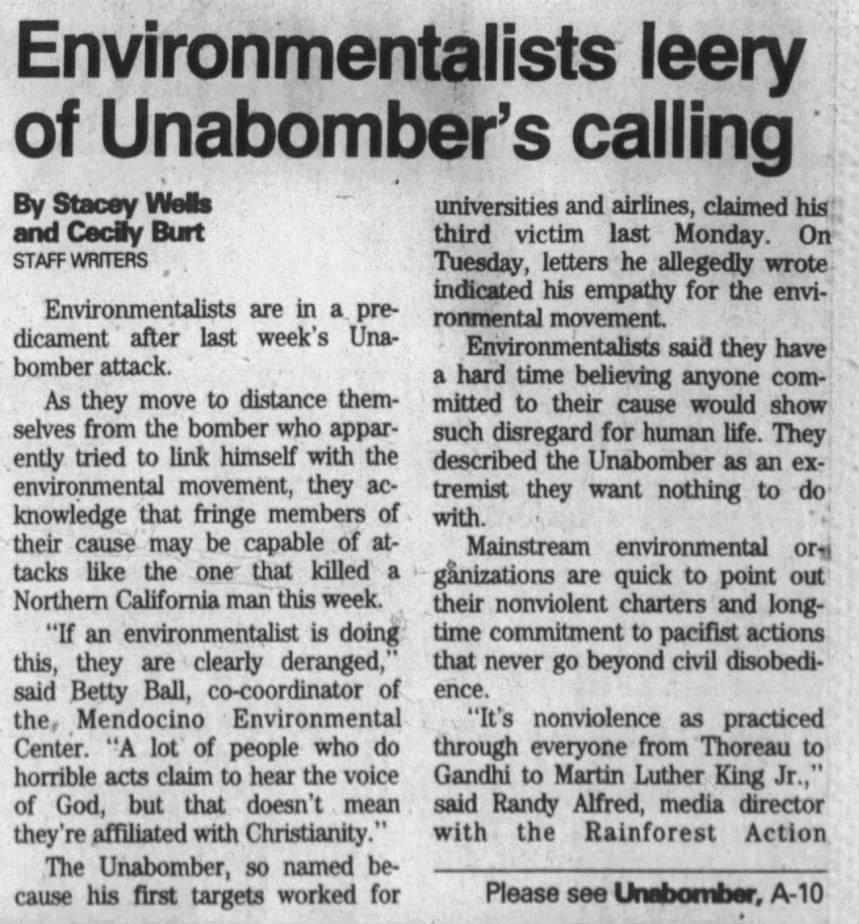
Environmentalists leary of Unabomber’s calling
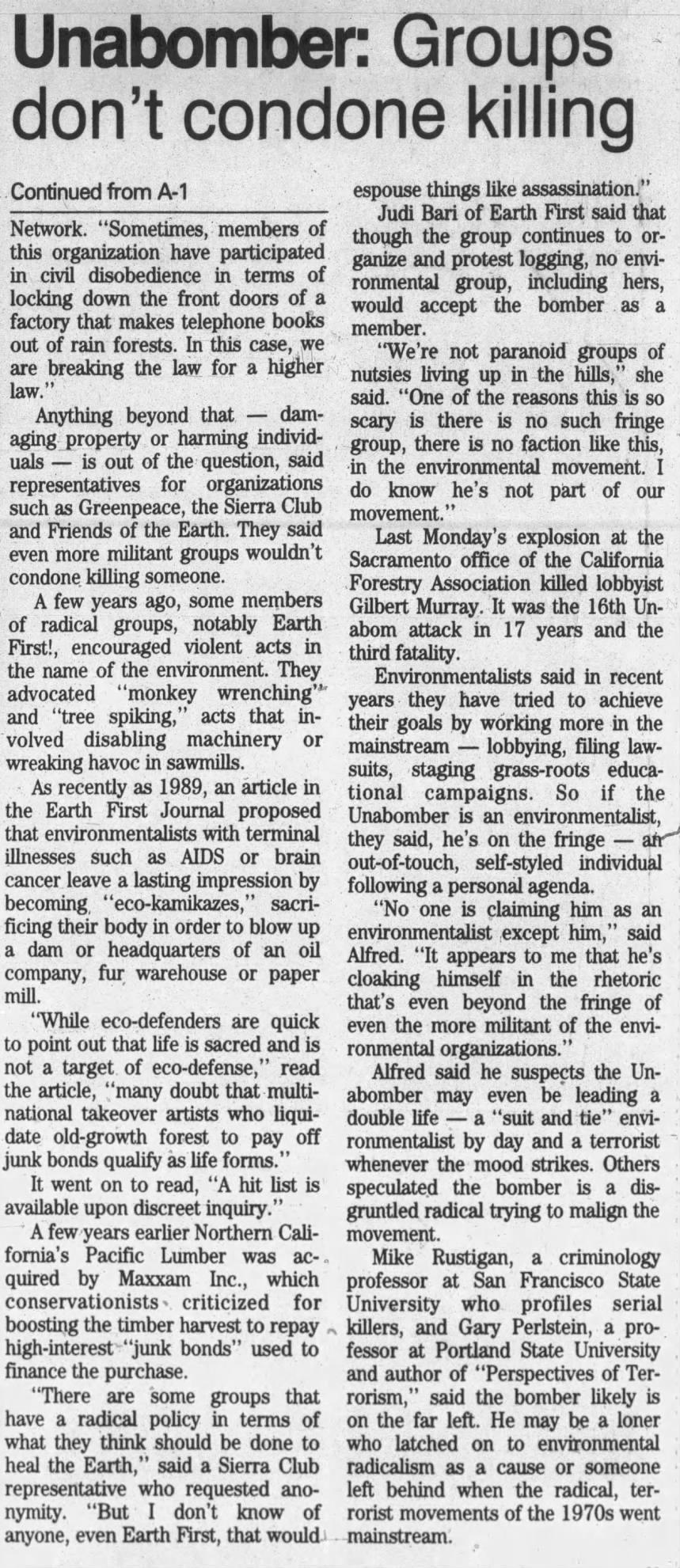
Groups don’t condone killing
May 1, 1995
Environmentalists are in a predicament after last week’s Unabomber attack.
As they move to distance themselves from the bomber who apparently tried to link himself with the environmental movement, they acknowledge that fringe members of their cause may be capable of attacks like the one that killed a Northern California man this week.
“If an environmentalist is doing this, they are clearly deranged,” said Betty Ball, co-coordinator of the. Mendocino Environmental Center. “A lot of people who do horrible acts claim to hear the voice of God, but that doesn’t mean they’re affiliated with Christianity.”
The Unabomber, so named because his first targets worked for universities and airlines, claimed his third victim last Monday. On Tuesday, letters he allegedly wrote indicated his empathy for the environmental movement
Environmentalists said they have a hard time believing anyone committed to their cause would show such disregard for human life. They described the Unabomber as an extremist they want nothing to do with.
Mainstream environmental organizations are quick to point out their nonviolent charters and long-time commitment to pacifist actions that never go beyond civil disobedience.
“It’s nonviolence as practiced through everyone from Thoreau to Gandhi to Martin Luther King Jr.,” said Randy Alfred, media director with the Rainforest Action Network. “Sometimes, members of this organization have participated in civil disobedience in terms of locking down the front doors of a factory that makes telephone books out of rain forests. In this case, we are breaking the law for a higher law.”
Anything beyond that — damaging property or harming individuals — is out of the question, said representatives for organizations such as Greenpeace, the Sierra Club and Friends of the Earth. They said even more militant groups wouldn’t condone killing someone.
A few years ago, some members of radical groups, notably Earth First!, encouraged violent acts in the name of the environment. They advocated “monkey wrenching” and “tree spiking,” acts that involved disabling machinery or wreaking havoc in sawmills.
As recently as 1989, an article in the Earth First Journal proposed that environmentalists with terminal illnesses such as AIDS or brain cancer leave a lasting impression by becoming “eco-kamikazes,” sacrificing their body in order to blow up a dam or headquarters of an oil company, fur warehouse or paper mill.
“While eco-defenders are quick to point out that life is sacred and is not a target of eco-defense,” read the article, “many doubt that multinational takeover artists who liquidate old-growth forest to pay off junk bonds qualify as life forms.”
It went on to read, “A hit list is available upon discreet inquiry.”
A few years earlier Northern California’s Pacific Lumber was acquired by Maxxam Inc., which conservationists criticized for boosting the timber harvest to repay high-interest “junk bonds” used to finance the purchase.
“There are some groups that have a radical policy in terms of what they think should be done to heal the Earth,” said a Sierra Club representative who requested anonymity. “But I don’t know of anyone, even Earth First, that would espouse things like assassination.”
Judi Bari of Earth First said that though the group continues to organize and protest logging, no environmental group, including hers, would accept the bomber as a member.
“We’re not paranoid groups of nutsies living up in the hills,” she said. “One of the reasons this is so scary is there is no such fringe group, there is no faction like this, in the environmental movement. I do know he’s not part of our movement.”
Last Monday’s explosion at the Sacramento office of the California Forestry Association killed lobbyist Gilbert Murray. It was the 16th Unabom attack in 17 years and the third fatality.
Environmentalists said in recent years they have tried to achieve their goals by working more in the mainstream — lobbying, filing lawsuits, staging grass-roots educational campaigns. So if the Unabomber is an environmentalist, they said, he’s on the fringe — am out-of-touch, self-styled individual following a personal agenda.
“No one is claiming him as an environmentalist except him,” said Alfred. “It appears to me that he’s cloaking himself in the rhetoric that’s even beyond the fringe of even the more militant of the environmental organizations.”
Alfred said he suspects the Unabomber may even be leading a double life — a “suit and tie” environmentalist by day and a terrorist whenever the mood strikes. Others speculated the bomber is a disgruntled radical trying to malign the movement.
Mike Rustigan, a criminology professor at San Francisco State University who profiles serial killers, and Gary Perlstein, a professor at Portland State University and author of “Perspectives of Terrorism,” said the bomber likely is on the far left. He may be a loner who latched on to environmental radicalism as a cause or someone left behind when the radical, terrorist movements of the 1970s went mainstream.