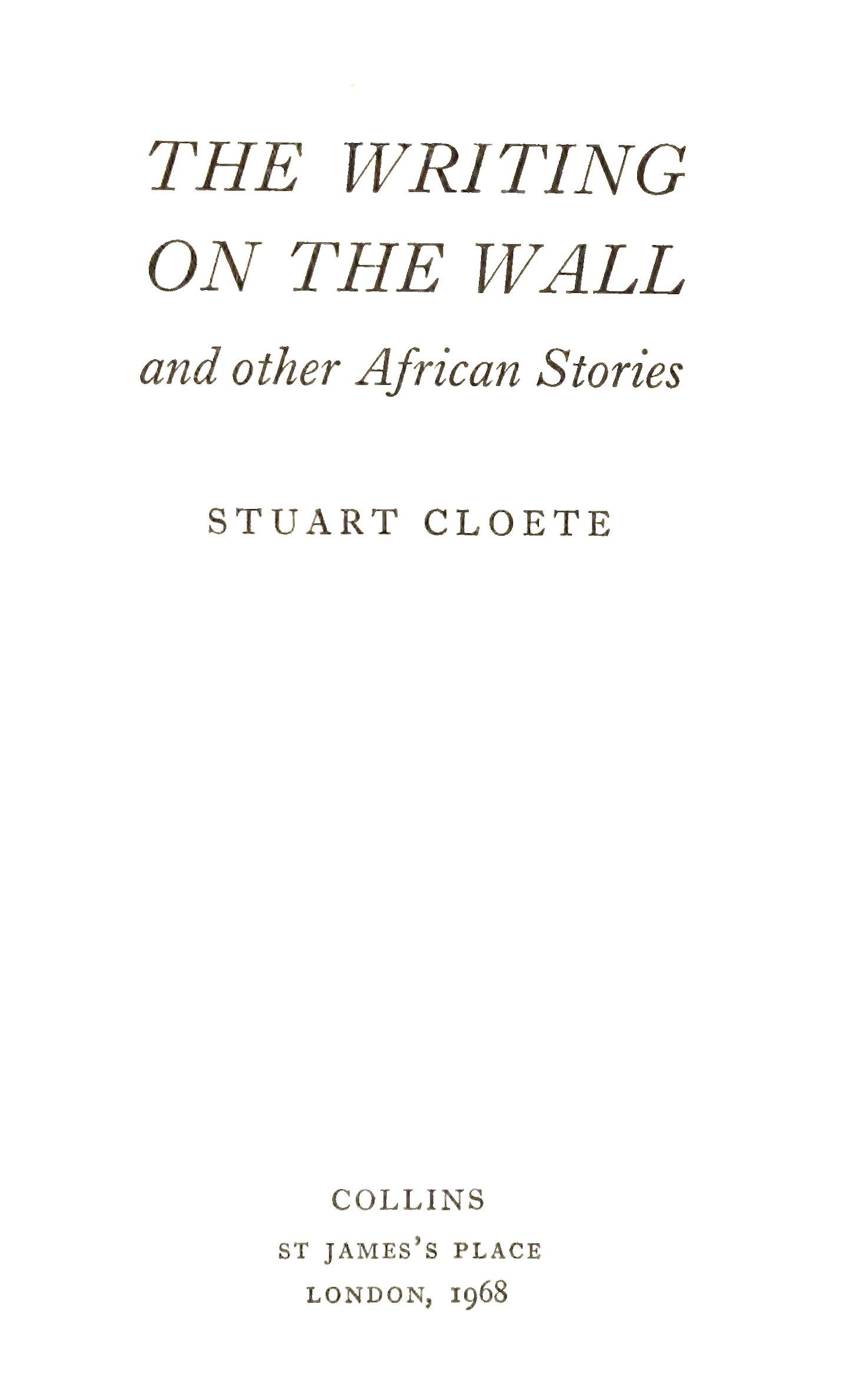
Stuart Cloete
The Writing on the Wall
And Other African Stories
1968
This is the fifth volume of short stories by Stuart Cloete to be published by Collins. All, as usual, are set in Africa, the vastness and ever-changing patterns of which provide Mr. Cloete with a seemingly inexhaustible fund of dramatic incident. No one writes more vividly of the continent in which his ancestors were born and which he loves. He is able to draw with equal assurance on the pioneering past and on the strange paradoxes and incongruities of present-day Africa, where, as he points out, ‘the changes are still superficial and a dark pulse still beats like a throbbing in the night.... Everything is still loaded against progress. Disease, the climate, termites, insects, fires, storms, droughts and floods. A violent continent largely peopled by men who, at the moment, have fallen between two stools, those of the past and the future.’
To read these stories is to feel and hear the dark pulse of Africa, and to partake in Stuart Cloete’s deeply rooted knowledge of life and wildlife which he imparts with such excitement, dramatic sense and literary grace.
By the same author
Turning Wheels
Watch Tor the Dawn
The Hill of Doves
Congo Song
African Portraits
The Curve and the Tusk
The African Giant
Mamba
The Mask
Gazella
The Soldiers’ Peaches
The Fiercest Heart
The Silver Trumpet
West With the Sun
The Looking Glass
Rags of Glory
The Honey Bird
The 1001 Nights of Jean Macaque
© 1968 by Stuart Cloete
Printed in Great Britain
Collins Clear-Type Press
London and Glasgow
Introduction
These are stories of a continent where the changes are still superficial and a dark pulse still beats like a drum throbbing in the night. The darkness that was illuminated for a while, an instant only, the twinkling of a geological eye, is returning as the jungle closes in again and the pontoons rot in stagnant rivers.
Time, massive aid in money and know-how, may in the end bring civilization and industry to the forests and savannahs of this strange land that has stood still for millennia, but how long it will take remains to be seen.
In the meantime, the now of today, Nature—the forest, the desert, the tse-tse and anopheles mosquito—is still the master. Droughts still kill thousands of head of livestock. Fires devastate the grasslands. Tribes refuse to become nations and the past, which is much nearer here than the future, shows its hand again.
These stories are woven out of this fabric. The old Africa that is still there and the new that is being superimposed upon it, neither being quite what one would wish or hope it to be. Much of virtue has gone out of the old, little virtue has come in with the new in this period of transition. Nor is it easy to foretell the outcome when one has to measure such impalpables: to weigh computers against forest gods, elephants against airplanes, medicine against witch-doctors, education against an age-old cultural pattern. Flux, transition, disorder, deterioration and chaos are all words that occur to one. But, and this is the tragedy, in Africa to stand still is to go backwards. Everything is loaded against progress. Disease, the climate, termites, insects, fires, storms, droughts and floods. For this is still a violent continent, still largely peopled by men in an early Iron Age culture who, at the moment, have fallen between two stools, those of the past and the future.
A few years ago I was in a store about 300 miles north of the Limpopo in Portuguese East Africa. I was on my way up- country after elephants and it was almost my last stop as far as civilization w’ent, and as far as it was civilization. The store was run by a Portuguese, yellow with fever. The only water he had was rain water that he collected in a large concrete tank with a brass tap that had a hole for a padlock in it. For as far as you could see there was nothing but bush—trees that were neither trees nor shrubs, that could not be described as green, that lived tortured vegetable lives without succeeding in becoming vegetation in the ordinary sense of the word. They had only one quality, that of being able to survive intense heat, drought and occasional forest fires. From the lowest branch of one of the nearest trees a cow-skin hung. It had been put there green and had dried into a crinkled black and white sheet that gripped the branch as it contracted.
The store itself was hot, almost as hot as it was outside, but dark instead of glaring. When my eyes became accustomed to the gloom I saw the goods on the shelves. They were the usual things: cans of meat, fish, green peas, beans, tomato ketchup, bottles of oil. There W’ere the usual items of hardware: axes, shovels, picks, hoes. There were the usual shelves of soft goods —rolled bale after bale of red and yellow and blue materials— Kaffir stuff for the native trade.
The storekeeper asked me if I would like some roast chicken and brought in a plate for me. He gave me a glass of warm white Portuguese wine, and while I sat on the counter eating, a native girl followed by a man considerably older than herself came in. He was smiling. She was serious. She carried a long peeled wand in her hand and a rolled mat balanced on her head.
The man came up to the counter. The woman spread her mat—it was made of split reeds—and sat down on the floor. She looked about her with the bright eyes of a bride. His new wife, the storekeeper said. She was a lovely thing—like a brown gazelle. She looked, and then with her wand pointed at a roll of material. The storekeeper got it down, unrolled some of it and held it up against his chest. She nodded her head. He cut the edge of the material, ripped it down and passed it to an Indian who sat beside a Singer sewing-machine. The Indian hemmed the torn edges and tossed it to the girl on the floor, who by this time had pointed to another piece of material. These pieces of stuff were about the size of tablecloths, and are called capulanas. They are all the women wear. They wear them wound round their bodies, somet>mes below and sometimes above their breasts.
Soon the bride had a heap beside her. Her husband was buying her everything she wanted. She piled each piece as she got it on the floor beside her, that was dusty with earth brought in by the bare feet of the previous customers.
I ate my chicken and drank my wine. Dirty, I thought. And then I thought about dirt and the way we use the word. Dirt road, garden dirt, rich dirt. Dirt, I thought, means earth. We are afraid of earth but to these people the earth is their mother. They sit on it, they sleep on it. Dust to dust, I thought. Earth to earth. But I was much farther away from it—from reality— than this bride sitting so happily shopping in the dust.
It gave me something to think about as I drove on. Mother Earth. Perhaps it is time we thought about our mother. She is not concrete. She is not Cellophane. She is not plastic. She is dirt—the rich dirt of our country—the earth with which we have lost contact.
The scene was in a way symbolic: the old Africa meeting the products of civilization on the floor of a store in the bush.
The Writing on the Wall
Dirk Le Roux could not understand his wife’s feelings about horses. Her scenes only confirmed his opinion that females of all kinds were unreliable and the cause of trouble. Mares were the same, affectionate one moment and lashing out the next. Except with their young, there was no counting on the behaviour of any female creature. And leaving Melvina, whom he loved but did not understand, he often went, after an argument with her, to the black stallions that he loved and did understand. They would look at him in the half light of the stable with large dark eyes—eyes that could flash fire when they were excited—and he would stroke their soft grey muzzles with the back of his hand. Their muzzles were like moleskin, and out of them grew a few short prickly hairs. When he petted his stallions, touching their noses and slapping their hard necks and quarters, they would stamp their feet, whicker at him, rising off the ground in little pleasure plunges, and blow at him with wide nostrils. Like children those two horses were to him, like beautiful shining children, his joy, his pride, and part of his life. Why, they were even a part of Melvina’s life, because he had bought them to court her with, to make an impression on her father, who, being a great horseman himself, favoured his suit. He had named the horses after two Zulu kings. Chaka and Dmgaan they were called. Full brothers, Chaka the elder by one year and five months.
He thought back to when he had seen Chaka the first time. A long-legged, rusty-coloured colt standing beside his dam in a small camp. She was a half-bred bay hackney and he had thought, That foal will be a black and should turn out well. His sire was a black. Then later another colt had been born—also rusty black—by the same horse, but by this time Chaka, the first one, bad taken on his permanent colour and in the whole district there was no finer-looking yearling or one with better bone or action. Already you could see traces of his mother’s hackney blood, but he had a long stride, and did not waste his time picking up his feet and putting them down in the same place. Dirk remembered thinking then, If that second colt turns out like the first, what a pair of cart horses they will make.
In his mind he had seen them as they were now. Two full brothers, coal black with white chrome leather harness, inspanned to a black Cape cart with scarlet wheels and pole. He had thought of driving Melvina behind them, in that cart with the bright red wheels. A golden filly of a girl. Long-legged, long-maned, who at fifteen had already been very much aware of her attractions. Almost without knowing he was doing it, he had courted the girl and the stallions together, giving them sweets and titbits and giving the girl a ribbon he had bought in town, or a coral necklace. He had talked for hours with the owner of the horses and the father of the girl. It was soon understood that he had first call on the horses if their owner, Jan Otto, ever sold them. He said he might decide to keep them himself, but in the end he had come round. And old van der Merwe was well aware of what was in his mind about his girl Melvina. What was in his mind was what was in the mind of every young man who saw her, and was something Melvina took good care, in the most natural manner in the world, to put there.
Ja, he thought, as he watched Piet putting the horses into the cart, I courted the three of them together, and it is a strange thing that she cannot see that my love for her is all mixed up in my heart with my love for them.
Since his work took him driving every day—he was a dealer in livestock; cattle, horses and mules—he had felt that he might as well drive animals that were worth looking at as others that were not. He knew when they saw him coming people said, ‘Look, here comes Dirk Le Roux with his pair of blacks,’ and that when he had passed anyone (and he could pass any other horses on the road) people said. ‘There is no shame in being passed by Le Roux’s black horses, they are the best in the district.’
‘A car,’ Melvina said, ‘why don’t you buy a car?’ A machine that spat smoke, that bit you with electricity if you touched it, that did not know your hand from another’s. And who would be talk to on the lonely road in a motor-car? With the horses he kept up a continual conversation. Encouraging them, telling them to go faster, to go slower, to take care; explaining such things as blowing newspapers that might frighten them, and even upon occasion discussing the political news, or the price he was willing to pay for a certain animal with them. He had worked out a kind of system—an oracle as it were—with his horses and read their replies to his questions in the movements of their ears. If they laid them back it was no, if they cocked them forward it was yes. With his horses and his wife and child Dirk was happy. As happy as Melvina would let him be, that is. He liked his business because it entailed much visiting of farms and talking. He liked visiting and talking and, since people always treat the man who comes to buy stock well, hoping to influence him by their hospitality, he got much good food and many a glass of brandy or Boer wine. Graskop, the farm that his ancestors had made in the valley in the old days, had once been a big place, four thousand morgen—eight thousand acres—but now the tillage, it was almost a town, had swallowed most of it, and all that was left to him, the eighth owner, was the old house which was in a bad state of repair, a hundred acres of pasture, an orchard, a small vineyard, and the oak wood where he ran his pigs. The glory of Graskop was gone but the old house was mellow and the trees and shrubs— the figs, camphors, bottle-brush, camellias, mulberries, oranges and lemons—were big and strong. Generations of children had played under them, generations of young people had courted among them. He loved his land, what was left of it. It was his and he was a part of the land, for the bone and blood and sinew of Dirk Le Roux and his fathers before him had been nourished by the rich soil of Graskop, by the fruits and vegetables and meats of that soil. Life, he thought, if it was not for those little troubles with his wife about the horses, was good. There was enough left of the farm to give them plenty of produce; and the great stable, yards, sheds and kraals that had once housed the beasts and slaves of his ancestors now served to hold the animals he traded, and so he was content and in lus way happy, though often puzzled by his wife’s behaviour.
Soon the stallions would come. Melvina I e Roux looked at the white wall of the stable that ran at right angles to the house. The stable was on the other side of the wall, but the cart house was on this side and every morning Piet the coloured man brought the horses round down the short drive that was bounded by the white wall of the back of the stable on one side and a line of oak trees on the other. In the summer the wall was dappled with the black shade of the oaks, half hidden by them, but now they were bare. Great grey bones, lichened with orange on the south where the sun never touched them, apparently dead, but with life in them, with leaves and acorns and new’ little branches all latent in the massive bulk of their trunks. The oaks were like Dirk her husband—immovable, strong. They had been planted by Lis ancestors, and each generation of Le Rouxs growing up in their shadow appeared to have been affected by them, so that people said of the family, ‘Ah, the Le Rouxs of Graskop are like oaks, strong and obstinate. Ja,’ they said, ‘you can make things out of an oak, but you will spoil many tools in the making.’
She felt she was not of the metal to change her husband. She was too soft. But she was sometimes comforted by the thought of what water dripping continually on a rock could do. Nothing could be harder than rock. Nothing softer than a drop of water. Yet in time the water had its way.
Melvina had her child on her knee. Little Lena, blonde like herself, and like her with the dark eyes that showed the Huguenot strain in their blood.
Lena was five and she wanted to see the horses come. She loved them. They were beautiful with their flowing manes and long black tails. She loved to hear them neigh and see them cock their ears when they came near to her father. She loved to stand between her father’s knees when he drove them. She loved the smell of the horse sweat, and the white leather harness, and the sound of the wheels spinning on the hard road. She watched eagerly for them to come round the corner with Piet between them, leaning back, holding them as they came down the drive, pulling at him, almost lifting him off his feet, as they tossed their heads, pig-jumped and passaged in their excitement. Her father liked them in high condition. He liked them to show their strength and their pr:de.
Mevrou van der Merwe also watched the corner. She was Melvina’s mother and lived with them now that she was widowed. She watched uneasily because there was something going on here. Something between her daughter, the two horses, and Dirk her son-in-law. A strange affair between a woman, a man, and two coal-black stallions. The eyes of them all were on the window. Of the old woman, who as a woman was finished and knew it, of the child who had not yet begun to be a woman and knew nothing of it, and of Melvina, the young woman, in fullness of her w omanhood—a tall, well-made woman with fine breasts, a small waist, good hips and strong slim legs—legs like a buck, her husband said. For the rest of her, he tended to quote the Song of Songs, and—which embarrassed her—not only in private, wdien they were alone; but Dirk was a man who loved the beauties of the body of a woman, or a horse. Sometimes it seemed to her that he thought of them together, and spoke of them in the same breath. Sometimes when she watched his face as he caressed his stallions she thought of his hands on her in the darkness of the night, and wondered if he had the same expression on his face. If his eyes were as bright, his mouth as tender. A bold, brave man, a hard worker, a great lover of all things that lived, a lover even of the game he hunted, for like all Boers he loved to hunt. He loved loving, he loved eating and drinking, he loved smoking the strong tobacco that he bought from a friend up in the Transvaal. He was in addition a very handsome man, tall, strong, florid, with black hair and a fine beard.
At Graskop he was the centre of all things, the master, the groot Baas. And for all her beauty and all her tricks, and she had many loving tricks of wheedling and cajoling, of promising with her eyes and lips, she had never been able to master Lm the way, in her opinion, a beautiful woman should be able to master a man. Dirk could not be seduced, neither before marriage nor after it, and the cause was his love of his horses. Never had a woman been more plagued than she, never had a woman more cause for jealousy, or rivals about whom she could do so little. He quoted the Bible about her charms but he did so too about his stallions. Quoting from Job—the part where the war-horses said Ha-Ha when they heard the shouting of the captains. It was this, her sharing even of Biblical quotations with the horses that enraged her more, much more, than the indecency of the other quotations before friends. That her teeth were like pomegranate seeds and her belly ... But that he should then jump from Solomon to Job and the war-horses was more than she could bear. If only it was a woman, she thought. No woman had more to offer than she, no woman could do more for a man, give him greater joy. But no woman could carry a big man at a gallop over the veld, or snort and stamp, when her husband came near her. Irritation flooded her. She moved the child on her knee. As she moved her, the child cried out. ‘There they come. There are the horses,’ and her eyes wTere forced to look. She had meant to go away. Today she had said to herself, I will not look. I will go to the back of the house. I will not torture myself any more.’ It was absurd this daily routine they went through just because Lena loved to watch the horses come. Let her watch them by herself. Let her watch with her grandmother. Perish the two damned black horses. Black was the colour of evil. The horses were wicked. They had stolen her husband from her. But still, she could not keep from looking.
There they came, tossing their manes, whisking their tails, walking as if they stepped on hot bricks, their ears cocked, their nostrils flaring red. Piel lay back on the riems of their halters, holding them tight. He had taken the raw hide through their mouths as if they were bits, and still they jogged him up and down—almost off the red ouklip of the drive. Black as night, without a white hair on them, the great horses came past, and then, as usual, just as they came level with the house, they threw up their heads, opened their mouths, rolling back their lips so that she could see their teeth—the big stallion tushes on the sides of their mouths—and shrilled out their trumpet call. They were telling Dirk that they were here, that they were ready for him, that he must come to them. They shrilled again, and pawed at the ground, their iron shoes shone like silver as they raised their feet. And then she saw her husband come, as he always came, with a slice of bread for each of them. Bread that she had baked. There was something wicked in using it, for bread was sacred. It was like giving some kind of sacrament to the Devil. The black hooved stallions were the Devil himself.
She turned to her mother and said, I wish it was a woman. Magtig, if it was a woman I could face her and him. I could make him choose. But what can I do with a horse? I want him to sell them,’ she said, ‘but he won’t. He says he might as well sell me. That I and the horses are his life, the very blood of his life. He does not even say the child. Just the horses and me. We are just things to him. Things to show off to others. Things to give him pleasure. I told him to sell them to the undertaker. “They are fine horses for an undertaker,” I said, “and Jacob Coutzee would buy them, for his horses are now old, and he prides himself on his equipage.” He just laughed, Ma, and said, “Can you see old Jacob sitting in his top hat behind a pair of stallions like mine?” and I said, “They need not be stallions,” and then he struck me. “Castrate my stallions, woman!” he said, “That will only happen when I am dead.” But I still wish that Meneer Coutzee had them. I wish I could see them pulling the hearse, and that Dirk would buy a nice Ford motor-car that I could be proud of riding in. I wish ..
Her mother said, ‘Do not wish, Melvina. In my life I have learned that it is dangerous to wish. Dirk is a good man and if he loves horses more than he should, it is better than his loving other women, or gambling or drinking, or coming home to beat you.’
‘He struck me/ Melvina said.
The memory of the blow stung her anew. Telling her mother of it revived it, so that her face flushed, as if with the heat of the slap. Her eyes watered. Angry tears formed on the inner corners, hung poised, and rolled down the side of her nose. Her heart beat faster with love, with hate, with anger, with jealousy. I must be all to him, she thought. All. There must be nothing else in his mind and heart. Me and Lena, my child, who is a part of me, a piece that is broken off me, as much a part of me as the cutting of a mulberry is a part of the parent tree. Horses can have no part in this relationship Horses. She hated them. She found she had always hated horses, and stallions most of all. Their masculinity outraged her; their pride, their prancings and neighings, the way they looked about them, so bold and free. It made one hot to think of it. If he had just liked horses it would have been different, she felt. But stallions were something else, something apart and special. In spite of the fact that they had never been used at stud, the potential was there, the latent power of their great black shining loins. It lay in the strength of their backs, the power of their arched necks and flowing manes. Their presence was more than a decent woman could bear and she would end it. At once, today, she must go to him and say ‘Choose.’ She did not know what he must choose or how. She could not say she would divorce him if he did not get rid of his horses, because divorce for people like her was unthinkable. They married for better or worse, till death parted them, but in some other way he must choose. He must choose which he would love. For her love she could deny him. Not the function of it, for he had his rights, but the spiritual side of those rights, the affection and the passion that animated her whenever she saw him, whenever she even heard his voice or footstep. This she could tear out of her heart and destroy. This love she would throttle if he did not choose her. As if it wras a chicken, she thought. She would wring the neck of her love, and dead, throw it away so that it would rot and its beauty become putrescent. Like a dead bird, its feathers soiled and awry would fall off its body and be blown hither and thither by the wind, till they decayed and were trodden underfoot. Her memories would be like the feathers fading, becoming spoiled, till finally she would find it hard to believe that there had ever been any glory 01 beauty there. All this she would tell Dirk if she could. It would be hard because she was a feeling and not a talking woman. A woman of the heart rather than the mind. But the end had come now, suddenly, as she spoke to her mother. Why, even when he had courted her he had spent almost as much time courting those horses. Those years when she had felt his eyes on her, running over her. His eyes and his hands had been on those two black colts as well. He had gone from the one to the other. When he had not been working he had divided his time between them. Between me and the horses, she thought. What a thing to have done. And how was it, she wondered, that the full significance of it all had not been apparent to her before?
Her mother was saying something. She said, ‘Ja,ja, yes, yes,’ to her mother. She could hear herself say it, but she was taking nothing in. In her mind she saw her husband in the stable yard fondling those black devils, feeding them the holy bread she had baked. Holy, because bread was the staff of life given to man by God for his sustenance. Bread was not for the beasts. Mealies and other grains were for them. Wheat was for man and man alone, and the ground wheat, already holy, was made more so by the act of baking, by the kneading of it into dough, by the magical act of its rising.
Her mother’s words penetrated the fury of her mind at last. She was saying again—why had she to repeat herself so much? —that it was a mistake to wish. Wishes often came true and then one was sorry.
‘Sorry’ she said, ‘no, Ma, I shall not be sorry, if my wish comes true, and these two black devils of horses are inspanned into the hearse where they belong. Sorry,’ she said much louder, almost in a scream, ‘sorry, no, no, I shall be more than glad. It is something that I pray to the Almighty for every night and morning. I say, “Lord God save me from those wicked horses and put them where they belong one on each side of the disselboom of Meneer Jacob Coetzee’s fine new hearse. Let them serve the Lord dragging Christian corpses to holy soil, instead of the Devil, in their pride, as they do today.” This I pray, Ma, and this I hope with all my heart.’ She burst into tears.
Her mother said, ‘It is the full of the moon and since you were twelve years old, the full of the moon has always affected you. As it grows large you have always been difficult, wild and strange, and as it waned become good again, good as gold and gentle as a woolly lamb. I remember telling Dirk this before you married him. For, I thought, he is a simple man, knowing more of horses and cattle than of women. So I told him.’
She had dared to tell him this. Her mother had told him her secret. And it wasn’t true either. It was a wicked lie, an invention.
‘I said,’ her mother went on, ‘Melvina is difficult at that time, and he said, “Yes, I understand. A rnare or a heifer is often difficult at certain times. One must be gentle with them then, careful to keep away from their horns and heels.” He laughed,’ her mother said, ‘and I laughed too at my fears of his ignorance of women for st came to me then that a man who knows animals also knows women, and I was right, for he has been a fine husband to you.’
‘He struck me,’ Melvina said.
‘Struck!’ her mother said. ‘A little slap for saying a wicked thing like that. He has never beaten you and he never will. Dirk is a fine husband to you, my girl, a fine father to little Lena, and a fine son to me who never was blessed by one.’
Melvina held the child close to her. Lena was whimpering, she did not like what was going on. Argument, raised voices. Her mother’s tears had fallen on her face and were salt in her mouth, and besides she wanted to run out to her father and the splendid horses. She wanted to see him get into the cart and drive off.
‘ The horses, Ma,’ she said, ‘I want to go to the horses.’
The child too, Melvina thought Those devils had stolen both her husband and her child.
‘I want to go to the horses,’ Lena said again. I want to see them go out of the yard.’
‘We will both go,’ Melvina said. Ja, they would both go. And her husband must choose. He must do something. This could not go on. It was more than she could bear
She pushed the child away from her and got up.
Her mother said, ‘Where are you going, Melvina?’
She said, ‘To see Dirk. To tell him.’
‘Don’t go,’ her mother said. ‘You must not go when you are like this. It is the moon, I tell you. It is the moon.’
The moon. Her mother would send her mad with this moon talk. And if there was anything in it, it was her mother’s fault. It was her mother who had first planted the idea m her childish mind. That she was odd when the moon was full. Till at last, when looking at it, she had said to herself, I am odd when you are big. And the rabbit sitting up there in the full moon had seemed to agree with her. ‘Ja* he had said, ‘we are odd, you and I. Mad as hares.’
But there was nothing odd in this matter of the horses, or of having been struck, or of having to share her husband with agents of the Devil himself. If only it was a woman, she thought again ... If only he would sell them to the undertaker. Meneer Coetzee was a fine-looking man and the horses would iust suit him, and they would get a car. She saw the car in her mind. A nice black Ford on high wheels, with a hood to keep the sun off them, and side curtains that you fitted on if it rained Why, with a car they could go fifty or a hundred miles in a day. The world was open to them. Travel, life, everything could be theirs with a motor-car.
The child ran beside her, hopping and skipping, putting her weight first on one foot and then on the other, and jumping, then trotting with high action like a hackney, tossing her golden mane of hair. Her mother caught her by the wrist and jerked her arm. ‘Walk like a lady,’ she said. ‘You are not an animal.’ In her mind she said, you are not a horse. In her mind she said, those black devils have bewitched my child. They have stolen my husband and bewitched my child.
She was in the yard now’, in the blazing winter sunshine. Everything was white, unrelieved bj the greenery of the trees, the oaks threw only the faintest blue tracery of shadow from their branches on the white of the walls. Piet stood by the horses’ heads. Dirk must have finished petting them because he stood holding on to the mudguard of the near wheel with his left hand. With Ins right he held the reins and the dashboard. The long black whip, bound every few inches with wide brass bands, shone as it stood in its socket. She noticed he had the lamps on. She saw the candles in them, saw that they were long and new, but that they had been lit, the wicks were black, so they would light again easily. That meant that he would be home late. He was going far, twenty miles perhaps, and must rest his horses. Forty miles there and back. Nothing in a car, but a long drive, even for horses like the two that were bucketing about and rubbing their strong shoulders against the scarlet pole of the cart.
‘Dirk,’ she said, ‘Dirk.’
He said, ‘Ja’ and sw ung himself upwards.
He sat down, put his feet against the dashboard and tightened his hold on the reins. The horses felt him take hold, arched their necks, curved their strong quarters inwards with their hocks under them, so that the moment they got the signal—the shout from their master, ‘Maak los’ make loose, that would bring Piet with a leap to the wall—they would spring forward and the cart from being still, would move out into the drive like a bullet. For the hundred yards of the drive they would gallop, Dirk standing and calling to them. And when they got to the entrance, where the gate used to be, they would stop and go out at a walk into the main road. But they loved their gallop. Specially did they love it on a sunshiny cold winter’s day, like today, when their breath was like smoke out of the red fire of their nostrils. But today they did not go at once. He held them in and they began to rear. But he still held them and calmed them with his voice.
‘What is it?’ Dirk said. ‘Tell me quickly for I cannot hold them long.’
‘You must sell them,’ she said. ‘You must sell them to the undertaker or else ...’
‘Or else what?’ he shouted. Now the stallions were angry. They were standing right up, pawing the air. They lifted Piet off the ground. He could not hold them longer without the danger of an accident, a broken pole or harness. The woman was mad, sell them to the undertaker ...
‘You must sell them,’ she said again. ‘He will buy them or else ...’
‘Or else what?’ Now they must go. ‘Maak los,’ he shouted.
Piet let go and the flying red wheels only missed him by a foot.
Lena burst into tears. ‘It was not nice,’ she said. ‘I do not like to see him go off like that. It makes me afraid.’
‘Afraid! you are right to be afraid. They are devils.’
When she went in again her mother was standing by the house-plants in the window. She said, ‘What did you do, Melvina? Why did he go off like that? His face was angry and the horses were angry. An angry man is not good with angry horses. For safety one or the other must be calm.’
‘I said he must sell them to the undertaker, to Meneer Coetzee. Sell them or else ..
‘Or else what?’
‘I do not know, Ma. Ek meet nie, but he must do something. And he never waited to find out.’ But perhaps it was just as well, she thought, for she had not known how she would go on.
‘I do not like it,’ her mother said.
‘Nor do I,’ Melvina said. ‘He must sell them. I cannot go on this way.’
‘Why is Lena crying?’ her mother said. ‘What’s the matter, Lena?’
‘I am frightened,’ Lena said. ‘Pa went out too fast. The wheel nearly went over poor Piet.’
‘They are devils,’ Melvina said, and she left her child with her mother and went into the bedroom. It should have been done by now, but it wasn’t. Everything was as it had been when they got up. There was the mark of where she had lain in the night. And the deeper, bigger mark of where Dirk had lain beside her. In that bed her child had been conceived and born. She flung herself on to it in a passsion of tears. Those zerdoem horses would spoil everything, rum her life. His talk was all of them. Of how they had gone, of when they must next be shod, of how he was going to show them at Caledon again next year.
When her crying was over she made the bed, and did the room. She even did the room specially well, as if she owed it something for not having done it earlier. She put a clean counterpane on the bed, one that had been a wedding-present and which she seldom used. She put flowers in a vase on the table by the window, and then, feeling much better, went to the kitchen to see how the new batch of bread was rising under its white blanket cover. She was looking at the dough when she heard a horse galloping up the drive. Who could it be and why the hurry, she wondered, as she put the bread back. Soon, in another hour, it would go into the oven. She must wash the flour off her Lands and see that she had none on her face before she went in to see who had come.
She heard voices in the front room. He was talking to her mother. She looked in the glass that was hung behind the kitchen door. It was kept there so as to be hidden when the door was open, no woman wishing to be accused of the sin of vanity, but no woman either being without a mirror somewhere in her kitchen, even if it was no more than the shining bottom of a copper saucepan. Ja, she knew very well that vanity was responsible for the cleanliness of some kitchens. Butter wouldn’t melt in the mouths of those ones, but one would be a fool to leave them alone w ith the butter all the same. They might put some into their mouths just to see. She tidied her hair and went into the sitting-room.
Her mother was in tears.
The man was Jan Smit, a young man she knew well.
‘What is it?’ she said.
‘I do not know how to tell you,’ he said.
Her mother looked up and said, ‘I will tell her. Your husband is dead, Melvina. The horses bolted and threw him out of the cart and he fell on his head.’
‘Ja’ young Smit said. ‘They are bringing him in.’
Bringing him home. He was dead. They would have to put him in the bedroom. Suppose she bad not done the room. How easily she might have been caught with the room not done. How lucky she had put on the good counterpane and flowers in the vase.
‘Ja,’ she said, ‘I am not surprised. Those horses were devils.’
In her mind she said, It was him or me. That is what I would have said to him had he waited. I should have said, or else I will leave you. You must choose. One of us must go. Now he was dead. And she would sell the horses.
‘Ja,’ she said, ‘they are devils and I will sell them. They are not hurt?’ she asked.
‘I saw it all,’ Smit said. ‘Dirk was driving fast and hard. His face was red and the horses were angry, their necks were white with curds of sweat. I said to myself, it is not good to drive like that. I also said, what has gone wrong, for Dirk Le Roux is known for his gentleness with beasts. And then a mare passed. A man was leading her. Fourie, it was. She was m a certain condition and he was taking her to visit a horse. Dirk’s stallions became excited, and shrilled and neighed at her, and she cocked her ears and whinnied to them. They called to each other and Dirk became angry and used his whip on them.’
‘They have never been whipped,’ Melvina’s mother said. ‘He never did more than let the lash rest upon their backs.’
‘Ja,’ Smit said, ‘that is why they went mad. They began to gallop. Dirk stood up in the cart but could not hold them. The rein broke as he pulled at it to try to turn them, and he fell out backwards on his head, on the hard road. I saw it all,’ he said. ‘He fell and was killed. His legs twitched a little and then he was still. There was no blood. It is his neck that is broken, I think.’
Only then did Melvina begin to cry. The shock had been too great. Her horror at her husband’s death had for an instant been compensated for by the fact that she had been right about the horses, that if he had taken her advice and sold them it would not have happened. She had said, ‘I told you so,’ to him in her mind. But he was dead. She would never say, ‘I told you so’ to him again.
Her mother said, ‘Ja, cry, my girl, , cry. But it’s you who killed him by your jealousy of the horses that he loved.’ Then her mother came to her and put her arms around her and led her to the spare bedroom that was never used. ‘Lie there,’ she said. ‘I will bring you coffee and see to everything. Ja,’ she said, ‘I will lay my son out, for he was like a son to me. No other hand shall touch him.’
‘Coetzee will be here soon,’ Smit said.
‘Ja,’ the old woman said, ‘like an aasvoel he will be here. Like a vulture in the sky, circling, waiting for death, he will be here.’
lJa’ Smit said, ‘but it is not only because of that he will come. He wants the horses.’
In the other room Melvina heard him say that.
The horses. Well, I certainly can’t keep them, she thought. She lay still. She would stay, she decided, till they brought Dirk in and had gone again. She could not face anyone yet. Later she would tidy herself and put on the black dress she had worn after her father died. Her mother would bring it to her. It was lucky that even after the birth of her child her figure had not changed. It would still fit her and she looked well in black. It showed off the mass of her yellow hair and her milk-white complexion. She looked very pure when she was in black, and her eyes, big, dark-ringed with sorrow, would look enormous. She remembered how she had looked when her father died and what people had said. She remembered the undertaker then, when he had come to the house. And thinking back she remembered feeling even then that he was a fine- looking man. She had felt this though she was newly married to Dirk. Dirk she had loved with the passion of a young woman. But Jacob Coetzee was a man one could admire. She wondered if he would recognize the black dress and decided he would not. After all, he saw nothing else, and to make certain she would alter it. She would put on the cuffs and collar of white lace that she had once bought from a salesman, a very goodlooking young man, and had never worn. She did not even think her mother knew she had them. She had not seen the traveller and she had never mentioned his having come.
Her mother was right as usual. In the hush of evening, when the doves in the bare oaks were cooing, Meneer Coetzee came to see her. She was ready for him m her black dress, with the new lace collar and cuffs. She had just had time to dampen them, iron them, and tack them on, when her mother told her he had come.
‘The aasvoel is here to see you,’ she said.
Her mother had never liked the man, he was too serious for her. Her mother, despite her years, was a light woman, Melvina decided suddenly. She did not even respect the predikant, and, it seemed to her now, had been over-fond of her husband Dirk. His blatant, boastlul, full-blooded arrogance, his rough caresses, his loud voice and laughter, his jokes that had a more than bedroom flavour, had all appealed to her. Dirk had made her laugh with that full belly laughter that she enjoyed. When she laughed, despite her stays, her stomach went up and down. But Meneer Coetzee never made anyone laugh. His was a serious profession. She looked in the glass—a mirror was permissible in a bedroom—straightened a corner of her lace collar and went out to see her visitor.
Jacob Coetzee was a tall man with a white face, bushy eyebrows and a mass of greying hair. He stood, top hat in hand, the long stooped figure of a man bowed by the perpetual grief which was the prerequisite of his profession. He said, ‘Mevrou, I am sorry to be here.’ He added, ‘I am sorry to be everywhere. I am not,’ he went on, ‘a welcome figure. I even know what I am called. Coetzee the aasvoel. It is not easy to be an undertaker,’ he said, ‘and since my wife died two years ago leaving me with three small motherless children, I have been alone.’
Melvina pointed to the chair. He sat down, with his tall hat held upside down like a black bucket on his knee. It had a lining of purple silk. Somehow it surprised Melvina to see it. I never knew his hat had such a lining, she thought. Then she said, ‘Ja, you must be a lonely man. Now, I too shall know loneliness. I am young to be widowed, and never did a woman lose a finer husband, or a child a better father.’ She saw suddenly what a fine man Dirk had been.
‘Ja’ he said, ‘a tragic end for so fine a man. But it was not unforeseen. Those horses were bound to bring trouble.’
‘That is what I always said, Meneer. I was always against them. My last words to him were “You must sell those horses. You must sell them to Meneer Coetzee the undertaker ...” Oh,’ she said, ‘perhaps I should not have said that. It just slipped out. But before this happened you did want to buy them? You remember’ she said, ‘when you got your beautiful new hearse you said, “If only I had a pair of black horses like Dirk Le Roux’s.” But I suppose ...’ Now her voice faded and she dabbed her eyes with the lace handkerchief that matched the collar and cuffs. It had been a present. The salesman had given it to her. He’d said. “I give it you because you are so beautiful, and may you never have to use it for anything except blowing your nose.” And now here she was crying into it, a widow, the very first time she was using it. It would make the salesman sad if he knew, she thought. She crossed her legs demurely and pulled down her black skirt. ‘Now,’ she said, ‘you will not want them I suppose.’
‘On the contrary, Mevrou/ Coetzee said. ‘Among other things that is what I came about. For the other things I will speak to your mother, but the horses are yours.’
‘Ja’ she said, ‘they are mine.’
‘Your husband would wish it,’ he said. ‘He would like to drive behind them for the last time.’
‘Ju,’ she said. ‘He loved them. Sometimes I thought he loved them more than he loved me.’
‘I shall not give them any mealies,’ Coetzee said. ‘No grain.’ He acted as if they were already in his stable. ‘Just veld hay,’ he said, ‘and my boy will lead them in the hearse.’ Absent-mindedly Melvina said, ‘Ja, ja’ ‘/Afterwards .. ,’ he said. Of course he must mean after the funeral, Melvina thought. ‘... afterwards, of course,’ be said again, ‘I shall cut them.’ ‘Of course,’ she said absent-mindedly.
‘Stallions,’ he said, ‘are not suitable in a hearse.’
‘Ja,’ she said. ‘They are not suitable.’ Not in a hearse, she thought, nor anywhere else for that matter. It was a pity he was so old. But he was a fine man and admired her. She knew that from the way he looked at her legs when she had pulled her skirt down. She knew what was ‘n his mind. No, there was no doubt about his admiration, and undertaking was a good business. He dealt in a crop that never failed. What was it Dirk had called him? ‘A middleman between the dead, and God and the Devil.’ That was like Dirk. It had made her mother laugh. But death was no laughing matter. I wish he was younger, she thought again. But then, young men were seldom rich and she had a child to think of. Lena was about the same age as his eldest girl Johanna. A child had to have a father. And Jacob, she called him that in her mind, was a serious man Dirk had not been serious. It was his lack of seriousness, his joy m galloping about the countryside behind his black horses that had brought him to an early grave, left her a widow and his child fatherless. Tears filled her eyes. Her mother had said all this happened ‘because you wished him to sell them to the undertaker’. Well, in a way her mother had been right. And here was the undertaker trying to buy them from her. Her mother had said it was dangerous to wish because a wish so often came true; that it was like a kite, with many things you did not want tied to its tail. ‘It’s bad luck to wish,’ she had often said, and what had happened certainly seemed to prove it.
She felt Jacob’s eyes on her legs. They were on her ankles and calves. She drew her legs in and put her feet on the rail of her chair. She felt warm and uneasy. Her mother had said, ‘Often one does not understand what one wishes for. A woman,’ she had said, ‘should not wish. She should accept and live life as it comes to her.’ But it certainly could do no harm to wish Jacob was younger. Jacob Coetzee. A pretty name. Mevrou Coetzee ... Melvina Coetzee. She looked out of the window, through the pot plants, at the white wall of the barn. In big black letters she wrote her name there in her mind, forming the letters carefully, rounding them voluptuously and setting a splendid tail upon the Z. Melvina Coetzee ... Melvina Coetzee, she wrote. Like an advertisement it looked. Very real plastered on the white wall. And then, seeing it written there, she accepted it. It is my fate, she thought. It is for the child. He is a fine man and perhaps more vigorous than he looks. Looks were deceptive sometimes. Dirk, for instance, had not been as vigorous as he looked.
Coetzee said, ‘I will pay you two hundred pounds for the pair.’
She said, ‘They are good horses but everyone knows that Dirk only paid a hundred pounds for them, and even then people said it was too much.’
‘Ja,’ he said, ‘that may be so, but I will pay it because I want them very much. They are what I need to complete my life’s ambition. A fine hearse and a fine matched pair of blacks. Horses,’ he said, ‘that have taken prizes at a show.’
But she knew that it was more than the horses he wanted. And she knew, too, that it was more than the horses he would get. She moved uneasily on her chair. In a year, when the dead were assumed to be beyond jealousy, and the living thwarted of their scandal, he would come to fetch her. With her, he would get back his two hundred pounds—a ridiculous price. Ja, he would have the money, and her, and the child, and the house, and the land and the stock. The two hundred pounds would be a fine investment for him, bringing him in a hundred-fold increase, and on her part she would regain the stallions. Only of course they would be stallions no longer. In a year. In a year Lena would be six. In a year her husband, cold in his grave, would be used to being dead, and his fine black stallions calm in their gelded state. That was what had made him so angry. When he had slapped her he had said, ‘Before God, you are like all women. They are Delilahs all of them. Only over my dead body will my horses be cut.’ Well, that was it. Only over his dead body.
It was very sad, but in a year, in one more passing of each season—a spring, a summer, an autumn and a winter again—it would be all over. Ja, she thought, when he comes for me I will go to him willingly. In the year I shall have got used to him and the name. She knew that every time she looked at the white stable wall she would see it written up there. Melvina Coetzee ... Melvina Coetzee. She felt her lips making the words. That new name would blot out what she had seen so often against that wall. Piet leading in the horses. Dirk petting them and feeding them. And his start from home at a gallop.
She decided that though she had known of Jacob’s interest in her ever since her father’s funeral, she had never really appreciated him, or understood the delicacy of his approach. For here was the unbelievable. A man proposing to a widow before her husband was buried, before he was cold almost, and in such a manner that neither could be compromised. On the contrary, everyone would say v/hat a generous man the undertaker was to pay such a price for those dangerous horses to the young widow, and when they were married no one would be surprised. The high price, which amounted to a gift, though suitably wrapped in the packaging of commerce, would be enough to account for her liking for him. Though of course some, jealous of her good fortune, for Coetzee was well off— the owner of two farms and other property besides his business—might say that such a pill as an undertaker had of necessity to be gilded before it could be swallowed.
Her mind went back to the present, to his offer of two hundred pounds. In this way he was bespeaking her. Taking an option on her as it were, though trusting her not to abuse his confidence. But there is nothing to hold me, she thought 1 can sell him the horses and marry someone else and he can do nothing. People will just think him a fool if he complains. She was delighted that he should take such a risk in the hope of holding her. She smoothed the silk over her hips with both hands, running them down almost to her knees, then she pulled her skirt down again, and raised her lace-edged handkerchief to her eyes and dabbed at them.
‘I will take two hundred pounds for the horses,’ she said. ’I will take it because poor Dirk said that, “If a man pays a great deal for something he will take great care of it.” He said, “The more he pays, the more care he will take.” He also said that, “If a man gets something for nothing he will not value it.” Ja,’ she said, ‘Dirk was a line man, full of love and wisdom and wise sayings, many of which I did not understand.’ That Delilah business, she thought. That was something she had never really followed. ‘After all, Meneer,’ she said, ‘what can I do with them? ] am afraid of them.’
‘I will treat them well,’ he said. He stared into the lining of his hat.
Probably the name of the maker is at the bottom of the hat, Melvina thought. She was consumed with curiosity about it. W ho made it, she wondered, and where. Certainly it came from overseas. Well, she thought, one day I will know. One day I will hold it in my hand and look down into the purple lining and read the name of the maker. She stared at the white wall again and saw her name, in her own flowing script. When he goes, she thought, I must find a piece of paper and pen and ink and try it. There was ink and paper on Dirk’s desk. She could write it there. Melvina Coetzee ... Melvina Coetzee. Her mind wrote it over and over again, copying it, as she had copied things when she was a child. She became eager for him to go. The course was now set. Nothing more could be done. She got up and stood looking down, smoothing her dress.
He got up and said, ‘Then I will take them.’
‘Ja’ she said, ‘you can send for them.’ ‘I will take the boy on too if he will come to me.’ ‘Piet?’ she said.
‘Ja,’ he said. ‘He knows them, It would be better if he stayed with them for a while.’
‘Until ...’ she said.
‘Ja’ he said, ‘until ...’
‘Yes,’ she said, ‘it would be best. Afterwards they will be tame.’
‘I will pay in gold,’ he said. ‘I like gold. When you have got gold in a bag you have got something.’
‘Yes,’ she said. Dirk had often been satisfied with cheques. All of them had been good, but it had seemed wrong to her. To give a man horses, or mules, or cattle, and get nothing but a bit of paper back. She took Coetzee’s hand.
He said, ‘I commiserate most heartily in your tragedy and will do what I can to ease your burden. That, Mevrou, is what an undertaker is for.’
Melvina thought, The middle-man between the dead, and God and the Devil. The things Dirk said sometimes stuck in your mind even if you did not understand them. She thought of him alone on the great double bed, lying on the best counterpane, and the flowers in the vase. How strange, she thought, that when I picked them I should have known nothing. Why, she thought, at the moment I was putting them in water he was perhaps falling out of the cart on to his head.
She hardly noticed Coetzee saying goodbye. She was standing staring at the writing on the wall as he went down the drive. His tall hat was on his head. He turned back to look at the house, and seeing her at the window, raised his hat and bowed ceremoniously. He thinks I was watching him, she thought But I wasn’t. I had forgotten him. She nodded back at him and put her handkerchief to her eyes. She looked again. There behind the undertaker came the two blacks. Piet was leading them, They stepped as proudly as ever. Their running away had done them no harm. Even the cart was undamaged, they said. If he had just let them run nothing would have happened. They knew the road so well. But he had had to try to control them. He had to control everything. He could not let things be, could not let time ripen circumstances till, like a fruit, it fell into the waiting lap. Jacob was not like that. Jacob could wait. But of course an undertaker had to.
The horses walked with cocked ears, they stopped together and looked back, neighing with wide nostrils. This was not the time for them to be taken out. They neighed for their master. So that he should know, so that he should come to them, and pet them, and feed them titbits. They neighed again more shrilly, more violently—the scream of stallions. It :s as if they knew they were being sold into bondage, Meh ina thought. As if they knew they had been betrayed. Never before had their call been unanswered. Even that once when Dirk had been ill he had had them brought to the window each day and had talked to them, and they had made blow ing noises out of their nostrils at him, and pawed at the ground in front of the house.
Death, she thought, what can they know of death? But from now on it was to be their master and companion. Where death called they would come, and for the first time she was ashamed How she hated those horses. First they had come between her and her husband. Then they had caused his death, and now they made her suffer shame. They were going. But she must follow them. She had seen the writing on the wall. It was a woman’s duty to accept her fate, to live life as it came. But even gelded she would hate them, for there was that in them which could not be destroyed. Whatever they became, there would remain something of what they had been. The past could not be obliterated. It remained, and perhaps her mother was right after all. Perhaps it was better not to wish, but now it was too late. A wish accomplished could not be unwished again. The writing, once written, could not be erased.
The Hero
They had been out ten weeks, Tina did not know if she had enjoyed it or not. Certainly she would have something to talk about when it was over. She’d be able to say ‘When we were on Safari in East Africa ..
Dinner was over. Heinz’s chicken noodle soup, topi liver and French fried potatoes with canned asparagus. Tina had insisted on the asparagus. There was something home-like about asparagus. Then came canned peaches and canned cream and coffee—Kenya coffee. They had had a white wine with dinner nicely chilled in the refrigerator. The refrigerator was part of a de luxe Safari. The other part was Pedro, the head boy, with his embroidered tarbush and scarlet waistcoat over a white nightshirt, and the white cotton gloves he wore when serving the plates.
They were having highballs now. Archie called them whiskies and sodas. The soda came fiom a sparklets siphon wrapped up in ware mesh.
‘Stops it exploding,’ the White Hunter said.
‘And does it, Archie?’ Tina asked.
‘Yes, unless it’s filled too full.’ He pointed to a little red mark. ‘But sometimes the boys fill it too full.’
She was iust talking because she had been taught to talk. The men seemed happy not talking. Just listening to the night sounds—an occasional scream from a bird. To the curious wailing of the hyenas that sounded like a cross between a woman in agony and a cow lowing. They could laugh too and chatter horribly like fighting dogs. But she was getting used to them.
What I want, she thought, is a nice deep bath. Wouldn’t it be wonderful to have a real bath again! She smiled. Fancy thinking a bath so wonderful!
Jack thought she looked happier now. It had done her good. She looked splendid. He’d never seen her look so good. Tina was blooming like a rose. Putting on a little weight that she needed. Becoming less tense. He loved his wife. The Safari had been a good idea after all.
They heard a voice outside. Someone was shouting ‘Hi there!’
‘That’s a white man,’ Archie said. He picked up bis pistol and said, ‘But you never know these days. It might be a trick. There aren’t supposed to be any Mau-Mau here, but a Safari with its guns and ammunition would he a fine prize. They’re desperate for guns and ammunition.’
‘Hi there,’ came the voice agaiii, much closer. ‘Hi Archie. This is Henry.’
‘Henry,’ Archie shouted, ‘what the hell are you doing here at this time of night?’
‘Lost, old boy,’ Henry said, shouting with laughter. ‘Bushed.’ He stood in the doorway of the big tent.
Tina could see him clearly. A big, thick-set, red-headed man with a great flaming moustache. He was about forty and built like a bull. She relaxed. Another of these outdoor types.
‘So you’re lost,’ Archie said. ‘Come in, you old son of a gun, and have a drink.’
Tina felt if she had not been there he’d have called him something else.
Henry poured himself a drink.
‘I needed that,’ he said. ‘Must have walked about ten miles.’
He put down his double-barrelled ride on the table.
Tina noticed how old but how well kept it was. Like a tool. A well-used tool.
‘See any lions?’ Archie said.
‘No, but I might have.’
‘What’s the trouble?’
‘Heard you were here and thought you might help us. Knocked the sump out of the car and damaged the steering so we’re stuck.’
‘What about the truck?’
‘We sent that back yesterday. My client wanted his money’s worth. One more day’s hunting. The truck would have held us up on the way back.’
‘What do you want me to do?’
‘Fetch my client in.’
‘Spend the night and we’ll get him in the morning. Is that all right with you, Mr Garroway?’ He had suddenly become formal. What he did depended on his client.
‘Of course. Naturally.’
‘We’ll take a tow-rope and tow the car. She’ll tow, I suppose?’
‘I think so, but it won’t do. I want you to get him tonight.’
‘Why?’ Archie said. ‘Can’t he sleep alone? He’s got the boys. It’ll mean two trips—one tonight, and another tomorrow to fetch your hunting car.’
He’d be upset, Mr Manners would. It’s lonely out there and he’s in a hurry to get back to the States.’
‘People who are in a hurry shouldn’t go on Safari,’ Archie said. He turned to Jack. ‘Mind being left?’ he asked.
‘Not as long as you don’t take my wife. She’ll take care of me ’ They all laughed.
Henry got up and Archie went for h:s rifle.
Tina heard him loading it and putting some shells in his pocket. These men did not seem to be happy without their guns. It struck her as a sort of grown-up cowboys and Indians game that they played.
They went out together. Then Archie came back. ‘Don’t wait up. We’ll be two or three hours,’ he said.
Jack said, ‘O.K.’
When the car had gone Tina said, ‘I’m going to wait. We can sleep late tomorrow if Archie’s going to fetch the other car and tow it in. Put on a record, Jack.’
Jack wound the machine and put on a record.
Marriage was a queer business. He looked at his wife. Pretty as a picture. A real Christmas card-calendar sort of girl; small boned, blonde hair in a long bob, her big grey eyes dark with temper and dissatisfaction. Four years married and how many still to go? Maybe no years. Maybe you could measure it in months. There was nothing wrong with him, he knew, except that he was dull. He knew he was dull. He’d always been dull. He’d been dull when she said she’d marry him. What she wanted was a hero. A dashing type, a man who’d done things. She never said what things. Just things. A Congressional Medal sort of guy—a hero. But they seldom survived to collect. In his opinion there was something wrong with heroes. But that was only his opinion.
But the Safari had been a good idea.
He went back to how it had begun. She’d said, ‘You’re all Boy Scouts, you men. There’s no reason to think I’ll like a Safari in East Africa, but I’ll go. I won’t have you saying I wouldn’t try. Afterwards.’
Afterwards. Parting had been in her mind.
She’d said, ‘You know what most people do when ...’
‘When what?’
‘When they don’t get on any more.’
‘What do they do? And don’t we get on?’
‘You know we don’t. We’re always quarrelling now. People who don’t get on either have a baby or they get divorced.’
‘We don’t quarrel.’ No one could quarrel with him. He didn’t like rows, but this was it. She’d have a baby or they’d part.
‘Well, we’ve tried, haven’t we?’ he said. T’d like a baby. A dozen babies. We can afford them.’
‘I didn’t say a dozen. Just one to start with.’
‘To see if we like it, I suppose.’ Women were crazy. A baby wasn’t a thing. If you had it, you had it. It was there for good.
Tina smiled. She had a beautiful smile. She said, ‘I’m going to have a bath. I always feel better after a bath.’ That seemed her only complaint here. Not enough baths. No proper baths. Just green canvas saucers filled with water that smelled of wood smoke. She dressed quickly.
‘J’ina heard the hunters come back. She heard the car. It got closer. She saw the lights. Then she heard voices. Her heart beat faster. She wondered what this new man—this Mr Manners—would be like. How old was he? Was he good- looking? His hunter had said he was a playboy. Someone to play with. To talk restaurants and shows and night-clubs with. They had some dance records. They might dance. Jack was a good dancer but he didn’t really care for it.
Now they were coming in.
A medium-sized, slim, dark man came into the tent.
‘I’m Manners,’ he said. ‘Fred Manners of New York.’
Jack got up. ‘Have a drink,’ he said. ‘Have something to eat. We can rustle up something, can’t we, Archie?’
‘Sure. Are you hungry, Mr Manners?’
‘No, but I’d like a drink, I need one.’
Jack poured him a drink. ‘Something to keep the cold out,’ he said.
‘Thank you.’ He looked at Tina and raised bis glass to her.
She smiled into his eyes. She had been taking him in. He had a good figure. A clean-shaven, rather distinguished face. His dark hair was long and he wore it swept back. There was a little grey at the temples. A distinguished-looking man, she thought.
He turned to her husband. ‘You can drive me back tomorrow, I suppose?’
‘You may suppose,’ Jack said. ‘There’s nothing to prevent you ’
He doesn’t like him, Tina thought. Men were queer like that. They took sudden unreasonable dislikes to each other.
‘We’ll tow in your car tomorrow,’ Archie said, ‘and you can camp with us if my clients don’t object.’
‘Of course he can stay,’ Tina said. How queerly Jack was behaving.
‘I can’t stay,’ Manners said. ‘I’ve got to get back to America. I’m a busy man.’
‘You might hitch-hike,’ Jack said. ‘Quite a few trucks go past here.’
‘You mean you won’t take me?’
‘That’s right,’ Jack said. ‘We’ve still got a fortnight to go and I’m not going back.’
‘What are you after? Haven’t you got everything yet?’
‘Everything?’
‘I mean heads. Trophies. What have you got?’
Tina said, ‘We’re just taking pictures.’
Jack said, ‘We’ve got a nice collection but I’m after a vulture’s nest now. We’ve got a hide made.’
‘I thought this was a Safari,’ Manners said.
‘It is, Mr Manners,’ Archie said. ‘A photographic Safari.’
‘Good Lord! And you won’t take me back?’
He was annoyed. Evidently he was used to getting what he wanted.
Suddenly he said, ‘What are you paving’ The usual two hundred pounds a week, I suppose?’
‘That’s right, though it’s really none of your business,’ Jack said.
‘I’ll pay you for the fortnight you lose,’ Manners said. ‘Four hundred pounds,’
‘I don’t want your four hundred pounds,’ Jack said. ‘I want rny vulture pictures.’
‘You’re not very cooperative, are you, Mr Garroway?’
‘Not very,’ Jack said, and lit a cigarette.
Tina was looking from one man to the other. Mr Manners was very handsome when he was angry. Then he seemed to make up his mind.
‘Well, I don’t seem to have much choice, do I!’ He smiled and bowed to ‘1 ina. ‘But there will be compensations. I never expected to meet so lovely a Diana in the bush.’
Tina laughed to herself. Perhaps, she thought, it would have been better if Jack had taken him back. If they had all gone back. Better for Jack. This was going to be amusing. He was very attractive.
Manners hunted every day. They took him out with his hunter and they found their own way back to camp on foot, or they picked them up somewhere. He was a charming man. A good talker. Hunting was his hobby. T’ve shot everything there is to shoot in America,’ he said, ‘except Kodiak bear. I’ve shot moose, caribou, elk, bear, mountain lion, antelope, bison, rocky mountain goat, wild sheep. That’s why I thought I’d come out here and I’ve got everything I wanted. Three buff, one leopard, one lion, and all the plains game including a roan. Four zebras for skins in my study. But the lion was the best. I dropped him right at my feet, didn’t I, Henry?’
‘That’s where he died, Mr Manners,’ Henry said. ‘Right at your feet.’
He talked for hours about his hunting, about his guns, about his apartment on East 63rd Street.
Tina was entranced. Perhaps he was right. Perhaps a shooting Safari was the thing to go on. Photography was for kids. When he turned to Henry for confirmation he got it. The rest of the time his hunter just watched him and smoked his pipe. Fie called him Mr Manners, not Fred. Once he kissed her. She had given him the opportunity just to see if he would.
‘Darling,’ he said, ‘you are so beautiful.’
It was a long time since Jack had said she was beautiful.
One evening, a couple of days before they were going back, the weather broke. The clouds piled up and a light rain began to fall. The boys, who had been singing and playing their drums by their own fire, became quiet. There were seme gusts of wind and heavier squalls. Then a lion roared, quite close to the tent.
Archie said, ‘They like a storm.’
Henry said, ‘Lions and ducks.’
‘Makes their hunting easier, I suppose,’ Tina said.
Fred got up and poured himself a drink. She happened to be watching him. She liked the quiet way he moved—easily, like a big cat. He half filled his glass and sat down again.
That was a strong one, she thought.
There was another roar.
‘There are several of them,’ Archie said. ‘They must be hungry.’
Fred gulped his drink and refilled his glass.
And suddenly there was a scream from the boys’ camp.
Simba ... simba ... bwana ... Simba ...
The two hunters jumped up, loading their rifles as they ran out into the rain.
Jack loaded a shotgun and gave it to Tina. ‘Shoot if he comes into the tent,’ he said. ‘It’s buckshot and it’ll blow his head off.’
Tina said, ‘Yes, Jack.’
He picked up his own rifle and followed the others.
There were more screams, more shouts of bwana bwana simba. A lion roared again.
Tina sat with her gun across her knees.
‘Aren’t you going?’ she said.
‘What? Out there?’ Fred Manners looked into the darkness. ‘No, darling, and I don’t see the point of keeping a dog and barking yourself. Besides ..
‘Besides what?’ Tina said. She looked at him closely. ‘Do yon know what 1 think?’
‘No,’ he said. ‘What do you think?’ He sounded as if what she thought was of no impoitance.
‘I think you’re afraid.’
‘Me? Afraid of lions after all the hunting I’ve done? I told you how I shot that last one.’
‘The one that died at your feet? I think you’re afraid,’ Tina said. ‘Afraid to go out in the dark with the men.’ They weren’t just Big Boy Scouts any more. They were men. She was suddenly proud of Jack.
‘I’ve too much sense,’ Fred said. ‘Besides, what’s a hunter hired for? And there’s something else ...’
Before she knew what he was doing he had taken the shotgun from her and pulled her up into his arms. He was kissing her. She fought him off. And to think I wanted him to kiss me. To think we’d arranged to go back together and have dates in New York. To think it had ever entered her head that he could replace Jack.
He said, ‘They’re all busy. Now’s our chance.’ He was hurting her.
Their chance indeed!
‘Don’t scream honey. It’s no good. No one will hear. Besides, you like it. You wanted it this way. It’s our chance...’
I’ll show him his chance, she thought.
She was astonished at her own strength. All this walking, she thought. She was impressed at the way he dropped her.
‘You little——’ he said, ‘you——’
‘Don’t say it,’ Tina said. ‘And now do you know what you’re going to do, Mr Manners?’ She knew now why his hunter called him Mr Manners. ‘You’re going to go home.’ She picked up her gun. ‘No. You go in front. You’ll be quite safe with me.’ She cocked the shotgun with her thumb.
‘Don’t cock it,’ Manners said.
‘It’s cocked,’ she said. ‘Don’t worry. I know how to use it.’ She took him to his tent.
‘Good night, Mr Manners. Sleep well. Happy dreams. And don’t worry about the lions. There are three men and a woman to take care of you.’
She heard Jack calling, ‘Tina! Tina! Where are you?’
‘I’m here.’ She uncocked her gun and ran towards the big tent.
She saw him standing in the entrance looking out. A big man. A man. And she had thought she liked that worm because he was so smooth. Kissing her hand Kissing her ...
She was in Jack’s arms.
‘Are you all right?’ she asked. ‘What happened?’ They went into the tent together. Into the light of the hissing pressurelamp.
‘That’s blood on you. Jack. Are you hurt?’ She could not bear the idea of his being hurt. But if I’d left him, she thought, he would have been hurt. Hurt more than if he’d bled a little. But lion bites were septic.
‘Did he bite you? What happened? I didn’t hear a shot.’
‘It’s not my blood, honey.’ He had his arm around her. ‘It’s the boy’s.’
‘Is he all right?’
‘Sure, honey. The lion got him, but the gun boy chased him off with a burning brand. Shoved it right into his face. He’s a fine chap, that boy. We’ll get him back to Banagt tomorrow—to the mission there. Where’s Fred?’ He looked around.
‘He’s gone to bed. I tucked him up. I said he needn’t be nervous, we’d look after him.’
‘I thought he was behind me.’
‘He was. Jack. A long, long way.’
‘You mean?’
‘Yes, darling.’
‘The wlute-livered——’
‘Yes, darling, that’s it. Chicken—isn’t that the word?’
‘And after all his talk.’
‘That’s what it was.’
‘What was?’
‘Talk. You see, Jack, he’s more of a ladies’ man.’
Jack paused, and then said, ‘And I thought for a while ..
‘So did I for a while , ..’
‘He was so good-looking. So smooth. And he could talk so well. He seemed to interest you. To be able to entertain you ...’
‘He did. Get me a drink, Jack.’
Jack poured a drink.
Tina said, ‘Make it two.’
‘A double?’ She might easily want a double after the lion scare.
‘No, you fool Two drinks. One for you. I want us to drink to something.’
‘To what?’ Jack said.
‘How should I know?’
‘You mean you’re going to drink to something you don’t know?’
‘Well,’ Tina said, ‘it can only be one of two things.’
‘Then there’s a choice?’ She knew he was thinking of their marr age—wondering.
‘How many things do you think there are, Jack? I mean, if it’s not a boy it’s got to be a girl.’
‘You mean?’
‘Yes.’
‘Oh, baby!’ He seized and kissed her. ‘Come on, let’s drink to our Safari baby. To Safari Garroway.’
‘That would do for either,’ Tina said, ‘especially as a middle name.’
Jack said, ‘Well, it worked after all.’
‘What worked?’
‘The Safari. All this getting up early and walking that you hated.’
‘You beast!’ Tina threw her glass at him. ‘And being scared to death half the time, and having scorpions in my shoes. That’s a new one for the gynaecologists. Scaring a girl into having a baby.’
‘And that may be why you wanted so much asparagus. Women are funny when they have babies, aren’t they?’
The hunters came in. ‘Where’s Mr Manners?’ Henry asked.
‘Under control,’ Tina said.
Jack said, ‘We’re going to have a baby. Little Safari is on the way. Say, you guys, how many godfathers does a kid have? Any law against him ..
‘Or her, say,’ Tina said.
‘... having two godfathers? I mean for a kid called Safari?’ Tina said, ‘You shot him, didn’t you? The lion, I mean.’ Henry smiled. ‘He died at my client’s feet, Mrs Garroway. That’s what a White Hunter is for. We’re just hired men, aren’t we, Archie?’
Archie said, ‘Sure. When we’re not with friends.’
The Finger of God
The prisoner roll-call was at six in the evening. First there was the bugle call. Then the men collected on the red hard-baked parade giound. Not tidily, not fallen in, because the prisoners were Boers—farmers, free burghers—who had been captured as they fought for liberty
Then came the young officer and the fat sergeant. To the officer, the prisoners were rebels, an undisciplined lot who couldn’t even form fours. He was Authority. He stood by the sergeant, who called the roll. The sergeant was the Voice. The Voice did not speak till the officer said, ‘Call the roll, Sergeant.’ Then he began. There were no A’s, so he began with B.
‘Basson1’ he shouted.
A tall slouched man said, ‘Ja’
The sergeant went on: ‘Byers, Brink, De Jongh, Duminy ...’ The men said, ‘Ja, ja ...’
Once they had answered, they ceased to be there. Their bodies were there, but their attention—their minds and hearts —wandered. There was no need for more attention. They could go back to their dreams of their wives and children, of their homes and cattle, and their dogs and the horses they had lost in the war.
Jan Moolman heard his name called. ‘Ja’ he said. In his mind he smiled. Tomorrow, when they called, he would not be there. His plans were made. Tomorrow, when the roll was called, Japie de Wet would answer in hrs place.
Moolman was a hunter by profession. He had never married and so was less unhappy than the others. He had not married because once he had loved a girl—a little thing with blue eyes and blonde hair. Then she had a fever and in a week she was gone. After that, something died in his heart. But it was curious that, having suffered so much when he was young, he suffered less now than the others. God was just. If a man must suffer, He saw to it that he did not suffer too much, and never paid twice for the same thing.
Jan was a man of medium height, dark-haired and dark-eyed as are many Boers with French blood. His skin was leathery, creased with the wrinkles of exposure to the sun and glare of Africa. He moved quickly, softly, with a slight horseman’s roll.
Stripped, he was a man of iron and whipcord, bound with brass. Though he was very quiet, you felt that this stillness could explode into action at any moment.
He was a legend among his people. Sometimes it amused him. Any man could become a legend if he took enough risks and survived them. With Francina gone, he welcomed risks. They were the only thing that could take his mind off her, and if he was killed he would be with her. But he had told no one about her. Why should he? That had been in the beginning, twenty years ago.
And now that way of living, taking chances, had become a habit. He knew no other. Three things he loved—his country, hunting and horses. He hated nothing except the English, after they started burning the farms and taking the wives and children of the Boers into protective custody, as they called it. Unfortunately, being unused to confinement, many of them died in these camps, though they were cared for and well fed. They died the way a caged wild bird will die, of a broken heart—the way he himself might die if they sent him away from his land and over the sea.
He thought of a British officer—a lancer—who had accompanied the general who had inspected the camp yesterday. The lancer had put out his hand and said: ‘Will you shake hands, Moolman? We are both hunters. When this is over I should like to hunt with you in Africa.’
Moolman had asked about him afterwards and learned that he was a rich young man who had hunted all over the world except Africa. He was, in his way, a notable hunter with some record heads to his name. Jan did not give a damn for records; he hunted for money and for meat. But to get records a man must have some qualities, fa, there were good men among the English. There must be. There were so many of them. And even this business of burning farms was understandable in a war that had dragged on so long. Every farm was a base where tired Boers could rest up and refit, fa, that was war. And it brought much hatred in its train. But war was never good. Men should not hunt one another like wild beasts.
But they were fools, these English. No one knew it better than Jan Moolman because, among a nation of scouts, he was one of the best. He was so good that there had been a price put on his head. That made him laugh too—a price, a hundred pounds, fa, he thought, I am worth as much as fifty young oxen. But it was time he went. Next week the prisoners were being moved to another camp farther to the rear, and from there they would be sent over the sea to Ceylon or St Helena. He was one of the few among them who had seen the sea. ‘What is it like?’ they asked him. He said: ‘It is like a big dam. A dam as big as the world. Water as far as the eye can see, and salt. Water that is not worth a curse.’
He had it all figured out. There was a weak place in the wire. He looked at the sun. When it was high in the heavens and burning hot, he would slip through. The other prisoners would stage a fight in the far corner. In this heat no one paid much attention to things—not when the sun was so hot that the sentries burned their hands on their rifle barrels. The Rooineks, the red necks, as they called the English, could not stand the heat. Of course, he might be shot. But it was not likely. Anyway, in war there was always that chance; he refused to think of it. The next thing was a horse. That was planned too. For a month, ever since he had been taken, he had watched. He had missed nothing.
All morning Jan waited. He had the hunter’s ability to wait. He watched the sun crossing the burned immensity of the washed-out blue sky. He watched a vulture circling above the camp. At midday he lined up to draw his rations. He ate them calmly. It was nearly time now. He watched the sentries standing sleepily; he waited for the raised voices of the quarrel to start. He was still watching the vultures when it began. He heard Du Toit shouting. He saw him hit Piet Swart. He saw Piet fall with Du Toit on top of him. He saw the others run up. The sentries, still lethargic, strolled towards the trouble.
The time had come. Moving quickly, he reached the wire. It took him only a moment to cut the few remaining strands with the cutters he had stolen and to creep through. He was out. Now for the plan. The mistake most people made was to try to get away too fast. Moving slowly now, and easily, he drifted towards the quartermaster’s store—a big tent. Another moment and he was inside. Half an hour later he curled up in the nest he had made between a pile of crates. The worst was over.
If, as he hoped, his escape was not discovered until the following morning, if Jannie Moolman was not spotted as missing, they’d figure he was clear away and start after him. They wouldn’t even begin to look until they were ten or twenty miles away.
During the night he made a foray and collected food for himself from the opened crates and stores on the shelves. He took bully beef and condensed milk and some herrings in tomato sauce. Then he outfitted himself with a nice new British uniform. It made him laugh to himself as he did it. Me, Jannie Moolman, a Rooinek, he thought. But he could do it. He could play the part. As soon as he had been captured, he had borrowed shaving things and had taken off his beard. The moustache he had left, and he spent much of his time twisting and twirling it, till the ends stood out like a British sergeant- major’s.
From the very first he had studied their drill, watching them and copying them. He knew how to salute. He knew how to stand at attention, to stand at ease, to salute by turning his head smartly and dropping his hand when he was mounted. His fellow prisoners thought he was mad. J a, mad, but in a very sane way. How to pass among the British, that had been the question. Why, like a Britisher—then he would be invisible.
The morning roll-call went off smoothly. So he had not been noticed. Next morning, though, when they called the roll again and counted, they discovered he was gone. He heard the bugles blowing, heard orders shouted, and men mounting and riding out. Let them look, he thought, and went to sleep again very comfortably with his head on his old Boer clothes. He stayed hidden three more days. By then they had given him up. He’d even heard the quartermaster say so as he sat in the store doing his paper work: ‘Got away, that’s what he did. Him with a price on his head already. They’ll have to put it up again, and high, if they want to catch him.’
That was all he needed. As soon as it was dark he crept out of the tent and walked smartly towards the horse lines. He even knew the horse he wanted—the colonel’s bay stallion. It was one that had been captured and could live off the veld, which was more than the big English chargers could do. Fine horses, ja, but fine only with twelve pounds of oats a day in their bellies. He had an envelope in his hand. He’d taken it from the office in the front of the store. He walked straight up to the sentry on the horse lines as if he were bringing a written order.
The sentry grounded his rifle to take the paper, and as he took it, Jan’s hand closed on his throat. In a second he was gagged; in three minutes he was bound hand and foot and dragged into the forage. Jan then got a saddle and bridle, put them on to the bay, and led him out and mounted. With the big envelope in his hand, he rode slowly out of the camp in the direction of headquarters, ten miles away. There was no one about except a sentry who, seeing a cavalryman ride by in the moonlight, thought no more of it. An orderly taking a message, and not in any hurry, either.
Once clear, Jan began to canter, turning his horse northward. ‘Ja, my friend,’ he said, ‘you are a Boer horse again. A free horse, with less food but all Africa in which to loop. Space instead of food.’ The stallion laid back his ears, flicking them to listen. He seemed glad to hear the Taal again.
Jan laughed to be free, to be riding over the veld again, to be riding towards the mountains. Once in the Waterberg, he was safe unless his own people shot him, thinking he was a British cavalry trooper.
He rode past gutted farmhouses. Their lifeless windows stared out of broken walls like the eye-sockets in a dead man’s skull. The work of the English, all of it, the cattle and horses taken, the houses burned, the women and children sent to camps to be secure against the restless Kaffirs. It had been done with kindness—if one can burn a man’s house and take his cattle kindly, if one can abduct his family with gentleness.
He knew they had done it to break the heart of resistance, to remove points of rest and succour for the tired Boers. It was war. fa, it was war, but it was hard, and many women and children had died. Still, one of these ruined houses would give him shelter. He could hide there and rest, and graze his horse, knee-hobbled, in the night.
He figured he had ridden about sixty miles when he found a place he liked the look of, a burned-out house with a fine view in all directions. Here he could see who was coming and, if he had to run, would have a good start.
He dismounted and watered his horse at a little dam below a spring. Then he off-saddled and let his horse roll. When the horse had done, Jan picked up the saddle and led the animal through the front door of the ruin. Inside he found a fallen rafter and put it across the door-frame. ‘There, my boy,’ he said. ‘Now you’ll live in a house like a man. Tonight you will graze on the veld, and tomorrow we are on our way to the Waterberg.’
He patted the horse’s neck. Then he went to explore the house, which was larger than it had seemed from a distance. The horse was in the voorkamer—the front hall. There was a doorway to a room on the left and one to the right. They would have been bedrooms. The one on the left had no door, and he went in. It held nothing but some charred remains of furniture and fallen thatch. The right-hand room had a door that fitted badly. He kicked it open and was astonished to see a woman lying on the floor with a child sitting up beside her— a little girl who was all eyes. The woman under the blankets propped herself up on her elbow.
‘So, you are back. What do you want now? There is nothing more to take here and little left to burn. Ja,’ she said savagely, ‘you can take us. But you will not get far with us. Leave us, leave us to die in our home place. Leave us so that our man, when he comes back, will find our bones.’
Jan fell back. Then it came to him: she thought he was a British soldier. ‘Bring in the others,’ she said, ‘bring them all in to watch a Boer woman die.’
‘Nee,’ he said, ‘nee, Mevrou, ek is nie Engels, nie. I am a Boer who has escaped from the British. I am Jannie Moolman.’
‘Moolman,’ she said, ‘Jannie Moolman. The man with a price on his head? The man who blew the bridge at Klip- drift?’
‘Ja, I have escaped. You are starving,’ he said.
‘Ja, we are starving. Bring us water. We can walk no longer. Before God,’ she said, ‘walk, we cannot even stand.’ She pointed to a tin cup. He took it to the spring. This was something. Ja, this was a devil of a thing. He looked at the Water- berg, a blue haze fifty miles to the north. No, not now, now it was five hundred miles. He went back and gave water to the child. The woman was too weak even to hold the cup. ‘Now tell me,’ he said.
‘Ja,’ she said, ‘I will tell you. It was a month ago that they came. I saw them coming. They had assegais in their hands.’
‘Assegais?’
‘Ja,’ she said, ‘long horse assegais.’
‘Ah,’ he said, ‘lances.’
‘Ja’ she said, ‘their points glittered in the sun. I knew what they would do, so I took my child and some biltong and rusks, some blankets, and hid in the bush. Meneer, I saw them burn my house as I lay and watched. They took the cattle and the horses. In three hours it was done. In three hours, Meneer, the work of a lifetime went up in flames. Then we came back. By some accident, my man made the ceiling on this room very thick. It was built to hold against the Kaffirs in the old days. I was his second wife. This was the first room of the house. Then, when things were more quiet, he built the other rooms.’
‘Ja,’ Jannie Moolman said.
‘We lived on what I had saved. I killed and ate the cats. Twee mooi katte, Meneer. I killed them when they came home, with a club. The door was burned, so I took one from the fowl hock and hung it here. Then we lived on water. Meneer, for fifteen days we have had nothing but water.’
‘I have no food,’ Jan said. ‘I was travelling light. They thought I was an orderly with a message, and so I carried nothing.’
‘Ja’ she said, ‘you have no food. But there is game here. There are buck.’
‘Can I catch buck with my hands?’ he asked.
‘There is a rifle,’ she said, ‘and ammunition hidden. I can shoot, but not buck. No, I cannot hunt. Fight, yes—I have fought Kaffirs with my man. A Kaffir comes towards you, but a buck runs away. I tried, Meneer, but it was not good, so I saved the ammunition. It was in my heart that the Lord would send someone. A Rooinek that I could kill, or a Boer who would save us. Had you come three days ago, before I grew so weak, Meneer, you would be dead. Ja, I would have shot you dead as you stood in the door.’
‘Ja,’ he said. ‘It is the will of the Lord that I did not escape sooner. It would have been a pity if I had been killed.’
‘Ja, Meneer, you would be a sad loss. All Africa mourned when we heard you were taken.’
‘My horse was killed,’ he said. ‘A beautiful horse, a black with a star on his forehead. Mevrou, I loved that horse.’
‘Ja,’ she said.
‘Where is the rifle?’
‘Here beside me.’
The woman rolled back the blankets.
He reached down for the gun. She pushed a bandolier towards him.
‘Clothes,’ he said. ‘I suppose there are no clothes.’
‘There are clothes. My man’s clothes are hidden in a box in a cave in the kloof. You see,’ she said, ‘I wanted to make it clear that there was no man here, that I was alone. But then when they came, I was afraid. It is his Sunday suit.’
‘Ja,’ he said. ‘Then I can burn this uniform. If I am caught dressed like this, and armed, they will shoot me.’
‘Ja,’ she said.
‘It will give me much pleasure to burn it,’ he said. ‘But not the shirt and the boots.’
‘No,’ she said. ‘I am going now,’ he said. ‘I shall come back with meat.’ ‘The Lord protect you,’ she said.
He found the cave in the kloof. He found the box and changed. It made him laugh to think of himself beardless and in her man’s Sunday suit. It was a rusty black, with a longtailed coat, and there was also a top hat bound with crape. He slung the bandolier around his shoulder. Jannie Moolman had vanished, or would have as soon as he burned the uniform.
Now for the meat. Less than a mile away, he saw a small herd of springbok. They were grazing quietly. Moving carefully, he got to within three hundred yards, and, sitting down, took careful aim and fired. He brought a nice buck down, and, going back for his horse, he put the carcass on the saddle, fastening it with the horse’s head rope. He mounted and rode back. It did not take long to dress the meat. Now at least they had food. But the woman and the child must not have too much, starving as they were. He made broth and fed them a few spoonfuls. He kept the fire going and fed them every couple of hours.
Next day they were both stronger. The little girl, Sannie, was on her feet again, and her mother could sit up. His plight began to worry her. ‘You must go on,’ she said. ‘We can manage now.’
‘How can I go on?’ he said. ‘You have food only for two days. Without salt, in this heat, the meat will go bad, even in the shade. No, I will stay and hunt for you until you can travel. Then you must ride my horse, and I will get you into the mountains.’
‘It will take time,’ the woman said.
‘Ja, it will take time,’ he said. ‘But we have time. In all the world, time and air and water are the only things that cost nothing. They are the gift of God.’
‘You are the gift of God, Meneer,’ she said. ‘I was sent,’ he said. ‘It is in my heart that I was sent.’ Jacoba de Wet was her name. She had blue eyes and blonde hair and was not more than twenty-five. The child resembled her, was a tiny copy, a miniature, of her mother.
In a week he had them both up. Every day he shot buck and picked wild spinach from the abandoned lands. He found some apricot trees in fruit. He found a guinea-fowl’s nest with fresh eggs. He trapped small birds for variety and was satisfied with his patients’ progress. In a few days now they would be off. Once in the mountains, they would find other people. Women and children and old men living among the rocks like baboons, but free—freedom, that was what counted.
He went to the room where Jacoba de Wet was cooking. She was well enough to do that now. The child was playing beside her. ‘Well,’ he said, ‘two more days and I think we can be off.’
‘How long will it take us, do you think?’
‘Two days,’ he said. ‘We should be able to do twenty-five miles a day.’
‘And you?’ she asked. ‘You will walk?’
‘Ja, I will walk beside you and the child.’
‘You are a good man,’ she said. Then she went on, ‘My man is dead.’
‘But you said when I came——’
‘I said that because I did not wish to believe he was dead. Those were lies. Ja,’ she said, ‘he was killed at Modder River. A fine man, he was, a brave man. That is why I wanted to stay. I could have managed, but now——’
‘We will find people,’ he said vaguely.
She suddenly seemed beautiful to him. She had always seemed beautiful, with her blue eyes and blonde hair, but he had put the thought away from him till she had told him of her husband’s death. As a hunter he had had to be free, to be able to move swiftly and to take great risks. Ivory-hunting was no child’s game. But now? Anyway, it was too soon to think of such things, but the thought was in his mind. And he had grown to love the child. Besides, what could they do alone?
He brought wood for the fire, and as he put it down, the little girl ran in. ‘Men are coming. Men on horses!’ she said. Jan went to the door. There were men, a detachment of British lancers. They were so near that he could hear the rattle and clash of their equipment. He adjusted his top hat, smoothed down his tail coat, and went to meet them.
A young officer, on a smart strawberry-roan mare, rode forward. Very politely Jan took off his hat, put his hand on his stomach, and bowed. ‘Sir,’ he said in English, ‘I never thought to welcome one of your race, but the times change, and I, being a man of perception, change with the times. In the house, in what is left of the house, after the improvements effected by your cavalry, lies a sick woman and a child. They need food. Bread, tea and sugar. Perhaps you can spare her some?’
‘You talk English well,’ the officer complimented him.
‘Ja’ Jan said, ‘it is my good fortune to be well educated. Ja, Meneer, I am a very lucky man.’ He thought of his escape and the fact that Jacoba de Wet had been too sick to shoot him.
‘I am going into the house,’ the officer said. ‘Corporal Brown, come with me. Bring two men.’ The corporal came with two troopers. They carried carbines in their hands.
‘Enter,’ Moolman said. ‘We can offer you little hospitality, partly because you are enemies, but mostly because, as enemies, you have destroyed a poor woman’s possessions. But we have water—very fine, clear water with no trace of brak.’
The officer said nothing.
Jacoba de Wet met them, holding the child by the hand.
‘The English are back again, Mevrou,’ Jan said.
‘So I see. What do they want?’
‘What does she say?’ the officer said.
‘She says, “What do you want?”’
‘We saw smoke,’ the officer said.
‘Smoke to the British is like honey to the bee,’ Jan said.
‘This area is supposed to be cleared.’
‘Ja, Meneer, that is one word. Devastated is another.’
The officer looked at the springbok hanging from a nail in the wall. He went up to it. ‘Shot,’ he said.
‘Someone else shot it,’ Moolman said. ‘I was lucky to find it before the aasvoels.’
‘Yes,’ the officer said. ‘Someone shot it with that Mauser.’ He looked at the rifle Jacoba was trying to hide. Then he looked at Jan. ‘I’ve seen you before somewhere. Your eyes.’ He stared at him, looked him up and down. ‘Five-seven,’ he went on, ‘slim, dark eyes, talks English well, moustache—but that could be quickly shaved. By God, you’re Moolman!’ He began to laugh. ‘Corporal Brown, arrest this man! You are Moolman who escaped! And to think it was only a fortnight or so ago I saw you in camp.’
‘What discernment, Meneer! Has the reward been increased? A reward is very flattering.’
‘You escaped in a British uniform.’
‘Did I? I wonder where it is? If I did, I mean.’
‘If we find it, I’ll shoot you,’ the young officer said. He was very fierce now, angry.
‘Ja, Meneer,’ Jan said, ‘that is the rule of war.’
Then the officer said, ‘Why are you here? You have a horse; you should have been clear away.’
‘Ja’ Jan said, ‘I should have been. But unfortunately, or perhaps fortunately, when I got here I found this woman and her child on the point of death. I have been hunting for them. But tomorrow we should have been gone.’ He looked at the Waterberg again. How far the mountains had receded in the last hour.
‘Is this true?’ the officer asked.
‘It is true.’
‘Corporal, call De Beer.’
De Beer came. He was a Cape Boer, one of those who had gone with the English. ‘De Beer, question this woman,’ the officer said.
Jacoba de Wet told her story.
‘Is it true?’ the officer asked.
‘I think it is true. The stories tally, and she can speak no English,’ De Beer said.
‘Moolman,’ the officer said, ‘I do not like this business; many of us don’t. We are soldiers. We do not like burning farms, deporting women and children and stealing stock.’
‘It is possible that there are good Englishmen,’ Moolman said. And he thought: This boy, for instance, does not seem so bad, and he is a hunter. Hunters are different, anyway. That angle about the uniform could be a ruse—something for the soldiers to talk about.
The officer ignored his remark. Sannie came and stood beside Moolman, clutching his leg in her arms.
‘Come outside,’ the officer said. ‘If I let you go, will you give me your word not to fight against us again?’
‘If you took me, I should not be able to fight, so I will say yes.’ Sannie had followed him out. He stroked her hair, fondling it the way a man fondles a dog’s ears, or a horse.
‘If this is found out, I shall be court-martialled,’ the officer said.
‘I understand.’
‘Very well. I cannot let you go, but you might manage to escape with the woman and the child. You could steal a second horse.’
‘Ja, I could do that.’
‘And if some rations were left out, you could steal those too.’
‘Meneer,’ Moolman said, ‘I am an expert thief.’
‘Tonight,’ the officer said, ‘I will stable my horse in the house with yours and sleep here myself. I am very tired and shall sleep soundly. The men will camp by the kraal.’
‘It is a good plan, Meneer. Can I go and tell Mevrou de Wet?’
‘Tell her to show no pleasure or gratitude.’
He found her cooking some food the soldiers had given her. ‘Well, Jan,’ she said, ‘this is the end.’
‘No, Jacoba, the beginning. Tonight we shall escape. It is arranged. I shall have horses.’
‘How?’
‘The officer is going to let us go, let us escape.’
‘Why, Jan?’
‘Why? Because he is a good young man and sees in this the finger of God. He is a hunter like me. He is sick of destruction and perhaps wants to make up for some of the harm he has done. I had to promise to fight no more.’
‘You promised?’
‘Ja, Jacoba. I could not have escaped again, and although I would say it to no one else, we are beaten. Honourably beaten. What we have done—a handful of burghers against an empire— has astonished the world, and there it ends. No people could
have done more. None in the history of the world has done so much.’
‘And then?’ she asked. ‘We?’
He said, ‘We—we will live in the mountains until it is over, and then we shall come back here and I will help you rebuild what has been destroyed.’
It was too soon to say more, to tell her of Francina, his old love. It was too soon to say that God had sent her to him, her and Sannie, to replace what had been lost to him so long ago. So he said, ‘Are you willing, Jacoba?’
(Ja, Jan,’ she said, ‘in this I also see the finger of God, and who am I to turn away when He points?’
Fair Game
Pete Moran was a small, dark man with curly hair and blue eyes. He didn’t cut much ice in Boomspruit. But he hadn’t cut much ice anywhere else, either. So he was neither hurt nor surprised. On the other hand, he had never been in love before. He knew a great deal about love. He was, in a way, a specialist on love. To understand the life-history of animals and insects, you had to know about it. Of course, in the simpler forms, increase was by division, but scorpions and spiders, even ticks, made love. They had habits, tastes, an individual way of life. The higher you rose in the chain of life, the more complicated sex became, and now it had hit him. Scientifically, objectively, he was interested in his own symptoms. The world had suddenly become more beautiful and he had lost his appetite. But why just one girl? Why not any girl? It was really much simpler for a spider, for instance, except that in many species of spider the male was killed and eaten by his bride. In lower forms of life a female was a female. Anyone would do.
The single street of the dorp was incandescent with heat. Everything shimmered and trembled with mirage. He stopped to pet a dog lying panting in the purple shadow of a building, and then turned into the Jacaranda Hotel to get out of the blazing sun. As a rule, he gave the place a wide berth. He was not a drinking man. He was not interested in sport. He was not a farmer. The men who stood round the bar were all these things. Farmers talking of stock, or crops, or rain or lack of
rain, and sport—racing, cricket, and rugger. He knew them all by sight, except for one stranger. Two of them, Fowne and Ballinger, he knew quite well, though he had little in common with them. He ordered a pot of tea and sat down at a little bamboo table. On a hot day there was nothing like a cup of tea. It made you sweat, and then you cooled off. There was no regular lounge at the ‘Jack’, as everyone called it—just three tables and a few chairs, and a narrow strip of coconut matting with a red border that separated them from the bar, which ran across the end of the room. The decorations consisted of three water-colours representing sunsets in Egypt. There was no doubt about its being Egypt, because of the pyramids and camels. There were some horns—kudu, sable and roan, mounted on small wooden shields on the wall behind the bar. The walls, like so many walls in Africa, were a pale buff colour —about the shade of a sunburned man’s face when he’s had a dose of fever.
Pete was just thinking how depressing the place was when he heard the stranger mention Netta’s name. There could only be one Netta. He had seen her yesterday, and was going to see her again this evening when he had had a shower and changed.
The man said, ‘She’d be a real beauty if she cleaned herself up a bit and was properly dressed. Not at all the kind of piece I expected to find in the back of beyond like this.’
‘Back of beyond,’ Ballinger said. ‘Eh? Nice little dorp we think it is.’
‘Okay, okay,’ the man said, ‘have it your own way. A nice little dorp it is. But for someone who’s been around a bit like me, it’s just a little dorp like a hundred others.’
‘Been around, eh?’ Ballinger said. He’d had one or two over the odds and was in one of his quarrelsome moods.
‘Sure, I’ve been around.’
‘And one for the girls, no doubt. Yes,’ he said, looking the stranger up and down, ‘a real ladies’ man, I should think.’
‘That’s me to a tee.’ The stranger laughed. ‘Bert Alsop, ladies’ man, and salesman for the Kentish Farm Implement Company on the side.’
‘Never heard of ’em,’ Ballinger said.
‘You will,’ Bert said. ‘That’s what I’m here for, to open up new territory, and with a piece like that on my doorstep, I’m not going to move very far, either. Money for jam. Country girls like that are fair game.’
The tea came. Bert called for another round of drinks.
Netta and this man, Pete thought. A man from outside, from Johannesburg, a talker with a line, and flashy good looks, too, if you have not seen his kind before. Well-dressed, in a kind of theatrical way. He was wearing a brownish ice-cream suit, but cut in at the waist, white and brown shoes that looked new, a cream silk shirt and a brown silk tie. Ballinger put down his drink on the bar with a bang.
‘No one ever hit you?’ he asked.
‘Hit who?’
‘You!’
‘Who’s to hit me?’ Alsop said.
‘Their dads or their brothers—someone. About time they did, I’d say.’
‘You want to start something?’
‘Not me. I’ve got no daughter.’
‘Well, they haven’t, yet,’ Bert said, ‘and God help them if they do.’ He straightened himself and put his left hand on his right arm. ‘Muscle,’ he said, ‘all bone and muscle.’
‘And fat,’ Ballinger said, poking him in the ribs. ‘Fat,’ he said. ‘I’m a farmer. I know fat when I see it.’
Everyone laughed, including Bert. They thought him a good chap. Could take a joke against himself. Pete poured out another cup of tea, and wondered what tie he would put on this evening.
Netta Bosman lived with her parents on a farm about six miles out. It was a poor farm, and her father was a poor farmer. You saw that as soon as you got on to the place. The tubular iron gate sagged, and had to be dragged open. The fencing was slack. The few cattle that stood in the kraal were low grade and in poor condition.
When Pete got to the house, Mrs Bosman was sitting in a broken-down wicker chair on the stoep. She was a fat, fair woman of forty, who had once been pretty in a barmaidy kind of way. ‘Come to see Netta, I suppose,’ she said. ‘I’ll call her.’ She wobbled off, calling, ‘Netta, Netta, Pete’s here.’
Yes, he was here all right. He wondered how often he’d been here in the last six months—fifty times perhaps. His heart beat faster as he heard the sharp tap of Netta’s high heels. They were light, fast. They sounded like the hoofs of a small buck on a flat rock outcrop.
‘Hello, Pete,’ she said. ‘You back again?’ She looked very beautiful framed in the doorway. Like a picture, he thought. She was small and slim. Her golden hair was sun-bleached till it was almost white, and her eyes, a light brown in the rosy apricot of her face, seemed even bigger than usual.
‘I’m back,’ he said. She came towards him.
‘Tea or whisky?’ she said.
‘Whisky, Netta, and since when have you had whisky in the house?’
Her father could only afford cheap brandy, and a bottle never lasted long. Nor did anyone else get more than a smell of it.
‘A present for Dad,’ she said, ‘and chocolates for Ma. And look at this.’ Her hand went up to her neck to finger a string of imitation pearls.
‘I thought he sold implements,’ Pete said.
‘So you’ve met him?’
‘I saw him, Netta.’
‘It’s good will,’ Netta said. ‘He says it’s his policy on the principle of a sprat to catch a herring. “Listen, my dear,” that’s what he said to me, “a few little presents today, and then tomorrow when your dad needs a new tractor, he’ll think of Bert— that young chap that was so nice.” He left his card too, didn’t he, Ma?’ She laughed. ‘And you should have heard him talk. He’s been everywhere. He said he was an actor once.’
Pete took her hand. ‘Will you marry me?’ he said. ‘I’ll try to make you happy.’
‘No, you’re too small,’ Netta said, laughing. ‘You know small girls always like big men, and big men marry small girls.’ It was true that he was small. ‘And besides,’ she went on, ‘you’re not a real man. You’ve no proper job. You’ve never been around.’
That was what he had said in the bar, ‘I’ve been around,’ he’d said, and no doubt he’d told her about his wonderful jobs. ‘I’ve been to Brazil and Paraguay,’ Pete said, ‘and my job’s important.’
‘Brazil and Paraguay! No one even knows where they are. And what did you see there? Just the bush, the wilds, the veld. Did you see any places where beautiful women dance in the soft shaded lights to music? Women with jewels on their wrists, and lovely clothes and bare backs? And a job,’ Netta said, stamping her foot on the plank floor. ‘What kind of job is it to collect ticks from the bellies of cows? Ja,’ she said, ‘bosluis— and your fingers always covered with blood and dirt.’
‘If I find what I’m looking for, there’ll be no more heart water. Nobody knows how many head of stock are killed every year by heart water.’ This was his subject. The bont tick was the carrier. In his mind he saw them clustered, eating their way into their hosts, sucking their blood, and infecting them. ‘Blood,’ he said, ‘that’s what we are filled with too. That’s what puts the flush into your cheeks. And manure. Without what you call manure there’d be no life.’
‘That’s another thing—the way you always talk about serious things, like life and blood and manure and serums.’ She almost screamed. ‘You never talk about the things a girl wants to hear about, like clothes and shoes with high heels or jewels, good food and music.’
‘Jewels,’ Pete interrupted her. ‘Jewels like that rubbish around your neck, I suppose.’ He stopped. He might as well listen. She’d have to get it off her chest. ‘Well, go on. What else did he say? You might as well finish it.’
‘He said he could hardly have known he’d meet a girl like me, and carry valuable jewellery around with him. He said later on—’ her eyes grew dreamy, her mouth opened a little, as if she saw heaven opening before her—‘he said later he’d give me something really nice.’
Pete took her hand. ‘I’ll be back tomorrow,’ he said. She had not noticed the new grey tie he had put on.
‘He’s coming tomorrow,’ Netta said.
‘And do you think that will stop me?’
‘He’s big,’ she said. ‘He might hurt you.’ She said it as if she would be sorry if he was hurt, or at least that was what he tried to read into her voice.
Tomorrow I’ll see Bert in operation, he thought. He was filled with rage. It would be like seeing a great bull trampling about in a bed of lilies. He had bemused her with his stories. Before Bert came, he had been getting on well with Netta. He had never kissed her, but she must have known what was in his mind and heart. Why on earth hadn’t he asked her to marry him before? There had seemed to be no hurry then. He had been waiting for some special opportunity.
‘Good night, Netta,’ he said.
‘Goodbye,’ she said.
‘I’ll be back tomorrow after I finish,’ he said.
‘Ja, ja, come if you like when you have finished with your bush lice and your cows. How can I stop you?’
‘You never tried before.’
‘You were a man,’ she said, ‘the only one who came.’
Now he knew. All she had wanted was to get out of here, out of the disreputable old farmhouse, away from her blowsy mother and her drunken, useless father. She was not the type to appeal to the young Boers of the district. They did not want beautiful, fractious wives. Utility models were what they were after—slow, big-hipped girls who were good cooks and would mind their children well; girls whose minds never went beyond the fences of their own farms.
Bert was there when Pete got to the farm the next evening. His bright Buick with red upholstery was parked in front of the house.
‘Hello, Shorty,’ Bert shouted. ‘She said you’d probably turn up. No harm trying, is there, though?’ He gave a loud laugh. ’Don’t know you,’ he said, ‘but I’ve heard about you from the little lady here. Ticks, isn’t it? That’s a queer thing for a man to spend his life with. If you could call it a life.’ He laughed again. He had a coarse, hearty laugh—a sort of dirty-story laugh.
Pete didn’t say anything for a moment. He was watching Netta. She was smiling softly. Lord, he thought, the poor kid thinks he’s funny. He turned to Bert. ‘Not just ticks,’ he said, ‘parasites in general—lice, fleas, worms. An interesting subject. There is a wide field for research. We don’t know everything about them yet.’
‘Suitable, too,’ Bert said contemptuously. ‘I mean it sorts of fits you.’
‘You made yourself quite clear,’ Pete said. ‘I hope I did too.’
‘You?’
‘With my remark about parasites of all kinds. Anti-social things that do a lot of harm to their innocent hosts.’
‘That’s quite a word, hosts. Is that what you call them?’
‘Yes,’ Pete said. ‘A host is something a parasite lives on, sucking its blood.’
‘Stow it,’ Bert said, ‘and have a drink. I brought another bottle. Smart of me, too, because the old man didn’t leave us much. But he knows a thing or two, does Bert Alsop.’
‘I’m sure you do,’ Pete said, ‘but I don’t drink.’
‘Don’t smoke either, I suppose?’
‘No, I don’t smoke.’
‘Not much left, is there, Shorty? I mean, what do you live for? Ticks?’ He laughed again. This time Netta laughed too.
‘Bert doesn’t mean it, Pete,’ she said. ‘It’s just a joke.’
‘Of course,’ Pete said, ‘anyone could see that.’ Bert had his arm round Netta’s waist. Her mother was beaming at them.
‘Handsome couple they make, don’t they Pete?’
‘Beauty and the beast,’ he said. He laughed. ‘Just a joke, you know, Bert.’ Then he said, ‘Ever read the Bible, Bert?’
‘Me! The Bible. That’s a laugh, that is!’
‘Well, when you were a kid, did your mother ever tell you any Bible stories?’
‘I suppose so, but that’s a long time ago. Water over the dam,’ he said, ‘but it’s rich. It’s sure rich, your asking me. Teach in Sunday School, do you?’
‘I have in my time,’ Pete said, ‘and I enjoyed it, too.’
‘You would,’ Bert said. ‘And while you were doing that, I was chasing skirts.’ He squeezed Netta, who looked up at him. ‘You wouldn’t want a man that didn’t know anything about women, would you, honey?’ Netta looked down. Her long lashes shadowed her cheeks. ‘Well, you haven’t got one, not by a long shot.’
Pete said, ‘I’d like to remind you of a story that you may have heard.’
‘Funny one? That’d be nice if you told a funny story; one that could make me laugh.’ He laughed. ‘One that I didn’t know. Rich, that’s what it’d be.’
‘Well,’ Pete said, ‘it is funny, in a way. It’s about two chaps.’
‘About an Englishman and a Jew?’ Bert said.
‘That’s funny, because one of them happened to be a Jew, a little chap called David.’
‘And the other one?’
‘His name was Goliath. Very interesting, some of those old stories are,’ Pete said, ‘and funny, too, in a way. And now, Mr Alsop, I’ll pop off. “Two’s company and three’s none,” as they say, but I’ll be back tomorrow, Netta, just to say hello.’
‘Shouldn’t bother, if I was you,’ Bert said. ‘Not really worth it. I mean, it’s a long ride out in that old junk-heap of yours, Shorty.’
‘She’s not fast,’ Pete said, ‘but she’s steady, and she’s got good clearance. Need it in the bush, you know.’
‘Bush——’ Bert said. ‘You can have the bush. Give us the bright lights, eh, honey?’ He pulled Netta to him.
That was the way Pete left them. There was no love there. That man just wanted her, and the poor kid was bemused with his slick appearance, his stories and his lies. Infatuated with the idea of getting out of all this with a man like that.
‘Good night,’ he called. ‘See you tomorrow.’
‘Don’t bother, Shorty,’ Bert called. ‘Don’t bother.’
Something made Pete change his plans. He was collecting near the Bosmans’ farm and decided to pop in there for a cup of tea in the morning. He knew something was wrong at once. Netta’s mother met him on the stoep.
‘Where’s Netta?’ Pete asked.
‘She’s gone. Gone without a word. He said he wanted to marry her. He said we could put up the banns, and then this. There’s a letter,’ she said, pulling a crumpled piece of paper out of the front of her dress. She flattened it out. ‘She says he is getting a special licence—he couldn’t wait for the banns. Couldn’t wait,’ she wailed. ‘Three days, that’s all he’s known her. Three days.’
‘Special licence,’ Pete said. ‘That costs money.’
‘Money doesn’t seem to matter to him. He’s rich.’
‘He’s not rich,’ Pete said.
‘He must be. Just look at the gifts he gave us. A pearl necklace, chocolates, two bottles of whisky—all in two days. Look at his blue motor-car, with a special lining of real red leather.’
‘Ma——’ Pete said. It was the first time he had called her Ma. He almost smiled, thinking of what he was letting himself in for. ‘None of it belongs to him. This morning I telephoned to Johannesburg. His machinery is no good. Just reconditioned stuff all painted up, and all their salesmen have cars like that, and they all give presents.’
‘Not whisky.’
‘No, not the whisky. If they gave them whisky to dish out they’d drink it themselves. He bought the whisky.’
‘But why ...?’
‘To make a special impression.’
‘Why? What did he want? Surely he could see—’ she looked around—‘that we can’t buy anything. We haven’t even got a car.’
‘He wanted Netta, and he’s got her.’
‘What shall we do?’ Mrs Bosman wrung her fat hands. The fingers looked like ten squirming, new-born, naked mice in the fat nest of her lap. One of the mice wore a wide gold ring round its waist.
‘I’m going after them,’ Pete said.
‘In that?’ Netta’s mother looked at the old Chev. ‘You’ll never catch them, not in that old rattletrap.’
Pete laughed. ‘Did you ever hear of the tortoise and the hare?’ he said. ‘If I know Mr Bert Alsop, there’s not a pub along this road he won’t stop at«’
‘But which way did they go, man?’
‘To Johannesburg, of course. The moth goes to the candle. To the bright lights; to the beautifully dressed women; to the music, the soft lights, and the shops. That’s what he promised her.’ Pete got up. ‘Tot siens—I’ll see you—Ma,’ he said. ‘I’ll be back with her before long.’
Pete wished he was as sure as he sounded. He had not seen her father. But he had heard his snores.
Pete went into the hotel bar at every dorp to ask if anyone had seen a new blue Buick with red upholstery.
‘With a man and pretty blonde girl in it? Sure, he stopped here for a drink.’
‘Did she have a drink?’
‘Oh no, just tea. But why are you asking for them? ’
‘I have a message for them. It’s urgent. Her dad has had an accident. He’s out flat on his back.’
‘They’re on their way to Jo’burg. But I doubt if you’ll catch them.’ And they’d look at his car.
It was the same story everywhere, with minor alterations. By now it was dusk, and Pete began to wonder if he would come up with them before dark. Then, in the distance, from the top of a hill, he saw a blue car pulled up by the side of the road. He got out his field-glasses. It was Bert and Netta! They were at the bottom of the valley. A dry spruit ran across the road. It was bordered by a belt of quite heavy bush—a dark ribbon of thorns that ran along the lowest contour. He laughed. Old car, hey, he thought. Yes, an old car with plenty of clearance that was more used to going cross-country over the veld than along good roads. He turned right, drove a mile over the grass, and hid the car behind a thick thorn. There was a secretary bird’s nest in it. Walking down the dry stream bed, he got to within ten yards of Netta and Bert without being seen.
Bert was furious. ‘Three flats! How could I have three flats with almost new tyres?’ he shouted.
‘Nails,’ Netta said. ‘Horseshoe nails.’
‘One, yes,’ Bert said. ‘But three! I can’t understand it.’
Netta looked at him. She was angry too. Pete had never seen her look prettier. ‘I want to know something,’ she said.
‘What?’ Bert asked. ‘This is no time to ask questions.’ He began to swear again.
‘I just want to know when you are going to marry me.’
‘Marry you?’ Bert said, swinging around to her. ‘Never! That’s the answer. Not by special licence or any other way.’
‘But you said,’ Netta said, ‘you told Ma ...’
‘What else was I to say? I didn’t want trouble. You wanted to get away. You threw yourself at me. And we’ll have fun.’
‘And then? When the fun’s over?’
‘When it’s over, it’s over,’ Bert said. ‘If nothing turns up, you can always go home.’
‘What do you mean by “turns up”?’ Netta said. ‘Another man?’
‘Another man, or a job. What’s the matter with that?’
‘So it was all lies?’
‘What are lies, if a man wants something the way I want you?’ He moved to take her in his arms. She stepped back. He followed her. ‘Marriage, you little fool,’ he said. ‘Do you think a man like me reaches the age of twenty-eight without being hooked? I’ve got a wife and three kids. Does that satisfy you? Now come on and help me change the wheel and put in a new tube—a good thing I’ve got another spare. But you can trust old Bert. Ready for anything, he is.’ His tone was wheedling. Netta stood still.
‘So. It’s what I thought,’ she said, ‘and I’m glad I did it.* ‘Did what?’
‘Put horseshoe nails in the tyres while you were drinking.’ ‘You what?’
‘Stood the nails up under the wheels,’ Netta said.
‘You, you——’ Bert said. His face became red, scarlet as a turkey-cock’s. His eyes blazing, he stepped forward and hit her in the face with his open hand. Netta staggered and fell on the road.
Pete almost leaped to his feet, and then sank back. He wouldn’t hit her again.
Netta’s elbow was bleeding. She raised herself, leaning on her right hand. Bert evidently regretted his show of temper. He said, ‘All right, honey, I’ll forgive you. I’d no idea you had the guts to do a thing like that. Seems like I underestimated you.’ He laughed. ‘Come on,’ he said, ‘get up and let’s get on with it. You’re stuck with me now, baby. Can’t very well get back, can you? And if you did, what would you say? All the dorp knows you’ve run away with me by now, and I’ll show you a good time. Best time you’ve ever had in your life.’
Netta was very calm, sitting in the road, staring up at him. ‘You’ve done it before, I suppose,’ she said.
‘Done what, honey?’
‘Given country girls a good time in the city.’
‘Sure, darling, and they loved it. It’s fun showing a girl the sights, the things she’s never seen. Good food, wine, music.’
‘And the shops and pretty clothes, and soft lights,’ Netta said, ‘and the fun, of course. What you call fun, I mean.’
This was a side of her Pete had never seen. Sensible. There
was nothing crazy or flirtatious about her now. Her hand was creeping toward the monkey wrench that lay on the road behind her.
‘Listen, hon,’ Bert said—he always talked a kind of film American, half gangster and half cowboy—‘what have you got to lose?’
‘Why, nothing at all of importance,’ Netta said. She had the wrench in her hand now. ‘Nothing,’ she said, ‘except never feeling clean again.’
He laughed and moved towards her.
She jumped up. ‘Touch me,’ she said, ‘and I’ll hit you. Remember, I’m just a country girl, Bert. I’m strong.’
‘Little fool,’ Bert said. ‘If you feel like that, you can darn well walk home. You’re not the only pebble on the beach, by a long shot.’
Pete came out of the bush.
‘Why, Shorty,’ Bert said, ‘how did you get here?’
‘The usual way, in my old Chev,’ Pete said.
‘Well, you can go home again in it. I’m taking this kid with me. Did you think I’m going to leave her when we’ve got this far?’
‘Remember that chap at the hotel,’ Pete said, ‘the chap who said, “Anyone ever hit you? Some father, some brother?”’
‘She’s’ got no brother, and her dad’s drunk,’ Bert said.
‘Well, I’m the stand-in, Bert.’
‘You, Shorty?’ Bert laughed. ‘Don’t be silly, man. I’d mash you to pulp with one hand tied behind my back.’
‘I expect that’s what Goliath thought when he saw David,’ Pete said.
‘You and your Sunday School stories. I suppose you think God will help you?’
‘Yes, Bert, I think He will.’
‘You just watch this, Netta. You just watch me smash him.’ He moved towards Pete, expecting him to retreat.
‘I’ll have to hurt you,’ Pete said, ‘if you touch me.’
‘Hurt me? You little runt!’ Bert swung at him. Pete dodged the blow. The next instant Bert was screaming. ‘You, you— you’ve broken my arm!’ He was holding his right arm with his left hand.
‘I warned you,’ Pete said. ‘I told you I’d hurt you. I told you my little Bible story. Ballinger—that’s the man at the “Jack”—warned you, too. He said that one day you’d get what you deserved.’
‘God, God,’ Bert moaned.
‘That’s right,’ Pete said, ‘He was in it. I told you that, too.’ He turned to Netta. ‘Get your suitcase, darling.’
She stared at him, wide-eyed. ‘How did you do that? Where did you learn?’
‘Oh, that’s Judo,’ Pete said. ‘Learn it? Well, Netta, I’ve been around.’
She went to the blue car and came back with a little imitation leather case. ‘Where are we going?’ she said.
‘To my car.’ Pete pointed up the sluit. ‘I left her behind a tree when I saw you. There’s a secretary bird’s nest in it and she’s sitting.’
‘And then, Pete?’
‘To Johannesburg to get married by special licence, if you don’t mind driving to town in my old Chev.’
Chetoko
A man must have a name. But a little boy need have no name; he can be called by his father’s name—known as the son of his father. Thus was Timba’s son known, a fat, black, little boy, no higher than that—and seven years of age. A herder of cattle and the apple of his mother’s eye, for by some accident she had no further children. His father was a chief and laughed at his son, loving and laughing, and poking his fat stomach with his fingers.
His stomach was a very serious thing to the son of Timba. It was surrounded by a string of rawhide that bit into it when it was full. The string was his mother’s work, and he had given his word—the word of a chief’s son, about which there is a wall—never to cut that string. Therefore, and because of it, his mother could let him go free among her pots, and those of the others in the village, certain that he would never become ill of over-eating. When he was not thinking of eating and of the string that prevented the full accomplishment of this art, the son of Timba thought of spears. He wanted spears of his own. He wanted to be a man. Often he played with his father’s when they leant against the mud walls of the hut, handling them and stroking their polished shafts, picking them up and making wobbly, stabbing motions with them. A man could use them. They were too heavy for him now, but one day he would be a man.
‘You shall have your spears when you are as tall as this.’ His father made a mark on the wall.
Then height, his own lack of it, gave Timba’s son food for thought. It was added to his belly thought, his spear thought, interbound, part and parcel of it—the trinity of manhood which would enable him to fight, hunt and feast.
In the daytime he herded his father’s cattle on the hills. The soft, round hills of Africa. At night he slept curled beside his mother in the hut. It was domed like a beehive, and warm, filled with the scent of his parents and the sound of their movements.
His father was the centre of his world. It was his delight to sit by the reed fence that ran round the kraal and wait for him to come in from hunting. Sometimes he came empty-handed, at others he came with a duiker, or a steenbuck, gutted, hanging over his shoulder while his two dogs, yellow and rough-haired, their tongues lolling, followed at his heels.
Always, since he had been very small and carried in a soft, dressed skin on his mother’s back, he had watched his father’s comings and goings, but then they had been without significance. His father had been the great muscular legs to which he clung as if they were trees, or the arms that threw him up into the air, catching him like a ball, so that he crowed with delight. Only recently had he begun to understand, to see the connection between this man and himself, to realize that one day he, too, would be a man and come back, carrying his spears and the beasts he had killed.
The revelation was so recent that when he was not eating, or sleeping off what he had eaten, he thought of little else.
Today he had, as usual, been herding cattle. The grass near the village, owing to the drought, was over-grazed, and he had taken the herd farther than was his custom. He had been lying in the shade of a rock, watching a battle between some red ants and some black. He had been much interested in the battle for it was one of his own devising. He had transferred a number of red ants to the mouth of a black ants’ nest. The black outnumbered the red, but the red were bigger than the black and fought savagely with their large nippers. Then suddenly he had become aware of a movement among the grazing beasts. They raised their heads and moved aside as a buck ran past them. It was a young sable cow. She had an assegai in her flank and two dogs pursued her, galloping beside her and leaping at her flanks. A man ran behind the dogs. It was his father.
The buck slowed down, turned, and stood at bay with her curved horns lowered while the dogs barked round her, jumping at her but avoiding the sickle sweep of her horns, waiting till their master made an end. She was going to charge. But the man threw swiftly. The spear passed between the lowered horns and entered the shoulder. The buck plunged forward, staggered as the dogs gripped her, and the man closed in. Twice the short, stabbing spear struck. The first time it shone silver bright, like water in the air. The second time it did not shine. The dogs tore at the twitching buck, ripping out its throat. For a moment the man stood watching the dogs, his breath coming in great gasps. Then he laughed and, tossing his spear into the air, caught it by its shaft.
His son, in the shadow of the great rock, stood watching him. Ai, he said to himself, that is a man. He is my father.
He ran towards him, shouting. He shouted for joy, knowing that the blood of this man ran in his veins. That this man was his father. That he was Timba’s son.
‘So you saw, my son?’
‘I saw. That was a great killing.’
‘It was a small killing.’ His father stooped to wipe his spears on the grass. ‘The great killings are those of men, of lions, leopards, elephants. Also of sable bulls and roan bulls and buffaloes. Take my spear,’ he said, ‘and go over there.’ He pointed. ‘Now throw!’
Bursting with pride, the child threw.
‘Throw true,’ his father said. ‘Throw for the heart. That was well done. One day you will carry spears and I will teach you to hunt. Now you can drink blood. Come,’ he said, and with his stabbing spear he cut the throat of the buck.
As the child rose, his face daubed with blood, the man laughed. ‘This is between us,’ he said. ‘For what would your mother say if she knew of it? In all the world there are but two things that I fear—the elephant that is so big, and your mother who is so small. So keep this to yourself; it is between us. We are men.’
He quartered the buck and hung the quarters on a tree.
‘I will send men for it,’ he said. ‘Watch over it and show them where it is.’
He called his dogs and left his son to his herding. They were his father’s cattle. In them reposed the spirits of his ancestors. From them, from some perhaps not yet born, would come the lobola cows and heifers which would pay for his wife. For, as one day he would be tall, would have spears, would, in fact, be a man, so one day he would take a wife or wives. And there they were all ready, smooth, shining girls, invisible and yet present, among the grazing beasts.
‘Oh, Chakma,’ he said to the big, white bull. ‘That man who is gone is my father. He is a man. He and I are men.’
The big bull’s eyes were as soft as a cow’s when the boy talked to him. He turned his head lazily and, stretching out his black tongue, licked the salt sweat off the boy’s chest while the boy scratched the curly hair between his horns with his fingers.
They were friends, these two. The boy would pick ticks from between the claws of the bull’s hooves and from his eyelids and ears, and the bull would let him climb up his tail on to his back to sit there while he grazed. Timba’s son loved to feel the sleek, smooth back, warm between his legs, to wriggle forward till he reached the hump. Sometimes he stood up there, poised above the horns. From here he could see a great way, and while he was there the bull never threw up his head to strike at a fly, but stood still. The bull belonged to a famous breed. It went back through generations of raids and capture to the royal Zulu cattle—white animals with black skins beneath the hair, and black noses and ears.
But after that great day Timba’s son put his childhood behind him. He was a man. The astonishments of babyhood were gone, done with. He had a roasted mealie cob in his hand. He gnawed at it and threw the cob away with a gesture he had copied from his father. That, he said to himself, is the way we throw bones to dogs. He was a hunter. Today he had killed a lizard and a mouse. That he had not killed greater things was simply that no greater things had appeared. In his mind the lizard and the mouse were great things—a buck and a lion. Life was opening like a flower before him, ripening like a fruit. He felt taller than he had felt yesterday. Events were no longer isolated, complete in themselves. This was his big and recent discovery. A going forth implied a return, which added interest and zest to life, and having proved this he felt that now he knew everything, or at least had the key to all knowledge. He remembered how, as a baby, he had crawled on his belly to the fire and had touched it. Fire was hot. Water, too, had been dealt with. It had various interesting features. It was wet. It always remained flat. If you stared into it you could see a small boy who was quite polite as long as you remained polite yourself, but who, if you threatened him ... Ai, then his features assumed a terrifying expression. The first time he had seen this boy he had run crying to his mother. How she had laughed! These things he now accepted and used for his own pleasure. For instance, if you took water and threw it on the fire there was a battle. Fire and water were enemies. If there was enough water, the fire was killed. If there was not enough, the fire ate the water up. Also, if you took the wet flatness of water and set it in a pot over the red hotness of the fire, it bubbled with anger because it could not get at its enemy. And then the earth ... The earth was stronger than either fire or water. With earth you could put a fire out. And even a strong fire that consumed everything—trees, animals, snakes, could do nothing to the earth. Water, too, could be conquered by earth. First it made mud, then, if more was added, it overwhelmed the water so that no trace of it was left.
He had hunted today. Tomorrow he would hunt again. One day when he had earned them, by growing and eating, his father would give him spears. The cord cut into his belly. But it was a pity his mother would not let him eat more and grow faster. He was sleepy. He slept.
Timba and his wife talked of their son. He thought of the time when he would be a man and a hunter; she of the wife he would get, and the children she would bear him. Their words were the same but their thoughts opposed. What was much to the one was little to the other. Between them, on a skin, the child slept.
‘So you would have him bear spears,’ the woman said, ‘when it was only yesterday that he was weaned.’
This was what it was to bear a child to a fighting man. Even now he would take no orders from her. ‘I am the son of Timba,’ he would say, drawing himself up. The son of Timba. As though she did not know. Yet he was brave. Once she had taken him to visit a neighbouring village and a dog had attacked them. She had tried to keep herself between him and the dog but he had broken from her. With a small throwing kerrie in his hand he struck the dog on the nose and again behind the ear. He had killed it before she reached him.
‘Why did you do that?’ she said.
‘I am the son of Timba. Are dogs to spring upon you, who are the wife of Timba, and my mother?’
There had been trouble about that dog for it was a good hunting-dog. But behind the trouble there had been laughter. ‘He is the son of his father,’ they said. The son of his father. That was it. He was not her baby any more. No longer even a child. He was the son of Timba.
Soon you will have spears, was his father’s promise. But soon was not soon enough and when he could he played with his father’s weapons. Throwing them at a skin he had stuffed with grass and set up against a tree. His dreams were of war and hunting and into the big bull’s ears he whispered his hopes and told him the things he would do when he was a man.
And all the while he was growing taller and stronger. Often now, he would stand beside the spear, holding it against him, and his father would laugh at him.
‘Not yet, my son, but soon!’
But it came sooner than his father knew, for one day as he lay in the shade watching the cattle he saw vultures falling from the sky. They circled and fell. More vultures came. Here was something to be seen, something was dead or dying, and it was near. Less than a mile away.
Calling his dog and picking up his throwing sticks, he trotted off. The cattle would be safe; they were resting in the heat of the day. Two birds were on Chakma’s head, pulling ticks from between his ears.
When he got near, the vultures turned their heads to look at him as they sat on the trees, and for a moment he was afraid. The foul smell of their feathers was in his nostrils. He could see nothing. He went on and there lay a man, a stranger, and he was dead. This the son of Timba knew, for he had seen death. The man was a warrior, for he was scarred with wounds.
The boy moved nearer to the body. A bad death he had died. He must have starved. But the boy’s eyes shone, for beside the dead man lay a spear. A spear different in pattern from those of his own people, being shorter in the shaft and wider in the blade. He picked it up and balanced it in his hand. At once he knew it for his spear. It came to him as a maid goes to her lover. Now he could laugh at the vultures, fear was banished as is the night with the coming of the sun.
But the man whose spear he held was not to be meat for vultures. Yet here was a terrible thing. A rite must be performed. The man’s soul was still in his starved body. The son of Timba was a man now—the spear had made him that—and he must perform the duties of a man. So he drove the spear into the man’s belly and ripped it, so that the soul could go free, and then he set to work carrying stones to cover the dead man, to keep the vultures and the jackals from it.
It was nearly dark when he had done, for he had to search for small stones that he could carry. Hiding his spear, he took the cattle home, riding on the back of Chakma, the big white bull.
Next day he set off early, for in the night an idea had come to him. Why had the man died for want of food? He was a warrior and a hunter. The boy saw clearly what had happened. He had come from the north where the country is desert and there is no game. He had come through that country, weak and tired, and he had hunted a buck, a big buck—perhaps an eland —and he had thrown his spears, keeping only the wide-bladed stabbing assegai. But because he had been weak he had not thrown well and the buck had gone off with the spears in him. The man had chased the buck but had failed to come up with him and then had turned south again, but his strength had gone. The son of Timba needed those spears and, asking one of his friends to watch the cattle and taking the spear which he had hidden, he set off to spoor the man. He could see from the shortness of his stride and the dragging of his feet that he had read his story truly. And water. There was water near but the stranger had not known it. He came to where the man had abandoned his hunt. It had been a big buck—an eland, as he had thought—and he followed the blood spoor.
Soon he came upon the carcass. There was no meat and the ground about it was trampled and covered with the dung and feathers of the vultures, but the throwing spears were there. Three throwing spears, a little rusted with blood and dew. The son of Timba sat by the carcass, and with sand and spittle cleaned the spears till they shone, and went back laughing along the way he had come, with the spears glittering in his hand.
He hid them in a rock crevice and each day for many hours he threw his spears. He set up a mark and threw at it. At first he threw badly, but soon he grew skilful and one day he killed a running hare, and on another a rock rabbit. It may have been a year before the great thing happened.
Tired of throwing—for the son of Timba was still a child— he was playing near a pan of water and with twigs and grass making huts and kraals, and with mud making oxen and sheep and goats, which he dried in the sun. For horns he used big mimosa thorns, and there were many broken toys in that place, for he often played there.
Suddenly in the middle of his game, he heard the roar of Chakma. He knew the talk of his cattle. This was the blood roar. Chakma would be standing with his head low, the great black-tipped horns glinting in the sun. He would be pawing the ground, throwing dust up under his belly; his tail would be high. Again it came. It was the danger call. It would bring the young bulls forward and the cows together with their calves.
The son of Timba forgot his toys. He picked up his spears and ran in among the cattle. They were bunched together, but parted for him. There was a snarling scream as Chakma charged.
Leopards, he thought. Cheko, the leopard, has a calf. The boy watched the bull charge. Straight over his shoulder he tossed the spotted one and knelt upon it, and his white chest was stained with blood. Blood streamed down his face and one horn was red. Another leopard lay snarling on the dead calf. The bull roared, his eyes blazed and his tail was lashing. He would charge again. Deep came the roar from his chest, and high came the call of the boy. The war cry of his people in childish treble.
‘Bullala!’ he cried. ‘I come, I come to kill!’
He ran up to the bull, who was shaking the blood from his eyes, and beside him faced the spotted one. Bracing himself, the boy threw the spear. It took the leopard in the flank. Just as the leopard sprang, the second spear took him.
‘Now, Chakma! Now!’
Together the bull and the boy charged, side by side, and the wicked horns and the stabbing spear ended the leopard, and once again the boy’s cry rang out, the death cry: ‘Bullala ... we have killed!’ The bull raised his head and roared his challenge.
With soft words and hands the boy calmed the bull whose hide glistened dark with sweat. Gradually his roaring ceased. The son of Timba washed his wounds and set about skinning the leopards.
That night he rode home upon the back of the wounded bull with the wet skins soft in front of him. His spears were in his hand. He was late and the people, fancying mischief, had assembled, waiting for the herd.
‘Who is there? Who comes upon the king’s white bull? A child with spears! It is the son of Timba, the chief!’
‘Ai,’ said Timba, ‘my son. But now he is named Chetoko, the one who kills leopards.’ Taking him in his arms, he lifted him down. ‘Chetoko,’ he said, ‘my son. You have done well. When you are dead men will still sing songs of the son of Timba, who was called Chetoko.’
Bob’s Island
It was easy to see how glad Jimmy Fothergill was to be back at Burns Point. There was a spring in his step and his eyes were bright as a bird’s. It made me feel good just to watch him.
This was the scene of the experiment in genetics that had put him among the top men in his field. It had to do with the fall-out, with possible mutations, with all that side of atomic warfare that frightens the pants off everyone who isn’t a scientist, and quite a few people who are.
Fothergill’s experiment had been done with rats—an animal which is said to resemble man in many ways—and it was successful. He proved among other things that there was no danger to man as things stand today. The general scare was a false alarm encouraged by those who wished to frighten the United States into halting her tests. Jim had done the work here and had now come back, like a murderer returning to the scene of his success, for a holiday, for of course a murderer that is not discovered is a success—to the murderer. Anyway, here he was, staying in the same room at the Burns Point Hotel that he had had when he left the island at the end of the experiment. You could see Bob’s Island from the window. The Robert Burns, a troop ship that had gone down in 1897, had given both the village and the island their names. They were just another of those little islands and parent villages that dot the African coast and are so small that they hardly show even on big-scale maps. Bob’s Island was certainly a rather curious place for a man to choose to isolate himself, but there were some old stone buildings on it that had once been used as a prison and had been kept in reasonable repair. There was a good spring. Above all, there was privacy. Burns Point was very hard to reach, the road being bad even for Africa and, perhaps most important of all, Jim liked the place. He had camped there as a child, fishing with his father, and if a man was going to be stuck in one place for a year and a half with a single companion and an unspecified number of white rats it should be in a place that he liked. Another reason was that his boyhood friend, Herman Le Roux, lived at Burns Point. He was a fisherman with an almost mystic love of solitude. Queer in the head, some thought him, but he and Fothergill had never lost touch with each other. Fothergill told him to get the stores they’d need to fix up the old buildings, build cages and so on. Then, when everything was ready, he came with his rats, something like twenty-five pairs, and the atomic stuff packed in lead which had been sent to him from the United States.
The whole business was very hush-hush and still is. No one except Fothergill and some of the other top men know the whole story but it ran pretty well like this. I only came into the business at the end, and although I knew Jim very well I had never paid much attention to his scientific talk. It was right above my head. Mendel’s genetics with white and mauve peas I understood in a vague kind of way. But nuclear fission was beyond me and the combination of the two I left to the bright boys like Jim and Einstein and all the others who had got us into this mess. ‘It’s up to you chaps to get us out again,’ I said, and then was amazed to remember that at school I had been as smart as he was. Something must have happened to me when I was about sixteen that had not happened to him. Girls, I think. I got interested in girls and Jim went in for higher mathematics and rats. Still, it takes all sorts to make a world and maybe the likes of me with my girls had done less harm than the likes of him with their big bangs. Anyway, everyone knows what a girl can do. There is a limit to it.
When he arrived at Burns Point Fothergill spent some days walking around the country with Le Roux, talking about Bob’s Island, fishing, and in general having himself a good all-boys- together kind of time. He was the kind of chap who overworked, blunting his brain on his job, and then got out into the wilds to sharpen it up again. Not to kill things. I never knew him to kill a bird or a buck unless he needed food. But he liked to watch game—watch any wild thing, birds, porpoises, seals. He was a different man then, my best friend once more, till he escaped into the fourth-dimensional world of his professional interests again. That was why he sent for me to join him. He was relaxed with me. Everyone is. Having a holiday. Join me. Burns Point. Fothergill. That was the way the telegram read and he knew I’d come—drop everything and come. I suppose such was his importance that almost anyone in the world would have joined him if he had asked them to. But he wasn’t important in that way to me. He was just Jim, my friend, and I hadn’t seen him for three years. He had been back to America. I had seen him before he left but only for lunch at the Mount Nelson in Cape Town. That was after this experiment was concluded and I remember him saying he had left Le Roux to finish things up on the island, packing up the gear and killing the last of the rats.
‘The last?’ I said.
‘Yes, a couple of dozen or so.’
‘That many?’ I said, and he said, ‘Yes.’
Then he said, ‘Do you know how fast rats breed?’
I said, ‘No.’
He said, ‘They breed at three or four months and have litters of six or eight.’
‘That’s fast,’ I said.
I could see it was fast, if one female had four litters of eight in a year. That was 32 and then four months after they were born the females of the first litter had eight babies and four months after they were born they had eight, and then there were the others. I gave it up, having no gift for mathematics and just said, ‘They must breed fast,’ again. It seemed to be the only reasonably intelligent remark to make.
‘Astronomically fast,’ Jim said. ‘Thousands. In two or three years the descendants of a single couple could run into millions. You ought to have seen the cages we had,’ he said. ‘Thousands of white bellies and little pink feet clinging to the wire like white lice. All of them pedigreed. I tell you,’ he said, ‘I knew every rat. They were all tattooed and numbered. Sometimes I still dream of rats. The pink feet, the scaly tails —and the smell! That rat-house stank,’ he said, ‘no matter how clean we kept it. And you got the stink on your hands, on your clothes, and in your hair.’
I had never seen Jim so disturbed. But he was off to America by sea. The trip would do him good. But this, as I say, was three years ago. Now I was going to see him again and I was excited about it, a rather curious emotion in a man of my age. I was thirty-five and I had been around. But there was something very special about Jim Fothergill. A kind of electric field, an aura of some kind. Everyone felt it—women particularly, which was perhaps why he avoided them. If they had had the chance they would have overwhelmed him with their love, because not only did he have brains, personality and a world-wide reputation, but he was good-looking as well. Jim was tall, dark, slim. His eyes were brown. He moved like a boxer on the balls of his feet. Even sitting down you were aware of him—and he was sitting when I walked into his room in the hotel.
I thought then that he was like a sheathed dagger. When he got up he seemed to draw himself out of the scabbard of his lethargy. Standing up, he glistened like bared steel.
‘Glad you’re here,’ he said and took my hand. He gave me a drink, a cigarette, and said, ‘Now we’ll go and see Le Roux. He wants to see you too.’
‘Why can’t he join us here?’ I said. I had expected him to be with Jim.
‘He’s sick. Went down yesterday with something so we’ll have to go to his place. He’ll not be able to come to the Island with us.’
Le Roux seemed glad to see me, though I had never been as close to him as Jim had. There was no doubt about his being too ill to join us in our project. I say our, but of course it was Jim’s plan. That was what he had wanted me to come for. The three of us had been going to spend a couple of days camping on the island. Well, now the two of us would. The boat, camp kit and provisions were ready.
And he was right in a way. Two or three men alone out in the silence of the bush can talk. They can do more. Under the stars they communicate without words and come very close to each other. This was our bond with Le Roux. I had been out with them before when we were boys and I had stayed with
Jim’s people at Burns Point where they had a summer cottage.
Le Roux, who was running a high temperature, was more mystical than usual, talking about the brotherhood of all living things. He was doing well at the time, catching sharks for their livers. But even killing sharks seemed to worry him when he was in this feverish condition.
We left Le Roux still muttering to himself and finished our preparations. We decided to leave after breakfast on the following day and spend two or three nights on the Island. Jim had got hold of a good boat which we could easily handle ourselves, so when we had everything checked, down to the last few little odds and ends that may make the difference between comfort and discomfort when camping, we went back to the hotel for dinner.
Bob’s Island was about three miles from the coast and usually the channel was fairly calm. No one ever went to the island. The fishing there was poor and it really had no other attraction. There were a lot of rock rabbits or dassies there and the seagulls nested on the cliffs that formed its western edge. No one ever camped there because it was believed to be haunted by prisoners who had been ill-treated in the ancient jail, and, worse still, by all the British soldiers who had gone down on the Robert Burns in ’97.
This had been one of those tragic and very British disasters which, born of someone’s error, end up as sagas of romance and courage. The ship was a troop ship. She had gone down slowly. Had there been enough boats everyone could have been saved. Instead, only a handful of women and children and civilians reached the shore to tell the tale. The troops in full dress lined up on deck and went down presenting arms, with the band playing God Save the Queen. As if they knew what was to come, great sharks in dozens cruised around the ship. A whole battalion of the Yorkshire Fusiliers went down, and people say that they have got Robert Burns embroidered on their standard as a battle honour which indeed it was, if courage in the face of danger is the criterion.
But with all this in my mind as we chugged out to sea—how could it not have been, since it was here that it had happened? —I was wondering how a man came to worry about killing sharks. And how those soldiers, many of them only boys, had felt seeing all those dark fins cutting through the water.
It was a long time since I had been to Bob’s Island but I missed one thing.
‘I don’t see any birds,’ I said. ‘There used to be a lot of birds.’
‘There were birds here three years ago,’ Jim said. ‘Gulls, terns, cormorants—even a pair of black oyster-catchers.’
By this time we were in the sandy bay where we could anchor the boat and off-load our gear.
It took us about an hour to get our kit into the old building that Jim had made his home when he and Le Roux had lived here. Once we had everything settled we started on a walk around the Island.
I was rather surprised at seeing no rock rabbits, and the grass which they had kept as smooth as a lawn was longish and dotted with small tussocks that made walking quite difficult. On the beach, when we climbed down to it, I found the perfect skeletons of a dog, three sea birds and a young seal. In each case the flesh was stripped from the bones and the bones themselves bleached white by exposure to the sun and wind. The skeletons lay among the great dried smoky tubes of kelp that we call sea bamboo, rotted sponges and other flotsam along the contour of the last high spring tide. I visualized the storm—the curding seas and all this refuse flung on to the dry sands of the windswept dunes and abandoned there by the retreating waves. Birds dashed to their death, the seal caught somehow unawares and crushed against some rock.
And then suddenly it struck me. How often had I walked along a sandy beach? A hundred times? And how many skeletons had I ever seen? I could number no skeletons. Usually on a beach if one found anything dead it was partially destroyed, desiccated or putrid, the birds looking like old rags or feather dusters.
Then Jim said something. He said, ‘Funny. There are so many hawks about.’
First we had commented on the lack of birds—the sea-birds we had been accustomed to seeing here—and now we noticed the hawks, biggish ones, drifting around in aimless circles in the sky above us. Jim had noticed them first because he walked with his head in the air looking upwards, while I looked down at the ground. Perhaps this pointed up the difference between us. Anyway, neither of us said anything more, nor did we draw any conclusions from what we had seen. We continued to walk and talk about our boyhood, about the war, about Jim’s experience in the United States. If we had been girls it would have been called chatter, and was in fact its masculine equivalent. By some process not necessarily implicit in the words we reached back over the years and regained the intimacy we sought. Just as girls do when they talk of hats, clothes, hairdos and men. These are just symbols—friendly noises that bind phrases, as if they were flowers, into the bouquet of remembrance. We said nothing important. I do not remember anything Jim said about America or about his experiments, but by the time we had got back to the old prison again it was almost dark and the years we had been separated had disappeared—had dissolved in those few hours.
There was plenty of dry driftwood, left over from the time Jim and Le Roux had lived here, piled against the wall. Big baulks, bits of broken bulkheads, planks and odd chunks that might have been anything. I started a fire. Jim undid the bed rolls and blew up the rubber mattresses with a little pump. We decided on a can of baked beans each, with two fried eggs and coffee for our supper. We had bread, butter and cheese to fill up with if we were still hungry. The fire burned well and it was very pleasant sitting in that old stone jail with firelight flickering on the walls. Some of the ships’ timbers had copper nails in them, which gave out a beautiful green light as they burned.
We opened a couple of bottles of beer and lit cigarettes. We were pleasantly tired, sleepy with the strong sea air and the exercise. The wind was getting up, the way it does at the Cape of Good Hope, but a big storm was unlikely and we had brought enough food for a week. God was in his heaven, the hunter home from the hill. It was wonderful to be cut off from the world for a while; already, after just a few hours, it seemed a long way off.
‘America must seem a long way off tonight, Jim,’ I said.
‘Everywhere’s a long way off,’ he said. ‘That’s why I wanted to come here with you and Le Roux. No hands can reach out for you. No letters. No ’phone calls. Because they are hands, you know, hands that pick up the ’phone and write the letters. You are defenceless against them. All communication is a matter of hands.’
‘Well,’ I said, ‘no one can reach us here even if they want to, with this wind. I hope the boat’s all right.’
‘Don’t worry,’ he said. ‘That cove is safe from both the north-west and south-east.’
Those are our gale winds. I relaxed again. After all, he’d lived here for almost two years and ought to know. I threw my cigarette into the fire and broke four eggs into the frying-pan with some butter. They were sizzling nicely, going white and browning around the edges, when I suddenly felt uneasy. As if I was being watched. I looked at Jim to see if he was feeling anything, but he was miles away, staring into the fire, building one of his genetic castles in the air.
I looked back at my eggs. I concentrated on them. The whites were almost done now. The yolks no longer wobbled.
The feeling of being watched increased and I was afraid to look around. My nature is somewhat timid, particularly after dark. I think I must have been frightened by the ghost stories my nurse told me as a child. That, at least, was the way I tried to rationalize my fears. But I could not go on cooking the eggs any longer. I put the frying-pan down and forced myself to look around.
Something was there all right. A thousand rubies glimmered and shone in the firelight. They were in pairs, set two by two. They were eyes. A log fell and burned up with a shower of sparks. Then I really saw what it was. The red eyes of hundreds, perhaps thousands, of white rats were staring at us. There was a wide border, a yard or more wide, of them around the room. Like a great dull white carpet. More rats were pouring in through the open door. I picked up the flashlight.
‘Jim! Look!’ I said.
He turned as I switched the light on. The beam shot across the big room, across our bed rolls, across the bare stone-flagged floor, then, widening, it hit the rats, lighting up a seething wedge of them. They first turned away from it in fear, and then faced it, their red eyes staring. Some stood on their hind legs, their pink forepaws dangling like tiny hands. Some bared their long rodent teeth as they squeaked in anger. Their bodies were not white and clean like the rats one sees in pet shops but yellowish, stained and blotched with dirt like the moustache of an old man who is a heavy smoker.
Jim said, ‘My God! I told him to kill them.’
‘Told who?’ I said.
‘Le Roux. I left him to kill the ones that were left over. I killed most of them and left him to deal with the rest.’
I said, ‘You should have known he’d never do it. They were pets in a way, weren’t they? I mean, he took care of them, didn’t he?’
Jim said, ‘Yes.’
Our talking and the flashlight excited the rats. As I moved the beam they ebbed and flowed in a kind of furious tide, pushing and shoving, squeaking, fighting, coming towards us and then retreating again.
I took a burning brand from the fire and flung it into the middle of the rats opposite us. They were about fifteen feet away. Several were hurt—burned or damaged by the log I had thrown. There was a smell of burning flesh and hair. But the instant a rat went down the others were on to it, eating it alive. They piled into each other two, three, four deep. At times the heap must have been a foot high and those at the bottom, wounded or not, were attacked and eaten by those on top.
I switched off my light. Till my eyes became adjusted I could see nothing, but I could hear the rustling of the rats’ movement. I felt them coming nearer. It was only a matter of time before one of them, bolder or more ravenous than the others, made the first rushing leap. Then, within seconds, they would be all over us in an irresistible white, furry, biting wave. With a single bigger animal, even a leopard, one had a chance. There was something to get hold of. The rats were chattering now, chattering and squeaking. This is the build-up, I thought. They are working themselves up to attack. I switched on the light again.
They were nearer to us. The little sea of floor that separated us—as if we were an island—from the rats wTas smaller. The eyes of those nearest to us blazed with fury and hunger. I could look into their blood-red eyes. Their ears were like little pink shells. Their whiskers twitched. Those on the outside of the semi-circle that surrounded us jumped up and down on their forelegs, half rearing like restive horses. Here and there one stood up like a tiny bear, as if to see better.
I was paralysed with fright. Frozen where I sat. My mind was blank except that it registered absurd observations about the behaviour of the rats in a quite objective manner—as if they had nothing to do with me—which, even as I did it, I realized was a form of escape mechanism. These observations were all that stood between me and panic. In the darkness the thick grey carpet kept pulsing, unrolling towards us, inch by inch. Once again I drove them back with a whip of the flashlight. But now it no longer really frightened them and they shuffled forward again as soon as I moved the beam.
Jim said, ‘I left the last rats for Le Roux to kill.’ Then he said, ‘So that’s why there were no dassies or birds. They followed the rock rabbits into their holes. They killed the nesting gulls and ate their young and eggs. Then they lived on one another and what was washed up by the storms on to the beach.’
I thought of the dog’s skeleton and that of the seal and the birds. I should have known they meant something.
‘Why didn’t we see any?’ I said.
‘The hawks. They are afraid of them in the daytime.’
This was Jim’s escape into science, into figuring out how they had lived and increased. And here we were, facing a really horrible death, in danger of being eaten alive by rats, and talking as if we had all the time in the world before us.
Then Jim made up his mind. ‘The boat,’ he said. ‘We’ll run for it. Break up the bread into bits and the cheese. We’ll throw the food among them and then run for it.’
I started breaking up the bread and cutting the cheese into chunks. I cut the bacon strips in half, too. Jim was getting two good thick branches from the fire.
‘We’ll each take one,’ he said. ‘You lead with the flashlight, and don’t stop to brush them off if they get on to you. Just try to watch your throat.’
I began to throw the food. I threw it fast but spaced my throws to the rats’ reactions. As soon as a chunk of bread landed the rats were on it in a fighting heap. Once they were really engaged I threw another piece. I threw them all away from the door, which thinned them out in that direction. What I had hoped would happen actually took place. At each spot where the food had been thrown the rats milled around in little whirlpools, attacking one another and then falling upon those that were badly hurt and tearing them to pieces.
‘Now,’ Jim shouted, ‘now!’
We sprang up, and, shining the light on the doorway, I ran towards it, striking out right and left with my fiery brand. I trod on some rats and almost fell. I could feel some of them clinging to my trousers. One bit me in the thigh. Another reached my belt but I brushed it off.
Then we were through the door and out. Now in the open we could make more speed and could not be pulled down so easily. We were safe. Scattered rats were still moving across the grass towards the prison. They were coming from all directions, as if some message had gone out to them, but sensing us, they changed direction and came towards us.
Turning to look back, I saw the rats in the jail pouring out of the doorway as if it was a funnel and fanning out towards us. Safe! We would not be safe till we were in the boat.
The moon was up now. It came from behind a cloud. The little bay was only a hundred yards away. We were safe as long as neither of us fell, as long as the boat was there and had not broken away. We made the beach.
The boat was safe, bobbing about in the water of the tiny cove. I hauled on the line to bring her in. We jumped on board and pushed off as the first rats reached shore. Now, in the moonlight, they looked even more menacing than before, more sinister, as they came on in their dozens, hundreds, thousands, to the very edge of the sea. The wind had changed. The boat now had a tendency to drift towards the beach, and we had to keep pushing her off with the oars.
A wave of rats started swimming towards us in spite of the roughish water. They swam around the boat till they were drowned or washed back to the shore again, where the others fell upon them. Some rats almost got to the boat, clinging upside down to the line that held us anchored. We beat them off with the oars. Clouds drifted over the moon, leaving us in darkness. Then the moonlight was bright again. I kept wondering whether it was worse to see the rats or not to see them.
At last the sky paled into dawn. As the sun rose the rats thinned till by sun-up none was left. Nothing was left of them but the clean-picked skeletons of their dead and their myriad spoor that patterned the wet sand with tiny prints.
Jim, who had hardly spoken all night, said, ‘Now we can go ashore.’
‘Ashore!’ I said. ‘Man, you’re mad. We’ll be eaten alive.’
‘No, we won’t,’ Jim said, pointing upwards where the big chicken hawks were beginning to circle, their shadows falling on the grass as they came between the earth and sun.
I did not have Jim’s confidence in the hawks and also failed to see why we should go ashore at all.
‘What are we going to do ashore?’ I said.
‘Get food. What they’ve left of it,’ he said. ‘The cans with luck. The blankets and water. We may have to spend our nights on the boat for a few days unless the wind drops. We can sleep on the beach in the daytime,’ he added.
He might be able to. I didn’t think I could. But what he said about the food made sense. I followed him ashore.
The food was much as we had left it. There were the charred remains of the burning chunks of wood I had thrown. There was a strong smell of rats. Naturally everything that was not in cans was eaten, but the cans of corned beef and baked beans were untouched. Starving rats would be capable of biting through them in time. But they had not stayed long after we had left. It was us, fresh meat and blood, they were after.
We put everything into the blankets and filled the kettle with water at the spring and went back to the beach. It was hard to believe that we had not dreamed all this—that it was not a nightmare.
We lit a fire and cooked up some beans. Jim smoked a cigarette and then went to sleep, lying down in comfort. I just sat there dozing off at intervals and waking up in terror.
By afternoon the wind had dropped. When Jim woke he said we could make it back. The sea was still choppy but I would have taken any risk to get away.
It was about six o’clock when we staggered off the dock at Burns Point. We had been away thirty hours, but it might have been thirty years. A lifetime separated today from the day before yesterday.
Jim said, ‘Well, it proves one thing anyway.’
‘What’s that?’ I said, thinking he was going to say that if you want a thing done properly you must do it yourself.
But all he said was, ‘No mutation of any kind in all those thousands. Every rat was absolutely normal. I was sure before, but even with all the tests we did there was always the possibility of some error somewhere. So it was really a bit of luck that old Le Roux was so sentimental about his pets.’
That was when I knew that I was not cut out to be a scientist like my friend Jim.
The Shulamite
Melk’s Store was the end of the line. The end of the road, if you could call it that. Or the end of the world. From it to the north, west and east, there were only tracks that led to scattered villages and kraals. And game paths. Down these tracks came the produce Melk bought—cattle, goats, sheep. Leopard, lion and cattle skins. Beeswax. Curios. Up them went the things he sold—Kaffir truck, beads, axes, blankets. Enamel cups, plates and basins. Tobacco. Soft goods, lengths of bright cheap material. Cans of corned beef and condensed milk. Mealie-meal, sugar, tea, coffee. Nails, harness, yokes.
There were a few white farmers around—a dozen or so— with enormous poverty-stricken farms. So poor was the grazing that it took fifty hectares to graze an animal. They bought mealie-meal, boermeel, tea, coffee, sugar. Tobacco, traps, ammunition, tools, plough-shares, trek-chains, petrol and oil. They sold him livestock, wild animal skins and the skins of cattle that had died. They were farmer-hunters, the last of a type that was becoming extinct elsewhere. Frontier pushers who broke the ground for more civilized men.
Melk’s Store was built partly of corrugated iron and partly of rough stone. It was also an hotel. He had two rooms furnished with iron bedsteads and washstands. They were seldom used but he liked to talk about his hotel when he went on his yearly trip to Windhoek. He felt it gave him status. The only hotel for three hundred miles—and more—in all directions. His letter-heads and bills were headed: Melk’s Store & Hotel.
He was standing on his stoep looking at the six old thorns that had hardly changed in the twenty years he’d been there, when the girl walked in.
A tall, slim, fair girl, whose hair was sunbleached, with a pack on her back and a rifle over her shoulder. She was followed by two old Bushmen, wrinkled as walnuts.
‘Well, Amy,’ he said, ‘where’d you spring from?’
She nodded to the north. ‘Some ivory,’ she said. ‘Five hundred pounds, I’d say, and two good rhino horns.’
‘Where are they?’
‘The usual place. Will you send for them? Send a boy you can trust.’
Melk laughed. ‘Poached?’ he said.
‘I didn’t say so.’
‘What do you want this time?’
‘A hundred rounds of 10.75 hardnose, two hundred and fifty rounds softnose. A bottle of Chlorodyne, a pound of sweets, one bottle of brandy, ten pounds of salt, one pound of Epsom Salts, two reels of cotton, a dozen needles, a bottle of iodine— four ounces. And that’s about the lot.’
‘You’ve got a big credit coming. Over a thousand pounds.’
‘I know,’ she said. ‘For a storekeeper you are an honest man.’
‘I was your father’s friend.’
‘I know,’ she said.
‘How about staying the night and eating with me?’
Amy looked at the two rooms—the hotel building was detached—and wrinkled her nose. She said: ‘I’ll sleep out, thank you. And we’ve got food.’
‘What have you got? Some half-rotten meat, some grasshoppers. And I offer you a good meal and a bed. You live like a bloody Bushman.’
‘I live with them, Melk.’
‘Okay,’ he said. ‘Come for the stuff in the morning.’
‘I’ll camp by the spring,’ she said, and turned away.
He had been her father’s friend, but he was a man. She was safer outside with her two friends.
Melk stared after her. Independent little bitch. ‘That’s what you are,’ he muttered. ‘But I’ll get you one day.’
A white woman. By God, the only one he ever saw except when he went to Windhoek. There was a piece there ... By God, he’d even offered to marry her but she’d just laughed at him.
‘Me go and live in the wilds? You must be mad, Herman. I’ll marry you if you come and live here. I’ll have you in my house and bed when you come to town, but to go out there ...’
Well, here was one who could take the wilds. And younger, too. And with £2,300 saved up. Over a thousand, he’d said. Well, so it was, so it was.
But that wasn’t the end of it. He’d just turned to go back into the store when he heard a car. Not a truck. Who the hell would be coming in a car at this time? It was almost dark.
He went out again. A young man got out of the jeep, held out his hand and said: ‘I want to stay here a few days.’
A lunatic, obviously. ‘Come in,’ Melk said. ‘And have a drink.’
Over a brandy, Falk said: ‘I heard about your hotel in Windhoek. I want to do a bit of shooting and prospecting. They said this was the place. Wild. Plenty of stuff here and not properly prospected.’
‘That’s right,’ Melk said. ‘Lots of game. Minerals, too, but not payable. Or so they say.’
‘We’ll see, Mr Melk.’
After a meal of corned beef hash, coffee and more brandy, they went out on to the stoep. Falk saw Amy’s camp fire.
‘What’s that?’
‘Camp fire.’
‘Whose?’
‘A girl’s.’
‘What’s a girl doing there? Who’s with her? Why didn’t she stay here?’
‘Didn’t want to.’
Falk got up. ‘I’m going over to see her.’
‘She don’t like men,’ Melk said.
‘And I don’t like girls.’
Five minutes later he reached the fire where a girl was sitting, cross-legged, with an old Bushman on each side of her.
‘Good evening,’ Falk said.
‘Good evening.’
‘My name is James Falk.’
‘I’m Amy Heerden.’
‘What are you doing here, Miss Heerden?’
‘Camping and cooking my dinner.’ She had a bit of meat on a twisted wire fork over the coals of the fire.
‘May I sit down?’
‘Yes.’
‘You don’t talk much do you, Miss Heerden?’
‘Only when I have something to say. And I’ll say something now, before we go any further. I don’t like men. I don’t like Melk, and I don’t like you.’
‘Well, I’ll tell you something, Miss Heerden. I don’t like women. That’s why I’m here. To get away from them.’
‘That’s why you sit by my fire?’
He got up.
‘Don’t go Mr Falk ...’ But she was too late. He’d gone.
‘Well,’ Melk said when Falk got back to the store. ‘You didn’t stay long?’
‘You were right. Wouldn’t even let me sit down.’
‘Hates men. But I’ll get her one day,’ Melk said. ‘I almost had her once. But she’s strong, man. She bit me. Like a bloody wildcat, she is.’
So that was why she didn’t want to sleep in the hotel. He could hardly blame her. You would not have to hate men to dislike Herman Melk.
In the morning Falk watched the boys packing up some stuff in a couple of bags.
‘That’s for her,’ Melk said. ‘Why don’t you go over with them and try your luck in the daytime? Women are like mules,’ he said. ‘They shy after dark.’ He laughed coarsely.
‘I think I will.’
Why not? He had thought about her in the night. What a queer life for a girl! What did she look like? A girl hunter living with Bushmen ...
He went over to her camp with the bags.
‘Good morning, Amy,’ he said.
‘Good morning, Mr Falk.’ She had a nice voice. Soft, clear. ‘What about a cup of coffee?’
‘Thanks.’ Melk was right about girls being different in the daytime. He sat down.
But she was a beauty—given a bath. Say two baths. A visit to a hairdresser and manicurist and she would be outstanding. As it was, she was just a wild thing, sitting by a camp fire roasting chunks of meat on a twisted wire fork. She had not even washed her hands. They were still covered with dirt and dry blood. A huntress, a bushveld Diana ...
James Falk smiled. Perhaps Diana had been grubby, too. Perhaps all hunters—male or female—were grubby. Her eyes were brown, her fair hair bleached almost white by the sun.
She seemed to live on meat. There was more of it spread on a skin beside her. A billycan was boiling on the fire. She had a battered enamel cup standing on a tin plate at her side. Her two old Bushmen squatted on their heels, watching him with beady black eyes. She handed her fork to one of them and threw a handful of coffee from a tin into the billy.
‘Amy,’ he asked, ‘how old are you?’
‘About eighteen, I’d say.’
‘How long have you been living alone like this?’
‘A couple of years. Ever since my dad died. Blackwater,’ she said. ‘You go into a coma with it. A lot of men have been buried before they were dead. My dad said: “Amy, when I pass out, just keep me warm. Pack hot stones wrapped in blankets round me. And don’t bury me till you’re sure.” It was Christmas time. Summer,’ she said. ‘When I was sure, my boys and I dug a hole. Deep. And we buried him and covered him with rocks. Not just on top of him. Under him, all round him. If you only put stones on top, they’ll dig him out.’
‘Who will?’
‘Hyena and jacks.’
‘That’s something to know, Amy.’
‘No charge, Mr Falk.’
She was tough, this kid was. Burying her father and living on in the wilds with a couple of Bushmen.
‘How do you get on?’ he asked.
‘What do you mean? For money and things?’
‘Yes.’
‘I trade a bit. Ivory, rhino horns, and so on. I poach, of course, but they let me get away with it because I’m a girl. I don’t need much. And every couple of months I stop somewhere at a trading store or a mission and have a blow-out. Bully beef, jam, tea, bread ...’ She smacked her lips.
‘Why didn’t you get a proper meal here?’ he asked.
‘With him? No damn fear,’ she said. ‘I’ll never be under a roof with him again, except in his store.’
She plunged a burning stick into the billy to settle the grounds and picked it off the fire with a dirty handkerchief.
‘Here,’ she said, pushing the tin cup towards him. No milk, no sugar, and God knew when it had been washed.
‘And what are you doing here, Mr Falk?’
‘My name is James.’
She smiled. ‘James.’
‘Prospecting, hunting.’
‘Why did you say you hated women last night?’
‘Because they can’t be trusted. I was going to be married and then I got a Dear John.’
‘What’s that?’
‘A letter from her. They used to call them Dear Johns in the war. A letter from a woman saying it was all over. That she was going to marry someone else.
‘I see. So you’re working it off by killing things?’
‘I suppose you could call it that. And prospecting. I’m a mining engineer.’
She was silent for a while, staring out over the veld.
He was silent, too. Telling her had brought it all back. The brutality of it, the way Enid had written. No attempt to soften the blow. “I’m meeting interesting people now ... and you’ll never amount to anything, never be well known.” So that was what she’d wanted. To be the wife of a man who had his name in the papers. Perhaps he was well out of it after all.
The Bushmen were still eating meat, half-cooked and burnt. He stared at the horizon, looking where she looked. What did she see? What was she thinking? She was an interesting creature. Not a woman. He could never get involved here. Besides, she would be off before long. Off into the nothingness of South-West.
She turned suddenly and said: ‘I’ll be rich one day. Rich when I find it.’
Find what? There was nothing here. Just desert, scrub and rock. Mopani. Baobabs.
‘Find what?’ he said.
‘The old diggings my dad was looking for.’
‘And you believe it?’
‘I believe my dad.’ She looked him full in the face, sitting quite still. She was frozen like an animal. She did not seem to breathe; only the big dark eyes, fastened on his face, seemed alive.
‘I’ll trust you,’ she said.
‘Thanks.’
In one movement she got up and went to her blanket roll, undid it and came back to the fire with a little canvas bag—Barclays Bank was printed on it in black. It was the kind of bag silver is put into for paying wages. She put her hand in, pulled something out and gave it to him. It was very heavy.
‘It’s gold,’ he said. ‘A nugget.’
‘Alluvial,’ she said. ‘But I know where it came from. It must have been washed down from a lode in the mountains. I’ll take you there if you think you could stand it.’
‘Stand what?’
‘Living like us.’ She looked at her two Bushmen. ‘On meat and wild stuff. Melons and so on. And you’ll have to leave that ...’ She pointed to the jeep standing outside the store. ‘Bring a rifle, ammunition, water-bottle, blanket and pan. And a hammer, spade and pick.’
The kid evidently knew something about prospecting.
‘If my dad hadn’t died, he’d have found it.’ She paused and then said: ‘You said you hate girls. So, no nonsense. Any nonsense and I’ll kill you.’
‘How?’ He laughed.
‘Like this.’ From her belt she pulled a tiny sheath knife. Its point was black. ‘Bushman poison,’ she said.
‘Okay. No nonsense.’ Not that it was likely, with a wild thing like her. A sort of lady Tarzan. Enid had been so clean, so fragrant, always bandbox-new-looking. Delicate as Dresden china.
‘Well, all I can say is,’ Melk said when he told him, ‘that it’s queer. Bloody queer. She hates men. You hate girls. And you go off together.’
‘That’s why we can do it. Now give me the stuff I want. I’ll leave the jeep here.’
‘All right. Have it your own way, man. But it’s queer, and I don’t know if you can take it. Living on game. Walking. Christ!’ he said, ‘that girl will walk thirty miles a day! Suppose you get sick? Bad water. No water. Fever ...’
‘I’ve got Atebrin,’ Falk said. He was going. No one would stop him. This would end it. There’d be no time to think of Enid. It would take him all his time to stay alive, but if an eighteen-year-old girl could do it, he could.
‘We’ll trek tomorrow. At dawn,’ Amy said.
‘Okay, I’ll be here.’
‘Sure you’re not afraid?’ she jeered. ‘Alone with a girl, and you hate girls? Alone in the bush. Really alone. Not a bloody soul but me and some Bushmen for hundreds of miles.’
‘I’m game,’ he said. He’d wanted to get away from it all. The mine. Letters. News. He’d been given indefinite leave. The Company had said: ‘Have a look round in South-West...’ Well, that was what he was going to do. Gold. How many men had died looking for gold! Alluvial. Old workings in a dry river-bed, she’d said. But it had to come from somewhere.
Melk told him more about Amy. ‘She’s a sort of Bushman Queen,’ he said. A kind of goddess. They all know her. She talks Bushman.’
He knew that. He had heard her clicking away at her two.
At dawn next day they set off. Amy led. He followed and the two Bushmen brought up the rear. They followed a narrow path for a few miles and then went cross-country. There were no landmarks but she seemed to know just where she was going. An hour before dark she shot a springbok and they camped by a muddy waterhole.
‘Tired?’ she asked.
‘Sure, I’m tired,’ he said. They must have come twenty miles and he was not used to carrying a pack.
‘You’ll get used to it after a week or so, James.’
He certainly hoped he would. At the end of a week he had got used to it, but he was not enjoying it. He was bored with marching through this depressing semi-desert. Every day Amy shot a springbok. They lived on meat, black coffee and curious vegetables and roots the Bushmen found. On the eighth day —or was it the ninth? he had lost count of time—Amy shot an eland.
‘Pity we can’t eat it all,’ he said.
She laughed at him. ‘You’ll see,’ she said.
And he did. An hour later there were twenty Bushmen seated round the fire.
‘My people,’ she said. ‘My friends. I shoot for them.’
‘I thought they were good hunters?’
‘They are. But the game is scarcer than it was. That’s why they let me poach a bit. You ought to see them on an elephant, or a rhino. They come from miles. All over it, like ants. And tomorrow we’ll be there, James.’
‘Where?’
‘Where I said. Where I’m taking you.’
Next day the country changed. Mopani bush with its queer bifurcated leaves. A few giant baobabs. She stopped at one that was even bigger than the rest. A veritable monster, sixty feet in diameter.
‘We’ll camp here,’ she said.
‘What about water?’
‘The Bushmen will get it.’ She pointed upwards where one of the Bushmen was handing down a gourd to the other. ‘They’re hollow, James, and there’s generally water in them. And now while they make a fire I want to show you something.’
She took him to a rough cairn of stones. ‘My dad’s grave,’ she said. ‘I want you to say a few words.’
‘I don’t know any words.’
‘You’ve been to a funeral, haven’t you?’
‘Of course.’
‘Then what do they say? I’ve never been to a funeral.’
‘Dust to dust,’ he said.
‘Say it, James. Someone ought to say something over his grave.’
He racked his brains. Nothing came of it. At last he said: ‘Earth to earth, dust to dust, ashes to ashes ... That’s all I know,’ he said.
‘Well, it’s better than nothing.’
‘Why didn’t you get a missionary to come up here and do it properly?’
‘First, because Dad didn’t like missionaries, and next because they wouldn’t come. It’s a long walk,’ she said.
‘Now where’s the gold, Amy? Where did you find those nuggets?’
She began to laugh. ‘Dad found them years ago. He kept them for luck.’
‘Then you fooled me?’
‘How else was I going to get you to come? What had I to offer but gold, and the fact that I was a girl? You say you hate women. But that’s only in your head. You’ve got a man’s body.’
‘Smart, aren’t you?’
‘I’m not educated,’ Amy said. ‘But I know a lot. Dad used to talk to me about things. People—men and women. And then there are the animals. And the Bushmen.’
‘I hate women more than ever now. Deceiving lot of bitches.’
Amy laughed. ‘You’d better be nice to me,’ she said, ‘or I won’t take you back.’
What a fool she’d made of him! This simple kid who’d never been anywhere. And she’d been right about the girl business. He had been curious about her. Not as a girl. As a person, as to how she lived.
‘We’ll rest up a day or two,’ she said, ‘and I’ll take you back. You’ll have a good story for Melk. I hate that man,’ she said.
‘But you do business with him?’
‘Who else could I trade with?’
That night he went down with fever. The Atebrin hadn’t been enough. Or he had forgotten to take it. Perhaps it was disappointment about the gold. Perhaps it was fury at being fooled by this kid. Perhaps it was exhaustion. Bad food and water—or a combination of all these things that had weakened his resistance to the mosquitoes. His teeth chattered with cold. He sweated. Then he shivered again. He saw Enid in a ball dress bending over him. Then she was dressed in a faded khaki shirt and trousers. Dirty, dishevelled, and with dry blood on her hands. He was in New York in the Oak Room at the Plaza. He was fishing in Key West. He was a boy again, playing with his dog. Then it was over.
He looked up and saw Amy. Her hand was on his forehead.
‘You’re through,’ she said. ‘But it was a near thing. Funny if I’d had to bury you near Dad. Company for him in a way, though.’ She smiled at him.
‘You nursed me?’ he said.
‘In a way. Couldn’t just let you die, could I? I kept you warm. I fed you soup with a spoon.’
‘How did you keep me warm?’
‘Put hot stones at your feet and ...’
‘And what?’
‘I slept with you, James.’
‘You what?’
‘Lay down beside you when you were shivering. I held you.’
So that had not been a dream, and it had not been Enid.
‘And now,’ he said, ‘what shall we do?’
‘Get you to the mission.’
‘How far is it?’
‘A hundred miles or so. Five days if you were well. A week this way.’
‘When will I be able to walk?’
‘Not for a while. They’ll carry you. I sent for some Bushmen.’
She was bending over him. He resisted his impulse to pull her down. He did not know if he had the strength. She had saved his life and he was in love with her. In love with this filthy little wild creature. Perhaps it was fever, or gratitude. But gratitude for what? She had got him into it, after all.
James remembered very little of the trip to the mission. Only the jogging trot of the little Bushmen who carried the litter and changed over every hour or so. And the stench of it. It was a green eland skin sewn to two Mopani poles. At night he slept on it, covered with his own and Amy’s blankets. She slept in her clothes near the fire with the Bushmen.
At the mission he was put to bed at once and slept three days. He saw people vaguely. A nurse, a doctor. Native orderlies. But at last this ended, and he was able to sit up.
The Reverend Alexander McPherson introduced himself.
‘You’re lucky, Mr Falk,’ he said. ‘You owe Amy your life.’ He gave a chuckle. ‘She said she lay with you to keep you warm. Like David. Aye,’ he said, ‘like Abishag, the Shulamite. “Let there be sought for my Lord, the King, a young virgin. And let her stand before the King and let her cherish him and let her lie in thy bosom that my Lord the King may get heat.” First Book of Kings. Chapter I, Verse 2. “The damsel was very fair and cherished the King and ministered to him, but the King knew her not.” Verse 4. Amy, the Shulamite,’ he said. ‘Our Amy. A wild girl, Mr Falk, but we love her as we loved her father. A great man. A boon to the Bushmen and she carried on after him.’
‘I thought her father didn’t like missionaries?’
‘Who told you that?’
‘She did.’
‘She must have had a reason. The lass is no fool and she’d not lie for nothing.’
‘She wanted me to see her father’s grave and say something over it. Something religious. She said the missionaries would not do it. Too far. And he didn’t like them, nor they him.’
‘I went myself, Mr Falk.’
‘Then why ... ?’
‘You had better ask the Shulamite.’
‘Then she’s still here?’
‘Aye. She watched over you while you slept, night and day. When she thought you were waking, she slipped away.’
McPherson was a big man. He seemed very tall as he stood smiling down at him. ‘A naughty girl, Mr Falk,’ he said. ‘A naughty Shulamite.’
A moment later she stood before him. ‘Let her stand before the King ...’ he thought. He scarcely knew her. She was dressed in a white linen skirt and a white blouse. She had on high-heeled white shoes. Her face and hands were clean. Her hair shone like white gold.
‘So you’re well,’ she said. ‘Thank God, you’re well! Oh James—’ she knelt by the bed—‘it was all my fault!’
‘You’re beautiful,’ he said. ‘I knew you would be beautiful if you had a bath!’
‘It’s no good being clean in the bush,’ she said. ‘When I’m with the Bushmen, I live like a Bushman. It keeps you warm, they say.’
‘What does?’
‘Dirt. They think they’ll die if they have a bath. But I keep some clothes here.’ She looked down at her skirt and shoes.
He took her hand and kissed it. He pulled her into his arms.
‘Will you marry me, Amy?’
‘I can’t.’
‘Why not?’
‘I can’t go. My people ...’ she said. ‘Who’s going to shoot for them? If I go they’ll kill cattle on the farms.’ She began to cry. ‘Oh, James,’ she said. ‘Oh, James ...’ Then she broke away and ran out of the room.
When he asked to see her next day, he was told she had gone.
‘Gone? Where? To the bush?’
‘Back to the bush with her boys.’
‘I want to marry her!’
‘She’s a wild wee thing, Mr Falk,’ McPherson said.
‘I’ll go after her.’
‘You’ll never catch her. No one can catch her—not even the police when she’s been poaching. Elephants,’ he said. ‘That child ...’
‘She may get hurt.’
‘She may indeed. But I think she’ll be back. And you’re not fit to travel.’
‘Can I stay for a while?’
‘You must.’ So he stayed.
McPherson was right. She was back in a week. ‘I’m back,’ she said. ‘I’ll marry you if you still want me to.’
‘What about your people?’
‘They sent me back. There was a big meeting. They came from all over. They said I must marry you. That I was ripe, ready for it. Ready to mate.’ She said it simply, meaning it was true. ‘Alex McPherson can do it for us,’ she said. ‘Dad would like that.’
‘You and your dad!’
‘Me and my dad,’ she said. ‘I wish you had known him. But I showed you to him, didn’t I?’
‘Then you felt something all along, Amy?’
‘When you came to my camp,’ she said. ‘When you said you hated women, and I asked you to come back. But you didn’t hear. You’d gone and I had to do something.’
‘You Shulamite,’ he said.
‘What’s that?’
‘Ask Alex McPherson,’ he said as he took her in his arms.
Justice
Louis Ferreira was a determined man. Pig-headed. Some people said he had wasted his life and become a drifter. That amused him. You might as well call a bloodhound a drifter. For ten years he’d been on a man’s trail, had followed him from the Free State to the Cape and the Cape to the Zambesi.
Benson was the drifter and he’d just drifted after him, never quite catching up till now. Never, at least, in the right place at the right time. This was perfect. Benson was alone, camped in the bush about a mile away.
The night was bitterly cold, bright with stars. The veld was a carpet of silver hoar frost. Every blade of grass, a white blade. The old thorn trees were silvered as if each tiny branch, each spine, had been individually Christmas-wrapped. Between the trees great silver cobwebs were spun, tying them into parcels with silver, silken cartwheel strands. A cold, white, starlit world against a night sky that was deep blue, almost but not quite black.
Ferreira’s camp fire glowed. The coals bright red, the ash grey but illumined by the still slowly burning wood. His Mauser lay by his side. A friend and companion for many years. He was still wrapped in his blanket. It was not time yet. Or perhaps he was just savouring the time as if it was food. Time like this had a special flavour of its own, the succulence of revenge. ‘Vengeance is mine, saith the Lord.’ That might be true. But the Lord took a long time, too long. Or perhaps he was the Lord’s instrument. The Lord had strange ways and used strange tools, and he, Louis Ferreira, might be one of them.
He got up slowly.
It was ten years since Benson had run off with his daughter and left her to die in a Jo’burg slum. The baby dead. The girl dead. But what had she gone through before she died? What did starving, abandoned girls go through if they were pretty? There was no variety in their stories. They were used by men and abandoned by men. On the long trail he had followed he had found others. This was the pattern of Benson’s behaviour. For men’s lives have a pattern, a design, habits as well defined as those of a buck or a leopard.
From the pack which he had been using as a pillow he took a knobkerrie, a beautiful kerrie made of tambouti that he had bought from a Kaffir in the Transvaal some years ago, beautifully made and beautifully balanced. He picked up his rifle and walked away from his fire, leaving it glowing like a red eye behind him.
On the white hoar frost carpet his spoor showed black, footprint after footprint. He moved easily, slowly, like a hunter. It was fifteen minutes before he saw Benson’s fire flickering through the bush. The cobwebs broke before him and hung like silver strings from the trees after he had passed. He could hear Benson snoring now. The man was a sot. A drinker, his sleep heavy. The firelight glistened on the empty bottle beside him.
Propping his rifle against a tree and grasping the kerrie Ferreira went on. Benson never stirred. For a moment he stood looking at the man who lay below him. At the bloated face that had once been handsome, at the thick lips that once had wooed his daughter, kissed her. He looked at the hands, one of them out of the blanket, that had held her. He raised the kerrie and brought it down on the sleeping man’s head, smashing his skull with a single blow and jumping back as he struck to avoid any splattering of blood.
Then he wiped the kerrie in the ash of the fire, picked up his rifle and went back to his camp. Here he kicked up the fire, put the kerrie into it and sat smoking while it burned, and waited for the dawn.
The double line of his spoor was still black on the whiteness of the veld but the sun would burn it away. As soon as the sky became grey in the east, the colour of a dove’s breast but streaked with the pink of dawn—in the hour that the Zulus call the Horns because it is light enough for them to see the horns of their cattle black against the sky—he fired a single shot, ejected the cartridge and put on a kettle to boil for his morning coffee.
If anyone, that meant the police, asked him if he had been in the vicinity he would say yes. He had been camped in a clump of thorns. Towards dawn he had seen a hyena and fired at it. That accounted for the shot that was certain to have been heard. But nothing tied him to Benson. No motive. His inquiries had been too discreet for that, and why would a white man who had a rifle use a kerrie to commit murder? And where was the kerrie?
By ten o’clock the frost had been burned away and his spoor was gone. The sun was bright and hot. He packed his kit, shouldered it and walked away, his heart at peace, leaving the dead fire and the empty shell case behind him.
The Little Figure
Marlene Mesner looked round her apartment as if it had suddenly become strange to her, as if she had not made it herself, built it brick by brick like a house.
It was nice, slick, modern, smooth as ice-cream, tailored to her personality, with wall-to-wall grey carpeting, the walls a paler, cooler grey. The furniture blonde like herself—ashblonde—carefully chosen Scandinavian stuff that looked almost gold in certain lights. On the low centre table were the flowers she had arranged so carefully this morning—white chrysanthemums of three kinds. They had such lovely kinds now. Some were like white spiders. An almost bridal bouquet. All it needed was ribbons, long white trailing satin ribbons. And a bride of course.
On the white marble mantelpiece there were the white carnations he had brought her yesterday.
She looked at the fire. That was one of her extravagances. A fire. For hundreds of thousands of years people had sat round fires, staring into their glowing hearts. Talking and seeing visions. No one could sit staring at a radiator. A home could not be built round a radiator.
As soon as he had brought them she had put them in a crystal vase. You couldn’t make flowers wait while you made love. It seemed selfish somehow.
But that was yesterday. Or was it last year? How silly could you be? As if flowers would last a year. An hour ago she had been so happy here. Everything was so perfect. Just right— even the rent for the East Sixties. But how long ago an hour was! Almost a lifetime. And now the apartment had become strange to her. She looked about it as if she was seeing it for the first time, and wondering what kind of girl lived here. She looked at the man sitting opposite her. Jim Farrow. James Henry Farrow. He had become strange too. All in an hour.
She crossed her long slim legs, smooth in nylon. She was not one of those girls who wore no stockings. He had said she had pretty legs—so had other men—It was funny how there were leg-men and bust-men—it was funny to find herself thinking of such things at this particular time.
She took a cigarette out of the silver box and lit it from the table lighter. It wasn’t often that she lit her own cigarettes if she was with a man. That wasn’t quite true. Of course she often did. But the men half rose and made a forward gesture ... She blew a smoke ring. You had to be composed to do that. She was surprised at how composed she was. It wasn’t an act. If the life went out of you, you were composed. It was like a candle burning, a bright steady flame. And then someone blew it out. A lot of her candles had been blown out—Mitzi, her parents’ death in a plane crash. Other things too. Perhaps life was like that, like a birthday cake with the candles being blown out one by one. You re-lit them but it wasn’t ever quite the same. They didn’t ever burn so bright or so clear again.
He was staring out of the window, watching the white clouds race by, driven by the wind like woolly sheep running from a dog.
Words were forming in her mind. In a minute they would come out. She couldn’t just sit here in this strange girl’s apartment blowing smoke rings for ever. He couldn’t stare out of the window for ever.
‘So it’s over, Jim,’ she said.
The words had come out. Four words. She wondered how many women had thought them. Said them. Just a tiny trickle of words. Four drops, as it were, escaping from the dam of pent-up feeling.
‘I guess so, honey. There’s no use making a production of it. After all, we’re grown up. Civilized. And we had fun while it lasted.’
‘Of course,’ she said. ‘If you feel that way ...’
He was very handsome. Dark, square-shouldered, grey eyes, crew cut. The football hero type who got girls easily. He had a good job on Madison Avenue and money of his own as well. Quite a catch. But the line was broken. The big one had got away. Not that he’d ever proposed. Not even that she had ever cared very much about marriage. She had a career of her own. Or had she? Had she expected their friendship—what a euphemism—to lead to the altar?
‘When I was a kid,’ she said, ‘I used to go tiger fishing on the Zambesi with my father.’
She saw it all in her mind. The savage strike at the spoon. The fish breaking water. Sometimes they jumped four or five times, their bodies flashing in the sun, and even when you’d hooked them most of them got away. Spat the spoon out almost in your face at the side of the boat. One last tremendous leap and out it came. You brought them in with a gaff. Tiger striped with black. Tiger-toothed, with a double row of teeth that could take a man’s finger off neat as a whistle. She felt the heat of Africa. Saw the natives laughing, shining with sweat. Her friends—the only friends of her childhood.
‘He was a missionary, wasn’t he?’ Jim said.
She could see how relieved he was at getting out of it so easily.
‘Yes,’ she said.
‘We can go on being friends of course, Marlene,’ he said. ‘It’s just that the zing has gone out of it. The bells don’t ring any more.’
Wedding bells, orange blossoms, and now for whom the bell tolled. For me. If I hadn’t let him, she thought. But I loved him. She noticed the past tense she had used in her mind. She looked at him again. He was new too. Like the apartment, like everything. Nothing was ever going to be quite the same again.
Just a big hunk of good-looking man. The clean-cut American boy in a Brooks Brothers suit. A dark brown knitted tie. Everything just right. Just so. The kind of man who lighted cigarettes—the right kind, naturally—for the right kind of girl on TV. Girls who used the right hair-spray, the right deodorant, wore the right bras and so on. And after all, why not? That was his business. TV commercials. That was how she had met him.
An ideas man, they’d said. Full of ideas, Jim was. And he had a wonderful line with girls. Tender and masterful at the same time. She supposed he had different lines for different girls. Like fishing. Different lures. But they all took the bait. She’d gathered that from his conversation. Not that he bragged about his conquests. Just hints. Coins dropped into the beggar cap of feminine curiosity. The trick that got them, that she supposed had got her, was the implicit promise of marriage. Implicit though, nothing more. Then, when he felt he was getting too involved, he broke water and spat out the hook.
An hour ago—that was a year ago—they had been making love. How very odd of him to want to make love when it was over. He must have come with the intention of telling her so. So what had made him do it? Habit? Perhaps it was easier for him than talking. Looking back, there had never been much talk. Just man-woman patter. Office chatter. TV talk. Theatres, shows. Clothes, shops and so on.
She rose and smiled down at him.
‘I understand, Jim,’ she said. ‘No production. It’s just the way the ball falls, isn’t it?’
‘That’s right, Marlene. I’m glad you see it that way.’
Did he really think she saw it that way? Did men never learn anything about women? She smoothed her dress over her hips and went over to smell the carnations, standing with her back to him.
‘Of course we’ll be friends, Jim,’ she said. ‘Having been so much more only an hour ago—’ she felt she had to remind him—‘we could hardly be less, could we?’
She stubbed out her cigarette. The end, red-tipped with lipstick, fascinated her. It’s like blood, she thought. And why not? If you were wounded, you bled.
Turning to face him, she said: ‘Excuse me a moment. I’ll go and make some coffee.’
‘Of course,’ he said. ‘I’d like a cup.’
She knew he thought she wanted a few minutes by herself to recover.
Coffee always rang a bell with him. How one kept using the same words! Bells, wedding, tolling. Cow-bells in the bush.
He had a coffee account. She’d helped him with the jingle. ‘Coffee for one, coffee for two. Coffee for me, coffee for you...’
In the kitchen she filled up the coffee-pot and switched it on. It was automatic. You filled up and when the coffee was made it turned itself down. Smarter than a girl, he had said when he gave it to her. It was one of the prizes people got when they sent in so many Ultra-Plus Coffee coupons.
Curiously, the little kitchen had not changed like the bedroom and sitting-room. It had never been affected by the miasma of his presence. Time was still normal here.
Hardly realizing what she was doing, Marlene opened a cupboard and got out a shoe-box. In it, like a baby wrapped in a piece of skin, in a cradle of raw cotton bolls, lay a small wooden figure. Crudely carved, exaggeratedly masculine. It was more than a year since she had looked at it. She wondered why she had kept it. She wondered why she was looking at it now. Several times she had thought of throwing it away or giving it to a museum. A bit of the African art that was so fashionable today. Almost in a dream she went to her tool drawer—a woman’s drawer, with a screw-driver, a pair of pliers, a light hammer. She picked a brass carpet nail out of the old face-cream jar full of oddments, tin-tacks, screws ...
She got out the figure and picked up the hammer. Now she was no longer herself. She had gone back in time. Back to Lundi, back to old Ngala, the witch-doctor. With one swift blow she drove the nail home. The second nail. The first one had been driven into the soft wood twelve years ago when she was eleven.
Leaving the figure on the kitchen table, she put the coffeepot, cream, sugar, two cups and spoons on the tray.
In the sitting-room he was waiting for her.
‘What were you doing, honey? Repairing something? I heard you hammering. You should have let me do it.’
Marlene smiled into his eyes.
‘Woman’s work,’ she said sweetly. ‘I had to do it myself.’ She poured the coffee.
‘I never told you about Mitzi, did I?’
‘Who’s Mitzi?’
‘Mitzi was a kitten I had at Lundi.’
She could read his mind as he settled back in his chair to listen. Another of those damn African stories. But anything was better than a row and she had taken it very well. Better than some of the others. That was one thing about a lady. No shouts. No throwing things. No recriminations.
‘I was eleven,’ she said, ‘when my mother gave me Mitzi. Cats don’t last in the bush. Snakes, wild cats, leopards.’
Staring into the Japanese print on the wall in front of her, she saw it all. The mission station. The great baobab and its dangling fruit that looked like pears covered in green plush. She felt the burning heat come up from the bare red ground.
‘I loved Mitzi,’ she said, ‘and took care of her. She was a very affectionate kitten, always walking about with her tail up the way they do when they are happy.’
He nodded his head as if he understood what she meant.
‘And then one day,’ she went on, ‘Shultz arrived. He was a professional hunter. Killing game for the government because they carried the fly—tsc-tse control. He left his jeep and came across the yard to the house. Mitzi went up to him, her tail in the air. She expected him to pick her up. Instead, he kicked her. Lifted her right off the ground as if she was a football. He hadn’t seen me. I was behind the big baobab and no one else was about. It was after lunch in the heat of the day and I was supposed to be lying down but preferred being outside. So I saw it happen. I rushed at him and beat him with my fists.’
‘He said he was sorry. That it was an accident. That he hadn’t seen Mitzi. But I knew better.’
‘I picked Mitzi up and she tried to purr but her back was broken, Jim, and she died in my arms.’
‘Did you tell your father?’
‘Oh no,’ she said. ‘I never said a word.’ Then, because she knew what was in his mind, she said: ‘Kids brought up in Africa aren’t like other kids. Not in the bush, anyway. I had seen plenty of things killed. Buck and so on. I had seen cruelty. So I said nothing and Shultz didn’t say anything. When my parents asked where Mitzi was I said I didn’t know. But I did know. I had buried her in the hollow trunk of the baobab and covered her with stones.
‘Did you know most baobabs are hollow, Jim? They aren’t proper trees. They aren’t wood. Just a kind of enormous vegetable. Perhaps one day someone will find her skeleton covered with rocks when the tree dies. Or I may go back. They live thousands of years, you know. Daddy said the one by the mission station might have been there before Christ was born. Imagine that...
‘Shultz stayed two days, filled up with petrol and went back to his killing. And I went to see my friend, Ngala, the witchdoctor. He was very old. A hundred, they said. He might not have been that old, but he was certainly very old and wise. Being a missionary’s daughter, I was not supposed to visit him. He was a thorn in Daddy’s flesh. Competition as it were.’
At the word ‘competition’, Jim sat up. ‘I can see that,’ he said.
‘Of course,’ she went on, ‘Ngala knew all about it. Not because he was a witch-doctor but because every African knew about it. They always know everything that goes on.
‘ “The heart of the little inkoosikaas is sore,” he said.
‘I said: “Yes, it is sore.”
‘ “I am a great doctor,” he said. “But I cannot bring the dead to life.”
‘ “I know,” I said, the tears beginning to run down my cheeks.
‘ “Yet I can do something, inkoosikaas. I have already done something, for I expected you. Is it not to me you always come for advice and help?”
‘It was true, I did. I loved the old man. He crawled into his hut and came out with a little carved figure of a man, the kind my father hated. Indecent. Also a small axe and a rusty nail. He laid them down on the ground in front of me.
‘ “Now,” he said. “Do you wish to kill this man?”
‘ “No,” I said. “Just to hurt him.”
‘ “Very well then,” he said. “He kicked your cat with his foot. He kicks kaffirs with his foot. We call him Tilawa, the man who kicks. Therefore let us end this kicking.”
‘He held the nail over the right leg of the figure, just above the knee, and gave me the little axe. An axe, as you know, Jim, has a blunt end like a hammer.
‘ “Strike, inkoosikaas!” he said.
‘And I struck.
‘The old man was quite still for a while. Then he wrapped the figure up in a piece of skin and gave it to me.
‘ “Keep it,” he said, “and use it as I have today if you are injured by a man. But think first, little Missie, do not hurt people for nothing.” ’——,
‘Well, what happened?’ Jim said, lighting a cigarette.
‘What happened? I’ll tell you. A week later his boys brought Shultz back. A wounded lioness had charged him and bitten his right leg clean through. My father amputated it.’
‘What a coincidence!’ Jim said. ‘That’s the kind of thing that makes people believe in witchcraft, prayers and so on. There’s a coincidence and they swallow it all, hook, line and sinker. And what did you do with the little figure when you left Africa? Throw it away?’
‘Oh no. I didn’t throw it away, Jim. I’ve got it still.’
Marlene got up and went to the kitchen, slim and slight as a boy.
‘Look!’ she said when she came back holding up the small, rather dirty little carving.
She handed it to him. He raised his hand as he took it as if he expected it to be heavier.
‘There’s the nail, Jim. In the right leg.’
‘There are two nails,’ he said.
‘Yes, there are two, now. Didn’t you hear me hammering?’
Jim dropped the little figure on the grey carpet as if it had stung him. He gave an uneasy laugh.
Marlene looked at him curiously. It was hard to believe she had ever loved this man. That only an hour ago she had loved him.
‘You see,’ she said, ‘I don’t want you to do what you did with me to any other girls.’
‘What rubbish! You don’t really believe in it, do you?’
‘In what? In my juju? I don’t really know but it worked with Shultz, didn’t it?’
‘It’s just auto-suggestion, like all witchcraft.’ His voice was uneasy. ‘And Shultz was a coincidence. Accidents like that are bound to happen to hunters. But I suppose that was why you wanted me to see it. I mean, if I hadn’t seen it...’
‘It wouldn’t have worked? And now that you have, it may? Perhaps, Jim. After all, you’ll soon find out, won’t you? Next time you go home with a girl. But Shultz never saw it. Please remember that.’
She got up from the sofa quickly, in one motion, uncurling like a snake about to strike—a slim, blonde snake—and handed him his hat.
Nothing to Fear
‘I’ll be all right, Dad,’ the girl said. She was curled up on the sofa in the living-room. It had needed a new slipcover for years. The big red roses had faded to pink, and the pink to white. She was trying to think of things like that—to think of anything except the next week or so, when she would be alone.
‘You’ve got the gun and the dogs, Barbara,’ her father said. ‘I should be back in a week. There’s nothing to fear. And there’s the car. If anything happens, you can drive to the dorp in four hours.’
I can, she thought, if there has not been a storm and it does not break down.
They were just making conversation. Both of them knew it. John Barton was not at all happy about leaving his daughter alone on the farm for a week. But he had no option. Someone had to stay, and the cattle he had bought had to be brought up from the low veld. Botha, who had been driving them up, had died of fever on the road. One of the boys had just come in with the news.
‘It’ll take me two days to get there, Barbs, if I drive hard, and four or five to get them back.’
‘Yes, Dad.’ Barbara’s big grey eyes rested on her father’s face. He looks tired already, she thought. Of course he wasn’t young any more, and there was a lot at stake. All they had was in this cattle deal, a speculation that, if it came off, would put them on their feet. But she didn’t like being left alone. Not
that she was really nervous, but she wasn’t happy about it. She would be bored and lonely.
‘You’re twenty-two,’ her father said, as if he had made a great discovery.
Barbara smiled at him. She had a pretty smile. ‘Twenty- two,’ her father said again, ‘and you ought to have a couple of kids at foot by now.’ The girl laughed outright.
‘I’d like that,’ she said, ‘but I’d need help.’
‘That’s it,’ her father said. ‘You’ve got to get away from here. There’s not a young man within a hundred miles of us. Just a few louts that would marry you for the farm and run it into the ground. But when we’ve fattened up this new lot and sold them we’ll be in clover up to our hocks.’
‘You worry about me, don’t you, Dad?’ Barbara went over to her father and kissed his forehead. ‘But don’t. I’m all right.’ She knew she wasn’t all right at all. She wanted to meet a man she could love and marry, and here they were, shadow- boxing again. Deceiving each other, but not really deceiving each other at all—talking a kind of language in reverse, a sort of double talk in which black was understood to be white by both.
‘I want to be off before it’s light, Barbs.’
‘I’ll fix up the food, Dad,’ Barbara said. She began to tick off items on her fingers: ‘Biltong, mealie meal, meat, tea, coffee, bread, rusks, sugar, salt, flour, bacon, bully beef, sardines, condensed milk, tobacco, matches, brandy.’ She’d hardboil three dozen eggs.
The dawn was just breaking when Barbara watched her father drive off in the cape cart with four horses. He had Ben, a good stock boy, with him, and the boy who had brought the news of Botha’s death. Two saddles and bridles were stowed with the rations, cookpots and bedding behind the seat. Her father and Ben would ride two of the horses back. And one of the other boys would drive the cart. She saw it all in her mind. Brought up on the ranch, none of its operations were strange to her—driving, branding, cutting, weaning, had all been part of her life for as long as she could remember.
The cold, fishbelly-grey of the eastern horizon slowly changed to pink. The outline of the old thorns that stood near the house sharpened as patches of bright light filtered through the foliage. Between the gnarled branches spots of red sky made curious stained-glass-like designs. The dogs, standing one on each side of her, brushed their noses into her hand and leaned against her. She stroked their heads absently, still staring into the east. The light was increasing fast. The upper sky was turning blue—sky blue, that merged into lilac, into pale green and lemon yellow on the horizon as she watched. Sun-up.
Well, he’s gone and I’m on my own, she thought, and turned her back on the sun. ‘Come on, you boys,’ Barbara said to the dogs. Bodo and Bismark were three years old—brothers—half Alsatian and half Airedale. With them at her heels she went into the house, holding open the spring door of the netted stoep for the dogs to come in. The plants on the veranda that were her pride looked beautiful—elephant ears, ferns, begonias, caladiums and rubber plants that had grown into small trees. Hanging above the plants that were ranged in pots along the whitewashed wall of the house were her father’s heads— buffalo, sable, gemsbok, waterbuck, kudu, roan. There were two lions’ and a leopard’s skull. There was the skin of a twenty-foot python nailed up like a ribbon. Dad had been a great hunter once.
Barbara went into the long, low-ceilinged lounge. It was comfortably furnished, almost cosy in a Victorian way. Some of the big mahogany stuff was Victorian. It had belonged to her grandfather, and been brought out from England after his death. The floor was covered with Persian carpets and lion skins that were beginning to look the worse for wear. But her father would not part with them. ‘They’re a part of my life, Barbs, and that one—’ he had pointed to a big, black-maned skin—‘could have been the end of it.’ ‘Shabby,’ he had said, ‘but I’m getting shabby too. They were fine ones—kings of the veld who’d never known defeat until we met. Top animals, they were, Barbs, and I wa§ a top man. Your mother was alive then,’ he said, as if this explained everything. This was one of the few times he’d ever mentioned her mother. He had loved her too much to be able to talk about her but she knew that for him she was still here always standing at his side. ‘Pour me a drink, Barbs.’
With a brandy and water in his hand, her father had said, ‘When she went, I died in a way. If it hadn’t been for you, I should have. But I still can’t talk about her even to you. We had something special—one mind, one heart, one flesh. And she was beautiful, Barbs. Her beauty burned like a flame. She stood out from everyone else like a Kaffirboom in the veld, like a candle in the night.’
‘You’d not have ...’
‘No, dear. I’d never have committed suicide. I’d just have let go. In those days up here, you had to hang on to your life as if it was a raft. You had to take care of yourself. That was something a lot of them never found out, and they died. It wasn’t just fever, Kaffirs, or wild animals like lions or leopards, or the crocs that got you if you went swimming. It was this——’ He held up his glass. ‘It was not shaving, not washing, not changing your clothes. It was allowing yourself to go downhill till, when fever hit you badly, you just gave up. You had no guts left, no pride left in yourself. Never forget, Barbs, that there can be no courage without pride.’
So that was why he changed into clean clothes every evening, why he had always made her brush her hair one hundred strokes each day. She had never understood him so well before, or realized the kind of man he had been when her mother was alive. Only now that she was grown up did she realize what an impossible thing he had done in raising and educating a six-year-old girl a hundred miles from the nearest railway, three hundred miles from a decent town, with only an old Kaffir to help him.
Barbara went into the dining-room. The breakfast things were still on the table—the egg-stained plates, covered with a scum of bacon fat, the dirty knives and forks, the cups with tea-leaves in them. She wished they could stay like that. It made her feel that he might be back any minute. She put the plates on the floor for the dogs to lick. She called Jim.
‘I’d like some more tea, Jim,’ she said. He went out with the brown earthenware teapot. There was just the sound of his bare horny soles on the floor and rattle of the plates as the dogs finished cleaning them up.
When she had drunk her tea, Barbara began her usual routine. She went to look at the poultry. She had four hens setting that were due to hatch their chicks in the next few days. She’d have them to show to her father when he came back. She loved chicks, ducklings, kittens, pups and calves; all young things and the miracle of life, of their not being there and then suddenly appearing on the scene. She attended to her stoep plants, saw to the two garden boys, and called for her pony. She rode over the veld for three hours, checking the fences, seeing that the gates were closed, and talking to the herd boys. The day passed quickly, but it was only the first day. There would be six more at least.
In the evening she thought of her father—he would have camped by now, and be sitting smoking by the fire with a drink in his hand. The boys would be opposite him. There would be the sound of the knee-haltered horses cropping grass and hobbling about near by. She knew he would be thinking of her and the cattle he was fetching, and what they would do when it was over. ‘We’re going to sell off all the stock that’s left here, close this house for a year, and travel,’ he’d said.
It was hot. She hoped there would be no storm. She hated to think of her father caught in a summer storm with only a bucksail thrown over the cart to protect him from the rain. She put down her drink, went to the gun rack, took down her Mauser, loaded the magazine and laid it on the table behind her. She was not nervous, nothing like as nervous as she had expected to be, but she felt better with a loaded gun beside her. She was a first-class shot, though she had never shot anything alive. There was a .32 revolver in her bedroom, but she did not like pistols. They frightened her. You only used a pistol against a man. It was incredible that one should ever shoot a man. Despite what one read in the papers, she found it hard to believe that such things could really go on.
The next two days passed uneventfully. Barbara was delighted with herself. But today was different. The dogs never left her. Whatever she did, there they were—one on either side of her, pushing their cold wet noses into her hand. When she sat down, the dogs sat too, with their heads on her knee, staring up at her. She wondered if she was making the dogs nervous or whether they made her nervous. They were certainly reacting on each other, and yet there was nothing to worry about. Everything was normal, everything was fine. She had not even been as bored as she had expected. There were the new books that had arrived a month ago and had not even been unpacked. She put a record on the gramophone. Old Jim had pottered about, hovering over her as if he’d been her mother. Good old Jim, who’d been working for her dad before she was born. Sometimes he talked to her about the old Missus, and how wonderful she had been. Sometimes he talked about the wild game that had roamed here when her father had taken up the farm. Elephants, giraffes, lions, and now there was not a lion within two hundred miles. ‘Ja’ he said, ‘you’d have to go to the pan if you wanted to see a lion.’
‘I’ve seen them there,’ Barbara said. ‘It’s a reserve, and everything there is the way it used to be.’
‘Ja,’ the old man said. ‘Ja, the same, but it’s not the same. Where there were ten now there is one, and they cannot trek. They are not free. When the old Baas and I were young, the world was beautiful. Everything was free, the men and the beasts, and there were no police.’ He pointed a gnarled finger at her. Tt is they, the police, who spoil everything. If there were no police, you could give an old Kaffir a little brandy to warm his heart.’ It was a crime to give a native brandy. She laughed and gave him a tot of brandy. The old man clapped his hands and laughed. ‘You see, Missus,’ he cried, ‘you look over your shoulder before you give me a little tot. The police,’ he said. ‘Ja, they’d throw my Missus into the tronk for giving an old man a drink because he is black.’
‘No, Jim,’ Barbara said, laughing at him. ‘You were sick. Your heart was cold.’
‘Ja, Missus,’ Jim said, ‘and can I be sick tomorrow evening too?’
But now that he had left her, she was as nervous as ever. She picked up the rifle. It felt good in her hand. She pulled back the bolt, and shot a cartridge into the breech. Then she put up the safety-catch. Now there was a round in the chamber. If she wanted to use it, there would be no sound from the action, hardly even a click as she pushed down the safetycatch. The dogs, who knew about guns, were sittting at her feet, staring up at her. How silly I am, she thought. That’s what I am—silly. Then she blushed. How right her father had been. A man, a couple of kids clinging to her skirts, ‘at foot,’ as Dad said. ‘A couple of kids at foot.’ How like him. She laughed out loud, and the dogs thumped the floor with their tails. She gave a last look round the room, and then, taking the lamp from the table, went to her bedroom. They never locked the house, and she wasn’t going to do so now, just because she was alone. But before she got into her bed, she went back for the Mauser, and stood it against the wall, near to her hand. She could not remember when she had been more nervous. ‘It’s you, damn you,’she said to the dogs. They just stood, looking at her with golden eyes, wagging their tails slowly to and fro. But it wasn’t a happy wag. They are just trying to give me confidence, reminding me that they are here and will take care of me, she thought.
She got into bed and began to read, but she still felt uneasy. Even while she read, she felt something was wrong. At first she could not make out what it was, and then she realized it was the dogs. Generally, as soon as she settled down, they flopped on their sides and went to sleep. But not tonight. Bodo was standing with pricked ears, staring out of the window. Bismark lay stretched out, his nose on his forelegs, his ears pricked, watching his brother.
‘What is it?’ she said.
The dogs looked round at her, wagged their tails confidently, and then continued to stare out of the window, their ears sharp as iris leaves.
Barbara got up, patted the dogs, and took an aspirin, and returned to her book. She was still wide awake at one o’clock; so were the dogs. But they had relieved each other. Now Bismark was watching the window and Bodo lay wide awake with his chin on his forepaws.
It must have been two o’clock before Barbara dozed off. She woke twice, and in the moonlight saw the dogs still watching. It’s the moon, she thought, still looking for some reason. It affects people and dogs. Dogs howl. But the dogs hadn’t howled, and the moon had never affected her before except to make her feel romantic.
It would soon be light now, and Jim was always in the kitchen before the sun was up. She’d call for a cup of tea as soon as she heard him rattling about. That was something no one had ever been able to teach him. Tf I am quiet, how will anyone know what a good Boy I am, and how early I come and hard I work?’ he said. The truth was that he came early because he wanted his cup of tea as much as anyone else. And he made a noise because he loved a noise. Barbara looked at the dogs. ‘You silly things,’ she said, and went to sleep again. Jim would wake her; she always heard him.
When she woke it was nine. Both dogs had their feet on the bed, and were poking at her with their cold noses.
Where was the tea? What could have happened to Jim? She jumped out of bed and put on her dressing-gown and ran a comb through her hair. Not a sound came from the kitchen. Jim had not been in. The fire was not lighted. The lamp was still on the table. She let the dogs out of the back door, and looked towards Jim’s rondavel. The dogs had reached it, and were acting strangely, sniffing the ground with their hackles raised and growling. Something was wrong. When she got close she saw Jim’s door was open. The dogs were standing at the threshold, staring in. They went in with her, growling, furious, on tiptoe with their ears laid back, and their tails out straight. Jim was not on the bed, but he had slept in it—there was the mark of his body. His red blanket lay on the floor where it had fallen. There was a queer smell in the hut, a strong tomcat-like smell, the smell of a circus or a zoo. That was what was upsetting the dogs. She had never seen them in such a state. They were almost in a frenzy. An idea was forming in her mind. Ridiculous, impossible; still, what else could have happened? I must be going mad, she thought, as she stepped out into the bright sunshine that almost blinded her after the cool darkness of the hut. And then she saw it.
In the freshly hoed soil of Jim’s little garden was the spoor of a lion and the drag marks of a body where the lion had carried it through the mealies. The dogs were running forward, yelping with their noses down. So that was why they had been so uneasy all night. But how quiet the lion had been! It was a big one. The spoor was unmistakable. Her father had shown her lion spoor when he had taken her to the Reserve. It was like a big cat’s spoor. That was what a lion was—a giant cat to whom a man was no more than a mouse. Her father had shown her how to imitate a lion spoor by putting her clenched fist in the sand, raising it and making the impression of the ball of her hand behind the knuckle marks.
Barbara felt herself trembling. Her knees were weak beneath her. She poked at the lion spoor with a bare toe as if this would make it go away. It was impossible that she should be standing on a lion spoor that was not more than three or four hours old. There was no dew in it. Little paper-thin walls of red soil stood up between the toes where the lion’s feet had sunk into the freshly cultivated soil. Why, only yesterday she had seen Jim working in his garden. He grew his tobacco here, and marakas, mealies, Kaffir beans, and pumpkins. It’s no good panicking, Barbara thought as she called the dogs back and rubbed the tears from her eyes. Jim, dear old Jim, whom she loved almost as much as her father. Jim, with a tot of brandy last night, and his talk of lions. The nearest lion two hundred miles away. That’s what we thought. She began to plan as her father had taught her. First, Jim was dead. There was no doubt about that. Unless you got a man away from a lion at once, made him drop him, the way you could make a cat drop a mouse, he had no chance. So there was no immediate hurry.
She dressed slowly, putting on khaki trousers and a bush jacket. One thing was clear. The lion was a man-eater and had to be killed.
She would get out the car and drive to the dorp for help. She would tell the police, and see if she could get anyone to come back with her. But who was there to come? The two police constables were town boys, and only had service rifles. Actually, when you got down to it—though a lot of men talked very big about their exploits—very few of them would be ready to tackle a man-eater. She knew what they would say: ‘My wife won’t let me.’ ‘I can’t get away today.’ Tf only I was a few years younger.’ Oh, she heard all their excuses in her mind.
No, the dorp was out. That left only the neighbours. They were just as bad. Venter was too old. Labuscagne was always drunk. Manning was a notoriously bad shot. Barbara lit a cigarette, went to the kitchen and put a kettle on the primus stove. A cup of tea would help.
By the time she had had two cups and smoked another cigarette her mind was made up. There was only one answer. She would have to go after it herself. If you want a thing well done, you’ve got to do it yourself, she thought. Dad always said that and, as usual, he was right. She knew that if he’d been home he’d have been out after the lion by now. But she also knew there was no great hurry. He’ll drink and lie up somewhere, she thought. For although there had been no lions at Sandsluit since her babyhood, she knew a lot about their habits. There is always talk of lions in Africa.
Picking up her rifle, Barbara went out and rang the big bell that hung on a wooden gallows by the back door. It was only rung in an emergency, such as a veld fire. The first strokes had hardly gone echoing over the farm before she saw men run towards the house. The Bartons had good boys. They paid, fed and treated them well. In ten minutes they were all assembled with a sprinkling of brightly dressed and curious women and naked children behind them.
‘Come,’ she said, and led them to Jim’s hut. For a moment they were silent, thunderstruck. Then they went mad, shouting, ‘Leeu ... Leeu . ..’ and pointing to the spoor. Barbara let them shout and chatter. Then she held up her hand.
‘Jim was my boy,’ she said. ‘He was my friend. My father’s friend. I am going after him.’
‘Wait for the Baas,’ the head boy said. Amos was a grizzled veteran of sixty or more.
‘I’m going now,’ Barbara said, ‘and I want you all to come with me. Bring tin cans and sticks to beat them with; bring drums; bring all your dogs and your spears.’
‘The Missus knows we are not allowed assegais,’ Amos said.
‘Bring spears,’ Barbara said. ‘The Missus knows that you all have them hidden in the thatch of your huts.’ The men laughed.
Half an hour later they were assembled again. Twenty-one men with spears, bows and arrows, axes, kerries and knives. The boys, carrying tom-toms and four-gallon kerosene cans, were already beating them with sticks. They did shuffling dance steps. A pack of yellow Kaffir mongrels accompanied their masters.
‘Amos,’ Barbara said, ‘pick the best trackers and set them on the spoor.’
He called two men. They were natural hunters, who had discarded their farm clothes. They wore only loin-cloths, and carried bows and arrows. What civilization they had acquired had fallen from them as leaves fall from a tree. This was the Africa her father had always told her about. Everything else was superficial, meaningless. Even I, she thought, feel different. The rank smell of the lion had excited her. She must avenge Jim. New emotions overwhelmed her. It was not just the boys. It only took something like this to trigger a civilized woman. In an hour she had grown up on the one hand, and dropped back a couple of thousand years in time on the other.
There was no difficulty in following the spoor in the sandy soil. To start with, the lion had carried Jim, dragging him between his forelegs. Then he seemed to have thrown him over his shoulder. There was the terrible moment when they came to an ant heap where the lion had paused to make a meal. Two pied crows rose from a near-by tree as they approached. The lion had stopped to drink at the hot springs that bubbled out of the ground a mile farther on.
‘Now he will sleep,’ Amos said. Tt is in my heart that he will be resting there.’ He pointed to a patch of bush three hundred yards away. ‘Why should he go farther? There he has shelter, shade, and is near water.’
The track led them to the island of bush, which consisted of stunted palms and thorns. The hunters sat down. The trackers circled the patch. No lion spoor came out of it. ‘He is in there,’ they said.
The party had come with the wind behind them, so even if they had been quiet, there would have been no chance of surprising the lion.
Barbara called Amos. ‘This is my plan. I am going to stand behind that ant heap—(The ant heaps in the south-west are taller than a man, and stand up like fingers out of the veld. They all tip slightly toward the setting sun.)—When I go,’ Barbara said, ‘you will make a great noise here. Beat on the drums. Send in the dogs so that the lion does not look my way. Once you see I am in position, send some of your men round the bush, on either side. Lead the others and the drummers through it, setting fire to it in front of you as you advance. My dogs you will hold,’ she said, putting them on their chains.
Barbara walked away slowly from the boys, reaching the ant heap by a wide detour. It was unlikely that the lion had seen her, considering the row her boys were kicking up. Once in position, he would not be able to scent her unless the wind changed. He would not be able to see her standing behind the ant heap.
Amos knew she had arrived. She could see the boys setting the veld on fire with torches made of grass they had cut. The dogs, urged on by their master, were barking hysterically. The boys redoubled their shouts. The drums and tin cans were being beaten even more furiously. No animal could stand that noise. The fire was creeping into the bush. The wind swept the smoke through it. She saw the boys’ spear blades flash in the sun as they advanced behind the flames, and then the lion broke cover.
There was something magnificent in the way he came out, lashing his tail in anger at having been disturbed. He stopped once and, lowering his head, roared with fury. Barbara saw his rib cage contract as he drew in his belly with each coughing roar.
I’ve never killed anything before, she thought. A lion is the way people end, not the way they begin, their hunting. Then she thought of Jim and lost her fear. ‘I’ll kill you, you bastard,’ she muttered as the lion strode towards her. This was the hard part—to remain steady, as still as a stone with a big, heavily- maned lion walking straight at you. She waited till he was twenty-five yards away. Then, resting the rifle against the ant heap, she fired.
She hit him in the chest at the point of the shoulder, knocking him down. He fell in a scurry of dust, roaring wildly, his eyes blazing. Barbara reloaded at once and put two more bullets into him as he lay twitching in the dust. Her dogs, which the boys had loosed, flung themselves on to him, with the Kaffir dogs following like a yellow blanket behind them.
Barbara sat down. I’m going to be sick, she thought. She had never fired three shots so fast before. The concussion had bruised her shoulder. The roaring screams of the lion had seemed deafening, and now the barking of the dogs and yelling of the boys were more than she could bear. And there was still Jim to find. This was going to be the worst part—to find what was left of him and carry it home for burial.
Amos was beside her. ‘Come,’ she said, ‘where is Jim?’
‘I’ll show the Missus,’ he said. ‘It is not pretty. He is only half a man. Just the head and half of a man.’ Then he could contain himself no longer. He put his hand on her shoulder. ‘Aaaie,’ he said, ‘aaaie, we serve a woman who is better than a man. Our hearts are happy.’
Jim’s remains had been wrapped in a blanket and lashed to a pole. The lion, his feet tied together, was strung on another. The boys were just getting ready to pick up their burden when Barbara heard someone say, ‘Who killed the lion?’
‘I did,’ she said, turning round to face a man in a khaki uniform and a wide-brimmed brown felt hat. He had a rifle over his arm.
‘A ranger?’ she said.
‘Carl Brammer of Namutoni,’ he said.
‘Then what are you doing here?’ she asked.
‘Following that man-eater. I’ve been after him for ten days. He’s killed four people.’
‘He killed my house-boy last night,’ Barbara said. She looked at the long, blanketed parcel lashed to a sapling that the two boys had on their shoulders. ‘He was my friend,’ she said. ‘He brought me up.’ Sobs suddenly racked her. The responsibility was over, was done with. There was a man to take over now. This was not a woman’s job.
‘I’ll take you home,’ the man said. His arm went around her as she clung to him. ‘I’ll take you home,’ he said again, ‘and do you think I could have a bath?’
‘A bath?’ Barbara said, looking up at him with brimming eyes.
‘I stink,’ he said. ‘I’ve not even had a proper wash for ten days.’
‘Lovely,’ Barbara said, ‘lovely.’ She didn’t really know what was lovely. His smell, perhaps. ‘You must wait to see Dad, Mr Brammer,’ she said. ‘I am afraid to be alone now.’
‘I’ll wait,’ he said. ‘I have a report to make out. There’s nothing to fear, and you won’t be alone any more.’
As she followed him to the jeep, Barbara wondered what he meant by that.
The Eyes of a Killer
The man who came into the bar at the Rose and Crown was not big. He just took up a lot of room. People moved to make way for him. Queer, I thought it. I’d been away six months and he was new. Most of us at the Crown knew each other by name, by sight; by dart and shove ha’penny. Knew the feel and the smell of each other like a pack of hounds, standing shoulder to shoulder, lifting our elbows and wiping the beer foam off our lips with the backs of our hands. Beer’s not for hankies— stickies ’em up.
‘Who’s that?’ I said to Winkle.
Fred Winkleton was the postman and nothing went on in Little Barring he didn’t know—or guess—what with looking at postmarks, reading postcards, and knowing a hell of a lot about everyone anyway, having been born and bred in these parts. A fat chap he was, in spite of all the walking he did.
‘Him?’ he says. ‘That’s Katanga. Katanga Joe, he calls himself. One of them mercenaries wot they chucked out. Killed men ’e ’as, with his bare ’ands. So they say.’
‘Who says?’ I asked.
‘He says. But I believe ’im. There’s summat about ’im. Too quiet by ’alf. Like a bloody tiger—dangerous, like.’
‘Seen many tigers, Fred?’ I asked.
‘Just in a circus. But that ain’t what I mean. I mean real bloody wild tigers, like in foreign parts. You’ll see,’ he said, ‘when you meets ’im. Give ’im a wide berth, most of us chaps do. Got grey eyes like all killers ’as—Jesse James, Baby Face, the bloody lot. An’ look at the Jerries—all got grey eyes them Germans ’as.’
Fred was a great reader of true detective magazines and the like. An expert on murders, particularly of the more sordid sex kind—young ladies found naked in a garbage dump, strangled with one of their own nylons, and things like that.
Then Clothilde came in looking more delectable than usual. She was what I always think of as an edible girl. Jolie a croquer, the French say, having a word for all those things. But delicious, delectable, desirable, sweet—she was always so fresh, clean and dainty, like an ice-cream in the cone of her beige linen dress.
We got our usual table. They generally kept it for us if they knew we were coming, and I had called up to say we’d be there. I’d been in America and Clothilde in London. She worked in London and just came down for week-ends if I was here.
She was a blonde with brown eyes and lovely lashes. The whole effect—the fair hair, dark eyes, long lashes and beige dress—gave the impression of a very pretty Jersey heifer. Dainty as a deer but with overtones of domesticity. Clothilde was not a wild thing, farouche or unsophisticated. Quite the contrary. She was a model and she could cook. She was also a good judge of wine. She preferred claret or burgundy to champagne, and when a girl does that you know she’s been around.
Her parents had a house in the High Street. Her father was a doctor but she did not see much of them unless I was here. Not that I was a great attraction—just a distraction. My presence, apparently, made the place possible.
Clothilde and I were friends in the modern idiom. She was my girl-friend. In the idiom of her parents we were lovers and it was disgusting, even though we were engaged in a way. No ring or anything like that; just an understanding that if no one better turned up we’d get married one day. No great romance, no great passion. I was a healthy young chap with a good job—Sales Manager for the Cyclone Activators. The factory was here but I spent a lot of time in London and travelled a bit—New York, Paris, Berlin, B.A., Rio, Tokyo and so on.
That was how it happened, after a party. I took her home and made a desultory pass at her because she was such a pretty thing. And she accepted it in an I-don’t-mind-if-I-do kind of way. Between affairs, it turned out later, and in the mood. It was all very civilized and decent, really. No passion, no tearing off her clothes, no tears, no recriminations. We had reached a nice state of affection and mutual respect that it takes most people ten years of marriage to achieve, and we were both rather pleased with ourselves about it.
Very modern and sensible. Sex without tears or Freud. We enjoyed being together and took care of each other. Sometimes she sewed a button on a shirt for me, or I’d take a pair of her shoes to have new lifts put on the heels. Domestic, but without the boredom of continuous proximity, and so always a little exciting in a dull sort of way. I do not think either of us had a sense of guilt or sin, because most people who were engaged behaved the same way. We were just normal young people—members of a society that was daily becoming more classless and equal. We were a sign of the times, typical and not highly differentiated. Except that she was pretty, and a girl, there was not much in it. We had the same tastes. She was very successful, and made as much as I did, with TV appearances and so on.
Still, in spite of all this, my heart behaved in a very old- fashioned manner when I saw her coming towards me. Perhaps there was something in the old story about absence making the heart grow fonder.
‘Lovely to see you, Clo,’ I said as I ordered her a dry sherry.
And it was. Six months was a long time and she was a lovely chick with the most beautiful legs. Long, slim, tapered; a neat ankle, a high instep, a pretty calf, knees. And the rest that at the moment was suggested by the frill of white nylon lace that foamed out under the hem of her beige dress. Gave one ideas, that it did.
She looked at me and smiled over her sherry. She knew what was going on in my head. A clever little puss. Full of cat, really. Her eyes were almost the colour of the sherry she was sipping. Her heart-shaped face was rather flat, like that of a well-bred Persian, but with a dear little straight nose. Her nostrils were rather wide, her mouth—though beautifully shaped—was a bit big and her lips full, moist and most kissable.
When I ate her those lips were where I started. As a matter of fact I wasn’t feeling quite so detached about her as I wanted to be, and she knew it. She knew I was wondering what she’d been doing during the six months I’d been away. Of course she’d never tell me and I’d never ask her. But there was a cat- that-has-swallowed-the-canary look about her. That Persian cat simile kept coming to my mind. Soft, pretty, gentle, but if you were going to be nasty about it, a bit of what the French call une coureuse.
‘Have the other half?’ I said.
She nodded her ash-blonde head so that her shoulder-length model’s hair swung on her shoulders.
Damn it, I was falling in love with the kid after two years of what—my mind sought the word—friendship. Intimate friendship.
‘You look well, Bill,’ she said. ‘Quite rested up.’
She had claws too, did Miss Pusscat. She was that exception to the rule—a pretty girl with brains. But of course it wasn’t the brains I was thinking of. You can’t see brains. Can’t touch them. They aren’t like warm satin in your hands.
‘Let’s go to the bar,’ she said, ‘and have a sandwich. I’m hungry.’
I’d never known the time she wasn’t hungry. But she never went over eight stone in all her clothes. Not that they weighed much—what do a bra, panties, garter-belt, nylons, a silk dress and a pair of high-heeled shoes weigh? Not more than three pounds. I thought we’d try it later. There was a scale in my bathroom.
She got up. Tallish—five foot seven—slim, erect. But managing to sway a little like one of those new pale-coloured daffodils in a light breeze. She had a mannequin’s walk—a model’s, in the house. Very fetching it was too. Outside she could stride along at four miles an hour without turning a hair —but in brogues of course.
Girls were really extraordinary. We had not met for six months. I hadn’t even kissed her properly. Just a peck when she came. She knew quite well what I was thinking of, but all she did was to munch a bloody great ham sandwich.
I had one too and thought I’d choke. So I ordered two half pints of bitter.
She found a place at the bar next to the stranger. That was natural enough because that was the only place there was any room. Fought shy of him, the chaps did—like Fred said. But not Clo. Smelt the man in him, I thought. And he was, too. Made me feel like a boy. He never moved when she stood beside him. But he’d seen her at the table and he knew what he’d done. Whistled her up like a dog.
Close up, I took him in. Not our kind at all. Not city, not country. He looked as if he was holding himself in. All energy. I got the idea that if you touched him there’d be a spark. He was well enough dressed. Clean grey flannel trousers, a blue blazer with brass buttons, a white silk shirt open at the throat and a red silk handkerchief knotted round his neck. His face was yellowish brown, like oiled wood. Bony, hard looking, with the skin stretched tight over it. His hair reddish, his eyes grey, his nose broken. In her high heels, Clothilde was quite a bit taller than he. But now, standing beside him, with only Clo between us, I noticed his girth. He was built like a barrel. When he raised his tankard I saw his forearm and wrist. His sleeve had worked up. He had the arms of a navvy. His hands were hairy right down to the fingernails which were square, stubby. Across the wrist there was a livid scar. I wondered how many other scars there were on that body. He stood balanced on the balls of his feet. Tiger wasn’t the right word for him at all. This was a fighting animal, a fighting human male, the most dangerous animal in the world. If he reminded me of anything at all it was an old battle-scarred bullterrier. Or a tomcat. But he wasn’t old—I put him at thirty.
I could see he had put Clo in her place. I don’t suppose ever, in her twenty-three years of life, she had stood next to a man without him doing something about it. Saying something. Picking her up when she was a little starched kid in lace frillies. Or trying to pick her up in a different way when she reached the age of consent.
And she broke. She said:
‘You’re a stranger here?’
‘Yes,’ he said, turning to smile at her.
He had magnificent teeth that looked as if he could bite a six-inch nail in half. Hands that could tear telephone books in two. What the hell was a chap like this doing at the Rose and Crown?
‘Here for long?’ Clo said.
‘Yes,’ he said.
‘What are you doing?’ she asked.
This time he turned to face her. He looked as if, for two pins, he’d hit her. Do her good, I thought. Spank her myself when I got her home. Picking up men like a bloody tart. It was one thing if they spoke first. Couldn’t be rude. But ...
‘If you were a man,’ he said, ‘I’d say “mind you own bloody business”, but as you’re a pretty woman’—woman, mark you, not girl; that was clever of him—‘I’ll tell you, honey. I’m resting. Recuperating,’ he said.
‘You don’t look very ill.’
‘Wounds,’ he said.
‘Where were you wounded?’ she asked.
‘Geographically or anatomically, young lady? You know you’ve got a bloody nerve. But I’ll tell you. I got a bullet in my guts. That’s here.’ He struck his iron belly with his fist as if it was a gong. I was surprised it didn’t ring. ‘I got hit in the Congo by your U.N. friends. I was working for Moise.’
‘Tshombe?’ she said.
‘Who else? Before that I was in Algeria, in the Argentine—’ He paused and said, ‘And other places.’
‘Why?’ Clothilde asked.
‘Because it’s my job. I’m a soldier. I hire out my sword. I look wrong here, don’t I, honey? That’s because I’m four centuries too late, I’m out of my time. A condottiere. A mercenary. Swiss Guards. Scottish Guards. You learnt history, didn’t you, at your young ladies seminary? There have always been men like us. Professionals by nature.’
That was it all right. He’d placed himself. A soldier of fortune. A free captain right out of the fourteenth or fifteenth century. A man of the past. Marie-Antoinette’s Swiss Guards. Bonnie Prince Charlie’s swaggering kilted men in Paris with their claymores. Archers, slingers, men-at-arms. Selling their swords to the highest bidder.
‘Yes,’ he went on. ‘We look funny in places like this. The wrong background. Feel queer, too, without a weapon in our hands. Rifle, Bren gun, hand grenades. But give us some men. Give me this lot—’ he looked round the pub—‘I’d turn them into killers in a month. Night fighters. The British are the finest soldiers in the world if they’re properly led.’
He was in spate now. Clothilde was looking at him wide- eyed, her breast rising and falling as she breathed. Like a damn rabbit with a snake. I could understand it, too, in a way. This wasn’t phoney he-man stuff he was telling her. Not how well he played golf or rode to hounds. This was the real thing. Hair on his chest, hell. I’d have bet he was as hairy all over as a gorilla. Neanderthal, primitive.
He went on: ‘Do you know how to lead men, honey? You got to go in front of ’em. Like you do, ducks. Men follow you, don’t they? Follow you in the street? I’d follow you to hell and gone.’
Then, without a flutter of an eyelid, he reached out over her shoulder and pulled her hair savagely, not just a tweak, and hissed:
‘Scream, you silly little bitch!’
Then he disappeared, seemed to sink into the ground.
All so quick I never saw him move. There one minute—his finger twisted in her golden hair—and gone the next.
Scream. She screamed all right. And everyone at the bar looked round, including two men with nylon stockings pulled over their faces and guns in their hands. The stockings were knotted at the top over their heads like old-fashioned nightcaps.
‘Quiet!’ the big chap near the till said. ‘This is a stick-up.’
Like the bloody pictures it was. Though why anyone would want to stick up the Rose and Crown that night, or any night, there could not be a hundred quid in the till, was beyond me.
He had on brown leather gloves, the big chap did. Charlie, the barman, was handing out the lolly. That was about the only sound—the ring of the cash register when he opened it, the rustle of notes, and clink of silver.
There we stood—the lot of us. Open-mouthed, gawping like fish out of water.
Then I saw Katanga. Not him. Just two brown sinewy hands seizing the big chap’s ankles. But I knew it was him. Who else would have done it? Besides, I could see the scar. Before the man went down, Katanga was upon him with a booted foot on his collar. There was a flash of steel in the air as he threw his knife. It got the other chap in the throat. He grasped it with both hands, the blood spurting through his fingers as he fell with a gurgling scream, and fired a shot.
The shot was the catalyst. The drinkers, who had stood as if frozen, now milled like cattle in front of the bar.
I put my arm protectively round Clothilde’s waist. I felt as brave as a lion now it was over and Katanga had it all under control. I could see the point of these chaps now. See how they worked. Fighters. Lightning reflexes. Her stomach was warm, soft under my hand. Just the beige linen between me and her. I could feel her garter-belt. It was an emotional moment. I felt curiously excited. A bit of a hero even. Things like this did not happen every day. The chaps still milled about, muttering and swearing.
‘What about that, chum? Quick, weren’t he?’
Only Katanga stood still. His work was finished. Normalcy was restored. The attack was over.
Then the cameras rolled in. By God, that was good. A chap in shirt-sleeves and a green eyeshade said: ‘Realistic, that’s what it was.’
‘Realistic—hell!’ one of the crew said, ‘with one man dead, his blood on the sawdust, and the other sobbing his heart out.’ That was the big chap. ‘Why didn’t you tell ’em?’ he said. ‘You bloody clot.’
‘Tell ’em what?’ the eyshade said.
‘That it was just a picture.’
‘And have them freeze up?’
‘Can’t you see Tom’s dead?’ He pointed to the corpse. ‘That’s blood, not red ink. And he’s got a wife and two kids.’
Katanga went over to the body and picked up his knife. He wiped it on the dead man’s pants, balanced it in the palm of his hand for a moment and put it back in the sheath on his belt.
Charlie was calling the police.
Clothilde got up and slapped Katanga’s face. He slapped her right back. So hard that she sat on her bottom.
That was when I knew I’d lost her.
Katanga said: ‘There are two ways of throwing a knife: on the palm, or over and over, held by the point. It’s slower, I think.’
He looked just the same. Grey eyes. Mahogany face. Not a tremble in him, not even breathing hard. But my knees were quaking.
Someone said, Tf it wasn’t for real, why the shot?’
‘Blanks, you fool,’ the cameraman said.
‘See,’ Fred said to me—the police were on their way—‘a killer, like I said. All killers have light grey eyes.’
By God, I thought, you’re right, Fred. But I wasn’t with it. I was thinking that women were certainly queer, primitive. Even sophisticated models like Clothilde.
She was lighting a cigarette for Katanga.
Congo
Let those who will believe what I have to tell; but you, Retief, for whom this is written, must believe it, for if it comes to your hands her life will be in danger. I, who write, saw this thing, from its small beginning, watched it grow, became involved in it, first as a mere spectator and later in a more intimate fashion. It is therefore no romance but a private part of my life, bringing neither credit nor discredit upon me, and finally coming near to overwhelming me. Indeed, as I write, the issue remains in doubt.
As a young man, I was a pupil of the famous Le Grand, at the University of Brussels. By a lucky accident, he once selected me to help him in a small experiment, and found me to be sympathetic to him. I looked at the phenomena of life from his own angle. We saw the same view, through different pairs of glasses; his field of vision being enormous, embracing subject after subject as if they were ranges of mountains; while I saw only a small piece of it, but that I perceived very clearly and with great intensity. It was this gift which endeared me to him rather than any particular brilliance on my part, and led him to choose me as his assistant, in which capacity I went with him to the Congo. We had conducted sufficient experiments in the Royal Botanical Gardens to obtain financial assistance from the Societe de Recherche Scientifique, and a grant from the Aide Commercial des Produits Tropicales’, so with what to scientists seemed unlimited economic resources behind us, and armed with every kind of authority, we proceeded to that abominable country to continue our researches.
Briefly, our work was concerned with latex, the sap of the rubber tree. Le Grand had proved in a small greenhouse sort of way that this flow could be doubled by injection, corresponding roughly to the intravenous injections of saline solution into human veins. This experiment, which would revolu- tionalize the rubber industry, was no more than a proof to him in a large way of a hypothesis already proved in a small one.
It is not possible for me to give the name of the place we went to, because in these matters secrecy is of the utmost importance, for although this took place many years ago, observations are still being made by those who came after us.
It was forest country, parts of which were so overgrown with great trees, some of them a thousand years old Le Grand said, that the sun never penetrated to the ground at their roots. The forest opened up into glades, where natives performed a somewhat desultory form of agriculture, growing bananas, millet, maize, sweet potatoes, pumpkins, groundnuts, manioc and a variety of beans. The earth was fertile, and the crops invariably good; wonderfully so, considering the way in which they were neglected.
Occasionally elephants would devastate an area, but gorillas were the main trouble and were both feared and hated by the aborigines. Their depredations were not at once apparent, for with great cunning they would steal only a little at a time, and that so skilfully that unless the very pods of the beans were counted nothing would be noticed till it was time to harvest the crop.
When I say we went, it must be understood that there were three of us, for Le Grand, before going, had married a young girl. She had a knowledge of typing and shorthand and was accustomed to doing much of Le Grand’s work, being one of the few who could decipher his handwriting. Helena Magrod- vata was her name. She was of Graeco-Russian extraction, and had fair hair, so deficient in pigmentation that it was almost white. Without her glasses she was said to be pretty, and it may be that the Professor’s marriage was the logical outcome of the desire on the part of a man to possess such a woman, or it may have been another of his experiments; I have not found any notes about it, which tends to destroy this theory, and it was perhaps the only thing he never discussed with me. On the other hand, it was also a very logical way to insure having a good secretary on hand. The ordinary laws of psychology did not apply to the Professor so it was impossible to understand his actions.
We lived in a small whitewashed bungalow which had been built for us, and in due course Helena gave birth to a son. There was no particular difficulty about this, Le Grand and I both being doctors of medicine, and Helena a healthy girl.
That we all lived and kept our health in that pestilential climate was due to the Professor, and we were undoubtedly the first white people to face the myriads of Anopheles maculipennis unperturbed by the fever of either malaria or blackwater; both particularly malignant in those parts, even natives dying freely.
It will be the Le Grand serum which will eventually, when it comes into the market, open up vast tracts of swamp hitherto considered uninhabitable. It is possible that this was an additional reason for his wanting to go to the Congo, where he could try his experimental sera on three people of different types, sexes and nationalities.
Not only were we well, we were in what a layman would describe as radiant health; one of the three sera he used having tonic properties of the most powerful quality.
The baby throve, putting on weight daily, and Helena was enraptured by it. Motherhood occupied her to such an extent that she did no other work, except the weekly report, which was urgent.
The Professor’s interest in the infant appeared to be more academic than paternal; though when it died he did show signs of emotion. We were out together, measuring and weighing latex, when a native runner reached us with the news that the child had been bitten by a snake. Returning to the house, we found the baby dead and Helena on the verge of madness. She was inconsolable and could not be left alone. Even Le Grand saw this after her first attempt at suicide. The interference this caused in our routine was considerable. For since we were working different sections of the forest, and the field and office work were inextricably mixed, neither of us could entirely take over the other’s operations. However, the delay was not serious and our experiments proceeded. We took turns to go out to our respective areas, the Professor going one day and I the next.
About a month later, as we were eating our breakfast, the news came that a gorilla had been trapped; and leaving Helena, who was in bed, we set off to see it.
The distance was not great, and we soon reached the native land where it had been caught. The trap, an enormous affair like a cage of logs, tied together with wire and raw hide strips, stood among the maize plants which had screened it but which were now trampled down by the natives who surrounded their prize. It had been baited with a variety of banana, of which these animals are inordinately fond. Already the gorilla was severely wounded in many places and bleeding profusely; this torturing being less a pastime than a religious rite among these people. They believe that by so doing they exorcize the devil which possesses it, and will reduce, for a time at any rate, the depredations of its fellows.
Forcing our way through the crowd we approached the cage. The gorilla was roaring with rage and pain. It was a female, heavy in young; a quick look sufficed to show us that. A further examination convinced us both that the event was almost due, and it was then that Le Grand got his idea.
‘’Arry,’ he said, for in all the years of our association, and despite his wide knowledge of English literature, the aspirates of the language continued to escape him, ‘ ’Arry, I am going to ’ave that young one, she can’t live long.’
This was evident, a spear having pierced her right lung.
‘Go quickly back, and bring my instruments, and chloroform. I will stop this spectacle,’ he added, using the word in its French sense.
That was how Congo, as we called him later, came to be born. Le Grand succeeded in getting the natives to make their prisoner fast, and by the time I got back she was spreadeagled and lay gnashing her teeth with rage. To tie a gorilla down is something of a feat, but to enter the cage where she is tied is a thing I have done only once, and never propose to do again. The strength of these animals is phenomenal. They can take and twist the barrel of a rifle more easily than we can bend a pin.
She lay there grinning up at us, blood and saliva running down her face. Her great teeth were bared like those of a snarling dog as she let out yell after yell. The pupils of her eyes were enormously dilated under the heavy brows.
I had seen that look once before, on the face of a homicidal lunatic; one who had killed several men. It was a mixture of ferocity and cunning. One felt that although she had struggled mightily she had not yet put forth her supreme endeavour. This she did when we got in. The whole cage rocked with her efforts, the mighty muscles of her swollen belly stood out like cords, and the milk spurted from her breasts. For a moment I thought she would break her bonds; had she done so it would not have taken long to break us, literally, into small shreds. I had imagined till that moment that I was hardened to anything, for I had seen many horrible sights; but that colossal animal lying there, chattering and coughing with rage, covered with blood, upset me. She had a man’s arm beside her. We had come too late to treat him, and he had died. He would have in any case, for coming too near, his arm had been torn from its socket as a branch might be plucked from a tree. It was not the neatly amputated limb to which one gets accustomed, but a gory lump; and Le Grand, in his white coat, with his instruments in his hand, was as calm as if he were about to examine a bacillus through a microscope.
I do not believe his heart accelerated, or that he even contemplated the possibility of disaster. To him this enormous anthropoid ape was a scientific problem, but I felt otherwise. Perhaps, even then, I knew that evil would come of this unnatural thing.
In the pursuit of scientific truth I have seen many strange sights, but never one to equal a Caesarean operation on a wounded gorilla in the heart of the Congo jungle.
I should hesitate to say how much chloroform we used; some was spilt of course, but there was not much left in a litre bottle when we had done. Needless to say, we put her out of her agony. She never woke from that sleep. The baby gorilla was wrapped up and given to one of our half-trained dressers; we had established a sort of clinic at our station. The Professor was bending over the dead mother, tape-measure in hand, while I did some rough dissection before the rigor mortis set in, when to my astonishment, on turning round I saw Helena with the baby gorilla at her breast.
The exact sequence of the preceding events I can only guess at. I think when she got up she sought us, and coming upon the native holding the young ape, its crumpled face so like a baby’s, she took it from him instinctively. This was the more likely as Solomon, that was his name, had acted as nurse to her own son, so the association of ideas would have been complete, and the gorilla, much stronger than a human child, had clutched at her. Anyhow, by the time I saw her it was done.
‘Look,’ I said to the Professor, as he stood up with a detached muscle in his hand.
‘So,’ he said, ‘she has taken him.’
What his idea had been I do not know. Had he performed that astonishing operation out of mere curiosity? That I doubt. Had he meant to foster the child—I keep calling him that—on to a native woman? Or had it been his intention to kill it, and preserve it as a specimen; one more, to be added to his already famous collection?
And did Helena know what she had done? Again, what did we know of Helena, with her mixed blood, her strong instincts, and her veins full of experimental sera? It was a problem that could be dealt with later, Le Grand must have thought.
‘Take her back,’ he said, ‘and send me some bottles.’
We had a store-room full of them for specimens.
‘And spirits,’ he shouted after us as we left him.
When he came back the sun was setting, and Helena had spoken once. ‘He is mine,’ she’d said.
That is how we returned to Brussels a year later. A Professor, his assistant, his wife and her child. For that she insisted on. It was not a gorilla, but a child, and it was dressed as a child. Only by using the great influence we had did we succeed in getting a stateroom for them; the shipping company maintained that it was an animal, whereat Helena became livid. She took her meals in the cabin, for it was very noisy and screamed loudly if she left it.
It is hard to describe the voyage, particularly in view of subsequent events. Helena called it Baby. The Professor did sometimes, while as far as was possible I never referred to it at all. If she had kept it as a pet it would have been different, but it slept in her bed, Le Grand and I sharing the next cabin. At that time Helena must have been twenty. The next eight years I skip. There are some things one cannot write about.
Our work, the Professor’s and my own, was successful beyond our wildest dreams. Of our life together with that ‘thing’, now nearly nine, I will say nothing. I have already said that Helena was beautiful, the Professor no longer young, and at times absent-minded; while I am in no way differently constituted from other men. One thing I knew, however: that it hated us both; and already it was much stronger than a man.
How can I tell of it? Dressed up like a boy, in a sailor suit, with socks and shoes, eating at table with us, its face like that of an old man. It still slept in the same room as Helena, and the Professor in the dressing-room adjoining. It had a brass bed with sheets and blankets in a corner. If it had been a child such a thing would not have been permissible, but with the inconsistency of women Helena at those times chose to regard it as other women might a dog. But it, ‘he’, was not a dog. Congo in his loves and hates was a primitive man; for if by heredity he was an anthropoid ape, by the environment Helena had forced upon him he had made a jump from one geological era to another, and mentally must have corresponded to the Erectus at least. And he was in love with Helena.
I employ the term ‘in love’ advisedly. That he should love her was natural, since she was his foster mother and had reared him, but it went far beyond this. His precocity may have been partially due to his feeding, which had always been the same as our own, much richer in concentrated proteins than his natural diet would have been; but it was an ugly business. Superficially his attitude towards Helena was that of an affectionate child. He clung to her hand, held her skirts, climbed on to her knee, and putting his arm around her neck would kiss her lips with his mouth. The rest was only to be seen in his eyes when he thought himself unobserved; also there were times when, I am convinced, he was testing his strength. He did not do this by breaking things, he had got over that in his early childhood, he did it by moving them. I caught him one day with a trunkful of clothes above his head; he was holding it with both hands raised. Out of curiosity I noticed its weight on the station scales, seventy-five kilograms exactly. He held it as easily as a man would a parcel. We kept accurate records about him; his chest at that time was fifty-four inches, his height four foot eleven, his weight a hundred and eighty pounds in English measures. He is much bigger now.
They said it was an accident, though at first they had tried to implicate me. The motive, they said, was jealousy, both of his wife, and his position in the scientific world, which they were kind enough to say I rivalled. Fortunately, I was able to prove that at the time I was away lecturing, or nothing would have saved me, especially when they found the Professor had made me his sole trustee, and had left me all his books, specimens, and manuscript. So not only did I lose a friend, but was nearly tried for his murder.
That Helena should marry me was inevitable; already for some time—but why go into that? Could any man have lived in that house, under those strange conditions and not have behaved as I did? I doubt it. And could Helena have done without me for company while poor Le Grand was alive or as a buffer between the world and her Congo after his death? Again I doubt it. Or could I, having known and loved Helena for years, have taken any other course? But she was mad about one thing. That ape. Nothing, not even her love for me would part her from him.
Le Grand had fallen from a window. The flat we shared was high up on the fifth floor. He had a water can in his hand when he fell. A hundred times a day I saw it. The dear old man, for he had aged rapidly, poking at the leaf-mould in his windowbox with a curious finger. The stealthy approach, for Congo could move as quietly as a cat and the flat was heavily carpeted. The two grasping hands, the heave, the scream, the crash.
And I am certain that Helena guesses, but neither of us dares say a word. She because of her love for Congo, I because of my desire for her. But subconsciously she knows it and fears for me. She never leaves us alone together now; yet she is in a way defeating her own ends; for I have thought of a way to poison him, somewhat subtly. To do it with arsenic or some such stuff would lay me open to exposure, Helena’s knowledge of medicine being considerable. Although legally she would have no redress, morally she would regard me as the murderer of her son. I shall use albumen, 5 cc. should be enough.
But it is a dangerous game, one in which the time factor will play a leading part. As far as possible I go armed, using as an excuse the unrest in the rougher quarters of the town to which my work often takes me. She says, ‘Surely that pistol must be uncomfortable in your pocket, and why carry it in the house? It spoils your clothes.’ It is a .32 Browning; and though I am doubtful about the stopping power of these small bullets, I persist. Today I feel that a crisis is upon me; so I am writing this. It is all too terrible, and my hands are tied by my passion, but someone must know. She, poor child, says, ‘He loves me like a son.’
I have left the book I am working on to write this. I only hope ...
A Question of Love
Avril Constin watched the men clearing the road with machetes, cutting the harsh grass with curved pieces of hoop-iron. Slashing, cutting. The black dirt road curled like a snake through the forest. The forest was an enemy, clasping the road in its arms. Waiting, always awaiting the opportunity to overwhelm it. The forest, too, was waiting for her freedom. Not only the road. The houses too. The whole plantation. The people—white people—had no place here. Against the dark earth of the road, the working Africans were almost invisible till the sun caught the steel of their weapons. Only they belonged. They fitted into the darkness of the earth and the forest.
This was Africa, the Congo. And her husband was sick. That, too, was Africa. The jungle, the heat. Insects—fever. A white man was no match for the continent. He ended with apathy, punctuated by flashes of furious energy—a rage against this vegetable fecundity that ate like rust into all progress.
Jean had not been ill when she had married him three years ago. Just highly strung—an accountant who was an artist at heart. And she? She was quite the contrary. She had bloomed in this equatorial atmosphere. Like an orchid, she thrived in the damp heat of this perpetual outdoor conservatory. And desire, so easily controlled in Belgium, tormented her here. And why in God’s name had the Company chosen this moment to send out the American? Bill Stanley, that was his name, an entomologist. But in her mind she called him the American.
Last night—yesterday evening, rather—while Jean was still at the plantation office, he had kissed her. And she had responded. This was what was occupying her mind now as she watched the boys working on the road. Her response. Of course Jean had been ill for more than a year. Was this the cause of her blooming? Was nature making a great effort to right the wrong—the biological error of her husband’s impotence? Without sex, she’d seen women dry up, become desiccated—even married women. Married old maids. But possibly they were cold-blooded—reptiles rather than mammals. She smiled to herself. Yesterday had been a beginning. There was today. There was tomorrrow. There was the whole three months the American would stay with them. That was something, too. Why them? Why not the Manager? The Assistant Manager? Why pick on the Accountant? But it had all been arranged in Brussels. They had been told in so many words to put him up. They had been given an entertainment allowance. It had been suggested that it would be permanent. That guests to the plantation should always stay with them.
That was Monsieur Le Blanc’s doing. The General Manager, the Director. The Bon Dieu, in fact. She had made an impression on him. Was it her fault she made an impression on men? She had been wearing shorts when he came. The General Manager, that is. Very short white shorts. Tight, too. She liked clothes that fitted. There had been a passage at arms. What could one do with the General Manager? Did one resist God when he held their fortunes in his hands? Jean had said: ‘Be amiable with him.’ But how amiable? Where did amiability stop? He said when they came to Belgium next they must visit him at his chateau near Bruges. He was not old. But not young either. Often since his visit, she had imagined his hands on her. Not imagined, remembered. Then the American had come. There was no doubt she did something to men. She always had, since she was five. She also did something to herself. She left the veranda and went into the bedroom to look at herself in the long glass. O.T.R.A.C.O. had broken the first one on its long voyage up the river. This was the second. In a way a glass was more intimate than a husband, than a man. There were no secrets between a pretty woman and her mirror. Just a love-affair. Then later, as one aged, arguments and finally, hatred. Like the end of a love-affair. But that time was a long way off yet. She was twenty-nine; at her best, her prime. It was all very well to say beauty was only skin deep, but after all, a picture, a masterpiece, was only as thick as the paint.
She decided to have a bath. She did not need one, she had had one only a few hours ago. She did not perspire, she did not feel the heat. With the air at blood temperature, she remained cool, only faintly dewy with a kind of moist bloom. Men who had slept with indigenous women said their flesh was always cool, and it was for this reason that in the old slave days they had been in such demand for the harems of Egypt and Arabia. In winter men wanted a woman to keep them warm in bed. In summer, or in a hot climate, a dark-skinned woman to keep them cool.
She undressed slowly. Her blouse—she wore no brassiere, she did not need one—her bikini slip. Her short white linen dress. She walked over to the long glass in her high-heeled white kid shoes. Standing there naked, she let down her long hair. It fell like a black shawl over her shoulders to her waist. She tossed her head. Her hair swung in a mane, in a tail, like the tail of a horse. Tonight she would wear it in a pony tail. Long hair had a certain charm. It undulated when one walked. It swung to and fro with every movement of the head. A woman’s glory. What fools women were to cut it! The first thing a man wanted, in intimacy, was to see it down. It was after he had seen it down that the General Manager had asked them to stay at his chateau.
There she stood, with this beautiful woman looking back at her from the glass. This other Avril of great brown eyes and slim figure. Wasted. Not being used. Surely a woman was like a musical instrument, something to be used, to be looked at and admired, touched. She ran her hands over her flanks. The skin was satin. She turned away with regret and began to run the bath.
As she soaked in the warm, perfumed water, Avril thought about freedom. Of how everybody wanted to be free. White, Black, everybody—and it was all an illusion. Nobody was free, least of all a pretty woman. Everybody envied her. ‘With your looks, you can do what you like, cherie.’ What you like ... But it was not so. A pretty woman was like a bird in a cage. The bars of her cage were men. Wherever she turned, there was a man. If one opened the door, she merely found herself in a new cage. That was why she had married Jean, to get away from it all, to get peace. And what had she? Jean, who had collapsed from one cause or another, the General Manager, the American, and others too. Married or single, it was always the same. Looks. Touches of the hand, of the body. The agronomist, the doctor, even the assistant accountants, the learners, mere boys. A woman was a honey-pot. In America women were said to be more free. But were they really? And what was the price they paid for it? You paid for your cage with your body; it seemed to her they paid for their freedom with their brains in offices—like men—instead of beds. That was what men did. Work was their cage. So nobody was really free. Not, at least, till they were dead. The body itself, with its demands for food, comfort and love, was also a kind of cage against which the soul beat its wings in despair. It was better to give in. To live for one’s body and confess one’s sins.
There was no doubt the General Manager had beautiful hands. He was said to be a great horseman. A woman had once told her that riders of horses had sensitive hands. Supple. Understanding. It seemed to her that hands and fingers had a life of their own. A will of their own. When he, the General Manager, had cupped her breast in his hand, he had said: ‘You wear no brassiere.’ He had known it all along. Anyone with eyes to see knew it. But his hands had not been part of him. They were, as it were, amputated. The eyes first. That message of two pairs of eyes, meeting and speaking without words, expressing desire, expressing acceptance of desire, waiting only on opportunity, on time, place and circumstance. The hands that came next were the penultimate instruments of love. They spoke its language as they played their melodies.
The American had tender hands. Not that he had really touched her yet. But the fact that she used the word in her mind meant that she knew he would. She had watched him setting butterflies. How gentle he had been, how dexterous! She wondered how many women had known them. It was funny with men. How often she thought of them as what they were instead of by their names. The Managing Director, the American, and so on. There must be some profound psychological reason for it.
She stood up and began to dry herself, her mind occupied with what she would wear. The eau-de-nil silk and a bikini to match. It annoyed Jean that she wore so little. Once he had liked it. But she did nothing to him now. Both the lover and the artist he had been were dead, killed by the Congo.
At four o’clock the American came in. He knew that Jean would not be back till six. That was one thing about accountants—they were like clocks in the regularity of their habits.
She was wearing the pale green silk, a string of cultured pearls round her neck, her bikini and white shoes. That was all. She was lying back in a chair reading a novel, her legs crossed and showing a suspicion of thigh.
‘Have a good day?’ she asked.
‘Pretty fair. Some nice bugs.’ He tapped the tin collectingbox slung from his shoulder, and waved a green butterfly-net.
‘Tea?’ she said.
‘After a bath, please. My God, I’m in a mess!’
She watched him go. Tall, red-haired, rangy. His eyes were dark blue. She went on reading, half thinking of the American, of his eyes and half about love. What was it, after all? A man and a woman met. There were advances and retreats and a final action that ended on a bed. A battle nobody won and nobody lost. The man thought he had possessed the woman. But what had he possessed? Nothing. An hour of her time. A few minutes. He did not even have a memory of it, for this was not a human act. For its duration he had been in the past, in prehistory. An atavism. Before—yes. Then there was charm, delicacy, fragrance, art, anticipation of delight. A whole mise- en-scene for this prehistoric play.
Suddenly she felt two hands on her breasts. She had not heard him come. He moved like a panther. Or had she sat with her back to the door on purpose, so that he could creep up on her like a leopard on a doe? She leant back to look up. His mouth was on hers. Thirsty, drinking her in as if she was brandy. Gulping her. As suddenly as he had pounced, he let her go.
‘My God, you’re lovely!’ he said.
‘I am glad you think so.’ It was the truth. She had dressed for him, if you could call it that. Bathed for him, perfumed herself for him.
‘Let us go and see your butterflies,’ she said, getting up.
His arm went round her waist. He drew her to him in another kiss. This was even better. As he bent her backward, she arched her body into his. They went into his room.
When it was over—this battle which nobody ever won—they looked at the butterflies. How beautiful they were! Their bodies in slots between cork sheets, their wings held in place, pinned with narrow strips of white paper. Velvet black marked with orange. Scarlet, green, electric blue. Pinned, pinned like women to their beds. Women were often said to resemble butterflies. Well, here was another reason for it. But how quickly it had happened, and practically without words.
‘It is evident you love beauty,’ she said, as her eyes turned from the butterflies on the table to the rumpled bed.
‘You should know,’ he said.
It was all like a dream, but a dream that recurred. After that, for many days—weeks—it was the same. The mirror, the perfumed bath, the pretty dress, the novel, the back to the door, waiting for the panther pounce. Always at four o’clock. Always Jean at six o’clock. Always a gay little dinner a trois. Jean was happier because she was content, purring like a well- fed cat.
Routine, that’s what it was. In the end all men lived by the clock. Women too. A woman doing her housework, sending the children off to school, shopping, preparing meals. That was how she spent the afternoon—preparing a meal for the American. Flavouring it with lace, with perfume—the condiments of love.
She had never known Jean more gay, more witty—not even in their courting days. For then he had been too preoccupied in persuading her to marry him and come to the Congo. Love, till it was satisfied, dulled the mind. Now his mind, which was excellent when he chose to exert it, came into full and catholic glory. He sparkled. Perhaps it was the letter from the General Manager. He had written saying that he was very pleased with Jean, so much so that he felt he was too good to waste in the brousse, and hoped shortly to offer him an appointment in the head office in Brussels, which, given certain circumstances, presented unlimited possibilities. He was sure that Mme Constin would be more contented in the capital and that all in all such a move would be of benefit to both their health and fortunes. He would take the necessary steps as soon as they decided that such a plan was acceptable to them both. Words. My God, what meanings could not be wrapped up like a parcel in simple words. To Jean ‘certain circumstances’ meant good work, overtime, taking a briefcase home at night. To her it meant something quite different. The General Manager had told her he had a small apartment in Brussels where he had a collection of objects of art he was sure would interest her.
More days passed. All alike in this climate of perpetual steamy summer. More afternoons. More butterflies to be looked at, more insects collected. Ticks, beetles, flies. More drinks, ready at six precisely, when the master returned to be welcomed by his beautiful wife and his transatlantic guest.
In these weeks that had magically turned into months, only one thing of interest had occurred. Her love-affair had ceased to be interesting except in terms of intrigue which, like so many women, she enjoyed. She was satisfied, contented, in this curious menage in which the guest was a kind of husband and the husband a close and dear friend. This excitement was the visit of the grand medecin, the chief doctor of the Company, who once a year examined all the white employees, going from plantation to plantation. He brought messages and a personal letter to her from the Manager, which he gave her with a knowing smile—almost a leer. He said it was a pleasure to examine her, which she well understood. He pronounced her in superb health, which she already knew.
Jean had been the next patient. He told her his condition was satisfactory, but no more.
And then one night, a week after the doctor had left, the American showed them a letter.
‘It’s come at last,’ he said.
‘What has?’
‘The permit from Brussels to shoot a forest gorilla!’
Jean became equally excited. He adored hunting. He had killed elephant, bush cows, panthers. But a gorilla ...
‘I will organize it,’ he said. ‘We will all go. Avril has always wanted to go into the bush. I shall get two weeks’ leave.’ At the thought of killing this so human beast, he was like a boy.
That evening Avril was neglected. The two men talked of guns, rifles, equipment, boys, pirogues.
‘Four days by boat,’ he said, ‘and we are in gorilla country. I will lend you my 10.75, Bill, and take the Mauser.’ He raised his arms, holding an imaginary firearm and went bang! bang!
His mood had changed completely. First the promise of a job in Belgium and now a gorilla hunt. Avril knew he intended to show her what a hunter he was. What a man. As if that was how a man mattered to a woman.
But with the advent of what Avril called the gorilla-letter, everything changed. Jean no longer kept to his hours—he almost caught them once. The American had become Bill to her, and instead of talking about beauty, about the perfections of her body, and the charm of her mind or her resemblance to butterflies, he talked gorilla. Gorilla this, gorilla that. How like people they were. Their family life. Gestation period. Height, weight.
‘If they are so like people, so devoted to their families, why do you want to kill one?’
‘For the museum. For science.’
‘That is only the excuse you make to yourself,’ she said. ‘It is men who are animals. Cruel killers. They must possess, they must destroy. Women, gorillas, it is all one to them.’ In her heart she acknowledged that she was jealous of this damn gorilla. Also that she did not want to go into the bush that was full of serpents, insects and wild animals. Of course at one time, when Jean had told her of his hunting exploits, she had said: ‘How I wish I could have shared your experiences!’ She was a woman, wasn’t she? And safe in a Brussels restaurant she had felt it momentarily. Also it was part of love. To wish to share, to know everything, to do everything.
With the thought of murder—to her the killing of a gorilla was no less; an anthropoid, a cousin—Jean’s interest in her revived somewhat. At least he looked at her again. Perhaps thoughts of blood and virility went together. Perhaps when a man was totally immersed in figures, in book-keeping, he dried up.
The American—Bill—had it both ways. He made love to her and talked about gorillas while he had her in his arms. One day she said:
‘Perhaps you should shoot a woman and sleep with a gorilla.’ And he had laughed at her.
‘I believe you’re jealous, Avril.’
‘Me? Jealous of a gorilla? What an idea! What are you but a ship that passes in the night? You will return to Wisconsin and all you will remember of the Congo is the gorilla you shot and the butterflies you caught. For me,’ she spat, ‘what are you but an adventure, a relaxation? What else could I feel in my heart for a man who is an assassin?’
‘So is Jean, Avril.’
‘My poor Jean. It’s you who have led him astray. A lamb who tries to wear the skin of a lion.’
But still, when he left, she would miss this assassin. Then there would only be the General Manager. But that would be another story. To him she would be a slave. Her husband’s career would be in his hands. She would have to jump when he cracked the whip. It would be strange, and not wholly unpleasant, to have a master. She shivered at the thought.
‘Are you cold?’ Bill asked.
The temperature had dropped a couple of degrees but she was not cold.
‘You should wear more clothes.’
This from him, of all people. ‘In Europe I wear more,’ she said, thinking of the clothes she would buy. Dresses, lingerie, stockings, gloves. Long gloves for evening. Shoes. She adored shoes. She adored clothes. Let the men dream of guns. Let them go bang! little boys, playing cowboys and Indians. She lost herself in sensuous thoughts of perfume, of rustling taffeta and high heels on parquet floors.
Outside, beyond the fly-screened veranda above the gun talk of the men, were the night sounds of the forest. The scream of a monkey caught by a snake. The wild cry of a frightened bird. She had had enough of it. She wished there was some way of getting out of the safari. It would be wonderful to be back in Belgium. There she would be a heroine, a veteran of the bush. What tales of hardship and danger she would tell! What a paradox she would seem! Beautiful, soignee, svelte, the last person in the world one could imagine leading such a life.
But in spite of his gorilla and hunting talk, the American was charming. With wonderful manners. She wondered why people said they did not have good manners. His were so good that he made Jean laugh. Getting up when she came in, holding her chair, opening doors. And after all she did not have to listen when he talked about hunting. She just looked at his face with big eyes and thought about clothes, Brussels and the General Manager—the Director. It was funny. When you were with a man you did not have to think of him. He was there, so there was no need to. If he was your lover or your husband, you thought about love, about what you felt with him, not of him. You tried to recapture it. You looked at the clock and said: ‘An hour ago’, or thought of tomorrow. The American was beautiful with his strong, hard figure and blue eyes. But that wasn’t Bill, it was his form, his face, his figure. The man himself always escaped you. The soul of a man, his spirit, was as slippery as an eel. What went on in his mind? What went on in it when he held her and talked about gorillas? Their bodies spoke one language—that of love—their minds another. But he was charming. Wonderful.
What would she wear on safari? A woman’s clothes and her nudity were an integral part of her personality. A pretty woman could wear her nudity like a garment. But a safari was difficult. She did not like khaki slacks. Stretch pants, yes, but regular slacks no woman should wear. Yet that was what it came down to. And in the evening jodhpurs, canvas mosquito boots, and a white silk shirt. Yes, that would be the thing to wear.
At last the day came. The great day for the men. The adventure. They were like boys going on holiday. Why men should like discomfort and dirt was beyond her. What did it prove, this killing? To her there was something indelicate, almost brutal, in the breaking of an egg for an omelette. Perhaps life was more sacred to women since they were its guardians.
First the motor-boat, the pac-d-pac as they called it; then they transferred to the pirogues, indigenous dug-outs, and paddled up dark shadowed waterways where the trees met in an arch overhead. Trees undoubtedly full of serpents. Also there were crocodiles that lay like logs in the water or slithered down the banks at their approach. Jean said he had once killed a monster, seven metres long, almost a record. This, she could understand. No one could regret the death of a man-eating saurian. It was curious that they could not chew. They hid their prey under the river banks among the tree roots, and waited for it to putrefy into softness.
The water slipped by like a black ribbon dragged under them by some giant. Lianas hung from the trees. There were more monkeys. Bill shot a turaco, the Central African peacock—a beautiful blue bird—and skinned it for his museum.
As for her, she might as well not have been there. Not as a woman, that is. She was at once insulted and amused. They treated her as if she was their young brother. Someone to be taken care of and played with when they were not talking of serious things—hunting, fishing, killing ...
At night they camped. The beds had mosquito-nets but supper was always a purgatory of flying insects. Some almost invisible, others—like the Goliath beetle that Bill had captured with such pleasure—were as big as golf balls. Only in her net did she feel safe. But if one got up there were scorpions to be watched for. They got into shoes and boots. They hid in the folded clothes.
At last, after a four-day journey—it had taken them longer than estimated—they reached the village where gorillas were damaging the native gardens. Eating bananas, pulling up manioc and frightening the women. The Chief met them. He was a small man, naked but for a skin about his loins and a couple of turaco feathers in his hair.
Jean spoke to him in Kikongo. The Chief said they were ready to hunt next day at dawn. The warriors and their dogs were waiting.
They made camp in the village, watched by the whole population—some hundred individuals of both sexes and all ages. Never, it seemed to Avril, had she seen an uglier collection of females. They brought gifts—stringy chickens, carried head down, clucking disapproval and unaware of impending death, manioc meal, eggs of doubtful age. And bananas. In return Jean gave them axes, machetes, beads, salt and chunks of rolled tobacco.
She slept badly. The tam-tams, the howling of the dogs and crowing of the cocks, kept her awake. It was difficult to dress in the morning with an audience of bare-breasted ladies who kept trying to pinch her skin to see if it was real, and looking down at their fingers expecting the white to have come off.
The sun was just up when they set off for the gardens. The two white men, ten hunters armed with bows and arrows, and a dozen curly-tailed yellow and white dogs with wooden bells tied under their bellies. They could not bark and only the bells indicated their position in the brush. The party moved in single file along the forest paths till they came to the garden patches. Manioc, beans, yams and bananas grew in profusion in small clearings made in the forest. They were surrounded by great trees from which hung a tapestry of matted creepers.
Then suddenly there was a sound of wooden bells and whimpering howls from the dogs.
‘They have found,’ Jean said.
A terrific scream came from the jungle, and a hammering noise.
‘I guess he’s beating his chest,’ Bill said in a whisper. ‘That’s what they do.’
The hunters fitted arrows to their bowstrings and walked like prowling tomcats on the balls of their feet.
Then she saw them. A family of gorillas—the male enormous, menacing, screaming and hammering his chest. He ran forward, holding the banana trees for support. Then he sank to the ground and came out into the open, using his arms like crutches, his knuckles to the ground.
‘Shoot!’ Jean shouted.
Avril was paralysed with fear. This was not real life. It was not today, not the twentieth century. She was seeing a scene from the past.
Bill fired and missed. The sound of the exploding shell was like a clap of thunder. The great ape screamed defiance, beating his chest like a drum and showing enormous teeth. Birds flew into the air with wild cries. The indigenous hunters shouted and leaped up and down. The forest seemed to be closing in on them, like the walls of a room, trapping them.
How Bill could miss so big a creature at such close range was beyond her. He, too, seemed paralysed, awed by the spectacle of the screaming monster that confronted him. The woman and her child had run away. The female and her young. But they did not seem like that to her. The woman had breasts filled with milk; the child was young, small in her arms.
Jean fired and hit the gorilla, but it still came on. It seized his rifle, tearing it from his grasp, and took him up in its arms. Its great jaws, with their enormous teeth, were open. It was about to bite when Bill fired again. This time fatally. The gorilla gave a gasping cry, clutched its chest, and fell, throwing Jean from him, on his back, on the forest floor.
He lay still as she ran up to him. The dogs, which had been clustered round the gorilla though unable to stem his charge, now closed in on the dying animal, worrying it with howling snarls. A pack of yellow and white beasts, as wild in their way as the dancing warriors. A nightmarish scene.
Avril held her husband’s head in her lap. ‘Jean! Jean!’ she sobbed. How she loved him! He was her child, her husband.
‘This is not the way I meant it to end,’ he said. ‘I meant to kill the American.’
‘Kill him? But why?’ Surely he did not know, had not guessed. But he had.
‘Your lover,’ he said. ‘That’s why. In Brussels, with Le Blanc, it would have been different.’
How different? What was she doing arguing with a man who might die with his head on her knees? Her husband. She was furious, and also overcome with tenderness. But she could not stop.
‘Because he is the General Manager? And you would sell your wife for promotion, is that it?’ she asked.
‘Darling,’ he said. ‘Cherie. It is a matter of honour. Here we are so few and people know. The boys know. They talk, they tell the girls who are the mistresses of the white men. In Brussels, who knows? Who even cares? Yes,’ he said, ‘who would care but me?’
‘You care?’
‘My God, how I care! But I can also understand. You are a woman, you are young, you are beautiful.’
‘I thought you did not care, Jean.’ She stroked his forehead, wiping away the sweat that was running into his eyes.
‘I was going to get well. Do you remember the doctor who was here before we came hunting?’
‘Of course I remember him.’ He had said—what did it matter now what he had said to her?
‘Well, he told me it was just a matter of a small operation and I should be as always. As a young man. After all, Avril,’ he added, ‘I am young. Only thirty.’
‘You loved me and you let me go on?’
‘You were happy, Avril. You bloomed like a rose. You must have love. If I could not give it to you, then someone else. That was why I said we would go to Belgium. My honour,’ he said. ‘At that time I did not know I could be cured. Imagine it!’
So that was why he had been so gay. Soon he would be like a young man. Her lover, her husband. She had forgotten it was after the doctor’s visit that he had changed. She had thought it was the idea of promotion in Belgium and then the gorilla hunt. This hunt that might well be the death of him.
‘Listen, Jean,’ she said. ‘We will just go to Belgium for the operation. Then come back here. You will get well.’
‘You wish me to get well? I could die easily. Like an African, I could give up and die. It would be a way out for you. A way with honour. You could marry the American.’ He was calling him the American now.
‘No, Jean. You must live. Live for me and our children.’
‘You want children at last?’
‘If they are yours.’ Suddenly she did. She never had before.
He smiled at her and closed his eyes. ‘Get me back,’ he said. ‘I am not going to die.’ He slept with his head on her lap while she watched the American skin the gorilla with the aid of two boys. How human it was, but it had not died for nothing. Her husband would get well. They would have children. Beautiful children. Her life would be complete.
What a lot she owed to their guest! Her last wild oats were sown, and how happy he would make some young lady in Wisconsin. A splendid man. Beautiful. But it was Jean she wanted.
The White Kaffir
When the man came into the Savoy Hotel at Lomba no one looked up or spoke to him though he was obviously an Englishman, and a distinguished-looking one at that. But he might have been a ghost, visible only to me for all the notice that was taken of him. At any moment, I felt one of the others might walk right through him, as if he wasn’t there.
I said, ‘Who is that?’ to Fotheringham. We were sitting at a small marble-topped table with what was left of a bottle of Portuguese white wine between us.
‘That? Who?’ Fotheringham asked.
‘The man who just came in,’ I said.
‘Oh, him,’ he said. It would be hard to describe the contempt he put into his voice.
‘Yes, him,’ I said. ‘Distinguished-looking chap. Isn’t he English?’ Apart from the twenty Englishmen who ran the Cotton Estate, the immense experimental station at Javoa, there were only a dozen or so Englishmen in the vicinity, that is to say within a hundred miles, who had concessions from the Portuguese, and dropped into the Savoy every now and then to pass the time of day.
Some had sugar estates, others grew citrus, a couple were ranching. And there were prospectors, and some miners, tin I think it was, and one man who grew bananas in the flats. The Portuguese colonists not being remarkable for their energy, the Government of Mozambique was quite ready to let Englishmen, Germans and Swiss pioneer the country, and die of malaria, blackwater, sleeping sickness, boredom and drink while they did it.
‘Who is he?’ I said again, because Fotheringham had said nothing. He looked as if he might have a story to tell. A man who sits alone, ignored by his fellows, must have a story, and stories being my business I was curious to hear it. He was a very handsome man of about forty, with yellow hair and a yellow beard. He had great Viking moustaches, and stood about six foot three. He was dressed in faded khaki but wore good brown shoes. They were highly polished and looked hand-made. They would have cost pre-war about six guineas to make, I thought. He had a battered grey felt double Terai with a red pugari on his head, and a red-and-black silk handkerchief knotted around his neck. On his left wrist he had three elephant-tail bracelets. A fly-whisk made from the tail of a wildebeeste hung by a thong from his arm. He must have ridden, I thought. As I watched him he ordered beer, speaking what seemed to me to be good Portuguese, and only then did Fotheringham answer my question.
‘Story,’ he said. ‘He’s got a story all right. Trelawney’s his name. Ronald Trelawney, and he’s a white Kaffir.’
‘White Kaffir?’ I said.
‘Yes, he’s gone native.’
Now I had been long enough in Africa to know that some white men were not averse to native girls; though miscegenation had been almost completely stopped in the Union, it went on elsewhere. Indeed, I had been told that some of the men on the Estate had had dealings with native women upon occasion, and though this was for obvious reasons not encouraged, as long as the affair was not blatant, it was winked at. Young men being what they are and women remaining women, whatever the colour of their skins. Which is why I said that as far as I knew, unless I had been wrongly informed, half the men in the Colony had at one time or another kept Shangaan girls.
‘Yes,’ he said, ‘but they lived as white men. They didn’t go native, and eventually when their situation improved they left them and married white women.’
‘Gone native?’ I said. Naturally I’d heard of men going native, but I’d never seen one who had. It was a very rare occurrence if by going native he meant really native.
Fotheringham’s next sentence answered the question I had been going to ask.
‘He lives in a kraal and goes naked like a Kaffir. He’s got three wives and a lot of cattle. Half-caste children. The works,’ he said. ‘The man’s a disgrace to us all. Lives a hundred miles away and picks on this place to come to every three months and get drunk in. He’s a terror when he’s drunk. When it’s over, in three or four days, he gets on that old salted grey of his and rides back. The lions’ll get him one day, and a good thing too,’ he said. ‘Because there’s no excuse for it. He’s got money and he’s a gentleman.’
‘What happens to them when they leave them?’ I asked.
‘Who?’ Fotheringham said.
‘The native girls.’ My mind was on the tragedy of a girl kept by a white man till his circumstances changed for the better. And then abandoned ...
‘You mean when they’re left? Oh, I don’t know,’ he said. ‘Some of them kick up a bit of a fuss. Sometimes they even kill themselves, but generally they’re all right. The men give them a few pounds. They expect it, after all.’
‘Quite,’ I said. ‘Now tell me about Trelawney.’
‘Nothing to tell,’ he said. ‘It’s a good name, you know. Cornish—if it is his name. Was in the Army, I believe. Educated at Eton. Imagine it,’ he said, ‘Eton and Sandhurst and then that.’ He looked towards Trelawney. ‘Some people say he was cashiered. Some people say he cheated at cards and had to clear out, but I think the real story is a woman. Women are at the bottom of most things,’ he said. He filled up my glass and his own. ‘But I don’t really know much,’ he said, ‘except that he’s a disgrace, and bad for white prestige. But the Kaffirs love him, he hunts a lot and gets them meat. And he’s a bit of a doctor. You can do a lot with some aspirins, Epsom salts, Chlorodyne and carbolic acid, a lancet and some bandages among Kaffirs,’ he said. ‘But if you want his story go and ask him. He’ll tell you. But ask him before he gets fighting drunk.’
‘Do you mean you’ve never spoken to him?’
‘Not the thing to do,’ he said. ‘Was tipped the wink when I came here. Leave that White Kaffir alone, they said. You see,’ he went on, ‘some of the men have wives here.’
As if I did not know it. And the women.
‘Well,’ he said, ‘women simply can’t stand that sort of thing. Animal,’ he said, ‘that’s what they call it.’
‘And it put you off for five years?’ He’d been at Javoa for five years.
‘Yes,’ he said. ‘At first I was a bit curious. In fact, I was sorry for the chap with no Englishmen to talk to. And then I saw it would never do.’
‘No,’ I said, ‘I can see that. But it won’t affect me.’
‘You want the story that much?’ he said.
‘Listen,’ I said, ‘I want my bread and butter and I like jam on it. If I sat at home and met only Bank Presidents and Standard Oil executives, I’d starve.’
‘Funny way to make a living,’ he said.
I said, ‘Yes, but it’s interesting.’
‘Sordid,’ he said. And I could see he was quoting someone, Mrs Skelton probably. She ran the Estate socially. Gave teaparties and did nothing but talk about what nice things she had had at home. Home being England, before she got married. She was an authority on who in the aristocracy had married whom; in fact, her only reading matter seemed to be the court circular of the month and old English papers that she got each week. She also took the Tatler and pretended she knew half the notables who appeared in shooting-party and racing photographs. In other words, she was a horror but she had the Estate by the short hairs. Without her they might have gone to the dogs. As it was, they only went half way there—far enough to get some fun as they called it, but never so far that they could not withdraw. That was what got them about Trelawney. He’d gone the whole hog. Boots and all.
‘Of course,’ Fotheringham said, ‘the Portuguese don’t mind him. In fact, they think he’s a good influence. Almost a government servant, an assistant administrator as it were. They always send their duds up to his area because nothing ever goes wrong there with him in the background.’
‘A character,’ I said.
‘Bad one,’ he said.
‘Well,’ I said, ‘if you’ll excuse me I’ll go over and talk to him.’
‘Wait a minute,’ Fotheringham said. ‘Wait till I’ve gone.’
We were alone except for Trelawney and the bar-tender. The others had left in twos and threes almost as soon as the stranger appeared. I waited. Fotheringham picked up his sun helmet and said, ‘Well, so long, see you later.’
I was staying in his quarters. ‘Yes,’ I said, and gave him a minute to get clear. Then I pushed back my chair and went over to Trelawney’s table.
‘Would you care for a drink?’ I said. ‘We seem to be alone.’ ‘Thanks,’ he said, ‘I don’t mind if I do,’ and laughed. ‘Told you about me, I expect. Trelawney,’ he said, ‘Trelawney of Helmar Castle, the White Kaffir. Told you I was cashiered, cheated at cards and raped an earl’s daughter in the Royal Enclosure at Ascot. The bastards!’ Then he roared with laughter. He was drunk or near drunk already.
Seeing me look at him, he said, ‘No, I’m not drunk. Not yet—only happy. When I get drunk I’m unhappy. Funny, isn’t it? Drinking, I mean. The way you can see all the things you might have done in the first stages. Why,’ he said, ‘I might have commanded my regiment by now. I can see myself commanding it. I can see myself Prime Minister of England. I can see the changes I’d make in the garden at the Castle. I see the horses I’d have had. I see myself winning the Derby, the Oaks, the St Leger, the Thousand Guineas. All these things I might have done. They were the latent possibilities of my life. I might have married a lovely, fair English girl and bred some beautiful fair-haired children. The boys would have gone to Eton and the girls been educated at home till they were presented and came out. Funny phrase “coming out”, ain’t it? Like a chicken hatching out of the egg of the schoolroom into the social life of the barnyard—the marriagemarket.’
I said nothing.
‘When I’m drunk I see the other side of the picture,’ he said. ‘Not what I might have done. Not what was potentially in me to do, but what I have done. What I ought to do is to stop now but I can’t. Drinking is a state, it’s a process, and the preliminary happiness which is all we remember afterwards is what makes us begin. But then we can no more stop than beer that has begun to ferment can stop fermenting. A process,’ he said again. ‘A process.’
‘You’re a writer chappie, aren’t you?’ he said.
I said, ‘Yes.’
He said, ‘I thought you were the writer chappie from the cut of your jib. Seen pictures of you on the back of your books.’
‘Yes,’ I said.
‘Well,’ he said, ‘if you like I’ll tell you a tale. A fairy story ... story about a young prince and a beautiful princess. They were both young and fair. Blonde,’ he said. ‘The prince was tall and strong and rich, with a fine castle and many servants, and horses, and motor-cars, and the princess was rich too, with maidservants, and jewels, and a Rolls-Royce of her own, and everyone said, “What a handsome and fortunate couple they are.” And looked forward to their marriage, which was to be a great affair with musicians and dancing and feasting and rich gifts from all the corners of the earth. Now the prince worshipped the princess. She was God to him. She was heaven and earth, and sea and sky, all rolled into one and packaged, as you say in America, in a tall slim body that was made of hot ivory and gold. But there’s a moral to this fairy tale. It is that a man must not worship a woman. Only God must be worshipped, no graven images, or idols. And let me tell you that the worst graven images and idols are made up by the Devil himself into woman’s form. He does it to make God angry, and God was angry with the prince and struck him with the spear of his anger. For the princess wasn’t a princess at all but a devil. And the day before the wedding she came to him and said, “There is something I must tell you.” “What is it?” said the prince, thinking she would tell him she loved him, but all she said was, “In seven months I’m going to have a baby.”
‘ “A baby?” the prince said.
‘ “Yes,” she said, “and the father is my father’s second chauffeur.”
‘ “Why did you go as far as this?” the prince said. “Why did you go on when you knew?”
‘ “I did not know for certain till yesterday,” she said, “and then because I have grown fond of you I decided to tell you.”
‘ “In the beginning you were not fond of me?” the prince said.
‘ “No,” she said, “of course not.”
‘ “Then why did you?”
‘ “Why did I?” she said. “Because you are a prince.” And that is the way things went on in the far country where the prince lived.’
‘And then you came to Africa?’ I said.
‘Yes,’ he said. ‘You see, over here the Kaffirs do not know I am a prince and I do not suffer from it. They are simple people,’ he said, ‘like animals when they love or hate. They are faithful and their hearts are steadfast.’
‘It wasn’t easy,’ I said.
‘No,’ he said, ‘but it wasn’t easy to be a prince either—and I miss a good bathroom.’
He ordered more beer and then he ordered gin and laced the beer with it. ‘Now I’m going to get drunk,’ he said, ‘and think about the princess. I’m going to get drunk and curse her lying in bed, standing on her legs, sitting in her chair. I’m going to curse her beauty. That is the only God she worships, and I’m going to curse my father and my tutors for not informing me that God may appear in any form except that of a princess with long gold hair.’
‘You’ll never go back?’ I asked.
‘How can I,’ he said, ‘when I’ve tasted freedom? Besides, I have commitments.’
‘Commitments?’
‘My wives and children,’ he said.
‘Do you love them?’ I asked.
‘Love,’ he said. ‘I loved once.’ He drank his beer and gin. ‘I took the women because I am a man. Because they were women and I was a man. The children came and they are mine, a part of me. Can you cut out a part of you,’ he added, ‘unless it is rotten? But sometimes I wonder why she told me. I wonder what was in her heart? Why she should have hated me. You see,’ he said, ‘the second chauffeur was a decent young man. His name was Smith. I never knew his first name and I doubt if Georgina did. I hear she drinks now,’ he went on, ‘and the son she had with Smith—Smithson ’ he laughed drunkenly—‘was killed in an accident. So you see,’ he said, ‘there is a moral to it in an unmoral kind of way.
‘My God, she was beautiful!’ he said. ‘Ivory and gold. A daffodil of a girl swaying on her stem. A tall daffodil with eyes like the Cornish sea. We’re a long way from the sea here and the Indian Ocean’s not a sea. By Christ,’ he said, ‘a sea has sand and rocks to edge it. Not black mangrove swamps.’ He drank more beer and gin. Then he said, ‘I’ve got six children, and the eldest is going to Lisbon to be educated. Snuff and butter they are. But strong and bold. Now,’ he said, ‘my writer chappie, make that into a yarn. Clean it up a bit, improve it, put on the frills and when you sell it remember that you’re selling a bit of a man, that you’re dishing up soul stuff, the strong stuff that life’s made of, if it’s not made of milk and water. But I was never a milk-and-water man, and don’t forget the moral. Now go. The only true thing you heard about me is that I’m ugly when I’m drunk, which is why I come here among them. I don’t want to be a bad example to my people.’ He laughed and his laugh was terrible. ‘Now get to hell out of here,’ he shouted, ‘and tell them that I raped an earl’s daughter in the Royal Enclosure at Ascot. Tell them any bloody lie and come and see me some time. Come and see the sequels. I’ll send a guide. Come if you dare.’
I went a week later. It was just the way it had been described except that it was most respectable. Trelawney lived like a chief in his kraal. It was really suburban in a kind of way. Evidently he was only wild when he was drinking at Javoa. Then I saw a pretty half-caste girl of five or six.
‘Yours?’ I asked.
Trelawney laughed and said, ‘No, I wish she were. Isn’t she a dear little thing? Like a golden retriever pup.’ He gave the child a poke in the middle with his finger and she laughed up into his face. Then he picked her up.
‘Want to know who she is?’ he said.
I said, ‘Yes.’
‘It’ll make you laugh,’ he said.
‘Someone I know?’ I said.
‘Yes,’ he said. ‘She’s Skelton’s kid. He’d kept her mother for three years and then when he heard his wife was arriving he chucked her out with this well on the way. I found her wandering in the bush,’ he said. ‘The girl was half mad, been living on roots and honey and had been badly stung. Didn’t know the trick of it. It’s the men that get the honey,’ he said. ‘So I took her home and brought her baby into the world. Know what we call her?’ he asked.
‘What?’ I said.
‘Muriel,’ he said, ‘after Muriel Skelton.’
Throw Your Heart Over
Helen heard her father say, ‘She’s ... she’s not going to die, is she?’
She was the she, her. It’s me they’re talking about, she thought.
‘No, John,’ Smitty said. Dr Smith was his real name but nobody called him that. ‘There’s even a bit of improvement, I think.’
‘How long will it take her?’ Daddy said.
‘I don’t know, Johnnie. You see, we don’t even know what she’s got. It’s not polio—at least not an ordinary polio. It’s something different—something new. If only this was America. They know more there. In ten years ...’
‘Ten years,’ her dad said. ‘In ten years she’ll be twenty-one and I’ll be forty-two ... Marriage, children. What’s there for her? What’ll her life be?’
‘She’s not going to die, Johnnie. There’s some improvement. Let’s leave the rest to God. There is a God, you know—that’s something we doctors find out.’
‘Expecting a miracle, Smitty?’ her dad said.
‘There are miracles too. Wonderful things still happen.
Things that cannot be explained.’
‘Like her being struck down with this thing—an innocent child.’
That’s me, Helen thought. I’m an innocent child. The idea pleased her. Then she thought about God. She thought he must be something like her grandfather. Bigger, of course, with a bigger white beard, but resembling him in many ways. It was interesting to lie here and hear every word they said in the adjoining bedroom. Of course they didn’t know about it. How could they, since she didn’t talk to herself?
Then Smitty said, ‘The kid’s bored. She’s an outdoor girl. What about a pony? Ever think of a pony, Johnnie?’
Helen pulled herself up in bed and clasped her hands together.
‘A pony?’ her father said. ‘You think she could ride?’
‘One of the boys could hold her on. Old Herman, for instance. She could get around and see the veld again. The thorns are in bloom now. Yellow,’ he said. ‘Yellow and perfumed.’
In her mind Helen saw the little fluffy yellow balls of the thorn flowers and smelled them.
‘I’m going to ask her,’ Smitty said.
‘I can’t buy a pony,’ her father said. ‘Dammit, I can’t even pay you.’
The door banged and Smitty was in the room.
‘Do you want a pony, Helen?’ he said.
‘No, I don’t want a pony, Doc.’
‘Riding would do you good. You could get out. Get around again. Old Herman could hold you on.’
Helen gripped the sides of her bed again and leaned forward. The round white enamelled bars were hard and cold in her hand. Something big was happening. She was on the edge of an event. Like a precipice, a vast space loomed ahead and below her. This was her opportunity. She had always wanted a pony. But not now.
‘Ponies are for kids, Doc,’ she said. ‘If I had a pony I’d grow out of it after I had learned to love it. I want a horse—a real horse. I’m a girl now. I’m not a kid any more.’
In her mind she saw the horse—a milk-white Arab with a flowing mane and tail. She stared into his liquid eyes. She felt his hot breath in her face. Tears came into her eyes. She brushed her hair back from her face and stared at Smitty and her dad. They looked very big standing there looking down at her in her little white bed.
‘All right then, a horse. Do you want one? Do you want to get out?’ Smitty was close to her now. She could smell him. She smelled tobacco, whisky, tweed, dog and the hair stuff he used. His eyes, behind the thick lenses of his glasses, were enormous. She stared into them. She drowned herself in them. I’ll marry him, she thought. If he’ll wait till I’m grown up and well, I’ll marry him. The tears ran down her cheeks. They were salt in her mouth. She could not speak. There was so much she wanted to say, and all she could do was to cry like a baby, like a kid.
Smitty had her wrist in his hand. She could feel his strength pouring into her. She pulled herself together.
‘Yes,’ she said, ‘oh, yes. A horse, please. I want to get out.’ In her mind she saw it all again—the veld, the thorns, the rocks, the cattle, the tall golden grass bent before the wind; the weaver birds’ nests hanging like grass balls from the swaying branches of the willows by the spring. She was sobbing as he held her. Smitty was holding her. Everything was going to come right. There was Smitty and God and a horse.
Then her mother came in. She held her too and her father patted her hand. I’m too small, she thought. If I was bigger everyone could hold me. She wanted everyone to hold her.
She knew why her mother hadn’t been with them. Helen knew she had been afraid of what Smitty might say after he had examined her. Her mother was beautiful. She had a fair skin and big blue-grey eyes. She smelled of lavender. Dad smelled of petrol and grease and oil. Once he had smelled of the farm —of cows and milk and manure and hay all mixed up with tobacco and sweat. Now he worked for Mr de Wet at the Central Garage and Mother ran the farm. It was the only way they could make ends meet, they said, since the drought had hit them. Three years of drought and only one spring that had held out—the one where the willows with the weaver nests were strung. Helen often wondered what meeting ends were. What happened when ends did meet? When they didn’t the cattle died and Dad went to work for Mr de Wet. Before that he’d been on the farm. But she had been too small to really notice what went on. I was just small and happy then, she thought. Just a baby.
Vaguely, half asleep, she saw Smitty open the door for her mother and pat her shoulder. ‘You’re a good girl, Grace,’ he said. It was funny to hear him calling Mother a girl. But Daddy did too sometimes. Grown-ups were really very funny. There was no way of understanding them—except Smitty. There was something about him with his big owl’s eyes. Of course it was the glasses that made them look so big. But I’d like to marry him, she thought. The horse, the milk-white horse, was all due to him. The dream that was going to come true. When she’d been well she hadn’t wanted a horse or pony. Why should she want one when she could run about so fast on her own two legs? But since she had been ill she’d thought about horses so much. Looked at pictures of horses galloping. How wonderful that must be, to be on the back of a galloping horse.
The last thing she remembered was her dad standing at the door looking back at her and the click of her mother’s heels on the staircase. Smitty must be waiting in the passage for them ...
In the old Chevrolet on his way back to the garage Johnnie Blackett went over what Smitty had said. No worse ... getting better ... trust in God ... a horse ... A horse. What was the old story? For lack of a nail a shoe was lost, for lack of a shoe a horse was lost ... A horse, a horse, my kingdom for a horse. That was Shakespeare, or at least he thought it was. For lack of a horse my daughter may be lost.
He’d never forget the look in her eyes, big as saucers. She had Grace’s eyes with tears balanced like drops of dew in the corners, and her remark: ‘Ponies are for kids. I’m a girl now.’ My God, a girl, and in just a few years she’d be ripe for life, for love. A woman. A horse seemed to mean a lot to her suddenly. She had never mentioned one before. Perhaps because she was ill. Perhaps because as long as it wasn’t mentioned it could not be refused. She was an old-fashioned kid with plenty of guts and a mind and will of her own. That frail fairylike little creature made of ivory and gold had a will of steel. And Smitty had seen it and thought of an answer. If she set her mind on anything she’d do it, or die in the attempt. He remembered what his own father had told him when he began to jump his first pony. Throw your heart over first, and you’ll follow it, Johnnie boy. After that he’d never been afraid. She was like that. But a horse ... Horses cost money. There weren’t even any horses around to look at and maybe borrow any more. Ten years ago a dozen men would have lent him a horse. Ten years ago he could have bought a dozen horses.
He looked out at the veld as he drove along the red dirt road. How beautiful it was. Rolling country dotted with clumps of bush and isolated thorns, all splashed with the gold of spring. Soon it would be summer and they might get good rains this year. The farmer’s gamble and his prayer.
When Johnnie got to the garage he was surprised to find it unchanged. It looked exactly as it had looked yesterday. But yesterday was so long ago. So much had happened since then. How afraid he had been when he drove home to talk to Smitty. Helen was going to live. She was better. She might get well. If only I could get her a horse, he thought. Such a simple thing, really—or it used to be. But now even in Africa a horse was a rare animal; apart from valuable show horses and racehorses the ordinary farm riding horses had all disappeared.
Hendrik de Wet came out of the front office to greet him.
‘Everything O.K., Johnnie?’ he said. He meant about Helen, of course. By this time everyone in Boomspruit would know that Smitty had made a new and detailed examination after the specimens came back from the laboratory in Johannesburg.
‘O.K.,’ he said. ‘At least she’s no worse and he holds out hope. Slow, of course. But hope.’
‘Slow but sure,’ de Wet said. ‘That’s the ticket.’ He was an Afrikaner and given to such phrases.
He became business-like. ‘The tractors have come, Johnnie. They’re on the siding. Get them down and line ’em up—like soldiers,’ he said. ‘Like a lot of bloody Rooibadgies—redcoats.’ He laughed, a big booming laugh that shook the belly that hung out in a great shaking ellipse over his belt. ‘Nice and straight,’ he said. ‘All six of them so that the farmers can’t miss them. Spring,’ he said. ‘The ploughing season. We’ll borrow some ploughs from the store—three three-furrow ploughs and three discs and hook them up. Give ’em the idea.’ He became confidential and took Johnnie’s arm. ‘Farmers,’ he said. ‘Got to show ’em. You’ve got to put two and two together for ’em. See the tractors alone and they’ll never think of ploughs. See the ploughs and they’ll never think of tractors.’ He seemed to have forgotten that Johnnie was a farmer.
Two hours later the bright red tractors were aligned with not a six-inch difference between them and each had a plough or a disc hooked on behind it. ‘All done,’ he said to de Wet. ‘Korn, kyk—Look at ’em. Pretty as a picture.’
They stood together in the sunlight looking at the scarlet tractors glistening in their clean uniforms of paint.
‘Pretty,’ de Wet said. ‘Beautiful!’ He stroked the hood of the one nearest to him.
‘See the horses, Johnnie?’ he said.
‘What horses?’
‘In the sale yard. Stock sale tomorrow, you know. Wednesday. The old and the new,’ de Wet said. ‘Tractors coming in and the farm horses going out. This lot must be about the last around here. That’s why I got the tractors. I heard a lot of farmers were selling horses to a dealer and jumped in. Took a risk, of course. But a calculated risk. That’s business, Johnnie boy. That’s what I like.’
‘Mind if I go up and look at them?’ Johnnie said.
‘Look at what?’
‘The horses.’
‘No. Sure, go ahead. If you see any of the sellers bring ’em back to see these beauties.’ He spoke as if the tractors were chorus-girls. ‘No deposit. Easy terms. Go ahead, my boy.’ He patted him on the back. Hendrik de Wet v/as a great patter. Men on the shoulder, children on the head, and women—well, he patted them too, wherever he could.
The man in charge of the horses said, ‘There’s no good or bad horses no more. Just fat and thin. That’s all, mister. Imagine judging men that way—for their value—fat or thin. Sold by weight for dog-food, mister.’ He spat again.
The horses were all oldish farm animals, most of them much the worse for wear, work and a long truck ride. They stood with lowered heads in the stock kraal. Greys, blacks, bays; there wasn’t much to choose between them.
As Johnnie went up and leaned his arms on the rails, one horse, a roan mare that he had not noticed, looked up and came towards him. When she was about a yard away she stopped and extended her nose towards his hands. Her nostrils were wide open. She blew through them softly. Her eyes, one of them a wall eye, looked into his. A horse, my kingdom for a horse ... For want of a horse my daughter was lost. ‘Remember there’s still a God,’ Smitty had said.
While he and the strawberry roan were looking at each other a tall, thin, sunburned man came up to him. ‘Dog meat,’ he said. ‘That’s what they are. More’s the pity. And to think I’ve come down to this.’
‘Yours?’ Johnnie said.
‘Mine. I was a horse-dealer once—real horses, I mean. Saddle horses, cart horses, mares for breeding, studs, even a blood horse now and again. Do you think I like it?’ He turned on Johnnie savagely. ‘Man,’ he said, ‘I love horses. Take her, for instance.’ He jerked his head at the mare. ‘That’s a good ’un. A good mare. I’ve never seen a bad roan yet, either blue or strawberry, and I like a wall eye. No, she’s not blind in it.’ He caught her head collar—she was close to them now—and flashed his hand over her blue eye. ‘See her wink,’ he said.
God, Johnnie thought. God sent Smitty. God sent the roan. God sent the dealer. God sent—told—Hendrik to tell me about the horses. ‘Will you sell her?’
‘Sell? Of course I’ll sell her, and much sooner to you than to the knacker.’
‘How much?’
‘Do you know how they sell horses today, mister?’
‘How do they?’
‘By the pound. Like butter or cheese or old iron. A bad horse is worth as much as a sound one. Meat, that’s what they are. Not horses any more. Just dog meat. Meat for pets.’ He spat in the dust with disgust. ‘Old horses, yes, old worn-out horses. That’s one thing. But her. She’s not even aged. Nine years old she is. With nine years of work left in her and nine good foals if you want to breed her. She’s bred before. Roomy,’ he said. ‘If you put her to a blood horse you’d get something. But nobody’ll wait no more. A year’s gestation. Three more years for the foal to come to hand. But what’s four years when you think of the pleasure of it?’
‘How much?’ Johnnie asked again.
‘Thirty pounds, mister, and that’s what she cost me more or less, but I’ll make enough on the others.’
‘Will you hold her for me while I get the money?’ Hendrik would advance it to him. ‘Will you wait?’
‘I’ll wait. I got to hang around anyway till the sale tomorrow. You’ll find me at the hotel. Ask for Frank Sparrow. Sparrow the horse-dealer.’
As Johnnie turned to go Sparrow said, ‘Listen, mister, this is a deal you can’t lose on. You take her. You’ll feed her up a bit, naturally, and if you don’t like her I’ll buy her back any day and give you a profit. Can’t lose, man,’ he said to Johnnie’s back, ‘and there’s not many deals like that in the world today.’
Hendrik de Wet began to laugh when Johnnie told him what he wanted the thirty pounds for.
‘Man,’ he said, ‘this is 1965. What do you want a horse for?’
‘She’s a good mare,’ Johnnie said, ‘a roan with a wall eye on the near side, and only nine years old—too good for dog meat.’
‘Lord, man, and you’re so bust you’ve got to borrow to buy her. What is it? You going soft or something?’
‘I’m not soft, de Wet,’ Johnnie said. ‘No, I’m as hard as hell. So hard that I’ll chance everything on this gamble.’
‘You’re not going to race her?’
‘I am, Hendrik.’
‘When? How?’
‘I’m going to race her with death and the stakes are high.’
‘You’re mad, Johnnie.’
‘I’m not. It’s Smitty.’
‘The doctor?’
‘Yes. He thinks if I can get Helen on a horse she has a chance.’
De Wet pulled out his pocket-book and counted out six fivers. ‘Here you are, Johnnie, and it’s not a loan. You’ve done more than your job here.’
‘I’ll pay you back, Hendrik.’
‘In your own time when you are on your feet again.’
Johnnie took his hand.
They turned away from each other, embarrassed by their unaccustomed emotion. Each had seen something in the other that he had not known existed, for neither had thought the other had a heart.
Mr Sparrow was in the bar of the Jacaranda Hotel fondling the ears of a crossbred ridgeback with one hand and holding a glass of beer in the other.
Johnnie sat down beside him and put the money on the table. ‘Here’s the thirty quid.’
Sparrow put down the glass and stuffed the money into the breast pocket of his coat. ‘I’m glad,’ he said. ‘She was too good for it. It’s not her time yet. You know, Mister ...’
‘John Blackett,’ Johnnie said.
‘Mr Blackett,’ Sparrow went on, ‘we all come to it—man and horse and dog. One day we’ll all come to the end of our tether. But it should be the end, not in the middle like——’ he paused—‘nor the beginning.’
‘Beginning?’
‘I lost a boy in the war,’ he said. ‘Nineteen he was. And he had the making of a good ’un though I says it myself.’
‘That’s why,’ Johnnie said.
‘Why what, Mr Blackett?’
‘I want her.’
‘Go on, tell me.’
‘It’s for my girl. She’s paralysed and the doctor thinks riding might help her. I only wonder if she can hang on. It’s her legs, you know.’
Mr Sparrow put a brown, veined hand on his knee. ‘She’s alive, Mr Blackett. That’s something. That’s a lot.’
Johnnie got up. They shook hands. He seemed to be shaking hands with everybody today. ‘I’m going to say something funny,’ Johnnie said, ‘and if you laugh I’ll knock you down.’ His eyes blazed. ‘I think God sent you and I don’t believe in God. At least I didn’t.’
Then he turned and went out of the bar. The big ridgeback wagged its tail slowly from side to side and looked at Mr Sparrow.
Now it was a matter of getting the mare home. It was only five miles and Johnnie arranged with Franz, the boy who did odd jobs around the garage, to lead her.
‘I’ll tell you when,’ he said, ‘and take you up to get her.’
‘Ja, Baas.’ Five bob he was getting. That was a whole day’s wage and the Baas was driving him back in his car. It was like Christmas. Man, if this happened every day, what a life he would lead!
At five o’clock Johnnie took Franz up to the kraal and they caught the mare. It was not difficult. She seemed to recognize him when he called her and came up to him on her own.
She led easily. It would only take Franz an hour or so to get her back to the farm. Johnnie drove fast and went straight to Helen’s room and with her wrapped in a blanket on his knees waited on the stoep with his eyes fixed on the farm road.
At six-fifteen he saw them coming. The black man walked easily, tirelessly. Five miles was nothing to him. The mare followed like a dog; the riem he was holding hanging slack in a loop.
Helen saw them almost as soon as he did.
‘There’s a boy coming with a horse, Daddy,’ she cried, ‘a boy with a horse and they’re coming this way. We’ll see them. Oh, Daddy, we’ll see them.’ To see anything had become an event for Helen.
The man and the horse got bigger.
‘It’s Franz,’ Helen said, ‘with a roan.’
‘Certainly looks like it,’ Johnnie said. ‘I wonder what he wants.’
‘It’s late,’ Helen said. ‘Perhaps they could stay the night. Perhaps you could put me up on the horse for a minute, Daddy, and we could play pretend.’
‘Pretend what, darling?’
How stupid could grown-ups be? ‘That he’s ours,’ she said, ‘our very own horse.’
‘We’ll see, darling.’
Franz pulled up at the stoep. He tied the riem to the rails. ‘There you are, Baas.’
‘What’s he mean, Daddy?’
‘What he says.’
‘He said “There you are.” ’ Helen was wriggling like an eel in her father’s arms.
‘Well, here she is, Helen,’ Johnnie said. ‘Your horse.’
‘Oh ... oh, she’s really ours!’
‘She’s yours, darling. With compliments of Dr Smith and Mr Hendrik de Wet.’
‘Put me up, Daddy. Put me up.’
‘She’s filthy.’
‘Never mind. Mother can wash me again. Oh please, please.’ She clasped her hands together as if she was praying.
Her mother came on to the stoep. ‘What is it, Johnnie?’
‘I bought a mare, Grace, and Helen wants me to put her on her back, but she’s too dirty.’
‘Put her up, Johnnie. The child will wash and so will her pyjamas.’
‘Put me up, Daddy. Mother says I can ... Mother says ...’
Johnnie lifted her on to the mare’s back and held her there. The horse turned her head and nuzzled the child’s knee.
‘Oh,’ Helen said, ‘she’s got blue eyes. Just like Mother.’ ‘Only one eye,’ Johnnie said.
‘One of each,’ Helen said. ‘One like Mother’s and one like yours. How wonderful!’
Johnnie laughed. It was wonderful to see her so happy. Then he took her down. ‘Bed now,’ he said, ‘and another bath. Tomorrow we’ll wash her. I’ve got to drive Franz back to the dorp.’ He kissed his daughter and put her into her mother’s arms.
Helen spent all the next day in the kraal sitting on a box beside the mare, listening to her munching hay and crunching mealies. Old Herman sat watching them both, smoking his pipe.
Everything the mare did was wonderful. The way she ate. The way she drank from the bucket Herman brought her. The way she rolled, kicking her legs in the air. When she’d done all this the horse came and stood beside the girl with her soft grey nose almost in her lap, while Helen stroked her face and pulled her ears.
Her father found them like that. He had come home early to wash the horse. It took five washings with soap and water to get her clean enough to satisfy Helen. Then she was dried with a whisk of hay and rubbed down with a bit of sacking. Her tail, mane and forelock were combed with a metal comb Johnnie had picked up in the dorp, and the long hairs on her heels were trimmed off with Grace’s dress-making scissors. She looked a very different animal now.
‘She’s lovely,’ Helen said, ‘ever so lovely.’
‘Wait till tomorrow. When she’s really dry we’ll brush her.’ Johnnie threw an old blanket over the horse and fastened it in place with a surcingle. ‘Bedtime, Helen,’ he said. ‘Bedtime for you both.’
Old Herman led the mare off to a shed that had been bedded down with veld grass, and Johnnie carried his daughter into the house.
Before he went to work Johnnie went to look at the mare. She raised her head and neighed when she saw him. He went up to her, she rubbed her head against his chest. He gave her some crusts of bread he had brought from breakfast.
This was not the same horse, not the same horse at all. He wished Mr Sparrow could see her now.
II
Life on the farm now changed its pattern. Where Helen had been the centre, the axle, around which the wheel of their lives revolved, it was now the mare, because it was around the mare —whom Helen had named, for some reason, Old Lucy—that Helen herself revolved. Old Lucy, and Old Herman who took care of both the mare and Helen.
There was a regular routine. In the morning Lucy was saddled. The saddle consisted of a pillow fastened with a surcingle. Lucy also wore a head collar with a riem that Herman held with one hand while he balanced Helen with the other. In this fashion they covered the whole farm and even went beyond it. In the afternoon Helen rested and Old Lucy grazed near the homestead. In the evening Helen rode again.
Every day the mare put on condition. Every day she became more tame, more human. ‘More like a dog than a horse,’ Grace said.
‘Perhaps more horses would be like dogs if they were treated like dogs,’ Johnnie said.
Helen didn’t need Herman to hold her on any more now. She managed very well with her fingers twisted around the mare’s mane. Sometimes she even managed a slow canter with Herman running beside the horse. But they were always out of sight of the house when she tried something new. She was getting better—stronger—she could feel it.
I’m going to surprise them all one day, she thought. And happy. She’d never been so happy before. But perhaps you had to be unhappy before you could be happy.
Sometimes the Metz children came over to play with her and ride Old Lucy. Charmian was twelve, a year older than Helen, and Charlie was ten. They were nice children. They always brought an apple or sugar for Old Lucy. Their daddy brought them over in the afternoon and Helen’s daddy drove them home when he got back from work. Helen always sat on the front seat beside him.
One day, after they had been coming for about a month, Charmian said, ‘Can we try to jump her, Helen?’
It seemed a great idea and the children rolled out two empty five-gallon dip drums, leaving them on their sides, and set a blue gum lath across them.
Charlie led Lucy up to the jump and told her about it.
‘Jump it, Charm,’ he said to his sister. ‘You show her how.’
Charmian jumped. Then she said, ‘Let’s see if she’ll follow.’ She led Lucy back a few yards and ran to the jump with the mare cantering behind her. She never hesitated, and the two came over side by side.
Helen clapped her hands. ‘Again,’ she said, ‘do it again!’
‘Give her an apple,’ Charlie said.
They gave Lucy half an apple and went over the jump again.
‘She likes it,’ Charmian said. ‘I’m going to try riding her over.’ She climbed on to Lucy’s back with Charlie’s help. The horse seemed to like this even better.
‘I’ll stand them up,’ Charlie said. ‘What about that?’
‘O.K.,’ his sister said. ‘We’ll try it.’ She patted the horse’s neck as Charlie stood the drums on end.
Lucy cocked her ears and popped over.
Helen, sitting on the grass with Herman behind her, was entranced. It was wonderful. It was beautiful the way Old Lucy came up to the jumps and took them clean. Like a buck, flying like a bird through the air. Her coat of alternate chestnut and white hairs shone like shot satin. Her mane and long tail flowed. Her forelock divided itself into two plaits, one each side of the white star on her forehead. Beautiful, that’s what it was, with the blue, cloudless sky above and the chickens scratching in the veld behind the sheds and kraals where they had set up the jumps.
After this they jumped almost every day with an audience of Grace and Old Herman and Mr Metz, Grace and Johnnie in the evening. Mrs Metz came over too, sometimes, to watch. The jumps were regular jumps now—three feet high—the gum laths resting on pegs set into the poles that Herman had sunk into the ground.
There was no doubt about Helen’s improvement, Smitty said. It was not so much her legs. There was very little difference there. But in her general health, the brightness of her eyes, in her happiness. She was, as he had said before Old Lucy came, an outdoor girl who was pining away in the white cage of her bedroom.
That was how the conversation started. Then it came out.
‘I’ve arranged for her to go into hospital for some tests in Johannesburg,’ Smitty said. ‘There’s a man there now, an American specialist, who’s interested in her case.’
‘Soon?’ Johnnie said. ‘How long is he going to stay?’
‘Not long,’ Smitty said. ‘He’s got to get back so I’ll drive her in tomorrow.’
‘How much will it cost?’ Grace asked.
‘Not too much. They’re friends of mine at the nursing home.’
‘We’ll manage,’ Johnnie said.
Grace turned to her husband. ‘I’ll go with her and stay with Muriel. You can manage for a bit, can’t you, Johnnie?’
‘I’ll manage.’ He knew he could manage and the farm did not need much attention. They couldn’t plough till it rained and the few cattle they had left only needed dipping once a week—and he could do that on Sunday.
There was only one thing that worried Helen. Leaving Lucy. This was adventure. It was change. She had never been in a big town. She said, ‘Lucy? She’ll miss me. You’ll look after her, Daddy?’ Her voice was anxious.
‘I’ll look after her, darling.’
‘Talk to her, Daddy. She likes to be talked to, especially while she’s eating.’
What a wonderful kid she was. No thoughts about herself at all. Just her horse. But the horse had become almost a part of her—a symbol of activity.
‘I’ll talk to her,’ he said, ‘and the Metz kids will be over every day, I expect.’
‘Bed now,’ Grace said, and that was the way the evening ended, with Smitty smoking his pipe in silence and Johnnie thinking how lonely he would be.
And Johnnie was lonely. There were letters from Grace almost every day, but there was no Grace to come home to, just the letters he picked up at the post office in the dorp. No little girl to be carried in his arms. No talk of Old Lucy and how wonderful she was.
It was to be a month but it was longer and the bills were coming in. Not big bills. Smitty had been right; they were cutting things to the bone. But they were bills and they had to be met.
More of the cattle went. Some of the boys were paid off. Then other things.
Johnnie was standing by the spring looking at the weaver birds’ nests, just thinking about things, watching the beautiful black and yellow birds flying about, watching the green grass balls of their nests sway.
Yes, a lot of things had gone, including Old Lucy. She’d been the last thing. That was his only justification. He’d sold everything else first. His gold cuff-links, his father’s watch, the silver tray. And he’d not told Helen. No good worrying her. He looked over the empty veld. Empty to him because not a head of stock on the place was his any more. He’d rented the grazing to a butcher.
It was amazing how he missed the mare. She’d been a link with them, with Helen and her mother—with the girls. Every night she’d been waiting for him when he went to see her before he went to bed. Sometimes he’d taken a walk under the stars with her following like a dog, and now she was gone. Metz had sent a boy over for her this afternoon and everything seemed empty, and more lonely than ever.
What a difference the horse had made in his life and Helen’s. That was the thing that worried him. How was he going to explain it? The mare had saved Helen. He saw that, saw that now that it was too late. It was Lucy that had given her the lift, made life worth while again. In every letter she asked about Old Lucy. She’d even posted a handkerchief to give to Lucy to smell. I had it in bed all night Daddy. He’d done it. He’d given it to Lucy and she had looked into his face and whinnied, and now he’d sold her. For Helen, of course, and his own things had gone first, everything practically, but how was he to explain it? If only he’d told Grace about the things he’d sold. He hadn’t wanted to upset her, but she’d find out when she came back. That was what always happened. One thing led to another. One lie to the next.
He had his supper and went to bed. The frogs were croaking. There would be rain soon. He would be able to plough if he could get the time off to do it. He had not sold the tractor, thank God. But perhaps he should have, not that an old Ford would fetch much—still ... It took him a long time to fall asleep. He woke suddenly. He had been dreaming of Old Lucy, dreaming he heard her.
But he was awake now, and he did hear her. Neigh after neigh. Without bothering to put on a jacket or shoes he went out. She was there. Lucy was there, standing by the fly- netted door of the stoep.
He went out and she almost tried to climb into his arms, as if she were a dog, as if she were saying, ‘I’m home again. There has been some awful mistake, but I’m home.’ She forced her head between his arm and his body. He pulled up her head and kissed her nose. I’ve never kissed a horse before, he thought. But Helen has kissed her a thousand times. Had felt that soft mousy nose with a few prickly hairs against her own lips. In a way it was almost like kissing Helen. He took the mare for a walk. He needed a walk. Then he watered her, put her in the kraal with some hay for the night.
Sleep came easier now. He was exhausted, but Old Lucy was home. It could not last, of course. She had been sold and paid for. The fifty pounds Metz had given him was in the post on its way to the nursing home. Still, for the moment God was in his heaven and Old Lucy was home.
Frank Metz’s shouts woke him. It was hardly light. ‘Johnnie,’ he shouted, ‘she’s here, I see.’
Rubbing the sleep from his eyes, Johnnie got up.
‘She’s in the kraal,’ he said.
‘I saw her.’
‘What happened, Frank? I was asleep when she came. She woke me.’
‘I expect I woke you too.’
‘You did.’
‘Well, I had to come at once. The kids are crazy with worry.’
‘What happened?’
‘Happened? We put her into the kraal with mealies and hay, and she seemed to be nicely settled. Then in the night the kids climbed out of their windows to look at her and found her gone. They rushed into us yelling blue murder. Charlie was crying.’
‘Did you leave the gate open, Frank?’
‘Of course not. She jumped the poles, five there are, imagine it, and came straight here—straight as a crow flies.’
‘There are six fences between us,’ Johnnie said. ‘Barbed wire.’
‘I know. Imagine it. Barbed wire in the dark.’
‘I never heard of a horse jumping wire,’ Johnnie said.
‘Nor have I except in Australia. Some horses do it there. They train them to. Hang a coat or a bag over it at first and then make it smaller and smaller.’
‘Can’t make a mistake with wire,’ Johnnie said. ‘Catch a foot between wires and it twists up. I’ve seen koodoo caught that way.’
‘I know. Well, that’s that. I’ll leave the boy I’ve got with me and he can bring her back. I’ll stable her tonight.’
Frank Metz got into his car and gave the boy his instructions. ‘Give him breakfast, Johnnie,’ he said. ‘I must get back to the kids. Pity you had your phone taken out.’
That was just another of the things. I could have phoned Grace, he thought, if we still had the phone. But that would have cost money too. He looked at Frank Metz’s shiny new car disappearing down the farm road and wished he was a cheque-book farmer too. Still, Metz was a good guy. Very decent. If he hadn’t been so decent it would never have happened.
He’d said, ‘Why don’t you let me have the mare, Johnnie? I’ll give her a good home. Helen can see her and ride her whenever she wants.’ He lit a cigarette and said, Til give you fifty quid for her.’
That was what had done it. Just the exact figure. Just the number. He couldn’t have done it with forty quid or even sixty, though it was ten pounds more. Fifty was the nursing home account that had just come in the mail. Fifty was the bull’s-eye, the target.
‘All right,’ he said, and never had anything been less right. It was worse now. Old Lucy hung back on the riem and the boy leading her swung around and hit her with the loose end he had in his hand.
Johnnie was beside him in a flash. Lucy was looking at him. ‘Don’t let him take me,’ she seemed to be saying. Nonsense, he said to himself, a horse can’t talk, but he knew she was saying it.
He gripped the boy’s arm. ‘Do that again and I’ll take the hide off you, and I’ll call the Baas when I get to town and ask him to see if there is a mark on her.’ He patted Lucy’s quarters. She gave him another look and followed the boy slowly with her nose almost on the ground.
Nothing went right that day for Johnnie. Two tractor sales fell through. He got a flat coming home, and Old Herman met him with a long face and a story about what should he say to the little Missis when she came home. ‘She loved that horse, Baas. They used to talk together. Ja’ he said, ‘talk like people. The little Missis would talk and horse would go Wha ... wha ...’ He blew air through his nose as if he was a horse. ‘Ja,’ he said, ‘they talked. They talked like people.’
That night Johnnie hardly slept at all. He was listening for Lucy. He knew she couldn’t come, that she was stabled. But she came. He heard her galloping, faintly at first, then louder and louder till the hoofbeats pulled up with a scuffing, sliding sound below his window and she neighed. Not as she had last night but wildly, giving almost a scream, the way a horse does if it’s caught in a fire. There is only one worse sound and it is the scream of a woman.
Johnnie’s hair stood on end. My God, he thought, the wire. She’s hurt herself.
She was standing by the screen door still neighing when he got down. He did not even pat her but rushed to her hind legs and ran his hands over them, from hocks to pasterns. No blood. Not a cut. Thank God, he thought, thank God. She had turned to him. Her nose was in his belly. His pyjama coat was open and he felt her warm breath. She was blowing hard. It sounded almost as if she was sobbing. Her neck was wet with sweat. So were her ears as he fondled them. He thought, suppose she’d made a mistake and put a foot wrong. There was a bit of a moon. But suppose it had been darker. ‘Why didn’t you come by the road?’ he muttered. She whinnied softly as if she was saying, ‘It’s too far by road. I was in a hurry. She might be waiting for me.’
I’m mad, Johnnie thought. I’m mad, thinking she said that, but he answered her all the same. He said, ‘I know, Lucy. It’s ten miles by road and five as a crow flies.’ As a crow flies or a horse jumps.
That night he didn’t go to bed again but sat outside with Lucy beside him. Just before dawn she lay down as near to him as she could get.
Well, this is it, he thought. Now everything is clear. He’d raise another mortgage on the farm and buy her back. I’ll give Frank a hundred pounds for her and there’ll be plenty over to pay for Helen too. More than enough. He wondered why he hadn’t thought of it before. He had thought of it and then he’d stopped thinking because the interest on one bond was almost more than he could pay. But God was in this somehow—or Providence—something that was paranormal. Something that he felt he must not buck.
This time Frank drove up with the children. They were out before the car had stopped and rushed up to Lucy’s legs. ‘She’s not hurt, is she? She’s not hurt?’ they shouted.
‘She’s all right, Charlie,’ Johnnie said. ‘She’s O.K.’
The children were patting Lucy and kissing her. Charlie climbed on to her back.
‘She wins,’ Metz said.
‘I’ll buy her back, Frank,’ Johnnie said.
‘She wins, Johnnie. It’s something you have to see to believe. She can stay here.’
‘I’ll give you a hundred pounds for her,’ Johnnie said.
‘No. No. But let’s put that value on her. I gave you fifty and so she’s half mine. She lives here and my kids can ride her when they want.’ He held out his hand.
And that was the way that Lucy came home.
III
At least the lies were over now, and Johnnie could really write to Helen about Old Lucy instead of having to invent as he had yesterday. That had been a hard letter to write with Lucy just gone. Lucy’s fine. I put her to bed and went to see her before I went to sleep after dinner. What a tissue of lies. And what could he have said tomorrow if she had not come home? How could he have gone on writing?
Johnnie now began to understand the relationship his daughter had had with the old horse. Not that Lucy was old or looked old now. Helen had given her the name before she’d had her bath and beauty treatment. She had certainly looked old when he bought her. But she was still in her prime, really. A horse was at its best at five and stayed like that till it was ten or more if it was looked after.
The worst was over now—even the loneliness—because he had Old Lucy to talk to. Old Herman talked to her too. Of course they didn’t really talk to the horse. They just talked and Old Lucy cocked her ears to listen and blew out of her nostrils. She liked the sound of a human voice. But he certainly hoped it didn’t get around that he was bats and talking to a horse.
A fortnight later Johnnie was holding a letter from Grace with an enclosure from Helen when Smitty came into the house with a bang that loosened the screen door on its hinges. He was smiling all over his face.
‘Good news, Johnnie, very good news.’
‘Will she walk?’
‘No, no, not yet—but she will. There’s no real deterioration. They’ve finished all the tests. They had to wait for the reports to come back from America.’
‘Then?’
‘Now it’s just a mental block. You know the way muscles work. The nerve centres send them a message, a sort of telegram, only there’s no telegraph boy for Helen. But he’ll come, Johnnie. By God, he’ll come!’
Smitty was looking around the room. A lot of things had gone. Johnnie’s two guns had gone, the Purdy twelve-bore, and the Manlicher. So had the big silver tray that had belonged to Grace’s father. Queen Anne, it was supposed to be. If he hadn’t been rooked he should have got a good price for it.
‘She can come back, Johnnie. She’s coming. I’m driving in to fetch them tomorrow.’
He saw tears come into Johnnie’s eyes. ‘I’ve missed them,’ he said. ‘Like the sun,’ he said. ‘Like days without any sun and nights without any stars. No sun, no moon, no stars. No time even. Just emptiness and silence.’
‘They’re good girls,’ Smitty said. ‘You’re a lucky man, Johnnie. One day you’ll look back on all this and see what I mean. With Helen well again and Grace happy. Then you’ll know the stuff good women are made of. The guts, my boy. Helen never folded up, never gave up. Grace never complained. Not the drought that took everything, not Helen’s illness.’
‘Once she got out she began to improve, Smitty. The horse was a wonderful idea of yours.’
‘I’m glad you got her back.’
‘So you know?’
‘Everyone knew.’
‘It’s going to be hard to tell her, Smitty.’
‘She’ll understand. After all, you gave up everything else first.’
‘So you know that too?’
‘I’ve got eyes, and besides, do you think you can send all the stuff you have away by post without there being talk? I tell you, Johnnie, your stock’s up in the dorp. You’ll be Mayor some day if you’re not careful, Johnnie.’
‘Then I’ll be careful.’ Johnnie was laughing now. ‘This time tomorrow they’ll be home,’ he said. ‘I must go and tell Lucy.’
Smitty gave him a queer look. But he didn’t care. ‘I talk to her,’ he said. ‘She likes it.’
Smitty was laughing now. ‘That’s what they say in the dorp. Johnnie talks to that horse of his now that his wife and kid are away.’
‘Everyone talks to Lucy,’ Johnnie said. ‘The Metz kids when they come to jump her, Old Herman ...’
‘Everyone, Johnnie? And who’s everyone? Children and a pensioned-off old Kaffir that’s a bit touched in the head, and you. I’ll tell you something. It’s a good thing to be a bit crazy like that and talk to animals. It shows a capacity for love and that’s something we’re short of in the world today. You can’t love a car or a tractor,’ he said. ‘You can keep them in good order. You can polish ’em and wash ’em, but you can’t love ’em. People you can love if they’re lovable, and animals. But love is a thing most people don’t want, though they talk about it all the time.’ He puffed on his pipe. ‘They want to be admired, to be envied, but not to be loved. To be loved is a responsibility.
‘I’ll go now,’ he said. He got up. ‘See you tomorrow when I bring them.’ He patted Johnnie’s shoulder. ‘You’re a good boy,’ he said.
‘Good boy be damned—we’re the same age.’
‘Perhaps I’m a good boy too, Johnnie. Who knows?’
Everything was ready for the return. The table was laid, the kettle was full of water to make them a cup of tea. He’d bought cakes in the dorp and cans of peaches that Helen liked. He’d stocked up with staples—salt, pepper, ketchup, flour, sugar, tea, coffee, bacon, potatoes, butter ... There was an unopened bottle of Kimberly Club sherry on the sideboard beside the glasses. He’d put on his blue suit. Old Herman had on the clean khaki pants and shirt he’d given him. Lucy, whose riem he held, shone like pinkish bronze in the evening light.
Yes, he’d done everything that could be done. Even Grace’s stoep plants had had their leaves washed. But he was still worried at the reception his news would get. I’ll have to tell her. She’d find out anyway from the Metz kids or Old Herman or someone. But how did one do a thing like this? How did one begin?
‘They come, Baas,’ Old Herman shouted. ‘They come.’
Johnnie was furious. I should have seen them first, he thought. He’d been watching the road for an hour and the minute he looked away they came, and Old Herman had seen them first.
After that things were a bit blurred for everyone—a bit chokey and hard to talk. They could only kiss and hug each other. To hug Helen Johnnie had to hug Smitty, who was carrying her, and he almost kissed him in his excitement.
Lucy had come into the act and was nuzzling Helen in Smitty’s arms. Old Herman had hold of Helen’s foot. He could not reach her hand and was shaking it and kissing it. ‘The little Missis,’ he kept saying, ‘the little Missis.’
Grace was a good girl. If she saw anything missing in the house she didn’t say so. As a matter of fact, she saw that the silver tray had gone the minute she came in. My tray, she thought, and opened her mouth to speak. Then she saw the empty gunrack and she knew. She’d wondered all the time about money. Johnnie had never mentioned it. The visit had cost her nothing. She’d stayed with her sister Muriel and even used her car to go to the hospital, so she never mentioned money in her letters.
She went into the kitchen to make tea and saw that Johnnie had left everything ready for her. Tears came into her eyes.
Smitty stayed on, of course. Helen sat on her father’s lap Old Herman hovered in the background and ate a piece of cake. Lucy, waiting outside, had a piece of cake. Then they all had a glass of sherry and Smitty drove off.
Now’s the time, Johnny thought. I’ll get it over with.
‘Helen,’ he said, ‘did you know I sold Lucy?’
She looked at him with big sad eyes. ‘She’s back,’ she said.
‘I had to tell you, honey. I sold everything else first. My guns, your mother’s silver tray, the cattle ...’
‘It must have cost a lot,’ Helen said.
‘It was worth it. You’re better.’
‘I’m better, Daddy. They say I’ll get well. And Lucy’s back.’
‘I had to tell you,’ Johnnie said.
‘I knew, Daddy. Charmian wrote and told me that they had Lucy now and they loved her and would take good care of her.’
‘And you never wrote to me about it?’
‘I think I knew why you’d done it, and then Charmian wrote again to say they didn’t have her any more, she wouldn’t stay, and how they worried about her jumping those barbed-wire fences, but that they came over and rode her here nearly every day and that now she was half theirs.*
She was quiet for a moment, then she said, ‘We must buy her back, Daddy. I suppose they’ll let us buy her back? She’s mine, Daddy—ours. How can we have half a horse, and which half, which end, is ours?’
It was scarcely light next morning when Helen called her father.
‘Get me out, Daddy. Show me everything. Get me on to Old Lucy and lead me around.’
On the veld beyond the almost empty kraals Helen saw the big jumps the Metz kids had put up. ‘Big jumps for Old Lucy,’ she said. ‘Fancy her being able to jump like that.’
Johnnie said, ‘They love it, and she loves it. You’ve forgiven me?’ he asked. ‘I sold everything else first.’
‘I know,’ she said. She could feel his big hand on her thigh. I couldn’t feel it once, she thought. Then she said, ‘And now, is she theirs or ours?’
‘She’s half ours, darling, and half theirs. So they have riding rights too.’
‘They don’t hurt her, do they?’ Her voice was anxious. ‘Her mouth, I mean. Or use a whip? They never used to, of course, but the jumps are so much bigger.’
‘They love her,’ her father said.
‘But she’s mine, she’s mine, isn’t she? One day we’ll pay them off and she’ll be all mine again.’ In her mind there was a plan forming. If Lucy can jump I’ll jump her, she thought. I’ll enter the show and win money. I’ll tell her and she’ll understand.
They went all around the farm and then it was time for breakfast and the job.
For a month everything went on much as it had before Helen had gone to hospital. There was no doubt about her being better. She was beginning to use her thigh muscles. She rode farther and farther every day and for longer hours. But she had an object in mind, a secret project, and one morning when her father had gone to work Helen got Herman to carry her to the kraal where the mare was munching a mixture of chaffed hay, bran and mealies.
‘Put me down,’ she said.
Herman set her in the soft powdered manure that covered the kraal with a carpet three feet deep.
She began a conversation with the mare. ‘You’ve got to jump me, Lucy. We’ll jump in the show and make money and buy you back.’
The mare took her head out of the manger and nibbled at Helen’s hair, spilling a mixture of chaff and mealies in it.
Herman said, ‘You can’t talk to a horse, Missis.’ He felt the time had come to stop this.
‘Ja, I can, and do. Put on her saddle and lift me up.’
‘She hasn’t finished her scoff yet, Missis.’
‘By the time you’ve got it on she will have.’ Helen reached out a hand and held the mare’s foreleg below the knee. Lucy moved nearer to her.
‘Pas op,’ Herman shouted. ‘She’ll step on you.’
Helen laughed. ‘You couldn’t make her,’ she said, and holding the leg pulled herself under Lucy’s barrel between her legs. ‘Put the saddle on, and no bridle, just the head collar.’
When the bag and surcingle were on Helen said, ‘Lift me up.’
Herman lifted her.
‘Now lead her to the jumps.’
‘No!’ Herman said. ‘What will the Baas say?’
‘The Baas won’t know.’
‘And if the Missis falls and breaks her bloody neck?’
‘I won’t. I promise.’
‘Ja, you promise, but what about Herman? Ja, what about Old Herman if the young Missis breaks her neck?’
‘Put me up,’ she said.
Herman lifted her up.
‘Now to the jumps.’
He led her there.
‘Take off all the bars except the bottom one,’ Helen said. ‘I’ve got to learn, you know.’
Herman took off the top three poles that the Metz children had used.
‘Now, Lucy,’ Helen said, ‘take it steady.’
The mare turned her ears back to listen.
Helen stroked her neck and pulled herself forward.
‘Now,’ she said again, and tapped Lucy’s flank with her hand.
Lucy started off at a gentle canter. When she reached the jump she went over it without hesitation, drifting over it as lightly as a leaf. She went on for twenty yards or so and came to a stop.
Helen stroked her neck and pulled her ears gently. ‘Good girl,’ she said. ‘Good girl.’ To Herman she said, ‘Put up the next bar.’
She pulled Lucy round by her ear and the performance was repeated. They jumped for almost an hour. Then Helen said, ‘Get me down now, Herman. We’ll try again this evening.’
When Johnnie came home he couldn’t believe his eyes. Helen was jumping Old Lucy, taking her over three-foot jumps without even a bridle. And what a seat! His heart almost stopped beating and then leaped like a bird into his throat.
The mare cantered up to the jump and popped over like a buck, like a koodoo. With Helen up beyond her withers her face almost hidden in the mare’s mane, her arms around her throat. Her thighs were around Lucy’s neck and her legs, out of control, wobbled like those of a sawdust doll. After clearing the jump Old Lucy slowed up and stopped. Helen turned her by pulling on her ear. She spoke to her and they jumped again. Then Helen saw her father.
‘Hallo, Daddy,’ she said. ‘We’re jumping.’
‘So I see. But it’s pretty high, and are you sure it’s safe?’
‘Safe?’ she said. ‘I was safe in bed when I couldn’t move. Do you want me back there?’
‘No, but I still think it’s high.’
‘We’re going higher, aren’t we, Lucy?’ She leaned over the mare’s neck.
Lucy raised her head and neighed.
‘Magtig,’ Herman said, ‘Baas, this is going on all day. She and the little Missis talk together. Ja,’ he said, ‘the horse is tagati, bewitched, and talks like a man. Baas,’ he said, ‘I wish to give my notice. The Devil is here.’
‘Devil,’ Johnnie said. ‘Perhaps it is God.’
‘If the Baas says so I will stay.’
Johnnie put his arms around his daughter and carried her into the house.
Old Herman and his devils! He talked to the horse himself. It was just a trick to try and stop all this business in case Helen hurt herself and he was blamed.
IV
There were new problems now for Johnnie and Grace. Helen had the bit in her teeth. Nothing would stop her jumping and the mare was a natural jumper. If Helen showed her a jump she would clear it on her own. She’d jumped six feet six clean as a whistle that way and come back to Helen to be petted.
‘She’s got something in her mind, Grace. She’s not the same girl since she came back,’ Johnnie said. ‘She’s got some secret.’
‘And have we ever got a secret out of her?’
‘It’s not natural for a kid to be like that,’ Johnnie said.
‘Well, she is like that and I’m glad in a way,’ Grace said.
‘That’s what’ll cure her. Her will. Her iron will.’
‘The kid with the iron will,’ Johnnie said, laughing. He was proud and upset at the same time.
Next time Smitty came over they talked to him about it.
‘What’ll we do, Smitty?’
‘Let her go, Johnnie.’
‘Suppose she falls?’
‘Suppose anyone falls?’ Smitty said. He put his hand on Johnnie’s knee. ‘There’s something in this that’s beyond us. Call it what you like. I prefer God myself. But don’t interfere. She might come right any day. Just like that. And I believe she will.’
But she didn’t, and she just went on jumping, with her extraordinary seat, fluttering like a bird above the cushion she still rode on.
Then it came. One evening Helen announced that she was going to compete in the high jump at the Boomspruit stock show.
‘No,’ Johnnie said. ‘I won’t have it.’
Helen played her trump. ‘Then I’ll go back to bed. I won’t get up.’ They knew she had them and she knew too.
It was a sensation, that show. Helen Blackett’s jumping was all anyone talked about. The cattle were forgotten, the harness horses, hacks, and blood horses that did their stuff in the ring were hardly looked at. Everyone was watching for the paralysed kid—they called it paralysed and it was good enough. Crippled anyway.
It began with the first round. The high jump was set at four feet and three horses failed to clear it clean before Helen and Old Lucy came on. A sort of gasp, a prolonged ‘Aaah ...’ went up from the crowd when they saw the little girl with long hair on the red roan mare. A kid and not even a proper saddle. No stirrups. No bridle. Only a headstall with a riem fastened under the chin. Her parents must be mad. The committee must be mad. It was a disgrace.
But the horse seemed to know what it was doing. The kid leaned forward and spoke to it. Her hands holding the riem were twisted into the mare’s mane.
The horse cantered up to the jump and took off. The girl’s long golden hair was flying out behind her as she left the horse’s back. Her arms were around the mare’s throat, her crippled legs dangling. But they were over ... and safe. For an instant there was dead silence. Then there was a roar of approval and clapping.
It went on like that. Horse after horse was knocked out. At five feet six only one other horse, a chestnut gelding, a winner at some of the bigger shows, was left in the competition. He was a big, hot-tempered beast with rolling eyes and touched the bar, knocking it off its pegs at five feet seven.
Smitty and her father were standing beside Helen while she watched.
‘You all right?’ Smitty said. He knew she was all right— more all right than she’d ever been. She liked the excitement and applause.
‘We can do it,’ was all she said. And they did. As if she knew and wanted to show off, Lucy cleared the bar with inches to spare.
Lucy got her ribbon. Helen got a cup and ten guineas prize money. Everyone congratulated her. But all she said to her father was, ‘That’s the beginning, Daddy.’
‘The beginning of what, darling?’
She didn’t answer. She just patted Lucy and began to cry.
That was when Mr Lonstein came up to them. He was a fat little man who’d made a fortune with diamonds in West Africa.
‘You her father?’ he said to Johnnie.
‘That’s right,’ Johnnie said.
‘Magnificent,’ Mr Lonstein said. ‘Wonderful! Wonderful!
She ought to jump in Johannesburg.’
Helen pulled herself together.
‘I want to,’ she said. ‘Lucy could jump a house.’
‘It can’t be done,’ her father said.
‘Why not?’ Mr Lonstein asked.
‘Money,’ her father said, ‘entrance fees, expenses, it just can’t be done.’
‘I’ll do it,’ Mr Lonstein said. ‘Let me. I’ll send the horse up in a trailer, drive you and your daughter up in my car. A pleasure,’ he said. ‘What a day it would be. What a thrill ...’
‘It’s very kind of you,’ her father said, ‘but ...’
‘We’ll go,’ Helen said. ‘And thank you very much.’
The show was not till the autumn and a lot can happen between now and then, Johnnie thought. But nothing happened except that the rains were good and his 200 acres of mealies looked wonderful, and Mr Lonstein came down every month to see Helen and Lucy.
At first he stayed at the Jacaranda Hotel but after a while he stayed in the house.
They learned a lot about him. That he was rich they knew. That he was eccentric was obvious. That he was generous, lovable and very funny they soon found out.
‘I know what worries you, Mr Blackett,’ he said. ‘Why should a fat little Jewish financier do this? And you’re right. There must always be a motive. Well, here it is. Like I told you the first day when I met you, there’s the thrill of it, the fun of it. Next there is the fact that the world should see how well Lucy jumps and Helen rides and, finally, the courage.’ He patted Helen’s head. ‘Brains I’ve got, but no courage. So you see why.’
After that they took him to their hearts and loved him.
At last the great day came.
Helen and Old Herman who carried her piggy-back were entranced by the crowds and the livestock. The beef cattle, dairy cattle, sheep, goats, horses, poultry, and rabbits were all new to them. Never had they seen oxen so fat or dairy cows with such udders.
There were the usual events, a musical ride by the mounted police, the cattle parades, the hacks, the hunters, the ponies, the ladies’ hacks, thoroughbred stallions, a bayonet fighting display by the Transvaal Scottish. The jumping—five bar, stone wall, water jump, in and out and the rest of them. On the third day came the high jumps with forty entries. Of them all —even the old-timers—Helen remained calmest, and Lucy, as long as someone of the family was with her, was undisturbed by the noise or the crowd outside the ring.
As their numbers were called the riders went in.
A black gelding cleared the jump. A brown mare with a dark girl tipped the bar, A grey cleared it. A bay thoroughbred came next, cleared it, and almost ran away when he landed.
Helen was next. Mr Lonstein led her out and let go. Once again there was a hush. Fancy a kid like that competing with adults ... the horse looks all right, but...
That was when Lucy started for the jump. No saddle, no proper bridle ... a crippled girl. How could they ... But there she was, going at it.
Old Lucy cocked her ears and slowed her canter. Helen pulled herself forward, climbing the mare’s mane like a monkey on a stick as Lucy dug her heels into the ground and shot forward.
‘She’s off!’ someone shouted. But they were wrong. And the mare was over.
Helen jumped twice more that day and each time it was the same. She was watched with a sort of horrified silence that was followed with a roar of approval.
That night the Star had headlines:
CRIPPLED GIRL JUMPS
Miss Helen Blackett of Boomspruit has no strength in her legs, which are crippled, and has developed a style of jumping that brings the hearts of all who watch her into their mouths but gets her over.
Mr Lonstein was jubilant. ‘Oh, the fun of it,’ he said, and took them all out to dinner. Helen was a heroine but she took it calmly. There was only one thing in her mind. The prize money, a hundred guineas this time, and nothing was going to stop her.
‘Then you’ll be mine,’ she whispered to Lucy, ‘all mine, not the front half or the back half, but all of you ... all ... all ... every bit.’
Her mother looked at her and wondered about her. The girl wasn’t smiling. She wasn’t proud. She just seemed preoccupied. Her mouth was a thin, hard line, her little chin stuck out. Her eyes were cold. She was polite to everyone, but no more.
Her dear lovable little Helen had gone. This was a determined girl. What was it she wanted? Kudos? Praise? Adulation? She didn’t seem to. Her mother knew she meant to win.
What she did not know was how frightened Helen was. Only Mr Lonstein knew, because he was easily made afraid himself. He’d known the first time he saw her in Boomspruit. That was what he had admired so much. This was real courage. Any fool with no brains could be brave, but she was smart enough to be afraid and strong enough to overcome her fear. A kid like that. But he did not know what she said to herself each time she came up to a jump was, Throw your heart over, Helen, and that in her mind she threw it like a ball as Old Lucy took off.
In the finals there were only three entries left. A young Englishman riding a grey Irish hunter, a Johannesburg girl riding a bay mare called Kitty, and Helen.
The Irish hunter failed at five feet ten. He cleared it but, being a chaser, was careless and hit the pole with his near hind hoof. That put him out. Both the girl on the bay and Helen cleared it.
The girl said, ‘Funny us both being girls and riding mares.’
Helen said, ‘Yes, but I didn’t think it was funny.’
The girl was slim and beautiful and could ride. The bay mare was beautiful. The girl’s saddlery and gear were beautiful. The girl’s jacket and breeches were beautiful. Her boots were beautiful. Her long slim thighs that gripped the beautiful saddle on the beautiful bay mare were beautiful—and Helen hated her.
There was only this girl between her and the half of Lucy she did not own. She thought she could have killed her—at least she understood now why people were killed—they were too beautiful. All those actresses that were murdered in the Sunday papers.
She patted Lucy’s neck.
Five feet eleven inches. It was the girl again.
Her name was listed as Georgina Haslett, but she was just the girl to Helen. The girl cleared it. Helen cleared it. Two men put up the pegs another notch—six feet.
‘You take it,’ the girl said. ‘My girth needs fixing.’
Someone shouted to the judge. He shouted back. A man ran up to explain. He put his mouth to the mike.
‘Her name is Miss Helen Blackett,’ came over the air as if God had shouted it.
The girl, Helen thought. She’s afraid. There’s nothing wrong with her girths. And I am afraid. Six feet was so high. As high as Daddy. Much, much more than an inch higher than five feet eleven. She tried to remember the world’s record jump. Six feet six inches, she thought. Only six inches more.
Lucy was cantering slowly towards the two black and white posts that supported the bar. The closer they got the higher it seemed to Helen. Then her courage came back.
‘It’s for you, Lucy,’ she said.
The mare laid one ear back to listen. Then she cocked it forward and switched her tail. She seemed to think this was fun. This was real jumping. She slowed up a little as she felt Helen climbing up her neck.
‘N-n-now,’ Helen shouted. ‘Now, Lucy!’ and they were off. One—two great bounds that were almost leaps and they were airborne.
Helen came right up higher than Lucy’s head. She could look down on her forehead and the star. She noticed the way her forelock, divided into two as usual, was blowing back. She saw the white faces of the people in the grandstand and then she slid back. They had done it. She patted Lucy and the crowd roared.
Now let her try, Helen thought. Let that girl and her damn bay mare do it. She was surprised at herself. She had never said damn before.
But the girl did not do it. She was afraid and the mare knew it. The bay even came up, but struck the bar with her chest.
Everyone was around them now. Daddy and Mother and Smitty and Old Herman and Mr Lonstein. They all went up with her, like a deputation, to get her cup, the cheque in an envelope, and a red ribbon for Lucy.
She’d done it. It was over.
‘You’re famous,’ someone said.
‘Fancy a kid winning the Rand Show High Jump!’
But Helen hardly heard them. What she did hear was Smitty, who said, ‘I’ve got crutches for you, Helen. I’m sure you can use them now,’ and he slipped them under her arms as he helped her down from the horse. He held her till she got her balance and she found she could use them. Her left leg would support her if someone held her belt.
They stayed two more days. Her left leg could support her. The right was still weak, but she could get about on her own and had seen most of the show again. Everyone knew her and liked her. Most of them had seen her jump Old Lucy.
She was eating an ice-cream cone when a stable boy ran up to her. She knew him well by sight, a boy called Jan. He looked after two other jumpers.
‘Missis! Missis!’ he shouted. ‘Come quick. The man,’ he said. ‘Ja, the Baas, he’s trying to jump her and she won’t. Then he hit her with his sjambok.’
Helen looked at him wide-eyed, wiping the ice-cream from her mouth.
‘Jumping? Jumping who?’
‘Die Missis seperd,’ he said. ‘Your horse Old Lucy. Man he struck her, and your boy is killed.’
Before he had finished Helen was off, hopping towards the practice jumps, like a wounded rabbit. A man trying to jump Old Lucy. Herman was dead. He tried to stop it. The man had hit him. He’d hit Lucy.
The blood boiled in her veins. Suddenly she knew that she had never been angry before. Not like this. I said damn, she thought. She said it again. ‘Damn him! Damn him!’ A bloody murderer! Beating Old Lucy, and Old Herman dead!
He ... She increased her pace. Coming around the side of the stables she saw him—a big, redheaded young man on Old Lucy’s back, trying to force her over a jump she had refused. Her mouth was bleeding from the heavy bit he had put into her mouth and she had a curd of froth and foam on her chest.
‘I’ll teach you,’ he said. ‘Ya, you damn lazy skelm.’ He raised his whip and brought it down on Old Lucy’s quarters. She laid her ears back and showed the whites of her eyes, but did not move. The man jumped off, holding the riem in his hands, and began to thrash the mare.
Without knowing how she did it, Helen was running. She had let one crutch fall and charged the man, using the other like a bayonet. She struck the man in the side. As he turned to face her, Old Lucy pulled free and swung around to her mistress’s side.
‘What the hell!’ the man shouted.
‘My horse,’ Helen hissed at him. ‘You dared to hit my horse. And my boy.’ Old Herman was not dead. He hobbled towards her.
‘I was just teaching her,’ the man said. ‘A horse must learn to respect a man, and a woman too. Magtig, never before has a woman struck me. Never before ...’
He did not finish. The crutch point took him in the throat. He went down and Helen beat at him as if he were a snake.
He got up and tried to seize her arm. Old Lucy chopped at him and with a flash of teeth and flaring nostrils she took him by the collar of his coat and shook him like a rat.
By now a crowd was around them, white and black, visitors, owners, grooms.
‘Like a bloody rat,’ a man said. ‘I’ve heard a horse could lift a man in his teeth, but I’ve never seen it.’
Helen was sobbing, with her arms around Old Lucy’s neck. Old Herman was patting her shoulder. ‘Drunk,’ he said. ‘Ja, he was drunk. I tried to stop him and he hit me flat.’
It was all a nightmare, a dream. It wasn’t true. The mare pushed her nose into her chest. Helen pulled her ears and rubbed her poll, kneading it with her fingers. Then she looked down and saw her crutch on the ground. It had been broken in the scuffle.
What’ll I do, she thought. How will I get about and where is the other one? Then it dawned on her. She was standing. She had run. She had fought a man. She had won a hundred guineas and could buy Lucy back. I can walk, she thought, and Lucy’s all mine. That she had won a great competition was forgotten.
The little Helen that her mother loved was back, crying bitterly with happiness, her arms wound around her horse’s neck when Grace and Johnnie found her.