Wilderness outcry focused on Melcher
July 12, 1984
Professional wildland advocates continued their denunciation of the newest Montana wilderness bill Wednesday, but Sen. John Melcher, D-Mont., said the bill has strong support among the majority of Montanans who are only occasional users of wild country.
The bill, developed and cosponsored by the four-member Montana congressional delegation, was discussed during back-to-back news conferences in Helena by Melcher and the Montana Wildlands Coalition.
Meanwhile, a handful of environmentalists continued their sitin at Melcher’s Missoula office, with Melcher scheduled to meet with them about midday today.
Earl Hiett, field representative in Melcher’s Missoula office, said Wednesday that between eight and 10 members of the group Earth First were in the office throughout the day. As many as 20 were “laying all over the floors” at times, he said.
The group began the sit-in Tuesday morning to protest the wilderness bill. Hiett said the protesters would be allowed to remain in the offices for the second night in a row, since Melcher had not changed his earlier position that they should be permitted to stay.
Although the demonstrators caused no major problems in the office, “it’s been disruptive, that’s for sure,” Hiett said.
The manager of the Missoula federal building estimated the sit-in cost the government about $400 in overtime for security officers the first day, Hiett added.
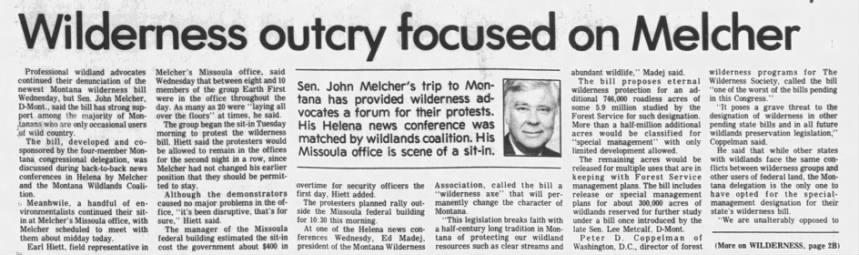
Sen. John Melcher’s trip to Montana has provided wilderness advocates a forum for their protests. His Helena news conference was matched by wildlands coalition. His Missoula office is scene of a sit-in.
The protesters planned rally outside the Missoula federal building for 10:30 this morning.
At one of the Helena news conferences Wednesdy, Ed Madej, president of the Montana Wilderness Association, called the bill a “wilderness axe” that will permanently change the character of Montana.
“This legislation breaks faith with a half-century long tradition in Montana of protecting our wildland resources such as clear streams and abundant wildlife,” Madej said.
The bill proposes eternal wilderness protection for an additional 746,000 roadless acres of some 5.9 million studied by the Forest Service for such designation. More than a half-million additional acres would be classified for **special management” with only limited development allowed.
The remaining acres would be released for multiple uses that are in keeping with Forest Service management plans. The bill includes release or special management plans for about 300,000 acres of wildlands reserved for further study under a bill once introduced by the late Sen. Lee Metcalf, D-Mont.
Peter D. Coppelman of Washington, D.C., director of forest wilderness programs for The Wilderness Society, called the bill *one of the worst of the bills pending in this Congress.”
“It poses a grave threat to the designation of wilderness in other pending state bills and in all future wildlands preservation legislation,” Coppelman said.
He said that while other states with wildlands face the same conflicts between wilderness groups and other users of federal land, the Montana delegation is the only one to have opted for the special-management designation for their state’s wilderness bill.
“We are unalterably opposed to the delegation’s alternative categories approach. Our fundamental concern is that the concept of wilderness will be eroded, that there will be alternative systems of land preservation established and that there will be a lower common denominator established for the protection of wild and roadless public lands the end, in other words, of additions to the wilderness system, Coppelman said.
Jim Welch, owner of the Arrow Ranch in the North Big Hole Valley adjoining the Beaverhead National Forest, charged that the bill will allow timber cutting and sales in areas where timber is of marginal value.
“Logging and roading in the area will destroy habitat and allow access that will interfere with this important time in the life cycle of the elk,” Welch said, adding that clear-cutting in the North Big Hole Valley will cause serious economic hardship to him and other ranchers in the area.
“Clearcutting in the headwaters of (Thompson, Howell and Plimpton creeks) will accelerate the spring runoff to the point I may not have enough irrigation water to get through the season,” he said.
Noel Rosetta of Helena, board member of the Montana State Council of Trout Unlimited, said it is “a sad comment” that much of the wildlands which contribute to quality fishing in Montana will be lost with release of the 5 million acres of roadless land.
Outfitter Max Barker, owner of a dude ranch west of Augusta, criticized the bill for being “devoid of protection” for wildlife habitat along the oil-laden Rocky Mountain Front.
“This is clearly an accommodation of Big Oil at the expense of wildlife,’ Barker said. “Outfitters depend on wildlands and wildlife as the basis of our business.”
Jim Richard of East Helena, president of the Montana Wildlife Federation, told the news conference, “We sportsmen know that we can raise deer, elk and fish in zoos or parks, even on a parking lot if we have to. But we can have wild elk, wild deer and wild trout only in wild country. My constituents want wild Montana left in its wild state.”
Melcher claimed his constituents think the bill is properly balanced.
He said that while resource industries and special-interest wilderness advocates may not like the bill, ordinary hunters, campers, other occasional outdoorsmen and the elderly widely expressed support for the bill.
Asked about news reports that neither developers nor wilderness advocates supported the bill, Melcher said, “I was surprised at that. We found a lot of support, and I don’t think we misread that.”
Melcher said we that misread in picking acres for wilderness, special managment or multiple-use designations, the delegation always “went for the highest and best use.”
“That’s what the bill reflects. At least I hope it does,” he said, adding that where it doesn’t, the delegation is willing to listen to ideas for amendment.
Montana Congressman Pat Williams said Wednesday the Montana congressional delegation is willing to consider changes to the bill, but warned again that Congress probably would kill the bill this session if major changes are made.
Williams said in a phone interview that he’s surprised by reaction to the bill.
“I thought the bill would have more acceptance than it has,” he said.
He added that “both sides are so far apart that it makes amendment look impossible.”
Melcher said that, while industry and environmental groups are at odds over the bill, the average hunter and camper and the elderly support it.
He said the average recreationist supports the bill because he wants to be able to drive to recreation sites. He said wilderness designation would preclude those people from driving into such areas, although conservationists say none of their proposed wilderness areas have roads in them.
Conservationists were skeptical of Melcher’s contention that average recreationists were happy with the bill.
“This bill supposedly responds to the mythical occasional user,” one wilderness advocate said. “In fact their interests would be seriously compromised in this bill.”
Meanwhile, Melcher said he was surprised about a news report that Gov. Ted Schwinden couldn’t find support among developers or wilderness advocates for inclusion of special management areas in the bill. “We found a lot of it (support),” he said. “I don’t think we misread that.”
Melcher acknowledged that the oil industry’s “input had some effect on where we drew the lines.”
Meanwhile, the House Interior Committee may hold hearings on the bill in September.