Ted Kaczynski
Letters by Ted Arguing the Harvard Psych Experiments Had Little Effect on His Personality
Nov 20 2005, Nov 17 2017 & Feb 2 2018.
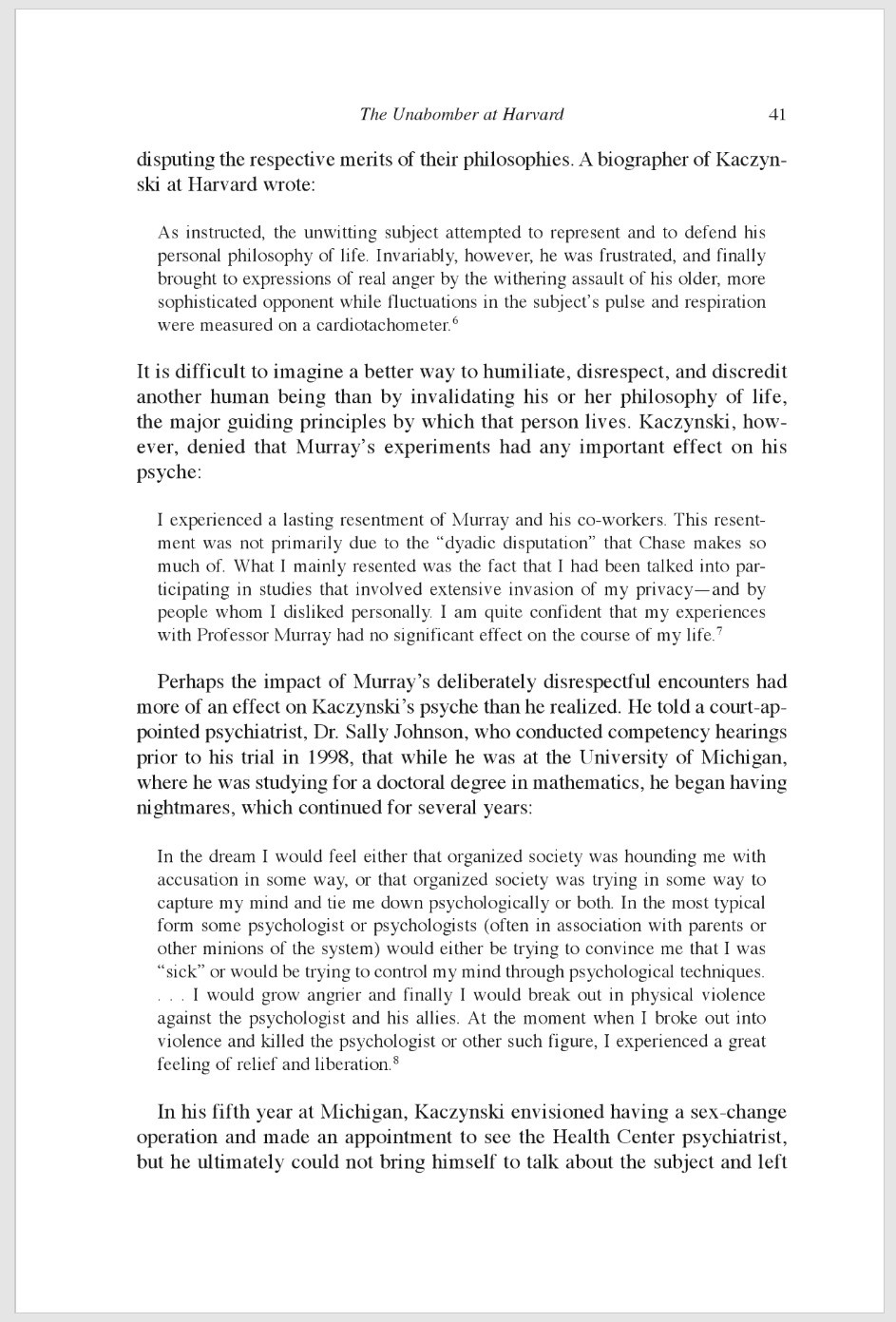
#1. Excerpt of a letter from Ted to the author of ‘Dostoyevsky’s Stalker’ (Nov 20 2005)
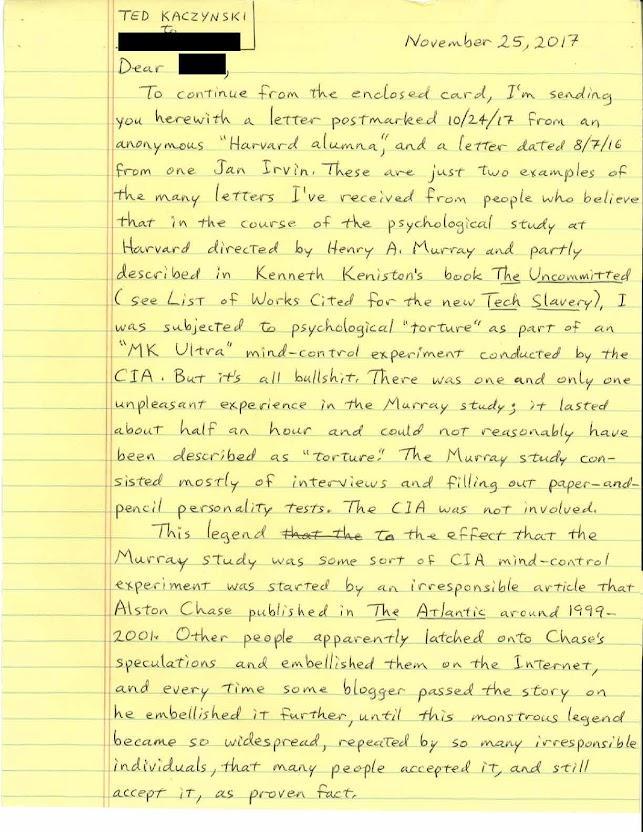
#2. Excerpt of a letter from Ted to [REDACTED] (Nov 17 2017)
#1. Excerpt of a letter from Ted to the author of ‘Dostoyevsky’s Stalker’ (Nov 20 2005)[1]
I experienced a lasting resentment of Murray and his co-workers. This resentment was not primarily due to the “dyadic disputation” that Chase makes so much of. What I mainly resented was the fact that I had been talked into participating in studies that involved extensive invasion of my privacy—and by people whom I disliked personally. I am quite confident that my experiences with Professor Murray had no significant effect on the course of my life.
#2. Excerpt of a letter from Ted to [REDACTED] (Nov 17 2017)[2]
TED KACZYNSKI
To
[REDACTED]
November 17, 2017
Dear [REDACTED],
To continue from the enclosed card, I’m sending you herewith a letter postmarked 10/24/17 from anonymous “Harvard alumna”, and a letter dated 8/17/16 from one Jan Irvin. These are just two examples of the many letters I’ve received from people who believe that in the course of the psychological study at Harvard directed by Henry A. Murray and partly described in Kenneth Kenisten’s book The Uncommitted (see List of Works Cited for the new Tech Slavery), I was subjected to psychological “torture” as part of an “MK Ultra” mind-control experiment conducted by the CIA. But it’s all bullshit. There was one and only one unpleasant experience in the Murray study; it lasted about half an hour and could not reasonably have been described as “torture.” The Murray study consisted mostly of interviews and filling out paper-and-pencil personality tests. The CIA was not involved.
This legend to the effect that the Murray study was some sort of CIA mind-control experiment was started by an irresponsible article that Alston Chase published in The Atlantic around 1999–2001. Other people apparently latched onto Chase’s speculations and embelished them on the Internet, and every time some blogger passed the story on he embellished it further, until this monstrous legend became so widespread, repeated by so many irresponsible individuals, that many people accepted it, and still accept it, as prove fact. [...]
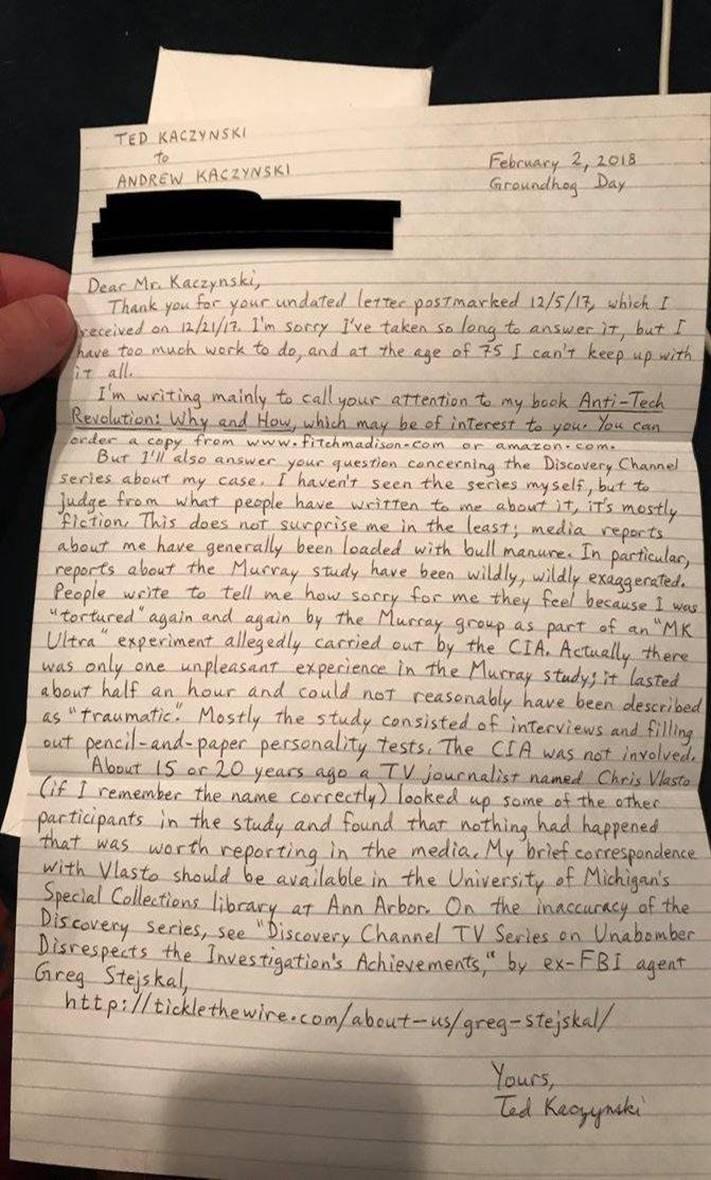
#3. Letter from Ted to Andrew Kaczynski (Feb 2 2018)[3]
TED KACZYNSKI
To
ANDREW KACZYNSKI
[REDACTED]
February 2, 2018
Groundhog Day
Dear Mr. Kaczynski,
Thank you for your undated letter [...]
I’m writing mainly to call your attention to my book [...]
But I’ll also answer your question concerning the Discovery Channel series about my case. I haven’t seen the series myself, but to judge from what people have written to me about it, it’s mostly fiction. This does not surprise me in the least; media reports about me have generally been loaded with bull manure. In particular, reports about the Murray study have been wildly, wildly exaggerated. People write to tell me how sorry for me they feel because I was “tortured” again and again by the Murray group as part of an “MK Ultra” experiment allegedly carried out by the CIA. Actually there was only one unpleasant experience in the Murray study; it lasted about half an hour and could not reasonably have been described as “traumatic.” Mostly the study consisted of interviews and filling out pencil-and-paper personality tests. The CIA was not involved.
About 15 or 20 years ago a TV journalist named Chris Vlasto (if I remember the name correctly) looked up some of the other participants in the study and found that nothing had happened that was worth reporting in the media. My brief correspondence with Vlasto should be available in the University of Michigan’s Special Collections library at Ann Arbor. On the inaccuracy of the Discovery series, see “Discovery Channel TV Series on Unabomber Disrespects the Investigation’s Achievements,” by ex-FBI agent Greg Stejskal,
http://ticklethewire.com/about-us/greg-stejskal/
Yours,
Ted Kaczynski
Appendix: Ted’s earlier perspective
The accounts above reflect Ted’s perspective after he had written his manifesto and been sent to prison. They appear influenced by his desire to shield his critique of technology from scrutiny—particularly analyses that might attribute weaknesses in the text to his personal biases.
Ted offers a different account in his earlier written 1979 Autobiography. There he explained that going along with these psychological experiments was one of the “two episodes in my life that I am really ashamed of”.[4] He felt he had found himself ensnared in the psychological experiment under false pretences—a study he willingly entered into hoping to satisfy intellectual curiosity and exploration but which delivered something else entirely.
Ted was first lured in by the promise of $5 to complete some questionnaires. Soon after completing these, he was invited to speak with Professor H.A. Murray. Though he prided himself on rebelling against authority, he admitted, “it would have been very difficult for me to refuse any reasonable request from a Harvard Professor.”[5] Murray had described the study in vague but enticing terms, mentioning Radcliffe girls would be involved, a party would be held at the end, and participants would eventually learn the study’s conclusions. “He promised that all information obtained in the study would be kept confidential.”[6] Only later did Ted realize he had been deceived. “It severely galls me and shames me to realize that I permitted that disgusting old fake to psychologically manipulate me into saying ‘yes.’”[7]
Ted recounted a specific instance where “I was unsuspectingly led into a situation where I was subject to severe psychological harassment in order to gauge my reaction. The researchers said afterward that they hadn’t intended it to be so harassing... This is almost certainly another lie.”[8] These moments deepened his mistrust and isolation.
“I felt hostile toward the project and the researchers,” he wrote. “I told them many lies about my personal ideology and feelings. Unfortunately, I didn’t systematically wear a mask, especially on questionnaires.... though I knew I was ‘brainwashed’, I never accepted it — I had every intention eventually breaking free from law and order. But I felt it would imprudent to tell anyone this ...”[9]
Ted’s neighbor in Montana wrote convincingly that Kaczynski’s status as a young, socially disconnected intellectual made him especially vulnerable to harm: “Ted was clearly an incredibly vulnerable participant, a minor at the time. His identity and confidence were fueled by his intellect.”[10] What might have been inconsequential to someone with a more balanced sense of self became devastating for him: “To anyone who didn’t put such tremendous value on intelligence, the experiment may not have been damaging. However, at the age of seventeen, Ted was already an outcast. It seems he didn’t have the social skills nor coping skills needed for life as it was, then was attacked purposefully by a trained professional.”[11] The power dynamic was stark: “He was a working-class kid up against a successful interrogator who would break down every idea of his and insult his physical appearance—down to his beard.”[12]
Glen Carle, a former CIA officer, asserts that the psychological experiments performed on Ted at Harvard went on to influence the CIA’s approach to torture at Guantanamo used to break members of Al Qaeda. “My experiences, tragically, are directly relevant to the experience Kaczynski went through because the methods used by the CIA were directly derived from—not just inspired by—what Murray was trying to do in the ‘50s and early ‘60s.”[13] The goal of these methods was clear: “You can break somebody down and you can alter their mind. The theory was, you will be psychologically broken down and dislocated so that you can then be reformed as a cooperative source.”[14]
Perhaps Murray’s deliberately demeaning encounters had a deeper psychological impact on Kaczynski than he himself recognized. This possibility is suggested by material reviewed by Dr. Sally Johnson, who conducted competency hearings prior to Kaczynski’s 1998 trial. Among the documents she examined was an autobiographical account in which Kaczynski described a series of recurring nightmares that began while he was pursuing his doctorate in mathematics at the University of Michigan and continued for several years:
During my years at Michigan I occasionally began having dreams of a type that I continued to have occasionally over a period of several years. In the dream I would feel either that organized society was hounding me with accusation in some way, or that organized society was trying in Some way to capture my mind and tie me down psychologically or both. In the most typical form some psychologist or psychologists (often in association with parents or other minions of the system) would either be trying to convince me that I was “sick” or would be trying to control my mind through psychological techniques. I would be on the dodge, trying to escape or avoid the psychologist either physically or in other ways. But I would grow angrier and finally I would break out in physical violence against the psychologist and his allies. At the moment when I broke out into violence and killed the psychologist or other such figure, I experienced a great feeling of relief and liberation. Unfortunately, however, the people I killed usually would spring back to life again very quickly. They just wouldn’t stay dead. I would awake with a pleasurable sense of liberation at having broken into violence, but at the same time with some frustration at the fact that my victims would not stay dead. However, in the course of some dreams, by making a strong effort of will in my sleep, I was able to make my victims stay dead. I think that, as the years went by, the frequency with which I was able to make my victims stay dead through exertion of will increased.[15]
Finally, although many of the files on MK-ULTRA were destroyed in a cover-up, a collaboratively edited wiki used by the United States Intelligence Community acknowledged that:
A considerable amount of credible circumstantial evidence suggests that Theodore Kaczynski, also known as the Unabomber, participated in CIA-sponsored MK-ULTRA experiments conducted at Harvard University from the fall of 1959 through the spring of 1962.[16]
[2] Debunking the Ted Kaczynski “MK Ultra” myth
[3] Ibid.
[4] Ted Kaczynski’s 1979 Autobiography
[5] Ibid.
[6] Ibid.
[7] Ibid.
[8] Ibid.
[9] Ibid.
[11] Ibid.
[12] Ibid.
[13] Unabomber; In His Own Words
[14] Ibid.