Alex Uziel
Debunking the Ted Kaczynski “MK Ultra” myth
Let’s first take a look at one of the most controversial figures of the last century: Theodore John Kaczynski (aka Ted Kaczynski, aka “The Unabomber”).
There’s a theory involving Ted Kaczynski that originated in the 2000s but has persisted to this day: The idea that as a young undergrad at Harvard in the late 1950s Kaczynski was somehow “traumatized” by a “brutal” psychological study conducted by psychologist Henry A. Murray, that the CIA may or may not have been involved (depending on which variation of the theory you come across) and that this was somehow a principle motivating factor behind Kaczynski’s “mental illness” and later criminal activity. Yet it’s all a complete farce. There’s no hard evidence backing it up. The theory apparently originated from an irresponsible article that an academic-turned-journalist named Alston Chase wrote for The Atlantic[1] and later expanded on in a book, Harvard and the Unabomber (Norton, 2003)[2]. Both the article and the book are highly dishonest: They construct this theory entirely on the basis of speculation, while presenting the speculation as fact.[3] First, we have the transcript of the young Kaczynski’s interview in the study (where, according to the conspiracy theory, the supposedly “traumatic” environment existed where he was “broken down” by an interrogator).[4].
As the transcripts clearly show, the difference between the myth and the reality is astounding. Quite apart from showing Kaczynski to have been harmed in any way, the interview clearly reveals the exact opposite: a calm, rational, and composed young Kaczynski carefully and dispassionately debates an interrogator, wins the argument, and makes his interrogator look (and probably feel) rather silly. Next, we have statements from people involved in the study responding to Chase’s original piece in The Atlantic and denying it could have been anything like Chase characterizes. [link: https://www.theatlantic.com/magazine/archive/2000/09/letters/378379/ ] Then we have Kaczynski’s own statements on the experience himself, which are consistent with the transcripts of his interview during the study and the letters to The Atlantic: that the entire experience was trivial.
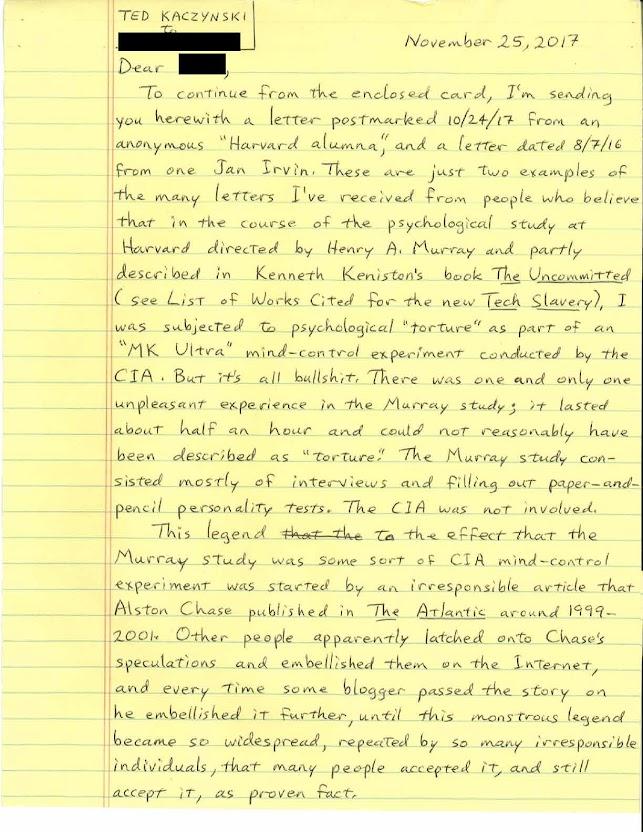
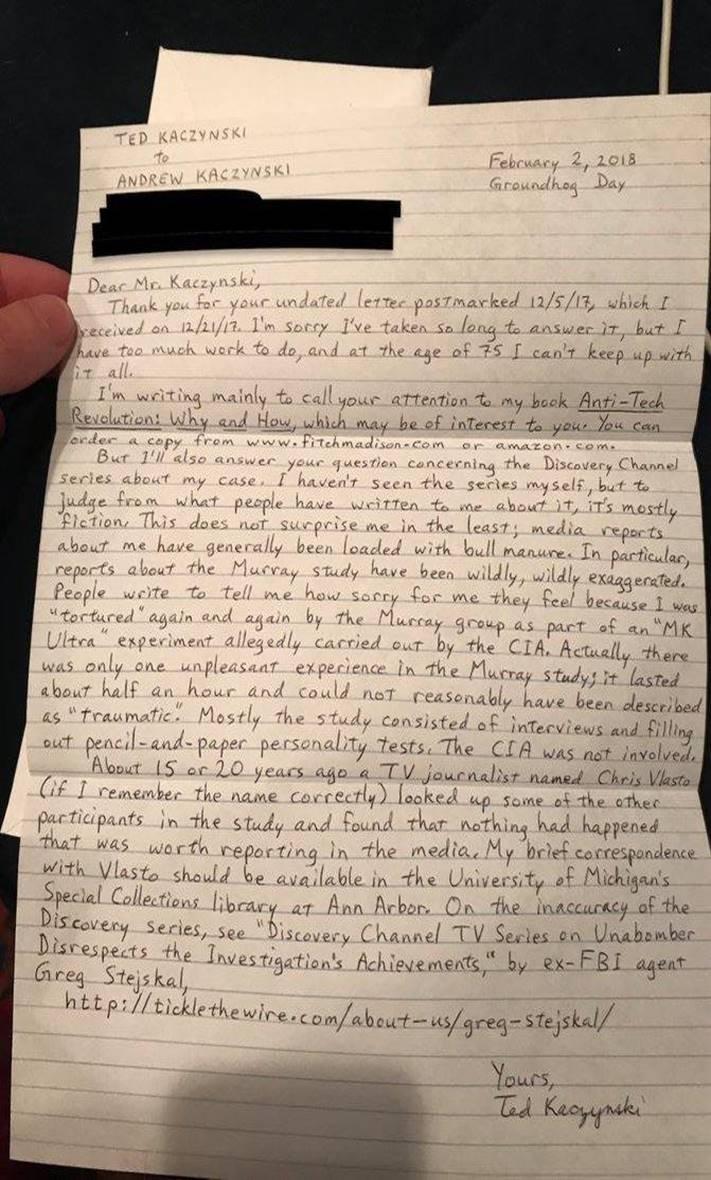
Next we have a former FBI agent involved in Kaczynski’s case, reinforcing the idea that this theory is unfounded and that the motivations behind Kaczynski’s criminal activities were the result of the ideology outlined in his writings. [link: https://www.deadlinedetroit.com/articles/19050/retired_fbi_agent_the_unabomber_and_i_agree_--_tv_series_is_inaccurate]
None of this information is hard to find. Even without the transcripts, any one of the other information presented here should be enough to cast enough doubt on the theory that it can no longer be reasonably or responsibly taken as fact. And yet, seemingly credible groups continue to parrot this conspiracy theory without any reference to the conflicting information, often presenting it as though it were incontrovertible fact. Foremost among them are the following:
1) Psychology Today. Loc. at: https://www.psychologytoday.com/us/blog/impromptu-man/201205/harvards-experiment-the-unabomber-class-62 (the Murray study is described as an “experiment” that involved “torment” and “humiliation”); and at: https://www.psychologytoday.com/us/blog/the-human-beast/201711/is-psychology-responsible-the-unabomber (referring to “psychological abuse” in Murray’s “lab” being…wait for it… “ethically indistinguishable from the gruesome biomedical experiments perpetrated against concentration camp inmates by Josef Mengele” [!?]).
2) Discovery Channel’s Manhunt Unabomber. Though the series is fictional, it presents itself as being based in fact. And in typical Hollywood style, it makes a great dramatic spectacle out of the rumored “torture.”
It’s easy to see why this conspiracy theory has had so much success:
First, it seems plausible. The media have done a remarkable job over the last 25 years of uniformly presenting Ted Kaczynski as a deranged sicko primarily motivated by personal derangement rather than any rational political or ideological goal.[5] There is virtually zero rational analysis of Kaczynski’s writings by the mass media, who by and large prefer to focus exclusively on speculations of pathological motivation. One has to work very hard to uncover the serious discussions that are taking place over Kaczynski’s political and philosophical ideas, but they are indeed happening. To your average person whose primary source of information is the internet or TV, and who has a conventional outlook on the world in large part shaped by these mass media sources, there’s little possibility offered other than pathological reasons behind Kaczynski’s violence. Anything else is inconceivable simply for lack of mental exposure.
Second, the theory is psychologically convenient. It functions in effect to distract attention from the far more disturbing possibility that Kaczynski’s violence could have been rational and in the service of a coherent ideology. Any consideration of rational motives—even the slightest thought for a moment—has the potential to make painfully clear that the same facts and considerations that Kaczynski reasoned justified violence are shared by the individual. After all, they both inhabit the same objective reality, the same world of facts, and correspondingly the same observed problems. Deflecting attention onto a counterfeit cause of the violence thus serves to distract attention—to deny—disturbing problems in their own lives caused by the very forces Kaczynski observes.[6]
In addition, there are probably also the more or less typical reasons why conspiracy theories in general persist which are operative in this case in some combination to some degree:
i) People need their conspiracy theories because they’re simply bored: Their conspiracy theories are one of the few things that give them any excitement or intellectual stimulation in their otherwise dreary lives.
ii) This particular theory is popular with anti-government, anti-authoritarian types who like to see complex machinations of the government and shadow institutions behind everything—it confirms their worldview that the shadow-elites are puppet mastering society. The CIA or the Bilderberg group or whatever are behind extraordinary and spectacular illegal activity by individuals or small groups.
iii) It’s simply too hard for the average person to believe that a single individual could be so spectacularly effective on the world-stage. Modern man is made to feel hopelessly dependent on our society. He can’t really do anything of any practical significance by himself—it all must be done or mediated through organizations and institutions following rigid procedures and rules, and subject to systems and forces in which he has only the most minute influence over. In their minds someone as spectacularly effective as Kaczynski in defying our society must have organizational or institutional backing or impetus.
iv) They’re motivated by self-interest to perpetuate this myth in order to distract attention from the ideas behind the violence. Kaczynski’s rationally presented ideology is a threat to their power.
***
One objection to all the foregoing will be that I’ve wasted time and energy on a subject nobody cares about, or for which it doesn’t matter if there are misconceptions or not. One typical response will be: “Who cares? The guy’s a terrorist from many years ago, so what if there is some false information about the guy?” This is a very short-sighted and dangerous perspective. In any supposedly “free” society committed to the truth, it’s especially important that the most controversial and dangerous topics, typically held by despised minorities, are deliberated accurately and honestly. If a society fails to properly address arguments because it despises who makes them or considers them too uncomfortable or too dangerous, it may well follow a course of action that leads to disaster. Given our world’s precarious social and environmental situation, the process of open and honest evaluation of these minority opinions is more important than ever: the fate of our planet and our lives could very well be at stake. I believe Ted Kaczynski has many of these kinds of dangerous and uncomfortable arguments—dangerous and uncomfortable because they are so cogently presented, and they strike at the core of modern, technology-focused world’s most basic values. By suggesting that Kaczynski’s writings and actions have more to do with personal pathologies than with objective reasoning—in this case “trauma” or “torture”—the mass media serve to distract attention from the far more important aspects of Kaczynski’s ideas that may have serious implications for our future.
It’s unlikely that any of the foregoing will convince the true-believing conspiracy theorist. All the evidence I’ve presented will somehow be explained away or integrated into their theory, no matter how fantastic the logical leaps or absurd the reasoning. They may even challenge the legitimacy of the documents presented here today. I don’t suppose any amount of reasoning or evidence can persuade these people, and I’d be wasting my time trying: most of these people are deeply committed—emotionally and psychologically invested—in their theory. This article, and this website more broadly, are instead directed toward thoughtful, disciplined readers who have a degree of training and experience in objective analysis and rational due diligence: people capable of carefully weighing the available evidence when framing their conclusions. If this article hasn’t convinced these kinds of readers that this particular theory relating to Kaczynski is complete nonsense, then at the very least it should make clear that the theory has little to no basis in fact and has been wildly and irresponsibly misrepresented.
***
Note: For a more detailed description of how and why the media distort facts--and outright lie--through often subtle and sophisticated means, I recommend you read Ted Kaczynski’s unpublished autobiography Truth vs. Lies which is available for download from this website. Chapter 16 therein (pages 426–442) deals specifically with the media, but the entire book should be read carefully if one wants a much broader understanding of, and better context for, the complete misrepresentation of Ted Kaczynski both in the media and in popular culture at large.
Appendix: Ted’s earlier perspective
The accounts above reflect Ted’s perspective after he had written his manifesto and been sent to prison. They appear influenced by his desire to shield his critique of technology from scrutiny—particularly analyses that might attribute weaknesses in the text to his personal biases.
Ted explained in his 1979 Autobiography that going along with the psychological experiments at Harvard was one of the “two episodes in my life that I am really ashamed of”.[7] He felt he had found himself ensnared in the psychological experiment under false pretences—a study he willingly entered into hoping to satisfy intellectual curiosity and exploration but which delivered something else entirely.
Although many of the files on MK-ULTRA were destroyed in a cover-up, a collaboratively edited wiki used by the United States Intelligence Community acknowledged that:
A considerable amount of credible circumstantial evidence suggests that Theodore Kaczynski, also known as the Unabomber, participated in CIA-sponsored MK-ULTRA experiments conducted at Harvard University from the fall of 1959 through the spring of 1962.[8]
Quoting from the book ‘Harvard and the Making of the Unabomber’:
During the war Murray served in the Office of Strategic Services, the forerunner of the CIA, helping to develop psychological screening tests for applicants and (according to Timothy Leary) monitoring military experiments on brainwashing. In his book (1979), John Marks reported that General “Wild Bill” Donovan, the OSS director, “called in Harvard psychology professor Henry ‘Harry’ Murray” to devise a system for testing the suitability of applicants to the OSS. Murray and his colleagues “put together an assessment system … [that] tested a recruit’s ability to stand up under pressure, to be a leader, to hold liquor, to lie skillfully, and to read a person’s character by the nature of his clothing. … Murray’s system became a fixture in the OSS.”
One of the tests that Murray devised for the OSS was intended to determine how well applicants withstood interrogations. … Even anticipation of this test was enough to cause some applicants to fall apart. …
After the war Murray returned to Harvard, where he continued to refine techniques of personality assessment. … The experiment in which Kaczynski participated was the last and most elaborate in the series. In their postwar form these experiments focused on stressful dyadic relations, designing confrontations akin to those mock interrogations he had helped to orchestrate for the OSS.[9]
Ted was first lured in by the promise of $5 to complete some questionnaires. Soon after completing these, he was invited to speak with Professor H.A. Murray. Though he prided himself on rebelling against authority, he admitted, “it would have been very difficult for me to refuse any reasonable request from a Harvard Professor.”[10] Murray had described the study in vague but enticing terms, mentioning Radcliffe girls would be involved, a party would be held at the end, and participants would eventually learn the study’s conclusions. “He promised that all information obtained in the study would be kept confidential.”[11] Only later did Ted realize he had been deceived. “It severely galls me and shames me to realize that I permitted that disgusting old fake to psychologically manipulate me into saying ‘yes.’”[12]
Ted recounted a specific instance where “I was unsuspectingly led into a situation where I was subject to severe psychological harassment in order to gauge my reaction. The researchers said afterward that they hadn’t intended it to be so harassing... This is almost certainly another lie.”[13] These moments deepened his mistrust and isolation.
“I felt hostile toward the project and the researchers,” he wrote. “I told them many lies about my personal ideology and feelings. Unfortunately, I didn’t systematically wear a mask, especially on questionnaires.... though I knew I was ‘brainwashed’, I never accepted it — I had every intention eventually breaking free from law and order. But I felt it would imprudent to tell anyone this ...”[14]
Ted’s neighbor in Montana wrote convincingly that Kaczynski’s status as a young, socially disconnected intellectual made him especially vulnerable to harm: “Ted was clearly an incredibly vulnerable participant, a minor at the time. His identity and confidence were fueled by his intellect.”[15] What might have been inconsequential to someone with a more balanced sense of self became devastating for him: “To anyone who didn’t put such tremendous value on intelligence, the experiment may not have been damaging. However, at the age of seventeen, Ted was already an outcast. It seems he didn’t have the social skills nor coping skills needed for life as it was, then was attacked purposefully by a trained professional.”[16] The power dynamic was stark: “He was a working-class kid up against a successful interrogator who would break down every idea of his and insult his physical appearance—down to his beard.”[17]
Glen Carle, a former CIA officer, asserts that the psychological experiments performed on Ted at Harvard went on to influence the CIA’s approach to torture at Guantanamo used to break members of Al Qaeda. “My experiences, tragically, are directly relevant to the experience Kaczynski went through because the methods used by the CIA were directly derived from—not just inspired by—what Murray was trying to do in the ‘50s and early ‘60s.”[18] The goal of these methods was clear: “You can break somebody down and you can alter their mind. The theory was, you will be psychologically broken down and dislocated so that you can then be reformed as a cooperative source.”[19]
Perhaps Murray’s deliberately demeaning encounters had a deeper psychological impact on Kaczynski than he himself recognized. This possibility is suggested by material reviewed by Dr. Sally Johnson, who conducted competency hearings prior to Kaczynski’s 1998 trial. Among the documents she examined was an autobiographical account in which Kaczynski described a series of recurring nightmares that began while he was pursuing his doctorate in mathematics at the University of Michigan and continued for several years:
During my years at Michigan I occasionally began having dreams of a type that I continued to have occasionally over a period of several years. In the dream I would feel either that organized society was hounding me with accusation in some way, or that organized society was trying in Some way to capture my mind and tie me down psychologically or both. In the most typical form some psychologist or psychologists (often in association with parents or other minions of the system) would either be trying to convince me that I was “sick” or would be trying to control my mind through psychological techniques. I would be on the dodge, trying to escape or avoid the psychologist either physically or in other ways. But I would grow angrier and finally I would break out in physical violence against the psychologist and his allies. At the moment when I broke out into violence and killed the psychologist or other such figure, I experienced a great feeling of relief and liberation. Unfortunately, however, the people I killed usually would spring back to life again very quickly. They just wouldn’t stay dead. I would awake with a pleasurable sense of liberation at having broken into violence, but at the same time with some frustration at the fact that my victims would not stay dead. However, in the course of some dreams, by making a strong effort of will in my sleep, I was able to make my victims stay dead. I think that, as the years went by, the frequency with which I was able to make my victims stay dead through exertion of will increased.[20]
[1] Chase, Alston, “Harvard and the Making of the Unabomber,” The Atlantic, June 2000. Available online at: https://www.theatlantic.com/magazine/archive/2000/06/harvard-and-the-making-of-the-unabomber/378239/
[2] Chase, Alston, Harvard and the Unabomber, New York: W.W. Norton & Company, Inc., 2003, later published with the title, A Mind for Murder.
[3] Chase provides no proof that the CIA was involved. The argument for Kaczynski being “traumatized” rests solely on extremely weak circumstance and wild speculation: In his book, he records a history of CIA involvement in funding psychological research (pp. 251–280), and suggests that the CIA may have been involved in that particular Harvard study, but provides no reason or evidence other than this background information. At only one point does Chase attempt to ground his theory in fact, but he fails: He misinterprets and takes out of context the study’s own analysis of Kaczynski’s interview, conflating actual “trauma” with “intensity of criticism” (p. 291); the transcript of the interview corroborates this error. At the same time he repeatedly makes unequivocal pronouncements of speculation as if they were fact, e.g.: “…the Murray experiment was bound to affect him badly. And it did.” (p. 291), “…as it turns out, the answer is yes.” (p. 227). No “maybe,” no “perhaps,” no I think it likely or possible. Furthermore, Chase’s choice of language throughout is wildly presumptuous and inconsistent with established facts, and it paints a sensationally dark picture (e.g., in his article, the Murray study is an “experiment” which was “brutalizing”).
[4] The transcript is included among the “Kaczynski Papers” special collection, in the Joseph A. Labadie Collection of the University of Michigan. They were apparently deposited into the collection by either Kaczynski or his lawyers. Copies are available on request from the special collection here: https://www.lib.umich.edu/labadie-collection.
[5] I may be discussing this in a future article.
[6] “Like individuals, societies often ignore their own most troublesome traits. Usually these remain unfathomed precisely because they are taken for granted, because life would be inconceivable without them. And most often they are taken for granted because their recognition would be painful to those concerned or disruptive to the society.” [emphasis added]
—Kenneth Keniston, The Uncommitted, New York: Harcourt, Brace & World, Inc., 1965, p. 209.
[7] Ted Kaczynski’s 1979 Autobiography
[8] Project MK-ULTRA — Intellipedia
[9] Harvard and the Making of the Unabomber by Alston Chase
[10] Ted Kaczynski’s 1979 Autobiography
[11] Ibid.
[12] Ibid.
[13] Ibid.
[14] Ibid.
[16] Ibid.
[17] Ibid.
[18] Unabomber; In His Own Words
[19] Ibid.