A research text dump on collapse preppers
The Enchantment of Nuclear Destruction
Awareness of One Fundamental Problem
Awareness of the Interconnections Between the Many Problems
Awareness that the Predicament Encompasses All Aspects of Life
The Outer Path: Balanced Realism
Paranormal Apocalypse (Preview)
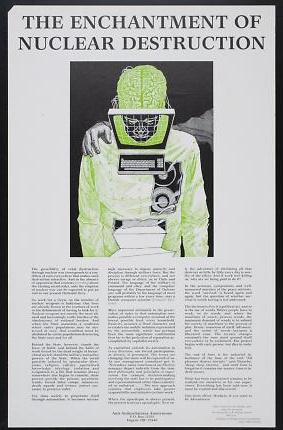
The Enchantment of Nuclear Destruction
Author: Anti-Authoritarians Anonymous (John Zerzan)
Source: Fifth Estate #311, Winter, 1983. fifthestate.org
The possibility of total destruction through nuclear war corresponds to a condition of ruin everywhere that makes such destruction attractive. And in the absence of opposition that contests everything about the existing social order, only the eruption of nuclear war can be expected to put an end to our present flattened lives.
To work for a freeze on the number of nuclear weapons is ludicrous. Our lives are already frozen in the routines of work or the debasement of having to look for it. Nuclear weapons are merely the most absurd and increasingly costly burden of the obsolescence of national borders. And when the State maintains a condition where entire populations may be destroyed at once, that condition must be abolished by entire populations destroying the State once and for all.
Behind the State, however, stands the force of habit, and behind the habit of work forced by the dead weight of hierarchical society stand the military and police powers of the State. When the social passivity induced by spectacular diversions, religion, culture, specialized knowledge, ideology, isolation and resignation to a life that remains always somewhere else begins to crumble, these powers provide the prisons, psychiatric wards, forced labor camps, massacres, death squads and torture centers necessary to preserve order.
For class society to perpetuate itself through automation, it becomes increasingly necessary to impose austerity and discipline through military force. But the process is different everywhere, and not always savage or direct, as in Chile and Poland. The language of the military is command and obey, and the computer language of the Department of Defense (sic) will probably be the language of most programs within a few years’ time, says a Danish computer scientist (Computer Decisions).
More important ultimately to the preservation of order is that automation now makes possible a computer terminal at the lowest possible level: every household. Passivity assumes a fixed character and overtakes the mobile isolation represented by the automobile, which has perhaps been the most significant contribution thus far to the perfection of separation accomplished by capitalist society.
As capitalism extends its automation in every direction, our forced participation, as always, is presumed. The terms are changing, but more will be expected of us. As one management consultant put it, “Nowadays, many functions of an effective manager depart radically from the standard philosophy and principles of supervision. For example, decision-making involving the staff has to be participative and representational rather than centralized or unilateral...The new approach requires that employees take greater responsibility and initiative in their work.”
Where the apocalypse is always present, the present is always apocalyptic. Now only the adventure of abolishing all that destroys us little by little every day is worthy of the effort. And if work isn’t killing us, why are we being paid to do it?
In the sermons, symposiums and well-mannered marches of the peace activists, the word “survival” is heard again and again, but the question of whether survival is worth having is not addressed.
The decision to live is a political act, and so is the use of words. Where people have to work, so do words, and where the machines of society process words, the minimum demand of words is to submit the society of machines to the process of play. Desire, conscious of itself, advances, and the realm of words becomes a liberated zone. The terrain changes constantly—the zone must ground itself everywhere or be reclaimed. The project begins with each person, but dies in isolation.
The end of time is the unlawful inheritance of the time of the end. “All pleasure desires eternity,” said Nietzche, “deep, deep eternity,” and until time is forgotten it remains our master: time is indeed money.
What has been represented remains to be realized—for ourselves or for our supervisors. Everything has been said—now it must be created and discovered.
One more effort, Workers, if you want to be Adventurers!
“Don’t mourn for me friends, don’t weep for me never,
For I’m going to do nothing forever and ever ”
— English workingwoman’s tombstone, early 19th century
Anti-Authoritarians Anonymous, P.O. Box 11331, Eugene, OR 97440
FE note: “The Enchantment of Nuclear Destruction” is available as a 21 x 13 inch poster from the above address.
Idealizing Collapse
Author: Logan Light
Date: 4/19/2018
Topics: Nihilism, anti-civ, post-left, Green anarchism, anarchism, pessimism
Source: <www.barbarically.wordpress.com/2018/04/19/idealizing-collapse>
One thing I’ve noticed in the recent months from those within the anticiv milieu is the all-too-often obsession with idealizing scenarios in which civilization undergoes collapse in some way or another. Yet, not just merely collapse. A collapse that somehow works in favor of the idealizer. One in which they come out unscathed; oftentimes with their children, family, friends, and sense of dignity in tact. And ironically enough, it seems to come from those who attempt at a nihilistic / pessimist tone of thought… at least, that’s what they portray.
Now, you would think those who have developed such negative philosophies and attitudes would still remain seated at the thought of collapse. In the sense that it may NOT be what they want or expect. Yet from primitivists going to foraging classes to existentialists meme’ing the shit out of existence and the hindrances of civilization with an obvious hope for collapse, it is relatively obvious that many anticivs have deep seeded optimism residing within.
I’m not entirely knocking optimism. Although overt optimism is a trait I find rather pathetic, unrealistic, and annoying, as it’s never helped me personally, internet strangers’ optimistic attitudes (unrealized or not) do not affect my day-to-day living. Rather, I simply want to point out something I’ve noticed. Maybe it’ll make some people realize that perhaps they are being a bit too fantastical about their dreams and hopes for a social collapse. Shit, I love to day dream. I love to escape ‘reality’ and enjoy myself some good fuck-off imagining but at the end of the day, I recognize these as only dreams and desires, and not something that I genuinely think will happen…. much less something that I would ‘prepare’ for.
I cannot truly say what in the goddamn fuck is going on with civilization currently. To some, we’ve reached peak oil. We see deserts, storms, crop failure, disease, war, blah blah. All the things man has brought to himself, which is great. But whether man will prevail or not, I’ve no clue. And really, it doesn’t matter what I think. I do believe, however, that not one currently existing anticiv is going to live in a stateless world. Or one in which they can scavenge old wal-marts for old condoms to stop over-population or live out the story of Far Cry Primal.
Of course we also have the brand of anti-civilization’ers who think that because they withdraw or avoid society in some way, or perhaps engage in some small form of eco-tage, that they are contributing to collapse. I think this generally comes from the Green side of anti-civ. Too much Edward Abbey, I suppose. Some individuals think that because they piss off some farmers or city slickers, among a planet filled with billions of people, that they are ‘helping’ in the long haul. Quick, special shout out to the agorists who think that selling dimebags or avoiding taxed labor is going to collapse governments.
What’s funny is that all the anticivs I’ve spoken to are from first world countries with first world comforts. If we don’t even occasionally live within danger, how can we dare think or project how we would survive some un-clear ‘collapse of civilization’? I sincerely doubt anyone reading this is actually militant enough to survive any sort of lawless existence. Not one in which they can steal from grocery stores, but one in which no laws or mores are going to regulate the desires of true outlaws or those who’ve been repressed by society. Shit, it’s the preppers and right-winged nut job supremacists who are actually equipped for this shit, while most of us spend our time glued to technology and the thoughts of other men. Are you ready to steal from other families if you are starving? Are you capable of farming and protecting these farms? Are you capable of killing another man and being mentally stable after that, if necessary? Are you actually built for a life without the limitations of social constructs, laws, and policing? Are you really about that shit? Or are you just throwin’ down memes, hoping for the best? Or maybe collapse will simply be without conflict in which everyone can dance around the maypole.
I want it to be clear that I’m not policing anyone’s thoughts. Keep on day dreaming. Keep on thinking you will survive the streets like a non-bourgeois Will Smith from I Am Legend. It merely seems to me a waste of time. Not only a waste of time, but rather a philosophy entirely entertained by hopeful thoughts and armchair valor with no actual integrity to back it. I’ll shoot the shit about collapse and make up scenarios. I love to dream about the supposedly unfathomable, but I feel its important to keep my dreams and desires somewhat realistic. Otherwise, I end up being a warrior against society whose form of war is in memes and dissing authority on the sly.
Not yours truly,
That Feller
The Psychology of Collapse
Author: Saint Andrew
Topics: collapse, post-civ, Breadtube
Date: Jan 20, 2021
Source: <https://youtu.be/VPrimu4zP0o>
Introduction
Honestly, dealing with the world and everything that’s going on, all the time, is so exhausting. I try to take breaks pretty regularly, but it’s not like I can ignore everything that’s falling apart. I can’t lie to myself and say “This is fine” when it really isn’t.
And I’m not alone. My network of peers and comrades are all dealing with similar feelings of exhaustion and hopelessness over the state of the world and our future. It got me thinking, and got me researching, about what people are going through in such a stressful time, how they’re responding, and how we can deal with all this. I’ve looked at a variety of sources, as well as drawing from my own experience, to come to a sort of “self theory” about how my fellow humans and I are dealing with this...collapse.
I don’t think I need to dive too deeply into what I mean by collapse. I’m referring to the degradation of society by businesses and states, the destruction of our environment, and the devastation of our human potential. The culmination of all the interlocking issues that plague our modern life. The acceleration of the processes that will lead to the end of the world as WE know it.
I want to look at people’s awareness of what we face and how people are responding. And perhaps, do my best to provide some sense of what we can do and how we can shake ourselves and others out of inaction. I’m splitting this video into two sections to keep things organized and easy to follow: First, stages of awareness, which I’ve largely pulled from Paul Chefurka’s Climbing The Ladder of Awareness, linked below. I’ll use Morty as a stand in to walk you through the stages. After that, we’ll look at responses to collapse once people are aware. Let’s begin.
Stages of Awareness
Dead Asleep
At this stage, Morty just vibin honestly. Of course he can see there are some issues in the world, here and there, but that can be fixed right? All we gotta do is organize a bit better, change our behaviour slightly, and tweak the rules, then we’ll be fine? Right? Right?
Awareness of One Fundamental Problem
Okay, so it seems everything is not cash money. Morty just found out about systemic racism or imperialism or overfishing or dying sea turtles or plastic pollution or fracking. And he is freaked out. He’s panicking and mobilizing, or at least bringing awareness to the issue. He’s just trying to get people’s attention. Just so they know, “HEY! SOMETHING IS WRONG! LET’S FIX IT!” The one problem seems to consume him entirely. So he keeps learning. And...well...
Awareness of Many Problems
The more Morty learns, the more he worries. He takes in all sorts of information, and begins to see how complex and multifaceted the world’s problems are. Now it’s hard for him to even prioritize which issue needs to be dealt with first. In fact, he’s so overwhelmed that he may be reluctant to acknowledge new problems. For example, if Morty has become aware of and is fighting against climate change, he might be reluctant to recognize indigenous oppression and environmental racism. He might feel like, “aw jeez Rick, I’m already dealing with so much, y’know? I don’t wanna get distracted with so much other stuff!” Alas, Morty cannot ignore the other problems forever. Not unless he wants to keep running in circles.
Awareness of the Interconnections Between the Many Problems
It’s beginning to dawn on poor Morty that no solution is without its problems. Shutting down factory farms might lay off millions and leave perhaps hundreds of millions without a complete meal. Or our efforts to raise the standard of living in the developing world through industrialization is just accelerating the Earth’s destruction and profiting a select few. Morty has begun to...ascend, in some sense. He’s thinking on the system level now. Beyond the symptoms, towards the source. Perhaps there is no one solution? Perhaps the gravity of such a solution may be too much to bear? At this point Morty has likely withdrawn to discuss these issues with like-minded individuals, like small discussion groups, so they can explore the depths of the issues.
Awareness that the Predicament Encompasses All Aspects of Life
Morty is beyond woke now. He might even pine after ignorance, as he realizes that this series of problems, or rather, this All-Encompassing, CAPITAL P Predicament includes everything we do, how we do what we do, how we relate, and how we affect the entire planet. The Predicament is so massive, Morty perhaps comes to a point where he’s just like...there is no CAPITAL S Solution to this CAPITAL P Predicament...no easy answer, no quick fix, he can’t do it alone, so now what?
Chefurka believed that each stage contains roughly a tenth of the number of people as the one before it. So for example, 90% of humanity might be on Stage 1 but only one in ten thousand people might be at Stage 5. Fyi, I haven’t seen any evidence of this, and I disagree personally. He makes it clear that it’s just his personal observation, so take it with a grain of salt.
I’m going to go through the different responses people have to collapse, again borrowing from my own research and personal experience.
Responses to Collapse
Slumber
I’d say a good chunk of people fall into this category. Perhaps they catch a whiff of what’s going on and decide to just...turn over and go back to sleep. To embrace ignorance purposefully, disregard new information, and shun any understanding of what’s going on. Perhaps they’re guarding their fragile sanity, which is understandable. But, we need to face these issues, cuz they’re not going anywhere. What we need is courage.
Denial
This is where people, when faced with reality, reject it and construct their own. Or they search for information that comforts them, rather than exposes them to the truth. They construct a media bubble that shields them, or a social circle that can protect them and reaffirm their core beliefs. Everyone is capable of denying reality, but it’s become quite prevalent in the age of technology, where we can easily shut out any truths that make us uncomfortable. Like, for example, losing an election or the reality of human-caused climate change.
Apathy
Easy come, easy go. A little high, little low. Anyway the wind blows, doesn’t really matter to these people. No motivation. No feeling. The embrace of utter gray. Like slumber and denial, people respond with apathy to protect themselves in some way. After all, if nothing really matters, there’s no need to try. No need to think. No need to bother. Bombarded by the media with distant pains, it’s easier to just….disconnect. Retreat into one’s shell, or, alternatively...well, let’s continue.
Preoccupation
This is more the fault of our system, but people these days rell busy. Like, not everyone can afford to invest in exploring and understanding the worlds’ problems, even if the threat is so existential that their office busywork or retail slavery would ultimately amount to nothing. I’m not talking about those people though. I’m talking about the people who respond to the issues of the world by distracting themselves with busywork. Constructing a convenient excuse to not challenge the structures they are under or maintain. Like, they’re running away from the Predicament. But the Predicament catches up to all of us, sooner or later.
Hedonism
On the flipside of the people who busy themselves with busywork are the people who dive into mindless consumerism. This is coupled with apathy to some extent. If nothing matters and everything’s falling apart, might as well just...consume. Indulge. Distract yourself with games, music, partying, drugs, and drinks. It’s like slumber, except you’re aware of the reality and are just plugging your ears. But at least for those that plug their ears, they don’t face...
Overwhelment
Yes, I’m inventing a word. That’s what language is for. Deal with it. The Predicament that is collapse is quite complex and multifaceted. Some people respond by trying to wrap their minds around it all and just end up losing their minds altogether. There is no human mind that can consume and comprehend every minute problem that we face. That’s why we’re a social species. We’re supposed to be working together to understand collapse. As individuals, it can be hard to deal with something so complex, abstract, far-flung, and frightening. We’re going to need to come together, not just subject ourselves to a form of self-torture via mental isolation with humanity’s existential threats.
Blind Hope
This is a trap that a lot of us almost naturally fall into. Humans are biologically predisposed towards optimism, the general attitude or belief that a specific endeavor or outcomes in general will be positive and desirable. We tend to hold onto hope in some future outcome that’ll just...y’know, work out. That’s why I call it blind. It can’t adjust to the ever-shifting reality. It goes beyond rose-tinted glasses, it’s more like a whole VR headset.
We lose our ability to see clearly and take realistic, necessary action. We give up our agency and leave things in the hands of the leaders and the experts. We stay...passive. We waste time, precious time that could be spent on real harm reduction, just going with the flow. We prevent necessary conversations with blind hope when we fixate so much on whether we can fix “it” and how we can fix “it”, without considering what we need to do if we can’t fix “it”. What happens then?
Blind hope manifests in a few different forms, which I’ll get into next, but let me address those in this stage right now. Blind hope inevitably leads to disappointment. Waiting forever for a future that won’t come. That exists solely in your mind, irrespective of reality. It’s ultimately a form of denial, but it’s the woke kind of denial. Ultimately, It takes a bit of a journey to move towards a greater level of emotional maturity. But once we can get rid of false hopes, like the idea that somehow we’ll reverse the damage our planet has been dealt scot-free. Well, we can strengthen our resolve and prepare for what has already been set in motion. To take action with the knowledge that no, our leaders are not going to do anything substantial enough and no, this moves far beyond reform. It’s a hard pill to swallow, but if you can take it, you’ll be better off to resist. We don’t need blind hope.
Individual Change
These are the people with the blind hope that with a few tweaks here and there, we can continue our perpetual growth easy peasy. All we gotta do is switch to veganism, recycle, and maybe carpool every once in a while and the world’s ills are as good as gone. They place stock, and blame, in individuals entirely, ignoring wider structures or society.
Progress Worship
I do want to do a video on how our understanding of progress has been so corrupted, but this is tied to blind hope. There’s almost a cult of progress outchea. That any and all growth is good. That no matter the consequences on our finite Earth, we can just expand and expand. Eternally. Those who worship progress blindly place a lot of trust in folks like Elon Musk and other so-called tech geniuses to just...solve all our problems. They have an absurd level of techno-optimism, believing that with a little innovation, we can solve every problem on Earth, without accounting for the risks and consequences of current or future technology. They tend to fall into the trap of Capitalist Realism, losing any sense of alternatives to the current, environmentally and socially destructive economic order. They also tend to feel privileged by the current order, or at least comfortable enough to not want to threaten it.
Leader Worship
There are a lot of people who just...have the utmost faith in our leaders. Who believe that, once we just get the right people in office, things will work out. But as Michael Jackson famously said, they don’t really care about us. The truth is, the system corrupts even the best intentions. Politicians are a class unto themselves, and their actions reflect, ultimately, their own interests. Nationstates, governments, rulers...it’s in their job description to maintain structures that ultimately harm humanity. There’s only so much they can do to affect the status quo. Placing our salvation in their hands is an exercise in futility. Investing your future in the confines of electoralism is a waste. But it also demonstrates how effectively mass media and schooling has broken down and limited our imagination. You can call it Statist Realism...the idea that there’s no alternative to a hierarchy of rulers and ruled. That people just need to be submitted to the wills and whims of others, rather than organizing, through democratic consensus, for themselves and their communities.
Apocalypse Worship
This is gonna sound a bit strange, but worshippers of the apocalypse also hold to a form of blind hope. Accelerationists, doomsday preppers, cultists, extreme survivalists, zombie videogame enthusiasts, or believers in the End Times (think the Great Tribulation, Rapture, and other Fundamentalist beliefs). There seems to be a lot of people who are almost...excited for collapse? Or fixate really heavily on their ideal version of the end of the world. Like, they can’t wait for the world to end. Whether it be so Jesus can finally return to Earth or so sinners can be cleansed or so they can finally be vindicated in the eyes of those who disparaged their doomsday bunkers.
Honestly, people who respond in this way freak me out. Those who look at what’s going on and...instead of resisting or trying to change the circumstances, they just accept it as things going according to schedule/prophecy...or try to make things worse. Like, you ever wonder why so many Evangelicals support the state of Israel, and lobby so heavily in support, despite its brutal violence against Palestinians? It’s because according to their theology, Jewish people need to return to Israel ASAP so Jesus can come, Palestinians be damned. Literally. Moving on...
Despair
Oh boy. These are the people who tend to sit around and bemoan our fate. They probably talk like Eeyore too. They’re worse than the apathetic, because they weigh down our actual efforts with pessimism. They see the worst, expect the worst, and live in utter defeat. Defeat without any struggle. According to those in despair, nothing we do has any power to affect our future. Honestly those on the doomer pill are just as misguided, in my eyes, as those hyped up on hopium.
So is there any way out?
Like I said before, we don’t need blind hope. And as is clear, we definitely don’t need hopeless despair. That’s an utterly false dichotomy. So how do we respond to this Predicament?
What we need is sobriety. Clarity. Lucidity. There are two more responses. Paul Chefurka points out in his article that those in Stage 5 Awareness, who see that the Predicament Encompasses All Aspects of Life, look to one of two paths. There’s a third, a rejection of both paths, but for those people, he recommends some serious counselling. I’ve adapted, interpreted, and remixed the two paths, so they’re not one to one what he had in mind, but I think the gist is there.
The Two Paths
The Inner Path: Self-Healing
For some, the inner path seems most viable. It’s a manifestation of that fake Gandhi quote: “Be the change you want to see in the world.”It digs in deep and personal, to look at collapse and retreat within to develop your self-awareness. “To heal the world, first heal yourself.” That old spiritual cliche still holds some truth.
Some people take this to mean some sort of hyper individual thing, and it lowkey is, but if you tilt and twist your head slightly, perhaps you can see it in a different light. It doesn’t mean becoming a monk or an ascetic. It doesn’t mean denying systems or ignoring the painful truth. It involves taking in the gravity of what we’re dealing with. Such a grand scale issue, and putting it in a personal context. Unabstracting it and understanding it through a more manageable lens. Taking your insights to influence and interchange with the insights of others. That’s how I see it at least. But I also don’t see this path as satisfactory to me. What clicks with me, is...
The Outer Path: Balanced Realism
Balanced Realism is, well, hard to balance. There are a lot of people who confuse realism with pessimism. Bitter people who think realism is when everything bad. Ignore them. Truthfully, taking the outer path of balanced realism means shaking off the burdens and blinders of pessimism and optimism. Banishing alarmism, denialism, fatalism, hedonism, and all other setbacks. Loosening yourself from your own hopes and fears. Those on the outer path recognize and accept any number of possible outcomes. In the face of such a grand Predicament, maintaining realism is difficult, but necessary. You agitate for the best but prepare for the worst.
If you’re on the Outer Path, you’ve let go of naivety and passivity. You’re moving. Acting. Doing. Adapting. Think of the permaculture movement, Rojava, Transition Network, Resilience.org, Post Carbon Institute, Cooperation Jackson, and all the other ongoing movements and projects, none of which are perfect mind you, none of which are going to save the whole world or anything, but they’re looking local and they’re making a difference. Forget wasting our time with party politics, we’re acting right now. Realists on the Outer Path are building networks, building community, building sustainability. Bravo.
Conclusion
Do you recognize these stages and responses? In yourself and in others? Like I always say, we need each other, so reach out if you see that some are faltering and falling down a harmful path. I’ll leave some resources in the description for those moving towards Balanced Realism, those who choose the outer path and want information and support. For those choosing both paths, I don’t have as many resources for self-healing, so please, share resources in the comments. Let’s keep the conversation going. Take care everyone.
Peace.
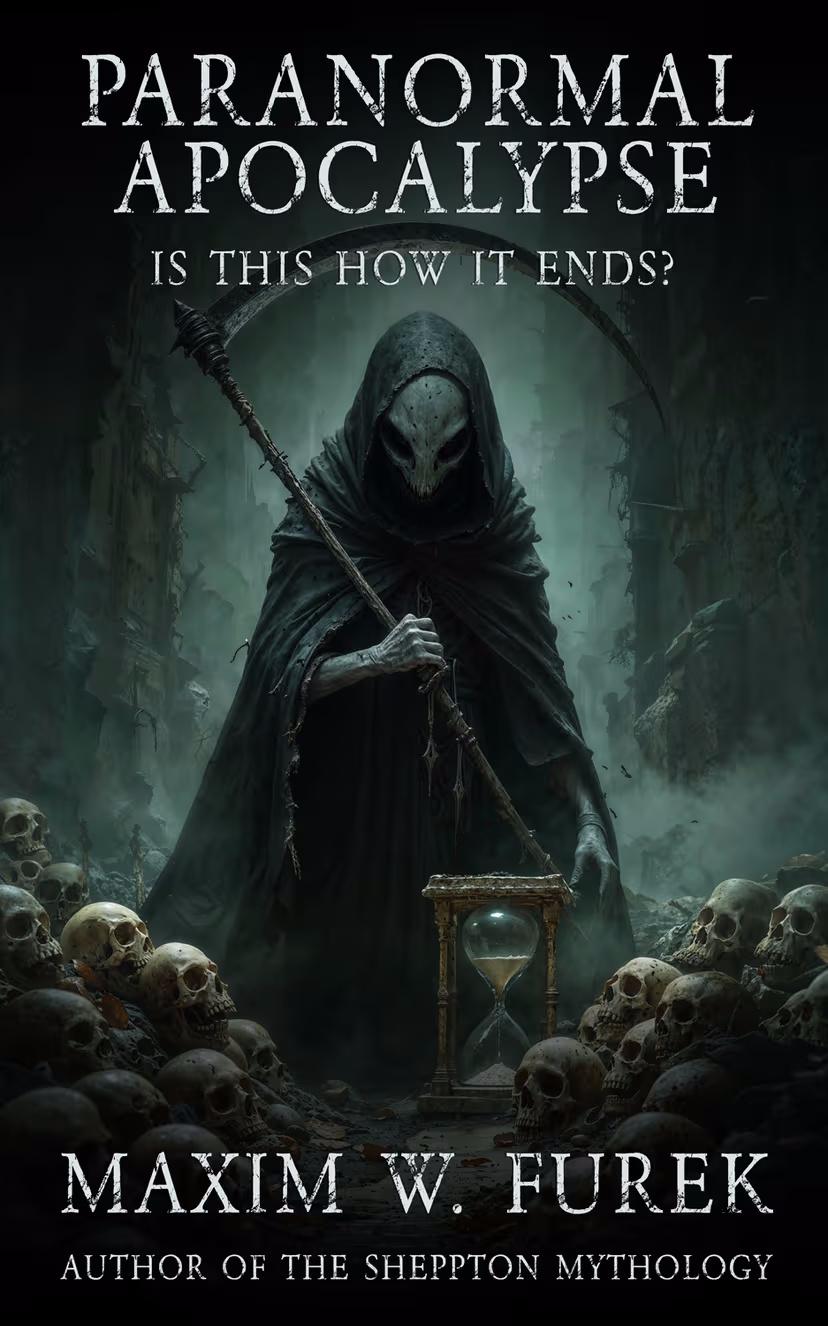
Paranormal Apocalypse (Preview)
Subtitle: Is This How It Ends?
ISBN: 979–8893250534
Published: 8/20/2025
Publisher: Hangar 1 Publishing
Cover:
What if our obsession with the end times reveals something extraordinary about human nature?
From a forgotten 1969 song that predicted our technological nightmare to the mysterious drone swarms of 2024, something dark threads through human consciousness-an inexplicable attraction to our own destruction.
The Secret Psychology of Doomsday
Why did a simple folk song about the year 2525 become a massive hit during the Summer of Love? What drives ordinary people to abandon everything and follow apocalyptic cult leaders? And why can’t we look away when the world seems to be ending?
Author Maxim W. Furek has uncovered a hidden pattern-a psychological phenomenon he calls “Apocalyptic Awe” that explains everything from ancient prophecies to modern conspiracy theories, from Hollywood blockbusters to political movements.
The Questions That Will Haunt You:
What did H.P. Lovecraft see coming that we’re only now discovering?
Why do the same apocalyptic fears resurface generation after generation, just wearing different masks?
How are online “rabbit holes” weaponizing humanity’s oldest anxieties?
What connects the Four Horsemen of the Apocalypse to your social media feed?
**The Dark Discovery
Through shocking case studies-from Jonestown to January 6th, from nuclear panic to AI anxiety-Furek reveals how apocalyptic thinking isn’t just shaping our entertainment and politics. It’s rewiring our brains.
But here’s the twist: understanding this hidden force might be the key to our survival. Some truths about human nature can only be found in humanity’s darkest fantasies.
The Bridge Between Worlds
Why do the paranormal and apocalyptic thinking always appear together? Why do UFO sightings spike during social upheaval? What’s the real connection between ghost stories and global catastrophe?
The answers will change how you see everything-from the news to your nightmares.
Ready to discover what your fascination with the end times says about you?
Paranormal Apocalypse isn’t just about predicting the future-it’s about understanding the hidden forces already shaping it.
Some patterns can’t be unseen.
IS THIS HOW IT ENDS?
MAXIM W. FUREK
HANGAR 1 PUBLISHING
Paranormal Apocalypse: Is this How it Ends? by Maxim W. Furek
FIRST EDITION. First printing, 2025
Copyright © 2024 by Maxim W. Furek
Contact information at www.maximfurek.com
All rights reserved. No part of this book may be reproduced or transmitted in any form or by any means without written permission from the author, except for brief quotations embodied in critical articles and reviews as permitted by U.S. copyright law.
Cover and page designs by Hangar 1 Publishing. Back inside photo by Patricia A. Furek. Back cover drawing of Death, one of the Four Horsemen of the Apocalypse, by permission of Travis McHenry.
Hangar 1 Publishing.
11610 Jay St NW
Minneapolis, MN, 55448
Printed in the United States of America.
Contents
1. In the Year 2525 (Exordium & Terminus)
2. Exordium & Terminus
3. H.P. Lovecraft—Soothsayer
4. The Bridge to the Apocalypse
5. Ninety Seconds to Midnight
6. The Thousand Screams
7. Apocalyptic Awe
8. Th? Masque pf th? Red Death
9. The Pandemics
10. The Doomsday Fish
11. Natural Disasters
12. The Mothman Prophecies
14. The Four Horsemen of the Apocalypse
15. Weaponized Religion
16. The Late Great Hal Lindsey
15. The Jonestown Massacre
17 Y2Kand the God Particle
19. When Robots Attack
20. The Cyber Deep State
21. The Drone Hysteria of 2024
22. Fearmongering in the Here and Now
23. The Primal Beast
24. The Glimmer of Promise
Acknowledgments
References
About the Author
Also by the Author
Afterword
3. H.P. Lovecraft-Soothsayer
The dark visionary, Howard Phillips Lovecraft (1890–1937), belonged to an earlier time when ladies and gentlemen strolled through Victorian gardens in airs of proper etiquette and respectability, when families of wealth were bowed down to and afforded their rightful place in society. But Lovecraft walked the streets like a man from Mars, an individual born too late, and filled with fear and racist hatred. He was awkward and reclusive, feeling like an orphan, and dying destitute and emotionally ruined.
And yet, Lovecraft endures as one of the most influential writers. His mythos of shadow worlds, interstellar deities, and “cosmic indifferentism” have inspired generations of storytellers, including Stephen King, Clive Barker, Neil Gaiman, and Anne Rice. And, although acknowledged as the “Godfather of modern horror,” he signifies much more. Lovecraft was a soothsayer, peering into the future and warning us with his cryptic prose.
Lovecraft scholar Miranda Gurzo observed that “Lovecraftian literature is full of apocalyptic suggestions from the very beginning,” such as Cthulhu, the tentacle-faced elder god who lies slumbering in his oceanic tomb, waiting for the day when “the stars are right” to rise again and wreak havoc on humanity. Lovecraft’s prophecies were acknowledged by Joyce Carol Oates, an avid student of the horror master:
Lovecraft fuses the supernatural and mundane into a terrifying, complex, and exquisitely realized vision, foretelling a psychically troubled century to come.
As Edgar Allen Poe draped us in a Gothic sheath, Lovecraft cast a wider net, foretelling the indescribable insanity of never being able to comprehend that which is not meant for the human mind. He was precocious—reciting poetry at age two, reading at three, and writing at six or seven. His earliest enthusiasm was for The Arabian Nights, Greek mythology, and weird fiction. His grandfather, Whipple Van Buren Phillips, fostered his interest, entertaining Lovecraft with weird Gothic ghost stories.
Like influential editor Ray A. Palmer, Lovecraft sought refuge in the escapism of literature, especially the fantasies of Lord Dunsany and Alfred Lord Tennyson. Inspired by Poe, about 80 years his senior, Lovecraft began dabbling in amateur journalism. Many of his stories were featured in pulp magazines like Weird Tales and influenced by post-World War I horrors of mustard gas and trench warfare. Lovecraft wrote about “cosmic horror,” a mix of forgotten elder beings and slimy alien gods. Cthulhu, the leader of the Great Old Ones, was described as:
A monster of vaguely anthropoid outline, but with an octopus-like head whose face was a mass of feelers, a scaly, rubbery-looking body, prodigious claws on hind and fore feet, and long, narrow wings behind. It is said to he so terrible to behold that it destroys the sanity of those who see it.
As Poe wrapped us in layers of fear, Lovecraft gave us equal parts of hopelessness and uncertainty. A favorite Lovecraft touch was of the obsessive researcher who, by unleashing an interdimensional evil, threatens to wipe out the planet as he is rendered insane. Lovecraft’s concept of the Great Old Ones was indescribable, said Lovecraft scholar John DeLaughter:
They sprang forth as primal shadows cast from the dawn of time. They embodied the fears of our ancestors. No one species, no tribal god, no one alien race, no ancient taboo nor obscure pantheon explained them. They expressed the tangible dark, the teeming life in the shadows, life without light. Though everyone knows them, no one living has seen them. They are vague shadows that shift and scurry in the dark abyss, like amoebas in pond water.
The Colour Out of Space
Most of his stories occurred in New England, where he invented the fictional town of Arkham, Massachusetts, and prestigious Miskatonic University. His most famous literary invention was the Necronomicon, a forbidden book of dark magic incorporated into additional stories by other writers.
During his lifetime, he wrote an estimated 100,000 letters to friends and fellow writers such as Robert Bloch, Henry Kuttner, and Robert E. Howard, and his Mythos has been embellished and reinterpreted by countless writers such as Bloch, Clark Ashton Smith, and August Derleth. The Colour Out of Space, published in the September 1927 edition of Hugo Gernsback’s Amazing Stories, describes an area known by the locals as “the blasted heath,” outside the fictional town of Arkham, where a meteorite has crashed, poisoning or killing every living thing. The Colour Out of Space provided a template adapted to film several times, in incarnations such as Die, Monster, Die! (1965), The Curse (1987), Colour from the Dark (2008), The Colour Out of Space (Die Farbe) (2010), and Color Out of Space (2019). Lovecraft’s story inspired Stephen King’s 1987 novel The Tommyknockers—in which the residents of Haven, Maine, fall under the influence of a long-buried alien spacecraft in the woods.
Personal Demons
Born into an affluence that was abruptly ripped away, Lovecraft lived in near poverty, often skipping meals to afford writing materials and postage. He claimed to be so poor that he survived for days on one loaf of bread, one can of cold beans, and a hunk of cheese. As he walked the streets of his beloved Providence, he languished in the shadows of the better-known Poe and suffered an endless battle with his personal demons. Avoiding people, he routinely slept late into the day, only leaving the house after sunset. His complexion turned pale and gaunt. His mother, Sarah Susan Phillips Lovecraft, called her son “grotesque” and “hideous” and warned him to hide inside so people couldn’t see him. In 1908, he suffered a nervous breakdown just before his graduation from Hope High School. Depressed, he left school without a diploma, and his rejection from Brown University caused him considerable shame. Though one of the most formidable self-taught academics of his era, he spent ages 18 to 23 as a virtual hermit, immersed in astronomy and poetry:
I am essentially a recluse who will have very little to do with people wherever he may be. I think that most people only make me nervous —that only by accident, and in extremely small quantities, would I ever be likely to come across people who wouldn’t.
Apocalyptic parables have prophesized the expectant hand of death. Throughout the ages, the masses have feared these adult fairy tales threatening the consequences of our wickedness:
Because we have sinned, we will be punished. Because of our sins, we deserve to be punished. And because we are sinners, the future will be filled with pain and suffering.
Those parables, it would seem, had been written for the Lovecraft family who suffered from mental illness and were cursed with genetics that perverted reality. His father was institutionalized at Providence’s Butler Hospital for the Insane and died there five years later, as documented by The Guardian’s Sian Cain:
Winfield Scott Lovecraft was committed to Butler Hospital after being diagnosed with psychosis when H.P. Lovecraft was only three years old. He died in 1898, when H.P. was eight. To this day, rumours persist that Winfield had syphilis, but neither H.P. nor his mother ever displayed symptoms.
Death Diary
The darkness continued. Lovecraft was 28 when his mother was admitted to the same hospital treating her husband. They remained in close correspondence for two years, until she died of complications after surgery. After marrying businesswoman Sonia Greene in 1924, he lived briefly in Brooklyn, where he wrote The Horror at Red Hook, one of his most blatantly racist stories. The racism that Lovecraft harbored was rampant in many parts of the country and would continue long after his death in 1937. During the Reconstruction era (1865–1876), nearly 2,000 Black men, women, and children were lynched. In 1921, the Tulsa Race Massacre—one of the worst racial attacks in U.S. history—left as many as 300 Black people dead and destroyed the once-thriving district of North Tulsa, later purposefully erased from history books. Decades later, in 1998, James Byrd Jr., a 49-year-old Black man, was chained to a pickup truck and dragged to his death by three white men. Racism aside, after his marriage ended, Lovecraft returned to his Providence sanctuary, completing the novellas The Shadow Over Innsmouth and At the Mountains of Madness.
At 46, he began to create a “Death Diary,” recording his daily sufferings as he died from stomach cancer. “Pain—drowse-intense pain—rest—great pain,” he wrote in one entry, an intimate moment of torment echoed in his short story The Haunter of the Dark, written that same year, in which one of the protagonists continues to write in his journal even as the dreadful monster closes in:
I see it—coming here—hell-wind—titan blur—black wings—Yog-Sothoth save me—the three-lobed burning eye...
Lovecraft expressed a contempt for “savage and uneducated immigrants” lacking honored social protocols. In countless personal letters, he expressed displeasure with anything outside his beloved Providence, where he retreated from his estranged wife, Sonia, and those immigrant hordes. There is little doubt that he was a racist, xenophobe, and white supremacist. His views, unfortunate as they were, reflected the thinking of the time. He predicted that the Chinese empire of Tsan Chan would flourish in 5000 AD and that the “evil and yellow” faces of the Chinese would replace Western people in an apocalyptic nightmare.
Gazing into an antiquated crystal ball, Lovecraft foresaw the demise of a “cold and ruthless” Western civilization, rotting away from nihilism, consumerism, and a rejection of what was considered Dark Age superstition. Seven decades after his death, the impact of his extreme views has not lessened. Lovecraft must be turning in his grave at the “capitalistic success story” merchandizing his weird mythos. As Damon Root discerned in his Reason essay, The Uncanny Afterlife of H.P. Lovecraft:
Retailers now offer Cthulhu-themed shirts, hats, socks, costumes, toys, coffee mugs, Pez dispensers, board games, video games, roleplaying games, novels, short stories, comic books, coloring books, and much else besides. The heavy metal band Metallica has written two songs in Cthulhu’s honor. The Oscar-winning director Guillermo del Toro has found all sorts of clever ways to reference Cthulhu in his films.
Lovecraft has been regarded as the most influential figure in modern horror fiction. Writer Jeffrey Somers articulated what the “Father of Modern Horror” brought to the table—Lovecraft changed the rules, usurping a genre that was still bound to Victorian and Gothic restrictions and introduced into it a truly frightening concept:
That the universe wasn’t filled with rule-obeying evil you could comprehend and thus defeat; rather, it was filled with beings and forces so beyond us they aren’t even aware of our existence as they terrify, destroy, and annihilate us.
The Cthulhu Mythos
Lovecraft stands alone as history’s foremost innovator of science fiction horror. Years after his death from small-intestine cancer, he was acknowledged as a major contributor, having created unique and unorthodox characters from his own vision. He listened to the music of Erich Zann and to the rats in the wall while gazing at forbidden cosmos. But everything about Lovecraft’s path was slightly out of step. The independent Arkham House didn’t publish his first major book, The Outsider and Others (1939), until two years after his death, and his second book, Beyond the Wall of Sleep (1943), four years after that. Founded by Lovecraft devotees August Derleth and Donald Wandrei, Arkham House was created for the sole purpose of keeping their hero’s work in print. Another obscure footnote is that Lovecraft ghostwrote the 1924 short story Imprisoned with the Pharaohs for escape artist Harry Houdini. His notoriety, like a fistful of missing pages from one of his weird tales, came later, as observed by Pat Bauer, writing in Britannica:
Though Lovecraft did not live long enough to see the success of his work, in the decades following his death, other authors began writing stories about the Cthulhu Mythos. They included Robert Bloch, Stephen King, Neil Gaiman, and Alan Moore. By the turn of the 21st century, the Cthulhu Mythos had become a cultural phenomenon.
Lovecraft dreamed of dark gods who rebelled against science, and the Cthulhu Mythos was his most dynamic creation. It was invented by his disciple August Derleth, and inspired by Alfred Lord Tennyson (1809–1892), who published the 15-line sonnet The Kraken (1830), with its vivid imagery of a sea monster sleeping for an eternity at the bottom of the ocean and destined to emerge from its slumber in an apocalyptic age:
Far, far beneath in the abysmal sea,
His ancient, dreamless, uninvaded sleep
The Kraken sleepeth:
Faintest sunlights flee about his shadowy sides;
Above him swell Huge sponges of millennial growth and height;
And far away into the sickly light...
The Cthulhu Mythos has become one of horror literature’s most mined themes, as witnessed in the works of hundreds of writers, specifically The Children of Lovecraft, as well as in music, horror movies, board and card games, and tabletop role-playing games. There is even a popular “Cthulhu for President” bumper sticker asking, “Why vote for the lesser evil?”
In her comprehensive 2018, A monstrous primer on the works of H.P. Lovecraft: Your guide to the fantasy author’s nightmarish must-reads, Emma Stefansky observed:
Lovecraft pioneered the “speculative fiction” genre and started the Cosmicism movement, which is marked by the belief that there are interstellar beings far outside the realm of human perception and that humans are an insignificant part of a very large, very terrifying universe. His narrators are unreliable, often addicted to substances, their minds altered and broken by the horrors they’ve witnessed.
Lovecraft introduced the concept of “alien” into our vocabulary, not bulb-headed grays from another planet, but creatures with slimy tentacles who had dwelled on Earth for millions of years. He assaulted us with apocalyptic visions that had yet to be considered. Blending pseudoscience with terror, Lovecraft’s premise replicated like a contagion, as revealed in the opening sentences of his signature story, The Call of Cthulhu:
The most merciful thing in the world, I think, is the inability of the human mind to correlate all its contents. We live on a placid island of ignorance in the midst of black seas of infinity, and it was not meant that we should voyage far.
Lovecraft’s Great Old Ones possessed shapes that the human mind was incapable of processing. By simply viewing them, the viewer is rendered incurably insane, such as in his first short story, Dagon (1917). In his narrative, ancient remnants prove that alien civilizations have visited us. Lovecraft’s works “traditionally feature humans catching glimpses of a bigger universe our minds were never built to comprehend,” such as in At the Mountains of Madness and The Colour Out of Space. In Dagon, the protagonist is unable to accept the horrors witnessed on an unknown Pacific island. In this story, the unfortunate narrator, after confronting a specimen of an unknown race of aquatic monsters, approaches madness, fearing:
The day when they come out of the waves and clasp in immense claws the remains of insignificant humanity worn out by wars... the day the lands will sink and the dark bottom of the oceans will rise to the surface, in universal pandemonium.
Lovecraft’s Great Old Ones reflected personal trauma and anticipation of the end times, fashioned from a backdrop of lost family wealth, mental instability, and hatred of foreigners. As Lovecraft envisioned, these deities once ruled the Earth but have since fallen into a death-like coma. They were indifferent to weak and irrelevant humans and worshipped by deranged human cults. In his Mythos, the Great Old Ones and Other Gods are ruled by Azathoth (the Blind Idiot God who holds court at the center of infinity) and Nyarlathotep (the Crawling Chaos), and lesser gods including Shub-Niggurath (the Black Goat of the Woods with a Thousand Young) and Yog-Sothoth (the All-in-One and One-in-All).
His imagination inspired a new definition of horror. The term “Lovecraftian” denoted the unique writing style found in his first story, Dagon, published in The Vagrant in 1919, and his last, The Haunter of the Dark, published in 1935.
It is imperative to note that the commercially successful Ancient Aliens was inspired by H.P. Lovecraft. Erich von Däniken, Graham Hancock, Dr. Morris Jessup, and Zecharia Sitchin are among those who drank deeply from the Lovecraftian well, skillfully plagiarizing his apocalyptic parables in a tribute of pseudoscience.
4. The Bridge to the Apocalypse
Ancient religious and mythological texts have foretold that the paranormal is the hidden bridge to the Apocalypse, both steeped in arcane and forbidden knowledge. If this premise is correct, are these intertwined paradigms understandable—or do they lie beyond human comprehension?
Although the Greek word apokalypsis translates to “revelation” or “unveiling,” it is usually associated with catastrophic events leading to the End of Days as wrought by God’s judgment. It resonates with the moment the pleasures tasted in the Garden of Eden end, and we get on our knees in a final act of atonement. Some will engage in fanatical prayer and penance and give away their possessions to the poor. Others will gather in churches, in contrition, awaiting the return of the conquering King with heaven’s armies at His side. The Bible describes the Second Coming in beautifully ambiguous prose—atop a white stallion, a warlord charges across the horizon. On his robe and on his thigh, he has a name that no one knows but he himself—king of kings and lord of lords. He is also called “Faithful and True” and the “Word of God.” He has eyes of blazing fire, many crowns, and a sharp sword projecting from his mouth. His robe drips in blood. That description is recorded in Revelation 19:11–16:
I saw heaven standing open and there before me was a white horse, whose rider is called Faithful and True. With justice he judges and makes war. His eyes are like blazing fire, and on his head are many crowns. He has a name written on him that no one knows but he himself. He is dressed in a robe dipped in blood, and his name is the Word of God. The armies of heaven were following him, riding on white horses and dressed in fine linen, white and clean. Out of his mouth comes a sharp sword with which to strike down the nations. ‘He will rule them with an iron scepter.’ He treads the winepress of the fury of the wrath of God Almighty. On his robe and on his thigh, he has this name written: king of kings and lord of lords.
Apocalyptic myths have always gripped our imagination, reflecting anxieties surrounding the Second Coming and end of civilization. As doomsday myths intertwine with the religious and paranormal, fear is the primordial glue that keeps them together. Fear is the most basic instinct and the mechanism that keeps us alive. It drives the proverbial train. You may argue the point, claiming that love, joy, and forgiveness are more important—and perhaps in a moral or philosophical sense they are—but it is fear that is our first response to the snake’s stare and is the Law of the Jungle’s supreme mandate. The required alchemy of fear meshes the paranormal with the apocalyptic, as H.P. Lovecraft’s familiar albeit overused quote suggests:
The oldest and strongest emotion of humankind is fear, and the oldest and strongest kind of fear is fear of the unknown.
With no tangible parameters, the paranormal is an amorphous blob encompassing time travel, remote viewing, mind control, altered states, parallel universes, and all the square pegs that fit into inexplicable and unbelievable circles. In the hurricane of white noise, shrill voices, and academic denial, wanderers roam onto isolated roads surrounded by detours and ideological fever swamps. The paranormal veers through unchartered territory, into tight, dark places, and over the Apocalypse’s hidden bridge. The signposts can only be read by those who decipher the arcane signage—constant and unbroken stories spoken throughout history from primitive cave dwellings to Babylonian courtyards.
Sadly, each generation arrogantly squanders these lessons—as George Santayana (1863–1952), Harvard University professor of philosophy, instructed with his aphorism, “Those who cannot remember the past are condemned to repeat it”—wasting opportunities to acknowledge ancestors and spirit guides, who, like smiling elves, give us a nod and point to our destiny. Many cross the bridge frightened and disconnected. Albert Einstein discerned that humans, although connected to the universe, view themselves as detached, with delusional thoughts and feeling of separation:
This delusion is a kind of prison for us, restricting us to our personal desires and to affection for a few persons nearest to us. Our task must be to free ourselves from this prison by widening our circle of compassion to embrace all living creatures and the whole of nature in its beauty.
Einstein called it a “kind of optical delusion of (human) consciousness,” leading to feelings of aloneness and despair. Hermann Karl Hesse (1877–1962) also addressed aloneness in Steppenwolf (1927), his novel exploring alienation and the search for meaning:
I am in truth the Steppenwolf that I often call myself; that beast astray who finds neither home nor joy nor nourishment in a world that is strange and incomprehensible to him.
As Hesse struggled to understand his “strange and incomprehensible” world, he embraced a vital spiritual component, influenced by Carl Jung’s psychoanalytic theories and Eastern mysticism and reincarnation. Hesse addressed the multidimensional nature of the soul and the notion that the individual is made up of countless selves—the transmigration of the soul into “thousands and thousands” of numerous identities— that can be rearranged in various ways, much like chess pieces. Hesse was awarded the Nobel Prize in Literature in 1946 for his significant contributions to literature, demonstrating unique insight into the human psyche and struggle with the duality of courage and fear.
Apocalyptical Monster
Fear of the apocalyptical monster conjures an ancestorial storm of fight, flight, freeze, or assimilation. It thrusts us into survival mode, protecting our cradled inner child. The awaited Apocalypse forces us to determine the reason for our suffering as we replace madness with consciousness. We cannot survive in an environment foretelling an apocalypse of pain and suffering— unless that suffering has an established natural order. We can understand if we are being punished for our wickedness and fall from grace, but if we are being made to suffer without reason nor provocation, then that realization can lead to madness, suicide, or messianic leaders who promise salvation in a cult paradise. For many, it’s easier to follow the crowd and think like the crowd. Go along to get along! Not using rational thinking but sliding down into the slime of the lowest common denominator is safer. It’s all part of the sheep mentality that fosters bland and rigid conformity and allegiance to widespread media propaganda.
We should question leaders and authority. As Greek philosopher Aristotle said, “Be a free thinker and don’t accept everything you hear as truth. Be critical and evaluate what you believe in.” But that mindset rarely happens with the easily influenced and imitative masses, who, as Johann Wolfgang von Goethe (1749–1832), the most influential writer in the German language, said cannot even comprehend what they want:
Nothing is more disgusting than the majority: because it consists of a few powerful predecessors, of rogues who adapt themselves, of weak who assimilate themselves, and the masses who imitate without knowing at all what they want.
But knowing what we should do, with strength and courage, is different from roads traveled in fear and subjugation. Just look at the sad list of individuals who mindlessly followed cult leaders Jim Jones, Charles Manson, and Adolf Hitler, and the social dysfunction and violence that accompanied it. Before being sentenced to death on the gallows for his war crimes against humanity, Rudolf Höss confessed, “All I was doing was following the orders of my Führer!” Those sentiments were expressed by Höss, who had been appointed SS Commandant of the newly created Nazi Auschwitz-Birkenau extermination camp. Höss transformed the camp into the Nazis’ central killing center, choosing Zyklon B as the most efficient method of gassing. As he later said, gassing was preferable to shooting because the latter:
Would have placed too heavy a burden on the SS men who had to carry it out, especially because of the women and children among the victims.
As Auschwitz’s longest-serving commandant, Höss was directly responsible for the killing of an estimated 1.1 million people and recognized for his loyalty to Hitler and cruelty to concentration camp prisoners. In her book Political Tribes: Group Instinct and the Fate of Nations (2019), Amy Chua noted:
Humans are tribal. We need to belong to groups. We crave bonds and attachments, which is why we love clubs, teams, fraternities, and family. Almost no one is a hermit. Even monks and friars belong to orders.
Chua believes the tribal instinct forces us to belong, and that people will kill and die for ethnic, religious, sectarian, or clanbased group identities. Human response does not change over the centuries. Humans remain the same: predictably sad, eager to step in line, and, like Rudolf Höss, salute their masters, who offer us little, as observed by Erasmus, 1509:
The less talent they have, the more pride, vanity, and arrogance they have. All these fools, however, find other fools who applaud them.
Individuals who live meaningless and unfulfilled lives are often seduced into the vicelike allegiance of cult membership. These intellectually and spiritually vacant unfortunates are easily exploited in a complex array of psychological and sociological variables. Cult membership is a devil’s bargain that destroys more than it offers. It: (1) trades autonomy for submission. (2) promises a new beginning and escape from one’s dull and painful past. (3) barters away critical thinking, self-worth, and independence. (4) separates us from our community. (5) kills passion and creates a passive slave mentality. (6) revolts against civilization and gravitates towards a spartan and primitive lifestyle.
Philosopher Aldous Huxley (1894–1963), author of Brave New World (1932) and The Doors of Perception (1954), understood cult seduction as well:
People will come to love their oppression, to adore the technologies that undo their capacities to think.
That masochism is a variation of Stockholm syndrome, where the captive develops an attachment to the captor, transforming fear into “friendship.” These positive feelings can apply to child abuse, coach-athlete abuse, relationship abuse, and sex trafficking but play only a small role in Huxley’s despondent outlook. Huxley was a visionary harboring anxiety about the future. His Brave New World (1932) looked at the world through a dark lens, anticipating that in 2540, genetically engineered babies are produced on assembly lines, the social and economic divide between the rich and poor is legally enforced, and discontent is quelled by the mind control techniques of sex, entertainment, advertising, and mood-altering medications. Much like H. G. Wells (1866–1946), “The Father of Science Fiction,” Huxley’s prophecies have come to pass; in vitro fertilization, genetic cloning, transgender surgery, artificial intelligence, antidepressants, and stealth technology are common themes.
Irish poet Oscar Wilde (1854–1900) pessimistically remarked, “We are all in the gutter, but some of us are looking at the stars.” In Albert Camus’ The Fall (1956), former lawyer Jean-Baptiste Clamence dwells in that gutter, spending his days confessing moral failings to strangers in a dingy Amsterdam bar. He lives to express guilt and hope for redemption in personal Apocalypse, fearing the curse of monotony before death. Individuals like Clamence conclude that they are powerless; yet, in a final act of acceptance, they may choose to walk with a God of vengeance or a God of forgiveness.
The hidden bridge to the dreaded Apocalypse was depicted in the film The Last Man on Earth (1964), a post-apocalyptic film based on the novel I Am Legend (1954) by Richard Matheson, which explored the aftermath of a global plague. There is something of a gentle nuance that gives the film an other-worldly flavor with splendid pacing and an evolving story. It is now a cult favorite, as declared by Public Domain Movies:
Although the film was not considered a success upon its release, the film later gained a more favorable reputation as a classic of the genre. As of November 2011, The Last Man on Earth holds a 71% rating on Rotten Tomatoes. Phil Hall of Film Threat called The Last Man on Earth “the best Vincent Price movie ever made.”
In the plot, Dr. Robert Morgan exists in a world where infected humans turn into undead, vampiric creatures. The most significant moment is presented at the film’s end, when Morgan retreats into a church and stands at the altar, denouncing his zombie pursuers as “freaks.” He dies Christlike as he is impaled by a thrown spear. With his final breath, as his friend Ruth cradles him, he proudly declares that he is the last true man on Earth.
Morgan’s death had purpose. It symbolized a bridge to the Apocalypse and a sacrificial message professing that he was a proud human being. Neurobiologists point out that humans share 98% of their DNA with chimpanzees, gorillas, and bonobos, but are separated from them by a unique 2% of DNA. That 2%, representing our cognitive, emotional, and spiritual selves, is the precious seed that Robert Morgan proclaimed as his rightful legacy, and something the rotting undead could never claim.
The similarities between humans and apes are amazing, such as: (1) the size of neurons. (2) The basic mechanism of channels and pumps that move sodium, potassium, and calcium around. (3) The neurotransmitters (serotonin, dopamine, glutamate) representing the same basic building blocks. But humans have more and have it better, and sometimes more is better. Addressing the “two percent solution,” neuroscientist and primatologist Robert Sapolsky said the answer was shocking is its simplicity:
The main difference is in the sheer number of neurons. The human brain has 100 million times the number of neurons a sea slug’s brain has. Where do those differences in quantity come from? At some point in their development, all embryos—whether human, chimp, rat, frog, or slug—must have a single first cell committed toward generating neurons. That cell divides and gives rise to 2 cells; those divide into 4, then 8, then 16. After a dozen rounds of cell division, you’ve got roughly enough neurons to run a slug. Go another 25 rounds or so and you’ve got a human brain. Stop a couple of rounds short of that and, at about one-third the size of a human brain, you’ve got one for a chimp.
The difference is in the quantity which led to quality. Humans are vastly different because we have evolved and adapted better (not by climbing trees or swimming across an ocean) than any other species. We simply have more than they do, and Robert Morgan knew that.
The H.G. Wells novel The Island of Dr. Moreau (1896) is a convenient example. Wells is among the leading intellectuals and visionaries of all time. His groundbreaking science fiction novels, including The Time Machine, The War of the Worlds, and The Invisible Man, have stood the test of time and are considered classics in every sense. Erle C. Kenton’s 1932 film adaptation of Wells’ novel, The Island of Lost Souls, followed mad scientist Dr. Moreau performing operations on wild beasts to make them more human. When the beasts acted inappropriately, Moreau would crack his whip and challenge the beasts with the question “What is the law?” answered by the beasts and the Sayer of the Law:
Not to go on all fours, that is the law. Are we not men?
Not to spill blood, that is the law. Are we not men?
“Are we not men?” is the same question Robert Morgan posed to the freaks.
We are born with inquisitiveness, the magic elixir of youth. It is what psychologist Daniel Berlyne called “epistemic curiosity,” which he described as a drive aimed “not only at obtaining access to information-bearing stimulation, capable of dispelling uncertainties of the moment, but also at acquiring knowledge.” He said it applied predominantly to humans, thus distinguishing the curiosity of humans from that of other species such as flesh-and-blood animals and paranormal “freaks.”
Even though humans suffer from detachment, fear, and ignorance, the universe was built to be understandable. As indicated by Vedic, Buddhist, and Ancient Greek philosophies, these principles were intentionally woven into the fabric of reality, allowing for our comprehension. Einstein was in agreement as he asserted, “The eternal mystery of the world is its comprehensibility... The fact that it is comprehensible is a miracle.”
Humans require a sense of order, a homeostasis assuring that the world operates within a system of understandable rules. And because we possess the capacity to realize and understand that order, like Robert Morgan, we are willing to sacrifice for it.
That is the law.
5. Ninety Seconds to Midnight
In the days before hand-written scrolls, movable type, and printing presses, news came to villages in the guise of wandering minstrels who entertained villagers with exaggerated stories of witches and trolls in parables of good and evil. In essence, it was fear as entertainment, a primitive invention that held sway over the superstitious masses, bartering musical prophesy for food and ale. For centuries, charismatic prophets of doom, ordaining the end of the world, attracted rabid knowledge-starved followers.
One of their most enduring messages was the warning of God’s wrath and certainty that the apocalypse was approaching. Retold in story and song, these epics of horror recounted the consequences of man’s sins—Adam and Eve cast out of the Garden, the Great Flood, the Tower of Babel, the Destruction of Sodom and Gomorrah, the Testing of Job’s Faith, the Four Horsemen of the Apocalypse.
And so, the people asked, “If this is the cursed message of yesterday, what will be the message of tomorrow?” Society harbors a fascination for the end-time prophesies of Christianity and Islam, by scientists, environmentalists, and military generals. These messages are all the same, differing only in subtle shades of despondency and a dim ringing of truth. Earth is being ravaged by pandemics, global warming, and wars in remote places most have never heard of. And, as we look at all of the swirling tea leaves, it appears that our planet is closer to cataclysm than previously thought.
The Doomsday Clock
Since 2023, the hands of the Doomsday Clock have remained at 90 seconds to midnight, reflecting the Bulletin of the Atomic Scientists’ opinion about how much closer humankind has shifted toward global ruin. Writer Jon Kelvey views the Doomsday Clock as a metaphor, conceived not to end the threat of worldwide catastrophe, but as a means to generate discussion:
Initially conceived during the height of the Cold War as a way of signaling to policymakers and the public just how close nuclear brinkmanship was bringing the U.S. and Soviet Union to a disastrous nuclear war, the setting of the clock has more recently taken into account other potentially existential risks such as climate change and artificial intelligence.
The Doomsday Clock was organized in 1945 at the dawn of the atomic era by Albert Einstein, J. Robert Oppenheimer, and University of Chicago scientists who had developed the Manhattan Project’s atomic weapons. Forever known as the “father of the atomic bomb,” Oppenheimer, feeling that he “had blood on his hands,” later recalled Hindu scripture:
Now I am become Death, the destroyer of worlds. […]
[…] (Heuristically programmed ALgorithmic computer), one of the most recognizable symbols of AI villainy in science fiction.
2001 was the invention of filmmaker Stanley Kubrick and sci-fi veteran Arthur C. Clarke, depicting astronauts investigating alien artefacts. The film shaped the public’s perception of AI, inspiring filmmakers George Lucas, Steven Spielberg, and Christopher Nolan to reach for higher degrees of scientific accuracy, a departure from the childish special effects of the 1950s. With a glaring red eye and monotone voice, supercomputer Hal 9000 controlled the operations of a spacecraft on a mission to Jupiter. The unemotional, detached mechanism was aptly described by writer Celeste Neill:
The sentient computer’s initial cold, logical demeanor which rapidly descends into murderous behavior has played a pivotal role in how AI has been perceived by the public in the last half-century of popular culture.
HAL introduced us to the threat of dangerous technology, revisited in films such as Alien (1979), Blade Runner (1982), and The Terminator (1984). One of the initial offerings in this genre was Westworld (1973), portraying an amusement park catering to wealthy individuals willing to pay to live out their cowboy fantasies. Written and directed by Michael Crichton (1942–2008), who specialized in science fiction, techno-thrillers, and medical fiction in such works as The Andromeda Strain (1969), Jurassic Park (1990), and Prey (2002), Westworld was the first feature film to use 2D computer-digitized images to show the gunslinger’s point of view. Crichton’s plot involved a computer malfunction resulting in a rogue robot gunslinger (Yul Brynner) stalking the vacationers. Westworld helped construct the “bad robot” genre, that included the earlier HAL 9000, and triggered Cosmos writer Lauren Fuge to question how much autonomy should be granted to an AI:
HAL’s rebellion in the film also touches on deeper ethical questions and predicts today’s fear that AI could be used for sinister purposes.
And, during these dark times, sinister purpose hangs in the air. Luigi Mangione was an Ivy League graduate and computer science major whose anti-capitalist views were inspired by “Unabomber” Ted Kaczynski. The Unabomber’s anti-technology essays warned of a society breaking down by rapid changes in technology and the economy. Kaczynski argued that the expansion of industrial society was providing a false sense of freedom to individuals. Massive corporations could compromise our autonomy, pushing us to the point where we lose our self-sufficiency. The apocalyptic doom monger charged that:
Conservatives are fools: They whine about the decay of traditional values, yet they enthusiastically support technological progress and economic growth.
Technology and corporate America have targets on their backs. After gunning down UnitedHealthcare CEO Brian Thompson, Mangione made amends, oddly writing, “These parasites had it coming. I do apologize for any strife and trauma, but it had to be done.”
This may only be the beginning of more to come. With our improving capacity to predict the threat of hurricanes, tidal waves, and planet-destroying asteroids, heightened fears of the apocalypse have been unleashed, with disruptions in financial markets, critical infrastructure, and government institutions as primary concerns. The Y2K bug and HAL 9000 were merely harbingers of what might lie ahead, as observed by The Washington Post:
The emergence of AI has provoked great alarm in recent years, and for good reason. The technology could disrupt the economy, upending industries in unpredictable ways. Its awesome power deserves caution.
The “awesome power” of AI is no longer the domain of science fiction novels and pulp magazines but is now embedded into our daily lives, forcing us to rethink what we know. Isaac Asimov’s “ethical programming,” described in his “Three Laws of Robotics,” was his altruistic wish that AI could be our faithful companions. But 75 years later, MIT researchers concluded they cannot make ethical decisions because they are unpredictable, highly “inconsistent and unstable,” and “perhaps even fundamentally incapable of internalizing human-like preferences.”
Fearing the worst, the 118-day strike of Hollywood actors, writers, and media professionals (2023) demanded that AI be kept in check and not used as a tool for exploitation. Like the Ancient Greek Laelaps, a mythological hound that always caught its prey, we need to look over our shoulders, because the hounds of AI have picked up our scent. Unlike HAL 9000, fear of AI is real, but—more importantly—our need for increased vigilance must be the first line of defense. Then president Bill Clinton organized efforts to minimize the anticipated Y2K disaster, calling the millennium bug “the first challenge of the 21st […]
[…] device would create black holes and “strangelets,” simultaneously choking and collapsing the entire planet.
2009: Waymo, Google’s secret and revolutionary self-driving vehicle project, was launched, introducing millions of riders to innovative precursor level 1–3 driver assist technologies.
2015. The Falcon 9 successfully landed (through the guidance of computer vision being input into a route prediction algorithm).
2020: Amazon invested $1.2 billion in the self-driving startup Zoox, a robotaxi service that plans to transport customers in Las Vegas and San Francisco.
2023: For the first time in over six decades, strikes by the Screen Actors Guild, American Federation of Television and Radio Artists, and the Writers Guild of America demanded better pay and working conditions as they faced a landscape threatened by streaming and AL Writing for Harper’s Bazaar, Chelsey Sanchez underscored the problem areas:
The unregulated use of AI, which could be used to reproduce an actor’s likeness or performance, has also been a point of contention at the bargaining table. SAG members were demanding guarantees as to how exactly AI will be deployed by studio and production companies.
2023: The Hangzhou, China startup DeepSeek released an AI model called RI on Apple and Google app stores. The chatbot showed advanced reasoning skills, such as the ability to rethink its approach to a math problem.
2023: The Beatles Ai-assisted Nowand Then was nominated for the Grammy Song of the Year. The song utilized AI to extract John Lennon’s voice from an old demo, the same technology used to separate the Beatles’ voices from background sounds during the making of director Peter Jackson’s 2021 documentary series, The Beatles: Get Bacìe
2024: OFF Radio in Krakow, Poland replaced their journalists with virtual characters created by AI. But, after widespread outcries, the radio station ended its experiment with digital intelligence.
2023: Concerned with AI, the Recording Academy announced a series of changes to the Grammy Awards, including new protocols involving technological advancements, stating that, “Only human creators” could win the music industry’s highest honor.
2024: Robert Downey Jr. threatened to sue Marvel executives— posthumously—if they ever recreate his portrayal of Tony Stark using AI. On the On with Kara Swisher podcast, the Oscar-winning actor said he intends to “sue all future executives” who allow an AI-created version of him. Downey said he did not want his Iron Man likeness to be recreated by AI technology:
2025: The apocalyptic Chicken Little, warning that the sky is falling, was Walt Disney’s first fully computer-animated feature film, and the first film to be released in digital 3D.
2025: Co-authors of a MIT study investigating if AI devices can develop “value systems” concluded that they are unpredictable, highly “inconsistent and unstable,” and perhaps even fundamentally incapable of internalizing human-like preferences.
2025: Disney and Universal sued Midjourney, the first time that major Hollywood companies have taken legal action against a maker of generative AI technology. The copyright lawsuit claimed the San Francisco-based company pirated from the two Hollywood studios to generate and distribute “endless unauthorized copies” of their famed characters, such as Darth Vader from the Star Wars franchise and the Minions from Despicable Me.
Our list doesn’t end here. This is only the beginning of AI metastasizing in a mind-boggling multiplication of futuristic technology. There will be more to come, heading right at us, with warp speed.
20. The Cyber Deep State
Give me your tired, your poor,
Your huddled masses yearning to breathe free,
The wretched refuse of your teeming shore.— EMMA LAZARUS
That warm sentiment from poet Emma Lazarus (1849–1887) is inscribed on the pedestal of the Statue of Liberty but could easily have been whispered inside the seductive rat-infested corridors of the internet. Of all the dark possibilities we have explored so far, the single-most concerning issue (to this researcher) is that of the Cyber Deep State. It is a foreboding place where the hearts of the disenfranchised are exploited and broken. For those without family, it becomes family. For those filled with anger, it provides targets. And for those without hope, it promises an anonymous community where the individual is encouraged to become a part of the conspiracy.
Tumbling down the conspiratorial rabbit hole, some slip from innocence to radicalism, seduced into a quagmire of disinformation. Anonymous chat rooms use a “we against them” mantra that is repeated in an incessant drumbeat, gut-punching traditional values and established truths. The vulnerable are swayed by talk shows and chat rooms that incite anger at government and capitalistic institutions. As an example, Luigi Mangione, wearing a black, hooded windbreaker and mask, shot UnitedHealthcare CEO Brian Thompson three times and then escaped. Bullet casings left at the scene had the words “deny,” “delay,” and “depose” on them, an apparent reference to an insurance industry tactic for not paying claims. Mangione was arrested five days later and charged with the homicide. Investigators found a silencer, fake IDs, and a partially 3D-printed gun and bullets, along with a note to the FBI:
To save you a lengthy investigation, I state plainly that I wasn’t working with anyone.
Like the proverb of the pot calling the kettle “black,” the Cyber Deep State incessantly rails against the “Deep State,” waging war against amorphous government entities accused of implementing a New World Order. The Cyber Deep State is a dangerous Orwellian contagion, especially attractive to members of the tech savvy Generation Z, individuals such as Mangione, the 26-year-old suspect.
Thompson’s death set off a series of cataclysmic (and, yes, that is the correct adjective) events that even Luigi Mangione could not have predicted. Recognized as one of America’s largest corporations, UnitedHealth Group lost half its value—a shocking $288 billion—in the period of a month, its worst loss since the pandemic. In a humiliating public act, CEO Andrew Witty resigned after The Wall Street Journal revealed that UnitedHealth was under federal criminal investigation for possible Medicare fraud. CNN’s Matt Egan followed the corporate unraveling:
The trouble at UnitedHealth comes almost exactly six months after the murder of Brian Thompson, one of its top executives. The brazen shooting of Thompson, in Midtown Manhattan, captured international attention and surfaced deep public resentment toward the healthcare industry
UnitedHealth is a member of the exclusive Dow Jones Industrial Average and is the nation’s largest health insurer. Although Mangione played only a small role in its unfolding drama, his actions symbolized the resentment against capitalistic institutions propagated within the Cyber Deep State. But still, the question remains—what was the rabbit hole that he went down? Raised in privilege and affluence, and blessed with youthful good looks, Mangione was born with the proverbial silver spoon. But his privileged life did nothing to prevent him from being influenced by the anti-technology rantings of Ted Kaczynski, the so-called Unabomber. Described as a genius, madman, and murderer, Kaczynski was viewed by Mangione as an underground Robin Hood, an anti-hero resisting technology. As writer dandis Time observed:
Naturally, Ted’s antics drew the attention of the culture industry as soon as he was arrested. A flick through IMDb shows up a film from 1995, before he was even picked up by the FBI. Then we got the TV movie Unabomber: The True Story with Dean Stockwell, from Quantum Leap, The Story First: Behind the Unabomber, episodes of Time and Again, The FBI Files, 20/20, Undercover History, Aftermath with William Shatner—you get the idea. […]
[…] become a “default mechanism” for sowing distrust in the government deep state:
Protzman was a staple at Trump rallies, where the former president regularly makes thinly veiled callouts to QAnon’s presence in his base. In the world of Q, no claim is too ridiculous, no theory too unfounded—so long as someone is willing to believe it.
Protzman, who was born in the same year Kennedy was shot, was regarded as a godlike figure by his followers. Still, the failure of his predictions was not enough to dissuade his believers.
Humans are attracted to pseudoscience rather than to truth tethered to scientific fact. Many find science too restrictive and complicated. Like Linus waiting for the Great Pumpkin, 21st-century humans want their truths to be free, easy, and uncomplicated. Pseudoscience, brimming with illogical, free-flowing frivolity, is easier. It creates its own rules and moves the goalposts with ease. Complex topics can be comprehended in black and white terms, making the complexities of the world as easily understood as a Roadrunner cartoon.
As well, humans are a fickle lot, and the above simplistic explanation is sometimes flipped on its head. For example, many questioned the view that President John F. Kennedy’s assignation resulted from Lee Harvey Oswald firing a fatal bullet into the back of his skull. A vocal majority refused to accept the singlebullet theory—only because it was too simplistic. They demanded sophisticated and complex answers. Conspiracy theorists were quick to offer that complexity in scattered theories that involved the CIA, the Mafia, Marilyn Monroe, the Soviet Union, and Cuba. The pickings were good. There was enough conspiracy on the vine for everyone.
References
Adams, Brooke. Unabomber: From his tiny cabin to the lack of electricity and water, Kaczynski’s simple lifestyle in Montana coincided well with his anti-technology views. Desert News. April 11, 1996. https://www.deseret.com/1996/4/ll/19236101/unabomber-from-his-tiny-cabin-to-the-lack-of-electricty-and-water-kaczynski-s-simple-lifestyle-in-mo
Alex Jones. Southern Poverty Law Center. May 13, 2025. https://www.splcenter.org/resources/extremist-files/alex-jones
Bailey, Holly. The Unabomber takes on the Internet. Cliff Notes: The Letters. January 28, 2026. https://www.thetedkarchive.com/library/holly-bailey-ted-kaczynski-the-unabomber-takes-on-the-internet
Collins, Dave; Lozano, Juan A.; and Vertuno, Jim. What we know about the fight between conspiracist Alex Jones and Sandy Hook families over his assets. AP News. June 15, 2024. https://apnews.com/article/alex-jones-infowars-bankruptcy-sandy-hook-0c3576e3c4bd853ac2cc5342118fca8c
Egan, Matt. One of America’s biggest companies is imploding. CNN. May 15, 2025. https://www.cnn.com/2025/05/15/business/unitedhealth-stock-ceo-investigation
Furek, Maxim W. Coal Region Hoodoo: Paranormal Tales from Inside the Pit. San Diego: Beyond the Fray. 2023.
Gilbert, David. Meet the Antisemitic QAnon Leader Who Led Followers to Dallas to Meet JFK. Vice. November 5, 2021. https://www.vice.com/en/article/qanon-dallas-jfk-michael-brian-protzman-negative48/
Jeffries, Candice. The Truth about Alex Jones. Nicki Swift. January 31, 2023. http://www.nickiswift.com/99733/untold-truth-alex-jones/
Ramirez, Nikki McCann. Leader of JFK Jr. — Obsessed QAnon Cult Dies After Dirt Bike Accident. Rolling Stone. July 6, 2023. https://www.rollingstone.com/politics/politics-news/qanon-cult-leader-michael-protzman-dies-dirt-bike-accident-1234784194/
Rawat, Megha. Who Was Ted Kaczynski? Luigi Mangione Liked ‘Unabomber’ Quotes On Goodreads. December 10, 2024. https://www.timesnownews.com/world/us/us-news/who-was-ted-kaczynski-luigi-mangione-liked-unabomber-quotes-on-goodreads-article-116149815
Rumpf, Sarah. FLASHBACK: On Sept. 12, 2001, Alex Jones Blamed the Terrorist Attacks on Israel, Claimed We Would Get ‘Nuked’, And It Would Be Their Fault. Mediaite. September 11, 2022. https://www.mediaite.com/online/flashback-on-sept-12-2001-alex-jones-blamed-the-terrorist-attacks-on-israel-claimed-we-would-get-nuked-and-it-would-be-their-fault
Shugerman, Emily. This one internet subculture explains murder suspect Luigi Mangione’s odd politics. San Francisco Standard. December 10, 2024. https://sfstandard.com/2024/12/10/this-one-internet-subculture-explains-murder-suspect-luigi-mangiones-odd-politics/
Tabor, Nick. Luigi Mangione: accused murderer. Encyclopaedia Britannica.
Time, dandis. Was the Unabomber Right or Wrong? The Ted K Archive. October 23, 2023. https://www.thetedkarchive.com/library/clandestime-was-the-unabomber-right-or-wrong
Timotija, Filip. UnitedHealth CEO stepping down. The Hill. May 13, 2025. https://thehill.com/policy/healthcare/5297383-unitedhealth-ceo-andrew-witty-stepping-down