A text dump on Jack Donovan
Jack Donovan on men: a masculine tribalism for the far right
Against globalism and feminism
Relationship with Men’s Rights Activists and the Manosphere
Dispossessed men versus the new capitalist order
Patriarchal Traditionalism from White Supremacy to the Christian Right
Equity Feminism and Men’s Rights
Male Supremacist Harassment and Violence
Video Games, Misogyny, and the Alt Right
2016 Election: Where Has This Misogyny Led Us?
Defending Gender Justice Post-Election
The Philosophical Fascists of the Gay Alt-Right
How the Alt-Right Is Using Sex and Camp to Attract Gay Men to Fascism
The Way of Men is The Way of The Gang
Strength, Courage, Mastery, and Honor.
Strength is the ability to exert one’s will over oneself, over nature and over other people.
The Bonobo Masturbation Society
In the chaos that follows disappointment, gangs of men can restart the world.
Jack Donovan (born 1974) is an American far-right writer and activist. A self-described masculinist, Donovan was an influential figure in the alt-right until he disavowed the movement in 2017. He has at various times advocated male supremacy, white nationalism, fascism, and the political disenfranchisement of women. He led a chapter of the Wolves of Vinland, a Norse neopagan organization and SPLC-designated hate group, from 2014 to 2018.
Jack Donovan on men: a masculine tribalism for the far right
Author: Three Way Fight
Date: November 24, 2015
Source: <www.threewayfight.org/jack-donovan-on-men-a-masculine-tribalism-for-the-far-right>

All far rightists promote male dominance, but the kinds of male dominance they promote differ enormously. The Christian right’s revolutionary wing — the folks who don’t just want to ban abortion, same-sex marriage, and teaching evolution, but replace the U.S. government with a full-blown theocracy — advocates “biblical patriarchy,” a doctrine that urges men to keep close control over everything their wives and children do, from the books they read to the time they go to bed. In this schema, for women to make decisions or speak for themselves isn’t just a bad idea, it’s a revolt against God.
Jack Donovan’s version of male supremacy is radically different from that. He’s a former Satanist, not a Christian, and he doesn’t anchor his ideas in the Bible, but rather in evolutionary psychology — an approach that’s probably meaningless, if not satanic, to Adam and Eve creationists. He doesn’t focus on the family, but on championing a kind of male comradeship free of female constraints. This comradeship allows room for sexual relations between men, and Donovan is himself openly homosexual, which would of course be taboo in the Christian right. And while even the most hard-core biblical patriarchs aim to recruit women as well as men (claiming their path offers women security and respect, not to mention salvation through Jesus), Donovan doesn’t write for women at all. His audience, his community, his hope for the future, is entirely male.
Over the past eight years, Jack Donovan has published a stream of articles and several books about men and masculinity. His best-known work is the self-published The Way of Men (2012 – hereafter referred to as Way for short), which reportedly sold an impressive ten thousand copies in its first two years. His ideas are important, in part, because they appeal to different sectors of the right, including members of the “manosphere,” white nationalists, right-wing anarchists, and (with a few modifications) even some Christian rightists.
Gang masculinity
“The Way of Men,” Donovan argues, “is the way of the gang.” “For most of their time on this planet, men have organized in small survival bands, set against a hostile environment, competing for women and resources with other bands of men” (Way, p. 3). These gangs, he claims, have provided the security that makes all human culture and civilization possible. They are also the social framework that men need to realize their true selves. Donovan’s gangs foster and depend on the “tactical virtues” of Strength, Courage, Mastery, and Honor, which together form his definition of masculinity. Gang life centers on fighting, hierarchy, and drawing the perimeter against outsiders (“separating us from them”). This, in turn, dovetails with many of Donovan’s core philosophical precepts — that human equality is an illusion, violence (specifically male violence) is universal, and moral accountability should be limited to the members of one’s own tribe.

Donovan advocates “androphilia,” by which he means love or sex between masculine men. He doesn’t call himself gay, rejects gay culture as effeminate, and justifies homophobia as a defense of masculinity rooted in the male gang’s collective survival needs. This might sound like self-hatred, but Donovan isn’t hiding or apologizing for his own sexuality; he’s defining it in a way that’s radically at odds with prevailing LGBT politics. His version of homosexuality is a consummation of the priority that men in his ideal gang place on each other. As he has commented, “When you get right down to it, when it comes to sex, homos are just men without women getting in the way.”
In Donovan’s worldview, patriarchy is the natural state of human affairs, rooted in that primeval survival scenario where women are a prize that male gangs fight over. And seen through his eyes, patriarchy doesn’t look so bad. Since Donovan is fundamentally uninterested in women’s experience, he repeats lots of “common sense” male ideas without question. For example: “A rapist is something that no right-minded man wants to be,” so the whole idea of rape culture is a feminist lie, “a tool to silence criticism of women and exert control over men’s sexual behavior and conceptions of their own masculinity.” Similarly, “men have always had to demonstrate to the group that they could carry their own weight” (Way, p. 46), while it’s supposedly much more common and accepted for women to be supported by others. Never mind that women actually work longer hours than men and do the bulk of unpaid domestic labor, enabling men in all regions of the world to do less work.
Against globalism and feminism
Donovan sees a basic tension between the wildness and violence of gang life and the restraint and orderliness that civilization requires: civilization benefits men through technological and cultural advances, but it also saps their primal masculinity — their strength, courage, mastery, and honor. For most of human history, he says, men have fashioned workable compromises between the two, but with societal changes over the past century that’s become less and less possible. Today, “globalist civilization requires the abandonment of the gang narrative, of us against them. It requires the abandonment of human scale identity groups for ‘one world tribe’” (Way, p. 139). Who is leading this attack on masculinity? “Feminists, elite bureaucrats, and wealthy men” — who “all have something to gain for themselves by pitching widespread male passivity. The way of the gang disrupts stable systems, threatens the business interests (and social status) of the wealthy, and creates danger and uncertainty for women” (Way, p. 138).
With the help of globalist elites, feminists have supposedly dismantled patriarchy and put women in a dominant role. As Donovan argues in No Man’s Land: “For the first time in history, at least on this scale, women wield the axe of the state over men.” Women have “control over virtually all aspects of reproduction,” and “a mere whisper from a woman can place a man in shackles and force him to either confess or prove that he is innocent of even the pettiest charges.” Faced with the bumper sticker slogan, “Feminism is the radical notion that women are human beings,” Donovan retorts that this should be rewritten as “Feminism is the radical notion that men should do whatever women say, so that women can do whatever the hell they want.”
Unlike Christian rightists, who argue that feminism misleads women into betraying their true interests, Donovan sees feminism as an expression of women’s basic nature, which is “to calm men down and enlist their help at home, raising children, and fixing up the grass hut” (Way, p. 137). Today, feminists’ supposed alliance with globalist elites reflects this: “Women are better suited to and better served by the globalism and consumerism of modern democracies that promote security, no-strings attached sex and shopping” (Way, p. 148). It’s not that women are evil, Donovan claims. “Women are humans who are slightly different from men, and given the opportunity they will serve their slightly different interests and follow their own slightly different way” (Way, p. 150). But that slight different way inevitably clashes with men’s interests and therefore needs to be firmly controlled, if not suppressed.
The Brotherhood
Donovan’s social and political ideal is a latter-day tribal order that he calls “The Brotherhood.” The Brotherhood is rooted in the primeval gang experience, where all men of the group affirm a sacred oath of loyalty to each other (spoken or unspoken) against the outside world. In this order, a man’s position would be based on “hierarchy through meritocracy,” not inherited wealth or status. The Brotherhood might be run as a democracy or it might have a king — Donovan isn’t particular as long as the leaders prove their worth and are accountable to the men of the group. All men would be expected to train and serve as warriors, and only warriors would have a political voice. Women would not be “permitted to rule or take part in the political life of The Brotherhood, though women have always and will always influence their husbands” (A Sky Without Eagles, hereafter Sky, p. 158).
Women’s main roles in this system would be to birth and raise children, and to help preserve memories of the ancestors, because “young men should grow up knowing what their great-grandfathers and great-great-grandfathers did, and who they were, and what they believed” (Sky, p. 160). To some extent this sounds like standard conservative gender ideology, but there’s a difference. “The family is a means for the continuation of The Brotherhood, and gives a sacred role to women in The Brotherhood. The ideal woman is Queen Gorgo of Sparta,… boasting that only women of her tribe give birth to worthy men” (Sky, p. 158). This is a reversal of the idea that men become hunters and warriors to protect and provide for their families. As Jef Costello noted on the white nationalist website Counter-Currents, Donovan is saying that women exist in order to bring men into the world, and the family exists because it makes idealized male gang life possible.
Relationship with Men’s Rights Activists and the Manosphere
Donovan shares some ideas with Men’s Rights Activists (“MRAs”) — notably that the legal system and the media unfairly discriminate against men — and has published several essays in the MRA-oriented journal The Spearhead. But he criticizes MRAs from the right, arguing that their stated goal of equity between men and women is a capitulation to feminism. Donovan is more favorably disposed toward the so-called manosphere, a loose online network of men who promote vicious hostility toward feminism and sexual predation toward women. In Donovan’s words, “The manosphere is an outer realm where male tribalism rules…. [It] is not about what women want, or about making sure men and women are equal. The manosphere is about men writing about who men are and what they want, without supervision.” In turn, influential manosphere figures such as Roosh V (Daryush Valizadeh) have praised Donovan’s work. Roosh V commented on The Way of Men, “Ironic that a gay man wrote one of the manliest books I’ve ever read.”
White nationalism and fascism
Donovan is a sort of white nationalist fellow traveler. He has written for white nationalist websites including Counter-Currents and Radix and spoken at white nationalist gatherings such as National Policy Institute conferences. As he writes in “Mighty White,” he is “sympathetic to many of their general aims,” such as encouraging racial separatism and defending European Americans against “the deeply entrenched anti-white bias of multiculturalist orthodoxies.” White nationalism dovetails with his belief that all humans are tribal creatures. But race is not his main focus or concern. “My work is about men. It’s about understanding masculinity and the plight of men in the modern world. It’s about what all men have in common.” His “Brotherhood” ideal is not culturally specific and he’s happy to see men of other cultures pursue similar aims. “For instance, I am not a Native American, but I have been in contact with a Native American activist who read The Way of Men and contacted me to tell me about his brotherhood [probably Vince Rinehart of Attack the System]. I could never belong to that tribe, but I wish him great success in his efforts to promote virility among his tribesmen” (Sky, p. 166).
Donovan has also embraced the term “anarcho-fascism,” which he explained in terms of the original fascist symbol, the fasces, a bundle of wooden rods that stands for strength and unity. Rejecting the common belief that fascism equals a totalitarian state or top-down bureaucratic rule, he identified the fasces with the “bottom-up idea” of “a unified male collective…. True tribal unity can’t be imposed from above. It’s an organic phenomenon. Profound unity comes from men bound together by a red ribbon of blood.” “…the modern, effeminate, bourgeois ‘First World’ states can no longer produce new honor cultures. New, pure warrior-gangs can only rise in anarchic opposition to the corrupt, feminist, anti-tribal, degraded institutions of the established order…. Ur-fascism is the source of honor culture and authentic patriarchal tradition.”
Elsewhere, Donovan cautions that he isn’t “an anarchist or a fascist proper,” but simply wanted to make the point that “revitalizing tribal manliness will require a chaotic break from modernity” (Sky, p. 14). Still, there are strong resonances between his ideas and early fascism’s violent male camaraderie, which took the intense, trauma-laced bonds that World War I veterans had formed in the trenches and transferred them into street-fighting formations such as the Italian squadristi and German storm troopers. Donovan also echoes the 1909 Futurist Manifesto, a document that prefigured Italian Fascism: “We want to glorify war — the only cure for the world — militarism, patriotism, the destructive gesture of the anarchists, the beautiful ideas which kill, and contempt for woman.” All this is part of what J. Sakai meant when he wrote that fascism “is a male movement, both in its composition and most importantly in its inner worldview. This is beyond discrimination or sexism, really. Fascism is nakedly a world of men. This is one of the sources of its cultural appeal.” I don’t completely agree, because fascism can also appeal to women on a mass scale, but the inner worldview Sakai was highlighting is an important aspect of fascism, and Donovan articulates that view as well as anybody.
Toward a failed state
In the preface to his latest book, A Sky Without Eagles, Donovan writes that a few years ago he advocated a “resurgence of masculine virtue” in America, but he came to realize “that contemporary American and Western ideas and institutions were actually causes of men’s decline and inseparable from it” (p. 12). He has written repeatedly that he doesn’t believe in the existing political system and that it offers no viable solutions. For example: “The best thing you can do for your country — for the men around you, for the future — is to let the system tear itself apart. The way to increase personal sovereignty for men is to decrease the sovereignty of the state by withdrawing the consent of the governed…. If American men stop thinking of the government as ‘us’ and start thinking of it as ‘them’ — if we stop thinking of ourselves as Americans and start acting in our own interests, things could get really interesting.” Donovan believes that the U.S. is on the road to becoming “a failed state — a state where no one believes in the system, where the government is just another shakedown gang, where no one confuses the law with justice.” And he looks forward to that collapse: “In a failed state, we go back to Wild West rules, and America becomes a place for men again — a land full of promise and possibility that rewards daring and ingenuity, a place where men can restart the world.” He urges far rightists to “build the kinds of resilient communities and networks of skilled people that can survive the collapse and preserve your identities after the Fall.”
Donovan’s repudiation of the existing political system, more than anything else, separates him from anti-feminist conservatives and places him squarely in the far right. However, urging men to sit back and wait for the system to fail is an oddly passive strategy for someone so fixated on being “manly.” Maybe Donovan just hasn’t had time to develop more active plans for helping to bring down the globalist-feminist state. Or maybe he recognizes that if you’re serious about revolution, it’s not always best to advertise your intentions in public. As Three Way Fight has discussed before, government counterinsurgency operations don’t just target the left, but also the right.
Male tribalism in context
As I argued in “Notes on Women and Right-Wing Movements,” far rightist positions on gender draw on four distinct ideological themes. One is patriarchal traditionalism, which promotes rigid gender roles and women’s subordination through the nuclear family. Another is demographic nationalism, which declares that women have a duty to the nation, race, or other collective to have lots of babies. A third theme is quasi-feminism, which advocates specific rights and an expanded political role for women while accepting men’s overall dominance. The fourth ideological theme is something that I called “male bonding through warfare” or the “cult of male comradeship”:
“This theme emphasizes warfare (hardship, risk of death, shared acts of violence and killing) as the basis for deep emotional and spiritual ties between men. It is often implicitly homoerotic and occasionally celebrates male homosexuality openly, and is frequently at odds with ‘bourgeois’ family life. In the cult of male comradeship, women may be targets of violent contempt or simply ignored as irrelevant and invisible.”
When I wrote these words, I was thinking of European far rightists of the 1920s and 30s such as Ernst Jünger and the Nazi stormtroopers’ leader Ernst Röhm, as well as, more recently, Afghanistan’s Taliban. But while the Taliban combine their militaristic male comradeship with patriarchal traditionalism, Jack Donovan represents the ideology of male bonding through warfare in pure form.
Donovan’s work is part of a trend on the far right toward increasingly harsh and explicit male supremacy doctrines. Quasi-feminism, which gained some influence among neonazi groups such as White Aryan Resistance in the 1980s and 1990s, has lost ground, while many Christian rightists and white nationalists have shifted toward starker forms of “traditional family” politics or moved into the manosphere. Biblical patriarchy is a prime example of this. Donovan’s male tribalism is another.
Anti-Fascist News recently noted a growing respect in white nationalist circles for Donovan’s vision of male warrior culture.
“Though this is radically different than what many on the ‘alt right’ think [is] socially productive, they do note that society may need these cultural elements and that they are rightist in that they celebrate in-group/out-group distinctions, tribalism, and hierarchy.”
AFN frames this as part of a broader shift way from homophobia among many white nationalists:
“We see a mixing of queer identity with open fascism with bands like Death in June, and all through the ‘manosphere’ there is a deep misogyny and white nationalism expressed by gay authors who have been invited into the fold. Though the stereotyped ‘gay culture’ is always derided by these groups, they play hard with the idea that queerness is biologically determined.”
White nationalist intellectual forums such as Richard Spencer’s National Policy Institute and Greg Johnson’s Counter-Currents have given Donovan a forum, and Counter-Currents has also published homosexual white nationalist James O’Meara. Even in Klan and Nazi skinhead circles, where Donovan’s homosexuality is often vilified, AFN notes that “more often than not…there is tacit approval of his inclusion and even a sort of backhanded support.”
Donovan’s celebration of “small, nimble” gangs, failed states, and “anarcho-fascism” also meshes with the trend toward political decentralism across much of the far right. This trend reflects influences as varied as Posse Comitatus, the European New Right, laissez-faire economics, and Calvinist theology. Donovan’s work has been embraced by the anti-state far rightists of Attack the System. He himself cites ENR theorist Guillaume Faye as an influence on his vision of an ideal society, “The Brotherhood.”
Dispossessed men versus the new capitalist order
To put this in some kind of socio-economic context, it’s helpful to look at Bromma’s important essay, Exodus and Reconstruction: Working-Class Women at the Heart of Globalization. As Bromma notes, globalization is dramatically eroding the old patriarchal system of controlling women through families:
“A unifying theme of the new capitalist order is that the labor of working-class women is too valuable to leave in the hands of the ‘man of the house.’ Women’s labor is now to be controlled more directly by capitalists and their professional agents, without all the clumsy and inflexible local mediation formerly assigned to husbands, fathers and brothers. Working-class women must be ‘free’ to move from country to country, from industry to industry, from household to household. They are needed in the industrial zones, needed in giant factory farms, needed as nurses and ‘entertainers.’ Their domestic work is increasingly moved out of their own families and merged into great global service industries.”
As women have been drawn into the capitalist labor market, growing numbers of men “have been forced into the margins of the labor market, if not out of it altogether.”
These changes, Bromma argues, have brought with them new forms of violence against women on a large scale:
“Where they are concentrated, capitalists and warlords manipulate and encourage dispossessed men to terrorize them, to push them off the streets and out of public life.
“And there is something more: the destruction of traditional family-based rural patriarchy brings with it a powerful reactionary male political backlash.
“Millions of men are losing ‘their’ women, and ‘their’ jobs, and it’s driving them crazy. Today, the main opposition to capitalist globalization comes not from the weakened anti-imperialist Left, or — yet — from working-class women, but rather from militant right-wing men. The anger of male dispossession fuels reactionary populist, fundamentalist and fascist trends in every part of the world.”
These dispossessed right-wing men “are increasingly resorting to radical and violent measures to ‘defend’ and ‘reclaim’ their patriarchal birthright, or at least grab a piece of the action in a new male order.”
Jack Donovan, who couples anti-feminism with a hatred of globalizing elites, offers a voice to some of these men. As Karl Kersplebedeb has noted,
“Donovan’s gang has to be understood as also representing specific (patriarchal) class interests. Keeping in mind Bromma’s observations in the piece Exodus and Reconstruction…we can see these gendered gangs as aspiring managers of women’s labor, and a vision of a world system based on gangs like this would be a form of capitalism in which class and gender divisions were more explicitly and violently maintained in sync. (After all, someone has to feed the warriors, and here as elsewhere that will be the [female] proletariat.)” (Email communication, 5 October 2012)
It’s unclear how much staying power Donovan’s ideas have or whether they can win over men on a scale comparable to Christian right gender politics, but it’s safe to say that support for his ideas is growing. Donovan offers a philosophy of resurgent male power that’s just as sweeping and systematic as biblical patriarchy and that can appeal to men who are indifferent or hostile to evangelical Christianity, including pagans, atheists, and non-heterosexuals. This philosophy is congenial to white nationalism but not limited to it. It’s one more indication that the far right does not stand still.
Image credits:
1. Cincinnatus Statue, at Sawyer Point, Cincinnati, photo by Wally Gobetz, via Flickr (CC BY-NC-ND 2.0)
2. Les lutteurs (the wrestlers) by Wilhelm Haverkamp [Public domain], via Wikimedia Commons

Mobilizing Misogyny
Author: Alex DiBranco
Date: March 8, 2017
Topics: Misogyny, Alt Right, Trump, Gender and Reproductive Justice
Source: Political Research Associates, The Public Eye, Winter 2017.
<politicalresearch.org/2017/03/08/mobilizing-misogyny>
& <www.politicalresearch.org/sites/default/files/2018-10/PE_Winter17_PDF.pdf>
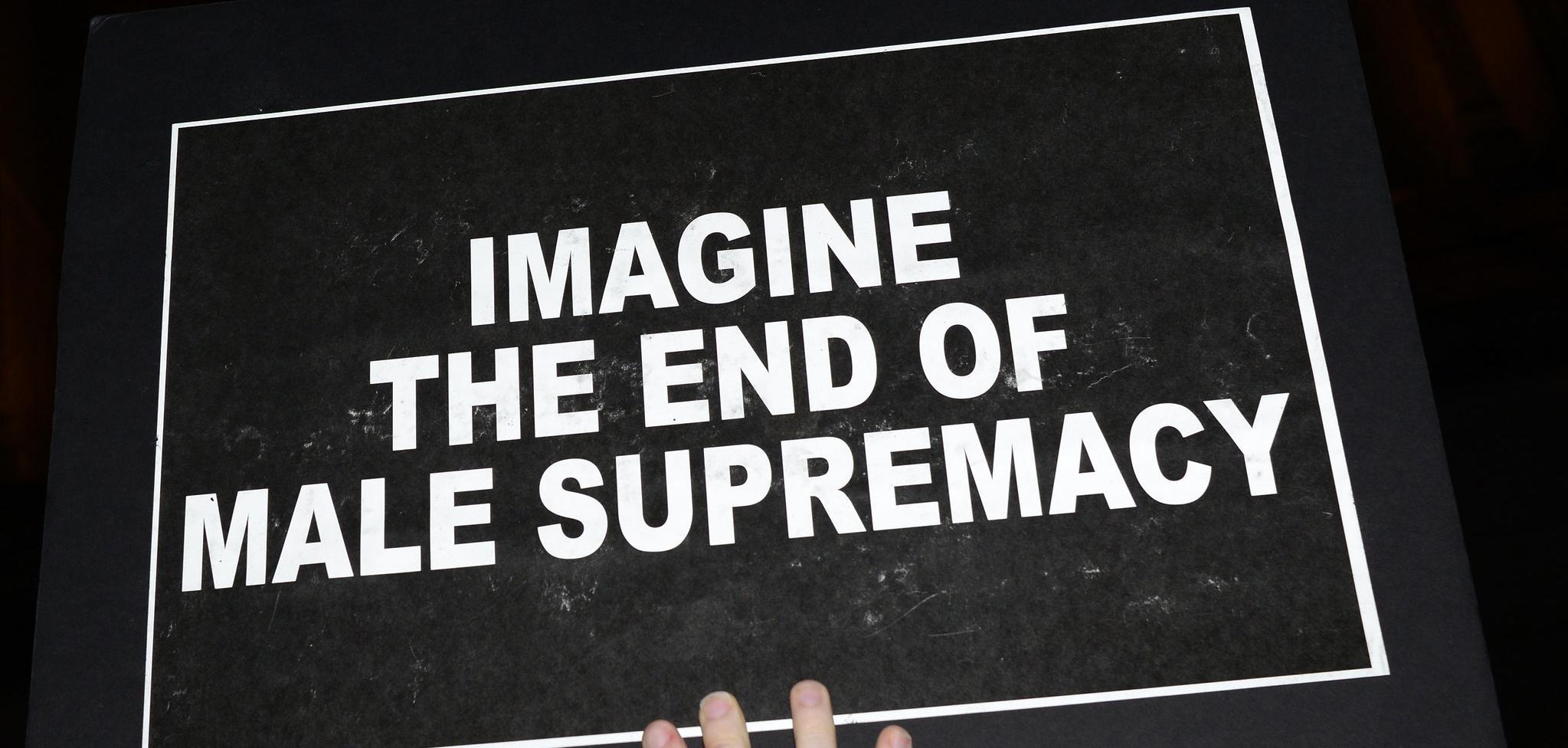
Unquestionably, President Donald Trump’s demonstrated enthusiasm for catering to the Christian Right on abortion—and obliterating their memory of his pro-choice past—spells trouble for reproductive rights. But that’s not the only threat to women under Trump’s new order. Trump’s campaign distinguished itself from those of other Republican candidates by its attacks on women: regularly insulting women’s appearances or behavior and defending physical and sexual harassment and violence against them. Sometimes, Trump’s threatening and offensive rhetoric directly targeted his Democratic opponent, Hillary Rodham Clinton, the first woman major party nominee for president, from calling her a “nasty woman” to suggesting there might be a Second Amendment “remedy” in case of her election.[1]
This rhetoric energized members of a secular misogynist Right—such as the men’s rights movement and, more recently, the “Alt Right”—that has flourished online since the 1990s. And it found no pushback from a brand of conservative, libertarian “feminism”—another ’90s development—that provides a dangerously legitimizing female face for misogynist ideology centered on overt hostility to women and the promulgation of rape culture.
Effectively fighting mobilizations like those emboldened by Trump’s election requires accurately understanding their composition—one in which misogyny thrives alongside, and intertwined with, racism.
Patriarchal Traditionalism from White Supremacy to the Christian Right
Male supremacism, enshrined in the nation’s founding documents, is as fundamental to U.S. history as White Anglo-Saxon Protestant (WASP) nativism.[2] The same patriarchal stance—combining race, religion, and nativism—fuels conservative Christian ideology on appropriate gender roles. (Transgender women and men and genderqueer individuals also violate these designated roles.) Especially in the last 100 years, as some women have succeeded in pushing back against the sexist world they inherited, social and political movements have emerged to defend traditional gender structures.
Amid Second Wave feminism, the antifeminists Phyllis Schlafly (a Roman Catholic) and Beverly LaHaye (an evangelical) followed in this tradition when they organized a “pro-family” movement to stop the ratification of the 1972 Equal Rights Amendment (ERA). Though themselves prominent activists, LaHaye and the late Schlafly promoted submission to husbands and attacked women seeking careers.[3]
Abortion, contraception, and sexuality education all threaten the enforcement of traditional gender roles. After the Roe v. Wade decision legalizing abortion in 1973, conservative evangelicals joined with the existing Catholic “prolife” movement in the creation of the Christian Right, and abortion became “a vital component of [the Right’s] fight to protect the bottom line of traditional family values—the dominance of white, male power and control,” as PRA’s Jean Hardisty and Pam Chamberlain observed. The anti-abortion movement drew together members of the Religious Right and White supremacists and neonazis, who contributed to the rising violence against clinic providers in the 1990s perpetrated primarily by White men.[4] (The legacy of White supremacy, Hardisty and Chamberlain continue, can be seen in how “the Right applies race and class criteria that distinguish between the rights of white, middle-class women and low-income women of color.” This dynamic led to the 1990s stereotype of the “welfare queen,” and welfare reform under Bill Clinton designed to discourage women of color and immigrant women from having “too many” children.[5])
But attacks on women’s reproductive rights have often come wrapped in the guise of chivalry, framed as “moral issues” and “family values” rather than misogyny. To gain wider acceptance, the anti-abortion movement has adopted a framework of “protecting women,” vilifying abortion providers as preying on weak women threatened by the physical and mental health consequences of abortion.[6] That effort has made significant legislative progress in recent years, with a slew of state anti-abortion bills in 2011. Despite this official strategy, clinic protesters on the ground expose their misogyny in calling women “murderers” and “whores,” and sometimes resorting to physical intimidation.[7]
In 2012, contraception came under increased attack as immoral in the debate over healthcare reform. Anti-abortion groups have long denounced the “morning after pill” as an abortifacient, yet had otherwise tended to avoid pushing an unpopular position against contraception, largely considered a settled issue. When law student Sandra Fluke testified in favor of contraceptive coverage, Rush Limbaugh infamously ranted about her being a “slut” and a “prostitute” who should be required to post sex videos online.[8]
Set on proving that his “pro-choice” days were behind him, during the 2016 campaign Trump denounced Planned Parenthood as an “abortion factory” and selected hardline reproductive and LGBTQ rights opponent Indiana governor Mike Pence as his running mate. In his eagerness, Trump unknowingly violated the Christian Right’s strategic deployment of a “kinder, gentler” image[9] when he announced that women who obtained an illegal abortion should face “punishment.” Although Trump backpedaled to mollify anti-abortion groups that claim to protect women, his original statement was characteristic of the anti-woman vitriol of his campaign and may have appealed to the existing hatred demonstrated by clinic protesters.[10]
The Christian Right’s attack on women isn’t limited to reproductive issues. Schlafly frequently argued that women make false accusations of sexual assault and domestic violence—her grounds for opposing the Violence Against Women Act (VAWA) and suggesting that there exists a “war on men.”[11] Concerned Women for America (CWA), a major Christian Right group founded by Beverly LaHaye, claims that the “wage gap” results from women’s own choices and therefore opposes equal pay legislation.[12] In such respects, Christian Right ideology aligns with that of equity feminism and men’s rights.
Equity Feminism and Men’s Rights
In 1991, “Women for Judge Thomas” formed to defend conservative Supreme Court nominee Clarence Thomas against Anita Hill’s sexual harassment allegations. The following year this group institutionalized itself as the Independent Women’s Forum (IWF), under the premise that, as co-founder Anita Blair declared, feminism should have “declared victory and gone home” by 1978.[13] The idea that, at least in the U.S., women have achieved equality underlies the secular libertarian philosophy of “equity feminism” (also “individualist feminism”).[14] In 2009, IWF’s then-president Michelle Bernard explained, “we have a philosophical belief that women are not victims… we believe that free markets are really the great equalizer, and will allow women to become truly equal with men in areas where we still may be unequal.”[15] This ideology diverges from patriarchal traditionalism in applauding successful career women (and holding varied views on abortion), replacing it with a sexism that blames women’s continuing underrepresentation in positions of influence on personal choices and intrinsic differences, and to protect this worldview, frequently dismisses contradictory evidence.[16]
By offering a provocative dissident women’s voice, presenting “the other side,” equity feminists can forego the grassroots organizing of Schlafly and LaHaye[17] while benefiting from extensive media dissemination of its ideas. As former IWF Executive Director Barbara Ledeen put it, “You can’t have white guys saying you don’t need affirmative action.”[18]
Of course, plenty of White guys have spoken out against affirmative action, developing a male victimhood ideology to complement equity feminism’s rejection of female victims. In 1988, Warren Farrell, who had once been involved with feminist organizing of men’s consciousness group, published the book Why Men Are the Way They Are, “depicting a world where women—particularly female executives—wield vast influence. Even those women who are less successful have ‘enormous sexual leverage over men.’”[19]
When men think about women’s gains, Caryl Rivers and Rosalind C. Barnett write in The New Soft War on Women: How the Myth of Female Ascendance Is Hurting Women, Men—and Our Economy, “There’s a tendency to circle the wagons, to exaggerate how far women have come and how far men have fallen.”[20] Alarm over women’s advancement emerges repeatedly in U.S. history: as Danielle Paquette points out in the Washington Post, 30 years prior to Farrell’s book, Harvard historian Arthur Schlesinger, Jr. worried over the trickle of wives into the 1950s workforce: “Women seem an expanding, aggressive force, seizing new domains like a conquering army, while men, more and more on the defensive, are hardly able to hold their own and gratefully accept assignments from their new rulers.”[21]
Farrell, dubbed the “father of the men’s rights movement,” followed up in 1993 with The Myth of Male Power: Why Men Are the Disposable Sex, where he suggested that American (White) men were the new “n****r,” threatened by women’s ability to cry sexual harassment and “date rape.” According to sociologist Michael Kimmel, this became the movement’s “bible,” awakening men to their status as victims of women’s ascendancy.[22] Like White supremacist movements, men’s rights ideology warns White men that they are losing their place in society. Where equity feminism thrives among elite women with access to major communications platforms, the men’s rights movement is a decentralized “netroots” movement that draws men who feel less privileged, especially those with employment troubles and failures in romantic relationships.
Claiming rampant false accusations of rape and violence is one of the most prevalent men’s rights and equity feminist talking points.[23] Who Stole Feminism?, a classic among conservative “feminists” published the following year by Christina Hoff Sommers, similarly argues that “gender” or “radical” feminists lie about rates of rape and domestic violence. Speaking on campus sexual assault in 2014, Sommers, a scholar at the conservative American Enterprise Institute, repeated the same themes of “false accusations” and “[i]nflated statistics,” declaring, “I believe that the rape culture movement is fueled by exaggerated claims of intimacy and a lot of paranoia about men.”[24] A spokesperson for A Voice for Men (AVFM), one of the most prominent men’s rights organizations, rejected rape “hysteria…as a scam” and baselessly claimed that sexual assault affects only about two percent of women—far from the Centers for Disease Control and Prevention’s one-in-five statistic.[25]
Although equity feminists reject the existence of structural constraints on women, like Men’s Rights Activist (MRA) they suggest that American boys and men suffer at the hands of gender feminists. In 2000, Sommers wrote The War Against Boys: How Misguided Feminism Is Harming Our Young Men, and a flurry of concern over boys’ educational achievements in 2013 landed her in major outlets including The New York Times, TIME Magazine, and The Atlantic. Psychologist Helen Smith, one of IWF’s “Modern Feminists,” suggested in 2012 that “the deck is so stacked against men that they are ‘going Galt,’” a reference to Ayn Rand’s novel Atlas Shrugged, an MRA favorite.[26]
Equity feminism’s depiction of women as liars with “victim mentalities” dovetails alarmingly with (and legitimizes) the online manifestation of the men’s rights movement, which uses more virulent and hateful rhetoric to convey the same argument.
Male Supremacist Harassment and Violence
Paul Elam has made attempts at a respectable mainstream image, organizing the movement’s first in-person conference. But he also has a history of advocating violence, writing that women who go clubbing are “begging” to be raped, and that “there are a lot of women who get pummeled and pumped because they are stupid (and often arrogant) enough to walk [through] life with the equivalent of a I’M A STUPID, CONNIVING BITCH—PLEASE RAPE ME neon sign glowing above their empty little narcissistic heads.”[27]
Another site Elam launched, Register-her.com, allowed men to post personal information for women they claim made false accusations (or otherwise outraged the movement) in order to target them for harassment. In 2011, feminist writer Jessica Valenti fled her house under a barrage of threats after her information appeared on this site.
Other strains of online male supremacism include pick-up artists (PUAs), who advocate male sexual entitlement and give sexist advice on seducing women; the Red Pill, a community named for a Matrix reference that seeks to awaken men to the “reality” of dominant “feminist culture”;[28] Men Going Their Own Way, which advocates cutting ties with women; and Jack Donovan’s “gang masculinity,” which calls on men to form warrior gangs to escape domestication by women.[29] Deviating from the online movement’s predominantly secular nature are Christian masculinists, who, as Dianna Anderson writes at Rewire, “have fused manosphere rhetoric with what they see as ‘biblical’ gender roles to envision a hierarchical, patriarchal ideal world.”[30] These varied communities share adherents, though there is also conflict among their competing perspectives.
The virulent misogyny promoted by male supremacists, often couched as anti-feminism and accompanied by racism and nativism, has serious repercussions that play out on a global stage. In 1989, Marc Lépine killed 14 women at an engineering school in Montreal under the guise of “fighting feminism.”[31] In 2009, George Sodini killed three women and then himself at a fitness class in Pennsylvania, leaving behind a website that complained about being rejected by women (and leading PUAs to coin the term “going Sodini”).[32] Anders Breivik murdered 77 adults and children in Norway in 2011, leaving behind a manifesto attacking “the radical feminist agenda,” Islam, political correctness, and “Cultural Marxism” (see David Neiwart’s article in this issue).[33] And in May 2014, Elliot Rodger set out to “slaughter every single spoiled, stuck-up blonde slut” at the “hottest” sorority at the University of California, Santa Barbara, writing, “I don’t know why you girls aren’t attracted to me, but I will punish you for it.”[34] He ultimately killed six people and himself, though he failed to make it inside the sorority.
The Southern Poverty Law Center’s Intelligence Report editor-in-chief, Mark Potok, wrote, “Men’s rights activists did not tell Rodger to kill—but in their writings, it seems like many of them wouldn’t mind doing some killing of their own. Rodger said as much in his manifesto, writing that PUAHate ‘confirmed many of the theories I had about how wicked and degenerate women really are’ and showed him ‘how bleak and cruel the world is due to the evilness of women.’”[35]
Elliot Rodger’s story has parallels with that of White supremacist terrorist Dylann Roof, convicted in 2016 of murdering nine Black congregants at a Charleston church.[36] Though the media typically portrays such acts of right-wing violence as perpetrated by mentally disturbed individuals[37]—so-called “Lone Wolves”—as PRA contributor Naomi Braine writes, “a decision to act alone does not mean acting outside of social movement frameworks, philosophies, and networks.”[38] Both young men encountered inaccurate and hateful rhetoric online that inflamed existing dissatisfactions by depicting them as victims.[39] Thus, Lone Wolf violence emerges from a right-wing context “systematically erased” by media misrepresentation of these as isolated and irrational actors.
Some members of the male supremacist online movement hailed Rodger as a hero on PUAHate.com messaging boards or Facebook fan pages.[40] Others distanced themselves while defending their own misogynist content, much as the Council of Conservative Citizens, the White nationalist group Roof cited in his manifesto, claimed to condemn Roof’s violence while blaming society for ignoring White people’s “legitimate grievances.”[41] Daryush Valizadeh (“Roosh V”), a professional PUA and founder of the site Return of Kings, argued, “Until you give men like Rodger a way to have sex, either by encouraging them to learn game, seek out a Thai wife, or engage in legalized prostitution…it’s inevitable for another massacre to occur.”[42]
Meanwhile, equity feminists stepped up to whitewash a clearly misogynist attack. IWF senior editor Charlotte Hays wrote that calling Rodger’s violence a “product of sexism” was a “bizarre response” by feminists.[43]
Video Games, Misogyny, and the Alt Right
Video games might not seem like a vital social justice battleground. However, as sociologist and gaming critic Katherine Cross has pointed out, the virulence of online White male reactions to increasing gender and racial diversity in game players and creators, and to critiques of the industry’s sexism, indicates a problem with dismissing this as a trivial issue.[44] Only a few months after Rodger’s fatal 2014 attack, an incident dubbed “Gamergate,” ostensibly about gaming industry ethics and media corruption, resulted in the Federal Bureau of Investigation (FBI) looking into the barrage of violent rape and death threats against women who criticized video games’ sexist portrayals of women and lack of diversity.[45] Anita Sarkeesian, one of the primary targets, canceled a talk at Utah State University after the school received a threat to repeat Marc Lépine’s massacre and demonstrate “what feminist lies and poison have done to the men of America.”[46] While circles of progressive female journalists took the movement behind Gamergate seriously, their voices were largely ignored by the mainstream media.[47]
Through Gamergate, vocal misogynist personalities such as Mike Cernovich, associated with the pick-up artist community, and Milo Yiannopoulos, a Breitbart writer, expanded their online following, to be leveraged in future attacks on feminism and women. Yiannopoulos had over 300,000 Twitter followers at the time the social media platform finally banned him for offensive content in 2016; at the time of this writing he has more than 1.9 million Facebook likes and 568,000 subscribers on YouTube, in addition to his platform at Breitbart, where he has bragged about writing headlines such as “Would You Rather Your Child Had Feminism or Cancer?”[48] In “An Establishment Conservative’s Guide to the Alt-Right,” Yiannopoulos and co-author Allum Bokhari write, “The so-called online ‘manosphere,’ the nemeses of left-wing feminism, quickly became one of the alt-right’s most distinctive constituencies.”
The New Yorker’s Andrew Marantz writes that Cernovich “developed a theory of white-male identity politics: men were oppressed by feminism, and political correctness prevented the discussion of obvious truths, such as the criminal proclivities of certain ethnic groups.”[49] In 2016, in tweets that received more than 100 million views, Cernovich focused on supporting “unapologetically masculine” Trump and attacking Hillary Clinton with conspiracy theories regarding her failing health and emails.
Following Trump’s election, mainstream and progressive media outlets worried that using the movement’s chosen name, the Alt Right, helped euphemize and normalize old-fashioned bigotry. As Think Progress’ editors wrote, “[Alt Right Leader Richard] Spencer and his ilk are essentially standard-issue white supremacists who discovered a clever way to make themselves appear more innocuous—even a little hip”; their publication, they declared, wouldn’t do “racists’ public relations work for them.”[50]
But nowhere in this statement from a major progressive news outlet exists a single reference to sexism or misogyny—a glaring omission given its significance to the Alt Right’s mobilization to defeat the first woman to receive a major party nomination for president.[51] Some respected outlets and organizations, including the Associated Press and SPLC, described the movement’s misogyny, but their recommended definitions referenced White nationalism, neglecting to acknowledge male supremacy as a core component.[52],[53] While some Alt Right leaders, such as former Breitbart executive (now Trump administration chief strategist) Stephen Bannon, hail from more racist corners of the umbrella movement, others, like Yiannopoulos and Cernovich, rose to prominence primarily on their misogynist rhetoric.
These omissions aren’t surprising. In a 2008 study, “The Absence of a Gender Justice Framework in Social Justice Organizing,” activist and consultant Linda Burnham wrote, “All too many organizers and activists affirm a commitment to women’s human rights or gender justice while having no clear idea of sexism as a systemic phenomenon with tangled historical, social, economic and cultural roots and multiple manifestations.” In her interviews of activists, Burnham found “the subordination of sexism as a legitimate concern among ‘competing isms’”; antipathy to the feminist movement (which is perceived as White); a feeling that “there’s already a level of equity and there’s no need to struggle over it anymore”; and a lack of tools for structural analysis.[54] (Groups with a better intersectional approach, Burnham footnoted, included reproductive justice organizations like SisterSong.[55])
Matthew N. Lyons, co-author of Right-Wing Populism in America, further argues that this heightened misogyny distinguishes the Alt Right from other White supremacist and neonazi mobilizations, which have practiced a “quasi-feminism” that viewed women as holding distinct but complementary gender roles important to the movement. Especially since the 1980s, Lyons writes, neonazi groups have increasingly lauded White women as “race warriors.”[56]
Some early Alt Right writers did encourage their compatriots to do more to attract women and root out sexual harassment.[57] Now even that has disappeared. Today the movement is better characterized by dismissive ideology like that of White male supremacist Matt Forney, who asserts in a 2012 “anti-feminist classic” post on Alternative Right that women are “herd creatures” who are “unimportant” to the men who will make history. “Attempting to convince such flighty creatures to join the alt-right with logical arguments is like begging escaped inmates to please pretty please come back to the insane asylum.”[58] Forney also argues that, “Every feminist, deep down, wants nothing more than a rapist’s baby in her belly.”[59] Lyons writes:
Alt-rightists tell us that it’s natural for men to rule over women and that women want and need this, that “giving women freedom [was] one of mankind’s greatest mistakes,” that women should “never be allowed to make foreign policy [because] their vindictiveness knows no bounds,” that feminism is defined by mental illness and has turned women into “caricatures of irrationality and hysteria.”[60]
Richard Spencer, the now-infamous White nationalist leader credited with coining the term “Alt Right,” promotes male supremacist rhetoric that includes yet goes beyond traditional arguments for women belonging in the home. Along with his position on women’s “vindictiveness” (quoted by Lyons above), Spencer defended Trump against sexual assault accusations with the argument, “At some part of every woman’s soul, they want to be taken by a strong man.”[61]
Cas Mudde, a Dutch political scientist who studies right-wing movements, describes the Alt Right’s assertion of women’s inferiority as “a sexist interpretation of xenophobia. It’s the same view they have of immigrants and minorities, that they’re threatening their way of life. A life where men are dominant. A life where they have privilege in virtually every domain.”[62]
Vox writer Aja Romano argues that misogyny is not only a significant part of the Alt Right, it’s the “gateway drug” for the recruitment of disaffected White men into racist communities. David Futrelle, a journalist who watches the men’s rights and other online misogynist movements, told Vox that it’s “close to impossible to overstate the role of Gamergate in the process of [alt-right] radicalization. … Gamergate was based on the same sense of aggrieved entitlement that drives the alt-right—and many Trump voters.” Within this narrative, Futrelle said, they saw their harassment of women as defending “an imperiled culture,” moving into other online enclaves populated by neonazis and White supremacists that recruited them for “fighting against ‘white genocide.’”[63]
2016 Election: Where Has This Misogyny Led Us?
In 2006, IWF Managing Director Carrie L. Lukas wrote, “In the past, victims of rape were made to feel that the crime was their fault. Many women around the world still suffer this bias. Today in the United States, the pendulum has swung too far in the other direction. A man accused of rape often is convicted in the court of public opinion without evidence.”[64] Yet in Trump’s campaign, that was far from the case. Multiple accusations of sexual assault and harassment against the Republican candidate were ignored throughout the campaign; when audio recordings exposing him admitting to sexual assault finally brought widespread attention to his treatment of women, he defended his comments as “locker-room talk.” And those comments did not ultimately cost him the election.
While IWF and equity feminism, like other libertarian ideologies, tend toward the conservative side of the political spectrum, there is more diversity there than among women in anti-feminist movements and the Christian Right. This allows the ideological tent to include Democrats like Christina Hoff Sommers, independents like former IWF president Michelle Bernard, and Republican women who might criticize aspects of their party’s gender dynamics. After applauding Sarah Palin for breaking free of sexist attempts to control her image as the 2008 Republican vice presidential nominee, in 2009, Bernard spoke of bright prospects ahead for Hillary Clinton: “She is incredibly smart, brilliant, an excellent campaigner, and I think her time will come.”[65]
However, misogynist and anti-feminist Rightist ideologies have taken a toll beyond leaders’ control. Though during the primaries IWF gave favorable attention to Carly Fiorina, the only female Republican candidate, a poll showed Trump leading the Republican pack among female voters. Historian Catherine Rymph explained that the exodus of feminism and women’s rights advocacy from the GOP means that, among those left, “voters, including women, who don’t like Democratic feminism or so-called ‘political correctness’ in general may very well find refreshing Trump’s delight in using language about women that many find offensive.”[66] When then-Fox News anchor Megyn Kelly criticized Trump’s misogyny while moderating a 2015 primary debate, Trump responded, to audience cheers, that “the big problem this country has is being politically correct”—code for resistance to misogyny, racism, xenophobia, and homophobia. Trump went on to call Kelly a “bimbo” and imply she was menstruating. After Trump’s continued attacks on Twitter rallied online misogynists to further harassment, Kelly received death threats.[67]
For some equity feminists, it’s gone too far. IWF senior editor Charlotte Hays argues that Trump’s history of misogynist statements goes beyond “bucking political correctness.” In March 2016, Hays worried, “If Trump is the nominee, the [Leftist claims of a] ‘war on women’ will be back with a vengeance. And this time there will be a degree of fairness in the charge.”[68] Sommers referred to Trump as an example of “amoral masculinity” that “preys on women.”[69] She joined conservative female media pundits in calling for Trump to fire his original campaign manager, Corey Lewandowski, after Breitbart News reporter Michelle Fields charged him with physically assaulting her.[70] Trump denied Lewandowski’s culpability, only firing him three months later after apparently unrelated problems.[71] And when former Fox News anchor Gretchen Carlson filed suit against CEO Roger Ailes for sexual harassment—which Kelly also reported experiencing—Trump asserted that Carlson’s accusations against his informal advisor were “Totally unfounded.”[72]
Fields resigned from Breitbart, which former executive and Trump senior strategist Stephen Bannon proudly called “the platform for the alt-right,”[73] over the outlet’s inadequate response.[74] Commenting on the successive Alt Right online harassment of Fields, Kelly said, “This woman hasn’t done anything wrong, anything, other than find herself on the wrong end of these folks, for whom she used to work.”[75]
Some equity feminists, like Sommers, may have expected their own elite conservative colleagues to be taken seriously, not realizing that the damage done in disparaging other women would find its way back to them. In response to Sommers’ criticism of Trump, Mike Cernovich disdainfully pointed out that she had previously “mocked women who played the damsel in distress.”[76]
On the other hand, the appreciation for Hillary Clinton’s political merits seems to have disappeared under IWF’s new leadership, which got on board with Trump after his nomination. Trump hired IWF board member Kellyanne Conway to replace Lewandowski as his new campaign manager, which followed the organization’s efforts to peddle palatable sexism under a female face. IWF’s campaign affiliate, Independent Women’s Voice (IWV), supported Trump’s campaign, with CEO Heather Higgins coming around to offer her full-throated support in the general election.[77]
The men’s rights movement lacked these internal divisions over Trump’s outright misogyny. Early in the primary season, members of online male supremacist communities touted Trump as an example of an “alpha” male given how “he insults and dominates women, preys on their insecurities and refuses to ever apologize for it.”[78] And as though he was directly channeling men’s rights talking points, at a campaign rally in May 2016 Trump declared, “All of the men, we’re petrified to speak to women anymore. …You know what? The women get it better than we do, folks. They get it better than we do. If [Hillary Clinton] didn’t play [the woman] card, she has nothing.”[79]
While Trump’s rhetoric reflects MRA vitriol, it is the long fight against feminism by groups embraced in the mainstream, like equity feminists and Republican women, that legitimized the candidacy—and election—of an overt misogynist who has bragged about sexual assault.
Defending Gender Justice Post-Election
Trump’s rhetoric shares more in common with equity feminist and men’s rights ideologies than with “family values” framing—and with the reality of Christian Right misogyny, such as the vitriol of clinic protestors and the anti-feminism of the late Phyllis Schlafly, a staunch Trump supporter.
It will be important to track the growing connections between these secular and religious movements, bridged by an underlying misogyny, racism, and nativism, especially as individuals aligned with the Alt Right, like Bannon, and equity feminism, like Conway, gain influence. The seeds are already there. The libertarian Koch brothers, infamous major donors to libertarian and conservative causes, fund both IWF and CWA. Alt Right figures like blogger Matt Forney oppose reproductive rights, writing that pro-choice women have “evil” in their souls and that “Girls who kill their own children despise life itself and will do their best to destroy yours.”[80] Pick-up artist communities advise members to seek submissive wives who can easily be controlled, and oppose abortion and contraception as a means of weighing them down with children.[81] And, extending “father’s rights” arguments within the men’s rights movement, a Missouri lawmaker proposed in 2014 a bill requiring paternal consent to an abortion.[82]
The influence of ideology on the broader population, outside of active movement participants, bears particular importance with a president who uses his platform to broadcast virulent misogyny, racism, nativism, and Islamophobia.[83] In tracking reported bias-related incidents since Election Day, the Southern Poverty Law Center found that perpetrators were most likely to explicitly reference Trump in anti-woman attacks—82 percent of the 45 reported incidents, more than double the next-highest rate.[84] In multiple incidents of harassment of women, assailants from middle school boys to groups of adult men parroted Trump’s boast that he can “Grab [women] by the pussy.”[85]
Sen. Jeff Sessions (R-AL) originally claimed it was a “stretch” to “characterize [Trump’s comment] as sexual assault” (later backpedalling under questioning during his confirmation hearing for U.S. attorney general).[86] Before Trump was even sworn in as president, his administration’s threat to reproductive rights, protections addressing violence against women and campus rape, and other women’s equality programs had already been made alarmingly clear.[87] Under the Trump-Pence administration, threats will come from the Christian Right, conservative secular and libertarian groups, empowered White supremacist figures, and, of course, a President who’s shown his comfort with overt displays of racism, nativism, and misogyny. This disturbing combination may now jeopardize a wider expanse of policies reducing structural oppression that had seemed settled.
But the fact of this combined threat may also bring more dissenters into a more holistic response. Loretta Ross, a longtime reproductive justice and women’s human rights leader, is optimistic about the power vested in intersectional feminist organizing. “Now with the Women’s March on Washington using the ‘Women’s Rights Are Human Rights’ call for mobilizations in 616 simultaneous marches worldwide,” she wrote at Rewire, “I believe feminists in the United States have finally caught up to the rest of the global women’s movement. I feel like celebrating our inevitable progress toward victory for equality, dignity, and justice, despite the reasons we are marching in the first place: to unite to challenge the immoral and probably illegitimate presidency of Donald Trump.”[88]
The Philosophical Fascists of the Gay Alt-Right
Author: Maureen O'Connor
Date: Apr. 30, 2017
Source: <www.thecut.com/2017/04/jack-donovan-philosophical-fascists-of-the-gay-alt-right.html>
Jack Donovan — a 42-year-old skinhead icon and right-wing extremist — lived the gay life once. It was in the 1990s, after he left his parents’ blue-collar home in rural Pennsylvania to study fine art in New York, when he danced go-go in gay clubs, hung out with drag queens, and marched for gay pride. But then he dropped out, learned how to use tools and work as a manual laborer, studied MMA, and decided he wasn’t gay — just “an unrepentant masculinist.”
“I am not gay because the word gay connotes so much more than same-sex desire,” Donovan announced, under a pseudonym, on the first page of 2006’s Androphilia: A Manifesto: Rejecting the Gay Identity, Reclaiming Masculinity (echoing, probably unintentionally, the speech Tony Kushner wrote for Roy Cohn in Angels in America). “The word gay describes a whole cultural and political movement that promotes anti-male feminism, victim mentality, and leftist politics.” He appropriated a new term, androphile, to describe a man whose love of masculinity includes sex with other men.
Related Stories
Beyond Alt: Understanding the New Far Right
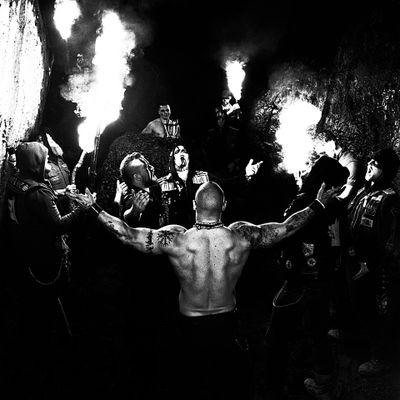
Gay men are remarkably prominent — if not exactly abundant — in the alt-right universe. Take the infamous Milo Yiannopoulos, who powered a meteoric rise and fall on the sheer cognitive dissonance between his flamboyant self-presentation and callous politics. (When Out magazine profiled Milo, the story’s writer Chadwick Moore “came out as a conservative.”) Or artist turned reporter Lucian Wintrich, who joined the White House press corps when Trump-cheering blog Gateway Pundit (edited by a gay man) received its first credential. But even those men seem relatively mainstream when you compare them with Donovan, who has contributed to “dapper white nationalist” (and friend) Richard Spencer’s journal, advocates for a form of “anarcho-fascism,” and founded a chapter of a masculinist “tribe” called the Wolves of Vinland, which the Southern Poverty Law Center classifies as a hate group. (One member recently served time for burning down a historically black church.) Which makes sense when he shows me photos from their neopagan fight-club rituals, which sometimes involve nooses.
To hear Donovan tell it, his sexuality is a nonissue. It’s a point echoed by several of his peers, who don’t see their political views and sexual identities as contradictory but complementary. “Masculinity is a religion, and I see potential for androphiles to become its priests,” Donovan wrote in Androphilia, “to devote themselves to it” in a way that men who understand their manliness through women — in quantifying the number they’ve slept with or measuring “men’s rights” against “women’s rights” — can’t. And so androphiles like Donovan have found common ground with the gender-traditionalists and male-advocacy groups elsewhere in the messy carnival of the new right, where reactions to women range from outright hostility to benign disinterest.
And they’re not interested in queer solidarity, either. “Apart from Camille Paglia, of course, I can’t think of any interesting lesbians,” gay white nationalist James O’Meara told me in an interview. Or as Donovan said, “I think most of them are so married to feminism that I don’t think that’s even an option.” To say nothing of trans issues, which most gay alt-righters rejected (“I know three transgender people in our movement,” Counter-Currents editor Greg Johnson offered, before arguing against the designation. “White nationalism should be straight but not narrow,” he said, inadvertently repeating a slogan popularized by an anti-bullying LGBT nonprofit.) Donovan sees himself as a member of the earliest generation of gay men who could be free to ditch the “victim mentality” of queer politics. In Androphilia, he praises activists who fought to decriminalize gay sex and to combat institutional indifference to AIDS “It would be remiss not to credit the Gay Rights Movement for fighting against this sort of oppression, intolerance, and intentional negligence,” he writes, but “having achieved relative tolerance for same-sex-oriented people in mainstream culture, and having brought an end to police harassment and widespread discrimination, the Gay Rights Movement has turned to nitpicking.” He isn’t against identity politics. He’s loud and proud about his race and his gender — traits that, unlike his sexuality, do not make him a minority. “Ten out of ten minorities agree that being a minority can really blow,” he explains in “Mighty White,” an essay defending white nationalism in those who fear losing, or in some contexts have already lost, majority racial status.
Donovan — whose partner of 20 years is a Trump supporter of Mexican descent — supports white nationalists, but denies belonging in their ranks. “I just think that’s a silly goal,” he says of the so-called white ethnostate. Whiteness, he points out, “is an American approximation of nationality,” which doesn’t make as much sense as, say, German nationalism — which he became familiar with when he delivered a speech praising masculine violence at a far-right German nationalist convention near Leipzig in February. Violence is a component of Donovan’s “gang theory of masculinity,” an idea he became so enamored of that he felt he could not actualize as a man until he had a gang of his own. Enter the Wolves of Vinland, a club started near Lynchburg, Virginia, by brothers Paul and Matthias Waggener, a pair of avid bodybuilders who love blackmetal bands (a.k.a. National Socialist Black Metal bands). The sons of an Orthodox priest, the Waggeners have said in interviewsthat they experimented with drugs, satanism, and “gangster shit” before discovering neopaganism, also known as “heathenism,” which became the foundation of their club.
“The rest of the Wolves are not homos, and we don’t consider ourselves a white-nationalist or alt-right group,” Donovan clarifies by email. White nationalists and the alt-right do, however, seem to consider them kin, judging by the frequency of pro-Vinland programming in white-nationalist and alt-right media. One thing those groups share is an intellectual foundation of gender and race essentialism: “Our women are females, they’re females, and our males are masculine, and we don’t look for sameness between sexes,” Paul Waggener told Greg Johnson in an interview. To be masculine, a man doesn’t need to have sex with women — although he should probably be stronger than women, and hold his own in brawls, and have tactical skills, and provide. And he should be brave, which is why Donovan gets so irritated when he’s accused of homophobia. “That’s a construction. That’s a silencing word and it’s meant to emasculate,” he says. “When you say someone’s phobic, you’re saying that they’re afraid. That’s why they call men phobic constantly — they’re transphobic, they’re homophobic, they’re afraid of women.” Political correctness “is just a way of calling a man a coward.” (When it comes to language, Jack is more sensitive about ideology than sexuality. He still doesn’t like the word gay but occasionally uses it for conversational expediency and punch lines about “being gay” with his boyfriend about their new pet dog.)
Who feels fear, and why, and whether their fear is rational, seems to be at the heart of the mainstream’s tension with the alt-right. If a man gives a speech called “Violence Is Golden,” is that scary? What if his audience includes white nationalists? And if he’s gay, does that change, well, anything? Not really, says historian Jim Downs, author of Stand by Me: The Forgotten History of Gay Liberation. “If you look at every movement, you’re going to find these moments” of unexpected orientations and identities that seem anomalous within a movement. But if enough people join a club, inevitably, some won’t be straight. “There were gay Nazis,” Downs points out. “But follow where the story leads you: They get massacred.” What seems safe at one moment can be taboo a moment later, and traits that are liabilities in one context can be elsewhere. As recently as 2004, Republicans bragged about opposing gay rights to rally the base, while supporters like John Kerry avoided the topic. Today, longstanding opponents of gay rights are the ones who avoid the question — or set aside long-held beliefs in the name of pragmatism.
“I think gays can be particularly useful to the alt-right,” Alternative Right editor Colin Liddell told me. “Our movement is a revolutionary and taboo-busting movement, and gays have the right ‘psychological equipment’ for that. And, because of their lack of immediate family, gays often have a stronger feeling for their ‘wider family.’ The left has successfully displaced this sentiment to the fake ‘gay community’ or to leftist causes in general, but the true wider family for gays is their particular tribal or ethnic group.”
Donovan seems to be living proof of that theory — but not, perhaps, by choice. When I ask if he’d like to have children, he replies, “If I did, it would be with a woman.” He’s jealous of the “multigenerational experience” that straight couples can have just by fucking. Their DNA becomes entwined, playing out together for generations, even after they’re dead. The tribe lives on. “I’ve been really lucky,” he continues. “The guy I’m with, he’s my family. We just got a dog together, and we’re being gay for the dog.” He laughs. “I’m very lucky and, I think, very unusual in that sense. I think a lot of homosexual men end up being alone. I think it’s very unstable and very lonely. It’s not something that’s — like — if I met a young man who would say, ‘Hey, you know, I’m questioning,’ I’d say, ‘Don’t.’ I would advise them, unless there is no other way, I would say, ‘If you have the choice between men and women, be straight.’”
*A version of this article appears in the May 1, 2017, issue of New York Magazine.
Related
Beyond Alt: Understanding the New Far Right
Tags:
How the Alt-Right Is Using Sex and Camp to Attract Gay Men to Fascism
Author: Donna Minkowitz
Date: June 05, 2017
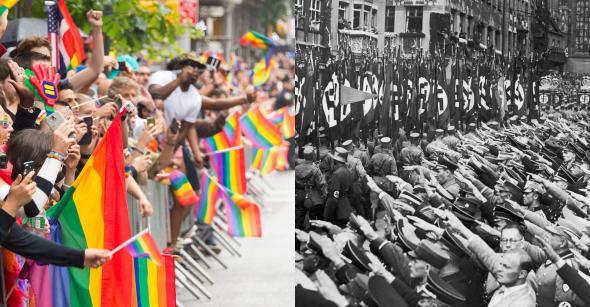
Photo illustration by Slate. Photos by Michael Stewart/WireImage, FPG/Hulton Archive/Getty Images.
At the National Policy Institute’s 2015 conference, alt-right star Richard Spencer’s annual Nazi-fest, a speaker named Jack Donovan exhorted the crowd “to leave the world the way you entered it, kicking and screaming and covered in somebody else’s blood.” The same year, in the pages of the The Occidental Observer, one of the most prominent white nationalist webzines, another alt-righter, James J. O’Meara, held forth about how “behind the Negro, hidden away, as always, is the darker, more sinister figure of the Judeo. The Negro is the shock troop. The Jew is the ultimate beneficiary.” Aside from being open fascists and “white racialists,” Donovan and O’Meara have another thing in common: They’re both out gay men.
In his book The Homo and the Negro, O’Meara says that gay white men represent the best of what Western culture has to offer because of their “intelligence” and “beauty,” and that “Negroes” represent the worst, being incapable of “achievement.” Donovan calls women “whores” and “bitches,” and, when a questioner on Reddit asked him his views of the Holocaust, responded, “What is this Holocaust thing? I’m drawing a blank.”
Both have become influential figures in the alt-right; horribly, they are not the only gay men to respond to an olive branch lately offered by white nationalism. The opening of this movement to cisgender gay men is a radical change, “one of the biggest changes I’ve seen on the right in 40 years,” says Chip Berlet, co-author of Right-Wing Populism in America. In the United States, unlike in Europe, out gay men have never been welcome in white supremacist groups. The Klan and neo-Nazi groups, the main previous incarnations of white hate in this country, were and still are violently anti-queer. And while a subset of openly gay men has always been conservative (or, as in all populations, casually racist), they never sought to join the racist right.
That was before groups like NPI, Counter-Currents Publishing, and American Renaissance started putting out the welcome mat. Since around 2010, some (though by no means all) groups in the leadership of the white nationalist movement have been inviting out cis gay men to speak at their conferences, write for their magazines, and be interviewed in their journals. Donovan and O’Meara, far to the right of disgraced provocateur Milo Yiannopoulos, are the white nationalist movement’s actual queer stars. But there are others in the ranks, like Douglas Pearce of the popular neofolk band Death in June. And there are many more gay men (and some trans women) who have been profoundly influenced by two white nationalist ideas: the “threat” posed by Islam and the “danger” posed by immigrants.
Donovan tries to sugarcoat his own racist beliefs when speaking to his main fan base, gay men who like his macho looks and straight men from the “pickup artist” culture and the manosphere who are desperately trying to learn from him how to be manly. Instead, reverting to the other half of the Nazi playbook, he prefers to highlight his hatred for “effeminacy,” feminism, and “weakness.” A beautifully muscular man of 42 who has perfected a masculine scowl in the many photographs of himself he releases on his website and Facebook page, he functions as beefcake for the neofascist cause. He’s parlayed his butch allure into a brand, earning money from a line of T-shirts and wrist guards that say things like BARBARIAN and a series of books that seek to instruct both straight and gay men in how to become more masculine and in particular, more “violent.”
One of my Facebook friends, a politically liberal gay man I’ll call Frank, is a fan of Donovan’s Facebook page “because of the visuals. I like his looks—I mean, he’s bald with tattoos. He really exudes a lot of sex.” Frank also likes that Donovan “trashes that whole gay club scene,” which Frank finds conformist and alienating.
But when Donovan says violence, he means violence. This is not BDSM. “The ability to use violence effectively is the highest value of masters,” Donovan said in a 2017 speech at a fascist think tank in Germany. “It is the primary value of those who create order, who create worlds. Violence is a golden value. Violence rules. Violence is not evil–it is elemental.” Though Donovan tries to mine the latent sexiness in violence for all it’s worth, he is, in fact, against consensual BDSM, condemning it in a 2010 essay as part of a long list of evils that he feels has been perpetuated by gay culture: the “extreme promiscuity, sadomasochism, transvestism, transsexuality, and flamboyant effeminacy” promoted by “the pink-haired, punk rock stepchildren of feminism,” gay activists. No, it’s straight-up people hurting and killing other people he’s endorsing.
And what is all this violence for? Creating small, decentralized “homelands” in this country separated by—surprise!—race. He enthusiastically embraces an idea the alt-right calls “pan-secessionism,” under which, as Donovan says in his book A Sky Without Eagles, “gangs” of white men would form “autonomous zones” for themselves and white women, where women “would not be permitted to rule or take part in … political life.” The gangs would enforce racial boundary lines, because, as Donovan puts it, whites have “radically different values [and] cultures” than other people, and “loyalty requires preference. It requires discrimination.”
In a 2011 essay, “Mighty White,” Donovan says, “race is not my favorite issue to write about” because “I know too well that it distracts people from the bulk of my work” on the sexiness of violent masculinity. (If people associated him more with white nationalism than machismo, it could impede sales of his clothing line, books, patches, and the tattoos he sells out of a Portland-area gym.) And indeed, at the end of May, Donovan wrote a long, rambling post on his website trying to dissociate himself from white nationalism. The post may have been a response to the enormous public anger in Portland, Oregon (where Donovan lives), following white nationalist Jeremy Christian’s murder of two men for defending women of color on a commuter train on May 26. In the essay, Donovan claimed he doesn’t want to organize anyone politically, rather “I just want to hang out in the woods with … the people who I am oathed to, my tribe, the Wolves of Vinland”—a white, “neopagan” quasi-military brotherhood recognized as a hate group by the Southern Poverty Law Center. (Wolves of Vinland member Maurice Michaely recently spent two years in prison for burning down a black church in Virginia.)
But Donovan’s recent hand-wringing does not erase the fact that on his website he’s repeatedly said real men want to “control our borders,” decried the “black-on-white crime rate,” denounced “the deeply entrenched anti-white bias” of our culture, and said, “I support White Nationalists,” who “I call … ‘The Mighty Whites.’ ” Recently, he admiringly interviewed the two young men who lead Germany’s anti-African, anti-Arab identitarian movement. On his podcast, the men, one of whom used to belong to a neo-Nazi group in Austria, boast about attacking a mosque and disrupting refugee theater. He also has begun whispering praise for Julius Evola, the Italian anti-Semite and fascist who joined Hitler’s SS.
If Donovan is a caricature of the gay Nazi strongman—almost a personification of the phrase “body fascism” (which was originally used by gay men to critique other gay men’s obsession with perfect gym bodies)—his counterpart, James O’Meara, is an embodiment of something that could barely be imagined until now: Nazi camp. I hesitate to write that phrase, because it’s almost painful to acknowledge that camp—that subversive, gay “turning” of seriousness into playfulness and straight narratives into gay ones—could be deployed by a Nazi. But of course it can: If the emergence of out gay white nationalists shows anything, it’s that LGBTQ people truly are everywhere, for good and for ill. And that we no longer have the luxury of assuming that queer tropes are inherently, and trans-historically, progressive.
Far femmier than Donovan in both looks and tone, O’Meara writes alternately smirking and playful essays for Counter-Currents about men’s clothing, the closeted Cardinal Spellman, the “homoromanticism” of the Boy Scouts, and the political economy of The Gilmore Girls. O’Meara openly loves Hitler, but he also grooves to the socialist Oscar Wilde, and, in an interview with the webzine Alternative Right, admiringly quotes “Bunny” Roger, the gay British dandy and World War II hero, as saying: “Now that I’ve killed so many Nazis Daddy will have to buy me a sable coat.” But his “fun” paragraphs always end up at the same un-playful conclusion: “the Judaic is always there, blocking the way” and spreading “rot” throughout American culture. “The Jew” is deliberately destroying the country by building up “Negroes” and promoting “the alien, dissolute, demonic culture of the Africans.” In a podcast, O’Meara said, “The blacks get their chicks pregnant as soon as they turn 15, and have 30 different children with 10 different women” because of Jewish scheming: “the poison that the Jewish mentality introduces” promotes heterosexual sex and “girl-craziness” instead of the glorious gayness that would dominate “if the Jews hadn’t taken over Hollywood.”
Of course, neither O’Meara nor Donovan actually support gay rights. This is partly because they don’t believe in “civil rights.” Although O’Meara wants to be part of an imagined elite band of men who love each other and rule society—his version of an Aryan fantasy called the Männerbund—he doesn’t want to support, as he put it in the interview with Alternative Right, “some sniveling queen demanding ‘my rights!’ … ‘The plight of the homosexual’ … is a Leftist myth.” Donovan says explicitly that straight people should be given more power and privileges than gay folks, because their “reproductive sexuality” is superior to ours. Both men openly detest lesbians and trans and genderqueer people: Donovan calls the trans movement “men who want to cut their dicks off and women who want to cut their tits off.” And of course, no white nationalist organization anywhere supports LGBTQ rights on a social or legislative level. Their new “support” is limited to allowing cis gay men who are white racists to join them.
So why are white nationalists smiling in our direction? Most importantly, because it worked in Europe. In Holland, France, Germany, and Sweden, white nationalists have deliberately used LGBTQ people and Muslims as a wedge against one another. Polls show that over one third of French gay men supported Le Pen in the recent election despite her promise to end same-sex marriage, and in Germany, the far-right AfD recently tapped an out lesbian banker to run for chancellor. (The AfD is even more hostile to actual pro-gay policies than France’s National Front is.) Sweden’s fascist party organized an LGBTQ pride parade through Muslim neighborhoods, and of course, in Holland, Pim Fortuyn and later Geert Wilders tried to make “Islam” synonymous with “hatred of gays.” Their ultimate goal was to make hatred of immigrants “progressive.”
Bringing queer people in, in both Europe and America, is a way to grow the neo-fascist movement. It is also a way to court millennials, who are consistently supportive of gay rights even when they swing conservative on other issues. It’s a testament to the fact that, in some ways, the queer movement has already won the battle for public opinion. The far right could not beat us, so they decided to join us—in the most superficial way possible. Ultimately, it’s a form of pinkwashing, which YourDictionary defines as “the practice of representing something … as gay-friendly in order to soften or downplay aspects of its reputation considered negative.” How could Le Pen, or Wilders, or other open racists be so bad when they like queer people?
There is another potential benefit: If white supremacists can equate “Muslims” with attacks on LGBTQ people—and women—they might be able to attract liberals and moderates into a kind of anti-immigrant “big tent.” This would complement their effort to portray racism as “pro-worker.” It’s hardly incidental that both Donovan and O’Meara see themselves as anti-capitalist. Like the many gay men who joined Hitler’s SA (the unit led by the out Ernst Röhm), they see a Nazi-like movement as somehow offering salvation from both antigay and economic oppression. (Of course, Hitler ultimately slaughtered Röhm and other SA gay men in the Night of the Long Knives.)
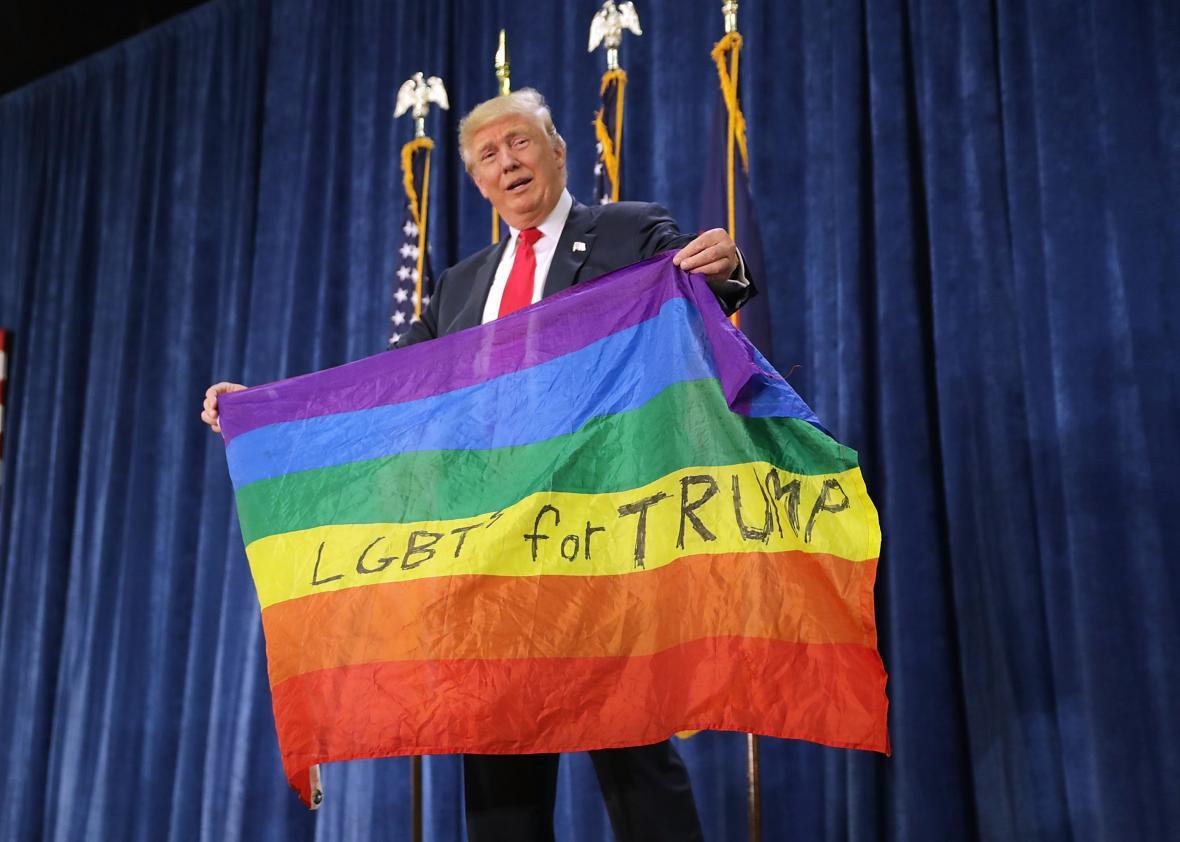
Getty Images
The far right is attempting to seduce gay men in some of the same ways the early Nazi movement reached out to them, before mowing queers down in the name of fascist ideals. Only two days after the massacre at the Pulse nightclub in Orlando last year, white-nationalist meme producer (and proud homophobe) Butch Leghorn wrote on the alt-right website The Right Stuff, “This shooting [is] a very valuable wedge issue. … We simply need to hammer this issue … Spread this meeting. Drive this wedge. Smash their coalition. Make it cool to be anti-Muslim because Liberalism.” Butch and his co-activists put out a plethora of memes for the occasion with, for example, a rainbow flag and the words FUCK ISLAM, and the phrases, “To be pro-Islam is to be anti-Gay … Daddy’s gonna build a wall and keep you safe.” Said Leghorn on The Right Stuff: “We are currently driving this wedge as deeply as possible to break off the Pro-Gay coalition into the Trump camp.”
One of the many gay people who received, and began avidly sending out, such memes was Peter Boykin, a 39-year-old, married, white Virginian who had eight years earlier been suspicious of Obama because, as he told me in a phone interview, “His name is like Osama bin Laden. We don’t have his birth certificate, and he came out of nowhere.” Boykin, who grew up with conservative Catholic parents who had campaigned for Ronald Reagan, founded an organization called “Gays for Trump” after he attended a party of the same name at the Republican convention last July. After the Pulse shooting, he says, “People came pouring into the group. It was like Boom!” Boykin said he isn’t afraid of attorney general Jeff Sessions’ antigay record: “When I met him, he shook my hand, and he put my business card in his actual jacket. He was very nice to me. I don’t think he’s antigay at all.” But Boykin is profoundly worried about Muslim immigrants (who, according to a recent Pew poll, are actually more likely to believe in tolerance of homosexuality than evangelical Christians) wanting to hurt him: “I keep seeing videos people send me where they’re beheading these 13-year-old boys and throwing people off of roofs.”
Longtime LGBTQ organizer Scot Nakagawa has been fighting white nationalist movements for over 30 years, now as a senior partner at ChangeLab, a think tank on racial justice. Says Nakagawa, “We have to remember that even racist white gay men are still very vulnerable to discrimination” because they’re gay. “When one is under attack”—not by phantom Muslims, but by real, neighborhood gaybashers—“one picks up whatever shields one can,” even shields like racism that will not fight the true threat. In Donovan’s writing, it’s clear that what he’s terrified of most is “weakness,” especially male weakness. (He notes that he feels “disgusting” if he doesn’t train in a gym “for more than a few days.”) It doesn’t take a psychoanalyst to guess that, at bottom, he feels profoundly weak and vulnerable. O’Meara, for his part, fears that he will be destroyed by African-American and Jewish “rot” and pollution. It doesn’t take a psychoanalyst to guess that he feels dirty, and at risk of decaying from within.
Rather than simply writing off the gay men who may be attracted to white nationalism, Nakagawa says: “It is really important to think about who those people are, and to try to reach out to them. Which means having compassion for them, as difficult as that may be.” Nakagawa feels that the left has too often behaved as though racism and sexism are primarily matters of personal character, rather than deep social structures that elites—the 1 percent—use to consolidate their power.
“It’s a bad choice to imagine that all these men are incredibly rich,” he adds. Rather than demonizing men who may long for a strong brotherhood to protect them in a society that is increasingly unsafe and un-nourishing for all of us, we should counter-organize among them and have the searching and committed conversations about racism and sexism that have too often eluded the gay community. In this time of great danger for both LGBTQ people and the entire country, the only real way to fight fascism is to offer a competing vision, for a society that will meet everyone’s needs rather than, as Donovan would have it, the needs of “the wolves” who seek to assert “dominance and control.” For at the end of the day, none of us is a wolf—or to say it another way, even wolves are vulnerable.
Defining Masculinity
Author: Justin Cascio
Date: June 27, 2012
Source: The Good Men Project. <goodmenproject.com/ethics-values/the-good-life-defining-masculinity>
“…gangsta culture is the essence of patriarchal masculinity.”
Jack Donovan introduces his book, The Way of Men, with this quote from feminist author bell hooks, because it encapsulates two of Donovan’s arguments about masculinity. The first is that there is a difference between being a good man and being good at being a man, and that men admire the latter a great deal more than the former. The second is that when it comes to defining and evaluating masculinity, only the opinions of other men matter.
“Ultimately, defining masculinity is a logic problem which then presents a philosophical problem,” Donovan wrote in our email interview. “I had to determine which virtues would be most specific to a small group of men depending on each other for survival—because that’s the social organization that made us what we are today.”
As Donovan sees it, contemporary society offers a “masculinity of convenience” that belies our true desires. Where once, our daily lives tested men, the 21st century offers fewer real opportunities for men to prove themselves in mastery, courage, strength, and honor. The virtues of civilization—art, culture, justice—are in the realm of “the good man.”
His point about “gangsta culture” is that as much as we say we admire “good men,” and say things like, “it takes a real man to be a father,” we demonstrate who we really admire, and reveal what is lacking in our own lives, by who we watch: killers, men who take chances, work outside the system, and demand the respect of other men. Donovan rejects the service sector worker-citizen and family man as a model of modern masculinity; this masculinity is thwarted, impeded by every cog of civilization. Americans don’t believe in this kind of heroism: the everyman who takes public transit to a dense urban center packed with men and women of all ages, toils in anonymity, and serves his family. We import Japanese samurai movies, not the very popular (in Japan) salaryman genre. In the West, the masculine ideal is a loner, not a husband or a corporate drone, who drives down the highway alone, impeded by no custom or law.
Watching samurais and playing Grand Theft Auto are just a couple of those socially sanctioned outlets for our masculine drives: the ones we trade satisfaction of, for greater comfort and security. Sports, war, and violent video games remain, but outlets with real stakes are fewer: in business, politics, sports, or war, traditional proving grounds of masculinity. Are men in worse shape as a result, with consequences to all of civilization? Will we devolve to a point of no return, and is this even a cause for concern: that we are shutting off all possible futures but the one in which we are utterly dependent, ignorant, and weak?
The machines by which we form and prove our masculinity are outside our control, except in choosing which machine to enter. On one hand, Donovan admits that the soldier shipping off today doesn’t know much about what he’s heading into, and doesn’t have much control over what he’s asked to do. The media and military-industrial complex, politicians and the economy all conspire to make signing up look as honorable as it ever was. Donovan seems to admire soldiers for showing more character than the people who criticize them, while also admitting that, among the main reasons soldiers join is not a burning desire to serve mankind, but a desire to prove himself among other men, and a paucity of options for doing so.
Filed Under: Ethics & Values, Featured Content, Freedom, The Good Life
Tagged With: 21st century, Arts, Bell Hooks, book, citizens, civilization, Community, courage, cowboys, crime, Culture, Freedom, gangs, Good Men, Grand Theft Auto, heroes, honor, justice, masculinity, mastery, men, military, movies, politics, security, sports, strength, The Good Life, Video Games, violence, virtue, War
Justin Cascio writes Mafia Genealogy, where he finds clues to the crimes of capital-F Families in kinship networks. You can follow him on Twitter, Quora, and Facebook.
45 Comments
David Byron
Ah interesting as Justin writes his own summary of what Jack Donovan is saying. I always think that’s a great way to try and understand something – put it into your own words. I wrote a piece where I tried to do that
The main difference I see is that I concluded a different idea about Jack’s view of the family. No doubt you are in a better position to know it because I’ve only read the two pieces of his writing that have been published here and neither mentions much about the family or fatherhood.
However if it is the case that jack’s view of masculinity in the raw, is one where family is not a big part of the picture I have to see that as a contradiction of the idea that masculinity is defined in terms of society’s role for men, and specifically the role for men that was demanded for the thousands of years of primitive hunter culture as mankind was evolving into modern humans and before the arrival of agriculture and “civilization”. Surely those primitive societies needed women and children protecting and surely it was the role of these tough men to do that? While their understanding of a family man might have been quite different it is clear they must have protected their women and children. The role of a man can’t have been only the lone gunman. For that matter that image is also wrong because the hunters would have needed to co-operate with each other in a team (although on that point I don’t think we disagree about what Jack is saying).
pwlsax
Reply to David Byron
It’s that very problem of women and children that led me, anyway, to put Jack’s ideal manly “gang” in a very early, very primitive stage, before anything we’d call civilization. In that stage, women and children would be pretty much property. Maybe even tribal property (I haven’t studied early humans much).
Milo
1. How can you be so certain of our position? Was life safer 1,000,000 years ago than it it now?
2.a. If one wants to explore the gender roles, identities, and patterns that DO exist today, I see no problem with tracing them back into antiquity.
2.b. I am unaware of the existence of any third gender in any species. What are you talking about?
4. If there is no reason to do something, then “something” is unlikely to occur. Shit happens for a reason.
Reply to Milo
1. Well humans weren’t around 1 million years ago…but never mind that. I didn’t say humans were safer in the past…I just said it wasn’t this constant struggle for survival pop-culture has made it out to be. As to how I know that? Well first there has been research done on modern-day prehistoric peoples, examining how much energy and time they expend to acquire food. Mind, as I pointed out, that sort of comparison only goes so far. There’s also been a great deal of research on the human remains of prehistoric people from the past, examining the common ailments people died of, their average life expectancy, etc. There’s been experimental archaeology, where archaeologists use the tools of specific cultures to try to hunt/farm/whatever, to see what expends the most energy. Similarly, if you look at the artifacts found from ancient cultures…well someone had to make them. Some objects take a great deal of skill to make, and yet may have been made by the same people who hunted/gathered/etc. These people had some time on their hands. And finally, even when we’re talking about ‘protecting’ people…a huge chunk of that may have fallen to religious/shaman types. The only perceived dangers weren’t physical.
2a. As I explained, there isn’t a straight line back to antiquity. You end up jumping from one culture we know about to another culture we know about, assuming that what happened in between doesn’t matter.
2b. See here. These are people who are not considered men or women. Many cultures have/had third genders. I bring this up, because Donovan’s article seems to imply that in past prehistoric societies, survival was a priority and thus masculinity was a more biologically driven form of masculinity….but really there are plenty of prehistoric cultures that create third genders which are not necessarily reflective of biology.
4. We create reasons for why we do things, but sometimes it’s not always logical…or rather sometimes the logic we use is very specifically to a culture. There’s a group in Papua New Guinea I reference a lot where the men are primary caregivers and the women farm. Why? We often argue that it makes the most sense, biologically, for women to be primary caregivers…but that’s not necessarily the case. The way in which we divide parenting is very culturally specific…we just assume the reason must be because it’s natural or normal or the “best way.”
Reply to HeatherN
Alright, for example, let’s take the concept that men are more lustful than women. That’s biology, right? They need to spread their seed or whatever…so modern western ideas about gender and sex are that men want sex more. I’ve even seen the argument made that because it’s biology, prehistoric people must have had the same ideas about men and sex. And so someone draws the long line through history saying that, obviously, throughout history men have always been viewed as more sexual. Well firstly, that’s something we don’t actually know about prehistoric people…whether they though men were more sexual than women. My guess is that, like now, different cultures had different concepts about how sex and gender interact.
Except what they skip over is the huge chunk of time in European history where women were assumed to be more lustful. That’s right. At the time men were thought to be more logical and women were thought to be ruled by their emotions…and lust is an emotion. Tell a medieval man that he was biologically programmed to be hornier than his wife, and he’d just laugh in your face.
That’s what I mean when I say gender norms don’t follow this strict cause/effect line from one period into another.
pwlsax
Reply to HeatherN
You’re making a mistake trying to argue the subtleties of cultures with people who want to believe in acting out some ancient biology-is-destiny scenario.
Note that Milo’s responses to you are always terse, and ignore most of what you write. He has chosen the ever-present possibility of violence as the fundamental condition of masculinity, if not humanity. Anything you say beyond or outside of that has little chance of convincing him.
SoCalStud
Reply to pwlsax
“Brevity is the soul of wit.”
Not everyone enjoys a filibuster.
pwlsax
Reply to SoCalStud
Nor does everyone appreciate close examination of the issues. To some – especially those with a distaste for the ivory towers – history is a simple tale and facts are simple things. You use them like tools or weapons, and there can be no qualification, no debate.
Reply to pwlsax
I think that what Milo said is right. “ever-present possibility of violence as the fundamental condition of masculinity” It’s not a possibility, it’s a reality. A reality that many may not want to accept but it is real.
GMP would very much like to soften masculinity but the truth is, masculinity isn’t a warm and fuzzy let’s all hold hands and talk about our feelings life. I get the feeling that there is an effort to redefine and force a change in masculinity. That’s not to say that in todays efforts in allowing men a deeper understanding of who they are is wrong but it shouldn’t happen that they sacrifice other aspects of their masculinity.
I didn’t see Milo saying that he’s violent but more so that he can be if he had to be. He simply sees society for what it is and is ready.
Reply to Tom B
Society can be violent and I often see women pointing this out
in terms of sexuAl assault and abuse, something men fall victim to as well. It seems to be ok or welcome here for men to say that yes they experience a world filled with potential danger some from men. Women too are aware of the dangers that may be posed though pointing out those fears here has gotten pushback. Should we relax into a world of danger, violence, and “on guard” men ready to fight And kill? Should women hide under male protection or should they also be warriors? Or should we all look towards other ways to raise humans (neither mra or feminist) to honor the work of non violence. Ghandi and mlk were good men and good males. If I have to live in a world of violence it will be as a warrior both in my ability to take care of myself and family also in compassion.
pwlsax
Reply to Julie Gillis
It could be that sexual assault and abuse do not pose much concern to the Jack Donovans of our day. To them violence against women at a certain level (beyond what you as a woman would consider an inevitable minimum) is just another flavor of the essential violence that makes men. Something men ought to admit they instinctively admire and something women had better just deal with as individuals, without trying to force change in society, in attitudes, or most of all, in men.
Reply to pwlsax
Yes, that’s crossed my mind.
Milo
Reply to pwlsax
But nobody said that, pwlsax. I’m wondering how you can logically justify such a statement. You appear to be all too ready to vilify and mis-characterize both Mr Donovan and me, yet you have not yet made a single statement–beyond your comment about George Raft–explaining your position on the article above or Mr. Donovan’s work.
pwlsax
Reply to Milo
I don’t yet have a position, if you mean a logical framework that can handle a few whacks. But I do have a smell test, and as yet, Jack’s not passing it. Too much of a whiff of – how to say it – “menagoguery” in intellectual clothing.
I’ll reread him and check back in.
Milo
Reply to HeatherN
I’m back…
1. I guess we’re getting mixed up with vocabulary a bit. “Constant” might not be the best word to use. Maybe “persistent” works better. Either way, there was always something threatening human societies. Whether it was a daily threat, a seasonal threat, or an incidental threat, humans had to be prepared to handle it. Its not every day that some foreign group attacks our country, but we have processes in place to respond if they do.
2.a. I understand what you’re saying about jumping over things. But think that what Mr. Donovan has done is to focus on elements of masculinity that are common across cultures, and time according to what we have as recorded history and literature. If we have a story from a culture that goes back thousands of years, and describes a man as a hero with qualities A, B, or C, then it is safe to say that qualities A, B, and C were important to that culture. I think its also safe to say that these qualities became important to that culture some time before the writing of the story. Exactly when they became important is not as important as knowing that they did become important, and have continued to be important. Additionally, one can look at the history and literature of a variety of cultures, and discover patterns. For example, almost every culture that we know of had some way of explaining the creation of the universe.
2.b. Those cultures that believe(d) in a third gender still include(d) concepts of both masculinity and femininity. So I don’t see how the concept of a third gender has any impact on discussing masculinity.
4. I don’t think the essence of masculinity lies in the details of a specific culture, but rather in the expectation that men will do what their culture requires of them. In other words, if the men in your Papua group are expected to be the primary parents, and an individual man is a bad or negligent parent, his masculinity could be damaged because he breached a social contract of his culture.
pwlsax
Reply to Milo
I see a troubling implication: if you live in an oppressive culture, going against oppression is essentially less masculine. Examples might be getting draft resistors out of the US in the 60s, saving Jews in WW2 Europe, or hell, critiquing masculine roles in the blogosphere in 2012.
You’ll pardon my jumping to the conclusion that all things being equal, moral conformity is always more manly than taking a principled stand. It kind of calls the whole issue of courage into question, implying that it’s braver to fight for your gang than your ethics.
Milo
Reply to pwlsax
The first problem with your statement is that oppression is not a fixed value. I personally don’t see anything oppressive about a culture that expects men to do the lion’s share of child-rearing. Nor do see anything oppressive about a draft, or selective service which is what we have today. I don’t see how you can throw critiquing masculine roles in the blogosphere into the same category as saving Jews in WWII. How are these critics oppressed?
In general, going against the gang can be a masculine act, depending on the what and why. I don’t see anything particularly useful or positive about a father who neglects his children even in our culture, much less in a culture where men are expected to be the primary caregiver.
I don’t see how courage is called into question. How brave an act is depends on the level of risk being undertaken.
pwlsax
Reply to Milo
At Milo’s request, I have prepared a point-by-point critique of Jack’s thesis.
(Excerpts taken from The Way of Men via this GMP page.)
Warning: long!
To be clear at the outset, I do not wish to qualify manliness at all here – quite the reverse, in fact. I am mostly concerned with the state of manliness Jack argues for, and whether it can rejuvenate civilized men. I am convinced it cannot, for two reasons: first, he has put it too far before civilization; second, he draws facile, even reductive, conclusions along the way.
“There is a difference between being a good man and being good at being a man. Being a good man has to do with ideas about morality, ethics, religion, and behaving productively within a given civilizational structure. […] Being good at being a man is about being willing and able to fulfill the natural role of men in a survival scenario.”
Survival such as concerns Jack – on the level of a band, a tribe – is a necessary first stage for civilization to exist. Similarly, fire is a necessary first stage for anything metal to exist. But a knife, a refrigerator, a car do not require fire to survive. They do not degenerate if we do not set fire to them; quite the contrary. Melt down your knife or torch your car and they are no use at all.
Whatever natural roles might be, their place is in that first stage. But we no longer live in that first stage. We are not metal: we are the knife, the car. We live in civilization. And decadent and decaying though it may appear to some, we require civilization to survive. If it dies, we die. Civilization, too, has its survival scenarios.
I want to argue no particular moral prescriptions here, but I do insist that some kind of moral baseline is necessary for the survival of any civilization that deserves to. If Jack’s gangs of men can’t band together for the survival of a basic ideal – civilization – and for civilized values like law, justice and mercy, they are worse than worthless – they are dangerous. Even in the movies, men usually know the good guys, and we almost always root for them.
“Is manliness so flexible a concept that a community can re-write the job description however they wish? Not if we accept any model of human nature that acknowledges differences between male and female psychology.”
Here we may have to agree to disagree. I don’t put much stock in the evolutionary theories now in vogue in the blogosphere. I see no compelling reason to reduce psychology – a famously inexact science, if not an art – to one or two or a hundred absolutes calling themselves “human nature.” The best use of the concept “human nature” is itself human – it knows its limits. It is no more than a metaphor for what typical humans might typically do, feel, or think. Built into it are potentially endless exceptions – necessarily so, lest its descriptive power fall to nothing.
I could say much the same of the concept “manliness,” adding that it is probably an even more subjective yardstick than “human nature.” As Jack himself allows, “True objectivity on this subject is a more or less successful pose. We all have a horse in the race.”
I concur with Jack too that men of less physically brutal nature might best help the tribal unit with skills that are intellectual, philosophical, political. But here the door inevitably opens to civilized values, to higher-order thinking that does not necessarily value Us Hard Men above all. Survival of tribe evolves into survival of civilization – unless you eat the brains of the pencil-necked geeks and go on living by the sword alone. In which case, you’ll be gone in a generation.
“If we allow the moralizers of masculinity to define masculinity for us, we either give ourselves over to the ‘one true code of masculinity’ and become completely ethnocentric about it—which would be the historical norm—or we end up with an endless number of ‘masculinities,’ get bogged down in the details of their myriad contradictions and declare, as one famous transgendered sociologist has, ‘that masculinity is not a coherent object about which a generalizing science can be produced.’ ”
We may generalize all we like, of course; we just can’t call it science. And even if ethnocentrism is the historical norm, so what? Is history in this sense so profoundly universal that we must not question it, but only imitate it? Again, I don’t buy most of evolutionary psych, soc, or other theory – especially not when it begins prescribing “essentials.” So we may have nothing at all to agree on here.
“We must look at the phenomenon of masculinity amorally and as dispassionately as we can. We must find what Man knows for certain, concerning his vital relations to this mysterious Universe.”
Reserving moral judgment, and dispassion, are necessary when reasoning to logical principles. But that is not looking at the thing amorally; that would be closing the door on moral implications now and forever. There is little to be prized in the fully natural state of man; it is what he makes of himself.
For my part, a dispassionate look at masculinity, one that reserves moral judgment, insists on what Jack disdainfully calls “masculinities.” Reductive thinking leads to no essential truths, only to potentially endless exceptions. Manliness as a concept has the power we bring to it, but we can bring no more certainty to it than we can to the concept of human nature. It is, finally, only a metaphor for what typical men might typically do, feel, or think.
“There has always been a push and pull between civilized virtues and tactical gang virtues. However, the kind of masculinity acceptable to civilized societies is in many cases related to survival band masculinity. […] When a civilization fails, gangs of young men are there to scavenge its ruins, mark new perimeters, and restart the world.”
When the day comes for this civilization, Jack and I will very probably be long dead. But I honestly don’t believe that Jack, with civilization’s gifts of literacy and the shotgun, would be in a much better position than I. Our survivors would likely be feral, half-crazed with hunger and fear. They would treat anyone capable of reason or mercy as enemies or weaklings fit only for slaughter.
When survival of the tribe is the sole concern, everything outside the tribe must die. If men – men beyond brutes – are to recognize the power of that particular manly urge, it can be only with the deepest repugnance, and with firm conviction toward a higher resolve. Civilization will never be restarted by those who have turned their backs on it.
Reply to pwlsax
Okay just want to add two things. First – I dig what you’re saying here pwlsax, however I’d like to add that actually, even “early bands” or “non-civilized” groups of people would have potentially valued and required intellectual strengths as highly as us modern day, “civilized” societies.
Consider the Chalcolithic in Israel & Palestine (about 6500 years ago or so)…this is after farming but before writing. These people were not what is classically called “civilization.” We’re pretty sure it’s possible that the people in charge were actually religious leaders (read the article Slouching Toward Beersheva if you’re interested in more info). My point is that this is a society that highly valued intellectual wealth and knowledge, even without writing.
We can go back even further…there’s evidence that Neanderthals may have had art. Viewing even early humans as somehow less concerned with knowledge and more concerned with physical survival is just plain wrong.
“Reserving moral judgment, and dispassion, are necessary when reasoning to logical principles. But that is not looking at the thing amorally; that would be closing the door on moral implications now and forever.”
Second thing – this is something cultural relativists often have a difficult time explaining. In order to understand cultural norms, yes we can’t let our own morals and cultures get in the way. However, that doesn’t mean we are unable to judge other cultural norms at all…we just better be sure we understand them first. And so here’s an article I wrote about cultural and moral relativism.
Milo
Reply to HeatherN
“We can go back even further…there’s evidence that Neanderthals may have had art. Viewing even early humans as somehow less concerned with knowledge and more concerned with physical survival is just plain wrong.”
During my freshman year at Boston Conservatory, the professor of Art & Civilization made a suggestion that “cave-men” drew things on walls for reasons that were not at all decorative. One angle was that they drew things so that other tribes would know that the territory was inhabited, and belonged to someone…like graffiti. That would be useful if you wanted to let strangers know that they were about to trespass, or serve as markers to help others find you. Another angle was that such images were used to teach neophytes about the traditions and processes of the tribe. Pictorial elements are useful instructional tools even nowadays.
“Second thing – this is something cultural relativists often have a difficult time explaining. In order to understand cultural norms, yes we can’t let our own morals and cultures get in the way. However, that doesn’t mean we are unable to judge other cultural norms at all…we just better be sure we understand them first. And so here’s an article I wrote about cultural and moral relativism.”
VERY good article, Heather.
(BTW, Sarkozy did indeed get a burkha ban passed in France. His position was that it represented female oppression.)
When you say, “As has often been discussed, gender is not strictly biological; it is culturally informed,” I agree. Mr. Donovan is saying that culture itself is biologically informed with regards to gender. I would go further and say that many cultural elements are informed by biology. The head scarf is a good example of that.
Reply to Milo
Mate, “cave-men” is a misnomer…but never mind that. For the past 200,000 years (or so) modern homo sapiens have been around. Those homo sapiens from 200,000 years ago were just as capable of abstract thought as homo sapiens today. It’s an art history approach that suggests that early art was all instructional and literal. There is absolutely no proof that is the case. In fact, if you look at modern-day hunter-gatherer populations, you see that there is plenty of evidence for representational and abstract aspects to art. Even without written language, humans are more than capable of creating symbols..where a painting of a bull might not actually represent a bull. Or a horse…or whatever.
That, right there, is my point. Donovan’s article treats early humans as if they were somehow more primitive…as if their concerns were more survival-based or as if they didn’t have enough time for more intellectual pursuits. That is a very old idea, and a very outdated one. Early humans were potentially just as capable and just as concerned with abstract, intellectual issues as we are today. They all certainly had leisure activities and engaged in relationships and conversations and what-not for the purposes of pleasure, or enjoyment. And so how does all of that relate to gender? Well that all informs gender, and is informed by gender…think of the way that modern leisure activities are divided by gender. For a long time, for example, sports were considered a more masculine pursuit…still are somewhat. Academia was largely a men’s world. Cooking was a woman’s pursuit. Why? All sorts of cultural reasons, of course. And the same could be said for human cultures thousands of years ago.
As for the idea that culture is biologically informed…well yes that is sometimes true. It’s also sometimes environmentally informed (as I pointed out with the headscarf). But then sometimes it’s not. It is customary in Jordan and Egypt to drink tea from a glass cup with no handle. Biologically it makes no sense…the glass gets wicked hot and it’s difficult to hold. Environmentally it makes no sense…it’s not as if they don’t also have glasses/mugs with handles. It’s just the way it’s been traditionally.
I’ll take an example from the modern west and with regards to gender: women can’t walk around topless. Why? It’s not biological…there’s nothing inherently problematic about women with bare chests. It’s not environmental (or at least the gender aspect of it isn’t biological). In colder climates it makes sense for everyone to wear more clothing…but to have different rules for different genders doesn’t make sense. So why? It’s a purely cultural thing. Gender roles and norms aren’t just culture’s reaction to biology…sometimes they’re convoluted and really don’t make a whole lot of logical sense.
Milo
Reply to HeatherN
“It’s an art history approach that suggests that early art was all instructional and literal. There is absolutely no proof that is the case.”
1. Nobody said “all.”
2. Who can say that the drawings were never instructional, or literal?
3. As I pointed out, a mark on a cave wall, tree, boulder, etc. could simply be there to say, “we’re here,” or, “stay out.” I would qualify that as a form of abstraction.
“Donovan’s article treats early humans as if they were somehow more primitive…as if their concerns were more survival-based or as if they didn’t have enough time for more intellectual pursuits.”
That is incorrect. What Mr. Donovan says is that the more intellectual pursuits are facilitated by the more brutish pursuits. I’m far less likely to spend resources learning to speak Italian, studying music, working with an acting coach, and learning how to apply make-up so I can sing an opera if my time and talents are needed to make sure the next wave of Jihadists don’t get here and wreak havoc on my little piece of paradise. Once the latter is taken care of, the former can flourish more easily
“Gender roles and norms aren’t just culture’s reaction to biology…sometimes they’re convoluted and really don’t make a whole lot of logical sense.”
No they’re not “just culture’s reaction to biology.” But what Mr. Donovan has done is to analyze the many points where they are.
Reply to pwlsax
You’re not quite getting the point.
The point is not to save myself, and it is definitely not to save your civilization.
The point is that what is broken here — broken by a combination of globalism, technology/industrialization, quasi-democracy, multiculturalism and feminism — can’t be fixed in a way that makes it worth fixing. There’s a bigger point in the book that the social contract is breaking down all around the world, and that in what some call “hollow” or “failed” states, gangs emerge to operate proto-states, just as they do now in places like Mexico.
I can see how the excerpt as a stand alone might leave some questions open.
Basically, while I doubt I will live long enough to see this occur in full, and we may just adapt to being slaves to the elite (who love the kind of hedonistic, self-centered, interchangeable humans that anti-tribalists and feminists effectively encourage), I believe anarchy and chaos is preferable to the future feminists want, where men ask permission before speaking, and manly honor is gone from the world forever.
—
All of the points about this or that being “too reductive” are no more scientific than anything I’ve written. As with so many things, you’re making an aesthetic and ideological objection, and saying something is “too reductive” is merely a way of leaving the door open for a reality that you’d prefer. HN is doing the same thing — basically just saying “well, it could be different and it might not be this way so we should waffle around and equivocate until a nicer, more preferable version of reality emerges.” A lot of feminist ideas about how the world should be aren’t working, for men or women. Our ancestors weren’t actually that dumb, and modernity isn’t that fantastic.
pwlsax
Reply to Jack Donovan
“The point is not to save myself, and it is definitely not to save your civilization.”
It’s our civilization, turn your back on it though you may. You say you would take anarchy and chaos over where you think we’re going. I don’t agree that we’re going there, or that we have to go there unless men embrace that anarchy and that chaos. Far better that we learn to see it coming and take action. So I have no more to say to you, except that you are a worthy adversary in the “waffling” and “equivocation” of open discourse.
Milo
Reply to pwlsax
Thank you for taking the time to respond.
“I am mostly concerned with the state of manliness Jack argues for, and whether it can rejuvenate civilized men. I am convinced it cannot, for two reasons: first, he has put it too far before civilization; second, he draws facile, even reductive, conclusions along the way.”
Mr. Donovan does indeed begin his description of men before civilization, but he clearly relates how masculinity contributed to the creation of civilization, and how the cornerstones of masculinity have perpetuated it. Even today, I think you would be hard-pressed to say that strength, courage, mastery, and honor are irrelevant traits of manhood. Everybody likes those things in a man.
Your second point is, again, your own personal mischaracterization.
“Similarly, fire is a necessary first stage for anything metal to exist. But a knife, a refrigerator, a car do not require fire to survive. They do not degenerate if we do not set fire to them; quite the contrary. Melt down your knife or torch your car and they are no use at all.”
Internal combustion is a process that continually creates small fires. So without fire, your car would have no independent locomotion. Without fire, we would not be able to make new knives or refrigerators when the old ones wear out or rust away.
Likewise, civilization cannot sustain itself without the qualities of which Mr. Donovan speaks. And because men are best suited to bring those qualities to the fore, civilization needs men.
“I want to argue no particular moral prescriptions here, but I do insist that some kind of moral baseline is necessary for the survival of any civilization that deserves to. If Jack’s gangs of men can’t band together for the survival of a basic ideal – civilization – and for civilized values like law, justice and mercy, they are worse than worthless – they are dangerous.”
What is evident both now, and throughout history is that gangs of men have indeed banded together for the basic ideal of civilization. They continue to do so. Men fight wars in order to preserve civilization. Men arrest criminals in order to preserve civilization. Men master the arts and sciences in order to preserve civilization. Men care about other men and women in order to preserve civilization. Men cannot do as well without civilization as they can do with it. Likewise civilization cannot do as well without men as it can do with them.
The question of whether or not the masculinity Mr. Donovan describes is beneficial to civilization, or detrimental to it is—in my mind—not a moral question, but rather an empirical one.
“I see no compelling reason to reduce psychology – a famously inexact science, if not an art – to one or two or a hundred absolutes calling themselves “human nature.” The best use of the concept “human nature” is itself human – it knows its limits. It is no more than a metaphor for what typical humans might typically do, feel, or think. Built into it are potentially endless exceptions – necessarily so, lest its descriptive power fall to nothing.”
This is an argument that will likely never see an end. A bird builds a nest, and we say that the activity is natural…that the bird’s instincts drive the nest-building. A man starts a business, and we question the environmental impact, and the man’s motivations…as if such an activity is unnatural. The bird improves his situation—his survival, his happiness, and his species–by building a nest. I don’t think that is any less instinctual for a man to start a business that will achieve the same goals.
“We may generalize all we like, of course; we just can’t call it science. And even if ethnocentrism is the historical norm, so what? Is history in this sense so profoundly universal that we must not question it, but only imitate it? Again, I don’t buy most of evolutionary psych, soc, or other theory – especially not when it begins prescribing “essentials.” So we may have nothing at all to agree on here.”
Of course history is profoundly universal. We can’t change it, so it stands as is. We can—and should—question it, learn from it, AND imitate it when it serves our needs.
“Reserving moral judgment, and dispassion, are necessary when reasoning to logical principles. But that is not looking at the thing amorally; that would be closing the door on moral implications now and forever. There is little to be prized in the fully natural state of man; it is what he makes of himself.”
Amorality is useful when talking about what makes a man good at being a man. Morality is useful when talking about what makes a man good…or bad. Mr. Donovan applies morality and amorality appropriately in his analysis.
“When survival of the tribe is the sole concern, everything outside the tribe must die. If men – men beyond brutes – are to recognize the power of that particular manly urge, it can be only with the deepest repugnance, and with firm conviction toward a higher resolve. Civilization will never be restarted by those who have turned their backs on it.”
Mr. Donovan never said that survival is man’s sole concern. He said that the ability to survive—and the qualities that compose that ability—are a high priority.
And no, everything outside the tribe must not die, but it must stay out of my face.
pwlsax
Reply to Milo
I hope, for the good of all of us, that society does get in the face of those preaching a selfconscious tribalism, nationalism, or any of the professed objectives of the “Alternative Right.” It’s been a very long time since intelligent, articulate people have gotten behind such atavistic, fear-and-rage-worshiping philosophies and tried to sell them as necessary steps to save humanity.
The defenders of a more rational and humane civilization have probably gotten out of practice in debating such toxic ideas – perhaps mistakenly assuming that they no longer exist outside of backward, closed societies that we could drop bombs on if ever they got to making trouble. Leaving aside the dubious humaneness of waging war on principle, though, what if today’s disenchantments here at home led enough angry, fearful people to decide that the problem is too much civilization? Many already claim to want tribe over commonweal, faith over reason, and blood over mercy. Those who do not want these things had better be prepared to fight for them – and the fight will start with ideas and words.
For that reason I hope writers like Jack Donovan are not marginalized to their tribes of believers, but exposed to the light of a full spectrum of beliefs, and compelled to answer to realities they dare not fully contemplate as yet. Everyone will be better for the discourse.
“I had to determine which virtues would be most specific to a small group of men depending on each other for survival—because that’s the social organization that made us what we are today.”
I read the excerpt and there’s a lot I found wrong with it, but the above quote sort of exemplifies my biggest problem, which is it’s treatment of history. That quote, right there, is just not true Yes, early cultures were probably made up of small groups of people, that part is accurate. But the idea that the quest for survival somehow shaped human beings into what they are today is an extremely outdated way to look at prehistoric cultures.
1. Prehistoric cultures were not more primitive or somehow closer to our biological drives than modern cultures. A man in the Paleolithic was no more (or less) encultured and socialized than a man living today. They were just encultured in different ways. This is related to the whole “peaceful Indian” misconception, that somehow a smaller, less technologically advanced society is more in tough with their natural selves and less influenced by cultural clutter. That’s wrong.
2. Prehistoric cultures weren’t uniform. Suggesting that the most important thing when it comes to defining masculinity is subsistence and group-size is far too simplistic. It assumes that all prehistoric peoples must have had the same definitions of masculinity…or at least had the same ideas of what it means to “be good at being a man,” which is false.
3. I’ve said it once and I’ll say it again…you cannot draw a direct cause-effect line from prehistoric cultures through to modern day cultures. Modern day cultures didn’t come directly from prehistoric cultures…that’s social Darwinism. People from different cultures interact, and cultures shift and change. Societies fall and their cultural baggage disappears, and so people create new ways of behaving and understanding the world. And that has been happening to human cultures for as long as there has been human beings.
4. Cultural norms aren’t always a logical reaction to environment or biology. This sort of goes back to #1, when I was saying that prehistoric definitions of masculinity weren’t somehow more ‘in tune’ with biology than modern day. But the same goes for pretty much all social constructions…they don’t always make sense.
5. Prehistoric life was not a daily struggle for survival against the elements. That’s a rather romantic and inaccurate picture. During periods and regions where the environment was quite fertile, non-agricultural societies were actually pretty well off and had a crap ton of free time, at least compared to early agricultural societies (and compared to modern day work-aholics). Prehistoric societies were not necessarily constructed around this survival-first mentality, and so definitions of masculinity were not necessarily about survival.
Reply to HeatherN
(Forgot something)
6. We don’t actually know a whole lot about gender roles and norms in the majority of human cultures. It’s difficult to study the gender dynamics of a past prehistoric culture; there is no one to talk to about it and there are no written records left behind. The state of preservation of archaeological sites as well as modern technology used in excavation and analysis of artifacts and human remains does quite limit our ability to understand past cultures, particularly when it comes to understanding social identities (such as gender). Add onto that the fact that it’s only fairly recently that archaeologists have concerned themselves with understanding identities of past cultures…and it means that our understanding of gender in most past cultures is limited. Sometimes we actually don’t know anything about gender norms an roles in a particular culture.
Milo
Reply to HeatherN
OK. So let’s say that there is an inadequate historical record on gender roles. norms, behaviors, etc. I don’t think its wrong to look at the recorded history that we do have, and draw conclusions from it. It may not be complete, but it does exist.
Reply to Milo
Right well the rest of my above comment still stands (1–5), which points out why the conclusions Donovan drew are a problem. But here’s the other thing…the vast majority of cultures which have existed are cultures we have very little knowledge about. I am (was) an archaeologist; I agree you can draw conclusions about specific cultures using very limited ethnographic comparisons, otherwise I’d be out of a job. But you can’t draw wide conclusions about all (or even most) cultures, because we just don’t know enough about most cultures to make those sweeping conclusions.
Milo
Reply to HeatherN
1. Mr. Donovan does not say that primitive men were more “in touch” with their biological imperatives. What he says is that the biological imperatives were a higher priority back then. Men and women spent more of their time and energy on those biological imperatives than we do today.
2. Mr Donovan does not posit that prehistoric cultures (nor modern ones) were identical. What he does suggest s that there are/were some common elements within them with regards to gender roles.
3. You’re at least half-right, and at least half-wrong. As an African-American, I can point to elements of my culture that can be traced back to Africa. I can point to elements of my culture that are specifically European. And I can tell you about the things that we colored folk invented here in the United States.
4. I can agree with you that cultural elements are not always a reaction to biology or environment. Yet there are many cultural elements that do harken to biology, environment, and both. Between nature and nurture exist many balance points.
5. Your theory that prehistoric communities did not hold survival in high priority is curious. I grew up in a housing project in Boston. Crime was everywhere. I put a high priority on getting home from school alive, uninjured, and with all of my belongings. When I was 19, I moved to Philadelphia. The surrounding neighborhood where I lived was saturated with pimps. hookers, pushers, and addicts. On my first day in the city, I assessed the situation and went out and purchased a knife so I would have some protection. Now I live in a rural part of Pennsylvania. People out here have at least 2 things in common: dogs and guns.I have my own guns, and the dogs will be here shortly. As far as I’m concerned, there is nothing inaccurate nor romantic about the daily struggle that we humans call life. In my world, I have to be ready to put my foot up somebody’s ass every time I turn around.
Reply to Milo
1. Except that they didn’t spend more time or energy on their biological survival, not necessarily. Biological needs weren’t necessarily a higher priority. This goes along with #5 and your description of living in a project in Boston. You seem to be assuming that prehistoric people were all living in the untamed wilderness and what-not…that danger was around every corner. They weren’t, necessarily. Hunting, fishing and gathering in a fertile area generally means that you spend less time and energy acquiring food than an early agricultural society would. I can’t remember the exact numbers that have been estimated, but it was pretty low. While they were at home, in their camp/houses/whatever, they were relatively safe.
2. I explained why drawing such broad conclusions was problematic below. As to their common themes with regards to gender roles, that’s just not necessarily true. Not the least of which is something I haven’t even brought up yet, but there’s nothing saying that prehistoric cultures necessarily had two genders, even. You can’t just ignore third genders because they don’t fit the theory you already have.
3. I didn’t saw absolutely nothing gets carried over between cultures over time. I said you can’t draw a direct cause-effect line. As you pointed out with your own culture, it’s a mix of influences historically and geographically. Same goes for everyone. And that mix is complicated…it’s not as easy as saying “this practice came from here” and “this tradition came from there.” Over time the different cultures and traditions that make up your own culture can mix and meld, so that the explanation and logic for a certain tradition now might not be the same as it was a few centuries ago.
4. My point is that you can’t start from the conclusion that certain cultural trends must be a reaction to biology or the environment, or whatever. And you can’t always assume that the perceived logic for a certain custom is necessarily why that custom came about. Humans have a great ability to rationalize our behaviour and create a reason why we do something when there is none.
Zigy
Justin, not sure if you actually proof-read your article or simply ran it through spell-check, but as published here it reads : “…. feminist author bell hooks…” Bell Hooks is her proper name and so should be capitalized.
Something profoundly and sadly ironic about misspelling a feminist author’s name when her quote is used to create your introductory sentence.
Whoever’s responsibility — writer or GMP editor — pretty poor showing for a publication about consciousness.
Reply to Zigy
Actually that may not be the case.
From wiki:
“Gloria Jean Watkins (born September 25, 1952), better known by her pen name bell hooks (intentionally uncapitalized)”
It’s not always some plot to hurt feminists….
Reply to Danny
Thank you, Danny. You are correct.
Zigy, I am familiar enough with the feminist author bell hooks to know that she never capitalizes her name. The real irony is how richly you call me out on the supposed error.
zigy
Reply to Justin Cascio
Danny, thank you for noting that bell hooks spells her name without capitalizing.
Justin, apologies to you for not doing my own fact-checking before posting, and thank you for pointing out that my post sounded more aggressive than i intended (and that’s my ONGOING work in the world…).
Z
Reply to zigy
It’s all good zigy.
…..sounded more aggressive than i intended (and that’s my ONGOING work in the world…).
Welcome to my world.
Reply to Justin Cascio
Pays not to disparage a thorough proof-reader nor intentionally try and kick-off warfare. There’s too much of that online.
pwlsax
My idea of gangster culture ended with George Raft. He wasn’t a made man, but he traveled with them. He could dress, he could dance, he could act – not an actor with a wide range, but what he did he did to perfection.
Mike
I hope this abstract isn’t representative of the book’s argument. There is too much contradictory evidence (sitcoms, commercials, best-sellers, love songs, etc.) to support this thesis about what Americans “believe.” Books like this, if this is what it’s really like, ought to start with a theory of generalities before pushing off with them and kicking like hell to their main argument.
Masculinity now runs off in so many disparate directions that there probably is no point of convergence. Arguments like the one encapsulated above seem to express a wish that there were one, a stable place to start from—and return to—in a world of confusing demands. And anyway, setting up “gangsta culture” as an explanatory pole is dated and sensationalistic. Naive, too. The executive culture is more pervasive and at the summit of its historical moment, with far more influence than a subgenre of popular music will ever have. If you want to see patriarchalism in a particularly potent form, why not start with the business culture?
Reply to Mike
Donovan’s book doesn’t spend a lot of time looking at popular culture. He’s more concerned with classical definitions of masculinity, though he told me he read a very wide range in coming up with his definition of masculinity for his book, including feminist texts. The bit about what Americans import from Japan was my own take on Donovan’s take on Western culture. The “gangsta culture” is in keeping with his overall view on what makes a civilization: that it is based on small, survival bands—gangs—and his point that it is in this sort of setting that our most important attributes as men become critical.
May I also recommend returning tomorrow to read the interview, and reading the book itself. A chapter is available here on the site to read for free.
Milo
Reply to Mike
Mike, I hope you do not honestly believe that gangsta culture is limited to a musical genre. That would signify your lack of understanding of my people.
I would also say that there is little reason to begin a discussion of manliness with executives because they represent a rather small portion of the human population.
Interview with Jack Donovan
Author: Justin Cascio
Date: June 28, 2012
Source: <www.goodmenproject.com/ethics-values/the-good-life-the-way-of-men-interview-with-jack-donovan>
“The Way of Men” book author Jack Donovan answers some hard questions about masculinity and society, and the way forward for men.
JC: Strength, courage, mastery, and honor. Which readings were most influential in your choice of these four traits of masculinity?
JD: I’ve been trying to come up with a workable definition of masculinity for about seven years, so I covered a lot of material. You have to consider arguments from feminists and samurai and classical philosophers. As The Way of Men came into focus, the books Demonic Males, Men in Groups, WAR, Roman Manliness, Honor: A History, World of Gangs, and The Decline of Males were all helpful.
Ultimately, defining masculinity is a logic problem which then presents a philosophical problem. I had to determine which virtues would be most specific to a small group of men depending on each other for survival—because that’s the social organization that made us what we are today.
We didn’t just “evolve” as a species because someone gave us an office job or handed us a smart phone. As far as I know, feel-good bumper stickers don’t actually drive the process of natural selection. And simply saying that everyone is equal doesn’t magically turn apples into oranges.
The virtues you selected for defining masculinity were based on those necessary to a small group of men who are struggling to survive. Would you select different virtues for a man who is trying to survive in a modern American city, where large numbers of men and women of all ages live together in a highly industrialized society?
No. The point was not to invent a masculinity of convenience or impose an artificial moral ideal based on an idealized version of contemporary circumstances. That’s what profeminist writers on the subject have been doing for decades—I summarized some of their arguments in a short book called No Man’s Land. (It’s available for free here.) Telling men how you think they should feel about being men doesn’t work if it isn’t in harmony with their natures. Smart leaders used to try to figure out what men really wanted, and try to figure out how to make them believe they were getting it.
The problem today is that our well-meaning, idealistic mandarins in academia and the ruling bureaucracies aren’t satisfied with the reality of what men actually want, so they tell us what they think men should want, and then give it to them … in abundance. If you aren’t honest about who men are and what they want, you’re working against them, and sooner or later they’re going to realize it. If they don’t see a way to move things in their favor, they participate half-heartedly, play the system for kicks, withdraw, or check out. Many end up in prison, where we can forget about them and pretend human nature is changing. There are more men in the correctional system today than there are in the military. Telling the same lies about men over and over doesn’t make those lies true.
Human nature doesn’t change automatically to suit passing economies or political systems. A great example is sex. Think of how much time and money men and women waste worrying about sex, even when they have no intention of having children. That’s not rational or sensible or practical. But we do it anyway. And, since we have so many people who want to have sex, why don’t they just have sex with the first person that offers and get on with their business? Why do so many men try so hard to have sex with a minority of extremely attractive women, when there are plenty of women to go around? And why don’t women always select the first guy to approach?
Asking men to stop caring about being seen as strong, courageous, competent and honorable in the eyes of other men is like asking them to stop caring whether the women they have sex with are beautiful or ugly. You can tell a man that what he wants most in his heart of hearts is to “stand up to injustice based on difference,” and you can force him to repeat it back to you, but if that’s not actually what he wants out of life, you’re just making him a liar and forcing him to retreat inward.
Are different virtues probably more appropriate for our current society as our handlers have imagined it, were it to continue as it is indefinitely? Sure. My questions are: Why try to design men around society? Why wouldn’t men be right to want a society designed around them? (That’s what they’ve always had … patriarchy.) Is the modern world so much better for men, simply because it’s new?
You say that a man who is more concerned with being a good man than with being good at being a man makes a better slave than a citizen. Do you think we should be more like gang members, instead: good at being men, but not so good at being good?
Being good at being a man is a tactical orientation. If you completely outsource tactical thinking to someone else, your life is in their hands. You give them the capability to become your master. This is the bargain of modern democratic thinking. All you can do is hope that your masters choose to use their authority—which is always backed by the threat of violence wielded by the “guardians” you entrusted with the axe—benevolently. You cast your vote and hope someone listens. That makes voting sound a lot like praying, doesn’t it?
If you give up being good at being a man, and concentrate only on being thoughtful or spiritual or well-behaved, you are like a slave or a child whose fate is entirely in someone else’s hands. I don’t think feeling powerless like that makes men happy. It’s freeing, in a way, to allow yourself to be flotsam adrift, but it’s also lazy and unsatisfying. What’s the point of doing anything? Being safe and comfortable and powerless isn’t worth the self-determination, sense of identity and the sense of importance to the immediate group that men have given away.
You describe being good at being a man as a tactical orientation. How does a modern man live his life tactically in relation to corporations and governments, rather than submitting to them?
In The Way of Men, I explain that men are always making a bargain with civilization. They give up a little manliness and freedom for a little bit of security and comfort. They find or create sanctioned outlets for manly endeavor and tribalism. This is why civilizations have always encouraged sports and various kinds of gaming that mimic primal contests. Men find ways to simulate primal masculinity or experience it vicariously. Today we do that through film, video games, sporting events, comic books and literature. We do it in politics. Some men will do it in business, but as companies get larger, more automated and offer less agency to employees, that will prove a manly outlet for fewer and fewer men.
There’s a sweet spot—and it’s probably different for different men—between the wild, brutish freedom of violent tribalism and the luxury and security of completely sedentary domesticity. I believe that we’re on the other side of it, and slipping like sabre-toothed tigers into a tar pit we may never crawl out of. I don’t think the substitutes for virile action that we’re permitted will be enough in the long run. There’s no silver lining and it can only get worse. The only option for most men will be submission, and that’s not satisfactory. This modern lifestyle requires our compliance. It’s built on our backs. I’m telling men to shrug it off, let it fall, and rebuild a more human world where men have a place worth having—not just a handful of approved simulations and vicarious experiences.
Don’t like ads? Become a supporter and enjoy The Good Men Project ad free
You suggest that in other times and places, there has been a synergy between men who excelled at being good—“priests, philosophers, shamans, writers, and historians”—and the men who were best at being men: soldiers and gangsters are two examples you give. What has happened to that old balance? Do we have great men today, who are both good and highly competent men?
Sure. But I think it’s harder for them to reconcile being a good man with being good at being a man than it was for men who came before them. We send them a lot of mixed messages.
Soldiers are a good example. Americans send their young men off to kill and sacrifice themselves, but tell them we hate war. Then, when soldiers do what we sent them to do, but it doesn’t play out the right way in the media, or when they act like men fighting a war instead of noble warrior monks, we turn on them and use them as scapegoats to make ourselves feel morally righteous while we snuggle on comfy couches. It’s no wonder they are freaking out and offing themselves at an increasing and alarming rate. Civilizations used to offer men like that glory and honor. So many Americans today patronize these guys or resent them or treat them with ambivalence, while simultaneously worshipping the actors who pretend to be them in movies. How screwed up is that?
People do the same thing to cops. We put guns in their hands and tell them to risk their lives for us. Then we second-guess their actions from the safety of our homes and call them monsters while we tune in weekly to police procedurals about bad boy detectives.
Men are supposed to be act like angels while we treat them like assholes and blame them for everything that goes wrong. Our culture also sends men a lot of mixed messages when it comes to how men should deal with women. Women are supposed to be the equals of men and the same in every way—except when women are supposed to be treated differently. It’s considered worse to hit women, worse to wrong them, worse to exclude them, worse to talk badly about them, worse to judge them, and worse to portray them in a negative light.
There are plenty of guys who are willing and able to be both good men, and men who are good at being men. But our culture is so two-faced about what we want from men. Look at what happened to the men’s movement in the 1990s, with Robert Bly and Sam Keen and guys like that. They wanted to find a way for men to feel like men—good men—in a feminist, pacifist world. They were mocked and condemned by women and the mainstream media. The same thing happens today with men who identify themselves as feminists. They can only participate as supporting players, and when they get too involved or step out of line—they quickly get put in their place. Again, men are reduced to mere servants and supplicants.
Don’t like ads? Become a supporter and enjoy The Good Men Project ad free
I think a lot of men who want to be good guys eventually just throw up their hands and say, “Fine—I am whatever you say I am.” When they say what they feel, they’re told that their feelings are wrong, but they know that what they are supposed to say is a lie. They give up and tune out and fold themselves into the terminal self-sucking ouroboros of pornography and vicarious violence their handlers have provided for them.
The double bind that you say we place the soldier in is that we expect him to be an individual, and make moral choices not to involve himself in “bad” wars, while also saying that devotion to one’s country is admirable; the latter requires that one’s country can’t involve itself in a questionable war. To which degree do you hold the one who was “just taking orders” accountable for his decision, not just on the battlefield, but for signing up?
Soldiers don’t always know what war they are going to, and they don’t have much control over which battles they fight. And since the government and the media constantly lie about what our military is doing and why, aren’t you expecting a bit too much out of very young men? Most fickle Americans don’t even know if what we’re doing overseas is “good” or “bad.” They know more about reality television shows than they know about the wars they are paying for, run by men they voted for. Americans expect far more wisdom and self-control from their soldiers than they themselves exhibit under far less strenuous circumstances.
Do you actually think that the majority of young men join the military because they are devoted to their country? That seems a bit quaint. It’s probably been true in the past, especially when a particular nation was threatened, and it may have been true right after 9–11, but I’ve never talked to a guy who was thinking about joining the military who listed a passionate desire to serve his fellow citizens as his driving motivation. That’s just something people say that sounds noble and selfless and pleasant.
A lot of men seem to join the military because they don’t have any more appealing options. Many also think it will offer them an experience they won’t be able to get anywhere else in our safety-first society. It looks like best legal opportunity to experience the tribal gang narrative, to be part of a clear “us” fighting a real “them.” They want to test themselves the way the men who came before them did. Whether the modern military truly offers that to most of them is another issue, and one best discussed by a man who wanted that experience and actually joined the military to seek it. I have a lot of readers in the military and I talk to those guys about it privately, but I’ve never been in the armed forces, so I can’t speak for them.
I have a good friend who fighting in Afghanistan right now. He sends me dispatches to post to his blog. I trust his observations more than I trust some carefully screened token who has been selected to speak to a news crew.
Near the end of your chapter entitled “On Being a Good Man,” you say that established interests discourage the formation of new, competing gangs. How does this play out in business today?
Businesses are self-interested units, rather like gangs. Gangs always want to stay one step ahead of each other, and the temptation is always there to grab as much market share as you can and shut down your competition. Chimpanzees do this with competing gangs. They’ll pick off competing stragglers … just for good measure. Keeping new ventures from becoming too successful—or co-opting them when they do become successful—is just good business.
In the same section of your book, you say that one way civilization discourages the formation of gangs is by mixing men and women. How does this work?
The presence of females creates an interference pattern in male gang bonding. Because the part of men that is concerned with being good at being men is tactical, men don’t share intimate details about themselves with other men as quickly as women share with each other. They have to feel each other out shoulder-to-shoulder, push each other’s buttons a bit, and build trust over time—unless there is some sort of emergency or difficult work that forces them to depend on each other. When females are present—and this has almost nothing to do with anything the females say or do—the terms of engagement change.
If the female is reasonably desirable, attention shifts to her, and men compete for her attention. They do and say things they think will charm or please her. Even married men behave this way. I see it all the time. I catch myself doing it. There’s something about most men that revels in the attention of an attractive woman, even when they have no conscious intent to seduce her. This always makes me think of old men sitting in a park with smiles on their faces, content just to watch the pretty girls walk by.
Even if females are not particularly attractive, or if they are trying really hard to be “one of the guys,” it’s never quite the same. Males relate to females differently. Females cannot be brothers; they are mothers, sisters, or potential mates. Men worry more about offending women, so they filter their conversations differently. Competition with females is always a net loss of honor for men, so men tend to “give way” when women show up to compete with them. Co-ed competition becomes less serious and therefore less exciting.
I won’t say that men aren’t themselves when women are present, but they aren’t the same version of themselves that they are in a group of men. Guys have to be able to be that version of themselves for strong male bonds to form. Men can certainly make male friends when women are present, but their friendships are lighter, more superficial, and more disposable than the kind of brotherhood that can form when women are absent. I’m sure there are occasional exceptions—there always are—but this has been the general rule throughout human history.
Our civilization makes groups of men benign by introducing females into male groups. I don’t mean that there’s some kind of grand conspiracy. It’s just something that is happening for a variety of reasons, and it’s convenient for existing power structures. Small groups of men who are more loyal to each other than they are to a state or a company can wreak havoc, create chaos—making commerce more expensive and less lucrative. (See also: Mexico, Africa)
Are there still strongholds of gang formation, and what are they?
You’ll see males form stronger ties to a group of men anywhere that men are separated from women, or allowed freedom of association without female supervision for long periods of time. Prison, ghettos, parts of the military, sports teams, fraternities, private clubs, and traditional religious groups.
Are any of them likely to form gangs that will be more good (in the moral sense) than other conditions for gang formation?
It depends what you mean by “good.” Gangs of terrorists believe they are doing good. Police who beat protesters believe they are doing good. Protesters throwing rocks at police believe they are doing good.
Survival gangs work for the good of their own group, but the interests of one group may bring them into direct conflict with another group. Robin Hood’s gang of merry men may take from the rich and give to the poor, but whether you think that’s “good” or not depends on whether you are rich or poor. A gang of milk-loving Mormons would probably be a lot nicer to its neighbors than a gang of crack dealers, but in a Thunderdome fight for survival, all bets are off.
Read “Defining Masculinity,” an introduction to Jack Donovan’s book, The Way of Men, or an excerpt: “On Being a Good Man.”
Filed Under: Ethics & Values, Freedom, The Good Life
Tagged With: 9/11, Afghanistan, American, attraction, Boy Scouts, business, Chaos, citizenship, commerce, competence, corporations, courage, crack, criminal, desire, economy, evolution, feminism, Fraternities, honor, injustice, intimacy, loyalty, masculinity, mastery, men, men’s movement, men’s rights, military, moral, Mormons, Motivation, narrative, organization, orientation, patriarchy, Police brutality, politics, power, prison, protesters, religion, Robert Bly, slavery, social, social justice, sports, strength, structure, suicide, survival, veterans, Video Games, violence, War, western, women
Justin Cascio writes Mafia Genealogy, where he finds clues to the crimes of capital-F Families in kinship networks. You can follow him on Twitter, Quora, and Facebook.
23 Comments
8===D
yuck….
looks like this guy is a nazi sympathizer….
http://www.jack-donovan.com/axis/2011/12/mighty-white/
no thanks, Jack, I don’t want you to tell me what it is to be a man….
go back to Stormfront….
Moderator Note: Edited to remove insult to Good Men Project
Moderator Note: Ad hominem attacks on individual writers, commenters, or any other person, are also not permitted by our commenting guidelines. Noting that he’s “rubbing elbows with white power guys” is one thing but calling Jack a “Nazi sympathizer” is inaccurate and a personal attack.
David Byron
I am wondering how much of this teaching all hold s together as one and how much can be separated into different bits. Specifically is the sort of libertarian stuff about freedom and how the nanny state holds men back, independent of the stuff about the behaviour of men in all male groups vs mixed?
Reply to David Byron
What Donovan is saying is that one of the mechanisms by which men are held back is by keeping society mixed, even in the formerly competitive, all-male spheres of politics, war, and industry.
Reply to Justin Cascio
“All-male spheres of politics, war, and industry.”
And this is where I have to butt in my little archaeologist/anthropologist head and say that even in the past, those spheres were not all male. Industry is a big one, for example where the social ideal was that it was all-male, but the reality was very different from the social ideal. In the west, politics and war did go through all-male (or rather almost all-male) periods…but that isn’t true of all cultures, or even most cultures…particularly with regards to politics.
David Byron
Reply to HeatherN
Do you just mean textiles?
Reply to David Byron
No. I mean in general. If you’re talking about just post-industrial revolution then yeah, women were largely in industries that were viewed as being more female-driven. If you’re talking prior to the industrial revolution, then which industries women were part of is all very culturally specific.
David Byron
Reply to HeatherN
I was assuming pre-industrial. Can you give an example of women involved in non-textile industry before then?
TMK
Reply to David Byron
Well, pre-industrial there wasn’t much of industry. But still, plenty of crafts i can’t think of atm but you should be able to google up for yourself, and agriculture.
During industrial revolution, well, almost everything including mining.
Reply to HeatherN
I couldn’t agree with you more, HeatherN. Not all industry is by men. Further, a great deal of what is produced by women in a patriarchal society is not monetized and so goes unrecognized. I don’t just mean textiles, David Byron, and I mean it with respect when I say that I think you were being a smartass when you left that comment. Not only have women worked in factories from the start of the Industrial Revolution (usually at lower rates of pay than men), but they do much of the subsistence farming that’s done in the world, or has been done in human history. And as HeatherN says, the industries women have been permitted to work in are culturally specific.
David Byron
Reply to Justin Cascio
I don’t understand how you can insult someone “with respect”. At the risk of you calling me a “smartass” again could you please explain what you meant by that? Because as far as I can see you just threw an insult at me for no reason at all, and with no respect at all. I wasn’t even talking to you. Is there’s some weird meaning of “smartass” I don’t know about which is not an insult?
Reply to David Byron
You seem like a smart guy, David Byron. That’s why I assumed you were being a smartass for the sake of advancing the conversation when you suggested that textiles were the only human industry in which women have ever taken part. “Industry” is whenever we make stuff. A couple of examples of women making stuff that isn’t textiles include subsistence farming and every other kind of factory work that isn’t making fabric. Women also produce future citizens from their bodies, another industrious endeavor.
8===D
Reply to Justin Cascio
“society mixed”-is he also talking about race?
I’m not sure with someone who “rubs elbows” with the white nationalists…..
8===D
well, this is kind of saying that a man is not a man unless he is part of some group of men–or am I misunderstanding?
Kind of goes against individualism, I guess…..
Milo
Reply to 8===D
IMO belonging to a group does not negate individualism. Individualism is composed–at least in part–of what each man brings to the table. Groups function because of each individual. The two are not mutually exclusive.
ACS
Huh, intriguing. This feels very Nietzschean in both tone and ethic, which is certainly not something you see very often. I’m actually surprised this wound up published at GMP, which is usually far more softer in tone than Mr Donovan’s rather firebrand work, but I’m glad it was, so props to whoever did. My reaction to this is rather mixed and complicated, so if nothing else Mr Donovan has made me go away and have a think. Thank you, sir.
Now, I’ll quietly step out of the way and wait for the collective knee-jerking to begin….
Reply to ACS
Thank you… this is precisely why I wanted to publish this “firebrand.” We definitely don’t agree on many points, Mr. Donovan and I, but I found his ideas about masculinity so intriguing, and I wanted us to talk about them here in a more inclusive space for discussion of men and masculinity.
Jack Donovan
Reply to ACS
I was very impressed with Justin’s professionalism and open-mindedness. I’m not the kind of voice that would normally be featured here, and I was glad for the opportunity to have men from another side of the Internet take a look at my some of my work.
Sun
Reply to ACS
Don’t say that too loud, ACS.
They may drag you off if you speak the name of Nietzsche, Evola, or others.
Sun
13 years ago
The article talked about the Modern Man. This is my take.
The modern man is the product of the herd. He is shaped by his hedonism and lack of discipline. His “progress” is fueled by emotion. He has no value and his abyssal tract fills with materialistic goods.
Equality is his religion. He will no rest until a mountain and valley is leveled. He loves diversity in and so far as his own self pleasure. He loves to play champion of the victim, to fill his own ego, with regards to his often (misplaced) altruism. He loves feel like the rebel against the system, when the system is a shell of its former glory. The founding sowed the seeds of its own destruction.
He loves safety and comfort. He grows obese shoving junk food into his mouth. He doesn’t exercise. He doesn’t educate himself. He drinks and smokes, throwing his trash on the ground. Society will crib him and absolve him of any responsibility. He watches TV ever more. His political solutions are superficial, if not detrimental. The masses want what is easy and rarely choose what is best. There is no bond to a nation; and, everything is about the individual in the most vain sense.
The age of Mediocrity of the Mass Man:
https://www.youtube.com/watch?v=qzPT4GFA2YY&feature=plcp
Mighty White
Source: <web.archive.org/.../www.jack-donovan.com/axis/2011/12/mighty-white>
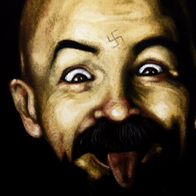
I started rubbing elbows with White Nationalists a few years ago.
I call ‘em “The Mighty Whites.”
I support White Nationalists. They are not all equally right about everything, but I am sympathetic to many of their general aims.
I think white people should be able to organize and advance their own interests just like every other group of people. For those of my readers who might be concerned, I want to explain why.
* * *
Ten out of ten minorities agree that being a minority can really blow. As an ambassador for a smaller group, you carry the baggage for all of “your kind.” As a minority, you have to work twice as hard to disprove negative stereotypes. You spend a lot of time dispelling misconceptions or explaining things. It’s annoying and tedious.
Stereotyping and prejudgment is a survival tactic. It’s natural, it’s human, and it’s not going away. The people who say they are opposed to stereotyping do it just as much as everyone else. Have you ever listened to an “objective” atheist rant about evangelical Christians? A casual conversation with an enlightened Northerner about the South might lead you to believe that strange fruit still swings there from every poplar tree. After living in San Francisco for a few years I determined that most residents of fog city had scribbled “Thar be dragons!” over at least forty states.
Humans are tribal. We need an “us,” and those who are not us must be “them.” We form tribal bubbles, and we filter out information that doesn’t confirm our biases about others. We associate with people who look like we do, or think like we do, or believe what we believe. Most of us do this even when we are trying consciously not to.
It’s easy enough to maintain the illusion of “one world tribe” when you are sitting in a polite, politically correct office, sipping a latte with a cherry-picked collection of educated and carefully groomed people from other groups.
In the land of calloused hands and cheap coffee, folks stick to their own kind. As a blue collar guy I can relate well enough to other groups. My pap worked on the railroad his whole life, and like him, when I punch the clock I have to learn to get along with whomever the boss hires, or work just gets a lot harder.
I have a lot of experience working with Mexicans. They’re funny, happy, hard working and easy to get along with. I’m not a Mexican. I’m not one of them. We can have a laugh over something universal, but they have different lifeways and for the most part they stick together. Sure, I could learn Spanish. I make tasty carnitas and I like drinking margaritas in the sun. But, like the man said, sticking a feather up your butt does not make you a chicken. I’ll always be a gringo.
I like being a gringo just fine. I feel more at home with white folks of my class and background than I do with people from other groups. Plenty of crackers are total assholes, but at least I know how to read them better. Kipling got exemplary manhood right with “If,” and he got in-group affinity right with “The Stranger.”
The Stranger within my gate,
He may be true or kind,
But he does not talk my talk—
I cannot feel his mind.
I see the face and the eyes and the mouth,
But not the soul behind.
The men of my own stock,
They may do ill or well,
But they tell the lies I am wonted to,
They are used to the lies I tell;
And we do not need interpreters
When we go to buy or sell.
When times get tough or the shit hits the fan, I think human groups shake out pretty much the way they do in prison: race, religion, ideology, class. Helter skelter. When everyone has the same race and religion, we still find reasons to separate ourselves into smaller nationalist groups. The English, the French, ze Germans. English colonists vs. English monarchists. Jocks vs. nerds.
If you want me to hand you a set of finger paints, tell me that race is “just about skin color.” If you actually believe that in 2011, you belong at the kiddie table watching Dora the Explorer. Race is hereditary. So are a lot of other human qualities. You get some of your parents’ strengths and some of their weaknesses. Race is about your family, and your family’s family, and your family’s family’s family. Your race is part of your heritage, passed down to you from those who came before. Race, culture, history and tradition combine to give you a sense of being part of an ethnic group.
From 100 yards away, the first things you’ll notice about me are that I am white and I am male. That’s where my taxonomy starts. If I were seen committing a crime, the cops would be looking for a white male, about 5’10–5’11, bald, 200 pounds, average build, with tattoos.
If I live to be 70, in my lifetime white men will be a minority in the United States. Whites are already a minority in many American cities. White men make up 30% of the population in Baltimore, 40% in Philadelphia, 39% in Atlanta. If you want to know what it feels like to be a minority, go to those places and look for a working class job.
Even in places where whites are still a majority, like San Diego, whole segments of the workforce are dominated by certain groups. I looked for work in San Diego a few years ago.
Here’s the General Labor section of craigslist in San Diego.
And here’s the General Labor list for Portland.
On any given day, Portland tends to have as many or more jobs in that category than San Diego. The Portland metro area has about 2 million people. San Diego has about 3 million people. There are one million more people in San Diego, but the same amount of general labor jobs get posted. In part, this is because San Diego’s population of legal and illegal Mexican immigrants creates a situation where Pedro always has a cousin who has another cousin who needs a job. Openings for a lot of jobs never go public. I see it happen all the time here in Portland, too.
There’s nothing wrong with that. Why shouldn’t Pedro try to get his cousin’s cousin a job? Why shouldn’t they help each other out? Why shouldn’t they take care of their own? Only white people are stupid enough to feel guilty about doing that. Do you think a black man is going to feel bad about helping out a brotha, even in Baltimore—where blacks make up almost 70% of the population?
Every ethnic group in America is taught to be proud of their race and ethnicity, except white people. America has black television channels, black magazines, black community organizations, black lobbying groups, black scholarships and black barber shops. Any black who wants to can go to a major city and disappear into an almost completely black community. Same thing for the varied Hispanic groups. Asians are far more financially successful, but they too are often insular and protective of their race and heritage. All of these groups recognize that they share some common ancestry and some common interests, and they organize to assert those interests. If you take a political editorial or press release put out by an Hispanic, black, Asian or even a gay publication and replace the group name with “white,” to the average American eye it will read like it was written by David Duke or George Lincoln Rockwell.
The flimsy rationales for why it is not acceptable for white groups to speak or organize in the same way are based on notions of white majority, white privilege and white cultural dominance. However, whites are no longer a majority in many places, and as any of the “99%” will tell you, average white people aren’t running the show. The white country club set doesn’t give a damn about what happens to most of us.
A lot of them have realized that “diversity” policies work in their favor—especially when they want to export jobs, hire cheap labor or avoid expensive lawsuits. And, thanks to the “arc of history” civil rights narrative that the media loves to promote, rich white people can shit on poor white people and feel like they are doing God’s work.
A multicultural, multiracial, melting pot society that forbids only one ethnic group from preserving its culture and organizing to further its own interests is criminally hypocritical. I have a low tolerance for swindling and deception, and the amount of double-talk and outright lying employed to maintain that hypocrisy is despicable.
So many white people have prejudices against other groups of people, choose to live in white neighborhoods, prefer their children to date other whites, and surround themselves with other white people. Some even (privately) make racist jokes.
When asked about race, these same self-righteous whites will dutifully denounce racism, white privilege, and white identity in all its forms—just like their expensive professors told them to. They come off like Patrick Bateman in American Psycho, who recites the social causes of the day to keep people from guessing he’s a completely opportunistic sociopath who will tell people whatever he thinks they want to hear.
Any white person who talks about being white like it is anything other than a cross to bear, or even half-heartedly suggests the idea of organizing as a white group, or even points out a “hate fact” like the black-on-white crime rate will be publicly shamed, excluded and can easily be fired from his or her job.
Social courage isn’t the highest form of courage, but it’s something.
Being a white anti-racist is the easiest thing to be in the world. It’s like being a papist in Vatican City. There’s nothing brave about it. It’s the status quo. You’re just doing what you’ve been told to do, whether it makes sense or not.
Challenging the deeply entrenched anti-white bias of multiculturalist orthodoxies is heroic by comparison. I may not agree with everything that every white nationalist says—they have their own noble lies—but I applaud any white man or woman who is willing to stand up for their own people and challenge some of the greatest lies of our time.
* * *
I am not a white supremacist.
I don’t feel the need to try to prove that my team is objectively better in every way than every other team. Sure, there are probably some bell-curve type differences between the major races. I am also sure I can find a person of just about any race who is better than me at just about anything. Whether white people are superior or not isn’t the point.
The point is that white people are my people. We’re an ethnic and racial group with a common heritage. Because stereotypes aren’t going away, because humans are tribal, and because we’re a group that is well on its way to becoming just another minority, we have every right to organize as a group and take care of our own. I’m pro-white because I am pro-me. I’m pro-my family. I’m in favor of remembering my ancestors in a positive light. I support the preservation of my people’s history and culture, and I resist the revisionism of groups who wish to skew history to favor the interests of others. I know that the accomplishments of great white men are not my personal achievements, and I know I can’t trade on them as if they entitle me to special treatment, but these things are just as important to my identity as the histories of other people are to their identities.
* * *
I believe that people should form groups that suit them and exclude others if they believe it is in their benefit to do so. On that note, I can tell you that not all of the Mighty Whites want me around. Every so often, some hysterical prig sallies forth from his Arthurian fap den to proclaim me a he-man woman hater, a Satanist, a sodomite, and a threat to the cause. I’m flattered that they think I’m a big enough deal to sink their battleship, but if that’s the case, they are already well and truly fucked. I am pro-white and I support WNs because I’m white and because I think they are right about a lot of things—not because I expect them all to send me love letters. That said, most of the WNs and pro-whites I’ve dealt with have been decent, straightforward, polite and helpful.
* * *
I am pro-white, but race is not my favorite issue to write about. Race is not what I spend the majority of my time thinking about. If anything, I know too well that it distracts people from the bulk of my work.
My work is about men. It’s about understanding masculinity and the plight of men in the modern world. It’s about what all men have in common. My research and thinking in this area have led me to the conclusion that men are tribal. Women are tribal, too, but women logically tend to favor material security over tribal loyalty. Most men feel more alive, more confident and more comfortable in their own skins when they have a sense of belonging within a group of men.
The concept of honor as I understand it cannot exist without some sense of tribal membership, whether based on race or religion or class or some other form of identification. In both old New York City and old Japan, groups of firemen used to fight each other.
Honor requires a group of men who will judge you, who will threaten you with exclusion and shame, but who will also push you beyond your comfort zone and reward your efforts with respect and loyalty. Manliness and honor are hierarchical. Honor is incompatible with enforced “equality” and it is incompatible with enforced inclusiveness.
* * *
I don’t know if what I’ve written here qualifies me as a White Nationalist or not. I’m in no hurry to become a card-carrying member for any organization or movement. As a writer, I’m just trying to be honest, to say what I mean and mean what I say. That takes me to some unusual places and puts me in touch with unusual people. I’m OK with that.
The Way of Men
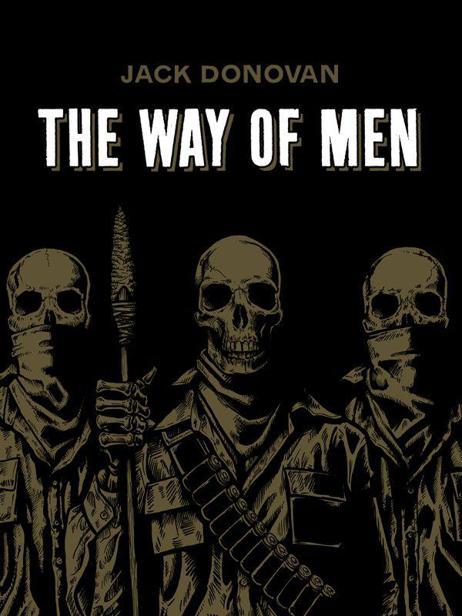
Copyright © 2012 by Jack Donovan.
All rights reserved.
Cover Design and Artwork by Jack Donovan.
First electronic edition.
Released March 26, 2012.
Published by Jack Donovan via [DISSONANT HUM]
Milwaukie, Oregon. USA.
Also by Jack Donovan
Blood-Brotherhood and Other Rites of Male Alliance
(Co-authored with Nathan F. Miller)
For more information, news, new essays, and to contact the author, visit:
https://www.facebook.com/pages/Jack-Donovan/125037104227038
The Way of Men on Facebook:
https://www.facebook.com/TheWayOfMen
“…gangsta culture is the essence of patriarchal masculinity.”
—bell hooks
Preface
I present this book to you without ego.
It is not an advertisement for my own manhood or a boast to flatter the men of my own tribe.
This book is my answer to the question: “What is masculinity?”
If men are a certain way, and there is a way to be manly, then: “What is The Way of Men?”
For decades, people have been talking about a “crisis” of masculinity. Our leaders have created a world in spite of men, a world that refuses to accept who men are and doesn’t care what they want. Our world asks men to change “for the better,” but offers men less of value to them than their fathers and grandfathers had. The voices who speak for the future say that men must abandon their old way and find a new way. But what is that way and where does it lead?
As I came to understand The Way of Men, I became more concerned about where men are today, and where they are headed. I wondered if there was a way for men to follow their own way into a future that belongs to men.
That’s the path of this book. My answers may not be the kind of answers you want to hear, but they are the only answers that satisfied my inquiry.
Jack Donovan
March 2012
Milwaukie, Oregon
The Way of Men is The Way of The Gang
When someone tells a man to be a man, they mean that there is a way to be a man. A man is not just a thing to be—it is also a way to be, a path to follow and a way to walk. Some try to make manhood mean everything. Others believe that it means nothing at all. Being good at being a man can’t mean everything, but it has always meant something.
Most traditions have viewed masculinity and femininity as complementary opposites. It makes sense to say that masculinity is that which is least feminine and femininity is that which is least masculine, but saying that doesn’t tell us much about The Way of Men.
Boys and girls don’t pair off at birth and scurry off to a dank cave together. Humans have always been social animals. We live in cooperative groups. Our bodies sort us into groups of males or females. We interact socially as members of one group or the other. These groups aren’t arbitrary or cultural—they’re basic and biological. Males have to negotiate male and female groups as males. Males aren’t simply reacting to females. We react to other males, as males. Who we are has a lot to do with how we see ourselves in relationship to other males, as members of the male group.
A man is not merely a man but a man among men, in a world of men. Being good at being a man has more to do with a man’s ability to succeed with men and within groups of men than it does with a man’s relationship to any woman or any group of women. When someone tells a man to be a man, they are telling him to be more like other men, more like the majority of men, and ideally more like the men whom other men hold in high regard.
Women believe they can improve men by making masculinity about what women want from men. Men want women to want them, but female approval isn’t the only thing men care about. When men compete against each other for status, they are competing for each other’s approval. The women whom men find most desirable have historically been attracted to—or been claimed by—men who were feared or revered by other men. Female approval has regularly been a consequence of male approval.
Masculinity is about being a man within a group of men. Above all things, masculinity is about what men want from each other.
If The Way of Men seems confusing, it is only because there are so many different groups of men who want so many different things from men. Established men of wealth and power have always wanted men to believe that being a man was about duty and obedience, or that manhood could be proved by attaining wealth and power through established channels. Men of religion and ideology have always wanted men to believe that being a man was a spiritual or moral endeavor, and that manhood could be proved through various means of self-mastery, self-denial, self-sacrifice or evangelism. Men who have something to sell have always wanted men to believe that masculinity can be proved or improved by buying it.
In a united tribe with a strong sense of its own identity, there is some harmony between the interests of male groups, and The Way of Men seems straightforward enough. In a complex, cosmopolitan, individualistic, disunited civilization with many thin, à la carte identities, The Way of Men is unclear. The ways touted by rich and powerful men are tossed with the ways of gurus and ideologues and jumbled with the macho trinkets of merchants in such a mess that it’s easy to see why some say masculinity can mean anything, everything, or nothing at all. Add to that the “improvements” suggested by women and The Way of Men becomes an unreadable map to a junkyard of ideals.
To understand who men are, what they have in common and why men struggle to prove their worth to each other, reduce male groups to their nucleic form. Sprawling, complex civilizations made up of millions of people are relatively new to men. For most of their time on this planet, men have organized in small survival bands, set against a hostile environment, competing for women and resources with other bands of men. Understanding the way men react to each other demands an understanding of their most basic social unit. Understanding what men want from each other requires an understanding of what men have most often needed from each other, and a sense of how these needs have shaped masculine psychology.
Relieved of moral pretense and stripped of folk costumes, the raw masculinity that all men know in their gut has to do with being good at being a man within a small, embattled gang of men struggling to survive.
The Way of Men is the way of that gang.
The Perimeter
You are part of a small human group fighting to stay alive.
The reason why doesn’t matter.
Conquest, war, death, hunger or disease—any of The Horsemen will do.
You could be our primal ancestors, you could be pioneers, you could be stranded in some remote location, you could be survivors of a nuclear holocaust or the zombie apocalypse. Again, it doesn’t matter. For humans without access to advanced technology, the scenario plays out more or less the same way.
You have to define your group. You need to define who is in and who is out, and you need to identify potential threats. You need to create and maintain some sort of safe zone around the perimeter of your group. Everyone will have to contribute to the group’s survival in some way unless the group agrees to protect and feed someone who can’t contribute due to age or illness. For those who can work, you’ll need to decide who does what, based on what they are good at, who works well together, and what makes the most practical sense.
Hunting and Fighting
Hunting and fighting are two of the most dangerous jobs you’ll need to do to stay alive.
To thrive, humans need protein and fat. You can get enough protein and fat from vegetables, but without an established farm you’re going to be hard pressed to gather enough vegetables to meet your nutritional needs. A large animal can provide protein and fat for days—longer if you know how to preserve the meat.
The problem with big, protein-rich animals is that they don’t want to die. Meat is muscle, and muscle makes animals strong—often stronger than men. Wild beasts come equipped with tusks, antlers, hooves, claws and sharp teeth. They’re going to fight for their lives. Taking down a big, protein-rich animal is going to be dangerous. It will require strength, courage, technique, and teamwork. Finding food also requires exploring—venturing out into the unknown—and who knows what lurks out there?
If you are going to survive, your group will need protection from predators—animal, human, alien, or undead. If there is someone or something out there who wants what you have and is willing to fight for it, you’re going to need to figure out who in your group is going to be willing to fight back. You’ll want the people who are best at fighting to stand watch, to defend everything you care about, or to go out and eliminate a potential threat. If someone or something has something that you need, the best way to get it may be to take it. Who in your group will be willing and able to do that?
Maybe females are part of your group. Maybe they aren’t. If females are with you, they won’t have access to reliable birth control. Males and females won’t stop having sex, and females will get pregnant. Humans are mammals, and like most mammals, a greater part of the reproductive burden will fall on women. That’s not fair, but nature isn’t fair. Even strong, aggressive women become more vulnerable and less mobile during pregnancy. Even tough women will nurse their young. They’ll bond with their offspring and take to caring for them quickly. Babies are helpless, and children are vulnerable for years.
If there were no other physical or mental differences between women and men, in a hostile environment the biological realities of human reproduction would still mean that over time more men would be charged with exploring, hunting, fighting, building, and defending. Men would have more time to specialize and develop the necessary skills to excel at those tasks. They wouldn’t have a good excuse not to.
Men will never get pregnant, they will never be nursing, and they will be less encumbered by their children. They may not even know who their children are. Women know who their kids are. Children don’t depend on their fathers in the same way that they depend on their mothers. Men are freer to take risks for the good of the group, believing that their offspring will live on.
As things are, there are biological differences between men and women that have little to do with pregnancy or breastfeeding. On average, men are bigger and stronger than women. Men are more daring, probably more mechanically inclined, and generally better at navigating. Men are hard wired for aggressive play. High testosterone men take more risks and seek more thrills. Men are more interested in competing for status, and when they win, their bodies give them a dopamine high and more testosterone.[89]
Because your group is struggling to survive, every choice matters. If you give the wrong person the wrong job, that person could die, you could die, another person could die, or you could all die. Because of the differences between the sexes, the best person for jobs that involve exploring, hunting, fighting, building, or defending is usually going to be a male. This is not some arbitrary cultural prejudice; it is the kind of vital strategic discrimination that will keep your group alive.
Humans, like chimpanzees, will often hunt in teams because cooperative hunting is more effective than hunting alone. When you put together a team—any kind of team—the raw skills of your candidates aren’t the only factors you have to consider. You also have to consider the team’s social dynamic. Which people will work best together? As a leader, you want to create synergy, reduce distractions, and avoid conflicts within the group. Males will compete for status within any group, but they will also compete for females. Eliminating a second layer of potential jealousy and antagonism may be reason enough to choose a male over a female.
If there are females in your group, they will have plenty of hard and necessary work to do. Everyone will have to pull their own weight, but the hunting and fighting is almost always going to be up to the men. When lives are on the line, people will drop the etiquette of equality and make that decision again and again because it makes the most sense.
That practical division of labor is where the male world begins.
The Party-Gang
Thomas Hobbes wrote that when men live without fear of a common power, they live in a state of “warre.” In warre, every man is against every other man.
Hobbes’ idea of warre is interesting on a theoretical level, but his warre of all against all is not the state of nature for men. It’s natural for a man to look after his own interests, but those interests drive men together—quickly. A loner has no one to ask for help, no one to watch his back, no one to guard him when he sleeps. Men have a greater chance of survival together than they do apart. Men have always hunted and fought in small teams. The natural state of warre is ongoing conflict between small gangs of men.
Chimpanzees organize on a party-gang basis, which means they change the size of their groups depending on the circumstances. Chimps gather together in large parties and build alliances for strategic reasons, for mating, and for the sharing of resources. When circumstances change, they break into smaller groups and hunting parties. The smaller groups—the gangs—are the tightest and most stable. The males are loyal and rarely move from gang to gang. Females sometimes join the males in hunting activities, but they are more likely to move from one gang to another over time.
Men organize the same way.
For example, take military units.
Army: 80,000 – 200,000 members
Corps: 20,000 – 45,000 members
Division: 10,000 – 15,000 members
Brigade: 3,000 – 5,000 members
Regiment: 3,000 – 5,000 members
Battalion: 300 – 1,300 members
Company: 80 – 225 members
Platoon: 26 – 55 members
Section/Patrol/Squad: 8 – 13 members
Fireteam: 2 – 4 members
All of the men in a given army are part of the same big team, but the strength of the bonds between men will increase as the size of the unit decreases. In smaller groups, men are more loyal to one another.
When writer Sebastian Junger asked US soldiers in Afghanistan about their allegiances, they told him that, “they would unhesitatingly risk their lives for anyone in the platoon or company, but that sentiment dropped off pretty quickly after that. By the time you got to brigade level—three or four thousand men—any sense of common goals or identity was pretty much theoretical.”[90] There is frequently rivalry between the groups. Each group has its own regalia, its own traditions, its own symbolism, and a common history.
Some researchers believe that the human brain can only process enough information to maintain meaningful relationships with 150 or so people at any given time.[91] That’s about the size of a military company, but also about the size of a typical primitive human tribe, and roughly the number of “friends” most people contact regularly through social networking sites.
Within that tribe of 150, people form even smaller groups. How many people would you loan a lot of money to? How many people could you depend on in an emergency? How many people could depend on you?
If you’re like most, that number drops to the size of a platoon, a squad, or even a fireteam. The team size for most group sports is somewhere between the fireteam number and the platoon number. American football teams have around 50 members on a roster, but only 11 are on the field at one time. Baseball teams keep 25 members on their rosters, with 9 on the field. Soccer teams play between 7 and 11 members. Basketball teams play 5. Water polo teams put 7 in the pool.
Men revert back to this archetypal gang size, even for recreation and storytelling. How many main characters are there in your favorite films, books, or television shows? The number works for religion and myth, too. Jesus had 12 apostles. How many Greek gods can you name? Norse?
The group of 2 to 15 men is a comfort zone. It’s an effective team size for tactical maneuvers, but it’s also socially manageable. You can really know about that many guys at one time. You can maintain a good working relationship and a meaningful social history with 100 or so more. Beyond those numbers, connections become extremely superficial, trust breaks down, and more rules and codes—always enforced by the threat of violence—are required to keep men “together.” In times of stress—when resources are scarce, when the system of rules and codes breaks down, when there is a lapse in enforcement, or when men have little to lose and more to gain by breaking the law—it is The Way of Men to break off from large parties and operate in small, nimble gangs.
The fireteam-to-platoon sized gang is the smallest unit of us. Beyond us is them, and the line that separates us from them is a circle of trust.
Drawing the Perimeter
The first job of men in dire times has always been to establish and secure “the perimeter.”
Imagine yourself again in our survival scenario. People can’t fight and hunt and kill all day and all night forever. Humans have to sleep, they have to eat, and they need downtime. You need to create a safe space and set up camp somewhere.
You’ll also have to identify some desirable resources, like access to water and food. One of the first things you have to consider is whether the spot makes you vulnerable to attack from predators or unknown groups of men. Then you do some basic recon—you check out the surrounding area to see if there is evidence of another tribe, or undesirable beasts. Tired and satisfied, you and your pals set up a base camp and keep an eye on a rudimentary perimeter.
The survival of your group will depend on your ability to successfully claim land and keep it safe.
When you claim territory and draw a perimeter, that line separates your group from the rest of the world. The people inside the perimeter become us and everything known and unknown outside the perimeter becomes them.
Beyond the light of your night fire, there is darkness. They lie just beyond the flicker of your fire, out there in the dark. They could be wild animals, zombies, killer robots, or dragons. They could also be other men. Men know what men need, and what they want. If your men have something that men want or need, you’ll have to be wary of other men. The things that have value to men—tools, food, water, women, livestock, shelter or even good land—will have to be protected from other men who might be desperate enough to harm you to get those things. The perimeter separates men you trust from men you don’t trust, or don’t know well enough to trust.
People like to make friends. Being on the defensive all the time is stressful. Most people want to trust other people. Most people want to be able to relax. If you are smart, until you know them, they will remain out there on the other side of the perimeter. Even if you let your guard down to cooperate or trade with them, they may or may not be absorbed into us. As long as other men maintain separate identities, there is always the chance that they will choose to put the interests of their own ahead of your interests. In hard times, agreements between groups fall apart. Competition creates animosity, and men will dehumanize each other to make the tough decisions necessary for their own group to survive.
If you put males together for a short period of time and give them something to compete for, they will form a team of us vs. them. This was famously illustrated by Muzafer Sherif’s “Robbers Cave Experiment.” Social psychologists separated two groups of boys and forced them to compete. Each group of boys created a sense of us based on what they liked about themselves or how they wanted to imagine themselves. They also created negative caricatures of the other group. The groups became hostile toward each other. However, when the researchers gave them a good enough reason to cooperate, the competing gangs were able to put aside their differences and join together in a larger party.
It has always been the job of men to draw the perimeter, to establish a safe space, to separate us from them and create a circle of trust.
The discovery of new land in the Americas made it possible for men to do this again in recent human history. Small groups of men ventured out into unknown territory because they believed they had more to gain from risk than they could expect to gain through established channels in the old world. They braved the wild, set up camps, and reinvented civilization as the rest of the world looked on. Out there in the dark there were Injuns, bears, snakes, and other gangs of men willing to use violence to take whatever they wanted. Both the settlers and the natives were men under siege, and they had to harden themselves against external forces. They had to decide who they could trust, who they couldn’t, and what they needed from the men around them.
The story of the American West is only one story. How many gangs, families, tribes and nations have been founded by a small group of men who struck out on their own, claimed land, defended it, made it safe and put down roots? If men had never done this, there would not be people living on every continent today.
A Role Apart
You’ve decided who is in and who is out. You’ve decided who you trust, and who you don’t. You are watching the perimeter, protecting what is inside the circle of flickering light, defending everything that means anything to you and the men who stand with you. It all comes down to you, the guardians, because you know that if you fail at your jobs there can be no human happiness, no family life, no storytelling, no art or music. Your role at the bloody edges of the boundary between us and them supersedes any role you have within the protected space. Yours is a role apart, and your value to the other men who share that responsibility will be determined by how well you are willing and able to fulfill that role.
Other men will need to know that they can depend on you, because everything matters, and your weakness, fear or incompetence could get any one of them killed or threaten the whole group. Men who are good at this job—men who are good at the job of being men—will earn the respect and trust of the group. Those men will be honored and treated better than men who are disloyal or undependable. The men who deliver victory at the moments of greatest peril will attain the highest status among men. They will be treated like heroes, and other men—especially young men—will emulate them.
In a complex society, almost all of us live deep within the perimeter. We create our own circles and cliques, and we defend them metaphorically. We include people or exclude them for all kinds of reasons. Far from any boundary between threat and safety, people celebrate qualities that have almost nothing to do with survival. The flock bleats for singers, designers, smooth talkers, and people whose only talents are being witty or pretty. The shepherds drive them round to more of the same.
When men evaluate each other as men, they still look for the same virtues that they’d need to keep the perimeter. Men respond to and admire the qualities that would make men useful and dependable in an emergency. Men have always had a role apart, and they still judge one another according to the demands of that role as a guardian in a gang struggling for survival against encroaching doom. Everything that is specifically about being a man—not merely a person—has to do with that role.
As you stand back to back, fending off incoming oblivion, what do you need from the men in your group? As you close a circle tighter around dangerous game that could feed you all for a week, what kind of men do you want at your flank?
The Tactical Virtues
Vir is the Latin word for “man.” The word “virtue” comes from the Latin “virtus.” To the early Romans, virtus meant manliness, and manliness meant martial valor.[92] Demonstrating virtus meant showing strength and courage and loyalty to the tribe while attacking or defending against the enemies of Rome.
As the Romans became more successful and their civilization became more complex, it was no longer necessary for all men to hunt or fight. The fighting happened at the edge of the perimeter, and the fighting edge of Roman civilization moved outward. For men deep inside the circle, manliness became increasingly metaphorical.[93] Men who did other work could satisfy their need to be seen as men among men by fighting metaphorically, showing social courage, mastering their desires, and behaving ethically. The meaning of the word virtus and the Roman idea of manliness expanded to include values that were not merely survival virtues, but also civic and moral virtues.
Definitions of manliness expand to include other virtues as civilizations grow. However, these other virtues are less specific to men than the fighting virtues, and they vary more from culture to culture. “Civilized” virtue is about being a good person, a good citizen, a good member of a particular society. Manly virtues should be virtues directly related to manhood. The virtues that men all over the world recognize as manly virtues are the fighting virtues. Epics and action movies translate well because they appeal to something basic to the male condition—a desire to struggle and win, to fight for something, to fight for survival, to demonstrate your worthiness to other men.
The virtues associated specifically with being a man outline a rugged philosophy of living—a way to be that is also a strategy for prevailing in dire and dangerous times. The Way of Men is a tactical ethos.
If you are fighting to stay alive and you are surrounded by potential threats, what do you need from the men fighting with you?
What do you need from us to fend off them?
If eating means facing danger together, who do you want to take with you?
What virtues do you need to cultivate in yourself and the men around you to be successful at the job of hunting and fighting?
When your life and the lives of people who you care about depend on it, you’ll need the men around you to be as strong as they can be. Living without the aid of advanced technology requires strong backs and elbow grease. You’ll need strong men to fight off other strong men.
You won’t want the men in your gang to be reckless, but you’ll need them to be courageous when it matters. A man who runs when the group needs him to fight could put all of your lives in jeopardy.
You’ll want men who are competent, who can get the job done. Who wants to be surrounded by morons and fuck-ups? The men who hunt and fight will have to demonstrate mastery of the skills your group uses to hunt and fight. A little inventiveness couldn’t hurt, either.
You’ll also need your men to commit. You will want to know that the men beside you are us and not them. You’ll need to be able to count on them in times of crisis. You want guys who have your back. Men who don’t care about what the other men think of them aren’t dependable or trustworthy. If you’re smart, you will want the other men to prove they are committed to the team. You’ll want them to show that they care about their reputation within the gang, and you’ll want them to show that they care about your gang’s reputation with other gangs.
Strength, Courage, Mastery, and Honor.
These are the practical virtues of men who must rely on one another in a worst-case scenario. Strength, Courage, Mastery, and Honor are simple, functional virtues. They are the virtues of men who must answer to their brothers first, whether their brothers are good or unscrupulous men. These tactical virtues point to triumph. They are amoral, but not immoral. Their morality is primal and it lives in a closed circle. The tactical virtues are unconcerned with abstract moral questions of universal right or wrong. What is right is what wins, and what is wrong is what loses, because losing is death and the end of everything that matters.
Strength, Courage, Mastery, and Honor are the virtues that protect the perimeter; they are the virtues that save us. These are the virtues that men need to protect their interests, but also the virtues they must develop to go after what they want. They are the virtues of the defender and the attacker. Strength, Courage, Mastery, and Honor belong to no one god, though many gods claim them. Whatever men fight for, Strength, Courage, Mastery, and Honor are what they must demand of each other if they are going to win.
Strength, Courage, Mastery, and Honor are the alpha virtues of men all over the world. They are the fundamental virtues of men because without them, no “higher” virtues can be entertained. You need to be alive to philosophize. You can add to these virtues and you can create rules and moral codes to govern them, but if you remove them from the equation altogether you aren’t just leaving behind the virtues that are specific to men, you are abandoning the virtues that make civilization possible.
The men who are strong, courageous, competent and loyal will be respected and honored as valuable members of team “us.”
Men who are exceptionally weak or fearful can’t be counted on. Men who are inept in some important way must either find a way to compensate—and they will try if they are loyal and honorable, if they want to help with the hunting and fighting—or find other work to do in the tribe. A man of questionable loyalty, who doesn’t seem to care what the other men think of him or how their tribe is perceived, will not be trusted by the hunting and fighting gang. Men who are not up to the job of fulfilling the first role of men for one or all of these reasons will be pushed out of the hunting and fighting group and sent to work with the women, the children, the sick and the elderly.
Men have different drives, aptitudes and temperaments. Most men have the ability to adapt to the hunting and fighting role, to life at the edge of the perimeter, but some men won’t be able to cut it. They will be regarded as less manly and thought of as lesser men. Some men are going to get their feelings hurt. That’s not fair, but fairness is a luxury that men can ill afford in dire times.
Men who want to avoid being rejected by the gang will work hard and compete with each other to gain the respect of the male gang. Men who are stronger, more courageous and more competent by nature will compete with each other for higher status within that group. As long as there is something to be gained by achieving a higher position within the gang—whether it is greater control, greater access to resources or just peer esteem and the comfort of being higher in the hierarchy than the guys at the bottom—men will compete against each other for a higher position. However, because humans are cooperative hunters, the party-gang principle scales down to the individual level. Just as groups of men will compete against each other but unite if they believe more can be gained through cooperation, individual men will compete within a gang when there is no major external threat but then put aside their differences for the good of the group. Men aren’t wired to fight or cooperate; they are wired to fight and cooperate.
Understanding this ability to perceive and prioritize different levels of conflict is essential to understanding The Way of Men and the four tactical virtues. Men will constantly shift gears from in-group competition to competition between groups, or competition against an external threat.
It is good to be stronger than other men within your gang, but it is also important for your gang to be stronger than another gang. Men will challenge their comrades and test each other’s courage, but in many ways this intragroup challenging prepares men to face intergroup competition. Just as it is important for men to show their peers they won’t be pushed around, the survival of a group can depend on whether or not they are willing to push back against other groups to protect their own interests. Men love to show off new skills and find ways to best their pals, but mastery of many of the same skills will be crucial in battles with nature and other men. The sports and games men play most demand the kind of strategic thinking and/or physical virtuosity that would be required in a survival struggle. A man’s reputation may keep men in his group from messing with him, and a group’s reputation may make its enemies think twice about creating animosity.
Sociologists and street gang experts typically write about an excessive concern with reputation or a desire to avenge “disses” with confused, haughty contempt. But the truth is that men have behaved this way for most of human history, and the strategic reasons why should be obvious to anyone who doesn’t feel he can rely on police protection. If no one is coming to save you, you’d better be tough or look tough, and you’ll probably want some tough guys ready and willing to get your back.
I have no idea how people manage to be confused about something that simple and obvious, but I’m pretty sure our ancestors would have killed them and taken their stuff.
* * *
The next four chapters will elaborate on what I mean by Strength, Courage, Mastery and Honor. These simple words have many meanings, and they mean different things to different people. The manly virtues represent concepts so universally appealing that even the weak, cowardly, inept, and dishonorable struggle to find ways in which they too can feel that they embody these virtues. With each of the four, I will show why they relate specifically to men, how women fit into the picture, and how the virtues relate to each other. Some of the virtues also have multiple aspects worth parsing out.
After we have examined each of the tactical virtues and considered them amorally, I’ll address issues of morality and ethics again, and explain what I think the difference is between being a good man and being good at being a man—and why they’re not the same thing.
Strength
If you take a thing apart or modify it, there are certain aspects which must remain intact or be replaced for it to retain its identity. Without certain parts, it becomes something else.
Without strength, masculinity becomes something else—a different concept.
Strength is not an arbitrary value assigned to men by human cultures. Increased strength is one of the fundamental biological differences between males and females. Aside from basic reproductive plumbing, greater strength is one of the most prominent, historically consequential and consistently measurable physical differences between males and females.
It is fashionable today to put the word “weaker” in quotations to avoid offending women when they are referred to as the “weaker” sex. Quotation marks will not alter the basic human truth that men are still on average significantly physically stronger than women. Serious people should be able to admit that something is generally true when it is a verifiable fact. There is no good reason to be coy about it.
Strength isn’t the only quality that matters. Sometimes it doesn’t matter at all. Strength is rarely a disadvantage. However, in our mechanically-assisted modern world, physical strength is often less consequential than it used to be. Of consequence or not, it is what it is.
Women can demonstrate strength, but strength is a quality that defines masculinity. Greater strength differentiates men from women. Weak men are regarded as less manly, but no one really cares or notices if a woman is physically weaker than her peers. In a way this is truer—or truer across classes—than it ever has been. Women living on farms (or in primitive hunter-gatherer societies) were expected to do far more demanding physical labor than any work required of the average woman today.
We admire strength in female athletes, but a beautiful woman who can’t lift a bag of groceries will still have many admirers and plenty of men will be willing to help carry her groceries. Many female celebrities who are considered beautiful by both men and women are so thin that they look starved and brittle. Collectively, we don’t care whether a woman is strong or not. A woman is not considered less womanly if she is physically weak.
Many may consider a woman less womanly if she is too strong. Specifically, a woman tends to look more like a man if she has a conspicuously high level of muscle mass and unusually low body fat. Precisely because of the physiological differences between males and females, only the most dedicated and disciplined female bodybuilders ever manage to look like He-Man action figures with Barbie doll heads. Average women who train with weights will increase strength and overall health, but most will still look like women. Testosterone may or may not play an important role in female muscular development.[94] However, in men, testosterone—the most recognized androgen—has a complementary relationship with increased strength and muscle mass. Men who have more muscle tend to have and maintain higher testosterone levels, and men who have higher testosterone levels tend to have an easier time getting bigger and stronger. Men who increase their testosterone levels—either through training and diet or via artificial means—tend to look more masculine. Put differently, men with more muscle look less like most women, and more like the least androgynous men. This has absolutely nothing to do with culture. There is no human culture where men who are weak are considered manlier while women who are more muscular are considered more womanly. The importance of strength varies from society to society (usually in some relationship to available technologies and the kind of work that is required of average people) but strength has been a masculinity defining quality always and everywhere.
If we are making an honest attempt to understand and define masculinity or manliness[95] as that which pertains to or is characteristic of men, physical strength must figure prominently in that definition. The Way of Men is the Way of the Strong—or at least the stronger.
As I and many others have mentioned, strength is not always a great advantage in the modern world. However, if we go back to our primal gang—our band of brothers fighting for survival—the value of strength to the group increases substantially. Where there is work and fighting to be done, the advantages of being stronger are obvious. A man who can hit twice as hard is also, other variables aside, worth more to the gang. In addition to giving a man the ability to take a position of greater prominence in a gang, strength made him more valuable overall. A man who can carry twice as much as another man, other variables aside, is worth more to the gang.
One evolutionary biologist recently suggested that humans stood up because standing up gave human males a greater mechanical advantage when clobbering each other.[96] They may have started walking upright for other reasons as well. On a long enough timeline, “both A and B” is a reasonable explanation, if both explanations are reasonable. As a natural advantage, pummeling power matters. It is also generally believed that fighting is one of the reasons why males have greater upper body strength than females. In the primal gang, the man who is substantially stronger than all of his peers is a juggernaut capable of crushing everyone in his path. He is capable of exerting his will in any way he sees fit. (The will itself is our second manly virtue.)
Strength, in the strictest physical sense, is the muscular ability to exert pressure.
Putting aside the workings of involuntary muscles, for conscious beings strength is the ability to exert force in accordance with one’s will. This can be as simple as forcing one bone toward another and releasing it. A certain amount of strength is required to wiggle your finger.
Strength is an aptitude. Strength is an ability that can be developed, but as with intelligence, most people will have a certain natural range of potential beyond which they will be unable to progress. Some individuals will have a greater aptitude for developing strength than others. Humans are unequal in their aptitudes. This is one of the cruel but fundamental truths of human life.
It takes a certain amount of strength to reach for a piece of fruit and yank it away from a plant. Strength is required to build and to farm and to hunt and to carry groceries from the store and put them in your car. Ask an old person if loss of strength has impacted their lives in a negative or positive way. A weaker person is more vulnerable. Less strength means it is less likely that you will be able to push someone away who wants to take something from you, and on a strictly physical level, reduced strength means a diminished ability to take what you want from someone else. A person who is too weak simply cannot survive. It is strength that makes all other values possible.
Strength is the ability to exert one’s will over oneself, over nature and over other people.
As we move from the dire circumstances of the survival gang to luxurious life in a civilized society, the concept of strength doesn’t change so much as it expands and becomes a metaphor. The word strength can describe a wide range of abilities and powers without losing its primal meaning or cachet. Strength is the corporeal equivalent of power. Strength is having 300 tanks to use against your enemy’s 200 tanks. Strength is the arsenal, but no guarantee that the arsenal will be used. Strength, in this broader sense, is a desirable commodity. Getting stronger—increasing strength—means increasing your ability, as an individual, a gang or a nation, to do as you wish with relative impunity. What is freedom, if not the ability to do what one wishes?
Strength is the ability to move, and greater strength moves more. However, just as muscles can make isometric contractions, strength can also be the ability to stand against outside pressure. Strength is also the ability to HOLD FAST—a tattoo once found on the knuckles of sailors whose lives (and the lives of the gang of men on their ship) depended on their ability to hold on and weather a storm. That strength means both the ability to move and the ability to become immovable is no more a contradiction than the mechanics of a muscle are a contradiction.
Physical strength is the defining metaphor of manhood because strength is a defining characteristic of men. An increased aptitude for physical strength differentiates most males from most women, and this difference, though less important in times of safety and plenty, has defined the role of men for all of human history.
Strength can be put to a variety of uses, but when it is put to no use, it is like a powerful engine collecting dust in a garage or a beautiful singing voice that no one ever hears. A sports car that never puts rubber to the road is just a pretty hunk of metal. To experience the joy of his natural talent, a singer must sing. The experience of being male is the experience of having greater strength, and strength must be exercised and demonstrated to be of any worth. When men will not or cannot exercise their strength or put it to use, strength is decorative and worthless.
Courage
Strength is a straightforward, physical concept.
Courage has many names, and has been defined in many ways.
Strength is the ability to move or stand against external forces. Courage is kinetic. Courage initiates movement, action or fortitude. Courage exercises strength. The “cowardly lion”—the tough looking guy who stands aside as weaker men fight the fight, take the risks and do the work— is worth less than the men who step into the arena.
I will not claim that all exertions of will are courageous, but all acts which require courage are exertions of will. It does not take courage to use strength to pick up a glass and lift it to your mouth. Courage implies a risk. It implies a potential for failure or the presence of danger. Courage is measured against danger. The greater the danger, the greater the courage. Running into a burning building beats telling off your boss. Telling off your boss is more courageous than writing a really mean anonymous note. Acts without meaningful consequences require little courage.
Aristotle believed that courage was concerned with fear, and that while there were many things to fear in life, death was the most fearful thing of all. In his Nicomachean Ethics, the brave man is a man who, “is fearless in the face of a noble death, and all of the emergencies that involve death; and the emergencies of war are in the highest degree of this kind.” He also made the point that men who are forced to fight are less courageous than those who demonstrate courage in battle of their own free will. Aristotle framed courage as a moral virtue, as a will to noble action. He questioned the courage of those who are confident due to success in battle, though I wonder how such success can be earned, except through some initial show of courage. While it is true that the chests of strong and experienced men often swell when threats are minor, and such men have been known to back down in the face of a legitimate challenge, a certain amount of courage is the product of a successful track record. Is a man who has never won a fight more courageous for taking on an experienced fighter—no matter how noble the cause—or is he simply a fool? Aristotle’s mean of courage is not the wild, “rash” confidence of a passionate man who fights in the heat of the moment out of fear or anger. Rather, he suggests that “brave men act for honor’s sake, but passion aids them.” He does allow that men who act from strength of feeling possess “something akin to courage.” [97] Aristotle’s formulation of courage, while admirable, is so conditional and lashed to a slippery, high-minded ideal of noble action that trying to determine who is truly courageous becomes a bit of a game.
Andreia, the word Aristotle used for courage, was also synonymous with manliness in ancient Greece. Andreia is derived from “andros,” which connotes “male” or “masculine.” In his book Roman Manliness, classicist Myles McDowell argued that the word virtus,[98] which “struck the ear of an ancient Roman much as ‘manliness’ does that of an English speaker,”[99] meant courage—specifically in battle—in pre-Classical Latin. The word vir meant “man,” and the virtus meant courage.[100] McDonnell wrote:
“In military contexts virtus can denote the kind of courage required to defend the homeland, but more often it designates aggressive conduct in battle. In non-military situations courageous virtus usually refers to the capacity to face and endure pain and death.”[101]
Courageous manliness is personified in the story of Gaius Mucius, a noble Roman youth from the early Republic. An Etruscan king named Porsenna had besieged Rome by garrisoning his soldiers around the city. Gaius Mucius asked the Roman senators for permission to slip into the Etruscan camp and kill Porsenna. He killed Porsenna’s secretary by mistake, and he was captured by the king’s bodyguards. Gaius Mucius said to the king:
“I am Gaius Mucius, a citizen of Rome. I came here as an enemy to kill my enemy, and I am as ready to die as I am to kill. We Romans act bravely and, when adversity strikes, we suffer bravely. Nor am I the only one who feels this way; behind me stands a line of those who seek the same honour.”[102]
Porsenna threatened to throw Gaius Mucius into the fire. Gaius Mucius responded by thrusting his own hand into the fire. As his hand burned, he said:
“Look upon me and realize what a paltry thing the body is for those who seek great glory.”[103]
Porsenna told Gaius Mucius that, were he a member of his own tribe, he would commend him for his bravery. Gaius Mucius was released, but he told Porsenna that there were three hundred other Romans who would be willing to sacrifice themselves as he had to save their city, and that if the siege of Rome persisted, sooner or later one of them would manage to succeed in killing the king. Porsenna sent an envoy to the Romans, offering peace terms. Gaius Mucius earned the nickname “Scaevola,” meaning “left-handed,” after losing his right hand to the fire.
For both Aristotle and the Romans, courage—and manliness—was the will to heroically risk life and limb against a danger to the people of one’s own tribe, especially in the context of war with another tribe. Aristotle’s most noble form of courage was a willingness to take a necessary risk to ensure the survival of the group. A demonstration of the willingness to risk one’s own being for the gang proves loyalty and increases a man’s value to the gang. When the chips are down, a man who shows this kind of courage can be counted on to give everything he has—even sacrificing himself—for the survival of the group. When a group is not facing a survival challenge, that group can afford to be metaphorical about courage and acknowledge lesser sacrifices. Until security is established, though, no group can afford to bother with niceties like “intellectual courage.”
The word courage is used cheaply today. Any celebrity who gets sick and doesn’t spend every day crying about it is lauded by tabloids for his or her “courageous battle” with cancer or chronic fatigue syndrome or depression or even “food addiction.” There is nothing wrong with acknowledging the difficulties others face, but we can also acknowledge, as Aristotle and the Romans did, that courage in its highest and purest form involves the willful risk of bodily harm or death for the good of the group. Lesser risks require greater dilutions of courage.
Aristotle believed that heroic courage was the noblest form of moral courage, but he also noted that passion, spiritedness was “something akin to courage.” In Plato’s Republic, it is suggested that savage cruelty comes from the same part of man that inspires acts of great courage.[104] Courage was a trained, mature, socially aware and cooperative form of spirit. Translator Allan Bloom identified the raw form of courage—thumos[105] or “spiritedness”—as “the principle or seat of anger or rage.”[106] Socrates likened the guardians of his city to “noble puppies,” who would be gentle with the people they knew but be eager to fight ferociously against strangers and outsiders when necessary.[107]
To get at the essence of what masculinity really is, let’s remove the gilding of morality and nobility for a moment. While I do believe that some men demonstrate heroic tendencies at an almost instinctive level—like noble puppies—I will also say that before a man can be willing to take a risk for the group, he must be willing to take risks generally. Some men and women are described as being “risk-averse,” and will go out of their way to avoid almost any kind of risk at all. Before we can have a willingness to take risks for the group—call that “high courage”—we must also possess some kind of “low courage” that amounts to a comfort with risk-taking. Risk-taking comes more naturally to some than to others, and it comes more naturally to men than it does to women. [108] As strength is trainable, so is courage. But like strength, some have a greater aptitude for risk-taking than others. Males socialize each other—hell, they taunt and goad each other gleefully—into taking risks. When there is no heroic objective in sight, boys will dare each other to do all sorts of stupid things. However, a male who is comfortable with low risk taking is likely going to be surer of himself—and more successful—when the time comes to take a heroic risk.
When answering the question “what is masculinity?” it is also important to keep sight of the individual within the group. Heroic courage benefits the group, but as we have discussed there are benefits to gaining status within the group and men will fight for that status. This requires a less noble kind of courage. It requires a spiritedness on one’s own behalf. The strength of man is not merely a tool to be used in the service of others. Men also use strength to advance their own interests and it is foolish to expect them to make endless sacrifices without personal gain of some kind, be it material or spiritual. We should expect men to fight for themselves, to compete with one another and to look after their own interests. Nothing could be more natural than a man who wants to triumph and prosper.
It is not the strongest man who will necessarily lead, it is the man who takes the lead who will lead. This intragroup courage is required for a man to assert his interests over the interests of other men within the group. At the most primal level, asserting your interests over the interests of another man requires a potential threat of violence. This is how men have always sized each other up, and this is how they size each other up today. This base, amoral courageous spirit is required to move ahead of other men within a hierarchy. It’s the essence of competitive spirit. Nose-to-nose, men still look each other over and try to perceive whether—and to what extent—another man would be willing to press his interests.
If I push, will he give way? Will he push back?
This basic “push” is the spark of courage. If it isn’t sufficiently present in a man, I doubt higher forms of courage would even be possible. There are many names for the kind of courage required to take risks to advance one’s own interests. Most people would call it balls.
Another word is “gameness.” Sam Sheridan wrote about it in A Fighter’s Heart. Gameness is a term used in dogfighting to describe, “the eagerness to get into the fight, the berserker rage, and then the absolute commitment to the fight in the face of pain, of disfigurement, until death.”
In dogfighting, two dogs will fight until they are broken up for some reason. The dogs will be pulled back behind “scratch lines” in their corners and released. Dogs who jump back into the fight—this is called “making scratch”—are said to be “game.” Dogfighting is a test of this gameness. According to Sheridan, dogfighting is not meant to be a fight to the death. The dogs fight until one of them refuses to cross the scratch lines and continue the fight.[109] It’s like tapping out or saying “uncle.”
Men evaluate each other for gameness, and this is the reason it was relevant in Sheridan’s book about amateur and professional fighting. This indomitable spirit is a major theme in every heroic journey. In sports, it’s part of the comeback tale. A guy faces his toughest challenge and then, when all but a few have counted him out, he comes back—running on pure “heart”—and triumphs over his opponent. It’s the climax of every Rocky story and it was a gimmick in most of Hulk Hogan’s professional wrestling matches. In every Die Hard movie, John McClane manages to save the day only after he’s been beaten and bruised and comes back from the brink of defeat. These heroes have a push inside that keeps them coming back again and again after others would have given up.
A man who is obviously game can step ahead of a man who is not, simply because he can expect the man who is less game to yield to him. Some people talk about masculinity by attempting to determine who is “alpha” and who is “beta” in a given situation.[110] A good friend put it to me this way: “If you can treat another man like he is your kid brother, you are the alpha.”[111] The alpha will be the man with more push, and he will push ahead of the beta.
Feigning gameness can be an effective strategy, so long as no one calls your bluff. Gameness can be feigned through body language, through vocal inflection and through word choice. Creating a sense that you are ready to push as hard as necessary to get what you want is a way to establish authority, whether you are a prisoner, a businessman, a law enforcement professional, a parent or someone trying to discipline a dog. Most people will not test someone who is feigning gameness if the actor is convincing enough. Feigning gameness is a means of asserting one’s will, and people do it all the time even in primitive societies. Failed attempts to feign gameness—trying to look tougher than you are, and not pulling it off—are what feminists point to when they talk about “performing masculinity” or putting on a “tough guise.” What they are recognizing is the fact that men today still go through the ritual of establishing hierarchies and sizing each other up, even though most are untested and few will ever fight. It can seem silly to watch precisely because it is divorced from the deadly serious tactical reality of a survival scenario.
Feigning gameness can also unfortunately lead to delusional behavior. Many people affect the attitudes and postures of violence even though they have no experience with or expectation of physical violence. There is a fearlessness that comes with knowing you can say whatever you want because there is a large, heavily armed man standing behind you. People can talk tough without having to do the primitive math of violence, because they believe that law enforcement will either intervene and stop or punish an attacker. Delusional gameness relies on the deterrent of men and women who are prepared to use violence to enforce the law. Delusional gameness is only possible when there is almost no danger of violent escalation. In less secure, less luxurious times and places, assertiveness must be accompanied by physical courage and daring. When there is no expectation that you will be “saved” or that most people fear the violent retribution of the state, it is foolish to provoke a dangerous looking man unless you are prepared to fight him.
The raw courage of gameness may correlate with the surety of greater size and strength to some degree, but many smaller men are as game as or more game than their larger counterparts. Flyweight fighters are a good example of men who are extremely game, though they are far less strong than many larger men who are less game. Weight-classed combat sports show that men of all sizes can demonstrate terrific gameness.
Both men and women can be game, but status for human females has rarely depended on a woman’s willingness to fight. Demure, polite, passive women are attractive to men and are generally well-liked by other women. Even today, many men will jump at the opportunity to harm a man who harms a female stranger. Because of this, many women can be assertive or make displays of gameness with relative impunity, and some become delusional about their ability to make good on their threats or defend themselves if their taunts result in violence.
Gravitas is another old word that we still use to talk about manliness, especially in actors and politicians. We say a man possesses gravitas when he makes us believe we should take him seriously. We get our word “gravity” from the Latin gravitas; it means “heavy.” The Romans used gravitas the same way we do—to say that a man or a thing is to be taken seriously. Contrasted with the frenzied imagery of a game pit bull, it balances out our sense of what manly courage is. Courage is not only the desire to leap into battle or move up in a hierarchy, it is also about defending position. Masculine men make it clear that they are to be taken seriously, that they have weight, that they won’t be pushed around. Men want other men to know that they will be “heavy” to move, and must be taken seriously.
Courage is the animating spirit of masculinity, and it is crucial to any meaningful definition of masculinity. Courage and strength are synergetic virtues. An overabundance of one is worth less without an adequate amount of the other. In any gang of men fighting for survival, courage will be esteemed and respected in the living and it will be revered in the dead. Courage is a crucial tactical value. One can choose to be courageous, and even in its basest form, courage is a triumph over fear. It’s associated with heart and spirit and passion, but it is also a drive to fight and win.
Courage is abstract, and it has many aspects, so I have summarized its definition as it relates to our attempt to understand The Way of Men and the gang ethos.
Courage is the will to risk harm in order to benefit oneself or others. In its most basic amoral form, courage is a willingness or passionate desire to fight or hold ground at any cost (gameness, heart, spirit, thumos). In its most developed, civilized and moral form courage is the considered and decisive willingness to risk harm to ensure the success or survival of a group or another person (courage, virtus, andreia).
Comparing his own experiences as a fighter to watching dogs fight, Sam Sheridan wrote:
“They writhe furiously like snakes, twisting and spitting and slavering, growling like bears. Fury epitomized. Their tails are wagging, this is what they are meant to do, and they’re fulfilling their purpose, they’re becoming. There is blood, but the dogs don’t care, turning and pinning, fighting off their backs and then clawing their way to standing [..] any pain they feel is overwhelmed by the desire to get the other dog. I know that feeling.”
Plato (or Socrates) also compared men to dogs. One of the great tragedies of modernity is the lack of opportunity for men to become what they are, to do what they were bred to do, what their bodies want to do. They could be Plato’s noble puppies, but they are chained to a stake in the ground—left to the madness of barking at shadows in the night, taunted by passing challenges left unresolved and whose outcomes will forever be unknown.
Mastery
Men have always recognized themselves in animals. They have worshipped animals and claimed totemic lineage from animals. Men have traced their origins to gods who were like animals, part animal, or who could change into animals. Heracles was depicted wearing the skin of a powerful lion he killed. Norse berserkers wore the skins of wolves and bears to intimidate their enemies and inspire ferocious courage in battle. In the Aztec military, it was the elite Jaguar Warriors who went to the front. Military units and sports teams around the word adopt the names of formidable animals to represent their own gameness and strength.
Throughout this book, I have compared men to dogs and to chimpanzees. However, in sport and in war and in life, there is another manly virtue that is universally and specifically human because for the most part it requires human intellect.
Animals succeed or fail largely due to a combination of their circumstances and their inborn genetic fitness for a given situation. An animal who is stronger, nimbler or more game will triumph over an inferior animal. We have to project our own humanity onto animals to make them masters of strategy. In all but the most intelligent animals like higher primates and orca or dolphins, what we read as skill is most often instinct—not the product of thinking or tinkering or trial and error. The desire and ability to use reason and to develop skills and technologies that allow one to gain mastery over one’s circumstances—over oneself, over nature, over other men, over women— is a human virtue, although it is also man’s Achilles heel.
If you ask men what it means to be good at being a man, you’ll often get answers that start to sound like a set of minimum skill proficiencies in a job description.
While the job description for men undeniably changes according to time, place and culture, the primal gang virtue that unifies them all is “being able to carry your own weight.”
Women are more comfortable with accepting the benevolent aid of the group because they have always required it. A healthy adult woman must accept aid from the group if she is to carry a child, give birth and care for an infant. And, especially when men have achieved a level of security and prosperity beyond mere survival, women have been evaluated by men based less on their utility than on more nebulous qualities like attractiveness and social charm. When they have the means, most men will happily support a woman who seems to be carefree, pretty and charming.
This has not been the case with men. It is far rarer for women or men to volunteer to support a grown, able-bodied man. It is rarer still for them to support him without resentment. There is no point in an adult male’s life when he can be excused from carrying his own weight, except when he is sick, injured, handicapped or old. Human societies accommodate all of these exceptions, but competency has always been crucial to a man’s mental health and sense of his own worth. Men want to carry their own weight, and they should be expected to. As Don Corleone might put it, women and children could afford to be careless for most of human history, but not men. Men have always had to demonstrate to the group that they could carry their own weight.
Until you can function as a competent member of the group and carry your own weight, you are a supplicant and a drag on the collective. A child is a child, but an incompetent adult is a beggar. One of the problems with massive welfare states is that they make children or beggars of us all, and as such are an affront and a barrier to adult masculinity. It has become clichéd comedy for men and women to laugh at men who are concerned with being competent. The “men refuse to stop and ask for directions” joke never seems to get old for women, who are more comfortable with dependence, or socialist types, because reducing men to a childlike state of supplication and submission to state bureaucrats is required for big-government welfare states to function. Masculine loathing of dependence is a bulwark to the therapeutic mother state.
Dependency is powerlessness. Yet, men have always been cooperative hunters, and in a survival scenario they will fall into hierarchies based on strength and gameness. Men have a certain natural comfort with interdependency. Claims of complete independence are generally bullshit. Few of us have ever survived or would be able to survive on our own for an extended period of time. Few of us would want to. A child is completely dependent and powerless. It has no control over its own fate. Controlling one’s own fate within the context of group give-and-take has to do with figuring out what you bring to the table and making yourself valuable to the group. The bare minimum required for moving from dependence to interdependence is competence and self-sufficiency—the ability to carry one’s own weight.
Becoming an interdependent, rather than completely dependent, member of the group means mastering a set of useful skills and understanding some useful ideas. We send children to school to master a set of skills and a body of knowledge that we think they’ll need to carry their own weight in society and function as adults. Most militaries send men to boot camp. At boot camp, men learn a basic skill set and body of knowledge necessary to function within the military. Boot camp graduates can theoretically be expected to at least carry their own weight in an offensive or defensive scenario.
Understanding The Way of Men means understanding how men evaluate each other as men, and how they accord status to men within the context of a primal history common to all men. The amoral masculine gang ethos is tactical and utilitarian. It’s kind of like picking men for a sports team. Before people care about whether or not you’re a good person, they want to know if you’re a good player. Speculating about the morality of professional athletes is a popular form of male social gossip, but when the athletes take the field, what matters most is how they can contribute to a team’s success. Men want to know if they have the physical ability, the gameness and the mastery of the skills necessary to help the team win.
The Way of Men, the gang ethos, and the amoral tactical virtues are fundamentally about winning. Before you can have church and art and philosophy, you need to be able to survive. You need to triumph over nature and other men, or at the very least you need to be able to keep both at bay. Winning requires strength and courage, and it requires a sufficient mastery of the skills required to win.
Stated as a manly virtue:
Mastery is a man’s desire and ability to cultivate and demonstrate proficiency and expertise in technics that aid in the exertion of will over himself, over nature, over women, and over other men.
Advanced levels of mastery and technics allow men to compete for improved status within the group by bringing more to the camp, hunt or fight than their bodies would otherwise allow. Mastery can be supplementary—a man who can build, hunt and fight, but who can also do something else well, be it telling jokes or setting traps or making blades, is worth more to the group and is likely to have a higher status within the group than a man who can merely build, hunt and fight well. Mastery can also be a compensatory virtue, in the sense that a weaker or less courageous man can earn the esteem of his peers by providing something else of great value. It could well have been a runt who tamed fire or invented the crossbow or played the first music, and such a man would have earned the respect and admiration of his peers. Homer was a blind man, but his words have been valued by men for thousands of years.
Women also earn their keep through mastery of one kind or another, and mastery is by no means exclusive to men, but mastery does have a lot to do with competition for status between men. If necessity is the mother of invention, it is the need to compete for status and peer esteem—to find a valued place in the group—that drives many inventors to invent. The drive to gain control over something is part of the drive to master nature.
Strength, courage, and honor make a tidy triad, because they are all directly concerned with violence. But the picture of how men judge men as men is incomplete without some concept of mastery. Strength, gameness, and competition for status are all present in animals, but it is the conscious drive to master our world that differentiates men from beasts. Whether you’re a benevolent king or a ruthless gangster, a man with a special skill, talent or technology can be as valuable as or exponentially more valuable than your toughest thug. It is mastery more often than brute strength that allows the elite to rule. Masculinity can never be separated from its connection to violence, because it is through violence that we ultimately compete for status and wield power over other men. However, mastered skills and technology provide deciding advantages in fighting, hunting and surviving for human men.
Honor
The idea of honor shines an ancient light so warm and golden that everyone wants to stand in it. This is the most natural desire in the world, because honor in its most inclusive sense is esteem, respect and status. To be honored is to be respected by one’s peers.
Thomas Hobbes wrote in Leviathan that what was honorable was, “whatsoever possession, action, or quality, is an argument and a signe of Power.”[112] Hobbes believed that honor existed in a free market, where value was accorded to men based on what men had to offer and the value that other men placed on it. For Hobbes, honor was a form of deference, an acknowledgement of power and influence over other men.
In our rudimentary gang of a few men depending on each other in a hostile environment, this definition of honor is directly related to the other three masculine virtues. In a hostile environment, strength, courage, and mastery are all absolutely necessary for survival and everyone in the gang understands this to be true because external threats are regular and imminent. Men who exhibit these traits will have greater value to the group and contribute more to the group’s survival and prosperity. Deference acknowledges interdependency and loyalty.
In a relatively secure society, while power ultimately comes from the ability to use violence, there are so many middlemen involved that the person who wields the most power and influence may simply be the person with the most wealth or popularity. For instance, teen singing stars and talk show hosts can wield tremendous power and influence, but their power has little or nothing to do with the esteem of the fighting men who gave the word honor its heroic glow.
According to James Bowman, there are two types of honor. Reflexive honor is the primitive desire to hit back when hit, to show that you will stand up for yourself.
To expand on Bowman’s theory, reflexive honor is the signal of the rattlesnake, communicating a reputation for retaliation summed up by the popular old motto Nemo me impune lacessit, or “No one attacks me with impunity.” To protect one’s honor is as defensive as it is offensive—even if attack is pre-emptive, as it often is. People are more likely to leave you alone if they fear harm from you, and if men give way to you because they fear you, you will gain a certain status among men. This is equally true for a group, and in a survival scenario it is generally a tactical advantage to appear to be fearsome. That is, it is tactically advantageous to cultivate a reputation for strength, willingness to fight and technical mastery.
A man once said, “If I allow a man to steal my chickens, I might as well let him rape my daughters.” That’s reflexive honor.
Bowman also recognized the idea of cultural honor, which he defined as a sum of the “traditions, stories and habits of thought of a particular society about the proper and improper uses of violence.”[113]
Bowman’s definition of cultural honor has a moral cast to it. While Bowman links it to violence above, he notes throughout his book that there is a conflict, especially (but not uniquely) in the Western mind between manly public honor and private, moral honor that has as much to do with one’s personal philosophy and a desire to be a good person as it does with one’s reputation for violent retaliation in the eyes of men. While Bowman’s view of cultural honor follows from reflexive honor, cultural honor is ultimately concerned with being a good man, not being good at being a man.
Because it is linked to morality and what is valued culturally, the cultural code of honor can morph into virtually anything. We see this in the way the blood is wiped from the blade of honor today. Honor is used to indicate almost any sort of general esteem, deference or respect. School recognition programs like The National Honor Society continue the meritocratic, hierarchical sense of honor—because study is an attempt at mastery—however gender-neutral and non-violent. The deference that Hobbes recognized in honor is now applied to abstract concepts that have little or nothing to do with traditional honor.
For instance, the slogan “Honor Diversity” is popular with gay rights advocates, who reject traditional, hierarchical ways of defining both honor and masculinity. “Honor Diversity” is an interesting slogan, because it essentially means “honor everyone and everything.” If everyone is honored equally, and everyone’s way of life is honored equally, honor has no hierarchy, and therefore honor has little value according to the economics of supply and demand. “Honor diversity” doesn’t mean much more than “be nice.”
If honor is to mean anything at all, it must be hierarchical. To be honored, as Hobbes recognized, is to be esteemed, and as humans are differently-abled and differently motivated, some will earn greater esteem than others. Americans have a strained relationship with the idea of honor. They have always been a little drunk on the idea that “all men are created equal” and politicians have spent two centuries flattering every Joe Schmoe into thinking his opinion is worth just as much as anyone else’s—even when he has absolutely no idea what he is talking about. American men profess the creed of equality, but if you put a bunch of American men in a room or give them a job to do, they work out their Lord of the Flies hierarchies in the same way that men always have. The religion of equality gives way to the reality of meritocracy, and there’s not too great a leap between Geoffroi de Charny’s motto “who does more is worth more” and the rugged individualism of the American who was expected to pull himself up “by his own bootstraps.”
To honor a man is to acknowledge his accomplishments and recognize that he has attained a higher status within the group.
If we stop there and say that honor is merely high group status, we still have a definition of honor that would be unrecognizable to the knights, the samurai, the ancient Greeks, and the ancient Romans who—among many others—give the idea of honor the noble, mythic quality that makes it so appealing.
The reason for this is simple.
Honor has always been about the esteem of groups of men.
It probably never occurred to Hobbes to include this caveat, because despite the occasional female monarch, he lived his entire life in a system designed to favor male interests. The thought of a system where females had an equal say has been unthinkable to all but a few before our time. Men have always ruled, and men have always determined what behaviors were honored and what behaviors were considered dishonorable. And while the specifics of these honor codes have changed as circumstances and prevailing moralities changed, the majority of men still acknowledged the fundamental tactical necessity of reflexive honor. They still judged each other as men according to the basic masculine virtues of strength, courage and mastery.
When the word “honor” is connected to the word “culture” and framed as a negative, social scientists seem to be more comfortable with a definition of honor similar to the one I’m presenting here. Recently, an article linking a higher rate of accidental death in males to risk-taking and honor culture in southern states[114] received attention from mainstream news outlets.[115] The researchers in question defined this honor culture according to cultural emphasis on “the relentless, and sometimes violent, defense of masculine reputation, which is presumably a social adaptation to an environment characterized by scarce resources, frequent intergroup aggression (e.g., raiding), and the absence of the rule of law.”[116] They hypothesized that men from honor cultures would be more likely to engage in risky behaviors because “risky behaviors provide social proof of strength and fearlessness.” While the study revealed the biases of its authors by focusing on the white honor culture of Southern Ulster-Scots and avoiding any discussion of honor cultures among Latino prison gangs, African warlords or Islamic terrorists, the researchers seemed to agree that honor among men tends to be defined by a concern with maintaining a reputation for strength and courage (two of our other three masculine virtues).
Bowman and others have written that “honor depends on the honor group.”[117] The honor group is the male gang, and honor cultures are about status within a given gang of men. What the sociologists were essentially saying in their study of “honor states” is that some men care more about what other men think of them—specifically, their reputation for strength, honor and mastery—than others. Honor groups depend on a sense of shared identity. In a cosmopolitan scenario where frequent travel, fleeting connections and temporary alliances are the norm, the us vs. them never quite takes shape on the direct interpersonal level. Instead, the honor group is ritualized or metaphorical—as with sports teams and political parties and ideological positions. These allegiances can be abandoned easily, and personal accountability is minimal. Honor relies on face-to-face connections and the possibility of shame or dishonor in the eyes of other men. This partially explains why men who have grown up together in the same ghetto block or the same rural area, or who have spent time bunked together, will be more likely to be concerned with honor than more mobile men who travel a lot, or men who only spend time with other men in the presence of females.
As it relates to understanding the masculine ethos:
Honor is a man’s reputation for strength, courage and mastery within the context of an honor group comprised primarily of other men.
Stated as a masculine virtue:
Honor is a concern for one’s reputation for strength, courage and mastery within the context of an honor group comprised primarily of other men.
There are moral codes and cultural codes of honor that factor into men’s estimation of the men within their honor groups, but the point here is to reduce masculinity to first principles without getting lost in a morass of variable cultural honor codes. What is common to the honor of the Mafioso and the honor of the knight, to the honor of American founding father Alexander Hamilton[118] and the honor of any naked savage is a concern for one’s reputation as a man of strength, courage, and mastery, and how it relates to a man’s sense of worthiness and belonging within the context of a male honor group.
Understanding Dishonor
Part of the reason that honor is a virtue rather than merely a state of affairs is that showing concern for the respect of your peers is a show of loyalty and indication of belonging—of being us rather than them. It is a show of deference. Hobbes noted that men honored each other by seeking each other’s counsel and by imitating each other. Caring about what the men around you think of you is a show of respect, and conversely, not caring what other men think of you is a sign of disrespect.
In a survival band, it is tactically advantageous to maintain a reputation for being strong, courageous and masterful as a group. A man who does not care for his own reputation makes his team look weak by association. Dishonor and disregard for honor are dangerous for a survival band or a fighting team because the appearance of weakness invites attack. At the personal, intragroup level the appearance of weakness or submissiveness invites other men to assert their interests over your own.
The tactical problems presented by the appearance of weakness as a group explain, to some extent, the visceral response many men have to displays of flamboyant effeminacy. The word effeminacy is a bit misleading here, because this really isn’t about women. The dislike of what is commonly called effeminacy is about male status anxiety and practical concerns about tactical vulnerabilities, and it is more accurate to discuss dishonor in terms of deficient masculinity and flamboyant dishonor.
Deficient masculinity is simply a lack of strength, courage or mastery.
Because masculinity and honor are by nature hierarchical, all men are in some way deficient in masculinity compared to a higher status man. There is always a higher status man, if not in your group, then in another, and if not in this way then in that way, and if not now, then eventually. No one is the strongest, most courageous and the smartest or most masterful man—though some men are closer to the ideal or perfect “form” of masculinity than others. Masculinity in the perfect ideal is aspirational, not attainable. The point is to be better, stronger, more courageous, more masterful—to achieve greater honor.
The men who possess the least of these qualities or suffer from an excessive lack of one in particular are the men who other men don’t want to be. They are furthest from the ideal. So long as they don’t openly despise the ideal or attempt to move the goalposts to appear “more masculine” by creating some new artificial standard, men will tend to include and help members of their gang or tribe who are unusually deficient in strength, courage or mastery. The lowest status men within a group are still usually included in the group unless they bring shame to the group as a whole—thus endangering the group, at least in theory—or fail so miserably that they become an excessive burden. Most high status men are not monsters, and most low status men don’t want to be a burden on others (because dependency is slavery), so men who are not good at being men generally try to find some way to make themselves useful or at least tolerable to a given group of men. Think of the funny fat guys and the frail artists and the nurturing fellows who make sure everything is in order for the men of action. All large groups of men seem to have members who assume these kinds of low status roles while remaining part of the honor group.
Deficient masculinity is undesirable and results in low status. Men despise deficient masculinity in themselves because they would naturally rather be stronger, more courageous, and more masterful. Deficient masculinity rarely arouses hate or anger within a male group, though it may result in some general frustration.
Flamboyant Dishonor
Deficient masculinity is trying and failing. Failure is part of trying, and while men tease and goad each other, no man who has become masterful at anything has achieved that mastery without a certain amount of failure along the way.
Male groups are hierarchical, so while greater dominance is desirable, a certain amount of submission is essential to any co-operative group of men. Unless some men give way to others, you’ll end up with too many chiefs and not enough Indians. Honor as a virtue means caring about what other men think of you, trying to earn their esteem, and asserting yourself as best you can to achieve the highest relative position within the group.
Flamboyant dishonor is not a failure of strength or courage. Men who are flamboyantly dishonorable are flagrant in their disregard for the esteem of their male peers. What we often call effeminacy is a theatrical rejection of the masculine hierarchy and manly virtues. Masculinity is religious, and flamboyantly dishonorable men are blasphemers. Flamboyant dishonor is an insult to the core values of the male group.
Flamboyant dishonor is an openly expressed lack of concern for one’s reputation for strength, courage and mastery within the context of an honor group comprised primarily of other men.
In 1994, Michael Kimmel wrote an essay which provocatively asserted that “homophobia is a central organizing principle of our cultural definition of manhood.” He went on to clarify that this homophobia had little or nothing to do with homosexual acts or an actual fear of homosexuals. He wrote, “Homophobia is the fear that other men will unmask us, emasculate us, reveal to the world that we do not measure up, that we are not real men. We are afraid to let other men see that fear.”[119]
Why call it homophobia?
The kind of masculine status anxiety Kimmel wrote about has much to do with the way men fumble to translate the honor of the small, bonded male gang into a complex modern society full of mixed messages and overlapping male groups. This fear is a fear of the unknown. In an established, tightly bonded male group, men know about where they stand in the hierarchy. There’s nowhere to hide, so there is less fear of being revealed as a fraud, and like some kind of primal sports ranking system, men are constantly tested against one another and against external forces.
I’ve observed this in the few brief introductions I’ve had to Brazilian jiu-jitsu, in gyms where everyone rolls with everyone. Men find out quickly who is good, and who isn’t. There is no hiding or pretending and it doesn’t matter whether or not your Internet profile picture looks tough or if you put on a good show—because here is this guy who is choking you out. You are revealed as what you are, and all that remains is to improve. The only way you can increase your status within the group is to try harder and get better.
Flamboyant dishonor is a little bit like walking into that room full of men who are trying to get better at jiu-jitsu and insisting that they stop what they are doing and pay attention to your fantastic new tap-dancing routine. The flamboyantly dishonorable man seeks attention for something the male group doesn’t value, or which isn’t appropriate at a given time.
At the primal level, flamboyant dishonor presents tactical problems for the group. By outwardly and theatrically rejecting the core masculine values, particularly strength and courage, the flamboyantly dishonorable male advertises weakness and a propensity for submission to outside watchers. Any honest student of human (and in many cases, primate) body language will be forced to recognize that the postures, gestures and intonations of males generally regarded as effeminate are in fact postures, gestures and intonations that communicate submissiveness. Humans are complicated, and when push comes to shove, stereotypically effeminate males are not always as submissive as their body language would seem to indicate. However, submissiveness is what they advertise.
This submissiveness correlates with male homosexuality, and the problems men have with male homosexuality—aside from concerns about unsolicited advances—are mostly related to the perception of an over-willingness to submit to other men. There are extremely submissive or flamboyantly dishonorable effeminate heterosexual men. Kimmel, for instance, is heterosexual but flamboyantly dishonorable. His wrists are limp, his gestures are airy, his demeanor is precious, and he has devoted his entire career to the open rejection of the manly virtues and a persistent devaluing of male honor codes. I do not need to insult him. None of these qualities are negative according to his own views, and I am certain he is proud of his life’s work. He is a perfect example of a heterosexual male who flagrantly rejects the gang virtues of strength, courage, mastery, and honor.
The man who flamboyantly rejects the honor codes of the group can obviously not be trusted to “snap to” in a state of emergency. Dishonor is disloyalty. A man who not only openly refuses to strive to be as strong, courageous and competent as he can, but who flaunts these codes theatrically for all to see is a weak link. He makes his peers seem more vulnerable for tolerating vulnerability, and more cowardly for tolerating cowardice. He brings shame on the group, and with shame comes danger, because public displays of weakness and cowardice invite attack.
This tactical reasoning goes a long way toward explaining why men who function successfully within male honor groups make a big show of rejecting and distancing themselves from males who are flamboyantly dishonorable. By expelling effeminate males from the gang or by shaming them and pushing them to the fringes of a particular group, the group projects strength and unity. The group demonstrates that “we do not tolerate unmanly men here.”
The shunning of homosexuals and perceived homosexuals is generally justified with appeals to divine or natural laws. That’s spin that absolves men of responsibility for social cruelty to members of their own tribe. When men reject effeminate men they are rejecting weakness, casting it out, and cleansing themselves of its corrosive stigma.
In many societies that have openly tolerated effeminacy, flamboyantly effeminate males have been relegated to a half-man, half-woman status and given a special role. The Native American berdake, for example, were regarded as neither man nor woman. They were usually men, they dressed differently to distinguish themselves from men, they generally did what was considered woman’s work within the village, and they were often regarded as serving a “mediating role between men and woman.”[120] Indian hijras are another example of flamboyantly dishonorable (or gender non-conforming, if you prefer the feminist lingo) males who are accepted in society so long as they accept a special gender status and exist apart from normal men.
Honor is a powerful concept because it is connected to every man’s primal need to demonstrate that he is of value to the group—that he is more of an asset than a liability. Women have a separate value to men and that has nothing to do with their ability to demonstrate strength, courage or mastery. Men who are deficient or handicapped in some way can deliver value in other ways. Most men care about being seen by other men as being strong, courageous and competent because these tactical virtues have been essential to their role as men and their very survival for most of human history. In a war or in an emergency, these virtues would still be of primary importance, and all other virtues would be comparatively incidental.
In less dire times, as opportunities for men to demonstrate the tactical virtues decrease, honor broadens its scope. Men still struggle to show other men that they are worthy. They still struggle to show that they are worth having around, worthy of belonging to the group—a valued member of “us.” When there is less hunting and fighting to do, men attempt to increase their value to other men by showing that they are good people or good citizens—good members of the tribe. They try to show that they are good men. Earning and keeping a reputation as a good man overlaps conceptually with honor because it is another way to add value and show worth to other men. Honor as a virtue is a demonstration of group loyalty, so it naturally expands to include other demonstrations of loyalty to the values of the group—from piously praising the tribal gods to “standing up for what is right” according to the group’s ethical codes.
Still, honor at is root is about showing men that you are good at being a man and good at filling man’s first role on the perimeter. Showing other men that you are a good man is an outgrowth of that. Being a good man is related to honor, but it is not the root of honor. We care what other men think of us, first and foremost, because men have always depended on each other to survive. It is triumph over nature and triumph over other men—it is survival and prosperity and life itself—that give honor the golden glow which draws men to it and repels them from dishonor.
On Being A Good Man
“We see men of all kinds of professed creeds attain to almost all degrees of worth or worthlessness under any of them. This is not what I call religion, this profession and assertion; which is often only a profession and assertion from the outworks of the man, from the mere argumentative region of him, if even so deep as that. But the thing a man does practically believe (and this is often enough without asserting it even to himself, much less to others); the thing a man does practically lay to heart, and know for certain, concerning his vital relations to this mysterious Universe, and his duty and destiny there, that is in all cases the primary thing for him, and creatively determines all the rest. That is his religion; or, it may be, his mere skepticism and no-religion: the manner it is in which he feels himself to be spiritually related to the Unseen World or No-World; and I say, if you tell me what that is, you tell me to a very great extent what the man is, what the kind of things he will do is.”
—Thomas Carlyle, On Heroes, Hero-Worship and the Heroic in History.
Reducing masculinity to a handful of tactical virtues may seem crude, thuggish and uncivilized. What about moral virtue? What about justice, humility, charity, faith, righteousness, honesty, and temperance?
Aren’t these manly virtues, too?
Men aren’t heartless monsters and they aren’t machines. Men think about more than hunting and killing and defending. Men are capable of compassion as well as cruelty.
Thinking men ask “why.” It’s not always enough to win. Men want to believe that they are right, and that their enemies are wrong. To separate us from them, men find moral fault in their enemies and create codes of conduct to distinguish themselves as good men. One of the finest examples of this is the Christian knight—an ascetic committed to piety and violence, fighting in shining armor for goodness with God on his side. Most men would agree that it is better to be a good man who stands up to bad men. They would rather be heroes than villains. Most men want to see themselves as good men fighting for something greater than survival or gain.
When you ask men about what makes a real man, a lot of them will get up on their high horses and start talking about what it means to be a good man.
“A real man would never hit a woman.”
“A man who doesn’t spend time with his family can never be a real man.”
“A real man takes responsibility for his actions.”
“A real man pays his debts.”
“Real men love Jesus.”
However, if you ask the same men to list their favorite “guy movies,” many of them will include films like The Godfather, Scarface, Goodfellas, and Fight Club.
Don Corleone, Tommy DeVito, and Henry Hill were all ruthless racketeers. Scarface was a murdering drug lord. Tyler Durden was basically a domestic terrorist. There are scores of popular gang and heist flicks, among them: Oceans 11 (and 12, and 13), Snatch, Smoking Aces, The Italian Job, Heat, Ronin, The Sting, The Usual Suspects, Reservoir Dogs and Pulp Fiction.[121] The calculating, morally ambiguous hitman for hire has found an especially sympathetic place in the cinematic pantheon of manliness: The Professional, The Matador, In Bruges, The Mechanic, The American, Collateral, Road to Perdition, No Country for Old Men. Hitman was both a film and a video game. Two of the best-selling video game franchises during the last decade were Assassin’s Creed and Grand Theft Auto. Sons of Anarchy, a show about a motorcycle gang, is currently popular on television. Are its characters unmanly because they are outlaws? What about Tony from The Sopranos or Al Swearengen from Deadwood?
Was Darth Vader a pussy?
Despite the moral posturing, men are attracted to these characters precisely because they are manly. Bad guys tend to operate in brutal, indelicate, and unmoderated boys’ clubs, and they seem to be particularly concerned with the business of being a man. Gangsters are status conscious, aggressive, tactically-oriented, ballsy, brother-bonded men’s men. The loner hitmen are portrayed as capable but careful smooth operators who are masters of their dangerous craft. They are not good men, but they are good at doing the kinds of things that have been demanded of men throughout human history. They are not good men, but they are good at being men.
Before film, men and boys were thrilled by tales of outlaws, pirates, highwaymen, and thieves. Whether these stories were romanticized or spun as cautionary tales, they captured the male imagination with adventurous accounts of daring and mischievous virility.
In Shakespeare’s The Life of Henry the Fifth, the King promised his enemies that unless they surrendered, his men would rape their shrieking daughters, dash the heads of their old men, and impale their naked babies on pikes. Today, if a military leader made a promise so indelicate, he would be fired and publicly denounced as an evil, broken psychopath. I can’t call Henry an unmanly character with a straight face.
Consider also the case of the prisoner. Do you truly believe that men who negotiate a violent, all male world every day are less manly than a nice guy who works 9 to 5 in a cubicle farm and spends his free time doing whatever his wife tells him to do?
What about suicide bombers? I’d say that hijacking a plane with a box knife and flying it into a building takes balls of steel. I don’t have to like it, but if I’m being honest with myself, I can’t call those guys unmanly. Enemies of my tribe, yes. Unmanly, no. Remember that there are hundreds of thousands of men and boys who regard suicide bombers as brave, martyred heroes who took substantial risks and made the ultimate sacrifice for a cause. We think of them as evil and flatter ourselves by calling them cowardly because they aren’t on our team, because they don’t share all of our values, and because they endanger our collective interests.
We want our external enemies to be defective and unsympathetic. Many have written about our tendency to dehumanize our foes. Emasculating them is another aspect of that—it adds insult to injury. We also want to puff ourselves up and psych them out. It’s good strategy. Insulting a man’s honor—his masculine identity—is a good way to test him. It’s a good way to get his blood up. It’s a good way to pick a fight.
We want our villains within to be equally unsympathetic. Portraying bad men as unmanly men is a good way to dissuade young men from behaving badly. Making your own cultural heroes seem bigger than life men elevates group pride and morale. It makes sense to want your young men to emulate men who champion your people’s values, and young men especially tend to choose the stronger horse.
Cultures have wrestled with the idea of what it means to be a good man for thousands of years. Waller R. Newell, a professor of political science and philosophy, collected a broad range of thinking on the topic for his book What is a Man? 3,000 Years of Wisdom on the Art of Manly Virtue. Newell criticized those who came of age in the 1960s for establishing a cultural orthodoxy prone to believing that “nothing just, good, or true” had happened before their time, and for causing the “disappearance of the positive tradition of manliness through relentless simplification and caricature.”[122] He showed what he referred to as an “unbroken pedigree in the Western conception of what it means to be a man,” which he defined as “honor tempered by prudence, ambition tempered by compassion for the suffering and the oppressed, love restrained by delicacy and honor toward the beloved.”[123] His sourcebook was filled with selections from Plato, Aristotle, Marcus Aurelius, Francis Bacon, Geoffrey Chaucer, William Shakespeare, Benjamin Franklin, Ralph Waldo Emerson, Winston Churchill, John F. Kennedy, and many others.
There is a movement to reclaim this idea of virtuous manhood—to show young men how to be good and manly men. In 2009, venture capitalist Tom Matlack started a “four-pronged effort to foster a discussion about manhood,” called The Good Men Project. The Good Men Project currently exists as a foundation, an online magazine, a documentary film, and a book. The book is filled with stories of men who are struggling to be good men in the 21st Century, and trying to figure out what that means.
The Art of Manliness website was founded by Brett McKay and his wife Kate in 2008, and boasts some 90,000 subscribers.[124] The McKays have published two books offering their take on the subject of manliness: The Art of Manliness – Classic Skills and Manners for the Modern Man, and The Art of Manliness — Manvotionals: Timeless Wisdom and Advice on Living the 7 Manly Virtues. The site itself reveres good, manly historical figures like “Rough Rider” Theodore Roosevelt, and it has a nostalgic feel to it. It’s a bit like a Boy Scout handbook for adult males, offering advice and “how to” articles to help out men who are trying to be good protectors, providers, husbands, and fathers. An Art of Manliness workout isn’t just a workout; it becomes “hero training.”
I asked Brett McKay about what he thought the difference was between being a good man and being good at being a man. He said that being good at being a man means, “being proficient in your ability to earn and keep your culture’s idea of manhood.” He elaborated, noting that while there were cross-cultural similarities, “Being good at being a man for the Kalahari bushman means being able to be persistent and hunt successfully. Being good at being a man for a man living in suburban Ohio probably means holding a job down to support a family, being able to fix things around the house, or if he’s single, being adept at interacting with women.” McKay told me he thought being a good man was simpler.
He wrote: “developing virtues like honesty, resilience, courage, compassion, discipline, justice, temperance, etc. A man can be a very virtuous and upright man, but be horrible at “being good at being a man.” Maybe he can’t hunt or he’s terrible around women or can’t use a hammer to save his life. It’s also possible to have a man who’s good at being a man, but isn’t a good man. You can be the best hunter or mechanic in the world, but if you lie, cheat, steal, you’re not a good man.”[125]
McKay seemed to say that being good at being a man is like fulfilling a job description, defined by what your culture needs (or wants) men to do, and being a good man has more to do with the kind of moral virtues that Newell advocated. A man can fail at the job of being a man, but still be a good person. I use person here, because these moral values are fairly gender neutral. Perhaps, along these lines of thinking, being a good man is a matter of balancing the cultural demands of manhood with a private commitment to moral uprightness.
McKay’s positive prescription for manliness is a welcome change from mainstream “men’s magazines,” which are more interested in creating sociopathic metrosexual super-consumers than writing positively about manhood. I’d agree with McKay that being good at being a man is rather like a job description, and that the description changes a great deal from culture to culture.
However, stopping there plays into the hands of those who say that being a man can mean anything anyone wants it to mean. Is manliness so flexible a concept that a community can re-write the job description however they wish? Not if we accept any model of human nature that acknowledges differences between male and female psychology. Over the past few decades, Americans have transitioned to a service economy and educators treated boys like naughty girls with attitude problems. Males have become less interested in educational achievement, less engaged in political life, less concerned about careers, and more interested in forms of entertainment that feature vicarious gang drama—like video games and spectator sports.[126]
Further, if the “job description” of being a man is written in such a way that the qualities which make a good man are basically identical to the qualities that make a good woman, then those qualities are more about being a good person than anything else. It is good to be honest, just, and kind, but these virtues don’t have much specifically to do with being a man. Manliness can’t merely be synonymous with “good behavior.”
I was raised by a decent family in rural Pennsylvania. I went to Sunday school. I was taught to be polite and respectful to others. I over-tip even when I get crappy service in restaurants, I hold doors for little old ladies, and I’m honest to a fault. When I treat people poorly, I feel bad about it—unless they really had it coming. Like many men, I rebelled against my parent’s values when I was younger. However, perhaps like Brett McKay or Tom Matlack, when I later began thinking seriously about masculinity and what it meant, the following phrase kept popping into my head: “I can’t think of anything better to be than a good man.”
I still can’t. My first attempts to describe the value of traditional masculinity in print were laced with the kind of homespun morality I grew up with.
I respect men who try their damnedest to be good men—even when I don’t agree with them concerning every little detail about what that means. A lot of men choose careers in law enforcement, firefighting, teaching, or even the military because they truly want to be good men. Wars, laws, and policies aren’t always just, but I have to tip my hat to the men who rescue civilians and pull kids out of burning buildings. Only broken hysterics refer to all soldiers and cops as “cannon fodder” or “pigs” or “tools.”
However, unless self-sacrifice and restraint are to be masculinity’s defining qualities—unless masculinity is to be an ascetic discipline and nothing more—there is a point somewhere down a road of diminishing returns that being a good man is no longer a good trade. There’s a point where a man who wants to “feel useful” ends up “feeling used.” When the system no longer offers men what they want, how long can you expect them to perform tricks for a pat on the head? How long until the neglected, starving dog turns on its master?
I agree with Newell that there is a long, proud tradition of moral masculinity in the West, and from what I can gather, there are comparable traditions in the East. Muslim men pray five times a day because they, too, want to be good men in their own way.
However, Newell’s pitch itself contains a built-in duality: honor tempered by prudence, ambition tempered by compassion for the suffering and the oppressed, love restrained by delicacy—and so forth. Civilized religious and secular attempts to show men how to be good men all seem to include these kinds of checks and balances. These “good man” codes tell men to be manly—but not too manly. They advocate restraint. Restraint of what? It seems as though in one hand we have morality and in the other we have something else—a kind of maleness that must be guarded against.
If we allow the moralizers of masculinity to define masculinity for us, we either give ourselves over to the “one true code of masculinity” and become completely ethnocentric about it—which would be the historical norm—or we end up with an endless number of “masculinities,” get bogged down in the details of their myriad contradictions and declare, as one famous transgendered sociologist has, “that masculinity is not a coherent object about which a generalizing science can be produced.”[127] It is true that if a word or concept can mean anything, it means nothing. Raewyn “Bob” Connell wrote that “claims about a universal basis of masculinity tell us more about the ethos of the claimant than anything else.”[128] Connell was a feminist pacifist who advocated the de-gendering of society, as well as a man who wanted to be a woman. He eventually de-gendered himself. His claims about the non-existence of a universal basis of masculinity also revealed his own ethos.
All men and women have emotional and material interests when it comes to how masculinity is constructed or deconstructed. True objectivity on this subject is a more or less successful pose. We all have a horse in the race.
For whatever it is worth, scientific evidence for biological differences between the sexes and cross-cultural commonalities between men has continued to build since Connell published Masculinities in 1995, and it is not difficult to find repeated themes in the “hegemonic masculinities” of cultures across the world and throughout history. It is far more difficult to find “masculinities” that have nothing in common. Technologies and customs vary, but the similarities between cultural ideas of manhood offer more in the way of explaining what it means to be good at being a man than the ephemeral differences. What they have in common has more to do with the gang—with hunting and fighting, with drawing and defending the boundary between us and them—than it has to do with any culturally specific moral or ethical system.
It’s dishonest to pretend that men who don’t meet a given set of moral standards are unmanly men. Men may say that immoral men are not real men, but their behavior—including the public admiration for the virility of roguish and criminal types—shows that they don’t quite believe this.
To truly understand The Way of Men, we must look for where the masculinity of the gangster overlaps with the masculinity of the chivalrous knight, where modern ideas overlap with ancient ones. We must look at the phenomenon of masculinity amorally and as dispassionately as we can. We must find what Man knows for certain, concerning his vital relations to this mysterious Universe. The “religion” of Man is not a moral code, though a man may follow his own code to his death. A man struggles to maintain his honor—his reputation as a man—because some part of him is struggling to earn and maintain a position of value, his status and his sense of belonging within the primal gang. Men want to be good men because good men are well regarded, but being a good man isn’t the same as being good at being a man.
There is a difference between being a good man and being good at being a man.
Being a good man has to do with ideas about morality, ethics, religion, and behaving productively within a given civilizational structure. Being a good man may or may not have anything at all to do with the natural role of men in a survival scenario. It is possible to be a good man without being particularly good at being a man. This is an area where men who were good at being men have sought counsel from priests, philosophers, shamans, writers, and historians. The productive synergy between these kinds of men is sadly lost when men of words and ideas pit themselves against men of action, or vice versa. Men of ideas and men of action have much to learn from each other, and the truly great are men of both action and abstraction.
Being good at being a man is about being willing and able to fulfill the natural role of men in a survival scenario. Being good at being a man is about showing other men that you are the kind of guy they’d want on their team if the shit hits the fan. Being good at being a man isn’t a quest for moral perfection, it’s about fighting to survive. Good men admire or respect bad men when they demonstrate strength, courage, mastery or a commitment to the men of their own renegade tribes. A concern with being good at being a man is what good guys and bad guys have in common.
* * *
Given enough time, every gang will create some sort of moral code or system of rules to govern its members. Men want to believe they are in the right, and they distinguish themselves by cobbling together some idea of what it means to be right.
In early mafia culture, honour meant loyalty “more important than blood ties.” Mobsters swore not to make money from prostitution or sleep with each other’s wives.[129] They were expected to be family men and were discouraged from womanizing. If the quote “A man who doesn’t spend time with his family can never be a real man,” seemed familiar, that’s because it was from The Godfather.
Yakuza gangs modeled themselves after samurai, and increased their social standing within the larger community by showing generosity and compassion toward the weak and disadvantaged.[130]
One Mexican gang, known as La Familia Michoacana recently preached “family values,” passed out their own version of the Bible and used some of their profits to help the poor.[131] The leaders of La Familia are known to have been influenced by the “macho Christian writing of contemporary American author John Eldredge.”[132]
In dire times, men who are not good at being men won’t last long enough to worry about being good men. Strength makes all other values possible. As Han said in Enter the Dragon: “Who knows what delicate wonders have died out of the world, for want of the strength to survive?”
Men who have accomplished the first job of being men—men who have made survival possible—can and do often concern themselves with being good men. As the bloody boundary between threat and safety moves outward, men have the time and the luxury to cultivate civilized, “higher” virtues.
Gangs of men with separate identities and interests of their own are always a threat to established interests. To protect the interests of those who run our civilized, highly regulated world, men and women are mixed to discourage gang formation. Feminists, pacifists, and members of the privileged classes recognize that brother-bonded men who are good at being men will always be a threat, but forget that some of those men are necessary to create and maintain order in the first place. There is a call to do away with what even the United Nations has deemed “outmoded stereotypes” of masculinity that are associated with violence.[133] “Outmoded” is a word you’ll see frequently in academic writing about masculinity. So-called experts talk about manhood like it was last year’s fad, in part because they subscribe to convenient but discredited blank slate theories about gender being “as lightly linked to sex as are the clothing, the manners, and the form of head-dress that a society at a given period assigns to either sex.”[134]
Both men and women have attempted to refashion men to suit their dream of a perfect world. No matter what creed they profess, whether they want to make “Democratic Men” or “Fierce Gentlemen” or “Inner Warriors,” they can’t seem to escape the gravitational pull of some basic ideas about the underlying religion of men.[135] To appeal to men, they speak of strength and courage. The moralizers and reimaginers of masculinity play on a man’s primal concern with his status within the male group, concern for his reputation, his distaste for being seen as weak, fearful, or inept—they appeal to his sense of honor. Their moralized and reimagined interpretations of strength and courage are simply tamed and pacified versions of the old gang virtues, suited to civilized life in a time of peace, plenty, and the sharing of political and economic power with women.
To protect and serve their own interests, the wealthy and privileged have used feminists and pacifists to promote a masculinity that has nothing to do with being good at being a man, and everything to do with being what they consider a “good man.” Their version of a good man is isolated from his peers, emotional, effectively impotent, easy to manage, and tactically inept.
A man who is more concerned with being a good man than being good at being a man makes a very well-behaved slave.
There has always been a push and pull between civilized virtues and tactical gang virtues. However, the kind of masculinity acceptable to civilized societies is in many cases related to survival band masculinity. Civilized masculinity requires male gang dramas to become increasingly controlled, vicarious, and metaphorical. Human societies start with the gang, and then grow into nations with sports and a climate of political, artistic, and ideological competition. Eventually—as we see today—average men end up with economic competition and a handful of masturbatory outlets for their caged manhood. When a civilization fails, gangs of young men are there to scavenge its ruins, mark new perimeters, and restart the world.
Thug Life: The Story of Rome
“Remove justice, and what are kingdoms but gangs of criminals on a large scale? What are criminal gangs but petty kingdoms? A gang is a group of men under command of a leader, bound by a compact of association, in which the plunder is divided according to an agreed convention.
If this villainy wins so many recruits from the ranks of the demoralized that it acquires territory, establishes a base, captures cities and subdues people, it then openly arrogates itself the title of kingdom, which is conferred on it in the eyes of the world, not by the renouncing of aggression but by the attainment of impunity”
—St. Augustine, City of God. 4–4.
AS THE STORY GOES, Rome was founded by a gang.
The Romans believed that Romulus and Remus were the distant descendants of Aeneas, who wandered the Mediterranean with a small band of survivors after the ruin of Troy. These exiled Trojans—the few remaining ambassadors of a proud but defeated tradition—were guided by the gods to Latium, where they intermingled with the Latin people of Italy. The former Trojans thrived there, and founded the settlement of Alba Longa—just southeast of modern Rome.
Many generations passed, and the eldest son of each king took the throne until Amulius ousted his older brother Numitor. Amulius murdered Numitor’s sons and forced his daughter Rhea Silvia to become a Vestal Virgin, assuring that the exiled Numitor would have no heirs to challenge his own. However, Rhea gave birth to twin boys, and rather than admit an indiscretion, she claimed that they were fathered by Mars, the god of war. King Amulius didn’t buy her story. He had her chained and ordered her sons to be drowned in the Tiber river. The men charged with this task left the boys exposed in the swampy shallows of the flooded river and assumed the current would carry them to their deaths. According to legend, it was there that they were rescued by a thirsty she-wolf and suckled on her hairy dugs. The grandsons of Numitor were then discovered by shepherds who took the boys in and raised them as their own.
Thanks in part to a vigorous country life, Romulus and Remus grew into strong young men known for hunting and for fearlessly confronting “wild beasts.” They also gained a reputation for attacking robbers, taking their loot and sharing it with all of their shepherd pals. The generous twins were also fun to be around, and their merry band grew.
During a festival, they were ambushed by the bitter robbers and Remus was brought before the King Amulius on poaching charges. While Remus was in custody, Numitor suspected who the twins really were.
Meanwhile, Romulus organized his band of shepherds to kill Amulius and free his brother. The shepherds entered the city separately and gathered together at the last moment to overwhelm Amulius’ guard. Romulus succeeded in killing the tyrant king, and after learning his true heritage, he restored the kingship to his grandfather Numitor.
The reunited twins then decided to found a city together on the land where they were raised. However, the two men quarreled over its naming and the dispute became heated. The brothers challenged each other, and in the end Romulus triumphed, killing his beloved twin brother.
Romulus and his friends then set to work organizing the government of the new city that bore his name.
According to the historian Livy, one of the first things that Romulus did after making some rudimentary fortifications was to establish the religious rites that would be celebrated by the people of Rome. In addition to the rites honoring the local gods, Romulus chose to observe the Greek rites of the heroic god-man Hercules, known for his great strength and for his “virtuous deeds.”[136]
After identifying a constellation of gods and setting a rough spiritual course for his tribe, Romulus advertised the city of Rome an asylum where all men, freeborn or slave, could start a new life. A motley collection of immigrants from neighboring tribes travelled to Rome, and he selected the best men to help him rule. These men were made senators and designated “fathers” (patres) of the Roman tribe. Their heirs would be known as patricians. With the city fathers, he created order through law.
Lacking women, the men of Rome knew their city would die with them. Romulus sent out envoys to surrounding communities to secure wives for his men. Their offers of marriage were refused, however, because the young men of Rome had no prospects, no reputations and were generally regarded as a dangerous band of low-born men. Insulted, Romulus and his men hatched a scheme, and invited the people of neighboring communities to a festival. During the festival they seized the unmarried girls. Their parents were furious, and the other tribes affected made war with Rome, but Rome prevailed over all militarily except the Sabines, with whom the women themselves helped to make peace to save both their fathers and their new husbands. The Sabines decided to join the Romans, and it was through this successful “rape” of the Sabine women that Romulus ensured the future of his new tribe.
Romulus continued to strengthen and defend his tribe through calculated military action, and he was loved by the rank and file of his men-at-arms. These rough men—Romulus’s big gang—secured the city and made its growth possible. They were Rome’s guardian class, and their unbeatable fighting spirit would characterize the Roman people for centuries.
One day, as he prepared to review his troops, Romulus disappeared with a violent clap of thunder. Livy suspected that he was torn apart at the hands of his senators, who were contentious and tended to conspire, as men close to power often do. The Roman people preferred to remember Romulus as a great man of divine lineage who lived among the people as one of them, who was known for his meritorious works and courage in battle, and who finally took his rightful place among the gods.
There are many founding myths of cities, and countless myths that establish a totemic lineage of a particular people. In the absence of certain recorded history, this is the myth that Romans chose to believe about themselves. It is the spirit of the tale that endures, and it can tell us something about The Way of Men.
Romulus and Remus were betrayed and abandoned. They were left to die and saved by a wolf. Livy admits that the wolf might have easily been a country whore, but it doesn’t really matter—they were raised wild. Romulus and Remus were raised “country.” They had practical know-how and they knew the value of a hard day’s work. They were given a simple upbringing, uncomplicated by court politics or the soft moral equivocation that attends urban commerce. They were virile and upright youth.
The early life of Romulus and Remus is a Robin Hood story. They roughed up other men, seized their stolen loot and shared it with their poor friends. They were alpha males, natural leaders of men. They were tough, but they weren’t bullies. They were the kind of men who other men look up to and want to be around. They were the kind of guys who men choose to lead of their own free will. They had heroic qualities, but they were as flawed as any men—and when the brothers fought for status, as brothers often do, one of them had to lose.
Romulus’ “merry men” were basically a gang. They were a rowdy bunch of country boys who came out of nowhere to attack a king and upset the status quo. When Romulus staked out his territory and announced that it would be an asylum, he attracted hooligans with little money or status of their own. Some were former slaves. Some could have been wanted men. They had little to lose, everything to gain, and no real investment in the communities they came from. Rome was Deadwood; it was The Wild West. Romulus organized these unruly men and established a hierarchy. He founded a culture, a religion, a group identity.
Like any bunch of young men, Romulus’ thugs had reproductive interests. Romulus tried the nice route, sending ambassadors out to inquire about getting his men some wives, but his men were laughed out of town. No father of means was going to send his daughter out to some camp to marry a man with no prospects. So Romulus took the women. The Romans were able to keep the women and start families because they were strong and effective fighters. They didn’t give in. They fought for a new future, and they won.
The Roman tribe used violence and cunning to expand its borders, and men from many tribes became Romans. The expansion of Rome served the interests of the descendants of the tribal fathers: the patrician class. However, Roman economic and military power also benefitted many other citizens and non-citizens living within Roman territory. Protected by Roman might, men were able to specialize and live their lives as laborers, craftsmen, farmer and traders. Many men were able to live relatively non-violent lives. The Roman definition of manliness expanded to include ethical virtues that were less specifically male, but more harmonious with a more complex civilization.
However, the Romans who rested in the lap of protection still hungered for the drama of violence. They became spectators of violence and bloodsport. Gladiators fought each other to the death to entertain the Roman tribe, and the people crowded into massive stadiums like the Circus Maximus to watch chariot races highlighted by gory wrecks. There were chariot racing “color” gangs who brawled after the events like today’s soccer hooligans. Political figures, landowners and merchants employed gangs of armed young men to intimidate their opponents, tenants, and business rivals.
Rome was founded by a gang, and it behaved like a gang. To paraphrase St. Augustine, it acquired territory, established a base, captured cities, and subdued people. Then it openly arrogated itself the title of Empire, which was conferred on it in the eyes of the world, not by the renouncing of aggression but by the attainment of (temporary) impunity. Rome slowly collapsed from the inside as it became a giant, pointless, corrupt economic machine. The Roman machine, like the American economic machine, could no longer embody the virile ethos of the small bands of rebellious men responsible for its creation. Gangs of armed young men existed throughout its rise and fall, and there were gangs long after the glory of Rome was left in ruin.
The story of Rome is the story of men and civilization. It shows men who have no better prospects gathering together, establishing hierarchies, staking out land and using strength to assert their collective will over nature, women, and other men.
A Check to Civilization
What are men supposed to do when there’s no land to settle and no one to fight?
One of the basic ideas of evolutionary psychology is that because human evolution occurred over a very long period of time, and then an explosion of technology thrust us into the modern world in a comparatively short period of time (recorded history), humans are more adapted physically and psychologically to the world as it was than they are to the world as it is today.
Our minds and bodies are adapted to function in a harder world. The situations that make us happy, depressed or afraid have some sort of relationship to our ability to function in what some call the Environment of Evolutionary Adaptedness. The choices we make in the modern world may seem “illogical,” but they reflect the kinds of choices we would have made to survive thousands of years ago. Think of all the time, energy and resources we spend on sex even when we have no intention of reproducing. Logic’s got nothing to do with it.
Our primal bodies and minds still make their calculations based on the old data. Maybe this is a bug or maybe it’s a feature—just in case shit goes down.
The first job of men has always been to keep the perimeter, to face danger, to hunt and fight. Men gather in bands and form a strong group identity. Men run through this pattern over and over again, whether it’s logical or not.
Drawing on their understanding of primates, evolutionary biologists Richard Wrangham and Dale Peterson came up with a theory about male gang behavior they dubbed, perhaps unflatteringly, male demonism.
“Demonic males gather in small, self-perpetuating, self aggrandizing bands. They sight or invent an enemy “over there” —across the ridge, on the other side of the boundary, on the other side of a linguistic or social or political or ethnic or racial divide. The nature of the divide hardly seems to matter. What matters is the opportunity to engage in the vast and compelling drama of belonging to the gang, identifying the enemy, going on the patrol, participating in the attack.”[137]
Calling this phenomenon “demonism” puts an immoral spin our species’ basic survival strategy. It’s a strategy that worked for us for a very long time, and a strategy that we’d snap back to in an emergency.
But, once you’ve founded Rome…what then?
Sometimes there is a good reason to make war, to identify them and mobilize our men against theirs. Sometimes there isn’t. Every generation of young men can’t be guaranteed a great crisis or war simply to give them an opportunity to explore their “demonic” primal nature or give their lives a sense of meaning. Starting wars for the sake of narrative seems frivolous, though I wonder if we do it subconsciously…out of sheer boredom. Sometimes men pick fights just for something to do—just to feel something like the threat of harm and the possibility of triumph.
Most of the time, men seek out substitutes for fighting. In tribal societies, this was probably easy enough. Hunting is something like fighting, and that’s why men still do it even though they don’t have to. Play fighting—sparring—is part of learning to fight, and men ritualize play fighting with sport.
In 1906 William James called for a “moral equivalent of war.” Putting aside the question of whether war is moral or immoral, the phrase “moral equivalent of war” captures our need to suppress and redirect primal masculinity in peacetime. James acknowledged that men seemed to be perpetually in want of some “campaigning” way of life. As a pacifist, he suggested that all young men be drafted for a certain period in a “war against nature” where they could toil and suffer together as fishermen, coal miners, road-builders and so forth.
The idea of a war on nature wouldn’t play very well today, but if it were tweaked a bit, it might be the most honest and realistic way to reimagine masculinity. James laughed at the now-vindicated fears of his contemporaries who believed that without a sufficiently warlike nationalism, the United States would degenerate into a society, “of clerks and teachers, of co-education and zo-ophily, of consumer’s leagues and associated charities, of industrialism unlimited, and feminism unabashed.” However, he also warned that “a permanently successful peace-economy cannot be a simple pleasure-economy.”[138]
William James’ plan for peace might have worked for a while, though I doubt any plan for peace is viable in the long term. The problem with outlawing violence is that doing so requires violence, and the problem with outlawing war is that doing so requires universal simultaneous agreement to outlaw war—otherwise the peaceful doves end up sitting ducks.
Whether it would have worked or not, men were never shipped off to fight a war against nature—but we still keep ourselves engaged with “equivalents” of war. Like energy, gang masculinity isn’t created or destroyed. This “demonism” is part of what men are and what they’ve evolved to do. It’s always there; it just takes on different forms.
If a civilization is to grow and prosper, the tendency of men to break into gangs becomes an internal security threat. Gangs of men always pose a threat to established interests. “Equivalents” of gang masculinity have the potential to keep men invested in a given society, and to keep them from tearing it apart. Viable substitutes for the masculine “campaigning way of life” keep men from asserting their own interests over the interests of the whole, or of those in power.
When men are materially invested in a society—when they believe there is more of what they want to gain by working for the group than by working against it—men will control and redirect their energies in the service of a prosperous society.
When men are emotionally invested in a society—when they feel a strong connection to the group, a strong sense of us—men will control and redirect their energies in the service of a peaceful society as long as the most aggressive men (the men who are better at being men) are provided with desirable “equivalents” to gang aggression.
As prosperity and security increase, and the need for men to hunt, struggle and fight decreases, the male desire to engage in gang activity can be controlled and channeled though simulation, vicariousness, and intellectualization.
Simulated Masculinity
-
Primal gang aggression and gang bonding are directly simulated through participation in military service, police service, and similar “guardian” activities.
-
Primal gang aggression and gang bonding are experienced through participation in ritualized and symbolic gang activities like team sports or cooperative gaming.
-
Primal aggression, competitiveness and the need to prove masculinity to the group are channeled through participation in individual sports, survival games, or individual competitions that require demonstrations of strength, courage, or mastery.
Vicarious Masculinity
-
Males watch other males participate in wars, guardian work, and survival games.
-
Males watch other males participate in team or individual sports.
-
Males watch other males demonstrate strength, courage, mastery, or honor.
-
Males study the history of males who participated in wars, guardian work, survival games, who participated in team or individual sports, or who have demonstrated strength, courage, mastery, or honor.
-
Males read literature and stories about males who participate in wars, guardian work, and survival games, who participate in team or individual sports, or who have demonstrated strength, courage, mastery, or honor.
-
Males watch films or plays about males who participate in wars, guardian work, and survival games, who participate in team or individual sports, or who have demonstrated strength, courage, mastery, or honor.
Intellectualized Masculinity
-
Economic aggression and gang activity – men or groups of men compete to outwit each other through economic competition. They demonstrate strength and courage by testing each other to see who is going to back down first and who is going to press his interests furthest. One example is a commissioned salesman selling an automobile to an informed buyer. Economic masculinity is demonstrated by taking risks and believing that you are competent enough to prevail. Companies benefit from intellectualized masculinity when men are more productive because they are encouraged to compete against each other.
-
Political/ideological aggression and gang activity – men form political or ideological teams and compete to win debates and battles of wit and strategy. Examples include political strategy, philosophical debate, academic or scientific debate, religious debate and the guys who spend hours on message boards and comment threads trying to prove they are right about almost anything.
-
Metaphorical masculinity – for religious, ideological, or personal reasons, men turn masculinity inward. External battles become metaphors for internal battles, and the focus is on self-mastery, impulse control, disciplined behavior and perseverance. Men struggle to be good men, to be rational men, to be good fathers, to be good citizens, to be faithful men, to invent and create, to achieve goals.
-
Ascetic masculinity – the self-mastery and self-discipline of metaphorical masculinity lead to a tunneled focus on self-denial and the rejection of natural male desires for sex, food, worldly things, virile action, or violence.
I first envisioned simulated, vicarious, and intellectual masculinity as a progression running in one direction. My thinking was that as societies become safer and more prosperous, masculinity is simulated, then mostly vicarious, then mostly intellectualized. That makes some sense in the very big picture, but it doesn’t work exactly like that.
Most or all of these substitutes for gang masculinity have been present in every kind of social organization and civilization. There have almost always been sports, and men who enjoyed watching sports and other contests of strength, speed, or agility. Primitive and civilized peoples alike have told stories of great deeds and reflected on what it meant to be a good man. Humans have been trading and negotiating for a long time, and there have almost always been priests and monks and ascetics.
Further, most or all of these methods of channeling gang masculinity can be present in and important to any given man. There are and have always been pious warriors and athletes. Manly men are generally expected to be good men, to exercise self-restraint, and to behave ethically. Men who we see as men of action will still take political sides or debate with one another. Men who play sports usually enjoy watching them. Overcoming internal struggles is essential to overcoming external struggles, to surviving, and to achieving anything.
So, both individual men and civilizations can and do channel masculinity through simulation, vicariousness, and intellectualization at any point in their development. What changes is emphasis and opportunity.
Because gangs are a threat to order unless they are organized in the service of a civilization, opportunities for the direct experience of gang masculinity—participation in war-making, protecting and defending—will generally be available to a smaller proportion of the male population as the big gang that runs the civilization through one means or another “attains impunity.” Some men will fight, but fewer. Modern technology speeds this up. If you have the ability to attack safely and indirectly with remote drones, few men will ever have to kill anyone directly.
The plenty produced by modern technology also reduces the opportunity for men to engage in “wars on nature,” as James put it. Fewer and fewer men will be required to work actively with their hands as they would have in a primitive survival gang. Agriculture will replace group hunting, and machine-driven agribusiness or state-run agriculture will turn the trade of farming into a low-skill “job” that requires no emotional investment from men. Hunting gives way to the conveyor-belt slaughterhouse, and the efficiency of that system ensures that even fewer men will be required to participate in the hunting process. Hunting survives for most men only as a sport. We get our meat from the supermarket. For most of us today, what we do to get the money to buy the meat has little or nothing to do with hunting. It doesn’t have to happen this way, but it has.
As opportunities for men to do what they evolved to do decrease, greater emphasis is placed on simulated, vicarious, and intellectualized channels of masculinity to maintain order and cultural unity. Men still get to feel like men, but the threat that men pose to order, to established interests, and to the interests of women is mitigated.
Men compete for status and they want to earn peer approval, so the channels for masculinity that appeal to them will be related to their natural aptitudes and temperament. Guys with thin frames and high metabolisms may not make the best powerlifters, but they usually make good runners. Likewise, intellectuals and verbally gifted men take especially well to intellectualized channels of masculinity.
Most men are talented evenly enough that they can remain engaged by a mix of simulated, intellectualized and vicarious forms of masculinity so long as they are otherwise invested in a given civilization.
A minority of men need extremely frequent opportunities for vital, immediate equivalents to hunting and war as they can get to keep them productive, and to keep them from self-destructing. Charles Darwin thought that these “restless” men were a “great check to civilization,” but that they could “make useful pioneers.”[139] These men tend to get into a lot of trouble in higher civilizations—they fill our prisons and often have problems with substance abuse—whereas they’d probably do pretty well in a survival scenario.
Another small number of men are happy to live almost completely in their heads, and are easily satisfied by intellectual pursuits and abstract demonstrations of masculinity. Just as jocks brag that real men play sports because they are good at them, abstract thinkers will pretend they have conquered their baser instincts by simply doing what they are naturally good at. Men compete for status, and they want to feel like they are winning.
Once you recognize this, debates between men about the true nature of masculinity become amusingly predictable. Engineers think manhood is all about technology, liberal arts majors think it is about civilized virtue, and athletes think masculinity is all about strength, speed and perseverance. Effeminate males think they are more “evolved” than their brutish brothers, and thus, the truly better men. In a balanced, unified, patriarchal society that provides opportunities for the majority of men to put their talents to use, all of those guys can be right—at least partially. They can all demonstrate strength, courage, mastery and honor to their peers in different ways, and they can all feel valued by a set of peers. Ideally, those guys could cultivate a modicum of respect for their different roles—though since status seeking is the way of men, men with healthy egos will usually believe that their own role is just a little more important, and a little bit better.
Unfortunately, we’ve reached a level of civilization, technology and plenty that—to protect order and established interests—opportunities for vital, immediate equivalents to hunting and war are increasingly rare. Weapons technology has made war too deadly and too easy for men willing to use that technology to get what they want at all costs. Lawyers and insurance companies—and more technology—have made dangerous, exciting and engaging jobs safe, easy and boring. Only a select few guardians, workers in shrinking and outsourced fields and men who favor intellectual channels of masculinity are satisfactorily engaged in activities where they feel like they are risking, struggling, and winning. Everyone else is just playing around, and they know it. Men are dropping out and disengaging from our slick, easy, safe world. For what may be the first time in history, the average guy can afford to be careless. Nothing he does really matters, and—what’s worse—there is a shrinking hope of any future where what he does will matter.
Pornography is not the same as sex. It’s a substitute for it. Would pornography lose its appeal without the possibility of sex? Will war and survival simulations be enough without even the remotest possibility of war or strife? Will they simply become empty, depleting, and depressing?
This is one reason why people love zombie movies and “disaster porn” so much. The apocalypse—any apocalypse—offers an opportunity. As the back cover of The Walking Dead comic book reads, “In a world ruled by the dead, we are forced to finally start living.”
The compromise between modern civilization and manliness promoted by intellectuals is, predictably, an increased emphasis on intellectualized channels for masculinity. There are a few problems with this.
For starters, not all men are intellectuals, so they are going to suck at that game. No one likes losing all the time—ask any nerd or fag who has been bullied. If only a minority of men are intellectuals, and intellectualized masculinity is all we have, the majority of men are going to feel like they are losing all the time. If you want to create a society of listless antisocial losers, convince the majority of your men that they’re already losing, and that no matter what they do, they will never be able to win.
What’s the point in trying if you know the game is rigged?
For the satisfaction of knowing you are contributing to the greater good?
That’s just the kind of stupid thing an intellectual would say.
Another problem with the complete intellectualization of masculinity is that intellectualized masculinity is pretty much equally accessible to women. Demonstrating your manliness to other men doesn’t mean much if women are doing all of the same things that men are doing. “Intellectual courage” isn’t particularly specific to men or the role of men. Women can be equally “intellectually courageous.” Women can screw each other over in business just as well as men can—maybe even better. Women can demonstrate self-mastery, they can be good citizens. Women can be morally upright and while as a group they lag in the sciences, there are women who can compete with men in every academic field. Intellectualized masculinity is only workable when masculinity is intellectualized differently than femininity and men are not forced to compete with women. If men are subconsciously trying to demonstrate their worthiness as men to other men, and then find themselves competing with women, it kind of blows the whole illusion.
The introduction of women into a field of competition short-circuits its viability as a substitute for male gang activity.
Competition doesn’t satisfy the same primal need in most men when women are involved—no matter how the women behave, or how rational the reason for including them may seem. As a general rule, if you introduce women into the mix, men either shift their focus from impressing each other to impressing the women, or they lose interest altogether and do just enough to get by.
Feminist demands for absolute equality and the integration of the sexes into war and its equivalents—combined with the looming threat of technological mass destruction and the desire of globalist elites to protect their investments against ornery gangs of men—have pushed the intellectualization of masculinity into a terminal phase: repudiation. Accepting the nature of men as it is and offering them equivalents to war is no longer acceptable to women or globalists. Their shared agenda has become the complete repudiation of the idea that men should want to do the things they’ve been selected to do.
Boys are scolded even for their violent fantasies—for the violent stories they want to hear, the violent books they want to read, the violent games they want to play. Male “demonism” is punished, pathologized, and stigmatized from cradle to campus. Even the good guys are treated like bad guys for ganging up, for being “xenophobic,” patriotic, or too exclusive. Video games, fighting sports, and movies are decried for being “too violent.” Football is deemed “too dangerous” by many overprotective parents. Everyone is supposed to agree that violence is never the answer—unless that violence comes from the cutting edge of the State’s axe.
Only those natural ascetics and intellectuals will truly be satisfied by the repudiation of gang masculinity as a substitute for gang masculinity. For most men, this repudiation of the role of men and our species’ basic survival strategy will feel—rightly—like self hatred and oppression. The Way of Men is to gang up and fight each other, or fight nature. Teaching men to despise that is teaching them to despise their history, to hate their own talents and to reject their natural place in the world.
The repudiation of violent masculinity is the murder of male identity.
It’s handicapping them and condemning them to a life of losing by cutting off their best chance at winning. Cultural repudiation of The Way of Men extinguishes the dream of virile action and makes its equivalents seem hollow and base. It erases the secret hope of men—the fantasy that one day they will be tested, that one day they will be thrust into a dire world at the bloody edge between life and death where everything they do will really matter.
In a recent column for Asia Times, Spengler argued that cultures facing their own imminent demise implode or lash out. They operate under a different standard of rationality, like a man who has been diagnosed with a terminal illness. Our modern idea of rational behavior fails to comprehend that kind of spiritual crisis. He wrote:
“Individuals trapped in a dying culture live in a twilight world. They embrace death through infertility, concupiscence, and war. A dog will crawl into a hole to die. The members of sick cultures do not do anything quite so dramatic, but they cease to have children, dull their senses with alcohol and drugs, become despondent, and too frequently do away with themselves. Or they may make war on the perceived source of their humiliation.”[140]
The restless men who sense that they will never be pioneers—who will never build the fire, keep watch over the camp or fight for their lives—may turn out to be the check of civilization. Look at what hopeless, directionless, angry young black men have done to the cities that were never theirs. See how well the once-proud Aztecs reacted to the rape of their cities and foreign rule. White men are equally capable of bringing down a future they have no place in—a future built on dreams that are not their own.
The emotional needs of men are not being met by a world that repudiates The Way of Men, but so long as their material needs are being met, men may choose not to make war against the world. As long as they have enough stuff, enough food, enough distractions—men may be content to dull their senses, tune out, and allow themselves to become slaves to the interests of women, bureaucrats and wealthy men.
The Bonobo Masturbation Society
What would happen if men got spoiled, gave up and gave in to women completely? How would that society operate?
The evolutionary theory of parental investment suggests that because reproduction is costly, members of the sex which makes the lesser parental investment will compete for sexual access to whichever sex makes the greater parental investment. In humans and most mammals, females are forced to make the greatest investment in reproduction.
Human females carry their children for nine months, and they are highly vulnerable and less mobile during the later stages of pregnancy. Giving birth itself is traumatic, and death during childbirth was more common in the past than it is today. After birth, the mother remains especially vulnerable for a short period, and a human child is extremely vulnerable for several months, and will remain vulnerable for several years. Nursing is another investment required of human mothers until recently.
Human males have it comparatively easy. We can pass on our genes in a matter of minutes, and then skip town unless we are persuaded to stick around by females, social controls or shotgun-wielding fathers.
Human males evolved to compete for access to females because female reproductive investment is a valuable prize. Males can exist in the all-male world of the gang, but females quite literally represent the future. Men create a perimeter and establish security. They create a rudimentary hierarchy, order and seminal culture of us vs. them. To perpetuate the us, they need women. So they try to figure out how to get women, and how to get “access to their reproductive investment.”
Major West, a character in the zombie movie 28 Days Later, tells a story reminiscent of the founding of Rome. He gives the rationale for the rape of the Sabine women in just a few lines:
“Eight days ago, I found Jones with his gun in his mouth. He said he was going to kill himself because there was no future. What could I say to him? We fight off the infected or we wait until they starve to death... and then what? What do nine men do except wait to die themselves? I moved us from the blockade, and I set the radio broadcasting, and I promised them women. Because women mean a future.”[141]
The Way of Men is the Way of The Gang, but a gang of men, alone, has no future. The all-male gang ends with the death of the last man. Men want to be remembered, they want their tradition to survive, and they want sex. Ultimately, these psychological mechanisms and desires will allow them to pass on their genes. When there is competition for resources—including women—it is good strategy for a gang of men to create a patriarchal hierarchy, eliminate neighboring rival gangs, take their women, and protect the women from rival gangs. This is exactly what many primitive tribes do. This is the basic strategy of the gang.
What happens when competition for resources is radically reduced?
What happens when women get their way?
Two of our closest primate relatives, chimpanzees and bonobos, illustrate some of the differences between the way of males and the way of females.
Wrangham and Peterson argued that in spite of cultural determinist theories and a lot of wishful thinking about peaceful pre-historic matriarchies—the evolutionary, archaeological, historical, anthropological, physiological and genetic evidence overwhelmingly suggests that humans have always been a patriarchal, male-bonded party-gang species that engaged in regular coalitionary violence. This was a brave conclusion, because both authors seemed to be whole-heartedly against violence. As self-described evolutionary feminists, they offered suggestions as to how we might end male violence now that men have the means to wreak havoc well beyond what their primitive ancestors could do with powerful arms and simple tools. Aside from selective breeding to reduce violent alpha tendencies in males—a program that seems to be underway, albeit accidentally—and the establishment of one world government, Wrangham and Peterson suggested that we look to the gentle bonobo apes for guidance.
Chimpanzees and bonobos are both close relatives of humans. Both have much in common with people, but when it comes to social structures, the chimps are more apt to live in small groups led by a hierarchical gang of males, whereas the bonobos tend to live in larger, more stable parties with a greater number of females and the females maintain coalitions that check male violence. Chimpanzees organize to the benefit of male reproductive interests, and bonobos organize to the benefit of female reproductive interests. Chimps follow The Way of Men. Bonobos follow The Way of Women.
The Chimpanzee Way
Chimpanzees can mingle in larger parties if they are able to make alliances, and if food is plentiful. Chimps and humans prefer high-quality foods, and male chimps actively hunt for meat, especially red colobus monkeys. Chimpanzees compete for resources when they are scarce, so they break up into smaller gangs. This is a “party-gang” social structure because of this flexibility in party size. Under stress, they revert to patriarchal gangs run by male relatives and bonded male allies. Females move (and are moved) from gang to gang. Males compete for sexual access to females, but males also sometimes court the females and escort them away from the stress of male competition. Females who do not have children sometimes join males in hunting and raiding activities. Females are subordinate to males in the chimpanzee social hierarchy, and they are expected to demonstrate submission. When a young male comes of age, he will usually make a big show of it, and start pushing females around until they acknowledge him as an adult male. After he achieves that, he’ll stop making such a big to do. However, chimpanzee males do batter females sporadically to maintain their status and show the gals what’s what. Males who come of age spend a lot of time together, but also spend a lot of time competing for status with each other. Their contests are often violent, and on rare occasions two males have been known to form an alliance and murder the alpha male. Humans might recognize this as patricide or tyrannicide. For chimps, in-group competition is less important than competition with other groups. Chimpanzees and humans are the only two members of the great apes where males form coalitions to go out and raid or eliminate members of a neighboring gang. Alpha chimps will occasionally gather up other males, go out to the edge of their range, try to catch a member of another gang unaware, and murder him. This is similar to the “skulking way of war” common among primitive humans, who also engage in guerilla raiding[142] . Over time, males will pick off all of the other males of the neighbor gang, absorb the remaining females into their own group, and mate with them. Because chimpanzees hunt, defend and aggress as a coordinated gang, they have to be willing to put aside internecine competition and maintain close bonds with each other. Primatologist Frans de Waal wrote:
“…the chimpanzee male psyche, shaped by millions of years of intergroup warfare in the natural habitat, is one of both competition and compromise. Whatever the level of competition among them, males count on each other against the outside. No male ever knows when he will need his greatest foe. It is, of course, this mixture of camaraderie and rivalry among males that makes chimpanzee society so much more recognizable to us than the social structure of the other great apes.”[143]
The Bonobo Way
Bonobos eat many of the same foods that chimpanzees like, and they will eat meat when they find it. However, bonobos don’t share their territory with gorillas, so they are able to eat the kinds of portable herbs that gorillas eat. Wrangham and Peterson believe that this is one of the key differences between chimps and bonobos. Bonobos have a staple food source that is easy to find. They don’t have to compete for resources even when many foods are out of season, so they can more or less relax all year long in a peace of plenty. The males compete for status, but they seem less concerned about it because status for bonobo males doesn’t mean much. Bonobos don’t compete for mates. Each male just waits his turn, and the females are happy to oblige anyone who comes knocking. For the bonobos sex is social, and bonobos have both homosexual and heterosexual sex. Bonobo males don’t know who their kids are, because any of the kids could be their kids. The mother makes all of the parental investment. Bonobo males do know who their mothers are, and they remain bonded to them for life—they often follow their mothers around throughout adulthood, and mothers intervene in conflicts on a behalf of their sons. Males don’t spend a lot of time together in bonobo groups, but females build strong friendships with one another. When males start trouble, the females band together to put a stop to it quickly. Bonobo females are in charge. When one group of bonobos comes in contact with another group, the female bonobos will be the ones who make the peace, and generally they will start engaging in hoka-hoka with each other—that’s what natives call bonobo girl-on-girl action. Then the females will start mating with the males from the opposite group. The males just sit around and watch, shrug their shoulders and eventually join in.
A Conflict of Interests
Bonobos and chimpanzees are adapted to different environments, and their social structures follow from what those environments have to offer. Bonobo society favors female interests. Female coalitions hold sway over politics, and female bonding is more important than male bonding. Males are bonded to their mothers and don’t know who their fathers are. Females stay together for life. In chimpanzee society, females are somewhat isolated and stay with their young when they are children, while males enjoy both rivalry and camaraderie, and stay with their fathers, brothers and male friends for life. Chimpanzee society favors male interests.
Wrangham and Peterson believe that bonobos offer a “threefold path to peace” because they have managed to reduce violence between the sexes, reduce violence between males, and reduce violence between communities.[144] In response to the mass destruction inherent to modern warfare, many men have searched for ways to abandon the “warfare system”[145] that attends patriarchy, and they have looked to women for guidance on coalition building and finding a more peaceful way to live.
Those who believe human warfare is somehow unnatural will find little objective support for this theory in history or the sciences. Human societies are complex, and aspects of both bonobo and chimpanzee patterns are familiar enough. But male aggression, male coalitional violence, and male political dominance have all been identified as “human universals”—meaning that evidence of these behaviors have been found in some form in almost every human society that has ever been studied.[146]
Scientists only began to study bonobos as a separate and distinct species in the 1950s, because bonobos evolved in a small, sheltered range. Chimpanzees have a much larger range, and have adapted to more diverse environments. Humans and chimps clearly have more in common in terms of social organization. It is likely that while humans are smarter and have far more complex social arrangements than chimpanzees, male bonding and male coalitional violence have been constant features of human and pre-human societies.
The following table shows the differences between various aspects of chimpanzee societies and bonobo societies—it shows two ways, two extremes.
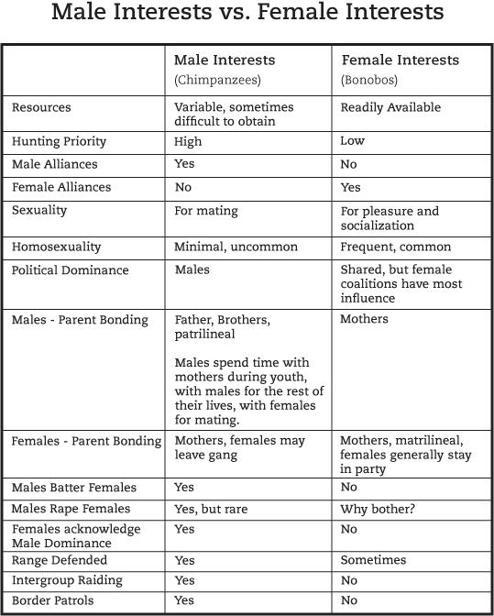
Some researchers have suggested that bonobos aren’t as peaceful as Wrangham and Peterson believed, but it does seem clear that they are more peaceful and matriarchal than chimps, and that their lifestyle is similar to what I’ve described.
As a metaphor for what happens to men living in a secure peace of plenty like our own, the bonobo way looks eerily familiar.
Aren’t most men today spoiled mamma’s boys without father figures, without hunting or fighting or brother-bonds, whose only masculine outlet is promiscuous sex?
Wars against men are known to fewer and fewer of us. Mandatory conscription for the Vietnam War ended the year before I was born. Since then, the United States has effectively created a class of professional contract soldiers who do the government’s fighting in faraway lands. Average men know more about collegiate basketball than they know about a given overseas conflict.
Like the bonobos, we don’t have to worry about hunger. We barely have a reason to get up off the couch. Until the recent extended recession, jobs were fairly easy to come by, and almost all of the men who wanted to work were able to get a job. Welfare and social assistance programs provide safety nets for many others, and few American men living today grew up in a home without a television. True hunger and poverty and desperation, the way people know it in Africa, is rare even for those who are officially considered poor. Diseases that wiped out populations in the past are treatable, and people recover fully from injuries that would have been fatal one hundred years ago. If anything illustrates the surreal plenty we live in today, it is the fact that we have problems like epidemic obesity. People are able to sit in their homes and eat until they are so fat they can’t move.
Americans are obese in part because they simply don’t do enough. It’s hard to find a job doing the kind of back-breaking work our ancestors did. I know, because I’m the kind of person who thinks a temp job digging ditches sounds like fun. I’ve actually looked. Our bodies have a tremendous capacity for work when we are conditioned for it. The human body is made to work hard. When there is no work to do, our physical health deteriorates. Doctors have to tell people to walk like it is some kind of breakthrough exercise technology. Once, I watched in awe as a personal trainer authoritatively led a pair of forty-something adults on a walk around their own neighborhood. He was a seventy-five dollar an hour human dog-walker.
The rest of us go to the gym to “work out,” which is just a substitute for doing physical work. People who answer emails for a living go to a special building where they trick their bodies into thinking they are actually doing the kind of work humans evolved to do. Activities like sandbag training and stone lifting and barefoot running are becoming popular. It’s only a matter of time before someone comes up with a way to market a fitness craze where people run around spearing rubber mammoths.
The goal of civilization seems to be to eliminate work and risk, but the world has changed more than we have. Our bodies crave work and sex, our minds crave risk and conflict.
It has always been striking to me that even in our most popular visions of the future, we have been unable to eliminate conflict. Take Star Trek, for instance. On the surface, Star Trek is a modernist, feminist, egalitarian dream. Men and women and people of all races work side-by-side in a one-world meritocracy that seeks peace across the universe. But our fantasy isn’t the peace, it’s the conflict. Without some conflict between us and them, there is no plot. On Star Trek, they’re always fighting someone. Many are attracted to peaceful platitudes like the ones heard in John Lennon’s “Imagine,” but people aren’t actually very good, or very interested, in imagining a future without conflict. If someone wrote a sci-fi show without conflict, would anyone watch?
We are pretty good, however, at imagining inventive ways to masturbate our primal natures with “safe” virtual, vicarious, and abstract pleasures.
Our society has almost no tolerance for unsanctioned physical violence. Children are expelled from school for fighting, and something as historically common as a weaponless, drunken brawl can land men in court or in jail.
As coalitions of females, pandering politicians and fearful men organize to child-proof our world, to ban guns and regulate violent sports, men retreat to redoubts of virtual and vicarious masculinity like video games and fantasy football because it’s all they have left.
People are also seeking out other non-violent forms of simulated risk and “safe” adventure. From skydiving and bungee-jumping to guided mountaineering and adventure races, men and women are coming up with more and more ways to simulate the primitive human experience. Women and men have similar drives in different degrees, and what I’ve noticed while participating in 5Ks and CrossFit and the “Warrior Dash” is that after the novelty of it wears off, attendance often becomes increasingly female. While some women participate competitively, many more women enjoy these experiences socially and emotionally, stopping along the way to cheer and encourage their struggling sisters. I get the sense that many husbands and boyfriends recognize the masturbatory, “feel-good” nature of these activities and shrug their shoulders, wondering why they would run through the mud in ninety degree heat for no good reason. From an evolutionary standpoint, it makes sense that women would tend to prefer and be more satisfied with “safe” and “fun” risk simulation, while men would long for real competition, real risk, and the potential of real status gains. The carefully orchestrated, sanitized, padded, insured and permitted exercise rarely compares to the fantasy of virile action and meaningful risk.
In video games, at least men experience virtual death.
As physical competition for resources has decreased, sex has become increasingly social, as it is for the bonobos. Men and women hook up to satisfy their primal drive to reproduce. To the chagrin of masculinity’s reimaginers, women still respond sexually to the kinds of “alpha” traits and behaviors in men that would have made them good hunters and fighters. Displaying strength, courage and mastery signals genetic superiority and high male status to women—even women who have no plans to reproduce. Men seek out women who appear to be hearty and fertile, and women trick men’s monkey brains with lipstick, liposuction and breast implants. Sex today is increasingly disconnected from mating, and for many it has become a matter of “masturbating with someone else’s body.”
In many cases, what that body offers is a disappointment compared to the risk-free sex that men can have virtually and vicariously through immediately available, high-quality pornography. In 2003, feminist Naomi Wolf[147] and writer David Amsden[148] wrote that the simulated sexual experience was turning many men off to sex with real women, who felt that they had to compete with pornography for the attention of men.
2003…wasn’t that back when people actually still paid for porn, and a gigabyte still sounded like a big file? Today young men can download high definition pornography in moments and watch it on the same dazzling big screen television that they bought to watch the Super Bowl. New York Magazine followed up in 2011 with a story titled, “He’s Just Not That Into Anyone” wherein the author reported faking an orgasm during real sex, but having no problems climaxing when watching porn. Some of the men he interviewed for the story told him that they were experiencing erectile dysfunction during real sex, and others told him they had to replay scenes from porn to get off while fucking their wives. Singer John Mayer confessed to Playboy magazine that there had probably been days where he had seen three hundred vaginas before getting out of bed.[149]
Our world isn’t offering men more paths to virile fulfillment or vital experience.
What the modern world offers average men is a thousand and one ways to safely spank our monkey brains into oblivion.
Is it any wonder that some men ask themselves, in lucid moments between masturbating to various forms of vicarious sex and violence, what Betty Friedan wrote that educated housewives were asking themselves in the fifties:[150]
“Is this all?”
We were born into a peace of plenty, a pleasure-economy, a bonobo masturbation society.
The future that our elite handlers have in store for us advertises more of the same. More detached pleasure, less risk, freedom from want, more masturbation. Reimaginers of masculinity offer us metaphorical battles to fight, but in the real world the most meaningful battles will be “fought” between elite bureaucrats and experts and wealthy managers who believe they know what is best, while the rest of us shuffle off to boring, risk-free jobs to do idiot work and stare at the clock, waiting to go home and furiously indulge ourselves in whatever form of vicarious or virtual primitive experience gets us off.
Cosmopolitan journalists from elite schools like Betty Friedan filled women’s imaginations with fantasies of exciting big-city careers that only a few could ever hope to attain. For every woman living that fantasy today, there are a bunch of women scanning merchandise through a checkout line at some big-box retail store, or doing repetitive data-entry in some gray office. In the East, women are answering our phone calls or performing monotonous assembly line tasks in factories. This is called “progress.” Many of those women would probably rather be spending more time actively engaged in the lives of their children, but they no longer have the choice to stay home.
The cost of civilization is a progressive trade-off of vital existence. It’s a trade of the real for the artificial, for the convincing con, made for the promise of security and a full belly.
It has always been so.
The question is: “how much trade is too much?”
In the future that globalists and feminists have imagined for themselves, only a few people will actually do anything worth doing. A few people will be scientists, charged with uncovering the mysteries of the universe. A few people will be engineers who dream and design and solve problems. A few people will inhabit a privileged managerial class of financiers and bureaucrats, and they will make all of the decisions that matter for everyone else. They will captain companies and departments and build their great Leviathans out of legal papers and fake smiles. There will also be, as there is now, a glamorous creative class charged with devising our sedentary entertainments. There will be gladiators and chariot races. There will be drama and theater people, and there will be global village gossip.
Still, everyone can’t be a chief, and most of us will be Indians. Products need hordes of consumers and salespeople and customer service representatives and clerks and stock boys and loss prevention associates and midnight janitors. Anyone on the left hand side of the bell curve, anyone who makes the wrong choices at the wrong time, anyone who doesn’t jump through the hoops or play the game, anyone who hasn’t been “properly socialized,” and anyone who turns down the wrong options for the right reasons will end up doing those drone jobs. As Matthew B. Crawford observed in his book Shop Class As Soulcraft, even so-called white-collar “knowledge work” is “subject to routinization and degradation, proceeding by the same logic that hit manufacturing a hundred years ago: the cognitive elements of the job are appropriated from professionals, instantiated in a system or process, and then handed back to a new class of workers—clerks—who replace the professionals.”[151] Being able to read and write at a college level doesn’t mean the job you do will require much more thinking or consequential problem solving than you would have to do as a shift manager at McDonalds. It will only save you from the greasy forehead.
Only a couple hundred years ago, many of these men now destined for clerkdom would have learned a trade from their fathers and mastered it, whether it was farming or some other kind of engaging work that they could be proud of. They would have been valued members of a smaller community of people who cared whether they lived or died. Some would have spent their lives with gangs of men on ships, but most would have been bound to provide for and protect their families—their own small clans. This was a workable compromise between gang life and family life. A few generations ago, these men would have had meaningful responsibilities and their actions would have had the potential to do more harm than merely hurting someone’s feelings or causing them to be inconvenienced. They would have had pressing reasons to try to be good at being men, but also to be good men. Not so long ago, these men would have had dignity and honor.
In the future that globalists and feminists have imagined, for most of us there will only be more clerkdom and masturbation. There will only be more apologizing, more submission, more asking for permission to be men. There will only be more examinations, more certifications, mandatory prerequisites, screening processes, background checks, personality tests, and politicized diagnoses. There will only be more medication. There will be more presenting the secretary with a cup of your own warm urine. There will be mandatory morning stretches and video safety presentations and sign-off sheets for your file. There will be more helmets and goggles and harnesses and bright orange vests with reflective tape. There can only be more counseling and sensitivity training. There will be more administrative hoops to jump through to start your own business and keep it running. There will be more mandatory insurance policies. There will definitely be more taxes. There will probably be more Byzantine sexual harassment laws and corporate policies and more ways for women and protected identity groups to accuse you of misconduct. There will be more micro-managed living, pettier regulations, heavier fines, and harsher penalties. There will be more ways to run afoul of the law and more ways for society to maintain its pleasant illusions by sweeping you under the rug. In 2009 there were almost five times more men either on parole or serving prison terms in the United States than were actively serving in all of the armed forces.[152]
If you’re a good boy and you follow the rules, if you learn how to speak passively and inoffensively, if you can convince some other poor sleepwalking sap that you are possessed with an almost unhealthy desire to provide outstanding customer service or increase operational efficiency through the improvement of internal processes and effective organizational communication, if you can say stupid shit like that without laughing, if your record checks out and your pee smells right—you can get yourself a J-O-B. Maybe you can be the guy who administers the test or authorizes the insurance policy. Maybe you can be the guy who helps make some soulless global corporation a little more money. Maybe you can get a pat on the head for coming up with the bright idea to put a bunch of other guys out of work and outsource their boring jobs to guys in some other place who are willing to work longer hours for less money. Whatever you do, no matter what people say, no matter how many team-building activities you attend or how many birthday cards you get from someone’s secretary, you will know that you are a completely replaceable unit of labor in the big scheme of things.
No sprawling bureaucracy or global corporation can ever love you. They have public relations budgets and human resources departments to protect their interests and their bottom lines. There is no “us.” A legal entity can’t care if you live or die, or if you’re happy.
If you’re a good boy, if you’re well groomed and have a J-O-B and you learn to say the right things, maybe you can convince a nice girl to let you give her a baby and help her pay for it. If that’s not your thing, you can spend your money getting drunk or busy yourself trying to hump whatever piece of ass strikes your fancy. Sex, after all, is social in the bonobo masturbation society. You’ll have the hard won “right” to rub yourself against whatever makes you feel good, as long as you follow the rules.
If you’re a good boy, you can curl up in the womb of your safe little Soviet-nouveau bloc apartment with your comfy stuff and enjoy your measured indulgences, your gourmet food, your micro-brew. You can busy yourself trying to master the art of erasing your own carbon footprint, or you can do your part by biking to work, weaving recklessly through a barrage of trucks and cars that could crush you for the sheer thrill of it. Maybe you’ll take a class and get your permit and after another clerk confirms that you are competent enough to be licensed and properly insured, you’ll be able to do something really crazy like ride a motorcycle. Maybe you’ll pay someone to let you play a game or run a race or put on a safety harness and climb fake rocks. If not, you can always watch someone else do it on TV. Maybe you’ll get yourself worked up about some petty inequity or injustice and participate in some non-violent resistance. Maybe you’ll convince yourself that you are making a difference by standing in the same place with other people and shouting angrily at people who don’t care. If you prefer, you can get online and vent your confused, impotent, vainglorious rage by playing the anonymous tough guy on some blog or forum. Or you can just say “fuck it” and spend all of your money on video games that give you the vicarious thrill of slaughtering hordes of aggressive “others.” You can obsess over your fantasy football team. And there are always hobbies. You can find yourself something harmless and inoffensive to pass the time. Perhaps gardening. You can start a band or tinker with cars. Become a movie buff. You can paint little figurines of warriors. You can even get dressed up in costumes and do live-action role playing.
Whatever you do, just find some way to busy yourself.
There’s nothing wrong with any of these things. All of them are “fun.” What is “fun,” if not masturbating your primal brain a little? I like having “fun.” There’s no harm in a little “fun” which is why it is called “fun”—and not something deadly serious, like “survival” or “war.”
If that is all, if your life is all about chasing “fun,” is that enough?
Is this level of civilization—is all of this peace and plenty—worth the cost?
How long will men be satisfied to replay and reinvent the conflict dramas of the past through books and movies and games, without the hope of experiencing any meaningful conflict in their own lives? When will we grow tired of hearing the stories of great men long dead?
How long will men tolerate this state of relative dishonor, knowing that their ancestors were stronger men, harder men, more courageous men—and knowing that this heritage of strength survives in them, but that their own potential for manly virtue, for glory, for honor, will be wasted?
We know what The Way of Men has been.
Is the way of the bonobo the only way that is left?
What is Best in Life?
Day after day, day after day,
We stuck, nor breath nor motion;
As idle as a painted ship
Upon a painted ocean.—Samuel Taylor Coleridge
“Rime of the Ancient Mariner”
The Epic of Gilgamesh is one of the earliest known works of literature, and it is the product of one of the earliest complex civilizations. It tells the story of Gilgamesh, a mortal man of tremendous natural strength and prowess. No man could stand against Gilgamesh until a goddess fashioned an equal for him named Enkidu—a wild hairy man of warlike virtue who “knew nothing of the cultivated land.”
Enkidu was friends will the animals and ranged the countryside helping them, causing woe for trappers and shepherds in the area. The men conspired against him. They sent a naked harlot to tempt Enkidu and tell him of Gilgamesh, and of wonders found in the luxurious city of Uruk, so that Enkidu would leave the hills and stop threatening their livelihood. Enkidu was curious, and he longed for a friend who was his peer, another man who would understand him. He followed the harlot to the tents of the shepherds, and she clothed Enkidu and introduced him to bread and strong wine. He joined the shepherds and hunted wolves and lions for them. With Enkidu as their watchman, they prospered.
A man came to Enkidu and reminded him of Gilgamesh and the city of Uruk, where Gilgamesh was behaving like a tyrant. Enkidu decided to go to the city and challenge Gilgamesh. The two men fought each other, snorting and shattering doorposts and shaking the walls like two bulls. As they grappled, they gained respect for each other and the two men decided to become friends.
Enkidu and Gilgamesh lived together in the city as brothers, but Gilgamesh was tormented by his own great potential and longed to do something that would be remembered. Enil, father of the gods, had given Gilgamesh “the power to bind and to loose, to be the darkness and the light of mankind.” Enkidu complained to Gilgamesh that his own arms had grown weak, and that he was “oppressed by idleness.” To fulfill their destinies, they knew they had to leave the comfort of the city and suffer and fight evil together. Gilgamesh cried out to the god Shamash:
“Here in the city man dies oppressed at heart, man perishes with despair in his heart. I have looked over the wall and I see the bodies floating on the river, and that will be my lot also. Indeed I know it is so, for whoever is tallest among men cannot reach the heavens, and the greatest cannot encompass the earth. Therefore I would enter that country: because I have not established my name stamped on brick as my destiny decreed, I will go to the country where the cedar is cut. I will set up my name where the names of famous men are written; and where no man’s name is written I will raise a monument to the gods.’ The tears ran down his face and he said, ‘Alas, it is a long journey that I must take to the Land of Humbaba. If this enterprise is not to be accomplished, why did you move me, Shamash, with the restless desire to perform it?”[153]
If there is a “crisis of masculinity,” this is it, and the problem is as old as civilization itself.
The true “crisis of masculinity” is the ongoing and ever-changing struggle to find an acceptable compromise between the primal gang masculinity that men have been selected for over the course of human evolutionary history, and the level of restraint required of men to maintain a desirable level of order in a given civilization.
Civilized life and technology offer many benefits to men. The simple, hardscrabble lives of our primitive ancestors may not have been as nasty, brutish or short as Hobbes believed, but it would be foolish to say that men have gained nothing from agricultural innovation or the division of labor. Without such changes there would have been no great works of art or literature, no great buildings or monuments, no printing press, no laptop for me to type on. Countless people have died throughout history from infections that anyone can cure today with cheap over-the-counter medications. We enjoy abundant foods and strong, imported wines and—perhaps most importantly—we have a steady supply of clean, drinkable water. Men wanted these things thousands of years ago when the Epic of Gilgamesh story was conceived.
Enkidu complained that he had grown weak and that he felt oppressed by the idleness of civilized life.
Men have known since Gilgamesh that civilization comes at a cost.
The manly virtues are raw and perishable. Males are on average naturally stronger, have a greater tendency to take risks, and they have a greater drive to master the world around them through technics—but all of these aptitudes require cultivation.
Muscles atrophy when improperly nourished and infrequently used. A man who never pushes his strength threshold will never even glimpse his physical potential, as anyone who has achieved substantial strength gains through physical training can attest. Strength is a “use it or lose it” aptitude.
Men may be natural risk-takers, but the increased confidence and surefootedness that we recognize as manly courage is the product of constant testing. The chest-thumping of untested men is hardly courage; Hobbes called it “vaine-glory”, because “a well grounded confidence begetteth attempt; whereas the supposing of power does not.”[154] Or, to put it in the words of Tyler Durden, “How much can you know about yourself, [if] you’ve never been in a fight?” Modern men are not merely lacking initiation into manhood, as some have suggested, they are lacking meaningful trials of strength and courage. Few modern men will truly “know themselves,” as men, in the way that their forefathers did.
Likewise, skills must be mastered and practiced to be truly useful. Talent will only get you so far. If you are never truly challenged in a meaningful way and are only required to perform idiot-proofed corporate processes to get your meat and shelter, can you ever truly be engaged enough to call yourself alive, let alone a man?
Later in the Epic of Gilgamesh, after Gilgamesh killed the Bull of Heaven and overthrew the monstrous Humbaba, his comrade Enkidu died. Gilgamesh was distraught, and he searched for a way to cheat his own death. He met a young girl who made wine, and she told him that there was no way for him to avoid death. She told him to fill his belly with good things, to dance and be merry, to feast and rejoice. She told him to cherish his children and make his wife happy, “for this too is the lot of man.”[155]
This too, is the lot of man.
In times of peace and plenty, when their bellies are full and they feel safe, women have always advised men to abandon manly pursuits and the way of the gang, to enjoy the safe pleasures of vicariousness and to join women in domestic life. When no threat is imminent, it has always been in the best interest of women to calm men down and enlist their help at home, raising children, and fixing up the grass hut. This is The Way of Women.
Men are people, too. It is not my intention to characterize men as soulless monsters who care about nothing but blood and glory. Men do love; sometimes more passionately and more unconditionally than women. Men can be tender and nurturing; any man who disputes that hates his father. Men write and tell stories and create things of remarkable beauty. All of these things can be part of being a man.
Men and women share much in common, but this book is not about the things that make men human, it is about the things that make them men.
Feminists dismiss biology and “outdated” ideas about masculinity and argue that men can change if they want to. Men do have free wills, and they can change to some extent, but men are not merely imperfect women. Men are individuals with their own interests, and they don’t need women to show them how to be men. Women are not selfless spirit guides who have no interests or motivations of their own. Men have always had their own way, The Way of The Gang, and they’ve always inhabited a world apart from women.
“Can men change?” is the wrong question.
Better questions are: “Why should men change?” and “What does the average guy get out of the deal?”
When pressed to answer this question, feminists and men’s rights activists never seem to be able to come up with anything but promises of increased financial and physical security and the freedom to show weakness and fear. Masses of men never rushed to the streets demanding the freedom to show weakness and fear, and they never braved gunfire or battle axes for the right to cry in public. Countless men, however, have died for the ideas of freedom and self-determination, for the survival and honor of their own tribes, for the right to form their own gangs.
Feminists, elite bureaucrats, and wealthy men all have something to gain for themselves by pitching widespread male passivity. The way of the gang disrupts stable systems, threatens the business interests (and social status) of the wealthy, and creates danger and uncertainty for women. If men can’t figure out what kind of future they want, there are plenty of people who are ready to determine what kind of future they’ll get.
They’ll get a decorated cage.
They’ll get a Fleshlight®, a laptop, a gaming console, a cubicle and a prescription drip.
They’ll get some exciting new gadgets.
They’ll get something that feels a little bit like being a man.
Women will continue to mock them, and they’ll deserve it.
Lionel Tiger wrote that men “don’t get what they’re about not to have.”[156] The world is changing, and men are being told that newer is always better, that change is inevitable, that the future feminists and globalists want is unavoidable. Men are being told that their future is logical, that it is moral, that it is better and that men had better learn to like it. But who is this new world really better for?
Civilization comes at a cost of manliness. It comes at a cost of wildness, of risk, of strife. It comes at a cost of strength, of courage, of mastery. It comes at a cost of honor. Increased civilization exacts a toll of virility, forcing manliness into further redoubts of vicariousness and abstraction. Civilization requires men to abandon their tribal gangs and submit to the will of one big institutionalized gang. Globalist civilization requires the abandonment of the gang narrative, of us against them. It requires the abandonment of human scale identity groups for “one world tribe.” The same kind of men who once saw their own worth in the eyes of the peers who they depended on for survival will have to be satisfied with a “social security number” and the cheerfully manipulative assurances of their fellow drones. Feminist civilization requires the abandonment of patriarchy and brotherhood as men have known it since the beginning of time. The future being dreamed for us doesn’t require the reimaging of masculinity; it ultimately demands the end of manhood and the soft embrace of personhood that has long been the feminist prescription for this ancient crisis of masculinity.
This end of men, this decline of males, this new bonobo masturbation society of peace and plenty—this No Man’s Land—is not inevitable. It will require the tacit or expressed consent of billions of men. Like every civilization, it must be built on the backs of men, and most of them must agree to abide by and enforce its laws. You can’t have prisons without prison guards and you can’t have security without some kind of police. Men will have to get up in the morning and go to their clerking jobs and smile and consume and continue to amuse themselves according to regulation. Civilization requires a social contract, and men have to keep up their end of the bargain for it to work.
This future can only happen if men help create it.
As I wrote in the opening chapter of this book, men must choose a way.
To make this choice, they must ask themselves:
What is best in life?”
The “crisis of masculinity” poses exactly that philosophical question.
If you decide that true happiness for men lies in the elimination of risk, the satiation of hunger, the escape of labor and the pursuit of “fun,” then our bonobo future may sound like some kind of One World Las Vegas.
I have come to the conclusion that the lot of man is to find a balance between the domestic world of comfort and the world of manly strife. Men cannot be men—much less good or heroic men—unless their actions have meaningful consequences to people they truly care about. Strength requires an opposing force, courage requires risk, mastery requires hard work, honor requires accountability to other men. Without these things, we are little more than boys playing at being men, and there is no weekend retreat or mantra or half-assed rite of passage that can change that. A rite of passage must reflect a real change in status and responsibility for it to be anything more than theater. No reimagined manhood of convenience can hold its head high so long as the earth remains the tomb of our ancestors. Men must have some work to do that’s worth doing, some sense of meaningful action. It is not enough to be busy. It is not enough to be fed and clothed given shelter and safety in exchange for self-determination. Men are not ants or bees or hamsters. You can’t just set up a plastic habitat and call it good enough. Men need to feel connected to a group of men, to have a sense of their place in it. They need a sense of identity that can’t be bought at the mall. They need us and to have us, you must also have them. We are not wired for “one world tribe.”
I’ve been a non-believer all of my life, but I’d drop to my knees and sing the praises of any righteous god who collapsed this Tower of Babel and scattered men across the Earth in a million virile, competing cultures, tribes, and gangs.
Honor as I understand the definition requires that kind of “diversity.”
I don’t say this because I think I’d personally fare better in a more primitive society. I spent the last six months reading and writing, not training for the zombie apocalypse.
I hope that men, to quote Guy Garcia, “yank at their chains and pull the entire temple down with them,”[157] because I hate to think that this is the end of The Way of Men. Everyone from schoolteachers to the United Nations is rushing to do away with “outmoded” models of masculinity, but they’re not replacing it with anything better. In a review of Steven Pinker’s book about violence, James Q. Wilson mentioned that the real change occurs when men care more about getting rich than getting bloody.[158] It’s tragic to think that heroic man’s great destiny is to become economic man, that men will be reduced to craven creatures who crawl across the globe competing for money, who spend their nights dreaming up new ways to swindle each other. That’s the path we’re on now.
What a withering, ignoble end…
Humanity needs to go into a Dark Age for a few hundred years and think about what it’s done.
Start the World
“I prefer to not to use the words, ‘let’s stop something’.
I prefer to say, ‘let’s start something, let’s start the world’.”
—Peter Fonda, 2011
There is no democratic spur from our current path that can lead us back to The Way of Men.
The Men’s Rights Movement seeks equity with women, and therefore points in the same direction as feminism. It wants to relieve men of making sacrifices on the behalf of women. It wants men and women alike to pursue individual prosperity without special, gendered obligations or clearly defined sex roles. The anger that drives the Men’s Rights Movement comes from a sense that women aren’t playing fairly, that they are cheating, that when given the chance they will use the rhetoric of equality to skew things in their own favor. The men are right about that. Women are re-designing the world in their own image. It is naïve for men to expect otherwise.
The Way of Men is to fight the external threat, and to fight other men. Sometimes men fight over women, but men have no history of fighting women. During times of peace and plenty it has always been the Way of Women to lure men to away from the volatile gang, to seek his investment in her reproductive endeavor, and to encourage him to seek refuge and comfort in domesticity. A comfortable man is less likely to take risks, and warriors have always known that too much comfort makes men soft. Men are not going to rise up and form one great political action committee to fight the influence of women. Men of means see too much immediate social and financial gain in catering to the interests of women. Politicians see a more politically and socially active population that must be appeased, and they will continue to fall all over themselves to get the female vote. Women are better suited to and better served by the globalism and consumerism of modern democracies that promise security, no-strings attached sex and shopping. For the most part, male bureaucrats cannot be counted on to help men who they don’t know, when there is a political risk involved. Again, it is naïve for men to expect otherwise.
Another bulwark to social change on behalf of men is the reality of globalism. In America we are conditioned to think of corporations as “The Man,” but that’s a very Twentieth Century sense of things. Today’s robber-barons and fat cats are figureheads that captain global enterprises which can basically function without them. The reigning presidents and CEOs are often as disposable as the workers. They come and go. There is no “Man.” There is only the profit-driven, hydra-headed legal entity, whose workers make cost/benefit analyses to increase profit and further their own status and salary, usually with an eye on producing immediate, short-term results. Those workers don’t care about what happens to a company in ten years, because if they are saavy and career-minded, they may well be working for a competitor by then. There is no “conspiracy” here, only people looking out for their immediate interests. If the legal department fears legal action, it will go through human resources and pre-empt it by initiating anti-sexist or anti-racist policies, or even soft affirmative action and public relations programs that reach out to litigious communities.
It is in the interest of corporate enterprises in most cases to champion anti-sexist (pro-feminist) and anti-racist policies because identity conflicts can be costly and inefficient. To the global corporation, people are interchangeable units of labor priced at different values. Your sexual or tribal identity is a nuisance and a source of potential liability. Only thin identities are advantageous—like the kind of music or movies you prefer. Thin identities are marketing niches. Us vs. them identities and different sex roles are problematic and cumbersome. But don’t take my word for it, I’m a right-wing sexist. America’s favorite left-wing anarchist, Noam Chomsky, wrote that “Capitalism basically wants people to be interchangeable cogs” and that differences among them are “usually not functional.”[159] Chomsky was talking about race, but his comments that corporations see people only as “consumers and producers” and that “any other properties they might have are kind of irrelevant, and usually a nuisance” can logically be applied to differences between men and women. The genderless feminist utopia of humans who are neither masculine nor feminine is more efficient from the utilitarian perspective of the global enterprise. Don’t expect the billions of dollars that international corporations wield to move in favor of men any time soon.
All of this is not to say that Men’s Rights activists are wrong or useless, but that they can only perform triage and provide first aid. Men’s Rights advocates can do things to make the situation better for men in the short term, like work for fairness in divorce proceedings and child custody cases and sexual harassment lawsuits. They can call attention to the lies and distortions of feminists, and they can work to discredit feminist “experts” on masculinity who repackage the same old 1970s boilerplate propaganda as “science” year after year. This is good work. Like what passes for conservatism today, it puts on a break that slows the degeneracy that feminists call “progress.”
Women, individually, are not to blame for everything that has transpired over the past few hundred years. Individual women can certainly not be blamed for The Industrial Revolution. They can’t be blamed for the trains, planes, and automobiles that make globalism possible. They can’t be blamed for Marxism, or the birth control pill, or the Internet or the shopping mall. Women, as a group, can probably be blamed for abominations like reality television, and for a lot of bad music and art, and for making mainstream magazines almost unreadably gossipy and stupid. But individual women, a few figureheads aside, can’t fairly be blamed for a whole lot. Women are just acting according to their natures and skewing things in their interests, as they’ve always wanted to, and as men have prevented them from doing for most of human history. It’s not as though men have been selfless creatures, historically speaking. Men and women alike can be tremendously generous and self-sacrificing, but on an average day we’ll take care of our own interests first. That’s the Way of People.
The point of this book is not to portray women as evil shrews. Women are humans who are slightly different from men, and given the opportunity they will serve their own slightly different interests and follow their own slightly different way. Women aren’t evil, but they aren’t angels, either. They are what they are. No matter how much sympathy some may have for the plight of modern men, women are not going to give up what they have so long as they believe it’s worth having. They aren’t going to rush to the polls to relieve themselves of advantages or support systems. As long as states offer women peace and plenty, women and big government will continue to enjoy a symbiotic relationship. Women can be sympathetic, but they’re not dumb.
Any return to The Way of Men will fail to receive bipartisan support.
I also doubt that men will ever assert their interests as a sex through violent revolution. It’s not realistic. There’s no good pitch for it. Men aren’t going to make the streets run red with their own blood for…well…what exactly would they even ask for? Men aren’t going to rise up and storm the Capitol to demand the repeal of the Nineteenth Amendment. It would be easier to get them to riot in Washington D.C. to repeal the Sixteenth Amendment and end Federal Income Tax—something women could get on board with, too—and that isn’t happening anytime soon. The closest thing they’ve managed in recent years was the Tea Party movement which, despite early media hysteria that it was a mob of angry white men, was quickly co-opted by women like Sarah Palin and Michelle Bachmann, who ended up turning it into something more like a tent revival potluck for heavily armed soccer moms.
Even if men were inclined to organize against the State in its current form, men would lose before they even started. The state has the ability to seek out and identify anti-state movements who plan to use violence, and has crushed organized armed resistance movements on numerous occasions. Men aren’t dumb, either. Organized, armed resistance movements end in “death by cop” long before they gain the money, the numbers, or the momentum necessary to make themselves a viable threat. This ain’t Africa or Central America.
But what if it were?
What if the United States were a little bit more like Mexico?
I worked with an illegal immigrant for a while, and he told me that while he loved his homeland and his culture, he didn’t want to raise his family in a place without law and order. He told me stories about police shaking down drivers for cash instead of writing tickets. When I visited a border town a few years ago, it was striking how blurry the line was between the Federales and a gang. There was no “officer friendly.” The Federales were a bunch of guys with assault rifles whose purpose was clearly to observe and intimidate. When they got a call, they jumped on the back of what looked like a Ford F150 with an aftermarket roll bar and made off in a cloud of desert dust. In other places, the Federales don’t look so tough. It’s not unusual for Mexican police to wear ski masks at work, for fear of gang retribution.[160]
That retribution can be brutal, as it was recently in the border town of Guadalupe, where a female police chief went missing around Christmas in 2010.
“Erika Gandara was a former radio dispatcher for the police department in the town of 9,000, which is just across the U.S. border, one mile from Fabens, Texas. The previous police chief was murdered and decapitated; his head was found in an ice chest. Gandara, 28, a single woman with no children, was the only applicant for the job and its salary of $580 per month.
One policeman was murdered during Gandara’s first week on the job. By the time she became chief, the entire force of eight patrolmen had either been killed or fled. She was the sole law enforcement representative in a Juarez valley town that was part of the war between competing drug cartels for access routes into the U.S.”[161]
In September 2011, Reuters reported that violence was slowing down in Tijuana after years of bloodshed, in part because the gangs there had finally settled a turf war and one gang established near-complete control over the area. [162]
If men are going to re-assert their interests and return to The Way of Men, they’re not going to do it through a democratic movement or a social movement or an armed political uprising. They’re going to do it in a way that looks a lot more like what La Familia was doing with John Eldredge’s work. They’re going to do it through gangs, in areas of the world where the State has lost power and credibility. They’re going to take some of the ideas from surviving male traditions and repurpose them to create their own unique identities, their own us.
The current level of security we enjoy (or fear, depending on what side of the law you’re on) is very, very expensive, and the United States is a very large territory. The quality of policing we have today is the direct result of our wealth and status as a major world power. Our police are on a payroll, and less money will mean fewer police, more frustrated police, and more police corruption. As the power of the State wanes, nonstate actors gain breathing room and influence. The United States is far bigger than North Korea, and the United States is not China. Mao had to kill over forty million people to get the Chinese on the same page. Not including those who died in various famines, it seems to have taken Stalin at least three million deaths to keep the Soviets in order. His tyranny gave birth to the Vory v Zakone, or “Thieves in Law,” who represent only a small portion of the crime syndicates currently active in modern Russia.[163] Criminal gangs are active all over the United States, especially in border zones and ghettos where policing is inadequate or viewed as illegitimate and tyrannical, as it by many blacks who see the police as inherently racist, and in areas with high concentrations of illegal immigrants who see themselves as unfairly persecuted. For many, the State is already the “other.”
In the film Gran Torino, Clint Eastwood’s character Walt Kowalski confessed to Father Janovich that one of his “sins” was failing to pay taxes on a private sale he had made several years prior. He said, “It’s the same as stealing.” That’s the country my grandfather lived in. Many people who grew up before the Vietnam era felt that connected to their nation. They were invested in it. The United States was us, or truer to the spirit of it, it was “we the people.”
In the post-Vietnam era, it seems as though more and more people on the Left and the Right alike regard the government as “them.” Whether they consider themselves Democrats, Republicans, or Independents of some kind, whether they make twenty thousand dollars a year or two hundred thousand dollars a year, most people today will pour over their tax returns looking for any way they can find to pay less. Few would give a second thought to claiming profits on a sale they’ve made using a craigslist ad. If you told them it was their civic duty, they’d probably give you the look they save for Jehovah’s Witnesses. Small business owners usually find ways to cut corners, and many are happy to hide income or hire workers illegally or under the table to avoid paying taxes or dealing with complicated regulations. Every year average Americans download billions of dollars worth of pirated music and movies. Like smoking marijuana—the same pot that Mexican gangs are trafficking—these things have become socially acceptable practices at almost every level of society.
The Italians have a saying for this. Tutti colpevoli, nessuno colpevole.
It means, “If everyone is guilty, no one is guilty.”
Walt Kowalski’s America is long gone.
Globalism and nationalism have irreconcilable ends. Globalism is undermining our sense of national identity, our connection to the government. The American economy was placed in the hands of globalists—all recent administrations have promoted and said starry eyed things about the magic of the global economy—and now the economy is like a plate being balanced on a stick by a circus clown. There’s a lot of funny money out there spinning around, and any number of factors could send us further into financial decline. We’re dependent on cheap imported technology, cheap imported food, cheap imported fuel. A dramatic spike in gas prices or a major national disaster could easily turn a volatile place like Southern California into a war zone. States are selling their own toll highways to foreign nations for short term cash infusions. There’s already a sense among people under forty that the money they pay into Social Security won’t be there—or won’t be worth anything—by the time they get old. People who work know they are throwing money into a black hole. Others are working the system and taking whatever they can get. Without endless economic growth, the United States won’t be able to make good on its promises of endless prosperity and security. As things get worse and the State seems powerless to help, the State will seem less and less legitimate. People will lose their moral connection to it. Laws will seem more like revenue traps and shakedowns. The state will start to seem more like another extortion racket, and, as in Mexico, people will have a harder time telling the good guys from the bad guys. The U.S. of us will become the U.S. of them and we’ll Balkanize from within. If not officially, then unofficially. It’s already happening.
The new Way of Women depends on prosperity, security, and globalism.
Any return of honor and The Way of Men and the eventual restoration of balance and harmony between the sexes will require the weakening of all three.
One of my favorite books is Anthony Burgess’ The Wanting Seed. It’s a sci-fi novel that tells the story of a future when, due to overpopulation, the State encourages homosexuality and effeminacy and officially discourages reproductive families. Throughout the book, Burgess writes about a theory of cyclical history that moves through three phases: Pelphase, Interphase, and Gusphase. In the Gusphase, named after St. Augustine, humanity is viewed through the eyes of a stern father who expects men to be violent and untrustworthy. Men see only what Peterson and Wrangham would call the “demonic” in each other and those who seek order rule with an iron fist. After a period of security, people demonstrate that they can behave reasonably well, and men start to think that people are not so bad after all. Thinking shifts into the Pelphase mode, named for St. Pelagius, wherein men see each other as intrinsically good, peaceful, and perfectible through the gentle, guiding touch of social reform. However, this rose colored, “noble savage” view of man does not reflect his nature, either. Man can’t always be trusted to always follow the rules. He plays the system and does what he wants, and that leads to distrust, disorder, and disillusionment. This is when, as Burgess put it:
“Disappointment opens up a vista of chaos.”[164]
During the middle phase of the cycle, called Interphase, there is violence and chaos and tyranny. It’s a great shake-up that brings about another Gusphase, and eventually, a new Pelphase, and the cycle continues.
Men will not reassert themselves in any meaningful way through additional tweaking of an optimistic Pelagian system that is based on a pleasant denial of human nature. Men will reassert their interests during the Interphase. When states weaken and become “hollow” as futurist John Robb[165] believes they will, men will assert their interests through a return to their most basic social form. When the aching womb of the state can no longer provide the services or the security that keep men passive and dependent, localized groups of men who trust each other will build smaller networks to protect and further their own interests. In the presence of weak tyranny and the absence of strong nationalism, the shepherds will gather round their Robin Hoods, and they will found new tribes.
In the chaos that follows disappointment, gangs of men can restart the world.
Their future—the one world nanny state from cradle to grave, the global civilization of managers and clerks, the thin consumer identities, the bonobo masturbation society—is already showing signs of stress. Their future is based on unsustainable illusions and lies about human nature. Their future requires too many men to deny their own immediate interests to serve an abstract “greater good” that is far beyond human scale. All over the world, the Star Trek future that was once considered “inevitable” is starting to look improbable. The European Union is struggling, the global economy is faltering, and every day more people are starting to acknowledge that America is in a decline from which it will not recover.
Their future is already falling. It just needs a push.
If you want to push things toward The Way of Men and start the Interphase, create disappointment.
Throughout 2011, “Occupy Wall Street” protesters camped out in public parks across the country. They were angry about something. They weren’t sure what. Their messages were incoherent. They were desperate. They wanted the government to come to their rescue. They wanted the government to fix things. They wanted the government to stop “corporate greed” as if it is possible to demand that global corporations stop acting to maximize profit. The “occupants” still just barely believed the dream that the State is beholden to the will of the people. They still wanted to believe that the State cares what they want. They wanted to believe that the state wants them to be happy. They were emotionally attached to the idea that the government cares, but they already suspected that it doesn’t.
It doesn’t, because it can’t. Like global corporations, States have escaped human scale. There is no “man” to fight. States are institutions whose ultimate goals are survival, perpetuation, and expansion.
When the protesters went home, they achieved nothing. Nothing changed, though a few talking heads offered reassurances that the protesters had been heard.
People need to stop looking to the State for help and direction. They must become disillusioned and disappointed. To push things in a direction that is ultimately—though not immediately—better for men, the emotional connection between the people and the state must be severed completely. When the body of the people is released from the head of the sovereign, chaos will ensue. In that chaos, men will find themselves. They will stop looking to the State for help, and start looking to each other. Together, men can create smaller, tighter, more localized systems
People say they want a world that’s more rational, but a world that’s out of step with human nature isn’t more rational at all.
Men aren’t getting more rational.
They’re getting weaker.
They’re getting more fearful.
They’re giving up more and more control.
There is no high road.
The only way out for men is The Way of the Gang.
How To Start A Gang
“Only where the state ends, there begins the human being who is not superfluous: there begins the song of necessity, the unique and inimitable tune.”
—Friedrich Nietzche, Thus Spake Zarathustra
Any return to The Way of Men is probably going to happen in hollow states through extra-legal means. Gangs form out of necessity, or to exploit opportunities. Gangs are going to gain the most traction in areas where State influence is weak, creating both necessity and opportunity. Furthermore, gangs are proto-states. Proto-states threaten the power of larger existing states, so when men form proto-states to assert their own interests, their actions will be outlawed by those states.
It is not my intent here to tell you how to start a criminal enterprise.
I have romanticized gangs somewhat to make a point about the nature of men, but I am not suffering from any delusion that modern gangs are run by “good guys” who take from the rich and give to the poor. I have every reason to believe that life in a gang today would be nasty, brutish, and short. I have every reason to believe that life in a gang existing inside a collapsed State would be nasty, brutish, and short. There is no shortage of evidence about gang brutality, infighting, human trafficking, rape, or murder almost for the sake of murder alone. Wrangham and Peterson called the gang impulse male “demonism” for some good reasons.
The conclusion I reached while writing this book was that the gang is the kernel of masculine identity. I believe it is also the kernel of ethnic, tribal, and national identity. The culture of the gang is, as author bell hooks wrote in a rather different context, “the essence of patriarchal masculinity.”[166]
If you want to follow The Way of Men, if you want to advance a return to honor and manly virtue, if you want to steel yourself against an uncertain future—start a gang.
Honor requires an honor group, a group of men with similar values. Honor requires the possibility of dishonor in the eyes of peers whose respect you value. The cultivation of manly virtue is accelerated by completion and the expectations of male peers. And, if you want to become resilient to uncertainty and chaos, you need a circle of men who you trust and who you can depend on.
Some readers will inevitably respond: “My wife/girlfriend is awesome. She takes boxing and shoots guns and fixes cars. She’s my partner.”
That’s nice. But if your strategy for the future is holing up with ma and the chillins, your strategy sucks. I don’t care if your girlfriend is a Certified Ninja, she’s not worth eight men. Kill Bill was not a documentary. A strong and skillful woman will be worth more to you in a crisis than a prima donna, but she can’t replace men in your life. No woman can take the place of men in a man’s life.
It is evolutionarily sound for women to want to secure your commitment to them and attempt to place themselves at the center of your world. They’ll want to be involved in everything you do, and they’ll be on guard against perceived threats to their security and your commitment.
Men have been negotiating the “crisis of masculinity”—the push and pull between civilized domesticity and lure of gang life—for centuries. Men need to set boundaries and make time for men in their lives. It’s important to their sense of identity, it’s important to their sense of security and belonging, and it’s good survival strategy. Part of the reason we are where we are right now is that men stopped depending on each other and started depending on the State. The family unit is not enough. A support network of ten is better than a support network of two.
To get a sense of how one might go about expanding that support network and “start a gang,” here’s a working definition of what a gang really is, based on the idea of men bonding, creating a group identity and setting up a perimeter:
Gang — A bonded, hierarchical coalition of males allied to assert their interests against external forces.
A gang is essentially a male group identity, it’s an us. It’s a go-to group of men allied against them.
In an emergency situation, the us is often defined by proximity. You’ve seen the movie. A bunch of unlikely characters get stuck together by unforeseen circumstances and are forced to work out their differences and learn to depend on each other. That could certainly happen, but depending on the luck of the draw isn’t a great strategy. Picking your team is a better strategy.
Create Proximity
The Internet is a good filter. It’s a good way to find men who share some of your values. However, your friends on message boards and on social networking sites, scattered all over the world, are not going to be there for you when the proverbial shit hits the fan. Spend more time making contact with men who are geographically close to you. If you have close friends in your area, consider moving into the same apartment complex or within a few blocks of one another. Think about the way gangs start in inner cities. Men and boys have lived and died to defend tribes with territories as small as a few blocks. Proximity creates familiarity and shared identity. It creates us. Spreading our alliances across nations and continents keeps us reliant on the power of the State and the global economy. Men who are separated and have no one else to rely on must rely on the State.
Choose Your Us
A lot of factors could define the boundaries of us against them. If your religion is important to you, that’s a good place to start. Mormon men, for instance, would probably fall into a community gang fairly easily. If your ethnic heritage or race is something you feel strongly about, as is very often the case with gangs, then that might be your starting point. Familiarity and likeness make trust easier to establish. However, sports teams make out well enough with men from very different backgrounds. If a desirable superordinate goal—like survival—is introduced, it has been proven that men can put aside all sorts of differences.
Men with opposing viewpoints can respect each other and enjoy civilized debates, but when it comes to forming us, it’s better to have a group of men who are on the same page about the issues most important to them.
If you have decided after reading this book that you want to return to The Way of Men, the men in your gang will have to be committed to undermining the globalist masturbation society, hollowing out the State, and reviving a culture of honor.
Create Fraternity
A gang is a fraternity, a bonded brotherhood of men. That said; don’t start trying to figure out your colors or your secret handshake just yet. These kinds of male cultural phenomena will occur organically as the result of shared history and identity. Only huge organizations like the Army can effectively sort a bunch of men into a group and artificially create a gang or brotherhood. It is possible for political movements to do this, but if they appear to be openly anti-government, their high profile is going to attract the attention of the authorities.
You don’t need a formal group or a membership charter, and you don’t need to elect a president. What you need is face time. You can bond with men online, but only to a point. People can hide online in ways that they can’t in person. Men are tactical thinkers. They guard themselves. To get to know a man you need to spend time with him, you need to do things together, you need to build trust. Don’t expect a casual acquaintance to have your back when you’re in trouble. A solid friendship is just like any other relationship. It requires give and take. It requires some time and some history.
If you know some guys you can connect with, and who are on more or less the same page philosophically, make sure you make time for them. Set aside time to create that history and build that trust. Even women who are “like one of the guys” will have a chilling effect on that process. Men are not honest with each other in the same way when women are present, and establishing trust requires honesty. Men are going to want to have girlfriends and wives and families and other connections with women in their lives, and that is all well and good, but as I said, you can’t expect men who don’t really know you to help you through tough times. Put in the effort. Eating and drinking together is fine, but it makes more sense to plan tactically oriented outings. You need to learn how to read each other and work together as a group. Go to the shooting range. Go hunting. Play paintball. Go to the gym. Take martial arts classes. Join a sports team. Take a workshop. Learn a useful skill. Fix something. Build something. Make something. Get off your asses and do something.
In harder times, the men that you do these kinds of things with are going to be the first men you call. They will be your gang. They will be your us.
I’m going to close this book with some Viking wisdom concerning male friendship from The Sayings of Hár, also known as the Hávamál.
If friend thou hast whom faithful thou deemest,
And wishest to win him for thee:
Open thy heart to him nor withhold thy gifts,
And fare to find him often.
If faithful friend thou hast found for thee,
Then fare thou find him full oft;
Overgrown is soon with tall grass and bush
The trail which is trod by no one.[167]
Acknowledgments
Writing this book required substantial sacrifices of my time, money, and attention; I’d like to thank my guileless compadre Lucio for his loyalty and support. My Vulcan friend Trevor Blake and I have been trading ideas about manliness over drinks and cigars for years, and his pages of notes provided much food for thought. When I thought I had finished the book the first time, writer Scott Locklin convinced me to gut it and rework it. The Way of Men is far better for that. I’d also like to thank Troy Chambers, Greg Johnson, and Jef Costello for their helpful notes and suggestions. I offer my thanks to Brett McKay for replying to my interview request. Few men spend as much time thinking about “The Art of Manliness” as he does.
All of the men I know have influenced my thinking about manhood—my father, my grandfathers, my friends, even men I have only met briefly or interacted with on occasion. All men have something to say about being a good man, and about being good at being a man. I’d like to thank Jesse and Max, my good pals and high ranking members of my apocalypse fireteam, for their perspectives on “what is best in life” and the finer points of alpha psychology.
Many thanks also to Bill Price and Richard Spencer for their interest in my work, and for helping me to build a larger audience of men who contributed to my thoughts on masculinity through comments and suggestions.
I consulted many books and articles while writing The Way of Men. Only a handful of them are cited. The book A World of Gangs by John Hagedorn was particularly influential. Manliness by Harvey C. Mansfield is also an important book.
Ideas about manliness that I partially or completely disagree with are dealt with in a short book titled No Man’s Land, which was released for online in late 2011. The arguments in that book were included in the first draft of The Way of Men, but were cut to make the text lighter, faster, and more clearly about one idea. If this book left you wondering how my thoughts on masculinity fit into the larger contemporary debate about the subject, I urge you to read No Man’s Land as a supplement to The Way of Men. Currently, you can download it for free at my web site:
http://www.jack-donovan.com/axis/no-mans-land/
http://spp.sagepub.com/content/early/2011/06/03/1948550611410440
http://www.neiu.edu/~circill/F7587Z.pdf
http://0-www.jstor.org.catalog.multcolib.org/stable/25605635
http://www.jack-donovan.com/axis/no-mans-land/
http://www.un.org/en/events/endviolenceday/sgmessages.shtml
http://www.jack-donovan.com/axis/no-mans-land/
http://atimes.com/atimes/Global_Economy/ML13Dj05.html
http://bjs.ojp.usdoj.gov/index.cfm?ty=pbdetail&iid=2316
According to the document cited, in 2009 there were 3,911,300 men under “community supervision either on probation or parole” and 2,086,400 men “held in the custody of state or federal prisons or local jails.” The total of both groups was 5,997,700 men. There were about 1,241,625 men on active duty in the armed forces during the same year.
Becoming a Barbarian
Author: Jack Donovan
Topics: self-help, relationships
Date: 2016
Publisher: Dissonant Hum
ISBN: 0985452358, 9780985452353
Cover:
Copyright 2016 by Jack Donovan.
All Rights Reserved.
First Paperback Edition.
ISBN-13: 978-0-9854523-5-3
Cover and Interior Artwork and Design by Jack Donovan.
Published by Jack Donovan.
[DISSONANT HUM]
4230 SE King Road, No. 185
Milwaukie, Oregon. 97222
USA.
Subjects:
1. Social Sciences — Men’s Studies
2. Psychology — Men
4. Men — Social Conditions
5. Philosophy
6. Gender Studies
Preface
In some crass and crooked form, tribalism has become a trendy marketing buzzword, a cute and superficial synonym for “loyal customer.”
However, true tribalism — a commitment to one group of people above and potentially at the expense of all others — remains deeply taboo. Tribalism remains the bane of the United Nations and the boogeyman of humanity-huggers, peaceniks and one-worlders throughout the West.
Even the mainstream, controlled opposition political parties are routinely chastised for their tame tribal attitudes. One must never cheer too loudly or fight too hard. It’s all a game, and you have to be able to hug it out after the final scores are tallied. Even war is just “winning hearts and minds.”
The Way of Men — my book about masculinity, which should be read before reading this book — concluded by suggesting that men who wanted to live masculine lives and who want to be surrounded by men who share their values should go out and build a “gang.” It was implied that from the gang, men would build tribes, following the semi-mythical model of the early Romans. In my essay “The Brotherhood,” in A Sky Without Eagles, I elaborated on the importance of building family and an ancestor cult into the tribal brotherhood.
I try to do the things I tell my readers to do, to the best of my ability. I told them to go out and join a gang or a tribe, so I went out and joined a tribe. I patched into a heathen tribe known as The Wolves of Vinland in June 2015, after nearly a year of prospecting. Since then, I’ve been building my own Männerbund here in Cascadia. I’ve learned many lessons about tribalism and leadership since then, and I’m sure I’ll learn a lot more. I expect these lessons to inform whatever I write in the future.
Men always ask me for a guide to actually building a tribe. Ask me again in ten years, or maybe twenty, and I’ll let you know how it all worked out.
But what became clear to me as I started talking to men about the idea of starting or joining a tribe is that most Western men are hesitant to allow themselves to think tribally.
Western men, especially white Western men — though many men from other backgrounds have absorbed some of the same ideas — don’t know how to become the kind men who could become members of a tribe. This is a fairly recent development, as it wasn’t so long ago that Europeans were able to put aside their similarities and fight each other to the death over matters of religion or national honor. The same has always been true of the peoples of Asia and Africa and Central America.
Today, all good, modern, civilized men living in the Western world are all taught to be good global citizens whose racial, cultural and religious loyalties must always be subordinate to a broader and more inclusive commitment to the human race. To say that you care about one group of people more than others is a moral sin in the modern world. It is considered uncivilized — barbaric.
And yet, to become the kind of man who can join or start a tribe, that is exactly what you have to be willing to do. You have to be willing to become an outsider — a barbarian — to the rest of the world.
The first half of this book explores this conflict between masculinity and tribalism and identity and modern Western civilization, or “The Empire of Nothing.” The second half of the book explores some of the changes of the mind that men will have to make if they want to become the kind of men who could truly live tribally, beyond the psychological boundaries of the Empire — as barbarians.
Because I have become a barbarian, I make no apologies for framing some chapters and arguments with the culture of my own tribe, which is oriented to some extent around Germanic lore. Whether that culture appeals to you or not, I believe the basic concepts discussed could be applicable to tribes drawing inspiration from a wide variety of other cultural, religious and ethnic backgrounds.
START THE WORLD!
Jack Donovan
Cascadia Bioregion
February, 2016.
The Fate of Men
Masculinity is tragic.
Masculinity is a lifelong struggle, a gauntlet run against nature and other men to demonstrate virility and prove one’s worthiness as a man in the eyes of other men. Masculinity is a challenge to honor that ends only in death — a challenge to win coupled with a guarantee that, eventually, even the best men will lose.
Masculinity means being born a boy who can only become a man by becoming stronger, by overcoming fearfulness, by becoming more competent and confident in his abilities, and by earning the respect and admiration of other males.
Every boy is born cursed. Every boy will be tried and measured against others and he soon perceives or understands instinctively — he soon knows that the way of men is the way of competition and strife. The way to manhood is through the gauntlet, and there is no end to it. Manhood is not a destination but a title to be defended.
The idea that a man should be “secure in his masculinity” is a bourgeois fantasy invented by therapists and repeated by women. Every king, every chief, every world record holder and every silverback gorilla looks over his shoulder. Being good at being a man just means the challenges get dialed up and the challengers become more formidable.
This gauntlet must be run whether a boy likes it or not, whether he accepts it or rejects it. To reject the struggle is forfeiture. Avoiding the struggle is an acceptance of defeat and a demonstration of spiritual cowardice.
There are some who will applaud this kind of forfeiture as if it were courageous, but they are despisers of masculinity and strength. They are foolish women or failed men or deceitful manipulators who prefer men to be passive, for reasons of their own.
However, accepting the fate of men and running the gauntlet of manliness means understanding that the fight is never truly fair, and that all men are not born with the same strengths.
Accepting the fate of men also means understanding that the fight is rigged, and that every man will either die early or live to see himself decline. Every man who does not die in his prime will live to see his body fail and become weaker, making him more reticent. Most men will live to see their father’s competence falter, then their own competence falter, and they will live to see themselves lose the esteem of men. The best an older man can hope for is to have his achievements remembered, and to be respected for his wisdom and consulted for his experience.
Understanding masculinity means understanding that men can only reach their greatest potential through vital conflict and competition with other men. The way of men is the way of the pack hunt, and man is the most dangerous game. Human masculinity is the evolutionary product of gang selection — of bands of men who hunted and fought their way through far more perilous and demanding ages. Human masculinity — the testing and proving of strength, courage, mastery and the desire to earn the respect of a given group of men — requires conflict to thrive, but also to survive.
Eternal peace is the death of manliness. The peace sign is a death rune.

Strength can only be tested against resistance and courage can only be tested through risk. Competence matters most when it is most desperately needed.
Honor requires an honor group — a finite group of men to stand in judgement of each other’s virtues. No man can prove himself to every man, everywhere, and the expectation that men should have to prove themselves to every man and woman creates a sense of futility. If the number of judges and challengers is infinite, why bother? If every man is both a brother and a potential threat, who do you fight for? Who do you become the strongest and most courageous and most competent version of yourself for? How much can any one man’s honor matter when he must answer to and be compared to billions of other men, of other strangers who do not and cannot care what he does or how he lives or whether he lives or dies? A man and his honor get lost among the numberless hordes. Because a man cannot be accountable to everyone, without an honor group — without a tribe — he is accountable only to his own ego. A man without a Männerbund can flatter himself freely and he will be more likely than others would be to accept his own excuses. Most religions defer the final assessment of a man’s deeds to the gods, but the judgment of the gods is far-too-conveniently post-mortem. Brothers judge you to your face, in the here and now.
This phenomenon of masculinity is a human universal. Men all around the world and throughout history have shared the fate of men. In every dominant culture known, men have pushed each other to be stronger, more courageous and more competent. They have tested each other and shamed or expelled men who refused to be tested, who made them look weaker as a group. Manhood has always been demanding, it has always been a trail that ends only in death, and it has always been tragic.
To compound the tragedy of manhood, masculinity is a human universal — something that all men have in common — but universalism destroys masculinity. Without separation there can be no conflict and without conflict there can be no vital masculinity. To say that you love every man as your brother is not only a lie, but a resignation to impotence and a forfeiture of manhood.
It has been said that many enemies bring much honor, and it is also true that without enemies, there can be no honor. Without outsiders, there can be no insiders. Without “them,” there can be no “us.” Without “us,” there can be no honor group, and therefore, no honor.
The experience of being a man is something all men have in common, an experience shared and understood by friends and enemies alike, but the very nature of masculinity demands that we go to our corners and fight it out.
This drive to conflict is the fate of men.
It is tragic, but all life is tragic.
We live, but are destined to die.
All of our life stories are a collection of highs and lows, of victories and defeats, of struggles and of overcoming. Without conflict, no life story is worth telling. Without conflict and struggle, the answer to the question “What happened?” is: “Nothing.”
Like Odin and Thor, we know we will die, but unless we fight, we are already as good as dead.
Better to live vigorously, better to fight, than to simply wait for the end...in peace.

Ber er hver að baki nema sér bróður eigi.
“Bare is the back of a brotherless man.”
— Njal’s Saga
Identity is Everything
It has always been the way of men to identify a group of friends, allies and kin, to draw a perimeter around them, to fight to protect them and to advance their interests.
The absence of social identity — of belonging to any clearly defined group — conjures the Hobbesian fantasy of the warre of “all against all” where men are friendless and every man and woman and child is a potential enemy. This friendless, low-trust world is chaotic, inhuman and temporary.
One could imagine it cinematically in some kind of sci-fi prison planet where strangers from different worlds who speak different languages are dropped off to fend for themselves. Or perhaps in the aftermath of disaster in a cosmopolitan city where displaced commuters struggle to survive among strangers.
But you know how that story goes. Even if they have to use improvised sign language, people will seek out alliances. The weak will seek protection. The strong will seek out fellow guardians to help them survive, and to protect and expand their assets, charges and dependents. These alliances bring a sense of order and direction to chaos and disorientation.
Order demands violence, but the drive to order is the product of identity. Whether it is a matter of “us” deciding how to proceed or “us” deciding how to control “them,” order cannot be established or maintained without collective coercive actions. Ordered violence is violence coordinated by allies — the opposite of the chaotic melee of every man fighting against every man.
These alliances are the root of collective identity, and over time any group of “us” will develop its own internal culture — at first maybe just a collection of mutually understood jokes, collective memories, shared stories, and recognition of similar preferences. Over time and with some human creativity, these exchanges can develop into a rich and completely distinct cultural identity. These cultures are the product of separateness and discrimination. They can only flourish and be maintained so long as the boundaries between insiders and outsiders are observed and preserved.
Men who have no collective identity — who have no strong alliances or sense of belonging in a particular ingroup — are wanderers dependent on a larger system that rules from above. Humans are social animals. The loner who wants to be alone is an anomalous deviation — however romantic the brooding archetype of the wandering individualist may be. The loner is essentially missing half of his identity. He has no orientation, no context.
This free-floating state of chaos makes humans nervous, so they frantically adopt symbols that identify them with some group of people — however superficial, transient or inconsequential that group may in fact be. This desperation is exploited by bourgeois consumer culture, which encourages people to identify and arrange themselves according to their entertainment preferences, hobbies or other purchase patterns.
Consumer identities are disposable, superficial and subject to changes in fashion or circumstances. Ultimately, they prove unsatisfying, because an identity that can be easily shrugged off or replaced, or which can coexist with competing or conflicting identities fails to stabilize the self-image after its initial novelty has worn off. This creates an endless restlessness that drives the market for new consumer identities and more loose affiliations. These lightweight, shifting connections always leave enough emptiness for that nagging, navel-gazing question pondered by the lonely, spoiled cosmopolitan mind:
“Who am I?”
A man who has earned his place in a group of men knows who he is. A man who knows who his “we” is doesn’t have to wonder “who he is.” He doesn’t have to meditate on every dendrite of his own spiritual snowflake to “find himself.” He doesn’t have to find himself because he knows where he belongs. His personal identity is located within and relates to his social identity. His idea of himself is not a daydream or a whim, it is repeatedly verified and peer-reviewed. His ego is balanced by his superego.
Imagine the amusement of backwoods tribesman and villagers when confronted with frivolous, deracinated Westerners who have travelled to South America or the Far East searching for “enlightenment” or “meaning.”
Social identity is meaning. It is the “why” that follows naturally from the “we.” Without a firm social context, humans are disoriented and actions become relatively arbitrary and meaningless. Social identity is social orientation. It is the starting point from which the spear extends.
Identity is a rootedness that provides a rationale for action.
Identity is everything and everyone inside the perimeter. It is the superego that gives context to the ego, the natural home of the ego — the home of the self.
Essentially, tribal identity is everything that matters.
Universal Impotence
If tribal identity is everything that matters, then, in the absence of tribal identity, nothing really matters. There is only chaos and disorientation, confusion and anxiety, arbitrariness of action and a rootless emptiness.
Modern Western governments and corporations — a synergistic collaboration of independently operating international self-interested entities which I’ll collectively call “The Empire of Nothing” — are concerned primarily with facilitating global trade, so it is pragmatic for them to encourage moral universalism. By moral universalism, I mean applying the same moral principles to everyone, everywhere and treating everyone as part of the same ingroup.
It is in the interest of the Empire to discourage exclusive identity, tribalism, and even nationalism to whatever extent it is practical within a given area, with a given group, at a given time. Well-established Western people are expected to open their arms wider than displaced, disenfranchised and decidedly more tribal minorities to welcome them to the global fold and help them to assimilate to the lifestyles of the Western consumer society.
Any vestigial sense of social identity still present in Western men, any desire to observe and maintain social boundaries or protect perimeters, is highly discouraged by Western governments and corporate cultures alike. Racial identity, religious identity, nationalism and even sexual identity are becoming increasingly taboo among Western white men. Good, modern, civilized white men are expected to purge from their hearts and minds any trace of natural human tribalism that might prevent any people from feeling uncomfortable within the Empire.
Despite the heavy-handed subterfuges of “multiculturalism” and “diversity is our strength,” the underlying reality is that within a few generations, any living culture will dissolve into an innocuous and half-remembered “cultural heritage” and the descendants of separate and even intransigent groups will become interchangeable consumers, voters and employees. If they don’t, they’ll end up prisoners, and that also suits the Empire of Nothing.
While this process is underway...good, modern, civilized men are asked to think of themselves not as citizens of nations, but as “citizens of the world.”
Good, modern, civilized men are not supposed to care about their people because everyone is supposed to be “their people.”
Good, modern, civilized men are expected to care about all of humanity.
They are supposed to care about everyone’s happiness and protect everyone from suffering and injustice.
Good, modern, civilized men are burdened with the expectation that they must somehow become the guardians of all and none.
7.2 billion struggling souls...and we’re expected to care about the fate of all of them — but none too much.
To any man’s mind, even one billion people might as well be an infinite number of people. The human mind cannot meaningfully conceptualize that many upright monkeys. It’s just a number. If you started writing down the names of these people — which are nearly meaningless tags for entire lifetimes of human thought and experience — at an average rate of 6 seconds per name, without breaks or sleep, it would take you 190 years or so to write down one billion names. You wouldn’t know anything about those people, you wouldn’t remember more than a few of those names, and you would have lived and died at least twice in the diabolical torture chamber where you were assigned this task. And of course, many will have died and been born during that time. The world population is projected to be 9.6 billion by 2050, based on current growth rates. By then, you poor tormented bastard, you will only have written down a completely inadequate 178 million names or so.
What it actually means to care about everyone on the planet is so far beyond the processing power of the human brain that you might as well be talking about perceiving eternity or infinite space or any other concept we can really only talk about in completely abstract and theoretical terms.
To perceive oneself in the context of billions of people, and I imagine this is a guilty pleasure especially among elites and others who think very highly of themselves, you must step back and over the world and see people as mere trends, percentages, swarms of microscopic organisms invisible to the naked eye.
If you prefer to despair, attempt to imagine yourself and the meaning of your life in the context of just a billion people and caring about them all equally. It is as disorienting as floating alone in space. Universal humanity is so much of something that it’s nothing. Placing yourself among billions is like setting your soul adrift in the void.
To be one with billions isn’t “enlightenment,” it’s self-negation. It’s inhuman.
Total unity is total death.
Now it will be argued that no one is actually expected to care that much about people they’ve never met, and that one should focus on treating the people one actually encounters in everyday life with a universal morality. This is closer to the scale of human life and would make a lot more sense to our ancestors, who for a long time weren’t even sure about the shape of the planet much less the number of people on it or what was going on 3,000 or even 300 miles away.
However, this argument is undermined by the aims of many social justice movements — or swarms of stupid microorganisms, if you prefer — which work to impose globalist values and moral universalism and whichever “human rights” they’ve made up on people they’ve never met. It is also undermined by international organizations and by the farcical moral rationales offered for wars overseas.
“We can’t let these people you’ve never met oppress these other people you’ve never met in the Middle East or Vietnam or wherever...because ‘human rights.’”
“You should go fight to the death to fix that for “truth” or “justice” or....something.”
But, for the sake of argument, let’s say you are a good, modern, civilized man who is fully invested in the globalist project of eradicating social injustice, racism, sexism, classism. You’re committed to treating every other human like family. You’re going to apply functional tribal ideals, like The Golden Rule, to everyone you meet. You’re going to assume that everyone is innocent until proven guilty, and you are going to treat them as you’d want to be treated. You’re going to ignore stereotypes — which are informational profiles of groups of people that may or may not be accurate at the individual level — and treat everyone else as if they are in your group and have the same basic “human” values.
This moral universalism makes men weak, vulnerable and stupid.
Researchers say that the human brain can only maintain meaningful relationships with about 150–250 people at a given time, depending on what kind of relationship you consider meaningful. You can’t possibly know more people than that well enough to trust them. Everyone else is a stranger. Now, within a homogenous cultural group where social codes and values are normalized, you can probably afford to treat most people the way you’d want to be treated, because they are theoretically playing by the same rules. However it still makes good sense to be careful when you deal with strangers, and if your mother cared about you at all, she already taught you that.
However, in a pluralistic or multicultural zone where there are many people from many groups, many of whom have different values, codes and loyalties, there is a far higher likelihood that your generous assumption will be wrong. You can choose to believe that everyone really wants peace and harmony, or that people all just really want to get along and follow the rules, but your belief would be wrong. Choosing to believe something doesn’t make it true.
Tactically speaking, it makes far more sense to make assumptions about how people will behave based on in-group social signalling and other cues.
It makes perfect sense to assume that a black man on the sidewalk who is outfitted like the stereotype of an urban street thug will act like an urban street thug. He’s signalling ingroup affiliation and identifying himself with urban street thugs. If he was wearing a cardigan sweater with a button-up shirt sitting in a college classroom, you might not worry as much. You might be wrong about either one, but based on the information available, the odds are in your favor.
Avoiding a potential security threat by assuming the black man dressed as a thug is a potential attacker is just as rational as walking into a rural watering hole and making the reasonable assumption that the redneck contingent mean-mugging you really doesn’t like the look of you. Your peaceful intentions don’t make you a member of their in-group, and they may not care about your intentions at all. They may decide to harass you for sport, out of sheer boredom.
Part of the purpose of wearing religious garb is to identify members and separate them from strangers. When someone wears special headgear or a special outfit for their religion, part of what they are doing is signalling that they are part of another group, a subculture within or separate from your group. They are sending a message that they have different values from you and that they care about enough adhering to the codes of their ingroup and maintaining a boundary between insiders and outsiders that they are willing to risk your suspicion. They are loyal to a group and proud to be part of it. They’re saying “I’m not on your team,” or at the very least, “I’m on this other team, first.”
Yet, in pluralistic Western democracies, men are taught that is morally wrong to judge a book by its cover. Men are taught that it is wrong to make snap judgements and that they should assume the best case scenario instead of making decisions based on the worst case scenario. Even when someone says outright in plain language that they are not on your team and are actually working against you, you will be warned about jumping to conclusions and stereotyping.
Many white Western men and women are so committed to moral universalism that no matter what people from other groups say or do, instead of taking it at face value, they attempt to downplay it or explain it away or even take the blame for it.
“Fuck Whitey”
We should listen to what he has to say and try to understand his experience.
“Fuck the Police”
He’s probably responding to unfair racial profiling and economic injustice.
“Allahu Akbar!” [BOOM!]
Perhaps we’ve offended him.
No matter what information they’re presented with, many Westerners have become so mincingly deferential, so committed to the limp-dick Lennon-ist pipe dream that the whole “world should live as one,” so burdened by their inherited white guilt that they’ll put anyone and everyone else’s interests before their own — that they refuse to accurately evaluate the information presented to them.
In practice, moral universalism — often perversely called “humanism” — has become a secular catechism of self-denial and spiritual surrender. Like religious penitents, universalists flail and torment themselves for even having improper or unkind thoughts about their fellow human beings. And like inquisitors, their righteousness drives them to rout or ruin any heretic who dares to speak his sinful thoughts aloud.
Negative information about immigrants and minority groups is covered up by egalitarians or so legally perilous to talk about in some parts of the West that the polite and well-meaning nation of Sweden has become known as the rape capital of Europe. Instead of dealing with the problem, the Swedes obscure and talk around it and many have simply accepted it as the “new normal.”
Self-defense and firearms instructors often talk about a dynamic decision making process called the OODA Loop. It’s a loop people work through to make all kinds of decisions, but it is especially helpful to think about it when examining tactical approaches to fighting scenarios. OODA is an acronym that stands for Observe, Orient, Decide and Act.
Success in a given situation depends on observing it as clearly and accurately as possible, orienting yourself within that situation, making a decision about how to proceed based on that data, executing that plan, and then returning to the beginning of the loop to re-assess the situation as it unfolds.
You could imagine this in terms of a large battle, but also at the scale and speed of a fistfight. If you give someone false information — if you throw out a feint or fake, and then come at your opponent from a different direction — you may be able to land a punch because you’ve influenced his OODA loop to your advantage. If he opens himself up for a strike, it will be because he failed to assess your intentions accurately, and made a poor decision about how to act.
If a man held up his fist and said he was going to punch you, and you simply refused to believe it, your belief alone wouldn’t change his intent. If he decided to punch you, your belief alone wouldn’t prevent his fist from hitting your face.
Anyone watching would think you were either blind or dumb for being unable to accurately observe the unfolding circumstances and the information being provided to you.
However, the real problem was in your orientation — in your belief about how the world works and your place in it. Because you believed the man would not hit you, you made the decision not to act, and relied on your mistaken belief instead of protecting yourself.
Refusing to interpret threats or any information accurately because you don’t want to believe it is obviously foolish.
But Western men are expected to act like fools.
They have abandoned their social identities, and therefore have no social orientation in the world. Or, rather, they are oriented against orientation. The only thing they stand against is identity. Identity is everything, so essentially they’ve become the champions of nothingness.
Good, modern, civilized white men stand for nothing, so as the saying goes, they’ll fall for anything.
And they’ve been so easily manipulated.
Good, modern, civilized Western white men are so easily cowed by charges of bias and privilege that they work tirelessly to outdo each other with social displays of moral universalism — by cucking themselves in every way imaginable.
Western men are supposed to ignore all negative information about other “underprivileged” groups and behave as if everything is fine whether it is or not. They are expected to let other groups do whatever they want and smile and pretend everything is getting better. Anyone from any group can move to their neighborhoods, and if crime and graffiti and property damage increase, then good, modern, civilized Western men are supposed to make up some abstract and conveniently impossible to prove rationale for why it is happening instead of holding the group in question accountable. Anyone from any group — but usually self-hating white intellectuals and professors and entertainment industry whores — can slander the ancestors of white men and rewrite their history and all good, modern, civilized white men are supposed to agree and apologize and beg for forgiveness. Even rape is reduced to an economic exchange, where the rapist is excused because of his poverty.
To make sure that women, who are actually a majority group in most populations, feel comfortable and affirmed and safe enough to be good employees and voters and consumers in the Empire, Western men are supposed to constantly ask women for permission and make sure women don’t feel threatened or undermined in any way.
When Western men recognize that they have an advantage or someone accuses one of them of some real or imagined “privilege,” they’re expected to acknowledge it and step aside or handicap themselves in some perverse Harrison Bergeron fashion to make things more “equal” and “fair” for everyone else — as if life has ever been or ever could be fair, as if people had ever been or could be truly equal.
Good, modern, civilized Western white men are expected to be the gentlemen of the world, throwing their coats down and opening every door for everyone else, putting their own interests last.
No one — certainly no woman — respects a man who behaves like that.
No child respects a father like that.
No one respects a man who is always apologizing and backpedaling.
No one respects a man who is always asking for permission.
No one respects a man who won’t stand up for himself or fight for his own interests.
No one wants to cheer for a team that stopped playing to win.
Most people would agree that men who don’t play to win deserve to lose.
I agree completely.
Moral universalism is a philosophy for men who have surrendered. They have surrendered their land, their history, their women, their dignity and their identity. They’ve become impotent half-men who deserve to be victims and slaves.
Moral universalism is a poisonous, emasculating philosophy for any man who adopts it.
If you are not a Western white man, and you adopt this philosophy, you will also eventually lose your culture and your history and your identity and you will also deserve to be a victim and a slave. Your cappuccino-colored kin will disappear completely into that incomprehensible swarm of 9.5 billion indistinguishable cappuccino-colored drones.
They may have come for our identities first, but eventually, they’ll come for yours.
The interests and mechanisms that drive the Empire have no use for identity. Identity is an inconvenience. It’s inefficient. It’s in the way.
The forces of globalism are aligned against identity, against everything that means anything.
Together, they form an Empire of Nothing.
The Empire of Nothing
The Empire of Nothing has no Emperor.
The Romans had what could be called an Empire by every other criteria before they had an Emperor. But throughout their expansion, emanating from the center of the Empire, there was Rome and Roman culture. There was the Roman pantheon of gods, there were Roman cults and rituals, there was an acknowledgement that conquered territories were being ruled by Roman families — a patrician class that claimed a lineage going all the way back to the founding of the city.
The Roman Empire maintained a powerful, centralized cultural identity during its most successful centuries and imposed this cultural hegemony on all of its territories. Conquered people knew they were being ruled by Romans, and they were generally required to observe Roman holidays and pay homage to the Roman gods — who, one must have imagined, bestowed great power on the Romans who honored them. Most of the new Roman subjects were polytheists anyway, and they were permitted to worship their old gods so long as they also worshipped the Roman gods.
It is often said that the problem the Romans had with Christians was that they refused to worship the Roman gods. Essentially, they refused to accept Roman identity. Christians wanted to maintain their own identity, and it was everything to them. The Romans knew that identity was everything, that social order was the product of shared identity, and that tolerating the rejection of their centralized, homogenizing identity would be inviting a slow rot to gnaw away at everything they created and cared about. So they persecuted the Christians, though apparently they did so with insufficient vigor.
Other Empires, whether they had an Emperor by name, or a pharaoh, or a great chief, or a King or Queen, maintained a centralized cultural hegemony throughout their acquired territories. Conquered people knew who ruled them. The power came from one place and was the heritage of one culturally unified group of people. It had an origin, and in most cases had a face. Subjects knew what gods they were encouraged or expected to worship, and what customs they’d have to adopt if they didn’t want to have a bad time.
The Empire of Nothing has no Emperor, no center and no people.
One might say that the cultural center of the Empire of Nothing is Los Angeles, and they’d be partially correct. In fact the Hollywood entertainment industry illustrates the mechanism and values of the Empire reasonably well. The culture produced is produced primarily for profit. Films and television shows are tested with audiences to assure the broadest appeal and the highest profit. The content produced may appeal to some more than others, but it can never be overtly exclusive. Everything must be for everyone, and no one too much. The most successful and celebrated entertainment products have “universal appeal.” It is sometimes said that this is cultural hegemony, but it is entirely market-driven. If Mormons became the most powerful and populous economic group in the nation, and they were known to be avid movie-goers, there would be more big budget Mormon-themed movies. As demographics in America have changed, the big studios have rushed to include actors that reflect those demographics. There is no cultural hegemony emanating from a particular people with a particular identity, merely a profit-driven system of production that responds to changes in the market, with the aim of reaching the most consumers possible. The only culture being imposed through this mechanism is anti-culture — moral and cultural universalism that dissolves social boundaries to make the maximum number of consumers feel included.
While a great deal of cultural product is generated in Los Angeles, Hollywood is not Rome. The “People of Los Angeles” are not imposing their culture on the world. If they even had a culture, it would be the inherited ethic of the sensationalistic and low-pandering vaudeville performers and producers who became some of the first big names in the film industry.
The anticulture of the Empire of Nothing is passively imposed through the Hollywood spectacle — a modern Circus Maximus — but it is actively imposed by government institutions. The governments which impose it are not only based in Washington, D.C., but also throughout the capitals of Europe and particularly in Belgium and New York City. The United Nations and the European Union align against identity wherever it becomes too powerful or threatens to destabilize economies or redraw existing borders. Hollywood shows images of people from different groups living and working together in peace and harmony, but it is governments, institutions and international organizations that punish them when they don’t.
Corporations also punish and penalize people for “discrimination” in the workplace, which is acting to protect exclusionary identities or enforce a non-universalistic moral code. In many cases, corporations and ambitious lawyers have been far ahead of states in terms of enforcing racial, sexual and cultural integration around the world. Along with universities, they pioneered the everyday implementation of “diversity” and “cultural sensitivity” training.
Corporations are often portrayed as evil groups of greedy men plotting against minority interests, but in reality the publicly traded corporation is simply an amoral, profit-driven legal entity that sees everything in terms of its bottom line. People are simply consumers and employees. Employees aren’t people, they are animated skill sets which perform functions. When it is profitable to replace people with computers that reproduce their functions, they will be replaced. Automatic teller and self-checkout machines are an example encountered every day, but examples in manufacturing and other industries are endless. As a legal entity, a publicly traded corporation has no loyalty to a particular people or nation. When it is profitable, that entity will import people with a given skill set who will work for the lowest salary, or open up a division in a different country if the people there have the skills and will work cheaply enough.
Antagonistic identities are disruptive to the work environment. People who are supposed to be working together can’t be members of warring tribes who are always at each other’s throats. You’re not going to increase collective productivity by telling your co-worker that she’s going to Hell, or should be at home in the kitchen, or that her religion is stupid, or that her people are boy-raping goat-fuckers. The corporation benefits from taking the Roman approach. Employees are allowed to maintain their cultural identities at a superficial, non-disruptive level, so long as they bend a knee to the superordinate corporate culture and its goals.
Today’s effective human resources manager explains, in comforting and motherly tones…
“Susan, you can wear a cross necklace; Mohammed, you can take as many prayer breaks as you need as long as you get your work done; and Steven, you can dress like a woman — as long as you all agree to be polite to each other and worship Apple Computers.”
For some, what I’m calling The Empire of Nothing may invite comparisons to conspiracy theorists obsessing about the New World Order or the Freemasons or the Illuminati or the Bilderberg Group or the Cathedral or the spectacle or, in the most daring and typically the most anonymous of circles, “International Jewry.” While certain groups and individuals absolutely do exert more influence over the direction of things than others, I’m hesitant to look for something as conveniently comic-book as a shadowy cabal of villains who rule the world in secret.
It is possible that the Reptilians are behind all of this.
But then it would rightly be called The Great Reptilian Empire, and that would be an Empire of Something. Once the Reptilians revealed themselves to us, after a few revolts and skirmishes, we’d all bend a knee to The Green One — whose true name is likely unspeakable — and if the Reptilians were as smart as the Romans were they’d let us pledge our allegiance to The Green One but continue to worship our silly earth gods and smoke pot and play video games and jerk off to dwarf and donkey porn while they harvested a tasteful percentage of our resources or souls or whatever it is that they want.
This is...possible.
However, the reality of our plight is probably far more mundane.
The Empire of Nothing is an international collection of self-interested and self-perpetuating systems with overlapping interests. These systems — banking institutions, military institutions and their vendor companies, governments, unions, special interest groups, manufacturers, retailers, real estate developers, entertainment companies, media conglomerates and so on — all of these systems are all struggling to survive in Darwinian fashion. They are all made up of managers trying to advance their careers or protect their professional fiefdoms or maybe just keep their employees from getting fired. They are made up of normal people looking out for themselves. Big and small businesses trying to grow. Managers of departments trying to justify their budgets. People with various interests asserting them. Boring stuff. Bureaucracy.
These are basic human survival strategies that have been playing out in some form or another for all of recorded history. International trade isn’t new. Businessmen didn’t just start wanting to make more money. Governments didn’t just start being corrupt, and they didn’t just now start seeking assistance from businessmen who had lots of money. There has never in the history of the world been such a thing as an “objective” media. And self-serving bureaucrats have been around for thousands of years.
But until recently, nations remained nations. They were nations of place, language, religion and race. People living in different nations developed and maintained distinctly different cultures. People believed different things and incompatible religious groups fought turf wars. The sexes had different social roles. People had ethic roots that they were willing to fight for. They weren’t so quick to trade away their ethnic identities and the identities of their ancestors to disappear into “the future”... into the vagueness of “progress.”
Why did the West, a collection of nations with different languages and histories, a collection of kingdoms and proper Empires, become a collection of businesses and institutions aligned against identity? How did the cultural hegemony imposed by the West on others become the culture of cultural erasure?
The Mother of Exiles
Moral universalism has roots in Classical philosophy and has been perpetuated by religions that claim to be the one true religion for all man and womankind. But even these one-size-fits-all creeds have splintered, often violently, into sects. Their adherents have frequently put aside their love for all mankind to fight for race or nation.
Universal, convert-or-kill faiths like Christianity or Islam have harmonized well with expansive cultures and expanding Empires, and laid much of the moral and philosophical groundwork for the all-inclusive, culture-erasing universalism that is epidemic in the West and spreading virulently across the globe.
But religions have rules. Religions have ideals. Religions that claim to be the best way, the true way, and the only right way for all men and women all around the world must punish, shun or exclude those who behave the wrong way. Every right way is defined against its opposite. Piety and right-living are contrasted against heresy and sin. Even this has become inconvenient.
The universalism of today, the universalism that can only condemn those who condemn and separate those who separate is the product of global commerce. The one true god of the universalist is Mammon, and he embraces anyone with cash who doesn’t scare away other customers. This is why we are told to accept the unacceptable, to condemn religions that condemn, to share cultures with everyone as if they belong to no one, to deny all racial affinity, to pretend that men and women are interchangeable. Because exclusion is bad for business.
If you run the only gas station in town, you can alienate whoever you want, but if you have to compete for business with a gas station across the street who welcomes everyone, the other guy is probably going to do better, especially in a mixed community. Your ability to expand and attract new business will be limited by the number of people you are willing to serve. Exclusion is limitation.
The small or single businessman is relatively insignificant in the age of the publicly traded corporation with international reach. The publicly traded corporation is fundamentally and by the very charter of its existence amoral. The only true purpose of a publicly traded company is to deliver a return on the investment of its shareholders, and shares may be purchased by anyone with money. The publicly traded company accepts investments from anyone, and in order to continue to expand and increase its profits and deliver a return on those investments, it must find a way to peddle its wares to everyone.
Whether a company sells software or soft porn or soft drinks, the tendency of policy must always be toward expansion and inclusion. If one included group takes offense that another group is included, the group that takes offense can be made to seem intolerant, bigoted, backwards and hateful. The commercial spirit rises above all of that.The global corporation transcends race, sex, nation and religion. Godlike, it loves all the little children of the world, hears all of their prayers, answers them with products — and accepts payment in every currency.
When the universalism of this age is understood as grease on the gears of global commerce, when contemporary universalism is understood as a commercial ethos that has superseded all religious, tribal, cultural and rational moral systems, the ecstatic zealotry of today’s moral crusaders is easily explained and understood.
The human tendency toward witch-hunting, exposing sin and silencing heretics has been turned by the sniping gossips and crowd-shamers of this age against any obstacle to the kind of complete human interchangeability that makes the most sense on the spreadsheets of bankers. The sins of the universalist age are words or actions that separate, discriminate, differentiate or evaluate people. The sinners condemned are those who condemn, the only people who can be publicly discriminated against are those who discriminate.
No non-violent behavior can be judged or criticized except the behavior of those who judge or criticize anything but the most banal and inconsequential consumer choices — like what someone wore or what car they bought. People still naturally giggle and gossip, as they have for thousands of years, about social awkwardness and who-fucked-who, but passionate moral condemnation and public shaming are now reserved for racists, sexists, religious “extremists” and all of the phobes: homophobes, xenophobes, transphobes, Islamophobes and and anyone else who limits or excludes or defines by separating or distinguishing.
This tactic of associating all non-universalist moralities with fear is itself a shrewd subversion of male honor. By equating any discriminatory position with cowardice, lonely male consumers without the sense of identity and belonging that comes from a strong group of bonded male peers can be easily manipulated by their natural desire to avoid association with groups of men who are socially recognized as cowards.
In this universalist age, all violence except state violence is condemned, and state violence is deployed under the banner of reducing “extremism,” or “separatism,” or any threat to domestic peace and international unity. There are no true enemies, only potential allies — hearts and minds yet to be won, “peaceful people” being deprived of their natural right to fast food, wall-to-wall carpet and high definition pornography. There are no more statues of heroes because no true villains can be acknowledged. There is no Beowulf because there are no monsters or dragons — only outsiders who are disenfranchised and misunderstood. Monuments can only be raised to mythic martyred unifiers like Jesus Christ or Martin Luther King or Abraham Lincoln.
This moral universalism that serves commerce, this idea that anyone is as good as his pile of gold, must have been present to some extent in any center of trade at any point in history. It follows logically when there is opportunity to trade with a wide range of people, and when competition for business has eclipsed all other loyalties, moralities and concerns, as it has today. The soft and “open-minded” civilities of urban merchants have long been at odds with male tribalism and honor cultures.
Classical ideas and religions-for-all may have facilitated universalist moralities, but tribalism and the moral absolutes of religions have checked the expansion of mercantile universalism. However, at least two other factors specific to the 20th and early 21st Centuries have allowed the universalism that attends commerce to overpower all other allegiances, ideologies and even basic acknowledgements of human nature.
First, there has been an explosion of technology that has connected geographically distant groups of people in ways that were formerly impossible. Affordable international travel, followed by television and the media, have connected people who previously never would have met. Cultures develop in some sort of isolation, and isolation today must increasingly be a deliberate choice. The default mode is to constantly hear news and information about strangers hundreds or thousands of miles away, creating a false sense of proximity and personal connection to everyone, everywhere. Western people often do business with or speak to people in different states, nations or continents more often than they interact with their own neighbors. Cultural boundaries are crossed, differences are minimized. People who will never meet use the same software, buy the same clothes, play the same games, use the same tools, watch the same shows, listen to the same music. Global trade creates universal cultural experiences shared by virtually everyone. People everywhere share cultural experiences well beyond the basic experience of being humans on Earth.
Science and medicine have also revealed how similar all humans are. Most humans share the same basic needs, suffer from the same physical ailments, struggle with similar psychological problems, and can be manipulated predictably in the same ways. Small differences between the aptitudes and attitudes of different groups of people who evolved in different environments are either denied, made to seem insignificant, or bred out through mixed marriages.
Throughout history one of the most consistent strategies employed to unify patrimonial groups into tribes, kingdoms and nations has been the discovery or manufacture of a mythical common ancestor. Today, modern genetic and evolutionary studies are frequently employed in the service of global unity to show that all humans have common ancestors, even if their ancestral groups separated millions of years ago and the relevance of common ancestry is questionable. Science has merely replaced myth and religion in supplying the most expedient unifying narrative.
Many believe that they have “evolved beyond” their tribal instincts, or that they have critically examined racial, sexual and cultural differences and made a conscious decision, based on the information available to them, to deal with others “objectively” or overcompensate to correct their own perceived prejudices, which are always assumed to be incorrect or unfair or morally wrong. The idea that you are one of millions of people around the world who independently reasoned his or her way beyond racism, sexism and cultural bias is an obnoxiously vain fantasy. Being anti-racist and anti-sexist and accepting of cultural differences is not a product of your own independent thought, it is the prevailing spirit of this commercial age, facilitated by global informational infrastructures and taught by nearly every educational institution in the civilized world. Being anti-racist or anti-sexist or culturally tolerant today is like being Catholic during the Middle Ages or the Renaissance. It’s a culturally enforced social norm, and like the old Catholics, today’s average “objective critical thinker” will gleefully support any witch hunt or Inquisition aimed at the enemies of the Universalist faith. The same madness of crowds continues in a different form.
The second unusual factor that facilitates commercial universalism in the present age is the unprecedented political and cultural influence of women, which has transformed their talents for nurturing and peacemaking into a pathological form of universal altruism.
It has always been the job of men to separate “us” from “them,” and to police and protect the boundaries of the band, tribe, kingdom or nation. The function of women has always been to unify the tribe from within, to nurture positive relationships, to make everyone feel wanted and included, and to care for and empathize with the young, the old, the sick and the wounded.
Women, especially high status women, have always exerted political influence through their men. For instance, throughout the Icelandic sagas and other Germanic literature, one learns again and again that if you anger the queen, she will use her influence over the king and his men to make you pay for it. However, after women were given a formal and equal vote in democratic societies, their natural tendencies to nurture, comfort, and include quickly corroded the cultural structures of those societies both internally and externally.
Internally, in terms of domestic policy and everyday life, natural and functional hierarchies have been progressively undermined or eliminated. Competitiveness has been de-emphasized to the point where “everyone’s a winner,” so that no one suffers for being a loser. High physical standards are relaxed to include the unworthy and unqualified, even in demanding physical professions like law enforcement, firefighting and the military. Wealth is extorted from the successful and redistributed to anyone who says they need it, reducing both motivation to succeed and the penalties of failure. Female sympathy for victims of disease or circumstance has elevated victimhood to heroic levels, actually making victimhood so desirable that even the most spoiled of white women degrade themselves by publicizing maudlin, mundane and often made-up tales of private trauma or personal struggle. The sweet sympathy of a mother for a child whose feelings have been hurt are extended almost indiscriminately across society, so that nearly every hurt or perceived hurt is treated with legitimate concern with no responsibility placed on the individual — there can be no “blaming the victim.” Moves must be made to nurture and protect every potential victim from injury, even if that is impossible. Like the goddess Frigg asking fire, water, iron, beasts and birds to take an oath to protect her son, the nature of woman, unchecked by men, is to child-safe the world and try to save us all from anything that could do us harm...or bring us glory.
And, whereas female empathy helps intratribally and within families to help parties see both sides of a disagreement and reconcile their differences, when female empathy is applied intertribally, the effect is never-ending inclusiveness. The points of view of outsiders and enemies are considered and they are invited in without regard to how it might alter or corrupt the tribe. Both social and national borders are viewed as overly formal, and men are scolded for voicing practical or tactical concerns about the indiscriminate inclusion of immigrants, refugees and individuals who express values that conflict with the existing values of the tribe. Everyone must be sympathized with, invited, and accepted. Eventually, no one can be banished but the banishers.
Women have always excelled at teaching and enforcing everyday etiquette. Within a given tribe, this has always been a necessary and important role that promotes internal unity and harmony. It was probably a woman who first taught you basic manners — when to say “please” and “thank you” and what kinds of things you shouldn’t say to other people if you wanted to get along in life.
Today, in the classroom, in the workplace, in the government and in the media, women are among the foremost proponents of all forms of political and social correctness. If there is someone with a megaphone shouting “racist” or “sexist” or “hateful” it is probably a woman or an effeminate man. Women are behaving as they have always behaved and are playing similar roles, but instead of serving the tribe, they have become the useful idiots of global financial interests who use their newfound political influence to mommy us all, weaken us by protecting us from risk, and reconcile away any meaningful tribal identities that could interrupt the expansion of global commerce.
Emma Lazarus’ poem, “The New Colossus,” which is found at the base of The Statue of Liberty, serves as an early sketch of what Americanism reinterpreted by women would feel like.
“The New Colossus”
Not like the brazen giant of Greek fame,
With conquering limbs astride from land to land;
Here at our sea-washed, sunset gates shall stand
A mighty woman with a torch, whose flame
Is the imprisoned lightning, and her name
Mother of Exiles. From her beacon-hand
Glows world-wide welcome; her mild eyes command
The air-bridged harbor that twin cities frame.
“Keep, ancient lands, your storied pomp!” cries she
With silent lips. “Give me your tired, your poor,
Your huddled masses yearning to breathe free,
The wretched refuse of your teeming shore.
Send these, the homeless, tempest-tossed to me,
I lift my lamp beside the golden door!”
— Emma Lazarus, 1883
The pathological altruism of the matriarchal thinker who wants to take in and nurture everyone from everywhere has come into harmony with the commercial perspective that “everyone’s money is good.”
The Mother of Exiles is wedded to Mammon. Together they stand against ancient identities and history as they welcome the refuse of the world into the global marketplace.
Come all ye faithless, and spend!
Freedom
The Mother of Exiles will welcome you into Mammon’s Empire of Nothing.
She will embrace you and accept you, whoever you are. She will tell you that you are special. She will comfort and affirm you. She will assure you that your weaknesses are strengths. She wants to hear your story, no matter how dull or sad, and agrees that you’ve been victimized and treated unfairly. She values “equality” above all things, and if you are handicapped in spirit or aptitude, she will handicap the capable to make life feel more “fair.” Held tight to her bosom, you will never feel unsafe or uncomfortable for long, because if you do, she’ll motion to Father Mammon’s Imperial Guard to intimidate or whisk away the bad men.
The Mother of Exiles announces herself as a beacon of Freedom.
She doesn’t mind what you wear or what band posters you hang on your wall. You can have sex with whoever you want in your room, no questions asked. She’ll bake you pot brownies and give you all of the sugary beverages you want while you play games with your friends. She’ll always be there to save you from yourself with barriers and guidelines designed to protect you from physical harm. Just keep breathing and putting tokens in the machine.
The Mother of Exiles offers the warm freedom of the womb.
The People of the Empire have been convinced that they are free. They are free to do anything but leave the Mother’s womb, to distinguish and separate themselves from The Empire — to be born.
The People of the Empire have been convinced that freedom is a synonym for permission. They believe they are free because they’ve won the permission to smoke marijuana in their own homes, marry a person of the same sex, or to change their sex altogether if they don’t like being a male or a female. They believe that they are free because they are permitted to purchase permits to buy handguns or build houses. The People of the Empire believe they are free because they are allowed to vote and officially register their opinions. They are even permitted to protest — peacefully.
When men fight for freedom, they aren’t fighting for permission.
When men fight for freedom, they are fighting for independence and self-determination. Except in the case of slave revolts, they are fighting for collective determination. When free men fight together for freedom, they are fighting for separation to establish a new collective identity. They are fighting to distinguish a new “us” from an old “us” which has become a tyrannical “them.” They are drawing a new perimeter and establishing a new order.
Within the boundaries of the Empire, secession movements are rarely allowed to succeed. In America, the Southern states agreed through open debate and democratic process to legally separate themselves from the United States of America to protect their own interests and their own culture. The United States government refused to allow secession, and preferred to have 620,000 men die in order to retain access to Southern wealth and resources. One wonders how “free” Americans have really ever been since.
If you’re not allowed to leave peacefully, you’re not “free.”
The Empire of Nothing was in its infancy then, and it was still considered normal for people to maintain separate national, ethnic, religious, racial and sexual identities. Even Lincoln, storied savior of unifiers, wanted to send emancipated black slaves away to a colony of their own.
But time has passed and the Empire has expanded, and collective separation of any kind will no longer be entertained. The aim of the Empire of Nothing is social atomization — a splitting of groups into smaller groups, then families, then finally the individual. The individual is convinced that his individuality is a total identity, and that he is better and stronger for standing alone. However, a man alone is actually quite easy to manage, to coerce, to destroy. The individual is rarely a meaningful threat to the ethos of the Empire without some kind of support network. A man or a woman or a “genderless person” alone is merely a sum of aptitudes, skills, wants and preferences. He, she, or it is conveniently manageable and utterly dependent on the Empire, floating in the void of billions as a set of numbers on millions of spreadsheets.
This is their future.
Weakness and solitude. Emptiness feeding consumption and a feeling of powerlessness that seeks the illusion of agency. Total unity and total interchangeability.
For the average man, this means progressive emasculation as well as the elimination and stigmatization of male-only groups of any kind. It means a monoculture of everything for everyone. It means the abandonment of sincere religion, and eventually of all racial, ethnic and sexual identity. The model citizen of The Empire of Nothing is a citizen of the Empire — of the World — first and foremost. All other residual, subcultural and consumer identities must remain subordinate to the identity of World Citizen and Consumer.
Any identity that supersedes the identity of World Citizen is a revolt against the Empire and a motion toward freedom — toward traumatic separation from the Mother of Exiles and birth into the world.
One does not simply go to war with an Empire at the peak of its power — especially not an Empire that is capable of observing almost everything you do in real time. This isn’t the American Revolution. There is no ocean in the way, and you won’t be fighting men in red coats with muskets. The Empire has “Predator” and “Reaper” drones at its disposal. The Empire has all the money in the world. To plan an armed revolt from within the borders of The Empire of Nothing would guarantee law enforcement action and annihilation.
The weakness of The Empire of Nothing is that it probably isn’t run by Reptilians. Like every other Empire in history, it is run by people, and it requires the obedience and cooperation of its subjects to function and expand. And like all Empires, it relies on maintaining a superordinate culture to assimilate and enlist the conquered. The conquering narrative of the Empire of Nothing is a narrative of total unity. In exchange for accepting the narrative, the Empire offers a comforting, multicultural hospice as you pass into the void.
Universalist ideologies, whether Christianity or Islam or communism or commercial multiculturalism, all have the ultimate goal of world unity and submission. No matter what it takes to get there, the end is the same. Billions of peaceful, interchangeable people on their knees. Total submission. Total nothingness. One identity to end all identity. One story to end all stories.
The unifying narrative of the Empire may simply be the latest evolution of the universal death cult.
The only way to gain freedom from the Empire is to undermine that narrative with counter-narratives. To create alternative stories and identities. The meat grinder of universal togetherness can only be opposed by tribal separateness. Not mere subcultures, but tribes of people with exclusive identities who resist assimilation and exist as independently as possible. Tribes of people who are truly connected, and who are more loyal to each other than they are to the Empire. Tribes of people who are willing to build social barriers and nurture cultures and values that are distinctly separate from the culture and values of the Empire.
The strength of this approach is that humans naturally want to belong to a group. They are hungry for identity, because identity is meaning, identity is order — identity is everything. The Empire sells superficial identities that are fleeting, synthetic, empty and unsatisfying. In a world of single, spoiled boys who have been able to walk away from any commitment or association — lifetime brotherhood is a radical idea. Collective honor is a radical idea. Working to help people you know and care about instead of strangers is a radical idea.
The point is not to be oppositional for the sake of being oppositional. These ideas are radical in that they are at odds with the social agenda of The Empire, but they are appealing because they are also ancient, profound and fundamentally human. The word radical itself comes from the Latin word for root. Tribalism is the root of human culture.
If you want to be free in the way your ancestors would have understood freedom — if you want more than permission and comfort and obligatory affirmation — then plant a new root or tend an old one. Start a tribe or join one. Make bold mistakes. Contribute to the growth of a social organism strong enough to survive and thrive in the arid nothingness of modernity. Show people the real thing that they’ve been looking for, the thing that they’ve tried to buy.
It may not be about you or your survival. You may not live to see it reach its final height or perfect form. In fact, if you do it right, you probably won’t.
There’s an old Greek proverb that says, “society grows great when old men plant trees whose shade they know they shall never sit in.”
If you don’t like what’s happening around you, what’s happening to culture, what’s happening to men and women, what people are becoming — get out there and start digging. Plant the seed of something new. Of something better. Plant the seed of something you really want — not just whatever you think you can have. Show others that there’s a different way to live.
Spend the rest of your life tending a root that may one day grow into a tree of liberty.
“...Moses knew that he couldn’t create a society of free men from a generation born as slaves. Moses kept his people wandering until the previous generation had died...”
— Chuck Palahniuk, Fight Club 2 : Issue #3
Becoming a Barbarian
The rest of this book is about changing your mind.
It’s about becoming the kind of man who could become a member of a tribe and thrive, spiritually, outside of The Empire of Nothing. It’s a rough sketch of some of the psychological airlocks you’ll have to move through to stop thinking like one of the Empire’s interchangeable slaves to thinking like a man with a complete identity and a sense of belonging to a people.
Men everywhere yearn for the collapse of this current mode of civilization that, as an inevitable consequence of its design, must devalue and emasculate them. Apocalyptic fantasies are a particularly male preoccupation. More and more men are focusing on survivalism and preparedness to give themselves a sense of purpose in a world that doesn’t need or want them to be strong, courageous or prepared for anything.
However, many seem determined to survive some ordeal only to rebuild the same civilization, incorporating the same egalitarian, universalist, trade-oriented values that will inevitably lead to the same end. If you rebuild the Mother of Exiles and light a lamp for all of the huddled masses and wretched refuse of the world without regard for race, religion or tradition, you will end up with the same money-driven matriarchal mess of self-loving bonobos you currently see before you. The founding values of America’s Founding Fathers — or their omission of values — are the foundation of the problem. If you are not explicit about separating “us” from “them,” however that boundary is defined, you will end up with an Empire of Nothing and everything at the same time. Pluralism may be born out of necessity or base opportunism, but it is ultimately neurotic.
Adopting a tribal mindset means abandoning pluralism for good. It means choosing a few out of the many. To Empire-trained ears, the tribal man may come off as cultish and cruel. Objectivity is rarely more than a pose, but the tribal man may seem especially and proudly biased, dismissive, unreasonable and unscientific to any outsider. Choosing to care completely for a few and refusing to care at all for the many will seem callous, but caring for a few sincerely means truly knowing and caring about people instead of being manipulated into emoting theatrically about strangers. The tribal man will seem immoral, but members of his tribe will demand far more of him morally than bureaucrats, fair weather friends and business associates. The tribal man will be seen as a parasite, because he takes from the Empire for his people and gives nothing to the Empire in return. Tribal interests run counter to the universalistic ethos of this commercial age, so men who are tribal may be regarded as criminals by those charged with protecting commercial interests. The tribal man will have to re-think what it means to him to be regarded as an outlaw or a parasite or a monster to the people of the Empire. He will have to reconsider whose denouncements truly matter.
The rest of this book will challenge you to explore these changes of the mind.
The collapse may be imminent and its doomsayers may be vindicated, but waiting for the world to start is not the same as starting it. People can begin to think tribally, act tribally, and build tribal networks and cultures now, as both a revolt against the commercial Empire and a preparation for possible collapse. Insular tribal networks such as those maintained by immigrant communities and staunch religious groups offer workable models of communal interdependence that would make their members more resilient in an emergency than “independent” moderns who would trust state and corporate agencies to “care” for them. And perhaps, in creating alternatives to the commercial Empire, these rebels can undermine its messaging and hasten its decline.
The word barbarian comes to us from the Greeks, who regarded non-Greeks — those who babbled in their own foreign tongues or who spoke Greek badly — with civilized contempt. It doesn’t describe a particular people. A barbarian is an outsider, someone with a separate culture who is not part of the state or polis. The word barbarian is evidence of the Greeks thinking tribally. They weren’t afraid to separate “us” (meaning: “us Greeks”) from “them” (meaning: “Who cares? They aren’t even Greek!”).
In the past, barbarians were outsiders in both a cultural sense and a physical sense. They were from somewhere else. The lived beyond the reach of the Empire’s borders and raided its edges and frontiers. This is no longer possible, because the Empire is everywhere.
Flag-wavers often say, “If you don’t like my country, then leave.” But there is nowhere to go. There is no escape. There are no more New Worlds, no readily habitable and fertile uncharted lands to discover. The reach of commercialism and its universalist monoculture is always expanding, even into unstable and untamed zones like Africa or Afghanistan, and it will keep expanding until there is a McDonalds in every Mosque and the world’s most volatile religion is moderated into another meaningless consumer identity. You could spend all of your resources and the best years of your life trying to fuck off to some rugged oasis, only to find a few years later that Globocorp will be bulldozing your eden to make room for chain stores and condominiums.
Men who were born within the pegged together particle board and plastic Empire are not and cannot become blissfully ignorant bug and banana eaters. Almost all men are products of the Empire, born in concrete hospitals and brought up gobbling processed sugar snacks while kept busy with cartoons. All they have is a dream of a different life and a sense that everything worth having is being systematically snuffed out to make way for more weakness and empty greed and semi-solitary sloth. Men born into the Empire cannot go back and be born barbarians or run away to some magical place to become barbarians. The only way to become barbarians today is to create that magical place inside the Empire, hollow out little pockets inside of it and become outsiders who undermine the Empire within its borders.
Becoming an outsider within is similar to what Ernst Junger called “the forest passage.” When one cannot escape modernity, one must secede spiritually and nurture a world within a world. Junger believed that each of us carries some unquantifiable grain of primordial existence, something alive that allows us to see a forest of life and meaning even in the desert of the mechanized modern world. He imagined his forest rebels as lone wolves, but as the necessary revolt against modern universalism is tribalism, packs of wolves are required. Men must become packs of werewolves — civilized men who transform themselves into something wild and alien to the Empire, carrying the forest with us even in when surrounded by metal and glass, making unbreakable bonds amidst millions of fair-weather “friends” and superficially concerned strangers.
This transformation from civilized man into wolf, from bureaucratic thinker to barbarian, necessitates a spiritual revolution — a profound change in thinking and approach to both big issues and everyday challenges. The littlest thing, like paying attention to the way you use the word “we,” has broad philosophical implications.
Who is “We?”
“We The People...”
“We, as a society…”
“We are the world…”
It is something of a paradox that Westerners and particularly Americans, being among the most fiercely individualistic people in the world, have also developed a habit of speaking in broad, collectivist terms. It’s a convention of modern speech and writing to address everyone democratically, as if “we” are all are going to come to some sort of agreement.
People are always rattling on about what “we” should do, whether they are talking about “their” country or “their” race or all of humanity or some other abstract group of humans who don’t give a damn what they think about anything.
Who is “We?” Who can you legitimately speak for? Who cares what you say?
If you don’t know, you’re just running your mouth. You’re just some guy yelling at the TV during a football game. Your “we” can’t hear you and if they could, they wouldn’t care anyway.
Even men who know better in theory, who know that their votes are all but meaningless and who know in their hearts and minds that the government of the territory in which they reside operates entirely without their consent...even many of these guys still spout off about what “we” should do or who “we” should bomb at the slightest national crisis or emergency.
This habitual invocation of the multitude in speech, writing and thought has become a psychological fetter of the Empire of Nothing. A man who speaks for the ambiguously collective “we” remains confined within the Empire’s spiritual territory.
The finite scope of the American “we” is a remnant of tribal instinct, but as the policies of most modern Western governments are more oriented toward globalism than nationalism, this old patriotic spirit is merely exploited to serve universalist causes. So long as these universalist policies continue, any use of the word “we” referring to a Western state logically serves neither a particular people nor culture, but ultimately the much broader sprawl of humanity, in addition to the economic elites and managerial classes who benefit most conspicuously from globalist orientations. The patriotic “we the people” has become little more than a sentimental attachment to territory, a love of local history, an idolatry of antiques and a fondness for a cherry-picked selection of ideas which have long since been discarded in practice by those who preside over the institutions wrapped in their regalia. This flag-waving “we” is just another sports team with tradable and interchangeable players, engaged in friendly competition within the same expanding league. Your job is to cheer for the team associated with your geographic region. As long as you keep wearing your team colors and keep giving directions to the players on the field as if they could hear you — as if they would care — you will always be a citizen of the Empire.
Evaluating and altering the way you use the word “we” in speech, thought and writing is the simplest, yet also one of the most profound changes you can make in your everyday life to secede psychologically from the global collective and become a barbarian.
As a corrective exercise, stop yourself every time you are about to use the word “we.”
Work through the following thought process:
-
Describe or identify exactly which people you are referring to.
-
Also, examine who you are you not referring to.
-
Determine approximately how many people are in that group.
-
Evaluate the your influence within that group — what is the likelihood that the people in this group will care about what you have to say, think or write?
-
Do the other people in this group know that they are in a group with you?
-
Would the other people in this group acknowledge you as a representative member?
-
What would other members of this group do for you if you needed help?
-
What would you do for them, if they needed help?
-
Do the majority of the people in this group share your values? Are you sure?
As you consciously track and evaluate your own use of the word “we,” you will probably also become more aware of how often and how casually others use words like “we” or “us” to associate themselves with wide ranges of people. Most people “rep” the word “we” many times a day. In some small way, with each repetition they are affirming their perceived membership in a group as part of their identity.
Of course, it is occasionally practical to speak in broad terms about the tendencies or patterns of behavior common among large groups of people with whom you share some background or experience, just as it is often practical to identify patterns of behavior in other groups.
I live in a territory ruled by the American government. I am a white male. I am a Westerner. While I try to avoid it, I’m sure I’ve recently — perhaps even somewhere in this book — included myself as an American or a white man or a Westerner by using the word “we.” It’s a convenient shorthand.
However, I have been careful about my use of collective speech, working through roughly the same thought process described above, for several years now. When I mean the American government, I say “the American government.” I do this because I’ve come to the conclusion that the American government is a “them,” not a “we.” As the old saying goes: “say what you mean and mean what you say.”
So many people who live in America complain about the way “most Americans” behave, but still consider Americans “us” and use the word “we.” Why? Why are you stuck with these people? Because you live in the same area? Do you feel obligated to show solidarity with every baby born and every immigrant who crosses the border? Is there no limit to the number of humans to whom you will feel obligated in this way, so long as they reside within a set of geographical boundaries? Who are you allowing to make that determination for you? Do you honestly believe that the people making those decisions care about your prosperity and happiness? If so, based on what evidence or history of action?
The national “we,” is only one example. People speak in collective terms about species, race, sex, sexuality — even as fans of a particular band or genre of music or television show. Religion, particularly, is a great “uniter” that ultimately ends up dividing people. Christianity is supposed to be for everyone in theory, but in accordance with human nature, Christians have historically drawn unforgiving lines between “us” and “them” amongst themselves. A history of sectarian violence among white Christian Europeans likely contributed to the “big-tent” deism and pluralism of many of America’s Founding Fathers. Today, a conversation about Christianity with a Christian will often start out in broad, inclusive statements about what “we Christians believe,” and progress to exclude, “those Christians” or “those people who aren’t even really Christians.”
These distinctions are a perfectly natural consequence of carefully determining what you actually believe, and who you honestly feel connected to. As you define your groups with greater precision, they will almost always become smaller. However, by abandoning the comfort of platitudes and carefully assessing your legitimate connections and true “human resources,” you are increasing the accuracy of your observations and improving your sense of your own orientation in the world. ‘We’ is who is left when shit gets real. Knowing the difference between your “we” and your “they” will inevitably influence the way you make decisions about how to act. Your OODA loop becomes more realistic, and therefore more effective. Identifying who and what really matters in your world is also grounding and clarifying. It will give you a clearer sense of direction.
A sober assessment of your reciprocal human relationships may also be depressing. Many modern men can count on one hand the number of other men who they could actually depend on in an emergency — or even ask to borrow $100. Some men have no one at all, and are entirely dependent on the benevolence of the government, corporations and other big collections of strangers.
This is the way of the Empire.
To be a barbarian today is to draw your own perimeter and build social networks and reciprocal relationships that are not dictated or controlled by the Empire. It means drawing in the boundaries of your “we” so that you know exactly who your people are, who you can depend on, who cares about what happens to you, who you are obligated to, and where your loyalties lie. It’s easy to say that you “belong” to big, abstract groups of strangers who demand nothing of you. Becoming a barbarian — becoming the kind of man who can belong to a tribe — requires a level of commitment that makes “good, modern, civilized men” uncomfortable.

Belonging is Becoming
Hail the rugged individualist!
You are both a man and an island, a lonely lighthouse standing boldly and brightly shining your skeptic’s light of objective truth over the murky sea of uncertainty and confusion.
You wouldn’t join any club that would have you as a member — which is just your smug, jokey way of saying you think groups are for suckers and you are far too smart to lose yourself in the snake-handling, sig-heiling, hymn-singing madness of crowds.
Western men are in love with the Hobbesian fallacy that the natural state and truest form of man is a man alone, fiercely independent, and at war with the world. They are in love with the idea of being ronin armed with reason, masterless men doing battle against falsehood, true only to their own personal sense of honor and somehow too pure to be corrupted by involvement with “group-thinkers.”
The Hollywood ideal is the damaged do-gooder, a tumbleweed of restless violence and God’s Own Truth blowing from storyline to storyline, refusing or botching all franchise-endangering attachments. The popularity of the do-right drifter endures because he both captures and romanticizes the isolation of a man lost in the scale of modern social organization. In this narcissistic fantasy, modern men can attribute a moral nobility to what is, for all but a few, complete statistical irrelevance and state-sponsored separation from groups of men unsupervised by women or bureaucratic functionaries.
The knight-errant with no round table suits the universalist Zeitgeist perfectly. Every man owes his allegiance to everyone and no one at the same time, and he is pitted only against his own perception of “evil” in the service of that which is good for all man and woman-kind. He wanders through crowds alone, and alone, he can do very little harm to any established interests. He feels all-powerful, the captain of his own soul, but except in the rarest of cases he is all but inconsequential.
We are constantly reassured that “one person can really make a difference” precisely because the opposite is true. Maybe one person with a billion dollars, but not just one person. The lone wolf can snarl and snap at the heels of the governments and corporations, but he is always dismissed by the powers that be as a friendless nut-job — a true individualist! The democratic doctrines of individual power and universal responsibility are stultifying, pacifying pipe dreams for plebeian wage slaves who work with strangers and commute home to the lonely blue light of their opinionating stations to submit their oh-so-important views and votes.
The best men are not loners, they are leaders. The best men, the greatest exemplars of virility, are not the spoiled, decadent inheritors of crowns and laurels — they are the men who earn the respect, trust and admiration of other men in their own lifetimes. Men who do not lead are not empowered by always going it alone. They become the best, most powerful versions of themselves by working in concert with other men, bringing everything they have and using it to accomplish more than they could accomplish by themselves.
The unaffiliated individualist, the free-thinking seeker of truth and justice, wary of bias, stereotyping, prejudice and privilege... is not free at all. He is a self-master in his own mind, but he is more dependent on people who care about him less. He is dependent on theoretically impartial institutions, bureaucratic infrastructures and profit-seeking corporations for all of his basic needs, and his ability to influence those institutions and corporations is negligible. He cannot approach them as a man who has earned the respect of his peers. No, he can only grovel at their complaint desks, submitting grievances and filing lawsuits. As these institutions expand and become ever more inclusive, his influence becomes even less powerful. In a sea of billions, a man alone is plankton.
He is lost and adrift, but drifts alone because his greatest fear is losing himself.
Psychoanalysts sometimes use an iceberg as a model for the psyche. Our conscious selves are the tip of the iceberg that sticks out of the water. This protruding portion of the iceberg is made up of of our ego, what we think of as our rational mind and free will, along with a greater or lesser part of our superego, which includes our cultural training, morality and biases. Below the water lies the subconscious portion of the ego, most of the superego, and the weighty mass of the Id, made up of our primal drives. The Id is basic human nature.
The individualist has a religious devotion to his ego, and he strives to purify and protect it from the external influences that form the superego. The intellectual gunslinger, the lonely lighthouse is his self-schema — his romantic idea of himself. He will defend this idea of himself against the reality that the ego-worship of the individual and his “natural rights” has actually been the dominant cultural narrative in Western nations for two or three hundred years, and can be traced all the way back to Descartes’ “I think, therefore I am.” It is actually his superego, his training in cultural norms, as much as anything else, that tells him his ego is his greatest treasure. The individualist is terrified that his iceberg will sink, that he will become unconscious and lose his ego — himself — in the madness of the crowd, in the orgies of Id sanctioned by the superego.
The modern individualist — egoist, even — usually still talks about what everyone else talks about when they are talking about it, operates within a comfort zone of social norms and lives by himself in a way that is generally acceptable to what he calls, usually with some derision, “the herd.” At his most individualistic, he is a troll, a heckler, a parasite. A troll can’t be trusted, and should always be shunned and despised, even though it will only feed into his self-schema. At his least individualistic, the modern individualist becomes special just like everyone else. The familiar example is kids who are “trying to find themselves,” who get involved in some “rebellious” subculture that has been carefully marketed to them, and spend their time and money hard signalling their belonging in some “individualistic” group. The adult individualist laughs at the hard-signalling teen from the comfort of his career khakis and settled life, but he is probably even less of an individual, and probably lonelier and less connected to anything. At least the youth subculture of the conforming “individualist” is a culture of connected people. Perhaps the older, more settled individualist’s laugh is cynical and he has almost realized, where the waters of unconsciousness lap at his ego, that his individualism is and has always been a romantic lie.
The individualist protects himself from what he perceives as the unconsciousness of group-think, but by protecting himself from the dynamic judgment of the group, he also protects his ego from the truth and objectivity he claims to seek. He limits his development as a man, because man is not and has never been a solitary animal. The way of men has always been the way of the gang, and it is just as easy for him to delude himself about who and what he is alone as it is when running with a pack. Isn’t it possible that a man knows less about himself when he protects himself like a rare zoological specimen, compared to the man who has observed himself in the wild, in the social formation that is most natural to his species? How mighty any caged ape seems, but his solitude prevents him from becoming what he truly is.
Do we really lose ourselves in a group, or do we become what we are? Perhaps, in a group, we develop along a particular route, which was one of many potential ways for us to be who we are, one reality out of many. Moreover, if we consciously choose a group and commit to it — which is, admittedly, not as normal for humans as patrimonialism but which has some precedence especially among the tribal Germanic peoples — are we not consciously directing our fate?
Surely, men do not become thoughtless zombies when they commit themselves to a group. Men in a tribe may participate in actions initiated by the group which they would not have initiated on their own, which they may or may not agree with completely, but as members of the tribe, like members of any functioning group of humans, they trade some free will for tangible and intangible benefits offered by the group. Every so-called individualist already does this, both by choice and in response to the coercive force of the state.
Men are always submitting to something or someone, whether in a gang or at work or to live in a nation of millions. It is the way of men to avoid being perceived as being overly submissive — we want to show strength and courage to each other and, tactically, to those who would threaten us. But every man either submits or compromises occasionally, or he dies very young. Submission is a normal and necessary feature of male psychology. Before acting, every man must consider the interests and the collective will of others in some way to be part of any group. Even pirate ship captains must consider the possibility of mutiny. Kings must address the strength of other nations and be wary of rebellions and civil wars and assassinations.
But because men respect the courage of the strong-willed, and weakness is dishonor, most men want to be seen as strong-willed. They will submit in some way or another, but they will want to believe and show the world that it is on their own terms. To compare male honor to female honor — they will want to show that they are not whores to be ravished by just anyone. They want to struggle and select before they relent, thereby maintaining their dignity. One might say that the difference between a free man and a slave is that the free man chooses his master.
Submission is a delicate subject for men. A man is supposed to be strong and courageous, so masculine submission seems like a paradox. But the relationship between masculinity and submission is one of those paradoxes made more paradoxical by words. Men reconcile the paradox easily enough in life, because they always have and it is in their nature to do so.
The barbarian has submitted to the will of his tribe. He has given up his freedom of association. Identity requires you to be someone, and not just anyone. Belonging to any group or society eliminates other options. The barbarian is tethered to the group and its worldview, while the individualist moves through the world easily and without much attachment.
But the tribal man is also free in ways a man afflicted with a universal morality can scarcely imagine. He moves through the world responsible to and for only a select group. He is not responsible for determining what is objectively true or universally right. He doesn’t have to pretend to know the unknowable. He is concerned with what works, what doesn’t, and what is best only for his people. By this measure, the barbarian is comparatively nimble, and sees with a practical clarity that is impossible for the man burdened and made tentative by a commitment to objective truth and universal right and wrong. To a tribal thinker with a properly functioning moral gear shift, your brother is your brother and others are others. That which is done in the service of the tribe is “right.” The tribe is the superego, and the ego is free to put the Id to work for the brotherhood without conflict or hesitation.
The barbarian’s ego is freed from universal moral responsibility, but it is not freed from all moral responsibility. He is not unconscious, as the individualist fears, but consciously working for his people. He has not lost his identity, but expanded it. He will be known to his people for his conduct, his actions and his talents. His worth will be checked and verified by his peers, instead of merely estimated by himself or a bunch of scolds and shopkeepers. In the words of Wolf Larsen, the value that life puts on itself is generally, “over-estimated since it is of necessity prejudiced in its own favour.” The barbarian strives to become a legend in his tribe, not merely in his own mind.
For thinking men, the biggest psychological challenge to adopting a tribal mindset will be overcoming the fear of losing oneself in a group. Men have been taught that group-think is evil, and some level of groupthink is necessary for any group to function. But, even with no affiliations, every citizen of the Empire of Nothing lives and dies by a set of rules determined by others. Those others are almost always strangers. So much is already predetermined for the individuals of the Empire. Holding on to one’s individualism is so often little more than a romantic mask for a fear of losing bourgeois respectability and an attachment to the material comforts afforded to the successfully conforming citizen. Men don’t want to belong to any group because they don’t want to be seen as weirdos or cult members and be socially ostracized. They don’t want to be attached to anything that might keep them from getting work or making money. They don’t want to attract the attention of law enforcement. The law of the Empire logically recognizes that any group of organized men who are more committed to each other than to others will undermine the mandate and the moral monopoly of the Empire. Men avoid joining groups in most cases because they are keeping their heads down — because they are already lost in the crowd of the Empire and they want to stay that way.
To become part of a tribe, you must be willing to let go of one version of yourself, one self-schema, and find another version of yourself within the context of the group. You must be willing to “lose yourself to find yourself.” You must be willing to go to sleep in a world of rules determined by the Empire and wake up in a world of rules determined by the tribe. You must be willing to give up the inconsequential individualism of the citizen of the world and become an individual member of a tribe in which all of your assets, actions and ideas have an exponentially greater chance of being influential.
To leave the Empire behind and take on a tribal mind, you must choose to perceive that transformation not as an act of self-negation, but as a process of becoming and personal evolution. Belonging to a tribe is becoming.
The true self-loss is in giving yourself to billions — melting into the great expanse and becoming nothing more than another drop of water in the ocean.
“You never would have come here unless you believed you were going to save them. Evolution has yet to transcend that simple barrier. We can care deeply — selflessly — about those we know, but that empathy rarely extends beyond our line of sight.”
— Dr. Mann, Interstellar. (2014)
No Tears for Strangers
It is true that all humans are genetically similar, that we suffer from many of the same diseases and ailments, that we share the same basic physical and psychological needs and wants. It is possible to empathize with the predicament of almost any human being, anywhere in the world. Thanks in part to advances in global communication and the weakening of ethnic and national spirits, humans all over the world now share similar cultural experiences. With the right camera angle, music and sensitive narration, we can put ourselves in almost anyone else’s shoes.
But we don’t — and can’t — care about everyone on the planet. The idea that we can care about what is going on everywhere in the world is an illusion created by modern communication technology and the media. In truth, the human brain can’t physically conceptualize billions or even millions of people as individuals with unique hopes and dreams and feelings. It is impossible to know and keep track of everything that is going on in a small city, state or nation. News networks pluck stories about people from all over the globe and deliver them to us in an easily digestible regurgitation.
While you were reading this, a child was molested. A man was beaten, or maybe raped by another man, or possibly murdered. Someone died of a drug overdose. Or cancer. Or a heart attack. An old woman collapsed, and she was a lot like your grandmother. There was a freak accident. A man suffered a life-changing injury at work. Someone was cheated by a salesperson or an insurance company or an employer.
Someone, somewhere suffered or died and you didn’t care.
You didn’t care, because no one told you to care.
If you cared or pretended to care about anything that happened to any stranger, you cared because the media selected a story for you to care about symbolically. Every week, executives and producers and editors and bloggers pick a handful of rapes, murders, atrocities, disasters, celebrity deaths, diseases, accidents, scandals and court cases for you to care about because those stories “popped” more than all of the rest of the human suffering that actually happened.
People care about those curated stories because no one has the time or the emotional energy or the brain processing power to care about every story. People care or ritualistically go through the motions of caring about those collected stories and doing so makes them feel connected to people all over the world.
They feel more connected, but they’re not. Caring symbolically about strangers is not the same as caring about people who are close to you, and who you actually know. Caring symbolically about strangers is not improving human relationships. On the contrary, it often seems that those who make the biggest show of caring for the latest victimized group of faraway strangers tend to have strained or highly superficial relationships with those closest to them.
Most people don’t think of “love” or “caring” or “friendship” as limited resources, but they are. “Caring” and “loving” are actions, and like all actions, they require time, effort and energy. Even when caring or loving are only thinking about caring or loving, thinking actively about one person means not thinking about someone or something else.
When you choose to care about a stranger on television, you are spending time and energy on a relationship that is not even superficial — it’s non-existent. It’s a complete fantasy. It’s no different than caring about a character in a book or a film. You may believe that the person is real and the character is fake, but functionally, the emotional investment and the investment in time you are making in the distant stranger — the symbolic sufferer — is the same and completely one-sided in all but the rarest of circumstances. You are wasting your time, effort and energy on an imaginary relationship. Time spent investing in imaginary relationships is time not spent building real, reciprocal relationships. It’s a retreat into a fantasy world that makes it possible for someone who spends a great deal of time caring about others to also be completely friendless, and have no one who cares about them...unless they somehow end up on the news.
From an economic standpoint, universal love — love spread among billions — is also worthless. It is offered to anyone in exchange for nothing. The love of a man who is willing to discriminate, to separate “us” from “them,” has far greater value than the cheap sentiment of the man who says he loves all mankind. The love of a man who loves everyone and anyone is spread so thin it is weak and meaningless, but the love of man who discriminates is concentrated, powerful and profound. It gives him direction and purpose.
Adopting a tribal mindset puts an end to meaningless, one-sided, fantasy relationships with strangers and devoting all of your love, caring, loyalty and protection to a few out of the many. Becoming a barbarian means no tears for strangers, no matter how maudlin or real the presentation of their suffering.
That starving kid in Africa with flies on his eyes is still a stranger in some foreign shithole you’ll never go to. He’s not your responsibility, and the only reason you even know about him is because some group of people who would rather help exotic strangers than their own neighbors want you to give them money to continue their elaborate, self-gratifying social display of moral purity.
People are getting their heads sawed off by crazy-eyed jawas in the Middle East? Here’s a pro-tip, fellas. Do not go to the Middle East. You are not welcome there. They still think tribally in that part of the world, and you are not part of their tribe. They don’t play by your rules. You are not their people. You’re an outsider, and they don’t care if you live or die. You shouldn’t care if they live or die either.
There’s probably far more suffering and truly gory and insidious shit happening in China, but no one cares, and you never hear about it, because it’s China. The Chinese don’t even seem to care. Again, the only reason you know about “outrageous human rights violations” in the Middle East instead of somewhere else is because it is more important to people with a lot of money, power or both.
It is unlikely that you have power to significantly influence events in far-flung corners of the world or even down the block, so any emotional investment in political outcomes or the suffering of strangers overseas is a total waste of time, effort and energy that you could be investing in helping and building mutually beneficial relationships with people who you know, like or admire in your local area. Those investments are far more likely to yield a reciprocal return of love, caring, loyalty and even resources than investments in people you will never meet who live in places you will never go to.
Ask, “If I invested all of my time, energy and resources, up to and including my own life, to change this one thing, would it be reasonable for me to expect to alter the outcome of the situation?” If the reasonable answer is “no,” then surely your fickle, half-assed emoting about it is completely worthless.
The same is true even much closer to home. Even if you avoid television and social media and never listen to news on the radio, a simple trip to a grocery or convenience store will probably alert you to some new panic or riot or outrage or tragedy that everyone is supposed to care about one hundred or one thousand miles away. You will be inundated with stimuli designed, like the soundtrack to a movie, to invoke your sympathies or even your outrage. Taking the bait keeps you psychologically enslaved to the Empire of Nothing, to this interminable, desperate mass of interchangeable strangers vying for attention.
You can either choose to float invertebrate along the media’s current and care about whoever the subjects of the Empire are caring about today, or choose to anchor your heart and mind to a select people and, like every comic book telepath, learn to tune out the cries of the multitude and focus your vitality on your people. Giving everything to your own people, to your own tribe, means leaving nothing for strangers. You must harden your heart or be at the mercy of the many. This is not hate. This is selective love, and practiced indifference. Your heart is like your eyes. Everything is a blur until you focus.
Every day you will hear about problems, and there will be millions more problems that you never hear about. Truly being there for your people, for a select group of people bound to you and you to them, will take more time and energy than you have. Everyone has problems. Chose whose problems matter to you. When pressed to care about strangers, the maxim of the modern barbarian loose in the Empire is:
“Not my people, not my problem.”
The Moral Gear Shift
To men who have been enslaved by the universalist creed that proclaims every man a brother, turning a blind eye to suffering will seem callous and immoral. Treating some people differently than others will seem unfair. Feeling obliged to help everyone, everywhere and to treat them all equally is the impossible and immobilizing burden of the universalist man. Woe to him who tries to move with the weight of the whole world’s suffering on his back. To act, he must cheat and show preference, or do nothing at all — which is the only way he can truly treat everyone equally.
Universalist morality is the hypocritical creed of the Empire, so any alternative morality will necessarily be labeled “barbaric” by the mainstream. It may be “barbaric,” to say that some people are more important to me than others, but it is far more honest than pretending I care about everyone equally. I don’t, and neither do you. To care about everyone equally is inhuman, even sociopathic.
Those who go out of their way to show how much they care about strangers usually pick unpopular groups or exotic minorities to demonstrate their commitment to moral purity and compete for higher moral status within a universalist system. To bougie cosmopolitan status-seekers, it seems passé and clannish and even suspect for a white person to devote time and energy to helping other white people who have been wrongly convicted and who are rotting in prisons a few miles from their own homes. To eliminate the suspicion of preference, showing concern for Haitians or, better yet, some group no one has even heard of, sends a higher status signal to similarly privileged peers. Imagine the jaw-clenching, jealous smiles of the other ladies at some Seattle cocktail party when one woman reveals her commitment to help a group of recently discovered Khoikhoi refugees afflicted with Lyme disease and Tourette’s.
The churchy, universal morality of the global mainstream appropriates moral principles that are extremely practical and unifying within a tribe or nation and perverts them by projecting these moral principles well beyond the horizon of human sight, perception and common interest.
Take, for instance, the idea of “fair play.” It’s non-religious and cross cultural. People are taught to “play fair,” because the rules in a given game have been developed to mitigate the mortal risk of the game, and to encourage healthy competition while avoiding escalation into outright conflict. People are expected to be gracious winners and avoid being sore losers because games are just training for real conflict, and everyone involved goes home after the game and has to function as a productive member of the same larger society. In martial arts training, you don’t actually try to cripple or kill your training partner during a simple drill, because you are training to kill or maim real enemies, not friends or training partners. So rules are observed.
“Playing fair” during real, life-or-death conflict is idiotic.There are no rules in actual war, only winners and losers. Modern Western “wars” are policing actions in which the major states of the world put leverage on groups of people who get out of line. They have the power to obliterate those people completely, but observe rules because they would rather bring them into the fold and look like “good guys.” If you’re serious about war, you burn villages full of women and children and put heads on stakes. Or you nuke a couple hundred thousand people in a few days. Likewise, if someone is attacking you and trying to kill you on the street, most places in America still recognize your personal right to use lethal force to defend yourself. There are no rules when you are actually in fear for your life. It’s kill or be killed. There’s no handshake or pat on the back after the game.
“Fairness” is conditional. There are different rules for different situations. There are different rules for friends and enemies, for outsiders and insiders.
The so-called Golden Rule of “Do Unto Others As You Would Have Them Do Unto You” is another example of a moral code that is practical and unifying within a tribe, but invites disaster when applied to those who are not bound to each other, to enemies, or to those whose own moral codes are completely unknown.
For instance, a man doing business in a small community lives and dies by his reputation, provided there is any competition for his services at al. It makes sense to be forthright, honest, dependable and agreeable, and even to “pay it forward” a bit by giving a little more than agreed to build goodwill within the community. If he is always doing shoddy work, or if he is rude, inconsiderate, or always cheating people and his word becomes worthless, people will stop offering him work or stop trading with him. Others in the same small community will have similar motivations, so treating others as he would like to be treated makes good sense.
In a city of hundreds of thousands or millions, one man could run around cheating people left and right, changing business names or addresses, and there would always be more suckers in line who hadn’t heard about him from the last guy and wouldn’t know to avoid him. A man from a small town doing business with the big city cheat would be a fool to assume a stranger outside of his small town’s fast feedback loop would reciprocate his small town honesty and good faith. The Golden Rule works best in smaller, closed systems that share a common culture, while Caveat Emptor, Qui Bono, and “Do Unto Others As They Do Unto You” are far better mottoes for systems involving large, pluralistic groups of strangers.
When surrounded by strangers, while it is usually smart to be friendly, polite and easy to get along with to avoid unnecessary conflict and encourage similar behavior in others, adherence to The Golden Rule in matters of import with unknown individuals opens one up for easy exploitation. The Golden Rule is an excellent rule within a tribe and a foolish rule for dealing with the rest of the world.
Codes prohibiting or controlling violence provide the most dramatic example. It makes obvious strategic sense to punish people in a given tribe for maiming or murdering each other. Violence beyond the condoned and controlled violence of punishment or play spreads a sense of insecurity within the tribe, takes parents from their children, and by eliminating skilled individuals or able hands, may make the tribe weaker or less productive overall. The penalty for unsanctioned violence within the tribe must always be the threat of violence sanctioned by the group, because without any threat of violent reprisal, the strongest and most violent individuals could simply take whatever they wanted and kill anyone who disagreed, without any consideration for the survival or prosperity of the group as a whole. The tribe would collapse into chaos. Order demands violence — or the threat of it.
However, as with fair play, there is no guarantee or even a good reason to assume that if you make a commitment to live “non-violently” as an individual or a group, others will not take advantage of your pacifism and use violent means to destroy or enslave you to further their own interests. Choosing a path of non-aggression doesn’t mean others aren’t training to murder you and take your stuff. It is smarter to assume that they are, and plan accordingly.
As I noted in The Way of Men, humans and chimpanzees are “party-gang” species, meaning they can shift their allegiances from small groups to larger groups, based on social compatibility and the relative availability of resources. In times of scarcity, the perimeter of the group retracts to levels where trust can be consistently maintained between individual members — most often small, patriarchal gangs or tribes. It is also known that, generally speaking, allegiance to larger groups becomes increasingly abstract and tenuous and becomes more of a social performance as the size of the group expands, and that allegiance can only be maintained for any length of time through coercion, contract, substantial material incentives, a phenomenally strong common cultural identity or an impending existential threat posed by a common enemy. When there is a superordinate threat or goal, humans naturally break into smaller groups that can better serve their immediate interests and respond to their immediate concerns. They shift moral gears, and old allies become enemies battling for survival.
Those considered “barbarians” throughout history were not people without morality or codes of good and bad behavior. They were merely separate groups who took care of their own. Like all groups, including the “civilized” groups who called them barbarians, they were able to shift between different moral gears. They had one gear for insiders, and another gear for outsiders.
It will be said that I am advising men to abandon morality, but nothing could be further from the truth. Becoming a barbarian means abandoning the universalist morality that benefits the Empire for a specific morality that benefits a specific people and elevates the needs of those people over the needs of all outsiders.
This is not as simple as exchanging “slave morality” for “master morality” in the Nietzschean sense. It is true that the moral system promoted within the Empire is an heir to slave moralities. The Empire of Nothing certainly encourages expressions of ressentiment among “the oppressed” and theatrical self-flagellation among the successful. And its aim is certainly to create a master class of undeniably crafty but insufferably bitchy Mandarins, who rule a self-denying herd of impotent drone worker-consumers. The barbarian spirit, is by contrast, and indeed in Nietzsche’s own words, maintained at the center of all the noblest, aristocratic-chivalric peoples, who base their value judgements on, “...a powerful physicality, a blossoming, rich, even effervescent good health that includes all of the things needed to maintain it, war, adventure, hunting, dancing, jousting and everything else that contains strong, free, happy action.” Barbarians are alive in the world and say “yes!” to life. Barbarians live like beasts, without self-hatred or the need to apologize for living life at the expense of life, as all creatures do in some way or other.
However all tribes require collective cooperation and sympathy for those within that perimeter that separates “us” from “them.” It seems likely that any functional group of humans would appreciate the value of charity, humility, sympathy and kindness when directed inward, to benefit “us.” Masculine thumos, that spiritedness that drives the guardians to protect and to fight injustice and disorder, seems almost impossible without some sense of sympathy or charity toward less able members of the tribe. It is when the tactical virtues become subordinate to the “civilized” virtues in the cultural mainstream that a crippling, energy-sapping weakness overcomes a people and makes them easy to enslave with webs of petty rules and encourages submissive obsessions with comfort and etiquette. Theatrical gestures of kindness, charity and deference replace bold demonstrations of strength and courage, until legitimate strength and courage become morally suspect, and strength and courage must be charitably redefined to avoid hurting anyone’s feelings. This elevation of naturally subordinate virtues and the consequent failure of virility at least partially explain the mass delusion seen today, where combat veterans are called cowards while transsexuals and morbidly obese women who do nude photo spreads are applauded as heroes.
An attachment to these “nicer,” more sentimental virtues chains many otherwise virile men to a culture of weakness, and even motivates them to defend it, because they mistakenly view its abandonment as the abandonment of all that is good and decent in the world. These men who are good at being men, and who also want to be “good” men are exactly the kind of men you’d want in your tribe, but they are used, betrayed and played for fools by a culture that despises their strength and courage. While the Empire of the slave-mind manufactures more and more weakness for them to protect, their charges are ingrates, and they become martyrs to an ideal respected by almost no one but those who have served in their own ranks. Their tactical virtues are employed not to defend fragile beauty, but to spread a corpulent culture of ressentiment, material greed, weakness and hideous degeneracy across the globe. Progressively, as threats to security wane, they will be turned on each other and their nobility will be wasted defending the newfangled “rights” of the worst and weakest people to become as grotesque as possible. These pig people of Bartertown, who shamelessly luxuriate in their own filth and want to be told they are special for doing it, make the perfect corporate consumers to feed the methane-fueled furnaces of the global economy.
The best qualities of the best men, the men with the most heroic potential, are being wasted by manipulators who have convinced them that they can’t be “good” men unless they do what is best for everyone, everywhere. This is impossible, so elites gin up reasons why men must fight, not for “us,” but to somehow save the world from evil. It just so happens that what is deemed universally good generally tends to open up new markets, increase access to natural resources, or resolve conflicts that interrupt the flow of international commerce. The immediate impact of the influence of these heroic sacrifices appears to be an increase in wealth and quality of life for people living in the affected regions, but the long-term reality of successful interventions is always a loss of identity, loss of meaningful self-determination, the consolidation of global wealth into the hands of elites, and the conversion of virile men and warriors into worker-consumer drones.
To escape this exploitation, men must recognize the lie of universal good for what it is — a story for slaves.
There is no saving the world, and the world isn’t your responsibility anyway. You are not a god! What a haughty fantasy — that the fate of all mankind hinges on the axis of your resolve!
When someone says “we all have a responsibility” to do something, they are just trying to talk you into doing what they want for their own selfish reasons, or to sign onto their vain and delusional Quixote quest. The truth is that it probably doesn’t matter what you do. At the scale of billions, in all but the rarest of instances, your actions will do nothing to change the fate of humanity. Your vote, your service, your charity, your purchases, your sorting of recyclables, your precious opinions — your life and your death — are all pin drops in a parade.
However, if you recalibrate the scope of your responsibility from the infinite to the finite, your actions are more likely to be important. If you are responsible for and accountable to a smaller group, everything you do and all of your choices are mathematically far more meaningful.
There is no need to abandon kindness, generosity, sympathy, honesty, humility or even The Golden Rule. There is no need to abandon all moral responsibility to others. You can still be a good man, but you can’t be equally good to everyone. And if you do not choose who you will be good for and to, your choices will be made for you by others, for reasons of their own, or they may even end up being more or less arbitrary.
Those who have drawn or accepted the boundaries of their moral responsibilities are not immoral, but they will necessarily have at least two moral gears. There is what is best for “us,” and what is good enough for “them” — there is a distinction between intra-tribal morality and inter-tribal morality.
Intra-tribal morality concerns one’s moral responsibility to and within the tribe, for the good of the tribe.
Inter-tribal morality concerns one tribe’s relationship with another tribe, and one’s moral responsibility to members of another tribe or to an outsider of unknown tribal affiliation.
Humans have been operating this moral gear shift adeptly throughout human history. It isn’t inhuman — it’s exactly human. It allows men to shift dynamically from caring loyally and consistently for those close to them to killing outsiders with no remorse when necessary. A commitment to treating everyone equally as if they were part of your tribe or family and assuming that they have made a similar commitment invites exploitation. It turns you into the naive country boy bound to get bamboozled in the big city. The universalist approach clouds perception, because humans don’t think or work that way. Strangers will generally favor their own interests and the interests of their people, no matter what they say. Watching what they do allows you to see the world clearly, and make the best decisions for yourself and your tribe.
Trust you own. Take care of your own. Other people are weather and terrain. Adapt accordingly.
“Endeavor to not waste time in the company, or trying to change the minds, of those content with spinning their wheels and flapping their gums.
Instead, use the time and energy to move further forward... The more you progress, the more they’ll stew, and the more you learn, the less they’ll do…”
— Greg Walsh, Wolf Brigade.com
No Apologies. No Arguments. No Explanations.
Why explain yourself to strangers — or worse — your enemies? Why try to convince them of anything? Why argue or debate with outsiders? What is to be gained from this kind of exchange?
Offering an explanation for your words, thoughts or actions to outsiders or enemies is defensive, or at best, strategically passive-aggressive.
Explaining or defending your actions, thoughts or words to your brothers or members of your tribe is a demonstration of loyalty and respect. If you have been accused of behaving badly, or in a manner inconsistent with your tribal culture, you explain and defend yourself because you want to remain a part of that tribe and maintain or regain the respect of your peers.
This is an apologia, in the original sense of the word. Apologetics is a branch of Christian theology concerned with the defending or explaining the faith to non-Christian critics, although other religions and philosophies have employed similar strategies when interacting with outsiders.
Apologetics comes from the Latin apologeticus, which in turn comes from the Greek apologetikos. In the Ancient Greek legal system, when charges were brought against you in court, you responded with an apologia — a formal “apology” or “defence”.
If you have not been accused of any misdeed, but simply wish others in your tribe to consider a course of action at your recommendation, it is productive to defend and engage in a debate concerning the merits of your idea. Likewise, if you object to a suggested course of action, you show a man respect by hearing his idea and attempting to convince him that he is mistaken.
A man engages in apologetics or sincere debate intra-tribally because he cares. He cares about the direction of the tribe and the prosperity of his people. He argues because he cares about whether or not his tribe respects and values him. He argues to protect, defend or increase his honor within the group.
Men develop and establish formal rules and etiquette for argumentation and the resolution of disagreements to maintain civility and unity within a given tribe. Any group, from the largest to the smallest, will eventually have competing factions of men pressing different agendas and ideas. These factions argue because they care about the survival, prosperity and culture of the group as a whole. Or, as is often the case, especially in larger political systems, the factions formally maintain the pretense of friendly argumentation while ruthlessly sabotaging each other.
Competing political parties always argue from the starting assumption that what they want is best for the nation as a whole. They may despise their opponents more than foreign enemies, or they may merely be serving personal interests at the expense of any ideology at all, but to abandon the pretense that they want what is best for the country would be completely taboo — because it would undermine the overarching identity of the tribe or expose them as corrupt and self-interested charlatans.
Men argue, debate and explain their positions intra-tribally within a conceptual framework that presupposes tribal unity, mutual respect, shared identity and wanting what is best for the tribe as a whole.
This manner of debate and argumentation is the habit, or at least the acknowledged ideal, of most Western men. It has a long tradition in the West, reaching back to the Classical era, and it is the style of argumentation we have all been taught and which is expected of us in any forum. It works, and the conventions of Western argumentation are productive — within a unified group or tribe.
Like most Western conventions that survived because they were highly functional for smaller groups of men, civilized debate and argumentation leads to impotence, corruption and indecision when applied universally. It remains useful in the hard sciences, where proofs can be offered and examined objectively by anyone with the intelligence to comprehend and process the evidence and arguments being presented. However, Western-style debate and argumentation becomes wasteful and even harmful when its basic assumption — that everyone involved shares an identity, a common culture, and ultimately wants what is best for the group — is untrue. Politics becomes even more of a magnet for self-aggrandizing sociopaths and liars than it already tends to be by nature, and men with no meaningful political power or authority waste their time and energy trying to convince complete strangers to convert to their way of thinking, even when those strangers have different group identities, different religious beliefs, and completely incompatible or opposing ideas about what is good or “best in life.”
The Universalist man, as an egalitarian citizen of the Empire and member of the One True Human Tribe, has accepted the responsibility of somehow convincing an infinite amount of people that his actions are in the interest of everyone, everywhere and that he wants what is best for everyone, everywhere, even if they are openly hostile to him and do not consider themselves part of his One True Tribe. This cannot even be described as a Sisyphean task, because it is non-linear.
Universalist man doesn’t have to push a single boulder up a single hill — he has charged himself with pushing a functionally infinite number of boulders up an infinite number of hills. He has essentially made himself responsible for and accountable to every single living human — and some have gone so far as to claim responsibility for the welfare and happiness of animals, plants and the entire Earth as well. The Universalist man accepts responsibilities that could only be fulfilled by an omniscient god. As such, he is both obnoxious and a failure.
This implied responsibility for a man to consider everyone, everywhere’s opinion and bring everyone, everywhere around to his opinion is illustrated millions of times every day all over the Internet and social media. Men engage in pointless and never-ending arguments with complete strangers — who are often anonymous and questionably sincere — as if they were their brothers, friends, or next-door neighbors. By involving himself in arguments with strangers, a man opens himself up to an infinite number of challenges from other men or women who then feel entitled to a response, as a tribal brother, friend or peer would rightfully feel entitled to a response.
Many young men who have grown up on the Internet see these debates as a cathartic game of one-upmanship, and troll discussions purely for the satisfaction of catching someone in a confused or emotional response. Like hackers, they often like to pretend they are providing some kind of service, but this is rationalization, as they generally troll out of boredom, not selfless nobility. So, by engaging in these sorts of arguments, a man not only opens himself up to sincere challenges from strangers, outsiders and others with completely different interests and values, he opens himself up to insincere attacks motivated merely by the boredom of hecklers.
Video games and vicarious obsessions like spectator sports and pornography are frequently blamed for diverting the attentions and energies of men away from meaningful, first-person pursuits and live action in “meatspace,” but these online debates with strangers may waste just as much of the time and effort of able-bodied, intelligent and talented men. Debate for the sake of debate is an intellectualized form of masculine competition in a world badly in need of visceral, direct masculinity.
The Universalist Man must argue with and defend his ideas and actions to everyone, everywhere because he accepts everyone, everywhere as part of his tribe. He considers it barbaric to disregard the opinions or interests of anyone, anywhere.
The Barbarian refuses to accept everyone, everywhere as a member of his tribe. Because he is not blinded by a doctrine of infinite inclusiveness, he recognizes that others have interests and values that are irreconcilable with his own. He is beholden to a limited number of people — to “us” — and owes no explanation or justification to “them.” Contemplate the absurdity of a Viking explaining to monks why he is “right” to attack their monastery, or Attilla justifying his attacks on the Roman Empire to anyone but the Huns. Power makes its own argument.
Explanations and apologies to outsiders are the issue of flaccid, failing and feminine cultures.
There are, of course, exceptions.
There are tactical reasons for explanations, arguments and apologies. If you are part of a minority group, for instance, you may want to engage in some sort of strategic apologetics.
Various religions, including Christianity, have developed apologetics to make their presence seem tolerable to outsiders in areas where they were a minority influence. Jews argue from the perspective of being “part” of a larger community even when they ultimately see themselves as being distinct and separate from that community. Muslims manipulate Western moderates by appealing for tolerance and understanding in public forums, even as they preach intolerance in their mosques. This approach exploits the cultural weakness of the dominant culture in a region to create space for the expansion and empowerment of the minority culture. Tactical explanations, arguments and apologies may be duplicitous or riddled with half-truths, because truth is owed only internally. Tactical explanations, arguments and apologies are tools designed to accomplish a purpose.
There is some danger though, in the potential for the tactical rationale offered to outsiders to infect the culture of insiders and muddle their perception of themselves. In trying to convince others that they are harmless and should be left alone so that members aren’t harassed or persecuted, actually become harmless and indistinguishable from dominant cultures in terms of their everyday beliefs. This is true of the majority of “alternative” religious groups today.
Another reason to engage in apologetics is to facilitate conversion. The evangelical Universalist must theoretically be willing to “share the good word” with everyone, everywhere, but the tribalist only seeks to convert or recruit desirable individuals — those whose conversion or recruitment would ultimately benefit the tribe or group in some way. The tribalist should be able to address the concerns of those interested in recruitment or conversion, and be able to distinguish what “we” believe or how “we” live from what “they” believe and how “they” live.
Along similar lines, a tribalist might develop an explanation or argument for his tribal culture to act as a beacon to attract “the right kind of people.” This is one reason a man might write a book, for instance.
Beyond this strategic kind of apologetics, there are few reasons to engage tribal outsiders or ideological opponents in debate or attempt to convince them of anything.
If you are motivated by some hope that things would be better if everyone, everywhere would just agree to alter their thoughts or actions in a particular way, you are already and will always be wrong. People will always have different interests and agendas, and arguing as if you could conceivably convince everyone of anything is a masturbatory exercise.
Argumentation is wasted on enemies and strangers. Arguing is something you should do with people who you know and respect, because you want what is best for them and for you, and because their opinion matters to you. Argue within your circle.
Fuck everyone else.
“...hunting and fighting are both of the same general character. Both are of a predatory nature; the warrior and the hunter alike reap where they have not strewn. Their aggressive assertion of force and sagacity differs obviously from the women’s assiduous and uneventful shaping of materials; it is not to be accounted productive labour, but rather an acquisition of substance by seizure. Such being the barbarian man’s work, in its best development and widest divergence from women’s work, any effort that does not involve an assertion of prowess comes to be unworthy of the man.”
“When the predatory habit of life has been settled upon the group by long habituation, it becomes the able-bodied man’s accredited office in the social economy to kill, to destroy such competitors in the struggle for existence as attempt to resist or elude him, to overcome and reduce to subservience those alien forces that assert themselves refractorily in the environment.”
— Thorstein Veblen, The Theory of the Leisure Class
Loot, Pillage and Plunder
To become a barbarian in this age, you must leave the Empire behind spiritually, but you can never escape it materially. Its infrared cameras will find you in whatever Siberian lean-to you flee to. The Empire is everywhere. Every word and idea in this book passed through its channels.
However, suppose that one could escape the leviathan and all of its wriggling tentacles. What would be achieved? Some abstract purity of your precious, individual and unsullied soul? What is the point of scrubbing its filth from your nails and refusing its bounty? Would you feel better, superior to all of those money-grubbing, celebrity-worshiping, consumer drones if you manage to bathe yourself clean of their influences? Would you not simply be delaying the inevitable for yourself and your friends by saying “no” over and over again to every modern thing?
An obsession with purity is the sickness of priests and the hypocrisy of parasites. Asceticism and retreat are resignation, not revolt.
To become a barbarian in this age is to defiantly pitch an identity and stand against an insatiable commercial organism that devours all identities and excretes a formless pudding of monocultural mediocrity.
Barbarians say “yes” to life. They take what they want from the Empire and leave the rest to rot. They are alive without apology, bold and willing to fight for and seize what they want and what they need for them and theirs. Because anyone outside the tribe is no one to them, when they take, they take from no one. They will wear necklaces of your teeth — not to luxuriate in their own cruelty — but to celebrate their own victory over death, weakness and failure. Barbarians know that living is always taking. They have freed themselves from delusion and know who and what they are.
The civilized man is either tormented by guilt, or he pretends to be tormented to display his superior morality and thereby increase or maintain his social status. He has inherited the doctrine of original sin, internalized it and secularized it to the point where his original sin is living. He wants to erase his footprints and apologize for every advantage and talent. He is concerned with fairness, though life has never been fair, and gives away power and privilege to anyone who accuses him of having it or who feels somehow disadvantaged. Because he is responsible to everyone, there will always be someone worse off to defer and apologize to.
The civilized man worries not only about his actions, but about his words and even his daydreams. He dares not think unfair thoughts. This guilt for living makes him easy to control. It makes him weak, because it makes him fear his own strength. He has confused this weakness with nobility, imagining himself a white knight, but everyone else sees him as an easy mark. He is afraid to take, so others happily take from him.
This concern for the feelings of others is an intertribal perversion of his intratribal moral sensibility. To take only what you need and share freely with others is a practical, mutually beneficial practice within a tribe of connected and interdependent people. Giving freely encourages goodwill and the return of favors. Relaxed deference to others in matters of no particular import — like holding a door open, for instance — demonstrates an easy vitality and strengthens social bonds. It acknowledges that, “we are all in this together.” However, in a world of strangers, there are no social bonds to strengthen. Men go through the motions of building community where no true community or cultural connectedness exists beyond something flimsy, like “we are humans who inhabit the same general geographical area.” Their good efforts are more often than not empty, wasted gestures.
Unprovoked hostility to strangers is always fun but usually tactically foolish. Pointless hostility draws attention and encourages reciprocated hostility. Assholes who run into trouble all the time probably run into trouble because they are assholes. There is no reason to be rude, and some adherence to popular social customs — like holding a door open, for instance — is smart. A reputation for rudeness is not the same as a reputation for strength.
However, becoming a barbarian means being willing to take ruthlessly from others when necessary or advantageous. A barbarian is ready to plunder for him and his. Unfairness and the feelings of outsiders can be of no more concern than the feelings of a slaughtered pig. What matters is the bacon.
To become a barbarian, the civilized man must realize that even if he took from nothing from anyone and treated everyone, everywhere with absolute fairness, this would not guarantee that others would reciprocate and refuse to take from him or treat him unfairly. In all likelihood, his commitment to selflessness will attract people eager to exploit him.
Take, or be taken from.
There are consequences for taking. Laws of the land must be considered — not as moral guidelines, but as physical risk factors. There may also, in some cases, be a threat of immediate or delayed reprisal.
However, many systems and policies rely on a collective sense of moral responsibility that invites and rewards exploitation by those who do not share that collective sense of moral responsibility. Millions of people, if not most people, are already gaming some system or another — from stockbrokers to small business owners to women who know which stores have the “no questions asked” return policies. If there is a loophole in some rule or some “good faith” policy, someone is out there exploiting it.
Why isn’t it you?
No publicly traded company will ever love you or care what happens to you. They are self-perpetuating legal entities whose sole purpose is to generate profit. Treating them “fairly,” and dealing with them “in good faith” as if they were the local plumber you went to school with is pure foolishness. If they make it easy to take from them, do it for you and yours. A publicly traded corporation’s feelings can’t get hurt, because such corporations have no feelings. Exploit their loopholes until they are closed, or until you’ve bled them dry.
It makes sense to give greater consideration to smaller, privately-owned businesses, especially if they are local or if they produce something of value to you. Considerate exchanges may help build your support network. For years I’ve been an advocate of “hating globally and ‘liking’ locally.” Outlaw gangs or extremist groups often win public support or sympathy in their area by cultivating positive business relationships and helping people. It’s hard for people to hate the guys who come into their businesses smiling, politely buying their goods and tipping well. However, if some business owner is a jerk, an enemy or a threat to your interests, fuck him. What’s “fair” is irrelevant. You owe him nothing.
Not my people, not my problem.
The state — the Empire of Nothing — is essentially a collection of self-perpetuating bureaucratic organizations. The state sees you as a number, a demographic, a tax bracket, a potential violator of law to be dealt with “impartially.” To the politicians who direct the operations of the state you are a vote, a poll number, a donor — possibly even an enemy or a threat. In theory, the government of the United States of America exists to protect the bodies, rights and interests of American citizens. All 300 million or so of them. In reality, politicians legislate to protect their biggest donors, the special interest groups that get them elected, and people to whom they owe favors. The state itself may theoretically exist to protect national interests — the interests of its people as a whole — but the adoption of universalist morality has blurred the line between citizens of the state and “citizens of the world.” The US and the governments in Europe which are also stricken with universal morality have welcomed the export of jobs, the import of unskilled immigrants and hostile refugees, and they have engaged their citizens in costly foreign wars that offer little or no benefit or protection to average citizens.
The state does not serve your interests. It serves its own. As the largest of large corporations whose interests are protected and enforced by the largest of gangs, the state will extort as much money and labor from you as it can within the limits it sets for itself to maintain a minimum level of public support and a maximum level of compliance. It does not, and cannot love you or care what happens to you. The state is not your friend, or your mom, or your dad. It does not worry about you or respect you or appreciate your contribution. When the state “gives” you something, whether it is a commendation or a welfare check, it does so largely for the theater of public relations.
For instance, while writing this, I was summoned to attend jury duty. Throughout the jury selection process, coordinators and judges reminded us how important our presence was, and how deeply they and the State of Oregon appreciated our service. The Chief Justice of the Supreme Court of Oregon and several judges who may or may not have been actors thanked us via video. The big joke of it was that attending jury service is mandatory and my summons threatened me with the possibility of being held in contempt of court for non-compliance. That pretty much sums up how the state “appreciates” its citizens.
“We thank you very much for your mandatory attendance.”
It’s like thanking prisoners for staying in jail.
You can get as choked up as you want over national anthems and stock video footage of flags billowing proudly in the wind, but the modern state is a machine run by millions of individuals making career decisions that serve their own immediate self-interests.
The state is a self-perpetuating system operated by managers who are unlikely to decide on their own to close their departments and fire all of their employees, no matter how absurd, redundant or intrusive their departments become. To keep their jobs and advance their own interests, they will naturally seek out ways to rationalize and justify their work to themselves and to their superiors. They will occasionally be checked and reorganized in response to budgetary concerns or public backlash, again, to maintain a minimum level of public support and a maximum level of compliance.
Some good friends of mine currently live across the street from a welfare office — or human services department, whatever they are calling it these days. As these guys get ready to go to work every morning, they sneer at the line of ne’er-do-wells lining up for their handouts. My friends are viscerally disgusted by the parade of open hands, of men and women who could work like they are working, but who choose not to. It makes them angry. Why should they work and pay taxes while these seemingly able-bodied men spend an hour in line and then stroll home to lives of leisure? No man wants to go drive a forklift in the middle of the night for somebody else’s construction project. No man wants to spend all day washing dishes or working in the wet cold cleaning out somebody else’s ship. My friends go to work because they are proud and decent men who believe that a man should carry his own weight in life.
Their instincts are good, which is why they are the kind of men who I want in my tribe.
In any functional tribe, every man should be expected to carry his own weight — at the very least. A successful and respected man also helps carry the weight of some others. He doesn’t merely survive, he produces some kind of surplus, some kind of prosperity that can be shared by others within the perimeter of the group. He works to support not only himself, but the women and children and truly infirm or disabled. Every true leader of men I know feels a strong sense of responsibility to those who depend on the surplus he generates, and this sense of responsibility motivates him to work harder, to produce more and thereby increase prosperity and quality of life for his friends, his people, and his family. A good man in any tribe shares the bounty yielded by his strength.
This desire to work to carry your own weight and help carry the weight of others is the vestige of functional intratribal morality.
But, as is often the case when intratribal morality is extended intertribally, the functional becomes dysfunctional. It is the “good men” who are exploited by both the lazy and those who have recognized that the game has changed.
My friends are still, in some sense, morally evaluating the freeloaders as they would evaluate members of their own tribe. They are judging “them” — these strangers in line — as if they were “us.” They see the healthy welfare recipients as parasites who take and give nothing back. And in some abstract way, my friends are still identifying themselves with the Empire. After all, they pay taxes — albeit non-voluntarily — so a fraction of the surplus of their own labor is theoretically being doled out to men who refuse to work. They see the resources of the state, of the Empire of Nothing, as their resources. These “good men” would feel ashamed — dishonored — if they went begging to the State, to take what they had not earned by the work of their own hands, to have their weight carried by other men who are no more able. So they work, and continue to support the very system they despise.
I make my own living and pay taxes, as I have for my entire adult life. I have never taken welfare or even managed to get an unemployment check. I have probably given far more to the state than it has given to me over the years. I can only think of a handful of times when I have received any specific benefits from the state at all, beyond benefitting as we all do from the general order maintained by policing and the use of public works projects like roads.
I have no plans to personally apply for any kind of assistance from the state, but I no longer have any animosity toward men who do. I no longer see the state’s resources as my own. Actually, I see state funds as money that has been extorted from me incrementally over nearly two decades and I’d be happy to see the surplus of my labor returned to me in any way possible.
But even if I had never paid taxes, I’d still take the government’s money.
The Empire isn’t my tribe. The government isn’t my people.
I would be disgusted by any man in my in my own tribe if he constantly took from the group and gave nothing in return. But if the same man were taking from the Empire so that he could give more to the tribe, he’d have my respect.
Men today suffer so acutely from the affliction of universal morality that many feel obligated to not only treat every stranger as they’d wish to be treated, but also to treat governments and corporations as they themselves would wish to be treated.
Rest assured, no state or publicly traded corporation is comparably impaired. Governments and companies want you to identify with them and morally anthropomorphize them so that you will buy their products, follow their rules and contribute to their institutional survival. They cultivate an allegiance in the flesh, because it is cheaper and often more reliable than imposing order with steel. Or lead.
Refusing to accept the abundance made available to you by states and corporations will not change the world. It will not change their policies and it will probably not influence any strangers to change their way of life.
Some might argue that, “If everyone did [blank], then [blank] would happen.” But this is universalist thinking. You are not personally responsible for the actions of “everyone,” and your actions will probably not influence the actions of “everyone” in any measurable way.
Your actions are your own, and while they have little influence on the world, they could make a substantial impact on your tribe and the people you care about. You’re not going to stop globalism by refusing to buy things from big corporations, and you’re not going to change social assistance programs by refusing to take what is offered, but you could potentially save money that you could then invest in the prosperity of your tribe.
There is no escape from the Empire, so you can either choose to be proud and allow the Empire to exploit you and do nothing, or you can choose to exploit the Empire in return and improve the prospects of your people.
Some will inevitably call you a hypocrite for disparaging the Empire even as you benefit from its prosperity, networks and technology — implying that you should reject all things tainted by the establishment you despise. Even if you lived “off the grid” as a hermit, you would probably benefit in some way from the existence of the Empire. Denying yourself and your people the tools and resources that everyone else has at their disposal only insures that you and your people will be at a disadvantage and will be unable to compete with other groups. Imagine how easy it would be to slaughter the horde of barbarians that spurned the use of weapons due to some perceived “impurity.” How easy would it be to rip off someone who refuses to learn math or out-compete a businessman who won’t use a computer?
Absolute purity only guarantees poverty, vulnerability or irrelevance. The best outcome you could hope for would be to become a quaint sideshow for gawking tourists — like the Amish. And even that is unlikely.
Instead of engaging yourself in the Sisyphean, self-defeating and self-denying task of purifying yourself from the Empire, use The Moral Gear Shift. Decide what values are important to you and your tribe and maintain them within the social perimeter of the group, but employ whatever means are necessary to ensure the tribe’s survival and prosperity in the context of the world as it exists in the present — not as you wish it to be in the future or imagine it was in the past.
Accept every advantage. Exploit every opportunity. Exhaust every resource. Take everything the modern world has to offer and use it to aid your revolt and improve the future prospects of your people.
Do not think like a citizen of the bloated Empire. Imagine yourself beyond the walls of Rome, and see its abundance beckoning from afar, as a barbarian would.
Given the opportunity, what would you loot, pillage and plunder?
And...given the opportunity — why wouldn’t you?
“He who breaks the law has gone to war with the community; the community goes to war with him. It is the right and duty of every man to pursue him, to ravage his land, to burn his house, to hunt him down like a wild beast and slay him; for a wild beast he is; not merely is he a ‘friendless man,’ he is a wolf. Even in the Thirteenth Century, when outlawry had lost its exterminating character and become an engine for compelling the contumacious to abide the judgement of the courts, the old state of things was not forgotten: Caput gerat lupinum — in these words the courts decreed outlawry.”
— Sir Frederick Pollock
& Frederic William Maitland
The History of English Law
Before the Time of Edward I.
Caput Gerat Lupinum
No good, modern, civilized man wants to think of himself as a “criminal.” Most men see themselves as “good guys.”
Men with a taste or talent for violence who want to be “good guys” often refer to themselves as “sheepdogs” — a metaphor popularized by Lt. Col. Dave Grossman in his book On Combat. According to Grossman, a sheepdog has a deep love for and fights to protect sheep, defined as “healthy, productive citizens” with “no capacity for violence,” from wolves, who have a capacity for violence but “no empathy for [their] fellow citizens.” Grossman diagnoses wolves as “aggressive sociopaths.”[168]
These definitions are far too simple...too black and white.
The ideal of the sheepdog conjures the traditional role of men, who have always been expected to fight to protect everyone and everything inside the perimeter of their tribe against threats from outside that perimeter, whether those threats come from nature or or from other groups of men.
However, when there is danger afoot, every man will be expected by women and children and other men to protect the perimeter — not just a few officially appointed “sheepdogs.” Despite Grossman’s assurances, telling the majority of men that they either have “no capacity for violence” is both insulting and inaccurate.
Grossman’s sheepdogs — cops and soldiers and some first responders — have simply applied for permission to do violence on behalf of the state. The number of these jobs or “permits” available is extremely limited, and there are many rational reasons not to apply for them beyond having “no capacity for violence.” If every man who was able to play sheepdog applied to play sheepdog, only a tiny percentage could be permitted to play sheepdog. Further, only a tiny percentage of men who enlist in the military hoping to fight will ever see combat, and many policemen hand out tickets for years or even entire careers without drawing their weapons.
Those who do become the state’s sheepdogs may never get a chance to tangle with wolves, but one of their primary purposes is to intimidate the sheep enough that they don’t become wolves. The qualities that differentiate “criminals” from “sheep” are not necessarily sociopathy or a propensity for violence, but impulse control and a rational fear of state authority. Most men recognize that executing “unauthorized violence” will result in them being designated as outlaws, hunted down by sheepdogs, threatened with state-authorized violence, and then either killed or imprisoned. The modern legal system didn’t evolve to protect innocent Hobbit-like sheeple from psycho-killer-wolves. It evolved in part to keep average men from killing each other over slights and getting involved in never-ending cycles of blood-feuds. The sheepdogs have permission to use violence to maintain the state’s monopoly on violence.
The state’s agents of authorized violence may believe that they are serving and protecting, and they are doing that too, but like the mob, if you don’t pay them tribute and follow their rules, you may well find yourself a victim of their violence. Or a “volunteer,” if you prefer.
Plato referred to his guardian class, his sheepdogs, as “noble puppies.” I’ve borrowed that phrase many times myself — but aren’t puppies and sheepdogs both a bit too cute? Perhaps even insulting? Would ancient warriors have wanted to be called “puppies” or “sheepdogs?”
What is a sheepdog if not a domesticated wolf who, as the result of his breeding, training, and conditioning, does exactly what he is told?
A sheepdog is a pet. A sheepdog has a master. His master owns him. The sheepdog’s master is not the sheep. His master uses the sheepdog to control the sheep, who are his assets with which he will do as he pleases.
Agent Clarice Starling, a sheepdog herself, knows what happens to the spring lambs.
One wonders if these so-called “sheepdogs” will ever wake up screaming, knowing they aided in the slaughter of their charges, or if they will simply block it out and move on, barking…
“...the wolves...the wolves...the wolves are coming...”
Perhaps a “sheepdog,” then, isn’t such a noble thing to be after all.
And being the sheep of a man who imagines himself as a sheepdog isn’t so great, either. The “sheep” metaphor is rarely used mean anything but “helpless dumb sucker.”
If men are loyal to your tribe, and they are willing to maim and murder other men to protect you, why insult them by calling them slavish, domesticated pets? Why not call them your wolves? Don’t wolves defend their own pack?
If you are fighting to protect people you care about — your people — then why fight like a sheepdog when you can fight like a wolf?
Dispense with the fairy tale morality and join the rest of us in the grown-up world where we don’t have to pretend someone fighting for our team is fighting for universal good against universal evil — as long as they are fighting for us.
This real life, not a comic book movie. No one is fighting an intergalactic alien death squad. They’re just fighting other men who are fighting for their people or their interests or their masters. Even if they were fighting aliens or reptilians or giants, would it really be about good versus evil, or just another conflict between us and them?
If you move from Hollywood’s Thor to studying what actually remains of the old lore, you will come to understand that Loki and the giants aren’t evil — they are forces of chaos and change. They present challenges to be overcome.
In Old Norse, that which is inside the perimeter of protection is called innangarðr, or “within the enclosure.” Innangarðr describes the space of ordered violence defined by the boundaries of identity. Innangarðr is “us,” and medieval Icelanders described their society itself as “vár lög” or “our law.” That which was beyond the reach of the law and therefore disordered and chaotic, that which was beyond the protected perimeter and outside the enclosure was known as útangarðr.
One of the names for the realm of the giants was Útgarðr, meaning essentially the same thing as útangarðr — outside the perimeter of protection. Ásgarðr was the realm of the gods, or Aesir, and they symbolized what is often referred to as solar, uranic, apollonian or ordered, harmonious and restrained world. Gods like Thor and Tyr and Odin fought to keep the giants or jötnar, out of Ásgarðr and to protect humans in Miðgarðr (the middle enclosure) from the mischief of the jötnar. Among the jötnar were frost giants and fire giants as well as Loki and his children: Fenrir the wolf, Jörmungandr the world-encircling serpent and Hel, the mistress of the world of the dead.
However, the gods themselves were often part jötunn. They bargained and played games with the jötnar as often as they fought with them, and they even fell in love with and mated with them. The jötnar weren’t evil, they were just different creatures with interests and natures of their own. When their interests conflicted with the interests of gods or men, they simply needed to be dealt with. They were a “thorn in the side” for gods and men. In fact, another name for jötnar was þursar, meaning both “powerful and injurious” and “thorn-like.” Others have associated þursar with a root for “thirst”, implying bloodthirst, and jötnar comes from a root that means “devourer.”[169]
The þursar and jötnar were bloodthirsty, devouring creatures from útangarðr — outside the enclosure of order. Þursar were thorns to men and gods, threatening to derail or destroy everything they had built. They were uncontrollable forces of nature, like storms, fires, bears, earthquakes...perhaps even wolves. They weren’t good or evil, but they were threats to those who were innangardr, or within the circle.
There are two ways to look at threats from outside the circle. You can accept them as challenges to be overcome and opportunities for greatness and glory — which is what Thor would do — or you can be low test about it and see it as evil meanies picking on you and your friends. A world without strife is a world without glory. Life is conflict; peace is death. Forces of chaos keep the cycles of history moving.
You don’t have to literally believe in gods or giants to recognize the timeless human truth of this metaphorical model. It’s another way to make sense of the role of men in society, of law and lawlessness, of order and chaos, of insiders and outsiders — of “us” vs. “them.”
One of the reasons that “good guys” don’t want to see themselves as wolves is that our ancestors saw wolves as wild, external forces of chaos. Wolves lived outside the enclosure of the town or village and preyed on lost, helpless and untended animals — and sometimes even humans. Little Red Riding Hood got eaten because she was tricked by an outsider, a wolf, who encouraged her to dawdle in the dark woods and wander off the path to grandmas on her way through the forest of the unknown. Wolves were devourers, always hungry. The wolves Sköll and Hati chased the sun and the moon across the sky, trying to swallow them. Even Odin himself was destined to be killed by the giant wolf Fenrir. But he was also associated with wolves, because hungry wolves are scavengers, like eagles, and after a battle they were often seen feasting on the corpses of the slain. To triumph in battle was to give one’s enemy to the wolves, and to prospect of defeat meant becoming food for the wolves and the eagles and the ravens.
In smaller, more tribal communities, there were no professional executioners or hangmen. Only large cities had dedicated law enforcement officers. Men who were deemed a threat to order within the community, whether because due to murder or some other unforgivable act, were declared outlaws. Being an outlaw meant being outside the legal protection of the community, of vár lög. An outlaw was literally beyond the law, banished from innangarðr to útangarðr, sent out past the boundaries of the known, ordered world and into the disordered unknown where anything could happen. His property would be seized, and no one would consider it theft. He could be killed by anyone, and it would not be considered murder. No one would avenge him. The outlaw was stripped of all rights held by members of the community. He had no friends or family and basically became a non-person. He was completely dehumanized.
The Romans referred to an outlaw who could be killed by anyone with impunity as homo sacer, meaning that as a man he was set apart. It is from the Latin sacer that we get the word “sacred,” but in this usage, it meant being set apart in the sense of being cursed. In Old Norse, the outlawed man was said to be “going to the forest,” or skóggangr. This idea persisted, and throughout the Middle Ages, a man who was outlawed was said to “wear the head of a wolf” — caput gerat lupinum. He was no longer a man, but a wolf who could be hunted and killed by anyone like any wild animal.
Today, at least in most modern, civilized Western countries, only state-sanctioned agents of violence — the sheepdogs, or whatever you want to call them — are ever permitted to seize a man’s property, hunt him down and kill him. So, there are no outlaws, in exactly the original sense. Even prisoners who have been condemned to death are allowed some legal rights. No one exists completely outside the system.
However, a transformation still occurs. A man who has been convicted of breaking the law becomes a “criminal.” Everyone has broken some kind of law, and most people are breaking several at any given time, but what transforms the citizen into a criminal is getting caught. The people who were growing and dealing and smoking marijuana before it was legalized in some states and the people who are growing and dealing and smoking marijuana now in states where it hasn’t been legalized are or have been involved in criminal activity. They are or were technically criminals, but no one refers to them as criminals until they are legally charged with crimes. Everyone who has ever downloaded a song or a movie illegally has committed a crime. Men can drink and drive, snort coke, bootleg, beat their wives, gamble, hire prostitutes, sell guns, use fake IDs, write bad checks, cheat on taxes, beat each other up and straight-up murder motherfuckers...but no one calls them criminals until they get caught doing it. As Whitey Bulger says in the movie Black Mass (2015):
“It’s not what you do, it’s when and where you do it. And who you do it to or with … If nobody sees it, it didn’t happen.”
However, if and when someone does see it, and you get caught — if you are charged and convicted and especially if you go to prison — then you become a different kind of person. A man who breaks the law is just a man, but a man who gets caught and goes to prison — he’s a criminal. And, even after he has “done his time”... for many years afterward many people will refuse to hire him or rent to him. Most felons aren’t allowed to vote, and just about every “don’t tread on me,” “hands off my guns” Second Amendment activist and talk show host agrees that criminals should never have legal access to guns. Because once a man is a criminal, he is a different kind of person. He’s a bad person. He’s no longer one of the good people who obeys “our law” inside the enclosed, ordered space. He may not be banished to the wilderness, and not just anyone is allowed to kill him or take his stuff, but he is not fully trusted. He is regarded as a potential force of chaos — wild, dangerous and unpredictable.
All kinds of men, even sheepdogs, commit crimes. There are all kind of different reasons why men commit crimes. Some men are certainly more inclined to break the law than others, and some men are more aggressive than others by nature. But a man is not a criminal until the government identifies him as a criminal, as a felon, as the lighter contemporary version of the man who wears the head of a wolf.
Criminal is a designation of the state, not necessarily a type of person. By getting caught or openly breaking the laws of the state, he undermines order within the borders of the enclosure. Without violence, laws are just words, so anyone who has been designated a criminal will find himself an enemy of the state.
“He who breaks the law has gone to war with the community; the community goes to war with him.”
A criminal is regarded as a bad person, or different kind of person who must to a certain extent be dehumanized because people still allow the state to make moral determinations for them — as if modern governments represent the collective consensus of the people, the tribe, the village. The good, modern, civilized man doesn’t want to be considered a criminal, and he treats known criminals like different kinds of people — bad, evil, throwaway people — because his moral orientation includes the assumption or belief that criminals have broken “our law.”
This belief or assumption returns us to the fundamental questions and challenges of this book.
Who is “we?”
Who is “us?”
Who makes “our law?”
Who makes the law of the land?
Is it “us,” or is it “them?”
If you are willing to accept that the law of the land is “our law,” no matter what the laws are, no matter who the lawmakers are, no matter how much or how little influence you have over those laws and how they are made, no matter how those laws are enforced and no matter what interests or values those laws encourage or protect, then you can rest easy because you will always have, as the old country song goes, “a satisfied mind.”
If you do not have a “satisfied mind” and you do not believe that the law of the land is “our law,” if you have come to the conclusion that it is their law…
...then you have exiled yourself to their útangarðr.
You have wandered outside the enclosure, into the wild unknown. Their law is backed by the golden standard of violence, but the moral legitimacy of their law — especially the law of modern “democratic” governments — relies on the illusion that their law is vár lög, a product of communal consensus. To deny this illusion is heretical. It is a thoughtcrime.
Committing this thoughtcrime makes you a moral criminal. By refusing to acknowledge the moral legitimacy of the law, you make yourself a force of entropy that undermines their order. Even if you tell no one and take no action, you have spiritually taken the forest passage and become an element of insurgency. You have made war on the community in your heart.
“He who breaks the law has gone to war with the community; the community goes to war with him.”
If you choose to make war on the community, you should expect the community make war upon you.
If you reject the Empire of Nothing, its laws and its values, if you curse and condemn The Empire, its agents and everything it represents — the Empire and its citizens in spirit will eventually curse and condemn you.
You will be regarded as untrustworthy, and rightfully so. Why would anyone trust anyone who openly rejected their values and renounced membership in their group. After all, you have made yourself a traitor...to them. That doesn’t make you incapable of loyalty, and you may well be more loyal than those whose “loyalty” is merely a mask for fear of social and legal reprisal. But it is human nature to dehumanize outsiders and potential enemies. Citizens of the Empire, even with their carefully cultivated universal morality, will use that moral gear shift to dismiss your humanity — they will have no tears for you — if you break their law or challenge that universal morality. How many of these people really care what happens to a man after he’s been declared a criminal, a terrorist, a racist, a sexist, a gang member, a cult member, or some other kind of separatist or “extremist?” The average person will wash their hands of him completely. And the sheepdogs — or wolves — of the Empire will feel like heroes for hunting him down and slaying him like a wild beast.
By committing yourself completely to a tribal group, others will become outsiders to you, and you will become an outsider to them. To become a barbarian is to live outside the boundaries of the Empire’s laws and morality. They will call you an outlaw, a criminal, a “bad guy.” You will become a wolf to them. You must be willing to accept that, and wear the head of the wolf proudly and defiantly. You will be a wolf to them because you are a wolf for your people, your pack, your tribe.
When they call you a beast, a monster, an outlaw, a parasite, a criminal, a “bad guy,” remember that they are outsiders. They are strangers. You owe them no tears, no apologies, no excuses and no explanations.
Not my people, not my problem.
Ginnungagap
In Norse lore, before the time of gods or men, there was a world of fire and a world of ice. Between the volcanic Muspelheim, and the glacial Niflheim, there was a mystical emptiness — a yawning nothingness known as Ginnungagap. Sparks vaulting forth from the neverending conflagration collided with the crystalline overflow of icy white rime, causing a vaporous reaction from which the giant Ymir emerged. Ymir drank the milk of a cosmic cow and eventually his enormity produced the progenitors of all giants. As Ymir fed from the cow Auðhumla, she licked a block of salty ice, revealing the shape Búri, forefather of the gods.
Búri sired a son named Borr, and Borr fathered three sons who are known as Odin, Vili and Vé.
Odin and his brothers murdered Ymir and made the world from his corpse. From the death of this colossus, they recycled death to create organic life, and brought order forth from the chaos of nothingness.
As the overextended Roman Empire showed signs of weakness and exhaustion, tribes of non-Romans — barbarians — picked away at its rotting corpse. They looted, pillaged and plundered the great cities of the Empire for anything that seemed useful or appealing. By scavenging its remains, they survived, prospered, evolved and eventually coalesced into new nations. These nations rose to power, and havens of barbarism like Britain, France, Germany and Spain grew into centers of culture that sent their own imperial armies to conquer, convert and assimilate people in territories all around the world.
Now, these Empires have also become exhausted. Their once proud peoples have abandoned their ancestors and been taught to be ashamed of their histories. The old Empires have become rootless and formless. They move without direction, rolling over land and sea to entangle and adulterate each other in a brotherless world wedded to whoredom. The dissolution of difference and identity has become the one true religion of this new Empire of Nothing — this is their only dream for the future, their only final end, their heaven, their catholic caliphate of consumerism.
The choice available to us is to embrace this dream of the dying, to let go and become men of the Empire and follow it into emptiness — or to become the new barbarians, the forefathers of future Empires, who fight and flourish around the dying giant as we build new worlds from its remains.
Over the past century, as men came to grips with the decline of the West, their reaction has been one of hopelessness and despair. The word “occidental” is actually derived from a Latin root that means “to fall” as the sun falls in the West, and this Western sunset was always inevitable. While some sense of loss is understandable, ultimately this occidental melancholy is a testament only to lack of energy and imagination.
Our ancestors were born into tribes. They inherited their allies, their cultures, their traditions, their homelands. The forces of globalism may have destroyed connections to blood and soil, but they offer an unprecedented opportunity for barbarians to connect with like-minded men and women all around the world. Men of vision can beacon to each other across the grassless desolation of the Empire and travel its vast networks to come together, tear apart the remains of the old world and become forces of creation.
The Empire of Nothing has created an emptiness where anything can happen, where magic and creation can happen — a new Ginnungagap.
If you found yourself in the void with your brothers before the monstrous body of a dead god, what kind of world would you build from his corpse?
Acknowledgments
The original concept for this book was partially inspired by conversations I was having a few years ago with some friends who were in the military — specifically Max and Mike, among others. Mike Mathers has since become an important part of my own circle and I look forward to “planting trees of liberty” with him over the years here in Cascadia with The Wolves.
I would like to thank my people — my “we” — The Wolves of Vinland for accepting me as one of their own. Prospecting for and oathing into The Wolves has been a powerful and life-changing experience for me, and many of the “changes of the mind” I discuss in this book are changes I had to make to my own mind to make that process possible. I learn more about being a member of a tribe every day from The Wolves. Thank you especially to my brothers Paul and Matthias Waggoner for rolling the dice with me.
Following the success of The Way of Men, I’ve collected (or been collected by) a bunch of “guys” — as in, “Yeah, I know a guy for that.” I have my gun guy, Greg Hamilton, who offered to train me and who kicks around ideas with me. I have my strength guy, Chris Duffin, who “shares vision” with me almost every day, and who constantly inspires me to do better and push harder at everything from training to business. I’ve got my obscure information guys, Trevor Blake and Michael Lopushok, who both read this manuscript and offered their thoughts. I’ve got my “renaissance strategist” guy, who like Odin has many names, but he is best known for his mountain guerrilla blog, his rifle courses and his book The Reluctant Partisan. Along with Justin Garcia — one of my MMA guys — from The Pressure Project, the three of us are writing about many of the same ideas from different angles. You can have all of the skill in the world, but eventually everything is about tribe and identity. All of these “guys,” and probably many more, have contributed to development this book in some way or other.
I’d also like to thank Richard Spencer, who invited me to speak at two of his NPI conferences, where I sketched out some of the ideas in this book in the speeches “Becoming the New Barbarians,” and “The Tribal Mind” — both of which you can currently watch on Spencer’s RADIX/NPI YouTube Channel. Spencer has always backed me up, and believed I had something important to say, even though he catches a lot of shit from the autistic weirdos an nerd-virgins on the very far right for doing so.
Finally, I’d like to thank my readers. This book may be challenging and I may alienate some of you, but generally speaking I have some of the most humblingly strong, competent and courageous readers in the world. It’s been extremely gratifying to have accomplished martial artists, athletes and military professionals read my work and confirm that my theories work in practice. It has also been inspiring to see other men, regular guys like me, realize there is something wrong with the modern world take steps to become the kind of men they want to be instead of settling for what is passable in The Empire of Nothing.
Other Books by Jack Donovan
A Sky Without Eagles (2014)
The Way of Men (2012)
Blood-Brotherhood &
Other Rites of Male Alliance (2010)
Androphilia (2007)
FOR UPDATES
AND NEW WORK
www.instagram.com/starttheworld/

[1] David S. Cohen, “Trump’s Assassination Dog Whistle Was Even Scarier Than You Think,” Rolling Stone, August 9, 2016, http://www.rollingstone.com/politics/features/trumps-assassination-dog-whistle-was-scarier-than-you-think-w433615
[2] Alex DiBranco and Chip Berlet, “The Ideological Roots of the Republican Party and its Shift to the Right in the 2016 Election,” working draft, http://www.progressivemovements.us/now/site-guide/research-resources/#ideological
[3] Matthew N. Lyons, ThreeWayFight, Oct 1, 2005, http://threewayfight.blogspot.com/2005/10/notes-on-women-and-right-wing.html
[4] Pam Chamberlain and Jean Hardisty, “Reproducing Patriarchy: Reproductive Rights Under Siege,” Political Research Associates, April 1, 2000, https://www.politicalresearch.org/2000/04/01/reproductive-patriarchy-reproductive-rights-under-siege/#sthash.qSs0nYEb.m95keEtd.dpbs
[5] Political Research Associates, Defending Reproductive Justice: An Activist Resource Kit. (Somerville: Political Research Associates, 2013), https://www.politicalresearch.org/resources/reports/full-reports/defending-reproductive-justice-activist-resource-kit-2/.
[6] Political Research Associates, Defending Reproductive Justice: An Activist Resource Kit. (Somerville: Political Research Associates, 2013), https://www.politicalresearch.org/resources/reports/full-reports/defending-reproductive-justice-activist-resource-kit-2/.
[7] Liz Welch, “6 Women on Their Terrifying, Infuriating Encounters With Abortion Clinic Protesters,” Feb 21, 2014,
http://www.cosmopolitan.com/politics/news/a5669/abortion-clinic-protesters/
[8] Caryl Rivers and Rosalind C. Barnett, The New Soft War on Women (New York: Tarcher, 2013), 85.
[9] Alex DiBranco, “Profiles On The Right: Americans United For Life,” Political Research Associates, April 7, 2014, https://www.politicalresearch.org/2014/04/07/profiles-on-the-right-americans-united-for-life/#sthash.Zz04Fcm6.epvFr2db.dpbs
[10] Kevin Cirilli, “Trump Reverses on Abortion Ban, Saying Doctors, Not Women, Would Be Punished,” Bloomberg Politics, March 30, 2016, http://www.bloomberg.com/politics/articles/2016-03-30/trump-says-abortion-ban-should-carry-punishment-for-women
[11] Sarah Havard, “8 worst things Phyllis Schlafly ever said about women’s rights,” Identities.Mic, Sept 6, 2016, https://mic.com/articles/153506/8-worst-things-phyllis-schlafly-ever-said-about-women-s-rights#.4Wxyh3b3x
[12] Josh Israel, “Women From Koch-Funded Conservative Groups Lambaste Equal Pay Measure,” Think Progress, April 9, 2014, https://thinkprogress.org/women-from-koch-funded-conservative-groups-lambaste-equal-pay-measure-d8eb0ea3edb7#.lj3d1onh2
[13] Lisa Graves, “Confirmation: the Not-So Independent Women’s Forum Was Born in Defense of Clarence Thomas and the Far Right,” Center for Media and Democracy, April 21, 2016, http://www.prwatch.org/news/2016/04/13091/confirmation-how-not-so-independent-womens-forum-was-launched-aid-clarence
[14] Alex DiBranco, Who Speaks for Conservative Women?,” Poltical Research Associates, June 9, 2015, https://www.politicalresearch.org/2015/06/09/who-speaks-for-conservative-women/
[15] Andrew Belonsky, “Michelle Bernard: ‘The Republican Party Needs to Find Its Soul,’” Independent Women’s Forum, April 9, 2009, http://www.iwf.org/news/2435006/Michelle-Bernard:-‘The-Republican-Party-Needs-to-Find-Its-Soul’
[16] As my 2015 article, “Who Speaks for Conservative Women?” explains, neoliberal feminism share significant ideological similarities with equity feminism in denying the impact of structural forces and arguing that women can get ahead through individual actions.
[17] Joan Walsh, “Meet the ‘Feminists’ Doing the Koch Brothers’ Dirty Work,” The Nation, August 18, 2016,
[18] Megan Rosenfeld, “Feminist Fatales,”, The Washington Post, November 30, 1995, https://www.washingtonpost.com/archive/lifestyle/1995/11/30/feminist-fatales/cfd56f87-296b-4580-9d76-fcfba15c6296/?utm_term=.93e2dd0b66d0
[19] Mariah Blake, “Mad Men: Inside the Men’s Rights Movement—and the Army of Misogynists and Trolls It Spawned,” Mother Jones, Jan/Feb 2015, http://www.motherjones.com/politics/2015/01/warren-farrell-mens-rights-movement-feminism-misogyny-trolls
[20] Caryl Rivers and Rosalind C. Barnett, The New Soft War on Women: How the Myth of Female Ascendance Is Hurting Women, Men—and Our Economy, New York: Tarcher/Penguin, 2013, p 7.
[21] Danielle Paquette, “The alt-right isn’t only about white supremacy. It’s about white male supremacy,” The Washington Post, Nov 25, 2016, https://www.washingtonpost.com/news/wonk/wp/2016/11/25/the-alt-right-isnt-just-about-white-supremacy-its-about-white-male-supremacy/?utm_term=.25af1245eb6b
[22] Mariah Blake, ibid.
[23] Tom McKay, “College President’s Horrifying Rape Comments Are Basically Conservative Dogma,” The Daily Banter, Nov 12, 2014, http://thedailybanter.com/2014/11/college-presidents-horrible-remarks-campus-rape-basically-conservative-dogma/
[24] Taylor Malmsheimer, “Conservatives Are Obsessed With Debunking the 1-in-5 Rape Statistic. They’re Wrong, Too,” New Republic, June 27, 2014, https://newrepublic.com/article/118430/independent-womens-forum-challenges-one-five-statistic
[25] Nicole Grether, “Men’s right activist: Feminists have used rape ‘as a scam,’” Aljazeera America, June 6, 2014, http://america.aljazeera.com/watch/shows/america-tonight/articles/2014/6/6/mena-s-rights-activistfeministshaveusedrapeaasascama.html; Roni Caryn Rabin, “Nearly 1 in 5 Women in U.S. Survey Say They Have Been Sexually Assaulted,” December 14, 2011, http://www.nytimes.com/2011/12/15/health/nearly-1-in-5-women-in-us-survey-report-sexual-assault.html?_r=0.
[26] Charlotte Hays, “Portrait of a Modern Feminist: Helen Smith,” Independent Women’s Forum, Sept 19, 2012, http://iwf.org/modern-feminist/2789205/Portrait-of-a-Modern-Feminist:-Helen-Smith
[27] Alex DiBranco, “Men’s Rights Conference Host Says Women Who Drink & Dance Are ‘Begging’ for Rape,” July 2, 2014,https://www.politicalresearch.org/2014/07/02/mens-rights-conference-host-says-women-who-drink-dance-are-begging-for-rape; Adam Serwer and Katie J.M. Baker, “How Men’s Rights Leader Paul Elam Turned Being A Deadbeat Dad Into A Moneymaking Movement,” Buzzfeed News, Feb 6, 2015, https://www.buzzfeed.com/adamserwer/how-mens-rights-leader-paul-elam-turned-being-a-deadbeat-dad?utm_term=.bvY2OY9yl#.ukPZzDNx6
[28] Comment on TheRedPill, an “official subreddit of TRP.RED”: https://www.reddit.com/r/TheRedPill/comments/12v1hf/almost_a_hundred_subscribers_welcome_newcomers/
[29] Matthew N. Lyons, Jack Donovan on men: a masculine tribalism for the far right,” Three Way Fight, Nov 23, 2015, http://threewayfight.blogspot.com/2015/11/jack-donovan-on-men-masculine-tribalism.html
[30] Dianna Anderson, “ MRAs for Jesus: A Look Inside the Christian ‘Manosphere’,” Rewire, Sept 30, 2014, https://rewire.news/article/2014/09/30/mras-jesus-look-inside-christian-manosphere/
[31] Arthur Goldwag, Leader’s Suicide Brings Attention to the Men’s Rights Movement,”, Southern Poverty Law Center Intelligence Report, March 1, 2012, https://www.splcenter.org/fighting-hate/intelligence-report/2012/leader%E2%80%99s-suicide-brings-attention-men%E2%80%99s-rights-movement
[32] Nicky Woolf, “’PUAhate’ and ‘ForeverAlone’: inside Elliot Rodger’s online life,” The Guardian, May 20, 2014, https://www.theguardian.com/world/2014/may/30/elliot-rodger-puahate-forever-alone-reddit-forums
[33] Mariah Blake, ibid.
[34] Mark Potok, “War On Women,” Southern Poverty Law Center Intelligence Report, August 20, 2014, https://www.splcenter.org/fighting-hate/intelligence-report/2014/war-women
[35] Mark Potok, ibid.
[36] Rebecca Hersher, “Jury Finds Dylann Roof Guilty In S.C. Church Shooting,” NPR, December 15, 2016, http://www.npr.org/sections/thetwo-way/2016/12/15/505723552/jury-finds-dylann-roof-guilty-in-s-c-church-shooting
[37] Mark Berman, ibid.
[38] https://www.politicalresearch.org/2015/06/19/terror-network-or-lone-wolf/
[39] Mark Berman, “Prosecutors say Dylann Roof ‘self-radicalized’ online, wrote another manifesto in jail,” The Washington Post, Aug 22, 2016, https://www.washingtonpost.com/news/post-nation/wp/2016/08/22/prosecutors-say-accused-charleston-church-gunman-self-radicalized-online/?utm_term=.0afcab8108f7
[40] Adi Kochavi, “The Sad Heroification of Elliot Rodger,” Vocative, May 25, 2014, http://www.vocativ.com/underworld/crime/sad-heroification-elliot-rodger/
[41] Earl Holt III, “ Media Interviews with the CofCC,” June 21, 2015, https://web.archive.org/web/20150622033926/http://conservative-headlines.com/2015/06/media-interviews-with-the-cofcc/
[42] Roosh Valizadeh, “No One Would Have Died If PUAHate Killer Elliot Rodger Learned Game,” Return of Kings, May 25, 2014, http://www.returnofkings.com/36135/no-one-would-have-died-if-pua-hate-killer-elliot-rodger-learned-game
[43] Charlotte Hays, “”Toxic Feminism:” Cathy Young Dissects the Bizarre Response to a Mass Murder”, Independent Women’s Forum, May 30, 2014, http://www.iwf.org/blog/2794091/%22Toxic-Feminism:%22-Cathy-Young-Dissects-the-Bizarre-Response-to-a-Mass-Murder
[44] Katherine Cross, “What ‘GamerGate’ Reveals About the Silencing of Women,” Rewire, Sept 9 2014, https://rewire.news/article/2014/09/09/gamergate-reveals-silencing-women/
[45] Caitlin Dewey, “The only guide to Gamergate you will ever need to read,” The Washington Post, Oct 14, 2014, https://www.washingtonpost.com/news/the-intersect/wp/2014/10/14/the-only-guide-to-gamergate-you-will-ever-need-to-read/?utm_term=.d3cb125407d0
[46] Nadine Santoro, “USU Shooting Threat: This Isn’t A Game,” Disrupting Dinner Parties, Nov 10, 2014, https://disruptingdinnerparties.com/2014/11/10/usu-shooting-threat-this-isnt-a-game/#more-29965
[47] Jaclyn Friedman, “A Look Inside the ‘Men’s Rights’ Movement That Helped Fuel California Alleged Killer Elliot Rodger,” The American Prospect, Oct 24, 2013, http://prospect.org/article/look-inside-mens-rights-movement-helped-fuel-california-alleged-killer-elliot-rodger; Amanda Hess, “Why Women Aren’t Welcome on the Internet,” Pacific Standard magazine, Jan 6, 2014, https://psmag.com/why-women-aren-t-welcome-on-the-internet-aa21fdbc8d6#.mdzlvrvd4
[48] Abby Ohlheiser, “Just how offensive did Milo Yiannopoulos have to be to get banned from Twitter?,” The Washington Post, July 21, 2016, https://www.washingtonpost.com/news/the-intersect/wp/2016/07/21/what-it-takes-to-get-banned-from-twitter/?utm_term=.69e3e83044cc
[49] Andrew Marantz, “Trolls for Trump,” The New Yorker Magazine, Oct 31, 2016, http://www.newyorker.com/magazine/2016/10/31/trolls-for-trump
[50] Editorial Staff, “ThinkProgress will no longer describe racists as ‘alt-right’,” Think Progress, Nov 22, 2016, https://thinkprogress.org/thinkprogress-alt-right-policy-b04fd141d8d4#.av5b2ftsm
[51] Susan Faludi, “How Hillary Clinton Met Satan,” The New York Times, Oct 29, 2016, http://www.nytimes.com/2016/10/30/opinion/sunday/how-hillary-clinton-met-satan.html?_r=4
[52] John Daniszewski, “Writing about the ‘alt-right’,” Associated Press, Nov 18, 2016, https://blog.ap.org/behind-the-news/writing-about-the-alt-right
[53] Josh Harkinson, “We Talked to Experts About What Terms to Use for Which Group of Racists,” Dec 8, 2016, http://www.motherjones.com/politics/2016/12/definition-alt-right-white-supremacist-white-nationalist
[54] Linda Burnham, “The Absence of a Gender Justice Framework in Social Justice Organizing,” Center for the Education of Women: University of Michigan, July 2008, http://www.cew.umich.edu/sites/default/files/BurnhamFinalProject.pdf
[55] While the women of color-led “reproductive justice” framework advocated by organizations like SisterSong provides an example for incorporating analysis of race, gender, class, and other intersectional issues, it should not be expected to substitute for a gender justice and women’s human rights frame in social justice organizing. Though intended to include economic issues and gender-based rape and violence, which leaders like Loretta Ross had backgrounds working on, the “reproductive” label maintains a particular focus. “Gender justice” (Burnham also uses the term “social justice feminism”) shifts the emphasis to meet the challenges of a broader misogynist movement—with religious and secular expressions—that poses threats in terms of reproductive control, sexual harassment and assault, violence against women, workplace sexism and wage discrimination, and other gender-based oppressions.
[56] Matthew N. Lyons, “Alt-right: more misogynistic than many neonazis,” ThreeWayFight, December 3, 2016, http://threewayfight.blogspot.com/2016/12/alt-right-more-misogynistic-than-many.html
[57] Matthew N. Lyons, “ Ctrl-Alt-Delete: The origins and ideology of the Alternative Right”, Jan 20, 2017, https://www.politicalresearch.org/2017/01/20/ctrl-alt-delete-report-on-the-alternative-right/
[58] Matt Forney, “Who Cares What Women Think” Alterative Right, Jan 29, 2015, http://alternative-right.blogspot.com/2015/01/who-cares-what-women-think.html
[59] Matt Forney, “Why Feminists Want Men to Rape Them,” Matt Forney.com, Feb 26, 2016, http://mattforney.com/feminists-want-men-rape/
[60] Matthew N. Lyons, “Alt-right: more misogynistic than many neonazis,” ThreeWayFight, December 3, 2016, http://threewayfight.blogspot.com/2016/12/alt-right-more-misogynistic-than-many.html
[61] Sarah Posner, “ Meet the Alt-Right ‘Spokesman’ Who’s Thrilled With Trump’s Rise,” Rolling Stone Magazine, October 18, 2016, http://www.rollingstone.com/politics/features/meet-the-alt-right-spokesman-thrilled-by-trumps-rise-w443902
[62] Danielle Paquette, “The alt-right isn’t only about white supremacy. It’s about white male supremacy,” The Washington Post, Nov 25, 2016, https://www.washingtonpost.com/news/wonk/wp/2016/11/25/the-alt-right-isnt-just-about-white-supremacy-its-about-white-male-supremacy/?utm_term=.25af1245eb6b
[63] Aja Romano, “How the Alt-Right’s Sexism Lures Men into White Supremacy,” Dec 14, 2016, http://www.vox.co m/culture/2016/12/14/13576192/alt-right-sexism-recruitment
[64] Carrie L Lucas, “One in Four? Rape myths do injustice, too,” Independent Women’s Forum, April 27, 2006, http://www.iwf.org/news/2432517/One-in-Four-Rape-myths-do-injustice-too#sthash.EOyWF55L.dpuf
[65] Andrew Belonsky, “Michelle Bernard: ‘The Republican Party Needs to Find Its Soul,’” Independent Women’s Forum, April 9, 2009, http://www.iwf.org/news/2435006/Michelle-Bernard:-‘The-Republican-Party-Needs-to-Find-Its-Soul’
[66] Nia-Malika Henderson, “ Donald Trump’s nonexistent problem with GOP women,” CNN, Spet 11, 2015, http://www.cnn.com/2015/09/10/politics/donald-trump-women/
[67] Rich Hampson, “Exclusive: Fox anchor Megyn Kelly describes scary, bullying ‘Year of Trump’,” USA Today, Nov 15, 2016, http://www.usatoday.com/story/news/politics/elections/2016/11/15/megyn-kelly-memoir-donald-trump-roger-ailes-president-fox-news/93813154/
[68] Charlotte Hays, “Donald Trump Breathes New Life into Left’s War on Women,”, March 18, 2016, Independent Women’s Forum, http://www.iwf.org/news/2799633/Donald-Trump-Breathes-New-Life-into-Left%E2%80%99s-War-on-Women
[69] Christina Hoff Sommers, “‘Amoral masculinity’: a theory for understanding Trump from feminist contrarian Christina Hoff Sommers,” American Enterprise Institute, Nov 2, 2016 https://www.aei.org/publication/amoral-masculinity-a-theory-for-understanding-trump-from-feminist-contrarian-christina-hoff-sommers/
[70] Dylan Byers, “Conservative female pundits want Donald Trump to fire his campaign manager,” CNN Money, March 30, 2016, http://money.cnn.com/2016/03/30/media/female-conservatives-fire-corey-lewandowski/
[71] Maggie Haberman, Alexander Burns, and Ashley Parker, “Donald Trump Fires Corey Lewandowski, His Campaign Manager,” June 20, 2016, http://www.nytimes.com/2016/06/21/us/politics/corey-lewandowski-donald-trump.html
[72] Eddie Scarry, “Trump defends Roger Ailes from sexual harassment accusations,” The Washington Examiner, July 14, 2016, http://www.washingtonexaminer.com/article/2596510
[73] Sarah Posner, “How Stephen Bannon Created an Online Haven for White Nationalists,” Mother Jones, Aug 2, 1016, http://www.theinvestigativefund.org/investigations/politicsandgovernment/2265/how_stephen_bannon_created_an_online_haven_for_white_nationalists/
[74] Cassandra Vinograd, “Breitbart’s Michelle Fields and Three Others Resign Over Trump Incident”, NBC News, March 14, 2016, http://www.nbcnews.com/news/us-news/breitbart-s-michelle-fields-ben-shapiro-resign-over-trump-incident-n537711
[75] Brendan Karet, “Right-Wing Civil War: Megyn Kelly Trades Barbs With Breitbart Editor-At-Large Over Dangers Of Empowering “Alt-Right”,” Media Matters for America, Dec 7, 2016, https://mediamatters.org/blog/2016/12/07/right-wing-civil-war-megyn-kelly-trades-barbs-breitbart-editor-chief-over-dangers-empowering-alt/214754
[76] Mike Cernovich, “16 Feminists Who Have Taken Over ‘Conservative’ Media,” Danger & Play, March 30, 2016, https://www.dangerandplay.com/2016/03/30/16-feminists-who-have-taken-over-conservative-media/
[77] ExposedByCMDEditors, “‘Independent’ Women’s Group Backing Trump Skirts Law to Influence Election,” Center For Media and Democracy, Nov 1, 2016, http://www.exposedbycmd.org/2016/10/25/independent-womens-group-backing-trump-skirts-law-influence-elections/
[78] Tracy Clark-Flory and Leigh Cuen, “Donald Trump Has The Pickup Artist Vote In The Bag,” Vocative, Aug 24, 2015, http://www.vocativ.com/224810/donald-trump-anti-feminist-pickup-artists/
[79] Tim Hains, “Trump: Men Today ‘Are Petrified To Speak To Women Anymore,’ ‘Women Get It Better Than We Do, Folks’” Real Clear Politics, May 8, 2016, http://www.realclearpolitics.com/video/2016/05/08/trump_remember_this_when_you_see_hillarys_phony_paid-for-by-wall_street_ads.html
[80] Matt Forney, “Why You Should Shun Girls Who Support Abortion,” Return of Kings, Aug 18, 2016 http://archive.is/zQwx4#selection-769.269-769.363
[81] Hesse Kassel, “5 Lines That Potential Wives Cannot Cross,” Return of Kings, Nov 11, 2014, http://www.returnofkings.com/47540/5-lines-that-potential-wives-cannot-cross
[82] Amanda Marcotte, “Missouri lawmaker uses ‘men’s rights’ talking points to justify abortion restriction,” Raw Story, Dec 17, 2014, http://www.rawstory.com/2014/12/missouri-lawmaker-uses-mens-rights-talking-points-to-justify-abortion-restriction/
[83] Melissa Jeltsen, “Trump’s Election Raises Fears Of Increased Violence Against Women,” The Huffington Post, Nov 15, 2016, http://www.huffingtonpost.com/entry/trump-women-rights-violence-fears_us_582a0f63e4b02d21bbc9f186
[84] Hatewatch Staff, “Update: 1,094 Bias-Related Incidents in the Month Following the Election,” Southern Poverty Law Center Hatewatch, Dec 16, 2016, https://www.splcenter.org/hatewatch/2016/12/16/update-1094-bias-related-incidents-month-following-election
[85] Cassie Miller and Alexandra Werner-Winslow, “Ten Days After: Harassment and Intimidation in the Aftermath of the Election,” Southern Poverty Law Center, Nov 29, 2016, https://www.splcenter.org/20161129/ten-days-after-harassment-and-intimidation-aftermath-election; Ben Mathis-Lilley, “Trump Was Recorded in 2005 Bragging About Grabbing Women ‘by the Pussy,’” Slate, October 7, 2016, http://www.slate.com/blogs/the_slatest/2016/10/07/donald_trump_2005_tape_i_grab_women_by_the_pussy.html
[86] Ryan J. Reilly, “ Jeff Sessions Now Admits Grabbing A Woman By The Genitals Is Sexual Assault,” The Huffington Post, Jan 10, 2017, http://www.huffingtonpost.com/entry/jeff-sessions-trump-sexual-assault_us_58753f08e4b043ad97e64369; Scott Glover, “Colleague, transcripts offer closer look at old allegations of racism against Sen. Jeff Sessions” CNN, Jan 10 2017, http://www.cnn.com/2016/11/18/politics/jeff-sessions-racism-allegations/
[87] Alex Brandon, “Trump says his Supreme Court nominees will be ready to take on abortion ruling,” The Columbus Dispatch, Nov 27, 2016, http://www.dispatch.com/content/stories/insight/2016/11/27/1-trump-says…; Katie Van Syckle, “Here’s What a Trump Administration Could Mean for Campus Sexual Assault,” New York Magazine, Jan 18, 2017, http://nymag.com/thecut/2017/01/what-a-trump-administration-means-for-campus-sexual-assault.html; Mark Landler, “Transition Team’s Request on Gender Equality Rattles State Dept.,” The New York Times, Dec 22, 2016, https://www.nytimes.com/2016/12/22/us/politics/state-department-gender-equality-trump-transition.html; Spohia Tesfaye, “Donald Trump will adopt Heritage Foundation’s “skinny budget”: Arts, violence against women funding to be cut,” Salon, Jan 19, 2017, http://www.salon.com/2017/01/19/donald-trump-will-adopt-heritage-founda…
[88] Loretta Ross, “Women’s Rights Are Human Rights and the Women’s March on Washington,” Rewire, Jan 19, 2017, https://rewire.news/article/2017/01/19/womens-rights-human-rights-womens-march-washington/
[89] Some studies have shown a major decrease in male testosterone over the last 20 years (see below). That drop may be due to something in the water but it’s likely a result of widespread obesity. I’d bet it also has something to with a relative loss of social status and the proliferation of safe, sedentary lifestyles. If testosterone really has dropped in a few decades, it proves that men and women were more different in the past and that future studies claiming similarities between the sexes will be less relevant when looking at historical ideas about sex differences.
Travison, Thomas G., Andre B. Araujo, Amy B. O’Donnell, Varant Kupelian, and John B. McKinlay. “A Population-Level Decline in Serum Testosterone Levels in American Men.” The Journal of Clinical Endocrinology & Metabolism 92.11 Jan. (2007): 196–202. Web. 5 Dec. 2011.
http://jcem.endojournals.org/content/92/1/196.full
[90] Junger, Sebastian. WAR. Hachette Book Group, 2010. 242. Print.
[91] W. -X. Zhou, D. Sornette, R. A. Hill and R. I. M. Dunbar. “Discrete Hierarchical Organization of Social Group Sizes” Proceedings: Biological Sciences , Vol. 272, No. 1561 (Feb. 22, 2005), pp. 439–444.
Also: Search “Dunbar’s Number” or review articles about scientist Robin Dunbar.
[92] McDonnell, Myles. Roman Manliness : Virtus and the Roman Republic. Cambridge University Press, 2006. 4. Print.
[93] It is also true that manhood, by necessity, becomes increasingly metaphorical with age. An older man who can no longer compete with other men or hunt and fight will focus on developing other virtues.
[94] Chee, Rosie. “Breaking the Myth: Increasing Testosterone In Females = Muscle Accretion, Strength Gains, And Fat Loss.”Bodybuilding.com. 15 Oct. 2009. Web. 11 July 2011. http://www.bodybuilding.com/fun/myth-of-women-lifting-heavy2.htm
[95] I use these terms interchangeably, as I believe average people do. There is an orthodoxy in academia that prefers to make a distinction between masculinity and manliness, and this distinction serves the ideology of feminists and cultural determinists. For more on this debate, Harvey C. Mansfield outlined his reasons for writing about manliness instead of masculinity in his 2006 book, Manliness.
[96] Maffly, Brian. “U. biologist argues humans stood up to fight, not walk.” Salt Lake Tribune 18 May 2011. Web. 11 July 2011. http://www.ahorautah.com/sltrib/news/51831880-78/carrier-males-humans-standing.html.csp?page=1
[97] The Nichomachean Ethics. Trans. David Ross. Oxford World’s Classics ed. N.p.: Oxford University Press, 1998. 63–73. Print.
[98] It is from the Latin word virtus that we get the English word “virtue.” This is due to the expansion of the concept of virtus in the later stages of the Roman Empire, where it absorbed a wider range of other values and became a kind of “moralized masculinity.” McDonnell’s thesis was that this was not always so, and he provided numerous examples from early Roman literature and records to prove that the early Romans equated virtus (“manliness”) with martial valor.
[99] McDonnell, Myles. Roman Manliness : Virtus and the Roman Republic. Cambridge University Press, 2006. 4. Print.
[100] Ibid. 12.
[101] Ibid. 31.
[102] Livy. The Rise of Rome: Books One to Five (Bks. 1–5) Book 2: 12. (Kindle Locations 1482–1484). Kindle.
[103] Ibid.
[104] Republic. Trans. Allan Bloom. Basic Books, 1968. 89. Print. (Book 3: 410d-e)
[105] Also transliterated “thymos.” θύμος.
[106] Republic. Trans. Allan Bloom. Basic Books, 1968. 449. Print. (Notes, Book 2: 33)
[107] Republic. Trans. Allan Bloom. Basic Books, 1968. 52. Print. (Book 2: 373–376)
[108] Kruger, Daniel J. “Sexual selection and the Male:Female Mortality Ratio.” Evolutionary Psychology 2 (2004): 66–85. Web. 11 Aug. 2011. http://www.epjournal.net/filestore/ep026685.pdf
[109] Sheridan, Sam. A Fighter’s Heart : One Man’s Journey Through the World of Fighting. Grove Press, 2007. 280. Print.
[110] This is a common topic in the “manosphere” and the “game” community. I do not believe that alphas and betas are fixed types. I use these labels (as I have above) to describe dominant and submissive relationships between given sets of men. A man can be near the top of one hierarchy and near the bottom in another. One man’s alpha can be another man’s beta. This makes sense in our primate-based gang model, where members test each other and change roles. Even insular hierarchies shift, and the male on top today may not be in charge tomorrow.
[111] h/t Max.
[112] Hobbes, Thomas. Leviathan. 1651. Cambridge University Press, 1996. 65. Print.
[113] Bowman, James. Honor : A History. Encounter Books, 2006. 6. Print.
[114] Collin D. Barnes, Ryan Brown, and Michael Tamborski. “Living Dangerously: Culture of Honor, Risk-Taking, and the Nonrandomness of “Accidental” Deaths.” Social Psychological and Personality Science. June 8, 2011 1948550611410440, first published on June 8, 2011. Online.
[115] Carollo, Kim. “”Honor Culture” Linked to Accidental Deaths.” abcnews.go.com. ABC, 15 Aug. 2011. Web. 28 Aug. 2011.
[116] Barnes et al.
[117] Bowman, James. Honor : A History. Encounter Books, 2006. 38. Print.
[118] Hamilton died from a wound suffered in a pistol duel with Vice President Aaron Burr in 1804.
[119] Michael, Kimmel S. “Masculinity as Homophobia.” Reconstructing Gender : A Multicultural Anthology. Ed. Estelle Disch. 3rd ed. McGraw Hill, 2003. 103–09. Web. 8 Sept. 2011.
[120] Schnarch, Brian. “Neither Man nor Woman: Berdache — A Case for Non-Dichotomous Gender Construction.” Anthropologica34.1 (1992): 105–21. JSTOR. Web. 8 Sept. 2011.
[121] The author’s favorite (Godfathers I & II exempted), is a British gangster flick: The Long Good Friday (1980)
[122] Newell, Waller R., ed. What is a Man? 3,000 Years of Wisdom on the Art of Manly Virtue. ReganBooks/HarperCollins, 2000. Print.
[123] Ibid. XVIII.
[124] “About Us.” The Art of Manliness. Ed. Brett McKay. N.p., n.d. Web. 14 June 2011. http://artofmanliness.com/about-2
[125] McKay, Brett. Message to the author. 30 June 2011. E-mail.
[126] For more on this, read my short book No Man’s Land, available online at:
[127] Connell, Robert William. Masculinities. University of California Press, 1995. 67–86. Print.
[128] Ibid. 69.
[129] Dickie, John. Cosa Nostra : A History of the Sicilian Mafia. 2004. 31. Palgrave McMillan, 2005. Print.
[130] Kaplan, David E., and Alec Dubro. Yakuza : Japan’s Criminal Underworld. University of California Press, 2003. 17. Print.
[131] Isikoff, Michael. “Feds Crack Down on ‘Robin Hood’ Drug Cartel.” The Daily Beast (Newsweek). N.p., 22 Oct. 2009. Web. 4 Oct. 2011. http://www.thedailybeast.com/newsweek/blogs/declassified/2009/10/22/feds-crack-down-on-robin-hood-drug-cartel.html
[132] Gibbs, Stephen. “’Family values’ of Mexico drug gang.” BBC News. BBC, 22 Oct. 2009. Web. 4 Oct. 2011. http://news.bbc.co.uk/2/hi/8319924.stm
[133] “Message of the Secretary-General for 2011.” International Day for the Elimination of Violence against Women 25 November. Ed. Ban Ki-moon. The United Nations, 25 Nov. 2011. Web. 9 Jan. 2012.
[134] Margaret, Mead. Sex and Temperament: In Three Primitive Societies. 1935. Harper Perennial, 2001. 262. Print.
[135] For more on “Reimagining Masculinity,” see No Man’s Land, available online at:
[136] Livius, Titus. The Rise of Rome. Oxford’s World Classics.
[137] Wrangham, Richard, and Dale Peterson. Demonic Males : Apes and the Origins of Human Violence. New York: Mariner Books/Houghton Mifflin Company, 1996. 248. Print.
[138] James, William. “The Moral Equivalent of War.” Wikisource. Originally published 1906. Web. 15 Sept. 2011. http://en.wikisource.org/wiki/The_Moral_Equivalent_of_War
[139] Darwin, Charles. The Descent of Man. Orig. 1871. New Century Books. Kindle. Loc. 2623–2624.
[140] Goldman, David P. (aka. “Spengler”) “The fifth horseman of the apocalypse.” Asia Times Online 13 Dec. 2011. Web. 6 Feb. 2012.
[141] 28 Days Later. Writ. Alex Garland. 2002. 20th Century Fox. DVD-ROM.
[142] Keeley, Lawrence H. War Before Civilization. Oxford University Press, 1996. 1,016–172. Kindle.
[143] de Waal, Frans. Chimpanzee Politics. 1982. Baltimore: Johns Hopkins Paperbacks, 2000. 1,055–58. Kindle.
[144] Wrangham, Richard, and Dale Peterson. 205.
[145] Keen, Sam. Fire in the Belly. Bantam, 1991. Chapter 8, “A Brief History of Manhood.” Print. 1,655–2,110. Kindle.
[146] Brown, Donald E. “Human Universals.” DePaul University, n.d. Web. 19 Feb. 2011. http://condor.depaul.edu/mfiddler/hyphen/humunivers.htm
[147] Wolf, Naomi. “The Porn Myth.” New York Magazine. 20 Oct. 2003. Web. 18 Sept. 2011. http://nymag.com/nymetro/news/trends/n_9437/
[148] Amsden, David. “Not Tonight, Honey. I’m Logging On.” New York Magazine. 20 Oct. 2003. Web. 18 Sept. 2011. http://nymag.com/nymetro/news/trends/n_9349/
[149] Rothbart, Davy. “He’s Just Not That Into Anyone.” New York Magazine. 30 Jan. 2011. Web. 18 Sept. 2011. http://nymag.com/news/features/70976/
[150] Friedan, Betty. The Feminine Mystique. 1963. Dell Publishing, 1983. 15. Print.
[151] Matthew, Crawford B. Shop Class As Soulcraft : an inquiry into the value of work. Penguin Books, 2010. 44. Print.
[152] Glaze, Lauren. “NCJ 231681 : Correctional Populations In The United States, 2009.” Office of Justice Programs. Bureau of Justice Statistics, 21 Dec. 2010. Web. 2 Oct. 2011.
[153] The Epic of Gilgamesh. Trans. N. K. Sanders. Penguin Classics, ePenguin, 1973. 61–72. Print. Loc 944–1091. Kindle.
[154] Hobbes, Thomas. Leviathan. 1651. Cambridge University Press, 1996. 42. Print.
[155] The Epic of Gilgamesh. Trans. N. K. Sanders. Penguin Classics, ePenguin, 1973. 102. Print. Loc 1483. Kindle.
[156] Tiger, Lionel. The Decline of Males. 1999. Golden Books. Print. 257.
[157] Garcia, Guy (2008-10-07). The Decline of Men (p. 268). HarperCollins e-books. Kindle Edition.
[158] Wilson, James Q. “Burying the Hatchet.” The Wall Street Journal 1 Oct. 2011. Web. 4 Oct. 2011. http://online.wsj.com/article/SB10001424053111904332804576537813826824914.html
[159] Chomsky, Noam. Understanding Power: The Indispensable Chomsky. The New York Press, 2002. 88–89. Print.
[160] “Drug violence mars Mexico city.” BBC News. Ed. Stephanie Gibbs. BBC News, Cancun, 19 Feb. 2009. Web. 4 Oct. 2011. http://news.bbc.co.uk/2/hi/americas/7897345.stm
[161] Harrigan, Steve. “America’s Third War: As Drug Cartels Continue Stronghold, Female Mexican Police Chief Taken Near Christmas Still Missing.” FoxNews.com. Ed. Steve Harrigan. 8 Feb. 2011. Web. 4 Oct. 2011. http://www.foxnews.com/us/2011/02/08/americas-war-female-mexican-chief-police-missing-christmas
[162] “Tijuana violence slows as one cartel takes control.” www.reuters.com. Ed. Lizbeth Diaz. Reuters, 5 Sept. 2011. Web. 4 Oct. 2011. http://www.reuters.com/article/2011/09/05/us-mexico-drugs-tijuana-idUSTRE7844EX20110905
[163] Schwirtz, Michael. “Vory v Zakone has hallowed place in Russian criminal lore.” New York Times. N.p., 29 July 2008. Web. 4 Oct. 2011. http://www.nytimes.com/2008/07/29/world/europe/29iht-moscow.4.14865004.html
[164] Burgess, Anthony. The Wanting Seed. W.W. Norton & Co., 1962. 19. Print.
[165] See Robb’s http://globalguerrillas.typepad.com/globalguerrillas/ site for articles and up-to-the-minute thinking about “hollow states” and creating “resilient communities.”
[166] hooks, bell (2007-03-16). We Real Cool (p. 26). Taylor & Francis. Kindle Edition.
[167] The Poetic Edda. Trans. Lee M. Hollander. 2nd ed. University of Texas Press, 1962. 21, 32. Print. (The archaic “Ope” in the Hollander was updated in this text to “open” for clarity.)
[168] Grossman’s essay “On Sheep, Wolves and Sheepdogs” is currently available online at http://killology.com/sheep_dog.htm
[169] This segment draws from and was inspired by Dan McCoy’s pithy explanations of Germanic concepts at norse-mythology.org, specifically http://norse-mythology.org/concepts/innangard-and-utangard/