
Agnes Callard
The Case Against Travel
It turns us into the worst version of ourselves while convincing us that we’re at our best.
Against ‘the Case Against Travel’ (Preview)
In ‘Airplane Mode,’ Not All Travelers Head in the Same Direction
What is the most uninformative statement that people are inclined to make? My nominee would be “I love to travel.” This tells you very little about a person, because nearly everyone likes to travel; and yet people say it, because, for some reason, they pride themselves both on having travelled and on the fact that they look forward to doing so.
The opposition team is small but articulate. G. K. Chesterton wrote that “travel narrows the mind.” Ralph Waldo Emerson called travel “a fool’s paradise.” Socrates and Immanuel Kant—arguably the two greatest philosophers of all time—voted with their feet, rarely leaving their respective home towns of Athens and Königsberg. But the greatest hater of travel, ever, was the Portuguese writer Fernando Pessoa, whose wonderful “Book of Disquiet” crackles with outrage:
I abhor new ways of life and unfamiliar places. . . . The idea of travelling nauseates me. . . . Ah, let those who don’t exist travel! . . . Travel is for those who cannot feel. . . . Only extreme poverty of the imagination justifies having to move around to feel.
If you are inclined to dismiss this as contrarian posturing, try shifting the object of your thought from your own travel to that of others. At home or abroad, one tends to avoid “touristy” activities. “Tourism” is what we call travelling when other people are doing it. And, although people like to talk about their travels, few of us like to listen to them. Such talk resembles academic writing and reports of dreams: forms of communication driven more by the needs of the producer than the consumer.
One common argument for travel is that it lifts us into an enlightened state, educating us about the world and connecting us to its denizens. Even Samuel Johnson, a skeptic—“What I gained by being in France was, learning to be better satisfied with my own country,” he once said—conceded that travel had a certain cachet. Advising his beloved Boswell, Johnson recommended a trip to China, for the sake of Boswell’s children: “There would be a lustre reflected upon them. . . . They would be at all times regarded as the children of a man who had gone to view the wall of China.”
Travel gets branded as an achievement: see interesting places, have interesting experiences, become interesting people. Is that what it really is?
Pessoa, Emerson, and Chesterton believed that travel, far from putting us in touch with humanity, divorced us from it. Travel turns us into the worst version of ourselves while convincing us that we’re at our best. Call this the traveller’s delusion.
To explore it, let’s start with what we mean by “travel.” Socrates went abroad when he was called to fight in the Peloponnesian War; even so, he was no traveller. Emerson is explicit about steering his critique away from a person who travels when his “necessities” or “duties” demand it. He has no objection to traversing great distances “for the purpose of art, of study, and benevolence.” One sign that you have a reason to be somewhere is that you have nothing to prove, and therefore no drive to collect souvenirs, photos, or stories to prove it. Let’s define “tourism” as the kind of travel that aims at the interesting—and, if Emerson and company are right, misses.
“A tourist is a temporarily leisured person who voluntarily visits a place away from home for the purpose of experiencing a change.” This definition is taken from the opening of “Hosts and Guests,” the classic academic volume on the anthropology of tourism. The last phrase is crucial: touristic travel exists for the sake of change. But what, exactly, gets changed? Here is a telling observation from the concluding chapter of the same book: “Tourists are less likely to borrow from their hosts than their hosts are from them, thus precipitating a chain of change in the host community.” We go to experience a change, but end up inflicting change on others.
For example, a decade ago, when I was in Abu Dhabi, I went on a guided tour of a falcon hospital. I took a photo with a falcon on my arm. I have no interest in falconry or falcons, and a generalized dislike of encounters with nonhuman animals. But the falcon hospital was one of the answers to the question, “What does one do in Abu Dhabi?” So I went. I suspect that everything about the falcon hospital, from its layout to its mission statement, is and will continue to be shaped by the visits of people like me—we unchanged changers, we tourists. (On the wall of the foyer, I recall seeing a series of “excellence in tourism” awards. Keep in mind that this is an animal hospital.)
Why might it be bad for a place to be shaped by the people who travel there, voluntarily, for the purpose of experiencing a change? The answer is that such people not only do not know what they are doing but are not even trying to learn. Consider me. It would be one thing to have such a deep passion for falconry that one is willing to fly to Abu Dhabi to pursue it, and it would be another thing to approach the visit in an aspirational spirit, with the hope of developing my life in a new direction. I was in neither position. I entered the hospital knowing that my post-Abu Dhabi life would contain exactly as much falconry as my pre-Abu Dhabi life—which is to say, zero falconry. If you are going to see something you neither value nor aspire to value, you are not doing much of anything besides locomoting.
Tourism is marked by its locomotive character. “I went to France.” O.K., but what did you do there? “I went to the Louvre.” O.K., but what did you do there? “I went to see the ‘Mona Lisa.’ ” That is, before quickly moving on: apparently, many people spend just fifteen seconds looking at the “Mona Lisa.” It’s locomotion all the way down.
The peculiar rationality of tourists allows them to be moved both by a desire to do what they are supposed to do in a place and a desire to avoid precisely what they are supposed to do. This is how it came to pass that, on my first trip to Paris, I avoided both the “Mona Lisa” and the Louvre. I did not, however, avoid locomotion. I walked from one end of the city to the other, over and over again, in a straight line; if you plotted my walks on a map, they would have formed a giant asterisk. In the many great cities I have actually lived and worked in, I would never consider spending whole days walking. When you travel, you suspend your usual standards for what counts as a valuable use of time. You suspend other standards as well, unwilling to be constrained by your taste in food, art, or recreational activities. After all, you say to yourself, the whole point of travelling is to break out of the confines of everyday life. But, if you usually avoid museums, and suddenly seek them out for the purpose of experiencing a change, what are you going to make of the paintings? You might as well be in a room full of falcons.
Let’s delve a bit deeper into how, exactly, the tourist’s project is self-undermining. I’ll illustrate with two examples from “The Loss of the Creature,” an essay by the writer Walker Percy.
First, a sightseer arriving at the Grand Canyon. Before his trip, an idea of the canyon—a “symbolic complex”—had formed in his mind. He is delighted if the canyon resembles the pictures and postcards he has seen; he might even describe it as “every bit as beautiful as a picture postcard!” But, if the lighting is different, the colors and shadows not those which he expects, he feels cheated: he has arrived on a bad day. Unable to gaze directly at the canyon, forced to judge merely whether it matches an image, the sightseer “may simply be bored; or he may be conscious of the difficulty: that the great thing yawning at his feet somehow eludes him.”
Second, a couple from Iowa driving around Mexico. They are enjoying the trip, but are a bit dissatisfied by the usual sights. They get lost, drive for hours on a rocky mountain road, and eventually, “in a tiny valley not even marked on the map,” stumble upon a village celebrating a religious festival. Watching the villagers dance, the tourists finally have “an authentic sight, a sight which is charming, quaint, picturesque, unspoiled.” Yet they still feel some dissatisfaction. Back home in Iowa, they gush about the experience to an ethnologist friend: You should have been there! You must come back with us! When the ethnologist does, in fact, return with them, “the couple do not watch the goings-on; instead they watch the ethnologist! Their highest hope is that their friend should find the dance interesting.” They need him to “certify their experience as genuine.”
The tourist is a deferential character. He outsources the vindication of his experiences to the ethnologist, to postcards, to conventional wisdom about what you are or are not supposed to do in a place. This deference, this “openness to experience,” is exactly what renders the tourist incapable of experience. Emerson confessed, “I seek the Vatican, and the palaces. I affect to be intoxicated with sights and suggestions, but I am not intoxicated.” He speaks for every tourist who has stood before a monument, or a painting, or a falcon, and demanded herself to feel something. Emerson and Percy help us understand why this demand is unreasonable: to be a tourist is to have already decided that it is not one’s own feelings that count. Whether an experience is authentically X is precisely what you, as a non-X, cannot judge.
A similar argument applies to the tourist’s impulse to honor the grand sea of humanity. Whereas Percy and Emerson focus on the aesthetic, showing us how hard it is for travellers to have the sensory experiences that they seek, Pessoa and Chesterton are interested in the ethical. They study why travellers can’t truly connect to other human beings. During my Paris wanderings, I would stare at people, intently inspecting their clothing, their demeanor, their interactions. I was trying to see the Frenchness in the French people around me. This is not a way to make friends.
Pessoa said that he knew only one “real traveller with soul”: an office boy who obsessively collected brochures, tore maps out of newspapers, and memorized train schedules between far-flung destinations. The boy could recount sailing routes around the world, but he had never left Lisbon. Chesterton also approved of such stationary travellers. He wrote that there was “something touching and even tragic” about “the thoughtless tourist, who might have stayed at home loving Laplanders, embracing Chinamen, and clasping Patagonians to his heart in Hampstead or Surbiton, but for his blind and suicidal impulse to go and see what they looked like.”
The problem was not with other places, or with the man wanting to see them, but with travel’s dehumanizing effect, which thrust him among people to whom he was forced to relate as a spectator. Chesterton believed that loving what is distant in the proper fashion—namely, from a distance—enabled a more universal connection. When the man in Hampstead thought of foreigners “in the abstract . . . as those who labour and love their children and die, he was thinking the fundamental truth about them.” “The human bond that he feels at home is not an illusion,” Chesterton wrote. “It is rather an inner reality.” Travel prevents us from feeling the presence of those we have travelled such great distances to be near.
The single most important fact about tourism is this: we already know what we will be like when we return. A vacation is not like immigrating to a foreign country, or matriculating at a university, or starting a new job, or falling in love. We embark on those pursuits with the trepidation of one who enters a tunnel not knowing who she will be when she walks out. The traveller departs confident that she will come back with the same basic interests, political beliefs, and living arrangements. Travel is a boomerang. It drops you right where you started.
If you think that this doesn’t apply to you—that your own travels are magical and profound, with effects that deepen your values, expand your horizons, render you a true citizen of the globe, and so on—note that this phenomenon can’t be assessed first-personally. Pessoa, Chesterton, Percy, and Emerson were all aware that travellers tell themselves they’ve changed, but you can’t rely on introspection to detect a delusion. So cast your mind, instead, to any friends who are soon to set off on summer adventures. In what condition do you expect to find them when they return? They may speak of their travel as though it were transformative, a “once in a lifetime” experience, but will you be able to notice a difference in their behavior, their beliefs, their moral compass? Will there be any difference at all?
Travel is fun, so it is not mysterious that we like it. What is mysterious is why we imbue it with a vast significance, an aura of virtue. If a vacation is merely the pursuit of unchanging change, an embrace of nothing, why insist on its meaning?
One is forced to conclude that maybe it isn’t so easy to do nothing—and this suggests a solution to the puzzle. Imagine how your life would look if you discovered that you would never again travel. If you aren’t planning a major life change, the prospect looms, terrifyingly, as “More and more of this, and then I die.” Travel splits this expanse of time into the chunk that happens before the trip, and the chunk that happens after it, obscuring from view the certainty of annihilation. And it does so in the cleverest possible way: by giving you a foretaste of it. You don’t like to think about the fact that someday you will do nothing and be nobody. You will only allow yourself to preview this experience when you can disguise it in a narrative about how you are doing many exciting and edifying things: you are experiencing, you are connecting, you are being transformed, and you have the trinkets and photos to prove it.
Socrates said that philosophy is a preparation for death. For everyone else, there’s travel. ♦
Agnes Callard is an associate professor of philosophy at the University of Chicago and the author of “Aspiration: The Agency of Becoming.”
Appendix: Responses
The Case for Tourism
Author: Ross Douthat
Source: <www.nytimes.com/2023/07/28/opinion/travel-vacation.html>
Date: July 28, 2023
Author: Ross Douthat
Agnes Callard, a University of Chicago philosopher, infuriated various portions of the internet in June with an essay making the case against travel. Though really it was the case against tourism, since Callard exempted many forms of travel — for work or study, for personal or political reasons or charitable service — from her critique. What remained for her to savage was the contemporary there-and-back-again excursion: the checklist of foreign sights and places, the pursuit of agreed-upon Great Experiences, the expectation of some sort of personal transformation — all of it, according to her, an exercise in self-delusion.
Citing travel skeptics as various as Walker Percy, Ralph Waldo Emerson and G.K. Chesterton, Callard discusses tourism’s “locomotion” problem (“I went to France.” OK, but what did you do there? “I went to the Louvre.” OK, but what did you do there? “I went to see the ‘Mona Lisa.’”), its inevitably superficial non-encounters with alien peoples and experiences, its imitative, guidebook-driven estimation of what’s worth seeing in the world. Its core failure, she argues, is that it promises growth or conversion but generally returns travelers unchanged to where they began:
The single most important fact about tourism is this: We already know what we will be like when we return. A vacation is not like immigrating to a foreign country, or matriculating at a university, or starting a new job, or falling in love. We embark on those pursuits with the trepidation of one who enters a tunnel not knowing who she will be when she walks out. The traveler departs confident that she will come back with the same basic interests, political beliefs and living arrangements. Travel is a boomerang. It drops you right where you started.
As it happens, I read the essay just as I was about to embark, with my wife and four children, on an 18-day odyssey through Britain, the Netherlands and France. So I refrained from any comment on her thesis, assuming — like every other self-deluded tourist — that I would return more enlightened than before.
Now, back home and dealing with what Percy called the “problems of re-entry,” I can barely remember the man I was before our trip began, let alone recall whatever ideas about travel my former self might have entertained before we recklessly tried to take a 3-year-old through several European capitals and all the British countryside between Stonehenge and the Scottish Highlands.
But casting my mind back to that distant prior self, I dimly remember having two reactions to Callard’s essay. The first was that she was identifying a real problem — one especially associated with the forces of secularization and disenchantment, which have transformed the promise of travel by making mere tourists out of people who would have once been pilgrims instead.
Like today’s locomoting Louvre-goers, the pilgrims of the past assumed that travel could yield some kind of special knowledge or illumination. But they had better reasons for the assumption, because their idea of pilgrimage presumed an interaction with unseen powers and forces, not just with physical locales and their merely human inhabitants. You certainly didn’t just go out to “find yourself,” whatever that might mean. Rather, a pilgrimage might bring you closer to a specific saint or deity, or place you before a special oracle or altar where essential questions might be answered and intercessions made. Or the journey might have been an offering to God in its own right.
These expectations were carried forward into modernity through the cult of nature and the cult of art. The Romantic poets sought the numinous in an Alpine meadow after it was banished from the industrializing city. The aesthete aspired to commune with the good and beautiful and true by perambulating in Roman ruins or contemplating the “Venus de Milo.”
But those cults still assumed some idea of the absolute, some special power and agency operating through different totems and locales. Whereas once skepticism strips away that religious residue, once relativism makes all greatness a matter of the beholder’s eye, travel can degenerate into a process where the self changes location but remains closed to deeper kinds of change — buffered against both the supernatural and the superhuman, with what Callard calls the “conventional wisdom about what you are or are not supposed to do in a place” replacing openness to the place’s secret power, its numen or its god.
That’s the worst-case scenario, at least. But my second reaction to her essay was that the debased kind of tourism she describes — the passive tour bus prisoner, the hyperactive monument collector — is a peril for the modern traveler, but not something inevitable or universal.
For one thing, total disenchantment is something of a myth — the world still defies reductionism, the gods have purposes of their own. You might go forth with a guidebook mind-set and find yourself ensorcelled by an unexpected vista or knocked prostrate by a work of art. You might still have a religious awakening in the midst of a tour-bus trip through France’s cathedrals. (I have known such cases.)
And if you don’t achieve quite that kind of absolute encounter, there’s still room for travel to be edifying in ways that exceed mere entertainment. The longtime reader of Jane Austen who wanders the grounds of a Georgian mansion, the history buff who touches the crumbling stones of Hadrian’s Wall, the parent who has read “The Tale of Jemima Puddle-Duck” a hundred times but now stands in Beatrix Potter’s rain-drenched garden — all of these travelers are enjoying an extension of their education, a deepening of their knowledge, which is less than a conversion but more than just a bit of harmless fun.
Likewise, the communal aspect of travel, the sharing of experiences and misadventures with friends or family members or even the new acquaintances on the tour bus, is undersold by Callard’s polemic, in which a solitary-seeming traveler is forever sliding haplessly across the surfaces of things and the conviviality of travel seems altogether absent.
And finally, her essay underestimates the sense in which there-and-back travel can be a skill unto itself, a knack that you can cultivate, a form of mastery that tests your limits as a planner and navigator, and strives against all the vices she describes. Becoming a truly skilled traveler, a tourist-plus, if you will, can transform you in the same way as learning carpentry, studying painting or gaining a facility for gardening — not with a sudden mystical rush, but as a slow-motion acquisition of capacities you didn’t have before.
These last two aspects of travel are especially in my mind right now because dragging four kids across three countries by plane and rail and car is obviously not an ideal method for encountering the divine — and indeed our most overt gestures in that direction tended to flop. We missed Mass at Sacré-Coeur because of a nasty fall, a sudden squall kept us out of the line to enter York Minster, the tides denied us access to the ruined abbey on the Holy Island of Lindisfarne. The cult of art, meanwhile, prefers adult initiates, and the looks we received as our 3-year-old prowled the Rijksmuseum were not especially conducive to a deep communion with Rembrandt.
But travel-as-community we had aplenty (as well as a certain amount of communal violence in the minivan’s cramped back seat). Much like the family drive we made across America last summer, our European vacation functioned as a clan initiation as well as a grand tour — which of course is the real function of family vacations generally, to create bonds as well as open vistas.
And as for skill-building and mastery? I don’t know if “masterful” quite describes the day we left Paris by train in the early morning, spent the middle of the day racing frantically across London to buy the car seat that the rental car company had forgotten to reserve for us and after two hours of wrong-side-of-the-road driving somehow reached Stonehenge a solid 40 minutes before the guards closed the path to tourists and the shadows and the druids took it back. But the achievement felt pretty Homeric to me.
The truth is that I’ve never been a particularly good traveler. I fall easily into the patterns Callard describes, I recognize her descriptions of tourist mediocrity, I shy away from the risks and experiments required to escape the guidebook rut. And our household’s newfound habit of taking epic vacations is probably overcompensation for that deficiency, relying on the inherent madness of extended travel with small children to force a boldness (or ugly-Americanness, who can say?) that I would never muster on my own.
But the other truth is that any sufficiently elaborate trip contains within itself a range of modes and experiences, some educational and elevating, some disappointing and clichéd, some empty and some brimful.
Thus we were travelers, not mere Callardian tourists, when we sojourned with some old friends and their kids in Amsterdam, abandoning the museum circuit for a languid late afternoon trying to steer a boat on the canals. But then we were definitely tourists, American tourists, when we grimly frog-marched the kids through the streets of Paris, trying to hit all the high points in just 48 hours — and I could imagine Callard nodding in vindication when my 7-year-old son wanted to take a picture of himself in front of the “Mona Lisa” but not in front of one of David’s Napoleons, on the grounds that “the ‘Mona Lisa’ is famous, Dad.” (The interpretation of his subsequent demands to purchase a Napoleon Playmobil figure in the Louvre gift shop and then watch the trailer for Ridley Scott’s “Napoleon” on repeat I leave to historians of his future conquests.)
And then we were, ever so briefly, proper pilgrims when we made a mad dash from Edinburgh north to the heights and depths of Ben Nevis and Glen Nevis, to scenery I’ve now seen twice in my life and that needs no complex argument, no philosophical theory to justify even the shortest visit.
Seen clearly, one might argue, the entire world is shot through with majesty, which is why the perfectly enlightened need never practice tourism. But there are places where the sublimity is especially strong — strong enough to penetrate the fog of care and obligation, the remembrance of newsletters waiting to be written, the getting and spending in which we lose ourselves so easily.
Going in search of such places is no substitute for seeking deeper forms of conversion and communion. But neither is it just a detour or distraction from those obligations. The sublime justifies itself.
Ross Douthat has been an Opinion columnist for The Times since 2009. He is the author, most recently, of “The Deep Places: A Memoir of Illness and Discovery.” @DouthatNYT • Facebook
Think Less, Agnes
Author: Freddie deBoer
Date Published: Jun 25, 2023
Source: <https://freddiedeboer.substack.com/p/think-less-agnes>
To be concise: Agnes Callard’s recent <em>New Yorker piece</em> isn’t really about how travel is bad. It’s about Callard’s annoyance that other people find something transcendent in travel. Like all culture writing now, including mine, it has no true object other than what it finds irritating in other people. But despite the fact that the piece is titled “The Case Against Travel,” it contains enough caveats and provisos and backdoors that, when it falls under criticism, its defenders will say “It’s not really a case against travel!” The headline is just how they get you to click, see. And that too is all culture writing now: a simulacrum of provocation with an escape hatch through which an essay’s author and its fans can slither, if the pushback proves too fierce. The essay becomes not really an invective against travel, but about a certain mindset towards travel, which you can rest assured the average New Yorker subscriber does not hold. Thus we return to the central plaint of modern culture writing - someone reminds me of myself in a discomfiting way.
I can understand why Callard would bubble in an intellectual ejection seat this way, and honestly I’m tempted to give this one a pass out of sympathy for her. She was the subject of an almost unfathomably ill-advised profile in that self-same magazine. (Someday the Venn diagram of people who read magazines, write magazines, and are covered in magazines will be a circle.) That essay’s subject was Callard’s unusual family life: a University of Chicago philosophy professor, married with children, she ended her romantic relationship and became involved with one of her department’s doctoral students - without ever actually leaving her husband, in the traditional sense. This is, by my lights, a little domestic drama not worthy of exploration in the official journal of the Acela corridor; to others, it was a prurient little exposé on the depravity of the academic class; to many, it was a confession about a figure who had power in an institution exploiting someone who was powerless in that institution. That last, I can tell you plainly, I reject. A doctoral student is an adult who can make adult decisions, and the constant infantilization of grownups against their express adult wishes is not a tool against sexual exploitation. The two of them declared their relationship to the university, they arranged to keep their professional and academic life separate from their personal life, fine. And as for the marriage, well…. Life is complicated. If Callard had simply had an affair and split from her husband, nobody would bat an eyelash. The unconventional family arrangement isn’t my affair.
That sentiment, it’s fair to say, did not win the day. Callard was the subject of a Twitter pile-on. As is so often the case, this was really a matter of people feeling annoyed at her personally and then using the supposed identity crime (of dating someone supposedly subordinate to her) as a cudgel with which to beat her. It was all ugly and quite a bit unfair. I did, however, join with others in wondering why she participated in the profile.
No, what got to me about that piece wasn’t directed against Callard, but sympathetic feelings on her behalf, albeit rather dark ones. What struck me was the overpowering weight of endless thinking in Callard’s life. Like all good things, thinking is good only up to a point. I didn’t care that she’s polyamorous and I didn’t care that she still lives with her husband and the father of her children and I didn’t care that she’s with a grad student in her program. I did wince at observing how relentlessly, ruinously internal she was about everything. She described that romance as an abstraction and talked about it like an undergraduate trying to pad a four-page paper into six. She described the possibility of having a mere affair as “a desecration of the vision” of love which she pursues. Well, OK - most people would see the whole divorcing-the-husband part as the desecration, but OK. The question is whether seeing your romantic relationships as the pursuit of the ineffable is actually best for you and your partner. Many Hallmark cards have been written about the glory of love as a mundane project, the cooperative building of a sturdy pillow fort, and they’re not wrong. Callard is of course free to pursue love on whichever terms she likes. But everything in that profile speaks to someone who is profoundly, pathologically unable to get out of her own head, who can’t even express the bestial human feeling “I would like to fuck this person” in anything other than the most elevated of terms. But what if the right way to love is not to constantly ask yourself if you’re loving in the right way?
It appears she’s met her match, though. Her partner says, “I remember watching [Callard’s children] play on the furniture and suddenly realizing: this is the point of furniture.” I find this genuinely tragic: what Callard’s kids found beguiling about playing on the furniture cannot be replicated by thinking about what furniture is for in some mawkish philosophical sense. What they were enjoying was the immediacy of the experience, the tactility of the thing. They were enjoying a thing in the Heidegger sense without thinking like or about Heidegger. Callard can’t seem to conceive of living life that way, and she seems very upset with people who want to travel that way in the new essay. The talk she gave about her semi-scandal was titled “On the Kind of Love Into Which One Falls.” This is a kind of Rosetta Stone, a sad one. I cannot stress to you enough that you will be a far happier and healthier person if you allow yourself to be the kind to title your lecture “On Falling in Love.”
You can complain that this is all too personal, and I do have many misgivings here, but then again if I ever get profiled (and, with a book coming out soon, I’m available) I’ll understand that to be part of the deal. I’m not trying to be a dick, here, and you’ll note that I didn’t write any of this down when that profile came out; there was enough of a pile-on already, and who gives a shit? The trouble is that, in this travel piece, Callard has taken the neuroses depicted in the profile and wielded it against people who would just like to sit on the beach or check out the canals in Venice. And once you judge, you invited judgment.
There was an earlier version of this post where I fisked every paragraph of Callard’s essay, but I think we can be more efficient than that. The piece is a prime example of a certain tactic that’s often deployed in the act of crafting a talked-about essay: you develop an artificial set of goals for a given human enterprise, a philosophical framework for its success of your own making, then knock it down for failing to rise to meet that standard. The argument advances an entirely tendentious definition of what travel is for and about, projects that onto others, then affects a withering tone about whether travelers are meeting that standard. But most people don’t give a shit about any of Callard’s standards. They go to look at the Taj Mahal because it’s cool. They go on hikes in Yosemite because that’s cool. They go to party in Ibiza because that’s cool. The problem is that Callard, who over-intellectualizes everything and cannot escape the impossible standards for beauty and meaning she’s forced on herself, could never do anything merely because it’s cool. She demands we all serve some other, unchosen master. “Travel gets branded as an achievement,” writes Callard. I’m something of a passive tense apologist, but this is an exquisite example of why people so often criticize its use. Travel gets branded as an achievement… by whom, Dr. Callard? By our culture? But who is our culture? Some Instagram accounts that annoy you? The New York Times? The ghost of Anthony Bourdain?
Callard dings tourism talk by likening it to “academic writing and reports of dreams: forms of communication driven more by the needs of the producer than the consumer.” I guess this is supposed to be self-deprecating, in the sense that Callard is an academic. But it’s also self-savaging, as I think Callard is a good example of someone who would be a better writer if she felt more free to write for herself. Every word I have ever written has been for “the producer” because that’s the only way to create anything that has integrity or which can spark someone else’s interest, by writing for yourself. It’s the height of hubris to think that you can ever occupy a mental space so outside of yourself that you can write for others and satisfy the dictates of enthusiasm and sincerity at the same time. People pay me an awful lot of money for my self-serving labors because they aren’t interested in my motives; they’re interested in the product. And so too with travel talk - I’ve enjoyed many travel tales told by friends and family, personally. There are popular shows that do nothing but depict other people traveling! But OK. Suppose it were really true that travel stories only serve the teller. So what? Why is that illegitimate? Is listening sympathetically some sort of imposition that we should routinely deny the people close to us? I don’t get it. Well, I do get it, in the sense that the shrinking world of professional short-form nonfiction and the dictates of an attention economy militate towards provoking people by being superficially unreasonable. It’s still a drag.
Imagine how your life would look if you discovered that you would never again travel. If you aren’t planning a major life change, the prospect looms, terrifyingly, as “More and more of this, and then I die.” Travel splits this expanse of time into the chunk that happens before the trip, and the chunk that happens after it, obscuring from view the certainty of annihilation. And it does so in the cleverest possible way: by giving you a foretaste of it. You don’t like to think about the fact that someday you will do nothing and be nobody. You will only allow yourself to preview this experience when you can disguise it in a narrative about how you are doing many exciting and edifying things: you are experiencing, you are connecting, you are being transformed, and you have the trinkets and photos to prove it.
This is clever! Far too clever. Agnes: that isn’t just an argument against traveling. It’s an argument against doing literally anything. All of human life is lived in the shadow of mortality, and thus there is no explanatory power in saying that any particular act is a means to defy it. Yes, people travel to escape their fear of death. And sometimes they go skydiving. But maybe that’s traveling… you are moving from high up to down low, after all. Is that done to give you a foretaste of death? (Occasionally, it gives you the real thing!) We can throw anything into this pot, if we want to badly enough. Sometimes people play video games to avoid thinking about death too. And sometimes they take drugs. (That can separate time into the chunk before and the chunk after, believe you me.) And sometimes they go to concerts. And sometimes they read tastefully provocative New Yorker essays. And sometimes they drop their spouse and get a new one and come up with exceedingly overwrought justifications for doing so. All to avoid the fear of death. It’s all a rich tapestry, really. But none of it is particularly interesting, the observation that they’re doing it for those motives is far from novel, and there’s no reason at all to hang this critique on travel specifically.
“The peculiar rationality of tourists allows them to be moved both by a desire to do what they are supposed to do in a place and a desire to avoid precisely what they are supposed to do.”
Again with this - ah, yes, what a conundrum, moved to do what you are supposed to do and also to not do what you’re supposed to do. Kind of like, I don’t know, the entirety of fucking human life. Agnes! This is just being a person! You’re mad about being a human person and calling it travel! And I get it. I do. But travel isn’t guilty, and neither are tourists.
Callard once interviewed me for a podcast type of thing, and I do like her. I don’t bear her any particular kind of enmity. But the travel piece confirms what I saw in the earlier profile, which is that Callard is a kind of intellectual who resents intellectualism in other people. I grew up in academia and I’ve known this type of resentful scholar my whole life. If you read that profile I think you’ll get exactly what I mean; she and her partner found each other, despite her inconvenient marriage, because they both saw something lacking in the scholarship of others. No one else was as deep as they were, no one else was as perceptive and ambitious as they were, no one really lived the life of the mind the way they did. Callard was quoted as saying, “I thought that I would become sort of corrupted by staying in a marriage where I no longer felt like I was aspirational about it.” Aspirational… about what? Aspiring towards what? I guess towards some impossible ideal of romantic love that holds a serious chance of rendering her bitter about the whole concept in a decade or so. The piece on travel demonstrates that this fetish for aspiration colors Callard’s thoughts about everything - ordinary people, it seems, are too easy to please. To repeat my opening point, the essay is really about being annoyed that other people profess to be transformed by travel, which is to say it’s really about being annoyed by other people. And the specific species of annoyance here is the academic who wonders why everyone else doesn’t do the reading. Well: I have wondered that my whole life. It is indeed a sad and lonely feeling. But I know enough to know that it’s not a charitable or adult impulse.
My father was a wise man, and one of the wise things he taught us was to never give a single miserable shit about whether we were enlightened travelers or mere tourists, Callard’s concern. Life’s too short, and anyway, the distinction is illusory, a figment of the mind, kind of like philosophy. He too was a professor, a theater professor, and when I was young his research would occasionally take us to Bali. There, we would spend time on the coast, usually in Sanur, and yes we would do touristy things; they were fun. We would also go into a village up in the hills, which back in the 1990s were still relatively free of white faces. My father’s great teacher, Pak Inyoman Rajeg, had a compound there, where his extended family lived, and where his son Sumandhi kept a farm and taught dance and wayang kulit, Balinese shadow puppetry. By the time I knew him, Pak Rajeg was mostly content to make the shadow puppets; one of his creations hangs on my wall as I write this. He’s been gone for many years now, but Sumandhi is still with us, still raising catfish and teaching children to play gamelan.
On one of the trips it was just my dad and me. We spent one morning in Sanur, bopping around by the beach, listening to the penjualan cries as they exhorted potential customers (yes, tourists). I think I was 13, and the beaches there were topless, so. Later that day we took a bemo up into the village. I ate goat satay with rice and fried plantains. At night we sat in one of the huts, timber columns, wooden floor, thatched roof, no walls because who needed walls. Like always the oppressive Balinese humidity hung on me like a shirt, but I was comfortable in shorts, flip-flops, and a tank top. My father was talking with Sumandhi and a few local musicians. He spoke fluent Bahasa but was also pretty strong in Balinese, not that I spoke either; I could only tell when they switched from one to the other. At some point I laid down on a bamboo mat and pretended to sleep. I could smell incense wafting from nearby, but it was almost overwhelmed by the kreteks my father and his friends were smoking, unfiltered spiced tobacco cigarettes. Though it was late, I could hear someone practicing their gambang somewhere nearby. My father laughed and laughed, all night, his creaky old laugh, and the others laughed too. I was transported by pure sensation. And I have to tell you: I do think that the experience was “magical and profound, with effects that deepened my values, expanded my horizons, rendered me a true citizen of the globe, and so on.” I do indeed. But who am I to disagree with Pessoa, Chesterton, Percy, Emerson, and Callard? I was merely there, and I am merely me.
That profile says that, after a fight with her new husband, Callard “was consoled by the idea that she and Arnold were philosophical about their relationship in a way that she and Ben had not been.”
I hope this is true, given that I don’t bear Callard any ill will. I don’t want to disabuse her of her feeling that she’s found something transcendent, the way she’s so eager to disabuse others of their quaint love of travel. I kind of doubt it is true, though. I doubt anyone feeling romantic pain has ever been consoled by philosophy, even her. Maybe Callard thinks she’s the exception to that rule. But I’m afraid “this phenomenon can’t be assessed first-personally,” Agnes. Isn’t that a bitch?
Against ‘the Case Against Travel’ (Preview)
On check-list mentality and past wanderings
Author: Christian Lorentzen
Date: Jun 25, 2023
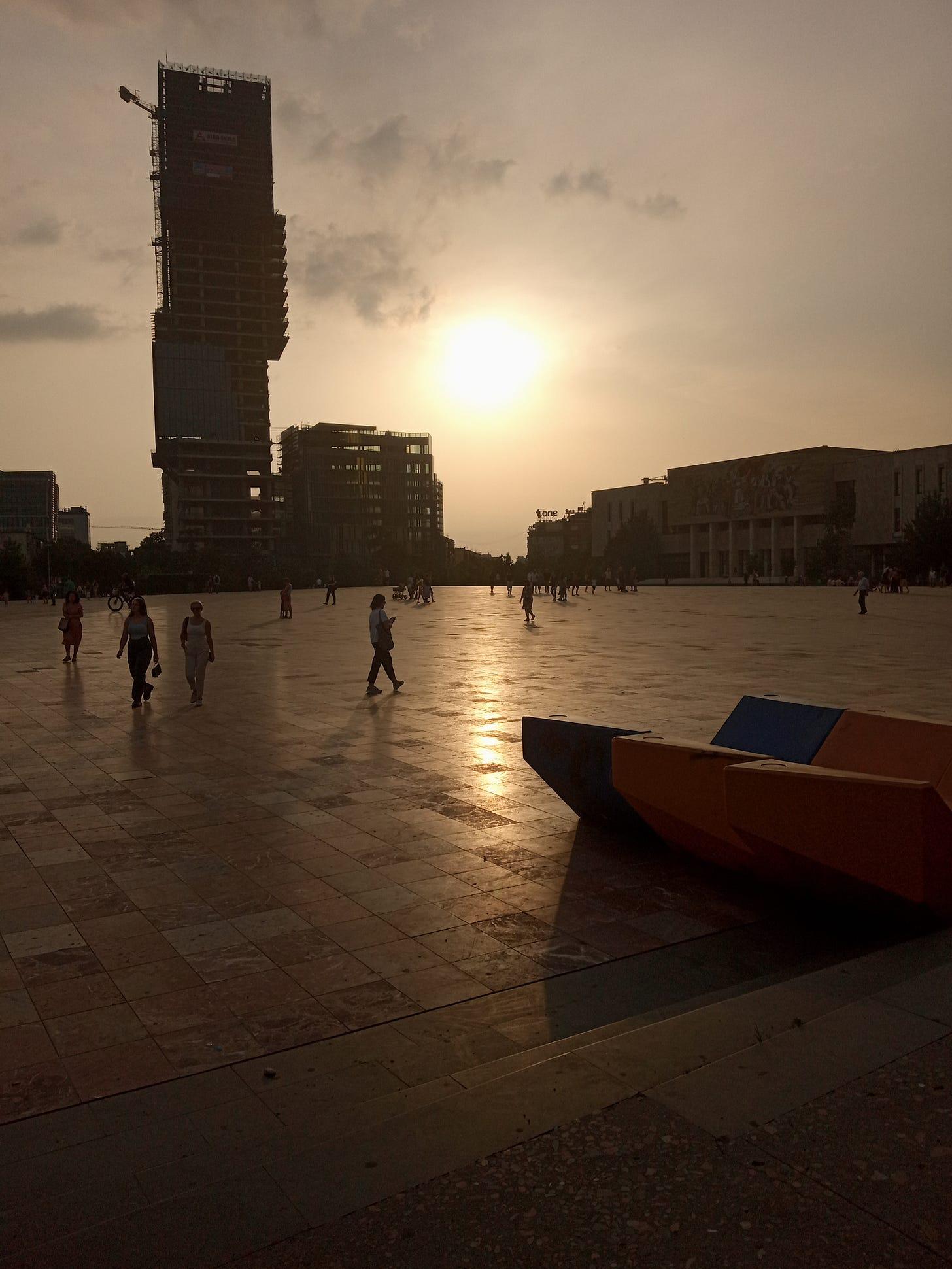
I am writing from a cafe in Tirana off Rruga e Durresit about a hundred yards from Skanderberg Square. I arrived here on Friday night from London. I’m staying at the Hotel Artist for $30 a night. Most of the plugs don’t work, so I can’t put my apple juice in the refrigerator. There’s a stool by the window with an ashtray. The shower isn’t bad. The room could use a desk, and the wifi from the router in the hall a floor down is spotty. The speakers at the cafe are playing dance covers of familiar pop hits. The song playing when I sat down was the Cranberries’ ‘Zombie’, mixing emo-ish male vocals with an uptempo, vaguely euro beat—an ungodly, indeed zombielike combination.
I woke up at 3 p.m. Last night, experiencing jet lag-induced insomnia, I read a book about the American publishing industry and watched Lumet’s The Pawnbroker and Friedkin’s The French Connection. You might say my head is still in New York City. Most nights my dreams take place there and on waking I have to shake the place out of my head. That is, to some extent, the point. Since leaving New York at the end of April, I have passed through ten cities in the past two months, with three stops in New York along the way. Over the winter, after some real estate problems and emotional disappointments, I decided to put my possessions in storage in Brooklyn and ‘walk the earth’, as I put it to the last guy I was subletting from. I was invited to three weddings this year, and so far I have attended two of them—thus, in part, the itinerary. I am carrying a blue duffel bag with busted zippers and a Paris Review tote bag full of books. I have brought work with me and have been working hard, sometimes pulling all-nighters, in which case jet lag can be an asset. I wrote obituaries for Martin Amis and Cormac McCarthy in the Financial Times. I have five essays in progress for five publications. I plan to finish three of those before I go to sleep. (Editors, I promise.)
Another thing I read last night was ‘The Case against Travel’ by Agnes Callard, in the New Yorker. Callard’s brief is mostly against tourism, rather than the itinerant wandering and visiting friends and family that I’ve been doing the past three weeks. I have mostly been to places I’ve been, even where I’ve lived, before, with the exceptions of Tel Aviv (wedding); Moab, Utah (a friend working on a movie set invited me); and Albania, where I’m settling for the next three months. There’s an internal contradiction in Callard’s argument. Towards the end she admits that people like to travel because it’s ‘fun’—that is, the primary motivation of travel is hedonism. Yet hedonism seems to be so far outside her purview (her purview being virtue, achievement, self-improvement) that she ignores it, except for the potential intoxication of seeing sights, which she considers phony or at least inauthentic, and making friends among foreigners, which she considers impossible, at least for a tourist. (Living and working somewhere new is different in her estimation.) Her examples, from her own life and other writers, partake of the idea of the most photographed barn in the world out of Don DeLillo’s White Noise—a kind of checklist mentality about going away from home. …
In ‘Airplane Mode,’ Not All Travelers Head in the Same Direction
Shahnaz Habib’s “irreverent history” takes a lively and sometimes ruthless look at who gets to go where and what gets papered over in their accounts.
Author: Alexandra Jacobs
Date: Dec. 10, 2023
AIRPLANE MODE: An Irreverent History of Travel, by Shahnaz Habib
Like exercise, flossing and college, travel has long been held up as an incontrovertible good — an essential part of the modern human experience. Lately, though, there’s been some pushback from the smart set, if not the jet set.
The staycation, a word Merriam-Webster has traced to World War II advertising, lost any remaining stigma during pandemic lockdowns, with the air suddenly clear of traffic pollution and birdsong audible in one’s own backyard. In The New Yorker last summer, the philosopher Agnes Callard laid out a “Case Against Travel,” prompting a flurry of avid, even angry, rebuttals and calls of “clickbait” from people who enjoy going to unfamiliar places, some pounded out indignantly from the road.
And now lands “Airplane Mode,” by Shahnaz Habib, a lively and, yes, wide-ranging book that interrogates some of the pastime’s conventions and most prominent chroniclers.
Beginning with the assumption that “travel” is a pastime at all, rather than a potentially violent upheaval, or a battle with bureaucracy. “Only Americans, British, Australians and Japanese travel,” a carpet-store proprietor tells Habib when she visits Konya, Turkey, a variation of an edict she heard, with more condescension, in graduate school: “People from the third world do not travel; they immigrate.”
Habib prefers the term “third world” to its more politically correct alternatives, she explains in a passionate afterword, praising a certain “audacity of its unwieldy internal rhyme” that Steely Dan has also noticed. She is a translator who has worked for the United Nations, and the English language is a source of sensual fascination. She considers the oft-criminalized practice of “loitering,” for example, “so close to littering and its suggestion of something that shouldn’t be there and bringing also to mind the lottery and the gamble of waiting for something to happen.”
Image
Habib was born in Kozhikode, India, and grew up in an “unhistoric” district in the seaside city of Kochi: a jumble of fish markets, sewing and hardware shops that she thanks Robinson Crusoe for ignoring. Her father, like Macon Leary in Anne Tyler’s “The Accidental Tourist,” hates to travel, preferring his familiar bed and reading online news. He declined a drive-by past the White House (“Why? What is there?”) and declared a helicopter trip over Manhattan “eminently avoidable.” He gets to know foreign destinations by inspecting their fruits and vegetables. I love this guy.
Habib marries a white American man, who blithely assumes a babymoon to Paris while her green card is in process will not be a problem. “It is impossible to tell a good story in which your primary antagonist is paperwork,” the author writes, but she’s wrong. The couple’s quest for an Advance Parole, a forbidding-sounding travel document for noncitizens, plus a French visa that will let her go on this simple trip — “a video game with higher and higher levels of form-filling” — is domestic tragicomedy of Lucy and Desi proportions.
Constrained at least intermittently from roaming the world, Habib finds ways to be transported, figuratively, from where she lives in Brooklyn. Postpartum, she takes long, aimless bus rides through its neighborhoods with her new baby, alert to how motherhood makes her less vulnerable to male attention. (So much more of this to look forward to!)
She is a prodigious and skeptical reader, posing the queen of Sheba in contrast to Joseph Campbell’s “The Hero With a Thousand Faces,” for example, or noting the marginalized characters in the colonialist-tinged detective novels of Agatha Christie and wondering about their stories. She analyzes guidebooks, from Baedeker to Lonely Planet. “Every time I pick up a guidebook, Lucy Honeychurch and Miss Lavish fight for my soul,” she writes, referring to characters in the E.M. Forster novel “A Room With a View,” who, respectively, depend on convention and serendipity as they journey. (How nice, by the way, to reclaim “journey” from New Age babble.)
Even watching “The Great British Bake Off,” “perhaps the feel-goodest program in the history of television,” is occasion for Habib to consider how slavery, after forced travel under the most atrocious conditions, enabled the sugar trade.
As for other travel writers, she seems through with Paul Theroux and is scathing on an article by Evan Osnos in The New Yorker, about an all-inclusive Chinese package tour of Europe, on which he was the only white man.
But “Airplane Mode” is far from a castigating, joyless book — just one that urges readers to be alert to the world’s injustices and impending catastrophes as they take their pleasure jaunts. Habib reminds us that Amartya Sen, the Nobel laureate, was detained in 1999 on his way to speak at Davos and notes how the passport has increasingly become “a transactional commodity rather than a national identity.” (Indeed, for every pandemic staycationer, it seemed there was another applying for a second passport.) There are surprising detours about bougainvillea, leeches, carousels.
She is conscious of how climate change will transform travel — Venice, anyone? — and how travel has changed the climate, something that most Million Milers just don’t want to think about. (My husband’s decision to drastically reduce his flying on ecological principles has riled family members, provoked gasps at cocktail parties and has cost us at least one treasured friendship. Me, I’m happy just to stay home binge-watching the great Smithsonian Channel series “Air Disasters,” a weird immersion therapy for aviophobes.)
When Habib does get away from it all, she is a ruthlessly honest and funny observer, comparing her “feeble herbivorous voice” to the slashing adventuresomeness of an Anthony Bourdain; admitting to craving Thai food on a trip to Spain and then exploring the forces that made it available there; confessing that she doesn’t actually enjoy visiting monuments.
Interestingly for a book that takes its title from an iPhone setting, “Airplane Mode” doesn’t much discuss how little super-compasses like Google Maps, Yelp and their ilk have Changed Everything Forever when it comes to travel. But in an era when souvenirs are all but obsolete, every trinket on Earth available in a click, it’s a lovely little snow globe, shaking up hardened perceptions.
AIRPLANE MODE: An Irreverent History of Travel | By Shahnaz Habib | Catapult | 288 pp. | $27
Alexandra Jacobs is a Times book critic and occasional features writer. She joined The Times in 2010. More about Alexandra Jacobs
A version of this article appears in print on, Section C, Page 5 of the New York edition with the headline: A Canny, Catty Travel Companion. Order Reprints