Ann Arbor News Stories on Ted Kaczynski
Kaczynski Letters Opened; Documents available to public
Unabomber Letters Ignite Little Interest
U-M Library Acquires Letters Written To Unabomber
Unabomb Victim Hesitant On Death Penalty
Kaczynski’s Lawyer Asks Suit Transfer
Unabomber Suspect’s U-M Fame A Blast In The Past
Career Abandonment Remains A Puzzle
Media Frenzy Descends On U-M Campus
Mathematics Is Small World U-M Faculty, Students Find
Gifted Student Had A ‘Quiet Demeanor’
Kaczynski Brilliant But A Loner At U-M
Demand High Supply Low For Unabomber Manifesto
FBI Hopes Tips Break Bombs Case
Campus Bomber Could Have College Connection
U-M Professor Would Like A ‘Chat’ With Bomber
Local Scientists On Bomb Alert
Serial Bomber’s Victim List Grows; Warning Issued
Letter Bomb Linked To ‘Wave’ From Utah
They walked these streets
Source: Ann Arbor News, April 19, 1998. <www.aadl.org/aa_news_19980419-they_walked_these_streets_1of2>
By ANNE RUETER
NEWS STAFF REPORTER
During the last 125 years, lots of the famous and soon-to-be have called Ann Arbor home
Zoom in on the University of Michigan Diag, and back in time. The year is 1877, and Clarence Darrow, age 19, is walking to class, a stack of law books under his arm. In his mind are percolating the thoughts and passions that will later make him the nation’s leading criminal lawyer, a defender of labor leader Eugene V. Debs and later of a beleaguered teacher of evolution in the Scopes trial in Tennessee.
Fast-forward to 1925, and look north of the Huron River to a small Greek Revival house on Pontiac Trail. Poet Robert Frost is getting ready for a reading on the U-M campus, where he’s teaching for a second yearlong stay.
Fast-forward again to 1940. Over at the football stadium. U-M fans wildly cheer their phenomenal halfback, Tom Harmon, on a brisk fall afternoon as he races toward passing and rushing records that win him a Heisman Trophy. Press the FF button just a smidgen. It’s December 7,1941. British poet W. H. Auden, at the U-M for a teaching residency, is visiting friends on Marshall Court, a tiny street off Division Street. On the radio, the news of Pearl Harbor stuns Auden and his host, English professor A. K. Stevens, and family.
If you had a camera capable of zooming through both space and time, you’d find no end of material about the dozens of famous figures — and a few infamous ones — who’ve lived in Tree Town since its founding in 1824. With the University of Michigan as a giant magnet, the city’s streets and buildings have been the haunts of opera singers and rockers, poets and scientists, athletes and actors, not to mention a U.S. president, a great humanitarian and a notorious despot. Well over a dozen have names familiar to millions of Americans — and dozens more have made names for themselves in fields such as film, visual arts, theater, public health and physics.
Though many spent most of their time and energy on campus, some mixed briefly in town affairs. In 1922, Frost’s words to an Ann Arbor Times-News reporter were prophetic. Asked his reaction to a plan by the well-known Olmsted Brothers firm to channel the city’s growth, Frost said, “When a village becomes a town and then a city, it loses a certain amount of... intimacy and companionship.” And Darrow vented his anger at his landlord in a letter to a local paper, countering the landlord’s claims that he hadn’t paid his rent.
Auden “adopted” the Stevens family in his one-year stint at U-M, even writing a poem for 10-year-old Grace for her birthday. Mary Hathaway, now a local historic preservation leader, remembers taking his poetry course by proxy at age 6. Her mother, a student in Auden’s class, would memorize parts of Dante’s “Divine Comedy” while drying the silverware. “I learned some of it too,” Hathaway says.
Some of the city’s later-famous residents spent formative years here. Arthur Miller, a boy from Brooklyn, N.Y., wrote his first plays in a rooming house on North State Street when he wasn’t at class or his jobs as dishwasher and as mouse feeder at a U-M lab. From 1942 to 1947, Jonas Salk laid the groundwork in a lab in the School of Public Health for the polio vaccine he would later develop at the University of Pittsburgh.
It’s safe to say that Jessye Norman’s and Iggy Pop’s paths have never crossed, musically speaking. But in 1967, they could have passed each other on State Street. Norman was studying voice at the U-M Music School before launching an opera career in Germany that would bring her acclaim as one of the world’s great sopranos. Pop, known as “the godfather of punk,” would play his first concert with his punk band, the Stooges, on Halloween eve that year.
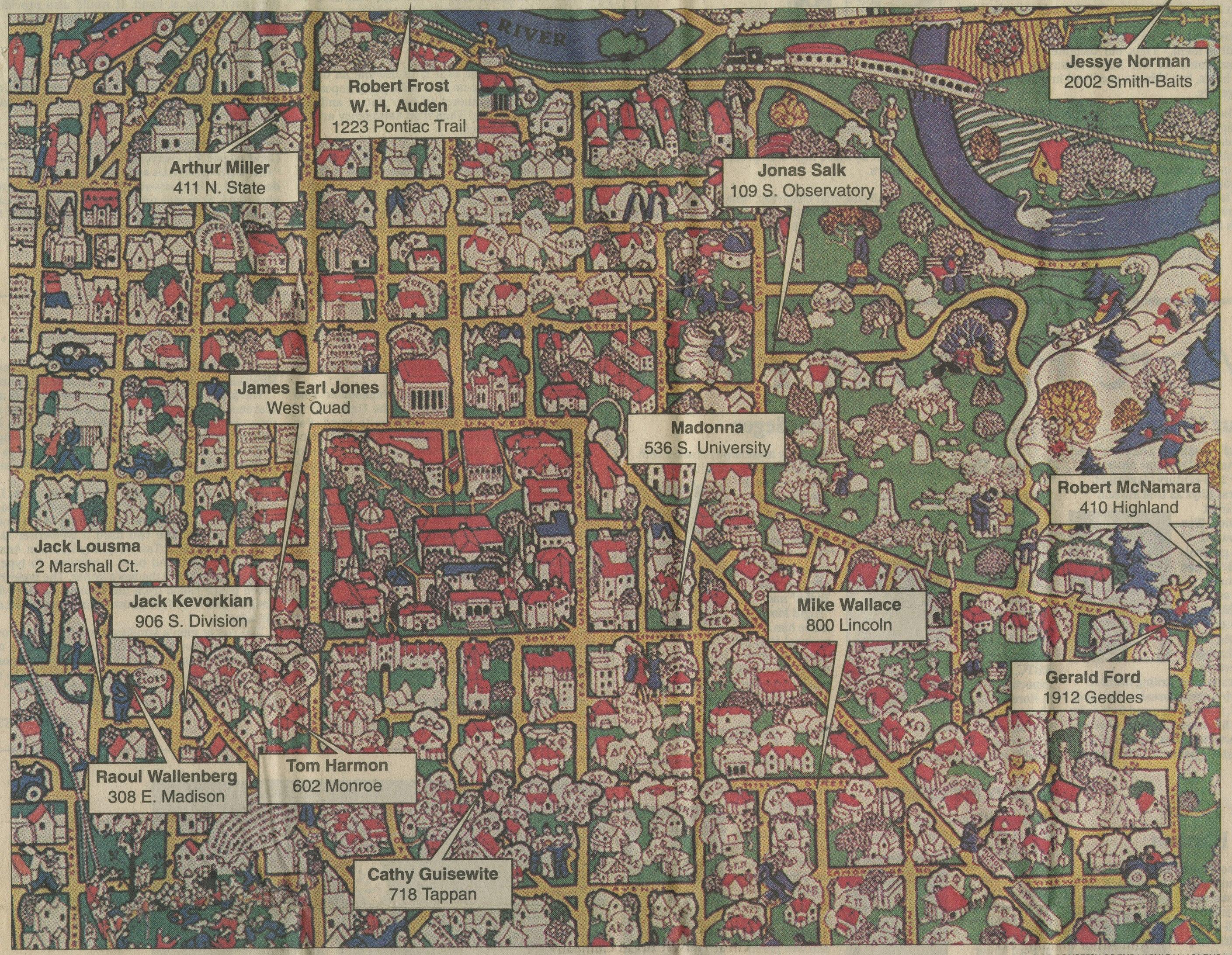
The accompanying map shows a sampling of the best-known Ann Arborites-for-a-while, and where they hung out.
And among those who aren’t quite household names, many readers are likely to recognize quite a few, or add to their storehouse of local lore.
One U-M alumnus in medicine, William Mayo, class of 1883, founded the Mayo Clinic in Minnesota with Kis brother Charles. A little later, a U-M professor named John Dewey shocked some of his neighbors with the freedoms he allowed his children. Later at the University of Chicago and at Columbia University, he became a nationally known exponent of the educational philosophy of “learning by doing.”
In the visual arts, there’s Margaret Bourke White, the intrepid photographer for Fortune and Life magazines who graduated from the U-M in 1922. She lived for a time on East Ann Street. Film director Lawrence Kasdan and screenwriter David Newman, who wrote screenplays for the Superman movies and “Bonnie and Clyde,” both lived here as U-M undergraduates.
Documentaiy maker Ken Burns attended Pioneer High. So did James Osterberg, who became outrageous punkster Iggy Pop, putting Ann Arbor on the map for millions of rock fans. Osterberg grew up in-a trailer park on Carpenter Road south of Packard Road and went to Varsity Day Camp as a kid. His song, “Lust for Life,” boosted his recent comeback after it was featured in the soundtrack of the film “Train Spotting.”
In politics, 1960s activists Tom Hayden and John Sinclair made their mark. But earlier, so did U-M aluin Thomas E. Dewey, who ran twice for U.S. president against Franklin Roosevelt and Harry Truman.
Other literary lights who were U-M students include John Ciardi, Nancy Willard and Marge Piercy. Betty Smith, author of “A Tree Grows in Brooklyn,” went to U-M from 1922–29. William Shawn, who attended U-^I in the 1920s, was the influential editor of the New Yarber magazine for more than 35 years.
An Ann Arbor Who’s Who
The 1920s
Robert Frost
One of nation’s preeminent poets wrote and taught at U-M in 1921–1923 and 1925–1926. Lived at Greek Revival house at Pontiac Trail and Kellogg Street during his second stay. (Henry Ford later bought and moved house to Greenfield Village.) It’s said that the tower of the former county courthouse figures in his poem, “Acquainted with the Night.” To see Frost as he looked in 1923, check out portrait of Frost in Graduate Library Rare Book Room on 7th floor.
offensive lineman for U-M football team and team’s MVP in 1934, graduated in 1935. Lived at 1912 Geddes Ave., then Delta Kappa Epsilon house, where he was house manager. Ford Library on North Campus houses 20 million manuscript pages of papers from his days as congressman, vice president and president.
camp. Plaques honoring Wallenberg have been placed at Lorch Hall on campus and at 308 E. Madison St., where he lived in 1931–32.
The 1930s
Gerald Ford
Nation’s 38th president from 1974–77.
Majored in economics and political science at U-M, was
Raoul Wallenberg
This Swedish diplomat saved the lives of 100,000 Jews during World War II. Graduatedin architecture at U-M, was classmate of Gerald Ford. He kept Jews in Budapest, Hungary, out of concentration camps by issuing them bogus
Swedish passports. Disappeared when Soviets captured Budapest in 1945; is believed to have died in Soviet prison
Mike Wallace
Ann Arbor was home from 1935–39 for future CBS “Sixty Minutes” newsman. He left Boston to attend U-M in part because his uncle headed economics department; Got hooked by radio broadcasting in sophomore
year. Lived in 1937 at 800 Lincoln St. (A modern building now occupies site.) Gave funds for Mike and Mary Wallace House, home of Michigan Journalism Fellows at 620 Oxford St.
More well-known names and faces, C2
More Famous Faces
Arthur Miller
Author of “Death of a Salesman” and “The Crucible,” perhaps America’s premier 20th-century playwright, wrote first plays as U-M student during Great Depression. Won two Hopwood awards, graduated in 1938. “I had made a new Shadow on the earth,” Miller .‘wrote later, describing how he ran through city streets in
exhilaration after writing his first play during spring break in his room at 411N. State St. Amused friends by reading his one-act plays at election night party in 1936 at Lund House, large historic house at 1324 Pontiac Trail.
The 1950s
James Earl Jones
Tony award winner for “The Great White Hope” and voice of Darth Vader in “Star Wars” films got his start in U-M plays such as “Deep are the Roots,” a play about racial injustice staged at Lydia Mendelssohn Theater in 1953. Found his closest social circle in ROTC, left U-M expecting to fight in Korean War. Finished degree
Bob Seger
Arguably most famous rocker with Ann Arbor roots. Grew up here, developed Michigan following for his blend of hard-driving rock’n’ roll and soul in 1960s. Two 1976 top-seUing albums, “Life BuUet” and “Night Moves,” made him a national star. His
voice and song, “Like a Rock,” are familiar to millions from GM’s Chevy truck commercials. Lived at 511 Pauline Blvd, from 1968–72.
by extension in 1955 after beginning acting career in New York. Lived in West Quad, behind Michigan Union.
Jess ye Norman
And then there are the infamous...
Ann Arbor has had a sprinkling of the notorious among its celebrities.
Ted Kaczynski, the convicted Unabomber who earned a Ph.D. in mathematics at the University of Michigan, is the most likely to come to mind. Far less likely is the name of Charles Guiteau to surface — but in 1881, it was on many lips as newspapers spread the news that he had shot and mortally wounded President James Garfield.
Guiteau had lived in Ann Arbor briefly in 1859–60 to attend Ann Arbor High School, which took students who planned to attend the U-M but needed more preparation, writes Jonathan Marwil in “A History of Ann Arbor.” Guiteau “left Ann Arbor for a religious community, following which he led a vagabond life” that climaxed in the assassination in Washington, D.C., writes Marwil.
Frahbois “Papa Doc” Duvalier had not yet become an infamous tyrant when he attended classes at the U-M briefly in the 1940s. With a group of other Haitians, he came to study how to control yaws, a disease ravaging his country’s population. He lived on East Madison Street at the present site of South Quad.
After becoming president of Haiti in 1957, he became a ruthless dictator who terrorized and murdered his opponents until he died in 1971. During his
regime and that of his son, “Baby Doc,” thousands of Haitians died and thousands more fled the country.
The paths of famed criminal lawyer and U-M alum < Clarence Darrow and two of Ann Arbor’s most infamous former residents crossed in 1924, when Darrow defended Richard Loeb and Nathan Leopold, two well-to-do Chicago teens who confessed to kidnapping and murdering a 14-year-old boy in an attempt to commit the perfect crime.
Son of a Sears, Roebuck and Co. executive, Loeb had graduated from the U-M at 17 in 1922; Leopold had attended U-M before transferring to the University of Chicago. The two used a typewriter stolen from the Zeta Beta Tau fraternity house in Ann Arbor, where Loeb had been a member, to type the ransom note sent to the boy’s father. The typewriter, which police fished from the Chicago harbor where Leopold and Loeb had thrown it, became evidence in the case.
The young men’s families appealed to Darrow to spare their sons from execution. In one of his most ’ celebrated defenses, Darrow, a passionate opponent of the death penalty, convinced the judge in the case that the young men were “mentally diseased” and should be sentenced to life in prison.
ANNE RUETER
The 1940s
Tom Harmon
Robert McNamara
U-M’s most legendaiy athlete had spectacular career as halfback under then-new U-M football coach
Fritz Crisler. Made All-American in 1939 and 1940, won Heisman trophy — and a spot on cover of Life magazine — in 1940. Harmon 1‘could snake Through a broken field like a comet,” wrote one
U-M historian.
Secretary of Defense who led U.S. pursuit of Vietnam War in Kennedy and Johnson administrations. Lived in Ann Arbor at 410 Highland Road from 1949–1960 while executive at Ford Motor Co., was regular fan at U-M sports events. Known as one of JFK’s
“whiz kids,” considered for U-M president in 1966, split with Pentagon over bombing of North Vietnam, headed World Bank for 13 years.
Lived in 1937 at bigturreted house at 602 Monroe St.
W. H. Auden
Another renowned poet who spent time at U-M teaching and writing. Lived at same address as Frost in fall of 1941, subletting new house built on site for artist Jean Paul Slusser. Lived at 1504 Brooklyn St. later in his 1941–42 residency. Had office at 3232 Angell Hall. Frequented home of U-M English instructor A. K Stevens at 8 Marshall Court. (The Stevenses named son, local historian Wystan Stevens, after Auden.) Auden reportedly sought lively night life in Main Street area and found it at Schwaben Hall on South Ashley Street.
Jonas Salk
Laid groundwork for first polio vaccine while U-M post-doctoral fellow and assistant professor of epidemiology from 1942–47. Xater developed yaccine at University of Pittsburgh. Plaque honoring Salk in Rackham building lobby marks historic 1955 announcement to nation, “The vaccine works,”
Jack Lousma, Edward H. Mite II, and James McDivitt
AU three pioneer astronauts were in
U-M class of 1959. McDivitt piloted Gemini 4 spacecraft while White
took first controUed walk in space in
1965. White died in launch pad fire at
Cape Canaveral in 1967. Lousma grew up in Ann Arbor, was an Aim Arbor News paper boy, and played football at Ann Arbor High School and at U-M. He spent 59 days orbiting Earth in 1973 as
member of Skylab 2 crew. He was on the support crew for Apollo missions and flew on shuttle Columbia in 1982.
Lousma’s family home was at 2 Marshall Court.
The 1960s
Gilda Radner
from U-M epidemiologist Thomas Francis Jr., who worked with Salk and led national field trials of vaccine. Salk’s lab in rooms 1042 and 1046 of the Thomas J. Francis School of Public Health building has been preserved and is still used for vaccine research. Salk lived at 2105 Jackson Ave. in 1943.
Jack Kevorkian
“Saturday Night Live” star began entertaining audiences as U-M student in late ’60s. Performed in a potpourri of plays put on by speech department (the name then for theater department). Was a member of Greek chorus in “The Bacchae” by Euripides, but
Pathologist Whose controversial assisted suicides have sparked nationwide debate earned his undergrad and medical degrees from U-M. Lived at 706 S. Division St. in 1947 as an undergrad.
liked children’s theater too: In a 1968 Trueblood Theater performance, “The Elves and the Shoemaker,” she played Heckla, a landholder. Lived at 718 Monroe St. in 1968–69; site is now parking lot.
One of world’s opera greats studied at U-M School of Music for 1 lh years in 1967 after graduating cum laude in music from Howard University. She came to study voice under French baritone Pierre Bernac and stayed to complete a master’s degree. In 1968, she won prestigious German
competition, signed contract with Berlin Opera and established herself as star performing in all of Europe’s major opera venues. Made debut at New York’s Metropolitan Opera in 1983, an event dubbed “the second Norman conquest.” At U-M, she lived at 2002 Smith-Baits on North Campus.
The 1970s
Madonna
One year at U-M in 1977–78 was a stepping-stone to New York and pop culture stardom. Madonna Ciccone came to study dance with Christopher Flynn, her dance teacher in
Rochester who became a U-M dance instructor. She roomed with local choreographer Whitley Setrakian at University Towers on South University Ave. Both scooped ice cream at Miller’s
on South U. For fun, they hung out at the Blue Frog (now Rick’s American Cafe) and climbed the fire escape to the roof of the Earle building at Ashley and Washington streets.
Christine Lahti
Stage and film actress who stars in TV’s “Chicago Hope” graduated from U-M in theater in 1972. Won awards for stage performances in Jules Feiffer’s “Little Murders” and David Mamet’s “The Woods.” Nominated for Oscar in 1984 film “Swing Shift.” In
1970, she lived at 800 Lincoln St., Mike Wallace’s address 33 years before.
Cathy Guisewite
Cartoonist whose “Cathy” comic strip appears in some 1,200 newspapers is a 1972 U-M graduate. Worked in advertising after graduation; her doodles on letters home made her mom
urge her to pursue cartooning. While at U-M, lived at 718 Tappan St.
Continued from Cl
Gilda Radner, top, appears in Ann Arbor with fellow members of the U-M cast of ‘Nobody Loves a Dragon’ in 1967.
U-M PRODUCTIONS • F.W. OURADNIIC
Kaczynski Letters Opened; Documents available to public
Subtitle: Correspondence with those outside prison ranges from intellectual to everyday
Accused Unabomber’s writing, correspondence now at U-M
Author: Mary Morgan
Date: June 4, 2000
Source: Ann Arbor News, June 4, 2000. <www.aadl.org/aa_news_20000604_pA1-kaczynski_letters_opened>
News Photo — Robert Chase
One woman calls him Ted Bear. Others say Ted, or more formally, Mr. Kaczynski.
Some write once, others send a letter every day. One person even asked for a recommendation to Harvard Divinity School — and got it.
Since his arrest in 1996 and subsequent guilty plea in the Unabomber case, Kaczynski has received hundreds of letters, cards, sketches and other items from people around the world.
Now those documents — along with dozens of Kaczynski’s responses — are available to the public for the first time at the University of Michigan.
It’s the most contemporary and controversial part of U- M’s Labadie Collection, one of the world’s top archives of anarchist material.
The collection has been getting shipments of these letters from Kaczynski for about two years. But the material was only made available to the public in the last few weeks. It took that long to negotiate with Kaczynski about how the material would be used, and then to process the documents, said Julie Herrada, curator of the Labadie Collection.
Herrada herself is responsible for this collector’s coup.
She knew the 58-year-old Kaczynski was a prolific writer. Federal prosecutors said he was the author of the Unabomber Manifesto, a treatise arguing that the bombing campaign was necessary to combat a technoindustrial system that robs people of their humanity. It was first published by the Washington Post in 1995, a few months before Kaczynski’s arrest.
Kaczynski is accused of killing three people and injuring 22 others in 16 bombings between 1978 and 1995. A U-M psychologist, James McConnell, and his research assistant were injured when McConnell received one of the bombs in 1985.
In 1998, Kaczynski pleaded guilty to avoid a trial and the insanity defense his attorney planned to use. Sentenced to life in prison, he has asked the court to set aside his guilty plea and is seeking a retrial.
Hoping to secure Kaczynski’s papers for the U-M collection, Herrada first sent a letter to his attorney in early 1997. She waited six months before getting a call. The lawyer said Kaczynski was interested and wanted more information about the library’s motives and plans.
So Herrada wrote another, longer letter explaining why she thought the Labadie Collection would be a good home.
Then, in the fall of 1997, Herrada got a thick manila envelope from Kaczynski himself. “After that we started corresponding directly,” Herrada said. “He kind of opened the gate.”
Kaczynski’s previous link to U-M — he was a graduate student from 1962 to 1967, earning a Ph.D. in mathematics — likely had nothing to do with his decision to give his correspondence to the university, Herrada said. He never mentioned that connection, she said.
The Labadie Collection’s international reputation, along with the relationship Herrada fostered, contributed to Kaczynski’s decision. He also is constrained by space, and can only keep a limited mount of papers in prison, Herrada said.
SEEING THE KACZYNSKI PAPERS
-
To view the Ted Kaczynski papers, you must first make an appointment by contacting the University of Michigan’s Labadie Collection at (734) 764–9377.
-
The collection is part of the Special Collections Library, located in the Hatcher Graduate Library on U-M’s central campus.
In addition to correspondence, the Kaczynski collection includes drafts of briefs kept or edited by Kaczynski. Also in the papers are pamphlets, clippings and other materials mailed to him as well as articles by or about Kaczynski.
U-M did not pay for the material.
Herrada hopes to eventually add other documents to the collection, most notably papers confiscated by the FBI from Kaczynski’s cabin in Montana.
After about a year of correspondence with Kaczynski, Herrada told him that he could call her by her first name. He wrote back, telling her to call him Ted. She has never met or talked with Kaczynski, only corresponded in writing.
“There’s a lot of trust involved, because he’s stuck there (in prison). There’s no out,” said Herrada. “I spent a long time building up that trust, and it’s important for me to keep it.”
Although Kaczynski has been sending packets of papers to Herrada regularly, she didn’t read anything until a final agreement was signed last fall.
The agreement outlined how U-M can use the documents. Certain papers that Kaczynski didn’t want the public to view were returned to him.
“We’re not really a storage facility here,” Herrada said. “We’re archivists.”
When the agreement was signed, Herrada began processing the papers, with the help of a graduate student.
A major decision involved whether to allow the public to see who wrote the letters. Although the library’s mission is to make information accessible to the public, she was concerned because many of the letters are extremely personal. Herrada consulted her colleagues and ultimately decided to block out the names on the photocopies that are being provided to the public, although the original documents will be available to the public in 2049.
I started to have real inner conflicts,” she said, “because these people had no idea what would happen to their letters. Some people still don’t know their letters are open to the public. It was a hard decision, but at least I can sleep at night.”
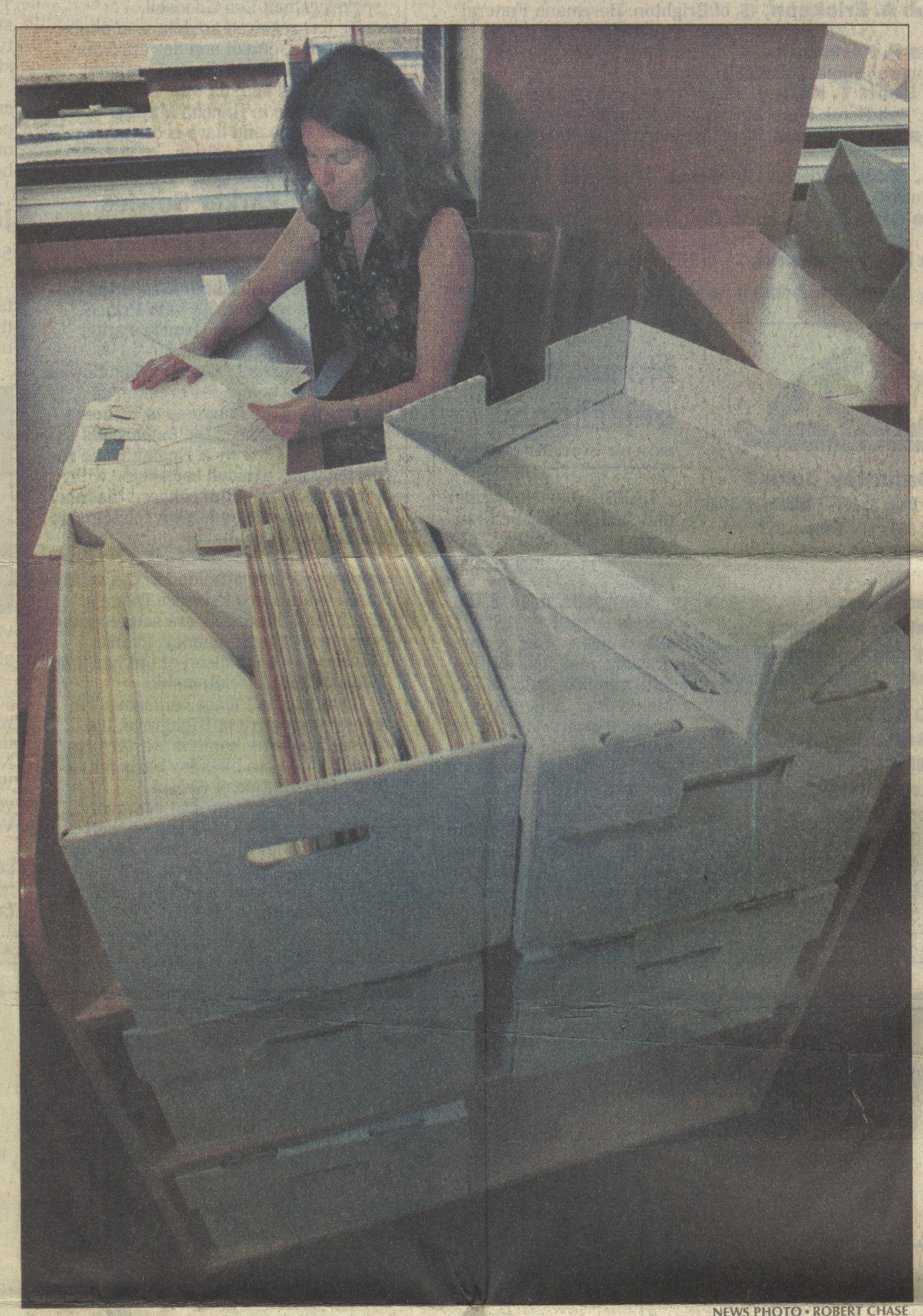
The photocopied letters are contained in five gray boxes made of acid-free cardboard. In those boxes, papers are filed in pale yellow folders, usually one folder per correspondent. Many folders are thin, because the person sent one or only a few letters. Some contain dozens of letters, though. And about a dozen of the folders contain back-and-forth correspondence between the writer and Kaczynski himself.
The letters come from people who connect with Kaczynski in different ways, says Herrada, who has read through most of the collection. “I think for the most part, people were curious,” she said.
Some identify with Kaczynski on a political level, responding to his radical views on technology, government and corporate power. Others are struck by Kaczynski’s intellect, and discuss their views on philosophy, mathematics and the arts. Some writers are evangelical, hoping to save Kaczynski’s soul.
And many connect on an emotional level, revealing intimate details of their lives to a complete stranger. Some writers seem to suffer from mental illness, and many are from women who hope for a romantic bond.
“I got the sense that a lot of people were very lonely,” Herrada said.
Topics range from the brainy to the banal. People describe grocery shopping, homework, spats with friends and lovers. They talk about their travels, or speculate about what Kaczynski’s life must be like behind bars.
Some chastise Kaczynski for not responding to their missives. Others express support for his battles with the FBI, and detail their own encounters with the government.
In one letter, a correspondent says he’s applying to Harvard Divinitv School, and asks for a recommendation letter. Kaczynski, writing in response, seems surprised by the request.
“Of course I’ll have to tell them that you’re politically incorrect and may possibly let a breath of fresh air into Harvard Divinity School — which would probably suffocate them,” Kaczynski wrote.
The three-page letter of recommendation that Kaczynski wrote also is included in the folder. In it, he describes the man he’s recommending as impetuous, undisciplined and not competent in analytical reasoning.
“I would say the same of most of the philosophers of whose works I have read samples,” Kaczynski adds, “and would probably say it of most of the participants in your Fellows Program.
In another exchange, Kaczynski asks a man to send him a small sketch to use as a Christmas card. The requested image was of Benvenuto Cellini’s sculpture of Perseus hoisting Medusa’s head. The illustration of this Greek myth appealed to Kaczynski in part because Cellini, a cantankerous artist who was twice imprisoned, was a native of Florence, Italy. Kaczynski is a prisoner at the federal penitentiary in Florence, Colo.
Documents continue to arrive, as people continue to correspond with Kaczynski.
“I don’t expect that that is going to end, unless he gets out of jail,” Herrada said. “And I don’t expect that to happen, either.
Unabomber Letters Ignite Little Interest
Source: Ann Arbor News, June 21, 2000. <www.aadl.org/aa_news_20000621-unabomber_letters_ignite_little_interest>
-
There have been no calls from scholars, public.
By MARY MORGAN
NEWS STAFF REPORTER
Ted Kaczynski appears to be a media magnet, but so far his letters have drawn little attention from researchers or the general public.
Hundreds of letters and other correspondence to and from ~the Unabomber were made available to the public for the first time last month. The materials are housed at the University of Michigan’s Labadie Collection on central campus.
Julie Herrada, the collection’s curator, was inundated with interview requests following an Ann Arbor News story in early June. Radio shows, newspapers and CNN all came calling.
But she’s gotten no calls so far from scholars or the curious public.
“When we announced last fall that we had his papers (before they were available to the public), we got more inquiries (from the public) than we did now,” Herrada said. She doesn’t know why there’s been no response recently.
Nor has she heard from Kaczynski since sending him a letter and copy of The News article. That’s not surprising, Herrada said — exchanges are slow, because prison officials read each piece of Kaczynski’s incoming and outgoing mail.
Kaczynski, now serving a life sentence in a Colorado federal prison for bombings that killed three people and injured 23 others, is getting media attention in other ways.
The Unabomber was featured in a June cover story in the Atlantic Monthly magazine. Kaczynski also made news recently when he agreed to’sell the furaTMbhtana property where he lived alone in a one-room cabin for more than two decades and plotted a nationwide mail-bombing spree.
Joy Richards, who has corresponded with the convicted Unabomber since his arrest, agreed to pay $7,500 for Kaczynski’s share of the 1.4-acre plot of land four miles from her Lincoln, Mont., home.
The plywood cabin he built after buying the land in 1971 is stored at a former Air Force Base in Sacramento, where it was taken for use as evidence in his trial.
Kaczynski’s federal defender, Quin Denvir, sought approval for the sale from the U.S. District Court in Sacramento where the Unabomber entered a guilty plea in 1998. Magistrate Judge Gregory G. Hollows approved the sale June 14.
Richards’ correspondence with Kaczynski are not yet part of the Labadie Collection, Herrada said.
U-M Library Acquires Letters Written To Unabomber
Source: Ann Arbor News, October 15, 1999. <www.aadl.org/aa_news_19991015_pA1-um_library_acquires_letters_written_to_unabomber>
-
Correspondence joins a collection of anarchist and social-protest literature.
FROM THE ASSOCIATED PRESS
The University of Michigan library has acquired hundreds of letters written by people around the world to Unabomber Ted Kaczynski, university officials said Thursday.
The letters are an important new addition to the library’s Labadie Collection of anarchist and social-protest literature, Provost Nancy Cantor said this morning.
“We expect it to be widely used,” she said.
The letters won’t be on public display for about six months.
The university’s Harlan Hatcher Graduate Library received the 5-foot stack of Kaczynski correspondence within the last month aftertwo years of negotiations, said university information officer Joanne Nesbit.
Negotiations for the collection were handled through attorneys for Kaczynski and the university, said Bill Gosling, director of the Hatcher library.
Permission to acquire the correspondence, which is a gift from Kaczynski, was given by the provost’s office. The provost is involved in acquisitions only when they are highly visible, like the Kaczynski papers, Gosling said.
The letters cover the period from Kaczynski’s arrest in April 1996 through the present. The university will continue to collect Kaczynski’s correspondence until he dies or stops making the letters available, Nesbit said.
“This collection will be kept for people to study and for legitimate research by psychologists and others who may want to study Kaczynski’s mind,” Nesbit said. “It is also part of the history of the country.”
University President Lee Bollinger said the acquisition is important to research, despite some criticism the move may attract.
“The main question is whether this material is relevant to scholarly research and the answer is clearly yes,” Bollinger told The Michigan Daily, the university’s student newspaper. “People study deviant anti-social behavior and it is important for us as a society to study works of evil.”
Kaczynski was sentenced in 1998 to life without parole for conducting an anti-technology bombing campaign that killed three people and injured more than 20 others around the country.
One of the bombings linked to the Unabomber occurred in Ann Arbor in 1985, at the home of James McConnell, a University of Michigan psychologist. The bomb, sent in a package from Salt Lake City and addressed to McConnell, damaged his hearing and injured McConnell’s research assistant, who opened it.
Kaczynski attended Michigan from 1962 to 1967 and earned master’s and doctorate degrees in mathematics. He was a teaching fellow from 1962 to 1965.
Kaczynski pleaded guilty to avoid a trial at which his lawyer had planned to offer an insanity defense. But the guilty plea also saved him from being sentenced to the death penalty. He is seeking a retrial.
Officials in charge of the Labadie Collection approached the 57-year-old Kaczynski and his lawyers because “of his lifestyle and what he did,” not because he attended Michigan, Nesbit said.
Nesbit said none of the letters contains any evidence about Kaczynski’s bombings. When all his appeals are exhausted, university officials will begin negotiations with the FBI and other federal officials to obtain Kaczynski’s writings and diaries, in which he recounted the details of the bombings, Nesbit said.
Not everyone viewed the acquisition with excitement.
Washtenaw County Prosecutor Brian Mackie said he doesn’t plan to read Kaczynski’s writings.
“I have concerns about the information available from so many sources telling people how to make bombs and drugs,” Mackie told a Detroit newspaper. “But I guess that’s the reality of our lives.”
The letters are stored in a high security area, monitored by alarms. The names of those who sent the Unabomber letters will be deleted once the letters are made public.
Staff reporter Mary Morgan contributed to this report.
Unabomb Victim Hesitant On Death Penalty
Source: Ann Arbor News, October 8, 1998. <www.aadl.org/aa_news_19980108_pA1-unabomb_victim_hesitant_on_death_penalty>
-
Former research assistant wounded by blast says death penalty seems applicable.
By SUSAN L. OPPAT
NEWS STAFF REPORTER
► Trial to open despite Kaczynski’s Objections, A3.
The only Michigan resident injured by the Unabomber isn’t clamoring for the death penalty for suspect Theodore Kaczynski, whose federal trial was to begin to day in California after he unsuccessfully tried to fire his defense attorneys.
But, says Nicklaus Suino, “if ever there was a case in which the death penalty is applicable, this certainly seems to be one.
SUINO
“Terrorists are cowards, and extremely dangerous, and just the kind of people the death penalty should be applied to,” said Suino, injured in 1985 when he opened a package sent to the Scio Township home of University of Michigan psychology professor James V. McConnell.
U.S. District Judge Garland Burrell Jr. cleared the way for the trial to go forward after ruling Wednesday that it is too late for Kaczynski to fire his lawyers, despite his dissatisfaction with their planned mental illness defense. Opening statements, which were delayed Monday when Kaczynski tried to change attorneys, were scheduled for today.
Kaczynski, 55, faces a 10-count indictment covering four Unabomber attacks that killed two Sacramento men and maimed two scientists. He could be sentenced to death, if convicted in the last attack, the only one to occur after reinstatement of the federal death penalty.
“I’m not anxious to see Kaczynski get the death penalty, (but) I won’t be real disappointed if he does,” Suino said in a telephone interview this week from his Lansing home.
Suino, who was McConnell’s research assistant, suffered severe but temporary hearing loss, blurred vision and burns, bruises and cuts on his left arm and abdomen. He recovered with only minor scars.
“It’s been many years since I really had any feelings of anger about this,” Suino said. “I feel so remote from it now.”
Kaczynski has been implicated in a series of 16 bombings over 18 years that killed three people and injured 29 people, including Suino, in nine states. No state or federal charges have been filed against Kaczynski in the incident that injured Suino.
Investigators have never said they established any link between Kaczynski and McConnell, although Kaczynski earned master’s and doctorate degrees in mathematics at the University of Michigan from 1962 through 1967.
Suino said he is relieved the trial is starting, although he worried that Kaczynski would derail it with his demand to fire his attorneys.
As for the insanity defense Kaczynski’s lawyers want to present, Suino said, “he may be technically paranoid schizophrenic, but his world view is different enough that he’s a serious threat to society. That’s the real purpose of our penal system ... to take people who are unreasonably dangerous and remove them from society.”
A civil suit Suino filed against Kaczynski is on hold pending the outcome of the criminal trials. But there are apparently no plans to try Kaczynski ih Michigan on criminal charges for Suino’s injuries.
Washtenaw County Prosecutor Brian Mackie said Tuesday that no police agency has asked him to review the case or authorize charges.
Federal prosecutors appear to have no plans to try Kaczynski on the Michigan case, but late last week came to an agreement with defense attorneys in California.
That will allow prosecutors to describe the other bombings, including what investigators call “device number 10,” the bomb that injured Suino, during the current trial, said Leesa Brown, spokesperson for the U.S. Justice Department.
Meantime, Suino, now 37, is getting on with his life. He owns and operates a martial arts studio in East Lansing and will finish classes at the Cooley Law School in Lansing this spring.
“Sure, I read the papers about (the case,) but if (the media) didn’t keep calling me, I really wouldn’t think about it that much,” Suino said, laughing.
“Maybe that’s because the bomb wasn’t intended for me, and I wasn’t that badly hurt. I don’t have the mentality of a victim in it. It was something that happened to me, it was interesting.
“But I don’t think it altered my life-view much. I’ve always had a sort of conservative approach to crime,” Suino said. “Criminals should be caught and punished. I’ve always been slightly pro-death penalty, but not rabidly so.”
Kaczynski’s Lawyer Asks Suit Transfer
Source: Ann Arbor News, September 26, 1996. <www.aadl.org/aa_news_19960926_pC1-kaczynskis_lawyer_asks_suit_transfer>
-
Unabomber suspect is being sued by former Ann Arbor resident.
By LIZ COBBS 1996’
NEWS STAFF REPORTER
An attorney for Unabomber suspect Theodore Kaczynski, has asked that a lawsuit filed against his client in Washtenaw County Circuit Court be transferred to U.S. District Court in Detroit.
Kaczynski, 54. is being sued by former Ann Arbor resident Nicklaus Suino, who was injured in November 1985 while opening a package sent to the home of University of Michigan psychology professor James V. McConnell.
Suino’s lawsuit was filed in Washtenaw County Circuit Court in August. Kaczynski’s attorney, Thomas H. Speedy Rice of Spokane, Wash., filed a notice to move the lawsuit to U.S. District Court-Eastern Michigan on Sept. 18.
“The case is already removed to (U.S.) District Court unless the plaintiff files a motion to remand it back to the state court or unless the court makes a decision to reject what I did,” Rice said Wednesday.
KACZYNSKI
When asked about moving the lawsuit to another court, Suino’s cocounsel, Kerry Hettinger, of Lansing said: “We’re not taking a position on this request.”
Rice said his notice meets the requirements of a federal diversity law, which deals with litigation between two people in different states and amount of damages being sought from a lawsuit.
Based on the law, Rice said the U.S. District Court has original jurisdiction because Suino resides in Michigan and Kaczynski lives in Montana. Also, Suino’s lawsuit seeks more than $50,000 in damages.
Hettinger said his client is seeking $10,000 in damages and that amount has not been changed since the lawsuit was filed in August. Hettinger, however, would not say whether he or co-counsel Michael Hettinger, of Kalamazoo, would challenge Rice’s figure.
Suino’s attorneys have 30 days from the date the transfer filing was made to respond to Rice’s action.
Suino, now 36 and living in East Lansing, was a graduate student at U-M working as McConnell’s assistant on Nov. 15,1985. One of Suino’s duties was to open mail for McConnell’s publishing business. Suino suffered multiple burns, bruises and temporary severe hearing loss from the explosion, according to the lawsuit.
Kaczynski is currently awaiting trial in Sacramento, Calif., on seven mail bomb charges. A total of 16 mail bomb attacks — which killed three people and wounded 23, including Suino — were attributed to the Unabomber.
Kaczynski received both his master’s and doctorate degrees in math from the U-M, where he attended from 1962–1967. It’s unclear whether Kaczynski was a student of McConnell, who died in 1990.
Rice said Kaczynski has another civil lawsuit pending against him in California.
Unabomber Suspect’s U-M Fame A Blast In The Past
Source: Ann Arbor News, September 3, 1996. <www.aadl.org/aa_news_19960903-unabomber_suspects_um_fame_a_blast_in_the_past>
By SARAH HOLLANDER
NEWS STAFF REPORTER
Mention the name Ted Kaczynski at the University of Michigan and you’re likely to hear, “Who?”
You know ... the Unabomber suspect.
For many students, it seems Kaczynski has retreated back into the obscurity he cultivated as a genius loner earning his master’s and doctoral degrees in mathematics from U-M in the 1960s.
“I haven’t heard anything about him since it happened,” said second-year medical student Sharon Baughman. “When the articles broke, there were lots of jokes, but nothing since.”
When Kaczynski was identified by FBI agents as the suspect in the Unabomber case in April and his U-M connections documented, the math department had calls coming out its ears.
KACZYNSKI
“Everyone in the world was calling here,” said Lee Zukowski, an administrative assistant in the Math Department’s graduate office.
Zukowski looks back a bit longingly at his own brush with fame. He uncharacteristically decided to go to the movies the night a Detroit television news van pulled up outside his house looking for a Kaczynski sound bite. The TV types had to go elsewhere for their local comments about the man arrested for sending deadly mail bombs around the country over an 18-year period.
At one point, gallows humor was the order of the day, Zukowski said.
Nowadays, visitors won’t find pictures, clipped articles, or othier mementos of Kaczynski tacked up in the math department’s new digs in East Hall. The department’s old offices at Angell Hall might have been prime territory for such postings, Zukowski said, but the new building’s white walls don’t seem the place for tacky reminders.
This year’s influx of freshmen and Kaczynsly’s upcoming trial will probably stir up a second buzz of comments on the now infamous U-M alum, said law student Brian Donadio.
Sophomore Kevin Laliberte remembers a framed picture of Kaczynski — complete with his frazzled hair and orange prison uniform — hanging on a dorm wall usually reserved for Employee of the Month. Like others, though, be hasn’t seen or heard any Unabomber reference in months.
“I think he’s pretty much old news now,” Laliberte said.
Kaczynski is also facing some tough competition for name recognition from other infamous U-M students or graduates.
Kaczynski has good company — or bad, depending on how you look at it — what Michigan Alumnus Magazine Assistant Editor Sue Burris calls her “list of rogues.”
There’s Carolyn Warmus, who gained national headlines when she murdered the wife of her lover; Ivan Boesky, who was tried and imprisoned for insider trading on Wall Street in the 1980s; suicide assistant Dr. Jack Kevorkian and his lawyer Geoffrey Fieger; and perhaps case most similar to Kaczynski’s — Richard Loeb.
Loeb, also considered a genius, graduated from U-M in 1922 at age 17, and later found himself the defendant in the trial of the 1920s — the Leopold-Loeb murder trial. Loeb and a friend murdered a 14-year-old boy to prove they could get away with the murder, Burris said. Loeb died in prison, murdered by another inmate.
While Kaczynski’s fame is simmering down, he’s still hanging around in some parts. Charles Reichmann, a U-M law student, has noticed lists of haikus dedicated to the Unabomber on the Internet.
One U-M student, queried on the Diag about Kaczynski, offered this theory about why Kaczynski is fading quickly from popular discussion around U-M: “I think there’s enough crazy stuff happening on this campus to make it difficult to remember him,” said Michelle, a senior who asked that her last name not be used.
Unabomber Victim Files Suit
Source: Ann Arbor News, August 21, 1996. <www.aadl.org/aa_news_19960821_pA1-unabomber_victim_files_suit>
Suspect Theodore Kaczynski faces charge of negligence
-
Nicklaus Suino was injured by a mail bomb sent to a University of Michigan professor
By LIZ COBBS
NEWS STAFF REPORTER
The victim of a November 1985 mail bomb explosion at a University of Michigan professor’s Scio Township home has filed a civil suit against Unabomber suspect Theodore Kaczynski.
Nicklaus Suino, a 36-year-old Ann Arbor native who now lives in East Lansing, filed a negligence lawsuit in Washtenaw County Circuit Court Friday against Kaczynski, the 54-year-old former U-M graduate student whom federal officials believe is the Unabomber.
Kaczynski, now awaiting trial in the Sacramento Coimty Jail in Sacramento, Calif., has been charged — but not convicted — with seven mail bomb attacks attributed to the Unabomber.
In June, Kaczynski was charged with mailing a bomb to the home of U-M psychology professor James V. McConnell in 1985. Suino, who worked as McConnell’s assistant, was injured as he opened the 10-inch-by-12-inch-by-3-inch package.
Suino suffered temporary severe hearing loss, blurred vision and multiple burns, bruises and lacerations on his left arm and abdomen which left permanent scars, the lawsuit said.
While Suino said he does not experience acute physical pain, he still suffers emotionally from the bombing.
Altogether, 16 mail bombs were attributed to the Unabomber; those attacks killed three people and injured 23, including Suino.
Suino said he is suing because he wants compensation for what happened.
“It seems to me a natural part of the justice process,” Suino said. “I doubt if I will collect anything from (Kaczynski). But there’s always an outside possibility that he will write a book or someone will write a book about him and I can collect from that.”
Kalamazoo attorney, Michael A. Hettinger, Suino’s co-counsel along with Kerry Hettinger of Lansing, said a television movie is being made about Kaczynski who has a right, under law, to get part of the movie profits. Suino stands to collect from Kaczynski, “once we have a judgment against him,” Hettinger said.
Kaczynski would not have to appear in person as part of the suit, the attorney said.
“He can hire an attorney to defend the lawsuit, if he chooses,” Hettinger said. “He will be served with the lawsuit this week. He’ll have 28 days to file an answer. If he does not, we will file a default against him and ask for a default judgment from the judge.”
The case has been assigned to Washtenaw County Circuit Judge Melinda Morris. Hettinger said there is another civil lawsuit pending in Washington, D.C., against Kaczynski.
Suino’s lawsuit states he is seeking more than $10,000 in damages for physical injuries suffered and for intentional infliction of emotional distress.
Kaczynski attended the U-M from 1962–1967 and received both his master’s and doctorate degrees in math.
There is no indication that Kaczynski was a student of McConnell, who died in 1990. After receiving his doctorate from the U-M, Kaczynski took a faculty position at the University of California at Berkeley.
At the time of the bombing, Suino was a U-M student, and had worked for the professor for eight years. Suino said McConnell owned a publishing business and one of Suino’s duties was to open McConnell’s business mail.
Career Abandonment Remains A Puzzle
Source: Ann Arbor News, April 6, 1996. <www.aadl.org/aa_news_19960406_pA1-career_abandonment_remains_a_puzzle>
remains a puzzle
H Colleagues at Berkeley and U-M mentor were at a loss to explain Kaczynski’s resignation.
By STEPHEN CAlN
NEWS STAFF REPORTER
The “pathologically shy” Theodore John Kaczynski never explained to his colleagues at the University of California-Berkeley — much less his mentor at the University of Michigan — why he was abandoning a brilliant career in mathematics, according to a remarkable letter made public late Friday.
The 53-year-old Unabomb suspect vanished from academe in mid-1969, but not before rebuffing an effort to rescue his career.
“He said he was going to give up mathematics and wasn’t sure what he was going to do,” wrote then- Berkeley Mathematics Department Chairman J.W. Addison in a 1970 letter to Allen Shields, the U-M professor who had guided Kaczynski’s career at Michigan.
@@@‘Kaczynski seemed almost pathologically shy ... Efforts to bring him more into the swing of things failed.’
— 1970 letter from then- Berkeley Mathematics Department Chairman J.W. Addison to U-M professor Allen Shields ~
“He was very calm and relaxed about it on the outside,” Addison wrote in his letter, which was a response to an inquiry from Shields, now deceased. “We tried to persuade him to reconsider, but our presentation had no apparent effect.”
Although a mountain of information has been published about Kaczynski in the 2^2 days since his arrest, no one has yet offered credible public explanation of what changed around the life of the mathematical genius. Although Addison’s letter, released Friday by U-M, provides no answers, it does offer a fascinating foreshadowing of the strange loner image that has now emerged.
Kaczynski, a native of suburban Chicago, had earned his undergraduate degree from Harvard and then came to U-M in 1962, earning a master’s degree and then Ph.D. in mathematics in 1967. U-M math department professors say Kaczynski’s, work was brilliant, which allowed him to jump directly from his Michigan doctorate to a tenuretrack assistant professor’s post at Berkeley, one of the nation’s most highly regarded math departments.
But when word filtered back to Ann. Arbor that Kaczynski had walked out on Berkeley after only twoyears, Shields — who had been Kaczynski’s U-M adviser and chairman of his doctoral dissertation committee — was distressed.
Shields sought an explanation and Addison responded on March 22,1970.
“Kaczynski did indeed resign effective June 30, 1969,” wrote Addison. “He submitted his resignation last year quite out of the blue. At my request, he came in and let Cal Moore, our vice-chairman for junior faculty, and me talk to him about his decision.”
After observing that the pleas fell on deaf ears, Addison concluded:
“Kaczynski seemed almost pathologically shy, and, as far as I know, he made no close friends in the department. Efforts to bring him more into the swing of things failed.”
In many ways, that sounds like a replay of his years at Michigan.
Department files released Friday show he received slightly more than $2,300 a year, mostly for teaching teaching basic math classes to undergraduates, and performed satisfactorily.
Even though Kaczynski won the departmental award for the best Ph.D. thesis of 1967, he was invisible to many of the professors and fellow graduate students who were here at the same time.
Indeed, two of the surviving members of his dissertation committee — retired professors Maxwell 0. Reade and Chia-Shun Yih — said they have no personal recollection of him.
After he left Berkeley, Kaczynski disappeared from the workaday world as well, living a semi-nomadic existence in the rural West, working odd jobs for cash and maintaining only episodic contact with his family, say federal investigators.
Kaczynski resurfaced Wednesday afternoon when agents from the FBI took him into custody at his homemade cabin outside of Lincoln, Mont.
Authorities said that they have since collected potential evidence from the cabin linking the reclusive genius to a string of 16 bombing attacks over nearly 18 years that killed three and left 23 injured.
The eighth in the series was a book-sized bomb mailed from Utah to the Scio Township home of the late U-M psychologist James V. McConnell in November 1985. McConnell was not injured, but his assistant, Nickas Suino, suffered flesh wounds from shrapnel when the package blew up in his hands.
Batteries of cameras face two U-M math professors at a Thursday press conference on the Unabomber case. Dozens of media outlets sent representatives to the U-M campus looking for information on the former student who is now a suspect in the case.
NEWS PHOTO • ELLI GURFINKEL
Media Frenzy Descends On U-M Campus
Source: Ann Arbor News, April 5, 1996. <www.aadl.org/aa_news_19960405-media_frenzy_descends_on_um_campus>
By SUSAN L. OPP
NEWS STAFF REPORTER

From the Los Angeles Times to the New York Times, from every television and radio network, reporters and photographers from every corner of the country descended on the University of Michigan this week.
They were searching for any scrap of information on suspected Unabomber Theodore J. Kaczynski, who left the school after earning his masters and doctorate degrees nearly 30 years ago.
But with a dearth of decades-old information available, they were sometimes reduced to reporting about other reporters, and photographing other photographers.
The Los Angeles Times logged the first call to News and Information Services just before 5 p.m. Wednesday and the calls kept coming until well past 10 p.m. By Thursday morning, the New York Times had a reporter on campus, and the Washington Post was on the telephone. The rest of the day was a steady stream of calls from all over the country.
“We all know... this is all we’ll do today, respond to calls, and get the story out,” Pobojewski said Thursday morning. By the end of the day, Pobojewski said 250–300 calls from the media had been logged in a 24-hour period — compared to 30–50 calls in a typical week.
Professor Peter Duren, who taught Kaczynski in one course in the mid-1960s, took the bull by the horns Wednesday night after the news first broke, and gave an interview to a network television program. Duren described Kaczynski as a very bright and dedicated mathematician who took the unusual step of coming up with his own dissertation subject.
University spokesperson Sally Pobojewski said everyone at the university was grateful to Duren for stepping up even though “he knew his life was going to be miserable” once the media seized on him as a connection to Kaczynski. Pobojewski also noted she was glad Duren described Kaczynski as bright and “not some kind of maniac.”
By Thursday morning, Duren was holed up in his home with his telephone off the hook, while frustrated national reporters swarmed into Angell Hall, which formally housed the mathematics department where Kaczynski studied.
U-M News and Information Services staffers were shuttling messages for Duren to his home. Luckily for Duren, he had no classes scheduled Thursday.
“If he had a class, he would teach the class,” Pobojewski said, explaining that U-M professors are often sought out by national press and even the White House, but classes come first.
The Bentley Historical Library on the U-M North Campus became another magnet for the media looking for Kaczynski information. The first reporter, from The Ann Arbor News, turned up Wednesday evening just before the library opened for its evening hours. Moments later assistant library director William Wallach showed up, warning staffers that reporters would descend on the library shortly.
Inside of an hour, reporters at#* photographers from both national* and statewide press had turned upt* When it became clear within abotiH two hours that there was virtually no information about Kaczynski ir^s the library, at least one photographer ended up shooting reporters^ doing research.
The crowd at Bentley was dramatically reduced Thursday — unfit, a press conference was scheduled; for the afternoon with Duren and retired professor George Piranian.
Ten television cameras, newspat per reporters and photographers,” radio reporters and the just-plain-curious piled into a room at the library and peppered the two professors with questions about a man they hadn’t seen in nearly 30 years.
Piranian said he saw nothing that would have led him to believe Kaczynski could ever do what the Unabomber has done. He said, “I have been out of contact with him the last 30 years .. too much has happened in his life. But,” he added, “I believe nothing at all was wrong (with him) when he left.”
Deja Vu
Source: Ann Arbor News, April 5, 1996. <www.aadl.org/aa_news_19960405-deja_vu>
Investigator sees case he probed revive under hot lights
By STEPHEN CAIN
NEWS STAFF REPORTER
Superior Township Supervisor William McFarlane strolled into his office Thursday only to discover he’d been granted another 15 seconds of fame for a case he’d not been able to solve during his previous career as as a Washtenaw County Sheriff’s detective.
The case was the Unabomber’s failed effort on Nov. 15, 1985, to blow up University of Michigan psychologist-iconoclast-satirist James V. McConnell.
The book-sized package that had been mailed to McConnell’s new home overlooking the Huron River along East Delhi Road in Scio Township, blew up in the hands of Nicklas Suino.
Suino, who described himself as McConnell’s assistant, suffered flesh wounds. McConnell, who had been in another room of the home, was uninjured.
McConnell died in 1990 and Suino, who now runs a martial arts studio in Lansing, has declined comment on the arrest.
With Wednesday afternoon’s arrest in Montana of Unabomber suspect Theodore John Kaczynski, a former U-M graduate student, the media scrambled for every scrap that was even tangentially related to the story of the hour.
WDIV-TV in Detroit reached into its archives and re-broadcast some 1985 footage of McFarlane “in which J < had to give a canned statement” about the investigation proceeding. ;
“I missed it, but a bunch of others did see it, so I end-! ed up with a little bit of celebrity around the office said McFarlane, who retired from the Sheriffs Department in 1990 and entered politics.
The former detective sergeant hadn’t given the TV cameras any significant information because there was precious little to give.
“I was in charge of the case. I had a couple of other, detectives working for me, but we knew it wasn’t some-! thing local so we called in the feds for help — the postal inspectors and the Bureau of Alcohol, Tobacco anti Firearms,” McFarlane said.
The package had been mailed from Salt Lake City ’ Utah, and it was immediately clear that this was one of a string of bombings — the ninth attributed to the person later given the FBI code name of Unabomber.
Nevertheless, McFarlane said the detectives felt compelled to exhaustively explore the possibility of. 5^ cal ties.
“The professor couldn’t give us any suspects,”-^ said. “We tried to look at everything locally that eve^ might have been involved but came up with nothing^’
McFarlane said Kaczynski was not someone he recognizes from the 1985 investigation.
Mathematics Is Small World U-M Faculty, Students Find
Source: Ann Arbor News, April 5, 1996. <www.aadl.org/aa_news_19960405_pA1-mathematics_is_small_world_um_faculty_students_find>
Many have had brushes with Unabomber suspect
INSIDE
^ Sale of family home started chain of events that led to eventual arrest of bombing suspect.
SEE STORIES, PAGE A3.
By STEPHEN CAIN
NEWS STAFF REPORTER
University of Michigan math professor Peter G. Hinman came to the sudden realization that he had been playing an unwitting game of phantom tag with Unabomber suspect Theodore John Kaczynski without ever being aware of his existence.
In the clubby netherworld of advanced mathematics, it turned out that two U-M graduate students had had second-hand encounters with the Unabomber’s ravages before ending up at the university where Kaczynski earned his Ph.D. in 1967. One was shaken. One wasn’t.
See U-M, Back Page
U-M graduate student Mariah Birgen explains Kaczynski’s mathematics thesis on boundary functions Thursday.
A retired professor, struck with a bout of early-morning insomnia Thursday after learning that the brilliant young student he had taught three decades before may be the serial bomber, read the final canto to Dante’s Inferno “to quiet my soul.”
As the news of Kaczynski’s U-M math department connection spread, each of those touched sought to cope in his or her own way.
Some of the graduate students retreated to gallows humor at the thought that one of their own — albeit 29 years removed — had been arrested as the Unabomber.
“One of the e-mail messages read: ‘This is not my guess as to who the first serial killer from the department would be,’ ” said second-year graduate student Deb Alterman.
Mariah Birgen, a fifth-year doctoral candidate, said she called up her e-mail only to be informed that “We’ve got to cancel the pool — nobody bet on this guy to snap.”
“The pool was on which one of us was going to snap first,” she explained. The situation is really stressful, with unemployment for young mathematicians running at 17–18 percent.
“There are always stories of graduate students breaking. It really happens. A guy overloaded at Stanford in the late 1980s and bludgeoned his adviser to death with his experiment.”
Hinman, who joined a Thursday morning discussion of Kaczynski, said he had been left “wondering about all the sorts of people you get near to, never knowing how they may impact your life.
“We overlapped at Harvard. He was a freshman when I was a senior, and we both lived in Eliot House,” said Hinman. “I went to the University of California-Berkeley, got my Ph.D. in 1966, came to Michigan and overlapped with him for one year before he went to Berkeley.
“I have absolutely no recollection of him, but the connections make me feel eerie.”
Kaczynski had been awarded a tenure track position at Berkeley immediately after earning his degree from Michigan but quit after a year and a half and dropped out of sight.
Berkeley, Harvard and Michigan are all at or near the pinnacle of the small world of higher mathematics. Yale is there, too, along with a handful of other institutions. They trade students, faculty and experiences.
“The Unabomber has affected my life,” said Alterman, holding up an insulated “Yale” thermos from which she had been sipping.
“When I was an undergraduate at Yale, many of my friends were close to and took courses from a professor who was critically injured by the Unabomber,” she said. Her reference was to the June 24,1993, bomb blast that struck David Gelernter.
“That’s part of the memory I brought here, and now I find that the man accused of being the Unabomber was here,” Alterman said. “It’s bizarre.”
Alterman is struggling to reconcile the pure reason of mathematics with the messy inhumanity of “something so awful” as blowing up other human beings.
“One of the things that distinguishes math is that there is a right answer, and you can argue your way there. It is incontrovertible. It is truth,” she said.
Birgen, who seemed to take the news more in stride, said she “wasn’t surprised” that the Unabomber suspect turned out to be a mathematician “because academics are very stressful.”
She said she awoke to the tail end of a National Public Radio report that identified Kaczynski as a former Michigan graduate student and immediately turned to her computer and signed on to the Internet to get more information from CNN’s World Wide Web page.
There was a personal connection.
“I had a professor at Berkeley who was injured by one of his bombs, Diogenes Angelakos,” said Birgen. “He was a good professor and a very nice gentleman.”
Angelakos had been seriously injured July 2, 1982, when a package that had been hand-delivered to the computer engineering building at Berkeley blew up.
Since news of Kaczynski’s arrest surfaced Wednesday evening, anyone who knew him even tangentially has been swamped by the media.
George Piranian, a retired mathematics professor who had taught Kaczynski in the mid-1960s, was awakened Wednesday night by Detroit reporters who showed up at the doorstep of his home. He was gracious enough to don a robe and chat with them.
Awakened later by a racing pulse, Piranian said he turned to the passage from Dante that “describes the devil himself with half of his body frozen in ice.” Thus calmed, he went back to sleep.
Gifted Student Had A ‘Quiet Demeanor’
Source: Ann Arbor News, April 4, 1996. <www.aadl.org/aa_news_19960404-gifted_student_had_a_quiet_demeanor>
By SUSAN L. OP
NEWS STAFF REPORTER
Theodore J. Kaczynski was so singularly focused on mathematics during his five years at the University of Michigan that he wrote articles for several national math journals without even telling his professors.
Peter Duren, a U-M professor of math, said Thursday that Kaczynski, in addition to being an unusually intelligent student, was also unusually independent and focused.
He said Kaczynski took it upon himself to write and submit several math articles to national journals without consulting with or even telling any of his instructors.
Kaczynski, 53, attended the University of Michigan from 1962 to 1967, earning both his master’s and doctoral degrees in mathematics, after earning his undergraduate degree at Harvard University at the age of 20. He left the U-M for a faculty position at the University of California at Berkeley.
Former classmate Joel Shapiro, flow professor of mathematics at Michigan State University, said in a statement released Thursday that Kaczynski didn’t tell classmates ^bout his independent work, either.
Shapiro said he realized at the time that Kaczynski was unusually intelligent, “however, I didn’t appreciate how good he really was until one day ... I came across a recently-arrived journal in the mathematics library that featured an article written by ‘T. J. Kaczynski.’
“So, while most of us were trying to learn how to arrange logical Statements into coherent arguments, Ted was quietly solving open problems and creating new mathematics. It was as if he could write poetry while the rest of us were struggling to learn grammar.” Shapiro said.
Shapiro said he also was impressed with Kaczynski’s “quiet demeanor.”
“If I had that kind of talent,” Shapiro said, “I think I’d want to let people know it.”
Duren said that when Kaczynski was nearly ready to submit his doctoral thesis, he learned that similar work had been done by someone else.
But rather than being devastated by the news as most students would, Duren said, Kaczynski simply finished another thesis he had in reserve.
Also during a press conference Thursday, retired math professor George Piranian said he and another professor had been trying unsuccessfully to solve a mathematical problem.
“We had gotten nowhere on it, and Kaczynski took it over, from a slightly different direction,” and solved it, he said.
Piranian said Kaczynski’s thesis adviser, Allen Shields, who died in 1989, held Kaczynski in high regard, too. “And Allen
Shields was nobody’s fool,” Piranian said. “He placed value on men of merit.”
Duren said Kaczynski’s 75-page thesis had no practical value but was simply “pure mathematics,” with no applications for bomb building.
“He did it 24 hours a day,” Duren said of Kaczynski’s work on mathematics, “but he didn’t strike me as pathological.”
Duren urged people to remember Kaczynski is entitled to a trial before he can be considered guilty of killing three people and wounding several others with mail bombs.
“There is only one person who knows at this point if he is the Unabomber,” Duren said. “And that’s Ted Kaczynski.”
Dissertation
Source: Ann Arbor News, April 4, 1996. <www.aadl.org/aa_news_19960404-dissertation>
DISSERTATION — Librarian Ann Sprunger holds a copy of Theodore J. Kaczynski’s dissertation ‘Boundary Functions.’ Sprunger has had several media requests to view the document.
Kaczynski Brilliant But A Loner At U-M
Source: Ann Arbor News, April 4, 1996. <www.aadl.org/aa_news_19960404_pA1-kaczynski_brilliant_but_a_loner_at_um>
FEDERAL AGENTS ARREST UNABOMBER SUSPECT
]]Ted Kaczynski, 53, at his arrest Wednesday in Helena, Mont.
]]Kaczynski as he appeared in the 1962 Harvard yearbook
Suspect one of professor’s best students
By STEPHEN CAIN
NEWS STAFF REPORTER
Theodore J. Kaczynski was an extraordinarily gifted mathematician but also a loner whose meticulousness bordered on fanaticism.
The 53-year-old Unabomber suspect, who got his master’s degree in 1964 and then a Ph.D. in mathematics from the University of Michigan in 1967, was so totally focused on math that he seemed oblivious to the roiling radicalism that engulfed the campus in those years.
He wore a tie to class at a time when that was considered outlandish garb for a student.
He went very much his own way, was very independent, extremely meticulous. When he’d write a proof, he’d put in every possible-explanation. He couldn’t leave anything to the imagination. He was very carefulin everything, to a fault.’
-Peter L Duren, a professor of mathematics who sat on Kaczynski’s doctoral dissertation committee
And he eschewed the graduate student bull sessions in favor of turning out page after page of mathematical proofs — all handwritten with fastidious penmanship — that he would turn in to Allen Shields, his late adviser.
In one of his few academic ventures outside of the Mathematics Department during his five years on campus, Kaczynski took a course in human evolution from physical anthropologist Frank B. Livingstone.
“He was brilliant, you know. He got the first A-plus I ever awarded,’’ said Livingstone, who dug out his little red “class register” grade book from the winter term of 1965 to help jog his memory. “He wasn’t one of the radicals, not hostile at all, a nice quiet kid who sat up front, took notes and answered everything.
[[]]
“He was interested in mankind evolving, in how race related to intelligence, in the social implications. I read a lot of the crap the Unabomber wrote in The New York Times, but I didn’t see anything that indicated he learned from my course,” the professor said.
[[]]
U-M anthropology professor Frank B. Livingstone found John Kaczynski’s grades in his old record books. At left, Kaczynski’s A-plus grade is the third line from the bottom of the book. The Unabomber suspect earned his masters degree from U-M 1964 and a Ph.D. in Mathematics in 1967.
NEWS PHOTOS’JOHN M. GALLOWAY
One of the most visible and controversial faculty members on campus during the 1960s and beyond was Psychology Professor James V. McConnell, but there is no indication that Kaczynski took any courses from him.
It was Nov., 15, 1985, when a book-sized package mailed to McConnell’s house in Scio Township exploded, mildly injuring McConnell assistant Nicklas Suino. McConnell, who was in another part of the house when the package exploded, was not hurt in what authorities concluded was the ninth Unabomber attack.
McConnell died in 1990. Suino, who now owns a martial arts school in Lansing, said he had never heard of Kaczynski but would be relieved if the bomber was caught. He declined any further comment on the Unabomber case.
Beyond the memories of three former professors, Kaczynski left few obvious tracks during his five years in Ann Arbor.
When he enrolled in graduate school at U-M following his graduation from Harvard University in 1962. He was barely 20 years old. He lived for one year in East Quad and then moved into a succession of near-campus student apartments, first on Packard, then on South Forest.
Kaczynski, whose IQ tested at above 150, took the one anthropology course from Livingstone and fulfilled his language requirements in French and German. Everything else was mathematics.
“I remember him pretty well,” said Peter L. Duren, a professor of mathematics who sat on Kaczynski’s doctoral dissertation committee. “He was one of the best students I’ve ever taught, had a very powerful analytical mind.
“He went very much his own way, was very independent, extremely meticulous. When he’d write a proof, he’d put in every possible explanation. He couldn’t leave anything to the imagination. He was very careful in everything, to a fault.”
Duren describes him as “a loner, a very serious person, not one to get involved in bull sessions. I was not aware that he had any politics,” added the professor.
In his 80-page doctoral thesis entitled “Boundary Functions,” Kaczynski took one of the fundamental problems in mathematics and wrote what Duren called “an extraordinary dissertation, a spectacular paper.”
“It is a shock to me that the Unabomber might be someone who had been so committed to the high ideals of science. It’s just not consistent.”
George Piranian, a retired professor of mathematics, shared many of the same recollections as his colleague.
“Kaczynski worked very independently,” said Piranian. “Some doctoral students, you have to pull their dissertations out of their nose. Not him. He had been quite successful on a very difficult problem. He astonished people.
“I think his mind was first rate. He was very good at mathematics, but what the hell does that have to do with becoming the Unabomber? I don’t know.”
The brilliance of Kaczynski’s dissertation allowed him to jump directly from his Ph.D. at Michigan to a tenure-track appointment in the Mathematics Department at the University of California at Berkeley for the 1967–68 school year.
After a year and a half of teaching at Berkeley, he walked into the office of the department chairman and resigned.
“When I first heard about the resignation,” said Piranian, “I took it at face value that he felt he had some social obligation he couldn’t meet through mathematics, some moral obligation to a class of people.”
Piranian believes that “something violent” must have happened to Kaczynski to turn the young man he knew into the Unabomber — if it turns out that he is, indeed, the man who has killed three people and injured 23 during an 18-year campaign of bombing.
The Federal Bureau of Investigation also has been mining both university records and the memories of senior professors in an effort to gain insight into Kaczynski but is mum about what it’s learned.
“We did, in fact, investigate his ties to the university,” confirmed Special Agent Greg Stejskal, who is assigned to the Ann Arbor office. “Because it is an ongoing investigation, we can’t say more.”
Demand High Supply Low For Unabomber Manifesto
Source: Ann Arbor News, September 20, 1995. <www.aadl.org/aa_news_19950920_pA1-demand_high_supply_low_for_unabomber_manifesto>
By JOHN NIYO
NEWS STAFF REPORTER
The Unabomber had no immediate audience in Ann Arbor on Tuesday.
“Believe it or not,” said Tim Martin at Little Professor Book Centers Inc., “nobody in town — as far as we can tell — carries the Washington Post. I know that’s hard to believe in Ann Arbor, but it’s true.”
The Washington Post on Tuesday published the entire 35,000-word political manifesto of the terrorist known as the Unabomber, whose 16 bombs have killed three and injured 23 others since 1978.
One of the Unabomber’s targets was University of Michigan psychology Professor James V. McConnell. A letter bomb was sent to his Scio Township home in November 1985 and injured an assistant who opened it.
Borders Books and Music, 612 E. Liberty St., was inundated with calls Tuesday — about 50 by midmorning — as people tried to get their hands on a copy of the Post. But the Ann Arbor store does not carry the paper, according to Gail Grigsby, a Borders employee.
At Little Professor, Webster’s Books and Barnes & Noble in Ann Arbor, only the Sunday edition of the Washington Post is available each week, although Martin said the store has contacted the Post about ordering copies of Tuesday’s paper. Martin said the store had received 25 to 30 calls Tuesday morning, “and we’ll probably get plenty more.”
As the calls from customers started pouring in, Grigsby said, the stores started making calls of their own. That’s how they found out everyone faced the same dilemma.
Washtenaw News Co., a local newspaper distributor, used to deliver the Washington Post daily but discontinued that service earlier this summer because of the slow, laborious process that was involved in getting The Post delivered from Washington every day.
“So there’s nothing we can do,” Grigsby said.
Both the University of Michigan’s graduate and undergraduate libraries receive the daily Washington Post through the mail, and it was expected to arrive today, according to library assistant Dave Trout. He said the staff plans to keep the copies behind the reference desk because of demand.
The paper arrives through the mail at the Ann Arbor Public Library, and a staffer there said its arrival is unpredictable, sometimes taking up to a week.
The Unabomber sent his manifesto to the Post and the New York Times in June, with the demand that the full text be published within three months in order to end his killing campaign. The Times and the Post published excerpts of the manifesto Aug. 2.
But, facing the Unabomber’s three-month deadline Sunday, the Post — in an agreement with The Times — printed the bomber’s unaltered treatise as a special pull-out section in Tuesday’s edition. The Times did not publish the text.
The eight-page section published by The Post consisted of dense columns of type unadorned by illustrations, with the exception of a diagram purporting to show symptoms “resulting from the disruption of the power process.”
Inside
See BOMBER, Back Page
[[]]
UNABOMBER
► Regret was the general reaction by the news media Tuesday to the decision to publish the manifesto.
The Associated Press contributed to this story.
FBI Hopes Tips Break Bombs Case
Source: Ann Arbor News, November 3, 1987. <www.aadl.org/aa_news_19871103_pA3-fbi_hopes_tips_break_bombs_case>
By WILLIAM B. TREM
NEWS STAFF REPORTER
Federal agents in Ann Arbor today continued checking out a flurry of tips on possible suspects in a series of mail bombings which began eight years ago and included an explosion in 1985 at the home of a University of Michigan psychology professor.
The latest calls to the Ann Arbor office of the Federal Bureau of Investigation were triggered by a public appeal for help made to Washtenaw County residents Wednesday by Special Agent James B. Riley.
The officer has been a member of a national law enforcement team investigating the serial bombings in six states in which 21 persons have been injured and a California businessman was killed.
“We’ve received about a dozen calls so far and they’re all being checked out. Some show promise, but it’ll take some work to develop anything solid,” said Riley, who is senior officer in the Ann Arbor office. “In this type of case we need public involvement, public support. Someone out there can help us if they would. Tips tend to increase in number when we remind the public of these crimes. Hopefully one will be the key which will bring an arrest.”
Riley said that while his office does not have definite information that the bomber has targeted local scientists and professors, the warning he issued Wednesday was not a routine investigative step. He declined to elaborate. He did say that the Ann Arbor area is the only section of the country where a new public warning has been issued.
@@@‘We’ve received about a dozen calls so far and they’re all being checked out. Some show promise, but it’ll take some work to develop anything solid. In this type of case we need public involvement, public support. Someone out there can help us if they would.’
— James B. Riley, FBI special agent ~
The agent said he is in now in the process of sending letters of warning to prominent U-M scientists and researchers and local computer experts. The letters suggest unsolicited mail be examined carefully before it is opened and asks that the FBI office be called at 995–1310 if there is a suspicion the mail contains an explosive.
“In the Ann Arbor area there are literally thousands of men and women engaged in scientific research, in computer work. We can’t contact all of them so we’re picking out the most prominent, those professionals who have a high visibility whose names appear frequently in scientific publications. The history of this case indicates these are the types of individuals that this man targets,” Riley says.
James V. McConnell, a prominent professor of psychology at the U-M, escaped injury on Nov. 15, 1985, when a bomb disguised as a packaged manuscript arrived at McConnell’s Scio Township house and was opened by Nicklas Suino, a McConnell employee. Suino was treated at University Hospital for body lacerations caused by the exploding bomb.
Riley said a 50-officer force from the FBI and the U.S. Postal Service continues to follow up leads from a headquarters in Salt Lake City. A number of the packaged bombs were mailed from that location, and investigators feel the bomber either lives or works in that area.
“If we get any information which might help the Salt Lake City people, we pass it on. But we’re working our own leads here,” Riley said. _
He pointed out that a three-year lapse in the early 1980s when there were no bombing incidents indicates the bomber may have been out of the country or serving time in prison for another crime. He said hundreds of suspects who fit the general background of the bomber have been checked out and cleared in recent years.
Local residents who have information which might help in the apprehension of the bomber are asked to call the Ann Arbor FBI office at 995–1310.
Campus Bomber Could Have College Connection
Source: Ann Arbor News, July 3, 1987. <www.aadl.org/aa_news_19870703-campus_bomber_could_have_college_connection>
FROM AP AND STAFF REPORTS
SALT LAKE CITY — College security chiefs are being sent letters and a color composite sketch of a man wanted for a dozen bombings in six states, including one in Ann Arbor, since 1978.
A task force made up of federal and Salt Lake City police investigators is mailing the letters as part of its campaign to develop leads in the hunt for the bomber, who last struck in Salt Lake City on Feb. 20, FBI Agent Lou Bertram said earlier this week.
The task force is mailing the letters to the nation’s campuses because investigators believe the bomber has ties to the academic community. Seven of the 12 bombings have been on college campuses or mailed to professors. Letters written to some of the victims contained wording that would interest professors enough to expect a package, agent Bertram said.
Although one of the 12 bombing incidents occurred in Washtenaw County and apparently had as a target a University of Michigan professor, local authorities say they have not received notification of the new composite drawing of the suspect. Robert Pifer, assistant director of U-M campus safety, told The News his department has heard nothing about the hunt for the bomber for months.
“Nothing new has come through our office. If there’s a new drawing or new information, we don’t know about it,’’Pifer said.
A spokesman for Eastern Michigan University’s campus safety department also said no new data on the serial bomber has been received.
A spokesman for the Ann Arbor office of the FBI said the local office is awaiting word on the new composite drawing.
“We don’t have anything on that as yet. And there’s been no new developments in our investigation here,” the spokesman said.
James V. McConnell, a prominent professor of psychology at the U-M, was thought to be the target of a package bomb which arrived at his Scio Township home on Nov. 15,1985. Nicklas Suino, an employee of McConnell, received body lacerations when he opened the package and a device inside exploded. Suino was released from University Hospital after treatment for injuries received in the incident. The bomb package had been mailed fromSaltLake City.
FBI Special Agent James B. Riley of the Ann Arbor office is a member of a 50-officer force from his department and the U.S. Postal Service which has been following leads in the bombing case for almost two years. Last March the local FBI office made a public appeal for help in locating a suspect in the bombings. A dozen tips were received as a result of the appeal, but none brought an arrest.
At the same time, Ann Arbor area scientists who deal in computer research and engineering were warned by the FBI to alert their office staffs to watch for suspicious letters or packages. There have been no bombings here since the McConnell incident.
The bomber is described as a slender Caucasian man age 25 to 30,5 feet 10 inches tall with a ruddy complexion, light mustache and curly or wavy hair.
Three of the bombings occurred in Illinois, three in northern California, two in Utah, one each in Washington, Tennessee and Michigan and one on a flight between Chicago and Washington, D.C.
Incidents investigators believe show ties to the academic community, in addition to McConnell’s, include bombings May 25, 1978 and May 9, 1979, at Northwestern University in Chicago; the disarming of a bomb found Oct. 8, 1981, in a residence hall at the University of Utah in Salt Lake City and a bombing at Vanderbilt University in Nashville, Tenn., on April 25, 1982. The package containing that bomb was mailed from Brigham Young University in Provo.
Other bombings involving universities or college professors include two at the University of California at Berkeley on July 2, 1982, and May 15,1985.
The bombs have killed one man, the owner of a computer rental business in Sacramento, Calif., in December 1985.
The U.S. Postal Inspection Service has offered a $50,000 reward for information leading to the bomber’s arrest and conviction. The University of California at Berkeley has offered a $10,000 reward.
News staff reporter William B. Treml contributed to this report.
U-M Professor Would Like A ‘Chat’ With Bomber
Source: Ann Arbor News, March 11, 1987. <www.aadl.org/aa_news_19870311_pA1-um_professor_would_like_a_chat_with_bomber>
By STEPHEN CAIN
NEWS STAFF REPORTER
“If they ever catch the bomber,” said intended victim James V. McConnell, a professor of psychology at the University of Michigan, “I wouldn’t mind having a chat with him.”
Professionally?
“Either that or in a back alley somewhere. I’d take Nick along. He was the one that was hurt,” said the psychologist.
McConnell’s assistant, Nicho-^ las^uijao^ suffered flesh Winds to nis left arm and lacerations of the abdomen when he opened a book-shaped package addressed to the psychologist on Nov. 15, 1985.
The person who mailed the bomb to McConnell is believed by federal explosives experts to be the same individual responsible for 12 bombings — including one fatality — in five states beginning in 1979.
The only material lead in the case is a composite sketch of a hooded man two Salt Lake City computer store employees saw place a bomb in the parking lot outside the store two weeks ago.
“I first saw a copy of the sketch in the paper and then the FBI brought a copy out for me to look at later,” McConnell. “It’s no one I ever saw before.
“They (federal investigators) must have 5,000 names in their computer, looking for someone with a connection to the victims, but it hasn’t led them anywhere.”
Federal authorities have the composite sketch but concede they have almost nothing else to go on other than the fact that all the victims were connected with airlines or computers and that Utah probably has been the bomber’s home during much of the last decade.
“I think the fellow flew on United Airlines, didn’t get good service, so he mailed a bomb to the airline president,” said McConnell. “Then he sent a bomb to Boeing because it was their airplane.
“Then he got annoyed with computers. He got annoyed and keeps trying to be a Luddite and blow them up or the people associated with them. I presume I was a target because he had read something I had written.”
McConnell, in addition to authoring one of this nation’s most widely used college texts on psychology, said he has written a computer manual and other materials dealing with computers.
“I think the bomber feels — forgive me for saying this — like the judge in Alabama who banned the books, feels like he has the moral right to impose his standards on other people. And if he doesn’t like it, he can kill them.”
McConnell said the bombing has become a very small part of his life. •
“It is a big deal in the sense that CBS News had me on twice, and I get all kinds of media calls, and I’ve been fending off a group in Hollywood that wants to make a movie about the great unsolved... I won’t do that.
“Every time The Associated Press does a story, they always say my secretary was injured in the blast and people assume it was a she. It is a bit of sexism. Nick is my assistant.
“In terms of my daily life, the trauma is long since over. I do not live in fear. I was really hoping that the bomber would just go away after he killed a man in Sacramento (in late 1985).”
Local Scientists On Bomb Alert
Source: Ann Arbor News, March 11, 1987. <www.aadl.org/aa_news_19870311_pA1-local_scientists_on_bomb_alert>
By WILLIAM B. TREML
NEWS STAFF REPORTER
□ Intended victim would like to meet the bomber, A4
The Ann Arbor FBI office plans to warn prominent University of Michigan scientists and commercial researchers to be on the alert for packages and letters which might contain explosives.
The warning is part of the continuing investigation of 13 bombing incidents in six states which in the past nine years have injured more than a score of people and killed a California man.
One of the injured was a Scio Township man, Nicklas Suino, an employee of U-M Professor James V. McConnell. On Nov. 15, 1985, Suino received lacerations and flesh wounds when he opened a package delivered to McConnell’s home and a bomb inside the parcel exploded.
“We don’t at this time have definite information that Ann Arbor or the University of Michigan have been targeted by this criminal, and we certainly don’t wish to unnecessarily alarm anyone,” said FBI Special Agent James B. Riley, a member of a national law enforcement team tracking the bombings.
“But we’d like local people who deal in computer research and engineering to be especially alert in the immediate future to suspicious mail, both packages and letters. Special care should be taken with mail or packages which have not been ordered. Persons and agencies involved in computer research and engineering could be future targets.
“We know now that the 13 bombs delivered in the past nine years, including the one sent to Professor McConnell two years ago, were sent by the same man,” Riley said. “There’s absolutely no doubt about that. And the eye-witness description of the bomber we’ve been circulating since last month may be the key to an arrest.”
Other areas of the country have not been placed on special alert, although law enforcement agencies in cities where bombings have occurred routinely warn residents to be wary of unsolicited letters and packages.
Riley urged local residents who believe they recognize the man in the drawing (made from witness descriptions of a man seen Feb. 20 placing a bomb by a car in Salt Lake City) to call the Ann Arbor office of the FBI at 995–1310.
The man is described as being a white male between 25–30 years old, about 5–10 to 6 feet in height and weighing approximately 160 pounds. He is said to have a slender build, reddish-blond hair, a light mustache and a ruddy complexion. He was seen wearing blue jeans, a gray hooded sweatshirt and aviator-style sunglasses.
“The suspect has operated from the Midwest to the West Coast,” Riley said. “He’s educated and apparently is a reader of scientific journals and research papers. That’s where the names of his targets come from.
“He could have lost a job to computers or have some hatred of the scientific community. This bombing is apparently the way he gets revenge. And the high technology which has come to this area has made our people here highly visible. That’s why we’re concerned at this time.
“If there is any thought that the mail might contain explosives or be dangerous in any manner, our office or the nearest law enforcement agency should be contacted immediately,” Riley said. “We would ask local residents to be especially alert for mail sent from the Salt Lake City area. That seems to be where this man has connections.”
He noted that serial criminals and terrorists like the one being sought are apprehended only through the cooperation of the public.
“Someone, somewhere knows this man, works with him, has some knowledge of his activities. If we can get a phone call with a name or a description, this case could be solved,” Riley said.
The targets have a common link: university departments, professors and persons involved with computers, airlines and aircraft production.
The bomb which was delivered in 1985 to McConnell’s Scio Township home was a package on which a letter had been taped. The letter, mailed from Salt Lake City, said the sender had been working on a research project and had prepared a paper on the project.
“The sender said he was having the paper published, but before he did he wanted Professor McConnell to read it and offer criticism. He said he had followed McConnell’s work in the field of psychology and greatly admired him. The pipe bomb which went off when it was opened was inside the package,” Riley recalled.
The first bombing in the series occurred in 1978 in the parking lot of an engineering building on the Chicago campus of the University of Illinois.
The bombs are carefully made and experts who have studied them say they take a considerable amount of time to construct. Pieces of metal and electrical circuitry and switches in the devices appear to be homemade. The maker of the bombs appears to be specially skilled in soldering and met
al work, investigators say.
The letters which accompany the bomb packages are neatly typed and intelligently written, police say. The letter with the package delivered to Professor McConnell’s home in 1985 used precise and correct English and had a return address of a non-existent professor at the University of Utah.
A total of $35,000 in rewards has been offered by the U.S. Postal Inspection Service for information leading to the arrest and conviction of the bomber. The identity of the informant will be kept confidential, authorities say.
Bombing Draws Offer Of Reward
Source: Ann Arbor News, December 27, 1985. <www.aadl.org/aa_news_19851227_pA3-bombing_draws_offer_of_reward>
By JULIE WIERNIK
NEWS STAFF REPORTER
Federal authorities are offering a $25,000 reward for information that leads to the arrest and conviction of a serial bomber who has been linked to 10 attacks, including one targeted at a University of Michigan professor on Nov. 15.
The serial bomber is being blamed for planting an explosive package that killed a computer store owner Dec. 11 in Sacramento, Calif.
“We’ve had calls about a number of suspicious persons, but we don’t have anyone that we’re calling a suspect,” said Lt. Ray Biondi, homicide investigator with the Sacramento County Sheriff’s Department. Biondi is investigating the explosion that killed Sacramento । businessman Hugh Scrutton.
A month earlier, a book-size package exploded at the home of U-M psychology professor James V. McConnell in Scio Township. McConnell was not injured, though an aide suffered minor hand and chest injuries.
“If we solve the Sacramento case, we’ll probably solve the Ann . Arbor case,” said Biondi.
Tipsters can call the U.S. Postal Inspection Office, collect, at 206–442–6139.
Sacramento investigators are looking for a suspicious man spotted carrying a package the morning the bomb killed Scrutton, owner of the RenTech Computer store.
“We need to identify the man and talk with him,” said Biondi. “It was Christmas time, and there . were a lot of people walking around ‘ with packages. We’re not calling him a suspect, but we’d like to talk to him.”
The man was described as being black, in his 20s, of medium build and wearing dark shoes and jeans. One witness said he wore a bright orange windbreaker, although a second witness said he wore a dark, bulky jacket with a bright red or orange shirt underneath. He also is described as having shoulder-length Afro-style hair, tinted red.
Biondi said the man was seen carrying a package near the rear of the computer store the morning of the bombing. Later in the morning, witnesses saw the man again, but without the package.
Biondi said investigators in Sacramento have already talked with I several other persons who are no I longer considered to be “suspicious.”
The serial bomber has been! linked to similar incidents since I 1978 in Illinois, Utah, Tennessee, California, Oregon and Michigan.
Authorities in many of the bombing cases have received tips since I Dec. 20, when it was announced that 10 cases were connected. Federal investigators called a press conference to announce that all the cases could be linked to a serial bomber.
“We’re following up what you would call a lot of interesting leads,” said Biondi.
“All the agencies involved have received a number of calls and interesting leads about multiple people,” said Biondi.
Biondi said he did not know of any new tips in the McConnell . case.
Sgt. William McFarlane of the Washtenaw County Sheriff’s Department is investigating the McConnell case here. He is on vacation for the holidays and could not be reached for comment Thursday.
Phil Renzulli, a postal inspector working for the U.S. Post Office in Washington, D.C., said he has nothing new on the McConnell case, but that it is still being investigated and still receiving priority attention.
All the serial bombs have all been mailed or planted at universities, computer facilities and firms associated with aircraft. Authorities theorize that the bomber could be a disgruntled employee or someone who lost his job to a computer.
Eight of the serial bomber explosions have resulted in injuries. A total of 19 people have been injured, including 12 who were hurt when a parcel mailed from Chicago on Nov. 14,1979, detonated in the cargo compartment of an airplane. Authorities have not revealed the name of the addressee on the package.
The FBI and U.S. Postal investigators have joined in the search for the serial bomber.
“We want to keep the case alive and we want to continue soliciting help from people,” said Biondi.
Serial Bomber’s Victim List Grows; Warning Issued
Source: Ann Arbor News, December 20, 1985. <www.aadl.org/aa_news_19851220-serial_bombers_victim_list_grows_warning_issued>
FROM WIRE AND LOCAL REPORTS
SACRAMENTO, Calif. — A serial bomber who killed his first victim last week has been linked to 10 other attacks, including one targeted at a University of Michigan professor on Nov. 15.
Since 1978,19 people have been injured in bombing incidents at several universities and aboard an airliner.
Authorities expressed fear that the bomber, who they speculate may be a disgruntled employee or someone who lost his job to a computer, could strike again soon.
An aide to U-M psychology professor James V. JMcConnell suffered minor hand and chest injuries ~Nov. 15 at McConnell’s home, when he opened a textbook-sized package that exploded. McConnell was not injured.
Federal and local officials in California Thursday warned the public against touching suspicious objects, especially mailed packages from unfamiliar parties.
An analysis of bomb fragments from the blast that killed a Sacramento businessman at RenTech Computer Rentals last week linked the explosive to 10 other bombs during the past seven years.
Eight of the explosions caused injuries to 19 people, including 12 who were hurt when a parcel mailed from Chicago on Nov. 14,1979, to an unidentified addressee in Washington, D.C., detonated in the cargo compartment of an airplane.
Until a press conference Thursday, federal and local authorities have been close-mouthed about the investigations.
Sgt. William McFarlane of the Washtenaw County Sheriff’s Department said today that local officers were requested by federal authorities not to release any information in local bombing.
“Federal authorities were brought into the investigation, but we didn’t know if it was related or not. Until we could determine whether it was or not, we didn’t want to release too much; since we might have been releasing information that could endanger their cases,” McFarlane said today.
He still declined comment on the case, because “the scale of the investigation is national, not local. It’s a national problem.
But desperate federal investigators now are saying that the design and construction of the bombs, packed with common gun powder and powered by flashlight batteries, were similar.
“We are concerned that the individual who set the bomb outside the RenTech store may place another device somewhere in the country,” said Detective Lt. Ray Biondi in Sacramento.
Sheriff Robbie Waters said, “The person who placed last Wednesday’s bomb has been active in placing devices or mailing bombs since 1978. He has been identified as a serial bomber. To our knowledge he has never killed before (last week). However, a number of people have been injured and maimed by his bombs.”
Hugh Campbell Scrutton, 38, owner of RenTech, was fatally injured Dec. 11 when a bomb that had been left behind his store blew up in his face, spewing shrapnel for 150 yards.
Waters said the serial bomber has been active in eight states and Washington, D.C, has made universities a frequent target and possibly is responsible for other bombings that had been thought to be isolated incidents.
Noting that the devices were mailed to or placed at universities, computer facilities and firms associated with aircraft, the sheriff askedata news conference, “Does someone know of a disgruntled employee, academic, or someone displaced from his job by a computer, et cetera, who may have made comments or threats?”
He said he hoped news accounts would “get someone to identify a single suspect who, during the time span covered, was associated with travel to the cities involved, associated with universities, computer facilities, airlines.”
The FBI and U.S. Postal investigators have joined in the search for the bomber.
They said the bomber was active in 1978,1979 and 1980 in Illinois, and in 1981, 1982 and 1985 in Utah. He surfaced for the first time in California in 1982 and is not known to have been active in 1983 or 1984.
News staff reporter Susan Oppat contributed to this report.
Letter Bomb Linked To ‘Wave’ From Utah
Source: Ann Arbor News, December 8, 1985. <www.aadl.org/aa_news_19851208_pA1-letter_bomb_linked_to_wave_from_utah>
By STEPHEN CAIN
NEWS STAFF REPORTER
[[]]
The package bomb mailed to University of Michigan psychologist James V. McConniel three weeks ago may be the work of a Utah psychotic leafing through the pages of “Who’s Who of Science.”
The “Who’s Who” quip was only half in jest.
Law enforcement sources said the bomb addressed to McConnell’s Scio Township home, which injured an aide who opened the book-shaped package on Nov. 15, may be merely the latest of eight “letter bombs” aimed at university professors around the country since 1978.
In addition to McConnell, another prominent target was Patrick Fischer of Nashville, Tenn., who left the University of Pennsylvania in 1980 to head up Vanderbilt University’s Computer Science Department.
A crude package bomb sent from Provo, Utah, to Philadelphia in 1982 was unknowingly forwarded to Vanderbilt, exploding and injuring Engineering Department secretary Janet Smith, 39, as she opened the package.
An unintentional but still prominent victim of another bomb was Diogenes Angelakos, a professor of electrical engineering and computer specialist at the University of California-Berkeley, who was seriously injured when he opened a package he found in a coffee room in Berkeley’s Cory Hall on July 2, 1982.
Yet another bomb, returned to an ersatz sender at Northwestern University’s Technological Institute in Evanston, Ill., was triggered by an exceptionally lucky campus security officer in May 1978. The explosive failed to ignite.
McConnell, contacted at his home Friday, confirmed that U.S. postal inspectors have told him they believe his bomber is a stranger and not one of his wide circle of friends and acquaintances.
The professor said it was distressing to think that someone is out there anonymously mailing bombs to complete strangers.
But he agreed it was comforting to learn that the bomber was not one of his friends.
Relatively little is known about the bombings or what has been a largely hush-hush investigation.
An agent for the Alcohol, Tobacco and Firearms (ATF) division of the Treasury Department in Detroit appeared briefly in front of a WXYZ-TV camera Thursday night to confirm that the McConnell bombing was linked to seven others or possibly even a dozen.
But Jim Hathaway, the special agent in charge of ATF’s Detroit office, said Friday that his man was “out of line.” Both Hathaway and his headquarters in Washington referred all calls to Chuck Wilson, the chief postal inspector in Detroit who said he was not authorized to say anything.
And the Federal Bureau of Investigation in Detroit, which is working on the McConnell case, referred calls to one of its Washington “media specialists,” a man who said he knew nothing specifically about any of the cases.
The only person willing to speak for the record Friday was Washington-based postal inspector Phil Renzulli, who said he was personally familiar with most of the cases but would not comment specifically on any of them.
“There are a number of letter bombing cases in which there may be some similarity,” he said. “We don’t know that for a fact.
“The ATF has no jurisdiction over any of the cases. It is the postal inspection service and the FBI. The ATF turned over the McConnell case to the postal inspectors.
“There was some information that shouldn’t have been given out. That was unfortunate. It could jeopardize the investigation.”
According to various sources who asked not to be identified, what is known is that six bombs were mailed to various universitybased scientists around the country while two were apparently hand-delivered to Berkeley.
All were described as crude, low-yield explosive devices, mainly black powder pipe bombs encased in packages and seemingly designed more to maim than kill. All were designed to explode when opened, and the battery-powered triggering devices of several were described as “clever.”
Utah was the common denominator in most if not all the cases.
Here is a chronological list of dates and places from a federal source plus additional information gathered by The Ann Arbor News:
-
Feb. 16, 1S78, Northwestern University. According to University security, the Chicago Post Office refused to mail a package addressed to a Professor E.J. Smith at his home in Rensselaer, Ind., about 40 miles from Lafayette, and sent it back to the return address: Buckley Christ Jr., at Northwestern’s Technological Institute.
Christ, who never saw the package before, called in the security officer who heard himself trigger the bomb. Inside the wooden box was a black powder pipe bomb. The university said this happened in May 1978, not February.
-
May 9, 1979, Northwestern University. Campus investigators said a student was slightly burned when he opened an unmarked cigar box in a laboratory at the Technological Institute, and they do not consider the device, which contained match heads, related to the pipe bomb incident the year before.
-
1981, Utah State University, Salt Lake City. No additional information.
-
May 5, 1982, Vanderbilt University. Articles in the Nashville Tennessean said Fischer, a political moderate with no known enemies, was out of the country when the secretary opened the box addressed to him. She was OK following minor surgery.
Federal investigators at the time described the device as a black powder pipe bomb placed inside a cigar box shaped wooden box and triggered by a battery.
-
July 2, 1982, University of California-Berkeley. Diogenes Angelakos, seriously injured in the blast, has since returned to work. Although university officials said the package was hand-delivered to the computer engineering building room where it was found by the professor, postal inspectors were part of the investigation.
This bomb was in a small metal box which included low-yield explosives and flammable liquid, according to university security.
-
1982, Portland State University, Portland, Ore. No additional information.
-
May 15, 1985, University of ‘ California-Berkeley. Air Force Capt. John E. Hauser, a pilot and graduate student in electrical engineering, lost most of the vision in his left eye and four fingers off his right hand when he opened a 3-by-3-by-6 inch plastic box left in the student computer room at Cory Hall. He’s now back in classes.
Berkeley security officials, aware only of their own two bombings, sent out a warning circular seeking to alert other universities, said Ray Colvig of the university’s information service.
-
Nov. 15, 1985, University of Michigan. Nicklaus Suino, described as a McConnell employee, suffered minor injuries when he opened a book-sized package a mailman had delivered earlier that Friday.
Law enforcement investigators have refused to provide any meaningful details.
Investigators Continue Search For Bomb Sender
Source: Ann Arbor News, November 23, 1985. <www.aadl.org/aa_news_19851123-investigators_continue_to_search_for_bomb_sender>
By WILLIAM B. TREML
NEWS STAFF REPORTER
Federal and county authorities are continuing the search for the person who sent a package bomb to the home of a University of Michigan professor last week.
The explosion at the Scio Township home of Professor James McConnell injured Nicklaus Suino, who is employed by the faculty member.
G. L. Kinney, a U. S. postal inspector in Detroit, and Washtenaw County Sheriff’s Detective William McFarlane said several leads are being followed in the bombing.
“There hasn’t been an arrest yet but this incident has attracted a good deal of attention. We’re checking out a number of possibilities,” Kinney said Friday.
Kinney hinted that an arrest could be near at hand. He said the investigation “will continue at least through next week.”
McFarlane said he has been working with investigators from the Postal Service and the U. S. Bureau of Alcohol, Tobacco and Firearms on several angles of the case.
“We’re cooperating with those federal agencies. If and when an arrest is made the case will probably go through the U.S. District Court as violations of mail regulations come under federal statute. We’ve done several interviews and plan more,” McFarlane said.
McConnell, a nationally recognized professor of psychology, is considered wealthy through book sales and other professional activities.
In 1984, he had built at 2900 E. Delhi Road a 12,000 square foot house which was said to have cost $1 million. It was the first private dwelling built in Washtenaw County with a million dollar price tag.
Letter Bomb’ Incident At Professor’s Home Investigated
Source: Ann Arbor News, November 17, 1985. <www.aadl.org/aa_news_19851117_pA3-letter_bomb_incident_at_professors_home_investigated>
By CONSTANCE CRUMP
NEWS STAFF REPORTER
Federal officials are investigating Friday’s “letter bomb’’ explosion at the home of a nationally known University of Michigan psychology professor.
The package was opened by Nicklaus Suino, who described himself to police as a servant of Professor James McConnell.
Suino received flesh wounds in his left arm and lacerations of the abdomen. He was released from University Hospitals Saturday morning.
The package was addressed to McConnell, and was delivered to McConnell’s Scio Township home by a U.S. Postal Service carrier on Friday.
The exploding package was about the size of a picture frame, 8 inches by 10 inches, about 2 inches deep and very heavy, like a book, according to sources close to the investigation.
Contacted at his home at 2900 East Delhi Road, McConnell said he has been ordered not to discuss the case. Questioned about Suino’s condition, he replied, “We’re both fine.”
The Washtenaw County Sheriff’s Department is investigating the incident in conjunction with the U.S. Postal Inspector’s office and the federal Bureau of Alcohol, Tobacco and Firearms, according to Det. Sgt. William McFarlane of the sheriff’s department. No official statement was available Saturday.
Jim Schaefer, president of Branch 434 of the National Association of Letter Carriers, which has about 150 members locally, called on postal officials Saturday to install bomb detection equipment in post offices to check all packages.
Schaefer said Friday’s explosion at the McConnell home was the first such incident he could recall in his 15 years as a letter carrier in Ann Arbor.
“We’d only had threats before,” he said. “But this explosion could have occurred in the post office.”
Schaefer said he is not aware of any bomb detection equipment now being used at post offices in this area.
One member of the U-M’s Psychology Department, where McConnell has been on staff since 1956, said it would be absurd to think that someone in the department would send McConnell a bomb. McConnell is an award-winning teacher and the author of a highly successful psychology textbook.
“They may be envious of his money,” the source said, “but several of them are making money, too. It isn’t that unusual.”
McConnell’s professional activities have generated enough income to enable him to construct the first $1 million dollar house built in Washtenaw County, where the explosive package was delivered Friday. The 12,000 square-foot house, which overlooks the Huron River, was completed in 1984.
Another member of the psychology faculty, who did not wish to be identified, said Saturday that McConnell taught “huge” classes, and speculated that the bomb had come from a disgruntled student.
“All professors are at risk,” he said.
Acquaintances of McConnell said he is not politically active.