
Arthur L. Stone
Up the Blackfoot
“Up the Blackfoot” runs one of the particularly interesting trails of western Montana, longer than the oldest Indian can remember this trail was the highway of his people to the buffalo country on their annual hunting expeditions. Over the trail crept the war parties of the stealthy Blackfeet on their way to give battle to the Selish or to lie in ambush for the western Indians as they journeyed to the eastern hunting grounds to procure their buffalo meat and hides for the winter. The mountains which overshadow this trail have resounded to the warcry of the savages as they hurled themselves upon their foe and have given back the answering shout of the attacked as they rallied for the defense. The loud chant of victory and the wail of mourning have echoed through the canyon walls, between which the trail makes its way. These same hills have, later, been invaded by the woodsman and the sound of the axe and the crash of falling trees have stirred the echoes to a different note. And now, before many weeks, the whistle of the locomotive will be heard where the cry of the savage warriors once disturbed the quiet. So swings the pendulum of time.
Moccasined feet first beat the trail “Up the Blackfoot.” It was the connecting thoroughfare between the broad plains of the buffalo country and the sheltered valleys of the western slope. Eastward along its picturesque way went the Flatheads and the Nez Perces, the Kalispells and the Pend d’Oreilles after the bison of the prairies, which furnished them their food, clothing and shelter for the winter season. Westward they came, later, laden with the spoils of the chase if they had been successful or burdened with the weight of defeat if they had been outnumbered and outgeneraled in the almost inevitable conflict with the eastern foes. Nor was it always for war that the Blackfeet and the Crows came westward over this trail; sometimes they crept silently down its course, intent upon the theft of the Flat heads’ horses If these expeditions were successful, the canyon resounded to the patter of ponies’ feet as the raiders returned, driving the stolen steeds ahead of them and losing no time in getting back to their own country. For the Flatheads were certain to pursue and more than once they fell upon and punished the marauders. Always there was something happening along this trail. Here were won the laurels of many a young brave and here were fought the battles which won chieftaincies for more than one bearer of the eagle’s wing.
Lewis and Clark traveled this trail and in later years it was widened and the creaking wagon of the freighter and the lumbering stagecoach traversed its length. There are broad valleys along this trail and the invading farmer early found his way to their grass-covered slopes. Thousands of cattle fed upon the hills and countless sheep browsed up hill and down. Fences appeared and the whirr of the reaper became the autumn music in these vales. The main divide of the continent is the trail’s crest; there are two crossings—one bears the names of the great explorers; the other is called Cadotte’s pass. The western slope of the trail is abundantly watered by thousands of streams and by many beautiful lakes; its valleys are wonderfully fertile and its mountains are grand. The wealth of timber makes this one of the richest regions of Montana, supplementing the marvelous productivity of the valleys. It is a beautiful trail to travel and it possesses historical associations that add to the delight of the journey.
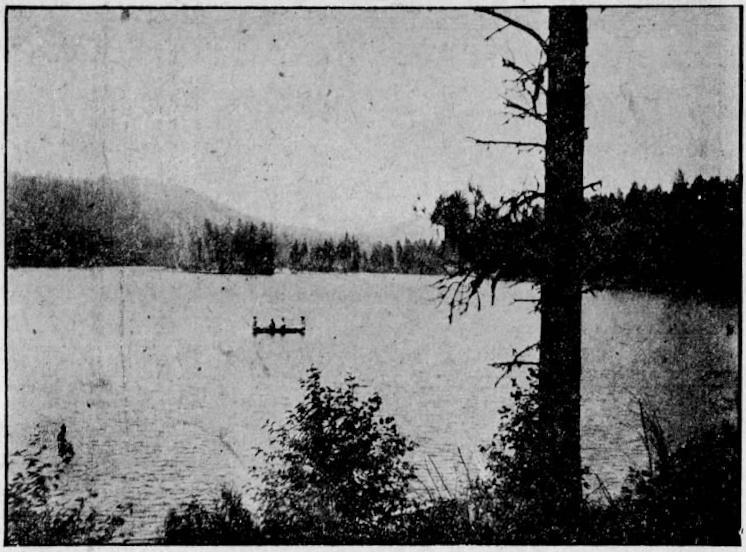
I have made a good many trips over this old trail. It was an old one when I first drove up the river, almost twenty years ago, but when I traveled it the other day. the changes made me feel like a pioneer as I looked back at what it was when I first saw it. It was in October that I made my first journey up the Blackfoot—-October nineteen years ago Fred Sterling Introduced me to this wonderful country and I shall never forget that drive Mr Sterling had a team in those days that I would rather ride behind than to travel in an automobile —that la. if somebody else was driving. Bay Star was a horse from the Raymond ranch, hr could go more miles in a day than any other animal that ever looked through a bridle, and he could travel these mike quicker and come in fresher than any thing else that ever stood on steel—anything except the “Allen mare” that was his driving mate Star was a puller—he could trot up hill and down twenty miles with four men pulling on each rein and never break his stride. It required a man with Sterling’s strength to drive him successfully. But when he was hitched beside the "Allen mare” he lost some of his impetuosity and became very much a gentleman; the team used to move like machinery. And it was this team that took me up the Blackfoot for the first time. The road from Bonner used to lead up the right side of the canyon, along the famous old Blue Slide II was as treacherous a piece of road as ever was mapped. On that day a great rock slid down, loosened by the jar of our passage, and would have taken off a hind-wheel had it not been for Sterling’s quickness with the team. There had been a snowstorm in the upper country; when we got to the Stairs place, we traded our buggy for a sleigh and on the way we hit the road the rest of the route was breathless. It was a great ride, on the way back, we came upon a splendid bighorn buck, standing squarely in the middle of the road; the sheep looked at us and trotted out of the road; Sterling left me to watch and drove to Jeff Demmons’ place to get a rifle. He came back with Jeff and the rifle, the sheep having obligingly waited within twenty yards of me. The return of the team didn’t faze the buck; he stood like a statue while Jeff got a rest on a small tree and fired at him. Jeff missed. What ensued were better left unsaid.
At that time there were a few ranches on Camas prairie; beyond, at Sunset and at Clearwater, there were centres of scattering farmers. Ovando and Helmville, beyond, were the business points for a country that was of older settlement and of longer cultivation. It was all a country of inviting richness, but there was nothing to it then, compared with what there is today. The Blackfoot country today is one of the most remarkable farming sections of western Montana. The railway which is pushing its way up the Blackfoot canyon to the Landing will push farther along before a great while, the possibilities beyond ‘are too great to be resisted. There is no finer grain and grass land in the world than is found in this region; there are no valleys so splendidly watered as these; there are no meadows more fertile; there are no crops more abundant than those which are produced in these valleys that skirt the Blackfoot trail. And this country has at last been discovered. For a long time fortunes have been quietly made in the Blackfoot by the farmers, the cattleman and the sheep growers. But there has been no booming. The country has just quietly come into its own. the settlers are many now.
One of the most historically important trips ever made over the Blackfoot trail, after the march of Lewis and Clark along its route, was that of Governor Stevens and Captain G. I. Higgins in 1856. This was immediately after Stevens had concluded his treaty with Chief Victor at Council Grove, just below Missoula. The parley with Victor had taken a longer time than was expected, and, as soon as it was concluded and the necessary formalities had been recognized, the treaty party resumed its march to Fort Benton, where it was expected a council would be held with the Blackfeet, a council whose object was to end the warfare with the tribes on the western slope of the mountains and to establish peace with the Crows, the Gros Ventres and other plains tribes. Governor Stevens expected, also, to meet at Fort Benton Commissioner Cummings, who had been appointed from Washington to operate with him in securing this treaty. Victor and Alexander, with their braves, were to participate in this council and were to be parties to the new treaty, of which the one signed at Council Grove was but a preliminary.
Governor Stevens was anxious to reach Benton; if Cummings had traveled an schedule lime, hr would be waiting for the governor and the latter knew enough about the bureau fellows in Washington to know that Cummings wouldn’t stand for much waiting loiter events proved that Cummings had failed to follow instructions and had nearly been prevented from getting to Benton at all; it was Stevens who did the uniting. But when Victor and Alexander had signed the Hell Gate treaty, the governor felt the need of haste and hr hurried.
Before the close of the Hell Gate council. Stevens’ agents. Tappan and Craig, and arrived with the drlega-gallon of Net Perces under Looking Glass. Spotted Engle. Eagle-from-the-Light mid others. It was agreed that the Net Perces, with Vidor and Alexander and their Flatheads and Pend d’Oreilles, accompanied by Agent Tom Adams and interpreter Ben Kiser, should cross the mountains to the buffalo country and bunt on the plains south of the Missouri until the time came for holding the great peace council at Benton, of which they would be notified. The agents were to establish courier systems, to guard against all possible collisions with the Blackfeet and to get word to the Crows of the time of the council.
These arrangements concluded. Governor Stevens started his expedition on the march to Fort Benton. “For six miles,” the record of the expedition says, “we crossed the broad. level valley here known as the Hell Gate ronda, and, passing the deep, dark portal of that name, six miles beyond it, we camped on the Hell Gale river. During the next five days and one hundred miles, the party traversed the broad p’atcau of the great mountain chain over a beautiful rolling country of wide, grassy valleys and gentle rolling prairies, interspersed with low. wooded hills and spurs, and well watered with clear, cold, rapid mountain streams. It was hard to realize that this beautiful and diversified prairie country was the top of the Rocky mountains, the backbone of the continent. At the second day’s camp, the Indian hunter and guide, a Pend d’Oreille furnished by Alexander, brought in a fine string of mountain trout, and, not content with this, started out again and soon returned with an elk. and after this the messes were rarely out of game—elk, deer, antelope? and mountain trout.”
The trail followed the Missoula river and the Big Blackfoot, and it will be seen from this description that the country has not changed so very much in sixty years. The game yet lingers close to the valleys; it is a veritable hunters paradise yet, though the settler has taken possession of the valley and cattle and sheep browse where elk and deer formerly found pasturage. It is a wonderfully beautiful country now as it was then.
Governor Stevens followed up the Blackfoot to the main divide and there crossed by the Lewis and Clark pass. The summit of the pass was reached an hour before sunset and the governor wrote an illumined description of the view which he beheld as he looked back over the plains that lay before him. He characterised the scene us a “magnificent and beautiful view, with the main chain stretching away to the north and the broad plains, broken by many streams and coulees, extending as far as the eye could reach, like an illimitable sea.”
With Captain Higgins, his pack-master and lieutenant. Stevens agreed upon a routine which proved successful in getting the train over a good deal of country each day with comparatively little effort, it was the practice to start rather late in the morning—usually at 8 o’clock—and to move al a brisk puce without stopping at noon for rest or meal, making camp early in the afternoon. This afforded the animals plenty of time for feeding in the evening and morning, and made it possible to make a daily inarch of at least 20 miles, which was often increased to 30 or 40 as occasion demanded. It was as fine a train as ever crossed the mountains and the record shows that there was never a sore-backed animal.
Of the handling of the train by Captain Higgins the record says: “As soon as an animal showed signs of needing rest, a fresh animal from the loose herd relieved the distressed one. The packers worked in couples, each pair caring for and handling ton mules. The riding animals were picked Indian horses. The mules were of large American stock. Thorough discipline and the best feeling prevailed among the party. There was scarcely a quarrel during the whole nine months that the expedition lasted. It was noticeable that, though hard-worked and only grass-fed. the animals actually improved in condition—a unique experience on the plains.”
Over the Lewis and Clark pass, the train left the Blackfoot country behind. Yet they were just entering the real country of the Blackfeet. Back of them were the prairies, groves and streams of the wonderful plateau; before them were the vast, rolling plains—gray and arid, save for the mighty rivers which had their sources in the hills behind Camping one night on the Dearborn river, one on the Hun and three on the Teton, the party covered 150 miles and reached the vicinity of Fort Benton on the fifth day. making camp on the Teton river, four miles from the post. The end of the Blackfoot trail was reached.
There is another story in the events which followed—the assembling of the Indians and the completion of the great peace treaty. Another week will tell that.
A. L. S.
Missoula, Sept. 23, 1911