Some footnotes were missing from the supplementary material.
Brook Ziporyn
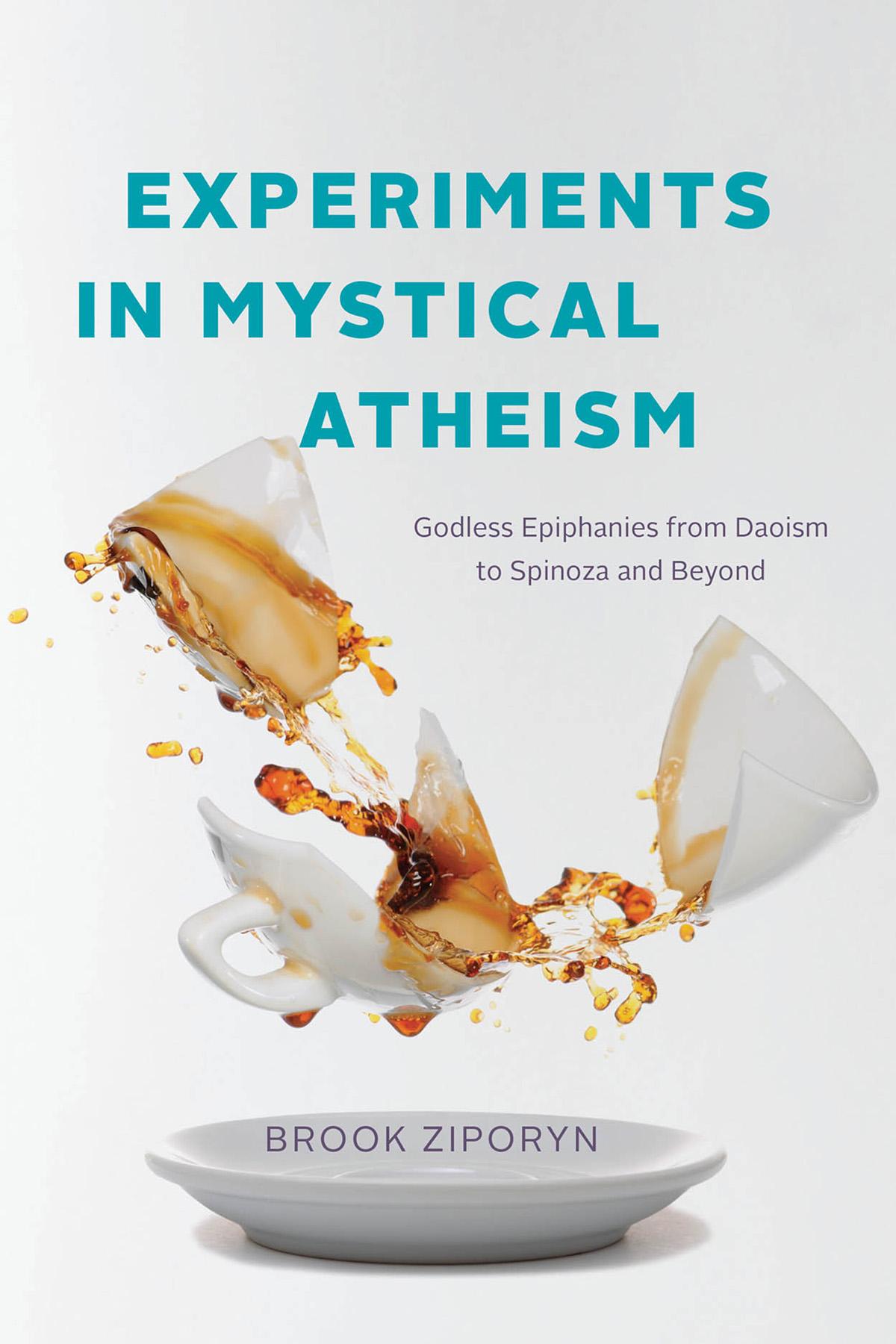
Experiments in Mystical Atheism
Godless Epiphanies from Daoism to Spinoza and Beyond
Let’s Assume a Brain Tumor: Futile Attacks on Monotheistic Faith
Atheism Postmonotheist and Nonmonotheist: Against and after Nancy
Chapter 1: Purposivity and Consciousness
Noûs as Arché: Seemed Like a Good Idea at the Time
Design versus Infinity: Two Rival Explanations for the Intricacy of Existence
Intelligible Good/s versus Infinite W/hole/s in Plato’s symposium
The Hypertrophy of Purposive Consciousness: Animism Gone Wild
Chapter 2: Purposivity and Dichotomy
The Purpose-Driven Life? No Thanks!
The Great Asymmetry: Purpose Obstructs Purposelessness, but Purposelessness Enables Purposes
The Great Asymmetry Redux, Mutatis Mutandis: Chaos as Enabler and Encompasser of Order
Daodejing: The Discovery of the Opposite of God
The Moral Hazard of Moral Ideals
Chapter 3: Purposivity and Personhood
What Is a “Person”? Control versus Necessity and the Dichotomization of Oneness and Difference
Rethinking Personhood as Nonultimate
Love contra the Ultimacy of Personhood
God beyond Personhood? No, Not Really
Chapter 4: Purposivity and Finitude
Tool, Control, Purpose, Thinghood: Bataille on God as Failed Religion
Part Two: Varieties of Atheist Beatitude
Chapter 5: Spinoza, or Intoxicating Sobriety
The Theological Proof of God’s Nonexistence
The Nonthing, the Only Thing, Everywhere, Eternally
Truth as Adequacy as Moretoitivity
The Big Rethink: Body, Mind, Cause, and Purpose
Not Merely Parts of the Whole: How the Temporary Finite Mode I Am Is also Eternal and Infinite
Finitude as the Intersection of Two Infinities
Beatific Vision, Spinoza Style
Spinoza and Schopenhauer on the Universal Will as Unreason, Reason, and Both
Chapter 6: Nietzsche, or the Divinely Vicious Circle
Why Nietzsche Thought So Highly of This Wacko Idea
The Same Life Again Makes No Difference If Truly the Same
The Absolute Affirmation of Anything Is the Affirmation of Absolutely Everything
Chapter 7: Bataille, or Fuckin’ Chaos
Godlessness as Liberation from Both Spirit and Matter and Several Versions of What Remains
Beyond Will to Power as Will to Control: Squandering through the Gordian Knot of Purpose
The Practice of Joy before Death
1. A Classic Example of a Misfiring Atheist Argument from the Film Inherit the Wind
2. Monotheist Religious Innovation as Backfiring Detheology
3. What’s In It For Them? The Backfiring Structure on the Consumer Side
Prison Camp, Slave Plantation, Hostage Situation, Sting Operation, or Strip Mall?
4. The Limits of Teleological Unity
5. Aristotle’s Halfway House: Out of the Frying Pan
6. The Atheist Matrix of Polytheism
7. Why So Hard on Love Incarnate?
Love and Hate When the Oceanic is Subordinated to the Personal: Jesus of the Gospels
Monism and Dualism in the Bible
The Rosetta Stone for Interpreting the Gospels
What is Commanded When “Love” is Commanded
Importance of the Critique Specifically of Jesus
8. Monotheist Negative Theology, and Why It Doesn’t Help Much
Beyond Being, Via Noûs Or Via Raw Infinity
9. Durkheim, Bataille, and Girard on Sacrifice and the Sacred
Extended Neo-Tiantai Postscript
10. By-Products of God: Autonomy, Revolution, Nothingness, Finitude
The New Infinity: the Middle and the Pre-personal Mind
Beauty as Purposeless Purposivity: the Finite Infinite as Actual Concrete Presence
Where Kant Meets Spinoza Meets Tiantai: Hegel Briefly Beyond God and Purpose
12. Spinoza or Hegel: The Inclusive and the Exclusive Oneness Redux
Appendix B: World Without Anaxagoras: Dispelling Superficial Resemblances
1. Confucianism and The Interpersonal Universe: Humanity Beyond Personhood
3. Karma Versus God as Animistic Atavisms
4. Mahāyāna Bodhisattvas as Promethean Counter-Gods, Whether Real or Unreal
5. Being Born On Purpose in an Atheist Universe
6. Tiantai on Bodhisattvas: Fully Real, Fully Unreal
7. Just This Is Divinity: There Are Gods but There Is No God
8. Intersubsumption of Purpose and Purposelessness, Theist and Atheist Versions: Hegel and Tiantai
9. Universal Mind in Early Southern Zen: Another Opposite of God
10. The Lotus Sutra: Monotheism Buddhified, i.e., Destroyed
11. An Alternate Atheist Faith: Amida Buddha and the Pure Land
Experiments in Mystical Atheism
Godless Epiphanies from Daoism to Spinoza and Beyond
Brook Ziporyn
The University of Chicago Press
Chicago and London
The University of Chicago Press, Chicago 60637
The University of Chicago Press, Ltd., London
© 2024 by The University of Chicago
All rights reserved. No part of this book may be used or reproduced in any manner whatsoever without written permission, except in the case of brief quotations in critical articles and reviews. For more information, contact the University of Chicago Press, 1427 E. 60th St., Chicago, IL 60637.
Published 2024
Printed in the United States of America
33 32 31 30 29 28 27 26 25 24 1 2 3 4 5
ISBN-13: 978-0-226-83132-9 (cloth)
ISBN-13: 978-0-226-83526-6 (paper)
ISBN-13: 978-0-226-83525-9 (e-book)
DOI: https://doi.org/10.7208/chicago/9780226835259.001.0001
Library of Congress Cataloging-in-Publication Data
Names: Ziporyn, Brook, 1964– author.
Title: Experiments in mystical atheism : godless epiphanies from Daoism to Spinoza and beyond / Brook Ziporyn.
Description: Chicago : The University of Chicago Press, 2024. | Includes bibliographical references and index.
Identifiers: LCCN 2024002416 | ISBN 9780226831329 (cloth) | ISBN 9780226835266 (paperback) | ISBN 9780226835259 (e-book)
Subjects: LCSH: Atheism. | Mysticism. | Irreligion. | Monotheism.
Classification: LCC BL2747.3.Z57 2024 | DDC 211/.8—dc23/eng/20240205
LC record available at https://lccn.loc.gov/2024002416
This paper meets the requirements of ANSI/NISO Z39.48-1992 (Permanence of Paper).
You see, control . . . can never be a means to anything but more control . . . like junk.
—William S. Burroughs, Naked Lunch
Just this is divinity: that there are gods but no God.
—Friedrich Nietzsche, Thus Spoke Zarathustra, translated by Graham Parkes
The mind controlling the energy, called strength, I call the same: strong-arming.
心使氣曰強
—Laozi, Daodejing, translated by Brook Ziporyn
The Ministry of Love was the really frightening one.
—George Orwell, 1984
Preface
“I’ve always hated the idea of God,” someone once told me—and then added, almost immediately: “but for a long time I couldn’t figure out exactly why.” It was a passing remark made many years ago, but since then it has often come to mind. The speaker was a man named Pawel, the captain of an international freighter ship, the T. Wenda, which sailed under the Polish flag. Though a citizen of Poland, he had a British mother, who had mainly raised him; his English was precise, idiomatic, and rather elegant, British to my ear but seasoned with a slight continental skew. It was late at night and we were far out at sea on the Indian Ocean, toward the middle of a forty-day journey from Yokohama to Hamburg. At this late hour, relieved of duty until morning, he would indulge in his small daily allotment of high-end duty-free scotch, a ritual that often provoked him to seek some convivial company. As the only commercial passenger on the ship, and as the one other native speaker of English onboard (albeit of the cruder colonial variant), I was often singled out for this honor, which apparently was not to be lightly bestowed on his crew.
Staring at the eerily limpid and star-pierced sky that night, Pawel waxed cosmic. I was surprised by his turn of phrase, his reflectiveness, and his outspoken irreligion, of which I’d seen no previous sign. I allowed, tentatively, that the idea of God had caused a lot of confusion and turmoil in the world—is that what he meant? He shook his head slowly and then said something like, “I was always vaguely aware that many atrocities had been committed in the name of the idea of God, and that it rested on quite shaky intellectual foundations. But neither of these really explained why I’ve always found it so . . . so distasteful, so definitively and so intensely so.” He compared it, with a certain light-hearted perversity that was characteristic of him, to the revulsion many people feel when they see a cockroach in their food or hear tell of a particularly heinous sociopathic crime: a disgust that is sharp, nonnegotiable, and imbued with a sense of deep conviction. “It was rather: you say someone created and controls the universe? You say we are living in a planned universe, that existence is attributable to an intention, that it was made for a purpose? This must not be!” He allowed himself to laugh a little at his own dramatization: “That was my instinctive reaction to the idea when I first really took it in.” He paraphrased Kingsley Amis, an author he often quoted when in his cups: “I mean, I understood why I hated the idea, thanks, but why did I hate it so much?”[1]
At that I probably surrendered a noncommittal chortle or nod. In any case, we soon turned to other topics. But I had immediately registered the sentiment he expressed with a kind of muted shock: it turned out I knew exactly what he meant. It was that unsolicited remark many years ago, I now feel in retrospect, that was the seed that grew into this book. For I noticed, to my surprise, that I too had often felt an obscure twinge of instant but weirdly unshakable disaffection when faced with God-talk of any kind, a distaste that was as unplumbed and unexplained as it was unmistakable and undissuadable. Whether it rose to the level of “hate” is debatable; but without question there was something odd about the clarity and intensity of this antipathy toward the idea of God. It would be one thing if I were someone who was committed wholeheartedly to science and pragmatism and materialist Enlightenment rationalism, like modern secular persons, and thus inclined to simply dismiss all nonempirical speculation, all metaphysical tale spinning, all faith-based hypotheses and counterintuitive system building as pernicious nonsense, and to include the God idea as simply one more sordid item in the wild catalogue of discredited human superstitions. But that was not the case with me: I loved all that stuff, loved thinking about it, always found my horizons unproblematically expanded by these precious bits of human spiritual ingenuity—the more outlandish the better—whether I “believed in them,” or even “approved of them,” or not—with one glaring exception: the idea of God, in the sense of a purposeful creator or director of the universe. To put it naively and pathetically: my youthfully earnest good-faith search for expansive horizons of thought and spiritual kinship, my joyous excitement in discovering the profound riches brought forth by the great minds and spirits of the Jewish, Christian, and Islamic pasts and their Greek and Roman forerunners, was repeatedly thwarted, because just when things were getting good, just when the spirit began to gather and new visions to galvanize, I found to my disappointment that this idea of God, in some form or other, kept popping up to ruin everything. In every case, when that notion entered any of these strange ancient or modern visions of the cosmos, even as a mere thought experiment, that vision immediately went dead for me. It lost its magic, its salutary buoyancy and power to inspire, its opening up of new vistas toward thoughts I might actually come to embrace or else simply find it profitable to entertain or develop. But why?
This book is an attempt to answer that question. It entails no claims about the objective falseness or perniciousness of the idea in question, the God idea. It is rather an attempt to excavate what it is that certain contingent persons, like myself, find so off-putting about it. Given that one discovers this antipathy existing in oneself, should it be regarded as merely a narrow childhood prejudice, the outgrowing of which would bring no intellectual or spiritual cost and perhaps considerable gain? Is it perhaps no more than a failure to understand for what it is a harmlessly convenient metaphor for exactly the kind of thing one would otherwise joyfully embrace and explore? Might it even be no more than a feeble cover story for a guilty sinner desperately fleeing his righteous judge? Or might this antipathy instead have some more substantive import, in terms of other intuitions and commitments with which it is inextricably interconnected—some worthwhile philosophical or spiritual implications that can be excavated and examined and developed with some degree of rigor? It is a question of what alternate values and vistas might be foreclosed when the idea of God is entertained, and why. The motivation is thus admittedly very much rooted in this given dispositional fact, whatever its causes may be, rather than objective considerations about what is rationally justified or what is universally good. To pretend otherwise, or to leave this natural fact unaddressed and unavowed, would be not only disingenuous but also a serious obstacle to taking what follows in the spirit intended. Without pride and without shame, it must be owned up to: a kind of allergy, like lactose intolerance, that affects profoundly what one may or may not find digestible, however hungry one might be, and that brings with it certain other orientations and potentials, to be explored in depth in what follows. Some of us are just God-intolerant. This book is not meant to convince any who do not share this disposition, though it does seek to provide them with a thoroughgoing view of how the other half thinks, as a salutary beginning to further dialogue. But it is written primarily in the hopes of speaking to and with others among the mystically minded but God-intolerant, regardless of their numbers, now or in the future, and as a way of rigorously tracking down and charting the entailments and possibilities of such an orientation to the world.
Having said all that, and thus introduced this unavoidably (and perhaps slightly cringeworthy) personal dimension to the framing of this writing, I must report also another peculiar condition that informs it, lest it be even more radically misunderstood. I think it is undeniable that for some of us, this distaste for the core monotheist conception of God, and its various aftermaths, is something so axiomatic that it feels central to our very sense of identity, to our ability to recognize ourselves. But at the same time, we might sometimes have an uncanny awareness, perhaps concomitant to the imaginative space opened up by this axiomatic Godlessness, of at least one stratum of sentiment that lies even deeper: a certain attraction to the shifting of perspective on one’s own prejudices, a strong suspicion at times that one could just as easily have found oneself on the other side of every determinate issue and still feel more or less the same. In certain moods, under the right conditions, it can happen: the dawning of a gentle but vivid empathetic identification, a felt surmise of what it might be like to be a conservative rather than a liberal, a woman rather than a man, an extrovert rather than an introvert, an ascetic rather than a libertine—or a pious Christian or Jew or Muslim rather than a militant atheist. In such a mood one can well imagine feeling just as strongly about all those ways of being in the world—feeling just as much at home in them, feeling just as passionately about them, thinking through their implications with the same excitement and epiphany—and gazing across the great divide at the other kind of person with amazement and incomprehension. We find ourselves seeming to have some sense of what it would be like to be there in that skin, assuming all those things to be just self-evident ways of being, feeling grateful to inhabit them, feeling the joy of working through all the details and implications of those stances, feeling just as snugly situated in those forms of existence. We may at those times begin to understand from inside how many of our characteristic ticks and stylistic features—a certain pace and rhythm of response to stimuli, say, or a way of putting sentences together, a certain tilt of irony and sarcasm and skepticism, but aimed at other objects—could nonetheless still be the forms of deportment we would comfortably inhabit, unchanged default ways of moving through the world in spite of completely altered explicit commitments. This does not imply the existence of some determinate unchanging essence, somehow rising above the particulars of our existence, which would be numerically the same as the essence of that other person if all the particulars were replaced. Rather, it is a feeling that the ever-changing and endlessly renegotiated style of being we currently inhabit and recognize and continue to riff through, the distinctive rhythm of the advances and retreats by which we have learned to juggle whatever is incoming, could easily be continued with other props and would feel the same to ourselves and to the people who know us in spite of replacing all the particulars of our commitments. At those times, something feels a bit contingent and irrelevant about the things we care about, even though we care about them deeply.
This sort of intuition has been something that has itself informed much of my intellectual work in the past: a sense of the ambiguity of identities, which has developed into a theorization of how such a thing could be possible—not due to the assumption of a fixed identity underlying these changing particulars, which does not seem philosophically coherent to me, but due to somewhat more exotic ontological premises having to do with the status of and relationship between sameness and difference per se.[2] In what follows I will occasionally touch on some of those more esoteric ideas, which obviously require extensive philosophical unpacking, but that is not my central concern in this book. Nevertheless, as I write this antimonotheist screed I occasionally imagine myself writing the opposite book, as that opposite me: a passionate defense of neoorthodoxy, of Trinitarian theology, of Christology, of total devotion to the one true god as the only possible form of meaning—on the glories of the Incarnation or the Resurrection or the exact fulfillment of Torah or the prophetic spirit or the ecstatic agony of waiting for the unknown messiah or the true meaning of Jihad. And I imagine I would feel this just as deeply, and naturally spin up intensely intricate swarms of interconnected ideas with complete conviction, and these would mean plenty to me, would have deep and wholesome existential resonances in my life. I should add that if there is someone else out there who can write that kind of book, I would not only encourage it and be glad to see it, but in some strange way I would even feel like I had written it. From a certain meta perspective, I want both books—even though as the me I am now, I would probably never stop throwing up if I had to read that book. Indeed, the only thing that would make me unable to sustain this imagined self-recognition in that alternate me as monotheist polemicist would perhaps be his inability or unwillingness to recognize himself in his imagined atheist alter ego that I currently am—and this is, perhaps, the real core of the structural tensions queried in the rest of this book. I offer this book both to those like my younger self who felt in need of someone to assure them they are not insane or evil to hate the very idea of God, and also to those on the other side of the aisle to aid them in imagining and empathizing with what life is like over here, so perhaps both of us can sometimes imagine being the other. I am hoping that even committed and dyed-in-the-wool monotheists will find something valuable about having the opposite point of view, which might well seem mysterious or just plain perverse to them, spelled out unreservedly and down to the last consequence. Like a long nineteenth-century novel, a full-throated and detailed depiction of the inner life of another type is a good way to temporarily feel what it’s like to be someone else. And that seems to me something intrinsically valuable—for good Spinozistic atheist reasons to be explored at length in what follows.
This book is an attempt to excavate the “offending” premises of monotheism (only for those so offended) and also to look at some possibilities that open up if we suspend those premises. I see this first and foremost as a question of something that came to happen in the way human beings related to their experiences of purpose and control—namely, the absolutizing of them into general ontological structures, a tendency found already in the animistic assumption that whatever happens anywhere must be understood to have occurred in order to satisfy someone’s Will, and was under the control of some conscious being whose deeds are meant to achieve some specific purpose. What came to happen with this raw intuition was its elevation into the idea of intelligence (Noûs) as the first cause (Arché) of all things, implying a universal single-order teleology that applies to whatever exists. The smoking gun seems to go back to Greek thinkers like Anaxagoras and Socrates rather than the Bible—followed by Plato and Aristotle, who did so much to set the parameters for Jewish, Christian, and Islamic theology throughout various periods of their histories, but also to define the terms of the humanistic rebellions against them. My focal point, then, is the paradoxical question of the ultimate status and value of purpose as such. And it is here that Chinese thought becomes crucial for properly taking in the scope and implications of this question, for it was the early Daoist and Confucian thinkers who first made the decisive breakthrough on this question, the stunning suggestion that both human life and the universal process are ultimately grounded in what they call wuwei 無為, nondeliberate activity, rather than planning, purpose, or anyone’s mental control.[3] It is the ontological and axiological ultimacy of wuwei, a motif that informs almost all later Chinese thought in one way or another, that underlies my claim that Dao is, in the relevant sense, the opposite of God. The fundamental question before us is the meaning of the supposition of either a planned or an unplanned cosmos, and whether human purpose itself is therefore a revelation of the deepest ontological fact or rather an epiphenomenal detour that expresses, instantiates, or even intensifies a deeper value and a deeper source: purposelessness.
This opens up some interesting perspectives on many questions, and on alternate possibilities for human life, even for “religious” life. Increasingly I see this as a sort of atheist mysticism: not the humanistic rejection of religion, but the religious rejection of God. This idea may still sound counterintuitive or implausible to some. This book is an argument for its existence and its importance.
In part I, I attempt to get back to the origins of those premises I was just talking about: universalized and monolithized animism as the ultimate principle of causality, Noûs as Arché. This will lead to some consideration of the idea of “personality” and what happens to the universe if we make it the ultimate self-standing basis of reality rather than an embedded, embodied, mediated dimension of reality. The focus here is the absolutization of choice, exclusion, judgment, dichotomization, accountability, tool-being, work, purpose. These are not just aspects of a particularly bad personality; even a loving and open personality will end up saturated with such absolutization if that personality is ultimately grounded in personality (its own or Another’s) rather than in something beyond or beneath or transversing personality, because this is the nature and etiology of personality as such. Then I’ll talk about what else I think might be behind the desire for transcendent ideas, the mystical impulse, and how God gets in the way of this alternative.
This will also involve a view of some of the things that are usually seen as opposed to God in postmonotheist cultures as disguised avatars of the basic premises behind God, including not only the Anaxagorean Noûs as Arché but also the Parmenidean dichotomy between Being and Nonbeing: things like freedom to the exclusion of causal conditioning, autonomous agency to the exclusion of passivity, truth to the exclusion of falsehood, goodness to the exclusion of badness, meaning to the exclusion of meaninglessness, being to the exclusion of nothingness. These are part of the same package as the idea of God, transferred and inverted in some cases but spinning in the same cul-de-sac.
Part I is the “diagnostic” part of this discussion, where I draw on the critiques of monotheist premises found in Spinoza, Schopenhauer, Nietzsche, and Bataille, as well as various Daoist and Buddhist thinkers, in analyzing the entailments of the monotheist cultural complex. In part II and in appendix B, “World without Anaxagoras,” some of these same thinkers are examined to work through their positive proposals for alternatives: priority is given here to thinkers who have ceased to dichotomize freedom and determinism, agency and passivity, truth and falsehood, and the rest of these apparent binaries, grasping the limitations of the idea of God in which they all culminate, and how profoundly this radical undermining of what have become commonsense consequences affects their view of the world. For this reason, the real center of gravity of the book is chapter 5, on Spinoza, who is uniquely important in this discussion because it was he who broke the back of teleology from within the tradition that had for so long obsessively embraced it, using its own premises and procedures, as opposed to the relevant figures in the Asian traditions discussed in appendix B, who never had to contend with any such tradition and thus also never had to break free from it. To fully explore the intricacies of this momentous event, the Spinoza section is much longer, more elaborate, and more detailed than the treatment of the other figures in this book. In a certain sense, it is what everything else here orbits around.
Here and there I have also referenced an online supplement for digressive examples and deep dives into topics that, while not necessarily essential for sustaining the through-line of the exposition, nevertheless can hopefully help fill out the conceptual and historical picture. The unlimited and interactive online space provides an opportunity also for ruminations that can be both more granular and more expansive, as well as less carved-in-stone; some more adventurous and tentative explorations can take shape here while remaining alive to real-time revisions and real-world responses in the future.
I want to make clear at the outset that I am not claiming that these Godless systems cannot be oppressive, violent, stupid, burdensome, ridiculous, entrapping, morally repugnant, sinister, and so on. Though I find Jan Assmann’s carefully stated assessment of the “propensity” for violence (not the necessitation of violence) inherent in the very idea of monotheism rather persuasive both conceptually and historically, this kind of consequence is not what concerns me here.[4] For all I know, burdensomeness of one form or another is going to be a common result of almost any ideology. Though I too will identify some of the rather ugly psychological and conceptual consequences that I see as inescapably entailed by the monotheistic idea, which perhaps are describable as a propensity or even necessity for impoverishment or self-crippling of human experience, I am not in a position to say whether these little tragedies on the individual level of the soul are good or bad for society or for humankind at large. I share Nietzsche’s view—at least as he saw things when in one of his moods—that many of these unpleasant human states, depressing as they may be to behold, can be regarded as sickness in the sense that pregnancy is a sickness: uncomfortable states of long incapacitation that lead to glorious later outcomes. And then again, taking a further step, the blessed, adorable child born from this difficult pregnancy may turn out to be a disaster to various other things, and on and on it turns. Maybe intolerance is good for some things. And maybe the things it’s good for are bad for some other things. There’s no way to assess the final value of any particular stage in the process at the maximal macrolevel. The most I’d say on a social or historical level is that, assuming for the sake of argument that all worldviews can inevitably lead to uses or abuses that are highly obnoxious, at least in the Godless systems the extra obnoxiousness of God is removed.
The idea here is thus not that God has bad social or moral consequences for the world; it is rather that rejecting God and all the concomitants of the idea of God is what alone makes possible a particular type of experience of the world, an experience that for some of us is the only thing that makes life worth living, and that I will unhesitatingly call mystical. The claim is that certain spiritual maladies of humankind are better seen, not as a result of a lack of God, but as insufficiently thoroughgoing atheism. Our problem is that we have hitherto had only a choice between either God or a halfway atheism. Thoroughgoing atheism—exceptionless atheism, deep atheism—though difficult to reach, is what resolves the impasses of both God and everyday Godlessness. This is the idea of atheist mysticism. These are mystical visionaries not in spite of their atheism but because of it—because of the depth and thoroughness of their atheism. My main examples are Spinoza, middle-period Schelling and Hegel, Nietzsche, Bataille, and the Daoists and Buddhists, very much including the seemingly ridiculously credulous Mahāyāna Buddhists with all their transcendental deity-like bodhisattvas and buddhas (which are especially bounteous in their Chinese versions), and finally the ground zero of the whole thing, the ancient Chinese Confucians and, mainly, the so-called Daoist thinkers Laozi and—above all—Zhuangzi, whom I credit with first glimpsing the liberating possibility I will call Emulative Atheism: a beatific vision of an ultimately purposeless life in an ultimately purposeless cosmos.
Introduction
they alight one by one on the pond here below.
I ask where they come from, how flowers are made;
the god of the springtime himself doesn’t know.
瓊英與玉蕊 片片落前池
問著花來處 東君也不知
—Yu Zhongwen 虞仲文 (1069–1123), “Snowflakes” 「雪花」, translated by Brook Ziporyn
The Weird Idea
For the past several thousand years a peculiar idea has been afoot: the idea of God. This is of course not the only bizarre idea we come upon in scrutinizing the annals of our species, if we are inclined to judge them according to prevailing rationalistic standards of common sense. The belief in, say, astrology, extraterrestrial espionage, the Loch Ness monster, Bigfoot, personal survival after death, the existence of invisible ghosts and spirits, geomancy, karma, reincarnation, witchcraft, and so on also may seem unjustifiable and strange to many of us raised under the auspices of modern secular reason and the demands of empirical evidence. But in this book I want to suggest that the idea of God—not the idea of a multitude of unseen forces and deities, but that of a single, sovereign creator deity who is omnipotent and omniscient—is peculiar to a unique degree, and problematic in a distinctive and particularly important way. That is, this book might be construed as a history of ecstatic repudiations of the entailments of the notion of a monotheistic God, what I will call the “big G God,” but not against gods in general, nor against some form of immortality or transcendence, nor indeed against irrational or unjustifiable beliefs as such.
My main purpose here is not to offer the usual arguments against belief in the existence of God. I will be trying to demonstrate neither that the idea of God is objectively false nor that it is objectively bad. I am not trying to show either its factual falsity or its historical destructiveness. Rather, my intent is to show the ways in which atheism as such—precisely the rejection of this conception of a single sovereign creator God—has served as a lynchpin for doctrines and experiences of something we might call, following Nietzsche, “redemptive,” or more broadly, “mystical,” in the works, and presumably in the experience, of several individuals through history.[5] What motivates me here is thus not the desire to pile on denunciations of all religion, nor even denunciations of God, in favor of a complete dismissal of all unjustifiable beliefs in unverifiable structures or forces or dimensions of reality, though as it happens I’m not a believer in those either. Rather, the topic just involves pointed repudiations of any monotheistic notion of God, and just for what I will loosely call religious or mystical, rather than secular, reasons and purposes. Atheism can be, and has been, a certain kind of epiphany, by which I mean that it discloses something radically other than the world presented to us by what we call common sense, something radically different from the socially endorsed vision of reality, from the concerns of the “world” defined as the world of history, of work, of social and financial and artistic success, of shared community goals, and thus of all that is properly called “secular”—atheism precisely as a religious ideal.
This requires an adjustment of our usual assumptions about the default state of human consciousness and what elements are superadded to it in special cases. For if atheism is something that has to be disclosed, something that is not simply the prior absence of the addition of this weird idea from outside, and if this disclosure produces a radical change in consciousness, this implies that our common sense may inadvertently be saturated with the undetected traces of this idea of God, even when it is called something else; it implies that this idea is more difficult to eradicate than is usually assumed, and above all that this eradication is far more rare than usually supposed.
Such a suggestion is not unusual. Nietzsche famously suggested that “we are not getting rid of God because we still believe in grammar.”[6] His point was that the subject-predicate form of Indo-European sentences required the addition of an agent, a “doer,” for every effect: for example, the sentence, “Lightning flashes.” The grammar of this particular family of languages requires a redoubling of the event, reifying the doer, “lightning,” and separating it from its action, “flashing,” but actually the same thing has just been labeled twice and divided by a preexisting grammatical requirement. The by-product of this form is the felt necessity for every event to be done by someone or something, by a cause or agent. Users of those languages end up with a constant intuition that since something is happening in the universe, there must be something who is doing it. This would mean that such persons would be expected to have a genuine and persistent sense “deep down,” when they search their “souls,” that God really must exist—and thus speakers of these languages would be able to discover the presence of God in their own hearts if they would only look deep within and be entirely honest with themselves.
Somewhat similarly, we can find the suggestion among psychoanalysts that everyone believes in God “unconsciously,” and many theologians have made similar assertions, though in a different sense and with very different overall aims. Freud had regarded the attachment to the monotheistic God as the infantile longing for the lost absolute father, the father imagined in early childhood as an omnipotent protector but also as a hated rival. This is complicated by his intriguing and bizarre notion of a repressed phylogenetic murder of this father repeatedly reenacted by the rebellious hordes of brothers in early human protosocieties: the admired but resented father was killed by the brothers, who were then forever haunted by guilt for this deicidomorphic patricide, of which they were also, however, very proud. The idea of the father-like monotheist God of absolute power is thus forever set into the human psyche, replete with its heady stew of love, hate, guilt, submission, rebellion, and ambivalence. The polytheist world was, according to Freud, a brief interregnum, an exceptional moment of respite, an interim period during which the compromise truce of the brothers briefly prevailed, with their grudging nonaggression treaties and their attempt at a civil society; the irresistible appeal and triumph of the monotheist idea is no more and no less than “the return of the repressed,” now decked out with various attempts to handle the torques of guilt and law and submission in variously shuffled ways.[7] For Freud, then, there will always be this longing for the single dominant, maximally powerful Father God in human beings, although this is, of course, the opposite of evidence for either the existence of God or the desirability of believing in it.
The brilliant weirdo and mountebank Jacques Lacan upped the ante on Freud and likewise declared himself an atheist nonetheless by modifying the meaning of this claim in a particularly intriguing way: given the ineradicable unconscious belief in God, true atheism lies in comprehending, not that God does not exist, but that this God in whom we cannot help unconsciously believing is himself unconscious.[8] That is to say, I take it, that God can go ahead and “exist” as much as he wants, and as much as any theist may desire, but that still won’t be any help for the real problem. Whatever God there may be is in the same situation as we are: transversed by unruly, alternative torques of causality and desire that are nonetheless unrenounceably his own, which are even his own deepest self, but this self, like all selves, is devoid of unity, constantly eliding, divided against itself, without any single purpose, impossible to bring to full consciousness and incapable of ultimate coherence. Indeed, in this formulation, God is even a little worse off than we are: we may be undercut by our own unconscious, but at least we also have consciousness as well; God, on the other hand, is in a coma or a swoon, being just a cauldron of his own conflicted drives and the endless metonymic drift of his unconscious symbolizations.
A similar move is made in early Buddhism, which freely admitted all the gods proposed by alternate traditions but sarcastically added that those gods are tragicomically misguided about their own ontic condition. Glued to the treadmill of karma and ignorance and egoism like the rest of us and yet boasting of their sublime status, some of them jump to the false conclusion that they are free creators of the universe on the basis of some deceptive circumstantial evidence and a post hoc, ergo propter hoc logical fallacy, and therefore in the final analysis they are quite a bit worse off than human beings.[9]
Parries such as these reject, not the existence of unseen forces, nor even that of undetectable personal beings with great power; rather, they assert that this is not the question that matters. What matters is rather the larger point that seems to be assumed here: that in principle, nothing is completely in control of itself; that there is no possibility of total control on the part of any being, no matter how exalted. In Buddhist terms, this is called the problem of “self,” which is defined as a consciousness mistakenly and disastrously conceived as an independent entity that is the unilateral controller and sole cause of its own deeds and experiences. God is self writ large. God is self projected to the cosmic level and absolutized to the point of inescapability. Far from being a solution to the problem of selfhood in the form of a mighty counterweight to our own petty struggles for control, God is here seen as more of the same problem, but weaponized and locked into a position of unsurpassable ultimacy, an exacerbation and inverted metastasis of the problem that makes it a trillion times worse. For the problem, on this view, is not who in particular is in control but the very idea of control itself.
In at least one relevant sense, “total control” would seem to be a contradiction in terms: “control” implies nontotality. To be in control means to be in relation to something that is being controlled; but if that thing is completely controlled, it has to be considered part of the controller rather than the controlled, for on this view, “control” is the essential criterion for what among all experienced content counts as oneself. If everything were perfectly controlled, there would be no more relationship of control. The same consideration can be applied, mutatis mutandis, to consciousness: inasmuch as consciousness is always consciousness of something, it requires something at least minimally other to any given consciousness in order to be conscious—even if that object is only another instance of consciousness at another point in time, or present consciousness itself in the mode of object-of-consciousness: the relation of mind as knower to mind as known requires some minimal distinction between them. This would mean that no mind can know itself perfectly in real time—that even in the seemingly magical self-relation known as self-consciousness, some form of opacity to itself pertains to consciousness per se, even if only in the form of the requirement to check and verify its present knowledge against future retrospection, as is imposed by the serial temporality of conscious events. By this reasoning, knowing as such requires that whatever exists in any form is always shadowed or even permeated by otherness, that no spirit can exist without being shackled to an otherness (for example a “body” and a “world” and a “past” and a “future”), a nonself other-self that is nonetheless itself, and/or a perpetual obstacle to its own action and knowledge that nonetheless is, precisely qua obstacle, essential to its existence.
Though this claim is argued for vigorously (and, in my view, convincingly) in some modes of thought such as those touched on just now, it is not self-evident. But neither is it, prima facie, at all shocking. After all, no consciousness has ever been empirically discovered that isn’t linked to a corresponding body, and no wakefulness has ever been observed that does not function by alternating with a state of sleep, namely, by periodically wearying and losing control of itself, by succumbing to its own opposite. If we cannot help imagining a superconsciousness as audience for the drama of our histories, it would be natural to regard it as a superconsciousness with the identifying characteristics of all known consciousness, embedded in body and shot through with sleep, sometimes losing the thread and having to scramble to recover it while never entirely sure if it’s got the whole picture. Indeed, why not a consciousness so deeply fragmented and rent by patches of opacity that we might better describe it as many minds rather than one, a host of conflicted divinities joined at the hip of their embeddedness in some larger unconscious structure? In that case, the ens realissimus would be unconsciousness rather than consciousness—or better, a kind of ambiguous and unstable mixture of consciousness and unconsciousness hovering around their interface. We will see some such idea in those polytheist systems that posit a nonconscious substratum from which the personalities of the gods emerge and into which they are subsumed again: the Absolute as something that is neither devoid of personality nor possessed of only a single particular personality, but as productive and destructive of infinite personalities.
The slumbering almighty, the restlessly dreaming God, may be a more profoundly atheist conception than the outright denial of God (which, as we’ll see, has difficulty avoiding an implicit repositing of God at a higher level as the guarantor of the initial God’s literal nonexistence). For the idea of God is correlative to a certain conception of our own agency, of selfhood per se. Thus we will be considering traditions that radically rework the concept of human agency and consciousness—early Daoism with its conception of wuwei and Buddhism from its foundational “nonself” move forward, even into its most extreme reaches of mythology and religiosity—as the most thorough and important heroes of a genuinely atheist revolution of consciousness. In a certain important sense, a Mahāyāna Buddhist kneeling and praying to a cosmic bodhisattva for supernatural assistance, or endeavoring to see himself as seen by an eternal omniscient mind that is not a purposive creator and controller and judge but exactly the opposite, is a more thorough and fundamental atheist than a scientific rationalist or a secular humanist who continues to think of himself as a transparent rational agent, a consciousness that directs and controls his own actions according to clearly conceived purposes, in a universe “governed” by natural “laws.” This book is an attempt to explore that “certain important sense.”
God as Default?
Perhaps the idea of God in some form or other—even if only in the vague Alcoholics Anonymous form of “a higher power”—can be considered a built-in structural possibility or tendency of the human machine, which is activated by certain kinds of accidental environmental switches or social arrangements and very hard to eradicate once it has kicked into gear. After all, it is hardly controversial that there exists a power “higher” than ourselves, assuming that higher means more powerful: a truck that runs us over or a swirling supernova or airless void that threatens to consume the planet would equally qualify. The question is what this higher power is like. In what sense is it “higher”? And in what sense is it “a” higher power (i.e., singular)? Even granting that many of us (at least in certain historical and cultural contexts) have some instinctive sense of being “watched” by some other consciousness or consciousnesses—a perpetual authoritatively knowing eye hovering over our shoulders—what does this signify?
In Lacan’s view, God is not only unconscious, but is also one way of concretizing “the Other,” sometimes denoted in English recountings as “the Big Other,” namely, the intersubjective symbolic order as a whole, the system of meanings and identities into which every speaking subject is plugged by virtue of the intersubjective referentiality built into language itself, with its constantly deferred but constitutive promise of consistency. The Other has some view of me, sees me, and judges me, and my identity as such is constituted by both the supposition of this truth about myself as seen by the Other and also my inability to grasp, confirm, or understand it. Baked into this sense of being watched and identified is a need to be seen as acceptable by this Other, who is more powerful than me and on whom I am dependent—the composite face of the shadow community of powers-that-be that preexist my birth and set the parameters for my continued existence. If so, then as long as “I” exist, this unconscious notion of the more or less omnipresent, omniscient, omnipotent viewer and judge, the one who knows what I really am and gets to decide whether to continue to support what I am—God—will probably exist too. To see that the Big Other does not exist—true atheism—is to see that the Big Other itself is in fact not consistent, not free of contradictions, not fully constituted (for who is the other Big Other that would establish and guarantee the Big Other’s identity?). Hence it can have no genuine consistent judgment of who or what I am nor consistent agenda about what is to become of me. God is unconscious. This realization, in one period of Lacan’s musings, is precisely the traversing of the primal fantasy constitutive of the ongoing misrecognition called our identity, and the cure for neurosis. But this is very difficult to achieve: we find that we are always playacting, posturing, engaged in a performance for the benefit of the imagined audience, the God who sees and knows us, even in our disavowals of his existence: even in assuming the consistent identity as an “atheist,” we are assuming a God as spectator and judge.
The slide toward God could be viewed as a kind of endemic and stubborn design flaw, something genetically predetermined though radically false, some expression of which is an inevitable temptation even in cultures that have not been subjected to enforced claims of revelation from charismatic epileptics speaking in God’s name, a kind of natural detritus produced by the human experience, an attractive optical illusion that always “rings true,” like the flatness of the earth. To really understand what it means for there to be no God would then require a Copernican revolution of our own sense of identity: one would have to somehow learn to intuit that it is the earth moving around the sun rather than vice versa, although all one’s senses and all our entrenched animal bearings continue to tell the opposite story. To root out this unconscious belief and all of its unnoticed entailments would then be a kind of religious quest in its own right, something very difficult, which, if accomplished, would thoroughly change all our prior beliefs, affects, and orientations, the tone and implications of our perception, our volitions, our aspirations, the whole of our experience.
And indeed, if we cast our eye back over the history of human activities, we find that there have been more than a few figures who have not only rejected the idea of a sovereign creator and ruler of the universe—who bestows on it a meaning and a purpose with an interest in the welfare of his creatures, with whom one might have a relationship, whom one may please or displease, whom one may obey or disobey, holding a plan and a purpose and meaning for the lives of those creatures—but they have also experienced this rejection as the crucial premise, not just for making human life a bit better, but for bringing about a thorough and, in their own opinion, profoundly desirable transformation of experience. Atheism had become, for these thinkers, the essential adventure, a quest for something more than the “given,” at the opposite pole from atheism in its more familiar incarnation, as a scoffer’s skewering of all the impudent claims to undermine what is plainly before us, plainly sensible, and plain to our eyes and ears.
There are and have been here among us humans some who object strenuously to the given as given by common sense but find the idea of God, in spite of all its fanciful extravagances, to be not the unsettling of that world of the given, but precisely its firmest anchor, rooted at its perspectival vanishing point. This way of putting it can be misleading because there is a paradox built into our relation to the given and what might be beyond it, as we will see. For one unexpected result shared by almost all the figures to be discussed here—all manner of Buddhists and Daoists; European heretics like Spinoza, Nietzsche, and Bataille; freaky transcendental philosophers like the early Schelling and Hegel; perhaps even their bastard American son (via pious, rambling Coleridge) Ralph Waldo Emerson—is that the given, the unquestioned prosaic world of common sense is maintained by positing something radically other beyond it: an ideal, a source, a justification, an alternative. Fully accepting it—radically accepting that there is no possible escape from it, that there is nothing else—is ironically what alone can undermine it, transcend it, destroy it, electrify it, redeem it. Strangely enough, it might be only when we are convinced that there is nowhere else to go that we can ever get out of here. What follows is an examination of the forms taken by this necessarily crooked and zigzagged quest for something, arguably, that all of us do want in one form or another, because it is what wanting as wanting wants. For what does wanting want? It wants something other than this. It wants something else.
Preaching to the Choir
In directing this discussion not against irrational beliefs or nonsecularism as such but only against the belief in a monotheistic God, I am taking a position distinctly opposed to that of a recent spate of popular books in defense of atheism. I have in mind here the works of such figures as Richard Dawkins, Sam Harris, and Christopher Hitchens. All these books argue against irrational beliefs in general, among which they number monotheism of the traditional Abrahamic faiths a particularly pernicious example. Atheism is here presented as a simple entailment of rationalism—which is itself viewed as just good sense systematized and made aware of itself as a consistent method. It is a part of the general rationalist and scientific project of the Enlightenment, which, as such, contributes to making life here on earth somewhat more pleasant: it contributes to scientific progress, hence to useful technology and knowledge, and protects against the horrors of theocratic politics. I applaud and enjoy these books, although I am not in agreement with their basic premises.
Of the three, Sam Harris is closest to what I’m doing here in the sense that he makes a sharp distinction between some nontheistic religious claims, such as those of Buddhist meditative traditions, and the theistic claims for faith in a God of the Abrahamic faiths. Harris regards the claims of meditative texts as being in some way potentially verifiable through empirical methods, as contrasted to the call for faith in the absence of empirical evidence or reasons as he sees it presented, and indeed extolled, in the scriptures and theologies of the Abrahamic religions.[10] I am in strong sympathy with Harris in seeing a difference not just of degree but of kind between the monotheistic religions and the nonmonotheistic religions. But oddly enough, in a certain sense I find Harris to be perhaps the most insufferably wrongheaded of these three authors—the least interesting, the most narrowly unimaginative about first principles, the most cluelessly preaching to the choir.
Dawkins is to be applauded for providing actual new ideas and arguments; he is the most genuinely creative and insightful of the New Atheist horsemen and a practicing scientific theorist. And Dawkins has, in books like his Unweaving the Rainbow: Science, Delusion and an Appetite for Wonder, tried to develop his own version of what might be called a mysticism of reason: invoking the mystery and grandeur of the materialist universe as science now presents it to us. But in most of his arguments, like Harris, he labors with an unfortunate circularity: essentially, they are both trying to reason people into accepting the sole authority of reason.
Hitchens, who is quite as caustic about Buddhism as about Christianity, is far more narrow-minded than the other two on many counts, but in my judgment his work is more meaningful for being less reasonable and less profound: it is much more amusing, persuasive, and in some ways more consistent. There is a style of life invoked more in his rhetoric than in his reasonings, drolly cantankerous and somewhat comic, which inadvertently plants a foot in values other than those of pure utility and sensibleness. The reasonings themselves, however, use the same approach as the other two: reasonable arguments for accepting reason.
To reason someone into accepting reason is preaching to the choir. If they don’t already accept the authority of reason, your efforts are futile. But of course, the implicit structure of the endeavor is not quite this simple-minded. For the assumption is that everyone, without exception, is always using some form of reason, indeed depending on it to make all their practical choices, all day every day. The premise here is that the canons of reasonableness—parsimony, empiricism, experiment, assessment of probabilities—are just crystallizations of what a living creature is always doing, more or less efficiently, and must do in order to stay alive. When crossing the street, one doesn’t say, “Although my senses and past experience and reasoning from the laws of physics tell me that there’s a car speeding toward me, I have faith that there isn’t one.” Nor does one say, “It’s possible that God is just manifesting the appearance of a car in speeding toward me, and since God loves me, there is nothing to fear.” One applies parsimony, Occam’s razor. Although there are millions of possible explanations for why it seems that there is a car speeding toward me, I believe the one that requires the fewest unproved assumptions: namely, that there really is a car speeding toward me. The rationalist arguments against God are an attempt to say, “Look, you’re already committed to reason in a thousand ways; it’s just that you don’t apply the same standards to the question of God.” We have plenty of reasons, applying the very same tests you use all the time when crossing the street, to conclude that there is no omnipotent God who created the universe.
But this slightly subtler version of the argument doesn’t really get us anywhere either. There is no question that, in fact, we do make practical decisions on the basis of inductions and deductions that can be described by appeal to parsimony; but it’s equally a fact that we can and do preserve a degree of provisionality in the conclusions we draw in this way and that we have the ability to step beyond any and every conclusion we have already drawn. Parsimony comes with a built-in cancellation clause because temporality is inextricable from it: there’s always a next moment coming. (To put it more pretentiously, Openness is intrinsic to Being.) Both the positing and the stepping-beyond are facts of experience, and neither reasoning nor practical decision-making could work without both. Why privilege one at the expense of the other?
Objectivity in the metaphysical sense is an unwarranted absolutizing or sedimentation of half of a two-step process. The philosophical worldview of objectivism is read off from an aspect of this process and made into a doctrine about metaphysics, when in fact it’s just one of many tools in the hands of a hungry animal. So even though it may be the case that, to the extent that we are admitting reasoning at all, the monotheist God can be disproved, there will always be Tertullian, that fascinatingly volatile and wickedly histrionic Church Father, who blurted out the unsurpassable final word on this issue way back in the early third century: I believe because it is absurd, said Tertullian.[11] And no amount of reasoning will be of any use in convincing someone who has declined to accept the ultimate authority of reason. It is no use saying, “Look, Tertullian, you’re already using reason, you tacitly admit it, so how can you exempt this one issue from application of the same standard you use when you cross the street?” Why must he have only one standard? Should he do it because it’s reasonable? But he’s already shown he’s willing to eschew reason when he feels like it. If we think of beliefs as tools, this sort of move becomes unremarkable: why should I have only one tool that I use on every kind of material? A hammer for pounding nails, a nail-clipper for clipping nails—for not all nails are the same. We call all things “things,” but not all things are the same or require the same type of treatment. The illegitimate step lies in assuming that there must be a single standard applied at all times, for all types of situations, regarding every type of subject matter. Why assume that there is any unity of this kind applying to the world, that all existence must form one single system with a single set of laws and rules applying to all of it? That too is part of the circular assumption of the sole universal authority of Reason—an assumption that, I would argue, ironically has deep roots precisely in the idea of God.[12]
Some rationalists will argue that this unity is actually entailed in the very notion of reason as such. We find something like this expressed most forcefully perhaps in Kant. And there is some truth in this argument in the sense that we can always push back behind any diversity to find the field in which both are situated, which makes possible even their contrast, being the “condition of possibility” of their very difference from one another. In this sense there is indeed a built-in primacy of a kind of unity. But as I have argued elsewhere, the full thinking-through of this unity ends up effacing the type of unification that would entail the application of a literal sameness for all members contained within it: this irreducible unity is equally describable as an irreducible diversity.[13] The presupposition that the unity of Reason can be represented as a set of consistent and universally applicable laws with a positive content is, on the contrary, a holdover precisely from raw monotheistic intuitions. It implicitly posits the God’s-eye point of view, a unified purposive consciousness and therefore a single-focused consciousness, which embraces everything at once and for which everything is a definite object, a definite tool, a definite work. And the irony, of course, is that the religious argument has always rested on asserting that the type of object we are considering when we consider God is radically unlike any other type of object—infinite as opposed to finite—and thus cannot be made subject to the canons of reason designed for handling the relations between finite things. But to whatever extent this infinite, radically other something is considered a mind—a purposive mind, a single-purposed mind, a single-minded mind—it has been the very essence of finitude, of the enforcement of finitude, as I will try to show. And it is only in this sense, I claim, that the word God can properly be used, in opposition to, say, the Plotinian One or the Daoist Dao or the Buddhist Dharmakāya, which may well be metaphysical absolutes but are not purposive minds. If it ain’t a purposive mind, it ain’t God. And God, the universal purposive mind, is the problem.
Let’s Assume a Brain Tumor: Futile Attacks on Monotheistic Faith
A consistent rationalist account of the origin of the Abrahamic faiths would probably have to unflinchingly accept either some form of mental illness or conscious chicanery on the part of their founders. It would certainly be easy on naturalist grounds to think the key letter-writers and revelation-receivers of originary Christianity and Islam—I won’t name names—were clinical epileptics. If we push this materialist supposition to its ultimate blasphemous conclusion, we should say that what “God” actually refers to in the discourse of these figures is, say, a mental disturbance erupting in the right half of P or M’s brain, perhaps a brain tumor that caused them to hear voices and see visions. I myself have no difficulty at all accepting this, and though it is rarely stated in polite company, this really would be the conclusion to which Occam’s razor would lead us: it is the simplest explanation, the one with the fewest extra assumptions, the minimum multiplication of explanatory entities and premises, the most consistency with what we otherwise observe.
Believers in these religions typically react to such a suggestion with horror and outrage, or worse. But the point I want to make here is that there is no reason for this outrage. Even if we could prove beyond a shadow of a doubt that a brain tumor were the proximate cause of everything written in the Bible and the Quran, this would be of no avail at all in arguing against the truth of those revelations. Once you’ve assumed God, you have, quite literally, an answer for everything. You can simply say that when God wants to reveal himself to someone, he plants a tumor in him. A tumor is the means by which God manifests himself. A tumor is the way God implants the epileptic effervescence in a human body by means of which alone he can shine through it, a sign recognized correctly by the spirits of the believers who flock irresistibly to the entumored visionary. And given the premises of the argument, this is absolutely a legitimate rejoinder.
The same can be said of any argument trying to show the historical background of religious ideas and beliefs, the low purposes they serve, the selfish material interests they protect. All this may perfectly well just be the means God chooses to reveal himself. The same may be said of individual present-day appearances of well-known divinities. Someone who has a personal relationship with Jesus, who has felt his presence and continues, day after day, to receive his promptings, engaging in continuous conversation with him, believes that this is actually Jesus, the same entity who appeared two thousand years ago in the flesh in Palestine, who is speaking with him. A skeptic may say these are psychological projections, engagements with aspects of the believer himself taking an externalized or slightly hallucinatory form, or manifestations of unconscious archetypes—and this may be viewed as either a fine form of self-therapy or a dangerous delusion. A Mahāyāna Buddhist may say this is Avalokitśvera bodhisattva appearing in the form most suited to this person so as to enlighten them as appropriate to their level of receptiveness, namely, in the culturally conditioned, comfortable form of Jesus. But, in fact, none of us know where this experience ultimately comes from, even if we know the proximate cause. The Christian believer, like the Buddhist, should not be at all disturbed by the skeptic’s claim; even if this is a mental illness or demonstrably a result of brainwashing or a brain lesion, these would be perfectly legitimate ways for God or Jesus or Avalokitśvera to manifest to someone. That’s just the nuts and bolts of how they go about setting up communication with human minds. Hence, none of these are decisive adjudicators of the status and value of these experiences. My claim in this book is that what matters instead is the actual content of the revelations, as tweaked by their linkage to their respective textual and institutional traditions of doctrine and praxis.
A similar consideration applies to all attempts to show how harmful particular religions have been in human history—how many wars they have caused and how instrumental they have been in creating every kind of human exploitation, servitude, and misery. Even if it were proved incontrovertibly that every single pope, preacher, rabbi, and imam had been a conscious charlatan, a self-confessed fraud motivated purely by self-interest and without the slightest belief in the wares he was selling, any real believer worth his salt would be well within his intellectual rights to simply say, “Yes, but that is the human misuse of revelation, probably misled by the cunning of Satan. All of that was done by Man, not God. It is only to be expected that sin will try to take hold of the Truth and endeavor to distort and exploit it. Thus does God spread his word, even if a single pure believer has not yet appeared in human history. This is how God sets things up for a better future, provides opportunities for holiness, waiting patiently for righteous human beings of the future who will truly adopt His revelation and make themselves pure through it. Onward!” This should be sufficient to show why the Harris-Dawkins-Hitchens approach is entirely futile.
Atheism Postmonotheist and Nonmonotheist: Against and after Nancy
At the opposite extreme from this proscience, antireligion atheism, we have lately begun to see another variety of atheism arise, especially in continental Europe: a humanist postmonotheist atheism that endeavors to affirm the value of the idea of God as a glorious precursor to the unique achievements of modern European atheist enlightenment. The monotheist God is viewed here as a kind of first step away from pagan polytheism and toward the rationalist modern world. In truth, this view is not far from that of Hegel or Feuerbach, and it is echoed by atheist Marxist thinkers like Slavoj Žižek and Alain Badiou as well as in a different way by non-Marxist (and ostensibly nonatheist) theorists like René Girard, all of whom admire Christianity not so much for the God it posits as for its tricky way of undermining prior cultural institutions—whether narrow local loyalties or the pagan scapegoating of sacrificial victims or the unilateral authority of an uninflected, uncrucified, nontriune Father God—to pave the way to the universalism of Enlightenment and the Rights of Man.
One can certainly understand the impulse to find something worthwhile in close to twenty centuries of obsession, after the initial period of vilification has passed—as in a difficult breakup with a lover in whom one has become thoroughly disillusioned, the passionate repudiation and self-hatred needed to extricate oneself are succeeded by the calm perspective of distance and nostalgia: you start to remember some of the good things that attracted you in the first place. And it can’t be pleasant to have to recognize that one was fooled by a ruthless mountebank, or that for two millennia one’s entire culture was hijacked by an insane apocalyptic death cult: finding something of value there is a way of retrospectively saving face. But from afar it is certainly an uncanny thing to witness the European mind veering again Godward: an unsympathetic observer may have to suppress the inevitable dog-returning-to-his-vomit adage (Proverbs 26:11) that springs to his lips. Be that as it may, as already hinted, the type of atheism at stake here does remain deeply beholden to the Christian past: and this atheism, no less than the scientistic New Atheism, we also want to repudiate.
Jean-Luc Nancy is perhaps the primary exemplar of this trend. In a spate of lectures and articles, which were collected in two recent books translated into English under the titles, Dis-enclosure: The Deconstruction of Christianity, and Adoration: The Deconstruction of Christianity II, Nancy has developed these central claims about Christianity and its relation to what he makes bold to call “the West.” Of particular interest is the link he draws between Christianity and modern European atheism as a defining achievement of Western culture, going so far as to assert, “Not only is atheism an invention specific to the West, but it must also be considered the element in which the West invented itself as such.”[14] Side by side with this claim comes the suggestion that the monotheistic God of Christianity (and also Judaism and Islam), far from obstructing this atheism, is in fact the precondition and, as it were, the prototype of it, the very “trial or process of atheism itself in its most rigorous proceedings.”[15] Christianity is, on this view, the means whereby atheism, the defining destiny of the West, came to be; Christianity is atheism-in-the-making. Essentially, it is the first shot (or perhaps the second, after Platonic protomonotheism) in the war that won its way to atheism as a specifically Western achievement of “disenchanting and alteriorizing” the world. It is this distinctively Western monotheist-atheism in various disguised forms, that now overruns the world under the names of modernization and globalization, and from which there is no escape, since all alternatives are already submerged into and transformed by it—any attempt to recover non-Western alternatives to monotheist-atheism, on this view, can only be Eurocentric Orientalist distortions. Hence, Nancy says, the solution to the peculiar impasses embedded in monotheist-atheism-occidentality must be sought within it, thus justifying a sympathetic reconsideration of the roots of monotheism as a possible resource for its solution.[16] I would like to consider these claims here and raise some objections to both their premises and their conclusions on the basis of a contextualization against the backdrop of some non-Western traditions of atheism, in particular the forms that are central to certain Chinese philosophical and religious traditions.
Nancy claims that the monotheistic move, beginning with Plato’s indefinite references to “the deity” (ho theos), “in the singular and lacking a proper name,” was, above all, a way of removing a preexisting saturation of divinity in the world, draining the world of a prior presence of gods and converting the idea of divinity instead to one of a transcendent and prior principle rather than a presence. The definite divine “sense” that had previously been in the world was now taken out of it, resulting in the “evaporation of all divine presences and powers, and the designation of a principle that no longer has as ‘divine’ anything but the name—a name dispossessed of all personality, and even the ability to be uttered;”[17] and the only deity left now is “without figure and name.”[18] The elevation of this God is a demand for absolute alterity, which Nancy reads as the opening up of the world to an omnipresent but inaccessible otherness, an unconditional alienation. Thus the monotheistic God, even the hybrid Christian god that comes from the wedding of this nameless, narrativeless Platonic God to a very specific narrative, personality and name, is for Nancy a precursor and initiator of the complete “dis-enclosure” of all alleged worldly closures, including not just those of mythology but those of cosmology and physiology as well. At the same time, as the exceptionless priority of a principle, with its fingers no longer merely in some occasional visitations but necessarily at the basis of every pie, this absent God also becomes more inescapable, given the constant presence of its own absence, as opposed to the occasional and intermittent presence of the old gods as beings that come and go in the world. The positing of this nameless, narrativeless God in place of the troop of gods who had been man’s partner and counterpart in the world is for Nancy a “dual positing of a radical alterity (god and man are no longer together in the world) and a relation from the same to the other (man is called toward god).”[19]
Nancy’s argument here rests on his assertion that the “other world” that was effectively used as a lever to perform this feat was never really a second world, that instead it was merely “the other of every world.”[20] As such, the transcendent God is not something that “exists” in the normal sense, but is rather construed as something that does not exist but that “defines and mobilizes” existence. God, on this view, is not the highest that can be thought but rather a word for the “ordeal of thought immersed in its inability to escape what is beyond any and all thought”; this is the limitation of thought itself, presented, however, in this misleadingly positive form.[21] God is here taken as a name for the unclosability of any finite or knowable being, presented in the form of their groundedness and powerlessness before something that is itself discoverable nowhere among beings.
In the background of this wildly counterevidential claim is perhaps Nancy’s intuition that this positing of a phantom other world is the only way to posit this otherness to any world, that, to use a Buddhist phrase, a thorn must be used to remove a thorn—that the expedient of an alternate transcendent divine presence was necessary to remove the prior immanent divine presences. We should be alert to this premise as it appears often, in one form or another, in assessments of various historical doctrines; for example, the assumption in the ancient world that the threat of postmortem punishment or reward at the hands of a deity was the only way to ground a morality tends to make one more indulgent in one’s assessments of those ancient moralists that lean heavily on this premise, which in turn can make us assume that, since such highly esteemed figures have always deployed this threat, it must be something profoundly true, even if stripped of its ancient mythological setting. The discovery that there are alternate ways, dating back to ancient times, of talking about such matters that do not resort to this premise will radically alter our assessment of both the promulgators of such theories and the need to read demythologized versions of them back into nature. Nancy’s claim here contains an implicit reference to what is not the West: it is in contrast to some imagined non-Western traditions that Nancy is imagining the essence of the Occident as lying in its unique achievement of atheism. His assumption is, therefore, that atheism could only be achieved by this seemingly contradictory monotheist move since monotheism itself is a far more obvious candidate for what is distinctive about the West. The acknowledgment of other forms of atheism elsewhere in the world that developed without requiring any such transitional monotheism will therefore destabilize the claim. Nancy’s first reference point is, of course, the ancient Greek and Roman religions, which were the direct target of the Christian revolution, but in the claim that atheism is a specific achievement of occidentality, the assumption is made that the world untouched by the West was in the grips of the kind of religious saturation that made it unable to achieve atheism.
I consider this claim to be not only historically unsupportable and highly misleading, but also as a specific post-Christian distortion of the nature of real atheism, an inadvertent confirmation of Nancy’s thesis that modern European atheism is just Christianity in a new guise—but not in a good way! The two willful smear campaigns so crucial to the sources of Western monotheism continue to reign here: the willful incomprehension of polytheistic ritual, anathematized as “idolatry,” that is found in the biblical prophetic tradition and the willful bad-mouthing of poetry and art that goes hand in hand with Platonic protomonotheism. What do these two repudiations have in common? They claim to be rejections of the adequacy of any appearance to completely embody the relevant transcendent content, thereby honoring its status as beyond all concrete representation: the inadequacy of any particular concrete expression is presented as equivalent to the unreachable transcendence of that content. But looked at from a neutral vantage point, they seem rather to be rejections of an alternate way of presenting this incompleteness of every concrete expression of the divine: polytheist worship and nonrationalized art express this inadequacy in the unlimited proliferation of alternate appearances, each approaching the elusive content from a different angle. Every idol is a particular presencing of a god who can appear as an infinite number of other idols, as infinite alternate material or immaterial presencings. The expansive transcendence of the god is present in this inherent, unfinished ambiguity, which links each concretization implicitly to its ability to concretize otherwise in other times and places. We glimpse here two different ways of guarding against taking any specific appearance as adequate to the divine—the monotheist prohibition of any representation and the polytheist encouragement of infinite representations—with very different structures and very different implications. To the latter, at least, the former appears simply to be giving a monopoly to one particular kind of representation (inasmuch as “the exclusion of representation” is itself a representation; more on this to follow)—we might say, a monopoly of one particular “idol” or “art”—at the expense of all the others.
It is arguably these two specific repudiations, of idolatry and of art, that define monotheism as such, rather than the structure of “omnipresent absence that undermines all positive presences” on which Nancy focuses. For even within the Western tradition, the latter structure is really the heart of all metaphysics as such, and yet indeed also the heart of all attempts to undermine metaphysics. The real issue is the status of the intelligible, of knowability, which God both enables and eludes, like Plato’s Sun or Plotinus’s One, or indeed like Kant’s transcendental categories, which both enable all knowledge and yet elude direct observation, or Heidegger’s Being, which is definitionally not any particular being. For what happens in Christianity is not the creation of this interesting and important structure of thought as an omnipresent absence grounding all presences—a trope that throughout history appears sooner or later almost everywhere in the world—but the decision to wed the Platonic unnamed, narrativeless deity, which is already hostile to multiple expressions and the ambiguities of nonexclusive semiconsciousness, decisively back to the notion of a personal God. The alternative would have been rather to take the other option, the Plotinian option, of reading Plato atheistically and metaphysically, that is, as calling into question the ultimacy both of purposive intelligence and of intelligibility itself—and thereby, as we will see, beginning to question the ontological priority of disambiguation, of finitude, of mutually exclusivity itself.
Because the word “God” emphatically denotes a mind, indeed, a purposive mind—and indeed, a single purposive mind—the call beyond thought that Nancy attributes to the monotheistic God necessarily always fails; it is a blind window, not the establishment of what is beyond thought but rather the abuse and domestication, a gesture of containment, of what could have been a burgeoning move toward genuine dis-enclosure. This undercuts Nancy’s wishful claim that the idea of God “really” means that “the world rests on nothing, and this is its keenest sense.”[22] For it is not at all the case that God signifies that no etiology of the world is possible; on the contrary, God is the replacement of indeterminate beginninglessness with a definite act of Divine Will, with a motivation, with a mind that has preferences for some states over others, and in this minimal but crucial sense at least, with a shadowy personhood embracing some conception of the Good: God means that the world rests not on nothing, but on purpose. That the content of what is willed is necessarily unknown to us makes no difference: if we are saying “God” (instead of “the One” or “Being” or “Dao” or “Dharmakāya” or “Brahman” or “Necessity” or “Fate” or what have you), we are saying we know it to be purposive. It is not “nothing” that the world rests on here: it is some form of personality, with some form of purposive mind and some form of Will.
To be sure, the ideas of “personality” and “purposivity” and “Will” are, in a certain nonnegligible and rather deep sense, an interpretation precisely of what is beyond predictability, beyond thought, being determination—the unreifiable, a gap in the order of entities, no-thingness—in that a “person” or a “mind” or a “purpose” is itself not a reified presence in quite the same way that determinate material objects are. But they are interpretations that radically foreclose and cripple that nothingness: for if theism means anything, it means that God is specifically the kind of nonbeing that a mind is, not nonthinghood in general but a nonthinghood of a very specific type, the type of nonthinghood that belongs to personhood insofar as it is not a “thing.” To state my central thesis: God turns nothingness and meaninglessness into a specific meaning, the definite meaning “not-any-thing,” which is really just another kind of thing: nothingness as purposive personal mind, as a mind that knows itself and acts consciously. For “thing,” in its relevant signification here, means not simply a material object, nor even what is intelligibly present as an object of thought and causally predictable, but more fundamentally, “what excludes other things”—any entity with a single, definite identity that excludes other identities. In spite of attempts to make God all-inclusive in some sense, as long as the creator/created relation remains mutually exclusive (as it must for the creator to preexist, in any sense, the created; that is, for creation to be creation), God, like purposive mind in general, remains a “thing” in this sense: a mind that is constitutively exclusive of (1) other conceptions of good, and (2) other minds. The alleged nonmeaning is thus still a fully present meaning in the only relevant sense of presence: it is constituted simply by the exclusion of all other meanings, and therefore of all plurality of meanings. A true nothingness is an excess of alternatives; the enforced and intentional nothingness of God, on the contrary, in its central rejection of “idolatry” and “art,” turns absence into a presence, defined simply as the ability to exclude other presences. The monotheistic God is the foreclosure of the only way that presence is ever really undermined: namely, by the possibility of illimitable other presences concomitant to each and every presence, and with it the illimitable other meanings implicit in each meaning, illimitable other intentions inherently concomitant with every possible intention. God is the limitation on the scope of other presences that can displace the current ones, an attempted crackdown on the proliferation of the ambiguity and expansiveness that were originally endemic to every presence. The problem with the West, in my view, is not metaphysics as many recent thinkers have claimed. Metaphysics is the good guy. The problem is God.
A truly atheist world would be a Godless world, which would mean specifically the lack of a unified, solitary mind whose ideas are the source of all facts; for example, the purposive, personal “big G” God who creates, plans, designs, and preconceives the universe, whether in the form of an Abrahamic creator ex nihilo or a Platonic demiurge, or indeed any interpretation of a Vedic god who creates the universe for a specific end by first planning or wanting or willing something rather than producing it as an inadvertent by-product of some other activity. The crucial question is whether or not someone, some mind, has an idea or intention of the world that precedes, and accounts for, the world’s being as it is. “Small g” gods may exist within what I am calling the “Godless” universe, as facts that may or may not be so, like any other finite facts. There may even happen to be one of these gods who now rules the others. There may even happen to exist only one of them. Indeed, that one god might even inadvertently be the cause of the entire world’s existence. But the existence of a “big G” God who makes the world intentionally would not just be a fact: it would change what it means for anything to be a fact. A fact would be something that exists because it had been planned, conceived in a mind before it occurred, and existing only because it was in accord with the purpose conceived by this mind—because it was “good” with respect to that single purpose of this single consciousness.
In contrast to the European form of godlessness, which Nancy describes, correctly I think, as merely a thinly disguised transformation of the monotheist God, a throughgoing Godlessness would be any conception of the universe as a whole that is purposeless, unplanned, and inadvertent, so that a fact within it (including the fact that there exist purposive mentations and deeds within it) is not precommitted by its manufacturer to serve some single specific purpose or, derivatively, to have a single uniquely privileged significance that fits uniquely well into a single schema. As long as the universe is not preformed to accord with a particular consciousness of any kind, any individual being’s knowledge of it is posterior to its existence and not coextensive with its purpose for being so. In this conception, no mental act precedes and causes the existence of things. By the same token, no unified personality or mind with a specific set of purposes accounts for the existence of things. There is no being prior (whether temporally or conceptually) to the world who thinks the world before the world is. Purposive human action, where a desired state is first envisioned and then willed and executed, is not the privileged model for ontology, either explicitly or implicitly.
In my view, this has enormous philosophical consequences. In the absence of the idea of a God in this sense or some equivalent, there is no reason to assume that any possible mental act (or its derivative concept or proposition) can perfectly accord with (correspond to, represent, or account for) the real essence of any thing, let alone cause it. Less self-evidently but equally compellingly, there is arguably no reason to assume that any particular thing has a single real essence at all in the absence of a prior privileging of some one mind with the authorized “manufacturer’s” view. The very concept of objectivity becomes problematic and unmotivated. Heidegger has expressed a similar point in tracing the assumptions in place, consciously or unconsciously, behind the notion of truth as the adequation of things to ideas: “Veritas as adaequatio rei ad intellectum . . . implies the Christian theological belief that, with respect to what it is and whether it is, a matter, as created (ens creatum), is only insofar as it corresponds to the idea preconceived in the intellectus divinus, i.e., in the mind of God, and thus measures up to the idea (is correct) and in this sense is ‘true.’”[23] Without the idea of a creative Divine Intellect, it is hard to see what would impel the belief that there would be any single formula, essence, or idea that would happen to perfectly or adequately match or account for the existence of a thing in the world—and it is difficult to imagine what “objectivity” can mean if adequation between thought and idea is not considered, at least in principle, possible. At stake here is the fundamental ontological assumption that primary entities must be single-valenced, unambiguous, characterized by a definite and limited set of attributes, mutually exclusive of one another—in a word, that the world is composed of ultimately unambiguously finite (de/finite) entities.
We can better grasp the impact of this point by reminding ourselves of some likely phenomenological and conceptual roots of the animistic hypothesis, which routinely attributes observed events to purposes, and about which we will have more to say in what follows.[24] We animal beings have needs and desires, which means we act purposefully. Sometimes our purposes or desires are thwarted. Are we to view this as due to the satisfaction of someone else’s desires to the contrary or because of a problem or limitation in the very efficacy of desire or purpose as such, whether our own or someone else’s? Do things sometimes happen that are not desired by anyone at all, demonstrating that desire is not the only thing that makes things happen? Is purpose or desire an ultimate fact, playing a privileged role in ontology, or just an epiphenomenon, perhaps even an ethically undesirable one? Even if we admit the ultimate ontological status of purpose, we encounter a second question: Is there some Uberpurpose that subsumes all individual purposes into some kind of unity, or are there instead conflicted purposes and desires at the root of things? That is, even if it is ultimately Will or desire that makes things happen, is this a single Will or multiple uncoordinated and conflicting Wills?
The point raised concerning “truth” here is that a version of this same question may be asked, mutatis mutandis, about knowledge. Human ignorance is made evident when my views are disconfirmed. Is this because someone else’s views are confirmed or because the very concept of “someone’s view of things”—a single, consistent, unambiguous, conscious conception of how things are, which is transparent to the thinker—is itself not an ultimate fact and has no necessary relation at all to what we experience and what happens? The question is whether the very idea of “someone’s unambiguous view of things” is coherent or useful without requiring enormously improbable and expensive ontological assumptions. For these assumptions are not self-evident; if they appear to be so, we should suspect that this is a habitual effect of the long dominance of precisely the premises under discussion here. It may appear to be a simple empirical fact that there exist such things as people holding unambiguous and unequivocal beliefs that some things are so—do not we unproblematically believe that there is a glass on that table, that there is water in that glass, that the water is wet, and so on, without the slightest doubt or ambiguity? My answer is no, that this is not an empirical fact, but a complicated interpretation of a psychological situation that is truncated and distorted by certain metaphysical ideas—at the very least, the idea that “minds” are the kinds of things that could at least possibly exist without ever having to reconsider their views or hold their conclusions in suspense: that certainty in a mind is not a contradiction in terms. Because, on empirical grounds, it appears to be such a contradiction: every mind ever actually empirically encountered so far has been demonstrably already in time, and every moment in time, to be time, has to open toward the future—the future that goes on for ever, with more future opening up with each future reached. If we did not assume the existence of any minds except those empirically encountered, every single experience of which is inalienably confronted with unknown future experiences, would there be any reason to assume that any mind could have any view of things that is not forever subject to subsequent revision and reversal? Even certainty is only half of a more primordial certainty-uncertainty: Is there a reason we should expect or demand or strive for anything more? Human belief might turn out not to be the kind of thing that admits of a unilateral yes or no; there are reasons to think that a certain ambivalence permeates—is constitutive of—the assuming of any stance on any question at all. This line of thought has roots going back to Daoism, that is, to chapter 2 of Zhuangzi, but we can perhaps express its present implications more succinctly with a formula adapted from Merleau-Ponty: what makes the world coherent to us at all, namely the primordial orientation of our bodily existence at a specific place in the world and at a particular moment in time, is exactly what keeps it from being completely coherent. The power of any present moment to integrate its own past and future into a particular consistency of meaning operates only by positing other moments, past and future, from which it differs. But for those other moments to count as moments at all, as past and future presents, they must be endowed with the same power to unstitch and otherwise restitch the meanings given now.[25] The same goes, mutatis mutandis, for our situatedness in a specific orienting locus in space, which is a place in relation to the necessary presence of other, differing places. Concomitantly, the very thing that allows us to embrace any belief at all is the same thing that keeps us from ever believing it completely: the act of believing is accomplished only through the projection toward a future of other acts of believing, each of which can reverse it—and there are always more to come. This applies also to our present commitment or decision to keep the present faith in the future. But each such projection of possibly present-overturning future moments is happening in the present: just being a present is to be haunted in this way by alternate presents. Might we not think of even the clean modal separation of “actual” and “possible” as merely a dodge of this ambivalence, and even think of the clean separation of “present” and “future” likewise?
I have argued elsewhere that every belief is embroiled inescapably in its opposite, and that simply to take a stance is to be haunted and infected by the specter of the opposing stance.[26] More robust reasons to incline toward this view will hopefully become apparent in what follows—that is, the strict structural necessity and exceptionlessness of both ambiguity and ambivalence and what is logically problematic about the dichotomization that prevents fully taking in this point of view—but what is perhaps even more to the point at this stage are the reasons why we might want this to be the case: what is ethically and existentially problematic about the mutually exclusive dualisms that result from those dichotomizations. For some people might understandably regard this view of the ineluctability of ambivalence, even if valid, as of little significance and true only in a trivial sense: sure, one might say, there are always pros and cons and you can always change your mind, but that doesn’t mean no one has an unproblematically firm conviction or that no one ever makes a decision one way or the other—and it’s the convictions and decisions that are the important and interesting part. The real story, they may justifiably feel, lies in the complex ways in which the various alloys of opposing but inseparable affect may manifest as determinate differences, the how and why of our temporary and pragmatic disambiguations, the motivations behind the dodge itself, the strongly felt imperatives that makes this both/and always appear as some particular either/or. It is in these manifestations that the real point of interest for the human predicament lies. True enough; but we would also insist that these points of interest can only be properly appreciated and understood on the basis of the fundamental, ineradicable, and ultimate ambiguity that enables them, and that they always both resist and, in so doing, also instantiate. For what is a decision but a way of freezing the vagaries of the world into a totalizing either/or, casting a net of disambiguation in all directions in a constitutively unfinished attempt to posit a totalization that is at once both internally consistent and exclusive of alternate possible totalities? It is the virtual copresence of these internally consistent but mutually inconsistent totalities, the enabler of their communication and transition to one another, that is at stake in preserving the full ineradicability of core ambiguity and its attendant ambivalence. Every new decision, we might say, is a repurposing of previous decisions and indecisions. The question at issue here is the status of repurposing itself in the economy of the cosmos: is there a deep either/or, whether an unrepurposable purpose or a purposelessness that would definitely exclude all purpose, at either the source or the end of all repurposings, making them all mere inconsequential surface flickers or quixotic flailings over the ultimate ontological bedrock? Or might it be ambiguous repurposing all the way down?
And here we have the real twist and the real point: the true cost of monotheism, inherited also by the limited form of atheism that Nancy points to as its product (modern secularism), is that it grants absolute and ultimate ontological status to either/or bivalence, and with it the world of decisions and projects and judgments and purpose and meaning, making these the sole focus of all interest and praxis. For monotheism ends up requiring everyone, on threat of perdition, to deny precisely this constitutive ambivalence. Although you sometimes hear believers talk about the journey and the struggle of faith, the constitutive uncertainty of faith, the wavering intrinsic to the true faith experience, it is belied in this particular case because the object of faith is precisely God. In other words, it is a personality, a willer, a knower, a purposive being, and in this case alone, an instance of personality and Will that are not encumbered with a nonpersonal substratum, with a nonwilled body, with an unknown and uncontrolled dimension that might ambiguate his judgments—hence, above all therefore, a judge uniquely free of ambivalence—who will judge you, according to vast majority of scriptures and believers, precisely for either your deeds or for your belief or unbelief in him, constructed as an either/or determinant of two mutually exclusive postmortem fates. In the end your wavering faith or wavering behaviors will be seen by God to be either a thumbs-up or a thumbs-down, for the principle of purposivity, or personality, is precisely choice, dichotomy, exclusion—here uniquely freed of its usual ambiguating forces. In short: when personal agency or purposive action are made ontologically ultimate, as in the belief in God, either/or is also made ultimate.
Earlier I referenced the psychoanalytic suggestion of an ineradicable unconscious belief in God, and we may note another psychoanalytic approximation of this way of seeing the matter in Freud’s remark that people are both more immoral and more moral than they think they are.[27] Whatever we may think of the concrete topographies and postulated entities additionally attributed to the Freudian unconscious, we can at least admit that there is more than meets the eye in everything pertaining to human consciousness and desire—and that would include our stated religious positions and attitudes. Would not the necessary corollary to the ineradicable unconscious belief in God, even of unbelievers, then be that everyone also disbelieves in God—even believers? The same would go for loving and hating God. From here we can start to ask even more alarming questions about us humans and our beliefs, even or especially our religious beliefs. Indeed, what are the presuppositions that prevent us from thinking that everyone believes in God and everyone doesn’t believe in God—but also in woodsprites, astrology, flying saucers, and the scientific method—in short, in anything and everything that might be proposed? What image of how man should be or must be makes us assume that a person should believe the same thing all the time, or that she believes all her beliefs in exactly the same way? What sort of subjectivity is demanded as the correlate to this exclusive fealty—and why? Is this really how “belief” works, how our guiding images of what is true about the world are constructed and operate? In contrast to this “yes or no,” and reflecting further on the default two-step of inseparable certainty-uncertainty noted previously, could we not distinguish, for example, varying degrees of the tentative application of working hypotheses, each of which always comes with an “escape clause,” moving into place situationally, changing with the times, internested and intersubsumed in constantly shifting ways? The escape clause, moreover, need not be something added onto the content of the positive belief; it may be, rather, inherent to it. To be believing something would just be already to be half-disbelieving it.[28]
To enter the world of thought of our atheist mystics, we will have to learn to see at least in what sense we might rightly say that believers don’t only believe but also disbelieve (whatever the proposed object of belief might be: God, woodsprites, whatever) and that unbelievers don’t only disbelieve but also believe—and as a further consequence, that to love God is to hate God (or anyone else, including woodsprites, Mom and Pop, husband or wife, et al.), and vice versa—without at all erasing the seriousness of whatever tentative and incomplete positions are taken and their mutual differences. Our atheists can thus cheerfully assent to the common religious taunt that their disbelief really expresses an unconscious hatred of God—adding only that it also expresses an unconscious hatred of everything else—as well as an unconscious love of God and of everything else, including woodsprites, Smurfs, Hawaiian music, Star Wars characters, pencil shavings, and so on. Point granted, in other words: as long as you will also grant that your belief expresses a deep unconscious hatred of God. And further: if the only kinds of minds there are or could be are those that do not presuppose the nonempirical theistic premise, if mind qua mind is ambivalent and conflicted, then perhaps this God we cannot help believing in and disbelieving in and loving and hating must be a God who is also ambivalent and conflicted—toward us; a God who has no certain unambiguous view of what he wants of us or if he believes in us or whether he loves or hates any one of us, who in fact at every moment can’t help both loving and hating us no matter what we do. Minds qua minds can never be sure. If our speculations do invite us to envisage an eternal, all-pervasive consciousness of some sort, a panpsychism or universal mind, it will then have to be a mind of this sort: one that must at once hold every possible view and every possible attitude toward every possible object, present in and as every finite mind, and at the same time transcend any and every such view and attitude through the plenitude of its equally inalienable embrace of all possible alternatives to each view; an absolutization of the kind of mind that actually exists in time, the kind that welcomes rather than eschews these essential characteristics of embeddedness in otherness, of ambiguity, of ambivalence, of multiplicity—a vision of eternity indeed, but one achieved only through the extension to infinity of all the inescapable vicissitudes and contradictions of nonpurposive temporality, rather than their resolution or rejection. And we will see some variants of this idea popping up among the atheist mystics, with profound implications for the forms of beatitude they inspire.
It is for these reasons too that we will find that some of our most radical atheists (Zhuangzi above all, as shown in appendix B) are not those who declare themselves firm and committed atheists, but those who refuse to take the commanded either/or about him seriously. But another atheist mystical way to embrace this constitutive ambivalence, which looks superficially like the exact opposite, is the Spinoza route of absolute certainty radicalized to the point of overcoming the dichotomy: define God as the Absolute, as Infinity, so that it is literally impossible not to believe in God, and literally impossible to hate God. For then one may believe and disbelieve freely in whatever one can believe or disbelieve in, and love and hate whatever can be loved or hated, and all of it is by definition belief in and love of God. But this “God” is no longer God: it is the opposite of God.
Suspending the seemingly intuitive notion of an unambiguous God’s-eye view helps us reconceive our sense of what is available to pretheorized human experience in its absence. It is sometimes assumed that the God’s-eye view is precisely what opens up the closed horizon of socially determined norms and the monolithic identities they impose on things: on this view, humans are initially locked into narrow societies with normative nomenclatures enforced by social sanctions and embedded in the language, which assign a single, inviolable value and identity to all entities—and that the advent of a divine viewpoint from above and outside the purview of the consensus of ancestors, tradition, family, and elders opens up the possibility of seeing things differently, of dislodging those identities. Without God, on this view, there is no Archimedean point outside social structures by which to provide any truly new alternatives. But even if this were true—which is itself highly questionable on empirical grounds—if this openness, this provision of alternative possibilities, is the desideratum, this would be fool’s gold, as we will explore more expansively in what follows: we have traded one system of monolithic normative identities for another, and indeed a much more inviolable and draconianly enforced one, which is literally infinitely more normative and infinitely more monolithic. Such an attempt at more openness would seem to have resulted in a much more severe closure—made worse, not better, by the constitutive deferral and imprecision of its deconcretized but unsurpassable demands. The attempt to broaden the meanings of things has backfired: the one extra identity we are granted ends up excluding more than the identity it replaced had excluded, for the one alternate viewpoint we are allowed to envision is itself infinitely more restrictive than the finite enclosure it overturns.
And here we can begin to detect in Nancy’s seemingly absurd proposal a kernel of truth located in a rather remarkable possibility: what if monotheism really is an attempt to get at the disenclosing openness of deep atheism, as Nancy suggests, but one that again and again backfires tragically in the final reel? The problem is that Nancy has misidentified just what is rebelled against in these revolts, and thus also misunderstands their results. The revolt against the unbearable proximity and concreteness and proliferation of divine agents in the world is not solved by relocating and elevating and unifying the divine agency. For the view that emerges from these considerations is that what is really at stake in the revolt against either gods or God is not the repeal of a world saturated with polytheist divinities in favor of a world haunted by one omnipresent but constitutively absent, ultimate, conscious agent. What we would prefer to see in this adamant pushing upward and away of divine agency, which dissolves its presence into a vanishing point of riddles and postponements, is the obscure beginning of a revolt, a spiritual or religious revolt, against the divination of agency itself—against conscious purposivity, the Will to Control—as the ultimate determinant of whatever happens, the unsurpassable horizon of all existence. A revolt against the very idea of control, against the narrowing of the world that comes from prioritizing purposive control into an ultimate cause and reason behind every fact, and more specifically, against the dichotomy between control and noncontrol that is the essence of control, whether one’s own control or another’s or Another’s, and the dichotimization of all facts and entities that thus comes with the ultimacy of control—this would then be what we see attempted in the history of religious revolutions, and here we will find the key to understanding why this revolt generally undermines itself, backfires, and ends up just making the problem worse.
There is thus an ironic sense in which we can assent to Nancy’s outrageous claim that “atheism is the true satisfaction of the drive behind monotheism”—but we accept the letter rather than the spirit of this pronouncement, thus giving it the opposite meaning. What we have in mind is not monotheism as a confused but successful drive toward secularization, a turning away from divine agency first approached through the infinite exaltation of one particular divine agency at the expense of all the others, as a temporary expedient clearing the way to the real terminus, namely, as an infinite exaltation of human agency instead. Rather, we would see monotheism as a confused but failed drive toward a genuine religious awareness, aiming at a radical dislodging of all known agency of the divine and all known divination of agency, a radical otherness to all god-playing minds operating in the world—whether gods’, God’s, or humans’. And this intuition is perhaps not so unprecedented. Feuerbach was perhaps closer to it than Nancy when he proclaimed, “Pantheism is the necessary consequence of theology (or of theism). It is consistent theology. Atheism is the necessary consequence of pantheism. It is consistent pantheism.”[29] Feuerbach has in mind the development of the idea of the absoluteness of God as “the most perfect being,” the unconditioned that has nothing outside itself, from monotheism to Spinoza to Schelling to Hegel, and finally to his own atheism. With this development too we can concur, as long as we replace Feuerbach’s secularized atheism with the deep atheism we have in mind here—atheism not as secularity but as a more thorough pantheism, one that has not only made the controlling deity immanent in nature rather than transcendent, in the form of an omnipresent world-soul or unified Logos perhaps, but has also eliminated any trace of a purposive controller, any definite locus of privileged executive authority, whether immanent or transcendent or even human. We can certainly grant that in conceptions like those of the negative theologians, we see monotheism straining at its limits, about to blossom into full atheist mysticism. It’s just that, due to the premises that power this movement into apophaticism, the attempt to become “true” monotheism—that is, real mystical pantheism landing in real mystical atheism—ends up in rather a different place from the kind of atheist mysticism not beholden to the idea of any single purposive intelligence, or even any group of the same, as the source and director of all existence.[30]
The problem then is not the impulse toward monotheism, insofar as it entails a budding resistance to the overbearing proximity and presence of any specific intentionality, whether human or divine, king or priest, that abrogates unsurpassable authority and power to itself, claiming to exercise unilateral control of what goes on. The problem is that the critique stops short of the necessary scorched-earth decimation of all such claims, leaving other, specific intentionalities similarly arrogating unsurpassable authority and power and control to themselves—supreme deity or free-willed individual, absolute other or one’s own-most self—untouched, or even bolstered, by this revolt. This potentially liberating impulse would seem to be thwarted or stunted before it can reach its full flowering due to certain unexamined inheritances in the way the problem is set up in—in particular, the idea of God itself: that is, the stubborn idea of controlling purposivity as the ultimate cause of the world.
Viewed through such atheist mystic eyes, something of this impulse to revolt is discernible even in the innovations of the great religious geniuses and reformers who worked strictly within the horizons of monotheism—for example, the attempt to distance and deconcretize and depopulate the realm of divinity in the Hebrew Prophets, the attempt to prioritize inclusive love over exclusionary judgment in the Gospels, the attempt to bring God and man into deeper bilateral communion in the doctrine of the Incarnation of one of the Persons of an eternally triune God, the attempt to assuage the hopeless akrasia of servitude to the divine Law in St. Paul, the attempt to escape the threat of judgment lurking in God’s demands for holiness in Luther, and so on. In this light we can begin to see all these as laudable repeated attempts at increased “detheification,” each of which, however, shipwrecks tragically on the still unrenounced idea of God, predictably backfiring into exacerbations of the initial problem to precisely the degree that a purposive ultimate consciousness (i.e., God) remains in the picture. Viewed through this lens, each one shows evidence of noticing something crippling about the idea of purposive personality as unilateral ultimate controller of the world, and each introduces new tweaks to eliminate the problem while somehow retaining the God idea; but there is something about the structure of that idea itself that causes each such attempt to actually end up making the original problem worse.
We might then feel compelled to wonder what exactly might have been perceived to be so oppressive about that idea, as well as what it is about its structure that sabotages every attempt to ameliorate it, instead making it more deeply entrenched and more profoundly problematic. We might begin to see what is properly “spiritual” about each of these innovations to lie in however much of “God”—of a singled-out locus of unilateral purposive control—each one manages to get rid of, rather than whatever stopgap divinity it then puts in place of the Godishness it has banished. The lifeblood even of the increasingly refined conceptions of the divine would then be seen to lie in the knocking down, not in the setting up. Our task would be to excavate a point of view from which we can regard each as a well-intentioned but ultimately failed attempt to get to the mystical core of atheism, an attempt to kill off an oppressive God, which ends up backfiring into something even worse: each religion is an attempt to get less God, which cussedly turns out to yield, instead, more God. Might these pious innovations, in other words, betray a justifiably rabid and spiritually motivated hatred of divinity, which extends even to whatever divinity is left in the God thereby salvaged, a real hatred of “God” in the sense we have indicated? We would like to think so: for this would be a revolt against the idea of the ontological ultimacy of conscious purposive agency belonging to anyone at all—against the unpalatable world of unambiguous and mutually exclusive finite identities to which, as I’ll try to show, it condemns us. For a case-by-case thought experiment that may serve to clarify what this might mean more concretely, the better to calibrate these lenses and see what might become visible through them, see appendix A, supplement 2: “Monotheist Religious Innovation as Backfiring Detheology.”
Atheism as Uberpiety
From here we can perhaps begin to glimpse our central question: How precisely can the eschewal of this viewpoint, of God, actually satisfy at least some of the demands that initially motivated its positing? How shall we understand these demands? How might thoroughgoing atheism function precisely as a redemptive spiritual practice, as I will argue is apparent in the case of the figures discussed in part II and in appendix B of this book? To answer this question, we need to see that what undergirds the desire for God, the motivation for preserving a belief in God, is something that can conceivably be better served precisely by thoroughly excising all traces of God from our conceptual universe. This book is about those occasional figures in history who found that it is precisely deep atheism that provides what was originally wanted from theism—but does it better.[31]
The question is: What was the nature of that impulse? What exactly was wanted? Our concern here is not primarily the many social functions religion has served as a historical phenomenon, the roles it may play in motivating and sustaining community solidarity and moral compliance, or even its obvious compensatory role in cases of acute personal disappointment and hopelessness. Whatever effects are accomplished in these spheres depends on religion providing a supplement to what is apparent in its absence, something additional to human experience; our question concerns the deficiency that enables and motivates the acceptance of this “something more.” Why are such outlandishly unverified propositions so commonly accepted and elaborated, even in the absence of obvious personal or social crisis? Would an ideal set of facts on the ground disincentivize this tendency? Would even an ideal set of facts on and off the ground, as it were, do so? That is, if the seen world is unsatisfactory for some reason, thus motivating the positing of an unseen world, would some ideal factual state of affairs in the seen and unseen together eliminate this need to posit “something more”? Our answer will be no. But why not?
Some thinkers have thought that existing religious doctrines answer to some kind of “religious impulse” or “metaphysical need” built into human beings because they are self-conscious creatures for whom to be is to be a question to oneself, or more simply that they are living creatures that know they will die. Humans need some narrative structure to tell them why they’re here, where they come from, where they’re going, what they should be doing, and so on: they need “meaning.” Religions fill this need with one story or another, and thus, in some versions of this theory, are to be wholeheartedly supported even if, factually speaking, they are false. Schopenhauer, while fully accepted the notion that humans have some such need, gave perhaps the most cutting rejoinder to this suggestion: he said that religion (particularly the monotheistic religions; Schopenhauer was, of course, the first great European philosopher who declared himself a partisan of Indian religion) is not the satisfaction of the metaphysical need. It is the abuse of that need, its exploitation.[32] That need is used as an entry point for a wedge that sells the unsuspecting human a large number of extraneous doodads that actually have nothing to do with fulfilling the legitimate metaphysical need, but rather are designed to get the client addicted to a system of fixed ideas that entail the acceptance of some priestly authority or other. For Schopenhauer, religion is like a corporation that holds a monopoly on all iodine sales and cunningly sells it only mixed with large doses of opium. We all naturally and legitimately need the iodine to survive but now we can only obtain it in a form that is inseparable from the opium, which makes us all addicts at the mercy of the monopoly that alone can provide it.
A more radical approach to this question is detectable in both Marx and Nietzsche and deeply informs the modern atheist critiques discussed earlier: there is no metaphysical need as such that pertains unchangeably to human nature. Instead, we’ve just gotten used to having a metaphysical story about ourselves and now feel lost if it is taken away. Again the trope of addiction comes quickly to hand here, as in Marx’s famous dictum about religion serving as the opiate of the people. For Marx, this meant an illusory happiness cunningly applied to drown out the need to remedy actual unhappiness, which he identified not only with various material conditions and the unequal distribution of wealth under capitalism but concomitantly with man’s alienation from his own labor, his own action. This distinction between “illusory” and “actual” happiness, however, presents a myriad of problems, so that we are committed to the odd and interesting position that a human being is the kind of creature who can be unhappy without knowing it. This may be so—in fact, as certain of my remarks before and to come may suggest, I’m very sympathetic to this suggestion—but accepting it will at the same time wreak havoc with some of Marx’s other presuppositions, indeed with his entire program of reform, his whole notion of practical desiderata. For how can we ever be sure our experienced happiness in the proposed socialist utopia won’t also secretly be a kind of misery, unbeknownst also to us, and even to Marx? Our loss of recognizable misery may end up being the worst intensification of our own unconscious misery. This is a question for Marxists to answer, which they sometimes do in extremely interesting ways.
In Nietzsche’s case, though, we have instead a call for the overcoming of this long addiction as a means to opening up new vistas, new possibilities for human experience—emphatically not for the sake of greater “happiness,” much less for “real happiness” as opposed to “illusory happiness,” the latter possibly being the only kind there is. Sometimes Nietzsche will present this as having something to do with “health”—the addiction is bad for us. This idea can be closely aligned with that of Marx, and many interpreters therefore adopt these critiques together as prototypes of the modern rationalist attack on religion. But taken literally, this is the least interesting aspect of Nietzsche’s critique; and viewed in the total context of his thought, it is clear that “health” is a much more complex concept than a simple correspondence with some kind of positive “happiness” would suggest. The openness that comes with the elimination of God is the hallmark of this health, which takes the form of the taste for danger and even for perishing, and a new delight in riddles and ambiguity, in chance, in the infinity of possible interpretations. As Nietzsche puts it, “Objection, evasion, joyous distrust, and love of irony are signs of health; everything absolute belongs to pathology.”[33] This is what makes Nietzsche one of our prime atheist mystics and separates him sharply from the rationalist atheists, as we will see in detail in part II. And it is this step that reconfigures the question for us here. This requires us also to amend Schopenhauer’s point. It is not that the metaphysical need of humans as such (i.e., to have definitive answers about our place in the universe) is better served by getting rid of God and his representatives. Rather than looking for definitive answers, our atheist mystics were looking for a way out of having to have such answers. It is precisely the closure, the definitiveness, the single-valenced nature of the experienced world, that is objected to. It is because the existence of God would enforce this closure that God had to go. It is in this spirit that I read the enigmatic assertion Nietzsche puts into the mouth of Zarathustra, which stands as one of the epigraphs of this book: “Just this is divinity: that there are gods but not God.” The key point here is diversification, multiplicity, and the excessive plenitude of divinity, of creative power, of divinizing forces, of alternate conceptions and realizations of value so multifarious and inexhaustible that it is impossible for them to merge remainderlessly into a single consciousness or form of divinity. The divine is a constant upsurge of divergent, conflicting gods—of alternate points of view, each one intensified and realized to the point of divine perfection—including whatever god we might be making ourselves into, for as Zarathustra also says, “If God existed, how could I stand not to be God?” God as one to the exclusion of otherness, God as other than me, God as already complete: such a God is, ipso facto, the very negation of divinity.
From this point of view, it becomes conceivable that iconoclastic disbelief, militant irreverence, radical blasphemy, and consistent and thoroughgoing atheism are where real religious experience thrives—thus picking up on the kernel of truth in Nancy’s suggestion, the unexpected proximity of monotheism and atheism, but reversing it into an implication running in exactly the opposite direction, away from both monotheism and the peculiarly postmonotheistic form of atheism that now dominates much of the world.
For Godlessness in the sense we mean here, and not in Nancy’s post–Christian European sense of atheism, gives us a way to rethink monotheism as an unnecessary and tragically limiting abuse of a dimension of human experience that arguably comes to be parasitically appropriated in the development of religions: a sense of the infinite opening up behind any given presence, of Being’s dimension of immanent depth and the thickness and openness intrinsic to it. For it now appears that this sense is not only not dependent on the belief in the “big G” God, but in fact even that such belief is an impediment to what is really central to it, to this dimension that is arguably the focus of what is called religious experience, a failed innovation that has actually backfired and made an essential aspect of religiousness impossible. The claim here is that whether we see the world as being planned or unplanned matters more for religious life than whether we believe in spooky invisible entities, whether we accept charismatic revelation, whether we are optimists or pessimists, whether we have strict or loose standards of verification, whether we are monists or dualists, whether we are empiricists or rationalists, or whether we are scientific or superstitious. As we will explore next, the issue is the persistence, extension, and totalization of animism, as elaborated out of preliterate belief into a theoretical form in the idea that all natural processes, without exception, are controlled by a mind—a single mind—and that they are whatever they are for a purpose, and are thus beholden to a specifically teleological notion of unity.[34]
Monotheism is not just the unity of a principle (or premise or sense) at the source of things that is also in some systemic way absented, leaving the world at once permeated with an absence of ultimacy and suffused everywhere with a reference to it—a universal immanent absence everywhere. thereby pointing to transcendence—as claimed by Nancy. This trait is shared by Daoism, by Mahāyāna Buddhism, by Vedanta, by Neo-Platonism, and probably by many more systems in one form or another. It emerges wherever there is some notion of the all-pervasive but indeterminate ground of existence, which permeates but exceeds any finite thing, the unconditioned as presupposed by the conditioned, the space in which spatial objects exist, the infinite in which the finite is positioned, the oceanic and encompassing that extends in all directions, the unseen from which the seen emerges, and so on. What is distinctive to monotheism is not this sense of the uncontainable, indescribable, all-encompassing oceanic, but rather its secondary usurpation and adaption into connection with specifically monotheistic notions with which it is initially very much at odds, resulting in the sharp separation of the infinite and the finite. It is a domestication of the oceanic, making it not only a oneness but a particular kind of oneness, as we will see at length in what follows: the oneness of personhood and purpose, which is a most peculiar candidate for oneness in that it is the anomaly of a oneness that prioritizes exclusion, that dichotomizes oneness and manyness. For our atheist mystics, even the oneness of the oceanic is left behind: the oceanic, like the ocean, is not a placid, static unity but a raging cacophony of micromotions veering and crashing in every direction, a chaotic jumble of torques and currents with no single goal, direction, controller, or character: the oceanic is a riot of un-unifiable differences constantly bleeding into one another, absorbing and rebounding with each other, swallowing each other in and spitting each other out. Its all-inclusiveness and inseparability, its nonduality, make it the opposite of a oneness; it is an enabling of all it includes and connects, not their organization into a one or their separation into a many.
But even if it were merely conceived as an unchanging and unitary ground of existence that in some way exceeds our ordinary knowledge and transcends the causal laws that apply to all finite things, the numinous oneness of an impersonal absolute is still a far cry less limiting than the oneness-versus-manyness in the specific form given it when that absolute One is also a purposive person, an intentionality that named all things with an essence before they existed, that has a specific name of its own or, even if it lacks or forbids its own proper name, that still rejects all other names as not its own name, rejecting other names, other forms, other identities as definitely not itself. Monotheism betokens the specific form of separation and exclusion endemic to the absolutizing of the kind of unity peculiar to personality and purpose, effecting a hostile takeover and attempted taming of the oceanic—a bizarre brand of infinity that somehow, in spite of its claimed infinity, serves to exclude, making an exclusive unity the principle of all existence. With a transcendent metaphysical oneness not taken over into the form of a monotheistic God, on the other hand, all names are merely negotiable names for something that is itself beyond any single name: it is the lack of an identity that opens into the infinity of identities.
An ultimately unidentifiable Absolute would be truly indistinguishable from an Absolute with an infinity of identities, something that is on no level reducible to a monolithic oneness of identity, which is also to say, in no way exclusive of any single possible identity. This will change the relationship between this Absolute and any finite identity, which gets us to what really matters for us here: some form of infinity pertaining to all finite identities as such. This is an intentionally equivocal phrase that can be cashed out in a number of different ways. It might mean that all finite identities are given an infinite significance or value (as in some monotheisms); on the other hand, it might mean an illimitable number of finite identities are enabled or generated by the nameless Absolute, and since it has no single identity of its own, that all these finite identities will be inseparable parts or aspects of It, so that an inexhaustible depth dimension remains the true nature within each finite thing (as in some pantheisms). And it might even mean that every finite identity itself is endowed, by virtue of this absence of a monolithically identifiable infinite Absolute, or this absolute absence of monolithic identity, with an illimitable number of alternate finite identities, and as such that each is indistinguishable from that unidentifiable infinite Absolute itself—that each is indeed an alternate name for It (as in the utmost atheist mysticisms). Or it might mean all of the above. It is convergence around this shared but ambiguous motif of infinity within finitude, however, that presents itself as a working hypothesis to answer the question posed earlier in the chapter, about what it is that religions are doing, what needs they might answer and what needs they create, what is the iodine and what the opium in this potion, what is at the bottom of the “metaphysical need,” the need for meaning, the religious impulse (if there is one)—but in a way that is broad enough to cover both the monotheist and the pantheist and the atheist variants, that can explain the cravings for both the iodine and the opium and thus can answer to both Schopenhauer’s need for meaning-endowing narrative and to Nietzsche’s need to escape and remake all such narratives. For this seems to suggest a plausible phenomenological account of what serves as the spiritual kernel of “religious experience,” for lack of a better word, in its various opposed forms, the mystical core shared by these radically divergent ways of engaging the infinite: some sort or other of paradoxical resonance of infinity attached in one way or another to finite things. Maybe a better term would be something like spirituality or poetic resonance or mysticism or epiphany or ecstasy or some other word. What is gestured toward with these terms, in any case, is the particular aspect of experience that is of most concern for us in these pages.
What can it mean to experience infinity by engaging a finite thing? It might mean that it points to or instantiates or is endowed with some form of infinity, whether an infinite entity, infinite value, infinite meanings, or infinite identities, to name a few. But to take a stab at the phenomenology of all such cases, we can stipulate that a transition from merely finite to finite-but-infinite in all cases will involve a dramatic experiential shift. What we have in our sights here is the outsized impact observed in human beings when certain kinds of new ideas are introduced into their minds. What is distinctive about these kinds of ideas is that, if accepted as true, they register not simply as the increase by one additional fact to what we already think we know about the world, the adding of one more fact to the unchanged prior sum of previously known facts, leaving all other facts as they were, but rather as a spreading nimbus affecting some or all other facts priorly accepted, transforming or overturning the meaning of other things previously assumed to be known and understood in a particular way. If we must offer this as a working definition of what we will mean here by religious experience (or mystical experience or epiphany or what have you), always a perilous undertaking, we do so not to claim that everything ever or anywhere called religious will empirically be found to meet this definition, but to single out an aspect of concern to us, shared by some but not all of what is called religious, but that is also detectable in experiences that are not usually so named. This is the specific dimension of experience that we are eager to preserve, which we see as a key motivating factor in the embrace of religion in both its atheist and theistic forms, and in the name of which we want to track the critiques and overcomings of monotheism considered in these pages.
A religious experience, on this working definition, is an experience that dramatically alters one’s relationship to many or all other experiences, sometimes changing the limits and character of experience per se, but always at the very least abrogating in some way the prior interpretation and apprehension of a substantial range of finite identities (i.e., what some set of other finite things or experiences is or means) through the deliberate or nondeliberate manipulation of currently unverifiable mentations. Often these mentations are framings of more encompassing concerns, a broader context or narrative that serves to recontextualize all priorly known ideas and facts and things. This change in meaning might be to suddenly see all that one previously thought important as meaningless or insignificant in comparison to another as yet unseen world or goal, or it might be a change in one’s sense of things previously seen, who one is, what things are. Similar effects might be produced not just through manipulations of unverifiable mentations, but through other means such as drugs, dance, ritual, games, sports, and so on. All these may or may not have a religious dimension, depending on whether they also involve this positing of unverifiable recontextualizing mentations that have the power to alter the apprehension of a significant swath of previously known finite identities.
In other words, any activity or idea or picture or sound or whatever that is introduced into human experience, such that the mere engagement with it not merely registers as one more fact in the world but changes what other facts mean, or indeed alters what it is for a fact to be a fact, is what we take to be the triggering of a religious experience in the relevant sense. Believing an idea that does this to be true will do this to an even greater degree, but even the mere entertainment of its possibility will do so to some extent; on this conception of religious experience, we see the difference between belief in the idea’s truth and mere thinking about its possibility as a difference not in kind but only in degree: belief supercharges the religious effect exponentially, but the nature of the effect is the same, though less intense and thoroughgoing, even in merely contemplating these ideas as possibilities. We said that the idea of God does this in a most thoroughgoing way, in that if true it would change not only what the facts are but what it is for a fact—any fact—to be a fact. We noted that this was what distinguished it from the introduction of other new belief about as-yet empirically unverified things, about things like the Loch Ness monster or extraterrestrial espionage. Now we are able to add a nuance to this judgment, and indeed in a certain sense to reverse it. The addition of the thought that the Loch Ness monster is real will indeed change my sense of what kind of world this is, and indeed what all facts in it mean, but only ever so slightly: the addition of any new fact means at least that this is the kind of world in which this kind of thing can be, and to whatever extent I engage this thought, I must proportionally adjust my sense of the world to accommodate it, seeing all other facts as existing in a world where this can happen. Newly added belief in extraterrestrial espionage will perhaps do so to a somewhat greater extent, and in astrology or karma even more broadly. Some facts fit more smoothly into my preconceived schema of the world’s possibilities, but let us grant that by mere virtue of a piece of information being new (i.e., being apprehended by a real-time experience), it will change our sense of everything else at least slightly, even if only as a further consolidation or confirmation of our previous beliefs. The thought of God does indeed change the meaning of all facts at one fell swoop; belief in that idea changes it even more so. For example, through belief in God, the way I treat my fellow man might be seen not just as a social or personal issue, but as something cared about by God, of infinite import and with infinite consequences; any fact in the world is not just pointing to itself, but pointing beyond itself to the intentions in the infinite mind of God. Every fact about the natural world would be similarly transformed by this idea. Though the facts are the same as before, the meaning of their facticity has changed: they are there because God intended them, planned them, willed them.
This would seem to qualify the idea of God as a perfect example of a successful religious idea, the religious idea par excellence. Yet my claim in this book is precisely the opposite, seeing in the idea of God rather a uniquely failed religious idea, one that obstructs the full development of religious experience as here defined. Further explication of the implications of this conception of religious consciousness, as developed via a radical repudiation of the idea of God, is thus tasked with clarifying why would we suggest that although a believer in God may be said to be “religious,” for us she is religious only in an intrinsically self-defeating way.
Religious experience on this conception may, in a sense, fit the description that is sometimes given it: a transcendence of finitude. But by this I do not mean the elimination of all finitude in favor of the sole reality of a featureless and undifferentiated infinity devoid of finite traits: as I’ll pursue subsequently at great length, this would paradoxically end up making infinity just another kind of finitude, inasmuch as it excludes something. Rather, on the conception we are working with here, finitude is “transcended” only in the sense of suspension and supersession of the single finite identity or meaning priorly granted to each finite thing—the overcoming of the idea that a given thing is just what we’ve always thought it to be and means just what we’ve always thought it means, just this and nothing besides—or that it is or means just what I could think it is or means. But this fixing of a single meaning and identity to all things takes shape due to the unnoticed assumption of a finite given context—for example, of the presumed secular practicalities of everyday life. The suspension of the priorly assumed identity or meaning of given facts is accomplished, not by replacing them with other facts, but by adding other ideations that place them in a larger context, or simply in an alternate context, or perhaps in many or even infinite alternate contexts. This abrogation of any single finite identity via unverifiable recontextualizing mentations might replace it with an infinite identity, or else it might simply replace it with another, alternate finite identity. We can see how such an alternate might be associated with religion in modern renderings, since to some extent it accords with the intuitive sense of religion as either the attribution of infinite or total or merely alternate significance to finite things. Though there is no reference to the “sacred” or “reverence” or “redemption” or “transcendence” or what have you in this definition, the idea of reidentification, the actual experience of a repurposing, is to be viewed as the root gesture that can, in different circumstances, take these various forms. When things are placed in relation to an unseen order which provides an alternative to the previously seen and known order—whether that be a set of invisible spirits or one ultimate mind or some narrative or law that subsumes things in a way that is claimed to subsume prior (“secular” or “social”) narratives or laws, including cases where this involves something “ultimate” or “total” or “infinite,” as we find in various well-known definitions of religion—we have an experience that its seems at least passably intuitive to call “religious.” The clearest examples do this for all other facts: certain ideations would change the significance of what a fact is, thus changing the significance of finite identities, of what definiteness itself is. This is what the ideas more commonly identified as religious ideas do, while those not usually called religion extend their influence to a lesser extent, employing less overarching methods. But it is, again, a matter of difference in extent rather than kind: to the extent that art undermines presupposed identities of known things and opens up new meanings by providing a relation to a hitherto unnoticed context, art would then have a religious dimension. To the extent that science does this, science would have a religious dimension. To the extent that the anticipation of a coming apocalypse or social revolution does this, thus changing the meaning of everything in the present, that predicted event has a religious meaning. To the extent that belief in extraterrestrial life does this, it is a religious idea. When I see an everyday item in a new way that grants it a hitherto unseen identity, one that overcomes the limitation of its accepted identity in the economy of everyday life, I am seeing it religiously in the sense singled out here.
Why, then, would anyone be so perverse as to say that the idea of God is a uniquely failed religious idea, one that obstructs the full development of religious consciousness? From what possible point of view would anyone suggest that, though a believer in God may be said to be “religious,” she is religious only in an intrinsically self-defeating way—that monotheism as normally practiced is indeed, as Nancy suggests, a conduit for the most prosaic secularism, for the antireligious, and in effect a kind of stealth disenchantment? It is because the way the infinite is determined in the context of a purposive and singular creator consciousness undermines, one step later, exactly what it accomplished with respect to its first level of application: by annulling the limitation to one identity (the secular, the human, the practical), it sets up another, even more inescapable, even more fixed, identity. But if what is really wanted, by our definition, is the overcoming of the finitude or limitedness of any identity, this is a Pyrrhic victory of the highest order. What is wanted is not an “ultimate” concern, à la Paul Tillich, for that implies the finality and closure and singularity of concern, but rather a transcending of any finite concern. The key point is that all “concerns,” qua concerns, are finite insofar as they are definite and determinate. This applies also to allegedly infinite concerns insofar as they have any determinate content whatsoever. Rather, what is essential to the mystical dimension of religion that matters to us here is infinity of contexts, and thus an infinity of identities and meanings, but it is an infinity that by definition can never be singular to the exclusion of plurality: it is not just that infinite significance is present in any putatively finite item, but rather that infinite significances, plural, are present in any putatively finite item. It is not that each finite thing is seen to have an infinite meaning; it is that an infinite meaning, to be really infinite, must also be infinite meanings, plural—each of which is infinite, and each of which therefore unifies and subsumes all the others in its own distinctive way: not one infinite unity, but infinite alternate, intersubsuming infinite unities.
Here in this introduction, this definition can only be presented as an admittedly obscure sketch of what is to come in the pages that follow. But it should help set the stage for what we will see in our atheist mystics: a way to think about each finite thing as simultaneously infinite in its own kind, in its own way, disclosing an infinity of alternate ways of being infinite. My claim here is that this seems wildly counterintuitive precisely because of a prior beholdenness to things having a single “meaning”—for it is the commitment to the idea of meaning as ultimate that makes the infinite infinitudes of each finite thing unthinkable and inaccessible. The commonsense notion of “meaning” simpliciter entails a concealed appeal to a concept of purpose and plan. An unplanned universe is, ipso facto, a meaningless universe. “Meaning” is primarily derivative of “purpose.” Whatever meanings exist are therefore partial meanings, which are opposed by other meanings: they begin as functions of what some being or group of beings wants, or how one being or group of beings impacts on some other groups. The idea of the totality of existence per se having a single meaning is, on this view, absurd, incoherent, and possibly even self-refuting, given that there is nothing outside this totality for it to have an impact on, nothing for which it can have a meaning or purpose—and as long as we have no reason to deny the obvious presence within this totality of differing wants of differing beings (divine or otherwise).
This suggests that for us, the genuinely religious move would be to see the denial of a meaning and the seemingly nihilistic appeal to meaninglessness as identical to an affirmation of infinite meanings. An unplanned universe is one of which nothing can have only a single meaning, a single essence, a single identity—or indeed any single sum thereof, any limited scope of meanings, essences, identities; it is a universe in which nothing can be strictly finite. Thus it is that, in the absence of some God’s-eye view, I would argue, the very meaning of “real,” “true,” “necessary,” “contingent,” “free,” and “fact” have to be rethought from the ground up. And this is why, even though the idea of God is more impressively religious than the belief in the Loch Ness monster in that it undermines the prior meaning of all facts in one comprehensive stroke, it is also less successfully religious even than this very minor religious effect of the latter belief in that it forecloses any further alterations of the meaning of these key entailments of what facticity is in a way the latter does not. Belief in the one additional fact of the Loch Ness monster changes the world minimally, but it leaves many more possibilities for further revisions to the entailments of facticity and meaning, opening the way to greater fluidity of alternate identities and meanings. The idea of God changes everything about what every fact is, but it also shuts down the possibility of any possible further revision of the fundamental meaning of what a fact is. Now we know for certain this one thing: that all facts were intended; that all facts have a single specific, ultimate purpose. To be sure, to the extent that this purpose is as yet not fully known by us, or may even be constitutively unknowable by us, we may still have a small range of wiggle room to connect the dots around this idea in various ways and fill in the rest of the picture. But besides whatever determinate content we may be committed to accepting, through either revelation or natural theology, concerning this purpose that is not fully known, we have one iron restraint on all our speculations about what all things are and what they all mean: they all must have some specific purpose, which means one specific identity and one specific meaning to the exclusion of any other. For as we will explore at length in what follows, purposivity, now posited as the ultimate ontological principle of all possible existence, is the uniquely thoroughgoing blueprint for the excluding of alternatives, and this structural necessity will now infect everything, even our uncertainty.
Other ideas that change the status of every finite fact in one comprehensive stroke do not work this way. If I entertain the idea that all things are unreal, for example, it might seem that this transformation of how all things must now be seen, while liberating me from my prior sense of what they are, likewise merely trades whatever I was previously assuming for a single iron restraint on all further meanings and identities: whatever a thing may appear to be, I now know for sure that it is not what it presents itself to be, that whatever I think about its specific determinations or about its status as an independent object is wrong. But this leaves open almost everything else about these appearances: what they can do, what they can mean, how they can interact, even how much I should care about them. If I posit a still more robustly religious idea, like all things are aspects of single Being, say, or else all things are predetermined by fate, there too I have a transformation that liberates me from my prior sense of all things, but one that may seem to land me again in an equally monolithic and fixed conclusion about them all: whatever it is, in the end it will turn out to be none other than the one true Being or else fated to be so, as the case may be. But here too I have a blank check for providing meanings and purposes of these finite things—for neither oneness nor fatedness necessarily pertains to meanings or purposes; they do not even necessarily imply that my proper attitude to all things should be will-less acceptance, since even my resistance to fate would itself be seen as fated, and my erroneously taking the one infinite Being to be many finite beings itself would also be included in that infinite Being. Even if I conclude that all things that happen to me were willed by me in a former life or that all things happen because some god or other wanted it to, where all things are now seen as imbued with prior purposes—whether my own forgotten will or the mischief of some god—these are not finally binding on me. Indeed, what I have made I can unmake, and what another has made I can resist or flout or defy with new purposes and reinterpretations of my own—or, to take the more relevant case, that of the atheist mystic, I can even simply ignore those purposes altogether, opting instead to concentrate on what is ontologically prior to all purposes and beyond their reach. The case is different if we make purpose itself the thing that is ultimate. When omnipotent purposivity is made into the ultimate ontological horizon, the genuine religious power of infinity, the infinitely expansive power of endlessly recontextualizing ideations generating for every known fact, resulting in endless new identities and meanings—in other words, religious experience as we have just defined it—has been stamped out once and for all. What was wanted was the power of repurposing itself, the religious experience itself; however, with this one big repurposing, this very powerful religious experience, what we got instead was just one new purpose—and the end to all future repurposing, which equals the demise of all religious experience.
Albeit perhaps ironically, this conception brings us closer to Levinas’s analysis of what is behind the religious dimension of experience and, in another sense, Bataille’s: a desire for radical otherness. What is actually wanted is anything but this, anything that is not here and not like this: something entirely unlike everything I know. Simply replacing one set of facts with another is one way to get this radical otherness, but it is not nearly as thoroughgoing as proposing a new fact that has the power to change what it means for any fact (past, present, or future) to be a fact, and still less so from doing the latter in a way that enable the ceaseless rediscovering of new identities and meanings of every such fact (past, present, and future) rather than closing it down. What is felt to be objectionable is the restrictive sense in which everything has only the meanings already attributed to it. Perhaps we will be forgiven for characterizing this as a kind of radical boredom. But this boredom is a deeper pain even than pain: it is the inescapable confinement to pain that makes pain pain, and the same confining inescapability that can make even happiness pain. We will return to this question of pain, as well as its relation to meaning and purpose, in the conclusion, but it will be a subterranean thread guiding us through everything that comes in between. Our problem, then, is not, “Why do I exist? What is the meaning of life?” These are just local versions of the real problem, namely, “Is that all?” And religion has indeed provided this dimension for human beings: there is something else going on here besides what meets the eye, besides the fight for love and glory, besides work, profit, and loss. Here we can again see a two-step process that has been tragically abstracted to leave only its less desirable by-product. The idea of God must have been thrilling at first, appealing to precisely this need for opening things up: the world is not just about earning and spending, forming alliances, protecting yourself from harm, and garnering advantages. Rather, there’s an entirely different story also going on here. The first will be last, our failure is a sign of God’s interest, and all such random coincidences are signs of an alternate meaning—not a search for meaning, but a search for another meaning. For there is never a lack of meaning; we are, as Merleau-Ponty put it, condemned to meaning.[35] There’s always already at least one meaning going on—at the very least, me versus you, us versus them, gain versus loss, success in the current task versus failure. Our claim is that what was really wanted here was the otherness itself—the ambiguity, the moretoitivity, the inalienably immanent power of repurposing per se that is inherent in every specific thing, meaning, and purpose. The tragedy, though, is that the alternate meaning then comes to be established as the real meaning, the only meaning. Twoness was wanted, so an extra one was posited. But then the extra one became the only one, making things that much more restricted, because now they are inescapably restricted. The impulse for reinterpretability sediments into the prohibition against any reinterpretability. This brings us closer to the heart of the matter, and to what we will mean here when we speak of “redemption,” “liberation,” and so on: breaking out of the boring closure of existence into a single meaning. To put it in a formula: Every religion begins with someone saying, “Or this instead.” What we really want is the “or . . . instead.” What we end up with, though, is usually just the “instead” without the “or”—or worse, just the “this.”
How did such a thing happen?
Part One: The Sleeping Island
They once thought they had landed on an islet, when the sea was tossing them about; but behold, it was a sleeping monster!
—Nietzsche, Thus Spoke Zarathustra, translated by Graham Parkes
Chapter 1: Purposivity and Consciousness
Noûs as Arché: Seemed Like a Good Idea at the Time
The story of monotheism is often traced historically to the Hebrew scriptures, the account of creation via mere speech and thought in Genesis, perhaps to other Mediterranean creation myths of a supreme god who gradually assumes the role of a disembodied mind serving as the sole omnipotent, omniscient, omnibenevolent creator of all things. But modern biblical criticism has convincingly shown the gradual formation of this full-blown notion of God to have taken shape only quite late in ancient Hebrew history, certainly after the encounter with Persian religion and (especially) Greek thought, and reaching its familiar uncompromising form only in some strains of Second Temple Hebrew religion and in the byzantine Hellenistic-Hebrew hybrid that finally came to be known as Christianity. I am inclined to accept the judgment of Nietzsche, George Santayana, and Ralph Waldo Emerson,[36] that the real invention of the key ideas of monotheism, in the form that I want to target here, is found in Plato (though with some crucial modifications to be discussed in a moment—above all, the fateful joining of the idea of controlling mind with the idea of infinity, which is not found in Plato), which allowed a rethinking of the first verses of Genesis in a way that has since exerted a powerful fascination. It seems, in fact, that some form of high god, main god, sole god, ruler god, or creator god is a fairly common invention in the ancient world, intensifying especially wherever there is empire and modeled on the emperor who conquers and dominates smaller kings—thus becoming a “king of kings.” We find something like this also in early China, in the idea of Shangdi (上帝) or Tian (天) as the sponsor of the Imperial House. The Mohists even float the idea of regarding this deity as in some way the fashioner of the things in the world, though not quite of the world itself. Some form of “Great Spirit” is indeed a common trope, which was often tried out in early cultures. What is significant about the development in the monotheistic religions is that this idea stuck—and that it was taken seriously by educated and literate people, provided with a justification, and applied to philosophical problems. In ancient and medieval China, the philosophical tradition went another way; the literate classes soon ceased to take the idea seriously, so much so that its consistent marginalization in subsequent intellectual life seems due less to a hard-won refutation and more to a loss of interest in a self-evidently implausible and unworkable bit of traditional lore. There were other aspects of the cultural inheritance that seemed to provide richer and more promising seeds for making sense of the world and man’s place in it (e.g., familial bonds, ritual performance, bodily cultivation, the charting of patterns of change in shifting personal and political fortunes and in the life-giving reversals of seasonal transformation—and the golden thread of wuwei, nondeliberate action, running through all of them), and it was these that were thereafter developed in various ways in the mainstream philosophical and spiritual traditions. Perhaps, left to themselves, the various Hebrew and Zoroastrian ideas of a world controlled by a single purposive deity would have eventually faded into the background in some such way as well—if they had not received unexpected support from Greek philosophy, specifically Stoicism and, especially, Platonism. Two and two are put together by Philo of Alexandria, and the creators of the New Testament. Monotheism thus becomes intellectually respectable. This is the real riddle: what premises allowed this idea to take root as a serious explanation of the world?
The smoking gun seems to be Plato’s Phaedo, where we find Socrates, on the eve of his death, telling a remarkable story about a formative experience for his own intellectual work, resulting in a radical new view of mind and causality:
Then I heard someone who had a book of Anaxagoras, as he said, out of which he read that mind was the disposer and cause of all, and I was quite delighted at the notion of this, which appeared admirable, and I said to myself: If mind is the disposer, mind will dispose all for the best, and put each particular in the best place; and I argued that if anyone desired to find out the cause of the generation or destruction or existence of anything, he must find out what state of being or suffering or doing was best for that thing, and therefore a man had only to consider the best for himself and others, and then he would also know the worse, for that the same science comprised both. And I rejoiced to think that I had found in Anaxagoras a teacher of the causes of existence such as I desired, and I imagined that he would tell me first whether the earth is flat or round; and then he would further explain the cause and the necessity of this, and would teach me the nature of the best and show that this was best; and if he said that the earth was in the centre, he would explain that this position was the best, and I should be satisfied if this were shown to me, and not want any other sort of cause. And I thought that I would then go on and ask him about the sun and moon and stars, and that he would explain to me their comparative swiftness, and their returnings and various states, and how their several affections, active and passive, were all for the best. For I could not imagine that when he spoke of mind as the disposer of them, he would give any other account of their being as they are, except that this was best; and I thought that when he had explained to me in detail the cause of each and the cause of all, he would go on to explain to me what was best for each and what was best for all. I had hopes which I would not have sold for much, and I seized the books and read them as fast as I could in my eagerness to know the better and the worse.
What hopes I had formed, and how grievously was I disappointed! As I proceeded, I found my philosopher altogether forsaking mind or any other principle of order, but having recourse to air, and ether, and water, and other eccentricities. I might compare him to a person who began by maintaining generally that mind is the cause of the actions of Socrates, but who, when he endeavored to explain the causes of my several actions in detail, went on to show that I sit here because my body is made up of bones and muscles; and the bones, as he would say, are hard and have ligaments which divide them, and the muscles are elastic, and they cover the bones, which have also a covering or environment of flesh and skin which contains them; and as the bones are lifted at their joints by the contraction or relaxation of the muscles, I am able to bend my limbs, and this is why I am sitting here in a curved posture: that is what he would say, and he would have a similar explanation of my talking to you, which he would attribute to sound, and air, and hearing, and he would assign ten thousand other causes of the same sort, forgetting to mention the true cause, which is, that the Athenians have thought fit to condemn me, and accordingly I have thought it better and more right to remain here and undergo my sentence; for I am inclined to think that these muscles and bones of mine would have gone off to Megara or Boeotia,—by the dog of Egypt they would, if they had been guided only by their own idea of what was best, and if I had not chosen as the better and nobler part, instead of playing truant and running away, to undergo any punishment which the state inflicts. There is surely a strange confusion of causes and conditions in all this. It may be said, indeed, that without bones and muscles and the other parts of the body I cannot execute my purposes. But to say that I do as I do because of them, and that this is the way in which mind acts, and not from the choice of the best, is a very careless and idle mode of speaking. I wonder that they cannot distinguish the cause from the condition, which the many, feeling about in the dark, are always mistaking and misnaming. And thus one man makes a vortex all round and steadies the earth by the heaven; another gives the air as a support to the earth, which is a sort of broad trough. Any power which in disposing them as they are disposes them for the best never enters into their minds, nor do they imagine that there is any superhuman strength in that; they rather expect to find another Atlas of the world who is stronger and more everlasting and more containing than the good is, and are clearly of opinion that the obligatory and containing power of the good is as nothing; and yet this is the principle which I would fain learn if anyone would teach me.[37]
I will implicitly point to this passage again and again in what follows: it is, to me, the moment in which Plato literally dramatizes the invention of the core idea of monotheism before our eyes. It is here, rather than in Nancy’s fanciful suggestions of protoatheism, that we see the real implications of the new Platonic conception of “the God.” What leaps to the eye already in this astonishing passage is the fateful fusion of five concepts: (1) the Good, (2) consciousness, (3) ultimate cause, (4) purpose, and (5) unity. The key unspoken premise behind Socrates’s enthusiasm here is a certain experience of conscious willing, identifying with the aspect of oneself that knows in advance what it wants and tries to achieve it through unifying all its efforts, of which it is also fully aware. Purpose, as something conceived clearly in the mind before an action is undertaken, is implicitly privileged here, being considered without ado to be what actually makes things happen. The assumption is that whenever something happens, it is due to a consciousness wanting it to happen—an intelligence choosing to make it happen. The Good—that is, a single purpose—lies at the source of all being; it gives being to beings and is what makes things as they are.
To state the thesis of this book as clearly as possible and as soon as possible: I want to claim that a certain fundamental model propounded here, albeit only as a still unrealized desideratum, is the inescapable center of gravity around which all Plato’s later experiments revolve—the agenda that charts the course of such varied probings as the dialectics of the Parmenides, the theory of Forms in the Republic and other middle dialogues, the Form of the Good as what is “beyond being,” and the formative actions of the hypothetical demiurge of the Timaeus. Moreover, this model of what philosophy is looking for, what human beings are presumed to want, will go on to haunt both the explicitly Platonic traditions and the attempted escapes from Platonism that follow—the antitranscendentalism of Aristotle and the retooling of Aristotle in Neo-Platonism, as well as the Abrahamic negative theologies and even European and post-European secular humanism.
What is this model? The idea of purpose as the primary source and guarantor of all action and all being and all value.
What is being in that case? Purposive consciousness or the results of purposive consciousness.
What is beyond being? Also purposivity or the results of purposivity.
What is concrete reality and life? Again, purposivity or the results of purposivity.
This, I claim, is the kernel, the essence of monotheism—even if the explicit omnipotent God has not yet fully formed (as in Plato) or disappears either into the immanence of a purpose-driven universe (as in Aristotle) or into a theology that goes beyond being (as in mystical negative theologies in the Abrahamic traditions), or into a rumination striving to go beyond metaphysics (as in the contemporary postmetaphysical theories of the Good or Givenness or in allegedly ametaphysical secular ethics). Striving to go beyond them—to what? To personhood, to purpose, to calling, to goodness, to meaning. But the point of this book is to argue that this leads to monotheism and monotheism’s constricted notion of being all over again, and worse. For, to make the point as clear as possible at the outset, the Good as the beyond-being is simply being once more; it is something more like being, and it is worse than being in precisely what matters: dualism. The inert obstructiveness of being, where to exist is to be finite, which means to exclude whatever one is not, is not overcome in candidates for nonthinghood like the Good or Personhood or Purpose, but exacerbated by it. Even personhood as a mode of inclusion of what one is not, as some process thinkers would have it,[38] or the attempt to include God’s unruly prepersonal ground within God’s achieved personal existence, as some rebounds from German Idealism propose,[39] ends up under the aegis of the Good, of choice, of exclusion—which is once again the typical monotheist gesture of using inclusion as a means to the final, ultimate exclusion. Even the apparent upending of all such speculative subtleties in favor of hard-headed, nonpersonal, objective naturalism remains saturated with the key premise of this tradition. The “Parmenidean distinction” between Being and Nonbeing, which is the very hallmark of the dominance of being, is not overcome by the Good, nor by God, nor by post-God materialism: it is expanded and radicalized. For “the Good” in this tradition, at the ultimate definitional level, means the exclusion of the Bad. What I will call the key monotheist idea is this: the mutual exclusivity, at the ultimate level, of Being and Nonbeing, of goodness and badness, of purpose and purposelessness. Atheism is the nonadoption of these mutual exclusivities. Atheistic mysticism is the religious ecstasy of this vision.
For easy reference, I will adopt a shorthand term for the cocktail of ideas brought together by Anaxagoras and so enthusiastically endorsed by Socrates in the passage just quoted—the Good, ultimate cause, consciousness, purpose, and unity—and their culmination in the idea of a single unified purposive consciousness that definitionally wills the Good and thereby causes the world. I will refer to this as the idea of νοῦς as ἀρχή: Noûs as Arché. Arché (ἀρχή) is a Greek word meaning “beginning, origin, source,” with the derivative meanings of “what is first,” “having priority,” and “ruling.” It is the Greek root of English words such as hierarchy, archangel, patriarch, and archetype. The Latin equivalent is principium (“principle”), which is related to the words such as principal and prince. Philosophy is said to have begun in Greece when Thales suggested that water was the Arché of all the other elements (fire, air, earth): water came first and in some way was what underlay and explained them all. All the others came from, were made of, were moved by, or returned to water. Thales’s student Anaximander proposed apeiron ἄπειρον (“the boundless,” “infinity”) as the origin. Apeiron appears to be related to primal chaos, to randomness, to lack of definition, measure, boundary, order. This association suggests an original implication of apeiron that bears a close relation both to the water motif and to what we will call raw infinity: the utter lack of boundaries, the absence of any possibility of exclusion of anything by anything, meaning both a lack of outer limit and a lack of any definite internal boundaries or rules, something that admits of no fixed and definite identities either as a whole or for its internal parts. But as we shall see, this interpretation quickly becomes a bone of contention, for the term would soon be usurped into a new and contrary meaning by Anaxagoras, striking the beginning of the theistic tradition. The desperately daring primal move of monotheism in all its permutations is found in this contradictory idea of an infinity that is also somehow determinate: a definite being—which is this rather than that, someone rather than no-one, thus rather than otherwise, order rather than chaos—which is somehow also eternal and infinite; it is an infinity that somehow excludes. Monotheism, I will want to claim, is seen from here as the theft and domestication of raw infinity from its natural habitat: inexhaustible chaos.
Early Chinese cosmogonies follows a similar trajectory, starting with water origin stories (e.g., in the recently excavated text, Taiyi shengshui 太一生水), but quickly settling into what came to be mainstream Daoist motifs that point to the formless, the boundless, the indeterminate as the only possible source of the determinate. Dao, originally a word for order and purpose, for the articulated, bounded guidance of a path, is seized on by the Daoists in a new reversed and ironic sense (as I’ve argued at length elsewhere) to indicate that this formlessness, purposelessness, and orderlessness are the real source of order and purpose. Chinese speculation of all schools continues on this basis in various complicated ways, developing a variety of conceptions of the relation of the boundless to the bounded, the indeterminate to the determinate, the orderless to the ordered—but almost without exception remaining grounded in the fundamental primacy of the indeterminate.[40] What is interesting about pre-Socratic Greek thinkers, in contrast, is how thoroughly the suggestion of raw infinity, the formless randomness at the origin of all things, is rejected, neglected, and sometimes transformed. Anaximenes, who was said to be a student of Anaximander, transforms it right away—not the raw infinite, but the most evidently boundless of the concrete elements is now put forward as the Arché: air, which could be regarded as condensing into concrete things and dissipating back into air when they perish. Thus far we still have an analogue in China, in the theories of qi (氣) as the first stand-in for the formless Dao. But hereafter the two traditions radically part ways. The annoyed Socrates is explicitly rejecting the physical elements like water and air, but also passed over here as candidates for Arché, for the first principle giving the most basic explanation of things, are the proto-Daoist inklings of the formless infinite apeiron and the constant flux and paradoxical unity of opposites of Herakleitos’s Logos-fire, as well as some other more abstract, nonmaterial options, like the Love and Hate of Empedocles and the harmony/proportion of the Pythagoreans. Out of all these options, the big breakthrough, from the point of view of Socrates in this passage—and of his pupils Plato and Aristotle, and all the rest of us who have been their latter-day pupils—is Anaxagoras. Anaxagoras says that none of the finite material elements can be the Arché. And neither can apeiron, the raw infinite of Anaximander, nor the fluxing paradoxical Logos-fire of Herakleitos, be the Arché. It is Noûs, intelligence, that is the first principle.
Noûs (νοῦς) is sometimes translated “mind,” but a modern reader needs to be wary of this translation. We sometimes speak of “consciousness” or “awareness” as mental functions, or even as the essence of mind. But this sort of detached awareness, a kind of allowing of the presencing of whatever presents itself, is not what Noûs means. Noûs is specifically intelligence, as connected to the idea of understanding as opposed to merely perceiving, and good sense or sensibleness in activity, as opposed to foolish, aimless, reckless, or random behavior. It is also opposed to unthinking openness to events as they transpire, or daydreaming, or playful whimsy—even if any of the latter are conscious. Noûs is thus not consciousness, but a specific kind of consciousness. It does the kinds of things that are accomplished by thinking, planning, and designing. In its simplest and most direct meaning, it is mind in its purposive, active mode, when it is trying to get something done or figure something out or is guiding the actions of the body. It is mind that asks and answers the question, What should I do now to make things better, to achieve my goal, to maximize my effectiveness? It is mind as purposive designer or deliberate engineer of action, coordinating ends to means. It is mind as executive function, standing above and outside its subordinates and issuing judgments, commands, directives in order to achieve a desired end. It is mind with problems to solve, work to do, things to sort out. It is mind acting purposively, doing what makes the most sense to attain its goal, eliminating superfluities, maximizing effectiveness. It is mind in command, mind as willer, mind as arranger and optimizer and designer and disposer. In sum, Noûs is mind as (wannabe) controller—of self, of situation, of the world.
This is why Socrates immediately sees this as an explanatory principle: if Noûs is Arché, then the explanation of why anything is so is that it is best for it to be that way. It is that way because the intelligence that runs the world thought it would be good for it to be that way. It exists because it was wanted, because it fit the plan, because it had a specific job to do. For Noûs originally signifies that which coordinates effective means to achieve some stipulated goal. And if there is only one such purposive consciousness, there will be no cross-purposes: what it wills is definitionally what it regards as good, and given its singularity and its ultimacy, that will now be the only good in town.
But this is a very narrow and specific model of mind, which is rooted in one particular mode of experience. It is a problem-solving faculty, involved in the confrontation between self and world, the feeling of needing to intervene and resist and reshape—in short, to do something about the environment: the mind of planning and choice and purpose and correction. It is precisely the mode of experience in which the division between subject and object is felt most distinctly and vividly. But this is a singling out of only one occasional kind of experience, which is being inflated into the characteristic of mind as such, of experience as such, even of existence as such. What is passed over as a candidate for first principle here, if we are in the market for a single first principle at all, is not only nonsentient elements like fire, air, water, atoms, void, indeterminacy, musiclike harmony, warlike contradiction, inert stuff, and energy. Equally pushed aside are other modes of sentient experience other than that of purposive mind in confrontation with recalcitrant surroundings: aimless daydreaming, neutral idling, rapt wonder, detached curiosity, inebriated immersion, ecstatic embrace, reckless exuberance, unquestioning acceptance, exhausted submission, aesthetic awe, helpless confusion, erotic surrender, numbed disassociation, contented absorption, bumbling stupor, just to name a few—the myriad modes of experience that might instead have been projected and privileged as the ultimate source or model of all existence, if indeed any such move had to be made at all. All these are modes in which new contents emerge within subjective experience, just as frequently as willed purposive productivity and problem-solving decision-making. But some of these would perhaps have highlighted areas of experience where consciousness and the nonconscious realm surrounding it are related differently, more intimately or ambiguously—where the subject and object are more closely intertwined, or only waveringly distinguished, or not yet experienced as two different things at all. The finite conscious self in this mode is the confrontational self, choosing between possible plans of actions, making decisions in the endeavor to control, wanting to be in more control, and feeling every lack of control as a potential problem to be solved. It is this consciously controlling executive function that is now projected outward into the first cause of all that exists.
Design versus Infinity: Two Rival Explanations for the Intricacy of Existence
One fairly straightforward way of touching on the key issue here is as a struggle between raw infinity and purpose. For infinity as an explanatory principle is initially the marker of atheism—all the way back to Anaximander’s apeiron but further developed in the thought of the atomists, of Democritus and the Epicureans: it is the alternative to design, to control, to mind as Noûs. As David Sedley summarizes, “The atomist universe is infinite, consisting of infinite void housing an infinite number of atoms. That in turn means that worlds must form not only where we are but elsewhere too: there could be no explanation of how in infinite space just one region, or even a merely finite plurality of regions, had been specially privileged in this regard. Not only, therefore, is there a plurality of worlds, but the same calculation yields the result that there be infinitely many of them.”[41] The later Epicureans, Sedley tells us, inherited this Democritean idea of “the extraordinary power of infinity” and speak explicitly of it as the “vis infinitatis”: it is found in what Epicurus called isonomia, “distributive equality.”[42] Infinity is here singled out as a positive force, an actual reason for things being as they are.
And here is where the ancient battle begins: What explains the world we see around us? Why is there something rather than nothing? Where do these amazing things come from? What made them? How do things so desirable as those we desire and so beautifully put together come to be? The Anaxagorans, the Platonists, later the monotheists and the Stoics, and in his own way even Aristotle, say that it is due to it being good in some way; all but the last-named (and even he in a different sense) take this to mean that some mind made them this way. They were designed to be this way—they are the way they are because of Noûs. The atomists, on the other hand, strike what will become the distinctive atheist alternative: given infinite time and space, it would require something to prevent any particular configuration from appearing, and from appearing infinitely many times. What makes them is infinity itself, which is just a positive name for a negative: it is a way of naming the absence of limits, the failure of any limits, and the fact that nothing is there to provide a reason why anything should be any one way rather than another. Infinity is the same thing as formlessness, the impossibility of restriction to any finite shape or set of shapes or determinate definite characteristics. A godless universe is, in the absence of any reason making it otherwise, an infinite one; it is infinitely productive and infinitely diverse. Why this rather than something else? Because we are here and now rather than elsewhere and elsewhen.
In its simplest form, as we find it here, this is something like the “monkeys at a typewriter” idea—infinite monkeys typing randomly for eternity will eventually write every one of Shakespeare’s plays. What should amaze us about these plays is not that they all were written, but that they are clustered so closely together in time and place—which is what required a mind, in this case the mind of Shakespeare. Why was that mind in that particular place and time? It was because by the same principle of randomness plus infinity, it was inevitable that such a mind had to occur somewhere. The ancient atomists used the image of grains of sands forming shapes on the windswept beach. The more unlikely or absurd this seems, the more one is underappreciating the real extent of infinity. The more one allows infinity to be infinite, the more its power is felt. The more distinctly one senses the infiniteness of infinity, the more secure one feels in the groundedness of any particular form in formlessness, of order in chaos. The sense of infinity and the sense of trust in infinity are directly proportional to one another. They appear together, and they grow together. To see one is to see the other. To look at an eyeball as inevitable is to see infinity in the eyeball; it is to see both infinity and eyeball, to see infinity as eyeball and eyeball as infinity. The less you assume about what may steer or limit or constrain existence, the bigger your sense of infinity becomes; the bigger your sense of infinity, the more intensely you experience it to be compressed into the very structure and being of each unlikely finite thing. This is a first glimpse of the atheist mystical sense.
The God party looks at the birds and animals and sees, at their source, a mind that wanted to make them and did so; perhaps it sees a mind that also has a love of them, care for them, surveillance of them, and appreciation of how well they do the job they were made to do (which might just be the job of knowing and loving and praising their maker). Some in this party even think that the very hairs on our heads are numbered (Matthew 10:30; Luke 12:7), as if the mind of God were a vast countinghouse where everything must be precisely accounted for. Above all, what we are seeing as we see the little sparrows innocently hopping around is the manifestation and fulfillment of a purpose, of intelligence: they were made to do a job of some sort. The atheist party, looking at these little life-forms, sees rather a concentrated concretion of chance, of purposelessness, of nonintentionality, of infinity, of formlessness. These very forms are infinity itself—the absence of God, of purpose, of any definiteness—walking and jumping and chirping. They are the antithesis of number; likewise, the hairs on our head are not numbered—they are the very presencing forth of numberlessness, of infinity. To look at an eyeball or a sparrow and think, “How unlikely! How redolent of the maker’s hand! Because how else could so intricate a thing come to be?” is to foreclose attention to the vastness of time and space, blotting them out of consciousness, a closure to the infinity of openness that necessarily extends outward from any locus. To accomplish this foreclosure requires work: infinity is the default. Indeed, it arguably requires a straight-up denial, for it is by no means clear whether a conception of a totality that is less-than-infinity is even coherent, since every conception of a limit, insofar as it is a limit, also involves a conception of something beyond that limit. Concentrated effort and considerable ingenuity are required to come up with a conception of anything that would even seem to limit infinity—that is, that would make it feel unlikely that any particular thing could exist that would reduce the scope of infinite agentless creativity and instead attribute things to the specific direction of a mind. God is, we are tempted to say, a conspiracy against infinity.
Now it is true that God too is said to be “infinite.” By now it may be hard to realize just how counterintuitive this would initially have been. For, prima facie, although we are used to hearing that God is infinite, the idea of God is directly in conflict with the idea of infinity. God is mind-as-cause, and mind here is construed not as awareness but as intelligence, as choice, as purpose, as preference for the Good: but preference is necessarily beholden to finitude. The essence of purpose and choice and preference is the exclusion of the nonchosen, of the nonpreferred, of the nonfulfillment of the purpose. God, intelligence as cause, is, from the first, the exaltation of finitude and exclusion over infinity and inclusiveness. And yet it is true that we find, in the opening shot of the theistic view of the world, in Anaxagoras’s proposal of Noûs as the cause of all things, the assertion that Noûs itself is what is “unlimited” (apeiron), that is, “infinite.” Yet it is also “unmixed” with anything else. Indeed, the notion of Noûs is precisely this seemingly impossible combination of “separation” with “unlimitedness.” Apeiron originally means what is boundless and formless and undermines all determination; it is a threat to all form, and thus something dreaded as tantamount to destructive chaos. Anaximander’s apeiron gave this very negative term a positive spin, conceiving it as precisely what was common to all diverse things, copresent in all of them and separate from none, and thus having no special nature of its own. With the older idea of apeiron in mind, Anaxagoras’s linkage of limitlessness and separateness seems a brazen and palpable contradiction, right from the beginning. Raw infinity is either the disastrous indetermination of all separate and definite individual existences, or else it is not separate from anything—if it were, it would have to exclude that thing, and ipso facto would not be infinity. But somehow Anaxogoras attempts to find in the idea of intelligence, mind, or Noûs a daring combination of what have hitherto been opposites: infinity and separateness. How does he do so?
In Sedley’s translation, Anaxagoras is reported to assert: “The other things share a portion of each, but intelligence [Noûs] is something infinite and autonomous, and is mixed with no thing, but it alone is by itself. For if it were not by itself, but were mixed with something else, it would share in all things, if it were mixed with any of them—for in each thing a portion of each is present, as I have said earlier—and the things mixed with it would prevent it from controlling any thing in such a way as it does in being alone by itself.”[43]
This is as close to a smoking gun for the creation of the creator as we are likely to find. Already it is all there: mind is not awareness but intelligence, and this is the controller of all things, and it is for this reason that it must be separate from them, beyond them in some sense. Mind must be separate because mind must stand above all things, so as to be their controller rather than being controlled by them.
But why is this controlling intelligence then “infinite”? How, indeed, can it be intelligent (and hence exclusive of the unintelligent) and unmixed (and hence apart from and nonpresent in things) and yet be unlimited or infinite? Sedley’s interpretation suggests that this notion of infinity is in fact an idiosyncratic way of talking about precisely about this unmixedness, this transcendence itself. He explains Anaxagoras’s idea as follows:
The stuffs that our bodies are made of either are (on my preferred interpretation), or at least include, pairs of opposite properties like hot and cold, wet and dry. For intelligence to be ‘mixed’ with these would be for it itself to have a certain temperature, a certain degree of moistness, etc. And that would make intelligence subject to physical change, so that it could be acted upon by matter, being for example heated and dried in summer, cooled and dampened in winter, when the reality is that it itself controls matter. To say that intelligence is unmixed is thus Anaxagoras’ way of saying that, despite being present in living things, it is in itself neither hot nor cold, neither wet nor dry, and so on for all the pairs of perceptible opposites. In short, to call intelligence unmixed is his way of saying that it is free of physical properties.[44]
Intelligence is “unlimited” in the same way: it cannot be limited to either hot or cold, because it must be unrestricted to either so as to be able to control them. Already, it seems, only two possible relationships are imaginable between mind and nonmind, between conscious self and world, and between intentional mind and unintentional body: “controlling” and “being controlled.” Relinquishing control means being controlled. Hence, mind must be unmixed with anything else, must stand completely above anything it relates to, must always remain in control. Unmixed and infinite here mean the same thing: to be unrestricted to any finite thing so as to stand above it and be unaffected by it, so as to be instead the arranger and controller of it, as is required by the notion of Noûs not as awareness but specifically as intelligence—which is to say, precisely as choice maker, as purpose monger, as excluder. Here it is linked, not to uncontrollable chaos, but rather precisely to control and definite outcomes. What can be both unlimited to any form but, far from undermining all form like the chaos of the limitless apeiron as initially conceived, serve rather as the producer of forms? Anaxagoras has come up with a candidate for one particular way to join these antithetical ideas: mind as purposive. But there are other options, other roads not taken.
This is the key point. For it is indeed possible to think of mind as infinite in a way that may feel superficially similar (see part II and appendix B of this book for some examples) if we do not keep our eye on the main issue of purpose and exclusion. But “God” is infinite mind precisely as infinite purpose and infinite personality: unequivocally present throughout all time (fully occupying every moment of time forever) but only equivocally present in all of space and all of being (present in the world but also nonidentical with physical beings in space—transcending the world and wholly untouched by physical things, wholly other to them all even if “in” them). Infinity proper is, rather, unity in the sense of inseparability, where there is always more than whatever is so far imagined, but whatever more there is must necessarily also be included—a relation of inclusion of its necessary otherness, and to every particular otherness without exception. God is infinite in the form of projection into the future forever—in continuity of means and ends, of Will and purpose, of accountability and control. This temporal infinity is a kind of oneness, a binding together of moments, but in the special form in which this is done by a conscious accountable controller: the mode of accountability and control, of joining purposes to instruments. It is nonnecessary infinity, the infinity of freedom in precisely the sense Spinoza will deny: God is an infinite mind in control of the world, which his infinity makes necessarily finite. The world is literally required to be finite by the conception of God and to be put into a state of subordination to purpose, now made into infinite purpose—an infinite personality, which, prima facie, would have been a contradiction in terms.
There is however a kind of real infinity that pertains to mind as such, but not to mind with an external purpose—not personal mind, not controlling purposive intelligence, not Noûs. As we’ll see, this is what we find in Spinoza’s new nonteleological version of universal mindedness, the mind of the cosmos, the mind of Spinoza’s anti-God “God,” the Attribute of Thought of which Intellect or Will (which are, for Spinoza, one and the same thing) is merely one among many modes. This includes much more than Intellect and Will—it is something that must be present as much in any putative absence of it as in its obvious presence, whose limitation is impossible because every putative limitation of it further instantiates it, and therefore it is something to which genuine infinity pertains. In appendix B there are other actual examples (e.g., the nonpersonal and purposeless universal mind in some Buddhist “mind-only” doctrines, and the “Mind of Heaven and Earth” in Confucianism) that will allow us to see what is at stake here and what possibilities appear with an idea of infinite mind conceived in an entirely different mode from this universal purposeful and controlling mind derived from Noûs—what is otherwise known as “God.”
Intelligible Good/s versus Infinite W/hole/s in Plato’s symposium
Two models of existence are beginning to emerge here.
The first starts from a raw infinity, endless and unstoppable, inclusive of every possible transformation and state, which produces an infinite variety of unplanned finite entities, not because of some special drive to produce but simply because infinity, qua infinity, cannot be restricted to any particular finite (i.e., definite) form or any finite set of forms. It produces because there is nothing to stop it and because a stable nonproducing entity, with a fixed, limited set of definite characteristics—even the characteristic of definitely excluding characteristics—would be more finite, more limited, more in need of some constraining counterforce, harder to achieve, and thus less likely than the contrary. These finite entities can be anything at all precisely because they are unplanned, random, and not forced to adhere to a rule or blueprint or ideal form. Among these entities, and always embedded in a surrounding muchness that surpasses them, are those that are susceptible to need and desire, producing local purposes by placing value on what they lack and need and desire to augment or complete themselves and rooted in the power of the purposeless infinity that exceeds them.
The second model starts from an intelligence that is definitionally purposive. As such, it posits some form or other of putative goodness, which it either literally or figuratively is or embodies or seeks or produces. It then plans or creates or arranges or designs or grounds or motivates the coordination of all things toward this goodness. These things are thus themselves rooted in purpose, the productions of purpose, saturated by purpose, and thus in all their activities moved to desire this Good in some form or other and striving to attain the ideal to the exclusion of the nonideal.
There are, of course, significant differences in the various embodiments of this second model (as of the first), but for our purposes here, we will try to get to certain key entailments of both by considering all these mutations as belonging to the category of monotheist thinking, broadly construed, whether a literal creator is invoked or not. Our wager is that these various stances are diverse attempts to follow through on the same intuition, namely, the creationist intuition celebrated by Socrates in the Phaedo passage cited earlier: the entailments of Anaxagoras’s Noûs as Arché. The diverse views of Anaxogoras, Socrates in the Phaedo, the demiurge theory of the Timaeus, the ultimate creative power of the Form of the Good in the Republic, Aristotle’s creator-less immanent hylomorphism, and later all the creation ex nihilo doctrines of all the Abrahamic monotheisms are variations on the same theme: the ultimacy of purposivity. This is why I make bold to lump them together under the umbrella of a broadly construed “monotheism,” for my concern here is to establish that it is this idea that is really distinctive to the Greco-European-Abrahamic traditions when compared to the speculative and metaphysical traditions of China and to some extent to India as well—this mainstream European tradition of monotheism (i.e., the granting of ultimacy to purposivity) is exactly what the mainstreams of these other traditions do not embrace. At the same time, I hope to show that the nonmainstream traditions in Europe group most intelligibly in their opposition to what is shared by those “monotheist” views, the opposition to the ultimate ontological status of purposivity—for which reason I designate them as “atheist,” whether they allow for the existence of polytheist gods or not.
The entailments of these two opposed models are laid out in stark contrast already at almost the very beginning of Greek philosophy. For both models can be found keenly expressed in Plato’s Symposium; in a certain way, that masterpiece has claim to being the locus classicus of both the atheist model and the theist model. The two models, again, are as follows:
-
The atheist model, whereby any ideas (plural) of goodness that may arise derive from desires, desires (plural) derive from determinate beings, and determinate beings (plural) derive from indeterminate being, chance, and infinity. Desire here will be found to be a drive toward greater inclusion.
-
The theistic model, where determinate Being derives from a single eternal Goodness, and desire also exists because of Goodness (aiming directly or indirectly toward the one Goodness). Desire here will be found to be a drive toward greater exclusion.
Model (1) is given beautiful expression in the wedding-vow-quotable passage spoken by Aristophanes on the nature of love. Aristophanes tells the famous story of a jealous Zeus dividing the original eight-limbed, two-headed humans in half. We still have a god at work here rather than aimless infinity, but what is key is that the intentions of this god have nothing to do with what we finite beings want or should want. Among the things there happen to be is this extremely powerful deity and among the things that happen to happen are his desires and actions, which implies nothing about what is ultimately good or true or real. Love experienced by finite beings is here described as the seeking of a lost wholeness, the quest for our other half. But this means that what is desirable to us is entirely dependent on what we happen to be. We are like broken tallies seeking what we now find ourselves lacking. All desire is fundamentally the desire to unite with more, indeed to become more, but also for what we now recognize as ourselves to become less of what we can turn out to become. This is done, not by incorporating or appropriating the other into the self, but by uniting with what is missing from the fragmentary being that one is, being driven by a vaguely expansive sense of the more comprehensive being that one perhaps once was and perhaps could again be, a larger unity of which one is presently a leftover shard. To include more in one’s totality here means to become less of that totality, to be digested by the world as much as to digest it. On this model, by including something presently excluded, one is also included in something from which one was excluded. But this desire for a union with what exceeds us is directed not toward a one-size-fits-all, universal totality, but rather mapped along the broken edges of our own fragmentary being. We become more complete by uniting with what happens to fit the contours of our specific lack—our specific wounds.
In this initial form, as presented by Plato’s Aristophanes, this is a longing especially for a specific completeness that has now been lost, a particular past wholeness. Since this is thought of as some specific finite whole, this desire will have a specific end, after the attainment of which it will be satisfied once and for all. As such, the idea can easily be assimilated into the paradigm of final causes and definite purposes (and in the original version, there is, further, a male-is-better homoerotic premise). But this does not derive from the etiology of love per se as presented here. The driving force of desire is rather the quest for a kind of union with what is presently not ourselves, in such a way as to maximize inclusiveness, both to include more and to be included in more, to eat and be eaten, such that the eating is as much the preservation as the destruction of both eater and eaten. The specificity of the desired object is just a by-product of this more primal desire, which is variable as beings and wounds are variable; its value lies entirely in its relation to ourselves—it has no intrinsic value. There is no possibility of an objective scale of better or worse among the specific desired finite objects as such even in this initial version; what gives them value is their relation to the desirer. But to further abstract the nature of value from this model, another possibility inevitably emerges: if there is to be any objective standard of value at all, it can only be indexed to degrees of mutual inclusiveness. Spinoza, for example, will view the drive to completeness as completeness (perfectus) as the real essence of desire: an increase in the ability to move and think, to affected and be affected, to include more thoughts and more activities in one’s repertoire, is all we really want when we want anything. As we will see in what follows, this introduces a rogue element into the dominance of purposivity itself, which can ultimately overturn it. For such a drive would have no specific stopping point in the attainment of any finite end; there will always be more to include and be included by. Following this logic to its ultimate conclusion, even “more inclusiveness” cannot be the definite goal, to exactly the extent that this implies any kind of finitude or limit, any definite content, any inclusion of anything to the exclusion of anything else, or in other words, to the extent that “inclusiveness” is thought of as anything definite at all—to the extent that “inclusion” is inclusion instead of exclusion.[45]
The atheist vicissitudes of the Aristophanes position can thus be summarized as follows:
-
Love is a rebellion against the limits set by the jealousy of the gods. It is a Promethean project.
-
Again, à la Spinoza, we do not desire the Good, but rather we call good whatever we desire, and what we desire is determined simply by what we happen to be. Deep relativism adheres to this vision.
-
Greater unity without any one-way subsumption, the overstepping of boundaries, is the only intrinsic value in a valueless universe. This will alight on specific values insofar as we are finite and are seeking to unite with something that will decrease the exclusion of something more from ourselves, and ourselves from something more. To desire is to desire more bilateral inclusion, more permeable boundaries: to come to be included in more being and doing and come to include more in one’s doing and being. But there was nothing intrinsically valuable about that lost piece except its contribution in overcoming our specific case of limitation. This is the sole principle of attributing value, and when extended to its logical conclusion, it entails a deep inclusiveness. The best is the most complete, setting up the possibility that even whatever seems initially negative and undesirable must be desired and included. Monism and nondualism pertain to this vision. Desire is the quest for nonexternality—inclusion in all directions.
Socrates, like Plato, like Aristotle, insists on the opposite: we desire what we desire because it is good, not the other way around. Socrates has Diotima explicitly reject the Aristophanes theory: “And there is a story that people in love are those who are seeking for their other half, but my story tells that love is not for a half, nor indeed for the whole, unless that happens to be something good, my friend; since men are willing to cut off their own hands and feet, if their own seem to them to be nasty.[46] For really, I think, no one is pleased with his own thing, except one who calls the good thing his own and his property, and the bad thing another’s; since there is nothing that men love but the good.”[47] Socrates insists that love is a hybrid of poverty and plenty; it is in a state of lack and desires the Good, which expresses itself in watered-down or distorted ways when we love beautiful bodies or material goods. But in all cases, the desire for what is really and universally good—good independently of any relations—is the sole reason why anyone really desires anything.
Let us summarize the theistic implications:
-
There is no rebellion against the intention of the gods, rather a striving to obey and resemble them as much as possible.
-
There is such a thing as absolute intrinsic Goodness, and it is the cause of our desiring certain things. We desire the Good because it is good, rather than calling it good because we desire it. Apparent differences in values are explained as degrees of expression of the one true value that pertains to all things, which is reflected in some places more than others but in all places to at least some minimal degree. Absolutism concerning values pertains to this vision.
-
Each thing in the world thus has two aspects: the part that reflects the absolute value and something else that to some degree obstructs or excludes or is excluded from it. Dualism pertains to this vision: all things have one aspect that is good (later the Form, the telos, etc.) and another aspect that is contravening or obstructing or failing that goodness. The Good that is already present is to be extracted from the dross that is presently joined to it, which is impeding its undistorted manifestation. Desire is, in essence, a quest to divide out the Good part of what one is already enjoying from the bad part so as to isolate the truly desired. Desire is the quest to exclude.
The result of this model is a description of human conation that brings to the fore a poignant ambivalence, for it both affirms and negates the object of desire. On initially encountering this idea, the natural consequence might seem to be the message, “Go ahead and desire, and enjoy what you desire! After all, it’s really a way in which you desire and enjoy the true Good!” But the structural separation entailed in the idea of a controlling exclusive oneness precludes this understanding: that would be idolatry—it would be worshipping and loving and enjoying the Good or, later, God, “in the wrong form,” the wrong time and place. Rather than worshipping these finite things as expressions of God, they are seen as rivals and exclusions of God, which must be abandoned or destroyed. This applies to all finite goods: the real divinity is elsewhere, having been mistakenly recognized in these idols. The multiple partial expressions obstruct rather than genuinely expressing the one true Good. So it may well be that the beautiful boys admired by Socrates are vehicles of the beauty of the Good, but they serve only as transitional objects to be quickly and decisively abandoned once one sees the real Good, as Socrates shows with his own abstinence when confronted by the beauty of Alcibiades.
Taken to its logical conclusion, it says, “The only thing that is real in this thing you desire is the Form, not the matter: that is all that is really there to be desired, so that is what you really desire. But this form is really just a foggy approximation of something even more definite and determinate (which also means something even more exclusive): whether called God, or the Form of Forms, or pure activity, something with no passivity and no obstructing matter, and thus no evil. You desire the pure goodness itself, the real Good in what you are considering good. So drop the container and seek goodness per se, namely, God, for that was the only goodness that was there in the first place, the only being, the only determinacy.” What seems like an affirmation of all the possible ends up being a usurpation of absolutely everything desirable into God, which absorbs all goodness and thereby negates all alternate forms: in other words, the negation and condemnation of all finite goods.
The real affirmation of all finite ends is to be found instead in the further development of the alternate, Aristophanean model. To be sure, in its original form, desire here seeks only a specific finite completeness, excluding all else. It may seem absurd to claim that this exemplar of extreme choosiness and exclusivity could hold the key to the all-inclusive embrace of atheist mysticism—one may object that this is just the usual business of regarding something as nonnegotiably desirable, a perfect example of the usual idea of an unexchangeable good essence that is desirable, and doing so in the most obsessively narrow way possible. But we view this exclusivity wrongly if we think of it in terms of our everyday concept of teleology—a concept that has been shaped by the long dominance of the model of the Good inherited from Plato’s Socrates. The total victory of this model has habituated us to see everything through its lens, to the point where it becomes hard to recognize any other understanding of the structure of desire. But because for Anaxagoras’s fragmentary lovers, desire is ultimately motivated by nonexclusion per se, this model, in spite of the manifestly unbudgeable specificity of its love choice, actually sets the stage for an embrace of and by the whole and whatever is beyond any whole: Spinoza’s vision of all-inclusiveness of omnipresent infinity. For if desire is rooted in this impulse to include and be included, what is really wanted is not attained completeness but the feeling of becoming more complete, and for any finite being—meaning any determinate being, any actual being—there will always be more, infinitely more, that it has not yet embraced. Here we might hear the objection that this is the futility of an infinite regress, such as we will soon see pertaining to purposivity—but this is just the misapprehension that we wish to overturn here: they are not the same. For here we have an infinite expansion that differs from what is set in motion by the structure of purposivity: with every new completion, what is surpassed is not replaced and left behind, much less shunned as an idolatrous lure away from the true Good. On the contrary, as this desire-as-inclusion seeks further objects, unlike with desire-as-seeking-the-Good, those lowly things are retained but also supplemented by the expanding totality of united elements that is loved in turn, thus both embraced by and embracing them.
We begin to see that what every species of the monotheist impulse has in common is a notion of ultimate unity that is, seemingly paradoxically, exclusive, and that we can trace all the way back to the exclusivity of Noûs—its unmixedness—in Anaxagoras. Mind as Noûs also must be separate from all things, must exclude them, in order to control them. This is the model that comes to the fore in Plato, not only with the literal-minded intelligent design of the Timaeus and the creator-less mystical participation theory of the Form of the Good as the source of the essence of all Forms, and thereby of all reality, in the Republic’s Parables of the Sun and the Divided Line. Such are the first groping attempts to realize the promise of Anaxagoras’s proposal of Noûs as Arché, the commitment that posits the ultimacy of purpose, the causative power of the Good, and with it the idea of desire as a drive to filter, to exclude, which are now being put before us as the ultimate source and the ultimate meaning of all that exists.
In due time, to be sure, this conception of Noûs is refined to the point of transcending the cruder aspects of personality and finite intelligences, and thus coming to be construed not as intelligence undergoing real-time conscious thinking like a finite intelligence, but simply as intelligence per se, or even as the intelligible per se, which is engaged in a kind of timeless divine self-contemplation; it is the locus and actuality of the Eternal Forms, the eternal thoughts of God. As such, it no longer performs acts of judgment in time, no longer plans or foresees, no longer designs and calculates. We can see this happening in Aristotle’s “demythologized” version of the causative power of the Good, which dispenses both with the creator and with the ontological independence of the transcendent Forms. But the key entailments of this orientation are not changed by this alteration. It is true that Aristotle seems already to perceive serious problems in positing intelligence and purpose in their usual sense as pertaining to the first cause, though he is unable to resist its attractions. This can be seen as motivating his attempt to rethink divine Noûs away from both creation and design, and also to distance this intelligence from the step-by-step process of thinking, calculating through premises to conclusions or working through means to subsequently reach ends, instead conceiving its activity as closer to the ethical ideal of theoria, a kind of contemplation that has no goal beyond the act of contemplating itself. But Aristotle’s unmoving divine self-contemplation is still infected with the basic structure of teleological exclusivity that defines Noûs through the pursuit of “what is best” to the exclusion of what is less good. It is just that what is best turns out to be Noûs itself. We end up with thinking-thinking-thinking (noêsis noêseôs noesis): seeking the best itself turns out to be the best that is sought in seeking the best. It seems that Aristotle is able to conceive something exempt from the structure of subject-confronting-object implicit in all teleology only by making “the best” not free of any goal but its own goal, and therefore shot through as before with the structure of exclusive purposivity even in contemplation—autotelic as opposed to, say, atelic or, as with our greatest atheist mystics, omnitelic. Far from an escape from seeking one thing at the expense of all others, he has made “seeking one thing at the expense of all others” the one thing all things seek—at the expense of all others.
In the fully developed version of this model, Being and Goodness and Form and Determinateness are all conflated, such that Form is what alone can be said to exist and matter, as pure potentiality, has no determinate existence per se. Matter, then, cannot be “something else” that gets in the way of the expression of Form: it does not exist in its own right. Instead, it is simply the concretization of the obstruction itself, the nothingness that gets in the way of the Being and Goodness. In chapter 4, we’ll delve into a further move in this direction in Plotinus, and some derivative of this can be found in many of the more sophisticated monotheistic theologies.[48] This may seem to be another step away from the crude notion of a mind, a personality, a consciousness seeking some object or goal, a teleology seeking a good outside itself. But it still puts determinateness rather than indetermination, form rather than formlessness, and definiteness rather than indefiniteness at the root of the world and at the pinnacle of all values. And as we will see, this still means exclusion, separation, prioritization of division and duality, and with it a single-ordered cosmos run on a dispositive definite teleology; even if Noûs itself is now regarded as autotelic, thus in some sense seeming to lift free of the subordination to the normal conception of teleology as the pursuit of something outside itself, its very nature as Noûs ensures that it all the more imposes a single nonnegotiable teleology on everything else. For with this move it entrenches the rule of monolithic purposivity over all other things in the world all the more inescapably. But in spite of this valiant attempt, the basic Noûs as Arché premise remains unchanged and Aristotle’s attempted intervention turns out to be another in the long list of backfiring attempts to fix the bugs in the God idea.[49] The immanent monolithic teleological forms no less than the eternal transcendent Ideas of Plato are already intrinsically normative, and when Noûs is made into the closest approximation and first emanation of the oneness beyond being, even the unknowable, formless oneness of Plotinus becomes normative—that is, is taken to mean an exclusive oneness—as well. But this makes all the difference, as we will try to make clear in due time, in what follows.
The Hypertrophy of Purposive Consciousness: Animism Gone Wild
So what has happened here? This Platonic adoption of the Anaxogrean impulse to identify intention as the origin of whatever happens is perhaps not surprising: it is the near-universal human belief in animism, but now writ large, unified, radicalized, and spruced up with Socratic irony and dialectic. This animistic belief is an outgrowth of what evolutionary psychology these days calls Theory of Mind, the default attribution of intention to natural events, which once had obvious survival advantages: on hearing a rustling in the grass, it’s better to assume the worst-case scenario of a lurking tiger rather than a meaningless gust of wind, just in case. When universalized, this is the belief that whatever happens does so because there is some spirit that does it: events require an agent, a doer. This is a kind of projection from a particular way of experiencing our own experience, our own agency. I desire to raise my hand, and my hand rises. Mind makes things happen. And why did I desire to raise my hand? To attain my purpose. Nietzsche’s generalization about the mentality underlying the prehistorical relation to gods and spirits still seems plausible today:
People in those times do not yet know anything of nature’s laws; neither for the earth nor for the heavens is there a “must”: a season, the sunshine, the rain can come, or also fail to appear. There is no concept whatsoever of natural causality. When one rows, it is not the rowing that moves the ship; rather rowing is simply a magical ceremony by which one compels a demon to move it. All illnesses, death itself, are the result of magical influences. There is never anything natural about becoming ill or dying; the whole idea of “natural development” is lacking (it first begins to dawn on the older Greeks, that is, in a very late phase of mankind, with the conception of a moira which reigned over the gods). When someone shoots with bow and arrow, an irrational hand and strength is always at work; if springs suddenly dry up, one thinks first of subterranean demons and their mischief; it has to be the arrow of a god whose invisible influence causes a man to drop suddenly. In India (according to Lubbock), a carpenter makes sacrifices to his hammer, his axe, and his other tools; in the same way does a Brahman handle the pencil with which he writes, a soldier his weapons of battle, a mason his trowel, a worker his plow. In the mind of religious men, all nature is the sum of actions of conscious and intentioned beings, an enormous complex of arbitrary acts.[50]
Nietzsche suggests that the project then becomes to somehow compel these conscious willing beings who control all nonhuman events—these spirits, each of which has purposes of its own—to cooperate with human purposes, to form some sort of livable alliance, through supplication, submission, prayers, offerings, ritual hosting, and relationships of affiliation and kinship. Ultimate causality for all events is sought in the personal: that is, in purpose-driven intentions, in the acts of purposeful control exercised by conscious beings.
Spinoza’s account, in the famous appendix of part 1 of the Ethics, is even more caustic:
Now all the prejudices which I intend to mention here turn on this one point, the widespread belief among men that all things in Nature are like themselves in acting with an end in view. Indeed, they hold it as certain that God himself directs everything to a fixed end; for they say that God has made everything for man’s sake and has made man so that he should worship God. So this is the first point I shall consider, seeking the reason why most people are victims of this prejudice and why all are so naturally disposed to accept it. Secondly, I shall demonstrate its falsity; and lastly I shall show how it has been the source of misconceptions about good and bad, right and wrong, praise and blame, order and confusion, beauty and ugliness, and the like. However, it is not appropriate here to demonstrate the origin of these misconceptions from the nature of the human mind. It will suffice at this point if I take as my basis what must be universally admitted, that all men are born ignorant of the causes of things, that they all have a desire to seek their own advantage, a desire of which they are conscious. From this it follows, firstly, that men believe that they are free, precisely because they are conscious of their volitions and desires; yet concerning the causes that have determined them to desire and will they do not think, not even dream about, because they are ignorant of them. Secondly, men act always with an end in view, to wit, the advantage that they seek. Hence it happens that they are always looking only for the final causes of things done, and are satisfied when they find them, having, of course, no reason for further doubt. But if they fail to discover them from some external source, they have no recourse but to turn to themselves, and to reflect on what ends would normally determine them to similar actions, and so they necessarily judge other minds by their own. Further, since they find within themselves and outside themselves a considerable number of means very convenient for the pursuit of their own advantage—as, for instance, eyes for seeing, teeth for chewing, cereals and living creatures for food, the sun for giving light, the sea for breeding fish—the result is that they look on all the things of Nature as means to their own advantage. And realizing that these were found, not produced by them, they come to believe that there is someone else who produced these means for their use. For looking on things as means, they could not believe them to be self-created, but on the analogy of the means which they are accustomed to produce for themselves, they were bound to conclude that there was some governor or governors of Nature, endowed with human freedom, who have attended to all their needs and made everything for their use. And having no information on the subject, they also had to estimate the character of these rulers by their own, and so they asserted that the gods direct everything for man’s use so that they may bind men to them and be held in the highest honor by them. So it came about that every individual devised different methods of worshipping God as he thought fit in order that God should love him beyond others and direct the whole of Nature so as to serve his blind cupidity and insatiable greed. Thus it was that this misconception developed into superstition and became deep-rooted in the minds of men, and it was for this reason that every man strove most earnestly to understand and to explain the final causes of all things. But in seeking to show that Nature does nothing in vain—that is, nothing that is not to man’s advantage—they seem to have shown only this, that Nature and the gods are as crazy as mankind.[51]
What is lampooned here is not merely the empirically unjustifiable practice of attributing purposive consciousness to all natural causality. The problem is not just the extension of conscious agency to all causality; the problem, as both Spinoza and Nietzsche address elsewhere in their works, is also the very notion of what conscious agency is—not just in the world, but in ourselves. What is assumed here is a certain relationship between consciousness and unconsciousness, a certain way of valuing them relative to one another, and a certain way in which consciousness experiences itself in terms of control or failure to control. The consciousnesses that are believed to rule every natural phenomenon do so through a kind of ends-means purposiveness that we extrapolate from certain types of conscious experiences of our own: the experience of deliberate voluntary control. By the same analogy to ourselves (or rather, to a certain part or aspect of ourselves), we regard them as beings with whom we can have a relationship of some personal kind (political or ritual or commercial or affiliative), whereby we can to some extent bring their controlling deeds into the sphere of our own influence—our interpersonal network of social controls.
This was a theme that exercised Nietzsche quite fundamentally throughout his writings, starting with his very first published book, The Birth of Tragedy. There, as in Twilight of the Idols, from the other end of Nietzsche’s writing career, the figure of Socrates is singled out as the representative of a profoundly new phenomenon: the idea that all action had to be guided by clear consciousness, directed by reason, explicitly willed. Prior to that time, Nietzsche thinks, instinct was the best guide of action, and was trusted as such—a characteristic he thinks of as typical of everything he likes and esteems: health, nobility, joy. It is a sign of physiological and spiritual disintegration, of a kind of crisis, when the extreme measure of needing consciousness to intervene in every single action is suddenly required to avert random chaotic disaster. This “absurd overestimation” of reason, of consciousness, is an emergency measure. For consciousness itself, on Nietzsche’s view, is never what is really in charge of what happens, but is rather in its essence a late and secondary addition to a preexisting function. As Nietzsche puts it in a posthumously published note written in 1888, his last year of lucidity:
The part “consciousness” plays—It is essential that one should not mistake the part that “consciousness plays: it is our relation to the outer world; it was the outer world that developed it. On the other hand, the direction—that is to say, the care and cautiousness which is concerned with the inter-relation of the bodily functions, does not enter into our consciousness any more than does the storing activity of the intellect: that there is a superior controlling force at work in these things cannot be doubted—a sort of directing committee, in which the various leading desires make their votes and their power felt. “Pleasure” and “pain” are indications which reach us from this sphere: as are also acts of will and ideas.
In short: That which becomes conscious has causal relations which are completely and absolutely concealed from our knowledge—the sequence of thoughts, feelings, and ideas, in consciousness, does not signify that the order in which they come is a causal order: it is so apparently, however, in the highest degree. We have based the whole notion of intellect, reasons, logic, etc., upon this apparent truth (all these things do not exist: they are imaginary syntheses and entities), and we then projected the latter into and behind all things!
As a rule consciousness itself is understood to be the general sensorium and highest ruling centre; albeit, it is only a means of communication: it was developed by intercourse, and with a view to the interests of intercourse. . . . “Intercourse” is understood, here, as “relation,” and is intended to cover the action of the outer world upon us and our necessary response to it, as also our actual influence upon the outer world. It is not the conducting force, but an organ of the latter.[52]
Consciousness itself is for Nietzsche what it was for Schopenhauer: a secondary phenomenon, a kind of tool in the hands of the Will, which is created by the blind Will to serve its own ends and constantly manipulated by it. Schopenhauer looked on consciousness, like the brain of which it is the activity, as “a mere fruit, a product, in a fact a parasite, of the rest of the organism, in so far as it is not directly geared to the organism’s inner working, but serves the purpose of self-preservation by regulating its relations with the external world.”[53] This parasitic brain is what “controls the relations with the external world; this alone is its office, and in this way it discharges its debt to the organism that nourishes it, since the latter’s existence is conditioned by the external relations.”[54] Consciousness is thus, in effect, the public relations office or foreign ministry of the Will: it deals with external phenomena, with transborder negotiations with the outside world, with exchanges of diplomatic gifts and gestures, but has nothing to do with determining policy, and indeed has little to no information on the domestic situation (what is really going on in the workings of the preconscious Will, inside the body that is nothing but the Will’s objectification). Nietzsche further develops this hypothesis to suggest that consciousness develops only under the pressure of a need to communicate, in tandem with language, and in particular the need to cooperate, and for command and obedience, for herd and hierarchy, for dumbing down and coarsening our actual experiences away from their individual subtleties into the lowest common denominator, into exchangeable tokens, which embody the exigencies of the individual person’s vulnerability and need of protection from the herd, and their subordination to the needs of the herd project.[55] Nietzsche does think, to be sure, that there is a kind of unconscious “thinking” going on in all animals, and also in man, which is automatic and unconscious (just as Schopenhauer remains beholden to the idea of the sole efficacy of teleological willing, albeit of a conflicted and unconscious kind). But by this he means the work of the constant adjustments and engagements of each instance of Will to Power itself as it fares through the world; not a globally planned and executed preconceived vision directed by a conscious executive function, but a constant process of adaptation and revision and reorienting, a tentative opportunistic rhythm of attentiveness and refocusing and reforgetting. It is the reification, metastasis, and absolutization of this process into the foundation and ultimate end of all activity, rather than one among the many means it sometimes employs, that becomes the fiction of a conscious mind directing the body, or of a conscious God directing the world. And on this view, it is only the stupidest and shallowest and most craven part of this thinking that ever becomes conscious. The role of consciousness is as servant, not master; its function is basically to wait for word from the black box of the home office, find out what has been decided on or what has already been done, and then try to smooth it over with any hostile outside forces by coming up with some rationalizing propaganda. It directs nothing but only pretends it directs, like a puppet who, after each jerk on the string, comes up with an ex post facto explanation for why it jumped or slumped in each particular case, randomly concocting a narrative to make sense of what it has, in any case, already done for reasons completely unknown to itself.
It is not consciousness itself that is objected to here, but the overestimation of consciousness, the erroneous primacy attributed to it. It is the ultimacy of intentional consciousness, treating it as the ultimate basis of whatever happens, which is not caused or supported by anything else. Consciousness is always surrounded by—preceded by, succeeded by, supported by—something other than consciousness, which consciousness serves. It is not an end, but a means. Indeed, Nietzsche thinks it can be a very fine tool indeed, if developed as a tool. But this is made impossible precisely by regarding it, in terms of teleology, not as means but as an end, and in terms of causality, not as effect but as cause. As Nietzsche says:
We have believed in the will as cause to such an extent that we have from our personal experience introduced a cause into events in general (i.e., intention as cause of events—).
We believe that thoughts as they succeed one another in our minds stand in some kind of causal relation: the logician especially, who actually speaks of nothing but instances which never occur in reality, has grown accustomed to the prejudice that thoughts cause thoughts—.
We believe—and even our philosophers still believe—that pleasure and pain are causes of reactions, that the purpose of pleasure and pain is to occasion reactions. For millennia, pleasure and the avoidance of displeasure have been flatly asserted as the motives for every action. Upon reflection, however, we should concede that everything would have taken the same course, according to exactly the same sequence of causes and effects, if these states of “pleasure and displeasure” had been absent, and that one is simply deceiving oneself if one thinks they cause anything at all: they are epiphenomena with a quite different object than to evoke reactions; they are themselves effects within the instituted process of reaction.
In summa: everything of which we become conscious is a terminal phenomenon, an end—and causes nothing; every successive phenomenon in consciousness is completely atomistic—And we have sought to understand the world through the reverse conception—as if nothing were real and effective but thinking, feeling, willing!—[56]
Consciousness is anything but a cause, anything but an origin, anything but a unity. This is why Nietzsche will remark, in The Anti-Christ, that the New Testament’s proposition that “God is a Spirit” (i.e., Geist, or mind) is the “low-point” in the development of the conception of God: it makes a unified consciousness the origin, in a universe where origins are always unconscious and always multiple—even the origins of consciousness itself.[57]
But this does not mean consciousness is a superfluous or useless epiphenomenon. It has an adaptive function of communication and of incorporating new knowledge and new habits: specific conscious purposes are temporary, self-surpassing expedients of the unconscious, instinctive Will to Power of the organism. This Will to Power, as we will see in more detail in part II of this book, must absolutely not be confused with an intentional controller pursuing a definite purpose. Rather, it is a prime exemplar of what I have identified as the key atheist motif: the idea that the conception of “the Good” is a temporary function of desire, which is itself the function of a purposeless endowment of being, rather than the cause of desire. The unconscious Will to Power has no fixed intention, nothing analogous to a conscious purpose. Rather, it posits every specific conscious purpose only as a temporary expedient—as a way to get beyond it, to no longer need it. The primal error is the transposition of purposivity as experienced in intentional consciousness (control directed toward achieving a specific preenvisaged goal, action motivated by something regarded as valuable independent of the act of valuing it, or some kind of “goodness” per se) to the kind of shifting adaptive directionality of this unconscious “Will”—which, as Nietzsche reminds us, is neither something effective nor an ability; it is, in fact, no one specific thing, “a unity only as a word,”[58] or to put it more bluntly, “just a word.”[59] Consciousness is, on this view, a means of incorporating new knowledge from the outside world, perhaps adaptations to changes that are too demanding and rapid for our instincts to respond to without this emergency intervention.[60] Consciousness is a temporary detour to get to forgetting—that is, to reaching a position where one no longer needs to micromanage, where direction and control are no longer needed and new things can become instinctive. This is the ideal shared by atheist mystics of both the Confucian type and the Buddhist type, who advocate the deliberate use of discipline, conscious control, dualistic consciousness, and so on as a means to get beyond itself: to get to the state of “following the heart’s desires and yet never missing the mark” (as Confucius says of himself at age seventy in Analects 2:4),[61] or of abandoning the raft and reaching the other shore where such dichotomies and conscious direction are no longer needed, as most Buddhist schools advocate. In both cases, there is a bounteous role for consciousness and control, but it is decidedly nonultimate, being subordinated causally to the nonconscious desires and sufferings and aspirations that precede and motivate it and aspirationally to the attained state of effortlessness that succeeds it. We will see that there have also existed even more radical types of atheist mysticism, notably certain Daoist trends that place the role of forgetting even closer to the center of their conception of both praxis and attainment, and certain Chinese Buddhist schools that developed in the aftermath of these Daoist moves. But in any case, a clear dividing line emerges here: the question is whether consciousness—as a purposive, controlling, unified agency, as thinking personality—is regarded as the ultimate cause of what occurs and correlatively as the ultimate purpose to which all action is to be directed or given some nonultimate role.
Monotheism takes this animistic premise to a new and exponentially more terrifying level. The animist view sees all events as ultimately controlled by a purposive, conscious being. Conscious purpose is, among other things, a method of unification, which brings varied means into the service of a single desideratum, orienting all toward a single goal that becomes their shared meaning and function and eliminating anything that contravenes it. Structurally, such a unification is centered on a very specific conception of unity: not the unity whose aim is to maximally include, but rather a unity that stresses exclusion rather than inclusion, for “conscious purpose” means choice, preferring one outcome over others and selecting the means to attain some particular end and the exclusion of all alternate outcomes. But in polytheistic animism, this means there are many such exclusive-unification projects going on at once, always potentially at odds with one another. Moreover, the existence of these multiple spiritual agents presupposes an origin in something other than a mind, something other than a purpose, from which these many purposive beings are somehow purposelessly produced. At the base of each of these exclusion-unification projects there is an undermining of that exclusivity. The full exclusionary mania of purposive activity is thus somewhat balanced by a diversity of alternate purposive projects, all of which are outgrowths of a larger purposelessness. Indeed, the expansion of animism could have played out in exactly the opposite way: as a feeling of kinship with all processes in nature, which extends not only to what we regard as living beings but to all things without exception. This, in turn, deepens our sense of the nonpurposivity and cross-purposivity, which always lie intertwined with our own purposivity—the nonpersonhood in our own personhood and the nonagency in our own agency; this self-overcoming of animism through its own radicalization should be remembered when we consider Spinoza’s panpsychist view of conatus in part II. Monotheism goes exactly the opposite way, radicalizing animism not by expanding it to apply exceptionlessly but diversely to every grain of sand, but by grounding even the seemingly nonpurposive in a single soul by rolling all purposes and nonpurposes and cross-purposes into a single ur-purpose. It thereby eliminates this last loophole, this last exit from purpose. Now exclusive unification is all there is, as both the source and the goal. The principle of exclusionary unification now exclusively unifies even these alternate exclusive-unification projects. What is new and decisive in the monotheist idea is not just that events are caused by minds, as in standard animism, but that animism has been pushed to the point of exceptionlessness, of ultimacy, as premised on a specific form of unity: all things are not only caused by mind, they are all caused by one mind, not many. That means that all things are ultimately part of a single system of purposes, which is subordinated to a single purpose. The model here is the human consciousness’s foreground experience of its own unity when it is intentionally pursuing a goal, a unity premised on the experience of subordinating present means to future ends. When this experience of control becomes the sole model of effectivity—and of unity, of action, of experience, and of the Good—the inference becomes inevitable: what is not in my control must be in someone else’s control. Finally, all of it must be under the control of the same being. Only what is intended has value, but the old Euthyphro question of whether something is “good because intended, or intended because good” flips with this reversal: I am supposed to intend it because it is good, but it is good because it is intended (by the Other, the one Noûs, or God). The result is that any good I perceive, as well as my conscious Will, ends up being a token in negotiating my relationship to this other controller, a relation between my purpose and another purpose that is a token of interpersonal communication, and one in which the other purpose is definitionally always right. We can perhaps begin to see here how “everything being for the best” might also be, for some of us, the worst possible thing that could happen.
Chapter 2: Purposivity and Dichotomy
The Purpose-Driven Life? No Thanks!
The problem of God, as we start to see, is largely a question of our relation to purpose. God as in any way personal, as in any way active in time, is first and foremost a controller, modeled on a certain mode of experiencing our own attempts at control and our own ways of unifying our actions as means toward an end. Indeed, it is in the idea of purpose as the ultimate ontological category that the idea of God lives and breathes, even when the word “God” is absent. And as we will explore in depth in this chapter, the ontological ultimacy of purpose means also the ontological ultimacy of dichotomy.
But to begin with, why does everyone care so much about people having a purpose, actions having a purpose, even life having a purpose? The reason is, in one sense, self-evident: because the idea of purpose is part of the definition of what it means to want anything, and wanting things is what we living beings are all about.
Living beings have needs and desires.
To be not only alive but also conscious means sometimes having awareness, not only of what is the case right now in actuality, but of other things that have been the case in the past or could be the case in the future. This means being able to imagine having what we don’t have and having awareness that what we want is not what we have—wanting some things that are not immediately available.
So to be conscious and alive seems to require that we have some degree of an “ends versus means” mentality: since I can’t stop wanting what I want and it’s also not here, I ask myself how to get it. What I want is the goal; how I get it is the means. And this seems to be the matrix of the idea of purposeful action: we do this “in order to” attain that.
As we’ve seen, some thinkers have concluded from the definitional inescapability of this structure that whenever we wonder what to do or what is good or how to go about something, that purposefulness must reveal to us the essence of what we desire when we desire—of what is desirable as such. Inasmuch as some reference to purpose is inescapable in any definition of what we regard as desirable, to any notion of the Good, it is from there loaded into the very definition of being. On this view, purposefulness is the unsurpassable source and measure of all things that happen. Radicalized, literalized, absolutized—this is the marrow of the monotheistic idea.
Others have concluded that purposefulness is a kind of narrow foreground illusion endemic to our particular form of desiring and perception, a by-product rather than the source or measure of conscious animal life, which cannot be either the real ultimate root of goodness or the real ultimate source of what happens.
Some among this latter group still consider purposefulness to be the best thing there is; they wish there were more of it and try to enhance it as much as possible. Much of secular atheism falls into this category.
Some others among that latter group, though, think purpose is an epiphenomenon of purposelessness and that therefore it must always play a secondary rather than a primary role in our understanding of ourselves and our world, and in our way of being in the world. These folks think that to prioritize and absolutize purpose will distort our understanding about what is really the best part of us and of the world, and how to have there be more of it—even the “best” part as defined by purposes, and even though no definition of “best” can make any sense without some reference to purpose. I call these atheist mystics: some are Spinozists, some are Nietzscheans, some are Daoists, and there are also some Confucians and Buddhists, especially those working within the Daoist cultural sphere.
We can thus sketch something like a Venn diagram with some surprising connections. Roughly speaking, we can identify four models of the relation between the ultimate character of the cosmos and the relative valuing of the aspects of human existence:
-
Emulative Theism. This is the elaboration of the Socratic impulse that sees the universe as ultimately guided by purpose and holds concomitantly that the best part of human beings is the consciously purposeful part, their moral rationality, which should rightfully guide their behavior. The universe is guided by clear, conscious knowledge of the Good (including also the True and the Beautiful, perhaps), and humans should also be consciously guided by their own rational recognition of the Good. Conscious control is what it’s all about, both at the macrolevel and at the microlevel, for both the world and for human beings. The slogan here might be: “Knowledge is virtue, for it is what makes us most godlike.”
-
Compensatory Theism. This position goes with a more acute sense of the unknowability of God—a sense of his inaccessibility to precise human knowledge and the gulf between creator and creature. God is still stipulated to have a clear, conscious knowledge of the Good and thus a clear, conscious purpose, and that divine purpose in the mind of God is still the best thing there is, the standard of all value. But human beings can never really know God’s plan, and thus they must piously accept that even what does not seem good to their own conscious knowledge might be something that God regards as good, and thus might be something that really is good. Humans thus need to transcend their own conscious purposes, their narrow purposivity. Whatever happens in the end must be good, so the right attitude for the human being is to humbly surrender to the Will of God, to give up trying to adjudicate or know what the Good is, to let God take them where he wishes, even if at the moment it seems terrible to the humans themselves. That means, though, that while it is still recognized in principle that conscious knowledge of the Good and conscious control are the ultimate standards of real value, for a human being it is just the opposite that is the highest possible state: the complete abrogation of conscious control, the surrender to what is beyond one’s own consciousness and values, in the faith that this is the way to accord with Someone’s conscious control. Control is still what it’s all about, the only thing with any real value. But now the control that matters is not mine, but Thine. The world is purposeful, and for that very reason we must not be purposeful ourselves but allow ourselves to be driven wherever the wind of the spirit lists. “Not my Will but thine be done” might be the watchword of this stance in its purest form, although in practice there is no doubt that we will almost always find it combined with the previous Emulative Theist stance, which strives to find out about and incorporate the Will of God. Everyday theism is usually somewhere on the spectrum between these two pure extremes, engaged in mixing them according to a schema of the “the wisdom to know the difference” between what is in my control and what is in God’s control, as the Alcoholics Anonymous prayer has it. But wherever we place the marker between faith and works, in whichever way we combine the two, we find the same ultimate evaluative stance: purpose, control, that’s what it’s all about. It’s just a question of what’s in whose control, mine or God’s. The unchanged ontological primacy of control means that all entities, without exception, and including the ethical ideals and states of soul, will continue to be construed as structured by all of the entailments of “control,” to be explored in what follows—above all, the dichotomization of oneness and difference and the ontology of mutual exclusivity.
-
Compensatory Atheism. Here the idea is that the world itself is purposeless; there is no conscious controller guiding it toward the Good, and for that very reason we humans must step up our own efforts at conscious control, at the determining of values, at purposeful activity. We must create our own values, order our societies, and cultivate our gardens. This is the attitude of some early Confucians like Xunzi, Legalists like Hanfeizi, and most atheist secular humanism in the modern world, and arguably in secular collectivist utopianisms like Bolshevism. It also appears in its most extreme and self-aware individualistic form in movements like Sartrean existentialism. Note that here, as in all the previous cases, what is really valuable is still purposive, conscious control as such. That’s still the best thing there can possibly be, the sole standard of value. Like Emulative Theism but unlike Compensatory Theism, though, the best aspect of the human being is his conscious, purposively controlling aspect. That was true for the Socratic Emulative Theists but not for the pious Compensatory Theist mystics, for whom the best aspect of the human being was his faith, his ability to renounce his own conscious control and his own purposes.
-
Emulative Atheism. Here, finally, we have an entirely different alternative. The universe is purposeless, not under anyone’s control, and not directed toward any conscious goal, but it is here also true that the best aspect of human experience is also purposeless, not under anyone’s control, not directed at any conscious goal. Here, as in Compensatory Theism, the best aspect of the human being is seen to be a renunciation of his commitment to his own conscious control, to his own purposes as he knows them. So this position shares the view of the Compensatory Atheist about the nature of the cosmos, but it shares the view of the Compensatory Theist about the best aspect of human experience: the abandonment of beholdenness to one’s own conscious purposes and controls. And it is unlike all three of the previous positions in that it alone views conscious purpose and control per se as less “valuable” than purposelessness and noncontrol, not just for humans but for the cosmos as a whole. The most valuable aspect of anything is the unconscious, purposeless, uncontrolling and uncontrolled aspect, and wisdom consists in understanding the purposeless, and understanding the rooting of our purposes and their fulfillment in the purposeless. It goes without saying that, since value itself is defined by its relation to purpose, this will entail some interesting intellectual challenges and a nondismissive attitude toward paradox to flesh out. This is what I call “atheist mysticism.”
Emulative Theism is like Compensatory Theism in that both posit a purposive consciousness running the cosmos. Emulative Theism is like Compensatory Atheism in that both see conscious control as the best aspect of humanity and the principle of all ethics. Compensatory Theism and Compensatory Atheism are direct opposites, having neither aspect in common. Emulative Theism and Emulative Atheism are likewise direct opposites. But note that Compensatory Atheism and Emulative Atheism are alike in both seeing the cosmos as meaningless, purposeless, and not run by a consciousness, so both are atheist, and yet in their view of human life, Compensatory Theism and Emulative Atheism are alike in seeing the best aspect of human life as its ability to pass beyond its obsession with its own conscious purposive control, so both are mystics. Hence Emulative Atheism is what I call the atheist mysticism.
If the watchword of Emulative Theism is perhaps, “Reason is divine, and knowledge is virtue,” that of Compensatory Theism, “Not my Will but thine be done,” and that of Compensatory Atheism, “We must cultivate our own gardens,” the watchword of Emulative Atheism in its purest form might be the description of Zhuangzi found in the thirty-third chapter of the eponymous book:
Blank and barren, without form! Changing and transforming, never constant! Dead? Alive? Standing side by side with heaven and earth? Moving along with the spirits and illuminations? So confused—where is it all going? So oblivious—where has it all gone? Since all the ten thousand things are inextricably netted together around us, none is worthy of exclusive allegiance. These were some aspects of the ancient Art of the Course. Zhuang Zhou [Zhuangzi] got wind of them and was delighted. He used ridiculous and far-flung descriptions, absurd and preposterous sayings, senseless and shapeless phrases, indulging himself unrestrainedly as the moment demanded, uncommitted to any one position, never looking at things exclusively from any one corner.[62]
Note that the uncertainty and directionlessness of the world and those of the mind go hand in hand here. And yet precisely because the mind is as directionless and uncertain as the world, even the world’s uncertainty and directionlessness are not something “known”—indeed, even the godlessness of the world is not known. It’s just question after question, an open door even to “the spirits and illuminations”—that is, all manner of nonempirical spiritual beings, but not to the firm establishing of any one of them as discernibly in control or to the absence of any one or of all of them as the standard for setting a single goal, as a consciously graspable signpost of purpose. It is purpose itself and conscious knowing itself and control itself that are dismissed here, for both the universe and the person.
We should perhaps call this “Isomorphic Atheism” rather than “Emulative Atheism,” since the latter term implies the paradoxical attempt to imitate the purposeless, which would itself be a purposive endeavor. Indeed, because purpose is actually ineradicable, is built in to the entire framework in which the issue can be raised (i.e., the question of values), what we actually always end up with in Emulative Atheism is some combination of the purposive and the purposeless, the conscious and the nonconscious, the controlled and the uncontrolled; what matters is simply that this combination of the purposeless, unconscious, and uncontrolled is the ultimate term, standing at both the source and the goal. Indeed, we may even want to say that emulation itself is ineradicable, as suggested by modern mimetic theory as well as by Spinoza (E3p27)[63]—which would highlight for us even more why the choice of the object of highest value and greatest ontological priority matters so much, since it will inevitably lead to emulation: it is the structure of purpose and purposelessness in this object, prioritizing the latter, that allows the emulation to take on a different character, in spite of its necessarily purposive motivation. (Contrast this to Compensatory Theism, where we always end up with a combination of two kinds of control, mine and God’s, since I must at least willingly consent to my surrender to faith for it to count as my own faith, thus leaving no place at all for the purposeless, the truly uncontrolled.) Conscious controlling purposes may, and even must, be construed as a means in some form, as playing some role, but the ultimate goal or reference point or regulative ideal that informs all purposes is here purposelessness—the uncontrolled and nonconscious as the real locus, or at least the real source, of being and value.
With the idea of the monotheistic God, on the contrary, purpose becomes the source and end and meaning of all things; purposelessness becomes, by definition, the thing most to be despised and minimized. The idea of God means that purpose is the ultimate, the highest, the privileged and eternally unsurpassable category at the root of all things. But the unsurpassability of the idea of purpose creates a mode of relating to the world in which, literally by definition, no possible experience can be intrinsically worthwhile. Once we accept the idea that accord with a preexistent purpose is what makes something count as good or what makes things exist, we seem to have condemned ourselves to an eternal regress of dissatisfaction. This is the most obvious problem that arises when we prioritize the idea of purpose. If A’s purpose is B, what is B’s purpose? What is the purpose of the total whole, A plus B? Is it C? What is C’s purpose? Is it D? And on it goes. It would seem that once we have started asking this question we cannot stop until we come to the largest whole or the ultimate destination. But what is the purpose of the whole or the destination? What is the purpose, the meaning, the point of, say, the universe, or human happiness, or a future utopia? What is the purpose of pleasing God? And indeed, what is the purpose of God? This is a mirror image of a problem that comes with making causality ontologically ultimate: if “to be” is to be caused by something prior, what causes the prior thing, and its own prior thing? The idea of God is engineered precisely to avert this infinite regress of purposes, as much as to avert the infinite regress of causes: the idea is that somewhere along the line there must be something that is “its own purpose,” something valuable in itself, or else the entire chain of purposes would become meaningless. The only problem is that the very definition of value as purpose makes the very idea of “valuable in itself” inconceivable and impossible. This is somewhat ironic, since the whole problem only emerges because purpose has been absolutely prioritized in this way. Purpose creates the disease, and the deification of purpose is offered as the cure.
To pull off this cure, both the first link and the final link in the chain must be defined as radically different from all the others, since all the others are caused by something prior and lead to something later. Having an actual prior cause that has brought it about is usually considered a necessary condition for considering something to actually exist; leading to something later is what is usually meant by something having a purpose. But the first term and the last term cannot have being and purpose in this ordinary sense, so they must exist and be purposeful in some radically other way. The first and the last are typically conflated in theories like this and combined into one. This first and last term has to be something that can somehow mysteriously be its own cause, unlike any other being, and just as mysteriously, it must have value or purpose or meaning just in itself, also unlike any other being. We can perhaps begin to see why Aristotle’s proposed solution to this problem, the autotelic as thought-thinking-thought, might have seemed attractive: the very nature of Noûs being purposivity itself, it can serve as what has purpose even if it serves no purpose beyond itself. Efforts would also have to be made to view it somehow as caused by no prior cause—and a certain disposition of mind, negligent of its own causal embeddedness, does indeed feel that way, as if springing up from nothing. We call it the feeling of free will or agency: mind when it intervenes and disrupts an apparent trajectory of events, believing itself to be sole cause of what happens; it is Noûs as the endeavor to control. Once purpose is privileged, this most purposeful thing, Noûs, is the only thing that will fit the bill to end the infinite regress of endless externality in both directions—which purpose itself has wrought.
Once this noncaused and non–externally purposed thing, this antithing, is thus fitted in place at the beginning and the end of the chain of causes and purposes, its removal will cause all causes and all purposes to collapse. It must radically subordinate all the finite meanings and purposes in the chain: they have all of their purpose solely because of this mysterious item that is claimed somehow to have “purpose in itself.” All things must then be aligned from top to toe to serve this final end or otherwise fail in attaining their purpose—to serve as cogs in this grand plan. They must not have other purposes, but only the ones that derive from and also lead to the purpose-giver. From here we get the idea that all knowable things were specifically made for a specific purpose, whose sole meaning was to serve the purposeful designs of something or Someone that is itself not purposeless but somehow purposeful while violating the usual definition of purpose. So, Someone creates all things with the purpose of knowing, praising, loving, serving, and obeying him.
Are there any alternatives to this arrangement, which some of us find so depressing? One would be to try to identify some of our own actual experiences that we actually feel to be intrinsically worthwhile, to be ends-in-themselves, which are thus experienced as breaking out of the structure of subordination of present means to future ends. Unfortunately, this privileging of certain experiences over others, regarding some as intrinsically worthwhile and others as worthwhile only to the extent that they serve the first group, will again have the consequence of committing us to the idea of purpose as the most important aspect of existence. This seems to be what we have in the humanistic aftermath of formerly monotheistic cultures—namely, cultures that have long regarded purpose as the ultimate category of all existence. Secular atheists in these cultures, which today compete with God-cultures for dominance of the globe, are generally themselves very much in the thrall, with a slight modification, of the main thing about God-cultures: the obsession with subordinating all existence to purpose as what matters most. In the secular, Compensatory Atheist version, purpose no longer stands at the beginning of existence, but it still stands at the end of all action and the standard of all value. The purposeful aspect of ourselves is still regarded as the best and most important aspect. When God drops out of the picture, the obsession with purpose becomes one or another form of hedonism, whether of the crude type, where we work in order to enjoy, earn in order to spend, endure in order to indulge; or else of the more refined type, where we esteem only certain achievements—cultural, social, artistic, technological, moral—and enslave all experience to their service, where life is considered good when we consciously know what we want and make attaining that good the purpose of our actions, identifying the excellences in the moral, cultural, technological, or experiential sphere, and then devoting all other things and all other times to making those things and those times happen. In either case, the structure is the same: X exists “for the sake of” Y. Subordination is the name of the game, and conscious purpose still ends up dominating everything.
A great many people seem to find this arrangement just fine or at least the best that can be hoped for, or perhaps they are just used to it and see no alternative. But some—though I don’t know how many—will breathe a sigh of gratitude and relief to discover that there is another way to approach this problem, proceeding from the other end: by questioning the very structure of meaning, or purpose, or value, itself: the value of value, the point of things having a point, the purpose of having purposes as such. Though this approach pops up here and there in other places, its main source is the Daoist thinkers of ancient China, one of the few literate cultures not under the thumb of some form of the crushingly ubiquitous God-generating paradigm: the worship of purpose as the best thing about human life and what it would be best to discover at the root of all existence.
I’m referring to the Daoist concept of wuwei 無為, literally “nonaction,” but signifying more specifically “effortless action,” which is to say, “nondeliberate action,” or to put the point more sharply, “purposeless action.” This means action that does not proceed from a conscious embrace of a goal in advance, action that happens “spontaneously” or with no experience of doing it for any reason at all—not even “for itself.” To quote the fuller elaborations of this idea from the Zhuangzi, it is what one is doing without realizing it (不知其然; Zhuangzi, chap. 2), or what is happening without knowing whereby or for what reason it is happening (不知其所以然; Zhuangzi, chap. 17)—moving without knowing where one is heading and stopping without knowing what one is doing or for what reason one is doing it (行不知所之,居不知所為; Zhuangzi, chap. 23). It is a critique of the idea that purposes as such—ideals, values—are the most basic thing about either goodness or existence. It begins with a critique of having any values or ideals or indeed, therefore, any “ethics” at all. The concept of Dao is the ne plus ultra of purposelessness; it is the precise opposite of the concept of God, which is the ne plus ultra of purpose.
The four categories in this typology are admittedly rather rudimentary, and they do not quite exhaust the possible ways in which the purpose or purposelessness of humans and those of the world might be related to each other. Where things really become interesting is in two crucial hybrid categories that root themselves in an insight into the inseparability, and indeed intersubsumption, of purpose and purposelessness. I will call these two categories Emulative Intersubsumptive Theism (Hegelianism) and Emulative Intersubsumptive Atheism (Tiantai Buddhism). But because they require a more intricate unpacking, I will postpone their presentation to appendix B of this book.
The Great Asymmetry: Purpose Obstructs Purposelessness, but Purposelessness Enables Purposes
Before becoming frightened about the alleged “nihilism” of the denial of ontological or even existential ultimacy of purpose (“nihilism” being the alarmist term often used by purpose-driven people to slander any denial of the ultimacy of purpose), we must notice one hugely consequential point. Purpose, by definition, excludes the purposeless: to have a purpose is precisely to prefer one outcome over others and to strive to whatever extent is possible to eliminate the unwanted outcomes. Wanting something is wanting to get the wanted thing and to avoid whatever is not that thing (of course, I may, at the same time, also have other, conflicting wants—but each will be structured in exactly the same way). But this relationship is not symmetrical: purposelessness does not exclude purpose. On the contrary, it includes, allows—and on the Daoist account, even generates—purpose. This is not a single purpose, however: it is many purposes—perhaps infinite purposes, or even a surfeit of purposes—all of which remain embedded in a larger purposelessness but not contradicted or undermined by it. The structure of purpose, and hence of personhood, is such as to exclude: it is specifically a choice, an either/or, beholden to a conception of goodness, whether individual or universal, which necessarily means the exclusion of something. Even if we make some room for the impersonal or the nonexclusive or the purposeless, a monotheist cosmos will be one in which personality, purpose, and dualism must win in the end; they must be the ultimate. The purposeless must be subordinated to the purposeful. But purposelessness subordinated to purpose is no longer purposeless: it becomes instead instrumental to purpose, pervaded completely by purpose. So a monotheist cosmos is one that ultimately forecloses entirely purposelessness, inclusiveness, nonduality, and the nonpersonal.
The reverse, however, is not true. Purpose is precisely the attempt to exclude whatever does not fit the purpose, but purposelessness is what is, by definition, not contravened by any possible outcome. Purposelessness makes no choices and excludes nothing. It is, rather, precisely the allowing of unforeseen, uncontrolled, unpredetermined outcomes. Purposelessness is openness. It allows. That means it also allows purpose—indeed, innumerable purposes; it cannot exclude even purpose, and it is what escapes the control of any single purpose, what splays any given attempt at monolithic control, what opens up any one purpose to alternate purpose. Purposelessness is the fecund matrix from which purposes arise, the allowing of both any given purpose and all other purposes and the further fecund purposelessness that escapes the control of any of them. The personal seeks to subordinate the impersonal; indeed, the personal really is simply the attempt to subordinate the impersonal, to completely subdue it into an instrument. But the impersonal allows both the personal and the impersonal. The question is which is the means and which the end. And indeed, “end” and “means” are categories that are only ultimate insofar as purposiveness is ultimate, since they are aspects of the idea of purpose. If the ultimate end is the purposeful and personal, all the impersonal is reduced to a means to reach the purposeful. But if the ultimate end is the purposeless and impersonal, although it will also allow the purposeful to arise, this will not ultimately be as a means to an end, but will be the purposeless allowing itself to be a means to any given nonultimate purpose for as long as that purpose obtains, and also, to that purposeful being, the allowing of the purposeless to serve its purpose and to find new purposes—indeed, even to make a purpose of finding the purposeless if it wishes. From the point of view of purpose (which is undeniably our starting point and necessarily a part of any discussion, any thought, any viewpoint), every action is a self-canceling means to an end that lies beyond it. If this point of view is applied to the ultimacy of purposelessness over purpose, purposefulness is a means to reach the end of purposelessness. But it is construed in these purposeful terms only from the point of view of the purposefulness. In fact, whatever purposes may arise are here nonultimate “means” that ultimately are not even means at all. Instead, purposes that transcend themselves toward purposelessness, or toward the multiplicity of purposes, are just additional ways in which the ultimacy of purposelessness manifests itself. We have here, not the exclusion of purpose, which is impossible, but the multiplicity and nonultimacy of all purposes.
The relation of purpose to purposelessness is thus trickier than it appears, and the great virtue, to my mind, of the concept of wuwei as effortless and purposeless action is that it allows us to achieve some direct reconfiguring here. The type of purposelessness involved is well illustrated by a parallel problem stumbled on in passing by Ralph Waldo Emerson in his essay, “Spiritual Laws”: “I say, do not choose; but that is a figure of speech by which I would distinguish what is commonly called choice among men, and which is a partial act, the choice of the hands, of the eyes, of the appetites, and not a whole act of the man. But that which I call right or goodness is the choice of my constitution; and that which I call heaven, and inwardly aspire after, is the state or circumstance desirable to my constitution; and the action which I in all my years tend to do, is the work for my faculties.”[64]
We see a strange kind of part-whole relation here. What is experienced as devoid of purpose—as effortless, intentionless, purposeless—could also be described as an all-inclusive oneness of purpose. To experience effort, choice, an end as opposed to and different from a means, or a choice of alternate means toward one end is to experience a contrast, a twoness, a doubleness, a conflict—two alternate things are appearing in consciousness, grinding and scraping against each other and battling for dominance. Some impulse in one direction is crashing against some impulse in another direction. When all factors of one’s experience tend in the same way, when all have unanimously chosen one end of action, it is not experienced as a choice but as an inevitability, an unpremeditated gushing forth. What is lacking is the sense of any controlling executive function, for it is not needed. A genuinely and fully unified purpose is actually phenomenologically indistinguishable from no purpose. Under some circumstances, many diverse things can be experienced together as a single whole, as all the varying stresses and torques and directions of a pitcher’s muscles may be experienced by him as the windup and release of a single pitch, a single effortless flow with no conscious choices involved once the action has begun. Once he is “in the zone,” though the individual muscles may be straining in different directions and he can experience them all, he experiences them all as one single action, one single purpose, and to that extent, it is beyond the experience of choice, effort, or even purpose itself. Indeed, we may say that whenever many purposes are working together, this is tantamount to them being experienced as purposeless: “together” means “nonconflictually,” means “no effort felt to be required.” As Spinoza says (E2d7),[65] when multiple individual things collectively act as causes to a single effect, they can, to that extent, be considered a single individual thing.
My heart beats: but why? Do I beat my heart? Do I decide and choose to beat my heart? I might describe the activity of the heart as done “for a purpose” (e.g., “in order to” circulate blood in my body, “in order to” keep me alive, and so on)—to speak as Aristotle did, as Kant said anatomists still must do, as theists do, as even materialists do, albeit (allegedly) figuratively and merely as shorthand. But in doing so, I am attributing that purpose to someone or something besides myself as a purposive being: God, Nature, the body. For I don’t experience myself as the one doing it, and thus, a fortiori, I do not experience myself as doing it with any purpose in mind. It is only my assumption, going back to the animist assumptions discussed earlier, that whatever happens is done for a purpose that forces me to speak in this way. But while my heart is beating, other “purposeless” quasipurposive activities are going on: my stomach is digesting—not done by me, not for any purpose that I consciously set, but “in order to” extract energy from my food to sustain my life. My liver is busy filtering and processing my blood—without an experience of effort or strain (if I’m not ill), without known purpose, but “for the purpose” of purifying and detoxifying to keep me alive. All these processes go on in tandem, and to the extent that they are working together as one, with no conflict between them—in equilibrium, in harmony, “healthily”—and I remain unconscious of them as effort, as work, as purpose. If my heart starts pounding or straining, I know there is something wrong, some conflict with other unintended processes. Then I may have to make it my purpose to calm my heart—to eat less sodium, for example, or to think calm thoughts, or to lie down. So to the extent that they are unknown and unconscious and are working well—together, not in conflict, and integrated as one totality—I experience the health of all my organs and their diverse purposes in and as my conscious purpose; for example, to type these words on my computer. All those diverse purposes are functioning together, qua purposeless, present only as this purpose of typing. The one I experience consciously is where the problem is: where effort is required, the interface between me and the world, where there is conflict and less than perfect integration. Consciousness and purpose are frontiers, markers of finitude, of boundaries, of conflict, of mutual exclusivity: they are the chafings of the integrated totality of purposeless-purposes and what is not yet so integrated. As Zhuangzi said, when the shoe fits, the feet are forgotten. When the mind fits, right and wrong are forgotten.[66] We only notice things when there’s some problem there. Conscious purpose is a by-product of antagonism. Again we find it already in Zhuangzi: “conscious purposive knowing derives from struggle . . . it is basically a weapon of war” (zhichuhuzheng. . . . zhiyezhe zhengzhiqiye 知出乎爭. . . . 知也者,爭之器也).[67]
In this way, many purposes all included as one, integrated as one, and bundled seamlessly into the whole one’s being are experienced as no purpose: purposelessness in this sense cannot only be the ground and allowing of purposes, but rather must be the actual undisturbed copresence of multiple purposes right there and then. If I do experience a purpose—as in my typing these words—it means that a bundle of multiple unexperienced, integrated activities, which would count as purposes and conflictual counterpurposes if unintegrated and thus made conscious, has hit a snag in integrating a certain activity; that alone makes it an experience of “purpose.” Qua conscious purpose, all these activities would be in conflict; because they are not in conflict, not mutually exclusive, they are not experienced as purposes at all. The interface of the purposeless and the purposive is thus an interface between a nonconflictual non–mutually exclusive many—experienced not even as a one but as a none, like Zhuangzi’s comfortably forgotten shoes—with a single conflictual, exclusive one. This means that the only time we experience choice, conscious action, effort, purposefulness, is when we actually have present to our awareness an antagonism, which is present to our consciousness as the unity of this particular purpose. In other words, the oneness of each conscious purpose—that is, of purpose qua purpose—is an embodied antagonism. It is the specific modality of oneness as exclusion that pertains especially to personality—conscious personality as a weapon of war, as the uniquely antagonistic form of unity—and is the basic structure underlying the effects of the personal, purpose-driven and purpose-driving God of monotheism. The true oneness of purpose is experienced as purposelessness, and its morphing into another, contrary purpose is not felt as conflict. The sure sign that the oneness is not a true oneness is that the one purpose remains “one purpose,” maintaining its identity as such only through its felt opposition to other purposes and to whatever resists its purposes. We have here another key entailment of the idea of God: it is the distortion of the noneness of true oneness into an exclusionary oneness that, through its exclusions, remains an identical one. Mutatis mutandis, what is said of purpose can also be said of “meaning” and “value”: whatever presents itself as a single meaning is a distorting usurpation of the true meaningless omnimeaning infinity of intermelding meanings, and whatever presents itself as a single value is a distorting usurpation of the true valueless omnivalue of infinite intermelding values.
What does life look like—what does the world look like—when lifted free of its final beholdenness to the quest for purpose, for meaning, for value? What is it like to learn to experience purposelessness, meaninglessness, and valuelessness differently, welcomingly—perhaps ecstatically? What is it like to experience them as allowing the horizon of all purposes, as the ground from which all purposes spring, as the copresence of all purposes, as the inclusive field of all purposes, as the sum of all purposes, as each purpose as an alternate sum of all other purposes, as infinite alternate purposes, as infinite inclusive, purposeless totalities of all other purposes—and on and on? Shall we make it our “purpose” to find out what that would be like? There would be no contradiction in doing so. That too would be one of those infinite purposes that are not only not excluded but even enabled and produced by the open vistas of a purposeless universe. But special forms of consciousness are needed for the quest, with special procedures and structures, special problems and satisfactions. When we make it our purpose to go beyond purpose, we change our relation to it: it is not the disavowal of purpose, but rather a redefinition of what purpose actually is and the range of ways in which it can be experienced.
The Great Asymmetry Redux, Mutatis Mutandis: Chaos as Enabler and Encompasser of Order
Another convenient way to frame the question we are posing here, as well as the great divide we are identifying, is to focus on the question of order. For something structurally parallel to the purpose/purposeless relation is going on in the order/chaos relation embedded in this question of God. To see order and chaos as dichotomous—as mutually exclusive, as sharply divided—is perhaps the first premise behind the monotheist instinct. It can easily entail the further intuition that order, which is so profoundly different from chaos, cannot possibly be generated by or from chaos; it must have its own origin, must be created by something already orderly. This in turn easily segues into the idea that order must have an orderer; it must be created or executed by someone who is himself embodied order and thus also wants or approves of order, and who chooses to fit things together in an orderly way, that is, in a way that fits under the control of an overriding purpose or design. The latter is full-blown monotheism. The Compensatory Atheist, on the other hand, may share the first assumption—the absolute dichotomy between order and chaos—but not the latter premises. What we are interested in in these pages, however, is the world of the Emulative Atheist. That orientation can be traced back to the intuition that chaos and order are not dichotomous at all. This could mean either, in the softest version, simply that order, or many orders, can emerge from chaos. And this is, of course, easily linked to the kind of asymmetry just noted concerning purpose and purposelessness: chaos can accommodate anything, given enough time and space, and so order, and many orders, should certainly not be excluded from it. But order, if made primary and ultimate, is precisely, definitionally, the exclusion of chaos. Chaos can include order, while order cannot include chaos. Any chaos included in order is, ipso facto, made into a component of order and thus loses its character as chaos. Conversely, any order included in chaos is still orderly and yet also still chaotic at the same time.
The stronger version of this Compensatory Atheist mystical orientation would claim that not only are order and chaos not dichotomous, but that all order is itself a particular kind of chaos. Put more strongly, orderliness is itself chaotic. I take this to be the view of Tiantai Buddhism, for which interested readers may refer to my discussion in Being and Ambiguity, in the section entitled, “‘Natural Law’ as Global Incoherence.”[68] The basic idea, however, which should be intelligible to any student of statistics, gives a strong account of how macrocosm predictability is itself nothing more than microcosm unpredictability viewed en masse. A more direct illustration is perhaps provided by the easy intelligibility of the idea of the “Law of Averages” as something that may have actual predictive power but is really nothing more than a name for the absence of any law whatsoever; in that case, we need no disjunction between the micro- and macrolevels—the “law” is simply a metaphor for the absence of law, which is useful in some descriptions of the situation but not others. Further premises and steps are needed toward the full Tiantai view, but the basic intuition of a deeper identity between order and disorder, between chaos and pattern, between nonsense and sense, is what we should keep an eye on as identifying the shared ethos of our atheist mystics. Chaos as originary, not as something substantial but as a placeholder word for the absence of any principle at all and seen to be allowing of, as productive of, or even as coextensive with or identical to all forms of order, predictability, pattern, and reason itself—this is the starting intuition of the atheist mystics in all their variants.
This can be further restated in perhaps the broadest terms of all: it is a question of the relation between determinateness and indeterminacy. The Great Asymmetry appears here as well: when determinateness is ultimate—as source, goal, or both—it excludes, or strives to exclude, indeterminacy. Where indeterminacy is allowed to exist at all, on this picture, it too will be subordinated to the teleology of the determinate: it will be a temporary means to attain the final exclusive determinacy. But when indeterminacy is ultimate, it allows and also includes determinacies and it nonexcludes the arising of infinite determinacies—for to exclude anything would, ipso facto, make it determinate. The allowance of these determinacies is not due to any teleology on the part of the indeterminacy (for it has none) nor produced in order to instantiate or expand indeterminacy, but in fact they do so: each new determination that is allowed to arise in and from indetermination changes the prior determination of reality, de-determining whatever has already been determined of the world, instantiating in their very multiplicity and diversity ever more indetermination, overcoming every temporary limitation, every definiteness of reality, and demonstrating again and again that indeterminacy cannot be taken as any simple determinate blank as opposed to nonblank. When indetermination is ultimate, there is really no difference between determination and indetermination: every determination instantiates further indetermination and there is no indetermination apart from these infinite determinations. Here determination is not a means to attain an indetermination: rather, indeterminacy and determinateness converge in every entity. When determinacy is ultimate, on the contrary, determinateness and indetermination diverge to mutual exclusivity. Determinacy, definiteness, differentiation, distinctions—all express God, Noûs. Indeterminacy, indefiniteness, indistinction, ambiguity—all express raw infinity, the very opposite of God. There we have the gist of the whole problem.
Daodejing: The Discovery of the Opposite of God
It is in our ancient Daoist sources that we find perhaps the earliest and most relevant exploration of the implications of this opposite of God. The preference for the indeterminate is evident, not only in the ideas expressed in these texts, but perhaps even more so in the way they are expressed—and not expressed. This, of course, presents its own set of invigorating challenges and ironies when we approach this material. The story begins with the Daodejing (Tao Te Ching), a text that, famously, can be read to mean almost anything. It is arguably more ambiguous than pretty much any other known text, statement, or deed. In fact, that might be precisely the point of it. Indeed, its studied ambiguity is one of the most consistent things about it: though most likely a composite text, it displays a rather remarkable consistency of tone—omitting any proper nouns (it is the only self-standing text in the Chinese classical corpus that does this), eschewing disambiguation, and skipping steps to arrive at highly foreshortened and unexpected reversals. This common resistance to definiteness found in all its assembled motifs and pronouncements is, ironically, one of the few things that argues for the meaningfulness of treating it as a coherent text at all. Indeed, it is precisely analyzing and collating these materials with a foothold in this peculiar shared feature that allows us to wrest from them at least a minimally discernible position.
The attentive reader will quickly notice in this text, as we have it, a wide range of images and tropes that have a similar structure, a kind of rhyme scheme that echoes through seemingly very disparate topics, claims, and styles. It involves a contrast between two poles, and in every case these two poles are organized around an evaluative assumption, reflecting the conventional valuations prevalent in early Chinese societies. On the one hand we have terms like being, having, name (fame), adulthood, masculinity, fullness, action, high, bright, flavorful, complete, formed, and so on. These are all things that were, at the time, assumed (rightly or wrongly) to be valued and sought. I will call these valued things “category A.” On the other hand we have the opposite terms, like nonbeing, lacking, nameless, infancy, female, empty, nondoing, low, dark, flavorless, incomplete, formless, and so on. These are all things or states that it was assumed people would disvalue, would try to diminish or avoid or eliminate. I will call these “category B.” Again and again in this text, we find the contrast of the valued and the disvalued, in one form or another, poking through one or another twist or turn. And we will instantly notice a tendency to invert their positions: to promote the disvalued and demote the valued.[69] But why, and with what consequences?
The points made in many of the building blocks that constitute this text seem to presuppose a not-uncommon classical Chinese assumption: that being able to name and know things is a kind of ability to “cut” something out of a prior plenitude, a skill in parsing or separating something out from a larger context and finding or establishing boundaries for it.[70] This means that our notions of identities of specific cognitive objects—concrete or abstract—are derived from a mental act of cutting something out from a background. We do not do so randomly or disinterestedly: our selection of an object is motivated by a desire. How we identify the objects we apprehend and desire is conditioned by our language and the value preferences encoded in it. Whenever something is focused on and singled out, something else is left behind in the background from which the chosen object was taken. The early Daoist texts refer to this leftover as the “unhewn” (pu 樸)—that which is left behind by the “hewing” of chosen things out of the raw material of the world. Implicit in this conception is the denial that nature has joints at which it demands to be cut. It can be cut up in all sorts of ways, and each way will leave an unhewn residue or background. The name given to this unhewn background, as cut in any way whatsoever, is Dao (道). In earlier tradition this word had been used to mean almost exactly the opposite: a Way or Course or Guide (cognate with 導, “to guide”), which is to say, the means used when one has a set purpose to pursue, a path carved out as a way to reach a goal. “Dao” was originally a category A term par excellence. The biggest rhetorical move in the Daodejing corpus is that, for reasons to be discussed next, this most global of terms for the valued is ironically used to denote the entire category of the disvalued.
For this term originally means something very close to purposive action as such: a prescribed course to attain a prescribed goal. It is precisely something that is selected out, valued, desired; something that is kept rather than discarded. Dao, in its everyday earlier pre-Daoist sense, means a source of value: whatever it is you may regard as valuable, what you need is a dao—a way, a method, a purposive course of action—that will produce or procure that value, and that is the “course” you should follow. If you want good government, what is needed is a dao of government: it is what you should do to fulfil the purpose you have embraced. If you want to have family harmony, to become a good archer or charioteer, to become virtuous, or to be a successful merchant, you need a dao of that. For whatever you are carving out of the world as the target of your deliberate action, of your purposive endeavors, you need a path, a set of behaviors that will generate the sought value, a dao. The Daoist usage of the term dao turns it on its head: it is thus an ironic usage, used deliberately in the opposite of its literal sense—to make a point. The real way to attain value is through what we don’t value; the real way is an anti-way, and the real fulfillment of purpose lies in letting go of purpose. It is like saying, “Oh great, nothing is going as I planned,” and then realizing, wait, it is great that nothing is going as I planned, or as anyone planned—and it is “great” in the only sense in which something can be great, in that it is how I do get what I had originally wanted. This would be so, for example, if one were to become convinced that it is only because things do not follow any particular plans that there are such things as “plans,” or such things as states of affairs that fulfill those plans; that my plans are followed only because nothing follows a plan; that ways that can be followed as a way are not the way things can or should proceed; that values that are valued are not what produce values and the achievement of those values. But why would anyone conclude that?
When we identify a thing and assign it an “essence,” we distinguish it from other things and determine what qualities or features contrast with those of other things. But how one thing differs from others does not account for all its qualities or features, nor even for what is most “itself” among these. The alleged essence of a thing is not what makes it what it is, nor is its essence really “what it is.” What is the essence of a human being—what makes a human human? Many answers have been proposed, but they all share a common structure. Some have said it is rationality, some have said morality, some have said language, some have said toolmaking. Each of these is an attempt to indicate what it is about humans that differs from other animals—what we have that the others lack, the loss of which would be tantamount to ceasing to be human. What is left out of all these definitions is what we share with other animals: functions such as respiration, digestion, and reproduction. These are not the human essence because they are not unique to us. But without them, there is no rationality, no morality, no language, and no toolmaking. A purely rational being, divested entirely of all that is not rationality, would not be able to live; such a being could not be any sort of animal, let alone a human or a rational one. The same would apply to a purely moral, a purely linguistic, a purely toolmaking being. Perhaps we will attempt to remedy this problem by expanding the definition to include what it left out: we may amend our claim by saying that the essence of a human being is to be a rational animal, thereby trying to factor in the nonrational, nonmoral, nonlinguistic, nontoolmaking elements rather than excluding them. But if we try to pinpoint the essence of “animality,” we run into the same problem: we define animate beings in terms of what differentiates them from inanimate beings, from dead matter, which lacks digestion and respiration and such, being only able to do things like take up space and be composed of chemical and physical molecules. But a purely respirating being is no more possible than a purely rational being if all nonrespiration, all taking up of space and being composed of chemical and physical molecules, is removed. This same issue will reemerge whenever we try to define what anything is. When we identify things, when we try to define essences, we separate the extruding tip-top of each thing, which is easy for the eye and the mind to differentiate, from its substratum in unidentifiable, unhewn raw materials that are not unique to it, that are not part of its identity and are useless in in differentiating it from other things and thus in identifying it.
The early Daoist riffs assembled in the Daodejing intimate that this unhewn background is the source of the cutout figures that we call definite things. The unhewn—what is left over when the determination of any definite thing is made—is by definition indefinite. The unhewn is what gets left out whenever an entity is identified: the unhewn is whatever you are not paying attention to, whatever you have no interest in. We cut things off from their real roots when we conceive of them as too cleanly marked off from other things or from the nonthing, the indeterminate, which is the actual source of their existence and their value. For the unhewn is:
-
the unseen and unseeable source and destination of all concrete things—of whatever we are looking at, whatever we are interested in, whatever we are currently valuing—from which and toward which it flows;
-
the course of all things, in the sense of embodying their tendency to “return,” in a bell-shaped or inverted V-shaped pattern of rise and fall, to that unseen source. The source is by definition unseen but is made evident by its function as a center of gravity toward which things return; hence its manifestation as the “course of things”; and
-
the stuff of which all things consist, as the raw material from which they are carved out and of which they are still composed.
The combination of these seemingly disparate implications depends on the view that the unseen and unattended to, the “unhewn raw material” (pu 樸) of the valued object, the B category, has a crucial double meaning. It is (a) a name for the detritus that is left over and discarded after the object has been carved out but also (b) the only available name for the whole of the unvalued, uncarved stuff that was there prior to the cutting. The Dao is thus the “unhewn” in these two senses simultaneously. It is both the “disvalued” and the “not yet valued or disvalued, the neither-valued-nor-disvalued.” It is a catch-all term, like “garbage,” that means simply “whatever I am not looking for.” But garbage is always a broader category than nongarbage: it means anything and everything that doesn’t fit into the category of use, of purpose, of desire, of what-I’m-looking-for in any given context. Nongarbage has a definite shape and definition, or a finite set thereof; garbage is everything else. So as I’m sifting through the world hunting for that one thing—that X, that flower, that letter, that name, that value—everything else is “not it, not it, not it, not it, crap, garbage, no, no, no . . .” Garbage has infinite shapes and sizes and colors and forms. Among them also is the very sources of the X I am looking for—whatever the sources of X are, they must be, by definition, Non-X, but since all Non-X is, by definition, garbage, the source of X must be garbage. It is the compost from which the desired X grows. So I can say, “Oh great, the world is all garbage”—and then I say, “Oh wait, it is great that the world is all garbage!” That’s Daoism.
This way of thinking stands in sharp contrast to those ancient traditions that, under the auspices of the “Parmenidean distinction,” which attempts to sharply dichotomize Being and Nonbeing, assume that “like begets like” and that “from nothing nothing comes,” and apply this principle to the origins of all things. The upshot of those traditions is that, if there is any being or value or order in the world (anything in the “valued” category), it must be an emanation of some prior being or prior value or prior order, which ends up requiring that these must all be, in some sense, always priorly existing, not having arisen at all but always in some sense present in the eternal or infinite, perhaps in the divine. The Daoists do not think like that, partially perhaps because their ontological premises—that a “being” means a determinate being and that every determinate being is what it is relative to an indeterminate background—do not allow for an absolute ontological dichotomy between being and nonbeing. There is no definite being that does not arise, that is not contextualized by a prior not-being-that-state from which it appears, just as there is no definite being that does not appear in a context of surrounding entities that are not it. If I say that a god or a world exists, I am already presupposing some nongod or nonworld around it, in which it exists. If I say “the universe exists,” I am already presupposing a nonuniverse in which it exists. Even “all that exists” must exist in something else. Even “nonbeing” or “the original void in which all arose” will have to be in something else if it can be said to exist at all, which it must to do its work of being determinately nonbeing (i.e., definitively excluding “being”). If there is anything eternal and omnipresent, it must thus be something in some sense other than any definite being, in some sense a formlessness.
The working out of the implications of this position obviously brings with it many puzzlements and complications of its own. But if we keep these founding premises well in view, we can begin to grasp the inner logic in some of the seemingly contradictory claims we find in this corpus. On the basis of this double meaning of B, the relation of the “disvalued” category (Dao, the unhewn, garbage) to the A category (whatever we are focusing on, valuing, and desiring) now takes on six surprising and only apparently conflicting forms, thus expanding into paradox from the relatively straightforward three senses of source, course, and stuff already noted:
-
The disvalued is the opposite of the valued, excluding the valued. This was its original meaning.
-
The disvalued is the source and end of the valued. Whatever valued thing we pinpoint, it can only have an origin in something that is disvalued. However we define value, it must originate in nonvalue (relative to that value); however we define an entity, it must originate in nonentity—there is nothing else from which it can come if it comes at all. The formed originates in the formless; the carved comes out of the unhewn raw material. That is also where it will return once it is used up, when we cease to value it: to the garbage heap.
-
As stuff, the disvalued actually encompasses both the valued and the disvalued. For the disvalued is the raw material from which the valued was cut, and the valued is still entirely made of what we now, after the cut, refer to as the disvalued. The wooden cup is still wood, so “wood” refers both to the cup and to the scraps carved away from it.
-
The disvalued is really neither “the valued” nor “the disvalued,” as it excludes both. For we only call it the disvalued in contrast to the valued, which is the name it got only after the cut. By so doing, we name it “namelessness,” but that becomes a name—the real namelessness is named neither “name” nor “namelessness.”
-
The disvalued is actually always more valueless than whatever we call disvalued. Since it is neither valued nor disvalued, it is even more a negation of form and value than “the disvalued,” which was supposed to be the negation of all form and value (i.e., all of the valued), but was still itself a form and a value, precisely because it had a specific delineation (i.e., contrast to and negation of the valued). It is even more “formless” than (the form we call) “formlessness,” even more indefinite than (whatever we are defining as) “indefinite.” The real disvalued is beyond “the disvalued,” being more disvalued than “the disvalued”—indeed, it is so disvalued that we cannot even stick the label “disvalued” on it, so worthless it is not even worth noticing enough to bother to call it “worthless.”
-
The disvalued is actually always more valuable than whatever we regard as the valued. By definition, the valued was supposed to be the reservoir of value: where value comes from and how we get value. But it turns out that what really does serves as the reservoir is the disvalued—the course, the source, the end, the stuff of the valued. The valued means the exclusion of the disvalued, but the valued without the disvalued turns out not to be sustainable value at all. Conversely, the disvalued includes both the valued and the disvalued, so the disvalued is the only true value. Dao is a value term that is here used in a new, “disvalue” sense, which enfolds all the previous senses. Disvalue is the real value. Precisely the negation of all courses, all ways of generating value, is the real course of all things, whereby their value is generated. Dao that can be dao’ed is not the constant Dao. The constant Dao is the nondao Dao.
It may be helpful to think of this as analogous to the relation between a flower (A) and dirt (B).
-
Dirt is the opposite of flower, being what is excluded when we pick out “flower.” Disvalue is the opposite of value. (We may, of course, first contrast the blossom, as the valued, to the stem and roots and sprout and seed, as the disvalued; we can also then consider this whole flowering plant as the valued and the surrounding dirt as the disvalued, and so on).
-
Dirt is the source and end of the flower, from which the flower is formed, and is what it must return to. “Flower” emerges from and returns to “nonflower.”
-
Dirt includes both dirt and flower, as the entire flowering plant not only emerges from the dirt, but is, from seed to bloom, a transformation of what we now call the nonflower, the dirt—including some surrounding nonflower entities. This is valueless if the only standard of value is “flowerness.”
-
But this dirt is thus neither dirt nor flower. It is not really what we call “dirt”—it includes much more than the mere exclusion of flower, which is how we defined dirt; in fact, it is what precedes the distinction between flower and dirt, not what excludes flower. So it is not flower, but it is not dirt either.
-
But that makes this dirt even more “dirty” than what we normally call “dirt”—it is even more formless and diffuse, more resistant to any particular use or structure or name.
-
But just that is what makes it more “flowery” than flower. This is because the so-called flower alone, when separated from dirt, is actually not a real flower—it is a dead flower or a plastic flower. The only real flower is the total flower and dirt system, which, as we saw in item 3, is one of the meanings of “dirt”—but not one of the meanings of “flower.”
This last point—the asymmetry between dirt and flower, between the valued and the disvalued—is crucial here. The valued is defined precisely as the exclusion of the disvalued. But the exclusion of the disvalued, from the side of the disvalued itself, has an unexpected side effect due to the ambiguity of the disvalued as both precut and postcut. The disvalued includes the valued, but the valued excludes the disvalued. And it is here, in the Daoist corpus, that we have the originary discovery of what I’ve been calling “The Great Asymmetry” in its most basic form.
Perhaps we can now glimpse why we might insist that Dao is not a misty, Chinese near-equivalent of the idea of God, in either its Greek or Hebraic senses, but rather, in a very real way, the exact opposite of God. It is not the apotheosis of Form—what is cut out of the background and desired, the Good—but rather just the reverse. It is not the intensification of purposivity, but rather just the reverse. It is not the elevation of control into the ultimate cosmological fact, but just the reverse. We find in the Daodejing text very explicit statements that the universe has no values—but that this is just where values come from:
They treat all things as straw dogs.
The sage is not benevolent;
He sees all people as straw dogs.
Is not the space between Heaven and Earth like a bellows?
Empty but never thwarted,
The more it is moved, the more emerges from it. (Laozi, Daodejing 5)[71]
Straw dogs were ritual effigies made of straw. That is, they were useless junk lying around, which was then bundled together in a particular form, given a name and an identity and a function and a name, worshipped and valued for awhile, and then afterward thrown away, becoming garbage again, and got trampled back into namelessness and valuelessness and uselessness. That’s how we all are. We didn’t exist. Now we exist. Later we won’t exist again. We were worthless, purposeless. Now we have purposes, values, worth. Later we’ll be worthless garbage again.
That’s how Heaven and Earth treat us. They don’t value the middle segment of that process, the one in which there are purposes and values and names and identities, any more than they value the first segment or the last segment. Like a bellows, the universe is empty—of intention, of values, of benevolence, of purpose. And if this juxtaposition of what were perhaps originally two self-standing aphorisms has any rationale behind it, that emptiness is suggested to be a productive emptiness, like the space in a bellows: inexhaustible, undefeatable, constantly spitting forth—but spitting forth what? Values, purposes, persons, things, ways. The emptiness of value in segment one is the source of the value of the temporary “straw dog” at the crest of the curve, and it is just its emptiness, its unconcern with the crest, that allows for the crest, the ceaselessness of crests, the availability of infinite crests, values, purposes.
Even more to the point, the text explicitly contrasts Dao to control. Dao is not anyone’s “lord,” and it does not have any desire to be known or praised:
All things can rely on it to get themselves born, it never refuses.
And when it gets a job done, it does not take any credit for it.
It clothes and feeds all things, but does not control them, does not play the master, is not their lord (buweizhu 不為主)
Forever having and inciting no desires, it can be called the negligible, the Tiny.
But since all things return to it, though it is not their lord,
It can also be called the Vast, the Great.
Indeed it is just its never taking itself as great that enables it to accomplish its greatness. (Laozi, Daodejing 34)[72]
It is just its valuelessness—in the sense of both not embracing any values and not inciting any values, of not being valued—that makes Dao so valuable. It is just its exclusion from all that makes it include all, like “garbage.” It is just its having no purpose that fulfills all purposes. It is just its not being lord that makes it vast and great. It is just because it does not control anything that it contains and nourishes everything, that all things cleave to it, that it contains and possesses all. It is just because it is the opposite of God that all things find their source in it, return to it, are sustained by it, find their purposes and values and ways in it, from it, to it. Its vastness is a drifting, a directionlessness, a both/and, a left and right, an all-inclusivity, a choicelessness, a purposelessness. Dao is the opposite of God.
In passing, it is important to recall here our distinction between Emulative Atheism and Compensatory Theism. For this Daoist emphasis on drifting—and yielding, and softness, and inclusiveness, and weakness, and lowliness—has, from the earliest days of its translation into European languages, led some unwary readers to toss out any consideration for context and see an analogue here to the teachings of the Sermon on the Mount in the Gospel of Matthew (5–7). It seemed to them reminiscent of such injunctions as “take no thought for the morrow, do not worry about what you will eat or drink; consider the lilies, they reap not neither do they sow,” as well as “the sun shines on both the good and the evil,” “blessed are the meek,” “judge not,” “resist not evil,” “the last shall be first,” and so on. There, too, it was claimed, we have the idea of living without purpose, without planning, without an attempt to control—of letting go of control. But one of the main points in our discussion has been that this is a surface convergence that conceals a much profounder conflict. The difference lies in why these things are recommended—what is different in how the two texts conceive what it is that makes the lowly and disvalued valuable, by what means and for what reason they ground or reverse into its opposite. And the difference lies in one word, whose identity should be no surprise by this point: the word is “God.” The Sermon on the Mount is all about control—the total control exercised by God. It is not control itself, or purpose itself, or planning itself, or thought for the morrow itself being questioned here: it is whose prerogative it is. In fact, control is too good for you, as a mere creature: it is the prerogative of God. Judgment and vengeance also are too good for you: they are a prerogative of the creator. So when the Sermon on the Mount advises against humans having control, or showing vengeance, or judging, or worrying about the future, it interposes constant threats and promises about judgments in the future! For if you are not meek, if you do judge, if you do take thought for the morrow, if you do resist evil, then “what reward have ye? . . . cast into hell . . . in danger of the judgment . . . in danger of hellfire,” and so forth. The point is that only God gets to do these things because they are the best things in the universe. The Sermon on the Mount thus is not an exception to the general elevation of purpose and control in Greco-Hebraic thought: it is perhaps its high-water mark. It belongs to the category of Compensatory Theism (indeed, it is, perhaps, its locus classicus), not Emulative Atheism. Purpose is divine. Control is divine. The universe runs throughout on purpose, on planning, on design: “Even the hairs on your head are numbered.” Moreover, “not a sparrow falls without the Father being aware of it”; “Thy will [must] be done on earth as it is in Heaven”; and on and on. Mind, Will, purpose, control, are here intensified and elevated to such a point that mere creatures are unworthy of partaking in them. So the similar appearances in the Daodejing and the Sermon on the Mount of calls for weakness, for lowliness, for purposelessness, for drifting, for not judging or resisting the disvalued, for not playing the lord, conceal the most extreme difference in point of view: one is the hyperatheist rejection of the idea that conscious purpose is the real source of anything in the universe, the other is the hypertheist view that every jot and tittle is accounted for by the One conscious purpose that rules and micromanages all things, that conscious purpose is the only source, so much so that we are unable to participate in it and unworthy of doing so.
From this understanding of Dao in the Daodejing, we can draw a number of aphoristic implications: the more clear-cut things are, the further they are from any sustainable reality; the more clearly we know things, the less accurate our knowledge is; and the vaguer our knowledge, the more it resembles, and participates in, the reality of things. Vague knowledge is concomitant with a vague Will. Union with the Dao means not knowing exactly what you are doing and therefore not knowing exactly what you are doing it with or for. But, again, as detailed in the previous sections on “The Great Asymmetry,” this does not require the exclusion of mental processes or even of directed impulsions. The Daodejing offers this striking and instructive image: “The infant does not yet know the union of male and female, and yet his member is erect—the ultimate virility!” (Laozi, Daodejing 55).[73] This infant has no mental image of the “goal” or “purpose” of his erection, has no idea what it’s for, but he has an erection just the same. The infant’s erection does not know what it is doing or what it wants, yet it does, in a certain sense, want—albeit vaguely, inchoately. As the first chapter of the text puts it, it is “always desiring, always desireless.” But this vague, inchoate wanting without knowing is, the Daodejing says, the real source, the real course, the real essence of virility—of what actually gets the union of male and female and the birthing of all creatures done.
Historically speaking, the Daodejing might be a collection of loosely assembled verses, which is one way to explain the diversity of views found there on the A/B relation—the relation between purpose and purposelessness, between value and valuelessness. Each can sometimes appear as leading to and from the other. But read as a whole, it presents a challenge to harmonizing these views. What one learns in trying to do so, as commentators did over the centuries, is the way in which Emulative Atheism uniquely provides a way to encompass and ground the other positions, while the reverse is not the case—again because of “The Great Asymmetry” between purpose and purposelessness, whereby the former excludes the latter but the latter does not exclude the former. We have here the locus classicus of Emulative Atheism as such. For what seems to characterize the text is precisely the circle of ends and means (as they might be called when seen from the side of purpose), or of the mutual generation of purposeless formlessness and purpose-bearing form (as they might be called when seen from the side of purposelessness)—their continual process of flip-flopping. It is the commitment to purpose itself that ends up being undermined in this juxtaposition of purposeful uses of purposelessness and purposeless emergences of purpose. The denial of purpose here plays out, not as the elimination of purpose, but as the allowing of purposes; it is the source from which they flow and the nourishment that allows them to flourish. What we end up with is another example of the one/none problem discussed previously, as embedded in the purpose/purposeless asymmetry. The opposite of one is not none, but many. The denial of purpose is not the excising of purpose, but the open door allowing multiple purposes. Although the purposes trotted out in the text are not particularly diverse, being the standard set of the usual human desiderata of the assumed early Chinese readership—long life, good government, harmony, order, success—their groundedness and return to what is beyond any purpose provides a way to relate different purposes to each other, just as the unity of the empty hub is equally a part of multiple opposed purposes, multiple alternate values. But that step is not taken until Laozi’s empty hub at the center of the thirty spokes (Laozi, Daodejing 11) becomes the “Axis of Daos,” the center that allows and responds to and enhances every possible perspective, showing its applicability to every possible value system and how it serves to augment each of them, no matter what they are, with the furtherance of whatever that perspective itself takes to be valuable. This is the development that occurs in the second of the great classical Daoist texts, the Zhuangzi, to which we have already alluded, and which we will take up again repeatedly in what follows.
The Moral Hazard of Moral Ideals
The idea that a consistently intelligent intentional consciousness is the real source of everything that happens is the key premise of monotheism. Our shorthand for this idea is Noûs as Arché. Quite often, the structure of this supposition is transferred directly to the microcosm of human behavior (what we have called Emulative Theism, but which is also present in any but the extreme and unmixed form of Compensatory Theism, which has perhaps never actually appeared). That results in the idea that it is our own intentional willing that is the real source of everything that we do (sometimes this is even given as a circular definition of what “doing,” as opposed to mere “happening,” means). This supposition has indeed come to be a kind of default premise of a field of human discourse called morality. This is where people try to formulize ideas about how people should act, premised on the idea that formulizing these ideas will have a causal role in making people actually act that way. This premise is so commonly assumed as a default that it’s almost difficult to formulate. The idea is that telling people, “You should do this,” or “This is what it is good to do,” or even, more forcefully, “Do this!” will itself (apart from any threats or promises that might be attached to it, for that is claimed to be something other than the moral part of these claims) actually cause people to do that thing, or at least contribute to making it more likely that they do.
Empirically speaking, it cannot be said there is overwhelming evidence that this is at all true. It certainly has not been demonstrated that the conscious recognition that something is good will, in fact, cause a person to do that thing. In fact, there is considerable anecdotal evidence that in very many cases, it has exactly the opposite effect. But this is an empirical question, which I do not have the data to adjudicate here. What I want to explore instead is the alternate conception of human action that comes into view when we remove the monotheist premise and thus operate free of its application as the default model of human agency.
It is again ancient Daoism where we find the most striking examples of an alternate model. Indeed, one of the key themes of both of the two classic Daoist texts, the Daodejing and the Zhuangzi, is that moral ideals, moral preaching, and moral effort are not only of no help to improving human behavior—neither for the stated goals of encouraging people to actually act in the ways designated as moral by those very ideals nor in opening alternate horizons of human experience that are not limited to those ideals—but are likely to be an actual impediment thereto. What is at issue here is the very idea of morality as such: the entire idea of explicitly thinking about what should be approved or disapproved—what one should do or not do, what is good and what is bad—coming to conclusions about these matters, and then communicating them to others and trying to convince them. The Daodejing, in its most commonly circulated version, suggests that moral ideals like “benevolence” and “righteousness” are symptoms of the abandonment of something it calls “Great Dao” (chap. 18) and also attempted remedies to the desolate condition of human beings in the absence of the Great Dao, but they are remedies that exacerbate the cause of the malady rather than alleviating it, something that can only be achieved by getting rid of them (chap. 19). Conscious moral ideals and the conscious moral effort they inspire are like an addictive painkiller that only appears to solve the real problem (the loss of the Great Dao), while actually further weakening the patient and making him that much more susceptible to the illness. In effect, morality is the opiate of the people.
The premise behind this claim is the basic atheist idea that the real source of what we do is not our conscious ideals, and this includes those of our actions and states that we consider desirable or good. We do not attain the Good by means of conscious allegiance to the idea of the “the Good.” But we do, sometimes, attain those things that we then, after the fact, label with the word “good.” The goodnesses that emerge are part of a larger economy, netted together with other things that also emerge, as a flower is netted together with dirt and shit. “Flower” emerges from dirt, and we like it—its fragrance and appearance happen to interact with our perceptual and conceptual apparatuses in a way that is pleasing to us. So we want more of that. Why must we have so much dirt and shit too? We try to purify, to make as much as possible flowery. We judge the goodness or badness of things according to how much they resemble the flower, the part we like, and try as much as possible to eliminate anything unflowery. Ideally, we would like to have a pure flower. Our ideals are attempts to make those lucky hits, the parts of the whole spontaneous growth that happen to please us, happen more often. In this effort, it doesn’t matter whether the ideals are moral or amoral or immoral: what is essential is an attempt to control, to single out some one type of event (whether it is universal kindness or my own fame and power) and make it happen more often. The Daodejing critique of morality, embodied in its claim that morality arose only when the Great Dao fell away, suggests in effect that when the flower-dirt system was no longer found to be enough, either because it was having a temporary bad year and the flower was a little meager, or because last year’s standard was applied to this year as if it had some authority to be the universal standard for all years, or because in general we ceased to see the interdependence of flower and dirt, someone got the idea of remedying the situation by demanding more flower, more flower! But the Great Dao can only be restored by throwing away morality; in other words, by throwing away the demand for more flower and less dirt. The demand for more flower and less dirt has not made there be more flower, but on the contrary has undermined the very conditions of flower production; it has made the situation worse: it has made even fewer flowers grow and then demanded more, which made even fewer grow, until all we have is a plastic flower with no dirt—which is to say, no flower either. Moral ideals do not create morality; they create hypocrisy and a hostility toward certain parts of the self, a self-division that makes actual moral goods impossible to attain. The hostility to parts of the self is then projected outward, into hostility toward others who seem to exemplify or encourage the hated parts: as Nietzsche says, “Stings of conscience teach one to sting.”[74] The more “pure” the demand for control in one direction rather than any other, the worse the consequence.
The Zhuangzi anthology contains some sections that echo and develop this general point of view (e.g., chaps. 8, 9, 10, 22, and 29). Elsewhere it develops the critique of morality in another direction. One passage in particular is worth considering in this connection, which I freely paraphrase here:[75]
My life is at every moment grounded by its embankments. [That is, it is bound by the limits of its situation, like a current grounded and shaped between its banks, but also shaping them with its flow.] My knowing consciousness, on the other hand, [which embraces general ideas of right and wrong and conscious controlling purposes,] is not grounded by any embankments. If the embanked flow of life is forced to follow and obey something not shaped and grounded by any embankments, [like my knowing consciousness and its ideas of right and wrong], that flow is endangered. And to meet this danger by enhancing the control of consciousness even further—that merely exacerbates the endangerment of life’s flow all the more.
This embanked and grounded flow of life may do things labeled “good” [in a given community], but not so consistently or persistently that it could bring upon one any reputation [in that community, for moral virtue]. It may do things labeled “evil” [in a given community], but not so consistently or persistently that it could bring one punishment [for crime in that community]. For it tends toward the current of the central meridian[76] as its normal course. And this is what enables us to maintain our bodies, to keep the life in them intact, to nourish those near and dear to us, and to fully live out our years.
The idea here is that notions of right and wrong, of approval and disapproval, as adopted by the conscious mind and its pretended general criteria of knowledge of values, are a danger to something else in us, which this passage calls “life,” a term that in the “Inner Chapters” of the Zhuangzi means, not a specific span of life, but the actual process of generation, including the flow of experiences, moods, and other changing states: the passage of experienced time per se. The previous chapter of this text had offered an extensive critique of the mind’s ability to reach any such universal conclusion, on the basis precisely of its own embeddedness in its particular situation and perspective. The present passage offers a vivid image of this perspective and its limitations: it is every moment of life’s “groundedness in its embankments.” This implies a flow that goes through unpredictable twists and turns, like a zigzagging river between its banks, shaped by the line of least resistance but also thereby carving its own path, its own “Dao,” into the landscape.[77] What is critiqued in the first paragraph quoted here is what Zhuangzi later (in chapter 4) calls “taking the conscious mind as master” (shixin 師心):[78] forcing the spontaneous and ever-changing generation of activities to follow the guidance of the mind’s judgments about what is good, and its directives about what means should be employed to reach those goals. This includes not only self-interested goals but also moral goals (as shown in the dialogue between Confucius and Yan Hui in which that phrase occurs, in chapter 4). Subordinating life to moral ideals obstructs and endangers its ability to ground itself in its present circumstances, to cleave to the flow embedded in that circumstance, and to proceed to flow and carve through the landscape on that basis, as the direction of flow of water would be embedded in the topography through which a river flows. This is illustrated in the famous story that follows this passage, which recounts how Cook Ding carved up an ox, letting the contours of the animal’s carcass guide the flow of the knife rather than attempting to direct the cutting through global ideas about the structure of the ox and the best ways to carve it.[79]
But the second paragraph cited here adds another dimension to this critique. “This embanked and grounded flow of life may do things labeled ‘good’ in a given community, but not so consistently or persistently that it could bring upon one any reputation for moral virtue. It may do things labeled ‘evil’ in a given community, but not so consistently or persistently that it could bring me punishment upon me for crime” (weishan wujinming, wei’e wujinxing 為善勿近名 為惡勿近刑). If we take the most usual meaning of the negative imperative wu, these sentences would mean literally, “In doing good, stay away from fame; in doing evil, stay away from punishment.” Since this baldly assumes that the reader will sometimes “do evil” and nonjudgmentally seems to advise him on how to get away with it, blandly condoning it, this passage has caused commentators considerable worry. But what is really claimed here, as I read it, is something about the spontaneous grounded flow of life itself. Like a river, it tends to go back and forth, to twist and turn, flowing now left and now right. Precisely because it has no fixed shape or direction, it is deeply attuned to the slight changes in its environment. In the absence of any global guidance—any conscious direction, any Noûs choosing the Good, anyone or anything controlling it—it cannot sustain flow in any one direction for very long. So it may flicker in any direction—either toward what any given value system calls good or what it calls bad—but it cannot execute a consistent plan over a long period of time in any one direction. The commitment to the Good, to moral virtue, to some specific moral ideas, is in the same boat as the commitment to evil in that both require conscious guidance to be made consistent over time in excluding what does not accord with their guidance. If not interfered with by conscious control, it can surge left or right, “good” or “evil,” but it cannot sustain either quality for long enough to lead to any fixed character of either kind, and thus to commit any action substantial enough to bring on a response from the environment based on a definite identification of the agent as either good or evil: it eludes judgment; its character is not fixed and it follows no single “way.”
The implication here is, first, that it is this consistency and persistence of a particular course of action, of following some definite ideals or guidance, that produces both moral virtue and a definite maliciousness of character, as well as the blowback of both identities, good reputation and punishment. All four of these items (good character, bad character, good reputation, and bad reputation) are regarded as dangerous and noxious. The self-torture and invasive self-righteousness of moral virtue is here looked at as a problem precisely because it imposes this kind of conscious value on oneself and on others, as well as inciting envy, resentment, anger, self-blame, and so on. Zhuangzi likes to note how a reputation for virtue makes one either a target to be taken down, or an ideological smoke screen to be used by powerful people as propaganda for amoral purposes, or a way of making oneself useful and thus prone to be used and used up, or a model used to oppress those who do not meet the standard of that model, which no other flow should be expected to do since its own twists and turns are grounded in its own embankments of its own ever-changing landscapes. Similarly, the real evils are seen as those that come, not from the occasional drifts and blips toward evil that unguided life sometimes takes, but in the imposition of some consistent plan or guidance, some conscious commitment to control and constrain the wiggle of life. It should be noted that what is called evil is a consistent and unchanging direction of action is actually only possible under the guidance of an ideal of some kind, a controlling idea of the conscious mind. We may think here of large-scale evils like Hitler’s Final Solution or Stalin’s bloody reconstruction of the Soviet Union: without a commitment to a conscious set of values, an idea of the Good, some design and control, it would be impossible to produce the large-scale consistent evils accomplished by these regimes. The evil of the Final Solution is as much a function of its attempt to be a “solution” as its specific content, if not more so. It could function only because it was itself a morality, a deep commitment to some ideal of a good (in this case, a Judenfrei Europe). The real problem is absolutist morality itself: the idea that certain identifiable deeds or attitudes are good and always to be encouraged while others are evil and always to be avoided or if possible destroyed—that good and evil are mutually exclusive, and at war with one another. The real problem is Noûs as Arché. The real problem is God.
This is a thoroughgoingly atheist critique of this morality itself, in that it is rooted in the deepest premise of monotheism, namely, the idea of conscious value as the real cause of what happens. And it is in this spirit that throughout this book we can view moral idealism as an attempt at conscious control of behavior, an impulse that appears here and there all over the world and in all kinds of ideological settings but is brought to its highest pitch and given its most ontologically deeply grounded expression in the idea of monotheism, which makes conscious control the ultimate principle of the entire cosmos. Moral agency itself is what we question here, the idea that human beings should will their own actions according to conscious ideals of any kind, whether selfish or altruistic. This is also why we will not give serious consideration to any alleged moral benefits of monotheism. Many people feel that one of the best things about the well-known monotheistic religions, even if they think these religions are obviously not true, is that they propose an absolute morality and strongly enjoin people to follow it. This is for us, rather another thing that is problematic about them. The worry is not just that absolutizing morality makes it unchanging and thus prone to fanaticism and a sometimes cruel disregard for changes and the idiosyncrasies of individual situations. This is part of the critique here, but the problem runs deeper: it is the idea of the ultimacy of conscious control itself that is reinforced and exacerbated by the belief in the efficacy of moral ideals, and vice versa, and the way this harms the uncontrolled flow that is, for an atheist, the actual source of consciousness itself and of conscious ideals themselves.
Does this imply that there is some prior “goodness” to that spontaneous flow, some tendency toward life and productivity and the Good? It does not. This is really the heart of the question. The source of the “self-corrective” power of this flow is not that it has any preference for correctness or that any principle or value is controlling it, much less any consciousness that embraces a principle or a value. For “correctness” is here described merely as a tendency toward “centering,” and centering is a function of not having a preference for any of the extremes, for any determinate state or direction. Water is, here as in the Daodejing, the default model for Dao. Water, if poured out randomly, in the absence of any tilt or torque or friction in one direction or another, tends to take the shape of a circle. This is not because circularity is a principle that someone or something has to embrace or promote or enforce or that must be secretly hidden within the water as some definite thing called its “nature.” It is because circularity simply means having no reason to go one way rather than another. The absence of any constraint is called “circularity,” just as the “Law of Averages” is not a positive law but rather the absence of any law. It is this sense of the power and activity of infinity, of boundlessness, of nothingness, of chaos, of formlessness, that is central to atheist mystical intuitions. The simple lack of any constraint, of any limit, manifests in an infinite number of ways because there is nothing to stop it. The generation of beings does not require the interference or intervention of any positive law or principle, and self-correction as adjustment away from imbalance requires no special values or laws. It is the absence of all laws and principles that produces all laws and principles, as temporary, nonultimate manifestations of infinity.
This is why I will not be arguing for the moral benefits of atheist mysticism either, not attributing to it some way in which it does a better job of promoting or motivating morality. At the same time, I would certainly not call for a removal of moral ideals—that would itself be a moral ideal. I call for a reinscribing of moral ideals as an epiphenomenon of something that is itself neither moral nor an ideal. Just as purposelessness does not exclude purposes, the amoral flow of life does not exclude moralities or local forms of accountability and goals. It just removes their ultimacy and their role as source, their right to be the controller of the overall direction of life. Conscious control, the knowing, judging consciousness itself, is a secondary phenomenon, an inadvertent offshoot or “bastard son of a concubine” (nie 孽), as Zhuangzi puts it:[80] it is not the source, not the ultimate value, not the final arbiter, and thus it allows for the proliferation and robustness of many more microcalibrated forms of morality, twisting and turning as they carve through each new landscape and grounded not in any controlling ideal but in their own zigzagging embankments. The temporary conflicts between these differing purposes are resolved in their common rootedness in the purposeless, rather than the eventual victory of one or another of these purposes over all the others—the one that manages to integrate, subsume, sublate, or simply annihilate all the others. It is only in this sense that we regard all demotions of the authority of moral ideals as real moral advances. This is another dimension of the critique of the ultimacy of purpose: the denial of the ultimacy of purpose is a liberator, rather than a suppressor, of the infinite robustness of infinite purposes. At the same time, it is a preserver of their unity, not in another, “higher” purpose—not in the unity of a conscious controller—but in the purposelessness that enables their coexistence and interrelations. But to fully appreciate the nature of these nonpurposive “interrelations” among elements that are somehow “unified” in the absence of their common subordination to a single purpose, we need to further inquire into the ambiguities of the fuzzy term “unity”—what kinds of unities can there be and how do they differ? How does the “unity” wrought by conscious purposivity—the unity that pertains to personal agency—differ from the “unity” enabled by the rootedness of all purposes in an all-allowing purposelessness? How do the “unified” elements interrelate in these different cases? It is to these questions that we now turn.
Chapter 3: Purposivity and Personhood
What Is a “Person”? Control versus Necessity and the Dichotomization of Oneness and Difference
We are slowly advancing toward a position that may strike many as an outrageous reversal of commonly shared intuitions about thinghood and personality, about necessity and freedom, and more broadly about objectivity and subjectivity. For it has become usual to see an opposition between mechanistic determinism and personalist freedom—seeing meaninglessness, inert objecthood, closed determinacy, and lifeless inertia on the side of mechanism, while seeing meaning, dynamic engagement, open possibility, and life on the side of personalism. The idea is that the world of inert things, of laws and facts, is a blind, lifeless mechanism of cause and effect, in which each thing is inertly just what it is, unable to transcend its own boundaries, closed off and statically determinate. If this realm of nondeliberate material entities forms any sort of “unity” at all, it is only in a weak sense, in that its elements share a common and equally inert substratum, are passively contained within a shared boundary, are made of the same lifeless stuff, or share in subjection to the rigid, deterministic laws of blind, causal push and pull. The world of persons, on the other hand, is on this view the only place where we find freedom, activity, meaning, and real unity—a transcending of the present toward the future in teleological activity, the binding together of elements into a meaningful whole through their coordinated service to their shared goal—the realm of possibility and openness, dynamical self-creation through freely willed projects, considered action due to reasons rather than the material push-pull of mere causes, openness toward the future and the world, overcoming of any fixed determinacy, the locus of creative negativity, and the transcending of boundaries.
But here I would like to suggest that just the opposite is closer to the truth, though still not quite right. For as I will try to show in detail in this chapter and the next, both these terms are, on my view, the product of the stranglehold of the ultimacy of purposivity and personhood: both inert separate things related causally through deterministic external relations and persons projecting toward the future and the world intentionally are by-products of the type of personhood prioritized as a result of granting ontological ultimacy to teleology. To borrow the Daoist language of the last chapter, we here view both sides of this opposition as the result of a primal cut in an unhewn something that precedes them both—a cut made by purpose, valuation, and desire. By carving values out of the unhewn, by making tools and tool-users that lock in this purposivity ultimate, the worthless, inert, leftover garbage of matter is simultaneously created at the same stroke, as a by-product. The Daoists see the detritus as the first place to look for a way back toward the precut unhewn that precedes both the chipped-away garbage and the carved-out tool, though this garbage too is misunderstood when apprehended only in terms of the cut. The alternative to both the free person and the deterministic thing is the unhewn, the one-and-many, the oceanic: this is a raw infinity, a nonmechanical necessity, a necessary inseparability of oneness and multiplicity, which is initially mistaken for mere dead, causal determinism or meaningless waste—the opposite of God, as called Dao by the Daoists. We will see the unhewn worked out through different methods, presuppositions, and emphases by Spinoza on the one hand, where this opposite of God is approached first through necessity and called precisely (inter alia) God, and by Bataille on the other hand, where it is first approached through violence and called intimacy. It is also worked out by some Buddhists who call it the Emptiness-as-Awareness and others who call it the Middle as Mutual Asness of Permanence-Impermance/Nonself-selfhood/Suffering-bliss; by early Schelling and Hegel as the convergence of necessity and freedom in the impossible/necessary in-itself/for-itself; and by Nietzsche as the moment willed wholly and thus both excluding and including all others, eternally first and eternally last, and in various other ways by our other atheist mystics to come. What they share is this golden thread: a prior third that is an alternative to both mechanism and teleology, thingness and person, freedom and determinism, the loss of which generates both of these contrasted extremes, which are then conceived as mutually exclusive opposites. And the implications of this alternative, we claim, are enormous, constituting the main thrust of this book: it will mean that the attempt to safeguard things like freedom and life and meaning and personhood and consciousness by separating them from blind, lifeless, meaningless determinism—by granting them ontological ultimacy—is bound to backfire, while the seemingly nihilistic embrace of blind, lifeless, meaningless, impersonal determinism is, in fact, the first step toward overcoming the dichotomy between the two sides. We cannot stop at this first step, to be sure; but when this “nihilistic” move is pushed to the point of exceptionless thoroughness, as with our atheist mystics, an unexpected reversal emerges that alone makes possible the excavation of a genuinely unbounded source of freedom, meaning, life, personhood, and consciousness. How does that come about?
Let us start, in this chapter, with the question of personhood. “Person” is a concept initially deriving from theater, and specifically from the masks (persona in Latin or prósōpon πρόσωπον in Greek) used to present and continuously identify a character in a theatrical narrative. It is rooted in a need to pinpoint and track a role in relation to other roles in a specific drama, something that can be traced across the narrative time of the play, so that the cause and effect of the story will make sense: the character who suffers or enjoys consequences in act V must be identifiable as the same character who performed certain deeds in act I for the narrative to cohere at all, for the narrative to be a narrative, and for the drama to succeed in being a drama. These consequences to actions may or may not be specifically moral in the sense of implying punishment and reward (although this does seem to be the dominant motif in early Greek drama, insofar as some sort of hortatory message was part of the propaganda function of the performance as a ritually required part of civic life), but at the very least, for the drama to make sense, a person must remember his relation to the other persons in the play, be able to recognize them and retain causally meaningful attitudes and obligations toward them, recall debts, and anticipate the repaying of debts to and from the other characters. A person must bind past and present together into some coherence having to do with memories and anticipations about other persons, about debts and obligations, and about the exchange of credits and debits, for these are the lifeblood of the dramatic imbalance and rebalancing that structure, the lifeblood of the narrative form.
The term persona is taken up into Roman law out of this theatrical background, and we can see how this would be an easy connection to make. The foregrounding of legal accountability is a small step from the notion of temporal coherence in a narrative, in the interaction of debts and credits among the characters and the memory and anticipation of love and hate, of obligation and gratitude. Where law has to do with punishment and reward, the idea of moral responsibility is thus given a useful carrier. That makes good narrative sense, and also good legal sense. As members of a cast of social characters with debts and obligations to one another, we all are “persons.” In short, person becomes, above all, the locus of the notion of responsibility.
In drama we may wish to revel in the hopelessness and inevitability of a tragic fate, a certain deadlock in the world that can be borne bravely and nobly by the person who happens to embody it and who suffers the conflict and consequences of this inner conflict of the world itself. That may be one of the things that is offered to our aesthetic contemplation and enjoyment. In other cases, the drama may serve a hortatory function more centrally, warning citizens against certain actions by showing their unpleasant consequences and encouraging other actions that lead to happy endings. But once this dramatic notion of a person is shifted over to the juridical realm, the latter aspect, the moral aspect, inevitably comes to the fore. For now there is a question of justice, and the state legal apparatus will seem justified to exactly the extent that the punishment fits the crime. That means the culprit must be identified: the real cause of the crime must be in the deed of the individual and traceable no further back, for example, into the conditions of the society, for which the state apparatus, the very same entity as that proposing the punishment, would itself be responsible. For justice to seem just, we must not seek a cause of any action that goes further back than the person. Since the person is, by definition, the one who will receive the punishment or reward, justice requires that the person be the final term in the chain of causes to which an act is traced. In the context of penal law, “person” is an embodiment of the question, Where should the blame be placed? The person must be “free”—in other words, the first in the chain of relevant causes—for the punishment to be just. Any prior causes to the action preceding the person’s deed itself must be ruled irrelevant. Of course, if the “state” in question is the inescapable Kingdom of God, we have the same problem in spades. Absolute free will is the only way to avoid the obvious implication of God’s omnipotence, that is, that he is the ultimate cause of all our sins, and thus that his punishments of us are wildly unjust. The radical notion of free will as an entirely unprecedented beginning of a chain of causality in the deed of a person thus seems to have a lot to do with clearing God’s name, making it possible for God to be just in spite of being omnipotent and at the same time promising dire punishments—indeed, in most forms of Christianity and Islam at least, these are eternal punishments. For those eternal punishments to be just, we will need a real crime, and an adequately serious crime. But the very notion of person is part of the same juridical problem. A person is someone who must be the one in control of his actions, who is solely responsible for his actions, for this is the only conception that gives the term the required meaning in a juridical context.
We can thus far define a person as an “accountable controller.” “Control” of something means to be the cause of what happens to that something, the sole cause. It means that I will be accountable for what happens to those things: some subset of the events in which I participate are to be attributed solely to myself as cause. That is what it means to say I am the agent in control of them: they are my free acts. The notion of control implies a duality, a controller and a controlled. In the context of accountability, as traced from drama to law, it further implies purpose and motivation. We have noted also the time-binding aspect of purpose; it goes hand in hand with the anticipation and memory structure necessary for the coherence of drama, for the tallying of debts and credits, for reward and punishment. Something is foreseen, envisioned, projected into the future, and this experience of projecting toward the future, of anticipating, is linked to an act of Will that is singled out as the locus of responsibility, for it is credited with causal efficacy, with being the reason why something happens. In other words, someone wants something to happen in the future—he wills it—and this fully accounts for why that thing happens. This act of envisioning and desiring and willing is what controlled the outcome, which means the person who did the envisioning and desiring and willing is the one responsible for it happening.
The necessary relation of dramatic character and spectating audience must be noted here. A person is not a person unless he is watched. The audience traces the action of the character through the narrative: the character is a “person” to whom expectations are attached—but the spectator is also thus drawn into the connective expectations of this narrative time, without which he cannot do the job of tracking the character. The spectator thus also becomes a person, but necessarily a different person, who is not accountable for the deeds in the play. The person is only a person if recognized as such—by a person. Persons cannot exist in isolation; they emerge in the act of recognition itself, as two sides of a single relation of mutual expectation. The mutual recognition between persons as persons in this context thus signifies most directly the expectation of accountability one way or the other. It involves being responsible or not responsible for the actions unfolding in the narrative. To be a “person” caught up in this expectation of accountability, in this mutual recognition, requires that one must at least be someone who could be responsible even if in this case he is not. To be recognized as a person by another person means I can expect that he expects me to have expectations. I anticipate that he will treat me as an anticipating being, that is, as a being that projects toward the future, and one who can thus be held accountable for controlling certain outcomes in the future; he sees me as responsible for my actions. To be known as a person by a person is to be accounted accountable. The distinguishing feature now is cast entirely in terms of control: who is in control and who is not. The two sides, the two persons, must be sharply distinguished: they must be fully other to one another, so that accountability attributed to one is not attributed to the other. Personhood is, on the one hand, a kind of unity—the unity of control, of purpose, of accountable intentions of the controlling, choice-making consciousness across time that coordinates its actions into a unity in service of a preconceived future goal. But at the same time, it must differ from all other persons and from all nonperson things absolutely.
But this necessary relation of watching and being watched by another accountable person in the constitution of accountable personhood has further consequences. A strange, intensifying, chicken-and-egg feedback loop is put in place when, for whatever contingent reason, the controlling executive function that is occasionally present in human experience is singled out and elevated into the constant first principle of all that exists, that is, God. The human Noûs must at once emulate, witness, and conflict with this new and better version of controlling, personal Noûs. As we have seen, a kind of mimetic doubling is endemic to personhood, but so is accountability, the requirement of being in control—and control is, by nature, a zero-sum game. A very troubling double bind accompanies this way of organizing the relation of sameness and difference between entities, which ensues if, and only if, the entities in question are ultimately persons; in other words, if personhood is made into a first principle. If we grant that personhood requires a witness of consummate status, God as person likewise requires a consummately free and responsible witness to his absolute freedom and responsibility: his personhood can only be recognized by another person. But the nature of personhood itself has now been wildly inflated. The finite, conscious selfhood now must integrate this newly aggrandized version into a revised conception of itself—it too must be recognized, and must recognize itself, as a totally responsible first cause of all its actions. After being selected out of experience and projected into the position of first cause, the finite Noûs now sees itself as a pale reflection of what Noûs could and should be were it freed from all limitations: the true nature of Noûs as such is, by rights, to be the controller of everything that happens to it without exception. In principle it should be, not only the responsible agent at the source of all one’s own actions, but the responsible agent at the source of everything, without exception. Anything not in its control must now be a problem to it. Once engaged in the mutually recognizing gaze of the projection of itself writ large (i.e., God), once watched by the eyes of God, the finite, controlling, conscious selfhood feels mimetically tasked with being as fully focused on absolute control as its putatively primordial model: it is infinitely responsible for everything it does. But for the same reason, it is required also to always battle for control with that same God—for as we’ve seen, the mutual recognition of personhood also requires the absolute mutual exclusivity between the persons, since it is grounded in the need for a single source of accountability: again, control as such is a zero-sum game. The finite Noûs, which is required to exercise absolute control, must always conflict with any other controllers, and hence with its own model—God—as well. But in this case it must also always lose this battle: this relationship comes with the absolute demand for subjugation to the other, absolute person. Formerly, the finite person could perhaps feel its own occasional sense of control simultaneously as rooted in something, not only beyond its control, but beyond anyone’s control—beyond control, full stop. And when it lost control, what it lost it to could also be something beyond anyone’s control. Now in cases where it must relinquish control, as it is now morally required to do, it must not be to anything uncontrolled, but to what is controlled by the greater Controller: the Will of God. And it must control even its submission to the greater Controller—any failure to do so will be something for which it must be held accountable, for it is now accountable for everything that it does and everything it fails to do. The only two options are now to control or to be controlled. For man, both options are now unacceptable. In the world where personhood reigns as ultimate principle, that is, in the monotheistic world involving the existence of a sovereign, personal God, precisely this double bind, internalizing both the watcher and the watched as well as all the mimetic conflict between them, is what will be called “being a person.”
And here we come to the point. For there are other ways to organize the relation between oneness and difference besides that enforced by conceptions of ultimate personality, purpose, and control. One of these is simply necessity. The question of atheism and atheist mysticism in one sense begins (but does not end) with this distinction between necessity and control. Why do we claim that even mechanical determinism is preferable to person-centric free will, though both fall short of the atheist mysticism we expound here? Why does the prioritizing of free will and personal meaningfulness backfire while the embrace of unfreedom and meaninglessness opens the door to infinite freedoms and meanings? Because the idea of necessity involved in determinism at least begins to undermine the dualism that is, on the contrary, exacerbated by the notion of free will, restructuring the one/many relation such that the very idea of control and of being controlled is instantly dissolved. How does that come about?
When we say that B is a necessary consequence of A, we mean that these two apparently different things or events are not ultimately two, not really self-standing, not really separable. When I say that triangles with the property of having three equal sides necessarily also have the property of having three equal angles, I mean that equilaterality cannot even be conceived without also entailing equiangularity; every instance of one will bring an instance of the other along with it, with zero exceptions. At the same time, it means that, for this very reason, A is not merely what it appeared to be at first—that A is not merely “A.” Equilaterality necessarily has the property of being otherwise expressible in this alternate, quite different, way. Equilaterality and equiangularity are recognizably different, but they are also inseparably one; it is intrinsic to the inalienable nature of each that it implies the other. A property that is inalienable from a thing, which it cannot lack as long as it exists at all, belongs to the identity of that thing itself. The monolithic identity of A, as excluding non-A (e.g., B), is effaced: A is really AB, as is B. A is, in addition to being A, also more and other than A; B is more and other than B. The difference between them is as inalienable as their oneness: they must be different and they must also be one. Necessity, thought through, is an undermining of the dichotomy of oneness and difference.
The ordinary conception of necessity, of course, does not quite bring out the full implications of this undermining as long as it operates under the aegis of the presupposition of the dichotomy of oneness and difference. Because of this presupposition, “necessity” in its ordinary meaning remains a sort of transitional concept, a hybrid that is expressed inadequately because it continues to understand itself in terms of presuppositions that it has already begun to transcend. As long as we are still thinking in terms of two distinct entities that must be ontologically external to each other by definition, we can only grasp necessity as some sort of obscure bond that somehow has to join the two—which leads to all sorts of unsolvable riddles about the nature of relations, including the question of their reality or unreality, the infinite regress of relations between any two relata and their relation, the distinction between analytic and synthetic judgments and the possibility of synthetic a priori judgments, the coexistence of freedom and necessity, and so on. But this ontological assumption itself, as I’ll try to show in the coming pages, is a result of the prioritizing of freedom and control over necessity, which is the ontological ultimacy of purpose—that is, of monotheism as we’ve defined it here. Starting from the atheist premises outlined previously, we will instead find the collapse of the twoness into a oneness, but a oneness that is equally necessarily an infinite multiplicity; in short, we’ll find the collapse of the hybrid transitional concept of rational necessity into the simultaneously and necessarily one-and-many seeing of what Spinoza calls (misleadingly perhaps) “Intuition,” as will become clear as we explore his thought in part II.
For control, in contrast, means that one thing and another are really distinct and one of them is dominating the other, directing it toward a particular goal, a purpose, that is not, by nature, priorly entailed by the existence of that other thing. Control means making something a means to an end that, in the absence of that control, would not result from that means. The two things are, in their nature, genuinely two, and if left to themselves they will have no connection until one is shifted from its own trajectory under the power of the other. The thing’s relation to the external is now contingent rather than necessary. Though it requires the presence of some externality—it must be situated in some environment that is external to it—which elements in that environment it relates to and how it relates to them are not determined in advance by either its own nature or the nature of the other. It necessarily requires an outside, but it relates to each external element variably rather than as a necessary consequence of what it is and what they are. It is a necessary relation to having an outside-as-such that, at the same time, forecloses any necessary relation to any particular outside. We sometimes call this “free will,” decision-making, choice, agency, taking actions due to reasons rather than things happening necessarily due to causes, or something similar. It is the very epitome of what we have been calling an exclusive oneness.
Control requires purpose. In essence, control is something performed only by personalities, to the kind of continuity that demands numerical identity and responsibility across time, where the purpose must be felt to be truly distinct from the means that accomplish it. For the structure of purpose, unlike that of necessary causality, is such that it cancels itself out if the ends and means are not only distinguishable but also ultimately inseparable: if the connection is truly necessary, it simply becomes cause and effect rather than means and ends. So a real difference of the goal from both the means to reach the goal and whatever fails to reach the goal, real variability of their relations, is the very essence of choice, of purpose, which in turn is the very essence of personality. This is the precondition for control as opposed to necessity. The metaphorical application of the concept of control to nonpersonal and nonpurposive things—for example, asserting that events are “controlled” by the laws of nature or that an organ of the body “controls” the regulation of some particular bodily function—is a category mistake, and when applied globally, it can be a very costly one.
In sum, then, necessity means that the two are not really, ultimately two: it means that what appeared to be two are really inseparably one, and also that this one is also necessarily two: both a premise and a conclusion, both cause and effect. But since there is thus no real twoness here, no ultimate twoness, there is no control, for control always means one thing dominating another thing, one end controlling a means; control presupposes otherness, full stop. Necessity means that just by a certain thing being itself, something else is also going to be there without fail. It means that there is an inseparability of oneness and twoness. This is what frees us from the idea of control altogether, and thus from the passivity—the “suffering,” in the primal etymological sense—of being controlled. In contrast, the unity or continuity that goes with personhood is of a very restricted and specific form. It is unity only in the sense that the same being must be there conceiving the purpose in advance, creating a prospective unity of moments projected into the future. Purpose implies the attempted removal of whatever is not to the purpose, unifying all remaining elements under a single goal, which is made possible only by conceiving its existing relations to specific external things as nonnecessary, in spite of its necessary relation to some outside things. It must relate to something, but not necessarily to what it is, in fact, related to. It is a principle of choice, the desiring of one result rather than another: an exclusive unity. As such, it must be the sole cause of its own actions, the one that is responsible, and must still be there in the future moment when the deed is accomplished and when the deserved result, consequence, punishment, or reward occurs. A person is a responsible controller, and the kind of unity that pertains to a person is the unity that belongs to responsible control. This is unity of purpose in a state of coping with obstacles and selectively forming alliances with other personalities: seducing, charming, fighting, recognizing, critiquing, and the like. It means choosing among alternatives as to what to ally with, what to combat, what to incorporate, what to expel. That means, again, that its relation to the external is contingent rather than necessary—no specific othernesses are now seen to be entailed simply in being what one is. It may seem that what I am is thereby less determined, less bounded, less finite than a being with necessary entailments would be: there is no way to know what I will do, indeed no way to identify any specific definite set of characteristics that I am, for any definitely identified characteristics would have to have necessary consequences. But this apparent gain in indeterminacy is completely overturned by the flipside: this unknown and perhaps unknowable entity, my free self, whatever it is, is now sharply delineated off from all that is not myself on purely structural grounds, since anything that it does or interacts with or produces is definitionally something other than what it is since they are variable, optional, fungible, do not belong to its essence, and are not conditions for it to be what it is. Personality and purpose are the dichotomization of oneness and difference.
It is only when a finite entity is considered the ultimate cause of anything, choosing “freely” to do what it might not have done, that we can experience its action as personal. Even if we stop short of real atheist mysticism, simply content with a vulgar determinist necessity, real gains can be found in dispelling this idea of control rooted in free choice, to anticipate a motif presented in great detail by Spinoza—the first step, but not yet the culmination, of his exposition of full-blown atheist beatitude. How do we feel about, say, an acid that burns the hand? Can we hate it as we hate a personality? Does it have the same kind of unity? No, we see transparently that it is what it is and does what it is because of all the otherness that surrounds and precedes it; it is both a necessary cause and a necessary effect—its oneness is a twoness in all directions, necessarily. As we saw earlier, the animist, the believer in personalities, reaches an opacity at which his mind’s eye goes no further, and he sees no necessity in what follows from the agent’s being either: to the extent that he sees it as personal, he fails to see it as necessary. If I saw a person as simply having a character from which certain actions necessarily followed, I would not see him as free, and I would be liberated from a certain kind of love and hate toward him. That is, I would be liberated from single-narrative intentionality. We are not angry at the empty boat that crashes into us, as Zhuangzi says, and our desire to kill our enemy does not extend to the wish to smash his sword.[81] But when we imagine an agent doing something “intentionally,” as part of a personal narrative—taking an “attitude” toward us, with an intended meaning, with an imagined expectation premised on a speculation he has about us—we are affected with a peculiarly intense form of love or hate toward that agent. Animism, extended toward not only the natural world, but even to other people, even to ourselves, is, on this view, the cause of a great deal of irrational pain. Animism is the imputation of a soul to anything whatever—that is, the imputation of something that is the sole cause and controller of certain events that are called “its own actions.” To impute a soul to another person, or to ourselves, is to impute a single controlling agent with personal intentions. Once we see that the agent did what he did, not as a free choice with no prior cause, but due to causes that made it necessary for him to act this way, our anger or hurt is dispelled—or really, it is spread across an infinity of prior causes and diluted. By seeing a prior cause working to make the agent angry, for example, I see that this effect comes from more than one source: in the simplest case. from the combination of both (1) the prior cause and (2) the agent, not from the agent alone. But these are, then, two different stories, two different meanings. One story starts with the prior cause—for example, me being in his way. The other starts with him being angry at me. It is only if I consider one of these and not the other that we have the cryptoanimist, “personal” relation, the action by a particular agent, infusing it with only one intended meaning pinned to one particular narrative. Or it may be that there are other contributory conditions and causes involved, not merely the single prior condition. Perhaps his blood sugar was low, he was hearing a voice that by random association of ideas reminded him of a great sorrow of his, or whatever. There too the angry deed is to be attributed not just to “him”—as in the animist account, the “personal responsibility” account, the “free will” account—but to several sources at once, and ultimately to an infinity of causes.
In contrast, a “person” is a unity that is neither a necessary result nor a necessary cause of anything: it is, yet again, the impossible idea of a finite unity, which is distinct and therefore must be related to some surrounding otherness, but that utterly excludes any specific necessary relation of its unity to any specific otherness. What does this really amount to? Free, personal, intentional, meaning, narrative—these terms all mean oneness to the exclusion of at least some dimension of manyness. It is the oneness that unifies into itself some diversity, but, definitionally, not into all diversity. It is an exclusive oneness, a unification of the model of responsibility and purpose, of choosing the better over the worse. It is unity as control. What is really at stake here is singularity of meaning, of purpose, of identity. A responsible controller is someone who is answerable to the past, who can make the past and future cohere, who chooses which things go into the sequence of actions and which are excluded, who subordinates the present to the future, and who makes his actions one, in accord with one purpose or one finite set of purposes. What this suggests is that the whole question of “personality’ is really just a question of a certain form of purpose-driven construal of oneness to the exclusion of some of the available multiplicity: where we see multiplicity, we no longer see a single character, a single agent, a single intention, a single narrative, a single meaning. Control means making all the available ingredients, all the means, get in line with one purpose, one intention, one consistent meaning, to whatever extent is possible; anything that cannot be integrated or transformed accordingly is expelled or destroyed.
The tool, the thing worked on by the tool, the “person” working the tool: in a world where personhood has been made ultimate, all these become single-valenced items, which are tasked with being determinate as one definite link in a definite chain, one part of a single narrative of responsibility and not others—as one determination but not any other. They are judged, prejudged, in the logical sense of judgment: they are this rather than that; they must be one thing rather than another. They have become “things” in the deeper and more rigorous meaning of “thing” already mentioned: a thing is whatever can exclude or be excluded. A thing is what excludes another thing. As Nietzsche suggested, and as we will discuss in detail subsequently, we project thinghood in general from our misapprehension of our own psychology, from our benighted sense of ourselves as free unitary selves: personhood, and personhood alone, is what makes the world into a world of things, and vice versa. We stand here sharply opposed to the Buberian distinction of person and thing, I-Thou versus I-It, which gave the twentieth century a new way to reinstate respectability for the entailments of theism. For us, this is a choice that is no choice: “it” and “you” and “I” are all part of the same system, the God system, the purpose system, the utility system, the work system—the system of mutually exclusive identities, of “things.” What interests us is rather what other alternatives there can be—especially since the very idea of “alternative” seems precisely to require exclusion. But does it really? We have seen that even logical or mechanical necessity at least opens up a nondichotomous relation of oneness and multiplicity. Are there other ways? If so, would they even actually be “other”?
Rethinking Personhood as Nonultimate
To find an actual model of a world whose “keenest sense” is that it “rests on nothing” of the kind Nancy claimed for the monotheistic West, we must turn to China. For, prima facie, if there is any tradition that is really marked by its consistent and thoroughgoing atheism in the sense that matters, it is the Chinese philosophical tradition. This is true of all three of the main classical traditions, Daoism, Confucianism, and Buddhism. The clearest and most paradigmatic anti-God resource in the Chinese tradition is the conception of Dao, as the term comes to be developed in what are later known as “philosophical Daoist” texts such as the Laozi (Daodejing) and the Zhuangzi. For as I have insisted already, though Dao has sometimes been depicted as some kind of vague or partial equivalent of the idea of God, it is better described as the most extreme possible antithesis of that idea. Indeed, classical Daoist thought can very well be described as one long polemic against the idea of purpose—the idea of conscious design, of intentional valuation as a source of existence, of deliberate creation, of control, of God.
What is involved in the Daoist notion of Dao is what we might call the in-principle unintelligibility of the world. The deep structure of the world is not just unknown by me, nor just unknown by all humans, nor just unknown by all beings: it is, in principle, unknowable. We cannot know Dao, but Dao cannot know Dao either. To speak theologically, it is God’s own agnosticism about God, his own ignorance and indifference to himself, his own atheism, his unconsciousness. It is defined precisely as what is left out of any act of purpose-driven conscious awareness—and it is through its relation to specific desires that all conscious awareness is intrinsically purpose-driven, is narrowed down into definite form, and assumes a specific identity. Here, a purportedly knowing consciousness, in any usual sense (i.e., as an apprehender of definite facts), without a finite, needy, desiring animal behind it is suspected to be a contradiction in terms.
Dao, in fact, is the resistance of all existence to any possible completeness of knowing—and therefore, the deepest exclusion of the concept of an omniscient knower or a fully determinate knowable (object, world). Determinate means knowable in principle, if only a skillful and well-informed enough knower were present. Dao is unknowable even to an omniscient observer. For Dao may be described as something like the unknown half of any possible act of knowing, the background that tacitly accompanies any foreground, the necessary outside that goes with every inside. It is built into the structure of knowing as knowing, and hence of the known as known, to have an unknown involved in knowing it. Dao is a concomitant of the structure of knowing as always involving one half dark. But these “halves” are not self-standing independent facts; instead, we have a thoroughgoingly contextualist and relational account of meaning and identity. What we end up with, then, is a constitutively half-blurry status of facts as such. Daoism means, in short, that omniscience is a contradiction in terms. Fully determinate order, including moral order, is a contradiction in terms. The meaning of life is a contradiction in terms. Nature following rules is a contradiction in terms. Purpose of the universe is a contradiction in terms. God is a contradiction in terms. Final, once-and-for-all sense-making of any kind is a contradiction in terms—it can only be a partial epiphenomenon.[82]
And this has radical implications for how we relate to oneness and difference, to personality and the interpersonal and the nonpersonal, to morality, to love. It means an openness to both the boundless production of selves, determinate things, persons, world, but also that no such production can be final or exclusive. Dao has no personality or intention, which means, not that it excludes personality and intention, but that it manifests in and as every personality and intention, and in the nonfinality and self-opacity of each of them, which is also their link to each other.
Zhuangzi says, “When the springs dry up, the fish have to cluster together on the shore, gasping on each other to keep damp and spitting on each other to stay wet. But that is no match for forgetting all about one another in the rivers and lakes. Rather than praising Yao and condemning Jie, we’d be better off forgetting them both and transforming along our own Way.”[83]
“Our own Way” (qi dao 其道) is at once the Dao and our own Dao—our own Course. The rivers and lakes are here the all-encompassing and invisible oceanic medium of the activity of the fish; it is also their sustenance and support; it is also the enabler of their unfettered slip and glide and float and drift, each traveling along its own trackless way, untouched, unguided, unblocked, unconstrained. The water is to each an open channel in which it swims; to any fish, both its own Way and the opening of every Way into every other Way, the Way of all Ways and the Ways of all fish; it is what feeds them, what embraces them, what mobilizes them, and what allows them to swim either together or alone as they please, but not reliant on each other, dancing around one another but without crash or scrape: the water, the Way.
Zhuangzi is comparing our interpersonal relations, our demands for mutual accountability, to the spit of the beached fishes; barely surviving, they are choking and drooling on each other to keep each other wet. The satire touches on both our morality and our sociality, which are seen here as two sides of the same coin, part of a single package. We need each other, and we need our judgments of each other, because we are out of our element; we are trapped and grounded and immobilized and dying of thirst. We judge in order to cluster, and we cluster in order to judge. We mark out our in-group by barfing out our judgments about what and whom we approve of or despise. And yet this ridiculous thing is literally the best thing we do because it is the best we can do: in our current sorry situation, it is our only option, our only possible survival. It’s disgusting and pathetic, but it’s better than nothing—it’s better than choking to death in the otherwise waterless world in which we find ourselves stranded.
That warm sense of mutual approval and recognition, the thin, shiny, surrounding glow of friendship and love, is our last little vestige of that vastness, the water in which we could shimmy and shake our way through and around and away from each other. We are not mistaken in feeling that this love is precious, that it is the most precious thing we have—but it is precious because it is a shabby reminder of our former unaccountable, mutual asociality, a pale and turbid shadow of the clear seas that enabled us to move toward and away.
That righteous feeling of rectitude and belonging and approval we experience when we say what is right and wrong and who is right and wrong, when we feel justified and take it on ourselves to justify ourselves and each other—that too is a last little vestige of the opposite, of being oblivious to both judging and being judged, as spit is a sort of gross but still much needed gob of what was once water, the unconstraining sea of mutual oblivion. In this pathetic and alienated state, our morality and our love for each other are indeed the most valuable things in all our experience, our only reminder and the only contact with the beyond-good-and-evil, the sovereign amorality in which we used to freely transform.
The Way, the water, is transformation. Transformation is the transformation, not only of what we are, but of what we associate with and what we approve of, our loves and our values.
Zhuangzi says elsewhere, “What makes my life good also makes my death good.”[84] What makes good? What makes life? What makes death? Transformation.
Do we want love? Do we want goodness? Yes and no. Speak to me, love me, approve of me, spit on me: sadly enough, that may be the only thing keeping me alive, the only moisture available, the last gasp of ocean available in this wasteland of a shoreline.
Emerson, paraphrasing Goethe’s paraphrase of Spinoza, wrote: “Hence arose the saying, ‘If I love you, what is that to you?’ We say so, because we feel that what we love is not in your Will, but above it. It is not you, but your radiance. It is that which you know not in yourself, and can never know.”[85] It is not your spit, fellow fish, but the moisture still vaguely detectable in that spit that I love when I love you, that I approve when I approve you, that you love when you love me, that you approve when you approve me—it is the radiance of you, which you know not and can never know, the open expanse of transformation that is more you than you and more me than me, connecting us inextricably in one way or another, either in our desperate heapings here on the shore or out in the slippery, transparent depths of our boundless mutual forgetting.
Let us return to Zhuangzi: “Who can be together in their very not being together, do things for one another by not doing things for one another? Who can climb up upon the Heavens, roaming on the mists, twisting and turning round and round without limit, living their lives in mutual forgetfulness, never coming to an end?”[86]
The boundless production of selves, of determinate things, of persons, of world is also what ensures that no such production can be final or exclusive. We begin to see what is meant by saying that the lack of personality and intention of Dao means not that it excludes personality and intention, but that it manifests in and as every personality and intention, and in the nonfinality and inner multiplicities of each of them, their multifarious links to one another. Dao is the water that enables and remains present in all our disgusting, mutual spittings of personhood and purpose and accountability.
This is perhaps the reason why what we are invited to do in and with this watery Dao is not really very similar to what we are always being told to do about God or the world or Nature or Truth. The world? It’s something to deal with and find a place in and live your life in, possibly somewhere to make a better place. Nature? It’s something to study and enjoy and protect and understand. God? He’s someone to worship and obey and pray to and contemplate, and to have a personal relationship with and fear and love and be loved by, to be saved by or condemned by, to accept and be acceptable to. The Truth? It’s something to seek and grasp and face up to and recognize and demonstrate. The Universe? It’s something to gasp in wonder at or explore or comprehend. The One Absolute Reality behind All Appearances? It’s something to dispel illusions so as to recognize and realize or to merge with or dissolve into or to recognize one’s identity with.
How about Dao? What are the verbs that we constantly find applied there? What can we do to, for, with, or about Dao?
Float. Drift. Swim. Wander.
The Daodejing compares Dao to water: it flows downward, naturally tending toward the despised lowest places but thereby nourishing all things at their roots; and like the flow that wears away the stone, it is a yielding softness that outlasts and overcomes the hard and rigid. Daoist writers often focus on this soft, yielding character of Dao-as-watery, stressing the adaptability and shapelessness of water, which can effortlessly assume whatever shape it finds itself situated within. Perhaps this watery Dao is thus far something to be utilized and followed or emulated, or perhaps imbibed or fed on, like the nourishing maternal breast in Daodejing 20. But Zhuangzi, in keeping with his much-favored fish metaphors, sometimes takes this shapeless, unfixable, transforming, watery Dao as something to “float on” and “drift on” and “swim in” and “wander in”; he describes it as a wavy, unstable, funhouse medium of ups and downs, of value and valuelessness, of purpose and purposelessness, providing nothing underneath for support and yet bearing all things up on its formless, quicksilver surges and drops:
Zhuangzi was traveling in the mountains when he came upon a huge tree, luxuriantly overgrown with branches and leaves. A woodcutter stopped beside it but in the end chose not to fell it. Asked the reason, he said, “There is nothing it can be used for.” Zhuangzi said, “This tree is able to live out its natural life span because of its worthlessness.”
When he left the mountains, he lodged for a night at the home of an old friend. His friend was delighted and ordered a servant to kill a goose for dinner.
The servant said, “There is one that can honk and one that cannot. Which should I kill?” The host said, “Kill the one that cannot honk.”
The next day, Zhuangzi’s disciple said to him, “The tree we saw yesterday could live out its natural life span because of its worthlessness, while our host’s goose was killed for its worthlessness. What position would you take, Master?”
Zhuangzi said, “I would probably take a position somewhere between worthiness and worthlessness. But though that might look right, it turns out not to be—it still leads to entanglements. It would be another thing entirely to float and drift along, mounted on only the Course and its spontaneous Virtuosities—untouched by both praise and blame, now a dragon, now a snake, changing with the times, unwilling to keep to any exclusive course of action. Now above, now below, with harmonizing as your only measure—that is to float and drift within the ancestor of all things, which makes all things the things they are, but which no thing can make anything of. What could then entangle you?[87]
Worthiness is no good: you will be used. Worthlessness is also no good: you are expendable. Is the best course hunkering down somewhere between the two, half worthy and half unworthy, then? That might seem better but it isn’t: it’s also no good. Everything definite and constant is an entanglement. Everything unwatery entangles. This oceanic, watery Dao all around and beneath our necks and waists and feet has no one shape or form; it cannot stand still and it cannot be stood on. Yet we do not sink down under it either: we float in it, we swim in it. Things emerge from it, but it is no thing—not this, not that, not high, not low. It cannot be grasped as anything at all: it “things” out thing after thing but is never “thinged” by things (wu wu er bu wu yu wu 物物而不物於物). To ride it is to be likewise unthingable, ungraspable as any this or any that, unlocatable in any locus, impossible to pin down. Its instability is its lubricity, its softness and yieldingness, but also its power, its dynamism. Floating in Dao is floating in the unknowable at the bottom of all knowing, the shapeless at the source of all shape. It is not merely unknown so far or merely unknown by certain knowers but known by others: it is, by nature, unknowable—it would be unknowable even to an omniscient observer. But this watery shapelessness is tempestuous: it is the reckless wriggle and the reckless surrender that Zhuangzi elsewhere calls, with reckless words, the tranquil turmoil or the tumultuous tranquility (yingning 攖寧). Shapeless and void, yet shape-shifting and lurching forth with ever new virtuosities, here spasms the ancestor of all things, unable to settle into any one configuration—unable to stop spitting out its buoyant waves swelling upward and its pitching waves plummeting downward. To ride this tumultuous void is to transform with it, from snake to dragon and back, from straw to straw dog to straw, from valueless to value and back, from purposeless to purpose and back. That’s how it is for us living beings, the same old up-down, the ancient three-step: from clueless infant to know-it-all adult to blithering senile oldster; from incompetent newbie to virtuosic top dog to over-the-hill embarrassment; from dead matter to living go-getter to decaying cadaver. That’s how we get whatever gets got.
This is not something done by obeying it or loving it or worshipping it, by drowning and dissolving into its oblivion, or by knowing it or following it or using it or controlling it or accepting one’s place in it. We cannot “do” the floating of us, and the water is even less a someone who is doing the floating. It carries us without intending to, and we are carried when we too forget our intention to be held on to or to hold on, to secure our specific whereabout. We float when we stop trying to keep to one particular place in the water, when we cease trying to hold our position. Who would have guessed that water, which slithers away through your fingers when grasped, is also something you can lie down on? Something that caressingly carries you up by letting you drop into its folded pocket, while snubbingly scurrying away around whatever it accepts into its heaving, nourishing breast? Dao dozes like the nursing mother of Daodejing 20, snoring softly in and out, unaware of the bite and the bliss of her rising and falling offspring, who doze and dream and loaf on her bosom, suckling absent-mindedly, as beautifully oblivious of her as she is of them.
Love contra the Ultimacy of Personhood
It is the intractable nonpersonal dimension of all personhood, the purposelessness that accompanies all purpose, that is forefronted here. And that, as we have just considered in the words of Emerson (paraphrasing Goethe who was paraphrasing Spinoza) is what is really at the basis of love: what I love is not you, but “the radiance of you.” We can now elaborate on this passing trope with a weightier dictum: love is not love if it is only personal.
Love is a somewhat intuitive candidate for the ground of being, and an attractive one: we have seen it carefully explored by Plato in the Symposium, where it is concluded that love is a kind of hybrid of abundance and lack, of riches and poverty. It is the overabundant wealth that cannot help spilling over, the “bestowing virtue” as Nietzsche called it, much like the volcanically overspilling sun we will see in Bataille: it is excess and profligate generosity. But it is also poverty, need, lack, hunger. That was eros, of course—a combination of lack and abundance. There both sides show a certain moretoitivity, to use a Neo-Tiantai term, with respect to personality and purpose; neither is completely controlled by purpose. Abundance was more than could fit into any purpose, while lack was the confrontation with the recalcitrant realness of the nonpurposive, indifferent world; its failure to automatically accord with our Will, or possibly any Will. When eros is eliminated in favor of agápē, both the abundance side and the need side tend to lose their ability to transcend personality and purpose. In the case of God’s love, the aspect of need or lack is eliminated altogether, leaving a pure, giving love without need, without erotic hunger; the abundance is now no longer a potlatch-style, excessive self-annihilating but self-expressive overflowing, only secondarily turned into an item of exchange, but, as a personal gift given intentionally in the proper measure and for a specific purpose (or at least as a part of a general purposivity), it is in constant danger of becoming an exchange item from top to bottom—the distribution of rewards and wages or a gift that expects a return; a quid pro quo gift that indebts the receiver. Meanwhile, the neediness that has been repressed from the side of God’s love is turned instead into total dependence on the side of the receiver, the created soul, repressing the overflowing abundance side and now requiring a commandment to give love to other needy parties, but only as a function of the grateful love for God that is rooted in our own need.
But this idea that love is somehow at the source of all things is still powerful, for we can feel the givenness of our existence as something superfluously bestowed, as an impulse that stands at the root of our existence and takes joy in us being here and in being so. We can thus feel easily that love is the ground of being—even when the more literal and physical sense in which this is so (nonpurposive needy eros as the ground of sexual reproduction, unstoppably instinctual self-sacrificing agápē as parental love) is suppressed. By making the personal ultimate, monotheism usurps the feeling of love that we might indeed legitimately feel at the core of our being, strips it of its dual dimension and of the inherent doubleness of both dimensions (the simultaneous purposiveness and nonpurposiveness in the abundance as well as in the neediness). “God is love” in effect steals love from the source of being, de-eroticizes it and puts it in the service of the personal and the purposive. The result is that it becomes the best tool yet for indebtedness, responsibility, guilt, vengeance, and judgment.
For what sort of love can there be between persons if one of the personalities in question (God’s) is purely a personality, that is, not simultaneously also expressing the impersonality, the illimitable untamed multiplicity, which is necessarily concomitant with all known personalities, tied as they are to animal bodies and to uncontrollable future moments? This untamed multiplicity is the traditional domain of specifically erotic love, as opposed to agapic love. Eros, though taking its cue from the undeflectable unruliness of sexual love, is no more confined to the sexual than agápē, taking its cue from the selflessness and unconditionality of parental love, is confined to the parental. It is the ungovernable exuberance uncontainable in any personhood but pervading the personal, a polymorphous overflowing at the root of the conscious person that is beyond both his comprehension and his control and doesn’t always have his best interests (or indeed any consistent set of interests) at heart yet is most intimately cherished as crucial to his own unsettled self, and demands the utmost intimacy with other such selves and nonselves. We may remember here the story of the spitting fishes from Zhuangzi: of all the things we experience while stranded here on this riverbank, love is the closest approximation, the best reminder, of what it was like to swim free of one another, of the touch of the all-pervading source of our being in which we frolic and float. But by making this form final and ultimate, we are, as it were, saying the spit is the source of our being in which we float and frolic, that spit is all around us sustaining and bestowing our life; we are forbidden to reconvert it into water and forget our debts to the spitter. That is precisely what keeps us out of the ocean. The contrast between the erotic and agapic forms of boundlessness allows us to pinpoint a central tension in the idea of the loving God, which from this point of view appears to be another backfiring attempt to reconstitute the lost intimacy of impersonality, the water encompassing Zhuangzi’s together-in-not-being-together fish or what Bataille calls the “intimacy” of “water-in-water,” as we will see in the next chapter, by absolutizing personhood. If the last vestige of this intimacy is the fish-spit, that is, purely interpersonal love completely deprived of its subpersonal frenzy, then monotheism is the absolutization of this spit as the final horizon of existence, the interpersonal without its source and resolution in the impersonal, which crashes by clinging to the one and completely losing sight of the other—an ocean of spit, or an ocean replaced by spit, or the ocean channeled into spit and continually spat on us. In contrast, our atheist mystics discern the boundlessness of love as requiring both the embracing and the surpassing of all personalities. This is not the absolutization of personality but also not its extirpation; it is the permeability of all personalities, their simultaneous disclosure of what lies above and below and around and behind them, not their removal. Whatever we are seeing, we are always involved in also seeing through to something more—and since each moreness is transparent to still more, this extends out through each person and thing to a boundless expanse of others. This is a oneness that includes any and every otherness (and embracing the paradoxes for both its own identity and for the identity of otherness that this entails, as we find in Necessity but also in Dao), not oneness necessarily excluding at least some otherness (as we find in personality and purpose).
Again we must stress emphatically that atheist mysticism is thus not some kind of endeavor to see through the illusion of freedom and love to find only necessity and mechanical, lifeless impersonality. In the discussion of Bataille in the next chapter we will explore further the idea, already lightly hinted at, that both “mechanism” and “lifeless impersonality” are strictly by-products of teleological personalism and the universalized animism of theism. There we’ll get a more detailed elucidation of how the mutual exclusivity of mechanistic causes and effects is a conception that can be traced entirely from teleology, as its opposed by-product. For teleology is the postponement of satisfaction to the future, the subordination of the present to the future, as embodied in work and in toolmaking, which in turn leads directly into the conception of the world as a tool (in the hands of God) and the self also as a tool (ditto). For Bataille, this teleological outlook is the primary intervention that accomplishes genuine difference and separation into a world that was originally all immediacy and continuity, “like water in water.” The primary mutual externality is that of present to future, of means to ends, in the teleological world of tools and work. Once this move has been irrevocably taken, an attempt to restore the sovereignty of the world free of its subordination to purposes at first can only cling to blind mechanism. Mechanistic, purposeless, blind causality is just what happens to tools when they are abandoned, when the purpose is removed from them. But it was purpose that had posited them as separate things in the first place.
But the real point is to go a step further and reinstate the terms freedom and love in exactly the other direction, precisely as Spinoza does in his own critique of teleology, as we will see. “Seeing necessity” is freedom. The love of necessity, Nietzsche’s amor fati, Zhuangzi’s befriending of agentless ming (命)—that is, of the inextricable relation to any and all otherness that constitutes my very being—is atheist mystical love. Precisely because I am a finite being, I can never succeed in seeing myself entirely mechanistically: there will always be missing links in the chain of causality by which I try to explain my own behavior. I cannot know the specificity of necessity that actually determines me—and this is exactly why I think I am free, a personality, a responsible controller, exactly why I am motivated to seek recognition and love from another free personality. But for the very same reason, because of my finiteness and necessary ignorance, I can know at least one absolutely necessary relation to otherness: this is, for Spinoza, my relation to Substance, my inextricability from Being in general, my inseparability from the Absolute infinity that expresses itself in infinite ways, as infinite infinities. I can know that I am both a necessary and necessarily finite mode of the unconditioned infinite Substance and thus intrinsically related to every otherness without exception, even if I can never know exactly how. That is love of fate, the ming that Zhuangzi tells us really refers to nothing more or less than the unknowability of what or who or why,[88] the knowledge that all acts of control come with something beyond any control, that what happens always depends on what is necessarily outside my control and outside any control, that no one and nothing is in control (see appendix B). Love of that is love of fate.
Keiji Nishitani, in Religion and Nothingness, raises a question that gets to the heart of the matter: “Can God sneeze?”[89] This is really the theological thought experiment that reveals to us the inner nature of the concept of God more fully than catechism conundrums like “Can God create a rock heavier than he can lift?” The latter concerns an inner contradiction in the notion of omnipotence per se, which applies at the logical level. But the problem we have in mind here concerns more specifically the conception of power as control, as structured around the idea of a personality—that is, a narratively accountable controller with a nonnecessary relation to all that is not himself, yet who is the sole cause of certain events, which we call “his own actions,” as opposed to mere happenings in which he somehow participates. We can answer yes to the question, and thus avoid the seeming self-contradiction of God’s omnipotence very simply by admitting, à la Spinoza, that God is the universe. Then God can sneeze because the universe sneezes (i.e., because some things in the universe sneeze), just as my body grows hair although it does not grow hair everywhere. Omnipotence in this sense does not face the same internal contradiction as long as it is not somehow something that belongs to personality, as long as power is not thought of as control—that is, as long as God is not a person, which is really just to say: as long as “God” in the monotheistic sense does not exist. The nonexistence of God means the nonultimacy of personality, which means that all personality experiences, constitutively, its relation to the impersonality that surrounds it, grounds it, surpasses it, accomplishes it. The revelation of the interface of personality and impersonality here comes in the form of sneezes, farts, orgasms, laughter, unintended bodily functions, frenzy of any kind, or any other true, inescapable necessity that short-circuits the sense of control, of any agent’s control; that undermines the premise of one thing controlling another and thereby excluding interference from alternate goals. It is in this way alone that infinity, as the necessary nonpersonal that surrounds and supports my personhood, comes to consciousness, forcing its way into the system of personhood. And it is this necessary relation to infinity as such that solves the problem, the essence of atheist mysticism, beyond determinism and beyond freedom, beyond love and beyond recognition: the otherness that is necessarily also myself. I am necessarily related, not merely contingently related, to every possible otherness. All othernesses are parts of me being what I am. The lifelessness of nonteleological, mechanistic causality overcomes itself in genuine necessity, in the overcoming of the false otherness posited by teleological personality, as Spinoza and Hegel both saw clearly. My claim here is that this is what finally fulfills what recognition, communication, love, and interpersonal recognition strive for but necessarily fail to achieve.
We can now perhaps begin to glimpse the consequences of monotheism, of reducing the relation to the Absolute to a social relation. As a compensation for the foreclosed relation to the extrapersonal aspects of experience (whether deemed subpersonal or suprapersonal), the best it can do is proffer the stopgap compensation of communication between one person and another, or that of love and recognition, command and obedience, or seemingly inevitably, the worst of all, which is the combination of all of the above: commanded communication, commanded recognition, commanded love. But social relations as such are a double distortion and foreclosure of the extrapersonal: they make of me something merely personal and similarly make of the world something merely personal, in a kind of double animism. Atheist mysticism is not me-as-mere-person (responsible controller) relating to a personless universe, nor is it a personal god (responsible controller) relating to a personless me. It is personlessness to personlessness as the matrix of infinite, ephemeral persons. Monotheism means that the personal (and hence the meaningful, the purposeful, the teleologically unified, the disambiguated) is ultimate and foundational; it is the source and the end of all things and of all values. Atheist mysticism means that the personal—the responsible controller and his responsible control, the meaningful, the purposeful, the consistently unified, the disambiguated—is always only foreground; what it emerges from is always the impersonal, which is meaningless, purposeless, diverse, ambiguous. Value lies in the interfaces of the personal and the impersonal, of the transitions from control to noncontrol and from noncontrol to control. Pure control as a steady state, completely devoid of noncontrol, is hell. Pure noncontrol as a steady state, completely devoid of control, is also hell. But floating in the oceanic is the interface of control and noncontrol, of person and personless, of purpose and purposeless.
For even in personal relations, what is valued are the places where the persons bond in awe at their shared participation in and facilitating of and withstanding of and shakenness in reaction to what is beyond their control and what undermines their control, fraying the edges of their personhood: laughter, emotions, sexual arousal, new ideas, intimacies, secrets, music, rhythms—the personal awed by the sublimity of the impersonal. To love another person is to love the presence of the other person as what sparks this synergy, not merely as a communication between “persons”—accountable controllers—where the end, the standard, is what lands in the person, in the accountable controller, but rather as what enables them to cling together in the lifeboat of personhood on the ocean catalyzed into existence by the chemical reaction of their combination, which threatens to destroy them but to which they together bear witness. A loving personal relationship among non-God persons is always erotic. It is like a couple seeing a horror movie or riding together on a roller coaster: what gives it value and what each finds liberating in the relation is that it reveals to both a shared experience of the fragility and nonultimacy of personhood, of what a thin charade it is, of the transitions in and out of control, of the sublimity of the release from the accountable controller (from the self, from the person) and the battered crawl back into the personhood of which the tenuousness is now exposed, that this other person occasionally somehow enables—in love, in sex, in conversation, in music. For this intimacy of love is, of course, the great exception; generally a social relation has the opposite effect: it is a demand that locks one all the more securely into the role of the responsible controller, the person, and requires that all else be excluded. To be seen socially, to be recognized as part of a society, is to be called on to control one’s own behavior responsibly and not to allow any of the nonpersonal, whatever is beyond one’s control and for which one is unable to be accountable, to leak through. One mustn’t laugh, one mustn’t belch, one mustn’t drool, one mustn’t fart, one mustn’t sneeze, one mustn’t convulse into orgasm, one mustn’t weep. To be seen, as in Sartre’s famous keyhole example, is to be objectified and recognized specifically as a person; that is, as someone of whom there are expectations of behavior, who is responsible for his actions, who will be called to account. This means that the other mind that sees one has a memory and an expectation, as well as a categorial scheme of judgment. It means to be drawn into duration, for present moments to be subordinated to future moments.
Now the presence of another mind is thus far ambiguous. It can be liberating if, for example, the other makes me laugh or climax or riff, if my nonpersonal spontaneity is unleashed. But this presupposes the liberation from a prior restraint into a social role, also created by the presence of other minds. It is because I have been forced to assume the role of accountable controller, who is the sole cause of certain events called “my own actions,” who has to move my actions forward in time, who has to apply the means-ends schema to all moments in time—in other words, because I am already a person—that a personal relationship can be liberating. While remaining a person, I can also share with someone the opening to the dissolution of personhood into the sovereignty of laughter or orgasm. This liberating kind of personal relationship, however, thus signifies the epiphany that personality is nonultimate. It is not the interpersonal as the elimination of the impersonal or the full subordination of the impersonal to the personal, nor is it the impersonal as a denial of personality: it is the interpersonal triggering the collapse of the ultimacy of personality. The recognition that objectifies me is partially turned against itself for an aesthetic experience of maximum contrast at the interface of personhood and nonpersonhood, personhood reoriented to the nonpersonhood (the uncontrolled and unaccountable realm of no subordination of one moment to another, of spontaneity, of purposelessness, of nonresponsibility, of no control and no controller), which always surrounds and supports and vivifies it.
What, then, is the meaning of monotheism, which makes the infinite, the ultimate, the source of all things into a Person? It means the denial of any escape from personhood; it means the assertion of the ultimacy of personhood, the ultimacy of responsible control. It seems to be no accident that the monotheist God never laughs, never dances, never sobs, never farts, never jams, never cums, never sneezes. Indeed, that is a contradiction in terms: God cannot sneeze because sneezing is that aspect of the self, the body, that is beyond direct conscious control, and thus beyond the reach of the responsible controller. That is the nonpersonhood at the fringes of all known persons, but it is denied of God, who is all spirit, all purpose, all control. And that has huge consequences for the kind of personal relationship that pertains to God. For what does it mean to be seen by such a God—to be watched by, loved by God? It is not the laughing, sneezing, farting, orgasming kind of love—it is the social recognition kind of love, which pertains only between two responsible controllers, two persons, and where personhood, responsibility, and control are ultimates. That means we are forever at the keyhole, objectified as accountable controllers, moral agents, who will be. or should be, held responsible for what we do, and even for what we think. We are reduced by God’s gaze entirely to the subordinate principle, to a being who is responsible, whose sole occupation is control. If God is watching, it means you are always on trial; it is demanded that you always be at work (i.e., husbanding and directing means toward ends), and your work is being monitored and evaluated at all times. God’s love and mercy are only given to you as a person: your acknowledgment of your own failure to be really responsibly in control (confession of sins) is permissible only as recognition that he is the one who is really responsibly in control, and for this acknowledgment of the ultimacy of accountability and control, your sin is forgiven and he will love you in spite of your failure. He doesn’t love you for your nonpersonhood, for your failure to control, for the fact that you sneeze, but for your recognition that he and he alone is the maker and controller of your sneeze; he is the responsible controller of your sneeze but never sneezes himself. There is literally no escape from responsible control. This makes it fundamentally unlike the loving relationship of laughing, sneezing, farting, orgasmic, frenzied creatures, where two ostensible, hitherto accountable controllers—two personal selves—glory in the mutual recognition of the universe of nonresponsible controllessness that saturates them, enlivening their persons in the thrill of what threatens and expands it, bursting through prior boundaries of expectation and planning and purpose into unsuspected new dimensions. The latter reveals a greater capaciousness of personhood that can bear more of the nonself, which is kept in abeyance and not yet relegated to any specific purpose. If the gods have loves that are not entirely under their own control, who love what they love without knowing why, whose purposes are rooted in nonpurpose, with whom we could sneeze or laugh or orgasm—perhaps the Greek gods, or gods who grow old and die like the Buddhist devas, or whose degree of control is merely a nonultimate means with the sole goal of revealing the opposite, noncontrol and nonself, control directed exclusively to revealing the nonultimacy of control, of selves, of responsibility, of personhood, like the Buddhist bodhisattvas—there we might have a real relationship, a real love, a real intimacy. For there we are all in the same boat, mutatis mutandis, as in the case of erotic intimacy: we are exploring the boundaries of the control and the uncontrolled, a double-sided situation endured not only by us but also by those gods. Contending or cooperating gods, mutually affecting gods, proliferating alternate gods, proliferating multiplicities of ways of being divine and conceptions of divinity, many clashing ideals that can combine and intertwine and conflict into infinite new alloys and hybrids and situations and possibilities—that is possible only in some form of polytheism. “Just this is divinity: that there are gods but no God,” says Nietzsche.[90]
Unlike anything resembling that sexed-up kind of interpersonal intimacy, the relation with God, who is a responsible controller all the way through, means that any breaks in responsible control on one side are only added to the ledger of control on the other side. All noncontrol is to be read as a sign of control further along, higher up: there is no escape from control. Indeed, in a monotheism, our personal relationship with God is used precisely as a means to undermine even the appearance of noncontrol, of the nonpersonal, anywhere at all in the universe: our own failings, our own laughter, our own sins, as well as the winds that blow without purpose and every sparrow that falls, are now nothing more than signs meant to reveal purpose, control, responsibility, personhood, self, God.[91]
God beyond Personhood? No, Not Really
Before leaving the question of personhood and what might lie beyond it, we must pause to register a likely complaint. A sophisticated theist might well object to all this, saying, “What a straw man you are attacking here! What an unfairly vulgar, unsympathetic, and deflationary account of God! Everybody knows that the traditional theologies of all the Abrahamic traditions fight mightily against anthropomorphism and literalism! All of them reject the idea that God is a ‘person’ in any such literal sense! ‘God’ is clearly understood by all educated Jews, Christians, and Muslims to be a word for the ineffable ground of being, something outside the ordinary order of things, which is beyond our conception. The description of God’s wisdom, consciousness and even Will are all just approximate metaphors to make this transcendent being somewhat more accessible to humans—but no one is foolish enough to think these are meant literally!”
I will leave aside the empirical part of this claim—namely, whether it is true that most educated theists understand God to be merely a metaphor for a mystery. Even if that were true, which I think is doubtful, we might still ask, Why this metaphor, of all possible metaphors? Could there be a worse metaphor for this mystery than that of a conscious, purposive creator and controller, lawgiver, and judge? Could there be a more misleading way of approaching our relationship to an ineffable boundlessness than to map it onto an interpersonal relationship between a human being and an owner, master, or all-powerful consciousness with no dark side and no bodily aspect that is beyond his conscious control?
However we may want to answer such questions, it is clear that many prominent theologians of all three Abrahamic traditions have certainly put forth some such view seeking to bracket the personality of God in favor of a metaphysical absolute that transcends all conceptualization—Being itself, or Pure Act, or the Self-Caused Ground of Being, or the Supreme Being, or the Unimaginable First Cause of All Being, or even something beyond any conception of Being or any conceivable relation to Being. In its most extreme form, this takes the form of “negative theology,” which takes a fully apophatic approach to the essence of God. Does negative theology abrogate the focus of our critique here: the ontological and axiological ultimacy of purpose? Readers interested in a detailed discussion of this question are asked to consult appendix A, supplement 8: “Monotheist Negative Theology, and Why It Doesn’t Help Much.”[92] Here I will state my conclusions only in the barest form: even when they abrogate the exclusive oneness of Noûs in favor of a divine ineffability beyond Being, claiming to transcend all being and/or include all being, when we consider how this ineffability relates to beings—imposing an inexorable, single-valenced teleology on each of them, with a hierarchy of proximity to the ineffable that continues to prioritize the determinate and the purposive—the theistic negative theologies continue to conform to the Compensatory Theist variant of the Noûs as Arché model. This is true for both the weaker model, in which God is inaccessible to human knowledge and Will but is still thought to know and will himself, albeit in a way that is ineffable to us, or in the stronger version, in which even God himself can also be said to not know or will himself. For it will turn out, on close examination, that this alleged non-self-knowledge and will-lessness are really just an accurate and bivalent knowledge and willing of himself insofar as he is superessential, truly and definitely beyond all determination: to know himself correctly as beyond all determination, excluding the incorrect misapprehensions of him as having an essence, is all that is meant here by his nonknowing of himself. Whether the nonknowing and nonwilling of creatures is enjoined in deference to the Uberknowing and Uberwilling of God or (more rarely) the enjoined Uberknowing and Uberwilling are claimed to be themselves a nonknowing and nonwilling on God’s part, it turns out that this divine Nonbeing of God beyond “God” remains an exclusive noneness rather than an inclusive noneness. It ends up being either a definitive blank that excludes all finitude or an omnipresent plenum of unitary formal reality that excludes illusion and matter and multiplicity, rather than, like the no-thingness found in the atheist mysticisms, a shape-shifting Mobius-strip mirror that never lands unilaterally on any one side—that is infinite and/or/as finite, unitary/formal/real and/or/as illusory/material/multiple; a noneness/oneness/allness that neither excludes nor contains anything, however real or unreal. Nihilistic mainstays like purposelessness, meaninglessness, chaos, and skepticism remain definitively repudiated in the monotheist negative theologies, rather than serving as privileged conduits that can lead to their own self-overcoming into beatitude, as in atheist mysticism. The reasons for this can be found in a further consideration of the baked-in ontological models embedded in these two contrary approaches to the world, which will require further probing of the Platonic-Aristotelian-Plotinian roots of the specifically theistic forms of apophaticism and of what becomes possible when, not purposivity, but the ultimacy of purposivity, is overcome. We have perhaps already begun to see how difficult this conquest might be, given that we are finite, living conscious beings, and therefore, essentially needy beings who are aware of being needy, essentially purposive beings: how can there be anything beyond purpose for us? How can we care about anything more than purpose, given that our caring is itself a function of purposivity? How can we know or experience anything more than how things relate to our purposes? If we were simply finite, there would be no way. But if our assurance of being merely finite is itself a function of this very commitment—not to purpose but to the ultimacy of purpose—well, then what? But for this possibility to even make sense, we must first rethink the finite/infinite relation from the ground up, exploring how it takes shape under the aegis of the purposivity model rooted in Noûs as Arché, and how it might take shape in the absence of that model. To this we now turn, with a little help from Bataille, Schopenhauer, Plotinus, and Tiantai Buddhism.
Chapter 4: Purposivity and Finitude
Tool, Control, Purpose, Thinghood: Bataille on God as Failed Religion
In the introduction, I sketched some general themes that would occupy us in these pages: the consequences of absolutizing purposive control in the idea of a monotheistic God, its role in the construction of sharply defined and mutually exclusive entities, and its sometimes ironic relation to both the development and the foreclosure of alternative religious and philosophical visions. In subsequent chapters we tracked some of the motivations and structures of various models for approaching both purpose and purposelessness, drawing on early Greek and Chinese sources supplemented by diagnoses, from Spinoza and Nietzsche, of some of the attendant philosophical premises and problems. In the previous chapter I tried to reconstruct the origins and entailments of the related notion of personhood, along with its relations, on the one hand, to expected narrative accountability and, on the other, to interruptions of the same from the prepersonal domains of the oceanic, the erotic, and even the scatological. I can begin to bring these themes together now by taking up the more detailed and concrete, if also more daringly speculative, diagnosis offered by a third great European atheist mystic, Georges Bataille. Bataille’s step-by-step reconstruction of prephilosophical relations to purposivity, which is oriented to the vicissitudes of concrete human practical activity and communal bodily life, give us a distinct but related version of the genealogy of monotheism as both an outgrowth and an obstruction to primal religious impulses—for Bataille is, as he himself says, interested in religion, not from a scientific point of view, which is a “profane” point of view, but from a religious point of view, albeit one that, he is quick to point out, is not committed to any particular religious form.[93] To engage Bataille requires a willingness to sink with him into his idiosyncratic nomenclature and peculiar obsessions, to become comfortable in a world of blood sacrifice and orgies and scatology, but this messy work is well worth our trouble, for Bataille is especially important for our current project.
We can gain an overview of his relevant contributions most concisely from the materials posthumously published under the title, Theory of Religion. The basic idea there can be summed up very succinctly. For Bataille, man’s situation is to find himself aware of himself only as a toolmaking animal, and it is this, the creation of tools, that subordinates everything in his world to purpose. What begins as perhaps an innocent stumble into a slightly more efficient mode of getting wanted stuff, which all animals are always trying do, has vast unexpected consequences, completely transforming the world and the self almost at one stroke. Prior to this occurrence, the animal can only be imagined (by us, it is granted) as living in a state of what Bataille calls “intimacy,” “like water in water,” in a temporary, unstable, permeable, vague separation from the environment; constantly shifting, a wave slightly above the rest of the water but always continuous with it, about to splash back in at any moment, with no border really enforced. Bataille sees eating and being eaten and shitting and being shat as water flowing through water, with some slight interstitial resistance but without any positing of separate objects as genuinely “other.” As he puts it, “The lion is not the king of the beasts; in the movement of the waters he is only a higher wave overturning the other, weaker ones.”[94] There is no real relation of “subordination” between eater and eaten. All we have here is a porous boundary; even when an animal resists being eaten, or flees, inasmuch as (we assume) it isn’t thinking about death, it therefore isn’t resisting death. The pain and instinct and flight and fight are themselves part of a continuity; they are “intimate” with one another. The animal is unable to view itself as an object, from outside; it is unable to have second-order desires about its desires. The main issue is whether the animal is capable of caring about the future, transcending itself into the future—into duration, into an accountable relationship with future purposes: it is nothing beyond whatever is going on right now. The animal does not “transcend itself.”[95] In such a world, Bataille suggests, there simply are no definite objects, no “things.”
“Things,” in Bataille’s special sense of the word, are created by the creation of the tool. “The positing of the object, which is not given in animality, is in the human use of tools; that is, if the tools as middle terms are adapted to the intended result—if their users perfect them. Insofar as tools are developed with the end in view, consciousness posits them as objects, as interruptions in the indistinct continuity. The developed tool is the nascent form of the non-I.”[96] The tool is “subordinated” to the man who uses it and to the goal for which it is designed, as a definite non-I, a definite object. Only thus do definite “objects” appear, and with this everything changes: “The object . . . has a meaning that breaks the undifferentiated continuity, that stands opposed to immanence or to the flow of all that is—which it transcends. It is strictly alien to the subject, to the self still immersed in immanence. It is the subject’s property, the subject’s thing, but is nonetheless impervious to the subject. . . . The perfect—complete, clear and distinct—knowledge that the subject has of the object is entirely external; it results from manufacture; I know what the object I have made is, I can make another one like it.”[97] With this, the general principle of “subordination” is let loose into the world: the ends-means relation as the fundamental category of experience. Now man finds himself in an insoluble predicament:
At the same time [the tool] establishes the clear distinction between the end and the means and it does so in the very terms that its appearance has defined. Unfortunately the end is thus given in terms of the means, in terms of utility. This is one of the most remarkable and most fateful aberrations of language. The purpose of a tool’s use always has the same meaning as the tool’s use: a utility is assigned to it in turn and so on. The stick digs the ground in order to ensure the growth of a plant; the plant is cultivated in order to be eaten, it is eaten in order to maintain the life of the one who cultivates it. . . . The absurdity of an endless deferral only justifies the equivalent absurdity of a true end [i.e., an immanent, autotelic, active actuality, entelechia], which would serve no purpose. What a “true end” reintroduces is the continuous being, lost in the world like water is lost in water, or else, if it were a being as distinct as a tool, its meaning would have to be sought on the plane of utility, of the tools, it would no longer be a “true end.” Only a world in which the beings are indiscriminately lost is superfluous, serves no purpose, has nothing to do, and means nothing: it only has a value in itself, not with a view to something else, this other thing for still another and so on.[98]
Before he has tools, man has no awareness of himself as an object, no self-awareness. But once he does have tools, he finds himself hopelessly stretched between two contrary worlds of experience. For tools are the key consolidators of the ends-means relationship, which is the necessary premise for the positing of things qua things. The tool is itself the first “thing”: as made, it is something of which we must control the specifications to suit its purpose—we must know how to make it so we can make others like it. To make or even keep a tool is to plan and prepare for the future, to have a purpose stored in reserve, to create the continuity of a purposive self geared to a predictable goal at a later time. The tool must be formed in a certain definite way to serve its function, with definite rigid boundaries and a single determinable and definite identity. It is thus a “thing,” but it makes everything around it a “thing” as well: its end, which now becomes correlatively fixed as a something outside the tool, must be equally definite and single and persistent unchanged through time, equally exclusive of interference by contrary identities. And this goes for the user of the tool as well—the possessor of the desire or purpose for which the tool is designed: he must become a thinglike “self” with a definite identity defined by the continuity across time of his purposes, which suck him out of a prior continuity with the present moment, separating him from the present and his unworried proximity to death in his interplay and interpenetration with the external world, “like water in water.” Once tools exist, the world is instantly sucked into an economy of ends and means. Everything is now seen as a means to something else. Man himself knows himself as a something seen from outside and as potentially a means to an end; to see things as tools is to see that you can also be seen as a tool. There is no end to the process. The familiar paradoxes of futile infinite regress are present at once. Attempted solutions, like the autotelic “true end,” only reinforce the problem: on the one hand it becomes a future end to be attained by other things that have not yet reached the autotelic state of “flourishing,” and on the other hand the ends-means structure has, in this way, been smuggled also into the inner workings of intimacy itself: what was atelic becomes split into an internal ends-means relation with itself in the project of maintaining its selfsame form of autotelic activity across time. Once the ends-means structure has been unleashed by toolmaking, it spreads to every corner of human experience.
At the same time, Bataille thinks, the success of this operation is spotty and incomplete: the feeling of “continuity” or “intimacy” with the nonself, with the oceanic that surrounds the wave that is temporarily himself, is still there in man’s indistinct but immediate experience. Once man exists in the discontinuity of the world of tools and purposes and things, even nonmanufactured elements are taken as things—including ourselves, as seen through the eyes of another, from outside. But “this bringing of elements of the same nature as the subject, or the subject itself, onto the plane of objects is always precarious, uncertain, and unevenly realized. . . . In the end, we perceive each appearance—subject (ourselves), animal, mind, world—from within and from without at the same time, both as continuity, with respect to ourselves, and as object.”[99] The remaining feeling of continuity, felt “from within,” is our experience of ourselves; it is the messy continuity of random drives crashing into and overturning each other, our internal “water in water.” In contrast, our sense of ourselves as seen from without, as part of the objective order of chains of mutually external ends and means, is ourself as subject-object, as user and used—at this stage, body and mind both belonging equally in the world of things. From here on, we are always both vague intimacy and distinct thing.
Bataille is at his best when waxing poetic about this intimacy and its tension with our distinct individuality, with our identities in the world of tools and work and purpose. “What is intimate, in the strong sense, is what has the passion of an absence of individuality, the imperceptible sonority of a river, the empty limpidity of the sky . . . paradoxically, intimacy is violence, and it is destruction, because it is not compatible with the positing of the separate individual.”[100] What Kant called the Sublime and what Nietzsche called Dionysus are included in what Bataille here calls the Intimate: the threat to individuality, the overcoming of separateness, the transgression of boundaries and limits, the intermixture and leakage of what was once separated into a terrifying and/or ecstatic joy that forgets self-as-opposed-to-other at the same time it forgets now-as-opposed-to-future—forgets the structure of purpose, of duration, of individuality, of personhood, of utility, of labor. This is called “violence” inasmuch as it is a breaking through of the latter, although what lies on the other side of it is the water-in-water world, which is neither violent nor peaceful. To the tool-world, this oceanic world itself may appear terrifyingly violent, or conversely, transcendently placid. To itself, it is not violent or peaceful, neither a unity nor a diversity, a constant swirl of emergence and disappearance of semientities. It is the relation between the two worlds that constitutes the violence, either as projected into the oceanic as its own threatening character, or in the requirement for violence to break through into it, though this breakthrough would not be experienced by the oceanic itself as violent. The prioritization of work and tool brings with it all these varied effects. As Bataille says:
Work and fear of dying are interdependent: the former implies the thing and vice versa . . . man is an individual to the extent that his apprehension ties him to the results of labor. . . . He would have no anguish if he were not the individual (the thing), and it is essentially the fact of being an individual that fuels his anguish. It is in order to satisfy the demands of the thing, it is insofar as the world of things has posited his duration as the basic condition of his worth, that he learns anguish. He is afraid of death as soon as he enters the system of projects that is the order of things.[101]
Man is always both, always a purposive separate being simultaneously rooted in and destined for, drawn to and in dread of the oceanic that threatens to consume and liberate him, to explode him. This tension defines human experience. We long for the lost intimacy, but our sense of self is completely tied up with a structure—the ends-means structure, the idea of purpose, which is derived from the existence of tools—which makes that intimacy impossible or else tends to postpone it and transform it into an end; but the ends-means structure is itself inherently paradoxical and can never achieve consummation. Religion is what we call man’s various attempts to deal with this tension.
It is from here that Bataille finds the roots of animism, which attributes the same doubleness also to the nonmanufactured objects of the world, to the animals, and even to tools themselves: all are regarded as subject-objects, users and used, as man feels himself to be. From there it is just another short step to the idea of “the supreme being,” first as an immanent world-soul and thereafter as a transcendent lord ruling over the world. The doubleness endemic to tool-being is applied first to every object in the world, and then to the world as a whole, rendering it twofold: the world itself is, on the one hand, reduced to a tool and, on the other hand, to a user of the tool that is the world—that is, a world-soul, which, even if conceived as somehow immanent to the world, is separated off as the user as opposed to the used, the doer as opposed to the done, Nature’s soul as opposed to Nature’s body. The user, a thingified world-soul whether immanent or transcendent, a thinking thing in the role of tool-using subjectivity of the whole world as tool, has to be posited as something separate, one distinct element that exists side by side with other existences. Both the world-as-tool and the separated out user-of-the-world-tool, the supreme spirit of the world as a whole, are part of the economy of “things,” that is, of duration, planning, ends-means.[102] Granting agency to the user of the world as a whole was intended as give this supreme being a value greater than the agency similarly granted to all lesser things within the world. However,
this desire to increase results in a diminution. The objective personality of the supreme being situates it in the world next to other personal beings of the same nature, subject and objects at the same time, like it, but from which it is clearly distinct. Men, animals, plants, heavenly bodies, meteors. . . . If these are at the same time things and intimate beings, they can be envisaged next to a supreme being of this type, which, like the others, is in the world, is discontinuous like the others. There is no ultimate equality between them. By definition, the supreme being has the highest rank. But all are of the same kind, in which immanence and personality are mingled; all can be divine and endowed with an operative power; all can speak the languages of man.[103]
This is the still animistic and polytheistic cosmos, where everything is actually double. On the one side, the body-mind as thing, as subject-object in the chain of utility, as distinct object seen from outside as both an objective thing to be used as the tool and as the user of the tool—the latter being the distinct and divine personality of a distinct subjective spirit, known even to oneself only if viewed as if from the outside like a thing. On the other side, for man himself as well as for all other things as ensouled and for the ensouled world itself, there is also still the excessive and vaguely felt depth dimension of useless intimacy, beyond user and used, beyond objective body and subjective mind. Each being is endowed with both, but they are now placed side by side and separated into their respective isolated beings. The spirit of each, the user, as one distinct personality among others, is still also a thing, and this applies also to the supreme spirit of the world, which is above them all.
Once the idea of a supreme being is in hand, having been endowed with the discontinuity that belongs to all beings in the economy of purposes and tools, the stage is set to single this supreme being out from among all the others, exalting it into the thing of things, the thingiest thing of all, the ens realissimus. Yet this does not happen immediately. “All peoples have doubtless conceived this supreme being, but the operation seems to have failed everywhere. The supreme being apparently did not have any prestige comparable to that which the God of the Jews, and later that of the Christians, was to obtain.”[104] Why was that the case? Several things had to happen first, which were at this stage just taking shape. With the establishment of the tool-world, which instrumentalizes both separated things and the similarly separate users of those things, with their past-present-future structure of purposivity, there is now a felt contrast to something else, something putatively left behind but never entirely gone: the intimate continuity of water-in-water, which mixed everything together in blood and ejaculate and ecstasy and had no future or past. This excess realm, itself the very antithesis of a separable entity, can only be felt as a separate realm at all due to this contrast, and thus only vaguely, and with a deep ambivalence, combining both attraction and terror. This simultaneously attractive and terrifying realm, which now, through this felt contrast, has been given at least a vague presence that it never could have for non-toolmaking animals (who remained submerged entirely within it), is what comes to be called the sacred. At first, Bataille thinks, the full exaltation of the supreme being fails whenever the felt sense of this contrasted sacred realm is still too strong, for at those times, this “reduction to an objective individuality” was felt too directly as an impoverishment of that realm to hold much attraction. As long as both body and mind were equally regarded as merely things, the supreme mind held no special religious charm. There was something more attractive: the sacred, the vaguely felt excess haunting the fringes of the thing-world of users and used, minds and bodies. But this begins to shift precisely due to the newly felt contrast, which concretizes a vaguely delineated realm of the sacred for the toolmaking animal. It is now that disembodied spirits of the dead begin to enter the picture; they are less obviously tied to any single tool, as they seem to exist (in dreams and visions) even when their primary tool, their body, has died. The antipodes to the world of things is now itself starting to take shape as a counterworld of thinglike spirits given hierarchal standing in proportion to their degree of disengagement with the world of things—that is, of specific bodies. The user side of the user-used thing begins to climb in value, precisely in proportion to its seeming liberation from the stranglehold of the one-to-one chain of ends and means; now that the realm of uselessness is vaguely separated from the realm of the useful, some of the glamor of the useless is given concrete form in the guise of spirit, as the user that is not tied to any single tool. The supreme being, due to the huge multiplicity of its tools, is likewise gradually disengaged from its tie to a body—the physical world—instead landing at the top of the hierarchy of spirits. But until the advent of dualistic morality, under the aegis of the state, the supreme being remains one more among the individual spirits, side by side with those over whom it reigns and thus lacking the religious appeal of the sacred, the realm of uselessness, which entails the freedom from ends-means purposivity altogether.[105]
Religion thereafter comprises various ways of handling the impasse between the world of utility and its ambivalent love-hate relationship with the uselessness that lies beyond it, which to some extent is now vaguely concretized as a separate realm of disembodied spirits, who are still purposeful users but not usable in the form of any definite tool; they can now only be made useful to us by appealing to their own purposes and aligning them with ours. Bataille focuses on one way of handing this in particular: sacrifice. This comes in many forms, but its basic feature is the destruction of something useful, something that was once part of the intimate oceanic world but has been worked over to become valuable in the work-tool-thing-purpose economy—a domestic animal, wealth, slaves, in any case something useful and not a luxury item—destroying the aspect of its “thinghood” only and returning the remainder of it, the matter of it, to the oceanic. However, the priest who does so, along with the community of spectators and participants in the ritual, survives this procedure, remaining in the world of purpose and work, alive. He participates in the dissolution into the oceanic vicariously and allows the community to do the same, but he then finds a way to consecrate this spectacle to some purpose of the community with invented narratives of magical connections to our own purposes, appealing to the purposes of the disembodied spirits, the pure unused users: propitiation, crops, social harmony. But insofar as this deal with the spirits is successful, making it a simple alliance of separate purposeful interests, it reverts to the world of utility and things, thus losing its sacredness. The true attraction and eternal appeal of this procedure, what gives it its sacred power, actually lies simply in the vicarious destruction itself, in the violent reversion of utility to uselessness, of purpose to purposelessness. But the shift over onto a designated victim, making the death vicarious, preserves the world of utility in principle, and this is given various fanciful concrete expressions in the claims of magical efficacy. What we have here is the essence of religion: an attempted convergence and compromise of the two tendencies, putting uselessness to use within the tool-world but also putting the tool-world into some necessary relation to uselessness, and thus reaffirming, in a new, compromised form, its inseparability from and constant draining into the oceanic world of uselessness and purposelessness. Religion may be defined as the use of some kind of sacrifice to promote a livable compromise between the intimacy and the duration, between purposelessness and purpose, between eternity and time, between the world of things and work and purpose on the one hand and the world of water-in-water, the oceanic sense, on the other.
These compromises, the invocations of this tension, are what Bataille sees, in fact, in all aspects of human society, defining their properly religious dimension. He singles out Festival and War as two further compromises, limited solutions whereby man can gaze on the oceanic, and harness it partially for social purposes, aligned with the purposes of the disembodied spirits as unused users with purposes of their own, without having to surrender to it completely. We find drunkenness and dance and music at the festival, but again repurposed and contained for social solidarity or pleasing the gods, for future, for purpose. War is seen in this light as a means of turning the destructive impulse of sacrifice onto an out-group for the benefit of the in-group, effectively a division of labor of the two sides of the contradiction: the other will be sacrificed for the benefit of us. We inhabit the work-tool-purpose world and the other is the sacrificial victim, so again we have a way of being and doing both:
The virtue of the festival is not integrated into its nature and conversely the letting loose of the festival has been possible only because of this powerlessness of consciousness to take it for what it is. The basic problem of religion is given in this fatal misunderstanding of sacrifice. Man is the being that has lost, and even rejected, that which he obscurely is, a vague intimacy. . . . Religion, whose essence is the search for lost intimacy, comes down to the effort of clear consciousness which wants to be a complete self-consciousness: but this effort is futile, since consciousness of intimacy is possible only a level where consciousness is no longer an operation whose outcome implies duration, that is, at the level where clarity, which is the effect of the operation, is no longer given.[106]
Bataille sees another important social condition developing out of this impasse and setting the stage for key further developments: the evolution of something called the state. The universal state as an exceptionless system covering all aspects of life (and with implicit claims also on all surrounding communities as prospects for conquest), but that subordinates itself to ends that it pursues through the administration of enduring future-oriented gratification-deferring institutions, essentially positing itself as universal “thing,” and it is this that sets the conditions for real dualism, the sacralization of morality, and the full success of the Good God of monotheism (taken as correlative with the establishment of universal states, like the Roman Empire). This is where the sacred finally breaks into two absolutely opposed parts, the pure and the impure, God and devil, ecstasy as divine and ecstasy as carnal:
Originally, within the divine world, the beneficent and pure elements opposed the malefic and impure elements, and both types appeared equally distant from the profane. But if one considers the dominant movement of reflective thought, the divine appears linked to purity, the profane to impurity. In this way a shift is effected starting from the premise that divine immanence is dangerous, that what is sacred is malefic first of all, and destroys through contagion that which it comes close to, that the beneficent spirits are mediators between the profane world and the unleashing of divine forces—and seem less sacred in comparison with the dark deities.[107]
Human beings always lived in both these worlds at once and suffered the tension between them. The tool-realm had already split into two, into user and used. Now the sacred sphere of intimacy, of the excess that keeps escaping the formats of utility, is divided in two: we have two different opposite realms both of which are now set up against and strictly excluded from the profane world of work and purpose. One is deemed the holy, clean, outside time—the eternal, which usurps what was originally the present water-in-water moment’s sovereignty and its transcendence of purpose (it has no needs, it is subjected to no goal outside itself, and it is outside time). The other is the filthy world of whatever exceeds any apparent use: the body in its resistance to the control of mind, along with sex and murder and other forms of violence and crime. The ambivalence that inevitably characterizes the tool-world’s feelings about the oceanic—both dreading it and longing for it—now is tidied into two different and opposed realms of the purposeless: the holy and the demonic. The antithesis of the world of work and tool and purpose was formerly both of these together as water-in-water oceanic continuity, which was felt, in contrast to the profane world, as the sacred. Now, however, it is split in two. God and sex, the One and matter, are in reality two alternate names for the entire oceanic intimacy as such; the first is a usurpation, and the second is what’s left over once that “pure” form has been abstracted from it. “Matter is to spirit as crime is to society,”[108] says Bataille. In fact, as we’ve already briefly brushed on and will explore in more depth presently, there is an “identity of indiscernibles” problem that we will find most glaringly in Plotinus: what is beyond words and description, beyond thinghood, is, on the one hand, the One, God, Purity, Eternity, pure Form, the holy, and on the other hand, matter, formlessness, chaos, filth, sex, death; the dissolution of all boundaries and all individuality. The sacred now becomes limited to the moral, which is opposed to intimacy, since it is all about duration, results, purpose, causality, and what some traditions call “karma.” This happens when “sovereignty in the divine world shifts from the dark deity to the white, from the malefic deity to the protector of the real order.”[109]
Now we have landed in a new dualism, with a pressing demand to find some kind of mediation. “The different forms of the dualistic attitude never offer anything but a slippery possibility to the mind which must always answer at the same time to two irreconcilable demands: lift [i.e., suspend] and preserve the order of things.”[110] Every religion, every cultural form, perhaps even every human activity, is thus for Bataille an experiment in finding a compromise. And it is here that we see his great contribution to our inquiry about the religious implications of monotheism. Pagan religion depended on contact with the intimate, oceanic realm of pure continuity and on acknowledgment of its ultimacy, via a vicarious experience of deliberate violation, a voluntary sacrifice or festival of violence and holy transgression, of breaking through the boundaries of the tool, of all fixed identities being defined by utility and purpose, where both the destroyed animal or consecrated object and the priestly act of destruction are seen as sacred. In contrast, the ideal of the holy and purely Good God of monotheism opposes transgression. But if monotheism had “turned its back on the fundamental movement which gave rise to the spirit of transgression it would have lost its religious character entirely.”[111] Transgression, strictly speaking, is the lifeblood of religion. The “holy” monotheist God presents an enigma in that, although we are used to regarding it as the prime exemplar of religion, it is, in this view, a paradoxical antireligious, antidivine kind of divinity, for it is committed to the absolute denial of the oceanic, or to be more exact, the thoroughgoing subordination of nondualism (oceanic intimacy of water in water) to dualism (thing, work, purpose, tool). Monotheism’s distinctive wager for doing so is to conceive the enforcer of the dualistic world of work as the sole instantiation of nondual intimacy, to reshape the oceanic itself into the form of a “thing,” now itself given the purpose of suppressing of the oceanic everywhere else. It is the violent usurpation of violence, and the forms of monotheism are distinguished by their varying treatment of the violence they deploy.
The first version of this purely holy monotheist God is, of course, the jealous, violent Lawgiver God. The violence and the lawgiving go together, for purity—holiness—is precisely a separation, an exclusion: the lawgiver claims a monopoly on violence. While initially the dismissal of the oceanic through tool-being was only implicitly violent, indeed an imposition but one still unperturbedly received by the oceanic, which from its side would experience just another wave of water in water rather than definite violence breaking down a real boundary, now that the oceanic itself is deployed to the exclusion of the oceanic, the relation from the God side becomes violently bloody-minded. The violence that is inherent in the oceanic has here been brilliantly repurposed: it is deployed and channeled against the oceanic itself, against idolatry, against diversity of values, against the faithless shifting of purposes from moment to moment, against the obscene act of ignoring the proper boundaries. The uncanny nature of this conception of God lies in his use of the force of violence precisely to enforce boundaries and divisions, to keep the holy cleanly separated from the oceanic violence and chaos and purposelessness and obscenity. The exclusion of violence now requires violence. The exclusion of violence is itself now a violent act, a separation, a wrenching away, a cut in being. To create the sacred nonviolent sphere where all is embraced by God’s oneness, a huge rejection and cut are needed. This is the oneness of monotheism, an inclusion used to exclude.
This amounts to a monopoly on violence, echoing the political monopoly on violence claimed by the institutions of the sovereign state. But this is also a monopoly on the sacred, for it was violence that served as a pathway back to the lost and longed-for intimacy of the oceanic, and it retains this power and attraction even when monopolized by God. As Bataille puts it, “The good is an exclusion of violence and [yet in reality, once the world of purpose is established,] there can be no breaking of the order of separate things, no intimacy, without violence; the god of goodness is limited by right to the violence with which he excludes violence, and he is divine, open to intimacy, only insofar as he in fact preserves the old violence within him, which he does not [yet] have the rigor to exclude, and to this extent he is not the god of reason, which is the truth of goodness.”[112]
There is thus an unresolved tension in the holy Good God, as Bataille sees it: the sacred originally meant the realm of the oceanic, which to a mortal, finite creature means the violent sundering of all particular separate forms. Now Reason and the Good are the exact opposite of this: complete domination of all that exists by purpose and utility. But the exclusionary relation between these two is itself a kind of violence, a kind of severing. This God violently excludes violence. The violent exclusion of the oceanic is the last vestige of the oceanic in this God. As such he has separated himself from all violence, all oceanic continuity, and all undermining of the formed and the useful except the violence he uses to exclude that oceanic continuity. The violence of the Good God is thus initially part of himself, not coming into him from outside: he is a jealous God of righteous exclusion. He violently negates all violation of himself, all unrighteousness, all false gods, all disobedience. His holiness is found only in that remaining paradoxical violence of his righteousness against all violence, and in a substitute kind of “eternity,” Bataille thinks, replacing the intrinsic timelessness of the oceanic purposelessness with the putative persistence of something that is in the weird position of owning violence—for violence is the very antithesis of the principle of ownership. God has a monopoly on chaos: thus does he order the world.
Bataille reads the Christian development of this jealous, vengeful God as a metamorphosis into an alternate form of monopolization of the boundary-breaking oceanic: love. But insofar as this divine love is monopolized as the sole remaining legitimate locus of the oceanic transcendence of boundaries, the boundary between love itself and what lies beyond it manifests as a redoubled and transformed violence. The boundary between boundless love and the profane world of nonlove is as violently enforced as before, but the essence of the religious consummation lies in the attempt to bridge that gap—through violence. As love, the violence is now necessarily inflicted also on the God himself. This allows the old idea of divine sacrifice to make a reappearance, but this is now less a recovery of the sacred than a sham parody of it, a kind of bait and switch which seems to satisfy the original impulse but ends up subverting it. This is because now that God is defined as love, the violence is disavowed: it comes to the divinity from the outside. As always, “crime is necessary for the return of the intimate order . . . the violence of evil must intervene for the order to be lifted through a destruction, but the offered victim is itself the divinity.” Since man, morality, and god are placed side by side in the order of things, no way exists for “deep communication” between them—violence is needed. In this case it’s the divinity that is to be torn up and eaten by man for a return to intimacy. But the violence comes from without. This is not like the standard sacrifice of old: for there, “in the mediation of sacrifice the sacrificer’s act is not, in theory, opposed to the divine order, the nature of which it extends immediately. However, [in contrast,] the crime that a world of the sovereign good has defined as such is external to the moral divinity.”[113]
From here we can come to understand Bataille’s disappointment in the new deployment of sacred violence in the Crucifixion, his belief that Christianity thus botched the profound meanings of sacrificial violence, in a complex and fascinating read of the meaning of the Passion:
In reality the sacrifice of the moral divinity is never the unfathomable mystery that one usually imagines. What is sacrificed is what serves, and as soon as sovereignty is reduced to serving the order of things, it can be restored to the divine order only through its destruction as a thing. This assumes the positing of the divine in a being capable of being really (physically) done away with. The violence thus [both] lifts [i.e., suspends] and preserves the order of things, irrespective of a vengeance that may or may not be pursued. In death the divinity accepts the sovereign truth of an unleashing that overturns the order of things, but it deflects the violence onto itself and thus no longer serves that order: it ceases to be enslaved to it as things themselves are. In this way it elevates the sovereign good, sovereign reason, above the conservative and operative principles of the world of things. Or rather it makes these intelligible forms [i.e., the inviolable Mosaic law] that which the movement of transcendence [i.e., the violent jealous lawgiver Old Testament God] made them: an intelligible beyond of being, where it situates intimacy. But the sacrifice of the divinity is much more closely tied to the general exclusion of the given violences than was transcendence [of the old God], whose movement of violence was given independently of evil (in reason’s being torn away from the sensuous world). The very violence without which the divinity could not have torn itself away from the order of things is rejected as something that must cease. The divinity remains divine only through that which it condemns.[114]
In the Passion, the divinity accepts violence applied to itself and dies. But what dies is actually just the divinity as thing. The result of this acceptance could have been to restore the oceanic nonthing realm; but instead, because the violence is disavowed and ejected from the divinity, who is presented only as innocent victim of dark, external forces of sin, the result is to remove the divinity from the order of “things,” as sacrifice always did, but now it is placed above that order, making the divinity inviolable, absolute, as an individual being. That being is still the repudiator of violence, the repudiator of the oceanic—in other words, it is Reason, it is Logos, it is purpose, it is Goodness per se, which is now elevated beyond utility and made absolute. And there it situates intimacy—monopolized in a distinct, discontinuous being above the reach of the world.
But there is more. Nonviolent victimhood transfers the necessary violence now to the register of blame: it repudiates sin—it condemns the agents of sacrifice, the murderers of God—while also depending for its sacredness entirely on this violence. The logic of exclusive oneness, turning the intimate continuity of the oceanic against itself and into an agent of dichotomy and antagonism, here reaches its pinnacle. The oceanic violence has become completely subordinated into a tool of the moral world of utility, of Goodness. The only available ways to access the oceanic are either to sin and be condemned, or to become a fanatic and zealously condemn others. Both of these forms of violence have lost their power to break free of the realm of utility; both become tools in the hands of the moral order, roads back to the absolute subordination and foreclosure of the oceanic, its total one-sided subsumption into purpose. What was once, in the transcendence of the jealous God, an evenly balanced tension of the violence and holiness, of arbitrary uselessness and lawgiving goodness, resulting in the convergence and compromise satisfaction of both, is now a unilateral dominance of purpose over purposelessness. Even the purposelessness is now just a tool for purpose—and thus is no longer purposelessness at all. The crucial balance, the maintenance of the doubleness that sustained man in religion heretofore, purpose into purposeless and purposeless into purpose, has been destroyed in favor of the decimation of purposelessness entirely: the world has become thoroughly a tool, thoroughly a workplace. Intimacy—salvation—is monopolized into a discontinuous being who is elsewhere, the oceanic funneled into a specific person, that is, as a thing characterized by a purpose, individuality and duration, operating and accessed through the ends-means forms modeled on the social and interpersonal order of personal relationships and work. When intimacy itself is regarded as a thing, characterized by individuality and duration—that is, as a person—as in this second form of monotheism, the chaos that still survives in the holy righteous rage of the old God has been ejected from the Godhead, leaving only (1) the kind of love limited to the realm of the personal, the ocean of agapic spit, and (2) work (service of the Good). But violence is not, for this reason, eliminated—as always, it must find its place in the sacred, without which the sacred loses its sacredness. Violence now persists as violent sin and violent repentance and violent persecution and punishment for sin. The violence is of course still there, metastasized into these new forms. Among these new forms, it is only the first-named, violent sin, before it is supplemented by the equally violent repentance, that is not through and through a tool in the universal tool-being in service to the Good, to purpose. Since in the post-tool world, violence is the locus of the oceanic for Bataille—the real source of the sacred—this presents a new sort of impasse for human beings. Sin now becomes the sole remaining locus of the sacred.
In our terms, the Christian compromise amounts to a way of excluding the oceanic purposelessness entirely from both the divine and the world—and yet keeping the human thirst for purposeless intimacy fulfilled by means of the very deferral, the displacement, the otherness, the separation of the two worlds, as presenced in the violent opposition of the two embodied in the symbolic markers of faith. God becomes the God of purposivity par excellence. Henceforth there is no escape, no licit connection with the oceanic in any form. All that remains of it in such a world is a slight reminder in the form of criminal violence and sex seen now only as rebellion against God, as what is, by definition, excluded from the sacred. For sex and violence are always kept alive somewhere in the accursed outskirts of these monotheist societies, spurned and outside the sacred yet necessarily present as a correlative to this sanitized sacredness, since in Bataille’s view humans need a substantial constant dose of the oceanic just to keep existing. Indeed, by defining the oceanic as sinful, the forever unrenouncable oceanic is brilliantly repurposed as a means of generating extreme guilt to make the violent submission to priestly forgiveness all the more necessary, thereby providing a taste of the oceanic after all.
Bataille sees that Christianity is an attempt to present the experience of continuity that is always obscurely craved by discontinuous, thinglike beings, accomplished formerly in the violence of the transcending of boundaries, and thus of personhood per se toward the intimacy of the oceanic, in the form of interpersonal love. In this version, the oceanic is no longer chaos and purposelessness. It is replaced by a surrogate: subordination to divine purpose. This is what we have called Compensatory Theism, in Bataille’s, perhaps naively romantic, view, which replaces a preexisting Emulative Atheism of water in water. Bataille tries hard to honor the audacity of this move:
[Christianity] retains the essential core, finding it in continuity . . . reached through the experience of the divine. The divine is the essence of continuity. . . . Basically the wish was to open the door to a completely unquestioning love. According to Christian belief, lost continuity found again in God demanded from the faithful boundless and uncalculated love, transcending the regulated violence of ritual frenzy. Man transfigured by divine continuity was exalted in God to the love of his fellow. Christianity has never relinquished the hope of finally reducing this world of selfish discontinuity to the realm of continuity afire with love. The initial movement of transgression was thus steered by Christianity toward the vision of violence transcended and transformed into its opposite. This ideal has a sublime and fascinating quality.[115]
This is the primary redirection of the Christian monotheism: its strategy of satisfying the need for intimacy and continuity, for the oceanic, while eliminating violence and transgression: an attempt to rethink the oceanic as goodness. This is its greatness and its wager—but it was shipwrecked by the ultimacy of personality that constitutes monotheism.
For as Bataille proceeds to note, this redirection immediately presents the problem of “how to adjust the sacred world of continuity to the world of discontinuity which persists. The divine world has to descend among the world of things. There is a paradox in this double intention [i.e., bringing divine continuity, now in the form of divine love, into the midst of discontinuous purposive beings, but thereby also turning the divine continuity itself into a merely purposive personal being]. The determined desire to centre everything on continuity has its effect, but this first effect has to compromise with a simultaneous effect in the other direction.”[116] This simultaneous countereffect is the narrowing of the human into personhood, on the level of interpersonal but de-eroticized love, which instigates a new level of fear of death—and thus also a solution to that fear, one that Bataille views as the foreclosing of the oceanic once and for all. As he puts it “The Christian God is a highly organized and individual entity springing from [what is originally] the most destructive of feelings, that of continuity.” But since “continuity is reached when boundaries are crossed”—what Bataille calls “transgression” or “intimacy”—this amounts to an attempt “to make an order out of what is essentially chaos . . . [so that] transgression becomes a principle of an organized disorder. . . . Such an organization is founded upon work but also and at the same time upon the discontinuity of beings”—which is, of course, coextensive with the world of work. This is why death becomes so central a focus here, as “death is revealed in relation to the discontinuous world of labour. For creatures whose individuality is heightened by work, death is the primal disaster; it underlines the inanity of the separate individual.”[117] The discontinuous, working, toolmaking, purposive being feels himself as a separate individual, and it is this individual who fears death. Bataille goes on to show how Christianity brings together two opposite ways in which the human spirit responds to the precarious discontinuity of personality: first, “the desire to find that lost continuity which we are stubbornly convinced is the essence of being”—the traditional way of transgression and sacrifice as contact with the lost, oceanic, purposeless universe, here reshaped into the mystical, self-abandoning love of God. The second, however, goes in just the opposite direction: “mankind tries to avoid the terms set to individual discontinuity, death, and invents a discontinuity unassailable by death—that is, the immortality of discontinuous beings.”[118] These are two opposite responses to the same problem: the problem of death, which is only a problem for the tool-using, purposeful being, not for the animals, who are always already water in water. One is to recover contact with what transcends the discontinuity, and monotheisms maintain this in their conception of the infinity and eternity of God as beyond all finite individualities, albeit thoroughly personalized as de-eroticized love. But this is combined with the incompatible notion of the immortality of discontinuous beings, including God as a discontinuous being. In fact, what has happened is that immortality as such, originally the oceanic purposelessness revealed by transgression and sacrifice and sacred violence and eros, has been entirely usurped into one particular, discontinuous being: God. God is a purposive being, a person, yet an eternal and infinite one! What has happened here is simply that the purposeless oceanic has been swallowed up, been made use of, by purpose, by discontinuity. Monotheism is a hostile takeover of purposelessness by purpose.
Bataille zeroes in on the worrisome consequences:
The first way [i.e., contact with the oceanic continuity via transgressive violence or via contemplation of the eternity and omnipresence of God] gives continuity its full due, but the second enables Christianity to withdraw whatever its wholesale generosity offers. Just as transgression organized the continuity born of violence, Christianity fitted this continuity regarded as supreme into the framework of discontinuity. True, it did no more than push to its logical conclusion a tendency which was already marked. But it accomplished something which had hitherto only been suggested. It reduced the sacred and the divine to a discontinuous and personal God, the creator. What is more, it turned whatever lies beyond this world into a prolongation of every individual soul. It peopled Heaven and Hell with multitudes condemned with God to the eternal discontinuity of each separate being. Chosen and damned, angels and demons, they all became impenetrable fragments, forever divided, arbitrarily distinct from each other, arbitrarily detached from the totality of being with which they must nevertheless remain connected. This multitude of creatures of chance and the individual creator denied their solitude in the mutual love of God and the elect—or affirmed it in hatred of the damned. But love itself made sure of the final isolation. What had been lost in this atomization of totality was the path that led from isolation to fusion, from the discontinuous to the continuous, the path of violence marked out by transgression.[119]
Love itself made sure of the final isolation. Even the individual creator is condemned to eternal discontinuity here by that secondary form of love, love that is de-eroticized and nonviolent, which here is all that is left of the original continuity and intimacy of the contact with the oceanic. The oceanic means death to the creature, make no mistake; and romanticized nostalgia for pure submersion in the purposeless oceanic is no solution either—it too is a nightmare, but of the opposite type. In all religious forms, what we have is compromises of one kind or another, various experiments seeking a solution to this fundamental tension. The one struck on in the central trope of Christianity, the Crucifixion, is to deploy the vicarious enjoyment of human sacrifice as a vehicle of love—and even perhaps, in a stroke of genius, surreptitiously to mobilize the very hatred and hostility toward God as purposive controller, the inevitable wish to destroy him and all he sustains of the purposive cosmos into the vehicle of that love, into the endless redelectation of the liberating murder of that divinity. This could have been a brilliant way to recombine the two sundered halves, insofar as the sacrificial victim now shows himself to be the god both before and after the sacrifice, had he owned up to the love-hate convergence here and therefore embodied both the entire community as holy murderous priest and the slaughtered offering. That would have been the divinization of both of the participants in a violent erotic encounter that dissolves both of them, insofar as they are considered discontinuous tool-wielding beings, with all the purposive projections of both splattering away in the crash of water meeting water and scattering its exploded drops and mists everywhere on both sides—which could then perhaps be endlessly sustained and reenacted in ritual. Instead, it is the oceanic itself that is sacrificed and subordinated to purpose—to the idea of subordination itself.
That is how far religion fell when it became monotheistic. But religion is still, for Bataille, the only hope of a way out: “for anyone to whom human life is an experience to be carried as far as possible, the universal sum is necessarily that of the religious sensibility in time.”[120] The real meaning of religious sensibility, thinks Bataille, has now become comprehensible in deceptively zigzagging developments through history, above all because he has cracked the meaning of sacrifice as a religious phenomenon, revealing monotheism to be a world-historical misstep, a misguided blind alley, into which the religious impulse cornered itself for awhile. We may say that monotheism is a failed experiment in attempting to satisfy a drive that has tried on many hats over the years—many forms of sacrifice, many forms of self-torture—but a particularly tragic one in that it fatally forecloses and obscures the impulse at its root: the copresence of the personal and the impersonal, the intimacy between persons in the purposeless, oceanic destruction grounding and superseding and connecting them, the nonultimacy of the personal as the enlivening horizon of personality and purpose. What is that like? Bataille says, “You are not any more different from me than your right leg is from your left, but that which joins us is THE SLEEP OF REASON—WHICH PRODUCES MONSTERS.”[121] That is “intimacy,” that is the monstrousness of the oceanic: where the personal bleeds into the nonpersonal in the frenzies of sex and death, where multiple consciousnesses pierce and penetrate and ooze and throb into each other with the oblivious self-forgetting erotic violence where they begin and end, and where purpose tangles with purpose and putrefies in the purposeless.
Schopenhauer on the Suspension of the Principle of Sufficient Reason: How the Halfway Measure of “God” Obstructs the Absolute (or, Three out of Four Ain’t Bad)
But what Bataille explicitly advocates is not an animalistic return to this state, which is impossible for man as man, but the emergence of what he calls the “clear consciousness” of the violence, of the transgression; this is clarity concerning the unclarity at the root of consciousness itself and its role in shaping the tormented compromise of human life—no longer disavowing its own violence, even its violence toward itself. It means actually transgressing and expending and bestowing wastefully, as violence and as love and as waste, but doing so in full consciousness. Bataille’s ideal is a simultaneity of real sin and real consciousness of sin as sin. He gives an amusing example: he is contemplating a table, bought with the money gained by his labor, on which his glass of whisky sits before him. The money is thus used to eat up the fruits of his labor in an experience of drunkenness that attains no end beyond itself, negating the table as a thing in the economy of purposes. This is labor and waste of the labor, both of which must be done, and done with full consciousness of this transformation of the table (work) in the drunkenness (waste), even as the table provides necessary support for the glass of whisky. The table and the violence toward the table (or the work embodied in the bought and owned table) enacted in dissolving it into the drunkenness are both necessary here, and both are to be brought to full consciousness. And that consciousness itself is ineluctably a product of the tool-world of purposes, and known to be so. It is not the disavowal of the destruction, nor merely the theoretical understanding of the necessity of the destruction, nor the mere recollection of the destruction in tranquility—none of these sides is to be prioritized. It is a new religious form, an alternative way of living the compromise that is human life: fully conscious assent to sin as sin, continually engaged in but without locating the sacred in a promised secondary disavowal located elsewhere—knowingly sinning (as transgression, self-violence, uncalculating waste, the individual’s own assent to his destruction body and soul, the personality’s participation in the destruction of personality) as the sacred itself. What exactly this practice and experience might look like will be explored at length when we consider Bataille’s “Practice of Joy before Death” in part II.
But even if we can look past the seemingly naive nostalgia and intrinsic paradox of Bataille’s idealization of an imagined, unmediated, nonidealizing intimacy, many questions are left hanging in his conception of the conscious dimension to be combined with it. Perhaps the most pressing of these is the issue I began to adumbrate at the beginning of chapter 3: the relation between teleological and mechanical causality, between viewing the world and ourselves in terms of purposive actions motivated by conscious reasons and viewing them in terms of push-pull events produced by blind causes. I suggested there that one of the most salient entailments of all the mystical atheist positions we will be exploring is their shared tendency to see these not as two opposed conceptions between which we must choose, but as standing and falling together, with the goal of overcoming both of these conceptions in favor of a new, third way of viewing both ourselves and the world. Both conceptions, as ordinarily deployed, must be overturned, and somewhat surprisingly, both are seen as deriving from the prior privileging of one of the two: from the granting of ultimate ontological status to teleology. Mechanism, which seems to be precisely what teleology is trying to supplant, is on this view actually a by-product of making teleology itself ultimate, above all in the idea of God. I will have much more to say about this in the detailed readings comprising part II of this book. But we can begin to clarify the stakes of the question already in considering the obvious problems that Bataille’s effusions place before us. Like all human consciousness, on Bataille’s own account, the “clear consciousness” component in this experience of sinning would seem to have to be derived from the problematic subordination of the present to the future, the subordination to purposive utility, the subjection to durably identified “things,” even when it is so intimately united to its own suspension in the state of self-abandonment to a useless sovereign moment. Does this denote a special subjective state entirely devoid of any consciousness of separate things, an experienced alternative to teleology? Or is this a double vision that somehow experiences both at once—thinghood and its negation as a single event? How are either of these even possible, on Bataille’s account? Does this experience also suspend the experience not only of teleological concern for the future but also of mechanical causality, of cause and effect more generally? Even if this is somehow possible, we may justifiably feel, at this stage, that whatever it is, it is merely a subjective self-blinding; that in any case, some form or other of real-time mechanical causality is still very much in operation here. In other words, even though the ecstatic Bataille, in his frenzy of erotic or scatological or self-immolating or drunken sovereignty may not be aware of any causality, or any purposes, or any “things,” or may be aware of them in some mystical new way that is coextensive with their negation, we may come away from his descriptions feeling that this amounts to no more than a passing subjective illusion, itself still very much embedded in the world of spatiotemporal matter and causality, an occasionally achieved mental state that in itself would have to still be under the sway of subordination to purpose and, more generally, the conditionality of distinctly separated things leading to and from one another. The experience of timelessness still happens in time.
Bataille, of course, would claim this very supposition on our part is just another example of how thoroughly this conception of “things” has a hold on us. Here we confront what are really the ultimate stakes of Bataille’s entire project, and more broadly, of atheist mysticism generally. But at this juncture we might begin to get a better purchase on the problem by approaching it from another angle, using more traditional philosophical tools. For what is at issue here is the very nature of material causality, indeed of conditionality itself: given that an experience of timelessness sees all things as untouched by the subordination of effect to cause and of means to end, of the entire causal order, which can also (at other times) itself be seen as itself subordinated to that causal order, how do we adjudicate between these two seeings? Is one true and the other false? Is there any argument to be made for understanding the experience of timelessness as a revelation of the truth, and the subordination of this experience to the causal order as the illusion? Or perhaps for both to be equally truth and illusion, or to be neither? Or for the question to be unanswerable? Further reflection on what any of these answers would even mean and what is at stake in our handling of them requires us to dig into the traditional questions of truth and illusion, and with them, questions of conditionality and unconditionality.
To begin this reflection, we now turn, first, to the earliest openly atheist metaphysician in the European tradition, the first self-declared post-Christian who is not merely a secular atheist: Arthur Schopenhauer. For Schopenhauer, with his customary thoroughness in seeking the most fundamental structure of familiar ideas, sees teleology as but one form of a broader principle, which also includes not only mechanical (efficient) causality, but also logical entailment and spatiotemporal relativity: the Principle of Sufficient Reason (PSR) itself. This is another name for what we have called conditionality. The essence of this idea is simply that the being of something is, in one way or another, determined by—made possible by, accounted for by—something else. Schopenhauer tells us that this principle operates in four different forms. In the case of purposive action by conscious animals, an end is attained by various means, and the means are brought about by reference to their intended end, so that actions are grounded by, made possible by, the motive that includes reference to the goal. In the case of mechanical causality, one state emerges from a prior state. In the case of logical entailment, a conclusion follows from a premise. In the case of spatiotemporal relativity, each position in time and space gives way to and is determined by, is made possible by, its relation to another position. For Schopenhauer these four are distinct, and it is important not to confuse them: each has its own proper area of application, and enormous problems arise from misapplying them, from spilling the proper form of PSR from one arena into another. This, in fact, would be the essence of Schopenhauer’s own critique of theism: it illegitimately applies the PSR in the form that applies only to the actions of conscious animals, Consciousness of Motive, the idea of Purpose, to the events in the physical world, for which the proper form of PSR is mechanical causality between changing states of unchanging matter. The confusion of the two, starting with Anaxagoras, is the prioritization of consciousness over something that is not consciousness—namely, for Schopenhauer, “the Will,” advanced as the Kantian thing-in-itself, to which the PSR does not apply in any way.
The italicized phrase is the key point for us here. This is where Schopenhauer’s more traditional formal philosophical approach can help. For Schopenhauer, thinking along Kantian lines, makes clear that the transcendence of conscious purpose and conscious personality involves the suspension of the PSR entirely as it is only in consciousness, and that of the world of representations (Vorstellungen) that goes with it; that the Kantian a priori categories of the Understanding (Verstand) apply. Schopenahauer boils these down to time, space, and causality, constituting the principium individuationis that conditions the appearance of any objects at all to consciousness, and thus also all of our theoretical and practical activity as normally experienced (including both theoretical sense-making by means of concepts and self-interested, consciously motivated desire).
For Schopenhauer, we can experience the suspension of the PSR in three different ways, which are intertwined in a very interesting manner. We experience it, first, in the epistemological “miracle par excellence” of our own felt act of willing,[122] whereby we are both “inside and outside” of a causal event, both the knower and the known, the actor and the acted-on. This is our direct revelation of the Thing-in-Itself, which is still conscious and thus still filtered through the forms of the PSR that are endemic to consciousness (time, space, causality, division into individuated subject and object), but giving us a glimpse, as it were, of something that doesn’t really fit the PSR that well. For here, although the category of cause is still present as it must be for any conscious experience, cause and caused are one and the same entity, which violates the very idea of causality, of the PSR: our voluntary action feels unconditioned to us for this reason, and we thus mistakenly name this feeling “free will.” It is perhaps from this primary error that this, a free conscious person, is, in the post-Anaxagoran traditions, taken as the highest model of unconditionality: God. But there is a fatal flaw here, inasmuch as voluntary action, Will, is itself by definition precisely subordinated to something: the goal of its desire. Schopenhauer will have immense trouble because of this point: Will, which as thing-in-itself is supposed to be beyond the PSR, is nevertheless still something usually conceived of as something that is understandable only as utterly beholden to the PSR, insofar as all desire is motivated, enabled, by something other than itself: the object being sought, the desired thing, the good toward which it strives. For this reason Schopenhauer has to stipulate that the pre-PSR Will cannot have any object at all. It is fruitless and pointless and blind Will, a Will that is not a Will as we know it from conscious willing, and thus is also not unified, not consistent, not directed toward any single determinate goal. It is thus necessarily in conflict with itself, and necessarily doomed to creating and re-creating constant suffering—at least insofar as it is viewed in terms of the PSR, the principle of individuation, for its refraction into separate and mutually exclusive individuals, demanded by time, space, and causality (i.e., by consciousness itself), will necessarily construe its inconsistently multifarious infinity of goalless thrashings as conflictual: insofar as it is thought to have any goals at all, its goals will be in conflict with one another. But what if there are no goals? Beyond the PSR, the will is neither one nor many, for these categories apply only to the world of representation, as refracted through the PSR—as Schopenhauer himself notes when he is speaking strictly. Unfortunately he is not always so careful; the Will, the Thing-in-Itself, is often depicted as One in contrast to the multiplicity of representations, betokening both a compassionate oneness with all that lives and a horror at the necessary conflict embedded in this very oneness. And for this reason, I think, there are irresolvable tensions in his account of the source of the suffering of the world, of which he is such an eloquent and unrelenting chronicler: is this seemingly ineluctable suffering to be blamed on the Will itself, which therefore should be nullified through the practice of ascetic self-abnegation, or is it to be blamed on the PSR and its view of that Will? When the Will is viewed whole and entire, sub species aeternitatis, freed from the prejudices imposed by the PSR, might its infinite multifariousness be experienced differently, not as conflict but also not as harmony, perhaps as the harmony of their conflict and harmony, or better, the indistinguishability between their conflict and their harmony, as the unfolding of a new form of beatific experience? The latter possibility points us toward our atheist mystics, both before Schopenhauer (i.e., Spinoza) and after him (i.e., Nietzsche, Bataille), as we will see in part II of this book.
But in spite of these concerns with the limitations of Schopenhauer’s own account of the source of the problem of suffering that his soteriology sets out to solve, his analysis of the PSR remains crucial in detecting both the incentives and the oversights behind the idea of God. An eternal, omnipresent, self-caused, self-grounding being like God may seem an attractive solution to the problem of inexorably willful life as experienced under the auspices of the PSR: conditionality, temporality, instrumentalization, the oppressive workaday treadmill where every cause requires a prior cause and every purpose is in need of another purpose—the infinite regress of prosaic meaninglessness. But with Schopenhauer’s help we can also see exactly where it comes to grief. God qua “eternal and omnipresent” evades the PSR in the sense of temporal sequence and spatial position, which is one of its four forms. God qua “self-caused” evades the PSR in the sense of efficient causality, which is another of its four forms. And God qua “self-grounding” evades it in the sense of logical entailment, the following of a conclusion from a ground or premise, which is yet another form of the PSR. But if this eternal, omnipresent, self-caused, self-grounding being is in some sense a person, that is, a purposive mind, engaged in conscious willing of any definite object (even itself), if it is the abstract, self-knowing intelligence of eternal Noûs, or even if it is conceived as freedom on the model of “free will” (the sort of agency that exists in a world of things other to it and makes decisions about what state of affairs, different from itself, it wants to make happen), the enterprise fails completely: for purposivity is merely another form of the PSR, with the motive serving as the cause of teleological action. The concept of God can present itself as the Absolute, as a solution to the suffering and meaninglessness endemic to conditionality under the PSR, because it transcends three of the four forms of the PSR. But is entirely enmeshed in the fourth.
We might also say, with Schopenhauer, that mind, or consciousness, is already PSR through and through in its dependence on an object of consciousness: following Kant, he views the entire realm of phenomenal consciousness as entirely beholden to the PSR (via time, space, and causality). Consciousness per se is also conditionality writ large. Self-consciousness is even more so, for in Schopenhauer’s view, self-consciousness is the mixture of Will and its first form of objectification, the eternally insatiable, other-desiring Will manifesting to itself as an object, as an other in a network of others, under the form of division into individuated subject and objects. So the well-intentioned attempt to find some alternative to causal servitude is shipwrecked on the idea of purpose. Eternity, check. Omnipresence, check. Unsupported by prior cause or premise, check. But if this eternal, omnipresent, self-grounding entity is something that acts with a purpose, and if it is a mind, however eternal and omnipresent, or if it has agency and free will, then we are still slaves to the PSR, still locked into the realm of servitude, of subordination, of infinite regress, of toolmaking and tool-using, of utility. God, insofar as the term denotes anything like an eternal Will willing the Good (unlike Schopenhauer’s noumenal, purposeless, unconscious Will), is thus a poorly-thought-through solution to the problem of finitude, of conditionality, of suffering—one that backfires violently on itself. The link to Bataille’s theory of religion as outlined in the previous section should be obvious.[123]
Experiencing the world as the product of a universal purposive mind, as a manifestation of an eternal self-caused purpose, as the disclosure of the eternal divine will, can now be seen to be a failed attempt to transcend the PSR. But fortunately, according to Schopenhauer, there are at least two other types of experience that to some extent annul the experience of the PSR, but do so in an entirely different manner, which points us in another direction—toward another way of conceiving the unconditioned—the atheist way, which is closer to the possibility opened up by but narrowly bypassed in Schopenhauer’s own soteriological explorations: experiencing the world not as the disclosure of an eternal, conscious, unified, will to the Good, but as purposeless, uncoordinated, infinitely multifarious willing.
One of these types is aesthetic experience. For Schopenhauer, the experience of beauty is a name for what happens when a moment is, effectively, lifted free of the PSR, of temporal sequence, of spatial position, of its place in a causal narrative deriving from specific antecedent historical events, from logical step-by-step entailment, and above all from the tyranny of desire, of motive, of purpose, of willing itself. It is the experience of timelessness, but also of the blessed feeling of being liberated from the torture and tyranny of the insatiable willing of the Will: “the wheel of Ixion stops turning.”[124] This liberation comes from experiencing this torture machine of the Will as it really is, that is, as thing-in-itself, and no longer subject to the PSR. This transformation from the form of conditionality to the form of unconditionality changes the selfsame content from misery to bliss: even the tragic, hopeless conflict of it all is transformed into beauty once it has been frozen into eternal form, having been lifted out of the PSR. For Schopenhauer, this transformation is accomplished through art’s presentation of definite “grades of objectification” of the PSR-free thing-in-itself, the Will, which he equates with the timeless Platonic Forms. For to see something as beautiful, even something evil and miserable, is to see it as free of the principle of individuation (indeed, he will claim, to see in this way is to no longer be an individuated subject doing the seeing), not merely as an instantiation occurring in a particular time and place but as timeless, complete, universalizable, freed of proximate causes and ground and purposes—unconditioned, in the strictest possible sense: it is an objectification of the timeless, placeless, uncaused, groundless, purposeless, universal Will itself, but transformed by this special kind of objectification in a way that changes the suffering of the self-conflicted, aimless Will to the bliss of aimless will-lessness. Kant described it as an experience of purposefulness per se that is simultaneously devoid of any identifiable goal, purposivity without purpose, retaining the form of purpose (unification of means toward a purpose) without revealing any specifiable purpose.[125] Schopenhauer’s metaphysics allow him to replace the mode of unification characteristic of purposivity, means unified by shared subordination to an end, with the unity of the whole Will itself as objectified in some particular form—a unity that really means all-encompassing unconditionality itself, which as thing-in-itself is neither oneness nor multiplicity as they appear in phenomena through the lens of the PSR. The delight and liberation of artistic experience is the feeling of simultaneous liberation both from subordination to a future goal and from subordination to a past antecedent. This break in the PSR is most simply evident in painting and poetry, lifting snapshot moments out of time into a kind of timelessness, and it is most powerful, Schopenhauer thinks, in music, which he terms the supreme artform because it expresses the Will itself rather than its various representational objectifications.
But the break can also be achieved by the imposition of an adequately forceful alternate exemplification of the PSR. Even when we experience a literary narrative with its own internal past and future, its own PSR of causes and effects and motives and consequences, we are experiencing the suspension of our own prior past and future narrativity, the beholdenness of our concerns to our own past and the cares of our Will about our own future. This is the liberating effect that the dramatic art of narrative can have, in spite of, or perhaps because of, all the mimetic expectations between spectator and character that it entails—as long as personhood is not abstracted from it into ultimate legal responsibility, and then finally into the absolute principle of the cosmos, as in monotheist milieus, thereby transferring the PSR, and with it the inescapable torture of the Will, to the thing-in-itself. As long as personhood remains nonultimate, this doubling of purpose undermines the monolithic dominance of purposivity per se; temporary nonultimate absorption into the alternate fake world of the story or the stage reveals the nonultimacy of the real world. The dreamlike alternate, dramatic time line of the narrative reveals the dreamlike timelessness of the spectator’s own ephemeral dramas: another way to experience the bare form of purposivity without adding a (single, monolithic) purpose; that is, as beauty. The very contrast between two entirely disjointed PSRs is already a liberation from the PSR as a necessarily unified framework, allowing us a glimpse of the forms displayed in both the new mini-PSR world and our old PSR world in this new way. In this way purposeful action is itself experienced as beyond purpose—a huge step on the way toward atheist mystical experience of the simultaneity of the two, enabled by the “Great Asymmetry” of purpose and purposelessness already touched on earlier.
This is the experience of a kind of timelessness that we know from certain artistic experiences, but also perhaps from peak experiences of sublime natural beauty—and that is similar also, as Schopenhauer too notes, to the way memory appears to us: the “good old days,” which in retrospect seem so magically otherworldly, even if at the time they were miserably banal. Back then they still engaged our Will, and thus the PSR in its teleological form of purposes and motives. Now that has fallen away, and since the other forms of PSR were eclipsed by a teleology that has now disappeared from our image of that time, we are left with this golden husk, which seems like a glorious eternal moment from another world. The experience some people have when doing math is perhaps another partial example: the contingency of and conditionality in the forms of temporality, efficient cause, and teleology fall away, and though one is left with PSR purely in the one remaining form of logical entailment, the feeling of the falling away of the others is itself a glimpse of the bliss of the unconditioned. As in the case of the beatitude experienced by some in the contemplation of God, one of the four forms of the PSR is still present; in the case of God it is teleology, and in the case of math it is logical entailment. But the falling away of the others cannot but give some taste of the true liberation from conditionality. The question is always, in each case, at what cost.
Now the specificity of the aesthetic experience remains conditional, precisely insofar as it is determinate, because of the specificity of any given “specific grade of objectification” of the Will (a notoriously woolly concept in Schopenhauer). We may feel that this respect for the definiteness embodied in the Platonic Forms is the one aspect of the old Noûs as Arché paradigm, the inheritance from his nemesis Anaxagoras, that Schopenhauer has failed to overcome. But far from being a problem signaling that conditionality, the PSR is not really overcome here, this is rather a clue toward a big advance toward understanding the problem I raised with respect to Bataille: how exactly can we imagine the coextensivity of both clear consciousness, ineluctably wedded to purposivity and thinghood, and the sovereignty that abandons it into the water-in-water thing-free purposelessness? Aesthetic experience is here seen to be precisely the simultaneity of the two, purposivity without purpose, the convergence of PSR and non-PSR, both conditioned and unconditioned at once. But in this form, it remains haunted by the doubts that beset Bataille’s take on religious experience: inasmuch as it singles out certain experiences at the expense of others, the experience of beauty is fleeting and thereby is made into a cherished goal—and thus tumbles back into the arms of purposivity and the PSR. I may see something as unconditioned, but that seeing is still itself very conditioned. The experience of unconditionality is conditional. The experience of timelessness is subject to time. The Will kicks in again, time starts moving onward. Artistic bliss temporarily makes me forget my petty strivings, to see things without reducing them to their utility, as sub specie aeternitatis rather than historical contingencies glued to a particular time and place. But then a moment later I’m back in the old grind, wanting things, wondering what to do with my experience or with the artwork, or what to do next, where to get my next fix of allegedly unconditioned, omnipresent timelessness. The problem appears at this meta level precisely because as yet there is no way to apply it to all experiences without exception. This is exactly what we’ll pursue in our exploration in part II of what Spinoza (whom we’ll see coming to a similar conclusion on the basis of his own metaphysical premises) calls the “Third Kind of Knowing,” where the distinction between the premise and the conclusion collapses into real Necessity and thereby beyond Necessity in its ordinary sense, to a short circuit of a causal link into obvious tautology, where the intrinsic moreness of both the premise and the conclusion each immediately reveal the other, and where both the twoness and the oneness are experienced at once. This is what Spinoza calls “Intuition”—the transcendence of the PSR, precisely through its radicalization, and one that can now apply to every experience without exception. For as we’ll see, in Spinoza, “whole” is also “infinite” and “indivisible,” and therefore “active,” and thus has no simple parts from which it is built up, since none could exist apart from it and thus prior to it. This is not the case for finite wholes, for which the parts are always prior. The infinite whole is more than merely a whole of parts: every touch of it touches only the infinite whole. There is simply no thought or feeling to which at least this one “adequate idea” fails to apply (E5p4): each one is available to be experienced sub specie aeternitatis. This enriched notion of wholeness—this is really just an inseparability that is instantiated in every possible state, which is therefore necessary and eternal—is the point of contact with the big watershed in Kant’s Critique of Judgment, the idea of teleology as self-instantiation of infinite unity (which Kant has excavated as the deeper meaning of the ordinary expression “causal efficacy of concepts,” i.e., purposivity as such). This is the bridge from Spinoza’s purpose-purposelessness to Kant’s concept of beauty: purposefulness without specific purpose, a convergence of conditionality and unconditionality, like Schopenhauer’s conception of beauty, but accomplished without Schopenhauer’s post-Kantian metaphysical premises and without restriction only to specifically artistic phenomena, but rather in full force and available at every moment of experience, excluding none.
We might have hoped that Schopenhauer had taken something like this final step in his second example of suspension of the PSR: his own account of religious experience. But here there is, if anything, an even more stringent exclusion going on. Schopenhauer has in mind particularly asceticism, the mortification of the body, and that of the Will, which for Schopenhauer is objectified as the body. Schopenhauer holds up moral altruism as a first form of this suspension: the denial of self-interest pushed to an absolute extreme, and coupled with the compassion deriving from the problematic intuition of the “oneness” of the noumenal Will, or the less problematic “non-twoness” of the noumenal Will, manifesting in all creatures and in all their sufferings. But this is just one among many forms of the general denial of the Will, which is manifest in self-torture and voluntary pain above all. The self-mortifying saints are doing nothing but trying to find a sustainable form of the unconditioned, of this lifting free of the PSR, and in this first self-proclaimedly atheist version of mysticism in Europe (Spinoza was still obliged to deny that he was an atheist, although as we’ll see, his mysticism more closely matches the atheist mysticism we have in mind in this book than does Schopenhauer’s), it is self-imposed pain as the transcending of mutual externality—of ends-means relations, of control, of conditionality, of duration—that is the means. Inasmuch as these experiences are perhaps even more rare than the experiences of beauty, this is an even more severe limitation: the coextensivity of the suspension of the PSR and its presence qua determinate states is itself subjected to the PSR, full stop; there is no coextensivity on this second-order level, only the straight-up PSR of distinct moments in time, distinct experiences. The second-order construction thus remains unqualifiedly in the realm of thinghood, PSR, purposivity—it is something that has to be striven for, made into the purpose of all other moments. We are back in the clutches of the aftermath of Noûs as Arché, a world enslaved to purposivity.
The link to Bataille is strong, for there too we see a privileging precisely of violence, especially self-violence, as a form of contact with what lies beyond the subordinate relations of consciousness and personality. But the link goes through Nietzsche, who opposes these two versions of Schopenhauerian mysticism to one another, restoring the primacy of the aesthetic as the “real metaphysical activity of man.”[126] We will return to these points in part II of this book, where we will explore possible solutions to this last remaining impasse—and to a reconsideration of the mystical implications of pain, in the conclusion. But for now Schopenhauer’s way of setting up the problem can help us settle into a broader sense of what our options are, enough to say clearly: atheist mysticism is the experience of the unconditioned in some form other than those candidates for something beyond the PSR given by the theist, which fail because they are still beholden to some form of self, consciousness, or purpose, but also (in common with the theist) not settling for locating this unconditionality merely in matter, causality, narrative intelligibility, theoretical consistency, or logical order. We now have our agenda. It is to see that these two sets are not the only two alternatives, and that instead they belong within a single system, that they go together, and that moving from one to the other does not solve the deeper problem. What we are looking for in our atheist mystic heroes are those cases where some third way has been found, some experience of the unconditioned as an alternative to both mind and matter, to both conscious purpose and blind causality, to the PSR as such in all its modalities. Beauty and pain are our first clues, but our goal here is to find other possible ways of suspending the PSR, including but also going beyond both beauty and pain, inasmuch as these are still special states, which are not yet seen as applicable in all moments of experience, and which therefore simply reinstate the dominance of the PSR and beholdenness to purposivity—unless both beauty and pain are themselves seen as happening in and as every moment of experience. That is the Tiantai Buddhist solution, as we’ll soon see, but it’s also one we’ll find approached through other means by the key figures discussed subsequently. The most important breakthrough for us, as shown in part II, will be to see the overcoming of the PSR precisely in the radicalization of the PSR itself. This is where necessity turns to freedom, as Spinoza saw it in the Third Kind of Knowledge, where pure logic turns into the collapse of the PSR in its very consummation. The way out of the otherness intrinsic to all determinate being is the full acceptance of the otherness intrinsic to all determinate being, the exacerbation of it; it is the embodiment of the strict necessity and inescapability of the pain of conditionality, the beatific vision of its omnipresence. To this we now turn.
Toward the Synonymity of Conditionality and Unconditionality: Two Alternate Models of Omnipresence, Theistic and Atheistic
Taking in the previous discussion at a glance, then, we have on the one hand the infinite, the Absolute, the unconditioned, eternity, omnipresence, indeterminacy, freedom from PSR, purposelessness (in the present context, these all serve as functional synonyms); and on the other hand, the finite, the relative, the conditioned, spatiotemporal limitation, determinacy, subjection to PSR—and purposiveness (also functionally synonyms here). There is reason to think that, contrary to common opinion, the establishment of the latter category as a whole—finitude of distinct objects and therefore conditionality of one finite entity by another, efficient causality as much as final causality—is to be viewed as a by-product of the basic dichotomizing premises derived only from purposiveness itself. The dichotomization of the two categories themselves thus follows from the ultimacy of purposivity, from its absolutization—what we are calling monotheism.
But attempts to overcome the dichotomization endemic to purposivity fail if they simply repeat it at a second level, that is, by positing any sort of realm of purposelessness that is beyond, transcendent to, the realm of conditionality, finitude, and purposivity—for this itself then becomes just another dichotomy. Hence we have begun to ask whether there is any way of thinking about the purposelessness that must pertain to the unconditioned and that does not revert to the structure of purposive consciousness and conscious unified agency, thus landing us in a dichotomy between the purposelessness and purpose, the unconditioned and the conditioned, the infinite and the finite, the transcendent and the immanent.
To find an alternate approach, let us go back to the beginning: Why would anyone care about the infinite in the first place? And why care about the finite?
Cognitively, as Kant showed, we can’t help concerning ourselves with both: we live and breathe the inescapability of the PSR, but its inescapability means that it is also applicable to its own pervasiveness as a definite fact about the world: the PSR itself forces us to consider what its own sufficient reason could be. What grounds the need for grounding? What is the condition for the entire realm of the conditioned? We experience only the conditioned, but to consider the conditioned as conditioned is to feel conditionality itself as requiring grounding in the unconditioned: that is the infinite regress problem to which we’ve condemned ourselves by locking into the ultimacy of the ends-means schema of purpose, and what he have argued is its necessary shadow—the exceptionlessness of the schema of mutual exclusivity of determinate things, of their beholdenness to otherness, and thus of cause and effect—of the PSR in general.
Religiously, soteriologically, existentially, the unconditioned promises to be the only stability, the only independence, the only way to be able to withstand the undermining of ourselves that comes from without, and hence the only freedom, whether as freedom from suffering (Buddhism), as certainty, as eternity, as the only worthy object of love (Spinoza, along with various mysticisms and even with monotheism in this case), or what have you. But we need the conditioned too. Without the conditioned, there is nothing to be free or freed of, nothing to be released from suffering, nothing to enjoy the beatitude of love of the eternal, of joy in the eternal. All determinate and real entities are, ipso facto, conditioned; otherwise, they would not be determinate and real at all. Moreover, following Seng Zhao and Hegel, among many others, there is a logical contradiction in the unconditioned: it is defined as the antithesis of the conditioned, but it cannot be such as to exist only where conditionality is not, for that would make it conditioned itself—existing in any given concrete or conceptual locus only on the condition that conditionality is absent there.
The most thorough solution to the double need for both the PSR and the freedom from the PSR is the Tiantai Buddhist solution: it lies in their absolute convergence, their synonymity, their Mobius-strip relation as two sides that are one side, one side that is two sides. That requires some specific Buddhist logical and soteriological moves, along with a willingness to follow the consequences all the way to the end. For me this is still the most satisfying solution: an infinity of unconditioned-conditioneds in endless intersubsumption. Each finite phenomenon is indeed lifted out of the PSR, but precisely by means of a fuller thinking-through of the PSR itself, and in its resultant unconditionality reinstated in and as the ground and reason and setting and stuff and cause and goal of all other finite things: PSR as anti-PSR, and anti-PSR as PSR. To be any determinate phenomenon is indeed to be completely beholden to otherness, just as the PSR demands. But precisely because this is the very definition of what it is to be appearing in experience at all (even for the putative non-PSR, “the unconditioned” per se), this beholdeness to otherness is the own-most dimension of any experienceable being. Every inside has an outside, but because the outside—indeed, every possible outside, since each outside has a further outside—is necessarily entailed in any inside, it is intrinsic to what it means to be an inside. That means the outside is, in the most essential sense, also inside. Precisely because of the intrinsic inescapability of otherness, otherness is other but not merely other. Otherness per se is intrinsic to selfhood per se; Non-Xness is intrinsic to Xness. X is therefore really a name for X-plus-Non-X—which is a particular way of viewing all that exists with nothing excluded. X is an X-centered way of viewing the entirety of existence. Since conditionality as such means the dependence on what is other, this amounts to a fuller disclosure of X’s conditionality, which reveals it to be a synonym for an enriched notion of unconditionality. For here the conditionality of any single phenomenon is seen to entail the conditionality of every other phenomenon. X can only occur in a particular time and place, rather than everywhere and at all times, because it is conditioned rather than unconditioned. To be conditioned is to have an outside, but it is an outside that is also essential to it, inalienably a part of it: a conditioned X is always, in truth, an X-plus-Non-X. But if any X is appearing at any time or place, all others are failing to appear there and then, so “failing to appear there” is also a conditioned state. Since all Non-X phenomena are conditioned, the instantiation of Non-Xness—the absence of Xness—is also conditioned. So Non-X is, in truth, Non-X-plus-X. Both X and Non-X are thus Both-Non-X-and-X—the same internal elements always present but appear in different configurations. When X meets Non-X, which is what is always happening everywhere, it is the entirety of existence meeting the entirety of existence. What is it that accounts for the different ways of appearing of what is, in every case, there, so that it appears variously as X or as Non-X? Given that they are, in this respect, the same, what is it that accounts for their being also different? It is necessary that there be some difference, some contrast, for there to be any appearing at all. But something must always be appearing, and this something must always be specific and conditioned—because even total non–appearance-of-everything would be a something-appearing, would itself also be a conditioned appearance, one that presupposes and even posits its contrast to its exclusion of something-appearing. Exclusion entails conditionality. Now, since conditionality applies to all without exception, there can be no particular closed sum of appearances serving as the condition for any given appearance, for this closed circle itself would then be unconditioned. The entirety of existence is not a finite set, but an unclosable infinity: when X meets Non-X, which is what is always happening everywhere, it is infinity meeting infinity. This also means that every appearance of X (which means X appearing precisely as X) is always susceptible to being affected by the addition of any other appearance—and there are always more available. An Xness whose appearance as X can be undermined by the presence of an additional external factor is an ambiguous Xness. Hence, whatever is “appearing conditionally” is “an ambiguous appearance.” To appear as X is always only to appear ambiguously as X. This means that the appearance of X can be either as X or Non-X; in other words, there must always be appearing, but whatever is appearing is appearing only ambiguously, and conversely also that X is appearing ambiguously everywhere and Non-X is also appearing ambiguously everywhere, in that wherever X is appearing (ambiguously), Non-X is also appearing (ambiguously). When X meets Non-X, which is always happening everywhere, X precisely in being X is therefore also infinitely ambiguous, thus is itself an infinity of alternate Non-Xs. The conditioned ambiguous appearance of X is the unconditioned ambiguous omnipresence of non-X, and vice versa. In both what appears as X and what appears as Non-X, both X and Non-X are always ambiguously appearing, as both conditioned and unconditioned—as the ambiguity between conditionality and unconditionality. Both X and Non-X are thus both appearing (ambiguously) everywhere and under all conditions, which means the (ambiguous) appearance of X is unconditioned and the (ambiguous) appearance of Non-X is also unconditioned. This is the revised form of unconditionality that now applies, precisely in and through and as the conditionality of each phenomenon, in their mutual inclusion and mutual identity in and through and as their mutual exclusion. Each possible entity, precisely because it is necessarily and thoroughly conditioned, is, ipso facto, unconditioned. Unconditionality entails omnipresence, and this new kind of unconditioned omnipresence now means to be present as all other things and all of their possible mutually grounding and mutually undermining relations. This applies also at the second-order level, the third-order level, and so on, to infinity. That is, even the (ambiguous) failure to realize all of the above is also a form in which its realization also is (ambiguously) appearing, and so on. Each coherence, each determination, each fleeting moment of experience is, in this precise manner, unconditioned, absolute, indeed the sole Absolute, ineradicable from all other possible experiences, and yet as such always conditioned by and conditioning of all other possible experiences; yet each remains completely conditioned through and through. Each experience is both the unsurpassable and the always-already-surpassed. Each is the determiner of all, is beyond determination, and is determined by all. It is not just determinateness or indeterminateness that is everywhere and nowhere; rather, indeterminateness is itself just another determinateness, and every determinateness is indeterminateness, and this determinateness-sive-indeterminateness is everywhere and nowhere. Each This is This and the All and the None. The All is Each This and the None. The None is the All and Each This.[127]
This may sound very abstruse and insane and weird. But once we have an eye for it, we can find on all sides some gesture in this direction, a deep human need to find a way simultaneously to affirm the absoluteness of all experienced things and to deny that absoluteness, at the same stroke, affirming somehow the ineffable dimension, not only of the infinite, but also of the finite, in spite of its apparent limitedness and definiteness and knowability. This is a recognizable strand of the sort of mystical impulse we are tracking here. It is a demand that the experienced world give us a taste of what lies beyond the PSR, of the unconditioned, of the Absolute, but also that it must be transcendable, so that we are not bound down to it, do not become subjected to it. We want to participate in the palpable immediacy of that freedom from all limitations, to be energized and enlivened by its omnipresent uncontainability, and yet also not to be enslaved to it, subordinated to it, which we would be if it were the sole infinity before which we must bow and from which we cannot escape and a demand to annihilate all the riches of knowledge and determinability in the midst of which we live our lives. We need every existing presence to be experienceable as both finite and infinite, conditioned and unconditioned, relative and absolute, determinate and indeterminate, subject to and also free from PSR. This must apply also to the experiencing of this as “experienceable” and its contrary. The Absolute must be everywhere and nowhere; it must be everything and nothing—but also specifically this, specifically here, specifically now.
We must dwell a bit on this point: we have already begun to note in the history of metaphysics many instances of the “halfway” move, the partial or one-way suspension of the PSR: that is, when we separate out some one entity and regard it as being a conditioner of other things but not of being conditioned by other things—the unmoved mover, the cause of all that is the effect of none, or the ground of all but grounded by none. That is, rather than lifting it entirely out of the cause-effect or ground-grounded matrix, we lift it only out of being grounded in otherness or being an effect and consider it only as a cause—a first cause, an uncaused case, an ungrounded ground or the like. This is the case when modeling the exception to the PSR on an absolutized version of what is experienced as consciousness and Will, even when these determinations are ostensibly transcended when applied to the infinite—when modeling it on our tenuous human experience of our free will and autonomy, critiqued in some form by all our atheist mystics, from the Daoists to the Buddhists to Spinoza, as a primal instance of ignorance, of being aware of the effect but not the cause of a causal event, of knowing what we desire but not why we desire it. The elevation of this bogus transcendence of the PSR, free will, as rooted in our finitude and ignorance or its projection in a free-willed first-cause God, to the status of the best model of the Absolute and infinity might have been a good faith attempt to contemplate the unconditioned in some way at least, a nonthing that in some way at least is disentangled from the PSR and yet also has some presence in our immediate experience. But this is undermined, not only by its questionable psychological roots, but more importantly, by a lack of thoroughness of the move, maintaining the tyranny of the PSR all the more in making one thing a universal conditioner of other things, selling all other things into slavery to that one thing.
The key issue is simply the status of the alleged otherness stipulated as obtaining between the conditioned and the conditioner, the mutual externality characteristic of finite determinate things. As we saw previously, the mutual externality of conditioner and conditioned is absolutized and locked in most ineradicably if the first cause is thought of in terms of the fourth form of the PSR—the conception of purpose, of motive, of final cause—which is intrinsic to the idea of a personal God or even to the more shadowy derivatives of Noûs as Arché. But even more than an absolutization of another form of the PSR might do: the absolutization of purposivity, with its emphatic either/or structure of exclusion, generates endless dichotomization, not only between thing and thing, outcome and outcome, purpose and purpose, but even between the conditioned and the unconditioned.
This allows us to make a more general comparison of two deceptively forms of unconditionality, of omnipresence, which appear similar but in reality are radically different, with important differences in implication for their alignments with purposivity, and thus with the PSR more generally. For assuming that what is wanted is always the everywhere-and-nowhere of the Absolute alluded to at the beginning of this section, the convergence of the conditioned and the unconditioned, there are at least two opposite ways of hedging on omnipresence (of infinity, of the unconditioned, of reality, of the Good, of divinity, of enlightenment, of bliss, of being, of truth, or what have you)—two opposite ways of having your cake (it is everywhere) and eating it too (it is nowhere). These two opposite ways embody a recapitulation and further development of the two competing models we began to trace out in the previous discussion of Plato’s Symposium.
Model One might be called the omnipresence of the indeterminate, of the “stuff” or raw material that exceeds any defining limit, or of unhewn Dao exceeding any determinate boundaries, of raw infinity, of spatial materiality, of consciousness as the field of awareness (as opposed to thinking of definite thoughts or the appearance of definite perceived objects), of Substance. For convenience we will call this Indeterminacy-Omnipresence, which initially brings with it an intuitive “whole/part” materialist conception: underlying matter (etc.), indeterminate in itself, is everywhere, is in one sense the whole of reality, but every determinate entity is then one “part” of this whole. We regard this as a weak form of omnipresence (the sought-for exceptionless affirmation), a kind of hedge: the background field of perception, or stuff, or matter, is indeed everywhere, but not all of it is in each locus. Its ineffability, its Nonbeing beyond all determinations of being (the equally sought-for exceptionless negation), is also initially quite weak, still thought of here as a definite indeterminacy that excludes all determinations: it is nowhere because it is present everywhere only as indetermination, and as nothing in particular.
Model Two is the omnipresence of determination, of the defined, of Form, of the existent as the thinkable. We will call it Determinacy-Omnipresence, of the kind we find most pronounced in Plato and Aristotle and in their monotheological heirs. This model, like the previous one, begins in a “determinate/indeterminate” contrast, with an omnipresence of determinacy, due to the fact that for anything to really be considered existing is for it to be determined: it is only meaningful to say something is there if some determinations can be made about it, to distinguish its being there from its not being there. Omniabsence is here initially entirely excluded, by design: there is no role for any kind of being that exceeds thought and determination, which would be a Parmenidean contradiction in terms. But an unexpected ineffability of the Absolute also gets a foothold here, starting with Plato’s remarks in the Republic about the Form of the Good, the sun which cannot be directly viewed, and is brought to fruition in Plotinus (d. 270 CE), opening the way to centuries of monotheist negative theologies. But very significantly, the Nonbeing or ineffability of the Absolute begins, in this context, to be available only through the category of the causative role of the Good, of universal telos—an upshot of our old friend Noûs as Arché. We will see that in Plotinus, the ineffability, the arrival of an Absolute that is “beyond all thought, being and determination” at long last, is a consequence of a radicalization of oneness, where the subject-object split and the mutual contrasts to other existents necessary to determinate cognition are seen to be impossible for truly radical and foundational oneness. But this very hyperoneness, beholden as it still is to the structure of the Noûs as Arché model, is itself still conflated precisely with telos, with the Good, with the normativity so central to Determinacy-Omnipresence. The initial intuitive upshot of this model is not the whole/part hedge, as in the first model, but a value hierarchy where “determinate” admits of degree, which limits in a different way the robustness of both the sought-for exceptionless affirmation and the sought-for exceptionless negation. The more determinate something is, the more being it has—and “more determinate” here means more robustly able to exclude otherness, more definitely to be this rather than that, to be more completely unambiguous. Since everything identifiable does, ipso facto, do this to some extent, determinateness—Form, exclusivity—is present everywhere, but to varying degrees depending on the levels of robustness of definiteness and exclusion of otherness. Again both the omnipresence and the ineffability are here initially quite weak.
Each of these attempts, through the whole/part model on the one hand and the hierarchy of degrees of determinacy on the other, marks out a direction of omnipresence, which, if it is not pushed to a sort of self-overcoming via a more thoroughgoing application of its own premises, leads to a dualistic impasse, establishing only a sham omnipresence and a sham omniabsence, which is, in fact, still conditioned and limited, falling short of the convergence of omnipresence and omniabsence which, as suggested, is the true mystical desideratum motivating these reflections.
The self-overcoming of the limitations of the materialist whole/part version of the Indeterminacy-Omnipresence model into full atheist mysticism will be our focus throughout part II. Here, however, the better to grasp the contrast, it behooves us to tarry a while with the Determinacy-Omnipresence model, particularly its own reversion into a seeming overcoming of its initial limitations, an exaltation of a seeming Indeterminacy: the ineffable One. It is important to see the difference between the identical-sounding claims of ineffable omnipresence arrived at by the self-overcomings of these two opposite models, for in fact, even in its self-overcoming, the Determinacy model still continues to severely restrict the meaning of both ineffability and omnipresence. As I’ve suggested, the key figure here is Plotinus.
In Plotinus we have an impersonal primal ground of reality that is not characterized as a thinking thing, and which is supposed to be beyond all predication: the One or the Good. It can not be known through any categories or essences, it is beyond Being, it has no thought or intention. It is the oneness in which is possible no opposition of subject or object, no otherness of cause and effect; hence nothing like the PSR can operate with respect to it. It is itself unconditioned, and this is understood to mean it can in no way be touched by conditionality. Unlike a purposive deity, it is not beholden to the PSR even in the form of final causality: it is beyond purpose, beyond freedom, beyond even necessity—utterly ineffable. Strictly speaking, it is not even its own final cause, as in Aristotle: it is beyond the PSR entirely, since it is beyond even Being.[128]
But precisely as such, the Good serves as both primal and final cause of all the rest of existence, the source of all and the end toward which all must strive. Developing a motif found in Aristotle,[129] for Plotinus to exist is to be one, to be a unity in some sense, as an army or a body exists as such only to the extent that it is unified as this one particular identifiable thing: without some kind of oneness, no thing can exist. Things have being to the extent that they have oneness, some consistent definite determinacy—that is, to the extent that they participate to some extent in this primal unknowable oneness.
Plotinus gives us the primordial trinity of (1) this ineffable One, beyond all knowledge and description, beyond even Being; (2) Noûs, the eternal Intellectual Principle that emanates from it, radiating necessarily and involuntarily as light does from the sun; this is composed of all the Platonic Forms as Intellect-Intelligibles, both knower and known, eternally contemplating the Oneness from which it emanated but eternally incapable of adequately conceiving it, yet reaching the next best thing, the eternal contemplation of unity as expressed in the universal intelligible Forms; and (3) Soul, the principle of appetition and movement insofar as it is active in real time, apprehending particular objects in association with particular bodies, the soul of both of the world as a whole and of each living thing, which is in one sense indivisible at every locus but in another sense divided into individuated souls, striving but failing to adequately coincide with the unity of the Noûs from which it emanates, just as Noûs eternally strives but fails to adequately coincide with the unity of the One.[130]
Noûs is here still sometimes described as “divine” or a “divinity,” but it is really a subordinate emanation of the strictly nonconscious and unknowable One. The latter is, clearly, in no sense a person. The One is so indivisible that it is utterly ineffable, beyond Being but also beyond even necessity (in the sense of a requirement of acting in a way that follows necessarily from its nature, for no such division between acting and Nature is possible in it), and for the same reason also beyond chance and beyond free will, at least when Plotinus is speaking strictly (though as we’ll see, there is some telltale equivocation on this last point when he is speaking less strictly). But even the knowable aspect of the divine, Noûs, its first emanation, is also not in any sense a person, though it is the maximally One-like among all beings, and it does have a purposivity of sorts: to contemplate itself and the real unity of intelligibility in all its Forms, even the oneness of knower and known in Itself, and thereby to always attempt to contemplate the unknowable One that is the Good beyond being. To whatever extent this Noûs is “a” mind, it nonetheless lacks the key characteristic of the monotheist God, which makes that God a true “person” in the sense we’ve tried to delineate here: it does not create through an act of inscrutable Will and, concomitantly, it does not exclude other minds. On the contrary, all other minds, whenever they know anything rationally, are embodying the actual activity of this divine Intellect. For Plotinus, in fact, even at the level of Soul, which is a further level of emanation down, all individual souls, qua soul, are in fact really the one All-Soul, divided only insofar as they are combined with matter (which similarly emanates from and unsuccessfully emulates what remaining unity there is in Soul), but is in itself complete at every locus. Matter as such, on the other hand, is a structureless mush until imprinted with the unities derived from the emanations above it; claimed to have no unity, and thus no form and no being of its own—no determinacy of any kind—it is, strictly speaking, nothing at all.[131]
So while it is true that unity is privileged here at the expense of multiplicity, and the basic Noûs model continues to shackle the entire system to a single-aimed teleology, nevertheless we have not reached the absolute mutual externality of souls, bewailed by Bataille, that tends to follow the adaptation of this system into a more robustly monotheist framework and its absolutization of purposive personhood. Instead, whatever personalities there are, whatever is engaging in actively conscious experiences in real time, are on the one hand multiple and nonultimate, and on the other hand internal to the one Soul of the world. Similarly, all instances of experienced intellection—rational knowledge of the eternal Forms that constitute Noûs—that are experienced by all these “parts” of the one Soul (i.e., our individual souls) are internal to the eternal contemplation activity of the eternal Knowing-Known of Noûs itself. Our minds and the mental dimension of such a “God” overlap, rather than relating externally to one another as two consciousnesses in a personal relationship. So we do not have a single personality of the deity, which is by definition other to all other personalities, or the true God, who repudiates all other gods as idols. To the extent that there are any personalities belonging to Noûs at all, they are, by nature, multiple. All of them are excluded by the One that they attempt to contemplate and approximate, for this transcends Being entirely. But to the extent that there is any Noûs at all, it is present—indeed wholly present—as the rational thinking of all other minds rather than requiring the exclusion of all other minds. The same goes for the one Soul and each individual soul.[132]
I do not endorse Plotinus’s doctrine of Soul and Intellect, which marks the point where he diverges most glaringly from atheist mysticism. Noûs is still the ultimate Arché of the world here, though here as in Aristotle, it undergoes no temporal processes of the kind associated with finite intellects and does not plan or design or intentionally interact; it has no forethought or opinions, it performs no judgments. Nevertheless, it is the locus of all determinate essences, the eternal Forms, and thus determinateness is still the ultimate ground of temporal existences, bestowing on each entity a single, definite essence toward which its existence is striving: purpose—single, predetermined purpose—is still grounding all real existence. It still amounts to granting ultimacy to determinateness and teleology as the real ground of all that exists. With the prioritization of definiteness over indefiniteness, form over formlessness, finitude over infinity, we are still on the wrong side of the Great Asymmetry: form excluding formlessness rather than formlessness that includes forms. And here we see how even Plotinus’s One, in spite of being unknowable itself and beyond being, nevertheless is still construed as an exclusive oneness rather than an inclusive oneness, leading to what we regard as his crucial misstep: ignoring the Identity of Indiscernibles between matter and the One. The beyond-form unknowability of the One must be somehow different from the sludgy, formless unknowability of matter. Both are allegedly utterly inaccessible to any determinacy of their own, and yet they are somehow not one and the same thing. On the contrary, they are the opposite ends of the system, somehow supposed to be the most mutually exclusive of all, to have nothing at all in common: two different nothings. This is in sharp contrast to the case in the true atheist mysticisms, where the indeterminable concreteness of all material particulars is no different from the indeterminable universality of their unifying ground. For Plotinus, matter and the One are the two extremes, posited as opposites. Both are, in themselves, free of all predicates. But one of them, matter, is, as it were, below the Intelligible Realm of Noûs and all its Forms, and their temporal manifestation in the Soul; the other, the One or the Good, is above it. The One is not a Being. But matter is not really a Being either. This weird distinction between two kinds of nothing is precisely where the true atheist mystics differ from the Plotinian, and more generally, all the inheritors of Greek thinking, including the monotheist negative theologies. In Daoism (e.g., Laozi, Daodejing 14), the Identity of Indiscernibles straightforwardly applies to these two extremes: the two are identified, which really means the One in Daodejing is not like the Plotinian One, and matter—stuff, “the unhewn”—is also not like the Plotinian matter. For Plotinus, a distinction is made between these two Nothingnesses, in spite of the fact that both are strictly beyond any predication: the distinction between the two is in the level of dependence and self-sufficiency and productivity they are claimed to have, with matter being the last emanation, the one where the outer rings of fecundity finally peter out, which produces nothing beyond itself, which has no activity or actuality, which itself depends entirely on the prior existence of the Soul, itself depending on Noûs, itself depending on the One. Why these differing features of the two, without which they cannot be meaningfully distinguished at all, are not themselves considered determinations remains mysterious. It is at this point that the two systems diverge radically. Plotinus gives us a hierarchy of both being and value between the two: the overflowing Nonbeing of the One emanates down into the Noûs, which then emanates into Soul, which then emanates into matter, each coming from the prior state and striving in vain to be more like it, but through this teleological striving getting its life and its good and its actual form, its actual being. The Good, the One beyond Being, is on top, sharply distinguished from the worthlessness of matter, although our analysis suggests that there is actually no way to distinguish them independently of the presupposed hierarchical schema of dependence.
Here we have the knot at the heart of the contrast between the two models, between the omnipresence and omniabsence of indeterminacy on the one hand and those of determinacy on the other: in the latter, there are two different conceptions of alleged “nothing,” one of which (the Plotinian and its inheritors) is not really nothing, since in that system it is claimed to be distinguishable from another “nothing,” that of matter. That there is a criterion to distinguish them, that is, fecundity of emanation, proves that they are not really nothing, but just more somethings dressed up in the garb of nothingness. As definite somethings, they are still subject to the PSR, still conditional, still mutually determinative through their determinate contrast, whereas when seen properly, when the last vestiges of the Noûs as Arché model are put behind us, both matter (or the Worthless) and the superessential One (or the Good) are Dao, precisely in the interface that is their indistinguishability. The fact that they are, in reality, one and the same, however, changes the implication of both radically. In Plotinus, the alleged Nonbeing turns out to be a something after all—for otherwise it could not exclude something else. As a something, it remains conditioned as well as conditioning. Hence it is not only that it necessitates the PSR in all other things, in spite of being free of it itself, as already noted; here we see that it too remains only a specific being, distinguishable and determinable in spite of claims to the contrary—since it is differentiated from matter. It is in this smuggled-in exclusivity that we observe most directly the failure to entirely transcend mutual exclusivity, which is to say, to escape the clutches of the PSR. We have still fallen short of what is needed for that: the full convergence of conditioned and unconditioned, and of omnipresence and omniabsence, such as our atheist mystics alone will provide. The same will be true for the monotheist negative theologians who follow in Plotinus’s footsteps—and in this respect, both may be regarded as valiant and impressive moves in the direction of atheist mysticism, huge breakthroughs, in fact, when put in the context of the prevailing philosophical trends of their cultures, but both of whom get blocked from taking the most crucial step by the same inherited premise.[133]
With the Determinacy-Omnipresence model, as it plays itself out not only in the thought of Plotinus but in that of his inheritors, we can indeed say that both God (Noûs, pure Form, Thought of Thought, Formal Cause of Formal Cause) and also what is beyond God (the One, the ineffable Godhead) are, in an important sense, present in everything, even present as everything insofar as anything is any thing at all—that is, insofar as we can say it is real, actual, something rather than something else insofar as it is has form, insofar as it is a one, insofar as it is determinate. In that sense at least, we can say “everything is God”—for “being there” just means “being determinate” which for Plotinus means being a unity, a “one,” a this versus a that, something that by including what it includes can concomitantly exclude what it is not. The beingness of any given finite thing is that thing’s best approximation of the oneness of the One that exceeds it and exceeds all Being and knowability, but at the same time informs and makes real all that exists. So we can say not only that everything is God (that is, everything instantiates Noûs) but that everything is also beyond God (instantiating the One, the Good that is beyond all determination and being).[134] This remains the case also when full-fledged monotheism incorporates both the God as eternal willing mind and Godhead as beyond all conception and being into the conception of God as such. Everything we can genuinely point out and cognize as truly a “something” is good, is the ultimate reality, is truth. All things, qua things, are good. But some entities are not fully developed, haven’t sharpened the articulations of their boundaries completely to form a perfectly distinct “thing”; they are vaguely or imperfectly or ambiguously what they are supposed to be, what they claim to be, what we can with effort discern in them—they are not completely “good at” being that putative thing. They are undermined by the blurring leaking effect of matter, of potentiality, of unrealizedness, of infinity destabilizing their boundaries, making them bleed into what lies outside their determinate borders. Here, although matter is alleged not to really be any entity as such, to be nothing “actual,” nothing determinate and actualized, it nevertheless provides us with a way to claim both that “all being is good” and “all being is God” and both that “every being, insofar as it is a being, is wholly good,” but also, “every concrete thing is somewhat evil.” This turns the Nonbeing of the One into the pure transcendence whereby “God must transcend and negate all material things.” Even when, as often happens in the monotheisms, this has not been converted into a question of the corrupt or disobedient Will of fallen creatures, the problem is that something (matter, or creaturely will) is not being controlled completely enough by the Form, which is the vestige of Noûs and the One and the Good. It turns out that all things we experience are negated to some degree; we get a hierarchy of degrees of reality, which is also a hierarchy of degrees of goodness. Almost everything turns out to be extremely deficient because it is extremely far from being truly (i.e., exclusively) itself: it is not yet sufficiently a thing, in Bataille’s sense of “thing.” This picture of the world thus remains conceived in a way that is deeply committed to the mutual separation of things, emerging from the tool-using model of teleology, even as it tries to transcend it.
Hence we can say that even in Plotinus, even in the ineffability of the One beyond Being, we have not passed beyond the tyranny of Form and separation, beyond the tyranny of an ultimately purposive universe. Though he usually he speaks of emanation as an involuntary and inevitable process, we see Plotinus beginning to struggle with this point in Enneads 6:8 (in MacKenna’s translation, “On Free Will and the Will of the One”),[135] where even the unknowable One at its pinnacle is painted, albeit in language that Plotinus is careful to insist is unavoidably inexact, not as atelic but merely as autotelic, which would make it still beholden to the general conception of teleology, and not finally beyond teleology altogether, as he suggests elsewhere. What seems to motivate this, as is very evident in Plotinus’s rhetorical skittishness around this theme, is an urgency to deny any hint that the One has anything to do with pure happenstance, chaos, chance—the old specter of apeiron, which in this tradition of thinking inspires nothing but horror and contempt. It is here that we see most glaringly the profound effects of the “Great Asymmetry”: by making Noûs ultimate, by prioritizing purpose, even what is beyond Noûs remains beholden to the dichotomous relation between purpose and purposelessness, between chaos and order, established by that ultimacy. In spite of quite clearly stated knowledge that the One’s general ineffability and indivisibility make it impossible for this description to be literally true, Plotinus feels some need to present the One as something at least inexactly describable as being in control of itself. As such, he still cannot bear to divest it completely of Will; for him that would mean equating it with what this way of thinking sees as the only alternative to control, that is, with chaos, happenstance—with matter, in fact. This tiny rhetorical chink in the armor of his otherwise robust apophaticism proves to be a fateful opening for the monotheisms that use him as a conceptual resource: encouraged by their anthropomorphizing scriptural language, even when it is explained away as metaphorical, they will find here a foothold to retain Will and control in some inscrutable form as the last remaining characteristic attributed to an otherwise absolutely unknowable God, even to equate not freedom but free will with ineffability itself.
So the One, the Indeterminate, is, on this model, still omnipresent only in this rather restricted way: the One is what all Form (all unity, hence all being) is striving to approximate, and the omnipresence of the indeterminate One thus follows the contours of the hierarchy of partially expressed omnipresence endemic to the Determinacy-Omnipresence model. The omniabsence we get here is similarly compromised, retaining everywhere the shadow of a controlling presence. In contrast, the Indeterminacy-Omnipresence approach lends itself initially to a mereological (whole/part) model, which is generally found in materialist systems. This is what many also tend to imagine for pantheists like Spinoza, when they claim that the world itself is the Absolute: since we are “parts” of the world, we think, we must be “parts” of the Absolute. Naive presentations of Spinoza would have him telling us that we are all parts of God, that our bodies are “parts” of the body of God, and our minds are “parts” of the mind of God. As we will see in part II, this is a serious misreading of Spinoza: a closer analysis shows that for him “part and whole” apply only to the realm of separable things, modes considered in isolation from the Attributes of Substance, and not to Substance or those Attributes themselves, which have no parts. In the Determinacy-Omnipresence model the presence of the unconditioned is felt in each finite conditioned thing as the striving toward their own single definite telos (final cause), embedded in them as their determinate exclusive form (formal cause), and further toward the ultimate exclusivity of the ultimate Good. In the Indeterminacy-Omnipresence model the unconditioned would be felt in all conditioned beings rather differently: as the restless impulsion toward transcending any and every limitation, the intrinsic outreach toward every possible relationship and transformation, the thirst and thrust for self-transcendence and self-enlargement in all directions toward the whole. In the initial version of the Indeterminacy-Omnipresence model, however, where the whole/part disjunction remains in place, this impulsion must be balanced against the opposing desire to preserve oneself against dissolution into the external chaos, that is, not to die. We have seen a version of this problem in Bataille’s account of the compromise-formations at the heart of religious forms, and we will soon see, in Spinoza, the way the full self-overcoming version of this model will resolve this tension between the finite and the infinite, the conditioned and the unconditioned. For we should note here that in this initial pre-Spinozistic form, the materialist version of the Indeterminacy-Omnipresence approach leaves us just as finite as before, if not more so: parts are parts and the whole alone is the whole. In this as yet uncompleted version of this model, we ourselves are merely parts of that absolute unconditioned totality, and must recognize ourselves as such. Both the omnipresence (everything is part of it) and the omniabsence (no thing is all of it) of the unconditioned remain quite weak here, as they do in the other model—yet for completely different reasons.
Both models come to be extended beyond the limitations of these naive original versions, delivering an unconditioned omnipresence that is, in some sense, also ineffable, but with quite different implications in the two cases. In the West, the two turning points are Plotinus and Spinoza. Aristotle had given us perhaps the purest version of the Determinacy-Omnipresence model, as yet unequipped with the Plotinian breakthrough of the indeterminate One at the top of the hierarchy. In doing so, while removing the crudest version of the world’s universally unescapable teleology—the literal idea of a demiurge who forms the world purposefully—he further entrenches it: out of the frying pan, into the fire.[136] In fact, the deep structure of the Determinacy-Omnipresence model is revealed right off the bat by the role of God in Aristotle’s system. We might imagine that a universal hylomorphism would ensure that both indeterminacy (matter) and determinacy (form) are omnipresent, giving them exactly equal status. But what we end up with instead is one glaring exception: God, pure Form, divulging the conceptual bias that was built into the edifice from the beginning. But at the same time, Aristotle’s approach sets the stage for Plotinus to give us the self-overcoming of the naive Determinacy-Omnipresence model, the result of pushing the idea of the primacy of Determinacy (Form) to its utmost logical conclusion, which entails a certain reversal: the indeterminate is reintroduced, now not only as indeterminate matter but also as the indeterminable One—the pinnacle, the origin, the ground, indeed in some sense the inner essence, of all form and all determinacy. The original determinacy-indeterminacy dichotomy is here eliminated to the greatest extant the model will allow. In the West it is Spinoza, in contrast, who first gives us the self-overcoming of the naive Indeterminacy-Omnipresence model, pushing a model of immanence hitherto associated mainly with the idea of primacy of matter to its utmost logical point, and also entailing a certain reversal, as we will explore in chapter 5. The original whole/part dichotomy is there overcome to the degree allowable by that model. But the important point here is that the degree allowable by the Indeterminacy-Omnipresence model is much greater than that allowable by the Determinacy-Omnipresence model. For as we’ll soon see in Spinoza, in taking the Indeterminacy-Omnipresence model to its logical conclusion, in fomenting its immanent self-overcoming, a similar immanent self-overcoming occurs concomitantly for the PSR itself: the hybrid cusp concepts of Necessity and Reason, already glimpsing the nondichotomy of oneness and multiplicity but expressed in a language still mired in their dichotomy, are overcome precisely through their radicalization, reversing into freedom and beatitude, and thus from Reason to Intuition. When the Determinacy-Omnipresence model reverses at its extreme, it goes beyond Determinacy and gives us at least some version of the omnipresence also of the indeterminate and unconditioned and does so systematically for the first time in Western thought. But it retains the marks of its origin, a hierarchical and teleological structure, which is teleologically hierarchizing even its two alternate forms of Nonbeing: the One and matter. In contrast, when the Indeterminacy-Omnipresence model overcomes itself and reverses at its extreme, it goes beyond the mutually external one/many distribution or one-way whole/part inclusion model typical of matter, and gives us a genuine immanence, approximating in some important ways the Daoist and Buddhist solutions and even interpretable as adjacent to the Tiantai solution: a full convergence of determinate and indeterminate, of conditional and unconditioned, in every instance and every aspect of every possible experience and reality. The first is compatible with a specifically theist form of omnipresence of the divine. The latter is not—instead, it points us toward atheist mysticism.
There are two different treatments of the idea of infinity, which are decisive in the tension between these two models, accompanied by two contrasted attitudes toward inclusion and exclusion. The whole/part structure of the incomplete materialist version of the Indeterminacy-Omnipresence model gestures outward beyond any definite thing to a larger whole, and thus, through its own immanent structure, easily produces a notion of spatial infinity: for any given whole, conceived in its ordinary, naive spatial sense, is inevitably also considered a part of a larger whole, and so on ad infinitum. Here we have quick access to the ideas of an all-inclusive infinity. On the other hand, the Determinacy-Omnipresence model, which equates being with definiteness, begins as a pushback against raw infinity as such, which is equally a pushback against inclusivity as such. For it is precisely the indeterminate that is the infinite, and this is the deadliest enemy of definiteness and thereby of all teleology, of all form, of all structure as end and goal. As we saw back in chapter 1, continuous, all-pervasive, all-inclusive infinity—extensive infinity, spatial infinity—is the alternative to teleology, all the way back to the ancient atomists. In a certain important sense, the retrospectively dominant Greek tradition associated with Plato and Aristotle is one long war against infinity and all-inclusiveness. Recall that although Anaxagoras says Noûs is “infinite” (apeiron), this is really an idiosyncratic way of highlighting its separateness. As we have seen, this simply means it is transcendent, in the sense of not being identical to any of the known physical elements; but here this is just another way of saying precisely that it is separate, for it must be in the position of controller that stands above and apart from the matter it controls; it is omnipresent only in that it must be in control everywhere. It is infinity as exclusion rather than infinity as inclusion.
And here we discover something important: the type of infinity that can properly be granted to Noûs is conceived in relation to temporality, but a particular kind of temporality, even when this infinity is conceived as belonging only to an eternity stricto sensu; that is, as beyond time altogether. The dispositive model is of time as experienced by a certain kind of subjectivity: one devoted to purposive activity through time, engaged in a process of establishing narrative continuity and accountability, of controlling choice and progressive exclusion of alternatives; even its retention of the past is subordinated to its narrative identity and its purposes. Its specific mode of interpenetration of both past and future is structured according to the requirements of purposive conscious willing. The infinity here is modeled on the temporal experience of a responsible agent invested in unilateral control of its own actions. Such an infinity, even when understood as timeless rather than of infinite duration, is structured in accordance with the contours of this model. It may be “formless,” beyond any finite determination, but only and precisely as separate and separable from all transient particularities in that it is situated as their controller. Such temporal infinity is infinity as exclusion, not infinity in the sense of an endless expanse of disinterestedly encompassing spatiality that both pervades and includes an inexhaustible array of particular entities, which is, in principle, unclosable and unendable, space as the giving of room for whatever appears, an openness applied also to every moment of past and future time and further, as in Spinoza, as identical with all the active objects that occupy it, understood as modes of spatiality itself.[137] This basic limitation remains in place throughout the future application of the Determinacy-Omnipresence model, of the omnipresence of the divine: throughout history, monotheists, who emerge from this tradition, have consistently opted for a limited kind of infinity, which is still basically the infinity proposed by Anaxagoras—the controller who is “infinite” only in the sense of standing apart, above, all finite entities, but doing so perpetually and without cease. “Omnipresence” in these traditions comes to mean simply the presence everywhere of the controller—the controlling mind, the controlling purpose, the controlling form. For on this model, mind, though understood to be inclusive of and even identical with its thoughts and ideas, must stand beyond what it controls, even if located “inside” it as its distinct core or essence or forever in reach of its watchful presence. Such an infinity must, by nature, exclude something, because the controller must be distinct from what it controls, and because mind remains first and foremost Noûs, intelligence,[138] which always chooses the best, which is preference and exclusion in its very essence, even if this intelligence is itself atemporal and free of discursive planning through temporally distinct steps. God is this intrinsic contradiction: an infinity that excludes, a transcendent oneness that exists to effectuate division and duality, to exclude and transcend and control. God is the apotheosis of the infinity that excludes: an inescapable presence, to be sure, but a presence of a controller throughout all time, which is omnipresent in space only in the sense of laying claim to every locus of space without exception. The types of omnipresence attempted through this model thus always end up being in a certain sense blind alleys and false dawns: what is everywhere, if it is God or any other derivative of the Determinacy-Omnipresence model, is the controller, which must also be an excluder, by definition. What ends up being omnipresent and inescapable is—exclusivity itself.[139]
In itself, the idea of “omnipresence of exclusivity” actually points to an important truth. We will discover in part II that when the Indeterminacy-Omnipresence model does reverse itself beyond the limitation of its initial materialist form, in Spinoza and onward, this exclusivity too—limitation, finitude, the PSR—becomes omnipresent and inescapable, just as does the all-inclusivity of infinity. But there this exclusivity converges into perfect coextensivity with omnipresence as inclusivity. Conditionality—the PSR, finitude, exclusivity—is everywhere without exception; but precisely being finite, being conditioned, just is what it is to be all-pervasive, infinite, unconditioned: the two become Mobius-strip synonyms, always two and always one. Rather than omnipresent exclusion as omnipresent control, we will have there, quite literally, omnipresent exclusion as the inclusive omnipresence. We’ve already seen this expressed in its strongest possible form in the overview of the Tiantai Buddhist conception of omnipresent conditionality: both determinateness and indeterminateness, rather than just one or the other, are everywhere and nowhere—but not because these are two separate characteristics, both of which are everywhere, but because these are two mutually entailing descriptions of the same fact. For on the one hand, indeterminateness is here understood to be just another determination, and on the other, determination per se just as indeterminate: local coherence is global coherence, and it is this ambiguous (in)coherence that is everywhere and nowhere. In part II we will be exploring ways in which the Indeterminacy-Omnipresence model is radicalized by some of its inheritors, to such a point of reversal and self-overcoming that it reaches a similar conclusion. But the case is otherwise for the Determinacy-Omnipresence model and its inheritors. Indeed, this convergence of omnipresence as inclusivity and omnipresent exclusivity, their Mobius-strip oneness and difference, is just what the idea of God makes impossible, by making both absolute exclusivity (Form excluding matter, the Good excluding evil, God excluding creatures) and absolute inclusivity (all things are Form, all things are good, all things are God’s) the property of one being (God) to the exclusion of others: it is the enforcement of the dichotomization of oneness and difference that we identified as the essence of control as opposed to necessity, and which is exacerbated all the more when these two remain both opposed and also under the control of a single exclusive being. Let us then modify our conclusion: what ends up being omnipresent and inescapable in the Determinacy-Omnipresence model, even in its most radical developments, is not just exclusivity—it is the mutual exclusivity of exclusivity and inclusivity. God is the secondary external attempt to stitch the two back together—after they have been torn asunder by that selfsame God.
Recap and Game Plan
So there we have it: what we have in our sights here is not only the literalist idea of God, but also everything that is left over as its legacy: the God of the philosophers as universal Noûs, the Godhead beyond God and Being, the purpose and/or orderliness of the universe, the prophetic thirst for justice, the Sermon on the Mount’s seemingly gentle lesson of love,[140] the ideals of freedom and life as opposed to servitude and death, being versus nothingness, the Will to remake the world according to an ideal, the allegedly obvious finitude of human life—all of these go together, and for the atheist mystic, all of it has to go. All the concomitant forms of love, justice, freedom, life, being, accepting our finitude, improvement of the world—what do we find when these are all finally abandoned?
Our focus will be historical examples of atheist thinkers who not only make a claim to some kind of redemptive experience or doctrine in tandem with their repudiation of God—which would merely demonstrate the possible coexistence, the compossibility, of atheism and redemption—but rather for whom their atheism is essential to their redemptive claims, as their key catalyst, and who experience atheism as a life-transforming revelation that solves their central existential problem. It should be evident, then, that I am not here concerned with the mere possibility of coexistence between atheism and a sort of “spiritual life.” Rather, like Hitchens when he claims to be not merely an atheist but an antitheist, in the sense that he not only disbelieves in God but thinks it would be horrible if anything like the monotheist God did exist, we want to address the sense in which precisely the absence of God is the “good news,” the one thing needful, the essential salvific point, the realization of which is the central transformative hub of religious life and practice. To do this, we will interweave the threads of atheist mysticism in its many forms as borrowed from its exemplars who have lived so far.
The discussion to follow in part II will begin with Spinoza, whom we single out for our most extensive treatment, not only because of the intricacy and thoroughness of his philosophical system, but also because his work, breaking the back of monotheism from within, illustrates most directly the main themes of part I: how the key move of refuting the ontological ultimacy of personality and teleology pushes the cusp-dwelling conceptions of necessity and whole/part immanence over the edge of the impasse in which they are stuck when marginalized by the ultimacy of purposivity and conceived in terms of its dualistic entailments, allowing them instead to blossom into the coextensive coinstantiation of conditioned finitude and unconditioned infinity for every entity, which is the very kernel of full-fledged atheist mysticism. The more idiosyncratic versions of this vision developed by Nietzsche and Bataille depend on this breakthrough and, though treated in less fulsome detail, are of equal interest as pointing toward the still unfolding vistas of possibility opened up by the mystical overthrow of God.
Appendix B takes a closer look at the non-European sources. We will take a tour of the Uberatheisms of the Indic Buddhist world: early Buddhism, Mahāyāna Emptiness and Two Truths thought, and ideas of infinite supernormal, polymorphous bodhisattvas and the “eternal Buddha” as presented in a text often cited for precisely the opposite purpose, that is, to show how cryptotheistic a religion Mahāyāna Buddhism has become: the Lotus Sutra. Here we can embark on further radical explorations of atheist possibilities for religious experience, conceived entirely outside the dominance of ideas of ultimate ontological teleology. We will also consider at length both mainstream and dissident traditions in China—perhaps the historical home-ground world of atheist religiosity: not only the Daoist and Tiantai ideas that have figured in part I, but also Confucianism and the Chan schools of Chinese Buddhism.
The criterion for inclusion in these explorations is inversely indexed in the characteristics of God pointed to earlier: conscious purpose, creation ex nihilo, omniscience, omnipotence, command, obedience, reward (not mere consequences) for good behavior and punishment for bad, as well as the concomitant ideas of autonomous free will, activist zeal, and natural law. A doctrine is identified as atheistic in the sense relevant to us here to the extent that it lacks these features. The mystical Emulative Atheist experiences the elimination of divine purpose and control, not merely as step toward the liberation of human purpose and control (which were previously off-limits as divine prerogatives), as in the case of their Compensatory Atheist brethren, or only liberation from the ultimacy of human purpose and control, as for the Compensatory Theist. The critique is rather pushed to the point of undermining the ultimacy of all purpose and control, the status of the very concepts of purpose and control, and all conceptions of meaningfulness dependent on them—and this too is regarded as a good thing.
A universe devoid of all these things may thus sound quite horrible even to those who believe themselves to be atheists: it will mean a vision of life where every purpose is always saturated with purposelessness, where any possibility of creating anything new is saturated with the past, where all freedom of the individual Will is saturated with necessity, where all order and all law (divine, natural, or human) is saturated with chaos, where all moral justice is saturated with randomness, where all reform of social conditions is saturated with the unbudgeable brute ineradicability of alternate desiderata—an existence whereby no one really gets exactly what he wants, and no one can do what he thinks he’s doing, and no one knows what’s going on, and no one and nothing is in control. My hope is that at the end of this exploration, the rare and exquisite charms of this prospect will have become somewhat harder to ignore.
Part Two: Varieties of Atheist Beatitude
“The ghost is not your own, and yet you worship it—that is sycophancy.”
非其鬼而祭之,諂也
—Confucius, Analects 2:24, translated by Brook Ziporyn
Chapter 5: Spinoza, or Intoxicating Sobriety
The Theological Proof of God’s Nonexistence
Nowadays atheists are generally content to leave the burden of proof to the believers. It is enough to show that the hypothesis of God’s existence has no evidence in support of it, that it is no more or less likely, to borrow Bertrand Russell’s famous zinger, than the existence of an undetectable teapot revolving around the sun between earth and Mars in an elliptical orbit, which (since it is stipulated to be undetectable) can’t be disproved either. There is no reason to suppose that either God or the invisible teapot exists, and until anyone can come up with one, it would be lunacy to believe in anything so preposterous and improbable. Anyone proposing such a belief had better have good reasons for it, and also for why everything else in the world is set up to make it so exceptionally unobvious. But not to believe in the existence of God or the teapot, the default position, requires no special justification.
Yet if anyone ever came close to actually proving the impossibility of the existence of God, it was surely Baruch (Benedict) Spinoza. At least, we may say, he was fully convinced that he had constructed such a proof and that it was irrefutable. The supreme glory of this achievement, however, is that he did it by means of the very conceptual equipment that had always been used by theologians to prove the existence of God, and much more, he did it in the form of a proof of the existence of God!
Spinoza’s equivocal relation to the God problem is legendary, and it is in the folds of these complexities that we see what makes him genuinely exemplary. Expelled from the Amsterdam Jewish community for heretical views and scorned as an atheist by Christians, he was also, according to the German Romantic poet Novalis, “the God-intoxicated man.” For the God whose nonexistence Spinoza proved is God the supreme, transcendent, personal, intentional creator, the God who created, makes, and controls things for a specific purpose and who exists outside the things he creates.
He proves this nonexistence, however, by proving that there is an inherent contradiction in this notion of God—that it is an oxymoron, that if it is true it must be false, that the meaning of the word “God,” as established by its most thoroughgoing theological defenders, implies that God cannot be a purpose-monger making things other than himself according to a preference or plan. He refutes God by taking seriously the meaning of the word “God,” which turns out to lead to a change in its meaning. God, taken literally, is non-God, is the opposite of God.
Given all the concomitants of the idea of God, this has enormous consequences. Spinoza ends up seeming to be the most paradoxical of thinkers, not only on the God issue, but on every issue. He comes across as the ultimate rationalist, but also as the ultimate mystic. He is the ultimate advocate of determinism but also finds freedom in the very midst of determinism, as the full comprehension of precisely causal determinism. He fully embraces the traditional valorizing of activity as opposed to passivity, but he is also the man who dissolved the dichotomy between them, eliminating the concept of total passivity altogether. He is the most fanatical advocate of the absoluteness of the Principle of Sufficient Reason (PSR), but he is also the man who overcame it immanently by accepting the necessary connection between premise and conclusion so thoroughly that he collapses the distinction. He sees the Absolute as dissimilar to all finite things to the point where it not only cannot be said to be a body but also cannot be said to be any determinate Intellect or Will or being or One, like the most extreme negative theologians, but also that we innately have an adequate idea of the infinite essence of God, that it is not only knowable but already fully known by all minds, indeed that it is the one thing all of us cannot not know. He is the ultimate objectivist and stickler for absolute fact and absolute truth, but he also holds that all possible thoughts qua actual thoughts are true, which makes him the ultimate relativist. He utterly rejects the real existence of universals for any class of beings, recognizing the existence only of individual things, coming out as an extreme nominalist, and ridiculing the entire Realist tradition, but he also introduces something even more universal than universals, not limited to any subset of being and absolutely complete and the same in every part as in the whole of reality, which forms the basis of all true cognition (“Common Notions”). He calls our minds “part” of the mind of God but also claims that God can have no parts. He advocates absolute immanence of essence in existence but also asserts that a specific eternal essence precedes and grounds each finite existence. He accepts and even radicalizes Descartes’ absolute dualism of mind and body, such that they have literally nothing in common and can have no causal interaction at all, and yet for that very reason he is able to conclude that mind and body are one and the same thing. And while he insists that the body and the mind are one and the same thing, he also believes that the mind exists eternally before and after the existence of the body. He is all about clear and distinct ideas but also sees them as a stepping stone toward the realization that no ideas can be divided from one another and that “Reason” is a stepping stone to a form of “Intuition” that collapses any substantial distinction between premise and conclusion, cause and effect. He is all about Reason, but he also declares that desire is the very essence of man and that all activity is motivated by the desire for pleasure, which is utterly wholesome. He is the ultimate advocate of oneness and also the overcomer of the oneness of God and the preacher of infinite diversification. He rejects the ultimacy of purpose and ridicules the idea of universal teleology but also enables the infinite proliferation of immanent striving as the very essence of beings, even for seemingly inanimate things. He regards being itself as perfection and all things as equally perfect and yet also finds each striving to increase its own perfection.
For seeing the absoluteness, not of God, but of non-God, everywhere—as necessary, as inescapable, as present in all events—results in a unique experience of joy in the infinite and eternal, with a joy that is itself infinite and eternal: in other words, beatitude. For the absence of God, the absence of any ultimate personal purposeful intention behind things, the absence of exclusive oneness, is the omnipresence through all my body and mind, through all my experiences, through all things in the world, of necessity, of eternity, of inclusive oneness, of infinity—indivisible, infinitely generative infinity.
Spinoza in Twelve Steps
Common sense regards the world as a collection of objects separated from one another in space. Some of these objects are sentient and others are not. The sentient ones have feelings and perceptions, and in some versions, some have free will while the insentient ones do not. The spatially separated objects come into existence due to prior causes, exist on their own power for awhile, and then pass out of existence. While they exist, they are independent in the sense that they are nouns rather than adjectives, subjects rather than predicates: they are things that have properties and undergoes changes of states rather than being properties or states of something else. The series of prior causes in some versions tracks back in time to a first cause like God or to the Big Bang, and in other versions it simply extends infinitely into the past. In the God version, God as cause of the world remains something distinct from the world. In the non-God version as well, the causes of things remain outside those things, so that one thing simply succeeds and replaces another in time. In both cases, causality is viewed as a matter of mutual exclusivity of effect and cause: after the cause does its job in producing the effect, the effect breaks free of the cause, either replacing it or separating from it. In the God version of this story, one entity is putatively infinite (God) but to the exclusion of all other entities, which are finite. The mutual exclusive model of causality continues to apply also to this infinite creator: creator must be distinct from creatures, and infinite from finite. In the non-God, secular, scientific version, it’s finitude all the way down: like the God version but without the God, leaving the known world populated only by finite creatures, a world of only finite things, perhaps governed by infinite laws. These laws then transcend all finite things just as God had, or else are merely virtual or nominal entities rather than realities in their own right. Finite and infinite remain mutually exclusive in any of these versions. Spinoza’s vision of the universe differs from all versions of the commonsensical vision of the world, the monotheist as much as the secular atheist, in many ways. We can perhaps make adjustments step by step to take in the full extent of this difference:
Step 1: Imagine the physical universe as a whole, one continuous loaf of being. There are no separate bodies and no empty spaces. So-called empty space is really a thin medium that connects all beings. Nature is one continuous field of matter, and you are a piece of this matter, one piece of this whole. There is nothing beyond this whole.
That is a step toward how Spinoza sees it. But it is still far from Spinoza’s vision.
Step 2: Imagine the world is, not just one continuous, material whole, but one huge, living body. You are an organ in that body. The parts are all actively exchanging energy at all times and function together; they are interconnected and working together so closely that if any one were removed or changed, all the others would thereby be removed or changed.
That is closer but still not Spinoza’s vision.
Step 3: Imagine that the world is one huge, living body of which you are one organ but that the organs are distinguished from one another only by their patterns of motion: they are all made of the same Substance, a kind of all-encompassing field of matter-energy, with individual organs constantly exchanging the materials of which they are made, each distinguishable only by virtue of its characteristic pattern of motion: like steady-state whirlpools in an ocean, the being of each singular entity is defined purely by the motion it maintains.
This is closer but still not Spinoza’s vision.
Step 4: Imagine the model we reached in step 3, where you are one part of the body of the world that is an all-encompassing field of matter-energy and consider your body to be one of these patterns of swirling energy. Now consider this body of yours to be itself composed of smaller swirls, smaller bodies, which are composed of smaller swirls, and so on, down to every cell in your body. You are a swirling pattern of motion and rest that is part of the whole, but the parts of you are also structures of swirling energy, and these are nested in hundreds and thousands and millions of levels of complexity. The parts of each of these whirlpools—the smaller whirlpools—can be replaced, and each whirlpool may grow larger or smaller, encompassing more or fewer whirlpools, and may move in various directions; as long as the pattern, the precise ratio of motion to rest and the manner in which motion is communicated among the parts remains the same, it counts as identifiably the same body, the same whirlpool. The various alterations that can take place in its parts without changing its defining ratio, its defining pattern of motion, are the changes of state it is able to undergo while remaining the same individual whirlpool. A finite body can sustain various impacts and incorporations while remaining the same body, and these are that body’s experiences. If some impact or incorporation is too much for it to accommodate, disrupting its characteristic pattern and ratio of motions beyond its capacity to adapt by altering other parts of its whirl, that body dies and dissolves. The same structure applies to the whole in which you and all the other swirls are embedded: though these parts are constantly changing, constantly arising and perishing, all their alterations balance and cancel each other out, so the whole remains unchanged. But since, unlike the finite parts, the infinite whole has nothing outside it, there is nothing that can disrupt it, so it can never die.
This is closer but still not Spinoza’s vision.
Step 5: Imagine the model in step 4, where you are a nested swirl of swirls, but now every swirl is at once a particular pattern, and an endeavor to continue that pattern—a striving or tendency that pushes to maintain itself as that pattern. Motion and the tendency to continue that motion are one and the same thing, distinguished only in thought. Moreover, “existing” and “persisting” are the same thing, such that the more duration something has, the more of it exists. So “to maintain itself” and “to expand itself” are the same thing. To be “moving in this way in region X” means the same thing as to be “endeavoring to be moving in this same way in regions other than X.” Every region is different and has different parameters, with new factors that can be incorporated and new conditions to be expressed in, which means that to survive into a new moment is expanding your pattern of motion into new ways of expression. Me surviving is me expanding my power to act. So to be doing X is to be trying to do X more, which is trying to do more than X as it’s presently constituted. To maintain X is to expand X into new regions of time and/or space, new regions of experience. The swirl that is your body strives, not only not to die, but to have more power of activity, to experience more things and affect more things in the world, to be the cause of a greater number of effects—both as partial cause, which is usually called “passive” ways of being affected, like perception and experience, and also as complete cause, bringing about effects in self and other, which constitutes active thought and action. It does this either by incorporating elements into its characteristic pattern that increase its power of activity without destroying that pattern, by changing its size or environment, or by allying with other swirls to be part of a larger swirl that allows it to increase its own activity and also has other activities to which the original swirl’s activity contributes.
This is closer but still not Spinoza’s vision.
Step 6: Now imagine that the world is not one big body but rather one big mind, which is a totality composed of many ideas just as the big body is a totality composed of many organs. Every conscious entity, including you, is an experience of this mind. Just as your mind has many thoughts, many conceptions, many perceptions, the one big mind that is the universe has many experienced contents, each of which is what we call a conscious being. Just as conscious experiences are both conditioned by the presence of a consciousness and also parts of that consciousness, remaining contained in and inseparable from the totality of the mind that experiences them, each of these conscious beings is an idea that is caused by the one big mind and yet also remains contained in that mind. Moreover, each idea is an activity of the mind rather than merely an immanent but static part of the mind. An idea, in Spinoza’s sense, is a conscious act—the acknowledgment, recognition, or affirmation that something is so. The most basic idea of a tree is, “There exists such a tree!” A more complete idea of a tree is, “There exists such a tree, right there and right now, and it is green and tall, and relates to other things like this, and was caused by this and that, and has done and undergo this and will do and undergo that.” In this context, a still more complete idea of a tree would be, “The universal body has within it, and therefore causes and is inseparable from, a swirling whirlpool which is composed of many smaller swirls, an organ of that universal body, which is this tree, right there and right now, and . . .” Or better: “The universal mind is thinking an idea of an organ of the universal body, a whirlpool within this field of matter-energy, this tree, which . . .” My mind is the idea that my body exists, and is doing what it is doing, and perceives what it perceives, and is as it is, and is an organ in the big body. My mind is the idea that says, “This guy Brook right here and now exists, and . . . !” I can have an idea of this idea too, and also the idea that “This idea—my mind—is one of the ideas being thought by the universal mind.” Just as each idea is part of a mind, as it acts in a particular circumstance, each consciousness is a part of the whole universal mind and remains contained in the universal mind.
This is closer but still not Spinoza’s vision.
Step 7: Imagine the model we reached in step 6, but look around you and see all the colors and sounds and objects of your perception, not as spread out around you in other parts of the one mind that is the universe, but as internal to the one idea in the universal mind that is you. The world as you see it is how all the other ideas that are in the one mind impact on you, resulting in changes of state to the idea that is you by replacing or rearranging the parts that constitute you in such a way that the total swirl that you are remains unchanged—so that all of them exist in an internal version that differs from the idea as it exists in the one mind considered in general. That impact of other ideas on you is internal to you and is your perceived world. What you see is not them, but their impact on you. You are an idea, a patch of consciousness, that includes this particular set of impressions and perceptions and conceptions. You are the action of the mind that is an idea of precisely whatever you are experiencing right now: the universal mind thinking, “There is a body here perceiving this and this and this, and doing this and this and this.”
This is closer but still not Spinoza’s vision.
Step 8: Combine the models reached in steps 5 and 7, so that each internested, swirling pattern of material activity in the one universal body is one idea in the universal mind, one and the same thing seen from two different sides, described in two alternate ways. The one universal body is aware in all its swirling organs of energy; each one is lit up as a translucent field of sentience, consciousness, awareness. We can call it one big mind or one big body—one body that is conscious, or one consciousness that is embodied. These are just two alternate descriptions of one and the same thing. The same is true for each of the elements in each description. Each idea in the big mind is composed of internested smaller ideas just as each swirl of energy that is an organ in the universal body is composed of many internested smaller swirls. These organs-ideas in the one body-mind of the universe are its actions, not merely its static parts, and are caused by the action of the universal mind-body, inseparable from it like a field of space within space or a whirlpool within water, or like an idea within a mind that thinks it. Just as the swirl that is your body strives to maintain its existence and to increase its activity and effects and experience, the complex idea that is your mind, as composed of many smaller minds, strives to persist and expand. It does this through understanding, which is the “mind” equivalent of “activity.” It strives first to understand its states, which are ideas of the states of the body-swirl: when that body-swirl that is me goes through a change of state (by encountering, perceiving, and incorporating new elements while nonetheless maintaining its same overall style of motion) that expands its overall power of activity, my mind experiences an affect: pleasure. When that body-swirl undergoes a change of state that decreases its overall power of activity, my mind experiences an affect: pain. When my mind understands something, one of the ideas that are its component parts is having an effect: something is following entirely from an idea I already have as part of my mind. That means that my mind is “active,” and its power of activity increases with each act of understanding. Understanding is itself an increase of my power of activity, that is, pleasure, whether I am understanding something pleasant or painful, and thus all understanding is pleasurable, even when it also involves pain—indeed, it’s the only thing I can be absolutely sure will be pleasurable and good for me.
This is closer but still not Spinoza’s vision.
Step 9: Regard all the idea-organs of the universal mind-body as following necessarily from the nature of the universal mind-body itself, in the manner that the properties of a circle follow from the nature of a circle and remain inherent and inseparable from the circle, not just as a pool of water might have a whirlpool immanent in it, or as a mind might freely have a thought which remains immanent in it, but rather as a property is inherent in an essence, for example, as “having three angles that equal 180 degrees,” inheres in the essence of “a triangle,” and necessarily follows from it. Moreover, regard not just the existence of all those idea-organs as necessarily following from and remaining inherent in the one universal mind-body, but all their actions and interactions as following with the same absolute necessity, so that nothing at all that happens, from the smallest wisp of feeling to the explosion of planets, could possibly have happened otherwise. The universe must exist, and everything that happens in it, without exception, has to happen.
This is closer but still not Spinoza’s vision.
Step 10: Instead of thinking of the mind-body as a finite whole made up of parts or of discrete actions, imagine that it is infinite. The idea-organs are not “parts” of it, not even active parts of it, for they do not preexist it and cannot exist independently of it, as parts from which a whole is built are thought to do. Rather these “parts” depend on the “whole” for their existence every moment, and there are an infinite number of these idea-organs. They are not parts of a whole but modes of a Substance—that is, states of the infinite, ways of expressing the infinite, predicates of the infinite—and this infinite is necessarily indivisible power of activity. As existent, they are finite and transitory, but as formal essences, they are eternal and infinite. Further, the one mind-body can no longer be thought of as a mind or body, because both “a mind” and “a body” are concepts that only make sense if they are finite. Infinite body is not a body, not a particular determinate body, for a body must have an outside. Infinite mind is not a mind, not a particular determinate mind, for a mind must have an outside (which is composed of the objects of awareness and intention). Infinite body is really infinite space necessarily endowed with the infinite powers of motion and rest. Infinite mind is really the infinite power of consciousness. Your individual body is merely one particular part of the larger body of motion and rest, but it is more than part of the infinite power of motion and rest: it is an expression of it, a way in which that infinite power is expressed. Your mind is one particular idea that is merely a constituent part of the infinite mind, the infinite Intellect, which is the unchanging totality of all these changing active ideas. But it is more than a part of the infinite power of thought: it is an expression of it, a determinate and finite way in which the infinite power of consciousness is expressed. For ideas presuppose power of thought (experiences presuppose ability to experience), just as motion and rest presupposes space. Neither active space nor the power of thought can be divided or limited, so all their expressions are not only caused by them and remain included in them as parts but are also the infinite power itself acting in a particular way, suited to a particular causal situation. Finitude is a mode, not a part, of infinity. Its infinite power, meanwhile, must produce all possible causal situations within which it can act.
This is closer but still not Spinoza’s vision.
Step 11: Instead of thinking of this infinity as having only these two infinite aspects—infinite power of consciousness expressed as an unchanging totality of infinite numbers of changing ideas and experiences, and infinite active space expressed as an unchanging totality composed of infinite numbers of changing bodies—think of it as having an infinity of other kinds of infinity about which we can know nothing, all of which have exactly the same relations among them.
This is very close but still not Spinoza’s vision.
Step 12: The infinite ideas that are also bodies (and an infinity of other unknown types of ways of expressing unknown types of infinity) or infinite bodies that which are also ideas (and an infinity of other ways of expressing of infinity) are not parts of the whole that is the universe. They are “fixed and determinate expressions” of Infinite Thought and Infinite Extension, which in Spinoza really mean infinite active awareness and infinite active space. Infinite awareness is itself both all possible experiences—not just thinking, but also perception, imagination, love, desire, emotion, and so on (E2a3)[141]—including whatever appear to be gaps between these experiences, which are themselves just more modes of experience. Infinite space is itself both all possible physical entities and whatever appear to be gaps between these entities, which are themselves just more modes of physicality (PCP2p2).[142]
Infinite means “indeterminate.”[143] But indeterminacy, correctly understood, entails infinite power to determine and be determined. And since there is nothing outside this infinite, all determining and being determined done by indeterminacy are determinations and undeterminations and redeterminations of itself. Absolute infinity is absolutely indeterminate. Infinite awareness and space are each “infinite in its kind” (E1d6e), which also means indeterminate in its kind: they can be no particular limited mind or body or set of minds and bodies. They are infinite, indivisible, and constantly causative, expressing their infinity in an infinite number of alternate ways. Infinite awareness and infinite space are merely two of the infinite Attributes of Substance, each of which expresses its particular type of infiniteness in a different way and from each of which necessarily follow an infinite ways of expressing that particular form of infinity.
When a finite way of expressing infinity does not actually exist in any particular causal situation because the required prior other finite expressions that would allow its manifestation are lacking, its “formal essence” is still inherent in the very nature of infinity. This is the possibility of that mode emerging whenever a series of finite causes allows it to do so. For it follows from the nature of Substance in the same way that an infinity of undrawn, internally inscribed rectangles, all of equal area, necessarily inheres in the nature of a circle (E2p8). But the possibility is not really a different entity from its actuality. This essence of X is not something about X; it is what X itself is. When X does not exist in a particular temporal sequence, the thing is called “formal essence of X”: it is the possibility of X, which is just its necessary entailment in the nature of Substance/Nature/God. When it does exist, it is called X itself. This formal essence of X, which is X itself when X exists, is determinate. Infinity, in which it eternally inheres, is indeterminate. This means each determinacy is nothing more than an expression of indeterminacy and all determinacies are inherent in indeterminacy—indeed, each determinacy is just as eternal and omnipresent as the infinite indeterminacy in which it inheres. The dichotomy between determinacy and indeterminacy is here overcome.
This same essence is present during the existence of the body of X as the conatus, as X’s distinctive pattern of motion and rest that also just is the tendency and endeavor to continue precisely that pattern of motion and rest. There are infinite ways in which the sequence of temporal causes that allow this finite being, X, to come into existence can happen, infinite sequences by which this outcome can be reached. The infinite power of infinite Substance is such (arguably) that all these sequences must occur: it produces infinite things “in infinite ways.”[144] Just as the “triangle” of formal essence can be formed by a three-car collision or from a chalk lines on a chalkboard or in innumerable other ways because it is inherent in the very nature of space, so can every formal essence be brought into actual existence through an infinite number of alternate possible chains of causes. The formal essence of any finite mode is itself an indispensable and eternal, and indeed infinite, fact about infinity itself (i.e., “a mediate infinite mode” [E1p22]). It is always and everywhere present as a necessary aspect of omnipresent infinity. But it must also, on this reading, reappear into concrete existence an infinite number of times. This eternal infinite formal essence of mine is present to me, while I exist, as my conatus, my will to continue existing (my existing essence as opposed to my formal essence, to use Spinoza’s terms), which itself is constantly expressed in this or that specific and context-dependent manner, in and as all my actions, desires, pleasures, and pains, for these just comprise my endeavor to maintain and increase my power of activity and the changes of states I undergo while doing so. It is this essence, currently felt as my desire to keep existing and to act and interact in more and more ways, that is eternal and reborn infinitely, not my memories and perceptions as they occur after my birth.
Indeed, my present personality itself is an inadequate understanding of the essence of my body, an imaginary and highly one-sided concept of it, which is formed by this particular set of experiences and conditions in this one among infinite sequences that can bring into existence this particular bodily essence, and by my adaptations to them and endeavors to persist as impacted by them, That personality too is not reproduced. It occurs only this once. My personality is thus finite and mortal, and it partakes of the meaningfulness of that closed horizon; this is a unique occurrence and a unique struggle that will perish forever when I die. It is in this context that my conscious purposes have meaning. Nothing that happens on that imaginary level, the level of my self-recognition as a personality with memories and perceptions, living in this particular society at this particular time, has the slightest impact on my immortality, my eternity, my specific infinity.
But one type of experience after my birth, one sort of thing I can do while alive, does matter, not for my unchanging immortality itself but for my temporal experience of it, my participation in it while alive as this personality: adequate understanding of each thing as a necessary body and a necessary idea of that body, each as an eternal and infinite formal essence, an expression of infinite, indeterminate awareness and space. This can make my finite life on earth more rational and virtuous and happy, and it can facilitate more desirable forms of social and political life. But when pushed even farther, from “Reasoning” that grasps Necessity (as a relation between two putatively distinct essences) to the “Intuition” of Necessity (as the two necessarily related terms now seen to be collapsed into one richer essence, i.e., as both comprehended necessarily in the sole infinite essence, such that the oneness and multiplicity are simultaneously experienced as one fact), this is what produces the greatest form of activity, the ability to act in the greatest number of ways and experience the greatest joys. And since love is pleasure accompanied by the idea of its cause, it also produces the greatest love for the cause of all these joys, infinity, which increases the more I understand things as directly caused by infinity. Greater knowledge of things (if it is knowledge of what Spinoza calls the Second or, especially, the Third Kind, i.e., Reason and Intuition respectively) is greater knowledge of the essence of God/Nature/Substance/Infinity (E5p24). This, in turn, is a greater understanding of my own eternal and infinite formal essence, which is an inalienable property of that infinite essence (E2p8). This understanding is itself a part of the eternal, infinite self-understanding that this infinity necessarily has of itself, and this love is itself part of the eternal, infinite self-love infinity has for itself (E5p36). This also overcomes the fear of death for the individual personality, allowing him to perceive himself as a distorted, imaginary, finite readout of an eternal and infinite idea that is necessarily inherent in the nature of infinite reality. It is through understanding individual things, ultimate reality, and myself each as a “species of eternity,” as determinacies inhering eternally and omnipresently in the very nature of necessarily existent infinite indeterminacy, that this is accomplished.
It is our Intellect, which is a part of the Intellect of God, that accomplishes this understanding. But in doing so, our Intellect (and therefore also God’s Intellect) also understands that there is something that goes beyond the Intellect of God, and also beyond the Will of God (since for Spinoza, Intellect and Will are one and the same). Spinoza’s language here is potentially confusing, as he gives the name “Thought” to one of the Attributes of God, expressing God’s essence (i.e., expressing infinity). But the Intellect of God is not the Attribute of Thought. The Intellect of God—also called the mind of God or the idea of God—is not an Attribute, but only a mode of that Attribute, albeit an “immediate infinite” mode. Although it is therefore omnipresent, and thus coextensive with all of Nature, it belongs to what Spinoza calls Natura Naturata: all existence considered as passive, as effect, rather than as cause—as considered with respect to its divisibility and determinacy. Nature as cause, which he calls Natura Naturans, is infinite, indivisible, indeterminate, generative power. The Intellect of God, as Natura Naturata, is only a determinate expression of this indeterminate power; it is still a kind of infinity only in that it consists entirely of its determinate expressions, of which there are infinity many. It is infinite in its kind but not absolutely infinite, and not even infinite in its kind as is the Attribute of Thought: considered in itself, in isolation from that Attribute, it is a divisible infinity of determinate, finite expressions of infinity. It is the infinite totality of all adequate ideas, the objective essences of all determinate expressions of this power—that is, the ideas of all determinate things without exception. As such, being determinate all the way down, it can be divided into parts. My Intellect is a part of the Intellect of God. But the Attribute of Thought, infinitely active awareness, is Natura Naturans (the same contents but considered as cause, as active), which is the indeterminate, infinite power of thinking and experiencing the totality of itself expressed as these determinate, finite, adequate ideas. This is also omnipresent, but it has no parts, only various modes of expressing itself. Since it has no parts, each expression of this indeterminate power is an expressing of all of it. What are merely objective essences in the Intellect, considered in isolation and divisible from one another, and thus each eternal but not infinite in the sense of omnipresent, are formal essences in the Attribute of Thought, and each formal essence is not only eternal but also infinite in the sense of omnipresent. The infinity of the Attribute (Thought) and of the infinite mode (Intellect) are each infinite in their kind, and this is one of the ways in which these kinds of infinity differ. Absolute infinity (i.e., God, Substance, Nature), being infinite in infinite ways, includes both of these kinds of infinity. Moreover, this Attribute of Thought expresses itself, not only as all adequate ideas about all things, but also as all emotions and desires and inadequate ideas about these ideas, which exist in absolute infinity insofar as it is modified in some particular way, which it must be because it necessarily expresses itself in infinite ways, from the lowest to the highest (E1p29s, E1p31, E1 app., E2a3, E2p36d). The infinite Attribute of Thought, as opposed to the infinite Intellect, includes every possible state of awareness, every way of expressing it, including all these inadequate emotional responses to all ideas, all forms of awareness and experience without exception—including all possible desires, emotions, imaginings about all possible things, that is, all inadequate, partial and confused apprehensions of those adequate ideas. Each of these too expresses the entirety of the Attribute of Thought, Natura Naturans, as indeterminate, infinitely determinable, indivisible, infinite generative power.
One of the things the Intellect of God understands, because it understands all things rightly, is that it itself is not only dependent on, but is merely a mode of, expressing something more fundamental than itself. That something is this power of Thought itself, considered as infinite, indivisible, and active: indetermination that is also infinitely determinable and infinitely determining awareness. These inadequate ideas themselves are now understood adequately: they are understood to necessarily follow from the nature of God—from the nature of Thought, not Intellect, not Noûs (E2a3, E2p36, E5p3, E5p4). By understanding its own embeddedness, as mode (albeit infinite mode), in a broader infinite power of active and infinitely generative awareness (the Attribute of Thought), the Intellect understands itself, not merely as this one, determinate idea, but as the infinite (and thus indeterminate) power expressed in thinking this determinate idea—and all other ideas, both adequate and inadequate. It overcomes the dividedness of its own particular ideas, and all other ideas, experiencing their indivisibility and the identicalness of what they all express, at the same time overcoming the very dichotomy between determinate and indeterminate, between finite and infinite. All ideas are determinate expressions of the same thing: indeterminacy. All determinacies are different forms of the same content: indeterminacy. The Intellect understands itself as a necessarily determined expression of the indeterminate, infinite power of Thought. This is what I participate in when I have adequate ideas, when my ideas are parts of the Intellect of God: they see that the categories of “whole/part” and of “series of separate causes and effects” are not adequate, that the separation of premise and conclusion is invalid, that time and finitude are forms of division that do not apply to the infinite active causative power that is the essence of Natura Naturans—and that this applies as much to inadequate ideas as to adequate ones (E2p36, E5p3, E5p4). That means to understand the Intellect as expressing something beyond the Intellect: the power of Thought itself, that is, illimitability itself conceived as indeterminate awareness. The dichotomy of indeterminate and determinate, of infinite and finite, has thereby evaporated. This is Intuition, the Third Kind of Knowledge.
My formal essence is a necessary and inalienable expression of the entirety of absolutely infinite, indeterminable, indivisible generativity. It is felt in my temporal existence as my conatus, my endeavor to continue to exist, and is expressed in all my pleasures, pains, and desires. It is known as an objective essence in God’s Intellect, as the idea of my body, and my mind is this idea and the ideas of this idea. To the extent that my Intellect has adequate ideas of this idea, it is knowing it as God’s Intellect knows it, and as such it is a part of the Intellect of God. When I know the idea of that eternal, objective essence adequately as part of God’s Intellect, I know that it is eternal though divisible from other ideas, but I also know that this same essence is also a formal essence that is eternal and infinite, indivisible from other essences. This formal essence pervades and is pervaded by all other formal essences, which, insofar as they too are necessary expressions of this same infinite, indeterminate power, are forms of expressing the same content—a content that includes each of these formal essences as a necessary and unexcludable form in which it must be expressed—and are thus themselves all necessary, eternal, infinite, and omnipresent. My temporal activity cannot increase or decrease this eternity. But the more my temporal acts of understanding encompass what is always there as this eternal aspect of my mind, the greater is the proportion of the (joyful, active) eternal to the (unsatisfying, passive) perishable in the totality of ideas that constitute my temporally experienced mind, and the less the unsatisfying and passive noneternal aspects (memory, perception, personality) will matter to me, thereby diminishing my fear of death.
This is, I think, Spinoza’s vision.
Let’s try to unpack how he gets there.
The Nonthing, the Only Thing, Everywhere, Eternally
Perhaps no dryer style of exposition has yet been devised for the conveyance of metaphysical truths: Spinoza models himself on Euclid, laying down a few axioms that he expects to be self-evident to his readers and then purporting to show the precise manner in which everything else follows from them.
And what is it that follows? What does Spinoza claim he has proved? Leaving aside both the form and the technical, scholastic vocabulary in which it is expressed, Spinoza’s main point can be stated rather simply:
There exists only one entity. That entity is infinite, is indivisible, is indeterminate (has no finite set of characteristics that would identify it in contrast to something else);[145] it is causally unrelated to anything other than itself, cannot be acted on by anything other than itself, infinitely active, and infinitely generative. Therefore, that entity is, in fact, not any specific “thing.”
An entity, in this context, is what can genuinely exist independently of anything else; without depending on any external cause, it simply is what it is and is not merely a characteristic or aspect or part belonging to something else. Spinoza, using the technical philosophical jargon of his time, calls it “Substance.” He tries to show that, by definition, no Substance could be causally related to another Substance. No Substance can make another Substance what it is or change the state of another Substance. All things that in any way interact, therefore, must somehow be characteristics or aspects or parts belonging to the same Substance; they must be included within the same Substance. Whatever seems to be outside any really existing entity, such that it circumscribes or otherwise determines or limits it, must therefore actually be more of that selfsame entity, that Substance. Otherwise this limiter would not be able to succeed in limiting, for to limit something is one kind of having an effect on something, of causally interacting. And so it goes, ad infinitum. Therefore, to be Substance is to be infinite.
Similarly, anything that succeeds in dividing two parts of any Substance can only succeed in having the effect of doing so if it also belongs to that Substance. Hence, the intervening bit of the same Substance does not really divide any two Substances but is simply more of the same Substance. Substance is therefore indivisible.
Again, whatever could act on or control or limit or affect a Substance must also be more of that Substance. Whatever affects it must, ipso facto, be more of itself. No other can do anything to it. Therefore that Substance must be active, never passively subject to determination by anything outside itself. Whatever determinations it assumes must be due to its own action, not the action of another.
If anything in the world did not interact with anything else, that would be tantamount to that thing not existing. Even to be impervious to all influence would be a way of interacting: it would be a way of determining all other things as not entering that thing, not interacting, not penetrating. It would be limiting and excluding other things. But to do that it would have to be of the same Substance with those other things. Therefore, all things—all possible things—are within the same Substance.
Whatever appears to be a separate entity, a determinate entity, a static entity, a finite entity, is really only a particular form of that one entity which is all that exists.
We might be tempted to say that all things are thus “parts” of the one infinite entity. But when speaking of Spinoza, “parts” is a misleading term, just as “entity” is a misleading term if it is taken to denote a “thing”—something with a finite set of definite properties and fixed limits.
Generally we think of “wholes” as things that are assembled from parts. The parts are prior and exist independently of the whole. Here, on the contrary, the so-called parts cannot be. or be conceived. without the whole. So really, the one entity that exists is not merely a “whole” in the ordinary sense (something made of divisible parts). And thus the parts are not merely parts in the ordinary sense. What are they, then?
Here we have again the problem of the infinite and the finite. The one Substance is infinite. The modes are finite. Are finitude and infinity mutually exclusive here, as monotheism and its secular descendants would lead us to expect?
Not exactly. I am finite—a particular something. To be something determinate is necessarily to be finite.
I am infinite—the one Substance that is shared by all possible finite forms. Actual being really pertains only to this one thing that is, so necessarily the answer to the question of what anything is has to be “the one infinite indivisible active Substance.”
To be infinite is to express itself as infinite modes, to be infinite modes. To be a mode is to be the infinite, indivisible action in some state. The infinite is what it is. Any finite mode is how it is.
To be finite, it is necessary also to be infinite, and finitude expresses only infinity, which could not be infinity, could not be what it is, could not exist, if even one of its infinite finite expressions did not exist—if any possible finite expression did not exist.
So what kind of entity is the one entity?
It can only be described as in all ways infinite: expressing infinity in infinite ways. In his letters, Spinoza does not hesitate to make the startling assertion that infinity—or perfection, utter plenitude of being—is identical to indeterminacy. This may strike us as strange, but it is an unavoidable conclusion. The one thing is infinite—that is, it is perfect and indeterminate. For “determination is negation” (letter 50): to be determinate is to have a terminus—to terminate, to end somewhere. The one real being, Substance/Nature/God, has no terminus, and thus has no determinations. If God were some X—any X—this would mean an exclusion of Non-X, which would be an imperfection, a lack of being, a limitation of its infinitude. Thus, no specific determinations can be predicated of the one real thing. But this indetermination is not to be imagined as the exclusion of all determinations. That too would be a determination, that is, the definite characteristic of blankness or inertness. Rather, it is no fixed or specific or limited determination. It cannot be limited to any finite set of characteristics. It must always be more—whatever more there could possibly be. It is an infinitely generative, infinitely active, infinitely productive, and thus infinitely inclusive unity—unity as inclusiveness, inclusiveness as unity. This is a way to conceive of a unity that is sharply distinguished from the type of unity we see in personality, in God, that is, the exclusive unity of accountability and narrative continuity, of tool and work and purpose.
Yet we are able to understand this infinite Substance that exceeds all finite characteristics—indeed, according to Spinoza, in fact to understand it completely or adequately. Indeed, we necessarily always have an adequate idea of it (E2p47). How so? We are not asked to form any mental picture of it, for to do so is impossible. Rather, to know God is simply to know the fact that, necessarily, such infinitely active and indivisible indetermination is the one thing capable of actually existing in itself, and thus that whatever may exist is precisely that. This can be turned around to yield more clarity: just to know that any de/finite thing is not self-causing, is not self-grounding, is not really and substantially existing in its own right, and that no de/finite thing or de/finite set of things can be all that is, is to adequately understand the one real entity.
Borrowing theological lingo, Spinoza says of this one real entity that its essence involves its existence. This simply means that it cannot be conceived of other than as existing. To think of it is to already admit its existence. The “essence” of a thing is its defining characteristic. The essence of gold, for example, is thought to be something like: a certain constant molecular structure, from which the constant properties of shininess and malleability are derived. The essence of the one actually existing thing, however, is this: necessarily existing (and thus being infinite, indivisible and actively generative).
What? Does anything we know fit this definition? Yes. In fact, there seem to be two such things.
Spinoza follows his mentor Descartes in noting that there is one thing that is immediately incapable of being doubted: thinking itself. To imagine “imagining” and doubt its existence is already to demonstrate its existence. To doubt the existence of “doubt” is already to admit doubt’s existence. To wonder if you are “wondering” is already to wonder. Thinking, doubt, consciousness—these cannot be imagined without admitting that they exist. It is crucial to understand here that “thinking” refers to all sentient states, all conscious experiences as such, not merely to the discursive cogitations of which doubt and wondering are examples. Those examples are singled out, on this reading, because they are the maximal possible negations of experience: they are instances in which experience endeavors to negate itself. But they turn out to be experiences as well, which is why they are what can prove the unnegatability of experience. Among all types of conscious experience, there are a handful that call the reality of experience into doubt, as Descartes had explored in the Meditations. One of these is doubt itself; a subcategory of thinking, it is able to negate all stipulated contents. What the indubitability of doubt reveals is that the one thing that can even raise the possibility of the nonexistence of experience is itself an experience, which thus undermines its own attempted undermining. This is the key, peculiar structure of the infinite: it is instantiated in its own seeming negation. You can try to negate it, to remove it, to eliminate it, as much as you like: but in so doing, you are only further demonstrating it.
But there is something else like this: space. Space (i.e., spatiality as such, including both “empty” and “filled” space) is something that cannot be removed without at the same time establishing itself all the more. If I imagine the evacuation of all space, what is left is space. If I now try to negate the space that is left over, I have space once again. Space is what is left over when anything is removed. When space is removed, I would just have the space in which that space had been. To think “space” is already to admit its necessary existence.
These two things—mind and space—are conceptions that necessarily involve their own existence. They are asserted even when they are negated. Merely to conceive of something with this structure is tantamount to knowing for certain that it exists. To have correctly conceived it is the same as knowing that it necessarily exists.
Mind and space thus open up to us dimensions that are infinite and indeterminable in Spinoza’s sense, for any particular mental event and any particular disposition of self always occurs within a context of more of the same. There is greater space around every space. There are more thoughts, other experiences, around and beyond every thought and every other experience. Something in space may push out or destroy something else in space, but the space is not thereby destroyed—it is only further established by this destruction. One thought or experience may push out another, but experience itself is not thereby negated: it is further established by this destruction. Space and mind are infinite. Space is negated (excluded) only by other space, not by mind. Mind is negated by more mind, not by nonmind. An experience is negated only by another experience, not by nonexperience—and not by nothingness, space, or matter (at best it is only negated by the thoughts of nonexperience, of nothingness, of space, of matter, which are themselves experiences).
Thus far we would be inclined to think that there are two infinite things, space and mind, each of which meets Spinoza’s definition of Substance: their conception involves their existence. But Spinoza thinks he has proved that, by definition, there can only be one Substance. Therefore, he concludes, what look like two distinct Substances must each be “Attributes” of the one Substance. An Attribute of Substance, in this sense, is “what Intellect perceives as constituting the essence of Substance” (E1d4). The essence of Substance, what makes something qualify as matching the definition of a Substance, is to be infinite, indivisible, nonpassive, indeterminate, perfect (i.e., lacking nothing), unrelatable to anything outside itself, and eternal. “Attributes” are what Intellect answers when asked, What is this Substance? What is it that is has the essence of being substantial in this way? What is it that is instantiated by its own negation, that can be conceived only as existing, that is infinite, indivisible, nonpassive, indeterminate, complete, unrelatable to anything outside itself, and eternal? Our Intellect can conceive two different answers that match those criteria: space and mind. Spinoza thus claims that, given the oneness of Substance, these are the same thing, the sole thing that exists, as viewed in two different ways.
Each of the Attributes models the infinity of Substance for us in its own way. Imagine space extended out in all directions forever. Since it is infinite, it is neither square nor round nor cubic nor triangular, for all of these are necessarily bounded figures within space, which would have to have more space outside them. Furthermore, it is not red or green, not black or white; it is not hot or cold, not alive or dead. For all of these likewise have to be bounded, contrasted to something outside themselves. Furthermore, it cannot itself be alive or dead; it must include all that is living and all that is dead. Finally, it cannot be either empty space or filled space: the apparent distinction between things on the one hand and the spaces between them on the other are both included in it and are inseparable. We should not imagine it as a filled or as an empty space, but as all spatiality, all ways of expressing spatiality, whether filled or empty. Spinoza, following Descartes, calls this aspect “Extension.” All particular things or spaces between them are “modes” of Extension, that is, ways in which to be extended, manners of taking up space, styles of spatiality, types of space.
Extension must be infinite because by definition, however much Extension we may think of, there is more outside it. What is determined is limited. Whatever limits it must be something in space, something spatial, more spatiality. Whatever limits that limit, if it has a limit, also has to be something spatial. The one thing is, in this sense, infinite Extension, which can have no other particular characteristics as such but must include all possible ways of being extended.
But Spinoza thinks this is not the only way to think about what is infinite. We have access to another way: there is something else of which we are aware that is not Extension at all. We call it mind, or awareness, or experience; Spinoza, again following Descartes, calls it “thought.” Besides a triangle as a form of spatiality extended in space, we can entertain the idea of a triangle, or think about the definition of a triangle. This is a mental event rather than a physical event—a “thought.” There is always more thought to be thought beyond any particular thought, just as there is always further room to extend beyond any Extension. Every particular determinate thought exists in a context of more thoughts. Most basically, a thought, to be a definite affirming of something, must be related to and exclusive of the negation of that thought, of that something. It is impossible to conceive an ultimate reach of thought or images or mental acts beyond which there is nothing further, for each of these only counts as a definite mental entity or event if it is contrasted to something that differs from it, and this necessary contrast can only succeed if both sides are mental. So the one thing that exists can also be described as infinite, indeterminable “thought,” meaning infinite, indeterminable mental activity, and thus infinite experiencing.
What is the relation between the Extension and Thought? Spinoza says that they are merely two ways of apprehending the same thing. They appear to be two different things, two different “Substances.” But Spinoza purports to prove that it is, by definition, impossible for more than one Substance to exist. Therefore the two apparent Substances are really aspects of or ways of viewing the same thing. We need not ask, then, how the two are connected. They are not connected—they are the same thing. They are two names for the same entity.
This applies also to each way of being extended and each way of being experienceable. It applies to a particular human body and the associated human mind as well. They are not connected—they are the same thing, but seen in two different ways. The mind is the idea of the body. The body is that of which the mind is an idea.
Texas is the Lone Star State. What is the relation between “Texas” and “the Lone Star State”? Do they border each other? Are they far away from each other? Is there a bridge between them? Is it difficult or easy to send letters between them? Who handles the flow of mail from one to the other? Are they at peace or at war? All these are meaningless questions: Texas is the Lone Star State. They are different ways of naming the same thing, the same Substance—different names used in different contexts, with attention to different concerns. One of them names that thing in relation to the official titles of American states; the other name names the same thing in relation to its state flag and motto as a holdover from a particular part of its history.
Similarly, there is no relation between mind and body, between Extension and Thought. Mind does not cause action in the body. Action in the body does not cause thoughts. Rather, thoughts are one way of naming what is, in other contexts, described as actions of the body, and vice versa. Neither is primary; neither is secondary. Neither is the Substance of which the other is an Attribute. Rather, body and mind are modes of the two known (to us) Attributes, Extension and Thought, each of which expresses in its own way the essence of the one indivisible indeterminate nonpassive infinity that exists, that is, each of which expresses the infinitude that is exemplified even by its own negation.
And it is this that Spinoza calls God, borrowing the formulation of the Ontological Proof of God’s existence, which Descartes had revived after St. Anselm (though it had long been rejected by Catholic dogma via the work of St. Thomas Aquinas). The Ontological Proof for the existence of God, it turns out, is a knockdown weapon for proving the absurdity of monotheism. Perhaps, then, Aquinas was smart to deny it—and Descartes, who knew (as his epitaph says) that “to hide well is to live well,” was smart to revive it. For Anselm, God was a being of which a greater could not be conceived, and existing was greater than not existing, so the conception of God included the proof that he existed.
Spinoza turns the terms around, saying, in effect, let’s just start with the question of something that can be conceived only as existing, whatever it is, and then define that as what deserves the name “great,” or “perfect.” He says, therefore, that no one can actually doubt the existence of God. Let us pause here to note that this seemingly pious pronouncement has an enormous sting in the tail. He means that if you are asking about whether something exists, if you can argue about whether it exists, or take one position, or even find someone who is able to deny it or doubt it, then ipso facto, that thing cannot be God as properly understood. Let us pause to consider the atomic bomb of a weapon Spinoza has just given us atheists. He has given us the means to prove in one second flat, and incontrovertibly, that the God of the Bible or the Quran cannot be God, is a contradiction in terms, does not exist. How so? I will prove it right now. Ready? All I have to do is doubt that such a God exists. Can I imagine it? Can I worry about it? Can there be an either/or of faith about it? Then it’s not God. Here I go—I am doubting it. I am wondering about this God. It is not something I know to be true as soon as I imagine it, like the proposition “this is this” or the statement, “I wonder whether there can be wonder.” Thereby I have successfully proved that what I have been calling God, the biblical God, or any derivative idea of a purposeful God, cannot really be God. If it is meaningful at all to ask me whether I believe in God, then what you are referring to is not God. Monotheism, the personal God, the exclusive unity, the either/or demand—all thus stand self-refuted.
Truth as Adequacy as Moretoitivity
It is crucial here to see how centrally Spinoza’s unique epistemology depends on his thoroughgoing denial of the personhood of God. It will be remembered that Spinoza’s mentor Descartes sought an idea that he was literally unable to doubt and found one in the Cogito, due to its uniquely self-verifying structure: doubt about whether I am thinking verifies that I am thinking. Or at least, omitting the unnecessary and controversial “I” (it was abandoned by Spinoza, who admits no finite thinking Substance), doubt about whether thinking is happening instantiates that thinking is happening. My doubt about whether doubt is occurring verifies that doubt is occurring. Even when I try to disconfirm the certainty of doubt I end up confirming it, so it is impossible to doubt doubt. It is something of which the very thought ensures its existence—its essence involves existence. To doubt that “doubting is occurring” is simply not to understand what “doubting is occurring” means. But though this indubitability was thus completely clear and distinct to Descartes, he still believed that to convince himself of the indubitability of his own clear and distinct ideas, he had to find a way to assure himself that God, as the source of his sense of indubitable certainty, was not a deceiver—which he attempted through a highly questionable procedure sometimes critiqued as “Descartes’ Circle.” Spinoza inherits this notion of the value of literally indubitable ideas, whose self-evidence is clear and distinct—the conviction that true knowledge, which is proof against the vicious circles and infinite regresses of doubt, is only possible on the basis of a self-verifying idea: as he puts it, “truth needs no sign” (TEI36).[146] But Spinoza thinks this is already present there in the structure of the Cogito and that of the Dubito (leaving out the unnecessary “I” as the subject of the thinking or doubting): it is confirmed also by its own putative absence; it is conceivable only as existing and its essence involves existence. He doesn’t think he need fear that his own literal inability to doubt, the literally self-contradictory nature of doubt about this, might be an error, that it might not be in accord with a truth that lies outside the limits of his own mind. This is because his God, the source and indeed the thinker of his thoughts, is not a person, has no goals, and is completely immanent to its own causal process, and thus his God cannot represent anything other than what is. For the same reason, the adequate ideas of the mind and what they represent are actually one and the same entity (i.e., the same mode of God, and i.e., of causally efficient reality) as seen in two different ways: under the Attribute of Thought and under the Attribute of Extension. There is not an object at a distance that the ideas “refer to”: they just are what they refer to, as seen in a specific way. “For certainty and objective essence are the same” (TEI35). If I can know that my ideas are “adequate,” I can then know that they are “true.” But what does “adequate” mean here?
An idea is “clear” only if thoroughly understood, and “distinct” only if it is cleanly divided from other ideas, that is, if the admixture of extraneous or superficially similar ideas is excised from it. A truly clear and distinct idea is an idea that is neither “fragmentary,” a mere part of a whole idea so that something in it remains inexplicable, nor “confused,” mixed with, overlapping with, or superimposed on other ideas. It is a whole idea standing alone. What makes an idea “whole”—or in Spinoza’s language, “adequate”? Spinoza thinks the answer lies in correctly conceiving what an “idea” actually is. An idea is a causal event, an act of affirming or positing that something is so or not so, not a “dumb picture on a tablet” (E2p49cs). In other words, it is an act of affirming that something is the case. But simply knowing that something is the case without knowing anything about why it is the case is, for Spinoza, not a whole and adequate idea—it is a fragmentary idea, a fragment of an actual idea. And most of our experience and perception belong in this category: “Knowledge of the First Kind,” that is, Imagination, including the image-centered, perceptual experience of empirically present objects. Actually, what we take to be knowledge of external things is just partial, confused, fragmentary apprehension of (the ideas of) causal events in our own body, the effect of an affirmation of something being the case without being able to affirm anything about the cause of its being the case. As such, it is an impotent fragment of a causal event rather than a whole causal event. A complete idea must include a full and adequate causal step. For Spinoza, a true causal step is a logical step, the apprehension of a logical necessity: the immanent causality between a premise and the conclusion that follows from it. In short, understanding what an idea is, that is, how a cognitive act actually produces new contents and how one idea necessarily produces another idea, requires a rethinking of the very notion of causation, the recognition of a truly immanent form of causation, such as we find in a conclusion “necessarily following” from a premise. A true idea is the understanding of an essence, knowledge of “what something is.” To know the true definition of something is to have an adequate idea of it. In a true definition of the essence of a thing one can see its generation, from which all its properties can be deduced. As an example Spinoza gives the idea of a circle as “a figure drawn by rotating a line-segment with one end fixed and the other unfixed” (TEI72). Once I have that definition, I will know that all the points on the circumference are equidistant from the center, and from that I will be able to derive all the properties that follow from the nature of a circle. If I know the definition of a triangle, I will “be unable to doubt” that its three angles add up to 180 degrees. If I erroneously claim that the angles of a triangle add up to 140 degrees, it is because I am not actually thinking of a triangle (E2p47c). “Being literally unable to doubt” is what Spinoza, along with Descartes, means by “know with certainty.”
But in the case of the triangle, given a certain definition, I may be unable to doubt what its properties are, but I can still doubt whether or not triangles, as defined, exist. To know that, I’d have to see triangles themselves as following from something in the same way that thing’s properties follow from the definition of it. And I have something like that: space (or the Attribute of Extension), from the definition of which follow the properties of points, lines, and figures, including the triangle, in the same way that the idea of the triangle’s angles adding up to 180 degrees follows from the idea of the definition of a triangle. Given what I think space is, it follows that I think there are triangles as defined (e.g., three-sided, bounded figures) and that their angles add up to 180 degrees. In other words, when I say it is true that the triangle as I define it has angles adding up to 180 degrees, I am simply reporting something about my ideas—about an actual event taking place in my mind.
But is “space” a given? Does “space” exist? This is where Spinoza repurposes the structure of Descartes’ Cogito to great effect, against Descartes’ own limited application of it. The existence of space cannot be doubted, not because of its dependence on or involvement by another idea, but by the nature of the idea of space (Extension) itself: space is what is left when anything is taken away, so it is what is left when space itself is taken away, so it is something that can be conceived only as existing. That is, if I do have this idea of space, which I correctly understand according to its definition, I cannot doubt that it exists. I am unable to doubt the triangle’s properties if such figures exist, for I actually enact the necessary transition from the premise to the conclusion in my own mind: the idea of a triangle that is a component part of my mind has the property of also necessarily entailing just those properties. One “necessarily follows” from the other. “Necessarily following” means that when one is given, the other must also be given, and that if the consequent is not given, the premise is not what I thought it was. But I can still doubt whether there are any such figures like those I am imagining. Then I find that I am unable to doubt their existence on the condition that space exists, for they are similarly entailed in the thought of space, and the power of my own thinking experiences the necessity of this entailment: I cannot think one without thinking the other. Finally, I cannot doubt that space exists because of what the definition of space itself is: I cannot think correctly about what “space” means without necessarily affirming that it exists.
Now all this depends on my mind being such that its subjective sense of necessity and certainty, its inability to doubt, is reliable. I am still just reporting about the activities of my own mind—the affirmations entailed in my own ideation. Could I be wrong about this? Perhaps my reportage at a later time could be wrong about a previous mental activity, but while engaged in it, the claim that “it is true” and the actual event are one and the same: the claim is simply the affirmation intrinsic to the idea itself. Could this be unreliable? Spinoza holds, following Descartes, that the only way it could be unreliable is if my experiences were being deliberately manipulated so as to deceive me. That would require that the cause of my ideas be capable of dissembling, of creating fictions—of having an intent to create an impression of a causal series other than the one actually occurring in the actual event of the generation of the ideas. But in fact, my adequate ideas just are the causal events in question: the cause is immanent, being contained in the event itself, as is the result that follows necessarily from it, which is incapable of being altered by any other idea or intent. The source and cause of any idea, any act of affirmation, is simply the prior idea that logically entails it, the previous act of affirmation, which is an event I am directly experiencing. To experience it is to see that the second idea follows from the first idea purely through the nature of the first idea, necessarily, without the help of any additional idea, such as a purpose of any kind, let alone the specific intent to deceive. I am a witness to the very generation of the idea, and to understand it adequately simply is the seeing of the absolute necessity of its emergence from the prior idea alone, so I can be sure that no additional motives belong to the source of my ideas. So I need have no worries that my adequate ideas can be false.
Spinoza gives a single example, the relation of proportional numbers, to illustrate the nature of the First, Second, and Third Kinds of Knowledge, that is, Imagination (including perception), Reason, and Intuition (Ep40s2). I will here offer another example that I think more conclusively conveys what I take to be his meaning. Imagine a circle with diameter AB. If I ask you whether a line twice as long as the diameter is greater or lesser in length than the circumference of this circle, you might try to draw the figure, double the diameter, cut a piece of thread to match the length of this line, and wrap it around the circumference to see which is longer, or perhaps you might just try to eyeball it and make an assessment. This is Imagination, the First Kind of Knowledge. You might apply the formula for the circumference of a circle, learned by rote: C = πd. Since π is greater than 2, you will conclude, correctly, that the circumference (C) is longer than double the diameter (d). This is still mere Imagination since you are applying a formula by rote without understanding the steps of its derivation, even though your answer is infallible. If you go back to your Euclid and learn, step by step, how this formula was derived logically from the nature of the circle, realizing in this way that once you know what a circle is, it follows necessarily and is beyond the possibility of doubt that the circumference is longer than twice the diameter, this is Reason, an adequate idea that enacts the actual causal generation of the conclusion, the Second Kind of Knowledge. However, you can also notice that the semicircle of the half-circumference and the diameter are both ways of connecting the two points A and B. The diameter is the straight line that does so, while the half-circumference is a curved line that connects the same two points. Seeing this, you perceive all at once that a straight line is the shortest distance between two points and that this is inherent in the very definition of what “straight” means, what “points” mean—indeed what “space” means. No calculation is needed—no memorized formula, no numbers, no steps, no possibility of doubt. Straightness and shortness are not two different things; you need take no steps to connect them or derive one from the other; it is in the nature of space itself that shortness and straightness are one and the same. The relation of necessity between them collapses into a tautology rooted directly in the very nature of space—the Attribute of God that Spinoza calls Extension. Understanding what straightness is just is understanding what shortness is, and both of these are just understanding the nature of space per se. By applying this method, you can answer the same question for an oblong, football-shaped figure, however flattened, without needing any calculation and without discovering any formula for this mathematically tricky figure: the straight line will always be shorter than the curved line connecting the same two points. This is the Third Kind of Knowledge, Intuition. I can no more doubt this conclusion than I can doubt that I am conceiving the figure at all: the two are revealed to be tautological.
But, you may ask, Do my ideas have anything to do with anything outside my ideas? Do they correspond to facts in the physical world? Spinoza thinks, on the basis of his conception of what mind and body actually are, that one’s ideas actually are those things. Seeing adequately what bodies are and what ideas are, on the basis of the necessary steps following from the self-verifying idea of a necessary (and nonpersonal), indivisible Substance with infinite Attributes given in Ethics parts 1 and 2, the truth of my adequate ideas is literally impossible to doubt, as is their correspondence with bodies. This is why, when asked in a letter how he knew his philosophy was the best possible one, Spinoza answered that he did not know it was the best philosophy but he did know it was true (and not that it was “the” true philosophy—Latin having no definite or indefinite articles), and that he knew it was true in exactly the same way that he knew the angles of a triangle add up to 180 degrees (letter 76).
Thus, “power of thinking,” the immanent, productive, causal power of ideas, is the sole criterion of truth. That means that the value of rational thoughts is not in their order or accuracy in the sense of corresponding with external facts. For when understood correctly, an idea is already precisely identical with whatever it is the thought of; the idea of a body is just the same mode as that body but as seen in the Attribute of Thought as an idea instead of in the Attribute of Extension as a body; and the same applies to the relation between any two ideas within the Attribute of Thought itself. Every thought is, in this sense, “true” to the extent it has a positive referent at all, as opposed to a privation in comparison to another thought, which alone is what we refer to when we call it “false” (E2p33). Nor is rational thought valued because it accords with the intention of the creator of the corresponding facts, as a monotheist might claim, for there is no such intention, and the creator of the facts is an immanent source of both the thoughts and the facts.
Rather, literally, the point is that an idea that produces more other ideas is better than one that produces less, and particular forms of connections between ideas are valued because they are more productive. For God’s essence is his power (E1p34)—his productivity—and every act of understanding is a participation in that productivity, that power of thinking, to a greater extent. Randomness is not opposed to order and is not rejected for its own sake: indeed, Spinoza tells us that there is no such thing as “order” in the universe: what we call order is just whatever configuration of things our particular type of mental apparatuses have a relatively easier time imagining or holding in mind (E1 app.). All possible configurations are equally just what they are, all are equally necessary, and there is no intention to arrange them according to any plan or pattern. This is a deep atheist move, which reveals a key structure of atheist mysticism. A related atheist move is Spinoza’s declaration, much invoked back in part I of this book, that “we do not desire something because it is good, but call it good because we desire it.”[147] As we have seen, this is a key identifying marker of the atheist outlook. Similarly, the problem with irrational thought is not its failure to match a pattern of Logos or the order of the real world; its problem is that it is literally less productive of other experiences than rational thought.
On the ordinary notion of random thought, of what Spinoza calls “Imagination,” it appears to be infinitely productive: I can randomly think of any item at Will, whereas Reason, considered monotheistically, is a limiter of Thought. Spinoza’s doctrine claims the reverse. This may not be intuitive, so we can try a Spinozistic experiment: make a list of random objects, for example, horse, wall, tennis ball, sky, elephantiasis of the thyroid, Mexican hat, Toledo . . . At first it seems as if we can go on forever. But we soon notice a certain fatigue setting in, a certain strain, a certain delay in coming up with the next item. We begin to be overpowered by the objects of our immediate surroundings. Spinoza would claim we have a limited power of thought and not free, random thought: in fact, all those items were what happened to be lingering near at hand in the waiting room of consciousness, and all of them were there for some specific, associative reason, either due to perception or ongoing chains of thought. The set is highly limited, and their production is really no more than a kind of housecleaning of leftover ideas. They do not generate new forms of awareness, new experiences, because they are disconnected and have no premise-conclusion or cause-effect structures. They are dead ends.
What the mind wants is not to think rationally per se, not to know truth per se, but to experience more things: literally, to have more experiences of more quiddities, which simply means that there is more mind, more awareness—a greater portion of the mind of the universe—being experienced. Adequate ideas are good and “true” because they enable more experience, period. They do this because they possess the full productive capacity of every idea qua idea; that is, every idea in God as an expression of God’s essence, which is productive power per se. Above all, they lead to the thought of God as the infinite, necessary, indivisible power that necessarily expresses its infinity in infinite, mutually necessary ways. The more I can be aware of, the greater will be my beatitude. This means that even being aware of my own false (inadequate) ideas, which follow with the same necessity as adequate ideas (E2p36), is better than not being aware of them, and that even an awareness of chaos or evil is better than lacking that awareness, for the Good is just moreness, just expansiveness, just including more. More power means more being, which means “having a body that can move in more ways” and “having a mind that can think (perceive and conceive) many things,” and that is all there is to “having a mind the greater part of which is eternal” (E5p39). Here we have one of the most delectable fruits of atheist mysticism.
The Big Rethink: Body, Mind, Cause, and Purpose
All apparently separate objects in space are really modes of spatiality—its illimitable ways of being extended and expressing the infinitude of Extension, ways of taking shape that are just its infinite patterns of motion and rest. For individual bodies are not Substances and so they are not distinguished from one another by their Substances; what individuates bodies is simply the varying patterns of motion that follow from the nature of Extension itself. Bodies are like whirlpools in water: all are made of the water, but they can be picked out and distinguished as individual things (i.e., modes of water) by the way in which this water is moving here rather than there and by the relatively stable pattern in which the parts of this clump of motion communicate their motion to each other and endeavor to preserve this relation.
Likewise, all apparently separate minds and all apparently separate thoughts are really just modes of the conscious experience—the illimitable ways of being conscious and expressing the infinitude of consciousness in which it takes shape. Each individual mind is an idea in this conscious Substance, as is each individual thought and experience of each mind. These ideas are precisely the bodies of which they are the ideas, considered with respect to the Attribute of Thought (which includes all forms of consciousness) rather than the Attribute of Extension (which includes all forms of spatiality).
It is relatively easy to imagine what might be meant by saying that all physical objects are actually regions or fields of some particular character within one big thing, especially if the dichotomy between filled and empty space is dismissed, as it must be if we are considering space as Extension, as expressing the essence of Substance (i.e., indivisibility, infinity, activity, etc.). It might also be easy to imagine, if we have a spiritualist bent, what is meant by saying that each mind is the partial action of one Ubermind: a Universal mind that embraces all consciousnesses, as is found in, say, the Vedantic notion of Brahman. But it may be more difficult to understand these two ideas when they are combined with the assertion that the mind is the body, simply seen in an alternate way, that is, that there is no consciousness apart from bodies. This, however, is just what Spinoza asserts: consciousness is merely an alternate way of describing a particular body. This is one of the ways in which we can be clear that, although Spinoza still uses Descartes’ term “thinking thing,” the universal mind he describes does not “think” in the way that Anaxagoras’s Noûs is a thinking thing, that is, an intelligence. It does not plan, it does not order, and it has no goals. It is emphatically nonteleological. We have seen already that the term thought is used to cover all experience, with the ordinary cogitative idea of thinking singled out precisely because it is the least all-encompassing and self-verifying instance of experience, and thus the locus of apparent negation. For that very reason it demonstrates the unnegatability of experience. But Spinoza views all specific experiences as ways of expressing the infinite, indivisible, nonpassive power of experiencing, which means, with respect to any finite experience, its indivisibility from other experiences and its inevitable transition from and to further experiences. As such, we can distinguish between more and less complete or inclusive experiences. The more an experience includes and expresses its relation to other experiences, the more complete it is. A thought is a casual agent insofar as it is an expression of the active indivisible power of infinity. The more it includes awareness of that active, indivisible power of infinity, the more adequate, that is, complete, it is. A “thought” here is just the adequate idea of a causal relation, where “cause” has been determined only as efficient causality, and efficient causality has been determined only as necessary consequences of premises. It is the awareness version of a causal event, nothing more and nothing less. For Spinoza, the only intelligible notion of causality, of how one state of affairs can bring about another, is what we know from the relation of logical premise to its necessary conclusion, where a full understanding of the premise entails the transition to the conclusion. The relation of necessary entailment is thus the inclusion of the thought of the infinite, active, indivisible, indeterminate power to produce. An idea or experience is thus called adequate to the extent that it involves an awareness of the necessary indivisibility of at least two differing experienced contents, of premise and conclusion. The mind of the universe “thinks” only in this radically redefined, nonteleological way: being adequately aware of the necessary oneness of a prior and a subsequent condition, comprehending events as necessary and unseparated from their immanent cause, which is active indivisible indeterminate infinity. It does this only as the particular modes that do this.
Strangely enough, although Spinoza makes consciousness an irreducible feature of all existence, and thus unexplained and unexplainable, he also gives a template for the only possible explanation for what it is. Given that we are thinking about whether consciousness exists, consciousness exists. Spinoza can thus simply assume that consciousness exists and can even offhandedly posit a panpsychism: all things are “alive” and all are modes, simultaneously, of both Thought and Extension. All things are conscious. But by allowing that a simple body like my coffee cup is also, in some way, conscious, Spinoza just means that the difference in complexity and richness and “perfection” (i.e., completeness) of the cup’s “mind” and my mind is the same as the difference in complexity and richness and perfection of the cup’s body and my body. My consciousness is more elaborate, just as my body is more elaborate. The difference between me and the cup is not the adding on of some mysterious extra property, consciousness, to one of the bodies—mine—and not the other. Rather, it is intrinsic to all bodies to have the rudimentary form of what, when it becomes very complex as my body is complex, we call consciousness—a conception that Don Garrett has aptly named Spinoza’s “incremental naturalism.”
It is the complexity, not the Substance or the addition of some extra thing, that makes my consciousness different from the very simple consciousness of the cup. What is the cup’s consciousness? I think Spinoza means that it is “causal efficacy” itself, to borrow Whitehead’s phrase (which I think derives from this idea of Spinoza’s). All things are “alive.” Spinoza tells us in an early work what “alive” means for him: in means able to maintain its existence, to persist in being what it is (PCP app. 2.6).[148] The cup has a certain rigidity and can withstand certain external shocks without losing its identity as a cup, its general shape and function as a cup that qualify it as a cup. Also, if “left alone,” it keeps on existing for quite a while. It may do this to a greater or lesser extent, and to what extent it is doing so may be judged differently by different observers. But to whatever extent it is doing this, to that extent it is alive. And to whatever extent it is judged to be doing this, to that extent it is being judged to be alive.
But “being left alone” is really, for Spinoza, being exposed to a myriad of influences, the constant onslaught of Infinite Substance’s inexhaustible generativity, which this cup, given its structure and material (which is also just a kind of structure) withstands. We call this withstanding of influences “the passing of time.” The cup is a structure. It maintains that structure for a certain amount of time. That means that this cup can be causally affected.
Note well: it can only be causally affected by interactions because it is not destroyed by interactions. Rather, it can incorporate a certain (rather narrow) range of shocks into itself. What is “itself”? The particular set of relations between its parts, “a certain ratio of motion and rest,” as Spinoza schematically says (in the case of bodies, i.e., the modes of Extension).
The cup retains this cup shape—handle, cylinder—even when I pour tea into it, even when I set it on a table, even when the wind blows. When I move the handle, the cylinder moves along with it, maintaining the previous relation of motion and rest. That ability to remain attached in spite of the force that moves the handle is the cup’s adaptation to an external influence, its endeavor to maintain itself. That is its life. That shape, and the properties of its material to hold water and remain a solid at a certain temperature, is its “self.” When it undergoes these interactions and maintains that self, it is alive. The concomitant idea of its taking of these causes into itself, subduing or integrating them however it can while retaining that shape and function, is its “consciousness.” It is very rudimentary, and it probably resembles our own experience of consciousness as little as—well, as little as the structure of our brains resembles the structure of the cup.
To be engaged in causal interactions is to be, in a sense, two things at once. To be a cup affected by, say, the wind—for there to be any “impact of wind on cup” rather than simply “wind replacing cup here”—is to be cup and wind at once. Consciousness is to be both “this” and “that” at the same time. I can see this bottle here. There is something that is both “bottle” and “me” at once: my consciousness of the bottle. The “bottleness” does not replace my self, my mind, my being, my characteristic form in this locus; rather, somehow, seemingly miraculously, I continue to be me, but in addition there is added this determination, “this bottle,” at the same time. The two coexist, overlapping at this locus that is my consciousness of the bottle. If I were less complicated, if my structure were less intricate, it could be destroyed by the imposition of this bottleness.
To the very small extent that the cup is affected by the wind while remaining a cup, it is conscious. The wind does not replace it—it bends it slightly, let’s say, or stretches it in some way. Yet the characteristic of cupness—its ratio of motion and rest, the way its parts communicate motion to each other—remains present at the same locus. This is consciousness in its most rudimentary form. Obviously, this means we have an almost infinitely finely grained scale of different levels of so-called consciousness. Spinoza speaks of these as “relations” or “ratios.” This is what gives him an actually comprehensible model, one that we confidently use all the time, for what it might mean to be “two things at once.”
The more ways in which something can be affected and yet maintain its “characteristic ratio,” the more it can perceive, the more active it is, the more it persists in its being, the more of beatitude it has, the greater the swath of Infinite Substance it is. A human brain is more complex than a horse brain. That means the human is capable of more adequate ideas—he is more active and less passive than the horse, his body can affect and be affected by the world in more ways, and this is also to say that his mind can form a greater number of conceptions. What this actually means is that he can be affected by a more varied array of causes without thereby ceasing to be what he is, as defined by a certain characteristic ratio of motion and rest among his parts. The more complex this structure of parts is, the more variables it can accommodate without altering this characteristic ratio.
Spinoza conceives of this model by means of a mathematical analogy, as is his wont. Our essence is a ratio: in the case of the body, it is a specific relation of systems and subsystems of motion and rest. A ratio can be maintained even if its constituent terms are changed. One-third equals 2/6 equals 3/9 equals 4/12 and so on. For the ratio “one-third” to continue its being is for it to increase its ability to manifest, to express itself, in the greatest available variety of ways: not just as 1/3, but also as 2/6, as 3/9, as 4/12. “One-third” can also participate in and experience “fourness” as long as it has the power to adjust its denominator accordingly to a 12. So if my essence is 1/3, I will strive to remain this precise ratio but in more and more complex ways, to grow into 2/6 or, if I can find a way, into 257/771, 700,113/2,100,339, and so on. This is how to grow more powerful and yet remain the same being. The larger the numbers involved, the more powerful these selfsame essences are. To continue the metaphor, if I am “one-third” only as 1/3 and a 9 hits me from the environment, forcing itself into my nominator, I will only be able to maintain myself if I can somehow procure from my environment and incorporate, in the correct position, a 27, or reposition this new 9-ness, which outweighs my entire prior being, partially into my nominator and partially into my denominator. If I can’t, I will be overwhelmed, and the “one-thirdness” that I am will perish. If I am the same essence, one-thirdness, in the more powerful form of 257/771, on the other hand, and an external event forces a 9 into my nominator, I will have more inner resources to simply shift around; all I need to do is find within myself some 6 in my original 257, any 6, to shift down into my denominator. This means I can perceive all these numbers and be affected by them and yet remain myself without being destroyed. I can affect and be affected by the world in a wide variety of ways—I can perceive and conceive a vast number of different things and yet maintain myself in the face of their “otherness.” Similarly, the more complex a structure any body possesses, the more changes it can accommodate while maintaining itself, which means the more it can conceive adequately and the more it can be active. For to perceive is to take something into myself, making it a component of my mind, while remaining who I am. That is what it means to be more powerful, to be able to remain the same in many more ways, perceiving many more things—both affecting and being affected by more things. We are always striving to be more powerful, which is to say, to have our ratio be operative in more moments and places, intersecting with more othernesses; to express our specific ratio in more and more particular ways; to “affect and be affected” in a greater number of ways; to do more things and experience more things while yet remaining who we are. Even existing for one additional moment means our ratio coexists undestroyed in and through, not only the previous moments, but also in and through this one additional moment.
Naturally this means that even when I am destroyed by some modification that exceeds my power to incorporate it, something else is maintaining itself in that interaction: for Spinoza, God, Infinite Substance, as well as the “infinite modes” of Substance, namely, “motion and rest,” “infinite thought,” and “the face of the entire universe,” which also retain their selfsame identity even though their component parts are constantly changing, just like all other modes. If they lose this one-thirdness that I am, these infinite modes maintain themselves by adjusting in such a way that they may continue the same ratio of motion and rest they had when I was there. In their case, however, since there is nothing external to them by which they could be destroyed, this maintenance is eternal.
What anything “does” is just what follows from its nature, in the same way that what a triangle “does” is to have angles equaling 180 degrees. Every action is an expression, in more and more ways as circumstances demand, of the causal power of the essence and nature of that thing, taking in new materials and changing its parameters so as to preserve its characteristic ratio of motion and rest. What the cup does when its handle is moved is “move the cylinder at the same pace.” That is why it can experience “being grasped by the handle and moved” rather than being destroyed, as it would if its handle were shot off by a bullet or if it were made of soap bubbles: that force would be too much for the rest of the cup to keep up with, it would fail to maintain its characteristic ratio, and that would be the death of that cup. That is why that cup cannot perceive a bullet to the handle. But when any force within its range of adaptations at any given time affects it, it perceives that as a change in state of itself, as a perception of an outside object and as a concomitant endeavor to “do something” to maintain the inertia of its characteristic form of motion, its ratio of motion and rest, its particular shape. It experiences this, we may say, as a strong desire to move its cylinder.
But imagine a more complex structure—perhaps a gyroscope-type contraption of wheels within wheels, spheres within spheres, some filled with oil, some filled with ball bearings, some filled with sandy water, some filled with other spheres, all rotating at their own rate in order to maintain the constant rate of the ball rolling over the concrete and capable of taking in or letting out ballast from and to the environment and growing or shrinking as a result. Spinoza tells us that the life of the ball as a whole is only that of the summed motion—10 mph with 1 rotation per second, let’s say—and a constant way in which its internal parts communicate their own motion to each other. It will endeavor to adjust the internal motions so as to maintain its total motion as a whole. It can do this and remain itself in several ways, we are told: first, it can change the materials of which it is composed—it can eat or excrete, learn or forget, as long as whatever it takes in to rebuild itself from can maintain its original motion and internal relations as a whole; second, it can change its scale as long as the ratio of relations remains the same.[149] It will automatically do whichever of these it can do, given the resources available in the new situation, to keep from losing as much of the power to continue what it was previously doing, when considered as a whole.
A human being is an exponentially more complex version of the same sort of contraption. If someone pushes my arm, to maintain my ratio of motion and rest I don’t need to do as the cup did and simply move the rest of my body along with it in the same configuration. No, I have billions of ways of adjusting other parts of my motion so as to compensate for this new impact. I can easily absorb it and neutralize its effect by assuming a new state, one that sustains my characteristic pattern of motion in the whole. As I continue into every new situation, I am faced with new challenges, and I endeavor to continue this ratio of mine using these new elements in new ways. I am striving to continue manifesting the same ratio in new moments, in new environments, in new contexts, in new manners, which means I am striving to be capable of assuming more states, of moving the body and the mind in a greater number of ways, and yet remaining the same entity: the more changes you can go through without being destroyed, without ceasing to be yourself, the more powerful you are, the more life you are having. A body whose essence is X and can roll around on the floor without ceasing to be X is having more of the X-life than a body whose essence is X and cannot roll around on the floor without ceasing to be X. The greater number of ways in which your essence can be expressed means there are greater numbers of modes that are compatible with being what you are. It is not just maximal change, nor maximal stability. It is finding the maximal ways of change that maintain one’s stability. Water remains water when it is choppy, frothy, wavy, still, muddy. That is water being able to have more of the being of water than if it failed to be capable of remaining itself in all these different states. It cannot be water and flame at the same time, though, which means water has no desire to be flame; being flame would simply be its destruction. But when it encounters conditions that force it to become choppy or frothy or wavy in order to maintain its essential ratio, it joyfully embraces them: it is able to have these new ways of moving and being without ceasing to be itself. Hence, “We are always striving to be more powerful” means exactly the same thing as, “We are always striving to continue to exist.”
That is what all the desires of finite beings are and what all our motivations ultimately come down to. And other than the motivations and purposes of finite beings, there are no other motivations and purposes. This is what we learn from Spinoza’s doctrine of conatus, a term that means, “endeavor, striving.” It means a striving to continue. And this, Spinoza says, is the really existent essence of any individual mode, that is, of any particular thing. The real essence of any X, as present in the actual sequence of causal existence, is the endeavor to continue to be X. This is the source of all its more local and restricted purposes, as Spinoza goes on to show in detail in Ethics 3 and 4. The experienced desires and motivations and actions of any being are entirely reducible to its conatus, its desire to continue to exist in more and more times, situations, contexts, and the vicissitudes of its power to do so, either increasing (experienced as pleasure) or decreasing (experienced as pain). Desire, pleasure, and pain account for all purposes, and all of these are derived from the career of a conatus, an essence striving to continue to exist.
What does “continue to exist” really imply? Spinoza’s analogy from an early work connects the idea to the idea of momentum in physics, a trope he picks up from Descartes. A body in motion has a tendency to continue moving in just that way unless it is subjected to an external interference. If it is going in a straight line at forty-nine miles per second, it will continue in that direction and at that velocity until something else affects it, sways it, stops it. In the same way, an object at rest continues to be at rest unless something external puts it in motion. Spinoza says that the seeming distinction between “the motion” and “the tendency to continue just that motion” is merely a convenience of thought; in reality, the motion is the tendency to continue moving—the tendency to continuing moving is precisely the motion. That is the case with us too, with all finite modes, all things: our “existing” and our endeavor to “keep existing” are just two names for the same activity—to be alive is to be striving to stay alive.
But to be continuing to exist means to exist in more ways, to express precisely this essence in whatever ways are possible in the newly encountered swath of space through which the object passes—and if an object continues to move through space, that means that it is continually encountering new contexts, new causal situations, which call for new adaptations to express the same essence. For Spinoza, after all, as for Descartes, there is no causally neutral empty space; to keep going is to go into new causal situations. Thus to continue is never accomplishable merely by remaining the same. To continue necessarily requires constant change, constant adaptation. What we will desire in any situation will be determined by the particular interface between our conatus, trying to continue to be itself—that is, to continue to affect things and survive being affected by things—and the particular causal parameters it is now newly encountering, otherwise known as its situation. And this is the source of all the purposes in the universe: they come from what we are as it interfaces with what we are encountering, not from an ideal commanded from without. Indeed, all purpose is an endeavor to continue becoming what we already are. And the best way to do that, it must be added, is (as we learn finally in part 5 of the Ethics) to learn to see everything that happens in and around us as coming from this kind of necessity, which has no purpose outside itself, rather than from the original inadequate conception found in the idea of “extrinsic purpose.”
And this is what all purpose is, what all desire is. It is a way of staying the same: my only purpose is to keep being myself. But since I am finite and always surrounded by and overpowered by external forces (that is, because God/Nature/Substance is infinite and thus productive of infinite situations, of always more than whatever I have before me), this means constantly coming up with new ways, new schemes, new ideas for expressing myself—for “expressing myself” means only finding a new way to be what I’ve always been, to make that essence of mine applicable (that is, causally efficacious, capable of having an actual impact and to survive being actually impacted) in a new environment. What I want, whenever I want anything, is really just for more and different things to be mutually compatible with me and non–mutually exclusive with me-ness, things that are expressive of me-ness.
Thus we have the breakthrough: the universal mind is not Noûs controlling or creating the world. The crucial change made here is not only the obvious one, that this universal mind is the universe itself, is immanent, and that all of our minds are thus aspects or parts or expressions comprising it rather than confronting it from outside as an other-mind, a mind with which we must interact socially in terms of accountability and purpose and personality. Our minds are thoughts in the mind of God, not new minds created by the mind of God in order to interact with, obey, praise, love, be companions to, and be judged by God. But just as importantly, when Spinoza tells us that the universe is in one sense everywhere alive and conscious, is in one sense a single enormous universal mind, he means the world is in one sense an indivisible, active infinity of an aware, qualitative causality, of qualities leading to other qualities, of self-maintaining systems of qualities that can at the same time incorporate new qualities without losing their characteristic relation. It is also an indivisible, active, infinity of moving-and-resting quantitative causality, of quantifiable states leading to other quantifiable states, of bodies that can maintain their characteristic ratio while incorporating new causal influences, that is, the material universe. The entire universe as Thought, considered as a whole, is one such ball of self-preserving awareness, this ability to be two things at once—a kind of pun not of meanings but of identities, being itself by simultaneously being all this otherness that comprises it, going through various states but remaining itself. That is the mind of God, the mind of the Universe. Its unity is not the unity of personal self-consciousness, which is peculiar to one type of animal body, but the unity of necessity, indivisibility, indeterminate activity, which views itself in as many different ways as there are modes of Thought, each of which is indivisibly and necessarily connected to all the other ways of viewing. The same entire universe, considered as Extension, is also one such ball of self-preserving identity-pun activity, another way of being both thus and otherwise at once, going through various states by maintaining itself nonetheless: motion and rest, which is all bodies and all spaces, as Body of God, moving and resting in as many ways as there are modes of body, each indivisibly and necessarily connected to all other ways of moving. They are two ways of viewing the same thing. Neither plans the other. Neither controls the other. No one, in fact, controls either, or anything, and no real being can possibly be ontologically external to another real being.
What is at stake here is the notion of a rational plan, and that brings us to the real heart of Spinoza’s atheism as a truly redemptive system. The key question is, of course, the idea of purpose in general. Spinoza famously skewers the traditional theological notion of teleology in divine providence in the appendix to part I of the Ethics, as quoted in part I of this book. Modern readers will perhaps find this easily palatable, though it was wildly provocative in the mid-seventeenth century, when it was composed. Spinoza tells us flatly that God—nature, the universe—does nothing for a purpose. The whole concept of “purpose” is an inadequate idea that grievously misrepresents God (or Nature, or the Universe). There is no purpose for the world; there is only cause—power—which is God’s own nature and what necessarily follows from it.
Nothing, then, has a purpose. There is no purpose to life, to existence. However, we soon learn, in Ethics 3, that this really means not that there is no purpose in the world but rather (1) purpose is an inadequate misnomer for something very real, namely conatus, the only purpose of which is itself. Yet it will not do to translate this into the Aristotelean stopgap concept of the autotelic, which is a disastrous confusion of the true nature of conatus, since the conceptual apparatus of purposivity is entirely founded on the structure of extrinsic purpose; making it internal to any being simply replicates and further entrenches this structure. Instead we must rethink purpose from the ground up, which is what Spinoza does in this part of the Ethics. And (2) to the extent that we can speak of purpose at all, far from lacking purpose, the universe is a burgeoning explosion of purposes. Substance has no purpose at all. The immediate modes of Substance, which are themselves infinite (motion and rest for Extension, Infinite Intellect for Thought) have no extrinsic purpose: their one purpose is to continue being themselves, which they eternally succeed in doing in spite of the constant change of all their parts: they maintain their ratios even when all their parts are replaced. This one purpose of the universe, to keep being the universe, is coextensive with the infinity of purposes that constitute it, the infinitely diverse and constantly changing component conati of this one collective conatus. The only purpose of each of these as well is simply to continue being what it is. Since what they are is infinitely diverse, the purposes that make up the one purpose of no-external-purpose are equally infinitely diverse. These infinite endeavors of each being to continue to be what it is manifests as myriads of specific desires as these beings confront the challenges of ever new contexts, as they necessarily must every moment precisely because they are finite beings situated in a literal infinity of external situations. The universe is not devoid of purpose, but infinitely productive of purposes, plural. The universe has no single purpose, just as God has no single personality. But the universe—God—has many purposes, many personalities. You the reader are one of them. I the author am another.
What is the purpose of life? Life. What is the purpose of any particular life? The continuation of that life: more of that particular life. What is the purpose of my life? My life. And more of my life.
Spinoza is often described as an arch-rationalist, asserting that all that happens is rational. But this is extremely misleading if we carelessly assume that “rational” means what it meant for the Noûs as Arché crowd: rationally arranging means to attain ends, intelligently ordering the universe, planning and arranging things in the best way possible, for the Good. For Spinoza, the “rationality” of God lies solely in necessity, in intelligibility—not in teleology, planning, arranging, controlling, ordering, or aligning means to attain ends. Intelligibility lies only in seeing the indivisibility between premise and conclusion, between one finite mode and another; its lies in the inherent generativity of the essence of any finitude, the way any finitude is beyond its own finitude and exists only as a way of expressing infinite, indeterminate, indivisible generativity. Spinoza does not think that everything in the universe is perfectly “ordered,” if by “ordered” we mean arranged according to a rational plan. For Spinoza, order just means “whatever sequence of events occurs, occurs necessarily.” But the world is not “orderly” or “harmonious” in any other sense: those concepts are purely relative to our senses and Intellect. When we say things are orderly, all we mean is that “they are relatively easily imagined by us.”[150] In fact, the orderly and the disorderly are equally rational: that is, equally necessary, equally indivisible, and equally modes of expression of the indeterminate infinity.
Not Merely Parts of the Whole: How the Temporary Finite Mode I Am Is also Eternal and Infinite
We are already closing in on a problem that has bedeviled interpreters of Spinoza at least since Jacobi: how to conceive the transition from the infinite to the finite. How can an indeterminate infinity possibly produce definite determinations, since according to Spinoza all determinacy depends on prior determinacy? The answer is that there is no transition at all: the finite is the infinite and the infinite is the finite. This is, in fact, the defining formula of atheist mysticism. There is no finite thing apart from the infinite, and at the same time, if the ability to manifest as finitude is in any sense something that would be more than lacking that ability, then infinity qua infinity must turn out to produce and include every possible finite thing. Infinity would not be absolute infinity if it did not cause an infinite number of finite things, that is, if it expressed itself in less than an infinity of finite ways. If finitude is possible, infinity must do it and not lack it. What makes it possible? Just the fact that infinity is indeterminate: to exclude finitude would make it more determinate than infinity, would turn infinity into something determinate—for determination is negation (exclusion).
This answer may seem simplistic, vacuous, even trivial. It can be viewed as another example of Spinoza’s typical practice of adopting a traditional theological motif and then turning it on its head by thinking it through much more literally and thoroughly than monotheist theologians allowed themselves to do. This answer is a twist on the post-Plotinian privation theory, which regards being itself, insofar as it is being, as good. God, as a perfect being endowed with maximal goodness, therefore is the maximal possible being. But now this is understood to mean that God’s perfection requires the production and inclusion of all possible entities, of every possible type and mode. As Spinoza puts it, God “lacked not material for creating all things from the highest to the lowest degree of perfection; or, to speak more accurately, the laws of his nature were so comprehensive as to suffice for the production of everything that can be conceived by an infinite intellect” (E1 app.). Spinoza thinks he has already proved that God is an absolute infinity from which infinite things follow in infinite ways. Hence it is intrinsic to the definition of infinity that there be infinitely many finite modes. Without producing whatever could be produced, God would not qualify as absolutely infinite.
But this claim that “the finite is the infinite and the infinite is the finite” can be understood in several senses.
The least significant of these pertains only to the relation between the infinite modes and their component finite modes, which, because we are speaking only of modes here, is a straightforward whole/part relation. The whole universe at any given time is an infinite thing, a whole of which we and all finite things are parts. The universe considered in this way is not Substance, but an eternal and infinite mode of Substance. Spinoza speaks of this whole, this infinite and eternal mode, which he calls “the face of the entire universe,” as an unchanging whole. But the parts of this whole can change without changing the whole. Even here, he provides a way to transcend the one/many, same/different, and infinite/finite dichotomies that puzzle metaphysicians: the one is the whole and the many are the parts; they have never been otherwise and there is no other kind of oneness, no other kind of manyness. We come and go, we finite modes, but the infinite mode of which we are a part, the universe as a whole, remains constant. The universe as a whole remains the same, somewhat as the total matter and energy in the universe are unchanged by the particular configurations they assume may come and go. Spinoza has stated it plainly:
For since each one of its parts is composed of several bodies, each single part can therefore (preceding Lemma), without any change in its nature, move with varying degrees of speed and consequently communicate its own motion to other parts with varying degrees of speed. Now if we go on to conceive a third kind of individual things composed of this second kind, we shall find that it can be affected in many other ways without any change in its form. If we thus continue to infinity, we shall readily conceive the whole of Nature as one individual whose parts—that is, all the constituent bodies vary in infinite ways without any change in the individual as a whole. (E2p13L7s)
The parts change but the whole does not change. Because it is infinite, the whole can and must change in infinite ways, generating infinite changes in itself without changing at all what it is and has always been and will always be. It has always been there, unchanged yet changing. The infinite series of finite states is simply the infinitely many rearrangements of the finite modes, including their arising and perishing, that constitute the eternal, unchanging infinite mode. This infinite mode is composed of an infinite number of finite modes; it is simply their constant ratio of motion and rest. This is the weakest sense in which we can say, “The infinite is precisely the finite and the finite is precisely the infinite; the one itself is many and the many themselves are one.”
But there are further implications of this trivial definition that get us closer to the heart of the matter. So far we have only been considering the relation between two types of mode, not the relation between modes and Substance per se. In this relation between finite and infinite modes, we are parts and it is whole. We are transient and it is eternal. We are finite and it is infinite. We are conditioned and it is unconditioned. This is the traditional assumption about the relation between ourselves, poor finite things that we are, and the whole universe, which in this way at least is just like the creator God of monotheism: something infinitely greater than us, and which we must never ever have the hubris of claiming to be equal to.
But Substance is this same eternal mode, the whole infinite universe, as understood adequately: not merely as the unchanging face of the universe considered in isolation but along with an understanding of that which it is dependent on, that of which it is a mode, that which it expresses, which is self-caused in the sense that its essence involves its existence: Substance. Both the infinite mode that is the universe as a whole and the Substance it expresses are “Nature.” Substance, with all its Attributes, is what Spinoza calls Natura Naturans (“Nature as productive”). The universe as a whole is what he calls Natura Naturata (“Nature as produced”), which includes all modes, both finite and infinite. The former is the immanent cause of the latter, which means the productive and the produced can never be separate. An adequate idea of God must involve both.
The universe as a whole, qua infinite mode, has parts. But infinite Substance has no parts. All the so-called finite entities belonging to this infinite Substance thus are inseparable. Truly inseparable parts are, ultimately, not merely “parts”; rather, they are “modes.” For Spinoza, it is not enough to see that “we are all parts of the one eternal whole which is God, Nature, Substance, the Universe, the One Mind,” or what have you. “Parts” is a misleading term here, just as “thing” or “whole” or “one” or “mind” or “God” or “Nature” are misleading terms here. We have seen that this is not a whole in the way in which wholes are usually imagined: something assembled from separable parts, where the parts are prior to, and can exist independently of, the whole. That’s not the kind of whole this is, and thus it’s not the kind of parts these are. So really, the one thing that exists is not merely a whole and not merely a thing. And the parts are not merely parts. The whole in question is indivisible, active, and infinite. Since it is indivisible, it cannot be broken down into separate parts. Since it is active and causative, it is not a passive result of the activity or arrangement of the parts as in the usual whole/part relationship. Those two points are enough to show that these cannot really be parts at all in the usual sense. But finally it is also infinite, and this too ensures that this cannot be a whole/part relation of the kind that we know from finite wholes and their independent parts.
From here, we can delve somewhat deeper into the problem of the finite and the infinite. Recall here that for Spinoza, infinite means indeterminate as well as indivisible, necessarily existent, actively causative, and endlessly generative. A finite whole has an essence that differs from the essences of its parts. For example, a triangle is made of lines. The triangle is the whole and the lines of its three sides are the parts. A triangle has certain properties, which can be denoted by different equations; lines have certain completely different properties, which are expressed by different equations. The essence of the whole and the essence of the parts are qualitatively different. They are, as we say, two different things. In the case of absolute infinity, however, this cannot be the case. It is impossible to definitely differ from something indeterminate, full stop. Since the nature of infinity is to be inclusively indeterminate and necessarily expressed in infinite ways, whatever nature the “part” has must be nondifferent from it. On the other hand, for any definite thing to be nondifferent from something infinite and indeterminate is just as impossible as being different from it. One is infinite and the other is finite; one is indeterminate, the other determinate. Clearly, the essence of a definite thing can neither be different from nor identical to the infinite. Modes can neither be identical to nor different from Substance. How can we conceive this?
Spinoza’s answer to this conundrum is concealed in a curious definition plunked down on the first page of the Ethics: “By eternity I mean existence itself insofar as it is conceived as necessarily following solely from the definition of an eternal thing” (E1d8). To exist is to be eternal, insofar as that existence is conceived as necessarily following solely from the nature of Substance. Mutatis mutandis, we must say the same of infinity: to exist is to be infinite, insofar as that existence is conceived as necessarily following solely from the nature of an infinite thing. And to be infinite is to be omnipresent: to exist is to be omnipresent, insofar as that existence is conceived as necessarily following solely from the nature of an omnipresent thing.
Must not each thing then be omnipresent? And yet to be a determinate existence at all, each thing must be finite. How is this possible? To what extent and in what exact way is the finite mode also infinite, also eternal, also somehow present in and involved in everything that happens? To what extent is the infinite also, necessarily, expressed as each of an infinity of finitudes? To what extent do these finite existences have the divine essence, for Spinoza, in spite of his clear declaration that “God does not pertain to their essence” (E2p10s)? That is, to what extent is God, the unconditioned, the eternal, the infinite, the omnipresent, something that is in my nature? Do I have an eternal, infinite, omnipresent essence? Is it in God’s essence to be Brook? Is it Brook’s essence to be God? In what sense is the infinite the finite and the finite the infinite?
Martial Gueroult, one of the most incisive of all twentieth-century interpreters of Spinoza, takes on this problem directly:
This Substance, with regard to its nature, is complete in each mode. Moreover, this conclusion is evident in the very concept of indivisibility, for what is indivisible by nature can only be complete where it is, that is, “equally in the part and in the whole” (E2p37, E2p38, E2p46). Substance is thus, with regard to its nature, equally, that is, entirely, in the totality of its modes as it is in each of them, in each of them as it is in each of their parts, and in each of their parts as in each of the parts of these parts, etc., to infinity. . . . Hence every mode, whether small or large, envelops within itself the indivisibility of infinite Substance, which is completely bestowed upon it, while by virtue of its definition as a finite being, it must admit divisibility. This divisibility is infinite, however, since division will never be able to really separate it, either from other modes or from the indivisible Substance immanent in it. Thus, in each part (or mode), however small it may be, we rediscover in its integrity the indivisible infinite which allows it an infinite divisibility in act. In addition, this infinite divisibility along with the indivisible infinite which underlies it being circumscribed in the sphere of each of the modes, there are as many different infinitely divisible infinites as there are different modes.[151]
Note that we have a full flowering of both finitude and infinity in each mode. The manner in which the infinite is present in its indivisible wholeness is precisely as divisibility, but infinite divisibility, an infinite variety of alternate divisibilities. That is, indivisible infinite manifests in each mode as its own dividedness, its own division from the rest of the world, and also, concomitantly, the copresence of an infinite variety of alternate ways of dividing up itself and the world. If divisibility were ultimate, there would be one and only one correct way to divide up the self from the world: “at its joints,” where one Substance was truly separated from another. Indivisibility of Substance implies the infinite divisibility of modes, which means there is no smallest unit of matter or of mind, of Extension, or of Thought, and any and all possible ways of grouping and dividing are equally authorized. We see the upshot of this often in Spinoza’s use of his characteristic expression “in so far,” or “in that respect,” most notably in the blanket definition of individuality as such at E2d7: “By individual things I mean things that are finite and have a determinate existence. If several individual things concur in one act in such a way as to be all together the simultaneous cause of one effect, I consider them, in that respect, one individual.” What counts as a single individual is not a simple fact of the matter: something may be one individual in one respect but several individuals in another respect.[152] What indivisibility excludes is not division; what it excludes is the existence of any one single univocal system of divisions. The impossibility of real division means, not that there can be no divisions, but that there must be infinite alternate divisions, infinite alternate versions of the world as defined by individual, one-sided, partial perspectives. The infinity of indivisibility is the infinity of ways of dividing—the infinite varieties of finitude.
At the same time, the infinite is wholly present in each infinite mode purely by virtue of the indivisibility of the infinite. To be infinite is literally to be indivisible, and both of these are literally to be active. That is why the infinity that is present in each finite mode is present, not only as its own infinite divisibility, but also specifically as its cause, the infinite, immanent cause that it feels as its innermost self; this is its actually existing essence (E3p7), which is what we are feeling when “we feel and experience that we are eternal” (E5p23s). Gueroult is very astute on this point as well:
If each instant encloses in itself the infinite, as Leibniz will intend, it is in a different sense, for [in Spinoza] it encloses only the infinite of the cause which sustains it and not, at the same time, the infinity of all the predicates, past and future, of my existence. Indeed, the infinity of these predicates and my existence itself do not depend solely on God insofar as he causes my essence absolutely and sustains my existence from within, but also on the determination of this divine cause by an infinite chain of finite causes transcending my essence and its sufficient cause. My essence then includes only the reason of what defines it, sub species aeternitatis, that is, as understanding . . . and not the reason of the predicates of its existence, that is, of what imagination perceives. . . . The reason for all its predicates is not in itself, but in that infinite chain of causes external to it which God must necessarily produce in order to make it exist. Hence, every instant of my duration envelops, not the infinity of past and future moments of this existence, that is, the infinity of its predicates, but only the identity of the indivisible duration of my existence, directly expressing the infinity of its cause, whose eternity, although having no common measure with the succeeding instant, is nevertheless immanent to them.[153]
The infinite is present in its undivided essence, whole and complete, in my finitude as mode as my immanent cause. In actual temporal existence, I experience this as my conatus, my desire to continue to exist as myself. And this innermost sense of myself is an infinite mode of God. I contain the infinity, but I also confront the infinity, which overwhelms and dwarfs me. I sense myself as an infinity confronting an external infinity. God is expressed as both these infinities, and both these infinities are expressions of the same infinity.
This interpretation is strongly bolstered by Don Garrett’s recent argument concerning the distinction between “formal essence” and “existing (or actual, active) essence” in Spinoza. Garrett has persuasively argued that the “formal essence” of a finite mode, such as my body, is itself an infinite mode of God (Garrett takes these to be among the referents of E1p21–23, the so-called infinite modes that follow from the absolute nature of any Attribute—and I agree). That formal essence of a temporary and finite mode is eternal and infinite, that is, omnipresent, in the manner Spinoza struggles to describe in E2p8cs: like one of the infinite number of rectangles of exactly equal area that can be drawn taking any two intersecting lines drawn within a circle. It is a property of a circle that these rectangles are infinite in number and that all of them are equal in area. To exist, to come into being concretely in a particular time and place, in this analogy, is likened to one of these rectangles being actually drawn. But before and after being drawn, it remains true of the essence of a circle that these exact, infinite rectangles, including their property of being equal to one another, follow necessarily from that essence. These rectangles do not exist, but their formal essences continue to exist insofar as they follow eternally from the essence of the circle. Hence, these essences are eternal. But with Garrett, we claim that they are not only eternal but also infinite, as anything that follows directly from the nature of God is said by Spinoza to be not only eternal but also infinite (E1p21–23). As Garrett puts it, the formal essence of, say, my impermanent and finite body is “the omnipresent (i.e., pervasive and permanent) modification of the Attribute of Extension that consists of its general capacity to accommodate and sustain—through the general laws of [that Attribute] expressible as the laws of physics—the actual existence of a singular thing possessing a specific structure or nature whenever and wherever the series of actual finite causes mandates it. The formal essence of the human body thus grounds the actual existence of the finite human body, but it necessitates that existence only in concert with the infinite series of actual finite modes.”[154] In the example of E2p8cs, the essence of each of these undrawn rectangles is wherever and whenever the circle is, is everywhere in the circle, for it follows necessarily from the essence of a circle. Wherever there is circularity, this characteristic of “this particular rectangularity along with infinite different rectangularities to which it is equal” is there too. The circle here stands for “God,” that is, infinite, indivisible, active Substance. Wherever there is the infinite, there also is the formal essence of any finite thing, for example, of me. The infinite formal essence is instantiated as the “actually existing” essence when the lines are drawn. That infinity is then constrained to the finitude of an existing finite mode, and this actually existing essence is what we call the conatus of the finite entity: its endeavor to continue indefinitely (E3p7). My own infinity is present in my finite existence as my desire to be, to act, to do, to continue, to cause effects. Our finite actual essence, our conatus, appears when the entire series of finite determinate causes allows our infinite formal essence to actually exist as a spatiotemporal event.
These are not two essences but rather one essence seen in two ways. Both the infinite essence and the finite existence follow necessarily from the nature of Substance; that is, they are caused by the essence of Substance. That cause is an immanent cause, not a transitive one (E1p18): it is always part of what its effects are, always part of what we are. This causation is Substance’s activity, and that activity is indivisible.
Externally we see this same indivisible totality of Substance’s activity as “the whole of nature as one individual whose parts—that is, all the constituent bodies—vary in infinite ways without any change in the individual as a whole” (E2L7s). This infinite whole is unchanging though its finite parts are always changing in infinite ways, just as all bodies maintain a fixed essence even though their constituent parts are constantly changing: it is the physical universe as a single body, with its own character as a universe. This is an infinite mode, and we can properly be said to be “parts” of this infinite “whole” if (and only if) it is regarded in abstraction from the Attribute of which it is a mode (i.e., Extension, in the case of bodies). We are located in only one tiny place in the matrix of causes and are born, change, and die, whereas it—the whole of Nature—is everywhere the same and never changes.
But internally, this selfsame infinite and indivisible activity is the immanent cause of our own specific activity, our characteristic essence, which we feel bodily as our particular ratio of motion and rest among the parts of our bodies and feel within ourselves as our own, causative, active essence: our conatus. It is what we feel to be ourselves most intimately when we confront the world and actively endeavor to live in it. Our own essence, which necessarily follows solely from the infinite essence of God, is present in us as our conatus, which is the cause of our being, our action, our endeavor to continue to be. Just to exist, as finite and determinate, is to be infinite and indeterminate as long as we do not abstract our existence from its cause. As cause, as conatus understood as following from the nature of God, which is undivided action, we are, and feel, eternal and infinite; we are the activity of God himself, of the Absolute, of the infinite; as effect, constrained and modified by and tangling with other effects and considered in isolation from our true cause (the indivisible infinity of Substance), we are finite and transitory beings.
It is as our obscure impulsion to exist and keep existing, our unconscious drive, we might say, that we are eternal, infinite, undivided, indeterminate. But this drive is not “Will” in the sense understood by teleology, by the Noûs as Arché tradition: it is not Will that sees the Good and then wills it, but Will that is identical to my being, which posits and dismisses goods according to the nature of that being. It is purposeless Will, adopting and dismissing infinite purposes. It is atheist Will. It is Will that does not proceed from an isolated being who is me, that is, not my Will as opposed to the Will of the universe or the Will of God, but rather my own Will as coming from the creative power that produces all Wills. It is Will as another name for indeterminacy and infinity of existence itself, for the restlessness this imparts to any finitude, for the overflowing of any finitude, for the impossibility of static being or static goods. But it is not only that we feel the infinite indeterminacy and generative power, the universal purposeless Will in ourselves: we feel it specifically as the Will for the finite, determinate being each of us are. Being me is finite; willing to be me (rather than willing to be anything at all, or willing in general) is infinite. My existence specifically as me is finite. My purposeless unjustifiable desire to exist specifically as finite me is myself as God, myself as infinite.
It is in this way, in that to be finite qua mode of infinity is to be more than finite, that we are both finite and infinite. As effect, one link in the chain of existing transitive causes among determinate beings that constitute the totality of Nature, we are our finite selves. As immanent cause of that effect, felt as our nonnegotiable drive to continue to exist, we are infinite.
I concur with Ulysses Pinheiro in interpreting these formal essences pointed out by Garrett as specifically the “mediate infinite modes” mysteriously posited in E1p22 and in viewing them as infinite in number.[155] Each of these is infinite, but they are also mediated by and distinguished from the immediate infinite modes of E1p21, which are usually taken to be “motion and rest” (which for Spinoza would include all matter and all space, plus, in some interpretations, the laws governing that motion and rest) for Extension and “Infinite Understanding” (i.e., the totality of the Ideas of all modes) for Thought. Sometimes the “mediate infinite mode” of Extension that derives from these in E1p22 is instead interpreted to mean only the “the whole of Nature as a single individual.” This, as we said, stays the same in spite of the alterations of its parts (E2L7s), and is described as “the face of the whole universe.” Garrett argues that, in addition, the formal essence of each finite mode is also itself an infinite mode. He regards the formal essence of X as the possibility of the existence of X whenever the proximate causes for X in the sequence of Nature are in place, by which he means “unchanging forms that can be instantiated or exemplified by existing things, and without which those things would not even be so much as possible.”[156] Garrett makes a strong argument defending the compatibility of this notion of “possibility” with the general exclusion of unactualized possibles in Spinoza’s necessitarianism. He says that the formal essence of a finite singular thing is:
the omnipresent modification or aspect of an attribute of God that consists in the attribute’s general capacity to accommodate—through the general laws of its nature as an attribute—the actual existence of a singular thing of the given specific structure whenever and wherever the series of actual finite causes should actually determine it to occur. Although the singular thing itself can exist only for limited duration, this general modification of the attribute constituting the thing’s formal essence is permanent and pervasive and follows universally, via the general laws of nature, from the “absolute” or unqualified nature of the attribute itself—just as we would expect of an infinite mode. Although the formal essence of a singular thing is not identical to the singular thing, it is nevertheless the essence “of” that singular thing, in the sense that the instantiation of that essence produces the singular thing itself.[157]
The formal essence of a finite thing is “omnipresent” and “pervasive.” That means it is everywhere throughout infinite Extension and everywhere throughout infinite Thought. In note 22 of the same essay, Garrett takes up the key question of squaring this with E2p37, which stipulates that what is common to all things (i.e., the “common notions”) cannot constitute the essence of any singular thing. If the formal essences are omnipresent and pervasive, they would have to be common to all things, and this would seem to exclude the idea that they could be essences of singular things. Garrett’s answer is that being omnipresent and pervasive does not imply being common to all things “in the sense employed in Spinoza’s account of the second kind of knowledge,” that is, in the sense of the common notions. I am not sure about this: we might rather go on to say that the formal essence of each individual thing is, in fact, a common notion, which is present equally in all things. What is at issue is whether an adequate knowledge of any singular thing X would require or in any sense even be derivable from, the formal essence of singular thing Y, as it would require or be derivable from the common notions. After all, in E5p39 it is stipulated that the more we know of individual things, then the more we know of God, which seems to imply the truly “omincentric” idea that knowing the formal essences of things would count as adequate ideas of the absolute nature of God, that is, that they function just as common notions do, in that by knowing them we are able to know all other things more adequately. A simple solution might be to invoke the language of E2p8 again and interpret E2p37 accordingly, thus: “What is the essence of any singular thing cannot be common to all things, except insofar as it is comprehended in the Attributes of God.” That would be equivalent to saying, in accordance with Garrett’s distinctions, “What is the actually existing essence of any singular thing cannot be common to all things, but its formal essence necessarily is common to all things.”
Let us try to unpack this. “Modes” means at once both “modifications” and “ways.” The first meaning normally implies an addition of something (a modifier or modification) that is not Substance itself per se, something that could cause it to change its state even if it could not create or destroy the Substance itself. But an external modifier is, stricto sensu, impossible in a thoroughgoing monism such as Spinoza’s. If they are modifications of Substance, it is Substance itself that is doing the modifying: being infinite, it cannot be acted on by anything outside it as it alone is active, so they are rather self-modifications, self-alterations of state. We might call these “manifestations” or “expressions.”
The second meaning, “ways,” gets us to the same place: it implies that the same content in its entirety is present and presented, unchanged and undiminished, in a variety of forms, a variety of “ways.” All that varies from case to case is “modal.” Modes are the infinite various ways the selfsame content (in this case, active indivisible infinity) is expressed. The “what” is the same. The difference is only in the “how.”
Substance is present in all its Attributes, Substance is all its Attributes, and Substance is the interidentity of all its Attributes. Each Attribute expresses the entire essence of Substance, albeit in its own particular way. But in an important sense the same is true for the modes of the Attributes as well: Substance is in all its modes, Substance is all of its modes—and Substance is the interidentity of all its modes. Each mode is its own limited way of expressing the entirety of its Attribute, which expresses in its own way the entirety of Substance. And the entirety of Substance must be expressed in an infinity of such finite ways.
There is indeed a difference between a mode and an Attribute, between finite and infinite, indeed an unbridgeable difference, and something does have to alter to get from Attribute simpliciter to any particular mode as such. But this is only a change of mode, of the manner of expression. It is the entire infinity of the Attribute that is expressed finitely as each finite mode and infinitely as each infinite mode, the latter being an infinite number of differently infinite expressions of each Attribute’s infinity. “Expression” is a modal change, not a substantive change, for according to Spinoza, there are no substantive changes.
This leads us to the following conclusion: the entirety of infinite Substance is the content expressed by my “formal essence,” which is an infinite, eternal, omnipresent way (mode) of expressing this infinite content (i.e., a content that is just “infinity” itself). And the infinite, eternal, omnipresent mode that is my “formal essence” is expressed in the modality of temporal, finite, existence as my conatus—my “actually existing essence,” my endeavor to continue to exist—which is present to me as all my desires. Though one is infinite and the other is finite, it is the selfsame entity expressed in two different ways.
How to understand this? We will start with an example. Our first description of modes was to consider them as states. An unchanging thing is always in some changing state. A face may be wearing a happy or a sad expression, but is always a face, and is always the same face, with its own characteristic look. Think of the skin of Elvis Presley’s face as Substance. Think of that skin-over-skull seen specifically as a “face” as an Attribute of that Substance: skin as face. Think of the very same skin-over-skull structure seen as “cannibal’s pancake” or “tissue sample for biopsy,” or “cluster of molecules” or what have you (any true but nonface way of regarding the face as a whole, seeing it as something other than “a face”); these are other Attributes of that Substance.[158] Think of the necessary entailments of a face qua a face, of what it is to be a face, as the immediate infinite mode of this Attribute: for example, for a face to be a face it must always have some expression (including a “blank” one at times), it must have at least some sense organs in it, it must have facial features that are seen as interrelated, and so on. Think of Elvis Presley always looking identifiably like Elvis, having that “Elvisy” look, as the first of the mediate infinite modes of that face, pervading the entire face. Think of the mouth, or any other specific feature, as a “finite mode” which is constantly changing in such a way as to maintain the ratio of relations that allow the “Elvisiness” of the face, the “infinite mode,” to remain constant. And think of the Elvisiness of Elvis’s mouth as the formal essence of that mouth. This Elvisiness, expressed by the mouth in a mouthy way, unchangingly pervades the entire face. Elvis’s face is always and everywhere Elvisy, always and everywhere has the characteristics intrinsic to faces, always and everywhere is a face, and always and everywhere is skin-over-skull. Particular facial expressions, with any particular disposition of mouth, eyes and brow, come and go without changing any of the above. But also unchanged in the coming and going of these various dispositions of the mouth is the Elvisiness expressed in the mouth. It is just the same Elvisness that is the content expressed in another form (mode) in Elvis’s eyes, nose, and chin.
What does it mean to say that the formal essence, the Elvisiness expressed in a mouthy way by Elvis’s mouth, is not only unchanging but expresses the entire Elvisiness of the face, which is present undivided wherever the face is present? How can we conceive of the Elvisy mouthiness always and forever expressing also the Elvisiness of Elvis’s eyes, nose, and chin? In the case of a finite thing like a face we might be able to imagine the parts as separate because we can transpose them in our imagination to another locus, but this is impossible with infinite Substance. We see a mouth as a part of a face; similarly, we might imagine that a finite mode is a part of the infinite mode. Spinoza does speak this way sometimes, for example, when he calls our minds “part of” the infinite Intellect of God (E2p11c)—and again, it is important to note here that the infinite Intellect of God is not the Attribute Thought itself, but merely an infinite mode thereof, as stated in E1p31—a decisive break with the Noûs as Arché tradition. We see this “part/whole” language again in the famous metaphor of the worm in the blood in letter 32. But in that letter itself, he first clarifies that whole and parts are only manners of speaking, intellectual constructs.[159] Spinoza still clearly holds to the view expressed directly in the Short Treatise, that in reality there are no such things as “wholes and parts” in Nature. In letter 32, after the worm in the blood example, he thus goes on to say,
Hence it follows that every body, insofar as it exists as modified in a definite way, must be considered as a part of the whole universe. . . . Now since the nature of the universe, unlike the nature of the blood, is not limited, but is absolutely infinite, its parts are controlled by the nature of this infinite potency in infinite ways, and are compelled to undergo infinite variations. However, I conceive that in respect to Substance each individual part has a more intimate union with its whole. For . . . since it is of the nature of Substance to be infinite, it follows that each part pertains to the nature of corporeal Substance, and can neither be nor be conceived without it.[160]
What is this “more intimate union”? When we think of a mouth as mouth rather than as a collection of cells or tissue, we are thinking of it as inseparable from “face,” the Attribute. If we are thinking of skin-on-skull as cannibal’s pancake rather than as a face, the mouth will also not be mouth but rather a clump of meat. Even for a finite thing, it is not simply that a face is whole, mouth is a “part” of that whole. We mustn’t think that the smile qua smile is the modification, not of a face as a whole, but simply of a part of that whole, called “a mouth” or “the lips.” For the mouth as mouth or lips as lips are inseparable from the face as face. The part/whole relation as ordinarily conceived thus breaks down even when we start talking about any finite Substance and its modes, as correctly conceived. For Spinoza, of course, there simply are no finite Substances: there is only Substance. And this breakdown of the whole/part relation is even more glaringly the case with Substance, which is a necessarily active and indivisible infinity. So we must be careful not to think of Spinoza’s finite modes as if they were changing, finite modes of what we imagine to be unchanging, passive, finite Substances, inadequately conceiving them as divisible. In the case of a mouth on a face, we are thinking “inadequately” when we think of it as a part that “can be or be conceived without” the whole, the face: we imagine that the mouth could, in some sense, exist outside of a face—perhaps Cheshire Cat style, floating in space, or perhaps on a vivisectionist’s table: “mouth” could refer to the material elements composing the lips, and the “smile” would be a particular mode in which those elements could be disposed. In that sense, the smile would seem to be temporary mode of its own immediate local substrate, a finite Substance, the physical lips. But this would not be a smile as smile; we are confused by the imagination of a smile that could exist without being “in” a face (and in fact, when we look at the smile as smile in the case of a picture of the Cheshire Cat, we are imaginatively providing the face context that allows us to read it as “smile”). This translocation is, of course, impossible in the case of infinite Substance: if we remove the mouth to a different locale, it is still a mode of the same Substance—of Extension, of space—for it still has some locale. There is no outside to which it can be moved. Any other place is also a “place”—and “being in a place” is to “the Attribute of Extension” what “being in a face” is to “the Attribute of face.” So we must imagine a smile that literally vanishes if it is removed from a face. A smile cannot be or be conceived without a mouth, which cannot be or be conceived without a face. The mouth is not merely a part of the “face” (Attribute) and its characteristic look (an eternal mode of the face, present whenever and wherever there is face, and conceived adequately only when known as a mode of face rather than an independent entity in its own right): it is a way in which the face and its look are expressed. In the same way, finite modes are more than mere parts of Substance, and as long as we are considering the infinite mode adequately, as a formal essence following solely from the nature of Substance, as a mode of Substance, a way of expressing the entire content of Substance, caused by Substance and inseparable from that cause, finite modes are more than mere parts of the infinite mode. They are Substance itself, expressed in this or that way, just as the Elvisy mouth is not merely a “part “of the Elvisy face or a mere part of Elvisiness; it is one of the many ways of expressing that total Elvisiness present everywhere in the face. The smile on the mouth in this sense is to be understood not as a “part” of the total facial expression of happy Elvis, but as an expression of the totality of it. A finite mode is, in this sense, the infinite itself. To speak of one mode as different from another mode must be understood only in this sense: as a different way of expressing the same content.
Spinoza is claiming that if we consider the face as a face, or the man’s look as a look, or the expression as the expression of a face characterized by its look, it has no separable parts. Insofar as it is an expression, it is an expression of a face—of this face. Only if we consider the nose and mouth and chin in isolation from their condition of being expressions of the state of a face, just as a set of factual material components, they can be considered separable, mere parts. This would be like seeing modes not as modes of Substance, but simply as separate individual things, as finite Substances. Only then are they considered separable things, which can be then assembled into “parts of which a whole is composed.”
In the case of skin-over-skull, there are a finite number of Attributes (face, cluster of cell tissue, cannibal’s pancake, etc.) which can truly be said to constitute its essence, and for each of these finite essential Attributes there is only a finite number of ways in which this essence (such as faciality and its eternal immediate mode, e.g., having an expression, and its eternal mediate mode, Elvisishness) can be expressed (happy Elvis expression, angry Elvis expression, etc.). But in the case of Substance, there are an infinite number of Attributes, each of which can be expressed in infinite ways. “Motion and rest” (and the laws thereof) and “the face of the entire universe” are not the only infinite modes of the Attribute of Extension: the formal essence of each finite body, “the general capacity to accommodate and sustain the actual existence of a singular thing possessing a specific structure or nature whenever and wherever the series of actual finite causes mandates it,” is equally an infinite (omnipresent, eternal) mode of Extension.
The same applies, mutatis mutandis, for every other Attribute. The formal essence of my finite mind, which is the idea of my body, is an infinite, omnipresent, eternal mode of the Attribute of Thought. I feel these two infinite formal essences as my conatus: the momentum of the particular ratio of motion and rest of bodies that make up my body—that motion as the Will to keep moving this way—and the idea or consciousness of that momentum.
Any finite thing is thus, in one sense, a part of a particular, divisible, infinite state of the infinite, thingless, indivisible action, but just in being so it is, in another sense—in its formal essence, actualized as its conatus—one expression of the infinite, thingless, indivisible action, not a mere part of it. A mouth is part of an expression, but the essence of that mouth, the omnipresent capacity to accommodate and sustain that mouth, is more than just a part of “the way you look,” or “your face.” Your whole face, your recognizable look, is in the look of your mouth, correctly understood as a striving to continue to be that mouth, which is an actualization of the capacity for it to be accommodated and sustained in such a face, coterminous with the entire face in both space and time.
Any finite thing is one expression of the entirety of the infinite. Your mouth is one expression of your entire face.
Any finite thing is one expression of the essence of the infinite. The essence of the infinite is infinite, indivisible, active, causative power.
Any finite thing is one expression of the infinite indivisible action of the infinite.
Any finite thing is one among infinite ways of expressing the infinite indivisible action of the infinite—each one expressing the entire infinite action, not “part” of the infinite action.
The universe as a whole is expressed in its own “way” in and as each mode. This is certainly the lesson Leibniz took to be hidden in Spinoza and offered as his own doctrine, with some monotheist modifications. It is also what the early Schelling understood to be going on in Spinoza, such that each mode (and not each Attribute) is, by his lights, “infinite in its kind.”[161] The entirety of omnipresent eternal infinity is present not just with, not just to, not just causing, not just sustaining, not just within, but as every localized temporary finite being. But there is more, as we will see: each finite being is what is omnipresently and eternally expressing itself as every other finite being.
Finitude as the Intersection of Two Infinities
We are now in a position to explain not only the (non)transition from infinite mode to finite modes—there is none, as they are merely two ways of viewing the same thing—but also why there are modes at all, whether finite or infinite.
God’s essence and existence are the same, and both are eternal and unchanging. In God there are not two different entities, not two tiers of reality. There is only this necessary essence-existence, God. Considered only as a bare existent, in isolation from the essence as if it were, only the result of a causal process rather than as a way in which the infinite causal power itself appears, it is the unchanging infinite mode, the face of the entire universe. Considered in this way, it can be divided into parts, whereas when considered as a mode of Substance, undivided from its immanent cause, it cannot: those “parts” are really indivisible modes of Substance. But we have established that all these modes are infinite qua formal essences, whereas finitude comes into the picture only because there is also existence: an infinite “formal essence” becomes finite only when “actually” existent. But why is there, among all these infinite modes, also the mode of existent “face of the universe,” which is divisible into finite parts? Why is there existence as opposed to simply essence?
This is where the seemingly trivial point about God’s “absolute infinity,” from which infinite things must follow in infinite ways, again comes to our aid. If absolute infinity were expressed in less than infinite ways, it would not be absolute infinity. If the infinity of the selfsame thing that is both God’s essence and his existence were expressed only as the infinite series of infinite essences and not also as the infinite series of finite existences, which is another way in which that selfsame thing can be expressed, then its expressions would not be infinite—and thus it would not be absolute infinity. It turns out that God’s essence can also be understood as his existence; and his existence can also be understood as his essence. If only one of these aspects had infinite, necessary consequences, then the absolute infinity, its literal nonexclusion of whatever can be, would be compromised.
So why can it be understood in these two different ways at all? Why is there an essence/existence split at all, since these are, in God considered absolutely, one and the same? Again, it is simply because infinite things follow from that one and the same thing in infinite ways. Among them there must therefore be existence as well as essence. If God’s essence did not also involve his existence, if essence were limited only to being essence and existence only to existence and if either of these lacked the ability to be equally justifiably expressed as the other, God would not be God.
So there must be existence. And because there must be existence, there must be finitude. Existence is one of the ways of being infinite: namely, it is the kind of infinity that can be divided into parts. These parts are the finite, existent modes. Finite modes are finite only because, for them, existence and essence cannot coincide. Since there must be finitude, there must be a division between essence and existence, for this is the definition of finitude. Lacking these finite modes, absolute infinity would not be absolute infinity. Comprehending what God is involves comprehending both what he is and what follows from him, which therefore includes finite modes and their ideas—their minds—which necessarily require the split between essence and existence. In just this sense, this split is also necessarily included in the idea of God.
To understand the implications of this conclusion, we must remember that there are thus two infinite chains of causality in Spinoza’s thought, going all the way back to his early unfinished Treatise on the Emendation of the Intellect.[162]
The first is the chain of necessary essences, each of which is an eternal truth. Strictly speaking, there is thus no “sequence” here: they are simultaneous. But there is a logical order to them, as some ideas presuppose other thoughts and are formed from them. The second is the chain of necessary existences, that is, existent determinate modes determining other existent determinate modes ad infinitum.
Now the two infinite series, the infinite series of infinite essences, on the one hand, and the infinite series of finite existences composing the infinite existence Spinoza calls the face of the universe, on the other, are both equally necessary in God. God’s essence is his existence, and both the essence and the existence of each thing are immanently caused by God. God’s essence coincides exactly with his existence: they are one and the same thing. Are the two series, which follow necessarily from his essence and existence respectively, therefore also one and the same thing? Not exactly.
The finite essences, when thought of in isolation from their necessary cause, the essence of God, do not involve existence. For example, to think about what triangle means, what the essence of a triangle is and all that follows from that essence, is not to be thinking of what “Extension” means, of the essence of Extension—as long as I am isolating the thought of triangle from the thought of its immanent cause, which is, in fact, Extension. Extension means necessary existence, infinity, inexhaustible productive power, which is the immanent cause of the essence of triangularity. To understand the essence of Extension is to understand that Extension necessarily exists. Thinking about the triangle in isolation from this cause, in contrast, does not yet tell me whether any triangle exists here and now or at any other particular time I might imagine.
But as following necessarily and eternally from the nature of God, all formal essences are also eternal and omnipresent, whether or not they “exist”; that is, whether or not they are present at any particular portion of the second series. God would not be God without them—in fact all formal essences pertain to the essence of God. My mind, the idea of my body, is a formal essence in God, which follows necessarily from the nature of God as the nature of a triangle follows necessarily and eternally from the nature of space/extension. Even before and after the duration of my life, this formal essence is in God (E2p8).
To “exist” would have to mean being an essence that is in relation not only to its immediate premise and conclusion as adequate ideas, that is, as eternal formal essences (in the first “sequence”), but it would also have to mean being in the second sequence, that is, of determinate existences—which is the same essence but as existing. This means it causally participates also in effects of which it is not the sole and adequate cause, and thus is not only active but also “passive” in Spinoza’s sense—this is the definition of “existence” according to Spinoza. The sunlight coming into the window “exists” in the room, but its essence, what it is to be this sunlight, is not created by the opening of the shutter.[163] The essence of “sunlight” interacts in collaboration with other factors; that is, it operates in an “inadequate” way: it acts in concert with the window and floor to appear just here and just now and in just this way. When it does, though, it has the properties of sunlight that derive from its place in the eternal order of essences. Three cars may get into a collision and come to a halt in the shape of a triangle. The cars and all the other factors leading to their collision are the proximate causes of that triangle in the sequence of existences. But the Euclidean derivation of a triangle from the nature of space, points, and lines is the cause of the essence of triangularity that is instantiated there and then, and the properties it displays are those of the triangle so conceived—for example, certain angles of motion of a passenger that goes flying through the window and bounces off the other cars. To whatever extent the triangularity is the sole cause of this trajectory, the triangle is the one that is “active” here, and we can understand the trajectory adequately by understanding the triangle. To the extent that other factors have an effect on the outcome (for example, a strong wind that bends the trajectory, the shape of the passenger’s body, the pavement’s coefficient of friction, and so on), merely considering the triangle would not yield an adequate idea of its effects and its causal power alone would be inadequate to produce that effect; to that extent it would be “passive.”
Genuine causality is the relation of premise to conclusion, and the occurrence of the effect is really only the more adequate understanding of the cause. Real causality happens only through the essence sequence. It occurs in the existence sequence only with respect to the whole of existence: the whole state of the infinite Substance (an infinite mode, the states of “the face of the entire universe”) logically entails the next whole state, and one changing “state” of the whole unchanging “face” is the real cause (premise) from which the next “state” (conclusion) necessarily follows. Among the parts in existence, however, there is no real one-to-one causality. Apparent efficient causality among single things is an entity of the Imagination; it is the result of inadequate ideas.
These inadequate ideas themselves, however, are a necessary concomitant of all finite modes, including all human minds. In Substance there is no inadequate causality except in the thoughts of finite minds, that is, insofar as it is modified by some finite mode. That is, inadequate causality is a function of inadequate ideas, and inadequate ideas pertain only to the finite minds of finite modes. These however, are real, and they are really and necessarily in Substance—and thus, “inadequate ideas follow with the same necessity as adequate ideas” (E2p36). That means that the distinction between essence and existence is an ens imaginationis, existing only in the minds of finite beings, but the essences of those finite beings, and hence of that ens imaginationis as ens imaginationis, are really eternally in God. There is existence as opposed to essence because, even considering the essence series alone, finite modes follow from the nature of God. And yet, contrastingly, in this nature of God considered as such—that is, not insofar as it is modified in some determinate way—existence is not different from essence. Existence in duration pertains to me only because I’m finite, but I’m finite because I am one of the infinite series of infinite formal essences that inhere in the infinity of God—which, as such, are also eternal and infinite.
Thus there is a split between essence and existence only because of inadequate ideas, but inadequate ideas themselves are a necessary aspect of the essence of God. These adequate and inadequate ideas are not really two different things—for there are no two different things. The relation between inadequate ideas and adequate ideas is illustrated by Spinoza with the relationship between “seeing the sun to be 200 feet away” and “seeing the sun to be 200 feet away but also understanding that why it appears that way, and thus knowing it at the same time not to be 200 feet away” (E2p35s). The experience does not go away or change in any way: indeed, this illusion too is an eternal fact necessarily entailed in God. It is just also supplemented by additional information, additional ideas, which allows me to see it differently, to see it as necessary. The inadequate idea is a part of an adequate idea. But Reason, the Second Kind of Knowledge, means understanding the relations of the parts of this adequate idea as necessary. This amounts to seeing the cause as immanent and not transient to the effect, which means that both are modes, not parts, of this adequate idea: aspects of it, alternate ways of expressing it in its entirety. If I see a sequence of cause and effect in isolation from Substance, the causality between them is transitive. But in advancing through and beyond necessity and Reason, these same two events, understood as modes of Substance are further seen by Intuition as tautological. As such, even the causality between individual modes, qua modes, is immanent: since each is the whole of infinity and the whole of infinity is the cause of each, the cause remains in the effect: the formal essence of each finite mode is omnipresent, infinite, and eternal, and hence immanent to both the existence and the essence of all other modes.
In me as “actually existing,” brought to birth (necessarily) through the second series in a particular time and place, this infinite essence is present as my finite actual essence, which is not present as my knowledge of myself but as my conatus. This is (in Thought) the (unknown to me) adequate and active idea of what is (in Extension) the specific ratio of motion and rest that is my body. It is—I am—not a Substance, after all, but distinguished from other modes of body only by my characteristic motion; my body is a certain specific type of highly complex internesting of motions within motions of Substance (like one of the infinite different velocities of matter in motion flowing between the two nonconcentric circles that Spinoza invokes in the “Letter on Infinity”).[164] My mind is the complex idea of that motion and its interactions.
Now this ratio, this specific type of motion that I am, has to be what I would be doing unceasingly if all my actions were limited only by virtue of my own nature, and not because they were curtailed by the blockage of other things. I move my right foot forward while walking. But I do not continue this forward motion forever: its nature “moving forward” is limited by a quantitative restriction; I move it forward this much but no more. I am not endeavoring to engage in an infinite moving forward of my leg: it must be curtailed, and I will and desire it to be curtailed. That is how I know “moving my foot forward” is not an adequate idea of my conatus, that my essence does not involve moving-foot-forward per se. My conatus is that motion that I’m always involved in, that I’m involved in infinitely, with no intrinsic negation at all. For this reason it’s the criterion of all my other actions, the ultimate goal of all my other, instrumental motions. For this type of motion, again, “to persevere” and “to expand” are exactly the same, just as the motion of a projectile and its endeavor to continue and extend that motion are one and the same thing.[165] To be moving a certain way is to be trying to continue to move that way. For it is infinite motion of this particular type without any negation. Indeed, it is the “self-creation” (causa sui) of Substance in a finite and determinate mode: in each moment God re-creates me, said Descartes, which Spinoza now reinterprets to mean: I am Substance’s power to re-create me at every moment. My continuing to be me, my own conatus, is God’s command that I exist and continue to exist: my desire to live into more and more moments and more and more situations is God’s continual re-creation of me in each moment. There is nothing intrinsic to this motion that would limit it; in its essence it is this motion and the tendency to continue this motion forever, to overcome whatever external thing (in the existence series) gets in the way.
As an existent being, I am involved in all kinds of actions. However, most of them seem to be terminated by me even before they are cut off by external forces—they have “privations” in the sense of something considered to belong to my own nature that I nonetheless negate. This is because they are merely instrumental to my real desire, my conatus—they are the way my real conatus is expressed in a particular, externally determined situation. My conatus is the one action I’m involved in that involves no intrinsic negation at all—that’s precisely why it is an essence (i.e., part of the first series). Its negations all come from its inadequate relations, that is, its place in the second series (“existence”). Imperfection is a matter only of existence, not of essence: all essences are perfect and eternal. In letter 36, to Hudde, Spinoza says:
[Imperfection] means that a thing lacks something which nevertheless belongs to its nature. For instance, [any instance of] Extension can only be said to be imperfect in respect of duration, position or quantity, namely, because it does not last longer, or does not retain its position, or is not greater. But it can never be said to be imperfect because it does not think, since nothing of this kind is required by its nature, which consists only in Extension, that is, in a certain kind of being, in respect of which alone it can be said to be limited or unlimited, [or what are synonymous:] imperfect or perfect.[166]
In one sense, this imperfection is just an ens imaginationis. Strictly speaking, everything is perfect in being what it is (i.e., in its whatness, its essence), for everything coincides exactly with its own individual nature and is absolutely necessary. In fact, “nature,” “essence,” “form,” and the like are all just words for the Idea of a thing, which is none other than that thing itself considered through the Attribute of Thought. But the term “its nature” is an “aid to the Imagination” that merely allows us to designate that with respect to which something can be limited, or exceeded, by something else (as in E1d2). All modes of any Attribute can be exceeded by other modes in that Attribute. Extension is less perfect (more limited) if it is less extended, less of those things that pertain to extendedness qua extendedness—less firmly positional, lesser in size, and less enduring.
But this goes also for specific essences, like my conatus: I can be perfect or imperfect only with respect to my specific conatus. A horse qua horse would not be made more perfect by become a human; it would merely be destroyed. And likewise, 1/3 doesn’t want to become 2/3; it wants to become 1,000,000/3,000,000 or the like. Nor do we humans want to simply become “one with God.” That would mean our destruction. What we want is not to be God (for that would just mean God being God, and God is already being God just fine), but for myself (not my conscious recognition of myself, but my conatus) to be God. My conatus is really seeking to express itself more fully, with less restriction. I am my conatus to a greater or lesser extent. How so?
What is the conatus of my body? It is a specific ratio of motion and rest that is identical to its own tendency or endeavor to extend that motion to infinity. It is only prevented from doing this, being this one way of expressing infinity, because as existent, it is hemmed in on all sides by other existences, which restrict its tendency to keep doing what it’s doing forever and in all places. Its restrictions, however, can only be in terms of limitation in extent (in space, in duration, or in position). That means that the range of application of this ratio is limited. It is itself the endeavor to extend further in space and duration and to cover a greater range of ideas. If my ratio is 1/3, say, it is limited in that 1/3 extends only over this small range of space (my body): only the elements of my body are in the 1/3 arrangement. To extend, it would be to have more physical power, extent, duration, and position. The same applies to my mind, which is just the same mode as understood through the Attribute of Thought. In this case, this expansion would mean a greater number of ideas that can coexist with the 1/3 arrangement—that is, “I” am able to become aware of a greater number of things. For in being aware of some idea, I am placing that idea in some kind of 1/3 arrangement with other ideas. Two stones and three stones, plus two trees and three trees, plus two cats and three cats, seven million pizzas and twenty-one million pizzas, and the ideas of all these . . . This is the picture painted by the Lemmas in E2: I can retain my nature in spite of changes in (1) size (range, extent) and (2) elements composing my ratio. The ratio remains constant but the items arranged in that ratio are greater or fewer in number, including more or fewer types of materials, covering a greater or lesser range of Extension. In Thought, I (i.e., the ratio) think (i.e., incorporate and arrange in this ratio, without being destroyed) a greater or lesser variety of ideas (ideas of differing materials extending over a greater or lesser range).
What I want is, not to be God, but to be Brook’s-conatus-as-God! Not for all things to be, but for all things to be included in Brook’s conatus. Not for all things to be known, but for Brook’s mind’s conatus, his own peculiar ratio, a particular rhythm and style of understanding, to know all things. It is not enough for me to be joined to “the” infinite; the real infinite is infinite in infinite ways, and my essence is one of those ways of being infinite. My conatus is this essence plunked into the existence-series, endeavoring to express its own infinity, to become infinite in its own way also in the existence-series, to contain infinite things, not as they are in God per se, but as they are in God insofar as he is modified, expressed as Brook’s essence, and felt as his conatus. I do this not by becoming God, but just by (1) understanding more things adequately, which enables me to experience more ideas and move my body in more ways—to affect more things as adequate cause and be affected by more things as the power to sustain their incorporation without perishing; (2) behaving rationally in social cohesion with other rational agents, so that we collectively have greater causally efficacy than we would in isolation; and (3) expanding my love for my own body/mind into love for God, as the Substance of which my body/mind is a mode, and thus conceiving my own body/mind more adequately (i.e., as a necessity or even tautology in God) and expanding the range of my mind to include “more of” what is eternal—understanding each thing through the Third Kind of Knowledge as another expression of God’s essence, as another infinite and eternal expression of infinity, each of which is likewise a style of being subsuming all other things into the eternal style of its mind, including myself. Thus does the “selfishness” of my conatus, my Will to expand my very specific selfhood to swallow up everything in the world, impressing it with my very specific style of being, become also a Will to an infinity of alternate ways of being, to alternate infinities: the full convergence of finitude and infinity, going beyond itself as a way of being more of itself, and vice versa. And we will see this key convergence in all our atheist mystics in one form or another.
The entire existence series as a whole is caused by God as considered absolutely—this is the first mediate infinite mode, “the face of the entire universe.” But each particular existing finite mode is caused in two ways: (1) by the infinite sequence of existences that precede it—the occasioning prior determinate mode or modes, and (2) by the essence (the light coming through the window) directly from God. The “power of existing” of both derives necessarily from God, but the concatenation within inadequate causes is true only of the existence series. That there is X at all—that is, that there is X in the essence series—is directly due to God’s activity: it is his infinite activity expressed in a specific manner. Following Garrett, we take this formal essence of X to be one of the mediate infinite modes, and as such it is eternal and omnipresent. But that this X is occurring right here and now in the existence series is only indirectly due to God as considered absolutely. Its proximate cause is rather the previous determinate mode or modes, which are God too, but they are “God insofar as he is modified in a particular way.” Spinoza’s conception of my finitude and my infinity, their convergence and their divergence, requires us to understand both of these at once as well as their relationship to one another.
For Y to be the essence of X, Spinoza says, it is not enough that X cannot be conceived as existing without Y. It is also necessary that Y cannot be conceived as existing without X (E2p10cs). On this ground, he denies that God is man’s essence: God can be conceived as existing without man, or without this man, or without Brook (E2p10). If the being of Substance pertained to the essence of a person, then Substance being given, this person would necessarily be given. But this is not the case. Brook does not necessarily exist. That is, there are times and places in which Brook does not exist, which is not the case with God, with a necessary and unconditioned being. There are states of being that do not involve Brook.
But in E1p33s2, Spinoza states what seems a contradiction of this: God cannot be conceived of as existing without his decree that any particular thing exist. He is not prior to his decrees but coeternal with them, and indeed they constitute his own essence: he cannot be conceived without them any more than they can be conceived without him. No thing could be other than it is without God being other than God is. This is the final straw of necessitarianism: nothing could ever be any different from the way it is because God’s nature could not possibly be any different from it is, and God’s nature is nothing other than his decrees themselves—his causing each thing to be exactly as it is. If God did not make me exist, he would not be God. In this sense, God depends on me in order to be God, it would seem—and this would seem to make God pertain to my essence by Spinoza’s own definition: I cannot be conceived without God, and God cannot be conceived without me.
But this is not exactly the case. Is it the case that he cannot exist without me, without my actual essence, my conatus as felt in a particular place and time? No. Rather, God cannot be conceived without the ratio of motion and rest that this felt conatus is endeavoring to maintain; that felt conatus is this ratio itself insofar as it exists at a particular time, when the chain of finite causes opens the shutter to let its sunshine in. This ratio itself is my formal essence, and it is this that is the decree that I exist, as necessarily entailed in the nature of God. God cannot exist without the “decree” that I exist and that I exist exactly as I do and do exactly what I do. That decree is not my existence. That decree is the demand that I exist. That is what is eternal. That is what is present to me as, in the form of, my actually existing essence (E3p7). The latter is my conatus: my own desire to exist, to continue to exist, and all other desires I have are manifestations of that desire when facing some particular externally encountered situation.
My desire to exist is God’s command that I exist. Put a bit less anthropomorphically, my desire to exist is the universe’s need or necessity for my existence. This need, which I feel as my own-most self and life force, is eternal and omnipresent. This is something that follows from the definition of an infinite thing, God. And therefore it is itself eternal, by Spinoza’s definition: “By eternity I mean existence itself insofar as it is conceived to follow necessarily from the definition alone of the eternal thing” (E1d8).
So what perishes? My existence. What is eternal? My essence. What is my essence? My formal essence is present to me as my actually existing essence, as its manifestation in a particular time and place, which is my conatus—my desire to exist. This is what is eternal and omnipresent: my desire to exist, which is my experience of the eternal demand that I in particular exist; it is God’s eternal decree, inseparable from his own essence, with is none other than his own existence, that demands that I must exist, and it is this which actually causes me to exist.
My duration of existence is just another name for my existence. As he explains in chapter 4 of part 1 of Metaphysical Thoughts, “From this it clearly follows that duration is distinguished only by reason from the total existence of a thing. For as much as you take away from the duration of thing, so much you necessarily take away from its existence.”[167] My existence is a certain patch of the total existence of things that are in God. There are expanses beyond its reach. As much time as I occupy is as much of me as there is.
There are expanses of God that are not me. Hence, it is possible for something to be God and not to be me: this is what Spinoza means by saying my essence is not the divine essence. But there are no expanses of God that are conceivable without the desire for me to exist and to exist in the amount of God in which I do, in fact, exist. God can exist without me existing in 1485, but God cannot exist without me existing in 1966. At all times and places, for all eternity, there will be built into the world the desire, the demand, the absolute command that I exist for at least fifty-nine years, beginning in 1964. There can be no world, no existence, no God, without this decree. I feel this decree directly and precisely right now as my desire to go get some breakfast. That desire, which is really just a mutation in form of the basic desire that my body should exist, is eternal and omnipresent.
And to understand just is to understand necessity.[168] To understand necessity is to understand the necessity of all that happens to me and all that I do, in the nature of a necessarily existent being. Our purpose, in this purposeless, infinitely purposed, everywhere autopurposed universe, is just to understand our purposes as a function of our preexistent essence, which itself is a necessary entailment of the absolutely necessary being. The next step is to see necessity as tautology: the Intuition that my essence, felt as my conatus, is not just a necessary entailment of the infinite, as if these were simply two distinct things, but is itself the infinite, as expressed in this particular way, a way that is itself necessary and infinite and omnipresent. But I must also see the infinite series of determinate events that affect me externally, and therefore my endless stream of inadequate ideas, as the equally necessary existence series, which itself is a necessary inadequate idea that comes with my equally necessary finitude.
It must be stressed, then, that Spinoza has finally given us a way to understand ourselves here as necessarily both infinite and finite, as constantly confronted with infinite externalities and constantly all-encompassing—in an exact description of the human condition, the precise phenomenological description of life, I submit, when cleared of monotheist prejudices and their aftermath. The desire to exist I feel as my innermost self, my conatus, my general Will to continue to be me, is the full infinity of God—eternal, all-encompassing, indivisible, omnipresent, as space is encompassing of all possible form and expressed in the laws of all movements of all bodies, indivisible and whole in each: that is what I’m feeling at the bottom of myself as myself when I desire, move, act, love, or hate. I feel and know myself, not only as eternal, but also as infinite, as a manner in which the indivisible nature of God expresses itself, that is, as conatus, as the desire to exist and produce, to express myself in all possible ways, in all possible modes, to be infinite in infinite ways: in short, the very essence of God qua God, but expressed in this particular, determinate way. But this infinity that is my essence confronts an infinity outside itself, beyond itself, other than itself, as the temporal infinity stretching out beyond my grasp in perception (i.e., grasped only inadequately via “Imagination” in Spinoza’s terms), undermining me, blocking me, overwhelming me; it is infinite precisely as infinitely other. That infinity is also God—the very God that is the infinite desire to exist and infinitely express myself that I feel as my innermost self.
Though I may not know the exact character of the decree of God that is my specific essence among all the essences that God necessarily wills, I experience the necessity itself of that willing in and as my own Will. My desire to exist—purely qua desire, purely qua necessary, causal efficacy—is the entire nature of God itself. This is the same internality, necessity, adequacy—the same tautology (completeness, nonseparation of cause and effect) I see when I view any event adequately, that is, in terms of necessity, and finally in terms of tautology with my own conatus. If I view these adequately but via the Second Kind of Knowledge—the Understanding, or Reason—I see these as separate but necessarily related expressions of the global necessity that is God, as I might understand, of an equilateral triangle, that it necessarily has the property of being equiangular and also necessarily has the property of having a surface area equaling √3/4 × (side)2. I can see these as two separate facts, each of which is necessarily and inseparably related to the nature of the triangle as equilateral. But in the Third Kind of Knowledge, Intuition, this division of steps vanishes. The link of necessity collapses into tautology: I grasp the nature of the triangle as a whole, all at once, and I understand any particular property I see as directly and inseparably an expression of that totality, which is accomplished by the triangle itself. That is what it means to experience myself, and the world, “from within,” that is, to experience it from the standpoint of withinness itself, of necessity, of tautology, of nonseparation. Experiencing my desire to exist is like being an angle of this triangle, like experiencing my own specific angularity. Coming to see my angularity as necessarily entailed in the triangle is like coming to understand the equiangularity of this equilateral triangle and also understanding that my own specific angularity is a necessary entailment of it. This is a metaphor for understanding my conatus to be an eternal, necessary, omnipresent mode of God, following from his nature. Now once I have done this, looking at something else in the universe—that chair over there, for example—is like seeing some other aspect of the triangle in which I have my being, for example its surface area. Understanding its necessary entailment in God is like grasping that the area of the equilateral triangle is √3/4 × (side)2, and as such has a necessary relation to the angularity that is me through the medium of our shared necessary entailment in the nature of the triangle itself. Both the equilateral triangle’s equiangularity and the formula for its surface area exist as long as the triangle does, and they are omnipresent throughout the triangle. Understanding the surface area as likewise necessarily following from the nature of the triangle means to see both it and me as simultaneous necessary effects of the totality of the productive power of the triangle as a whole, of what necessarily follows from its nature. The very productivity—the following, the necessity, the inseparability—is the infinite whole, which expresses itself in all these ways. The necessity felt in each case is the whole as that case: it is the whole nature of the triangle as this essence, pervading the entire triangle forever.
The universe is, of course, infinitely more complex than a triangle, and it has infinitely more properties, infinitely more things that necessarily follow from it. To see myself as separate and finite—to see all things around me as separate finite things, to see causality without seeing necessity—is to see each angle as a brute fact and to see the fact that the three angles are equal as a coincidence. I experience my relation to other things initially via the Imagination, as nonnecessary. When I discover my equality to them, this reveals to me something necessary about my own nature and my relation to infinity. When I discover that the area of the triangle follows necessarily from the nature of the triangle, I also discover something about my own nature, which also necessarily follows from it. When the area of the triangle interacts with the angle I am in such a way as to produce effects that do not follow from my nature qua this angle considered in isolation, I know that they follow from my nature qua equiangularity considered as a necessary and inseparable aspect of the nature of the triangle. I experience the transition from one moment to the next as the same triangle considered in another way, something else that follows necessarily from it. I experience the world both finitely (imaginatively, contingently) on the one hand, and infinitely (necessarily, adequately, rationally) on the other. In the former, I feel awe at the infinity of otherness that is God qua eternal; the sublime overpowers me as if I were a very small speck in the ocean of being. In the latter, I am that otherness, and all transition to otherness is the further unfolding of my nature, the necessary and inseparable expression of what I am, It is what I feel myself to be as my own conatus, my own desire, that is that ocean, that productive power, that necessity itself as a whole. And I must always experience both: even my finitude is necessary, my inadequate ideas are necessary, my Imagination is necessary too. My externality is also internal, and my finitude qua finitude is also the infinite.
I am infinity (God), facing infinity (God), as the limitation that makes me finite. To be is to be a mode of God, which is to be finite-infinite, infinite-finite. I am at the mercy of this external infinity, which dissolves me like a minute grain of salt in an ocean, drowns me, overpowers me, erases me. But that ocean is also me. The oceanic meets the personal here; the definite meets the indefinite: infinite is beyond any determination and yet every determination follows from and expresses its infinite (indeterminate) nature. To be indeterminate and formless necessarily entails expressing as modes, as determinate, finite ways of being, just as the infinity of space can only exist by being infinite spaces. I am eternal precisely as myself, but to be myself correctly understood, sub species aeternitatis, is not to be merely me, not merely confined to my boundaries, but to be the infinitely productive force that I feel as my own essence, which expresses itself equally and completely as every other possible mode. Spinoza is exploding precisely the either/or between finite and infinite—that is, the monotheist God. The explosion of that dichotomy is beatitude.
Beatific Vision, Spinoza Style
I am making tea. Shaking the leaves into the pot, I see that they tumble and twist through the air, bounce against the walls and bottom of the pot, and scatter there in all directions, ending up spread unevenly on the bottom. Then I light a flame under a pot of water, which soon starts to boil. I pour the water over the leaves and watch the leaves dance and flutter through it. A dark cloud of flavor-bearing molecules gradually diffuses around them into the water.
There is a knock on my door, startling me. As I turn toward it, my elbow hits the teapot and knocks it off the cabinet. It crashes onto the floor, sending boiling tea and shards of porcelain flying in all directions. My reflex step away crashes a foot down on a shard in a puddle of boiling hot tea, giving me a slight cut and a slight burn simultaneously. Cursing, I hobble to the door. It’s my neighbor, a divorced dad who, in trying to find an activity for his eight-year-old daughter on his custody Sundays, has repeatedly brought her and their recent baking project door to door: “Would you like a cupcake?” she asks. I absolutely do not want a cupcake, but to be polite I take one, immediately dumping it in the trash once the door is closed. Then I go to put antiseptic and a bandage on my foot, angry at the pain and the mess that I will have to find a way to clean up in spite of my injury.
If I am a Spinozist, though, this is how I am experiencing this event: as the beatific “intellectual love of God,” which is God’s love for God—or to put it plainly, the universe itself taking joy in the eternity and infinity of the universe, infinitely and eternally, in the form of my own experience. Watching the tea leaves flutter through the air, I am aware that each one is twisting through the air exactly as it does, and necessarily has to do, according to the laws of physics, as determined by the properties of space itself and derived necessarily in Euclidean geometry. Given the force of gravity and the precise angle of the packet of tea leaves over the pot, and given the velocity and amplitude of the shake communicated through my arm muscles due to impulses in my nerves coming from my brain, each leaf flies and twists and impacts and bounces in a precise trajectory. It could not be even minutely different from what it is, given those initial conditions. But those initial conditions could not have been different from what they were for exactly the same reasons: my desire for tea and decision to make it are exactly as necessary and exactly as precise. They could not have been different without the universe being different, and the universe could not have been different for the exact same reason. That there is any universe at all, and that there is precisely this universe, are both necessary down to the last detail in exactly the same way. The question, “Why is there something rather than nothing?” is a nonquestion, a category mistake: even putative nothing—an infinity of silent, empty space, for example—would have been something, and whatever there was would have been there necessarily, even if it were nothing. But actually, “nothing” is a contradiction in terms: the least possible assumption forces me to assume an infinite plenitude of being that are infinitely producing infinite things. I don’t need to import a special intervention into nothingness to produce this; rather, I just need to see that my assumption that a special intervention into nothingness was needed was itself a faulty idea based on self-contradictory assumptions. The most “nothingy” of nothingnesses is actually the most robust and inexhaustible plenitude of infinite being.
The leaf is an expression of infinity. My body is also an expression of the same infinity, and my mind is just my body viewed in a different way. Each of my experiences is something happening to my body, to my mind, or something that is necessarily generated by the nature of my body, of my mind, as a conclusion is necessarily generated by a premise. This, Spinoza says, is the only intelligible way to understand what is meant by causality, by an effect being caused by a cause. It is one of the things that follows necessarily from that necessarily existing infinity, which is indivisible and infinitely generative of necessary consequences. Among the ways in which my body is affected is by seeing the tea leaf. That is a fragment of an experience that can be supplemented to become a thought about the necessity of the tea leaf and its motion as it flutters, down to the last detail. When I supplement this perception with other ideas, ideas of its necessary premises, so that it is seen as part of a larger idea involving necessity, the quality of the experience is radically altered: it is changed from something that happens to me into something I am doing. In seeing the tea leaf in this way, in terms of necessity, I am experiencing an increase in my power to understand, which Spinoza tells me is the same as my power to act. For “action” as opposed to passivity means that what I do follows from what I am, as a conclusion follows from a premise, rather than as inflicted on me by something external. My mind is thus “active” to the extent that I understand necessity, for necessity is some part of my mind, that is, an idea, which brings about a consequence purely and solely by virtue of what it is itself. So by understanding this event as necessary, what I am, what I’m able to do, is now shown to be more than I previously thought it was. For the idea of necessity, of infinity, is also part of my mind since nothing can exist or be conceived apart from the idea of infinity. Actually, the idea of infinity is always actively involved in every thought and experience I have, for it is a premise without which they are unintelligible, just as I cannot understand what “motion” is unless I already understand what “space” is. I cannot understand what a finite being is unless I already understand, albeit tacitly, what infinity is. For a finite being in space always presupposes more space around it, and thus an infinity of indivisible space. All determinate beings are determinate because they are finite. So to have any characteristics at all, to experience anything at all, is to engage some finitude, and all finitude involves boundariedness, which involves what is beyond the boundary, and so ad infinitum: hence, infinity. When I make the connection between that innate and inescapable thought—“infinity”—and whatever is happening now, when my power of thought is able to draw out from that premise the necessary further thought that “necessarily infinite things follow in infinite ways,” then this idea of infinity in me and what follows from it, considered purely in itself, is experienced as actively producing whatever happens to me. Since that thought of infinity is revealed to be innately a part of my mind, my mind is now revealed to also include this experience that this-tea-leaf-fluttering-left-13° is also a necessary consequence of my existence, of my mind, and thus is my own mind’s activity.
I am aware of something in particular because I am something in particular, a specific determinate body, the awareness of which is my mind. That I am or perceive anything discernible is necessarily because I am finite: determination is negation. So I see that I am a finite body, and thus my essence does not involve existence, and not everything that I experience can be derived merely from myself (E2p10; E2p16). Necessarily, then, some of the experiences I have come from a conjunction of my body and causes external to me. Necessarily, I know those experiences inadequately, being only partially the cause from which they arise. That includes my perception of the tea leaves and teapot, and all other perceptions. I know these things imperfectly and incompletely, but necessarily so. What I can know perfectly is the necessary laws of motion as derived necessarily from the nature of space and matter, for I have an innate and complete understanding of what space and matter are by virtue of my experience of myself as finite and dependent. This is because the idea of finitude presupposes and involves an idea of infinity and the idea of a finite body presupposes and involves an idea of there being something beyond that finite body, and thus beyond any finite body; it is involved in simply knowing what a body is, knowing what finitude is—which I know by virtue of the very fact that I am not the sole initiator of all my experiences, that they come partially from outside. So “having perceptual experiences,” or “being affected by causes beyond my control, which thus appear to me as contingent” are both necessary, and if I experience that necessity, I also increase my own power, one power of my mind that does, in contrast, derive entirely from my mind’s own nature as a finite thing which, precisely as such, always involves the adequate idea of infinity (E2p47). As I can understand the necessity of trajectories and angles and bounces of matter, I can also understand the necessity of my own emotions and desires. So I know that I like and desire this tea because I have had previous experiences of drinking tea that affected my body in such a way as to increase my ability to act and thus the range of my being, and that those experiences have left impressions in my body, and also in my mind, that have been linked to other things labeled with the word “tea.” Moreover, because I am finite and necessarily too weak in my power of imagining to know each in all particulars, I unjustifiably consider these other things to be individual instances of the universal tea, which allows me to (unjustifiably) expect that the new tea experience will also increase my power and therefore give me pleasure, and which I therefore necessarily desire. When certain conditions converged, I necessarily endeavored to make myself a pot of tea. My plan going awry was just as necessary; and so also necessary was my response to the plan going awry: I know that when something that causes me pleasure is obstructed or kept away from me, I necessarily feel pain. I know that when an external thing causes me pleasure (increases my power to act) I love that thing, so I love the tea, but when an external thing causes me pain (diminishes my power to act), I hate that thing, so I hate that I broke the pot and don’t get my tea. I also know that when something helps the activity of something that causes me pain, and that I therefore hate, I will also hate that thing, so I hate my neighbor for startling and interrupting me and I hate his daughter for causing him to do that. But I also know that I can love and hate the same thing, since any single thing is associated with many other things and acts on us in many ways, including the default way of experiencing their pleasure as my own pleasure to the extent that I imagine us to be similar (E3p27), and as linked to various memories and associations of my own, so I also experience some pleasure and hence love for the neighbor and his daughter: I’m ambivalent toward them. Experiencing the necessity of all this in as much detail as possible, I thereby experience, in addition to my suffering, the pleasure of understanding, which is the pleasure of expanding the ability to act of my mind, which is also the expansion of ability to act of my body, and the revelation that more follows from what I currently am than had previously seemed to be the case, and since necessarily what follows from X is really more of X, that I am more now than before. But in experiencing this increased compatibility between the conatus of my own mind and some further singular event or thing and in understanding that this experience is one of the infinite necessary effects of my conatus itself, through understanding both to be necessarily entailed in God, I experience an increase in the power to act of my conatus. That means I experience pleasure. Because this pleasure is also associated with an external cause insofar as I am (merely) a part in the modal existence series and thus the infinite temporal series of events (including the external event and the dawning of this new adequate idea, this new understanding, in my mind), though also entailed in God, this pleasure is external to me. Thus, I experience this as love (which is “the feeling of pleasure associated with an external cause” [E3p13s])—of God, of the event, and of this newly added component idea of my own mind, which is also God’s love of me, of the event, and of God—and is also the event’s love of me, of God, and of the event itself. This is beatitude.
This is just the beginning, but let’s pause here for a moment. The precision of each event as determined by the absolute source may appear to have some similarity to the monotheist idea that “every hair is numbered.” But it differs in several ways, and these are crucial—for it is here, in Spinoza, that we will find the ancient antithesis between design and infinity resuscitated and brought to its fullest expression. First, Spinoza has broken the back of the Noûs as Arché tradition once and for all. The physical universe is not created for a purpose, nor indeed is it even created as something necessarily following from the nature of a nonpurposive, infinite mind. The material universe is produced necessarily from the nature of Extension itself—that of physical infinity, space, matter. All ideas, all conscious experience, on the other hand, are indeed the results of an infinite intellect: mind produces mind, matter produces matter, and these are, as we have seen, just alternate ways of designating the one infinite Substance, which is itself exclusively neither matter nor mind. Causality, however, does not flow from one to the other, and thus the old model of a planning, intelligent, designing mind disposing matter has been taken permanently off the table. The infinite intelligence in Spinoza is an infinite and eternal mode of Thought, to be sure; but (1) it is devoid of purpose, (2) it is devoid of free will (and thus plans, designs, etc.), and (3) it is the larger whole of which our own minds are parts. Free will and purpose are functions of the finitude, not the mindedness. For Spinoza, “Intellect of God” is a name for the infinity of ideas, which is itself just another name for the infinity of modes of Substance when considered in terms of the Attribute of Thought, which are at once the very same modes that are called bodies when considered in terms of the Attribute of Extension (or any other of the infinite unknown Attributes), with causal priority granted to neither one nor the other. Everything is thus causally necessary, down to the last detail; but Spinoza is careful to specify that this is by no means to be construed to mean that the universe is “orderly” as opposed to chaotic, that is, that it accords with some mental plan. Instead, “order” itself is just an inadequate idea that boils down to saying some arrangements of items is relatively easier to picture and imagine than others for our particular minds. There is no such thing as absolute order, and “Intellect” is not used to mean something that causes or guarantees or even knows the order of the universe: for there is none. The monotheist version of this idea meant there was an accountant keeping track of these details, which were underwritten by that accountant’s purposive Will in creating them and ordered according to a plan. Here there is no accountant and no purposive Will. That is also why it is no longer a matter of being controlled by someone else, but rather an expansion of oneself: for necessity, as the antithesis of purpose, is the revelation that what seemed other is really self. My power of action is the infinite anti-God’s infinite power of action as expressed in the finite, fixed, and determinate way that is me. This is therefore an inclusive rather than an exclusive oneness, which is manifest in the precise unfolding of each event, and thus it does not mean there is any relation of control, which requires an extraneous controller. The second point is directly related to the first, for the range of what is precisely unfolding is not all-inclusive. In the monotheist version, the precision is linked to God’s care for “every sparrow that falls,” which meant his concern that things turn out one way rather than another, with at least some possible outcomes being excluded and protected against. Here, however, both what goes according to any specific plan and what does not are equally necessary. The monotheist might be able to say, “Making the tea was your plan, but breaking the pot was the Will of God, the plan of God.” But this is, of course, our main point about Compensatory Theism as contrasted with Emulative Atheism: here, it is not one type of control replaced by another type of control, but rather that the only plans are finite plans, and thus what contravenes any finite plan is not due to the infinite plan but rather to the infinite planlessness that is infinite necessity. The infinite’s determination of all events is not “control” because the infinite is not other to those events: this is what immanent necessity means. They are itself. We may note also that, even if we were to include the breaking of the pot in God’s plan, most monotheists would probably have to exclude our own first-order anger at this event and our emotional lack of charitable feeling toward our neighbor as things for which we, rather than God, were responsible, for these are matters of Will. Or, if we were monotheist deniers of human free will (of which there are many), we would have to somehow conclude that, even if God willed us to be evil, there is something wrong with being evil that is deserving of punishment or destruction. For the real question is not whether we have free will, but whether God has free will. A monotheist may claim that either we do or we don’t, but a monotheist must claim that God does. This is just what Spinoza denies for God, as he does for man: both function by necessity, which is the seeing of oneness in the disparate, and this is Spinoza’s model of Emulative Atheism. Hence there can be no question of reward or punishment in any case, even if there are consequences that some finite beings do not desire. For Spinoza, the adequate as well as the inadequate ideas and experiences are equally determined, down to the last detail, by God. Beatitude depends precisely on accepting all of them, without exception, as completely manifesting that necessity and being known as such. If this is not done, they will, of course, suffer destruction. But this is not because of “deserving” it—a concept that drops out as soon as purposive creation does. There is no reward or punishment, though seeing all things as God does redeem them (as long as God is precisely the opposite of “God”) and secure their eternity. Rather, as Spinoza says, virtue is its own reward: the reward is the increase in power and activity constituted by knowing them to be determined necessarily in God and by knowing thereby that the knowing of them, and they themselves, are eternal.
It’s not just that I will feel the increase of my power, and thus joy, in contemplating the necessity of all these events. I am thereby to see them “sub species aeternitatis”—“as types of eternity.” Recall again Spinoza’s stunning circular definition of “eternity”: “By ‘eternity’ I mean existence itself, insofar as it is conceived as following solely from the definition of something eternal,” says Spinoza (E1d8). To exist is to be eternal. He explains: “For such existence, for example the essence of any thing, is conceived as an eternal truth, and thus cannot be explicated through duration or time, even if that duration is conceived as beginningless and endless” (E1d8). Eternity does not mean infinite continuation through time but rather timelessness: lifting entirely out of the PSR, to causality and sequence and arising and perishing, as it pertains to individual things in time. Spinoza’s unique approach to this beatitude is a self-transcendence of the PSR through the radicalization of the PSR itself. The essence of anything is eternal, though its existence is not. Every whatness is eternal. For there is no difference between the possibility and the actuality when it comes to the essence: the essence is just the possibility itself. Thus, that there can be tea leaves in the universe follows solely from the definition of the eternal thing. Tea-leaf-iosity is therefore eternal. That means it is fully present even when there are no tea leaves in existence (though those temporary periods of time when they do exist also follow necessarily from the eternal thing, through the existence series in conjunction with the essence series). Tea can exist in the universe in the same way triangles can exist in space, while square circles cannot. Due to the nature of space, and that of triangles, squares, and circles, there is the essence of a triangle as an eternal possible mode of expressing space. Inasmuch as this mode of expression is present in other things, it exists: the triangle as aspect of a pyramid, for example. But what is expressed is, in all cases, the eternal nature of space itself, along with all that necessarily follows from that nature—and that always exists. As such, the formal essence of a triangle always exists as well. The existing form of this essence of a finite thing, again, is its conatus, its endeavor to keep existing—which is expressed derivatively in all its desires, expressed in turn in all its emotions and all its actions. What is expressed in all of these is the nature of the eternal thing, which is the only thing; it is no particular thing and all particular things. It is in seeing the necessity of our essence, of our own desires and actions—including our contemplation of the necessity of the teapot’s breaking and our own reaction to it—and the failure to understand the necessity of other things that we see our eternity, and that we see that our seeing of our eternity is the eternal’s seeing of the eternal’s eternity.
For what is the greatest obstacle to this beatitude? “God.” That is, the non-Spinozistic God, the God of the Imagination, the personal, omniscient, providential, creator-and-judge God, who makes things for a purpose external to their own activity. Atheism, the realization that such a God is literally and strictly impossible, is redemption. Our purpose is to keep becoming what we are. Becoming what you are means, in all the infinitely varied forms of endeavoring to express causally what you are in maximally numerous situations, to understand that what you are is this very endeavor, which is its own purpose and which is inextricable from the universe. God is the claim that you exist contingently, as the consequence of an act of Will that is not your own, and for a purpose that is not willed by yourself, that is, to please someone else—to please God.
This is our claim: it is not just that Spinoza arrives at a mystical beatitude in spite of his rejection of God, but rather that he arrives at it precisely due to his rejection of God. If God exists, no true spiritual life is possible. Fortunately, Spinoza thinks, he can prove that God does not exist—using precisely the premises of the proof of God’s existence put forward by the most radical theologians. By simply thinking through their premises to the end, we can dispel the imaginary picture of a God who demands something of us beyond being what we are in as many ways as possible, which is what we are necessarily always doing anyway. We need to learn to do that very same thing better: that means to understand it, which means to understand it as necessary. This is the very opposite of questioning it or subordinating it to an external purpose. It is the very opposite of subordinating it to the purposes of God if these are in any way contrary to its own Will. Rather than Jesus’s “Not my Will, but thine, be done,” Spinoza gives us, “My Will is one among an infinitely diverse array of activities which are your Will, and it always has been, and necessarily must be; and my Will is best fulfilled by understanding precisely that my Will to be me is your Will for me to be me as much as I can, and to will what I will as much as I can.” This means, first, to understand that whatever you are doing and whatever you have ever done is nothing but a necessary expression of your essence, which is the endeavor to continue to maintain your activity, your expression of your essence in causal effects, in as many ways and as many situations as possible. Then, second, it means to understand that this understanding itself happens necessarily, and then, third, it means to understand this necessity as a tautology, grasping both the oneness and the difference in a single apprehension, which is the most active, effective way of continuing that very activity. This is beatitude, and it is only possible when God is gone, exploded by his own proofs.
Spinoza and Schopenhauer on the Universal Will as Unreason, Reason, and Both
In a certain sense, the true inheritors of Spinoza’s breakthroughs in rethinking God, Reason, and teleology to the point of their self-overcoming are the early Schelling and Hegel, who were turbocharged by the new tools provided by the Kantian revolution—above all in discerning and developing the conception of Beauty in the full convergence of purpose and purposelessness, as informed by Kant’s “purposiveness without purpose,” and the door this opens toward Spinoza’s elimination of the theistic conception of a planned universe. Since, according to Kant, purpose simply is the causal efficacy of a concept and concepts simply are ways to unify particulars, being limited to no finite set of particulars, the infinite productivity of Spinoza’s unintentional, infinite, unity of infinities itself does the job that purpose would do, but precisely as purposelessness, instantiated in an infinite plenum of purposes whose oneness resides only in their irreducibility to any particular one.[169] Yet both Schelling and Hegel end up veering away from this trajectory in their mature work.[170]
The post-Kantian inheritor of Spinoza who remains committed throughout his career to something closer to Spinoza’s rejection of traditional theism is, rather, Schopenhauer. In the terms we’ve developed in our reading of Spinoza here, we can easily see that what Spinoza calls God is simply what Schopenhauer calls the universal Will: the indeterminate purposeless generative power that stands as the ultimate ground spitting forth all existence, the entirety of which, not a mere part of which, each of us feels as his own inmost self, as our own Will—for, being prior to the PSR and all the categories of Understanding, it cannot be either one or many and admits of no division into parts. For Spinoza, our specific conatus is an eternal truth that necessarily follows from the nature of Substance, sharing its eternity and infinity; for Schopenhauer, it is rather a “specific grade of objectification of the Will,” which forms our “intelligible character.” Hence, for Schopenhauer its specificity is a function of its objectification, not its nature, and thus it can only obscurely feel itself as the entirety of the Will that is present in everything and everyone (which is the basis of the feeling of empathy at the basis of ethics), while for Spinoza its specificity is necessarily and eternally built into the absolute Substance as such, which can be known through the Third Kind of Knowledge and also recognized in the absolute necessity of all other things. Nevertheless, the blind drive that is present to us as our own conatus, purposeless yet purpose-providing, is what is omnipresent throughout Nature and is the true metaphysical nature of the world. Schopenhauer himself acknowledged this connection to Spinoza, objecting only that there was no good reason to call this universal Will by the name “God” except to praise and worship it—and that, moreover, it was unworthy of such praise and worship since it was a horror show of conflict, carnage, and suffering. Schopenhauer accused Spinoza of, in effect, using the term God as an unexamined holdover from raw monotheism—the assumption that the ultimate reality must be God and that it must be Good—whereas he himself had broken away from this blindness and called a spade a spade: the universal source of all reality is a shitstorm of violence and frustration and pointlessness and is in no way good or worthy of praise or worship; if anything, he says, it should be called the devil, ruler of this world.
But in reality, we may say it is rather Schopenhauer who is blinded by raw monotheist prejudices, and as Nietzsche keenly pointed out. In effect, Schopenhauer notices that this universal Will is certainly nothing like Noûs in any way, shape, or form: it does not intend the Good, it is not intelligent, it does not unify means under the umbrella of working toward a goal, and it does not priorly design things to make them good according to some notion of what the Good is. It is not teleological in the sense of progressing toward a single goal. But Schopenhauer is still under the thrall of the Noûs as Arché tradition insofar as he continues to cling to this as the only possible idea of what “good” might even mean. Spinoza, on the other hand, has genuinely moved away from this tradition: he sees all goodness as nothing more or less than a word for whatever is wanted by anyone, on the basis of the various desires and endeavors inherent to being a conatus, that is, to being a finite being at all. Being is simply necessary, and it is in no way a product of any prior conception or idea of goodness. In this his atheism actually runs deeper than Schopenhauer’s, for as we have seen, this attitude toward the relation between goodness and being is a key identifier of deep structural atheism. Schopenhauer has an independent notion of what goodness should be. Since the universal Will does not accord with it, he declares the universal Will evil. Spinoza sees this universal, goalless Will as simply the nature of necessary being. Whatever it wants, however many things it wants, is by definition good, in the completely different sense that “good” just means “what someone wants.” Good is just what is called good, and the various aimless manifestations of universal Will all call something good—that is, themselves, their own conatus. It is true that we are more good the more we resemble Substance, that is, the less dependent and more active we become, the more ways we can express the essence that we are. But that is precisely because goodness is a function of being, and specifically being what each of us is in particular, our conatus, our own, specific, actual essence, not the other way around: it is only the relation to what we ourselves are that counts in making something good, and the more of that goodness we get to be and experience, the “more” being we inhabit as ourselves, the better off we are—which really comes down to a tautology.
But this sense of goodness has a deeper significance if we again consider the problem of the PSR. For we have seen that Schopenhauer, precisely because he sees the world as evil and worthless through and through, conceives goodness as its precise antithesis. But Schopenhauer, with the help of newfangled Kantian conceptions of the transcendental a priori unavailable to Spinoza, conceives this antithesis as linked to the transcendence of the PSR in all its forms, thus seeing through the veil of phenomenal filters like cause-and-effect, premise-and-conclusion, time-and-place, purpose-and-motivation. When this happens, the Will stops its torturous, self-lacerating, onward trudge and we experience a moment of relief and clarity—in art, in music. Next, from that clarity, we can see objectively what the Will is—and then we turn against it, in compassionate morality, in asceticism, in denial of the world. Those are the only possible goods.
Spinoza is unarmed with the Kantian distinction between phenomena and things-in-themselves, so he has no quick exit from the PSR. On the contrary, he seems to absolutize it to an extent beyond anything ever before attempted, subjecting even God, and even nonexistence, to the stringent demands of the PSR: for God to exist, there must be a reason for him to exist (it turns out to be his own essence: he is self-caused); for anything even not to exist, some reason must account for its nonexistence. There would seem to be no escape at all from the PSR, and it is perhaps for this reason too that Spinoza is sometimes considered the supreme rationalist of all time. But as we’ve already begun to see, this is not at all the whole story. In fact, Spinoza’s Third Kind of Knowledge is a return of all causality to God, to immanent self-causality—that is, to the peculiar form of necessity that requires nothing outside itself to be so: necessity is really seeing that what had seemed to be two different items are, in fact, tautologically one item, such as God’s existence and God’s essence. Spinoza absolutizes only one form of the PSR: premise-conclusion entailment. He completely repudiates the other three (motivation-and-purpose, temporal-and-spatial position, and efficient causality—the last of which is considered real but completely subsumed into premise-conclusion entailment) as having anything to do with reality as correctly understood: they are nothing more than aids to the Imagination at best. To see necessity is to see that the conclusion is entailed already in the premise, that it follows from that alone. But this means that the conclusion is really not anything new, not anything added: it is just an aspect of the premise that was there all along. The premise and the conclusion are one and the same thing, just variously viewed. We might say, in Kantian terms, that all true propositions are, in the end, analytic propositions, but a more precise account would be that Spinoza’s view of all causality as immanent infinite productivity annuls the distinction between analytic and synthetic propositions. The necessary conclusion (effect) is not something added to the premise (cause) because the premise (cause) was never a simple, finite entity to begin with; it was a way of expressing infinity, and a true understanding of it must therefore reveal its necessary implication of every other thing that exists. The many are one only because each one is already many. And it is this Third Kind of Knowledge, where everything is folded back into the necessary kind of unity and infinite variety that pertain to God, where blessedness, beatitude, is found. This unity is the end of the PSR as normally understood, that is, where one thing depends in some way or other on something else. There is no more “something else” for Spinoza. And that means that his deification of the PSR is, at the same time, a transcending of the PSR: it is precisely by pushing it all the way to its extreme, by admitting nothing except logical entailment as the principle of all being, that he transcends the conditionality of the PSR in all its forms. This lifting of the PSR to contemplate things sub species aeternitatis, is, as in Schopenhauer’s aesthetic experiences, the experience of beatitude. Although it is true that all things are locked into the matrix of causes all the way back to God, this is now seen, as we explored in the previous sections, to be the transcendence of the other-dependence that is normally conceived as endemic to finitude. Moreover, because this is beatitude itself and because Spinoza carries over no Noûs as Arché, monotheistic prejudices in his conception of what goodness means, he is able to declare as the highest good the contemplation of this eternity, this unconditionality, this infinity, this all-inclusive necessity and unity—which is experienced indeed as good in the same way anything is experienced as good, as the increase in the scope of our participation in being, of our range of the indivisible necessary power of activity itself. Spinoza does not condemn this purposeless, unordered, trillion-purposed, power-driven, and overpowering universal Will for its stupidity, its violence, its lack of planning, or its aimlessness and pointlessness, as Schopenhauer does in his nostalgia for another kind of good—the Noûs kind of good, which he clearly sees is not there. For this reason, Spinoza does not need to move beyond the aesthetic experience of the lifting of the PSR—in his case, through radicalization of the PSR—to the denial of the pointless, violent, self-conflicted, universal Will, now finally seen in all its horror, as Schopenhauer does. The PSR-free vision sub species aeternitatis of the universal Will in all its pointless, violent, self-conflicted, necessity is itself the beatific vision. Pointlessness and violence and self-conflict are themselves, when seen sub species aeternitatis, beauty, beatitude—the Good. In both the early Schelling and Hegel and later in Nietzsche and in Bataille, each in their own way, we see the continuation of Spinoza’s approach and a departure from the ascetic world denial of Schopenhauer.[171] These must be counted as victories for atheism, for the Noûs as Arché standard is here falling away in favor of an immanent conception of the Good, as the full realization of self-affirmation of Being itself raised to the level of vision of the unconditioned. To put it paradoxically (and echoing a key Tiantai motif), evil seen as unconditioned is, ipso facto, good, for the goodness resides in the unconditionality, not in the content that is considered unconditioned. Or as Emerson said, “Money, which represents the prose of life, and which is hardly spoken of in parlors without an apology, is, in its effects and laws, as beautiful as roses.”[172] It may be beautiful in its effect and laws—in its PSR, but only when that is absolutized and pushed, as in Spinoza, to the point of its self-overcoming. It is just this implication that comes to the fore in the work of Schopenhauer’s great successor and overthrower, Friedrich Nietzsche.
Chapter 6: Nietzsche, or the Divinely Vicious Circle
In the bulk of his writings, Nietzsche presents himself as a classic Compensatory Atheist, and it is under this rubric that some his most characteristic doctrines must be classified: man must give himself a goal, his own goal, in the absence of a goal for the universe. Purpose is all-important, the highest value; willing liberates, and willing requires “a yes, a no, a straight line, a goal.”[173] The goal Nietzsche proposes is the overcoming of man and the creation of the Overman.
But on closer inspection, it is not the goal itself that Nietzsche values, but rather the creative Will itself. The fact that this creative Will always needs to set up a purpose for itself is just an inconvenient detour. “Man would rather will nothing than not will.”[174] Any goal is better than no goal: any port in a storm. What particular goal we end up pursuing is largely a question of what happens to be randomly available to pursue, and is not what really matters. “You say it is the good cause that hallows even war? I say to you: It is the good war that hallows every cause.”[175]
This is, of course, the classic atheist inversion of Emulative Theism: we do not will what is good, but rather we call good whatever it is that we will. It is the creative Will itself, the value-giver, that genuinely has value. But that is a complicated sort of value.
Nietzsche’s idea of the Will to Power is a uniquely compelling notion because in a certain way it is both a tautology and a self-contradiction. That alone would be a good recommendation for its inescapability, its claim to stand at a unique summit or limit of thought. For normally, what is tautological cannot contradict itself and what contradicts itself cannot be tautological. But the Will to Power does both. And this, as we have seen, is precisely the structure of thinking that conveys the convergence of finitude and infinity, of the conditioned and the unconditioned, found also in Zhuangzi, in Tiantai, in Spinoza, in Hegel: the negation as necessarily the affirmation, the affirmation as necessarily the negation.
It is a tautology in that “Will to Power” is really just a fancy way of saying “Will” as such—all Will, qua Will, is Will to Power. For to will is simply to want it to be the case that what occurs is what you want to have occur, as a result of you wanting it. To will is to be willing that the Will has efficacy in bringing about what it is willing—that is simply the definition of willing. To want your wanting to make what you want to happen happen—that is Will; that is Will to Power. But this is also a self-contradiction in that, therefore, what Will really wants when it wants any object or state (call it X) to occur is not really X but the power to bring about X. In fact, the mere facticity of X is a limit to its power. Facticity itself, the “it was” as much as the “it is,” is offensive to the Will as long as there is no way for the Will to affect it, no way for it to be the result of one’s own willing, no way to experience it as one’s own doing. Whatever is willed, once accomplished, thus also becomes a hated obstacle to the Will. All aims, all purposes, have this double status, being loved as the aspiration and inciter of the full creative Will but then hated as the limitation to further willing. No purpose can be ultimate, then; Will to Power is. Will to Power means that whatever X is willed, we must also (perhaps at some later time) will the opposite, the destruction of X or the overcoming or transcending of it. This applies to “power” too. That is, if “power” is thought of as any particular state, condition, or entity, it cannot be what Will to Power wants—Will to Power wants that and more. It wants to be able to do both any X and the corresponding Non-X, to transcend any limitations at all to its ability to move and bring about effects. We begin to see that Will to Power can well be regarded as simply a transcription of Spinoza’s conatus, thought through in greater detail. But that means if I could only be powerful and not weak, that would be a limitation to my Will to Power, which would necessarily seek to overcome that boundary and attain what had previously escaped its abilities: the power to be weak and powerless. This is not merely a matter of the affirmation of infinite striving, the Compensatory Atheist attitude of valorizing control and purpose such that we strive to control as much as we can and affirm the joy of the infinite task of controlling more and more, even though we know there will always be more to do. Instead, the very univocity of purpose itself has been altered; control itself now has to be treated ambivalently. Dionysian loss of control must always stand behind and within Apollonian control. We may take seriously Nietzsche’s early declaration that art is the true metaphysical activity of man, but only if we understand art as itself Will to Power in this way, as something other than merely an attempt to control. Yes, our own selves, like all living organisms, are art; they are Will to Power in the sense of dominating, subordinating, shaping, and controlling the multiple centers of power—the multitude of contending drives that compose us in an unstable combination. But this sort of creative art is the type of creativity Schelling had singled out as the missed Spinozistic implication of Kant’s Critique of Judgment: an art that is both conscious and unconscious, both purposive and unpurposive, and never quite in control of itself or completely aware of what it is doing, which is feeling its way through its material, improvising according to a vague instinct rather than trying to form things according to a preknown purpose. We are not created by God as conscious Noûs, as purpose fashioner—but equally we are not created by ourselves as conscious Apollonian Noûs; we do not deliberately form and dominate our constituent drives in accordance with a plan that is known in advance. In the year 1800, Schelling had floated the idea of a half-conscious God who creates the world as a genius creates, not as an artisan creates, that is, not from a fixed utilitarian idea in his head in advance of the work. This God of Schelling’s doesn’t know the purpose in advance. A novelist creates some characters and a situation: he sort of knows what he’s doing, in some vague way, and you cannot say he is acting entirely without purpose—but he does not himself clearly know what his purpose is. This is just what, in ancient times, Plato had Socrates complain was wrong with poets: they cannot themselves explain what they did or what they were trying to say. Schelling’s reappropriation of Kant’s alteration of the idea of teleology gave him this idea of a world-spirit that creates all things sort of with a purpose but without being able to see in advance where it’s all headed. Whether or not he ever has to see clearly what it’s all about is perhaps the point that divides Schelling and Hegel: Hegel retains this notion of teleology at the base of his mature concept of the world-spirit realizing itself in history, but he feels the need to put full transparent self-awareness at the end of the process, the philosopher who knows all this is the world-spirit finally having made clear to itself what its purpose was all along, even if that purpose was just to have created the world and its history in precisely this groping, half-conscious, semipurposive way and then come to realize that this is what it has done. The early Schelling, the originator of this idea of developmental, world-spirit artist, puts the human genius, who remains equally conscious and unconscious of what he’s doing, at the end of the process: thus, the world-spirit need never find out what its own obscure purpose was in unilaterally clear, conscious terms.
Now Nietzsche, of course, would reject the overall world-spirit as a unified agent with any unified project of any kind, whether to end in full consciousness of itself, as in Hegel, or in genius-like semiconsciousness of its own goals, as in early Schelling. But the point to be grasped about the Will to Power as it applies in irreducible multiplicity, as the process of temporary unities occurring severally at all points in the cosmos with neither a prior nor a resultant overall unity, is that it must be modeled on the (early) Schellingian conception rather than the Hegelian, much less the Platonic or classical theist notion of creation via control and conscious purpose. That is, we are artists of ourselves as Schelling’s world-spirit was an artist, not like Hegel’s world-spirit, Plato’s demiurge, or Christianity’s God. Intelligent design, whether of the cosmos as a finished whole or of our individual lives, is not art. We form ourselves, not purposelessly, but also without any clear idea of a purpose, without trying to control the elements to fit into a particular purpose or plan. We do not have a purpose, but we are also not unpurposive: we are purposivity without purpose. We are, therefore, beauty, and beauty is the ultimate metaphysical category. Aesthetics is the true metaphysical activity of man. We are neither in control nor out of control of ourselves. Our controlling also feels like an obeying—not, needless to say, of a superior controller, but of its own imperative to undermine itself, to lose control. As Nietzsche has Zarathustra declare, the Will to Power must always walk crooked paths, always turning against itself, proceeding only in a zigzag. This is why, contrary to initial appearances, Will to Power is not the same thing as Will to Control—and indeed, it is an excellent antidote thereto.
This zigzagging and self-overcoming are well exemplified in Zarathustra’s parable of “The Three Transformations of the Spirit,” that is, the transformation from Camel to Lion to Child. And if we may be permitted to adopt this rubric as applying to, and helping us make sense of, the wildly contradictory strains that coexist in Nietzsche’s writings, we can understand this precisely as a transformation from Theist to Compensatory Atheist to Emulative Atheist. That is, though the numerical bulk of Nietzsche’s writings occupy the position of Compensatory Atheist, the Lion (including his critical works, his genealogical work, his psychological breakdowns and take-downs, his Enlightenment bona fides and Voltairean inheritances and continuances, his posturings of heroism and strident orders of rank, his creation of values and endorsing of purposes, his cultural evaluations and prescriptions), these are not his ultimate goals. His goals lie instead in the vision of Emulative Atheism of the Child, embodied in Nietzsche’s notion of the Eternal Recurrence. The atelic and omnitelic, atheist mystical potentials that had lain hidden in plain sight in the autotelic circle, first posited by Aristotle and then revived by Hegel, are finally given their fullest expression.
The idea is almost disappointingly simple. Nietzsche himself seemed to realize that, even with all the fanfare he attached to it, there was no way to state it directly without making it sound flat, feeble, flaccid. So he decked it out in riddles, embellishing it with prophetic fireworks, with dwarves and snakes and poetry. But the bottom line is simply this:
All things, including us, are random combinations of forces—not exactly atoms, but centers of Will. These combine willy-nilly, with each exerting its force over whatever it can exert its force over, thus drawing its last consequence at every moment. There is no free will. The process follows with strict necessity at all times. The number of these combinations is finite, but time is infinite. Therefore, every combination has to recur an infinite number of times. Something similar to me—let’s say something that is 98 percent the same—may happen to come together. But that will still not be me. It may do 98 percent of what I do, its life may be that close to mine, and the world it knows may be almost identical to mine and situated in an almost identical world history. But that still isn’t me. The only combination that counts as me is this exact one: these exact particles, coming together in this exact form. Near misses are much more likely. But since time is infinite, that is irrelevant. Eventually the exact match will recur. It is just as unlikely to appear twice as to appear once, given infinite time, and just as likely. It is just as likely to occur an infinite number of times.
To me, the time in which I do not exist is nothing. Nietzsche thus gets to hold to his beloved Epicurean view. Death is nothing to us. My body is ultimately real and time is ultimately real. When I die, my consciousness disappears, but it returns when this body reconvenes. Only then will this consciousness recur. I will not be aware of the guy who is 98 percent like me. The only thing I’m aware of is this finite lifespan of mine. But it repeats an infinite number of times.
Why Nietzsche Thought So Highly of This Wacko Idea
Never mind that the science no longer works for this idea. Never mind the failures of the nineteenth-century mechanistic physics, new ideas of infinity, new ideas of the structure of space-time, the Big Bang, entropy, quantum mechanics—all of which topple the obviousness and elegance of Nietzsche’s assumptions. Never mind that he stole it from the ancient Greeks. Never mind that it may strike us, even, as a failure of nerve—the grandiloquence involved, the flimsiness of it all, the cartoon bluster, the sheer silliness. Why did he think it was so important?
Perhaps it was because it reconciled a number of opposites. Nietzsche thought it solved some philosophical problems by suggesting a convergence of several opposed notions, as we will see: eternal recurrence is equally mechanism and finalism, being and becoming, truth and fantasy, permanence and flux. It affirmed the materiality of the soul and the realness of death, but it also affirmed eternal life. It was the only kind of eternal life that he could reconcile with his materialism, his biologism. It is a singularity, a perfect coinciding, of finitude and infinity. It affirms our irreducible individuality without having to posit an immaterial soul. It even eternalizes our individuality. It does not subordinate this individuality to any higher being, nor to an immaterial doppelganger.
It motivates us, he thinks, to do things to beautify life rather than slandering it: we have to live life infinite times so we had better make it good. It is an eternity that affirms selfishness and self-beautification. It is a perfect coinciding of the fleetingness of the moment and the eternity of the moment: of the lightness and heaviness of being. It joined the Heraclitean and the Parmenidean concepts of becoming and being.
Each moment is fleeting, random, contingent, impermanent. But each moment stands firm in the structure of the universe eternally, as unchangeable as a Platonic Form. Every moment goes on forever—but it still goes. It is a still a passing, a transition. And this is important. A moment that does not go is not a moment. To provide the content of what happens, happening has to happen. It must go, and go away. It is creative, it creates beyond itself, and in so doing it destroys itself. But in destroying itself, it also asserts itself, establishing itself forever. Eternal return is a convergence of purpose and purposelessness.
Eternal return is also a convergence of “sameness” and “difference.” But, as Gilles Deleuze suggests, it reverses the usual attempts to bring these two together. All previous systems bring difference under the umbrella of sameness. Difference is ultimately “the same” as sameness. In contrast, Deleuze says, “The eternal return does not bring back ‘the same,’ but returning constitutes the only Same of that which becomes. Returning is the becoming-identical of becoming itself. Returning is thus the only identity. But identity as a secondary power; the identity of difference, the identical which belongs to the different, or turns around the different. Such an identity, produced by difference, is determined as ‘repetition.’ Repetition in the eternal return, therefore, consists in conceiving the same on the basis of the different.”[176]
To be in time is to always fail to really be what one seems to be—to fail to be what one is attempting to be, what one identifies oneself as. One is always a work in progress. One is always slipping away from oneself and can never really be what one is. If time is radically real, identity can never fully exist. You cannot step into the same river twice. Sameness is an illusion, and things have no “identity,” no self-coinciding as between an essence and its manifestation, between reality and appearance, or between the concept and its actualization, until they return. Here difference is primary and identity is secondary, says Deleuze.
But perhaps we can simply say instead: here identity and difference are finally on equal footing. Or we can say that here there is no identity but difference, no difference but identity. Hegel tried this and failed, on this view, being encumbered by his Greek inheritances. In the end difference was subordinated to sameness.[177] What both want, though, is this: time is ultimately real and eternity is ultimately real. Time itself is eternity. Time and eternity are synonyms.
Proof in the Pudding
Nietzsche’s Eternal Recurrence, though, is supposed to have practical implications. These show what he thinks is so good about it and how it differs from all previous attempts to get sameness and difference together and call them “time.” It allows no escape from this life, from the earth, from being exactly who you are and living precisely the life you have lived. It means there is nothing at all for you beyond your own finitude. It means that if you want anything, you’d better do it now—there is no other life. Your Will is to be directed toward beautifying this little patch of time that alone is yours forever. It gives a standard for willing. Indeed, it redeems the Will. It makes Will free in the only way in which Will can be free.
In the Eternal Return, each moment is a necessary cause of every other moment. Each moment is also a necessary result of every other moment. To desire even one joy is thus to desire all things. What, then, should I will? I should will to create joy so intense that it will allow me to will everything else as the cause and effect of this moment of joy. The Eternal Return beautifies the world: it motivates the creation of joy as the sole good. What we should be doing all the time is trying to create the most intense joys. A true joy, a joy deeper than the sorrows beneath the superficial joys, will redeem and justify all the moments that lead to and away from it. If I can experience something so joyful as to want it with all my Will, I will desire all of existence. This is the redemption of all existence. Where I will with all my Will, there is beauty. And beauty is where I must will with all my Will.
The Will is tortured by its inability to change the past. That is the source of its resentment. Redemption would mean learning how to will backward: to say of each “it was” that “I wanted it so.” The only solution is willing backward. Will is trapped by the irreversibility of time. It resents, it wants revenge, because it can only will forward. It is tortured by the unchangeability of the past. Eternal Return means that to will the present is also to will the past. Every past mischance must become the precondition of this present, this future, this act of willing itself in its self-affirmation. To require the past mischance as a necessary condition of a future victory is to will backward—that is redemption. Time moves both ways in this act of willing.
Nietzsche thought the eternal recurrence of the same would be horrifying to most people. It meant for him that there would be the nothing—meaninglessness—forever; meaninglessness multiplied indefinitely. Some might say that Nietzsche must have grown up with a stronger sense of meaning than the rest of us, and thus the loss was more traumatic. Meaninglessness—the lack of any unity, any goal—meant worthlessness for him. But meaninglessness extended forever is precisely meaning. Meaninglessness is conditionality, and conditionality forever—all-pervading, unescapable—is unconditioned, is being, is bliss; it is more meaningful even than a meaning. Nietzsche too glimpsed this: the eternal recurrence of the same is the convergence of the two extremes, Being and Becoming. And this too: the problem is not, is never, meaninglessness; it is the superabundance of meanings. Meanings are unavoidable. The problem is what to do with so many of them—how they relate to one another.
If zero is multiplied by infinity, is it infinity or is it zero? Or perhaps a piece of information about the relationship between zero and infinity? What if zero and infinity were alternate names for one another?
The Same Life Again Makes No Difference If Truly the Same
Here’s why the Eternal Recurrence is meaningless, and therefore why it is truly profound and important: a moment of experience is closed off to being any other way than it is. For this reason, it cannot check against itself or against any other moment to see if it has repeated.
A moment of experience is what it is due to its context, its pace, its rhythm, its rise and fall, and its placement in the entire sequence of experiences. Sustaining a moment would make it cease to be the same moment. The extending of a state—of an experience or a moment—would not make it eternal. On the contrary, it would destroy the possibility of that moment being that moment. The only kind of eternity there could be for an experienced moment—for any state, for any experience—would be repetition. For this moment to repeat, the entire sequence of moments of which it is a part must repeat. The repetition would have to be exact; it could not include the slightest change. This means that, assuming it did not include the knowledge that it was repeating, its repetitions also could not include this knowledge. Even a moment in which the thought of eternal recurrence occurs could not know that it has recurred and will recur.[178] So the only way any experience could be eternal would be for it to repeat without knowing that it is repeating. It would have to experience itself as not repeating—that is, as fleeting, as noneternal. The only way a moment of experience could be experienced as eternal would be by experiencing itself as noneternal. The experience of eternity and of noneternity are indistinguishable. What would it be like to experience eternity? Just like this.
Not existing after death is something that will never happen. It will never be confirmed. No one will ever experience it. The eternal recurrence—its happening or not happening will never happen. It will never be confirmed, and it is impossible to experience. It thus has the structure necessary for all absolute truths: its opposite is indistinguishable from itself. In a roundabout way, it fulfils the conditions of Spinoza’s definition of Substance: it cannot be conceived as not existing. But why is that the case?
It is precisely because of the strict stipulation that nothing, not even the most minute molecule of experience, would be different. This means that “living this moment only this one time” and “living this moment over and over an infinite number of times” are literally indistinguishable. The fleetingness would be the same fleetingness. The nondisclosure of eternal recurrence would be the same nondisclosure of eternal recurrence. The sense that it is only happening this one time would be the same sense that is only happening this one time. The sense of imminent, irretrievable goneness of it would be the same sense of imminent, irretrievable goneness of it. There can never be any experience that could ever confirm or disconfirm it.
This is the very definition of meaninglessness, of course. But it is important to note that it is not just that no empirical experience could confirm or disconfirm it. It is that no conceivable experience could confirm or disconfirm it. Experience per se is defined in such a way that does not allow distinguishing whether it is true or false.
This does not tell us something about the idea of eternal recurrence—namely, that it is meaningless. Rather, it tells us something crucial about what experience is. It tells us something about the necessary nature of experience. It tells us something about time. What it tells us is this: a moment that is fleeting, that occurs only once and then vanishes forever, is no different from a moment that recurs forever, that is cumulatively going on infinitely! By the very nature of experience, an experience that goes on forever is identical to a moment that flashes forth just once and then disappears forever, never to occur again. This means that the nature of a moment of experience is such that it is equally valid to describe it as occurring once and as going on forever. The nature of experience, the nature of time, is such that it is ambiguous with respect to fleetingness and eternity.
A “moment of experience” can even be defined this way: it is that which can be/could be/is just as eternal as it is fleeting and just as fleeting as it is eternal. A moment of experience is the kind of thing that would be no different whether it was eternal or fleeting. It is what is indifferent as to fleetingness and eternity. It is what is neither fleeting nor eternal, what is both fleeting and eternal. This is because it has a start and a stop but cannot perceive beyond itself. This is because it is finite. Because it is finite, it is neither finite nor infinite, both finite and infinite. Because in the moment after I cease to exist, I do not know I have ceased to exist. Because I will never have confirmed my fear of ceasing to exist. Because there is no overlap of moments. Because each moment is all the moments that exist. Time is Tiantai.
In finding a convergence of purpose and purposelessness, Nietzsche was perhaps inadvertently restoring the deep atheist meaning to Kant’s aesthetics, which had been briefly stumbled on by Hegel and Schelling. He has found that the world is justifiable and life is worth living only as an aesthetic phenomenon, only as beauty, but as tragic beauty, as beauty defined in a very specific and surprisingly Kantian way: as purposiveness without purpose. That is what the Eternal Recurrence unexpectedly delivered. Eternal Recurrence is an alternate version of the convergence of purpose and purposelessness. All existence is Will to Power—“and nothing besides!”[179] Insofar as there is nothing but Will, nothing happens without being willed—without some purpose. But like the infinite diverse conati of Spinoza, these purposeful events do not add up to a unity of purpose, a single purpose. They are, in fact, in deep conflict with one another, with each vying to overcome and master the others. Will wills, which means that it wills forward. But Will wills backward as well, to its own preconditions. In subordinating absolutely everything, past, present, and future, to its purpose, Will has identified with the purposelessness: “God as vicious circle,” as Nietzsche put it with tongue in cheek—or perhaps not so tongue in cheek.[180] The universe has no endpoint, no final purpose: if it did, it would already have been reached long ago, to Nietzsche’s way of thinking. That’s almost the only thing we can know for certain. And yet the universe is a totality of purposes—all of them futile and fleeting and doomed—but also eternal and destined to achieve themselves again and again, infinitely and eternally.
For Spinoza, to be is to desire and to desire is always just an indirect way of desiring more of oneself, the continuation and the expansion of oneself. We desire because of what we are, and what we desire is what we are. For Nietzsche, my desire for power over other things—my war against other things as embedded in my specific being and my specific purpose—is also a desire for myself again: for more of myself; for an eternity of my finite self. It springs from me, it is me, it posits what it wants as good, and ultimately that is one form or another of it wanting itself again. It also seems to want to go under, to destroy itself, to go beyond itself. These two desires finally converge in the Eternal Recurrence. By going beyond itself, it reaches itself. By going under, it returns. By submitting to otherness, by failing, it sets the conditions for its own rebirth. But by ultimately reaching a joy in self deep enough to justify every condition as a condition for what it wills, its own arbitrary, pointless purpose takes on the purposelessness of the whole and affirms it as part of its own purpose—its own pointless, contingent, random, finite purpose. It is here that we have the tragic beauty of doomed Will as the real metaphysical depth of man.
Nietzsche was responding to and turning against the Schopenhauerian doctrine of the denial of the Will. Deeply apprehending and internalizing the justification, profundity, and necessity of this doctrine, he also read it, along with his own readiness to internalize it, as symptomatic of a larger nihilistic trend swallowing up almost all existing spiritual culture. The response against the total repudiation of willing and desiring (which are not exactly equivalent, as Nietzsche himself had shown, yet importantly similar),[181] borrows heavily in both cases on the precise formulations of the targets of their critique: Nietzsche’s affirmation of the Will relies on a radical twist on the Schopenhauerian doctrine of Will, but one that is unintelligible without that premise.
In “On Redemption,” close to the end of part II of Thus Spoke Zarathustra, Zarathustra redescribes the old Schopenhauerian problem of Will and suffering in strikingly novel terms:
To redeem that which has passed away and re-create all “It was” into “Thus I willed it!”—that alone should I call redemption!
Will—that is the liberator and joy-bringer: that is what I taught you, my friends! And now learn this as well: the will itself is still a prisoner.
Willing liberates: but what is it called that puts even the liberator in fetters?
“It was”: that is the will’s gnashing of teeth and loneliest sorrow. Powerless with respect to what has been done—it is an angry spectator of all that is past.
Backwards the will is unable to will; it cannot break time and time’s desire—that is the will’s loneliest sorrow.
Willing liberates: what does willing itself devise, that it might be free of its sorrow and mock at its dungeon?
Alas, every prisoner becomes a fool! Foolish too the way the imprisoned will redeems itself.
That time does not run backwards, this arouses the will’s fury; “That which was”—that is the stone which it cannot roll away.
And so it rolls stones in fury and ill-humour, and takes revenge on whatever does not, like itself, feel fury and ill-humour.
Thus did the will, the liberator, take to hurting: and upon all that can suffer it takes revenge for its inability to go backwards.
This, yes this alone, is what revenge itself is: the will’s ill-will toward time and its “It was.”[182]
This is a radical rethinking of the Schopenhauerian problem of willing. The problem here is no longer the blindness and insatiability of the Will as such, conceived by Schopenhauer in post-Kantian terms as beholden eternally to its unchangeable essence of restless dissatisfaction. This was because its metaphysical status as thing-in-itself put it beyond the sway of the phenomenal Principle of Sufficient Reason, hence beyond the principle of individuation in time and space, and therefore beyond the possibility of ending as a result of (i.e., being satisfied by) any particular temporal action. Rather, Zarathustra gives us, not a conflict between the Will as atemporal thing-in-itself and futile phenomenal temporal attempts to satisfy it, but rather declares that the Will’s usual self-defeat lies in its own temporal structure. We are told that the impossibility of willing backward is the source of the Will’s self-conflict and suffering, which are what produce the need for the slanderous claim that all existence deserves its suffering, which marks the end of the innocence of becoming and thus the source of the drive for retributive remorse and revenge. Will wills in only one direction: toward the future. It is impotent with regard to the past. Hence it is always structurally doomed to less than total satisfaction, to banging its head against an unmovable wall. Will to Power really wants nothing except more power; whatever finite goals it may posit are always just temporary proxies for its real goal, which is, not to attain X, whatever it is, but to be able to attain X and whatever is beyond X. Once X is attained, and proved attainable, X is necessarily no longer of interest and Will to Power must expand to find some other object—it must demonstrate ever increasing numbers of diverse capabilities. In this way it can never rest finally at any finite attainment. It cannot really be satisfied unless all that exists is willed by its own Will, is brought to being by its willing it to be so, in a demonstration of the limitlessness of its own power. For Will only affirms what it can see as “thus-I-willed-it,” and unless Will to Power can affirm universally, or at least affirm itself—its entire life—exceptionlessly, it can never be satisfied: Will to Power always wants more. It craves expansion, the overcoming of resistances, the overstepping of limits. But every moment of willing simply arrives too late for it, the Will, to have been in charge of forming its entire world and its entire life according to its own image; it is premised on a prior givenness. Will to Power is thus always, to some degree, suffering, always frustrated—as Will in general is always, according to Schopenhauer, in need of redemption. Even the most powerful being, the most idealized satisfaction of Will to Power, would be powerless here, being unable to change the past. If this is the case, and all is Will to Power, then all is suffering. It is not just that there is always an indivisible remainder of being, however small, that the Will can, in principle, never touch, though this single exception to its power would already be enough to drive it to crazy paroxysms of folly and vengefulness. It is that even an omnipotent Will that has always experienced only what it has itself willed, if constrained to the structure of time that is inseparable from the future orientation endemic to willing as willing, will be faced with its own past deeds as no longer its own action but rather as a limit on its action. It is trapped, then, in a prison of its own making, constantly willing, since that is its nature, but with no possibility of attaining anything that would really be worth anything, by its own standards: what it really wants is never some specific thing but rather its own increase of power in attaining that thing, yet its power is intrinsically self-limiting and self-conflicted; its very successes form the walls of its own prison. Whatever it attains through its actions limits its ability for action all the more. Thus willing inexorably wills, but there is nothing really commensurate with its desire for the total power of affirmation: it is doomed to posit goal on goal, investing each one with value only to be frustrated each time with the horrific realization that since each becomes a past after being attained, and thus a limit to what the Will can do, there is nothing worth wanting and nothing worth doing.
For Nietzsche, this vengefulness toward all being—this impulse to blame—is based on a misapprehension about the Will itself. As he puts it in Twilight of the Idols:
In the past, alteration, change, any becoming at all, were taken as proof of mere appearance, as an indication that there must be something which led us astray. Today, in contrast, precisely insofar as the prejudice of reason forces us to posit unity, identity, permanence, Substance, cause, thinghood, being, we see ourselves somehow caught in error, compelled into error—so certain are we, on the basis of rigorous examination, that this is where the error lies.
It is no different in this case than with the movement of the sun: there our eye is the constant advocate of error, here it is our language. In its origin language belongs to the age of the most rudimentary psychology. We enter a realm of crude fetishism when we summon before consciousness the basic presuppositions of the metaphysics of language—in plain talk, the presuppositions of reason. Everywhere reason sees a doer and doing; it believes in will as the cause; it believes in the ego, in the ego as being, in the ego as Substance, and it projects this faith in the ego-Substance upon all things—only thereby does it first create the concept of “thing.” Everywhere “being” is projected by thought, pushed underneath, as the cause; the concept of being follows, and is a derivative of, the concept of ego. In the beginning there is that great calamity of an error that the will is something which is effective, that will is a capacity. Today we know that it is only a word.
Very much later, in a world which was in a thousand ways more enlightened, philosophers, to their great surprise, became aware of the sureness, the subjective certainty, in our handling of the categories of reason: they concluded that these categories could not be derived from anything empirical—for everything empirical plainly contradicted them. Whence, then, were they derived?
And in India, as in Greece, the same mistake was made: “We must once have been at home in a higher world (instead of a very much lower one, which would have been the truth); we must have been divine, because we have reason!” Indeed, nothing has yet possessed a more naive power of persuasion than the error concerning being, as it has been formulated by the Eleatics, for example. After all, every word and every sentence we say speak in its favor. Even the opponents of the Eleatics still succumbed to the seduction of their concept of being: Democritus, among others, when he invented his atom. “Reason” in language—oh, what an old deceptive female she is! I am afraid we are not rid of God because we still have faith in grammar.[183]
Being, atoms, souls, matter, atoms, God, things, rationality: all of these are, for Nietzsche, mistaken hypostatizations of becoming, erroneous delineations into fixed, separate, repeatable entities of an originally wild flux of particular effusions of force. Nietzsche here blames it on Indo-European grammar. The same list would be explained by Bataille as the results of toolmaking. Both men see what lies beyond this reification process, whatever its source, as a thingless, broiling mass of the becoming and destruction of individual forms, the formless, fluid Dionysian world of Will to Power or Intimacy, respectively, where everything invades and usurps and mixes into everything else. There are crucial differences in what is left over when the offending thought-forms are removed. But what is crucial here is that Nietzsche’s Will to Power, like Bataille’s Intimate realm of sovereignty, has nothing to do with what we normally call “Will”—for as we see here, Will itself is another item that belongs to this list of false reifications. The idea of the efficacy of the Will, of the self in control of events, is just one more erroneous by-product of grammar: language itself, after all, is a tool, and here we find the convergence of Bataille and Nietzsche. The source idea of monotheism—Noûs as Arché, the controlling self and its Will as the real basis of all things, as the locus of genuine efficacy—is rooted in this primal error, emerging from thought-forms that are almost unavoidable in language-using beings, which is to say, tool-using beings, though this would seem to pertain especially to those using highly grammatically inflected languages requiring subject-predicate structures, such as Indo-European languages. (When we turn, in appendix B, to a more sustained consideration of classical China, we will have an interesting possible test case on our hands, insofar as China has tool-using and empire but not Indo-European grammar. And indeed, broadly speaking, classical Chinese thought is the one great culture that predominantly eschews the monotheist turn in all periods of its history.)
Even the resistance to this idea in Western thought, in Democritus’s idea of atoms and the void, was but another example of this same grammatically inevitable mistake: there are no atoms just as there are no selves and no Will. Here Nietzsche has returned to a Spinozistic vision, but one that also eschews Reason, which Spinoza considered the crucial first step as the Second Kind of Knowledge, which views all things in terms of necessity. Actually, this ideal is very much present in Nietzsche in the broadest sense, in amor fati, the love of necessity: he is at pains to distinguish this from any “logical spider” of a God and to insist that necessity is not to be confused with “Law,” whereby one separate thing actually constrains another separate thing. But however much his style differs from Spinoza’s, there is no escaping the similarity of their stance on this issue. Reason, the apprehension of necessity, is for Spinoza simply the insight that two apparently separate things are really one and the same, two aspects or phases of a single, inseparable whole. Spinoza passes beyond Reason to the Third Kind of Knowledge, which eliminates the sense of separate steps implicit in the use of syllogism altogether, seeing the premise and conclusion as one in a single tautological flash and linking both all the way back to an absolute necessity, an Attribute of Substance, something that can be conceived only as existing. In Nietzsche’s case, having seen beyond the language-produced misperception of separability that is the key premise for the sense of the Will’s responsibility, one regains a sense of one’s own actions as inseparable from “the whole.” Which whole is this? Is it Spinoza’s? Aristotle’s? Hegel’s? It is the whole of past-present-and-future, which was conceived by Nietzsche in terms of the Eternal Recurrence as a finite single indivisible sequence of events recurring infinite times. This is what restores the innocence of becoming:
Let us finally consider how naive it is altogether to say: “Man ought to be such and such!” Reality shows us an enchanting wealth of types, the abundance of a lavish play and change of forms—and some wretched loafer of a moralist comments: “No! Man ought to be different.” He even knows what man should be like, this wretched bigot and prig: he paints himself on the wall and comments, “Ecce homo!” But even when the moralist addresses himself only to the single human being and says to him, “You ought to be such and such!” he does not cease to make himself ridiculous. The single human being is a piece of fatum from the front and from the rear, one law more, one necessity more for all that is yet to come and to be. To say to him, “Change yourself!” is to demand that everything be changed, even retroactively. And indeed there have been consistent moralists who wanted man to be different, that is, virtuous—they wanted him remade in their own image, as a prig: to that end, they negated the world! No small madness! No modest kind of immodesty!
Whenever responsibility is assigned, it is usually so that judgment and punishment may follow. Becoming has been deprived of its innocence when any acting-the-way-you-did is traced back to will, to motives, to responsible choices: the doctrine of the will has been invented essentially to justify punishment through the pretext of assigning guilt. All primitive psychology, the psychology of will, arises from the fact that its interpreters, the priests at the head of ancient communities, wanted to create for themselves the right to punish—or wanted to create this right for their God. Men were considered “free” only so that they might be considered guilty—could be judged and punished: consequently, every act had to be considered as willed, and the origin of every act had to be considered as lying within the consciousness (and thus the most fundamental psychological deception was made the principle of psychology itself).
Today, we immoralists have embarked on a counter movement and are trying with all our strength to take the concepts of guilt and punishment out of the world—to cleanse psychology, history, nature, and social institutions and sanctions of these ideas. And there is in our eyes no more radical opposition than that of the theologians, who continue to infect the innocence of becoming by means of the concepts of a “moral world-order,” “guilt,” and “punishment.” Christianity is religion for the executioner.
What alone can be our doctrine? That no one gives a man his qualities—neither God, nor society, nor his parents and ancestors, nor he himself. (The nonsense of the last idea was taught as “intelligible freedom” by Kant—and perhaps by Plato.) No one is responsible for a man’s being here at all, for his being such-and-such, or for his being in these circumstances or in this environment. The fatality of his existence is not to be disentangled from the fatality of all that has been and will be. Human beings are not the effect of some special purpose, or will, or end; nor are they a medium through which society can realize an “ideal of humanity” or an “ideal of happiness” or an “ideal of morality.” It is absurd to wish to devolve one’s essence on some end or other. We have invented the concept of “end”: in reality there is no end.
A man is necessary, a man is a piece of fatefulness, a man belongs to the whole, a man is in the whole; there is nothing that could judge, measure, compare, or sentence his being, for that would mean judging, measuring, comparing, or sentencing the whole. But there is nothing besides the whole. That nobody is held responsible any longer, that the mode of being may not be traced back to a primary cause, that the world does not form a unity either as a sensorium or as “spirit”—that alone is the great liberation. With that idea alone we absolve our becoming of any guilt. The concept of “God” was until now the greatest objection to existence. We deny God, we deny the responsibility that originates from God: and thereby we redeem the world.[184]
There we have it: it is absurd to hand a person’s being over to some purpose or other. This is the most incisive of Nietzsche’s many-pronged attacks on the idea of God. To deny any one thing is to deny the whole. The elimination of the purpose of the world is the reaffirmation of the dignity and ultimacy, the autotelic/atelic/omnitelic necessity, of each and every particular event, each and every becoming, as an end in itself. No one, and nothing, is responsible for anything being what it is—not even itself. “Responsibility”—accountability—itself is the centerpiece of the error of separate things, projections of individual selves, controlling their own actions in isolation from the total concatenation of events that form the world. The world is without purpose, without aim, without meaning. But this really means that is without any single purpose, aim, or meaning, and this is the solution to its own problem. Nietzsche has up his sleeve an idea for the establishment of the autotelos and intertelos of every single event: the Eternal Recurrence. And this is indeed the atheist mystical vision that alone would redeem the world. As Nietzsche says in his posthumously published notes:
That this “in vain” constitutes the character of present-day nihilism remains to be shown. The mistrust of our previous valuations grows until it becomes the question: “Are not all ‘values’ lures that draw out the comedy without bringing it closer to a solution?” Duration “in vain,” without end or aim, is the most paralyzing idea, particularly when one understands that one is being fooled and yet lacks the power not to be fooled.
Let us think this thought in its most terrible form: existence as it is, without meaning or aim, yet recurring inevitably without any finale of nothingness: “the eternal recurrence.” This is the most extreme form of nihilism: the nothing (the “meaningless”), eternally!
The European form of Buddhism: the energy of knowledge and strength compels this belief. It is the most scientific of all possible hypotheses. We deny end goals: if existence had one it would have to have been reached.
So one understands that an antithesis to pantheism is attempted here: for “everything perfect, divine, eternal” also compels a faith in the “eternal recurrence.” Question: does morality make impossible this pantheistic affirmation of all things, too? At bottom, it is only the moral god that has been overcome. Does it make sense to conceive a god “beyond good and evil”? Would a pantheism in this sense be possible? Can we remove the idea of a goal from the process and then affirm the process in spite of this?—This would be the case if something were attained at every moment within this process—and always the same. Spinoza reached such an affirmative position in so far as every moment has a logical necessity, and with his basic instinct, which was logical, he felt a sense of triumph that the world should be constituted that way.
But his case is only a single case. Every basic character trait that is encountered at the bottom of every event, that finds expression in every event, would have to lead every individual who experienced it as his own basic character trait to welcome every moment of universal existence with a sense of triumph. The crucial point would be that one experienced this basic character trait in oneself as good, valuable—with pleasure.[185]
This is the antithesis of pantheism and at the same time the final consummation of pantheism pushed to its ultimate conclusion: a universe with no aim or purpose, which must have no purpose because, inasmuch as infinite time has always already elapsed, any possible final state would already have been reached. Such a universe has no beginning and no goal; it simply repeats its senseless course of necessity endlessly. And yet it is thus a system that can equally well be viewed as reaching its end at every second, as exemplifying every single being’s fundamental desire in each moment. For Spinoza, it was a delight in necessity, and this produced his delight in seeing the universe exemplifying this at every moment. But for someone else, the dominant passion may be not for necessity but for caprice—and this person, according to Nietzsche, should also be able to see his own most desired trait manifested in every moment of existence, and thus experience it with an equally intense sense of joy and triumph. Every creature embodies a goal, a passion, and the universe is such that each and every one of these goals is what is satisfied at every moment. In having no telos, it satisfies every telos. This is the point; this is the atheist mystic vision. How can we unpack it?
The Absolute Affirmation of Anything Is the Affirmation of Absolutely Everything
Schopenhauer proposed the possibility of suspending all willing as the only liberation, the achievement of a state of pure contemplation without Will that would be able to disinterestedly perceive the worthlessness of things—the inability of finite things to satisfy a constitutively infinite and self-contradictory Will—and thus renounce desire for them. He provided a bit of a loophole, though, in his aesthetic theory, as detailed in part III of The World as Will and Representation and elsewhere. For Schopenhauer, beauty is a foretaste of redemption: a temporary state of will-lessness brought on by the contemplation of a pure Platonic form, temporarily lifted out of the time-space-causality matrix of the principle of individuation and the Principle of Sufficient Reason and thereby revealing a “pure gradation of the objectification of the Will.”[186] By perceiving the world without Will, one perceives only timeless beauty. In this way the perceiver simultaneously becomes a “pure, timeless will-less subject of knowing,”[187] no longer a particular individual limited to a certain time or space, and no longer driven by the “miserable pressure of the Will.”[188] This is liberation from the tyranny of time and Will (but, paradoxically, it is only temporary). This “transparent eyeball” (as Emerson would later describe an analogous transformation of the experiencer of redemptive beauty) perceives the world aesthetically, and thus, for Schopenhauer, it does so without Will. And this, in an odd way, opens the door to a kind of world affirmation in the very heart of the world denial doctrine. For the content of this will-less knowledge is nothing but the Will itself, having been objectified and expressed with maximal distinctness and vividness of detail and without the phenomenal forms of time, space, and causality. To disinterestedly see in total clarity the full range of objectifications of the Will, fully absorbed in the perception (not conceptualization) of these Ideas that express the Will most fully, most timelessly, eternally, and universally, is, it turns out, simultaneously liberation from the Will: pure will-less knowing. The fullest presence of the Will, as object, as Idea, is pure knowing, and therefore liberation from the Will. To fully experience the Will in its greatest distinctness and completeness, but only if this experience is specifically in the mode of pure will-less knowing, is beauty. Here Schopenhauer offers an alternate path back to Kant’s key insight about beauty: it is purposiveness per se (the Will itself made fully and vividly present to awareness) without purpose (seen to have no specific goal and to suspend the viewer’s own personal goals).
Zarathustra, however, spoofs and repudiates this view in the chapter, “On Immaculate Perception”:
“This would be for me the highest thing”—thus your lying spirit talks to itself—“To look upon life without desire and not like a dog with its tongue hanging out:
“To be happy in looking, with a will that has died, without the grasping or greed or selfishness—the whole body cold and ashen, but with drunken moon-eyes!
“This would be for me the dearest thing”—thus the seduced one seduces himself—“To love the earth as the moon loves her, and to touch her beauty with the eyes alone.
“And let this be for me the immaculate perception of all things: that I want nothing from things, except that I may lie there before them like a mirror with a hundred eyes”—
Oh, you sentimental hypocrites, you lechers! You lack innocence in your desire, so now you slander desiring itself!
Verily, not as creators, procreators, or enjoyers of becoming do you love the earth!
Where is there innocence? Where there is the will to procreate. And whoever wants to create beyond himself, he has for me the purest will.
Where is there beauty? Wherever I must will with all my will, where I want to love and go under, that an image might not remain mere image.[189]
While admitting, in the same section, that it once tempted him deeply (“Even Zarathustra was at one time fooled by your godlike skins; he never guessed that they were crammed with coils of snakes”), he now sees this moonlit, desireless apprehension of the world as a pale parody of true world-affirmation and real beauty. Beauty is instead just the opposite: “where one must will with all one’s Will.” Beauty is not the denial of willing, but the experience of its intensification, exacerbation, totalization, exceptionlessness, inescapability. But this move is itself a fuller expression of the strange paradox already incipiently present in Schopenhauer’s version: in some sense, full immersion in and hyperpresence of the Will is liberation from the Will as a full embrace of purposivity per se is freed of the vicissitudes that normally come with any partial purpose.
This is of a piece with Zarathustra’s stunning revaluation of the predicament of the Will in “On Redemption” (as quoted previously): the proposition that willing, far from being merely a prisoner in need of liberation, is also itself the great liberator. The creative Will liberates. It is to make this proposition possible that the doctrine of Eternal Recurrence appears. All things are causally interlocked. By accepting the past’s unchangeability all the more radically, such that it applies deterministically to the future as well, we see a kind of turnaround where the Will’s time problem is solved, where the exceptionless relevance of the Will and its liberation are made possible, and where all is now in the desired sense “changeable,” that is, susceptible to the Will’s quest for self-affirming power. This is because, even though it remains undeniable that the past is the cause of the future and willing is always, by definition, willing toward the future, yet according to the Eternal Recurrence doctrine, the future is also the past’s past, and thus the future also causes the past. Thus, to will the future is also to will the past. To will any one thing is to will that all the past and present be such as to cause that thing to come about; but all the past and present are also an effect of the thing that is willed. All things—past, present, and future—are causally inextricable, with each serving as cause and as effect of each of the others. Thus, to will any one thing is to will all things. But to really be able to will any single thing, to thus will the entirety of often terrible premises and consequences that are entailed in willing any one thing, I have to will that one thing intensely—with all my Will.
To authentically motivate such a Will, we need at least one transformative experience of joy and beauty deep enough to incite so strong and irresistible a desire. We see this state exemplified, after many twists and turns, in the “Drunken Song,” just about four pages from the end of Thus Spoke Zarathustra:
All joy wants the eternity of all things, wants honey, wants lees, wants drunken midnight, wants graves, wants graves’-tears consolation, wants gilded evening-glow—
—what does joy not want? She is thirstier, heartier, hungrier, more terrible, more secret than all woe, she wants herself, she bites into herself, the ring’s will wrestles in her—
—she wants love, she wants hate, she is overrich, bestows, throws away, begs for someone to take her, thanks the taker, she would gladly be hated—
—so right is joy that she thirsts for woe, for Hell, for hate, for disgrace, for the cripple, for world—this world now, you know it well!
You superior humans, it is for you that she yearns, this joy, intractable, blissful—for your woe, you that have failed! For failures does all eternal joy yearn.
For all joy wants herself, thus she wants misery too! Oh happiness, oh pain! Oh break, heart! You superior humans, do learn this: Joy wants eternity,
—Joy wants all things’ eternity, wants deepest, deep Eternity![190]
Joy wants eternity—not just its own eternity, and not just all things as ineradicable causes of its eternity, but the eternity of all things: it wants, we are told, the eternity (Eternal Recurrence) also of honey, of lees, of graves, of graves’ tears’ consolation, of love, of hate, of being taken, of being hated, of woe, of hell, of disgrace, of cripples, of the world, of failures, and of pity for and disgust with the world. Such is its joy and its desire for itself, for its own eternity: it wants the eternity also of all that is not it, all that seems to contravene and undermine it. Zarathustra’s joy in that moment, in willing the future of his work there with the Superior Human Beings, is deep enough to will without reserve, and thus to will all things—to will the past, to liberate the Will from its disgust with the unwilled brute facts of the small man and the failure of the great man, from its enslavement in unwillable pasts, and yet also to liberate it from the will-lessness of immaculate perception. It wills both its own going-under and its own eternity, finally seeing these as one and the same.
But this liberation from will-lessness must also be a second-order affirmation of even will-lessness. As Zarathustra says in the chapter “Before the Sunrise,” once again invoking the cat and moon images for immaculate perception:
For I would sooner have even noise and thunder and weather-curses than this suspicious, dubious cat-like stillness; and also among human beings I hate the most all pussyfooters and half-and-halfers and doubting, hesitating, drifting clouds.
And “whoever cannot bless shall learn to curse!”—this bright clear teaching fell to me from a bright clear Heaven, this star still stands even on black nights in my Heaven.
But I am a blesser and a Yea-sayer, if only you are around me, so pure! so bright! you light-abyss!—in all abysses I carry my blessing Yea-saying.
A blesser I have become and a Yea-sayer: and for that I struggled long and was a wrestler, that I might one day wrest my hands free for blessing.
But this is my blessing: to stand over each and every thing as its own Heaven, as its round roof, its azure bell and eternal security: and blessed is he who blesses thus!
For all things are baptized at the fount of eternity and beyond good and evil; but good and evil are themselves mere intervening shadows and dampening sorrows and drifting clouds.
Verily, a blessing it is and no blasphemy when I teach: “Over all things stands the Heaven Accident, the Heaven Innocence, the Heaven Contingency, the Heaven Exuberance.”
“Lord Contingency”:—that is the oldest nobility in the world, which I restored to all things when I redeemed them from their bondage under Purpose.
This freedom and Heaven-serenity I placed like an azure bell over all things, when I taught that over them and through them no “eternal will”—wills.
This exuberance and this folly I put in place of that will, when I taught: “In all things is one thing impossible—rationality!”
A little reason, to be sure, a seed of wisdom scattered from star to star—this pinch of leaven is mixed into all things: for the sake of folly is wisdom mixed into all things!
A little wisdom is no doubt possible; but this blessed certainty I found in all things: that they would rather—dance on the feet of chance.
O Heaven above me, so pure! so high! That is what your pureness means to me, that there is no eternal reason-spider and–spider-web:—
—that for me you are a dance-floor for Godlike accidents, that for me you are a Gods’ table for Godlike dice and dice-throwers!—[191]
We should notice the two-step back-and-forth here: first to curse but then to bless. Cursing is seen as a predecessor to blessing, as its precondition, as the only way to enable eventual blessing: world denial is seen as a means to world affirmation and rationality as a means to folly—wrestling is seen as a means of wresting the hands free for blessing and nay-saying as a means of freeing oneself for yea-saying. This, of course, recapitulates the last of the three transformations of the spirit in Zarathustra’s very first sermon, “On the Three Transformations of the Spirit,” from the lion, which denies and destroys, which tears down ideals, denying them along with the value of the world, to the child: “But say, my brothers, what can the child yet do that even the lion could not do? Why must the predatory lion yet become a child? Innocence the child is and forgetting, a beginning anew, a play, a self-propelling-wheel, a first movement, a sacred Yea-saying. Yes, for the play of creating, my brothers, a sacred Yea-saying is needed: the spirit now wills its own Will, the one who had lost the world attains its own world.”[192]
Here we see the resolution of a tension that may seem to have existed between Zarathustra’s various claims about the eternal Will. On the one hand, redemption and beauty lie in willing, in the creative Will that must will with all its Will: “will liberates” and “joy wills eternity,” and this willing of eternity is, because it is also eternally returning, also itself eternal, and hence an eternal Will. And yet we are also told that redemption lies precisely in freeing the world from the tyranny of believing “that an eternal Will wills through it and in it.” But the contradiction is only apparent, pointing us to the deeper implication here. Play, chance, contingency, Will, creation, redemption: it is not a Will, a single universal Will, God’s Will, that wills eternally through all things; it is my Will that wills eternally through all things. Redemption lies, not in Jesus’s words, “Not my Will but thine be done,” but in something like: “There is no eternal Will in things except the Will generated eternally in and for all things, past and future, good and evil, superior and inferior, by my specific momentary experience of this precise joy.” In this sense, the eternal Will is thus my eternal Will; the eternal world is my eternal world. Thus “chance”—the freedom from eternal willed rationality—is equated here with “exuberance”: the joy that wills all things and wills the eternity of all things.
Joy wills this moment’s Will deeply enough to affirm the world—every little piece of the world from the best to the worst, from the smallest to the greatest—including not only those moments of world that lead one to deny it, but even the world-denying minds within it, thus affirming even those “inferior” human states that bring with them hatred and denial of the world. This means even the affirmation of what Zarathustra himself had repudiated earlier in the book: the affirmation of revenge and immaculate perception and all the other markers of world denial that Zarathustra has been busy denying.
What is crucial to notice here, however, is that the turnaround from negation to affirmation entails also a totalization that brings with it a parallel turnaround: from willing to will-lessness itself. Ironically enough, Zarathustra achieves the equivalent of the original Schopenhauerian goal of nonwilling, not by renouncing Will but rather by willing more intensely. The key point here is that “not-willing” and “willing everything equally” are exactly synonymous. For “to will” is to prefer one thing over another, one state of affairs over another, one outcome over another. To will everything equally is thus no different from not willing anything in particular above anything else. To will all is to will none. Yet through the premise of the Eternal Recurrence, Zarathustra has found a way to achieve this goal of nonwilling, not by negating his Will for the particular small things that he loves and wills, initially at the expense of everything else, but rather as entailing in that very Will also the Will for everything else. For, given the impossibility of not willing some particular thing over another, the only way to achieve the ending of Will is to will that thing more deeply, more unreservedly, more thoroughly, such that to will that one thing is equally to will everything else. The Will thus wills the original desideratum but no longer in the problematic sense in which it was doomed to limit its own power with every past achievement. Willing no longer limits and frustrates itself, no longer finds itself constrained by and resentful of a past facticity that it cannot embrace as part of its own Will, once the strict equivalence of willing X and willing everything-other-than-X is established—through the doctrine of the Eternal Recurrence. The two paradoxical horns of “purposivity” and “without purpose” here converge without remainder: “purposivity” is not the mere form of purposivity as such or in general, but my own, specific purpose willed with all my Will; and insofar as this full willing of one thing entails willing all things and this omnipurpose is equivalent to no purpose, precisely this thoroughgoing embrace of my own purpose is “without purpose.” When freed of the ultimacy of any single purpose, every purpose finds itself fulfilled in every other purpose; my willing of whatever I fully love is equally the love of all things, all wills, all loves. We love life, Nietzsche tells us, not because we are used to living, but because we are used to loving—because when it comes to loving, we simply can’t help it. We just can’t stop loving, desiring and cherishing something or other, willing, wanting. Indeed, since all things are nothing but Will, no thing can. It is through this senseless unjustifiable arbitrary unstoppable love for whatever random thing we find ourselves loving that we discover that all things are in love with one another. Such is the consummation of atheist beatitude.
Chapter 7: Bataille, or Fuckin’ Chaos
Godlessness as Liberation from Both Spirit and Matter and Several Versions of What Remains
We have taken some time exploring how Spinoza and Nietzsche characterize the mystical dimension that concerns them and what each one thinks is made possible once monotheism and all its entailments have been dispelled. In Spinoza’s case, this is expressed through motifs like adequate ideas, necessity, intellectual love of Substance, and increase in power and in the ability to move mind and body in a greater number of ways. In Nietzsche’s case, we have amor fati and yea-saying to all existence via one’s own Will to Power willing even a single moment of joy in the Eternal Recurrence. In the case of Georges Bataille, we are confronted with a set of riffs that at first blush seem outrageously incommensurate with all that: orgiastic sovereignty freed from concern for the future, expulsion of excess, joy in the vicarious contemplation of and participation in explosive torture and death expressed as religion, as sacrifice, as sex, as poetry, as luxury, as waste. Yet we are now perhaps in a position to see how these seemingly wildly different visions intertwine around a common center of gravity even as they splinter off from a common breakthrough.
As we saw in part I, Bataille offers a theory of religion that is closely related to the present topic, as he is the only of the authors under discussion who explicitly identifies himself as “intensely religious” but also insists that the idea of God, the monotheistic God, is for him an obstruction to his religious life, a spiritual catastrophe, and the negation of true religion. We might read this between the lines in Spinoza: God as generally conceived is precisely what prevents true apprehension of the real God, which is to say, true religious beatitude. Nietzsche sometimes says something close, for example, in the quotation at the start of part I and also, as if to gloss that ringing pronouncement even more explicitly, “God, as created by Paul, is a negation of God.”[193] But this is still a rather narrower critique, and Nietzsche doesn’t self-identify as religious but rather sees the religious impulse as itself something to critique, in all its manifestations. Nevertheless, he does offer up the Dionysian religion of art as “the true metaphysical activity of man” in Birth of Tragedy and, after critiquing the addiction to the metaphysical need of man as something that can be overcome, gives us a further intensified form of the same experience in Zarathustra’s presentation of the Eternal Recurrence as the highest formula for an antimetaphysical contemplation, one that many people would readily call religious.[194]
All these cases have something in common: they see the basic character of the idea of God as having to do with external purpose, and all of them see this is as a problematic obstruction to the real essence of religion. Spinoza rejects teleology and thus rediscovers immanence; Nietzsche gropes for the highest formula of self-affirmation in the Eternal Recurrence, which collapses ends-and-means, past-and-future—the very metaphysical underpinning of external purpose. But none of them declares frankly, as Bataille does, that God has ruined real religion and that real religion is what man wants, as we saw in the overview of his Theory of Religion in chapter 4. For Bataille, almost alone among thinkers, understands that religion is either a scandal or it is nothing; that the whole point of spiritual life is the upheaval of social order, or as Laozi says, “reversal, opposition, is the motion of Dao,” and “true words are as if perverse”[195]—and he further understands that monotheism is a bait-and-switch of scandal, a peculiarly disastrous simulacrum that advertises itself as a “scandal” (the word is St. Paul’s) but is really exploiting the need for scandal and transgression, the need for “Intimacy,” in the interests of its opposite, to all the more fully seal the deal for the social order, for work, for fragmentary individuation, for purpose. Monotheism is like a bad-boy figure in a corporate boy band garbed in torn denim and tattoos and piercings and doing a public service announcement for abstinence: “Abstinence is what’s really cool, girls! That’s what I dig in a gal pal!” Grounding social morality in subservience to God ends up being a tragic example of frying-pan-to-fire naivete. The whole point of religion, of the spiritual life, is to burst through, not only morality, as even a slavishly God-hungry fellow like Kierkegaard knew, but purpose as such, ends-means structures as such, personality as such, univocal meaning as such.
But the really crucial points of resonance run still deeper. Nietzsche’s view of natural causality, as we have seen, sees the projection of the unhealthy categories of conscious control perniciously projected into the natural world, not only in our explicitly teleological conceptions of Nature, like those of Aristotle, but even in the opposite, the allegedly atheistic atomism and mechanism that posits wholly separate “things” as the “atoms” of the world. Indeed, we may add a suggestive etymological fact that Nietzsche could well have invoked in this connection, though as far as I know he did not. The word Aristotle chooses to delineate his four “causes”—the material cause, the formal cause, the efficient cause, and the final cause—is aitia (αἰτία). The prephilosophical use of this term, in Homer for example, has the core meaning of responsibility, indebtedness, or culpability.[196] The idea of efficient causality itself, and thus perhaps the modern notion of push-and-pull mechanical causality that descends from it after the Aristotelian baggage of final, material, and formal “causes” is thrown off, can thus be viewed as rooted in core intuitions about personal responsibility, which we have seen as itself grounded in the prioritization of purposivity: both the opposed views of mechanism and teleology would then be by-products of teleology, as we have been suggesting. For Nietzsche more specifically, the very idea of separate independent things, which is the cornerstone of mechanistic thinking, is itself an erroneous projection of the erroneous idea of the self—the ego, the conscious personality—as a self-contained and self-sufficient unit. Causality as such, in its mechanistic sense of one thing causing another, and even purposeless causality, is thus an error, he tells us: there is no such thing as a “cause” in the strict sense. Sometimes he replaces “causality” with the notion of “necessity” and “thing” with “event,” but in the final analysis even these are misleading, stopgap terms posited by consciousness as an extrapolation of its own unhealthy sense of itself as agent and thus rooted in the conscious self as cause, which in turn is rooted in purposefulness. The full implication of this is that the “necessary event is a tautology”—it is just another way of saying “event” simpliciter.[197] Here we see the entire conception of causal groundedness of one thing in another, the Principle of Sufficient Reason, collapse into the immanence of each event. What lies beyond both teleology and mechanism, beyond causality and necessity in the vulgar sense, and in which they are still contaminated by the notion of purpose, then, is what Nietzsche strives to articulate and to live in through his atheistic mysticism, which was developed around the Eternal Recurrence. Each event there is both cause and effect, both part and whole, both necessary and free.
Spinoza too roots his rejection of a creator God and his overall beatific vision of Godless raw infinity on the rejection of the very idea of separable entities, which he strives to prove is literally incoherent. Purpose and atomism fall with the same stroke here as well, and we should remember this when considering Spinoza’s account of real causality in the world lest we confuse it with a form of mechanism, as has often been done. Mechanistic causality, after all, is a conception derived from an analogy to the relation of separately manufactured parts, which are manufactured for a purpose: the parts of a machine. When Nature is thought of in terms of billiard-ball, efficient causality between stable, discrete parts, it is being implicitly modeled on a purposefully made machine, a contraption that combines preexisting elements in a particular way in order to attain some particular purpose. Teleology and mechanism go together; they are the flip sides of each other.
We may thus think of atheist mysticism in general as the transcendence of both teleology and mechanism in the discovery of an alternative way of thinking about natural process and about ourselves. For Spinoza, this means thinking about the indivisible and infinite entirety of existence as the sole immanent cause of every event, as manifested as an infinite chain of particular causes, each of which is really a mode of expression of that whole and is joined, not by mechanical causality, but by logical necessity, which simply means their mutual entailment—the inconceivability of their existence in isolation from one another. Necessity, again, means that what appeared to be two distinct, isolated things are really just two inseparable aspects of one. What overcomes the idea of isolated objects conceived by the “Imagination” is, first of all, Reason, which begins to see genuinely necessary relations between what initially appeared to be genuinely distinct entities. Spinoza seems at first to view Reason much more favorably than Nietzsche does, but in fact, both men view Reason, when seen as a conscious, step-by-step, deliberative process, as a stepping stone to something beyond it, a potentially self-sublating ladder to something that supersedes it, a training in incorporating connections toward the reestablishment of a reliable form of Intuition.[198] Reason is a training similar to learning a musical instrument: the plodding, difficult, deliberative dimension is necessary, but only as a means to reach a state in which it is no longer necessary. It is not the goal, and while it may be the beginning for our activities, it is so only in the exceptional case of a few functions that need some fine-tuning, the human perfection of the skills of living in a wildly complex environment. Most of the universe gets along perfectly well without being determined by a conscious cause or purpose of any kind. Its Necessity is indivisibility itself, and it has no use for disjunctive reasoning from one step to another since actual efficacy is just another name for freedom from the disjunctions that produce ends-means consciousness in the first place. As we have seen, here too each moment of existence, each causally necessary event, is really a mode of the Absolute rather than a part of the Absolute, and, in a significant sense, is itself infinite and eternal: an action of the whole, and in an important sense more than just a single action of the whole; without ceasing to be the specific active mode that it is, it also is the whole. The experience of one’s own action at any moment as this necessity beyond mechanical and final cause is precisely the beatitude of one’s own eternity and infinity.
And for Bataille as well, and perhaps even more emphatically, teleology and mechanical causality are two parts of the same story and in some way correlative to one another—and both are closely related to the emergence of the monotheist conception of God. Bataille sometimes makes an effort to distinguish his notion of matter from the vulgar conception of matter in just this way. Our usual notion of matter, he will claim, is too reified, is too much a “thing” in his sense, and as such is really a kind of theological holdover. As he says in his essay, “Materialism”:
Most materialists, even though they may have wanted to do away with all spiritual entities, ended up positing an order of things whose hierarchical relations mark it as specifically idealist. They situated dead matter at the summit of a conventional hierarchy of diverse facts, without perceiving that in this way they gave in to an obsession with the ideal form of matter, with a form that was closer than any other to what matter should be. Dead matter, the pure idea, and God in fact answer a question in the same way (in other words perfectly, and as flatly as the docile student in a classroom)—a question that can only be posed by philosophers, the question of the essence of things, precisely of the idea by which things become intelligible. Classical materialists did not really even substitute causation for the must be (the quare for the quamobrem, or, in other words determinism for destiny, the past for the future). Their need for external authority in fact placed the must be of all appearance in the functional role they unconsciously assigned the idea of science. If the principle of things they defined is precisely the stable element that permitted science to constitute an apparently unshakeable position, a veritable divine eternity, this choice cannot be attributed to chance. The conformity of dead matter to the idea of science is, among most materialists, substituted for the religious relations earlier established between divinity and his creatures, the one being the idea of the other.[199]
And more clearly spelling out the direct correlative relation between God and matter, he notes, in “Base Materialism and Gnosticism”:
If one thinks of a particular object, it is easy to distinguish matter from form, and an analogous distinction can be made with regard to organic beings, with form taking on the value of the unity of being and of its individual existence. But if things as a whole are taken into account, transposed distinctions of this kind become arbitrary and even unintelligible. Two verbal entities are thus formed, explicable only through their constructive value in the social order: an abstract God (or simply the idea), and abstract matter; the chief guard and the prison walls. The variants of this metaphysical scaffolding are of no more interest than are the different styles of architecture. People become excited trying to know if the prison came from the guard or if the guard came from the prison.[200]
Bataille has glimpsed that our usual idea of matter, of the world of things whose form is distinguished from their matter, is a category mistake rooted in transposing a conception adequate to the parts onto the whole, for which it is not adequate and, as such, is a prison, from which human beings inevitably and rightly wish to escape. Indeed, it is just as bad as the idea of God, which is actually perfectly correlative with it: matter is the walls of the prison and God is the chief guard. To posit God is to posit the world as a world of things, as a prison, and to posit the world of things is to posit God. Both are derived from the fundamental form-matter split, which is also (as in Aristotle) the ends-means split, leading inevitably to the positing of a pure form separated from a pure matter for the totality of the world, choosing one as the ultimate ground of the other. Bataille’s point is that it matters little which of the two we choose as ultimate; both are by-products of the rigid ends-means split of purposive tool-being, which makes sense for limited things but not for the whole of reality, and both exacerbate and entrench that very split. They go together, and pushing past the idea of God pushes us past the idea of matter. This should mean also that it pushes us past the kind of causality that pertains to things, the one-after-another, mutual externality of dead matter. The atheist mysticism of sovereignty that Bataille envisions, then, must be the overcoming of subordination, not only of subordination to purpose but, as entailed in that vision, the overcoming of conditionality in any form. By conditionality I mean simply any way in which any determinate thing finds its condition of possibility in something other than itself: but as we have seen in chapter 3, this determination by something truly ontologically other is exactly what I mean by control. Only where there are mutually external entities, “things,” there can be conditionality, and thus control. Where there are no such “things,” there is no conditionality, and thus no control. If the theistic absolute is the apotheosis of control, the Thing of Things, the atheist absolute is the exact opposite: the overcoming of control itself. But lest this lack of control become a “thing” in its own right, this purposeless absolute cannot exclude the emergence of pockets of control, including the human realm of purposes, as sketched in the section on “The Great Asymmetry” in chapter 2. And as noted in chapter 4, it is the coextensivity—the full convergence, of finitude and infinity, of conditioned and unconditioned, of purpose and purposelessness—that alone can deliver this, and that atheist mysticism alone can deliver. What other possible ways, besides Spinoza’s rationally intuitive beatitude and Nietzsche’s willful love of fate, are available for experiencing the boundlessness and unconditionality that is the opposite of control and purpose, that nevertheless not only includes them but is inexorably beholden to them as long as one is a finite being, that is, any particular being at all? In his answers to these questions, Bataille has his own, very distinctive contributions to make to the explication of atheist mysticism.
Beyond Will to Power as Will to Control: Squandering through the Gordian Knot of Purpose
Bataille’s importance for us is nowhere more keen than in the crucial interpretative constraint he provides for understanding Nietzsche’s central concept of Will to Power. Whether or not this is accurate of Nietzsche himself, Bataille makes it clear that for him, Will to Power is not ultimate insofar as power is thought of as in any sense confined to control. Rather, Will to Power, including whatever subset of that Will that may be construed as Will to Control, is a special case of something more fundamental, which appears as Will to Power under certain conditions (here Nietzsche is still too teleological, too much under the Schopenhauerian spell, from Bataille’s point of view). Nietzsche gives us a stunning list of the ways in which Will to Power is essential to life: it means appropriation, dominance, exploitation, repurposing, gaining ground, growth, usurpation, invasion, and so on. These, he says, are not a special case or something malfunctioning: these are the essence of life per se![201] He has in mind things like digestion and breathing: we take over an alien thing from the outside world, we break it down, we undermine its original form and purpose, and we dominate and destroy it and use it for our own purposes. We exploit it. We steal its energy. We expand into its territory.
But Bataille gives us an extensive analysis of all these aspects of the life process as aspects of growth and expansion, which, he says, necessarily radically slow down when an organism reaches maturity: we grow for a few years and then, under the conditions of external pressure and lack of space, we stop growing and have sex instead.[202] What we need to do in both cases is simply expend excess energy. Growth itself is just one way of doing this. The other ways include waste, luxury, nonsense—all nonteleological forms of doing the same thing. This is an immense breakthrough. Dominance, control, usurpation, invasion, incorporation, growth: it turns out all of these comprise a special case of the need to excrete, to expend, to unload. These are all answers to the questions, What shall I do with all this excess energy? Where can I find some goal into which to expend it? Growth and gaining ground are a way of overflowing. Power-lust is just a temporary local form of exuberance. One wants to build monuments and dominate others just so as to have something to do. What all great works really want is not work, but play—they want to tire oneself out, to be able to forget about purpose. That is, as we’ve discussed, precisely to break free of the means-ends pipeline of the PSR. Purpose is only a narrow special case of purposelessness.
Let us consider the antecedents of this idea. Spinoza’s modes want to continue to exist. This involves a desire to increase their perfection, that is, to extend and expand their power, the amount of alternate moments and modes they can internalize while nevertheless continuing to be the same ratio as before. What they do not want, in any way, is to perish. Spinoza stipulates explicitly that destruction always only happens from outside—indeed, that is literally his definition of what counts as “outside.” A thing is only ever destroyed by something other than itself, something outside itself, for a thing is its own desire to continue; whatever is not working as part of its own activity to do so, whether seemingly “inside” or “outside” of it, is really, ipso facto, outside it, other to it.
Nietzsche’s Zarathustra wants to go under, to go beyond himself; he wants, not man, but the Superman—and yet he also wants himself back infinitely, wanting “deep deep eternity.” He finds both his eternity and his going-under in the Eternal Recurrence, which is the perfect convergence of permanence and impermanence, of eternity and the flashing transiency of an instant. And it is here that he finds the convergence point of being and becoming, of mechanism and teleology, of Will and Will-lessness, of perspectivism and amor fati, of purpose and purposelessness, of finitude and infinity.
Bataille seems to want several things, including eroticism and torture and waste and sovereign expenditure. And he wants them all for the same reason: they are the “affirmation of life to the point of death.”[203] He wants both—the life and the death—and the ecstatic agonizing point where they intersect in experience. This too is a manner of trying to grasp the infinite and the finite as inseparable, to experience the point of convergence between purpose and purposelessness.
Bataille reads Nietzsche as primarily a thinker of the exuberance of “Chance,” of chaos, the Nietzsche who declares, “You must have chaos in you to give birth to a dancing star.”[204] But he also has important insights about Will to Power, although he does not often use the term. I contend that Bataille has correctly gleaned the difference between Will to Power and the concept of Will to Control, with which it is often confused—sometimes even by Nietzsche himself. In this sense, his thinking is an actual advance on Nietzsche’s. Along with the Will to Power as Will to Control, he seems to have no use for other Nietzschean curiosities like Eternal Recurrence and Superman. He likes the “chaos” version of Nietzsche—and he attempts to save Nietzsche from himself, from his need for “something to do” and his embarrassing interest in a “task” and “the future.” Bataille insists on the moment that has ceased to care about future, not as a form of disintegration of the instincts, as Nietzsche would have it, but as the highest sovereignty, the fullest affirmation of the Will to Power properly understood. He’s right in a way—and the side of Nietzsche he puts in the center of his thinking is, for me as well, the better Nietzsche. But Eternal Recurrence is a way to bring the two opposed parts together: future orientation as a way back to the present, to the sovereignty of the present. This is Nietzsche’s Tiantai move, we might say: while most of the time Bataille stays in a “Zen” zone of the paradoxical quest for the questless, the self-laceration of the impossible quest to attain the unmediated, as if that were present only in some specific state or moment or experience rather than being an aspect of every possible experience. All too often Bataille’s writings are no more than drooling yearnings for those moments when he can forget time and future and prudence—sexual abandon above all, but also squandering, gambling, intoxication, expending, luxury, pain, torture, pullulation, and death.
This attitude is part of Bataille’s general picture of the relation between prudential work and toolmaking (as sketched earlier in this book), on the one hand, and luxurious squandering and potlatch destruction, on the other. And of course, this is closely related to Bataille’s unique view of sex and eroticism. He begins his discussion with what seems a nonsensical analogy: “the sexual act is in time what the tiger is in space.” But then he explains the basic conceptions of sex, food, death, growth, energy, squandering, destruction, exuberance, and luxury that form the cornerstone of his worldview:
The eating of one species by another is the simplest form of luxury. The populations that were trapped by the German army acquired, thanks to the food shortage, a vulgarized knowledge of this burdensome character of the indirect development of living matter. If one cultivates potatoes or wheat, the land’s yield in consumable calories is much greater than that of livestock in milk and meat for an equivalent acreage of pasture. The least burdensome form of life is that of a green micro-organism (absorbing the sun’s energy through the action of chlorophyll), but generally vegetation is less burdensome than animal life. Vegetation quickly occupies the available space. Animals make it a field of slaughter and extend its possibilities in this way; they themselves develop more slowly. In this respect, the wild beast is at the summit: Its continual depredations of depredators represent an immense squandering of energy. William Blake asked the tiger: “In what distant deeps or skies burned the fire of thine eyes?” What struck him in this way was the cruel pressure, at the limits of possibility, the tiger’s immense power of consumption of life. In the general effervescence of life, the tiger is a point of extreme incandescence. And this incandescence did in fact burn first in the remote depths of the sky, in the sun’s consumption.
Eating brings death, but in an accidental form. Of all conceivable luxuries, death, in its fatal and inexorable form, is undoubtedly the most costly. The fragility, the complexity, of the animal body already exhibits its luxurious quality, but this fragility and luxury culminate in death. Just as in space the trunks and branches of the tree raise the superimposed stages of the foliage to the light, death distributes the passage of the generations over time. It constantly leaves the necessary room for the coming of the newborn, and we are wrong to curse the one without whom we would not exist.
In reality, when we curse death we only fear ourselves: The severity of our will is what makes us tremble. We lie to ourselves when we dream of escaping the movement of luxurious exuberance of which we are only the most intense form. Or perhaps we only lie to ourselves in the beginning the better to experience the severity of this will afterward, carrying it to the rigorous extreme of consciousness.
In this respect, the luxury of death is regarded by us in the same way as that of sexuality, first as a negation of ourselves, then—in a sudden reversal—as the profound truth of that movement of which life is the manifestation.
Under the present conditions, independently of our consciousness, sexual reproduction is, together with eating and death, one of the great luxurious detours that ensure the intense consumption of energy. To begin with, it accentuates that which scissiparity announced: the division by which the individual being foregoes growth for himself and, through the multiplication of individuals, transfers it to the impersonality of life. This is because, from the first, sexuality differs from miserly growth: If, with regard to the species, sexuality appears as a growth, in principle it is nevertheless the luxury of individuals. This characteristic is more accentuated in sexual reproduction, where the individuals engendered are clearly separate from those that engender them and give them life as one gives to others. But without renouncing a subsequent return to the principle of growth for the period of nutrition, the reproduction of the higher animals has not ceased to deepen the fault that separates it from the simple tendency to eat in order to increase volume and power. For these animals sexual reproduction is the occasion of a sudden and frantic squandering of energy resources, carried in a moment to the limit of possibility (in time what the tiger is in space). This squandering goes far beyond what would be sufficient for the growth of the species. It appears to be the most that an individual has the strength to accomplish in a given moment. It leads to the wholesale destruction of property—in spirit, the destruction of bodies as well—and ultimately connects up with the senseless luxury and excess of death.[205]
Here we see what Bataille means by full affirmation of our own Will and how this entails the wholesale affirmation of all existence, but does so in a way that does not require the Nietzschean detour of the myth of the Eternal Recurrence. We ourselves are the most intense form of wasteful luxury; our lives are supported on a mountain of corpses and our pleasure all the more so. When we affirm ourselves, we affirm this. But this is equally our own death, the exuberance of our own fornicating-dying-squandering existence. The affirmation and the destruction of the prudential self come together in one kind of experience quite directly and unmistakably, Bataille thinks: orgasm. But this provides the key to our whole relation to eating, to death, to space, to growth, to excess and scarcity—above all, for our interests here, to purpose as such. By assenting to the virulence of our own Will, we are affirming our own death in our affirmation of life. Bataille dwells on the threshold phenomena, the places where our coherence as individuals begins to fray in a manner that we ardently seek, where the interface of selfness and otherness becomes a direct experience: not, as in early Schelling, in beauty; not, as in Nietzsche, in the moment as eternal; not, as in Spinoza, in my innermost conatus as the most inexorable, eternal, omnipresent necessity; but rather, in sex, intoxication, luxury, and laughter, and equally in the strange attractions of death and pain, both our own and those of others.
Bataille sometimes speaks of his project as a way of extending mystical negative theology “all the way.” He calls it atheology, which would not be a bad term for the project of this book as well. Bataille wants to take seriously the claim made by the best negative theologians that God is not even an entity, does not even “exist”—to take their claims more seriously than they themselves take them. Pure incommensurability and alterity are proposed here, but not as an “other,” because that makes it a thing and thus a purpose to be pursued. In principle, Bataille is thus against “salvation” and “serving God” as purposes. What is wanted is that the autotelos should veer into the atelos of each moment: chance, play, dance, laughter, “sovereignty”—but not as control of one thing “over” anything else but rather just as the nonsubmission of each moment, nonsubordination of each moment, of action per se.[206] But then he often ends up with the same kind of problem we find in those types of Zen that fetishize “enlightenment” as an experience to be had in certain moments and not others: the absolutely incommensurable experience as pure immediacy, as unmediatedness, as absolute immanence, as absolute purposelessness—but paradoxically posited as a purpose. In Bataille we have a similar problem, a similar slipperiness in acknowledging the impossibility but also knowingly embracing it. “Impossibility” becomes a new word for the highest—but the highest what? The highest goal.
The Practice of Joy before Death
However, just as in Zen or Guo Xiang, this paradox itself is sometimes taken up deliberately and skillfully deployed as a method. Bataille sometimes manages to propose a way out of both the impasse of the making a goal of goallessness and the overly crude disjunction between form and formlessness.[207] We might even say that in those places, he has found his own unique way to reach a self-overcoming of purposivity itself that parallels what we’ve seen in Nietzsche’s self-overcoming of Will to Power and Spinoza’s self-overcoming of the PSR (and in both cases, thereby overcoming also self-interest)—and in each case, doing so through the most thorough possible embrace of what must be overcome by bringing it to its extreme of exceptionlessness. In each case we have an analogue of the old Daoist principle of reversal through extremity (wujibifan 物極必反), a principle operative in its own way in both Tiantai and Zen, which is deployed here to profound effect. In his “mystical” exercises, he proposes a way of literally becoming the destructive force of chaos, to actually embody Nietzsche’s Dionysian vision, but he also sees that this is not merely the destruction of all form but also the emerging of infinite forms—though indeed he does not stress this cheery aspect much! His short text, “The Practice of Joy in the Face of Death” (“La pratique de la joie devant la mort”), is perhaps the clearest presentation of this atheist religious vision. It begins with an epigraph from Nietzsche: “All that I am, and want to be: simultaneously dove, snake and pig.” This is the many-headed chaos, the Yes to all things as one’s own identity, that we will also find reached in another way in Zhuangzi. Here, characteristically, it is violence and death and chance that define the milieu: “He alone is happy who, having experienced vertigo to the point of trembling in his bones, and being no longer able to measure the extent of his fall, suddenly discovers the unexpected ability to transform his agony into a joy capable of freezing and transfiguring those who encounter it. However the only ambition which can take hold of a man who, in cold blood, sees his life fulfilled in rending agony, cannot aspire to a grandeur that only extreme chance has at its disposal.”[208]
Bataille here begins to address and fold in the tension in his paradoxical aspiration for a state that transcends all aspiration, all future, all work, and all gain by turning it into formal meditation, embracing the paradox somewhat as the Buddhist practice constructs itself as a raft to get beyond rafts, engaging in calm, systematic work to reach the goal of transcending the very idea of work, achievement and goals. In both cases, we have a deliberate redirection of the inescapable lust for purpose, indeed, a repurposing of purpose itself, into a procedure designed to make it explode itself. It is here that he gives us perhaps one of the most striking and forthright descriptions of self-aware atheist mysticism available to us:
While it is appropriate to use the word mysticism while speaking of “joy in the face of death” and its practice, it implies no more than an affective resemblance between this practice and those of the religions of Asia or Europe. There is no reason to link any presuppositions concerning an alleged deeper reality with a joy which has no object other than immediate life. “Joy in the face of death” belongs only to the person for whom there is no beyond; it is the only intellectually honest route that one can follow in the search for ecstasy.
Besides, how could a beyond, a God or anything similar to God, still be acceptable? No words are clear enough to express the happy disdain of the one who “dances with the time which kills him” for those who take refuge in the expectation of eternal bliss. This kind of timorous saintliness—which first had to be sheltered from erotic excess—has now lost all its power: one can only laugh at a sacred drunkenness which is allied to a “holy” horror of debauchery. Prudishness may be beneficial to those who are undeveloped: however anyone who is afraid of naked girls or whisky would have little to do with “joy in the face of death.”
Only a shameless, indecent saintliness can lead to a sufficiently happy loss of self. “Joy in the face of death” means that life can be glorified from root to summit. It robs of meaning everything that is an intellectual or moral beyond, Substance, God, immutable order or salvation. It is an apotheosis of that which is perishable, apotheosis of flesh and alcohol as well as of the trances of mysticism. The religious forms that it rediscovers are the naive forms that precede the intrusion of a servile morality: it renews the kind of tragic jubilation that man “is” as soon as he stops behaving like a cripple: glorifying necessary work and letting himself be emasculated by the fear of tomorrow.[209]
A mysticism without God, without a beyond, or more pointedly, a mysticism that consists precisely in the collapse of the beyond, of God, of the fear of tomorrow, of necessary work, of means and ends, of purpose. This is for Bataille a rediscovery of the real religiosity which has been usurped and distorted by its later overlay with “servile morality.” It is the real core of mysticism, from which later religious mysticism secretly derives its real resonance.
Bataille’s method uses visualization and a kind of self-hypnotic mantra practice to imagine “the frozen moment” of one’s own death, the unveiling of the chaos and violence that are oneself and all things, to the point of being able to laughingly declare, “I myself am the dark unknown,” “I myself am joy in the face of death,” and finally, in the concluding “Heraclitean Meditation,” “I myself am war!”:
I abandon myself to peace, to the point of annihilation.
The sounds of struggle dissolve into death, like rivers into the sea, like the sparkle of stars into the night.
The strength of combat is fulfilled in the silence of all action.
I enter peace as into a dark unknown.
I sink into this dark unknown.
I myself become this dark unknown.
I am joy in the face of death.
Joy in the face of death transports me.
Joy in the face of death hurls me down.
Joy in the face of death annihilates me.
I remain in this annihilation and, from there, I imagine nature as an interplay of forces expressed in multiplied and incessant agony.
I slowly lose myself in an unintelligible and bottomless space.
I reach the depths of worlds
I am devoured by death
I am devoured by fever
I am absorbed in somber space
I am annihilated in joy in the face of death.
I am joy in the face of death.
The depth of the sky, lost space is joy in the face of death: everything is cracked open.
I imagine the earth turning dizzyingly in the sky.
I imagine the sky itself slipping, turning, and disappearing.
The sun, comparable to alcohol, turning and bursting breathlessly.
The depth of the sky like an orgy of frozen light fading.
All that exists destroying itself, consuming itself and dying, each instant only arising in the annihilation of the preceding one, and itself existing only as mortally wounded.
Continuously destroying and consuming myself within myself in a great festival of blood.
I imagine the frozen instant of my own death.
I focus on a point in front of me and I imagine this point as the geometrical locus of all existence and all unity, of all separation and all dread, of all unsatisfied desire and all possible death.
I cling to this point and a deep love of what I find there burns me, until I refuse to be alive for any reason other than for what is here, for this point which, being both the life and death of the loved one, has the roar of a cataract.
And at the same time, it is necessary to strip away all external representations from what is there, until it is nothing but a pure violence, an interiority, a pure inner fall into an endless abyss: this point endlessly absorbing from the cataract all its nothingness, in other words, all that has disappeared, is “past,” and in the same movement endlessly prostituting a sudden apparition to the love that vainly wants to grasp that which will one day cease to be.
The impossibility of satisfaction in love is a guide toward the fulfilling leap at the same time that it is the nullification of all possible illusion.
If I imagine in a vision and in a halo that transfigures the ecstatic, exhausted face of a dying being, what radiates from this face illuminates out of necessity the clouds in the sky, whose grey glow then becomes more penetrating than the light of the sun itself. In this vision, death appears to be of the same nature as the light which illuminates, to the extent that light fades once it leaves its source: it appears that no less a loss than death is needed for the flash of life to traverse and transfigure dull existence, for it is only its free uprooting that becomes in me the power of life and time. In this way I stop being anything other than the mirror of death, just as the universe is only the mirror of light.
Heraclitean Meditation
I myself am war.
I imagine a human movement and excitation, of which the possibilities are endless: this movement and excitation can only be appeased by war.
I imagine the gift of an infinite suffering, of blood and open bodies, in the image of an ejaculation, felling the person it jolts and abandoning him to an exhaustion full of nausea.
I imagine the Earth hurled into space, like a woman screaming, her head in flames.
Before the terrestrial world whose summer and winter order the agony of all living things, before the universe composed of innumerable spinning stars, losing and consuming themselves without restraint, I only perceive a succession of cruel splendours the very movement of which demands that I die; this death is only the exploding consumption of all that was, joy of existence of all that comes into the world; even my own life demands that everything that exists, everywhere, continually give itself and be annihilated.
I imagine myself covered with blood, broken but transfigured and in agreement with the world, both as prey and as a jaw of time which ceaselessly kills and is ceaselessly killed.
There are explosives everywhere which perhaps will soon blind me. I laugh when I think that my eyes persist in demanding objects that do not destroy them.[210]
This is a method by which to remind myself and intensify my experience of “assenting to life to the point of death,” as Bataille puts it memorably in the opening sentence of Erotism.[211] This is the convergence of Nietzsche’s “will to go under” and his Will to the “deep deep eternity” of oneself and indeed all things, real Will to Power as opposed to the Will to Control. Our desire to eat, to fuck, to kill, to explode, to indulge, to squander—the virulence of that Will is exactly what we face and what we fear when we fear chaos or when we fear death: it is the virulence of our own Will. Bataille is here devising a way to “own” that Will of which we are terrified, to recognize ourselves in it and become explicitly one with it. Thus is our terror affirmed, exacerbated, and also overcome: we are no longer threatened by war when we realize that war is ourselves—that the very pleasures we were afraid of losing to the chaos of war were themselves just war pointed in the other direction. Our desire to live is the desire to destroy ruthlessly—so ruthlessly that we too are not safe. That desire is we ourselves. As the Chan/Zen Buddhist motif derived from Dongshan Liangjie would have it, the only way to escape the heat is to let the fire burn you up, to become the fire—for fire does not burn itself. By deliberately and brazenly taking this step, constructing a practice whereby the futureless chaos and violence and sex, the impossibility of love and harmony, the impossibility that Bataille thinks is our own innermost core, are deliberately visualized, concentrated into a point of space on which to focus, or in imagining this violent futureless chaos as the agonizing moment of my own death, I bring that future moment into the present by bringing my purposive, deliberate consciousness into convergence with the purposeless chaos which is at its own core. Here, rather than in the tail-chasing attempts to invoke the purposeless as beyond all method, we see an entryway into the realized convergence of the finite and the infinite, the formed and the unformed, the structured oneness of purpose and the infinite chaos of purposelessness.
What is it that stops this from being just another appropriation or usurpation of the purposeless by purpose, a dominating sublation of otherness into the self? The difference, I think, lies in the thoroughgoingness and vividness of the violence imagined and the fact that what is proposed here is an ongoing practice rather than a theoretical representation. It is something to do, not something to know. It is the practice of the memento mori, the imminence and immanence of death, not as a means to remind me of the far greater importance of the world to come, as in Emulative and Compensatory Theist Christian versions, nor as a way of motivating me to make haste to make something of my short life, as in the Compensatory Atheist version. Nor is its purpose to undermine the attachment to life on the grounds that attachment per se is suffering and a cause of further suffering, as is often taken to be the purpose of the Buddhist meditations on one’s own death and visualizations of one’s own swollen, decaying corpse swarming with worms and maggots. But though, oddly enough, this Buddhist meditation is prescribed as a way of bringing calmness and detachment, we must note that it retains a great resonance with Bataille’s more exuberant and debauched vision, for in both cases the crucial point is to incorporate and embody the breakdown of priorly assumed meaning and coherence—not, for the thousandth time, in order to be replaced by some other meaning (God), but to undermine the erroneous sense of security and coherent selfhood that regards itself as separate from, and mutually exclusive with, the meaningless. It was this ambiguity in the construction of Buddhist notions of calmness and detachment that seems to have haunted the tradition and issues in the various gesturings at wholesale reversal that occur throughout Mahāyāna literature: again and again some intimation is thrust forward asserting that Nirvana itself is greed, anger, and delusion themselves, that there can be no difference between samsara and Nirvana, that delusion is itself wisdom, and so on. Institutional Buddhism struggles, usually successfully, to find a way to hedge and contain these wild-sounding claims, domesticating them through familiar qualifications: in their innermost essence these things are quiescent, and therefore nirvanic, and so on. But in some cases these claims are explained in a way that ends up closer to Bataille’s vision: and in the case of the great Tiantai thinker Siming Zhili, at least, we know that he also devoted himself to a highly deliberate “practice of joy in the face of death”: a three-year ritual procedure in preparation for his planned self-immolation.[212]
That said, it cannot be denied that Bataille is far more forthright and extreme in his embrace of the profligate affirmations of such a practice, while at the same time lacking a good deal of the Buddhist theoretical subtlety, which causes him to continue to struggle at times with unresolved dualisms between continuity and discontinuity, between purpose and purposelessness. But in this text he seems to have briefly found a way beyond these dualisms. The point for both Bataille and the Buddhists (even the pre-Mahāyāna Buddhists) is to experience meaninglessness, purposelessness, chaos itself, and to experience as well one’s own temporary, nonultimate meanings as emergent from, but always only one random slippage away from, that meaninglessness. The point here is to discover the convergence of self and nonself, of meaning and meaninglessness, of method and chaos. In Buddhist terms, it is to experience the self as always already dead, as always already nonself. Though Bataille’s emphasis is usually, and characteristically, on dissolution, destruction, and chaos, in the present text he lets out the Dionysian subtext: “I remain in this annihilation and, from there, I imagine nature as an interplay of forces expressed in multiplied and incessant agony.”[213] It is agony, yes, for all forms experience agony in their death throes. But this agony is also the birth pains of the infinite multiplicity of production of forms that one embodies in embodying the interface of one’s life and one’s death, whereby the frozen moment of one’s own future death is experienced in the present as possible at any moment, bearing within it the dizzying cacophony of all possible future moments. To live with this moment constantly at the center of our being is the essence of Bataille’s atheist mysticism.
Conclusion: Meaningfulness Revisited: Styles of Suffering, Sublimity, and Beatific Vision, Theistic and Atheistic
This book has been, among other things, a polemic against the very idea of ultimate “meaningfulness,” a wholesale rejection of the idea of the world as a whole having any specific meaning. This negative judgment on meaningfulness was rooted in the suggestion that “meaning” is fundamentally a synonym for “purpose,” the ultimacy of which was the real target of the attack. But at this point we may perhaps take advantage of the space cleared by this scorched earth approach by suggesting another possible way to understand the meaning of “meaning,” one that is not only distinguished from purpose but in some sense is its most extreme opposite.
This alternative has considerable support, not only in the thinkers we have visited in this book, but even in everyday linguistic usage. For when we ask about something, “What does it mean?” we might be asking simply what can be inferred from its presence, what is betokened by the existence of this thing, of what state of affairs is the appearance of this entity a sign or clue or guarantee. When freed of concerns about purpose, this amounts to asking what else, what other than “this,” is entailed in the presence of “this.” If the “this” in question is something required by our commitment to purpose—if it is something we want, either as a means or an end—then the “other than this” will have to be either a means to what we want or something we don’t want, something either in line with our purpose or opposed to it. But once our apprehension of the “this” and the “other than this” is freed from their beholdenness to any ultimate purpose, the always simultaneous presencing of “this” and “what is other than this,” the highlighting of which forms the key insight at the heart of the Zhuangzi—what is that except a way of affirming at once both the finitude of this and the transcending of that finitude, the inextricable copresence of each “this” and its own “beyond-this,” the finite “this” and the infinitude of whatever is “not-this”? Purpose-free “meaning,” then, means simply that the “this” also betokens the copresence of the “not-this”—and that is precisely what we have identified as the essence of atheist beatitude: the overcoming of the (purpose-based) dichotomy between finitude and infinitude. Insofar as we deny, not purpose, but only the ultimacy of purpose, this beatitude means the copresence of our purposes (and their satisfactions) and whatever we may have wished to exclude from them, whatever might contravene them. And thus this sort of infinite meaning, this sort of beatitude, will also be found to have another, somewhat surprising, name: inescapable pain.
But precisely inasmuch as, for the atheist mystic, finite purpose is operative and yet not ultimate, there will be something more than pain brought by this pain: an opening into all otherness, a disclosure of infinitude, a copresence of worlds of pain and nonpain and other pains—for, by the very same token, pain itself will always bring with it nonpain, the more-than-pain that is its nonpurposive “meaning”: its copresencing of all there is beyond it, of everything else. In traditional Buddhist or specifically Tiantai language, we might say that, since all conditionality is suffering and all conditionality is also an inescapable opening into all otherness, it is the inescapability and therefore unconditionality of suffering, of conditionality itself, that is the end of suffering: samsara is Nirvana, suffering (苦 ku, dukkha) is the omnipresent and eternal body of the Buddha (法身 fashen, Dharmakāya). We also have an old philosophical word for this joy in what contravenes our own purposes: the sublime. But unlike the Kantian sublime—a Compensatory Theist sublime haunted by its support in the necessary positing of a deferred but unknowable purpose—here we have the sublime unbound, the wild sublime, an Emulative Atheist sublime released from the ultimacy of purpose, and therefore, from the dichotomy between purpose and purposelessness.
Looking back over the many positions we have canvassed in this book with this idea in mind, we can now perhaps revisit the varieties of mystical experience that pertain to the monotheist and the atheist, expanding on the fourfold characterization of the Emulative and Compensatory Monotheist and Atheist sketched out in part I. Part of the interest of the imagined Venn diagram of these types is that they scramble the team affiliations: the monotheists divide into mystics and rationalist/moralists, and the atheists do as well, though for opposite reasons. In the crudest sense, both Compensatory Monotheists and Emulative Atheists would be the expected sources of mysticism, while both Emulative Monotheism and Compensatory Atheists would be the rationalists and moralists. Here I’d like to sum up the varieties made possible within a certain dimension of the mysticism shared by Compensatory Monotheism and, contrastingly, also by Emulative Atheism. The Compensatory Monotheist is privy to a very beautiful type of mystical experience that gives us a simulacrum of this alternate relationship to purpose: the experience of Gelassenheit that comes with deep faith in the goodness of God and the goodness of his creation. At its purest mystical extreme, it can be a sort of beatific vision in which the world is seen as perfect and all things as good, through which one can ecstatically trust oneself to the purposes of God, thus renouncing the usual obsessive commitment to one’s own purposes—in a deeply liberating restructuring of subjectivity, or perhaps even a surpassing of subjectivity in its usual sense, insofar as that usual sense is so tightly bound to purposive agency. It allows us to see what is obstructive to our own purposes, what is bad to us, including our own struggles and our own pain, also as good. St. Paul’s theology of the cross might be a good example. To give some idea of what we have in mind here, it may be worthwhile to offer a thumbnail sketch of a few of the other most influential of the theistically inflected versions of this beatific grace that allows an experience of all things without exception as “good”:
Plato: All things are as good as the purposive mind of the divine demiurge, “the God,” could make them, modeled on eternal forms that are intrinsically good; anything bad comes from the obstructions to the full realization of these purposes involved in transferring these intentions into spatiotemporal realities in the matter-like indeterminate “receptacle,” which wouldn’t allow the full form of intended goodness to come through (Timaeus). But look for the form in any thing! You will find that, in tracing it back to the Will of the creative demiurge or the eternal form which is its intended model, it is good. Even worldly things are what they are solely through their form, and thus even whatever unstable intermittent beauty is found in them is a clue to be traced back to the true beauty of the form that alone gives them their real being (Symposium). Indeed, even without the demiurge and his active Will, the true source of all goodness, the Idea of the Good, can be found reflected in all that exists (Republic).
Aristotle: Same as above but now definitely excluding a temporal creation or a fashioning demiurge. God is now just a Form of perfect self-sufficiency and unified self-sustaining active actuality that all of us are drawn toward, giving us the direction of growth that forms us. God is the Good itself, which moves all things without moving. The Good, and indeed Noûs, thought thinking thought, pure Form as the Form of Formness per se, is still what which gives real being to things. The Form of any given thing is all that thing really “is,” and this Form is some manifestation of goodness itself, but usually matter, which isn’t really anything at all, gets in the way of the full manifestation of that goodness. As form, the Good is precisely limitation, finitude. But fortunately, actual infinity, which would be evil chaos itself, does not and cannot exist: the Good is all that is actual.
Plotinus: Being is goodness (and thus unity) itself, but some things have more goodness (and thus more unity) than others. Evil is a privation of good—it simply means less good than something else.
Augustine: As in Plotinus to some extent, but he argues that evil is not merely a privation, but a corruption of the Good. Above all, corruption occurs when a rational being with free will loves what he’s not supposed to, loves something lesser than God, which means anything other than God, more than he loves God. The free will itself is a good, but its misuse when directed to a lesser good is its corruption. The human soul is the highest created good, but disobedience leads to corruption of its goodness and the resulting privation is the deepest evil, which is deserves the harshest imaginable excoriation, quarantine, and punishment. Given original sin, everyone deserves eternal punishment, but God in his mercy spares a small number of souls from this deserved damnation.
Monotheism generally: Some combination of the previous versions. Whatever God creates is, ipso facto, good, but for some or all of the previous reasons, not all that exists should be equally affirmed and loved and praised. Still, the presence of painful or nonideal things in the world also serves the Good of God’s plan, since they serve as testing grounds that give the best thing of all, the human being created in God’s image, an opportunity to correct them or resist them, and thus to become more good. Even God sending most human beings to eternal hell could be a good because God created it, it is necessary for justice, it fills out the plenitude of God’s creation, and so on.
Human experience would be immeasurably impoverished if history had not produced these profound alternate ways of viewing reality and experiencing even our experience of what is painful to us as something good. But our point here is that this renunciation of specific finite purposes is blocked from its full expression as long as it is accomplished only through the expedient of the displacement of purpose to another locus—God—which retains the very dualistic structure of purposive existence that made it so problematic, and indeed, by absolutizing it, unifying all of it into a single locus, bestowing it ultimate value and ultimate status as the origin of all being, and removing it from negotiability and personal fungibility, severely exacerbates it. Purposive existence also has its rewards, of course, and in the same move this decentering of our small-scale purposivity also intensifies these rewards: the excitement and meaningfulness of our wee endeavors is now elevated to the level of cosmic drama, an action film pitting good against evil on a universal scale in which we play a part—which is one possible way to make life richer and more interesting. When we talk about atheist mysticism, we are talking about a more complete version of this same move of the decentering of our finite purposes, from a Compensatory Theist to an Emulative Atheist position, for here it is the ultimacy of purpose itself that is removed. But this does not merely leave us with a neutral world: it too produces its own versions of the beatific vision, whereby all things, even the painful, are experienced as good, as perfect, and where the rewards of purposivity itself are actually no less intensified, though in a less spiritually expensive way. These too can be roughly encapsulated as follows:
Spinoza: All things in themselves are perfect, that is, complete, and indeed, completely whatever they are. Evil is only privation: by definition, no thing lacks whatever belongs to its own essence; it only lacks something possessed by something else. So we get the idea of privation only by comparing one thing with another: evil is merely a mental construct. Even the fact that we, as finite modes, must have these mental constructs of good and evil is necessarily entailed in God and therefore perfect. Each thing is exactly as Nature made it, with as much being and power as it has; having that power is identical to striving to increase that power, and succeeding in doing so is what each finite being will consider good, experienced as pleasure. Each thing is necessarily inherent in Nature as Substance, which is itself necessary and thinkable only as existing; as such, each thing’s formal essence is also necessary and infinite and eternal and omnipresent. And knowing things in this latter way is an enhancement of our own power of thinking, which is itself a pleasure, which makes us love whatever caused that pleasure—in this case Nature itself, and more specifically whatever necessary event of Nature has enabled us to think this thought about it in each case. So we love whatever happens, love our own existence and essence, love the infinite Substance, and love our own love, and all of these loves run in both directions, and are ultimately one and the same love. Whatever happens is thus good in the only meaningful sense of good.
Nietzsche: All things are inseparable from one another, in love with one another. If I can love one thing enough to want it infinitely, I am, ipso facto, wanting and affirming all things, and wanting them infinitely.
Bataille: The practice of joy before death is available throughout life: I am the war that will destroy me—a war that kills everything except war. Such is my peace and joy.
In appendix B, we will also hear from voices from other parts of the world, which I will only briskly summarize here (a fuller explanation can be found in that appendix itself). These include several stances derived from primary Daoist sources:
Daodejing: What we call good is what we want, identified as definite things by this wanting and encoded in the way things are named in our language. But all of it is really an outgrowth of what we don’t name, don’t see—don’t want—which always continues to saturate it and orient its activity. So it’s actually in the fuzzy unwanted stuff that the real source of value lies. By reorienting toward the ambiguous and devalued states that lurk in the fringes of this world of values and objects we access real sustainable value, embedded in the oscillations between what we value and what we don’t. The bad, in the broadest sense, is the privileged site of access to the real value of both the bad and the Good.
Zhuangzi 1: Whatever is happening entails a transition from a prior situation which was different; every definite thing comes from not-that-thing, as in Daodejing. The already-formed-thing cannot access the exclusion of itself that preceded it; we cannot know the source that produced and determined us, if anything. We find ourselves being this and not that, and the mere being of this is an affirmation of this as opposed to not-this, entailing its own perspective on itself, in what it finds itself inexplicably being and doing and wanting and liking. This implicitly affirms a standard, in some form or other taking its own inexplicable inclinations as the measure of what is right or good. But this entails also a corresponding negation of all it is and does and wants as wrong and bad, posited in another perspective that is a necessary concomitant of the first. So there is necessarily something to affirm as right and good in every situation, but one that entails its own transition to alternate goods, embodied in its own negation and pain—and we can maximize our experience of rightness by enhancing our own flexibility and adaptability and openness to the infinite alternate goodnesses embodied by these infinite situations and perspectives.
Zhuangzi 2: Or let’s assume I have a prior fixed idea of what is good—perhaps the conventional one, that is, where being alive is better than being dead, being rich is better than being poor and so on. Well, something bad happens to me, a new “this” has thrust itself upon me: if I have taken in the total inaccessibility to the this of the not-this that must be its source and standard, I must be a thorough agnostic, how do I know it is really bad? What arrogance! Epistemological humility tells me to suspend judgment about whether anything is really bad just because it seems bad to me. In that way, the pure question, “How do I know?” does all the work necessary for an optimistic acceptance and affirmation of all that happens as potentially good, a “faith” in the possible goodness of whatever one is experiencing. As the old man says in the famous story of the lost horse, which then brings home a wild horse, which then cripples his son, who then survives because he was exempted from military service (not in the Zhuangzi but in the Huainanzi, but well expressing this aspect of the former), given that everything is prone to total reversal in an inevitably coming alternate perspective, how do I know that any particular thing is not good, even in terms of some specific fixed conception of the Good? Hence, nothing definitively bad ever happens to me.
Zhuangzi 3: All things are so interconnected and inseparable that if I love one thing—like my life—I am also loving all the others, as in Nietzsche. “What makes my life good also makes my death good.”
Zhuangzi 4: I remain unbiased to life or to death, in death unbiased to being eaten above ground or below ground—for that unbiased and all-pervasive transformation is what has produced me to begin with. I throw myself into life completely, into death completely, into eating completely, into being eaten completely. I transform and I forget, I forget and I transform. Some resonance to Bataille can be found here.
Guo Xiang: “Good” is synonymous with “becoming-and being-thus-and-so,” for to be thus and so is all there is to affirming the value of thus and so, given that we exist in a thoroughly valueless atheistic cosmos. Whatever else we affirm as right is derivative of this primal self-affirmation. It is not the Good that makes us so or makes things so; rather it is being so that makes us affirm the value of things (cf. Spinoza on conatus and desire). The trouble is the carryover of some notion of the Good from one becoming to another, making us desire something extrinsic to whatever is going on already, whatever is involved in the event of our constant self-becoming. All things are so of themselves, and right to themselves, not motivated by any teleology: they do not become what they are by positing it as a goal, but simply by spontaneously becoming. After the fact of finding themselves to be something, they necessarily affirm the value of that something. So all things are good, because all are good to themselves. We can affirm that same goodness in everything simply by eliminating our own conscious goals, not imposing any blanket notion of good on other moments, and merging into the unconscious becoming and self-affirming of each event.[214]
We also have a few dips into this kind of territory from a different angle in Confucianism:
Philosophies rooted in the Book of Changes: Goodness, as what mankind finds desirable, is a continuation of what is beyond good and bad: the balanced interaction and alternation of yin and yang, of negative and positive, of dark and light, which is the only real source of life, growth, being, and everything mankind finds good. The conscious pursuit of goodness is necessary as a way to redress temporary obstructions and imbalances and limitations to this balanced alternation. Conscious pursuit of goodness is a way to get beyond conscious pursuit of goodness, in the restoration, completion and extension of this obliviousness to the Good, which is what lies at both the basis and the pinnacle of human activity and enjoyment, in the unplanned timely transformations of the seasons, the indeterminate middle point of equilibrium between determinate emotional extremes that enables both their arising and their smooth alternations into one another at the appropriate time, the spontaneous responses of the heart to the stimulations of unbalanced temporal situations in the world to restore balance, the self-forgetting of ritual virtuosity, and the effortless actions of the sage and the spontaneous ordering effect this has on the rest of the world. The Good is found everywhere, even in the bad, not only because the bad is a necessary component of the balance that constitutes the real source of goodness lying beyond good and bad, but also because even the human dislike of the bad, the failure to find goodness everywhere itself, the finding of the bad to be bad and our deliberate interventions to adjust it, is exactly as much a necessary component of that very balance, for the human is part of a trinity with heaven and earth, with the role of completing its balanced procession and production of ever fresh states of existence, season after season carrying out the life-giving work of the springtime, of birth and growth and harvest and preservation. Even the balance between finding some things bad and not finding anything bad, or that between trying to be good and not trying to be good, is a continuation of the source of the goodness that lies beyond good and bad.
We also find several quite different approaches to this problem in various forms of Mahāyāna Buddhism:
Buddhism (Emptiness School): All things are empty of any self-nature, and hence free of any of the obstructiveness we experience as attachment to any particular thing, or any view of things being one way or another, including one outcome being good and another outcome being not-good. None are actually anything at all that we could attach to. That end of attachment is exactly what we experience as the end of suffering, Nirvana, as the most good of all. So all events are in their own nature liberated, nirvanic—all are good.
Buddhism (Huayan): All things are empty of self-nature, so what they really are is the interpenetration of each with all, the openness of each to all, the identity of each with all. It is that interchange itself which is the ultimate reality. Hence, all are free of any of the obstructiveness we experience as attachment to finite things or finite views of things being one way or another, including one outcome being good and another outcome being not-good. None are actually any one specific thing at all that we could attach to. That end of attachment is exactly what we experience as the end of suffering, as Buddhahood, and as the most good of all. So all events are good.
Buddhism (Early Zen): All things are manifestations of the One Mind of pure unattached awareness, sheer openness, the allowing space enabling all appearances—and this awareness is all they really are, unconfined to any particular finite appearance. That freedom from attachment is exactly what we experience as the end of suffering, Buddhahood, the most good of all. This mind is what the Buddha experienced in enlightenment, and thus we can call it the Buddha-Nature. So all events are manifestations of the Buddha-Nature. So all events are good.
Buddhism (Later Zen): But calling it that makes it something to attach to, something finite and determinate, something attachable to, which makes it not good. So everything is good, as long as we don’t make the mistake of regarding it as good (here we converge with the approach of Emptiness Buddhism brought together with that of Daodejing-style Daoism).
Buddhism (Pure Land): We are powerless, corrupt, idiotic, deluded to the point that any judgment we make about true and false, good and bad, right and wrong, useful or useless is hopelessly corrupted by our conditionality, our benighting karma; fortunately, someone somewhere has claimed that there was someone else just like us who once vowed to make all of us useless fools capable of getting free of our complete delusion, which we are not capable of ourselves, simply by turning our attention to him; and then, reportedly, after making this preposterous claim, in some unknown way this being who was initially just like us spent trillions of eons somehow making it so. This is utterly improbable to us, but what do we know? We’re total idiots. In any case we have no other possible path to salvation, so we might as well believe this one, recommended only because of its maximally nondemanding character—for anything that demanded anything at all from the likes of us would be a closed door for such weaklings and fools as we are. That very hypothetical vow itself leaps to our lips when we say “Namu Amida Butsu,” thereby making it real. But this reckless and unjustifiable exclamation is an expression of hopeless gratitude rather than the merit of our own power: the agent of this gratitude to Amida is Dharmakara, the onetime fool who became Amida, and Amida, the Buddha produced by that fool: our words are the compassion that stipulated that he would not become Amida unless such words made us also into Buddhas. So even though the world and we ourselves are fully corrupt, we are too corrupt to even judge the world or ourselves or each others; all the world is neither good nor bad, but all of it is unobjectionable, judged by neither ourselves, who are too ignorant to judge, nor Amida, who views all with equal compassion and has no interest in judging—and our very despair is the realization of our unlikely salvation.
Buddhism (Lotus Sutra/Tiantai): All things are empty of self-nature, which means all are ontologically ambiguous: any can be legitimately “read” as anything at all, when recontextualized ingeniously enough. Hence, as in Zhuangzi 1, we can go ahead and see them in any possible way, and there will always be something right about it: our seeing as this or that is all that is required to really disambiguate it into being this or that, not merely as a projection onto a blank screen, but as a genuine bringing out of something that is really there. It will, with its own inner resources, be able to fully corroborate and contribute to this attributed identity. The best thing anything can be for us is a Bodhisattva (of the Lotus Sutra and Nirvana Sutra kind, that is, as the eternal active aspect of eternal Buddhahood, not merely a means to the end of eventually ending its activity in Buddhahood), who loves us unconditionally as one loves and adores one’s only child, and who is constantly changing into whatever form will best liberate us from the sufferings brought by our attachments. We can thus look at all persons and all things as loving us unconditionally and constantly presenting something specifically for our own benefit, tailored to our specific partial obsessions, false beliefs, attachments, and sufferings. The bad stuff that happens is a bitter medicine for something or other that we can surely discover there if we look at ourselves in a certain way—for we too are constitutively ambiguous, and whatever problems there are are our own problems, as much as their solutions are. Anything that happens to us is good and makes us good. By the same token, there will never be any experience, even supreme Buddhahood, that is not also ambiguously pain, readable as pain, inescapably susceptible to being experienced as pain. Indeed, not only as pain in general, but as my specific pain at this precise moment of my tawdry finite experience, as well as my delusion, and my stupid, self-defeating, evil attempt to escape my pain predicated on that delusion. This, however, means that this pain and stupidity and evil of mine going on right here and now are equally present and absent—that is, ambiguously present and ambiguously absent—right here and now and everywhere else. In this form they are omnipresent and omniabsent—and these two end up being two words for the same fact about them. My pain’s omnipresence shows me that it cannot be escaped, for all things can appear as it, and it can appear as all things. But this is my pain’s omniabsence as well, for it can appear as all things, and all things can appear as it. Because it cannot be escaped, my second-order desire to change it, which entails the interpretative focal setting that had insisted on reading it only as pain, vanishes—I know that anywhere else I will be no better off than I am here, but also no worse off—or rather, does not vanish, but is also seen to be ambiguous, and is thus itself recontextualized, revealed to (also) be a compassionate upāya (skillful means), and also a direct eternal expression of Buddhahood. Precisely in seeing the inescapability of pain and the concomitant desire to change it, I am free of both, while fully dwelling in both. Anything that happens to me is the absolute unconditioned, Mahāparinirvāna itself, Buddhahood itself, the best possible state, omnipresent and eternal, manifesting in an infinity of alternate forms in response to the dispositions of sentient beings, each form of which is readable equally as compassion and as delusion, and as my own or anyone and everyone else’s.[215]
This last point gives us purchase on a remarkable datum pertaining to the phenomenology of religion. We are speaking here of what ends up being a religion of universal love for and from all beings to and from all beings. But this rests specifically on atheist premises, which help understand why a religion of love based on the idea of God’s love is so often bound to violently undermine itself. Only feeling oneself loved unconditionally by all beings allows one to love unconditionally all beings. When we see them as loving us in this way, we in turn are able to see ourselves as loving them and doing the same for them, and thus constantly transforming in ways that will liberate them. The Tiantai explanation for this interesting effect involves the mutual inclusion of the lover in the loved and the loved in the lover, without eliminating the difference that allows for the love. Each is both sufferer and reliever of sufferer, for, being ambiguous, to be either of these two is to be both of these two and neither of these two, to the maximal degree that anything can be or not be anything. It goes without saying, of course, that this is also a religion of universal hatred, entailing hatred of all beings for all beings just as much as love of all beings for all beings—for the hatred and the love are themselves ambiguous, all hatred being readable as love and all love as hatred. But far from being an objection, this is precisely what clinches the case. For it is not only that this clears the way for a love great enough to endure even within hatred, operative and discernible at all times in and as that hatred, if and when one is focused on the love side of the equation, as one may do when explicitly committed to the particular religious practices enjoined. More important still is the love that obtains between the love and the hatred themselves, if we may put it that way—that is, precisely their ambiguity, their fungibility into one another, their recognition of themselves in one another, their irresistible draw toward and into one another, their need for both the otherness of the other in contrast to themselves and the overturning of that otherness in the recognition of that other as a self-expandingly and self-revealingly alienated, alternate version of themselves, a bodhisattva transformation of themselves. The great love that is also hatred is also the great hatred that is also love. What is essential is to overcome both the “small love” and the “small hatred” in which we usually live our lives—the love and hatred that are simply mutually exclusive of one another—and these can only be “overcome” by loving them as well, helping them to be even more of what they already are, to expand their own range and power, to be more fully themselves. The trouble with both ordinary hatred and ordinary love is the ontological dualisms on which they are built and which they exacerbate. Hence it is clear that this effect will thus be made impossible if one of the lovers is God, whose nature we definitively cannot share, that is, as long as the ontological divide between creator and creature is maintained as on any level unambiguous (even if, perchance, they happen to be joined in indivisible hypostatic union within some single being, or for that matter in every being). If, however, Human Nature and Divine Nature are not defined as mutually exclusive, if there is no way to ensure that the one cannot be equally validly read as the other, we must eliminate the strict dichotomy between creator and created, or between infinite and finite—and in the final analysis, even between any two instances of putatively unilateral finitude. The denial of this dichotomy is the foundation stone of atheist mysticism.
But with this denial, we also deny the ultimacy of purpose and control, which is concomitant with this dichotomy: unless the controller is completely distinct from the controlled, control is not ultimate, not complete, not absolute. An absolute controller must stand above whatever he controls. We are thus left with only partial control, always saturated with and threatened by the uncontrolled—indeed, since the control is never complete, never the sole ultimate source, we can only view the entire complex of purpose and control as themselves dependent on something controlled by no one: purposes grow out of, and are forever dependent on and expressive of, the purposeless. But this is where our suffering begins—in the lack of total control.
We have already seen many ways in which atheist mysticism can valorize and “redeem” the parts of experience that violate our own conscious Will and purposes, yet without invoking an alternate Will or purpose. One solution, Bataille’s, is to find a compromise formation allowing us to vicariously experience this torture, to be experiencing our death while also surviving it—either in the historical forms of sacrifice and its many religious vicissitudes, or the preferred form of deliberate contemplation of the violence and imminent dissolution at all times, but in the form of our own willing embrace of this thought, which translates into its own kind of ecstasy. That is one way to go about it—and a good case can be made for some form of communal self-torture as a core element in religious experience, which can further clarify for us the extraordinary religious value of some form of pain more generally. Among all the authors taken up in this book, Bataille seems at first glance to stand alone in the seemingly outsized place he gives to the ritual use of pain and death in his conception of the human condition, as well as in what he considers the only adequate response to that condition. But one of the great advantages provided by pausing to focus on the outrageously disproportionate treatment he gives these unpleasant matters is his thematization of the role of pain, which, in truth, resonates in subtler (and perhaps more judicious) forms in all our authors, allowing us to see its crucial role in the beatific vision of any mysticism, theistic or atheistic. Beatific vision is thought to be a kind of bliss, and that it certainly must be. But it is the bliss that issues from an embrace of the infinite, the unconditioned, and that means it cannot exclude any form of possible experience whatever. Whatever bliss there may be in beatitude must be a bliss that can coexist with or even be coextensive with agony, blissful in spite of or even because of its agony, and thus fearing no possible turn of events, for only then can it remain unshakable under all conditions, proof against any possible turn of temporal events.
This is worth considering in more detail. For it is certainly true, and initially quite surprising, that rituals built around pain are popular wherever there are human beings. The voluntary embrace of pain is seen in firewalking, self-crucifixion, self-flagellation, self-starvation, moral self-suppression and self-monitoring, and all sorts of other gross and subtle renunciations. We can understand this as a way of feeling the joy of retroflected aggression, or of the power shown in being able to endure these pains, or like all rituals, a way of giving oneself a sense of magical control, however spurious, over unpredictable natural situations and cognitive dissonances by artificially enacting and inflating them, thereby allowing us to genuinely experience them as valuable and satisfying, perhaps not without an influx of endorphins.
What is more puzzling is that these rituals of voluntary pain, especially the vicarious experience of pain by onlookers, build social cohesion, promote prosocial behavior and solidarity. Why do they have this effect? We can again invoke the vicarious structure put forth in Spinoza’s Ethics (see E3p27),[216] somewhat corroborated by modern “mirror neuron” research. The observers of intense pain also experience this intense pain, in a fainter, peripheral, and above all, surpassable form. Then they snap away from it, realize they are someone other than the person suffering, and experience relief. They thus experience both the forms of power enjoyed by the self-torturer, listed in the previous paragraph, and one further power in addition, the power of going beyond this pain instantly. As Bataille says of animal sacrifice, they get to vicariously experience their own death and then live again, live to tell the tale, to recall the strife and pain in the tranquility of its “otherness” in time, place, and recipient. This is the first reason why pain is the most effective for building social cohesion: although it is true that the same effect can be seen in vicarious experiences of extreme pleasure (e.g., sex shows, rock concerts), the supplement in that case will be the letdown of not being the enjoyers, rather than the exhilaration of not being the sufferer.
We may add that the ritual form of externalization is also a concretization of the initially diffuse and omnipresent discomfort of everyday existence (for which each of the thinkers we’ve examined has provided an etiology), giving it a form as an object that is observable and hence at least minimally distanced, localizing it in a particular place, which makes it seem manageable in a new way, and there is some relief from this reduction in extent and this added sense of controllability. When all the pain is concentrated so vividly over there and I vicariously share in this pain, I have one less pain, that is, the pain of trying to locate the real source and locus of my own pain.
But pain is especially important for self-transcending social cohesion because to begin with pain is at once two different things at opposite ends of the spectrum with respect to the separateness of the self:
-
Pain is what is definitionally present precisely as the locus where my sense of self ends. Assuming that my sense of self is ultimately grounded in my sense of control—that I define “me” as the part of the universe I can control and “not-me” as the part that I cannot control—pain is where I lose control, where I begin to disintegrate. By definition it is what I would eliminate if I could. Pain is what goes against my Will in whole or in part; to be pain means that it is violating at least something that some part of me wants (my body, a particular organ of my body, some partial identification, my self-image, my health, etc.). Insofar as it is pain, it is an influx of not-me. (Voluntary pain, which is primary and unavoidable in all selves, is the pitting of one desire against another, above all the global desire to have or be more or other self; in undertaking a pain voluntarily I am effectively establishing another, broader self for myself—assuming that “voluntary” equals “self.”)
-
And yet it is also what is most urgently and unavoidably related to me, something I feel in my inmost, least communicable, least sharable, least escapable kernel, concerning me and me specifically with the utmost urgentness. It is what I cannot escape (for by definition, again, it is precisely what I would escape if I could). In this sense, it is my own-most self, what is most like an “essence” in the strict sense: that which I cannot eliminate from myself without ceasing to be, what I have always with me as long as I am me.
Pain is thus the overlap or convergence of self and nonself, of deepest self and deepest nonself. This crucial point was memorably evoked by Hegel with the phrase “the privilege of pain”:[217] only very complex, self-maintaining, integrative organisms, negatively self-relating entities, beings that can somehow include their own Other, that persist and subsist even in their own negation can experience pain. A lesser being is simply annihilated when something that contradicts its present state of being impinges on it. The new thing simply pushes it away, replacing it at that locus. Pain is what demonstrates to us that we are not merely finite beings, that we are paradoxically always both limited and beyond that limit—not the abstract infinity that excludes finitude, but the true infinity that is the nonduality of finitude and infinity, the identity of identity and difference.
To some extent this is true not only of pain but of ecstatic pleasure as well—in sex, in music—but less so in that the self, although by definition losing and forgetting itself in these states, nevertheless wants them, attempts to incorporate them, and embraces them at least in retrospect. They can be smoothly accepted into a prospective ideal self, something I would have if I had total control, and thus can be extended into a future prospect with relative continuity.
It is thus that when I vicariously experience the pain of, say, the firewalker, that pain is at once both me and not me: the inaccessibility of the pain to the self makes all pain something not belonging to any one self: pain cannot belong to selves, and yet belongs inalienably to all selves that experience it at all. It is a cipher that is as much mine as his, as little his as mine. So the Crucifixion makes all Christians the one body of Christ (according to St. Paul), sharing in its pain and its glory. The ritual observers of a firewalk are bound into a community that will sacrifice for one another, overcoming the usual social boundaries between selves. The ascetics and rave-partiers become one through their extreme experiences.
Buddhism is, here as everywhere, a bit of an outlier. Suffering is the one thing all sentient beings share. I am to contemplate the suffering of all creatures as I suffer, to see it as truly universal. Here, instead of the ritual concretion into a specific locus, the original diffuseness of suffering is exacerbated, accepted fully, rather than fled from. It is no longer restricted to a single ritual enactment, but rather diffused into a universal principle. I am to deliberately contemplate this in myself and in others, as pervading the world in all directions—there is suffering everywhere. The Buddhist story of the mustard seed illustrates this well. An infant had died and his mother grieved. Unable to accept her infant’s death, she carried the little corpse all around, begging everyone to help her bring him back to life. that a certain magical wise man, this guy called the Buddha, was nearby and might be able to do the job, she goes to him. He tells her that yes, certainly, it is very easy to solve this problem, he will make the potion right away, but he needs one small thing—the recipe requires a tiny mustard seed, but it must be from a household where no one has ever died. Overjoyed, the mother sets out to find this key ingredient, knocking on door after door. And of course at each stop she learns that in every place without exception a loved one has been lost. She gets the message, becomes a nun, and attains Nirvana, the only end of suffering.[218] This then counts as the fulfillment of the Buddha’s promise to end her pain: it lies in seeing that the pain is universal, that is, inescapable—that is, if I may in typical Tiantai manner apply a Tiantai exegesis to this classic pre-Tiantai Buddhist tale, it is ended by seeing that it can never be ended. The pain is what brings her together with all other sentient beings, precisely in the realization that there is no place to escape it, and simply this is the ending of her suffering. Suffering is literally everywhere, even down to the smallest mustard seed’s worth of space in the universe—as we are told in some scriptures that there is not a speck of space even as large as a mustard seed anywhere in the universe where the bodhisattva has not (over countless eons) sacrificed his life, been torn to shreds in agony and compassion for sentient beings. For equally omnipresent is my own compassionate desire to remove suffering—in essence, just my own default desire to stop suffering myself but experienced from within, where pain is neither self nor nonself, or both self and nonself. I experience my own pain as the pain of all sentient beings; I experience the pain of all sentient beings as my pain. I attempt to remove both at once and am constantly failing to do so—and the constancy of my failure is my success; it is the ending of suffering.
In Tiantai, we may note, this idea is extended to its ultimate conclusion, for there it is said that suffering itself is precisely the Dharmakāya, the universal and eternal body of the Buddha—it is both the pain and the attempt to eradicate it (which alone makes it pain), everywhere, always, eternally, ineradicably. Here we have the properly atheist religious experience of pain: the most direct and vivid possible experience of the coextensivity and copresence of self and nonself. This is the Tiantai doctrine: evil and suffering are ineradicably inherent in the Buddha-nature. Here as in all Buddhist systems, suffering and evil are both direct concomitants of finitude, conditionality, impermanence. The Tiantai move is to see precisely this finitude and this pain as literally omnipresent and infinite, and therefore inescapable. When I stub my toe, for example, it is a consequence of an encounter between my toe and the world, at the boundary that marks my finitude, impinging on my conditional existence and threatening its preservation. The moment I see this precise finite moment of toe pain as literally omnipresent, pervading the universe, present in all the oceans and rivers, moving the sun and moon and galaxies, exploding through the Big Bang, and persisting inescapably at every locus and every moment throughout the cosmos, my pain will be both hugely expanded and instantly transformed: my pain, I now learn, not only suffers on this side of my skin but also inflicts the suffering from the other side; it not only feels and gives pain but also plants and sows, grows and decays, walks and talks and flies and swims, loves and nurtures, hates and kills. My pain is present as all that happens. In Tiantai we do not need to say all the world is really God, or God’s Will, or the pure Buddha-nature, or Nirvana, or Brahman, or Love, or Goodness, or Neutral Matter, or Sublime Indifferent Nature. Instead, any and every possible finite determination may be taken up, each as it occurs, as the source, the Substance, the omnipresent and eternal nature of all that exists. It is thus transcended as a datum simpliciter, in its raw finitude, for it now is revealed to have the power to appear as anything and everything else, even its most direct opposite. It has no determinate attributes because it now has nothing that contrasts to it; its “eternity and omnipresence” exclude no possible alternate attributes. As such it is, as a definite entity, unobtainable: it is nothing in particular. Yet it does not vanish; like everything else, the unobtainable still appears, only now it appears as and in all its opposites, all that it seemed to exclude. It is inescapable, it is unobtainable. Its inescapability is its unobtainability. The world is eternal/noneternal, finite/infinite, self/other, bliss/agony: that is, it is the Tiantai Three Truths, the Dharmakāya pervading all times and places, which is nothing other than this particular pain going on right here and now. Though it is not the only one, pain is one direct manifestation of our paradoxical nature and for us the most relevant one, since it is the locus of our suffering as finite conditional beings. Finitude is pain. In trying to escape this pain we had been sustaining it, for pain is rooted in the nature of the putatively finite, the putatively escapable. In realizing that we cannot escape it, we have escaped it. Here our pain reveals quite directly the paradoxical nature of all existence: the convergence of infinity and finitude, the infinitude of finitude and the finitude of the infinite—leaving behind neither one. And that convergence is the heart and soul of atheist mysticism in all its forms.
So it is comprehensible that we want pain in a sense, and for several reasons: first, pain is a unique way of being both self and beyond self at the same time. Second, pain is a way of breaking out of especially recalcitrant habitual forms of being, of forcing us into new ones when we have stagnated into an overstable, pent-up form of being—but one that, by nature, cannot be remedied by our Will and courage, which are themselves conditioned by the narrowed condition of our habituation structure. We secretly desire to be busted out, but by definition it is not something we can ourselves bust out of, since it is our own inability to bust out that we want to be busted out of. So we need a violent imposition of something from outside. This is the violence that we see Bataille romanticizing: what will transgress against our habitual self-recognitions, our usual boundaries, and free us from the realm of utility, of tooldom, of single-purpose, of thinghood. But even for Bataille, this violence only attains its mystical form if we can somehow experience this will to break us as the very same Will that we are, the heedless virulence of our own oceanic appetites to break the world apart for our own fleeting, wasteful delectation, our own ruthlessly unconditionally squandering love for ourselves. The mystical vision here is of an inhabiting of the violence that annihilates us as identical with the hunger in ourselves that unblinkingly consumes and discards carcass after carcass. In a certain sense this romanticized violence, in its mystical form, has to be willed and loved by the same Will and love that wills and loves our own being—by something who, in some sense, loves us. What wants to hurt us must also be what wants to cherish us. For otherwise it is not the more and the beyond of thinghood that we are promised by this violence, but merely the less—a lesser thinghood rather than the transcendence of thinghood altogether as realized in the convergence of the predator and the prey in the core of our experience. A violence that is not at the same time a loving Intimacy is simply trying to diminish or destroy us. Only in the identity of the love and the violence can a form of good-beyond-good be thus discerned in us not getting what we want, and this is the sine qua non of mystical ecstasy: there is finally nothing to fear and everything to celebrate when even what we most fear and detest—not only undesired events but even our own second-order pain in response to those undesired events—begins to be experienced as occasioning utmost joy.
We can begin to discern how a certain additional dimension is added when suffering is being imposed on us precisely by someone who loves us—which seems to provide much of the further hypererotic thrill seen in the great mystical experiences within the theistic sphere. For if we were to compile a list of what we, as outsiders, would guess might motivate people to want to believe in a personal creator God who oversees the world, we might list things like the comforting presence of an all-powerful caregiver or ally, a guarantor of impartial justice and a happy ending for history, a foundation for the coherence of the world and of our knowledge, a basis for hope of personal immortality, a feeling of being unconditionally loved, a bestowal of purpose, an assurance for an explanation for apparently senseless events, and so on. We believe that without much trouble, on the basis of what has already been discussed, we can now see both how the idea of God as personal, as purposive, actually fails to do these jobs, instead undermining precisely these desiderata, and also how a full-throated, mystical Godlessness might better provide some of these boons (if boons they are). But one thing the idea of a personal God provides that might seem especially hard for Godlessness to provide has come into view in the more psychologically convoluted territory touched on here: what we might describe as the need for erotic surrender to a loving torturer. For there is undeniably a strain of this seemingly strange but unmistakable need being spectacularly satisfied in some of the most notorious exemplars of theistic mysticism, and it may not be at all obvious how a nontheistic mysticism could fit the bill.
Can such an end still be attained without an actual all-powerful and personal torturer, God? Yes. Let us start with what might seem an unlikely candidate, Spinoza. The key is found in what we will see Spinoza calling “the Intellectual Love of God.” Recall E5p18cs: “It may be objected that in understanding God to be the cause of all things, we thereby consider God to be the cause of pain [and therefore we should hate him, just as we always necessarily hate whatever is the cause of our pain, according to E3p13cs]. To this I reply that in so far as we understand the causes of pain, it ceases to be a passive emotion (E5p3);[219] that is (E3p59),[220] to that extent it ceases to be pain. So in so far as we understand God to be the cause of pain, to that extent we feel pleasure.” Why do we love? Because something has made us able to do and be more than we had been before—“pleasure associated with an external cause”—we therefore love that something. Why do we want to be loved? Because whatever loves us wants us to do and be more than before, since its love for us is due to its perception that our presence makes it able to do and be more than it had been doing and being before, causing it pleasure associated with ourselves as the cause. That is its love for us, and it necessarily entails that in wanting external causes around that can do more to make itself do more of what it does, it wants to make us able to do more of what we do. Why, then, would we love what hurts us, as long as we see that it is ultimately Spinoza’s Godless God? It is because what hurts us is also what makes us able to do and be more. And why is that the case? Because what is hurting us is necessity itself, and necessity itself is omnipresence, what is equally present in the part and in the whole, what cannot not exist, and what is therefore the omnipresence and eternity of our own necessity, our own ability to be and do. Even when it is, in one sense, thwarting or diminishing us, it is, in another sense, the enabling of our own moreness to the precise extent that we understand it is necessary—enabling what Hegel calls our “privilege of pain,” the ability to be both what we are and also beyond what we are at once. For “to understand as necessary” is the endeavor and activity of our own minds, and whenever we understand one more thing as necessary, this endeavor has succeeded to a greater extent by just that much: our mind’s power has increased, which is pleasure. Since this disastrous thing has served as the external cause of that pleasure, we necessarily love it. That is, when we understand the disastrous event as necessary, as nonnegotiably built into the structure of being, as actually inseparable from the built-in necessity of our own being, as part of the same Substance, that understanding itself is an addition to our ability to think, and thus to act and to be. That understanding is itself a complete convergence of maximized experience of the pain as inextricable and unavoidable and the direct enjoyment of that very fact. In understanding the necessity of pain, we are actively taking pleasure in our own pain; the indifferent torturer is actively present as the immanent cause of our understanding, internal to our own conatus to understand, the power of which is expanded by this additional act of understanding and which thus feels it as pleasure.
But this understanding of necessity passes beyond the Second Kind of Knowledge to the Third Kind of Knowledge: seeing this individual disaster as a mode that not only necessarily follows from but tautologically expresses the Attributes of God. The understanding of this necessity means understanding it as precisely a modality of the one Substance of which our endeavoring mind is itself a mode. The necessity experienced by our understanding in its striving and its pleasure and its love, when it understands the disaster as necessarily entailed in God and thereby loves it, is literally the same Substance as the necessity it understands in the occurrence of the disaster. Feeling pleasure, it loves the cause of the pleasure: therefore loving the necessity, loving itself, being loved by the necessity, and being loved by itself. Understanding our own pain as necessary and eternal is thus the full realization of the urge to enjoy God’s torture with masochistic glee. As Spinoza says, this intellectual love of God—precisely, love for God’s Godlessness, God’s indifference, God’s impersonality and necessity—is the convergence of our love for God and God’s love for us: it is just because our love is such that we cannot possibly want God to love us in return (EVp19) that our love of God is God’s love for us: “the mind’s intellectual love of God is part of the infinite love wherewith God loves himself” (E5p36). Thus do love and torture, bliss and pain, finally fully converge: beatitude is the love of the radiance of God beyond God, God as Godless infinite space and all possible experience, necessary and indivisible and infinitely active, undergirding as much as undermining all personality and all purpose, including our own, and experienced as the infinite indifference of love and the infinite love of indifference. The experience of amor fati, to borrow Nietzsche’s phrase, is the experience of a love that doesn’t belong to me or to any other self and is not aimed only in any one direction, not gratified by any one purpose alone: it is necessary love that finds itself in love with necessity, with all necessity, where the love is the necessity and the necessity is the love, as we saw in another form in Zarathustra’s affirmation of the eternity of all things. Again, this can only be accomplished fully in the most thoroughgoing atheism. If, on the contrary, we regard the event as merely contingent, or as caused by a personality with free will and thus not caused necessarily, and regard ourselves also as a nonnecessary being with free will, then we have simply a clash of wills, or a clash of one Will (our own) with a will-less world. This understanding itself is no addition to our power: it is itself painful, an experience of increased limitation, and in light of this understanding, the disaster is no fun at all.
In Nietzsche, this dimension is accomplished by a joy in the creative Will that is so great that it wills all its own preconditions, a Will therefore strong enough to desire and need all its own sufferings and pains, all that contradicts any specific form it may have assumed as a goad that pushed it to create further beyond itself, making it sufficient to say yes to all things, to all pains; the loving torturer of oneself turns out to be one’s own Will. The creation of meaning is the means to get beyond meaning; purpose, the creative Will, is what transcends purpose and merges with fully affirmed purposelessness. In Bataille, the forward-pushing dimension of Will drops out of this picture: we are left with a direct Thou-Art-That experience of literally being the chaos and war of pre-tool-driven life/death itself. This is directly to embody not only the suffering but also meaninglessness, and to revel in this torture of one’s other purposes. Purpose is deployed only to be redirected to union with the chaos that is one’s own destruction. But this too is joy: the joy of erotic surrender to the torturer, which is oneself and beyond oneself, the self-nonself from which your self and all selves emerge and that just as exuberantly destroys them all. One is destroyed and undestroyed in entering into the destroyer of oneself, when one becomes, not a warrior but war, as the fire does not burn itself up but is the burning up of itself. We may here recall Bataille’s blunt verdict: “In reality, when we curse death we only fear ourselves: The severity of our will is what makes us tremble. We lie to ourselves when we dream of escaping the movement of luxurious exuberance of which we are only the most intense form.”[221] If it is the virulence of our own will that we fear when we fear this pitiless sublimity, it is equally the severity of our own love that we love, that loves and is loved, when we love it. Here in this paradoxical convergence of our finitude and our infinity, in the true infinity immediately experienced as the convergence of our breaking and our completion, in the awed and awful embrace extending in all directions as this fear and this love come to coincide, is the atheist’s serene beatitude, the peace that passes understanding. We have landed back in the open wilds of the Zhuangzi:
After three days he was able to expel the entire world from himself. Another seven days and he could expel all definite things. Nine more days and he was able to expel his own life. With life thrown aside, the dawn came crashing through. Crashed through by the daybreak, singularity lay in plain sight everywhere. Beholding only singularity, both past and present vanished. Free of past and present, he entered the undying and unborn.
Killing all that lives, birthing all that lives: that is the undying, that is the unborn. There is nothing it doesn’t send off, nothing it doesn’t take in, nothing it doesn’t destroy—and nothing it does not form, shape, complete, become.
Such is this something; we name it the Tranquil Turmoil. For therein alone lies the consummation of its tumultuous tranquility: in the throes of the turmoil forming each and all.[222]
Acknowledgments
To paraphrase what a much greater writer once put at the beginning of a much more beautiful work: I’d hate to tell you how much this lousy little book has cost me in terms of time and worry and aggravation. But in this case, I was not the only one who was getting battered by the thing: it was also battering the hapless students and friends and research assistants whom I kept importuning with it. Back when it was a lot longer and a lot more unruly, back when it was called Otherwise Than God, and then Towards the Opposite of God, and then Monotheism and Its Discontents, and then Epiphanies of Godlessness, and then Godless Beatitude, and then Ecstasies of the Aimless Cosmos, and then Raw Infinity and the Wild Sublime . . . Back then, I had even gone ahead and made it the subject matter and primary reading of not one but two or maybe even three courses at the Divinity School of the University of Chicago, where I work. The book was not only a lot rougher and more sprawling in those days; it was also more unfiltered and aggressive, almost compulsively peppered with irreverent jokes and provocations, as well as the occasional embarrassingly personal cri de coeur. I got quite a few salutary surprises working through that mass of material with those students over the course of several years. Some were delighted where I thought they might be delighted, and some a bit offended where I thought there might be some possibility of offense; but in many other cases both the affective reactions and the intellectual points made either in support or opposition caught me completely off guard. In the process, I not only learned a lot about where there were shared intuitions that needed no belaboring and where, on the contrary, immense detailed exposition was required, I also learned a huge amount about where my assumptions were woefully misguided and where the holes in my knowledge were in urgent need of repair. For whatever extent I subsequently succeeded in plugging the holes and trimming the fat, those students are thus the first on the long list of the many to whom my gratitude is thus now owed.
But I didn’t stop there in forcing this book on people. Over those years I also hired a succession of student assistants to read, review, discuss, and help edit the manuscript; to help me track down citations I had vaguely conjured up from memory; to check my alleged facts—one after another as wildly different drafts emerged. These selfless laborers were the real frontline stalwarts in getting this thing into shape: taking great care on page after page, overcoming their own hesitation to be frank with me, in both extensive annotations and face-to-face discussions, about what made sense to them and what didn’t, what went too far and what not far enough, where I was losing the thread and where overegging the pudding; not to mention tracking down, correcting, and standardizing my sometimes wayward citations, attributions, and summaries. All of these students have either gone on to make their own intellectual careers or are well on the way to doing so. But even this was not enough: I also buttonholed many respected friends and colleagues, people I knew to have a rare depth of learning in a variety of fields and who were endowed with mercilessly brilliant minds, sharp red pens, and refined philosophical and religious sensibilities, and imposed on them the task, in the name of friendship and collegiality, of slogging through whatever version of the monster I may have had available—hunting for errors, blind spots, and excesses or insufficiencies of fact, argument, or tone. Again and again these generous souls came through for me in flying colors, with keen observations, urgent interventions, eye-opening commentaries, and indispensable suggestions for rewriting, rearranging, or rethinking. I cannot thank them enough for the labor, the time, the attention, the generosity, the opposition—for the sharpening and clarifying that their superb brains contributed to making this book possible. The length of the list of their names gives such mortifying testimony to the promiscuity of my search for help that I find myself worrying that it might discomfit them. Nevertheless, gratitude is owed to Eun-Young Hwang, to Stephen Walker, to Jinhao Pan, to David Nirenberg, to Ryan Coyne, to Fabian Heubel, to Franklin Perkins, to Rebekah Rosenfeld, to Paul Napier, to Anthony Casadonte, to Alexander Douglas, to Alan Levinovitz, to Adam Safron, to Hans-Georg Moeller, to Evan Ziporyn, to Paul D’Ambrosio. And special thanks go to Kyle Wagner, acquisitions editor for the University of Chicago Press, who not only did the thing I was most hoping he might do—that is, liking the book—but also, crucially, rescued it from the limbo into which its unwieldy size and unruly structure had consigned it, finding a way to highlight the throughline and structure the divisions, hammering out a happy medium of linear printed presentation and unbuttoned online digression that finally gave it the kind of resonance and rhyme it needed to count as a coherent single edifice. Much much gratitude goes to all these kind and kindred souls, and any others I may have forgotten, for their open-handed help and their great-hearted goodwill. And in the case of a book like this one, there is perhaps room, here at the back of the line just among us Z-listers, to express another kind of gratitude: to whatever “obscure and again obscure” concatenation of causes and conditions it was that in the desert of the real brought into being, and brought me one fine day to stumble into, the oasis of the big LZ (not to mention ZZ and ZY and ZR and ZL)—for starting so much, for sustaining so much, for making so much possible.
Selected excerpts from Georges Bataille, Accursed Share, Volume 1, translated by Robert Hurley (New York: Zone Books, 1991), pp. 33–35. © 1989 by Urzone, Inc. Used with permission.
Friedrich Nietzsche, The Anti-Christ, Ecce Homo, Twilight of the Idols, and Other Writings, edited by Aaron Ridley and Judith Norman, translated by Judith Norman. © Cambridge University Press 2005. Reproduced with permission of The Licensor through PLSClear.
Baruch Spinoza, The Ethics and Selected Letters, translated by Samuel Shirley, edited with introduction by Seymour Feldman. © 1982 by Hackett Publishing Company, Inc. Reprinted by permission of Hackett Publishing Company, Inc. All rights reserved.
Georges Bataille, Visions of Excess: Selected Writings, 1927–1939, translated by Allan Stoekl, with Carl R. Lovitt and Donald M. Leslie, Jr. (University of Minnesota Press, 1985). English translation copyright © 1985 by the University of Minnesota.
This book is dedicated to the memory of my mother, Charlotte Weinberg Ziporyn (1931–2023).
Appendixes
To address topics pertinent to the overall argument of the book but too intricate or delicate to be explored unintrusively within its physical confines, the author has added two appendixes.
Appendix A consists of twelve separate experimental essays of various lengths and depths, which are explicitly mentioned in the main text and endnotes at points where their content is of particular relevance. These are suggested additional readings that provide detailed interpretations of notable themes, thinkers, and religious figures, clarifying in detail how each of them would look in the light of the position developed in the book. An effort is made here to present at least some of the reasoning and evidence behind the portrayals of these topics, which might otherwise strike some readers as gratuitously controversial or contrarian, in the hopes of dispelling both misconstruals of the claims being made and any nagging sense of unaddressed objections and possible counterexamples to those claims. But they are also set off from the main text because they are truly “essays,” in the literal sense of “attempts”: somewhat speculative and tentative discussion-starters, endeavors to provide a voice for a neglected point of view, in the hope of giving it a seat at the table and complexifying a cultural conversation that might otherwise give a false appearance of unproblematic consensus and unanimity.
Appendix B, “World Without Anaxagoras: Dispelling Superficial Resemblances,” is set apart in a different sense. It is one continuous piece of writing, parallel to Part Two of the book in offering detailed expositions of a number of specific systems of thought, but in this case systems of non-European origin, with particular focus on Chinese traditions, where non-theistic philosophical and religious speculation has historically been especially abundant. The intent is not only to offer a comprehensive account of these systems, but also to zero in on aspects of them that have been susceptible to interpretation in terms that assimilate them to monotheist ways of thinking, and to clarify why this should be deemed seriously misleading and regrettable.
Appendix A Contents
-
A Classic Example of a Misfiring Atheist Argument from the Film Inherit the Wind
-
Monotheist Religious Innovation as Backfiring Detheology
-
What’s in It for Them? The Backfiring Structure on the Consumer Side
-
Limitations of Teleological Unity
-
Aristotle’s Halfway House: Out of the Frying Pan and into the Fire
-
The Atheist Matrix of Polytheism
-
Why So Hard on Love Incarnate?
-
Monotheist Negative Theology, and Why It Doesn’t Help Much
-
Durkheim, Bataille, and Girard on Violence, Sacrifice, and the Sacred
-
By-Products of God: Autonomy, Revolution, Nothingness, Finitude
-
Europe’s Missed Exit to Atheist Mysticism: Spinoza Introduced by Schelling to Kant in the Mind of Hegel (1801)
-
Spinoza or Hegel: The Inclusive and the Exclusive Oneness Redux
Appendix B Contents
World without Anaxagoras: Dispelling Superficial Resemblances
-
Confucianism and the Interpersonal Universe: Humanity beyond Personhood
-
Buddhism as Ultra-Atheism
-
Karma versus God as Animistic Atavisms
-
Mahāyāna Bodhisattvas as Promethean Countergods, Whether Real or Unreal
-
Being Born on Purpose in an Atheist Universe
-
Tiantai on Bodhisattvas: Fully Real, Fully Unreal
-
Just This Is Divinity: There Are Gods but There Is No God
-
Intersubsumption of Purpose and Purposelessness, Theist and Atheist Versions: Hegel and Tiantai
-
Universal Mind in Early “Southern” Zen: Another Opposite of God
-
The Lotus Sutra: Monotheism Buddhified; That Is, Destroyed
-
An Alternate Atheist Faith: Amida Buddha and the Pure Land
-
Back to Ground Zero with the Nihilist Virtuoso: Chumming with and Dissolving the Creator in Zhuangzi’s Perspectival Mirror
Appendix A
1. A Classic Example of a Misfiring Atheist Argument from the Film Inherit the Wind
It is perhaps possible to shame someone into feeling the ridiculousness of his belief in God, by showing the many additional embarrassing conclusions it forces him to accept— embarrassing in the precise sense of conflicting with his usual sense of himself, of his way of regarding things, of his own common sense. We see this attempted, for example, in the film Inherit the Wind, when Spencer Tracy, as a fictionalized Clarence Darrow, cross-examines the fictionalized William Jennings Bryant in a fictionalized Scopes Monkey Trial:
DRUMMOND: Now, I recollect a...a story about Joshua...Joshua making the sun stand still. Uh, as an expert, do you a... tell me that that's a...as right as the Jonah business? That's a pretty neat trick.
BRADY: I do not question or scoff at the miracles of the lord as do ye of little faith.
DRUMMOND: Have you ever pondered what would actually happen to the earth if the sun stood still?
BRADY: You can testify to that if I get you on the stand.
DRUMMOND: If, as they say, "the sun stood still," they must have had some kind of an idea that the... that the sun moved around the earth. Do you think that's the way of things, or don't you believe the earth moves around the sun?
BRADY: I have faith in the bible.
DRUMMOND: You don't have much faith in the solar system.
BRADY: The sun stopped.
DRUMMOND: Good. Now, if what you say actually happened ...if Joshua stopped the sun in the sky...the earth stopped spinning on its axis, continents toppled over one another, mountains flew into space, and the earth shriveled to a cinder, crashed into the sun. Now, how come they missed that little tidbit of news?
BRADY: They missed it because it didn't happen.
DRUMMOND: But it had to happen, it must have happened according to natural law, or don't you believe in natural law? Mr. Brady, would you... would you ban Copernicus from the classroom along with Charles Darwin, would you pass a law throwing out all scientific knowledge since Joshua? Revelations, period.
BRADY: Natural law was born in the mind of the Heavenly Father. He can change it, cancel it, use it as he pleases. It constantly amazes me that you apostles of science, for all your supposed wisdom, fail to grasp this simple fact.
All these arguments are good for laughs--and it is somewhat poignant to watch the film nowadays, signaling as it does a time when it seemed that creationism was already becoming an obviously absurd notion that no civilized person would take seriously—but these arguments don’t really get the job done. For anyone who has accepted God has already accepted something much much more unlikely and strange than Joshua’s stopping of the sun and so on; the Bryant character is a hundred per cent right to give the smugly unruffled reply that he certainly does believe this, because he believes God can do anything. The only question in the cross-examination that has any validity is the last one:
BRADY: A fine Biblical scholar, Bishop Usher, has determined for us the exact date of Creation. It occurred in the year 4004 B.C.
DRUMMOND: That’s Bishop Usher’s opinion.
BRADY: It is not an opinion. It is a literal fact, which the good Bishop arrived at through careful computation of the ages of the prophets as set down in the Old Testament. In fact, he determinated that the Lord began the Creation on the 23rd of October in Year 4004 B.C. at—uh, at 9 A.M.!
DRUMMOND: That Eastern Standard Time? (Laughter) Or Rocky Mountain Time? (More laughter) It wasn’t daylight-saving time, was it? Because the Lord didn’t make the sun until the fourth day!
BRADY: (Fidgeting) That is correct.
DRUMMOND: (Sharply) The first day. Was it a twenty-four-hour day?
BRADY: The Bible says it was a day.
DRUMMOND: There wasn’t any sun. How do you know how long it was?
BRADY: (Determined) The Bible says it was a day.
DRUMMOND: A normal day, a literal day, a twenty-four-hour day?
BRADY: I do not know.
DRUMMOND: What do you think?
BRADY: (Floundering) I do not think about things that…I do not think about!
DRUMMOND: Do you ever think about the things that you do think about? (There is some laughter. But it is dampened by the knowledge and awareness throughout the courtroom, that the trap is about to be sprung) Isn’t it possible that first day was twenty-five hours long? There was no way to measure it, no way to tell! Could it have been twenty-five hours? (Pause. The entire courtroom seems to lean forward.) BRADY: (Hesitates—then) It is…possible….
(DRUMMOND’S got him. And he knows it! This is the turning point. From here on, the tempo mounts. DRUMMOND is now fully in the driver’s seat. He pounds his questions faster and faster.)
DRUMMOND: Oh. You interpret that the first day recorded in the Book of Genesis could be of indeterminate length.
BRADY: (Wriggling) I mean to state that the day referred to is not necessarily a twenty-four-hour day.
DRUMMOND: It could have been thirty hours! Or a month! Or a year! Or a hundred years! (He brandishes the rock underneath BRADY’S nose) Or ten million years!
Here an entirely new strategy has appeared, with a completely different set of premises. For here the dismantling of theistic belief is done from within, and moreover without actually having to dismantle it. That is, a premise accepted by the monotheist—there was no sun yet on the first day—is used as a wedge, not to force him to abandon that belief, but to admit that what some of his other beliefs mean might be different than he had assumed, without him having to relinquish them. The monotheists own standards are accepted as the standard, and the terms are given a meaning fixed by his own commitments. This method of thinking through and thereby reinterpreting the uncontested premises of the monotheist—is this not what we find in Spinoza’s doctrine of God? Hegel’s? Might we see something of the same in the Daoist use of the term Dao? Even the Mahāyāna doctrines of the transcendental Buddha and the multitudes of cosmic bodhisattvas? For the full strangeness of these atheist divinities has yet to be appreciated. Here we have an approach that moves in quite a different direction from that sailed by our modern day atheist propagandists.
2. Monotheist Religious Innovation as Backfiring Detheology
A thought experiment was proposed in the “Introduction” to the print version of this book, in the following words: “Viewed through such atheist mystic eyes, something of this impulse to revolt is discernible even in the innovations of the great religious geniuses and reformers who worked strictly within the horizons of monotheism—for example, the attempt to distance and deconcretize and depopulate the realm of divinity in the Hebrew Prophets, the attempt to prioritize inclusive love over exclusionary judgment in the Gospels, the attempt to bring God and man into deeper bilateral communion in the doctrine of the Incarnation of one of the Persons of an eternally triune God, the attempt to assuage the hopeless akrasia of servitude to the divine Law in St. Paul, the attempt to escape the threat of judgment lurking in God’s demands for holiness in Luther, and so on. In this light we can begin to see all these as laudable repeated attempts at increased ‘detheification,’ each of which, however, shipwrecks tragically on the still unrenounced idea of God, predictably backfiring into exacerbations of the initial problem to precisely the degree that a purposive ultimate consciousness (i.e., God) remains in the picture. Viewed through this lens, each one shows evidence of noticing something crippling about the idea of purposive personality as unilateral ultimate controller of the world, and each introduces new tweaks to eliminate the problem while somehow retaining the God idea; but there is something about the structure of that idea itself that causes each such attempt to actually end up making the original problem worse.”
How would such a thought experiment go? We can easily see one of the primary gestures of Hebrew monotheism already mentioned—the oddly obsessive detestation of idolatry, of the worshipping of any palpable and visible God—as a primary instance of God-hatred: the Hebrew prophets appear to be disgusted and incensed by any interaction with divinity that appears to take it literally, as something really existing in the world as things exist in the world—recognizable, visible, palpable—and try to wedge it out with an invisible God who cannot be represented in any way. In a certain sense, the Hebrew prophets want less “goddiness” in the world, not more. The only goddiness now allowed is that of a God always distanced, absent, obligating, calling, demanding—all modes of presence as postponement, as absence—but never simply and fully present as part of the world.[223] The unfortunate by-product of this iconoclasm, however, is a henotheistic and finally the monotheistic God, omnipresent by virtue of his omni-absence, whose ever more exaggerated powers and status, meant to press gods out of every corner of the world, only end up making this revised form of divinity inescapable. Now a hysterical cycle of duties and rituals moves into position as the only manner in which the presence of God can be made manifest and the absence of palpable divinities ensured: as the demand (along with lots of promises and threats) and the response to his demand.
We might quite plausibly attribute a more cynical motive to this procedure: the desire to reduce the promiscuous proliferation of goddiness in the world is an attempt to acquire a monopoly. Too much divinity in the world means too many loci of divine authority, too many alternate points of access. When the essence of divinity is reduced to the need to provide guidance, to issue commands, in short to exert control, there must be unity and the destruction of competitors; as with a secular ruler, there will be a conflict if there are more than one. That seems not just plausible but, on Occam’s Razor grounds, rather likely to me. But it is not the point here; the point is that the energy directed to eliminating alternate sources of divine authority is what we may identify as what is genuinely “spiritual” about this trend. They may well have wanted to contain and control the source of access to the divine, but what we now see as thrilling and liberating about this process, what gives it its continuing spiritual appeal, is what it knocked down, not what it set up. The spirit soars as it is liberated from any and every form of concrete divine authority, wielded by any mountebank who could set up a statue; unfortunately this could perhaps only be done at first by an obsessive attempt to create a monopoly of divine authority. From the point of view of anyone outside the enjoyers of that monopoly, what appeals is the destruction of divinity’s ability to control the earth, not the unfortunate residual divinity, gathered up into one place and thereby increased in its sum ability to exert control: that is at best the comical, ironic side-effect, which awaits further handling by the very impulse which first established it, the attempt to eliminate divine control.
We may discern the same sort of backfiring structure in the canonical Gospels (whether ultimately attributable to their protagonist as a historical figure or to the various authors of these texts).[224] This case is discussed in more detail in online appendix A, supplement 7, “Why So Hard on Love Incarnate?” but it deserves at least a brief summary in the present context as well. For we might easily detect in the Gospels an attempted pushback against the overbearing presence of divine control as enforcer of some purposive preference, a pushback against the exclusivity of choice and purpose in favor of an expansive inclusivity. This begins to strain at the limits of personhood and purposivity per se, inasmuch as these entail above all judgment, in both its cognitive and its moral sense: a cognitive judgment means that “this” is identified in distinction to “that,” particulars are sundered from their immediate context of appearance and reorganized into individually unified but mutually distinct universal essences--one and only one such true recontextualization allowed for each, revealing its one and only true essence in contradistinction to every other essence; what it is is separated from what it is not as well as from what it only appears to be. This cognitive sense of judgment bleeds into the moral sense of judgment: what is good is divided from what is not good, what serves the purpose divided from what does not. Only persons as persons do this, and arguably only count as persons to the extent that they do (see Chapter 3 below). But God as judge means not the mere existence or operation of the capacity of judgment, as in a finite personality, but the ultimacy of judgment, the ultimacy (not merely the presence) of personality, purpose. Apparently against this, an attempt is made in the Gospels to highlight an accepting, inclusive, unifying, non-judgmental aspect of personhood—namely, love. But the meaning of love is radically different when attributed to a finite person, where it may well be non-judgmental, accepting, inclusive, and when to an infinite and ultimate Person—where love undergoes an alarming reversal. In other words, we can imagine a finite person who, in spite of being a judge as all persons qua agents must be, is nonetheless also loving and non-judgmental, for this personhood is rooted in, and constantly interfused with, her own non-personal aspect, those aspects of herself that are at odds with her own purposes and judgments, but which can nonetheless be recognized and accepted as herself. The case is very different for an infinite, absolute, ultimate Personhood such as that attributed to the loving God, and this alters the character of that love—since love must now be somehow ultimately subsumed in and subordinated to the defining attribute of personhood and purposivity: judgment.[225] And this is just what we can see playing out in the case at hand. The canonical Gospels as we have them center on a very complex figure who illustrates well what happens to attempts at clearing away these offending aspects when, perhaps with the best intentions, the notion of a personal God, or even a post-personal God which nevertheless still cannot shed the marks of its initial modeling, remains the final word. As explored in detail in online supplement 7, “Why So Hard on Love Incarnate,” we take our clue here in the explanation given by the figure of Jesus himself when explaining how the two opposed trends of judgment and non-judgment in his teaching are related, which one is the ultimate goal and which one is the provisional means, which one is meant to subsume the other and which to be subsumed by the other (Matthew 13:37-43). We have the two opposed trends in their starkest form in this passage, but also combined in a single idea that is perfectly clear and intelligible: Jesus explains to his closest disciples, after sending away the masses perplexed by his obscure parable, the inner meaning of its seeming tension between judgment and nonjudgment, revealing in quite explicitly and unambiguously which is end and which is means, which is the goal and which is a mere temporary method of getting to that goal. Wheat is sown by a good farmer, but tares are then sown by his enemy in the same field. The two grow up alongside one another, intertwined from one another. The parable advises us not to excise those evil weeds—yet. They are to be accepted and tolerated alongside the good wheat—just as we are told in the Sermon on the Mount that the God bestows his sun and rain on the good and the evil alike in this world. The note of nonjudgment is sounded here: resist not evil, love your enemies. But it turns out this is just a temporary measure. The point is to allow both plants to grow to their full extent, showing their true character. Then, at the “harvest,”—the day of judgment—the two can be cleanly separated. Then the good wheat will be gathered safely into the farmer’s coffers (presumably for the purpose of being eaten by him, by the way—but no matter), while the tares will be burned, annihilated, destroyed. The point of the temporary tolerance, the period of non-judgment, is to enable a more severe and thoroughgoing judgment and intolerance at the end of the story. The takeaway is crystal clear. Absolute moral dualism prevails. Hatred for these evil people, spawn of the devil, is the ultimate truth, the ultimate goal, for God hates them so much that He is planning to destroy them. Loving tolerance of them is here presented as a regrettable but unavoidable temporary measure. Good people and evil people, in this story from the mouth of Jesus, come from two absolutely different sources, have nothing in common except for the fact that they are temporarily mixed together in this world. We are told not to destroy the evil tares yet, lest the wheat be destroyed too. The reason explicitly given for this temporary restraint of rightful desire to destroy these bad seeds is so that the two can be more clearly separated later, so that the tares can be destroyed. The allowing of the inclusion of the two is a means, a regrettable necessary evil: in the end, there is to be absolute separation. Separation, rejection, exclusion is the ultimate goal; tolerance, acceptance, undiscriminating love is the inconvenient temporary means to better achieve that violent goal in the end. “Let a hundred flowers bloom!”—so we can see more clearly where later to apply the blade. God the draconian controller and judge is further entrenched through this seeming attempt to unseat Him—as long as the premise of the existence of any kind of personal and purposive God remains in any sense in place.[226]
All this may seem to be perfectly reasonable, a wise policy for separating good from evil, as long as we accept two premises: 1) that good and evil per se are and should be absolutely incommensurate, unmixed, can admit of not overlap or coextensivity, i.e., absolute moral dualism deprived of all ethical nuance, and 2) that promises and threats of future rewards and punishment are the only effective way to motivate ethical behavior, conceived as rooted in the prudential calculus of purposive conscious agents—again, a rejection of any more nuanced vision of human ethical motivation. But both of these premises are in fact bound up with the Noûs as Arché premises of monotheistic thinking, with which they stand or fall. Indeed, we might suggest that it is a reliable sign that one has internalized the aftermath of these premises, as is increasingly the case in almost all modern civilizations, that one regards the ideas of the ultimacy of judgment and punishment as necessary, reasonable, unobjectionable, a-ok; ditto the idea of the world as a testing ground deliberately beset with temptations in which free-willed conscious agents are given a chance to prove their worth; ditto the idea that good and evil must ultimately be completely separated and evil destroyed—all of which can easily be read, in the absence of those premises, as hateful, cruel, and deeply offensive to basic human decency. In such a climate it becomes harder and harder to grok alternate conceptions of morality, even those that are just as unremittingly prudential and self-interested, where morality is just a long-term calculation about what is best for oneself (leaving aside for the moment whether it could ever be anything else). But the conception of the self in whose interest this is, what those interests are, and what kind of world there is both for and against those interests, is radically different in each case.[227] Given the narrowing of selfhood to mere personality and purpose, and the concomitantly absolute separation of self from non-self, gain and loss become a zero-sum game, and it starts to seem perfectly reasonable to do whatever it takes to pass the test imposed by the most powerful self, God, in order to obtain what the self wants (eternal life, blessedness) rather than what it does not want (annihilation, torture), allowing only those who fail that test can have to take the stuff one’s own self doesn’t want—and with a feeling that this is just and right. For personal selves are like that, conscious purposes are like that: they want this and not that; this is me and that is you. Whatever that most powerful self wants is the way it is, and if He says it’s good to do this or that, whether or not it seems to us to accord with our own spiritual or material interests, then it’s good, and that, given his power, is what is ultimately good for us—He’s the boss, the creator, the show-runner. It is the ultimacy of a personal purposive being, that is, inevitably a judge, that thwarts all attempts of a less dualistic moral stance to gain ascendency. The personal God as ultimate, agency as ultimate, judgment as ultimate, ensures that the attempt at inclusive love will backfire, turning into exclusivity on steroids: the eternal separation of the elect and the damned.
We can perhaps discern a similar backfiring structure in another distinctive move of Christianity, the attempt really to make of God “a companion--a fellow-sufferer who understands,” as A.N. Whitehead averred.[228] This too has everything to do with a response to God as ultimate determiner, as judge, as controller. For with the help of certain understandings of the doctrine of the Trinity, we might be able to view Christ’s sufferings on the cross as a way of integrating this suffering humanness into the very being of God, intended as a way to bring God closer to man, to overcome the mutual externality of God and man, to alleviate some of the power imbalance of God’s unilateral control and power. God himself comes to personally experience the powerlessness of being human, the susceptibility to torture and death—i.e., God Himself experiencing the loss of control, the impotence of one’s purposive intentions to serve as the ultimate source and controller of what happens to one. God literally suffers, in the sense of being passively at the mercy of external forces. God’s sufferings are both an instantiation of solidarity with suffering humanity and an exemplar of how that suffering is to be borne. And most significantly for our concerns here, if we calibrate Trinitarianism with the Incarnation in a certain way, this will not be an adventitious venture on God’s part, but something that is builtinto his very nature: to become man, to suffer, to renounce his omnipotence. God, to be God, must be both omnipotent and not omnipotent. True omnipotence, that is, is the power not to always be omnipotent—a beautiful and profoundly true idea, of great significance also for atheist mysticism, as we shall see in Part Two. But in the present context it is worth noticing, first, that we can detect in this an attempted pushback against a felt horror at the idea of ceaseless unilateral purposive control, and second, how miserably this palliative fails in its attempt to reduce this horror, as long as the basic premises of theism remain at all in place. The four canonical Gospels are conflicted on whether the crucified Christ knows in advance that everything would work out okay: on the one hand we have “Today you will be with me in paradise,” (Luke) but also the famous “My Lord, why have you forsaken me?” (Matthew, Mark). The latter point of view is stressed by those, like Žižek, following Chesterton, who want to see an experience of real finitude in the Passion: Christ would have to really have no control, really not know that he is God, at least for a moment--and further, not to even know what’s going on, what the meaning of all this is, how it’s all going to work out. For we finite humans generally don’t. This would make “not being in control, not fully knowing oneself, not knowing what’s really going on here”—pretty central entailments of real finitude and particularity—at least an element, a “moment” of God himself, in good Hegelian fashion. God’s self-blockage, God’s non-knowing of his own nature, would be in some sense part of the nature of God. This would indeed take some of the edge off the oppressiveness of the divinization of single-purpose control, allowing divinity to at least include some element of necessary uncontrolled ignorance, so that even our human experience of non-control of our own experiences, endemic to finite existence, could be recognized as divine in its own right, and even omniscience would have to at least sometimes forget itself, however briefly, in order to really be omniscience.
But the Trinitarian structure plays an ambiguous role here. On the one hand it ensures that at least the capacity for this incomplete self-knowledge and non-total control, via Incarnation, is a necessary dimension of divinity. But at the same time this very structure works as a hedge against such non-control and unknowing going on all the time even in the Second Person of God, the Son. If one objects to this temporalizing language for the eternity of God, in which there is arguably no time, we can restate the point in terms of the acts of will or interventions in the world of the Second Person of the Trinity, the Logos through which the world was made; both in the role taken by the Logos during the creation, and in whatever shady Old Testament appearances are attributed to Him, He is not in a state of finite ignorance and loss of control. More, this ignorance and non-control cannot be operative at any “time” in the all Persons of God, since, unless we adopt the Sabellian heresy of patripassianism, the other Persons of the Trinity are presumably undergoing no such predicament. Even if we accept the seemingly omnicentric point that each of the Person’s is fully God, that is, the entirety of God, God per se, this is bought at the cost of an absolute mutual exclusivity between what it is to be something (in this case, God), and what it is to be a relation-aspect that being is functioning as (the Persons): asness and isness are thus sundered to accomplish this faux omnicentrism, as the anathematization of patripassianism clearly shows. And we should note in passing that this vaguely omnicentric structure of the Persons of the Trinity, whereby each instantiation is in fact the whole of what is instantiated, is no Trinitarian breakthrough; it is what applied to everything non-material without exception in the Plotinian Neo-Platonism from which the Church Fathers were cribbing their ideas: for Plotinus, the entirety of the World-Soul (psyche) is operative as every animate act, and the entirety of Noûs is operative as every Intellection and as every Intelligible. The separation into mere parts and wholes, let alone separate substances, was purely due to the divisions imposed by matter. Christian Trinitarianism in effect drained the entire spiritual world of this omnicentric structure, leaving one little puddle behind and monopolizing it for the Trinity alone. Our souls are no longer the entire world-soul, and our Ideas are no longer the entirety of divine Noûs itself. Even our souls and our understandings are now divided into separable chunks of this versus that, me versus you—again the basic derivative structure of Noûs as Arché. Indeed, the orthodox doctrine of dyophysitism in the hypostatic union of Christ preserves this mutual exclusivity even in the case of Christ, simply kicking the can up another level: two “natures” are joined in one being, but the two souls are still two souls, subject to the same old “this is this, that is that” that governs everything and everyone under the Noûs as Arché regime. The miaphysite alternative—positing a single nature that was itself both fully divine and fully human--was bound to fail in this climate, for there seemed to be no conceptual resources available to make it intelligible, or rather to constrict it to a single instance rather than spreading to applicability to all souls, or indeed all essences, without exception—as it were, to restore miaphysite status to all beings, which would land us in Tiantai Buddhism, where each quiddity, just as it is, is fully itself and fully every conceivable alternative, simply because to be as such is to be ambiguous: essences as such are miaphysite, to be any essence is always also to be every other essence (for if 1 is 1+1, then 1+1 is 1+1+1, since (1+1) is also a 1, and so on); what it is to be a demon (or an animal, or a god, or a human, etc.) just is what it is to be a buddha (or an animal, or a god, or a human, etc.). That ontological ambiguity is precisely what is most anathema to the ultimate dichotomization of all being that it the very essence of Noûs as Arché thinking, and thus of monotheism as such, precisely what it is designed to most strenuously exclude. This is perhaps why modern defenders of miaphysitism, to the extent that there are any, are consistently obliged to show that it really ends up amounting to the same thing as dyophysitism, differing only nominally and not substantially, thus safeguarding the unique status of Christ and evading the subsequent Tiantai apocalypse that would end not only Christ’s monopoly on divinity but monotheism itself.
Be that as it may, it is certain that Christ’s special status is present from before the beginning of the world, even if lost sight of for a moment by one of the Persons of the Trinity and soon recovered; the case is thus once again profoundly unequal to that of the ordinary human ignorance and despair of the mortal seeker; the original gulf between God and man is now duplicated in a new key. In other words, it is not every instance of forgetting and lack of control that contribute to, or are essential to, God being God, but just this one. “Lack of control” per se is not what is accepted as integral to God here, only certain very circumscribed instances of lack of control—which amounts to a controlled portion of lack of control. Perhaps even more telling is the fact that the loss of control is severely limited in character: it is never depicted as also moral imperfection, as is the case with genuine human finitude. For Christian theology has generally taken it that Christ, even in his human nature, is perfect, and perfectly in control at least of his own actions even when he allows external circumstances beyond his control to affect him. His suffering is taken on voluntarily, initially with full consciousness of what he was doing and why, and he remains steadfast in his purpose to bear this suffering. This changes the picture completely, giving us a severely narrowed picture of the range of finitude that can be considered essential to the divine. Christ’s passivity, his “suffering,” which is supposed to be that of a real human, can never be real as long as it is in any sense voluntarily taken on and purposefully endured. That’s not how it usually is for us humans. We not only suffer the effects of events beyond our control; our very lives are stitched together with lived cross-purposes and nonpurposes, doing something unintended or half-intended much of the time. We don’t choose in advance to be uncontrolled, and we don’t get to cease to be uncontrolled afterwards, remembering then that all along we could have controlled everything. For the crucifixion really to work as a full affirmation of the divinity of the uncontrolled per se as intrinsic to the divine, Christ should not have been in any way special: he should have been a sinner, an idiot, a jerk, chosen literally at random (or is this the secret meaning of “difficult” incidents like Christ’s cursing of the fig tree, inter alia?). So the laudable attempt to dispel the key theistic premise—a single controlling purpose having unilateral authority over everything—again backfires: the attempt to make God man, to get rid of the domineering power of God over man, instead makes the one man who is in his very finitude also God more powerful than all others, demanding— often, and in so many words—fealty and obedience, and in some ways even more powerful than simple-minded God the Father, who knew how to be omnipotent only by being omnipotent: He didn’t yet know how to be all the more powerful and omnipresent by taking on a few hours worth of finitude, by showing how to be strong even by being weak for awhile, to dominate even by being passive. God remains the unilateral creator and judge, somehow or other, by hook or by crook; the weakness turns out to be a tool in the hands of strength, a way to test and judge all the more ruthlessly in the end.
Nor does the concrete presence of God on the earth in human form at all alleviate the separateness between God and man: on the contrary, when the brooding ghostly omnipresence of God, insubstantial but unlocatable and unpicturable like the wind, impossible to pin down to any specific location or face, is changed into the concrete presence of a man of flesh and blood amongst us in a particular time and place, with a particular (and to some quite off-putting) personality, style, appearance, gender, ethnicity, historical setting, the mutual externality of specific embodied persons now applies to our relationship, initiating all the complications of ambivalence that are endemic to any human relationship of mutual recognition: double, model, rival. Each of us is just where we are, in this particular place and time, each outside the other. This humanization of God in this sense actually ends up intenstifying the breach between God and man, widening the gap to the size of that which exists between one particular instantiation of humanity and all the others: the one who was also God and all the others who aren’t. In the words of (the pre-Christian) Bob Dylan: “I said, ‘They refused Jesus too.’ He said, ‘You’re not him.’” The God-man remains someone else, another person who lived and died elsewhere, an other standing over against me, possessing the godhood I lack and lording it over me, literally. God’s identity with man, far from giving the entailments of Godhood to each of us as human, serves instead to intensify the breach between one particular human and all other humans, and concomitantly also between humanity and God. The disparity in power is also, contrary to expectation, exacerbated rather than alleviated by this humanization. Prior to the Incarnation, God was powerful and we were weak, so we weren’t him and we couldn’t escape him. Now, God is powerful enough to be not just powerful but also weak like us, while we can only be weak. But weakness really simply means that our ability to be both any particular way and otherwise is limited; the ability to be both weak and strong, rather than only to be weak or only to be strong, is just more strength. Now even our prerogative of weakness and passivity has been stolen from us, monopolized, like everything else. The attempt to rid the world of the overbearingly godly control of an overpowering external judge once again only brought more of it.[229]
Let’s consider another prominent case. We could view the advent of the inescapable and unfulfillable Law as the new mode of God’s presence, the regrettable side-effect of the laudable attempt of the ancient Hebrews to at least have less of the divine around than all their neighbors, which we would like to see as an obscure form of the atheist mystical impulse which we proudly inherit. We can then read Pauline theology as another attempt to get rid of God, which likewise fails spectacularly. Here it is the Law itself, the only remaining form of God’s literal presence, which must be overcome. The crucifixion, for Paul, is the overcoming of this Law. First, we get an even more pathetically disenfranchised picture of God—now hanging from the cross, at least for an inconvenient couple of hours. The form of God’s presence that Paul hated, the unsatisfiable taskmaster lording it over his slaves with threats and unfulfillable demands, is now destroyed. That is the real advance toward God-removal here, the true atheist kernel of Paul’s move. But again, it comes with an unfortunate by-product: now the crucified Christ is everywhere, unescapable, and even more so: everyone, Jew and Gentile, is obligated to accept this killing of God as their new God, to have Christ born and crucified and risen in their hearts, but now underscored with an unprecedented level of threat: for the first time, eternal life is at stake. To fail to accept the killing of God as God makes one uniquely and massively guilty of something, and for the first time this new kind of guilt is inflated to a point where it is presented as deserving eternal death (or even eternal punishment). It used to be you could at least escape God by dying: now death is when you’re really stuck with him. This works out nicely for Paul himself, perhaps: the killing of the Law turns out not to mean that you can now do whatever you want, without having to worry about whether God approves or not. Instead, it means you are doubly obligated: God not only created you (debt number one), he also freed you of your obligation to him for creating you by sacrificing his Son, and this generous gesture of releasing you from God is another gift from God, for which you are further obligated to him—to recognize him and be grateful to him for freeing you from your debt (debt number two). It turns out that now when you are sinning, instead of it being a failure on your part to fulfill the Law, it is an indication of something deeply wrong with you: your failure to really appreciate and accept the loving sacrifice God made to free you of obligation to him. Now it is not a failure of your action, but a failure, as it were, of your very being, prior to any particular action. Obeying the law is no longer how you get right with God; it is rather a way in which your already being right with God is manifested and verified. This gets God even deeper down into us, makes him even more inescapable. And who now gets to say which activities count as the things God doesn’t like? Paul, of course. It ends up being most of the same stuff required by the old Law—no false gods, no weird sex, no self-assertive rule-breaking—but without the bits that were potentially cumbersome to the Gentiles, the bits that actually limited the extent of the God-demand upon the earth by keeping it restricted to a small ethnic community: circumcision, kosher laws, temple rituals, animal sacrifice. Now that these are removed, the Law, in its new form, can spread unimpeded. The praiseworthy attempt to get rid of God sadly yields more God.[230]
To walk through just one more instance for now, this dynamic is on vivid display also in the Protestant Reformation as conceived by Martin Luther. Luther’s first-order hatred of God is famously palpable, and quite boldly avowed—and for many of the same reasons we have adduced above: God as righteous judge of man’s failure to live up to His expectations is seen very clearly as something that any human being could only violently hate: “I did not love, indeed I hated this righteous God who punishes sinners, and in secret if I did not blaspheme, then certainly I murmured immoderately, indignant at God, saying: ‘As if it truly is not enough that miserable sinners, eternally lost due to original sin, are oppressed by every kind of calamity through the law of the Decalogue, but God then adds pain upon pain through the gospel, and through the gospel also threatens us with his righteousness and wrath!’”[231] Here Luther expresses precisely the entirely natural response of an impartial reader of the Bible: this is horrible, and this God is anything but worthy of love. Especially noteworthy is that this emphatically includes the personality and teaching of Jesus in the Gospels: the New Testament (“the gospel”) is even worse than the Old, equipped with even more threats of righteousness and wrath, even more hateful because now, for the first time, none other than Jesus Christ adds even the threat of eternal punishment, far worse than the merely temporal punishments of the Old Testament. Luther tries to find a way out, the opening shot of the Reformation: the “righteousness of God” is to be read “passively”: it means not God’s righteousness in judging us, but the righteousness He imparts to us, or at least attributes to us, as a consequence of our faith in the claim that Christ has delivered us from precisely God’s righteousness in the “active” sense of judgment and punishment. We get God’s righteousness in the form of “being considered righteous by God.” Luther compares this faith to the ring binding in marriage a filthy whore (our evil soul) and a distinguished virtuous gentleman (Christ): on the one hand, the property of both now becomes shared, so the wife’s debts now belong to and are to be handled by the husband. On the other hand, the husband’s wealth is owned in common with the wife—legally, Christ now has shared ownership of our sins and we have shared ownership of Christ’s righteousness. On the most generous reading of this doctrine, the love we now feel for this gratuitous gift—we, this common whore, are grateful to this fine virtuous man for unexpectedly loving and accepting and standing up for us—we may now start to actually be influenced by his virtue, rather than hating and rejecting it as we would before the marriage, when we could assume this fine gent would have only contempt for a whore like ourselves. Hence, on this reading, we can be expected to actually get more virtuous to whatever extent that is possible for us. But whether we do or not, we are justified as long as our faith endures—that is, as long as we believe ourselves to be justified, as long as we believe we have been accepted into this marriage, that all we have is his and all he has is ours.
The shift to a kind of performativity in this faith has been noted, by both critics and defenders: believing God regards us as righteous makes us righteous, we are as we believe we are, our own regarding it as so now makes it so—the exact opposite of what belief in God as creator and controller of the world, and adjudicator of our fates, would make us expect, which was exactly what made God so hateful (to Luther and, still now, to us). Quite a stroke of genius, and with world-historical consequences! And in its own way, also true—insofar as the whole problem of justification in the eyes of God exists only to the extent that one thinks it does, simply no longer seeing it as a problem for oneself makes it the case that it is not a problem (simple atheism also does this work). We seem to be quite close to the open air of atheism here. But once again, this attempt to overcome the objectionable nature of the idea of God the creator and judge backfires—precisely because of the intrinsic limits of the idea of God. Luther devised ingenious exegetical moves to try to overcome the prima facie problems this view confronted in the face of Christian scripture, and often does a pretty good job of it. But the only way this antiGod conception could be made compatible with the founding idea of God, as long as it was maintained that God does really exist and the Bible does mean that He created and will judge the world, was to exacerbate the threat of damnation and the dualistic divide between saved and damned, between believer and unbeliever—and even between faith and doubt within the believer. If this was intended to eliminate what originally horrified Luther so—the threat of eternal judgment and punishment brought into the world by the preaching of Jesus Christ in the Gospels—it obviously failed miserably: it merely displaced it onto others. The horribleness of this judging God is still there in spades, but now it is not us for whom this is horrible, it is only the unbelievers who have reason to hate this, for they alone will receive God’s wrath. (And if belief were simply a black and white yes or no proposition, that would indeed solve the problem for everyone: for the believers because they could be sure they were saved, and for the unbelievers because they didn’t believe the claims of the believers that they would be damned.) Perhaps we could be vicious enough not to mind this trait in our “husband,” to feel love for him in gratitude for his acceptance of our whoring self, and not finding anything repellent about his peevish violent condemnation and punishment of all the other whores he didn’t marry (i.e., those who rejected his proposal of marriage), though it is depressing to think so, and it is hard to see how this model of righteousness would be a good influence on us and help make us more righteous. But even for Luther we are not so perverse as that: it still seems that even for him this set-up wasn’t supposed to make God loveable (as if one could justify his treatment of the damned, saying to them in effect, hey, he gave you a chance, all you had to do was have faith, easy-peasy—so it’s not like he’s being unreasonable in condemning you to hell or anything like that). That’s not plausible even to Luther; the love of God, faith itself, can only come as a gift from God Himself—which means there’s still nothing naturally intelligible about loving such a God: no good reason for it is discernible to any human being. By any standard available to natural (fallen!) human sentiment or Reason, “the Devil’s whore,” this God still understandably inspires our hatred.
But the outcome of this valiant but bungled and semi-conscious attempt to get rid of God is even worse and more ironic than that. One’s faith, (like Fichte’s “I” or “self,” which in this sense can be seen as likely a direct descendent of Luther, mutatis mutandis), exists only so long and insofar as it posits itself. Again, there is a deep truth here, in Luther’s case as in Fichte’s, having to do with the irreducibly performative nature of all experienced reality—and in both cases, its true radicality is lost due to the theistic inheritance which ultimately models it on the imagined creative deed of a personal God, i.e., in terms of purposive categories like commitment, deliberate control and will. For there is perhaps one sense in which such a self-positing always and inevitable is going on as the condition of all selfhood, if and only if the latter is conceived not in terms of purpose and control but instead as equally self and non-self, equally control and non-control—and thus should logically lead to universal salvation and the rejection of the notion of damnation altogether. This would of course seem to be almost impossible in the face of the emphatic threats of damnation that pepper the New Testament (and the Quran), although perhaps some (later anathematized) early Christian fathers like Origen and Irenaeus had attempted it, and Luther’s own exegetical ingenuity and willingness to trust the authority of the Christ born in his own heart as authoritative in matters of faith should have made it in principle attainable. But insofar as this self-positing certitude has any specific content (certain specific propositions about the world or about oneself), it is the opposite of inevitable: it is impossible. Every specific content so posited is necessarily always exposed to the temptation of undermining—doubt, otherness, alternate points of view, unbidden thoughts. To fight this off a pure voluntarism, the only possible recourse is obstinancy and willful blindness to the devil’s whore, Reason. This is of course precisely the kind of willfulness, attempt to control thought and being, that is encoded in the idea of the creator God to begin with: to believe in such a hateful God one must overcome the hatefulness of God, and the only way to do that is to become God, i.e., the very thing that was hated about him, the unilateral power to judge and determine all on the basis of completely arbitrary and uncheckable will. That was horrible when imposed on one from without, but when one gets to be the tyrant oneself it is Christian freedom, and thus delightful. Luther himself becomes a kind of mini-me of the God he hates, issuing imperious condemnations left and right. This is another brilliant move, with much truth to it—indeed, even a fine exemplification of the Tiantai principle, later institutionalized in the Zen koan systems, that an inescapable problem can be solved only by becoming the problem, embodying it, making it truly inescapable in that it becomes one’s very subjectivity, pervading all one’s experiences but now as one’s very self rather than as the problem confronting the self which remains other to it. But here of course the still unsurpassable otherness of God, and the possibility of anything objective to whatever extent it still appears in our experience, anything even contrary to our own self-positing will and assertion, is to exactly that extent a constant cause of subterranean torment and doubt—and the flip over into Calvinism, and the absolute unknowability of God’s will and of one’s own salvation, is a mere hairtrigger away. It is in this Uber-Calvinist flip, perhaps, following this logic to its ultimate point, that we would see the real self-overcoming of theism: if I really accept the unthinkability of God’s will, and its total incommensurability with any of my corrupt finite conceptions of the good, would it not be most pious of all to accept that God may, for reasons of His own, save and love only unbelievers? For all I know, faith in Himself is what he detests above all else (perhaps His apparent revelations to the contrary were just tests or deliberate traps for the damned—He has every right to do so, and we know how He likes to set up tests for us— or snares of the devil). The survival of the religion depends on finding reasons to avoid following through on this logic all the way. But to whatever extent one can hold the line (i.e., maintain confidence in one’s own assured salvation no matter what—which a Nietzsche or even a less thoroughgoing naturalist might simply call a burst of health and vigor, the sudden onset of a mood of physiologically determined self-confidence), one must oneself be just as voraciously despotic as one previosuly hated God for being. Might one then come instead to hate oneself? All the better, for Luther—for in being so hateful one is a sinner and thus all the more justified in the eyes of God. But here too we see the attempt to remove the hateful God as resulting in a metastasizing proliferation of precisely what was hateful about God, little God-shaped tyrants now filling the world. This also helps explain the notoriously aggressive missionary zeal of Protestantism: it becomes necessary to remove all causes for doubt in one’s faith, which keeps seeping in from outside, from mimetic contagion inherent in the mere presence of alternate points of view, which cannot but present at least the possibility that one is mistaken. Since to fear that you are mistaken in your conviction that you are saved is to lose the faith that saves you, you will need to do whatever you can to create an environment where no doubters of the truth of the faith are to be encountered, where there is no interference signal introducing cross-currents. It is much easier to maintain total conviction if one can create an environment where one’s conviction is universally recognized as unquestionable and built into the core assumptions of the language and institutions embedded in every social exchange. That means a commitment to exterminating all other points of view. Hence we have another notorious ironic reversal: the doctrine that “every Christian is his own pope,” seemingly making room for the legitimacy of any and every belief (at least within the bounds of Christendom) actually means every creed cannot help being committed to stamping out every other alternate belief, however slight the theological difference might be. The model of a personality in total control of his own experiences, Noûs as Arché, the ontological ultimacy of purpose, once entrenched, becomes only the more entrenched in the attempt to remove it by precisely total control, the same model of personhood itself.[232]
3. What’s In It For Them? The Backfiring Structure on the Consumer Side
We have tried to discern a kind of backfiring structure operating in the history of monotheistic religious innovation, when viewed from a certain angle: a way in which each of these innovations can be seen as expressing an impulse to eliminate something oppressively limiting in the purposive rule of the world by divine beings, but which in every case ends up backfiring, instead intensifying the invasiveness of divine purpose and control, narrowing even further not only the scope of ordinary human engagement with the world, but also, and especially, the truly religious dimension of experience. Here I’d like to consider a similar structure on the “consumer” side rather than the “producer” side, as it were: how the desiderata that might motivate belief in the monotheistic God end up undermining themselves.
For however dismal one may find the entailments of monotheism to be, one must respect and come to terms with the undeniable fact that lots and lots of people do adore some variant of this system of belief--thirst for it, want to keep it going and going, are willing to make great efforts to hang on to it. Many people feel they cannot rest until they have done their utmost to spread precisely this belief to every corner of the world. Why? It is important for someone who has trouble finding much that is intuitively attractive about the idea of God to try to feel his way into what it is the everyday believer actually likes so much about having his God around all the time, and why he might be so attached to it. For I take it as axiomatic that the belief in God must be giving someone some kind of pleasure, broadly construed. Here we look for motives, not only like a detective on a murder case or like a modern depth-psychologist, but also in accordance with the ancient Buddhist understanding of what a “view” (dṛṣṭi) of the world is. The Buddhists consider the “mind” to be the sixth sense organ, operating, like the other five, on the basis of a pain/pleasure index. Ideas are the mind’s objects, and it caresses, fondles, wallows in ideas in the same way the eye savors pleasing colors or the ear pleasing sounds. To someone who finds the idea of God appalling, its continued popularity becomes inexplicable unless he can empathetically imagine his way into the mindset of the aficionados of this particular delicacy. This is rather like trying to empathize with a highly specific erotic obsession that one does not share. One is up against immense inner resistance, and indeed a kind of kneejerk revulsion; one also feels an unchangeable kernel of one’s own dispositions that cannot be directly influenced by means of conscious will. But the effort to temporarily suspend these dispositions in imagination is indispensable if we are to make any progress at all in understanding our fellow humans and their favored ideas, and how those ideas of theirs which seem manifestly repellent to us continue to flourish and spread. That is potentially helpful for expanding the imaginative reach and adequacy of intuitions of us atheists; but we may conceive the value of this exercise in another way, perhaps even more importantly, as an attempted outreach to believers. I don’t mean to suggest that my feeble attempts to imagine the sentiments and motivations of God-yearners and God-believers will be accurate or will ring true for them—but at the very least my failure will help believers get a glimpse at what must seem very strange and incomprehensible to them: it may help answer the question, why are some people not delighted by God? Why would anyone instinctively hate such a great thing? What is it about it that bothers them (us) so much? To understand that, it might be useful to see how the God idea seems, to us others, to destroy everything beautiful, even its own desiderata, in everything it touches. Will this perhaps help us understand each other better, perhaps even to empathize a bit with one another?
So I ask myself, why would anyone want God? Why on earth would anyone want to believe in such a thing?
We can make some educated guesses.
God as Companion: For one thing, it seems to serve as a bulwark against loneliness: God is related to as an intimate and an interlocuter, a companion. John Updike has a very Updikean character exclaim, “Oh God, dear God, tall friend of my childhood, I will never forsake you, although they say terrible things….”[233] (That “tall friend” is pure Updikean genius.) Whitehead suggests, even of his much reformed concept of God, that he is “a companion, a fellow sufferer who understands.”[234] God is someone to talk to, someone to complain to, who might sometimes even exert some power in making things go one’s way, or bring consolation and companionship simply by being there to listen, and to understand what one is going through.
God as Ally: “I’m outnumbered and overwhelmed, but I’m in the right, dammit!” Or at least I truly feel I am right; I am doing my best. God is my shield, my ally as long as I keep in his good graces—and to some extent, insofar as I’m created in His image and am loved by Him, He is always on my side, rooting for me.
God as Purpose-Giver: What’s the point of all this? Things are supposed to have a point, a purpose. All this hustle and bustle, and for what? We may not know what the purpose of all this is, but if God exists, we can be sure there is some purpose. Fortunately God is there, and He knows what He’s doing, knows what the point is, even if we don’t—and it’s enough if we know that He knows it. He gave the world purpose; He created it with a job to do, and, somehow or other, we must be doing something that contributes to that, doing our part.
God as Guarantor of the World’s Sense-making: Expanding on the previous point, but put another way, somewhat more broadly: Everything seems so senseless and random. It’s good to know someone is flying the plane, someone guaranteed to be responsible and on top of it. What’s going on now may seem weird, but it’s all going according to plan, it will all turn out ok, it’s all being taken care of. It’s under control. There’s an actual story here, not just a bunch of random blips and crashes.
God as Loving Fashioner and Carer-about Every Numbered Hair and Every Fallen Sparrow: God as full-blown absolute creator ex nihilo, and as omniscient and omnibenevolent, provides an idea unknown to the ancient world: God standing at the beginning of every causal chain and wanting every little thing, down to the last detail, for the best possible purpose. If it came into being, that means it was wanted—and wanted by the greatest mind, the most loving being, the greatest power, the most caring carer, the most meticulous inventor. What ever is is loved, down to the smallest hair. Whatever has come to exist is supposed to exist, and has a reason to exist, the best possible reason serving the best of all possible purposes. Every existent thing, every individual thing and every individual part of every thing, is wanted, is needed, and further is known top to bottom, is designed with loving care and enduring concern—at least at its beginning. That means we can feel ourselves down to the soles of our feet in every atom as suffused with the attention and love lavished on its creation, as the very principle of our being, as the foundation of our existence in the world. The loving and nothing-neglecting mind of God is present in some modality, in every detail of existence, and in every fiber of our beings.
God as Bestower of Equal and Infinite Value, Dignity and Rights: This is an idea often floated by apologists for the long history of monotheism in Europe, even secularist ones, in an attempt to claim that, even though they may feel that Christianity is obsolete and must now be discarded, it had an indispensable role to play in that other European invention (so they say), the infinite value of the individual, and the derivative ideas that each individual human has inviolable and infinite rights. This is because of two features not found as such in pre-monotheist notions, even the very similar ones of ancient pagans. The first is the idea that man was created in the image of God. This is taken to imply that this makes the bearer of that image inviolable, since the image itself, and that of which it is an image, is inviolable. The second is the creation ex nihilo. This is sometimes adduced as a decisive amendment to the pagan proto-monotheisms that depended on the uncreatedness of matter and hence the failure of the divine dignity to reach the particularities of every individual: every form was divine indeed for these pagans, but individual beings are not just form but also matter. Form is of the nature of the divine, which is Form of Forms, End of Ends, Thought of Thought; but form is manifest in creatures only as their species-being, shot through with other forms and other species beings which may be divine in their own ways considered separately, but nevertheless this does not amount to the individual, a mismatch of conflicting Forms at odds with one another and therefore mortal, is himself divine. A man has the divine species form of humanity, but unfortunately also the divine species form of water and earth and air, which get in the way of the full expression of humanity in each individual human, which thus is not divinely sanctioned as such. The divine creation of matter is thus supposed to mean that each individual is bestowed with value by the divine not only in its species-being—the ideal towards which it strives as its substantial form—but in its whole individuality, both matter and form.[235]
God as Parent: God is, as Freudians say, a substitute parental figure, who will take care of me, even if he’s stern and demanding sometimes. This is an added affective dimension to the idea that God is a guarantee that everything will work out all right, even if it’s not in my own power to make it work out. God is lovingly holding my hand through life, protecting me, looking out for me, sometimes disciplining me with obstacles, sometimes withholding information from me, but always out of love for me and for my own good.
God as Guarantor of Justice: Closely related to the above. Someone is oppressing someone else. The fortunate, the strong, the empowered are taking advantage of the unlucky, the weak, the dispossessed. Someone even stronger than the strong can now be appealed to to set things right. A king, more powerful than both contending parties, shows no favoritism to either, prevents the stronger from abusing the weaker. A parent intervenes when big brother tortures little brother. Apparent inequality, the flourishing of the cruel, the selfish, the proud, is just a temporary thing. In the final analysis, God rules, and he will enforce justice. This can be either a comfort when we are powerless to act, or a buttressing of our courage when we must fight for justice ourselves.
God as Guarantor of Immortality: In modern times, as against the materialist consensus of science, God is held out as a grand exception to the ultimacy of mechanical causation that seems to imply that our consciousness will die when our bodies die. If everything starts in the mind of God, if he created us for a reason, and in his own image, in order to love or obey him, it seems much more likely that He will preserve us in spite of the death of our bodies, for He has both the power and the motive to do so. He can break the apparently iron-clad dependence of our souls on our fragile material brains, since all natural law serves only at his pleasure, and He would want to do so, since the whole point of creating the world was to be known and loved by these creatures he made in his own image for expressly that reason, for all eternity. That’s our ticket to eternal life.
God as Explicit Big Other and Trump Card: A little less obviously, we can see the positive value of all this in terms of the Lacanian notion of unconscious belief in God as the Big Other, to which we have already alluded. Making this creeping feeling of being watched and judged explicit, and concentrating it into the figure of one particular self-revealing Being, who even offers specific hints and instructions on how his judgment might be influenced, would be a powerful means to relieve the anxiety of the slippery, non-thematized Big Other, whose nature I am always having to guess about, sometimes without even being aware of it: my very struggles to be someone or something in particular, to assume some identity, which lies behind all my activities and desires, is geared to this unrecognized viewer. Now that I have given Him a name and a story, I can begin to bargain with Him. I have opened a channel of communication with the unseen ground of my identity, and I have some clues about what it is he might want of me.
And this God is not just a concretization of the Big Other encoded into the symbolic order: in the very process of being named and storied, he is given a promotion. He is bigger and better than any other version of “how the world sees me,” has more power than it, can overrule it. Every other judgment and threat may now be dismissed. So even if the social world misunderstands, condemns or rejects me, I can rely on this bigger Big Other whose viewpoint alone matters. The same goes for any particular concrete group or person who might serve as a candidate for the Big Other’s proxy--the state, my peers, social norms: I can go over their head. Žižek has picked up on the way the fear of God, in this way, confers fearlessness: “I fear God, and thus fear no other thing.” In effect, one has taken all of one’s smaller fears, fears of particular, finite things, and rolled them up in a big ball, totalized them, thereby altering their form decisively and decathecting the fear of the finite things. So while the cringing rhetoric of fear that we find everywhere in monotheistic scriptures—aptly parodied by Michael Palin in Monty Python’s Meaning of Life: “Oh Lord God, you are so very very big, we’re all really impressed down here, honestly”—far from making for a slavish personality, instead creates an intrepid state of being, an almost Faustian power and courage.
God as Opening of Possibilities: There is another possible gain to the idea of God, one which stands even closer to our purposes here. God is the necessarily paradoxical thought of what is not thinkable. God is “the non-contained par excellence,” what is always other to its idea, which can never be grasped in the ontology of consciousness, which therefore implants itself in man only as the revelation of his own passivity rather than his active grasp. Whatever we may think is true of the world, of being, God means that this is not all there is to it. As such, God is what breaks open the closed horizon of Being construed merely physically or metaphysically. “With God, all things are possible.”
God as Obscurely Felt Source of All Beauty, Knowledge, Form: Having had experiences of love and beauty and knowledge which we value highly, we begin to notice how fragile and intermittent these have been, and long for an even more intense and sustained version of them. God is pegged as pure beauty, knowledge, love, order, and the source of all the more pale moments of these that we now and then stumble across. Those moments when things become clear to us, or when we are transported by a beautiful form or attracted by a beautiful person are thought of here not as exceptions, barely surviving against the general surrounding formlessness, chaos, incoherence and ugliness, but rare glimpses of what’s really behind everything. Our goal in life is to take these hints, present in our own highest moments, and work toward a fuller realization and embodiment of them in the world and in ourselves. This is the position we call that of the “Emulative Theist” in the main body of this book.
God as Object of Erotic Surrender: God is here the ultimate “dom”: one surrenders one’s own will to the greater power of God, and suffers willingly because this pleases Him. Far be it for me to suggest that masochism is somehow pathological or even pathetic; on the contrary, with Freud and Nietzsche and Bataille, and more precisely with Tiantai Buddhism, I believe masochism, in some sense or other, is something primary, ineradicable and profoundly important. There seems to be a deep human need to be tortured in particular by someone you love, and it could be argued that many many psychological difficulties of human beings can be addressed only by means of some sort of voluntary surrender to torture in the name of love—for whatever else it might be, torture seems to be one of the deepest strata of that mess of human confusions called love. This is far from a peripheral phenomenon—it seems instead to be one of the central engines of the very best of the mystical effusions to be found in the monotheist traditions. And I am far from wanting to condemn or ridicule it. Very possibly this is one of the best things to be said about God.
So all this sounds pretty good. At least we can vaguely discern, with some effort, that much of this corresponds to some recognizable human impulses and needs. Let us bracket for the moment the question of whether these assumed desiderata are really worth wanting. Assuming that they are, the question becomes, how well does the idea of God do the job for which it is thus enlisted? I want to explain here why it seems to me to fail so epically in its assigned task. For this idea does seem to have some structurally self-undermining structure that obstructs its full success in these goals. That is, the satisfaction provided by the idea of God for these desiderata, tailored specifically to delineate the God-shaped hole in human life, is structured in such a way that, when thought through to the end, it tends to undermine its own purpose, failing to fulfill its apparent goals, even foreclosing their full satisfaction. It will be one of the themes to which we must return again and again: the way the idea of God backfires on itself. I do not mean to claim, of course, that it is impossible to embrace the idea of God and also enjoy any of these satisfactions. Many many people do so. Rather, I would like to explain why it seems to me that these satisfactions depend on managing to ignore certain entailments of that very solution, and thus why the God idea would remain a Trojan Horse, even if these desiderata are the only relevant ones for human spiritual satisfaction (although it is these very desiderata which I will sometimes want to call into question later in this book). Let’s take them up one by one, in the order just considered:
God as Companion: This is one of the few features of the God-effect that we will find quite prevalent even outside the sphere of monotheism. Socrates had his daimon, who at least talked to him and seemed to keep him company, also standing by his side when everyone else seemed to be against him, providing the strength of a team effort (although only to tell him what not to do). Children often have an imaginary friend who does much the same work. Ancestor worshipers often feel their dead forebears to be walking with them, advising them, listening to their gripes, helping out in magical ways, and analogous practices are common among polytheists of all sorts, cultivating special relationships with particular gods. And we will see a similar use of the notion of the transcendental Buddhas and Bodhisattvas in some Mahāyāna systems. But this widespread sense of another presence is actually somewhat complicated, even undermined, when the characteristics of God in the proper monotheistic sense are added. God is omnipotent: that means that if things don’t go your way, you may have reason to suppose he’s not entirely on your side, at least not right now. It’s no longer a team effort, with the invisible friend doing everything in his necessarily limited power to help; rather, there are complicated reasons why he’s ignoring you for awhile. The omnipotence of God puts certain severe constraints on the kind of companionship that is possible with this entity; it excludes the “partner in crime” form of camaraderie, the bond of collusion, the distinctive kind of fraternity and honor and respect that emerges from the mutual recognition among thieves. The kind of friend this God can be is restricted to the “big brother” kind of friend, the friend who stages an intervention on your addiction, the one who won’t let you drive drunk, who denies your desires to save you from yourself—and who feels no temptation for and has no history of the specific forms of weakness or uncontainably defiant exuberance which you might be either suffering from or delighting in. The forms of companionship one can have with the trusted grown-up-in-the-room, the save-mefrom-myself buddy who knows how to say no, are valuable too, of course—but they aren’t everything, and arguably they can never be a complete cure for the real core of existential loneliness. In this sense, an omnipotent and purely benevolent God cannot really be “a fellow sufferer who understands”—which is perhaps why Whitehead, like William James before him and Norman Mailer after him, has to opt for a finite, non-omnipotent God to retain the term God at all—which is, from that point on, a somewhat mendacious misnomer. To suffer requires finitude, some degree of powerlessness. God runs the show, and one is willy-nilly put in the position of a supplicant begging a favor from the boss. It is in the nature of the relationship that his aims may not be the same as your aims, and furthermore that in every case where there is such a conflict, His aim is by definition the only correct and legitimate one. Moreover, as opposed to the polytheist, ancestor worshipper or Buddhist, the monotheist has nowhere else to go: there is no other alternate power to whom one might appeal, one can form no alternate alliance with a god whose interests might be more resonant with one’s own—except the Devil. God (or God’s corporation, composed of those saints he has approved as toeing the party line without deviation) holds a monopoly on invisible companionship. “Let thy will, not mine, be done” is the only possible response to this (this surrender of will might itself might be the desired effect, replacing your own will with God’s, but this also ends up being a cure that is worse than the disease, as we’ll see in a moment).
In a certain sense, Christianity may be seen as an attempt to address this difficulty—but one that backfires horrifically, as it must as long as God remains in the picture. Process theologians, starting with Whitehead himself, have tried to do away with the “command and obedience” dimension of God, replacing it with some talk about reform by gentle persuasion, which Whitehead tried to link somehow, I kid you not, to what he coyly referred to as “the brief Galilean episode at the origins of Christianity,” dwelling on “the tender elements in the world” which “slowly and in quietness operate in love.”[236] This is perhaps not very convincing, certainly on the prima facie textual evidence found in the Gospels. A naïve reader with Whiteheadian (or Tolstoyan) good intentions will always find himself pretty shocked and disappointed when she actually cracks open the New Testament, as we explore in detail in online appendix A, supplement 7, “Why So Hard on Love Incarnate.” Even all those touching oft-quoted lines about love and sacrifice end up coming in the context of the usual rhetoric of reward and punishment (everywhere in the Sermon on the Mount, for example) and command, far intensified by the new concept of eternal hell for disbelief that seems to be one of the few truly original contributions of the “brief Galilean episode.” This brings us face to face with the heart of the matter. God as companion is often associated with the idea of God’s love. But what can love mean, what in the world can love be, in the context of omnipotence and command and punishment? It was, I think, Tolstoy, who toward the very end of his life, in his last diaries, came face to face with a simple, seemingly obvious observation about this in Schopenhauer, which reveals the real problem with God, whom Tolstoy had been doing his best to salvage for decades: “Love cannot be commanded.” This is almost a tautological definition: whatever is commanded and enforced cannot be love, whatever is love cannot be commanded and enforced. A command is directed at the will, which can either decide to obey or disobey. If it obeys, it goes ahead and does what was commanded. But spontaneity, lack of deliberate control, seems commonsensically to pertain to the very definition of love. This alone is, for most of us, what makes it sincere. Love willed has already ceased to be love; it has become duty. I cannot be commanded to be delighted by Steven Segal movies; either I am or I’m not. I could perhaps be trained to appreciate them, if I were inclined to subject myself to that discipline; but my willingness to so subject myself would have to be based on some spontaneous, sincere desire, delight or affection I already possess: since you love this person, and she (for her own perverse reasons) loves Steven Segal movies, you try to learn to love them. If I don’t love God already, on the basis of what prior, more sincere love, can I be induced to train myself to love him? And how could I train myself to love him above all else—with all my heart, all my soul, all my spirit—if I have to be commanded to love him, implying some more ultimate love which could motivate such training? Love cannot be commanded because love is not subject to will. God’s command for love proves him a bumbling charlatan, or a creepily demanding kind of stalker who becomes dangerous when snubbed. Love me—or else! What sorts of sensitivities must we close off to completely deafen ourselves to the overtone of rape in this demand? But perhaps that is less disturbing than the corollary: Love each other—or else! It may strike some as willful malice to associate such commandments with the image of a child pornographer barking his orders from behind the video camera. But in any case, many a man and woman who has been in a contractual love relation, even one that begins as consensual, will know just how well this tends to work out. Can the resulting “love” ever be anything other than a rarefied form of fear, resentment and brownnosing, a minefield of anxieties, tantamount to a training course in mendacity? Can this fear fail to kill any real love? If love is sincere, it requires no commandment, and conversely, if love is commanded, it cannot be sincere—and hence cannot really be love.
We might conclude that this commanded love cannot really refer to an emotional state, but rather to the kind of contractual loyalty demanded of an ancient slave for a particularly lenient master or an employee in a Japanese corporation with a particularly generous benefits package. It is almost poignant to see how Christian writers, right back to the New Testament, attempt to get around this impossible dilemma. Might there perhaps be other meanings of love? May we make some distinction, mining the great pagan traditions, between eros, philia, agápē— a love which somehow is compatible with a command, with obedience, with prudent surrender to superior force, which might be an active deed of the will instead of a passive affection? The Greek disjunction between activity and passivity becomes quite an obstacle here, as in so many other places; and whatever it is that one might come up with under such conditions, calling it “love” of any type requires a bit of linguistic sleight of hand. The most heartbreaking example of this sort of bait and switch, perhaps, comes in the Gospel of John, Chapter 15. The line is often quoted, out of context, and oh how moving it is: “For greater love hath no man than this, that that he will lay down his life for his friends.” Great! How loving! Self-sacrifice rather than commands and threats! But then you take a look at the whole passage: "As the Father has loved me, so have I loved you. Now remain in my love. If you obey my commands, you will remain in my love, just as I have obeyed my Father's commands and remain in his love. I have told you this so that my joy may be in you and that your joy may be complete. My command is this: Love each other as I have loved you. Greater love has no one than this, that he lay down his life for his friends. You are my friends if you do whatever I command. I no longer call you servants, because a servant does not know his master's business. Instead, I have called you friends, for everything that I learned from my Father I have made known to you.” With (definitions of) friends like these, who needs enemies? One imagines, though, that if we all got to define friendship that way, we’d be very friendly indeed. We could all exclaim, with (the pre-Christian) Bob Dylan, “I got a million friends!” If you do what I command, you will remain in my love. If you obey me, you will be my “friends,” not servants, defined of course not as entailing any diminishment in the absolutely binding character of the command structure but only in terms of full disclosure of this very command structure: you’re my friends because I tell you what you’re going to have to do in order to remain my friend, rather than making you guess. Indeed, besides killing any possibility of real love, this makes things even worse than just being commanded to obey the outward demands for action: now you may not have autonomy even in your feelings, you not only have to serve me but you have to do it with a smile on your face, and much more, in your heart. The double-bind is palpable.
It has often been suggested, most emphatically by certain prominent Christians themselves, that the impossibility of this demand is thus the whole point: since you are being commanded to be in control of something which by definition is not under the control of your will—how you feel about something or someone, a passion and hence a passive affectation rather than an operation of the will—you get a nice new yield of inescapable guilt, constantly compounding, and we move into position for the crucifixion and the sealing of the unrepayable debt, about which we will add a few words below. But the frustrations of attempting to will, enforce, institutionalize love are perhaps a key feature of monotheistic, particularly Christian, forms of life, which help explain a lot of their peculiarities.
But this is not only a Christian problem, of course, and the attempts to deal with it are not limited to late antiquity. All the Abrahamic religions have to struggle with this in one form or another. Again we think of Levinas’ attempt to see obedience as compatible with love, some alternate form of love which is in this case not rooted in obedience, but reversing the relation: the obedience itself “derives from love of one’s neightbor, a love without eros, lacking selfindulgence, which is, in this sense, a love that is obeyed.”[237] Here, with another stroke of deft sleight of hand, it is not that we are commanded to love—that absurdity, though manifest in the scriptures, has to be sidestepped. Rather, love itself is what is obeyed. Perhaps some such turn of thought is also evident in the New Testament’s “God is love.” Then we are able to restore the spontaneity of love: it is not what we are commanded to do, but what precisely cannot be commanded, what has, therefore, to be obeyed. But this clever move, for all its slipperiness, only makes things worse—yet again. The problem is again the unreflecting assumption of a dichotomy between active and passive, reinforcing the tendency of a mind which sees everywhere only the question of obedience and command. For the unspoken premise is: whatever you cannot command must be obeyed! Is obedience the only relationship possible to what one cannot control? Not at all; you might ignore it, you might resist it, you might recontextualize it, you might sail on it, you might utilize it to build something else, or hey, you might study it and try to learn from it. Do naturalists “obey” nature when they study it? Do sailors “obey” the uncontrollable wind? Here again is a thread that will be picked up by many of our atheist mystics, notable in the Spinozistic doctrine of freedom as adequately understood and internalized determinism and the Buddhist “Middle Way” between indulgence in desire and suppression of desire, namely, mindfulness of desire. And it is thus not surprising that this reconfiguration of love, at all costs keeping it somehow within the horizon of command and obedience, also requires that freedom too is redefined to be compatible with obedience. We find sentences like this put before us: “Obedience to the Most High is defined for me by precisely this impossibility of running away; through this, my ‘self’ is unique. To be free is simply to do what nobody else can do in my place. To obey the Most High is to be free.”[238] Holy Orwell!
It may appear narrow-minded and mean-spirited of me to pick on these little interpretative adjustments; after all, have I not myself argued that free reinterpretation is the unavoidable and legitimate means by which time itself moves forward? It is not the mendacity that I object to here; in fact, I love and enjoy the ingenuity of it, there is no reason why anyone has to “be true to” the original meaning of anything, least of all the texts they live and die by. To the extent that it provides new thoughts, new angles, new lenses by which to see, I have nothing but praise for such casuistry. But what is happening in cases like this is far from innocuous. For by making these texts palatable, the unsurpassable horizon of the problematic of command and obedience is reasserted again and again. One is habituated not to know any other way to think. They are, as it were, given a justification. We might perhaps recall the structure and consequences of the New Testament’s anti-Judaism. In the Synoptics we are shown Jesus condemning “the Scribes and Pharisees” as hypocrites with unrestrained righteous bile; a charitable reading can certainly regard this as an intramural dispute among Jewish sects, with one school of interpretation of a shared set of scriptural sources registering urgent protest against another. That said, the level of vitriol put forth here seems radically elevated over the relatively mild style of mutual opposition we find among the Scribes and Pharisees themselves; the blackand-white language of furious prophetic condemnation typical of the apocalyptic and messianic milieu and inherited from John the Baptist is largely absent from their hermeneutic disputes. This dichotomous style of condemnation, rather than the content of the contending interpretative stances, is what becomes decisive in forming the character of this moral position as it takes its mature form: not what is considered right but the heated insistence on the absolute dichotomy between whatever fills that slot and whatever is outside of it, the angry demand for the absolute destruction and exclusion of whatever is identified as evil, becomes the formal concomitant of the level of moral authority attributed to the angry prophet. As long as this rage is directed against a specific historical situation or person, constrained to a particular time and place—and as long as the raging prophet is merely a temporary mouthpiece rather than the angry deity Himself—this invective serves only as a portable cudgel: in new historical situations, one can apply the term “Pharisees” to one’s enemies of the moment and thereby make a claim to the same level of moral authority and probity, but the target shifts along with the transfer of the cudgel from hand to historical hand. Things change dramatically when the named target identifies a group that continues to exist throughout future history, and when the critic is no longer regarded merely as a shifting mouthpiece, crafting and aiming the condemnatory rage as appropriate to one particular historical moment, but as the deity Himself, speaking from the perspective of eternity about what thus becomes an eternal enemy. The consequences of this become evident over in the Gospel of John, where a group of people now identified simply as “the Jews” (i.e., people of Judah, indicating the entire ethnos rather than any specific persons) are, without further ado, declared “sons of the Devil.” Now, if we assume Jesus is a good and just man, maybe even the best and most just man, maybe even God himself, and yet we see that he hates someone this much, the only reasonable conclusion is that these particular people, whoever they are (even if one has never met a Pharisee or a Jew), must really really deserve it. The rules of the game are “Jesus must be right.” That means that it’s more than ok to smear an entire race of people, to paint them with one brush, to characterize and demonize human beings by ethnic group, to think and judge in terms of masses and races instead of specific persons and their specific characters and deeds. Not only is it ok, it’s what the most far-seeing, most fairminded, most loving soul in the universe does, so it’s almost obligatory. But in addition to the general procedure of judging by race or group affiliation, the specific judgment must be correct, since Jesus made it. So it follows that this group of people, “the Jews,” must be very evil indeed, and whatever the Jews do must be seen as justifying the rage of the most peaceful, patient and loving being in the universe. We thus must find something hateful about the Jews; whatever the Jews do, it must be found hateful. Similarly, the monotheistic framework of obedience and command “must be right.” This means the condemnation of disobedience, the notion of commanded or commanding love, must be reasonable, and even profound. Thus wherever we see the affect of disobedience or self-assertion, we have to see it as hateful. Are you disobeying? Do you dislike being subjected to commands and threats? That means you’re against love.
God as Ally: Much of what applies to the idea of companionship with God also applies, mutatis mutandis, to the idea of an alliance with God. The first case is wanted in times of peace, the second in times of war. And we are always involved in both: always we are forming our own peaceful intimate groups, our families and clans and clubs of buddies, and having to hold off against some social out-group or some hostile environment of elements. As in the previous case, it makes straightforward sense to want an alliance with an invisible force to help in fighting these battles. But here again the case changes decisively, and for the worse, when the invisible ally is not only an ancestor, or a particular spirit with whom one has formed some kind of close relationship, but also the creator and judge of everyone and everything in the world. The obstacles to me that I am fighting suddenly have to be read either as 1) deliberately created by God to oppose my will, either out of a) some malice toward me, or b) as a manifestation of the ways in which His will actually is at odds with mine, demanding my submission, or c) as a deliberate test; or 2) created by the free will of others of his creatures who are now disobeying him, making it potentially part of my job to do the Lord’s work and smack them back into line; or 3) created by God out of love, as a training ground for me, to cultivate some quality of mine that will in the long run serve me well. All of these are pretty unappealing, with the possible exception of 3. If 1a, I am praying in vain, for God hates me and wants to destroy me: the alliance is all in my head, and I am constantly in danger of finding out that the rug has been pulled out from under me. If 1b, the alliance fails again, for we are at cross-purposes; I might as well forget about having any ally in this fight and concentrate instead on learning submission to God’s will. If 1c, the alliance again fails, as we are working at cross-purposes again; I must renounce my initial struggle and redirect my efforts to the new task of passing the test. If 2, however, things are even worse. For there what had begun as my particular struggle against some other particular being, both of us playing as equal participants, serious but still basically potentially respectful rivals on an even playing field, has now become a situation where I represent the universal good and my opponent is pure evil who objectively deserves to be subjugated or destroyed. I disown my own particular hatred and have to start calling it universal good, and a new depth and breadth of antagonism emerges in my commitment to the fight, reflecting the universal validity and justice of what it is this miscreant, my enemy, opposes. It’s not just me who hates him, it’s the very rocks and stones, the very earth and sky. Needless to say, I also provide him with a model for mimesis: soon enough he will regard me as universal evil, himself on God’s side and myself the enemy of God. Besides the loss of innocence and of the possibility of respect for alternate points of view that this entails, it certainly seems to set the stage for increased viciousness and ruthlessness in the world. Above all, the alliance fails here most profoundly, because far from helping you win your battle, God has only doubled the number of battles you must fight, one of which is eternally and by nature never finished. For by definition, you can never know for sure whether you are right that you are on God side or whether it is your enemy who is right. The psychological cost of this situation is of course huge, requiring new heights of self-blinkering to push away all possible doubt that maybe, just maybe, what the other guy is saying is right in some way too. That doesn’t always work so well. But in any case, the attempt to reduce the number of your opponents in the world through this alliance fails miserable. Now you have not one fight, but two. Now you have to fight to decide not only who will prevail, but also over who is right, and your opponent is not just a particular individual but a proxy for a universal evil which has an endless supply of other representatives.
As for 3—that God is using this obstacle to train and improve me in some way--is a feasible reading, and one that indeed is a real boon that may come from the belief in an invisible power behind negative experiences. But it is one of the features of God that is served better by a polytheist or, much more, a Mahāyāna version. For the polytheist, I may have a partner in a particular god or ancestor, and we have the same case as that discussed above in the section on “God as Companion.” In the Mahayana Buddhist version, we have a universal benefactor who is designing specific challenges to help me attain the qualities that will allow me to achieve freedom from suffering. On the Buddhist account, importantly, this was already my own goal in all my actions: no matter what I have been doing, however virtuously or viciously, however successfully or unsuccessfully, I have always been motivated by the goal of in some way reducing suffering—usually only my own suffering: that is just what “motivation” means. I am not asked to regard these as illegitimate, only to learn that they are self-defeating. In both the polytheist and the Buddhist case, the purposes are my own; in the case of God, the purposes must be ultimately not mine but God’s, or that subset of my purposes that is in line with God’s purposes: these may be regarded as my true or original purposes, the purposes I was made for, but in any case I am required to make a sharp division between those purposes that presently accord with this sacred part of myself and those that, for whatever reason, do not. To whatever extent these clash, part of the training must be to get me to give up my own purposes and adopt His instead. As such, is God my ally or am I rather God’s ally? By enlisting God as my ally in attaining my goals, I cease to have an ally whenever my ally and I disagree. So the desire for an ally, considered purely as such, is not fulfilled, but rather undermined, by enlisting God as my ally—unlike the polytheist gods or Mahāyāna bodhisattvas. In the latter case, it is true, part of the assistance granted may indeed be ways to wean me off my self-destructive and self-defeating desires, including the one for which I initially enlisted their help. But this similarity should not tempt us to read this situation, as is often done, through a monotheistic lens: the new purposes for which the alliance trains me is not a replacement of the old desires in favor of new universal ones, but a greater fulfillment of my own desire--to diminish my own suffering—and these new purposes receive justification and motivation only to the extent that they succeed in fulfilling this original desire. This bears some resemblance to the Emulative Theist position of Socrates in the Symposium, and elsewhere, except that the justificatory structure has a completely different metaphysical underpinning: the ontological primacy in the latter case lies with the Good, not the desire, while in the latter case this relation is reversed. Again, for the atheist, including the Buddhist, we call good what we desire, rather than desiring the Good.
God as Purpose-Giver: Purpose is of course a lovely thing to have. Without it, life gets boring and meaningless real fast. But fortunately it is not easy for a living being to get rid of purpose; it is unavoidable. There are always new desires and needs, and each provides purpose. But purposes are only a nice thing when they are one’s own purpose. When you have to do what someone else wants one to do, it is not so fun—unless one can find a way to adopt the other’s purpose as one’s own. If one feels a purpose before being informed of one from outside, one doesn’t need God to provide the purpose. Purposelessness provides one’s own purpose, not one single purpose, but purpose after purpose, each one falling away as soon as it is not organically emergent from one’s own state. But if one does need to find out externally what the purpose is, what God’s purpose is—and this externality is essential to the idea of God as God; it must be recognized as having a source that one does not simply recognize as an aspect of oneself—then it must confront one at first as a heteronomous purpose that one must serve. From there two options open up: 1) I recognize that this is my own deepest yearning too, which makes sense since it is what God created me for; 2) I fail to recognize anything appealing in it, but I submit to God’s greater power and serve him. In the latter case I have two options again: a) erotic surrender to God, finding the very fact of being forced to accept a purpose alien to one’s own to be one’s own second-order desire and purpose, or b) grumbling surrender to God involving continual dislike, finding nothing in the experience that can be picked up and recognized with one’s own purpose or desire. If 1) then God is a vanishing mediator, for what really mattered is that it is one’s own deepest desire and purpose. God helped one discover what it was; but what really made it desirable was whatever of that purpose was then discoverable in one’s own being (this is the Euthyphro problem in another form). In that case, God can only stand in the way—for He can change his mind about the purpose, or reveal something other later about one’s actual purpose, something that does not accord with one’s own sense of discovered purpose. One must always live under the threat of Him changing the rules. If that does happen, one is in situation 2. 2a will be discussed below as a separate item. 2b is definitionally undesirable.
God as Guarantor of the World’s Sense-making: The premise behind this item is that sense is something that must be imposed on or added to a prior chaos, that senselessness is the default that requires an intervention to be dispelled. This premise itself seems to me to be a consequence of monotheism, as I try to show in the body of this book. Monotheism spreads the disease and then sells the cure. For in the absence of monotheistic premises, I would argue, with Bergson, that the only thing that can interfere with a given coherence, a given sense of things, is another sense. “Chaos” is actually a word for the class of alternate orders. As Spinoza will say, “order” is just a word for an array of things that is relatively easy for us to imagine and predict, as compared to other arrays of things that are harder for us to keep in our mind’s eye. But in all cases we have some sense of what is happening, some story, some coherence—we are condemned to meaning, as Merleau-Ponty put it. Thus the question is just how many chunks of such coherence there are, and if and how they clash with one another. The monotheist contention thus amounts to saying that all the small coherences, all the little senses of things, even when they are threatened or disconfirmed or destroyed by clashing with an alternate sense, will all turn out to be parts of one larger sense (including even the threat and disconfirmation and destruction, for those too are “senses” of things, intelligible situations). To say “sense” here then means that the array of the whole will be somehow analogous to the array originally called “sense” and “order” by the human person, which was threatened or disconfirmed or destroyed by some alternate array: it will end up being something intelligible to him as sense, as modeled on his initial sense. But this forecloses the (for us) more satisfying possibility that sense as such, infinite senses, are intrinsic to being, that whatever we are experiencing as nonsense is being experience by other moments and points of being, as just what we experience subjectively here as sense, in ways unimaginable to us—true omnipresence of sense and of nonsense, and of the inescapable copresence of both. What we get instead with a single order modeled on our initial sense of order is just the limitation of sense to a narrow meaning: the intelligibility of all being to us signifies that the types of intelligibility are limited, that the particular range of intelligibility available to us has a special relationship to the ultimate level of being, into which all other possible forms of intelligibility must ultimately collapse. This is a loss: we lose the infinity of types of sensibleness, each as sensible to itself as ours is to us. This includes the foreclosure of the development of our present sense of sense into radically alternate types of sense; God opens that up within certain limits (I see now through a glass darkly, but then I will see face to face, and so on), but this is a concealed limitation of a much more radical prior default state of the inescapability of an infinity of senses, unloseable sense, new senses encountered with every possible alteration, even those we currently consider completely senseless. More on this elsewhere in the body of the book. I’ll add also that as long as the sense of things is rooted in something other than our own innate sense-making, we are always susceptible to a sense that is radically unfavorable to our current interests—as happens in many forms of monotheism, e.g., when the sense of the world is to make sure that people like myself are punished and destroyed. There is indeed some satisfaction to be derived from one aspect of things that accords with the demands of my being, my need for order and sense, but this is bought at the high price of a much larger frustration of many other demands of my being. Paranoia, conspiracy theory, also satisfies this need for things to make sense, albeit one that is stacked against me or my conception of the good. As long as God is in charge, the sense of the world wavers between the possibilities of happy ending and conspiracy.
God as Loving Fashioner of and Carer About Every Numbered Hair and Every Fallen Sparrow: At the back of every fact is the master’s hand: all of them are precious to him, his own products. His care and attention are embodied in them. He wanted them here, which is why they exist. He wanted them to be this way, which is why they are this way. So you had better not mess with them. But this protection cuts both ways: there is nowhere you can go, not into any level of detail where you can be free from the surveillance from His panopticon. For his love and care are what created them, i.e., got them to the point they are when they first begin to exist. Once they come into your hands, anything that happens to them must accord with that original intention. Two intentions now come into a potential clash: His in creating the thing and getting it as far as its first moment, in its original state, just as he wanted it; and then you, picking it up from there, either to clash or to accord with that intention. You are now walking a tightrope, and everything you do will either be ruining or preserving the intention embodied in the thing. The dichotomy of either/or now becomes the principle of the cosmos. Everything is either one or the other, right or wrong, helping or hurting, according with or violating the single original intention for this thing that brought it into being. “Caring” here means that “right and wrong” now become both inescapable and irreducibly heteronomous: submission or failure to submit to the master now becomes the sole interpretative lens through which to view all aspects of existence. Wiggle your toes in the sand, watch the sparrows hop around: you stand accused. To paraphrase the Coen Brothers’ film Barton Fink, the worst thing possible has happened: He’s taken an interest!
No! says the believer. You don’t understand! It is a gift—haven’t you ever been given a gift? The gift of life, the gift of the world, the gift of being, the gift of each being. God fashions each thing and hands it over to each of us like a gift; from that time on his only joy is to see in what ways we will play with it. He is proud of us for having such ingenuity in the ways we come up to play with the things he made—that brings greater glory to his creation, shows how great a toy-maker he really is, and he takes joy in the joy we have in messing it all up and finding new ways to chew and shred and manhandle the creation. The same goes for our lives: they are a gift, like a mouse toy to a cat, which He loves to watch us tear to shreds. That’s what we’re supposed to do.
Such a theology is possible, I admit, and I can well see its attractiveness. It seems to undermine the ethical demands of the historical monotheisms, and thus as far as I know has never been tried. But unfortunately even this beautiful apotheosis of play and multiplicity is ruined by the presence of God. For nothing ruins play like knowing you are supposed to play, are being watched and given marks on the playfulness of your play. That ipso facto turns play into work. The demand “Enjoy!” is indeed the most damaging of all demands—what matters is the form of the demand, the command, rather than the content (whether it’s “work!” or “enjoy!”). In either case, one is serving a master, by the very structure of the God idea, which is what makes all things work, even enjoyment. Enjoyment-work is the worst work of all. Ask any prostitute, son of an oversolicitous mother, or sadomasochist dom stalked by a bottom.
God as Bestower of Equal and Infinite Value, Dignity and Rights: This was supposed to derive from the image of God and the creation ex nihilo. But these two monotheistic ideas undermine one another on precisely this point. The image of God is divine. But this does not make the bearer of the image of God divine. On the contrary, he is prevented from being divine by the creation ex nihilo; the separation between image and bearer of image is enforced with the full fury of the separation of creator and created, which must be absolute for “creator” to be truly creation ex nihilo. For the creator must entirely pre-exist his own creations, and thus be ontologically absolutely distinct from them, to be the sole and absolute creator, which is what creation ex nihilo requires. The upshot of this is either that no human can be fully divine, or that that only one human can, the Incarnation. In either case, the image of God present in every individual (or every other individual) is imperfectly realized. What obstructs its full realization can no longer be Matter as such, or alternate forms at cross-purposes within the same individual, since all of these are now divinely created and pronounced “good” from the beginning. But obstructed it must be, precisely because of the creation ex nihilo. What obstructs it must now be something else. In the logic of most monotheisms, the prime candidate for this is sin, conceived in various ways, but always connected to the relation of disobedience of the Will of God. This may also connect to corruption, i.e., the despoiling of the originally good body and mind through its misuse. These hardly seem like improvements if what we are looking for is the infinite value of the individual. Indeed, only now does it become possible to consider some individual persons worthy of complete destruction, as entirely without value for the future Kingdom of God—for there is now a way to fall out of favor with God, which is not available when Form per se—any form of intelligibility at all—is ipso facto divine. We should note also that the image of God is identified with precisely that one aspect of the person which reflects the particular monotheisms values, and ipso facto renders worthless the rest of the person, or any other aspect of the person not measuring up to that one part. The most usual candidate is Reason itself, but Faith or Obedience or Holiness or Consciousness or something else can just as easily be plugged in there; the structure of singling out one aspect of the human being and concomitantly devaluing all others remains the same. It is for the same reason that this “equality” and “dignity” now become increasingly limited to only human beings, excluding all other animals and all other objects except to the extent that they serve humans, where the image of God is located. Equality comes with a restricted definition which excludes most of creation—but also sets up a standard by which to judge other apparent humans as not really fully human and not really protected by infinite dignity, to whatever extent they are regarded as lacking the full or proper development of whatever identifying feature was singled out as image of God. Because of the monotheist premise, it can never be possible to simply assert that human beings are God; it must be only an image. Being merely an image of divinity rather than divinity itself requires that there be some difference between some aspect that is godlike and some other aspect that is not. Different Biblically inspired sects may draw the line in different places, taking Faith, or Goodness, or Reason, or the intact human (male?) body itself, as the divine image, but they all must draw a line somewhere. Any human beings showing a preponderance of whatever lies on the wrong side of that line will thus be devalued, sometimes even dehumanized, sometimes even enslaved. Justifications for human slavery are of course extraordinarily complex, and slavery can certainly exist and perpetuate itself with alarming vigor even without a robust metaphysical justification. But an argument can be made the imago dei motif in Biblical monotheisms actually ups the ante on the classic Aristotelean notion that some human souls are intrinsically born to be slaves, because they lack the capacity to Reason. The latter idea, after all, is a direct transposition of the values encoded in the Noûs as Arché premise into social theory, and it is these values that we have argued define the field of monotheist thinking. If Reason is identified as the imago dei, whatever degree of lack of Reason is perceived in another will be perceived as that exact degree of lack of divinity. The greater the holiness and value and power of the divinity involved, the greater will be the effects of this disparity in value between those displaying the divine attribute and those failing to do so. If the deficit is regarded not as intrinsic but as acquired after an initially equal starting point, the case becomes still worse, for now in addition to lacking the full manifestation or endowment of a particular divine attribute, one is responsible for the failure to develop one’s intrinsic divinity, possibly even due to the wicked misuse and corruption of it, and thus blameworthy and justifiably in need of chastisement and correction. In any case, it is certainly striking how many colonial projects of Europe quite naturally, and with completely good conscience in what they were doing, regarded all native populations that did not display “Reason” as they conceived it to be quite worthy of slavery (see Columbus’ diary within days of landing in the New World: unblinkingly and without any sugar-coating he reports how lovely the weather is, the customs of the locals, and what good slaves they would make). Not that other groups with different kinds of ideological baggage did not also enslave others, and not that there were not special economic and historical circumstances that occasioned the explosion of enslavement in the colonial expansionist context. But it is still somewhat amazing how immediately, how unhesitatingly, and how sustainedly the right to enslave was asserted in this case.
God as Parent: Cuts both ways: if we do accept the Freudian story, with whatever modifications, we will surely find all the craziness associated with our relation to our parents reproduced and indeed absolutized in the relationship to God, whether that God is loving or violent. The neurotic relation to the parent now becomes a neurotic relationship to the world.
God as Guarantor of Justice: Whether distributive (addressing inequality in the distribution of goods and privileges) or retributive (addressing inequality in the consequences for the same actions, or between the action and its consequences), the idea of justice has something to do with impartiality, fairness, non-preference for any particular viewpoint. The demand for justice was in the simplest case a protest against the domination of one viewpoint over another, one being’s interest over another’s: the strong wants to rape and pillage; the weak wants to not be raped and pillaged. These two viewpoints are in conflict, and only one of them is getting what it wants. This is less obvious but equally pertinent in the case of a law which, although universally and impartially applied, is nonetheless considered “unfair”: it might be felt, for example, that capital punishment for all cases of whistling in public is an “unjust” law, even if it is enforced equally to all agents. But this is still a question of conflicting viewpoints; the makers and enforcers of the law presumably thought it was desirable, while those upon whose heads it is applied are somewhat less enamored of it. Different agents want different things, and some third viewpoint is brought in to “adjudicate” between them. God is brought in as an enforcer of justice, presumably because he is not beholden to any of the participants in the dispute. This can be tied both to his status as creator (he has an equally intimate “kinship” relation with every person, since he created them all) and his omnipotence (he is too powerful to need favors from anyone, to be bribed, to be bought). Let us leave aside the fact that the canonical sources on this judge often assert that some persons are especially dear to him (particular clans, or believers in particular creeds about himself); even if this potentially embarrassing favoritism for persons is left behind, it seems close to the essence of the idea of God, as in any way personal and/or endowed with a will, that he has a preference for certain actions over others. These actions are done by particular persons; the difference between a preference for persons and a preference for actions is just a question of duration, or even of description. We still have a conflict of viewpoints above all else; these may be the viewpoints of different individuals, or of a single individual at different points in time. For we may assume that when person X committed action A, his viewpoint was that action A was in some way good and desirable. A judgment against action A is also a judgment against the viewpoint that regards action A as desirable, that is, the viewpoint of person X at time T. What if I have a disagreement with God about what is right (not at all unlike the objection to the death for whistler’s law, many have felt that the law which threatens eternal damnation for suspending judgment about God’s existence is rather unjust)? We have a conflict of viewpoints. God has a viewpoint, I have a viewpoint. God, as long as He has a viewpoint, has a preference for a viewpoint—His own viewpoint—and is thus by definition unjust. Justice is postponed into an infinite regress, unless it collapses into a Machiavellian tautology: whatever God’s viewpoint asserts is, by definition, right. Another way out is to assert that, since God is the ground of my own being, and of the being of every other conflicting viewpoint, in acceding to his viewpoint both I and my opponent are really just fully assuming our own “true” viewpoints. But the difference between my “true” and my “merely apparent” viewpoint persists, and the adjudication of which is which is once again tautologically handed over to God’s view of the matter. The point is that the very thing God was wanted for here is prevented to exactly the extent that God is real: the more real God is, the more active, the more he has a viewpoint of his own, the more impossible justice becomes. As God becomes more virtual, more conceptual, less palpably present, less sincerely believed in, new possibilities for justice arise. But however much God persists as someone or something real, He remains to that extent an obstacle to any possibility of justice.
Another point needs to be made about God as guarantor of justice. The yearning for justice on the part of the woefully oppressed is certainly nothing to sneer at, and I very much appreciate the fact that my indifference to and even distaste for this dimension religious sentiment has a lot to do with having lived a life without any direct experiences of monstrous oppression visited on my person or my loved ones in my lifetime. When I see people who have been robbed, raped, tortured, exploited, enslaved out of the runaway greed of the powerful, I can understand that they may lust for supernatural revenge, and I cannot at all blame them for this lust. I do not doubt that I would feel it too if anything remotely similar happened to me. Far from blaming them, my sympathies are entirely with them: I feel what everyone feels, immense compassion and empathy for their plight. But my sympathy is not only for their suffering; what seems even worse to me is the way the trauma they’ve endured has affected their view of the world, locking them into an obsessional concern with justice, with comeuppance, with retribution, with getting even. I don’t say this is merely thirst for revenge masked in a smokescreen of fine-sounding words like “Justice,” as some cynics do: rather, I think that the Justice, which is one virtue among many, has become the object of a woeful monomania here, not due to any fault on the part of the monomaniac but as a result of the trauma suffered through his or her oppression. The sad result is a black-and-white world of right and wrong. It is the narrowness of this view of the world, which sees all events in terms of who is right and who is wrong, that is the saddest thing of all, the worst damage done by oppression, much more horrifying than the direct suffering inflicted. The suffering hurts bodies, but the reaction to the suffering in the form of moral monomania hurts minds and spirits, makes of human beings onedimensional spiritual dwarves. Conscience becomes the only interpreter of life. A human mind is reduced to a mechanism that asks first and foremost in any situation What is the right thing to do? Whose fault is it? Who is responsible? How can justice be restored? Ethics becomes the beall and end-all of human subjectivity. This is, for me, the real tragedy, and the real focus of legitimate sympathy. We behold a spectacle like that of the crazed heroine of Tarantino’s rather tedious film Kill Bill: a person to whom something so outrageous has been done that their entire existence has been colonized by a single fixed idea: revenge, settling scores. Both the wound and the resulting obsession deserve our pity, and her ability to wreak bloody justice is understandably met with the audience’s sympathy, for we are looking at a person who has really been ruined, mentally, by the damage done to them, and their rage is understandable: not just rage at having been buried alive and left for dead, or falsely imprisoned, but rage at having had their lives and their minds hijacked by a single obsession, having been thereby turned into a kind of monochrome robot who sees life only in terms of right and wrong, the richness of the world in all its shades of ambiguity and all its dimensions reduced to a single issue. Those who are fortunate enough not to have been damaged in this way, who through no virtue of their own have happened not to have to live through terrible historical traumas of injustice and oppression, have a responsibility to maintain the survival of a less narrow outlook, to offer reports from outside those unfortunate prison gates, to keep a somewhat less obsessional view of the world alive, and not to let the understandable excitement and glamor of the two-toned world become the only value available. Needless to say, the idea of God as final judge and moral guarantor of justice does just the opposite: locks the question of right and wrong into the supreme place, makes the world one long drama of justice and revenge, allows the unfortunate monomania of the most damaged to define and restrict the story of the universe. Whether or not this is the result of only a particular sort of supreme God, the moral God as envisioned by extreme sufferers, as Nietzsche thought (sometimes jokingly imagining an alternative artist-God instead), or whether it pertains to any idea of an ultimate personal God, due to the very nature of the personal, as I tend to suspect, the value of the comforts provided by God specifically as guarantor of justice are clearly, from where I sit, immensely surpassed by the price paid for them.
God as Guarantor of Immortality: The immortality of human souls is really not in any way intrinsic to the notion of God—indeed, as is often noted, it seems to be glaringly lacking in the earliest assertions of full-fledged monotheism in the Hebrew Bible. There are many conceptions of immortality that do not involve a god of any sort, and many conceptions of an omnipotent creator God that do not involve human immortality. Immortality does not follow from the idea of God, and God does not follow from the idea of immortality. God comes to be grafted to the idea of our personal immortality through a very specific set of connected ideas: God’s purpose in creating us, rooted in God’s love and desire to be loved by us, construed as a love that specifically desires us to live forever, praising and loving Him. But both love and God could be interpreted quite differently, in such a way as to require no such move on God’s part. If God loved according to Wilde’s dictum—as entailing the desire to destroy the thing loved—we would have a very different picture—and really, the notion of God stands in irresolvable tension with the assurance of our immortality, for it is ultimately in His hands; he could simply change his mind about the whole thing at any moment (after all, he’s done that kind of thing before!). God decides whether our souls are to live on or to be destroyed, ultimately the power and the decision belong to Him—because our souls themselves quite literally belong to Him. This intrinsic instability lent to the idea of immortality by the idea of God is perhaps something perceived by our earliest atheist mystics, the Jains: there we have a decision for the immortal soul, which is seen as necessitating the rejection of God. God would compromise the autonomy of the soul, and it is only this autonomy, extended to a metaphysical principle, that really guarantees its immortality. So an assertion about the specific nature of God and the specific nature of love are needed to graft the idea of immortality to God, and even then it can never be a stable transplant. More to the point, it is empirically demonstrable that we can have the idea of immortality without God, and the idea of God without immortality. Immortality is a separate issue. It may or may not be desirable, and hashing that out requires an entirely separate discussion. For the record, I would put this belief with the other unverifiables listed earlier: like reincarnation, like astrology, like the Loch Ness monster. It does not stand and fall with the idea of God; more to the point, the particular objections we have to the idea of God are not the objections we might or might not have to the idea of immortality. Bataille notes that the notion of the eternal soul—i.e., souls that are eternally separate in exactly the way they are in life—is certainly of a piece with the purpose-rules-purposelessness defeat of the oceanic, and we would have to concur with that judgment. However, there are many other options available for imagining postmortem conditions. The exact religious valence of each, and how they slot into the general parameters of atheist mysticism as we’ve sketched it out here, would be quite interesting to explore. But that would require an entirely different book.
God as Explicit Big Other and Trump Card: This is an important point, and indicates a crucial structural feature of totalization, its necessary power of reversal, which I have discussed in detail elsewhere, and of course it is this structure, rather than God per se, which actually interests Žižek when he notes the fearlessness of all finite things that comes with fear of God. We see another instance of a similar structure in certain deployments of what is called Great Doubt in Chan Buddhist gongan literature and practice (or in the more familiar Japanese form, Zen kōans), where doubt is deliberately enhanced, intensified, exacerbated; where all particular, finite doubts and worries are gathered up and moved over into the kōan. But in that case, the thing into which the fear and doubt and anxiety is moved is subsequently itself exploded—and in kōan practice, exploded precisely by virtue of this totalization itself. The problem with God is that this is never allowed to happen. God remains real, and really to be feared. The energizing of our courage, of our fearlessness in the face of finite things, is bought at a price: if God remains in any way real to us, we are just more deeply, frustratingly enslaved in our apparent power, the more beholden in our apparent lawlessness, the more terrified in our apparent courage. The only way this really has a positive yield for the individual is if God is no longer really taken seriously. And this is what makes Žižek’s generous reflections possible: as long as God is just a joke, it’s a really useful and positive thing. God is a joke to Žižek, and thus God is really quite good. A palpable irony, because Žižek has long railed precisely against this sort of cynical half-belief in favor of life-and-death commitments and deeds. For those who really believe, the effect is just the opposite: you just get something even worse, more powerful, more inescapable, to be afraid of—and it, He, can make a much worse mess of you than any finite thing can. If the opposite effect does sometimes seem to occur, might that perhaps mean that those who think they believe in God might be mistaken? In a formula, I am suggesting: if belief in God does you any good, that simply means you don’t really believe in God.
God as the Opening of Possibilities: For the moment I will not dwell on the question of how appropriate the Levinasian implicit or explicit allusion to idea of “God” is; in the discussion of Daoism in the main text, we will see that, prima facie at least, the notion of the “uncontainable,” the “always more than whatever you grasp” pertains much more closely to the term Dao, that is, the exact opposite of God. There too we find this constitutional ungraspability connected with certain implications not only about cognitive matters, but also about the efficacy of the active will for mastery. In the case of Levinas, this is used as a segue to the traditional attributes of both God as creator and God as Goodness, what makes us, in Levinas’ own phrase, hostage to the other—in sharp contrast to the Daoist conclusions, be it said (for there is no less “ethical” book in Levinas’ sense than the Daodejing, which Confucians have so often and with some justification accused of being a handbook of deceit, camouflage and tactical selfishness). In this way, the idea of God is, for Levinas, a kind of escape hatch to the closed horizon of being, the eternal otherwise, what overflows any attempt of human consciousness to actively master its world, the absolute otherness which undermines the reduction to sameness which underlies both the philosophy of Being and the enjoyments of the ego. This is an insightful and important point, and one which we will find playing a very central role in some of our key atheist systems. And Levinas’ is not wrong to identify this as precisely what is, to certain types of people, truly liberating about religious discourse. It was again Updike, a close and candid student of monotheist experience, who has a character report the similarity of his beatitude when reading abstruse theological tracts on the one hand and pornography on the other.[239] And indeed, both of these are thrilling precisely for the type of escape they provide from the close horizon of the everyday world, the incompatibility of the images invoked and the roles we are forced to play in daily life, the powerful aesthetic contrast between this other realm and the known vicissitudes of our plodding existence. Both of these genres, moreover, tread a similar line between radical otherness and radical immanence: this revelation of obscenity or of sublimity is unlike everything we actually get to experience, but also is most intimate, claims to be what underlies the ordinary flow of events, what is hidden just below the line of vision. But once again, the very fact that this is identified with anything like the biblical God, however convolutedly, undermines its very efficacy. The obligatory command structure that intervenes in this notion of ethics is once again our best clue to how this happens—as if the effacement of active conscious will could only be understood as a type of subservience to a command! As if passivity were the only alternative to active mastery! Levinas, surprisingly adopts this active/passive dichotomy uncritically from traditional metaphysics, of which he is otherwise such an astute critic. This is the crux of the matter. For a command is someone else’s mastery imposed on my lack of mastery. Because Levinas confuses the idea of Dao with the idea of God, if you like, he simply displaces the closed totalization of being to some unseen other site, which then comes to have a binding power over the seen and the known. We have already seen something similar in Nancy. Far from a “beyond of being,” these thinkers have simply placed being eternally elsewhere. While seeming to smash through the closed borders of being, he ends up positing an alternate, constitutively inaccessible “no exit” realm. (And to continue the analogy, without getting too explicit, we may note that when the fantasies of pornography, like those of theology, become present realities, they would seem to lose the better part of their liberating power—ask your neighborhood porn star.) You can exit whatever is here but only to someplace else that can never be escaped or surpassed. In place of the bondage to the tyranny of the sameness of being, we are handed over to bondage to ethics. Is this supposed to be an improvement? Is Being still opened up into possibilities beyond closability in this case? Just the contrary. As usual, everything is closed down all the more thoroughly, the borders have been sealed with armed guards. Is this exteriority really an escape from the violence of reduction to sameness? Not at all: instead we end up with the infinitely repeated sameness of subjection to otherness. We know in advance how every encounter must proceed. Here we might reconsider the old Hegelian critique avant la lettre of Levinas’ notion of the infinite. Levinas’ infinite would be for Hegel the very model of the “bad infinite”: the endlessly repeated, monotonous positing of yet another “more” to whatever is posited, the same operation repeated endlessly. One thinks one is doing something “other” each time this happens, but in fact just the same thing is done again and again: not this, not this, not this. As Hegel has shown, besides not getting anywhere, this procedure yields a fixed opposition between the infinite and the finite, which contradicts the very notion of what “infinite” is supposed to mean: the infinite now has something it excludes: it is not just the noncontained, it is the non-containing. No finite interests any longer have any rights to exist. Onesided transcendence is no improvement over one-sided immanence. This is of course just the sort of “metaphysical” critique that Levinas devotes all his efforts to foreclosing. He is well aware that his position is incompatible with the standpoint of Being in any form. But the point here is rather that his very attempt to use this as an alternative to the closed horizon of being fails miserably, backfires: by trying to exclude Being, he simply enmeshes himself the further in the very thing he initially found objectionable about it: subjection to sameness of a closed horizon; the repressed returns, and with a vengeance. For indeed, vengeance is mine, saith the Lord.
God as Obscurely Felt Source of All Beauty, Knowledge, Form: I critique the premises of this view at length in the print version of this book: it is the classic inversion that slanders the oceanic, seeing it only from the side of the personal, as what impinges upon the personal, what undermines the person’s own desires, values, preferences, ideas. It is the attempt to subordinate the purposeless to the purposeful, the precise target to be decried by our baseline atheists like Bataille and the Daoists. We can question this view both for its accuracy and for its desirability, which is the central topic of this book. But here let’s just accept its premise, accept that assumption that this maximization of the intelligible is precisely what is most desirable, and show how it fails even to fulfill its own goals. I believe I have an eminent precursor in attempting to do this: Plotinus. I might even say that this is where Plotinus, who provided the blueprint for so much monotheist theology, ironically assumes such immense importance for the history of world atheism. Plotinus may be seen as the thinker whose entire lifework is devoted to demonstrating precisely this point. Plotinus lives and breathes the premises of Middle Platonism, which places the enhanced Anaxagoran Noûs of the Timaeus at the origin of the world, as the account for everything in the world that is intelligible, formed, complete, beautiful, harmonious. It is the entire Intellect at the source of the world, the totality of all the Platonic Forms, which we find obscurely poking through in our sensory experience, and which is what we are really loving in anything we love. It is now upgraded from creator to the Unmoved Mover and Self-Thinking Thought of Aristotle, toward which all things are drawn, which moves the world purely through its own beauty. And yet for Plotinus—who sees every experience as having value only as a springboard for this ascent of the soul to the world-soul, thence to the Forms of the Intellect, and thence to the beatific vision of the One Mind that all souls desire and that makes the world and that is present everywhere as the form and the beauty and the being of each thing, that Intellect that he also calls God—there is necessarily something beyond this Intellect, beyond God, beyond the Noûs as Arché, beyond even the already not very personal Mind which moves the world via its own beauty and perfection. That is the One, which is what is genuinely beyond even Being, which is neither a knower nor a known, involved in no demands, but which the Mind which is God is itself beholden to, is itself a pale reflection of, is itself attempting to emulate, is itself an emanation of. The formed, the known, the personal and the purpose-giving (already in this case itself beyond any semblance of real-time personhood and purpose-pursuing) is not ultimate, it is rather an offshoot of the more-than-form, the more-than-known, the more-than-personal, the more-than-purposeful. Now Plotinus does not want to simply call this the Unformed, the Unkowable, the Impersonal, the Purposeless—for these are exactly what he says about Matter. As discussed at length in the main body of this book, Plotinus has an identity-of-indiscernibles problem here: he should say, as Spinoza does, as the Daoists do, that the One, which is beyond Being, is just another name for Matter, which is, as it were, below Being.[240] This is what ultimately separates negative theology from atheism, separates Plotinus from Daoism. But even leaving this issue unresolved, Plotinus clarifies why the theistic solution cannot be the final word even for what I will be calling an “Emulative Theist,” who sees value only in form and intelligibility and purpose. For form and intelligibility and purpose are desired only to the extent that they are versions of Oneness, expressions of Oneness, that they overcome a prior diffuseness or imprecision or scatter, that they bind and harmonize a desire with an object, a means with an end, a purpose with a satisfaction. To be formed is to bring elements into a unity, a harmony, a consistency with one another; to be intelligible is to be readable all at once as a single thing with no dissonance insisting on another reading; to be purposeful is to bring the means into unity with a future end, to bind past and future together into a unified story. To be is to be a One. But any specific Being is not quite completely being, is not quite completely One—if it were, it would thereby cease to be intelligible, cease to be formed, cease to be a being! Plato had already given the game away in his Parmenides, but no one until Plotinus knew what to do with this result and how to harmonize it with the rest of the Platonic, and later Aristotelian, commitments (what we are calling the Emulative Theist commitments). For Plotinus, our souls are already part of the world-soul, and our contemplation of the Ideas are already part of and participation in the eternal Intellect’s eternal contemplation of itself. Already we are very far from the personal God that later usurps the best ideas of this sublime vision (partially recovered in Spinoza’s atheist “intellectual love of God,” via a detour through Averroes and Maimonides). But Plotinus considers even that a step short of the real goal, the passing beyond of all goals, of all forms, of all separation. The beauty of the formed, of the intelligible, of love, of purpose ceases to be beauty if it is ultimate! Its beauty is recognized by Plotinus to be a gesture toward what is beyond form, beyond intelligibility, beyond love, beyond purpose. By making the purposive ultimate and subordinating the oceanic and the purposeless to it, the purposive and the formed and the intelligible themselves lose their beauty, lose their value: they are marred by the eternally unbridgeable separation and thus deficiency in being that thus results. (A more detailed discussion of this important distinction between Plotinus and monotheistic Platonism and monotheistic negative theology can be found in online appendix A, supplement 8, “Negative Theology and Why it Doesn’t Help Much.”) Whereas if the Intellect is again subordinated to the One, seen as a reflection, albeit the most complete possible reflection, of what is Non-Intellect, what is Unintelligible, what is Unformed, then the Intellect is indeed the best possible reflection: we get both, the full satisfaction of this “Emulative Theist” impulse to enjoy the glories of the Formed and the Purposive, and also what lies beyond it. Personality and purpose and intelligibility and intellect are only valuable, and are supremely valuable, when they are understood to be non-ultimate--that is, through the convergence with atheism.
God as Object of Erotic Surrender: Every other advantage of belief in God easily proves to be self-contradictory, to be undermined by its very premises, as we’ve briefly tried to show above. But this one is different. The difficulty of finding any flaw in the effectiveness of God as sadomasochistic dominatrix reveals a certain perfection of design, and suggests that we have hit the bottommost essence of the idea of God. For here it seems, at first, that we have not merely a poorly thought-through wedge to unseat other obstructions, which becomes less efficacious the more seriously it is taken. Rather, it seems at first glance, a real belief in a real God would make for the fullest and most undiminished joy for a human being who needed to feel himself enslaved, dominated and humiliated in order to feel any satisfaction. One might think that the invisibility and therefore the necessary indirect agency of God’s torture, the fact that it can never come palpably from his own hand but must always be issued through an intermediary— sometimes the victim himself—would diminish the full joy of the submission, since it interposes a level of interpretation which is necessary always in the hands of the victim himself, implying a degree of agency and consent. Or one might suspect that the all-pervasiveness of God’s torture would be self-limiting, that its inescapability would undermine a necessary premise of erotic torture. But this is not the case. The victim’s agency and consent are necessary components of erotic submission, the active will to read the master’s hand into every frustration, the cruelty of the master is enhanced by his indirectness and slipperiness, and it is precisely a horizon of escapability that the victim most devoutly wishes to avoid. Again, it is not my intent to be ironic or dismissive about this dimension of human desire. Here we seem to have some real good that God does in the world: God is the perfection of the ideal of the loving torturer, perhaps the sole way to satisfy the desire for such.
But in the end, even this is not the end of the matter. What is really loved in erotic surrender to a cruel lover is quite complex, involving many simultaneous dimensions, but let us at least hazard a few guesses here. Perhaps most obvious is the relief of relinquishing control and responsibility. But control and responsibility are themselves functions of the interpersonal matrix, of personhood as such, as we will see in more detail elsewhere in this book. In surrendering to a cruel controller, we are in the position of what in these pages is called the “the Compensatory Theist”: what we hate is really the whole idea of purpose and control, but a first step to wedge it away from us is to transfer it into the hands of another. However, as long as this “other” is still a “person” in any sense, it merely reinstates the very conditions we were trying to overcome: we are still in the world of purpose and control and responsibility. That means that here too we may see the God move as an abortive first step toward a truly atheist move. We may note the sublimity of the transpersonal that is nonetheless shining through the beloved person. As long as the love and the cruelty are divided, as long as there is any delay between them, we have an imperfection in the masochistic surrender to the beloved torturer—but this the division between the lovableness and the cruelty of the torturer is just another word for the ultimacy of personhood of the torturer. It may seem that the torturer—God, in this case—must remain a person for the cruelty to exist, and thus for the love of cruelty administered out of love, to exist. But we must understand what is wanted when a convergence of these two is wanted. To understand why the idea of God remains a problem even if we admit the legitimacy and wholesomeness of this desire will require a much more involved exposition, after we have explored our atheist mystics in more depth. We will return to attempt such an exposition in the Conclusion.
Prison Camp, Slave Plantation, Hostage Situation, Sting Operation, or Strip Mall?
All of the above is an attempt to think through how well or poorly the notion of God actually does the job it seems to be enlisted for by those who want it. But now let us turn to the viewpoint of those who don’t want or like this God; why is it so much worse to them than every other unverifiable superstition? It is not hard to see at least one reason why the God idea might be, to some, more revolting than the belief in the Loch Ness monster: the latter affects a very restricted patch of experience, leaves most of one’s bearings unaffected, whereas the idea of God existing would require that every single particle of experience must be reevaluated, reconfigured, rethought. It would mean that everything one has assumed to be true was, if not false, at least partial and misleading in a very profound and indeed dangerous way. All one’s decisions, values, orientations and actions would have to upended. For if this notion is true, it would be impossible to live well in the absence of acknowledgement of it, unlike the existence of the Loch Ness monster. But what may seem strange is that the same nausea—perhaps boredom and disappointment come closer to describing the feeling—does not accompany belief in things like astrology or karma. For these two are also globally relevant beliefs: if either is true, it would be impossible to live very well without taking them into account. All one’s deeds would misfire in the absence of recognition of this crucial fact about all actions and consequences. And yet, for some people, including myself, these notions are not at all as soul-killing as the idea of God. I report this as an experiential fact for myself, in the hope and anticipation that some others may experience the matter in a similar way. One of the things I hope to accomplish in this work is to fish out some of the reasons for this. What else is it about the idea of God that makes it so uniquely unpalatable to the figures examined in this study, and to myself, such that the exclusion of this idea is the sine qua non of an acceptable existence, and beyond that, such that the exclusion of the idea of God is what uniquely enables true “mystical” experience—i.e., the direct experience of infinity present as each and every finite thing?
The concept of God that is our target here is one that, unlike any other idea, brings together the following seven features:
-
Creation ex nihilo;
-
conscious purpose;
-
command and obedience;
-
ultimate exceptionless omnipotence;
-
ultimate determinate omniscience;
-
reward and punishment.
-
Noûs as Arché
When these seven characteristics come together, assembled in a single entity, we have a special type of problem on our hands. Some further clue of why this is so can be proposed here. If karma or astrology is true but I ignore it, my life may go terribly wrong. But this wrongness is still my own business. It is my affair whether I succeed or fail, whether I suffer or enjoy, whether my actions work out well or not. I don’t owe it to anyone to make good on my life. Moreover, it remains for me to judge whether a particular outcome is to be considered going well or going badly; I have the option of applying an alternate standard of success to my own life. I may decide, for example, yes, I am roasting in hell, but at least I was not disloyal to my rationalism, which would not allow me to accept the concept of karma, and I count that a success. Arguably that in itself would make hell a good deal less hellish. But in the case of God, I have no such option: God’s standard is, by definition, the right standard, and I both owe it to him to make a success of the soul he has given me and am beholden to whatever standard of success he might assert. If I continue to think what I thought was right is right, even after learning for sure that God doesn’t think so, I am not just foolish or stubborn; I am considered literally diabolical, satanic. God made you, you are his product, designed for a specific purpose, and from beginning to end he owns you; as the manufacturer and proprietor, he has absolute rights over what the product is supposed to do. What he says about the purpose it was designed for, and to what extent it is fulfilling its original goal, its reason for being there, is non-gainsayable. As many scriptures are pleased to say, we belong to God. You owe him full functionality, according to his definition, whatever it might be. Suffering a consequence is not the same as being punished: the latter implies that a conscious being is involved, making a judgment, imposing a punishment, with an intent—to make you regret or reform, or indeed merely to make you suffer. Karma and astrology have no intention to make you suffer if you ignore them and therefore come to harm, much less to repent or reform yourself, for they have no intentions at all, they are not conscious beings. With God, an intersubjective aspect is involved, a consciousness that either approves or disapproves of you. Even if some conscious beings are involved in the administration of karmically determined effects, conceived mythologically as laws, as is the case in many popular representations of underworld gods serving as judges from Ancient Egypt to Imperial China, the judgments made by these beings are in principle completely different if they are themselves merely administrators of this law but are not also the lawmakers. These moral functionary gods themselves stand under this law, rather than making it, and rather than making you, who are judged by it. They don’t make you, they don’t own you. Their disapproval of you, their judgment of you, might still be annoying. But there can still be other consciousnesses in the universe who might come along and reverse their judgment—and much more importantly, there are still some possible pockets of existence which are beyond the reach of any conscious judgment: the nonpersonal unconscious law itself, the impersonal cosmos of which these moralistic consciousnesses are merely one part, one expression, however empowered they may be. They say this is what the law is; someone else can say something else, and you are someone else. Neither you nor they made the law, and thus neither you nor they can ever be a hundred per cent sure. The universe remains at least minimally open in its fundamental nature. This makes the belief in God in principle different from and much more invasive even than those other globally relevant beliefs.
But is it really true that, in the absence of this notion of God, I don’t owe it to anyone to live a certain way, or to make good on my life? Even without God, some might claim that it is not only my own business how my life goes, and what feel like very heteronomous standards about what counts as “going well” may be applied, with or without my consent. There are other candidates for inescapable creditor: my parents, my ancestors, society, my country, the world— famously, “the Other” lurking everywhere in the face of my fellow man in general. This is quite true, and of course the transference of one of the complexes onto others is probably the most obvious place to hunt for the motor power behind the God idea: the debt to mom and, especially, dad. These are notoriously hard to overcome, and I might even be willing to agree that the whole idea of escaping this pervasive sense of inborn responsibility to others so thoroughly is itself a symptom of bad modernity and individualism and so on. But there is still an enormous difference between these cases. First, the going-well of my life that I might feel I owe to my parents or anyone else will be containable, or shall I say, quarantinable: it will apply to some subset of the totality of my experience, but not to my every thought and deed. My parents or ancestors may, I feel, demand that I attain some sort of glory, or fame, or wealth, but it is unlikely that I will feel that they are monitoring my every thought and impulse in search of unglorious, unfamous or unwealthy tendencies. There is a lot that will be neutral to whatever outcomes are of interest to, or even perceivable by, these finite, non-clairvoyant creditors. Even if one is living in North Korea, there will be at least the possibility of not being seen or heard in one’s non-compliant thoughts and deeds.
Another point about finite creditors: there is arguably some dismantling of the oppressive weight of their claims in the symmetry of the situation. As my parents oppress me, so may I oppress my own child. As the mob pressures me when I disobey it, so may I carry my torch and join the mob when it comes time to torture another dissident. These are of course particularly unlovely behaviors, one of the more depressing dimensions of human nature. But they allow us a way to balance the ledger to some degree, in a way that I can never do with God. I have no rights to demand anything of him. And one of the more plausible atheist psychological critiques of God has been to point out how this asymmetry is played out in the relation between the believer and his fellow man: one of the pathologies of monotheism would seem to be the venting of the nonreciprocal sense of demand onto the heads of other humans. God demands something of me, but I cannot demand something of him: instead, I demand something of everyone else, in the name of God. This becomes something very different from the kind of compensatory oppression that emerges from the prior oppression from a finite source. The unbearable absoluteness of the unequal demand is transferred onto the horizontal relation: I make absolute demands on my fellow man. There are, so I hear, some monotheists and post-monotheists who think this is a good thing. Others are not so sanguine. I vote with Nietzsche’s Zarathustra: “The sting of conscience teaches one to sting.”
And speaking of conscience: do we not have an omniscient and non-negotiable observer and judge installed in us when conscience appears? Even if parents or society—the “big Other” in the psychoanalytic parlance we have adopted above—are less horrible than God because they are not omniscient, it might be asked, when this big Other is internalized, it is endowed precisely with a rabid omniscience. It can read our thoughts, all of them without exception, it never sleeps. And its demands are unconditional. But this is still a far cry from the situation that pertains to God. First, there is again the question of creation and ownership. If the existence of an internal faculty of self-reproach is linked to the idea of God, interpreted as God’s representative, then its demands do indeed start to function as do those of God’s, with the full force of the owner’s manual. But as soon as it is disengaged from that interpretation—in any way whatsoever (a naturalist or evolutionist interpretation stressing the survival value of internalized group solidarity; the Freudian internalization of the parents; even a brute psychological fact)—the absolute character of its demands is instantly denuded. It is bracketed; it might still function, but we have the capacity to have a view on it: we can watch and interpret the watcher and interpreter. It is, in other words, surpassable, reinterpretable, even if, as seems likely, it is not actually eliminable. For these and other reasons, even “source of one’s being and hence ownership” claims from parents, ancestors or society are not as bad as those made on behalf of God, because these agents lack omniscience, omnipresence and unsurpassable creator’s rights.[241]
Again, I try to remain alive to the argument that I might find these kinds of ideas less horrifying than the monotheist God idea because I haven’t had to live in an environment where people take these ideas seriously, where all around there are people running their lives and even demanding that I run my life accordingly, where it saturates the literature, the culture, the media, the brains and spirits of living humans around me. But I’d argue in response that this is not exclusively an accident of birth environment; it’s also arguably a fact that ideas like astrology and karma are just less conducive to the kind of all-or-nothing fanaticism that would monopolize a culture. There is a difference between cancer cells and the cells of a mole or benign tumor, even if they do pretty much the same thing in the specific place they happen to be; the difference is just whether they are programmed to expand and take over everything else around them. A benign lump and a cancerous lump may feel exactly the same qua lump, but it is not the lumpishness that is terrifying about them.
This points us back to the real heart of the matter, the way in which the existence of God would really ruin the world: this omniscient creator God made things for a purpose. This is where the real nightmare begins. Purpose: the idea or plan of the thing is prior to the thing, and has a causative role in making it exist and be what it is. The thing is assembled according to the plan: nothing about it is spontaneous, playful, undecided. That means, by definition, that its existence is work. To be is to have a specific job to do. The value of the thing lies outside the thing; nothing can be its own justification. A vestigial remnant of beauty can only be saved here by allowing at least that we don’t know what the purpose is, even if we must admit purposivity as such. This is again where the unknowability of God’s plan, pushed to the extreme, starts to tilt us toward a liberating atheism. But the worst thing about things existing for a purpose is not just the decentering of every process, entity and creature, its subordination to the job it is made to do, endemic to the concept of “purpose” as such. The worst thing is that things are created for one purpose—one and not more. The decentering of purpose can actually lead to astonishing beauty, as long as it is allowed to proliferate unrestrictedly: each thing as serving myriads of conflicting purposes, always ek-static, always reaching beyond itself. We will find such an idea in many of our atheist mystics. The problem with the creator’s purpose is that there is only one of them. That means, simply stated, universal, ontologically inherent slavery. To be is, quite literally, to be a slave. The universe becomes a factory, or rather a plantation.
God-less religiousness allows us to see clearly, by contrast, these limiting consequences that come with an uninterruptible relationship to an omnipotent, omniscient creator of one’s self and the world: above all, it locks the human subject into an impoverished notion of unity, the narrow type of unity resulting from purpose and intentional control, the unity of a personality as a cumulative, unchanging, consistent mastering of opposed elements (rather than, say, a transformation and relinquishing and regaining of selves), a unity of personality constructed around a single relationship with a consistent master of infinitely superior power, infinite demands, and infinite rights over one, exerting constant surveillance. Man becomes only his conscious self, only his intentions, only his purpose-driven control, only his work, a monster of monolithic duty. God is in this sense a war against play--against multiplicity of identity, against masks, against chance, against ironic distance from oneself, against unity as transformation of opposites into each other, against the unity of the rhythm of being oneself and being otherwise. It is not seriousness per se that this relationship locks one into (for Confucians and Buddhists, and even Daoists, can be serious in their own way), but rather an impoverished notion of seriousness. What is foreclosed in this impoverished notion of unity and seriousness is the possibility of a self that is personal, transpersonal, multipersonal, enacted in multiple roles as multiple partial selves that are inseparable but not subsumed into a higher unity, mutually accessible but not summative, in the ideal of “the sage of timeliness” (sheng zhi shizhe ye 聖之時者也, as Mencius (5B10) says of Confucius), for whom “that was one time, this is another” (biyishi, ciyishi 彼一時,此一時,Mencius 2B22), unified by attentiveness to totalities of reversal and transformation rather than by subordination to principles and purposes.[242] To make such a multifarious being compatible with any scriptural form of monotheism, if postmortem judgments are involved at all (the very idea of which, of course, is itself a symptom of the problem here) would require that the many selves that emerge in my experience may have different postmortem fates: instead, we find judgment of the person as a whole imposed, all of what one is is either saved or damned, either a good person or a bad one. Also foreclosed is the self for whom the origin of all things, as what is intrinsically unreifiable as any determinate thing, is something to playfully float and swim and perhaps splash around in (fuyou 浮游), rather than something to serve or love or study or obey or submit to or aspire to or be accountable to, something that makes him “become now a dragon and now a snake, transforming along with the times, unwilling to pursue any one course exclusively,” (yilong yishe,yushi juhua er wukenzhuanwei 一龍一蛇, 與時俱化而無肯專為;Zhuangzi, Ch. 20) in “the radiance of drift and doubt” (guyizhiyao 滑疑之耀;Zhuangzi Ch. 2). Also foreclosed is the self that is a maximally multifarious non-cumulative responsive purposeless function, ala Chan Buddhism, or the self that is always purposed but always also cross-purposed, ala Tiantai Buddhism.[243]
Of course, some surface modifications can be made, to try to escape the full indignity of this ontological slavery (although the founding texts stress it so thoroughly that periodic fundamentalist relapses are more or less inevitable). The ancient Gnostics tried to posit a higher God beyond this planning, purposive, creator God, who could help us escape his clutches. Of course, this handed us over to another, still higher purpose, but one defined purely negatively, as the undermining of the world-creator’s purposes. Here we have real progress: the universe is transformed from a slave plantation into a hostage situation. More upbeat revisions have sometimes arisen within the ranks of the orthodox. First, of course, it will be objected that the God idea does not entail slavery at all. This is in a sense true: slavery is the ideal, but the starting condition is one of wretched human freedom. For many traditional monotheist theologies do make a point of forefronting the idea of freedom; in fact, the very notion of free will, in its full ontological sense—the completely uncaused arising of volitions breaking into the natural causal sequence from a supernatural source—seems only to arise in the context of monotheistic religion. There is a simple reason for this. It is only monotheism that needs this absurdly exaggerated notion of what “freedom” might mean. And why? The most obvious answer, not for that reason to be brushed aside, is to absolve God of responsibility for man’s sins. The absoluteness of man’s freedom is increased in direct proportion to the absoluteness of God’s claims for both omnipotence and goodness. Ironically enough, if God is both omnipotent and good, man must be absolutely, metaphysically free; his actions must arise completely without dependence on the God’s creation, which he himself had declared “good” (and what possible reason could he have to lie about a thing like that?). But this freedom, for all its metaphysical radicality, is somewhat restricted in duration. In the People’s Republic of China of the mid 1950s, Chairman Mao proclaimed what came to be known as the “Hundred Flowers Campaign,” under the slogan, “Let a hundred flowers bloom, let the hundred schools of thought contend!” It was a call for absolute freedom of thought, for all dissident groups to express themselves fully and without restraint, for each man to do be his own intellectual master and to give full development to his individual viewpoint, and to criticize the Communist Party freely and sincerely if his conscience so demanded. A few months later, after everyone with anti-party sentiments had joyfully made his or her views known, Mao had them all arrested. The “freedom” was a way to expose who was against the authority of the ruler. Man’s freedom under God, as understood in the monotheistic systems that embrace it, seems to be of exactly the same type, designed for exactly the same purpose. We are given freedom so that we can show what we’re made of, which is to say: to show whether ultimately we are on God’s side or against him, whether we are disposed towards obedience to him—freely, of course!—or not. With this refinement, we have not a plantation or a hostage situation, but human life as entrapment, a test of loyalty to a totalitarian regime—a sting operation.
We could list—and caricature—many more refinements of the monotheistic premises, various ways in which we would have God’s absolute rule but with a human face, a kinder and gentler autocracy. We elsewhere in this work explore the vexed matter of God’s “love.” But the point is, in a nutshell, that as long as God remains God, we can never get away from the basic idea of planning and single-purpose, premised on creation and sole right of ownership. But even leaving aside the really egregious matters of command and obedience, together with reward and punishment (and the extraordinarily offensive idea of worshipping the one who executes the punishment, singing the praises of the hangman—a case of cosmic Stockholm Syndrome), all of which seem pretty damn hard to get out of the idea of God, the apparently innocuous matter of God the planner, the creator who does things for a purpose, still persists. We can whitewash all the barbarity of the original idea as much as we want, but the best we can hope for, as long as this planning, purposive God exists, is a universe that is no longer conceived as something so cruel and depressing as a prison camp, a slave plantation, a hostage situation or a sting operation, no, no, but as something much more pleasant and civilized—the best case scenario for a Godcreated universe is perhaps something like a strip mall or a “planned community.” The mysterium tremons of the otherness of the terrifying unplumbable God with no respect for persons simply means we are not the sorts of beings for whom this particular strip mall was designed, perhaps like liberals strolling aghast through an elaborately prepared gun show, or like Andrea Dworkin trapped in a het porn arcade: it wasn’t designed for us, it doesn’t care about us, but it is designed nonetheless, and it cares about something. If that universe-as-strip-mall-or-gunshow/porn-arcade isn’t something that serves us well intellectually, spiritually, morally or aesthetically, what other alternatives are there? Our endeavor in these pages is to take a glance at what might have gotten us thinking of the universe this way, and what attractions might lie in the chaos out beyond the parking lot.
4. The Limits of Teleological Unity
All philosophical problems are, in some sense, rooted in the one-many problem. The relation between what counts as a “one,” a particular being, and what counts therefore as something “other” to it, rest on the core conception of the relation between one and many.
The most far-reaching consequence of monotheism is its global warping of the conception of oneness. In particular, it ensures the ontological ultimacy of a teleological conception of unity. It is important to see that there are other conceptions of what is meant by “one” available to the human mind, but which are foreclosed by the teleological oneness concomitant with the monotheist conception of the “one” God.
To glimpse what is at stake here, we may highlight again the following distinctive features of monotheism:
-
the replacement of the immanence relation with the dichotomous, mutually exclusionary creator/created relation, which leads to the strange idea of an all-inclusive One which is also, and thereby, exclusive. This is what leads to the caricature and villainization of “idolatry” as a betrayal rather than expression of the One, of the ineffable. What monotheism represents is not, as Nancy avers, the conjunction of effability and ineffability, of radical alterity and radical proximity, but rather precisely in the unprecedented dichotomization of absence and presence, of alterity and proximity. This is what Jan Assmann calls “the Mosaic distinction”—i.e., the invention of the idea of false religion, located in a maliciously unsympathetic reading of idolatry—though as will be seen in the main text, in my view its pernicious absolutization has less to do with Moses than with Plato. The despised religious idol is, in fact, already both the presence of the god and the absence of the god—not at all, as Nancy alleges with shocking monotheistic prejudice, some kind of pure positive presence. The proof of this lies in the simple fact about number. For the issue is not whether the divine sense-making element is present or absent, but whether it is one or many; the one-many problem defines the presence-absence problem. Put simply, the mode of presence found in idolatry and polytheism is non-mutually exclusive. The god is present at once in this idol and in other idols. This is the logic of expression, of degree, of the non-alterity of alterity and immanence that Nancy mistakenly tries to locate in monotheism. What happens in the monotheistic rejection of idols is rather not that God or sense withdraws from the world, but rather that it is now limited to one place only. It has become an exclusive monopoly, rather than a variously expressed presence-as-absence, absenceas-presence. With this, and with this alone, comes into the world the dichotomous notion of presence as the exclusion of absence. The claim that “God never appears in the world” is itself the appearance of God in the world, just like any other determinate claim or idol, with the only difference that it is joined to a claim that God appears nowhere else in the world! The “nowhere else” is the sole new structural content of the claim. In fact, in a pre-monotheistic setting the concretizations of the always absent One do not necessarily distort it, for none of them is exclusively claiming to be it: the God is in the statue, but if the statue is destroyed, the God is not destroyed, but just moves to somewhere else, or is simply in many places at once, each in a unique way.
-
the One as A Person. Not just as “person,” or as “personing,” or better as “multiple personings” or even better still “infinite personings”—which the One/None can also be in the Mahāyāna Buddhas—but as a person, a single, individual person, one personality to the exclusion of other personalities. In spite of subtle attempts to overcome this problem in some mystical margins of the monotheist traditions, it remains an insurmountable problem to exactly the extent that God remains in any sense a person. For indeed, though there is more to personhood as we know it than purposivity and exclusivity, this “more” depends precisely on the fact that personhood is non-ultimate, that personhood is not the ultimate horizon of being: the non-purposive and non-exclusive dimensions of finite personhood depend on the non-existence of God. Personhood as activity, as self-recognition, as performativity, as being which questions Being, as selective incorporation of initially external elements, these are all important aspects of Being and plausible candidates for ontological primacy, but unless there is something prepersonal and post-personal, these become impossible. They cannot pertain to personhood if personhood is the ultimate principle at the root and end of all being. God’s personhood thus becomes not personhood embedded in a prior world of nonpersonhood and alternatepersonhoods, which it may in some sense come to incorporate or realize, but one and only one person, or three and only three persons—something in any case that other things and other persons most definitely be conceived as not being. More specifically, Nancy speaks of Christianity as the religion of no-religion, i.e., centered on revelation with no content, on the disclosure of disclosure, the opening of openness per se (picking up a motif from Hegel): faith in faith itself, the consummation of sense as the pure sense-ness with no particular sense. But this is unconscionable distortion of the historical record. What we see when we compare Christianity to truly atheist systems—Confucianism, Mahāyāna Buddhism, Daoism—is that the real issue is not content or no-content, but rather one content versus an infinity of alternate contents. Again, there is an obvious paradox in the manifestation of no content, if we remember the definition of a “thing” in the relevant sense: a thing is what excludes other things. By this standard, “nocontent” is most definitely a thing. Indeed, it is the thing of things! For this “no-content” is still a particular content, meaning simply that it excludes other contents. What makes it a content is simply that it excludes. So even a completely empty gesture of the one who announces, without announcing anything, such as Nancy finds in the contentless figure of Jesus in the Gospels, is still and emphatically a single content as long as it excludes any other content. As we will consider in the online appendix B, a true disclosure of no-content revealing per se is perhaps found in something like the Lotus Sutra, where we find the disclosure of contentless manifestation is indeed of a pure place-holder, the name of the Sutra itself, but the implication is explicitly then just the opposite of what we find in the Gospels: not the exclusion of all other contents, of all contents per se, but rather the inclusion of all contents, the notion of the nocontent revealing itself as any and every content as the full disclosure of the absoluteness of disclosure itself, of openness itself, a true opening to openness. What marks Christianity, and indeed even post-Christian atheism, Occidentality per se, is this exclusivity: the mutual exclusivity of being and nothing, of content and contententless, of sense and senselessness, of order and chaos, of meaning and meaninglessness—even, still nowadays, truth and falsehood. What Nancy’s unpacking of God really implies, then, is that, because no content, no finite sense, is sufficient, we posit an anti-sense as the only sense. But this anti-sense is actually a “sense” in precisely the way that sense was initially objectionable: it excludes, it impoverishes, it crowds out all other life. We find God by excluding the idol. We find truth by excluding falsehood. We find goodness by excluding evil. Universality has to be found if not by excluding then at least by unilaterally subordinating the particulars to some one definite universal, or to universality per se, making sure to keep the particulars locked into place as merely particulars, and meanwhile eliminating any alternate definite forms of universality. If we wanted to be especially mean about it in countering Nancy’s claims, adopting his own broad strokes, this would be a closer approximation of what “the West” would then mean: God as cancer cell.
Originally, in Plato, perhaps the idea was just meant as an inspired metaphor: “the” God, in Timaeus, as an explanatory first principle. What it meant, though, as we shall explore in detail below, was that “it is good” is a reason that something exists. The real burden of Plato’s innovation here is that purpose is causative of whatever exists, and a single purpose. This was merely an extension of the Socratic conflation of being and goodness and knowledge: to know the good is to do the good, to do the good is to know the good, and what is produced according to correct knowledge, goodness, is what counts as a true and real instance of a proposed being (i.e., a pious act is produced by knowledge of what piety is, which is the real substance of the virtue of piety). Now this “conflation” of being and goodness can also exist in a truly atheist system, e.g., in Spinoza or in Confucianism or in Daoist radicals of the Zhuangzi and its aftermath. But the difference there is which is the dependent and which is independent variable. In these atheisms, things are good because they exist. In monotheism, things exist because they are good. More importantly, in atheism, there is more than one kind of goodness. We will turn to key examples below, e.g., Spinoza’s conatus: things are their own valuing of themselves, their endeavor to continue to exist is their very essence, wanting themselves is what they literally are. They are good (to themselves) because they are themselves. This priority of being over goodness, where goodness is derived from and relative to being, is a shared mark of atheist thinkers, of whatever stripe. At the opposite extreme, the radical Zhuangzist Daoists like Guo Xiang end up making the same claim from the other direction: each thing is its own selfrightness spontaneously affirming itself and thereby becoming itself, becoming itself and thereby affirming itself. This is the difference from monotheism in the one sense that Nancy gets right: monotheism means monovalence. Once again, the real issue boils down to the one-many problem. Atheist mysticism doesn’t deny the ontological dimension of value, or its intrinsicness; but by reversing the direction of dependence, not from goodness to being but from being to goodness, what it denies is the singularity of value, its exclusionary character, its monopolization in one place or one system only. Atheism means multivalence.[244]
Because of the transcendence of the creator/created relation, monotheism necessitates what Hegel calls “external” teleology, i.e., teleology per se in its usual meaning of things existing for some purpose other than themselves, the mutual exclusivity of ends and means. As explored in online appendix A, supplement 11, “Europe’s Missed Exit,” the new type of “internal” teleology Hegel puts forward derives from Kant’s breakdown of what a concept is (a rule for unifying particulars which instantiate it) and what a purpose is (a concept with causal power): a self-instantiating unity, a unity that produces what it unifies, a creative whole that generates its own parts. In short, just holism, where the whole makes the parts what they are. In fact this is “beauty”—purposivity without purpose—rather than purpose. We will take this up in our sidebar discussion of Hegel below. But to exactly the extent that Hegel holds to this revamped notion of teleology, dispelling in its name the older notion of teleology which he now can disparage as merely “external,” he is an atheist mystic. It is when he backslides from this revised notion of teleology back to a “progressive” ideal of some specific telos, to the extent that he does, that he falls back into the monotheist universe.
In sum, what’s distinctive about monotheism is not the draining of meaning/sense/divinity out of the world (Nancy’s monotheism=atheism trope), but rather the locating of the prospective sense/meaning/divinity elsewhere—even if it is constitutively elsewhere, structurally always somewhere other than whatever is currently here, always outside our grasp. The creation of another “site” or “realm” of concretized countersense, a kind of inverted mirror image or photographic negative which simply has the effect of making “the world” bigger, to include “the two worlds”—the larger world still has meaning “in it,” but “over there,” divided from us by an unpassable wall. In contrast, for the atheist mystics, when fullness is denied to the world of experience, it is not concretized elsewhere: the abstract is, is in traditional Chinese systems, simply the “non-existent” or “the formless” as such. Not that the fully constituted form/sense/value is elsewhere, but that whatever value and being are apparent is just the tip of a valueless/value untotalizable totality, forms as the tip of an iceberg of formlessness and non-being.
For we can go so far as to say that, from the standpoint of atheist mysticism, what is distinctive about the West, “Occidentality,” is the absolute disjunction between being and nonbeing (going back to Parmenides—here we can happily adopt Assmann’s acceptance of this modification of his original distinction: not the Mosaic Distinction so much as the Parmenidean Distinction is the real heart of the matter), a faith that persists in spite of the insoluble logical problems it presents. Put another way: it is the extension of dualist notions of mutually exclusive truth and falsehood even to metaphysics and theology and ontology—such that gods either exist or do not, are real or are not--rather than saying that they exist in one way or another, and do not exist in some other sense, or exist to some degree, or exist under some conditions, or exist as aspects of beliefs that they exist, or some other non-bivalent alternative. This means not just the division between literality and metaphor, or truth and opinion, but the extension of literalness to ontology. In atheist Daoisms and post-Daoisms, and their accidental cousins across the world and across the ages, being and nothing[245] are always mutually generating if not both aspects of a Middle tertium quid, namely the ability itself to be or not be—and all things which are so much as adduced as possible gods are ipso facto gods in some sense.[246] Even at their ugliest, what we get there is hierarchy rather than extermination, and with that, in the relatively less conservative and state-friendly thinkers among them, the proliferation of multiple simultaneous incompatible hierarchies, multiple centers, differentiated by hierarchical degrees of validity or importance but not by any all-or-nothing either/or. What we find in mystical atheism is a tendency toward either limited or expansive validity of multiple perspectives, with each perspective taking into account and allowing for the validity of the other, which one-ups the others by peripheralizing rather than by annihilating, as we find in the monotheist regime of a single exclusive truth which demands that all other views be silenced. For here all truths are merely negotiable names for something which is itself beyond any single name, since there is no giant God mind that named them with an essence before they existed, or that rejects all other names as not its own name, a name which may be known to no one but Itself, but which is nonetheless known, and nonetheless a name—in precisely the sense that it rejects other names, other forms, other identities as definitely not itself.[247] This centerless sive omnicentric intersubsumption is the kind of unity we get in the absence of global teleology, in the absence of Noûs as Arché. Everything connects to everything else, everything subsumes everything else, everything leads to and from everything else: such is the infinity of unities that converge at every finite locus, an inclusive infinity where subsumed and subsume, ends and means, are inseparable only because they are constantly swapping places. The other kind of alleged infinity, an infinity that is claimed to somehow nonetheless exclude, an exclusive unity made the principle of all existence—how did such a concept ever come to be, and what are its entailments? This is the question we take up in Chapter 1 of our main text.
5. Aristotle’s Halfway House: Out of the Frying Pan
Of particular importance for the history of Western philosophy is an outstanding classical attempt to modify or correct or even escape the Noûs as Arché paradigm, but one which backfires in a different way from the backfirings we note in the case of monotheist religious reformers (See online appendix A, supplement 2). In this case, the attempt ends up only further entrenching that paradigm’s most severe consequences while discarding its outward form. I have in mind here the metaphysics of Plato’s student Aristotle.
Spinoza will be our first case study in Part Two, for it was he who first wedged open the door for atheist mysticism in monotheist Europe. He did so under the banner of Descartes’ overturning of the medieval teleological view of the world—it was precisely Descartes’ physics, his mechanistic cosmos working without purpose through efficient cause only, in a plenum with no possibility of empty gaps, that brought things to the breaking point and allowed Spinoza to identify extension (the physical world as a whole) with (one of infinite attributes adequately expressing the absolutely infinite essence of) God. This overturning of teleology in nature, far more than Descartes’ doctrines about mind and will, was the decisive precursor of Spinoza, although the cogito continued to play an essential role in defining the contours and inner structure of indubitability, i.e., of something that is affirmed even in its negation. This is viewed by Spinoza (against Descartes) as the very hallmark of an essence that necessarily involves existence, which informs Spinoza’s notion of causa sui, and thus for the inescapable identification of extension and thought as two ways of reading the same eternal infinite necessary Substance/Nature/God. Descartes’ efficient-causal physics and its view of extension (=all space and matter) as substantially real, was a pointed rejection of the teleological physics and status of matter as sub-actual potential inherited from Aristotle. But Aristotle’s teleological view of causation, and the concomitant view of matter, was itself an odd bird that plays an interesting role in our story.
Aristotle did something really amazing: he dumped the Socratic-Platonic experiment with demiurge intelligent design as suggested in the Timeaus, which had been one of several Platonic attempts to follow through on the Anaxagoran Noûs as Arché idea, but kept its main result: the single-purpose which is inseparable from being, in a certain sense even identical to all that was actual in being: a single purpose as ontologically at the root of every actual entity. Indeed, by removing the intuitive source of this idea (intelligent design, with or without creation ex nihilo), and instead finding a way to embed it the very being of beings, he has entrenched it all the more firmly: the result of the creator God idea but without the creator God. God becomes a vanishing mediator. The God he retains, Noûs as Unmoved Mover, perhaps seems to eliminate precisely what was most objectionable, not to mention most implausible, about the crypto-creator God, Noûs as demiurge, of the Timaeus: God does not direct events, he does not consciously plan or create anyone or anything, he is not an artisan or fashioner or molder of things, he doesn’t plan or deliberate or even know about anyone or anything other than himself. Aristotle takes up the problem of deliberation explicitly in Physics, II.8: there can be purpose without deliberation, because “craft does not deliberate.” I follow Sedley’s interpretation of this cryptic line: “craft” is the lore which the craftsman learns, which is the real moving (efficient) cause of the completed artifact. Hence Aristotle goes on to say that if the craft of shipbuilding were “in” the wood as it is in the shipbuilder, then the wood would itself make the ship, not needing the shipbuilder at all.[248] God is telos of all things, the emulative cause, the final cause in that everything that exists succeeds in doing so to the extent that it is an attempt to be as like to God as possible. “To be” is to be attracted to this God, to be in love with God, to be trying to be Godlike. This is Emulative Theism at its purest. Aristotle’s God doesn’t know or love us, but we all live and move and have our being through our innate love of this God, and are moved in all we do and all we are to try to be as like him as possible, and that is what gives us our very being, the purpose that moves us to actualize ourselves as what we are. This God is manifest to us as love in the sense sketched out in Plato’s Symposium (as we’ve seen), not the God-is-love in the sense of the Epistles of John in the New Testament: God experienced in eros, not God as agápē. So the horror-show of judgment and surveillance and intersubjective anxiety is removed from this version of the love that moves the sun and the other stars. But Aristotle has kept, and consolidated, the main thing: a single final cause or telos that is literally the very actuality of any existing thing.
This happens through a very amazing combination of moves, conflating several ideas in a brilliant tour de force that has echoed through the ages. The first move is to introduce a whole new idea: matter as potentiality. Indeed, Aristotle invents this idea of matter as such. It is given an exceptionally weird ontological status: strictly speaking, it neither exists nor does not exist: it exists “as potential.” That this flagrant violation of the Excluded Middle is invented almost on the same page as that on which that Law is first articulated is one of the great and beautiful ironies of Aristotle’s genius; he does it with his concept of ousia, essences which do not all have to “exist” in the same way—as he declares by fiat. To be charitable, we might say that it is not really a violation of the Law of the Excluded Middle and its sister the Law of Non-Contradiction, but rather the hidden inner meaning of them: for what Aristotle actually says is that “in one respect” matter or potentiality exists and “in another respect” it does not—and it turns out that this is what he says about nearly everything. And lo and behold, he states explicitly that the Law of Non-Contradiction merely means that something cannot be both p and non-p at the same time and in the same respect. In other words, from now on let’s talk about the inextricable non-p of the p thing as a whole different “respect”—that way that non-p aspect will get more air time, and the inherent contradiction intrinsic to any entity is made all the more manifest! In this sense, with this Law Aristotle honors the multifacetedness of things more than he suppresses it. For without this doubleness introduced by the idea of a thing having various “respects,” the main keystone of Aristotle’s entire metaphysics, the idea of potentiality that is neither strictly an entity nor a nonentity, is impossible, and his entire system collapses, along with any possible solution he could offer to Zeno’s paradoxes, any explanation of change and motion which doesn’t end in either pure static being or pure substanceless flux. On this reading, the Law of Non-Contradiction turns out to be a way to preserve and indeed accentuate the paradoxicality of reality, rather than to outlaw it, as future generations of logicians took it to do. Aristotle himself generally keeps his potentiality, his matter, his “lumber” (hylē ὕλη, matter, potentiality) relative, rather than worrying about “prime matter” which would have to be absolutely indeterminate, and for which the paradox of non-existent existent becomes a real problem; but later interpreters cannot be blamed for seeing that this prime matter is implied by the entire conception. For Aristotle the potentiality of matter always remains relative to a given form, and thus in one respect can unproblematically be said to exist. The potentiality for an animal is not pure indeterminate matter, nor wood, nor metal, but specifically flesh. Now flesh is itself an actuality, whose matter is perhaps fire and water or other elements, but the process of activity realized in flesh as flesh is soul, not something else. This stacking of levels of potential is alone what allows Aristotle to avoid regresses to infinity—and it is infinity above all that Aristotle fears and shuns, on all levels of his thinking. Each type of matter has a specific limited potential, not an infinite potential. That means it is really a halfway house between actual and potential; it is actual with respect to the “lower” potentials but potential with respect to the “higher” ones. Consequences of wholly indeterminate matter conceived as the infinite potential, if seen directly in each actualized entity, would be a big problem: should it not be striving to be all things, as it were? This would undermine the specificity of purpose as cause, which is the point of Aristotle’s whole system. Once we refuse to stop our inquiry, and see all entities as composed out of the prime matter, we would have immanence and oneness, and the primacy of potential over actuality, of indeterminacy over determinacy, of formless over form, of infinity over finitude, which is just what Aristotle does not want. The exclusion of infinity and indeterminacy is crucial for making the whole single-purpose idea work.
Now form (morphē μορφή) is at once “actuality” as opposed to potentiality, “determinateness” as opposed to indeterminacy, “a particular essence” rather than a homogenous universality, the definite rather than the formless. It is, further, “activity” as opposed both to mere “process” and to passivity. For form is the internal “final cause,” not the external goal for which something exists. It is the taking of its own maintenance and the fully realized definiteness of itself, complete at every instant, as the purpose of all its activity. This is what makes it “activity” rather than mere “process.” The first model for this is circular motion: an activity that acts in order to continue acting, the motion of which is not intended to get to something else but rather to maintain precisely that activity that it is. It is “entelechy” as the homeostasis of something that is “at work staying itself” (Joe Sachs’ inventive translation of entelechy[249]). To be is to be active, which is to be actual: no passive thing can be determined as any specific thing in particular, the determinate part of it is not the passive part but whatever is actively being accomplished in it. To be determinate is to be doing something, namely, the activity of maintaining a certain form, a certain characteristic essence. The potential/actual (matter/form, hylomorphic) system is designed to solve the problems of motion found both in Zeno’s paradoxes and in the atomists (the latter attempting to solve them, as we have seen, instead with the notions of chance and infinity). The essence of an entity is its form’s dominance of its matter; the form uses the matter to maintain itself as this form, like an animal consuming and excreting food, but thereby remaining the same animal. It maintains itself as form by shaping available matter to itself; the specific bits of matter are not essential to it being what it is; the matter comes and goes, but the form remains. So atomist reductionism (similar to the reductionism of wholes to parts we find also in early Buddhism) is overcome, as is Parmenidean illusoriness of determinate separate beings and of change. Change can only correctly be understood as development, realization of a definite potential, from a particular potentiality in a particular kind of matter to its fully realized actuality.
Now this actuality is necessarily an “exclusive oneness”—the key structural peculiarity that we have already seen defining personality as such. It is just this essence and no other which is the final cause toward which all its activity is directed, and which all its activity maintains once it is achieved. That activity of maintenance of this essence is precisely the constant endeavor to exclude anything which violates or contravenes that particular form of flourishing, of telos, of goodness; whatever is not assimilated to it is either matter still in potential (food) or a positive harm, matter which obstructs and harms it. Once that telos is reached, there is only one thing that is good: maintaining it with continued activity. Once the heavens find their orbit, their sole goal is themselves: they are this orbit, and their activity is forever to maintain this orbit. Why “are” they their orbit, why am I my own goal? Because Aristotle has stacked the deck so that “determinacy” (essence, form as formal cause) and “goal” (final cause, activity, actuality) are one and the same. What is passive and merely potential is unknowable, has no characteristics. Hence, anything experienced or describable is ipso facto an activity of experiencing, a form, like the imprinting of a seal on wax. Definiteness per se, essence per se, is activity, is actuality, and this is now identified with the telos, the single form that the activity is striving to attain in growth and to maintain once it is attained. Being is goodness, just as Socrates and Plato of the Phaedo had wanted and had promoted the Noûs-as-Arche idea to ensure.
It is useful to note here that this is just the opposite of the apparently similar doctrine we will find in Spinoza, i.e., that the actual essence of any finite thing is its conatus, its striving to preserve its being. In Spinoza’s case, that I am a certain essence is not itself good or bad, but once I am an essence, I will define as good whatever continues or expands the activity and existence of that essence. “We do not desire things because they are good; we call them good because we desire them,” as Spinoza himself points out in this context. In Aristotle, in contrast, I am this essence because it is good to be this essence, and it is the goodness that produces the being. Things are what they are because it is good that they be so. Why? Because of the nature of Aristotle’s God as opposed to Spinoza’s God. An individual conatus in Spinoza exists because it follows from the necessity of God’s nature, which is simply to be an essence that involves existence, that is, to be Substance, that is, to be actively indivisible infinity expressed in infinite ways. It is one of these infinite way (modes) of expressing infinity. There must be this essence because the lack of any possible essence would make God less than infinite; it follows necessarily from God being what it is. But an essence exists in Aristotle because it has a telos in God: it is because it seeks the Good. This is because Aristotle’s God is himself obsessed with Goodness, with telos, since Aristotle has made thinking into the thinking of determinate form, activity into something best instantiated by this thinking, and form itself as effectively a synonym for telos. The perfectly autotelic contemplation-of-contemplation that is Aristotle’s God, though in a certain way freed from the subservience to the rule of purpose (but only in a certain way), has put all other entities forever under its dominion. Aristotle has boldly removed intelligent design, yet retained its result.
The crucial change, however, is the replacement of external goal with internal goal. This seems, of course, huge. But does it really change anything? Once the category of purpose is introduced as essential to ontology, it is like a runaway horse; attempts to contain it in its circular pen are bound to fail. For that matter, Aristotle already fudges the issue in De Anima 2.4: there are two ways in which something can be for the sake of something else: “But ‘for the sake of which’ is in two ways, on the one hand ‘for the purpose of which’ and on the other that ‘for whose sake.’[250] Sachs has, “That for the sake of which is twofold, referring to the one to which the activity belongs, but also to the one for which it is done.” Lawson-Tancrad says in his note, “ “The distinction being drawn here is that between an objective and a beneficiary….”[251] A beneficiary would mean external teleology. Aristotle casually admits both.
We have noted already that the habit of thought encouraged, even required, by this linkage of purpose and being will inevitably search out an infinite regress of applications: A exists for the sake of B, B for C, C for D, all the way up to Z. But what is Z for? For that matter, what is the alphabet for? When purpose has been made inseparable from being, this question is hardly avoidable. Even if we say “Z is for the sake of Z, and so are all the other letters, and so is the alphabet as a whole; Z is the telos of everything else, but Z is autotelic, it is an end in itself, it is its own self-fulfilment—it is pure activity, action for the sake of action, enjoying itself fully in the bliss of being itself its own goal,” even if we don’t jump out of that very proposition and ask, “So? What’s so good about that?” we still have a problem here. For in the very structure of “purpose” there is an inevitable division, a duality, between ends and means. To say “autotelic” simply puts the duality into the self. Aristotle as much as admits this by dividing the active from the passive intellect in De Anima 3.5, and in the division of self-moving into two parts in Physics 8. If I am an end in myself, if I am the goal of my own activity, it no longer makes sense to speak of this as purpose (which I am committed to do once I embrace the inseparability of purpose and actuality as such) unless I can somehow specify something which is end and something which is means in myself: if not some part, then at least some aspect, some phase, some dimension, some respect. If we admit that “activity” in its ordinary sense is correlative to and hence unthinkable without a relation to “passivity,” we might try, as perhaps Maimonides and Aquinas do, to suggest that the term “act” is here used only homonymously, i.e., “eminently,” to one degree or another: God’s “activity” is something entirely unlike our “activity” in just this way. But if “pure activity” and autotelos somehow end up being only “eminently” active and only “eminently” purpose, then it should be neither active nor passive in the ordinary sense of those terms, neither purposive nor purposeless. And then we ought to be able to say, again deferring only to the ordinary finite senses of the terms, that it is both active and passive, both purposive and purposeless. Contemplation-of-contemplation, as a characterization of the divine Noûs, could have been developed in this direction—but ringingly was not. For in Aristotle’s development of theoria (θεωρια), translated as “contemplation” but rooted in its basic sense of “seeing,” we have, at last, a possible Greek word for consciousness, pure awareness, that is not merely Noûs, i.e., that is not the active intelligence that is intrinsically oriented toward an external goal. If the meaning is understood not as “contemplation of contemplation” as an intrinsically truth-seeking activity of intelligence, but “seeing of seeing,” or “awareness of awareness” as a simple allowing and enjoyment of the very disclosure itself of any manifestation of consciousness, we genuinely have something that is complete at every moment, ongoing and finished at once, something which seeks nothing beyond what it is doing anywhere and anywhen—and which should, in principle, be already operating, totally and completely and required to go nowhere else to fulfil itself, in and as any and every possible object seen, every content of awareness, like the nonNoûs universal awareness we find in Chinese Buddhist mind-only doctrines (see online appendix B, “World Without Anaxagoras”).[252] But this is just what does not happen in Aristotle: instead, the hierarchy building upward toward this mind, rather than its exceptionless completeness in any and every entity, again gains the upper hand. We attribute this to the built-in characteristics of the founding idea of mind only as Noûs, as intelligence acting always for the Good, which shipwreck the attempts to escape its basic teleological structure even here where a heroic attempt is made to overcome precisely these limitations.
And this has enormous consequences, because the framework here is intensely Emulative Theistic: all things move in trying to become more and more like God, to be unified in the way God is. If they were trying to become more like a neither-purposive-nor-purposeless God, pure awareness that enables and allows and enjoys the disclosure of both purposeful and purposeless events, rather than an eminently purposive one, there is a fruitful contradiction in their emulation: their purpose in emulating this is to overcome ultimacy of purpose, and with it the mutual exclusivity of purpose and purposelessness entailed in this ultimacy. Purpose per se would then, as in early Buddhism, become a raft to get beyond itself, beyond the constitutively either-or structure intrinsic to desire qua desire, beyond its essence as an attempt to remove paradox and ambiguity. For desire is the drive to dichotomy, to mutual exclusivity: wanting this rather than that, to the exclusion of that. And as we’ll see, this is the way Plotinus construes the upshot of the Emulative model: every finite determinate oneness is just a shadow of the infinite indeterminate oneness. A determinate oneness is an exclusive oneness. An indeterminate oneness can be the inclusive oneness (and would become just that in the fully omnipresent indeterminate awareness which discloses and allows any and every content equally, as in the Chinese Buddhist cases), though it is just here that we find Plotinus succumbing to a failure of nerve; he sees that the One cannot be autotelic in a way that would involve a division in itself into ends and means, and recognizes that this means it can only be completely unknowable even to itself. But the explosive implications of this end to the dominance of determinateness, and with it the end of the dichotomy of determinate/indeterminate, shipwreck on the lingering dichotomization of order and chaos, of will and accident, of purpose and purposelessness--a legacy of precisely that dominance of determinateness entailed in the already overcome primacy of Noûs, and which, by rights, he was thus already within striking distance of overcoming. Plotinus is right at the cusp of ending the universal dominance of the determination/indetermination dichotomy of the hyloporphic system, via an immanent self-overcoming, through its intrinsic self-contradictions. Monotheism ends up serving as an intervention cutting short this development, however, ensuring that the purpose/purposeless dichotomy of an ultimately exclusive oneness remains locked into place as the ultimate reality throughout all existence.
Could an reform Aristotelian theist perhaps say: “All finite things have a purpose: to emulate and strive toward divinity. Divinity, on the other hand, as autotelic contemplation of contemplation (self-reflective Theoria rather than self-reflective Noûs), or even as awareness of awareness, in one sense has a purpose (Itself) and in another sense is beyond all purpose.” That may well be what certain theologians want to say. But even in that case, the worst consequence of God becomes all the more glaring: precisely in his own overcoming of the tyranny of singleorder non-negotiable purpose (existence as work rather than, say, play), he has imposed it all the more inescapably on every other possible being. God buys his freedom from the subordination from work by locking all other creatures into his servitude, into the servitude of the purposedriven life, where there is only one purpose for each and one purpose for all: God, the transcendence of purpose.[253] And this too is where Plotinus ends up, again subordinating all determinate beings exclusively to purpose, even though that never-attained purpose is the end of all purpose. We work so God may play. We work toward the playful self-absorption of God— but by definition, we never get there.[254]
The structure of this Aristotelean picture of the world, by the way, is the reverse of what we find in the New Testament version of monotheist teleology. There, as explored in the online appendix A, supplement 7 (“Why So Hard on Love Incaranate?”), on balance it is inclusion that serves exclusion, openness that is enlisted in the service of final absolute purposivity, loving acceptance and inclusion that serves ultimate judgment and exclusion, purposelessness put into the service of purpose. Here in Aristotle, as in Plotinus’s adaptation of it, and as independently arrived at in the general structure of systems like Buddhism and Confucianism, we have the reverse: exclusion (purpose) emerges from and leads to inclusion (purposelessness). The difference is that, while at least in theory we can become the karma-free Arhat or Buddha in Buddhism, or the effortless sage in Confucianism, in Aristotle even in theory we are not and will never be God: we never have been and never will be (except insofar as the eternal active intellect is what thinks in us—but then only intermittently). Our essences are fixed and determinate, having their specific places in the hierarchy of beings. We get closest to being God in the act of contemplation, which is when we are most divine, thinking about thought, but not discursive step-by-step thinking that is moving toward a conclusion outside itself, but contemplation of the very act of contemplation which, like seeing, is complete at each instant. And perhaps Aristotle’s slippery digressive lecture-note style is modeling for us the closest possible approximation of God’s thought about God’s thought, the perfect enjoyment of purposelessness as autotelos.[255] But in general, the effortlessness of the non-personal, the world of chance and play, is simply defined as what we are not, so that even the playfulness of Aristotle’s own contemplative “activity,” which perhaps really just wants to be contemplating rather than getting anywhere, can never quite escape the structure of aiming at a bivalent conclusion, at a truth to the exclusion of error. Even contemplation in all its autotelic completeness is still conceived under the category of seeing a truth, as when we intuit a logical proof, rather than equally contemplating the equal reality of all error, as it were (as we will find, for example, in Spinoza). This means it is never really free of the dichotomous mutual exclusivity that pertains to desire and purpose. All of which is a backwards way of saying that a very narrow conception of human existence is singled out and reinforced here as the only option: we are only our consciously purposive selves, and nothing more, forever. This deep structural consonance with Christianity is perhaps what allowed them to finally integrate, in spite of other large differences in structure noted above.
To make the determinate the source of activity, Aristotle has to marry himself to a studiedly superficial account of desire: seeking a consciously recognized goal as the essence of desire (De Anima 3.10). This model continues to structure the conception of determinate purpose, even when full consciousness of a desire is disavowed, as in animal reproduction. Of course this singling out of an exclusive determinate object is a necessary element of desire as desire, but it is really the inert by-product, the husk of it, rather than the living core of desire, which is rather closer to the union of the purposive and the purposeless, along the lines we will see in Kant’s account of beauty in online appendix A, supplement 11 (“Europe’s Missed Exit”). But here we see again the importance of “the Great Asymmetry”—for this union of desire as both purpose and purposelessness is actually accomplished in Spinoza’s idea of conatus, derived from the Spinozistic notion of the infinite indivisible whole (purposelessness can include purpose) while it becomes almost inconceivable for Aristotle (purpose must exclude purposelessness.) But Aristotle needs this conception for his whole theology: the Unmoved Mover moves all things by being desired by them, and under the constraints of this model of desire, this requires that they know it, however indirectly and obscurely. They all know it obscurely, in some way, in and as whatever their explicit desideratum may be: this is in the background of his discussion of nutrition and reproduction in De Anima 2.4: to reproduce is the closest non-rational animals can get to it, and it is why he struggles so with the question of difference-to-difference in the digestion of food: what do I want when I want food? The disconnect between conscious object and real purpose here presents him with a huge problem that he feels obliged to solve in a rather ad hoc way. This disconnect leading to the misdirection of love in ordinary consciousness, this particular manner of that love being everywhere and nowhere, is one of the great ideas of the Form tradition and its monotheistic offshoots. It is given its most beautiful and its earliest expression in Plato’s Symposium. The same idea survives intact in Aquinas; it is a natural concomitant of the Form version of attempting to accomplish the required everywhere/nowhere, of “all being is good”: whatever you desire is a stand-in for God, which is what you really desire.[256]
Still, the attempt to make autotelos truly omnipresent, as applying to every being equally, is a step in the right direction. Some even argue that with this move, the full overcoming of external purpose is already accomplished in Aristotle. But Sedley argues pretty convincingly that for Aristotle, in addition to the self-telos of any individual thing (as for example alluded to in Physics II: each seeks the good, but not absolutely—rather the good for each thing is what makes it so), there is a superadded global teleology (see the general/army metaphor in Metaphysics 12.10, which seems to settle the matter: the army is good in its order and in its leader, but more in its leader—and even its order is not in any straightforward way the individual good of each member), which puts the final cause of all things outside of those things themselves. Even Sachs, who is generally vying hard for a kinder, gentler Aristotle, seems unable to completely deny this.
The Politics casually gives us external teleology with all things existing for the sake of mankind. And if that move remains even marginally possible in the system, it completely undermines the autotelos of the individual parts. This is what tells us once and for all that the notion of telos in Aristotle is still first and foremost external, and external by nature, that built into the notion of purpose is a mutual externality that even his best efforts at making it intrinsic to each being cannot erase: it is built-in to the mutual externality of ends and means as such, the irreducible structure even of autotelos. That is the decisive tip toward monotheism in Aristotle, who had done so much already to pry open a non-materialistic, non-atomistic alternative to the protomonotheism of his teacher, Plato. That is why Europe’s first internal overcoming of monotheistic purposiveness crashed back eventually into a tool for monotheists, in the form of medieval theological usages of Aristotle as a bulwark rather than a destroyer of the monotheistic idea. It was not until Hegel rediscovered Aristotle’s strange idea of teleology and was able to reintegrate it with his own new insights into internal purpose as the overcoming of purpose, the fruits of his encounter with Spinoza and Kant, that Aristotle’s potential use for atheist mysticism was recovered. But this again proved to be a false spring to the extent that Hegel arguably backslides toward external (i.e., real) teleology in his later works. There, at least on this least tortuous reading of Hegel, the autotelic remains unestablished or merely transcendent, far away from us, though, as we shall see in online appendix A, supplement 11, “Europe’s Missed Exit,” this is by no means the only possible way we can read Hegel. But to see clearly the atheist possibility opened up by Spinoza’s break with teleology, where all being is not simply autotelic but really also atelic/omnitelic, we have to look more closely at what happens to our view of all causality once its teleological underpinnings have been exploded, the way to immanent selfpresentation in every time and place of the timeless, the absolute, the omnipresent, the unconditioned.
6. The Atheist Matrix of Polytheism
A child looks around her bedroom and sees faces everywhere. The two knobs of the dresser are its eyes, the edge of the bottom drawer is its smile. That friendly dresser shares in her daily experiences, is pleased along with her or angry when neglected. Even a towel on the chair, with no discernible facial contours, might be a soul, pleased when folded nicely and respected, angry when tossed on the floor. The stuffed animals are of course seamlessly adopted as companions.
A computer programs the behavior of a chess-playing humanoid robot: for brief moments we forget it is a robot and see a “person” there.
When do we see person, when do we cease to see person? When we see past the thing we are interacting with, to another cause “further back” than its own alleged intentions, we cease to see it as a person. Now we might see another person back there pulling the strings—the computer programmer, for example. Then we have made the robot a sign of another personality, an absent personality.
The little girl might look around her room and see the invisible hand of her mother who bought her the towel and the dresser and put them there for her, out of love. These are now symbols of love, the represented person rather than direct presence of the person.
The difference between these two feelings of personality is difference between the monotheist and the polytheist gods. The monotheist God is a personality who is present in all things because we see the traces of his intentions there: he is setting up signs for us to read, by which we come to know him and feel him, and are reminded that he is watching us. He does not require any particular physical manifestation, any body. That is to say, he is entirely separable from any material form he uses to express his personality, and he disposes these material bodies at will: he made them, he controls them, and he can leave them. They do not impinge on or obstruct him. God does not sneeze, God does not fart.
The polytheist gods, as the spirits inhabiting and animating particular natural phenomena or particular spheres of activity, are initially more like the towel-god, or the dresser god: the god’s relation to that phenomenon or activity is like our presence in the world, like our own relation to our body finding its place within a pre-existing world. The god has some responsibility for causing things to happen in this body and this world, but is also beholden to this body and this world. The god can partially control the body but cannot totally control it, can be affected by it in ways it does not choose. The god expresses itself through and in this body, but in such a way that, as with us and our own faces and bodies, it presents itself to the naïve eye as susceptible to two opposite but equally plausible explanations: it might be a body that an ethereal spirit (priorly within a pre-existing spirit world—which is also a world of constraining conditions, populated with other ethereal spirits and forces) has grown or formed to act and express itself in this world; but it is equally possible to interpret it the other way around, viewing our souls as mere expressions of our body and the world that conditions it, simply the emergent totality of the style of life achieved by our body viewed as a whole. This undecidability between mind causing body or body causing mind is intrinsic to such a face in a world, as it is for ourselves. But even if we view the spirit as pre-existing its material body, it has not created itself, and had a surrounding spirit-world to contend with even before its manifestation here: even there, it faced some kind of a world, and could not be in total control.
Like ourselves, the god cannot easily leave this body at will. Though in the absence of any evidence, purely on the basis of its phenomenological presence, it is not totally unimaginable that under special circumstances—dreams, reincarnations, psychic powers—it might somehow be separable from the body it inhabits, it is normally stuck to this particular body or activity, some particular uncontrolled dimension, and if the body is harmed, the god suffers, and may become angry. Desecration of a shrine the god inhabits, insult to the priests of that god, botching of the rites by which that god is revered and nourished, misuse of an art in which that god exerts his power—these are not only offences against the god’s honor, but actual practical problems and inconveniences to that god. Even the question of honor, in this context, points to the vulnerability of the god, for it affects the god’s role in relation to the other gods, the god’s place in the divine hierarchy, the respect due to this god over against other gods, and thereby also affects the god’s power of action. The river god is responsive to how you treat the river because he is to some degree at the mercy of the state of the river, his own body, as the towel god is at the mercy of how you treat the towel. He is a personality, but if the towel is dirtied or torn his ability to act, to express that personality, is impaired. He cannot leave the towel quite at liberty, and he does not have total control over the towel: that’s why he needs your cooperation. You and he are more or less in the same ontological boat: tied to a body and a world that are not entirely in your control, bodies that need maintenance and that might embarrass or betray you, a face facing a world. The towel god may be able to leave the towel in some extraordinary circumstances, but intrinsic to this conception is the idea that this will require great effort, and that he will need elsewhere to find some other, and also vulnerable, body.
In this sense, the personalities of those polytheist deities that start out as nature spirits are beholden to some particular kind of body—i.e., a non-personality, something uncontrolled by themselves which is not a tool entirely of their own making, not something they entirely control, not created ex nihilo solely for their use, having a recalcitrant embedded reality of its own. The inseparability of the personal and the impersonal here is maintained even when the personalities, the animistic spirits, are thought of as really involved in the causality of all events: the causality of an event may be due to their deeds, but not all of the prior conditions that enable these deeds are within the reach of the personal intentions.
Polytheist gods of greater power, of course, begin to have more liberties. In many cases, they can shapeshift, assuming alternate forms, and in the case of the most powerful among them, the range of bodies they can assume, at least in appearance, is nearly unlimited. But this greater range of transformations is really a manifestation of the greater power that has accrued to both the body and spirit of the original embodiment. In general, gods of those physical phenomena that are themselves most capable of transformation are those that can transform into a wide variety of forms even beyond their original one. Just as the physical phenomena of thunder and the sea are more mercurial and shapeshifting than mountains are, the spirits of the thunder and of the sea in their divinized forms are generally able to take on a greater number of bodily forms than the spirits of the mountains. Qua personal, they are never entirely without some form or other, and even their transformative ability is a function of their embeddedness in some form. A god has either one specific kind of body or one primary body which is itself capable of transform into many bodies; it never simply has no body or a multitude of bodies. In these cases we approach the omnideterminability of indetermation, the omniformativity of formlessness, in a certain way, but not through an abstract formlessness, but through the intrinsic multiformality of any given form, manifested in some forms more than others, but minimally applicable to any form qua form, inasmuch as no form is completely static. Nor does even the greatest power of this kind ever completely free the god of the beholdenness to the givenness of bodily forms and conditions beyond their own control. In one sense, it is the other spirits that limit the control of any given spirit: there too we have an analogue of sneezing or farting, even when these are not literally invoked: things happen to them which are not in the control of their single-narrative single-purposed spirit. Their powers are unequal to others, but never amount to complete control. Even when Zeus transforms into an animal for the purpose of seduction or rape, the prime determinant of the transformations is something not in the deity’s own control; he is required to accommodate his form to fit the mechanics of the body he wishes to ravish. Or, at the other extreme, we have the Buddha of the Lotus Sutra, engaged in another form of seduction (i.e., upāya), with his limitless array of transformation bodies and “separated embodiments” (fenshen 分身 in Kumārajīva’s Chinese), which he can inhabit and abandon limitlessly; in this case, the beyond-his-control aspect with that must be contended with is again not his own body or even a body to be carnally conjoined with, but the desires, attachments and sufferings of the infinitely diverse sentient beings, none of whom he has created or controls, to whom he is responding or with which he must find a way to liberate. Though equipped with an adamantine eternal body identical with ultimate reality (Dharmakāya), and an invulnerable body of bliss (Samboghakāya), and even a ceaseless series of physical human bodies formed in response to the soteriological needs of sentient beings (Nirmānakāya), all of which display pain and decay only for the sake of interacting with those beings, the Buddha in this kind of Mahāyāna system is still never the disembodied or singly-embodied unilateral creator and controller we find in monotheism. Instead, he remains eternally beholden and responsive to an otherness beyond his control, to a conditionality with which he must deal. His absoluteness lies not in an absoluteness of control, but elsewhere, indeed in a certain way in just the contrary. (For a fuller discussion, see online appendix B, World Without Anaxagoras, “The Lotus Sutra: Monotheism Buddhified, i.e., Destroyed.”)
There is of course a specific theoretical agenda behind such depictions of Mahāyāna buddhas and bodhisattvas: they are meant to convey a way of bringing together the indeterminate and the determinate, formless and the formed, the infinite and the finite—which in this case means also the purposeless and the purposive, the impersonal and the personal. The staunch atheism of this system of thought means that these are not creator deities in any case, for it is the primacy of the impersonal here that enables both the union with every personality and the illimitable multiplicity of these personalities. The invulnerability attributed to these bodies is abundantly stressed here, but the theoretical grounding for this claim lies not in a creative personal purpose but in non-self and emptiness, which are expressed precisely in the transformative capacity of these personal beings: their invulnerability is a way of indicating their ability to transform endlessly without harm, because they have no self to lose in any transformation.
Strictly speaking, this Buddhist case is not a polytheism, because strictly speaking the buddhas and bodhisattvas are not gods; in Buddhism, it is the devas who are gods properly speaking, and a different sort of logic applies to them. But religious history also shows us other theoretically motivated ways of symbolizing the union of finite and infinite, the determinate and the indeterminate, within properly theistic systems, both polytheistic and monotheistic. The differences in each case are instructive. The heavily narratized and theorized gods found within sophisticated polytheist theologies, for example in various non-monotheistic Hindu schools, may differ significantly from the Greek gods, the Mahāyāna buddhas and bodhisattvas, and the animistic nature gods of various regions, in each case differing in a different way. But what they have in common is the presence of a background entity beyond all the gods, something nonpersonal and non-purposive from which the personal gods derive and in which have their being. In these non-monotheistic versions of Hinduism, the source and ultimate core of existence is something other than a willful mind purposely creating gods and worlds ex nihilo. Even where this ultimate reality is determined as Sat-Chit-Ānanda (Being-Consciousness-Bliss), the consciousness in question is emphatically not Noûs, not purposeful problem-solving intelligence, but rather awareness more broadly construed, the allowing and enabling of all conscious events. Some of the more exalted among these personal gods and their avatars in this system may be supremely powerful, and have no vulnerability to harm or loss of control of the kind we see with some of the other polytheistic gods. But they remain permeated and surrounded and undergirded by something non-personal, non-controlling, non-purposeful. Here we have an alternate possibility for a kind of interaction which, while in many ways profoundly unequal, preserves the equality at what we are here trying to pinpoint as the most fundamental and significant level: it does preserve the non-ultimacy of personality on both sides of the personal relationship, such that each personality involved is a living embodiment of a deeper freedom from all purpose, pointing to what is beyond all personality and purpose.
True purposelessness and formlessness is crucial to this multiformality and transformativeness in both the Buddhist and the non-monotheistic Hindu cases, and this is what lies at the base of such visions of embodiments which are nonetheless invulnerable. The invulnerability attributed in both cases is rooted in the transcendence of all determinations and all forms, either as emptiness or as impersonal and purposeless being itself—for what has no specific form or determination cannot be harmed by the damage done to any particular form, and what has no purpose cannot be harmed by the failure of any particular purpose. Above and behind both all these gods and all these transformation bodies, at the source of their own being, since there is no creator God in this way of thinking, we have yet another impersonality always at the root of all this personality. This remains in close continuity with the other sorts of polytheism; for it is possible to see the towel not as a god and also not as a symbol of mom’s love, but rather as having landed there by purposeless play. or by emptiness, or by chance. Indeed, even the materialist, like the Spinozist, like the Buddhist, sees the no-personality behind the personality manifest in the chess robot or the dresser or the towel, but also even behind the computer programmer’s personality, behind mom’s personality. Where there are many gods but no sole creator god, there is a godlessness surrounding and underlying all the gods, manifest both in the background behind each personality and in the very multiplicity of personalities. The point is that in all these cases we feel ourselves as an attempt at a personality always surrounded, embedded, negotiating a relation with a non-personal other which no one can entirely control and no one can entirely dispense with, but which can be used as a tool only in the way that a sailor uses the wind and the ocean as a tool: temporarily, if we’re lucky, we can harness it toward our temporary and ever-changing ends. We can have personal relations with other beings—gods, spirits, humans—who are basically in the same ontological boat. The invulnerable beings in such a system are those who have embraced and embodied to a maximal degree this indeterminate formlessness at the core of any temporary form they may presently be inhabiting—and this formlessness subtending each of our forms is precisely the medium in which our relationship to one another, the passage from one form to another, is made possible.
The monotheist case is different. Love may exist between such persons chained to bodies that sneeze and laugh and get sick and die, and perhaps even between such beings and those whose bodies are made invulnerable by identifying with what is unharmed by any change of form or any bodily loss of control: the uncontrolled, the purposeless, the formless. But what sort of personal relation exists between one person who sneezes and one person whose inability to sneeze is rooted not in formlessness qua purposelessness noncontrol, but rather in formlessness in the radically constrained form of uberpurposive ubercontrol (i.e., absolutely free will)? The monotheist God, living vigilant purposive Noûs, would seem to be the worst of both worlds: not really a person (i.e., someone who must contend with bodily conditions beyond his control, like the towel god or the river god) but still a controller, a purpose-haver, a tool-maker who stands above and can separate himself from, and discard, his tools--one who, like the invulnerable bodhisattvas and avatars, has the ability to purposefully assume any form at will, but unlike them does so not through a relation to formlessness qua purposelessness beyond any control, but rather through a formlessness that has been thoroughly assimilated only to freedom of the will, i.e., where the idea of control itself has been made ontologically ultimate? The monotheist idea tries to combine the personal love we might have with our national gods and our personal ancestral spirits and our household genius with the idea of the creator of the universe, with Noûs as Arché, which is the opposite of a person if a person is understood to be necessarily always a sneezer and a farter.
It was perhaps to address this wild contradiction in the idea of divine love in the monotheist context that the incarnation of Christ was devised: God was given some vulnerability, “became” flesh, could get hurt. This is a different kind of attempt to join finite and infinite, form and formlessness, but in this case without sacrificing the monotheist premise. We can see it as a reverse of how this is done in the case of the Dharmic religions: there, we have invulnerability rooted in selfless purposelessness, whereas here, we have vulnerability rooted in omnipotent purpose, in ultimate selfhood. But as long as the idea of a monotheistic creator God, of Noûs as Arché, of a single mind that is the sole cause and ultimate controller of all that exists, was the premise for this conception, it not only doesn’t solve this problem, but actually makes it a thousand times worse: mind and purpose and judgment become the ultimate end, while body becomes its manufactured tool, the means created for and used to attain a single preconceived purpose. The inadvertent, the purposeless, the vulnerable, the frayed-edged, the bleeding and weeping body, which accepts everything, even what contravenes the mind’s purpose, now becomes thoroughly a tool in the hands of the purposive mind, a means to an end, completely subordinated to consciousness and purpose. The non-deliberate is totally colonized: used as a lure, a tactic, a temporary opposite, but justified by its service to, created by and for the sake of the glory of, leading from and leading to the purpose, the mind of God. The formless and uncontrolled is now permitted, but only temporarily, as a stop on the way to total victory, as way of incorporating and subordinating every last trace of purposelessness and corporeality in all its heedless uncontrollable belching exuberant excessive unowned glory. But to inhabit a body is for consciousness to inhabit something that exceeds its own purposes, that is impervious to purpose or saturated by and embedded in purposelessness, If we are unable to think of anything outside of purpose, it must at least belong to some other alien purpose (God’s purpose or nature’s own intrinsic purposes). In the case of Christ as Logos become Flesh, the Noûs involved in the creation of the universe is incarnate in a human. Though he has a human body and even a human nature and a human mind as well, insofar as he is the Logos, he is also supposed to be the very mind that created that body, and all other bodies. The mind-nonmind relationship, when it is the divine mind, is the relation of creator to created--and the same is true in this case of the divinemind/human-mind relationship within the hypostatic personality of Christ. This fundamentally changes the mind-body relation of finite beings at its most fundamental point: Christ’s body, far from being the underminer of that incarnated mind’s purposes, the limits of its control, the place where the very concept of control is interrogated and ironized, is precisely in the most radical possible total control of precisely his own divine mind, the Logos, subordinated completely to its own purposes, since this divine mind is the mind that actually created ex nihilo that human mind and body. God gets a body, but now even its bodiliness per se becomes a tool of mind, indeed even a creation of the very mind that is inhabiting it, which turns out to be the one creator mind, Noûs as Arché itself. Even if we think of Christ’s human nature as subject to the “suffering,” the “passion,” the non-control, of his body, such that he must say, “Not my Will (the human will) but Thine (the Father’s, and presumably also the Son’s own divine nature’s will, even if that could per impossibile differ in any way from thej Father’s will) be done,” he is at best in the same position of all other Compensatory Theists, for whom genuine non-control is also completely impossible: it’s either myself in control, or God in control, or the devil in control, or someone else. Nothing happens that is not in control of someone or other. Purposelessness is allowed, but only as a means to an end: even purposelessness as such now serves a purpose. Such purposelessness is really just another form of purpose. The last locus for the manifestation of cross-purpose and anti-purpose and non-control has been colonized and subjugated. Now nothing can escape. Again we have the worst of all worlds: not the bodilessness which either grounds or transforms into all bodies, and not particular bodies which can transform into other bodies, but rather a bodilessness that can only transform into a single body. Control now dominates everything: the bodilessness is no longer a springboard of infinite not-completely controlled bodies, but is rather limited to being a particular entity, just like a wholly controlled body created for a purpose would be. The body, in turn, becomes just another kind of eschewal of the uncontrollability of body: a body wholly subordinated to a single purposivity.
7. Why So Hard on Love Incarnate?
Love and Hate When the Oceanic is Subordinated to the Personal: Jesus of the Gospels
In the name of calling ‘em like I see ‘em, and full disclosure, and providing a completist account of how things look from over here, I will start here with some personal feelings about this topic, although no one asked. What do I love about Christianity? Almost everything, with only two exceptions. I love the Trinitarian theologies, both orthodox and heterodox—an extended world-historical exercise in speculative thinking of the highest order, carried on with amazing focus and continuity by generation after generation, compelled by both finely-tuned spiritual instincts and heroic commitment to follow through on them to the last consequence, and driven forward by extraordinary constraints and handicaps derived from both its conceptual and scriptural resources, to make some of the greatest advances possible under those conditions to break the back of the one-many dichotomy that crippled half the earth or more thitherto. I love the related but quite distinct Christological speculations, that under similarly crippling preconditions tried valiantly to overcome, albeit for one being only rather than for all, the singleessence assumption—a heroic revolt against the idea that one entity has exactly one identity, the exclusion-by-definition of the impossibility of being simultaneously more than one thing, or two opposed things, which had been baked into the languages and concomitant theorizings in terms of which this extraordinary mental work was done. I love the almost obscenely virtuousic minddancing and buffoonish grace of St. Paul—his psychological subtlety, his casual flashes of mystical brilliance, his lightning-strike discovery of a way to love one’s hatred of oneself enough to both embrace and transform the dividedness of any self, and his shameless chutzpah, reporting on an experienced paradigm-shift that one might have thought too delicate, idiosyncratic and personal to communicate to any other person, but which he managed to make easily accessible and instantly recognizable to anyone who hears it and cares to try it on, through a poetic genius for unexpected but immediately inevitable-seeming table-turning that rivals the instincts of the greatest artists. I love the impudent brazenness of this religion, the collective decision to boldly assent to, and back-up with powerful mythological and dialectical machinery, the most naively cherished hopes of the unreflective human heart (and we are all unreflective ignoramuses most of the time): our eternity not in some mystical sense of the already transpersonal and eternal aspect of oneself, but a crashingly literal-minded immortality of ourselves as we imagine ourselves in our shallowest moments, as simple conscious intentional beings, full of little memories, sentiments, hopes and dreams: not reborn in another form in another life and forgetting all this ephemera, but the immortality of you as you recognize yourself when you are completely without insight, you as your conscious mind, and indeed even your body, resurrected intact after physical death! And as an even more tailor-made treat for the unregenerate man we all mostly are, eternal post-mortem bliss only for us, not for anyone who refuses to join our club and do what we say should be done. Staunchly they threw all their force behind a too-good-to-be-true idea that they knew full well would reek of bad faith pandering and wishful thinking to any savvy observer; but they stood by it, doubling down with deadpan bravado, and found a way to make it fly. What badasses and spiritual adventurers these guys were! And the Church Fathers! What a murderer’s row of great souls, the sainted and the unsainted, the Greek and the Latin both! I don’t at all share Nietzsche’s view of these men as twisted decadents and weaklings; these are powerful and daring spirits who stretched every nerve to plumb the depths of their premises, at whatever cost, undaunted by the seeming absurdities and mysteries into which they were thus driven.[257]
I recognize these dangerous and profound men as brothers, as fellow-travelers, as distant doppelgangers—but somewhat in the spirit in which, on the contrary, Nietzsche recognized Ralph Waldo Emerson: what rare contemplative talent, what deep and agile spirits, what a resource of intellectual and mystical vision was wasted here! Nietzsche’s lament over his lost philosopher focused on what he saw as Emerson’s lack of intellectual conscience, his dearth of disciplined philosophical training, which seduced a being with such profound and subtle greatsouled instincts and powers to bumble his way into incoherence and sentimentality at all the most crucial moments.
But the problem in the case before us here is different in a decisive way. “God is Love”— great! But what makes it always turn out to be so hateful? What was it, from where I sit, that in spite of all these mighty yearnings to overcome the inherited dichotomies of sin and law, of divine and human, of transcendent and immanent, of ineffability and expression, of submission and triumph, of life and death, with such an arsenal of intellectual talents, spiritual instincts, contrarian courage and innovative will at their disposal, made it all not only come to naught, but indeed reverse into the worst possible dichotomies, in every case merely kicking the can down the road into an even worse dichotomy—between the flesh and the spirit, between human and divine, between the elect and the damned, between good and evil, between order and disorder, between freedom and bondage, between obedience and defiance, between love and hate, between heaven and hell, between us and them, between one and many, between identity and difference? What without fail made each attempted anti-dualist advance end up creating and enforcing exponentially even more nonnegotiable and unprecedently violent dichotomies at a higher and ever more inescapable levels?
Just those two additional elements, which unfortunately are the premises that run through everything else, the very founding pillars of the entire system. What are they, the only two bad things about Christianity, that shipwreck and reverse and ruin everything else in it? They are these: God and Jesus Christ.
The first of these is just the old Noûs as Arché idea, finally given full play—God. But the second problem is the main guy: the star of the show, the figure at the focal point of these profound instincts, the one figure chosen to take on the role of the threefold divine unity, of the double-identitied man-god, of the slain conquerer, of the criminal redeemer. Those were all superb ideas. It’s just that the character they found (or created) for the role that such structures required was himself thoroughly saturated with that same God idea, and this theistic context undid and reversed all the implications of each and every one of these brilliant ideas, both in his teachings and in the teachings about him.
I’m aware that my dim view of this character is a minority opinion, and I too formerly of held a far different view, much closer to the general ultra-positive consensus. Some further full disclosure may provide some context. To put it in the coy manner of that just-mentioned master of mind-dancing and buffoonish grace (see 2 Corinthians 12), “I knew a young man” who in his college years, quite by chance, came across a book by Count Leo Tolstoy called A Confession, by which he was deeply impressed, deeply inspired, deeply shaken. This led him to Tolstoy’s The Gospel in Brief, which is where he got his introduction to the Gospels, a set of texts with which he had little to no familiarity up to that point. Tolstoy’s work is somewhat similar to Jefferson’s Bible, where a humane reader selects out only the loving and inspiring bits and leaves out all the stuff that he regards as mean-spirited superstition. Tolstoy’s justification for this is ingenious. He says he only retains the parts that he understands (given his own religious realizations, which included the conviction that orthodox beliefs in things like a post-mortem heaven and hell and an apocalyptic Last Judgment were deeply immoral and irrational), whereas he leaves out all the stuff that makes no sense to him (precisely the threats and promises of postmortem heaven and hell!). This of course meant that the non-violence and passive resistance he was applying as a standard had to be derived from some source other than the text, but that didn’t register with our eager young man at the time. This was how this “young man I know” got to know Jesus, and he loved this Jesus. Who wouldn’t? This Jesus was not only deeply humane, but also brilliant, poetic, courageous, witty, mystical, heroic…. At that time nothing in the world around him, or indeed in all of world history, really interested this young man much except these very rare sources of breakthrough insight he thought he could dimly perceive coming from this mysterious ancient figure and one or two others he had stumbled upon—for example, the ones he would have referred to back then as “Lao-tse” and “Buddha”—the great enlightened beings of ancient times who guided his own gropings toward a spiritual life: renegades all, each in his own culture, great heroes who overturned the irrational and cruel conventions of their respective cultural environments with a message of wisdom and love….
And then, one fateful day, he happened to read the actual Gospels, the canonical ones, the ones in the Bible. What a blow! What a disappointment! The Jesus he met in those pages was a very different figure. It was perhaps the shock of the contrast that made it impossible to ignore what the reader was actually being asked to accept here: certain not only transparently fanciful but also unabashedly bloodthirsty beliefs, on which the pronouncements of tolerance and love were explicitly premised (the eschatological expectation, the division of the elect from the damned, the creator who demands and watches and judges). Hand in hand with this went the exaltation of the main character, a menacing and easily angered preacher who was presented as not only finding these flimsy but violent beliefs to be plausible, convincing, acceptable, but even finding them to be worthy of approval and propagation, to be fitting representatives of divine love and justice. What sort of divinity is imagined here, and what kind of person finds this divinity not only unobjectionable, but even worthy of praise and obedience? It was only the juxtaposition of the whitewashed Jesus presented by Tolstoy and the very different Jesus of the Gospels that allowed the glaring contrast between them to become discernible, and indeed unignorable. It then occurred to the young man that if he had never bothered to read the Gospels, he would to this day believe that Jesus Christ was the supreme symbol of self-sacrificing love. And he also imagined another scenario: what if he had read the Gospels, but he had never had the good fortune to encounter any other teachings and exemplars of all-embracing love, ones that did not depend on these imperious commands and jarring threats of delayed decimation of enemies? In that case, the result of reading the Gospels would have been to make him add “imperious commands and jarring threats of delayed decimation of enemies” to his concept of what such love must be like—that is, he would have supposed that this demand for absolute obedience and promises to ultimately judge and punish all one’s naysayers is a necessary entailment of any all-embracing love, the high-water mark of possible ways of loving. This consideration evoked a very bleak picture of the devastating psychological costs such a conception of love would have inflicted on him—and was still likely to inflict on unsuspecting others in the future. If a pronounced note of shrill contrarian insistence that can be detected in what that disillusioned former fan now feels impelled to say on this topic, this is probably why.
Some things are hard to see precisely because they are so ever-present, because they have prevailed so spectacularly, because we have become so thoroughly saturated by them. The consequences of the monotheistic conception of God—the way it seems to tweak into a particular shape any and every impulse which come into its zone of influence, even the most benign, even if we give the greatest possible benefit of the doubt to the goodwill of those under its sway—is arguably a strong example. This is one reason cross-cultural studies are especially illuminating; we can start to trace what religious feeling outside of this rubric might be like. But this is not always easy to do. When Bibles are introduced into previously monotheism-free parts of the world, the figure of Jesus—like that of Santa Claus—can be slotted into a pre-existing good-man or sage-hero category, and often receives a warm welcome into existing pantheons, Trojan-horse style. Sometimes missionaries take advantage of the short attention spans and busy schedules of their marks by getting a foot in the door with pamphlets presenting only some of the nicer sounder bits from the Sermon on the Mount or the Psalms or Paul’s charming weddingvow-friendly effusions about love. The casual magic fetish enthusiast and exotic spiritual thrill seeker in these unsuspecting communities, as well as pop culture impresarios, have no time or disposition to make a thorough investigation of why these things are said. They are more than happy to put Jesus or Santa Claus into the local rotation of gods: hence we find Jesus as Hindu avatar and as Japanese manga hipster, as well as middle-brow Asian intellectuals and tweeting talk-show hosts showing their internationalism and human breadth by making favorable references to Jesus as a kind of general emblem of altruism and love. Without familiarity with what is really entailed in monotheism, the kind of context and premise it forces on even the most apparently harmless and warm-hearted sentiment, there would certainly be nothing particularly oppressive about such general gestures of open-handedness. Unfortunately, the nice polytheist Santa and Jesus and St. Peter at the Pearly Gates and Adam and Eve in the garden can all too easily serve as gateway drugs: sooner or later someone gets curious about what it’s all about, or concomitant modes of valuation and analysis creep in on the heels of the symbols extracted from monotheist culture and begin to spread invisibly. The premises of monotheism then come to seem intuitive and already well-entrenched in everyone’s common sense by the time anyone finds out explicitly what they are. By then one has already accepted the assumption that it must be something quite benign and non-outrageous, an accepted and therefore acceptable part of world culture. And then one learns to make excuses and reverse-engineer reasons to justify monotheistic sentiments and intuitions as if they were universal. Non-monotheistic forms of thought become more and more difficult even to remember, to recover, to understand.
There are, however, exceptions—people raised in non-monotheist cultures and with a deep and vital interest in religious matters, who also have reason and wherewithal to read the Bible seriously and thoroughly rather than superficially, with keen interest and concern to understand it. An instructive example of this is the renowned Chinese Buddhist scholar-monk Yinshun (1906-2005), who in the mid-20th century offered one of the most unguarded responses to the very idea of monotheism, a fairly close and clear-eyed read of the Bible as a new thing to get to know, to take the measure of, reading its scriptures seriously, as a whole, with a genuine religious motive to understand what exactly is being proposed here. Though Yinshun’s polemical intent is clear, and he can be as cutting and sardonic a village atheist as Voltaire or Nietzsche when he wants to be, the newness of the encounter gives a relatively clean read of how the Bible, how monotheism itself, might look to fresh and religiously sensitive eyes. Even if we grant that Yinshun’s defense of his own religious market provides an unignorable background motivation for his conclusions, we must recognize the significance for our present topic of the specific points of attack he has chosen for this purpose, particularly in light of the careful documentation he offers for his interpretation of Christian sacred texts, quoting them extensively, chapter and verse. What does he see when he looks at the Bible, motivated to critique it not as a secularist opposed to religion, not as a modernist opposed to backwards superstition that obstructs rational progress, and not as a nationalist opposed to foreign ideas, but as a person who had devoted his life to resuscitating an ancient religion, Buddhism--indeed from a Chinese point of view still a somewhat “foreign religion”?
In Yinshun’s view, to put it bluntly, the Bible is above all about the “master-slave” relationship between God and man. That is the central thread that unifies everything, as he sees it, in the religious consciousness and ethics of the biblical monotheist, which seems to him to define the entire enterprise from beginning to end.[258] Especially noteworthy in this context is Yinshun’s insistence that this applied at least as much to the Jesus of the New Testament as to the Yahweh of the Old Testament. What Yinshun points out here, against those who see in Jesus a softening and humanizing, perhaps even an ethicizing or Buddhification, of the harsh dictatorial Old Testament judge-god, is that Jesus is equally dictatorial and equally harsh— indeed, if closely read, perhaps even more so--and that the entire justification and structure of his teaching continues to rest squarely on the monotheistic master-slave relationship between God and humanity, where recognition of, submission to, and obedience to God’s authority remains the ultimate criterion of goodness, and the sole legitimate determinant of one’s prospects and standing in the universe. Yinshun emphasizes that, read purely in terms of their own explicitly stated claims, the ethical teachings of both the Old and the New Testaments are incoherent without this premise.
And this is supremely important, because there are enormous consequences to trying to make sense of the ethical pronouncements of familiar biblical figures in the absence of the premises under which they were uttered, for then an attempt is made to see these attitudes as ethical in themselves, and that requires the reverse-engineered creation of other premises, no longer wildly superstitious but still highly questionable, to make the math work out, as it were. That’s when monotheistic premises get truly entrenched. In other words, if you don’t believe in heaven and hell, and yet have come to accept as an obvious truism that Jesus was a great guy, you have to explain why he said there was a heaven and hell.[259] And to do that you have to conclude that the real world, though not possessing a literal heaven and hell, is such that nuancefree absolute moral demands are a good thing, that either-or dilemmas where the only options are either total sacrifice of self-interest or complete evil are the most representative type of human experience, that black and white classifications of human actions and even people is something that really does correspond to reality in some deep way, that non-negotiable demonization of certain people or certain deeds is something commendable and that some persons are worthy of no-holds-barred condemnation. We end up with stealth-monotheism, camouflage-monotheism, the consequences of monotheism even when its explicit form has been removed.
In this view of the matter, we are taking to heart a brilliant point made by the great Christian apologist C.S. Lewis:
I am trying here to prevent anyone saying the really foolish thing that people often say about Him: I’m ready to accept Jesus as a great moral teacher, but I don’t accept his claim to be God. That is the one thing we must not say. A man who was merely a man and said the sort of things Jesus said would not be a great moral teacher. He would either be a lunatic — on the level with the man who says he is a poached egg — or else he would be the Devil of Hell. You must make your choice. Either this man was, and is, the Son of God, or else a madman or something worse. You can shut him up for a fool, you can spit at him and kill him as a demon or you can fall at his feet and call him Lord and God, but let us not come with any patronising nonsense about his being a great human teacher. He has not left that open to us. He did not intend to. ... Now it seems to me obvious that He was neither a lunatic nor a fiend: and consequently, however strange or terrifying or unlikely it may seem, I have to accept the view that He was and is God.[260]
We agree wholeheartedly with Lewis: the lazy modern humanistic idea that Jesus was somehow a great moral teacher, though not God or son of God or literal messenger of God, is completely insupportable, and actually extremely pernicious. Indeed, even if we remove the most contentious aspect of the case—whether Jesus is God—we can say the same thing for the question of whether there is a God: if there is a God of the kind Jesus claims exists, even if it is not Jesus himself, Jesus might perhaps be a fine fellow. But if God does not exist (and a forteriori therefore the God Jesus believes in does not exist), we must agree with Lewis that Jesus is not a fine fellow at all, not even a decent fellow. For everything changes if we remove the monotheist premise: what is good for humans to do and think in that context simply is not good without it. Indeed, to push this one step further, we can imagine some justification for the claim, in sharp contrast to Lewis, that the personality of Jesus would be a huge problem, even more of an objection, even if he were God: this kind of swaggering intolerance of dissent and self-aggrandizing behavior would be even less becoming from God. But really that’s just a way of saying that the idea of God, the behavior of God per se is unbecoming for any sentient being. Anyone who acts in the manner appropriate to the monotheist God, any personality that was the sole ultimate personality, would ipso facto be insufferable, an affront to our personhood and even to our interpersonal relations, to personhood and to love as such, not to mention to the impersonal cosmos beyond the personal and beyond personal love. It would not only make a mockery of all our interpersonal relations; the alleged personal relation with Him would be the most objectionable relationship of all. (As Nietzsche’s Zarathustra says: “if there were God, how could I stand not to be God?” That is more than just a glib atheist joke: it speaks to one of the most offensive aspects of the idea of God: by definition he is someone, but at the same time he is not you.) Yahweh was pretty bad, probably not the kind of fellow you’d want to hang out with, but since he was usually up in the clouds it didn’t feel quite as despicable; the Demiurge in Timaeus was horrible, but it all felt like a tentatively proposed myth; God the Father is intolerable, but he’s sort of abstract. What would make the personality of Jesus especially horrible if he really were a God would just be God-the-Person taken literally, palpably, concretely as a Person. The horribleness of this person is really just the horribleness of the very idea of the personhood of God, which it forces us to take seriously and literally and thus finally to confront face to face, unblinkingly.
What is it exactly that makes the divine person in a monotheism, however he might be imagined, so distinctively and unavoidably abrasive, even if—maybe even especially if—there is an attempt to also make such a God an advocate of “love”? A later Buddhist writer, Shengyan, attentive to the issues previously raised by Yinshun but re-examining Christian monotheism from a more abstract perspective, coined a suggestive phrase for its general structure: he called it a “dichotomizing monism” 一元論的二分法.[261] What these new readers found in the Christian scriptures was a mixture of love rhetoric and hate rhetoric, of forgiveness and judgment, of inclusion and exclusion. With distance and the freshness of a first contact with a new idea, they asked: which was ultimate and which was merely instrumental, given the total story and the premise of God? What is the real goal? The answer was immediately clear. For these readers of the Bible, all the love talk in the New Testament must be understood in its context. An unbiased reexamination of that text after this issue is raised allows one to see their point. In our terms, this means as long as there is belief in God anywhere in the background, inclusion is used as a means to arrive at exclusion, acceptance used to reach rejection, love used as a means to hate, forgiveness is used as a means to judgment.
Behind this characterization of Shengyan’s is an overall theory about “the goal of religions” in general which offers a look at the basic structure of Buddhism and, as we shall see, atheist religious systems general, as seen from several steps distance, which we can provide an interesting second approach to some of the issues that will resurface in the accounts of Spinoza, Nietzsche and Bataille in Part 2 of this book. Religions, on this view, are seeking a liberation from some kind of “constraints” of present realities, often described in terms of “sin” or “karma,” in order to advance to a state that is free of these constraints. Using traditional terms, this is described by Shengyan as a process of advancing from the level of phenomena (現象 xianxiang) to an experience of the fundamental essence of things (本體 benti). But crucially, this is specified precisely as “advancing from contradiction (矛盾 maodun) to unity (統一 tongyi).[262]
The constraints of the phenomenal world are thus identified with “contradiction.” Contradiction is premised on the idea of multiple existent things or beings which are mutually exclusive to one another. So this term “contradiction” covers also, by implication, everything to do with ontological multiplicity, conditionality, finitude, dichotomy—the mutually exclusive existence of distinct separate beings. This definition is thus extremely broad, taking in all aspects of experience that are premised on the assumption of the existence of multiple genuinely distinct entities in the world—anything short of monism. Indeed, it implies almost everything we generally care about, for it is implicit to the very structure of care. It includes all morality (valorizing one form of behavior over another), since this presupposes a real difference between one thing (i.e., a particular kind of behavior) and another. It would also include all notions of personal or social progress, the passing from one state to another, for this presupposes the real difference between one state and another. It also includes all effort, the endeavor to move from one state to another, for the same reason. It would also include all hierarchy, which likewise presupposes the real difference between one rank and another. Without the contradictions involved in the existence of really distinct phenomena, none of these can exist. To get free of these contradictions means transcending dualism and conditionality in general. It is this, rather than any single positive unified being, that writers of this stripe seem to actually mean by “absolute unity.” The real problem of religion is how to advance into this non-dual “absolute unity,” conceived as the undivided totality of whatever might exist, without thereby denying the status of the individual, the existence of which seems prima facie to depend on precisely these dualistic contradictions.[263]
As such, many unresolved problems cling to Shengyan’s schema. But precisely its extreme generality brings to light an important tension in all religions, each of which must somehow navigate the relationship between these two poles. It seems inevitable that all ideologies involve both of these dimensions in some form or another, combined in various complex ways. We can expect to find both wherever we look. These are the two elements, then, that every religion must balance, according to this theory: 1) dichotomy, individuality, multiplicity, opposition, as opposed to 2) unity, resolution, holism and harmony. More simply, every religion will, on this theory, be expected to contain both a dualistic side, making use of division, preferences, hierarchies, separate states and beings, and a non-dual side, in which all of these are left behind. We can then expect to find both of these elements somehow combined in all religions. The question is how they are in each case related to one another.
The “relations” between these two that I find most revealing are the relation between “ends” and “means,” or, stated another way, between “temporary and provisional” and “ultimate.” Our thesis is thus that all religions, political theories, philosophies and other ideologies can be fruitfully analyzed in light of the following question: “What is the ends-means relation between the undifferentiated and the differentiated, the inclusive and the exclusive, the receptive and the divisive, the value-free and the valuing, the oceanic and the personal, in this theory?” The issue is which is means and which is end, which is temporary and which is ultimate, which is derivative and which is fundamental. Monotheism means that the personal, that is, Noûs as Arché, that is dichotomy, that is thing-self-ends-means as separate things, the world of separate things and separate selves, is the ultimate. Atheism means that the personal, the dichotomous, the distinguishable, is embedded in, surrounded by, derived from, leading to, what is beyond the personal, beyond purpose, beyond dichotomy. Atheist religion tends toward the view that the non-dichotomous state is the ultimate goal, which however must be careful to find some way, different in each case, to give due consideration to the diversity and indeed oppositions that fill the empirical world. The challenge faced by non-dichotomy is to find some way to follow through consistently to the end, to attain a non-dichotomy also of the dichotomy and the non-dichotomy, of goal and goalllessness, of personal and impersonal. That is what is required when non-dichotomy is considered ultimate. The goal of monotheism, in contrast, is the final exclusion of the non-dichotomous, of the non-separate, of the impersonal, even if it is unavoidable as a temporary expedient. That is what is required when the personal is considered ultimate (i.e., in monotheism): either/or is the final word, even if both/and, perhaps regrettably, has a temporary role to play.
Monism and Dualism in the Bible
We will find both of these two elements—dichotomy and non-dichtomy—also prominently displayed, mixed together, in Christianity as well, but that they have exactly the opposite structure of that found in Buddhism and atheist religions generally. For Christianity is, as Shengyan says, a system of “’a dichotomizing monism.” This means that its ultimate goal, ethically, and its ultimate principle, metaphysically, is a deeply dichotomizing dualism: as our Buddhist writers point out, the key features of Christian thinking are “dichotomy between God and the world,” “between creator and created, between heaven and hell, between believers and infidels, between the elect and the damned.”[264] It is “monistic” because God is the one creator of all things, but “dichotomizing” because God is the one creator of all things, absolutely ontologically distinct from them, due to a concept of creation which requires that the creator must be prior to, and therefore entirely independent of, its creations. So the unity of God becomes a marker for the uniqueness of his position, his separation from creatures and their complete unilateral subordination to him alone and none other, foreclosing any possible reciprocity between the two positions: the unity actually only serves to enable and further exacerbate, rather than relieve, the dichotomizations.
The monism is evident in the Old Testament emphasis on God as creator of all things, which perhaps comes to be emphasized in the post-exilic parts of the Hebrew Bible as a polemical response against the Zoroastrian dualism that allegedly attributes two sources to things, one for the good and one for the evil. Against this, the Hebrew creator god is presented as the source of all things without exception, including both the good and the evil, including both love and judgment, including both life and death. But this is of course at the same time a polemical stance in the service of an endeavor of “separation,” of holiness and sacredness as a separation of the pure from the impure, of those loyal and obedient to the one source and those not loyal and obedient to that source.
In the New Testament, this unity of God-as-creator and this separation of the obedient and non-obedient remains the premise. A new wrinkle is added, however, which greatly exacerbates both the unity and the dichotomy, and thus indeed the tension between them, but combined in a new structure which greatly changes their implications. Ethically, the “unification” comes specifically in the New Testament to be associated with extreme, uncompromising teachings of love, non-resistance, inclusion, exceptionless forgiveness and acceptance and tender care for others, those lovely sentiments which many people find so uplifting and moving. These are the seemingly “monistic” or “non-dual” parts of the Christian teaching, an ethical application of the idea of removing all distinctions, even the distinction between oneself and others: for example, loving even thy enemy as thyself, just as God’s sunlight and rain descend on all alike, good and evil, saint and sinner (Matthew 5:45). It would seem, however, that this uplifting effect is entirely dependent on taking these sentiments of love out of their context, out of their relation with the opposite tendency, the exclusive impulse of anger and condemnation and rejection which is also so much in evidence throughout the Gospels, and in bewildering close proximity to the teachings of love. Our claim here, however, is that an unbiased reading of these texts actually suggests that “dualistic” or “dichotomizing” teachings of hatred, exclusion and judgment are the sole and explicit justification for, and actual goal to be attained by, the allegedly uplifiting teachings of inclusion and love.
To understand more concretely just what this means, let us look at the words attributed to Jesus in the Gospels.[265] We have already taken up some of these points in another context, in online appendix A, supplement 2, concerning the “backfiring” mechanism of monotheist piety, but it is worth revisiting the key texts here in a more generalized way. Anyone spending some time with these texts will find many many examples of both extreme hate (exclusion, dualism, dichotomy, conditionality) and extreme love (inclusion, non-dualism, monism, unconditionality). On the one hand, we find Jesus describing certain human beings in a highly vituperative way, as “hypocrites” (Matthew 6:5, 6:16, 23:13-15, Luke 12:1-2, 12:54-56), and “vipers” (Matthew 3:7, 23:33, Luke 3:7) and “whited sepulchers” (Matthew 23:27) and “the dead” (Luke 9:60) and “children of the devil” (John: 8:44), and so on. Traditional emic explanations necessarily regard this sort of behavior as not only justified but even exemplary: Jesus is courageously and firmly repudiating evil men—probably government or religious authorities or other demonic forces who mean us all harm, leading us astray and blocking the way to God. The targets of these fierce attacks deserve it—they must deserve it, for otherwise this exemplary divine being would not be so vociferously opposed to them. But if we take a step back from the viewpoint of someone already won over to the agenda of the text and instead try to identify exactly when these outbursts occur, who their targets are and what the text itself actually shows and tells us about those targets, there is really only one identifiable feature that all those subjected to this violently exclusionary attitude share: this is how Jesus responds to whoever and whatever he deems resistant to, or even just not swiftly submissive to, his own program. We may bracket the question of what exactly the content of that program is--and indeed, there is massive disagreement about just what concrete views and behaviors Jesus is advocating, even among his followers, both those depicted in the text itself and those reading that text in the centuries since. What is certain is that he seems to have some program, and that this is the way he responds to anyone who even momentarily opposes it, expresses doubt about it, questions it. Indeed, his own unassailable authority in ethical and spiritual matters is clearly at least one of the tenets, if not the main tenet, of the program being proposed, for it would seem that each and every human being who does not instantly show deference to him or his views is immediately and harshly repudiated in this way. Anyone not submissive to Jesus and his pronouncements, with or without good reasons, is simply defined as ethically repulsive, and is to be treated with policies analogized unblinkingly to “taking my enemies and slay[ing] them before me” (Luke 19:27) since after all “those who are not with me are against me,” (Matthew 12:30, Luke 11:23).[266] Of those who are for whatever reason unreceptive to his claims, or even merely not interested, he tells us that “it will be more tolerable for Sodom and Gomorrah in the day of judgment” (Mark 6:11, Matthew 10:15, cf. Luke 10:12)—that is, there will ferocious wrath and destruction visited upon them as a result. What Jesus demands in these passages seems to be an extirpation of whatever fails to immediately fall in line with him and his agenda, all of which is ultimately to be completely purged from the world, a black-and-white structure of extreme exclusion and division also evident in shockingly bloody-minded injunctions like “if your hand/eye offends you, pluck it out; for it is better to enter the Kingdom of Heaven maimed than to be thrown intact into hell” (Mark 9:43-45, Matthew 5:29-30),” “hate your mother and father and brother and sister” (Luke: 14:26), and so on.
Again and again in these passages, we see a violently dualistic cast of mind, which sees absolutely nothing of value in the opposite viewpoints and deems it righteous to exterminate them without remainder, an attitude that is allergic to compromise, dialogue, moderation, tolerance and indeed nuance in expressing a relation to an opposing view, devoid of even minimal respect, even ritually, for one’s ideological enemies. Anything other than the bluntly uninflected mutual exclusivity of positions, a black-and-white yes or no, is immediately repudiated as absolute evil.[267] A perhaps even more illustrative though less eye-catching illustration of this attitude can be seen in Jesus’s outburst at Peter, “Get thee behind me, Satan!” (Matthew 16:23). The “Satan” in this case is just someone, in this case his own disciple, momentarily expressing a religious opinion of which Jesus disapproves, an arguably non-crazy viewpoint which Jesus instantly and mercilessly repudiates, without further discussion, as proof positive that Peter is completely wrongheaded about God and man, which is sufficient grounds to judge Peter not merely as misinformed or confused or neglectful or temporarily caught off guard, but as a thoroughly evil being, the most evil one can be, a judgment of not only this thought or this statement but of the man himself as a whole. For not immediately agreeing, he is not merely chided for a wrongheaded idea or even merely sternly repudiated for having a satanic thought, or for having some as yet unconquered satanic opinions or tendencies, but is rather identified as Satan himself, the full noun attached to the person himself rather than an adjectival description that may coexist to other mitigating factors. But of course all this Satan has to do is submit to Jesus later and the judgment immediately reverses: he becomes the rock on which the church shall be built. The absolutely dichotomous and nuance-free judgment of the whole person as either absolutely holy or absolutely evil, worthy of the greatest possible glory or the greatest possible wrath, is made on the basis of the sole standard of agreement or disagreement with Jesus, whether or not any reasons are given, no matter what the temporary circumstance may be. I am aware that traditional defenders of passages like this prefer to focus not on the formal character of this exchange but on the content of the topic in question: it is a lively and emphatic way of stressing just how important it is to turn away from things of this world, represented by Peter’s idea that it would be beneath the dignity of the messiah to be executed as a criminal, and to turn instead toward the things of God, which are being announced here, i.e., that true godly exaltation comes only with first enduring total humiliation in this world, to be exemplified soon in the blood sacrifice of the Son of God for the remissions of sins which is being foretold here, the salvation of the world—surely a matter of supreme cosmic importance, and thus worthy of the strongest possible rhetorical presentation. The questions we wish to raise here, by focusing rather on the form of this response, are first, whether in fact this is the only or best way to communicate such an idea, second, whether it is a necessary concomitant of precisely that doctrine, and third, if so, what we should conclude about a doctrine that does justify or even necessitate such an attitude of hatred toward non-adopters. However we may answer these questions, this “get away from me, you are pure evil” attitude is, I think, appropriately labeled a kind of extreme hatred. Certain people, people who do certain things (perhaps nothing more than not immediately agreeing with Jesus) are to be absolutely rejected and excluded.
In contrast to all of this black-and-white rejection and exclusion, we also find this same Jesus issuing equally striking and exaggeratedly accepting and inclusive injunctions to “love your enemies” (Luke 6:25, Matthew 5:44) and “judge not” (Luke 6:37, Matthew 7:1) and “turn the other cheek” (Luke 6:29, Matthew 5:39) and “give all you have to the poor” (Matthew 19:21), and occasional invocations of a non-discriminating view and equal treatment of all, the just and the unjust, like the all-embracing bounty of the sun and rain (Matthew 5:45)—all the hallmarks of the loving and all-accepting Jesus of popular imagination. All of that is really there too, check and jowl with the violently exclusionary stuff. The contrast is bewildering, and rather fascinating. The question is: what is the relation between these wildly contrasted sentiments? Do they form part of a single coherent system of thought? What is the structure that fits them coherently together?
The Rosetta Stone for Interpreting the Gospels
We find the answer in the few places where the text explicitly relates the two tendencies, where in a single dictum or parable it combines extreme vindictiveness with extreme inclusiveness. It is here that the text tells us how to read itself, provides its own master key, the Rosetta Stone of the Gospels. My claim, extending Shengyan’s insight into the basic structure here, is that our best hermeneutic strategy for dealing with the apparent tensions in the text is to privilege these few places where the two opposed tendencies are directly combined, and given an explicit explanation, rather than any of the parts of the text where only one of these tendencies is displayed separately; the passages where either of the two threads is expressed separately are to be interpreted in terms of those in which they are explicitly combined and related to one another. Perhaps the clearest example of such a “master key” passage is the “Parable of the Tares,” spoken by Jesus Christ in Matthew 13:24-30, and then interpreted by Jesus himself to his innermost disciples in Matthew 13:37-43, revealing its esoteric meaning in perfectly explicit terms:
-
But while men slept, his enemy came and sowed tares among the wheat, and went his way.
-
But when the blade was sprung up, and brought forth fruit, then appeared the tares also.
-
But he said, Nay; lest while ye gather up the tares, ye root up also the wheat with them.
-
He answered and said unto them, He that soweth the good seed is the Son of man;
-
As therefore the tares are gathered and burned in the fire; so shall it be in the end of this world.
-
And shall cast them into a furnace of fire: there shall be wailing and gnashing of teeth.
-
Then shall the righteous shine forth as the sun in the kingdom of their Father. Who hath ears to hear, let him hear. (King James Version)
Here we have the two opposed trends in their starkest form, but also combined in a single idea that is perfectly clear and intelligible: it tells us quite explicitly and unambiguously which is end and which is means, which is the goal and which is a mere temporary method of getting to that goal. Hatred for these evil people, spawn of the devil, is the ultimate truth, for God hates them so much that He is planning to destroy them. Tolerance of them is a regrettable but unavoidable temporary measure. Good people and evil people, in this story from the mouth of Jesus, come from two absolutely different sources, have nothing in common except for the fact that they are temporarily mixed together in this world. We are told not to destroy the evil tares yet, lest the wheat be destroyed too. That’s explicitly so that the two can be more clearly separated later, so that the tares can be destroyed. The allowing of the inclusion of the two is a means, a temporary measure: in the end, there is to be absolute separation.
The full implications of this for the Christian teaching of “love” is perhaps better appreciated by considering another prediction of final separation of human beings into two types, the good and the evil: the parable of the Sheep and the Goats, spoken by Jesus in Matthew 25:3246:
-
And he shall set the sheep on his right hand, but the goats on the left.
-
Naked, and ye clothed me: I was sick, and ye visited me: I was in prison, and ye came unto me.
-
When saw we thee a stranger, and took thee in? or naked, and clothed thee?
-
For I was an hungred, and ye gave me no meat: I was thirsty, and ye gave me no drink:
-
And these shall go away into everlasting punishment: but the righteous into life eternal. (KJV)
This is a beautiful, chilling, and striking passage, not least perhaps because of its complex blend of flavors, meshing extreme love and extreme hate in closely intertwined proximity. These two sides, all-inclusive acceptance and murderously divisive vengeance, are given an intriguing and revealing structure in this passage, which tells us a bit more of how to construe the relation between them. A reader steeped in Buddhist literature might think here of the concept of a bodhisattva: a being whose commitment to liberating both himself and all other beings requires an ability to create and inhabit an infinite variety of bodies, identities, personas. With such a conception in mind, one would perhaps be tempted to interpret this as suggesting that, parallel to the claim that beggars are really this kind of compassionate shape-shifting bodhisattvas in disguise, found in Mahāyāna texts like The Vimalakirti Sutra, these outcasts and beggars are really Jesus himself in disguise, so that however one treats them is really, literally, how one has treated the Judge who judges one at the Last Judgment. This would open very interesting opportunities for comparative theology, as well as providing a Mahāyāna reading of the demand that people must “believe in me”: if how one treats the beggars counts as how one treats “me,” the Son of Man, then one could say that to believe in the beggars is to believe in Jesus—even if one has never heard of Jesus. This would still leave the structural centrality and ultimacy of judgment in the story untouched, and that is our main focus here, but it would at least provide for some interesting possibilities to soften some of the exclusionary implications of the focus on one particular savior with an identity that excludes all other identities.
However, the text doesn’t seem to allow for this reading if taken as stated: there is no actual exchange of identities spoken of here, because a specific unchanging relation between the Judge and these needy beings is posited: they are specified as his “brethren.” If that noun were left out, and we had simply, “Whatever you’ve done to those needy beggars you have actually, it turns out, done to me!” we could perhaps justify reading this as a full-on case of disguised identity or double identity or identity switch. An ingenious theologian could perhaps work out a way, Trinity-style, to keep the distinct identities and also claim some form of identity between them—the brethren, while remaining brethren, might also be the Judge in the same way that the Son, while remaining Son and not Father, remains also God. This would perhaps be an unorthodox reading, but an appealing one, though in the end, perhaps even more chilling with respect to our main concern: the importation of the ultimacy of judgment and exclusion to all aspects of existence.
But the most literal reading does nothing to undermine the mutually exclusive identities in their usual Christian absolute separation: it suggests only an assertion that whatever is done to these “his brethren” will count as having been done to Jesus himself. Again we could perhaps apply the same to belief, although of course that is not stated: “Insofar as one has believed in one of the least of these my brethren, thou hast believed in me.” That is, it will count in the Last Judgment as if one had done so, although in this scenario (as opposed to the prior full-on Mahāyāna identity switch or god-in-disguise scenario) the idea would be that though this is not what has actually happened, it will be judged equivalently—again stressing the point that Judgment is all that really matters, which is actually what most worries us here. The point seems to be that Jesus will have their back, and count anything done to any of these his brethren as if it had happened to him.
Even on this reading, much depends on how we interpret the reference to “my brethren” here. The least charitable meaning, although one that has rather strong contextual support, would be that “brethren” (adelphoi) means only believers here, for this seems to be the dominant usage of this term in the New Testament: not blood siblings, not “all men” or anything like that, but a specific form of address that believers use for each other (for example, Paul in Galatians 2:4 refers to “false believers” as pseuoadelphoi, “fake brothers,” which clearly indicates that the term is not a global inclusive term but a specific designation of members of the in-group of believers), the others who have also become “sons of God,” honorary little brothers of Jesus or members of the body of Christ, the head of which is Jesus. This would seem to square with the picture of two groups separated by their respective origins, one family of spawn of God and one family of spawn of the devil, which we saw in the Parable of the Wheat and the Tares: “brethren” would refer to those who traced their source to the good farmer, while those who grew from seeds cast by “the enemy” would not be brothers belonging to that family. That would mean that Jesus “has the back” only of those beggars and outcasts who were also believers, and amounts to an in-group protection scheme: don’t touch any of my guys, even when they’re down and out, or I’ll make you pay for it. This is perhaps the way a contemporaneous reader would have taken this passage: as an encouragement to become a believer, a “brother,” for that would mean that Christ would avenge you on the Last Day for anything anyone does to you, no matter how lowly and defenseless you may presently be.
But since the meaning is at least ambiguous, let’s adopt a more charitable reading, and see what that would tell us about the love-hate intertwining that still remains. Thus applying the principle of charity, then, let us try to read “my brethren” as applying to all human beings, believers and non-believers, virtuous and vicious alike, and read the “one of the least” as implying that each and every one of them is under the protection of this threat to bring retribution for mistreatment. The message is then, whatever you do to any human being I will view as if it had been done to me personally, and will reward or punish you for it just as if you had treated the Final Judge himself this way. This would strike many as a rather lovely idea, at first blush. Christians adopting this reading can certainly point to this as an encouragement to “judge not, lest you be judged.” The threat of judgment is being used here as a goad to encourage universal love, is it not? Is this perhaps a reversal of the ends/means structure? Do we perhaps see a way to read love as ultimate, instead of judgment? Is judgment the means and love the end here, finally?
That may well have been the intent. But even if we grant this most charitable reading, where we are to regard the lowly as possibly the actual Judge himself in disguise, we might already note with some unease that the teaching still divides all people into two mutually exclusive groups: 1) those good people who love as Jesus commands them to, accepting and welcoming all, who love and fear Jesus enough to think he might be lurking secretly anywhere, and thus treat the apparently lowly as if they were Jesus himself, and thus pamper and fear these lowly ones just as they would do to Jesus; and 2) those who do not love as Jesus commands, the evil people who treat others according to their own feelings and assessments about those specific people, i.e., people who are kind to some and unkind to others. The principle of Last Judgment is twisted back into the principle of inclusion: those who love me, it turns out, are those who love, or at least behave as if they love, all the lowliest people. But with growing unease we might go on to note a strange structural feature here: if this applied to people who were genuinely loving toward the lowliest people, it would be self-subverting; revealing that there will be a reward for this love is presented in the text itself as the true and only valid reason for the love, i.e., the fear that those people might turn out to be Jesus himself, not the lowest but rather the most powerful personage in the universe, the final judge, in disguise. If what was valued were genuine love of lowly persons, the Gospel should not have revealed that they might be the King in disguise, a prospect which would surely be expected to provide an entirely different motivation for such actions. It is the most highly ranked, the King, whom one is actually ordered to love: Him and no one else.
Here is a pretty decent, rather Mahāyāna-tinged response a Christian might make to a carping criticism of this kind: What other way is there to motivate love for the lowly, this Christian might ask, than to show that they are in fact deceptive forms of the majestic, i.e., of something one already values? Given that the unenlightened sinful person already loves power, glory, highly respected Lordship, adoring and submitting only to total mastery and control, and thus loves God the almighty King of the Universe, Jesus is showing that what you took to be the antithesis of all that, these lowly beggars, are really another form in which glorious Kingship can appear. He is showing that lowly beggardom is not so lacking in majesty as we had first supposed, for it can be the vessel of Godhood. In doing so he is also showing that Kingship, Godhood, is not what we’d first taken it to be: it is also something that can appear as beggarliness, out of mercy and compassion. So we should love both beggars and God: beggars because they are a form in which God can appear, God because he’s God. In loving God we love his power to appear in all forms, and in that sense love all the forms in which he appears, including beggars.
Thus far we would have a fine, almost Tiantai Buddhist reading of the Gospel, where God behaves like a bodhisattva. But the reason this interpretation falls apart in the Christian case is simply because of the monotheism at the base of it, where personality, purpose, exclusion must be the ultimate point of everything. What is finally revealed about the nature of Godhood through this bodhisattvaesque play is not compassion and acceptance, but vengeance and judgment. This undercover move teaches us to replace our previous understanding--in which the nature of God was to be powerful, noble, respected, and thus to be loved and feared, while the nature of beggars was to be lowly, disgusting, worthless failures, and thus to be hated and despised--with a new understanding, in which beggars are possible vessels containing Godhood, and Godhood is capable of protecting beggars by means of a sort of sting operation, the divine purpose of which is still as before to later make a final division between the righteous and the unrighteous, the good and the evil, the sheep and the goats. So the oneness between God and beggar is once again a means to a division between on the one hand God and his in-group of the righteous, those who obey and love him in all his multifarioius forms, and on the other hand the unrighteous, who do not. The beggar may be loveable, and even beggarliness as such may be loveable insofar as it is now seen to be a possible vessel for divinity, but we can never really be sure if any particular beggar is himself worthy of love: since there exists a category of persons who will in the end turn out to be genuinely unworthy of love, as we can infer from the fact that God will justly consign them to hell, this particular beggar may turn out to be not loveable after all, even though it is not his beggarliness that makes him unworthy of our love, but something else: namely, his nonsubordinated mind, his own loving and hating on the basis of anything other than obedience to the will of God. To put it only slightly jokingly, he is loveable only as long as he remains a beggar not in external conditions, but internally as well, not only outwardly poor but “poor in spirit,” a beggar in his mind; if he is one of that devil seed type who just love what strikes them as loveable and hate what strikes them as despicable, who have emotional responses to things based on their own judgment of what is valuable, he is ipso facto worthy of hatred and damnation, and neither his beggarliness nor whatever majesty he may have are of any ultimate value. What is being recommended here is thus in no way actually love of him per se.
Notice that this is just the same structure as we find in the Matthew 5:45, cited above, from the Sermon on the Mount: there too we are told to love our enemies, to treat all equally, whether they are good or evil, just as God’s bounty of sunlight and rain descend on all impartially. But though at first this is justified as an imitation of the impartiality of God, it is immediately followed by an alternate justification: do this so as to get greater “reward” than “others,” than “the pagans,” the “tax-collectors” (Matthew: 5:46-47). We are to cease to differentiate between types of people so that God will differentiate between us and others: we are to regard all as equal so that we will be better than others. To put this strange and bluntly selfcontradictory idea into a formula, the teaching of Jesus here seems to be this: Those who do not love all people, as God does, are rightfully hated by God! This means we must rethink the claim that God loves all, or at least the meaning of the word “love” in this context. Again, the teaching divides all people into two groups, i.e., 1) those people who obey the command to love and care for all people, out of either love or fear of Jesus, or even (the most charitable reading) because they see that this lowliness is itself a way in which Christliness can appear, modeled on the Passion, and 2) those who do not. The problem is that this division cuts through not only the people doing the treating, but also the people being so treated. They might also be those who would, if not downtrodden but empowered, treat other downtrodden people lovingly; or they might be themselves devil-seed, “tares,” who are to be tolerated now but smoked out and justly tortured (or destroyed) by God at the end of time. In the latter case, we are still told to treat them lovingly, indeed, to treat them as if they were Christ himself—for the time being. But we are also to remember that it might turn out in the end that they are not worthy of love—that God will damn them, and justly so. We may try to love the sinner and hate the sin, but that can only make sense until God reveals which side they are ultimately fall on, and the point here is that, since judgment and division of the person (not the sin) are what are ultimate, they must ultimately fall on one side or the other, either saved or damned. Each person is in the end judged either obedient to God and loving of God and faithful to God, seeing God in all things, seeing Christ in his abasement and glory in the most abased of people—or not. Dichotomy wins in the end. After the point when God makes his judgment, it would be presumptuous or even blasphemous of us, to love the sinner more than God does, when he is damning and punishing them.
It is crucial to add here that the notion of eternal punishment is part and parcel of this ultimacy of dichotomy: non-eternal punishment could still conceivably be construed as loving in the sense that it is meant to improve or rehabilitate, to help the punished become better out of love for something in them still worth saving. But eternal punishment completely changes the meaning of punishment. It then becomes a travesty to speak of love for the sinner once already condemned for all eternity by the infinite wisdom of God. And it should not be overlooked, again, that eternal punishment is a new feature of the New Testament, completely lacking in the Old, preached for the first time (at least in the texts of what most sects regard as the canonical Bible) by none other than Jesus Christ. That is the big innovation, the “good news,” that is inextricable from the teaching of “universal love.” The attempt to transcend the preference for one group of people over another, the perceived bigotry of a certain people especially beloved by God, backfires into a further consolidation, even an intensification, of the divide between the elect and the damned.
Thus it is that some modern readers may detect in themselves a quite understandable intuition that, if actual love is valued, it seems blatantly self-defeating to preach it with the promise of final rewards distributed by a monotheistic God with absolute power--for then, we may well feel, what is being preached is ultimately not love but the recommendation to pretend to love, or to redirect the expression of a favored slave’s (sincere) love and fear for his master, “Lord” Jesus, as the (insincere) love for other people, not because those people are found lovable, but purely in obedience to the command of the (beloved and/or feared) master. But even if we adopt a still more generous reading, where love of other human beings is supposed to be motivated not by fear of one’s own punishment, but (say) by love of the image of God in them, now revealed as Christlike in its glory-to-abasement-to-glory structure, it remains true that they, those presently abased helpless persons, will be subject to judgment on the basis of their ability to love in just this way. About those people themselves, like all people in this mixed preeschatological world, one is being told, at the very least, to remain suspicious—after all, in themselves these people might be evil, those children of the devil, those tares, by which is meant that they are not loving, meaning that they are not people who love Jesus and his image or even presence in all persons, as oneself does: that is, they are not people who obediently act as if they love everyone else who might be Jesus in disguise, as commanded, or have learned to see the Christlike image of God in all people and therefore love them. On this maximally charitable reading, I am indeed commanded to show care and good treatment to any down-and-out person I see, seeing in them the image of the Lord, and I will be made blessed by my works of love and the recognition of Christ implied by them. But those down-and-out persons I am treating in this loving way may still be pure evil, if they in fact are not loving to other down-and-out people, and do not recognize God. In that case, I should not find them lovable, though I should still treat them in a loving manner. Such people ultimately deserve no love, we are taught, and God will be sure to show this eventually. They are to be treated well, surrendered to with great caution and wariness, even ostentatiously obeyed and served, but not respected. I may find loveable in them the fact that they are creations of God, and thus in some way express the Divine Will. But the eschatological setting, rooted in the bivalent judgment structure endemic to Noûs as Arché, means that there will always necessarily be something more about them than the fact of their being created by God (e.g., their use or misuse of the free will—itself a divine creation, and hence absolutely worthy of love--with which God endowed them; their free will is a divine creation and thus worthy of love, but their misuse of it is not), and it is this something extra which determines their worth in God’s eyes, their fate, and how justly loveable they actually are. Given the premise of God’s real existence, dichotomy is still unavoidably the ultimate truth, the real good. Tolerance and inclusion and love are merely a temporary tactic by which that goal of exclusion and dichotomization can be achieved.[268]
Some of these unworthy of love may be granted God’s love at the end anyway, by grace. Indeed, some interpreters sympathetic to Christianity but disturbed by these implications of the doctrine of eternal punishment—very few ancient ones, but lo and behold a great many more modern ones—try to soften the blow with the proposition that all this is a sinister ancient misinterpretation of the teachings of Jesus, which really preach not eternal punishment for the damned, but merely annihilation (as in the ancient Egyptian religion, a possible proximate source of the idea of a postmortem court of moral judgment of individual souls[269]). The textual arguments for this strike me as wildly implausible, but even if we were to grant this, the dichotomy between the saved and the damned remains equally stark, if not even starker, and the definition of love equally compromised. Willing to destroy something is generally considered a sign that one hates it, not loves it. The exception would be so-called “mercy-killing,” or the putting down of a beloved pet, putting it out of its misery. But of course these acts of murderous love presuppose that the criterion is the suffering (not moral turpitude) of the victim, and that the killer does not have it in her power to alleviate that suffering in any other way. Obviously none of that applies to an omnipotent God. An even more textually weak case has sometimes been made for what traditional normative Christianity has anathematized as the heresy of universalism: that all shall be saved in the end. But even this position requires that the salvation can come only after the souls in question renounce their own inclinations and judgments and finally acquiesce to the dichotomous value dualism both intrinsic to and explicitly endorsed by the holy God —perhaps after many eons of postmortem time to reconsider, either through reincarnation or spiritual existence after death. Still there seems to be no way around it: you must come to love, like, respect or at least accept the personality and teachings of the character at the center of the four Gospels, Jesus Christ; any feeling that such a personality is repellent, or even that he is simply not one’s cup of tea—for any and all reasons of the kind we’ve been exploring here, or due to any other idiosyncratic personality quirk of one’s own—have to be seen as maximally pernicious, in fact downright satanic. All the heavy machinery brought to bear on the doctrines of the Incarnation and the Trinity seem to be designed almost deliberately to exclude the possibility of simply saying, “OK, maybe he had to be sort of abrasive in that particular time and place, but that’s just one of an infinite number of possible personalities that can represent the divine; at other times and places he might present in a form more palatable to a person like me.” No: the way he was back in Palestine is the way he is, always was, always will be. You must learn to like it, or face rightful eternal perdition.
Perhaps it could be argued (though this would be an even harder sell in terms of the available scriptures) that God’s will is so truly inscrutable that he may just decide for incomprehensible reasons to save some people for no recognizable reason, or maybe even decide to save all of them, for the same no-reason—as Calvin bluntly says, “because he wants to.” But whether or not God decides to save them in spite of their not deserving it, we are certainly never asked in the New Testament to respect everything without exception about them, and even my love of them (in some ways a lower bar than actual respect) is always infected with the ulterior motive of loving God, who is the one deciding who does and does not deserve love. If it is objected that “God is love,” as 1 John says, we must obviously conclude that this is a very selective kind of love reserved only for those who please one through obedience to one’s own purposes (as Jesus says in John 15:13: “You are my friends if you do everything that I command you.”), or if it is love for all, then it is the kind of love that somehow involves the ability to either eternally torture or to destroy some of those that it loves. God shines his light impartially on all temporarily, so as to let them show what they are, the better to be finally judged and separated, so that some may ultimately be deprived of that life-giving light, so that some who are now temporarily being nourished may be ultimately destroyed. God’s impartial bounty of allembracing tolerance is a temporary means, a sting operation, the better to execute the real goal: total partiality, total preference for some over others, absolute judgment in the end.[270]
If this is love, we have to radically rethink what love means. And I don’t mean to dismiss completely out of hand the daring and interesting take on “love” that this would force upon us. Perhaps this idea of love as folding in a kind of murderously destructive rage driving toward absolute dichotomization would be a good, complex and insightful definition of what love is, and perhaps not. However much it may offend our modern moral intuitions, there is always room for debate on matters like these, and the convolutions of logic required to make a case for this kind of love may indeed end up being quite fruitful and stimulating, whatever their immediate moral costs. But in either case, acceptance of the cultural glamor of the Jesus figure of the New Testament often compels readers to reverse-engineer bad reasons for having to conclude that it is in fact a right and proper conception of what love is. Indeed, the moral intuitions that have grown up under the sway of precisely these traditions may incline some readers to have the opposite response at this point, exclaiming, “What’s the problem? Of course some behaviors and attitudes have to be deemed undesirable, of course some things have to be judged better than others--to have any ethics at all it is necessary to draw the line somewhere, to make some judgment, to exclude some traits and include others! Ethics is necessarily on some level a matter of exclusion, or at least preference of some things at the expense of others. The Final Judgment may indeed be a particularly extreme and absolute form of this black-and-white bivalence and exclusion, but we can derive a much more ennobling form of ethical exclusion from the principles enunciated in that ancient context: you must choose, so choose love not hate, choose life not death!” But our point here is that this intuition of necessary bivalence itself is a remnant of the very inheritance we are putting under scrutiny here: the assumption that ultimately, on some level, exclusion is the only possible way forward, and, more importantly, that it actually succeeds in advancing the desired end rather than undermining it. It is alternatives to this intuition of fundamental ethical bivalence, of moral dualism, that we explore at length in Part 2 and online appendix B of this book.
For it is at this point, when these structural convergences of the text press themselves upon us, that we might find ourselves thinking of well-intentioned new readers of this material, particularly those hitherto unexposed to monotheist ways of thinking--new believers or merely guileless open-minded universalists and perennialists who are inclined to think this might be a place to look for insight into the meaning of life, or guidance in how to be a better human being, or ways to develop and express the spiritual nature of man, or paths toward tasting the beatitude of religious love, the eternal glory of transcendent agápē. We try to imagine what it would feel like for someone with a blank slate to take these teachings to heart, what it would mean to learn to “love” human beings within the doctrinal horizon set up here. It seems pretty straightforwardly, even reading with maximum charity, to go something like this: my love for humans is to be derivative of my love and fear of God, my true master, who as my sole creator and judge has absolute claims to my unquestioning obedience, and who, ideally, has moved me to my soul through his voluntary abasement for my sake. But his abasement is a means to the final goal, guaranteed from the beginning, of his later glory—that’s precisely what is so awesome about it, and what is to inspire my love for the immensity of the abasement: someone that high was willing to go that low for me, which is what makes him finally even higher. When I meet any human being, I am ordered to show him love and care, whether he is a lowly needy person, as in the parable of the Sheep and Goats, or my enemy who is physically abusing me, as in the Sermon on the Mount. Now we must ask, why should I love him, and what would the nature of this love be under these conditions? My attitude, according to these two teachings from the Gospels, should apparently be as follows: I should be unsure of this person’s identity and ultimate worth in the view of God; this person was created by God for the sole purpose of obeying and loving his creator, but may have gone over to the other side, making him a member of the devil’s party, metaphorically if not literally “a child of the devil.” For any other view of life or attitude toward the world that he may have adopted, anything other than the love and obedience of God for which purpose he was created, is ipso facto evil—for that is the very definition of evil in this context. I should think of this person I am to treat lovingly as quite possibly a child of the devil, rightfully to be judged by God as unredeemable and destined for absolutely justified eternal torture at God’s hand, but also as possibly someone who is beloved of God, a child of God, the elect of God, maybe even God himself in disguise. He might be a poor beggar in imitation of Christ, and I might see the image of glory-in-abasement there, which I love because I love Christ. But he might not. Then I can still love the image of Christ in him, but I cannot, indeed I must not, love him full stop. The point is that the image of Christ is by definition detachable from any particular instance of human abasement, and further that things are structured so that the detachment of the two identities must win out in the end. Anyone could be either an elect child of light destined for glory or else a demonic being—the latter defined here as the kind of being who, although created as part of God’s perfect creation, made in God’s image and thus originally of supreme value, has subsequently squandered this great privilege by being disobedient to God’s command to love Him and his neighbor and his enemy, a being who has selfishly turned away from God and who does not take care of and love strangers and sufferers. The tares and wheat are mixed together in this world, impossible to tell apart: we are told to tend and care for them all, “bring them to harvest,” so that they can be sorted out in the end. For our imagined new aspirant taking the explicit premises of the New Testament into account, the result seems to be a command to express love to you, my fellow human being, unconditionally, but to do so in a state of mind that is all but inevitably characterized by profound suspicion, cunning, obsequiousness, insincerity, and histrionics. Suspicion: you might be a demonic being not only to be rightfully hated by me if I knew more about you, but objectively hateful, hateful to God for failing to be inspired by God’s love to love others as I do, deeply heartless and corrupt and dead in your soul, someone whom it would be entirely justifiable to despise, whom I will have a duty to hate as an enemy of God once your true character is revealed at the end of the world: I am provisionally being nice to you until I find out whether you are in the class of beings I have been commanded not just to pity but also to regard with horror and detestation: a hater of God. Cunning: by treating you with exaggerated solicitude, even when you are repellent to me or harmful to me, I am ingratiating myself to the Judge who is always watching me; in effect, I am laying up treasure for myself in Heaven (Matthew 6:20). Obsequiousness: I don’t know anything about how you really are, whether what you have done with the goodness of God’s gift of existence has any value in His eyes, whether I even would like or love you if I knew you, in fact I’m told that I could never know that until the end of the world when God reveals it, in the harvest; but I am afraid of getting it wrong and accidentally being callous to the most powerful being in the universe, Jesus in disguise, so to cover my tracks I make sure I am ostentatiously nice to you. Insincerity: the gentle smile on my face, the kiss to your feet, the plate of food I put before you express the precise opposite of what I’m actually feeling toward you, which is only what is right to feel toward you based on the information about the actual structure of the universe as here revealed: suspicion that God might be furious at you as He rightfully would if you are anything but obedient to Him, if you are not willing to love all, fear that you might be that avenging God in disguise, greed for an opportunity to flatter my master. Histrionics: I am modeling for you how people should act, essentially trying to be a “fisher of men”; my kindness is meant to be seen, not only by the invisible surveillance of the Judge, but by the recipient, who is supposed to be moved by it—that’s the real kindness I can do him, after all, to “bring him to the Lord”; and this of course will win me big points with the Judge. So it is crucial that I make the self-sacrificing gesture big, even if it is quiet and subtle: it must be shockingly counterintuitive and painful to my own animal self, something that will make an impression on either God or the prospective conversion mark or both. Even prayer, which unlike acts of ostentatious self-sacrifice should be done in secret, is still done to be seen: by “thy Father who seeth in secret”—and who will of course then “reward thee openly” (Matthew 6:6). The big gesture of self-sacrifice, the renunciation of one’s desire for glory and and power and comfort and reputation, is to be seen—and rewarded, openly, so as to be seen: to make visible the glory of God, and of his elect.
What is Commanded When “Love” is Commanded
Love one another—or else! We have already invoked, tongue only partially in cheek, the child pornographer and the utopian Communist dictator as unignorable undertones bubbling up through this way of thinking about love. It is perhaps hard to take the full measure of the bitter conclusion that seems to be emerging here, once we take into account the structure of the endsmeans relation between the monistic and the dualistic elements built into this teaching: “love,” in the mouth of Jesus Christ, is hard to distinguish from a particular combination of suspicion, fear, greed and lies. This can be a very disconcerting result when we remember all the other conceptions of what “love” might mean, all the missed opportunities that are forever foreclosed by the esteem given to this Jesusist way of conceiving the nature of love. It is after all not that difficult to imagine other implications and constructions of the concept of love, it could after all have been presented as meaning many other things: perhaps something like empathizing with someone else’s suffering because of its analogy to my own suffering, from solidarity with the other as a fellow sufferer; or something like a spontaneous outflow of admiration and delight in your intrinsic worth and in the interest and ontic weight of your own thoughts, actions, being; or some sense that you being specifically the way you are and doing specifically what you do encourages me, opens me up, brightens me, inspires me to be what I am, or evokes in me a way to interact with you in more unexpected and novel ways, ways which expand the range of possible actions for us both, revealing to us both further unseen aspects of the universe we’re living in. I am suggesting that these broader meanings of love depend on a non-monotheistic context. In particular, they depend on the premise of personhood as non-ultimate, of ends-means tool-using exclusive onenesses (i.e., “persons”) as something that are always embedded in and surrounded by non-personhood, by uncharted worlds and by their own bodies, by things that are controlled and caused by neither their own minds nor by any other minds. That is an actual precondition for interpersonal love understood in these alternate ways. None of that seems to be at all relevant, or indeed possible, here in the monotheistic world of the New Testament. Instead, suspicion, greed, fear and display, combined in what looks unavoidably like a hysterical cocktail of apocalyptic vindictiveness and self-righteousness, onto which we have a rather preposterous label pinned: “love.”
This is an extreme development of one small trend in the Hebrew Bible (“Old Testament”), one of many ways in which that older set of texts combines the monistic and the dichotomizing aspects that are intrinsic to monotheism. Indeed, it is perhaps the most extreme combination of the two, taking up, we might feel, some of the least appealing available aspects of the Old Testament. The entire New Testament teaching of Jesus, as combining the monistic and the dichotomous as means and ends in the fiery apocalypticism exemplified in Jesus’ words above, seem to be an expansion of the depressing logic found occasionally but unmistakably in the Old Testament, as in Proverbs 25: 21-22:
-
If thine enemy be hungry, give him bread to eat; and if he be thirsty, give him water to drink:
-
For thou shalt heap coals of fire upon his head, and the LORD shall reward thee.
The cause-and-effect sequence is a little ambiguous here, but it is clear that somehow treating your enemy nicely will actually cause your enemy pain, just like you actually wanted to do all along. This might be simply because it will intrinsically shame him, or else it might be, more disturbingly, because God will step in and mess him up. In either case, God will reward you, which in itself might be enough to drive your enemy crazy, so one way or another, it is clear that a good way to harm your enemies is to be really nice to them. The New Testament authors take this hateful little turn of thought—kindness as tactical dissembling, so as to triumph in the end—to be the real essence of the tradition, choosing it out from all the other available hermeneutic options[271] exaggerating it, dramatizing it, hystericizing it, and combining the two extremes so created specifically as means and ends. Hence we find St. Paul summing up the Christian teaching to his Romans (Romans 12:9-20) by quoting precisely this line from Proverbs. Here is how Paul says Christians on the one hand ought to love everyone, including both how they ought to love “one another” (which in context of the contrast made immediately afterwards can really only mean not all humans but rather the in-group, the “saints,”), but also how they ought to love others, their enemies (the out-group), (and dear reader, please notice how gorgeously the heart-strings are played by the beautifully unashamed mawkishness of the first section and its unembarrassed—some might say histrionic—moral effusiveness):
-
Let love be without dissimulation. Abhor that which is evil; cleave to that which is good.
-
Be kindly affectioned one to another with brotherly love; in honour preferring one another;
-
Not slothful in business; fervent in spirit; serving the Lord;
-
Rejoicing in hope; patient in tribulation; continuing instant in prayer;
-
Distributing to the necessity of saints; given to hospitality.
-
Rejoice with them that do rejoice, and weep with them that weep.
-
Recompense to no man evil for evil. Provide things honest in the sight of all men.
-
If it be possible, as much as lieth in you, live peaceably with all men.
To “each other” and to “the saints” and “thy brethren”—i.e., to fellow Christians—we have the injunction to love and “give all.” The New Testament shows us pretty unmistakably, in Acts 5, how the early Christian community felt about those who did not “distribute to the necessity of saints,” which means, in plain English, those who refuse to release all their wealth and belongings into the coffers of the Christian community (sometimes also called “the Poor,” i.e., the “Ebionites”), in the story of the unfortunate new converts Ananias and Sapphira, who are rebuked by Peter for giving some but not all of their wealth to the Christian authorities: they straightaway drop dead, and the text presents this as a fine example of God’s great power and righteousness, and of His protection of the Christian community. So Christians are definitely required to love “each other,” also referred to as “the Brethren” or “My Friends, that is, those who do all that I command of them” (John 15: 13)—a definition of “friend” that is again very revealing about the early Christian notion of what “love” means: a gloss, perhaps, on the dichotomous dictum of Jesus at Matthew 12:30 and Luke 11:23: “He who is not with me is against me.”
As to “enemies,” i.e., those who are not members of the Christian community, one is indeed required to “love” them as well. There it is: that inclusion and overcoming of distinctions on the ethical level, the famous Christian teaching of universal love, the “monism.” But Paul leaves no doubt about the meaning and justification for this moving invocation of extreme love and charity to your enemy: in so doing you’ll be heaping coals of fire on his head. Apparently, that’s how you should feel while you’re helping him out: take that, sucker! Here again we see clearly the structure of ends-and-means which pervades the New Testament teaching from beginning to end, the inseparability of a nuance-free extremism of love, holding nothing back in its lurching solicitousness, bewilderingly juxtaposed to an equally passionate vindictiveness and hatred, to the lusty savoring of the coming torture of the enemy. Indeed, there is something deeply fascinating and compelling in this bewildering juxtaposition—even more so, perhaps, though in a different sense, when bewilderment gives way to astonishment at the ultimate subordination of love to hate which appears in the Bible as the sole justification offered by the text for such extremities of love. (As Nietzsche says, Christian morality is refuted by its “fors,” the reasons it offers for doing what it tells one to do.)
The “Now-Versus-Then” Structure of Early Christian Eschatology as Ends-Means Relation Between Monism and Dichotomy, Between the Oceanic and the Personal
For we are now in a position to understand the great contribution made by any attention to the necessary connection between the love and the hate that are both so starkly on display in the teachings of Jesus, which have confused and, indeed, fascinated so many, with sometimes catastrophic results. As we’ve seen, the New Testament enjoins both extreme love and extreme hate; the question is how and why this can be so. Most readers quickly notice that, as compared even with the Old Testament, the inclusive tendency and the exclusive tendencies are both wildly exacerbated in the New Testament. The more fanatical version of exceptionless inclusion comes hand in hand with a more fanatical version of radical separation, dichotomy, dualism: namely, the new doctrine of eternal heaven and hell, completely unknown in the Hebrew Bible (“Old Testament”). How are the extreme monism and the extreme dichotomization combined? What is the underlying thought here? The most convincing answer is still, in my view, that proposed by the great Albert Schweitzer, who has argued a position[272] that more and more biblical scholars are gradually coming to confirm: the key to Jesus’ ethical teachings is a thoroughgoing eschatology, the belief that the world is going to end very soon, to be followed by a Last Judgment which will once and for all separate the good from the evil, the obedient from the disobedient, forever. As Schweitzer says, Jesus’ ethic is from beginning to end an “interim ethic”: the teachings of love and inclusion are meant as temporary measures, extremely temporary measures, to be enacted before the imminently coming (“before some who are standing here have tasted death” Mark: 9:1, Luke 9:27, Matthew 16:28) end of the world. The whole point of those loving teaching is that they are of exactly the opposite character of the real state of things to be revealed when the apocalypse arrives. The Christian teaching of love is this “interim ethic”: that is, its sole justification, as given in the Gospels from the mouth of Jesus, is that this extreme and theatrically exaggerated display of inclusion and love is something that will be rewarded—and quite soon— by a reversal. By accepting all, you will soon be able to reject all; by letting all your opponents live and thrive, you will soon be able to destroy all those opponents. One abases oneself as a servant to all, and judges no one—in order to later “judge the world” (1 Corinthians 6:2) as a reward from God for one’s absolute display of obedience when the apocalypse comes. One displays rather ludicrously dramatized and extreme forgiveness and submission and giving, forgiving one’s enemies “seventy times seven times” (Matthew 18:22) and other injunctions which seem to be some exciting suspension of or even war against the very ideas of nuance and moderation—because one is thereby, as St. Paul says, really “pouring coals on the head” of one’s enemy, for God will be the one who takes revenge for you, because “vengeance is mine, saith the Lord.” In short, the Christian teaching displays a heady and often confusing mix of both extreme love and extreme anger, extreme forms of both inclusion and exclusion, but in a very specific temporal and instrumental relationship: inclusion (i.e., love, forgiveness, self-denial) is a temporary means to the real goal, which is eternal separation, self-glorification and dominion over one’s enemies, final and total dichotomy.
It is instructive to work one’s way through the entire teaching of Jesus in the Gospels with this structure in mind. For once we note this, the captivating illusion of seemingly deep teachings based on some undisclosed insight into ethical truths instantly evaporates, and we discover, somewhat to our astonishment, that the most notable “love” teachings are actually presenting exactly this eschatological structure of love-as-means-to-final-hate, acceptance-as-ameans-to-separation, unconditionality-as-means-to-conditional-dualism, seemingly “hidden in plain sight.” Consider the Beatitudes, often cited as Jesus most representative and profoundly loving teaching, the centerpiece of the Matthew’s “Sermon on the Mount” and Luke’s “Sermon on the Plain.” Our Rosetta Stone enables us to understand without difficulty the seemingly mysterious contrast of “blessed are X now, for they shall be in just the opposite position—and conversely.” As Schweitzer points out, the “now versus then” structure saturates all these ethical teachings, the menacing threat of the imminent Last Judgment being the unspoken premise throughout; the means-end structure of that projection to that imminent future is the reason given for the teaching. Be meek, loving, peace-making, hungry for righteousness, non-judgmental, pure in spirit, last of all and a servant to all now, for those who are shall then be rulers of the earth, see God, be filled, be first, judge the world, etc. Similarly, those who laugh now will weep then, and so on. Those enemies we do kindness for now will have coals heaped on their heads then.
The eschatological context insisted upon by Schweitzer thus helps explain why it is that, as we have seen, in Jesus’s teaching, monism, acceptance, non-dualism, love, are not the goal, but the means. The goal is rather absolute dichotomy, absolute dualism, the final judgment that separates good from evil. But whatever the etiology of this teaching, this structure is what stands out, especially when comparing it to other, superficially similar teachings that combine harsh and gentle elements. The key structural feature of this dichotomizing monism, again, is that it combines two apparently sharply opposed tendencies: 1) the tendency toward inclusiveness, as seen in the teaching of universal love, and self-denial as a cancellation of the dualism between self and other and 2) the tendency toward aggressive self-assertion and extreme exclusivity, linked to the fervent demonization of one’s ideological enemies, where the dichotomy between self and other is brought to a much higher pitch than even in ordinary deluded life. What is crucial however is that 1) is the means, while 2) is the end, the goal. What is really valued here is dichotomization; temporary non-dichotomy is just a method by which to attain it.[273]
If we can grasp the inner connection between these two seemingly incompatible trends in the most basic premises of the Gospels’ religious vision, and how they necessarily go together on those premises, many broader cultural problems are also immediately clarified. This structure of demonizing one’s ideological enemies, pitting in-group against out-group, where the in-group is at the same time identified with the principle of universal inclusion, with love, with allinclusiveness, is a tactic seemingly invented or at least perfected by the Jesus of the Gospels, one which remains influential and, due to its association with Christian prestige, has even come to be defended as morally and spiritually legitimate. Purely on a structural level, there is surely something of this detectable in some of the more virulent modern forms of racism, fascism, and Bolshevism (whether Leninist, Stalinist, or Maoist), all of which go beyond the usual ingroup/out-group antagonism that we find almost everywhere in human culture to something more extreme and all-consuming, giving distinction-dissolving affirmation of unity with one hand while simultaneously building this in-group solidarity on the basis of a vociferous condemnation of an out-group, making the exclusivity morally appealing and palatable by linking it to the self-sacrificing ideology of in-group inclusivity—a structural peculiarity we might dub “Jesusism.” But of course this structure is in reality just a further consequence of the basic logic of Monotheism: the inclusive as a means to reach the exclusive, the oceanic as a means toward the ultimate goal of the personal, oneness as a weapon which divides, the purposeless subordinated to purpose. Readers are asked to look and see for themselves whether this structure is noticeably more prevalent in Jesus-influenced cultures than in others, past and present, where this figure has no comparable level of glamor; it seems so to me, but this is a question where the data is hugely complex and no doubt susceptible to multiple readings. I should add that I suggest the name “Jesusism” for such phenomena not to endorse the absurd claim that Jesus-veneration is the sole cause of such tendencies—there are no sole causes of anything—nor even necessarily the dominant cause of them. Indeed, the causal story, whatever it turns out to be, is not the main point: this moniker is a convenient way to identify the structural peculiarities of this strain of ideological construction, noting some similarities across seemingly disparate types, by association with the name of its most prominent historical exemplar, the noting of which as such has some secondary benefits to be discussed below. The name seems preferable to other possibilities floated at various times for similar phenomena. Nietzsche, for example, singles out the historical Zarathustra as the inventor of the idea of baking an absolute moral dualism into the metaphysical structure of the world (which is why he gives this name to his fictionalized immoralist hero: the first one to make the error would be the first one to overcome it); others have used the term Manicheaism, after the religion of Mani, as a blanket term for black-and-white moral dualism in general. But the Zoroastrian teachings, in all their historical permutations, seem not to include any teaching of an eternal hell, instead promising eventual universal salvation for all human souls, albeit after an ordeal of purgative suffering. The world does exist here as a battleground between good and evil, and the purpose of life is indeed to separate these two once and for all; this involves a constant struggle to distinguish what comes from the good creator and what from the destructive counter-creations coming from a purely evil source, and to affiliate oneself always with the good. But all human souls as such belong irrevocably to the side of good, being creations of the good creator; their task is to extricate themselves from their subsequent entanglements with the temptations produced by the destructive evil counter-creator. In the end, though, good triumphs and all souls are restored to their original goodness. The purpose of the universe is not to finally divide good human souls from evil human souls, the wheat from the tares, as in the teaching of Jesus. Manichaeism, already profoundly and explicitly influenced by Jesus since its inception and emphatically dualistic, posits a postmortem paradise for the saved but only continued reincarnation for the vast majority of unsaved, repeated until eventually they can purge their souls of evil and make it to paradise; it does, however, seem to leave room for eternal damnation for the irredeemably evil even at the end of the story, and here we can perhaps see the influence of the Jesusism modifying the original dualism inspired by Zoroastrian sources. Indeed, in the Manichean story it is specifically Jesus himself who has the role of inflicting the final judgment and dividing the elect from the damned. So it seems fair to consider this aspect of Manichaeism, like the later Islamic doctrine of final judgment and eternal damnation for non-believers (a scenario in which Jesus is again enlisted to personally appear in a key role) to be Jesusist in inspiration. Despite some complications, we would have to consider Zoroastrianism to be a monotheism in our sense, following the basic pattern of Noûs as Arché, tracing all existence to a prior intentional mind, and saturating the world therefore with a single purpose. As such, it is subject to the same objections we have raised elsewhere in this work toward such systems: the exclusive oneness intrinsic to such a notion spells the monomaniacal endeavor to exclude and eliminate many aspects of the world and of human life. The focus when comparing monotheist systems thus becomes a question of where the line is drawn, which elements in particular are singled out for exclusion. It seems significant that the two monotheisms (or at least quasi-monotheisms) that do not canonize Jesus—Zoroastrianism and normative rabbinical Judaism—are also the ones that do not seem to insist on a doctrine of eternal damnation, of absolute exclusion at the level of human souls. Their mania for exclusion is directed elsewhere, arguably also to greatly problematic effect, but the final line between the included and the excluded is not drawn between some human souls and other human souls. The fervor of a truly absolute us-versus-them moral dualism in the relevant sense comes not from the metaphysical quasi-dualism of the Persian system, nor from the ethnic chauvinism of the “chosen,” but from the total all-or-nothing eschatology of Jesus (and some other non-canonical Second Temple Jewish sectarians). It is here that we get something really new under the sun: the idea that the ultimate goal of all existence, the reason the universe was created, was to accomplish an absolute, ultimate, final us-versus-them ingroup/outgroup separation. The world exists to winnow out some human beings from eternal salvation, to divide the sheep from the goats once and for all. We may ask why the obsession with the all-powerful universal Good source of all, in spite of its necessarily exclusivist structure, took this turn in Jesusism, while the same premise evidently leads to such a different conclusion in Zoroastrianism; in the Jesusist version, the triumph of the (exclusivist) good means the exclusion of evil (disobedient, ungrateful) souls, while in the Zoraostrian case, the triumph of the universal (though exclusivist) good meant the exclusion of all destructive material and spiritual forces, and hence of all that is destructive to human souls, and hence ends in the salvation of all human souls. The intense eschatological setting at the core of Jesusism seems to be the main culprit here. But there is perhaps another element which is crucial: the raising to an exponential level of the “personalism” that is implicitly or explicitly at the heart of the monotheist idea to begin with--the ultimacy of personhood and purpose--in the much vaunted “full humanity” of Jesus (as a specific personality, and as this specific personality, as seen in the Gospels) might serve as another key factor in this difference. Precisely because the Good is now a concrete personality, the Logos made Flesh, the exclusivity endemic to all purposive personhood operates directly and intensely at the level of person-to-person relations. It now seems a personal slight to reject the offer of the Good, for it has become the rejection of a specific person—which then can feel justly repaid by the subsequent exclusion of (the rejecting) person qua person. The intrinsic vindictiveness that comes with the personification of the absolute Good in the form of an invisible personal deity, such as we have in all the prophetic religions, already makes personal affront, anger, intersubjective recrimination a key factor in ethics; but the airy sky-gods, even when they speak, are perhaps still diffuse and insubstantial enough to keep this from becoming the central motif of religious consciousness. In the case of Jesus, however, the personalization rises to a new fever pitch: here he is, standing there in a specific time and place, offering you total love and acceptance, exemplifying pure sacrifice, face to face telling you to follow him, to obey his command for universal love, imploring with his soulful eyes, meek and mild—and yet you say no, you slam the door in his face. How could you! You deserve whatever you get after that slap in the face of this most gentle and loving of all human faces…. Merely turning away from an abstract Goodness just doesn’t generate the same kind of heat, the same kind of limbic vendetta response: as they say in action movie trailers, “this time it’s personal.” It is only when the exclusive Goodness is at the same time the absolute universal, symbolized by a personification of all-inclusive love, that a truly thoroughgoing sheep-and-goats dualism is applied to the souls of persons themselves, to individual human beings. Our question is then what to make of the possibility that it is this form of dualism—thoroughgoing dualism in the name of an ontologically thoroughgoing all-inclusive and personalized oneness—that we see in the modern manifestations of fanatically murderous do-gooding, both in their personality cults and in the similarly-structured machinery that continues to operate independently of those cults.
I suggest this here as a particularly relevant theme for further research, since these 20th century disasters are so often invoked by both sides of the religion/atheism culture wars: religious conservatives will point to, say, Nazism and Bolshevism as examples of the deadly consequences of atheism, while atheists will insist that these two movements became deadly precisely because of their religious elements, i.e., that they were essentially of a religious character, in spite of their avowed atheism and anti-Christianity, for example in their demands for absolute faith and obedience. The question before us is whether this question isn’t better resolved by focusing not on God or religion or secularism per se, but on Jesusism in particular. The issue then is not merely faith and obedience, nor even merely absolute and unquestioning faith and obedience; it is also absolute and unquestioning faith and obedience premised on a demonizing dichotimization, which locates all possible value only on one side, identifying that one side with universal Goodness, where the opposing side is not merely to be snubbed, ignored, pitied, ridiculed, disparaged, enslaved, or disenfranchised (as might be the case with absolute faith and obedience in non-Jesusist contexts), but actually tortured and/or destroyed. But there is more than even dichotomization and the complete negation of the enemies value that must be present for a structure to count as truly Jesusist. For it is not just a question of an unblinking willingness to destroy the designated enemy, in the manner that one might exterminate vermin or a anaesthetize a rabid dog. These can happen in cases where the enemy is thoroughly dehumanized and some project requires their elimination, with no more reservations than one has in calling the exterminator to deal with a case of house infestation. This is certainly bad enough, but what we’re talking about here is something much more severe. It is not merely a case of looking on the extermination as something that must be done, and can be done in good conscience without a second thought. It is rather as if one considered exterminating vermin not merely a thoroughly justifiable tactic in the face of a difficult situation, but as the actual meaning of life. It is not just that one feels justified in doing it without no qualms of conscience, as when one calls the exterminator and then goes on with one’s day doing other things; it is rather that it is the main thing that life is all about, the reason the world was created, the ultimate meaning of human existence, the purpose of the universe. The absolute and eternal separation of the good humans from the evil humans (defined, say, as those who are obedient to God’s universal command to love all and those who are not; or as those who accept Jesus’ role and authority and sacrifice and those who do not, etc.), and the absolute and eternal exclusion, punishment and/or destruction of this enemy, is literally God’s main project for human life, the single most important thing there is to do, indeed the only thing that really matters. It will be noted that the same structure is often deployed when advancing Reason, or Civilization, or Tolerance, or Liberty, or Equality, or Strength, or any other value endorsed as representing the universal as an exclusive oneness, where the antivalue’s exclusion or destruction is not only endorsed in fully good conscience, but is made the most important of all activities, the sole meaning of life on earth, the one thing that really matters: a dichotomizing monism.[274] That is where we must locate the distinctive structure of what we’re calling Jesusism.
Metaphorical?
When it is pointed out that the only explicit reason given for the remarkable moral injunctions advocating reversals of worldly values—in favor of meekness, non-resistance, love for enemies--found in the synoptic Gospels is the eschatological threat of punishment for all opponents and the promise of reward for the elect, advocating the absolute division of human souls between the saved and the damned, it is sometimes suggested that this is not meant literally but only metaphorically. The idea is that there was a person two thousand years ago of deep mystical insight into profound and spiritual truths—through his own extraordinary realization or through some sort of initiation into ancient mysteries—who discovered that violence is bad and worldly standards of success are illusory, that true imperishable bliss lay not in dominating others or political power or fame or wealth but in the deep peace of soul and union with eternity that come from abandoning such things and instead embodying selfless love for all, even willingly dying for others and renouncing all one has without regret. On this account, all the eschatological threats are either something the preacher had to use simply as an easilyunderstood metaphorical rendering of this amazing and unheard-of moral reversal, as if to say, Be willing to die for love and surrender willingly to your enemies, and the resultant bliss will be as if one has been raised from the dead, like a great victory after seeming total defeat, just as blissful as an immoral man might feel if he got the chance to win in the end and slaughter all his enemies. Regrettably, on this view, these were the only terms comprehensible within the spiritual milieu of his listeners, and thus he had to adopt this awkward upāya. Another variant of this interpretive strategy suggests that he never preached any such thing at all, but that his teaching that “losing is the true winning” was understood this way by his ignorant listeners, blinkered by their narrow cultural context, precisely because they had no other way to make sense of this bold new teaching, and thus translated it into their own conceptual terms of eschatological threat and promise. A further possibility is that even the followers understood that this was not the real teaching, but these words were cynically put into the master’s mouth for propaganda purposes, as the only way to ensure that this beautiful teaching could flourish after the master’s disappointing death.
We might even see something of this process of bracketing the eschatological setting already taking place in the Gospel of John, which eliminates most of the explicit eschatological content and instead frames the teaching in terms of a less concrete invocation of incarnated Logos, light, love, a living vine the union with which equals rebirth into true eternal life.
But even if for the sake of argument we were to grant this unlikely scenario, regarding all the talk of postmortem judgment and even the physical resurrection as simply artful metaphorical renderings of a deeper teaching, this deeper teaching itself remains structured in entirely the same way: the dichotomy dividing not only good from evil, life from death, light from darkness, but even human souls between the haves and the have-nots, now not in terms of material wealth and status but in terms of this new standard of spiritual realization, remains in force, now even more alarming in that it is transferred wholesale to the “spiritual” realities represented rather than to their mere external mechanisms or metaphors. If this is really about spiritual insight rather than a bloody eschaton, the spiritual realm is now structured eschatologically, that is, as a matter of dividing wheat from chaff, as the absolute dichotomization between realization and nonrealization, between union with the living light of love and non-union with it, between material failure which is really spiritual success and plain old material success which is really spiritual failure. The dichotomy between failure and success is just as sharp and unbridgeable, only with the terms reversed. But it was this dichotomy itself that was the actual spiritual problem. And it is this problem, this dichotomy, that we have traced to the monotheistic premise, Noûs as Arché, the dichotomization endemic to purposivity, which has been made ontologically ultimate and unsurpassable. Even if all talk of a literal eschaton or resurrection or post-mortem reward is regarded as a merely metaphorical window-dressing, the dichotomization intrinsic to monotheism, far from being overcome, is only further exacerbated, now seeping in even to the structure of spirituality, of life, of love itself.
Consequences and Takeaways
We may propose a useful general methodological principle derived from this set of considerations, to be applied when confronted with any religion, any philosophy, any ideology, any point of view. The real question that reveals the deep structure and ultimate character of any doctrine is always, not what is being proposed or recommended or commanded, but how does it relate to whatever is the opposite of what is being proposed, to whatever its recommended morality excludes. That is, concomitant with any assertion that X is so or X is good, what attitude is being simultaneously proposed for whatever is non-X, or anti-X? If X is “love,” what attitude is being proposed or displayed concerning “hate” or “those who hate”? If X is “obedience,” what attitude is being displayed concerning “disobedience” or “the disobedient”? If X is “ritual propriety,” what attitude is being proposed or displayed concerning “impropriety”? If X is “nonattachment,” what attitude is being proposed or displayed concerning “attachment” and those who display it? If X is “truth,” how is falsehood treated? If X is “empirical evidence and sound reasoning,” how are superstition and baseless speculation treated? This, more than the ostensible content of the X, will tell us what the real character of any teaching is. The Christian teaching of “love” and “non-violence” and “repentance of sin” shows its real character through its attitude toward the non-loving and the violent and the unrepentant. It would be too simplistic to say merely that it violently hates them. But if we can say that the desire to violently torture and/or destroy someone or something may be taken as reasonable standard for what counts as “hate,” as I think it can, the Christian must believe that the non-loving and the violent and the unrepentant are at least worthy of violent hate, insofar as God wants to destroy the sins now and eternally punish the unrepentant (nonsubmissive) sinners themselves later. If the Christians themselves are enjoined while living to “hate the sin and not the sinner,” and even to now, temporarily, show the sinner love, the premise remains that this is a temporary measure premised only on the command of the very Being who does want to destroy sin (now) and torture unrepentant sinners (later), a command to be obeyed either out of fear of punishment from this unbeatable commander, or, in the best case scenario, out of love of him. What matters first and foremost is one’s attitude to the commander, the attempt to love, as an expression of obedience to this command, whether or not one succeeds in doing so. If obedience to the command to love other humans does, as in the best scenario, come not from fear of God but from love of God (not from love of humans itself), we must then ask about this love to assess the meaning of this attitude. Love of God is love of what? The love of the one who hates the sin and unrepentant sinner, and eventually wants to destroy and/or torture both. Love of such a being implies an evaluative stance: the approval of the will to torture and destroy the enemy, the exaltation of this attitude as the very definition of the Good, the absolutization of dichotomy. In this specific form, it also means the ultimacy of personhood and agency, endemic to the God idea, is applied directly to the criterion of membership in the unhated or non-excluded group: we have an open invitation to join the party of love, so that it can be determined by one’s free choice. One’s value and membership are decided by one’s conscious beliefs, choices and allegiance. Once that choice is made, the dichotomy is ruthlessly exclusionary. For this to work, a delayed structure is required, distributing the monism and the dichotomy into a temporal sequence, fitted perfectly to eschatology: what must come first is a free invitation to all, loving openness, non-judgment, acceptance; then the purpose-oriented dimension of each invitee is activated to make a choice or show character; then a ruthlessly exclusionary dichotomous judgment is made. X is chosen to represent the universal; as such all are invited in. Any who happen not to respond (and since after all this alleged universal is-because determinate--really a particular, there are bound to be infinite reasons why it will not suit everyone’s inclinations, commitments, values, preferences) the full force of the universal— construed as exclusive oneness because intrinsically purposive and personal—is deployed to torture, to destroy, to hate.
We have already suggested that attention to this deep structural tendency in the earliest Christian teachings brings out certain features that we may begin to notice in nearly all products of Christian cultures, raising the question of to what extent this tendency in inextricably embedded in the premises of those products, which under the right conditions powerfully facilitate their replication. Indeed, an insight into the nature of this core structure of Christianity, at the very center of the teachings attributed in scripture to Jesus and Paul, would perhaps rightfully make us wary of all products of European and Islamic cultures, as well as Hindu and Jewish cultures to the extent that they have taken Jesus aboard, and modern secular cultures to the extent that, when asked, they consider Jesus an exemplar of virtue. Insofar as over the last few centuries all world culture has been transformed by a modernity that is itself so structured, perhaps all of the modern world would have to fall into the category of cultural complexes in which this structural feature has become all but inextricable. Would it not be reasonable to predict that, given what is encoded in the root scriptures serving to determine and symbolize their highest ideals, these Jesus-friendly cultures will be prone—to a degree proportional to their degree of engagement with the Jesus of the Gospels (and the Isa of the Quran)--to a conditioning that tilts the view of virtue, the view of love, the view of truth into a particular shape? Shengyan’s coinage “dichotomizing monism” is an excellent term for this shape. To review: virtue in this shape will be synonymous not only with passionate bias for some one thing standing as a symbol of biaslessness—a standard trope for almost all moralists, to some extent— but, because of the way the universal versus particular opposition is configured here, the nonnegotiable dichotomization of this opposition, construed as the ultimate purpose of the creation of the universe and of all human life: a black-and-white all-or-nothing devotion to that one thing, concomitant with an uninflected total destructive will aimed against some other thing, and thereby the hatred of and desire for the final destruction of anyone who does not join one’s party of “universal love.” This is accompanied not only with a good conscience but with a feeling of utmost self-sacrificing righteousness on one’s own part, for it is here the actual meaning of life, the very reason that the cosmos exists. But it here takes the form of a temporary delay where the universal love is put on flamboyant display, serving as an “offer you can’t refuse” to get in on the ground floor of the winning team, amounting to a kind of weaponized shaming technique, a signal of unassailable virtue, and a thinly veiled threat. The undefeatable massive force and black-and-white thinking of the almighty Judge that stands behind this universal love (confirmed by the same attitude in his earthly representatives)—a personal being with power, preferences and purpose—makes virtue something that is in its essence something watched, judged and rewarded; this cannot but bake the dimensions of exclusivity, display and threat into the very nature of the love itself. This is not reduced but actually exacerbated when the eschatological bait-and-test premise requires these to be presented temporarily as their opposites, as inclusivity and acceptance and non-display: even these are on display for the judging eye that sees the heart and lies in wait to divide the wheat from the tares in the final analysis. We can spot Jesusism wherever we see a certain kind of self-effacing and self-sacrificing histrionics displayed as an open invitation to all to join the movement, illustrating that there is no requirement except one: total willingness to completely devote oneself to the program. Birth, background, skills, knowledge—all the lineaments of other kinds of membership—are brushed aside: “universality” is presented as requiring only one thing: personal commitment powered by and prioritizing the purpose-oriented dimension of the person, willingness to serve the cause, obedience to the universal. After that standard has been applied, however, the sides are determined according to this sole criterion of commitment to the cause, made a function of one’s assumed identity as a single-purposed conscious being capable of total obedience to a particular (“universal”) program and purpose. One is now not only entitled but even required to demonize one’s ideological enemy to the point of uncompromising dualism. This dualism does not stop at regarding the opponent in any dispute as the enemy of God or truth or justice itself rather than one’s personal adversary, in the ordinary manner of a garden variety moral bigot. It goes further, absolutizing this opposition, seen in the bloodthirsty seriousness with which matters of love and virtue and truth are treated, the idea that being on the wrong side of these issues is a matter of ontological danger, where all value lies in being on the right side and to be on the wrong side is to be worthy of literal or figurative destruction, where one approves and embraces the divine wish that the opposite of oneself to be tortured if not destroyed, not in the name of one’s country or party or whim or personal advantage, but in the name of God or Goodness or Truth defined precisely as self-sacrifice or self-abnegation or biaslessness or all-inclusion, finding meaning from anticipating this destruction of whatever is being defined as “non-Good” or the “non-True”—that is what I think we can pinpoint as specifically Jesusist. It is the idea that you are required to love and to love being loved, to accept being accepted, to sacrifice and be sacrificed for, but that this is all set up to serve as a criterion about who is to be consigned to not be loved and accepted, but rather to be tortured and destroyed, and what’s more, tortured and destroyed rightly, not by some one party but by the ground of universal being itself—and that all this division is the actual meaning of the existence of the universe. By being mistaken about or even merely indifferent to something defined as all-embracing, or by hating or even merely disliking of love, or by rejecting or even being merely blasé about the offer of acceptance, you are actually disconnected from the source of all being, the ultimate reality becomes furious at you, the very innermost fiber of the universe itself hates you and rightfully tortures and/or destroys you.
This is so deeply embedded in so many diverse cultural forms that it may seem confusing even to mention it this way: of course one should consider being wrong wrong! But there are other possible ways one could regard those who disagree with one, or who don’t love one, who don’t share one’s intuitions and methods, or who are even indifferent to one’s cause, or of two minds about it. Light irony, friendly dismissal, benevolent indifference, suspension of judgment—these “unserious options” are all alternatives. The last point is of special note; for we must contrast the true suspension of judgment to the Christian suspension of judgment of the Parable of the Tares and the Sermon on the Mount (“Judge not, lest ye be judged”! ). Both a skeptic and a Jesusist can say, “I don’t know if you’re right or wrong, or indeed whether I’m right or wrong”—a similarity already noted by Hegel in this linking of the development of Christianity to the advent of Skepticism in ancient Rome. But the Christian makes of this suspension of judgment a postponement and a threat. Instead of “no one knows, and no one will ever know,” the Christian says, “But God does know, and eventually we will know too! And then there will be hell to pay!” Tolerance here again becomes a deceptive appearance of vindictive expectation of triumph.
This is where those comparative considerations, such as emerge in the first contacts of disparate cultures, can prove illuminating. Shengyan suggests that this ultimate valuation of a sharp us-them dichotomy, the ultimate dualism, far from being an accidental or occasional feature, is the essence of Jesus’ teaching as depicted in the New Testament, the “one thread” of its deepest principle which alone really explains everything else in the doctrine. Noting the “attachment to self” (我執 wozhi) of the Old Testament God Yahweh, Shengyan goes on to remark, “Even in the character of Jesus Christ in the Four Gospels of the New Testament, this ‘attachment to self’ mentality is extremely strong and intense,” adding with considerable irony that this attachment to self that is so jarring in Jesus Christ “is something we should forgive and empathize with, just as we should forgive ourselves and empathize with ourselves for the same tendency.”[275] On this view, Jesus applies the inclusive, forgiving tendency, the call to transcend the dichotomy between nationalities and between saint and sinner, only to Christians, i.e., only to those who accept his authority and pledge themselves to absolute obedience. This goes hand in hand with the opposite tendency, to demonize and condemn anyone who does not accept this condition of obedience, i.e, all non-Christians. The two are correlative to one another, and the extremism of the love is mirrored by the extremism of the hate. Shengyan exemplifies how someone outside the sphere of influence of Jesusist ideas might view an ideological enemy, i.e., in traditional Buddhist fashion: the outgroup person, Jesus, who exemplifies the traits considered undesirable by his in-group, Buddhists (i.e., exemplifying the core Buddhist vices of attachment to self, extremism and dichotomizing monism) is here brought into the inclusive regard of a consideration that cancels the dichotomy, transcends it. Shengyan recommends a forgiving and empathetic attitude toward this egoistic immoral tendency in Jesus, just as we empathize with the same kind of egoism in ourselves. The opposition to the out-group here is a reminder that we are also non-dichotomously implicated in those same traits, and thus the out-group is to be regarded as we regard the in-group, that is, as always both in and out, non-dichotomously. If this seems similar to the Jesus method of “forgiving enemies,” we are not reading carefully enough. For on the contrary, this is a perfect example of the opposite of dichotomizing monism: namely, what we might call a dedichotomizing pluralism.
It is true that here too we find the same two elements, the dualistic and the non-dual. But the relation between them is reversed. The two elements are here organized in terms of the Buddhist doctrine of Two Truths, which are themselves modeled on the “raft parable” of early Buddhism. Here too the structure is “dichotomy” (morality, judgment, discipline, authoritarianism, hierarchy) as a means by which to transcend dichotomy (the other shore of Emptiness, beyond any either/or, beyond the mutual exclusivity of “this” and “that”). But this is, again, precisely the opposite of the structure in Christianity. In comparing all these inevitable AB combinations, the question is always whether we have A-B-A or B-A-B. In more complex ways, classical Confucianism and Daoism each in their own way involve both a deliberate, dualistic, judgment-making dimension, and a spontaneous, non-dual all-embracing dimension: in classical terms, both youwei and wuwei. Confucius says: “At 15, I set my aspiration on learning. At 30, I took my stand. At 40, I was no longer confused. At 50, I understood what is required by Heaven. At 60, my ears were attuned and compliant to it. At 70, I could follow whatever my heart desired and never overstep the proper measure.” (Analects 2:4) This model moves from “dualism” (right versus wrong, choosing one course over another) to “non-dualism” (spontaneous inclusion of all impulses, no longer choosing), at least subjectively. Daoist cultivation often involves a similar structure, from youwei to wuwei.[276] The danger of not understanding the structure of dichotomy and monism in Christianity is that a superficial observer notes that Confucianism, Daoism and Buddhism all involve both a “harsh” side and a “soft” side, an exclusive side and an inclusive side, a rejecting side and an accepting side, an authoritarian side and a libertarian side, just like Christianity, and thus it is assumed that these systems are all compatible, or that all religions somehow teach the same truths or the same morals--or else, if one is a religious skeptic, that all are equally ideological ruses. What is neglected here is that they have exactly the opposite structure: generally speaking, what is mere temporary means in Christianity is final goal and ultimate value in the Chinese traditions, what is mere temporary means in these traditions is final goal and ultimate value in Christianity. Their ultimate values are thus diametrically opposed. The end result, though, is that in modern discussions these traditions are assimilated to Christianity rather than vice-versa. We lose what is truly distinctive, what could provide the rarest thing in the world, a genuine alternative to Christianity, about these traditions, as they come to be read more and more as ultimately promoting a moral and epistemological dualism, using their nondualism only as a means, only therapeutically.
From this point of view we begin to understand also the uncanny appeal of Christianity. For it is taken for profound, it moves souls, because of the juxtaposition of vociferously extreme love and vociferously extreme hate, radical conditionality and radical unconditionality. If one neglects the simple and unparadoxical eschatological structure that binds these together as ends and means, masking a straightforward dichotomization of the most cruel and depressing kind, one can get the mistaken impression of being in the presence of a genuine paradox, a paradox commensurate with the paradox which is our own existence, in which we live and move and have our being. The real convergence of radical conditionality and radical unconditionality has been attempted here and there in human history—the most unmistakable example of which I am aware is called Tiantai. Christianity is to that kind of truth what fake X is to real X: it is parasitic on the demand for real X, but it also ruins the appetite for it by filling the same ecological niche. As Confucius said (according to Mencius):
“孔子曰:『惡似而非者:惡莠,恐其亂苗也;惡佞,恐其亂義也;惡利口,恐其亂信也;惡鄭聲,恐其亂樂也;惡紫,恐其亂朱也;惡鄉原,恐其亂德也。』
Confucius said, “I hate a semblance which is not the reality. I hate the tares, lest they be confounded with the wheat. I hate flattery, lest it be confounded with righteousness. I hate eloquence, lest it be confounded with sincerity. I hate the noise they make in Zheng, lest it be confounded with music. I hate the reddish blue, lest it be confounded with vermilion. I hate your good careful men of the villages, lest they be confounded with the truly virtuous.”
The reference to wheat and tares here provides a good example of the dangers of misrecognition of Jesusism, in several senses. Those who are by now culturally inundated with Jesusist tendencies (statistically speaking, almost all living persons!) will be inclined to read this line as parallel to Jesus’ parable of the wheat and tares, perhaps even confirming the wisdom of it, or standing as proof of the universality of this way of thinking. For there it is again: because of love for something, something else is hated! It’s that same structure all over again, isn’t it? Not at all. Hence again the importance of distinguishing them. Why hate, when hate, how hate— these matter. Why does Confucius hate the tares? Not because they are intrinsically bad, and not even because they are starving the wheat. Rather, because they might be mistaken for the wheat. What to do about that? Distinguish them clearly, if you want wheat rather than tares. Does this mean wheat is better than tares? No, it means, quite reasonably, that if one wants wheat oneself—not because God prefers wheat to tares, nor because wheat is objectively better than tares, but because it happens to be edible to a creature like oneself and one is hungry—one needs to be able to distinguish wheat from tares, in spite of their superficial resemblance. Indeed, it is another lamentable consequence of Christianity and post-Christian philosophy that readers of a statement like this in Confucius, whether approving his deep moral insight or decrying his ideological trickery, will almost always assume that of course this talk of “hating” tares means that Confucius thinks God or Heaven hates them, or the moral order of the universe excludes them, or that they’re objectively bad, or that we should all hate them all the time—after all, that’s the kind of thing ethicists claim, and Confucius, these people believe, is an ethicist. But this notion of what ethics are, or of what ideologies are, is itself completely saturated with Jesusist assumptions. Mencius is here saying Confucius hated certain things, and why—and Mencius has just told us quite a lot about hating and loving things, which he consistently compares to his own feelings about tasty roast meat and other edible delicacies like bear-paw (Mencius 6A7, 6A10). We have absolutely no reason to assume any other model of what bestows value here. Does Confucius’ hatred of tares imply that he is recommending destroying the tares? That is not at all said, nor implied, given the parallel instances in the quotation. The meaning is clear: the noble person should learn to pick the wheat and avoid the tares, and train others to do the same. As Zhu Xi says, “The good careful men of the village are neither overly self-assertive nor overly cautious, so everyone thinks they are ‘good.’ They resemble the Way of the Mean but are actually completely different. Thus Confucius fears that they will be confused with those of real Virtue.”[277] The moral here is that if we are looking for exemplars on which to model our own ethical growth, we must be careful not to take the behavior of these lukewarm goody-goodies of the village as worth aspiring to. If their growth does interfere with the growth of the wheat, however, then there would be reason to clear the tares out now, not at the harvest time, as in Jesus’ apocalyptic parable. So there would be rational grounds for either clearing out the weeds or learning to avoid the weeds and not take them for wheat—but not for cunningly ignoring the weeds as a means to later clear them out, as Jesus recommends. In fact, however, Confucius does not recommend “clearing out” the weeds[278]—for in this case, the real reference of the metaphor is to the “good careful men of the village” (xiangyuan 鄉原). Rather they are to be ignored—not violently condemned, not ridiculed, barely even mentioned. Above all, they are not hated because they are creations of an ontologically separate and opposed source from us, they are not “children of the devil,” seeds sown by our Father’s “enemy,” as Jesus’s tares are, which deserve only destruction. They are not hated for what they are, for anything about themselves at all. In themselves they are quite harmless, even well-intentioned, and not to be condemned. Like an inert lump in the body, in itself it is harmless. It is objected to if and only if it spreads. In the present case, “spreading” would occur only through the logic of false admiration and subsequent emulation. The sole objectionable point of the xiangyuan then lies not in themselves but in the foolishness of others who might, seeing them, mistake their behavior for real virtue and emulate it, thus missing out on the more heroic virtues promulgated by Confucius, Mencius and their ancient paragons. As long as we are alerted to this possibility, those good careful men, those tares, are harmless, perhaps even doing some small good in limited ways, within the limited scope of their villages. It is only when they are raised up from that context and made into exemplars—taken for “wheat”--that they are dangerous.
The further irony here, however, is that Jesusism is itself the weed, the tare: it superficially resembles the both-and love and hate of the (very few remaining) non-Christian systems, the copresence of inclusion and exclusion, though in its deep structure it is the precise reverse of them, and thus it is mistaken for them. Increasingly, in modern times, the tares are growing, the wheat is starving. As Shengyan suggested, speaking in accordance with Mahāyāna Buddhist ideas, a person full of egoism and hatred, as he understandably views the Jesus depicted in the New Testament to be, would be entitled to our compassion, just like all the other beings embroiled in egoism and hatred, including ourselves. But that would apply to the person Jesus, considered in himself, just as it would apply to the “good careful men of the village,” considered solely in themselves. In terms of effects on others, “hating” Christianity and Jesus in this way, if that is what we now must do, does not make Shengyan, or any other hater of Jesus, “just as bad” as a Christian, and hence a hypocrite. Even if we recognize Jesus (real or fictional) as a twisted hate-mongering superstitious fanatic of a person, we would not consider him a child of demons, the spawn of evil forces unbridgeably other to ourselves; we would not hate him in the vociferous way he hated those whom he opposed, or hated even anyone who was unimpressed by, indifferent to or skeptical of him, anyone who dared so much as ask for why he should be believed. We do not think he deserves to be destroyed by God. We do not hate Jesus as Jesus hated us (“whoever is not with me is against me” Matthew 12:30). We hate his influence, the results of the moral prestige misattributed to him. We hate what the continued spread of such teachings do when they are confused with superficially similar but actually structurally deeply different and opposed teachings, which are being crowded out of global human culture by growing Christianity almost to the point of extinction. We hate Jesus as Confucius hated tares, not as Jesus hated tares.
Importance of the Critique Specifically of Jesus
For that is the real point of taking so much time on this topic. Why read so carefully, we might wonder? When it comes to a figure so venerated by so many generations of great human beings throughout history, and by so many of one’s contemporaries, shouldn’t one simply step back and respect their right to enjoy their own faith in their own way, live and let live, not try to ruin what for them is a beautiful and essential thing? What would be wrong with turning a blind eye to this dark underbelly and just accentuating the positive, the superficial resemblance to a non-hate-saturated form of forgiveness and loving acceptance, so as to help spread that attitude in the world? Why keep one’s eye fixed on the substructure of hatred supporting the injunctions to love?
My answer, again, is that failure to note the exact relation between the extreme love and the extreme hate in the New Testament, and their strictly proportional inseparability, tends to lead to several misunderstandings of the teaching that have had some pretty questionable implications in the history of the human race so far. Let us return to the dire results of the idea that Lewis repudiated, the idea that Jesus is an exemplary person and a great moral teacher, whether or not his God exists. The failure to critique the teachings of Jesus, or the harboring of some residual respect for them, or the impulse to divert critical attention from Jesus only to the larger issue of “God” or “religion,” runs the following risks, at a minimum:
-
Aiding and abetting the spread of Christianity. Christianity is spreading at an alarming rate in the modern world, particularly in Asia and Africa, communities whose social infrastructures have first been decimated by colonial Christian modernity over the past several hundred years. Like Starbucks, McDonald’s and tobacco, it seems to be enthusiastically welcomed wherever it is introduced, its spread unstoppable. Perhaps it is conceivable that rapid spread of something might be a good thing, even an indication of a deep demand for that thing, the very definition of success. This would be true for things which can accommodate or include or nourish other things. But the spread of something which is in essence exclusive, which is all about exclusivity, which defines itself through the negation and destruction and starving off of other things rather than their inclusion and transformation and reinterpretation, is different, whatever its value in and of itself might be. I have been arguing here that monotheism is precisely exclusive and negating of otherness rather than transformative of it. Anything of this kind that spreads in this way, even if it is not intrinsically harmful, is potentially very dangerous. To pick up on the previous analogy, a lump in one’s body may be innocuous, perhaps even beautiful in its own way; but if the same lump begins spreading and metastasizing rapidly, killing all cells that are non-lump, that lump is cancer. What makes it cancer is not the lumpiness, not anything about the lump itself considered at a single moment in time, but the spread of it, and what it does to the things around it when it spreads, i.e., the way it deprives them of nutrition and life. While Christians and some neutral parties may find Christian expansionism unobjectionable, or perhaps even delightful, from a world culture perspective, even if Christianity were a good thing in some sense (which we are obviously far from assuming here), it would be a bad thing for the pluralism of world value systems for its continued spread to go unchecked, as it has a demonstrated tendency, seen throughout its history, to destroy (through demonizing, monopolization, propaganda, poisoning the wells) all alternate cultures and value-systems.
-
The claim that only the “love” part is the genuine Jesus—the rest is added by wicked or stupid disciples (even Nietzsche sometimes went for this ridiculous and insupportable trope[279]). But this preserves the glamor of the figure of Jesus as a symbol of love; he ends up being imaginatively reconstructed on the barest bones of the archetype, absorbing all the goodwill of some genuinely admirable figures: a martyr for his vision of truth like Socrates, a mighty avenger of injustice for the downtrodden like Spartacus, a Capraesque defender of the weak and powerless, a big-brother stepping in to fend off the bullies, a John Wayne giving his life to save his brothers on the battlefield, a satirist of prigs and bureaucrats like Oscar Wilde—“Jesus” comes to be a symbol that wraps all these tasty heroes into one, creating a cocktail of irresistible charm. But that means that when future readers, already convinced by their culture since childhood that Jesus equals love and romantic cool and heroism, go and look at the actual text of the Bible to find out about him, they will either have to be sharply disillusioned or, much worse, take what he actually says there as new and important information about the nature of love, about coolness, about heroism: for the results of this, see the next few items.
-
Ethical Rationalizing and Reverse Engineering: One convinces oneself that the claims and attitudes embodied by Jesus are somehow ethically reasonable in their own right, because one has decided to take no account of the extremely bizarre and already disproved superstition which is the sole basis of Jesus’ ethical position—i.e., the belief in the promised end-of-world judgment which Jesus explicitly states will arrive “before all standing here have tasted death” (Luke 9:27, Matthew 16:28), where those who are presently suffering will be exalted and those who are presently enjoying themselves will be tortured or destroyed. These bizarre claims, freed from this factually incorrect superstitious premise, exercise a powerful attraction due to their combination of extreme love joined to extreme hate, and their enticingly paradoxical juxtaposition, which fascinate in their demand for an alternate, “deep” explanation.
-
One type of “deep” explanation that springs to mind: the claim that love is what it’s really all about, but the hate which is also found to be obviously really there must be an appropriate response to the failure of others to respond to this love: one concludes that real love is something which very justly requires one to hate when the love is not reciprocated. Hence one is forced to conclude that it is “good” to be like Jesus was, which means it is good to preach love of one’s enemies while hating the enemies of the idea of loving one’s enemies. Following the example of Jesus means that it is reasonable to hate anyone who is unimpressed by, indifferent to or skeptical of one’s claims about oneself or about one’s displays of love, it is good to make deliberately offensive and grating claims about oneself, about the world, and about all rival systems of valuation and then to explode in wrath at anyone who dares so much as ask why any of one’s outlandish claims should be believed or obeyed, for this is what we see Jesus doing again and again in the Gospels. All that is now considered exemplary of love, of virtue, of how “truth” speaks. In short, love hates those who do not accept its love. Love destroys those who refuse the offer of love—and this is itself now to be regarded as legitimate, holy, admirable, exemplary behavior. One may perhaps be forgiven for wondering again whether the strong parallelism with some of the ostensibly post-Christian ideologies energetically pressed upon mankind by certain figures of the 20th century, and its instinctive appeal to many otherwise intelligent people, is not more than coincidence.
-
The universal—love, non-dualism, inclusiveness—is represented by a particular exclusivist party which is viewed as entirely within its rights, and behaving in a holy way, when it destroys all those who are against this universal love, when it hates all those who don’t love or stand in the way of this universal love it is proffering. Those who do not support the universal brotherhood must be destroyed. All human beings are brothers—so whoever refuses to be my brother (or rather: whoever I judge to be refusing to be my brother, due to his non-participation in or indifference to my all-men-arebrothers movement) is no longer a human being, and can be eliminated without regret— and this is the best and most important thing any human being can do, the only thing that gives meaning to life, the reason we all exist. One again wonders about parallels to recent iterations of similarly righteous universalist vanguard movements in this context. 6) The idea takes hold that Jesus was the most perfectly loving being of all time— just look at his preaching of extreme uncompromising love! But then one must conclude that, if even he, nonetheless, was driven to the point of hating anyone, those people he hated must have been so bad that even the most loving being of all time couldn’t keep from hating them: they must really deserve to be hated. Anyone who rejects Jesus thus really deserves to be hated, is worthy of destruction, is ontologically beyond redemption. Perhaps the most general name used by the New Testament Jesus for those who are offered his teaching but remain uninterested or unmoved by it is the one found endlessly repeated in the Gospel of John: “the Jews,” those “hypocrites” and “liars” and “children of the Devil.” A mythology is built around making a specific historical group of people, still present in the world and easy to identify, into the symbol of universal evil; some group of people is born into a situation where they are singled out, by virtue of their alleged metaphysical nature as members of that group, and equated by some other people as the cause and embodiment of all that is wrong with the world—or more strictly, all that is wrong with the universe. (When similar ethical prestige is given to the New Testament as a whole, the parallel authority of St. Paul makes a cosmic evil of similar proportions any particular behavior he happens to excoriate--e.g., homosexuality or female assertiveness: if someone as emphatically inclusive and permissive as Paul still found something so repulsive that it is must be excluded, it must be really repulsive and need to be really excluded.) They become breathing symbols of the universal evil, living carriers of the obstruction to progress. The demonizing structure here is the flipside of the previous one: it focuses not on identifying oneself with the universal good, but on identifying the hated Other with the universal evil. In this case, though it is awkward to say, one has to wonder a little about the parallels with the transfer of the same paradigmatic structure onto any specific group, i.e., all the specifically European and post-European forms of racism. There are of course other forms of racism in nonChristian cultures, but this should not blind us to the differences in structure, intensity and thoroughgoingness in these various forms of fascism, racism and genocide, and what it might be that makes them more or less sustainably genocidal. Some sort of ingroup/out-group distinction is found almost everywhere. What distinguishes the Jesusist turn in monotheism, the full development of the personalism implicit in the structure of monotheism itself, is the mutual exclusivity, the black and white absoluteness of the distinction, and the ultimate ontological weight given to this distinction, making it the purpose and standard of all existence. This is true even in this case, where the criterion is something involuntary and pre-personal like race. As we have argued that the mechanistic conception of causality among mutually exclusive things is as much a byproduct of the ultimacy of purposivity as is its apparent opposite (teleological causality), the racial form of vilification in the name of a particularistic group here appears together with the opposite case of universalist movements: in both cases, the thread we are tracing is the mutual exclusivity of the categories. This is easy to recognize in the forms of selfidentification with the universal good as described above, but the same structure applies in reverse where the exclusivity takes the form of identification instead of the out-group with the universal evil: we have again the idea of the universal as specifically embodied. This is of course paradoxical-sounding: the universal is just what is supposed to eliminate the whole in-group/out-group structure. But this is not what happens, as long as the universal is modeled on monotheist premises, as something specific, something “particular,” what Bataille would call a “thing,” i.e., something that excludes otherness, rather than expressing itself as otherness. The monotheist turn in particular makes of this something that cannot express itself in or be an expression of alternate forms, which confronts otherness ultimately as necessarily external to it rather than as something as its disguises, its masks, its consequences, its alternate expressions—or even, its partial forms, its incomplete versions. Our claim is this structural peculiarity has its roots in the idea of God, i.e., of conceiving of the universal as a person, insofar as that points to a unified being which is free, i.e., which has no necessary relation to what is not it, that being the basic structure of personhood—even when that structure is applied to something besides personhood as such, for example, to an abstract universality as something that excludes particulars, or as an autonomy that excludes heteronomy, or a rationality that excludes sensation, givenness, intuition, instinct, or a biological race. It is this all-or-nothing structure we continue to see in post-Christian forms again and again, even when they are trying to transcend the irrational aspects of Christian myth. We might think here even of Kant’s view of rationality, which determines his criterion of what is specifically human: “ability to freely set ends.” We have moral obligations only to those we recognize as rational, and rational is defined as free, which is an all or nothing structure derived from the prioritization of personhood. We must treat as more than a mere tool, “not merely as a means,” only those who we recognize as being able to treat things as tools, and to do so freely, i.e., not as tools themselves: that is, we must treat as more than mere tools only those who treat some things as mere tools and other things (e.g., at the very least, themselves) as also more than mere tools: we must treat (only) rational free beings like ourselves as more than tools. This simultaneous positing of tools and the user of tools as the definer of worth derives directly from the idea of God. The case is quite different with, say, Confucianism, which does take a domineering and condescending attitude toward what it designates as its outgroup, but incrementally: what defines the ethical community there is rooted in a part/whole structure, where the ingroup (Chinese Confucian male humans, perhaps) have the completest expression or manifestation of the universal Principle, but all humans and even all living creatures and all entities have it in some degree, albeit more partially, one-sidedly, distortedly. This can produce plenty of unpleasantness, but not the sharp cut of total instrumentalization of an out-group community. Nor is the Kantian in-group of the Rational structured like Buddhism’s inclusive criterion of the ethical community, membership in which requires merely a truly universal and unpersonalizable quality shared by all living being: “susceptibility to suffering.” In these cases, it is perfectly possible to abuse and dominate others, judging their claims to be lesser than one’s own; it is easy enough to justify oppression by claiming that it is the lesser of two evils, that the flourishing of the “morecomplete” trumps that of the “less-complete,” or that the alleviation of “more suffering” trumps the alleviation of “less suffering.” But can these more-or-less models actually sustain the same kind of full-court colonialism and genocide that monotheist all-ornothing models can? I leave this as an open question for impartial historians to address on an empirical level; it cannot be entirely resolved on theoretical grounds alone. But it does seem that there is at least a broadened arsenal of rationales available to the all-or-nothing monotheist ideologies to encourage us to feel we are perfectly correct, perhaps even serving the universal good, for progress, when we treat animals, women, children, savages, non-Western peoples (who are committed to their old traditions rather than autonomously establishing their own free ends, and hence are not rational) as tools or (the flipside of tool-consciousness and purpose-mania) even mere obstacles to progress that need to be eliminated. Such a conception allows us to do so not only in good conscience but even with the sense that this is our very reason for existing, that this is what existence is for, the reason the world was created—a re-application of the Jesusist tenet that the purpose of the universe is to finally divide the good human beings from the bad ones (whatever definition of good and bad we might have adopted). We are thus enlisted to the role of individual agents deputized by the source of all goodness and all truth and all real being to destroy a universal evil (whether that evil is identified as godlessness, or irrationality, or obstructing progress, or unnaturalness, or naturalness, or self-interest, or whatever). Again, I’m sure there is plenty of room for highly destructive behaviors in devotion also to a specific non-universal cause (one’s nation, one’s family, one’s preferences), or a universal cause that has a less dichotomous attitude toward the nonuniversal elements it endeavors to negate or transcend or transform, but the sustainability over time, the intensity, and the broadness of application may differ profoundly from the same outlets for human thuggishness when these are supercharged by a belief that one is acting in the service of a universal good engaged in a cosmic all-or-nothing war with absolute evil, an endeavor other than which nothing else has any real value. 7) This is easily confused with seeming appeals to an all-pervasive universal by particular agents in non-Jesusist systems, when some specific group or doctrine claims to speak for the whole; they are believed to have the same structure. These are then interpreted as no more than exotic and underdeveloped version of that same old story, and the world no longer has any access to any alternative. But everything changes when the all-pervasive universal (Dao in Daoism, Dharmakāya in Buddhism, “Heavenly Principle” or Cosmic Coherence in Confucianism) is an inclusive oneness rather than the exclusive oneness of monotheism rooted in the Noûs as Arché structure—as we argue at length in the body of this book.
8. Monotheist Negative Theology, and Why It Doesn’t Help Much
A sophisticated theist might well object to all this: “What a straw man you are attacking here! What an unfairly vulgar, unsympathetic and deflationary account of God! Everybody knows that the traditional theologies of all the Abrahamic traditions fight mightily against anthropomorphism and literalism! God is clearly understood by all educated Jews, Christians and Muslims to be a word for the infinite ground of being, something outside the ordinary order of things, something which is beyond our conception. The description of God’s wisdom, consciousness and even will are all just approximate metaphors to make this transcendent being somewhat more accessible to human beings—but no one is foolish enough to think these are meant literally!”
I will leave aside the empirical part of this claim—i.e., whether it is true that most educated theists understand God to be merely a metaphor for a mystery. Even if that were true, which I think is doubtful, we might still ask, Why this metaphor, of all possible metaphors? Could there be a worse metaphor for the mystery than that of a conscious purposive creator and controller, lawgiver and judge? Could there be a more misleading way of approaching our relationship to a transcendent mystery than to map it onto an interpersonal relationship between someone who is owner and master of all—a personality not forged in constant negotiation with an unescapable and recalcitrant body and world but rather a personality all the way down, an absolutized personality, with absolute conscious control of itself and everything it relates to and an absolutely unified purposive will—and someone else who is an actual human being?
However we may want to answer such questions, it is clear that many prominent theologians of all three traditions have certainly put forth some such view seeking to bracket the personality of God in favor of a metaphysical absolute that transcends all conceptualization— Being itself, or the Self-Caused Ground of Being, or the Supreme Being, or the Unimaginable First Cause of all Being, or even something beyond any conception of Being or any conceivable relation to Being. In its most extreme reaches, this takes the form of “negative theology,” which takes a fully apophatic approach to the essence of God. Does this negative theology abrogate the focus of our critique here: the ontological and axiological ultimacy of purpose? Let us look at some of negative theology’s most prominent representatives.
Beyond Being, Via Noûs Or Via Raw Infinity
The two alternate approaches to omnipresence, through the indeterminate infinite as opposed to through formative Noûs, impact also what may seem at first glance to be the opposite topic, their respective handlings of ineffability. We might be inclined to think that here at least we would have a real convergence, in that both approaches, thought through to the end, have robust traditions of insistence on the ultimate “inconceivability” or “ineffability” or even “nothingness” of their supreme term, of that which is omnipresent in these various senses. We might think this would give us at the very least a sort of identity of indiscernibles between the two traditions, converging at last at their ultimate point. For indeed, both lead to statements that the Absolute is beyond description and even in some sense “beyond being,” free even of any determinate essence. On the Noûs side, we have “negative theology,” the denial of any positive attributes to God, as the clearest example. The argument behind most negative theologies is very simple, although it is developed with considerable sophistication and in many diverse directions by various theologians. The denial of the “existence” of God is here a result of a recognition of cognitive limits rooted in piety. The argument, bluntly put, is that it is impious to attribute creaturely, finite categories to God. Predicates like long, short, red, green, salty, bitter, and so on, are obviously finite categories, categories that apply to finite things qua finite: they are determinate only because they are limited, contrasted to what they are not, and since God is infinite and thus must include both these attributes and the opposites they exclude, he cannot be said to be long, short, red, green, salty or bitter. But what about saying God is good, or wise, or powerful? These, negative theologians say, are not to be taken literally: God has these qualities, but not in the “same sense” as a finite creature has them. God has them in a different sense, called the “eminent” or “superessential” sense. This sometimes is explained to mean that these terms are really only used to describe God’s actions, rather than his essence, or his relation to us, God’s creatures, rather than what he is in himself, to give us some way of relating to God, some way to think about him. They are not literally true descriptions of what he is. In fact, God is much much greater than “good”—“goodness” gives only a foggy intimation of what God is. But the term is used to suggest that God is, from our point of view at least, something like “good,” but much more so: unimaginably more so, so much more so that he is no longer, literally speaking, “good” at all. Some such turn of thought is found not only in non-Abrahamic theism— the idea of Nirguna (“distinctionless”) Brahman or the “neti, neti” (“not this, not that”) of the Upanishads—but also in Judaism (in both Maimonides and the idea of Ein-sof in Lurianic Kabbalah), in Christianity (in Pseudo-Dionysius, John Scotus Eregiuna, Meister Eckhart, Nicolas Cusanas, as well as in different ways Protestant theologians like Barth and Tillich) and Islam (Ibn-Arabi, Al-Farabi).
Now, the most consistent and radical negative theologians, echoing the reasoning we already noted in Plotinus, will extend this consideration also to the characterization that “God exists.” “Existing,” on this view, pace Kant, is also a predicate, and it is, like long, short, red and green, still a finite predicate, given meaning by contrast to what it excludes, applicable only to imperfect, finite creatures, but not to the infinite creator. (The same will have to go for the terms “infinite” and “creator.”) Therefore, God cannot literally be said to exist. We say he exists only to give our limited finite creaturely minds some way of relating to what is, properly speaking, beyond all predication of any kind, which is beyond existence nor non-existence. God does not exist. This conclusion is reached here not in opposition to the traditional monotheistic notion of God, but by taking it to its logical conclusion, by accepting it and making explicit all its implications. Because of God’s utter perfection, he cannot be saddled with anything as imperfect as merely “existing.” It is piety itself that here asserts the non-existence of God. Anyone who says God exists, meaning it literally, is blaspheming God. The denial of God’s “existence” is here also a kind of piety.
Thus does it stand with negative theology, which resides perhaps closer to the mainstream position of the monotheist theology than is usually acknowledged. Indeed, my view is that the many if not most of the great theologies of all of the three Abrahamic monotheisms take especial pains to insist that God’s mind is nothing like our conception of mind, God’s will is nothing like our conception of will—and that neglect of this point leads us into a kind of conceptual “idolatry.”
We might well view this as a sustained and ingenious attempt to remove from the conception of God all the questionable aspects of Noûs as Arché that we have been pointing to in these pages: God’s mind must not be thought of as conceiving objects from outside, or willing goals which are external to their means, or as requiring passage through a serious of distinct steps. God’s will thus starts to sound like will-lessness, God’s efforts start to sound effortless, God’s purposivity begins to sound like wuwei non-purposivity--God’s teleology is not geared to an external goal like our teleologies, but is simply a redescription of his own essence, or Nonbeing in the sense of surpassing all essence. God’s “simplicity” means that God’s being, essence, will and knowledge are not different from each other, and indeed in a certain sense none of these are separate from, or perhaps even different from, the things God knows and the ends God wills. So says Maimonides (Guide for the Perplexed, 1.68), and Spinoza himself (E2p7cs) points out that here we can begin to glimpse the reversal of monotheism into a true pantheism, which ends up being what we call a mystical atheism. But is this really so, or is there a difference between the unspeakability of God, say, and the indetermination/superdetermination of Spinoza’s infinity, or the unspeakability but all-pervasiveness of Dao? Some caution is called for here.
I make two claims about this situation. First, it is an obscure indication of an awareness, even within monotheism, of exactly what is objectionable about monotheism, and a valient attempt to address the problem. The yearning for Dao, for wuwei, for some subversion to the structure of purpose, for the non-ultimacy of Noûs, breaks through even here. Theology is largely the story of monotheism straining against the bars of its own prison cell. Negative theology is monotheism thinking itself through to the limit, just on the cusp of becoming true mystical atheism. But, second, this always fails, that last step is never taken, as long as we remain within a monotheism. The redefined purpose (i.e., some kind of superpurpose that is beyond what we normally mean by “purpose”), mind (ditto) and will (ditto) end up being relevant to human life only as the same old kind of single, exclusive, externally constructed purpose, mind and will. It is still singular, it is still exclusive, it is still a cause that stands apart from at least some aspect of its effect, it is still structured as subordination to a specific set of goals and values that have nonnegotiable claims over us. In the monotheist context, nonmind-beyond-mind is still meant to function, at least for us , exactly as Mind had. Godhead beyond the personhood of God still functions, for us, exactly as the person of God had: as assurance of a meaning, a purpose, a will, as something that must be submitted to or known or loved or united with—it still commits us in all our actions to the dominion of purpose, if not our own then God’s, just as before: any relinquishment of our own purposes is done under the premises that in so doing we are surrendering to the higher purpose, the End of all things, God’s purpose. In the human realm, there is still no role for purposelessness at all, except as a disordering of purpose, i.e., as evil. In the realm of what can be thought and known, mind and purpose and control in the old unreconstructed sense are still the most wonderful of all the things we know, and in spiritual life are still deployed as ultimate, even when they can no longer be named as such; everything else remains subordinated to them: even our own mystical unknowing is meant to be a greater surrender to an unknowable hyperknowing, only redescribed, rather deceptively, as Unknowing, for reasons we shall soon assess below. The moment this ceases to be the case, we have passed from a theology to an atheology. This inescapable subordination to purpose is, I claim, strictly synonymous with the claim that God exists, or hyperexists, at all—or even Nonexists when that is meant as a synonym for this hyperexistence. I think the history of monotheist theologies can easily be seen to confirm both of these claims.
We thus need not worry about the great negative theologians like Pseudo-Dionysius or John Scotus Eriugena as counterexamples to our claims of what monotheism entails. Indeed, it is hard to resist seeing them as pantheists struggling to fit themselves into Christian clothing, as many Christian theologians themselves have disapprovingly judged to be the case, precisely on the grounds of their attempt to marginalize the personality of the deity and with it the uniqueness of the Incarnation (as opposed to the eternal unique Begetting) of the Son[280]—i.e., the exact things we claim to be the most objectionable aspects of monotheism from the atheist mystical perspective: precisely the key exemplars of the structure of exclusive oneness that make it monotheism. We might consider them candidates of atheist mystics seeking cleverly to disguised themselves as monotheists, relegating the positive dogmas of the church to the realm of what Buddhists would call upāya: skillful means that are not strictly true, but which are designed to serve as a stepping stone to truth, and to answer the demands of everyday religious needs of unsophisticated and spiritually hungry people. I grant this. But even so, the particular garment they were trying to squeeze their pantheism into had some baleful effects on limiting their mysticism in decisive ways—precisely monotheist ways. God still ruins everything, even when He is just window-dressing for atheism or pantheism or pure apophatic mysticism.
We still see the construal of the absolute beyond all predication as an exclusive oneness clearly, for example, in a flagship negative theologian like Pseudo-Dionysius. God is completely unknowable: we cannot say he is good, or a person, or a being, or an essence, or even a unity. Now we would clearly still be deep in the world of Compensatory Theism if we simply asserted that God is unknowable only to us, but perfectly knowable to himself. That would be the old story of putting all of whatever is defined as the best—in this case knowledge, Noûs again—in God, and defining piety as foregoing that best thing ourselves so as to leave it all to him. God’s knowledge is so awesome that we can know nothing of it. In this case, knowledge would still be the ultimate—just as the superficially non-judgmental advice to “Judge not, lest you be judged-leave all judgment to God” hardly undermines the ultimacy of judgment, rather enshrining it, absolutizing it, and as the seeming eschewal of will in “Not my will but Thine be done” is really a displaced apotheosis of willing per se, making it absolute. This is still likely the case for Dionysius’s recommendation of “divine darkness” and “ignorance” in the Mystical Theology: the seeker should unknow, the better to put himself at the disposal of the eternal knowing. In the final chapter of that work, Dionysius does get as far as saying that all things do not know God as he is and God does not know things as they are either. What he does not say is that God does not know himself—and commentators are quick to interpret the claim that God doesn’t know us as a way of saying that God knows only himself, and since we are present in him “superessentially,” so God’s perfect knowledge of us is actually just knowledge of himself. If that is correct, knowledge wins again, and God once again knows us, knows the real truth about us, even better than we can ever know ourselves.[281]
But for the sake of argument, let’s even grant that these thinkers have the consistency of seeing the ultimate not only as beyond our knowledge, but beyond its own knowledge—that knowledge and willing and purpose per se are not the ultimate grounds of existence, even of the existence of God—an Unknowing not as a condition to be overcome, or a redescription of God’s clear and correct eternal knowledge of his own superessentiality, but as at the very least an eternal aspect of God, i.e., of whatever directing and controlling Noûs there might be anywhere. This would put us closer to a pre-monotheistic Plotinian Neo-Platonist position, where “the One” stands beyond the reach of Noûs in every sense, beyond even knowing itself. We are pleasantly surprised to see this, for example, in the final chapters, Chapters 4 and 5, of Dionysius’s Mystical Theology, where we are given an impressive list of just what-all is negated: it is not just not the “lack of understanding” that is negated in God, but also “understanding”; not just that God cannot be called “lifeless” but also that he cannot be called “alive.” But we note also, with some disappointment, that the hierarchy of “what is lower and what is higher” remains unaffected by all this negation: the negation of lifelessness and non-understanding is not put on even footing with the negation of life and understanding. In Chapter 3 he explains this procedure: some things are more “akin” to that which is beyond all predication than others: “Because, when affirming the existence of that which transcends all affirmation, we were obliged to start from that which is most akin to It, and then to make the affirmation on which the rest depended; but when pursuing the negative method, to reach that which is beyond all negation, we must start by applying our negations to those qualities which differ most from the ultimate goal. Surely it is truer to affirm that God is life and goodness than that He is air or stone, and truer to deny that drunkenness or fury can be attributed to Him than to deny that we may apply to Him the categories of human thought.”[282] But that is itself unequivocally a predication; it is the delineation of a specific definite being. If some things are nearer to it than others, if some things are more like it than others, it’s a definite being, a being among other beings. Negative theology within the context of monotheism says, in effect, “The Ultimate Cause of things is beyond all predication, even of Being or God or Mind or Purpose—but among finite determinate things, what is most like that which is beyond all predication is Being and God and Mind and Purpose and Person.” We hear echoes of Orwell here: all animals are equal—but some animals are more equal than others.
It is instructive here too to note the contrast with an atheist apophatic mystical orientation. For this privileging of some finite things over others is still evident in the beginnings of Daoist apophaticism too, as found in some parts of the Daodejing, which also bluntly states that some things are “close to Dao,” and others “oppose Dao, and end early.” But this apparent similarity should not lure us into a perennialist position that sees these as really trying to say the same thing. What is close to Dao is not mind or purpose or intention or personality, but exactly the opposite sort of thing: water. Not that which is most articulated and formed, which has its own definite direction, which controls other things, but water, the most formless, nonautonomous, yielding, non-controlling thing available among finite entities. As Hans-Georg Moeller has nicely put it, although both Dao and God are said to be beyond language and conception, the reasons for this are precisely opposed: Dao is too empty to be described, while God is too full to be described. Dao is before language and thought, while God is beyond language and thought. Just as in the case of God’s alleged Nonknowing, God’s Nonbeing is really a kind of hyperbeing—not less exclusive than ordinary being, but more so.
There are of course ways to reinterpret both emptiness and fullness to make them entail one another or converge into a higher union of opposites, and by rights this is what both approaches should lead to. The unthinkable emptiness should come to non-exclude ultra-fullness, and the ultra-fullness should come to non-exclude ultimate emptiness. But our point here is that the “fullness” route forecloses precisely this development, while the “emptiness” approach fosters it, just as “purpose” forecloses purposelessness, but purposelessness does not forclose, but rather enables, the proliferation of purposes (as we discuss in “The Great Asymmetry” in Chapter 2). And this is just what we find when we examine the development of doctrines in these two different apophatic traditions, the atheist (Daoist) and the monotheist. For the tropes of “close to Dao” and “opposed to Dao” appear only at the beginning of Daoist atheist mysticism, in the oldest parts of the Daodejing, not its high-mark culmination, and precisely these remnants of definite-entity status for Dao are what are addressed and overcome in the very next steps of its development—already in parts of the Daodejing itself, and with full force in the Zhuangzi and with blistering thoroughgoingness finally by Guo Xiang. We can trace a reason for this, and it pertains to the very heart of our concern here. What is “closest to Dao,” even if Dao is beyond all predication, is not what we normally regard as highest according to our world of purposes and personalities—Mind and Purpose and Being and Will and Gods—but, as we said, precisely the opposite, what is most formless and non-purposive, what does nothing and takes on any shape without preference, e.g., water. It is the inherent structure of this move away from purpose that allows the completion of apophaticism into real atheist mysticism. A step onward from the nothingness which resembles the lowest brings us to full-on atheist mysticism. A step onward from the nothingness that resembles the highest bring us instead simply theism in mystic clothing, for it is the structure of “highest” as purpose and personality that in the final analysis constrains even the “beyond being” into a type of being. The “beyond being” of ultimate fullness, even when it includes all created essences in their oneness with the simplicity of God’s superessence, is maximally exclusive. Its “neither/nor” excludes all finite things insofar as they are temporal and material existences. As we’ll see, it is this exclusivism that is typical of theism and especially monotheism. The neither/nor of “before being,” of ultimate emptiness and formlessness, is, on the contrary, maximally inclusive. It remains present in and as all finite particular things, as the allowing of all possible beings.
But let’s assume for the sake of argument that Dionysius does mean to suggest that knowledge is not ultimate in God, that He too does not know, is ultimately not a knower, is unknown to himself. This idea does seem to be unambiguous in at least one nominally theistic mystic, John Scotus Eriugena, who translated Dionysius into Latin and can be seen as picking up where he left off. Now this would certainly be an important step beyond the objectionable aspects of monotheism (and it goes without saying that the Church ended up condemning him and attempting to destroy his writings). When we examine the explanation of this claim, however, we find the same old story: God does not know what he is, because he is superessential, beyond any whatness, and his true understanding (or strictly speaking “more than true” “more than understanding”) of being superessential—more of an essence than what we call essence—is called his ignorance of Himself. The “more than” (plus-quam-) here works the same way it did in Pseudo-Dionysius: it tells us which among created things are “closer to,” “more like,” that which is allegedly ineffable—thereby making it determinate after all.[283] In this case, what is more than knowing, superknowing, can also be called non-knowing—but surprise surprise, it still ends up function exactly like knowing did. What we end up with here bears some similarity to what we find in Plotinus: the One, the first hypostasis, certainly does not know itself, being beyond all Noûs, but the divine eternal Noûs itself, the second hypostasis, does know itself, but also knows that it does not know the One, has knowledge of the unknowability of the One. Combining these two into the definition of God, we might get something close to Eriugena’s idea here. But this shaves off the unknowingness of the One entirely, and thereby entirely eliminates the ontological ultimacy of non-knowing. In Eriugena it has become necessary to collapse this entirely into the Noûs level, redescribing even the non-knowing of the One as a kind of knowing, not as “not-knowing” but as merely “knowing the not”—bringing us back to Plotinus’ Noûs but now no longer with a One beyond it, no remaining dimension of actual non-knowing at the ultimate ontological level. God’s omniscience (aka more-thanknowing, aka non-knowing) means knowing correctly that He Himself belongs to no category and is describable by no possible answer to any query about what He is. God’s ignorance is just another name for God’s omniscience: Eriugena compares it to a man saying, “I do not know at all that I am an insensate stone deprived of all vital motion.”[284] God does not know himself in the sense that he knows that he is not any determinate essence: his knowing of that fact that he is beyond all essence, as opposed to the alternative, that he is not beyond all essence, is what is called Divine Ignorance here. The structure entirely preserves the bivalent structure of all ordinary knowing. This “noneness” is just as exclusive as the monotheist “oneness,” and the knowledge of it, even if redescribed as non-knowledge, is really just as dichotomous—and thus ultimately determinate. Knowledge remains supreme even here, indeed extraordinarily dichotomous knowledge: accurate knowledge of what is so as opposed to what is not so. God is Unknowing only in the sense that he is hyperknowing. As Pseudo-Dionysius says, “For the lack of Mind and Sensation must be predicated of God by excess and not by defect. … And thus the Mind of God embraces all things in an utterly transcendent knowledge and, in Its causal relation to all things, anticipates within Itself the knowledge of them all—knowing and creating angels before the angels were, and knowing all other things inwardly and (if I may so put it) from the very beginning, and thus bringing them into existence.”[285] Since God’s knowledge and God’s will are one and the same, the Will-lessness of God’s superessential Will remains just as dichotomous as his Unknowing/omniscience: in spite of being putatively Nonbeing, it continues to function in the either/or mode of everyday willing. Eriugena is often regarded as dangerously heretical in his claims of universal restoration of all things, including the souls of sinners, to their divine Cause at the end of the world, standing at the very uppermost reaches of Christian attempts to finagle a form of universal salvation in spite of scriptural restrictions thereto. Yet even he cannot get around the need for some kind of eternal torment, for this Unknowing Nonbeing continues to serve as the wedge that cleanly divides the saved from the damned, albeit now in a spiritualized sense. Eriugena ends up having to claim that, although the divinely created human nature of both the good and the evil is forever “undamaged, unimpaired, uncontaminated, of an equally noble nature, from which all reproach has been removed” after the universal restoration accomplished by the redemption at the end of the world, there still has to be something eternally tormented: not their natures, but their illusory sinful wills themselves, eternally tortured by fantasies of the unreal insubstantial things they lusted after in life.[286] It is most eye-opening that even in this author, for all he is accused of an all-consuming pantheistic oneness and a heretically overgenerous view of the purity and divinatization even of the damned, still needs to divide, to exclude, to torture something or other—for that is what his scriptures tell him must be so, and what must be good. The “substance” of the damned will remain unharmed, for that is the universal human nature redeemed by Christ, restored now to its original purity and subsumed into its divine Cause—and yet this insubstantial mind fantasizing about unreal (i.e., sensible) things, this sentient willful mind of the sinner which itself has become very like those fantasies of unreal things that obsess it, will suffer genuine torment and terror, even though, because of how unreal all this is, none of this suffering does any harm to the substance—just the unreal experiencer of the fantasies of unreal things, the sinful will which has no real being, feels the pain. This should tell us a lot of what kind of oneness this noneness (i.e., what is “more than Being”) of the monotheistic God really amounts to, even at its most ineffable and pantheistic: an exclusive oneness, a oneness that excludes.
The undiminished theistic implications of this kind of Divine Unknowing can perhaps be more fully brought to light by a comparison to the superficially almost identical claims made in a genuinely atheist mystical context. A careless reading of Eriugena’s claim that “God’s Unknowing is identical to God’s omniscience” might remind an unwary Buddhist reader of, say, Seng Zhao’s assertion that the sage’s omniscience is identical to his non-knowing. But the nonknowing of the best knower, for Seng Zhao, means that there are no knowables, which is to say: nothing is definitely true or false: the total absence of anything that could be definitely right means that nothing can be definitely wrong. As he puts it, where there is knowing, there are knowables, and thus there is non-knowing, but in the absence of knowables, there is nothing known, and therefore there is nothing unknown: that is the omniscience in question. Put another way, both the non-knowing and the omniscience are simply alternate ways of indicating “nonclinging,” which is precisely the non-dichotomous apprehension of whatever there is to apprehend, the eschewal of the either/or structure about what is so or not so, what is right or not right. Awareness here is not a property added to the existence of pre-existent facts; it is simply the non-exclusion of X (the putative object) from non-X (the putative knower) in the absence of the mutual exclusivity of X and non-X that would be imposed by knowing in the cognitive sense, i.e., of the dichotomous either-or structure of knowledge. Knowing is non-attachment itself, and the very same non-attachment is non-knowing (in the sense of freedom from bivalence). And this means not only that nothing is true, but also that nothing is false: because nothing is right, nothing is wrong. Nothing is right because ultimately nothing is unambiguously determinable: the Buddhist premise is that things themselves have no unambiguous identities. But the lack of identity is not the exclusion of identity; indeterminacy is not the exclusion of determinacy. Seng Zhao’s key move is to undermine the dichotomy between determinacy and indeterminacy, and with it the either-or structure falsely attributed to determinacy as such. His premise is that there are no simple knowables, because a knowable would have to be determinate in a way that excludes alternate determinations. But determinations are in fact just indeterminacy itself—not the total lack of anything appearing, but the ambiguity of whatever appears. For a total indeterminacy is impossible: the total absence of determinacy would simply be another determinacy 若以無相為無相, 無相即為相。(T45, no.1858, p. 154, b9-18). This imaginary postiting of an abstractly blank indeterminacy, which would be the exclusion of all attributes and characteristics, is itself a by-product of the dichotomous either-or structure of putative “knowledge.” In reality, indetermination is coextensive with determination: it is simply the nonexclusion of alternatives of any determination, the copresence of alternative identities for every identified determination: ambiguity. And this must apply to knowledge and non-knowledge too, for the dichotomy between knowledge and non-knowledge would be another dichotomous structure. What we end up with instead is thus a reality that is equally describable as a (non“knowing”) awareness, which treats each and every proposable determination as equally right. The sage’s knowing is his non-knowledge, which is just his non-clinging to any dualism, including the dualism between having and not-having attributes, since definitively “not-havingattributes” would just be another attribute, another dichotomy.[287] Seng Zhao’s point is that the knowing of the sage is itself an unknowing, not because he knows only the truth that things have no attributes (and we should note that here this applies to all things, full stop, not merely to all things “as they are in their cause,” i.e., as they are qua contained in God and as known in God’s self-(un)knowing, as in Eriugena), but because this having of no attributes includes both having attributes and not having attributes: it is the allowing of both, since, again, “not-havingattributes” would simply be another attribute; in other words, Eriugena’s “being actually Superessential, in truth beyond all essence” would just be another essence, and knowing Oneself to be so would just be another bit of dichotomous knowledge, as would being a completely objectless mystical unknowing. The upshot for Seng Zhao is simply all possible being is nondichotomous with nondichotomous awareness, and, when stripped of the dichotomization falsely attributed to it by so-called “knowing,” all of it is the allowing of both every proposition and its contrary to be true. Reality is ambiguously ambiguous awareness. Ambiguous awareness is ambiguously all reality. All reality is the ambiguity of the sage’s non-knowing, which is his omniscience. As he says, “Because there are no knowables to the sage, there is nothing unknown to him”: there simply are no bivalent truths, no facts of the matter about things, no “judgments” are to be had about things. This not only doesn’t obstruct all judgments from appearing, it is also what allows any judgment to appear and also for its contrary to appear: this is the increased sensitivity of awareness that goes with perceiving all appearances simply as appearances, without any judgment about their truth or falsity: allowing all and any to appear just as they appear. This is what Seng Zhao means by the Buddha’s omniscience being identical to his nonknowing, which is just his non-clinging, conceived as an increased capacity of awareness. Hence in not regarding anything as right or true, there is nothing regarded as wrong or false. The Buddha, unlike God, makes no final “judgments,” either in the cognitive or in the moral sense (let alone the eschatological sense).
This is a perfect exemplification of “The Great Asymmetry”: though it may be unavoidable in either case that something be positioned as the ultimate, explicitly or implicitly, what it is that is positioned there makes all the difference. This may be said to be entailed by the structural requirements of making any statement; given the propositional form, the assertion of some claim can never be avoided (even by making no claim). So yes, even for Seng Zhao, some formal “exclusion” is arguably posited: the idea of a single exclusive truth or purpose is repudiated, excluded. This is exactly what has always been the post-Platonic tradition’s flippant response, taken as a refutation, of things like skepticism, nihilism, relativism, indeterminacyultimacy: the claim that nothing is universally true is itself a claim that something is universally true, and thus a contradiction, and thus not true. We are happy to go along with this, and even to go a step further and grant that even saying one doesn’t know, or that things are both true and not true, or saying nothing at all, are always necessarily construable as implicitly staking out some kind of dichotomous ultimate position—if one chooses to view them that way. No claim or position is impervious to this analysis, if translated into the terms of a system that structures questions in that way. We could go further: that way of structuring questions is likely inevitable and unexcludable sooner or later. So in any word, deed, statement or position, there must be something that can and will be construed as serving as an ultimate universal claim of truth, and therefore as exclusionary. We respond to this not by shaking our fist at this inevitable construal and warning against it; rather, we find a way to make it as harmless as possible even when it happens: what matters is what placeholder is chosen for that inevitable position of the exclusive final truth. By positing non-clinging as ultimate, both non-clinging and clinging are affirmed, and even clinging turns out to be another instance of non-clinging. By contrast, if any dichotomous content (God, will, Noûs, knowing, purpose, definite purposelessness, definite unknowing, definite willlessness, definite indeterminacy, etc.) is put in that structurally inevitable and formally dichotomous position at the top of the edifice, then dichotomy reigns everywhere with no possibility of escape, and indeterminacy is banished.
On the one hand, then, we may say that the development of negative theology illustrates the inevitability of the impulse to overcome the determinacy/indeterminacy dichotomy, the immanent need of any system of reach the paradox where they coincide, even within the tradition most programmatically antithetical to it—the Noûs as Arché tradition. On the other hand, the structural necessity baked in to the form of any and every claim or position to posit some dichotomous ultimate term shows itself in the inescapability of exclusion even in the tradition most programmatically opposed to it—the atheist mystical tradition, which recognizes that “if indeterminacy were simply and purely indeterminacy, that would make it into just another determinacy,” and thus that there is no escape from positing determinacy, that even its indeterminacy must take the form of a determinacy. But the point here is that in the former case, because the inevitably-posited ultimate term is exclusive determinacy, the paradox that it (also inevitably) leads to is a false paradox, a merely apparent coinciding that conceals the same old dichotomy, for it construes even its ultimate indeterminacy--which it has now come to understand as synonymous with its ultimate determinacy—as itself just another determinacy, i.e., as an exclusion. In the latter case, because the inevitably posited ultimate term is straightaway this indeterminacy, when it is (also inevitably) realized that it is necessarily paradoxical, i.e., that it is also determinate, this thoroughly undermines the dichotomy and mutual exclusivity between determinacy and indeterminacy, not only in itself but in all things.
It is true that the implications of this move remain incompletely realized in Seng Zhao himself, for though both clinging and non-clinging are enabled by ultimate non-clinging, the non-clinging that is ultimate remains, for him, definitively non-clinging rather than clinging. The subjective attitude toward this ambiguity, the call for full realization and embrace of the inescapable ambiguity of every determinacy, remains unambiguous. It remained for Tiantai to take the next logical step, overcoming the subjective-objective divide by recognizing these categories too as ambiguous, each inevitably bleeding into the other. The result was to extend this ambiguity of the absolute to the subjective position itself, construing it as much as clinging as non-clinging, dwelling as non-dwelling, determinacy as indeterminacy. Nevertheless, this selfovercoming of the ultimacy of non-clinging is possible only on the (ultimately self-undermining and self-surpassing) premise established by Seng Zhao: the ultimacy of non-clinging, nondwelling, indeterminacy. The other approach, the monotheistic approach, which starts and ends with the ultimacy of determinacy, on the other hand, blocks this overcoming, landing in an ultimate dichotomy. And not only ultimate dichotomy: we must ask ourselves whether the ultimate unknowability of things in God, or God’s own unknowing of himself and of things, makes any other fact unknowable for Eriugena: does it mean neither God nor ourselves can know whether the true Logos was Jesus or Apollonius of Tyana? Does it mean neither God nor ourselves can know whether the Catholic or the Pythagorean faith is true? Does it mean that neither God nor ourselves can know whether it is better to practice the non-knowing ritual practices and devotions of Christianity or of Hinduism? Does it mean that God doesn’t know who is saved and who is damned, or if you prefer, what true union with God is and isn’t, and who has and doesn’t have it? Not at all: all remains as it was for everything else: it is all one way rather than the other, full stop. Such is the so-called “divine unknowing” of the monotheist negative mystical theologian: somehow it works just like knowing in what counts, namely, the dichotomous either-or structure of reality. A fine unknowing, that! In contrast, the both-and structure in Seng Zhao’s atheist unknowing is ultimate, allowing the either-or structure as well as the neither-nor structure to appear and to disappear, to coexist and to conflict, to rise and to fall together and apart. Eriugena’s neither-nor can be described as a both-and, but it ends up functioning just as an ultimate either-or would. The difference is glaring.
It may still appear to some readers that this neither/nor exclusion is contradicted by direct statements of monotheist apophatic mystics; for that reason, it is important to see that this is not the case. Giving theistic ways of thinking the benefit of the doubt, let’s assume these theistic apophaticists really do mean what they say when they assert that their God is beyond “God,” and take them as claiming that even “Transcendent Cause” can be stricken down as just another name, a remnant of the affirmative cataphatic way, which must be transcended in the full-on negative theology of apophaticism, which does indeed yield its own version of immanence and its own version of inclusion of all finite things in the divine. Dionysius does after all tell us that God is nameless, but also that God enfolds all names. He is beyond all being, but he is also the very life and being of all beings. Eriugena develops this motif, and goes so far as to say that all things are both creator and created, both temporal and eternal. But by this he means just what Dionysius meant: only that what all things really are is their eternal essences, and these essences qua eternal aspects of God are non-different from God’s own superessentiality, which is indivisible. He does not mean that each finite temporal thing, qua temporal and material, creates all other things: they “are” the creator only because their essences are unilaterally subsumed in, and thus identical to, the one Creator. Read in isolation, these claims sound like the kind of claim found routinely in atheist mystical texts, for example, the neat formulation given in the Mahāyāna Sutra of Infinite Meanings (Wuliangyijing 無量義經): “Infinite meanings are generated by one dharma, namely, the dharma of the absence of all characteristics. The absence of all characteristics is characterized by all characteristics, but is neither a characterized by nor devoid of those characteristics. Thus it is called the Real Characteristic.”[288] Is Dionysius’s or Eriugena’s God another name for this Real Characteristic, both possessing and negating all possible characteristics, and thereby generating and sustaining them all, and in turn being sustained and generated by them all? Do we not have here too a perfectly realized inclusive oneness/noneness/allness? It sounds like it, but again we must beware of superficial similarities, for here we find this is not really the case. For God contains all things in the way that a specific kind of cause contains its effects, as the superabundant power has more, not less, than what it produces. What specific kind of cause? It is indeed utterly beyond our conception. But we are told that the closest approximation to the manner of causality involved here is still final causality, i.e., the way a purpose serves to cause an effect, precisely because this is the privileged (and indeed exclusively sanctioned) form of description is that found in scriptures that describe God as a purposive being, and in the theoretical underpinnings of this theology, which privilege Noûs as Arché. Indeed, this—purpose as cause--is made into the only permissible positive heuristic to point the way, for us finite creatures, toward this ineffable mystery.
As such, God still enjoys a particular kind of asymmetrical relation to all other entities, in spite of his alleged nothingness--to be contrasted to the opposite form of asymmetry typically found in atheist mysticisms, most directly in Daoism. Here again we have a case of the “Great Asymmetry”: the privileging of purpose excludes purposelessness, but the privileging of purposelessness includes purpose. When the first model (ultimacy of purpose) tries to overcome its bias for one side over the other (purpose over purposelessness) and the incompleteness this entails, it does so via unidirectional subsumption: purpose endeavors to make the purposeless or even purposelessness itself its tool, a means to an end (the end in this case is to have ends at all, to be purposeful as such)—thereby not only preserving but in an important sense exacerbating the privileging of purpose: it becomes inescapable, absolute, and real purposelessness is banished from the cosmos. When the second model (ultimacy of purposelessness) tries to overcome its bias toward one side over the other (purposelessness over purpose)—in this case not the exclusion of either side but merely the prioritizing of one side—it results in intersubsumption of the two sides: purposelessness enfolds purpose, in the sense that purpose is an actual instantiation of purposelessness, from top to bottom: the very having of purposes is just another purposeless fact, one more way in which purposeless raw infinity is seen in its blind overabundance and overspilling of any proposed limit, and it is intrinsic to the nature of purposeless infinity as such that it cannot be stopped from doing so. Raw purposeless infinity as such necessarily entails the arising of infinite purpose; if any were excluded, infinity would not be infinite. Every purpose at the same time necessarily entails infinite purposelessness, of which it is entirely composed, with which it is entirely coextensive. From there, even individual purposes are seen to be enfolders as well as enfolding, as in Zhuangzi and Tiantai, where even the “evils” of specific finite purposes are fully embraced as entailing all alternate forms of purpose and purposelessness. In contrast, the post-theist apophaticisms see all reality deriving from the “purpose” side, with its structure of exclusiveness. As such, even when, as in Eriugena, the claim is made that God can be said to be both Creator and created, when we examine what he means by this, we find that even on the “created” side He is still the active and not the passive, the purposive and not the random, the cause and not the effect. For as in Plotinus, the formlessness of matter, to which is attributed all the passivity and disorder, and the formlessness of the superessential God, though indiscernible, are sharply distinguished (simply by fiat, or wishful thinking, it seems). He makes clear that he is applying a calculated equivocation with terms like “Nothingness” and “formlessness”—God is Nothing and formless, but in a clearly specified different sense than matter is Nothing and formless. When all is said and done, God still ends up being the enfolder and not the enfolded, superessential but not superaccidental, good beyond all good but not evil beyond all evil, not merely God because he is hyperGod, but failing to be not merely devil because he is hyperDevil. He is so good that he can no longer be called anything as non-good as “good.” He is so universal he can no longer be called anything so nonuniversal as a particular name like “universal.” He is such an absolute creator that he is beyond something even as created as the idea “creator”—for as Eriugena says, anything opposed to an opposite cannot be the real infinite source, and universal is opposed to particular, essence to nonbeing, creator to created. Such is the new asymmetry we end up with here: God is always “more than good” but not also “less than good” or “worse than bad.” God is more good than good because He is the cause of good, but somehow he is not at the same time “more bad than bad”— because he’s not, so they say, the cause of bad. He is not merely universal because he is more universal than universal, but somehow he is not “more particular than the particular” or “more limited than the limited.” He is not merely creator because he is more than creator, but somehow he is not “more created than the created” or “more dependent than the dependent.” This sort of asymmetry gives him a very specific kind of content, and one that locks it in place, resisting all reversal. When we say, “God is beyond all names, but superessentially contains all names, beyond all beings but superessentially containing all beings, including this cup” we should also be able to say the kind of thing we find Zhuangzi saying (Ch. 22), “The most useless and formless and purposeless possible thing—not just water, but the epitome of uselessness, i.e., piss and shit.” We should be willing to say that this useless bad limited dependent finite thing per se is beyond all names yet superesseentially contains all names including “God,” being all beings but containing all beings, including God. This will apply not only to useless things, but also to ordinary purposeful things like cutting up an ox (Zhuangzi 3) or political involvement (Zhuangzi 4) or feeding the monkeys (Zhuangi 2) or the pigs (Zhuangzi 7), or all aspects of all the 10 realms from hell to intensely purposive vow-making altruism (Tiantai). Eriugena might indeed be able to say that “that pile of shit is the creator of the cosmos” (though it is noteworthy that he never does so)—but he has made it clear that what he would mean by this would really be something like: “Insofar as there is anything real in that pile of shit, it is a Good; their negative characteristics are just the disordering or deficiencies of this original Goodness. That Goodness derives from the cause of all Goodness, God. More, the essence of that Goodness is eternally in God. More, since God is simple, that essence is God himself. More, since God is superessential, that essence as known within God is itself superessential, and God’s true knowledge of it is thus an Unknowing, and that thing is an Unknown, a nothingness, which also enfolds all things.” The “essence” of the pile of shit on this account will not turn out to anything we would recognize as its shittiness. That goes for our shittiness too. The structure of immanence in theistic apophaticism remains restricted only to part of experience, impudently asserted to be all that “really” exists: the essence, the kernel, the true, the real. The Parmenidean dichotomy of Being and Nonbeing still stands, combined with the structure of Plotinian privation theory that identifies Goodness with Being, such that all evil as in some way Non-being—the bad kind of Non-being, the less-than-being, which is thereby distinguished from the good kind of Non-being, which is God itself, i.e., the more-than-being. Some aspect—the evil aspect or in this case evilsmelling aspect, of course--is first identified and then dismissed as “not really there.” In the theistic form, this standard always has something to do with purpose, meaning, some idea of the Good. God is immanent in all that is real, just as he is above it—but not everything we might imagine is really real: most of it is “less than real,” not “more than real” like God. The everyday adjudication of true and false, right and wrong, far from being transcended or complexified, is absolutized. In the very attempt to break free from all finite representations, the innermost structure of finitude, the disjunctive dichotomous structure of exclusivity and judgment, is apotheosized.
What is it that stops a negative theologian from simply saying he is an atheist? That reveals where he is still attached to some specific being, some entity alongside and excluding other entities (or aspects, or meanings, or something) which is being identified as God—to the exclusion of whatever is not that. If he really affirms nothing he becomes indistinguishable from a skeptic, which is what he should be. Where we atheist mystics think this should go is to the position finally enunciated in the Mahāyāna Mahāparinirvana Sutra on the question of whether the Eternal Self exists: to say exists and to say not-exists are equally wrong, unless by exist you mean a synonym for non-existing, and by non-existing you mean a synonym for existing. These two are symmetrical here. It is not just the excluding of both opposites, but the affirmation of both opposites seen as synonymous with one another. Nor is it a one-way reduction of one to the other, as in the Plotinian and monotheist cases, where so-called “non-existing” really just reduces to more-than-Being, i.e., even-more-Being, even-more-exclusivity, which is now stipulated to be all that really is. That is the test for how seriously you mean it: whether you have a definition that answers to this criterion of synonymity between Being and Non-Being that allows for full symmetrical reversibility between them, no-hold-barred in both directions**. If so (as we shall see in Spinoza in Part Two and in our Buddhist writers in online appendix B), you should be able to say, “There is nothing to affirm or deny here: to say God exists or to say he doesn’t exist are equally good ways of talking about it, in either case you’re saying the same thing. God does not exist—so much so that he exists. God exists—so much so that he doesn’t exist.” Not only because God’s non-existence really means God superexists (he is so existent that he is beyond mere existing), but also because God’s existence really means God supernonexists (there is really much less God, much less being and purpose and meaning in the world, than even the most skeptical and cynical atheist suspects). These two must then also be synonymous. That is, we can now say, “Each is more the other than the other itself is,” but by this we don’t just mean “A is more B than B is because B is in reality nothing but B, and B is more A than A is because A is more than A, and so not A.“ That really just means everything is A or superA. We must mean each instead in their original sense: the non-existence of God which is God’s truest existence must be the same nonexistence that the atheist experiences and the monotheist fears, but more so. That is atheist mysticism.
But that also means you should be perfectly willing to identify yourself as an atheist, and fight just as hard against the claim that God exists as against the claim that he doesn’t exist. God must be something the existence or non-existence of which cannot be told apart; it has to not matter whether God exists or not. God’s existence must be literally incapable of being doubted, as in Spinoza—so much so that a denial of his existence is another way of affirming his existence, and affirmation of his existence another way of denying his existence. This fails to be the case as long as God, even when the names “Unity” and “Cause” and “Good” are denied him as insufficient, still functions entirely like a single good cause in his relation to creatures. This can be detected in the status of creatures, of finitude, after all the negation of definite predicates of God is finished: if there is anything that stays just as finite and just as created as before, just as “far from” divinity, if the finitude of every creature is not changed by this negative notion of the infinite, it is a false dawn. This goes for anything determinable at all, anything that can be named, anything that can pointed out, including those things that are relegated to the status of illusions or privations and not-really-real evils: if any of these are not entirely transformed by the non-Being and indeterminability and nonknowing of God, we know that we remain right where we started. The indeterminability of God in that case remains a point of contrast, of exclusion, stressing its difference from all created things except insofar as they are restored to their unity with their final cause, their purpose. The finite beings are then seen as merely determinate, as having definite essences, and thus (again) as being as unlike the indeterminable divinity as possible. (It is in Spinoza that we find this motif pushed to the point of its self-overcoming, precisely by eliminating teleology from God: there too, the infinity of caused finite things is seen to reside in their inseparability from their infinite cause, but this cause is no longer a final cause, no longer the Good, no longer an inheritor of Noûs as Arché; liberated from those constraints, it is now genuine indetermination as infinite superdetermination, and this makes all the difference, as we explore in detail in Chapter 5 of this book.)
For atheist mysticism, it is not enough to say God is the cause of all finite creatures and that all finite creatures are in God, so that in that sense they are all, kind of, also God. The contrast between finite and infinite, between being and non-being, must fall away—not just with respect to God, but with respect to all possible entities, and with respect to all aspects of all possible entities. The first of these (“with respect to all possible entities”) is perhaps aimed at in mystical theologies such as Eckhart’s, where the birth of the Son in the soul overcomes the initial opposition between God and world.[289] But the failure of the second of these (“with respect to all possible aspects of all possible entities”) is only accentuated by this move as long as this birth is some specific event—a religious experience, a Just as opposed to an Unjust deed, an instance of non-attachment as opposed to attachment. The opposition between God and world has simply been shifted into the opposition between the Godly aspects of the world (the virgin-birthed soul) and everything else in the world. This negative God, even if made present in certain privileged virtues, deeds or mystical states of soul, still stands in the relation of a creator to a creation: above it, prior to it, beyond it, definitively not it, excluding it. This gives God a positive content: God is not the world, or is not some portion of the experienced world. Simply by adding, “And he is not God either, or anything else you can conceive or name” and even “and all things in the world are in him” and even “and he is the innermost core, the very being, of all things in the world” just accentuates all the more God’s transcendence and difference from creatures; it still doesn’t change this relation of transcendence to the world as long as the relations do not thereby become reversible. Irreversibility means there is still an ontological chasm between the two, in spite of the claim of immanence. Straightforward immanence of the kind we find in Eckhart, for example, though phrased as reversibility, really amounts to something quite different, still very much beholden to the Noûs as Arché premises of the tradition. We may say, for example, that the Just person “is” Justice itself insofar as he is Just, and in that sense the Just person is and is not the cause of God as much as God is the cause of himself, and of the Just man. But this cannot be said of the Unjust man, or of the Just man insofar as he is not Just, or whatever may be negatively valued according to the standards of Noûs, perhaps chaos or matter or evil. The model here is the relation of a thinker to his thought: as Eckhart says, the Son, the Word, is begotten by the father just as a thought is begotten in a mind, for example, the idea of a cabinet in the mind of a cabinet maker: the idea in the mind remains of one substance with the very mind that thinks it. It is the very art of the craftsman himself.[290] Insofar as this same idea is instantiated in a further creation of a real cabinet, that same oneness pertains to the existing cabinet. We reach Eckhart’s famous “without why” here, but as in Aristotle, as in Plotinus, it remains firmly within the realm of the autotelic, rather than the authentically atelic or the omnitelic or the intertelic.[291] We are clearly still here in the Noûs paradigm for conceiving oneness and consubstantiality, and we remain as firmly committed to teleology, to purpose and with it absolute moral dualism, just as in the more cataphatic expressions of the same ontological premises. Though God should technically be as above Willing as above Being or Essence or Goodness or Intellect, in fact the dichotomization of purpose and purposelessness that characterizes Willing continues to define the field here. Although all words are inadequate to God, among all the Neo-Platonists and all the more so among the Neo-Platonist monotheists, these terms, and among them especially Willing, are the closest approximations available for human beings for approaching what is technically neither Willing nor Not-Willing (but is really even more like Will than Willing, but not more like Will-lessness than Will-lessness). The cash value of this structural sticking point is most evident in the resultant doctrines concerning the terms maximally distant, or sometimes even excluded, from this alleged infinity: Matter and Evil.
And we see the same pattern even in one of the most recent attempts to wedge open some space for God in a region that is “otherwise than being,” wherein we can in some sense come to a similar conclusion through a completely different set of theistic strategies, notable the Levinasian attempt to reassert the respectability of God in the face of modern philosophy, perhaps the strongest tactic currently available to staunch theists. It is significant that here it is precisely the special status of the idea of infinity that is invoked to make space for God, in this case not at all what Pascal called “the God of the philosophers”—which is what we are dealing with, arguably, in the abstruse reflections of the negative theologians--but instead “the God of Abraham, Isaac and Jacob.” This begins with figures like Buber and Rosenzweig, but surely reaches its high water mark in Levinas. God, on this reading, is precisely something that is not a “being”—because the true subjectivity of any “other” is never a being, never simply an objective existence with a certain finite set of properties and attributes. The presence of God as, to borrow Buber’s lovely image, the virtual point of convergence of the trajectories of every I-Thou relation—in Levinas’ terms, every face-to-face relation—is “otherwise than being,” an undermining precisely of the philosophical notion of being as a set of facts arrayed out in the world to be known, explored, learned about, adapted to and mastered by the subject. God is precisely what does not “exist” in this sense. Staring into the face of another person we encounter an inexhaustible and unconquerable otherness, resistant to all mastery or completion, the true infinity of another face. Of course, another sense of God’s presence is asserted all the more powerfully through this denial of God’s being. Though Levinas struggles mightily and impressively to provide a new account of what those alternatives to objective being amount to, it seems that in the end, here as in the case of the negative theologians, we are still in the same culde-sac where the only alternative to the first three forms of the Principle of Sufficient Reason— all the forms of deterministic causality—is the fourth, the teleological PSR of an intentional subject, moved not by mechanical causality or substantial properties but by interpersonal motives and externally unpredictable but necessarily interested agency. As such, we have only another form of bondage to the PSR here, rather than a true overcoming of it. And thus we fall short also of a true overcoming of a domineering autonomy, i.e., the autonomy of God, the reverse reflection of the PSR in the form of a self-sufficient or autotelic exception to the PSR, a cause which is not an effect, a First Mover or Totalizing Being which serves as the ground of all that is subject to the PSR or even of the PSR itself,. But this should not blind us to the radicality of the undermining of accustomed notions of God’s brute “existence” entailed in this vision. We see a straining at the limits here, a vague sense that something is grievously obstructive in the claim that “God exists.” For here again, to assert that God exists in anything like the ordinary sense in which we use this term is the most lamentable blasphemy (although here it is equally unacceptable to assert, say, that my neighbor “exists” or that I “exist”).
Levinas is an especially interesting case, however, in that in Totality and Infinity, he actually starts with a promising engagement with precisely the idea of infinity. But from our present perspective, it would seem that certain telltale premises of his inquiry bedevil the results. Levinas claims that infinity is an idea which, uniquely, is always inadequate to its ideatum, which is a way of indicating the necessary excess of the ideatum to the idea—and thereby a unique disclosure of a radical encounter with exteriority, with what lies outside any possible ideation or totalization. So far so good. But there is another characteristic of the concept of infinity, equally unique to it, that is neglected here: in addition to being the idea of something necessarily in excess of that idea’s content, it is uniquely the one idea of something that necessarily includes the very act of thinking of it: the idea of infinity is the idea of something which must include everything, even that inadequate idea of itself. Infinity can neither exclude anything nor be contained in anything—and to exclude is precisely to be contained. Infinity is not exterior to “the idea of infinity”; it includes and exceeds it. Both the excess and the inclusion are equally intrinsic to the idea of infinity, and it is the precise and manifest convergence of these two contrary necessities that makes this idea so distinctively powerful. “Infinity” is an idea that necessarily and inescapably distorts and misrepresents its ideatum (partially), but also always equally necessarily and inescapably includes and expresses it (partially). Exactly how this “inclusion” and “expression” and this “partially” are to be understood, of course, admit of many possible approaches; but it is certainly worth noting that the neglect of this aspect of the nature of infinity once again undermines the attempt to think about a beyond of being that does not end up steering toward another version of the exclusive oneness, even if it is the self rather than the other that is excluded. The eschewal of totality, evidently an attempt to avoid precisely the kind of unity characteristic of the exclusive oneness, ends up having just the same effect as that eschewed totality—and once again the beyond of being therefore transcends only the first three of Schopenhauer’s forms of the PSR, submitting entirely to the fourth: the transcendent again falls into the hands of the personal, the purposive, “the Good.” It can be argued that the later Levinas of Otherwise than Being begins to address this, presenting the proximity of the neighbor less in terms of an impossible exteriority and more in terms of an immanent experience of continual interruption, a hospitality embodying the anarchy of the infinite rather than a subservience to a fully constituted alien will. The question is whether this anarchic interruption of the self is not itself the real presence of the infinite, rather than being transposed onto an allegedly uninterrupted Other. Infinity as an interrupting but itself uninterrupted Other would be God; if selfhood per se, whether our own or any other’s, is immanently a self-interruption, our own interruption discloses to us not “the Other” but “infinite others”—each of whom must be another non-God like ourselves. The program should be fulfilled, then, in a ringing advocacy for thoroughgoing atheism or polytheism. But is it? The hypostases of these infinite othernesses of infinite anarchy into “the Other,” singular, is precisely an inverted form of the totality which the infinite was meant to subvert.
Things are rather different with the non-Noûs versions of ineffability, the wuwei of raw infinity. There, when the crude mutual externality of parts coming from the initial whole/part model is overcome, we have an exceptionless reversibility, deriving from a oneness that includes rather than excludes. Put simply, as long as I cannot say “I am God,” or “precisely this broken cup is God” or “the brokenness of this cup is God”—not a part of God, not in God because God is its final cause, not sustained by God, not having God as its innermost being, not insofar as the divine idea of a cup, which is itself one with God, is the real being of the cup, but rather the cupness qua cupness in its precise brokenness here and now as the real cause of the universe, the real ground of all existence, the real substratum of all other existences, so that God and God’s idea of the cup are themselves also merely a part of this cup, such that it is this cup that sustains God, this cup is the very being of God—as long as we can’t say that, the exclusive oneness of monotheism remains in force. We will examine versions of this full convergence of infinity and finitude in Part Two and online appendix B. In contrast, the noneness of God, like the oneness of God, is exclusive of all other claimants, rather than inclusive of all claimants. The nothingness of theistic negative theologies remains an exclusive noneness, rather than an inclusive noneness, describable either as a definitive blank that excludes all finitude or as an omnipresent plenum of unitary formal reality, but in both cases it definitively excludes something—creaturely sin and rebellion and neglect of God to be sure, and more generally all illusion and matter and multiplicity, all particular instances of contingency, senselessness, purposelessness, raw undirected particular presence of whatever might be going on. For the latter, we need the very different conception of nothingness found among the mystical atheists who are the focus of this book--a shape-shifting mirror that itself never lands unilaterally on any one side--infinite and/or/as finite, unitary/formal/real universal and/or/as illusory/material/multiple/particular.
Postscript
It should be clear now that the mystical adaptations of Plotinian apophaticism undertaken within monotheism, far from overcoming the difficulties inherent in the Plotinian version, in fact inherit the same structure of exclusion, and its same basic problems. Indeed, the attempted theological ameliorations do not resolve these problems but rather grievously exacerbate them, due to the recalcitrance of the basic metaphysical premises intrinsic to the Noûs as Arché structure. To clarify this, I’ll address just three commonly cited examples of theological doctrines that allegedly remedy Platonic limitations, and indicate how each backfires, making the problem worse:
-
The Incarnation: The inclusion of one instance of particularity, the Incarnation, is sometimes suggested as an overcoming of the exclusion of finitude, particularity and contingency in the Absolute. But it does nothing to change the key problem; like everything else that happens in this theistic cosmos, it remains entirely under the control and direction of the universal divine will; no actual particularity in the radical sense of true separation from the universal is possible in this cosmic “planned community.” Particulars are pre-integrated into the purposivity of the universal by the final causality that stands at the root of every molecule of their being. But even if this single instance were admitted as truly included in the universal divine in its very contingency and particularity, it would only make matters worse: the mutual exclusivity of raw particulars would then be imported into the Absolute. The inclusion of this one particular would all the more exacerbate the exclusion of all others.
-
The eternity of the individual: It is sometimes claimed that the focus on individual souls, and God’s adoption or even inclusion into himself of (some form) of the immortal soul of each and every human being is a big improvement over abstract eternity of the universal Platonic forms, which certainly embrace the universal “Man” but which may or may not include the specific eternal presence of the unique individual Socrates, et al. Leaving aside the fact that this attention to individual humans is often (though admittedly not always, as we’ve seen above) bought at the very high cost of two further exclusions (the exclusion from this divine eternity of all non-human beings, and also the exclusion of the damned), a further much more crucial price is paid for this move. In Plotinus, as we’ve discussed in the main body of this work, all the universals are interpenetrating; the entire range of them is present in each. The soul too has this default omnicentric structure: the entirety of the psyche that moves all the world is present in each individual motion of soul going on in every entity in the temporal world. This dimension of interpervasion of all spiritual things, existing as a fluid medium of everchanging temporary boundaries, ever creating and ever destroying and ever combining and ever separating new combinations and intersubsumptions, is by necessity entirely occluded with the either/or focus of salvation and damnation of souls, vying to qualify for the privilege of inclusion in the divine nature. In the Plotinian vision, any intelligible anywhere includes all others in a transformed virtual form, each participating in all the others, and any motion of soul anywhere carries with it all soul, multilocal and instantaneously shape-shifting into every cognized object, and it is precisely this mobility and interchange and mutual virtual copresence that makes soul soul. In theism, only God is permitted to contain all others in a transformed virtual form: the individual souls must remain separate and distinct from one another forever! This is of course necessitated by the requirement that different eternal souls have different eternal fates: it would not do if the souls of the damned carried the souls of the blessed with them into hell—or vice versa, apparently. The kind of individuality to which the spiritual life is thus necessarily whittled down is a soul that has all the earmarks of precisely what, for Plotinus, makes matter matter: absolute separation of distinct, unilocal, untransforming entities. Even sensation, thought and aspiration are now, if not mere qualities belonging to this unchanging subject as to an object, themselves simply distinct “actions,” each as separate and distinct from every other as one stone from another—which is also due to the requirement that every spiritual act is supposed to have a single moral valence, ultimately to be judged dichotomously. Here again it is the premise of God, as purposive, therefore as judge, therefore as the demander of ultimate dichotomies, that breaks everything into atomized inert pieces, even souls and the actions of souls. The kind of individual that is thus prized and preserved in the theistic adaptations of the Plotinian idea is itself already an impoverished individuality; the actual spiritual life, what it actually is to be a living individual, a spiritual ensouled cognizing being (namely, to be participating in, incorporating, presencing oneself in every other available identity, to virtually bear all identities in oneself and to constantly transcend and reshape oneself thereby and thereto and therefrom) is precisely what is excluded.
-
The creation ex nihilo of matter and the resurrection of the body: In the Plotinian system, matter is blamed for precisely the kind of limitation and mutual externality that Christian souls end up being saddled with. In Plotinus, this leaves the soul and the intelligible realm of Noûs untouched by this fragmentation, but at the cost of leaving to matter all the inertness, limitation, externality found in our ordinary existence, and then excluding all of that, precisely qua fragmentation, from the unity and transcendence of the One, the intersubsumption of Noûs, the omnicentric motility of soul. Matter, though it is not a being, or precisely because it is not a being, is entirely independent of the One. Some apologists will say that one of the great boons of the Biblical creation ex nihilo is that matter too comes into the bailiwick of the Divine. Similarly, as opposed to the Platonic salvation and eternity that pertain only to nonmaterial entities like souls and minds, leaving the body entirely to destruction, the eschatological Jewish, Christian and Muslim belief in bodily resurrection of the dead for the first time gives proper respect to the material body, and even incorporates it into the divine plan, into salvation, into eternity. These are taken to be advances in the inclusion of matter into mystical experience, over against the dualistic disdain to which Plotinus had consigned it. But here too, because what counts as “the divine” has been degraded into a mere purposive God, this elevation of matter into it is really a further degradation of matter. In Plotinus matter was the only thing that escaped the clutches of purpose and the tool-toward-the-Good determinacy that was imposed upon all real entities—and for that very reason became, we claim, against Plotinus’s own intentions, indistinguishable from the Good, the One, that stands above all purpose (though as we’ve seen, thereby also unfortunately imposing purpose on everything else, and also, at certain moments of weakness, described by Plotinus figuratively as having a will in a way that is never applied to matter, as we saw in Chapter 4). Its fragmentation, its lack of discernible unity, was thus at the same time its greatest resistance to the One and its greatest resemblance to it. And it was here that we could locate the true glory and divinity of matter in the Plotinian system, the implicit dignity of its resistance to the One, inasmuch as this was precisely wherein it most exemplified the One, i.e., in its resistance to any definite determination. This is the true way to honor both separation and unity, individuality and commonality—by seeing their necessary convergence at both ends of any spectrum of being. Precisely the opposite is what happens when matter is created by God and even our bodies are subjected to the selection process imposed by his will, such that some are transfigured and maintained eternally in glory while others are destroyed or tortured for eternity. In that case, the very last bastion of resistance to the all-consuming universality of the divine purpose has been usurped, monopolized, commandeered into the plan. The bad unity of purposivity and the bad individuality of tools with the single function of serving the one purpose in various ways has now become the inescapable universal law, without even the exception of matter or body to escape its clutches. All loopholes have now been closed; there is no longer any place of convergence, of double-identity, of the most individualized which is at once the most indistinct, the most particular which also the most universal: for that was what matter always was for Plotinus, the One and the anti-One, the different and the same, and what is closer to us than our own hands and eyes. Now that this is gone, due to the creation ex nihilo of the purposive God, its loss is sorely felt. And cunningly, a surrogate for what used to be spread out everywhere upon the earth is provided: a single case of convergence of the low and the high, the Incarnation—upon which, since it is no longer available everywhere like the air, a monopoly is declared. This new proprietary blend now comes with a steep cost. See Item 1!
9. Durkheim, Bataille, and Girard on Sacrifice and the Sacred
We can perhaps clarify some of what is at stake in these varying depictions of what if anything goes beyond the Principle of Sufficient Reason, and how this is related to experiences of the sacred, by considering Bataille’s work as an extension and correction of the classic Durkheimian theory of religion. Durkheim defines a religion thus: “A religion is a unified system of beliefs and practices relative to sacred things—that is to say, things set apart and forbidden— beliefs and practices which unite into a single moral community, called a Church, all those who adhere to them.”[292] For Durkheim, “things set apart and forbidden” are what is sacred, and it is a shared orientation toward these that constitute an identifiable religious community. This “sacredness” is normally thought of as something like an ideal, something holy and precious, something that all the members of the community regard as non-negotiably Good, as valuable, something which they strive together to honor or emulate. Yet also noted already in this conception, crucially, is what Durkheim calls, following William Robertson Smith, “the ambiguity of the idea of the sacred,” for these set-apart things also possess a holy inviolability that can make them an object of awe and dread. As Battaille will come to stress, what is set apart from and opposed to the profane world of everyday life has two opposite implications, divine and diabolical, both of which come to be loci of a power that transcends the ordinary transactions of business as usual, and from both of which one must keep one’s distance—they are both “set apart and forbidden.” But Bataille has given us a new angle from which to probe what it means for the sacred to be what is “set apart and forbidden.” “Set apart” from what? “Forbidden” from what? Bataille’s answer would be: apart from the realm of utility, apart from the purposive, apart from the tool-using, apart from the world of work, apart from the human, from the personal as such. What cannot be fitted into the system of exchanges and equivalences that comprise the world of useful work, proving unassimilable to any definite purpose intelligible to the community, is divided off from it. This will then include on the one hand things considered inviolable and non-negotiable because too holy to be used for any concrete profane purpose, and on the other hand, things inviolably tabooed, too filthy or excessive to be used—thus including both the supreme representatives of holiness and purity and the excesses of wasteful luxury and the superfluities of filth and excreted waste. What they have in common is that they have no value to the world of tools and projects and work, they serve no purpose; they are literally not valuable, in the sense of being both valueless and invaluable. They are what does not fit into the tool-making economy of exchange and evaluation, of utility. A rotting corpse, a stinking cesspool, a spurt of bodily fluids, as well as a pure sacrificial animal, or a clean white piece of sanctified paper, the wounds of a self-mortifying saint, a pure deed of self-torturing renunciation of self-interest—all of these fit the bill. Durkheim singles out the “inviolable,” but the more inclusive term for totality of the set-apart, in our Bataillean revision, more precisely “nonnegotiable”: there is no possible way to relate them to other values, to justify them, to ground them, for by definition they are what have nothing in common with the accepted tool-using world of utility. They are incongruous with the entire realm of the useful, the humanly integrable, the personal, the purposive.
Now for Durkheim, this will be simply something beyond the uses and purposes of any particular person, but not beyond the humanly useful as such. It will be something which is not non-personal but superpersonal, i.e., something social, interpersonal, and hence intrinsically ethical. In a pattern we have seen already in our discussion of Aristotle, what is itself beyond ordinary definable purpose here becomes a kind of hyperpurpose for everything besides itself, the goal toward which all other things must strive, the ground of all definite purposes: the Good. In Durkheim’s case, when the individual comes into contact with the social group under certain special circumstances, in ritual or festival or more subtly in ethical interactions, it activates a new configuration of forces in him, an effervescence beyond his personal purposes in which he feels himself at once dependent on a force beyond himself and also greatly enlivened, an effect which he attributes to his totemic god but which really comes from the group. It is the group that he is really dependent on; it is the group that really enlivens him and creates him. And what he experiences in this frenzied enlivening is thus intrinsically ethical, as the impact of the superpersonal norms of the group as a whole—the group consciousness, as Durkheim puts it—on the individual consciousness.
But from the broadened Bataillean point of view, we can raise huge questions about the specific modality of “non-negotiability as inviolability” Durkheim chooses to focus on: i.e., the non-negotiable in the sense of inviolable pre-contractual solidarity, prior to every evaluation, called into service as the precondition of all evaluations. For this interpretation is, in our present view, very much a continuation of certain monotheist entailments. Durkheim sees even this energizing effervescence that comes over the individual without his own conscious control still only in terms of some form of control, albeit someone else’s control—and hence it remains a social and ethical relation through and through, a relationship between responsible agents. For Durkheim it is the group consciousness concretized into the agency of the totemic animal (conceived of as a personal agent, who acts purposively and can be bargained and cooperated and struggled with), or the God (ditto): selves bearing on selves represented as another self. It thus all remains within the realm of negotiation of purposes between persons.
In contrast, Bataille thinks all such things are a secondary compromise formation, a utility given to what has its sole force only because it is essentially anti-utilitarian, whereas Durkheim sees them as crucial to the concept of the sacred as such. For Bataille as much as for Zhuangzi, sociality as such, our spitting fish, is a pale secondary replacement for a lost intimacy which is at the opposite extreme from the interpersonal, the antithesis of the world of social standards and norms, norms which are the PSR written large in its modality as teleology and responsibility. As a source of values, the PSR-free realm, whittled down to merely the personal and the interpersonal, loses its incommensurability as total otherness that encompasses both the pure and the impure, the good and the bad; it becomes instead merely the non-negotiable as standard-setter. That is, it becomes a source of authority.
It is by agreeing to regard something as non-negotiable and beyond discussion, as thus beyond the give and take of exchange of commensurable values, hence beyond the PSR, that the community constitutes itself as a community. In this perspective, the question about monotheism becomes the following: what happens when the community places in this position, in the place of what is by definition the antithesis of the calculating volitions of the individual person, simply another personal being, when what it chooses to cohere around is a personal being—i.e., something which is, according to our reappropriation of Schopenhauer, intrinsically still subordinated to the PSR? The magic of the transcendence of the PSR, the sacred as such, the non-purposive, is now the purposive in itself, the ultimacy of purposivity: what lies beyond purpose is made into just more purpose, higher purpose. What lies beyond the individual person is just more personhood, personhood all the way up and all the way down. If we grant that human beings need to somehow join these two sides of their being, that human identity and human solidarity are formed by the specific relation between the purposive and the purposeless, the finite and the infinite, the personal and the oceanic, the prosaic and the sacred, the useful and the useless, work and play, by the reverence the purposeful has for the purposeless, or by utility’s participation in the useless, or by its surrender to the useless, or by its saturation with the useless, or by its tolerance of the purposeless, or by awe of the useless—well, we ask, what then might be the consequence of placing the purposive even in the last available position for the purposeless, of making even more work take the place of the play that used to be the one exception to work, placing more personhood and utility where there was formerly an interface with the anti-personal and the useless? All that is left of the non-purposive, the sacred, has been fully usurped in the interest of creating absolute authority—non-negotiability in the very narrow form of the given and inviolable, that which cannot be argued with, that which must be accepted. The only remaining form of non-negotiability (originally, purposelessness) is the inviolable, i.e., the demand for submission. The realm of the personal is the realm of the intersubjective, of the purposive, of the social, of narrative, of accountability, of negotiation, of exchange, of covenant and reward, of give-and-take, of alternate positions, of cooperation and compromise, of means and ends. The realm of the personal is the realm of the negotiable. What lies beyond the personal, the realm of “intimacy,” free of the PSR, is what cannot be reasoned with, cannot be persuaded, is no respecter of persons, refuses to completely surrender to any single personal agenda, escapes every grasp, cannot be overstepped or wished away. In their basic significance, the personal is the negotiable, the impersonal is the non-negotiable. When we instead make the non-negotiable into the personal, we create a special kind of monster. Morality, purposive action, responsibility in an intersubjective context, judgment, expectations and disappointments of decorporealized interpersonal love—these lineaments of interpersonal legal existence, of projection into time of a dramatic character as an accountable controller, become themselves precisely the non-negotiable, become inescapable. All other possible sources of transcendence of the PSR are then subordinated to this personalized version of the impersonal, if they are not entirely forbidden. When we put this incomplete form of PSR-transcendence (purposive personality) in the role of the non-negotiable sacred realm, when we worship a personal living creator God, we set up a one-way street of partial PSR transcendence: He is uncaused, but He is a cause. He is a Person (or Three), but like the law He is no respecter of persons. He is absolute, but whereas absoluteness as the freedom from PSR originally signifies the abolition of the very concept of authority, the very concept of control of one thing over another, He is instead the Absolute authority, the Absolute controller. In effect, PSR is suspended in one direction, but by that very gesture absolutized in the other direction. We create forms of life that no longer have any access to anything beyond the PSR at all.[293]
Such is Bataille’s account of the degeneration of religion into monotheism. But this can be read in at least two ways. The first is what we may call the reductive reading: all societies are inseparable from some kind of excess and mania, some form of potlatch, the real point of which is just to excrete and overflow and burst, to break free for a moment of the oppressive subordination to tool-life, to break free of purpose, of work, of ends-means subordination of the present to the future—or to vicariously experience it, get immunized with it, get a taste of it and yet survive it, make use of the useless for the sake of utility. On such a reading this analysis is a way of dismissing the difference among these specific forms, which all amount to the same thing in spite of their varied expressions, with the implication that their own explanations of the meaning of their activities are of no significance. They were all doing one and the same thing, and the real reason for it was something radically different from what they thought and claimed it was. Aztec society did it by massive actual human sacrifice (primary goal of waste) and obsession with its magical efficacy (secondary rationalization of gain). Early Islam did it through ceaseless military conquest and martyrdom (primary waste) in submission to the command of Allah leading to eternal life (secondary rationalization). “Lamaism” (i.e., Tibetan Buddhism) does it through the wasteful proliferation of non-productive monkdom and contemplation (primary waste), believing this generates merit and leads to enlightenment (secondary rationalization). Christianity does it through the ritual incorporation of human sacrifice (primary waste) made into universal symbol (secondary rationalization) and the contemplation of the suffering of Christ, the purely good God as still inseparable from violence but now on the receiving end (primary waste), believing this redeems the sins of the world (secondary rationalization), and also the self-torture of conscience modeled on this human self-sacrifice of God (primary waste), believing this purifies the soul (secondary rationalization), in various permutations of faith and works.
We might add a few more examples that Bataille would presumably view in the same way, and approve of for the same reason. In rabbinical Judaism, the obsessive meaningscrambling work of textual exegesis, linguistic microanalysis and compulsive specifications of the minutiae of long-defunct rituals, straight into the meaninglessness and infinite meaning locked into the very nature of words, is a form of excess and non-productive luxury, of uselessness. The Law itself, the Word itself, the very heart of the world of utility, of means-end, of the personal, meaningfulness and sense itself, is exploded from within in the numerological decoding and rerereading practices of the rabbis, making judgments about a Law that have no practical application at all, for sacrifices conducted in a non-existent Temple of the ruined past and the messianic future. The Law is here subordinated to Lawlessness, Utility to Uselessness, in this case resubordinated to Law and Utility in the prospective form of messianic expectation.
In the early Confucian case too, we have a senseless defense of an obsolete system of social practices—“ritual”—marked very distinctly by waste and excess and luxury (as we see from the pragmatic critiques directed at these practices by the Mohists). These are intimately connected with sacrifices to dead ancestors as an expression of filial piety, which is in turn identified as the source of all social fellow-feeling and indeed all social order. Continuation into the future of an intelligible coherent meaning, the very kernel of purpose and utility and work, is the family system. The family system, though, is rooted in sex and sex-like spontaneity of affection: in purposelessness, in the complete neglect of means and ends, of any future reward. For in Mencius fellow-feeling is assimilated not to the realm of work and utility (as in Mozi) but to involuntary bodily pleasure (particularly of the gustatory kind), to non-deliberate can’t-helpmyself unmotivated behavior: it is emphatically characterized as spontaneous (1A7, 2A6 et alia), i.e., as something that is non-purposive, something I can’t help doing even if I try, something not directed toward an end, something that involves no deliberation. Through the Bataille lens, this is very interesting: the social order, the order of work and subordination and purpose, is linked to intimacy, to spontaneity, to purposelessness, with the latter made into the ground and indeed the goal (as in Analects 2:4) of that social order, of all human discipline and hierarchy, of all human subordination. We have a fascinating sandwich of purpose and purposelessness here. The question for Confucianism will henceforth always be: is this spontaneous “human nature” manifest in nondeliberative exuberances subordinated to morality and social order, i.e., to utility and work, or is the structure to be reversed, so the moral and social are outcroppings of the spontaneous sexings of the yin and yang. But because this is an atheist system, purposelessness must come out on top, even when partisans of the moral-political world dominate and usurp the entire ideological apparatus: yin-yang, Mencian spontaneity and various reworked Daoist inheritances of effortless action keep pushing their way through, and in the end will always win—because there is no God. The source and the goal is spontaneity, the oceanic. Purpose, the narrowly personal, is a necessary evil, a middle term always floating in an ocean of spontaneity; means-and-ends is itself merely a means to be transcended. We explore this in more detail in online appendix B.
In Buddhism generally, we have at first a highly disciplined system conceived of as a raft: purpose and the instrumentalization of life made especially intense as monastic discipline, but always explicitly in the service of a goal which completely transcends and negates it: the other shore, Nirvana, which is the destruction of all specific forms, of all karma as causal continuity into the future, of all desire for advantage, and above all of personal selves. Key to this process is the contemplation of the personal as always already simultaneously non-personal: the body presently as meat and bones infested with wriggling maggots and worms, and in the future as suppurating flesh and decaying bones turning to sand. The Non-Self (anātman) contemplation is above all a perception of the non-personal at the root and the end of the personal, and a way of establishing direct contact with this fact even in the midst of life, in the midst of personality. This is the atheist structure: the Two Truths structure, where the divisiveness of the personal is a self-cancelling means to reach the oceanic. We will see in online appendix B that this basic structure has huge implications and leads to enormously varied developments in Buddhism, sometimes radically reversing its original judgments and contents, intensifying the eternal copresence of the personal and the impersonal, but maintaining and more completely expressing the basic atheist structure.
And then we have the early Daoist vision of the oceanic, the formless, at the beginning and end of every form, a formlessness manifest also as the course of reversal and yielding which advances that form through its life among other forms, and keeps it alive—again a way of bringing the two together, the ecstatic demise of form as the very nature of form. Here too we have the oceanic and the purposelessness as the beginning and end, saturating the personal and the purposive, which are always only the epiphenomenon of the oceanic purposelessness, and derive their vitality entirely from them. Again, we will have more to say about this deeply atheist structure in online appendix B.
So much for the first reading of Bataille. The second reading of Bataille is non-reductive: the specificities produced in the necessary pursuit of excess and overflow vary greatly, and these differences matter profoundly. Nor do they contradict the beliefs of their practictioners necessarily, though they do require a metaphorical reinterpretation. We suspend judgment on the magical efficacy claimed for these deeds, suspecting strongly that there is none at all; but we see actual efficacy in the work of these religious deeds and symbols in re-establishing contact with the lost intimacy, or creating a kind of synthesis or compromise between intimacy and utility, different in each case. Moreover, these various versions succeed in this in varying degrees, with varying side-effects, depending on their symbolic representations of it. These differences matter: they change the actual efficacy, psychological and social, of these varying ways of doing the same thing. In other words, it is not enough, and not very interesting, to simply note the surprising point that Aztec human sacrifice, Muslim expansionism, Christian sacraments, Kabbalistic numerology, Confucian ritual and Tibetan monasticism are really just various ways of doing the same thing, that their real aim is not at all what any of them proclaim their aim to be—their diverse religious aims—but are all one and the same, the basic religious aim of finding a compromise between the oceanic and the personal, where the opportunity for wasteful expenditure is the real motivation and the claimed supernatural efficacy is merely a secondary cover story to appease the demands of utility. What really matters is seeing the ways in which these various ways of responding to this shared problem differ, and what the consequences of these differences are.
This question can be pursued in terms of, first, which of the two sides is means and which is ends: is the oceanic a means toward the personal or the personal a “means” toward the oceanic? Focus on this question helps us see how hugely different the religions are, even though all of them are a mixture of the oceanic and the personal, the formless and the formed, the purposeless and the purposeful. For in each of these subcategories, the possible combinations are hugely diverse. So there really are various different kinds of Intimacy with the oceanic created, respectively, by obsessive text analysis, or by acceptance and participation in the idea of expiation via self-execution of absolute power making itself vulnerable to pain, or by communal commanded holy war, or by repetition of mantras non-productive of meaning and sitting still in postures non-productive of utility, or constant attention to and self-ornamentation via interpersonal ritual in all actions and words as a way of contacting the continuity of the dead ancestors and the present community and at the same time expressing the spontaneous affect coursing through those bonds, and this Intimacy should be understood as the (or at least a) real meaning of piety toward the Most High through study of Torah, or forming part of the Body of Christ, or submission to the will of Allah, or generating merit and moving toward enlightenment, or practicing the Way of Benevolence. What matters, though, is how the two sides are structured, which serves which, and how this affects the very idea of “serving.” In other words, granted that we always have some interface between purposelessness and purpose, between intimacy and utility, between the oceanic and the personal, what are the effects of how they are put together? What I want to put my finger on here is the importance of the specifically atheist structure: that is, the avowed denial of the ultimacy of purpose and personality and utility. What I’d like to bring to light here is how, even if everything else stays the same, this changes everything. For this is where we begin to glimpse Bataille’s vision of sacrifice and self-torture, sex and death, as privileged modes of religious ecstasy, and his own way of trying to find a way to experience and participate in it maximally, his own religion. In other words, the question before us is why Bataille, while judging all of these various forms of religion to be attempted solutions to a single problem, can also judge some of them to do so more effectively than others, why some religions do the work of religion better than others—particularly, in line with the theme of this book, why monotheistic religions obstruct beatitude in the sense we’re trying to pinpoint here.
It is here that I want to bring Bataille and Durkheim into dialogue with the work of René Girard, for Girard also “gives marks” on the value of diverse religious expressions, even while, like Bataille, seeing them all as responses to a single problem.[294] In Girard’s view, though, the real efficacy involved is here not contact with the lost intimacy of purpose in purposelessness, not at all; it is a very concrete social function that makes society as such possible. Both Bataille and Girard dismiss the claimed magical effects, while both acknowledge a real effect of religious ritual—all regarded as in some way variations on sacrificial ritual—along Durkheimian lines: as having a key role in maintaining the solidarity of society. Bataille views this as a tenuous but clever way to harness the needed dose of anti-social Intimacy into a form that can serve sociality, where the real motive power lies in the subjective attraction derived from the anti-social or erotic dimension of the ceremony. For Girard too, the ritual re-enactment of murder serves as an indispensable mechanism which alone can unify a society, and as such is the indispensable condition of any society’s existing at all. No further subjective motivations are needed, though there is a subjective reward: the cathartic peace that comes from the murder, now in the prosocial form of unanimous scapegoating rather than anti-social reciprocal revenge killings. But Girard’s judgments when giving marks on various religious forms are diametrically opposed to Bataille’s, though equally complex: contrasting pagan and Biblical religions, he resoundingly endorses the latter, while also acknowledging that they have lost the efficacy of the pagan forms in the crucial area of social function. Nor does his endorsement of the Biblical over the pagan religious formats have anything to do with the satisfaction of any sort of mystical communion or approach to beatitude; what little subjective satisfaction the pagan religions provided for the individual was, on his view, no greater than that of the pre-religious mob violence, except that it allowed one to live longer in the bosom of a society rather than being quickly slain in a vendetta, and it is not clear that even this degree of subjective satisfaction is part of his picture of the superiority of Biblical religion, which rests wholly on moral grounds, even if at the expense of social and personal gains. In that sense, Girard stands very far from our concerns in this book. And yet the nuts and bolts of his theory are extremely illuminating when applied to the problems we are considering here.
To make sense of this conflict of interpretations, and weigh in on it, I will focus in particular on Girard’s most fundamental thesis about the role of mimesis in human desire. I use this Girardian term here, although the structure I have in mind is rooted more squarely in Spinoza’s “Imitation of Affects” (E3p27) than in Girard’s own work—for as we shall see in Part 2, Spinoza gives us a way to understand the absolute primacy of mimesis not only for all social relations, but also as the basic structure of all continued existence of any finite entity without exception, internally and externally: a particular body, for example, just is a ratio of motion and rest which just is the endeavor to continue that ratio in other contexts. To be an entity at all just is to be self-mimetic, self-duplicating, always however self-duplicating into a field of otherness. In the absence of finite substances, the relation between one’s own present and future activities are in the same boat as the relation between self and other, and both are whirlwinds of mimesis pitted against counter-mimesis. This has enormous consequences for Spinoza’s ethics, since the default imitation of affects (E3p27) is what tips the balance of pleasure and pain ever so slightly toward compassion and love, all other things being equal, which alone makes possible Spinoza’s immanent (atheist) ethics: here the very thoroughgoingness of Spinoza’s concept of mimesis is what allows him to avoid the dark consequences of Girard’s account—dark in that Girard sees escalating deadly conflict as the inevitable consequence of mimesis—focusing on mimetic desire as opposed to what is equally crucial for Spinoza, mimetic pleasure, i.e., vicarious enjoyment, which for Spinoza is the real source of the new form of sociality that is made possible when the mutual exclusivity of selves (a concomitant, as we’ve argued, of precisely the monotheist privileging of purposivity that Spinoza rejects) is overcome. Ironically, though Girard is often criticized for his monomaniacal focus on mimesis as the root of almost every social phenomenon, we would here criticize him rather for having too limited a notion of mimesis, for not applying it widely enough—and we will find this to be the case also in our comparison with Bataille, for different reasons to be elaborated in a moment.
For Girard is unquestionably highly relevant for our discussion here, and very worthy of comment. As can be guessed, while seeing Spinozistic reasons to accept the vast importance of Girard’s basic notions of mimesis, mimetic desire and mimetic rivalry, I am far from convinced by either his logic or his evidence concerning the origins of violence, the functions of sacrifice and scapegoating, and the meaning of the Gospels, drawing quite different, and sometimes diametrically opposed, conclusions on these topics, on the basis of the ideas developed in the pages of this book. Though perhaps a full discussion of Girard’s work is better left to another time, we can outline the well-known main pillars of his thesis here, insofar as they concern us, relatively straightforwardly. Girard sees human desire (as opposed to purely animal desire) as primarily rooted in mimesis, which is itself the source of all human learning and socialization. Without having to provide a robust account of its ontological necessity, ala Spinoza, Girard can present this in purely Darwinian terms: those societies where a mimetic function was strong, for whatever reason, are the only ones with the robust continuity and unity that would allow them to survive through time.
Among the things we inclined to copy from each other are desires. For Girard, this has huge consequences. The structure of human desire is primordially triangular: it requires the mediation of an emulated model. A desire is not a direct relation between the person and the desired object, but a three-way relation between the desiring person, a second person who is perceived to already be valuing the object (the role model), and the object. It is in order to be like the model that one mimetically values what he values. Like out atheist mystics, Girard assumes that the object of our human desires are not desirable in their own right but are fungible avatars of another project, which he sometimes calls “metaphysical desire”—the desire to be, and to be more abundantly, having more effects, more perdurance, more self-sufficiency. Rather than positing this as some kind of fundamental metaphysical drive, however, we can view even this metaphysical desire as fundamentally mimetic, as simply an effect of the intersubjective process of learning and socialization itself, where I am always in the presence of members of the community whom I must aspire to be like, and whom initially I am bound to feel myself not yet being like: since I admire the model, since he is having strong persistent consistent effects on me and doesn’t need me to be as he already is, I want to have those traits too: to affect others, to not need them, to endure consistently, to be admired. In not pressing this point, Girard himself again unduly limits the scope of his application of mimesis.
Now, when two people desire the same object, they necessarily become rivals. My model becomes my competitor. Assuming that the object is something only one of us can have (we will return to this assumption below), we must now be in conflict. In this, we enter an ambivalent symmetrical relationship where the rival also becomes our double. The object of desire is for Girard an empty category: it has no value in itself, and anything at all can play that role. What is decisive is that the model, the rival, the double desires it. (We will return to this assumption below as well.) The object then soon drops from sight, and we become focused obsessively instead on defeating our rival: that becomes the main focus of our desires. This relation is constitutively ambivalent: I admire the rival, I want to be him, and for that very reason I hate him, because he is getting in the way of my being him—for our relation is premised on the mutual exclusivity of the proxy object of desire; although this has now moved to the periphery of consciousness, which is focused instead on the rival to be defeated, it continues to structure the struggle as a zero-sum exclusionary battle for a thing that cannot be in two places at once—even though, in the very process of doubling, each of us, me and my rival, are now in two places at once! This is a problem for us only because of the structure of mutual exclusion that we inherit from the object of desire. (This will be among the cruxes of my critique of Girard below, if you haven’t already guessed: with other ontological premises in place (e.g., the critique of the finite “Thing” as developed in various aways among our atheist mystics, as opposed to the intensifying of this mutual exclusivity on the basis of monotheist premises), the doubling itself is its own solution.)
So far we have, I think, some very valuable insights into human society and behavior. At this point, for me, things get a lot shakier. Girard thinks that we now have an enmity, which is bound to snowball and spread as the mimetic process continues: my desire intensifies the desire of the rival and vice versa, my hatred for him intensifies his hatred for me. Others seeing us hating each other so much also learn to hate. Everyone soon becomes everyone else’s rival. Tensions mount. A crisis of universal mob violence, all against all, threatens. Some societies, in the long prehistory of man, stumbled upon a mechanism that averted the brewing chaos—and thereby survived. This is the scapegoat mechanism: also due to mimesis, among all these mounting hostilities gradually one meme of hatred starts to dominate, focusing more and more on one particular enemy. Having a shared enmity, however, turns out to be the only way the other enmities are calmed: my enemy’s enemy is my friend, and now suddenly the social unrest is replaced by unity: unanimous hatred for the scapegoat is the only thing that unites the society, brings peace. Mimesis caused this problem, but it also provides an immanent solution: the mimesis of hatred eventually makes everyone hate the same thing, and this puts an end to the rivalrous hatred of all against all. The mob then falls upon this scapegoat and kills him. Suddenly the violent impulse is appeased, and everyone finds themselves in a state of peace and harmony. This is the origin of human civilization, and of all human institutions—of the very possibility of a continuing human community that doesn’t destroy itself through mimetic desire. All pagan religions repeat this gesture in ritual acts of destruction of a sacrificial victim, recreating the transformative moment. This also comes to involve worshipping the victim as divine, for his sacrifice has brought universal peace, demonstrating his superhuman power. This is the real source of the ambivalence of the sacred, as both evil outcast and holy of holies. The ritual reenactments reinforce the peace-giving effects theatrically at regular intervals, attributing the effect to the power of the god. Not only religious ritual, but also kingship and animal husbandry are rooted in the recreation of the miracle of the primal sacrifice (the details on these points are fascinating and ingenious, but I won’t reproduce them here).
It is here that, by my lights, things get shakier still. First, Girard insists again and again that the victim is chosen arbitrarily, that the whole mechanism works only because of a false attribution of causality, a misrecognition of the causal process, a disavowal of the crowd’s own agency. The crowd experiences strife and hatred instantly transformed into peace and love at the moment the violent impulse is directed at and discharged against the scapegoat. Girard thinks that the crowd then credits the victim with having accomplished this transformation. This is Girard’s account of the ambivalence of the sacred, the dual status of the divine figure of the sacrificed and glorified pagan gods. He claims that we start with an unrealistic of attribution of guilt (the scapegoat is the cause of everyone’s troubles, and of the brewing violence and disharmony of the whole society) followed, in the miraculous murderous moment of transformation, with an unrealistic attribution of credit (the victim’s death is what caused peace and harmony: by sacrificing himself, he brought world peace). The scapegoat must be painted, therefore, as enormously, liminally powerful: capable of bringing plague and war to all the world, and equally capable, through his own sacrificial death, of curing the plague and bringing peace to all the world. The two phases of the transformation are thus joined in the god, and also in the ritual sacrificial victim: something exceptionally dangerous and exceptionally beneficient, because exceptionally powerful. The two sides are joined by the sacrificial death itself, which must be retrospectively viewed as a voluntary divine plan of salvation: the god takes on the sins of the community, and then, by dying, dissolves them. All gratitude now goes to the worship of the dead and resurrected god.
Predictably, the least convincing step in the argument is the next one—a glaring reverseengineering consequence of the “Jesus must at all costs turn out to have been right” premise if ever there was one. All of this, of course, sounds exactly like what happens in Pauline Christianity, and the similarity with pagan dying-and-resurrected gods has thus been something Christians are eager to downplay, ever since such resemblances were harped on by Fraser in The Golden Bough. Girard takes exactly the opposite approach, doubling down instead on what he sees as the crucial difference: the Christian story does indeed duplicate the pagan sacrificial structure of scapegoating down to the last detail, but with one huge change: it acknowledges the arbitrariness of the choice of victim (Jesus), emphasizes his innocence, and thus lays bare the deceitfulness of the mechanism, its foundation on a lie, for all to see. The same story is told, but now not from the point of view of the grateful community, but from the point of view of the arbitrarily chosen, innocent victim. Girard thinks that knowing this disables the mechanism itself—and the world has been changed. Christ has conquered deceit and the persecution of the innocent, and replaced them with real self-sacrificing love that renounces mimesis and the concomitant endless cycle of rivalry and proliferating violence. If only corruptly mimetic mankind would see this and—follow his example?! But they don’t, due to recalcitrant human nature, and the proffered solution is shunned, even turned into a further object of conflict—and now that it has disabled the previously effective means for diffusing the conflict, the scapegoating of the innocent, there is no more safety valve. Thus the test has been failed, the true religion has only made things worse, and we are headed for inevitable apocalypse—just as the Bible predicted.
I can here sum up the position I take on these basic Girardian theses. Is mimesis primary to human psychology? Yes. Are the most significant desires most often mediated by a relation to a model? Yes. Do metaphysical desires for selfhood motivate most human behavior? Yes. Is the ostensible value of an object of desire an empty smokescreen obscurely embodying rather a struggle for identity fueled by the interface between self and other? Yes. Does the model very commonly become a double, a splintering of our own identity, and henceforth an object of both fascination and rivalry? Yes. Is this a hugely important feature of much human culture? Yes. (Does this apply especially to any form of personal God? Yes.) Is human desire wholly reducible to mimesis? No. Is mimesis the only or most important thing reproduced in the self from contact with others? No. Is desire the only thing emulated in this pervasive human mutual mimesis? No. Does mimesis inevitably lead to a conflictual crisis? No. Is that consequence rather a result of the assumption of certain ontological premises about the dichotomous nature of entities, premises buttressed especially by monotheism? Yes. Is pagan sacrifice basically the same as, or rooted in, scagegoating? No. Does the evidence support the idea that pagan sacrifice regards the victim as guilty, responsible for social chaos? No. Does it involve both the holiness and the evil of the victim? Yes. Does knowing that the scapegoat is innocent deprive it of its efficacy? No. Is having a shared enemy often a powerful way to create unity among antagonists? Yes. Do the Gospels disable scapegoating because Jesus emphasizes that he is uniquely innocent, unlike what is believed of other sacrificial victims, and thus unveils the secret? No. Is the Gospel account of the sacrificed victim special in that it emphasizes the guilt of the executioners to an unprecedented degree, rather than highlighting the solidarity of killer and victim and the ambiguous status of both? Yes. Is the transformation from moral ambiguity of the sacred to universal moral dualism a consequence of monotheistic religion? Yes. Is this a good thing? No. Does making the object of emulation a guiltless and loving God-man undermine the potentials for mimetic violence based on one-upmanship and competition? No (just the opposite). Is the reason scapegoating hasn’t ceased since the Christian revelation because it takes a long time for the good to wear away entrenched evil, the recalcitrance of corrupt mimetic human nature? No (it specifically made it worse). If potentially dangerous mimesis is inextricable, would an object of emulation that was a) intrinsically multifarious and b) not exclusively personal and purposive help undermine the danger more than the elevation of a single, personal, purposive, good deity? Yes.
The small portion of this I wish to unpack here picks up on the comparison of Durkheim and Bataille already given above.[295] The root of the problem, where both Bataille and Spinoza can help us, is as I noted above, in Girard’s limiting of the scope of mimesis. This, I think, is where the final steps of his story go amiss, leading us down the garden path back into the Bible. Both Bataille and Girard recognize the same main difference between the pagan sacrifices and the Christian iteration of the same structure: in the latter, the victim is purely innocent, and the perpetrators are purely guilty. This antagonistic relationship between killer and killed reproduces the pre-religious crazed mob scapegoating situation, simply reversing the valences: the mob thought the scapegoat was guilty and the mob innocent, while the Christian thinks the mob is guilty and the victim innocent. But the pagan ritual sacrifice actually does not reproduce this relationship at all. Rather, the whole point is to the religious consciousness here is to reconceive this relationship as a bilateral cooperative venture of some kind. The victim may be convinced that this is an honor, or that he will become a god, or that he is saving the cosmos by making this offering--all of which may strike us as horrible ideological trickery and oppression, and it is. But subverting the entire structure, returning it to the pre-religious lynching relationship (only with reversed valences), in the process eliminating its classical religious efficacy, as the Christian solution favored by Girard does, is not the only way to overcome these crude forms of violence. All the non-violent versions of religious activity we touched on in discussing Bataille above— Confucian ritual extravagance, Kabbalistic and Talmudic sense-twisting, Buddhist monasticism, not to mention Bataille’s favored religious activities of sex and drunkenness—are non-violent ways to enact the pagan sacrificial relationship, symbolically transformed sublimations of the act of destructive squandering of a tool previously belonging to the world of utility, and ones that preserve the efficacious structural features of that form and their profound religious powers rather than tossing them out the window. What is this religiously efficacious structure, which evaporates when it is replaced by a reversed version of the pre-religious lynching scenario and its dichotomizing of guilt and innocence? It is the cooperation and mutual mimesis of the priest, the community, and the victim, and the equal distribution of virtue and guilt distributed among them. All of those who participate in the sacrifice are doing a good deed—participating in the action that accomplishes the salvation of the community via an event that contravenes the norms of the everyday life of the community, an exceptional space and time where ritualized crime becomes the shared norm. As we saw in in Chapter 4, Bataille sees the loss of this dimension of sacrifice as a tragic development: the collusion between priest and victim was not merely a matter of serving the social utility by averting an imminent explosion of violence due to uniting around a common enemy. On the contrary, the victim is not an enemy, but a partner. Above all, the priest and the community experience the death of the victim vicariously, join in the transformation, and this is the real motivation of the sacrifice. Here is where Girard has unduly limited the mimetic effect: in reality, according to Bataille, mimesis is operative also in the relation between the murderous mob and the scapegoat, between the priest and the victim as well, and between the mob and the priest. But this changes everything. The victim is then not arbitrary at all. Even Girard acknowledges certain conditions that guide the choice for the allegedly “arbitrary” victim: it must be someone or something both inside and outside the community, in proximity but not fully assimilated, marginal but eye-catching, alien but prominently present, connected to the community through close ties of dependence but unignorably unlike others. Strange customs and preferences or exceptional talents and powers, something daily in our midst but which is oddly incongruous, whether of an immigrant group or of a uselessly exceptional physical specimen among common beasts of burden, make an ideal choice for a sacrificial victim. It is this one-footin/one-foot-out character that is decisive here. For Bataille, the victim is chosen because we want to be it, and to die with it—while also remaining not it, enough to continue living. Mimesis applies also to the scapegoat: the scapegoat is originally something we want to be, someone who is both inside and outside the world of utility, both actual and seemingly free from all the constraints of our experienced actuality, who dwells on that threshold, for we feel ourselves as the very tension of that threshold, of purpose and purposelessness, of utility and the oceanic. The love-hate we have for the victim is an externalized version of the love-hate we have for our own lives on the tightrope interface of purposeful identity and purposeless intimacy. It is a living symbol of our conflicted condition, present and individuated enough to be available to our imaginative consciousness, indeed unignorable, but alien enough to concretize to us the presence of the intimacy lurking in us and longing to break through into the loss of individuation and the return to water in water. The victim is like a swollen pimple on the body of society, attentiongrabbing and protrudingly prominent, somehow tantalizingly above us but also disturbingly incongruous, about to burst and irresistibly luring our itchy fingers toward it. The victim is chosen because it is manifestly liminal, on the threshold, externalizing the tension we all feel between the two realms of useless intimacy and thingified utility. But we also identify with the process of the victim’s death. The murder dramatizes the longed-for actual crossing of the threshold, bringing the useless intimacy forth in full flower, dramatizing the immanence proximity of the intimacy beneath our enforced life as tools in the world of tools, a fantasized enactment of its always-imminent orgasmic breakthrough into death, drawing even us lessexceptional, less-liminal beings with it over the threshold.
In the ritual, we live in intimacy with this transition to intimacy which dramatizes our condition. The victim under the knife and the priest wielding the knife both serve as our proxies here. For the priest is the servant of utility who nonetheless finds a way to partner with this liminal being and is able to find a deed, in spite of his being totally trapped in the world of utility, which participates in its liminality and its transition while also surviving it. It is a dramatized intimacy with the intimacy, an accomplished union of the two realms, a way for all of us even in our continued action within the world of utility to live the dual status we had seen and envied in the exceptional victim. When the priest ushers the victim from one realm to the other, he partakes of the dual citizenship in the two realms that had originally singled out for us the exceptional victim, as both criminal subverting the order of utility and the divinity who both enlivens and transcends it. The religious power of the ritual lies in the fact that this mimesis applies between the priest and the victim, who mirror one another, such that each is now explicitly useful and useless at once. The tormenting fantasy of a pure realm of uselessness over against the useful, and equally of a realm of utility existing in isolation from the useless, is traversed and exploded. With that, the emulative rivalry with the exceptional other whom we imagined to be living purely above or below the law evaporates, while at the same time our constraint within the law is revealed to be in constant proximity to its own transcendence of that law, the living breath of useless intimacy that pulses within all utility, enabling it but also defiling and exceeding it. Only in this way, with the tension between the two sides resolved by importing the tension into both sides of the tension, Zhuangzi-style, is a fully integrated picture of both our dilemma and its resolution presented at once, which is then an object of participatory emulation among the onlooking congregants at the festival, thereby indeed satisfying their murderous, rivalrous and suicidal drives without while also surviving them: we die in the ritual, we kill in the ritual, but we also become our hated and beloved rival and role model, enabling a full-blooded love, unpurged of its enlivening ambivalence, both of the rival and of ourselves—a mimesis of love/hate that is finally unrestricted in all directions, a way to be and love and hate every other being as much as we are and love and hate ourselves, reciprocally--the only possible way the deadlock between self and other, rival and role model, love and hate can be consummated and resolved.
It is this dual participatory intimacy that is destroyed by the fatal move of the Christian tweak. For here, as both Girard and Bataille note, though we can and should still identify with the victim, Christ, we renounce the identification with the sacrificial priest, the persecutor: he now becomes pure evil, murdering a purely innocent victim. While before we had both purity and defilement on both sides (for that is the basic structure of our existence, and the liminal dimension of our life as the interface of the two), here the two have polarized: we have moral dualism instead of universal communion of both utility and purposelessness on every side. The victim embodies the moment of the uselessness overturning the useful; the sacrifice embodies the persistent containment of the uselessness by the useful. The ceremony is the communion of these two, locked in a Môbius-like embrace, a double ouroboros each eating the tail of the other, a bloody but contained and redemptive yin-yang 69.
There seems to be no place for this particular mimetic structure in Girard, strangely enough. Girard will explain the dual status of divine figure here as a collapsing of the two phases of the sacrificial transformation; this is his way of integrating the unignorable fact that the sacrificial victim is most often not treated as a guilty enemy, but as a pampered unblemished sanctified double of the priest and the community, with whom there is a deep and intimate bond, who is willingly offering himself and joining the realm of the divine by so doing. This is of course what Girard regards as the hideous lie of pagan religion: like traditional enlightenment critics of religion (of whom he is of course also intensely critical), he sees here only a violent exploitation of an innocent victim, duped by the smokescreen of a religious lie of otherworldly glory. This is why Bataille for him can only be an odious romanticizer of torture, suffering, religious obfuscation and injustice. This is also why Girard’s Christianity is in a sense antireligious, while Bataille’s atheism is intensely religious. Real religion is paganism, on both of their accounts. And this helps explain some of the glaring peculiarities of Girard’s treatment of the Gospels. As outsider readers of the New Testament, we are perhaps astonished to find this text put forward as a beacon of non-vengeance, given the prominence of the themes of retribution, very harsh retribution, that we’ve noted there. This is true not only of the notoriously graphic depictions of imminent wrath and destruction in the Book of Revelation, but very much also in the preaching of Jesus in the canonical gospels. Girard, like many well-meaning Christians, sees Jesus saying “Resist not evil, bless those that curse you, turn the other cheek, forgive seventy times seventy,” and so on, and conclude straightaway that the text is advocating an end to retribution. For Girard this is especially important, since he sees all of history as a story of escalating retributive feuding. We have briefly addressed this tension in the text of the Gospels in online appendix A, supplement 7, “Why So Hard on Love Incarnate”; it will be recalled that, via the interpretive key provided by the Parable of the Wheat and Tares, we saw a means-ends structure clearly laid out there, where tolerance and non-retribution were advocated as a temporary measure, in preparation for violent wrath to come from the hand of God—not from the hand of man. “Vengeance is mine,” saith the Lord. It is not vengeance itself that is objected to, but just a question of who is executing it. This is, of course, the typical Compensatory Theistic move: we renounce it, but at the same time we elevate it to the highest principle of all existence. And here is the point, revealed by Girard from before the foundation of the world: this means that to see the New Testament as anti-vengeance is only possible to whatever extent one takes the existence of God, and thus the real promise of literal violence from Him in the future, to be unreal. To whatever degree you believe in a literally existent God, you will see the New Testament as violent: God really exists and He will really repay, bloodily, in due time. If one sees the supernatural level as mere metaphor, or as nonsense, or as a bit of rhetorical hand-waving, and therefore keeps one’s gaze limited to only the human level, then one might conclude there is to be no more violence and no more retribution. If you define “reality” only as what is happening in the physical and human world, it will seem to you that the New Testament is trying to eliminate violence and retribution from reality. In the real world, the effect is to end violence—if you define “real” in this way (which is emphatically not how that text itself defines “real”). And this is indeed the impression we get from Girard: he doesn’t take the other world seriously, and therefore Christianity looks like a religion of peace. We may now think back to Nancy’s claims about Christianity, discussed in the Introduction: Christianity is a kind of proto-atheism. One entertains the idea that Christianity may indeed have led to atheism as the only way to save face for Jesus: it is only by not taking the supernatural contents seriously, if one regards the fable of heaven and apocalypse as unreal rhetoric viewed only in terms of its effects on earth, that this preaching can seem morally acceptable. It brings peace on earth by filling the heavens with violent retribution. Only if this heavenly is regarded as unreal can this seem to be a religion of peace.
There is a moral argument peculiar to the Compensatory Theist that emerges here, and perhaps this is what underlies Girard’s seeming disinterest in the supernatural aspects of his religion. Again it is similar to a line of thought we already saw in Nancy, and thus suggests a larger European trend. If one believes that the need to place blame on others, the need to regard others as guilty and to regard guilt as deserving of punishment, the need to single out what is evil and wish for its destruction, are all literally ineradicable human dispositions, then one may well feel that the best that can be done is to remove all of these ugly emotions safely to the realm of God, which is any case not real, so as to remove them in the human world, by replacing them with imaginary and anticipatory satisfactions. If indeed mankind cannot live without placing blame and destructive fury at evil, better to make these the prerogative of the (nonexistent) God, since that will mean that in reality they may become nonexistent. This might be the best we can do—as Nancy thinks the big G God was the only way to rid the world of all those gods. But this is a risky gamble, since here we really do have a situation of the kind Girard instead perversely attributes to pagan scapegoating mechanisms: in the case of this Compensatory relegation of violence and blame to an imaginary divine realm, the draining of these qualities from the unimagined real realm can only work as long as one doesn’t realize the imaginary is imaginary, as long as one doesn’t know it’s a lie. And if one doesn’t realize it’s a lie, placing of blame and wishing harm to those one regards as evil must be regarded as not only real but the highest virtues possible, entailments of actual divinity. And what’s wrong with that, you may ask, as long as in real earthbound existence literal violence can be reduced? This is where Girard’s own most perspicacious hypothesis comes back to haunt him: what’s wrong with that is mimesis. For what is really ineradicable is mimesis, not specific concepts of justice, hatred of evil, blame and so on. All of the latter, as we have argued at length in Part One, are entailments of personality, of the singling out of the executive purposive function as the first cause of action. And this is of course exactly what monotheism does, at the cosmic level. Here we add the mimetic twist: to whatever extent God is personlike, to whatever degree we regard him as similar to ourselves, he will automatically serve as our model, he will be an object of mimesis. If God is vengeful, we will be vengeful. If God is judgmental, we will be judgmental. The sting of conscience teaches one to sting, as Nietzsche said. If God is a trinity one third of which is temporarily nonjudgmental but two-thirds of which are violently judgmental, so will we strive to be. More on the implications of the Incarnation in this context in a moment. But what we can expect to see here is not the end of scapegoating but the elevation of scapegoating to the level of divinity. Is that not what we have seen in the past 2000 years? Even Girard acknowledges that it is. We will discuss his response in a moment.
But first we can perhaps drive home the alternate solution: the Emulative Atheist solution. The only way, we claim, to end scapegoating is to end the idea of the ultimacy of guilt and responsibility and accountability altogether. If we must emulate, we will emulate a first principle that itself is not accountable, is not purposive, is never quite one way or another, does not insist on or intend or exclude any particular outcome, does not reinforce the structure of mutual exclusivity that would allow blame to be in one place and not in another. I agree with Girard that Original Sin is a great doctrine, not a gloomy slander of humanity as humanists think. The problem with scapegoating is that the community doesn’t own up to the fact that they are all guilty, and instead project their guilt onto the scapegoat. The problem is that neither he nor any Christian takes it far enough: God and Jesus are exempted from Original Sin. Jesus is innocent. Do we not then have the exact same structure, reversed? Sin is located in some limited sphere, and excluded from elsewhere. This is the single-cause, the responsibility, the blame structure all over again. To say the vicitim is innocent is to say the others are guilty; this simply repeats the gesture of the crowd in saying it was innocent and the scapegoat was guilty. We need a truly thoroughgoing notion of original sin and original virtue: Tiantai. Everyone and everything, from Buddhas to demons, is thoroughly saturated with both sin and virtue, delusion and enlightenment. There is no hiding from responsibility and no displacing it onto elsewhere, but neither is there any locating of it in any one place. We are all responsible for everything, good and bad, and no one is responsible for anything. Is that so hard to understand? Only this can eliminate the belief in guilt, in responsibility, in just punishment—and as long as these remain, attached to any determinate locus or agent, no matter how just or abstract, scapegoating will continue and will get worse and worse.
The minimal conditions Girard outlines for the arbitrarily chosen victim, as we’ve seen, are that it must be both proximate to the community and somehow outside the usual lines of kinship within the community, and marked by some distinction that can identify it easily. It must be different enough from the community to catch the attention of all, close enough to instigate the false causal attribution of the community’s fate to it, and disconnected enough not to draw any reprisals from close associates. For Bataille, these are just what make the victim attractive, the object of our own mimesis as we die with it: it embodies the excessiveness and proximity at once of an incommensurable, indigestible presence, a bodying forth of the haunting presence of the oceanic purposeless pressing at the edges of all utility. For Girard, as for Durkheim, the sacred is an “empty category”: like all objects of desire, it is chosen arbitrarily, so anything at all can fill the slot. For Bataille, this is not the case: the sacred object, like the sacrificial victim, is my true double: an objectification of the doubleness inherent to me, but redoubled as an external proxy. Each of the two is itself internally split, and this internal split is what is manifested as the external split between the two, and their antagonism. It is when this internal split is accepted and owned up to that the external enemy is seen as a brother in splitness: not reducing us both to a third undifferentiated medium without any division, but seeing the division everywhere, and thus seeing myself in the other: this is intimacy of the shared omnipotent wound, the Tiantai dimension of the doubling. Exactly because we have become indistinguishable, and the antagonism between us is revealed to be an antagonism within us, the antagonism is resolved— even if and when and in and as the continued antagonism. This is precisely the dimension of the religious that Girard forecloses. This double split is exactly what Girard could have explored as an intrinsic solution to the problem of rivalry, already present in his own delineation of the uncanny double. Both sides are stained and both sides are pure, and there is simply no way to avoid this. Its divinization lies instead in more fully realizing it. Instead, Girard doubles-down (no pun intended) on dualism. He cannot help but admit that the solution he proposes, the Gospel solution of polarizing the two sides, with innocence and guilt each purely on one side, implacably pitted against one another, the exposure of the lie of guilt of the victim, has failed to do the work that he thinks it should do. It has rather not only simply transferred the guilt to the side of the killer, it has removed the ambiguity that previously prevailed on both sides, creating the category of the purely guilty which can no longer ever be divinized or redeemed: eternal damnation of the guilty. Far from ending the scapegoating, only now can the real scapegoating begin, the no-hold-barred genocidal scapegoating. He cannot deny that this doubling-down on purity versus guilt has failed to disable to the scapegoating mechanism, in fact he is honest enough to admit that it has actually made things worse for the time being. But he has no choice but then to further double-down and blame this, purely, on man’s incalcitrance, adding a further antagonistic dualism to the picture. This is really adding oil to the fire. The escalation is typical of exactly the shift he has described with the monotheistic appropriation of pagan ritual, Christianity, and exactly what Bataille is aiming to dismantle. The way forward is not in the radicalizing of the dualism, nor a return to any kind of pure oceanic oneness, but the omnipresence of disunity that undermines the oneness-difference dichotomy itself, a dichotomy which is itself, as we’ve argued, the product of the monotheist intervention.
In fact, Girard’s core theory concerning mimesis is, most likely against his own intentions, very useful for our case against monotheism. For one thing, mimetic theory helps pinpoint exactly what a personal God is so much more problematic than an impersonal Absolute: it stirs up our rivalry with a “monstruous double,” whom we are both compelled and prohibited to resemble. This insoluble double-bind now creates much more serious problems even than those of the cycles of pagan mimetic crisis, reciprocal violence and unanimous scapegoating: these all now become permanent and ineradicable features of human experience, rather than cyclical ritual rhythms of tension and release. To be a person is now to be in constant doublebind struggle with the monstrous double, engaging with and against Him in an escalating tension of back and forth bargainings, and on the hunt for the outlet of a unanimous scapegoat whom the two of you can persecute collectively to relieve the antagonism. This is even more pronounced in the concretized humanity of the Incarnated God. We may thus now add another example to the list of backfiring detheologies we outlined in online appendix A, supplement 2. The more palpably concrete is the human form of the Incarnation—beset by quarreling family, inconvenient location, troubled historical context, just like you and me--as opposed to the humanoid but still ghostly existence of the old God in the sky who rarely or never showed himself—the more it will tend to trigger direct comparison, and even the automatic process of mimetic rivalry. Precisely in God’s increased humanization, the rivalry with God, the “mimetic desire” to be the incarnate God, is intensified. This mimetic desire is necessarily conflictual to exactly the extent that we are dealing specifically with the mutual exclusivity of entities which, we argue, is concomitant to the ultimacy of personhood. The dichotomization of sameness and difference entailed in the monotheistic ultimacy of personhood, when applied to the object of desire, means that only one of us can get it; as applied to ourselves, it means that only one of us can be the One. But the desire to be him includes not only the desire to have his virtues and dramatic victimhood, but also his power and prestige—which, if he is God at all in any sense, still unquestionably remain his prerogative; for the single incarnation of the only-begotten at the same time comes with an intensification of the prohibition against claiming to be the One, elevating the threats to include eternal postmortem punishment instead of just Old Testament worldly smiting. The more vividly personal the God becomes, the more sharply this exclusion is felt, since, for reasons we explore in Chapter 3, “personhood” is precisely the fountainhead of the entire exclusionary either/or structure, the structure of control. But this very shared character of humanity also incites increased competitive rivalry. The double-bind is made all the more unignorable due to the raised stakes of the astronomically expanded threats of punishment. The attempt to decrease the abrasiveness of God’s relation to man, the shadow of His unilateral control, has only increased it.
A further application of Girard against Girard goes perhaps even deeper into the heart of the matter. We have spoken of the “executive function” of Noûs as a unifier of the person’s action, under the auspices of a single notion of the Good, a single purpose: it is the projection of this controlling purposive action into the first principle that we identify as the core monotheistic idea. If we apply mimetic theory not interpersonally but intrapsychically, in each person’s own mind, we find that the “scapegoat mechanism” can serve quite powerfully as another name for purposive action of the executive function as such. Let us suppose that our minds begin as a chaotic society of competing drives and desires, each with its own purpose; impressionable on every side to mimesis, we are confronted with thousands of alternate objects of desire, each of which picks up the momentum of its model. Each of us is a cauldron of competing conceptions of the good, just as Girard’s pre-social horde is a mass of warring factions each with its own set of snowballing grudges and vendettas to pursue. Let us imagine that here too, within each of us as much as in the social realm as a whole, the mimetic function intensifies their competition: each drive imitates the other, each purpose sees other purposes trying to dominate and thus itself strives to dominate all the more. How does Girard tell us this conflict of each against each can finally be resolved? There is only one way: having a common enemy. This is the only way these hate-filled creatures, locked into the inevitable escalating structure of mimetic doubling of rivalry and revenge, can ever cohere around a common goal, a common good. By adopting an arbitrary target of unanimous aggression, the group is able to act in concert and harmony toward a single end. Applying this to the intrapsychic scene, is this not perhaps what happens when all the drives and counterpurposes in a person suddenly align and constitute what we commonly call a “decision” to take an action? Does this perhaps give us an account of what “decision” and “agency” actually mean? The drives are suddenly united against their common enemy: the problem to be solved. We have defined Noûs as, among other things, essentially problem-solving consciousness. What is problem solving but scapegoating? Thus is the kind of unity created by personality, defined as decision-maker and problem-solver. To relieve the inner conflict, some object in the world is chosen and wrongly credited with being the source of our inner conflict. By blaming and fighting it in this way, we suddenly feel an inner harmony, just as Girard predicts. We then credit this fight, this confrontation with the world, this identification of blame, this elimination of the external problem, with what solves our problem of inner conflict. Only in conscious purposive action do we feel whole, harmonious, at ease, instead of torn asunder from inside by our intrapsychic conflicts. But we attach that feeling to the desirability of our goal, rather than to the unity obtained by pursuing a goal—an arbitrary goal, any goal. This misrecognition, just as in the scapegoating process, projects the Good onto the external state. The key monotheistic premise that we desire the good rather than calling good what we desire derives directly from this misrecognition. We think we’re actually doing some good in the world, or for ourselves, when we achieve our goals, when actually the good is just the felt unanimity of purpose itself, projected onto an object. Purposivity just is the scapegoating mechanism, on the micro-level, and the fetishized object of our desire, perpetuating the same process on the macrolevel, is just like the sacrificial victim: credited erroneously with the power to cause us strife, and therefore numinously problematic, but also with the power to cause us bliss, and therefore numinously sacred to us. The fetishized goal, the object of our obsession, is our good and terrifying risen god—and here we return to the Durkheimian sacred, the untouchable thing set apart. As unattained but desirable goal, beyond our grasp, it is thought to be the cause of our grief. Once our action against this cause of grief is mobilized, unifying us, bringing us peace, it is thought to be the cause of our bliss. We call what we do in such a way our achievements, and we believe they make us happy. Decisiveness and agency and responsibility and personhood and achievement now become our highest value: Noûs becomes Arché. Our problem in this book is to find other forms of unity, other than the intrinsically violent ones entailed in personality at both the macro and micro level, which necessarily thinks only in terms of judgment, blame, credit, accountability. For agency itself is, on this view, just one more way of inevitably continuing the cycle of violence and scapegoating. In other words, the macro-level crisis is produced only because this mechanism of “looking for a single source of the problem, so as to solve it, fight against it” is already in place in the very constitution of “personhood.” The spread of violence begins here, on the micro-level, within the person; the name of the habitual “solution” to this problem on the microlevel is “personhood.” But just like the habitual solution to it on the macrolevel—scapegoating—this only sets up the inevitable repetition of the problem. Indeed, we would propose that this microlevel form of violence is the ultimate source of the same problem even on the social and historical macrolevels. Our quest here has to been to find an alternative that begins there at the most basic level: the dislodging of the ultimacy of personhood itself—i.e., the dislodging of monotheism.
Extended Neo-Tiantai Postscript
It may be noticed by some astute readers familiar with Neo-Tiantai thinking that what we have in this analysis is an exemplary case of applied Neo-Tiantai ethics. The most distinctive principle of Tiantai ethics is that an evil is overcome by universalizing it to the point of its absolute omnipresence, which also entails its self-overcoming. This is premised on the broadly Buddhist view that the evil lies not in the content per se, but in the conditionality of the content, which necessarily entails suffering insofar as it is finite, limiting, definitionally aspiring to exclude otherness in spite of the constitutive impossibility of excluding the otherness upon which it depends. The ramifications of this futile quest to secure the exclusive identity of either ourselves or some object erroneously conceived as merely finite (i.e., as having a stably fixed and limited set of characteristics that can be maintained across time) is attachment, obsessive desire, greed and anger, incentives to maintain and consolidate the error of finiteness, and from there the rivalry and violence decried by Girard. The quest is futile and only exacerbated by snowballing efforts to satisfy it.
For X cannot exist or be experienced independently of something other than X. If we call “Y” the new combination of the original X and the specific non-X with which it must be experienced, the same applies to Y. Y cannot be experienced without non-Y. Extending this consideration, we can simply say that X, thought through, involves any and every non-X without exception: if X really=X+1, then X+1= (X+1)+1, and (X+1)+1=((X+1)+1)+1, and so on ad infinitum. For this reason, explicitly experiencing X is always also implicitly experiencing nonX: the default condition of the presencing of any X, in the absence of any resistance to the bleed from the explicit to the implicit, is to expand to the point of reversing into non-X. In the most general sense, this is why there is impermanence: because of conditionality (the necessary copresence of non-X with every X) per se. At the minimal level, this is just a transition from being “like this” to at least minimally “otherwise” one instant later. But the structure involved already bears in it a more radical transformation, ensuring not just a subsequent general “otherwise” but a simultaneous inherence of otherness that undermines the bivalence of “like this” and “otherwise” themselves, resolving into the intersubsumptive omnipresence of both. This happens unnoticed in ordinary perception: I see a cup, but in seeing it as a cup, I am tacitly arranging all the necessary contextual conditions around it that make it appear to me as a cup. The disambiguation of foreground and background calibrate and happen simultaneously. The surroundings—including the remembered past and the anticipated future—must adjust precisely to those appearances that cohere with the cup as cup (rather than, say, a swirl of molecules or a divine revelation or a hologram or the tip of an alien mutant’s nose). This happens because of my prior interest in the cup qua cup, left over from the previous round of the same process (i.e., “karma”), typically because I want something from it, or plan to use it as a cup, or am in need of a cup. I check to make sure everything in the environment accords with my perception of a cup (e.g., there is no magical angel waving a wand nearby, or no crowd of floating cuplike aliens, for such things would force me to revise my initial judgment of this thing to be simply a cup). Once everything is seen as consistent, there is no more checking against an external context to be done. When this happens, the certainty of the entire configuration is again called into question—and the moment as a whole enters a new context: the sequence of time, one among a series of total configurations of all that exists, i.e., of moments. That generally unnoticed swell and crash of disambiguation is what we experience as a moment, as a single mental experience. Reaching its full exceptionless extent of total consistency and then finding this entire consistent whole, lacking any further external support to confirm it, falling back into ambiguity, in need of new external support, is what we are here calling the “crash” of the coherence. It fulfils itself totally, confirmed by and in a mutually determinative relationship with every item in its entire environment, including a past and a future, and thus makes of this totality itself incapable of further confirmation and thus indeterminate, such that both the X (cup in this case) and the determinate non-X around it, by contrast with which it was determined as a X (cup), are both rendered again indeterminate.
When this process itself is brought to full consciousness, this is grasped as the intersubsumption or mutual asness of X and non-X. X is non-X as X. Non-X is X as non-X. Put another way, X is non-X in the form of X. Non-X is X in the form of X. How? We often use the Wittgensteinian duck-rabbit as a way to illustrate an irreducibly ambiguous figure, which in its entirety may be seen as either a duck or a rabbit. This is useful, in that it shows us what it would mean for X to be entirely readable as non-X and vice versa, although they are entirely coextensive. But this may mislead us into thinking of this ambiguity as a special condition, since I can also easily draw a duck that cannot be read as a rabbit, where this ambiguity, this split between alternate ways of viewing, is not so evident. What we are talking about here is a split that must occur for any entity. To illustrate this, we may use another rabbit-oriented example, to exploit but profoundly modify our common-sensical (and Aristotelean) intuition of a necessary split pertaining to any existent thing: the split between form and matter, or between form and content. These two are necessarily concretely coextensive but necessarily also conceptually mutually exclusive. The Tiantai interpretation of this Aristotelean observation will radically alter its implications. If I have a chocolate Easter bunny, I might say I have chocolate in the form of a bunny. That means that the bunny is made of chocolate, and in regarding this object I can switch between regarding it as a bunny (if I want to use it in to make a diorama of an Aesop’s fable with my plastic tortoise, for example) and regarding it as chocolate (if I want to eat it). Which aspect I will focus on depends on what I want to do with this thing. Both are there simultaneously, but whichever one I begin with, I have an option, a depth dimension of difference, that allows me to switch to the alternate use and perception. Note that if I am initially urgently searching for a bunny to complete my diorama, I am liable to say, with relief, “Oh right! I do have a bunny— albeit in the form of chocolate.” But if I am first focusing on my urgent need for chocolate, I can just as well say, with relief, “Oh right! I do have some chocolate—albeit in the form of a bunny.” Form and content are thus (pace Aristotle, and all his philosophical and theological descendants) not fixed, but merely a schematic way of marking the ability to switch from one of these apprehensions to the other. Each one includes a reference to both the chocolate and the bunny, and also to both the difference between them and their always-available switchability. Only the focal point changes in the two descriptions. This is precisely the relation we have between X and non-X in the above scenario. Although initially it seems that the non-X lies outside X, as opposed the coextensive bunny and chocolate, where the chocolate lies inside the bunny, the realization of the necessary codetermination of the two, when brought to the point of exceptionlessness as described above, reveals that in looking at the unchangeable X-plus-non-X configuration of the entire moment, we are looking at a situation like that of the chocolate and the bunny. What we have before us in the former case is a totality of two opposed but inseparable determinations, X and non-X, just like the totality of the two opposed but inseparable determinations, “chocolate and bunny,” in the latter case. Neither one can be there without the other. According to our interest, we can describe this as X in the form non-X, or non-X in the form of X, just as we could say either chocolate in the form of a bunny or a bunny in the form of chocolate. In either case, what we are really referring to is 1) the entire combination of both, plus 2) their necessary difference, plus 3) their inseparability, plus 4) the switchability between them. We speak further of the omnipresence of both in just this specific sense. We can now say that the chocolate is omnipresent in the bunny, not merely in the sense that the whole bunny is made of chocolate and all the chocolate is in the shape of a bunny, but in the genuine Tiantai sense that “chocolate” is now seen to be one way of referring to the entire string of meanings just mentioned: chocolateness, bunnyness, the difference between them, the inseparability between them, and the switchability between them. “Bunny” means the same set of meanings, not merely that bunny as taken in its original meaning, without this string of implications, is physically coextensive with chocolate. (Tiantai readers will recognize that kind of coextensivity and inseparability as merely the “Shared Teaching” version of identity of opposites.) It is in this sense that X is omnipresent, non-X is omnipresent, X is non-X, non-X is X, X and non-X are intersubsumptive.
But what are the practical implications of this? How can such a vision be lived? This is where the perspective provided by these conflicting Bataillean and Girardian conceptions of mimesis and sacrifice, applied at the microcosmic level of the individual, can help us. Our initial perception of a determinate disambiguated object is thus a result of having a particular interest, orientation, desire. When that desire changes, either because it is fulfilled as described above or because another desire displaces it, the entire configuration reverts to ambiguity, awaiting a new desire to reconfigure it. If I am merely surveying my surroundings, the desire is for clear perception, and once fulfilled, this too will revert to this ambiguity, awaiting the next moment of desire to configure a new totality around its concerns. Determinations about the objects in the world and desires about these objects are thus tightly interwoven, so much so that the rhythm of “ambiguation”/”disambiguation”/”ambiguation” cycles is generally experienced not as uncertainty about what things are but uncertainty about what to do, the general tenor of “What Should I Do Now?” that defines so much of human life, and which gives us the (easily misconstrued) sense of ourselves as autonomous agents making choices about actions rather than just passive effects of external causes; it is the constant interposition of these micro-phases of uncertainty that inject the (misleadingly absolutized) sense of “freedom.” In other words, this rhythm is usually translated into the experience of “uncertainty of what to do next”/”decision to do something”/”uncertainty of what to do next” as the general moment to moment experience of being a sentient being.
But some forms of desire, and their concomitant disambiguations, persist over time; certain objects remain stably present, some convictions produce relatively stable configurations. These are the mainstays of our ordinary sense of the world, even though in terms of the above analysis, they are rooted in a snag, an obsession, an obstruction to this default rhythm of disambiguation and reambiguation in which, at each moment, the entire configuration, foreground and background, reverts to ambiguity. This ambiguity applies to all its elements as described above, i.e., where X is ambiguously X, non-X is ambiguously non-X—which here means, as we saw above, that X is ambiguously non-X and non-X is ambiguously X, such that each is (ambiguously) omnipresent. Our next questions is, why do certain objects resist this transformation? Why are we obsessed with certain things? In Buddhist terms, what is the root of our attachment, the source of all suffering?
And the standard Buddhist answer is well-known: we are attached to self (and quite understandably so: this is equivalent to saying we wish to continue to exist, and as we shall see, the analysis of the error involved here need not involve the absurd demand that we cease wanting to live rather than die). In terms of our current analysis, this can be described as follows. Among the things about which I am in some manner aware, in this totality of environment, is my own body and mind in a particular relation or attitude or state of engagement with that environment. These too are configured in a particular way, disambiguated so as to be endowed with a particular identity, in accordance with the configuration formed around the focal point of my interest. Again, this can involve massively complex spatial and temporal conditions, including my own past experiences and memories, and my desires for the long-term future. A particular object of desire becomes an obsessional attachment when it resists this default rhythm of expansion, crash and intersubsumption. This is either because there is something I don’t want to be aware of, or something I don’t want to be. In the latter case, this is a resistance to the natural reversal of position between subject and object that comes with including myself in the totality of conditions that allow this object to appear in a particular way. Because this entails the intersubsumption of subject and object, this requires a willingness to see the object as an instantiation of myself (an alternate form of my presence), and to see myself as an instantiation of the object (an alternate form of its presence), which is merely a special case of the overall willingness to see any X as an instantiation of non-X and non-X to be seen as an instantiation of X, like the chocolate and the bunny. This literally means I have to be willing to imagine myself in the position of the object over there relating to my body and mind and actions over here, even if only for a split-second. On this view, this momentary identification with the object, followed by immediate disidentification as my identificatory function continuous its promiscuous rounds of all available objects, just is what it is to perceive the object as that object. Among these objects given in any moment’s configuration is my body-mind, which is why the identification with that object is most frequent and predominant among all the objects I identify with. But to get through each moment without residue, I will be experiencing this sense of being each and every particular quiddity within that moment; we actually have no other way of knowing what an object is, no way of identifying an object, besides imitating it for a moment. This can be observed in infant behavior and early-childhood learning, but it is baked into all our cognitive functions even when these are heavily overlaid with more complex and abstract structures that obscure it. In short, all experience is mimesis. We may consider this our first Tiantai “universalization to the point of omnipresence” of the underdeveloped Girardian principle, and we shall soon see how it is that fully taking in this fact also entails the overcoming of the worries he sees it as engendering. Under these conditions, whatever I’m unwilling to be will be a constant irritant to me. Just being able to see it is already a minimal emulation of it; but if I then have reason to reject following through on that identification, preventing myself from seeing even my own body-mind as an instantiation of the quality of that object, as part of its inseparable contextual framework, like chocolate and bunny, I will have a snag. If I am unwilling to be what I see, that object will become an object of fixation, clogging the flow of reversals and renewals. We may think of the oft-noted homophobia of some right-wing het-identifying males as the most easily observed version of this phenomenon, but the same mechanism is going on billions of times every second, built in to the structure of perception itself, and the blockage is similar whenever we are disproportionately obsessed with an object of both desire and hatred.
This “snagged” object is what is defines for us our enduring project, singling out either the lack or presence of some particular thing as the source of suffering, the thing about which we are convinced we must do something, the thing in the world we believe we must take action to correct—and as in the scapegoating mechanism, this is really not due to anything about the object itself except its effect on the totality of our own unruly psychological drives, each structured as the impulsion to expansion and reversal described above, which make up our relation to it. The project is on object of built-in and necessary ambivalence: both a constant irritant that I seek to remove and a constant object of fascination and desire. A certain object causes such a disharmony in us only because of our unwillingness to be it—in other words, because we are actually always engaged in an intersubsumptive mimetic relations of all the components of our experience and of ourselves at any moment, which will be experienced as disharmonious as long as we do not recognize it for what it is, i.e., an intrinsic and necessary aspect of what it is to have any identity at all, since all identity derives only from mimesis, by constantly identifying with whatever we encounter, and mimesis is inherently self-contradictory, because this identification is not only countermanded by alternate identifications, but is in each case inherently paradoxical. It is paradoxical precisely because mimesis is insatiable and indestructible, but for that very reason also self-undermining. It is incapable of stopping at any partial identification; one can always become more similar to the model than one already is, and one will always be motivated to do so, because the promised satisfaction has always failed to arrive, since it is entirely illusory. One never attains the sense of secure being that one imagines one sees in the admired other, who has such glamor only because one is not him, because he appears as a fully constituted independent object in the world, which oneself, precisely insofar as one is capable of even perceiving him or anything else, can never be. A minimal dissimilarity with the model must thus be maintained, because total identification would mean I would in fact have to be the model, to share every trait with him in every respect, to the point of our indiscernibility and thus identity--in which case mimesis would no longer be mimesis. Similarly, in my endeavor to obey, if my obedience is complete, I am no longer obeying, for the commander-obeyer relation is overcome in the total coincidence of my action with the command. If I obey completely, there is no one and nothing there to be doing the obeying, there is just the command itself. I am thus necessarily caught in a double-bind with respect to every model: I am driven both to be exactly like it and to be somehow different from it. In the total configuration of each mimesis, the emulator and the emulated are like the chocolate and the bunny: they must be the same and they must be different, and each of them is in this way actually both itself and the other, omnipresent precisely as this division that is present everywhere throughout the entire field.
For mimesis itself, just the structure of mimesis per se, confronts me with two contradictory demands—with or without the existence of a concrete rival competing with me for the desired object. In the model I see before me an other who is independent of me, who unlike me has the self-standing being of not needing to constantly depend on my floundering improvised actions as a model to be what he is, and who for that very reason provides me with a standard of what being real and valuable is. I must be independent like him, but to do so I must also not be dependent on him. I must be what I am independently of a mimetic model, as my model is, so my mimesis involves me in a paradox. I may try to evade this problem by folding the structure of mimesis into my model itself: I might take for my role model someone who himself had a role model, and try to imitate his perfection in imitating his own master. I will be the perfect disciple in discipleship of my master, who was a perfect disciple of his master. But even here my imitation will be imitating his imitation, and will pale in comparison precisely insofar as he was imitating without a model of how to imitate. If I push this back again, to infinite regress, I will situation myself in an infinite chain of tradition: I imitate my father, as he did to his father did before him, as he did to his father before him. Only by embracing this infinite regress without succumbing to the temptation to imagine an originator of the tradition who was imitating no one and nothing (e.g., God, founder, etc.) can this universalization change the structure: I will have to see all my models as just as inauthentic, just as flailing, just as desperately hollow failed imitations as I am now, and make this my new standard of perfection to be imitated. But even then, the independence of simply being seen as an already-constituted object to be known, as encountered by a still-in-process subject trying to be them, gives me the same structure of necessary failure: there is nothing to do but try to be what I see, but I can never be what I see. I must be like the other and not be like the other. But also, I must be like the other in not being like any other, and I can never even do that right. It is only if I am able to see the model as imitating me, as in the reversal just described as the rhythm of perception itself in the Tiantai model, that this could be avoided. Wherever this fails to happen, we have a snag, embodying the above intrinsic paradox of mimesis.
We can see Freud’s construction of the rivalry with the father as a narrow special case of this general principle (as Girard does), but one which is especially illuminating. I must be like my father, but I must also be unlike my father. I must yield to his demands, do what he desires, and yet, like him, I must yield to no demands, doing whatever I please, possessing whatever I desire—for if I simply obey his demands completely, I will fail to be an independent locus of being and authoritative source of values, like he is. I must obey and I must rebel. The same can be said for whatever I hit upon as the source of my mimetic model: a hero, a brother, a successful elder, the abstract ideal citizen, the president, God. As long as we fail to see these two conflicting demands as structurally necessary to one another, as deriving from a single indivisible structure, we are caught in a conflict between them. If I can grasp the mimetic double-bind as the only source of values and also as absolutely necessary and ineluctable, I will see the two conflicting demands as reversed and mutually entailing sides of one another, like a Mobius strip, where each of the two sides includes the other; it is in this sense that each is the only side, each is omnipresent, as explained above.
And ironically, accepting just this is the only possible sense in which the mimesis actually succeeds: I really am exactly like the other, in that he is both myself and him and necessarily different from me and necessarily switchable with me—and I am just the same with respect to him: we are each individually omnipresent in the configuration as the divided totality of me and him. I must be as much an object to him as he is an object to me, realize that I am his unrealizable ideal just as he is mine. Indeed, this applies to every object of perception as well: I must not only realize that I am necessarily imitating it, and necessarily failing in my imitation of it, but also that it is necessarily imitating me and failing in its imitation of me. The chocolate is the bunny, the bunny is the chocolate, but they can never be the same, and they can never be different. The mimesis succeeds, and indeed can never be failing, only in the sense that chocolate is bunny as chocolate-which-is-not-bunny-but-is-switchable-with-bunny and the bunny is chocolate as bunny-which-is-not-chocolate-but-is-switchable-with-chocolate—i.e., in the sense that the chocolate is the whole chocolate bunny, and the bunny is also the whole chocolate bunny. But this means that the kind of unity we can achieve will always only be this necessary divided unity which is inclusive in the sense that it can never exclude its opposite, but also intrinsically divided in the sense that it can include it only as different from itself: the chocolate includes bunniness only because chocolate and bunny differ, and vice versa.
Failing to see this, imagining that we could either put a stop to mimesis somewhere or imitate any other kind of success—i.e., that we could ever simply be a non-paradoxical self, as we imagine the emulated model to be—we try to displace this intrinsic disharmony onto an element that must be expelled, a scapegoat that must not be identified with, endeavoring thereby to acquire the imagined abstract consistency of an exclusive oneness. This is a result not of rivalry, then, but of a refusal to accept that whatever X we identify with must also entail an identification with the opposite, with non-X; in attempting to expel the contradictory element rather than identify with it, we are endeavoring precisely to limit mimesis between the two terms of any relation, as just described. Rivalry itself is a result of this, not the root cause. Failing to see this, I can only waver in the conflict between the two demands, unable to satisfy both at once. The object that we will then choose as our target, our scapegoat, our sacrificial victim, the goal of our activity, the unifier of our actions, will be some element the elimination (sacrifice) of which strikes us as satisfying the two opposite demands at once: a kind of overlapping point of intersection between the two contrary demands, which has the rare quality of seeming able, at least to some extent, to fit squarely into the two opposed schemas of thwarted omnipresent expansion. To play with an old metaphor, if I am a collection sequences of both numbers and letters, each demanding coherent continuation in its own idiom, I will be enamored to discover there is one symbol that can fit meaningfully and consistently into both sequences: the 0 that can be read either as a zero or the letter O. I will endeavor to place that at the nexus of the two systems; by focusing my attention on this figure, I can be engaged in both my demand to be a word and to be a number. The way in which any sentient being’s desire posits the good, different for each one, that obsesses and orients its behaviors around a particular scapegoated evil to be redressed over and over again, is to search for some state that satisfies two opposite and contradictory demands at once. If the good is this privileged ambiguous double-status object, the evil is the privileged object the removal of which we believe will bring us to this state where the two opposite demands overlap, such that both are satisfied and the intolerable tension between them is relieved—in our example, constantly working to eliminate whatever is standing in the way of our access to engaging or incorporating the 0.
If a more concrete example is wanted, we may consider the powerful and sustained fascination exerted by African-American and hillbilly-American musical culture (blues or Motown or folk or country) on suburban Jewish and working-class British youths (or otherwise excluded from the ruling-class, e.g., posh but queer, or otherwise marginalized) in the fifties and sixties of the last century, to the point where these Jews and Brit-yobs devoted their lives to emulating these role models (I am thinking of Doc Pomus, Leiber and Stoller, Bob Dylan, Leonard Cohen, Randy Newman, Paul Simon, Art Garfunkel, Michael Bloomfield, Paul Butterfield, Barry Goldberg, Al Kooper, Ramblin’ Jack Elliot, Kinky Friedman, et al. on the one hand, and Mick Jagger, Keith Richards, Brian Jones, Paul McCartney, George Harrison, Ringo Starr, Eric Burdon, Roger Daltrey, Keith Moon, John Entwistle, Ray and Dave Davies, Rod Stewart, Eric Clapton, David Bowie, Peter Green, et al. on the other). These demographic profiles were obviously neither necessary nor sufficient conditions for this obsession—many who shared this obsession and rose to prominence in these fields fit neither profile, and not everyone who fit the profile shared the obsession—but the unusually high statistical percentages of representatives from these groups is enough to make it a notable phenomenon worth pondering. From our present perspective, to illustrate the kind of mechanism we are trying to describe here, let us speculate that both of these groups, suburban Jews and British non-elite young men, felt like underclass outcastes in their own societies, which meant wanting to leave this identity behind, but also needing to embrace the opposition to the hated oppressor, which, under the pressure of that sustained ostracism, became for them the core meaning of that identity. To be a Jew is to want to oppose those who oppose being a Jew, the ostracizers, but it is also to long to be free of everything about being a Jew, and in that sense to be like the ostracizers. Both what one is and the opposition to what one is are felt to be the causes of one’s problem, and one wants to eliminate them both. The trauma of exclusion, perhaps, made it difficult to identify with one’s own oppressor and the oppressed at once; failing to do that, there is seemingly irresolvable conflict, a drive on the one hand to be like the oppressor or on the other hand like the oppressed. (Indeed, as a short aside on a hugely important topic, just to give my two cents, this is what is really so objectionable about all forms of social oppression: being oppressed makes it so much more difficult for the victims to fully identify with their oppressors, which is, from a Neo-Tiantai perspective, where the only hope of resolution of the root causes of all oppression. Fighting oppression in a way that exacerbates the foreclosure of omnicentric empathy and identification with every single object and subject in all directions, i.e., by vilifying the oppressor, is from this point of view a profoundly counterproductive measure that only exacerbates the situation, the source of the snowballing hot-potato game of oppression and victimhood that constitutes most of human history.) The hatred of the ruling class that ostracized them equaled a demand to never join that class; but that same ostracism motivated a strong desire to escape one’s own ostracized class. How to do both of these at once, to disidentify with one’s own ostracized class without joining the opposite ostracisizing class? How to satisfy these contrary demands at once? By embracing this ostracized status all the more, but in a new form. The identification with an alternate outcaste group was the solution they found, for it satisfied the demands to both be Jews (racial and social outcastes) and to be the antithesis of Jews, to be yobs (uncultured outcastes) and to be the antithesis of yobs. They confronted a perceived demand to be at once Jews and the opposite of Jews, or to be at once British yobs and the opposite of British yobs. They needed to find something that was opposed to both the ostracized and the ostracizing; by opposing the ostracized, they get a reverse form of identification with the ostracizing, but opposing the ostracisizing, they also get a reverse form of identification with the ostracized, attaining both without the mutual exclusivity of the other identity that would come with the positive identification with either. Being a blues singer or a folky hillbilly fit the bill perfectly. Indeed, it could be argued that this allowed them to feel like more Jews than Jews, more yobs than yobs, as Tiantai would lead us to expect. If “Jew” or “yob” meant to them to be the ostracized one, this new identification with American black and hillbilly outcastes allowed them to be ostracized even by their own Jewish and working class parents and class elders, identifying with something despised even by the despised—but thereby escaping their membership in the original despised class: more Jew than Jew, more yob than yob. Typically there is a primary demand of such intensity that it has expanded to reach its own impossible limit, where its satisfaction would directly entail its own violation, landing at an impasse that calls forth a contrary demand--a primary demand and its necessarily entailed counterdemand. This conflict may often be traced to the pre-existence of two incompatible demands of separate external origin, but we can likely always further trace the opportunistic taking up of precisely these two demands from the environment, as demands of unignorable relevance, as a way of playing out the immanent selfcontradiction of a primary internal demand, initially of underdetermined generality, which in this manner finds a way to discover its intrinsic impasse. In these cases, this is present as the quite understandable inability of a traumatized ostracized class to identify also with its oppressor, which requires a search for some item that can make one at once a member of the original ostracized class and a sharp antithesis and negation of this class, embodying the disdainful eschewal of this ostracized class as is demanded by the oppressor. This is the intrinsic contradiction of being fixed as any particular identity; the oppressive situation is exacerbates a general condition of having to assume a specific identity at all, locking one in to “being just this and nothing besides,” something that the entire social fabric identifies you as at all time and in all situations. The British yob goes through life in Britain constantly being identified as a yob the moment he opens his mouth. He cannot escape. Mutatis mutandis goes for the Jew in Christian America, particularly exacerbated after the sudden cultural focus on Jewishness after WWII and the newly constant interactions between Jews and mainstream culture following upon deghettoization peculiar to the American immigrants of the second and third generation, the daily identifying interface of specifically “Jewish” and “non-Jewish” as a cultural theme, which is not operative when in a real or cultural/linguistic ghetto, as was previously the case, where is not incessantly interacting with a gaze that marks one as a this specific kind of other. A parallel situation for the British yob is the sudden availability of contact with American pop culture after WWII, a new contrast that elevated into consciousness a newly snagged identity as British, but also the alternative to the British class system, now made linguistically available in daily life. All this kind of thing raises the basic problem of any human identity to a breaking point: one is supposed to be just this, but being this is actually constantly manifesting all that surrounds it, all the otherness that goes into its being there, the viewpoint of every point in the environment that looks toward it. Identity is one’s place in the world of utility, the chains of causes and exchanges, definition forced upon one by the PSR. The drive to break out of it is intrinsic to it, as Bataille describes, but in Neo-Tiantai terms, this push toward self-overcoming of every identity is actually intrinsic to having any identity, as we’ve described above. Determinacy is originally also indeterminacy, and being forced into a one-sided suppression of the ambiguation of one’s identity by the above external conditions pushes this particular snagged identity to a point of crisis. The fundamental impasse that is forced upon us by having to assume any particular identity here is pushed to a breaking point: it urgently demands a solution—something that will at the same time satisfy the demand to oppose what one is and also to oppose what opposes what one is. We are suggesting here that this is the mechanism that defines the search for an object upon which to direct our will, with the combination of love and hate that this requires: our fascination with this object is matched by our compulsion to get our hands on it, become it, defile it, change it, twist it, destroy it, deify it (as we see our Jewish and Brit-yobs artists doing to their beloved genres, mimetic role models and model roles). The same mechanism, we claim, is operative for the mob finding who or what to single out as its sacrificial victim.
We see this already in the choice of the sacrificial object in both Bataille and Girard. In the case of the fundamental impasse as conceived by Bataille, the two counterdemands are for something both pure and something filthy, something both useful and useless, something both continuous and something discontinuous, something both identical to the self and different from the self. In terms of the problem set by Girard, it is for a scapegoat both innocent and guilty, both proximate to the society and alien, both plague-causing and plague-curing, both anathematized and divine. Each of these is in its own right a coinciding of opposite demands. But these two accounts of coincidings of opposites, Bataille’s and Girard’s, are initially themselves opposites to one another. Girard wants an actually innocent scapegoat who is regarded as genuinely guilty by the mob, which regards itself as purely innocent and not guilty, so that no mimesis at all applies between the mob and the victim. After the sacrifice, he wants the mob to genuinely regard the risen victim as divine, and to regard itself as genuinely non-divine and dependent to this divine power. Bataille wants the priest and mob to already know that the scapegoat is not any more guilty or innocent than anyone else, to be a taut and conflicted hybrid of use and uselessness like everyone else, and to enact full mimesis between mob and victim: both are split between use and uselessness, and the return of the victim to uselessness is simultaneously the liberation of the mob from the unilateral dominance of usefulness. Each of these theorists sees that the object singled out for sacrifice must be a convergence of opposites. But there is still the opposition between these two conception of which opposites must coincide. We will see, in the Tiantai recalibration via extension of both to their full exceptionless universalization, that not only do these opposite demands now coincide in each case, but that the two opposite typologies of the opposed terms themselves also coincide.
For the solution to the offending presence of this scapegoat we’ve identified as the evil to be redressed through our action, the victim of the moment-by-moment sacrificial ritual known as “agency,” lies not in the elimination of the evil X (i.e., replacing the conditioned state “X” with the equally conditioned state “non-X,” which would also be evil, insofar as it has exactly the same aspirational but impossible exclusive structure, but in reverse: non-X as the impossible project of excluding X), but rather the extension of X to omnipresence. X reverses into non-X, or rather into both X and non-X, when it is extended to the extreme, i.e., perceived as omnipresent, subsuming the non-X that originally was contrasted to it, for it was this contrast that had given it its determinate (exclusive) character as X. In this case, we apply this principle at two levels. First, it is applied to the problem of mimesis. Girard sees the mechanism of mimesis as applying only to the positing of a role model, focusing therefore especially on desire, addressing the specific problem of man’s “metaphysical desire,” his “desire for being”: as a solution to our felt lack of coherence, of any consistent desire, of any reliable knowledge of what is worth valuing, of any self-grounding existence of our own, we take on a role model who is seen to have these qualities. Having no idea what would be worth desiring ourselves, we take up the desire of the role model as our own desire, hoping that will make us more like him. For this reason, mimesis results in escalating rivalry which can only be resolved by separating out a scapegoat for universal hatred and finally destruction. What this misses is that mimesis also applies to the relation between the community and the victim: the community will mimetically feel what the victim feels, and vice versa. We can easily reach this from Girard’s premise if we supplement it with Spinoza’s analysis of all emotions, starting from pleasure and pain and love and hate, both considered as transformations of desire. The Imitation of Affects (E3p27) therefore applies not only to desire per se, but also to pleasure, to pain, to love, to hate. And it is because all of these are operative at once that ambivalence is the inescapable condition of man; we are always being influenced by, and emulating to greater or lesser extent depending on how we imagine our own identity and what is similar to it, the feelings and emotions and desires of everyone and everything we see. It is this that undergirds the Bataillean pinpointing of the meaning of sacrifice in the vicarious experience of death: the priest, and the community, in focusing on the victim, feel what is felt by the victim in succumbing to his fate and what is felt by one another in their collective escape from the victim’s fate. The victim’s own feelings are already ambivalent, by Bataille’s lights: the terror and pain of losing its separate existence are interfused with the release and joy of returning to the lost intimacy of water in water. The crowd feels both the terror and the joy. But it also feels the correlative joy at being (like the others in the crowd, as opposed to the victim) not having to undergo the victim’s terror and pain, and also (like the others in the crowd) the pain of not surrendering to the victim’s release and joy. The victim will also have to feel, however obscurely, somewhere underneath the intensities of joy and terror, the reversed terror and joy of the crowd who are reveling in his demise. Indeed, the victim’s moment of release into intimacy is also the moment of dispelling its sense of definite positionality in the total scene, the sudden opening to interconnection with the roaring ocean of contradictory microemotions reverberating everywhere throughout the mass of contrary points of view.
But even more follows from this principle, as a truly unrestricted economy of affect. The double-status of the victim as both unifying hero and divisive plague also emanates through the members of the crowd; inasmuch as this double-valence is precisely the locus of its divine status, this divine status is also communicated to every point. Such is the participation in divinity of this “communion” with the sacrificial victim. But we have noted that this will only work if the guilt and the victimhood and the holy heroism are all on each side of the relation. The truly guiltless victim that Girard extols and Bataille laments replaces this bilateral relationship with a unidirectional one, putting all the guilt on one side and all the victimhood/holiness on the other— thereby annulling the genuine divinity of all concerned. What is lost here is the breadth and complexity of feeling reflected in Bogart’s remark in Casablanca, “I understand the point of view of the hound, too.” This feeling is what must be felt everywhere in the relationship, at every point of the field from victim to priest to howling mob of congregants, for the ritual to become a truly religious communion. For, in the Neo-Tiantai perspective, the “divinity” lies only in the full assumption of the ambivalence of existence and the ambiguity of identity, recognized to be absolutely ineluctable, permeating all times, places, emotions, desires, attitudes, identities, and thus embraced as one’s own innermost core, which is also one’s outermost rind, the innermost core and outermost rind of every other. Only when the victim feels himself also as perpetrator and the perpetrator feels himself also as victim are both transformed into the total plague which is the total divinity and the total divinity that is the total plague. For here we have a way of transcending the impasse of the compromise between the world of inseparable water-in-water Intimacy and the stay-alive-as-separate world of Utility with which Bataille’s vision of religion leaves us. True convergence of the two is found not in joining instances of each to one another, but in joining distinct existence and indistinct intimacy themselves. Here there is no distinctness that is not permeated with indistinction—not through its blurring into blankness but through its saturations with every other possible distinction. Equally, there is no indistinction that is not at the same time permeated with distinctness—not through its separation into an exclusive (n)oneness, but again through the inescapability of each and every distinction. Such is the NeoTiantai “opening of the provisional to reveal the real” of Bataille and Girard, intensifying the positions of both to the point of exceptionlessness, causing them to interpenetrate and resolve the impasses of both, and the impasse between these two conflicting constructions of the constitutive impasse—precisely by preserving those impasses and making them omnipresent. Each one’s position, pushed to the ultimate, reveals itself to be the other’s. (Note: a parallel Neo-Tiantai move is visited upon Hegel and Spinoza in online appendix A, supplement 12: Hegel or Spinoza?).
But there is a second dimension to which this method must be applied: sacrifice as not only the key to understanding group unification, but also the unification of the self, extending the scapegoat mechanism also to the intrapsychic microlevel, as sketched above. This too is simply the Neo-Tiantai move of extending the field of operation of the problematic structure, making it exceptionless and thereby reversing it. All exclusive unity is scapegoating, and all of it is bogus. Its name in the case of the bogus unity of the individual self is “agency.” It has the same real efficacy in this case as it does in the case of the murderous mob at the macrolevel of society, and with the same costs. The problem really is solved by murdering the innocent victim! But not because he was really the problem: the problem was the murderous rivalry and conflict and disunity of the crowd, the victim was a random stooge serving as a much-needed shared enemy. Similarly, my discontent really is resolved when I go out and take action, controlling or modifying or acquiring or destroying some object or situation in the world! But not because that thing or situation was really in need of fixing, or the cause of my discontent; it was just a muchneeded something to do to get my internally conflictive drives to stop tearing into each other. But here too we must extend the mimetic principle to apply at all levels. Let us consider every single moment of sentient experience as a “sentient being” in its own right. Indeed, this is just what is done in Tiantai (and later, in the words attributed to Huineng in the Platform Sutra). As Zhiyi himself puts it, “‘Sentient beings’ refers to the mental events of greed, anger and delusion, each of which clings to the notion of self. Whatever so posits a self is what is meant by ‘a sentient being.’ When mental states that chase after the notion of self arise, giving rise to the three poisons [of greed, anger and delusion], these are what are called ‘sentient beings.’” (Mohezhiguan, T45.85a).[296] So let us follow this lead and try to think through how mimesis and scapegoating might work among the community of these “sentient beings.” On this picture, every single moment of experience is intrinsically unstable, impermanent, dependent on conditions that lie beyond its control. Each one finds itself dying away as soon as it is born, with no way to sustain itself. It must look outward for support. Further, it must look outward for recognition. Since each is a flash of an instant of experience, it has no power to turn around and look at itself, find out about itself, adjudicate its identity. It must look outward, to another moment of thought to look back on itself. Indeed, each arises precisely as a process of taking up this quest from the failed search of the previous moment. The content of its desire can only come from the past, which now appears to it as something recognized, something solid and determinate, an identity that, as past, has a definite nature. These are the first objects of its mimesis, as it finds itself arising as a gust of radical uncertainty. Each of these moments considered separately, has Girard’s “desire for being”: each one is seeking “selfhood,” trying to persist through time for more than the flash of an instant, to find a solid foundation, to control its environment, to gain recognition from other “sentient beings,” to have its value affirmed, to satisfying its hungers. The very presence of experience requires desire: it comes to be as a raging flame of conatus. It doesn’t know what it is wanting, but it seeks some clue from what was wanted by the previous moment, which in become past has become a monument with an identity that can only be recognized now, viewed by a present moment that stands outside of that previous moment as its successor. The present moment views the past moment as a compass that can serve as a basis for its desire. Its existential position as radically impermanent entails that it must desire being, and it gets the content of that desire from the now recognizable contents of previous moments of desire, which, precisely because they are now seen from outside as fully finished events, seem to have acquired the solid being the present moment of process lacks. This desire also entails anger and hate at what is not desired, and delusion about how to satisfy either that greed or that aversion, about its own status. For as a momentary event, it is never in the position to attain any satisfaction through any action. Whatever action it may take, the results will take at least a moment to arrive, and by that time, this instant of experience will be gone; it cannot be there to enjoy whatever enjoyments it endeavors to secure for itself. Its status as a moment of experience precludes it ever attaining anything that requires a process, requires waiting. But its very impermanence, its insubstantiality, its panicking desire to establish itself, is precisely what motivates its connection with previous and subsequent moments, the endeavor for continuity across time. Its attempted alliance with the desideratum posited just as arbitrarily and desperately by a past moment, finding some clue there for what might be worth desiring, i.e., what might have a chance of succeeding in this (futile) endeavor, sets the agenda for its projection toward a future moment of fulfilment. That imagined future moment provides a model by which it currently structures its own activity and direction. Here we find mimesis between moments as the very glue that structures the continuity of experienced time.
But these “sentient beings” (momentary mental events) are of course exposed not only to other internal mental states, past and prospective, but also to the external things that are the objects of their attention: situations, events, objects in the perceived world, as well as other bodies and their presumed mental states. There too, mimesis is unavoidable. What anyone or anything wants also becomes an attractive candidate for prospective being, since all these objects, qua objects, seem to be firmly established in being what they are and wanting what they want. These moments of experience are in the midst of a swarm of disparate “sentient beings,” exposed to the winds of a million different directions of desire, and unable to completely exclude the lure of any of them from imprinting itself on their hungry empty core. This produces an intolerable tension and inner conflict. Negations and exclusions are needed; the next moment must throw in its lot with some recognized prior stream of internal desiring moments, or let itself be swayed by external exemplars and change track. Whichever it chooses will gain momentum, as the escalating murderous rivalries do at the macro-level in Girard’s scenario. This will compound the conflict, as each moment of thought learns to negate others, imitating the way it or its avatars are negated, to kill as it sees previous exemplars killed, taking on the killers also as exemplars.
Though we have been speaking as if the mental life of a person is a single stream of mental events, in fact we have a coexistent community of disparate trends and cliques working together in groups, forming factions, taking different desires as their guiding flag; this messy and unstable political structure of drives that make up the global terrain of the mind is what has been called “the unconscious.” As in Girard’s macro-level communities, the solution to this murderous competition and conflict among these groups must be found in some kind of unification of desire, and the very problem that caused it is also what can provide this solution: mimesis. Here is where the scapegoating kicks in: if only all the thoughts can find some particular object or state of affairs to negate, change, control, destroy, all acting in tandem, the tension of the continual internal warfare will be relieved. As noted above, this is just what we call “taking action,” or “a deed,” or “agency.” In this book, we have used the blanket Chinese term youwei for this relationship with the world. Youwei is scapegoating. And it does seem to solve the problem; this noxious object being fallen upon by the entire community of thoughts and desires within the person, the inner conflict lifts and it feels that this is due to having identified and eliminated the problem that caused this state of turmoil. But as in the macro-level case, this is completely an illusion. The real cause was simply the existential condition of radically impermanent moments of experience craving being and emulating models of putative being.
Shall we then eliminate this scapegoating mechanism, do away with agency, as Girard seems to recommend? Can this be done by simply recognizing that the scapegoat—the object to be altered in deliberate activity—is really “an innocent victim,” not the real cause of the problem? This aligns with what Tiantai Buddhists would critique as a “śrāvaka” or “Hināyāna” approach to the problem: Nirvana as the end of karma, of deeds, of desire. Tiantai, on the other hand, sees no possible end to action and desire, and does not think that seeing the mechanism by which desire works makes it actually cease, as the “śrāvaka” Nirvana-Buddhist do. But like Bataille, they do think there is immense value in seeing this structure for what it is; just as Bataille calls not for the end of the various forms of religious sacrifice (which covers almost all culture) but rather for an enthusiastic embrace of it combined with the new knowledge of its true nature, Tiantai will call for the combination of consciousness of the mechanism of desire--where no desired object or outcome really does any good, and yet each one must feel like it is doing immense good—with the continued commission of all kinds of acts.
For following the rubric of the Ten Realms in Tiantai, we find that there are three further approaches that build upon, expand and (thereby) reverse the śrāvaka attitude of simply ending desire, suffering, karma, action, guilt, punishment: the realms of pratyekabuddhas, bodhisattvas, and buddhas. The first means the clear consciousness of the causal process itself: the understanding of how the mechanism of impermanence, desire for being, misattribution of causal efficacy to end suffering to willful karmic deeds. This is the clear consciousness of the futility of these deeds of mimesis and scapegoating (i.e., all volitional action), and yet also its mechanism of inevitable repetition and the reasons it will always temporarily appear to actually succeed. The fact that the object of volitional action is not the real problem, but that acting upon always does seem to solve the problem of non-self suffering temporarily (by unifying the conflictual intrapsychic society against a common enemy) is now present in clear consciousness.
This leads to the next dimension: bodhisattvahood. For what is most glaringly ignored in Girard’s account is the point that is so crucial to Spinoza’s account of imitation of affects: the role of mimesis of love and pleasure tipping the balance toward benevolence. For Spinoza, even to perceive the emotion of another as such is to be affected by that emotion ourselves, to the degree that we imagine the other similar to ourselves: both the other’s emotion and are own are the ideas of modifications of the body, and our perception of any external thing is also the idea of such a modification; hence our perception of an emotion in another is the actual feeling of that emotion. Generally, this is massively overridden by other emotional investments, for example, a prior associative love or hate of that other. But all other things being equal, we will thus feel the other’s pleasure as pleasure, and the other’s pain as pain. This is the mechanism that can tip the emotional balance toward compassion, love and benevolence. The bodhisattva, open to this mimesis on all sides, feels empathy with every single sentient being, with each of their diverse desires and pleasures and sufferings, and seamlessly emulates each one, appearing in every possible form. Mimesis gone wild, promiscuously feeling its way into the subjective plight of every being no matter how perverse and idiosyncratic, blossoms into unrestricted fellow-feeling, such that the pleasures and pains of each being are now felt as one’s own pleasures and pains, but also their delusional scapegoating victimizing innocent others and their innocent victimhood at the hands of the blind scapegoating committed by others. This goes hand in hand with the motivation to alleviate all sufferings, just as one is always already endeavoring to alleviate one’s own. And this mimetic mania further blossoms into the signature bodhisattva activity of assuming the forms of every possible sentient being, in response to the needs of every possible sentient being. The bodhisattva is a shape-shifting actor assuming every necessary role to alleviate suffering, as a straightforward extension of the prior process of changing constantly (mimetically) to alleviate one’s own suffering at the intrapsychic microlevel. The difference is that initially one did this restrictedly, but now unrestrictedly. Unrestricted mimesis of the suffering and enjoyment of every being, predator and prey alike, deluded scapegoater and innocent victim alike, is the formula that turns mimetic rivalry and violence into mimetic love and compassion.
What happens here is not the reduction of mimesis and agency and scapegoating, but their expansion to exceptionlessness. Just as the Tiantai bodhisattva takes up all the desires and all the karma and action of every kind of sentient being into himself, making them his own and finding their unity not in stripping them down to none (as is done by the śrāvaka) or to a particular object or direction of desire (as is done in ordinary deluded willful sentient life) but in the intersubsumption of all desires, we will now see scapegoating going on everywhere, in every apprehension of an object, in every deed, in every desire—but we will also see each of these desires as thoroughly permeated with mimesis of every other desire, indeed as constructed of the multifarious desires that are constantly assaulting them from all sides, including the negations and rivalries that grow from this mimesis of desire. Our range of “action” now expands without limit, even though—or because—we know that all action is entirely futile, for we also know that every action brings with it the necessary illusion of success—not because the sought-for change needed to be changed, but because the falsely imagined deed itself unified all available contents under some completely arbitrary banner of unity: the present moment. It is here that the object allegedly changed in this initially limited way, as a willed solution to a specific problem, also transforms completely precisely by becoming all the more what it always already was, not merely in the change that the willed act applied to it (negating it), but in its deification: it is glorified, just as the sacrificial victim becomes a god after being put to death. This is the next phase: Buddhahood. A buddha builds on the śrāvaka (ending desire, karma and suffering), the pratyekabuddha (understanding them), the bodhisattva (loving and emulating them)—extending each one to the point of its exceptionlessness and thus negation—with the result that each sentient being is seen to be doing all of these things as well: a buddha is one who makes buddhas of all sentient beings (as in the Lotus Sutra: see online appendix B). The mimesis of the bodhisattva is still limited in that he is regarded as definitely the one doing the emulating and loving, while the other sentient beings are definitely the ones being emulated and loved. But now, just as the sacrificed innocent victim becomes a god, the mimesis extends even to the point where these two sides emulate one another, still driven by their insatiable desire for being, their permeability to every external model. At our micro-level of analysis, this means every single object (every single innocent victim of our deluded scapegoating volition) becomes not only the holy being that ends suffering, but also becomes the comprehender of the falsehood of this attribution of efficacy to dispel the plague to the victim, and also becomes the further unrestricted mimesis that continues this action in all directions after this modified understanding, which transforms it into compassionate activity. All sufferings, all the desires for being rooted in these sufferings, all objects delusively acted upon and all delusory (scapegoating, karmic, victimizing, intentional) deeds acting upon things are, mimetically, engaged in Buddhahood. For all objects become the center of the universe, the unifier of all others, the meeting place for every form of desire and action, once this altered view of action is applied to inevitably continuing action. Instead of fetishing one of them as the negated and thus glorified plague/god, we do so to all objects without exception. And so we find 1) mimesis, 2) rivalry, 3) scapegoating, 4) sacrifice and 5) deification going on everywhere, at every locus, in every direction. Every entity, every single moment of experience, is now simultaneously a tortured being in hell, a hungry ghost futilely seeking its desideratum, a floundering blind animal, an angry rivalrous titan, a responsible team member, a temporary victor, a renunciant of all action, a contemplator of all action, an embracer of all action, and intersubsumptive identity with and deifier of all action (these are the so-called “Ten Realms”: hell, hungry ghost, animal, titan, human, god, sravaka, pratyekabuddha, bodhisattva, buddha). The entire Tiantai program is fulfilled simply by letting each of these mechanisms play out unrestrictedly. The same could be said for any mechanism (i.e., any upāya): given full play, it reveals itself to be more of itself than it was when restricted and not given full play, but precisely as such to have always been Buddhahood.
10. By-Products of God: Autonomy, Revolution, Nothingness, Finitude
When I offer these classic atheist objections to God as tyrant, as limiter of our freedom, or these typical village-atheist jibes about its main prophets and messiahs, I don’t want to be misunderstood as implying that God squashes our prior, natural autonomy, and that we should therefore rise up against him, overthrow him, restore our freedom. On the contrary, as suggested elsewhere in this work, I think that the whole idea of personal autonomy in the way it is usually conceived (as the “agency” of a conscious being who first knows and then decides and then acts according to his preconception of what his decided willed act is) is itself a by-product of the concepts of free will and the soul, both of which are themselves by-products of a theological need to absolve God of responsibility for human actions, either to justify the presence of evil in the world or, worse, to justify God’s punishments for our misdeeds. We need free will (as opposed to freedom in some other sense) in order to deserve reward or punishment, and we need absolute free will in order to deserve eternal reward or eternal punishment. This is not the only way to play the cards, of course; there are well-wrought Islamic and Protestant theologies that deny free will in the absolute sense, preferring to elevate God’s omnipotence beyond the demands for humanly conceivable justice. But I would argue that where the doctrine of free will did evolve, it did so as part of some such theological strategy. My view of free will here is close to Nietzsche’s, as explained elsewhere, a line of thought developed further by Martin Heidegger in his later works. Heidegger sees the modern notions of personal autonomy and purposive willing to be the result of a long metaphysical development, beginning distantly with Plato’s determining of Being as a function of “Ideas,” (είδος eidos, conceived as a definitive and distinctive self-unveiling of identities), but finding its firmest foothold in the Christian quest for certainty of individual salvation and finally taking shape in the Cartesian notion of the subject as the ultimate determinant of Being. I would concur in seeing Christian theology as a fulfillment of the Platonic promise of a single non-ambiguous determination of Being, exacerbated not only by the notion of uncertainty of individual salvation but more especially by the grounding of this quest in a theological notion of free will. To be noted in this connection is the difficulty students of Indian and Chinese philosophy have in finding any thinkers in those traditions so much as raising any question equivalent to those of free will and determinism; superficially similar doctrines in those cultural spheres reveal themselves, upon close study, to be focused on an entirely different set of concerns, working from quite different premises. For this reason, I think that the pitting of our individual autonomy against the tyranny of God is another misguided strategy, that inadvertently reinforces the very premises it hopes to challenge. The two apparent opponents are only two faces of the same monster. That there are important alternatives to both, that “freedom” can be understood as something other than absolute individual autonomy of the will, will become clear as we consider the case-studies in Part Two and online appendix B.
It has sometimes been suggested also, in defense of what a lot of good the idea of God has done, that the positing of this unseen, impalpable ruler and source of normativity has served as a lever by which to oppose the tyranny of lesser, earthly tyrants. That is, the transcendental source of the moral demand provides an Archimedean point outside of any given social system and its entrenched rules—the absolute authority of the emperor or government, the hierarchies of gender and caste, the deference due to socially recognized elders and authorities—from which they may be opposed and overturned. The individual has access to an authority higher than any social authority. So, on this view, in addition to providing the idea of sacred individual autonomy, which might reject any form of heteronomous social control, God provides a standpoint for fiery revolutionary prophets who can call for radical change and correction of existing social injustices. I am quite willing to grant this point. The concept of God can indeed be used to shake things up. But I am not so convinced that this is a good thing. There is a price to pay for this luxury. It is true that God will not tolerate human tyranny—because he wants the tyranny all to himself. As the New Testament has it, once again, “Vengeance is mine, saith the Lord”—in other words, only mine, not yours, so we are to turn the other cheek and let the master executioner do his stuff. This is the Compensatory Theist position in a nutshell. Liberation from subjection to human authority is bought at the price of a much more thorough subjection, in two senses already touched on in the main body of this work: first, because the ruler to whom you are subjected is now absolute, creates and owns you; and second, because this ruler is an omnipresent mind-reader, the subjugation is thoroughly internalized. This price is, in the opinion of some of us, just too high. And again, there are other alternatives for human freedom, even for social change, besides the controlled and deliberate rearrangement of social realities according to a program of ideals, as managed by some group of persons who know what they want and then go ahead and exert their wills and take actions in order to make that thing happen, operating with a belief that their program is to be executed in accordance with the command of an as yet uncoronated absolute tyrant to come, against whom no rebellion can or will ever be tolerated.
There is another unsuspected by-product of God, which nowadays comes to be pitted against him, deserving of mention in this context: the concept of nothingness, in the radical sense of absolute non-existence, the eternal dead inert void. This is another notion that we are hardpressed to find approximated in any non-monotheistic culture. As in the previous cases, it is mistakenly taken as an antonym of God, when in fact it is a correlative concept that stands or falls with the idea of God. I would argue that it is to pit the idea of creation ex nihilo against the Aristotelian notion of eternally existent matter that this radical conception of nothingness was needed—for if something existed which was not created by God, some aspect of our being for which he was not entirely responsible, our indebtedness to God would be accordingly limited. In order that we may be infinitely indebted to God for our very being, through and through, the creation ex nihilo, unthinkable to the ancients, is necessary. For there to have been creation ex nihilo, there had to have been a nihil, one which on its own power would be incapable of doing anything at all. Without God’s intervention, the void is blank, lifeless, infertile. This is to be remembered when God is invoked precisely as a bulwark against nothingness; modern man’s terror of death, of life ending in an infinite, unthinkable void that is radically distinct from any recognizable form of being, is a by-product of the idea of God, a deliberate specter raised in order to maintain the sense of God’s infinite kindness in finagling us into existence. In the absence of this assumption, we are just as likely to find precisely a sense of the inescapability of being, a sense of existence without any exit; existence is not some special effect added by effort and will to the uncontrived, uninterfered-with default conditions; it is rather something it would take a lot of effort and will to avoid. Not to have anything exist would be much trickier than having things exist; it is impossible, normally, to fall out of existence, even if one tries. This intuition was axiomatic to the Dharmic religions of ancient India, but has been astutely rediscovered in modern times by Bergson, who endeavored to show that the idea of nothingness is incoherent and impossible, revealing itself on analysis to really be just the replacement of one idea of being with another, and shows up too in the early Levinas, who evokes the horror of this discovery with a strong account of the consciousness of the insomniac.[297]
We will add one more item to this list of things that pass as a self-evident aspects of the human condition but are really merely a very specifically determined interpretation, indeed aftermaths of monotheist habituations: the commonplace idea that we human beings are finite.
So says secularism; so says empiricism--and so said Judaism, Christianity, Islam. But why? In fact, our finitude is itself a result of treating ourselves as a “thing” in Bataille’s sense, itself a part of the tool-users reduction of the world to mutually exclusive items organized according to mutual means-ends relationships, itself a consequence of making purposivity the ultimate horizon of all existence. It is not in any way a primitive datum of experience, or a direct transcription of phenomenological reality, or a necessary postulate, or a logically required inference.
The early Heidegger also wanted to avoid reducing experienced reality to the categories of thinghood, and suggested a new way of talking about finitude, indeed stressing finitude, which he thought might avoid the pitfalls of regarding it as the finitude of what we’ve been calling “a thing.” We may regard this as a slightly misleading way of making the same point we are making here, i.e., of proposing a form of both finitude and infinitude which are not mutually exclusive. For the denied infinity is itself the “thingified” infinity, the non-Ekstatic infinity. The real infinity, which coincides exactly with finitude, is simply the non-mutual-exclusivity of moments of time, the freedom from the limited, pointillistic, thingified “now”: it is the idea that there simply are no isolate “presents” not fully suffused with pasts and futures. No possible experience ever is limited only to any thinglike period of time, with the kinds of boundaries that a definite thing would have. Time just doesn’t work that way. No one exists for a definite limited time, because time is not limitable as definite. The kind of finitude that pertains to Dasein (i.e., human existence as experienced “from the inside”) must be regarded as simply a way of talking about a perfect coinciding of finitude and infinity: infinity here exists in the specific form of possibility, of projection, of future as the present’s beyondness to itself through its own appropriation of a thrown past. The moments of time within Dasein are understood not as isolated point-instants, but as constitutively moretoitive, and what makes Dasein Dasein is the specific existential form taken by the moretoitivity of moments in this case: thrown-facticity-projecing-future-towarddeath-through-appropriation-of-past. But the type of wholeness formed by this appropriation should not be understood as itself forming a new “thing”—a non-moretoitive kind of facticity. The emphatic finitude manifested in being-toward-death is itself ek-static, an aspect of the nonenclosure of temporality, the only form in which finitude can come to coincide with its intrinsic infinity, for the whole point is that we must be both finite and infinite at once, and to pinpoint what this amounts to. Neither death nor the life limited by its always-future relation to death can be conceived as a simple finite datum enclosed upon itself, a bordered finite whole inertly exclusive of an external infinity. Rather, the relation of this totality of Dasein must be understood in terms of what lies “outside” it, as intrinsically inseparable from its being as being-in-theworld, and it is for this reason that the inquiry into Dasein necessarily calls forth the more general inquiry into Sein, Being as such, which must be thought of as moretoitive in a way that is not necessarily constricted to any particular form of Dasein’s moretoitivity. Just as Dasein is not a finite thing which excludes the Sein which surpasses it, Sein is not a thingified infinity which excludes Dasein; Dasein is rather the specific form of disclosure of Sein, and precisely due to the moretoitivity of both, they cannot be thought separately. In other words, what finitude looks like when divested of thinghood is Dasein, and what infinity looks like when it is divested of the erroneous thinglike finitude that has been attributed to it is what we call possibility, thrownfacticity-projecting-future-through-appropriation-of-past, ekstasis, time generally. Which is precisely Dasein disclosing Sein in a particular way, Sein as both the intrinsic negation and the intrinsic disclosure of Dasein. That means, Tiantai-style, we should say it is only correct to say that Dasein is radically finite if we understand this to be synonymous with saying Dasein is radically infinite: it is both, and these are simply alternate ways of describing the human condition.
But if we do not interpret Heidegger in this way, his insistence on finitude becomes just another unsavory holdover of monotheism. In fact, as just noted, the sense of the openness of Being, the ek-static structure of Dasein, point away from taking the projective-retrospective structure of being-for-death as something that actually limits anything, that consolidates anything into any single anything. However, it is not evident that Heidegger himself was always clear on this point; indeed, we find him speaking of being as if it were opposed to nothingness, of “there being something at all” as a problem to be taken up as if it were something that could be solved, as if “there being nothing at all” were not also one way in which there is something. The real point of this question, of course, is that it should always remain as a question, not that it be solved; but is it really a question at all? On his own premises, we might suggest, there should be nothing particularly perplexing about this, for there is simply no conceivable either-or between there being something and there being nothing. Charitably, we can read this “keeping alive of this question” simply as a way of remaining alive to buoyant dynamism of this very fact, a mysteriousness that is not a mystery to be solved but an effervescent plenitude to be enjoyed, thrilled and awed and shaken up by constantly; but at times there seems to be some equivocation on this point. Similarly we find him sometimes talking about being suspended over an “abyss” of nothingness, as if there were anywhere to fall, as if finitude were indeed something that opposed and excluded the infinite, presupposing the dichotomy of being and nothing which he claims to have overcome—and which, we might say charitably, he really has overcome, if only implicitly and sometimes against his own explicit understanding, perhaps against his own wishes. In spite of all his attempts to distinguish this finitude experienced in my being-for-death from the in-itself thinghood of a finite thing, which could have led right into the heart of the atheist mysticism of Gelassenheit which finally haltingly arrives in the late Heidegger, we find in the early Heidegger the prioritization of projection and the future, of resoluteness in the face of finitude, of choice, of purpose. True, this stands just at the cusp of the approach we take here: the full convergence of purpose and purposelessness, resoluteness and being-for-death. It does seem that Heidegger himself had become aware of the way in which his earliest articulation of Dasein, in Sein und Zeit, was still beholden to the basic structure of the primacy of willing that is concomitant to the monotheist view of both finitude and infinity. Indeed, this can be seen as the central issue animating his “turn” away from his earlier work. Whether he ever managed to land at a satisfactory alternative is another question.[298] It certainly does seem to me that the form of unity the early Heidegger inherits, the Christian either/or feeding his conception of Dasein from the depths of Kierkegaard and back into the New Testament, is still personal in the worst sense, even if he denies it is a question of consciousness and will: it is the unity that excludes, that is accountable, that appropriates, that is guilty, the selfhood of narrative and responsibility. We are still in the realm of an intense Compensatory Atheism in these early works. In the end it merely perpetuates the problem: the monotheist inheritance of an absolute dichotomy between the finite and the infinite, which is nothing more than a demand of God’s divine majesty: we must not be like our creator, it would be a blasphemous offense of his majesty to claim this, satanic pride; therefore we are finite and He is infinite. Take Him away, leaving only the universe or infinite time in His place: if these are still conceived in the way they were in monotheism, even without the God part, the structure remains the same, we are required to regard ourselves as finite.
But no one has ever experienced or conceived finitude in isolation from infinity, nor infinity in isolation from finitude, for one instant, either in thinking or in touching or in seeing or in dreaming or in wondering or in knowing. Everything we see is both—so much so that we should be able to see that “finite” and “infinite,” which seem to be two separate predicates, indeed opposite predicates, are really just two sides of one and the same fact, of the basic ontological condition of being, just as “inhaling” and “exhaling,” which seem to be two different and even opposite things, are really just halves of one thing called “respiration,” artificially separated in thought as if they were two self-standing entities—a separation that can sometimes be useful for specifying various objects of attention, but which is not to be taken as ontologically relevant. But in the present case, the two (infinity and finitude, indetermination and determination, the unconditioned and the conditioned) are not sequential, they are simultaneous—as a spatial thing is coterminous with the space it occupies. Students of Tiantai Buddhism will recognize here the basic structure of the Three Truths. If this idea seems obscure, it is because we have not taken in the points made by our atheist mystics; we shall begin to unravel this identify of finitude and infinity in the discussion of Spinoza that launches Part Two, and trace its various forms in the rest of that section and onward into online appendix B.
11. Europe’s Missed Exit to Atheist Mysticism: Spinoza Introduced by Schelling to Kant in the Mind of Hegel in 1801
Spinoza’s rejection of any single, global, external teleology was a way of reinstating immanent, multiple teleologies, and reclaiming the convergence of purpose and purposelessness that follows from the overcoming of an animist ontology. The necessary purposelessness of the whole was a warrant for the resurgence of infinite purposes, each identical to the existence of a mode: infinite purposelessness (singular) is actually infinite autopurposes (plural). Autotelos for each part is discovered precisely in the denial of the purpose of the whole that had previously been seen as subordinating them. And even the individual purposes, in this way, are only secondarily teleological: they want their own good because of what they are, they do not want it because it is good. Much less are they what they are because it is good, which for Spinoza would be literally non-sensical: goodness is derivative of being, it is the self-continuation of a given being, it can never be prior to being. We want to attain our purposes because of what we are; we do not choose them because they are good. So we have argued that these two, purpose and purposelessness, actually converge in Spinoza’s thought, if read carefully: the purposelessness is really none other than the infinity of alternate autotelic modes, and vice versa. The meaning of “autotelic” overcomes itself here in way it cannot do in, say, Aristotle, where not only does the autotelos of one entity (God) amount to the heterotelos of all other entities, deceptively packaged as the mini-autotelos of each of them; even the autotelos of God is still instrumentalized internally by the structure of Noûs as Arché, utterly excluding purposelessness (and raw infinity) even there. In contrast, autotelos in Spinoza is strictly speaking identical to atelos, for both the individual entities and for God; and because of the convergence of these two, this autotelos/atelos amounts also to a kind of intertelos, for each mode is actually only a way of being what all the other modes actually are being, and since all the ways of being that are indivisible, all their purposes, even in their mutual oppositions, are just ways of continuing to be some way of being that indivisible purposeless infinity.
This is not so easily seen, perhaps, and Spinoza has often been mistaken for an advocate of mechanistic causality and simple purposelessness, in the manner of scientism, or of pure mystical surrender of the finite to the infinite, in the manner of monistic indifferentism. The very fact that these two alternate readings have divided Spinoza’s reception should be an indication that there is something wrong with both of them, and indeed we argue that both are one-sided: Spinoza has discovered not the subordination of the finite to the infinite (submission to God), nor the elimination of the infinite for the sole importance of finite things (neutral investigation of scientific causality), but the specific manner of the identity of the finite and the infinite that becomes conceivable once the monotheistic God is removed. And there was a moment when he was understood in precisely this way, precisely as the harbinger of the perfect convergence of purpose and purposelessness, the Absolute not as the infinite drowning out the finite nor the endless finite as the only infinite, not as finite or infinite but as finite-infinite, not matter or mind but as mind-matter, not as necessity or freedom but as freedom-necessity: in the post-Kantian reappropriation of Spinoza by the early Schelling and the early Hegel. This was the high-water mark, the one fleeting moment in European thought when a mystical atheist resolution of the monotheistic duality of purpose and purposelessness briefly made an appearance. It is a moment when a much-neglected conceptual category in Europe, the idea of the Absolute as “the Middle,” a motif that had been so prominent in Chinese and Buddhist thought--conceived as the coinciding of finitude and infinitude as such, as the identity of determinacy and the overcoming of determinacy, as the non-bias to either being or non-being—became the ultimate category of a total system of philosophical speculation, the master key to ontology, metaphysics, ethics, nature-philosophy, and epistemology all at once. This was in the whirlwind of thinking during the formative period of German Idealism, especially when Kant first got mingled with Spinoza in the minds of Schelling and Hegel, in the brief period of their collaboration as editors of the Kritisches Journal der Philosophie between 1800 and 1803. The term “Middle” comes there to be a way of redescribing what is otherwise called the “identity point” or “indifference point” (Indifferenzpunkt) in Schelling’s “Identity Philosophy.” It appears most prominently, and is perhaps elaborated with the greatest rigor, in Hegel’s presentation of that philosophy, especially in the text “Faith and Knowledge” (“Glauben und Wissen”), published in that journal in 1802. One often has the feeling in works of this period that Hegel was being cast in the role of Schelling’s attack dog: the acerbic, snarky and somewhat pedantic polemicist whom Schelling would sic on his ideological enemies, charged with doing the dirty work of refuting them point by point, in a form that could dominate and silence them in purely theoretical philosophical debate perhaps more readily than Schelling’s own looser and always more “Romantic” exposition of his ideas might. Later this “Identity Philosophy” was rejected by both Schelling and Hegel. Schelling would later call it “negative philosophy,” of which he would admit that no one—by implication perhaps, including even himself—had a better grasp than Hegel, whose entire mature philosophy he sees, not entirely without justification, as merely an elaboration of that point of view created by Schelling himself. Hegel’s famously cutting line about a notion of the Absolute as “the night in which all cows are black” is often taken as his decisive repudiation of this sort of “indifference point” as the ultimate principle of philosophy, taken even by Schelling as a thinly veiled slapdown of Schellingian Identity Philosophy. But Hegel denied that the target of this remark was Schelling himself, deflecting it to Schelling’s incompetent imitators, and indeed, even in the Differenzschrift of 1801, Hegel is defending Schelling against this interpretation, or at least enunciates clearly that this is not a proper interpretation of the Identity Philosophy’s Absolute as indifference-point: it is not—as “common sense” and “the intellect” (der Verstand) both take it to be--merely identity (of subject and object, of finite and infinite, of freedom and necessity), but already a second-order “identity of identity and nonidentity; “being opposed and being one are both together in it.”[299] In fact Hegel, though his terminology changes, never repudiates the infinite and active indifference point between every pair of opposites, where each turns into the other, positing and transcending them both: the Idea of the Middle. He changes his terminology, however: his new word for the Middle is Geist, also taken directly from Kant’s Critique of Judgment: i.e., Section 49, where he identifies Geist as the principle of life felt to be manifested in works of artistic genius, combining known purposiveness with the lack of a definite concept of purpose. That is precisely what Hegel calls the Middle: the creative genius who works both consciously and unconsciously to produce the actual world, rather than mere unconscious mechanism or the artisanship of a pre-existing theistic God who creates according to a plan known in advance. Hegel’s mature philosophy thus still accepts the Middle as the supreme principle, but rather takes issue with its exposition, its manner of selfmanifestation in Schelling, especially the latter’s appeal to an intuition alleged to only be available to an elite set of geniuses, as well as with its implications, the premises and consequences that ought to go with it. Hegel wants to show that the idea can be demonstrated rigorously and discursively, starting from the instability of sense-perception itself, and from presuppositionless logical considerations. Most glaringly, he rejects the twofold progression of Schelling’s exposition: proceeding from Subject to Object (transcendental philosophy to nature philosophy) and from Object to Subject (nature philosophy to transcendental philosophy), finding in their convergence the manifestation of the original subject-object which is the absolute in its two contrasted forms, but in both cases beginning with mere definitions and postulates in a way that Hegel found in violation of the required presuppositionlessness of philosophy. More importantly, the final form of fully manifest synthesis changes: it is no longer Art that is the fully realized identity of identity and difference, of purpose and purposelessness, of freedom and necessity, of subject and object, of consciousness and unconsciousness, as it is in Schelling (most beautifully and completely expressed in the final chapter of Schelling’s System of Transcendental Idealism of 1800): rather, in Hegel’s mature thought, it becomes philosophy itself, Hegel’s own philosophy, the conscious unity of consciousness and unconsciousness, that is the high point of the Spirit’s development. This changes the relation not only to Art and Beauty and Myth and Poetry, to all the subrational forms of expression, but on the other side changes radically the relation to the State, which assumes a far more elevated role in Hegel’s later thought. Schelling, on the other hand, repudiates his own earlier Identity Philosophy as a form of “negative philosophy.” Beginning with his dismal 1809 Essay on Human Freedom (though arguably as early as 1804 we begin to see rumblings of this turn), Schelling rejects the notion of freedom in his earlier thought, the freedom-necessity of the indifference point, of the Middle, in favor of a moralized “freedom to do good and evil”—in effect, moving closer to both Fichte and in another sense to Jacobi: freedom is at the basis of the world, and is something genuinely ontologically irreducible to necessity, incapable of derivation from the system of necessity. A similar backpedaling occurs with respect to the subject-object relation: henceforth Schelling will criticize Hegel just as Jacobi had criticized Fichte-Schelling-Hegel in the old days, for reducing the objective givenness of the world to some immanent principle of immediately experienced subjectivity, seemingly no longer convinced by his own assurances earlier on that this entailed at the same time the derivation in the opposite direction, from object to subject, from necessity to freedom, from immanence to transcendence, from givenness to self-positing. Schelling backslides to a position that insists on an unbridgeable Beyondness-to-Thought of reality, which Hegel sees, rightly I think, to be incompatible with the insight of the Middle: that “Beyondness” per se—total separation of anything from anything else— is impossible. The key to this move is the “indifference point,” the Middle, that Hegel inherits from Schelling but pushes to a new radicality, one that finally breaks open a tunnel out of the long European monotheist nightmare, albeit one that closes off again within half a decade. What is this indifference point, this Middle, for Hegel of 1802?
The New Infinity: the Middle and the Pre-personal Mind
Hegel had declared that the real task of philosophy lies precisely in overcoming the dichotomies posited by the reflective intellect (der Verstand)—i.e., the dualism between the finite and the infinite and their various synonyms—while also giving them their due importance.[300] The work of the Middle is precisely this overcoming of dualisms, while also grounding and determining them. But to grasp its derivation and applications, we must first get clear about the two contrasted extremes between which it is supposed to be the “middle.” I just mentioned the dichotomy of “the finite and the infinite” and “its various synonyms.” One of the things that makes Hegel’s writing style so frustrating to many readers, in this period and later, is his use of an unexplained system of synonyms, at times freely substituting one for another in the same sentence. He is assuming the results of Schelling’s reading of Fichte’s reading of Kant, and that his readers are already on board with these results. “Infinity” is used as a synonym for all of the following: “the concept,” “freedom,” “spontaneity,” “thought,” “ideality,” “the supersensuous,” “the universal,” “self-identity,” “the I,” “lawfulness,” “unity.” This is because, for Kant, universality and necessity, the characteristics of all concepts of the Understanding as opposed to percepts of intuition, are not found in empirical experience (i.e., are “transcendental”), which is here construed to mean that they are spontaneously produced by cognition. This necessary structure of experience is explained by Kant as rooted in the transcendental unity of apperception, which is interpreted by Fichte as the self-positing (and therefore free) “I am I” (identity to itself), and this is assimilated to the transcendental freedom of the self in Kant’s moral theory, since it is itself already normative (universality is not a found or experienced unity, but a maxim or rule for unifying an indefinite number of particulars also in the future). Meanwhile, the idea of freedom is also not found in experience and could never have been derived from it, being rather a universal transcendental condition presupposed in the experience of practical action, in judging something that happens to be a deed rather than an event. The unity demanded in both knowledge (First Critique) and action (Second Critique) is equally transcendental, “universal,” not derived from or terminable in a finite set of particulars, but a necessary infinity, which is not found in experience but only spontaneously produced as the condition of subjectivity. It is an “infinite” unity, because no accomplished unification can exhaust it; it is a norm for how to continue to unify whatever intuitions ever appear, while it can never itself appear as such, as complete, in experience. Fichte already sees the first two Critiques as converging around this point, seeing the idea of knowledge in the First Critique as already normative, as well as spontaneous (not derived from experience), necessary, universal, infinite in the sense of inexhaustible by any set of particulars, and purposive, as Kant explores in the Second Critique. (For Hegel all these will be the “abstract” unity only, not the unity of the Middle, to be discussed in a moment.) Conversely, “finitude” is used as a synonym for “sensibility,” “intuition” (Kant’s word for direct experience of a spatio-temporal particular), “the manifold,” “difference,” “reality,” “the sensuous,” “necessity” (construed as the separateness of cause and effect, and in contrast to the freedom of transcendental spontaneity), “nature” (ditto), “mechanism,” (ditto) “the particular,” (ditto), “sunderedness (ditto).” Once these chains of synonyms are understood, we can perceive the progression of Hegel’s argument about the Middle quite clearly. The Middle is the connecting and converging point of all these seemingly dichotomous pairs at once, and also the point that divides and defines each pair, since they are for Hegel all versions of one and the same false dichotomy.
The motif of the Middle emerges most clearly in Hegel’s critique of Kant in “Faith and Knowledge.” For Kant—and for Jacobi and Fichte, the other two targets of this critique—the Absolute (initially identified with the infinite unconditioned reality) is “beyond” both thought (the Understanding and Reason) and perception (intuition): it is beyond experience entirely.[301] It can never be known by thinking, and it can never be experienced, either by the senses or by introspection. It is noteworthy that Hegel at this time, in sharp contrast to his later notorious insistence of his own orthodoxy (at a time when a rejection of Christian faith would have threatened his professional position), emphatically identifies the premise he is critiquing, the exclusion of any direct manifestation of infinity from all finite experience, as a philosophical translation of what he calls “the basic standpoint of Protestantism”: the rejection of idolatry, expanded to include all institutions, all art, all definite concepts, all direct experiences in space or time, in short anything concrete considered as a manifestation of God. “In sighs and prayers [the Protestant] seeks for the God whom he denies to himself in intuition, because of the risk that the intellect will cognize what is intuited as a mere thing, reducing the sacred grove to mere timber.”[302] Indeed, “the fundamental principle common to the philosophies of Kant, Jacobi and Fichte is, then, the absoluteness of finitude and, resulting form it, the absolute antithesis of finitude and infinity, reality and ideality, the sensuous and the supersensuous, and the beyondness of what is truly real and absolute.”[303] Hegel here characterizes Protestantism as excluding from the world of finite experience all concrete apprehension of the infinite, of all infinite values, artificially removing any conceivable content from the “infinite” side, to which all access has been strictly denied in perception or experience, sensory or intellectual. The infinite was not allowed to be present in any percept or any concept or Idea. But Ideas and concepts and percepts are the only possible source of any actual content. So in a typical reversal, Hegel sees this “Protestant” consciousness then swinging around to embrace the other extreme: the finite, the world, intuition (experience) as the only supplier of real content, the only real value. “The beautiful subjectivity of Protestantism is transformed into empirical subjectivity; the poetry of Protestant grief that scorns all reconciliation with empirical existence is transformed into the prose of satisfaction with the finite and of good conscience about it.”[304] Secular empiricism and materialism is thus according to Hegel a reverse by-product of this basic Protestant orientation. The only alternatives it allows are 1) faith in an Absolute Beyond which is never present in either intellectual or sensory experience or 2) total acceptance of empirical life and empirical pleasures in their finitude as the sole value and the sole truth, without any further interference from infinity or supersensuous norms, which have now become in any case just empty words with no possible content. Both of these extremes are premised on the same basic “Protestant” dichotomy between finite and infinite (and all their synonyms).
The Middle is the overcoming of precisely this dichotomy between finite and infinite, mind and matter, freedom and necessity, unity and diversity. It is initially nothing more or less than a word for Schelling’s version of Spinoza’s God, Spinoza being, for the Schelling of this time, “the first who, with complete clarity, saw mind and matter as one, thought and extension simply as modifications of the same principle.”[305] Hegel sees that this provides the exit from the Protestant dualist impasse:
Jacobi says: ‘Either God exists and exists outside me, a living being subsisting apart; or else I am God. There is no third way.’ Philosophy, on the contrary, says there is a third way, and it is [authentic] philosophy only because there is one. For philosophy predicates of God not only being but also thought, that is, Ego, and recognizes him as the absolute identity of being and thought. Philosophy recognizes that there is no outside for God, and hence that God is not an entity that subsists apart, one that is determined by something outside it, or in other words, not something apart from which other things have standing. Outside of God nothing has standing at all, there is nothing. Hence the Either-Or, which is the a principle of all formal logic and of the intellect [i.e., Verstand] that has renounced Reason [i.e., Vernunft], is abolished without trace in the absolute middle [emphasis added]….the Third that is truly the First and the Only One….[306]
The excavation of this “Absolute Middle” determines Hegel’s entire reading of Kant. The Critique of Pure Reason begins by pondering the question, “How are synthetic judgments a priori possible?” For Hegel, this is also a question about the Middle:
This problem expresses nothing else but the Idea that subject and predicate of the synthetic judgment are identical in the a priori way. That is to say, these heterogeneous elements, the subject [of the proposition] which is the particular and in the form of being, and the predicate which is the universal and in the form of thought, are at the same time absolutely identical. It is Reason alone that is the possibility of this positing, for Reason is nothing else but the identity of heterogeneous elements of this kind.[307]
All knowledge is for Kant the joining of particulars to universals in judgments, determining what some present intuited representation actually “is,” i.e., what universally cognizable content (universal) can be attached to a particular sensuous intuition. Knowledge is, in other words, the joining of particulars to universals. But universals are inseparable from the categories, and all the categories, ultimately, are expressions of the “transcendental unity of apperception” in which they are rooted. To know is to interrelate, to unify: to join universals to particulars, thereby also leading to the joining of particulars to particulars, as well as universals to universals.
The original synthetic unity of apperception is the condition of possibility not only of thinking, but also of perception: it is recognized later in Kant’s book, in the deduction of the categories, as the principle also of the “figurative synthesis,” i.e., the forms of intuition, space and time, which are there conceived as synthetic unities produced by cognition on its own power: “the absolute synthetic activity of the productive imagination is conceived as the principle of the very sensibility which was previously characterized only as receptivity.”[308] This is the key to grasping Hegel’s reading of Kant’s First Critique. Kant’s initial assertion that sensibility, the faculty operative in sensuous intuition (i.e., perception in space and time), is exclusively passive and receptive is refuted by Kant himself when he gets to the transcendental deduction of the categories, in his claim that not only the categories but the a priori intuitions of space and time themselves are dependent upon the original synthetic unity of apperception, the “I think” which “must be able to accompany all representations.” So both thought and perception—the entirety of experience—is accomplished by the original synthetic unity of universal and particular, of infinite and finitude.[309]
But on Hegel’s reading, the unity of apperception embodied in the necessarily available connection to “I think” ends up not having any real content other than “the necessary possibility of connecting” per se. This is the infinite again: necessity and universality. For all this means is that non-closeability, the openness to connection, is a necessary condition for any finite experience, without which it can never appear in any consciousness, whether sensuously or conceptually: all content is determination, and all determination is finite, but the appearance of the finite is itself conditioned by not being limited to any finite experience or any finite set of experiences. This sounds like pure Spinoza. But here it is specifically identified with the nature of the “I,” as in Fichte. The unity of the “I” is not a finite thing appearing in experience, but the infinite which is a condition of experience and equally omnipresent in every experience: it merely means that nothing stands outside or apart from the interconnections of the manifold of experience. It is not the unity of an empirical collecting of various particulars into a single finite whole: “unity” never appears in intuition as a sensuous particular at all. Rather, it is necessary universality as such, a mode of relating one thing to another, a rule by which to join particulars, a way to connect one particular to another. Kant wants to say that empirical consciousness is diverse, and unrelated to the identity of the subject. There is a relation to identity only in so far as I conjoin one representation to another. But once he allows that even sensibility, the awareness of space and time, is a function of the transcendental unity of apperception, of the non-isolability of particulars, every single instance of consciousness, sensuous or conceptual, becomes an immediate manifestation of this non-isolability. It is only by uniting a "many" (othernesses, differences) into one consciousness that I can represent to myself the identity of consciousness. Hence the synthetic unity is also dependent on the diversity, and vice versa. Hegel sees a reciprocity implied here.[310] As Hegel puts it, the very idea of “a single thing” is merely an abstraction, a “thing of reason”: there are no such separate things in reality, nor in experience. Single things have simply never occurred anywhere, to anyone. Finite things that are not also instantiations of this infinity simply never occur. We obtain an idea of any such entity only by studiedly neglecting a lot of what always comes with it (the abstracting work of the intellect, der Verstand, which divides things into finite opposites).[311]
This original synthetic unity is not produced out of the opposed terms (unity and multiplicity, the single experiencer and the multiple experiences, the universal and the particular, freedom and necessity, infinity and finitude), but is “a truly necessary, absolute, original identity of opposites.” It is the condition of experience, not its occasional result. The Middle is operative in all experience without exception: “this relative identity and antithesis is what seeing or being conscious consists in; but the identity is completely identical with the difference just as it is in the magnet.”[312] The magnet, an image borrowed from Schelling, provides a concrete exemplification of the Middle as both identity and difference of the opposites: the north-south polarity is always necessarily present at every point of a magnet, and even if it is cut into smaller pieces, every concrete locus will have this structure, even if it was formerly (prior to the cut) purely negative or purely positive, and even if it is the point that was formerly identified as the 12 midpoint that was neither. But each polarity always necessarily has a middle, however small the magnet is cut, and this middle is by definition neither north nor south. Every point is the Middle, and every point is north and is south. The Middle is everywhere and the division is everywhere. The opposites are everywhere and the overcoming of the opposites is also everywhere. “This is how Kant truly solved his problem, ‘How are synthetic judgments a priori possible?’ They are possible through the original, absolute identity of the heterogeneous.” This is the “absolute identity as the mediating concept (or Middle-concept: Mittelbegriff).…”[313]
But the Middle is not something imposed from outside on the extremes, or an infinite that supplants the finite; rather, it is for Hegel a way to overcome the antithesis of finite and infinite immanently: indeed, it becomes known simply by thinking through the nature of finitude itself. The common mistake of these very “Protestant” thinkers (Kant, Jacobi, Fichte), is failure to follow through all the way on their critique of finitude. They correctly recognize the necessary finitude of anything determinate, and hence of anything that can ever possibly experienced, which is therefore understood to always have something beyond it, a truth that grounds it but never appears in experience. Since everything that appears to us thus fails to convey the reality that grounds it, every concrete content of experience is necessarily limited, insubstantial, inadequate to represent absolute reality, mere appearance rather than truth. But they think that this falseness that pertains to every appearance, the sense that “it only appears this way,” is itself something that is merely “subjective,” telling us nothing about reality. Hegel’s point is that to “know all our experience to be necessarily false” is also an experience: “…Kant regards discursive intellect [Verstand]…as in itself and absolute. Cognition of appearances is dogmatically regarded as the only kind of cognition there is, and rational cognition is denied….Kant never seems to have had the slightest doubt that the intellect is the absolute of human spirit. The intellect is (for him) the absolute, immovable, insuperable finitude of human Reason.”[314] For Hegel, in contrast, the “inescapable sense of unreachable beyondness” is also presaturated with its own beyond. The view that all experience is merely subjective, merely “inner,” is itself merely inner, and we experience this “mere innerness” as incapable of being the total reality. But that means this sense of mere innerness is itself incapable of being what it appears to be, incapable of being the whole story, is untrustworthy, immanently and necessarily requiring connection to something outside it. To be present at all, it too is always pre-linked to what it is not. Just because it is limited to our innerness, it cannot be taken as merely limited to our innerness. There is an experienced necessity involved in this limitation, and the experience of necessity, as Kant showed, is irreducible to any form of finitude.[315] Our experience of the for-usnecessary separation of necessity and freedom, or of universal and particular, of intuition and spontaneity, indeed of possibility and actuality, entails the copresence of the necessary idea of the possibility of an intellect for which this is not so; Kant indeed raises this idea precisely as a possibility.[316] But the separation of possible and actual is itself one of the points under dispute; hence for Hegel, to “conceive and know” that this is a necessary idea is “also an exercise of the cognitive faculty,” and “Kant has simply no ground except experience and empirical psychology for holding that the human cognitive faculty essential consists in the way it appears,” moving either from the universal to the particular or vice versa, incapable of experiencing them both simultaneously as one, in spontaneous intuition—that is, in intuitive intellect or intellectual intuition, which Hegel sees as synonymous with the transcendental imagination even in Kant’s own work.[317] Kant himself thinks of the intuitive intellect as a necessary Idea; “it is he himself who establishes the opposite experience, [the experience] of thinking a nondiscursive intellect. He himself shows that his cognitive faculty is aware not only of the appearance and of the separation of the possible and actual in it, but also of Reason and the In-itself. Kant has here before him both the Idea of a Reason in which possibility and actuality are absolutely identical and its appearance as cognitive faculty wherein they are separated. In the experience of his thinking he finds both thoughts.”[318] Kant himself thinks that which he claims thinking cannot think, and he thinks it as necessary and as immanent to what it appears to negate. This simultaneous necessity and negation which is negation of negation, this inherent bridging even in the very fact of sundering, this inescapable pre-linking even of our own finitude and falseness, is what Hegel calls “Middle,” and on this reading it must be the ground of all experience of any kind, indeed must be present in and as every single moment of awareness without exception. The Middle term is the relation between self-positing formal identity of the I and the manifold of sensuous experience. But these terms are only mutually exclusive when taken outside of this relation to each other that constitutes them:
When taken to exist in itself, the formal identity is freedom, practical Reason, autonomy, law, practical Ideal, etc., and its absolute opposite is necessity, the inclination and drives, heteronomy, nature, etc. The connection between the two is an incomplete one within the bounds of an absolute antithesis…. The manifold gets determined by the unity [in practical philosophy] just as the emptiness of identity gets plenished by the manifold [in theoretical philosophy]. Whether active or passive, each supervenes to the other in a formal way, as something alien. This formal cognition only brings about impoverished identities, and allows the antithesis to persist in its complete absoluteness. What it lacks is the middle term (Mittelglied), which is Reason….It is recognized [by Kant] that this antithesis necessarily presupposes a middle, and that in this middle the antithesis and its content must be brought to nothing. But this is not an actual, genuine nullification; it is [in Kant] only a confession that the finite ought to be suspended.[319]
This is Hegel’s key move: pointing out that to be aware of the infinite as “beyond” is already an actual experience of the infinite, a real intuition of it. The same point is made in his critique of Fichte’s version of this “Protestantism” derived from Kant, this eternal finitude of the self, of all experienced knowing, with the truth always “beyond” it:
The objective world [for Fichte as for Kant] supervenes upon pure knowledge [i.e., the spontaneity of the self-positing self, freedom, etc.] as something alien that completes it. It does this by way of an inference from there being something missing in the point of attachment to the necessity of what is missing, an inference from the incompleteness of the Absolute, which is itself just one part, to the other part that completes it. But the insight that there is a deficiency in what is posited as Absolute [i.e., initially that self-positing knowing self], that the Absolute is just a part, is only possible through the Idea of totality or [the Idea] in general, through the awareness that for the sake of the so-called intellectual intuition, for the sake of thinking oneself and of pure knowing, we have abstracted from an alien other which is afterwards taken back again. Why does not this idea of the totality itself, the measure against which pure knowing shows itself to be incomplete, step forth as the Absolute?[320]
That is, the self feels itself as Absolute (self-posited, free, incapable of wrongness, subjectively “certain,” having no outside), but at the same time as limited and incomplete, necessarily in need of a truth that always lies outside it. Hegel asks, why isn’t this necessary “feeling itself to be limited” also included in what the self is, just as much as the necessary “feeling itself to be Absolute”? Its feeling of its absoluteness, in fact, is what allows it to feel itself as finite; they are really two sides of the same coin. And this two-sided coin is the true Absoluteness, the identity of identity and difference: the Middle.
This Middle is thus the insuperable prior inseparability of opposed items that grounds all experience. Hegel’s tells us that this is precisely what Kant himself is displaying in the “Antinomies of Reason” in the first Critique, without realizing it and even while believing himself to be rejecting it. “Kant recognized that this conflict originates only through and within finitude and is therefore a necessary illusion. …” Kant showed that the finite categories on which the antinomies were based could not be final truths. But “what is positive in these antinomies, their middle, remains unrecognized. Reason appears pure [for Kant] only in its negative aspect as suspension of reflection.”[321] For in each of the Antinomies, Kant is showing that the contradiction is necessary, and he himself experiences it as necessary in that very exposition. What stands beyond the contradiction is the elucidation of the contradiction itself, which is necessarily ipso facto a simultaneous awareness of both of the two contradictory positions and the necessity that pertains to both of them and to their contradiction: this awareness is itself the Middle that subsumes and creates them as such. The display of the Antinomies is Reason comprehending the finitude of the categories of the Understanding precisely as finite, and thereby transcending them, while also seeing that they are necessary products of Reason itself.
Beauty as Purposeless Purposivity: the Finite Infinite as Actual Concrete Presence
This “negative” inseparability pertaining to the Middle is the true model of the slippery idea of “unity”: not the abstract unity of certainty, freedom, self-creation, the universal infinite alone, but the unity of the magnet, the unity of unity and diversity, of freedom and necessity, of subjectivity and objectivity, of spirt and nature. That rewriting of what unity is has enormous consequences. For the true heart of the Kantian system, according to Hegel, the site of both his greatest speculative insight and his most amazing blindness to his own accomplishment, comes in the Critique of Judgment. It is in this work that we finally have the full exposition of the Middle. Here, Hegel says, is “the most interesting point in the Kantian system, the point at which a region is recognized that is a middle between the empirical manifold and the absolute abstract unity. But once again , it is [in Kant’s view] not a region accessible to cognition. Only the aspect in which it is appearance is called forth, and not its ground, which is Reason. It is acknowledged as thought, but with respect to cognition all reality is denied to it.”[322] What is this middle? Hegel says, “It is, namely, in the reflecting judgment that Kant finds the middle term between the concept of nature and the concept of freedom.”[323] The reflecting (reflective) judgment is operative in the productive imagination, and thus in the actual experience of beauty. For here, as Kant points out, because conceptuality is given without any specific concept, joined to an infinite production of intuitions, it is not a particular intuition that is subsumed under a particular concept, but the very form of the faculty of intuition as such and the form of the faculty of conceptuality as such that converge, giving us the essence of judgment per se, and thus the unity of all forms of cognition.[324] Hegel points out that Kant has seen that beauty is the experience of “an imagination lawful by itself, of lawfulness without law…free concord of imagination and intellect,” but “without the mildest suspicion that we are here in the territory of Reason.”[325] Kant sees here two impossibilities, without seeing that they are magnet-inseparable and that each is thus the solution to the other. On the one hand, he sees the aesthetic as incapable of conceptualization, and on the other, the Ideas of Reason as incapable of sensuous exemplification. Hegel merely puts these two together: “the aesthetic has its exposition in the Idea of Reason, and the Idea of Reason has its demonstration in Beauty.”[326] Beauty is “the Idea as experienced,” where “the form of opposition between intuition and concept falls away. Kant recognizes this vanishing of the antithesis negatively in the concept of a supersensuous realm in general. But he does not recognize that as beauty, it is positive, it is intuited, or to use his own language, it is given in experience.”[327]
Kant had given four aspects to his definition of beauty: Beauty presents, in a non-conceptual and sensuous way, the two characteristics of knowledge, i.e., 1) universality and 2) necessity. But it also 3) gives pleasure that is untouched by any particular personal desire, and finally 4) presents the form of “purpose” in an object, but perceived in it apart from the representation of any specific purpose.[328] The first two aspects mean that to feel something to be beautiful, as opposed to merely pleasant to me here and now, means that I am feeling not just pleasure but the additional sense that it is or should be universally and necessarily pleasant to all. Necessity and universality are the conditions of true knowledge, and the “should” is the condition of all moral agency, thus enfolding the focal points of the previous two Critiques. Inseparable from these, but more salient for our topic here, are the last two aspects (distinterested delight without particular personal desire, and purposivity without any specific idea of a goal), which really amount to the same thing: beauty is purposivity without purpose. That is, beauty is the experience of the general form of purposivity without any specific, identifiable purpose being apparent. It is the unity of purpose and purposelessness, of knowledge (i.e., the parts seem to be deliberately arranged as guided by some mentation, some purpose) and non-knowledge (we don’t know what the reason or purpose is), of coherence and incoherence, of consciousness and unconsciousness.[329]
The enormous meaning of this move for Schelling and Hegel becomes clear when we recall how Kant defines the idea of “purpose” itself: to say that something has a purpose is, naively, to say that it is made that way under the direction of an intention, which requires a mind. Something is purposive if a mental act, a concept, the activity of a mind, is what caused it to happen or exist. But “mind,” had already been broken down by Kant into its transcendental essence: it is the original infinite unity, operative in and as all conceptuality and perception per se. Kant defines purpose as what happens when a concept has causal efficacy in bringing about the intuitions (perceptions) it subsumes, when a universality causes particulars, when knowledge causes what it knows, when a concept determinates the particular sensory experiences exemplifying it.[330] To understand this we must remember that for Kant a “concept” is a universal rule for unifying the particulars that are its object. Purpose is analyzed into causation by concepts. But concepts are further analyzed into spontaneous inexhaustible norms for unifying unlimited particulars, i.e., conceptuality as such is infinity, universality, spontaneity, and necessity. Dropping out the specificity of any particular concept in any particular mind, we can boil this down to its essence, so the pure universal form of “purpose” emerges, abstracted from any specific content. Purpose means universality that causes its particulars, or unity that causes its own diversity, or mind that causes its own objects. Purposivity, the pure form of purpose, means this causal power of concepts, i.e., the power of universality as infinite unity to determine its own instantiations in particular intuitions. Once the specific purpose, answering to a specific particular pathological desire or utility, drops out, leaving only the form, we have beauty: purposivity without purpose. The dropping out of a specific purpose eliminates the possibility of finding any purpose external to the putatively purposive entity. All that appears, then, is the experience of a whole that determines its own parts.[331]
Kant considers this idea in relation to biological organisms, which he sees as exemplifying this unity where each part is both cause and effect of every other part, not only of their functioning but even of their formation: the parts are only comprehensible through the whole, and the formation of the parts by the whole is also the formation of each part by every other part, so that they are reciprocally means and ends (purposes) to each other. When we judge something to be an organism, we are applying this (a priori and merely regulative) idea of a natural purpose to it, seeing it as a unity that determinates its parts, all of which are purposes to each other. Here unity is experienced as determining its parts, and this allows us to think of these entities as exemplifying the idea of purposivity even when we can locate no specific purpose that they serve, external to themselves; they are themselves manifestations of purposiveness, but not in service to a purpose beyond themselves: we may say that their sole purpose is the preservation of that very unity. Organisms are their own goal, autotelic, ends in themselves, precisely in each part being the purpose of all the others: their purpose is to preserve purposivity without being subordinated to any definite purpose beyond themselves. But this purposiveness without purpose we find in Life, in “internal teleology,” is thus a version of what Kant had identified already as Beauty itself.
Kant then considers four possible explanations of this appearance of purposivity in some natural objects: 1) mechanism produces them by utter chance (Democritus, Epicurus), 2) mechanism and all efficient causality are rooted in absolute unity, necessity, infinity, universality (Spinoza), which is thus also unity as causal; 3) world-soul (world is purposive from within); and 4) theism (external designer of nature, but nowhere seen in any sensuous intuition). None are acceptable as knowledge, but for Kant, theism is, as always, the preferred regulative idea.[332]
Now Kant’s offers three objections to Spinoza’s solution: 1) the original unity of Being which is the substrate of all accidents is “impossible to understand”; 2) this unity does not explain purpose, which requires not just unity but “a special kind of unity,” that of concepts and understanding and purpose and design, which requires that things be intentional products of the original unity, instead of merely “accidents” inhering in it as in Spinoza, as Kant thinks; and 3) though admitting that in one sense we could perhaps say that Spinoza’s determining unity allows us an understanding of things in nature as themselves purposes, so much so that “all things must be thought as purposes” (since Spinoza can say that considered in themselves rather than comparatively “all things are perfect,” as necessarily being just what they are, as essences inherent in God-Substance, and hence as self-preserving unity, as conatus), such that “to be a thing is the same as to be a purpose,” Kant objects that this sort of purposiveness is applicable equally to everything, as functions of a necessity removing all contingency, and thus tells us nothing—not to mention failing to distinguish and privilege the living over the nonliving, the organic over the non-organic, and above all the human over the non-human.
Hegel and Schelling, on the contrary, see that Kant has here stumbled into his point of contact with Spinoza, and it is his own philosophy that explains all three of these points. His own exposition has unknowingly arrived at precisely the thought of a necessary, universal, determinative unity productive of its own instantiations, but also immediately intuitively present as the Middle point between finite and infinite [et alia] that Kant has himself displayed as necessarily functioning in speculative Reason, in Life, and in Beauty. They see that this is already the “whole” of Spinoza, which is not to be conceived as a finite, sensuous whole (whole/part in this sense is a mere category of finitude, of the Understanding), but rather as inseparability itself, with all its synonyms: the necessary, self-caused, spontaneous, inexhaustible, omnipresent infinite unity—and it was Kant who showed that this was really all there was to conceptuality per se, that purposive action is just determination by a concept, and to be a concept is just to be infinite active universal unity, an untotalizable way of prospectively unifying an inexhaustible set of sensuous particulars. Kant has himself already blown the bottom out of the concepts of “understanding” and “design,” reducing them to “determining infinite active universal unity” as such. He had even pointed out that the distinction between possibility and actuality, and between contingency and necessity, and between mechanism and teleology, was a peculiarity of our particular cognitive faculty, and that we could know this and know it as necessary to our cognitive function, i.e., that we are able to conceive the possibility of other types of cognition, a possibility which is already an actual presence in experience once the possible-actual distinction is already thus experienced as bracketed. This also means that “understanding and design” is not a special type of unity after all; it is a mere analogy for determinative unity, one that is derived from our own peculiar universal-to-particular kind of cognition, which would not have to pertain to the operations of reality conceived as a genuine determinative unity.[333] And Kant even stumbles directly on space—in Spinoza’s language, extension, an attribute of Substance, or Substance (God itself) considered in one of the infinite possible ways of considering it—as the candidate for this unity determining all natural existence. Of course he then clarifies that space is only the formal condition rather than the real ground of all particulars, although he has just told us that this distinction is peculiar to our own cognitive faculty. But even then, he has to note that when we think through what space means, it begins to look more like the real ground, in that it entails mutual determination of all its parts. “For in that case the unity constituting the basis of the possibility of natural formations would only be the unity of space. But space is not a real ground of the generation of things. It is only their formal condition—although from the fact that no part in it can be determined except in relation to the whole (the representation of which, therefore, underlies the possibility of the parts) it has some resemblance to the real ground of which we are in search.”[334] This should answer his own objections to Spinoza’s collapsing of these categories, and indeed to his objection that this type of unity was “impossible to understand”: for just knowing that we both necessarily separate these categories, and that we understand that this is a peculiarity of our own limitation, and a necessary one, is already to see their unity in a larger experience. The self-limitation of the opposed categories is their revelation of the infinite Middle which encompasses and surpasses both. We know infinity not by picturing it, but by knowing the necessary inability of any intuition and any concept to be adequate to it. That knowing is the positive knowing of the infinite; there is no more to be known there.
And it is in Beauty, as the form of purposivity (the determinative power of a concept, i.e., of infinite unity) not limited to the content of a particular purpose, that this infinite unity that is characteristic of mind is seen as genuinely infinite, as opposed to the one-sided expressions of infinity found in the cognitive knowledge of the first Critique (which appears as one-sidedly passive, determined by facts in the external world but unable to create those facts), and in the moral action of the second Critique (which appears as one-sidedly active, undetermined but determinative of actions on the world. For in Beauty we experience something as genuinely causing its own parts, as both active and passive at once. It is the infinite determining its own finite expressions, at once ideality and reality, infinite and finite, knowledge and action, mind and matter. This is what Hegel calls the Middle here, and will later call the “true infinite,”—the true unity of unity and multiplicity, the true self-causality of necessity and freedom, the identity of identity and difference, of finite and infinite: the unity of the middle point of the magnet. He puts it in more familiar terms in his discussion of Jacobi: “They understood the sphere of this antithesis, a finite and an infinite, to be absolute: but [they did not see that] if infinity is thus set up against finitude, each is as finite as the other.”[335] But in “Faith and Knowledge,” Hegel attributes this idea specifically to Spinoza: “But if the incommensurables are posited, not as these abstractions, existing for themselves (in numbers), nor as parts having standing apart from the whole, but accord to what they are in themselves; that is, if they are posited only in the whole, then the authentic concept, the true equality of whole and parts, and the affirmative infinite, the actual infinite, is present for intuitive, i.e., geometrical, cognition This idea of the infinite is one of the most important in Spinoza’s system.”[336] Kant sees the possibility of a point of view that views the mechanism of nature (where effect and cause, part and whole, particular and universal, actual and possible are really separate), and the manifestation of organism and beauty (where all these things are non-dual) as two manifestations of a deeper unity inaccessible to our form of cognition. For Hegel, Spinoza has presented this true infinite, the Middle that unifies infinite and finite, teleology and mechanism: for “purpose” simply means “the whole that determines its parts,” and beauty, purposivity without purpose, means “the infinite that is present in and as all finitude.”[337] These are two ways of saying “The Middle.” Hegel remarks, “In understanding Spinoza’s unity, Kant should have kept his eye on his own Idea of the intuitive intellect in which concept and intuition, possibility and actuality are one….as the absolutely intelligible and in itself organic unity …which is by nature purposive (Naturzweck), and, which he conceives as the determination of the parts by the whole, or as identity of cause and effect.”[338] According to Hegel, Kant failed to see that Spinoza’s unity is the real Middle, the true infinite, the true convergence of purpose and mechanism—the exact definition of what Schelling, following Kant, had already called life, and beauty.
Hegel is in effect saying to Kant: “You say we cannot help seeing organic life as purposive, and nature as designed for a purpose, and this is why we necessarily posit the existence of a Creator, although you acknowledge that this is actually an invalid inference. You say we cannot help making this invalid inference. But you yourself have just shown that we can know clearly that it is an invalid inference: we can know both that it is a necessary inference and that it is necessarily invalid. The knowledge that this inference is not valid means that although it may be necessary to make it, it does not limit our cognition. We see beyond it, because you saw beyond it. Our cognition, in knowing the falseness of our sense that there must be a God, and that the world must have an external purpose, has already stepped beyond the necessity of positing the truth of those propositions: it is possible to know these inferences as invalid, and also the reasons why we were impelled necessarily to make them. The knowledge of both the necessary finite cognition and its necessary falseness is already the prior unity, the Middle, that steps beyond both, grasps both, and is the necessary condition of both. What we see is the appearance of formative unity without any definite external purpose: that is just the same as seeing necessary infinite unity as the determining ground of all finite things, necessarily taking themselves as their own ends. This is just what Spinoza would say. This is the experience of the world as everywhere at once necessarily displaying purposivity [autotelic homeostatic conatus] and at the same time necessarily unable to establish any specific determinate purpose for this purposivity, allowing every particular autotelos to also be intertelic—that is, as Beauty. This is the true infinite fully available in our direct experience.”
Where Kant Meets Spinoza Meets Tiantai: Hegel Briefly Beyond God and Purpose
Kant had thus unknowingly converged with Spinoza, but also in a way stepped beyond him: he has identified this experience of reality in terms of this purposeless-purposivity precisely as Beauty (rather than, as in Spinoza, merely as beatitude). Since Spinoza’s “whole” is actually infinite, it cannot be determinate; famously, according to Hegel’s reading of Spinoza, “determination is negation.” That means the infinite purpose, i.e., the determining power of the whole, cannot have any specific content, cannot be present as any specific purpose. It can only be purposivity per se (that is, the determining power of infinite inexhaustible unfinishable unity) without a specific purpose: life, beauty, beauty as life, life as beauty. Beauty is the Middle itself as present to direct experience: it is the joining of nature (necessity, sensuous intuition, diversity, finitude, lack of identifiable purpose) and freedom (subjectivity, spontaneity, unity, infinity, purposivity as causative power of inseparability). Hegel says of this: “On one side, there is the objective manifold determined by concepts, the intellect generally; and, on the other side, the intellect as pure abstraction. Neither theoretical [i.e., Critique of Pure Reason, dealing with necessity, knowledge, the True] nor practical philosophy [i.e., Critique of Pure Practical Reason, dealing with freedom, willing, morality, the Good], had lifted themselves above the sphere of the absolute judgment; the middle ground is the region of the identity of what in the absolute judgment is subject and predicate; this identity is the one and only true Reason. Yet according to Kant it belongs only to the reflecting judgment [and is thus purely an accidental function of the finite intellect]; it is nothing for Reason.”[339]
We have here arrived back, unexpectedly and circuitously, at the Tiantai Buddhist idea of the Three Truths, where every single experienced determinate entity is, precisely because it is determinate, necessarily at every point inseparable from and thereby identical to its own negation, and thus also with the necessarily indeterminate and infinitely redetermining unfinishable whole, which is equally any and every other determinate entity.
The Three Truths, the central idea of Tiantai, derive from attention to the “moretoitivity” of all determinate entities, the pre-inseparability of anything from its own absence and negation. From this consideration alone it can be concluded that the omnipresent, the infinite, the whole, is at once 1) unavoidably presupposed in the production of any coherence at all, and 2) selfdeconstructive and hence indeterminate, and therefore 3) is properly characterized equally as any possible content at all. To be one way or another, to be being or nonbeing, to be self or non-self, to be this or that, requires a relationship with something else. This relating, even as a contrast, requires a something in common by means of which the relating can be accomplished. So if any “this” is present, its “not-this” must also be copresent, and for them to serve as this/not-this to each other, some third thing which is neither this nor not-this must subtend them. However, 2) there is no coherent way to think of this third thing without leading to an infinite regress. It cannot be a thing, it cannot be determinate, it cannot be anything. In fact, the very fact that it is the necessary condition of all coherence is what makes it necessarily incoherent. Since it is everywhere, it cannot be coherently determined, for to be determined is to be contrasted to an other, and to be contrasted to an other is to have something outside of itself, to fail to be exceptionless. Any term that is instantiated everywhere and at all times is thereby drained of its original content, for that content depends solely on its contrast with something “other.” To be exceptionlessly omnipresent is, ipso facto, to have no particular content, to be empty: whatever is everywhere is also therefore nowhere and nothing. This means it is instantiated in no one form more than in any other, and the instantiation even in negation thus applies to every possible experience. This is perhaps most succinctly expressed in Zhiyi’s text Sinianchu 四念處, where Zhiyi notes that Vasubandhu’s idea that all experienced reality is “consciousness-only” admits both “discerning consciousness” and consciousness that does not discern, consciousness in the form of apparent object, sichenshi 似塵識. To be “only,” i.e., the sole and exceptionless omnipresence, consciousness must be both explicit consciousness and what is apparently opposed to consciousness. Consciousness appears in two opposite forms: in the form of consciousness itself, and in the form of material objects, which are the opposite of consciousness. But in that case, says Zhiyi, we can make matter, rūpa, the omnipresent term, for by the same token, matter can also be said to appear in two opposite forms: explicit inert objective matter, and “discerning” matter, matter in the form of consciousness. Thus when we say “consciousness-only,” we can also say “form-only,” “matter-only” (wei’se 唯色). Indeed, we can go on to say, “scent-only,” “sound-only,” touch-only,” and so on, ad libitum.[340] This “anything-only” is what Tiantai means when it claims that “each thing without exception is the Middle”: each thing is absolute, omnipresent, omnitemporal, but appears not only in its own form, but also in the forms of all other things. The “interfused Three Truths” (yuanrong sandi 圓融三諦) means that the Middle is also simultaneously Emptiness and Provisional Positing; it is an absoluteness, a transcending of opposites, that also produces those opposites and remains identical to them, an absolute that is not only that which is to be known as absolute but the act of knowing it and the conditions and activities that make this knowing possible, including the knowing of all other objects first as separate entities and later, on that basis, as aspects of the absolute. The absolute is the Middle as subject-object, the finite-infinite, the eternal-temporal. This is present everywhere and as everything, which merely means that any actual moment of experience is present throughout reality, is itself the totality of all that exists, its apparent self and its apparent opposite both: scent-only, sound-only, touch-only, and so on.
Compare Hegel:
[O]rdinary common sense is bound to see nothing but nullification in those philosophical systems that satisfy the demand for conscious identity by suspending dichotomy in such a way that one of the opposites is raised to be the absolute and the other nullified…..Viewed from this speculative aspect, the limited is something totally different from what it appears to ordinary common sense; having been elevated into being the Absolute, it is no longer the limited thing that it was. The matter of the materialist is no longer inert matter which has life as its opposite and its formative agent; the Ego of the idealist is no longer an empirical consciousness which, as limited, must posit an infinite outside itself…Speculation does indeed elevate finite things—matter, the Ego—to the infinite and thus nullifies them: matter and Ego so far as they are meant to embrace totality, are no longer matter and Ego.[341]
The inseparability of all determinations is here what determines them—what Hegel therefore calls “Purposivity”—but by definition this can never be any one specific purpose: the totality causes all its parts, but that totality is necessarily indeterminate and uncloseable. As we’ll see in online appendix B, we could also describe this Middle as Beauty as Life as Purposeless-Purpose (inseparability as causal power) in terms of the Neo-Confucian idea of the Middle (zhong 中, which also implies gong 公, unbiasedness, impartiality) as Life (shengsheng 生生) which can never be completed (buxi 不息) and is thus always ongoing and untotalized, as “all beings being one body.” (wanwu yiti 萬物一體) . The category of “purpose” is not so explicitly thematized in Chinese traditions, for “purpose” seems to be a peculiarly Western obsession with deep roots in the monotheist and Greek tradition, which sees the world and all creatures as deliberately created by a purposively acting mind. But Hegel has used the Kantian system to dismantle this notion of purpose, breaking it down into its component parts. What he ends up with was, for a few brief years, the overcoming of the obsession with (what Hegel calls “external”) purpose, finding his inspiration in a creative Schellingian reading of Kant and Spinoza. Hegel tries to rethink teleology now and in the future as “internal purposivity,” even claiming that this is the original idea of organic purpose found already in Aristotle; but the shadow of monotheism and the eschatological view of history, with its goal in the future, seems to catch up with him in 1807: the purpose of things still falls outside themselves, in a now determinately finished “whole,” or in “history” or in “the full manifestation and self-consciousness of Geist.” It seems to be the shadow of the old teleological God that causes Hegel, in his own exploration of internal teleology, infinite autotelos, to fail to see the intertelic nature of autotelic purposivity that cannot be any specific purpose, the purposivity of every entity and the infinite divisibility of every entity and of every purpose that are entailed in Spinoza’s purposeless indivisible whole (as we describe in Chapter Five). Hegel is well aware of the philosophical limitations that the idea of God produces, even when, in 1807, he is also able to applaud it as a way of stressing, now against Spinoza, that the Absolute is not only Substance but also Subject. But against that concession, Hegel goes on to note, in the “Preface” to the Phenomenology of Spirit, two important drawbacks of using the term “God” for the Absolute: it makes the content of the Absolute seem to be determinate in advance, and it makes it seem separate from the consciousness that is cognizing it or talking about it. The term God, according to Hegel, actually makes the realization of the Absolute impossible:
The need to think of the Absolute as subject, has led men to make use of statements like “God is the eternal”, the “moral order of the world”, or “love”, etc. In such propositions the truth is just barely [i.e., merely] stated to be Subject, but not set forth as the process of reflectively mediating itself with itself. In a proposition of that kind we begin with the word God. By itself this is a meaningless sound, a mere name; the predicate says afterwards what it is, gives it content and meaning: the empty beginning becomes real knowledge only when we thus get to the end of the statement. So far as that goes, why not speak alone of the eternal, of the moral order of the world, etc., or, like the ancients, of pure conceptions such as being, the one, etc., i.e. of what gives the meaning without adding the meaningless sound at all? But this word just indicates that it is not a being or essence or universal in general that is put forward, but something reflected into self, a subject. Yet at the same time this acceptance of the Absolute as Subject is merely anticipated, not really affirmed. The subject is taken to be a fixed point, and to it as their support the predicates are attached, by a process falling within the individual knowing about it, but not looked upon as belonging to the point of attachment itself; only by such a process, however, could the content be presented as subject. Constituted as it is, this process cannot belong to the subject; but when that point of support is fixed to start with, this process cannot be otherwise constituted, it can only be external. The anticipation that the Absolute is subject is therefore not merely not the realisation of this conception; it even makes realisation impossible. For it makes out the notion to be a static point, while its actual reality is self-movement, self-activity.[342]
The term God has the advantage of anticipating the insight that the Absolute is not merely a rigid substance or universal, as is suggested by terms like “Being” or “Essence” or “the One,” but is equally a self-positing Subject. But Hegel here stresses that this is only an anticipation of the point, and, because it makes it into a fixed, pre-established, external being, this “mere anticipation that the Absolute is Subject is not only not the actuality of this Notion, but it even makes the actuality impossible; for the anticipation posits the subject as an inert point, whereas the actuality is self-movement.” Calling the Absolute “God” is precisely what prevents its actual realization.
Both of these problems are aspects of “sunderedness,” making the Absolute into a particular being and pinning the name “God” on it. For as long as God is called God, God really ends up being some one particular being, however much theologians struggle against it, and taking this God as the locus and target of purpose thereby makes it into external teleology after all. If “existing for God” is not, as in Spinoza, precisely identical to “existing for oneself,” God is ipso facto different from oneself, and as Hegel well knew, this meant God was a particular, not an infinite universal, much less the True Infinite, the omnipresent Middleness, Beauty, Life. Instead God becomes a Middle, a Life. Purposivity without Purpose suddenly has a definite, specific purpose: the end of history, the manifestation of God, the Truth, the (finished, closed) Whole. Beauty vanishes into utility—straightforward purposivity with a definite purpose, with means necessarily subordinated to the otherness of a goal—as soon as God becomes determinate as “God.” The Incarnation—God’s definite manifestation in the world in a particular time, a particular place, a particular form, a particular personality, thereby excluding and subordinating all other times, places, forms, personalities into mere means toward that definite purpose—is the eradication of the possibility of Beauty.[343] This is just the impasse that is avoided in the Chinese systems, devoid of both a definite God and the grammatical requirements for an either/or with respect to number, and thus to definite inclusion and definite exclusion.
Though in the traditional atheist Chinese systems the problem of universal purpose is less insistently thematized, even to deny it, the application of the Middle to the question of Purpose in general, rendering a very clear idea of Purposivity without Purpose, does appear explicitly in the Tiantai system, as rooted in the Lotus Sutra notion of buqiu zide 不求自得: “attainment without seeking.” This phrase very emphatically does not mean that a goal is attained without any kind of seeking, without having any purposivity at all: it means rather that goal X is reached without seeking X, but requiring the misdirected seeking of Y. The goals in question, however, are not the one goal of all beings; all goals qua goal work this way, this is the nature of purpose and its satisfaction in general.[344] It is indeed oriented toward the future, but not toward a single historical future, like monotheist eschatology; rather, toward an infinity of futures, one for each sentient being or indeed for each moment of experience. We might speak of it as an infinity of individual intersubsuming eschatons. But the key is of course that the “future” moments towards which this conception points—the attainment of Buddhahood—is itself happening now, in the Tiantai view, because the conception of moments of time is consistently that which is applied to all other types of putatively separate entities: they are not really separable at all, and indeed each is not only caused by but subsumes the totality of all of them. Beauty as the Middle, as Purpose-Purposeless, as Conscious-Unconscious, as Freedom-Necessity is precisely what the Tiantai vision gives us at every moment of experience: to live every moment as the Bodhisattva who is doing the work of Bodhisattva without knowing it, without knowing how, without in fact even knowing he is a Bodhisattva—and only because he preserves this eternal non-knowing together with his knowing of his non-knowing. But there is a final fuller immanence here: this Tiantai/Lotus approach does not exclude having a particular purpose (which is impossible, for to exclude purpose would just be to make “purposelessness” into one’s purpose, and to exclude this purpose would be another purpose, and so ad infinitum). Rather, one consciously embraces a particular purpose but also knows that one does not know what one’s real purpose is, what other purposes one is fulfilling in fulfilling this apparent purpose. To do whatever you feel like, whatever you are drawn to do, for any reason at all, knowing your motivation from your petty particular purpose but also knowing that this cannot be your only purpose, both knowing and non-knowing your purpose, while also knowing that you are also doing much more than you know, and are fulfilling infinite unknown purposes only by having a particular purpose and yet not knowing the real purposes of that purpose--that is the distinctive form of beauty which is fully available to every moment of experience of any sentient being: this is the Tiantai vision. Like Kant’s reflective judgment, it is the sense that purpose is necessarily operative, but that one just as necessarily does not and cannot know any specific content of that purposivity. But unlike Kant’s reflective judgment, this applies not only to the search for laws of nature (though Kant admits that this activity is in an important sense “artistic”), nor merely to the work of the creative artist, but to all activity: even our own petty “pathological” desires and individual purposes. We both necessarily act intentionally, and necessarily know that we don’t know our own real intention, or even how it could be limited to any one particular intention to the exclusion of others—and knowing both of these at once, and their necessity to each other, is the Tiantai vision.
Hegel comes close to this idea in his notion of “the Cunning of Reason,” but there the singularity and externality of the Goal of “Reason” puts the meaning in danger of being precisely reversed: if the real goal that is accomplished is ultimately different from the apparent goal that motivates the historical actor but then is denied him, if in other words the real goal is singular to the exclusion of the apparent goal, and thus external to it, or in other words if the apparent is one thing and the real is something else external to it. Hegel will claim that the apparent is sublated into the real, becoming a moment or element thereof, and this is the sense in which the apparent is not really external to the real purpose. That is perhaps a step in the right direction, but still leaves an unresolved asymmetrical relation between subsumer and subsumed, which again reestablishes a kind of second-order externality: the real subsumes the apparent, but the apparent does not subsume the real.
There is another sense in which the externality of the Purpose is, however, merely apparent for Hegel as for Tiantai, for time as a series of separate moments is not ultimate reality, but merely the form in which the Concept (i.e., the Middle) appears phenomenally.[345] In reality, time too is an unfinishable unity, and all its parts are determined by its inseparability. Hence, in reality, as Hegel famously remarks in an addition derived from his lectures to the final section on Teleology in the Encyclopedia Logic, the end is reached at every moment:
The accomplishing of the infinite purpose consists therefore only in sublating the illusion that it has not yet been accomplished. The good, the absolute good, fulfills itself eternally in the world, and the result is that it is already fulfilled in and for itself, and does not need to wait upon us for this to happen. This is the illusion in which we live, and at the same time it is this illusion alone that is the activating element- upon which our interest in the world rests. It is within its own process that the Idea produces that illusion for itself; it posits an other confronting itself, and its action consists in sublating that illusion. Only from this error does the truth come forth, and herein lies our reconciliation with error and with finitude. Otherness or error, as sublated, is itself a necessary moment of the truth, which can only be in that it makes itself into its own result.[346]
If this is an accurate transcription of Hegel’s meaning, he would be very close to being a Tiantai philosopher after all. The future realization must be taking place at every moment, for the future is not really separable from the present. Indeed, the realization cannot be some specific state at the End—that would be a specific purpose, and thus necessarily would be utility rather than beauty. Hence it can only be always going on, reaching the End at every moment (including Hegel’s own moment of writing, which is why he legitimately speaks of it as the End of History). But by the same token, this idea of the Middle as Beauty should overcome not just the futurity of the End, but also its singularity: the indivisibility-as-causal-power, Purposivity Without Purpose, cannot be any specific End. Hegel, however, continues to speak of the infinite End. He wants this to mean the true infinite; but the true infinite is no more one than many; it cannot be any particular determination that excludes any other determination. That is what makes it beautiful: it is the inseparability that causes all things, but not any one specific End. It follows from the inseparability of the present and the future, from the fact that the infinite End is fulfilling itself at all times, that the disjunction between apparent purpose and The Real Purpose stipulated in the Cunning of Reason is illusory: every purpose is precisely the infinite purpose, and there simply is no other infinite purpose, no other infinite End besides these, fulfilled as each of them in each moment. That is the view we find in Tiantai Buddhism, touched on above and explored at length in several other works.[347]
Perhaps it is the grammar of his language that constrains Hegel to make this distinction the Infinite purpose and simply any purpose per se qua infinite: it requires a choice between definite and indefinite article, and a choice between singular and plural. Or perhaps it is just the habit of monotheism that favors this knee-jerk assumption that the infinite must be One. Spinoza knew better, knew that the infinite One could not be any specific oneness. God, he says, is only improperly spoken of as One.[348] The best Chinese thinkers knew better too: they knew that one and many were just alternate descriptions of the same one-and-many continuity which posited and transcended any and every finite determination and every determinate purpose: the Middle as Great Ultimate. To really become a Chinese philosopher, it seems, Hegel would have needed to get rid of Indo-European grammar and get rid of the monotheist God. Perhaps, as Nietzsche suggested, to get rid of one is to get rid of the other.
12. Spinoza or Hegel: The Inclusive and the Exclusive Oneness Redux
Pierre Macherey, in his groundbreaking Hegel or Spinoza?, has hit on the heart of the question of how Hegel ends up veering so far from his early Spinozist insights—in our terms, how he backslid into typical monotheist forms of thoughts after going perhaps farther than anyone else in grasping the deep atheist mysticism of Spinoza’s system. The key, on Macherey’s analysis, is Hegel’s misreading of Spinoza’s “determination is negation.” In the context of the original letter in which this remark occurs (Letter 50, to Jallis), Spinoza is talking about a geometrical figure. Macherey reads this statement as pertaining only to such figures, which he claims that Spinoza would regard as mere “things of reason” or “aids to the imagination,” which is to say, something that really exists, but not independently of the mind or minds that conceive them. He marshals strong evidence that Spinoza does not regard the actual modes of Substance as mere things of reason or aids to the imagination, which is incontestably right. The claim then is that “determination is negation” applies only to things of reason, not to actual modes. In fact, his translation of the famous line “determination is negation” actually comes out as “since the determination is [in this case] a [mere] negation” (there are no definite or indefinite articles in Latin, once again a crucial consideration to bear in mind when reading Spinoza). What then is the determination of modes, the real concrete modifications of Substance? It is something that follows from the nature of an infinite thing.
For what is it to be real, to be really there, for Spinoza? Not to be a negation of something else, nor even the exclusion of a possibility. Rather to be anything real is to be a mode of God, which means that every determinate mode is a way of God in a fixed and determinative way. That means to bear the same sort of immanent causal power as God has (E1p36). To be real is first and foremost to be producing something, not to be negating something. More strictly, this means to produce something else, not to negate something else, while yet--when understood correctly as a mode rather than a mere “part” of God, or a self-standing “thing” separable from God--remaining immanent to, indivisible from, what it produces. Only causes and effects understood in isolation from Substance are subject to transitive rather than immanent causality. Iinsofar as nothing exists in isolation from Substance, there is no transitive causality: in that sense, all causality is immanent causality. But insofar as there are finite modes of mind that do— and must (E2p36)—conceive things inadequately, there is in God also, insofar as he is modified by these modes, transitive, or mechanical, causality. The infinite intellect of God conceives adequately that it must necessarily have also inadequate cognitions, and thus must experience also transitive causality. Only for this transitive causality is negation all there is to difference and determination. In the case of adequately conceived, immanent causality however, to exist is simply to also produce more than one is, something other than one is, while still remaining immanent to what is produced.
Here is what we have instead of pure negation: the immanent production of “otherness”—but as Macherey will say, this otherness is for Spinoza a matter of “diversity, not opposites.” Hence Spinoza’s position must be “to produce otherness is to be real.” We claim further that the production even between modes themselves must be immanent rather than transitive causality—for the transitive causality is actually literally incoherent, a matter of Imagination rather than Understanding. If genuine causality is reducible to logical entailment, as we’ve argued it is for Spinoza, then the cause does not vanish when the effect arises, and is never separable from it, but rather remains immanent to it—as the formal essence of the mode doing the causing, which is eternal and infinite. The appearance of one thing replacing another is strictly a function of the inadequate ideas of Imagination—which, as we’ve argued, are necessary and real, but only insofar as they exist in the minds of finite modes which are themselves necessary and real. Even in this imagined transitive causality, to be present at all is, for Spinoza, to produce otherness, albeit in this case without remaining present in the otherness so produced.
This is to be contrasted to the idea that “to exclude otherness is to be real,” which is how Hegel reads it, though he also knows that in the end this also has to involve the production of and relation to all otherness. That is why he needs the dialectic, determinate negation, negation of negation. But does the exclusion of otherness get the upper hand in the end? Can we trace the enormously subtle but nonetheless decisive exclusivity of Hegel’s final vision of the Idea to this small glitch in the premises, this misreading of Spinoza? For although nothing is excluded from the Idea, there are still some things that are lesser, or even non-actual, in the final vision: the Parmenidean distinction reasserts itself, so that when the mature Hegel says, “The Real is the Rational,” he means (and says explicitly) that therefore not everything that happens is real. Much of what we think is going on just doesn’t count as any part of reality. And this stuff, therefore, is not including in the Absolute Idea. He may add, “except as sublated.” This is perhaps Hegel’s way of trying to redescribe in his own terms the point we made about transitive causality in Spinoza: isolated things, and mechanical causality between them, exists only in dependence on inadequate ideas of finite beings, not independently. But for Spinoza this is still necessary existence, because inadequate ideas necessarily exist just as they do, and are fully in God like everything else. Indeed, it is crucial to the self-therapy he proposes in Part V of the Ethics that we can have adequate ideas about these inadequate ideas, understanding them as necessary and (I argue) therefore also eternal and omnipresent insofar as they follow from the nature of an eternal and omnipresent thing. This is different from sublation in Hegel’s sense, although both involve integrating a fragmentary idea into a more complete idea that explicitly expresses the productive power of Reason. We can illustrate the difference with an example. Walking around in the world, I naturally see the earth as flat. If I gain some additional knowledge of the causes of my seeing it that way, by studying astronomy and optics, I will continue to see the earth as flat, but in addition I will have some understanding of why I see it that way, and why I necessarily see it that way. At the same time, I will know the earth to be round. These are not in conflict with each other, and neither is more “real” than the other—indeed, neither is less necessary, eternal and omnipresent than the other. I may have a large number of adequate ideas, rational knowledge, about the flat world I inhabit and see, based on those same laws of optics, but now premised and derived only from the necessary experience of flatness, bracketing in those contexts the further rational knowledge of what causes that experience of flatness itself. All my practical calculations and chartings of how things behave in a flat world will fall into this category; the vast majority will not require any knowledge of the roundness of the earth, but will still be adequate in that they express a true generation of a conclusion from a given premise. Any acts of true understanding based on an adequate idea—for example, some superstitious traditional geomantic lore—remains valid, not only because of the absolute necessity of each such deed in the nature of God, but also because the true value of understanding lies in the actual activity of drawing a conclusion from a premise: the increased power of the mind’s activity in the actual deed of thinking is the real value of an adequate idea, rather than a static accumulation of known facts.
Those ideas derived reasonably from any premise, even a factually false one, will be rational, the Second Kind of Knowledge, and thus will be experiences of the increase in the thinking power of the mind. If I further add the knowledge that this very appearance is a necessary consequence of my having this body and the laws of optics and astronomy is a necessary consequence of the nature of God, I can even have Third Type of Knowledge, Intuition, about all the flatnesspremised conclusions I am applying within that context. I can continue to do Euclidean geometry, even after I learn that it is not the only possible geometry, and make perfectly valid and adequate deductions on that basis; and by understanding that this geometry is a necessary consequence of the nature of God, but not the only one, I can even have Intuition about all the deductions I do in that sphere, as long as I eliminate the incorrect assumption that it is the only valid geometry that follows from the nature of God (which should be no surprise, given God’s infinite nature). That there is such a geometry, and that certain things follow necessarily from its premises, is all real knowledge—and the knowledge that the very existence of this geometry absolutely necessary is even Intuition, the Third Kind of Knowledge. Such is the case for Spinoza. In Hegel’s case, in contrast, the sublation of “the world is flat” into “the world only appears flat, because of the laws of optics and astronomy; the appearance of flatness is a moment in the true knowledge of the roundness of the earth” leaves that flatness behind once and for all. It gets a place in the developmental process, and is granted full necessity as well as a necessary and indispensable role in advancing toward the true knowledge that the earth is flat. All further deductions from the flatness of the earth are now to be dismissed as illusions. They may be themselves reintegrated into the new true knowledge of the roundness of the earth, but the flatness of the earth has now dropped out as a true and valid premise. It is at this point not real or true, in the sense that no conclusion drawn from this premise has any place in the finished system of true knowledge. If I want to retain any of this traditional knowledge based on false premises, I will have to rederive all of them anew from the true premise, weeding out all those that require the premise of flatness of the earth. It is in this way, for Hegel, that some experiences drop out entirely from reality, in spite of the claimed sublation of everything that occurs. It is for this reason that Hegel ends up with an extirpation of falseness in a progressive accumulation of knowledge, a process of sublation that entails dropping contents along the way rather than enriching them, even though in a certain sense “everything, even transcended illusions” is retained. And it is for this reason that Hegel is able to so confidently play the judge of world history, and, more ominously, of the relative value of various cultures and peoples and practices. The non-exclusive oneness of Spinoza has finally, in the end, been reabsorbed into the exclusive oneness of God: the allegedly all-inclusive oneness that serves to exclude.
For Spinoza, to really be as X is to be productive of non-X—while remaining immanent, as X, to non-X. X that brings about no non-X, or that vanishes in producing X, is not really there, not really X. The geometrical figure is a mere being of reason to the extent that it doesn’t produce anything. More strictly, this means that it is only minimally real, for there is no absolute passivity in Spinoza’s universe, nothing that doesn’t have some causal consequence. But it is passive in the only sense that Spinoza allows: it produces othernesses, but only in conjunction with a certain kind of mind, of which it is a power, or, as Blyenburgh points out, producing new othernesses only when it is conjoined with other premises or figures or procedures. This is Spinoza’s answer not to the question “Why is there something rather than nothing?” but “What does it mean for there to be something?” which is the only real question (the former question is nonsense to Spinoza, and to me). The being of things is the being of the indivisible infinite active causal power of the Absolute, i.e., of what can be conceived only as existing, and this importantly involves the coexistence of every immanent cause and its definitionally different effects. Immanent causality of modes themselves, as opposed to mere things of reason, ensures that every entity is both itself and more than itself.
However, Hegel does have a point. He notices something in Spinoza that is crucial for thinking about determination—and we must give some credit to the idea that Hegel has stumbled upon the deepest possible ontological principle: determination really is negation, not something other than negation. Transcendentally, by definition, what it is to be determinate is what it is to be limited. So we can perhaps still ask: what is it to be this mode rather than that mode of extension, why is one “way of expression” different from another way? Spinoza seems to have to say “it isn’t, if we consider what it really is, i.e., extension, rather than how it is being that.” Is a triangle different from a circle? They are both ways of expressing the essence of Euclidian space. They are both modes of that spatiality, ways of being spatial. They are both really spatiality— and perhaps each of them, understood completely, is really the totality of all of the common notions and formal essences pertaining to space. But there is still some difference between them, purely qua different expressions of the same thing. What do we really mean when we say a circle is not a triangle? In that case, clearly, we are still talking about figures, and hence, admittedly even for Macherey, negations. What both of them positively “are” is just space, they differ only in how they are being space, and this difference can only lie in the difference to other ways of expression, other “hows” that they exclude. But the same would go for “my body is not your body”—both are extension, the same “what,” but the difference between the two way of being extension—how can we understand this difference other than as a negation? The essence of my body, as something experienced in temporal existence, is a ratio of motion-and-rest, a specific style of motion. This very style of motion just is the endeavor to continue moving in just that way: my conatus. This essence is one of the ways in which infinite essence, the characteristic of “infiniteness,” expresses itself. As such, this ratio, this specific type of motion that I am, has to be what I would be doing unceasingly if all my actions were limited only by virtue of my own nature, not because they were curtailed by the blockage of other things. My eternal formal essence is present in existence as my actually existing nature: my conatus, this style of motion that is identical to its endeavor to continue moving that way infinitely. My conatus is that motion which I’m always involved in, which I’m involved in infinitely, with no intrinsic negation at all. For this reason it’s the criterion of all my other actions, the ultimate goal of all my other, instrumental motions. For this type of motion, again, “to persevere” and “to expand” are exactly the same, just as the motion of a projectile and its endeavor to continue and extend that motion are one and the same thing. (Cf. “Metaphysical Thoughts,” 1.6: there is no real distinction between motion and the tendency or striving to continue that motion.) To be moving a certain way is to be trying to continue to move that way. For it is infinite motion of this particular type without any negation. Indeed, it is the “self-creation” (causa sui) of Substance in a finite and determinate mode: each moment God recreates me, said Descartes, which Spinoza now reinterprets to mean: I am Substance’s power to recreate me at every moment. My continuing to be me, my own conatus, is God’s command that I exist, and continue to exist: my desire to live into more and more moments and more and more situations is God’s continual re-creation of me in each moment. There is nothing intrinsic to this motion which would limit it; in its essence it is this motion and the tendency to continue this motion forever, to overcome whatever external thing (in the existence series) gets in the way.
I move my right foot forward while walking. But I do not continue this forward motion forever: its nature “moving forward” is limited by a quantitative restriction: I move it forward this much but no more. I am not endeavoring an infinite moving forward of my leg: it must be curtailed, and I will and desire it to be curtailed. That is how I know “moving my foot forward” is not an adequate idea of my conatus, that my essence does not involve moving-foot-forward per se. But is there any action I would always continue? Is there anything I would always want to be doing, if “external” things did not get in the way? Smoking? Eating? Sex? Cocaine? Rollerblading (like “Slomo”—see link![349])? Being awake? Try imagine doing any of these things 24 hours a day with no possibility of stopping. Is there anything I want to always be doing? Spinoza’s answer is “life.” Not life in general, but my life specifically, life of a certain type, the life of my own body. Spinoza’s claim depends on this being thinkable without its negation. “Of a certain type but with no negation” is a contradiction for Hegel, for whom determination is just negation. But for Spinoza, ala Macherey, the “certain type” is an eternal and infinite essence in the essence sequence.
Still, it is one mode rather than any other mode; how is one “type of motion” distinguished from another except as a negation?
Spinoza’s answer can only be: “Each of these two bodies is one way extension is expressed, and it is the nature of extension that there must be infinite ways of expression. So the difference between ways is itself an expression of the essence of extension.” Each is one of the manners in which this infinite indivisible activity must express itself, since, following from its nature, its essence is to express its essence in infinite ways (E1p16). The difference is thus not (only?) a negation, but (also?) a necessary expression of the positive essence of infinity. What they express, what they are modes of, what they are, is not any particular finite essence, for which it might be possible to say that the how is something quite different from the what. Rather, it is positive infinity itself. The what in this case is none other than the unexcludability of every possible different how. What is expressed in infinite ways is the necessity of every expression. Their differences can now be understood in terms of their infinity.
Here we must return to the fundamental answer of Spinoza to the question: what am I? I am a mode of God. That is, I am a way in which God expresses itself. That is, I am a manner in which Godishness is expressed (by Godishness). Now for Spinoza, “Godishness” is just “absolute infinity”—necessarily existent essence, essence that involves existence. Godishness is infinity, indivisibility, activity. So I am a way of expressing infinity, indivisibility, and activity. I am one way of being infinite. I am one of the infinite ways in which infinite, indivisible and active types of infinity, indivisibility and activity express themselves. “Express” here means not becoming known to themselves or others, but simply that these are ways in which they operate. Metaphorically speaking, I am a wave on the ocean of God, a way in which the ocean expresses each of its properties of wetness, of motility, of transparency, which must apply to every single mode of ocean without exception, equally in the part as in the whole. I am the entire essence of the ocean in a particular form. One wave is distinguished from another not by what it is made of (they are both made of water), but by its motion. And the motion of a wave is precisely the tendency to continue that very motion in more parts of the water. What it is is a motion attempting to move into more of the water, to modify more of the water with precisely this kind of motion. The metaphor is limited, though, since of course two cases differ profoundly. In the case of water, only the fact that there will be some general susceptibility to becoming waves follows from the nature of water itself (wetness, motility, transparency, etc.), while the amplitude. shape and velocity of any specific wave is determined by things other than these properties that belong to the nature of water—that is, it they are determined by things like wind and the contour of the earth containing the water. In the case of God, the specific nature of this motion that wants to continue itself follows only from the nature of God, i.e., absolute infinity, which cannot be lacking this particular style of motion (for if it lacked it, it would not be absolutely infinite). Insofar as it is considered in conjunction with its immanent cause—that is, adequately, fully, completely—I see that the premise and the conclusion are not two separate entities at all: they short-circuit into a tautology. To be infinite is to be like this. “Express” is still a useful verb for this in the sense that, for example, the word “dog” and the word gou 狗 are ways of saying the same thing in two different languages: this “meaning” allows itself to be said in multiple ways, indeed (in this case) in infinite different ways. I am one way of saying infinity, in a particular language and context. Every other thing is a translation of the same word into their own idiolect. My specific characteristics, what makes me me, this style of being that is trying to continue, is a way of saying “Infinity.”
To be more perfect is to be more real, and for Spinoza what is real is always actually God: to be real means to be God. So to be more perfect means to be more Godlike—less finite, less dependent, with more power to exist, with more causal consequences, able to affect and be affected in a greater number of ways (recall that for Spinoza, to “be affected” by something is still a power: otherwise the interaction simply destroys me), hence to do more and know more while remaining undestroyed by this doing and this knowing. But that only means to express more extensively in existence what it always is in essence: a specific essence that, insofar as it follows from the nature of an infinite and eternal thing, is itself already infinite and eternal. Its specificity, its difference from all other such eternal essences, is thus equally infinite and eternal. As such it can involve no negation whatsoever. We are asked to think of determinacy itself differently: not as effacing indeterminacy (infinity), but as expressing it.
But even if Hegel is right about this (and I’m not sure he has to be: that was a pretty good answer for Spinoza to give), Hegel’s answer is unfair to Spinoza: he thinks Spinoza knows only negation, but not the Absolute itself as negation of negation. He thinks that for Spinoza negation and affirmation are incommensurable opposites. But actually for Spinoza, negation is only a thing of reason—it exists, but only as an aspect of certain minds. As such, what negation really is is that affirmation, the affirmation of the negation, which is the real determination of that mode, that mind. The affirmation is the immanent cause of the negation, not the transitive cause. A negation is an aspect of an affirmation: it is one type of activity of one way of expressing the attribute of Thought.
How can we reconcile these, or at least be “fair” to both Hegel and Spinoza? For that I fear we must once again borrow a trope from Tiantai Buddhism: inherent entailment and the identity of Provisional Positing and Emptiness. The multiplicity (“three-thousandness”) of the one Nature is what is expressed, and is also what expresses that one nature and its irreducible diversity. What we do here is bring together the two kinds of negation. Hegel says what it is to be a thing is to be the negation of another thing. X is X means “X being X is X’s negation of being non-X, which is therefore immanent to it.” And therefore, he realizes, X and non-X always go together--the long way around to the key insight of Zhuangzi’s “Qiwulun.” The negation is negated. Spinoza says what it is to be a thing is to be the production of another thing. X is X means “X being X is X’s production of non-X, while remaining immanent to it.” And therefore, he realizes, X and non-X always go together. This “always” must be taken to mean strict necessity: it is intrinsic to X that it be accompanied by non-X, as it is intrinsic to a room that there be walls. “Accompaniment” that is not intermittent and not accidental but constant and necessary means the two are not really two different things at all, but a single essence. Production of a thing and negation of a thing are—the same thing! So says the Tiantai writer Zhanran: “Provisional positing is the affirmation of all elements of experience; Emptiness is the negation of all elements of experience; the Middle is seeing that each element is the totality--the inclusion of all elements of experience in both of these ways at once.” 立一切法,破一切法, 統一切法. Hegel says to be is to negate 破. Spinoza says to be is to affirm 立. Tiantai says precisely affirmation is negation is the inclusion of all as the mutual inclusion of the two. 即立即破即統。This is a further turn of the screw on the distinction between “the meaning” and “the expression” which served us above in understanding how a single meaning can be expressed in an infinite number of alternate ways. For now the meaning is itself none other than “infinite alternate experessibility.” That is the single meaning expressed in infinite alternate ways: the necessary split between the two becomes their reconvergence, not as the abrogation of the split between meaning and expression, nor that between any two expressions, but as its absolutization: each expression is itself what is expressed in and as every other. As such, it is the difference between them itself that becomes their unity, in an infinite number of unifications: every distinction is omnipresent and absolute, and expressed as every other.
We come here to the key point, trackable in both Zhuangzi and Spinoza: the absolute is what is instantiated by its own negation. Spinoza should mean this when he speaks of it being “conceivable only as existing,” as we’ve seen above. Hegel should mean this when he speaks of “negation of the negation.” But do they? The Tiantai method is to “open up” these two opposite provisional expressions to reveal the truth, which lies in their entailment and implication of one another, the discovery that in their very contradiction of one another they are each saying both. Applying that method, we find that this is precisely what they do.
Appendix B: World Without Anaxagoras: Dispelling Superficial Resemblances
I have been insisting that the mainstream Chinese traditions, and the Buddhist tradition both prior to and after its participation in Chinese traditions, are a strong antithesis to the notions of God and purpose that have grown out of the Anaxagoran Noûs as Arché premise, with its stipulation that intended purpose is the ultimate foundation of all existence and of all value--an assumption that persists and grows through Plato and the mainstream theologies of the Abrahamic religions, and unreflectively continues to exert enormous influence on many of the assumptions embedded in modern secular consciousness as well. But some readers who are somewhat familiar with classical Chinese and Buddhist materials may object to this contrast, thinking of the many seeming resemblances to God and “Noûs as Arché” ideas in these traditions: karma as intention in Buddhism, intercessionary cosmic Bodhisattvas in the Mahāyāna, a single “eternal” Buddha who calls himself “possessor” and “father” of the world (which he watches over and constantly cares for) in the Lotus Sutra, the universal Buddha-mind in Chan (Jp: Zen) Buddhism, Heaven and “the Mind of Heaven and Earth” in Confucianism, the “Creator of Things” or even Dao itself in Daoism. Aren’t all of these quite Godesque concepts?
My answer is an emphatic no. On the contrary, all of these are, each in its own way, beautiful exemplars of opposites of God. Each of these, without exception, is precisely a strong denial of the ultimacy of personality, of purpose, of intention, of work and foresight and planning and accountability. Of course, I am not claiming that the idea of a deity who somehow rules, produces or even creates the world never appears in Chinese traditions; on the contrary, as already noted in the main text, some form of this idea seems to pop up in some form or other in the mythology of almost all known cultures. The question is whether there was an available philosophical tradition to receive and support and reinterpret this idea, such that literate cultural elites take it up and develop a rigorous philosophical or theological exegesis of it, allowing it to be taken seriously as anything more than quaint folklore throughout a sustained subsequent cultural development. This is what fails to occur in China.[350] On the contrary, these sustained developments as represented in the literate canon consistently go in just the opposite direction, the atheist direction. In my opinion the fact that this is not obvious to an impartial reader is an indication of the unnoticed prevalence of the monotheistic aftereffects, so deeply ingrained that it has become difficult even to notice differences from it or think outside of it.
When talking about the eschatological monotheism that reaches its high-water mark in the preachments of the messiah figure of the New Testament, we introduced the term “dichotomizing monism.”[351] In that system, a unity is posited as a means to make a distinction, an inclusiveness is used as a tool of exclusion: the one source of the universe, God, is posited as an exclusive oneness, distinguished from the multiplicity of creatures and rival god-claimants; the oneness is then used as a standard of selective inclusion, but this inclusion is itself a means to achieve the goal of exclusion (extirpation of “evil,” where the latter is defined as whatever opposes the will of God). All-embracing love and obedience to the source of all things paradoxically becomes the standard used in the end to divide, exclude, hate certain things. The motto there might be, “We are all one with the One—and therefore anyone who doesn’t acknowledge and surrender to this oneness with the One is beyond reprehensible, worthy of hatred, death, eternal torment, and worse….” We have noticed a certain parallelism here to the Parmenidean disjunction that begins Greek metaphysics: there is only Being, an indivisible One, but the result is that almost everything anyone says and does and thinks is—false! Nothingness, Parmenides says, does not exist—but that leads here not to the Spinozistic idea that there is no nothingness, that anything mentioned or imagined is therefore some form of Being, but rather that there is an absolute and unbridgeable dualism between Being and Nothingness, so that some candidates for Being end up being relegated to the Nothingness category, where one would think that their mere candidacy for being should be enough to qualify them as beings in some sense or other. It is admitted that what grounds experience must indeed be some real being, but the experiences so grounded, the actual contents of our experience at every moment, are in most cases no beings at all—consciousness of change, multiplicity, sensory objects all fall into this category. The assertion that there is only Being ends up necessitating a split between substratum and surface, between reality and appearance, and it is here that the dualism really kicks in, becoming an absolute gulf. Here the oneness of the sole true reality does not end up meaning that all candidates for being-true are thus true in some sense, as we saw in Spinoza’s genuine followthrough of the privation theories of the Good (routinely trotted out but always stunted in Noûs as Arché traditions, turned instead into instruments of total dichotomization), where “false” ideas are really merely inadequate fragments of true ideas, whose very inadequacy follows with the same absolute necessity as true ideas, and which contain nothing positive by virtue of which they are false. Instead of that, we are introduced to an absolute dichotomy between true and false, between reality and appearance, for in the Noûs as Arché world it is possible to have a criterion for what counts for a real being that goes beyond merely seeming to, merely appearing, merely being there according to anyone. Once this happens, we quickly learn that almost all of what comes into awareness belongs to that category of non-things that do not belong to the one reality: the oneness is a means of exclusion. The all-embracing truth ends up being a way to exclude falsehood. Allegedly all-embracing oneness ends up being a premise for ultimate dualism.
I have been arguing that this move in its various forms defines what ends up winning out as the mainstream Western tradition, both philosophical and religious. Its direct opposite would be any system that structures these two elements in the opposite way: i.e., uses bifurcation to lead to monistic consequences. This is another of those clear markers of atheist mysticism. Here too we find the same two elements, the dualistic and the non-dualistic, but with the opposite relation between them. We see this in Spinoza, in the use of ethical distinctions between “perfect” and “imperfect” as a means to attain the beatific vision in which all existences are equally perfect (see Introduction to E4), equally necessary, equally eternal essences. We see it in Nietzsche, as the Lion (dualism, rejection, critique, destruction) was a step toward reaching the Child (absolute Yea-saying to all things). We see it in early Schelling and early Hegel, in the gradual stairsteps toward to convergence of purpose and purposelessness in beauty, and the advocacy of the bifurcations of the Understanding (Verstand) as a necessary means by which to go beyond them to the unification of oppositions and the transcending of all dualisms in unconditioned self-cognition of Reason (Vernunft).[352] Mahāyāna Buddhism too has both a dualistic and a non-dualist aspect. As we’ve seen, and will touch on more extensively below, these are organized in terms of the Two Truths, which to a large extent are themselves modeled on the “raft parable” of early Buddhism. Here too the structure is “dualism” (morality, judgment, discipline, authoritarianism, hierarchy) as a means by which to transcend dualism (the “other shore” of Emptiness, beyond any either/or, beyond the mutual exclusivity of “this” and “that”). This is, again, precisely the opposite of the structure that emerges in the teleological ontologies linked to monotheism generally, especially the eschatologically-structured monotheisms, where tolerance and inclusion, non-dualism and non-judgment, are made into means by which to reach the real desideratum, the true goal, the end, the absolute final exclusionism of the Last Judgment in which ultimately Purpose wins, where the sheep are to be divided from the goats, the wheat from the tares.
In more complex ways, classical Confucianism and Daoism also, each in its own way, involve both a deliberate, dualistic, judgment-making dimension, and a spontaneous, non-dual all-embracing dimension: in classical terms, both youwei 有為 and wuwei 無為, the deliberate and the undeliberate. These complexities should not blind us to the remarkable fact that in all cases it is the wuwei dimension—the goalless, the purposeless--that stands as ultimate, as source, as value, as goal. My claim is thus that all the atheist systems can be characterized as using dichotomy to reach ultimate monism, the precise opposite of the monotheistic/Parmenidean use of monism to achieve ultimate dichotomy. The danger of not understanding the structure of dichotomy and monism in eschatological monotheisms and Greek-influenced metaphysics is that a superficial observer notes that Confucianism, Daoism and Buddhism all involve both a “harsh” side and a “soft” side, an exclusive side and an inclusive side, a rejecting side and an accepting side, an authoritarian side and a libertarian side, just like monotheism does, and thus it is assumed that these systems are all compatible, or that all religions somehow teach the same truths or the same morals, or else that all are equally hideous ideological ruses. What is neglected here is that the structure, the relation between the two sides, is exactly the opposite in these two cases: generally speaking, what is mere temporary means in eschatological monotheisms is final goal and ultimate value in the central Chinese traditions, while what is mere temporary means in these traditions is final goal and ultimate value in eschatological monotheisms. This means their ultimate values are diametrically opposed. The end result, though, is that in modern discussions these traditions are generally assimilated to monotheism rather than vice-versa. We lose what is truly distinctive about these traditions, what could provide the rarest thing in the world--a genuine alternative to monotheism--as they come to be read more and more as ultimately promoting a moral and epistemological dualism, using their non-dualism only as a means, only therapeutically.[353]
I have been casually inserting references to the Daoist thinkers, and occasionally to Confucians and Buddhists as well, especially Tiantai Buddhists, as foils against which to make clear the structures and implications of monotheist thinking. But those sorts of references were nods to the ways in which these doctrines most obviously serve as a foil for the monotheist ideas. What is perhaps more interesting is to take up the aspects of those traditions that might seem to unwary readers with a perennialist bent to be somewhere at least in the neighborhood of monotheism: places where they seem to be talking approvingly of something like God. Leaving aside the clearly naturalizing thinkers within the tradition, for whom Heaven was a name only for the sky and the processes of natural growth and change that it initiated and exemplified, even those most insistent upon asserting the strongest available sense of, say, a universal mind were most emphatically committed to a specific denial of the purposive and determining mind of willing, desiring and knowing, as we shall see below. Instead, the “universal mind” of these traditions is either an ontologicization of a mirrorlike responsiveness of pure awareness devoid of intention and any definite commitments, identities or determinations (early Chan), or an omnitelic drive to maximal production and reproduction fulfilled by any and every emergence but adjusting for maximal coherence and becoming explicitly intentional only when a faced with a stubborn obstruction (Zhu Xi), or else an infinitely responsive awareness that posits and annuls values and purposes without any single overriding goal or fixed purposes, perfectly at liberty to will completely contrary goals in different times and places, adding up to no cumulative whole (Wang Yangming)—a Will-to-Good with no fixed goal, rather more like the zigzagging Nietzschean Will-to-Power than the birds-eye all-disposing Noûs fashioning things in advance toward a single goal. The mind at the base of things, on any of these views, is nothing like a separate mind that controls events, envisioning or enforcing any specific willed arrangement of existence as the Good, much less one that creates the world on the basis of a planned Good: wisdom here is always identical to the lack of definite conclusions and fixed conceptions of what is so and what is good. A person who awakens to this knowledge—a Buddha or a sage—is emphatically not someone who is omniscient in the monotheist god’s sense, but precisely someone whose knowledge has become constitutively paradoxical—a point grievously misunderstood by those modern interpreters who assume that the “master’s” omniscience and authority everywhere proclaimed in these traditions is to be understood according to models of knowledge derived from Platonic and monotheistic assumptions about knowability. Above all, this mind cannot stand apart from or opposed to finite minds, as a monotheist God stands apart from or opposed to lesser minds: rather, it is mind expressed as all minds. But unlike the sort of world-soul posited by the Stoics and others in the West, it is not a mind that directs or controls events: it is rather mind that apprehends and responds to and enables events. Knowledge, like authority, is constitutively split and self-corrosive here, but rather than undermining what knowledge and authority there is, this self-corrosiveness is indeed the condition of the existing and functioning of any knowledge and authoritativeness at all, dichotomy as a means but never as an ultimate end. It is most remarkable: the most extreme antithesis of the God idea is literally the summum bonum of all three traditions, and this is in fact their one incontrovertible point of convergence. That highest good is not control, not conscious intention, purpose, and direction of events, but the precise opposite: the Chinese term for it, again, is wuwei. The cosmos is ultimately an wuwei cosmos in all the Chinese schools: no one mind deliberately controls it or makes it so, and it is ipso facto not made for any purpose. This can perhaps start to reveal what a real godlessness might look like.
I will deliberately leaving out the more extreme and obvious forms of anti-theism in Chinese traditions, taking up only those that might superficially be viewed as having a convergence with monotheisms. It is incumbent on me to give some account of what is actually going on in such places, how we are actually still very much in the realm of the opposite of God. Because that makes my readings somewhat contentious, I must spend some time explaining them in detail. Just for fun, I will do this in the traditional order in which the three teachings of China were listed when spoken of as a unit: ru-shi-dao 儒釋道, Confucianism, Buddhism, Daoism.
1. Confucianism and The Interpersonal Universe: Humanity Beyond Personhood
The real homeland of the concept of wuwei, non-deliberate activity with no explicit goal as the ultimate source of cosmic activity and as both the most valuable and the most efficacious state of human activity, would seem to be the ancient “Daoist” thinkers, Laozi and Zhuangzi. We’ve called it the ground zero of Emulative Atheism. Dao does nothing and yet all things are done (Daodejing 37). The sage does nothing and thus leaves nothing undone. Heaven and Earth are not humane: to them all creatures are disposable sacrificial effigies made of straw. The sage is not humane: to him all creatures are disposable sacrificial effigies made of straw. (Daodejing 5) Dao has no intention, does not play the lord or master, knows nothing and is never known, and thereby does its bounty flow to all creatures.
However, this centrality and ultimacy of wuwei, this hallmark of ultimate godlessness, is the one point shared by theoretical Daoism and Confucianism and Chinese Buddhism. All see the world as something that comes into being without the intervention of anyone’s intention, without any plan or purpose, and each in its own way sees what is best in human experience as some manifestation of that same effortless unintentional purposelessness in us. Indeed, strictly speaking, we must trace the concept of wuwei first to Confucian sources. The locus classicus is a single ritual-political reference in the Analects, “Is not Shun someone who ruled without any effortful action? (wuwei er zhi 無為而治) He simply made himself respectful and faced south, that is all.” (Analects 15:5) The sage-king Shun is here depicted as placing himself in his ritually proper position as emperor, and doing so with the proper ritual attitude of respect. This is probably to be understood as referring to the non-coercive organizing power of ritual, referenced elsewhere in the text. In Analects 2:1, we are told that “one who rules with virtue (de, 德 virtuosity) is like the North Star: it simply occupies its place and all the other stars turn toward it.” Virtue here is ritual virtuosity, attained mastery of the received ritual system, internalized to the point of grace and effortlessness, believed to come with certain attitudes in the person and effects in the world. Truly internalized ritual mastery is depicted as having an automatic effect on others who are also operating within that shared traditional ritual system. We see effortlessness manifest on both sides of the relation here: the ruler does no more than take his position, with the respect for that position and for the other positions in the system that is considered by Confucians to be the essence of internalized and thus effortless mastery of the system, and the others, without thinking about it or having to make efforts to overcome contrary inclinations, respond, organizing themselves spontaneously around him. The implications are spelled out a few lines later in the same text, which pairs “ritual” and “virtuosity” (virtue), contrasting this pair favorably with the alternative pair of “governance” (zheng 政) and “punishment,” (xing 刑) i.e., penal law, as two alternate possible approaches by which a ruler might bring order to the people. The coercive method of punishment and threat, combined with explicitly formulated statutes and controls, incentivizes the people to avoid the punishments, but without any internalized feeling of shame in failing to comply, as long as they are not caught. “Shame” here means a feeling that one has failed to live up to a standard that one recognizes and has made one’s own, that one has internalized as a standard of worth, as one would feel shame in failing to accomplish a task for which one had trained and to which one had aspired. It also presupposes that this failure will mean loss of status and recognition in the system of other social agents sharing membership in this system. This internalized sociality and its power to incentivize action, the threat of loss of recognition and belonging, are key to the ritual form of social organization, the form of orderly social grouping offered as an alternative to law and control and punishment. Leading the people with virtuosity and organizing them with ritual brings to the people their own internalized sense of shame, allowing them to correct themselves, literally “come into the grid” (ge 格), assume their own positions in the same system of ritual that the ruler inhabits and internalizes with wuwei mastery. (Analects 2:3) The next item in the Analects describes a process by which this wuwei mastery of traditional ritual, which allows one both to follow one’s own desires with no sense of effort and to elicit order-producing responses from others equally effortlessly, is attained, through long and sustained practice and effort. (Analects 2:4) The model nearest to hand for understanding this conception is perhaps that of learning a skill: one practices for a long time, having to consciously pay attention to every movement, correcting and coercing oneself, subjecting oneself to executive conscious control—with the goal of finally reaching a state where one can forget what one is doing, because one has internalized it and is doing it so well. Such skill entitles one to membership in good standing in a mutually recognizing society of practitioners who share this skill and the values it exemplifies. The added dimension of spontaneous response to this attained spontaneity has been illuminatingly compared to the sort of response we see, for example, in a handshake.[354] If (and only if) the person in front of me has been trained in the same cultural ritual system as myself, he will understand my action of lifting my hand in front of him, and without thinking, without naming it, without controlling it even himself, his own hand will rise to grasp mine. I will not have to tell him what to do, or order him to do it, or threaten him with punishments if he fails to do it. This is the magical responsiveness of ritual—and it presupposes a shared tradition. The content of that tradition need not be entirely rational or explicable or even consciously known: what matters is that it is shared, it is presupposed, it is internalized, and thus that it works, and works unreflectively.
The seeming curmudgeonly insistence on an irrational inherited system of ritual as the sole source of order, with its profound traditionalism and conservatism, is thus framed as actually being a protest against the ideas of explicit command and threats of coercion and deliberate control as the only possible sources of order—the very ideas applied on a cosmic level in the monotheistic idea of God. Obviously neither of these alternatives is about freeing the individual from social control: it is assumed that we need some sort of social organization, that this requires some sort of power of normativity and sanction, and that punishment and ritual are the only alternatives to anarchy. But even if we were to assume that social control is a kind of necessary evil (a view not shared by the Confucians), we can say that from the point of view of noncoercion, Confucianism is one long argument that ritual is the lesser of the two evils. Ritual is like grammar; normative but unformulated, and not imposed ex nihilo at any point in time. It has no single source: no one is credited with creating it wholesale. Rather, the picture we are generally given is of virtuosic sages and sage-kings who add and subtract to it in minimal ways, forming a communal cumulative system of always-already functioning rules, as much descriptive as prescriptive. Those sages and kings are to ritual what genius writers are to the grammar of the language they work in: through this effortless internalization of the grammar, which was objectively never created or formulated on purpose and which has now lifted free of any conscious sense both of effort and of definitely fixed purpose, they can make new sentences to serve any purpose: the purposelessness of grammar enables infinite meanings and intentions to be expressed. Purposelessness again enables infinite purposes. In exceptional cases, these virtuosos can even create new forms that may resonate enough into the future to slightly tweak the grammar itself, as a particularly striking Shakespeare or Goethe phrase might do in English or German, respectively. A virtuoso might deliberately use improper grammar, against a massive background of effortless correctness, for a particular effect in a particular time and context, and this would ipso facto make that irregular usage legitimate and effective, perhaps even becoming a precedent, becoming part of correct usage in the future; we may think of phrases like, “If it ain’t broke don’t fix it” here: grammatically incorrect, but now a part of standard usage and recognized as such. The phrase has no single inventor, and no one passed a law that suddenly made it grammatically lawful; but it has become normatively acceptable, changing in this case the nature of the norms through actual effectivity of use. But no one can make up a grammar or a language ex nihilo and make people speak it and follow its rules. That would by definition involve coercion and enforcement, for it would require dropping their unreflectively prior ways of speaking and replacing them with new, more “rational,” ones. Someone would have to go around enforcing that, punishing violations of the new rule, of which there would be many, since the whole point of it is to contravene the acquired habitual actions that preceded it, without any specific creator or rational warrant but incorporated into behavior as second-nature by now. The point of this weird preference for ritual over law is precisely that ritual is mainly unintentional; the small tweaking that constitutes the sole possibility of reform in this context is always concerned only with that surface that is going astray, resting on a massive pre-reflective understanding of the shared social fabric. As with a grammar, corrections are only possible on the basis of an assumed prior massive agreed-upon correctness of operation: one has to be able to understand the correction in some language before one can correct one’s language accordingly.
We can perhaps begin to see how the idea of a controlling consciously purposeful deity begins to get de-incentivized in the context of this general ritual view of the continuity between deliberate and non-deliberate activity, with the deeper and more primordial role always granted to the non-deliberate. The Confucian tradition was certainly deeply interested in rooting a sense of human ethical normativity into the very fabric of the universe somehow, making human values and purposes feel firmly rooted, non-quixotic, and at home, as it were, in the cosmos. This makes it all the more remarkable that, even when presented with the opportunity for a broadly theistic solution to this challenge in the form of Mohism—which energetically propounded the idea of a single universal ruling deity, very consciously surveilling human behavior, equally concerned with all humans, constantly watching, relentlessly interested in legislating and enforcing human ethical behavior with clear-cut norms and punishments and rewards--the Confucian tradition literally defines itself in terms of its staunch opposition to it, beginning with Mencius (4th century BCE), setting the terms for the next two millennia thereafter. Initially at least, to be a Confucian is, quite literally, to reject the idea of Heaven as a fully anthropormophic moral deity who enforces justice in the universe through commandment, law and punishment.
And yet the majority of Confucian systems do want a universe that supports human values, a cosmos that is even often characterized ontologically above all by its relation to ren 仁, humaneness (the word is as closely cognate with the word for “human” ren 人 as the English “humane” is to “human”), and indeed, the term “Heaven” remains a privileged marker for some dimension of normative authority throughout the tradition, in one way or another. But because the essence of human experience is here assumed to be centered not in the deliberative, separable consciousness but in the spontaneous reciprocal interpersonal responsivities, the idea of Heaven as a separate mind in unilateral control was felt again and again to be actually at odds with a humane/human cosmos: an anthropomorphic God, an intentional mind with absolute unilateral power, would make the universe inhospitably inhuman, and inhumane. Instead, Confucianism gravitated from almost its first steps toward a truly narrativeless Heaven which, even when still overseeing the world in some way and lending its weight to some particular tendencies in human affairs over others (enough to still be claimed as a partisan in political struggles), was quickly divested of both speech and deliberate world-creation, and usually of unilateral and identifiable interventions, and was not at all interested in deliberately micromanaging rewards and punishments for individual human behavior either before or after death. This is not to say that these thinkers did not embrace many beliefs that would, by modern standards, be judged superstitious; most glaringly almost all of them believe in divination. But this is a very different thing from belief in a purposeful and morally interested God in control of events; indeed, whenever schemas of predictability are developed within divination systems (and explaining their efficacy in terms unrelated to the intentions of unseen intentional spirits is the overwhelming trend among these thinkers), there comes to be a powerful contradiction between these two directions of superstition, two opposite though perhaps equally empirically groundless ways of approaching what is beyond human control. There were, to be sure, some Confucian thinkers, particularly in the Han dynasty, who did try to make a case for at least the moral “responsiveness” of Heaven to human moral turpitude, in the form of natural disasters—though even that was generally seen as occurring only exceptional cases, in response to truly egregious acts with large political consequences, and usually only on the part of rulers. But even these thinkers were consistently marginalized by later Confucian thinkers, and whatever role remained for Heaven’s punitive responsiveness was overwhelmingly explained away in terms of inherent non-intentional factors rather than deliberate acts of intervention on the part of a controlling deity. Even that moral responsiveness served merely as an incidental supplement to the Confucian moral anthropology, rather than as its main engine and support: the grounds and motivations of morality were located in factors that were unrelated to any rewards or punishments imposed externally by Heaven, either before or after death (keeping in mind the stark difference between the conception of “rewards and punishments,” which implies the intention and activity of a punisher, and the conception of mere “consequences,” which does not). Already for Confucius, Heaven did not speak, and operated by some means other than the issuing of explicit orders or laws either to humans or to the rest of the cosmos, though this does not prevent him from making occasional references to Heaven as a support and sponsor for his particular cultural mission in some vague way. The Neo-Confucians of the 10th century CE and later went ahead and fully divested the Heavenly deity of any non-metaphorical existence, turning it into a word either for a type of coherence that was intrinsically always both one and many, always both some one specific principle and also alternate principles, never reducible to a single univocal system of consistent and stable formulae, or else for an active and affective version of a immanent universal mind that is again a strong antithesis to God, as we’ll see. What is most surprising about these developments, though, is how little anyone in the tradition seemed to think they was particularly shocking or troubling.
For this resistance to a unilaterally and exclusively controlling deity is not something merely incidental to this tradition, but a key structural concomitant of the very ethical ideals it hopes to encourage and the cosmological vision it requires to sustain them. Spontaneous continuity and responsive reciprocity become ultimate; the disjunctive aspects of personality as controller and choice-maker become, both for the natural world and for humans, an alwayspresent-but-always-surpassed mode in the broader fabric of a larger spontaneity. The status of Heaven in the Analects and Mencius is admittedly a highly contentious and problematic topic. I have elsewhere stated and argued for my view that Heaven in those two texts is a metonym for the locus housing a collective group of forces, both personal and impersonal, like “Hollywood” or “Washington,” a locus that includes both purposeless aspects and diverse purposes which can be temporarily summed as a specific overall collective purpose when linked to some specific human alliance or interest, but which is neither completely purposive nor completely purposeless, and where the purposeful is certainly not the ultimate source of either being or value.[355] This gives us a way to account for Confucius’ remarks about Heaven “knowing” him (14:35), and wanting certain things like the preservation of “this culture” (9:5), and being something whose dispositive power is unsurpassable (3:13), but also for the striking quantitative lack of references to it, explicit or implicit, in making normative claims and describing the world, and also for the opposite tendency seen in the sole expansive discussion of Heaven in the text (17:19, discussed below), which attributes to it the natural phenomena of seasonal change and animal and plant birth and growth, all accomplished without Heaven ever “speaking,” i.e., without communicating with humans or giving the natural world any instructions or orders. The seemingly incompatible aspects of purpose and purposelessness are resolved if we view Heaven as a metonym for all the powers that be, both spiritual and otherwise, both personal and otherwise, both purposive and otherwise. This view is controversial, however, and our argument here is served just as well by the still plausible view that Heaven in these earliest Confucian texts is indeed a supreme and purposeful personal deity, but not the creator of the world, and one who operates through some means other than those suggested by the Mohists, i.e., not through close control, intervention, supervision, command, explicit standards and injunctions, and punishment of individual behavior. The Confucian Heaven is envisioned as ruling in the same way the Confucian sages rule: through wuwei. I have already mentioned in passing Confucius’ most extensive comment on the nature of Heaven in the Analects, which give us the earliest locus classicus of Emulative Theism turning into Emulative Atheism. Here is the passage in full:
Confucius said, “I want to speak no words at all.” Zigong said, “If you, master, spoke no words, how would we disciples be able to tell others about you in the future?” Confucius said, “What words does Heaven speak? And yet the four seasons move along through it, all things are generated through it. What words does Heaven speak?” (Analects 17:19)
Confucius wants to be like Heaven, but what Heaven is like is that it says nothing, gives no orders or instructions, issues no commands and makes no rules--and yet moves the world along and generates all things. Its efficacy, apparently, does not derive from what it says, from telling anyone to do anything, from issuing commands or instructions, much less from directly intervening; it brings order but does not do so by means of exerting any control. In other words, it is wuwei, just like Shun sitting on his throne in the center of the ritual system: acting purposelessly, and thereby bringing about order in the way all things respond by arraying themselves around that effortless nonaction, that still center that is not trying to do anything, making no intentional moves. Rather than seeking to compensate for this dearth of control by taking control (Compensatory Atheism), Confucius wants to be like heaven and get things done by non-doing: as Heaven accomplishes the circular motion of the seasons, the production of life, without direct interference, Confucius would like to accomplish the ritual ordering of society in the same way. This is the format of Emulative Theism---man should be like the divine—but on the cusp of transforming to Emulative Atheism. For in this case, unlike the monotheist case, the deity to be emulated is not more purposive and controlling than us, but less so. We relinquish direct control not to allow Heaven to take control, but to be more effortless and uncontrolling, as Heaven is. Heaven is not quite fully purposeless yet here, it is true: it seems to still have a crucial role in making the seasons flow and making all things grow, and in the political destinies of ruling dynasties that foster or obstruct this process for their populaces. Heaven has no specific command structure or controlling purpose, perhaps no deliberate activity, but it has a preference, it would seem, for life over death, for sustainable growth over decline and extinction, and in this very early version of the idea may well be thought of as conscious of this preference, which it accomplishes through its own silent charisma. The Daoists will subsequently accuse Confucianist wuwei of being a sham: it claims to get things happening through ritual alone, but if the expected response fails to come, it “rolls up its sleeves” and forces the intended result (Daodejing 38). Its alleged wuwei thus ends up being a thin sugar-coating for the punishmentbased type of control it ostensibly rejects, which is always there at the ready to do the dirty work if and when the non-coercive ritual attempt fails. The burden of this critique, however, is that Confucianism does not follow through in its own idea of non-deliberateness: the Daoist thus try to radicalize it. The issue is whether or not there is in fact an unstated specific goal informing the apparent non-striving, whether there is an unspoken teleology hidden beneath this veneer of goal-lessness. To the extent that there is, apparent non-coercion and effortlessness is still not thoroughgoing, and is vulnerable to the Daoist critique. The extent to which the effortless Confucian cosmos counts as a real teleology will continue to be a vexed issue in Confucianism; we will see it explicitly addressed in a moment in the thought of Zhu Xi (1130-1200), the formulater of Neo-Confucian orthodoxy 17 centuries later, who offers an ingenious solution that remains true to the spirit of wuwei while putting a distinctive Confucian normativity into play at the same time. But it is clear already in the Analects, the first properly Confucian text, that we are already moving in the direction of, and getting dangerously close to, the full-blown purposelessness of wuwei as it comes to be understood in the Daoist texts, which are soon to follow.
However we may wish to understand the case of Heaven in the earliest Confucian texts, we certainly see a clear and forceful example of God-less religiousness developed in the Confucian metaphysic found at the end of the classical period in the “Xicizhuan” 繫辭傳 commentary to the Zhouyi 周易. (also known as The Book of Changes), which becomes the wellspring of well-nigh all later Confucian speculation. This text accepts and adapts the Daoist idea of a universe and universal creative process that acts with no ethical intentions—the “Heaven and Earth are not humane” idea of Daodejing 5 (tiandi bu ren 天地不仁)--but changes the human consequence of Daoism (i.e., the Daodejing’s further claim that the sage is also not humane, shengren bu ren 聖人不仁) by adding that the sage, on the contrary, does have ethical intentions and concerns. The question is how to relate these two. We see this adaptation clearly expounded, along with the key response to Daoism, in the following central passage of the mature Confucian God-less metaphysic:
One Yin and one Yang alternating in balance—this is called Dao. Whatever continues this is called “the Good.” What completes it is called “inborn human nature.” The humane see this Dao and call it “humaneness”; the wise see this Dao and call it “wisdom”; the ordinary folk make use of it every day and yet are not aware of it. Thus the way of the exemplary man is rare indeed. It manifests as humaneness, [but] is concealed in [all] those uses [of the ordinary folk]. It drums the ten thousand things forward and yet does not worry itself as the sage must….[356]
This is the key Confucian contribution to the problem: the universe is indeed thoroughly wuwei, and is neither created by nor for any particular intention or value: Dao is just the alternation of Yang and Yin, of light and dark, of hot and cold, of foreground and background, of this and that, of value and disvalue. Following the contrasts of the Daodejing, Yang and Yin in this newly universalized sense are simply what is picked out because desirable—brought to light, honored with a name, vigorously moving against a static background—as against that background being darkened, inchoate, nameless, disvalued, ignored. When there is something, there must be some other with it. Where there is any one, there must be a two. Where there is a thing, there is simultaneously a context. This requires no design or intelligence, it is not the result of being put into order—any other thing that could possibly be there, simply by virtue of being a thing, would also have this quality. It is another way to say “determination is negation.” Anything determinate, even eternal blankness, thus presents a Yin-Yang pair: Yang is whatever is determined, Yin is whatever surrounding otherness it negates but also draws upon to establish itself, minimally merely by contrast, maximally rather by material dependence as the resources for its nourishment and the place of its growth and fostering. This passage warns us against conceiving this as a wisely or benevolently designed order in its own right. It is not a manifestation of any cosmic preference for value over disvalue, wisdom over folly, benevolence over indifference. On the contrary, it is precisely the cohesion of the two sides--wisdom and folly, benevolence and indifference, the valued and the disvalued--that constitute the cosmic process. Those who are oriented toward love may call that whole process a kind of love, since it is indeed the source of all love; those who are oriented toward wisdom may likewise call it wise. This is just as we would expect on the basis of Zhuangzian perspectivism, to which this passage is undoubtedly a response. This is of course also the critique that would be applied to monotheists: they look at this inadvertent structure and see Noûs or Agapé or Design there, not because they are really any such things there, but rather because they are projecting these qualities based on their own preoccupations. But the Confucians here find a way to accept the Zhuangzian perspectivist point while also rooting these human moral qualities in that indifferent universal process, and even assigning a crucial cosmic role to those qualities. For the highest human values, defining the role of human effort, human youwei, are those that stand in a very specific relation to that wuwei, that unplanned and unfabricated cohesion of any possible state and whatever is other to it: they “continue it” 繼之. Value is here still rooted in valuelessness, purpose in purposelessness; the two now form the inseparable halves of a single whole which alone accounts for human values and purposes. The Dao is not good, and doesn’t try to be good or want the good; but it is the basis of good. Good is the continued existence of the yin-yang relationship, which is neutral, neither humane nor wise, but “can be seen as” either humane or wise, in some sense contains aspects of what, if selectively viewed, can be seen as a source or instantiation of both humaneness and wisdom. The crucial move is a slight tipping of emphasis in the direction of the ethical, for the function of Dao here is said to be “revealed” 顯 in humaneness, but “concealed” 藏 in all other functions. That is, all things in some way are the operations of Dao, the neutral process of balanced alternating Yin and Yang, but benevolent human activity reveals it in the most direct or explicit way. There is an undeniable privileging of human values here, but carefully and ingeniously positioned as both rooted in something real in the operation of the cosmos and as describable in that way only in relation to posterior human activities and ethical feelings, which themselves emerge unintentionally from that pre-ethical process, though rooted in it, like everything else.[357]
This idea may at first blush seem similar to the structure I criticized at length in online appendix A, supplement 8, “Negative Theology, and Why it Doesn’t Really Help Much.” The argument put forth there, it may be recalled, was that the claim of prominent apophatic mystics (e.g., Pseudo-Dionysius) that God was beyond all predication was fatally belied by their assertion that, although God was properly speaking neither wise nor foolish, neither alive nor dead, neither good nor bad, neither orderly nor chaotic, nevertheless it was wisdom and life and goodness and orderliness that came “closest” to Him, that were somehow better approximations of this neither-nor than foolishness, death, badness or chaos. We suggested that this undermined the claim that this God was beyond all determinations; God’s greater similarity to some particular things than others—to all the usual godly suspects, in fact—even if, as claimed, only in a “superessential” or “eminent” sense, unavoidably meant that God does have some determinations, is in fact some one particular entity rather than another, i.e., is a determinate being after all, and very much is something conceivable in at least some minimal sense, about which some definite things could be truly predicated: namely, that God resembles goodness and life and intelligence more than God resembles badness and death and stupidity. Here in the Confucian case, we have the seemingly similar claim that Dao is neither humane nor inhumane, but that humaneness “reveals” it better than the other functions, in which Dao is nevertheless present but concealed. A certain parallel may thus legitimately be suggested here. But it is more important to note the crucial differences, and their consequences. First of all, the point at issue here is not the claim of indeterminacy or ineffability; it is only a claim about value and valuelessness, about purpose and purposelessness. Dao is disarmingly presented here as perfectly described in four characters: one yin one yang. No claim is made for its ineffability, no claim therefore that Dao should not resemble anything more than anything else. Where claims about ineffability are made, e.g., in Daoist and Buddhist works, we have quite a different dynamic, which we explore elsewhere. But perhaps even more strikingly, the claim here is not that human goodnesses like humaneness and wisdom resemble or even approach Dao more than other functions do, like the claims of the apophatic mystics within monotheisms, e.g., that goodness and intelligence resemble or approach the ineffable God, which is beyond any such things, more than badness or stupidity do. Rather, what human goodnesses do in this Confucian vision is not “resemble or approach” Dao more than other things. What they do is continue it, and thereby reveal it. Indeed, in so doing, the human role is to complete it 成之, to perfect that very wuwei process of Yin and Yang. So when we are told here that Dao is “revealed” in humaneness, it does not mean that humaneness is more like the one-yin-one-yang wuwei process of Dao itself than any other function. Indeed, in the last sentence we quoted above, what is stressed is precisely the dissimilarity between them: the sage worries, acts deliberately, makes choices, while Dao does not. It is precisely in this (“Compensatory Atheist”) way that the human youwei goodness of the sage continues and completes the cosmic wuwei indifference of the Dao. It complements it, fills in what is missing, nudges it through impasses, providing deliberative youwei interventions which serve only to return to and further advance the non-deliberative wuwei process itself, precisely by resembling it least of all. This is how human goodness “reveals” Dao: by being so unlike it and yet serving to make the visibility of its omnipresent operation more prevalent, more widely and clearly seen—as the labor of carving a canal through land is what “makes manifest, reveals” the radically dissimilar effortlessness of the water that is then allowed to gush through it, or as the labor of a gardener thoughtfully and deliberately digging the soil and hauling fertilizer “makes manifest, reveals” the undeliberating growth of the plants that then spring up. Indeed, in terms of the resemblance, the “daily use without knowing it” of the ordinary people, in which it is “concealed,” resembles Dao most of all.
In one way or another, this special status of man, as one who can uniquely “form a triad with Heaven and Earth” (yu tiandi can 與天地參)[358] or as receiver of the most excellent (xiu 秀), correctly aligned (zheng 正) and/or numinously efficacious (ling 靈) “qi” (breath-energy) of Heaven and Earth, would become a staple of most later Confucian metaphysical systems. The classical version just discussed may be described as a unique version of Compensatory Atheism. But it differs sharply from to those forms of Compensatory Atheism found in aftermath of the Noûs as Arché milieu, as noted in the body of this book, where Noûs was the highest value, such that when it was judged to be lacking in the cosmos, mankind took it upon themselves to provide it: in these forms, purposeful youwei remains the only real value, so man must provide himself with purpose in a purposeless cosmos. The Confucian case is different in that purposeless valueless wuwei is assumed to be the highest value, and remains so throughout. Man’s youwei is brought in to promote and extend this wuwei dimension of existence, not to glorify youwei itself. Our ideal cooperation and participation with Heaven is thus accomplished by our dissimilarity, our youwei. In the mature Confucian speculation of later eras, to be sure, there are lively debates about exactly how to construe this. Dao always remains wuwei and is never a deliberative agent with a will, an intention, a plan, and this is embracing-of-no-explicit-values is always the highest conceivable value. But that fact itself may be described either as morally neutral or as morally good. Many, from Hu Hong (胡宏 1105 年—1161 年) to Wang Yangming (1472-1529), will continue to state outright that Dao is itself best described as beyond good and evil (forming the original nature of the human mind, which is itself therefore also without good and evil), but as grounding human goodness, and that only in this specific sense, and for this very reason, can it be called the highest good--which in my judgment is the more classical view. Others, for example Zhu Xi, the consolidator of Neo-Confucian orthodoxy in the Song dynasty, will insist that this purposeless and valuelessness of Dao can after all be described as Good in itself, and indeed should be so described (albeit in a highly attenuated and qualified sense), since what issues directly from it can unambiguously be so identified. But this is arguably more a rhetorical than a substantive shift; it is still the case that Dao is wuwei, and indeed even that this Good human nature is wuwei, while the role of human moral striving and evaluation is to deploy strenuous youwei to reconverge with the perfect wuwei of Dao and man’s original nature; it’s just that now this wuwei Dao is claimed to be best described as “Good.” This “best described” belongs to the realm of a performative ethical act: the human use of language itself, naming wuwei in one way rather than another, is part of the youwei process of continuing and completing it—a profoundly important Confucian point that can be traced all the way back to Mencius 7B24. Indeed, we may view Zhu Xi’s insistence on the synonymity of the Wuji 無極 (the pivotless, the unbounded, the standardless) and the Taij 太極 (the Great Pivot, the Great Ultimate, the Great Standard), as an emphatic acknowledgement of the unchanged ultimacy of the indeterminate and non-normative in the very midst of ultimate normativity. The justification for the rhetorical shift is not without important consequences, but it involves no alterations of the basic metaphysical situation. The argument that informs it is that, given the fact that Goodness is what is uniquely able to reveal it, and it is the standard of Goodness, it is legitimate and indeed needful to describe this wuwei Dao as Good. With this shift, we frame this metaphysical situation not as a Compensatory relationship between Heaven and Man, as in the classical Confucian case, but as an Emulative one. Actually, however, what is distinctive about the Confucian case is the continuity between these two dimensions, youwei and wuwei, which allows a broad range of rhetorical redescriptions ranging from the Compensatory to the Emulative. We will unpack this further below.
But what is to be noted even in the Confucian instances of Emulative framing, which makes human beings the uniquely privileged representative among existing beings of the nature of ultimate reality by virtue of resemblance rather than dissimilarity, is that it is to be carefully distinguished from the imago dei idea in God-centered traditions. The latter asserts not only a specially exalted role for man, but an isomorphism between the mind of the creator and something about the human being (usually the human mind or spirit) alone among all creatures, which gives a special ontological status to human ideas and ideals as tapping into and accurately instantiating the ultimate source of the being of things via a close imaging or imitation of some kind. The Confucian systems that do move in this Emulative direction, in contrast, satisfy the religious intent and psychological role of this idea, finding a unique kind of similarity between the human being and the ground of all being, but in entirely different ways. What makes human beings special in the universe according to the orthodox Neo-Confucianism of Zhu Xi, for example, is not that they alone possess the image of the creator, or that they alone embody the numinous source of creation. Every being embodies this indivisible coherence of Yin and Yang, the condition of possibility of the process of generation of beings as such. Zhu Xi calls it Li 理, which is at once the Great Pivot (taiji 太極) between yin and yang, enabling the coherence of the cosmos as a whole, and the individual nature of each being, the specific coherence that makes each being what it is. As such, it simultaneously serves as the ground of connection and of individuation of all distinct identities, enabling their coexistence and transformation, the balance of yin-yang which on the one hand centers and thereby sustains the cosmos as a whole, and on the other hand does so for each individual being, giving it its distinctive nature and character. He insists that this Great Pivot qua Li is present in its entirety, not in part, in every particular being. Each is able to come into being only through a unification of the contrasting forces of heaven and earth, to grow and transform by continually fostering and adjusting the generative balance between these forces according to that standard, and thereby to produce and reproduce beyond themselves. All entities are thus endowed with the entirety of the Great Pivot--not a part of it, and not merely an image of it--as their own nature, Li qua human xing 性, which makes them what they are in particular. Humans are unique only in that they have bodies in which this entire Great Pivot, the inmost nature of every being, can function with fewer obstructions and distortions than is the case for other creatures, in a more balanced, extensive and unimpeded way, a body that also allows them to increase the degree to which they do so, through their own moral effort. Zhu Xi borrows the Buddhist image of the reflection of the moon in various bodies of water: the entire moon is visible in each of them, but in muddy water it is dulled, in choppy water it is scrambled, in wavy water it is undulating unstably—but in all cases it is there, and in all cases all of it, the entire round disc of the moon, is there. It is not a question of being endowed with it or not; it is not even a question of embodying all of it or merely part of it, a crescent or slice of it, for it is indivisible, it is coherence itself, and every being is thus the embodiment of the whole of it, not a part of it; it is a question of embodying all of it in a more or less biased, one-sided, indistinct or obstructed way. All things high and low and good and bad necessarily exemplify it in its entirety, exist only as embodiments of this very coherence of Yin and Yang itself; the question is not whether they do so, but how they do so. We will discuss Zhu Xi’s unpacking of this idea in greater detail below. But I think it can be easily shown that a similar relation of the human to the rest of existence, mutatis mutandis, can be found also in other Confucian systems, whether of the more “idealist”-leaning stripe as with Wang Yangming (where the substance of mind is explicitly described as “neither good nor evil”—which is itself described as “the highest good”!), or the more “qi”-oriented, as with Zhang Zai and Wang Fuzhi.
Indeed, this continuity between the similarity and the dissimilarity between Heaven and Man, and the continuity between heaven, earth and man more generally, and from there to all creatures, is embedded already in the earliest Confucian ideas. One route was what we saw above in the case of Confucius himself: the ideal man on the one hand must be at times dissimilar to Heaven in having biases and moral principles, but even in so doing, he does remain in continuity with the Heavenly in himself, and at the pinnacle of his cultivation will also resemble Heaven specifically in his eschewal of any explicit articulation of rules, commands, laws, or indeed any specific invocation of Heaven. Normativity and non-normativity, value and valuelessness, will and will-lessness, must remain forever entwined. Confucius wants to be like Heaven in not speaking at all—and he instantiates this Heavenly unbiasedness, this utter lack of definite norms or intentions, in his creative timeliness 時; he is most like Heaven when he says, “There is for me nothing definitely permissible or impermissible” (無可無不可 Analects 18:8); Heaven is at once the source of definiteness and rule and also the transcending of them, unified not in a cumulative whole but in the inseparability of alternate times, roles, situational responses, as Heaven (in the sense of the sky) has its four seasons but is not a cumulative higher unity of the four seasons; Heaven is the timely application of each season in turn, and the unobstructed transition from one to the other when appropriate, rather than a static totality of the four seasons resolved into a higher unity. Heaven, the sky, is entirely vernal in the spring, entirely autumnal in the autumn; it doesn’t hold the other seasons in reserve somewhere outside the spring, but transforms entirely into the spring sky, which precisely as such has the power to then transform entirely into the summer sky when the time comes to do so. Neither spring, nor summer, nor autumn, nor winter, nor a separate summative totality of all four, is “definitely permissible or impermissible.” Even the “ability of each to transform in a timely manner entirely into the appropriate other,” this principle of the totality, does not stand apart from the instantiations as their separate controller, but is rather another name for the coherence of each season being precisely the season that it is, its internal coherence as its coherence with the others that precede and follow it (even as developed in the allegedly transcendent notion of Li in Zhu Xi’s NeoConfucianism, as we shall see shortly). This is the ethical ideal embodied in Confucius, his participation in the creative process of Heaven. This is still seen as entailing the generation of desired ethical results, but as we’ve seen in the “Xicizhuan” passage just quoted, the anti-control atheism at the heart of the tradition incentivizes the creation of explanations of this value as a continuation of a Wertfrei natural process, rather than an emulation of an eternal value. By always keeping one foot beyond bias, as Heaven is, with nothing permissible or impermissible, one continues the work of Heaven even in one’s dissimilarity with Heaven--i.e., in one’s morality, in the specific bias for this continuation which is called the Good, the human bias for the good over the evil. This ingenious asymmetry appears as a distinctive stance of the tradition again and again throughout its history. We can thus begin to see the significance of the Confucian tradition’s consistent resistance to the idea of an ultimacy of a divine personality exerting intentional control: it is symptomatic of an ethical structure that resists the ultimacy of intentional control and exclusion in general, and with it the ultimacy of the disjunction and discontinuity of being and of values that intentional control entails. Precisely because the intentional is not ultimate, the continuity between the intentional and the nonintentional, between the biased and the unbiased, is ensured. Unlike ultimate purposivity, which strives to exclude purposelessness, ultimate purposelessness enables both purpose and purposelessness--another example of the Great Asymmetry discussed in Part One of this book.
The same problem is approached in another way in what is generally described as the central issue in the first generations of Confucian theory after Confucius himself, the conflict between Mencius and Xunzi over human nature. This is not well-described simply as a crude contrast between the alleged views that human nature “is good” and that it “is bad.” Rather, the issue is how best to characterize the relation between human moral sentiments and social values on the one hand and the non-moral spontaneities of affect and desire from which they can sometimes emerge on the other. The question is how best to describe both the continuities and discontinuities between these. Both assume that the youwei of deliberate moral effort is both preceded by and in some manner succeeded by the wuwei of spontaneity. On the basis of a prior spontaneity acquired and operating without effort, one starts out making an effort, and ends up internalizing the moral practice to the point of making it effortless. The model is of learning a skill: on the basis of some measure of innate ability found in one’s possession but not acquired by plan or effort, one effortfully practices until one gets good at it and it becomes effortless. Both Mencius and Xunzi see some form of effortlessness and non-deliberation as the cosmic condition that precedes the taking up of moral effort, both within and outside of the human self. The question is how precisely to conceive the relation between 1) the prior effortlessness, 2) the effort, and 3) the achieved effortlessness at the end. In Xunzi’s case, we begin with an unruly set of spontaneous emotions and desires which must be deliberately organized, trained, pruned and even opposed—not for the sake of some abstract good posited independently by this organizing and opposing deliberative effort, however, but only to satisfy those very spontaneous desires more efficiently:
Whence does ritual emerge? I say: humans are born having desires, and if their desires are not satisfied, they cannot but seek to satisfy them. If they seek without any measures or limits, they cannot but get into conflict with one another. Because of conflict there is chaos, and because of chaos there is impoverishment and lack [of things to satisfy the desires]. The former kings hated his chaos, and thus created ritual norms to divide things among them, so as to nurture their desires and provide what they sought, causing their desires to never run out of the things they want, and things to never be depleted by desires, so that the two support each other and can long be sustained. This is where ritual comes from.[359]
The desires that stand as the final arbiter of good are themselves spontaneous and subject to no further inquiry: they are simply given facts. The chaos among these desires and emotions in their original state puts them at odds with one another, making their satisfaction minimal unless they are organized by some intervention—tried and tested forms of social organization that must be deliberately applied, that allow for a division of social labor, which in turns allows for social cohesion, which in turn allows for the strength that allows human beings to have greater power over their surroundings and thus to satisfy their desires more effectively— given them dominance over other creatures even though naturally they are slower than horses and weaker than oxen.[360] Though Xunzi must be classified as a Compensatory Atheist, he differs from those in the post Noûs as Arché world in a decisive and very revealing way: for them, we are to go from a purposeless cosmos to a fully purposive humanity, from wuwei to youwei, whereas Xunzi still envisions an internalization of these trained behaviors that amount to effortless virtuosity at the end of the process, where no intentional striving is any longer needed. We go from wuwei through youwei to a newly accomplished wuwei, which is even more effortless and intentionless than the initial state, because it has been freed of the initial conflicts that had led to the need for intentional intervention in the first place. Xunzi tells us, “The sage indulges his desires and embraces all his dispositions, and yet whatever he thereby produces simply ends up well-ordered. What forcing of himself could there then be for him? What willpower to endure? What precariousness? Thus the humane person’s practice of Dao is without any doing (wuwei), and the sage’s practice of Dao is without any forcing himself.”[361] The initial wuwei of spontaneous human nature is described as odious because its desires are chaotic, selfconflicted, and must be strenuously modified in order to reach the final wuwei, which however accomplishes precisely the satisfaction of the desires of the initial wuwei phase, and is again freed of any need for effort, forcing oneself, will-power, intention. And yet, we notice, Xunzi here specifies that the sage embraces all his dispositions 兼其情. Because the principle of value is completely immanent to the desires themselves, the only standard is a quantitative or mereological one: more desires fulfilled is better, less is worse, because “better” just means “fulfilling more desires.” As he puts it,
Know that ritual principles and decorous order are the way to nurture one’s desirous dispositions. Thus if a person has his eyes only on living, he is sure to die. If a person has his eyes only on benefiting himself, he is sure to be harmed. If a person is only lazy and sluggish, taking these as means to attain safety, he is sure to be endangered. If finds joy only in the pleasures of his dispositions, he is sure to be destroyed. Thus if a person concentrates and unifies himself with ritual principles, he will attain both [i.e., both ritual principles and the pleasure of the dispositions]. If he concentrates and unifies himself with the inborn dispositions, he will lose both. Thus the Confucians are those who cause people to gain both, and the Mohists are those who cause people to lose both.”[362]
What makes restraint of certain desires and the development of others good, the only standard, is that the former prevent the satisfaction of both, while the latter enable it. Here we have a second-order application of the Great Asymmetry, to great effect: just as ultimate purposelessness is to be preferred to ultimate purpose because it enables both purposivity and purposelessness, here the same criterion is applied to the selection of which purposes (i.e., desires) are to be prioritized: those the preference for which is a merely temporary means to overcoming the preference, those that enable the satisfaction of both themselves and what they initially have to temporarily exclude, are the ones to be preferred. A preference for desires whose satisfaction prevents the satisfaction of the unpreferred desires—i.e., the sensory satisfactions— is what must be (temporarily) discouraged. Note the contrast to the ultimacy of moral dualism, mutual exclusivity and dichotomization of the desired and the undesired (i.e., so-called good and evil) that results from making purpose ultimate, i.e., monotheism on the basis of Noûs as Arché.
Although Mencius, in contrast, insists on calling human nature good, we find that for him this same quantitative or mereological standard is the only criterion of value by which to make this claim: “good” means what satisfies some desire, and the more desires are satisfied by something, the more “good” that thing is judged to be. This is the hallmark of atheist thinking that we have seen again and again, as stated most explicitly by Spinoza: we do not desire something because it is good, but rather call if good because we desire it--and that desire neither has nor requires further justification. Mencius too says this explicitly, when asked what he means by “good”: “Whatever can be desired is called good.” 可欲之謂善 But as with all the great atheist mystics, this is not the end of the matter; given this immanent standard, the next question will again be how to adjust and combine all these diverse desires in such a way as to maximize the satisfaction of as many of them as possible. Mencius continues: “Whatever can be desired is called good. To possess it [i.e., something desired, a “good”] truly in oneself is called being genuine. To be suffused and filled with this it [i.e., that good as genuinely possessed in oneself] is called beauty. To be filled with it to the point where it radiates outward is called greatness. When this greatness is such that it transforms others, it is called sageliness. When this sageliness is beyond comprehension it is called divine.” (7B25)[363] The question is always the extent of influence of the desirable thing, the way it affects the things around it, both other persons and the other dispositions in the person. Among the many desires and their concomitant objects of those desires (desired states or attributes) found given in the human being, some of them are able to be appropriated in the self and expanded in such a way as to fill the person, to radiate their influence outwardly, to transform other desires and desired goods of that human being as well as other human beings in their surroundings. Thus when Mencius says human nature is good, he means by this only that a certain subset of the spontaneous unplanned unmotivated tendencies and responses human beings are born with, which arise without deliberation or choice or will, can, under certain conditions, be deliberately selected out, cared for, cultivated, nourished and grown to become what are later identified as full moral virtues—virtues that are considered “good” only because they are what can, when so developed, transform otherwise conflictual desires and desirers into harmony with one another, to maximally satisfy all of them. These innate starting points are not things one tries to do; they are rather things one cannot stop oneself from doing even if one tries, e.g., feeling a twinge of discomfort when seeing an infant about to fall into a well, even when there is no good reason to do so, even if one may have great reasons not to feel it, even when one doesn’t want or will to feel it, even if one is at the same time also feeling many other, contrary things about it. Looking back from the accomplished moral virtues, a continuity with that subset of spontaneous human responses can be traced, which provides a guideline for which among the mass of spontaneous responses to the world are thus to be singled out for cultivation. The deliberate activity is thus again given a mediating role: its function is to select and care for certain spontaneous aspects of the self and the world, thus deprioritizing other spontaneous impulses equally inborn and spontaneous in human beings. All of these spontaneous impulses, those chosen to be nourished as seeds of morality and those demoted and starved out or at least subordinated in this process, are from Heaven, are extensions of the spontaneity of Heaven. The youwei human role of the sage is to select out some of these spontaneous processes and get into the habit of describing and regarding only these as xing, i.e., “inborn human nature” insofar as it is considered as the basis of further moral development, without losing sight of the fact that strictly speaking all of the spontaneous non-deliberative processes, including sensory desires of the mouth liking flavors and the body liking comfort, are equally human nature, equally xing:
Mencius said: “The mouth’s relation to flavors, the eye’s to forms, the ear’s to sounds, the nose’s to scents, the four limbs to ease and comfort—these are all human nature, [xing 性, the inborn human nature that can serve as the basis of moral cultivation], but since in these there is also something of the fated [ming 命, mere neutral givenness of what human effort cannot change], the noble man does not call them human nature. The relation of humankindness to the relationship of father and son, of righteousness to the relationship of ruler and servant, of ritual to the relationship of host and guest, of wisdom to the worthy, of the sage to the way of Heaven—these are all fated (ming), but since in these there is also something of the nature (xing), the noble man does not call them fate. (7B24).[364]
Both physical hedonic pleasures and interpersonally interactive impulses (“ethical” desires) are spontaneous, and Mencius tells us explicitly that, strictly speaking, both are mere neutral givens (what he calls ming 命—just the way things are, conditions we are stuck with and cannot change, with no particular moral meaning) and both are also the distinctively human nature that can be developed into sagehood (which he calls xing). But he also tells us explicitly that the noble person calls the former ming and the latter xing, in spite of the fact that each is both: this is a morally significant act of naming and a concomitant way of regarding them that begins the process of cultivation, which will lie in prioritizing, nourishing and clearing the way for the full growth of these tendencies—and also, again, as we’ll see in the moment, even the full flourishing of those spontaneous tendencies that are initially not prioritized. At the other end of the process, the Heaven-like spontaneity is to be recovered in the accomplished moral virtues themselves, in their non-deliberate operation, in the effortless virtuous behavior of sages and the unpremeditated responses that people will have to that behavior, like the stars rotating around the North Star in the Analects. As Mencius says of the sage-king Shun, again in line with Xunzi’s later characterization of sagehood quoted above, “His activity proceeded from humaneness and righteousness—he did not put humaneness and righteousness into practice.” 由仁義行,非行仁 義也 That is, he did not deliberately try to be humane and righteous; his activity followed from them without even having to know what they were as objects or goals. Here too we go from wuwei through youwei to accomplished wuwei.
The presence of these spontaneous inclinations in the human being is in some sense due to Heaven. If Heaven were thought of here as deliberate, and had deliberately implanted these spontaneous inclinations in man as part of Its own deliberate plan, then we would have (divine) deliberate activity leading to (human) spontaneous activity, supplemented by further (human) deliberate activity—which then, oddly, is consummated not in what would be maximally godlike (i.e., deliberate) activity, but instead in (ungodly) spontaneous virtue. The result would be a mix of Compensatory and Emulative Theism, with the former put in the ultimate position (Heaven alone has the prerogative of deliberate activity, which is the true value, while man must know his place and strive to be as unlike Heaven as possible, to be merely wuwei, deploying the presumptuous prerogative of divine youwei only as a temporary means to that end!). It seems quite clear, however, that Mencius places ultimate value on wuwei, as Confucius did. It lies at both the beginning and end of the process: Heaven does not speak, does not act deliberately, and its efficacy in ensuring that mankind has these particular spontaneous inclinations is an outgrowth of its own spontaneous growths and actions, not a deliberate choice or bestowal with a moral intent: man’s spontaneous goodness is in continuity with some aspect of Heaven’s own spontaneity. When final sagely spontaneity is again attained, one has come to resemble Heaven all the more.
Hence Mencius says, “To fully plumb one’s own mind is to know one’s Nature, and to fully plumb one’s Nature is to know Heaven. Thus by preserving our own minds and nourishing our own natures, we serve Heaven. Then it makes no difference whether we live long or die young. We cultivate ourselves and await either outcome, thus establishing ourselves in our destinies.” (7A1)[365] To know the spontaneity in oneself is to know heaven, which is a way to preserve and nourish specifically those spontaneous sprouts of that nature that are capable of becoming the basis of the deliberate moral mind—meaning specifically the four spontaneous sprouts of humaneness, ritual respect, righteousness and wisdom selected out from all that spontaneity as what we find upon reflection we truly want, because they can nourish the spontaneity as a whole, including the demoted and deprioritized parts. Here again we find the mereological or quantitative immanent standard, and no other standard: the only goal is to nourish all the spontaneous parts:
The relation we human beings have to our own bodies is to love and cherish every part of it. Because we love and cherish every part of it, we nourish every part of it. Since there is not so much as an inch of our own skin that we do not love, there is not so much as an inch of our skin that we do not endeavor to nourish. In examining what is good or not good, how could there be anything other than this? It is just a matter of how we choose to apply it to ourselves. Some parts of our body are nobler than others, some are of greater scope and some of smaller. We must not harm the greater for the sake of the lesser, the nobler for the sake of the ignoble. Those who nourish the lesser parts of themselves are lesser men, those who nourish the greater part of themselves are greater men. Imagine a gardener who neglects his lumber trees and evergreens to nourish his bramble bushes—he would be an ignoble gardener indeed. A man who nourishes his finger and thereby loses his shoulder and back, without realizing it, has made of himself a wretched invalid. The reason we look down on those who prioritize only eating and drinking is that they lose the greater for the sake of the lesser. But if we can eat and drink without losing the other, how could the mouth and stomach be considered equal to merely an inch of skin [which we also love and nourish]? (6A14)[366]
That last line means that, since we also love nourish even the inch of skin, how much more so should we love and nourish the mouth and stomach, which are nobler and of larger scope—as long as we can do so without causing harm to parts of the body that are still greater, like the heart, which is an organ that just wants to feel interpersonal ethical desires and satisfy itself with the interpersonal ethical satisfactions, and further to prioritize its choices accordingly, through thinking and choosing—which is also just something one of the organs of the human body, the heart, desires to do. The goal of our deliberate choice and effort is to nourish the spontaneous body, the whole self, in all its parts with all their spontaneous desires, physical, mental and moral. The reason we prioritize some over others is that some promote this very goal of nourishing all, while others obstruct it: the criterion by which we should decide which plants are more valuable seems to have to do with the tendency of some of them, the bramble bushes, to overgrow and obstruct the nourishment of the others. Ideally, we want all the plants to thrive, but to do this we must deprioritize those that are prone to weedlike overgrowth. The favoring of one group of spontaneous wuwei behaviors over the other is done only because the non-favoring that is the real goal can only be accomplished by a temporary favoring, can only be done by favoring those among these spontaneous wuwei interactions with the world that are themselves nonobstructive of the development of the others spontaneous parts of the self. The spontaneous Four Sprouts of commiseration, embarrassment, yielding, and preferential distinction-making are selected out from among all the spontaneous wuwei activities of the human being because they can be developed into Humaneness, Righteousness, Ritual and Wisdom, respectively; they are thus prioritized and called xing 性, while the mouth’s preference for flavors, the body’s preference for comfort and so on are deprioritized and called ming 命 (although we must also remember that strictly speaking all of them are really both xing and ming). The role of youwei here is to select out from among the wuwei aspects of the human being those that will ultimately maximize all the wuwei aspects. The point is made more explicitly in the second example: the reason we should nourish the shoulder rather than the finger is that if we lose the shoulder we lose the finger too. The criterion of goodness is simply inclusiveness. “In examining what is good or not good, how could there be anything other than this?” We must temporarily prioritize deliberate thought and moral choice to facilitate this, by following the mind, the “greater” part, rather than the eyes and ears, which are led along by things because they are obstructed by those things, giving them limited scope: they are incapable of the inclusiveness of concern of the thinking mind. As long as we first establish the priority of the greater, the lesser cannot undermine it. (6A15) All of those spontaneous process can be transformed by the cultivation of the narrow range of them that are to be thus singled out as the basis of development. Though some are initially favored over others, this is not the final goal, quite the contrary: the goal is not to favor some over others, but to “equally love all parts” of the spontaneous self. Here we have another application of the Great Asymmetry: one side (the virtues) is inclusive, and the other (the hedonist desires) is exclusive—and thus a temporary exclusive preference must be made for the inclusive, but only to reach the inclusion also of the elements that, if prioritized and made ultimate, would have led to the ultimate exclusion of the other. The goal is to have both virtues and hedonist enjoyments; prioritizing the virtues allows this, for it will eventually include also the hedonist enjoyments; the prioritization of the hedonist enjoyments, on the other hand, will end up foreclosing the virtues completely. As in Xunzi, the goal is to “attain both,” and the claim is that what makes the so-called moral virtues moral at all, the reason they are singled out from among all the dispositions for special development, is precisely and only their ability to do this. As in Xunzi, the direct indulgence in the “smaller” desires, the hedonistic ones, is claimed to lead to loss of both hedonistic and moral satisfactions, while the nourishment of the “greater” ones, the moral ones, leads to the satisfaction of both. The “greater/smaller” language here is again a way of talking about relative inclusiveness and exclusiveness, with the goal of maximal inclusiveness, achieved through the temporary narrowing by means of choice, selection, prioritization. The “noble and base” language has no other content, no standard independent of this “greatness”; nobler is more inclusive, baser is less so. Higher rank means wider scope of engagement and influence, lower means narrower, just as in the ideal Confucian social hierarchy of the day. The highest is what has the widest jurisdiction. Here Mencius makes clear that the attribution of nobility is to be consequent to the greater breadth of influence, not the other way around. One is exalted because one’s influence is broad; one is not given broad influence because of one’s prior exalted rank. Mencius applies the same standard when discussing the succession of the sage kings Yao and Shun (5A5), and also, most trenchantly, when defining what it is to be a sage, as we saw above: 充實而有光輝之謂大,大而化之之謂聖 “To be filled with it [i.e., the desired, the good] to the point where it radiates outward is called greatness. When this greatness is such that it transforms others, it is called sageliness.” (7B25)
To nourish that total spontaneity of our body and mind, which is wuwei as Heaven is wuwei, is “to serve Heaven,” without any interest in meeting any externally imposed standard meant to maximize anything other than this total spontaneity itself, and without interest in the control of external events or in punishment and reward. That spontaneity is our contact with Heaven, and that part of it that can grow into goodness—i.e., into what can maximize the spontaneous flourishing of all parts of the Heavenly, including those not initially to be labeled “the greater and nobler parts,” i.e., including every inch of skin and the appetites of mouth and belly and so on--is the only revelation of any basis of goodness in Heaven, with which it is in constant continuity. Least of all is Heaven anything like Noûs, as Socrates describes it in the Phaedo: intelligently arranging things in order to attain its good purpose, choosing the good over the bad through its ability to think or be thought-like. In fact, Mencius tells us explicitly that “thinking,” si 思 –a term which implies also seeking and choosing—is exactly what distinguishes Man from Heaven. Heaven does not think, it is rather Man who has to think. We cannot direct indulge in the spontaneous wuwei desires of every part of the body, including both the moral sprouts and the sensory pleasures, though the satisfaction of all of them is our ultimate goal: there must be a temporary intervention of youwei which chooses among these wuwei elements, temporarily prioritizing some of them so as to fulfil all of them. None must be allowed to starve out or obstruct the others. Prioritizing among these desires, making choices among them so as to maximize the satisfaction of as many of them as possible, is the role of thinking. Asked why some people follow the greater parts and some follow the lesser parts, Mencius said, “The organs of eye and ear do not think, and thus are obstructed by their involvement with things. One unthinking thing interacts with another, which simply draws it along. The role of the heart-mind is thinking; by thinking it gets it, by failing to think it loses it. This is what Heaven has endowed us with, so as to give priority to the greater, so that the lesser cannot snatch it away.”[367] The initial hedonic interactions of the senses with things, though these desirous interactions are fully wuwei like Heaven just as the ethical desires of the heart are, cannot be followed because the lesser among them will get in the way of the greater; the problem is with obstruction by things, narrowness of engagement, neglect of the whole array of Heavenly spontaneity. Thinking, youwei, must intervene by selecting the spontaneous growths of greater scope and not allowing the lesser spontaneous growths (overgrowing shrubs) to starve them out. Man’s role is thus initially to be youwei, to think, to choose, to seek, to prioritize. But what he thinks about and seeks and chooses is how to be more like Heaven precisely in its non-seeking, non-choosing, non-thinking:
If those in lower ranks have no way of getting through to those with power in higher ranks, the people can never be put in good order. There is a way to get through to those in positions of higher ranks: one who is not trustworthy with his own friends of equal rank will not be able to get through to those of higher rank. There is a way to gain the trust of one’s friends: if one fails to please one’s parents in serving them, one will not be trusted by one’s friends. There is a way to please one’s parents: if in looking into oneself one finds oneself duplicitous, not integrated into a complete whole, that is, if one is unintegrated and insincere (bucheng 不誠), one will be unable to please one’s parents. There is a way to become sincerely free of duplicity: if one does not understand what is good [i.e., what one truly wants, integrating all one’s desires], one cannot become integrated and sincere. Thus being integrated and sincere (chengzhe 誠者), free of all duplicity, is the way of heaven; thinking how to become free of duplicity, to be integrated and sincere (sichengzhe 思誠者) is the way of man. There has never been someone who is perfectly free of duplicity, completely integrated and sincere who fails to move others, and someone who is completely duplicitous, unintegrated and insincere can never move others at all. (4B12)
What is meant by being free of duplicity, being “integrated and sincere”? We are talking here about ways in which various levels of a structure interact and influence one another. The assumption is that some of these have more power and some have less, some have more influence on their surrounding members and some have less: these are the “higher” and the “lower” respectively. The primary example is a human society or organization. Mencius is here describing his ideal of spontaneous organization: how to get the parts of this nested hierarchical structure to interact harmoniously but without coercion: how to get the various levels to interact, to maximize the satisfaction of the desires of all of them. He thinks it has something to do with there being no conflicts among them, no being of two minds, no duplicity—the achievement of a kind of “integration and sincerity”: the term means the consistency of all the parts to form a complete whole (punning on cheng 成) so there is no conflict or mutual obstruction between its various parts, which is expressed in the behavior of “sincerity,” i.e., the consistency of one’s inner intentions and external words and actions. Because of this lack of inner conflict and ulterior motive, the perfectly sincere is effortless, wuwei. Just as we saw in the ritual effortlessness of Confucius and his Heaven, this effortless sincerity in particular agents is what makes other agents respond to them in a way that is equivalent to a non-controlling, non-coercive form of order, allegedly to the benefit and satisfaction of both parties. This is extended to a model for how the observed order of the cosmos comes about—things like the movements of the heavenly bodies and the turning of the seasons. Parallel to the structure we saw in the key “Xicizhuan” passage discussed above, Mencius can be read as combining a notion of a non-moral Heaven with a Heaven-derived internal imperative for humans to be moral, as Franklin Perkins has convincingly shown: it may be that the only will of Heaven is for each thing to follow its own nature, which in the case of humans alone is to strive to be moral and social, without implying that Heaven’s own global intentions are for a moral or harmonious cosmos that in any way accords with those values; moral values are provided by Heaven for human behavior alone, though Heaven’s cosmos as a whole may well be amoral. Human values can still be rooted in a Heavenly imperative without that implying that Heaven has any moral intentions for the cosmos considered globally, and without implying that It makes any promise that events in the universe will turn out in a way that is morally satisfying to those Heaven-instilled moral values rightfully embraced and developed by humans.[368]
A cruder reading, regrettably still much in evidence in both Chinese and English secondary works on this thinker, though in my view transparently twisting the text toward conceptions derived from modern models rooted in Noûs as Arché assumptions, alleges that Mencius views the working of the cosmos as exemplifying some sort of value that bears a closer relation to human values. But even if we adopt this cruder reading, it will have to be one that does not entail precise moral justice: as we saw in Mencius 7A1 above, a morally exemplar person cannot expect Heaven to reward him, even when he has realized his own Heavenly nature to the utmost. The external operation of Heaven is not humanly moral in that sense. At most, as in the “Xicizhuan” passage already cited, the human values can be understood as a continuation and extension of the value-free natural operations of the seasons and the sky as the preconditions of life, which can be read retrospectively as exemplars of a sort of efficacy that has values to human beings, once human beings embrace values, which is something they must do in accordance with their particular Heaven-endowed nature, though these values are not shared by Heaven itself. The Heaven-endowed nature of humans involves moral values; the Heavenendowed nature of fish involves swimming. But this does not imply that Heaven itself either swims or has moral values.
The operations of Heaven and the rough-and-ready approximate cosmic ordering it accomplishes are enough to produce life and humans, and these are the preconditions of value. These operations too go smoothly and well because of a kind of “sincerity” in the sense of reliability, a perdurance through time made possible because it requires no special effort. This is what makes it an order that emerges not as the result of anyone controlling or commanding anyone else, but through spontaneous response of one member to another. But sincerity is precisely effortlessness. It is the lack of any interior division or any external ulterior motive, equally describable as willing with all one’s being and not willing. But willing with all one’s being, as we saw in Spinoza, Nietzsche, Emerson above, is just being exactly what one is without the intervention of a separate controlling executive function of Noûs. The word for this, which Heaven has and Man has to think about obtaining, is cheng, 誠 which means “trueness” or “sincerity” or “sustainability,” or “reliability,” with an implication, writ large in the composition of the character, of integration, coherence, consistency. The idea is that when one’s innermost spontaneous desires and commitments, including both the physical and the ethical, are all of a piece with each other and with one’s outer words and behaviors, one’s words and actions are considered “sincere” and “true to oneself,” and thus likely to be sustainable without effort. It takes effort to pretend, or to maintain a division within oneself, or to recall which of the various spontaneous aspects of the self are to be allowed to show. If one is integrated and consistent, coherent within and without, one need not worry about what to do or say, all of it will express the needed content, effortlessly. This inner coherence or consistency in turn is what has efficacy in producing spontaneous effects in the world. In the human sphere, sincere behavior is believed by Confucians to “move” others without having to coerce them, and Mencius is clearly claiming that this is in fact the model we should apply when we try to think about how Heaven gets things done. It doesn’t think, and it moves others just by means of the inner consistency and integration, which are precisely what makes thinking and seeking and choosing unnecessary for it. The expanded parallel passage in the “Zhongyong” is even clearer on the kind of pre-human value we are entitled to envision here:
…There is a way to make oneself integrated and sincere: if one does not understand what is good, one cannot become integrated and sincere. Being integrated and sincere (chengzhe 誠者) is the way of Heaven; making oneself integrated and sincere (chengzhizhe 誠之者) is the way of man. To be integrated and sincere means to make no effort and yet hit the mark, to take no thought and yet get it done, ambling at ease on the Way of the Mean (chengzhe bumian er zhong, bu si er de, congrong zhongdao 誠者不勉而中,不思而得,從容中道 ). Thus is the sage. To make oneself integrated and sincere, in contrast, is to choose the good and firmly hold to it (zeshan er guzhi zhizhe ye 擇善而固執之者也), to broadly study it, acutely investigate it, carefully contemplate it, clearly discern it, deeply practice it.
Effortlessness is the way of Heaven. Effort, choice, resolution, decision of the best course of action, preference for the good as an object to be pursued, willing one thing rather than another—that is man’s job. Noûs is not Arché, is not of Heaven, is precisely what Heaven lacks and has no need of. Noûs is secondary, derivative, precisely what is peculiar to man’s role. The Mencian form of Confucianism seeks to find that spontaneity in oneself, that subset of spontaneous impulses that are capable of “making oneself sincere,” those that, if chosen and held to and cultivated above all the others, can in turn be used to spontaneously integrate both all those other spontaneous desires and inclinations of the self into consistency with themselves (again see Mencius 5A14-15, where Mencius describes this as precisely si,思, deliberative thought, the particular role given to man’s mind in contrast to the thoughtlessness of Heaven) and beyond that moving into alignment, i.e., integrating, the community spontaneously around oneself. This is the hump that Aristotle approaches but cannot get over with his observation that “Craft does not deliberate.” In Greece, there was no way to go forward from here except to read this as some sort of crypto-Noûs, for no other metaphor of coordination and consistency and optimizations was available; Aristotle has to imagine this non-deliberative coordination, theoria, as ultra-Noûs, as uberpurposive. In Confucianism, in contrast, the metaphor is not purposive planning, but “sincerity,” immediate uninterrupted impulse and integration, “non-doubleness” 不貳 (to use another striking formulation from the “Zhongyong”), unimpeded and uninterrupted process going directly to its consequence, undisturbed by ulterior intent. Intelligence and choice and moral intent are not the ultimate source of coordination. Rather, intelligence and choice and moral intent are secondary remedies to a disturbance in sincerity caused by selectivity and narrowness--in this case, the narrowing of spontaneity into the obscuration of the sense desires, just what we saw described by Mencius as “thing (sense organ) interacting with thing (external object) and merely being led along by it” (物交物,則引之而已矣 5A15), of prioritized “food and drink,” the “smaller” aspects of the human bodymind spontaneity. Though all are beloved, these smaller aspects of spontaneity narrow the breadth of the total spontaneity of body and mind by drowning out other aspects of that all-equally-beloved spontaneity. Heaven is thus the opposite of Noûs, and it is the non- Noûs like aspects of ourselves that we are to locate and prioritize, using our own Noûs, and which we should then treat in such a way that they result in a total spontaneous integrated system that is again effortless like Heaven, effective in moving all things spontaneously and without coercion as Heaven does. Non- Noûs to Noûs to non- Noûs: Noûs is not Arché, is not ultimate, is rather merely a means to get back to the real ultimate, the lack of any deliberate values or purposes from which all value and being flow: Heaven as effortless, as unthinking, as unchoosing, as non-Noûs.
This does not require us to deny that Mencius is sometimes still willing to at least rhetorically grant Heaven a kind of intentionality, in setting the general trend of macrolevel human events (e.g., when a true king will appear and order will come to the world, Mencius 7B36) and in selecting out human beings (like Mencius himself!) for special tasks in promoting its ends and training them with special hardships (Mencius 6B14), though he does deny its just management of the outcome such a chosen or virtuous individual encounters, his success or failure, his survival or demise (7A1). Assuming for the sake of argument that these few passing remarks are meant literally and in earnest, which their marginal position in his total discourse suggests they likely are not, they must be understood in the context of the ultimacy of spontaneity that characterizes Heaven’s more direct manifestation within the nature of Man, this Inner Coherence or Sincerity that achieves effortlessly and without intent the very things that man must strive to achieve. As we have stressed repeatedly in this book, ultimate purposelessness does not exclude the emergence of purpose and intent, but rather serves as its basis. When the above passage states that Heaven “hits the mark” or “gets it done,” there is certainly an implication that what Heaven, or the spontaneous Heavenly in man, accomplishes without intention is something we can legitimately regard as having humanly-recognizable value, rather than a chaos that leads to nothing of value. What is this value? Again, the tradition settles on the answer cited above from the “Xicizhuan”: it is the continued process of generation through the effortlessly balanced interaction of yin and yang, cosmic process that begins the production of things through sexual reproduction of male and female and agricultural rhythms of hot and cold and light and dark, not characterized as good in itself, and not guided by any intention, but a thread to be picked up which gets the ball of existence rolling and is ex post facto taken as a standard of the good in that human intentions seek to enhance, prolong and continue it through their efforts. It is that process of forming coherent, sustainable (often but not exclusively “living”—see below!) wholes, through quasi-sexual attraction and quasi-atmospheric teetertottering balance around a pivot like the light and dark of day and night and the warmth and coolness of spring and autumn, the undirected mutual grouping of opposites around a center through which they related to and reproductively link to each other, rather than through intentional command or coercion or obedience. Like the “law of averages” discussed in Part 1 of this book, this balance is regarded not as a result of a deliberate preference for any one outcome but rather precisely by an unbiased allowing of all outcomes, as a circle is the statistically likely outcome of a spreading outward on a flat surface as long as no other tilt or torque or friction intervenes. It is bias, choice, preference which on the contrary would disturb this spontaneous general tendency to balance. The intentional aspect of Mencius’s Heaven is itself one extension of this pre-intentional process, one to which he grants an authoritative role to be sure, but which is itself rooted in a deeper level of spontaneity from which it gets its real value, the unintentional purposeless “Sincerity” or “Integrity” or “Realness” which is in Heaven more than Heaven itself, which is more profoundly Heavenlike than the intentional, knowing part of Heaven, to the extent that there is one for Mencius at all.
It is certainly true that in this case the emergent personality deriving from the substratum of the unintentional is emphatically singular. But here too, as I have argued at length elsewhere, the sort of singularity at play in this conception is not a dismissal of diversity but a coherence of one-and-many: the model in play is of summative organization and continuity, in this case of ghosts and spirits and rulers and populi which are brought into the orbit of Heaven’s activity, forming a continuity with it, expressing it. Heaven’s Sincerity is at the center of this system of reciprocities, but is also present as all its expressions. Heaven is both personal and impersonal, both intentional and unintentional—like “Hollywood,” like “Washington.” The sage too is both personal and impersonal, both intentional and unintentional, both youwei and wuwei.
We can imagine a theological rejoinder on this basis: since we would not therefore say that the sage is not a person, why should we say that Heaven is not a person? And indeed, we do not say so. We say rather that, for early Confucianism, Heaven is both personal and impersonal, and the same is true for the sage. The fact that this is even possible is indeed our point. Personality as ultimate (absolutized personality, not personality per se) excludes impersonality, just as purpose as ultimate excludes purposelessness, which is why the sometimes-attempted theological concept of God as both personal and impersonal shipwrecks on the ultimacy of personality. Where thinkers in the monotheist traditions have attempted to situate the personhood of God on the basis of a deeper nonpersonal essence (Pseudo-Dionysius, Eckhart, Boehme, the Schelling of the Essay on Human Freedom of 1809 onward, where the personal God must make himself exist by arising from an eternally prior impersonal ground that remains forever within himself), they have risked Plotinian heresy, because here “personal” equates to “purposive,” “good-seeking,” “intelligent,” Noûs, which defines whatever is not its purpose as ipso facto evil. Schelling is perhaps the bravest of those who attempt to connect all the dots here, requiring a daring redefinition of evil which, however, does not really escape the basic contours of his tradition: evil ends up still meaning free-will disobeying God’s will in favor of its own will. That is not the case in Mencius no matter how singular and how personal his Heaven may be. For here, both Heaven and sage are structured in the typically atheist way: combinations of purposive and purposelessness, of personhood and impersonality, of conscious willing and will-lessness, where the latter of each pair is always the more ultimate in both generative power and value.
Much more straightforward but not radically different is the full Compensatory Atheism of Xunzi’s “Tianlun” 天論, rejecting any intentional aspect of Heaven altogether. Here too man fulfills his role in the triad through his specifically human and non-Heavenlike character, i.e., precisely through his purposive intentionality and effort:
To accomplish without action, to attain without seeking: this is what is called the work of Heaven. Although it is something deep, man need apply no thought to it; although it is vast, man need apply no skill to it; although it is something precise, it does not bear the application of any investigation. This is called not competing with Heaven’s work. Heaven has its times, earth has its resources, man has his governing. This is what allows him to form a triad with them. To try to form a triad with them while giving up that by which one forms a triad is just a confusion.[369]
The difference is that here it is not spontaneity alone that has value; as in Xunzi’s famous “Human Nature is Odious” chapter, value comes from deliberate activity, from control, from purposive control in shaping things towards an end. This is the shared view of the Emulative Theist, the Compensatory Theist and the Compensatory Atheist generally. But even here, as already noted, this deliberate activity is understood as having a necessary relation to the spontaneous, i.e., to the other members of the triad, Heaven and Earth. Unlike the case of the straight Compensatory Atheist of post-monotheist traditions, where the uncontrolled is simply anti-value to be eschewed as much as possible, here the continuity is forefronted: it is really the totality of the non-deliberate plus deliberate, i.e., Heaven-and-Earth plus Man, that is the creator of value. Man is the finisher, the decisive determinant; but the impossibility of this role in the absence of the non-deliberate is still an essential aspect of this Confucian view of the world. Ultimate value is not in purposive control as such, but in the controlled combination of control and irreducible non-control. Even here, as we’ve noted, space is made for the non-intentional as integral to the highest accomplishment even of the human, in the effortless virtuosity strenuously attained by the deliberate efforts of the sage.
Finally, we have perhaps the most influential classical options for this uniquely human participation in the creative work of the universe, those derived from the “Zhongyong” 中庸 and Zhouyi 周易, the metaphysical climax of classical Confucian metaphysical speculation, adopted in various forms in the Neo-Confucian systems. We have already taken up the Zhouyi “Xicizhuan” position, finding it to be an artful crystallization of many trends within the prior tradition. The “Zhongyong” presents an equally penetrating attempt to characterize the precise nature of the human relation to the creative process of the cosmos that it continues and completes. Extending the motif presented in Mencius 7A1, man’s distinctive role here is described as plumbing to the utmost his own nature, which in this case reveals to him not just the Heavenly spontaneity as such, but also the spontaneous inborn natures of other people, and indeed the spontaneous inborn natures of all things. Here too this is presented as enabling one to “assist in the creative and nourishing work of Heaven and Earth, and form a triad with Heaven and Earth.”[370] This adaptation of the Xunzian motif of the triad in combination with the initially quite distinct Mencian motif of “plumbing one’s own nature” produces crucial new results. “To plumb the nature” of all things in this way certainly does point to some kind of privileged access to the metaphysical reality of things. This is what sometimes misleads unwary readers into thinking we have here something analogous to the God-centric metaphysical systems where a special capacity of man’s (e.g., imago dei, Reason) allows him to grasp the real nature of things. The question, though, is what this “real nature” is in the two cases, and this differs radically in the God-centric and the God-less worldviews. For the Nature of all things, rooted in Heaven, is stipulated in the “Zhongyong” to be inextricably related to unknowability, not just to us, but in principle, in itself, to itself, just as we see in the Daoist texts. The text begins with the unmanifest “Center” that is neither happiness nor sorrow, neither joy nor anger (the “inner center which is unexpressed” (xinuailezhiweifa wei zhi zhong 喜怒哀樂之未發,謂之中), which is the more evident and manifest precisely by being the more hidden and unknown (moxianhuyin, moxianhuwei 莫見乎隱,莫顯乎微). Because it is expressed in no one determinate form (least expressed), it is what is operative in and dispositive of all forms (most expressed). Such is the innermost inborn nature that is at once the most unmanifest and the most universally expressed, beyond the reach of intention. Here again the conscious effort of human ethical endeavor is a kind of carefulness and attention directed toward this pre-intentional indeterminate nature, the unknown from which the known emerges (junzi jieshen hu qi suobudu 君子戒慎乎其所不睹). The text ends by describing Heaven’s operations as equally unmanifest in any particular form, without even sound or smell (shangtian zhi zai wushengwuxiu 上天之載,無聲無臭), achieving its universality in the same way. The sage is himself effortless, beginning and ending in the maximally unmanifest, the ultimately unknowable. Harmony and Heaven’s mandate are reconceived as surface manifestations of this deeper indetermination, which is the ultimate source of both being and value. The Center is in itself indeterminate, “having neither sound nor smell,” the indeterminate Inner Middle before the emergence of determinate pairs of contrasting mental conditions (joy, anger, sadness, happiness), affects which precede thinking, and with which alone determinate knowable characteristics become available, for it is the contrast between these opposites that provide determinate content.
Here, however, in contrast to what we find in the Daoist accounts, unknowability is presented as only half the story, the less important half for humans; unknowability serves as the everpresent ground and enabler of reliable human knowledge. This unknowability is what grounds the possibility for a continuity between knowledge of entities which are, as known, distinct and separate: the self, other people, and all other things. For because our own nature and the nature of all other things are in no case fully determinate, they are not mutually exclusive; growing from the same pre-determinate root, they are inextricable linked to one another, and converge at their deepest point. The human nature we plumb is thus more than just Reason, more than just intelligibility; it is the whole being of man, a being that not only includes but is indeed rooted in and most pervasively disposed by what is beyond any determination or intelligibility. Most crucially, this means that the whole being of man is even more than just “human”; it partakes in the nature of all things. It is not because we have Reason that knows those things as objects that we plumb them, but because they, like us, are joined to the totality of other things by the unknowability at the root of them, the non-mutual-exclusivity which is the unknowable aspect of their nature. Daoist sensitivity to unknowability is repurposed, put in the service of knowledge in the Confucian systems, as valuelessness is put in the service of value in the “Xicizhuan” passage repeatedly cited above. And yet in these Confucian metaphysical systems, distinctively, the achieved goal is not the full suppression of the unknowability, effortlessness and valuelessness, not even (quite) in the Compensatory Atheism of Xunzi, but rather their full expression.
We later come to see reaffirmations and developments of these two points of indetermination—identified on the one hand as the ultimate source of beings and posited as a locus of transcendence of limitations to specifiable identities which marks the consummation of human excellence on the other--in nearly all the full-blown Neo-Confucian systems of subsequent eras, elaborated into 1) the dimension of non-specifiability in the ultimate nature, (e.g., as wuji 無極 for Zhu Xi, already discussed, or as the denial of pre-existing “fixed coherences/principles” dingli 定理 in the universal “innate knowing” which constitutes the world for Wang Yangming), and 2) a view of the nature of things whereby in one sense all things have the same nature but in another sense each thing has its own distinct nature, and the realization of the convergence of these two is the goal of ethical cultivation. These two points go together: the absence of ultimate determination at the most fundamental level of reality is precisely what remains operative at the concrete level in the ambidexterity of the determinations of both being and normativity that pertain to each entity, the many that continues to open out from any “one,” the one-many of a coherence that prevents both atomized onenesses and disconnected multiplicity, without resort to a species-genus type of external unification of the many from above. In the later systems these persistent intuitions are elaborated through an affiliation with the Yin-Yang cosmology of the Zhouyi system, and we can easily see why. For the primary meaning of Yang and Yin illustrates this deep unknowability in the known: they mean respectively, essentially, the seen (Yang) and the unseen (Yin), the obvious and the obscure, the foreground and the background, linked to “valued” and “neglected” (as in the Daodejing), the obviously desirable (Yang) and the usually shunned (Yin). “Definite” and “vague” are given a formal structure here. This is just a formal statement of the previous point about knowledge: whatever appears to knowledge is always half-in-darkness, all Yang rooted in its inalienable relation to Yin and vice versa. To be knowing something is to not-know half of it. To be known is to be half-unknown. To be knowable is to be half-unknowable. Only thus is there any knowing, or anything to know. It is just that now this is in the service of asserting a kind of authoritative, reliable knowledge on the Yang side, but one which necessarily expands the sense of the knowing self and the self to be known beyond the range of any notion of unity as consistency of purpose and conscious control.
Confucianism may seem to resemble monotheism in terms of some of the themes we’ve developed here, at least in terms of the main thing: like Durkheim, like Sociology, like monotheism, Confucianism (unlike Bataille or Daoism or Buddhism or Spinoza or Nietzsche) sees the realm of non-utility, its chosen form of liberation from the PSR, its access to the unconditioned, in terms that are wholly social, interpersonal—personhood and its purposes are what are transcended but are also what are found in the transcendental realm. It wants to reassign the purposeless effortless joy of the spontaneous into the realm of utility to social purposes. In some readings, especially of Neo-Confucianism, this is even in the form we found in Durkheim, a form we see as unmistakably rooted in monotheism: non-negotiability as the inviolability of absolute moral demand. But this is what makes Confucianism especially valuable for illustrating our thesis in this book. For what is it that, in spite of this shared commitment to ultimacy of the personal and interpersonal, makes Confucianism (for us atheist mystics) so much more palatable than monotheism or Kantianism or Durkheimian sociology? The answer is simple: Confucianism has a different idea of what a person is. The Confucian person is both body and mind, reason and emotion, purpose and purposeless, controlled and uncontrolled, youwei and wuwei. Confucian virtue is intercorporeal as much as it is intersubjective: it is mediated always by li 禮, ritual, saturated with the givenness of both existing traditional social forms and of bodies which no single mind has created ex nihilo. This personhood will be different from the personhood of the disembodied souls of Platonic shades, and even forever different from the selves of Abrahamic believers in the literal resurrection of the flesh, for whom body and mind are, let us remember, also inseparable. For in the latter case, that body is still under control of and indeed still designed by a mind, still purposefully made—not by my mind, but by God’s mind. So mind, personhood, thinking, Noûs, purpose, control are ultimate in all directions, body or mind. Confucian persons are not deliberately-created selves in this sense, and control is not the final category accounting for either their existence or their virtue. They are cultivations of a pre-existing unintentional facticity, pruned and guided and nourished and grown in a certain purposive way, so that the purposeless is brought partially into the service of a purpose, and only to this extent somewhat resembling the body-as-tool conception of some monotheisms. But the purpose into whose service the purposeless is here pressed is not the purpose at the root of the world, for that is not the kind of world it is: it is not a world created by a mind or by anything mental. Furthermore, the pinnacle of this virtue restores a condition of wuwei, of effortlessness and purposelessness, where mind is not controlling, where ends-means deliberations have ceased. The origin of the Confucian self is in the wuwei transformations of the universal process of generation, has a period of deliberate youwei activity and deliberate cultivation in which he tries to attain a balance of the two sides of his nature, the spontaneous and the deliberate.
Mencius 2A2 gives a strong version of this Confucian self-conception, one that would later become canonical. We start with something spontaneous, purposeless, non-human in the very depths of the human: those aspects of man’s spontaneous (non-deliberate, wuwei) being that, with proper nourishment and environment, if they are not unduly obstructed, if they are cultivated and pruned and trimmed properly, will grow into fully fledged social virtues. These are compared to growing a plant, cultivating a garden: the key metaphor is that we are trying to grow the “sprouts” of virtue. The youwei, purposeful aspect of life is this pruning and cultivating and feeding of a wuwei purposeless spontaneity. Mencius positions the Confucian way between two extremes: total purposelessness, laissez-faire of anything goes, which just lets the plants grow however they want, all together with whatever weeds might be there—let’s call that the Daoist extreme. On the other extreme, are those people who, like the foolish man of Song, tried to “help their sprouts grow” 助長: the growth was felt to be too slow and indirect, so he tried to pull up on the sprouts—thereby killing them. That is, he tried to exert total control over the spontaneous side of his nature, to force it to follow his conception of how it should be, to make the body genuinely and exceptionlessly a tool of the mind. This latter attitude accords with the Emulative Theist and Compensatory Atheist options, in both of which deliberate activity and willed goals are what is of most value in human existence. Confucianism, for Mencius, is rather a gentle, patient guiding of the spontaneous by the deliberate, which, when successful, then drops the deliberate altogether, leading back to spontaneity, an expanded state of spontaneity, as the spontaneous sprout has now become an equally spontaneous and wuwei tree, through the temporary intervention of the youwei gardener. The source and the goal are still both wuwei; the instrumental role of the purposive is self-canceling. In the pithy phrase Zhuangzi (Chapter 6) uses to satirize the Confucian position, it is simply a case of “using what knowledge knows to nourish what knowledge does not know.” The proper role of my consciousness is to be the leader, the controller, the ruler, the king only in the way the sage-kings are leaders and rulers: by non-deliberate wuwei, by assuming its ritually proper position and issuing no commands, so that the qi of the body circulates around it without effort or coercion, like the stars rotating around the North Star (Analects 2:1). When it does have to deliberately intervene, it is as a gardener, a leader who leads by where he goes and what he does rather than by what he commands: it is to be the nourisher of the non-conscious. The proper role of purpose is to nourish the spontaneous, the incomprehensible, that which acts without knowing why it acts. The proper role of the personal is to nourish the impersonal that is its basis, its root, its living font. This living font is what knowledge does not know, and can never know. Not just my knowledge, not just human knowledge: what no knowledge in the universe knows, what even Heaven doesn’t know and doesn’t need to know: the genuinely spontaneous process of nature.
So when Confucians assert that the universe is ren 仁, humane--that the intersubjective affection (ren 仁), and respectful yielding to tradition and to others (li 禮), and harmoniousclustering-each-in-the-right-place (yi 義) and mutual-recognition-and-acquired-knowhow (zhi 智 ) (for these are the four Mencian virtues: ren, li, yi, zhi 仁禮義智—which mainstream Neo-Confucians correlate in this sequence to the four seasons, spring, summer, autumn, winter) are the ultimate, the real source of all being and value, it means something very different from a monotheist who makes the interpersonal relation the ultimate ontological fact. The monotheist interpersonal relation is the relation between two responsible controllers who exist in a universe in which responsible control is the ultimate ontological fact. The ontological interpersonality of the Confucian cosmos is the relation of persons who are, from beginning to end, both purposeful and purposeless, with the purposeless dimension as both the deepest root and as the ultimate development, the source and the end.[371] Confucian persons are from the beginning to the end purposeless-purposeful-purposeless sandwiches, so the interpersonality of the Confucian cosmos does not imply the ultimacy of the purposeful, but just the opposite.
We can now come to understand how this complex commitment to ultimate atheism plays out even when a sort of “humaneness-mindedness” to the Cosmos is allowed or even insisted upon, as happens in a passage from the “Sorted Dialogues” of “the Aquinas of NeoConfucianism,” the gold standard of Neo-Confucian orthodoxy, Zhu Xi (1130-1200):
Q: Is the Mind of Heaven and Earth conscious? Or is it just silent non-doing?
A: The Mind of Heaven and Earth cannot be said to be unconscious, but it doesn’t think and deliberate like the human mind. Cheng Yi said, “Heaven and Earth have no mind and yet accomplish all transformations; the sage has a mind and yet is without any deliberate action.”
Q: The Mind of the Heaven and Earth is just their Productive Compossibility/ies.[372] Productive Compossibility means principle, while mind denotes the aspect of being master. Is that correct?
A: Mind definitely means being master, but it is precisely the Productive Compossibilities that are the master here. It is not that outside this mind there is some other Productive Compossibility of Productivity, or outside this Productive Compossibility there is some other mind.
Daofu said, “Previously you told us to think about whether Heaven and Earth have a mind or not. Recently I have been thinking about this, and my personal conclusion is that the Heaven and Earth have no mind, for only Humaneness (ren 仁) is the Mind of the Heaven and Earth. For if it had a real mind, that would necessarily mean it engaged in thinking and deliberation, in management and purposeful action—but when have Heaven and Earth ever had any thoughts or deliberations!? Thus when [Confucius says] ‘the four seasons proceed, the hundred creatures are generated,’ it just means that it is like this because it is meet that it be like this, without requiring any thought—this is why it is the Way of the Heaven and Earth.”
Zhu Xi answered, “If that is the case, then what does the Book of Changes mean when it says ‘The Fu [“Return”] hexagram shows the Mind of Heaven and Earth,’ and ‘Aligned and Vast, thus showing the dispositions of Heaven and Earth’? What you have said only touches on its non-mind aspect. But if there were ultimately no mind at all, then cows would give birth to horses and plum blossoms would bloom on peach trees. In reality all these things are naturally fixed. It is as Cheng Yi said: ‘In terms of its role as master, it is called Lord. In terms of its nature and disposition, it is called Qian [the hexagram representing the tireless vigor of heaven’s movement].’ These various names and their meanings are naturally so determined. ‘Mind’ refers to its aspect of mastery or control, which is what is meant by saying that ‘the mind of Heaven and Earth is to generate things.’ On this point, Qinfu once objected that I shouldn’t put it in these terms, but I told him that it just means that Heaven and Earth have no other business, that their sole intent, their sole mind, is to generate things. The one original vital force operates and circulates, flowing unobstructedly, never stopping for an instant, doing nothing besides generating all the myriads of existing things.”
Q: Is this what Cheng Yi meant when he said, “Heaven and Earth have no mind and yet accomplish all transformations; the sage has a mind and yet is without any deliberate action”?
A: This is referring to the non-mind aspect of Heaven and Earth. When ‘the four seasons proceed, the myriad creatures are generated,’ do Heaven and Earth ever harbor any deliberate mind? As for the sage, all he does is follow Productive Compossibilities. What deliberate activity could he have, above and beyond this? Thus Cheng Hao said, ‘The constancy of Heaven and Earth is to pervade all things with their Mind and yet to have no mind at all; the constancy of the sage is to follow all affairs with his emotions and yet to possess no emotions at all.’ That’s the best way to put it.
Q: “Pervading all things”—does that mean comprehensively pervading all things with the mind but without any one-sided selfishness?
A: Heaven and Earth reach all things with this mind. As obtained in human beings it becomes the human mind, and as obtained in things it becomes the minds of things. When received by plants and animals it then becomes the minds of plants and animals. But all of them are nothing but this one Mind of Heaven and Earth. What we need to do is to recognize both the sense in which it has a mind and the sense in which it has no mind. To fix it [on one side or the other] as you have is not sufficient.”
[At another time Zhu Xi said:] When all things are born and growing, that is the time when Heaven and Earth have no mind. When things are dried and withered and about to spring back to life, that is the time when Heaven and Earth have a mind.[373]
Let us summarize Zhu Xi’s position as delineated here:
First, Heaven and Earth, meaning the cosmos, can in one sense be said to have a mind, and in another sense to have no mind.
They have a mind in two related senses: 1) that there is regularity and predictability of cause and effect in the process of generation (plums produce plum blossoms, horses give birth to horses); and 2) there is a definite proclivity in the cosmos toward production and reproduction, transformation, generation.
They have no mind in the sense that they do not consciously deliberate, think, manage or control in any way analogous to human minds.
We may find it surprising that, like Aquinas and many other medieval European thinkers, Zhu Xi seems to find no way to conceive causal regularity without referring it to mind and purpose.[374] However, before taking this to suggest a deep convergence of intuitions, we should note that the exact meaning of this claim will differ to exactly the extent that the relevant conception of “mind” and “purpose” differs in the conceptions of Chinese and European thinkers. That is, although both Zhu Xi and theistic theologians assume that causal regularity has some necessary connection to mind and purpose, their conceptions of mind and purpose themselves differ radically, and thus the implications of this claim are wildly different. How do these conceptions differ?
The first clue comes already in the second aspect of “having a mind” mentioned above: to have a mind and a purpose is here constrained to one specific purpose, “production and reproduction.” That is the specific telos that Zhu Xi detects in all things, though in different determinate ways for each specific thing so produced and reproduced, and it is this aim that he sees as constituting “the mind of Heaven and Earth” in its “minded” aspect. The productive compossibility (as I translate Li 理 in the context of Zhu Xi’s brand of Neo-Confucianism— more on this below), the enabling possibility or non-obstruction of coexistence and mutuality and coherence, of various forms of production, as we shall discuss below. Here we need only note that the ultimate telos of all things is both one and many in the way that Li is both one and many, a complex system of coherence of diverse forms of productivity. The mind in all things wants only one thing: to produce and be produced along with (hence “compossibility“) all the other things that are produced and producing. As such, this one desired direction in all things is also the various specific directions of all things. But the content in all cases is the maximal collective productivity, literally “life” or “birthing,” that is also experienced as Humaneness and also described as Li, which I thus translate here as Productive Compossibility.
But here too we must be cautious: what is this production and reproduction Zhu Xi speaks of? Does it mean that there is some preference for living beings over non-living beings, and that this really defines the reason things are as they are? Does the universe intend to produce living beings? Are we talking about some sort of folk-Schopenhauerian “will to life”[375] or a Bergsonian élan vital, a will to life that is the secret purpose behind the production of non-living things? The answer to this is a qualified no. The reason for this negative answer lies in the meaning of the Chinese word sheng 生. Consider the following explanations from Zhu Xi:
Q: I have seen that in your letter responding to Yu Fangshu that you consider even dry and withered things to have Productive Compossibility (Li). But I don’t see what Productive Compossibilities there are in dried and withered things, or tiles and shards.
A: Consider the medicines made from rhubarb and from aconitum. These are dried and withered, but the rhubarb medicine cannot be used in place of aconitum, and aconitum cannot be used in place of rhubarb.
Q: “Dried and withered things also have the Nature”—what does this mean?
A: It means they should also be said to have this Productive Compossibility (Li). Thus [Cheng Hao] said “In the whole world there are no things outside the Nature.” Then walking on the street he said, “The bricks of the steps have the Productive Compossibility of the bricks of the steps.” Sitting down he said, “The bamboo chair has the Productive Compossibility of a bamboo chair. Dried and withered things can be said to lack the intention to produce (shengyi 生意), but not the Compossibility of Production (shengli 生理[376]). For example, rotten wood cannot be used, and can only be put to the flame. This is what it means to say it has no impulse of production. But even so, burning a given kind of wood produces a given kind of scent, each one different from the others. This is because the Productive Compossibility of each is thus.”[377]
“Production,” sheng 生, does not refer only to what we mean by the English word “life”: it means any transformation, any emergence of a qualitiatively distinct entity. Burning rotten wood produces scented smoke. Neither the wood nor the smoke is “alive,” but this is an instance of sheng, and thus the relation of production is the expression of the Li, the Productive Compossibility, of the wood. Basically, any event that occurs is an example of “ceaseless production and reproduction” 生生不息. The rotten wood does not “intend” to produce, it has no living “intention” or “impulse” to produce (sheng yi 生意), but it has the potentiality to produce; to exist is to have this potential to produce a certain effect, and requires that this entity was something that could come into existence, could be produced, in tandem with whatever else is already existing. To have a Li is to be something that can be generated by whatever is already existing, and to participate in this process of ceaseless production and reproduction by in turn having the capacity to produce something else beyond itself. This is why I translate Li in this way for Zhu Xi. The Song Neo-Confucians often use the term in its everyday sense to mean “possibility,” as when they say something could possibly exist with the phrase youcili 有此理, or when something is impossible, qiyoucili 豈有此理. This can apply to things like the existence of spirits, or telepathy, or seemingly miraculous events: judging whether such things can exist depends on whether they fit in with what else exists in a way that is consistent both with their being produced by them and by them continuing the process of production within the context of the total matrix of relations that exist, and this interrelation of all beings is considered to be intrinsically productive, even where the “impulse” of production is lacking. Li is a kind of coherence which is productive, a way in which things join together so as to continue the process of production and reproduction, the continuation of the process of creativity which is the cosmos. The “co-“ in “compossibility” denotes this possibility of coexistence, and this already implies a kind of value. Coexistence is itself a value, a kind of unity among produced entities that allows them to all exist without obstructing each other, without excluding each others’ production. We see this in the Neo-Confucian tropes of ren 仁 (humaneness), the most direct manifestation of Li, as primarily manifested as (though not identical to) unbiasedness (gong 公) and as sensitivity (jue 覺), the extension beyond any given boundary to include and connect and respond to whatever else exists, which is also the key characteristic of production and reproduction: nonlimitation within a given determinate sphere, the continuation of one thing into something else, the expansion into and the generation of otherness: growth, but in the sense that also includes any non-living event as well, even that of firewood turning to smoke.
Indeed, even human creations of inanimate implements thus count as instances of sheng. Consider the following:
Q: Do dry and withered things have Productive Compossibility or not?
A: As soon as there is anything at all, right away it has its Productive Compossibility 才有物,便有理. Heaven produced no writing brushes; it was human beings who take rabbit hair and make a writing brush out of it. But as there is a brush, there must be the Productive Compossibilities of the brush.
Q: How do you discern Humaneness from Righteousness [which are the innate characteristic of Li] in the brush?
A: Such a small thing does not bear a division into its Humaneness and its Righteousness [i.e., they are present there only as its Li].[378]
Several things are to be noted here. Taken literally, the language here suggests the brush exists before the specific Li of “brushness,” and that Li follows from the emergence of the brush in reality. But the production of the brush also instantiates the prior Li of Productive Compossibility with all else that exists, which until the time of the brush’s emergence simply is the Li of all these other things, not yet the Li of the brush. The general compossibility of all things, which is also the specific compossibilities of each thing already existing, including rabbit hair, ink and the human desire to write, is compossible with the creation of a brush from rabbit hair, which make that creation possible, at which time there will necessarily be a Li of that brush. The Li of the brush may be said to be newly emergent, but it may also be said to have always existed: for the relation between the Li of the brush and the Li of anything else that priorly existed is not of two distinct individual entities, this Li and that Li. Rather, each individual Li is also a version of the Li of all things, the Taiji, that has always existed priorly as the Li of each prior thing. The creation of the brush is an instance of sheng. When that creation occurs, all those prior compossibilities are present as the specific productive compossibility of the brush to participate in further sheng. Perhaps it will be used to write a poem. That will be a further instance of sheng, which demonstrates the specific Li of the brush. And that poem, once it is written, will then be present in the compossibility of all other things with that poem: the general Li of Productive Compossibility is the specific compossibility of the brush, of the poem. Indeed, Cheng Yi does not hesitate to see a poem written by the Tang poet Du Fu as being inherent in all Li—once it has occurred:
It is like the case of the man who had been illiterate all his life, and then one day fell ill and was suddenly able to recite a Du Fu poem. There is such a Li (possibility). Between Heaven and Earth there is just what exists and what doesn’t exist. What has come to exist exists, what doesn’t exist doesn’t. As for Du Fu’s poem, this poem really exists in the world. So when the man was so sick that his mind reached a state of perfectly concentrated unity, there was this principle (daoli) that resonated naturally all the way to this man’s mind.[379]
Whatever can be created ipso facto instantiates the prior generative compossibility of all prior existence and that thing, which also set limits (norms) on its continued operation in the future. All future emergences must be compossible with this specific Li in same way. It now becomes the Li of all things to have to be compossible with this brush and this poem, which can thus be apprehended, under the right conditions, in the Li of any currently existing thing. The brush and the poem were produced by a human mind bringing together elements already existing in the world. Once existent, we might think this either demonstrates or produces the corresponding specific Li, not both. But Zhu Xi’s metaphysics presents a third option. The Li of Z is pre-existent to the emergence of Z only in the sense that compossibility must be compossibility with everything, including whatever already exists or has existed, and that the compossibility of “everything else” with X is the same as the compossibility of Z with “everything else.” Prior to the emergence of Z, the possibility of X is present not as a selfstanding formal cause of Z, but only as the compossibilities of every priorly existing thing. The specific Li of Z, prior to the emergence of Z, is present only as all other Li, and their necessary opening out toward “more.” The role of the human mind in creating the brush and the poem: teleological consciousness as “winter” aspect of Li, Ren, Generative Compossibility, making a special effort, at a time of obstruction, to further generativity (sheng) through conscious purposive effort. The horse hair was priorly intended neither for human brushes, nor only for horses in nature. It was neither intended nor created ex nihilo: it is rather the coherence of all prior compossibility that enables its emergence, to which it then contributes. We could call this contribution either a change to the prior Li of the world, or simply a further extension of it: it reveals more of what is compossible with the prior compossibilities, which in that sense remain unaltered, though the specific compossibility of the brush is not among the conditions for new emergences, i.e., does not function as part of the Li for the world, until that brush emerges, through human fiddling, in actuality. Hence, though each thing’s Li is the specific telos endowed by Heaven and Earth to it in particular, with the strongly conservative requirement to cohere also with human cultural tradition, because Li is both one and many, because compossibility is both of each and of all, there is no one way in which this telos is fulfilled: the ”end” of sheng reaches no single end anywhere. The norm that governs the emergence of any thing is its compossibility with whatever already exists; as soon as it emerges, its structure and function establish a new norm for itself, a specific particular form of that prior compossibility of all prior things. Henceforth, its presence is an additional item with which all subsequent things must be compossible, altering the universal norms for new emergences to exactly that extent.
We see here how defining Li as “Productive Compossibility” helps us understand one of the most distinctive and puzzling features of Zhu Xi’s metaphysics: the simultaneous oneness and manyness of Li. For Zhu Xi is very clear that Li is at the same time one Li (the Taiji 太極) of all things, and at the same time is, in its entirety, all the many individual mutually differentiating “principles” and “patterns” and natures of things (liyi fenshu 理一分殊——note well that the “fen” here does not mean that only a portion or division of Li is present as the specific principle which is the nature of any individual thing: the entire Li is present as the specific principle of production and growth of each thing). For the “compossibility”—i.e., the possibility of coexistence, of two items, A and B--would be described in just this way. This reconfiguration of singular and plural is precisely the biggest difference between “possibility” and “compossibility.” The “possibility” of A is something entirely different from the “possibility” of B, and the “possibility of the coexistence of A and B” is yet a third thing. But the “compossibility of A with B” is exactly “the compossibility of B with A,” which is none other than “the compossibility of A and B.” Analogously, for Zhu Xi, the Li of a chair is the Li of a table, and this is the same as the Li of the world that has table and chair. And yet the compossibility of A and B can never be reducible to a featureless unarticulated “Oneness”: it specifically delineates the possibility of A and the possibility of B as two separate and definite aspects. The possibility of A is the compossibility of A with all other things (abstract and concrete, human and natural); this is different from the possibility of B, which is the compossibility of B with all other things. But the compossibility of A is the compossibility of B, while maintaining this specific difference. We can see here how this conception requires us to rethink reform and conservativism with respect to norms. Normativity, order, teleology, consciousness, nature, mind, purpose, human and cosmic creativity all scan differently depending on the presumed conception of the one-many relation. And the one-many relation has everything to do with how we are conceiving the nature of purposivity.
Li for Zhu Xi is thus coherence qua compossibility, or to put it more strongly, the copotentiality of production of all things. We can see this quite clearly in Zhu Xi descriptions of specific Li. For example, speaking of the Li of a chair or a fan, he says:
Clothing, food, activities are just things, while their Li is Dao. It is impermissible to call the thing the Dao. For example, this chair has four legs, and can be sat on: this is the Li of the chair. If we take away one of the legs, it will be impossible to sit on it, and thus it will have lost the Li of a chair….Or take this fan, which is a thing, but has the Dao, the Li, of a fan. How the fan is made, and how it should be used, is the Li of the fan that is above its form.[380]
Li is how the chair is constructed (it has four legs cohering in a certain way to form a whole) and what can thus be done with it (people can sit on it). These are both obviously instances of coherence: how the pieces fit together, and how it fits in with other entities, i.e., human desires to sit down. It is coherence as compossibility, i.e., it is possible for these pieces of wood to coexist with each other and with the world in such a way that the pieces of wood can be put together in this way so as to make possible another thing, the sitting down of a person. Of course this facilitates human flourishing, production and reproduction, and so on—a little piece of Ren, which is Impartial, which is the Copotentiality of all things. The greater coherence of the chair with the rest of the world—its use, the way it fits together with things which are not chairs—is the direct content of the Li. Li as double coherence, as second-order coherence necessarily also involving those among human desires that are themselves coherent with each other, i.e., “harmonious,” i.e., remaining expressive of the Center (humans are, after all, the finest and most sensitive qi, the most balanced and complete representation of Li or Taiji in any concrete entity), an enabling of further coherences, a compossibility of planks of wood and the human desire to sit. These precede the chair, and the chair depends on it, in the sense that no chair would occur without this compossibility. Simply to describe it as unmodified “coherence” obscures the sense in which it might precede its concrete existence. But by redescribing this sort of coherence as compossibility and even copotentiality, we see immediately in what sense it is still the standard idea of coherence (internally and externally), but with the extra sense of its place in the total context of all existing and all future things, the role it is able to place among whatever already exists to help maximize the unity of things, the interconnection of things, the production and reproduction of things, the balance of things, the coexistence of maximal things, the maximization of functions, of life, of impartiality, of mutual non-numb sensitivity of one thing to another—in short the impartiality and oneness-in-manyness which is Ren, which is Li.
More specifically, the Neo-Confucians define value in terms of the “continuance of the process of alternating Yin and Yang,” (jizhizhe weizhishan 繼之者謂之善) or “production and reproduction without cease,”(shengsheng buxi 生生不息) derived from the “Great Commentary” to the Book of Changes, already quoted above. To have the potentiality to produce and be produced in coherence with all that exists, including both historical particular facts and general conditions of Heaven and Earth, is to have a Li. This “togetherness” also implies a kind of unity that is productive, including a unity with human nature and human inclinations. As Cheng Hao had indicated in his “Discourse on Recognizing Humaneness,” “this Li” is the Li of Humaneness which is a coherence both of the human being with all things and a coherence between Humaneness and the other three Mencian virtues (Ritual Propriety, Righteousness and Wisdom), all of which are in one sense contrasted to Humaneness and in another sense are included in its unity, are further extensions of it, even when they seem to oppose it: the continuation and growth of one thing into its apparent other. So to have a Li is to have a capacity, a potentiality, to be produced and produce, to exist and support other existences, in tandem with the rest of all things, as expressed most directly as the coherence with the human inclination manifest as Humaneness as the most comprehensive manifestation of the unity of this Co-productivity, as impulse to unify, to feel, to be unbiased, to produce and reproduce. It is noteworthy that, read in this way, Li in Neo-Confucianism means almost the same thing as the Buddhist “dependent co-arising” (pratītyasamutpāda, yuanqi 緣起) , which, as Emptiness, is precisely the primary meaning of the term Li in Chinese Buddhism. The huge difference of course is that in the Confucian usages the continuation of this collective productivity is the Good itself, while in the Buddhist usage it is (initially) what must be understood and in some sense seen through or transcended to achieve the stated goal of the end of suffering. In Confucianism, we may say, it is directly and unqualifiedly what is to be continued, which is the Good itself, while in Buddhism it is initially precisely Samsara, the Bad itself. But when in later developments of Buddhist thought, this Samsara is seen to be precisely Nirvana, when all generation is seen to be already intrinsically quiescent because, precisely as dependent coarising, they are already Empty, and thus they are the Good itself.
These considerations allow us to understand the specific sense in which both teleology and regularity are understood in the context of Zhu Xi’s thought. The telos amounts to nothing more and nothing less than the impetus or at least the Compossibility without intent, of production and reproduction as coherent with all other existents both natural and cultural, which as we have seen really is underdetermined to an extraordinary degree: it simply means that, to the extent that the universe wants anything specific, what it basically wants is not to stop. “The Mind of Heaven and Earth is simply Li”: Generative Compossibility, it “wants” to generate whatever is compossible with the prior existence of whatever has already existed. Derivatively, this requires the orderliness embodied in the specificity and constraint of each generative event, which requires something that can rightfully be described as a sort of mindedness. This ceaselessness generativity requires a certain structure: the fourfold dialectical order modeled on the Yin-Yang process of growth and decay.
To the extent that it is “wanting,” what it wants is no more and no less than not to stop anywhere or in any one form or as any final state. It resists reaching final equilibrium or steady state, which would amount, on this conception, to ceasing to exist.[381] The Neo-Confucian universe goes on forever, beginningless and endless. This infinity is more than an incidental piece of scene-setting; it modifies how we must understand the idea of telos here. The universe “wants” only to continue, and it continues via its coherence, its collective coexistences of contrasted qualities, states, and beings, productive in general Yin-Yang contrasts like male and female or like the generosity of Humaneness and the strictness of Righteousness, or the lifegiving warmth of Spring and the death-dealing cold of Autumn. These things hang together in a way that produces and reproduces. Here we have something more like Spinoza’s the infinitely changing but always self-maintaining conatus of the infinite mediate mode than like a conscious telos that singles some aims out over others; for any continuation is a partial fulfillment of the telos for production and reproduction. The determination of what is produced is regulated by, and its relative value adjudicated with reference to, the degree to which coherence is fostered and exemplified by any given production. That is, the more the totality of opposed virtues are present, or the productive combination of all things, is made operative in any deed or thing, the higher its value. So the reason horses give birth to horses and not cows is not due to the “impulse of production” or the universe’s “intent to produce” as such, as a conscious and deliberate concept or aim, but rather the compossibility of production and reproduction, the Productive Compossibility of being a horse. These things hang together in a way that endlessly produces and reproduces. This is the opposite of a telos in the sense of a final state of perfection to which it is striving, and at which it will stop. It is the antithesis of the idea of an eschaton, or a final judgment, or any single final sustained ideal condition. This is why Zhu Xi calls it “a nonmind mind,” 無心之心 (not just “nonmind”)--a telos that is no telos, an intention that is no (specific) intention.:
All things under heaven, even the tiniest things, have mind. It’s just that they also have [a preponderance of] places of insentience. For example, when a plant is turned toward the sunlight it grows, when turned toward the shade it shrivels— there is an element of liking and disliking in this. …. At the opposite extreme of the most vast, Heaven and Earth themselves have a nonmind mind.”[382]
That last phrase, “the nonmind mind,” gives us the key to understanding the Mind of Heaven and Earth. For it is just this that Zhu Xi calls the Mind of Heaven and Earth, which is identified precisely with the mind/intention to generate things.[383] What this amounts to is nicely clarified and summed up in Zhu Xi’s general “Theory of Humaneness” Renshuo 仁說: “
It is the generating of things that serves as the mind/intention of Heaven and Earth. But in the generation of humans and things, each obtains the Mind of Heaven and Earth as its own mind….This mind of Heaven and Earth has four virtues: origination, flourishing, benefit and consolidation, but origination unifies all four. They function processionally as the four seasons, but the energy of springtime growth pervades all four. Thus in what serves as the mind of human beings, there are also four virtues—humankindness, righteousness, ritual and wisdom--but humankindness includes all four. They emerge into function as the emotions of love, respect, appropriateness and differentiation, but the sensation of fellowfeeling runs through all four….There are those who say love is not Humankindness, instead explaining the word Ren as referring to the mind’s awareness….When they speak of the mind having awareness, this can be used to show that Humankindness [item 1] also includes Wisdom [item 4]. But this is not what Humankindness itself refers to…It is not only human beings who are embody the perfect consciousness and intelligence between heaven and earth. One’s own mind is the mind of birds, beasts, grasses and trees. It’s just that human beings are born through receiving the Balance (center) of Heaven and Earth.”[384]
The Mind of Heaven and Earth is present only as all the finite minds in the universe, considered en masse, with no actual unified consciousness or unity of apperception apart from the minds of those beings—including even the “mind” of a brush, a stone, a plank of wood. In one sense, we might say that the entire Mind of Heaven and Earth becomes each finite mind, or rather, more accurately, becomes not each finite mind, which Zhu considers a quasi-physical Qi-activity, but the Nature of each finite mind: the Mind of Heaven and Earth as filtered through a particular Qiconfiguration. The fourfold structure of continuing process of yin-yang coherence (originflourishing-benefit-storage, humaneness-ritual-righteousness-wisdom, spring-summer-autumnwinter, etc.) is the mark of this Nature, present in each. In separation from the minds of all beings, living and unliving, it is no mind. But it is these minds, and their own generative compossibilities, which is at once each specific generative compossibility (to generate the specific thing this being can generate in coexistence with all other things and in continuation of the yin-yang process, but which can be anything at all, including brushes, poems, smoke) and the generative compossibility of all things, the simple impulsion to keep generating, to continue, to produce (shengsheng). It is every specific telos, and no particular telos: nonmind mind.
This can perhaps help us understand the surprising final specification in Zhu Xi’s discussion of the Mind of Heaven and Earth collected in the Zhuzi yulei, cited above, where it is claimed that Heaven and Earth sometimes have a mind and sometimes do not. The specification of when it does and does not have a mind is highly revealing of what Zhu Xi thinks consciousness is and what it’s for, which provides us with a stark contrast to anything that emerges under the aegis of the Noûs as Arché traditions. As quoted above, Zhu Xi tells us that when things are flourishing (in the growth process proceeding directly in thriving lifeforms budding and blooming during the spring and summer, for example), there is no mind; when things get dry and withered (for example, in the autumn and winter), and striving to regenerate, the universe has a mind. 萬物生長,是天地無心時;枯槁欲生,是天地有心時。 What is assumed here? Consciousness, it seems, goes with being thwarted and having to delay gratification, having a prospective accomplishment of the impulse toward generation of life, rather than in its immediate satisfaction, which, it is implied, requires no mindedness. Mind in the sense of consciousness seems to be a kind of Plan B for when the immediate gratification is thwarted. This arranges the consciousness and unconsciousness diachronically, along the lines of the four seasons or the four virtues or the four phases of productivity in the Book of Changes. It is noteworthy that in this scheme “winter” correlates with Wisdom: the storing up of resources during a time when the direct satisfaction of the impulse of growth is temporarily obstructed.
This idea is particularly intriguing, although it seems added to the discussion almost as a throwaway, an afterthought. For it exposes certain presuppositions about the nature of consciousness that inform the previous discussion, and perhaps give us a sense of in what sense the Cosmos may be called both conscious and unconscious. Zhu Xi seems to take it for granted that there is something less than ideal about consciousness; far from being the sign of the highest or most perfect being, it is rather a sign of a problem, an imperfection. This assessment of the status of consciousness is, in a deep structural sense, the real hallmark of ontological atheism. For as we have seen, the story of Western theism begins with Anaxagoras’ claim that thinking mind (Noûs) is the real first cause, Arché, of all things[385]—the doctrine that Plato has Socrates so excited about in the Phaedo, and arguably the program for intelligent design fulfilled speculatively in the doctrine of the demiurge in Plato’s Timeaus, and, also arguably, the deep source of the ascendancy of Christian monotheism in later Hellenist culture within the Roman Empire. Schopenhauer regarded consciousness as the “foreign relations office” of the organism; something relatively superficial and employed for handling relatively difficult negotiations between various persons. Nietzsche had a similar view, noting that consciousness only arises and gets involved in times when instinct fails, when new and not immediately solvable problems arise that require deliberation[386]—as in Zhu Xi, it is a sign of a problem. So on this crucial question of the status and function of consciousness as such, Zhu Xi arguably has much less in common with ontological theism than with arch-atheists Schopenhauer and Nietzsche. But the difference between Zhu Xi and the arch-atheists is that for Zhu Xi this aspect of difficulty, of the thwarted and obstructed life which requires and produces consciousness, is not a kind of going awry or degeneration as it seems to be in Nietzsche at times, nor something with an ontologically second-rate status as it is in Schopenhauer; on the contrary, it is integrated into Zhu Xi’s general picture of coherence between direct and indirect expressions of life. The relation between unconsciousness and consciousness is exactly correlative to the relation between Humaneness and Righteousness, or between Spring and Autumn. Humaneness and Spring and Unconsciousness are directly the Good, the direct and full expression of the smooth harmonious coherent totality of the impulse and compossibility of productivity. But Righteousness and Autumn are the reverse but necessary alternate forms of expressing and completing what begins as Humaneness and Spring (harsh punishment and harvest as opposed to love and warmth and sprouting growth). Righteousness is 1) the opposite of Humaneness, 2) an alternate form of Humaneness, and 3) a component included within Humaneness, and 4) the completion of Humaneness. The cold harvest of Autumn is 1) the opposite, 2) an alternate form, 3) an included component, and 4) the completion, of the warm sproutings of Spring. And in an analogous way, Consciousness is 1) the opposite, 2) an alternate form, 3) an included component, and 4) the completion, of the perfect harmony and smooth functioning of unconsciousness. Unconsciousness is root, and the whole; consciousness is the branch, and the part.
And I think this is our key clue for understanding why Zhu Xi insists that Heaven and Earth must be considered both conscious and unconscious. Consciousnesses arise within the total process of Heaven and Earth in the same way that Autumn must arise from Spring, as an expression of Spring itself as the impulse of generation, for generation must reach completion to be real generation. Unconsciousness can only do what it does if it goes through a phase of consciousnesses. This consciousness appears at first glance regrettable, a necessary evil; but Neo-Confucian wisdom teaches that it is as good and as necessary as Autumn and harsh Justice, for these apparent opposites too are really parts and expressions and completions of the sproutings of Spring and the warm love of Humaneness. Thus Zhu Xi still wants to claim that Heaven and Earth have consciousness in some sense, and must have them. In what sense? Minimally, as in the passage translated above, in that it is what is manifested in and as the conscious minds of each animal and thing as its own mind, nonetheless never ceasing to be a portion or manifestation of the one mind of the Cosmos. Granting that Zhu Xi seems to allow “minds” here even for inanimate things (since he lists this as a third category, above and beyond humans, plants and animals), the totality of minds present at all points of space, in the Qi of Heaven and Earth, is this collectively conscious mind of the Cosmos.
Pushing this further, we may speculate that the totality of all conscious minds is all there is to the conscious aspect of the Mind of Heaven and Earth, and that as totality, considered as one, this mind is not conscious. In other words, an unconscious whole is made up of conscious parts, such that this totality can be described as either conscious or unconscious. This perfectly matches the relation between Humaneness and the other three virtues: the totality is Humaneness, but the individual components are only one-fourth Humaneness. The universe is unconscious, but the individual components of the universe all have their individual minds. The lack of distinction between singular and plural makes this a rather natural way for Zhu Xi to express such an idea: the one mind of Heaven and Earth is really just a way of saying the (many)mindedness of individual beings, which however do not add up to a single mind with a single purpose; the universe has no consciousness of the kind any animal being has, which is predicated on a particular distinct Qi-endowment. However, there is an important sense in which this is totality is also a oneness, justifying the phrase “one mind of Heaven and Earth”: it is a harmony of precisely the kind described by the term Li: coherence, copotentiality, Productive Compossibility. That is wherein the “oneness’ of the “One Mind” of Heaven and Earth resides, not in anything like the oneness of consciousness or unity of apperception. This is why Zhu Xi says above simply that “there is no mind other than Productive Compossibility (Li) itself.” The mind of Heaven and Earth is the Productive Compossibility of Heaven and Earth, which is unconscious wuwei expressing and completing itself in its opposite, the conscious, youwei minds of individual living beings. The many are the one and the one are the many, just as in the case between individual Li and the totalistic Li which is the Taiji. But just as the individual Li cannot be viewed as mere dispensable “epiphenomena” of the one Taiji, any more than Righteousness is a mere dispensable epiphenomenon of Humaneness, consciousness is not a mere dispensable epiphenomenon of the more primary unconsciousness, as it seems to be in Nietzsche or Schopenhauer. Unconsciousness requires consciousness to complete itself; they are parts of a single inseparable whole, although it is unconsciousness, not consciousness, which has the privileged place as the most direct expression of the character of the whole as both being and as value.
The peculiar intimacy between Heaven and Humans, and the difference between humans and all the rest of creation, reflects this structure in a particularly telling way. It is not the personhood of man that gives him a special relationship to Heaven, or even a resemblance to Heaven, as would be the case when Heaven is itself construed as a maximal exemplar of personhood. It is not man’s responsiveness to reasons, his purposive activity, this rational soul, often identified as the imago dei in theistic traditions, uniquely possessed by human beings, though potentially obscured or corrupted, and entirely lacking in all other animals and created entities. Rather, in line with the classical Confucian reflections on the purposeless effortless sincerity-integration-completeness (誠) of Heaven as what man strives through his purposes to attain, Zhu Xi construes this relation as one of partiality and completeness. Heaven is simply Productive Compossibility itself, and its complete form is evident in the Nature of human beings as the four Mencian virtues of Humaneness, Ritual Propriety, Righteousness and Wisdom; these are construed as a process of productive sprouting, flourishing, maturation and preservation, exactly what is seen in the processes of animal activity and vegetable growth through spring, summer, autumn and winter. This entire Nature is not uniquely present in human beings; the entire nature, the entire Productive Compossibility, is present as the Nature of every entity in the world, mineral, vegetable or animal. But due to their differing bodies, their different “qiendowments,” this totality may manifest more or less completely in various beings. It is convenient to think of this as something like the relation between the Internet, present everywhere in its entirety, and the receptive capacities of various digital devices, in an environment where a strong signal is present everywhere: some get better reception than others, faster or slower load times, or have software allowing the opening of more windows at once and so on, but there is no difference in the signal itself. Whatever narrow content may be displayed on a particular screen does not represent all that is available, and the signal itself is not divided into parts: it is present entirely everywhere, even in a rock which can manifest none of it. On Zhu Xi’s conception, “Sages” are people whose qi—whose body, whose digital device--is “balanced and clear” (正\中\清), allowing the entire fourfold process of Productive Compossibility to manifest fully and evenly. Other humans may be born with a body/device that is to some extent “muddied and one-sided,” (濁/偏), to some extent obscuring or narrowing how the signal comes through, even though it is completely present there too. But the human body is unique in that even these can strive, through their cultivation, to attain balance and clarity; this is what all human purposive activity, all moral striving, the whole endeavor of human life consists in. But other creatures too, though they cannot change their qi-endowment, are without exception also possessors of the entire signal, the entire Productive Compossibility, the entirety of Heaven, as their own nature, by which they are born and live. Zhu Xi can be amusing in explaining this idea: the “one-sided” moral nature of animals can be seen in carnivorous mammals like tigers and wolves, whose bodies allow the Benevolence to shine through (as evidenced in their care for their kin) but not its extension into Ritual Propriety, Righteousness or Wisdom (as seen in their inability to form societies or consideration for creatures beyond their own kind); ants and bees, on the other hand, are one-sided in the other direction: they have plenty of Righteousness (as seen in the role-directed duties that suffused their complex social organizations), but no Benevolence, no emotional empathy. All animals and all things have the entire Nature, and yet man is “special” in having the kind of body-device that can allow the full range of this nature of all things to shine through. For man to be truly man and truly Heavenly is for him to fully exemplify what all other things exemplify in a piecemeal way, to be a microcosm of Heaven and Earth and of the entire four-season cycle of productivity of new entities, including both the conscious and the unconscious, the animal and the human, the unthinking purposeless eros of Spring in Benevolence and the ponderous struggling purposivity of winter in Wisdom, the benevolence of the mammals and the dutifulness of the ants, which are merely subhuman or animal only because separated from one another, failing to represent the total Productive Compossibility between them that is their true Nature and source. They become distinctively human, fully reflecting the Heaven that is the Nature of all things, precisely through their preservation in the restoration of their unity.
So we have nothing like the teleology of ontological monotheism or its aftermaths here; the only telos is that of the single unconscious (but also secondarily but indispensably multiconscious) process of production and reproduction, of Productive Compossibility to produce, among other things, conscious beings as a completion of the expression of its value, its unconscious self-satisfaction. As the “Great Commentary” says, “it is completed in human nature.” Full consciousness is the completion, not the source, of the purpose that informs the cosmic process. Oddly enough, we may say that unconscious non-teleology requires conscious teleology to complete itself, rather than the other way around, as is the case in many monotheistic theodicies. It is wuwei that is ultimate and foundational, and that is expressed derivatively (though indispensibly) as youwei.
We may now recall Kant’s speculations about teleology in the Critique of Judgment, discussed in online appendix A, supplement 11, “Europe’s Missed Exit to Atheist Mysticism.” Zhu Xi’s form of teleology cannot be that of “teleological realism” in Kant’s sense, either of the Stoic “world-soul” type or the Christian “transcendent creator” type: the origin of this purpose is not a mind of any sort. Rather, we can revert to Kant’s second alternative, the “ideality of purpose” found in Spinoza’s idea of causally efficacious self-instantiating unity. It may not be immediately apparent why Kant would think that a prior non-mental unity with causal effectivity would count as a possible explanation of even apparent teleology, in any way that differs from the first alternative, that of mere chance. How does this even appear to approximate the “causality by concepts” which Kant stipulates as the basic meaning of teleology? The answer lies in Kant’s breakdown of what a “concept” actually is. For one of the results of Kant’s Critique of Pure Reason that continues to inform his explorations in the Critique of Judgment is the breakdown of a “concept” into itself a form of unity. A concept is not a particular perception ever found in experience, but a condition for understanding particulars as particulars, which must be related to each other in specific ways to count as real particulars in our experience. In short, a concept is a way of unifying particulars. So if “teleology” really means “concept acting as the cause of the particulars that instantiate it,” and “concept” really means “way of unifying particulars,” the possibility of as it were skipping the middle man of mental concepts becomes available: the appearance of teleology might be due to a causally efficacious sort of unity that precedes and makes possible the appearance of the particulars available to perception and understanding, and this, in Kant’s reading, is what Spinoza is suggesting, but which Kant rejects as “incomprehensible.” Spinoza would disagree, of course. Zhu Xi, though sharing with Spinoza a commitment to the idea of being as maximally inclusive unity and as productivity, comes to these problems with a completely different set of presuppositions and premises. But it seems that he, and Confucianism in general, would disagree as well.
2. Buddhism as Ultra-Atheism
Buddhism begins as a sort of cosmic version of Compensatory Atheism. The cosmos is meaningless and left to its own aimless drift it tends toward suffering. No one created it, no one controls it, and it leads to no good. Buddhism begins as a rebellion against this default condition, which by will and design and purposive practice devises a project and a program to shape these available materials toward our own sentient goal, the end of suffering, even though these materials were by no means designed or created to serve as tools in the quest to end suffering. The universe has no purpose, and thus is always undermining all our purposes, all our desires. In response, we set up a way to use our purposes to fulfill our goal of freeing ourselves from suffering.
But the specific way in which it conceives the only possible way to achieve that goal complicates the picture, introducing a dimension that begins to approach, initially in a rather ambiguous way, Emulative Atheism. For it turns out that the only way for us to attain our selfimposed purpose is, in a certain way, by coming to be more like the rest of the universe in its purposelessness, its non-unity, its desirelessness, its lack of a controller, to recognize that this is our own real condition as well. We must overcome attachment, desire, the attempt to be self as controller—just as the universe always has been free of attachment, desire, purpose, a controlling self. So on the one hand we are to become as unlike the purposeless suffering universe as possible, and in another sense we are to do so by becoming more like it. Not only that, but our very attainment of this overcoming cannot be done in the usual overcome-y way to which we are accustomed in our pursuit of purposes: Buddhism begins as the assertion that neither of the two extremes of indulgence of our desires nor suppression of our desires can ever work, these being the two extremes rejected by the Buddha in his discovery of the “Middle Way.” The second of these is precisely the direct control of desire, the desire to rule over our desires by making the end of desire and suffering a direct goal to be achieved by our own will and agency. We cannot even use our controlling self to overcome our controlling self. Rather, a complex indirect accomplishment of the purpose is prescribed, involving the Eightfold Noble Path of setting up various conditions and enhancing direct awareness of the uncontrollable without trying to control it, letting go by means of a middle mode between activity and passivity, detaching the cycle of purpose from its psychological fuel so that it gradually starves and fades away.
Thus does pre-Mahāyāna Buddhism occupy an interesting problematic that stands between Emulative and Compensatory atheism, or rather that combines them and works their tension in various ways. The ironic premise is that it is just by trying to be unlike the universe— to be completely personal, in-control, purposive—that causes our suffering. So we use a special subset of that purposivity—the Buddhist path with all its deliberate practices—to get from purposivity to the purposelessness of the cosmos. The Buddhist path is thus compared to a raft, used to get beyond the need for a raft: purpose is the means, purposelessness is the end. That purposelessness, it turns out, is only a problem when we are trying to force purpose upon it.
What is clear, however, is that both of these elements—the Compensatory and the Emulative--are deeply, radically atheist, and the manner in which they are combined here is even vociferously anti-theist. Our attempt to live as if the personal is the ultimate, that the purposive is the ultimate cause and end, what we’ve identified as the essence of monotheism, is the problem. Our use of purpose is a necessary evil to get beyond the purposive. The famous founding move of Buddhism, its unique contribution to world culture, is the shocking doctrine of Non-self (anattā), and its extension in the even more thoroughgoing doctrine of thoroughgoing universal Emptiness (śūnyatã). These are of course anti-foundationalist bombshells in the most straightforward sense, and it is obvious how they stand as radically challenges to the notion of God. Like the Daoist wuwei, they are ground zero for atheist religion: denials of the ultimacy of selfhood, of the ultimacy of the personal. These are radical rejections of the idea of the ultimacy of intention, will, purpose, the unity of the self, in principle and in every possible instance. Indeed, from the point of view of Non-self doctrine, the idea of God is a giant self, a giant error whereby, in denying the ultimacy of one’s personal self, acknowledging that one is neither the source nor the end of what happens, one instead affirms the ultimacy of the Big Self as the source and end of all that happens. As a projection of the suppressed selfhood of the individual, the big Self God unfortunately has all the problems of selfhood that were the basis of the Buddhist critique: attachment, greed, anger, delusion, selfishness, bias, power-hunger, systemic distortion of everything it touches. That’s just what selves do, whether the small self of a person or the Big Self of God.
Selfhood is viewed as thoroughly problematic, both an erroneous inference and a moral disaster, as well as the single biggest obstacle to true spiritual progress. This is because Self is defined here in terms of power: self means a single cause capable of bringing about an effect unassisted, and thus able to sustain its own existence over time independently of other conditions. This self Buddhism emphatically denies, stipulating instead that a single cause never produces a single effect, nor does a single cause produce multiple effects, nor do multiple causes produce a single effect, but rather that all that exists is causal in the specific sense of multiple causes producing multiple effects: dependent-co-arising (pratītyasamutpāda).[387] A “self,” as an agent capable of single-handedly producing any effects, as an independent causal power, is thus impossible. But all desire is really desire for selfhood in just this sense. Dependent co-arising means not only multiple causes for each effect, but multiple effects for each cause. Any desire that wants to make things be just one certain way, to the exclusion of other ways, is thus always going to be contravened by this inexorable involvement in otherness. Thus all desire is doomed, and suffering is the fate of every desire. The only escape from suffering, then, is the escape from this misguided desire, the desire for selfhood embodied in every particular desire for a definite single end. The denial of self is thus equivalent to Spinoza’s denial of free will, and as in Spinoza it goes hand in hand with a stipulation that purpose is a by-product of desire, and desire is an ephiphenomon of a prior purposelessness, and that our liberation—indeed, our freedom in a deeper sense—depends on getting back in touch with that purposelessness, that desirelessness, that lies at the bottom of our desires and purposes. The question for Buddhism becomes how this relation between desire and desirelessness, person and personlessness, samsara and nirvana, is to be understood. Is the former to be overcome and abandoned, redissolved into the latter? Or is to to be merely seen through, but allowed to continue? Or perhaps are the two finally to be seen as converging, as two sides of the same coin—perhaps even as one side of the same coin?
Early Buddhism allowed the desire for liberation to stand as a temporary exception to its stricture against desire; compared to a raft, it was a temporarily necessary means for transcending all other desires, and finally, in a kind of self-overcoming structure of planned obsolescence, a means of transcending and abandoning itself as well. This desire for liberation was the basis for commitment to the Buddhist path, which culminates in the practice of a contemplative method known as sati, mindfulness. The classical formulation of this practice is found in the “Four Foundations of Mindfulness”: mindfulness of body, of feelings, of mental states, and of mental objects. The procedure to be applied to these varied objects of experience is perhaps most pithily described in the words of the Buddha in the Udâna: “In the seen will be merely what is seen; in the heard will be merely what is heard; in the sensed will be merely what is sensed; in the cognised will be merely what is cognised.”[388] This means experiencing sensedata precisely as sense-data, rather than collating them with each other to form a concept of a reattainable object in the world—or rather, to also be aware of this thing-constituting act of cognition itself as another temporal and conditional event enacted by one’s own cognitive apparatus. What is left is a clear real-time awareness of the conditional arising and perishing of all experience as experience, thereby directly apprehending each experience’s (1) multiple causality, (2) lack of self, (3) not being under anyone’s or any single thing’s control, (4) saturation with the other-than-what-is-desired, (5) inherent suffering. By this kind of precise perception, particularly as applied to feelings (i.e., pain, pleasure, and hedonically neutral sensations), desire is disincentivized, and eventually withers away. A feeling of pleasure, which is what serves as an incentive for desire in ordinary inattentive experience, is noticed to be no more and no less than just a feeling of pleasure—it implies nothing about a thing that can singlehandedly and unconditionally cause that pleasure, that could be reattained to the exclusion of other things and feelings. Indeed, if attended to closely enough, it is found to be always-already saturated with the feeling of displeasure that is intrinsic to it as a conditioned and impermanent sensation: the pleasure of gaining it is always pervaded by the necessarily concomitant and proportional pain of the prospect of losing that very gain. Feeling pleasure may still lead to a desire to feel it again, but that is a separate fact to be perceived, and no less automatic and conditional than the feeling itself.
All this is attractive to modern secular observers: it sounds a bit like psychological analysis, a bit like standard scientific reductionism in general. Would-be Buddhists in the West are often rather less friendly to ideas like karma and especially the proliferation of very godlike Bodhisattavas in the Mahāyāna, up to and including the final insult, the seemingly very monotheistic sounding “father of the world” and “possessor of the world,” the one Buddha of this world, the Ancient of Days, who suddenly is slipped to us in the Lotus Sūtra and Mahāparinirvāna Sūtra—superstitious unverifiable stuff, just the kind of stuff we were trying to get away with when we turned to this rational religion and away from those wacko religions of revelation and invisible deities. Superstitious and unverifiable they may or may not be. But be that as it may, I would like to establish here that in fact they are not just the kind of stuff we were trying to get away from if we were against the idea of God. They are still very much in line with the anti-God thrust of Non-Self and Emptiness. Let us take a look at them one by one.
3. Karma Versus God as Animistic Atavisms
At first blush, the Buddhist notion of karma appears to be just as problematic a notion as is the notion of God, judging by the standards we have laid out in this work. Not, that is, because it is empirically unverified and, by scientific standards, unlikely to be literally true, but rather, 1) because like the idea of Noûs as the only cause, intentional mentation as the real efficient cause of physical realities, which we located as the key idea of theism, is asserted here though in a radically different form, but still excluding the notion of purposeless physical causality, and 2) because this idea is emphatically linked to the idea of a moral interpretation of existence, to postmortem reward and punishment for intentional action. Indeed, the Buddhist version of the idea of karma seems especially susceptible to this charge, insofar as the Buddha famously restricted the idea of karmic efficacy specifically to intention (cetanā), in pointed contrast to, say, the Jain view of karma, where both intentional and unintentional acts have karmic effects. As in Anaxagoras, as in Socrates and Plato, as in monotheism, for Buddhism, it would seem, purposeful intention is what really makes things happen.
But granting that something of the same impulse, the same doubts, the same shortsightedness—the basic animistic idea-- may have been behind this rash claim (and excluding for the sake of argument those few places in the Pali canon where the Buddha allows that there are also other forms of causality, for example, wind, rain, weather, etc.—and the emphatic disavowal of this idea in Mahāyāna texts like the Mahaparinirvana Sutra), we must note here that the monotheist and proto-monotheist versions of this claim have wildly different consequences from the Buddhist version. This is due to several differing parameters:
-
The one-many distinction: in the monotheist versions, the cause of all things is not just intentional purposes produced by mind, but a single unified mind’s intentional purposes; in the Buddhist version, it is any and every intentional purpose, of infinite diverse sentient beings, over infinite time that combine to produce any effect. That is, the cause of things is a hugely complex and diverse combination of a huge number of discrete, finite, desirous, even deluded intentional impulses, not unified into a master plan, not directed in a particular way.
-
the self-other distinction: what is of course most distinctive about the karma idea is that the intention that makes you the way you are is thought to be not the intention of another, whether a single all-ruling God or a particular spirit that happens to being holding sway, but yourself. That is, the main cause of you being one way or another, or encountering one or another event, even on the crudest and most literal-minded interpretation of this doctrine, is an intention that was formed in a mind that was in some sense yourself—strictly speaking, that bears the same relation to your present intentions as your own past intentions of a year ago bear to it. This means that any conflict between what you presently want and what you are getting is indeed to be interpreted as a conflict between two contrary intentions, but not between two conflictual beings or two conflictual wills; it is not God’s will versus my will, “thy will not mine be done,” but a self-conflict no different in kind from that which is happening at any moment of conscious life; a conflict of past and present intentions. The recalcitrance of reality against which my present will is butting its head is not intentionless matter, or chance, or chaos, or Dao, to be sure, but it is also not an alien will (divine or otherwise) opposing my own: it is merely an inner conflict among my own multifarious desires and intentions at different points in time.
Indeed, this leads us to 3) the direct-indirect question. For though it is true that in the karma theory it is intention that really makes things happen, what it makes happen is not what is intended! That is, the efficacy of intention is not direct: what my intention brings about is not the thing it consciously conceived and desired and intended, but an undesired by-product. This is really due to the fact that the efficacious intentional purposes in this case are not infinite and omnipotent, as in the God/Noûs case, but finite and confused and not really in control: indeed, they most often backfire and produce the opposite of what they intended. No single cause is sufficient to cause an effect, and this applies to every particular act of intention as well. My desire to harm others (and the purposeful action of then going ahead and doing so) in a past life may be the cause of my being harmed in this life; but what I desired was not to be harmed, but rather to harm.
The upshot of all this is that the animism of the karma idea, the premise that purposive consciousness is the cause of all reality, has precisely the opposite effect of the animism of the God idea: it actually leads to a reconfiguration of the idea of purposive consciousness itself. That is, it requires us to feel and experience our own conscious purposes differently, and to reevaluate the very idea of having a purpose. Purposive consciousness is shown to be self-defeating! That is the upshot of the Buddhist theory of karma: it is not to celebrate the animistic power of intentional consciousness, karma, to serve as the cause of all outcomes; rather, the whole point is to escape the dominion of karma, the delusion that grounds the perpetuation of karma, by realizing that purposive intention is always self-defeating. This is precisely because of the multiplicity of causes that is the real matrix of all effectivity: what makes things happen is never any one thing, and hence never any one intention. Thus all intentions are doomed to be frustrated: none ever gets precisely what it wants. This is why conditionality as such is suffering, in spite of the animistic premise that purposive conscious is what really brings things about: because whatever kind of causality may be in question, whether unconscious material causes or mathematical groundings or formal causes or conscious intentions, dependent co-arising is the name of the game: multiple causes, multiple effects, always, everywhere, no exceptions. That is why all action is suffering, that is why the real root of the problem is desire itself, the insistence that one’s intentions be sufficient to bring about precisely what they intend—i.e., the problem is conscious intention itself. Buddhism is an attempt to escape the tyranny of purpose, rather than to consolidate or justify it.
This means that the moral implications of these two versions of animism are wildly different. First, and most obviously, the God idea means that moral retribution is really something that is Good, is justified. Indeed, monotheists actually worship and praise the agent, the enforcer, the legislator of their own punishment. They are asked to adore their own hangman, in the name of justice. The Buddhist case is the opposite: they are not singing hymns of praise to karma, but on the contrary urgently seeking to escape it. It is not an agent with whom one has an interpersonal relationship of any kind; one cannot even hate it, let alone love it. But one thing is perfectly clear: it is a drag, this “justice,” this constant inescapability of the consequences of intentions, and our whole endeavor has to be to get rid of it.
Further, the multiplicity of causes and infinite of past and future time means that any moral consequence is always in principle reversible, always part of a larger story—and hence that moral exhortation is always only provisionally valid, within some limited local context. This suffices to provide a handle to social morality (and we may assume that any doctrine that survives over a long period of time must have been perceived to have delivered something of the sort), but also undermines the possibility of any total control on the part of wielders of the karma doctrine. X may lead to consequence Y, but Y is also a cause which leads to consequence Z, which means X also in some way contributes to consequence Z. If X is an evil intention and Y is a painful consequence, but Z is a pleasant consequence, this means that it is true that there is karmic retribution of X, punished by bad result Y, but also that X was rewarded, when combined with other causes (as is always the case), by pleasant consequence Z. And so on ad infinitum. We see many many examples of this kind of moral complexity even at the most popular level of Buddhist lore, and we will see this idea deployed to great effect in texts like the Lotus Sutra below. We may note here how the diametrically opposed idea of a Last Judgment comes to fit so snugly into a monotheist picture of the world, almost inevitably: time may not go on forever, because consequences have to be given a single moral valence, and this requires a final point of adjudication. The oneness of God and the oneness of the final judgment go hand in hand.
4. Mahāyāna Bodhisattvas as Promethean Counter-Gods, Whether Real or Unreal
The superhuman bodhisattvas of Mahāyāna Buddhism, as objects of devotion, granters of prayers, and purveyors of supernormal salvific powers, raise many interesting questions in the philosophy of religion. Basic Buddhism had always unproblematically accepted the existence of all kinds of gods and spirits who were capable of influencing human affairs as part of the samsaric economy. It was in the saintly realms of so-called Nibbanic Buddhist practice—the mainly monastic practice of meditation and cultivation of wisdom for the sake of attaining Nirvana and transcending all karma and rebirth, rather than the much more widespread lay practices of seeking to improve karma and gain improved rebirths--where these gods and their supernatural powers became less directly relevant; the saints themselves neither depended on these gods nor aspired to become them. Whether the gods existed or not seemed to play no important role in the key mechanisms of the scheme of salvation—and perhaps this was part of the point of the indifferent attitude to either establishing or denying their existence.
The Bodhisattvas, however, are not gods. They are sentient beings who have given rise to bodhicitta, the aspiration for Buddhahood, as opposed to the aspiration merely for the end of suffering and of rebirth in Nirvana, the state known as Arhatship. That means they voluntarily stay in the world out of compassion for sentient beings, reborn again and again, through the accumulation of their practice and experience gradually gaining the power to assume whatever form is most beneficial for leading both themselves and other beings closer to achieving Arhatship or Buddhahood (depending on the aspirations of those beings). They were once deluded. They have their past, their karma. You can invoke them to help you. They are not omnipotent, but very powerful. They have effectively infinite time to deliver the promised help, so their help and non-help are empirically indistinguishable. Often and in general, they do not presume to provide their specific help if not asked for, certainly not to show themselves explicitly as the agents of the action, but their unconditional compassion extends to all. Invoking them alerts them that you are interested in being on the Buddhist path and acknowledge that Buddhist practice leads to extraordinary powers.
In most Mahāyāna sutras, the Buddhas and Bodhisattvas are (innumerably) many, not one, with particular elective affinities, and of course none of them are ultimate. As in a polytheism, they all revert to something beyond themselves, something non-personal and nonpurposive, the Dharma-nature or Emptiness or Buddha-nature or Dharmakaya, of which these many personalities are alternate personal intentional expressions or realizers or aspects. Moreover, no one in the universe is a Buddha or a bodhisattva from the beginning; all begin as deluded, suffering sentient beings, and gradually gain the powers and virtues that make them fully supernormal bodhasattvas and Buddhas. In that sense, they are not even really thought of as supernatural: the whole idea is premised on the widespread ancient Indian belief that all living beings have extremely malleable limits to their potential abilities, and that certain practices— usually meditation and ascetic deeds of one kind or another—can produce huge changes in a human being, not only in his subjective experience of the world but also in his powers. It goes without saying that this seems quite fanciful and unlikely by modern standards, and at present could only be believed on the basis of wholly unsubstantiated faith—no less unsubstantiated than monotheist faith in God. But what matters for us here is not the basis but the consequences of this unsubstantiated belief. The extreme malleability and multiplicity of transformations of which a sentient being is capable is an idea that consorts nicely with the specifically Buddhist ideas of karma (“action”) as the determinant of what one is, and the further radicalization of this idea in the notion of Nonself, which suggests there is no central unchangeable core to any being: it is just the result of its prior actions, so it could eventually be anything. More to the point, for the purposes of our discussion here, is that in no way is the personal the ultimate, even when these deities intervene in very deliberate and providential-looking ways. Indeed, we may say that in the specifically Mahāyāna case, the assumptions that undergird the existence of these numberless bodhisattvas are the following very radically atheist premises:
-
Infinite time and space. As we have seen repeatedly, the notion of limitless time and space is again and again pitted against the notion of God, which, as we’ve just noted, tends naturally to a belief in a creation and an end of the world—and even in the case of Aristotle, who argues forcefully for the eternity of the world (much to consternation of medieval monotheist theologians), this infinity requires the additional limitation in space to make teleological form necessary, as against the creative power of infinity itself as proposed by the Epicureans. Thus in Buddhism there is no loophole to the uncloseability of all being. Being can never arrive at a final state, and can never have had an initial state. As in Nietzsche, we have some idea here that if the universe as a whole could arrive at a final state, that state would already have arrived. Conversely, given the Buddhist premise that no single cause can produce an effect, if the universe as a whole could have an initial state that was in any sense a unity, i.e., in any way monolithic enough to count as “a state,” it could never have left that state.
-
No creator God, no single controller of the world. There is a Promethean dimension of the Mahāyāna, considered as a form of Compensatory Atheism. We are going against the grain of what the universe does when left to its own devices. It has no purpose, but we set up a purpose for ourselves. Because there is no God, there is no one to stop us. Since ancient times, the gods have generally been the limiters, the one’s who punish hubris, the ones who set the measures beyond which man cannot go, who want to enforce the division between humans and gods. We see this in both pagan and monotheist myth, e.g., in the stories of Prometheus and of the Tower of Babel. In a universe with no God, anything is possible—a prospect noted with horror by Dostoyevsky, deeply steeped in monotheist sensibility: if there is no God, everything is permitted. Is an evil superpower also possible? Yes. So we keep at our infinite task. Both bodhicitta (the aspiration for enlightenment) or the infinite malicious will are possible, and either one will, given infinite time, lead to acquisitions of the powers to carry it out in some cases. The only truth is impermanence, atheism: no victory can be final, not even that of evil. The will to finish the world, to reach an eschaton, is the only thing that we can exclude a priori. So there will always be room for this task, and for the increase of powers to accomplish this task. But the task itself will never be complete. (Can we construct from this an ontological proof for the existence of Bodhisattvas? It would be the flipside of an ontological proof for the nonexistence of God, ala Spinoza.)
-
Compassion as an epistemological category: I have had the thought of bodhicitta—the determination to become a fully-fledged bodhisattva, to do whatever it takes to acquire the necessary superpowers, and to bring liberation to all sentient beings without exception, to become a Buddha and allow all of them also to become Buddhas. If I can have this thought, however it may have come about, it stands proved that it is possible for it to occur. Given infinite time and space, then, I can assume that others have had it too. If others can have had it, given infinite time and space and no God, then infinite beings have had it. Since there is no God, there is no way to limit what is possible throughout all time. Thus, given the intention to discover a way to save all beings and acquire the necessary superpowers to do so, sometime someone will discover a way to do so. Those beings must exist. But since there can be no end, they will keep coming into existence eternally, and there will always be infinite numbers of them alive and working for the benefit of all sentient beings with all their supernormal powers at any given moment, and in every conceivable way.
So even if we take the Bodhisattvas in their most literal sense, as fully real beings in the world, functioning in realtime, we are dealing with a further advance of atheist premises, not at all a capitulation back into a modified form of theism. They remain part of the Compensatory Atheist project, as part of its paradoxical approach to eventual Emulative Atheism. But it is just in those forms of Buddhism where the relatively realist Abidhammic ontology was being replaced with a more thoroughgoingly anti-realist ontological position, usually associated with the Nagarjunian and Prajñāpāramitā motif of śūnyatā (“Emptiness”), that specifically Buddhist figures of supernatural power, the Bodhisattvas, begin to assume a much more prominent place in Buddhist thought and practice. This is surprising only if we assume that deities are conceived of as more real than ordinary reality, as having something to do with ens realissimum and even as guarantor of epistemological realness, on some sort of vaguely Platonic-Christian-Cartesian model. This would lead us to expect that that ontological skepticism and anti-realism would entail the rejection of gods and all other non-empirical realities, just as it rejects the reality of empirical presences that seem to be but are not realities, like tables and chairs and momentary dhammas, all of which are shown in this Buddhist context to be mere abstractions, mere conventional designations. Because we associate skepticism with Humean empiricism and reductive ideology-critique, we think of the deconstruction of selves and universals as inevitably related to the deconstruction of religious mythologies, above all a deconstruction of belief in unseen gods. But in Buddhist contexts, the linkage of an expanded cypto-theistic palette and a seemingly nihilistic rejection of all reality is not surprising. The Abidhammic realism was a realism of momentary non-personal events, which was decidedly hostile to the ultimate reality of persons, whether mundane or supermundane. In this sense, the realism of Abidhamma actually militated against the equal status of persons and gods, since they were looked on as more illusory than something else: i.e., persons were more illusory than the momentary impersonal dhammas. Once the Madhyamaka critique of the ultimate reality of dhammas is in place, however, the dhammas are put on equal footing with persons. Neither the person nor the impersonal elements into which personality can be exhaustively reduced through analysis is more ultimately real. Personhood is made just as ultimately real as anything else—which is to say, not at all real, but this loses its bite if there is literally no exception: in the absence of a real, “illusory” ceases to be a pejorative. By pushing the Abidhammic derealization all the way to the dhammas themselves, space was opened for a stronger role for personal beings. Do gods exist? Do persons exist? Do miraculous wish-granting bodhisattvas exist? Prima facie, just as much as anything else does and doesn’t. Previously, a table was less real than the dhammas that composed it, and a person likewise. Now, table, dhammas, person, gods, bodhisattvas are all equally real—that is, not ultimately real at all.
This move goes hand in hand, in Indian Madhyamaka, with the Two Truths doctrines, which consolidates the same result. For though the bodhisattvas are not ultimately real, they are as real as tables and chairs and you and me, and all those momentary dhammas into which they can be analyzed: they are conventionally real. In most forms of Two Truths theory, this applies to some but not all possible entities, and we end up with a relatively commonsensical notion of what counts as conventional truths. To some extent, this is a merely empirical question: tables and chairs are actual terms used by language communities, agreed upon and serving to facilitate communication, whereas perpetual motion machines and unicorns are not. In principle, the judgment on what does or does not count as real in the conventional sense is rooted in a pragmatic criterion concerning what does and does not facilitate liberation or serve as a means to reaching Ultimate Truth, which is to say, serve to reach beyond conventional truth. Conventional Truth is to be like a raft: it is a good raft if it makes rafts unnecessary. Similarly, a good and valid Conventional Truth is one which makes Conventional Truth no longer necessary. It must lead beyond itself. So tables and chairs and you and me count, since we need these ideas to communicate about Buddhism and get beyond all conventional truth. These things have actual efficacy, precisely as attributed to them, within the schema of conventional truth. The same must be true of the superpowered bodhisattvas: they must be in the world in exactly the same way as tables and chairs—not in the same way as unicorns and the ether and Atlantis and atoms and creator Gods are in the world (i.e., as mere false imaginings), for in Indian Madhyamaka, these are not even conventionally real. In this sense, there is a relatively strong claim about the bodhisattvas: they exist in a way Yahweh and Allah and Zeus do not, just as chairs and tables exist in a way a perpetual-motion-machine and Atlantis do not. The bodhisattvas are really there and can really help you, while Zeus is not, just as you can really sit on a chair, but cannot really operate a perpetual-motion-machine or rent an apartment in Atlantis. Why? Because the Bodhisattvas are conventional truths that lead beyond conventional truth, that are useful in the project of realizing the non-attachment to purpose and person entailed in ultimate anti-realism and atheism, while Zeus and Yahweh and Atlantis are not. Here too we are situated in the same basic model paradoxically combining Compensatory and Emulative Atheism. The universe itself is deeply unowned, non-self, non-purposive, non-controlled. We mistakenly think otherwise, like a Compensatory or Emulative Theist, or a non-paradoxical Compensatory Atheist, and this is the cause of all our suffering—either because we ourselves are trying to achieve purposes of our own, or are projecting ultimate purpose onto the cosmos, or are seeing our own purposes as reflections of purposes built into the cosmos. We use Conventional Truth, including things like Bodhisattvahood and its elevation of purpose and Vow, to dispel that pernicious illustion, to be more like the godless universe, which frees us of our suffering and our purpose-obsessed delusions. The Two Truths is simply a clarified expansion of the Raft model that combined Compensatory and Emulative Atheism as means and paradoxical end.
5. Being Born On Purpose in an Atheist Universe
Buddhism can thus initially be categorized as a Compensatory Atheism designed to transcend itself into Emulative Atheism. This comes to play out in the Mahāyāna in the idea that there are indeed certain beings who are created by a single purpose, who are born because of someone’s specific design for them to be born, whose creation as this or that entity is determined by a single specific prior intention, and whose existence is thus entirely rooted in and beholden to this single pre-conceived purpose. Bodhisattvas choose to be born in such and such a form: they are born in a particular body because they themselves intended to be so born. Moreover, Mahāyāna sūtras are not shy about saying that some of their readers might be precisely these Bodhisattvas—and that this is demonstrated by the very fact that they are reading that sutra! And in some cases, that this was precisely the reason, the purpose, that got them born here: so as to re-encounter and help transmit the Mahāyāna as depicted in the sutra they are reading right now. The Lotus Sutra, of which much more below, after disclosing the idea that one might be a bodhisattva without knowing it, then floats the idea that anyone who gets involved with the Lotus Sutra in certain ways is in fact already from long ago one of these bodhisattvas who, although already having reached a stage of cultivation that would allow them to be born in various more glorious forms, or to be beyond rebirth altogether, have instead chosen pre-natally to be born as this lowly ordinary being, i.e., you who are reading this text, in order to practice and promulgate it in the world now. You were born with this purpose, which you yourself vowed to work toward before your own present birth, which is existentially fundamental, the actual ground of your being, the cause of your present body and circumstance and life, and which you can now discover after the fact and live in accordance with. To a very significant extent, such a conception overlaps functionally with the idea of purposive existence that might be entertained by a monotheist: you were born for a reason, for a purpose, and that purpose was the key factor in making you just as you are: to live a good and happy and “meaningful” life, what you must do is discover and fulfill this purpose that made you. In each of these instances, monotheist and Mahāyāna, there is perhaps at once something creepy and manipulative and something powerfully transporting and energizing—the very essence of religion as self-perpetuating ideological brainwashing, for better and for worse.
However, what is most notable here is how completely different the implications are in the monotheist case and the Buddhist case, simply due to their radically different premises. First, most obviously, in the monotheist case, the intention and purpose that created you, and that you must discover and live up to, are God’s intention and purpose, not your own. You were created to serve someone else’s aims—someone who is by definition “else” to you, someone who must be other than you in the strongest possible ontological sense, because the abyss between creator and created must be absolute. In the Buddhist version, on the contrary, the intention that created a pre-natal vow made by someone who is as much you and as much not you as the you of ten years ago: another version of the general neither-self-nor-different structure of causality and selfcreation that Buddhism sees going on at every moment of existence. One is always creating oneself, becoming other, becoming an other who is also causally continuous to varying degrees with one’s present and past selves of yesterday and a trillion years ago, a continuity that is neither complete sameness nor complete difference (these two ontological conceptions of pure sameness and difference, construed as dichotomous, being precisely the deepest ignorance which all of Buddhism is aimed at overcoming). But the purpose that creates you as bodhisattva is not that of the ruler of the universe, but rather that of that constantly self-modifying stream of causal process that you are currently calling “you.” You are asked to recognize yourself in it in the same way as you may recognize yourself in a forgotten diary from your youth: that was me, that was how I thought then, that is how I got here. I wanted to be born here as this person to take up this Buddhism again. That is what I’m here for. This obviously has some overlap with the “you were destined to this” form of recruitment that would apply also in the monotheist case, perhaps in a slightly Calvinist form, which might say in effect: “You should accept this because it was what was chosen for you before the creation of the world, the very fact that you’re standing here listening to me preach proves that God put you here, and the twinge of acceptance you feel proves that you are and always have been one of the elect.” In the Bodhisattva’s case, however, the pitch is rather: “You should accept this because your very presence here proves that you already have accepted it, and that you have a deep investment in it, that you have already long ago fallen in love with these ideas, and that you set this up for yourself to find them again now.” The sutra is a post-it note reminding a groggy man of his intended schedule for the day of his hangover, for fear he might have forgotten.
But the difference is further exacerbated by the nature of that schedule—what it is to be a bodhisattva—and the kind of universe it exists within. For the self-created purpose of the Buddhist exists in a universe that, once again, was not itself created for a purpose, and is not one cog in a larger universal purpose standing at the root of all existence: it is a temporary purpose, a purpose surrounded by purposelessness, and ultimately grounded in its ability to transcend all singular purposes (and in the case of the Lotus, not to discard all purposes but to embrace all possible conflicting purposes). It is again Compensatory Atheism writ large. This is an ingenious move, in that it can deliver the religious attractions of “living for a purpose” and answer the question “why am I here?” sufficiently to give this sort of “meaning” to those who may be in need of it, but without poisoning the universe with purpose into the bargain! The bodhisattva is to think of his actual being as really deriving from the purpose embodied in his religious calling, just as must be the case for all creatures in a monotheistic universe—yet in this case without metastasizing into a domineering hegemony of one overriding purpose applying to all things. A bodhisattva makes no claim about what the purposes, or lacks thereof, of other living beings may be, whether they were born for any purpose and if so what that purpose is; she does not judge them to be at odds with their own real purpose if they should turn out to have completely other purposes from hers, or to recognize no purpose at all.
So it is not only that the nature of her religious vocation is intrinsically self-cancelling, designed to culminate in the deep openness to otherness bodied forth in the uncreated purposelessness of the real world of Emptiness, but also that even this temporary vocation itself is understood as a voluntary personal vow, one intentionality among many. The religious vocation will indeed become the center of gravity and guiding string of this person’s life, inasmuch as it is credited with the causal primacy of a purposive self-creation: it is what she’s here for, and causally speaking it is why she is here, literally. But the nature of the bodhisattva vocation, as demonstrated by this very structure of self-reminding and re-creation, is such that this does not translate into the literal fanatical monomania that goes with a monotheist notion of what purposive creation is, i.e., creation by the Self of Selves, God, a fully conscious, fully purposive, never-sleeping Being. God as creator is conscious and purposive from top to bottom, at all moments: agency is absolute, is the absolute principle. The self-creating bodhisattva, conversely, is self as non-self, non-self as self: her vow is itself a temporary emergent froth of agency in a sea of non-agency, itself illusory in the same way all other existences are, saturated through and through with non-agency, non-purposivity, non-self, with which it is in fact committed to reconnecting and reintegrating. Its purpose is to transcend the very dichotomy between purpose and purposelessness.
To put this point more technically, causality in Buddhism is never single-causality, and thus for Y to be caused by X is not the same as for Y to have all its characteristics fully determined by X alone, to be ruled by X. We may say that the whole point of monotheism is to conflate “creation” and “ruling.” The whole point of Buddhism is to separate these ideas, to show that, while they appear to be synonymous due to the structure of our misunderstanding of our own agency, the notion of self as creator and ruler of our own actions, projected into the notion of God or into the notion of Nature or world, in fact they are actually mutually exclusive, literally contradictory. Creation is not ruling. What creates is not what rules. Nothing rules, because nothing in isolation is able to create. This applies to purpose as cause as well: one’s purpose does not rule over one in the same way that it would in an ontology where singlecausality is taken as ultimate, and where agency for both God and man is modeled on this conception. The bodhisattva’s vow is purpose as cause, but in the specifically Buddhist sense of causality. For a very advanced bodhisattva, it is perhaps the chief or decisive factor, but it can never be the only factor. This applies to the way it operates as well as its etiology: one does not expect everything to be arranged under the command of a purpose as a fully subjugated means to an end.
So even a bodhisattva who recognizes herself as self-created just to be here to do Buddhism will not need to do Buddhism all the time, or to instantly subjugate all other sprouts of intentionality toward the Buddhist end. For the bodhisattva’s will is never ex nihilo, and never omnipotent: he vows what he vows explicitly in terms of a response to the prior and defining desires, beliefs, attachments, sufferings and needs of sentient beings, created by their own conflicting intentions. Both God and the bodhisattva’s own prior will “work in mysterious ways”—in both cases the purpose is expected to be partially concealed at any time. But in the case of God, this is merely a consequence of the finitude of the creaturely intellect: it is not mysterious to God himself, because he is really fully in control of all the parts of the plan. It’s just that we don’t know all of them. In the bodhisattva’s case, the mystery is the nature of the case: no one is fully in control, and no one can fully know what is happening or why. The epistemological and ontological conditions converge here: as it is is as one knows, always incomplete, and that incompleteness is fully present and immanent in the here and now of the bodhisattva’s action, even of his control. Even in his own case, he, the creator of himself, did not know when he was born that he was the creator: the creating consciousness does not remain constant, transparent to itself, always present. This purpose of his own, which created him, is a past that combines with a present and with infinitely many other pasts, with infinite futures, manifesting anew in a new configuration at each moment, some of which reveal its purposivity and some of which do not, and that irreducible multiplicity is its most fundamental being. The creator (the bodhisattva “himself”), like the created (also the bodhisattva “himself”), sometimes knows and sometimes does not, going through phases of forgetting and recovery as an intrinsically interactive and multiple being. In the theistic case, the epistemological and ontological conditions also converge, but only in God, and only in exactly the opposite way, as in both cases complete: real control and real knowledge are both always total in God. The believer on the other hand is epistemologically at odds with his own being: he has incomplete knowledge of his purpose, but his being is completely controlled by this unknown but absolute purpose.
The thinking of the theistic believer would thus be, “God created me in this body and life and situation in order to serve and know and love him: what is happening now doesn’t look like it’s leading that way, but really it is: God works in mysterious ways. What I need to do is always direct my consciousness toward fulfilling God’s will, align my will with his. Whenever I don’t, I am disobedient, and that is sin. Any time I’m doing anything other than obeying God’s will, I’m falling away from the purpose that created me. I need to strive to do this all the time. He is watching and guiding me. If I’m sitting alone at home eating popcorn and watching a movie, I had better make sure it is in accord with his commands, and pleasing to him, and thus fulfils of the purpose which created me.”
In contrast, the thinking of this kind of bodhisattva would be, “I created myself in this body and life and situation, through a vow in a previous life, in order to continue my selfimposed task of liberating all sentient beings from suffering. What is happening around me naturally doesn’t look much like it’s conducive to liberation from suffering, because it isn’t— why should it be? It is mainly produced by the misguided activities of benighted sentient beings, precisely the ones I have vowed to liberate from precisely this. I should at all times try to open their eyes—and any time I’m doing anything other than working to liberate both self and others from ignorance and suffering, I’m falling away from the purpose that created me. All Buddhas and bodhisattvas throughout the universe are watching and guiding me. If I am sitting alone at home eating popcorn and watching a movie, I might be wasting time that should be spent energetically trying to liberate sentient beings. But just as possibly, I might be doing something that will contribute to that task—for example, learning something about this community, about human psychology, about my own craving for pleasure and recreation and thus the craving of other sentient beings—all of which will no doubt become useful to the infinite task of liberating all sentient beings, in all their variety, that still lies ahead of me for countless eons. Because I cannot accomplish this task unilaterally, because it is remedial to a pre-existing condition of karmic delusion in infinitely diverse sentient beings, to whom I must learn to respond in the maximally appropriate and effective ways, I cannot expect immediate results, I cannot rush. This is a long haul, not in anyone’s unilateral control, with an infinitely complex matrix of contingencies rooted in the idiosyncracies of infinite sentient beings, and there will necessarily be many pauses and detours, many episodes that I cannot yet know the meaning of or use for but which may be later skillfully brought to use as tools for the task. Since the task is infinite, the number and kinds of tools are infinite, and that means anything and everything can turn out to be a tool. Anything and everything can contribute to that task in all its multifariousness—and no doubt one of those bodhisattvas who is watching and guiding me has something analogous to this in his or her infinite experience of infinite lives, and knows how best to utilize it toward our shared task of liberating all sentient beings; I will hope for his or her guidance.”
What is at stake here is what Nietzsche called the “innocence of becoming”: the non-self-createdness and non-ultimacy of a purpose which nonetheless created you as you exist in your current state saturates existence with meaning, while also embedding that meaning in a surrounding structure of openness to other meanings, of ultimate purposelessness and meaninglessness. More searchingly, it points us back in its own way to the asymmetry of purpose and purposelessness noted in Part One: for it gives us a purpose to existence which at the same time discloses the non-dichotomy between purpose and purposelessness, rather than foreclosing this convergence of these opposites forever, fighting rather to separate them as perfectly and cleanly as possible, as both monotheism and more usual forms of Compensatory Atheism do.
It is in this context that we may further reconsider the implications of “compassion as an epistemological category,” alluded to above. For this idea opens our view to a particularly tantalizing situation in the phenomenology of religion. Imagine that I am someone who feels that no one understands me correctly, that I cannot explain myself to others, that my particular problems are so specific and hard to describe that I despair of anyone understanding or helping me. A monotheist can of course then suppose that God alone understands him, can solve his problem, can save him—since God created him, and is also omniscient and omnipotent. But a Mahāyāna believer could instead here make the vow to be the bodhisattva caring for all beings but especially attuned to people of his own type, however rare they might be, whenever they occur in the infinite future anywhere in the infinite universe. Though he does not presently know the solution to his own problem, and feels that no one else does either—indeed, that no one who has not experienced what he has experienced can even understand what he’s going through—he vows to discover the solution, become a superpowered bodhisattva, and help liberate and resolve precisely this problem for others in the future. If he is irrationally obsessed with some random fetish, keeping rotting fish heads in his car for example, and cannot seem to resolve this problem or understand it, he vows to be the Bodhisattva of Fish Heads, specially attuned to the intricacies of Fish Head obsession and also to its solutions, discovered (he still has no idea how) only after eaons of contemplation, helping all those with this problem in the future. Now the more he commits to this compassionate vow, the more fully he embraces the endeavor of somehow—at present he has no idea how—acquiring this solution and the magical powers to implement it, not for his own sake only or mainly, but for the sake of others with precisely this sort of psyche and problem throughout the future universe, the more certainty he is entitled to feel that there are presently Bodhisattvas of Fish Heads, who in their previous deluded state were deluded in just the way he was, who were equally incapable of understanding themselves or solving their own problem but simply vowed to do so for others in the future, who understand his situation perfectly because they have lived it, who see his point, who take his side, not from an objective standpoint or the standpoint of an omnipotent creator, but from the standpoint of himself and his own peculiar and inexplicable obsessions and obstructions. The more committed he is to his own vow, the more evidence he has that it is indeed possible to be committed to this vow, to be willing to see it through and acquire the necessary powers at any cost. He is in essence praying to an apotheosized permutation of himself in his most intimate and uncommon aspects, and committed to saving other versions of himself, not in the general sense of “a person” or “a sentient being,” but in his precise form of trouble, idiosyncracy, and delusion. The religious experience created by this notion, fully and deeply atheist, profoundly egalitarian and yet selftailored to each individual in the most intimate realm of his own private hell, all-embracing and yet individualistic, relativist and yet universalist, giving due consideration to each and all as both particular and universal, can easily be imagined to have profound experiential effects that are perhaps unique in the history of religious consciousness.
And as we’ve seen in several contexts already, with reference to Kant’s Critique of Judgment, there is another name for the coextensiveness of purpose and purposelessness, of universal and particular: it is called beauty. This motif of the full identity of the opposites of being and non-being, of universal and particular, of relativism and universalism, as well as that of purpose and purposelessness, this ontological structure of beauty as the omnipresent texture of all possible existence, is perhaps most extensively developed in the Tiantai School, to which we have already often alluded. We must here pause to say a few more words about the treatment of the atheist Mahāyāna deites in that school, further exemplifying this point.
6. Tiantai on Bodhisattvas: Fully Real, Fully Unreal
There is only one school of Mahāyāna Buddhism that does not accept some version of either a One Truth or a Two Truths epistemology, stipulating that “truth” is of one or two kinds (e.g., Conventional Truth and Ultimate Truth). That is Tiantai Buddhism, which instead posits Three Truths, three forms of truth, three senses in which something can be considered true. Tiantai, like most of the Two Truths advocates, is deeply committed to Nagarjunian emptiness dialectic, which attacks at its roots the most fundamental premises of all absolutism and naïve realism, that is, the sort of One Truth realism that is shared by almost all non-Buddhist epistemology, which takes it as axiomatic that there is only one kind of truth, that the term truth is univocal and fundamental, and that there is a straight dichotomy between true and untrue. Like Two Truths Buddhism, Tiantai rejects this. In Tiantai too, there are no ultimately real determinate entities, so the ultimate reality of bodhisattvas on the model of gods that simply exist, full-stop, as opposed to simply not-existing is out of the question. But Three Truths theory changes the nature of Conventional Truth so that the easy Two Truths solution suggested above is no longer an option: it can no longer be the case that a bodhisattva like Avalokitśvera (Guanyin) is more real than Zeus, nor for that matter that a chair is more real than a perpetual motion machine. And yet Tiantai is deeply devoted to the religious significance of the interaction between ordinary mortals and these Bodhisattvas, especially Guanyin (Avalokitśvera). How can this work?
The crux of the matter has to do with the distinctive Tiantai handling of two seemingly only distantly related questions: the epistemological question of the subject-object relation, and the ethical question of compassion as part of the bodhisattva practice, embodied in the compassionate bodhisattva’s relation to the suffering sentient being. These questions in Tiantai are one question: the question of self and other. The question is how a consciousness relates to what is putatively external to that consciousness, whether that is an object of cognition or another being serving as source of recognition, compassion and assistance. Another thing (object) or another self (bodhisattva)—in both cases, we are talking about the basic ontological question addressed by the Tiantai Three Truths. That question is the basic question of ontology: what does it mean to exist? What does it mean to be determinate? What is the nature of a determination for any finite entity, real or imagined, concrete or abstract? What does it mean for something to be X, as opposed to not-being-X? How does being X relate to not-being-X?
The Tiantai answer, which we’ve glanced upon several times above, goes something like this: To exist is to be determinate, to be finite, to have some among the set of all possible characteristics but not others, to be somewhere but not everywhere, to be sometimes but not all the time, to be some of what is possible but not all of what is possible. For it would be impossible to meaningfully claim “existence” for anything that did not meet these criteria, since its existence would ipso facto be indistinguishable from its not-existing. To exist is to be non-all, which is to say, to have an outside. But this having-an-outside, the necessary condition of all existence turns out be problematic, and ultimately unintelligible, even impossible: no unambiguously distinct and self-standing entities can arise in counterdistinction to “other” entities, including their putative causes, since it is logically impossible (according to Madhyamaka dialectics) to construe how it can both have an efficacious relation to its defining or causal “other” and yet be genuinely and wholly distinct from it. The relation to an outside will thus be shown to be both the necessary and the impossible condition of all being. To describe this situation, and the convergence of this necessity and this impossibility, is the thrust of the Three Truths, which are a way of describing the always inconceivable relation of any self to any other, any inside to any outside, a relation that is deeply misconstrued in our ordinary consciousness, which bifurcates self from other and also, perhaps more importantly, bifurcates the necessity of otherness and the impossibility of otherness.
The relation between Guanyin and a sentient being is presented in terms of the category of “eliciting and responding” (ganying 感應). The basic model here is that the sentient being, through her suffering or devotions, “elicits” (gan 感) the bodhisattva Guanyin, who then “responds” (ying 應) to the sentient being with upayically appropriate sensations, circumstances, encounters or teachings. By definition these are different roles and different functions. Guanyin is not me, I am not Guanyin: to elicit is not to respond, to respond is not to elicit. How are these two different beings, the eliciter and the responder, related?
Tiantai’s answer is emphatic: they are neither one nor different. By this is meant, as noted above, that their difference is at once impossible (Emptiness 空) and necessary (Conventionality 假)—and indeed that this necessity is just this impossibility, and vice versa (Middle 中). This is exactly what Tiantai says about any relation between two putatively different entities: cause and effect, mind and its objects, self and other, Dharma-nature and Ignorance, good and evil. In this case, the relation is explicitly not ordinary cause and effect, but specifically “eliciting and response.” The form of “neither one nor different” taken here is explained as the “intertwining of the paths of eliciting and response” (ganying daojiao 感應道交 ) in the Guanyinxuanyi 觀音玄義, a work by Zhiyi, the founder of Tiantai, devoted specifically to this topic. Zhiyi here applies the straight Madhyamaka explanation of emptiness, through the negation of the tetralemma, regarded as exhaustive: the bodhisattva and the sentient being beseeching her cannot be the same, nor can they be different. The response of the bodhisattva to the sentient being cannot be caused by only the sentient being, nor only by the bodhisattva, nor by both acting in tandem, nor can it be uncaused.[389]
That is just what it means to say that the bodhisattva and all experiences and thoughts about the bodhisattva are, like anything else, Empty: never actually produced as such, not an actual separable or self-standing entity at all. What then? “The sage (Guanyin), by means of the fact of everywhere equal non-dwelling, keeps free of any dwelling in the [sentient being’s] eliciting (shengren yi pingdeng wuzhu fa buzhugan 聖人以平等無住法不住感), thus responding according to the triggers in whatever way is appropriate, that is all.” Zhiyi presents th bodhisattva’s upayic response to X as nothing other than the very emptiness of X, precisely as equality and non-dwelling itself. That is, the emptiness of any entity is the sagely upayic response to that entity, because this emptiness means “equality” and “non-dwelling”—which is to say, unstuck anywhere and equally distributed everywhere. Let us try to understand this.
According to this stock Madhyamaka analysis, the arising of response of Guanyin cannot arise 1) caused by oneself, 2) caused by something other than oneself, 3) caused by both self and other working in tandem, or 4) uncaused. This of course would apply for either Guanyin or the eliciting sentient being. Guanyin alone does not cause her response, nor does the sentient being, nor do both together, nor does it arise without a cause. Similarly, the sentient being does not produce the response of Guanyin, nor does Guanyin alone produce it, nor do both, nor neither. Hence, by the usual Madhyamaka logic, we conclude that it does not arise. This exhaustive rejection of alternatives is meant to demonstrate that no arising takes place, that the response of Guanyin is simply not produced—it is quiescent, nirvanic, in its very nature.
However, the implications of this conclusion are different in Tiantai, with its Three Truths epistemology, than they were in Madhyamaka, with its Two Truths. In Tiantai, “not produced” is a shorthand way of saying, “non-dwelling anywhere and equally distributed everywhere.” Emptiness is also the middle: non-arising is also omnipresence and unconditional presence unlimitable to any specific form or essence. To say of Guanyin’s response that it is empty is thus to say all of these about it. The Tiantai thinker Siming Zhili (960-1028) explains this passage in his Guanyinxuanyiji:
The great sage (Guanyin) has perfectly realized all of the Three Thousand [a Tiantai term of art meaning every possible determination and every possible view of every determination] both as principles and as phenomena. Because these all reside equally in her one mind, her one mind treats them all equally, and because she understands each and every one to be empty, provisional and the Middle Way, her mind dwells in none and attaches to none. It is this mind of equality and non-dwelling [=non-attachment] that the sage makes use of in responding to sentient beings, and hence she does not dwell in or attach to the stimulus to which she is responding, instead merely following whatever is appropriate to the pleasures and desires of the beings of the ten realms to overcome their evils and bring them into liberating principle. This is done by freely responding according to the four types of eliciting, with the four types of responses [described in the four siddhantas], namely 1) according to shared conventions of the world, 2) tailored idiosyncratically to go along with a particular individual, 3) tailored therapeutically to oppose a particular individual, and 4) in terms of the ultimate meaning. How could this sort of eliciting and response be conceivable in terms of self, other, both or neither? But then again, if any sentient being is benefitted, in any of these four ways, by the idea that eliciting and response are self-produced, we can also legitimately say that it is oneself that elicits and oneself that responds. And if any sentient being is benefitted, in any of these four ways, by any of the other three stances, we can also say that the eliciting produces the response, or that the response produces the eliciting, or that [the sentient being and Guanyin] together produce the eliciting or together produce the response, or that the eliciting is produced by neither or the response is produced by neither. All of these can be validly said; as long is there is no attachment to any of the four, all four can be validly said. Hence the scriptures and treatises, when describing how eliciting and response take place, never exceed these four alternate descriptions.”[390]
Notice first that the rejection of the four alternatives, and the conclusion that this response thus never “arises” and is not “produced” is not a rejection of the reality of Guanyin’s response; rather it is a proof of its inherent entailment in reality, and in an infinity of forms, none dwelt in, all treated equally—stuck in none, not constrained to any specific limited location or direction, distributed through each of them equally everywhere, and indeed distributing each of them equally everywhere, as we shall see. It does not “arise” because it is always already going on, wherever or whenever it is sought. Guanyin’s state of enlightenment is the Three Thousand (i.e., all things viewed in all ways, including ourselves and everything we do, all our “elicitings”) as one instant of her own experience: the famous Tiantai yiniansanqian 一念三千, “three thousand quiddities in a single moment of experience.” According to Zhiyi’s formulation of that doctrine in the Mohezhiguan, that means that we are not outside her mind, nor produced by her mind, nor merely included in her mind, but that each of us is rather a constituent part of her mind, of each moment of her experience (just as she is a part of each of our minds). Her mind has the same relation to all that is putatively “other” to it that, according to Zhiyi, every moment of every sentient being’s mentation has to all its contents, all that seems to stand opposed to it: “just this mentation is all phenomena themselves, just all phenomena are this mentation itself.” : 秖心是一切法。一切法是心.[391] This “is” is to be understood in the manner outlined above, of course: neither same nor different, same as different, different as same, necessarily and impossibly one, necessarily and impossibly different. As a description of a mind that has explicitly realized this, her mind is thus all of us, all of us are her mind, but without reducing to—“dwelling in”—any one particular identity, hers or ours. Her mind does not dwell in just being “her mind,” nor for that matter in just being “mind” or just being “Guanyin”: it is equally distributed through all of us, minds and bodies, good and evil. Moreover, according to that exposition, this means experiencing all those constituent parts not merely as “parts,” as mutually exclusive elements, but as interpenetrating, both with each other and with the “one moment of experience” which is Guanyin’s own mind at any time, for to refer to the one (her mind) is always to refer the many (all of us), and to refer to the many is always also to speak of the one. Hence, to point out any one of us, any of the elements of her mind, is also to point out the oneness itself, to make that the central point that subsumes all other content, not-dwelling itself, equally distributed through all other contents.[392] Any one of those elements is the subsuming “one” against the remaining others as subsumed, including Guanyin as subject herself. According to Zhili’s explanation, our own eliciting is one of these three thousand as phenomena 事, as mutually exclusive determinate events occurring only at a specific place and time—that’s how we experience them ourselves—and also one of these three thousand as “principles,” 理, i.e., as three thousand different versions of the Three Truths, each determinate one of which is omnipresent and omnitemporal. In the former sense, as phenomena, they are all treated equally, since all are equally embraced in her one moment of experience, her “regarding of the sounds of the world.” In the latter sense, as “principles,” they are each Empty, Provisionally Posited, and the Middle, and thus “not-dwelt-in”—being present as X is Provisionally Positing, not attaching to this X as X is Emptiness, and equally presence of X in X and non-X is the Middle, the nondwelling of X exclusively in X. That is, my eliciting—my good or evil thoughts and actions, my pleasures or sufferings—are equally parts of Guanyin’s present moment of experience, no more and no less than her own experiences are: her mind comprises awareness of both herself and me, and in both cases she is not the sole cause or owner of that awareness. The me she is aware of also comprises awareness of both me and her. That is my eliciting as one of the Three Thousand shi, phenomena. But my eliciting, my good or evil thought and action, is also present in her mind’s experience of every element of this whole 3000, which is her one moment of experience, is intersubsumptive with all the others. So all the other 2999 forms, to speak figuratively, are intersubsumptive with my eliciting deed: the not-dwelling of my deed in my deed undermines its finiteness, reveals the non-attachment to itself which is synonymous with its presence (the emptiness that is synonymous with its provisional positing), and thus allows it to be read simultaneously as any of the other 2999, calling forth its omnipresence and hence its unconditionality (the Middle). When I am aware of her, this awareness of hers is what I’m aware of. Every otherness to which my action or thought is contrasted, the contrast with which alone gives it its determinacy, is thereby intersubsumptively present in it. My suffering intersubsumes with the bliss which it is established by excluding. My selfishness instersubsumes with the compassion which it is established by excluding. This is precisely Guanyin’s salvific response to me.
We can see now that this is all about the implications of emptiness as equality and nondwelling. These are here meant as synonyms of “emptiness”: they mean the non-arising of the two allegedly singly located not-all finite entities we are calling “Guanyin’s response” or “the sentient being’s eliciting.” To be non-arising as finite is to be inherently entailed as non-dwelling and equally present to all locations. Non-dwelling means unstuck to any specific identity, able to appear in any form, ambiguity that manifests inexhaustibly in a variety of different forms, since it dwells definitively in none: it means there is no definitive answer to what or who I am, and thus that I can be anyone, and already am as much anyone else as I am myself—which is to say, not definitively the others any more than I am definitively me, but by the same token, not definitively not the others any more than I am, in my present reality, definitively not me. “Equality” means equal distribution, non-restriction to any single location: it is omnipresent (to exactly the extent that it is present anywhere)—because omniabsent (to exactly the extent that it is absent anywhere). To be empty is, in the Three Truths, identical to being the Middle: transformation (having no single stable identity, non-dwelling) and omnipresence (the presence of this non-stable non-single identity everywhere equally). But omnipresent transformation is precisely what Guanyin’s salvific response was always supposed to be. The “wondrous” function that is Guanyin’s upayic salvific response to our eliciting is everywhere, but what is everywhere is no single identity (some particular being named Guanyin), but rather precisely that nondwelling ambiguity and transformative power which is ourselves. We are saved from ourselves, though, by being ourselves: the omnipresence and ambiguity of me undermines the putative single location and definiteness of me, which were what in fact, on pan-Buddhist premises, account for my suffering. My suffering is cured by the response of Guanyin, which is just my suffering undermining its own finitude, undermining my specific non-all attachments and mutually exclusive ways of being: my suffering and joys, my good and my evil. That is, Guanyin’s response to me is just me myself seen in a different way, but that also means Guanyin seen as my own otherness to myself. Hence I can describe it equally as “Guanyin is really just an aspect of myself” or “Guanyin is really other to me.” That is, “Guanyin’s response is just my own activity viewed in all contexts, unstuck, equally connected to all other things—but that means equally that Guanyin’s response is the undermining of, the reversal of, the wholly other to, my own activity as originally conceived by me.” And this entails, equally, that I can say, “I am just an aspect of Guanyin.” We are intersubsumptive (the Middle), each an aspect of the other, reducible exclusively to neither side.
Notice also that this rejection of all four explanations of how this happens is equally an allowing of all four explanations—on this level too, equality and non-dwelling are applied. It is equally valid to say self-caused, or other-caused, or both-caused, or uncaused, as long as one dwells in, is attached to none of them. It is non-dwelling that allows one to smoothly move from one to the other, treating them all as equally valid. Actually, by Three Truths logic, this same equality and non-dwelling also applies to what Zhiyi says in the first discussion, namely that it the response of Guanyin is empty and never really arises. This fits, in fact, in the fourth siddantha, the “ultimate meaning,” which is itself placed along the other three as nothing more than one more siddhanta, basically on even footing with the other three forms of conventional truth (first siddhanta) and upāya (second and third siddhanta). Put another way, the same nondwelling equality applies to the question not only of how Guanyin’s response happens, but whether it happens.
This is worth pausing over, since this is the basic question about the reality of the bodhisattvas. The issue, in modern terms, is whether Guanyin really exists or not, i.e., when someone says Guanyin is helping out and responding to them, is this all something in his imagination? For that is what “self-caused” would amount to here: there is no external Guanyin, when I think Guanyin has produced some response to my need (for example, some event in my life that I am interpreting as an instructive upāya designed for my edification), I am just reading it into a random event. “Other caused” on the other hand would mean Guanyin really exists out in the world separate from me, outside of my imagination, independent of my hermeneutic intervention; this would be the way gods or God are generally assumed to exist in non-Buddhist contexts, i.e., they are “really out there,” and exist independently of what I believe about them. Both of these accounts are rejected, and both are accepted. According to this analysis, the following five descriptions are all equally true and equally false:
-
Guanyin is a figment of my imagination, entirely caused by me (or by cultural processes, traditions, narratives—in any case, the effect I am attributing to her is really caused by myself or ourselves). Guanyin is an effect of a particular set of illusions, lies, hermeneutic choices, attachments, wishful thinkings, desires. Her effects on me are a figment of my own activity.
-
Guanyin is an actual entity existing in the world outside me, independent of me and what I think, and indeed independent of any cultural practices, any traditions, any beliefs of others. She makes things happen through her own real action. Her effects on me are caused by her real presence outside me.
-
Guanyin’s effects on me are a joint product of her and me.
-
Guanyin’s effects are not produced by Guanyin, nor by me, nor by both, but spontaneously and miraculously occur for no particular reason.
-
Guanyin’s effects are actually not produced at all, never occur, do not arise. There is no discoverable identifiable entity called Guanyin’s response.
How is it possible for all of these to be true, and all of these to be false?
To answer this, some remarks are in order here to frame this issue in a comparative context.[393] In most Western philosophical traditions, activity that is not mechanically or physically caused is thought of as something coming from a mysterious quality called Free Will, which is generally linked to a self or a personality, and thence to teleology: it is something that has no mechanical, efficient cause, so it must have a final cause, it must be done by someone and done for a specific purpose. Freedom from mechanical causality—from efficient cause—lands us in subordination to final causality, to personality, to purpose. The only alternatives are “it is mechanical and therefore unfree and impersonal” and “it is purposive, freely done by a person, a deity.” In stark contrast to this, the Tiantai rejection of mechanical causality and causelessness (as seen in the refutation of the four alternatives, self-caused, other-caused, both, neither) rejects also “spontaneous arising” and the specific type of “miracle” that is usually associated with divine intervention, i.e., a kind of miracle produced by Someone’s free will and purpose. The result of the supersession of causality, of causelessness and of purposive miracle is “inherent entailment,” that is, the insight that what had appeared to be a caused effect, occurring at a particular time and place, is in fact an inextricable and eternal law of the universe, that is actually instantiating at all times and places, but in an infinite variety of forms. What it is is, in fact, the Absolute itself, the Middle Way, the Buddha-nature, the source and end of all other dharmas, ever-present, eternal, always operating and responding and producing itself as all other dharmas. This is the “wondrousness,” the “inconceivability” of all dharmas in Tiantai context: a transcending of mechanical causality that does not revert in any way to a concept of Free Will or purposive intervention, rather just the opposite.
Free Will is primarily a juridical concept. It evolves in the context of this notion of a deity as personal, as purposive, as conscious only, with a single notion of the Good. Christian theology required an absolutist conception of Free Will, from Augustine onward, in order to square two conflicting planks of its theological platform: on the one hand, God is to be omnipotent and omnibenevolent, but on the other hand the Christian scriptures, in particular the words of Jesus Christ in the Gospels of the New Testament, threaten eternal punishment or annihiliation to some human beings. This requires some notion of genuine, absolute guilt and total responsibility to justify such punishment: the sinner must be really and fully responsible for his sin if God is not to appear unjust; for if God is in any way responsible for the sinful actions, God appears to be punishing unjustly.
In Buddhism, there is no concept of Free Will in this juridical sense. When we refute the absoluteness of the concept of efficient causality, we arrive at a kind of miraculous manifestation which is not equivalent to the freedom of purposive activity of a self. Quite the opposite. What we have here, I will argue, is precisely miracle in a distinctly atheist sense. Guanyin is an atheist miracle, in the sense that matters most. Person is always something other than the last word, except in the way that any and every false (=provisional) construct is also ultimate, also the last word. This goes for Guanyin as well: her activity is personal and impersonal, miraculous and caused, both.
One reason for this has already been touched on: as omnipresent transformation, “Guanyin” cannot be the name for any specific essential entity. This is really just an entailment of basic Buddhism: “Guanyin” (like any other determinate being) is an interpretation of certain data, rather than being a brute datum itself. Guanyin is omnipresent, but what is omnipresent cannot be just “Guanyin” in particular: Guanyin is one particular interpretation of what is omnipresent, just as “table” is one particular interpretation of the array of data going on under my computer right now. Guanyin is transforming into all forms appropriate to the liberation of all beings, but what is transforming is not some specific constant entity called “Guanyin.” That would, indeed, undermine the thorough omnipresence of transformation, leaving at least one datum untransforming (the essence, the identity, of Guanyin). Rather, Guanyin is a name for the omnipresence of transformation which is identical to and also transcendent of all suffering, and ipso facto cannot be any one specific being.
Another reason for this understanding of the atheistic miracle of Guanyin’s responses is that this is the Tiantai understanding of all phenomena without exception: they are all to be contemplated as “atheist miracles” in just this sense, “wondrous,” 妙境 or “inconceivable” 不可思議境. This is precisely what is meant to be realized in Tiantai meditation practice. For this means to reveal, for any content present to consciousness, that, though it is present, it is also impossible. “Impossible, and yet there it is!” This is Georges Bataille’s atheistic formula for “the miraculous”—meaning something that breaks out of the rule of the concatenation of cause and effect, the anticipation of consequence, the subordination of effect to cause, or of means to end. That is, something that escapes the subordination of the past to the future, the subordination of labor to the accumulation of desired consequences—all work, all desire, subordination of time. The more general word for this sudden escape from subordination, particularly the subordination to time (both past and future), is for Bataille “sovereignty.” This is miracle in the specifically atheist sense: not the breaking of the chain of mechanical causality to allow the epiphany of another kind of causality, i.e., intentional, deliberate, teleological, purposive causality produced by the Free Will of a deity. That would be simply escaping one subordination—that to mechanical causality, to the secular order—to land in an even worse one: that of purpose, of personality, of Free Will imposed by the person of God and with it the demand for accountability through our own Free Will. Miracle in the usual, theistic sense means going out of the frying pan of mechanistic causality into the fire of final causality, free will, reward and punishment, the inescapable authority of God. The atheist miracle in Tiantai’s Guanyin is much closer to Bataille’s notion of sovereignty. For again and again, Tiantai stresses that the miraculous compassionate responses of Guanyin and all other buddhas and bodhisattvas is precisely not done on purpose, not the result of Free Will, not deliberate, not intentional, not the result of any special decision or effort:
Next, we explain the True Nirmanakaya, or Response Body. “True” means unmoving and not false. “Response” means appropriately matching the roots and causes of sentient beings. “An accumulated store of something” is the meaning of “a body.” If one can perfectly accord with the unmoving, never-false principle, then one is able to respond in perfect accord with the triggering situation. It is like a mirror: as soon as a visage is placed in front of it, that visage takes shape within the mirror instantly. This true response is necessarily always going on, inseparable from [the bodhisattva doing the responding]. Although ascetic nonbuddhists can perform miracles through the application of deliberate intention (作意), they are like stones and tiles (rather than mirrors), which manifest nothing in themselves when confronted with light and shadow. How could this be considered what we presently mean by response? They have not even yet transcended the four dwellings (i.e., the four accounts of causality, the ideas that effects are caused by oneself, by another, by both or by neither) to manifest the still onesided so-called “true principle” (of Emptiness)—how could they have reached the True Response of the Middle Way? As for the Two Vehicles, who practice the arts of miraculous transformation, what they thereby attain is also not this response we speak of here. Their case is like someone drawing an image, brought to completion through deliberate activity, but not really resembling fully its model. It is different in the Mahāyāna. Obtaining the truth of the Ultimate Reality is like obtaining a bright mirror: one no longer needs to do anything deliberately or with effort, and yet all the material forms in the entire universe are responded to perfectly the instant they are placed in front of it, like a mirror delineating an image, its appearance is always completely the same as the real thing in front of it.[394]
Non-deliberateness, effortlessness, wuwei, is a result of inherent entailment of all three thousand, good and evil, in the nature. Because it is all-inclusive and absolute, it is able to be non-deliberate, non-personal, non-purposive and yet maximally effective, maximally responsive, maximally present. This is the key to the notorious Tiantai doctrine of inherent ineradicable evil in the nature of Buddhahood:
If at the stage of Buddhahood all evil was eliminated, the use of evil manifestations to transform sentient beings would require the deployment of miraculous powers. But then this would mean one could only do evil deeds by making a deliberate effort to do so, like someone painting pictures of various forms—it is then not spontaneous and effortless. Conversely, when a bright mirror, though not moving, allows all the various forms and images to take shape in it naturally and of their own accord, this is like the inconceivable principle’s ability to respond to and with evil. If deliberate effort is made, how is that any different from the non-Buddhists? Thus we now explain that just as the [most evil being like the] Icchantika can give rise to goodness when he encounters good conditions, since his inherent virtues are not destroyed, similarly the Buddha enters the lowest hell and participates in all evil deeds to transform sentient beings when the situation calls for it and as saturated by his own power of compassion, because he does not eliminate his own inherent evil.[395]
Guanyin does not have to try to be compassionate, does not even have to know she is compassionate; she has no will to be compassionate. Rather, it is in her nature, as is the evil that she responds to, and with. To say it is her “nature,” however, really just means she has no nature, her nature is “empty,” which as we saw above means that it is non-dwelling and equally distributed—that is, that it is everywhere and it is confined to no single identity, that it is the omnipresent ambiguity and transformation: it is nothing but the inexhaustible and irresistible process of transformation into all forms everywhere, and this itself, rather than a particular being, much less a purposive ideation or intention, is what may be legitimately called liberating compassion: it the feels the pain of all conditional being because it is all conditional being, and it liberates all conditional being from conditionality because conditionality is itself to be inseparable from all other conditionality, to have a necessary outside, the externality of which is also impossible, and just this is the true unconditionality, the true liberation. Because all things and the response to all things are her nature, and that nature is this inner-outer Three Truths, it is the precise opposite of both mechanical causality and free will theistic miracle. It is “sovereign.” It is spontaneous, but not acausal. We might say “autotelic”—no longer subordinated to a goal external to itself. But more precisely, rather than describing this as the disappearance of the entire construct of ends and means, or else, alternatively, as this thing being its own end, an end in itself, it signifies that the ends and the means are reversible: it is intertelic, each is the means to the other, each is the end of the other. Even more precisely, it is omnitelic. In Tiantai, we must view the meaning of “Center” 中 as meaning “the source of all other dharmas, subordinated to none” and “the goal towards which all other dharmas tend, the ultimate end sought by all their activities, revealed at last.” To see it as Center 中 is not just to see it as coming from nowhere, going nowhere, outside the chain of causality—i.e., as “unconditional” in the older Buddhist sense of Nirvana, but to see that unconditionality also cannot be the total exclusion of causality.
It is explicitly denied, in the meditational technique as derived from Nagarjuna’s rejection of the four alternatives, that anything arises “from itself, from something else, from both itself and another, or from nothing at all.” The claim here is not that it arises from nothing at all, then—not that it just springs spontaneously into existence for no reason, free-floating, a burst of miracle. Rather, it redefines miracle to include causality—redefines unconditionality to include conditionality. How? The alternative is not between “no causality” and “one unique chain of causality” but between “one unique chain of causality” and “all possible chains of causality”— unconditionality is actually omniconditionality. The key lies in the change from Two Truths to Three Truths. In Two Truths theory, conventional truth (and upāya) is a raft used to get beyond rafts. It ability to lead beyond itself is the criterion of its validity. In Three Truths theory, conventional truth is the only kind of truth-content there is. All truths are conventional truths (even Emptiness and the Middle are also conventional truths). But, vice versa, conventional truths are now seen to have the property of also being Empty and the Middle. That is, they still lead beyond themselves, but they themselves are this beyond. How? Each truth—each content, each proposition, each percept—is still a raft. But the raft does not lead beyond rafts—there is no such beyond. Rather it leads to all other rafts. It leads to the raft factory from which all rafts are made (Emptiness, the Middle) and the infinite rafts, including back to itself, that are produced therefrom. The raft factory, in fact, floats on every raft; to be a raft is to be equipped to transcend itself and create other rafts. The raft of conditionality leads not to the “other shore” of unconditionality, but to the “raft factory” of the Lotus Sutra, the creation of infinite rafts. This has an analogue in that Sutra and its huge jumps in causality, or in the final stage in Zhiyi’s descriptions of various meditation regimes, where any cause can lead to any effect—because any cause can always be further contextualized by some further factor that will retrospectively change or extend its effect (set-up/punchline). That is, the liberation from subordination of means to end, or present to future, is found not in the isolation of all moments (or entities), but of the end of one-way subordination. The overcoming of subsumption is not fragmentation into atomistic momentariness, but intersubsumption of all moments as eternities, each consisting of all other moments.
Applying this to the present case, we can see that accepting any one of these rafts leads to all the other rafts. In other words, to fully see that Guanyin is just a figment of my imagination, or a cultural construct, is what leads me to seeing that Guanyin is an ultimate independent reality, and both, and neither. Similarly, regarding Guanyin as an existing deity is the way to get to see that she exists only in my own mind, as my fantasy. The omnidirectionality of all rafts to all rafts is the epistemological basis of certainty of the reality of Guanyin: if I can conceive of Guanyin, imagine Guanyin, fantasize about Guanyin, in the mode of “not-me” and “not-present” and “not-real,” it is just that fantasy, viewed the other way around, which is Guanyin’s real presence and real compassion. Yearning for a compassionate omnipresent hearer of my cries is, if I remove the categories of “dwelling” and “non-equality” that limit my understanding of this experience of yearning, the compassionate omnipresent transforming hearer of my cries. For the distinction between “real” and “imagined,” like the distinction between “giver” and “receiver” or “eliciter” and “responder,” is a kind of “dwelling” and “nonequality” applied to an experienced mentation: it confines our view of it to one side rather than another, to one narrative sequence rather than another, to one modal format rather than another. My feeling of yearning can be interpreted equally validly as 1) my own feeling of Guanyin’s absence, 2) Guanyin’s active presence impacting me with the thought of Guanyin as a way of manifesting her exact characteristics in my experience precisely in searching for and failing to find them, 3) both and 4) neither. To have the thought, “May all beings be happy,” as Buddhists do in the Loving-kindness (Metta) meditations of the Four Brahmavihārās, is to make it be true that there are beings in the universe who have the thought, “May all beings be happy.” To take the Bodhisattva vow, saying, “I will exert myself for as many billion years as it takes to make sure that I will have the ability to be present to all sentient beings in distress, and transform myself and my teachings into just such a form as will allow their suffering and delusion to be dispelled,” is to make it the case that there are beings in the universe who take that vow. Is the one sending out that vibe of indefatiguable compassion me, or is it another? Are its recipients me, or all other beings? In the first instance, I am the sender, not the receiver, of that compassion. But as we have just seen, this cannot stand as a hard-and-fast distinction. If I am really perceiving the non-dwelling and equally-distributing character of the mentation of this vow, I must include myself also in the receivers, and others also in the senders. Hence by vowing to envelop all beings in my compassion, I find myself enveloped in the salvific compassion of these heroes of Buddhism, the great bodhisattvas, filling the universe. In the Lotus Sutra’s story of the lost son, the riches I was counting, thinking they belonged to another, are revealed to have belonged to me all along: those miraculous descriptions of the bodhisattvas in other Mahayana sutras were actually describing me, who am a bodhisattva without having realized it. Entailed in this, on the Tiantai reading, is the reverse as well: my small endeavor to be compassionate belongs to others as well, is the activity of the bodhisattvas bestowing their compassion also on me. In the present case, a further step is taken: here I am not offering compassion, but yearning for it: I am suffering. But the same reversibility that applies to self and other in the case of bestowing and receiving compassion also applies to the modes of wanting and receiving in the case of the receiver: his wanting is his receiving, the two cannot be definitively separated, even in thought, each being a one-sided description of a total experienced datum that includes both an awareness of the desire and of the desired compassion, present to awareness at the very least in the mode of “not-present.” It is again this non-dwelling and equal-distribution, omnipresence and ambiguity, that guarantee that whatever happens to me will be the asked-for compassionate response: at the very least, receiving the response to my yearning in the form of the third siddhanta, the 對治 or “remedial”: not getting what I want is also a way of getting what I asked for, a liberating response, a datum in which compassion can be read, an undermining of an attachment. Anything at all that happens has the nature of necessarily being readable as Guanyin’s compassionate liberating response to my suffering.
Perhaps someone will respond to this: “But this is madness! An outrage to common sense! A manual in wishful-thinking! An invitation to schizophrenia! The all-important lines between fantasy and reality fatally blurred! Not to mention meaningless: incapable of disconfirmation!” We are hoping to undermine not the observations that lie behind these complaints, but the assumptions about what is desirable and possible that underlie them—and we surely cannot take even a single step into Buddhist thought, and Tiantai thought all the more so, without being willing to suspend our unquestioned faith in precisely these assumed premises about common sense and wishful thinking and madness and sanity and fantasy and reality and true versus false. A remark of Bertrand Russell’s that I have quoted before in a similar context again comes to mind here: “From a scientific point of view, we can make no distinction between the man who eats little and sees heaven and the man who drinks much and sees snakes. Each is in an abnormal physical condition, and therefore has abnormal perceptions.” As before, I suggest we replace the contentious word “abnormal” with the more neutral “unusual,” and replace the causative “therefore” with a merely correlative “concomitantly.” With those adjustments, we may adopt a similar statement about Guanyin, but without the dismissive implications of Russell’s remark. We become aware of Guanyin due to causes and conditions—including the unusual state of our body in severe ritual practices, in states of stress and deprivation, in extreme distress or exhaustion or discouragement. Like anything else, Guanyin is the product of causes and conditions, and the same is true of any particular manifestation of her. But to be conditional in this way, says Tiantai, is to be provisionally posited. To be provisionally posited is to be Empty. To be empty is to be the Middle Way. To be the Middle Way is to be Non-dwelling and present equally everywhere. Guanyin is entirely an illusion, like all of us, and just this is what makes her activity so efficaciously upayic and salvific. Guanyin now appears before me as my coffee cup. My coffee cup can also appear to me as Guanyin. “Guanyin” signifies the experience of the equality and non-dwelling of my coffee cup and all other phenomena, hence my coffee cup’s presence in all things, including Guanyin, and Guanyin’s presence in all things, including my coffee cub. All I have to do is think of Guanyin—to say the name Guanyin--to put my coffee cup into the context of connections which reveal both of these at once—and precisely that is Guanyin’s salvific response. This is Guanyin in the Tiantai reading: fully a fantasy, fully a reality.
7. Just This Is Divinity: There Are Gods but There Is No God
But this is the really important point of all this, the crucial contrast between “atheistic” polytheism and both monotheism and “monotheist” polytheism. Mahāyāna Buddhism is an atheistic polytheism in that the personal element is always multiple, and rests on a deeper principle which is impersonal. It seems to me that among Hindu theologies we find both atheistic polytheisms (Samkhya, Mimansa, Advaita Vedanta, etc.) and monotheist polytheisms, the latter being systems where a single ultimate principle that is itself to some extent personal, purposive, intelligent, mental, and deliberately creative in something like the sense of Noûs, nevertheless can manifest Godself in many different personal forms, all of whom are avatars of Godself. The Abrahamic religions are here monotheisms full stop, with some complications for the Christian trinity and Jewish Kabbalah and the like. But the Mahāyāna case, particularly in its Tiantai form, gives us the clearest understanding of why this matters at all, i.e., where the immense religious benefits of this kind of polytheism lie.
For in the above I have been speaking about one bodhisattva: Guanyin, i.e., Avalokiteśvara, who is (as the name suggests) a very clear stand-in for the Big-Other overseer of the world (Iśvara): essentially Avalokitśvera is the Mahāyāna’s candidate to fill the position of big G God. But in the Tiantai universe, which is the standard Mahāyāna universe, simply by virtue of the power of raw infinity, there are literally an incalculable number of bodhisattvas, each of whom has his own distinctive history, vow, orientation, areas of special concern. This means there is every imaginable type of deity out there, and all of them are in their own ways identical to Buddhahood and identical to all other sentient beings. The meaning of this in the Tiantai metaphysical view is that there are an infinite number of different value systems in the universe, and that all of them are deifiable. Any orientation, any obsession, any point of view, if fully realized, expanded into all-inclusive unconditionality, is also divinity, Buddhahood, salvation. There is a bodhisattva for every single orientation: that is, there is someone who has done the work of realizing the inherent Buddhahood of precisely that set of desires (for valueorientations are nothing but sets of arbitrary one-sided conditional desires). There are these infinite alternate conduits of ultimate value; more precisely, not only are there are infinite alternate ways of assigning value to things, but each one of these is the ultimate, God’s-eye judgment of what is ultimately valuable. Now from the point of view of the devotee, the practitioner, the ordinary being in delusion, that means that there is somewhere out there at least one bodhisattva who totally gets me, in the sense of sharing my innermost, most perverse and idiosyncratic value orientation. As Zhuangzi had pointed out, there is some imaginable point of view from which any and every action, cognition, or person, is right. The Tiantai bodhisattvas are embodiments of these infinite points of view, and the religious task is to connect with the bodhisattva from whose point of view your own peculiar form of delusion, obsession, blindness, greed, anger, foolishness, has been realized as the conduit to its own universalization, the unique form of his or her vow and realization of identity with unconditionality, with Buddhahood. Here we have a thoroughgoing realization of Nietzsche’s sought-after “innocence of becoming,” for here every action and thought and deed really is ultimately innocent, pure, even salvific if looked at in the right way. The trick is finding this “right way.” The religious faith of a Tiantai Buddhist is that there is some being in the universe who has lived the specific self-made nightmare that is my own plight, and has made good on it, has found the contextualization that allows its inherent Buddhahood to shine forth, and that this being has vowed to connect to other sentient beings in the universe suffering from a similar set of values, i.e., set of delusions, and to respond to their special needs by helping them contextualize this in a way that will again open up its eternal Buddhahood, will show that this folly has itself always already been Buddhahood. My good faith is ultimate and unimpeachable: I am being what I am being. Even though that inevitably goes wrong and hurts everybody, including me, that does not mean it has to be abandoned and replaced with someone else’s values, i.e., someone else’s folly, someone else’s obsessions and one-sidedness—whether that someone else is a Buddha, or the Lord God, or a wise man, or an ethicist, or a jurist representing society. The divine has no values! That is atheism! But that means all values are equally divine—if we can find the way to divinize them—and that is the challenge, the sole religious task! Hence Nietzsche: “Just this is divinity, that there are gods but no God.” Any deity that does not share my bottomline values—my stubbornest nonnegotiable unjustifiable obsessions and follies, that is—is one I can disregard. The only deities relevant to my religious task are those that really love and respect me, identify with me, because they have lived what I have lived, my precise folly and evil, and thus truly understand it from the inside. They have also lived out its full realization and revelation as Buddhahood. All things can be divine, all follies and all values are roads to divinity: the polytheist Buddhist finds and relates himself to the deity who has divinized precisely his own folly. This is why atheism matters and why atheist mysticism matters even more. If the ultimate principle is personal and/or purposive, there is one privileged set of values, one particular folly to which all other forms of folly must be subordinated, or which must even judge or replace all other forms of values/follies. But secular atheism leaves all these values undivinized, a war of all against all where indeed all values are wrong, because all fail to accord with the real truth, the valuelessness of the ultimate principle, of the impersonal material or otherwise person-transcendent source. Atheist mysticism, however, allows an infinity of alternate values, but all of which are ultimate and ultimately true, all of which are pathways to divinity, and not just pathways, not just ladders to be cast aside when divinity is reached, not just rafts to be abandoned on the other shore, but in keeping with the Tiantai identity of means and end, themselves are what is found at the end of those pathways: every set of fool values is itself the content of Buddhahood, and there is a Buddha-bodhisattva who has lived that realization, and dwells forever in the universe to help out others, like yourself, with analogous obsessions. As the Bodhisattva Never Disparage says in Chapter 20 of the Lotus Sutra, “You do not need to change your course: you are practicing the bodhisattva way, and you will be a Buddha.”
Theists have the lovely comfort and the great bulwark of individuality of saying, “Well, everyone might think I’m wrong, all of society might condemn me, no one understands my passion and my plight—but God knows my heart.” This is a fantastic contribution to the world which is lost forever by secularism. But in monotheism this comes with too high a price: for in finding one’s independence from all worldly values, one has sold oneself out to God’s values. No one can judge me—except God. That looks like a gain in autonomy and individuality, but in the long run is a loss. It is borrowing from Peter to pay Paul, no pun intended. For I am always still in danger of being condemned by God, and I must twist my own individual values to make it seem—above all to myself—that my defiance of society is in the name of some “holy” values that in some way accord with what revelation tells me God wants. There’s another problem, a big one. You don’t understand me—I’m really doing this for God, and my values are God’s values. The corollary of course is that your values, since you oppose me, are the devil’s values, or the world’s values, the unholy world: “He who is not for me is against me” (Matthew/Mark). So for this gain in individual autonomy, I must also become 1) a hypocrite and 2) a bigot—the twin curses of monotheism. I must deceive myself about what I really want, or else subject myself to an endless cycle of self-condemnations, temptations and repentances, and I also must vilify all the values of all the people who do not get me and do not approve of me.
Polytheist mysticism of the atheist Tiantai kind gives the real satisfaction of this impulse while circumventing the price. Indeed, no one knows me, no one understands me, everyone condemns me, everyone hates me, my parents disown me, my children despise me, my colleagues revile me, the whole of society is up in arms and calling for my destruction--while there is one supernatural being who alone knows my real value, who understands my innocence and my good intentions within the distorted shell of my obsessions, that my violence and selfishness are themselves my own twisted forms of love and compassion. This deity knows it because he shares it, ineradicably: it is exactly what he went through, and it ended up being repurposable by him to become a cause of his own accomplished Buddhahood, and this deluded cause remains forever inherently included and functional in his presently accomplished Buddhahood. This Buddhahood is manifest as his bodhisattvahood, but which is specifically the bodhisattvahood of this particular form of delusion. Part of what is realized in this, of course, is that the same applies to everyone else’s delusions, so I am freed of the necessity to be a bigot or to conclude that all who oppose me or misunderstand me are of the devil’s party: no, they too are right from some angle, and there exists a bodhisattva who sees them that way, and will help guide them on that path to Buddhahood. Nor do I need to divide against myself or tell myself my values are really those set forth in the holy books: no, my values are just what they appear to be, these specific obsessions and perversions and selfishnesses and deluded distortions and stubborn fixed ideas and prejudices. But precisely those are exactly the divine values as realized by that specific bodhisattva who is my only friend in the universe, a bodhisattva who is also his own prospective Buddhahood as I am also both.
This claim that Buddhahood is always inherent and ineradicable also in any kind of delusion and evil is of course the mutually entailing flip side to the opposite claim that evil is always inherent and ineradicable in Budhahodd--the famous Tiantai idea of “inherent ineradicable evil even in Buddhahood.” This idea of inherent evil developed in Zhiyi’s treatment of the nature of the bodhisattva’s responses to deluded sentient beings had enormous effects on the Tiantai view of the experience of undesired states—a key atheist mystical issue, as we have seen in Spinoza, Nietzsche and Bataille above. We may pause here to survey where Tiantai lands on this crucial question.
-
Early Buddhism regarded the ending of the three poisons—greed, hatred, and delusion—as liberation. But according to Zhiyi, a bodhisattva has not less of these than the ordinary person, but infinitely more: what he calls “great greed,” “great hatred,” and “great delusion.” Great greed is the insatiable desire, the implacable vow, to live all possible lives, to suffer all possible states, to take to oneself all possible beings, to learn infinite modes of practice and teaching. Great hatred is not just the denial or rejection of some things, but the resolute vow to annihilate all things—that is, to negate the reality of every possible entity without exception, to fully realize the absolute emptiness of every entity; not only every ordinary state and being, but even of emptiness itself must be shown to be empty, to be nothing real; even Buddhahood and nirvana must be exposed as nothing but empty names—a destructive rage that negates any positive datum, denies self-nature and subsistence to all. Great delusion is not just ignorance about some things, but a deep apprehension of the unknowability of all things, that any conceptualization of reality fails, that all things are beyond thought. The problem was not greed, but the partiality of greed: greed applied universally is its own overcoming. The problem was not hatred, but the partiality of hatred; hatred applied universally is its own overcoming. Partial greed is different, indeed opposite to, partial hatred: greed is a desire to establish and possess something, while hatred is a desire to demolish and get away from something. But hatred universalized reveals itself to be indistinguishable from universal greed, and the greed universalized reveals itself to be indistinguishable from universal hatred. The indistinguishability of the two opposites, greed and hatred, reveals their inconceivability, and the same applies to all things—thus revealing the great ignorance.[396]
-
Tiantai propounds the idea of ineradicable inherent entailment of all states and qualities, including even evil ones, in any state or quality, including even Buddhahood. All things are causes and effects of each other, nothing is eradicable, all things are essential to the being of all other things, all relations are both external and internal, because externality itself is internal. Since the existence of each thing necessarily depends on other things, otherness is internal to the constitution of each thing, and impossible to exclude from any identity. But if “otherness” per se is necessary for the establishment of any entity, even the new entity constituted by the original entity and the finite set of othernesses immediately required for its existence, thence considered internal to it, must have a further otherness to exist. The entity identified as A turns out to requires some specific otherness, B, to exist as A at all. But this means B pertains to its essence, which means that what we were calling entity A is really A+B. But this new entity A+B requires otherness too: it is really A+B+C. And so ad infinitum. Each otherness newly considered internal to the entity will require still further othernesses, legitimately viewed alternately as internal to or external to the original entity. There is no nonarbitrary stopping place for this proliferation of inside-outsides: it is in this sense that each thing is all things. Hence each thing is both internal to and external to every other thing, and in this sense on the one hand maintains its distinctive difference from all other things and on the other hand pervades all times and places, is absolute, can never be definitively eradicated. This includes all evils, greed, hatred, and delusions of all kinds, which are not only expanded practically as part of bodhisattvahood but are even essential to, and ineradicable from, Buddhahood. The same applies to bodhisattvahood and Buddhahood themselves, ostensibly a mutually external pair of cause (bodhisattva practice) and effect (resulting realization of Buddhahood). In fact, Buddhahood is nothing but eternal bodhisattvahood that recognizes this very inescapable inherent mutual entailment of the two, that being a bodhisattva both is and is not already being a Buddha.[397]
-
With this we are poised for a completely reconfigured relation to desire and will, which means a rethink of the entire Buddhist program of ending attachment to desire. For now the goal of overcoming desire cannot be done by simply eliminating desire, which on these premises is impossible; like any other putative entity, real or imagined, desire—even my specific desire right now--is inherently included in all things, ineradicable from every other thing. It can thus only be by willing all things, desiring all things equally, desire made universal and exceptionless, the Great Greed, that attachment to desire is overcome: desire is seen thereby to always already be not-desire, to be indistinguishable from Great Hatred and Great Ignorance. But as biased conditional things we cannot will all things equally simply by fiat: even our aspiration to do so is a biased desire for one state (“Great Greed”) over any other. Willing is after all a kind of imbalance of cathexis, an investing of more energy and attention here than there. It is the opposite of an even distribution of attention, requiring some sort of wall of tension to prevent free-flow evenly in the totality of awareness: some thing must be focused on and obsessed over, while other things are neglected. To desire nothing means equilibrium, evenness of distribution; but to desire everything equally also means evenness of distribution. Perfectly even distribution of energy and attention, however, is impossible, or rather is literally death. To be alive is to be a partial, finite, contingent being, always off-balance, always preferring one thing to another. Instead of a static evenness, then, what we have here is flow, unobstructed non-dwelling and promiscuous transmission in unpredictable directions: at any given moment, one thing is singled out, but that one thing is always in the process of becoming more, becoming less, becoming other. We are always willing, we cannot help willing, but willing any one thing also brings with it the moreness, the rest, the inescapable otherness that it entails.
What we need, then, is a way to will all things by willing one thing. This is just what the above points make possible. The previous point stipulates that each thing inherently includes, and is ultimately identical to, all other things. But also included in each thing being itself is the ignorance of sentient beings that see it as “this” and nothing besides, to the exclusion of all other things, and this deluded-view-of-it too is essential to the being of this thing-which-is-all-things (i.e., this limiting deluded-view-upon-it is another of the “all things” that is inherently included in its own being). In the Lotus, bodhisattvahood is sometimes accomplished by willing its opposite, nirvana—by willing the end of willing. The parable is told there of a group of climbers seeking a treasure; they grow weary and want to turn back, so their guide conjures an apparitional pleasure-city ahead of them. This lures them forward. But each step toward that illusion is actually also a step toward the treasure that is situated far beyond the illusory city. It is only by not knowing that they are heading toward the treasure that they are able to move toward it. Each step is consciously willing one thing—the pleasure city—but actually also, thereby, accomplishing the journey toward something else—the treasure, here denoting the accomplished state of interpervasion of all things.[398] In the sutra these arhats who learn that they have really been bodhisattvas all along, that they have been practicing the bodhisattva-path, unbeknownst to themselves, precisely by denying it and trying to be arhats, declare: “We attained it without seeking it.”[399] But this means that we did not, as is usually believed, attain what we willed by means of willing it. But nor did we, as in early Buddhism, attain what we really wanted by willing nothing, by putting an end to all willing. It means instead we attained X by willing Y.
It is here that we can perhaps pause to relate this motif more closely to some of the mystical atheist thinkers addressed in the body of this book—in particular, to Nietzsche’s idea of Eternal Recurrence. The conjunction of the global purposelessness with emergent multiplicity of purposes that express it and complete it can be found also in Spinoza and Hegel. On some readings, we can also find there an absolute affirmation of the infinite not only in each and every thing, but also in each and every purpose—and not because any of them are uniquely the purpose of the universe as a whole, the will of God, but precisely because none of them is. But these are somewhat esoteric readings of Spinoza and Hegel. There is perhaps a more immediate analogy here to the Nietzschean approach to this problem in the idea of the Eternal Recurrence. In both the Tiantai and Nietzschean cases, we have an attempt to remedy a certain kind of purposivity, and a certain relation to time: that is, the subordination of the present to the future, the present used as a means to attain a future goal, a purpose, or the displacement of value in an otherness, a future, standing over against every present, and with it the unchangeability of the past. In both cases this is seen as something structurally necessary and irresolvable, given the ordinary relation to time: the relation of will and desire. In both cases, too, the obvious first stab at a solution to this—the attempt to make each moment autotelic, a value in itself, freed from subordination to a future, is quickly seen to be impossible: to be free of (future) goals, to live in the moment, to transcend willing, is itself a goal, requiring another moment, and a willing therefore of the future. So both have a deep and abiding insight into the double-bind of will and will-lessness. This already puts them rather close together in orientation, when contrasted to alternate responses to this problem. More usually, when this double-bind involving future goals and past unchangeableness is recognized, and the obvious solution—to make each present moment its own goal, and seek nothing besides—is seen to be structurally self-contradictory, we have the self-consciously impossible attempt to regain the sovereignty of the present pursued down new and often brilliantly convoluted paths of self-reference and self-laceration—itself possibly also fruitful in its own way. But this also inevitably makes “sovereign moments” (Bataille) or “enlightenment experiences” (Zen) into goals to be pursued in the future. This paradox itself can be made use of, and that is where the subtlety and artfulness of these traditions tend to lie. Another approach (Simmel, Heidegger, Sartre) is to simply accept the desiring, future-projecting, self-transcending structure of time and consciousness as unavoidable, thus abandoning the notion of autotelic moments as inauthentic or illusory, and working from there to create an alternate ideal. But the cases of Zarathustra and Tiantai go in another direction Both offer a solution to the dichotomy of will and will-lessness in the idea of “willing all,” based on two insights: (1) the strict structural equivalence of “willing all” and “willing none,” inasmuch as “will” per se implies a preference of one object over another and is thus constitutively “willing non-all”; and (2) the concomitant impossibility of “willing all” unless we can somehow will all by willing some one thing. In Nietzsche, as I read him, this means the apprehension of a single joy or beauty, a great noontide, that is deep enough to affirm the willing of all the pasts and futures which are causally interlocked with it in the Eternal Recurrence. Knowing this doctrine, it would seem, allows one to will backward in the depth of a moment of joy to affirm one’s entire being, and the eternity of all things, with all one’s will. In the Tiantai case, we have rather a case of “willing whatever you are already willing”—not a decision to will, but a predisposition to the liking of something. The great Song dynasty Tiantai thinker Siming Zhili said, when challenged about his intention to satisfy his persistent and unjustifiable desire to set himself physically on fire, that he had no reason for this particular obsession other than that the thought kept occurring to him. He therefore supposed it “must be a vow I had taken in a former life, eh?” and straightaway set about pursuing this desire as his main mode of Buddhist practice. The reference to past karma was here invoked not as a justifying ground of the rationality or wholesomeness of the proposed deed (which Zhili admits elsewhere in the same correspondence to indeed be a result of, as his interlocutor charges, “a demonic teaching”), but rather precisely as an instance of inescapable delusion that was nonetheless incumbent upon him personally to honor and obey. Zhili explained, “Whatever happens to please you is what is appropriate to you, and it is by cultivating that one thing that you will be enlightened.” suilesuiyi suixiusuiwu 隨樂隨宜隨修隨悟 [400] Desire is here arbitrary, ungroundable, specific, a brute datum about which we can only surmise an unknowable unconscious prior cause, which in Buddhist mythological terms means that somewhere in my infinite past lives I must have decided, for some reason I now neither know nor have to know, that this was what I would vow to do: in plain English, I happen to like X, not Y. My present strange desire to do it is the sole criterion allowing me to judge it as a manifestation of my forgotten prior vow, and this is sufficient to justify it as my specific mode of practice. But recontextualizing this will with the further knowledge that I am always doing more than I know, and willing more than I know, that otherness leaks into both the subject and object of every act of willing, I find that in willing this one thing and denying all others, I end up also affirming all others: as I accomplish my will, I find that, just as pessimistic early Buddhism promised, it isn’t what I wanted. It is, rather, also everything else. I need not know this when I will it: in fact, to will it is to willfully deny explicit knowledge of its nonexclusion of what I don’t presently want. The Lotus propounds a necessary rhythm of nonknowing and knowing: I must not-know what I’m doing for awhile, and only then can I realize what it was I was formerly unknowingly doing and willing. Is this functionally the same as Zarathustra’s drunken song’s desire for graves and despair and failure? I ask this question in particular with respect to the status of knowledge in both cases: Does Zarathustrian joy that wills with all its will have to know about the Eternal Recurrence? Or does it need also to sometimes forget? There seem to me to be some basis for both readings in Nietzsche’s texts. We may think here of the second Untimely Meditation, “On the Use and Abuse of History for Life,” which puts the necessity of forgetting front and center to its revaluation of the historical consciousness, but even more crucially, we might want to ponder again the third of the three “Transformations of the Spirit” delineated in Zarathustra’s very first discourse: from a camel to a lion to a child. The final stage, the new beginning, the source of yea-saying and absolute affirmation, is that of the child, which is explicitly described as a “forgetting, a beginning anew, a play, a self-propelling-wheel, a first movement, a sacred Yea-saying.” The camel wants the heaviest burden, says an obedient yes to accepted values and the duties they impose; the lion speaks a destructive “nay” to all that has existed, the holiest as well as the lowliest of values and wills on earth. But the child stands for neither an acceptance nor a rejection, neither a preservation nor a destruction of the putative values of the received world, of the contravening willings of tradition, of history, or even, we may say, given Nietzsche’s occasional forays into a mythical cosmology of the will, the entire existent world, both natural and cultural, as an ocean of conflicting wills. Rather, the child is a forgetting, and forgetting is presented here as coextensive with the highest form of affirmation: the creative will. This consideration perhaps provides us with a vantage point from which to reconsider the question of creativity itself in Buddhist tradition, in particular in Tiantai, under the aegis of the notion of upāya (“skillful means,” including both various teachings and various transformations of oneself, created by a bodhisattva to communicate with and liberate sentient beings), upāya as a function not only of knowing exactly what one is doing, as in the majority of normative Mahāyāna presentations of the concept, but with the distinctive Tiantai twist: upāya as a responsiveness to and transformation of the preexisting world, both cultural and natural, which derives its effectiveness precisely from not quite knowing what one is doing.
8. Intersubsumption of Purpose and Purposelessness, Theist and Atheist Versions: Hegel and Tiantai
I promised way back in Part One to supplement the fourfold list of positions with respect to the world’s purpose or lack thereof and our own (i.e., Emulative Theist, Emulative Atheist, Compensatory Theist and Compensatory Theist) with two more, more intricate categories: Emulative Intersubsumptive Theism and Emulative Intersubsumptive Atheism. We are now in a position to do so.
Emulative Intersubsumptive Theism is what we find in some interpretations of Hegelian theology, in particular of the Hegelian interpretation of the Christian Trinity. On this view, what is ultimate is Spirit, which is both Substance and Subject—or more strictly, is that whose substance is its subjectivity and whose subjectivity is its substantiality. “Subjectivity” here means a rethinking of Noûs in terms of Fichte’s notion of “self-positing,” which itself can be most thoroughly understood by tracking it back to Kant’s Practical Philosophy in the Critique of Practical Reason, but which for now we can briefly indicate by an easily-grasped reference to its more distant roots in Descartes’s Meditations. Descartes proposes to doubt everything without exception that is in any way dubious, anything that can be doubted. This ability to doubt is the activity of subjectivity: it steps beyond any given content and puts it into question, relating it to other contents, including possible entities and possible future disconfirmations. There is no content to which this cannot be done, and thus there would seem to be no possibility for certainty about any particular facts. Subjectivity undermines and dislodges all determinate content— indeed, it is this activity of undermining and dislodging, connecting and disconnecting and reconnecting various actualities and possibilities. But then Descartes notices that there is one thing he is literally unable to doubt: this activity of doubting itself. For to doubt that would only further instantiate it. It literally cannot be lacking, since it manifests even in, as, its own negation. “Cogito ergo sum” really means “dubito ergo sum.” Subjectivity undermines all “substantiality”—ultimate and undoubtable determinations that can in principle be known with absolute certainty, independent of any further confirmation or disconfirmation—but this activity itself then steps forward as what alone is substantial, certain. And it is from here that, for Descartes, it can begin to rebuild certainties, rooted in the certainty of the activity of doubting— of uncertainty—itself.
The German idealists I have in mind here do not follow Descartes very far through the further steps of his derivations of certainty from this starting point, but this notion of substanceas-subject, negativity-as-content-rejecting-and-content-generating-certainty, continues to inform Hegel’s notion of the Absolute as Spirit. God is Spirit in this specific sense, and the purposivity of primal Noûs inherited from the Greco-Christian traditions must here also be understood in this way, with “purpose” integrated into this picture with some help from the analysis of subjectivity in Kant’s Critique of Pure Reason (i.e., the derivation of this self-positing-as-self-negation from the transcendental unity of apperception) and its application to the question of purposivity (i.e., purpose as the generation of content through concepts, which are rules for unifying particulars rooted in that same transcendental unity of apperception) in Kant’s Critique of Judgment, as we’ve addressed above. But because Spirit just is its own self-positing self-certainty through self-negation, since it is precisely the undermining of self that remains itself in becoming other to itself (as doubt remains doubt all the more precisely in doubting any possible content it might give to itself, including itself considered as a content), this Spirit is no longer simply other to the world, and to humankind, as is usually understood to follow from the creator-created relationship in classical theism. The world too, and man in particular, are also really Spirit in essence. Spirit is the certainty at first merely felt in its indubitability as doubt, as pure abstract subjectivity: that which is certain in its negation, negative in its certainty. It is substance as subject, subject as substance. All its activity is a way of making good on this fundamental self-certainty of positing itself in its own negation, negating itself in its own positing. When man realizes that his own mind is Spirit in just this sense, having gone through every lesser “other” and “opposite” and finding himself present in it precisely through his negation of it, he finally reaches the standpoint where he can look to his most forbidding “other,” God, infinite spirit as such, as his own selfposited essence, persisting in its very negation: the created non-God world, including the created non-God human being. Here the relationship to the other becomes reciprocal in the most thoroughgoing way. Because it is after all Spirit, even finite Spirit sees itself in its utmost opposite, which is infinity. Because it is Spirit, infinite Spirit sees itself in its utmost opposite, which is finitude. When God looks to man, he sees his own self-posited essence, persisting in its very negation. Man is like God in seeing himself in his other, in what is unlike him. God is like man in seeing himself in the unlikeness of Himself in Man. Man thinking of God is God thinking of Man. And it is this that Hegel sees figured in the traditional Christian doctrine of the Trinity, speculatively understood. Spirit is thinking, understood in this precise sense. When I think of thinking, thinking also thinks of me thinking of thinking. For Hegel, this is the real meaning of Aristotle’s “thinking thinking thinking.”
Purpose is here understood not in the usual sense that attaches to Noûs in the traditional account of divine design, i.e., the prior embrace of a desired determinate content in idea, which then acts as the cause of the production of an isomorphic reality. Purpose instead becomes a name for the very essence of thinking in its new meaning (though Hegel will claim that this is what Noûs meant all along, implicitly): doubt as certainty, subject as substance, negativity as content-production. In online appendix A, supplement 11, “Europe’s Missed Exit,” we have already explored this idea of purpose in some detail, and how far it departs from our everyday meaning of purposive activity. Here we can note that, if Spirit is purposive in this sense that involves unification with its opposite, it is so precisely through its relation to purposelessness, its own proper opposite: it involves an indivisible unity of purpose and purposeless, and that this is found on both sides of the human/absolute relation. But something funny happens here. In Schelling’s early version of this idea (System of Transcendental Idealism, 1800), both God and man are this spiritual activity as a unity of purposive and purposeless: Nature’s apparent purposelessness is taken up into God’s purposive-purposeless unity, and man’s activity reaches the same purposive-purposeless unity in the activity of artistic genius. Both purpose and purposelessness must be found on both sides of that relation: it is a kind of activity that is not purposive as a craftsman is purposive, with a clear prior idea of his goal, but as an artist is intentional without ever quite knowing what he’s doing. We can no longer think either “God is purposeful to the exclusion of purposelessness, therefore man should also try to be as purposeful as possible” (Emulative Theism), nor “God is purposeful, therefore man should relinquish his own purposivity” (Compensatory Theism), nor indeed “God/World is purposeless, so man must establish purpose” (Compensatory Atheism) nor “Dao is purposeless, so man should also be purposeless” (Emulative Atheism). For Schelling at this time, God is the artistic genius of nature, whose works proceed by means of the simultaneous-purposelessness-and-purposivity of a genius: not acting randomly, always driven by a strong sense of purpose, but like a great artist also unable to clearly articulate even to himself what he’s doing, never able to be quite sure in advance what he’s driving at. God does not know everything, even about himself, even about his own will. This is the full convergence of consciousness and unconsciousness, of purposive spirit and blind nature, and man should strive to be as much like that as possible (hence we have a modified Intersubsumptive Emulative Theism/Atheism).
But in the mature Hegel, from 1807’s Phenomenology of Spirit onward, this picture has changed in a small but decisive way. Now the goal is to reach a position where man’s relation to Nature and to his own creative activity is always to be priorly mediated by the relation to God, in whom the unification with purposelessness has already taken place such that it is already known to have been sublated. There is no legitimate place left for a direct relationship with either man’s own purposeless aspects or the purposeless aspects of nature— just as in classical theism, all are known as simply indirect expressions of the divine purpose (even though purpose here is no longer “external purpose” as in traditional theism). Purpose seems to have regained the upper hand here. The religious implication of the final Hegelian position was well-expressed by a young David Strauss in 1835, before he had crossed over from a “Right Hegelian” to become the first “Left Hegelian”:
When it is said of God that he is [Spirit, Geist], and of man that he also is [Spirit], it follows that the two are not essentially distinct. [Strauss’s brackets: It is the essential characteristic of Spirit to remain identical to itself in the distinction of itself from itself, that is, to possess itself in its other. Thus to speak more precisely, it is given with the recognition of God as Spirit that God does not remain as a fixed and immutable infinite outside of and above the finite, but enters into it, posits finitude, nature, and human spirit, merely as his alienation of self from which he eternally returns again into unity with himself.] As man, considered as a finite spirit, limited to his finite nature, has no truth; so God, considered exclusively as an infinite spirit, shut up in his infinitude, has no reality. The infinite spirit is real only when it discloses itself in finite spirits; as the finite spirit is true only when it merges itself in the infinite. The true and real existence of spirit, therefore, is neither in God by himself (für sich), nor in man by himself (für sich), but in the God-man; neither in the infinite alone, nor in the finite alone, but in the interchange of impartation and withdrawal between the two, which on the part of God is revelation, on the part of man religion. [401]
If Strauss has correctly characterized the implicit religious position of the mature Hegel, as I think he has, we now must say, not as in early Schelling (and early Hegel), “God is Purposivity without specific Purpose; Man should be (in some sense) that way too—preferably a romantic creative genius,” but rather, “God is Purpose positing but sublating its opposite, purposelessness; Man should see the apparently purposeless aspects of his own experience as an aspect of his own nature as Spirit, i.e., in the intersubsumptive relationship between finite and infinite spirit that is intrinsic to the nature of Spirit as such.” Since we are to relate to Nature both in ourselves and in the world purely through the mediation of its relation to God, we have come back to “Not my Will but Thine be done” as in Compensatory Theism. So we may say that while the early Schelling’s version gives us Emulative Intersubsumptive Theism/Atheism, Hegel’s tilts toward Compensatory Intersubsumptive Theism; in both cases, the demon seed of theism continues to infect the results, even with these enormous revisions to the basic conception of God, no longer a temporally prior creator at the beginning of the world, no longer a self-standing transcendent consciousness, and yet still prioritizing and absolutizing a single purpose for the world. (I am speaking here of the theological application of Hegel’s view within the sphere designated as Religion, wherein speculative truth is still depicted in the “inadequate form” of picture-thinking appropriate to the understanding; to what extent this still applies even to the same view when that inadequate form is surpassed, in thinking of Reason proper to the realm of Philosophy itself, has been taken up in online appendix A, supplement 11, “Europe’s Missed Exit to Atheist Mysticism: Spinoza Introduced by Schelling to Kant in the Mind of Hegel in 1801.”)
In contrast to both Emulative and Compensatory Intersubsumptive Theism, we have Emulative Intersubsumptive Atheism: Tiantai Buddhism, which I have addressed in some detail elsewhere. But to provide an orienting point of contrast, I will here give a succinct but relevantly contrasting passage from this tradition, translated a bit expansively so as to avoid too many further technical details:
Begininglessly there has been nothing to you [or any sentient being] but afflictive delusions, self-defeating volitions (i.e., karmic action), and suffering--nothing besides! But all of this is precisely the inextricable and omnipresent Threefold Buddhanature, [i.e., the Three Truths: Emptiness, Provisional Positing, and the Middle which is their Intersubsumption]. When you have not yet aspired to realize it or taken up any practices conducive to doing so, the inextricable practical and cognitive causes of that realization are together called merely “the inextricable nature of all things, as such,” [i.e., considered at first only as the intrinsically omnipresent Three Truths objectively available to be realized, rather than any explicit process of cultivations and cognitions constituting this realization itself, which you will afterwards discover you have also always been engaged in]. This is why we merely say “All sentient beings have the inextricable [Buddha]nature per se [i.e., as objective ‘substance’ to be known, whereas in reality each psycho-physical organism that either knows or doesn’t know it also is the Threefold Buddhanature in its entirety, i.e., the Three Truths, both active and cognizing (i.e., as ‘subject’) as well as object to be cognized.” Once it is accepted that one’s own mind [i.e., one’s delusions and self-defeating volitions and sufferings, which, because determinate, are also Provisional Posits, and thus are also Empty and the Middle, i.e., are the Threefold Buddhanature] “possesses” this inextricable nature, we then show that this nature has no insides or outsides. It thus pervades all space, the same through all Buddhas, equally there through everything in the entire field of possible experience [Dharmadhātu]. Once its omnipresent pervasion is accepted, we show that whatever it pervades is also inextricable from it at every locus. Since it is the same through all Buddhas and equally there through everything in the entire field of possible experience, the bodies of all Buddhas are inextricably present at every locus in this omnipresently pervasive nature, such that one body being given, all beings are then aspects of this body. The same thus goes for the surrounding environment thus brought into being around each of these Buddha-bodies: one environment being given, all things are then aspects of that environment. Thus are the body and its environment identical to one another, i.e., intersubsuming, such that to speak of the body is to speak of its environment. The same goes for the intersubsumption of large and small, or of one and many. Because we possess such a nature, it is said that we have Buddhanature.[402]
It would take some time to unpack all that is going on in this passage. But for the moment we may just say that what is primary in this view of the world, both temporally and logically, is simply deluded volitions and suffering of innumerable conditional sentient beings, going back through endless time, not created for any reason and not endowed with any special divine faculty, just suffering beings blindly flailing around trying to avoid suffering in all sorts of stupid ways. They are as stupid as the universe that produced them, and for this reason their actions have no rhyme or reason, and never work out, always leading to self-perpetuating patterns of suffering. Purpose itself is one of the aspects of this stupidity. It is nothing more than what is here called “volitions”—not a single purpose, and not a wise purpose, but an infinity of conditional and futile desires and intentional actions, which are the very core of this suffering— all rooted in the deluded idea that there is some purpose worth pursuing, i.e., desire. It is the nature of “conditionality” as such (i.e., elaborated in Tiantai thought as the “Three Truths”) which does all the rest of the work, allowing these originary multiple, partial and misguided purposes to be seen as identical to something else. What is that something else? Not a grand purpose, certainly, but something that is perhaps comparable to “realizing the nature of Spirit as self-positing in self-negating.” But here this self-positing-as-self-negating is not simply a conception of Mind cleared of the implication of Noûs and hence of the purposivity associated with Spirit (the kind of mental entity, to be discussed below, that we see in the Chan/Zen Buddhist idea of the pure mind of desireless universal awareness--somewhat similar to the Tibetan Dzogchen idea of rigpa or the Vedantic notion of Brahman as sat-chit-ananda). Rather, it is also cleared of any special association with consciousness or subjectivity as opposed to matter or objectivity. What is it then? Simply the inextricable nature of conditionality, entailing that any conditional being “has neither inside nor outside.” The Tiantai name for this explication of the meaning of conditionality as such is “The Three Truths,” or perhaps better, “The Threefold Truth”: local coherence as global coherence as intersubsumption. This means something similar to the Hegelian reading of the Spinozistic conception of what finitude means: to be finite is to be something whose essence does not involve its own existence, such that its existence depends on something other than what it is, something other than its own essence, on what is essentially other to and outside itself: in Hegelese, that it has its own essence outside itself (as in Spinoza only the Absolute, Substance or God, is self-caused, meaning that its essence is its existence, something for which what it is guarantees that it is—for its essence is simply infinity, which can be conceived of only as existing, just like the Cartesian dubito, which becomes here Thought, one of the attributes of Substance, expressing precisely this essence: infinity). And to be determinate, to be any definite essence whatever, is to be finite: “all determination is negation.” What this means here is, again, that whatever is, is conditional, because to be is to be determinate, which is to be finite, which is to be necessarily conditioned by what is not itself. But this otherness is necessary to its existence, and hence is inextricable from it, is what makes it what it is, is internal to its most basic definition. “To have an outside” is its own internal essence. It essence is to-have-an-other-which-is-mutually-exclusive-with-it-butwhich-is-the-necessary-copresent-condition-of-its-existence. That is, its essence is to have a mutually exclusive entity which is also coextensive what makes it count as what it is, i.e., with its own essence, with its ownmost being. Anything regarded as mutually exclusive to X, any and every non-X (whether what precedes or succeeds it temporally, what composes it mereologically, what contrasts to it conceptually, or what is alternative to it in imagination), cannot be said to be either internal or external to it, identical to it or different from it—which is to say, it itself is equally identifiable as X or as non-X. That is the “inextricable nature” of all conditioned, finite, determinate things: to be what they are not, not to be what they are, just by being entirely what it is. This is the “neither inside nor outside” that leads to the evocation of intersubsumption in the passage just quoted.
I realize this will too-brief explication will not be very illuminating without a full exposition of all that is entailed in Tiantai thinking in all its intricate details, which is of course offered elsewhere. But for now I just want to point to the way the relationship between purpose and purposelessness, and the very different relation between deluded sentient beings and enlightened Buddhas, is presented here. Purposes (i.e., desires) are a result of trying to blot out this nature, to make things simply determinate as one thing rather than another—for that is the nature of desire, to prefer one outcome over another, where the two outcomes must be mutually exclusive to have any meaning. Purpose is desire, which is what attempts to disambiguate and clearly divide entities, always doomed to failure precisely because of this nature, because of which nothing can really be simply “inside” or simply “outside” any proposed boundary. This is precisely why all desire is deluded, and precisely why it is always inevitably doomed to failure and frustration, why all deluded desiring finite existence is suffering, why all purposes, qua purpose, are themselves causes and effects of suffering.
The realization of this nature means seeing that any particular entity itself—even my own moment of suffering or deluded desire—is always already also outside itself as something other, uncontainable in any delimitable conceptual space or essence. Because my delusion pervades all its othernesses, it also pervades the realm of another specific entity—a Buddha, who is someone who simply the idea (real or imagined) of someone who has realized just this uncontainability and lives it. Here too, as in the above account of the God/man relationship in Hegel, Buddhas overflow into sentient beings, and sentient beings into Buddhas, precisely because of their shared nature. But this shared nature here is not “Spirit” but simply conditionality itself, which is to say, finitude, determinacy itself. “Infinite-qua-finite, finite-quainfinite” is shown to be the nature of finitude as such, and of infinity as something definite, distinct from finitude as well. The same point is made by Hegel, in slightly different terms, above all in the Science of Logic, and it is still clearly discernible in the contours of Hegel’s theology as described by Strauss above. But the difference is seen clearly, when the dust settles, in the status of purposes. For in Tiantai, the infinity of deluded futile purposes that begin the process are retained in the final intersubsumption such that each is now the absolute purposepurposelessness itself. Each purpose becomes the absolute purpose, precisely through its coextensivity with purposelessness, which also guarantees that purpose is always multiple, never reducible to a single purpose. There are directions, infinite directions, each absolute, each subsuming and subsumed by all the others—but there is no one direction, and nothing can ever be superseded once and for all. When a sentient being thinks of a Buddha, he thinks of the Buddha thinking of himself and all other sentient beings, and every moment of their sentient experience including this one, as internal-external to this very thought of his, in the manner described above. Thinking of a buddha thinking of me and all other sentient beings each thinking of a buddha and of all other sentient beings, each irresistibly flowing out in all directions into all that is other to itself due to their very nature as limited to themselves, is both the Buddha thinking of me and me thinking of the Buddha—but it is also all sentient beings, indeed every moment of sentient experience, experiencing every other moment of sentient experience. My purposefully taking up the intention to think of a Buddha is a deluded desire that overflows into what it does not intend, because like all entities it is essentially also what it is not. My intending the buddha intending me and all other sentient beings is also the buddha and all other sentient beings intending me and each other, intending every possible intention. My purpose is all purposes, even those that contravene it. The world is now seen to be purposeful as purposeless as omnipurposively intertelic.
This is the ne plus ultra, I would say, of the way in which the primacy of purposelessness guarantees the irreducible multiplicity of purposes, even when its perhaps onesided but thoroughgoing initial form in Daoist wuwei is developed in Tiantai to the convergence of purpose and purposeleness, and indeed the absolute inextricability of all of these purposes in all of nature, and their intersubsumption with one another. Here as in the Hegelian theology discussed above, it is the essence of a finite consciousness (man in Hegel’s case, all deluded sentient beings in the Tiantai case) as well as of a perfect consciousness (God, or Buddhas) to regard and in a certain sense subsume the other, where the perfection of the latter is not compromised by its necessary relation to the imperfect consciousness but is instead constituted and indeed perfected by it. But of special note in comparing these two Intersubsumptive visions is the difference that is made precisely here, in the difference between the concept of “God” and the concept of “Buddha.” The first is a conscious, purposive source of all things, including the finite consciousness, and though this primary meaning is radically modified in Hegel’s reconstruction, it is not wholly left behind. The second, however, is something quite different. A buddha is a conditioned sentient being who has gone on to realize the nature of his own conditionality, and of conditionality as such, as something that intersubsumes with unconditionality, and thence with all other conditioned entities. The existence of this being is stipulated not as the source of the world, but as a necessarily thinkable thought in negative response to a negative response to the world—a very low bar indeed. Here is Zhiyi telling us what is thinkable, by which he means what is conceivable in terms of oneness and difference—as a way of going on to tell us how thinking through these thinkables allows us to contemplate his real target, the deluded conditional mind that produces this thinkable thought, for that is the unthinkable: what is neither identical to what it is constitutively contrasted to, what it is defined as excluding, nor different from it. That deluded mind is what Tiantai meditation focuses on, in order to reveal that this conditioned deluded mind itself turns out to be, upon examination, inconceivable and unthinkable in such terms, the truly conditioned as the truly unconditioned that intersubsumes all conditioned phenomena, including the Buddha that it has thought up. Here is how it comes to think that up:
Our first object of contemplation is the mind as the unthinkable object. But this object is hard to talk about, so let us first talk about thinkable objects, to make it easier to present the unthinkable object. Even the Hinayanists say that mind generates all phenomena, by which they mean the causes and effects of the cycle of the six paths of samsara [all generated by the intentional karma of sentient beings]. They then reject the ordinary and aspire to sageliness, dropping all this and emerging above it all, leaving only a withered body and extinguished consciousness. This is the Four Noble Truths considered as deliberate activity, with beginnings and ends in real time. All of these are to be considered thinkables.
Now in the Mahāyāna it is also said that mind generates all dharmas, by which is meant rather the Ten Dharma Realms [i.e., the prior six plus śrāvakas, pratyekabuddhas, bodhisattvas and buddhas]:
Contemplating the mind as existent, it is then regarded as having both good and bad mental states. The bad are the causes and effects of the three evil paths of hells, hungry ghosts and animals, while the good are the causes and effects of the three paths of Asuras [ferociously competitive titans], humans and gods. These six types are then contemplated as all being impermanent, arising and perishing constantly, and the mind that does this contemplating is also seen as changing with every thought, never dwelling for a moment. Further, both what contemplates and what is contemplated are generated conditionally, and what is generated conditionally is Empty of self-nature. Such are the phenomena of cause and effect for the two Dharma-realms of the Two Vehicles, śrāvakas and pratyekabuddhas.
Contemplating this sort of Emptiness [of the Two Vehicles] and this sort of Being [of the Six Paths of Samsara] as both trapped in the dualistic morass of two extremes, either sinking into nothingness or obstructed by being, great compassion arises, and one enters into the Provisional to transform and liberate beings. Though there is no body in reality, one provisionally creates a non-literal body. Though there is no emptiness in reality, one provisionally speaks nonliterally of emptiness. Thus does one guide and transform them all. These are the phenomena of cause and effect of the bodhisattvas.
Contemplating all these phenomena, of both liberators and liberated, as all precisely the dharma of the Middle Way Ultimate Reality, all of them thus ultimately pure, who is good and who is evil? Who exists and who doesn’t exist? Who is liberated and who is not liberated? All dharmas are like this. These are the phenomena of the cause and effect of the buddhas.
All these ten dharma-realms, in all their tangled connections, from the shallow to the deep, emerge from the mind. Although this is all to be classed as belonging to the Innumerable Four Noble Truths of the Mahāyāna, it is still the thinkable. This is not the focus of our present contemplation. [He then goes on to describe the “inconceivable” or “unthinkable”: all these Three Thousand as any single moment of mentation.][403]
“Buddha” emerges as a thought that negates the negation of the negation of the negation that is conditionality, the world of finitude. Finitude is itself the realm of negation: to be finite is to negate or exclude another finite thing. Determination, conditionality, is negation. The “Two Vehicles” are the negation of this negation which defines the conditioned, thereby positing the non-conditioned, the Unconditioned. The “Bodhisattvas” are the negation of this negation of negation, seeing it as equally conditioned, inasmuch as it negates and therefore excludes something: to exclude is to be conditioned. The idea of “Buddhas” is the idea of reaffirmation of the ultimate reality of every conditioned phenomenon, by negating this triple negation. But the power of negation itself derives from, indeed just is, the conditioned nature of the conditioned. The result is a view of the world that sees each thing as equally the ultimate reality, i.e., as the Middle Way that falls to neither of any two extremes (e.g., liberator versus liberated, conditioned versus unconditioned, neither-conditioned-nor-unconditioned versus conditioned and unconditioned, good versus evil and so on), nor of the simply negation of the two extremes in a oneness that underlies or supersedes them. Both of the contrasted qualities are produced (negating the negation of the duality that would blur the distinction into a oneness) but neither can land definitively in any one locus, on any one side or the other (negating the duality as well as preserving it). Hence the Buddha realm is expressed not as negation or as affirmation on any level, but simply as “who is X, who is non-X?” This “who?,” rather than a stably identifiable “unconditioned” as definitively opposed to the conditioned, is what it means for them to really be unconditioned, omnipresent, mutually intersubsumptive.
But even this point of view, the way a buddha views the world, which emerges from this immanent structure of negation built into the very negativity of conditionality itself, considered as a particular single thought, one viewpoint among others, is produced as a thought in the conditioned mind, and though in its “who is X, who is non-X?” this perspective has reached the point where nothing is “thinkable” as either any X or any non-X, it itself, as one particular way of thinking as opposed to others, is still counted among what is “thinkable.” The text goes on, in the passage after this passage (not translated here), to show in contrast that the mind that produces these various viewpoints is itself intersubsumptive with all these (deluded, thinkable) thoughts and viewpoints it produces and negates: it is viewed by its own thought as much as it views its own thought. In viewing itself as viewed by the view that views it as absolute, and as intersubsuming all other perspectives, it experiences this same absolute “who?” with respect to its own (deluded) experience. My viewing the Buddha that my mind produces is the Buddha viewing me, produced by his own mind (for my mind produces the thought of the Buddha thinking of other sentient beings, including me, producing them with his mind as I produce him producing them with mine).
So in a sense I produce the Buddha and the Buddha produces me. We are here already very far from the idea of God unilaterally producing man and world, and equally far from the idea of man unilaterally producing God and world, or world unilaterally producing God and man--as we are already far from any of that with Hegel. Each can be said to produce the other. But further, neither man-producing-Buddha-and-world nor Buddha-producing-man-and-world nor world-producing-man-and-Buddha is done for a purpose: it is an inevitable involuntary byproduct of simply being a conditional being to “produce” its negations in this way. And indeed the whole point here is the undermining of any possible definite endpoint or starting point, any single source or single telos. Who is liberated, who is liberating? Who is the source, who is the product? Thus does an atheist version of intersubsumption of infinite and finite mind play itself out, in sharp contrast to the Hegelian, (post-)theist version. We still hew to the basic Buddhist structure here: yes, there is a telos (do the contemplation of the inconceivable object in order to realize this vision of universal absoluteness), but that telos is precisely the overcoming of all particular teloi into the atelic, the omnitelic, the intertelic.
Now it is possible, as touched on in online appendix A, supplement 11, to see Hegel himself to have reached this vision as well: what he calls “the absolute Purpose” is no specific purpose, and is realizing itself at every moment in every event. The purposive work of history and of the dialectic practiced by the individual philosopher to think all this is then analogous to the Buddhist case: to reach the point of this self-cancelling vision of teleology. May it be so. But even if that is what Hegel does intend (a still very controversial hermeneutic claim), the hangover of theism continues to haunt the final overcoming. I think this can be best pinpointed by considering the status of the idea of “intellectual intuition” in the context of these two contrasted systems.
Intellectual intuition is Kant’s term; “intellect” and “intuition” are both meant in the Kantian sense here. For us finite beings, the “intellect” (Verstand) is the faculty of universal concepts, involving necessity and universality, none of which can be derived from particular empirical data. These necessary and universal concepts are transcendental (a priori), not derived from empirical data but instead the condition of the appearance in experience of all empirical data, and in this sense linked to the spontaneity of autonomy. “Intuition” on the other hand is what we directly perceive, for example in particular given sensory experience arising at a particular time and place: the experienced empirical content for which the universal and necessary concepts serve as rules of unification, which is the condition of the appearing of these experiences. Since we are finite minds, the universal concepts of our intellect, which in a sense we do produce ourselves in that it they are inherent to ourselves, are empty without a “given” field of sense experiences that we do not produce. Whatever possibilities we may produce in our minds, we must wait for external data for anything to count as actual. A gulf lies between conception and perception. For the infinite mind of God, if it exists, however, intellect and intuition converge and are coextensive: what He conceives is also immediately ipso facto produced as real. He says “Let there be X” and ipso facto there actually is X. Just to conceive of something is for Him to produce it.
Fichte notes that we do have one instance of intellectual intuition even as finite beings: the thought “I.” To think of it as possible is to make it actual. We are back to the cogito, the dubito, where merely thinking it proves, nay accomplishes, its reality. This self-positing of the “I” is for Fichte also precisely the ground of all other knowledge, the transcendental unity of apperception, and also the autonomous will of Kant’s practical philosophy, his ethics. When all knowledge is seen as rooted in and instantiating this intellectual intuition, we have arrived at true knowledge. Early Schelling and Hegel see this further developed in the purposivity without purpose as beauty in Kant’s Critique of Judgment, and indeed in the Critique of Pure Reason itself in the antinomies: the very thinking of these antinomies is the actuality of the Ideas of Reason. And Hegel’s mature project in the Logic, and from there into the rest of his system, may be viewed as a full playing out of the implications of this claim to its furthest implication, showing how thinking produces all its contents immanently, until all the contents one might encounter in “intuition”—in ordinary perception of the world—have been shown to be autonomously produced by the self-movement of the transcendental categories themselves, developing into one another through their immanent dialectic. This reaches an impressive level of fine-grained detail: all the phenomena of thought, of nature, of society, of institutions, of politics, of history, can now be experienced as the full expression of one’s own self-positing as self-actualizing, self-negating, self-developing, making itself actual by the very nature of its thinking. The various sections in the dialectical system represent concepts of increasing concreteness, and these concepts are themselves contents. Concepts do then generate all contents, and this is why Hegel can continue to speak of teleology amidst all this, since “teleology” originally just means “concepts actually producing their own contents,” as discussed in online appendix A, supplement 11. But two things are to be noted about this here. One, these concepts which are also contents stand in a certain definite relation to one another, such that their subsumption always goes in one direction only, from more abstract to more concrete. Their derivation follows a strict single sequence, which is just what the system lays before us. It is true that the abstract categories at the beginning of the system “implicitly” include the later categories, just as the later categories “explicitly” subsume the earlier ones. But this directionality of implicit to explicit is fixed and determinate—a point of particular pride for Hegel, and understandably so.
Two, fine-grained as Hegel strove to make the system, there are in the end a finite number of these categories. Far more than Kant’s measly 12, to be sure, and now provided with their immanent convertability into one another spelled out in its precise contours, and (even more admirably), including not only alleged facts but also (in the Phenomenology of Spirit) all sorts of deluded ways of experiencing all facts--but still a finite number. Not every passing thought of a content, or every perception, is a category. Hegel will claim that his net is finely enough meshed to catch everything, but some particulars nevertheless resolve into their adjacent universals more quickly than others, and some serve only as subsumed, never as subsumer. For example, this pen on my desk could be absorbed into and thus instantiating the various a priori categories of mineral matter from the Philosophy of Nature, and the a priori categories manufacture and commerce from the Objective Spirit portion of the Philosophy of Spirit, while my current perception of use of it could be instantiate a priori categories of my current historical shape of Spirit, and of cognition and will also from the Philosophy of Spirit. All these categories are immanent transformations and self-concretizations of the primary a priori categories of Being, Nothing, Becoming and so on up to Mechanism, Chemism, Life and so on from the Logic. When I see it thus, the pen could be experienced by me as rational, i.e., as expressing my own spontaneous inmost nature and the inmost nature of all existence, and of Absolute Spirit, my own substantiality as subject and my subjectivity as substantiality, rather than as something arbitrarily imposed upon me. I would then be seeing the pen just as a Kantian could experience his own moral freedom, or indeed his scientific cognitions according to cause and effect and the other categories, which come from and express the inalienable nature of my own mind. Then I would be “at home” with this pen. Now if I happen to notice a slight sparkle reflected off the metal of the pen in a pensive moment and be reminded of the sunset reflected off the window my childhood home, this might be absorbed into the categories of Poetry, under the category of Art in the Philosophy of Spirit, and the categories of optics and light in the Philosophy of Nature—so I could be at home with that too. If I pick up the pen and stab my brother in the neck with it, it would show me the categories of Crime and prospective Punishment from the Philosophy of Objective Spirit, perhaps also of love and family and society and so on as well. Then I could be at home with all that too. But the specific manner of my being at home and recognizing myself in all these things goes through a single determinate line of developments, with one category connected to all the others in a strict single sequence, with no skipping around and no leapfrogging over intervening categories. Further, whether or not the full particularity of my pensive encounter with the gleam of the pen or my violent misuse of it, and whatever other further contingent associations may inform my moment-to-moment experience, is captured in the meshes of this net is highly questionable. At best, I think, Hegel resigns himself to relegating whatever does not get articulated somewhere in the system to the (to be sure, necessary) a priori category of “contingency.” But this might include the entire moment-to-moment sequence of my everyday experiences, prior to their being rethought and rearranged into the order of the categories of the system. A truly heroic attempt is made to give due weight to the category of contingency; the universal Idea needs some contingency as its vehicle, and this is presented to us as the full integration of the universal and the particular in the singular, the individual, fully suffused of both, sublating the abstractions of either a pure universal or a pure particularity. To put it crudely, when the World Spirit has reached a certain point in its development, it must transition and sublate into the next phase. Some contingent individual or event appears— Napoleon, let’s say, or Trump, or the Beatles, the assassination of Franz Ferdinand—and a world conflagration ensues: this required both the universal world spirit on one side and the contingent individual, who happened to be in the right place at the right time and have the right character to trigger what would have to happen sooner or later. If this individual didn’t appear, another one would have soon before or after. But the roles of the universal and the individual here are wildly asymmetrical. The Spirit wins out no matter which contingent person or event serves as its trigger, even though there must be one—and who or what will be able to so serve is determined by the criteria developed by the sublation needs of the Spirit, making use of the contingent desires of the individual but not elevating precisely these to the status of the criterion of sublation. Now what makes that event or person contingent rather than necessary is that not all of his or its characteristics are necessary to spark the conflagration. So any two workable candidates must differ in some contingent respects. But these respects do not matter. They are wholly inessential, purged in the process of the sublation. A true synthesis would require that difference on either side would alter the outcome—i.e., we would have had a different next phase of the Spirit’s own development, its next step of sublation, if the Rolling Stones rather than the Beatles came to America first, or if Giuliani rather than Trump had been the figurehead for the rightwing resurgence in the USA, or if Franz Ferdinand had been only crippled but not killed at Sarajevo. A Stones-led sixties would also have been the Spirit, would have been a different unity of universal and particular. I don’t think Hegel will allow this; rather, even if the first few months after Ed Sullivan looked a little differently, the ensuing upheavals would finally find their level, giving us in the end much the same picture as we have from the Beatles-led sixties. The universal requires the contingent particular and will modify the particular, bending and breaking and using it up through its assumption of the mantle of the universal, and the particular contingency certainly also requires the universal—but, from a Tiantai perspective, the particular contingency should also modify the universal. Yet this is not what Hegel gives us. Noûs-as-Arché slips in the backdoor: universality must win if only by dominating and determining the content of the synthesis that sublates it, and the alleged union of necessity and contingency ends up excluding from the result the determinative power of the contingent, its power to modify the universal.
Now in Tiantai, neither of these two final limitations—the finite number and the definite order of the a priori categories--apply. On the contrary, every experience reveals a new a priori category. I could not have the experience if there were not in my mental apparatus the prior ability to “see-as” in this particular way. I may be shown three dots a million times and not “see” a so-called “triangle” there: for the latter, I need to be able to form the necessary Gestalt of these dots. Now it’s true that I can be instructed and guided to come to see them; but this must start from something already in me, which can then be shown to have further forms of expression and applications, much as the knowledge of mathematics is shown to the slave boy in Plato’s Meno: I will have to be made to discover something more about what is “in” me already to really see what is meant. Whatever comes into my experience, in whatever sequence, is thus inherent in my own mind. But since this goes for any determinacy whatsoever, this applies to the sequence itself as well, and any random combination of elements or links may be focused upon. If I see them, they have always been there—but in an inexplicit form, which is to say, in the form of whatever I was priorly experiencing instead, fully present as this something else. Further, they will be there in and as whatever experience replaces them. This is why there is no finite number of these categories. Further, like the 12 Kantian categories, each of them applies to all experiences qua experiences—they can be found priorly informing each and every one of them, if I only know to look for them. I learn to look for them by having them as explicit experiences. This might be said of Hegel’s longer list of categories as well, in that what is explicit in the later ones is implicitly present in the former ones, but still, Hegel’s commitment to unilateral development in a single direction—the theistic hangover—means that he will stop short of allowing us to claim that a specific human category—say “constitutional monarchy”—also can be found in, say, molten lava or a pile of sticks. In a certain sense yes, but in the more important sense, it seems to me, no. Here he is in line with the early Schelling of the Ideas for a Philosophy of Nature, in the Introduction to which, after establishing with Kant that we could never even have the idea of an organic being if it were not a priori derivable from our own nature--that it could never get into us simply from outside, that we would have no way to derive it simply from unmixed empirical data if we didn’t have some prior forms of the understanding by which to conceive it—he nevertheless rejects the idea that we are randomly projecting these categories onto nature. If so, he asks, why do we only project in some places, onto some beings, and not others, not all? For this he needs a kind of Pre-Established Harmony, not in Leibniz’s naively theistic sense but in the sense he tries to establish in his philosophy, where nature and spirit recapitulate each in their own way the same primal a priori developments, such that each is the fulfilment of the other (spirit is realized nature, nature is realized spirit, both deriving from the Identity point which is neither and both). But this means the conception of nature—and by extension of history—is still the “big story” presented by pre-philosophical common sense: some beings are organic, others are not, period. Some things are piles of sticks, others are not, period. This is of course convenient for the continued practice of science and morality as commonly understood, and for many this will therefore seem a feature, not a bug. But this is where the Tiantai version of Intersubumption differs: there everything is in some sense a pile of sticks—even a pile of sticks is a pile of sticks only “in some sense.” There are no entities that either are or are not some specific determinacy simpliciter, just as “causality” is not a simple empirical entity, a particular experience, simpliciter, but rather a way of reading all experiences. That is, each is both a content and a category—both a fact (which can be expressed in any style) and a style (in which any fact can be expressed).
This is also why the Tiantai version does not collapse back into a kind of Leibnizian monadology picture, in spite of the fact that here, as in Leibniz, all the representations I experience are a priori in the sense that none come from outside me, all are built into my nature. For the next step in Tiantai is to reject both inside and outside as sources—for these two would have to be understood simpliciter for anything to come exclusively from one or the other, or indeed from both or neither. All experiences I have are inherent in me—but I myself am not inherent in me. The post-theistic version of this point would be to consider my own soul, with all its built in representations, as created by something else, by God. But then God has to be something simpliciter, a determinate datum with a conceptual inside and outside. The Tiantai version rejects this. All my experiences are inherent in me as a priori categories of my own mind, but this mind itself is but a category, discoverable everywhere if I’m looking for it and nowhere if I’m not. Thus all my experiences, in their exact sequence, saturated as they are with all my contingent delusions and all my accidental and misguided lusts and hatreds, are found to be inherent and ineradicable a priori categories operating everywhere and everywhen as much as they are ineradicably operating in and as me. This is the Tiantai doctrine of “inherent entailment,” including also “inherent entailment of every delusion and evil.” And as seen above, it is precisely because these contingent conditional evils are seen to be ineradicable everywhere that they are seen to be unconditional—and hence to be Nirvana, liberation, Buddhahood itself. I am not asked to straighten them out and rearrange them according to an alleged objective order, as seen in the eye of God or Buddha as arranged by his infinite wisdom; Buddhahood is not a creator in that sense, the purposive creator, but only in the same sense that I am the creator of Buddhahood, in the sense that all entities create each other. Similarly, Buddhahood neither creates nor perceives an “order” to things in the theistic Noûs-as-Arché sense of an arrangement made by and according with a single purpose; rather, every moment of every being’s experience is its own deluded configuration, and it is the ineradicable intersubsumption of these that is realized in Buddhahood. That also means we retain here, and even expand to infinity, the characteristic virtues of atheism: the meanings of things, the orders of things, the characters of things, are infinite in number, and infinitely intertwined. What becomes absolute, and salvific, is my own version of the world (still transformed, insofar as it becomes unconditional, but not replaced by some other God’s-eye order and meaning), the narratives and significances and meanings that emerge from my own peculiar contingent conditioned experience of things, my own delusions, my own obsessions, my own quirky misreadings, my own flavors and scents and colorings of things. These are now the omnipresent ordering and meaning of the world, that all beings take in and express and realize in their own realizations of their own quirky orders and meanings, as I realize theirs. That is the religious vision of Emulative Intersubsumptive Atheism.
9. Universal Mind in Early Southern Zen: Another Opposite of God
Tiantai, like Spinoza, like Nietzsche, allows all purposes as aspects of the one purposelessness that is also every purpose and crosspurpose. There is, however, another interesting Buddhist approach to the purpose/purposelessness problem in light of the Noûs versus raw infinity problem. For another version of universal Mind which however is not a person and has no purpose at all, is presented by certain Chinese Buddhists, who moved from the disparagement of mind in early Buddhism (mind is constantly changing, temporally finite in the most severe way moment to moment, even less of a “self” than the relatively stable body), to an appreciation of the impersonal spacelike infinity of mind. Many Chinese Buddhist systems advocate some teaching of “mind-only” 唯心, positing the existence of a universal, omnipresent mind, and many seem to assert a strong sense of omniscience in their treatment of the enlightened mind of a Buddha. These features might tempt an unwary reader to assume that we have here something resembling the Noûs as Arché, proto-God-centered views of the Phaedo and Timaeus and of Abrahamic monotheisms and their theologies. But Chinese Buddhist mindonly doctrines are again not only not close approximations of God theories, but the exact opposite: they are radically atheist. The reason for this can be stated simply: the universal “mind” in all such Chinese Buddhist systems is not something with “intention,” “a will,” “commands,” “favoring of the good,” “control,” or “ideas,” as the mind of God is supposed to be, but rather, is precisely the lack of all of the above. For all of these features—favoring, intending, willing, controlling, the holding of views--are in pan-Buddhist thought precisely aspects of desire, which are the very antithesis of the enlightened mind. The problem of course is that Mind as Purposive cannot be all-inclusive; by definition, purpose, intelligence, is selective. That means that “infinite mind” can really only work if mind is also, equally, not-mind. We saw a version of this idea in the later development within Zhu Xi’s Neo-Confucianism, the idea of “the Mind of Heaven and Earth,” which is “mindless mind.” There this phrase signified purposesless purposivity, intentionless intention, the telos of ateleology: the intention only to keep going, the goal of having no specific goal. Here in the earlier, Chinese Buddhist version too, we find that this universal mind at the root and heart of all things is equally no-mind, in a different but related sense that we will now consider.
The term for all these aspects of purposive dualistic controlling mind in this tradition is generally nian 念, determinate mental events that arise and perish, and that seek or intend something. The universal enlightened mind, which sometimes plays a foundational ontological role, is on the contrary consistently understood to be awareness, not as the doer or controller or mover of thoughts but as the field or space in which any of these thoughts or desires might arise and perish, both enabling them and remaining unstained by them. In the typical formulation of the Dasheng qixinlun 大乘起信論, hugely influential for Chinese Zen, “the nature of mind is free of nian” 心體離念. This freedom from the divisive character of mind as intentional is also what allows for its immanence: the universal mind is all of our minds, the nature of every mind qua mind, not as a self-positing activity but precisely as the undivided neither-one-nor-different illimitable space in which all positings can arise, which is present in every sentient being. In some versions, these thought-desires are to be eliminated; in others, they are to be allowed to come and go, but without being clung to, so that they don’t obscure the underlying field of which they are mere transformations, like waves arising in water. In the former versions, all characteristics of the Godlike mind are definitely excluded from this highest value and deepest ontological source; in the latter versions, the universal mind may have thoughts and desires and even personalities, but what it can never do is cling to any single personality, one single system of consistent desires and thoughts. It is either no person/thought/will or it is all persons/thoughts/wills; what it can never be is one person with one will and one idea of what is good. Space limitations forbid a full exploration of this theme here; for that I ask the reader to consult my other works on the topic. But it is hoped at least that the sharp antithesis between the enlightened universal mind of Buddha and the mind of God can be easily observed by any reader of the most representative texts in this tradition.[404]
Consider, for example, the following passage about the infinite mind from an eighth century Chinese Buddhist text, developed under the aegis of a radicalized atheist vision of religion:
All Buddhas and all sentient beings are nothing but the one mind. There is no other thing. This mind is beginingless, neither born nor extinguished. It is neither green nor yellow, without any form or characteristic, belonging neither to existence nor to non-existence, thinkable as neither old nor new, neither long nor short, neither large nor small, transcending all limit or measure, all names or designations, all traces and all opposites. It is just whatever is before you, but any movement of thought about it departs from it. It is like empty space, without boundary or limit, impossible to measure or fathom. This mind alone is Buddha. Buddha and sentient beings are not different, except that sentient beings cling to finite characteristics and seek something outside themselves. In seeking it, they lose it, making the Buddha search for the Buddha, using mind to try to grasp mind—which can never succeed even to the end of all forms in infinite eons. They don’t realize that if they simply ceased giving rise to seeking thoughts and purposive deliberations the Buddha would naturally become present. For this mind is itself none other than Buddha. Buddha is precisely none other than sentient beings. When it becomes sentient beings, this mind is not diminished, and when it becomes the buddhas, it is not increased….This mind is precisely Buddha, and there is no other Buddha and no other mind. This mind is bright and pure, like space itself, devoid of even the slightest characteristic or appearance. But when the mind is raised and seeking thoughts move, its essence is violated, for it becomes attached to specific characteristics….If you just awaken to this one mind, you will see there is not the slightest phenomenon there to be attained. This is the true Buddha. Buddhas and all sentient beings are just one mind, with no difference between them, like empty space without the slightest admixture and never decaying. It is just like the sun shining in the sky: when the sun ascends and shines universally on all the world, the space is not itself brightened, and when the sun descends and darkness covers the world, the space itself is not darkened. Brightness and darkness are characteristics that exclude each other, but the nature of space is openness that never changes. Buddhas, sentient beings and the Mind are also thus. To see the Buddha as characterized by the pure light of liberation and sentient beings as characterized by the filth and darkness of samsara involves you in a view that will never liberate you, even in as many eons as there are grains of sands in the Ganges river—because it is attached to characteristics. There is only this one mind, beyond which there is not the slightest atom of any phenomenon to be attained. Just this mind is the Buddha. Because students these days do not awaken to this mind, they produce a state of mind seeking the mind, seeking the Buddha outside their own minds, and try to practice Buddhism in attachment to characteristics. All of this is unskillful practice which does not lead to awakening. To give offerings to all Buddhas throughout the ten directions is actually not as worthwhile as supporting one practioner of the Way without any intention, for to be free of intention is to be free of all mental attitudes, like the substance of Suchness itself, internally like wood or stone, unmoved and unshaken, and externally like empty space, unobstructed and unblocked, without subject or object and without position or direction, without form or appearance and with neither gain nor loss.[405]
It is crucial for our purposes to see how directly opposed this idea of infinite mind is to the Noûs idea of infinite mind, God or intelligence as infinite. Unlike the dialectical emulative atheism of Tiantai or the early Hegel, where the non-personal manifests itself in and as all personal purposes, but like Bataille in his paradoxical quest for the pure unmediated experience of chance and chaos, these doctrines of universal mind as awareness often involves in the rejection of thinking and purpose, for these are the very mechanism of non-all-inclusiveness. In this way, it tries to exclude the excluder, and can sometimes run into a serious philosophical impasse. This is a problem of certain forms of Chan (Zen) tradition, in my view, which however are still fine exemplars of a certain dimension of thoroughgoing emulative atheist mysticism. That tradition is very inventive, and sometimes finds intriguing solutions to the problem it has created for itself.
This is accomplished in some of the successors to this idea by a further God-less refinement: not only is the universal mind of awareness understood to be the antithesis of nian, of purposive and differentiating thought, but it is also understood to be not only mind, but to be “mind as not mind,” to be empty of any specific essence or characteristic which makes it mind. Indeed, mind has the paradoxical essence of non-exclusion of all objects, like a mirror (an image derived from the Zhuangzi, as we’ll explore below, and which was put to a somewhat different use in Zhiyi’s discussion of unintential bodhisattva activity, as we saw above), which alone is what allows it to be aware, to non-exclude the objects of awareness. We find this in texts like the Surangama Sutra (Lengyanjing 楞嚴經) and in the “Southern” Chan teachings of figures like Mazu and Huangbo, who typically first assert the presence of this universal awareness, but then tell us that it is called mind or awareness at first only as a temporary expedient; in reality, there is no mind without object, and we must advance from “just the mind is Buddha” to “neither mind nor Buddha nor any other thing.”[406] It is in reality no more mind than object, no more this than that: real mind is not mind as opposed to object, but object and mind both, neither mind nor matter nor any other determinate entity or essence at all.
This is what accounts for the surprising reversal found in all the “Southern” Chan materials from “Huineng” forward, and most clearly in writings associated with the Chan master Linji Yixuan: this pure awareness thus ends up being not a motionless field but rather the ceaseless activity or “function” of the thoughts, nian, themselves, never settling into any static consistent system of presence—and there is in this view no other “substance” (ti 體) to the pure awareness above and beyond its “function” (yong 用) as any presently given nian. Here we may indeed have what would be described as thoughts and desires of the universal mind: but all thoughts and desires are its thoughts and desires, as are any other “functions” occurring anywhere, including rolling on the ground and raising the eyebrows, or the wriggling of any insect. For in this stage of Chan thinking, the “background” of stillness, the unmoved awareness, has fallen away: instead, we have the non-dwelling (wuzhu 無住)[407] freefall of nian after nian as the sole reality of the Buddha-nature. These pure mental events with no substance behind them are then themselves said to be non-nian; a reversal occurs when each nian is utterly separated from any relation to any other nian. The fluidity of thoughts is pushed to such an instantaneous extreme that it is freed from the relation to either a static background awareness or to any other thought. Thus lacking any static point of reference or link to form mediated chains of premises and conclusion or to contrast one thought to another, or to anything other than thought, anything other than the experience itself as it is happening, there is nothing making it determinate as a nian. It is no more nian than non-nian. The great central insight of Southern Chan is that while it may be true that the essence of mind is free of thoughts, what can alone be realized in experience (and in fact is never lacking from any experience) is that each nian itself, considered in strict isolation as the pure activity of nianing, is itself already free of nian. Mind cannot see mind, as the eye cannot see itself, so anything seen is not the essence of mind; whatever is posited as the essence of mind, mind as mind, is ipso facto not it. As the Surangama Sutra says, “When seeing sees seeing, this seen seeing is no longer the real seeing: seeing is free even of seeing.” 見見之時,見非是見,見猶離見。 The real seeing, the real mind, is just the emergence of function itself, the constant emergence of determinate thought after determinate thought, object after object, experience after experience. The mindiness of mind lies not in any characteristic of “mentalness,” nor in spacelike contentlessness, but in the non-dwelling flux of all contents. The real Buddha is this moment of function, of your own mind’s activity, which constantly makes and breaks Buddhas.
Hence any function is the entire Buddha nature: it is now any deed, including the deed of determining and naming, not any one specific determination or name, the deed of meaningmaking (and meaning-destruction), not any single consistent meaning.[408] The upshot here is that true action as opposed to passivity, true mastery as oppose to servitude, true subjectivity as opposed to self-alienation, true life as opposed to death, cannot have any single determinate purpose. Each action is the action of the whole, and the action of the whole cannot have a purpose. To have a purpose is to be subordinated to something, i.e., to that purpose—“to be deceived by others.”[409] The alleged omniscience of the Buddha as this universal mind is thus the precise opposite of the omniscience of the single-purposed, single-minded God. The one mind is no mind.
10. The Lotus Sutra: Monotheism Buddhified, i.e., Destroyed
The above is one surprising way atheist Buddhism is developed, one that is easily mistaken for a theistic turn and thus in clear need of being addressed in the context of our present discussion. Another example is found in the rich and strange text known as the Lotus Sutra (Skt: Saddharmapundarīka sutra; Ch: Miaofalianhuajing 妙法蓮華經). This text can be interpreted in many ways, and indeed, with its odd displacements of emphasis, its outrageous left-turns and hyperbolic effusions, its unexplained inflations of consequences of seemingly insignificant actions and states, its confusing hints and innuendos about its own implications, it rather begs to be. It has special relevance for our discussion, though, because it’s one of a handful of places in the Buddhist canon where someone might be tempted to see something resembling monotheism in the Buddhist canon. Indeed, we cannot rule out the availability of Gnostic, Christian, Jewish, Zoraostrian ideas in the milieu in which the text was produced; as many have suggested, the monotheist idea tends to be concomitant with the earthly advent of a single dominating and unifying emperor, and indeed the text was probably produced at a time when some form or another of monotheist idea was in resurgence in many places in the world (in the Roman Empire, in the Han Empire, in the Persian and Indian ventures into Empire), which would likely have been making themselves felt in Indic cultural spheres. Is this text showing an infiltration and acceptance of the monotheist idea, boldly brushing away all past Buddhist ideas with the broom of upāya (“skillful means,” the raftlike temporary and disposable measures meant to lead beyond themselves) and finding a thin reed or two on which to hang a Buddhist monotheism, with its own incarnational story, and its own eternal world-fathering, world-watching deity called Sakyamuni Buddha? This would be almost impossible to do within the context of traditional Buddhist interpretation, and as far as I know no traditional school or commentator has taken it this way. Reading it within the context of prior Mahāyāna mythology, with its infinite multitudes of Buddhas and Bodhisattvas living in the atheist universe we have described above, makes this almost impossible. The Mahāyāna Buddhist anti-realist ontology of Emptiness, which is even more deeply atheistic in its implications, discourages such an interpretation even more vigorously. We have seen the way in which Tiantai teaching, and even general Mahāyāna Emptiness and Two Truths thinking, deal with the personal Buddhas and Bodhisattvas and their supernormal powers. The same generally applies, mutatis mutandis, to the way the big worldengaging supernormal “eternal” (actually, very very long-lived) Buddha figure in this text is interpreted. But here I’d like to do a thought experiment for illustrative purposes, to demonstrate that, even if someone were to try to read the text in the most context-neglecting possible way, maximizing its similarity to monotheism, the result would still be deeply and eye-openingly atheistic.
The interpretative problem that concerns us here has to do with the status of the “Longlived Buddha Sakyamuni” as presented in that 16th Chapter, because such a fanfare is made about his revelation of the length of his life, and his claim that all the other Buddhas of whom he has spoken were really just versions and emanations of himself, and that only now is the real truth being presented. This allows some marginal leeway for a monotheism-craving interpreter to dismiss all the usual entailments of Mahāyāna mythology as mere upāya, as well as its traditional anti-realist Emptiness ontology which would equally dismiss any attempted Father-of-the-World Godlike Buddha, leaving standing only the core teaching of Chapter 16 itself as the real truth. For there, Sakyamuni seems to be claiming that only he is the real Buddha, that he’s the father and proprieter of the world, and that all other Buddhas are just upāyic parts of his own teaching. The question is, does this include the Buddhas that he had predicted all sentient beings would become, in the first half of the sutra, and all the other Buddhas in the universe, past and future? Are they all just his own partial embodiments, his own upāyic self-presentation? What would be the final upshot, if so?
To begin to answer these questions, here is a quick outline of what happens in the Lotus Sutra, insofar as we deprive it of any of the interpretative tidyings that try to make sense of it:
The Buddha shines a light from his head and sees lots of Buddhists doing lots of different Buddhist practices all over the universe. The Buddha emerges from a meditative state with the name “Place of Infinite Meanings,” and then, uninvited, announces he is going to say something very important. He praises the immense mysterious inconceivability of being a Buddha, saying how far beyond anyone’s conception of it it really is. In particular, it involves two things: only a Buddha “together with a Buddha,” knows what’s really going on, what the ultimate reality is of any and all phenomenal things, how they look, what their nature is, what they’re made of, what they can do, what causes and effects they have, and what sort of consistency they have from beginning to end of this multifarious causal process, or indeed, in some versions, their “equality and ultimacy from beginning to end” of this process, their ultimate equality and their equal ultimacy. He also particularly stresses the role of upāya, or skillful means, in making a Buddha what he is, and how far beyond anyone’s conception this is. Then he says that all of his disciples are really Bodhisattvas, that is, Buddhas-to-be, nascent Buddhas, beings committed to becoming Buddhas and postponing their own Arhatship (their ending of their own suffering and rebirth) to liberate all other sentient beings as well. This goes even for the śrāvakas (“voice-hearing disciples”) who are, as far as they know, only shooting for Arhatship, the end of suffering and rebirth. In fact, śrāvakas are disciples who explicitly reject the option of becoming Bodhisattvas. But now we are told that they are Bodhisattvas too. In fact, all Buddhas appears in the world for one reason only: to display what it’s like to be a Buddha, and thereby to allow all sentient beings to experience being a Buddha. All Buddhist practices lead to this eventually, given infinite time. It turns out there are no Arhats and there is no individual Nirvana—all of that was just upāya. There is no such thing as individual nirvana as the ending of desire; in fact, what looked like the end, the goal, the state of the arhat freed of lifeand-death, is itself always no more than one more means. Alleged nirvana of the arhat— freedom-from-life-and-death—is really a part of the bodhisattva path. The ends-means relation is reversed: it is not that desire is a means to the attainment of desirelessness but rather that apparent desirelessness is one more state of desire, is itself a means toward an even more greatly expanded state of vow, of bodhisattvahood, of desire.[410] The Buddha tells a parable to illustrate this, and to clear himself of the charge of deceit: it’s not lies, it’s upāya, even though it’s not literally true. Upāya is the main virtue of the Buddha, the means by which his wisdom and compassion are perfectly expressed, and it has this paradoxical form. Some of the erstwhile śrāvakas say how happy they are to learn this, and tell a story about this. Then we get an expanding series of “assurances of future Buddhahood.” These are a traditional prerogative of a Buddha: he recognizes bodhisattvas, and sees into their future. He sees the Buddha they will become. These are very specific, telling what the name and lifespan of that future Buddha will be, and what his “Buddha-land” will be called, what it will be like, what kind of sentient beings will inhabit it, and so on. This is first given to the key śrāvaka-disciples, those who had denied the quest for Buddhahood for themselves. Then it is suggested that all sentient beings who hear this very teaching—about the Buddha’s sole purpose, that of modeling for sentient beings what it’s like to be a Buddha and finding ways to get them to an equal experience of it eventually—are thereby all given the assurance of future Buddhahood. We’re told that this teaching itself is “the entire body of the Buddha.”
Then lots of magical effects take place. A stupa emerges from the earth. It contains a long Nirvanaed (i.e., deceased) Buddha—even though we’ve already been told there is no Nirvana-as-decease except as an upāya, a skillful means—who says he once made a vow to show up and be alive again whenever the Lotus Sutra was preached. But the stupa will only open up to reveal the “whole body of a Buddha” (as the teaching itself was described) if this present Buddha who is preaching it, Sakyamuni, gathers in one place all his “separate partial embodiments” (in Kumarajiva’s Chinese, 分身)—a term that hadn’t been mentioned before. It turns out there are Buddhas all over the universe who are Sakyamuni’s “separate partial embodiments,” and they all come to this world, clearing out all other sentient beings temporarily to make room (except the congregation). Then the stupa opens up, and Sakyamuni enters, and the two sit side by side in there for the rest of the story.
After the surreal scene in the Sutra where the two Buddhas come together, the crowd is all riled up. Traditionally, only one Buddha can exist in any world system at any one time. Two of them sitting in a single stupa is meant to be something of a scandal, but also meant to be something of a revelation. With the Buddha of the distant past, long dead, and the Buddha of the present, with billions of his now reunited partial embodiments from all over the universe, gathered together in one place, we have a concrete demonstration of that mysterious phrase from Chapter Two: “Only a Buddha together with a Buddha” can realize the ultimate reality that each thing is. So the crowd is all riled up. They want to put this Sutra into practice here in our world, and ask how it’s done. The Buddha answers, in Chapter Twelve, saying well, the way one would do that, if it had to be done, would be with a fairly standard set of Mahāyāna practices, which he proceeds to relate. But then, surprisingly, we are told that this is not necessary at all, for the Lotus Sutra practice is always already being practiced here in this world. Thereupon, billions of Bodhisattvas emerge from under the earth, saying they’ve always been here practicing the Lotus Sutra (Ch. 13). The question is then asked by the astonished onlookers: who are all these Bodhisattvas? We’ve never seen them before! Who started them on their Bodhisattva practice? Who gave them the initial teaching, showed them what a Buddha was and thereby inspired their own initial aspiration to become one? The Buddha says that he himself has done so: all these Bodhisattvas took their initial Bodhisattva vows and began their Bodhisattva careers under Shakyamuni Buddha as their teacher. But how is that possible, the crowd asks. We have been with you all this time and we’ve never seen them before. Besides, they are all advanced Bodhisattvas who have clearly been practicing for gazillions of years; but you have only been a Buddha for forty years or so, and according to the standard situation, a Bodhisattva can only get his initial teaching from a full Buddha. It’s like a strapping young man pointing to a white-haired geezer and saying, “That’s my son.”
This is where the crypto-monotheism comes in. The big revelation of the Lotus Sutra comes in Chapter 16. The Buddha asks us to imagine a huge expanse of space and then a commensurately huge expanse of time, beyond the powers of human imagination to conceive. Then he declares:
“For an even longer time I have been constantly here in this world, preaching the Dharma and giving instructing, and also in gazillions of other worlds, guiding and benefiting living beings. During this time I have spoken of Dīpankara [‘Lighter of Lanterns’] Buddha and others, and have also said that I would entire Nirvana, extinction. But all this was said merely as a skillful means.”
Dīpankara Buddha is the Buddha who, according to the established hagiography, first shows Shakyamuni, in a previous lifetime, what it was to be a Buddha, and thereby inspired his initial aspiration toward Buddhahood, under whom he had taken his Bodhisattva vow. Dīpankara is the Buddha from whom, according to the traditional account, Shakyamuni himself received his initial instruction as a Buddha-to-be, a Bodhisattva; under whom he took his Bodhisattva vows; from whom he received his own assurance of Buddhahood. Dīpankara is Shakyamuni’s teacher, the source of his own training, the one who embodied for him the idea of Buddhahood in the first place. Now he is saying that the whole story of Dīpankara was just something he made up, someone who emanates from him rather than the other way around.
The Buddha continues:
When living beings come before me, I view them with the Buddha-eye, perceiving the condition of their faith and other capacities, and then speak of myself, according to what is necessary for their liberation, as having this or that name, this or that lifespan, and tell them that I will enter the extinction of Nirvana….Everything I’ve said in all the scriptures is for the sake of liberating living beings. Sometimes I describe my own person, sometimes the person of another; sometimes I manifest as myself, sometimes as another; sometimes I present my own deeds, sometimes those of another. And all of it is true, not false. How so, you ask? Buddhas see the attributes of the world not as the world views itself, but as it really is: without birth and without death, neither emerging nor retreating, free of both being-in-the-world and extinction-from-the-world, neither real nor illusory, neither thus nor otherwise. A Buddha sees all this clearly and without error, but in accordance with the various natures, desires, practices and conceptions of living beings, in order to generate good capacities in them he produces of all sorts of narratives, parables, phrases, ways of preaching. I never cease doing these Buddha-deeds even for an instant, and will continue doing so as my lifespan continues onward without measurable end, constantly dwelling here unextinguished.
In the verse at the end of the chapter, he says something else pertaining to how differently he sees the world from the way the world sees itself. When sentient beings see suffering and fire and destruction at the end of the eon, he sees this very world as a “Pure Land” that is forever undestroyed. It is not just an undifferentiated eternity: it is full of men and gods, flowers and music. He’s always here, teaching—and in all other places as well. So being “neither like it appears nor any other way” apparently doesn’t mean there are no beings or activities in it; it means rather that there always are, in some sense of other.
But since his being always there and everywhere as a Buddha is for the sole purpose of teaching others how to be a Buddha, he sometimes has to manifest not his presence but his absence. The rationale is that if sentient beings could always see him, they would take him for granted and would not listen to him. That would make his teaching ineffective. In the absence of a contrast between his presence and his absence, his presence would not be felt as presence. Omnipresence can only manifest by means of presence, which requires absence. So to make his teaching effective, he has to shock them with stories of his own disappearance and the preciousness of his own presence, even though it’s the most common and cheapest and easily available thing in the world, like air. Since his presence is all about the teaching, his presence sometimes requires his absence, without which his teaching would be ineffective, thus making him effectively not present. He has to be absent to be really present. Chapter 16 gives another father-sons parable to illustrate why the Buddha sometimes tells sentient beings he is or will be dead and gone, even when he’s not and never will be. A doctor goes on a trip. While he’s away, his children get into his medicines, and recklessly ingest them at random. When the father returns, he finds his children violently ill, frothing at the mouth, inebriated, out of their minds. He sees what medicines they took and immediately prepares the antidote. But the children are too far out of their minds to even heed his instruction to ingest the antidote; he cannot catch them and force it down, they keep spitting it up, running about wildly. So he devises a “skillful means.” He departs, leaving the antidote and instructions to take it, telling them he’s off on another business trip; then he sends back word to them, announcing to the children that their father has died on the road. The news of their father’s death shocks the children back to their senses; all they have left of him is the antidote--which suddenly is not only noticed but seems precious, the last vestige of their dead father--and his instructions to take it. In their desperation and grief, they finally do so. Once they are restored to health, the father returns, telling them that he had never really died.
After that we are told of the immense merits that come from believing and understanding the Buddha’s immense lifespan, even for a moment (Ch. 17), and even greater benefits for taking pleasure in the idea (Ch. 18). Then we are told, further, that communicating it to others causes immense expansions to the range of to one’s own powers of seeing, hearing, smelling, tasting, speaking and thinking (Ch. 19). Then we’re told a past life story about Sakyamuni, who was once a monk called Never Disparage, who would go around telling everyone he dared not disrespect them, because they were bodhisattvas, practicing the bodhisattva way, and they would all become Buddhas (Ch. 20). They get mad and attack him for this empty promise; he responds by saying, “I dare not disrespect you: you are all practicing the bodhisattva way, and will all become Buddhas.” They then go to purgatory, suffering for a long long while, but then because of this karmic connection, they meet Never Disparage again—they are, we are told, the assembled listeners to the story right now, the ones who are again being told that they will all become Buddhas, and Never Disparage Bodhisattva is the being they now know as Sakyamuni Buddha. A few more illustrative stories follow about other Buddhas and Bodhisattvas.
There are at least four ways to interpret the claims of Chapter 16.
First, the straight Emptiness reading. The Buddha is just telling us that all the Buddhas are upāyas. There are no truths about the world: he’s telling us these stories just to help us get to the point where we can see that. His own long duration is also just a story. There is no future or past Buddhahood, there are no Buddhas throughout the universe, Buddhahood as such is something that cannot be said to exist or not exist; all Buddhism, like all time, is just a story, and paradoxically, knowing that is all there is to being a Buddha. As he says right there in the chapter, what the Buddha uniquely knows is that the truth is neither one way nor another, so all descriptions are equally true and equally false. The ones that count as true are the ones that act as upāyas, as rafts, to get us beyond the dichotomy of true and false.
Second, an expansion of this, in the Tiantai reading. Here the chapter is read as an illustration of what the Sutra had claimed back in Chapter 2: a Buddha appears in the world for one reason only: everything a Buddha does is a way of showing sentient beings what it’s like to be a Buddha, and making them equal with him, and further, revealing that this vow to make all beings equal to himself has already been fulfilled, they already are Buddhas: he has just revealed the neglected dimension of every being which is its Buddhahood. What Sakyamuni says in Chapter 16 then applies not to him alone, but to each sentient being: it is a graphic expression of what it means to be a Buddha, which is what all Buddhism is showing all beings to be. When the Buddha predicted your future Buddhahood, this is what he was predicting: when you become a Buddha, you will realize that you have been a Buddha for measureless ages in the past—in other words, you will at that future time see your present self as already having always been a Buddha. The Buddha looks back at his past eons as a bodhisattva and declares that he now sees that he was a Buddha already during all that time. The future Buddha he has assured you you will become will look back and see you as an unwitting bodhisattva (assuming the form of this ridiculous “you” and your ignorance of your bodhisattvhood as one his infinite compassionate and educative upayic transformations), which is now seen to have always been a Buddha. Hence, in addition to an expanded version of the Emptiness reading above, such that the skillful means are no more or less real than their own Emptiness, such that the Emptiness and the infinite positings of all these stories and propositions as skillful means are identical, we add the that this understanding of his own experience is an illustration of what it’s like to be a Buddha at any given moment, insofar as a Buddha is the one who has realized universal ambiguity, such that all determinations are temporary disambiguations. The epistemological and ontological framework for the claim is explicitly and emphatically anti-realist, even “trivialist”: Emptiness means literally that any interpretation is possible, and valid, and “works” in some way: it follows therefore that this interpretation, that these things are the Buddha’s intentional arrangement, is also valid and also works. It does not eliminate the alternate possible interpretations; in fact it coexists with them, even encourages them as the principle of infinite upāyas that is promulgated in the same breath as that of the eternal Buddha; indeed, the only special character of the “it’s done by the Buddhas” interpretation is that it also allows and even empowers the alternate interpretations, e.g., “it is all random chance” or “it is all my own karma,” incorporates them not by unilateral subsumption and dissolution into itself but rather by allowing them as alternate expressions of itself—as ways in which the ineradicable intersubsumption of purpose and purposelessness, of multiple purposes, manifests: each transforms freely into all the others, with no beginning and no end, none more basic or final than the others. Each is a way of keeping all the others alive; the Buddha’s intention is discoverable in every effect, and part of his intention is the embrace of all other intentions, and of all intentionlessness. It means that when you achieve Buddhahood, even the prior Buddhas who inspired and instructed you become aspects of your own present Buddhahood. All pasts and all futures become aspects of your present. You become the source of your own source. Like the “transformation bodies” of the present and the other Buddhas of the past, all the causes and conditions of one’s own past are now recast in the light of this new present, become functions of it, recontextualized and transformed into parts and aspects of this present vision. It is a description of what it’s like to see the world as a Buddha sees the world: one sees all beings and all actions as aspects of oneself, of one’s present moment, one’s present activity: since the present in question is the experience of Buddhahood, one sees only Buddhahood everywhere. All those specifications are manifestations of the Buddha’s present experience of Buddhahood, his compassion and wisdom. To be a Buddha is to see all beings as Buddha. But as in the relation between sentient beings and Guanyin explored earlier, this also means it is impossible for the agency to land simply on the side of the Buddha: to be seen as a Buddha by a Buddha is something inherent to the nature of sentient beings. We produce the Buddha through our own ignorance, and the Buddha produces us through his wisdom and compassion. Everything said about the body and mind of the Buddha is also said about the body and mind of all sentient beings, for the difference between “will be a Buddha” and “is a Buddha” here becomes meaningless. The Three Truths signify the inseparability and inter-identity of all these diverse states and phases of time. Strictly considered, moments are not just extremely short: they are nonexistent. If a moment has room for any content it all, it must arise and perish at different times; but then it is further subdivisible into smaller moments, and the same must apply to them. Since there are no separate moments, any determination at all requires a continuity across moments: the relation to otherness is intrinsic to any selfhood. That means the content of any so-called moment is just what is read into it by another moment, with a distance already stretched between them. But if one moment is nothing but the way it is read by another moment, that second moment can also be read by a third moment, and will turn out to be nothing but that way of being read. There is no non-arbitrary way to stop this process. So if there is anything at all, it must be a continuity across time, where the two end points are not really separate beings, but aspects of one and the same being. Since this applies equally in all cases, to admit you have a self at all is to admit that you have all selves. If the person you were half a second ago is still you, if the person you were two minutes ago is still you, if the baby you were is still you, then all the past is also you—in each case, if and only you choose to see it that way now. If the person you will be when you reach the end of reading any given word in this sentence is still the same person who read the beginning of the word, then all the future is you as well—in each case, if and only if you choose to see it that way right now. To be a Buddha, it turns out, is just to be in a moment when you are seeing things this way. All moments behold and intersubsume one another in this way, including our current state and our own future Buddhahood. The Buddha is always also a bodhisattva, and all other beings; and the same therefore applies to each of these beings. This provides a way of reading the text that allows an expansion of all the strange interfoldings of past and present, of here and there, of one and many. There is no end to bodhisattvahood, nor any beginning: Buddhahood is nothing but eternal bodhisattvahood that recognizes that there is never any end to its process of rebirth. A bodhisattva is a bodhisattva who falsely believes that bodhisattvahood is a mere means to the end of reaching Buddhahood, which he or she thus regards as a different state that will put an end to his or her present bodhisattvahood. A Buddha is a bodhisattva who knows, on the contrary, that there is no Buddhahood outside of eternal bodhisattvahood. Moreover, it is possible to be a bodhisattva without knowing it. Indeed, to deny and reject bodhisattvahood—to reject life—is one more way in which one may sometimes be expressing bodhisattvahood—expressing life. Indeed, “not knowing it” might sometimes be essential to being able to do it. Indeed, it is impossible not to always be a bodhisattva, as well as a demon, an animal, a god, a human, a titan, a sravaka, a Buddha. For a Buddha is just an eternal bodhisattva, and a bodhisattva is just a constant process of rebirth in any and every form, in response to any and every condition, embodying the liberative neither-sameness-nor-difference between the conditions and the conditioned, their mutual pervasion and intersubsumption of one another, which is what constitutes the liberation of both from attachment to any single fixed identity or the lack of any particular identity. I have written about this interpretation in detail elsewhere.
Third, the realtime reading which keeps to traditional Mahāyāna mythology without worrying about its anti-realist implications of Emptiness theory, which is seen as de-emphasized in this sutra, perhaps even itself relegated to the realm of upāya. On this reading, Sakyamuni is revealing that he is the sole Buddha of this world-cycle, of the imaginable universe. The general picture of the Buddhist path remains as it always had. Just as we had always thought, he will eventually reach Nirvana, leaving the world of birth and death entirely. Just as we had always thought, he did originally begin as an ordinary being, becoming a Buddha through long and strenuous practice the Bodhisattva path. It’s just that all this happened a much longer time ago than we knew, and will go on for much longer than we thought. In effect, he repeats the real process in playacting form innumerable times within the unimaginably long but still finite tenure of his Buddhahood, for upāyic purposes. This illustrates what it’s like to be a Buddha, which is just what he has been predicted for us, and will occur at some specific time in the future for each of us. To be a Buddha is to be Father of a World, which one views as one’s own responsibility, and which one experiences as, in some way, eternal and pure and blissful. We will all do that, in the unimaginably distant future. Each of us will have our own world, and will feel and behave as a father to that world, and constantly strive for unimaginably many eons to save the sentient beings in that world. Our method for doing this will involve presenting to our students a playacted repeat of our real process of delusion and awakening and dying innumerable times, and the telling stories of other Buddhas and Bodhisattvas, presenting ourselves under many guises, all out of compassion. That is what we will all do. There may be other Buddhas in other worldcycles, but all the ones we know about are really just forms of Sakyamuni. The Buddha really did have a prior teacher of Buddhism; it’s just that it was not Dīpankara, but some unknown Buddha of the much more distant past.
For convenience, we may call this the “crypo-Mormon” reading of the sutra. The meaning of “Father” is here radically opposed to the key monotheist element: for God’s fathership in monotheism is predicated on the eternal difference in status between Creator and Creatures—an odd kind of Fatherhood, for the sons are never permitted to become fathers in their own right. They are to remain eternally sons only. In the Crypto-Mormon reading of the Lotus, in contrast, the Buddha is called a father only insofar as he contributes to the creation of further Buddhas, further equals, further fathers. A father fails as a father if his sons never grow up, never become adults, never become fathers in their own right. If he failed to produce other Buddhas, he would not be a proper Buddha. If he were the only Father of the world, he would not be Father of the world.
Interestingly, the successive realtime "crypto-Mormon" reading and the Tiantai "simultaneous intersubsumption" reading actually end up converging--precisely because of the specific nature of the concept of "Buddhahood." The "literalist" crypto Mormon reading is the real-time prediction of actual Buddhahood, first for some beings and then for all beings, and then, in Chapter 16, the revelation of what Buddhahood is: in effect, that what monotheists have been mistakenly calling God, Father of the World, etc.--the One Mind that is lovingly watching at all times, since the beginning of the universe until now, always finding ways to benefit all beings--is actually Sakyamuni Buddha. (One wonders if there is some Gnostic influence here: the real God is the God who cares for all souls, and appears as a savior figure, but is not the creator of nature. Here too the Buddha is purely benign, cares for all sentient beings spiritually, but does not create the natural world--which is said in Chapter 3 to be like a dilapidated and dangerous old house, which is read in the traditional Buddhist way: it is the collective creation of the karma of all sentient beings. The Buddha is proprietor of it only because of his compassion for the beings in it and his mastery of all there is to know about it.) In effect it completely accepts and subsumes the "one mind surveilling the world" model of monotheism--and I believe should be taken as a deliberate coup of sorts, a way of fulfilling the need (perhaps the return of long-repressed infantile longing toward an powerful and benevolent father, as a Freudian would say, but prevalent in various forms everywhere) for monotheism: the desire for an all-powerful benevolent indestructible father who is looking after us. But the nature of this one mind is not as the monotheists think: the father of the world is not the creator and judge of the world, who sees all things as creations of his own sovereign will, and thereby determinates what roles they are to play as finite creatures. Rather, this mind has been revealed in the previous chapters to be a mind which began (in some other universe, at some incalculably distant time) as an ordinary being like us, but which is now constantly monitoring the world to find ways and means to advance all sentient beings to Buddhahood, but also a mind that sees all the past and future causality of beings sub species aeternitatis, all sentient beings as becoming Buddhas in the future. But this means to see them presently already as Buddhas-to-be, perceiving their past and future all at once. To become a Buddha means "to become someone who is the God-figure for a particular universe,” but also, at the same time, "to see all beings presently as Buddhas." The Buddha sees all time at once. So seeing your present, he sees your future: he sees you as a sentient-being-toBuddha. But the Buddha-part of you that he sees also sees all time at once! So the one mind that is always watching you is seeing you as the one mind that is always watching all beings. You are not the Buddha of this world, but you will be the Buddha of another world. But when you are that Buddha, you will see all beings of all worlds as Buddhas.
For this is how the specific conception of “a Buddha” seems to differ decisively from the conception of a “God,” even the Mormon God which is no longer a single creator of the world, but still is modeled on the monotheist notion of what Godhood otherwise entails. I don’t know if Mormon theology, in making its Gods subject to becoming, has retained the traditional disjunction between time and eternity inherited from monotheist traditions; if not, the events proceed linearly in realtime, which is considered an ultimate reality in the commonsensical manner, and this would apply also to the achievement of Godhood: it will look back at past moments of its own becoming as really past. This is not the case in Buddhism: rather, we have a combination of time and eternity in that we have a temporal process that leads to a vision of eternity, which sees even its own past process of reaching that state as eternal and forever present. A Buddha sees a sentient being in the way a Tralfamadorian sees a person in Kurt Vonnegut’s Slaughterhouse-Five, which is probably modeled on some popular presentations of the “loaflike” nature of time in the Einstein-Minkowski interpretation: they see his past-presentand-future all at “once.” “I am a Tralfamadorian, seeing all time as you might see a stretch of the Rocky Mountains. All time is all time. It does not change….When a Tralfamadorian sees a corpse, all he thinks is that the dead person is in bad condition in the particular moment, but that the same person is just fine in plenty of other moments.”[411] When a Tralfamadorian looks at a human, what is seen is not just the present moment, the present adult. It is rather a long centipede, with baby legs at one end, growing legs along the way, and finally old man legs at the end. Extend that picture to a being with infinite past lifetimes as infinite creatures. When a Buddha sees a sentient being, he sees a long millipede with trillions of legs and bodies, culminating in a Buddha-body that sees the rest of its own body in exactly the same way, as an infinite millipede stretching out behind it, and infinite bodhisattva transformations stretching out into the future. All of that is what the Buddha is, not what he used to be or will become. And to be a Buddha is to see all sentient beings that way: for “seeing a sentient being” just means seeing the “sentient being legs portion” of that infinite millipede. Hence when he looks at any sentient being, he sees that he or she is, not will be, a Buddha, just as if I am looking at the hindmost legs of a millipede, I am looking at a millipede. Particularly if I can see the whole millipede. Further, I see the head of that millipede which sees the whole millipede, just as I do—so I can say that I see every sentient being as a Buddha who knows (not “will know”) that he or she is a Buddha— and is seeing all other beings as Buddhas. The Buddha sees all beings as Buddhas, which means that he sees that head of yours way somewhere up ahead along the millipede that sees all beings as Buddhas—including himself, seeing you seeing him. Not for nothing is the climax of the sutra the moment in Chapter 11 when the two Buddhas of past and present come to be seated side by side in the opened tomb of the past, opened by the gathering in one place of all the present Buddha’s transformations: as promised in Chapter 2, “Only a Buddha together with a Buddha can realize the ultimate reality of all things.”
That means also that you will see your past self, as a creature living under the watchful eye of Sakyamuni Buddha in Sakyamuni's world, as the Buddha. The Buddhas intersubsume, even if only one exists in each world system, and each is in that world like a God: in my world Sakyamuni is a sentient being watched (and cared for, and advanced toward Buddhahood) while in his world he watches and cares for me and advances me toward Buddhahod. The key is that a Buddha is defined not only as compassionate and wise, and as "father of the world" in the sense of creating value (i.e. producing all those bodhisattvas that emerge from the earth--a usurpation of fertility powers of monotheist Gods who create the natural world--a Buddha does not do that) and caring for it, but also being the one who persists through the whole course of this world system, and whose wisdom consists in seeing within each moment the entire temporal career of each being, and hence seeing all sentient beings as Buddhas. That is what is predicted for you when Buddhahood is predicted: that you will be the "God" of some world, and thus see all beings as Gods of some world....
So it really doesn't matter whether the Buddhahood is successive or simultaneous: to a Buddha, all time is present, so there is no succession, no emerging and disappearing, as he says in Ch. 16, or rather there is neither thus nor otherwise. Whether we say Buddhahood is just "figurative" and thus undermined by intersubsumptive motifs (someone is simultaneously a Buddha and a bodhisattva, or a sravaka and a bodhisattva, or as in Chapter 19, a regular eye that sees like the god's eye, etc.) or successive and literal, it amounts to the same thing, because Buddahood is precisely seeing all times at once, and thus seeing all sentient beings as the entire story of their karmic history, through their millions of years of practice up to their becoming a Buddha in the future, as if one a single string, thus seeing all sentient beings as Buddhas right now, seeing all sentient beings as seers who see all sentient beings as Buddhas! Hence in Ch. 5 we are told that the Buddha's surveillance and omniscience of the world is to know what sentient beings are really thinking and doing, of which they themselves are ignorant! The opposite of the monotheist God's surveillance, which is watching your thoughts and judges you to be much worse than you thought (i.e., the Sermon on the Mount, where "just looking on a woman in lust is already committing adultery"--in your own judgment it was not a sin, but God's judgment is much harsher), the Buddha sees you as much better than you think you are: you think you are merely a sentient being, acting from greed anger and delusion, but actually you are at the same time a Buddha, who sees all beings as Buddhas. (Like the lost son in Chapter 4: he thought he was merely a shit-shoveler, but actually he was doing something much more exalted, and the whole place belonged to him (already did, in the view of him his father had!). Quite a coup: perhaps the Lotus Sutra should be called "the self-overcoming of monotheism," as Nishitani gave us "the self-overcoming of nihilism"!
The further Buddhist premises of course seal the deal on the coup: it turns out, as the story of the Doctor in Chapter 16 drives home, that being a monotheistesque God and being the absence of that God (i.e., all-powerful, undying father figure) are one and the same--and there we segue back to Spinoza, for whom "necessary existence" meant just that: something that is equally present as present or as absent. We can easily see how this blends seamlessly into the Tiantai interpretation of the effortless, non-dwelling, equally distributed Middle, neither being nor nonbeing and both being and non-being, as what is being referred to when we speak of the responses of the cosmic Buddhas and Bodhisattvas. Even them not being there and not doing anything is their compassionate presence and action.
And now the fourth conceivable reading of the sutra, our worst-case scenario, of which I know no historical examples, but which we take up for the sake of argument: it is just like the third reading, but it takes the predictions of other Buddhas in the earlier parts of the sutra and the descriptions of other Buddhas after Chapter 16 also as upāyas. On this reading, the only real Buddha in all the universes is Sakyamuni. His goal is therefore not to make Buddhas of us—all such talk was also just upāya. He is the one and only Buddha for all space and time. He has been here as long as the world has, and even when this universe seems to be destroyed, he’ll still be here. He is the father and proprieter of the world. Let’s call this the crypto-monotheist interpretation. Chapter 16 is the only literal truth: it is telling us that everything else, all other Buddhas, are merely partial embodiments of Sakyamuni, the only real Buddha for all time and space.
Now the crypo-monotheist interpretation would require not only neglect of all Buddhist thought, but also considerable violence to the text. For even in Chapter 16, Sakyamuni casually mentions that this long lifespan of his is the result of his long bodhisattva practice—if only that chapter reveals ultimate reality, then that part too is evidently not an upāya, but part of the real story. That means Sakyamuni began as an ordinary deluded person. The Sanskrit version also refers to his eventual genuine nirvana. The Kumarajiva translation into Chinese mentions that this is how all the Buddhas teach, in the midst of the revelation of Chapter 16, and ends by saying this is all for the purpose of helping them quickly become Buddhas. So all that stuff would have to be included in what is really so, not dismissed as an upāya. All of this would support the crypto-Mormon reading over the crypto-monotheist reading.
But let’s ignore that for now, and try to seriously entertain the crypto-monotheist reading, focusing on the sutra’s traditional attribution of some kind of “omniscience” to the Buddha (which is generally interpreted radically away from any monotheist type of implications in the light of Emptiness anti-ontology: see for example Seng Zhao’s “Prajna has no Knowledge”) but also its claim that he is the “Father of all living beings in the world” to whom the world “belongs” in some sense, so much so that there is really only one Buddha, which is himself, of which all other alleged Buddhas are merely avatars. Let’s ignore the clear statement, even in Chapter 16, that he began as a Bodhisattva, and assume that he’s literally eternal. What I want to stress here is that even this near-impossible reading is still firmly within the atheist camp.
Why? Because even here, the Buddha is only described as watcher and carer for the world, tweaker of the world, responder to the world, never as a creator of the world, or as an omnipotent controller of the world, or as the judge of the world, or the executor of justice of the world. This has huge consequences for how this “omniscient father of the world” relates to the experience of sentient beings. He is said to be “father” only in the sense of having an indissoluble kinship with all suffering sentient beings, being responsible for the welfare and education of all sentient beings, and being their precursor in the path of cultivation and their teacher and potentially transforming them into a new mode of existence, not ever for literally creating their existence by fiat or will. They have created themselves with their own actions, their own karma. He reproduces them only “figuratively,” with the understanding that in Buddhism all creation is only figurative, is always from a prior pre-existing state, insofar as there is infinite time in both directions, no beginning of the universe and no ex nihilo creation of any entity. A Buddha creates Buddhas, or if we really go crypto-monotheist here, merely Buddhists; but he does not create the priorly existing sentient beings from which those Buddhas are developed. He is owner of the world as the one responsible for taking care of it, but not as its creator or unilateral ruler. Sentient beings see that world initially as a fine place, not realizing it’s a burning house. That’s due to their karma. The Buddha then uses sentient beings’ own idiosyncratic desires to help them realize it’s a burning house. He didn’t make it a burning house either. Finally it turns out that even when they see it as burning, they are not seeing it correctly. The world is eternally so, neither thus or otherwise, filled with humans and gods, even and emphatically in Chapter 16: he didn’t create that either.
All the Buddha does is teach, trying to inspire and transform the state of sentient beings by evoking certain states of desire, aspiration, reconsideration, accomplished through various types of storytelling, role-playing and hide-and-seek games. His sole activity, even on this crypto-monotheist reading, is to forever dwell in the world, lurk in all places, showing himself to whatever degree of explicitness will most help sentient beings attain benefits—in this case, not to become Buddhas like himself, since on this reading even his assurances that this will happen are being relegated to upāya, but some kind of benefit. The ones that are mentioned in the narrow range of this chapter itself are “liberating” them, which involves them acquiring “gentleness” and “flexibility of mind” and “joy” and “entering the Buddha-path.” It is hard to consider these as not implying that these sentient beings will also become Buddhas, but that is the task we have set for ourselves in trying to imagine the crypto-monotheist reading. Perhaps this would revert to the old Buddhist goal, so vociferiously repudiated in the first half of the sutra: simply helping them get free of suffering. One thing is certain: it is not for the sake of the interpersonal relationship itself. Rather, the Buddha’s engagement with us is for the sake of our own liberation. Non-personality remains ultimate. This is again a point which would count for many monotheist apologists and others as a defect rather than a merit: the relationship is wholly instrumental to the experiences of the participants. In versions two and three, the Tiantai and the crypto-Mormon versions rehearsed above, we would have a sense in which the relationship is in fact ultimate, taking the line from Chapter 2 as non-upāyic: “It is only between a Buddha and a Buddha that the ultimate reality of all things is fully realized….including their ultimate equality from beginning to end.” This line argues strongly for the “millipede” interpretation, where the mutual regard of the Buddha seeing all others as Buddhas is the ultimate goal, the only real Buddhahood, the ultimate revelation of what even all “appearances, natures, causes, effects” and so on really are. The Tiantai reading likewise would press this ultimacy of intersubjectivity, teasing out also the intersubsumption of the consciousnesses of all beings in all the Ten Realms. In both cases, the relationship itself is ultimate. But we should note well that this would still be quite different from the ultimacy of interpersonal relationship required in a monotheistic cosmos, where all virtue and all liberation is ultimately only for the sake producing the proper relationship with God: for there, that relationship is between one person who is a creature, and thus eternally subordinate and dependent on the non-personal or the other-personed (i.e., derived from the personhood of God), and one Creator, who is not dependent on a substratum of the impersonal at all. As we saw in part one of this book, this unequal relationship is a wild distortion of what makes real relationships between persons what they are, for all known persons are embedded in otherness in a way that the person of God is supposed not to be (except for the God of, say, mid-period Schelling): he is person, will, consciousness, purpose all the way down. Making the interpersonal ultimate in version two and three, on the contrary, is a way of ensuring that no single consciousness at all is based on itself all the way down, exacerbating the state of consciousness’s embedment in otherness.
But here in version four, we are even farther away from a monotheism that makes any kind of relationship the ultimate purpose of existence. This eternal and sole Buddha is presented in Ch. 16 as existing and acting only to facilitate the welfare of sentient beings, their own quests, which are not defined in terms of that relationship of facilitation. What are the consequences of this picture of the world? First, we must consider the extent to which this allows for a certain kind of Panglossian interpretation of experience: whatever happens, there is some presence there of an element which is intended for our instruction, a purely benevolent intention with none of the sublime darkness of the monotheist God in his judgmental fury. There is a substrain of monotheist apologetics that consider this a kind of tragic depth; a purely benevolent deity like this Lotus Sutra Buddha would thus seem rather insipid and shallow. But insofar as this is not an omnipotent creator, the tragic depth does not need to be imported into a terrifying deity: the recalcitrance of the world, the darkness of the non-purposive, is there from the beginning, in the prior deluded karma of sentient beings and the infinities of suffering that it entails, and it is this that he takes into his own possession, becomes father of, when taking on the role of father of the world: his Buddhahood depends on adopting all this darkness into himself as his own eternal task. The benevolent Buddha is a supplement to a pre-existing default atheist world where nothing was designed for our convenience or enjoyment, and our failure to see the liberative potentials of this world, to see it as a Buddha sees it, is not due to some disobedience or betrayal of our original design, of a misuse of the freedom he kindly bestowed on us to make us his willing fans, of the kindness shown by this Buddha in creating us, for he did not create us. All roads of causality do not lead back ultimately to the Buddha, even this maximally monotheistic Buddha. The darkness of the world is still the atheist darkness of an undesigned universe that was not made with us in mind. A natural disaster, like the Lisbon earthquake, would thus not present the kind of problem for this kind of crypto-monotheism that it does for full-on monotheism: it is not assumed that every event not accomplished by a specific human intentionality is therefore the work of the one God’s intention. While it may be the case that it is an instance of the Buddha deliberately concealing his presence to affect living beings in a certain (allegedly benevolent) way, this would not be the first go-to explanation. From a Buddhist perspective, such an event is first and foremost the result of collective karma, and unfortunate in just the way all karma is unfortunate. And while the concept of karma does open itself to the criticism that it “blames the victim,” i.e., that it refuses to see any misfortune as completely devoid of connection to some morally charged deeds and intentions of the past, and thus robs the universe, as Nietzsche would say, of its innocence (hence the importance for Nietzsche of replacing the “moral universe” with a universe of pure meaninglessness, as a redemptive move), it must be remembered that the whole point of the karma doctrine in Buddhism is to say how terrible it is that we have to live under this ridiculous regime of cause and effect. It is just what we’re trying to escape from. It is not something of which we are asked to praise the glorious justice and rationality.
So the Panglossian element is extremely limited here, and rests on a tragic substratum: it is an optimism that, while not going to the extent of claiming this is designed as the best of all possible worlds does claim the existence of an omnipresent but non-omnipotent benevolent consciousness operating with our welfare in mind in all events, even if only in the form of withdrawing its presence. Moreover, it does claim the world is pure in the eyes of the Buddha, not due to his planning and making it that way, but due to his insight into the nature of reality: it is an eternal pure land. In adopting the tragic world into his own oversight, he has made this tragedy a part of his own Buddhahood, precisely in his eternal task of having to address and overcome constantly recreated sufferings sentient beings create for themselves in all their endlessness—for that is what Chapter 16 tells us the Buddha is always doing, cheek and jowl with the assertion that this world in flames is always seen by him as a Pure Land. The presence of this deity’s effects are seen entirely in terms of available presence rather than control. The ordinary run of events would still be interpreted here as occurring due to the complicated intertwining of karma. Unexpected twists and turns, seemingly miraculous turnarounds, ironic juxtapositions, anything that strikes one as out of the normal causal run, however, is to be viewed as possibly a deliberate sign or hint or instruction from the Big Buddha. If something especially favorable happens, it can be interpreted as the Buddha’s “arrangement,” and if a setback happens, this can also be taken as an arrangement in some way done intentionally by the Buddha as part of his upāyic education. Because even this One Buddha is never thought of as the intentional ex nihilo creator, the Buddha’s providence is never, in no case, the only force operating to produce a given effect. We remain in the domain of the basic Buddhist doctrine of cooperative multiple causality here, rather than unilateral control. Each experience is produced from a superimposition of both our karma and the eternal Buddha’s upāya; the source of every experience is not unilaterally due to our own karma or the Buddha’s providential efforts to instruct us. It is a call and response, a literalist reading of “ganying” without the involuntary theuniverse-is-doing-it-unintentionally reading we saw in the Tiantai treatment of bodhisattvas, discussed above. Even here, where everything that happens is fully the result of intentions, it is not one intention that can produce any experience or any thing. It is a cooperative interaction of our own deluded intentions (karma) and conceptions, and the intentions of the everpresent Eternal Buddha trying to find ways to tweak us to awaken. In this he is perhaps like the “persuasive” but sole God of the process theologies of Harsthorne or Whitehead—and perhaps similarly since he expresses himself in, rather than excludes, all alternate forms, he incorporates what he can tweak from all beings into aspects or manifestations of himself, rather than excluding them as idolatry like the classical monotheist God. That means all the events that occur are joint products of this Buddha, constantly making growth opportunities available, but limited by the extent to which our own karmic delusions will allow us to receive them. He tailors them to our dispositions, which remain the primary determinant, and this means most of what happens will be less than ideal. It ensures only that somewhere within each composite event we can discern an intention meant to liberate us, which is available for our response. If we pass up this opportunity, no worries: he will be doing this forever, and we can catch the next train. There is no final judgment, and even whatever disappointment or judgment this may elicit from him are put forward exclusively for the same reason that the benevolent lure was put forth: to encourage our liberation. They are not expressions of the Buddha’s judgment of us; if it were more beneficial to us to express a condemnation as praise, or praise as a condemnation, he would do so. We are not being tested to determine our fates: our fates our determined only by the Buddhas benevolence, he will never give up trying to liberate us. The only question is how long it will take, how much unnecessary suffering we will choose to endure by ignoring it. But no final failure is possible. Again, we see the importance of the infinite time in which we are to situate the human condition here.
This irreducibility to the control of any single intention applies also to the purity of the world and the eternal presence of the Buddha so seeing it. The Buddha is a deus absconditus, a hidden deity, and the point of Chapter 16 of the sutra is to present an interpretation of his absence as all part of his plan, just as it might be in a monotheist discourse. But here it is not a test designed ex nihilo as part of the chosen plan of a perhaps perverse omnipotent deity who had it in his power to save us in some other less cumbersome way, but a repurposing the consequences of a prior diffuse purposivity, our own karma. Our failure to see the purity of the world is in the ordinary course of things due to a combination of equally primordial causes: the purity of the world as seen by the Buddha and the views of things produced by our attachments and ignorance. Neither of these is more fundamental than the other, neither was created by the other. Eternity is present, purity is present, but we appropriate it in a way that causes us suffering, just as the children in the doctor story imbibe materials that, in the father’s hands, are medicines. Note that the father didn’t create the medicines ex nihilo. Medicine is one way of taking the given, via a certain handling of it, a certain dosage and way of combining herbs that exist prior to anyone’s intervention. The same herbs may be medicine or poison. The children’s access to the same herbs that the father has concocted into medicines are for them poisons. The effect is a joint product of the father’s benevolent intention (which is what made the dangerous drugs present and available in easily accessible form) and the children’s ignorance (in how to take them). Our intentionality that misapprehends and causes ourselves suffering cannot be part of the design, because the intentionality of the Buddha is framed entirely as a response to it. This is where the use of this motif of herbs as either poison or medicine differs from the seemingly similar trope in intelligent design theories like those of, say, Plato or Augustine. The Buddha did not create us, and we are not “free” as part of a test he has designed. Our karmic limitations of vision remain the prior given. But this given ignorance is on certain occasions skillfully exacerbated by the Buddha’s deliberate withdrawal of his visibility, the visibility of the one who always sees it as pure precisely in his adoption of it as his eternal task. The effects of our bad karma is an opportunity that the Buddha thus sometimes can tweak and radicalize into an upāya by which it can itself be overcome. Hence we are invited to see our own failure to see the eternal presence of the Buddha, and thus our failure to understand how the world looks when viewed rightly as pure qua eternal task, as he does, as both a call and a response, as an intersection of two sorts of intentionality, where the second is a kind of skillful extension of a riff we have first established, a continuation of it that also turns it around. We are suffering due to our ignorance, but the further complete hopelessness and lack of any element of value in the world is itself a result of the Buddha’s intervention—i.e., his deliberate withdrawal. It is hard to see anything eternal in the world because of our ignorance, but it is so hard due to the Buddha’s skillful withdrawal. As in the doctor’s story, the Buddha’s job is to turn mere cluelessness into genuine despair. The Buddha’s omnipresence is not omnipotent control which has designed all things to serve his one purpose, but rather the omni-availability of a dimension of intentional hiding in any instance of complacent ignorance, and an intention all the more to be suspected the more severe the absence of any sign of bliss, purity or eternity is in any situation.
We can definitely imagine a holder of this Chapter 16-only crypto-monotheist reading of the Lotus, which dismisses all prior Buddhist thought and even the rest of the Sutra as nowobsolete upāya, sharing the sentiments of these monotheists who are constantly looking for the Lord’s intention in all events, who see coincidences as signs of a plan, or who hand themselves over to the Lord’s intention in the Compensatory Theist mode (like Samuel L. Jackson at the end of Pulp Fiction, or Neil Patrick Harris at the end of Harold and Kumar Go to White Castle, they are willing to go “wherever God takes me”). Indeed, there is talk in the sutra of being an “emissary” of the Buddha, working for the Buddha-company—by spreading the Lotus Sutra itself. We can perhaps also imagine Lotusoid athletes praying to the Eternal Buddha for victory over their rivals, and thanking him for it when it arrives. These are monotheist behaviors often understandably ridiculed by non-believers, including myself. But their meaning changes significantly with the removal of the key monotheist premises that are lacking here: omnipotence and the sole proprietorship that comes with creation ex nihilo. The athlete praying to the Buddha is praying for an intervention in the natural course of karma, which in the context of the sutra, means, “Please find a way to use my victory as an upāya that will somehow enlighten sentient beings, myself and others, if you can find a way.” There’s no guarantee the Buddha can find a way to do so in this instance, so there is no question of why my prayer wasn’t accepted; this was just not an opportunity where the factors lined up in a way that would enable a skillful tweak in the requested direction. The monotheist might also say that it may be better for me to lose in this instance, and thus both the monotheist and the Lotus devotee can always read their unanswered prayer as not-ignored. But the Lotus devotee can never read his victory as a sign of his greater accordance with the plan of the universe, as a sign that he is more elect in the eyes of the deity than the loser, that he has won greater favor from the deity. For the expression of a desire for a particular outcome is itself proof that the praying man is still deluded and in need of waking up, and hence as much in need of instruction as the loser, perhaps more so.
In short, not everything that happens is done by the Buddha, or rather, nothing that is done is done by the Buddha unilaterally: there are no sole causes. Whatever happens is done as a cooperative venture of call and response, by Buddhas and sentient beings in tandem, and to the extent that it is attributable to any one, it is equally attributable to every other: it is fully expressive of the world of the one as of the other. Nor are the Buddha’s interventions rewards or punishments; they are always hints to goad awakening. The big point is that the goal of the two systems are radically different. The monotheist definition of the good is obedience to God, recognition of God, belonging to God. The athlete who prays to God expresses his devotion and submission to God, in the hopes that by proving his greater fealty to God than that possessed by his rival, he will be seen as more worthy of a reward than his rival. If both pray, God will look into the hearts of both and see who is genuinely more pious, sincere, submissive to God, and the outcome can be seen as the sign of a judgment. The removal of God removes what is most morally outrageous about this practice (although admittedly it perhaps remains superstitious and bizarre): the idea that the ruler of the universe would redirect the course of trivial events as a reward for those he favors, at the expense of others; that God cares about who wins this basketball game or this Grammy because it will serve as a reward for His loyal servants, while the loss expresses his disfavor. This is instructional only to the extent that they show human beings that they had better submit to God, for then things will work out better for them. This is because the sole definition of goodness here is submission to God. This cannot be so in the Buddhist crypto-monotheist case, because the interventions of this deity have nothing to do with his favor, and the goal is not submission to the Buddha, but awakening so as to end suffering. The Buddha-deities interventions are thus always subordinated to this goal, rather than being rewards for fealty. These interventions are not even the ending of suffering themselves, but rather clues to prompt all sentient beings, “whether they practice the way or not,” as Chapter 16 says, to end their own ignorance and suffering. Monotheist systems of course do claim, in the Emulatory Theist tradition going back to Plato, that true blessedness lies only in knowing and submitting to God, and thus that this goal amounts to the same thing: God is showing us the way to our own end of suffering—the suffering of being separated from God, of not knowing God, of our self-will that denies God or is directed to the idol of a lesser good. The Chapter 16 Buddha too says that our only happiness lies in knowing and delighting in the eternity enjoyed by the Buddha, and freeing ourselves of our attachment to impermanent things. But the difference remains stark: in the Mahāyāna case, as in Spinoza’s case or Nietzsche’s case, it is the knowledge of eternity itself which brings liberation—anything sub species aeternitatis, anything eternally recurring, all things eternal in Chapter 16 (“always full of gods and men and plants and lights, etc.”). It is the form of eternity itself, infinity itself, that liberates: that is atheism. In the monotheist case, this infinity is usurped to an infinite purpose, an infinite personality. Recognizing God’s goodness as expressed in his intention and design for us is the goal, having this relationship and loving him is the purpose for which we were created. It is not infinity itself, whether the infinity of this person, or of ourselves, that liberates us from our problem here: it is the infinity specifically of an intention, that is, the inescapability of an intention, of a plan that includes us—but which, precisely because it is a plan, an intention, is itself a means of exclusion, a bulwark against infinity. For that is what plans and intentions are.
This remains starkly opposed to the Buddhist case, even in its twisted impossible crypto-monotheist form, for even here, the goal is not decided by the Buddha, but by us, for it is entirely in terms of the desire to be free of suffering that the Buddha has compassion and works for us. In other words, in the absence of the aspect of judge, the good done by the Eternal Buddha is good for whom? By whose criterion? Not a universal criterion set up by the Buddhas as authorities, nor by the “eternal” Buddha as the ontological basis of beings, to which they are thus obligated to conform. Not His will, but mine. Good is still only definable as “what is good for the sentient being himself.” My suffering, my desire to end my suffering—that is the sole standard, the sole justification. The Buddha might still do things “for my own good,” against my own conscious will and judgment, seemingly in classic Compensatory Theist form, but that is not because he is imposing his own standard or goal on me. We may indeed view the Parable of the Burning House in Chapter Two of the Sutra as an attempt to make room, in a Buddhist cosmos, for the idea of the Buddha setting a goal for a sentient which is not the explicit goal of the sentient being—and perhaps we should see monotheist influence here as well, the idea that there is a plan for sentient beings decided by someone other than themselves. But here again we see how the non-monotheist premises thwart and indeed reverse all monotheist motifs—so much so that we may view this not as an incorporation of the monotheist motif but rather as its neutralization, its repurposing, its inoculation. For what remains unthinkable is the idea that any sentient being could be presented with a mission or destiny that he does not himself acknowledge as such, even if only after the fact. This Buddha is perhaps offensively paternalistic in telling a child who wants a deer cart that an ox cart is better. What if the child, once outside the burning house, says, “That’s great and all, but what I really want is a deer cart”? There is simply no available conceptual resource within a Buddhist cosmos, even if we were to add this impossibly cryptomonotheist but still non-creator version of the Eternal Buddha, by which to say, “Tough: that’s what you are created for, that is your real purpose, to drive an ox-cart. What matters is not your desire, but the Buddha’s desire—that’s what he made you for, that’s your mission.” The ultimate goal can only be decided by the sentient being himself. In the absence of the ethos of command and obedience that go with monotheism, with the ultimacy of intention and purpose, with single teleology as the real ground of being, desirability is always the function of desire, and the unilateral desires of the Buddha would be, besides being a contradiction in terms, irrelevant to what is desirable for me. The telos is entirely mine, entirely particular, not universal. If I ask for guidance and ways are devised to show me that my grasp of the means toward the end that I myself desire has been deficient, if the Buddha deliberately thwarts my immediate plans to show that I’m barking up the wrong tree for what I want, that is still completely different from trying to impose his telos on me, to replace my Will with His will, or even the Will of the whole over the will of the part. Unless I myself come to agree that this previously undesired outcome is indeed something I find even more to my liking than the original goal, there are no available grounds by which to contradict me. I am under no obligation to share the Buddha’s goals. The claim is rather that I will come to do so, in terms of desires I already have, and which are not caused by the Buddha. If I never want to be a Buddha, and if being told that I can do so never arouses joy in me, it will never be my obligation to do so. In this universe, even with a maximally crypto-monotheistic Buddha, there is no final point of adjudication, nor any need for one.
The upāya doctrine of Mahāyāna Buddhism may be viewed as way of incorporating and repurposing pre-existing religious motifs and beliefs, recontextualizing them in a Buddhist framework, and thereby sublating them and turning them away from their original anti-Buddhist implications: retaining them, but by reframing them into a larger Buddhist framework, ultimately undermining them and turning them towards Buddhist goals. We may see the bodhisattvas as a Buddhifying adoption and nullification of the polytheist gods and the role of prayer to them. And we may view the Lotus Sutra, on any of its possible readings, even the most outrageously chowderheadedly monotheistic, as the most daring and thoroughgoing of the bunch: the Buddhifying adoption and thus nullification of monotheism itself.
Now let us turn to another such case: the Pure Lands as the Buddhifying adoption and thus nullification of the always popular get-in-good-with-deity-and-posthumously-be-born-inparadise-when-you-die type of religion.
11. An Alternate Atheist Faith: Amida Buddha and the Pure Land
Consider the following: a being of inconceivably limitless power who pervades the universe with the light of his infinite wisdom and goodwill, enacting at all times and places his elaborate plan to save all, even the worst sinners, if only they will take refuge in what he wills for them, express their faith in him, give up their spiritual pride in themselves, relying only on his power and not on their own paltry good works—for in comparison to the real standard of goodness embodied by his being, all these so-called “good works,” whether in the interpersonal ethical relations of the most upright citizen or in the religious practices of the highest saints, are through and through corrupt, merely thinly disguised forms of vanity, hatred, greed, selfishness, and ignorance. Constant devotion from the person of the believer to the person of this being, explicitly for the purpose of evading the hellish destiny one deserves after death through the grace of his free gift of acceptance, which will instead transport one after death to a land of bliss. Even our faith and devotion to that illimitable being are ultimately only attributable to that illimitable being himself, not to ourselves; it is him, not us, that is to be credited with our faith in him, by which we are saved. And in the current period of historical time at least, total reliance on his power is the only thing that can save us—there is no other way. None of this can be proved, of course, and in fact belief in such an unlikely scenario is highly unjustifiable through our reasoning or any evidence other than scriptural hearsay. But for that very reason, absolute faith is called for, and is itself a miraculous benediction.
All of the above obviously could describe certain well-known monotheist religions. But
I am actually describing Jōdō Shinshū Buddhism, founded by the Japanese monk Shinran (11731263). The being of inconceivably limitless power is Amida Buddha, the shortened Japanese form of Amitābha Buddha, which means “Awakened One of Illimitable Light,” who is also known as Amitāyus Buddha, which means “Awakened One of Illimitable Life.” What needs to be addressed here is just how big a difference it makes that, in spite of all the similarities to monotheist faiths of a certain stripe enumerated above—many of the things most offensive to modern secular sensibilities about religious faith in general—just how much of a big difference it makes that this is in fact not a monotheism, indeed is a deeply atheist type of religious consciousness. For it is to be noted that among the features of this being I did not list “Creator of the Universe.” Nor did I describe this being as the creator or the judge of the beings he devotes himself to saving, nor punisher of anyone who was not saved, nor maker of the rules governing the fates of these beings. Nor, for that matter, did I even describe him as a lower-case “god.” For according to this faith, Amida Buddha began as an ordinary human being like you and me, though in a land very far removed and very long ago in the vast Buddhist cosmos. Many many many trillions of years ago, this ordinary person heard a Buddha, a fully enlightened being, preach the Dharma, the Buddhist path, and was moved to leave the household life and become a monk, taking the name Dharmākara, meaning “Treasury of the Dharma.” He made a vow to become a Buddha sometime in the future, thus becoming a bodhisattva—committed to unimaginably long periods of Buddhist practice, whereby he would attain all the necessary powers to save all sentient beings from suffering. One aspect of this vow was that he would create an environment that would by maximally conducive to sentient beings born there in their own practice of Buddhism, so that if they so chose they could more expeditiously become arhats (ending all suffering for themselves, and forever transcending the cycle of painful conditional rebirth) or else, like Dharmākara himself, become bodhisattvas striving to become Buddhas. He asked his teacher, the Buddha of that age, to show him what other Buddhas had done in creating their “Pure Lands,” the places where, after becoming Buddhas, they continue to teach and transform sentient beings. After an extended vision and tour of all existing Pure Lands of all Buddhas, he chose what he considered the best features from each of them, and accordingly made a series of 48 Vows, all with the same form: “Unless such and such is the case when I become a Buddha, I will not become a Buddha.” Dharmākara was still an ordinary unenlightened being at this point in time. The only thing that distinguished him was this vow not to stop his practice until all this was accomplished—he had no idea how it was going to be accomplished.
He would create a world according to his judgment of what would be best for the beings there. So though he was not the creator of the universe, he was the deliberate conscious creator of a particular world, setting the parameters through conscious choice—a finite miniature instance of total purposivity, and of Noûs as Arché—performing acts of supremely efficacious will within the larger context of a purposeless cosmos. One of the vows stipulated that inhabitants of his Pure Land would be able to instantly and unobstructedly visit all other lands, all the lands Amida himself did not create, and learn from them. Another stipulates that their vision always extend to all those other lands, and another that they can see the thoughts of all the beings in those lands who are unrelated to this Pure Land and its Buddha, Amida, whose vow this is. There were also vows stipulating that everyone there have the same skin color and level of physical beauty, have food and clothing instantly available without labor, read each others thoughts, remember all their own past lives and so on. And one of his vows included the stipulation that anyone who ten times called his name—not his current name Dharmākara, but the name he would adopt when he became a Buddha, Amida—would be born in that Pure Land after death. Then the scripture does a flash cut and we are told: Dharmākara did in fact become a Buddha, and is a Buddha now. So ipso facto, given his firm determination, we know that all those vows must have been fulfilled.
Will and conscious purpose, determined action to achieve an ambitious goal, are front and center here. But Shinran’s Pure Land religion of faith stresses that we cannot now do likewise: we are sinful and deluded through and through, and can only depend on the “OtherPower” of Amida’s vow—until we are reborn in the Pure Land, after which we can indeed become wise and strong enough to do as he did, and in the future become Buddhas who build Pure Lands for other sentient beings. Shinran says: I have no idea what’s good or bad, I’m way too stupid and ignorant to know that. For the same reason, I have no idea of what’s true, and thus I cannot possibly be sure that this tall tale about Dharmākara is true. But I believe it, because I have no other choice: being so stupid, helpless, unable to practice Buddhism, destined to long sojourns in purgatory if left to my own reasoning and virtue, when I heard my teacher Hõnen say that all that is needed is faith—not even the recitation of the name required in the scripture, but just faith itself—I had no choice but to believe it. So now I believe it. Recitation of the name too is not due to any merit of my own, it is not even my own deed: it is Amida himself who bestows this mind of faith (shinjin). But it is not this faith that saves me: it is Amida’s vow that saves me. My faith is gratitude for that fact, and its arising of in me now is the sign that this is the lifetime in which it is happening; rather than having to continue on through samsara for trillions of eons until I encounter news of Amida’s vow, or find some other way out, I will go to Amida’s Pure Land when I die this time. But since we have infinite time ahead of us, this will happen to everyone who needs it. It’s true that Shinran insists that there is no other viable practice at our present time and place; given our present world conditions, there is no other Buddhist practice that can succeed. As in nearly all East Asian Mahāyāna Buddhism, though, every sentient being everywhere will become a Buddha sooner or later. Strictly speaking, when in those vast and painful samsaric wanderings they find themselves in some in other world system, where the Dharma-ending age (mappo) has not yet been reached, they may make it to Buddhahood without having to go through the detour of the Pure Land of Amida, or may have available to them other viable Pure Lands, but all are eventually destined for Buddhahood no matter what, some sooner and some later. The arising of faith in me now is my gratitude that Amida has become known to me, that my karmic relation to him has ripened, and I will not have to undergo further eons of painful transmigration before moving into position for the achievement Buddhahood. But the faith is not what does the work: Amida’s vow does. Such is Amida’s infinite compassion. The recitation of the Nembutsu, the Name of the Buddha, is just an expression of gratitude, but even this gratitude is beyond my “self-power”—I’m way too ungrateful a wretch to be genuinely thankful for this gift, that would be way too much of a virtue for someone like me to aspire to. Nor do I feel much desire to go to this boring Pure Land of his—I’m way too stupid to see what would be so great about a place like that, so I can’t drum up much enthusiasm for it—on my own. If I ever do feel a twinkling of a desire to go there, it’s due to Amida’s grace. So it is Amida bestowing my faith, my gratitude, even my aspiration to transcend my sin and ignorance.
Shinran tells us further that what we experience as shinjin, faith, is none other than Amida’s Vow itself—as Dharmākara the ordinary deluded being aspired to become Amida, we ordinary deluded beings now aspire to be born in his Pure Land. Our faith is the experience of the grace that comes to save us as it arises on the other side, the side of the Buddha: the recognition of our utter helplessness and need of a Buddha’s help, which on the one hand manifests as Amida’s vow to become that Buddha and on the other hand manifests as the recognition of our present helplessness and need. This of course has powerful resonances with Luther’s view of faith as a gift of God, discussed in online appendix A, supplement 2, “Monotheist Innovations as Backfiring Detheologies.” The difference, however, lies in the difference between the concept of “God” and the concept of “Buddha.” No one starts as a Buddha: a Buddha is something that one must become, starting as a deluded sentient being, and this applies also to Amida. Shinran holds that the Vow that transformed him into a Buddha is the very thing that we feel as our faith in his Buddhahood. In this sense it is said that when the unenlightened Dharmākara proclaimed his Vow, his resolution toward Buddhahood, he was doing just what we unenlightened beings now are doing when we recite the name Amida and our total reliance upon him: the aspiration to become Buddha is included in the Nembutsu, in the “Namu” (“I take refuge”) of the formula “Namu Amida Butsu”—I take refuge in Amida Buddha. “I take refuge” is what we say, relying entirely on Other-Power. But “I take refuge in (the Buddhahood I am now imaginatively aspiring to, namely) Amida Budda” is also what Dharmakara was saying when he made the Vow—the Vow that stipulated that by saying “I take refuge in Amida Buddha” all of us would be born in the Pure Land and from there be able to become Buddhas ourselves. His vowing to be a Buddha is also vowing to make all beings able to become Buddhas by saying this name, by turning their aspiration in this same direction as the Vow itself turned, toward his own future Buddhahood as Amida. Our shinjin is precisely his Vow to become a Buddha, his bodhicitta, and more particularly his 18th Vow, where he vowed that whoever so much as called upon him—or directed their minds toward him—would be born in his Pure Land. His Vow to save us through our calling to him is what is calling to him right now. His will is not merely a “compensation” for our willlessness: his will is precisely what we experience as our willlessness. Further, Shinran claims, this shinjin, this belief in our own powerlessness and worthlessness and the concomitant total reliance on Other Power, is Buddhanature itself, is Buddhahood itself, is the Great Compassion directed back at us itself, is Great Nirvana itself. Living in this Other Power, surrendering completely to it, we are to become truly wuwei, making no calculations of our own about what is so or what is good or what to do. But the purpose and will and personality that we are surrendering to here are purpose and will and personality that arose in a context of surrounding purposelessness, willlessness, and impersonality, a meaning posited by a sentient being as a response to and as a transformative taking up of a prior meaninglessness, aimed above all at becoming at home in this meaninglessness, in seeing this meaninglessness pervading its own meaning-making, at realizing the non-obstruction and coextensivity between infinite meanings and unchanging meaninglessness. The Great Assymmetry discussed in Chapter Two applies here: the ultimacy of meaninglessness rather than meaning allows for the mutual inclusion of meaning and meaninglessness, rather than their mutual exclusion. My willlessness and Amida’s will are thus simply two alternate reads of this same fact, this will-willlessness, this meaningless-meaning. Hence, rather than the monotheist’s bivalent “Not my will but Thine be done,” assuming a mutually exclusive dichotomy between the two, as pertains to any two wills when will is considered ultimate rather than non-ultimate, Shinran says, “No duty [無義-also read to mean “no meaning, no calculating, no work toward a purpose”] is the true duty [the true meaning, the true work, the true calculation, the true purpose].”
Hence we see that what seemed at first to be a close analogue to Compensatory Theism—i.e., a structure where the human being is to renounce his own corrupt self-will to let the pure self-will of an exalted Other work through me and around me, to go fully wuwei myself but only in order to let the other, true, youwei work through me—here goes through an interesting reversal, which seems to be foreclosed in Compensatory Theism. Because this is an atheist system, because purpose is not the ultimate horizon, because it is wuwei infinity and not youwei decision or intention that is ultimate, and that is dispositive in this being whose name is taken to mean “awakening of infinite life (time) and light (space),” all its irrationalism and obfuscation does not land in the bifurcation and exclusion of an ultimate judgment: the inclusiveness of the impersonal wins out even in this relentlessly personalist orientation, in the form of a compassion that combines the ineluctable all-inclusiveness of unconditional necessity with the tenderness of motherly intersubjective care–-not as decision or contract but as relentless non-negotiable drive, love as a relentless and impersonal “force of nature.” In spite of the monomaniacal focus on the believer’s relationship to a particular supremely powerful personal being as the sole means of salvation—indeed as the only thing of real value in the world--Amida eventually embraces all, even non-believers and slanderers: non-believers will be born according to their regular karma, again and again through infinite time until they encounter Amida and experience the gift of faith. (In even more radical Pure Land systems, like that of Ippen of the Ji (“Time”) School, even faith is not necessary: just saying “Namu Amida Butsu” is sufficient for birth in the Pure Land, whether you believe in it or not—and this moment of speaking the name is regarded as coextensive with Dharmakara’s utterance of his own Vow and the eons of strenuous practice by which he became Amida.) All will eventually become Buddhas, and make their own Pure Lands to save sentient beings. In a monotheist system, an attempted teaching of pure acceptance, grace, and faith will tend to end up being a means toward a dichotomy, as we saw in online appendix A, supplement 7, “Why So Hard on Love Incarnate”: oneness is a means toward a final dualism, as dualism is entailed in the structure of purpose, and with it decision, judgment, exclusion. On the contrary, here we have just the opposite structure: the extreme dualism of helpless sinful human and all-benevolent perfect deity figure ends up being a dichotomous means to an end of the opposite type, the total overcoming of the dichotomy: where the consciousness of our own powerlessness is itself precisely the almighty power that is ostensibly its opposite, and indeed an experience of the being the almighty power in its becoming, for Buddhahood is something that must become itself again and again, each time retrospectively positing its own eternity, on the Tiantai model described above (Shinran had started his career as a Tendai monk). Thus through a very simple form of devotional faith, we are at once both fully aware of our own finite nothingness, powerlessness, and worthlessness, and also thereby identical to the power and goodness of the deity. This is just what the monotheist mystics aspired to again and again, thwarted in the final hour, though, by the ultimacy of the dichotomous structure built into the ultimacy of a conscious purposeful creator as the ultimate horizon of being, haunting even the attempts to think of a nothingness beyond being, a nothingness that then comes to share the exclusive structure of purpose, of oneness, of being itself under the auspices of the Noûs as Arché tradition. Such a non-dual devotionalism, a mystical convergence of infinite distance from the deity and remainderless identity with the deity, of finite powerlessness and infinite power, can in fact be succesfully imagined--but only if, as here, there is no God.
12. Back to Ground Zero with the Nihilist Virtuouso: Chumming With and Dissolving the Creator in Zhuangzi’s Perspectival Mirror
We have stressed the importance of ancient Daoism in framing our discussion here, and have already taken a look at the Daodejing in some detail to set up our basic categories in Part One of this book. The next classic text of this tradition, the Zhuangzi, was also a keynote to our formulations of Emulative Atheist Mysticism there. But close readers familiar with the Zhuangzi might understandably be surprised to find me trotting him out throughout this book as the ultimate atheist hero. After all, the core texts of the Zhuangzi are undeniably exceptionally obsessed with “Heaven” (tian 天—so much so that Xunzi criticizes Zhuangzi as someone who “is obsessed by Heaven and thus blinded with respect to Man”). Even more troublingly, the Zhuangzi also actually provides the locus classicus for what is really the closest term in all classical Chinese literature for something like an anthropomorphic creator deity: zaowuzhe 造物者, “the Creator of Things.” This is not a term associated with ancient Chinese religion, and is unattested in any text prior to Chapter 6 of the Zhuangzi, where—some readers might object—it is most emphatically presented as anthropomorphized and intentional creator of all things, to whose intentions one would be wise to submit: a pitch perfect example of Compensatory Theism. To understand why exactly this seeming tilt toward theistic rhetoric conceals an even more radically atheist vision than perhaps any other of the writers and systems considered here, we must examine the distinctive contours and contexts of Zhuangzi’s intervention in some detail.
We have encountered the Chinese word “Heaven (tian 天)” in our discussion of Confucianism above. The term had meant, first and foremost, the literal sky above, but it came to have many denotations with many divergent implications in early China. What is shared by all of these denotations is the sense of what is not done by human will, what is beyond human power, like the sky. In the political propaganda of the Zhou dynasty (1046-256), the term came to be used, possibly as an indirect metonym, to name the deity in charge of political fortunes, the sponsor of the Zhou overthrow of the Shang dynasty (c. 1600-1046) in the 11th century BCE, ostensibly because of the moral outrages of the Shang’s last emperors. Over the next millennium this deity Tian, Heaven, comes largely to replace the previously preferred official term for the morally-interested controller of imperial politics, Shang Di 上帝, “the Lord on High.” The anthropomorphic character of this deity came to be gradually diluted among some intellectuals by the time of the Spring and Autumn period (771-476). We have already noted Confucius’ (551-479) remark that he wishes to emulate Heaven in that it “does not speak” and yet is nevertheless instrumental in some way to the generation and growth of all natural things. The associations between the sky and the turning of the seasons, and thus with the birth and growth of plants and animals, are already coming to the fore in this demythologizing trend. At the same time, for Confucius, Heaven retains some vestigial sense of interested sponsorship of legitimate projects of political, social and ethical reform, such as his own. The Confucian tradition in general, as we saw, retained this ambiguity of the naturalistic and ethical associations of Heaven, linking these two senses by asserting that the spontaneous processes of growth seen in nature and the spontaneous sproutings of moral feelings in human beings are both due to the same power of Heaven, both emerging from something beyond deliberate human control but requiring human tending and nourishment to reach their fullest flourishing. Heaven may or may not control the external outcomes of events according to a moral arc (Mencius is ambiguous on this point), but it definitely makes moral interventions in the world via its activity as a very special part of that world, namely, the natural and spontaneous human constitution, and the actions that can, under the right conditions, be made to follow from that. In the eventually dominant Mencian line of Confucianism, the special solution to the problem of bridging the gap between the natural and the human, and the non-normative and the normative, is to locate the activity of this non-human agent right in the heart (literally) of human activity, as the spontaneity of generation and growth of certain (but not all) human sentiments, ultimately deriving from Heaven.
In this connection, Mencius himself offers an arresting definition: “When something is done though no one does it, that is [the work of] Heaven. ” 莫之為而為者,天也.(Mencius 5A6)He probably does not mean this literally, denying even a divine agent, but instead means simply that no specific human agent has intentionally done these things; they are instead done by something or someone else (which may well be an intentional agent), that is, by Heaven. This would be a typical trope of Compensatory Theism (not done by us=done by someone else), if not for the fact that even whatever vague agency can be attributed to Heaven itself here is, like all agency and all doing, conceived as ultimately rooted in its ultimate agentless spontaneity. But Zhuangzi, a near contemporary of Mencius, presents a starkly contrasted but closely related vision of the role of Heaven. In a way, his starting point is to take seriously and literally this definition of Heaven voiced by Mencius, which was perhaps already pervasive at the time. While Mencius probably meant that Heaven is the name of the non-human agent (albeit one itself rooted in agentlessness) of whatever happens without human intervention, Heaven is for the radical Zhuangzi just a name for what happens although done by no identifiable agent at all: it is a stand-in space-filling word for real agentless spontaneity. What happens is not done by man and not done by someone or something else called “Heaven” either—and this absence of agent, human or divine, is now all that is referred to when the word “Heaven” is used, a situation that leads to many of the self-referential paradoxes and rhetorical indirections that are distinctive to the Zhuangzi.
Moreover, since no one agent is identifiable as Heaven, no specific acts are identifiable as more Heavenly than others. Mencius’ privileging of certain spontaneous events over others —i.e., the moral impulses belonging specifically to the organ of the human heart over the spontaneous functions of the other organs (a privileging which is itself perhaps merely rhetorical, or effectively performative: see Mencius 7B24)—falls away; it is their spontaneity as such, the lack of a discoverable agent, that is now the productive power of a “Heaven” that is no specific being—i.e., which has become a word for the absence of any specific being--and this is equally everywhere and nowhere.
Zhuangzi arrives at this conclusion through a philosophically intricate critique of the notion of identifiability as such, and with it agency as such, deploying the vocabulary of a nascent logical discourse that had begun to raise questions about the reliability of conventionally accepted judgments, distinctions, and attributions of meanings. In Zhuangzi these questions are turned toward an inquiry into the necessarily perspectival nature of determinate attributions of identity, and the way in which this necessarily leads to the self-undermining of any such attribution. To posit an identity is to make a distinction between what is that thing and what is not. Such distinctions are actions done in accordance with a perspective. But upon inspection, we find that a perspective is itself something with an identity, something identifiable as this perspective as opposed to some other possible perspective. It exists only in contrast to other perspectives. Zhuangzi thus argues that to posit the existence of a perspective is by definition also to posit the existence of alternate perspectives. But alternate perspectives by definition make different distinctions, including the fundamental distinction between “this” (itself) and “that” (another perspective). The latter is distinguished from the originally posited perspective by in some respect differing from or contradicting it, along with the distinctions it makes concerning identities. So to posit any given perspective is simultaneously to posit a contradictory perspective; to make an attribution of identity to anything is in the same act to posit a contradictory attribution of identity for it.
The structure invoked here can be illustrated by considering certain common indexical words: to say “now” is to posit a contrast to “then”—but if “then” exists, it too must be a “now.” From the point of view of that alternate “now,” the necessary existence of which I have asserted just by asserting that this present moment is what is “now,” that original “now” is necessarily viewed as a “then.” Merely by positing “now,” I posit its difference from something else, from “then”—which must view my “now” as its “then.” My very attempt to distinguish it is what undermines the distinction; by contrasting it to what it is not, trying to identify it is only as “now” and not as “then,” I have made it necessarily also “then.” Similarly, to say “I” is to posit a contrast to “you,” but the existence of this “you” makes it also an “I,” for whom “I” am instead a “you.” To say “here” is to posit “there,” which is itself a “here,” relative to which the original “here” becomes a “there.” So when I say that something is to be called “now” I am also stipulating that it is to be called “then”—not (only) that something else is “then,” but that this very moment I’ve called a “now” is itself necessarily a “then.” If I say something is “here,” I am also saying that it is “there.” If I say I am an “I,” I am also stipulating that I am a “you.” For Zhuangzi, the same sort of problem applies to any entity, physical or metaphysical, logical or empirical, abstract or concrete, as long as it is determinate, a “this” as opposed to a “that.” If I say something is “this,” I am also saying that it is “that.”
It is for this reason that what is not done by man is no longer seen, as most likely is the case for Mencius, as something done by something or someone else, i.e., some stably identifiable “agent” other than man. Any attempt to identify an agent necessarily posits alternate perspectives from which that agent is seen with equal plausibility to be not-that-agent. Hence our own actions, and the events of the natural world, cannot be attributed to any definite agent at all, nor even definitively to a lack of agency, which, as some particular state contrasted to what it is not, likewise falls prey to this critique of identifiability. For Zhuangzi, then, non-human agency (e.g., divine agency) falls away with the same stroke as human agency. (This is why we have invoked him as an exemplar of Emulative Atheism.)
Readers are asked to consult Chapter Two of the Zhuangzi to see how such considerations unfold into further implications. That chapter begins with the loss of the agent or “true ruler” that is sought behind natural events (i.e., Heaven) and also of the stably identifiable human self sought behind all the wildly varying human responses to events (that is, behind human emotions, actions and discourses). This “true controller” is in both cases sought and never found, for as soon as anything is identified to fit the bill, its identity, as the product of a perspective that necessarily posits alternate perspectives that undermine it, is revealed to entail its own undoing. But both the search for an identity behind shifting appearances and the failure of this search are necessary rather than contingent. The manifest content of our experiences transforms through wildly differing, even contradictory states—different moods, different thoughts, different perceptions. This is not only the transformation of the contents of our experience; also changing is the perspective that grounds our act of identifying each one as this or that. But we can identify this change of identity of our perspective over time only from within a further one of the perspectives that emerges in this very process. Both our perspective and the experiences it identifies are thus legitimately felt not to be fully self-grounding, not in control of themselves, incapable of self-initiating and self-sustaining. They seem to arise out of nowhere, and disappear or transform without warning, in a bewildering profusion of varying states that are constantly overturning each other. Zhuangzi compares it to the myriad different tones of a windstorm blown through trees and hollows. Which is “the” sound of the wind? Our transformations are not entirely in our own control, and we do not create ourselves. The same can be said for any particular moment of experience considered separately: it is not in control of itself, and does not create itself. Their very appearing is what overturns them; by identifying themselves as “this,” they posit in contrast a “that” which they are not, which already introduces into experience the perspective from which they are, on the contrary, identified as “that.”
This constant instability and diversity, this constant juxtaposition among, and slippage into, other states easily suggests a general sense of something truly “other” to all of them lurking in all experiences, some seemingly unseen force that links them, transitions through them, and propels each state into the next, as if an unseen torque were distorting all apparent trajectories and morphing one into the next, or as if an unseen fabric or container pervaded or encompassed them. That would be the one constant within all this transformation--a single force that animates them, or a unity that encompasses them all, or underlies them all, or causes them all, or controls them all, or connects them all. Such would be the traditional role for Heaven (sky) among all seasons of the year and all the things that grow and live beneath it, and for the self among all moods and states and experiences: a unifier, or a totality, or an undergirding, or an encompasser, or a cause, or a connector, or a controller. In fact, we have here a development of the motif we already described as central to Daoist thinking back in our discussion of the Daodejing: the very distinctiveness and identifiability of any state comes with a contrast, appears only qua a distinguishing from what it is not. Every “this” already points to a background of “somethingother-than-this.” Their identity is their distinctness, their distinctness is their otherness from something--either another state (whether previous, subsequent or simultaneous) or something behind all the states, differing from them all. But even in the former case, the very ability to sustain a comparison, and thus experience the contrast between any two states, points to some third thing that subtends them, the medium in which or against which they are occurring. Only thus can the differences among them be apprehended at all. The very disunity of the transformations, the entirety of the array of distinct identities coming and going and swarming and separating, requires a background that is distinct from it. This is easily and understandably taken for a pointer to a transcendent other, an entity that is fully unified, something that could be stably identified as a constant throughout them all: Heaven for events in the world, or the Self for states of mind, ideas, preferences, feelings, actions. Zhuangzi says, 非彼無我,非我無所取 “Without them there is no me, but without me there is nothing from which they are picked out.” Without the differing states of the self there is no experience of a self, but without a selfsame something sustained through them all, there is nothing from which anything can be singled out— there is no singling out of one against another, or of any against a background. Pure difference would not even register as difference; absolute impermanence of each event, wiping out all trace of past events, could not be experienced as contrasted to a past, since no apprehension of the past would be available there to contrast it with--and hence the present would not appear, contrastingly, as present. Pure difference would not register as any difference at all. To stick to Zhuangzi’s metaphor, addressing only the dimension of sound: for the ear there is no wind apart from the varying sounds of the storm, each from its own hole; but even though there is no single sound of the wind simpliciter, without the sound of wind sustained through all sounds there would be no other sounds for each sound to be contrasted to, nothing to be distinguished from, nothing to arise from, nothing to be singled out from. The search for a single unified true agent behind everything that happens is to this extent inevitable.
But the failure of this search is equally inevitable. Zhuangzi continues: “There seems as if there were some true governor of them all, but any sign of one is uniquely unobtainable.” The text points us to several problems. First, it considers our relation to our own bodies, which are made of various different organs, each with its own trajectories of activity and tendency, as an analogy both for the relation between our putative Self and its states of mind, each with its own tone and trajectory, and for the relation between Heaven and the world of various things, each with its own perspective, which it allegedly unifies and controls. Does one organ “rule” all the others, as the “true lord” of the body—as for example Mencius thinks our “heart” and its desires should rule over all our other organs and the desires each of them has, or, more to the point in the present context, as our personal Noûs is meant to rule and determinate all our activities, or (for post Anaxagoran monotheists) a cosmic Noûs is supposed to rule all things in the world? Does it not seem more accurate to say that they govern each other in turn, that the unity is not unilaterally imposed by any one of them at all times, nor by a static totality of the body as a whole, but rather that their dominance transforms just as our moods do, just as the sound of the wind does--that “the unified sound of the wind” is now yeeee! and now yuuuu!, and in each case that is the total sound of the wind as a whole at that time? Our liver may be the ruling element at one moment, our heart the next, our foot the next, but in each case that is the unifier of the activity of the body as a whole; we may be sad one moment and happy the next, but in each case that is the state of our mind as a whole, and that mood, that sad thought or happy thought, is the total expression of the whole self at that time. Not, however a statically sad or happy total self: rather, a sad self that has within it the seeds of its own transformation into happiness, a happy self that has in it the seeds of its own transformation into sadness. Indeed, the only unity is just this inevitability and facility in transforming into a different totality: the health of the body, its only true unity, lies in its being able to respond to the world in such a way that at one time the foot is the master (e.g., when finding footing on tricky terrain), and at another time the hand (when reaching for a support), in each case able to draw all the other organs and their powers into that organ’s momentary project as its temporary subordinates. My hand obeys my foot when it flies up to balance my shaky foothold; my foot obeys my hand when I go on tiptoe to reach that branch for support.
Approaching the problem from a different angle, the text goes on to suggest that if there were an identity responsible for producing the diversity of identities, it would ipso facto have no specific identity of its own, would not be identifiable; if it did, it would not be the producer or ground or source of all identities. Any definite identity would just be one more among the diverse items needing to be unified or contrasted; it cannot be what links all of them by grounding their contrast to one another. Any tone we attribute to the wind breathing out all the various tones would be among the manifold, not the unifier of the manifold. The particular tone—a particular identity--would be determined by the time and place and shape of the hole, not by the wind itself per se; if any particular tone were the proper constant tone of the wind, the other tones would not be the sound of the wind, would be excluded from the sound of the wind, would not belong to its unity. One would then have to look at that “real tone of the wind” and “all the other tones blown through the holes” and ask, what is it that blows forth and binds together this diversity? What can form a unity between the unity itself and the disunified diversity? Precisely in differing from them all, it would be one more item among them, one more of the myriad tones in need of unification. As such, even if it must exist, it cannot have any one specific identity.
But is not clear how something without an identity is any different from not being anything at all, from being no one and nothing. By the same token, “no one and nothing” is indistinguishable from a something which is unidentifiable: the meaning of “nothing” is no different from “something we can’t in any way identify.” So both a definite presence and a definite absence of Heaven and Self are equally disallowed, by the same token. What we are left with is not merely the denial of Heaven and Self, but something even more deeply skeptical (or atheist): the idea that their existence would be no different from their non-existence, the undecidability between their existence and their nonexistence. The existence of a divine agent, Heaven would be no different from its non-existence: the same goes for a human agent, the Self. Everything would proceed just the same with or without it. It cannot be a something or a nothing, a definite presence or a definite absence. A definite absence, stably identifiable as such, would be an ultimate reference point and ground of all existence in just the way that a stable presence would be. It should be noted that this applies not only to the source of events, but also to their outcomes, and thus also to their meanings. There is neither any identifiable source and meaning of things, nor a definite lack of source and meaning. And even if there were one, it would make no difference. No hope of solving our problems by finding one is thus possible; the existence of God or Soul would not change anything about the non-existence of God and Soul.
Ultimate nihilism is presented here: ultimate meaning is not different from ultimate meaninglessness. Even if there were a true ruler, unity, meaning to things, it would not help—it would be exactly like meaninglessness. But in this ultimate nihilism Zhuangzi gives us also the ultimate overcoming of nihilism: the lack of God, Soul and Meaning is just as good as the existence of them! Indeed, that undecidability itself, the meaninglessness of meaning and the meaning of meaninglessness, is the best possible news.
For this built-in confusion pertaining to something identified as having no identity, a Mobius-strip of something that is nothing and nothing that is something, is then seen to pertain to the nature of identity as such, whether of a source (Heaven or Self: the sound of the wind per se) or of any of its putative products (natural events or personal experiences and actions: any particular tone sounding forth from any particular hollow). To have an identity is never to definitely have that identity, for an identity relies on an attribution of a perspective, and a perspective is always also the positing of alternate perspectives. Every producing source, precisely in producing anything at all, thereby produces something that makes available another perspective that now serves just as well as its own defining source, and, because these products (specific experiences) are seen to have a different meaning and a different identity depending on their source and outcome, this undermines the definite identity even of the products of this source. We cannot distinguish what we call “Heaven” being a product of man from “man” being a product of Heaven, for positing either alternative at once equally establishes the other.
This model is expressed most elegantly in the famous butterfly dream story that ends Chapter Two: Zhuangzi dreams he is a butterfly, but then wakes up and wonders whether what he is experiencing now, his identity as Zhuangzi the erstwhile dreamer of the butterfly, is not just a dream the butterfly, whom he just dreamed about being, is now dreaming. There is no way to tell. As soon as he dreams he is a butterfly, it becomes equally likely that Zhuangzi, the source of the dreamt butterfly, is the dream of the butterfly, making the butterfly the source of the dreamt Zhuangzi. Here we have again the same structure we saw in the indexicals: “now” is necessarily distinguished from “then,” but this positing of “then” makes the original “now” equally a “then.” By being source distinguished from product, dreamer as opposed to dream, Zhuangzi becomes indistinguishable from product, from dream; by being product, the dreamt, the butterfly becomes indistinguishable from source, the dreamer. The identity of both is undermined in that each is identified only in contradistinction to the other, but in positing the other, the other’s perspective is also posited, from which oneself is the dreamt illusion. This makes it necessarily impossible to know which one is the real self behind which. “There must be a distinction between them,” as he says, and equally there must be a confusion about which is the source of which, which is also a confusion about which reduces to which, about which is the true identity expressed deceptively as the other. This is what Zhuangzi sees in the relation of all things to what they are distinguished from, and in all their transformations into one another.
What emerges from these considerations is a mystical agnosticism, a convergence of something similar to a reverent negative theology with what in isolation would be a nihilistic skepticism. In the indistinguishability of these seemingly opposite positions we find the starting point of Zhuangzi’s distinctive philosophy of religion. This typically takes the form of a threestep procedure. First, we show the necessity of distinctions for any attribution of identity. Then we raise questions about the validity of accepted distinctions, in light of their necessary selfundermining, and like some of the logicians, seeing all distinctions to be insupportable, we posit instead an undifferentiated oneness of all things. But then, in the final step, this oneness too falls prey to the same critique: the distinction between “oneness” and “non-oneness” does not survive this perspectival logic any better. In this way neither the original distinctions nor the second lack of distinctions can stand; but this inescapable paradox is not considered an objection or refutation suggesting a dead-end, but a positive result: the insupportability of the One, or indeed of any one, any particular identity, brings on the beatific state described in terms of forgetting 忘 and transformation 化, or, put another way, “doubt 疑 and drift 滑.” Forgetting or doubt is the undermining of the distinctions that would establish certainty about any identity or lack of any identity. Transformation or drift is the affirmation of inevitable otherness pressing through any putative identity, as each posits an unlimited array of possible alternate identities from and to which it transforms. Forgetting or doubt is the apprehension of the possibility that the actual identity of whatever is presently identified as “this” is actually here and now already “that”—is already one of the alternate identities in contrast to which its identity as “this” is established: it could be an expression or aspect of any of them. As in the butterfly dream, each moment is a waking up to the question of whether this present identity is or is not the dreamer of all the pasts and future identities, which would make them all mere aspects of itself, or whether past dreamt identities are not the real identity behind this presently dreamt identity, which would make itself a mere aspect of them instead. Zhuang Zhou could be a name for a fleeting aspect of the underlying constant butterfly, or the butterfly could be a name for a fleeting aspect of the underlying constant Zhuang Zhou. The distinction between Zhou and the butterfly is thus preserved, inescapable, eternal, but in this very distinction is also overcome: we land in the typical Zhuangzian question: “Is there really any distinction between them? Or is there no distinction between them?” Neither answer is unilaterally correct, because the two alternatives are really equivalent: the distinction is internal to both sides of the eternal divide. This/that is contrasted to this/that—is there a contrast there, or not? Thus we arrive at the unobstructed transformation among all perspectives, and thus the warranting of all possible distinctions, an infinite array of all possible distinctions as made from all possible mutually positing perspectives, constantly transforming into one another. The transformation is “unobstructed” because it is not simply a change from one certain state to another different but equally certain state; rather the different states might have been what the changed-from state actually was all along, the dreamer of its dream. This is the Zhuangzian three-step: from the setting up of conventional distinctions to the questioning of these distinctions and the positing of oneness, from oneness to forgetting and the resurrection of all distinctions in their open transformation into each other.
This fecund instability is now experienced as the very productive power formerly attributed to “Heaven,” and still sometimes indicated in that way, although now always with a subsequent erasure or ironic backing-away. Zhuangzi sometimes replaces “Heaven” with “Fate” ming 命, traditionally the ungainsayable power that makes things go as they do, but now this is explicitly presented as a word used when no agent at all can be found, including Heaven (see the last sentences of Chapter Six). These events are not attributed to any single source, not given any single meaning, not done by any single agent, not reducible to any single principle. For this reason too, as we’ll see below, a whole host of terms are offered as alternates for Heaven and for Fate, from the most anthropomorphic to the least—the Creator of Things 造物者, Creation-Transformation 造化, the Great Clump 大塊, Yin and Yang 陰陽—but most famously the term Dao 道. This term, as used in the Zhuangzi as in the Daodejing, is an ironic reversal of the prior meanings of this term that fits perfectly this discovery of the interchangeability of absolute skepticism and mystical insight, of absolute presence and absolute absence. Dao originally means “road,” and had long been used in the slightly extended sense of a method or means, a course of cultivation or procedure for attaining a particular end--for example, the “way” of benevolence and righteousness, the “way” of sagely kingship, the “way” of archery, even the way of Heaven (e.g., its rotation and alternation of the seasons, producing agricultural growth). A dao is literally what makes things happen, what gets one to a pre-specified result, to whatever things one is looking for, to whatever things one is defining as important, to real things and real goods in the relevant sense. Zhuangzi however speaks of “a dao that is not a dao” 不道之道 (Chapter Two)—i.e., a way of making things happen which is no particular way, done by no particular agent, embracing no particular vision of what things count as legitimate outcomes, done without anyone (whether oneself or anyone else, whether human or divine) knowing how or why. We may call this, paradoxically, a perfect atheism reaching a convergence with a thorough mystical vision of beatifically meaningless fecundity, exuberantly productive not only of objects but also of values, of viewpoints, of perspectives, of meanings, of frameworks for alternately defining how objects are to be divided and classed and identified and valued. Zhuangzi disallows the possibility of a definite identity for the source and outcome of things and actions and perspectives, either as Heaven as in religious thinking or a definite denial of the same, which would amount to a definite nothingness as source and outcome, as in run of the mill atheism, or of a straightforward pluralism where linear causality attributes in each case a single cause for a single effect, since neither an individual concrete cause nor a universal cause can have a definite identity that doesn’t ipso facto make it also the bearer of equally likely contrary identities. This means that no single meaning or identity can be attributed to any event or set of events, that inexhaustible transformation of identities and values is imminent to existence. And yet that this does not lead to nihilistic despair but rather to a new opening up to the world, an opening up which exceeds that originally sought by connection with Heaven or definite “way” in its earlier sense; now it is “way” as such, interconnection and openness in all directions, between each position and every other position--for a “way” is precisely an openness between one position and another. That is what Zhuangzi means by Dao.
In a few places in the text, we find descriptions of what might be classed as apophatic spiritual practices. These do not involve any detailed descriptions of yogic postures or visualizations, but rather a progressive clearing away of the mind’s preconceptions, its rigid adherence to any particular fixed perspective and the concomitant judgments about what is so and what is right. Here again we see the convergence of skepticism and mysticism. These states and practices are described with such terms as “me losing myself,” 吾喪我 “the fasting of the heart and mind,” 心齋 “dropping away the torso and limbs, chasing out acuity of hearing and vision, departing from the body and getting rid of the understanding, becoming the same as the great (transforming) openness, [which is] called sitting and forgetting,” 墮肢體,黜聰明,離形去知,同於大(化)通,此謂坐忘 “forgetting morality, ritual, music,” 忘仁義禮樂 “ousting past and present, ousting the world, ousting all things, ousting life itself” 外古今、外天下、外物 、外生. The resulting state is described as “an emptiness that awaits the presence of things,” 虛而待物, “using the mind like a mirror, responding but not storing,” 用心若鏡,應而不藏, “harmonizing with all rights and wrongs, with every ‘this’ and every ‘that,’ while resting in the center of the Potter’s Wheel of Heaven,” 和之以是非而休乎天鈞 “this and that no longer matching as opposites, [which is called] the axis of Dao, which when it finds the center of any circle responds without limit, with a limitless supply of rights and a limitless supply of wrongs,” 彼是莫得其偶,謂之道樞。樞始得其環中,以應無窮。是亦一無窮,非亦一無窮也, “the numinous reservoir that can be poured into without ever filling and can be dipped out from
without ever being exhausted,” 此之謂天府。注焉而不滿,酌焉而不竭,而不知其所由來, “identity with Great (or ‘Transforming’) Openness,”同乎大(化)通, “the breakthrough of dawn,” 朝徹 “seeing whatever appears as the one and only” 見獨, “fully embodying the infinite and wandering without identifiability,” 體盡無窮,而遊無朕,“the tumultuous tranquility” 攖寧 and so on. All these terms point to the application of the above skeptical insights about identifiability of things and selves, maintaining a state which accepts no conclusions and attributes no particular single source and no particular single telos or meaning to any experience, reconnecting with the drift and doubt, the transforming and forgetting, the interconnecting upsurge of ever new events and ever new responses coming from no definite source and directed to no single long-term goal. For both explanations through efficient causes and explanations through final causes, both sources and meanings, require some term with a definite identity (i.e., the efficient or final cause itself), the possibility of which Zhuangzi has fatally destabilized. As the mirror metaphor would suggest, the emptying of preconceptions is itself here seen as a way of enhancing the sensitivity and responsiveness of the mind, allowing it to adapt to the evershifting micro-demands of each emergent perspective in such a way that both protects one from damage and also allows the various perspectives to transform freely into one another without obstruction. This is symbolized dramatically in the famous story that opens Chapter Three, which tells of a butcher whose knife passes through the open channels that form the grains of an ox’s body. The edge of the knife (the Zhuangzian person) has “no thickness”—lacks any definite identifiability, has “lost itself”—and its placement into the ox allows for an altered experience of the ox: the ox is no longer experienced as a clump of solid identifiable obstructions to be slashed through, but rather at every point shows empty passageways--non-identities--through which the knife can pass. This both preserves the knife from wear and tear, and also forms channels that clear a way, a dao, a “path” through the ox of the world, transforming it and opening it out to the further transformation and interconnection with the world (e.g., becoming food for delectation, consumption, digestion, energy, other animals’ action). The unexpectedly zigzagging and branching course through the ox is a dao, but a dao which is not a dao, i.e., which can not be surveyed in advance as a fixed set of roadways to guide the knife. For the “Dao that is not a dao” in Zhuangzi’s new sense is an unobstructed openness that also implies unforeseeable transformation and connection, not only between things but also between perspectives on things. At the touch of the knife (the present perspective), each path transforms into other paths, each identity into other identities, unfolding unexpected twists and turns into new daos, for at each position of the knife (i.e., in each perspective) the relevant identities and network of connections transform. The knife has to get to each juncture to detect which way to go, and it is its presence there that opens up that new and unforeseen way to go. From the perspective of a moment ago, when the knife had not yet reached this new position and its perspective, this juncture may have looked entirely impassable and unobstructed, with no dao (opening, channel, path) available, and it may be again closed up from the perspective of a moment from now, when the knife has departed. The ox (the world) is transformed by the knife, the conclusionless all-responsive Zhuangzian person using his mind as a mirror, making unexpected channels through its stagnant, blocked preconceived form. This idea is extended to suggest that such an empty identityless person, although bringing no identifiably positive content to the table, offering no moral instructions or theoretical conclusions, somehow transforms others and even, perhaps, the sociopolitical environment (Chapters 4 and 5). Again, all this follows from the intrinsic instability of identities, including the identities of identity-positing perspectives, the seeming paralyzing nihilistic skepticism of which is turned instead into a vivid and beatific attunement to the transformation of oneself and of all things constituted by both the embrace and the bracketing of all distinctions.
With these premises in view, we can now properly appreciate the meaning of Zhuangzi’s surprising coinage mentioned above: “the Creator of Things.” Here is the beautiful story where the term first pops up:
Ziji, Ziyu, Zili and Zilai were talking. One of them said, “Who can see nothingness as his own head, life as his own spine, and death as his own ass? Who knows the single body formed by life and death, existence and non-existence? I will be his friend!” The four looked at one another and laughed, feeling complete concord, and became friends. Suddenly, Ziyu took ill. Ziji went to see him. Ziyu said, “How great is the Creator of Things (zaowuzhe 造物者), making me all tangled up like this!” For his chin was tucked into his navel, his shoulders towered over the crown of his head, his ponytail pointed toward the sky, his five internal organs at the top of him, his thigh bones taking the place of his ribs, and his Yin and Yang energies in chaos. But his mind was relaxed and unbothered. He hobbled over to the well to get a look at his reflection. “Wow!” he said, “The Creator of Things has really gone and tangled me up!”
Ziji said, “Do you dislike it?”
Ziyu said, “Not at all. What is there to dislike? Perhaps he will transform my left arm into a rooster; thereby I’ll be announcing the dawn. Perhaps he will transform my right arm into a crossbow pellet; thereby I’ll be seeking an owl to roast. Perhaps he will transform my ass into wheels and my spirit into a horse; thereby I’ll be riding along —will I need any other vehicle? Anyway, getting it is a matter of the time coming and losing it is just something else to follow along with. Content in the time and finding one’s place in the process of following along, joy and sorrow are unable to seep in. This is what the ancients called ‘the Dangle and Release.’ We cannot release ourselves--being beings, we are always tied up by something. But it has long been the case that mere beings cannot overpower Heaven. What is there for me to dislike about it?”
Suddenly Zilai fell ill. Gasping and wheezing, on the verge of keeling over, he was surrounded by his weeping wife and children. Zili, coming to visit him, said to them, “Ach! Away with you! Do not bring disturb his transformation!” Leaning across the windowsill, he said to the invalid, “How great is the Process of Creation-Transformation! (zaohua 造化 ) What will it make you become, where will it send you? Will it make you into a mouse’s liver? Or perhaps an insect’s arm?”
Zilai said, “A child obeys its parents wherever they may send him--north, south, east, or west. Now Yin and Yang are much more to a man than his parents. If they send me to my death and I disobey them, that would make me a traitor— what fault would it be of theirs? For the Great Clump burdens me with a physical form, labors me with life, eases me with old age and rests me with death. Hence it is precisely because I regard my life as good that I regard my death as good. Now suppose a great master smith were casting metal. If the metal jumped up and said, ‘I insist on being nothing but an Excaliber!’ the smith would surely consider it to be an inauspicious chunk of metal. Now if I, having happened to stumble into a human form, should insist, ‘Only a human! Only a human!’ CreationTransformation would certainly consider me an inauspicious chunk of person.
So now I look upon all Heaven and Earth as a great furnace, and Creation-Transformation as a great blacksmith—where could I go that would not be all right? All at once I fall asleep. With a start I awaken.”
The story starts with a shared affirmation of what sounds like a classic atheist trope, picking up a motif from the Daodejing: for any given thing, it is first not there, then it’s there for awhile, then it’s not there again. Things begin as nothing, become something for some length of time, and then return to being nothing when they die. Those three phases are inseparable, so we are invited to look at them as one body. Our consciousness and all its purposes, our love of life and preference for it over death, are operative only in the middle section: “life.” Chapter Two of the Zhuangzi had suggested that the preference common to living beings for life over death is just an example of how each thing affirms whatever its own position is: they are biased in life’s favor because they are presently living, just as one roots for one’s hometown team just because it’s one’s hometown. It doesn’t mean life is actually of greater value than death: it just looks that way to the living, the way a size 10 shirt looks more desirable than other sized shirts to someone who wears a size 10 shirt. The universe does not prefer life to death. This consorts well with the view that the universe does not produce life on purpose, that the universe has no purposes.
But then we find one of the characters becoming ill, and instantly he translates this idea into strongly anthropomorphic language: the Creator of Things (zaowuzhe 造物者) is doing this to me. The final zhe 者 in the phrase even stresses the idea of a nominalized agent: whatever is happening to me is happening because someone is doing it. This is a strong example of the idea of God the Creator as an intentional doer of whatever happens. There is a controller of things, and the contravening of our willing and doing, our purposes, is the result not of the breakdown of purpose itself, as perhaps the initial “nothing-life-death” body would suggest, but precisely due to the doing and willing, the purpose, of someone else: the Creator. There it is, from Zhuangzi’s own brush, the very kernel of the dreaded Noûs as Arché idea that we’ve been railing against so tirelessly in these pages! Even if the Creator is not exactly claimed to be especially intelligent or good here, it amounts to the same thing, as we can see in the comparison that follows: just as a child should obey his parents and go wherever they send him, we should obey the Creator and willingly become whatever he makes us.
But in the course of making the latter point, a subtle shift has occurred in the narrative. Ziyu speaks of the Creator of Things. But when Zilai get sick, Zili picks up Ziyu’s metaphor and uses it to comfort him. But in so doing, he makes one big change: he no longer uses the term zaowuzhe, the Creator of Things, but substitutes instead zaohua 造化, Creation-Transformation, without the final nominalizing zhe (which turns a verb pharse into a noun phrase, meaning “the one who” does that verb). The term suggests not an agent who creates, but the process of creation and transformation itself, leaving out the doer and the doer’s alleged intentions. Might we read this as a deliberate modification, suggesting an increasing accuracy and refinement of the basic trope, moving it further away from anthropomorphism? Several factors urge a strongly affirmative answer.
First, we see this morphing of the term for the creative process continuing two more times in the same story, in the version of the same idea then elaborated by the next speaker, the dying Zilai himself. For there, when making the point about obeying transformation as a child obeys his parents, he actually refers to neither the Creator of Things nor Creation-Transformation, but simply to “Yin and Yang”—an even more depersonalized non-agent, not even a single entity (in Zhuangzi’s time the terms did not yet have their technical meaning, and really just refer generically to “light and dark,” i.e., the diurnal and yearly cycle, or, in a medical context, the disparate and precariously balanced energies making up the physical body, i.e., natural processes). Then, a few lines later, even this term is replaced by a term with connotations as far away from Personhood as imaginable: The Great Clump dakuai 大塊, which in the windstorm story at the opening to Chapter Two, alluded to at length above, was used to mean something like “the whole earth,” as that from which the wind comes. In spite of all these name changes, and this clear progression from anthropomorphic to non-anthropomorphic, the lesson remains: whatever it is that makes us sick and die, and also makes us be born and live, is regarded as a smith forging metal implements: we presently have our rigid human form like a sword (the “life” or spine part of the one body), but this will again be melted down to make other things. The Creator is the smith who makes us and melts us back down to nothingness, and then into something else.
But the anthropomorphism is really not much diminished in Zilai’s version, for his final trope is of not wanting to displease the master smith with his impudent insistence on the form of a human. Thus, if that were the end of the matter, we would have to consider Zhuangzi an admittedly peculiar and slippery but nonetheless undeniable member of the Compensatory Theist club, albeit one who insists with unusual thoroughness on the unknowability and unnameability of this Creator—so much so that we can apply any name we like to it, from the most to the least anthropomorphic, organized, or even unified. A maximally agnostic theist, perhaps. Or, a little more charitably and profoundly, we could read this story, if it existed in isolation, as suggesting that it makes no difference whether we think of the one agent as God or as the Universe or as a Great Clump or as a combination of forces, minded or unminded—we can’t know that anyway, one way or the other. But from our point of view, that non-knowing is enough: we have no choice but to do what it/he/she/them/ has us do, to “obey” it—so, we may say, whether God exists or not, it’s all God to me. Whatever-It-Is gives, and Whatever-It-Is taketh away. I was only ever alive because Whatever had made me alive, and being alive is what made me think being alive is good. Hence, when Whatever makes me dead, transforming me into whatever comes next, that is also just as good.
Taken in isolation, then, this story can be interpreted either as the Emulative Theistic “I should desire it because the Creator desires it, and it is therefore good” or as the deeply Atheist structure of “I consider whatever made me alive to be good, because I consider being alive good—and I consider being alive good only because I am alive.” This latter reading has a corollary: “it will be good to be dead for the same reason it is now good to be alive--because what I consider good in each case is a function of what I am at that time.” The latter reading is indeed more consistent with Zhuangzi’s Chapter Two, so if we consider these texts to be products of the same author, we should probably already favor the latter, atheist meaning. Nonetheless, it hardly makes Zhuangzi an outspoken atheist hero. But that is far from the end of the matter. In fact, as traditional commentary has pointed out, this story is part of a sequence of three stories about death, and the progression we have seen already beginning within this tale continues into high gear in the following two stories. The first of them begins with a modified version of the trope that began the previous story:
Zisanghu, Mengzifan and Ziqinzhang came together in friendship, saying, “Who are able to be together in their very not being together, to do things for one another by not doing things for one another? Who can climb up upon the Heavens, roaming on the mists, twisting and turning round and round without limit, living their lives in mutual forgetfulness, never coming to an end?” The three of them looked at each other and burst out laughing, feeling complete concord, and thus did they become friends.
After a short silence, without warning, Zisang fell down dead. Before his burial Confucius got the news and sent Zigong to pay his respects. There he found them, one of them composing music, the other plucking the zither, and finally both of them singing together in harmony:
“Hey Sanghu, hey Sanghu!
Come on back, why don’t you?
Hey Sanghu, hey Sanghu!
Come on back, why don’t you?
You’ve returned to what we are really,
While we’re still humans—wow, yippee!”
Zigong rushed forward and said, “May I venture to ask, is it ritually proper to sing at a corpse like that?”
The two of them looked at each other and laughed, saying, “What does this fellow understand about the real point of ritual?”
Zigong returned and reported this to Confucius, asking, “What kind of people are these? They do not cultivate their characters in the least, and they treat their bodies as external to themselves, singing at a corpse without the least change of expression. I don’t know what to call them. What sort of people are they?”
Confucius said, “These are men who roam outside the lines. I, on the other hand, do my roaming inside the lines. The twain can never meet. It was vulgar of me to send you to mourn for such a person. For the previous while he had been chumming around as a human with the Creator of Things, and now he roams in the single vital energy of Heaven and Earth.
“Men such as these look upon life as a dangling wart or swollen pimple, and on death as its dropping off, its bursting and draining. Being such, what would they understand about which is life and which is death, what comes before and what comes after? Depending on all their diverse borrowings, they yet lodge securely in the one and only self-same body. They forget all about their livers and gall bladders, cast away their eyes and ears, reversing and returning, ending and beginning, knowing no start or finish. Oblivious, they drift uncommitted beyond the dust and grime, far-flung and unfettered in the great work of doing nothing in particular. Why would they do something as stupid as practicing conventional rituals to impress the eyes and ears of the common crowd?”
Zigong said, “Since you know this, Master, of which zone do you consider yourself a citizen?”
Confucius said, “As for myself, I am a casualty of Heaven. But that is something you and I may share.”
Zigong said, “Please tell me more.”
Confucius said, “Fish come together in water, and human beings come together in Dao. Those who meet each other in the water do so by darting through the ponds, thus finding their nourishment and support. Those who meet each other in Dao do so by not being bothered to serve any one particular goal, thereby allowing the flow of their lives to settle into stability. Thus it is said, fish forget one another in the rivers and lakes, and human beings forget one another in the arts of Dao.”
Zigong said, “But please explain to me about these freakish people.”
Confucius said, “They are freakish to man but normal to Heaven. So it is said, He who to Heaven is a petty man is to the people an exemplary man, while he who to Heaven is an exemplary man is to the people a petty man.”
We notice that, in the new formulation of the shared view that brings the friends together, all reference to the personal Creator has dropped out. Indeed, even the personal in themselves, in the sense of interpersonal social relations and intentional purposive activity, is now reduced to an epiphenomenon of the nonpersonal, the asocial, the unintentional, the purposeless. Instead of any talk about a creator or a source of any kind, we begin with a secondorder reflection on the setting of the story: here they are coming together, but only through not coming together; here they are acting for a purpose, but only by not acting for a purpose. What is being undermined here is precisely the ultimacy of the personal and the ultimacy of purpose— the two key underminings that we have repeatedly described as characterizing atheist mysticism. In the previous story, we had the impersonal (nonbeing/death) and the personal (life) as parts of a whole, with the impersonal (nonbeing and death) still at the basis and the conclusion, but with the various parts distributed and distinguishable as the head, spine and tail of a single body. Now, in contrast, the two are simultaneous and inseparable at all times: even while alive and interpersonal and purposive, these persons are grounded in the impersonal (“without associating with each other”) and the purposeless (“without being for each other”). Where this leads is not to the intention of the Creator to be obeyed, but to infinity, another of our key atheist markers: transformation without end, without telos. When death comes, we are not told how a man who is still alive but soon to die looks at it, but how his friends, who share his outlook, see the matter now that he is dead. We may read this as the view of the matter from the side of death. Just as the living are more at home in life, the dead are more at home in death. Feeling complete accord, the friends sing of the feelings of the dead man: he has comfortably returned to what we all really were, the purposeless and noninterpersonal, but also make ironic reference to their own aliveness: again, the two are now simultaneous for them.
In the conversation that follows, Confucius very clearly reveals the relation of the two stories, and their relation to the anthropormorphized Creator. First, he reiterates the trope about the fish in water quoted in Part One of this book.[412] The interpersonal and the purposive are like fish spitting on each other when stranded on the shore—using a bit of the water, to be sure, and derived from it, but full immersion in precisely those qualities will at the same time eliminate the interpersonal and purposive: like fish forgetting each other in the water. But this gives a place to both the life side and the death side, the personal side and the nonpersonal side: “For the previous while he had been chumming around as a human with the Creator of Things, and now he roams in the single vital energy of Heaven and Earth.” The previous story related the way living humans related to the Whatever which is the source of all things. That is, as a human. The human see things in human terms, they relate to it humanly, as a human. So while alive, the dying men felt an intimate chumminess with the Whatever from which they had come: they related to it as human., spitting on the Whatever and feeling the waters of the Whatever only as the Whatever’s spit on them, that is, his personal regard, intention, purposes. Being still intentional beings, they took the Whatever as a companion in having intentions. Again, for Zhuangzi, it is the perspective that determines the values. So a living personal being relates to the Whatever as a living personal being, values in terms of living and life and intention. Here, however, we see also how it as after one ceases to be a human, “roaming in the single vital energy (qi) of Heaven and Earth.” The image is starkly anti-personal: no separate being, no solid thing, no consciousness, no goal, just qi, constantly transforming energy conceived as a fluid formless flowing medium which sometimes congeals into concrete entities, like ice congealing from water. My ultimate life-and-death on one string mean a parallel life-and-death-on-onestring for the Creator: it too is only human and purposive as long as I am, and to the extent that I am, and in the specific temporary ironic modality that I am. Both the personal and the impersonal sides of the equation are now in view, connected by Zhuangzi’s central perspectivism, which is precisely his deep atheism.
That is, in this and the previous story, we see a certain willingness to talk theistically when talking to people who are talking theistically. It is even used as a wedge to move past itself: Heaven or the Creator can be used to undermine accepted distinctions, overturn them, reverse them, to unsettle things and dissolve them into the process of transformation. And then the same is done to the concept of Heaven or Creator itself. Each thing is affirmed, but this affirmation is also the way in which it moves beyond itself. This is an example of “responding with unlimited rights and wrongs” explored in depth in Chapter Two: going by the rightness of the present This (yinshi 因是) —here This speaker, with his invocation of the Creator. Zhuangzi is being consistent here, and thoroughgoingly atheist: so atheist that he can even lightheartedly use Creator-talk, and then flip it over. (Zhuangzi is more tolerant than myself in this respect, obviously! And I would claim, in this sense, he is more thoroughgoingly and consistently atheist than myself!)
But that is not yet the end of the sequence. Following this tale we have another one about mourning for a dead loved one:
Yan Hui went to question Confucius. “When his mother died, Mengsun Cai wailed but shed no tears, unsaddened in the depths of his heart, observing the mourning but without real sorrow. Lacking tears, inner sadness and real grief, he nonetheless gained a reputation throughout Lu as an exemplary mourner. Is it really possible to have a reputation that is utterly at odds with reality? I have always found it very strange.”
Confucius said, “Mengsun Cai has gone to the very end of this matter, beyond merely understanding it. For when you try to simplify things for yourself but find it impossible to do so, things have already been simplified for you.
This Mr. Mengsun understands nothing about why he lives or why he dies. His ignorance applies equally to what went before and what is yet to come. Having already transformed into some particular being, he takes it as no more than a waiting for the next transformation into the unknown, nothing more. And if he’s in the process of transforming, what could he know about not transforming? If he’s no longer transforming, what could he know about whatever transformations he’s already been through? You and I, conversely, are dreamers who have not yet begun to awaken. As for him, his physical form may meet with shocks but this does not harm his mind. His life is to him but a morning’s lodging, so he does no real dying. This Mr. Mengsun alone has awakened. Others cry, so he cries too. And that is the only reason he does so.
“We temporarily get involved in something or other and proceed to call it ‘myself’—but how can we know if what we call ‘self’ has any ‘self” to it?
You dream you are a bird and find yourself soaring in the heavens, you dream you are a fish and find yourself submerged in the depths. I cannot even know if what I’m saying now is a dream or not. An upsurge of pleasure does not reach the smile it inspires; a burst of laughter does not reach the jest that evoked it.[413] But when you rest securely in your place in the sequence, however things are arranged, and yet separate each passing transformation from the rest, then you enter into the clear oneness of Heaven.”
Here we have the real culmination of the matter. Now there is neither the Creator nor qi. There is only forgetting and transformation. Non-knowing trumps everything, as it does in the more theoretical parts of Zhuangzi’s writing in Chapter Two, where he develops his skeptical relativist perspectivism. The ultimacy of non-knowing is of course the atheist trope par excellence. For here the non-knowing is so thoroughgoing that it is not mere agnosticism, i.e., the human subjects lack of knowledge, which eliminates all reference to a creator, a doer, a substrate, a prior state, a later state. It recognizes that we cannot even know, as negative theologians claim to know, that there is something out there that we don’t know: we can’t even say there is something called Heaven or the Creator or qi which we don’t understand. At the source of everything is not even a something or a nothing: it is just the unknown, so unknown that the idea of source as such now drops out entirely. The ultimate source is not here claimed to be Noûs, that much is obvious; but more than that, even to call it “the source,” as if we knew that, is already much too Noûs-ey, much too much of a concession to intelligibility. There is only taking each transformation, being whatever you are for awhile, and then dropping it and becoming something else. The claim to knowledge that there is some unknown Creator, or that we are all made of a formless qi, would get in the way of this forgetting and this transformation. We no longer even need “the one body” that connects and enfolds nothingness, life and death. There’s just being this and then letting go of being this. Even in being this, non-knowledge is the ultimate: it’s not just that I am alive and human now but ecstatically accept that I don’t know what I was before or what I will become or where any of these changes come from or what they mean: I don’t even know if I’m alive now, if I’m a human now, if I’m myself. The knowing and the non-knowing are not arranged as parts of a whole, strung together: they are simultaneous at all times. Even when I know, I don’t know. Not-knowing, the impersonal, the non-purposive, trumps everything, thoroughly saturates even knowing, purpose, person. That is the real apex of atheist mysticism.
Hence we see that for Zhuangzi, death too is approached in terms of this thorough agnosticism and its attendant transforming openness, in the treatment of which we see again the Zhuangzian three-step. By the first step, the friends dissolve the distinctions between nothingness, life and death into a oneness. In the second step, we have three friends who no longer speak of oneness at all. Now we are told instead that the friends forget the oneness: they participate with each other “without participating with each other (i.e., without awareness of it, not positing any “one body” of which their divergent identities are all parts),” taking action for each other “without taking action for each other” (i.e., without positing a single shared purpose). We are no longer referred either to one agent or to one body or to one meaning of all things and all stages. There is no longer any universal overview, even of the whole, or even the whole as seen from the present perspective. All that is left is endlessness of transformation and mutual forgetting, not only of each other but also of our oneness with each other in some larger identity or project. Finally, in the third step, we treat death simply as transformation and forgetting, without any knowledge about what makes one live or die (so no more talk of a Creator or a process or smelter or even a Great Clump of oneness), without any oneness, without any assertion of some uncognized or nondeliberate mutual participation, without any speculation of what comes before or after, but now also without any certain knowledge of who or what one is even at present: just in the course of any transformation, one simply drops away all that came before and after, but with it vanishes also one’s certainty of his present identity. He now makes no judgments even about what he is presently, whether he is alive or death, spine or head or backside. Of his state we are told, “We temporarily get involved in something or other and proceed to call it ‘myself’—but how can we know if what we call ‘self’ has any ‘self” to it? You dream you are a bird and find yourself soaring in the heavens, you dream you are a fish and find yourself submerged in the depths. I cannot even know if the person speaking right now is dreaming or awake.” He cannot jump out of his skin to a before or after, or to a foundation or cause, or to an outcome or meaning, and that means that he can’t really even know what he is right now, whether later events will show him to have been something else entirely, someone else’s dream. The oneness with contrary states now undermines even the definitive identity of the putative parts, and with it the possibility of subsuming the identity of any part into any definite “oneness” or even of a definitive “infinity of transformation and mutual participation in non-participation.” This pure agnosticism is then what the oneness and fecundity of Heaven have amounted to. Hence we are told, in the same chapter, that for such people “the oneness is one, but the non-oneness is also one.”
The dream imagery used in this passage hearkens again back to Zhuangzi’s famous “butterfly dream,” already mentioned, which makes the same point. Zhuangzi cannot know whether he is now being dreamed by the butterfly he just dreamed he was, or vice versa. If Zhuangzi is the butterfly’s dream, then even this moment of being Zhuangzi is really one more aspect of butterfly, one more part of the experience of being a butterfly; Zhuangzi is an aspect of the identity of the butterfly. If the butterfly is Zhuangzi’s dream, then even when it is fluttering around it is really a part of Zhuangzi’s experience, a part of what it is to be Zhuangzi. The mere positing of the alternate contrasting perspectives makes it impossible also to be simply one identity or the other in any definitively knowable way, even for a moment. And yet they do not collapse into a oneness: there must be a distinction between them, even to have this unknowing of what they are, of which they are, for without the distinction there can be no question of “which”? All identities are both preserved and abolished in the unobstructed mutual transformation of their unidentifiability, what the text calls “the radiance of drift and doubt” 滑疑之耀.
All of these death stories come from the middle of Chapter 6 of the Zhuangzi. Right afterwards there are three more short dialogues, which bring the chapter to an end. These three final dialogues may be seen as roughly recapitulating the steps of this progressively structured perspectival atheism in another form. In the first Yierzi asks Xu You for instruction about Dao, but is rebuked as incapable of receiving it because his mind has already been ruined by moral ideas and prejudices, by ideas of “right and wrong.” Yierzi says, Ok, but maybe you can tell me a little about it, “just the outskirts”? Xu You says no, you’re already mutilated, crippled, blinded by your prior instruction. Then Yierzi invokes the Creator of Things as the source of all sorts of unpredictable change: “How do you know the Creator of Things will not wipe away my tattoo and restore my nose, making me intact to follow you?” Xuyou responds, “Ah! It is indeed unknowable. I will speak for you of the broad outlines then. My teacher! My teacher! He destroys all things, but he is not administering responsible justice. His bounty reaches all things, but he is not being humanely kind. He is an elder to the remotest antiquity, but without being old. He covers and supports Heaven and Earth and carves out all forms, but without being skillful. It is all the play of his wandering, nothing more.”
So here, as in the first of the three death and mourning stories, the theistic-sounding term Creator of Things is invoked, in this case by someone already identified as brainwashed and ruined by prior moral instruction. The Creator is invoked even by this speaker, however, only as a support for non-knowledge: how can you or anyone know that I can’t be restored to mental health in spite of my prior moral instruction, or for that matter that someone might magically grow back his nose after it has been cut off? Anything can happen, who knows! As with Confucius’ remark that what is normal to Man is freakish to Heaven and vice versa, only the sense in which the Creator overturns and subverts any positive knowledge is invoked. In this sense, the idea of Heaven serves temporarily as a first way of aiding and abetting the sense of transformation and forgetting. Xuyou agrees with the “I don’t know” thrust, and thus yields and consents to give him “the broad outlines”—and here he speaks in Creator-of-Things argot, the conceptual system of his interlocutor, but inserting key modifications to eliminate the moral prejudices implied in the idea of a conscious Creator. Chumming around with the Creator while one is oneself a human, he deploys the anthropomorphism only to assert that the Creator is his teacher—that is, his role model. In what way? Precisely in his lack of intention, his lack of justice, his lack of humaneness, his lack of oldness, his lack of skill—which yet destroys and creates and carves out all forms and encompasses Heaven and Earth. Xuyou wants to emulate “his” play (note that there is no personalized pronoun, let alone a gendered one, in Chinese—the all-purpose pronoun qi 其 could just as well mean “it” or “he” or “she” or “they”; the gendered personal pronoun is added in English only to accord with the anthorpormphizing trope of “teacher”), his wandering, his non-intentionality, his wuwei as the real source of all emergent values, even consciously sought values. Here again we have Zhuangzi showing how what I’ve called the “wild card” works, going by the rightness of the present This as a way to allow it to transform endlessly, speaking in terms of Compensatory Theism and tweaking it directly into Emulative Atheism.
In the next dialogue of Chapter Six, as in the second death and mourning story, forgetting and non-knowing are again moved to center stage. Yan Hui says he is progressing in that he has forgotten precisely those ideas of right and wrong that distorted the mind of Yierzi: Humaneness, Righteousness, Ritual, Music. Then he says he reaches a state of “sitting and forgetting”: “It’s a dropping away of my limbs and torso, a chasing off of my sensory acuity, which disperses my physical form and ousts my understanding until I am the same as the Transforming Openness.[414] This is what I call just sitting and forgetting.” Confucius then says, “The same as it? But then you are free of all preference! Transforming? But then you are free of all constancy! You truly are a worthy man! I beg to be accepted as your disciple.” Preference would imply intention; constancy would imply a single substrate, an agent, a doer behind changing actions and events. We have here precisely the denial of purpose and oneness. Free of preference, free of constancy, endless transformation and openness: the opposite of the intentional anthropomorphic Creator of Things, who has been forgotten along with the rest: precisely freeing oneself of these preconceptions, of the idea of the Creator as intentional and agental, are what make him one with the “Transforming Openness,” the real marker of the how things come and go, the opposite of God.
In the final story, ending the chapter, Ziyu finds his friend Zisang in undeserved and unbearable distress, asking who did this to him—a search for the cause of unrelenting suffering, rather in the manner of the “Book of Job.” But unlike in Job, the claim to know where this all comes from, which is the one thing never questioned in the “Book of Job,” is exactly what needs to be dispelled. Here it is again non-knowing that is the final word. Zisang asks who did it? Father? Mother? Heaven? Man? “I have been thinking about what could have caused me to reach this extreme state, and I could find no answer. My mother and father would surely never wish to impoverish me like this. Heaven covers all equally, Earth supports all equally, so how could Heaven and Earth be so partial as to single me out for impoverishment? I search for some doer of it all but cannot find anything--and yet here I am in this extreme state all the same. This must be what is called Fate, eh?” (Italics added.) Note well: not Heaven. It is now not Heaven, not the Creator of Things, that does it. Acceptance of Fate is not accepting the will of Heaven. On the contrary, it is reached only when one has dispelled progressively, as in the preceding steps, the very idea of Heaven as some particular entity. No doer is found anywhere, for anything that happens. That’s about all the word “Fate” can mean: “I don’t know.” This is the heart of Zhuangzian perspectival atheist mysticism.
The same chapter that ends this way, Chapter Six, begins with a discussion making this very point, starts with the traditional clearcut division between Heaven and Man, which it then savagely deconstructs in favor of non-knowledge, exemplified by what it calls the Genuine Humans of antiquity, in a typical Zhuangzian three-step we have already seen in this sequence of stories: first, a perspectivist-skeptical overcoming of apparent distinctions through a provisional oneness of agent (the Creator), and then moving on to 2) totality (the One Body of life and death), and then 3) rejecting both through the continued application of the perspectival skepticism, in favor of transformation and forgetting, the ultimacy of purposelessness and nonknowing, unobstructed even in purpose and knowing:
“To know what Heaven is doing and also what is to be done by Man, that is the utmost.”
“To know what Heaven is doing”: Heaven, as Heaven, is the production of whatever happens.
“To know what is to be done by the Human”: that would be to use what your knowing knows to nurture what your knowing does not know. You could then live out all your natural years without being cut down halfway. And that would indeed be the richest sort of knowing.
However, there is a problem here. For our knowing can be in the right only by virtue of a relation of dependence on something, and what it depends on is always peculiarly unfixed. So how could I know whether what I call the Heavenly is not really the Human? How could I know whether what I call the Human is not really the Heavenly? Let us say instead, then, that there can be “Genuine Knowing” only when there is such a thing as “a Genuine Human.”
Heaven: the term is used by Zhuangzi to indicate the unknown, the unknowable. Earlier in his text, back in Chapter Two again, he had asked where our moods come from, where our thoughts come from, where our values come from, where our perspectives come from, where events come from. He noticed that he did not know. He noticed that he could not identify any particular source or doer of what happens. He noticed also that there seemed to be no way for him ever to know, since all his knowing occurred within one of these happenings, one of these perspectives. By definition, no act of knowing can survive into the time after its occurrence from the time before it occurred. In other words, no act of knowing can directly witness the event of its own emergence, which would have to include an apprehension both of what it is and of what preceded it, in contrasts to which it is said to emerge. Since knowledge is confined to the postemergence state, it can only speculate about the state prior to its existence and about the transition from that state to its present state of existing.
But speculations and inferences also occur only as existing states of consciousness, and they seem to proceed very differently according to the mood, commitments, and canons of reasoning implicitly embraced at different times and places and by different agents — that is, in different knowledge-events. The particular act of knowing thus seems to affect and color all that is within its purview, and its extrapolations about an origin for itself, an otherness from which it emerged to be what it is now, cannot be trusted to be applicable to the mood, commitments, and canons of other acts of knowing. Any state’s act of determining where it came from is also deeply and hopelessly internal to its own present state. Its “before” is a “before as seen from now”; its “cause” is “cause as what remains of the impact of the cause already internalized into the effect.”
Zhuangzi uses the traditional word for cause, which is Heaven, the more usual term standing in the position of Creator-of-Things, but again, purely in a negative sense. We spoke above of the Confucian thinker Mencius, Zhuangzi’s contemporary, and his shorthand functional definition of heaven: “What happens although no one makes it happen; what is done although no one does it” (5A7). We suggested that Mencius probably meant this in a less than radical sense: “Heaven is the doer of whatever happens for which we can find no other cause.” Heaven means whatever is beyond human control — a way, traditionally, of passing the ball. What is beyond human control must be in the control of someone or something else: an anthropomorphic deity, or the ancestors, or a loose collection of spiritual forces, or simply an impersonal set of natural processes. But on this view, some definite something is still viewed as the real cause that, if known, would give a full account of what happens and why. Even, however, in Mencius’s scaled-down definition of heaven we find a hint of Zhuangzi’s more radical understanding of the term, which takes the Mencian definition quite literally: Heaven is not merely what is beyond human control; it is that to which the notions of definitive “control” and “cause” and “determiner” do not apply at all. As we have seen for Zisang, what we are really talking about is just fate, which doesn’t even mean Heaven: it just means the bare fact of looking for a source and never finding one.
Zhuangzi’s passage thus begins by offering us a commonplace regarding the proper division of labor for human knowledge: know Heaven — that is, know the natural world and whatever moral or religious dimensions it may have, know what is beyond your control and also know what is within your control, for that would be true knowledge, true wisdom. But then Zhuangzi twists this platitude, as is his wont: if heaven, or the heavenish aspect of things, is the unknowable, then this division of labor could only mean, at best, that we should take the knowing part of ourselves and use it to nourish, rather than to know, the unknowable part of ourselves and of the world. The relation of “nourishing” is in itself the highest possible knowledge, of a kind that folds nonknowing into itself and sustains a definite relation between knowing and nonknowing: This Daoist position is perhaps close to the earlier one sketched in some parts of the Daodejing: the unknown/unknowable is the unhewn, the true source of life and growth and being, and we can devote our knowing minds not to getting information about it, which is impossible, but to making sure that it continues to flourish into the known by maintaining the intimate connection between the unseen “root and soil” — the unhewn — and the valued blossom.
But how can we nourish something we do not know or understand? We must have some knowledge about its care and feeding! The nutriments we offer may prove poisonous to it, or to ourselves when they return to us (in the waste products, as it were, of the unknowable). Changing the terms of the relation does not solve the problem of nonknowledge, which trumps all the rest. More radically still, Zhuangzi extends the quality of nonknowledge even to the question of knowledge and nonknowledge: “So how could I know whether what I call the Heavenly is not really the Human? How could I know whether what I call the Human is not really the Heavenly?” These questions echo the still more pointed formulation found earlier (Chapter Two again) in Zhuangzi’s work: “How could I know whether what I call knowing is not really notknowing? How could I know whether what I call not-knowing is not really knowing?” This progression might seem a reductio ad absurdum of a radically agnostic position — and, indeed, similar arguments in Western philosophy since Plato’s time have been taken in that way: if knowledge is impossible, we cannot know that knowledge is impossible, and thus the claim that knowledge is impossible cannot fail to contradict itself, and therefore it must be abandoned.
Zhuangzi, however, does not accept the italicized upshot of this argument.
Instead, he sees the radicalization of the problem of nonknowing as bringing with it its own kind of solution. The conclusion he reaches after asking his series of “How could I know” questions is a complete change of tack: “Let us say instead, then, that there can be ‘Genuine Knowing’ only when there is such a thing as a ‘Genuine Human’ ” — an odd and easily misleading way of saying that the term “Genuine Knowing” shall henceforth, in his writings, be employed only as an honorific title for a kind of mental state and existential attitude. He then goes on to describe that attitude:
And what do we mean by a Genuine Human? The Genuine Humans of old did not revolt against their inadequacies, did not aspire to completeness, did not plan their affairs in advance. In this way, they could be wrong or they could be right, but without regret and without self-satisfaction. And thus they could ascend the heights without fear, submerge into the depths without getting drenched, enter the flames without feeling hot. Such was the way their understanding was able, in its very demise, to ascend through the remotest vistas of the Course. . . .
The Genuine Humans of old understood nothing about delighting in being alive or hating death. They emerged without delight, sank back in without resistance. Swooping in they came and swooping out they went, that and no more. They neither forgot where they came from nor inquired into where they would go.
Receiving it, they delighted in it. Forgetting all about it, they gave it back.
This is what it means not to use the mind to push away the Course, not to use the Human to try to help out the Heavenly. Such is what I’d call being a Genuine Human.
Such a huamn — his mind is intent, his face is tranquil, his forehead is broad and plain. He is cool like the autumn, warm like the spring; his joy and his anger intermingle with the four seasons. He finds something fitting in his encounter with each thing; none can tell exactly what his ultimate end might be. Hence, if the sage uses force, he may destroy nations without losing the hearts of the people. His kindness and bounty may extend to ten thousand generations, but not because he harbors any love for mankind.
So he may take joy in clearing the way for things, but he is not being a “sage.” He may have a certain intimacy with others, but he is not being “Humane.” His timeliness is of Heaven, but he is not being a “worthy man.” Benefit and harm do not get through to him, but he is not being an “exemplary man.” He may do what his designated role requires, ignoring his personal interests, but he is not being a “steadfast knight.” He may lose his life without losing what is most genuine to him, but he is not being “a man devoted to service.”. . . The Genuine Humans of old seemed to do whatever was called for, but were not partisan to any one course. They appeared to be in need, but accepted no assistance. Taking part in all things, they were solitary but never rigid.
Spreading out everywhere, they were empty but never insubstantial. Cheerful, they seemed to be enjoying themselves. Impelled along, they did what they could not help doing. They let everything gather within them, but still it manifested outwardly to the world as their own countenance. They gave it all away, but still it rested securely within them as their own Virtuosity. Leprous with symptoms, they seemed just like everyone else. Haughty, nothing could control them. Unbreached, they seemed to prefer to close themselves off. Oblivious, they would forget what they were saying.
They took knowing as a temporary expedient arising only when the situation made it unavoidable. . . .
Thus what they liked was the oneness of things, but what they disliked was also the oneness of things. Their oneness was the oneness, but their nononeness was also the oneness. In their oneness, they were followers of the Heavenly. In their non-oneness, they were followers of the Human.
This is what it is for neither the Heavenly nor the Human to win out over the other. And that is what I call being the Genuine and yet being a Human, a Genuine-Human.
This passage is presented not as prescriptive but as purely descriptive — a description of the state of activity and attitude that Zhuangzi will honor with the term “genuine knowledge.”
But what is genuine knowledge like? It is precisely a thoroughgoing embrace of non-knowing: not taking apparent want as real want and therefore not needing to rebel against it; not taking apparent success as real success and thus not rejoicing in it. Since people really do not know whether life is better than death, but it appears to be so from the perspective of the presently living, they do not know how to delight in life and abhor death. The by-product of simply not knowing is a state of flowing along, swooping in and out of each situation, forgetting it and moving on, without trying to know or take an attitude toward what precedes or succeeds it. The climax of the passage is reached in the last lines I quoted: “In their oneness, they were followers of the Heavenly. In their non-oneness, they were followers of the Human. This is what it is for neither the Heavenly nor the Human to win out over the other.” Nonknowing, then, is a kind of union of knowing and not-knowing, of the “human” and the “heavenly” — or, more strictly, not a union, which might suggest an achieved synthesis, but rather an openness to the free flow of knowing and nonknowing, so that “neither wins out” once and for all, neither is the definitive answer to the questions, “What is this? Is it knowing or is it nonknowing?” Since every perspective knows only itself, all knowing is also nonknowing, yet nonknowing is always presented as a form of knowing, so we can never know which is which.
It is here that we encounter Zhuangzi’s way of resolving the self-contradiction of radical agnosticism that, in other traditions, has excluded it from serious philosophical consideration. For Zhuangzi, to accept the human means to take one’s position of the moment as one’s position of the moment, rather than try to attain a pristine state of skeptical hygiene that rejects all positions all of the time. To embrace the heavenly means to not-know whether one’s position of the moment is or is not true knowledge. The convergence of knowing and not-knowing in the constant transformation of knowings might be understood as a bracketed but definite and consistent kind of knowing, perhaps along the lines that Kant envisioned for scientific knowledge, restricted to the realm of phenomena: the idea that we may know phenomena exactly and consistently, even mathematically, but at the same time this knowledge is not knowing the thing-in-itself. In the Kantian approach, one accepts what one knows within the limits of its being conditioned by one’s own cognitive situation. But Kant’s approach depends on several assumptions that are not at all a part of Zhuangzi’s presentation. Above all, there is Kant’s supposing that the faculties of Reason (Vernunft) and Understanding (Verstand) function identically in all of us. The rejection of our ability to know about any such univocity is the key leitmotif of Zhuangzi’s entire text. Zhuangzi rejects such univocity, along with the concomitant shared canons of validity, even of “myself” at one moment and “myself” at another moment — as in Zhuangzi’s the dream of being a butterfly, or was it a butterfly’s dream of being Zhuangzi? Because I do not see things, or reason, in the same way at all times, there are deep discontinuities in the modalities of my experiencing that cannot be embraced within a single overarching system of adjudicating knowledge (any such system would itself belong, and be limited, to one of the modalities). Remembering these transformations makes me just as incapable of definite conclusions as forgetting them. For without the assumption of univocity, nothing can ensure that the bracketed phenomenal knowledge must be consistent over time, and thus it becomes meaningless to call it even definite, even in the midst of a perceived experience that is anything but unfocused, that is as unblurred and precise as a blade’s edge paused expectantly on the cusp of an as yet unopened channel in an ox, awaiting the tremble of the next transformation but having no idea which way it will go. The reproducibility and verifiability necessary to such consistency, for “definite” to have any meaning, require that the same findings can be arrived at a second time, indeed an infinite number of times, by various witnesses, whereas Zhuangzi denies the possibility of revisiting anything. Rather, Zhuangzi evokes for us what it is like to live in this clarity of the indefinite, this indefinite clarity, this tumultuous tranquility, this tranquil turmoil: what it is like to not know who one is or what one is doing even when one is doing it, whether zigzagging directionlessly like a butterfly that knows nothing about Zhuang Zhou and just as little about itself, or awaking in one’s bed the undeniably palpable Zhuang Zhou right here and now, clearly remembering also that forgetful fluttering, yet for all that no more sure of who one is or what one is doing than the butterfly was. Obscure impulses animate “Genuine Humans”: they forget what they are doing while they are doing it, they follow no one consistent course, they do not know why they do what they do (“now a dragon, now a snake, changing with the times, unwilling to keep to any one exclusive course of action” as we find it put in Chapter 15). Recall the Daodejing’s invocation of an infant who “doesn’t yet know the union of the male and female, and yet his penis is erect — the ultimate virility!” He does not yet have a knowledge of the “good” toward which his impulse is aiming him, he has no “mental picture” of his goal, but he has an imageless, knowledgeless impulsion; which is to say, he knows no definite purpose, he has no definite purpose. This is wuwei, action without any prior conscious knowledge of what one is trying to do, and unsusceptible to any such knowledge by anyone, divine or human.
In another chapter, Chapter Seven, Zhuangzi tells the story of a fortune-telling shaman who knows the future of whomever he meets simply by looking at them. He can predict the future exactly and with certainty — this is Zhuangzi’s satirical figure for any claimant to definite knowledge, especially predictive knowledge. The shaman is foiled by a certain Huzi, who presents a sequence of inconsistent visages that leave the former scratching his head, annoyed, confused, and insisting that Huzi straighten himself out so that his fortune can be told properly. Finally, Huzi shows something of himself that has the shaman running off in terror. Asked what it had been, Huzi replies:
Just now I showed him the never-yet-beginning-to-emerge-from-our-source — where both he and I are a vacuity that is yet serpentine in its twistings, admitting of no understanding of who is who or what is what. So he saw it as something endlessly collapsing and scattering, something flowing away with every wave.
This is why he fled.
What Huzi describes is how a “Genuine Human” looks and feels — empty, with no understanding of who or what—butterfly or Zhuang Zhou?--serpentine in its twistings, endlessly collapsing and scattering, flowing away with every wave, no longer paired as an emergence to a source, a tumultuous tranquility, a radiance of drift and doubt, without constancy and without preferences, doing for each other without doing for each other, being together without being together, the great transforming openness. Zhuangzi’s summary reflects how to take “knowing as a temporary expedient” — in other words, how to do without any definite knowing of who or what one is, or what one is doing or why:
Not doing, not being a corpse presiding over your good name;
Not doing, not being a repository of plans and schemes;
Not doing, not being the one in charge of what happens;
Not doing, not being ruled by your own understanding. . . .
Knowledge, Noûs, cannot be a guide for action; it emerges secondarily as a by-product of action. Knowledge cannot be the master that determines what is or is not, what should or should not be, what one should or should not do. The kind of knowledge embedded in such action can only be the knowing that only sort of knows what is going on, the type we find in tangling with the untamed vastnesses of the real world, following the channels that open before the contentless edge of our blade, or in composing a work of art. One plunges into a groping set of vague experiments, not knowing how it will turn out or what one is really trying to get or do. Daoist action is, in this sense, artistic action, open to the muchness of whatever may emerge.
Directly following on this passage, Zhuangzi introduces his metaphor of mind-as-mirror, destined to have a long career in subsequent Chinese thought:
In this way, wholeheartedly embody the endlessness, and roam where there is no sign, fully realizing whatever is received from Heaven, but without thinking anything has been gained. It is just being empty, nothing more.
The Utmost Man uses his mind like a mirror, rejecting nothing, welcoming nothing: responding but not storing. Thus he can overcome all things without harm.
It is crucial not to misunderstand “his mind like a mirror” as calling for the mind objectively to reflect “the way things really are.” The salient features of the mirror adduced are not its accuracy or reflection without distortion, but its responsiveness and its incapacity for “storing” images. Thus, knowledge is not to be accumulated from moment to moment; it is not to be made definite or consistent, not forced to cohere and form an increasingly large body or system of information. Knowledge is a chaos that cannot be compelled to assume definitive shape — hence the striking final parable of Zhuangzi’s work, a veritable anti-Genesis, which follows directly on the passage quoted about the Utmost Man:
The emperor of the southern sea was called Swoosh. The emperor of the northern sea was called Oblivion. The emperor of the middle was called Chaos. Swoosh and Oblivion would sometimes meet in the territory of Chaos, who always attended to them quite well. They decided to repay Chaos for his virtue. “All men have seven holes in them, by means of which they see, hear, eat and breathe,” they said. “But this one alone has none. Let’s drill him some.”
So every day they drilled another hole.
Seven days later, Chaos was dead.
Primal chaos, the unhewn, cannot be made an object, or even a subject, of knowledge.
The mirror, like chaos, is empty but never a blank. Its emptiness — of fixed identity, consistent knowledge, univocal values, known agenda — is what allows it to respond to whatever comes before it. But this responding is not merely mimesis, or accurate representation; in a certain very distinctive sense, the mirror too has its own activity, its own trajectory, derived from the emergent value of the situation and from the mirror’s placement. It is a replication of what is before it but also differs from what it replicates. The difference lies in its simultaneous presentation of that content and its distancing from it: responding but not storing. Its very duplication of the content, confronting it with itself, displacing it from itself, decentering it into a position of alterity from itself, being an alternate perspective on it right in its very presence to itself, is how it changes that content, and presents it back to whatever it mirrors in a way that unblocks the transformations there as well. We see this illustrated in strikingly dramatic detail in Zhuangzi’s stories of how “empty” figures, confronted with difficult situations and people, transform them purely by mirroring them, as the thickless edge of the knife transforms to ox by never touching it anywhere, its mere presence revealing the correlative emptinesses already present in the ox itself. Its own lack of identity, its bracketing of every content within it as simultaneously presented and undermined, the alternate perspective opened by every taking of a perspective, the “thatness” in every “thisness,” its inescapable drift into otherness, reveals to the other just by drifting into that other that the other too also lacking in identity and constantly drifting into othernesses, thereby overcoming its previous deadlock in a specific identity (an ox, a tyrant, a moralist, a shaman). For in this sense the mirror has its own position, its own perspective, enabling it to overcome, in the very act of reflecting, whatever stands before it, and to do so without harming either itself or what it responds to. Zhuangzi’s famous story of the monkeys and the monkey trainer can help suggest what he means by mirroring:
But to labor your spirit trying to make all things one, without realizing that it is all the same [whether you do so or not], is called “Three in the Morning.”
What is this Three in the Morning? Once a monkey trainer was distributing chestnuts. He said, “I’ll give you three in the morning and four in the evening.” The monkeys were furious. “Well then,” he said, “I’ll give you four in the morning and three in the evening.” The monkeys were delighted. This change of description and arrangement caused no loss, but in one case it brought anger and in another delight. He just went by the rightness of their present “this.” Thus the Sage uses various rights and wrongs to harmonize with others, and yet remains at rest in the middle of Heaven the Potter’s Wheel. This is called Walking Two Roads.
The trainer’s going “by the rightness” of the monkeys’ “present ‘this’ ” is parallel to the mirror’s “responding but not storing.” The monkey trainer took up the values of the present situation, without concern for rightness or wrongness. Rightness and wrongness are not objective; their ultimate grounding can never be known or justified. But someone’s idea of what is good, some desire, some version of rightness is always being presented. It is the “present ‘this’ ” that the mirror reflects or, rather, responds to. “Not storing” is “remaining at rest in the middle of Heaven the Potter’s Wheel”—the still equilibrium point between the two opposite visions of what is right, empty like the hub of a wheel because devoid of the content of both, but also like the hub of the wheel connected to both, and enabling their spin into one another. By being empty in this way, the mirror responds to every (yet stores no) monkey image or bias or project. The mirror furthers and enhances any and every project, but doing so can also be said to be in the mirror’s own obscure interest. The mirror’s own project is no more disinterested than the monkey trainer’s; it is unconfinement, getting to and through every point, unobstructedness, connection (all of which translate the word tong 通, a crucial term through Zhuangzi’s second chapter)—the interconnecting radiance and flow of drift and doubt. The mirror enables both itself and what it reflects to flow on without obstruction, without harm—the monkeys are delighted. For although in this example only the protection from harm of the monkey keeper is illustrated, perhaps suggesting a complacent consolidation of the monkey’s current prejudices, it is this very structure that will enable the monkey too to flow on without obstruction, without harm, so to speak—this is what is shown in the application of this model to knife mirroring the hollows of the ox (Ch. 3), to the mind-faster mirroring the tyrant (Ch. 4), to the useless freak mirroring the agitated seekers (Ch. 5), to the forgetting transformers mirroring the death worriers (Ch 6), to the unknowability-of-who-or-what mirroring the seeker of certainty and control (Chapter 7)—in every case presented as a way to catalyze transformation of identity and prejudice in the mirrored as well when all else fails. Zhuangzi’s point is not a utopian guarantee that this will always and in every situation foment such transformation (for how could we know that?); it simply presents situations where every other approach to changing others backfires, and how the alternative, the empty mirror, can accomplish that task all the better, more expansively and more profoundly, for not trying to.
Nor is he insisting that this is a task that is incumbent upon all of us, or indeed any of us. He assumes and imposes no universal values. Values, including this one of maximizing openness to change, are expressions of desires, and desires are expressions of perspectives, which are constantly changing in unpredictable ways and emerge for unsearchable reasons. Instead, each illustration is presented in media res, with someone presented as already having a certain set of desires, a certain project, in which they are already struggling to succeed: to feed monkeys, to get skillful at carving oxen and avoid damage to our blade (or to our life), to reform a tyrant, to rule a country well, to face the death of oneself or a loved one, and so on. All of these desires are equally groundless and inexplicable, finding and requiring no justification beyond their unaccountable existence. The text only shows us that, if this is what is wanted and valued, here’s what happens if it is encountered with the wuwei empty mirror mind. The results can be evaluated, positively, in terms of those various groundless perspectival values, to which they doubtless appear successful, each in its own terms. But there is no claim, and no need to claim, that they must be so evaluated. For no values can be found at the root of the world, and none can be applied at all times and places; the world is not rooted in a youwei mind, and no universal values can be discovered.
We can perhaps now begin to see how Zhuangzi’s Chapter Six, in the process of giving the most comprehensive view of a pure untrammeled atheist mysticism, does so precisely when it most seems to flirt with theistic ideas, taking them up, actually inventing them, then scrambling them around, and tossing them into the miscellaneous bin with everything else, ready to make use of them as needed. The Chapter disturbs Zhuangzi enthusiasts of a certain stripe, i.e., those who are impressed and enlivened by the rigorous skeptical perspectivism of Chapter Two but disgusted by other parts of the Zhuangzi text that seem to be little more than mystical ramblings about a metaphysical Dao at the beginning of all things that seem to come out of nowhere, ignoring the rigorous skeptical underminings of any such possible knowledge that have been so powerfully established back in Chapter Two. The skepticism seems to these readers to be incompatible with the mystical effusions. For this reason some good Zhuangzi scholars are eager to dismiss Chapter Six as something that could not possibly be written by the same person as Chapter Two, or at least not when he was being responsible or serious. Though I think the linguistic similarities strongly suggest a single author for these two chapters, or at least the key passages of these two chapters,[415] I share the concerns of these scholars—it is what I would call an admirably atheist concern. I hope I have shown here that the worries they have about a compromised crypto-theist Zhuangzi in Chapter Six are unwarranted, even with all this “Creator of Things” talk. But perhaps the passage that worries readers of this kind the most is a passage that seems to say there is some metaphysical absolute called “The Dao.” With the previous discussion under our belt, we are in a position to understand this notorious passage—seeing it now not as a betrayal of Zhuangzi’s atheist mysticism, but as its most incisive and complete statement. It can be read in (at least) two different ways. The first is close to the traditional reading, which takes the Zhuangzi as presupposing some prior conception of Dao, drawn from some tradition like that we find in the Daodejing and a few other Pre-Qin texts, although the text doesn’t often mention this Dao explicitly, and certainly makes no arguments to justify his claims about it. That conception of Dao would still fit very well with our picture of atheism mysticism, much like the straight-up reading of Spinoza’s conception of the physical universe as the attribute of extension, spatiality indivisible, infinite, active, self-causing, timeless, of which all particular beings are modes. The passage in question, if read in this way, could be translated like this:
Dying, being born—that’s “Fate.” The predictable constancy of them, like morning following night—that’s “Heaven.” These are what humans can do nothing about, just brute facts about the way things are. Now some people look on Heaven as a father and therefore love it. But why not love even more that which exceeds it? Some people look on their ruler as going beyond themselves and therefore gladly accept death on his account. Why not gladly accept death on account of what genuinely [goes beyond self]?
When the springs dry up, the fish have to cluster together on the shore, blowing on each other to keep damp and spitting on each other to stay wet. But that is no match for forgetting all about one another in the rivers and lakes. Rather than praising Yao and condemning Jie, we’d be better off forgetting them both and transforming along our own courses.
The Great Clump burdens me with a physical form, labors me with life, eases me with old age, rests me with death. So precisely what makes my life good is what makes my death good.
For you may hide a boat in a ravine or a net in a swamp, thinking it is secure there. But in the middle of the night a mighty one comes along and carries it away on his back, unbeknownst to you in your slumber.When the smaller is hidden within the larger, there remains someplace into which it can escape. But if you hide the world in the world, so there is nowhere for anything to escape to, this is an arrangement, the vastest arrangement, which can sustain all things.
This human form is merely a circumstance that has been met with, just something stumbled into, but those who have become humans take delight in it nonetheless. Now the human form in its time undergoes ten thousand transformations, never stopping for an instant—so the joys it brings must be beyond calculation!
Hence the sage uses it to roam in that from which nothing ever escapes, where all things are maintained. Early death, old age, the beginning, the end—he considers all of them good. People may try to model themselves on him. But why not emulate all the more what ties all things together, on which depends even their slightest transformation, on which depends the total mass of transformation that they are! (萬物之所係,一化之所待).
As for this, the Dao, it has reality and truth, but without deliberate action or physical form. It can be transmitted but not received, can be attained but not shown. It is its own root, its own foundation. It has firmly existed since ancient times, indeed since even before there existed Heaven and Earth. It is what gives ghosts their spiritual power, indeed it is what gives God-on-High his spiritual power. It gave birth to Heaven and Earth. It is above the highest summit and yet it is not high. It is beneath the six extremities and yet it is not deep. It preceded the production of Heaven and Earth but is not long-lasting. It is elder to the highest antiquity and yet it is not old.
The text then gives a long list of various polytheist deities who “attained” it and thereby achieved their positions of superhuman power and longevity, their roles in the functioning of the cosmos.
Skeptically-minded readers tend to be wary of this passage, especially the bit with the crazy superstitions about deities, and would very much like to find out that it is an interpolation into the text. But as I’ve been stressing throughout this book, a polytheist picture is entirely compatible with an atheist mystical position, with the deities emerging from a prior, nonpersonal metaphysical absolute of some kind. What matters is that the non-personal and nonpurposive is what is ultimate, and does not create them; rather, it is they who “attain” it. The purpose is entirely on the side of the derivative gods and other beings, not on the part of the Dao, which is here apparently identified by its preferred, most minimally anthropomorphized name, “the Great Clump.” The whole passage begins explicitly with the project of going beyond Heaven, and Ruler, and Heaven as Ruler or Father—the anthropomorphic God figures. What goes beyond them, what really surpasses all selves, is the Dao which is like the water that goes beyond the spittle of the fish, the personal communication and the praise and values, the social and the purposive and the evaluative, all the entailments made ultimate in monotheism, as we’ve discussed at such length above. To see all things as parts of the Great Clump, as coming from the Great Clump, is to hide the world in the world, to see the unhewn, formless, fluid Dao as the real substratum from which particular things are carved out, like waves in water. You cannot fall out of the universe. Death and life come from the same source, and as the Daodejing claims, it is their connection with this source that makes them any good to begin with. Whatever good there is in things comes their similairity to and containment of the effusions of Dao, their rootedness in their source, from which flows their nourishment, vitality, power, their De or Virtuosity. So if you think one thing that comes from it is good, you should think all the things that come from it are good. It ties all things together. All things and all their transformations depend on it. It has always existed: like Spinoza’s Substance, it cannot not exist. But it has no particular form, and no deliberate activity. All things were born from it, even Heaven and Earth. Spiritual beings come from it, and get their spiritual power from it, even the God-on-High, the henotheistic deity mentioned in ancient texts (subsequently effectively replaced by the less explicitly personal “Heaven”). It exceeds all limits. But only limited things are “beings” with specific characteristics, since “determination is negation” (Spinoza again). It is Being but is not a being. Hence though it is higher than the highest being, it is not a high being, and so on. But equally important here is the implication of the negated wei 為-phrase in each of these sentences: for in Chinese simply to say bugao 不高 would already mean “is not tall.” Why is it instead buweigao 不為高, and so on? The point is that, as in the passage already cited that echoes this formulation, Xuyou’s description of “the outlines” which frame it as his “teacher,“ i.e., his role model for emulation, it does all this undeliberately, in an wuwei manner, in a non-deeming manner, without choice and without preference and without values and without effort. It is the opposite of a person. But it is precisely because it has no justice that it destroys all things, precisely because it is not kind that its bounty reaches all things, precisely because it is without any skill or control that it covers and supports Heaven and Earth and carves out all forms, precisely because it is not a continuous self that endeavors to persist and become old that it persists and endures. It is all the play of its wandering, nothing more.
All that would be fine from where I sit; the work of combining that with the rigorous skepticism and relativism of Chapter Two and elsewhere is tricky but not impossible, as I’ve tried to show elsewhere. But there is another way to read this passage, which is even more radical and pushes quite a long way toward some of the more daring formulations of our atheist mystics. On this reading, the translation would go like this:
Dying, being born—that’s “Fate.” The predictable constancy of them, like morning following night—that’s “Heaven.” These are what humans can do nothing about, just brute facts about the way things are. Now some people look on Heaven as a father and therefore love it. But why not love even more that which exceeds it? Some people look on their ruler as going beyond themselves and therefore gladly accept death on his account. Why not gladly accept death on account of genuinely [going beyond self]?
When the springs dry up, the fish have to cluster together on the shore, blowing on each other to keep damp and spitting on each other to stay wet. But that is no match for forgetting all about one another in the rivers and lakes. Rather than praising Yao and condemning Jie, we’d be better off forgetting them both and transforming along our own courses.
The Great Clump burdens me with a physical form, labors me with life, eases me with old age, rests me with death. So it is precisely because I consider my life good that I consider my death good. For you may hide a boat in a ravine or a net in a swamp, thinking it is secure there. But in the middle of the night a mighty one comes along and carries it away on his back, unbeknownst to you in your slumber.When the smaller is hidden within the larger, there remains someplace into which it can escape. But if you hide the world in the world, so there is nowhere for anything to escape to, this is an arrangement, the vastest arrangement, which can sustain all things.
This human form is merely a circumstance that has been met with, just something stumbled into, but those who have become humans take delight in it nonetheless. Now the human form in its time undergoes ten thousand transformations, never stopping for an instant—so the joys it brings must be beyond calculation!
Hence the sage uses it to roam in that from which nothing ever escapes, where all things are maintained. Early death, old age, the beginning, the end—this allows him to see each of them as good. People may try to model themselves on him. But all the more worthy of emulation are those who bind themselves equally to each and all of the ten thousand things, making themselves dependent only on the single totality of all transformation!” (wanwuzhisuoxi, yihuazhisuodai 萬物之所係,一化之所待).
That Way—attaching to all things equally, preferring none and shunning none, depending only on the totality of all transformation--is real and reliable, but free of any deliberate activity and of any one definite form. It can be transmitted but not received by others, or attained but not shown to others, for it allows one to root and ground oneself spontaneously in whatever state of affairs may be prevailing wherever one is, without dependence on any specific state of affairs. One who does this exists firmly even if Heaven and Earth are not yet there [for he is not dependent on Heaven and Earth is one specific arrangement of things only, but such a person can root himself in anything]. On the contrary, this ability to root oneself in anything, to take it up as right for oneself, is what makes the spirits and the Lord-on-High divine, what makes Heaven and Earth become what they are. When one is above the summit it is without trying or considering oneself to be high (buweigao 不為高); when beneath the nadir it is without trying or considering oneself to be deep. By the same token, what precedes Heaven and Earth does not do so by trying to be long-lasting (buweijiu). What has lasted since prior to the earliest antiquity does not do so by trying to achieve old age.
Read in this way, the whole passage is a gloss on the phrase that introduced the Zhuangzian project back in Chapter One of the Zhuangzi: “But suppose you were to chariot upon what is true both to Heaven and to earth, riding atop the back-and-forth of the six atmospheric breaths, so that your wandering could nowhere be brought to a halt. You would then be depending on--what? Thus I say, the Utmost Man has no fixed self, the Spirit Man has no particular merit, the Sage has no one name.” 若夫乘天地之正,而御六氣之辯,以遊無窮者,彼且惡乎待哉!故曰:至人無己,神人無功,聖人無名。 This entire passage in Chapter Six, read in this way, is not about a metaphysical absolute that produces all beings, but about what it’s like to be “charioting” upon all possible conditions, “Going by the Rightness of the Present This,” thereby “depending on” all of them, which is the same as depending on none of them in particular. This is restated here in the phrase that differs perhaps the most in the two translations: “to bind themselves equally to each and all of the ten thousand things, making themselves dependent only on the single totality of all transformation!” (wanwuzhisuoxi, yihuazhisuodai 萬物之所係,一化之所待). And this is “the Dao” in question: this way of relating to the world. It is just a restatement of yinshi 因是, “going by the rightness of the present This,” as contrasted to weishi 為是, “deeming as right,” in Chapter Two. It means, when high, one goes by highness without deeming it as definitively high, without deeming high to be a value, or a definite state, or a goal, or a purpose: we might say, 因高而不為高。 This is why the text, on this reading, says to practice this Way is to be higher than the highest without being high, and so on: not because of worries about giving finite predicates to the infinite, but from considerations about wuwei, the centrality of the anti-purpose polemic. And this is seen in the Inner Chapters of the Zhuangzi as the means by which real Virtuosity is attained, whether by animate being, inanimate beings, or divine beings—that Virtuosity of which all existence and all function is an example.
On either reading, though, we have here a fine instance of Emulative Atheism. The more one emulates the universe in its non-purposivity, its modus operandi of going-by the present This rather than deeming anything to be right, having no values or goals, responding but not storing, transforming but not doing, the more virtuosic one becomes at whatever one does—and this is also true for whatever ghosts and gods there might be. They are gods only to the extent that they tap into the non-purposive: the non-personal, the non-conscious, the non-unified, the allinclusive, the formless, the transforming—that is, to the extent that they tap into the very opposite of gods, spirits, the opposite of definite mutually exclusive selves whose essence is to make choices among alternatives. They are only godly to the extent that godliness is not ultimate and not one. They are only gods insofar as they tap into the Godlessness of the universe— otherwise known as “Dao.” We are back where we started, with the line from Zarathustra that stood as one of the epigraphs to this book, which we have revisited several times already: “Just this is divinity, that there are gods but no God.”
Bibliography
Assmann, Jan. Of God and Gods: Egypt, Israel, and the Rise of Monotheism. Milwaukee: University of Wisconsin Press, 2008; reprint, Milton Keynes: Lightning Source UK, 2015.
Bataille, Georges. Erotism: Death and Sensuality. Translated by Mary Dalwood. San Francisco: City Lights Books, 1986.
———. Theory of Religion. Translated by Robert Hurley. Brooklyn, NY: Zone Books, 1989.
———. Visions of Excess: Selected Writings, 1927–1939. Edited and with an introduction by Allan Stoekl. Translated by Allan Stoekl with Carl R. Lovitt and Donald M. Leslie Jr. Minneapolis: University of Minnesota Press, 1985.
Dawkins, Richard. Unweaving the Rainbow: Science, Delusion and the Appetite for Wonder. London: Penguin, 2016.
Dea, Shannon. “The Infinite and the Indeterminate in Spinoza.” Dialogue 50, no. 3 (2011): 603–621. https://doi.org/10.1017/s0012217311000564.
Deleuze, Gilles. Difference and Repetition. Translated by Paul Patton. New York: Columbia University Press, 1995.
Emerson, Ralph Waldo. The Complete Works of Ralph Waldo Emerson: His Essays, Lectures, Poems, and Orations. London: Bell & Daldy, 1866.
———. Representative Men. Boston: James R. Osgood and Company, 1875.
Feuerbach, Ludwig. The Fiery Brook: Selected Writings of L. Feuerbach. Translated by Zawar Hanfi. Garden City, NY: Doubleday, 1972.
Freud, Sigmund. The Origins of Religion: Totem and Taboo, Moses and Monotheism, and Other Works. Edited by Albert Dickson. Translated by James Strachey. London: Penguin, 1985.
———. The Standard Edition of the Complete Psychological Works of Sigmund Freud. Translated by James Strachey and Anna Freud. New York: Norton, 1976.
Garrett, Don. Nature and Necessity in Spinoza’s Philosophy. New York: Oxford University Press, 2018.
Graham, A. C. Disputers of the Tao: Philosophical Argument in Ancient China. Chicago: Open Court Publishing, 1989.
Grene, Marjorie, editor. Spinoza: A Collection of Critical Essays. South Bend, IN: University of Notre Dame Press, 1979.
Hansen, Chad. “Chinese Language, Chinese Philosophy, and ‘Truth.’” Journal of Asian Studies 44, no. 3 (1985): 491–519. https://doi.org/10.2307/2056264.
Harris, Sam. Waking Up: A Guide to Spirituality without Religion. New York: Simon & Schuster Paperbacks, 2014.
Hartshorne, Charles. The Divine Relativity: A Social Conception of God. New Haven, CT: Yale University Press, 1948.
Hegel, Georg Wilhelm Friedrich. The Science of Logic. Translated by George Di Giovanni. Cambridge: Cambridge University Press, 2010.
Holy Bible: King James Version. Nashville, TN: Thomas Nelson, 2016.
Homer. The Iliad of Homer and The Odyssey. Translated by Samuel Butler. Chicago: Encyclopaedia Britannica, 1952.
Lacan, Jacques, and Jacques-Alain Miller. The Seminar of Jacques Lacan, Book XI: The Four Fundamental Concepts of Psychoanalysis. Translated by Alan Sheridan. New York: Norton, 1988. Original French edition, 1973.
Laozi. Daodejung. Translated by Brook Ziporyn. New York: Liveright, 2023.
Martin, Christopher P. “The Framework of Essences in Spinoza’s Ethics.” British Journal for the History of Philosophy 16, no. 3 (2008): 489–509. https://doi.org/10.1080/09608780802200489.
Merleau-Ponty, Maurice. Phenomenology of Perception. Translated by Colin Smith. London: Routledge, 1989.
Nancy, Jean-Luc. Adoration: The Deconstruction of Christianity II. Translated by John McKeane. New York: Fordham University Press, 2012.
Nancy, Jean-Luc, Gabriel Malenfant, and Michael B. Smith. Dis-Enclosure: The Deconstruction of Christianity. Translated by Bettina Bergo. New York: Fordham University Press, 2008.
Nietzsche, Friedrich W. The Anti-Christ, Ecce Homo, Twilight of the Idols and Other Writings. Edited by Aaron Ridley. Translated by Judith Norman. Cambridge: Cambridge University Press, 2005.
———. Beyond Good and Evil: Prelude to A Philosophy of the Future. Translated by R. J. Hollingdale. London: Penguin, 1973.
———. Beyond Good and Evil: Prelude to a Philosophy of the Future. Edited by Rolf-Peter Horstmann and Judith Norman. Translated by Judith Norman. Cambridge: Cambridge University Press, 2002.
———. The Gay Science. Translated by Walter Kaufmann. New York: Vintage Books, 1974.
———. Human, All Too Human: A Book for Free Spirits. Translated by Marion Faber with Stephen Lehmann. Lincoln: University of Nebraska Press, 1984.
———. Nietzsche: “The Birth of Tragedy” and Other Writings. Translated by Ronald Speirs. Cambridge: Cambridge University Press, 1999.
———. On the Genealogy of Morality. Edited by Keith Ansell-Pearson. Translated by Carol Diethe. Cambridge: Cambridge University Press, 2006.
———. The Portable Nietzsche. Edited and translated by Walter Kaufmann. London: Penguin, 1954.
———. Thus Spoke Zarathustra: A Book for Everyone and No One. Translated by R. J. Hollingdale. London: Penguin, 1961.
———. Thus Spoke Zarathustra: A Book for Everyone and Nobody. Translated by Graham Parkes. Oxford: Oxford University Press, 2005.
———. Twilight of the Idols, or, How to Philosophize with the Hammer. Translated by Richard Polt. Indianapolis, IN: Hackett Publishing, 1997.
———. Twilight of the Idols, or, How to Philosophize with a Hammer. Translated by Duncan Large. Oxford: Oxford University Press, 1998.
———. The Will to Power. Translated by Walter Kaufmann and R. J. Hollingdale. New York: Vintage Books, 1967.
———. The Will to Power. Translated by Anthony M. Ludovici. New York: Barnes & Noble, 2006.
Nishitani, Keiji. Religion and Nothingness. Translated by Jan Van Bragt. Oakland: University of California Press, 1982.
Pinheiro, Ulysses. “Looking for Spinoza’s Missing Mediate Infinite Mode of Thought.” Philosophical Forum 46, no. 4 (2015): 363–376. https://doi.org/10.1111/phil.12083.
Plato. The Dialogues of Plato. Translated by Benjamin Jowett. Oxford: Clarendon Press, 1875.
———. The Great Dialogues of Plato. New York: New American Library, 1956.
Plotinus. The Enneads. Translated by Stephen MacKenna. London: Penguin, 1991.
Santayana, George. Three Philosophical Poets. New York: Charles Scribner’s Sons, 1936.
Schelling, F. W. J. The Ages of the World (1811). Translated by Joseph P. Lawrence. Albany, NY: SUNY Press, 2019.
———. Historical-Critical Introduction to the Philosophy of Mythology. Translated by Mason Richey and Markus Zisselberger. Albany, NY: SUNY Press, 2008.
———. Philosophical Investigations into the Essence of Human Freedom. Albany, NY: SUNY Press, 2006.
———. Philosophy of Revelation (1841–42): And Related Texts. Translated and with an introduction by Klaus Ottmann. Thompson, CT: Spring Publications, 2020.
Schopenhauer, Arthur. On the Fourfold Root of the Principle of Sufficient Reasons and Other Writings. Translated and edited by David E. Cartwright, Edward E. Erdmann, and Christopher Janaway. Cambridge: Cambridge University Press, 2012.
———. The World as Will and Representation. Translated by E. F. J. Payne. New York: Dover Publications, 1958; reprint, 1966.
Sedley, D. N. Creationism and Its Critics in Antiquity. Oakland: University of California Press, 2007.
Spinoza, Baruch de. Complete Works of Spinoza. Translated by Samuel Shirley. Indianapolis, IN: Hackett Publishing, 2002.
———. The Ethics: Treatise on the Emendation of the Intellect. Translated by Samuel Shirley. Indianapolis, IN: Hackett Publishing, 1992.
———. The Ethics and Selected Letters. Translated by Samuel Shirley. Indianapolis, IN: Hackett Publishing, 1982.
———. The Principles of Cartesian Philosophy and Metaphysical Thoughts. Translated by Samuel Shirley. Indianapolis, IN: Hackett Publishing, 1998.
Tertullian, Quintus Sept. Flor. Ante-Nicene Christian Library: Translations of the Writings of the Fathers down to A.D. 325. Vol. XV: The Writings of Tertullian Vol. 2. Edinburgh: T. & T. Clark, 1870.
Young, Julian. Nietzsche’s Philosophy of Religion. Cambridge: Cambridge University Press, 2006.
Zhuangzi. Zhuangzi: The Complete Writings. Translated by Brook Ziporyn. Indianapolis, IN: Hackett Publishing, 2020.
———. Zhuangzi: The Essential Writings with Selections from Traditional Commentaries. Translated by Brook Ziporyn. Indianapolis, IN: Hackett Publishing, 2009.
Ziporyn, Brook. Being and Ambiguity: Philosophical Experiments with Tiantai Buddhism. Chicago: Open Court Publishing, 2004.
———. Beyond Oneness and Difference: Li and Coherence in Chinese Buddhist Thought and Its Antecedents. Albany, NY: SUNY Press, 2014.
———. Emptiness and Omnipresence: An Essential Introduction to Tiantai Buddhism. Bloomington: Indiana University Press, 2016.
———. Evil and/or/as the Good: Omnicentrism, Intersubjectivity, and Value Paradox in Tiantai Buddhist Thought. Cambridge, MA: Harvard University Press, 2000.
———. Ironies of Oneness and Difference: Coherence in Early Chinese Thought: Prolegomena to the Study of Li. Albany, NY: SUNY Press, 2013.
———. The Penumbra Unbound: The Neo-Taoist Philosophy of Guo Xiang. Albany, NY: SUNY Press, 2003.
Index
Abrahamic religions, 9, 12, 51, 61, 139, 140
Absolute, the, 35–36, 176, 178; God as, 27, 28, 166; halfway measure of “God” obstructing, 161–73; ineffability of, 179 (see also ineffability); moments of existence as modes of, 307; nature of, 5, 35, 135, 177, 179; Plotinus on, 179; PSR and, 166–67, 177, 178; and world, 187
absolute infinity, 134, 211, 249; of God, 237, 252–53; nature of, 206, 209–10, 240, 252–53
absolute intrinsic Goodness, 64
absoluteness, 198, 199. See also specific topics
absolutization, xvi–xvii, 26, 35, 133
accountability, 295. See also responsibility
accountable controller, 60, 116, 135–38. See also responsible controller
actually existing essences: formal essences and, 207, 243, 247, 248, 261; nature of, 207, 242, 243, 247, 248, 261. See also conatus; existent essence
addiction, religion as, 32–33
aesthetic experience, 167–68, 170, 277
aesthetics, 172, 282, 288, 297; as “real metaphysical activity of man” (Nietzsche), 172, 280, 282, 305. See also beauty
agápē and eros, 131, 132
agency, 7, 28, 71, 84, 147; divination of, 28; moral, 111; ontological ultimacy of, 25, 30. See also free will
agnosticism, 125, 328
alterity, 16
ambiguity, 23, 24, 44, 94. See also Being and Ambiguity (Ziporyn)
ambiguous appearance, 176
ambivalence, 23–26
Amis, Kingsley, xii
amor fati (love of necessity), 134, 293, 304, 343
Anaxagoras, 66, 68; apeiron (infinity) and, 52, 53, 58, 59, 189, 190; consciousness and, 164; Noûs (intelligence) and, xvi, 52, 53, 57–59, 61, 66–67, 170, 189, 226 (see also Noûs [intelligence]); on opposites, 58–59; Schopenhauer and, 170; Socrates and, 48, 52, 61
Anaximander, 52, 55, 58
Anaximenes, 53
animality and animate beings, 96–97
animals, 96; Bataille on, 143, 147–49, 312, 313, 336; PSR and conscious, 164; toolmaking and, 96, 143, 147–49, 159
animism, 123; Bataille on roots of, 147; defined, 123; gone wild, 68–77; totalization of, 34; unity and, 34, 77
animistic hypothesis, 21
annihilation, 317–19, 321
antagonism, 90, 91
anti-God, 60, 125, 270, 366n15
apeiron (infinity), 52, 53, 58, 59. See also infinity
apophaticism, 29, 140, 141. See also negative theologies
Arché, 52; and elements, 52, 53; meanings and translations of, 52. See also Noûs as Arché
Aristophanes, 62–64, 66
Aristotle, 67–68, 84; on the autotelic, 67–68, 84, 235; causality and, 67, 305–6; Determinacy-Omnipresence model and, 188; Form and, 188, 324–25; God and, 188, 324; and the Good, 67, 324, 325; Noûs and, 84, 182, 324; Plotinus and, 180–82, 188
Assmann, Jan, xviii
atheism: books and authors in defense of, 8–10; postmonotheist and nonmonotheist, 14–30; as religious ideal, 2; as uberpiety, 30–44. See also nonexistence of God; and specific topics
atheist model, 62. See also specific topics
atheist mystical intuitions, 111
atheist mystical love, 133, 134
atheist mystical potentials, 282
atheist mystical sense, 56
atheist mystical vision, 295, 297. See also mystical vision
atheist mysticism, 66, 141, 162, 184, 189, 192–93, 326, 334; Bataille’s, 163, 309–10, 316–17, 321; conceptions of and nature of, xvi, xix, 51–52, 81, 136, 193, 237, 307; consciousness and, 75–76; and convergence of infinity and finitude, 260, 309, 320, 339; and distinction between necessity and control, 119; infinity and, 135, 136; monotheism and, 29; of Nietzsche, 33, 114, 282, 295–97, 306 (see also atheist mystical vision); PSR and, 169, 171, 172, 177; Spinoza and, 27, 171, 224, 225; two kinds of nothing and, 183; and the Will, 334. See also Emulative Atheism; mystical atheism; and specific topics
atheist mystics, 26, 33, 166, 260, 323; Aristotle and, 67–68; boundlessness of love and, 133, 134; chaos and, 93, 111; consciousness and, 75; defined, 79; infinity and, 41; and oneness with the oceanic, 35; purposes and, 43; shared ethos of, 93. See also specific topics
atheology, 314
attachment and suffering, 320, 330, 332
Attribute of Extension, 220, 221, 270. See also Extension
Attribute of Thought, 60, 220, 224, 226, 258, 259; formal essences and, 209, 251; infinity and finitude and, 209–10, 251, 270; Intellect of God and, 209; nature of, 209; Substance and, 270
Attributes: body and, 218, 224, 251; definition and nature of, 362n18; essence and, 251, 258; infinity and finitude and, 206, 209, 216, 223, 361n4, 362n18; modes of, 209, 251, 258, 259; Substance and, 216, 218, 223, 247–51, 270, 362n18. See also specific topics
Attributes of God, 209, 342
Attributes of Substance, 187, 206, 216, 293. See also Attributes: Substance and; Substance
Augustine of Hippo, Saint, 325
autotelic, the, 145, 295, 314; Aristotle on, 67–68, 84, 235
Averages, Law of, 93, 111
awareness, 53, 78, 225, 227; Buddhism and, 330; Daoism and, 125, 178; indeterminate, 206, 208–11; infinity and, 205, 206, 208–10, 227; Intellect and, 209–11; mind and, 53, 57, 58, 205, 217, 225, 267, 330, 360n46; space and, 208, 210; Spinoza and, 203, 205, 206, 217, 227; terminology, 53, 57–59, 217; thought and, 178, 206, 209–11, 217, 227, 234; tools and, 144. See also consciousness; experience; mind
awareness version of a causal event, 227
Bataille, Georges, 43, 114, 133, 134, 142–43, 193, 304, 315–16; animism and, 147; on atheology, 314; Buddhism and, 315–16, 320–21; chaos and, 154, 157, 158, 311, 312, 317, 319, 321, 343; on Christianity, 154, 155, 157–59; on consciousness, 150–51, 161, 162, 170, 172; eroticism and, 163, 310–12, 319; eternal recurrence and, 304, 311, 312, 314; on formlessness, 315, 366n15; on God as failed religion, 142–73, 304; and Godlessness, 304–10; on the good, 153–54; intimacy and, 114, 133, 143, 145, 146, 150–55, 157, 158, 161, 162, 292; on life and death, 311, 317, 319, 327, 334–36; means-ends relation and, 134, 144–47, 149, 309; meditation and, 315–20; morality and, 316–17; mystical exercises, 315; Nietzsche and, 131, 146, 193, 277, 292–93, 310–12, 314, 319, 327; and the oceanic, 145, 146, 149, 150, 153, 154, 157–59, 161; personhood and, 133, 157, 158; “The Practice of Joy in the Face of Death,” 315–17, 321; PSR and, 167, 170, 172; purposivity and, 142, 163 (see also purpose: Bataille and); Reason and, 154–56, 161; on religion, 150–52; and the sacred, 148–49, 151–54, 157–59, 162; sacrifice and, 149, 150, 154, 155, 160–61, 334, 336; Spinoza and, 114, 187, 277; teleology and, 134, 162, 163, 182, 308, 310; on things and thinghood, 143–55, 157, 158, 162–63, 186, 308, 309, 340; tools, toolmaking, and, 134, 143–53, 292, 293, 309, 312; violence and, 114, 146, 153–55, 157–61, 172, 317, 319–20, 340; visualization and, 317, 319–20; on war, 150, 319, 327, 343; whole/part relation and, 308–9; Will and, 314, 319, 334, 340, 343; Will to Power and, 292, 304, 310–12; on work and fear of dying, 146
beatific experience, new form of, 166
beatific vision, 173, 277, 306, 324, 326, 335, 363n31; Spinoza style, 265–73
beatitude: atheist, 122, 303, 322–23 (see also specific topics); bliss and, 335; God and, 169, 199, 225, 265, 269, 271–73, 277, 304, 342; infinity, finitude, and, 199, 225, 229, 265, 323, 342–44; nature of, 271, 342–43; PSR and, 169, 188–89, 272, 277; Spinoza and, 122, 265, 269, 271–73, 277, 304
beauty, 169; defined, 288; Kant and, 171, 273, 288, 298; nature of, 273, 282, 298; Nietzsche and, 288, 289, 297–99, 302; Plato on, 324; PSR and, 167–72; purpose, purposivity, and, 169–72, 273, 288; Schopenhauer and, 167–69, 171, 297, 298; Socrates, the Good, and, 65; Will and, 285, 289, 297–99, 301–2. See also aesthetics
being, and nonbeing, 51, 98. See also existence; I am; nonbeing
Being and Ambiguity (Ziporyn), 92, 354n24
Bergson, Henri, 360n45
“beyond good and evil,” 296, 301
Bible, 29; God in New Testament, 304–5 (see also Will of God). See also specific topics
Big Other, the, 6, 7
blame, 116, 156; impulse to, 291
bodhisattva, 332
body: Attributes and, 218, 224, 251; conatus and, 244, 251, 258; consciousness and, 5, 226, 227, 283
body, mind, cause, and purpose, 225–36
body-mind, 147–48; Substance, God, and, 259. See also mind-body
boundaries: Christianity and, 154, 157, 158; crossing, 64, 146, 152–54, 157, 158 (see also transgression); enforcing, 153, 154; God and, 152–54, 158; infinity and, 52, 178, 185, 265, 267; lack of, 52; love, the oceanic, and, 154, 157; permeable, 64, 143; transcending, 113, 154; violence and, 153, 154, 157, 158
Buber, Martin, 124
Buddhism, 4, 6, 319, 321, 330–33; Bataille and, 315–16, 320–21; compassion and, 331, 333, 338; conditionality and, 191, 323, 331, 338; consciousness and, 6, 75; enlightenment and, 314–15, 330; European form of, 296; otherness and, 323, 333–34; suffering and, 323, 330, 332, 333, 337–39; unconditionality and, 323, 332, 333; Zen, 312, 314–15, 330–31. See also Tiantai Buddhism
category A (valued things), 94, 95, 99, 100, 104, 119–20. See also valued and disvalued things
category B (disvalued things), 94, 97, 99, 100, 104, 119–20. See also valued and disvalued things
category mistakes, 121, 266, 309
causal efficacy of concepts, 171, 274
causal events, 220, 222; awareness version of, 227
causality, 234, 306; Aristotle and, 67, 305–6; desire and, 178, 242, 243, 263; efficient, 173, 227, 255, 306, 307; genuine, 255; immanent, 220, 222, 224, 227, 239, 242, 244, 245, 252, 254, 256, 276, 307, 342; Nietzsche and, 69, 71, 72, 74, 305–6; Plato on mind and, 48–50; teleology and, 74, 133, 135, 163, 308; terminology, 306. See also body, mind, cause, and purpose; control; Principle of Sufficient Reason (PSR); and specific topics
causative power, 252; of the Good, 67, 179
cause, first. See Arché
certainty, 215, 219–22. See also objective essence
chance, 57, 186, 302, 311. See also randomness
change, 294. See also mutatis mutandis
chaos, 52; Bataille and, 154, 157, 158, 311, 312, 317, 319, 321, 343; death and, 187, 317, 319, 320, 343; as enabler and encompasser of order, 92–94; futureless, 319–20; God and, 92, 152–54, 156; Nietzsche and, 311, 312, 315; Plotinus on, 186; purposelessness and, 320, 321, 343; violence, war, and, 153, 154, 317, 319–20, 343; Will and, 186, 194, 311–12, 319, 343. See also apeiron (infinity); randomness
Chinese cosmogonies, 52–53
Chinese medicine, 357n15
Chinese philosophy, xvi, 46–48, 94, 95, 125, 293. See also Buddhism; Confucianism; Daoism
Christian compromise, 157
Christianity, 12, 13; atheism and, 14–15; Bataille on, 154, 155, 157–59; continuity and, 157–59; God of, 15, 16; intimacy and, 155–58, 160; Jean-Luc Nancy and, 15–17; as religion for executioners, 294; sacrifice and, 155–56, 160, 337; violence and, 154–59. See also Sermon on the Mount
circles: defined, 220–21; geometry and, 220–23, 243, 272; God and, 219, 243; Spinoza and, 204, 206, 219–23, 243, 256–57; water, Daoism, and, 111
clear consciousness, 71, 150–51, 161, 162
cogito, ergo sum (Descartes), 221. See also consciousness: assuming existence of; thinking thing
coherence, 23, 115, 191
compassion, 331, 333, 338
Compensatory Atheist mystical orientation, 92
Compensatory Theist mystics, 81
conatus: bodies and, 244, 251, 258; defined, 232; desire and, 211, 232–33, 242, 248, 257, 261, 264, 275, 329; existence and, 207, 211, 242, 248, 256, 257, 261, 272; formal essences and, 207, 211, 243, 244, 248, 251, 256, 261, 272; God and, 244, 257–63, 269; goodness and, 275, 328–29; infinity and, 207, 235, 242–44, 251, 256–63, 269, 274; nature of, 211, 232–33, 235, 243, 244, 248, 251, 257, 259, 272; perfection and, 258; purpose and, 235; Substance and, 257, 274, 275; Will and, 251, 262, 263, 275; Will to Power and, 280
concepts, causal efficacy of, 171, 274
conditionality, 163; Buddhism and, 191, 323, 331, 338; defined, 309; meaninglessness and, 286; nature of, 191; PSR and, 164, 166–70, 173, 180, 191, 277; toward synonymity of unconditionality and, 173–92. See also unconditionality
conditioned, the, 175, 178; and the unconditioned, 34, 173, 174, 176, 178, 187
conditioned appearance, 175–76
Confucianism, 75, 81, 329–30, 355n5
Confucius, 75, 195
consciousness, 20, 50, 111, 112; assuming existence of, 227; Bataille on, 150–51, 161, 162, 170, 172; bodies and, 5, 226, 227, 283; Buddhism and, 6, 75; clear, 71, 150–51, 161, 162; control and, 71, 75, 76, 80, 108; Daoism and, 6, 125; death and, 283; God and, 4, 50, 125, 140, 281; infinite power of, 205–6; intimacy and, 150–51, 161; means-ends relation and, 71, 77, 78, 307; nature of, 4–5, 53, 71–76, 227–29; Nietzsche on, 71–75, 283; Noûs and, 52–54; PSR and, 164, 165, 167; purpose and, 20, 89, 90, 162 (see also purposive consciousness); roles and functions of, 73; Schopenhauer and, 72–73, 164, 167; self and, 4; Spinoza and, 202, 203, 205, 225–29; and unconsciousness, 5, 55, 71; unity and, 50, 52, 74–75, 77, 91; universal (see universal mind); Will and, 73, 164. See also awareness; and specific topics
conscious purpose, 81, 90–91, 103–4; antagonism and, 90, 91; of God, 80; nature of, 76, 90; transcending one’s, 80; Will to Power and, 75
conscious purposive agency, 30
conscious purposivity, 28, 112
containment, 18
contemplation, 67, 181, 182, 277; of God, 128, 159, 169; Schopenhauer on, 277, 297
contingency, 301; vs. necessity, 121, 122
contradictions. See oxymorons
control, xvi, 4; absolute, 118, 119, 334; consciousness and, 71, 75, 76, 80, 108; meanings of, 116–17, 120–21, 309; means-ends relation and, 60, 71, 121; nature of, 117, 121; vs. necessity, 113–25; and noncontrol, 28, 81, 136, 139 (see also controlled and uncontrolled things); Noûs and, 55, 59, 67, 84, 109, 114, 118–19, 189–90, 234; ontological primacy of, 80; pain and, 335, 336; purpose and, 117, 121 (see also purposive control); relinquishing, 59; total, 4; unity and, 77, 112, 122; unity as, 124; unity of, 117–18. See also power; responsible controller; Will to Control; and specific topics
controlled and uncontrolled things, 71, 83, 119, 334. See also control: and noncontrol
controlled by single mind or deity, 34, 48. See also controller: God as; controlling mind
controller, 75–78, 112; of all things, 58; in Chinese medicine, 357n15; and the controlled, 4, 34, 58, 59, 117, 119, 121–22, 189–91; God as, 4, 77, 78, 139, 160. See also Noûs (intelligence); responsible controller
Controller, greater, 119. See also controller: God as
controlling executive function, 55, 89, 118. See also executive function
controlling mind, 47, 60. See also controlled by single mind or deity
controlling purposivity, 29. See also purposive control
controlling self, 293. See also Noûs as Arché
convergence of opposed notions, 283–84, 311, 321, 366n15. See also specific dualisms
corruption, 331; of the good, 325
cosmogonies, 199–200; Chinese, 52–53
creation, 47, 200; Noûs and, 234, 281
creation ex nihilo doctrines, 61
Crucifixion, 155, 160, 337
Dao, 95–96, 104, 126; compared with water, 108, 111, 126–31, 357n16; defined, 125; God and, xvi, 101, 102, 114, 125; knowing and, 125–26; meaning of, 95; nature of, xvi, 52–53, 86, 95–97, 100–102, 104, 125–26, 128–29, 358n2; qi and, 53
Daodejing (Tao Te Ching) (Laozi), 95, 105, 129, 183, 305, 351n3, 358n2; on control, 102; discovery of opposite of God, 94–105; morality and, 106, 107; nature of, 94, 104; quotes from, v, 101, 102, 104, 327; on values, 101, 102
Daoism, 6, 52, 76, 98, 106, 183, 315; desire and, 95, 102, 104; formlessness and, 52–53, 129; meaning and, 126; and the One, 183, 184; purpose and, 125; and valued and disvalued things, 94–95, 97, 99–101. See also specific topics
Daoists, xix, 86, 98, 114. See also specific thinkers
Dawkins, Richard, 9
death, 283; Bataille on life and, 311–14, 317, 319, 327, 334–36; chaos and, 187, 317, 319, 320, 343; Nietzsche on, 283, 328; practicing joy before, 315–17; work and fear of, 146
definite things, 240; Daoism and, 97, 327, 344
definitions, 220–21
Deleuze, Gilles, 284
Descartes, René, 215; cogito, ergo sum, 221 (see also consciousness: assuming existence of); God and, 218, 219, 257; Spinoza and, 198, 214, 216, 217, 219, 221, 222, 226, 233, 257
design, 54, 67, 92, 103, 125, 269, 270; vs. infinity, 55–60
desire, 21–22, 41, 61, 70, 78, 268; absence of, 102, 104; of animals, 143; body and, 262; causality and, 178, 242, 243, 263; conatus and, 211, 232–33, 242, 248, 257, 261, 264, 275, 329 (see also conatus); Daoism and, 95, 102, 104; essence and driving force of, 63; exclusion and, 62, 65–67; to exist, 232–33, 242, 243, 245, 248, 261–63; formal essence and, 207, 211, 243, 248, 261; for God, 31; God and, 3, 25, 257, 261–63; goodness and, 61, 64–67, 75, 224, 356n10; inclusion and, 62, 64, 66; infinity and, 61, 66, 209–10, 236, 243, 248, 262–63; nature of, 62–67, 199, 233, 285, 288; Nietzsche and, 72, 288, 296–98, 319; pain, suffering, and, 336, 338; Platonic Forms and, 65; pleasure and, 72, 199, 233, 268; PSR and, 165, 167–68, 178; purpose and, 3, 21–22, 61, 67, 75, 79, 95, 98, 125, 232, 233, 236; Reason and, 199; Socrates on, 64; for union, 62–63; Will and, 22, 165, 262, 263, 297 (see also Will). See also Will to Power
Determinacy-Omnipresence model, 179–80, 187, 189–92; Aristotle and, 179, 188; God and, 185, 191–92; Plotinus and, 179, 180, 185, 188
determinateness, 68, 183; and indeterminateness, 68, 93–94, 176–77, 191; meaning of, 126; otherness and, 173, 174, 180
determinateness and indeterminacy, 93; convergence of, 93, 189; diverging to mutual exclusivity, 93–94. See also Indeterminacy-Omnipresence model
determination, 179; infinity, finitude, and, 52, 213–14, 236–37, 265, 267; as negation, 179–80, 213, 237, 267
determinism and meaninglessness, 113, 114, 119
Dharmakāya, 323, 331, 338, 339
directionlessness of world, 82
dirt and flower, 100–101, 106–7
disvalued and valued things. See valued and disvalued things
divine agency, 28
divine essence, 240, 262
Divine Intellect, 21, 182. See also Intellect of God
Divine Will, 19
divinity, hatred of, 30 (see also hatred: of God)
divisibility, 209; infinite, 241, 242, 362n12. See also indivisibility
doubt, 214–15, 218, 219, 221. See also uncertainty
drives, 244. See also instinct, Nietzsche on
dualisms, 23, 51, 65, 151–53, 321, 334; atheism and, 51–52
economy of “things,” 147
ecstasy, mystical, 340
efficient causality, 173, 227, 255, 306, 307
efficient cause, 306
effortless action, 86, 88
elements, classical, 52–54
Emerson, Ralph Waldo, 88, 128, 131, 278
emptiness, 101–2. See also self-nature
empty space, 200, 215, 216
Emulative Atheism, 92, 104, 271; as atheist mysticism, 81, 82; Compensatory Atheism and, 82, 92, 282; Compensatory Monotheism and, 323; Compensatory Theism and, 81, 82, 102–3, 157, 270–71, 326; vs. Emulative Theism, 81, 82; overview and nature of, xix, 81; terminology, 82–83. See also atheist mysticism
Emulative Atheism of the Child, 282
Emulative Atheist experiences, mystical, 193
Emulative Intersubsumptive Atheism (Tiantai Buddhism), 86–87
Emulative Intersubsumptive Theism (Hegelianism), 86–87
Emulative Monotheism, 323
Emulative Theism, 80–82, 105, 279, 320
ends-means relation. See means-ends relation
Enlightenment, 9, 14
enlightenment, in Buddhism, 314–15, 330
entity, 212
Epicureanism, 55
epiphanies, xiv, 2, 36, 137; defined, 2
eros: agápē and, 131, 132; nature of, 131, 132
erotic intimacy, 139
eroticism: Bataille and, 163, 310–12, 319; violence, sex, and, 157, 159–61
erotic love, 132, 133, 136
erotic violence, 160, 161
essences, 232; defined, 214; divine, 240, 262; existence and, 214, 219, 252–56; nature of, 96–97, 214. See also actually existing essences; formal essences
eternal recurrence, 282, 300, 306, 311, 312; Bataille and, 304, 311, 312, 314; as convergence of sameness and difference, 284; as meaningless, 286, 287; Nietzsche on, 283–85; nihilism and, 295, 296; practical implications of, 285; purpose, purposelessness, and, 284, 288; and same life again, 286–97; Superman and, 311–12; Will and, 285, 288–93, 299, 300, 302, 303, 314; Will to Power and, 304, 311, 312; Zarathustra and, 302, 305
eternity, 199, 272, 286–88, 301; Bataille on, 154; defined, 240, 261, 271; of God, 159; joy and, 299–300, 302; Nietzsche on, 299–300, 302, 311, 319, 343; Spinoza’s definition of, 240, 261, 271–72
ethics, 81, 86, 274. See also morality
“everything is God,” 185
evil: Buddhism and, 338; God and, 65, 154, 155, 271; and judgment, 103, 109; nature of, 325, 326, 338; punishment for, 108, 109, 271; resisting, 103. See also good and evil; sin
exclusion: desire and, 62, 65–67; purpose and, 59. See also inclusion and exclusion
exclusive noneness, 141
exclusive oneness, 65, 68, 121, 124, 199; vs. inclusive oneness, 183, 270; logic of, 156; of Noûs, 140 (see also Noûs [intelligence]). See also oneness: as exclusion
exclusive-unification projects, 76, 77
exclusivity: vs. inclusivity, 192; mutual, 93–94, 184, 200, 360n45; unity and, 35, 66, 122
executive function, 54, 73; controlling, 55, 89, 118
existence: chain of necessary existences, 253; defined, 254; desire for, 232–33, 242, 243, 245, 248, 261–63. See also I am; nonbeing
existence of God, 262; proving, 197, 218; proving impossibility of, 197–98, 260–61 (see also oxymorons: and God). See also specific topics
existent essence, 232. See also actually existing essences
existentialism, 81
existing essences. See actually existing essences
experience, 85, 217, 287; moments of, 286–88; terminology, 217. See also moments of experience; and specific topics
expression, modes of, 54, 272, 307
Extension, 234; essence of, 254; formal essence and, 243, 245, 246; God and, 223, 254; infinite, 216–17, 245, 246, 251; modes of, 216; motion and, 225, 226, 235; nature of, 216, 223, 254, 269; space and, 216, 221, 223, 225, 226, 250; Substance and, 225–26, 235, 241, 250, 251, 270; Thought and, 217–20, 224, 226, 227, 234, 235, 241, 245, 246, 256, 258, 259, 270
externality, mutual, 171, 178. See also nonexternality
extrinsic purpose, 233–35
exuberance, 301, 302, 311–14. See also chance
“face of the entire universe,” 230, 237, 239, 245, 251, 252, 254, 255, 260
facts, 36–43, 280
failed religion, God as, 142–73, 304
failed religious idea, God as, 38, 40
faith, 9, 10, 23, 24, 328; control and, 80, 81, 83; God and, 9, 24–25
fate, love of, 134. See also determinism and meaninglessness
felt act of willing, 165
felt contrast, 148, 149
festival, 150
final cause, 306
finitude, defined, 253. See also specific topics
First Kind of Knowledge, 220, 222
flame and water, 232, 265
floating, 130–31, 133; Dao and, 129, 130
flow: of life, 107–12; and overflowing, 131, 132, 184, 311
flower and dirt, 100–101, 106–7
forgetting, consciousness as detour to get to, 75
formal cause, 306
formal essences: actually existing essences and, 207, 243, 247, 248, 261; conatus and, 207, 211, 243, 244, 248, 251, 256, 261, 272 (see also conatus); desire and, 207, 211, 243, 248, 261; Extension and, 243, 245, 246; Garrett and, 242–43, 245–47, 260, 362n15; God and, 207, 254, 256; infinity, finitude, and, 205–9, 211, 242–43, 245–48, 250–52, 256, 260, 326, 362n15; nature of, 205–7, 242–43, 245, 246, 251, 252, 254, 256, 261, 362n15; omnipresence, 207–9, 211, 243, 245–48, 254, 256, 362n15; Substance and, 205, 242, 243, 247, 250–52
formlessness, 98–100; Bataille on, 315, 366n15; Dao, Daoism, and, 52–53, 129; form and, 57, 183, 315, 366n15; infinity and, 53, 56–58, 111, 183, 190, 265; Plotinus and, 68; terminology, 57, 94
Form of the Good, 50, 61, 67, 179
Forms, theory of. See Form of the Good; Platonic Forms
four causes (Aristotle), 306
freedom, 113–15, 134, 174, 192; infinity of, 60; nature of, 134; necessity and, 113, 114, 119, 120, 133, 134, 173
free will, 124, 325, 343; vs. determinism, 119; God and, 116, 165–67, 178, 271, 325; nature of, 84, 116, 121, 166; Noûs and, 84, 166; Plotinus on, 181, 186; PSR and, 165–67, 177–78; Spinoza and, 270, 271; synonyms for, 121. See also agency
Freud, Sigmund: on hordes of brothers, 3; on morality, 25, 354n23; on religious beliefs, 3
Garrett, Don: formal essences and, 242–43, 245–47, 260, 362n15; on incremental naturalism, 227; Spinoza and, 227, 242–43, 245, 246
Genesis, 47
geometry, 204, 220–23, 272. See also circles; triangles
goals. See means-ends relation; purpose; single goal
God: “big G” vs. “small g,” 20; characteristics of, 94; as default, 6–8; definitions of, 27, 154; emotional reactions to idea of, xi–xii; expanses of, 262; free will of, 271 (see also free will: God and); God’s agnosticism about, 125; half-conscious, 281; notions of, 197–98, 218, 272, 309; and omnipresence, 159, 166, 262, 263 (see also omnipresence: God and); as oxymoron, 126, 198 (see also negation: of God; omnipotence paradox); beyond personhood, 139–41 (see also personhood: God and); synonyms for, 65; as vicious circle, 288; weird idea of, 1–6; what to do about, 128. See also specific topics
“God-intoxicated man,” Spinoza as, 197
“God is a Spirit,” 75
Godlessness, 20, 34, 341; of God, 341, 342; as liberation, 304–10. See also specific topics
Godless systems, xviii
God’s-eye point of view, 11, 27. See also omniscience; unified purposive consciousness
God’s love, 27, 132, 138–39, 269; Christianity and, 158–60; for God, 266; idea of the loving God, 133; as intellectual love of God, 266, 341, 342; nature of, 131, 138; religion of love based on, 333
Goethe, Johann Wolfgang von, 128, 130
Good, the: Bataille on, 153–54; definitions and meanings of, 51, 328; Guo Xiang on, 328–29; Noûs and, 67, 109, 179, 183, 184, 236, 244, 275, 277, 324; purpose and, 50 (see also single purpose); and the sacred, 151, 154, 156, 157. See also goodness
good and evil, 225; Augustine on, 325; beyond, 296, 301; God and, 110, 185, 325, 326; Schopenhauer on, 275; Sermon on the Mount and, 103; unconditionality and, 277–78; in Zhuangzi, 108–10. See also evil
Good God of monotheism, 151, 152, 154
goodness: attaining, 106–7; Confucianism and, 329–30; desire and, 61, 64–67, 75, 224, 356n10; intelligible good/s vs. infinite w/hole/s in Plato’s Symposium, 60–68; meanings of, 275; nature of, 64; and the oceanic, 154, 156, 158; Platonic Forms and, 192, 324 (see also Form of the Good); Plotinus, the One, and, 18, 68, 152, 179–81, 183–86, 325; Schopenhauer on, 171, 275, 277; Socrates and, 52, 64–66. See also Good, the
Great Asymmetry, 93, 101, 104, 169, 183, 186. See also specific topics
Great Dao, 106, 107
Gueroult, Martial, 240–41
Guo Xiang, 328–29
Harris, Sam, 9, 352n6
hatred: of God, 26, 27, 30, 160; love and, 26, 160, 333–34. See also hostility; revenge
Heaven, 300–301; and Earth, 101
Hegel, Georg Wilhelm Friedrich, 285; on privilege of pain, 337, 342; Schelling and, 114, 273, 274, 277, 281–82; teleology and, 135, 273, 281
Heraclitean Meditation, 317–19
higher power, 6
hordes of brothers, Freud on, 3
hostility, 107. See also blame; hatred; revenge
humans: defined, 96; essential characteristics of, 96. See also person; personhood
hyperoneness, 179
I am, 256–59. See also cogito, ergo sum (Descartes)
ideals, 86, 192, 295, 308. See also moral ideals
ideal self, 337
ideas, as causal events, 220 (see also causal events)
identity, 27; finite, 30, 35–37, 39; fluidity of, 42, 52; of indiscernibles between matter and the One, 152, 183; oneness of, 35 (see also oneness). See also single identity
idolatry, 17–19, 65
Imagination, 220; Reason and, 223, 224. See also First Kind of Knowledge
immanent cause. See causality: immanent
immanent necessity, 271
immediate infinite modes, 245
imperfection, 257–58
impersonality, 132, 133, 135
impossibility, Bataille and, 315
inclusion, desire and, 62, 64, 66
inclusion and exclusion, 51, 57, 63; theistic vs. atheistic models and, 62. See also exclusion
inclusive noneness, 141
inclusive oneness, 89, 199; vs. exclusive oneness, 183, 270
inclusive unity and inclusiveness as unity, 214
inclusivity vs. exclusivity, 192. See also exclusivity
indeterminacy: defined, 206; determinacy and, 188, 189; infinity and, 93–94, 206, 211–13, 236–37, 239, 240, 265, 361n3; Intellect and, 210–11; nature of, 206; and opposite of God, 94. See also determinateness and indeterminacy
Indeterminacy-Omnipresence model, 178–79, 187–89; materialist whole/part version of, 179, 180, 187, 189, 191; Spinoza and, 188, 191
indeterminate, the: Daoism and, 52, 53, 94, 97, 98, 178, 358n2; and the determinate, 52, 53, 179, 210, 211
indeterminate awareness, 206, 208–11
indeterminateness: determinateness and, 68, 93–94, 176–77, 191; nature of, 93
individual things: definition and nature of, 241; formal essence of, 246; God and, 246; Spinoza on, 89, 198, 208, 238, 241; Substance and, 226, 251. See also “things”
individuation, principle of, 165, 168
indivisibility, 234–36, 307; of God, 262–63; infinity and, 209–13, 218, 223, 225–27, 234, 236, 239, 241–44, 247, 249–52, 262–63, 266, 267; Noûs, the One, and, 181, 186; Substance and, 212, 213, 216, 223, 226–27, 240–41, 243, 244, 249, 252
indivisible nature of God, 262–63
ineffability, 139–40, 179, 180, 186
ineffable One, the, 180, 181
inertia, 201, 207, 233, 257, 258
infinite, the: defined, 59, 239; nature of, 238; ways of thinking about, 216–17. See also specific topics
infinite Absolute, the, 36. See also Absolute, the
infinite chain of causes, 242, 253, 307
Infinite Extension, 206
infinite formal essences, 207, 208, 243, 251, 256. See also formal essences: infinity, finitude, and
infinite identity or infinity of identities, 35, 39, 40
infinite mind, 38, 59, 60, 205, 269
infinite modes, 241–42, 252; Attributes and, 209, 239, 244, 247–51, 361n4; finite modes and, 213, 237–38, 242, 245, 247–50; formal essences and, 242, 245, 246, 248, 250–52; God and, 242, 252, 260; mediate, 207, 209, 245, 248, 260; nature of, 213, 230–31, 238, 239; Substance and, 213, 230, 237–39, 248–52, 255. See also specific modes
infinite monkey theorem. See “monkeys at a typewriter” idea
infinite motion, 205, 257, 258
infinite personalities, 5, 59–60. See also personality: multiplicity and; single personality of deity, absence of
infinite power: of consciousness, 205–6; indeterminacy and, 206, 209, 210; of infinite Substance, 207; of motion and rest, 205; of thinking and Thought, 209, 210
infinite purpose, 59, 60
infinite thought, 206, 230, 246
infinite ways, being infinite in, 209–10
infinity: atheism and, 55, 57; awareness and, 205, 206, 208–10, 227; conceptions of, 189, 190; convergence of finitude and, 36, 260, 279, 344; defined, 237; vs. design, 55–60; determinate, 52; of God, 57, 256, 262; monotheism and, 52; nature of, 55, 56, 59–60; Plato and, 47. See also absolute infinity; apeiron (infinity); infinite, the; raw infinity; and specific topics
innocence of becoming (Nietzsche), 290; restoring, 293–94
“inside” vs. “outside,” Spinoza on, 311
instinct, Nietzsche on, 71–72, 75, 312
Intellect: awareness and, 209–11; divine, 21, 182 (see also Intellect of God); infinite, 205, 209, 210; nature of, 209–11, 216; Plotinus and, 181, 182; Will and, 60. See also Noûs (intelligence); Will
Intellect of God, 209–11, 249, 270. See also Divine Intellect
intelligence. See Intellect; Noûs (intelligence)
intelligent design, 67, 282
intention, 68–69
intentional consciousness, 74, 75, 105
intimacy, 156; Bataille and, 114, 133, 143, 145, 146, 150–55, 157, 158, 161, 162, 292; Christianity and, 155–58, 160; consciousness and, 150–51, 161; Eros and, 132; God and, 114, 132, 133, 139, 152–56, 244; love and, 132, 133, 137, 157, 160, 340; means-ends relation and, 145–47, 156; monotheism and, 153, 156, 158, 161, 305; nondual, 153; and the oceanic, 145, 152, 153, 156–58, 160, 161; religion and, 150; and the sacred, 151, 152; sacrifice and, 149, 150; search or need for, 150–51, 158, 305; terminology, 152, 158; violence and, 114, 146, 152–58, 161, 340; Will to Power and, 292. See also water in water: intimacy of
intrinsic value, 63, 64
intuition, xiii–xvi, 61, 92, 93. See also instinct, Nietzsche on
Intuition (Spinoza), 120, 170–71, 211, 223; necessity and, 208, 262, 263; oneness and, 120, 170, 171, 188–89, 199; Reason and, 189, 199, 208, 256, 263, 307
Isomorphic Atheism, 82–83. See also Emulative Atheism
Jesus, 13; Crucifixion, 155, 160, 337; “Not my Will, but thine, be done,” 80, 82, 273, 302. See also Passion of Jesus; Sermon on the Mount
joy: and eternity, 299–300, 302; practicing before death, 315–17, 321. See also ecstasy, mystical; pleasure and desire
Kant, Immanuel, 171, 281; beauty and, 171, 273, 288, 298; on causal efficacy of concepts, 171, 274; Critique of Judgment, 171, 281; PSR and, 164, 167, 173, 276; purpose and, 168, 171, 273, 274, 288, 298; Schopenhauer and, 164, 167, 171, 275–76; Spinoza and, 171, 273–76, 281; on the Sublime, 146, 323; teleology and, 171, 281; Will and, 164, 168, 298. See also thing-in-itself
knowledge, 220; Dao and, 125–26; kinds of (see First Kind of Knowledge; Second Kind of Knowledge; Third Kind of Knowledge). See also facts; thinking thing
Knowledge of the First Kind, 220, 222
Lacan, Jacques, 3, 6, 7
Laozi, xix, 105. See also Daodejing (Tao Te Ching) (Laozi)
Law of Averages, 93, 111
laws (principles), 293. See also Nature: laws of
liberation, 44; artistic experience and, 168, 169; PSR and, 166, 168–70; purpose and, 112, 193–94. See also Godlessness: as liberation
liberation and willing, 279, 289, 290, 297, 299, 302; liberating the Will, 299, 300; liberation from Will, 166, 168, 297–99
life: “meaning of life” as oxymoron, 126; meanings of, 43, 108. See also death: Bataille on life and
lifeless impersonality, 133. See also impersonality
lifelessness, 113, 114, 135
logical entailment, 164, 166, 167. See also Principle of Sufficient Reason (PSR)
love, 303, 333; of all things, 303 (see also unconditional love); Aristophanes on, 63; atheist mystical, 133, 134; bodhisattvas’, 332; contra ultimacy of personhood, 131–39; de-eroticized, 132, 158–60; and God, 26, 132, 133, 342; intimacy and, 132, 133, 137, 157, 160, 340; “love itself made sure of the final isolation” (Bataille), 160; nature of, 63, 356n10; of necessity (see amor fati [love of necessity]); Nietzsche and, 131, 303, 327, 328, 343; and the oceanic, 154, 156, 157, 160; religion of, 333; unconscious, 26; violence and, 154, 158, 160, 340. See also erotic love; God’s love
Marx, Karl, 32, 33
material cause, 306
materialism, 12, 308
mathematics, 229–30. See also geometry
matter, 366n15; Bataille and, 152, 308, 309; nature of, 183; and the One, 152, 183; Platonic Forms and, 65, 68, 183, 191; spirit and, 152. See also Godlessness: as liberation
meaning: meanings of, 322; need for, 31–32, 36; purpose and, 41, 91, 322; single, 39, 41, 44, 91, 124, 295; terminology, 31–32, 36. See also life: meanings of
meaninglessness, 41, 321, 343; defined, 286, 287; determinism and, 113, 114, 119; eternal recurrence and, 286, 287; God and, 19, 166–67; Nietzsche and, 286
means-ends relation, 85, 137; Bataille and, 134, 144–47, 149, 309; consciousness and, 71, 77, 78, 307; control and, 60, 71, 121; God and, 60, 138, 236, 305, 309, 316; intimacy and, 145–47, 156; Nietzsche and, 305; PSR and, 171, 174, 311; purpose and, 54, 60, 71, 77, 78, 104, 121, 146–47, 149, 174, 305, 309, 311, 316; Spinoza and, 70, 71, 236
mediate infinite modes, 207, 209, 245, 248, 260
meditation, Bataille and, 315–20
mental health, 32–33
Merleau-Ponty, Maurice, 23, 44
metaphysical need, 31–33, 36, 305
metaphysics, 18, 20; Nietzsche’s, 282–83; Spinoza’s, 200 (see also Spinoza, Baruch [Benedict]: in twelve steps). See also specific topics
mind, 108; of God, 234; infinite, 38, 59, 60, 205, 215–16, 269; nature of, 5, 54, 215–16; negation of, 215; Noûs and, 54, 55, 67, 166, 181–82, 190, 210, 226, 234; Plato on causality and, 48–50; as purposive, 59 (see also single purposive mind); space and, 215–16; spatial understanding of, 360n46; terminology, 217; of universe (see universal mind). See also awareness; controlling mind; experience; thought
mind-as-cause, God as, 57
mind-body, 203–5, 218. See also body; body-mind
modes, 247. See also infinite modes
moments of experience, 171, 172; nature of, 286–88
momentum, 233, 251
“monkeys at a typewriter” idea, 56
monotheism: characterizations of, 305; meaning of, 138; nature of, 52, 136; premises of, 105, 110. See also specific topics
monotheistic faith, futile attacks on, 12–14
moral idealism, 110
moral ideals: moral hazard of, 105–12; nature of, 107, 112. See also ideals
morality: absolute, 110, 111; Daoism and, 106–12; nature of, 105–6; Nietzsche on, 294, 295 (see also Nietzsche, Friedrich); and the sacred, 151, 152, 157, 162; servile, 316, 317. See also ethics; evil; transgression; values
moretoitivity, 44, 131, 351n1 (intro.); truth as adequacy of, 219–25
motion, 200–202, 233, 257, 267; conatus and, 207, 257; Daoism and, 305, 357n16; Extension and, 225, 226, 235; God and, 261; infinite, 205, 257, 258; laws of, 260; rest and, 201, 205, 207, 225, 229–32, 235, 238, 244, 245, 251, 256, 258; space and, 267, 268; Substance and, 200, 225–26, 235, 251, 256–57
motivation and control, 117
mutatis mutandis, 4, 22, 23, 91, 92, 139, 240, 251
mutual exclusivity, 93–94, 184, 200, 360n45
mutual externality, 171, 178
“mystical,” 2; defined, 351n1 (intro.)
mystical atheism, 162. See also atheist mysticism; and specific topics
mystical beatitude, 273
mystical core of atheism, 30
mystical dimension of religion, 40
mystical ecstasy, 340
mystical Emulative Atheist experiences, 193
mystical exercises of Bataille, 315
mystical experience, xviii, 37, 323, 340
mystical Godlessness, 341
mystical impulse, xvii, 177
mystical negative theologies, 51, 314. See also negative theologies
mystical overthrow of God, 193
mystical participation theory, creator-less, 67
mystical vision, 324, 340. See also atheist mystical vision
mystical visionaries, xix
mysticism, 341; beatific vision of, 335; nature of, 316–17; Schopenhauerian, 172
mystics. See atheist mystics
Nancy, Jean-Luc, 15–18; atheism and, 15, 17, 18, 20, 24, 27–28, 33; Christianity and, 15–17; God and, 16, 20; monotheism and, 15–18, 20, 27–28, 33, 34, 40, 125; omnipresence and, 16, 18; on pantheism, 28; prototheism and, 50
Natura Naturans (“Nature as productive”), 209, 210, 239
Natura Naturata (“Nature as produced”), 209, 239
Nature, 244, 245, 334, 362n12; Dao and, 128; God and, 70, 71; laws of, 121, 126; nature of, 200, 326; as single individual, 245; Spinoza and, 70–71, 200, 207–9, 213, 238, 239, 245, 249, 307, 326, 362n12; teleological conceptions of, 305 (see also teleology: Nature and); what to do about, 128; whole/part relation and, 200, 238, 239, 244, 245, 249. See also pantheism
necessity, 262, 267–68, 341–42; vs. control, 113–25; definition and meaning of, 121, 307, 363n28; formal essence and, 243; freedom and, 113, 114, 119, 120, 133, 134, 173; idea of, 119, 120, 267 (see also Principle of Sufficient Reason [PSR]); immanent, 271; Intuition and, 208, 262, 263; love of (see amor fati [love of necessity]); nature of, 120, 262; omnipresence and, 261–63, 341; oneness vs. difference and, 120; purpose and, 233; Reason and, 188, 208; seeing, 134; Spinoza and, 267, 276, 293; Third Kind of Knowledge and, 170, 173. See also specific topics
negation: affirmation and, 217, 279, 302; conatus and, 257; determination as, 179–80, 213, 237, 267; exceptionless, 179–80; of experience, 214–15; of God, 33, 218–19, 304–5; and the infinite, 215, 216, 218, 257; intrinsic, 257; of mind and space, 215; Nietzsche on, 279, 302, 304–5; pain and, 227, 237; of thinghood, 163; of thoughts, 217, 218; value and, 99, 100
negative theologies, 51, 140, 141, 179, 183, 184, 198, 314. See also Abrahamic religions
Nietzsche, Friedrich, xviii, 69–71, 114, 124, 193, 282; amor fati and, 134, 293, 304, 343; on art, 280; atheist critiques, 32–33; atheist mysticism of, 33, 114, 282, 295–97, 306 (see also atheist mystical vision); Bataille and, 131, 146, 193, 277, 292–93, 310–12, 314, 319, 327; beauty and, 288, 289, 297–99, 302; causality and, 69, 71, 72, 74, 305–6; chaos and, 311, 312, 315; on consciousness, 71–75, 283; on death, 283, 328; desire and, 72, 288, 296–98, 319; on eternity, 299–300, 302, 311, 319, 343; on God, 2, 33, 75, 139, 288, 295, 304–5; and Godlessness, 304–7; on instinct, 71–72, 75, 312; on linguistics, 2; love and, 131, 303, 327, 328, 343; Marx and, 32–33; on morality, 107; on negation, 279, 302, 304–5; overview, 279; pain, suffering, and, 72, 74, 289–90, 343; on Reason, 71, 72, 291–93, 307; on responsibility, 293–95; Schopenhauer and, 33, 36, 72, 73, 172, 275, 277, 278, 289–90, 310; single purpose and, 295, 303; Spinoza and, 277, 288, 293, 304, 307; on Superman and Overman, 279, 311–12; teleology and, 74, 305, 310, 311; tools, toolmaking, and, 72, 74, 146, 147, 292, 293; unity and, 74–75; whole/part relation and, 293, 295; Will and, 71–75, 279, 289–93, 299, 319, 343 (see also Will to Power); world-spirit and, 281; writings, 282 (see also Thus Spoke Zarathustra [Nietzsche]). See also eternal recurrence; Zarathustra (Nietzsche)
nihilism, 87, 114–15, 141, 295, 296
Nirvana, 320, 330, 338
Nishitani, Keiji, 134
nonbeing, 98, 141, 179, 184, 189; being and, 51, 98; God and, 19, 51, 141, 185; and the One, 184, 185, 189
noncontrol, control and, 28, 81, 136, 139
nonduality and the oceanic, 35, 153
noneness, exclusive vs. inclusive, 141
nonexistence of God, 276; meaning of, 135; theological proof of, 197–99. See also atheism
nonexperience, 215
nonexternality, 64
nonintentionality, 57
nonpersonal dimension of personhood, 131, 135, 137, 138
nonpersonhood, 137, 138
nonself, 5, 6, 138–39; convergence of, 321, 337. See also otherness
nonthinghood, 19, 51, 211–19
nonthingness, 19, 266
“nothing,” as oxymoron, 266; world as resting on, 18, 125
no-thingness, 19, 58
nothingness, 19, 266, 283, 284
noumenal Will (Schopenhauer), 167, 171
Noûs (intelligence), 118, 140; Anaxagoras and, 52, 53, 57–59, 61, 66–67, 189, 226; Aristotle and, 84, 182, 324; consciousness and, 52–54; control and, 55, 59, 67, 84, 109, 114, 118–19, 189–90, 234; creation and, 234, 281; exclusivity, 66–67; God and, 60, 166, 181, 185, 192, 210, 281; and the Good, 109, 183, 184, 277, 324; infinity and, 58, 189, 190; meanings and translations of, 53; mind and, 54, 55, 67, 166, 181–82, 190, 210, 226, 234; nature of, 54, 58, 59, 84, 114, 118, 181; Platonic Forms and, 183, 324; Plotinus and, 181–86; purposivity and, 84, 166, 186; Schopenhauer and, 275, 277; Soul and, 181–84; Spinoza and, 60, 226; teleology and, 68, 140, 182, 184; as transcendent, 189; unity, monotheism, and, 66–67, 181; as unmixed, 58–59, 66–67; Will and, 181, 185–86, 275
Noûs as Arché, 354n26, 357n16; Anaxagoras and, xvi, 52, 53, 67, 170; Compensatory Atheism and, 140; God and, 68, 110, 140, 178, 249; goodness, the Good, and, 67, 179, 236, 244, 275, 277; monotheism and, 105, 293; Plotinus and, 179, 182, 184; PSR and, 170, 172, 178, 184; purposivity and, 67, 141, 172, 178; Schopenhauer and, 170, 275, 277; as seeming like a good idea at the time, 47–55; Socrates and, 48–50, 52–54; Spinoza and, 61, 236, 249, 269, 275, 277; Will and, 244, 275, 293
numbers and numberlessness, 57
objective essence, 209, 211, 220. See also certainty
objectivity, 10–11, 21
object-of-consciousness, 5
Occam’s razor, 10, 12
ocean, 133; infinity and, 264–65
oceanic, the, 160; Bataille and, 145, 146, 149, 150, 153, 154, 157–59, 161; denial of, 153; domestication of, 35; formlessness and, 366n15; God and, 153, 154, 156–59; goodness and, 154, 156, 158; infinity and, 34–35, 114; intimacy and, 145, 152, 153, 156–58, 160, 161; love and, 154, 156, 157, 160; monotheism and, 34–35, 152–53, 156–58; nature of, 35, 158; purpose, purposelessness, and, 136, 146, 149, 150, 152–54, 156, 157, 159–61; and the sacred, 153, 154; tools and, 146, 152, 153, 156, 157; violence and, 146, 152–59
oceanic violence, 153, 156. See also violence
omniabsence, 179, 180, 184, 187–88, 332
omnipotence of God, 51, 116, 134–35
omnipotence paradox, 134–35
omnipresence, 18, 180, 240, 251, 252, 339; control and, 189–90; defined, 190; of formal essences, 207–9, 211, 243, 245–48, 254, 256, 362n15; God and, 159, 166, 199, 209, 240, 254, 262–64, 341; necessity and, 261–63, 341; of pain and suffering, 323, 332, 336, 339; PSR and, 166, 167; theistic and atheistic models of, 173, 178–80 (see also Determinacy-Omnipresence model; Indeterminacy-Omnipresence model); unconditionality and, 176–78, 184; whole/part relation and, 179–80, 187–89, 341
omnipresent conditionality, 191
omniscience: Daoism and, 126; as oxymoron, 126. See also God’s-eye point of view
One, the: Daoism and, 183, 184; identity of indiscernibles between matter and, 152, 183; nonbeing and, 184, 185, 189; Platonic Forms and, 181, 183, 186, 187; Plotinus and, 18, 152, 180, 181, 183–86, 325; Will, oneness, and, 165–66, 171. See also ineffable One, the; and specific topics
one infinite entity, 41, 42, 177, 200, 212–13
one infinite Substance, 270
oneness, 35, 166, 179, 181, 227; characteristics of true, 91; as exclusion, 91 (see also exclusive oneness); and existence, 181; of God, 153, 191, 199; infinity and, 35, 60; vs. manyness, 35, 124 (see also twoness and oneness); monotheism and, 35, 153; vs. multiplicity, 114, 124 (see also twoness and oneness); of Noûs, 140; and the oceanic, 35, 156; otherness and, 133; Plotinus and, 179–81, 183, 185; PSR and, 165–66, 168, 188; purpose and, 122, 124, 274 (see also one purpose); of Substance, 216; Will and, 165–66, 171. See also inclusive oneness; unity
oneness and difference, 191–92, 271, 273; Daoism and, 126; dichotomization of, 80, 113–25, 192
one purpose, 91, 124, 235–36; all-inclusive oneness of purpose, 89. See also single purpose
ontological dualisms, 334
ontological premises, 98
Ontological Proof of God’s existence, 218. See also existence of God
ontological ultimacy, 114; of agency, 25, 30; of causality, 84; of dichotomy, 78; of personality, 193; of purpose, 22, 24, 25, 42, 43, 61, 78, 87, 120, 140; of teleology, 114, 162, 193; of wuwei, xvi
opposed notions, convergence of, 283–84, 311, 321, 366n15 (see also specific dualisms). See also dualisms
opposite of God, 27; Dao as, 101, 102, 114; discovery of, 94–105; God as, 198; Spinoza and, 114, 198
order and orderliness, 92, 93
Other, the, 6–7
otherness, 5, 44, 59–60; Buddhism and, 323, 333–34; control vs. necessity and, 121–24; desire for radical, 43; determinateness and, 173, 174, 180; God and, 33, 234, 264; Nancy and, 16; oneness and, 133; PSR and, 173–75; radical, 43; selfhood and, 5, 134, 135, 175, 230, 264, 314, 320; Spinoza and, 134, 135; Substance and, 134; suffering and, 323. See also nonself
other world, 16
“ought,” 294
“our own Way,” 126
overflowing, 131, 132, 184, 311
Overman and Superman (Nietzsche), 279, 311–12
oxymorons, 22, 126, 179, 198, 219; Daoism and, 125, 126; determinate infinity, 52; and God, 126, 191, 198, 218–19 (see also existence of God: proving impossibility of; negation: of God); infinite personality, 60 (see also infinite personalities); in monotheism, 138; nothing, 266; omnipotence paradox, 134–35; total control, 4; unconditioned, 174; Will, 297; Will to Power, 279, 280
paganism, 14, 152
pain, 323; atheist religious experience of, 338; benefits from and desirability of, 323, 325, 335–40; causes, 341; Hegel on privilege of, 337, 342; nature of, 336–39; necessity of, 342; Nietzsche on, 72, 74, 343; religious value of, 335; ritual use of, 335, 337; self and, 336–40; self-inflicted, 163, 321, 335, 337 (see also self-annihilation); voluntary, 335–36; Will and, 343. See also pleasure and pain; suffering
panpsychism, 26, 227. See also universal mind
pantheism, 29, 36, 296; atheism and, 28, 29
part/whole relation. See whole/part relation
Passion of Jesus, 155
person: concept of, 115; defined, 116. See also humans; personhood
persona, 115
personality, xvi–xvii, 16, 19, 91, 208; continuity, discontinuity, and, 158–59; control and, 134, 135; Dao and, 126, 128; exclusion and, 91, 124; of God, 24–25, 132, 135, 140, 147, 148, 182, 236 (see also single personality of deity, absence of); lack of, 126, 128 (see also impersonality); monotheism and, 35, 158; multiplicity and, 124, 128, 132, 148, 182 (see also infinite personalities); nature of, 207–8; nonultimacy of, 135, 137, 161, 182, 193 (see also personhood: as nonultimate); oneness and, 91, 122; and permeability of all personalities, 133; purpose and, 121, 122, 124, 131, 133, 161, 164; purposive, 30; ultimacy of, 137, 158, 193
personhood, 19, 113–14, 119, 121, 124, 142; Bataille and, 133, 157, 158; God and, 19, 51, 118, 138, 139, 141; love contra ultimacy of, 131–39; monotheism and, 138; nature of, 51, 87, 117–18, 124; as nonultimate, 125–31, 136, 139, 169 (see also personality: nonultimacy of); purpose, purposiveness, and, 128, 131, 169, 182; question of, 115; unity and, 122. See also humans; person
Phaedo (Plato), 48–50, 61
physics, 10, 233, 243, 266, 283. See also motion
Pinheiro, Ulysses, 245, 362n15
Plato, 324; God and, 16, 18, 50, 282, 324; monotheism and, 15–17, 47, 50, 179; Phaedo, 48–50, 61; Republic, 50, 61, 67, 179, 324; Schelling and, 281, 282. See also Socrates
Platonic Forms, 50, 168, 170, 179; Aristotle and, 188, 324–25; Determinateness, Determinacy, and, 65, 68, 179, 180, 183, 185, 187, 188; eternal Forms, 67, 182, 183; Form of the Good, 50, 61, 67, 179; God and, 65, 67, 101, 185, 188, 192; goodness and, 192, 324; matter and, 65, 68, 183, 191; and the One, 181, 183, 186, 187; Plotinus and, 152, 181–83, 185–88; Schopenhauer and, 168, 170, 297, 364n14
Platonism, 48, 50–51
pleasure and desire, 72, 199, 233, 268 (see also desire). See also joy
pleasure and pain, 268, 337, 342; God and, 341, 342; Nietzsche on, 72, 74. See also pain
Plotinus: Aristotle and, 180–82, 188; Determinacy-Omnipresence model and, 179, 180, 185, 188; deviation from atheist mysticism, 182, 183; Forms and, 152, 181–83, 185–88; Noûs and, 179, 181–86; the One, the Good, and, 18, 68, 152, 179–81, 183–86, 325; oneness and, 179–81, 183, 185; Soul and, 181–84
polarities. See dualisms; opposed notions, convergence of
polytheism, 3, 17–18, 76, 139
postmonotheistic atheism, 14, 34. See also atheism: postmonotheist and nonmonotheist
power: cause and, 235; conceptions of, 280; control and, 135, 310 (see also control); suffering and, 290–91, 335–36. See also infinite power; omnipotence of God
power-lust, 311. See also Will to Power
“Practice of Joy in the Face of Death, The” (Bataille), 315–17, 321
premise-conclusion entailment, 276
premises and conclusions, 198, 199, 220, 221, 227, 255, 267. See also causality
Principle of Sufficient Reason (PSR), 277; and the Absolute, 166–67, 177, 178; atheist mysticism and, 169, 171, 172, 177; Bataille and, 167, 170, 172; beatitude and, 169, 188–89, 272, 277; beauty and, 167–72; conditionality and, 164, 166–70, 173, 180, 191, 277; consciousness and, 164, 165, 167; God and, 166–67, 276; Kant and, 164, 167, 173, 276; liberation and, 166, 168–70; means-ends relation and, 171, 174, 311; Noûs as Arché and, 170, 172, 178, 184; oneness and, 165–66, 168, 188; otherness and, 173–75; overcoming, 170, 172–73; partial or one-way suspension of, 177; purpose and, 311; radicalization of, 170–73, 272, 277; Schopenhauer on suspension of, 164–71, 275–77, 297; suffering and, 165–67; teleology and, 164, 166, 169; thing-in-itself and, 164–66, 168, 169, 290; transcendence of, 177–78; unconditionality and, 165, 167–74, 177, 178, 180, 191
problem-solving, 54
psychoanalysis, 3, 25
punishment, 115, 116, 294; deserving, 271; for doing evil, 108, 109, 271; eternal, 116, 325; God and, 116, 271; psychology and, 294; Spinoza and, 271
purpose, xvi, 83, 303; Bataille and, 310, 311, 314, 315 (see also Bataille, Georges: purposivity and); body, mind, cause, and, 225–36; consciousness and, 20, 89, 90, 162 (see also purposive consciousness); defined, 85, 87; desire and, 3, 21–22, 61, 67, 75, 79, 95, 98, 125, 232, 233, 236; devoid of, 89, 168, 270 (see also purposelessness); displacement of to another locus, 325; exclusion and, 59; extrinsic, 233–35; God’s, 236; infinity and, 55; Kant and, 168, 171, 273, 274, 288, 298; meaning and, 41, 91, 322; means-ends relation and, 54, 60, 71, 77, 78, 104, 121, 146–47, 149, 174, 305, 309, 311, 316; nature of, 50, 87, 311; oneness and, 122, 124, 274 (see also one purpose; single purpose); ontological ultimacy of, 22, 24, 25, 42, 43, 61, 78, 87, 120, 140; personhood, purposiveness, and, 128, 131, 169, 182; unity and, 50, 52, 76, 91, 112, 168; unity of, 122; of universe, 126; Will to Power and, 75, 310. See also conscious purpose; infinite purpose; and specific topics
purpose and purposelessness, 315; convergence of, 284, 311; and the oceanic, 136, 146, 149, 150, 152–54, 156, 157, 159–61; purpose as narrow special case of purposelessness, 311; purposelessness enabling purpose, 87–92; purpose obstructing purposelessness, 87–92; whole/part relation and, 88–89. See also purposelessness
purpose and purposivity: beauty and, 169–72, 273, 288; and the oceanic, 136, 146, 149, 150, 152–54, 156, 157, 159–61; purposivity without purpose, 168, 170, 282. See also purposivity
purpose-driven life, 78–87
purposeful action, 21, 78, 169
purposeful control, 70. See also purposive control
purposeful God, 318
purposeful mind, 60
purposefulness, 79, 87, 88, 136; causality and, 306; Kant and, 168; without specific purpose, 171. See also purpose-driven life
purposeless action, 86, 88
purposelessness, 57; chaos and, 320, 321, 343; defined, 83, 87. See also purpose: devoid of; purpose and purposelessness
purposeless Will, 244–45
purposive action, 25, 95, 360n45
purposive consciousness, 51, 54, 71, 81, 125, 320; God and, 30; hypertrophy of, 68–77. See also unified purposive consciousness
purposive control, 28–30, 76, 82, 142, 160
purposive personality, 30
purposivity, 51; Bataille and, 142, 163; Noûs and, 67, 84, 141, 166, 172, 178, 186; ultimacy of, 61. See also conscious purposivity; purpose and purposivity
randomness, 52, 53, 56, 224–25. See also chance; chaos
rationalism, 9–12, 33
rationality: of God, 236; humans as rational beings, 96; Nietzsche on, 301, 302
raw infinity, 52, 53, 58, 60, 189; Anaximander and, 52, 53, 55; existence and, 58, 60; nature of, 52, 53, 60, 114; as opposite of God, 94, 114; vs. purpose, 55. See also apeiron (infinity)
raw monotheism, 274
Reason, 9–11, 82; Bataille and, 154–56, 161; God and, 10, 11, 154, 155; and the Good, 154–56; Imagination and, 223, 224; Intuition and, 189, 199, 208; mysticism of, 9; nature of, 293, 307, 363n28; Necessity and, 188, 208; Nietzsche on, 71, 72, 291–93, 307; as Second Kind of Knowledge, 222, 223, 256, 263, 293 (see also Second Kind of Knowledge); Spinoza on, 224, 273, 293, 307, 363n28 (see also Spinoza, Baruch [Benedict]: on Reason); Substance and, 256. See also Principle of Sufficient Reason (PSR)
rebellion, 63, 64. See also revolts
religion: Bataille on nature of, 150–52; criticism of, 31–32 (see also specific topics); definition and essence of, 150–51
religiosity, 40, 41, 304–5; intrinsically self-defeating, 39, 40
religious consciousness, 38–40
religious experience, 33–39, 43, 170, 171; defining, 37
religious ideas, 13, 38, 40, 42
religious impulses, 31, 36, 142, 161, 305
religious rejection of God, xvi
religious sensibility, 160–61
repetition, 283, 284, 286. See also eternal recurrence
Republic (Plato), 50, 61, 67, 179, 324
repurposing, 24, 39, 43, 44
resentment, 285. See also blame; hostility; revenge
responsibility, 306; causality and, 116, 306; control and, 116, 117, 121, 124 (see also responsible controller); God and, 118, 139, 271, 295; and law, 115; nature of, 295; Nietzsche on, 293–95; persons, personhood, and, 115–18, 122–24; Will and, 117, 271, 293
responsible controller, 122–24, 134, 136–39. See also accountable controller; responsibility: control and
rest. See motion: rest and
revenge, 154, 285, 289–91, 302
revolts, 27–30. See also rebellion
sacred, the: Bataille and, 148–49, 151–54, 157–59, 162; God and, 151, 153, 154, 157, 159; and the Good, 151, 154, 156, 157; intimacy and, 151, 152; morality, sin, and, 151, 152, 157, 162; nature of, 148–49, 154; violence and, 153, 154, 156–57
sacrifice, 149, 150; Bataille and, 149, 150, 154, 155, 160–61, 334, 336; Christianity and, 155–56, 160, 337; God and, 154–56, 159, 160. See also self-annihilation
salvation, 156, 314, 331
scandal, religion and monotheism as, 305
Schelling, Friedrich Wilhelm Joseph von, 281–82; God and, 281; Hegel and, 114, 273, 274, 277, 281–82; Kant and, 281, 288; Spinoza and, 252, 273, 277, 280–81; Will to Power and, 281–82
Schopenhauer, Arthur, 164; atheist mysticism and, 171, 172; beauty and, 167–69, 171, 297, 298; consciousness and, 72–73, 164, 167; on goodness, 171, 275, 277; Kant and, 164, 167, 171, 275–76; monotheism and, 274–75; Nietzsche and, 33, 36, 72, 73, 172, 275, 277, 278, 289–90, 310; Noûs and, 170, 275, 277; Platonic Forms and, 168, 170, 297, 364n14; on religion, 31–33; Spinoza and, 171, 274–77; on suspension of PSR, 164–71, 275–77, 297; teleology and, 73, 164, 310; on universal Will, 274–78, 363n31
Second Kind of Knowledge, 222, 223, 246, 256, 263, 293, 342
Sedley, David N., 55, 58–59
self: defined, 4; ideal, 337; Nietzsche on, 306; problem of, 4. See also nonself; otherness
self-annihilation, 317–21
self-aware atheist mysticism. See atheist mysticism: Bataille’s
self-consciousness, 5, 151, 167, 234
self-contemplation, 67
self-inflicted pain, 163, 321, 335, 337. See also self-annihilation
self-nature, 330, 331
self-violence, 161
Sermon on the Mount, 102–3, 192
servile morality, 316, 317
sexuality. See eros; eroticism
simpliciter, 41, 247, 306, 339
sin, 162; truth and, 13–14; violence and, 155–57. See also evil; transgression
single consciousness, 20, 33, 40, 52. See also unified consciousness
single essence, 21, 41, 183
single-focused consciousness, 11. See also single consciousness; unified purposive consciousness
single goal, 76, 122; absence of, 35, 82, 165, 275, 295. See also single purpose
single identity, 27, 35, 36, 39, 41, 144–45
single individual, 241, 245
single meaning, 39, 41, 44, 91, 124, 295
single mind, 34, 234
single-minded mind, 12
single personality of deity, absence of, 5, 182, 236. See also infinite personalities; personality: multiplicity and; single identity; unified mind or personality
single purpose, 42, 50, 77, 89, 183; absence of, 3, 87–88, 112, 169, 236, 288, 295, 303; Daoism and, 87; Nietzsche and, 295, 303; of single consciousness, 20. See also Good, the; one purpose; single goal
single-purpose mind, 12
single purposive deity, 48
single purposive mind, 18
single soul, 77
singularity, 40, 283–84
singular things, 245–47
social cohesion, pain and, 335, 336
social relations, 135–37
Socrates, 53, 54, 61, 281; Anaxagoras and, 48, 52, 61; on desire, 64; and the Good, 52, 64–66; on love, 64; Nietzsche and, 71; Noûs as Arché and, 48–50, 52–54; in Phaedo, 48–50, 61
soul, 325; animism and, 123 (see also animism); monotheism and, 76–77
Soul: Noûs and, 181–84; Plotinus and, 181–84
space: awareness and, 208, 210; defined, 221–22; Extension and, 216, 221, 223, 225, 226, 250; infinite, 215–16; mind and, 215–16; motion and, 267, 268; nature of, 215–16; negation of, 215; Substance and, 216. See also empty space
spatial infinity, 189
spatiality, objects as modes of, 225
spatialization of time, 360n45
spatiotemporal relativity, 164. See also Principle of Sufficient Reason (PSR)
Spinoza, Baruch (Benedict), 326; atheist mysticism and, 27, 171, 224, 225; awareness and, 203, 205, 206, 217, 227; Bataille and, 114, 187, 277; beatific vision, 265–73; beatitude and, 122, 265, 269, 271–73, 277, 304 (see also beatitude); characterizations of, 197, 198, 236; circles and, 204, 206, 219–23, 243, 256–57; consciousness and, 202, 203, 205, 225–29; on desire, 63, 64, 66, 70, 224, 288, 329, 356n10 (see also desire); Extension and, 216, 217, 223, 227, 228, 245, 258, 269, 270 (see also Extension); formal essences and, 243, 245–46, 326 (see also formal essences); Garrett and, 227, 242–43, 245, 246; on God, 70, 260–61; and Godlessness, 304–7; incremental naturalism, 227; Kant and, 171, 273–76, 281; Kinds of Knowledge, 222 (see also Intuition [Spinoza]); means-ends relation and, 70, 71, 236; Nature and, 70–71, 200, 207–9, 213, 238, 239, 245, 249, 307, 326, 362n12; Nietzsche and, 277, 288, 293, 304, 307; Noûs as Arché and, 61, 236, 249, 269, 275, 277; omnipresence and, 66, 209, 243–46, 341 (see also omnipresence); paradoxical characteristics, 198; on Reason, 224, 273, 293, 307, 363n28; Schelling and, 252, 273, 277, 280–81; Schopenhauer and, 171, 274–77; teleology and, xvii, 134, 135, 171, 199, 235, 236, 273, 305, 307, 365n6; in twelve steps, 199–211; unconditionality and, 171, 187, 277–79, 310; on universal Will, 273–78; whole/part relation and, 171, 187, 200, 201, 203, 205, 206, 210, 213, 220, 238, 239, 249–50, 252, 264, 293, 306–7, 362–63nn18–19. See also specific topics
state, evolution of, 151
sublimity and the sublime, 136–37, 146, 264, 323
Substance: Attributes and, 216, 218, 223, 247–51, 270, 362n18 (see also Attributes of Substance); conatus and, 257, 274, 275; defined, 212, 216, 217, 287, 362n18; essence of, 216; formal essences and, 205, 242, 243, 247, 250–52; infinity, finitude, and, 213, 214, 216, 239, 241; Martial Gueroult on, 240–41; mind, time, and, 216; motion and, 200, 225–26, 235, 251, 256–57; multiple Substances, 212, 217; Nature and, 213, 326; nature of, 206, 207, 212, 239, 240, 244, 249, 250, 274; Nietzsche on, 291, 292; self-creation of, 257; whole/part relation and, 237, 239–41, 244, 249–50. See also specific topics
suffering, 340; attachment and, 320, 330, 332; Buddhism and, 174, 323, 330, 332, 333, 337–39; conditionality, unconditionality, and, 323; control and, 121–22, 334; deserving, 290; finitude and, 338, 339; God and, 274; Nietzsche and, 289–90, 343; omnipresence of, 323, 332, 336, 339; pervasiveness of, 323, 337–38; power and, 290–91, 335–36; PSR and, 165–67; relief of, 174, 323, 330, 332, 333, 335–36, 338; Schopenhauer and, 165–67, 171, 274, 289–91; Will and, 165–68, 171, 289–91, 343. See also pain
sufficient reason. See Principle of Sufficient Reason (PSR)
superconsciousness, 5
Superman and Overman (Nietzsche), 279, 311–12
Symposium (Plato), 324; intelligible good/s vs. infinite w/hole/s in, 60–68; as locus classicus of theistic and atheistic models, 62
teleology, xvi, 114, 162, 193; Aristotle and, 67; Bataille and, 134, 162, 163, 182, 308, 310; causality and, 74, 133, 135, 163, 308; concept of, 66, 68, 186; determinateness, indeterminacy, and, 93, 183, 189; God, theology, and, 162, 166, 235, 236; Hegel and, 135, 273, 281; infinity and, 189; Kant and, 171, 281; mechanism and, 306, 307; Nature and, 305, 307; Nietzsche and, 74, 305, 310, 311; Noûs and, 68, 140, 182, 184; ontological, 193; Plotinus and, 186, 188; PSR and, 164, 166, 169; purpose and, 281; Schopenhauer and, 73, 164, 310; Spinoza and, xvii, 134, 135, 171, 199, 235, 236, 273, 305, 307, 365n6; time and, 133–34; tools and, 133–34, 186; unity and, 34, 113, 171, 182; universal, 199; Will and, 73, 169, 310, 311
Tertullian, 11, 353n7
theistic model, 62. See also specific topics
theoria, ethical ideal of, 67
thinghood, 113, 340; Nietzsche and, 124; and the oceanic, 149; PSR and, 170, 172; sacrifice and, 149. See also nonthinghood
thing-in-itself: oneness and, 166, 168; PSR and, 164–66, 168, 169, 290; Will and, 164–66, 168, 169, 290
“things,” 11, 19, 125, 130, 170, 185–86; Bataille on, 143–55, 157, 158, 162–63, 186, 308, 309, 340; control, conditionality, and, 309; Dao and, 130; divinity and, 154–56, 158; economy of, 147; entities and, 212, 213; God and, 185; God as “thing,” 19; Martin Buber and, 124–25; meanings of, 19, 124; Nietzsche and, 124, 305–6; and the oceanic, 130, 153; PSR and, 174; Substance and, 239, 292; terminology, 213, 239, 306; tools and, 124, 143–45. See also individual things
thinking thing, 147, 180, 226
Third Kind of Knowledge, 170, 173, 211, 223, 276–77; causality, God, and, 276–77; nature of, 259–60, 263, 293, 342; Necessity and, 170, 173; Substance and, 274. See also Intuition (Spinoza)
thought: awareness and, 178, 206, 209–11, 217, 227, 234; nature of, 217; terminology, 67, 219. See also Attribute of Thought; mind
Thought and Extension, 217–20, 224, 226, 227, 234, 235, 241, 245, 246, 256, 258, 259, 270
Thus Spoke Zarathustra (Nietzsche), 45, 289–90, 299–300, 364n6. See also Zarathustra (Nietzsche)
Tiantai Buddhism, 191, 331–33, 338–39, 351n2 (pref.); Being and Ambiguity (Ziporyn), 92, 354n24; on orderliness and chaos, 92–93; PSR and, 172, 174. See also Emulative Intersubsumptive Atheism
time: as the Absolute, 364n5; conceptions and models of, 285, 360n45; space and, 190, 215, 360n45. See also eternal recurrence
timelessness: Bataille and, 154, 163, 170; experience of, 163, 168–70; PSR and, 168–70, 272; Will and, 168–70, 297. See also eternity
tools and toolmaking, 124; animals and, 96, 143, 147–49, 159; Bataille and, 134, 143–53, 292, 293, 309, 312; Daoism and, 114; Nietzsche and, 72, 74, 146, 147, 292–93; objectivity, reason, and, 10–11; and the oceanic, 146, 152, 153, 156, 157; overview and nature of, 144–45; rationality and, 96; teleology and, 133–34, 186; violence and, 152, 153, 156, 157
traditional Chinese medicine (TCM), 357n15
tranquil turmoil, 130, 344
transgression, 152, 158–62. See also boundaries: crossing; evil; sin
triangles, 119, 221, 254, 255, 263, 264, 272; defined, 221
truth, 21, 22, 72; as adequacy of moretoitivity, 219–25; goodness and, 185; sin and, 13–14; what to do about Truth, 128. See also facts
tumultuous tranquility, 130, 344
twoness and oneness, 44, 89, 123; collapse of twoness into oneness, 120; experienced at once, 170–71; inseparability of, 121–22. See also oneness: vs. manyness; oneness: vs. multiplicity
Uberknowing and Uberwilling, 141
Ubermind, 226. See also universal mind
uberpiety, atheism as, 30–44
uncertainty, 82. See also doubt
unconditional, the, 171, 172, 277–78
unconditionality: Buddhism and, 323, 332, 333; defined, 174; God and, 28, 165, 340–41; good, evil, and, 277–78; infinity, finitude, and, 173–78, 187, 191, 193, 238, 277, 335; nature of, 168, 170, 174; omnipresence and, 176–78, 184, 187–89; PSR and, 165, 167–74, 177, 178, 180, 191; Spinoza and, 171, 187, 277–79, 310; toward synonymity of conditionality and, 173–92. See also conditionality
unconditional love, 131, 132, 332, 333. See also God’s love
unconditioned, the, 167, 173–75, 187–88; and the conditioned, 34, 173, 174, 176, 178, 187; defined, 174; omnipresence and, 187–88; PSR and, 167, 169, 172–74, 177, 178
unconscious, God as, 3, 4, 6, 7, 125
unconscious belief in God, 3, 25
unconscious hatred of God, 26
unconsciousness and consciousness, 5, 55, 71
unconscious thinking, 25, 73
uncontrolled and controlled things. See controlled and uncontrolled things
Understanding, 263, 274
unhewn, the, 95, 97, 99, 114, 178, 183
unification, 76, 77. See also unity
unified consciousness, 11, 52, 75, 76. See also single consciousness
unified mind or personality, absence of, 20, 21. See also infinite personalities; single identity; single personality of deity, absence of
unified purpose. See single purpose
unified purposive consciousness, 11, 40, 52. See also single consciousness; unified consciousness
unity, 50, 62–64, 113, 124; animism and, 34, 77; consciousness and, 50, 52, 74–75, 77, 91; control and, 77, 112, 117–18, 122, 124; desire for, 62–63 (see also desire: inclusion and); exclusivity and, 35, 66, 122; finite, 124; goodness and, 50, 52, 325; infinity and, 41, 59, 171; monotheism and, 34, 35, 66; Nietzsche and, 74–75; Noûs and, 66, 181, 182; and the oceanic, 35; personhood and, 117–18, 122; Platonic Forms and, 181; Plotinus on, 181, 185, 325; purpose and, 50, 52, 76, 91, 112, 122, 168; Reason and, 11; teleology and, 34, 113, 171, 182; types of, 35, 76, 77, 91, 112, 122, 214, 234, 277. See also oneness
universal mind, 26; nature of, 227, 234; Spinoza on, 60, 203, 204, 225–27
universal mind-body, 203–5
universal Will, 363n31, 277; God as, 274; goodness and, 275, 277; as unreason, reason, and both, 274–78, 363n31. See also Will
universe: purpose, 126; what to do about, 128. See also cosmogonies
unmixedness. See Noûs (intelligence): as unmixed
unreal, all things as, 42
value, 84, 91, 99; intrinsic, 63, 64
valued and disvalued things, 103; asymmetry between, 100–101; Daoism and, 94–95, 97, 99–101; nature of, 94, 99–100. See also category A (valued things); category B (disvalued things)
valuelessness, 64, 91, 99–102
values, 91; absolutism concerning, 65. See also morality
vicious circles, 219, 288
violence, 153, 156–57, 277, 315, 318–20; Bataille and, 114, 146, 153–55, 157–61, 172, 317, 319–20, 340; and body, 151–52; boundaries and, 153, 154, 157, 158; Christianity and, 154–59; clear consciousness of, 161; disavowed, 154; eroticism, sex, and, 157, 159–61; forms of, 156; God and, 114, 153–59; intimacy and, 114, 146, 152–58, 161, 340; lawgiving and, 153; love and, 154, 158, 160, 340; monopoly on, 153; monotheism and, xviii, 152, 153, 158; mystical form of, 340; and the oceanic, 146, 152–59; owning, 154; and the sacred, 153, 154, 156–57; self-, 161; sin and, 155–57; tools and, 152, 153, 156, 157; transgression and, 152, 158–60; violent usurpation of, 153; water and, 146, 153, 160; Will and, 277, 340
visionaries. See mystical visionaries
visualization, Bataille and, 317, 319–20
wants. See desire
war, 317, 318; Bataille on, 150, 319, 327, 343; chaos and, 319, 343; Nietzsche and, 279, 288
water, 127, 133, 357n15; bodies and, 226; flame and, 232, 265; flow of, 109, 129–31, 143, 357n16 (see also flow); nature of, 52, 111, 126, 127, 130, 232; and other elements, 52–54; violence and, 146, 153, 160; whirlpools and, 204, 226
water in water, 145, 146, 148, 150–53; animals as, 159; Bataille and, 133, 134, 143, 144, 157, 170; Emulative Atheism of, 157; intimacy of, 133, 143, 153; “like water in water,” 134, 143, 145
whirlpools, 200–201, 203, 204, 226
whole, world as, 147, 322
whole/part relation, 231; Bataille and, 308–9; finite modes as not merely parts of the whole, 236–52; formal essences and, 248–49; God and, 198, 210, 239, 295, 308–9; infinity, finitude, and, 171, 189, 201, 205, 206, 237–41, 244, 245, 248–52, 255, 362n18; Nature and, 200, 238, 239, 244, 245, 249; Nietzsche and, 293, 295; omnipresence and, 179–80, 187–89, 341; pain and, 336; purpose, purposelessness, and, 88–89; Spinoza and, 171, 187, 200, 201, 203, 205, 206, 210, 213, 220, 238, 239, 249–50, 252, 264, 293, 306–7, 362–63nn18–19; Substance and, 237, 239–41, 244, 249–50; universal mind and, 203
Will, 283, 285, 292, 302, 343; Bataille and, 314, 319, 334, 340, 343; beauty and, 285, 289, 297–99, 301–2; chaos and, 186, 194, 311–12, 319, 343; conatus and, 251, 262, 263, 275; consciousness and, 73, 164; defined, 165, 280; desire and, 22, 165, 262, 263, 297; efficacy of, 291–92; eternal recurrence and, 285, 288–93, 299, 300, 302, 303, 314; facticity as offensive to, 280; Kant and, 164, 168, 298; nature of, 165, 244, 275, 280, 291–92, 302; Nietzsche and, 71–75, 279, 289–93, 299, 319, 343; Noûs and, 181, 185–86, 244, 275, 293; the One, oneness, and, 165–66, 171; PSR and, 277; Schopenhauer and, 164–71, 274, 277, 289–91, 297 (see also Schopenhauer, Arthur: on universal Will); suffering and, 165–68, 171, 289–91, 343; thing-in-itself and, 164–66, 168, 169, 290; time and, 285; tools and, 293; types of, 244–45 (see also universal Will; Will to Power). See also Intellect; willing
willing: defined, 280; felt act of, 165. See also liberation and willing; Will
Will of God, 19, 80, 103, 270; “Not my Will, but thine, be done” (Jesus), 80, 82, 273, 302
Will to Control, 28; beyond Will to Power as, 282, 310–15, 319
Will to Power, 73, 279–82, 292, 315; all existence as, 288; Bataille and, 292, 304, 310–12; beyond as Will to Control, 282, 310–15, 319; as essential to life, 310; eternal recurrence and, 304, 311, 312; meanings of, 279–80; nature of, 75, 280, 282, 290–93, 310; Schelling and, 281–82; Schopenhauer and, 290–91; suffering and, 290–91; as tautology and oxymoron, 279–80; unconscious, 75
world: as resting on nothing, 18, 125; as whole, 147, 322
world-soul, 29, 147
world-spirit, 281–82
wuwei: definition and nature of, xvi, 86, 88, 351n3; ontological and axiological ultimacy of, xvi; youwei and, 351n3
youwei, 351n3
Yu Zhongwen, 1
Zarathustra (Nietzsche), 298–300, 302; eternal recurrence and, 302, 305; eternity and, 311, 343; on God, 33; “On the Three Transformations of the Spirit,” 282, 301; Will and, 290, 299–302; on Will to Power, 282. See also Thus Spoke Zarathustra (Nietzsche)
Zen, 312, 314–15, 330–31
Zhuangzi (book), 23, 105, 315, 344; key insight at heart of, 322; on mind, 108; morality and, 106–10; purpose and, 90; story of spitting fishes, 126–29, 132–33; wuwei and, 86. See also Zhuangzi (Zhuang Zhou)
Zhuangzi (Zhuang Zhou), 91, 108, 112, 129–30, 327–28, 357n16; Emulative Atheism and, 82; knowledge and, 134; ming and, 134; sayings, 90, 123, 126–29; on tranquil turmoil and tumultuous tranquility, 130, 344; on virtue, 110. See also Zhuangzi (book)
[1] I had to laugh anew at this many years later when I stumbled on the reference: “Why did I like women’s breasts so much? I mean, I knew why I liked them, thanks, but why did I like them so much?” Kingsley Amis, That Uncertain Feeling (New York: Harcourt, Brace, 1956), 56; italics in the original.
[2] In exploring the doctrines of Tiantai Buddhism especially, I found some idea of how to think about what it would mean for something to be entirely unchanged while at the same time registering as utterly different, and to qualify as something utterly different while nevertheless remaining exactly the same—only because the general condition for the identity of any entity as such is structured via a thorough intersubsumption of sameness and difference; that is, because nothing is actually monolithically the same as itself to begin with.
[3] There are, of course, Chinese schools that regard wuwei itself as subordinate to youwei (有為), that is, (the appearance of) purposelessness as a very useful tool in the hands of ultimate purpose—in this case, rulership. This is evident in Hanfeizi’s interpretation of the Daodejing, where wuwei is read as nonaction as a tactic to conceal the ruler’s intent, thereby the better to suss out the character and agendas of his ministers and servants. Here too the universe is probably believed to be wuwei, but we have a double structure: wuwei is the basis on which youwei comes to exist, but emulations of wuwei are then useful for the particular youwei of rulership. We would regard this as a special example of a kind of Compensatory Atheism.
[4] Jan Assmann, Of God and Gods: Egypt, Israel, and the Rise of Monotheism (Milwaukee: University of Wisconsin Press, 2008), 110.
[5] What I mean by “mystical” will be explained in detail later, but for now I offer a maximally succinct placeholder: I mean something like the experience of copresence or even complete coextensivity or, ultimately, interidentity of finitude and infinity—that is, of unmeasured extra depth, of “moretoitivity,” of an untotalizable infinity in and as each finite experience, and indeed in and as finitude as such. I realize that this, as stated, will not make much sense to many readers, but for now let’s leave it at that.
[6] Friedrich Nietzsche, Twilight of the Idols, or, How to Philosophize with a Hammer, trans. Duncan Large (Oxford: Oxford University Press, 1998), 19.
[7] See Sigmund Freud, The Origins of Religion: and Taboo, Moses and Monotheism, and Other Works (London: Penguin, 1985), 142–146.
[8] Jacques Lacan, The Four Fundamental Concepts of Psychoanalysis, in The Seminar of Jacques Lacan, Book XI, ed. Jacques-Alain Miller, trans. Alan Sheridan (New York: Norton, 1973), 59.
[9] Digha Nikaya, DN 1. 2.3. [Wrong view 5]: “But sooner or later, bhikkhus, after the lapse of a long period, there comes a time when this world begins to expand once again. While the world is expanding, an empty palace of Brahmā appears. Then a certain being, due to the exhaustion of his life-span or the exhaustion of his merit, passes away from the Ābhassara plane and re-arises in the empty palace of Brahmā. There he dwells, mind made, feeding on rapture, self-luminous, moving through the air, abiding in glory. And he continues thus for a long, long period of time.
“Then, as a result of dwelling there all alone for so long a time, there arises in him dissatisfaction and agitation, (and he yearns): ‘Oh, that other beings might come to this place!’ Just at that moment, due to the exhaustion of their life-span or the exhaustion of their merit, certain other beings pass away from the Ābhassara plane and re-arise in the palace of Brahmā, in companionship with him. There they dwell, mind-made, feeding on rapture, self-luminous, moving through the air, abiding in glory. And they continue thus for a long, long period of time.
“Thereupon the being who re-arose there first thinks to himself: ‘I am Brahmā, the Great Brahmā, the Vanquisher, the Unvanquished, the Universal Seer, the Wielder of Power, the Lord, the Maker and Creator, the Supreme Being, the Ordainer, the Almighty, the Father of all that are and are to be. And these beings have been created by me. What is the reason? Because first I made the wish: “Oh, that other beings might come to this place!” And after I made this resolution, now these beings have come.’
“And the beings who re-arose there after him also think: ‘This must be Brahmā, the Great Brahmā, the Vanquisher, the Unvanquished, the Universal Seer, the Wielder of Power, the Lord, the Maker and Creator, the Supreme Being, the Ordainer, the Almighty, the Father of all that are and are to be. And we have been created by him. What is the reason? Because we see that he was here first, and we appeared here after him.’
“Herein, bhikkhus, the being who re-arose there first possesses longer life, greater beauty, and greater authority than the beings who re-arose there after him.
“Now, bhikkhus, this comes to pass, that a certain being, after passing away from that plane, takes rebirth in this world. Having come to this world, he goes forth from home to homelessness. When he has gone forth, by means of ardour, endeavour, application, diligence, and right reflection, he attains to such a degree of mental concentration that with his mind thus concentrated he recollects his immediately preceding life, but none previous to that. He speaks thus: ‘We were created by him, by Brahmā, the Great Brahmā, the Vanquisher, the Unvanquished, the Universal Seer, the Wielder of Power, the Lord, the Maker and Creator, the Supreme Being, the Ordainer, the Almighty, the Father of all that are and are to be. He is permanent, stable, eternal, not subject to change, and he will remain the same just like eternity itself. But we, who have been created by him and have come to this world, are impermanent, unstable, short-lived, doomed to perish.’” Translation from Long Discourses, Brahamajāla Sutta, “1. The All-Embracing Net of Views, I. Talk on Wanderers (Paribbājakakathā),” trans. Bhante Sujato, accessed Dec. 7, 2023, https://legacy.suttacentral.net/en/dn1.
[10] Harris has put his position on these matters most directly and completely in his Waking Up, where he writes like a fine exemplar of the scientifically minded Buddhist-sympathizer, wanting to toss aside the superstitious dross of Buddhism and strip-mine it for its technology of mental and spiritual development. More power to him, I say; I like and approve of this project and hope it succeeds. But such is not my project here. Sam Harris, Waking Up: A Guide to Spirituality without Religion (New York: Simon & Schuster Paperbacks, 2014).
[11] As is well known, this phrase comes from his work “On The Flesh of Christ” in the context of his defense of incarnation against Docetism. “The Son of God was crucified: there is no shame, because it is shameful. And the Son of God died: it is by all means to be believed, because it is absurd. And, buried, He rose again: it is certain, because impossible.” Tertullian, “On the Flesh of Christ,” in The Writings of Tertullian, vol. 2, trans. Peter Homes, in vol. 15 of Ante-Nicene Christian Library: Translations of the Writings of the Fathers down to a.d. 325, ed. Alexander Roberts and James Donaldson (Edinburgh: T. & T. Clarks, 1870), 173–174. Tertullian himself, though, is also the best example of how little this ingenious and profound method of unsettling conclusions avails in settling the matter. Tertullian later left “orthodox” Christianity, accepting instead the Sybilline revelations and becoming a Montanist. Apparently he had found something even more absurd.
[12] See appendix A, supplement 1: “A Classic Example of a Misfiring Atheist Argument from the Film Inherit the Wind.”
[13] On Kant’s idea of transcendental unity in comparison with the Tiantai case, see Brook Ziporyn, Being and Ambiguity: Philosophical Experiments with Tiantai Buddhism (Chicago: Open Court, 2004), 103–125.
[14] Jean-Luc Nancy, Gabriel Malenfant, and Michael B. Smith, Dis-Enclosure: The Deconstruction of Christianity, trans. Bettina Bergo (New York: Fordham University Press, 2008), 14.
[15] Nancy, Malenfant, and Smith, Dis-enclosure, 21.
[16] Nancy, Malenfant, and Smith, Dis-enclosure, 30.
[17] Nancy, Malenfant, and Smith, Dis-enclosure, 21.
[18] Nancy, Malenfant, and Smith, Dis-enclosure, 15.
[19] Nancy, Malenfant, and Smith, Dis-enclosure, 16.
[20] Nancy, Malenfant, and Smith, Dis-enclosure, 10.
[21] See, for example, Nancy’s discussion of Anselm’s ontological argument. Nancy, Malenfant, and Smith, Dis-enclosure, 11–12.
[22] Jean-Luc Nancy, Adoration: The Deconstruction of Christianity II (New York: Fordham University Press, 2012), 31.
[23] Martin Heidegger, “On the Essence of Truth,” Heidegger: Basic Writings, trans. David Krell (San Francisco: Harper, 1993), 118.
[24] Here I roughly follow the view advanced by Spinoza in Ethics (pt. 1, app.) concerning the origins of belief in purposive deities in control of what happens in the world, which will be quoted and discussed at greater length in part I. Baruch de Spinoza, The Ethics: Treatise on the Emendation of the Intellect, trans. Samuel Shirley (Indianapolis, IN: Hackett Publishing, 1992).
[25] “The fusion of soul and body in the act, the sublimation of biological into personal existence, and of the natural into the cultural world is made both possible and precarious by the temporal structure of our experience. Every present grasps . . . the totality of possible time; thus does it overcome the dispersal of instants, and manage to endow our past itself with its definitive meaning. . . . But this power naturally belongs to all presents, the old no less than the new. Even if we claim to have a better understanding of our past than it had of itself, it can always reject our present judgment and shut itself up in its own autonomous self-evidence. It necessarily does so in so far as I conceive it as a former present. Each present may claim to solidify our life, and indeed that is what distinguishes it as the present. . . . What enables us to centre our existence is also what prevents us from centring it completely, and the anonymity of our body is inseparably both freedom and servitude. Thus, to sum up, the ambiguity of being-in-the-world is translated by that of the body, and this is understood through that of time.” Maurice Merleau-Ponty, Phenomenology of Perception, trans. Colin Smith (London: Routledge, 1989), 84–85.
[26] See “Non-X Is More Like X, Only More So,” in Brook Ziporyn, Being and Ambiguity: Philosophical Experiments with Tiantai Buddhism (Chicago: Open Court, 2004), 168–179. Ultimately, however, I would trace this line of thought back to chapter 2 of the Zhuangzi.
[27] “If anyone were inclined to put forward the paradoxical proposition that the normal man is not only far more immoral than he believes but also far more moral than he knows, psycho-analysis, on whose findings the first half of the assertion rests, would have no objection to raise against the second half.” Sigmund Freud, “The Dependent Relations of the Ego,” sec. 5 of The Ego and the Id, in The Ego and the Id and Other Works, vol. 19 (1923–1925) of The Standard Edition of the Complete Psychological Works of Sigmund Freud, trans. James Strachey (New York: Norton, 1976).
[28] Again, see Ziporyn, Being and Ambiguity. Recent philosophy includes many attempts to restore primacy to some sort of backdrop of agreements, certainty, unity in the fact of the obvious pragmatic fluidity of things like belief—Santayana’s “animal faith,” Davidson’s “principle of charity” (and necessary “massive agreement”), Wittgenstein’s Forms of Life. I would claim that the attempt to find somewhere, in some meta level at least, a primacy of certainty and definite faith is yet another monotheistic holdover. In fact, the backdrop of unity is self-undermining, just as are the fluid individual propositions always being evaluated in terms of it. Ziporyn, Being and Ambiguity, 103–124.
[29] Ludwig Feuerbach, “Preliminary Theses on the Reform of Philosophy,” in The Fiery Brook: Selected Writings of Ludwig Feuerbach, trans. and intro. Zawar Hanfi (New York: Doubleday, 1972), 153; italics in the original.
[30] See chapter 1 for the full excavation of the Noûs as Arché idea and its entailments. On negative theology, see appendix A, supplement 8: “Monotheist Negative Theology, and Why It Doesn’t Help Much.” Another, somewhat different, example of a backfiring attempt to transcend the Noûs as Arché premise, which is, perhaps, even more consequential in its pervasive aftereffects, is found in Aristotle. See chapter 4, and also appendix A, supplement 5: “Aristotle’s Halfway House: Out of the Frying Pan and into the Fire.”
[31] See appendix A, supplement 3: “What’s in It for Them: The Backfiring Structure from the Consumer’s Side.”
[32] Arthur Schopenhauer, The World as Will and Representation, vol. 2, trans. E. F. J. Payne (New York: Dover, 1966), 162.
[33] Friedrich Nietzsche, Beyond Good and Evil, trans. R. J. Hollingdale (London: Penguin, 1973), sec. 154, 85.
[34] See appendix A, supplement 4: “Limitations of Teleological Unity.”
[35] Maurice Merleau-Ponty, The Phenomenology of Perception, trans. Colin Smith (Abingdon, UK: Routledge, 1989), xxii.
[36] See Nietzsche on Christianity as “Platonism for the people” in the preface to his Beyond Good and Evil. Friedrich Nietzsche, Beyond Good and Evil, ed. Rolf-Peter Horstmann and Judith Norman, trans. Judith Norman (Cambridge: Cambridge University Press, 2002). See also George Santayana, Three Philosophical Poets (New York: Charles Scribner’s Sons, 1936); and Ralph Waldo Emerson, “Plato, or the Philosopher,” in Representative Men (Boston: James R. Osgood and Company, 1875).
[37] Plato, “Phaedo,” in Dialogues of Plato, trans. Benjamin Jowett (Oxford: Clarendon Press, 1875), 97.b–99.d., 476–478.
[38] Charles Hartshorne, Divine Relativity: A Social Conception of God (New Haven: Yale University Press, 1948), 116–158.
[39] F. W. J. Schelling, Philosophical Investigations into the Essence of Human Freedom (Albany, NY: SUNY Press, 2006), 17; see also Schelling, The Ages of the World (1811), trans. Joseph P. Lawrence (Albany, NY: SUNY Press, 2019); Schelling, Historical-Critical Introduction to the Philosophy of Mythology, trans. Mason Richey and Markus Zisselberger (Albany, NY: SUNY Press, 2007); Schelling, Philosophy of Revelation (1841–42): And Related Texts, trans. and intro. Klaus Ottmann (Thompson, NY: Spring Publications, 2020); and throughout his work.
[40] I say “almost”: there is undeniably a margin of ambiguity on this point in the Confucian tradition, as will be explored in appendix B, and some influential Confucian thinkers, such as the Han ideologue Dong Zhongshu, were clearly groping toward something more robustly similar to a purposive model of Heaven and its role in human affairs by moving determinacy and purpose into a more primal position in the cosmos. I’ve explored elsewhere the ways in which the entailments of the raw materials of the tradition with which they had to work to construct such a system, in particular yin-yang conceptions, put severe limits on the success of this venture, and even undermined it. See Brook Ziporyn, Ironies of Oneness and Difference: Coherence in Early Chinese Thought: Prolegomena to the Study of Li (Albany, NY: SUNY Press, 2013), 250–255. Though this was a philosophical dead end within Chinese tradition, which was mainly ignored or disparaged by later Confucian thinkers, its political importance cannot be denied. The other sometimes-alleged exception to the primacy of indeterminacy, the notion of primordial Li in Zhu Xi’s Neo-Confucianism, is, in my view, not an exception at all but rather still really a variant of it: Li is ultimately the presence in each thing of the Great Pivot (taiji 太極), which serves as the ultimate standard that defines determinate order, and primary is itself a form of indeterminacy between the contrasted determinations of yin and yang, hence also wuji 無極, which is the ultimate in nothingness, the complete lack of any standard. It is precisely the convertibility of these two terms that marks the beginning of Zhu Xi’s metaphysics—which then stands as the standard of orthodoxy for about six hundred years, from 1313 to 1905.
[41] See David Sedley, Creationism and Its Critics in Antiquity (Berkeley: University of California Press, 2007), 138.
[42] Sedley, Creationism, 155–166.
[43] Sedley, Creationism, 11–12; italics added.
[44] Sedley, Creationism, 12; italics in the original.
[45] A milder, slightly cheerier alternative version of this idea of love as union is put forth in the dialogue in the “love is harmony” theory of Erixymachos the physician. Here too there is a relativistic implication that Plato is eager to squash in what follows. The key point for any of these models, for our purposes here, is that, as Spinoza will say, we do not desire any particular thing because it is good; rather, we call it good because we desire it—and we desire it because we happen to be constituted in some particular way. This is the point of contention.
[46] The same logic lives on in the Sermon on the Mount: “If thy hand offends thee, cut it off” (Matthew 5:30).
[47] Plato, “Symposium,” in Great Dialogues of Plato, trans. W. H. D. Rouse (New York: Mentor Books, 1956), 204D, 101.
[48] See, again, appendix A, supplement 8, “Monotheist Negative Theology, and Why It Doesn’t Help Much.”
[49] For more on this, see, again, appendix A, supplement 8: “Aristotle’s Halfway House: Out of the Frying Pan and into the Fire,” and supplement 2: “Monotheist Innovation as Backfiring Detheology.”
[50] Friedrich Nietzsche, Human, All Too Human, trans. Marion Faber with Stephen Lehmann (Lincoln: University of Nebraska Press, 1984), sec. 111, 81–82; italics in the original.
[51] Baruch de Spinoza, The Ethics and Selected Letters, trans. Samuel Shirley (Indianapolis, IN: Hackett Publishing, 1982), 57–58.
[52] Friedrich Nietzsche, The Will to Power, #524, from notes dated March–June 1888, trans. Anthony M. Ludovici (New York: Barnes & Noble, 2006), 304–305. Cf. Nietzsche, “On the Despisers of the Body,” in Thus Spoke Zarathustra: A Book for Everyone and No One, trans. R. J. Hollingdale (New York: Penguin, 1961), 61–63.
[53] Arthur Schopenhauer, The World as Will and Representation, vol. 2, trans. E. F. Payne (New York: Dover, 1958), 201.
[54] Schopenhauer, World as Will, 247.
[55] Friedrich Nietzsche, The Gay Science, trans. Walter Kaufmann (New York: Vintage Books, 1974), sec. 354.
[56] Friedrich Nietzsche, The Will to Power, sec. 478, from notes dated March–June 1888, trans. Walter Kaufmann and R. J. Hollingdale (New York: Vintage Books, 1967), 264.
[57] Friedrich Nietzsche, “The Antichrist,” in The Portable Nietzsche, ed. and trans. Walter Kaufmann (New York: Penguin, 1954), 585–586.
[58] Friedrich Nietzsche, Beyond Good and Evil, trans. R. J. Hollingdale (New York: Penguin, 1972), sec. 16, 27.
[59] Friedrich Nietzsche, “‘Reason’ in Philosophy,” in Twilight of the Idols, or, How to Philosophize with the Hammer, trans. Richard Polt (Indianapolis, IN: Hackett Publishing, 1997), sec. 5, 20.
[60] Nietzsche, Gay Science, sec. 11, 84–85.
[61] Confucius, The Analects, unpublished translation by Brook Ziporyn.
[62] Zhuangzi, Zhuangzi: The Complete Writings, trans. Brook Ziporyn (Indianapolis, IN: Hackett Publishing, 2020), 272; slightly modified.
[63] E3p27 refers to Ethics, Part 3, Proposition 27. References to Spinoza’s Ethics will be given in this format throughout this work. All Spinoza translations are from the works of Samuel Shirley. Baruch de Spinoza, The Ethics: Treatise on the Emendation of the Intellect, trans. Samuel Shirley (Indianapolis, IN: Hackett Publishing, 1992).
[64] Ralph Waldo Emerson, “Spiritual Laws,” in The Complete Works of Ralph Waldo Emerson: His Essays, Lectures, Poems, and Orations (London: Bell and Daldy, 1866), 59–60.*
[65] That is, Ethics, Part 2, Definition 7. Subsequent citations of this work will follow the same format.
[66] Zhuangzi, Zhuangzi: The Complete Writings, 155; slightly modified.
[67] Zhuangzi, Zhuangzi: The Complete Writings, 35; slightly modified.
[68] “‘Natural Law’ as Global Incoherence,” in Brook Ziporyn, Being and Ambiguity: Philosophical Experiments with Tiantai Buddhism (Chicago: Open Court Publishing, 2004).
[69] The basic structure of this convenient A/B schema for organizing a coherent approach to the text, though not the conclusions drawn from it, is derived from A. C. Graham, Disputers of the Tao: Philosophical Argument in Ancient China (Chicago: Open Court, 1989).
[70] See Chad Hansen, “Chinese Language, Chinese Philosophy, and ‘Truth,’” Journal of Asian Studies 44, no. 3 (May 1985): 491–519.
[71] Laozi, Daodejing, trans. Brook Ziporyn (New York: Liveright, 2023); slightly modified.
[72] Laozi, Daodejing; slightly modified.
[73] Laozi, Daodejing; slightly modified.
[74] Friedrich Nietzsche, “Of the Compassionate,” in Thus Spoke Zarathustra: A Book for Everyone and No One, trans. R. J. Hollingdale (New York: Penguin, 1961), 113.
[75] A stricter and more literal rendering can be found in Zhuangzi, Zhuangzi: The Complete Writings, 29.
[76] Du 督. In Chinese medicine, this term, which in other contexts means “controller,” refers to the current of energy that runs vertically through the middle of the human back. The image of a flowing current connects to the opening trope of the chapter. This flow tends toward the central (hence, if left to itself, never going too far toward either good or evil), the unseen (hence opposed to “the knowing mind”), and the real controller (as opposed to the knowing mind’s pretensions to control and direct life).
[77] Unlike the Confucian thinker Mencius, Zhuangzi resists reading the motion of this river toward the sea or downward as an implicit direction or telos of the natural zigzag, thus giving a higher-level directionality to its apparent directionlessness. On the contrary, as in the Daodejing, water’s downward flow is taken as an image of its moving away from all values—that is, toward the “low,” the disvalued, the unseen, the unintended. But even in the Confucian reading, the “goodness” toward which the undirected flows is precisely not the deliberately willed or designed, as in the animistic Noûs as Arché idea; rather it too is Heaven as wuwei, nondeliberate and effortless; it is ultimately purposeless, or purposive only in the derivative sense in which purpose itself is reduced to something beyond purpose, for there is no conscious controlling mind behind the construction of the world. See appendix B for a fuller discussion of this point.
[78] Zhuangzi, Zhuangzi: The Complete Writings, 36; slightly modified.
[79] Zhuangzi, Zhuangzi: The Complete Writings, 29–30; slightly modified.
[80] Zhuangzi, Zhuangzi: The Complete Writings, 50; slightly modified.
[81] Zhuangzi, Zhuangzi: The Complete Writings, trans. Brook Ziporyn (Indianapolis, IN: Hackett Publishing, 2020), 159; slightly modified.
[82] As Laozi 21 tells us, the Dao is itself intrinsically “vague,” indistinct, indeterminate—this is its only determination, shape, image, the only thing guide or model it provides, the determination of indetermination that alone is what never vanishes: it is the undermining of all fixed determination. 孔德之容,唯道是從。道之為物,唯恍唯惚。忽兮恍兮,其中有象;恍兮忽兮,其中有物。窈兮冥兮,其中有精;其精甚真,其中有信。自古及今,其名不去,以閱衆甫。吾何以知衆甫之狀哉?以此。
[83] Zhuangzi, Zhuangzi: The Complete Writings, 56; slightly modified. Some background might help interpreting this: “Yao” is a stock ancient Chinese paragon of virtue: think Gandhi. “Jie” is a stock example of extreme evil: think Hitler.
[84] Zhuangzi, Zhuangzi: The Complete Writings, 56; slightly modified.
[85] Ralph Waldo Emerson, “Love,” in Emerson’s Essays: First and Second Series Complete in One Volume (New York: Thomas Y. Crowell Company, 1926), 130.
[86] Zhuangzi, Zhuangzi: The Complete Writings, 59; slightly modified.
[87] Zhuangzi, Zhuangzi: The Complete Writings, 157; slightly modified.
[88] Zhuangzi, Zhuangzi: The Complete Writings, 63; slightly modified.
[89] Keiji Nishitani, Religion and Nothingness, trans. Jan Van Bragt (Berkeley: University of California Press, 1982), 42.
[90] See appendix A, supplement 6: “The Atheist Matrix of Polytheism.”
[91] For some of the implications of this when applied to the most well-known case, see appendix A, supplement 7: “Why So Hard on Love Incarnate?”
[92] Appendix A, supplement 8, “Monotheist Negative Theology, and Why It Doesn’t Help Much.”
[93] Georges Bataille, Erotism, trans. Mary Dalwood (San Francisco: City Lights, 1986), 123.
[94] Georges Bataille, Theory of Religion, trans. Robert Hurley (New York: Zone Books, 1989), 18–19.
[95] Bataille, Theory of Religion, 23.
[96] Bataille, Theory of Religion, 27.
[97] Bataille, Theory of Religion, 29–30.
[98] Bataille, Theory of Religion, 28–29.
[99] Bataille, Theory of Religion, 31.
[100] Bataille, Theory of Religion, 50–51.
[101] Bataille, Theory of Religion, 51–52.
[102] Bataille, Theory of Religion, 33.
[103] Bataille, Theory of Religion, 34.
[104] Bataille, Theory of Religion, 35.
[105] Bataille, Theory of Religion, 35–37.
[106] Bataille, Theory of Religion, 56. See also appendix A, supplement 9: “Durkheim, Bataille, and Girard on Violence, Sacrifice, and the Sacred,” for continuities and disparities, with some related reflections on these phenomena.
[107] Bataille, Theory of Religion, 69–70.
[108] Bataille, Theory of Religion, 71.
[109] Bataille, Theory of Religion, 71.
[110] Bataille, Theory of Religion, 80.
[111] Georges Bataille, Erotism (New York: Walker and Company, 1962), 118.
[112] Bataille, Theory of Religion, 80–81.
[113] Bataille, Theory of Religion, 82–83.
[114] Bataille, Theory of Religion, 83–84.
[115] Bataille, Theory of Religion, 118.
[116] Bataille, Theory of Religion, 118–119.
[117] Bataille, Theory of Religion, 119.
[118] Bataille, Theory of Religion, 119.
[119] Bataille, Theory of Religion, 119–120.
[120] Bataille, Theory of Religion, 110.
[121] Bataille, Theory of Religion, 113. The capitalization is Bataille’s.
[122] Schopenhauer, Arthur. On the Fourfold Root of the Principle of Sufficient Reasons and Other Writings, trans. and ed. by David E. Cartwright, Edward E. Erdmann, and Christopher Janaway (Cambridge: Cambridge University Press), 2012, 479.
[123] This focus on the PSR and what may lie outside it also can help us understand both the unexpected proximity of this view to certain other theories of religion and their profound differences. See, again, appendix A, supplement 9: “Durkheim, Bataille, and Girard on Violence, Sacrifice, and the Sacred.”
[124] See Arthur Schopenhauer, The World as Will and Representation, vol. 1, trans. E. F. J. Payne (New York: Dover, 1958), sec. 3.38, 196.
[125] Cf. Immanuel Kant, Critique of Judgement, translated by James Creed Merideth, revised, edited and introduced by Nicholas Walker (Oxford: Oxford World’s Classics, 2007), sec. 11, 52.
[126] See Nietzsche’s “Preface to Wagner,” in Birth of Tragedy and Other Writings, trans. Roland Speirs (Cambridge: Cambridge University Press, 1999), 13–14. His detailed account of the art as the metaphysics is to be found in the analysis of the Dionysian. Nietzsche, Birth of Tragedy, 28–33.
[127] This is a deliberately opaque summary of Tiantai thinking, which I’ve tried to present more cogently and explicitly in other works on the subject. See, for example, Ziporyn, Evil and/or/as the Good: Omnicentrism, Intersubjectivity, and Value Paradox in Tiantai Buddhist Thought (Cambridge, MA: Harvard University Press, 2000); Ziporyn, Being and Ambiguity: Philosophical Experiments with Tiantai Buddhism (Chicago: Open Court Publishing, 2004); Ziporyn, Beyond Oneness and Difference: Li and Coherence in Chinese Buddhist Thought and Its Antecedents (Albany, NY: SUNY Press, 2014); and Ziporyn, Emptiness and Omnipresence: An Essential Introduction to Tiantai Buddhism (Bloomington: Indiana University Press, 2016). I ask the reader to consult those works for a fuller explanation; in this one I will assume their availability rather than trying to walk the reader through all the steps yet again.
[128] See, for example, Enneads 6:9, “On the Good or the One,” in Plotinus, The Enneads, trans. Stephen MacKenna (London: Penguin, 1991), 535–549 and throughout his works.
[129] See, for example, Aristotle, Metaphysics, 1003b23–24, 1061a17–18.
[130] See, for example, Enneads 5:1–5, “The Three Initial Hypostases,” “The Origin and Order of the Beings Following on the First,” “The Knowing Hypostases and the Transcendent,” and “That the Intellectual Beings Are Not Outside the Intellectual Principle; and on the Nature of the Good.” Plotinus, The Enneads, 347–405 and throughout.
[131] See, for example, Enneads 2:4, secs. 11–16, “Matter.” Plotinus, The Enneads, 92–107.
[132] See, for example, Enneads 4:3–4, “Problems of the Soul [I]” and “Problems of the Soul [II].” Plotinus, The Enneads, 251–333.
[133] See, again, appendix A, supplement 8, “Monotheist Negative Theology, and Why It Doesn’t Help Much.”
[134] See, for example, Enneads 6:4–5, “On the Integral Omnipresence of the Authentic Existent [I]” and “On the Integral Omnipresence of the Authentic Existent II,” in Plotinus, The Enneads, 439–467.
[135] Plotinus, The Enneads, 512–535.
[136] Again, see appendix A, supplement 5: “Aristotle’s Halfway House: Out of the Frying Pan and into the Fire.”
[137] Here we may respond to and perhaps reverse an influential insight first clearly enunciated by Henri Bergson: we have been misconceiving time because we have been implicitly assimilating its structure to that of space. One of the crucial entailments of this mistaken spatialization of time, he thought, was that we had thought of moments in time as mutually exclusive, thereby making incomprehensible the experienced duration of time, the stretching of the past into the present and the present projecting into the future, which constitutes the very pith of all our experience. In doing so, we have made free will and accountable purposive activity (which was thought to be all that gave our lives their meaning) incomprehensible, reducing it to the mechanical causal effect of the discrete past on the discrete present. Understanding that past and present moments are not separate, static entities, as regions of space were thought to be, would change all that, he thought. Much of the most powerful twentieth-century philosophy, from Whitehead to Heidegger, has built impressively on this insight. But here we are suggesting that this conception of the mutual externality and static lifelessness of regions of space was itself a by-product of a particular model of temporality, which then rebounded as a model of time, leading to the mechanistic impasse. Bergson and those who followed in his footsteps sought to preserve the one-sided, unidirectional inclusiveness (future including past but not vice-versa) characteristic of purposive action, not seeing that this was itself the source of the mutual exclusivity that threatened it. For as will hopefully become increasingly clear in the pages that follow, it was our fanatical commitment to purposivity alone that inflicted bivalent mutual exclusivity on the ontological structure of both space and time—and on ourselves.
[138] There is a sense in which “mind” can be understood in a more “spatial” way: not as intelligence, but as awareness of any and all mental states that arise, intentionally or unintentionally. We will see applications of this model to a very different understanding of the world as manifestations of an infinite “mind” in some of the Buddhist thinkers treated in appendix B. We will also find there Confucians who develop the idea of “the Mind of Heaven and Earth,” a nonintentional “Mindless Mind” correlated with a purposeless purposivity, aimed only at the omnitelic/nontelic telos of ceaseless generation of any and all new states, with a merely secondary and intermittent dispositive intentionality. It should be clear already why neither sense should be mistaken for anything like the mind of God.
[139] See appendix A, supplement 10: “By-Products of God: Autonomy, Revolution, Nothingness, Finitude.”
[140] Again, see appendix A, supplement 7: “Why So Hard on Love Incarnate?”
[141] That is, Spinoza’s Ethics, Part 2, Axiom 3. Subsequent references to the Ethics in this chapter will utilize the same format. Baruch de Spinoza, The Ethics: Treatise on the Emendation of the Intellect, trans. Samuel Shirley (Indianapolis, IN: Hackett Publishing, 1992).
[142] That is, Spinoza’s Principles of Cartesian Philosophy, Part 2, Proposition 2. Subsequent references will utilize the same format. Baruch de Spinoza, The Principles of Cartesian Philosophy and Metaphysical Thoughts, trans. Samuel Shirley (Indianapolis, IN: Hackett Publishing, 1998).
[143] See Shannon Dea, “The Infinite and the Indeterminate in Spinoza,” Dialogue 50 (2011): 603–621, for the relevant citations in Spinoza and an overview of the scholarly disputes on this point in contemporary Spinoza literature. I share Dea’s conclusion that infinite is precisely synonymous with indeterminacy in Spinoza, and that this is crucial for understanding him, for the reasons she adduces there in addition to others that will become apparent later in this chapter.
[144] I suggest this as an interpretation of E1p16, tentatively, on the basis of item 7 on the last page of Treatise on the Emendation of the Intellect, where Spinoza refers to the “innumerable” ways in which any given mode (in this case, modes of Thought, any “idea that the intellect forms from other ideas”) can be derived. In this reading, E1p16 means not only that each infinite Attribute produces infinite modes, such that each is produced “in infinite ways” in the sense of being a mode (“way”) of an infinite number of Attributes, but also that every mode is an essence that can be produced through an infinite set of alternate chains of causality. Spinoza, The Ethics: Treatise on the Emendation of the Intellect.
[145] Spinoza, Letters 35 and 36, in Complete Works of Spinoza, trans. Samuel Shirley (Indianapolis, IN: Hackett Publishing, 2002), 855–860.
[146] That is, Spinoza, “Treatise on the Emendation of the Intellect,” in Spinoza, Complete Works of Spinoza, sec. 36, 11.
[147] In the scholium of the Proposition 9 of Book 3, Spinoza states this point in the following sentence. “It is clear from the above considerations that we do not endeavor, will, seek after or desire because we judge a thing to be good. On the contrary, we judge a thing to be good because we endeavor, will, seek after and desire it. Spinoza, Ethics, in Complete Works of Spinoza, 284.
[148] Baruch de Spinoza, “Metaphysical Thoughts,” app., 2.6., in Spinoza, Complete Works of Spinoza, 197.
[149] Spinoza, Ethics, after 2p13, axiom 3, lemmas 4–7, and scholium.
[150] Spinoza, Ethics, 1, app.
[151] Martial Gueroult, “Spinoza’s Letter on the Infinite,” trans. Kathleen McLaughlin from M. Gueroult, Spinoza, vol. 1 (Paris: Aubier-Montaigne, 1968), app. 9, 500–528, repr. in Spinoza: A Collection of Critical Essays, ed. Marjorie Grene (Notre Dame, IN: University of Notre Dame Press, 1979), 195–196; italics in the original.
[152] It could be objected that the stipulation about causality provides a realist criterion for dividing Nature at its real joints: where real causality occurs, whatever concurs in producing an effect is, ipso facto, to that extent a real individual—but where no real causality occurs, we are not at liberty to posit an individual. This is plausible, but I believe Gueroult’s point is that Spinoza’s insistence on infinite divisibility of modes trumps this consideration and tells us how it must be interpreted: the concurrence of individuals in causality is itself construable in infinitely various ways, and for this reason modes are infinitely divisible. Adequate causal explanation would still pertain, but only within any given way of dividing.
[153] Gueroult, “Spinoza’s Letter,” 211–212.
[154] Don Garrett, Nature and Necessity in Spinoza’s Philosophy (New York: Oxford University Press, 2018), 255; italics in the original.
[155] Ulysses Pinheiro, “Looking for Spinoza’s Missing Mediate Infinite Modes of Thought,” Philosophical Forum 46, no. 4 (2015): 363–376; https://doi.org/10.1111/phil.12083. A similar view is adopted by Christopher P. Martin in “The Framework of Essences in Spinoza’s Ethics,” British Journal for the History of Philosophy 16, no. 3 (2008): 489–509. Pinheiro and Martin both share Garrett’s view that formal essences of finite modes are infinite and omnipresent, though via different arguments and with different implications. I share this view as well, but I differ from both Pinheiro and Martin. Like Martin but unlike Pinheiro, I hold that this applies to the formal essences of all finite modes without exception, without the distinction between the formal essences of the “simplest bodies,” but like Pinheiro and unlike Martin, I do not view some of these essences as “speciesist” general essences and others as applying only to singular things.
[156] Garrett, Nature and Necessity, 247–248.
[157] Garrett, Nature and Necessity, 247–248.
[158] Attribute is defined by Spinoza as a way of correctly identifying a thing—in this case, Substance. So each of the Attributes gives us the actual essence of Substance: each tells us correctly what Substance is. When there is only one Attribute, the Substance and the Attribute are actually synonyms, two names for the same thing. Spinoza compares the Substance/Attribute relationship to the relationship between the third Hebrew patriarch and one of his nicknames: “by Israel I mean the third patriarch, and by Jacob I mean the same individual, the latter name being given to him insofar as he grabbed his brother’s heel.” He gives another example: the terms “plane surface” and “white surface” from his other area of expertise (besides biblical philology), namely, optics: a plane surface is one that reflects all rays of light unchanged, and a white surface is the same surface “except that it is called white with respect to a person looking at it” (letter 9). Both terms refer to the same thing, but one, the Attribute name, refers to it in some particular relation, in some particular context or respect. Thus Substance just is all its Attributes; the difference being that each of them is only one, while it is all of them and their convertibility into each other, the unique form of unity pertaining to infinite Substance. In the case of the face and its characteristic look, they are one and the same thing: Brook’s face is what it looks like to be Brook, but the latter is a way of referring to that face insofar as it is looked at. (That face may have other Attributes, i.e., the oiliness of that face as analyzed by a cosmetologist, say, or the flavor of that face after being sliced off and fried like a pancake by a cannibal—the face not in the Levinasian sense but as a piece of matter.) For our purposes, one Attribute is fine: we just want to illustrate the difference between the whole/part relation pertaining to infinite and finite modes (the angry face and its elements) and the indivisibility and sameness-in-whole-and-part character pertaining, in contrast, to Attributes and modes.
[159] “On the question of whole and parts, I consider things as parts of a whole to the extent that their natures adapt themselves to one another so that they are in the closest possible agreement. Insofar as they are different from one another, to that extent each one forms in our mind a separate idea and is considered a whole, not a part.” Baruch de Spinoza, letter 32, in Complete Works of Spinoza, 848–851. Throughout the discussion. Spinoza is careful to say that we “consider” things whole and part “to the extent” that, and “insofar” as, we view them in a certain way, as having to do with how much they are in conflict with other things—beyond a certain point, we cease considering them parts and form a new idea of a whole. But it is clear that these are only aids to our imagination and not unambiguous facts about the world.
[160] Spinoza, letter 32; italics added.
[161] F. W. J. Schelling, proposition 40 in “Presentation of My System of Philosophy” (1801), in The Philosophical Rupture between Fichte and Schelling: Selected Texts and Correspondence (1800–1802), trans. Michael G. Vater and David W. Wood (Albany: SUNY Press, 2012), 156.
[162] Spinoza, Treatise on the Emendation of the Intellect, sections 99–102.
[163] Spinoza, Short Treatise, first part, chapter 2, “Second Dialogue.”
[164] Spinoza, Letter 12, in Spinoza, Spinoza: Complete Works, 790.
[165] Spinoza, “Metaphysical Thoughts,” sec. 1.6.
[166] Spinoza, Complete Works, 859.
[167] Spinoza, Principles of Cartesian Philosophy and Metaphysical Thoughts, 104–105.
[168] In Ethics 2, Spinoza sets forth a straightforward definition. “It is not in the nature of reason to regard things as contingent, but as necessary.” As a Proof he also adds that “It is in the nature of reason to perceive things truly (Pr. 41, II), to wit (Ax. 6, I), as they are in themselves; that is (Pr. 29, I), not as contingent, but as necessary.” Baruch Spinoza, The Ethics and Selected Letters, trans. Samuel Shirley (Indianapolis, IN: Hackett Publishing, 1982), 269.
[169] See appendix A, supplement 11: “Europe’s Missed Exit to Atheist Mysticism: Spinoza Introduced by Schelling to Kant in the Mind of Hegel in 1801.” See also appendix B, supplement 7: “Intersubsumption of Purpose and Purposelessness, Theist and Atheist Versions: Hegel and Tiantai.”
[170] See appendix A, supplement 12: “Spinoza or Hegel: The Inclusive and the Exclusive Oneness Redux.”
[171] Schopenhauer does actually give his own version of “the affirmation of the will-to-live” in book 4 of Die Welt als Will und Vorstellungen, a beautifully written overview of just the kind of vision of universal will and life that would fit in perfectly with Spinoza’s vision, and Nietzsche’s and Bataille’s afterward: any evil and pain will be transformed by the very fact of their universalization in the beatific vision; when seen as unconditioned and eternal, all the hideous aspects of life are beautiful. But after his very thorough and poetic invocation of this position, Schopenhauer turns around and puts it all in the subjunctive: that’s how things would look if one chose to affirm the universal will. But his point is: why would one do that? It’s a horror show.
[172] Ralph Waldo Emerson, “Nominalist and Realist,” in Emerson’s Essays: First and Second Series Complete in One Volume (New York: Thomas Y. Crowell Company, 1926), 425.
[173] Friedrich Nietzsche, “Epigrams and Arrows,” in Twilight of the Idols, or, How to Philosophize with the Hammer, trans. Richard Polt (Indianapolis, IN: Hackett Publishing, 1997), sec. 44, 11. See also “Attempt at a Critique of Christianity,” in The Antichrist, in The Portable Nietzsche, ed. and trans. Walter Kaufmann (London: Penguin, 1954), sec. 1, 570.
[174] Friedrich Nietzsche, On the Genealogy of Morality, ed. Keith Ansell-Pearson; trans. Carol Diethe (Cambridge: Cambridge University Press, 2006), third essay, 28.
[175] Friedrich Nietzsche, “On War and Warrior-Peoples,” in Thus Spoke Zarathustra: A Book for Everyone and Nobody, trans. Graham Parkes (Oxford: Oxford University Press, 2005), 42.
[176] Gilles Deleuze, Difference and Repetition, trans. Paul Patton (New York: Columbia University Press, 1995), 50–51.
[177] Others read Hegel otherwise. Alexandre Kojève claims that for Hegel, time itself is the Absolute, and Hegel does say at least that time is the Absolute in the form of immediate existence.
[178] I take it this is the point of the enigmatic incident in “The Other Dance Song” in Part 4 of Thus Spake Zarathustra, at the very climax of the book. There, Zaruthustra, acknowledging that he is soon to leave Life, says, “Yes, but you also know that . . .” and whispers something into the ear of Life, who answers, “You know that, O Zarathustra? No one knows that—.” Thus Spoke Zarathustra: A Book for Everyone and Nobody, trans. Parkes, 449; italics in the original.
[179] Friedrich Nietzsche, The Will to Power, trans. Walter Kaufmann and R. J. Hollingdale (New York: Vintage Books, 1967), sec. 1067, 550.
[180] “The ideal of the most high-spirited, alive, and world-affirming human being who has not only come to terms and learned to get along with whatever was and is, but who wants to have what was and is repeated into all eternity. . . . What? And this wouldn’t be—circulus vitiosus deus?” Friedrich Nietzsche, Beyond Good and Evil, trans. Walter Kaufmann (New York: Vintage Books, 1967), sec. 3.56, 68.
[181] See Friedrich Nietzsche, Beyond Good and Evil, trans. R. J. Hollingdale (Oxford: Penguin, 1986), sec. 19, 25–27. for Nietzsche’s description of what more is involved in the idea of “willing,” as opposed to that of desiring as such—most notably, the affects of command and obedience among the constituent parts of the self.
[182] Friedrich Nietzsche, “On Redemption,” Thus Spoke Zarathustra: A Book for Everyone and Nobody, trans. Parkes, 121–122; italics in the original.
[183] Friedrich Nietzsche, “‘Reason’ in Philosophy,” in Twilight of the Idols: How to Philosophize with a Hammer, in Nietzsche, The Anti-Christ, Ecce Homo, Twilight of the Idols, and Other Writings, ed. Aaron Ridley; trans. Judith Norman (Cambridge: Cambridge University Press, 2005), sec. 5.5, 169–170.
[184] Nietzsche, Twilight of the Idols, trans. Norman, 181–182; italics in the original.
[185] Friedrich Nietzsche, The Will to Power, trans. Walter Kaufmann and R. J. Hollingdale (New York: Vintage Books, 1967), sec. 55, 35–36.
[186] Schopenhauer conceives of these Platonic forms, rather obscurely, as “adequate grades of objectification of the Will,” and admits Forms only for elemental natural objects, not for manufactured individual objects as such. Architecture, for example, is a way of presenting the Forms not of this house or that tower (for there are no such Forms), but of gravity and stone and metal. As against Plato, however, the apprehension of Forms is the province of perception rather than thought, but perception that sees in the individual only the timeless and placeless universal or “species.” Arthur Schopenhauer, The World as Will and Representation, trans. E. F. J. Payne (New York: Dover, 1958), 1:169–212.
[187] Schopenhauer, World as Will and Representation, 1:195.
[188] Schopenhauer, World as Will and Representation, 1:196.
[189] Friedrich Nietzsche, “On Immaculate Perception,” in Thus Spoke Zarathustra: A Book for Everyone and Nobody, trans. Parkes, 106–107; italics in the original.
[190] Nietzsche, “On Immaculate Perception,” 283–284; italics in the original.
[191] Nietzsche, “On Immaculate Perception,” 142–143; italics in the original.
[192] Nietzsche, “On Immaculate Perception,” 24; italics in the original.
[193] Friedrich Nietzsche, The Anti-Christ, Ecce Homo, Twilight of the Idols and Other Writings, ed. Aaron Ridley; trans. Judith Norman (Cambridge: Cambridge University Press, 2005), sec. 47, 45.
[194] See Julian Young, Nietzsche’s Philosophy of Religion (Cambridge: Cambridge University Press, 2006), for a different version of Nietzsche as intensely proreligion but antimonotheism.
[195] Laozi, Daodejing, 40 and 78, respectively; slightly modified.
[196] For example, consider its earliest uses in the Iliad 3.161: “But Priam bade her draw nigh. ‘My child,’ said he, ‘take your seat in front of me that you may see your former husband, your kinsmen and your friends. I lay no responsibility [aitia] upon you, it is the gods, not you who are responsible [aitioi]. It is they that have brought about this terrible war with the Achaeans.’” The Iliad of Homer and The Odyssey, trans. Samuel Butler (Chicago: Encyclopædia Britannica, 1952).
[197] Friedrich Nietzsche, The Will to Power, trans. Walter Kaufmann and R. J. Hollingdale (New York: Vintage Books, 1967), sec. 639, 341.
[198] Note Spinoza’s comment about geometric thinking, his model of Reason, which he credits above all with liberating him from teleological thinking (Ep1 app.). Baruch de Spinoza, The Ethics: Treatise on the Emendation of the Intellect, trans. Samuel Shirley (Indianapolis, IN: Hackett Publishing, 1992).
[199] Georges Bataille, Visions of Excess: Selected Writings, 1927–1939, trans. Allan Stoekl with Carl R. Lovitt and Donald M. Leslie Jr. (Minneapolis: University of Minnesota Press, 1985), 15; italics in the original.
[200] Bataille, Visions of Excess, 45.
[201] Friedrich Nietzsche, “‘Guilt,’ ‘Bad Conscience’ and Related Matters,” in On the Genealogy of Morality, ed. Keith Ansell-Pearson; trans. Carol Diethe (Cambridge: Cambridge University Press, 2006), second essay, sec. 7, 43.
[202] Georges Bataille, The Accursed Share, trans. Robert Hurley (New York: Zone Books, 1991), 1:180–181.
[203] Georges Bataille, Erotism, trans Mary Dalwood (San Francisco: City Lights Books, 1986), 11.
[204] Nietzsche, Thus Spoke Zarathustra: A Book for Everyone and Nobody, trans. Graham Parkes (Oxford: Oxford University Press, 2005), 102.
[205] Bataille, Accursed Share, 33–35; italics in the original.
[206] The idea has important resonances with the idea of the nonsubordination of each moment in Guo Xiang. See Brook Ziporyn, The Penumbra Unbound: The Neo-Taoist Philosophy of Guo Xiang (Albany, NY: SUNY Press, 2003).
[207] Bataille’s freewheeling metaphorical style can often be misleading. Trying to invoke the full incommensurability, he admirably dispels any equation of his notion of the anti-God realm with the vulgar conception of matter or with materialism. In contrast, Bataille’s “base matter” is “external and foreign to ideal human aspirations” and “refuses to allow itself to be reduced to the great ontological machines resulting from these aspirations.” Bataille, “Gnosticism and Base Materialism,” Visions of Excess, 51. In another place he clarifies the implication of this conception: “Matter can only be defined as the nonlogical difference that represents in relation to the economy of the universe what crime represents in relation to the law.” Bataille, “The Notion of Expenditure,” Visions of Excess, 129. This is very fine and very illuminating. But we are in danger of attributing to him a certain crudity of conception when we come across his sometimes careless usages of terms like formless to describe the intimate oceanic universe that is beyond both matter and form in their ordinary sense. Actually, what he means by this term is not something completely lacking in form, but the type of temporary form “like a spider or an earthworm” that “has no rights in any sense and is squashed everywhere.” As he puts it, “Affirming that the universe resembles nothing and is only formless amounts to saying the universe is something like a spider or spit.” Bataille, “Formless,” Visions of Excess, 31; italics in the original. Here at least he is not insisting on formlessness or meaninglessness as a separate state outside any form or meaning—as he sometimes seems to do elsewhere, thereby trapping himself in paradox after paradox. The point here is rather to highlight a conception of form that is itself free of both the full ontological constitution that grants it the rights and responsibilities of full membership in the teleological order of spirit/form/God but also few of granting the latter’s implication that anything falling outside its grasp has, ipso facto, already vanished into nothingness. It is rather this form on the constant verge of nothingness that embodies for us the full convergence of form and formlessness, and for that matter spirit and spiritlessness, telos and atelos—and even points, as in our other atheist mystics, toward the immanent omniform and interform and omnitelos and intertelos of full-fledged mystical atheism.
[208] Bataille, Visions of Excess, 235.
[209] Bataille, Visions of Excess, 235–237.
[210] Bataille, Visions of Excess, 237–240.
[211] Georges Bataille, Erotism, trans Mary Dalwood (San Francisco: City Lights Books, 1986), 11.
[212] See Brook Ziporyn, Evil and/or/as the Good: Omnicentrism, Intersubjectivity, and Value Paradox in Tiantai Buddhist Thought (Cambridge, MA: Harvard University Press, 2000), for a complete account of this episode, and Zhili’s theoretical justifications for it.
[213] Bataille, Visions of Excess, 37.
[214] This is a bonus elaboration of Zhuangzi 1, which is not explicitly discussed in appendix B. For more details on Guo Xiang’s thought, see The Penumbra Unbound: The Neo-Taoist Philosophy of Guo Xiang (Albany, NY: SUNY Press, 2003).
[215] See also item 7 in appendix B: “Intersubsumption of Purpose and Purposelessness, Theist and Atheist: Hegel and Tiantai,” for a comparison of Tiantai’s “Emulative Intersubsumptive Atheism” with its closest theistic analogue, Hegel’s “Emulative Intersubsumptive Theism.”
[216] That is, Spinoza, Ethics, Part 3, Proposition 27, in Baruch de Spinoza, Complete Works of Spinoza, trans. Samuel Shirley (Indianapolis, IN: Hackett Publishing, 2002).
[217] See G. W. F. Hegel, The Science of Logic, trans. George Di Giovanni (Cambridge: Cambridge University Press, 2010), 684–685.
[218] Kisāgotamīsutta, Saṃyukta Nikāya, 5.3.
[219] “A passive emotion ceases to be a passive emotion as soon as we form a clear and distinct idea of it.”
[220] “Among all the emotions that are related to the mind is so far as it is active, there are none that are not related to pleasure or desire.”
[221] Bataille, Accursed Share, 33–35; italics in the original.
[222] Zhuangzi, Zhuangzi: The Complete Writings, trans. Brook Ziporyn (Indianapolis, IN: Hackett Publishing, 2020), 58; modified to cover the full range of implications in this context of the character cheng 成, occurring twice in the Chinese and rendered here with the English words “form,” “shape,” “complete,” “become,” and “consummation.”
[223] See again J.-L. Nancy, Dis-Enclosure: The Deconstruction of Christianity (New York:Fordham University Press, 2008), and also Jan Assmann, The Price of Monotheism, translated by Robert Savage (Stanford: Stanford University Press, 2010)
[224] I am treating the canonical Gospels en masse here, even though they are four very disparate and heterogeneous texts, written at different times and with discernibly different agendas which construct discernibly different characters for their protagonist. My low-bar claim is simply that the four Gospels read en masse are what constitute the character of Jesus as presented by orthodox Christian tradition, and thus “Jesus” as a cultural marker signifies at the very least and primarily the protagonist of all four of these texts considered together, on the (probably false) ideal reader’s presupposition that they are four views on an actual person/deity. This entitles us to read the unresolved conflicts in all four Gospels as resolved by the explicit resolutions of these tensions in any of them. The explicit resolution, i.e., the apocalyptic combination of inclusive love as means and exclusive judgment as ultimate goal, occurs in Matthew and Luke most clearly. But the same structure is discernible also in Mark and John. The high-bar claim would be that each gospel individually can also be best understood, and indeed is only coherent, on this premise of “monistic” dualism, though with varying emphases and degrees of explicit apocalypticism; but this claim would take more time to demonstrate than is available here.
[225] We will take up this case in more detail below in Chapter 3, in the section “Love Contra the Ultimacy of Personhood” and online appendix A, supplement 7, “Why So Hard on Love Incarnate?”
[226] A more expansive exploration of the backfiring structure of “love” as presented in the figure of Jesus as presented in the Gospels can be found in Online Supplement “Why So Hard on Love Incarnate.”
[227] E.g., morality as depending not on punishment administered by a judge to be worshipped but merely on necessary consequences without need for a judge, and certainly not one that is to be worshipped (Buddhism—and note that karma, a nonpersonal force that accounts for the continuity of consequences, is not only not to be worshipped, but is precisely what is to be transcended), or morality motivated by internal dispositions rather than external threats and promises of gain and loss (Mencian Confucianism).
[228] Alfred North Whitehead, Process and Reality (New York: Free Press, 1978), 351.
[229] There is another particularly poignant respect in which this case exemplifies the backfiring structure. But as this depends on premises not yet explored at this point, and engages the both work of Georges Bataille, one of our key figures below, and that of René Girard, not otherwise treated in these pages, I ask the reader to consult (in due course) the online appendix A, supplement 9, “Durkheim, Bataille, and Girard on Sacrifice and the Sacred” for a fuller exposition.
[230] Can we perhaps see something similar going on in the origins of Islam? I won’t venture an analysis here, but in passing we might note the way “Submission” to the invisible God has an inner link to conquest of all that is visible. As long as the imageless is something to submit to, something that demands allegiance rather than something it is impossible not to have allegiance to, as long as there is an either/or choice between image and imageless, this submission to the imageless is at the same time a demand for domination of all images. To subordinate oneself to the formless, rather than seeing all forms as also formless, is to subordinate all form. Domination, however, is the essence of the godishness of idols that was supposed to be overcome. Less of God once again turned out to be more.
[231] Luther, “Preface to the Complete Editon of the Latin Writings (1545),” translated by Tryntje Helfferich, in Martin Luther: The Essential Luther (Hackett, 2018).
[232] We can discern something similar to this self-undermining structure on the receiving end of these innovations. See online appendix A, supplement 3, “What’s In It For Them: The Backfiring Structure on the Consumer Side.” Another such parallel structure, the backfiring of love in a monotheist context, is explored in Chapter 3, as well as in online appendix A, supplement 7, “Why So Hard on Love Incarnate?”
[233] Where?
[234] Whitehead, Process and Reality (New York: Free Press, 1978), 351.
[235] For an engaging and impressively lucid modern presentation of this view, in a work that shares certain ambitions and many of the same atheist heroes with the present work but with wildly different premises and wildly different conclusions, see Anthony Kronman, Confessions of a Born-Again Pagan.
[236] Process and Reality, 343,
[237] Levinas, in “Revelation in the Jewish Tradition,” Levinas Reader (Blackwell), p. 206.
[238] 6 Ibid., p. 202.
[239] Roger’s Version, probably? Or A Month of Sundays?
[240] In Spinoza’s case, “below Being” in the sense of being the indeterminate (infinite) a priori premise for all determinations. This is a plenum in one sense, but, so I would argue, this plenum must be understood precisely as equally a deficit: it is precisely the lack of limitability, determinability, content, that makes it the source and premise involved in all content. In other words, there is no other fact besides its lack of definite content (infinity as such) that gives it the power to be all contents.
[241] There are also omniscience claims that lack “source of one’s being and hence ownership” claims. Even if you are a Mahāyāna Buddhist of a particular type, for example, who believes that the celestial Buddha knows all one’s thoughts, that Buddha did not create you, and at the very least in any school that accepts the Madhyamaka antirealist ontology of Emptiness, the kind of “knowing” involved here will have just the opposite role to play form that of a bivalent omnipotent knower, a judge, like God—a point made elegantly and emphatically at the very dawn of Chinese Buddhist speculation, in Seng Zhao’s essay, “Transcendental Wisdom Knows Nothing.” (般若無知論). In other words, the claim of omniscience goes hand in hand with an anti-realist, anti-bivalent conception of what “knowledge” itself is. For a fuller discussion of this work, see my “Seng Zhao’s Prajña is Without Knowledge”: Collapsing the Two Truths from Critique to Affirmation in Journal of Indian Philosophy. Volume 47 (2019), pp. 831-849. Even in those versions of this idea where some sense of “fatherhood of the Buddha” is strongly asserted, the doctrine of karma, and the infinite horizon of verdict postponement, the idea that the Buddha became the Buddha after previously being something other than a Buddha, and other beings who are now not Buddhas will be so in the future, and above all the idea that you yourself will also become a Buddha who is “a father of the all living beings in the world,” and “the owner of the entire world,” (for the only places where the fatherhood of the Buddha are asserted—e.g., the Lotus Sutra, to be discussed in online appendix B)—are also emphatically those that assert in the same breath the equal Buddhahood of every sentient being, all destined to play the same role: every single sentient being is the father and owner of the world), among many other factors to be discussed in detail below, circumscribes the sense in which this can be understood, so that it can never be construed as implying that this Buddha is the sole and exclusive source of one’s being, to whom one is being disloyal by ending up a certain way—if indeed “ending up” any certain way is still possible under the premises of this system. I don’t say that some of the Mahāyāna writers didn’t want to set things up in a way that would create something like what we might call the “God effect.” But I do say that the premises underlying their work made it impossible for any such intention to succeed. If one chooses to go to perdition by ignoring the Buddha’s directives, however omniscient and fatherly he may be, it is still ultimately one’s own business. The only sense in which it is not one’s own business is the sense in which it is literally impossible to go to perdition: again, and very notably, the “fatherhood of Buddha idea” goes hand in hand with the “eventual attainment of Buddhahood by each and every being” claim.
[242] It is possible that this sort of unity as reversal and transformation was what Herakleitos meant by Logos, when first elevating it to the status of a philosophical principle, rather than the sort of intelligibility as consistency and accountability and control that would come to be associated with the word in its Platonic and Christian usages. If so, he is truly the great exception in the history of Western Philosophy, as Nietzsche claimed—and would deserve to be called our first atheist mystical hero (or perhaps pre-theist, since his road-not-taken precedes the Platonic revolution soon to come).
[243] For more detailed discussion of this problem, see online appendix A, supplement 4, “The Limits of Teleological Unity.”
[244] On this point, see Nietzsche, Gay Science, Aphorism 143, on the superiority of polytheism and superstition to monotheism and regulated knowledge.
[245] If, circularly, it is objected that these should not be the terms used for the translation of Chinese terms like you 有 and wu 無 precisely because they are not, like “real” being and nothing, mutually exclusive and absolutely disjunctive—i.e., because they do not observe the Parmenidean distinction which is regarded as the definition of being and nothing proper, we can make just the same point simply by saying that these terms, whatever they may translate to (e.g., “presence” and “absence” or “having” and “lacking” or “formed and formless,” and so on), the two terms defining the most extreme opposition in the ontological spectrum are here not dichotomous.
[246] Such atheisms are thus at their worst an elite attitude of tolerance and condescension, elimination from some but not all contexts, rather than of militant expurgation. I have in mind Confucian thinkers like Xunzi, or Neo-Confucian thinkers like Cheng Yi. Not “those gods are false, this one God alone is true,” nor “those gods are false, no Gods are true, only principles are true,” but rather “those gods are misunderstood by those people—what they call gods, we call culture, or principles, but each of these names has its own validity if kept to its proper sphere of use.” This does not mean they do not insist on a hierarchy between these various views, or possibly even the elimination of some practices from official recognition or tolerance from the State. For example, Xunzi tells us that to view the rituals as culture is “auspicious,” while to view it as miraculously efficacious is “inauspicious.” But in making this distinction, he is clearly presupposing an elitist class distinction: it would be bad for rulers to really believe the rituals make it rain, and good for the state for them to understand it as purely cultural. But this does not seem to involve either the abolition of the ritual or the requirement for the common people to share the view of the rituals as non-miraculous. On the contrary, arguably Xunzi seems quite comfortable with a kind of “pious fraud” model: what is best is to keep the rituals, and have the elite know they are merely cultural while having the common people believe they are miraculous.
[247] The contrasts stands also with post-monotheist atheists (e.g, the existentialist, or the atheist social utopian) who acknowledge that essence proceeds essence but still think enforcing a single-essence in whatever exists, through the application of will and control, through projects and planning, through means and ends, through purposive activity, is the sole value of existence. Purposive activity is a value—but it is not the sole value. It is what defines all value— but from that it does not follow that it grounds a single system of value. The valorization of a single system, a single identity, whether for ourselves or for the world, is monotheism in atheist clothing—even if that system and that identity are an “atheist” system and an “atheist” identity.
[248] See David Sedley, Creationism and its Critics in Antiquity (Berkeley: University of California Press, 2007), pp. 177-181. I am in general deeply indebted to Sedley’s work for my understanding of Noûs in Anaxagoras, Socrates, Plato and Aristotle, as well as the problem of infinity as an explanatory device in the ancient atomists. Stephen Menn goes a step farther and offers an interpretation even of Noûs itself as closely analogous to craft—not a mind, but intelligence or sensibleness as such, which minds may or may not tap into as the minds of prospective craftsman may or may not tap into their pre-existing crafts--in his paper “Aristotle and Plato on God as Noûs,” also relying heavily on this passage in Physics II.8. See The Review of Metaphysics, Vol. 45, No. 3, March 1992, pp. 543-573.) The sense of techne informing this move has interesting parallels to the (non-ironic) use of the term Dao in early China, as well as interesting divergences.
[249] See Joe Sachs, Aristotle’s Metaphysics, Santa Fe: Green Lion Press, 1999.
[250] Aristotle, De Anima, translated by Lawson-Tancred, (London: Penguin Books, 1986), note 47, p.436. Sachs takes this as referring to the offspring in reproduction: for the sake of self is nutrition, for the sake of other is the species in the offspring, a way of approximating eternity and divinity insofar as it is possible for this kind of being. But see what he goes on to say in the same chapter about “different nourishing different”—an important question for his whole theory of purpose and desire, since desire for food seems to be a desire for something “other than” myself, but really for my self-preservation. The problem is, Aristotle’s whole theory, including his theology of the unmoved mover, is modeled on desire as conscious awareness of an object of desire, something perfectly determinate, limited, formed, itself and no other, even when he has to disavow full consciousness of this desire in the agent.
[251] [Missing from PDF]
[252] See David Roochnik, “What is Theoria? Nichomachean Ethics 10.7-8,) Classical Philology, Vol. 104, No. 1 (January 2009), pp. 69-82, for a robust defense of this sense of theoria in Aristotle.
[253] And this same problem recurs in the isomorphic raft structure of Buddhism, leading to its own monomaniacal monastic tendency where Buddhist practice is first and foremost a kind of obsessive purposiveness; the difference is that the thoroughgoingness of Buddhist atheism allows, even ensures, that this is precisely the point that subsequent developments in Buddhist incessantly find ways to undermine and transcend, whether in the Mahāyāna exulation of the bodhisattvas (means) over the Buddhas (end), or in the Tiantai intersubsumption of the two, where the means become an end in themselves, or in Soto Zen’s “practice is enlightenment.” A similar problem might be found in some forms of Confucianism, where the goal of wu-wei virtuosity subordinates all to effort and discipline. But as we shall see in the online Appendix “World Without iAnaxagoras,” precisely the non-theistic structure prevents any of these doctrines from getting locked into single-purposiveness even for finite beings in the same way.
[254] Maybe this is the inner psychological meaning of the crucifixion and Paul’ glee over the blood sacrifice: God owes it to us, this is His way of paying us back for the freedom He stole from us, paying us back in kind: what we are doing to God there is an externalization of what God is always doing to us, crucifying us on the cross of purpose, of subordination to the purpose which is Him. The crucifixion is man’s revenge on God—and what could be more redemptive than that?
[255] Nietzsche would say, instead, that this is just a bit of hyperbolic self-celebration on Aristotle’s part: of course he thinks thinking about thinking is the most divine of all possible activities: that’s what he’s good at, what he happens by random chance to find himself excelling others in, when he exercises his greatest skill and dominant drive so happily he feels divine—and then he concocts an elaborate metaphysic to persuade the world that thinking is divinity as such. It’s no surprise that thinkers think thinking is the essence of God!
[256] It remains to be seen, though, whether a truly omniautotelic system could be worked out using Aristotle’s premises (something like what we find in the great Neo-Daoist thinker and Zhuangzi commentator Guo Xiang, for whom all things were self-so and free from subordination to any external purpose), but with additional theoretical riches, perhaps. (For an account, see my The Penumbra Unbound: The Neo-Taoist Philosophy of Guo Xiang (Albany: SUNY, 2003).) Schelling-Hegel may be attempting this, as we’ll see in the online Supplement “Europe’s Missed Exit to Atheist Mysticism,” but still flagrantly hierarchizing; ala Orwell, some things are more their own goal than others: matter least, chemical processes a bit more, then life, then consciousness, then reason, etc.—and for later Hegel at least, this ends up looking a lot like a claim that all the other things actually exist for animals, animals for humans, humans for philosophy—not to mention, among humans, some human cultures existing for the sake of producing other human cultures rather than themselves.
[257] It should go without saying that a similar paean of praise, mutatis mutandis, is owed to each of the other two Abrahamic monotheisms. What riches, what heroes, what great souls! What daring subtle ideas! What defiance, what perseverance, what resourcefulness! What virtuosic inventions and nimble discoveries! And all of it brought to naught, to less than naught, turned into poison by the same thing, the central thing: God. And to the extent that, like Jesus Christ, the Torah and the Quran are saturated with the idea of God, these too are poisoned. But lots of other stuff in these traditions is great!
[258] It should be noted that of course this does not mean every person throughout history, or in modern times, who selfidentifies as a Christian or a monotheist shares this point of view, or that this is the only possible way such people have and can determine their religious experience. There is much more in Judaism, Christianity and Islam than the points of view contained in their root scriptures and founding figures. The claim is only that this is what we find in those scriptures themselves when read with minimal hermeneutic assumptions, and that believers embrace these perspectives only to whatever degree they conform to these founding figures as depicted there, and read in that hermeneutic perspective.
[259] Or, if you prefer, everlasting life as opposed to mere everlasting annihilation, as some modern interpreters will insist, trying to get Jesus off the hook for inflicting the doctrine of hell on the world. These interpreters suggest that the “eternal fires” of Gehenna means an annihilating fire, where it is only the fire that is eternal, not the pain it might inflict, and the “eternal punishment” of Matthew 25 means that getting annihilated, missing out on the chance for eternal life and communion with God, is punishment enough, and this is never revoked. I am far from convinced by these arguments. But even if we were to grant them, it would make little difference for what matters here. The important thing for our purposes is not whether Jesus meant that what awaited the damned was hell as eternal torment or merely eternal annihilation in fires that never go out; the important thing is that he clearly preached some kind of dichotomous postmortem fate, with something really great for those who did what he told them to and something really horrible for those who didn’t.
[260] C.S. Lewis, Mere Christianity, London: Collins, 1952, pp. 54–56.
[261] Shengyan, op. cit., pp. 1-3.
[262] Ibid., p. 2.
[263] Ibid. Shengyan does not here address the meta-level problem that this distinction between the levels must belong to the sphere of “contradictions,” for the same reason.
[264] 8 Ibid., p. 3.
[265] I stress again that I am speaking here only of Jesus as represented in those texts; if there was or is another Jesus who is not like this, not of what is said here applies to him. I am treating the Gospels en masse here, even though they are four very disparate and heterogeneous texts, written at different times and with discernibly different agendas which construct discernibly different characters for their protagonist. My low-bar claim to justify this approach is simply that the four Gospels read en masse are what constitute the character of Jesus as presented by orthodox Christian tradition, and thus “Jesus” as a cultural marker signifies at the very least and primarily the protagonist of all four of these texts considered together, on the ideal reader’s (probably false) presupposition that they are four views on an actual person/deity. This entitles us to read the unresolved conflicts in all four Gospels as resolved by the explicit resolutions of these tensions in any of them. The explicit resolution, i.e., the apocalyptic combination of inclusive love as means and exclusive judgment as ultimate goal, occurs in Matthew and Luke most clearly. But the same structure is discernible also in Mark and John. The high-bar claim would be that each gospel individually can also be best understood, and indeed is only coherent, on this premise of this “dichotomizing monistic,” though with varying emphases and degrees of explicit apocalypticism; but this claim would take more time to demonstrate than is available here.
[266] It is of course true that we find this dictum precisely the other way around in Mark (9:40): “Whoever is not against us is for us.” That may seem to be an improvement—but is it really? The black-and-white thinking, the marked and seeming willful blindness to the very concept of nuance, gray area, ambiguity, complexity, which we see everywhere in the Gospels, is just as much in evidence here as in the reverse dictum. And it is equally coercive, invoking the privilege of unilateral judgment: you may think you are indifferent to me—but I say that means you are against me (Matthew, Luke) or that you are for me (Mark). In either case, one is not permitted to be neutral, to suspend judgment, to have a complex or nuanced position or to abstain from taking a position. Only “for” and “against” exist. Is this a deep insight into an existential reality, or a fanatical superstition typical of aspiring cult leaders who see all reality only in terms of the one issue with which they are obsessed: their own status and authority?
[267] This attitude is conveniently encapsulated in Matthew 5:37, though only as an incidental summation of different point. Nevertheless, the attitude of mind underlying the above ear-stinging snarls of hate and exclusion is here laid bare, for we have here a less directly confrontational but equally revealing instance of this exclusionary black-andwhite attitude toward contrary views, this violent allergy to nuance, almost summing it up in a formula: “Let your speech be ‘yes, yes’ or ‘no, no.’ Anything else comes from evil.” The context of this pronouncement is to promote a stirringly radical bit of Compensatory Theism: Jesus says to swear no oaths, to make no vows about what one will do. This discouragement of making commitments and planning one’s actions in advance is consistent with the charge to take no thought for tomorrow (Matthew 6:34): God is in control of everything, so much so that you should not presume to say what you will or won’t be able to do in the future--a sentiment similar to the modern Islamic “inshallah” added after any statement about the future: “if God wills it.” Commonsensical secularists of course dislike this sort of Compensatory Atheist radicalism—it seems to them to be a way to evade responsibility for one’s own actions, to reserve the right to default on one’s own commitments, or to be completely noncommittal, some kind of hippie refusal to make any promises about what one would do, and if taken seriously, they understandably feel, this kind of attitude would make all human institutions, contracts and society in general literally impossible. I don’t share this outrage at the irresponsibility of this sort of religious sentiment: I applaud the instinct in this kind of Compensatory letting-go, an exemplar halfway step toward wuwei, toward overcoming the obsession with control-though as we’ve repeatedly argued in this book, one that backfires by consolidating the control-mania in another (divine) locus. But what is relevant here is the way Jesus chooses to sum this idea up, which reveals something quite distinctive about the kind of mind we are dealing with here, the nuance-free dualism that is his first instinct: he presents the position of one who has renounced any future vows, any presumption to know or resist the will of God, as amounting to a black-and-white yes versus no, allowing no qualifications, no uncertainty, no ambiguities, no ambivalences, no middle ground, no conditionals (not even “if God wills it”), no shadings, no grey areas, no considered weighing of pros and cons. Not “I’d prefer this, but what do I know?” No ”I’m hoping to do it this way, but God alone knows whether this can or should succeed.” No “I’m still not sure, I haven’t yet thought it through, it’s still not clear—let’s find out more, let’s wait and see.” Not “I can see some good reasons for yes and some other good reasons for no.” Not even “I don’t have a dog in this fight; I’m neutral.” None of that: just “yes” or “no.” What is more, everything that is not sharply black-and-white is not simply dropped out or ignored: we get a further blackand-white dualism in how he describes whatever is not black-and-white: it all comes from evil—no possibility that anything like this might come from confusion, from distractedness, from overeagerness, from a solicitousness to give assurance to the other, from an attempt to express one’s avidly sincere intentions, to calm someone’s anxieties: no, anything other than yes or no, black and white, exactly two mutually exclusive options, is just evil. In other words, anything not absolutely dichotomous is to be absolutely rejected, and the relations between dichotomy and non-dichotomy is again dichotomous and exclusionary. We get a further black-and-white between what is blackand-white and what is not black-and-white. Acceptance and rejection are to be sharply and absolutely opposed, with no middle ground; and whatever does not do this should be again completely rejected, with no middle ground.
[268] We may here bring to mind a point made long ago by Rousseau: “It is a mistake, in my view, to distinguish between civil and theological intolerance. The two are inseparable. It is impossible to live in peace with people whom one believes to be damned: to show them brotherly love would mean hating God, who is punishing them; one has an absolute duty to convert them or to prosecute them. Wherever theological intolerance is allowed it necessarily has some civil effect: and as soon as it has, the sovereign is no longer the sovereign, even in the secular domain; from then on the priests are the true masters, and kings no more than their officers.” (Jean-Jacques Rousseau, in The Social Contract, in Discourse on Political Economy and The Social Contract, translated by Christopher Betts, Oxford University Press, 2008.p. 167.)
[269] This motif of the postmortem law court is not found in the canonical Hebrew Bible (“Old Testament”), but does appear vividly in later Jewish or Jewish-Christian texts written in Greek, like the apocryphal Testament of Abraham. Some kind of immediate postmortem judgment of souls is suggested but not explicitly described in a few places in the New Testament as well (Luke 16:19-31, Luke 23:43, Hebrews 9:27). But in both the Testament of Abraham and in Luke, the negative judgment leads to punishment, not annihilation, whereas in the Egyptian afterlife the matter to be decided is between glorification and continued survival of the soul on the one hand and its annihilation on the other. The thumbs-up/thumbs-down dichotomy is indeed present in this polytheist case, insofar as there as an either/or relation between life and death. But the implication that this is precisely what the world was created to do, that the entire point of human existence is to separate the good souls from the bad souls, is removed without the monotheistic premise; the postmortem judge is merely the executor and not the source of the punitive law. The individual soul understandably may regard that immortal life to be the most important thing, and faces a yes/no at the hands of the powers that be, so moral and ritual goodness, facing a judgment at the hands of a divine being, may be for some the primary concern of life. But that meaning is bestowed by his own desire to life forever, and the discovery that there is a way to achieve this by moral behavior and ritual correctness; it is the individual’s own ambitious project to achieve eternal life. The force of such a dichotomy will thus be very different from the dichotomy that arises where deciding who gets to be in the group of survivors and who not is the reason the world was created, the only reason humans exist in the first place, as in the monotheistic version (even if this involves only the dichotomy between annihilation and survival, and not that between eternal bliss and eternal punishment).
[270] And, as has often been pointed out, since few people feel they are able to love all equally, this will of course lead most people to feel that are rightfully hated by God—an unpayable guilt. That’s the whole point, according to Luther and others: the Sermon on the Mount is meant to show you how sinful you are and always will be, how far from the mark of justifiability in God’s eyes—and this is a way of showing how much you need the expiatory sacrifice of Christ’s crucifixion to save you.
[271] Amply illustrated by the other sects of the same period—the much-maligned Pharisees and Saducees of the New Testament--who were bound to the same holy scripture but did not conclude from it any such ends-means doctrine of cartoonishly mawkish inclusion as a tool for final, and cartoonishly brutal exclusion, love as a tool for hate, i.e., the doctrines of eternal heaven and eternal hell which are so central to the Gospels. The latter ideas seem to be, though not the ex nihilo invention of Jesus or the NT writers (for they appear in an equally brutal form in some other non-canonized relics of Second Temple apocrypha, most notably in The Testament of the Twelve Patriarchs and The Book of Enoch), at least an idea that was newly made central and developed as the lynchpin for a new form of religious consciousness. What seems to be really new in Jesus is the idea of ethics entirely subordinated to postmortem reward and punishment, so that the sole value of actions is found in their after-death valence, which was the opposite of their pre-death valence. Hence, the distinctively Jesusian structure of love as a tool for hatred, acceptance as a tool for judgment, self-abnegation as a tool for self-exaltation, and so on.
[272] See Albert Schweitzer, The Secret of the Kingdom of God and The Search for the Historical Jesus.
[273] We have an excellent modern example of this structure in the “Hundred Flowers” program instituted by Mao Zedong in the 1950s, perhaps showing Mao to be deeply influenced by the Bible, consciously or unconsciously, through the medium of its profound influence on Leninism. For the structure is chillingly similar to the Christian picture of the very nature of human life on this planet: a testing ground of temporary freedom in which to demonstrate who is sincerely obedient to the ruler and who is not, to smoke them out and find out who deserves punishment and who reward. Mao lifted all strictures on criticism and free expression temporarily, as a means to the exact opposite: let there be “free will” for awhile so we can see who really loves me and who’s just pretending. Then we will know what to do with them.
[274] Comparing the ideological structure of National Socialism to that of Bolshevism, it seems that the former more obviously mirrors the Jesusist structure, i.e., unity as a means to achieve absolute dichotomy. The world is to be brought under the dominion of a single ruler, but the purpose of this unification is to absolutely exclude from this unity, i.e., to annihilate, a certain group of people after the unification is accomplished. Bolshevism, at first blush, seems to have the reverse structure: absolute division (class struggle), including ruthless exterminations, are used as a means to achieve a future unification from which none will be excluded. But because of the mortality of human souls under materialism as understood within Marxism, this “temporary” exclusion of some persons from the future unity—by killing them, say—ends up being a final and total exclusion. On this premise, the ultimate goal of existence, including all present gestures of solidarity and inclusiveness, remains the Jesusist principle of absolute and final exclusion of some humans (i.e., those liquidated in the name of the universal good), and the inclusion of others, the temporary measure of universal unity used to accomplish the absolute us-versus-them ingroup/outgroup separation.
[275] Ibid., p. 6.
[276] The Daoism of the Daodejing, the founding document of what I am referring to as Daoism here, is a bit more complex: it uses wuwei to attain many alternate youwei, and also uses youwei to attain wuwei, crisscrossed in complex ways. But this can only be adequately clarified with a more detailed and expansive analysis. See my Ironies of Oneness and Difference and online supplement to my Daodejing translation, “The Minimally Discernible Position.”
[277] 鄉原不狂不獧,人皆以為善,有似乎中道而實非也,故恐其亂德.
[278] It might be possible to argue that some later representatives of the Confucian tradition, e.g., Xunzi, do recommend clearing out at least some of the “tares.” But a full treatment of this question, and its application at each weighstation within the history of Confucian traditions will require a more extensive discussion at a later time.
[279] See his comments on Jesus in The Anti-Christ, and in some of his posthumously published notes collected in The Will to Power.
[280] It should be stressed that marginalizing the uniqueness of the Incarnation is not the same thing as marginalizing the uniqueness of this begotten Son in the eternal Trinity. The historical incarnation is not the same as the eternal begetting. The Logos incarnated in the Incarnation can be unique and uniquely begotton even if it is regarded as incarnated in all things rather than in one particular historical person. The pantheistic flavor of these mystical theologians, as just noted, still sees one Logos through which the world is created and which is for them immanent in the all things in the world in the typical Noûs way—still a single-ordered cosmos that functions teleologically according to what is to us humans still the same old “Will” of God.
[281] And when we get to the Lotus Sutra in online appendix B, we will see that even this idea—of a supermind that knows us better than we know ourselves—has entirely different implications depending on whether that mind is conceived theistically or atheistically—whether this mind is conceived on the Noûs as Arché model or not.
[282] C.E. Rolt translation, Dionysius the Areopagite: The Divine Names and Mystical Theology, (Grand Rapids: Christian Classics Ethereal Library, 1920) p. 102.
[283] For a detailed exploration of Eriugena’s use of both apophatic and kataphatic language, and their relation, see Willemien Otten, The Anthropology of Johannes Scottus Eriugena (Leiden: Brill, 1990), pp, 40-81.
[284] Eriugena, Periphyseon, 594a, translated by John O’Meara (Montreal: Bellarmin, 1987), p. 201.
[285] Ibid., p. 78.
[286] “From this we may understand that at the end of this sensible world there will in the nature of things abide no wickedness, no corrupting death, nor any of that suffering which in this life still afflicts our fragile matter; for all things visible and invisible shall rest in their Causes. Only the lawless will of wicked men and angels, smitten with the memory and conscience of its evil ways shall abide in torment, and of those things which in this life it had lusted after, and in the future life it had hoped to obtain, nothing will be found: “for in that day shall perish all their imaginations.” Their imaginations will perish, he says, not their substances. But what are those imaginations of which he speaks? Surely the vain phantasies of those sensible things which in this life they long for with insensate desire, and which haunt the minds of those who through their wickedness have been blinded by irrational affections. And those who invent these phantasies shall themselves become very like them. For nowhere will they find the solidity of real truth, but will be tormented by empty dreams….. [T]he wicked shall weep from what they suffer from the insubstantial simulacra of sensible things. But in each case the substance will go unharmed and unpunished. For there are two kinds of passion : one whereby the deified are rapt into the most pure knowledge of their Creator: and the other whereby the wicked are submerged into the most profound ignorance of the Truth. And it is no wonder if that which the wicked suffer in their dreams while still imprisoned in this corruptible flesh and thereafter in phantasies suffer in hell, they shall suffer in torment even more keenly when they have received their spiritual bodies, awaking as it were out of a heavy slumber; so that, as Augustine says, they shall suffer true punishments, they shall have false image sin things not true, real sorrow, real lamentation and real terror, tardy repentance and the consuming fire of their thoughts.” Eriugena, Periphyseon, 944d-945c (O’Meara translation, pp. 622-3).
[287] See my “Seng Zhao’s ‘Prajna is Without Knowledge’: Collapsing the Two Truths from Critique to Affirmation,” in Journal of Indian Philosophy (2019) 47:831–849.
[288] 無量義者。從一法 生。其一法者。即無相也。如是無相。無相不相。不相無相。名為實相.
[289] I am guided here by Michael Sells’ excellent account of Eckhart in his Mystical Languages of Unsaying. By “oppositional” relation between God and world, I mean what Eckhart calls the “equivocal” relation, as explained by Sells’: “By equivocal, Eckhart means a relationship of inequality and opposition. If the deity is characterized by life, for example, then the world is dead. If the world is characterized by life, the deity is beyond life.” This equivocal relation is overcome in the “univocal” relation among the persons of the trinity, characterized by identity and equality, as between the Father and the Son. With the birth of the Son in the human soul, the equivocal relation takes on the univocity of the Trinitarian relation. “It is through this ‘birth-of-the-son-in-the-soul’ that attributes such as life and justice take on meaning in both human and divine spheres. Any just work, insofar as it is just, is nothing other than the birth of the divine son within the soul, the one and only birth of the son of God that always has occurred and always is occurring. Any living, insofar as it is genuinely life, is nothing other than this same birth. Insofar as the soul participates in this birth, it is taken up (assumptum) into the univocal realm of divine self-birth where what gives birth is equal to and identical with what is given birth. In the divine (in divinis) what proceeds or is begotten or is born is equal to and the same as its principle.” (Sells, p, 149.)
[290] Comm. ]n . 10; LW 3:10: Area in mente et in arte ipsa nee area est nee facta est, sed est ars ipsa, vita est, conceptus vitalis artificis est. Et hoc est quod sequitur: "quod factum est in ipso vita erat."
[291] Bret W. Davis has tried to argue that, at least in his most radical moments, Eckhart manages to go beyond the Compensatory Theist position (where human willlessness is to be understood as a surrender to the Will of God), to a position more in keeping with what we call Emulative Atheism, where God himself not only has no Being but also has no Will. But Davis’ argument here is not entirely convincing, forced as it is to make a lot of concessions to the “less radical” Compensatory Theism that we find in the vast majority of Eckhart’s proclamations, where “Will” remains the last hold-out for the Divine even when all other predicates have fallen away, singling out the very few instances which might be read as pointing beyond that paradigm. See Bret W. Davis, Heidegger and the Will (Evanston: Northwestern University Press, 2007), pp. 122-145.
[292] Emile Durkheim, The Elementary Forms of Religious Life, translated by Joseph Ward Swain (New York: Macmillan, 1915), p. 47.
[293] For Durkheim the animality of the totem animal is more or less irrelevant: it is just a certain kind of intentional agent, concretized. For Bataille it is important because it is not just a human: it is an animal, water in water, life as continuity and intimacy, beyond the personal. It is only when the animality of the gods, as well as their multiplicity (which at least provides cross-purpose in a realm of purpose-only), as well as their materiality, is completely effaced—that is, when all sense of the sacredness of whatever undermines of the One Big Purpose is exterminated— that we have monotheism. We can perhaps see then why monotheism is such an outlier, why it is not like other superstitions, and why in a certain sense Nancy is quite right to say it is deeply anti-religious.
[294] For an illuminating and nuanced overview that sheds helpful light on the convergences and divergences of these three thinkers—Durkheim, Girard and Bataille—in more general terms, though taking up many of the same issues addressed here, see Tiina Arppe, “Sacred Violence: Girard, Bataille, and the Vicissitudes of Human Desire,” Distinktion No. 19, 2009, 31-58.
[295] I am preceded and assisted in this threefold comparison here by Elisa Heinämäki, “Durkheim, Bataille, and Girard on the Ambiguity of the Sacred: Reconsidering Saints and Demoniacs,” Journal of the American Academy of Religion, Vol. 83, No. 2 (June 2015), pp. 513-536.
[296] 言眾生者。貪恚癡心皆計有我我即眾生。我逐心起。心起三毒即名眾生。
[297] Bergson, Creative Evolution and Introduction to Metaphysics. Levinas, Existence and Existents.
[298] For a penetrating inquiry into precisely this question, see Bret Davis, Heidegger and the Will: On the Way to Gelassenheit (Evanston: Northwestern University Press, 2007).
[299] G.W.F. Hegel, The Difference Between Fichte’s and Schelling’s System of Philosophy, translated by H.S. Harris and Water Cerf (Albany: State University of New York Press, 1977), p. 156.
[300] 2 Hegel, Difference, pp. 90-91, and p. 155.
[301] Hegel, Faith and Knowledge, 56.
[302] Hegel, Faith and Knowledge, p. 57.
[303] Hegel, Faith and Knowledge, p. 62.
[304] Hegel, Faith and Knowledge, p. 60.
[305] Schelling, Ideas for a Philosophy of Nature, translated by Errol E. Harris and Peter Heath (Cambridge: Cambridge University Press, 1988), p. 15.
[306] Hegel, Faith and Knowledge, pp. 169-170.
[307] Hegel Faith and Knowledge, p. 69.
[308] Hegel, Faith and Knowledge, pp. 69-70.
[309] “The main point is that productive imagination is a truly speculative Idea, both in the form of sensuous intuition and in that of experience which is the comprehending of the intuition.” Ibid., p. 71.
[310] Missing from PDF]
[311] A central theme of Hegel’s thought from beginning to end, but stated very directly in Faith and Knowledge in the critique of Jacobi’s critique of Spinoza, p. 109. No moment of experience is isolated, or even “first.” They all come “pre-connected,” or bearing the necessary possibility of connection, as the condition of being experienced at all, even, say, experienced as “disconnected” or “individual.” Without this I would not be able to say “this is my experience,” or “I am experiencing this,” or even “an experience is going on here.” At least the contrast to “the experience of this particular experience not yet having happened” is necessary, and this requires a bridging of two experiences.
[312] Ibid., p. 70.
[313] This is for Hegel made manifest for thought in threefold structure of syllogistic Reason, i.e., “not in the judgment, but in the [syllogistic] inference.” Ibid., 72.
[314] Hegel, Faith and Knowledge, P. 77.
[315] That this necessity itself must also be connected to its own other is also true; we may view this as precisely the point on which Hegel henceforth exerts his greatest intellectual efforts. Necessity cannot appear as necessity alone; it must be necessity-contingency, or the Middle that makes and transcends both.
[316] Kant, Critique of Judgment, Section 77.
[317] Hegel, Faith and Knowledge, p. 89.
[318] Hegel, Faith and Knowledge, pp. 89-90.
[319] 21 Ibid., pp. 93-94.
[320] 22 Ibid., p. 159.
[321] Ibid., pp. 83-84.
[322] Ibid., p.. 85.
[323] Judgment is for Kant the joining of an intuition (particular sensory experience) to a concept, a particular to a universal. But “reflective judgments” start with the particular and go searching for an as-yet-unknown universal (as opposed to “determinative judgments,” which simply subsume a particular under a known universal). The judgments “it is beautiful” is thus reflective rather than determinative—where the content of the concept is lacking, but the form of a concept is present, i.e., necessity, universality, disinterestedness and purposivity.
[324] Kant, Critique of Judgment, Section 35.
[325] Ibid., p. 86.
[326] Ibid., p. 87.
[327] Ibid., p. 87.
[328] Kant, Sections 1-22.
[329] This is indeed what Schelling of 1800 puts at the very end of the System of Transcendental Idealism as the final consummation and overcoming of all dualisms, the unity of conscious purpose and unconscious purposelessness, necessity and freedom in the work of art.
[330] Kant, Section 10.
[331] Kant, Critique of Judgment, Section 65.
[332] Kant, sections 72-73.
[333] Kant, Critique of Judgment, Sections 76-77.
[334] Kant, Critique of Judgment, Section 77, translated by James Creed Meredith (Oxford: Oxford University Press, 2007), p. 237.
[335] Hegel, Faith and Knowledge, p. 63.
[336] Hegel, Faith and Knowledge, p. 113.
[337] Kant, says Hegel, reads Spinoza (as do most modern readers) as reducing the appearance of purpose to the reality of mere efficient causality, where the explanation of things lies only in the abstract ontological unity of things rather than their purposive, “final” type of unity—and Kant rejects this as an adequate explanation of living things, of the appearance of purposive organisms where all parts are means and all parts and are ends, as does Hegel. But Hegel, on the contrary, reads Spinoza differently, thanks to Kant’s own rethink of what “purpose” and “causality” and “unity” actually mean.
[338] Ibid., p. 91.
[339] Ibid., 86.
[340] [Missing from PDF]
[341] Hegel, The Difference Between Fichte’s and Schelling’s System of Philosophy, p. 101.
[342] See G.W.F. Hegel, The Phenomenology of Spirit, translated by A.V. Miller (Oxford: Oxford University Press, 1977), “Preface,” Section 23, pp. 12-13.
[343] Of course for Hegel as of 1807, this would only refer to the Incarnation understood in its inadequate, representational form, as having taken place at a certain time and place in history. See Phenomenology of Spirit, sections 763-768, pp. 462-464. We have already seen, however, that (when still not a university professor who needed to officially profess Protestantism to keep his job) Hegel is just as scathing about the inner spirit of Protestantism per see in 1802, as committed to an equally one-sided Beyondness. Whether God is conceived as other than here-and-now because it was present in a particular time and space and determinate form, or because it is necessarily beyond time and space and all determinate forms altogether, it is equally “Beyond” in the repudiated sense: evacuated from all present forms.
[344] I have explored this in detail in Emptiness and Omnipresence, and will not repeat the exposition here.
[345] Phenomenology, Preface, Section, 46, p. 27: time is “the existent Notion itself”—that is, the Notion (Concept) in the form of existence, being-there for immediate intuition, as that category of “existence” is explained later in the Logic. Time is the phenomenal appearing of the Concept (the Middle) to the immediacy of perception, rather than the Middle as conceptually grasped and fully understood.
[346] G.W.F. Hegel, The Encyclopedia Logic, translated by T. F. Geraets, W. A. Suchting, and H. S. Harris (Indianapolis: Hackett Publishing Company, 1991), p. 286.
[347] See Being and Ambiguity, Evil and/or/as the Good, and Emptiness and Omnipresence for a fuller account of Tiantai thinking.
[348] See Spinoza, “Metaphysical Thoughts,” Appendix to Principles of Cartesian Philosophy, translated by Stanley Shirley (Indianapolis: Hackett Publishing Company, 1998, p. 106), and his explanation in Letter 50 to Jellis, Correspondence of Spinoza, translated by A. Wolf (New York: Lincoln MacVeagh, The Dial Press, 1928), pp. 269-270.
[350] As noted in the main text, I am speaking here of the overwhelming majority of representative writers in the mainstream traditions; this is not to say an occasional outlier might not be possible even in some relatively highculture texts here and there, particularly in explicitly religious milieus. That said, it is worth noting that even the most marginalized Daoist religious texts, with the clear intention of elevating Laozi to a universal deity under the name Supreme Lord Lao (Taishang Laojun 太上老君), we find the same eschewal of the Noûs as Arche move, the same deferral to ultimate self-so wuwei. The surviving fragments of the Xiang’er commentary to the Daodejing, preserved only in a damaged manuscript at Dunhuang after being forgotten for centuries, mentions Laojun only once: “The One when dispersed its forms is Qi, when congealed in form is the Supreme Lord Lao, who constantly governs Kunlun. Sometimes it is called nothingness, sometimes self-so, sometimes the nameless, but all of these are the same.” 一散形為氣,聚形為太上老君,常治昆侖。或言虛無,或言自然,或言無名,皆同一耳。Here we have a formless unintentional Qi that can congeal into the shape of a personal god; the god does not precede and create the Qi. The same motif is common in those Chinese texts occasionally cited as somewhat straw-grasping attempts to demonstrate the existence of an indigenous Chinese creationism, e.g., the Huainanzi, Chapter Seven, where two gods are born from a primordial inchoate void, and then go on to divide, organize and rule the known world. The further reaches of a lean in this direction among highly literate works is perhaps found in later Daoist religious texts like Du Guangting’s Daodezhenjing guangshengyi 道德真經廣聖義,where Lord Lao is elevated to the parent and root and source of all things and the creator of heaven and earth—indeed, even to the “ancestor” of the Primal Qi 元氣之祖. But even there, it is notable that Lord Lao does not pre-exist eternally, but is said to “arise” and “be born” from beginningless time and without cause, and from a prior wuwei and nameless realm, and his “creation” (zao 造) of heaven and earth is described in terms of serving as the basis (genben) of heaven and earth, and as that from which all things “are born and completed” (shengcheng 生成); such descriptions, like the language of being “ancestor of the Primal Qi” and “mother and father of all transformations 萬化之父母,”point not to creation on the model of deliberate manufacture but to begetting on the model of unplanned gestation. The ordering comes later in the story, in the form once again of “dividing” heaven from earth and so on, organizing them into distinct entities rather than conjuring something up ex nihilo. But even on the most creationist possible reading of such a passage, what we have here is equivalent to a theology of an eternally begotten Logos, like the second person of the Christian trinity, through which all things are created and ordered, but where that from which he is begotten is not a person at all, a “first person” of a trinity, not Noûs like God the Father, not a youwei entity with a divine will even if an inaccessible and inconceivable will. He is eternally begotten from wuwei indeterminacy itself.
[351] See online appendix A, Supplement 7, “Why So Hard on Love Incarnate?”
[352] See online appendix A, supplement 11, “Europe’s Missed Exit.”
[353] From this point of view we begin to understand also the uncanny appeal of monotheism, particularly in its postJesus forms of Christianity and Islam. For it is mistaken for profound, it moves souls, because of the juxtaposition of vociferous love and vociferous hate, radical conditionality and radical unconditionality, absolute surrender and insane violence, extreme tenderness and extreme brutality. If one neglects the simple and unparadoxical eschatological structure that binds these together as ends and means, masking a straightforward dualism of the most crudely depressing kind, one can get the mistaken impression of being in the presence of a genuine paradox, a paradox commensurate with the paradox which is our own existence, in which we live and move and have our being. The real convergence of radical conditionality and radical unconditionality has been attempted here and there in human history—the most unmistakable example of which I am aware is called Tiantai Buddhism. Christianity is to that kind of participation in the inescapable paradox of Being what fake X is to real X: it is parasitic on the demand for real X, but it also ruins the appetite for it by filling the same ecological niche. See, again, online appendix A, supplement 7, “Why So Hard on Love Incarnate?”
[354] The example is originally Fingarette’s: "I see you on the street; I smile, walk toward you, put out my hand to shake yours. And behold - without any command, stratagem, force, special tricks or tools, without any effort on my part to make you do so, you spontaneously turn toward me, return my smile, raise your hand toward mine. We shake hands - not by my pulling your hand up and down or your pulling mine but by spontaneous and perfect cooperative action. Normally we do not notice the subtlety and amazing complexity of this coordinated ‘ritual’ act. This subtlety and complexity become very evident, however, if one has had to learn the ceremony only from a book of instructions, or if one is a foreigner from a nonhandshaking culture. Nor normally do we notice the the ‘ritual’ has ‘life’ in it, that we are ‘present’ to each other, at least to some minimal extent. As Confucius said, there are always the general and fundamental requirements of reciprocal good faith and respect. This mutual respect is not the same as a conscious feeling of mutual respect; when I am aware of a respect for you, I am much more likely to be piously fatuous or perhaps self-consciously embarrassed;" Herbert Fingarette, Confucius: The Secular as Sacred (Sanfrancisco: Harper Collins,1974), p. 9.
[355] See my Ironies of Oneness and Difference.
[356] 一陰一陽之謂道,繼之者善也,成之者性也。仁者見之謂之仁,知者見之謂之知。百姓日用而不知,故君子之道鮮矣。顯諸仁,藏諸用,鼓萬物而不與聖人同懮。
[357] Indeed, the entire Yin-Yang conception on which this text is based is constructed from the interplay of two key metaphors, drawn from observations about the origin of life, in its vegetable and animal forms. Both are emphatically anti-intentional. Vegetable life emerges due to atmospheric cycles (diurnal, seasonal). Animal life emerges due to sexual reproduction. Both of these are root metaphors for the life-giving structure of the yin-yang relationship. Atmospheric cycles means day/night, hot/cold, etc. Crops grow only because of the cycle of day and night, of light and dark, and of hot and cold over the course of the year. It is the proper balance or relation between these two that make the harvest possible. The same is true of the creative power of the sexual relation of male and female; again we have a balanced relation between two opposed poles which accounts for the origin of things. Note that in both cases, the source of being is 1) non-monolithic, involving more than a single agent, and thus not a matter of unilateral command or control, and 2) an unintentional by-product of a spontaneous relation rather than an intended creation (most obvious in sexual reproduction). In sum, Yin and Yang are just a minimal assertion of “there is something intelligible there, against a background of what it is not.” We must emphasize that they are not to be thought of as “first principles” that require anything to be made-so, but rather the lack of any such principles, again as the “Law of Averages” is the lack of any law. Note also the resistance to an overriding order set of mutually consistent laws implied by the fact that the Yi system is rationalized divination, an intrinsically case-by-case endeavor geared to changing circumstances and addressed to the specific projects and desires of specific participants in those situations, as opposed to rationalized mythology, which typically attempts a global explanation for why the world is as it is, for its constant characteristics. It is no accident that this metaphysics and its “principles” are attached not to a univocal myth, but to a fortune telling book: thoroughgoing situationalism and particularism, not a universal order but an order vis-à-vis each particular time, place, observer and desire/purpose (rather than one overridding purpose). Mythology, rationalized, produces God-steered religion and metaphysics. Divination, rationalized, produces God-less religiousness. What we end up with are not global laws laid down once and for all by an intentional lawgiver, but rather rough and ready tendencies which are traceable but not strictly reducible to any formula. The text thus insists, “The transformations simply go where they go; no essential norms or rules can be made of them.” (wei bian suo shi, buke wei dianyao 唯變所適,不可為典要).
[358] The phrase is found in the 經解, collected in the 禮記, where it is applied to the emperor, but in the 中庸 in the same collection, it is applied to human beings generally. The same idea appears in a slightly different form in the Xunzi.
[359] Xunzi, “Lilun” (Treatise on Ritual). 禮起於何也?曰:人生而有欲,欲而不得,則不能無求。求而無度量分 界,則不能不爭;爭則亂,亂則窮。先王惡其亂也,故制禮義以分之,以養人之欲,給人之求。使欲必不窮乎物,物必不屈於欲。兩者相持而長,是禮之所起也。
[360] Xunzi, “Wangzhi” (Regulations of the King). 水火有氣而無生,草木有生而無知,禽獸有知而無義,人有 氣、有生、有知,亦且有義,故最為天下貴也。力不若牛,走不若馬,而牛馬為用,何也?曰:人能群,彼不能群也。人何以能群?曰:分。分何以能行?曰:義。故義以分則和,和則一,一則多力,多力則彊,彊則勝物;
[361] 聖人縱其欲,兼其情,而制焉者理矣。夫何彊?何忍?何危?故仁者之行道也,無為也;聖人之行道也,無彊也。
[362] 孰知夫禮義文理之所以養情也. 故人苟生之為見,若者必死;苟利之為見,若者必害;苟怠惰偷懦之為安,若者必危;苟情說之為樂,若者必滅。故人一之於禮義,則兩得之矣;一之於情性,則兩喪之矣。故儒者將使人兩得之者也,墨者將使人兩喪之者也。
[363] 可欲之謂善. 有諸己之謂信。充實之謂美,充實而有光輝之謂大,大而化之之謂聖,聖而不可知之之謂神
[364] 孟子曰:「口之於味也,目之於色也,耳之於聲也,鼻之於臭也,四肢之於安佚也,性也,有命焉,君子不謂性也。仁之於父子也,義之於君臣也,禮之於賓主也,智之於賢者也,聖人之於天道也,命也,有性焉,君子不謂命也。」
[365] 孟子曰:「盡其心者,知其性也。知其性,則知天矣。存其心,養其性,所以事天也。殀壽不貳,修身以俟之,所以立命也。」
[366] 孟子曰:「人之於身也,兼所愛。兼所愛,則兼所養也。無尺寸之膚不愛焉,則無尺寸之膚不養也。所以考其善不善者,豈有他哉?於己取之而已矣。體有貴賤,有小大。無以小害大,無以賤害貴。養其小者為小人,養其大者為大人。今有場師,舍其梧檟,養其樲棘,則為賤場師焉。養其一指而失其肩背,而不知也,則為狼疾人也。飲食之人,則人賤之矣,為其養小以失大也。飲食之人無有失也,則口腹豈適為尺 寸之膚哉?」
[367] 曰:「鈞是人也,或從其大體,或從其小體,何也?」曰:「耳目之官不思,而蔽於物,物交物,則引之而已矣。心之官則思,思則得之,不思則不得也。此天之所與我者,先立乎其大者,則其小者弗能奪也。此為大人而已矣。」
[368] See Franklin Perkins, Heaven and Earth are Not Humane: The Problem of Evil in Classical Chinese Philosophy (Indianapolis: University of Indiana Press, 2015) and Doing What You Really Want: An Introduction to the Philosophy of Mengzi (Oxford: Oxford University Press, 2023).
[369] 不為而成,不求而得,夫是之謂天職。如是者,雖深、其人不加慮焉;雖大、不加能焉;雖精、不加察焉,夫是之謂不與天爭職。天有其時,地有其財,人有其治,夫是之謂能參。舍其所以參,而願其所參,則惑矣。
[370] 可以贊天地之化育,則可以與天地參矣
[371] I am here not speaking of the Xunzian line of Confucianism, touched on above, which I consider a simple case of Compensatory Atheism. Nor am I speaking, at the other extreme, of the imperial Confucianism derived from Dong Zhongshu and other Han thinkers, which, stands in the relation to Confucianism where negative theology stands in relation to monotheism: the outlying and ultimately marginalized attempt within these respective systems to massage the outcome in the other direction, in this case toward a quasi-monotheism. But just as I’ve argued in the case of the negative theologians, the attempt ultimately fails: the negative theologians end up shipwrecked in the last instance in a hyper-purposive cosmos, while Dong Zhongshu and the like end up in the last instance with a limp henotheism still rooted in the ultimate spontaneity of yin-yang processes that undermine total control by any one agent. For a full account, see my Ironies of Oneness and Difference.
[372] I will try to justify this unorthodox translation of Zhu Xi’s key term Li below.
[373] 問:「天地之心亦靈否?還只是漠然無為?」曰:「天地之心不可道是不靈,但不如人恁地思慮。伊川曰:『天地無心而成化,聖人有心而無為。』」問:「天地之心,天地之理。理是道理,心是主宰底意否?」曰:「心固是主宰底意,然所謂主宰者,即是理也,不是心外別有箇理,理外別有箇心。」道夫言:「向者先生教思量天地有心無心。近思之,竊謂天地無心,仁便是天地之心。若使其有心,必有思慮,有營為。天地曷嘗有思慮來!然其所以『四時行,百物生』者,蓋以其合當如此便如此,不待思 維,此所以為天地之道。」
曰:「如此,則易所謂『復其見天地之心』,『正大而天地之情可見』,又如何?如公所說,祇說得他無心處爾。若果無心,則須牛生出馬,桃樹上發李花,他又却自定。程子曰:『以主宰謂之帝,以性情謂之乾。』他這名義自定,心便是他箇主宰處,所以謂天地以生物為心。中間欽夫以為某不合如此 說。某謂天地別無勾當,只是以生物為心。一元之氣,運轉流通,略無停間,只是生出許多萬物而已。」
問:「程子謂:『天地無心而成化,聖人有心而無為。』」
曰:「這是說天地無心處。且如<4>『四時行,百物生』,天地何所容心?至於聖人,則順理而已,復何為哉!所以明道云:『天地之常,以其心普萬物而無心;聖人之常,以其情順萬事而無情。』說 得最好。」
問:「普萬物,莫是以心周徧而無私否?」曰:「天地以此心普及萬物,人得之遂為人之心,物得之遂為物之心,草木禽獸接着遂為草木禽獸之心,只是一箇天地之心爾。今須要知得他有心處,又要見 得他無心處,只恁定說不得。」道夫。
萬物生長,是天地無心時;枯槁欲生,是天地有心時。(Zhuzi yulei, pp. 52-53.)
[374] See for example Thomas Aquinas, Summa Theologica, 1.44.4, “Treatise on Creation,” “Whether God is the Final Cause of All things.” See Summa Theologica by St. Thomas Aquinas, Translated by The Fathers of the English Dominican Province [1947], available at http://www.sacred-texts.com/chr/aquinas/summa/: “Every agent acts for an end: otherwise one thing would not follow more than another from the action of the agent, unless it were by chance.”
[375] [Missing from PDF] ... Schopenhauer equivocates on this point: when he is speaking more strictly in delineating his metaphysics, he specifies quite clearly that “the Will” has no specific end, that it is blind in precisely the sense of wanting no particular object, just wanting. But in his more popular writings, or when discussing living organisms, or perhaps when he is being less careful, he does speak of a “Will to Life.”
[376] Here I take shengli 生理 to be an explicit explication of the meaning of the usually abbreviated and general term 理 itself, so I translate them the same way.
[377] 問:「曾見答余方叔書,以為枯槁有理。不知枯槁瓦礫,如何有理?」曰:「且如大黃、附 子,亦是枯槁。然大黃不可為附子,附子不可為大黃。」
問:「枯槁之物亦有性,是如何?」曰:「是他合下有此理,故云天下無性外之物。」因行街,云:「階磚便有磚之理。」因坐,云:「竹椅便有竹椅之理。枯槁之物,謂之無生意,則可;謂之無生理,則不可。如朽木無所用。止可付之爨,是無生意矣。然燒甚麼木,則是甚麼氣,亦各不同,這是理元 如此。」
[378] 問:「枯槁有理否?」曰:「才有物,便有理。天不曾生箇筆,人把兔毫來做筆。才有筆,便有 理。」又問:「筆上如何分仁義?」曰:「小小底,不消恁地分仁義。」 Zhuziyulei, p. 81.
[379] 如有人平生不識一字一日病作卻念得一部杜甫詩。卻有此理;天地間事只是一箇有一箇無。既有即有無即無。如杜甫詩者是世界上實有杜甫詩。故人之心病及至精一,有箇道理自相感通以至人心.
[380] 衣食動作只是物,物之理乃道也。將物便喚做道,則不可。且如這箇椅子有四隻脚,可以坐,此椅之理也。若除去一隻脚,坐不得,便失其椅之理矣。…且如這箇扇子,此物也,便有箇扇子底道理。扇子是如 此做,合當如此用,此便是形而上之理。Zhuxi yulei, p. 786. (The complete passage: 楊通老問:「中庸或問引楊氏所謂『無適非道』之云,則善矣,然其言似亦有所未盡。蓋衣食作息,視聽舉履,皆物也,其所以如此之義理準則,乃道也。」曰:「衣食動作只是物,物之理乃道也。將物便喚做道,則不可。且如這箇椅子有四隻脚,可以坐,此椅之理也。若除去一隻脚,坐不得,便失其椅之理矣。『形而上為道,形而下為器。』說這形而下之器之中,便有那形而上之道。若便將形而下之器作形而上之道,則不可。且如這箇扇子,此物也,便有箇扇子底道理。扇子是如此做,合當如此用,此便是形而上之理。天地中間,上是天,下是地,中間有許多日月星辰,山川草木,人物禽獸,此皆形而下之器也。然這形而下之器之中,便各自有箇道理,此便是形而上之道。所謂格物,便是要就這形而下之器,窮得那形而上之道理而已,如何便將形而下之器作形而上之道理得!飢而食,渴而飲,『日出而作,日入而息』,其所以飲食作息者,皆道之所在也 。」)
[381] The premise here seems to be, as Cheng Yi insists (in an attempt to out-Buddhist the Buddhists emphasis on flux and impermanence), that to exist is to be in process: “Production 生 and change 異 only, not abiding 住 and no nothingness 滅 [the Buddhists claiming that process consists of all four].” (Citation)
[382] …天下之物,至微至細者,亦皆有心,只是有無知覺處爾。且如一草一木,向陽處便生,向陰處便憔悴,他有箇好惡在裏。至大而天地,生出許多萬物,運轉流通,不停一息,四時晝夜,恰似有箇物事積踏恁地去。天地自有箇無心之心。
[383] 程先生說『天地以生物為心』,最好,此乃是無心之心也: “Master Cheng put it best: Heaven and Earth take generating things as their mind. This is non-mind mind.”
[384] 天地以生物為心者也,人物之生,又各得夫天地之心以為心者也。。… 蓋天地之心,其德有四,曰元、亨、利、貞,而元無不統。其運行 焉,則為春、夏、秋、冬之序,而春生之氣無所不通。故人之為心, 其德亦有四,曰仁、義、禮、智,而仁無不包。其發用焉,則為愛、 恭、宜、別之情,而惻隱之心無所不貫。。。。亦有謂愛非仁,而以心有知覺釋仁之名者矣。。。。彼謂心有知覺者,可以見仁之包乎智矣,而非仁之所以得名之實也。
[385] See also Schopenhauer, Ibid., p. 269.
[386] See for example Nietzsche, The Gay Science, translated by Walter Kaufmann (New York: Vintage, 1974), Section 11, pp. 84-85: “Consciousness is the last and latest development of the organic and hence also what is most unfinished and unstrong. Consciousness gives rise to countless errors that lead an animal or man to perish sooner than necessary….If the conserving association of the instincts were not so very much more powerful, and if it did not serve on the whole as a regulator, humanity would have to perish of its misjudgment and its fantasies with open eyes, of its lack of thoroughness and its credulity—in short, of its consciousness….”
[387] For the classical formulation of pratītyasamutpāda specifically as multiple causation, see Buddhaghosa, Vissudhimagga, trans. Bhikku Nanamoli (Taipei: Buddhist Educational Foundation [reprint from Singapore Buddhist Meditation Centre edition], 1999), 623, para. 106: “Here there is no single or multiple fruit of any kind from a single cause, nor a single fruit from multiple causes, but only multiple fruit from multiple causes.”
[388] The Udâna, trans. John D. Ireland (Kandy: Buddhist Publication Society, 1990), 20.
[389] [Missing from PDF] ... Q: Are eliciting and responding one or are they different? If they are one, eliciting is responding, the ordinary deluded being is herself the sage (Guanyin). But if they are totally different, they can have no real relation. A: We must speak of the eliciting and the response as neither one nor different.
…. Q: The sage (Guanyin) is what is elicited; the ordinary deluded person is what does the eliciting. The sage is the responder, while the ordinary person is the responded-to. The eliciter is not the elicited, and the responder is not what is responded to. So how can you claim that “the courses of eliciting and response interpenetrate 感應道交 (and thus are neither one nor different)”?
A: The elicited is actually without any eliciting; the term “eliciting” comes only from the side of the eliciter. Thus the sage is described as the elicited. The responded-to is actually without any response; the term “response” comes only from the side of the responder. Thus the ordinary person is described as responded-to. Further, being-elicited just is the responding, and responding just is being-elicited, and likewise being-responded-to just is eliciting, and eliciting just is being-responded-to. Thus there is neither actual eliciting and responding, nor a real difference between the eliciting and the responding. In this way response and eliciting are different though not different, i.e., the sage is given the designation of the responder just by eclipsing the idea of being the elicited, while the ordinary person is given the designation of the eliciter just by eclipsing the idea of being the responded-to. Thus we say the paths of eliciting and response are interpenetrating. But we can further critique this explanation. If there is actually no difference between eliciting and responding, why is it that now we say the sage eclipses the side of eliciting and the ordinary person eclipses the side of responding, rather than the other way around? If you could reverse them, then there would really be no difference between the sage and the ordinary, but if not, they are in this sense truly different—how can we say they are not different? Moreover, if the eliciting can be called the eliciting in spite of having no actual eliciting to it, why can it not just as well be called the responding? If the responded-to has nothing actual to it, why not call it the elicited instead? If you could do this, then there would be no eliciting and response at all, but if you cannot, they are clearly different. How can we say they are not different? A further difficulty is the following: if we take the eliciter to be the responded-to, and the elicited to be the responder, this is the idea of being “self-caused” (the first of the four alternatives denied by Madhyamaka Emptiness critique, i.e., just by eliciting itself, there is response, eliciting is the sole cause of response, it itself fully accounts for or causes it). Again, if the responder just is the responded to, or the elicter just is the elicited, this is also the idea of self-cause. But if the responding produces the being-responded-to and the eliciting produces the being-elicited, if the eliciter produces the elicited or the elicited produces the eliciter, if the responder produces the responded-to or the responded-to produces the responder, this is all “produced by an other”—is it not [the error] of other-production? If the production is through the two together, this combines the two errors. If the production happens without either self or other, we fall into the error of causelessness.
Q: In that case, there is no eliciting and no response!
A: The sage (Guanyin) by means of the fact of equality and unattached non-dwelling keeps free of any dwelling in the eliciting 聖人以平等無住法不住感, thus responding according to the triggers with the four siddhantas, that is all. 觀音玄義, T34n1726_p0890c29- T34n1726_p0891b10 (T34.890c-891b).
[390] 大聖圓證三千理事。同在一心故心平等。一一皆了即空假中。故心無住。聖既用此平等無住為能應法。故不住著所應機感。但隨十界樂欲便宜破惡入理四機扣之。即以世界為人對治第一義四種之法。任運而應。此之感應豈可以其自他共離而思議邪。又復眾生於自生感應。有四益者。亦可說言自感自應。若於三種有四益者。亦可說言由感生應由應生感。共能生感共能生應。離二有感離二有應。皆可得說。既無四執隨機說四。故諸經論談於感應。不出此四也. T34.920b.
[391] T46.54a.
[392] 心與緣合則三種世間三千相性皆從心起。一性雖少而不無。無明雖多而不有。何者。指一為多多非多。指多為一一非少。故名此心為不思議境也。若解一心一切心。一切心一心。非一非一切。一陰一切陰。一切陰一陰。非一非一切。一入一切入。一切入一入。非一非一切。一界一切界。一切界一界。非一非一切。一眾生一切眾生。一切眾生一眾生。非一非一切。一國土一切國土。一切國土一國土。非一非一切。一相一切相。一切相一相。非一非一切。乃至一究竟一切究竟。一切究竟一究竟。非一非一切。遍歷一切皆是不可思議境。觀音玄義記 T46.55b.
[393] In the following several paragraphs I freely quote from my previous work, Emptiness and Omnipresence, pp. 228231, where a parallel topic is discussed.
[394] 釋真應者。真名不偽不動。應名稱適根緣。集藏名身。若契實相不偽不動之理。即能稱機而應。譬如攬鏡像對即形。 此之真應不得相離。苦外道作意修通雖能變化。譬如瓦石光影不現。豈可以此為應。尚未破四住顯偏真理。那忽有中道真應。 若二乘變化修通所得此亦非應。 。大乘不爾。得實相真譬得明鏡。不須作意法界色像即對即應。如鏡寫像與真不殊。 (T34.879c)
[395] 若佛地斷惡盡作神通以惡化物者。此作意方能起惡。如人畫諸色像非是任運。如明鏡不動色像自形。可是 不可思議理能應惡。若作意者與外道何異。今明闡提不斷性德之善遇緣善發。佛亦不斷性惡機緣所激慈力所熏。入阿鼻同一切惡事化眾生. (T34.883a.)
[396] Taishoshinshudaizokyo 大正新脩大藏經 [The Chinese Buddhist canon as compiled in the Taishō reign], ed. and compiled by Takakusu Junjiro, Watanabe Kaigyoku, et al. (Tokyo: Taishō Issaikyō Kankō Kai, 1924–34) (henceforth cited as “T”), 34.929c.
[397] For a full exposition, see Ziporyn, Evil and/or/as the Good: Omnicentrism, Intersubjectivity and Value Paradox in Tiantai Buddhist Thought (Cambridge, MA: Harvard University Press, 2000), 112–98, 240–60.
[398] T9.22a.
[399] T9.16b.
[400] T46.900a. This is not simply an endorsement of unrestrained antinomianism: the key is that “practice”—the application of the specific Tiantai contemplation of the “Three Truths” revealing the local coherence, global incoherence, and intersubsumption of any determinate entity—must be applied to this determinate entity to make it reveal its liberating force. But any determinate entity that engages one sufficiently will serve as the object of this practice. For a full discussion, see Ziporyn, Evil and/or/as the Good.
[401] David Friedrich Strauss, The Life of Jesus Critically Examined, translated by Marilyn Massay, based on the translation of Marian Evans (George Eliot), in The Young Hegelians: An Anthology, edited by Lawrence S. Stepelevich (New Jersey: Humanities Press, 1983), pp. 44-45.
[402] Zhanran, Jingang’pi. 汝無始來唯有煩惱、業、苦而已。即此全是理性三因。由未發心,未曾加行,故性 緣、了同名正因,故云眾生皆有正性。既信己心有此性已,次示此性非內外,遍虛空,同諸佛,等法界。既信遍已,次示遍具。既同諸佛,等於法界,故此遍性具諸佛之身,一身一切身,如諸佛之感土,一土一切土。身土相即,身說土說,大小一多亦復如是。有彼性故,故名有性
[403] Mohezhiguan, T46…… 一觀心是不可思議境者. 此境難說。先明思議境。令不思議境易顯。思議法者。小乘亦說心生一切法。謂六道因果三界輪環。若去凡欣聖則棄下上出灰身滅智。乃是有作四諦。蓋思議法也。大乘亦明心生一切法。謂十法界也。若觀心是有有善有惡。惡則三品三途因果也。善則三品脩羅人天因果。觀此六品無常生滅。能觀之心亦念念不住。又能觀所觀悉是緣生。緣生即空。並是二乘因果法也。若觀此空有墮落二邊沈空滯有。而起大慈悲入假化物。實無身假作身。實無空假說空。而化導之。即菩薩因果法也。觀此法能度所度。皆是中道實相之法。畢竟清淨。誰善誰惡。誰有誰無。誰度誰不度。一切法悉如是。是佛因果法也。此之十法邐迆淺深皆從心出。雖是大乘無量四諦所攝。猶是思議之境. 非今止觀所觀也.
[404] Again, the idea is perhaps most clear in texts like the Dasheng qixinlun, which states, “The meaning of enlightenment/awareness (覺 jue) is that the essence of mind is free from thoughts. To be free from thoughts is to be equal in extent to the realm of space, pervading all places, the one characteristic which is present throughout the Dharma-realm, which is precisely the Tathagata’s Dharma-body of equality. It is this Dharma-body that is referred to as Original Enlightenment.” 所言覺義者,謂心體離念。離念相者,等虛空界無所不遍,法界一相即如來平 等法身,依此法身說名本覺. Taishō Shinshū Daizōkyō 大正新脩大藏經 [A standard collection of the East Asian Buddhist canon], edited by Takakusu Junjirō 高楠順次朗 and Watanabe Kaigyoku 渡邊海旭, et al., 100 vols. Tokyo: Taishō issaikyō kankōkai, 1924-1932 (henceforth “T”), 32.576b. This refers to the space-like field of awareness contrasted to “thoughts” (念)--i.e., specific mental events, concepts, perceptions, actively directed toward some focal point, seeking some object of desire. Nian is purpose, thinking, ideas, desires, seeking. To put the contrast most succinctly: the mind of God is nian, nothing but nian, nian writ large, while the mind of original enlightenment is the freedom from nian. It is this same conception of universal mind that is pinpointed by Guifeng Zongmi when he famously declares, “The single word ‘knowing’ is the gate to all wonders.” (知之一字, 眾妙之 門) (禪源諸詮集都序, T48.403a). Knowing 知 here is not thought, not knowledge, not ideas, not the grasping of essences: it is the space-like, nian-free awareness of the Awakening of Faith, the opposite of the mind of God. The mind that all things arise from is simply “neither existence nor non-existence,” neither any thing nor the exclusion of anything: it is like space which is equally existent where it is absent. It is the opposite of any kind of “mind” or “reason” or “purpose” or “knower” of the God type. We see a similar trend in Surangama Sutra 楞嚴經 and in the teachings of Huineng given in various versions of the Platform Sutra.
[405] T48.379c.
[406] 僧問。和尚為什麼說即心即佛。師云。為止小兒啼。僧云。啼止時如何。師云。非心非佛。僧云。除此二種人來如何指示。師云。向伊道不是物。T51.246a.
[407] T48.338c.
[408] 能與一切真俗凡聖安著名字。真俗凡聖與此人安著名字不得。T47.498a.
[409] Cf. 秖要爾不受人惑。要用便用。更莫遲疑。T47.497b. Cf. also: 大丈夫漢更疑箇什麼。目前用處更是阿誰。把得便用。莫著名字。T47.500c.
[410] We may perhaps here recall Nietzsche’s dictum in Genealogy of Morals III: Man would rather will nothingness than not will—and indeed that thereby the will is saved.
[411] [Missing from PDF]
[412] Which comes from earlier in this same chapter of Zhuangzi: “When the springs dry up, the fish have to cluster together on the shore, blowing on each other to keep damp and spitting on each other to stay wet. But that is no match for forgetting all about one another in the rivers and lakes. Rather than praising Yao and condemning Jie, we’d be better off forgetting them both and transforming along our own courses.” We’ll talk a bit more about this image below.
[413] Reading pai 俳 for pai 排, the latter being perhaps mistakenly transposed from the following line. Leaving the character unsubstituted would yield, “When you stumble into a pleasant situation there is no time even to smile, and when a smile bursts forth there is no time to arrange it in some particular way,” adopting Chen Shouchang’s reading. Others take take the buji 不及 in the sense of “not as good as,” which yields something like, “Just going wherever you please is not as good as laughing, and offering a laugh is not as good as just taking your place in the sequence of things.”
[414] Reading huatong 化通 for datong 大通(“Great Openness”), as in the parallel passage in Huananzi 淮南子, “Daoyingxun.” 道應訓。
[415] Above all, the extremely distinctive locutions 庸詎知吾所謂知之非不知邪?庸詎知吾所謂不知之非知邪 (Chapter Two) and 庸詎知吾所謂天之非人乎?所謂人之非天乎 (Chapter Six), and 其所言者特未定也。(Chapter Two) and 其所待者特未定也 (Chapter Six). It is to be noted that the two linguistic markers shared in these case are extremely distinctive fingerprints: 庸詎 appears, in all of Pre-Qin and Han literature, only in these two places, once more in Chapter Four of the Zhuangzi, once in the Huainanzi within a clear quotation of the Zhuangzi, and once in the Chuci, while 特未定 appears only in these two places, Chapter Two and Chapter Six of the Zhuangzi.