Cary Shimek and Sarah Swan
Journalism school updates Unabomber saga
While most people would feel nervous receiving a letter from the Unabomber. for UM journalism graduate student Dan Testa it was cause for jubilation.
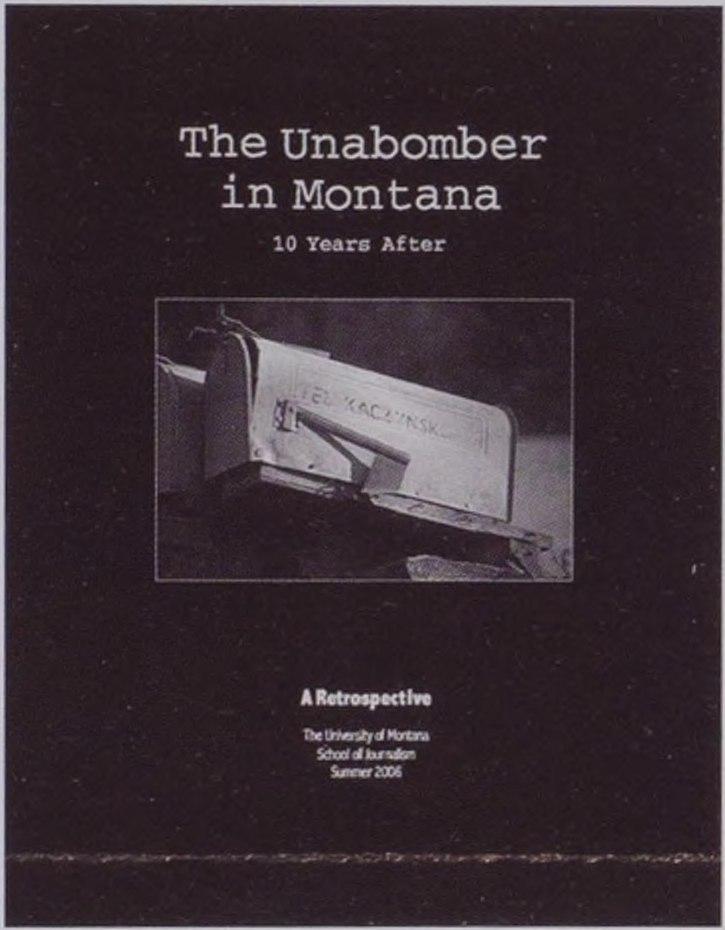
The letter arrived at UM’s journalism school in March — right before Testa attended Associate Professor Sherry Venema’s feature writing class. That class, along with Teresa Tamura’s advanced photojournalism students and Keith Graham’s design class, spent spring semester producing a 52-page, full-color publication commemorating the 10-year anniversary of Ted Kaczynski’s arrest.
The nine-page Kaczynski letter was neatly handwritten and included meticulous footnotes. Written on legal-sized paper, it became one of the centerpieces of the UM project.
“We got the idea from the University of Nebraska,” Venema said, “which had done a gorgeous publication about 40 years after the publication of ‘In Cold Blood’ by Truman Capote and its impact on this little town in Kansas. At a faculty meeting last fall. Jerry Brown, our dean, said we should do something like this about the Unabomber anniversary.”
The UM publication finished printing in July and will be distributed to accredited journalism schools around the country, friends of the journalism school, donors and the student authors, among others. Copies also will be distributed in Lincoln, where Kaczynski lived.
Students delved into media coverage of the Unabomber saga, interviewed Kaczynski acquaintances, recreated the FBI manhunt and examined current attitudes toward Kaczynski’s 35.000- word manifesto. The student publication is online al http://www.umt.edu/ journalism.
Venema said her students updated and expanded the Unabomber saga with their publication, including stories on the whereabouts of Kaczynski’s cabin (the FBI has it in the Sacramento, Calif., area) and who now owns the land near Lincoln where he lived. Students also managed to get interviews from people leery of the media, such as Lincoln librarian Sherri Wood, who had befriended Kaczynski.
Testa had written Kaczynski to ask for an interview, but expectations were low for any sort of response. In the surprising letter, the convicted domestic terrorist wrote of his distrust of the media and how he found journalists to be dishonest:
“I’ve learned by experience that there is a technique that journalists use: They contact a potential interviewee and tell him that they want to give him a chance to tell his side of the story, or they tell him that they want to be objective and get at the true facts. Then when the poor sucker falls for it and gives an interview, the journalists slant their story to suit their own purposes, often very much to the disadvantage of the interviewee.”
Kaczynski wrote that he would agree to an interview if the UM project investigated a 1999 book. “Unabomber: the Secret Life of Ted Kaczynski.” which Kaczynski claims “consisted mostly of lies.”
“Of course we weren’t going to do that,” Venema said, “but Dan (Testa) ended up writing a story not only about his life in prison, but also about the letter.”
She said another student. Paul Brohaugh. also received a letter from Kaczynski. Brohaugh used the letter to write a story about the Manifesto.
She said the publication was an excellent learning tool for UM’s journalism students. It allowed them to brainstorm story ideas, do interviews, work with photojournalists and undergo successive rewrites.
“So it was a very real-world experience,” Venema said. “I’m just delighted with the final product.”
— By Cary Shimek and journalism school Web reporter Sarah Swan