David Van Deusen
On Anarchism (Preview)
Dispatches from the People’s Republic of Vermont
Foreword: Red and Black in the Green Mountain State
The Rise and Fall of The Green Mountain Anarchist Collective
Vermont, a land where hard-working locals intersect with vacationing Flatlanders, has been the scene of many experiments in expanding venues for democratic decision-making and socialism.
The book provides a critical (non-sectarian) analysis of the last two decades of politics and movement building from the point of view of an anarchist organizer, while sharing what it was like to be inside those movements as a participant. In these ways the work has both contemporary political value and a historical value.
The contemporary’ anarchist world, including the idea of secession as it flourishes in “Bernie Sanders’ Vermont,” is outlined in these collected writings. With a partial focus on the Green Mountain Anarchist Collective but applicable throughout the US, Dave Van Deusen describes political goals and specific events in the last few decades.
The author includes practical information on hands-on organizing of anarchist and black bloc actions, and he discusses labor organizing, community organizing, along with journalistic accounts of various social movements/events.
The protest and political actions Van Deusen illustrates are undergirded by philosophical considerations which he presents in separate essays, with references to Bakunin, Marx, Guy Debord and other thinkers. He also shows how, in the aftermath of 9/11, the movement’s post-Seattle momentum dissipated for a time.
About the Author
Dave Van Deusen, a Senior Union Representative for AOT workers in the Vermont State Employees’ Association, is a past AFL-CIO union officer, laborer, journalist and anarchist organizer. He marched in his first Black Bloc against Bill Clinton and the 1996 Democratic National Convention in Chicago. He co-found- ed the Green Mountain Anarchist Collective in 2000. Van Deusen co-authored “The Black Bloc Papers” and “Neither Washington Nor Stowe.” He is a former member of Anti-Racist Action, served on the Vermont Commission on Native American Affairs, and is a past member of the UAW, Teamsters, and United Electrical Workers Union. Van Deusen rides a union-made Harley Daridson motorcycle.
(c) 2017 by Algora Publishing.
All Rights Reserved
www.algora.com
No portion of this book (beyond what ls permitted by Sections 107 or 108 of the United States Copyright Act of 1976) may be reproduced by any process, stored in a retrieval system, or transmitted in any form, or by any means, without the express written permission of the publisher.
Library of Congress Cataloging-in-Publication Data —
Names: Van Dcuscn, David, 1973- author.
Title: On anarchism: dispatches from the people’s republic of Vermont / David Van Dcuscn.
Description: New York: Algora Publishing, 2017. | Includes bibliographical references.
Identifiers: LCCN 2017036132 (print) | LCCN 2017040821 (ebook) | ISBN 9781628943054 (pdf) | ISBN 9781628943030 (soft cover alk paper) | ISBN 9781628943047 (hard cover, alk paper)
Subjects: LCSH: Deliberative democracy—Vermont. | Deliberative democracy—United States. | Anarchism—Vermont. | Anarchism—United States. | Democracy—Decision making.
Classification: LCCJC423 (ebook) | LCCJC423 .V343 2017 (print) | DDC 320.5/709743—dc23
LC record available at https://lccn.loc.gov/2017036132
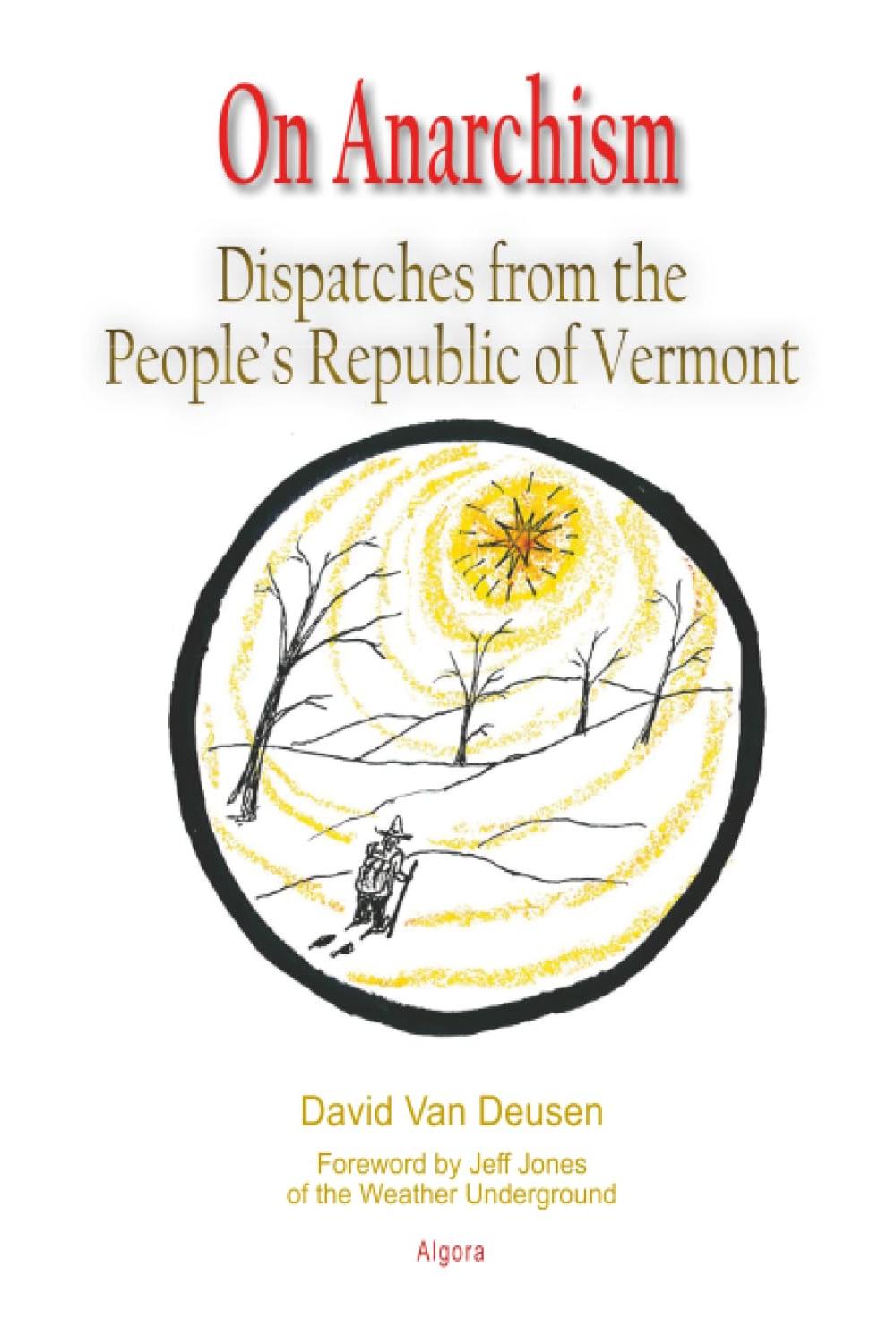
Cover illustration by Xavier Massot.
This work is dedicated to the past & present members of the Green Mountain Anarchist Collective, NEFAC, Anti-Racist Action, the CCC, Vermont AFL-CIO, United Electrical Workers, Vermont State Employees* Association-AOT, the Vermont Workers’ Center, the Vermont Abenaki Tribes, those who have bravely marched with the Black Bloc, anti-fascist Motorcycle Clubs everywhere, all who continue to struggle for a more free and just Vermont, the memory of the Green Mountain Boys, and the International Freedom Battalion (who today fight valiantly with arms in Syria for the establishment of a libertarian-socialist society in Rojava).
Table of Contents
Chapter 1: History 5
The Rise and Fall of The Green Mountain Anarchist Collective 5
The Political Premise 7
The Black Bloc and Beyond 9
Building The Movement 18
The Fall & Legacy 30
Chapter 2: Theory 33
Culture and Nothingness 33
Part I: The Dawn of Nothingness 34
Part II: The Instinct to Rebel 38
Part III: The Rise of Capitalism 40
Part IV: Authoritarian Communism As An Incomplete Resistance 42
Part V: Capitalist Colonization & Neo-Liberalism 44
Part VI: Radical Commodification & Consumerism 45
Part VII: The Anarchist Rebellion 50
On the Question of Violence & Nonviolence 53
Introduction 53
What Violence is Necessary 55
Pacifism as Foreign to the Poor and Working Classes 57
Psychological Roots of Pacifism as a Bourgeois Ideology 61
Conclusion 64
Neither Washington Nor Stowe — Common Sense for the Working
Vermonter: A Libertarian ‘Socialist Manifesto 65
A Peoples’ History 66
The Yoke of Washington and Wall Street 68
The Yoke Within 69
A Second Vermont Revolution 71
Town Meating 73
The Farmers 74
The Workplace 76
Freedom and Unity 82
A Peoples’ Bill of Rights 86
The Worth of Labor and Exchange 87
Self Determination for the Abenaki 93
In Defense of Freedom 96
Vermont as a Northern Star 96
The Vermont Spring 97
Chapter 3. Insurrection 101
Black Bloc Tactics Communique 101
Introductory Notes from the First Edition 101
Our Movement Grows 102
Anarchism and the Broader Movement 103
The Development of the Movement 104
Our Local Communities 104
At Demonstrations 104
The Necessity of Increasing Our Tactical Abilities 105
Increased Organization of Street Fitting Force: The Formation of an Elected
Tactical Facilitation Core 106
Individual Affinity Groups 109
Clusters 110
Reconnaissance and Communication 113
Reserves 113
Additional Security Precautions Maps Radios, IDs, Names, Etc. 118
Communiques 119
Anarchist Principles of Tactical Leadership 120
Physical Training in Between Actions 120
Pre-emptive Actions 121
Preparations For Increased State Repression 121
Development of Our Social and Political Understandings 123
Conclusion 123
Anti-WTO Protests & The Battle of Seattle 124
A:16 — A March On The Capitol: April 2000 128
The Battle of Quebec City 131
DC and the Twin Towers: A Battle Postponed 136
Chapter 4: Organization 141
Concerning Tire Long Term Viability of Forming Workers’ Councils 141
Workers’ Councils As Real Democracy & Revolutionary Power 145
Lessons From The Green Mountains 149
Building A Workers’ Center & Launching An All-Workers-Union 150
Origins of The Vermont Workers’ Center and Internal Structure 155
State of The Montpelier Downtown Workers Union 160
From Montpelier Downtown Workers’ Union To A Montpelier Workers’ Council 169
Proposal 173
Chapter 5: Workers 177
Montpelier Downtown Workers Union: Building Working Class
Democracy. One City At A Time 177
Origins, Necessities, and Eventualities 178
Enter the Vermont Workers Center 179
The First Strategy 181
Capitalist Backlash 182
A Worker Town Meeting 186
Citywide Grievance Procedure 187
Worker’s Defense Squad 188
A New Contract and Citywide Elections 189
Street Victories 189
Union Holds Public Hearing at City Hall 192
Union Expands Organizing Scope 192
A Force in City Politics 193
Second Worker Town Mcauig 194
The Struggle Today and in the Future 195
The Role of Anarchists 197
Chapter 6: Secession 199
Vermont Secession: Democracy & The Extreme Right 199
Chapter 7: On The Road 211
When the Levee Breaks 211
Night Patrol with the Vermont National Guard 212
Food, Water, and Murder 214
Katrina’s Heart of Darkness: Into New Orleans 216
The People vs. Katrina 219
After The Flood 222
Foreword: Red and Black in the Green Mountain State
You don’t have to climb onto the back of David Van Deusen’s Harley to enjoy the ride you are about to take in these pages. Van Deusen’s long trip starts with his first time running with the Black Bloc at the 1996 Democratic Convention in Chicago and goes through his life as anarchist activist and scholar, union organizer, environmentalist, town official and unwavering supporter of indigenous Abenaki land rights and tribal self-determination in the Green Mountain State.[1]
David’s life is consistent, militant and principled. These are admirable qualities, more important than ever in today’s political climate: we need all the examples we can get of people standing up to racism and white supremacy, manifesting solidarity with the victims of imperialism. David identifies as a revolutionary: that is, he believes in and works for a complete transformation of our society as presently constituted. What’s more, he believes this transformation is possible. And reading the story of his Movement life and work, and his many partners along the way, has strengthened my own hope for this transformation, and it will strengthen yours.
As the story’ unfolds, the theory becomes practice. But it starts with a vision. A co-authored Black Bloc manifesto published in 2000, shortly after the Battle of Seattle, identifies the emerging principles of insurrection. The authors identify the increasing loss of communal and human values in our country caused by “the experiential emptiness of intensified neo-capitalist commodification of pseudo-reality and its necessary results of mass alienation, anxiety and boredom.” If that statement seems complex, it is nevertheless worth parsing. It’s an almost perfect description of early 21-century America that a decade and a half later brought Donald Trump to the presidency on a neo- fascist platform of racism, xenophobia, misogyny and transparently empty promises appealing to the nihilism of a significant part of his base.
David and I met through his family early on in his journey. At the time, he was lining an off-the-grid and outlaw life in a Southern Vermont anarchist collective. He seemed to appreciate my history in Students for a Democratic Society, some very militant days running with Lower East Side anarchists in late ’60s, and the Weather Underground. We were born into different generations, but our paths have been parallel for many years, including fighting white supremacy, defending the planet and trying to build an alliance between environmentalists and the labor movement.[2] David is a true warrior, especially for the people of Vermont.
If there are issues to be addressed from these pages, they center on the role of a militant left in a time of hard right ascendancy. When hundreds of neo-Nazis, KKK members and other white nationalists marched in Charlottesville, Virginia earlier this summer, attempting a show of force for a revitalized white supremacist movement through a Unite the Right rally, they faced opposition that was confrontational and determined. The subsequent debate in the media and the left about the proper response is valid. But let’s not forget that we must confront and challenge attacks on people of color, women, immigrants and progressives targeted by the right. As African-American leader and thinker Cornell West said on Democracy Now! describing a moment in Charlottesville when some 20 religious and anti-racist leaders were surrounded by several hundred rightists, “the antifascists...they saved our lives.”
David’s writings help us understand the history, practice and theory of someone who has spent the past two decades standing up to the racist right, in its many forms. These pages include stories about confronting the quasi-vigilante Minutemen, an earlier neo-Nazi manifestation that formed along the southern U.S. border. When they tried to set up shop in New England, in 2006, with the claim that the U.S. needed civilian volunteers to interdict immigrants and political refugees crossing the border from Quebec, David was there with antiracist militants from across Vermont and New England. Faced with real opposition, the Minutemen soon vanished.
That was 11 years ago. A disturbing aspect of this particular story, however, is how pervasive the racist and anti-immigrant ideas and violence of this energized neo-fascist movement has actually become since it became official U.S. policy under Trump. I know from my work with John Brown Lives! in the Adirondack North Country’ today that the border with Canada has again become a safety valve for immigrant families who still follow the Drinking Gourd, escaping the deportation net cast by Trump-era federal agents. In reality, immigration to the US is exactly the opposite of what the wall-builders believe. Historically, people come to the U.S. to be safe, not to do harm. Now they have become victims and look north for refuge. Thanks to groups like the Green Mountain Anarchist Collective, there arc still safe pathways for them to follow.
While the role of militancy emerges dramatically from these pages, so does the role of unity — and the question: on what terms?
Returning to the Black Bloc manifesto of 2000, I am particularly intrigued by point number seven. This was after the Battle of Seattle, a transformative moment in Movement history that both David and I missed. The protests against the neo-liberal, global corporatist World Trade Organization drew an unexpected but welcome unity that included a new alliance between environmentalists and trade union activists. This particular manifesto reflected the Black Bloc’s attempt to understand and provide direction — a tough call for avowed anarchists — to the re-energized movement. “The generational maturity of the children of the 60s and 70s has now come to fruition,” they wrote. “This is a fact that should not be overlooked as we intend to build on and further destroy where our mothers and fathers left off.” I take this as a positive reference to the ideas and militant actions of our earlier days opposing the Vietnam War and supporting the Black liberation movement.
The actions of militant anarchists and others at the 1996 Democratic Convention in Chicago came 28 years after our own protests on those same streets. The formation of Weatherman was still a year away. Between those two protests, our generation confronted similar issues of militancy, organization, ideology and tactics, followed for some by years of apology’ and remorse, while others stood firm. For me, the most important lessons, repeated in successful movements and revolutions around the world, are resistance and unity. That is, in the strategy advanced by Fidel Castro more than half a century ago as the Cuban Revolution gained ground: “the ideal thing is unity” around basic principles and the strategic issues of the day.
This is not so easy, especially when confronted by entrenched constituencies tending toward compromise. So, the other strong thread that emerges from David’s writing and practice are the stories he tells, and the practice he describes, from an exciting range of groups and people who have found common ground in the Green Mountain State.
The title of this book refers to the anarchist writings; anarchist here being of the broader family of socialism. In Vermont, home to Bernie Sanders, you can be a socialist and get elected, both to the United States Senate and, in David’s case, to local office. You can also be a labor leader. You can ride with anti-racist bikers, advocate for Vermont’s independence and support the legitimate national aspirations of the state’s first citizens, the Abenaki Tribes. These writings begin with an outlaw life lived at the end of a dirt road in Southern Vermont. They describe a political and personal journey that weaves inside and outside of the political system.
The journey is not over yet.
Jeff Jones, Albany, NY
October, 2017
Chapter 1: History
The Rise and Fall of The Green Mountain Anarchist Collective[3]

“The chains of authoritarianism and capitalism can only be shattered when they are broken at many links. Vermont is our home, and it serves as the one link that we can access, but it is only one. Any victory here would only be partial. Deliverance to the Promised Land will only come when many more than us rise up against that which holds the multitude in bondage.”
—The Green Mountain Anarchist Collective. From ‘Vermont Secession’ Montpelier, Vermont, 2015 — Established in 2000, in a cooperative household located at the termination of a wooded dirt road in Southern Vermont, the Green Mountain Anarchist Collective (GMAC), for a time, did its part in carrying forth Vermont’s long tradition of radical, leftist politics. Founded in Windham County by Natasha Voline, Johnny Midnight, Xavier Massot, and (myself) David Van Deuscn, the collective was birthed with strong Situationist, leftist, and militant inclinations. The original GMAC nucleus lived together (along with comrades Imelda R, Bridget M, and Ted K), and operated as a kind of outlaw community, connected to the broader area counter culture based in and around Brattleboro. Together, they functioned on a cash & barter basis, opening phone and utility accounts under assumed names. They adorned the walls with stolen Salvador Dali works. Torr Skoog and Liam Grill, of the Boston band The Kings of Nuthin (whom Massot befriended shortly after he emigrated from his native France), were occasional visitors.
Half of the household’s income came from the black market, the rest from a single student loan and occasional manual labor (once being paid to build a bird aviary for Kermit W — the rumored son of Egypt’s Nasser], Two household members were wanted by the law (one facing some years in prison the other on minor charges); another was an artist; two were brought up in strong union households; a few experimented in poetry; the household included two guitars and a five piece drum set in the living room. All present shared an interest in furthering a more creative, life affirming, and non-capitalist future. When not cutting their-own wood to feed the stove (which was typically the case), they “borrowed” a half cord at a time from unoccupied vacation homes scattered throughout the area. Trips to town often involved beer at the Common Ground (a co-op founded by local communes in the 1970s), or $5.40 double whiskeys at Mike’s (a rough-around-the-edges working class tavern on Elliot Street). However, town, being 15 miles away, largely remained un-visited. Instead, target shooting off the back porch with ,22’s & SKS’s, making firecrackers out of black powder, listening to The Clash & Johnny Cash, trying to get a half junked 56’ Chevy working, long conversations, chess, strong marijuana (very strong marijuana), vigorous debate, and intensively reading from the Situationist, Existentialist, Anarchist, and Marxist camions filled the time until a more direct political involvement came to be.
When this group founded the Green Mountain Anarchist Collective, it was agreed that its first task would be to provide support and tactical innovation to the Black Bloc and growing revolutionary anarchist movement; a movement which was gaining steam in the immediate aftermath of the Battle of Seattle (1999). What marked GMAC as different from some anarchist or leftist collectives, was that it was anchored in a deeply rural community with a strong tradition of local democracy (Town Meeting), and this broader community (Vermont) itself was premised upon an armed uprising prior to the American War for Independence (Vermont conducted ...
(End of Preview)
[1] Van Deusen served two terms as a Selectman in his town (endorsed by the socialist Vermont Liberty Union and Vermont Progressive Parties) and three terms as First Constable. He also worked with the Nulhegan Abenaki Tribe and the Vermont Sierra Club from 2010–2012 to help establish their first Nulhegan-owned tribal forest in over 200 years. This forest, which is also a working sugar bush generating common revenue for the tribe, exists to this day in the Northeast Kingdom of Vermont.
[2] Between 2010–2012 Van Deusen formed an active partnership between the Vermont Sierra Club and the Iron Workers Local 7 in support of new green energy projects and securing of union jobs on said projects.
[3] 2017 note from the author: The article was first published in Infoshop News and Anarchist News in 2015. The article was peer renewed and published in the Interface Journal in 2016. This essay articulates my views and memories of the collective. Other collective members will inevitably have different takes on the same subject matter.