
Translator: William Christopher Atkinson
Illustrator: Harold Bennett
Diego de Torres Villarroel
The Remarkable Life of Don Diego

I: My Lineage, Birth and Upbringing to the Age of Ten
III: From Twenty, More or Less, to Thirty, Less or More

Introduction
Diego de Torres Villarroel (1693–1770) was the odd product of an odd age in what, by the conventional yardsticks of western Europe, was in many respects an odd country, as in many it still is. His seventy and seven years spanned four reigns and embraced, with the grim eclipse of an exhausted ancien regime, the first two-thirds of the century of so-called enlightenment, when a new dynasty sought to make all things new and discovered just how inert inertia could be. It was still a largely feudal Spain that he inhabited, feudal in cast of mind no less than of society; and there is irony in the thought that the upstart whose misspent youth bore such strong family resemblance to the rogue of picaresque tradition, whose learning was the merest veneer and whose science close kin to superstition, should have achieved the eminence of a chair in Spain’s oldest and proudest university and there come to stand, against scholars of repute but more superstitious still, for a paladin of the new spirit of the age, an upholder of experimental science and of the rights of free enquiry.
The roots of such an anomaly went back a long way. It had been the destiny of Spain, before she came to define her role and her beliefs so narrowly, to stand for centuries wide open to the most varied cultural influences, to boast a breadth of tolerance that makes the modern period seem her true middle ages by comparison, and to achieve in respect thereof a predominance in learning and the sciences that drew the scholars of England, France and Germany to Toledo with a fervour no less than that of the pilgrim to Santiago de Compostela.
Cadiz, foundation of the Phoenicians in the eleventh century BC, claims to be the oldest city with a continuous history in Europe. After the Phoenicians came Greeks also from the east, Celts from the north, Carthaginians from the south. The last-named, planning to use the Peninsula as springboard for an attack on Rome, brought in the Romans, who soon set themselves to the conquest of this fertile land for their empire. It cost them close on two hundred years of effort, but with victory there followed for the native Iberians —a term that serves to disguise ignorance of their origins, though the balance of probabilities would assign them a cradle in Africa—a first four and a half centuries of occupation and assimilation that gave to the Peninsula not merely the speech of the conquerors but their law and administration, their religion and literary heritage as well.
The collapse of the Roman empire in the mid-fifth century ad gave the next chapter to the Visigoths, chief architects of that collapse. By Roman standards an uncultured race, they made two contributions to the structure of Spanish society that have weighed heavily on its fortunes ever since. One was the institution of monarchy, the other the close intertwining of church and state. The elective nature of the monarchy spelt of necessity instability—in less than a hundred and fifty years ten kings met violent deaths—and in 711 one more squabble over the crown brought in the Muslim from across the Straits. This is the factor above all others that still marks Spain, and to a lesser degree Portugal, off from the rest of Europe. In a three-day battle the Peninsula of Roman and Visigoth was utterly worsted. The vast majority, submitting, became in time Mozarabs or halfArabs; and but for the failure of the newcomers to complete the conquest by pursuing and reducing a small band that had taken refuge north of the Cantabrian Mountains the country might still be part of Islam today.
From that nucleus of resistance stemmed the Reconquest, a spacious term for the eight centuries that were to elapse before, in 1492, the last Muslim was driven from his last stronghold of Granada back across the sea to Africa, and the long chapter was closed. They were not, needless to say, centuries of continuous religious warfare. After 1250 only dissensions among the Christians deferred final victory for the ensuing two hundred and fifty years. For herein lay another profound consequence of the infidel irruption, that Christian Spain did not re-emerge, however timidly, as Spain, but as a cluster of separate kingdoms—Asturias, Leon, Galicia, Navarre, Aragon, Castile—fighting one against another as often and as enthusiastically as against the common enemy, with whom they not infrequently sought alliance. Gradually they merged, the final step coming in the late fifteenth century with the marriage of Isabella of Castile to Ferdinand of Aragon, and Spain was Spain again; though not, as she had been under Roman and Visigoth, the Peninsula, for Portugal had hived off into independence as unexpected result of a marriage dowry of four centuries earlier. Nor has Spain, the patria grande, ever succeeded in obscuring the more immediate loyalty to the patria chica of those medieval kingdoms. Still today one is a Catalan, a Basque, an Andalusian first, and only then a Spaniard, a long history of civil wars coming down to recent memory evidence of how deep the fissures run.
There had been centuries, earlier, when Spain still meant Muslim Spain, when Cordoba, capital of the Khalifate, was at once the dream city of Europe and the channel through which the lore and learning of the east—including, via Alexandria, as much of Greek thought as was known to the Middle Ages—reached the west. The experimental sciences flourished there when they were still as alien to the Christian north as were the philosophy and the sense of values on which they rested. That philosophy, with its exalting of the sensuous enjoyment of this world into a primary duty and its firm resolve to keep time in its place, permeated profoundly the southern temperament; and when the Christian recapture of Toledo in 1085 made possible the establishing there in the early twelfth century of a school of translators, where Christian, Muslim and Jew laboured together to make Arabic learning available through Latin to Europe generally, those sciences began at last to make their impact north of the Pyrenees. Arabic numerals, algebra, alchemy suffice to point the debt, and Torres’ great-grandfather will be found studying pharmacy from an Arabic treatise of eight hundred years before.
The school of translation aforesaid implied a measure of equipoise between Christian and Muslim Spain that became especially marked after the mid-thirteenth century, when each, while still making war on occasion, accepted the other’s presence and was prepared to learn what it had to teach, to accept what it had to give. The Moors were, among much else, the best agriculturalists in Spain, the Jews the best financiers, and tolerance the highest virtue. It was Spain’s tragedy that Isabella ‘the Catholic’, acclaimed her greatest monarch, should have achieved her aim of making Spain one, great and free at the cost of that virtue. She completed the Reconquest in the same year 1492 in which Columbus discovered his New World, and tackled the resulting problem of integration with religious unity as her one solution. First the Jews, then all Muslims who refused conversion to Catholicism were expelled the country. There remained the suspicion, before long a certainty, that Catholics by compulsion were bad Catholics and, if harried, bad patriots. To harrying, none the less, she now found herself committed, the New Inquisition her weapon; and in due course this was being turned against Erasmists and Lutherans as well as cryptoJews and Muslims, and free thought had ceased to be the birthright of any Spaniard.
There followed the accident that in 1519, by making Isabella’s grandson Charles I of Spain Charles V of the Holy Roman Empire, made of Spain the first European power, launching her on courses not of her choosing and into wars over half a continent that not all the wealth of the Indies could sustain. The fact that Germany was the seat of the new heresy exacerbated intolerance at home, and Spain identified herself with the Counter-Reformation to the point where Philip II could ‘prefer not to reign rather than reign over heretics’ and stake his country’s all on an attempt to invade the arch-heretic, England.
The defeat of the Armada in 1588 marked for Spain the beginning of the end, and under a succession of progressively degenerate monarchs the seventeenth century witnessed a melancholy decline from greatness ending in total collapse. The crown had already known bankruptcy under Philip II, but not, as now, the spectacle of house-to-house collections to help it out. Shipments of gold and silver from the New World passed straight through Spain to the servicing of foreign debts, not merely not enriching but impoverishing by the discredit their passage attached to the principle of honest labour. Spaniards became a byword throughout Europe for their cult of a hollow ‘honour’. Charles II, like his greatgreat-grandfather Charles V, reigned for close on forty years, and like him fought war after war against France, with the vital difference that he was dragged into them, no longer a shaper of destiny but a cypher, and that he lost them every one.
Of the earlier Spain everything had gone, both the substance of greatness and the conviction. ‘The country’, reported the French ambassador towards the close of the century, ‘is reduced to a state of misery difficult to believe without seeing it.’ Spaniards still held heroically to their religious tenets, pathetically to their monarchial; but the heart had gone out of them. The crown had forfeited long before all title to respect, and God was demonstrably no longer on Spain’s side. As Charles ‘the Bewitched’ lay on his deathbed in 1700 it was clear that a dynasty was dying with him. Over it the powers wrangled for the succession to a scarcely less moribund Spain, potentially great still in the extent of her dominions—Flanders, Naples, the Indies—but in herself a pitiable shadow of what she had been, selfimmolated on the altar, so strangely unrewarding, of a too exclusive faith.
This was the Spain into which Torres Villarroel was born in 1693, one of eighteen children, his father a Salamanca bookseller of humble origin, his mother a draper’s daughter. The country was again at war with France, drained to the dregs of men and money. French armies were on Spanish soil, and would shortly occupy Barcelona and most of Catalonia. But Salamanca went on living its cloistered life remote from the world until, when Diego was seven years old, the king died at last, having willed his kingdom in the end to a French prince. It was the crowning gesture of absolutism, that could still look on country and people as personal belongings, to be gifted away as one gifts a horse or a watch. France accepted, the Castilians acquiesced. Not so France’s enemies, nor the Catalans; and in the upshot Charles proved to have bequeathed to Spain a legacy not mentioned in his will, the War of the Spanish Succession that for some twelve years made of the country a cockpit with foreign armies crossing it in all directions. England, siding with Austria, soon brought in Portugal, and here Diego’s life did become affected; for Salamanca lay not far from the Portuguese frontier and on one highway to it, and his father, as a good citizen, was appointed commissary for the troops passing through, to the ruin of his bookselling business.
In 1706, aged now thirteen, he saw the allies in unopposed possession of the town, whence they marched to their brief occupation of Madrid. The Salamancans soon reverted to the Bourbon allegiance and made bold to plunder a Portuguese convoy in transit. This brought prompt revenge from the Portuguese, who sent an army and after a two days’ blockade again took possession. The citizens were compelled to surrender their booty, to pay a heavy fine and to give up all their arms and ammunition: of all which Torres makes no mention. The battle of Almanza in the following year, that ranged English, Dutch, Huguenots, Germans and Portuguese under a French commander against a French and Spanish army led by an Englishman, in effect decided the issue in favour of the Bourbon; but years of fighting still remained, until the peace of Utrecht in 1713 confirmed Philip V on the throne of a Spain lopped of Naples and Flanders and restored, in Europe, to her proper dimensions as a Peninsular nation.
The time for stocktaking and a change of direction had come at last. Charles V, as a Fleming, had two centuries earlier brought in Flemish ministers and advisers. Philip, as a Frenchman, brought in Frenchmen, and the nation’s finances and administration were overhauled and rationalized as a beginning to the Herculean task. Three factors worked in the opposite direction. Philip too was of a profoundly religious temperament, and half a century would go by before authority took any steps to rid the state of its ecclesiastical incubus or the nation of its heritage of religiosity, verging on superstition, that still hung like a millstone round its neck. ‘Maintenant il n’y a plus de Pyrenees,’ Louis XIV might proclaim. In the realm of belief they towered as high as ever: the Inquisition that brought Torres to his knees with terror could still, towards the end of this eighteenth century, arraign a prime minister.
The second factor derived from Philip’s choice of a second wife when he already had sons to secure the succession. Isabel Farnese, a woman of great strength of character, immoderate ambition and a rare capacity for setting the chancelleries of half Europe by the heels, denied Spain the peace she so sorely needed through her determination to carve out duchies and principalities in Italy for her own offspring; and again war after war followed.
There was, finally, the mood of the Spanish people, conditioned over two hundred years and more to unreasoning acceptance of a set of norms and beliefs that, advanced as absolute, were held immune from the march of time. ‘The Spaniards cry when they have their faces washed,’ said Charles III when he came from Naples to the throne in 1759. Madrid had seemed to him, who knew other European capitals, a city of conspirators and cut-throats, still a stranger to public lighting, sanitation or security; and his attempt in 1766—Torres at seventy-three was no longer the frequent visitor to Madrid of yore—to abolish by decree the long cloaks and wide-brimmed hats of tradition led to riots which drove him precipitately from his capital and could have cost him his throne. This particular end he secured more diplomatically by making the garb the official attire of the public executioner; but the rising brought vividly home to him how wedded his new subjects remained to their old ways.
And not least to their old ways of thought. Torres’ literary and intellectual heritage was richer by far than his humble background and scrappy apology for an education allowed him to appreciate; but it had its limitations. Far back in Roman times Cicero had already noticed in the poets of Cordoba pingue quiddam atque peregrinum, a something rich and rare that was to persist as the first mark of that galaxy of Spanish names, the two Senecas, Lucan, Pomponius Mela, Columella, Martial, Quintilian, who largely make up the silver age of Latin letters. And nothing is more curious in the Spanish tradition than the constancy of this vein of luxuriance in the writers of the luxuriant south, their concern with form and effect at the expense if need be of what they have to say, and the empty ring in consequence of much fine writing. Juan de Mena in the fifteenth century, Herrera in the sixteenth, Gongora in the seventeenth stand here for a host of lesser names.
Castile to the north—Torres was of hoary Castilian stock on both sides—is barren land by comparison. Rome had no interest in it, nor the Visigoths, nor the Muslim. Its name betrays its origin in the frontier fortresses (castella) that from the ninth century began to dot the tableland as resistance to the invader gradually ventured south from its mountain fastnesses. The cultural history of the north is therefore shorter by a thousand years than that of the south, and bears no less distinctly the impress of the soil whence it is sprung. Its literature is close to earth, informed by a probing, irreverent humour that knows how to laugh at itself, and reahstic with a realism as active in the intellectual and spiritual realms as in the material. The picaresque novel, with its antecedents in the Book of Good Love of the worthy Archpriest of Hita (c. 1340) and the Celestina of Fernando de Rojas (1499), its outstanding achievement in the trilogy composed by the anonymous Lazarillo de Tormes, Mateo Aleman’s Guzman de Alfarache and Quevedo’s El Buscon, spanning between them the years 1554 to 1626, best typifies the satirical-realistic approach of the Castilian on the lower level, as Santa Teresa and St John of the Cross, greatest names in the great flowering of sixteenth-century Spanish mysticism, do on the higher.
In between comes Cervantes (1547–1616), noblest of them all, his Don Quixote the first and by common consent still the greatest of modern novels. Character ceases here to be static, as in the romances of chivalry it satirizes and in the picaresque, to be depicted instead as a constant becoming in the endless interplay of each man with his fellows and with circumstance, so that one may talk of the gradual sanchification of Don Quixote and of the quixotization of Sancho Panza and even plot, as on a graph, the point where their two evolving life-lines will intersect. Since Cervantes’ day skill in the portrayal of character in solution has become the first touchstone of excellence in the novelist’s art.
The work further defines the true scope of the novel as prose heir to the epic of old, with a canvas broad as life itself and allowing of commentary, philosophic no less than descriptive-satirical, on the whole gamut of human experience. He who would study that most subtle of transmutations, of life into literature, must always go back to Don Quixote. And nowhere is Cervantes more Castilian than in the essence of his own philosophic commentary, that constant delving into the nature of reality which underlies the infinite penetration of a parable conducted on various interacting levels of experience, its key sentence the famous ‘This that to you, Sancho, appears to be a barber’s basin seems to me Mambrino’s helmet, and to another will appear something else.’ What life is, matters less in the long run than what we take it to be, from which cardinal observation derive its major complexities.
The other outstanding facet of the Castilian genius in literature is the drama. Alone of the countries of western Europe at the Renaissance, Spain and England created a national theatre. Lope de Vega (1562–1635), the ‘prodigy of nature’ with a legendary eighteen hundred and authenticated five hundred plays to his name, established the form and proved the most responsive of sounding-boards to the Spain of his day, interpreting her heroic past, her proud and vibrant present and, above all, the triple ideal on which society rested of respect for crown, church and human personality, this last exemphfied in the point of honour.
The transition from Lope to Calderon (1600—81) well reflects the creeping paralysis that overtook Spain down the seventeenth century. Lip service to the old ideals continued long after they had ceased to correspond to the reality. Esteem for the crown when its wearer was a Charles II, pride in the country when that country had touched its nadir of exhaustion and disillusion, religious fervour when God was so patently with the enemy: Calderon too kept up the pretence, but even his genius and intellectual stature could not keep it all from sounding hollow. What had been a drama pulsating with vitality became a matter of formulae and ringing the changes, convictions were grown into conventions, and where earlier one had wrestled valiantly with truth one now discoursed subtly on dogma, that saved the trouble of independent thinking. As much is true for the intellectual life of the country as a whole, Castile now as well as Andalusia and the peripheral regions; and it holds with particular validity for the universities. To the extent that these continued conscious of fulfilling a role, they put their whole effort into helping fight a series of stubborn rearguard actions in defence of growingly untenable positions.
The Spain in which Torres grew up was thus the land of King Canute. The flickering genius of the country’s golden age flickered no more. In the universities, over our author’s seventy-seven years, practically nothing would change. Once, with Paris, Bologna and Oxford, in the forefront of European learning, Salamanca had become a stagnant backwater where theologians still disputed on the old issues of scholasticism, Jesuits and Dominicans rocked the University with their rivalries, and a special meeting of Senate could debate on the propriety of its members’ attending a bullfight where a young Frenchwoman was to perform. Torres learnt his Latin after a manual first published in 1480, that would serve for a hundred years still, and could qualify as a doctor on the strength of one of a century before his day. His constant girding against the medicals rested on knowledge of how many parts of superstition went to one of science in their training, and his detailed account of how he himself fared at their hands shows a profession still grounded in Hippocrates’ four humours—blood, phlegm, choler, black bile—with purgings and blood-lettings standard treatment whatever the complaint. Survival was less a hazard of nature than the pitting of one’s wits against their ignorance, with the philosophy of the fatalist that ‘in spite of everything’—everything including the doctors—‘we five on till we die’.
Mathematics, the core of the old quadrivium of higher study in arts, had sunk, if possible, even lower. The chair at Salamanca was a chair of mathematics and astrology. It had lain vacant for over thirty years when Torres laid claim to it, and its standards could be read in the fact that only the bachillerato—our modern matriculation—was required of candidates. Torres at thirty-three was relatively mature in years on his appointment—when he retired it went in succession to two nephews of his aged respectively twenty-three and twenty-five—but in competence the self-taught amateur. Yet the University deserved no better. The statutes governing the appointment had nobly withstood the passage of the centuries. Candidates were called on to expound in public a passage chosen by lot from Ptolemy’s Almagest, as though Copernicus had never been, and thereafter to submit to a session of interrogation by the assembled Senate. In 1726 the University did not even possess the Almagest—nor a globe, nor maps, nor a compass, nor a ruler —and Torres had to lend his own copy; while the interrogation was dispensed with, no member of Senate having the knowledge to pose a question in this field. The story of his long fight, over thirty years later, to establish a proper department of mathematics, of his defeat at the hands of those who feared for the ‘honour’ of the University, and of his eventual triumph thanks to the intervention of the Royal Council, is told later.
Into such an atmosphere Torres brought, if not scholarship, a breath of fresh air. As man and as writer he stood at the opposite pole to the ritualists. His early years had been one long flouting of convention. Quevedo, the great satirist and moralist of a century before (1580–1645), was to become and remain his literary model in style and theme alike; but it is apparent that the reading of El Buscon had exerted a previous and even more profound influence on his life. For Torres in youth was the perfect exemplar of the picaro, so perfect indeed that the present Life has been taken in all seriousness by some as one more novel in the kind. At odds with society and the social code, averse to discipline and especially to the discipline of learning, irreverent, satirical, combative, he squandered in the best tradition the opportunities that birth in Salamanca and devoted and selfsacrificing parents held out to him, ran away from home to Portugal, and turned successively companion to a hermit, dancing-master, quack physician, soldier and bullfighter. When remorse brought the prodigal home at last, shiftlessness took him off to Madrid to live once more on his wits, and only a chance intervention of the supernatural saved him from turning smuggler and ending his days in gaol or on the gallows. His two redeeming qualities were firstly what Spaniards call don de gentes and the Irish ‘having a way with him’, and secondly a hump of intellectual curiosity. The first opened to him the doors of the great wherever he went, prime minister, members of the Royal Council, wealthy and powerful nobles and the ecclesiastical hierarchy seating him at their tables, driving with him in their coaches, offering him indefinite residence in their homes. When he came’to publish his collected works by subscription, the subscription list, headed by the king himself, read like a combination of Debrett and Who’s Who.
The second caused him one day to pick up a treatise on the sphere and to thrill at the discovery of the mathematical sciences. This released the spring in him that no teacher had ever lit upon, and it led, after the Portuguese interlude, to strange consequences. Unable to study what Salamanca did not teach, he combed monastic libraries for such works thereon as they had long forgotten they possessed, and there chancing on some writings of a hundred years before on astronomy and astrology, began where he later realized he ought to have ended. His ‘science’ was thus a superstructure without foundations, taken up at its least exact; and Torres broke on the world, aged twenty-eight, as an Old Moore, the ‘Great Piscator of Salamanca’, maker of almanacs and prognostics, a role he would keep up, and find pleasantly productive of hard cash and notoriety, to the end of his fife half a century later.
His own view of this ‘astrological nonsense’, this ‘calling so close kin to superstition’, he never troubled to conceal. For himself, as in the matter of ghosts, he believed something, argued little and feared nought. His reading of the stars might be called in question, might even be held knavery: that they could be read was a very respectable belief. And when he foretold the death of the young King Luis I in 1724 he woke to find himself not merely notorious but famous. Long after, in his almanac for 1756, he forecast at a far remove the French Revolution: ‘Count a thousand, twice three hundred, twice fifty and nine tens more: then shall you see, wretched France, the final calamity that awaits you and your kingdom and dauphin, and your first and greatest glory shall have its end.’ Ten years later a prognostic of riots at court and a minister fallen from high estate pointed accurately enough to the famous Madrid rising of 1766 to which reference has already been made, that duly toppled the hated Italian reformer Squillaci.
These may have been no more than intelligent apprehension of the shape of things to come, or his share of lucky guesses. If he taught himself to work out lunations and eclipses, and could support his predictions, from 1727, with the proud ‘Professor of the University of Salamanca’ on the title-page, he became that professor no less by accident than he had an astrologer. The episcopal advice that in 1726 sent him back to the ancient seat of learning from a too gay sowing of wild oats in Madrid had suggested he aspire to one of a number of ‘rare’ chairs then, as often, vacant for lack of anyone competent to fill them. His qualifications ranked about as high for any one of them as for the others, and his first intention was indeed to try to hide the ‘malodorous label of astrologer’ under that of professor of anything else. Music, rhetoric, Latin, Hebrew, surgery and Greek made up, with mathematics-cum-astrology, the curious assortment of neglected disciplines in a university whose horizons had now shrunk to little more than theology and jurisprudence; and Torres was only deterred from presenting himself for the chair of Latin by the fact that his own first teacher happened just then to set his heart on it. He now decided, not to hide, but to dignify with a cloak of respectability the hobby that gave him fame and fortune, and the story of his election to the chair of mathematics he presents as one chapter more in the picaro’s career.
Too much can easily be made of Torres as a man of the enlightenment, imbued with the new critical spirit and fighting doughty battles against reaction. Feijoo, his contemporary, who from a Benedictine cell in Oviedo kept abreast, and through an indefatigable pen that rained pamphlets did more than anyone else to keep his countrymen abreast, of the movement of thought in the great world outside, was such a figure, in some ways the greatest Spaniard of his day. But Torres was no Feijoo. In his polemic with one Dr Martinez, an eminent reforming physician and close friend of Feijoo, he was the reactionary, the Old Moore up in arms at any threat to the sale of his quackeries. Later, in his long exile in Portugal, he dined out in monasteries and the houses of the gentry on the strength of a professed contempt for Descartes and for modern philosophical thinking in general. His chair at Salamanca drew for long years a mere two or three regular students, and it is not on record that he made any original contributions to the advancement of his subject. The collected works range, after the fashion of the century, over a wide field of interests, but mathematics scarcely figures among them. His projected academy of mathematics, his purchase of books and instruments from abroad for the University library, his translation of a French treatise on astronomy: these show the enthusiast battling against such as stood in his way, not the scholar he never claimed to be.
‘I knew well’, he writes elsewhere, ‘my ignorance and blindness as I went groping down the alleyways of my profession. But I knew also that I was in the land of the blind, for Spain lay then in the grip of a darkness so fearsome that in no school, college or university in any one of its cities was there an individual capable of lighting a lamp whereby one might seek out the elements of these sciences. In the country of the blind the one-eyed man is king.’ That was excuse enough for his temerity, and for his limitations. A man of the world, he had not in fact much use for scholars, and to the scholarship of the professionals he remained a stranger. The reader will contrast the venom of his attack on the physicians with the charming portrait of Don Juan de Salazar, the cultured country gentleman who knew the worth of books but knew too how to live. ‘Prudent contemner of the world, master of all the arts and sciences,’ he writes of Quevedo. Such was his ideal, and as such he was himself recognized by the orator who on behalf of the University pronounced in 1774 his funeral oration. Pleading for a statue in honour of the deceased, he suggested as inscription ‘Don Diego de Torres, Contemner of the World, Restorer of Mathematics’.
That statue was never erected. The restorer of mathematics had his monument instead in the total reform of the University set in train by the crown only a few months before his death, that spelt the loss of an academic autonomy it had long since ceased to merit. The contemner of the world has his in the volume now in the reader’s hands. What its author said of his works in general stands for it too: ‘Take my word for it: among the books ancient and modern that have found their way into print for the edification and entertainment of the reader you will find many worse, others better, and some as good.’
Bibliographical Note
The Life first appeared by instalments, chapters I to IV in Madrid 1743, chapter V sometime shortly before 1752, in which year all five figured as the last volume of the collected Works (Salamanca, 14 vols.). A chapter VI, consisting largely of memorials and other documents concerning issues in which Torres was involved in his old age and of scant literary interest, was published in Madrid in 1758. All six constituted again the final volume in the 1794–9 re-issue of the Works (Madrid, 15 vols.), and may be read in a modern text in the Clasicos Castellanos edition of Federico de Onis (Madrid, 1912).
The present translation, believed to be the first into any language, has taken certain liberties with the original in the interest of the English reader. An introduction to the 1743 edition has been suppressed as adding nothing of particular value to compensate for a repetitive wordiness to which Torres was on occasion addicted. For the same reason, another long introduction to the independent chapter V has been omitted. The lengthy self-portrait prefixed to chapter III has been advanced to the beginning of the text, to serve as general presentation of author to reader. Finally, the autobiographical content of chapter VI has been incorporated in an epilogue telling what is known of Torres’ last twenty years.
Of the rest of Torres’ voluminous production, that stamps him so clearly a man of his age, little if anything remains alive today. Reference will be met with in the Life to his poems and plays, to the Life of Mother Gregoria de Santa Teresa, and to the Prognostics, each accounting for two volumes in the Works. Another three comprise a variety of treatises and pamphlets. Those remaining consist in the main of imitations, lively and pungently written, of the prose satires of Quevedo. The poems have been reprinted in vol. LXI of the Biblioteca de Autores Espanoles (Madrid, 1869).
Little has been written on Torres beyond two biographical studies by Antonio Garcia Boiza, Ensayo biogrdfico de Don Diego Torres (Salamanca, 1911), Don Diego de Torres Villarroel (Madrid, 1949), and the introduction of Federico de Onfs to the edition of the Life above-mentioned.
Prologue
The Author to the Reader
No sooner, reader, will you pick up this narrative than I can hear you comment that in Torres the writing of his life is no sign of virtue, humility or honest occupation. Pure shamelessness, unadulterated knavery, the insolent philosophy of a rogue who has turned self-mockery into a business and made a jest of railing and revelling at the expense of everybody else: that is how you will describe it. And. I shall swear, as I am a Christian, that you are right.
Once read, should it have taken you in a bad humour, you will likewise burst forth with the opinion that it offers no discoverable novelty, has nothing delectable in its teaching, nothing pleasing about its language; that instead it is a medley of absurdities, follies and extravagances all thrown together in a boorish style, now crude, now unkempt, which never fails to grate on the ear. To which I shall say, with much forbearance, that there is no need to turn up your nose; for the language I hear you speak is no cleaner, while what you are vain enough to send to print, even after it has been well scrubbed and licked into shape, is very nearly as fetid and pestilent as mine.
It may be you will observe—being ever given to a show of profundity—that I must have run out of ideas, gibes and satires, and for that reason have now sought material in my own bag of bones and in those of my parents and ancestors, being unwilling there should remain anyone, dead or alive, over whom this gross pen of mine has not slavered. And I will tell you that here you lie: for I come by ideas and gibes and quibbles whenever I need them, without more effort than merely giving my wits a stir. If you think I take you in, come closer, and I undertake to leave you so that your own mother will not recognize you.
You will say perhaps in your malice—I believe you capable of it—that I have merely hit on a crafty device for making public display of my vanity, dissembled beneath the confession of a few odd peccadilloes, and for trying to pass off as obsequious humility what is in reality overweening pride. And your suspicions are not far out. If I do ill therein, I do at least what I have seen done by the most devout, most prudent and most dainty of conscience among my fellows; and since I swallow your hypocrisies and their pretences, do you gulp down my contrivances, however they stick in the throat, and let there be a free-for-all in this matter of impostures. For the rest cannot be helped.
You may remark finally that it is because I must always be making money that I have come out with this new idea of selfing my fife for cash. And I say that much good may it do me; and if it seem wrong to you that I should earn a living with my own life, go hang yourself, for I could not care less about yours. Look: it is the truth I tell you. Do not wear yourself out or go killing yourself over what does not concern you. Take it easy, and accept that you are dealing with a brazen who from right now is ready to laugh equally at any praises you may accord him and any faults you may take away from him. Backbite if you must, but go gently. Have a thought to your chest and your lungs, for your health comes before everything else.
Look to your own life, I say, and leave me to drag mine about as the whim takes me. It has its work cut out with the tricks nature has already played on it, without your adding to its woes. Dog does not eat dog. I know well that never a day passes but other writers weigh you down with styles and a lexicon just as bad, some of them, and others just as confounded as those I sell you here; and you manage to digest them without retching. It is only towards me you keep up this irreconcilable ill will, and I swear on my life that you are in the wrong. Why not be friends, and let us start afresh? A truce to past histories: apply yourself to this new one, about a poor fellow who has always allowed everyone else to go his own way without meddling in his words, thoughts or deeds.
And this prologue calls for no more. God be with you.
By Way of Presentation
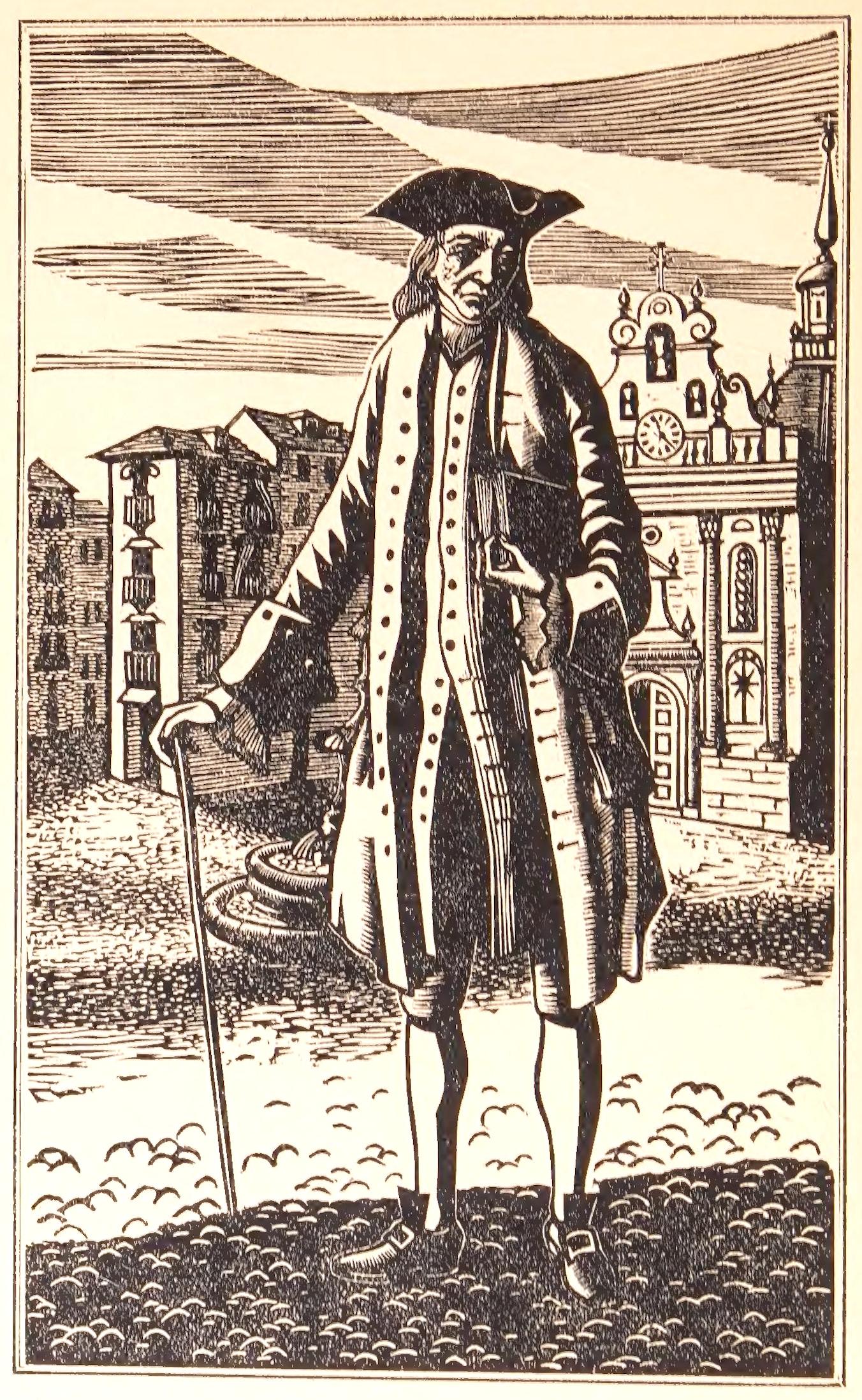
Portrait of the Author in Middle Age
For a variety of reasons—to disarm the gibes and scoffings with which the critics of today are wont to snap at anyone who submits his writings to the public, to cloak my pride and airs with a feigned and interested contempt, to make mock without scruple and at my ease of the enmity of a few worm-eaten and envious souls, and finally to laugh both at myself and at those who snarl over what neither touches nor concerns them—I have in the past depicted myself as endowed with the repulsive defects and ridiculous deformities of body and mind that stand on record in various passages of my scribblings for the many.
Not a few blemishes and monstrosities are there indeed with cause, especially such as I have declared in order to make clear the nature of my humours and qualities. The humps, bruises, smuts, bleariness and grime with which I have adorned my figure are, however, for the most part thrown in and untrue, God in His mercy having given me a stature somewhat above the average, a reasonably human cast, and a body lean, firm-fleshed, ruddy and well proportioned, that I might have kept in condition for more summers than I now hope to five had it not been corrupted bv the pestilent breath of my follies and bad habits.
To the end that what I have to tell in the following narrative, which has today all mankind for witness, may be the whole truth, I pause here to draw an authentic portrait before taking up the unfolding tale of events, perchances and adventures. I shall show myself as I am now, and leave it to the reader to add, subtract and work out for himself what I looked like at twenty. I stand six foot tall, with limbs of a flawless symmetry. My face is smooth-skinned, without freckles, unhealthy blotches or other disfigurement of colouring; though it is true that some crow’s-feet already show towards the corners of my eyes. There is still a tinge of gold in my hair, for all my forty-six years; occasionally a white hair will appear to remind me I am getting old, but I soon get rid of it. My eyes are blue, small and deep-set; eyebrows and beard bushy and sorrel-coloured, a trifle strawy compared with the reddish on top.
The nose is the most reprehensible of my facial solecisms, being outsize and wide of nostrils and coming down over the upper jaw to suggest a fool’s cap, a candle-snuffer in church, a turkey’s croup or the dice-box of a conjurer. Still, God be praised, it lacks stumbles and ridges and the like pharisaical embellishments. My lips are crisp and dry, generously fleshed and of a pleasing fine. As for my teeth, I have them all still in a good state of preservation, closely spaced and without speck of tartar, scurvy or loathsome adhesion. Feet, legs and hands accord properly with my body, which is beginning now to incline earthwards and to describe a semi-circle about my ribs: the malevolent call it a hump.
Taken as a whole I am a lusty fellow, on the spare side, fair-complexioned, still with some colour in my hair and with more of the cast of a German about me than of a Castilian or Estremaduran. The charitably-disposed have been known to find me good-looking, if to connoisseurs of the human figure I am perhaps over-tall, a trifle sluggish in movement and with a suspicion of crookedness in my gait. Seen from a distance I strike people as gloomy of physiognomy, bemused of feature and sad of eye. In conversation, on the contrary, they reckon me generally good-humoured, modest and respectful towards my superiors, agreeable and diverting with my inferiors, and with my equals for the most part free and uninhibited.
In the speaking likeness dress too plays its part. Mine is black and moderately expensive, striking a mean between foppish prodigality and the niggard economy of your crude ultra-hypocrite. Best Segovian broadcloth, with an occasional trimming of taffeta in summer, of velvet in winter, has been the normal attire of this gaunt carcase. In cut I follow the fashion, whatever usage and the whim of the majority decree; playing for safety, I leave decisions to my tailor. My clerical dress—ecclesiastical collar, frock coat, short cape—conforms to the new requirements of authority, save for university occasions when I appear with my fellow censors clad in the doctoral garb—badge of learning and cloak of ignorance—of bonnet and soutane. Thanks to the diligence of my servants I go clean without, and to the fussiness of my sisters, within. Forgetful as I am, they see to it that no day passes without a change of shirt.
At times I deck myself out with all the trinkets and gewgaws of the gallant, the wealthy and those in love with their own conceit: a gold watch with strap and tassels that dangle over my right groin, an outsize diamond ring, a snuff-box of unusual make filled with choice tobacco, an English hat, Dutch stockings, Flanders buckles and the like trappings all proclaiming, by their outlandish nature and ostentation, the wearer’s fastidiousness, folly or whimsy and his concern with fashion and show. In a company of dukes and archdeacons I will pass with the rest, no one imagining for a moment that I could be an astrologer or the Torres of those books that make me the butt and laughing-stock of the public.
People curious to discover what I really look like have been much taken aback, incredulous even, on meeting me in the flesh, having commonly figured to themselves some sort of academic monstrosity, advanced in years, gnarled, hunchbacked, covered with bristles, clad in a camel’s hide or huddled into a packsaddle as proper covering for my rusticity. But as I have here written, so by God and my conscience I am; and by this copy, and the likeness my features bear to those of the scarecrow that figures on the front page of my almanacs, the most dim-witted will be able to pick me out in Madrid from among a million.
What I am by nature, temperament or the invisible genie—call it what you will—whose jests and posturings give some faint clue to the soul, this my writings do more truthfully reflect, if only because I have always been at pains to declare my shortcomings; in part too since in them, for all my vigilance, there have crept in along with my observations and naiveties many a detail indicative of just where I leave the fines and how my mind goes a-wandering. In some pages the very essence of my being will be found laid bare and spread thin. Here, to discharge the matter in hand, I set down in brief review certain marks of the inner man, that such as wish to know what I am like within and without may have a picture of me in the round.
In common with other sons of Adam I have my complement of liver, spleen, heart, intestines, hypochondrium, mesentery and the whole gamut of corners and hiding-places we learn about in anatomy. It is here, in these inner caverns of man, the natural philosophers teach us, that rebellious appetites, inscrutable desires and proud and obstinate passions have their abode; and from the disposition, texture, quality and temperament thereof they infer him to be of equable or violent temper, tractable or disordered. It is an elegant and engaging theory, and not impossible: I have my doubts only whether it be true. What I do know is that, wherever they come from, liver, spleen or heart, I am compounded of anger, fear, pity, joy, sadness, covetousness, generosity, rage, docility, in short all the qualities good and bad, all the instincts praiseworthy or reprehensible, that are to be found in the whole of mankind individually or in the lump.
I have known all the vices and all the virtues; and in the compass of a day I find myself disposed to cry and to laugh, to give and to withhold, to rejoice and to suffer, without ever reaching to the springs of such conflicting impulses. This alternation of contraries I have heard called madness: if it be, then are we all mad in our degree, for I have noted in everyone else the same unwilled and repeated inconsequence. To most of us a man’s nature, bearing or disposition is a matter of the greater or lesser depth of his feehngs, the degree of violence or equanimity which characterizes the play of his passions. If mine is to be known by those exaltations of mood which recur most frequently, here I set them down with all succinctness, and suppress meantime the blush I feel creep over my face.
I am, as I have said, of an averagely peaceful bent and quiet manner, and know how to bear myself alike with my equals and to such as are set above and below me. In company I say little, and that in a tone of studied moderation. I never was bold to play the wit, though I have known my head buzz with the puns, quips and sallies which urbane speakers use to season their talk. It is my good fortune to feel at home among people of every kind, sex and profession; only with the insincere, the conceited and the obstinate do I lose patience. But as from all such I fly at first meeting, I generally manage to find life amusing enough.
There are gatherings, needless to say, which one must attend where there is no escape from the bores, fools and others of their ilk who turn up even in the most select society; and then one is conscious of a certain resentment. But this is a common affliction, and yields me a satisfaction of its own. I put up with their follies when needs must with tolerant resignation, and cry quits on their stupidities with the annoyance that, 1 take it, my extravagances must cause them. My pliability and openness to suggestion may be held blameworthy, even vicious, since I am apt to fall in with whatever commands are laid upon me without weighing the dangers or possible unhappy consequences. For this I have on occasion already paid dearly. The vexations and anxieties that have befallen me in my lifetime have come not from rivals, enemies or ill fortune, but from the docility and frankness of my nature.
My money, my entreaties, such influence as I may possess, my home and household effects, these have ever been at the disposal of all and sundry, not excepting those who wish me ill. For the better part of my life, alike when I have trodden the narrow stretches of success and the broad avenues of misfortune, I have lived on the bounty of others, a guest honoured and esteemed in the first houses of the kingdom. With the resultant economies and the product of my various activities I might have been rich; yet my outgoings have always balanced my incomings. Over forty thousand ducats my lucky if absurd publications have brought in; and between friends, relatives, enemies and swindlers I have squandered the lot.
Twenty years of writing, more than two thousand ducats a year: yet at this moment, God be praised, my total resources do not amount to above some twenty doubloons in the possession of my mother, who has always been purse-keeper and apportioner of the fruits of my labours. Should the envious or the disgruntled over my good fortune disbelieve this figure for my earnings, let them apply to me and I will show them the returns I have from Juan de Moya and other booksellers. The record is there, and I and those who handle my affairs are still here to stand by it.
My lack of self-interest is public knowledge, familiar and demonstrable to all, and such in degree as to verge on folly to my own ruination. I have worked constantly for others for nothing, while they made their name and fortune out of the leavings of my industry. With a substantial total of works to my credit, the copies I have given away outnumber those I have sold. Many a man far removed from friendship, with no claim even to calling himself an acquaintance, has enjoyed an open draft on the proceeds of my prognostications and other frivolities. The Moya I have just mentioned will swear, as the depository of this merchandise, that he has orders from me not to haggle over my writings but to make them freely available to all comers: a good cape is commendation enough.
Being, as I have already indicated, and shall explain more fully later, the poorest and most harassed author of the present day, I have still borne myself with nobility of spirit. The one hundred and twenty dedications to be found in my books suffice at least to confound those who hold all writers of such for no better than confidence tricksters. Never in them has my aim gone beyond the expressing of gratitude and deep respect and the enhancing thereby of the work in question. In tendering my dutiful homage I concealed my person. More often than not they have been addressed to men of eminence, to individuals at a distance or, where distance or eminence did not of itself impede reciprocation, to such as I judged least likely to make return. My sentiments and my offerings have always been pure, courteous and deferential, untainted by crude interest or contemptible flattery.
I make mention of this, though the detail be irrelevant, to show that I do not have all the parts of the bad author: at least I am innocent of the cupidity that is the mark of many makers of books, gaily confiding that the great man to whom they dedicate them cannot fail to pay for the printing if no more. Such do not pay court, they steal (my speech is blunt with all who know and have dealings with me). And now let any carper who likes raise his cry: let him smear my poverty and my disinterest with whatever charges his ire and bad faith suggest to him. Here I await him, well able to clear myself and to give him the lie with my record and the most notable witnesses Spain can produce.
My servants I treat as friends and companions, the affection I feel for them leaving me none the less sorry that fate should have dealt with them so shabbily as to condemn them to serving me. None have I ever dismissed: such as have thrown in their lot with mine have either died in my service or have left it to take up other employment, for their own convenience, at least the wiser for the experience. Those who serve me at present have yet to hear me scold, and none has been with me for less than eight years. We all eat from the same loaf and the same stew, buy our clothes from the same shop, and neither in cut norinaterial does my dress differ from what I give them. The one closest to me is a negro, a man of simple innocence, completely trustworthy and of irreproachable habits. Him I deck out with a touch of extravagance, permissible in one of his colour and calling. I amuse myself with the embroidering[1] and fancifying of his attire, satisfied that people should see him cut a figure and me occupied.
Neither he nor the others are called upon for the petty busynesses and services that are dictated by vanity rather than need. And though it is the custom here in Salamanca, among masters of my class and degree, to go about followed by a servant in student dress, I have never wanted to have any of mine trail me. I go and come about my occasions alone, dress and undress without help of valet, write and read without amanuensis or reader. I do more serving than ordering, and what I can do for myself I entrust to no one else. In short, I find myself more at my ease and better suited with my own company than with another’s. Whether this be a good way to train servants or to comport myself as master I do not discuss, neither maintaining nor denying it. I state merely how things are with me, this being what I have undertaken. For the rest, let the critics embroil it as they please.
The stout heart, tranquil spirit and serene mind I have enjoyed these many years past, this alone in my temperament, nature or upbringing may move to envy. As a child I was apt to be frightened by the tales of terror and suspense and suchlike imaginings which strike shivers of fear into the credulity of the very young and the gullibility of adolescence and old age alike; but now the charnel-house has ceased to terrify me, the dead are no longer fearsome, and the possibility of ghostly visitations leaves me quite unmoved. The reader may accept that, given my present equanimity, I suspect it would not greatly perturb me were all purgatory to take shape before my eyes. Such valour may smack of braggart despair: my word for it that it springs instead from Christian resignation.
God alone rules over my existence. I know therefore that I live subject to His plans and decisions and that there can be no rebelling against His decrees. Against the day when He shall be pleased to call me to judgment I seek, with His help, to dispose my will; and it worries me nothing if the call should come by way of a drubbing or a stoning, by doctors, colic or ghosts. Let it come only as He shall decide: it will find me ready and resigned. Neither solitary haunts nor the blackness of the night, nor open country nor gloomy corridors, hold the slightest terrors for me; and I remain a stranger to the phantom shapes which a corrupt imagination, time on one’s hands, eerie silence—all great artificers of these nothings of wind and smoke—are prone to call up in such places.
Witches, wizards, hobgoblins, people possessed of a devil, they too, like the stories and jests they tell of them, are powerless to affright me. I find them soothing and amusing, and am moved instead to mocking laughter. At times I have remarked in conversation that I always carry in my pocket a piece of eight, worth today over three hundred reals, which I am prepared to give to anyone who will undertake to bewitch me, or to any witch or person possessed who will submit to examination by me, or to any other who will engage to instal me in a haunted house, offering to five in the same without other inducement than remission of rent. Never yet have I had a house rent-free, and I reckon that my doubloon will still be mine to serve for masses for my soul, being persuaded I shall go to the grave without knowing what it is to be either bewitched or possessed.
In fine, I make mock of the whole tribe of spirits and spells; yet without denying them absolutely. The pranks I have heard related by credulous chroniclers in my time have all turned out to be impostures. With my own eyes I have seen nothing, and I have been after wizards, ghosts and enchanters for most of my life. There may be something in it: so be it, and let it prove to be as it shall turn out. More than sufficient for my peace of mind are the false and fantastic nature of the reports that go around and the hope that it is not going to be my bad luck to prove them true. Should I be so unfortunate as to fall victim to that calamity, I buttress myself with the resignation of a true Catholic. And until the blow falls I shall continue to laugh at the whisperings and old wives’ tales that simple, timorous souls have ever on their lips and that serve as stock-in-trade for pedlars in this line of drugs.
Torreblanca’s work on the black art I have by me, and Martin del Rio’s Disquisitions on Magic, and very present in my memory the autos da fe conducted by the holy tribunals of the Inquisition, which regularly sentence more stiff-necks, fools and offenders against the first commandment than wizards and spell-binders; and I hold in reverence the exorcisms with which Holy Mother Church casts out and chastizes devils and spirits. All of which enables me to believe something, to dispute little and to fear nothing.
In the congregation of the living I likewise find none so fearsome as to affright me. The bullies with the short capes and broad knives, the swashbuckler of the outsize moustache, sabre and pistols, are cowards themselves; and the fear I rightly presume in them frees me from any I might otherwise be moved to by their dress, their weapons or their oaths. Tale-bearers, backbiters, cynics, who can appear awesome giants to the most steadfast souls, are to my disillusioned taste matter for scoffing or amusement. The greatest hurt such people can inflict is to spread scandal about one’s person and habits, which is something I have joined them in doing against myself many a time without injury or umbrage to my peace of mind. My repute has survived untarnished all their imprecations, their insults and cursings. I still have, God be praised, all my limbs in sound condition. No one so far has deprived me of my appetite, or of the wherewithal to satisfy it. So that he is a fool and a craven who lives in fear of these bogeys.
The brotherhood of thieves, I grant you, is everywhere about us, and embraces many of whom one may well be afraid. Yet even here apprehension is for the most part mis, placed. We live cheek by jowl with them in their haunts in the towns, and are terrified of places where no robberies ever happen because there is no one to rob. All our dread and alarm are centred on highways, hillsides and desert places where there is nothing to steal and none to steal it. I have roamed through much of France, all Portugal, most of Spain. Every month I go over the Guadarrama and Fonfria passes. And I have yet to meet a robber.
An occasional petty theft does occur up in the hills; but the big hauls, the sacrilegious despoilings, are to be looked for in prosperous towns. It is there the wealth is, and so the thieves. And neither the few who infest the highroads nor the many who ply their calling in the towns have ever frightened me; for no astrologer has yet perished at their hands, nor is it on record that it has ever occurred to them to waylay one of so penniless a breed. In a word—I say it again and with all sincerity—I know not fear. And I repeat that this imperturbability is something other than stoutness of heart. It comes from disillusion, from reluctance to accept events at their common valuation, and from much trust in God, Who allows neither men nor devils to make sport so easily of His creatures. The sort that does arouse in me rabid alarm, a mixture of concern and disgust, half annoyance half repugnance, are your hypocrites, misers, constables, and with them many doctors, some lawyers, and accoucheurs one and all. These I never see without crossing myself, and when I have let them pass the shock and alarm go with them.
And now, when to these traits have been added such as will emerge from the relating of my experiences, the main lines of my character will, methinks, stand out clearly enough. I pass on to speak briefly of the cast of my intellect, which too comes into the reckoning.
My mind is not a bad one, being endowed with average discernment, much malice, plenteous knowledge, tolerable clarity, subtle penetration, and an aptitude adequate for the most part to the mastering of the arts and crafts. As for the uncouthness or urbanity, the wit or infelicity that characterize it, I have published enough books now for the reader to have formed his own and a more faithful picture than I can give here. Few of these works, however, can convey a true or full impression concerning its integrity or goodness, its penury or abundance, since all were written in a mood of petulance and against the grain, with more of haste than careful dehberation.
I know well that my mind sees further and reasons better than my writings bear out. I know too that, had I been more jealous by nature of my interests, more solicitous of fame or of what they call popular repute, and had I not in my indigence been so wayward and self-opinionated, what I have written would have been tidier as well as wiser, more profound and more readable. My books have always been despatched in a mad rush from desk to printer, never once have I corrected a sheet in proof; so that they all circulate full of the compositor’s errors on top of my own. I hate them, because I know them; and if today I could call them in I should consign them with pleasure to the flames rather than leave behind me so many witnesses to my sloth and ignorance, so many tokens of the folly, presumption and extravagance that are part of my make-up.
This distress will accompany me till I die, alleviated only by the innocent nature of my nonsense. Total and outrageous though this be, it seems it has never yet done any harm, since the vigilance of the Holy Office and of the ministers of the crown has never seen fit to interfere in the slightest with its free circulation or to address to me any word of warning. I thank God that, having been so foolhardy as to hurl myself into print on the most sacred and most dangerous themes, and professing as I do a caUing so close kin to superstition, my boldness has never precipitated me into the unhappy depths of unbelief or into the ignoring or infringement of God’s precepts, of the king’s ordinances, or of the accepted bases of nature and society. In this I owe everything to His Divine Majesty and to the respect which I have always entertained for His ministers on earth. But enough about my mental faculties. Now to the relating of my more memorable experiences.
I: My Lineage, Birth and Upbringing to the Age of Ten
There were two brothers, Francisco and Roque de Torres, both young and of fine, healthy build, who set out from the city of Soria, whether compelled by poverty or in consequence of some boyish prank I know not. Roque, the elder, was likewise the tougher and lustier of the two: he ended up in Almeida de Sayago, spending his energies and his years in the harsh chores of a life on the land and in the monotony of village gaieties. He never married, and, thanks to his hoe and his plough and to the temperate diet, especially in wine, which he had observed since boyhood, reached to a ripe age, strong and contented. With what he had been able to save from his meagre wage, and some help from the farmers he had worked for, he then bought himself a hundred hens and a donkey, and on this powerful footing embarked on a business career for his declining years.
Wrapping himself up in his greatcoat, with a cowl over his head, he took to the roads as an egg- and chickendealer. People found him an unfailing source of jollity and diversion when he turned up with his merchandise in the market square at Salamanca or Zamora, especially the girls who bought from him. Everyone in both places liked the old fellow from Sayago, and was delighted to see him enter the city gates, for he was clean and tidy, well-bred, pleasant- if simple-mannered, and his goods were cheap. Between these friendly contacts and the interest of his modest business he felt repaid for all his earlier labours with the hoe and secured against the pitfalls and abuses of idleness, want and old age. He lived to see ninety-two, and was carried off at last, according to report in Sayago, by a convulsive colic. Donkey, hens, clogs and overcoat, being the sum total of his estate landed and movable, he bequeathed for masses for his soul; and until now, when I am minded to put him on record, no one anywhere has taken thought that such a man ever existed.
Francisco, the younger, was also the cleverer, and the , more violent in disposition. He found his way to Salamanca; ‘ where, after going the rounds of the monastery gatehouses, he settled down with an apothecary, who took him in to draw water from the well, wash the pans, pound roots, and between whiles lull his infant to sleep. Little by little, without knowing it, he picked up the jargon of the labels, poked his nose among the tempting syrups and preserves, and on the strength of this exposure to the science and of some tincture of the teachings of ben Masuiah,[2] come by in his leisure moments, turned out after a few days as scholarly and competent a pharmacist as most of that calling.
The worthy tribunal of the faculty examined him and, being satisfied, awarded their diploma entitling him without penalty to make up and dispense ointments, cerates, juleps and the like menaces to health that these practitioners keep in their phials, jars and boxes. Within a few months of the I examination his master died, leaving a widow still young, well-preserved and approachable; and before he had been dead a year Francisco followed tradition by marrying her. Among their children was Jacinto de Torres, whom all appearances indicate as my legitimate grandfather. Francisco was a good man, self-effacing, very devoted to his family and generous to the poor. He died young, and I devoutly believe that God took him to Himself.
Jacinto, my grandfather, thus left to his mother’s keeping, grew up like the widow’s son he was, unbridled, spoilt, impertinent and licentious. This freedom of upbringing combined with hasty temper to drive him from home, and after many wanderings and samplings of one place and another he found himself in Flanders and there enlisted as a common soldier. It proved of scant service to his majesty, for after two years a carbuncle behind the knee put one leg out of action. Stranded in the Low Countries lame, useless and, now that he was drawing no pay, harried by necessity, he set himself to finding a job and a livelihood and took up tapestry-weaving. This he learnt thoroughly, and turned out an exquisite craftsman, as various pieces of his to be seen today in Salamanca and elsewhere bear witness.
A master now at his trade, and thirty-four years old, he returned home, installed looms and set up in business with a sign on the door bearing the royal arms and the legend, writ large, Tapestry-Maker to H.M. the King. He married Maria de Vargas, my grandmother, and enjoyed with her many years of enviable tranquillity and reasonable comfort, his calling, the harmony between them and their modest way of life multiplying to them blessings and business. From the marriage there issued Pedro de Torres, my good sire, Marfa his sister, and his brother Josef. Josef died a Discalced Carmelite in the Indies, held in high regard as a rehgious; and my father in Salamanca. His life I now tell briefly.
He was still at his Latin grammar when my grandparents died. Like all boys he brought to study a lively distaste, and no sooner did he find himself on his own and released from discipline than he got rid of his Nebrija,[3] turned his back on his home town and took to the road, landing eventually in Estremadura. In Alcantara he took service with a gentleman, Don Sancho de Arias y Paredes by name, who has left in that part of the country numerous descendants, an esteemed memory and a praiseworthy record. For three years my father served in his house, without other charge than accompanying his two sons to school. This gave him now a contrary liking, as is the way of youth, for doing as he saw done; and so, along with his young masters, he came to imbibe the philosophical teachings of Aristotle.
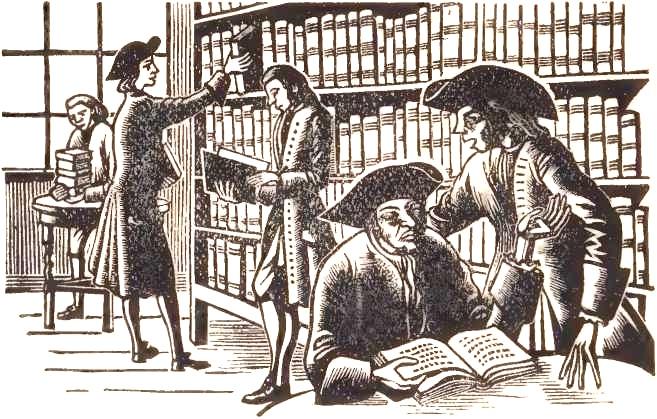
From there he went to Madrid, whether dismissed or from choice I know not. All I could learn was that the gentleman and his wife missed him sorely, for they had loved him like a son. In the capital he began like everyone else with empty pockets, looking now for a job, now for some way of getting along without one. Tired of asking, he turned to booksefling, soon learnt the trade, and made his way back to Salamanca, where he opened a shop that became one of the best known and best stocked of its day.
There he married Manuela de Villarroel, and had eighteen children. Today there are left of us only my two sisters Manuela and Josefa and I, who still reckon myself half alive. My parents’ capital and industry sufficed for the raising in modest decency of the goodly quiverful God had bestowed on them until about the year 1703, when the business began to crumble with my father’s frequent absences from his counter and shelves. This arose out of his appointment as commissary for Salamanca, the city laying on him the care of the arms, powder magazines and other military supplies along with sole responsibility for the billeting of troops on their way to the war in Portugal.[4]
These new duties that my most worthy father took upon himself lasted until they finally ruined his bookshop; whereupon the Royal Council of Castile, apprised of the loyalty, zeal and promptitude with which he had served the king, and of all the hard work and material losses involved, ordered the city to pay him an annuity of four hundred ducats, with a further three hundred doubloons there and then to set him on his feet again. With this bounty we managed, faring poorly enough but honestly, and keeping on the right side of appreciable hardship. Once peace was signed with Portugal my father, like others, saw his sorry pittance docked and himself abandoned to poverty and old age without either books or business to fall back upon.
I meantime had grown into a strapping good-for-nothing of eighteen, merely giving trouble, getting in the way and adding to my parents’ penury. At length, seeing dire necessity already knocking at the door, I took myself off, determined somehow to prevent their falling a prey to wretchedness and despair in their declining years. God in His mercy rewarded my pious desires by granting me to see their burdens lightened.
It befell that I went to Madrid, and within a few days had the good fortune to make friends with Don Jacobo de Flon, then superintendent of the crown tobacco excise; and this gentleman gave me, of the kindness of his heart, the sinecure title of inspector of the tobacco tax in Salamanca, with a salary of four hundred ducats a year, so that my father might, eat free of the anxieties with which I had left him encumbered. To this annual succour I was able to add the administration of the Acevedo estates of his excellency the Count of Miranda, with the income from which, and some necessary savings from my other employments, he knew a happy and tranquil old age.
He was a man of much wit, my father, agreeable in manner, amusing in conversation and with a wide range of learning. No book ever left his shop, bought or sold, old or modern, that he had not first read with care and intelligence. In history he had a reputation for exact knowledge, while his understanding of the scholastic sciences went beyond what may normally be looked for in a layman with other claims on his attention. Blessed with an equable temperament, gentle, unruffled and unfailingly cheerful in disposition, he was a man of his bond, humble in deed and word, and in adversity collected and resigned. He died at the age of sixty-eight, thanks to the doctors and a burning fever that developed a secondary parotitis. All through his illness he had remained cheerful and witty, making merry to the end with the shafts of his good humour.
My mother is still alive, under the weight of her seventy — four years, her strong constitution and robust nature enabling her to cope with the burden of age without overexhaustion or dejection of spirit. If her memory has failed somewhat, she continues to delight in the alertness of her remaining faculties. She was the daughter of Francisco Villarroel, who brought up a large family on a draper’s shop he had in the square in Salamanca, together with some vineyards and a wine-store in the village of Villamayor; this being the only landed property I ever knew of in anyone of my lineage.
And now I have revealed the first skeletons in the family cupboard. Anyone poking into more corners will doubtless unearth more garbage, and more grounds for pride; but I am not the one to turn squeamish over the plebeian strains in my descent, nor shall I roll on the tongue with unseemly indulgence the more pretentious. My griefs and my joys lie beyond the control of my forbears and the whims of my contemporaries alike. The repute I enjoy, be it good or bad, hangs on my works and on my words alone. The dead left me nothing, from the living I ask nothing, and neither living nor dead have part or blame when prosperity or misfortune befalls me.
What I can assert is that I have here set down all that was lowliest and ferreted out whatever was most base in my pedigree, so that none may imagine, in his pride or presumption, that he can stir any feeling in me by glossing over or digging up my connexions. Some of these may well have held, may well hold now, posts of distinction bringing them wealth and prestige. Let him who knows of such keep them to himself or trot them out as he will: my sole concern in all this is to continue immune from the whisperings of vainglory and the conceit of arrogance.
All mankind is one: we are all garbed in the same flesh, \ surrounded by the same elements, the same soul breathes ‘ life into us. Afflicted by the like illnesses, assailed by the like appetites, death in the end makes no distinction. Even in the fears born of man’s folly there is little or nothing to choose between us. The stuff of my garments is somewhat coarser in texture than that which bedecks the prince; but the fineness of his leaves him no less a man, as its elegance exempts him from none of man’s ills. Nor does the roughness of the worsted rule me out from the fraternity of the rational. That we are all sprung from Adam means but a single race. The proudest family tree has many an offshoot in cobblers’ ; shops, with bits and pieces of gaolbirds and a plenty of chips and splinters on the gallows; and conversely, the humblest line has thrown up its effigies of kings, its oracles in the law, its saints in the church.
I have in me, in all my parts, something of everything, like everyone else; and I enjoy the satisfaction and the vanity of knowing that, being neither squire nor knight but a common rustic on both sides, as the unpicking of my ancestral smock has made plain, so far I have not lacked the esteem of others, honour has not spurned me for all its fads and pruderies, nor have those who assign worldly distinctions and the rewards of fortune spat in my face or on my birth. Others with forerunners as plebeian as mine, or worse, live triumphant, powerful and feared; while many a man with his roots in royalty has sunk to the infamous and goes about poor and despised.
It is the upright life that counts, being worth more than any connexions; and the run of mankind, however unruly, takes each as it finds him. Wealthy forbears are apt to avail a man more than noble, but he who moulds his life to honourable thoughts and virtuous deeds has need of neither. An old-stock Christian, healthy, robust, unlettered and good-humoured: such is the forbear a man should desire who is disabused of these phantoms of the haughty. That he be attorney, pedlar or apothecary matters nothing.
I, in a word, am well content with my ancestors, and have had the good fortune, rogues though they may have been, that at this time of writing none has so far been flogged, hanged or come up against the rigours of the law on any count of disobedience to king, constitution or the norms of good behaviour. We may have been a tumble-down lot, but we have held our heads high and have earned our living in honourable callings, free from taint of thieving, fraud or rascality. Such is the lineage God has given me, and such it suits and behoves me to have. And now, having told whence I come, I go on to tell what God has willed I should be.
Born[5] among paper trimmings and rolls of parchment in a small house in the booksellers’ quarter of the city of Salamanca, I was reborn by the grace of God through holy baptism in the parish of San Isidoro y San Pelayo, as is there recorded, all my pride, solace and hope deriving therefrom. The line of my forefathers, as already set down, was likewise baptized in the churches of this city, some in San Martin, some in San Cristobal, others in the cathedral, with the exception of the two brothers Roque and Francisco who first transplanted the family. My mother’s family, the Villarroels, have too been settled here for the last three hundred years: their names and callings may be read no less in the registers of baptisms, marriages and deaths.
Like other children I was brought up between suckling and snuffling, tears and napkins, sops and kisses. Neither while she was carrying me nor at my birth did my mother experience any whims, visions, dreams or portents indicating that I was destined to turn out astrologer or tailor, saint or devil. She went through the months a stranger to the humbug and forebodings they tell of other births; and I came into the world in the same fashion, naturally, without other evidence, prognostic, omen or significant circumstance than the common accompaniment with which we all make our entry. Sullying diapers, laps and swaddling-clothes, crying my eyes out in the intervals of howling, become the butt of the old women of the neighbourhood and the defight of my parents, I managed along until the time came at length for school and chilblains.
My mother still recalls some of the childish ways of those early years, that I made this silly or that funny remark, threw stones, muddied my smock or my father, made a mess of myself, and the like simplicities that all mothers tell of their children. Their dwelling on such is at once a tribute to memory, a sign of old age and an act of love, and so pardonable: in me it would be folly, and could only annoy. Let me leave it at this, that like all children everywhere I was dirty and a cry-baby, occasionally amusing, at times insufferable; and with that you have the full story of my childhood pranks, humours and graces.
At the age of five my parents put a first reading-book into my hands, and in so doing implanted in my heart a loathing for school to which were soon added dread of the master, perpetual fear of a whipping and all the other forms of anguish that polite breeding has set up against innocent boyhood. I learnt to read at the cost of my buttocks, and to write through many a slap and blow. In this captivity I remained till I was ten: five long years of servitude under Pedro Rico, as the boatswain who held me galley-slave was called. Neither the master’s cajolery nor his threats, neither punishments nor the daily sessions could ever engender in my mind the faintest attachment to letters and books.
Such recalcitrance did not spring from the common relief that boys find in idleness, freedom and recreation, but from a natural aversion to what to me was lumber, and a disposition inclined to other childish occupations of stronger and more exciting appeal. Whipping-top, shuttlecock and rattle were the idols and defights of my boyhood; and the more I grew to years of discretion the more I hated intellectual travail. Having been born and grown up among books, with which my whole life was to be spent, I can still affirm that I never picked one up from any desire for the entertainment or instruction I might find in its pages.
Fear of idleness, need, obedience to my parents: such were the motives that drove me to study, until before I knew what was happening I at length found myself in the fraternity of the studious and wedded to gown and vademecum. As a child, ignorance prevented my profiting from lessons; as a boy, love of the open air combined with arrogance to keep me from reflecting on what they had to offer; while by the time my beard had sprouted I had. grown much discouraged by the variety of sentiments and the turbulence of opinions to be found in books and by what I could perceive of the purpose of their authors. For ancient tomes I still retained a certain respect; but once I realized that books took shape in heads as exposed to error as my own, disillusion and repulsion finally possessed themselves of my mind.
Fat books, thin books, little ones and big, all are like s^ many jewels that amuse and have their part in the commerc^ of mankind. He who accepts them at their face value live0 happy and entertained; he who has overmuch to do witlj them stands little removed from folly; he who uses them not is the complete fool. All are made by men and of necessity^ like their authors, must have their defects and obscurities^ Some write books out of vanity, some from covetousness!, others moved by the desire for applause: rarely indeed is on^ written for the public good. I have a dozen to my name, put together every one of them out of the urge to make monev and a livelihood. This is what nobody wants to confess; but let us just pry a little on all the hypocrites, melancholy deceivers that they are, who keep on saying in their prefaces that they have brought out the work in question for the service of God, the good of their fellows, the redemption of | souls. We shall find that none notwithstanding ever gives it ; us free, that the fraud begins from the very dedication, and i that they work themselves into a passion against such as will | not praise and commend it.
Many books are good, lots are bad, while the useless are beyond number. Those are good that, giving precepts for ’ the bridfing of our vices and passions, set men’s souls on the path of salvation. Bad books are the time-consumers, void of admonition in this sense. Among the useless are to be classed most of those called textbooks. Any manual will serve for picking up the jargon of medicine and digesting its aphorisms, yet more than twelve thousand have been printed without greater novelty than the repeating, copying and running down of one another; and the same happens with the practitioners and teachers who teach and practise the other sciences.
I have to confess that books lost their credit and esteem in my eyes once I saw that my own found purchasers and were well thought of, being the handiwork of a man of straw who is ignorant to the last degree and whose mind is full of ravings and strange disquiets. The pity of it is, and the truth, that there are many authors so like me that the only difference between their follies and mine is the show they make of an affected moderation. As for stupidity, vanity and shortcomings in general, there is nothing to choose between us.
In the end a cantankerous spirit, disillusion with others and knowledge of myself made me a fugitive from all converse with such, until, being still not thirty-four years old, I came to abhor the lot; and one morning, awaking with this kind of delirium raging ever more furiously in my brain, I divided up my scanty library among friends and enemies alike, keeping only on my table and on a chair at the head of , my bed the third part of St Thomas Aquinas, Thomas a Kempis, Pere Croiset,[6] Francisco de Quevedo and an odd prayer-book of the kind that, ministering to my happiness through life, may serve me no less in the issue of my dying hour.
In my last years at school, when I was learning how to form and recognize figures, the mischief in my blood and temperament was already bubbling up impetuously. A number of rogueries, blameworthy in one so young, had their origin in a certain coldness towards my fellows and in a lack of fear and respect for my elders. I do not think the fault lay wholly with my simplicity, with the unruliness of my nature or the instinctive restlessness of childhood. The chief responsibility for this waywardness I attribute to the stupidity of a coarse fellow who worked for a weaver next door to my father. This blockhead—he was a Galician—took to telling me that I was the sprightliest and most spirited youngster in the neighbourhood and set me quarrelling with all the others, even to looking for fights in other parishes. He would urge me on, like a dog, against opponents without caring whether they were my equals, or bigger or smaller. What the brute achieved by all this was my getting my head covered with bruises, taking to going about all filthy and torn, and developing a new and evil side to my nature; so that, even without his prodding, I would go engaging in fisticuffs, dealing out and getting punches without motive, passion or other end than the gratifying of his animal sense of amusement.
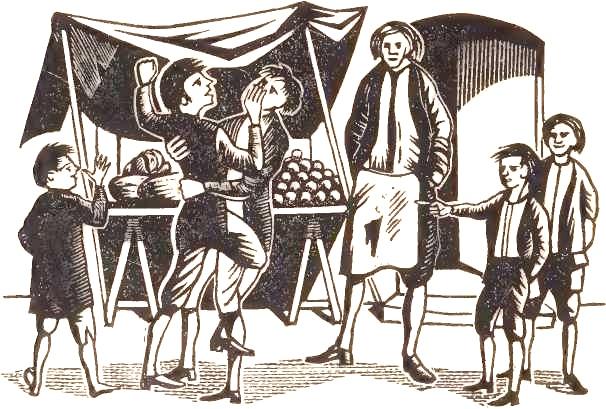
Conduct so reprehensible caused my parents some concern, and brought on me a load of trouble in slaps and whippings, their sense of duty combining with the solicitude of relatives and neighbours, who had been much taken by my earlier naiveties, in a resolve to correct my evil ways. This, added to the punishment I was already taking in my brawlings, made a burden beyond what loins as weak and tender as mine could well stand. Treatment so rough, the return to his own part of the country of the savage weaver and, more than anything else, the shame I felt at drawing mockery now throughout the parish and the whole neighbourhood and being branded a limb of the devil, finally punctured my combativeness, and I reverted with no particular regret to my former gentle innocence.
I left school able to read, without knowing what I read; forming letters that, if they lacked design or beauty, were “ firm and clear; versed in the five rules of adding, subtracting, multiplying and simple and compound division; and well grounded, finally, in Christian doctrine, being able to repeat the entire catechism without a mistake. Which is as much as can be expected from any boy at an age when memory is still the most potent and discerning of the faculties. With these rudiments, and cured now of my capers, I went on to study Latin on the road to the Colegio Trilinguet and began to trip and stumble over nouns and verbs with more dread than application.
What I gained and lost, how I felt and fared, at this time I shall tell in the second chapter of my hfe; since here ended my first ten years, that brought me upsets no greater than befall boys in general. Smallpox, measles, scabs and the other plagues proper to my age I survived, God be praised, without noticeable hurt to my limbs, and entered on the strains of the next stage strong, robust, well fleshed and well developed and in the enjoyment of perfect health. Which stage too I followed through to the end, as all who wish to read or hear may learn.
II: From Ten to Twenty
My first mentor in the precepts of Nebrija was Don Juan Gonzalez de Dios, today doctor of philosophy and professor of humane letters in the University of Salamanca. A scholar of much learning and distinction in the Latin, Greek and Castilian tongues, he compelled attention as, to our joint admiration and profit, he discoursed on the variety of delights to he had from good literature. Taciturn, austere, grim-visaged, withdrawn from the crowd and other-worldly in his movements, sparing and sententious of utterance, set and scrupulously exact in his ways, such is Don Juan de Dios; and these quafities, allied to his manner and methods in class, made of him a prodigious teacher whom we at once feared and revered. My parents, anxious that I should make the utmost of these years, entered me as a boarder in his virtuous yet festive and generous establishment and made me over entirely to his care.
Against my little liking for bookwork there was fortunately to be set my timorous disposition. Thanks to this I coped with my studies and the other tasks which the master in his wisdom required of us, all directed to our progress and well-being. The lessons his experience dictated I accordingly did my best to commit to memory, though hard work and perseverance were called for; for mine was slow and rebellious, and averse in particular to the learning of words. The fear his demeanour inspired, and his freedom with the rod, at length overcame this temperamental laziness or distaste which invariably descended upon me when confronted with / anything intellectual. All the merriment, self-conceit and turbulence proper to my age his constant presence kept bottled up inside me.
Very conscious of the many inner promptings to step over the traces, I did not dare do other than stifle or disguise them. Sternness and discipline count for much in the early stages of upbringing. The tutor’s eye fixed on his charges at all hours of the day restrains their pranks, clamps down on their faults, checks their thoughtlessness and moderates even the forgivable arrogance of youth. Under that gaze no boy is bad, or lazy: all try their best to appear studious and attentive, until repetition and submission gradually alter their nature and implant in them a disposition to virtue.
And so, grumbling inwardly and consumed with boredom, I dissembled my total distaste for study and learning. For three years I managed to swallow lessons, counsels and admonitions; and despite my shortcomings I emerged well-behaved and tolerably strong in Latin grammar. It is often told of youngsters that they learnt Latin in six months or less. All praise to God that He should have fashioned such possible prodigies: I have my own beliefs on the matter. What I know is that four hundred boys studied Latin with me later at the Colegio Trilingiie, and such was our stupidity that the most talented took as long over it as I did, and many took longer. True, these tales of phenomenal progress come to one from the parents, of whose objectivity, given their passionate upholding of their own offspring, it is permissible to doubt.
For the child there is little gain in knowing Latin at an early age. As an accomplishment it helps while away the time, but it contributes very little to the development of his higher faculties. Three or four years are not time wasted with Horace, Virgil, Valerius, Ovid: the reason is maturing the while, knowledge grows, judgment ripens, the mind enjoys repose and interest, concentration and perseverance are harnessed without violence to the overcoming of difficulties. He who would embark on serious study must advance beyond the mere use of reason. Syllogizing is not for infants.
Nothing is lost therefore by dallying with the poets and their constructions to the age of fifteen or sixteen. I speak of those who study of necessity, for professional or other gainful reasons. Such as do not have to eat by their studies may take them up and jog along happily without regard to age, season or circumstance, since to them all enterprise is gain, all knowledge an adornment and all industry virtue.
I emerged from this boarding establishment conscientious, amenable and painstaking. Having shown throughout a proper fear and respect for my teacher, I had escaped serious chastisement. The only sign of boisterousness that showed over these years, thanks be to God, was an occasional exuberance of the sort that is easily pardoned in the young. I was good because I was not allowed to be bad: there was no virtue in it, only compulsion. If at all ages we stand in need of correction and punishment, in the earliest there can be no dispensing with severity. Few things are more rewarding in the upbringing of children than to set boys under a grave, devout and discreet master whom they will fear and follow.
Many a youth turns out ill for lack of someone to fear, and much delinquency in old age can be put down to immunity from the jurisdiction of a whipping. The master and the strap ought to accompany us to the grave, since to the grave we are wicked, and the most virtuously disposed of men is not otherwise to be won to goodness. Years, prudence, honour, dignity, these as masters are very placid, very easy-going, and very partial to our whims and appetites. The most venerable and vigorous of all masters is the whip, which knows no adulation, its only prowess to correct and restrain.
He who taught me my first letters died not many years ago, and I feared him till the day of his death. My Latin master is still alive, and him I still fear more than I do witches, spells, ghosts, thieves or beggars, because I have the notion that he may still give me a thrashing. His very presence sets me shuddering, and when his eyes are on me I do not dare raise my voice above a normal modest tone. It will doubtless seem absurd to contend that old people should be treated to the strap as if they were still children; but it is an absurdity resting on man’s inconstancy, his pride, indiscipline and self-conceit, which are with him to the end. There come to mind now many I have known who, had they been well whipped in their youth and gone on being whipped into old age, would not be the headstrong, wicked characters they are today. At every age, if one considers the capricious nature of human passions, we have in us something of the young and of the old. There never is a time when we are not inclined to those freedoms and delights which society has outlawed, and correction and admonition avail little to check the headlong course. The cane and the lash turn out better characters than good counsel and kind treatment. Every stage in life, in a word, finds man still a fool, and the fool is cured of his folly through chastisement.
From this apprenticeship I passed to the Colegio Trilingiie, where they adorned me with the scholar’s sash, my father having procured me an award from the University of Salamanca. The board of examiners called me before them according to custom; and to judge by the result, either they made allowance for my youth or my answers proved satisfactory, for I was approved unanimously. I was thirteen[7] when I thus embarked on the arts course and the life of a colleger, my mood one of vexation and resentment, for it seemed to me very early to be playing the man and immuring myself in that gloomy barracks of a building when I would willingly have kept to my spinning-top and rattle.
The rector of the college, at the time of my admission, was a cleric of virtuous and irreproachable fife. He was, however, advanced in years and a sick man, who had had enough of struggling with the youths shut up under his care. For many hours of the day, and many months of the year, his ailments, age and past travails kept him to his bed. Knowledge of this, added to the example of other collegers who were given to laziness and unprofitable diversions, involved me in the gradual and unwitting loss of my innocence, and I fell prey to a whole range of vices and disorders. Left without a guardian, without guide or teacher, my mind began to give rein to the follies in my disposition and the inconsiderateness P of my years with an abandon of shamelessness I should not have believed possible.
My parents’ wish, backed by the reverend rector, had assigned me to the study of philosophy under Father Pedro Portocarrero of the Society of Jesus. I started on this in a carefree, uninhibited frame of mind, holding myself now too old for punishment, master of my will and absolute arbiter of my acts and indiscretions. Forgetting the respect due to my red sash, I turned up late and unprepared for discussions, was inattentive in class, fooled and quarrelled with my fellow-students, played the buffoon shamelessly with newcomers and set myself up as a jester, brazen and wit towards everybody, without regard even for the seriousness of my teacher. In the lecture-room I flaunted my daring levities despite all his reproofs, warnings and asperities; while in college I persisted with my comrades in such liberties and excesses as ended by turning me into an idler and a good-for-nothing.
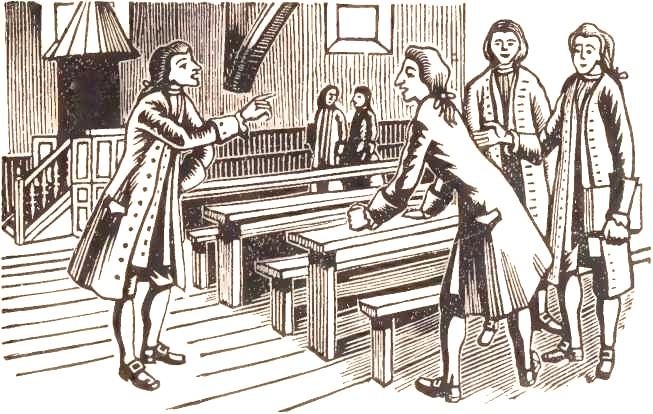
Cutting classes day after day, and studying not at all, I dragged along to the end of the logic course. The professor, aware that he was wasting his time on one who remained impervious to counsel, correction and threat alike, one afternoon summoned my father and the rector of the college, thinking to remonstrate with me, and if need he indict and shame me, in their presence. A fellow-student forewarned me of his intention; and without waiting to be carpeted before the others I confronted him and tore up under his eyes my notebooks containing such scribblings as I had taken down from him, remarking with deliberate effrontery that I had no desire to study.
For reply he gave me there and then a good hiding, and then called on the other boys to seize hold of me; which they did, not letting go until my father and the rector arrived. I was pushed roughly into a lumber-room by the sacristy, and there the charges were drawn up and the evidence produced. Counselled with kicks and admonished with shouts, I took it all surlily, pretending to be deaf, to be ill-used, even at last to be repentant. Once out of their clutches I resolved the class-room should see me no more; and by that resolve, uncreditable as it was, I abode faithfully.
This then is the sum total of all the classes, examinations, courses and exercises that stand to my name in the University of Salamanca. A few ill-digested scraps of logic formed the whole substance and adornment of my studies. And here let the reader who has read so far consider the stuff of which scholars and writers of books on morals and doctrine are made. He will perceive that in their eyes wealth, credit, prestige derive for the most part from the gullibility of the public and a man’s own particular vein of fortune. For myself I know that I am endowed with a plebeian mind that is a stranger to learning, to industry, books, teachers, everything that ought to go to the making of a reasonably educated man; and the public has cracked up my books and sayings in spite of confessions, crudities, careless blunders and the continual scoffing and contempt with which I have myself held them to ridicule.
With this incident I said farewell to logic and conceived a new repugnance for study; and over the next five years I never again set eyes on a book of the kind one wrestles with in universities. Novels, plays and the like writings in the vernacular whiled away the leisure of my forced retirement^ leaving with me the vague memory of indifferent styles and expressions in Castilian with which I now make shift to convey my meaning in conversation, books and correspondence.
Quit now of further obligation than attendance at the class of rhetoric, to which my scholarship was attached, I stayed on at college, which put up with me out of pity and respect for my poor parents, and abandoned myself to idle mischief until my name became a byword. The only gain I had from the class was the freedom to come and go, and such benefit to my health as accrued from the exercise. The professor here was Dr Pedro de Samaniego de la Serna. Those who knew the teacher, and have had dealings with the pupil, can work out for themselves how much he could teach me, or I learn. I remember he used to read to us— there were two other collegers and myself—from a text in Castilian. One morning on his way to class he lost this. He put up notices offering a handsome reward to the finder; but the book never turned up, and we were left without text or teacher to waste the hour in vapid jests and gossip.
As the years passed and I grew stronger and more robust, I found myself hankering ever more boldly and wilfully after pranks and follies of all kinds. My ardour was insatiable in the pursuit of as many frivolities and absurdities as find lodgment in the thoughts and inclinations of youth. I learnt to dance, to wield a sword and play handball, to fight bulls and make verses, and bent my whole mind to thinking up mischiefs and devilries as an escape from the studious reclusion proper to a worthy member of the college. I would manoeuvre locks, forge keys, split padlocks till there was not a wall, door or window safe from my attentions or proof against scaling or forcing. It was a grave misdemeanour in my time to break out of college at night or to wear cloak and cap by day;[8] and day and night I infringed these regulations at my own sweet will.
My room resembled rather a thief’s den than the abode of a student, its contents chiefly coils of rope, hammers, drills, stakes and foils. I took to relieving the rector and my fellow-collegers of the fruit, sausages and other foodstuffs they kept in the larder or in their rooms. My thieving propensities, God be praised, I limited to such dainties, for the urge that possessed me to mock and jest and play tricks was matter for despair. Only divine providence kept what began as pardonable fooling from ending as most culpable vice. I am not going to set down here the plans and contrivances whereby I engineered these petty thefts and opened the doors that barred my escape from tutelage: to do so would serve less as a narrative of boyish frolics than as a displaying of evil for the corruption of readers caught off their guard. What can be said is that in the lives of Domingo Cartujo, Pedro Ponce and others of their kind who ended on the gallows, you will not read of tricks and exploits as extravagant and absurd as those fathered by my idle cunning. Many an incident is still remembered by my contemporaries and brought up time and again in conversation. The reader curious for details can apply in that direction, for a casual telling in company does not incite to wrongdoing like the printed page.
My companions in these knaveries were some come from other parts and an intimate of my own stamp, each as headstrong, crackbrained and foolhardy as-the others. Their names I keep to myself, since they have long since mended their ways and paid the price, some accepting bishoprics, others becoming members of the Council of Castile, and their having consorted with me thirty years ago is not the kind of thing to enhance their reputation. Anything that smelt of folly and disorder, of the lax or the ridiculous, found us always to hand, merrily at one and ready for action. We kept company in particular with bullfighters, and under the auspices of these worthy folk never failed to enliven the many steer- and bull-baitings in the villages around.
Graduating as a rogue, I affected the garb, speech and habits of roguery with an aptness that stamped me the son rather of Pedro Arnedo[9] than of Pedro de Torres. Every irregularity proper to the devotees of so licentious and distempered a way of life found in me a predisposition; and save for wine, which I have yet to taste, and for smoking, there was no vice in the calendar of your shameless ruffian that I did not practise and indulge to the last degree of dissoluteness.
Many was the day I spent on the roads or hanging about the slaughterhouse. When night fell I would be the first to turn up at dances, weddings or whatever other jollification offered, entertaining the company with my repertory of buffooneries and stupidities—that among the plebs passed for accomplishments—and proving a better hand at them than the other frequenters in those days of such gatherings. Thirty times of an evening I would make up as an old woman, a drunk, a French knife-grinder, a tailor, a sexton or a down-and-out, using any cast-offs that lay to hand and acting the part with verse improvisations and a more than passable mimicry of the manners, speech and gestures of my rogues’ gallery.
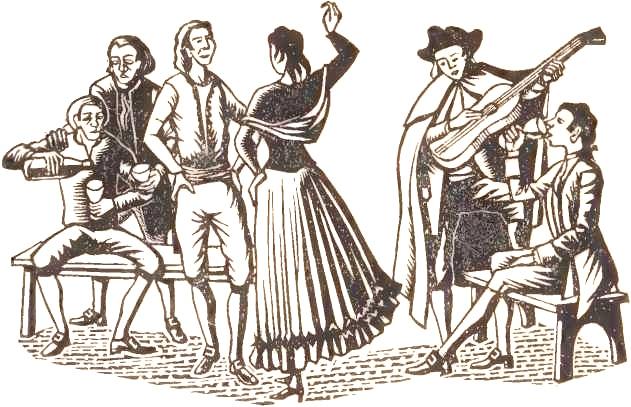
I had a juggler’s outfit, and was a great hand at fooling people with my legerdemain. My range of comic and eccentric songs I accompanied on the guitar. I danced trippingly and with an air all the Spanish dances, now with castanets, now again to the guitar, and in others showed my prowess over sword and buckler. None of the youths who then went the round trying to show off the like graces and skills could touch me. In the end I forgot my Latin, my textbooks, the miserable rudiments of logic I had acquired so stumblingly, a good part of my Christian doctrine and all the modesty and reserve my upbringing had given me. In exchange I turned out a notable dancer, a good torero, a tolerable musician, and all in all a polished and daring rascal.
Having wasted five years at the University in the like bad habits and distractions, I returned home. There I stayed for little over a month, irked by the restraint and, though the hand of discipline lay lightly upon me, ill at ease to be again under parental authority. My comrades kept urging me back; but this and the temptings of my wayward inclinations notwithstanding, I lived a more temperate and secluded life. To while away the time and lighten the oppressive atmosphere I read an occasional volume from among those that had survived, as valueless, the selling-up of my father’s stock and the ruining of his business. One book in particular delighted and fascinated me beyond words: it was a treatise on the sphere by Father Clavio, which gave me, if I remember rightly, my first inkling that there were such things as the mathematical sciences.
Now and again, cheating my parents’ vigilance and the obedience I owed them, I made stealthy sallies and went back to raiding the crocks and pans of the pastry-shops, to nibbling at the fare set out for banquets in the chapel of Santa Barbara,[10] to trailing with my cronies round the suburbs wherever a tambourine or a guitar was to be heard, and to practising my jests and frauds on all sorts and conditions of people.
It was from this time that there dated such a fear of depredations, and such a lively apprehension of the drubbings and stone-throwings that used to ensue between the thieves and their victims, that graduands and university officials came to an agreement to serve the banquets at three in the afternoon, reserving only the eggs, minced meat and salad to satisfy the demands of hunger and ceremony at night. I will not dwell on the details of the stratagems and scares we contrived for the securing of our prey, to avoid prolixity and spare the many of our victims who are still alive the recollection of the anger and annoyance they then suffered.
These liberties I snatched to such scandalous ends, at such times as my father was asleep, or unmindful, or busy, still seemed to me few and over-subject to alarms; and inwardly I kept dwelling on all the licence, the prowlings and forays my rebellious appetite was for ever demanding. Succumbing at length to these imaginings, one afternoon when my parents and sisters had gone out, leaving me to look after the house and its few belongings, I took a shirt, as much bread as I could accommodate under my left arm, and twelve reals in copper that had been set aside for household expenses on the morrow; then, with never a thought to direction, shelter for the night or goal, I abandoned myself to the folly of my whims and the stupidity of what people call luck. These, and the lightness of my step, landed me that night in the village of Calzada de Don Diego.
For lodging I chose the sheaves of a threshing-floor and, nestling down among the straw, began to nibble at the provender I carried in my armpit valise. The bread was still in my mouth when a long, sweet sleep came over me. I slept until the sun was beating, not too gently, on my face, and awoke to repentance at the thought of having exchanged the comfortable poverty of my parents’ home for the certain misfortune of him who journeys without understanding and without money.
For a brief spell, while I shook off the straws, I was assailed by all the considerations and advantages that counselled return; but fear of the chidings that there lay in store and the promptings of my vagrant appetite made up my mind for me. In vain did the thought of my youth and of the little skill I had in coming by my daily bread conjure up travails, calamities and miseries: I thrust all such resolutely behind me and set out for Portugal without knowing where I should take my rest, where end up, or what calling I might turn my hand to.
I crossed the frontier at Almeida, and as I tramped along took the notion to make for Braga, remembering a former neighbour who lived there on whose generosity my fancy was already counting for succour and entertainment. । Having crossed the bridge over the Coa, I fell in with a hermit who for some years had been footing it about the region the Portuguese call Tras os Montes. Nosing from my conversation and the look of my gear that I had, as they say, cast myself on the world, he made a proposal to me, enveloped in the same tactful solicitude that had enabled him to find a livelihood. This was that I should share with him the tranquillity, freedom and gain to be had from the begging of alms for his hermitage, with the consequent independence of worldly folk and worldly dangers, to which fell to be added the security and other advantages of a solitary retreat. His eloquence, and some cuts of bacon showing through the rents in his donkey’s saddle-bag, finally persuaded me to try the life of a pedlar of images.
And so, alternately kicking the dust and riding the ass, I journeyed with my new and first master towards the slopes of Mondim, where he told me he had his abode and, close by, the hermitage he tended. He was a devout man, this hermit, sound of judgment, free from illusions, sensible, modest, brave and hberal-hearted and so valiant in spirit as never to have known fear, whether in a crowd or in solitude, with acquaintances or in the midst of shocks and alarms. Earlier, in Barcelona, he had held an administrative post of responsibility with the crown revenues; and though the Catalans are a rough people he was feared and respected by all for his spirit, courtesy and fair dealing.
Rank ingratitude had led him to abandon the turmoil of public life. Properly solicitous for his own best interests, and concerned lest fortune continue as she had begun by again plotting his downfall, he had taken refuge from her blows by burying himself in the sequestered haunts of this uninhabited region. For sustenance he relied on the alms he begged for the sanctuary, and so won his daily bread with a degree of exertion that was at most pleasurable exercise.
What time remained to him he turned to account through prayer, reading and meditation, bringing to the same a lively susceptibility and a devout and earnest contentment. He was revered and received with honour and esteem in all the villages around. Not only was he not tiresome, like the run of pious suppliants, nor importunate in his begging: his was a most sprightly and disinterested poverty, his manner courteous and placid, his conversation on any lay topic as witty as it was innocent of ulterior motive, hypocrisy or deceit.
For several years after our encounter this venerable man continued in the enjoyment of his life of peaceful retreat, until there befell one of the famine years common in those parts, with its aftermath of pestilence and a heavy mortality among men and beasts. Uprooted thereby, he succeeded in making his way to Salamanca; and there I had the honour and pleasure of meeting him again and he the consolation of finding me grown less of a madcap and down-at-heel, being by then a person of some esteem in my native town. Seeing him old and weary and no longer of a physique for alms-getting, I besought him to settle down with me for the remainder of his days. He accepted a modest corner of my house for his abode, but God called him to a holier and more seemly asylum, in keeping with his way of fife and devoutness of character.
Don Juan del Valle is the name of this most humble man, who lives and serves today in the porter’s lodge of San Cayetano in Salamanca, where he sets an example and gives happiness to all who behold his cheerful, pious face. The priests in this strictest of houses all know and love him and treat him with a respect born of affection. Being assured of meals now and burial hereafter, he is happy as the day is long. Money he has never wanted to accept, nor other finery than an occasional undercoat, cape or pair of old breeches whenever the covering of the outer man has become a matter of urgency. My feelings towards him are still those of filial love and reverence, and I do not dare to ask more of him than that from time to time he should remember me in his prayers.
Arrived at the hermitage, he took from a large chest an old sack coat, cowl and rope sandals and hade me put these on, as the proper attire for a sanctuary attendant. The clothes I had been wearing he put in the chest. My duties he detailed as snuffing the lamp, sweeping out the hermitage and seeing to the donkey. He then gave me some of the fruits of his experience in plenteous advice, capped with the old tag about ‘doing what, when you come to die, you would wish to have done’; and left me translated into such a proper phantom of a holy man as might have passed for the most flaxen of the desert fathers. His company gave me back the shame and humility that bad example and my own cavilhngs had driven from my heart. In his sight I breathed again, timorous, humbled and dutiful. A genuine attraction and concern underlay the love and fear I felt for him. I laboured with pleasure, being desirous he should have the same in everything I did. And when lamp, broom and donkey left me with time on my hands I devoted it to the reading of the various books of devotion my hermit father was constantly poring over.
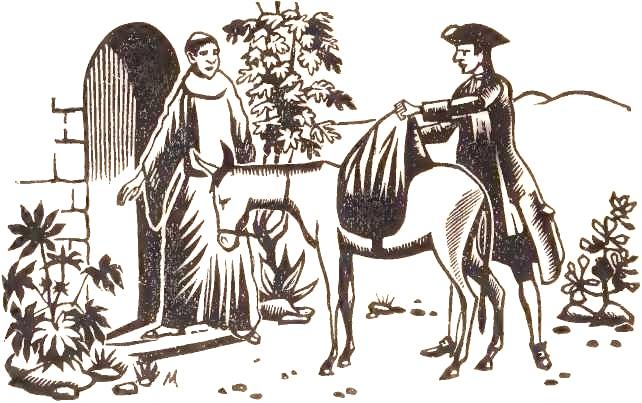
Four months I spent at these offices, neither the recollection of my earlier frolics nor the exchange of my liberties for such solitude and discipline putting me out of conceit with them. My master, taken with my conformity and right pleased with my conduct, would send me out each month to do the round of persons well disposed towards hermit and hermitage. He had for me too a genuine love and complete confidence; and we both lived happy and content with our fortune, the labours being light, the interest varied, meals more than adequate and our repose regular. The whole night was assigned to peaceful relaxation, with no duties beyond a couple of hours’ reading or praying, which still left six or seven for sleep.
In the companionship and exemplary bearing of one so schooled by life I had found the whole remedy for my ills and recovered my lost talents; and once again my evil star, weakness of character and lack of judgment threw it all away. It chanced that one day some Portuguese families came to visit the sanctuary. The hermit being absent, my youth got the better of me and led me to address some risque and equivocal remarks to a young girl in the company. Fearful lest this should come to my master’s ears, I resolved to fly the harsh chiding I could already hear him address to me. Knowing him as I did, and pondering my offence and the just cause I had given him for reproach, I readily conjured up the terrible sternness of his countenance, and that was punishment enough. Before he could return to the hermitage I had taken out my clothes from the chest and, putting back the reverend sack coat, set out at a brisk pace in the direction of Coimbra. There was still the risk he might take me on the road; but I weighed against this the fond hope that, could I reach my goal, it would prove a merry port of call.
Luck spared me the dreaded encounter, and I arrived at the famous university city without suffering other hardships than such as must ever be the lot of the penniless footslogger. Once there, I sought out the places where the townsfolk assembled and, edging my way into conversations, let fall that I was an apothecary and that my previous profession had been that of a dancing-master in Castile. I spun endless tales to prove my standing in both faculties, the lies tumbling over one another as they came out; and between the remoteness of their setting, my skill in dissembling and the gullibility of my listeners the deception became credible and even impressive. Trusting to the dancing lessons I had taken in Salamanca and to some odds and ends of prescriptions had from a French doctor and committed to memory, I passed myself off as an expert in either accomplishment.
Curiosity to see the newcomer is a trait common to all peoples and nations. It brought me now, along with lighthearted pupils and hopeless patients, much stupid acclaim born of simplicity, ignorance and this general stampeding after novelty. I handed out ointments, dealt syrups, scattered cerates and sprinkled all the water and oils of my pharmacopoeia over chronics, hypochondriacs and the rest of them with their irrelevant, exotic or all but incurable diseases. Nor was my return less than that of other doctors who have learning, good fortune and hard study behind them: to wit, the presents, credit, repute, applause that the ingenuous longing for health persists in showering on them.
As for results, I had better luck than Hippocrates himself, or else my method was surer. He, like all who followed and still follow his teachings, had many a patient die on his hands even if some did recover, while others were none the better in the end. Of those I rubbed and plastered not one died, my prescriptions having virtue neither to kill nor to cure. Some recovered in the providence of nature. Most were left with ailment and medicine, their fear leading them to believe the medicine had still done them some good.
Necessity, foolhardiness and incompetence notwithstanding, I was considerate in my empiricism and more prudent than might have been expected of my mind and years. With the dangerously ill I refused to meddle, nor ever made bold to administer purgatives or to pronounce either for or against blood-lettings. My scant philosophy fully apprehended the dangers these involved and, no less, the harmlessness of my external applications: in which assurance and knowledge we all survived, my patients with their complaints and I with their praises and their fees. At the dancing likewise I had my work cut out, though here the satisfaction was greater and the danger nil, my skill at marking rhythm surpassing that of the doctors at their cures. In this art I was spared accordingly the tormenting fear of being written down a fool.
A few days thus sufficed to make me a notoriety and a topic of conversation among the brooding, the idle and the curious. Requests for lessons and for treatment brought me in between them several gold pieces, a stock of good shirts and a couple of outfits which enabled me to cut the gallant and hinted clearly enough at my frivolous nature. All this ended with a ridiculous incident arising out of the foolish jealousy of a distempered Portuguese, whose infamous suspicions deserve only burial in the silence of oblivion, which obliged me at length to leave Coimbra for the security of Oporto. There my earnings from these eight months of capering with feet and hands allowed me to pass for a spell as a gentleman.
I tried hard to introduce some moderation into my spending; but the day came when my money had gone, and once again I faced with dismay the necessity of changing direction and finding some new source of livelihood in this rake’s progress. Of the possibilities that offered, all presented a thousand annoyances, miseries and discomforts, until it seemed that the most free and easy fife open to me was that of a soldier. So I enlisted, choosing the overseas regiment, company commander Dom Felix de Sousa. The enlistment money was reasonable, and a sergeant took down my personal details and distinguishing marks. To him I gave the name of Gabriel Gilberto, and by this I was known for so long as I wore the green uniform. Dread of the many punishments for minor offences in the ranks—drubbings, running the gauntlet and the rack among them—made me punctilious in my duties, and the captain grew fond of me. I reciprocated with a profound respect and a ready humouring of his every whim.
Thirteen months I stayed in the army, enjoying the life well enough; and I think I could have kept on with so honourable a career but for the persuasions of a troupe of bullfighters from Salamanca who passed through on their way to Lisbon, where they were to appear in some festivities at court. They provided the disguise that enabled me to turn deserter: short jacket, broad-brimmed hat and the rest of the rogue’s outfit. I consented not from disgruntlement with life in the army but from the longing to see once again my parents and my homeland.
It was in the monastery of Sao Francisco in Lisbon that I discarded my uniform, decked myself out in the left-overs of a torero called Manuel Felipe, and joined the troupe; and together we took the road for Castile. Nothing of note happened on the journey. As we drew near to Salamanca there welled up in my heart such a mingling of fear, shame and other emotions as made it hard for me to contemplate entering my home and meeting my parents’ gaze anew. One thought I could not abide, that they should see me in such low company; so, feigning with my comrades a compulsion to stay behind for some weeks in Ciudad Rodrigo, I got them to leave me about a league from Valdelamula, free now from the risk I ran of my life were I to stay in Portuguese territory. From there I continued on my own to Ciudad Rodrigo, donned once again the garb of a student, and against the assurance that my parents would repay was able to borrow from Don Juan de Montalvo of that town enough to make myself presentable in decent company.
Next I wrote to various friends in Salamanca asking them to intercede for me with my parents and seek to temper their just anger, persuading them that I was returning home disillusioned with my adventures and follies. Parental love, filial need, and the thought of the dangers into which otherwise I should again be hurled, together with my friends’ entreaties, gently and sweetly eased for me the way back to their arms and affection. Their joy was writ in the welcome they gave me. I threw myself at their feet with the shamed resolve never more to grieve them, and protested anew my dutiful obedience.
The passing of the years had brought me now to an age of discretion; and this, combined with the odd types I had associated with in these ridiculous escapades as hermit, dancing-master, apothecary and soldier, sufficed to shock my pride and to inspire in me a repugnance for the abandoned and licentious ways I had learnt in the school of idleness under such cronies as teachers. I became conscious at last that many of the obsessions that had spurred me on to the committing of absurd and outrageous acts no longer held sway in my mind. With my head clear of such influences, and freed from evil example, my late companions having now left Salamanca again, I turned my back on mischiefs, buffooneries and shameless excesses, and embarked on a more settled way of life.
I was not good; but at times I could dissemble my badness. Still an adolescent, I had grown a more tolerable adolescent and one less abhorred by respectable people. I became attentive and courteous, exquisitely courteous, towards my betters and my equals alike; and between my concern to this end and the cultivation of a new equanimity I gradually won the affection of those who previously and with reason had detested me in the extreme. It was in this frame of mind and purpose that I had returned from Portugal. The adventures that came my way thereafter he may learn who has patience for the following, third, instalment of my story.
III: From Twenty, More or Less, to Thirty, Less or More
I interrupted this extravagant narrative at the point of my return from Portugal to Salamanca, and take it up again with the remark that I came home less credulous and less a prey to the facile and foolish counsels of youth, more apprehensive of the calamities which threaten on the slippery slopes of an ignorant and whimsical imagination, than when I set out. I went back to living with my parents, spending long hours withdrawn from the society of my fellows and with no regrets at having exchanged a gay and irresponsible life for this new-found tranquillity.
Insensibly I found myself coming to hate the weary pursuits of the shiftless, and growing more adept at turning amusements and festivities to rational account. Of these I attended only such as were given by people of judgment and distinction, and reserved my dancing for social evenings and gatherings where decorum reigned and eminence was allied to a modest and gracious restraint. On such occasions I bore myself with a becoming seriousness, that others might take my presence as due rather to civility and breeding than to a selfish seeking after the grosser pleasures.
In my reading I conceived at this time the odd notion of taking up the more out-of-the-way and neglected branches of learning. Carried along by the whim, I started combing the religious houses with the oldest libraries for hoary volumes of natural philosophy, alchemy, magic, the science of transmutation and that of the separation of the elements, until finally I came to mathematics, studying in books which had survived either completely forgotten or despised for their extravagances. With the difficulties these presented I struggled on my own, having neither teacher nor instrument of any kind, indispensable as both are in the mathematical sciences; and at length picked up a smattering of such useful and intriguing disciplines.
These studies and delvings, to which I had thus been led by taste and destiny, I had taken up in the wrong order, beginning precisely with the sciences one should come to last, for no other reason than because the first treatises I lit upon were some on astronomy by Andrea di Argoli and others of David Origanus on astrology.[11] To these volumes, and to the talks and discussions I had with Father Manuel Herrera, priest of San Cayetano and a man of erudition whose interests lay in the same direction, I owe alike such faint gleams of learning as still illumine my rude talent and the glare of reputation that attends me today as master, doctor and professor of Salamanca; nor does my debt end there.
After six months of study I was already turning out almanacs and prognostications, and a million fools and backbiters were at my heels cursing my assiduity and my works. Some said I had written them with the help of the devil, others that they were worthless; while it was the common assertion that they could not possibly be the product of a mind so lazy and ungifted as mine. The unhappy circumstances of the times when my forecasts appeared,[12] the brief spell I had needed to master the technique of making them, the common ignorance and neglect of these sciences which then prevailed throughout the country, and above all the distaste and even hatred for study which everyone had recognized in me who knew me at all intimately: all this made my progress seem incredible, my industry suspect and my perseverance insufferable.
A quarter of a century ago Spaniards were still persuaded that the making of prognostics, like the drawing of maps, the erecting of statues or the determining of epochs, was a matter of insuperable difficulty, and that only by going abroad, to Italy and elsewhere, could one find the keys to unlock the secrets of such engaging accomplishments. Long before I came into the world they were already ruling their Eves by the Ues of the great Sarrabal,[13] bowing down to his pronouncements and awaiting on bended knees the fabrications he sat spinning there in Milan more easily than his fellow-townsmen their lace, as if along with them they were to receive a free gift of good health and all their needs for the asking.
Nowhere in the length and breadth of the country, neither in the seclusion of the religious houses nor among such as taught openly in the schools, was there anyone who applied himself, either as amateur or expert, to this field of systems and predictions. In the universities, where too there reigned an infamous ignorance, every chair lay vacant. A geometrical figure was looked upon as akin to witchcraft or to the temptations of St Anthony; in every circle one fancied a cauldron where there boiled and bubbled pacts and dealings with the devil. This general lack of culture, allied to my own shortcomings and extreme temerity, caused my labours to turn out unluckily for me, and enveloped these early efforts in hatred and misfortune.
To still the pernicious rumours loosed by idleness and envy in the hope of discrediting my studiousness, and to spread conviction of the propriety and seriousness of my studies, I petitioned the University to appoint me interim to its chair of mathematics, which had had no holder for thirty years nor given any teaching for over a hundred and fifty. This it granted, and for two years I lectured and taught there, with a fair number of students. At the end of the period I presided over an open discussion in the University on selected propositions of geometry, astronomy and astrology, an exercise and occasion so rare that no precedent could be found in the ancient records of this famous seat of learning. As patron for the event I chose his excellency the Prince of Calamar, Duke of Jovenazo, then resident in Salamanca as captain-general responsible for the frontiers of Castile. No one could remember an audience so numerous and distinguished, and the meeting was generally applauded as unique, many admiring tributes being paid to my initiative.
With this and succeeding fruits of my dedication to study to my credit I silenced the critics who, in their ignorance, had professed themselves scandalized at my turning such brief application so oddly to account. But now a different tribe of ranters began to attack my writings, a breed so formidably irresponsible that still today they keep up their shouting and grunting. Four thousand reams of paper and more that I have hurled at them have not been enough to close their mouths.
Riding roughshod over their carpings and stupidities, I continued to write pamphlets on this subject and on that and to read whatever volumes chance or enquiry put into my hands. With the muses I had frequent sessions, my dallyings still allowing me to take up—if more through precept than inchnation—the study of moral theology, which I followed in the writings of the Salamanca theologians and in the manual of Father Larraga. I can still give a fair account of these.
It was at this time that my father had the estimable idea of making a priest of me. While the intention was still warm, he solicited for me a chaplaincy in the parish of San Martin in Salamanca, the income deriving from a house in the Calle de la Rua. On the said benefice, amounting to six hundred reals a year, I was ordained a subdeacon on reaching my twenty-first birthday. Beyond this in the church I have never wished to go,[14] inasmuch as, once received, I was able to reflect more at my leisure on the obligations I was undertaking, the vows and pure living to which I had subscribed, and the responsibilities for which God would hold me answerable. Contrite and heavy in spirit, I resolved that until I could feel more certainty and satisfaction concerning my talents I would seek no further preferment, having bound myself so far with such scant enquiry into my fitness and without reflecting at all on the duration of the commitment.
Up till now I have never felt in my soul that gentleness, devotion, innocence and sense of ecstasy which I imagine the good priest must possess. I still cannot find in myself the courage or the serenity to aspire to the so noble exercise of the ministry, a ladder the first rungs of which I now tread unworthily; nor yet have I succumbed to the insolent presumption of turning wretched officiant at mass. Till today my cast of mind has been haughty, importunate, lazy and culpably outspoken. Vigilance and prudence, qualities I hold indispensable for the discharge of this most worthy calling, I neither possess nor will make bold to claim without possessing.
Another factor in my lack of ecclesiastical ambition was an action lodged against me by a jealous fellow touching the benefice to which I had been ordained. Rather than face the annoyances and contingencies of a case in the courts, being as I was the bete noire of attorneys and scriveners, I gladly surrendered the emolument. The greedy litigant took over his purgatory, and I was left with my vow of chastity and my breviary and not so much as a crumb from the altar table.
These upsets, and the possibifity I might end as a mendicant friar, made it seem less hazardous to remain stuck between epistle and gospel than to force a way into the sacred priesthood only to live the more scandalously thereafter, in the absence of that moderation and judgment, the unworldliness, decorum and austerity, which mark the true priest. My enemies and the scandalmongers have crowed loudly about other reasons. If any such can prove them, let him do so while I am still alive: he has my permission to argue his head off, to make every enquiry and to broadcast anything he discovers. Thanks be to God, I am not one to be scared by insults.
While still under the age laid down by the Council of Trent for the conferment of benefices with cure of souls, I did put in for two in the diocese of Salamanca. The intention I confess to have been shaky. Having as I have said no sense of vocation, nor even here a legitimate concern for temporal advantage, I submitted my name merely to satisfy pride by silencing the malice of my enemies, who kept spreading it about that I had no talent beyond that of turning out bad verse and worse calendars. In part too I acted in deference to my parents, who already saw me the incumbent of one of the best villages in the country.
My sluggish nature notwithstanding, the divine mercy— or the charitable diligence of the examining priests—so ordered matters that my showing in moral theology at once satisfied them and did me credit, and on both occasions I had the satisfaction of coming out first. Some of my answers are still quoted as worthy of memory; for, once the formal examination was over, both his grace the bishop and the examiners, apprised of my good humour and ready wit, posed me some further questions, whether to probe my character or in the hope of entertainment I know not, and my improvisations in reply proved the source of much amusement thereafter. I refer the reader to the recollection of those who have been curious about my quips and sallies. To put them down here would bring a blush of embarrassment.
It was at this time that there blew up in the University the noisy dispute over the alternating of certain chairs among the various Orders.[15] To Salamanca the claim was entirely novel, and alarming, and the result was a general raising of tempers, with tumults and disturbances among professors, masters and students alike, whatever their faculties or ways of thinking. Many suffered from the private rancour of their supporters, which damaged their interests and inflicted other hurts that told lamentably on their peace of mind and reputation.
As for myself, whether because I had no one to stand up for me or because I was the youngest, or the most turbulent, there befell me, on top of other vexations, a sentence of six months’ reclusion. The first two of these I spent most wretchedly in gaol, at the whim of an ill-informed judge; the other four very enjoyably, with much comfort, excellent treatment and profitable entertainment, in the monastery of San Esteban, of the Order of the most glorious St Dominic. All this came about through people lending ear to a stupid and lying rumour—by whom started was never discovered— attributing to me the authorship of some verse satires aimed at supporters of the said alternating of chairs.
During my detention the Royal Council made diligent and tactful enquiry into all the circumstances of the case. After examining many witnesses and much scrutiny of documents, it established the judge’s mishandling of the hearing and, therewith, my trampled innocence. A royal decree absolved me of penalty, restored my freedom, and whether from sympathy or as compensation honoured me further by appointing me vice-rector of the University during the interim period until the next election on St Luke’s day.[16] This office I duly discharged, with all the duties pertaining to it, to the satisfaction of few and the particular anguish and resentment of many. I draw a veil over the events in question, since very many of the interested parties are still alive and the detailed narrative could occasion them a certain annoyance.
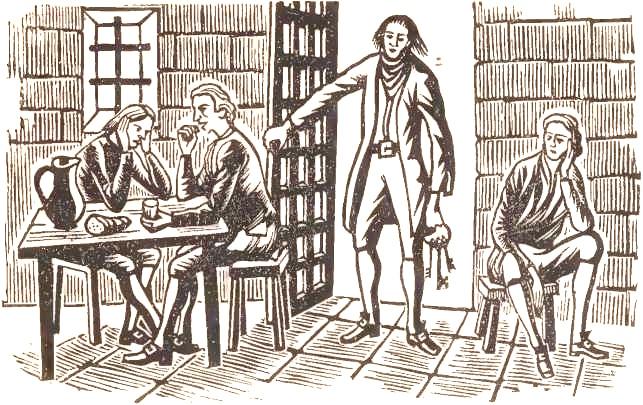
This resounding interlude caused many to ally themselves in a conspiracy against me. Added to the difficulties put in my way by the astute hostility of such as censured over-severely my youthful impulses and the pardonable immaturities of my character, it explains why I became a second time insolent, unbridled and shameless when prudence would have counselled instead patient tolerance and a concern to make amends. Angered and provoked by the tactless reprimands, the ill-concealed hatred and the pernicious threats of persons of influence, of the kind who imagine themselves invested with the right to undermine and destroy the chances of aspirants, I adopted the bootless expedient of scoffing at their eminence, making mock of their promises and turning my back on any hopes I might have had from such sources.
In the end my folly reached to the extreme where I was content to rely only on myself, and came to hate not merely these people of position but mankind in general. Gone completely crazy, I tossed all sense of responsibility to the winds. I stopped short, however, of anything really wrong, for my wrath never went beyond this mania for mocking and making scorn of the sedateness affected by some, the presumption of others, and the prerogatives and inflated esteem invoked by many to uphold a position to which they had no claim.
Rather than suffer the importunities and the blushes that are the lot of suppliants, I refused to solicit benefices, chaplaincies or allowances. I forswore chairs, degrees, subordinate positions of every kind, determined to live and earn my bread on the strength of my own puny undertakings. The reader can conjure up for himself the absurdities and follies to be expected from an irreverent youth still unsettled in mind, bursting with health, unencumbered, innocent of fear or shame and wholly determined not to ask favours or advance claims; for I see some dangers in giving here a specific account of the same, even had not the more notable episodes of that fight-hearted chapter already slipped my memory.
I do remember my encounter one afternoon with a Reverend father and doctor for whom I had conceived a certain dislike, he having least reason of any for his ill disposition towards me. He was coming out of the theology lecture-room, flushed with argument, when I accosted him. ‘Well, your reverence,’ I said, ‘and is lumen gloriae lota ratio agendi[17] or is it not? Have the stampings and the applause settled that hoary question?’ ‘Be off with you,’ he replied: ‘you are a fool.’ ‘We are all fools, reverend father,’ quoth I: ‘some within and some without. It was your reverence’s luck to be one of the former, as I am of the latter. The only difference between us is that your reverence is gloomy and measured in your madness, while my ravings are wedded to jollity and carousal.’
Incensed at such gross disrespect, he reprimanded me again, angrily now and raising his voice. I meantime under my torn cloak was fastening castanets on my fingers. Then, without saying a word, I began to prance around him, feigning to make at him and provoking him to the same absurd gambolling in self-defence. This went on for some time, he ever more incensed and peering on all sides to avoid my feet, I putting all my energy into my figures and the clicking of the castanets. Eventually he took refuge in one of the arts lecture-rooms that chanced to lie open, and there I left him enraged and scandalized, and took my folly elsewhere in search of fresh outlets. Of these I found enough to occupy me for some months, keeping everyone’s patience on edge while I avenged myself on my enemies for their unflinching hatred.
At length I wearied of playing the fool, and grew distressed—this was what moved me most—to see how wretchedly my parents were faring, and their anguish as they gradually abandoned hope of my ever turning over a new leaf. I resolved to leave Salamanca for good and to seek in Madrid a better name for myself, greater tranquillity, and a way out of the poverty that weighed on my family. The founding of ‘Horn College’ I pass over, and all the extravagances associated with it: such follies are not for the public ear. I will only say that this ridiculous affair caused laughter throughout Salamanca and beyond, such was the ingenuity in waywardness of the collegers, ten or twelve youths chosen for their devotion to every idle pursuit.
The statutes of this most sharp-witted of fraternities are in print: anyone who can lay hands on them will find cause for wonderment therein, for the ordinances, if far from prudent, have their utility and are of an amusing turn of wit. Two of the band, who later entered senior colleges of the University, are still active, men of wisdom and penetration and disinterested members of the king’s government. Another is become an exemplar of virtue in a Carthusian monastery here in Spain. A fourth went to Japan wearing the garb of the Society of Jesus. Six are dead, having happily mended their ways; and I alone remain, a solitary pointer to that far-off extravagance, as scatter-brained almost and as delinquent as in those more excusable years.
Other ploys and excesses there were that would need large volumes and a fertile pen for the telling. I leave them likewise and go on to record that I left my native Salamanca with no more baggage than a decent suit of clothes and as only train a donkey hired for a few coppers from a muleteer of Negrilla. This got me to Madrid; and, knowing the city, I had no need to ask where a man destitute might turn for । accommodation. For the first three or four days I joined the ’ muleteer at his pull-up, tucking in with the donkey’s pack-saddles at Half Moon Inn in the Calle de Alcala. Meantime I looked round for an abode, found a garret in one of the big houses of the Calle de la Paloma, and there established myself. I hired half a bed and bought myself an earthen candlestick and a tallow candle. This lasted me for six months and more, since most nights I went to bed in the dark. When I did light it, it was so briefly as to seem rather a flash of lightning than artificial illumination.
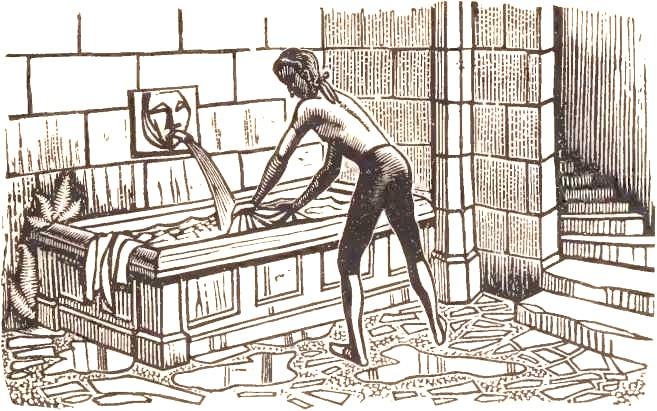
To this equipment I added an Alcorcon cooking-pot, a pitcher I used to slip out and fill unperceived at the nearest fountain, and a couple of wooden bowls which I licked so clean whenever I did have a meal that they never had to be washed. Such was the sum of my household goods. The calls of nature I satisfied in the first corner where the need overtook me. Penury so abject still did not prevent me from keeping up some show of decency and cleanliness. The house had a common trough for the other inhabitants, and there every few days I would wash my shirt; going out into the street afterwards so spruce and elegant that people mistook me for one of the gentry with a couple of thousand ducats a year.
Often, God be praised, I knew hunger, hunger so acute that there were occasions when I swooned from very weakness. Yet such were my shame and timidity at being so in want that I never plucked up courage to present myself to those who might have relieved the spasms of anguish in my stomach. At lunch- or dinner-hour I avoided the houses where I had entry and was held in esteem, being alive to the scandalous loss of face I should have suffered had I turned up hungry at their tables. Whether this be pride or honour I know not. What I do know is that, from one cause or another, I saw myself many a time in the arms of death.
One of the first houses to receive me in Madrid—and none has ever inspired in me greater confidence or veneration— was that of Don Bartolome Barban de Castro, today accountant-in-chief of excise. Here there used to assemble a lively and virtuous company from the household of his excellency the Duke of Veragua, with other wise and devout persons, from whom I gradually learnt to abhor my earlier follies and excesses. As afternoon refreshment I could always count in this house on a cup of chocolate, which would serve as my only nourishment for the day. Thanks to this succour, and to that I was later to find in the home of Don Agustin Gonzalez, physician to the royal family, which provided me with breakfast each morning, I was for some time able to keep tolerably in check the ravenous gnawings with which I was paying for my rashness.
This famous doctor, seeing me idle and at a loose end, advised me to study medicine. Accepting the friendly suggestion, I took to rising before dawn to read and eat in his house, since food and books alike put in only the rarest of appearances in mine. I studied medical definitions and the symptoms, causes and diagnosis of diseases after the traditional method in a manual of Dr Perez de Herrera.[18] His theories I would then discuss with my master and, having once understood the gist of his comment and explanations, would go straight to the hospital and search among the patients for whoever best exemplified what I had studied and he enlarged on that day. In this way, and by dint of carrying the bowl for blood-letting from bed to bed—an act of mingled charity and curiosity—and studying the patients’ faces, I emerged a doctor in thirty days, the time it took me to memorize the Perez textbook.
The new system I studied in the work of Francisco Cypeio,[19] and I believe I mastered it more easily than do the self-styled ‘modern’ doctors, since the understanding of this approach calls for a practical knowledge of geometry and its figures, which is something no doctor in Spain possesses. They pass as moderns among the ignorant, persuading these of their nodding acquaintance with the ingenious new method at no more cost than taking over the prescriptions of its exponents. Should anyone think I do an injustice in saying this, let him so state or write, and I will establish it to his satisfaction as an undeniable truth.
The thought that I now knew the science of medicine and had taken on alike its obligations, its scanty returns and all fits fallibility so terrified me that I swore to God never to practise it save in cases of dire extremity and in those others to which I took my oath when, having passed the examination, I received my diploma. Only those profess medicine who are neither acquainted with it nor have mastered it, or who make a trade and get their profit out of prescribing. This may sound satirical: it is a truism so generally established that all bear witness thereto, not excluding the practitioners of the same blessed and easiest of sciences.
Thanks to the collations I received daily in these two homes, and to the kindness of an embroiderer who let me stitch in his workshop caps, slippers and other oddments which were then sold at top prices on a stall in the Puerta del Sol, I ate enough to keep alive, and even managed to put something by towards the cost of a pair of shoes, decent breeches and a waistcoat or two from the said workshop.
Among the friendships I made at this time I count the kindly interest of Don Jacobo de Flon, who took a liking to me from a chance meeting at a gathering where we spoke together and he saw me demonstrate some of my”skills. He offered to place his influence at my disposal, and I, grateful and wishing to do something to lighten my parents’ repeated misfortunes, besought him not to pity my miserable lot but to help me help them; for I was young and could stand up to the frowns of fate, while they in their old age were defenceless against its pitiless buffetings. Moved to compassion by my entreaties, he bestowed on me—as I have already told in writing earlier about my father—the title of inspector of the tobacco tax in Salamanca, thereby filling my cup with consolation, putting an end to care and a start to good fortune.
By this time my feckless way of living-had made me restless and captious in mind, always planning and scheming in search of new occupations, new diversions and a new career. At times I thought of leaving Madrid and setting out to see the world, at times of turning friar, and even again of returning home. I was particularly unsettled, and my ideas the more confused, through keeping company with a cleric from Burgos, so worthy an ecclesiastic that he spent his spare time smuggling in tobacco, sugar and other prohibited commodities.
Scenting in me a docility that might dispose me to share f his risks, adventures and illegalities, he invited my cooperation in return for a half share in the profits. He offered further a horse, cloak and arms to help me out of Madrid. Here I might well have paused to consider the lawlessness and the dangers involved, and where all this would end. Instead I pledged my word to go in with him and to expose my life to the rigours and hard knocks that were bound up with such a calamitous departure from the straight and narrow way.
But God in His mercy, which extends even to the most rebellious against His warnings, impeded my unworthy resolve, guiding my life into paths far removed from the perils to which the folly of despair and my accursed complacency would have committed it. Invoking the oddest of means, He saved me from the galleys, a stray bullet or—as proved the lot of my devout Burgos friend—a life sentence in the penitentiary or the fortress of San Anton. Blessed be His clemency and His patience. This story I must tell, with all possible brevity, since in pertinence it surpasses any other in my narrative.
I was already puffing myself out for my new role of braggadocio, dressed for the part and stupidly impatient for the day when I should set out with my clerical contrabandist. The quest was for some sacks of tobacco which he informed me we were to carry from Burgos to Madrid in defiance of the king and all his ministers and watchdogs. It would have led rather, could we have known it, to the galleys or the gallows, but that one evening, very near to the date set for our enterprise, I met in the Calle de Atocha a panic-stricken Don Julian Casquero, chaplain to her excellency the Countess of Los Arcos. Seized with a ghastly cowardice, he had no colour left in his face; and he was actually looking for me.
He stood there quaking all over, tremulous and beside himself as though he had seen a ghost. Stuttering and dragging out half-articulated words, like a man trying to speak through the shivers of a fever, he managed to convey that he had come in search of me to ask if that night I would keep the countess company, who was lying in an alarming state of prostration from the shock of a loud, mysterious knocking which for the three preceding nights had resounded through every room from end to end of the house. He enlarged on the gloomy terror which had taken possession of all the men- and maid-servants, and added that his mistress would be greatly comforted and reassured if I would go to see her and stay with her in the midst of such an intolerable confusion, tumult and anguish.
I promised with the greatest of pleasure to call and pay my respects. It was unlikely that I too should succumb to the general panic, while I was now assured of a good dinner. The hour arrived, I went to the house, and was shown into her ladyship’s withdrawing-room. There I found her overcome with fear and distress, surrounded by maids all paUid, dumb and motionless as statues. I tried with a few off-hand remarks to dispel the fright that had taken possession of them, offered to mount watch over the most hidden corners of the house, and with so ingenuous a show of prowess succeeded in soothing them somewhat.
Ten o’clock came. I dined with appetite and relish; and the lackeys began to move beds out of the servants’ quarters and to set them up in a large hall, where they all proceeded to retire for the night, hoping to mitigate through numbers the terror with which they awaited the mysterious noise. Their naive alarm had capitulated en masse to the jest of this playful or cranky ghost, without more j ustification than the foolishness which makes ordinary people prone to attribute every nocturnal disturbance to the activities of spirits.
Altogether they had crowded fourteen beds into the room. Into these, having undressed and seen to their needs with such modesty and decency as circumstances allowed, they now climbed all together, men and women, married and single. I esconced myself in a chair, placed by my side a large four-wicked candle and a great rusty sword and, with never a thought for things of this world or of the next, fell asleep with commendable serenity.
It was at one in the morning that the tiresome noise began, disturbing everybody. The servants, huddled together as in one vast meat pie, started to scream. I awoke at once, to hear a series of vague muffled thuds that I could not define coming from various parts of the house. With the protection of my candle and sword I went up to the attics and out on to the flat roof but could discover neither phantom nor cause of alarm nor rational shape whatever. Everyone got off to sleep again, and the thumping started anew. A second time I examined in the direction it seemed to me to come from, and as before neither source, cause nor agent was to be found. Every quarter of an hour thereafter the outrageous clamour broke out afresh, this continuing until half-past three in the morning.
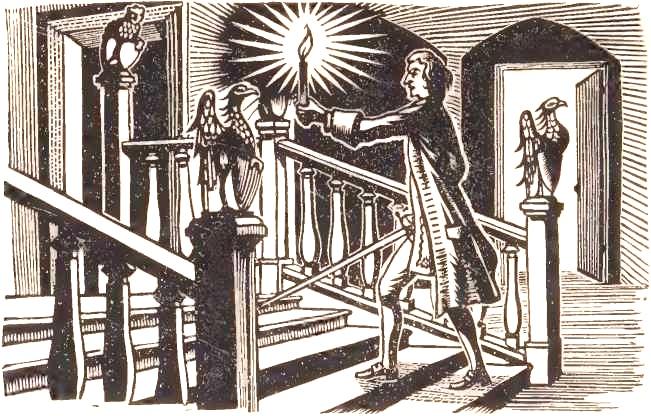
For eleven days running, at the same times, we heard and endured the same grim thunderous poundings, until her ladyship was worn out with the noise, the discomfort and the long vigils, and resolved to seek refuge in the first empty abode that offered, however ill-suited it might be to her person, rank and numerous household. She gave orders to have search made for one without delay; and her servants, whether from devotion to their mistress or from the new panic that seized them with the happenings of the last night of all, obeyed with alacrity. Those happenings I shall now relate.
They began with faint knockings, often and as though mockingly repeated, on the ceiling of the room housing the troop of dazed domestics. I went upstairs as usual, without the sword now, my frequent searches having at length convinced me that the contriver of the fiendish disturbance could be no living creature. On coming to a wide corridor in the servants’ quarters my candle was suddenly extinguished, not a flicker remaining in any of its four wicks; and at the same moment two lamps burning at either end went out too.
No sooner was I plunged into darkness than there resounded four tremendous thumps, so weird and harsh that I was deafened and shaken out of my wits. In the rooms immediately below, six huge pictures telling the story of the seven Infantes of Lara[20] took leave at this point of the twin rings above and hooks beneath by which each was held, and clattered heavily to the ground. Rooted to the spot and unable to shout, I threw myself to the floor and, groping on hands and knees, eventually reached the stairs. There I raised my head and managed, though still horror-stricken, to keep my wits sufficiently about me to make my way down to a courtyard, where I soused my head in the fountain and recovered to some slight degree from the shock and fright.
Going into the hall, I found the others all hanging on to one another, convinced their last hour had come. I besought her ladyship not to engage me any longer in the foolish attempt to solve a mystery so portentous, for persistence would end now not in getting to the bottom of it but in utter despair. Her ladyship agreed, and next day we moved from Fuencarral, scene of this odd, unfathomable and true story, to a house in the Calle del Pez.
I will not dwell on the rare jests and laughable discomfitures that could be told of the faint-hearts in the hall, nor on the subtle and witty comments the affair called forth from Don Eugenio Gerardo Lobo,[21] one of those who made their bed in that bedlam of terror. Instead I place on record that her ladyship, and her generous and friendly family, showed themselves so appreciative of my promptness, modesty and dignified bearing, true or feigned, that they bound me to their house and household, her ladyship offering me board, lodging, clothing, complete freedom to come and go and, most estimable of all, the honour and the benefits of her protection.
I gladly accepted so advantageous a proposal, and set out straightway to request of my clerical smuggler absolution from the promise I had given him to share in his adventures. Against undertakings so perilous, the new arrangement offered me security, honour and permanence. He consented regretfully to my request and went off on his hapless journeyings; and on one of them was pounced on by a patrol which put him out of the way for many years in San Anton fortress. I stayed on in my lady’s household tranquil, esteemed, provided for, and giving boundless thanks to God for having rescued me, through the ridiculous agency of this ghost, phantom or whatever it was,. from the gloomy imaginings and depression which had so taken hold of me.
I remained with her ladyship two years, until she married the most worthy Don Vicente Guzman and went to live in (Colmenar de Oreja; whereupon I transferred to the household of the Marquis of Almarza, enjoying the same hospitality, the same comfort and regard. Between these two houses I made my abode, once the ghost had ejected me from that anguished mansion in the Calle de la Paloma. It was a life of very agreeable retirement, spent reading on such subjects as commended themselves to my humour and writing an occasional pamphlet which I threw to the public from curiosity to see the reception it would get.
It was the years 1723 and 1724 that witnessed these and other events, on which I must be silent. In my prognostic for the latter year I had foretold the lamentable death of his majesty Luis I,[22] which made my reputation as an astrologer alike with those who did not know me and with such as in the past had disbelieved and ranted against my almanacs.
The prediction stirred up too the hostility of numerous fools who knew nothing of the legitimate conjectures made possible today by recent prodigious advances in the observations and resources of philosophy, astrology and medicine.
Some were for holding the prognostic criminal and the prognosticator infamous and ill-bred. Others decried as mere chance what was scientific, and as personal whimsy a forecast based on judicious inference and most loyal and respectful concern. The more eloquent of my enemies affirmed that it had been arrived at through the arts of the devil. Scribblings were published against me, and among the scribblers Dr Martin Martinez[23] took a hand with his Final Judgment on Astrology, written under the protection of his excellency the Marquis of Santa Cruz. I made answer with my Riposte to Martin, dedicated to the same worthy gentleman, and with other papers to be found among my published works; and left him, if not convinced, showing at least many signs of repentance.
The conspiracy calmed down. The public showed its contempt for the stupidity and insolence of the attacks, and I emerged from the claws of the carpers without a scratch, in a matter so sad and calling for reverence, not callous outrage. Dr Martinez and I had had each other by the hair. Shaking loose from his clutches, it occurred to me to visit his patients and to write up each week in the gazettes the case history of those who died. He realized that he was lost, considering my outspokenness, the nature of the evidence and the ease with which I should persuade the public of his shortcomings as a doctor, a matter in which alike his honour and his livelihood were at stake. He put out feelers, and asked my pardon. I gave way, and we ended by becoming friends.
Just about this time Sr Herrera, bishop of Sigiienza, became president of the Royal Council of Castile. This illustrious gentleman, being taken with the free-and-easy style of my pamphlets and the curious nature of my studies, or perhaps out of concern for my aimlessness and the dangerous scattering of my talents, summoned me to his house and there, in a tone of mingled encouragement, affection and command, laid upon me the charge to go back to my native Salamanca and to enter again upon the honourable paths of learning, with an eye to one of the professorships at the University.
He argued that it gave a bad impression to see a man of intellect in the capital at a loose end, without career or objective and with nothing better to do than engage to his own hurt in writing pleasant futilities for the drugging of the public. He read me a little sermon on how it grieved him to find me set on the path to perdition, and ended by foretelling for me a disastrous and disconsolate old age, should I live to see it. For reputation, health and good humour all wear out, and I should come to count myself lucky to have a crutch and a tattered cloak with which to face the humiliations and the hardships of beggary.
His eloquence reduced me to a state of nerves. Alarmed at the prospect of ending up in misfortune, while still regretting to have to leave behind me the merry, licentious life of the capital, I promised him to go back home and to put in for one of the seven chairs then vacant for lack of candidates, having neither the means nor the standing to join in the endless competition for the others. He thanked me warmly, did me much honour, and made many promises of favour and backing to come. I kissed his hand, knelt to receive his blessing, and took my leave perturbed and grateful, sad and apprehensive, impatient and cowardly, torn, in a word, between hope, confusion and disquiet. What came my way in the new life now awaiting me in Salamanca the reader who has not been wearied by the insipidities of this chapter will find in the next and penultimate instalment.
IV: Thirty to Forty or Thereabouts
Here was I just beginning to savour good fortune and all the delights, indulgences, frivolities and agreeable entertainments that can turn the head of a young man given to idle distractions and evil ways. Gaming, playgoing, women, dancing, gardens and other resorts of pleasure, I frequented them all. The whims of wealth, the joys of health, the irresponsibilities of freedom were mine to command. Whatever my fancy lit on I could possess unhampered by alarm, impediment or restraint; for no thought ever entered my head of justice, illness, galleys, gallows, hospitals, death or any other of the spoil-sports that can sow gloom and anguish in a man’s mind.
And now I had to leave Madrid and merge myself a second time in the nebulous student herd, where the only topics are unworldliness, timidity, servitude, grossness, poverty and the like melancholy abominations, the whole conducing effectively to ambition and to a covetous grasping after honours and income. I found myself ill at ease, exasperated by this futile withdrawal and infinitely bored to think how the life must rile me and how long it seemed likely to last. But I had given my word; and rather than go back on it and on the delusion of those who hold it a mark of honour to do violence to oneself by submitting to a repugnant discipline, the obligations of which one may often lack the knowledge or the ability to fulfil, I swore I would stick it out against all the tuggings of inclination.
Frequently I sought relief for my vexations by fleeing from the irksome decorum of student garb to the more spacious freedoms of the village. My fellow-students I treated courteously but at a distance. I learnt to abide despondency by courting the attractions of the countryside in such free time as my studies left me; and when vacations came I took myself back to Madrid in search of the delights which still held my fancy in thrall. With these doles, and an occasional nibble at my books, time passed until from force of habit I came to find agreeable enough what I had always depicted to myself as insufferable.
On returning to Salamanca I had straightway advanced my candidature to the vacant chair of humanity. When I learnt, however, that my own first teacher, Dr Juan Gonzalez de Dios, had set his heart on the appointment, I desisted, making sacrifice of the pleasure and profit I had conceived the application might bring me; for I would fain have buried the malodorous name of astrologer under the respectable title of professor of any other of the liberal arts. But holding it more honourable not to stand in the way of the man who had bestowed on me the first elements of Latinity and good manners, I resigned myself to staying bogged in the quagmire of prognostication and transferred my ambition accordingly to the chair of mathematics.[24]
There were irregularities about the lodging of my claim, and I confess I had no great longing to see it successful; for the sweet carousals and joyous bustle, the urban attractions and merry licence, of the capital continued to allure me, and I still desired them more ardently than all the honours and advantages in the world. Another candidate turned up for the chair, flattering himself he commanded a majority of votes on the ground that his mature years, modesty and moderation, together with his prudent or inhibited way of life, must of necessity commend him over the restlessness, scandals and excesses of mine.
At this my enemies began to exert themselves to the utmost, extolling the virtues of the one, decrying the shortcomings and evil ways of the other, and asserting that my violence of disposition and indiscipline of mind would introduce a regrettable note of dissension into the harmonious counsels of the professoriate. Next, fearing lest I should outshine my rival in knowledge of the science or in performance at the public exercises, they sought to have dropped the requirement of an open lecture and to get both candidates to agree to the more tranquil procedure of an examination in secret.
This proposed departure I resisted strenuously, representing with mingled craft and pride that the examiners were not to be found who could properly pronounce on our proficiency and aptitude. I added that what concerned me was not to see myself a professor but to give the lie publicly to those who had proclaimed me an ignoramus, and that I was resolved to abide by the letter of the regulations. These laid down an exposition, to last one hour, of matters taken from the Almagest of Ptolemy, a debate between the candidates and finally an examination before the assembled Senate. All of which, I contended, must take place. Were there to be any slightest deviation therefrom, or from the other provisions and usages of the University in this matter of election to chairs, I should inform his majesty and ask his royal permission, in view of such an attempt to Bar me from the classrooms, to teach in the courtyards.
Thanks to my insistence and to the force of my arguments, no more was heard of this subtle innovation, that an ineffective clique of that most vigorous and learned Senate had been misguided enough to try to carry. It was on the eve of St Cecilia’s day, in the year 1726, that I received the list of matters to be expounded. Of the three headings assigned to me by lot I chose the second, on the movement of Venus in the zodiac; and on the following day, as the twenty-four hours prescribed by the regulation expired, I set out for the lecture-halls, any nervousness overlaid by my abundant presumption and a quite unjustifiable self-conceit.
It would better become a less interested and more authoritative pen than mine to relate with the liveliness they deserve the tumultuous rejoicings, frenzied applause and incredible acclamation that Salamanca dispensed on this occasion to the humblest of her sons; for while none writing today is more wedded to the clarity of truth than I, amour-propre must still nod, however unconsciously, in matters that touch one so nearly. Still, inasmuch as this event stands out as the worthiest and most honourable in my life, and it is not fitting that I should call on others to describe it, I shall narrate it myself with as little boasting and vainglory as may be.
At nine in the morning I entered the canon law classroom.[25] The balustrades were already filled with gentry and graduates from the town, while the benches were so crowded with the ordinary that it would have been impossible to squeeze in another person. There was none of the ceremony normally held indispensable on these occasions. The rectors of the various colleges, greater and lesser, stood with their collegers wherever they could find space. The side of the courtyard facing the lecture-room was crammed with commoners and students, who overflowed back to the centre and corners until the crowd was solid and reached to the very doors of the cathedral. Between three and four thousand in all had come to hear me, while those too far off to hear or even to see numbered as many more. Never had there been witnessed in the University, at a function of this or any other kind, so vast and varied a concourse.
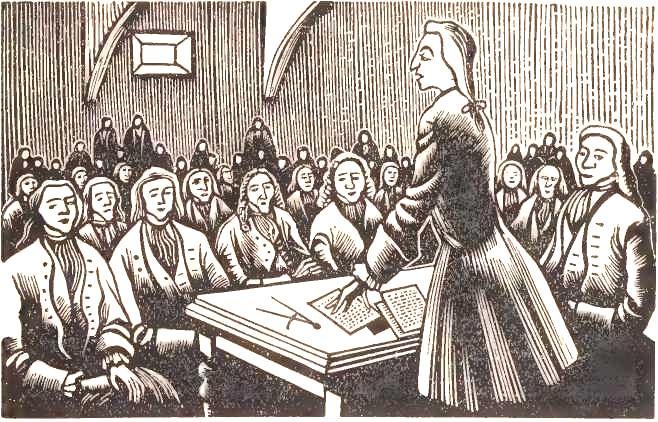
As the clock struck, officials and beadles elbowed a path for me and I went in, condemned to face the gaze and murmurings of that mighty gathering for another hour, ten being the time decreed. I went up to the rostrum, where I had already arranged a fair-sized armillary sphere, compasses, pencil, rulers and paper to illustrate my points. On the first stroke of ten I rose and, without more preliminaries than the sign of the cross and a distich in honour of St Cecilia, began my exposition of the appointed subject.
If I could not have been more of a stranger to the norms of good Latinity, I still developed the various headings with reasonable clarity and eloquence, and rounded out the hour without visible sign of distress or any particular awareness of strain, timidity or waning confidence. When I had finished, the audience burst out cheering and shouting its approval, the joyous hubbub lasting nearly a quarter of an hour. Such a demonstration was again something that had never been heard before, nor would be again, in the austerity of those halls.
At length the tumult died down, and I went on to the customary advancing of titles and merits, mingling therewith some flippancies that, if not perhaps called for, were likewise taken in good part by my listeners. My rival then got up to dispute with me; and among the syllogisms that followed I let fall other jests which I refrain from telling here, partly because they were taken up by others and repeated so often as to have become already famous, partly from the difficulty of retailing my own sallies without falling into a self-flattery others would laugh at and a vanity they must condemn.
The ceremony ended, the tumult of extravagant hurrahs broke out again; to which accompaniment I was carried shoulder-high to my lodging by a band of students, spreading astonished bewilderment in the streets as we passed. Such general acceptance and universal applause took the wind out of my enemies’ sails in their attempt to obscure my competence and destroy my position and reputation.
Three days later it was my opponent’s turn. He too talked out the hour, and a profound silence followed. I rose to propound the initial syllogism; but first, addressing the senior members of the University assembled behind the balustrades, I asked their permission to take the discussion beyond the topics prescribed, inasmuch as the speaker had done the same. He had in fact confined his lecture entirely to a discussion of the roundness, magnitude and stability of the earth, whereas the theme assigned had been the eclipses of the moon.
I suggested further that, were he bidden to vacate the chair, I was myself prepared to discourse on this latter extempore. It was a mad gesture, born of pride and bluster; but I would have risen to it. In the end I kept my arguments to the matter of his, indulging only, with the inconsiderateness of youth, in an occasional pun and gibe. With this, on my rival’s observing that he had nothing to add, the discussion ended, and once again there arose triumphant cries on my behalf while my unhappy opponent was overwhelmed with an outburst of whistles and jeers.
The modest restraint, the prudent and proper dissembling, that ought to guide one’s pen in the singing of one’s own praises are girding now at mine for the arrogance and presumption of its account of this affair. Everything about it was, however, aboveboard; and this, and my pardonable hankering after honest applause, incite me to describe in this detail its many memorable features. Some I have decided, none the less, to leave untold, and I shall now be more sparing and expeditious in dealing with the others.
The examination in the mathematical sciences before the full Senate, that should have rounded off the contest, did not take place. I know the reason for the omission; I know too that it is important it should not be stated.[26] All seventy-three electors voted, and seventy-one of them voted for me. My rival received one vote, while one missed the urn and was found later on the floor. The schools and the streets nearby were crowded with students of the more irresponsible type, carrying firearms and awaiting the decision even more impatiently than the candidates. On the clerk’s announcing it, they straightway fired off their weapons, set the bells ringing in the neighbouring churches, and loosed a multitude of rockets. Again a crowd of all classes escorted me home, to another unending chorus of vivas and shouts in my honour.
On the following night a group of students on horseback, Salamancans all, sallied forth bearing a huge placard illumined by a variety of torches with on it, written in letters of gold on a blue ground, my full name, place of birth and new title as professor. No householder was so poor as not to put a fight in his window; in the convents the nuns did the same in their oriels, and waved handkerchiefs and shouted. Through every quarter of the town music and cries of triumph alternately filled the air, until the night resounded like a day of judgment.
And so the event ran its course, Salamanca letting itself go with such clamorous acclaim from the rare novelty of seeing in its schools a teacher wholly lacking in polish or brains, whose name was a laughing-stock, whose temper a byword and whose habits not above criticism. At any hour scholars of profound judgment and high standing may be heard in its classrooms expounding weighty theories and most learned doctrine; every day in university chairs, bishoprics, magistracies there are to be found men of worth, outstanding alike in; virtue, erudition and integrity: yet never has one of these been made the recipient of such or so repeated acclamation. Let others ask themselves the reason or lack of reason that leads the people so to act: I with this remembrance renew my thanks to it and remain singularly appreciative.
I took to my new life as teacher withmore adaptability, pride and discretion alike than I had looked to find in myself, and gave my classes quietly and seriously, putting my heart into them. My first courses drew a goodly audience, come in the expectation perhaps of hearing me interlard my mathematical expositions with an occasional witticism or scrap of verse; it having been generally inferred from the violent and irreverent frivolity of my writing that a spirit of buffoonery must of necessity characterize my humour.
Whether this be the explanation or whether it were curiosity to nod acquaintance with the basic principles of a science so mysterious, so redoubtable and so neglected, I many times found the room filled with casual listeners when I turned up to lecture. Among them I could reckon all the youths sent up by their parents to study other sciences that bring, along with less repose and greater risks, more honour and greater reward. Serious students following the course for degree purposes were never many.
Nor was my class ever the scene of the clowning, shouting and other signs of disrespect with which the mischievous ill-breeding of their students made other professors’ lives a misery. Those who studied with me had fair warning that, while I would put up with as many doubts and queries as they cared to raise, out of class, concerning my afternoon lectures, anyone who tried to play the fool during them might expect a broken pate, for I had neither the prudence nor the patience of my fellow-teachers.
One idle brute, a fellow of thirty whose subjects were theology and lewdness, did fire an improper gibe at me one afternoon. For answer I picked up a bronze compass weighing three or four pounds from the ledge by the rostrum and hurled it at his snout. By good fortune, his and mine, he ducked his head just in time, or I had spattered the floor with his brains. This piece of folly inspired in listeners and onlookers alike such a reverential fear that no one ever again bandied jests with me.
Out of my element, but not now regretting it, I kept on with my university courses. When summer came, and vacations, I shook off the narrow gloom of the scholastic life and fled the seriousness of the schools for Madrid or Medina-celi, where my good friend Don Juan de Salazar—God rest his soul—dispensed without stint or ceremony his charming hospitality. And so, unperceived, the days and the years passed over me, leaving me on good terms with life. Free from vexation or ailment, I found abundant diversion in my travels, in the capital, and in the homes of this and other friends of like mind and humour with myself, who reciprocated my affection.
Don Juan had at this time a stronger lien than anyone else on my sympathy and love. He was a gentleman of infinite discernment, wise and merry withal. Wide reading had made him knowledgeable alike in the fighter parts of mathematics, in the entertainment to be culled from history, in the refinements of philosophy and the rigours of jurisprudence. He was a skilled horseman, with a sure and elegant seat; a writer of poetry, little but good; a great and expert lover of countryside, mountain and forest, who would bring down a brace of partridge, a wild boar or a rabbit with the same sure economy of effort; and finally a worthy exponent of all the graces of the gentleman, the man of affairs, the countrydweller and the courtier.
Many a spell we spent together in most delightful friendship, engaged in the pursuits now of his choicely varied and well-stocked library, now of the chase, wearying ourselves pleasurably over the hillside, now in the drawing-room of his good lady Dona Joaquina de Morales, to the accompaniment of poetry, conversation, vocal and instrumental music and all kinds of gracious mirth. With others of the household and the neighbours we used on special occasions—church feastdays, political anniversaries, or whenever the fancy took us —to get up plays and humorous sketches, some of which may be found in my second volume of poems.
In the odd moments left over from these defights, or in wayside inns when on the road, I still applied myself to my pen, driven by my abiding dislike of idleness and by the desire both to poke fun at the world and to make money. These are the trifles which today are being put together into bulky tomes. When others launched their satires against them and against me, that too gave matter for laughter and jest. I could afford to scoff to see their authors, weighed down with meanness and envy rather than with reason, intent on robbing me of peace of mind, freedom and popularity. As often as they loosed their libellous scribblings at me I rejoiced greatly, for the immediate consequence was to boost the sale of mine. It was in truth a heartening sight to see writers so enraged against a stripling, if a great rogue, who cared not a farthing for all Constantinople.
For five years—the time that elapsed between my election to the chair and my admission to the doctorate—I lived thus, full of contemptuous mirth at the provocations of these noisy upstarts, flattered by the attentions of those who had a taste for my idle conceits and absorbed in the abundance of pleasures and entertainments. Reasonably endowed now with the goods of fortune, I was a stranger to the face of contrariety or affliction.
Honourable as the higher degree was,[27] I had delayed presenting myself for it that I might be the freer for my adventures. The obligation it carried to attend meetings of Senate, ceremonial occasions and faculty debates, together with a number of other duties, were to me so many irritating impediments to freedom of action. It being laid down by law and statute, however, that the professor who did not proceed to the degree within a stated period should forfeit his title and salary, I was compelled at last to subscribe to the ordinances and to accept the responsibility these laid upon me, to the considerable grief of my more unruly promptings.
I took the degree on the second day of Lent in the year 1732, the ceremony being marked by nothing that calls for particular mention here. Not so the Tuesday preceding, being the last day of carnival. On that day the potters’ quarter of the city turned out in festive anticipation of the event, organizing a masquerade on donkeys in mimicry of the solemn procession through the streets with which the University marks the admission of new doctors. A variety of rags and colours represented the different faculties. Beadles, kings-at-arms and masters of ceremonies flourished trumpets and timbrels; and the festivity ended at nightfall with a bullfight, just as in the real, and costly, celebrations. Rumour had it that I too figured in the masquerade, disguised under a half-mask and wearing a ridiculous doctor’s bonnet and blue cape. Let us leave it at that, for the confirming of the prank will neither make nor mar my story.
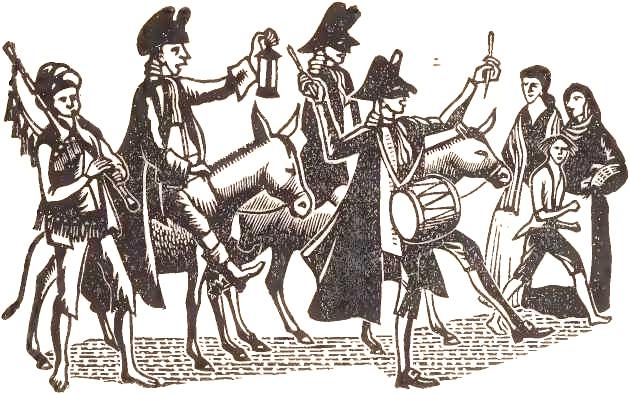
With the circumspection of my new way of life and the more settled routine to which I now submitted, my humours began to swell, my blood to circulate more sluggishly, the digestion to suffer from wrong diet and the hypochondrium to fill with crude impurities, most dismal vapours and morbid affections. This crop of indispositions turned to more grievous ills after the twentieth of January of the year 1733, which day I spent exposed to the inclement assaults of wind and snow on the high Guadarrama pass between Las Navas and Valdemaqueda, where the Count of Santisteban has his estates. I shall recount briefly what happened.
It began with my losing my way. At nightfall I had asked a shepherd I met coming from one of the keepers’ houses on the estate to put me on the highroad; but, getting his directions wrong, I left the cart-track I had been following for the distance he said, and took another lane pitted with ruts. We were going along this, my man and I, mufiled up in our capes against the biting wind and driving snow, when suddenly I heard my servant cry from a short way behind ‘Help! Tm sinking!’ I pulled up short, and had taken a bare half-wheel to the right when my horse too collapsed amid a frightening clatter. I came down heavily, and was lucky to escape permanent injury, though I bruised the whole of one thigh.
Crawling free as best I might, I could just make out through the darkness that my horse had had one leg pierced by iron spikes fastened to two fearsome wooden bars, the kind of snare hunters lay for wolves. Making my way to my servant, I found him pinioned under his beast, caught in another snare. I tried my hardest to get both animals clear of the heavy stocks, but never having seen such devices before could not hit on the way to disengage them.
Terrified of falling into more pitfalls, and in despair at not being able to get our beasts on to their feet again, we camped where we lay, at the mercy the long night through of the wintry blast. With the flints and powder from our pistols and strips torn from a shirt in my valise we lit a fire, but everything was so damp that it refused to burn. Dawn found us sunk in gloom and exhaustion, with the added dismay of not having heard a single whistle, cattle-bell or other sound that might indicate the proximity of a cabin, sheepfold or farmhouse. At least we could now take stock of the disaster that had befallen our mounts.
Picking up our grips, we set out on foot, and soon came upon the huntsman. He freed the horses’ feet from the snares, and we could establish that one had the muscles, nerves and tendons of one leg severed; in the other animal they were only run through. Next he led us to the house of a keeper called El Calabres, by whose fireside we repaired the ravages of the chilly night. We broke fast with a large bowl of milk, and for lunch had an excellent stew with carrots and salt pork, so that, God be praised, the day passed happily enough. One of the horses died; the other was treated in Las Navas and made a slow and painful recovery. Hiring two nags there, we went on our way as far as Avila de los Caballeros, seat of the Marquis of Villaviciosa. Thanks to his kind and generous offer of hospitality, which I readily accepted, I • at length got over the grim experience.
This sorry adventure proved the prologue to my book of misfortunes. Hard on its heels there followed the affair of my banishment, that caused such a stir and brought in its train unlooked-for shocks and alarms, most unhappy attentions and prolonged hurt to my interests. Such was, at the same time, my good fortune that there gathered about me a widespread sympathy among Spaniards and foreigners alike and a degree of support and disinterested affection beyond anything I could ever have dared to count on. Were it possible for me to set down here, without riling those participants and witnesses who still live, the specific details and circumstances that I must deliberately withhold, the passage would I believe prove to be the only one in virtue of which this story of mine might, purport to have some lesson to teach, some pleasure to convey and some claim on public esteem.
It is important, however, as I appreciate, that the first beginnings, and much that befell in the middle and end, of so scandalous an occurrence should remain untold. I must therefore content the reader by giving him merely the more public truths for his entertainment, without provoking the resentment of those who contrived my sufferings. This much I can say, that in none of the story-books, be the stories feigned or vouched for, in no narrative of comic incidents, however dubious or possible, will be found an adventure so prodigious or so creditable as that which condemned me to the hardships of a long and tiresome exile.
Anyone curious to inform himself further may consult certain of my writings, easily to be come by in the bookshops, wherein he will find—albeit scrambled into a studied confusion—the reasons for the ignominy that misfortune brought upon me. In the dedications of my almanacs for 1734 and 1735,[28] addressed to their excellencies the Marquis of La Paz and Don Josef Patino, which are included in the volume entitled Digest of Torres’ Prognostics, there is set forth plainly enough my innocence and, more indirectly, with the circumlocutions dictated by a proper caution, the root of the conspiracy that caused my woes. Two memoranda printed at Bayonne, in France, likewise throw some light on the true burden of these events, one dictated by Don Juan de Salazar, my companion now in anxiety and calamity, in flight and in hardship, the other submitted by me to his majesty the king, in which I humbly and woefully besought of his mercy that he should give ear to the justice of our case.
From these papers, from the submissions made to the king by his ministers, and from the avowal of Don Juan, there emerges clearly that this gentleman, provoked by the insults of an impudent cleric and mortified by his vituperative violence, drew his sword on an angry impulse and split open his pate for him with a couple of good-sized fractures. The wounded man, so report had it, made oif with his hands to his head, not to get treatment but to implore the wrath of the powerful instigator of his audacity.
To minister the more effectively to their rancour and to our discomfiture, it was then arranged that he should set out with his wounds still open and lodge complaint before the president of the Council of Castile himself. This the worthy priest did, taking to the road all choleric and bloodstained, the tail pockets of his cassock bobbing up and down as he kicked them in his haste. Admitted to the president’s tribunal, he declared that his wounds had indeed been inflicted by Don Juan but that Don Diego de Torres had been at the bottom of it.
This is as much as occurred openly, and such was the story people told at the time. The antecedents, the motives, the cruel traps laid—whereby Don Juan had been drawn into an investigation of certain earlier temerities of his victim—the parts played by the man’s confederates: all this will remain hidden till the end of time. What I can affirm, now that I am free once more and by God’s mercy absolved from the suspicions they sowed in the pious mind of his majesty, is that I was guiltless of the slightest temptation, as of the remotest share, in this matter of the cleric’s broken pate, nor did any single word fall from my lips, seriously or in jest, that could have contributed, not merely by open incitement but by insinuation, to such an outcome. In all the plottings and provings and affirmings on oath with which they sought in their malice to discredit my loyalty, honour and sense of responsibility I swear by my life, and shall swear on my deathbed, that they acted falsely. But my narrative has stuck in a rut, and I am longing to get it out. Let the reader believe what he will, and let him accompany me now, if he be so minded, and learn what at last can be told calmly and truthfully, safely and without offence.
Those who took up the wounded man’s cause carried the story to the king and established the crime without waiting for confession on our part, for examination, or even for the granting of opportunity to advance our defence. Fearful in consequence lest the law, taking its course, should throw us into prison, we left Madrid for the sheep-shearing at Sonsoto and Trescasas,[29] and there stayed hidden to see how the decision would turn out. It came, like all bad news, briefly, compendiously and without loss of time from Seville, where the court then was, to the Royal Council in Madrid. His majesty’s decree was sparing of words, merely commanding that, on certain grounds, Don Juan de Salazar be remitted to the fortress of El Penon de la Gomera for six years and Don Diego de Torres be expelled indefinitely from the king’s dominions.
This cheerful information was passed on to us by the charitable cleric of the broken head, his good heart torn now between repentance for the insults proffered and vengeance taken and the raging hatred of our opponents. Not giving the law time to run us to earth and apprise us officially of the decree, we turned our backs on Sonsoto and fled, counselled alike by dread and respect, with the intention of not stopping until we had crossed into France.
It was two of the afternoon, the day the twelfth of May, when we sallied forth from the village on horseback, solaced by the possession of six hundred doubloons and the company of two servants, who waited on us faithfully and affectionately. By nightfall we had reached the monastery of El Paular,[30] by Segovia, where for two days we were regaled and heartened by the venerable father Don Luis Quflez, acting on behalf of that silent and saintly community. While there we took all possible measures to come by any letters or despatches that might carry information about our doings or business. Instructing our servants to treat us thenceforth as friends and comrades, we changed our names, Don Juan taking that of Bernardo de Bogarin, I styling myself Manuel de Villena. Then, having received the blessing of those so secluded religious, we went on our way, if not without sadness, happily resigned to our toils and to the new abode which hatred and the turns of fortune threatened.
Towards France, then, we directed our steps. Hermitages and monasteries were our asylum and shelter. If at the end of the day such did not offer we camped in the open on God’s good earth, now softened with the rains, making the most of our camp-beds, wardrobes and stores, to wit, the blankets and packsaddles, well starched with scabs and galls from our horses. From court news reached us frequently to the effect that divers requisitions had been sent out charging all intendants, magistrates and mayors to seize and hold us on sight.
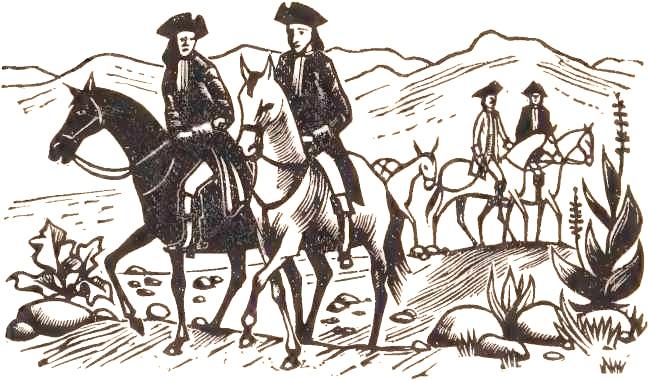
In inns, monasteries or wherever else noon, night or hunger overtook us, we would poke a wary curiosity into the conversation of travellers, muleteers and the like, asking what was the news from Madrid; and among the items out would come our tragedy straightway. We joined with them in protesting indignation when they condemned deeds so irresponsible, and expostulated against the scandalous conduct of the miscreants. Listening to the extraordinary freedom with which others commented on the whole affair, we would stoke the fires of their backbiting with masterly dissimulation, especially when the speaker was some carper given to uncharitableness or one of your hypocrites who will strip a man of his reputation for the love of God and destroy his honour for the good of his soul.
In this little game, and in the absurd variety of the tellings of our dolorous story, we found distraction from many an alarm and anxiety. Some would assert they had seen us hanged; others that we were already living on his majesty’s hard tack in the Alhucemas; many clung to the truth of our flight. In each new place the event was told differently. Now it was a lady of quality was the cause and motive of our affliction, now a satirical comedy that had been played against the government. The most frequent version had it that we had killed one priest and wounded another. All these lies were invested with circumstances so infamous and so impossible that we were moved rather to laughter than to anger.
Our strangeness in those regions provoked many for their part to curiosity about ourselves, which exposed us to new and obvious dangers. In Burgos we were set down as apostate friars, having been heard to argue in a monastery there concerning philosophy and religion. This behaviour not according with the short picaresque garments we had chosen for our disguise, our hearers were persuaded that learning so modestly worn could only have come from the cloisters of a religious house. People who had no dealings with us judged rather, from our attire, mien and weapons, that we must be smugglers.
We did not waste much pity on ourselves as we journeyed along, the long tale of our woes and fatigues being tempered not only by the hope that recognition of my innocence and pardon for my friend’s intemperate act were bound to come, however tardily, but by the pleasure of seeing new places and fresh faces, the satisfaction of having the six hundred doubloons in our pockets, and the good horses that bore us and stamped us as persons of consequence. At times we knew indeed anxieties enough, from the persisting fear of ending up in gaol and worry over our homes and families; but I prefer not to bore with the pedestrian account of thoughts so inseparable from our position that they must leap to the dullest mind. He who reads may imagine them for himself: his cogitation will annoy him less than would a tiresome exposition from me.
We came to Bayonne, and delayed there several days hoping for letters bearing some indication that the anger that had so inflamed our enemies might have abated and turned to contrition. Instead the advices from friends in Madrid left no doubt that the prospect continued grim: we could entertain few hopes as yet of a reconciliation. My companion, to whose judgment I was content to leave the decision, resolved we should set out without further delay for Paris. Desire to see that city made my concurrence the easier, and next day we took once more to the road, persuaded that only the good offices of the Marquis of Castelar, then Spanish ambassador to the French court, could protect us against the trail of adversities.
We passed through hamlets, villages, towns, exploring each in curious detail, and came to Bordeaux, where there caught up with us a servant of Don Juan bearing letters of more recent date than those we had had in Bayonne. They brought the bad news that his property had been confiscated and that his foes were carrying their rancour to new extremes, profoundly irritating the judges thereby; and ended by urging upon him to return to Spain and surrender to justice as the only way of recovering home, estate and good name.
This caused him to change his mind about continuing to Paris. He talked it over with me; and I, having no other commitment or wish than to fall in with his, readily agreed. All the judgments in the case, all the legal consequences, had fallen on Don Juan, it being common knowledge that my movables would not amount to the expenses of a bumbailiff, nor my entire landed estate to the meeting of a claim; while my person could serve at most to add one body more in gaol and another mouth to be fed by the brothers of Mercy. No one, accordingly, took any thought to me.
Don Juan being thus attached in his property, and I unattachable, we retraced our steps from Bordeaux to Spain, weighed down with the ill tidings; regretful too at not having seen Paris, whither we had been drawn even more by curiosity than by any real prospect of remedying our affairs. We stopped a second time at Bayonne, for two reasons: one to study ways and means of evading customs patrols, who had been charged to look out for us, the other to have printed the two memorials I have already mentioned. Of these we sent off three hundred copies to different lords and ladies, ministers and agents at Seville, where the court still tarried, that the recipients might commend our modest request for a judicial hearing and fair examination before whatever tribunal his majesty should be pleased, in his mercy and uprightness, to appoint. In the upshot such a hearing was decreed for Don Juan, no mention being made of me.
While in Bayonne we met by chance some merchants from Fuentelaencina, and came to an arrangement with them that we should take over and see their goods across the frontier into Spain, and thereafter make delivery to them at their village, where we should plan to arrive at the same time as they. Their muleteers’ dress seeming the best precaution against discovery, we exchanged clothing with them and set off disguised in grimy doublets, shirt sleeves and motley buskins, with switches in our girdles and each driving a string of six mules, at which we kept grunting and swearing.
Leaving the highroad to the others, who followed within the hour cutting an elegant figure with our clothes and horses, we kept to cart-tracks. Time and again, passing through villages where bailiffs out with their warrants were known to be in the habit of calling a halt, we ran into patrols; and so effective was the metamorphosis that neither guards nor officers of justice ever discovered or even suspected our identity. Eventually, nothing of note having befallen us on the way, we arrived at Fuentelaencina not more than a couple of hours after the traders, handed over mules, goods and reckoning, gave them, with renewed thanks, a misleading account of our persons, and said farewell.
The best plan now for the prosecution of our affair lay, in Don Juan’s view, in our parting company; and so it was decided, he undertaking meantime to look after my mother and to make her an allowance of five hundred reals a month. This he did, like the man of honour and integrity he was, knowing well my innocence and the injustice my enemies had done me in robbing me at once of repute, livelihood and freedom. His generosity, becoming known, engendered in these in due course a certain jealousy; but let those of them who are still alive know that, once returned from banishment and reinstated in my dignities and emoluments, I reimbursed him everything his noble nature had advanced, without thought to its recovery, for the relief of my mother’s misfortunes. Only with this intention had I accepted.
And so, most miserable and disconsolate, we took leave of each other, unable to find words adequate to the grief of ( parting or to the desire to cheer each other up. Don Juan took the road to Madrid, I that to Salamanca. Once arrived in the capital, he presented himself at the city gaol and was transferred thence to the monastery of San Felipe el Real. There he made formal deposition in true and honourable terms of all the facts of the case; which being considered by the Royal Council of the Military Orders—under whose jurisdiction he came as a knight of that of Santiago—he was absolved from the earlier sentence of six years in Africa and committed instead to one year’s reclusion in the monastery of Ucl^s, belonging to the said Order.
While Don Juan was being thus harassed with interrogatories, comings and goings of officers of justice, impertinent counsellings and relegation, finally, to that venerable house, I strolled about Salamanca a prey to doubts and misgivings, schooling myself to resignation against whatever, of bad fortune or good, providence might hold in store. This state of suspense continued for a month, during which time neither my superior the chancellor of the University nor the chief magistrate nor anyone else said one word to me on the subject of my adventures.
I ended by persuading myself either that I should be pardoned, or that the so circumstantial and accepted report of the decree of exile had been an invention of my enemies; until one morning, my adversities having now completely passed from my mind, there entered my door Don Pedro de Castilla, the magistrate’s assessor, bearer of a royal order signifying it to be his majesty’s pleasure that I should leave his dominions forthwith.
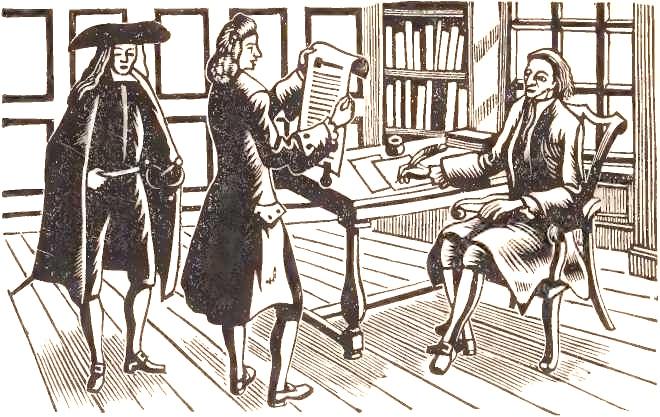
That same afternoon two constables and a scrivener came to escort me, and thirty hours later deposited me across the Portuguese frontier, in the jurisdiction now of Dom Joao V, just and pious monarch of that brief epitome of the world. The tale of these happenings I have set down in the dedication to his excellency the Marquis of La Paz which prefaces my prognostic for 1734: to this I refer the curious reader, for it would be tiresome to repeat it all here.
In that kingdom it was my lot, thanks be to God, to meet among peasants and men of affairs alike with the most sympathetic consideration, everyone showing me a courteous bounty, a gracious pity and a charitableness beyond words. Neither on their scrupulous bearing in general nor on the delicate matter of my good repute did the stigma of guilt, of which they had already heard to satiety, produce the least effect; nor did any fear the contagion of infamy on seeing me in the role of condemned criminal. They received me—I say again, thanks be to God—with a joy and a hospitality on which I had had no reason to count.
For four months I roamed among hamlets and hermitages in the neighbourhood of the comely cities of Coimbra, Villa Real and Lamego, finding amusement and entertainment in the homes of priests, hidalgos, judges, doctors and other persons of taste, all comfortably circumstanced. It was pleasant to live over again, in memory and in the recounting of former adventures, many incidents of the days when those same hills had known me in the long cloak of a hermit. In conversation I would constantly find myself bringing up the worthy Don Juan del Valle, whose hidden virtues, told over and over again, were the delight of all who had known him and a weariness well justified to such as had not.
With the learned abbots and gentry who abound in that kingdom I had much talk concerning the newer systems of philosophy. We found the world to be made of atoms, of rarified matter, of striate particles, of globules; we took issue with Aristotle and said, quite entre nous, that he lacked the knowledge to explain a phenomenon of nature; and by dint of repeating the absurdities of Descartes, the vapourings of Regis[31] and the inanities of the others who today go about the world prattling, their little books full of strokes and circles and figures, I had them at once enraptured and bemused.
With doctors I expounded my astrological nonsense, found excuses for the frauds, wiles and deceits of the faculty and for the dubious nature of its diagnoses and prescriptions, and was careful not to offend with the meagre faith and the spirit of mockery that persist in me whenever I see the credulity of those who, disbelieving in death, imagine every ill to have its cure. I said my say on politics, court affairs, war and on whatever else seemed to accord with the disposition of my listeners. The reader may take my word for it that never in my life have I talked so variously and so foolishly as then: there being this to be said for my loquacity, that the need to humour people and win them to my side played havoc for once with my natural taciturnity.
And so, by guile, I made myself a modest and agreeable enough way of fife in those small places until, wearying at length of their limitations, I made my way once again to Coimbra. My stay in that most beautiful city was shortened by the fact that the jealous fool who had been the cause of my leaving it the first time was still alive, if now advanced in years and incapacitated. An impediment so absurd notwithstanding, and confident that having changed my name and dress I could rely on his having forgotten my features, I took occasion to improve my mind in the company and converse of some of the scholars of a seat of learning that is great in every way.
Baptized accordingly a fourth time, under the name of Francisco Bermudez, I made reference to myself under my true appellation in talking with several of the most distinguished professors and ofiicers of the University, to learn that they would consider it a signal honour were the said scholar, Don Diego de Torres, to accept appointment to their chair of mathematics, which for lack of a candidate had lain vacant now for many years. I informed them that I was acquainted with Torres, who had renounced the world and was then living in a village near the frontier in obedience to a royal decree exiling him from Spain.
I undertook to convey to him their friendly disposition, at which he could not but feel deeply beholden, and to communicate the flattering proposals whereby they sought to reward his labours and assuage his misfortunes. To these promises in his favour they added that he would be exempted from the customary fees for admission to the degree, examination and exercises and that they would discuss with the king the possibility of increasing, exceptionally, the salary of the chair.
Concerned lest chance or malice should reveal that I was the Torres in question, I then left Coimbra for Mirandella and Torre de Moncorvo, where I spent another couple of weeks. From there I wrote to my learned friends to say that Don Diego continued intent solely on establishing to the royal satisfaction his innocence and profound respect and, in his every act, the submission of a most loyal vassal. He felt compelled accordingly to forgo whatever possibilities and privileges, in the way of honour and affluence, the world might have to offer until such time as he had given proof of the said loyalty, zeal and unalterable attachment. My letter was eloquent on his sense of appreciation at so high a mark of distinction from a university of such repute, and ended with the most sincere expressions of regard and esteem.
Life was still, therefore, but an idle wandering from place to place, my hopes of a speedy return to my native land still pinned to a judicial investigation and the king’s mercy; and that assuagement ill luck continued to thwart. Often I felt the urge to revisit Lisbon, moved by the desire to broaden my mind anew in that great capital and flattered no less by letters and proposals I received from certain princes. I was deterred by the thought that, were I to be enabled to return to Spain, I should then court infamy by appearing an ingrate or else have to endure the anguish of remaining in exile; and I rejected alike the honourable summons of the great and the lively incitements of curiosity.
While I thus span out my enforced leisure, uncertain what the future held for me and with my mind full of indecision and regrets, of ideas about this and plans about that, Don Juan’s term at Ucles came to an end. Returning to Madrid, he there took up again with untiring diligence the soliciting and contriving of my restoration to freedom. In a letter to me he suggested that it would be a good thing if one of my sisters were to go to court and herself intercede with his majesty on my behalf, kissing his feet and representing that she and my poor mother were dependent on my return for their subsistence.
Not many days after, my sister Manuela, accompanied by my niece Josefa de Arino and my cousin Antonio Villarroel, set out accordingly from Salamanca for the court, then at Valsafn. The minister they found pleasantly sympathetic, while the nobles in attendance showed a genuine concern. Even the humblest commoner was with her and surprisingly ready to proffer solace and relief and to join in praying for a prompt solution. Thanks to the tears of my disconsolate relatives, to their unremitting attendance at the minister’s door, and to the general compassion with which everyone regarded them, I emerged at last from the gloom of the outcast into the haven of heart’s desire.
At the king’s command my lord the most excellent Cardinal Molina restored to me, enhanced, both freedom and 5 honour, in a letter which I keep as a source of embarrassed gratitude and assurance. Home at length, I was received by many with pleasure, by some with annoyance, and by most with a suspicious indifference reaching to the unworthy shunning of my company, as though to have been banished were some kind of pestilent disease and the hatred of my enemies could extend to them, marring their hopes, desires and material interests. I confess I was not surprised, this being a common apprehension among the puny-spirited and an incurable ailment in every centre of clashing ambitions.
For three years I had been deprived of my freedom. Throughout I had shown the patience and known the mitigations already mentioned; yet I had been the victim in addition of a second conspiracy, less powerful but even more fearsome and abominable than that which caused my exile. Its nature I am not going to declare, nor the names of the guilty, nor the place, the charity I owe to my fellow-men forbidding that I should publish them. To many still alive such revelation could well cause offence; and it were unjust to give pain to any when it matters nothing now to my good name and peace of mind that their daring and my long-suffering in the matter should be passed over in silence. All I can say, and I say it with a certain embarrassment, is that the Royal Council of the Orders took steps to investigate the infamous deeds in question, and with the help of many witnesses and papers and the shattering of certain illusions uncovered the culprit, established my outraged innocence, and was seized with pity and compassion to learn through what cruel persecution and villainous snares fortune continued to manifest the hatred she had conceived towards me.
During this period of extreme solitude, poverty and harsh neglect I had suffered further two severe illnesses, that brought me to the verge of the grave. One, a ferocious croup, took me completely off guard in a wretched village in Portugal, in the house of a hardworking fisherman who was as honest and pious as he was poor. In the brief space of his narrow abode, amounting to a dark porch and a tolerably smoke-free kitchen, I lay on a tumbledown pallet made of scraps of old fishing-nets and grappled with the onsets of this malignant and treacherous complaint, turned doctor, surgeon and patient all in one.
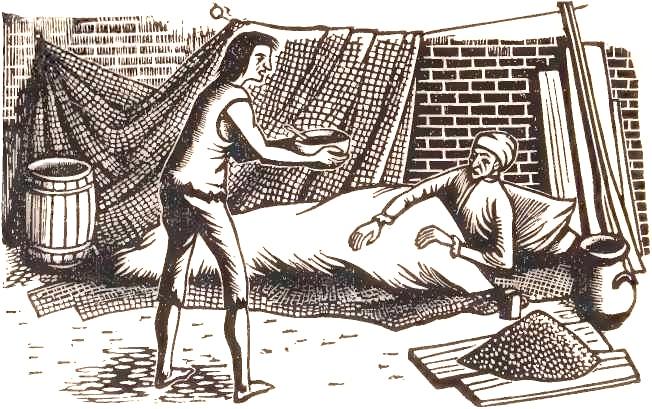
Divine providence willed that in such an out-of-the-way, poverty-stricken and uncivilized spot I should not lack remedies to curb the sudden ravages of the disease. Piled up on some boards lay a quantity of pumpkin- and melon-seeds my angel-fisherman had got together for the sowing of a piece of land he rented. He had too a big-bellied crock of Zamoran earthenware more than half-full of sugar, an indispensable commodity in the poorest house in that country. With these seeds he prepared for me reasonably chill drinks, his only cooler the night dew, which I consumed morning and evening. At mealtimes he fed me broths of cabbage and bacon; and between that medicine, this nourishment and half-a-dozen bleedings applied to my arms and legs I evaded the final embrace of so violent and implacable an executioner.
Never had I felt such gratitude or so passionate an attachment to my few scraps of medical knowledge. Merely having read that the treatment for illnesses of the kind was bloodletting and cooling drinks afforded me notable rehef and a salutary confidence. I add, in case the reader may wonder at my being able to act the leech so unexpectedly, that for many years past I have always carried in my pocket, especially when on my travels, a case containing surgical instruments, pen and ink, needle and thread and the like odds and ends, as affording both occupation and first aid for life and raiment.
The other illness was a burning fever which waylaid me in the monastery of Sao Francisco in Trancoso, where I had the fortune to be looked after by a wise and devout father confessor and a stupid and ignorant doctor. In this peril my conscience fared better than my body, being cleared of all trace or relic of scruple, while my poor humanity has still not shaken free from the ills that quack left behind, or planted anew, with his confounded slops and potions. After a succession of relapses the affection turned to a flow of humours to the chest that, threatening consumption, reduced me to anguish; and this would undoubtedly have developed had I not escaped from his clutches.
When the attentions and incompetence of the brute of a doctor had brought me to despair, I decided to have a lay male nurse of the establishment apply a cautery between the third and fourth vertebrae of the spine and so open a duct to draw off the fluid now rushing to the lungs. The treatment was dictated by a whim, but it put new hope into me; and without taking thought to my weakness or to the risks of the storm then blowing, I moved on to the village of Ponte de Abad where, by the mercy of God, there lived neither doctor nor apothecary. Secure from these two enemies, and after much patience and the palpable consolation of my excretions, within a few days I had said goodbye to a stubborn and desperate ailment.
Still more travails and misfortunes befell me in the course of this long and painful chapter; but I had in alleviation my adaptable nature and the delights that likewise awaited me at every turn. Life glided by, in short, much as it does for everyone else, however fortunate in this world’s goods or rich in friends; since it is the lot of all to know sorrows and joys, health and illness, idleness and agreeable occupation, misery and abundance. The life of the happiest, as of the most luckless, has its too much and its too little, its perturbations and tranquillities, sadness and mirth; and, in spite of everything, we live on till we die.
For a year I remained in Salamanca, enjoying the peace of home, the sweet company of mother and sisters, the converse of my friends and the flattery of my pen and inkpot; then, having permission from his eminence my lord Cardinal Molina, I came to Madrid. There Don Juan de Salazar received me into his own home, to the surprised astonishment of the ill-disposed and the unfeigned pleasure of all who were not. His action overthrew many preconceived judgments and did away with a thousand hostile conjectures concerning our friendship and mutual trust. We drove in his coach along the main avenues, visiting openly and joyously those who felt warmly towards us and maintaining a rigid reserve towards our enemies, while such’as were indifferent to report and fact alike we repaid in kind. Many a doubter was disabused in consequence, and not a few braggarts and liars turned perforce respectful.
This demonstration of the firmness of the bonds of affection that bound us finally laid uncertainty, and threw earth on all the rumours and machinations of trouble-makers, gossips and idlers. The whole of that summer I spent happily with my friend, and shortly before St Luke’s day[32] returned to Salamanca to resume my university duties. As soon as I was free of these in the following year, 1736, I addressed myself to the fulfilling of divers vows I had made in my prayers for liberty and fife during the period of my banishment and illnesses. The most onerous was the promise to go on foot to the shrine of St James at Compostela; and doubtless that was the one I discharged least worthily, the circumstances of my pilgrimage being so vain, ridiculous and wanting in devotion as to invalidate some part of the merit of the undertaking.
With staff, cloak and considerable extravagance in adornment, I cut a figure as, turned pilgrim, I set out from Salamanca.[33] With me came Don Agustin de Herrera, a friend very much of my own temper and frame of mind who was always ready to fall in with my notions. As scatterbrained a madcap as myself, he too had turned out with a swagger, affecting in person and dress an ostentatious elegance that revealed his vanity. Behind us came four servants, leading four horses and one pack-mule with the food and bedding.
We crossed into Portugal, aiming to come out again at the city of Tuy, and called a halt whenever a town attracted us by its friendly setting, partly to rest our limbs, partly also for the satisfaction of letting the others see at their leisure something of a kingdom that I had by now travelled so thoroughly. Against the fatigues of the journey we found profuse entertainment in the homes of hidalgos, convents and the like places where there was no thought but to music, dancing and every kind of jollity.
Wherever we passed or put up, men, women and children would gather to see Piscator.[34] Full of faith and ignorance, they besieged us as they might an oracle, solicitous to have me resolve their doubts and desires. Childless women consulted me on how they might conceive, spinsters on how to find a husband, wives estranged from their spouses on receipts for a reconciliation; and after these came all manner of odd, stupid and incredible petitions and enquiries. Men trotted out their ailments, their scruples, their gains and losses. Some came asking if their ladies were in love with them; others to know how their attentions or pretensions would turn out; while one and all, men and women, wanted to see what a maker of prognostics looked like, the common people in their naivety holding us to be of a different cast from other men, made of other metal, or at least endowed with other senses. I am persuaded that many have pictured me as some kind of monstrosity born of a witch crossed by the devil.
I have already written an account of this journey in ballad form, describing its various stages in greater detail, that will be found in the second volume of my poems and in the summary of prognostics for the year 1738. Here I content myself with the remark that I could beyond any doubt have returned to Castile a rich man had I allowed a touch of cupidity or a modicum of dissembling over the greasing of palms to temper my disinterest.
Arising out of my dining in the house of his grace Archbishop Yermo of Santiago, one Don Tomas de Velasco, physician to the chapter and a man of much learning, dignity and integrity, took to singing my praises in all kinds of gatherings in terms of the most extravagant esteem towards my person and prattlings. The other doctors openly subscribing to his opinion, and with no less courtesy, there was none laid low with ache, pain or disablement of any kind who did not beseech a visit. Being myself as charitably disposed as I was astounded at people’s simplicity and credulity, I accompanied my wise and gracious doctor on his rounds, quite ready to see, console and prescribe for his patients. They for their part seemed of a mind to make over to me forthwith all their household goods. I thanked them for their generous favours but declined the gifts and jewels, it sufficing my vanity to note the happy confidence and the infinitely respectful manner with which they received me. Such indifference in another of my class could suggest a quixotic presumption: it would have been infamous in me to trade on my impostures and their simplicity, having neither need nor other extenuating motive.
The doctors I left completely disabused of the common error that writes me down a rude and rancorous enemy of their so estimable and learned faculty. As for the patients, with some I was able to lay apprehension and relieve suffering through facile remedies; others I persuaded to look for the readiest guarantee that they were in good hands in the expensiveness of their medicine. And so, having given pleasure on the one hand and solace on the other, I continued on my way to Corunna, from whose worthy citizens I received the same delighted welcome and honour as in Santiago.
From that lively and most attractive seaport I took the road back to Castile, having again the good fortune at various places to enjoy the hospitality of the leading gentry, who regaled me in their homes with entertainments and presents and much show of affection. Busy as these pastimes, visits and social gatherings kept me, I still set aside odd moments for more serious ends. I had assigned myself for the journey the task of writing the life of the venerable mother Gregoria de Santa Teresa. This I finished on the road, along with the almanac for the year, before reaching Salamanca; so that I arrived back with the decks cleared, fit and ready to take up once again my university obligations.
The pilgrimage had lasted five months, and of all my journeyings this was the happiest, the luckiest and the most comfortable. From beginning to end I knew no slightest upset to health or spirits, and returned home as I had set out, cheerful, of a good conceit with myself and well pleased with my entertainment. In the tranquillity of my own abode I now rounded out the fourth decade of my life, which is the theme of the present chapter; and from then until today the twenty-second of May of the year 1743[35] no further adventure has attended me that merits mention here.
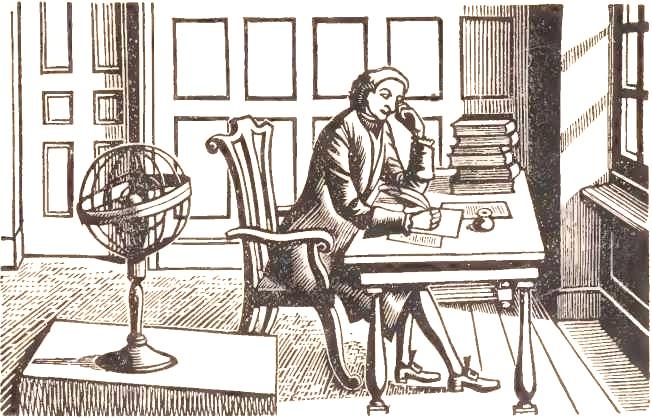
I still keep alive, thanks be to God, without particular cause for anxiety nor other griefs than such as the world, the flesh and the devil bring upon us all. I go my way—and since passing that milestone have been allowed to do so by those who live on impeaching other men’s lives and doings— quietly and peacefully, free in my labours from reprehension or molestation. My existence is made the pleasanter and more carefree by the congenial temperament and company of my sisters and servants and by an income of a thousand ducats a year. Between the latter and the flattering sales of my frivolities I am able to make life easier for my mother and sisters, to the point where they can hold out a helping hand to relatives still worse off and even dispense modest alms to others in need outside the family.
My life in Salamanca affords me much satisfaction, and has made me resolve to leave my bones here, in the city where I first drew breath and where I reaped the initial fruits of my survival to manhood. More than once fortune has come at me with propositions of posts more lucrative and more elevated than that I enjoy; but, knowing my unworthiness and the sorry account I should have to render of such charges, I have turned a deaf ear to her blandishments. Two or three times a year I escape to Madrid, at no burden to my establishment, since in that of her excellency the Duchess of Alba I enjoy a sumptuous table, am housed at my ease most festively and luxuriously and, what I esteem still more, have the honour to lay myself at her ladyship’s feet.
Out of respect for one so estimable, I enjoy equally open house in the drawing-rooms of most others of her rank and character, where my humble station is honoured by marks of the most friendly condescension. Dukes, counts, marquises, ministers, nearly everyone in a word from the highest to the low, single me out or come in search of me to do me honour, bearing witness to the peculiar esteem in which they hold and remember me. Neither in the capital nor anywhere else have I ever knocked at a door that has not been opened to me with glad hospitality.
Should any reader imagine that in thus setting forth the memorable kindnesses I owe to so many good people I am either extolling myself or spinning untruths out of native boastfulness, I invite him to come and see for himself: his amazement will be no less than mine, whose experience it is. Let him, I say, come along with me, if there be one so incredulous or so irked over the regard in which I am held, and he will meet a surfeit of courtesies and friendly faces.
The qualities that stand out most clearly from this narrative are a pardonable vanity and a good-natured conceit. Knowing well that neither by birth, station, wealth nor intellect can I lay claim to any token of respect beyond such as spring from Christian charity and custom, I am none the less titillated in my self-esteem to see this kind of general and venerable indulgence addressed to my humble and most appreciative person. I allow the possibility that the extravagant nature of my studies may have attracted to me certain attentions of the great. Yet others write verses and prognostics, and I see them contemned and forgotten. Let my envious rivals accept that what I have I hold on trust from God, and that I have sought to better myself by cultivating such respect and good manners as will make me acceptable to all sorts and conditions. I confess in return that I write this unnecessary account of myself in part to annoy them, and to give them at least a suggestion of motive should they wish to come back at me with their profanities and backbitings.
I preserve with particular veneration and esteem, mingled with embarrassment, the correspondence I have had with a number of cardinals, archbishops and bishops, dukes and duchesses, superiors of the religious orders and other princes and leaders of the first eminence and authority. These are the jewels and the valuables I prize above all others; these I shall bid my heirs show and entail in unique remembrance of my good fortune, and in witness to the honour the world can bestow on those, not blessed by fate, who seek to live disinterestedly, to the humbling of themselves and esteeming of their fellows. I still do not lack some enemies of the lesser sort, your below-stairs slanderers, though now they grow fewer and fainter. In truth I much regret the vanishing of this part of my capital, for to such I have owed a goodly part of the reputation, the enjoyment and the amenities that today make my life happy and prosperous.
Of that life this is the true story; and I trust in God to end my days with the same serenity I have known over these last years. Death will come to me, if I have my way, by slow degrees, for I am not minded to kill myself over anything. I do not count on falling victim anew to misfortune or to memorable mischances, since old age, disillusion and the lessons of experience keep me now withdrawn from the hurly-burly and with a weather-eye open for pitfalls and stumbling-blocks. Should persecution again lay hold of me, I shall take solace from the thought that misery can now be but short-lived, since death must put an end to it and that cannot be far off. Let God send, in a word, what He will; and I shall try to suffer all with Christian patience and cheerfulness, therein lying my every hope of making, after an ill life, a good death.
V: From Forty on to Fifty

So I lived out my fourth decade, burying the relics of my forty years in Madrid; for it was there that time with his sickle then overtook me, being ever in pursuit and Hable to run us to earth whatever the hour, place or wind of fortune. There my old bones heard pronounced the last requiescat of oblivion in the tomb of Nulla est redemptio, while I concluded the obsequies of my dead past and preached the funeral oration over its adventures and escapades to as many as would hear. Which done, I kept on, full of health and vitality, happy, esteemed, my cup running over, all my blessings rooted in the honour of living in the home and at the feet of her excellency the Duchess of Alba.
To the enjoyment of this felicity there was added a further soothing circumstance: I now found myself free from debts, hopes, ambitions and the hke tiresome deceivers that, worming their way into our innocence or sought after by our unreflecting cupidity, would have our minds ever in a flurry of discontent. At all the fashionable entertainments whereby that indescribable capital plays havoc with the mental composure of its inhabitants, there was I. A coach, the Prado, the play, bullfights, whatever drew the rich, the idle and the pleasure-loving, was mine to command, with the good fortune to boot that it cost me neither money, entreaties, blushes nor any other of the distasteful accompaniments that dull the edge of our pleasures and merrymakings.
With the delights of Madrid thus unconcernedly at my disposal, the deaths I had already died were lost to memory and the intimations of that which still awaits me very far off. To the knockings of eternity on the doors of reflexion I turned, in a word, a deaf ear, opting boldly for the illusory pleasures of this world and greatly heartened and consoled to be at one in this with my fellow-creatures. For I have yet to see the man who gives up eating or enjoying himself altogether, or will seek a violent death, just because his past life is past or his present life coming to an end, or because the sands are running out of what he has still left to live.
By this time the narrative of my lineage, life and quixotries[36] was already in the bookshops, printed under permit from God and the king; and my indulgences were notably furthered by the flattering sales it enjoyed. Quite apart from stifling the malicious notions of my enemies, their bold whisperings and ill-judged anticipations, it brought me in as many reals as fed, clothed and shod my numerous household for more than a year. A hundred ducats I laid aside for my burial, in case I should lack other wherewithal at the last to see me to my grave; and there still remained enough to allow the relieving of a couple of lazy importunates among those most moved to envy by the warm reception accorded to my writings.
Between the third of April and the end of June 1743, there appeared five printings of the said Life. Three bore the commendation of the king’s ministry of justice and ecclesiastical affairs, as may be seen from the official licence, given in Madrid and countersigned in the first edition printed by the Order of Mercy. The second was issued in Seville by Diego Lopez de Haro, the third by Vicente Navarro in Valencia. The remaining two were brought out clandestinely, in violation of the law and of every man’s right to the fruits of his labours.
Of these, one was printed in Saragossa, where the local gazette advertised the edition and announced its sale at an address I forbear to name, as I suppress the other circumstances of the fraud, these have no bearing on my story. I would have the offenders appreciate none the less my moderation. When I learnt that they had no need of such miserable plunder for a living, I reported the imposture to his excellency Cardinal Molina, at that time President of the Council. He took the necessary steps, and the culprits were arraigned before the president of the high court of Saragossa, their stocks confiscated and a return exacted on copies already sold. In the result there accrued to me two hundred and fifty silver reals and three hundred copies of the book; which restitution made, I forgive them the rest, now and before the judgment-seat of God.
The other spurious edition came from Pamplona, from the establishment of a widow. In view of this last and of the woman’s poverty and simplicity, I this time renounced my rights, entreated the law not to harass her with its constables and procedures, and got from her an undertaking, to my intimate satisfaction, to sell the work on my behalf at a place and price agreeable to her.
Many were the pleasures and relaxations that came my way at this time, and I can assert that not the least amusing was the diversity of opinion forthcoming from such as gave up a few hours to the reading of my light-hearted narrative. Some held it a lack of shame on my part, and scant regard for the public, to have exhibited thus impulsively in the market-place, on a note of ingenious eccentricity, the worthlessness of my ancestry, the baseness of my upbringing and the stupid excesses of my dissolute years. Into this same consideration others read instead a praiseworthy self-abasement. Some inferred from my so doing either a compelling necessity or avarice in disguise; while again it was said that I had written the book merely to pick up a hundred doubloons by a harmless confidence trick, since throughout I was at once the villain and the victim of offence and robbery.
The verdict of the rest pronounced the whole thing a prudent concern to establish my innocence in respect of certain acts and occurrences of which other chroniclers had already given hostile and lying versions. I had wanted, so it ran, to give mine while accusers and accused were both still alive, to the end that in the confounding and silencing of the former all might read my restraint and their most culpable irresponsibility. I laughed to see everyone in the right; for if truth is to be told, something of everything had been in play. And had my readers but scrutinized a little closer, they could have unearthed still other motives and deep designs. The fact is, I wrote the book for this reason and for that and for a number more.
Some readers, however, I had taken in completely. They were the ones who saw only an exquisite humility in my diligent uncovering to the world of all the dark corners of my family history. I can confess now that I wrote here with as arrant a presumption and a vanity as inordinate and crafty as are to be met with in the annals of family pride and ambition. My forefathers may not indeed have been out of the top drawer like those who people the plays of Calderon; nor did their role in life ever go beyond what I have already told in earlier chapters. Yet am I most firmly persuaded that there are countless others still worse descended, both in the cut and in the standing of their forbears, who make bold to cock a snook at Don Carlos Osorio himself.[37]
It was to smother such bubblings and braggings of birth, and to take down a peg certain other boasters of hoary ancestry who keep plaguing me with their genealogies, that I set out mine before their eyes, to see whether they would have the courage to make as clean a breast of their own; and on my faith, the race-proudest of them all and the most stiffnecked with posterities have gone about all discomfited, not knowing where to hide their faces.
What a venerable folly and well-nigh incurable mania this is, and how commonly it afilicts even the most sensible and good-humoured! For without other advancement or change than merely traipsing from one part of the country to another, powdering a curly wig, sporting a long-sleeved coat specked with silver thread, and affecting a leisure very different from the industry of their progenitors, men preen themselves into believing their fine sprung from the very centurions of Rome, and are so ready to sink or bury their true kith and kin that they will not have name, memory or abode of one of them come to the shade, let alone to the light, of day. Should they ever admit to recent ancestry, they furbish them with flesh and clothing, manners and calling far removed from any they knew at birth, death or in between.
I confess too that arrogance had a hand no less in moving me to this revealing of my origins. It gratified my sense of mockery to annoy the many villains genealogical who get an infernal pleasure, and a living, out of their itch to be always spying on fortune’s and the world’s favourites and frightening them with the threat of scandal about their more ignoble strains. To guard against any gossip’s presuming that he had in me one of your easily frightened sort, to be shamed and scared by lice, I indulged my conceit by myself exhibiting the shifts my family wore and wear.
For I know from abundant evidence that, spotted as we may be with an occasional unsightly tarnish, I can still challenge half the world and more on this matter of purity of descent; and more especially all who like myself were born innocent of possessions, estates or titles and, once free of their mothers, knew only the charge from providence to go search for that grim stepmother, fortune. So let the proudest produce his family tree, for here is mine; and I promise him he must sweat a lot of ink if he is to come out of it as creditably and as well dusted as God has enabled me to.
Had I the rational endowment to justify giving advice, and a sufficiency of judgment to instruct, I would counsel my readers never at any time nor under any circumstances to conceal their parentage or deny their ancestry, however humble or unblest by fortune. For the blush of shame it may cost to admit to them straightway is infinitely less painful than the fear of their being unearthed and spread abroad— with new blemishes added, in all probability, in the process —by one of your many knavish chroniclers of pedigrees.
This breed ministers to its envy and feeds its natural bent by dint of decrying eminence and crumpling success, from the notion that in the discrediting of others they find compensation for their own miseries, shortcomings and want of esteem. «When a man sees people trying to dig up against him the blots and crimes of his forefathers, he may take easy solace; for it is a sign that malice has missed its mark, not finding in the tale of his own activities any mud to throw at his character and good repute, t
The confessing to my ancestry stood me in excellent stead. When the first defamer threw in my face the pastes and glues of my good father’s bookstore, my contempt for a spleen so vented left him strung up by the gills. Beginning by thanking him for the truth of his shafts, I turned my lineage once more inside out, recited in detail everything I knew about my relatives and progenitors, and rid myself once and for all of the backbiter and his kin. They are in truth a stupid and rascally sort, who go rummaging in the charnel-house for any malodorous slander they can ferret out against families not on the alert.
In short, through this waggery I succeeded in passing off my pride as humility. Working the confusion of some, I won the regard and sympathy of others, together with the respect of the many who had believed me even more meanly sprung; and became aware finally of a much more general readiness to have dealings with me, those who had been friendly before now showing themselves even more so and curiosity growing among strangers to make my acquaintance.
I am not suggesting that others should take my procedure as a rule of conduct, for it has about it an air of effrontery and disrespect that Mr Everyman, having got himself up latterly on stilts, is inclined to resent. What I do say is that in this transaction, with such contraband for wares, I netted a hundred per cent profit in general repute. And anybody wanting to do a similar deal has his merchandise right at home. Much good may it do him, and may God and the world give him as ready a sale and as profitable a turnover as came my way.
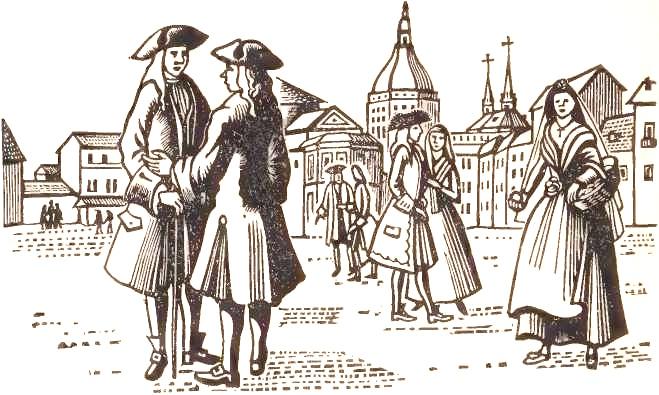
Those, I repeat, were happy days for me, my humours well-tempered and at peace, my mind tranquilly indolent, my thoughts and ideas meeting with a general acceptance. I lived in Madrid a stranger to commitment, to care, to ambition of any kind: a felicity this that is denied to the wealthiest, the most pretentious and the most disinterested alike of those whom policy or necessity, pride or idleness causes to frequent the halls of so spacious and vivacious a school. I was still agile and limber of movement, free from scruple or remorse in matters of health; nothing preyed on my mind. I had no cause even to remember that there were such things as justice, thieves, prisons, doctors, fevers, critics, scandalmongers or any of the other phantoms and bogeys whose threats keep us constantly on edge, to the ruffling and spoiling of our enjoyment.
This untroubled existence lasted till the month of August 1743, when there dawned for me a day—I have forgotten the exact date—so bitter and imtoward that it changed all my serenity to despondency and vexation, blotting out the very memory of those sweet joys and delights I held so firmly rooted. Never had I known myself so sunk in tribulation. Over many a season poverty, persecution, illness and other misfortunes that the world cries up as beyond endurance had made their noxious abode with me and would not let me go; yet I can affirm that not until that day had I known anguish and despair face to face. What happened, if I can give a true report of it, was this.
I had gone into church in Madrid to hear mass. Just as I was about to make the customary genuflexion, my knees and ears were stayed by the voice of a preacher reading from the pulpit an edict of the Holy Inquisition condemning various books and pamphlets. My ill luck had brought me there at the very moment when he cried out my own name in full, and with it a fulmination against a small thing I had published under the title The Life of Nature and of the Faith fourteen years before.[38] Greatly terrified, and blushing scarlet, I withdrew from the centre nave where this thunderbolt had struck me in search of the darkest corner in the church; and from there heard mass, though totally unable to compose my mind to meditation, such was my state of mental shock and so insistent and gloomy my forebodings.
At length I made my way home, choosing the lowest quarters and least frequented streets. The few people who looked at me I found myself believing already informed of my plight. Some seemed to be cursing me inwardly as a Jew, others to be putting me down a heretic; all had the air of averting their gaze, as if to avoid contamination from one accursed. The thought kept crossing my mind of how pleased my critics and enemies were going to be at what had befallen me, and it grieved me no little that I would not this time be able to turn their malice and tortuous intent to a jest. In truth I knew’ that the blow must provide them with powerful buttressing in their assertions of my ignorance and flounderings.
I reached my room worn down as though after a battle from wrestling with this and other horrible imaginings. Then, taking myself solitarily to task, I examined my Catholic convictions and emerged persuaded, thanks be to God, that in all things I still stood four-square on the teachings of Christ. I stirred up my ancestry anew, turned over the living and the dead, and certified myself that for seven hundred years back there was none who had not been furrowed and white-haired with Christianity, and that to a man they had been baptized and married, had died and been buried, as Holy Mother Church commands.
I probed my conscience, went back over my actions, and neither in the one nor in the others could discover such suspicion of backsliding as might mar the semblance of the true faith as I have ever professed it. Finding myself thus free from taint of miscreant blood, crime or turpitude direct or indirect, I took courage from the assurance that at most there might be discovered in me some part of the fool or the ignorant, and in this conclusion knew relief from the major burden of my anguish.
The consolation was no light one. There is nothing criminal about stupidity, ignorance or thoughtlessness; and in the absence of crime, disgrace and despair have no warrant. Such condemnations, moreover, have in the past fallen upon —as they still do every day—the subtlest of scholars and most learned of men. It is these who regularly come in for warnings and the calling-in of their books. No tribunal can confiscate the writings of him who does not write. And it may be believed that many a treatise is suppressed, not in punishment of the author, but to save him from the malice of his readers. With these reflexions, and the solace of knowing that the greatest men in Christendom have fallen into the abyss of similar slips and oversights, I recovered my equanimity and once again found room in my heart for the thoughts and satisfactions on which my earher happiness and peace of mind had rested.
I determined to make manifest to the Holy Office, in a respectful memorial, my ill-starred innocence, humbly beseeching it to indicate where my propositions had erred, that I might repudiate and renounce them. I protested further that it lay far from my mind to think of elaborating any defence of the same, or to seek to excuse them by giving my words some other purport, being content to stand on the reading that had led to their condemnation; since nothing mattered to me so much as being purged of my errors, abhorring my follies and submitting myself with all obedience to the tribunal’s decisions and decrees.
The officers of the Inquisition made sympathetic enquiry into my single-mindedness and the sincerity of my Christian and Catholic purpose; and within a fortnight the book was returned to me. With the memorial attached and a new prologue, I then brought out a second edition. The doubting or curious reader may confirm all this in the said reissue, from the printing-press of the Order of Mercy in Madrid, of this same year 1743; and any desirous to possess it will still find copies at Juan de Moya’s bookshop opposite San Felipe el Real.
The experience was not all loss. From it I gained an enhanced veneration for the Holy and silent Tribunal, and learnt to dwell with less trepidation on the workings of its righteous procedures. The foolish horror I had conceived lest my writings should ever incur its scrutiny and punishment I now shed. My fervent desire henceforth is to have anything else I may write submitted to and improved by its counsels, since in this way alone can my thoughts and labours look to a felicitous outcome. Such examination and such approval must of necessity still the voice of the carpers who go looking for faults with no thought to the innocence of intention. In proof of my readiness to have my works indicted I will myself present copies to anyone so undertaking; for thereby I remain satisfied and corrected, and know the certainty that my indiscretions in print do not court disaster.
Scarcely had I recovered from this cudgel-blow when my powers of resistance, and my spirit of resignation, were crushed beneath another which must leave its marks on me even beyond life and death, if that can be. This was the sudden illness that carried off his eminence Cardinal Molina, to whom I had been indebted for so many pious favours and special honours that sheer gratitude stirs in me a sense of reverential contrition.
Nothing that charitableness, inclination, justice or mercy has it in its power to do did he not do, most graciously, for me. No prayer born of my veneration for him ever reached his feet that he did not attend to on my behalf. I would ask in the name of as many as I knew to be in need, and his charity extended to them all, with the one reserve that my petitions should not infringe, however unwittingly, the cause of justice; for of this he was ever so enamoured that he would not be guilty against it, or its shadow, of the slightest disrespect.
Many were the occasions when he wished to confer on me a canonry, abbacy or other benefice; but I was never willing to jeopardize his confidence or to throw away by acceptance the benefits of his so generous regard. It is true that cautious calculation also entered, for the full extent of my unworthiness would have stood revealed thereby. Once when he was urging his kind offices upon me I made reply more or less after this fashion: ‘I know myself, Your Eminence, for I have taken my measure; and I know that I will not do for a position of note. I lack the breeding, the self-control, the authority for offices of honour, the integrity necessary for their administration, the judgment that goes to the ordering of their contingent responsibilities.
‘My almanacs give me enough to live on. The innocent profit I make on these, the return from my other modest scribblings, the florins I draw from the University of Salamanca: these embrace the sum total of my cupidity, ambition and vainglory. I beseech Your Eminence, in God’s name, to pardon me and not to place me in such a position as must expose to infamy my eccentricities and ignorance. Allow me to conceal beneath this feigned modesty and show of disinterestedness just how presumptuous and soaring my mind is.’
His eminence was not convinced by this protestation of my unserviceableness; and one evening on rising from table his confessor, the most reverend Fray Diego de Sosa, cornered me in the Hbrary and informed me of the cardinal’s readiness, should I wish to turn sacristan, since my misgivings would not allow me to aspire to higher office in the church, to appoint me to the sacristy of Estepona that had fallen vacant in his see of Malaga. I returned him a thousand thanks, swearing from that hour onward to make public boast of his friendship, of his greatness and of the many happinesses I owed to his piety. Of these the greatest was this bestowing on me, when I already had a sufficiency, of moneys that I could now distribute generously in his name to the poor of my own connexion.
Today, in consequence, I am sacristan of Estepona, and as happy in my sacristy as any others can be in theirs. For six years now I have enjoyed it, though only over three have the offerings of the faithful come my way. The other three, they were devoured by the acolyte who served at weddings and funerals. He, when I sought restitution, rode the high horse, and neither persuasion nor innuendo has sufficed to bring him to heel. But I forgive him the debt, and the obduracy. For my part he can go to the next world without feeling bound to repayment or fearing persecution from me.
No longer now did each new day dawn smilingly on me as of old. After these two shocks my heart found only bitterness in the world’s pleasures, ingratitude in company, insipidity in public spectacles and infinite vexation in all that promised delight. My spirit was a prey to shattered illusions, my conscience to remorse; while my common humanity lay so crushed and listless that only under groaning protest could it be induced to go through with the unavoidable minimum of religious and civil obligations. The tuggings of melancholy, or the hope perhaps that with change I might get over my woes, made me resolve to go back to Salamanca; but my patience had worn thin, I was no longer on good terms with fife, and despondency so ate into my bones that novelty but contributed to the enhancing of my troubles.
This spiritual malaise was now rapidly undermining my health. What finally laid me low was the grievous despair that assailed me when the last attack of pleurisy brought his excellency Don Josef de Carvajal y Lancaster[39] to the very threshold of death. The grave news bereft me too of all signs of vitality, so that I lay like a log in the grip of anguish and dismay. One only most fervent concern I still retained, to beseech God with vows and entreaties to spare to the world the life that meant so much to it.
Thanks to the repeated orisons of the religious communities, to the cries of the disconsolate kingdom as a whole, to the ardent supplications of private individuals, or from some other reason in God’s inscrutable wisdom, the divine mercy permitted that his excellency Don Josef should be restored once again to life and health. The relief to the general anxiety was great. To me God granted time and opportunity to discharge my vows, which I did, thanks be to His holy name. May the keeping of them have proved acceptable in His sight: for myself I place no trust either in my fervours or in my performance.
These dismal afflictions and griefs, added to an extreme lassitude that took possession of me with this last blow, sowed in me the seeds of a physical weakness so profound that it remains with me to this day; nor have I been able to get at the rebellious roots that took such deep hold on my system. The stomach began to poison my digestion, the hypochondrium to fail to eliminate the impurities that lodged in its recesses; my mind was unable any longer to find relaxation or amusement. So deep and despairing, in short, was the gloom that descended on me that no figure took shape at that time before my eyes, no idea in my soul, that did not heighten the horror, sadness and languor.
This accumulation of ills assailed a constitution that the doctors had already bit by bit undermined. For to check the ravages of a persistent flow of humours, making mostly for my loins and buttocks, they knew no other remedy than repeated blood-lettings; and while I was still of an age to withstand it they opened my veins in all one hundred and one times. This is not the time nor the place to express abomination of the practice in the treatment of obstinate fluxions. The charge I may lay on medical practitioners in passing is that they should pay more heed to the variety of temperaments, and to the different forms the said ailment can take. Let them pin less confidence on the ability of some natures, through brute resistance, to stand such loss of blood without sensible hurt: others that are not harmed at the time prove after a few years to have been seriously impaired and exhausted. One prescription cannot suit all. The concern of medicine should be, while not losing sight of general principles, to fit the treatment to the patient.
For days on end at this period I found myself so furiously out of conceit with existence as often to be on the verge of utter despair. Never had my sins seemed so monstrous or so far removed from hope of divine mercy: never in my mind’s eye had eternity stretched out to such a terrifying infinity. And never had I known my spirit so beset by anxieties and anguish. In spite of these violent attacks of low spirits, and of the repeated blows dealt me by recollection of my faUings from grace, God in His infinite pity willed that some rays of light should still illumine my reason and turn it to a concern for my soul’s eternal welfare, since my body seemed now set irremediably on the downward path.
Whether guided by preternatural inspiration or merely moved by the state of my choler I know not, but I now addressed myself with some solicitude to thoughts of religion. Entering the monastery of the Capuchin fathers in Salamanca, I there took up in serious and unhurried fashion the question of just how I stood with God. After a month in the company of these religious, I left with my mind made up to join the ranks of the priesthood, and informed my lord bishop Don Josef Sancho Granado to that effect. He encouraged my resolve with saintly doctrine, prudent counsel and devout exhortations, and on the fifth day of April 1745 ordained me into holy orders.
His lordship honoured me with marks of singular distinction, not the least of these being his rising from a sick-bed, where he lay prostrate and in much pain with the gout, to take the ordination service himself, wishing me to be inducted at no other hands into so holy a ministry. In the act of conferment he turned to the congregation and said as much, thereby inferring a reproach to my enemies, some of whom believed and others had proclaimed abroad that the long delay in my being received into this blessed state had arisen, not out of reverence and awe at the perfection wherein it was grounded, but from lack of disposition on the part of this most pious prelate.
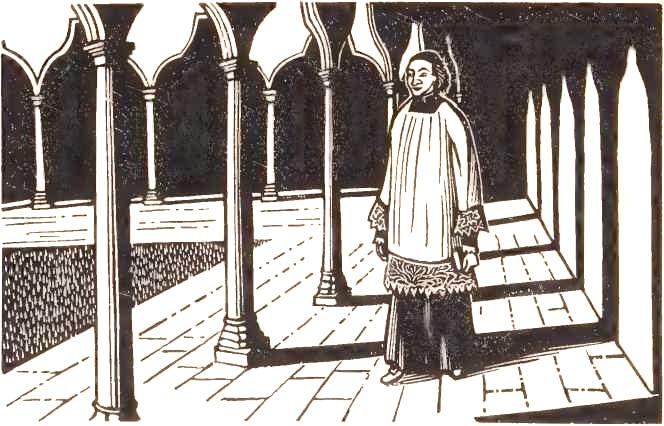
On the second day of Easter of that same year I said my first mass in the cathedral, being situate in my parish, in a chapel dedicated to Our Lady of Light. My sponsor was Don Enrique Ovalle Prieto, canon, dignitary and prior of the same, who has now gone to his reward. I commend his spirit to God in respect of the many special favours he showed me, and for the charity with which he initiated me into the sacred offices.
Meantime I struggled along with my gloom and dejection and a number of major aches and pains. With these I put up like any other invalid, sometimes patiently, sometimes growling and grumbling, or again sunk in a sullen stupor that I could not shake off. Time and time again I would make up my mind to have done with doctors and doctoring, and as often played willing victim to their whims, presumptions and uncertainties, with a naive anxiety and a credulity I had never looked to see in one so disillusioned and so ill-disposed to the tribe as myself.
In the end, like a man bereft of choice, dazed with melancholy and bewilderment, I abandoned myself to the worst, to wit the profession, who would soon have made an end of all my ills, and of me, had not God overridden the wrongheadedness of their diagnosing and fury of prescribing, desirous in His mercy—for what reason I know not—to keep me still in this world. Of these ten years of my life the greater part was consumed by this long-drawn-out illness. I must therefore tell of it at some length.
The doctors dignified my ills into the category of those rare, stubborn and rebellious diseases which are most obdurate of response to treatment. Not knowing what names or surnames to put to them, their breed or nature, they treated and persecuted them at the cost of my hide with every irrelevant or stupid concoction to be found in the apothecary’s shop. At each new visit they thought out some new name with which to baptize my ailment and their ignorance. In truth they never so much as saw its face, knew its malignity or succeeded in tracing its descent.
Often I heard them call it a hypochondria, at times a clot in the blood, or the buboes,[40] or jaundice, or some affection of the soul, or morbid melanchoha, or obstructions, or again witchcraft, enchantment, the effect of love or a handiwork of the devil. And I, confiding simpleton, put up with all the loathsome tricks they play on the jaundiced, the hypochondriac, the sufferer from clots and obstructions and the bewitched, having spells pronounced over me, being dosed with potions and plagued as frequently with hyssop and exorcism as with syringing and plasters.
One thing I would not allow—it was the only time I put my foot down with either the doctors or the exorcizers—and that was to have them treat me for buboes. For though I knew no more than they did about the real seat of the trouble, I knew well it was not that, being certain that neither in my heredity nor by theft, borrowing or exchange had I ever come by such furnishings in my anatomy or known my humours so troubled.
There is a stupid rule of thumb in medical practice according to which ‘all obstinate diseases that root themselves pertinaciously in the body and scoff at other treatment are to be taken as buboes and treated with unguent of mercury’; and by this they wanted to go. But I struck, and it may have saved my life. At the very least it spared me the infinite suffering and anguish involved in recourse to this most potent medicament.
There is no help for it. I must, as it seems to me, give the reader who has accompanied me thus far the whole story, all the stages and stations of my illness. I shall keep to the facts, and tell them simply, in the belief that these pages may well prove the most useful of my whole tale; since from them will appear with what justification we make mock of the science of medicine and how ill-advised is he who puts his trust in its promises, procedures and hopes, which last are to be placed only in God, nature and the abhorrence of all gluttonous appetites.
My case will serve too as a lesson to all who seek a cure for unknown ills, or undergo treatment as a precaution, a whim, or out of credulous belief in medical principles or in the toothsome remedies and quackeries of the apothecary. Let those humble themselves too who live by their prescribings, and cease from attributing to the groping, vanity and tricks of their calling results solely to be laid, as I have said, at the door of God, of nature in her wisdom and of moderation and temperate living.
On the fourteenth day of April of the year 1745 I made general and particular confession to my medical colleagues in the University regarding the vices, near temptations and present sins of my constitution. A law classroom, serving as confessionary, heard me unbosom to them my crimes and seek absolution for all my venialities, backslidings and more grievous offences. That there should be no misunderstanding, I made the detailed indictment of my past life and present state in their own professional idiom, and was well pleased at having declared my bodily complaints with such a diligence of scrutiny and clarity of exposition as my soul envied and would fain emulate for the confessing of its infirmities.
Having completed my case history—the immediate symptom being a pain in the head—with this combination of diagnosis and prognosis, I concluded with some such words as these: T know well, gentlemen, that medicine has its specific definitions, categories, causes, prognostics and treatments for every ailment; but I am informed no less of its uncertainties and errors. I stand closer to myself than you do, and the agent of my pains and anxieties is unknown to me. I can neither locate the seat of its malice, even to telling whether it be in the stomach, the hypochondrium or the mesentery, nor be certain whether the pain derives essentially from the part affected or comes, as you gentlemen say, by consent.
‘With your greater learning, your suspicions will carry more weight. I can merely inform you that if this pain in my head goes on for many days longer I shall end up with apoplexy or go out of my mind. I make over my body to you therefore, gentlemen, absolutely. Scarify it if you see fit. I promise to abide so meticulously by your findings and prescribings that the day will come when you will be alarmed rather than gratified to see such compliance and mute resignation.’
They did what they could to console me, heartening me in particular by the assurance that they had cured many a head pain like mine. The trouble, they added, was rooted rather in my apprehension than in my humours, and I should try to take my mind off it, for they were not worried by the pain. This last I had no difficulty in believing, being ready in my ill-will to conceive that possibly our ailments, however protracted, do not in fact weigh heavily on the profession, which draws its earnings and patrimony therefrom.
The doctors put their heads together and reached what they call agreement, to the effect that my complaint was an incipient hypochondria, with looseness of the stomach fibres, and that the pains in my head were, in effect, per consensum. They sprinkled me with aphorisms, doused me in precedent and expectation, and I, bereft of my wits with their much talking and longing only to get better, fell for their humbug and took their deliberations as evidence. The consultants dispersed, each going his own way to beat up more game among tertian fevers and colics, while I took to my bed, heir and martyr in prospect to their misjudgments. Next day they got to work and started practising their skills on this sorry carcase of mine with such method, rigour and persistence as he shall learn who still has patience to read or hear.
Under the said persuasion of hypochondria they decided first to sweep away the grosser indispositions in my humours with the broom of some strong purgatives, which were to serve as prologues in opening a way for the anti-hypochondriacal and counter-scorbutic medicines to follow, these two going hand in hand. The first purge was the regular one, known to the fraternity as agua angelica: rhubarb, manna, crystal of tartar, essence of chicory. After that came a vast number of all-purpose pills in a row. Some days later, thinking my stomach had not yet sufficiently expiated its crimes, they reduced me with aguas de escrodero, of an efficacy or malevolence the doctors call ‘ambidextrous’, to the anguish of evacuating and perspiring profusely at the same time.
In all they got me to swallow, over a period of twenty days, thirty-seven purgatives, in hash, meat balls, mutton stew or other dishes; and the pain got steadily worse the while. These first treatments drained me of energy and colour, leaving me so washed out that but for my spasmodic breathing and an occasional listless movement, apparent only to the close observer, I might have passed for a corpse. Whenever I tried to move arm or leg, no sooner did I get it off the bed than it fell back again, as if hinged.
Seeing me brought to such a pitch of exhaustion, the doctors then changed their tactics and after a few days came at me from behind. The seat of offence, that they had first sought in stomach and hypochondrium, they now tried to locate in the blood; and to this end twice made incisions in my ankles, thereby bringing the total of bleedings up to the one hundred and one aforementioned.
As if they had still not emptied me enough, they gave me next a tonsure of leeches on my head, with half-a-dozen more as pendants for my ears and as buckler, to finish the job, a spate of blistering plasters on the nape of my neck. I would my enemies could have beheld me; for I doubt not that it must have softened even their hard hearts to see me such a bloody sight. My face was dripping with the blood spewed out by the leeches biting all over my pate, while from my ears it ran in rivulets down my neck and over shoulders, chest and much of my shirt, making me look for all the world like a flagellant.
The reader may infer the state of weakness, dejection and disfigurement to which I had now been brought. I would have him believe that I was beyond even sobbing aloud, and had come to the verge of breathing my last, seeing myself as much more of eternity than of this world. What powers of judgment I still had to lose—little, but such as had enabled me to make shift among my fellows—I lost. My memory failed me so calamitously that over the more than two months of this great cure I could not repeat even the paternoster, nor any other prayer, in Latin or Spanish. In short, I lost everything, except the pain in my head. This grew ever more severe, making it seem as though all the doctors’ efforts were directed rather to keeping it alive than to getting rid of it.
The doctors for their part read up their textbooks, looking out excuses for their stupidity. With their own eyes they saw my deplorable condition and their mistakes. They recognized that my constitution and my suffering between them were making mock of all their diagnosing and prescribing and rules of thumb; and in the face of so much disillusion I never once heard them admit to being wrong. Moments there were when they did blush with shame to know their heads in even worse state than my own and to be unable any longer to think up pretencesz wiles or gestures that might hide their dubiety and discomfiture. But there, to supply the evidence and give them the lie, were my appearance and my pains, closing the door to all further attempt at wriggling or escape. What afflicted them most, in fact, was their inability to blame my prostration on any excesses or rebelhousness on my part; since such was my own folly over submitting to their opinions and plasterings that I let them have their way even when I had just cause to question the efficacy of their treatment, nay more, to believe it harmful.
My weakness and my torment persisted, worsening implacably from day to day. But still they had not tried out on me everything they had read at the University, and they were unwilling to let me rest until they had. So they carried on with their maxims and their receipts, thrusting them upon me in potions, lotions, poultices and all the other forms of martyrdom they visit upon the wretchedly ill.
Occasionally I had visits from the townsfolk, who sought to cheer me up. Some came out of pity, others from friendship, most of them moved by curiosity to see an illness so lamentable and so infinitely protracted; and each in turn bestowed on me his own remedies and nostrums, prayers and relics. Five other doctors practising in Salamanca likewise came to see me, with some surgeons and a scattering of exorcizers; and there was none, God be praised, but worked on me to the top of his bent, my docility and the tenacity of my constitution making a free field for all comers. Anything they read or dreamt by night they came and had a go at in the morning.
And so I lay in their hands until the twentieth day of August, when I called a halt to their enthusiasms with the apoplexy I had feared and foretold from the very beginning, in that first probing and confession I made of my ills to the original doctors. Behold me now, therefore, an apoplectic. But before I tell the means whereby God in His mercy restored me to consciousness and movement, I shall inform the reader, truthfully and straightforwardly as ever, concerning the remaining treatments, dosings and scarifyings they used to empty me quite; for he is still far from having heard the whole story of their knavish practices.
Between the fifteenth of April, when they began to pour their concoctions into me and to flay me with their bleedings and leechings and blistering plasters, and the twentieth of August, when they finally induced the stroke, they got into me, along with the said poisons and lancings, the following spear-thrusts. On the fourth of May an extraordinary council of war was convoked against my attenuated humanity. Six doctors and two surgeons attended, together with an exorcist, who always had his vote at these sessions; and all concurred in condemning me to ten cuppings nightly, to be applied to my loins, ribs, thighs and legs.
This was done, and kept up until the tenth or twelfth of June, the reckoning thus working out over thirty-nine days —supposing even as few as eight a day—at a minimum of three hundred and twelve cuppings. Some nights, it is true, I did get a rest from them; but against these are to be set the days when they gave me more than eight, often inflicting as many as ten or twelve. To be rigorous in my arithmetic I should have another couple of dozen in my favour; but as a minimum I do not abate one of the said three hundred and twelve.
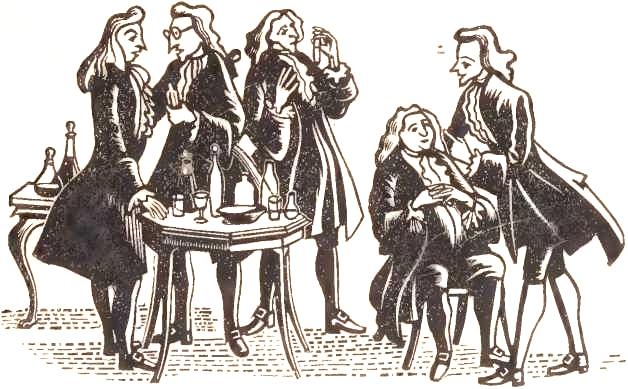
Eighty-four times I was syringed with sheep’s-head broth, compound purgatives, electuaries, salt, tobacco snuff, spring water and other brews so foul that the receiving organ often threw them up with nausea. The rubbings and scrubbings I endured, leaving out those invariably thrown in with the cuppings, would number at a fair guess a hundred and fifty. Of Dr Baglivi’s footbaths[41] I had seven.
Finally the same crew were again summoned into conclave, to pass sentence this time of treatment with unctions of mercury. Most of them cast their vote against me. It was here, as I have already mentioned, that I rebelled, bringing it to their attention that my disease had never yet uttered a word to justify its being taken as French,[42] nor had it emerged from my confession that I had ever had illicit dealings with anyone of that race, or with any Spaniard who had trafficked with such people or such ailments. The doctors, seeing me obdurate, burst out against my defence with the extraordinary protest: ‘But, sir, we must do something! No patient has ever yet been cured without medicine. You must acquiesce; otherwise your life is forfeit, and the devil will have you after all.’
I could have wished never to have been born on hearing such fearsome stupidities and encountering a persecution so barbarous. ‘We must do something!’ Was it all nothing, then, thirty-seven purges, eighty-four syringings, three hundred and twelve cuppings, my hide as full of holes as a sieve and covered with the rents and tears of all the bleedings, leeches and blisterings? In God’s name, all the powers of hell, all the fury of the devil and his minions could not have wrought more cruelties with their victims in the bottomless pit: and they come at me now with a ‘We must do something!’ I confess that such crudity and want of tact made me let go of my temper, and that only the forbearance due to the ravings of a sick man enabled them to gloss over the disrespect with which I made reply. I have since asked their pardon, which having been granted, the matter is closed.
In order not to fall down on their science or see their practice suffer, these men form the resolve, once they get a patient to bed, not to give over until they have him safely underground; nor will anything ever deflect them from their obstinate self-confidence. Some let themselves be governed by blind faith in their rules, others by gullibility based on a handful of experiments that, examined with judgment, they would recognize as triumphs much more of nature than of their art, knowledge or penetration; while many again are caught up by some ambition which muzzles them and inhibits their speaking with the frankness one has a right to expect from a person of breeding and honour.
Greed, obstinacy, conceit, industry, guile, a presuming on experience and honesty of intention: any one of these, I grant you, may underlie the continued and so pertinacious multiplying of their prescribings. My own opinion—if old age and much curious observation make it of any weight— is that one should pay the doctor for his services, and pay him off, in advance, right at the beginning of his visits: this being the only way whereby all parties to an illness can hope to come off less badly and even better than they otherwise might.
For thus the doctor gets his fee straightway without trouble, without having to face the mocking tricks his medicines and his patient’s ailments will play on him, or listen to the cries and expositions of bedridden and bystanders alike, or think up excuses for his ignorance and mistakes, for the failure of his remedies and the contumacy of the disease. The patient gains a useful respite from travail, such as often brings of itself the relief and health he sought; while if he dies, he dies at least a more tranquil, more comfortable and cleaner death. Finally, his servants and retainers can save on the apothecary the expenses of the funeral, or at the very least a good part of what will be swallowed up in the burial and scattered among sacristans, acolytes, bell-ringers and the other hangers-on of the charnel-house.
I have much still to work off concerning this history of my ills; but before I continue, conscience bids me here warn the reader not to be misled by my outspokenness in comment into thinking it any part of my purpose to satirize or wound the individual doctors who attended me. As often, accordingly, as he encounters in this document the words ‘wrong’, ‘falsehood’, ‘ignorance’, ‘deceit’ and others to the same effect, I would have him take them as directed not against the intention, conduct or solicitude of the said doctors, to whom I live beholden, but against all that is conjectural, uncertain and hapless in the medical faculty. And when he comes upon ‘cupidity’, ‘presumption’, ‘vanity’ and the like they are to be understood as aimed not at any individual in particular but at the fraternity as a whole; since in this are to be found, as in every other, men who are vain, grasping, deceitful, presumptuous and full of other guileful and malicious qualities that call for reprehension.
Such is my simple and sincere opinion. And I hasten to add that to those who treated me I was indebted for a Christian piety beyond praise and an eager and most disinterested desire to relieve my sufferings and see me restored to health. I am still most firmly persuaded that it was their anxiety to prolong my fife and set me on my feet again that underlay the repetition of so many and such rare medicaments, in the apprehension that with each new dose there could not fail to be seen the effects of their good intentions, assiduous concern and affection. So the reader must believe, since so I myself believe and swear. And now to continue.
They kept on prescribing; and I, simpleton that I was, kept on swallowing their prescriptions. From the unctions they came down to quinine, there falling to be noted here the circumstance that at no stage in the whole course of my illness was there ever any trace of fever. On the contrary, my pulse beat so sluggishly that in this they read one of the signs of impending demise. On what grounds, therefore, by what process of ratiocination, they came to dosing me with quinine I cannot tell. He who would know the answer must ask them, and I doubt not they will be able to give it him, since they are all men of learning who have studied everything that is taught in the University of Salamanca. But even the Peruvian bark was stumped, and proved of no avail. In truth its enemy was not to be found within a hundred leagues of my body. I still have the stuff by me; perchance it may serve to frighten off such future fevers as may be lying in wait, with the passing years, for my much harassed constitution.
After the quinine they thought of theriac.[43] I took this for eight days on end, without suffering the slightest hurt or relief from its virtues, for all the song they make about it. By then sleep had left me, offended by so many doings, so much endurance, and they sought to woo it back with laudanum, liquid and solid. I tried to protest with gestures against taking a narcotic; but some friars—half quacks, half deathbed ministrants—pounced on me with preachings and threats to my conscience and by sheer vociferation thrust it down my throat. I gulped, fully expecting to awake in the presence of God.
But I tire of going over all the varieties and quantities of drugs they made me take. Not to weary the reader further, I sum it up by saying that there was not a herb, a resin, a tree, a seed, a remedy simple or compound among all the panaceas of the pharmacopoeia that they did not administer to me, in food, drink or ointment. And everything failed of its effect or proved not to be indicated for my complaint. Neither in the large nor in the small did they show the remotest sign of living up to what the fanfaronades of the faculty claim for them.
The doctors were by this time wholly disabused at last, and confessed that they no longer knew of nor could discover, in the whole gamut of their three kingdoms animal, vegetable and mineral, further possibilities of treatment. They handed me over accordingly, little better now than dead, to the exorcizers, and the next few days I passed under their jurisdiction. The first to assail me with his ritual was a devout Capuchin who had looked after my soul in the initial onsets of my illness and who earlier, while physically I was still well, had with his counsels and absolutions rescued it more than once from the profound despair into which it so frequently sank.
For as long as the depression and violence of my unidentifiable afflictions held me in their grip, there was this good friar by my bedside, filled with a charity, pity and understanding that never wavered. The sweet simplicity of his words was the only solace I had known in my distress, the sole relief to my sufferings; in particular it was they that awakened in me a proper spirit of resignation. His name, Fray Leon de Guarena, in which town in Estremadura he was born; he still lives today, holding high office in the Capuchin monastery of Cubas. This most charitable father carried his zeal, his prayers and his holy trust to the utmost limit; but the devil in my head was a dumb one, that hurt but said never a word, nor owned to understanding anything of his admonitions, of the signs of the cross or of sprinklings with the hyssop.
The next to make essay was the reverend father Fray Adrian Menendez, who had received his degree along with me and is today general of the Order of St Bernard. To his prayers and exorcisms likewise the pain refused to lend ear; which notwithstanding—whether from the ardour of his entreaties or from the singular affection with which I have always revered this most reverend father I cannot say—his words brought me greater happiness then, and his presence a more immediate solace, than ever before.
As a last resort there came in other clerics and friars fresh to their tonsure or order and full of fervour, who did their best to frighten out of me the devils, witches, spells or whatever it was—this ‘whatever-it-may-prove-to-be’ that they were all exorcizing and caUing down their maledictions upon. They too made the sign of the cross and prayed over me to their satisfaction. But the devils, witches or whatever-it-was still remained with me, for I saw nothing issue forth from any quarter. It is true that neither had I seen anything enter; but since it was men of learning, professional dealers in spirits and revelations, who assured me something had, I had no choice but to take their word for it, at least outwardly, and to suffer the agony of their prayers and remedies too.
Some twenty days later the doctors turned up again, curious to see what state the exorcists had got me into. Finding that their good offices had similarly made no impression whatsoever on my ills, they hit on the most delirious folly imaginable since first fools came into the world. This was an injunction to those in charge that Fray Leon was to be removed forthwith from my bedside, on the ground that his visage, virtue and admonitions were themselves causing and increasing my agonies and my complainings. Thus they reverted to their old contention that what ailed me was simply and solely a profound despondency and melancholia.
To the worthy religious in question there is in fact no denying a face all squeezed out of shape, jaundiced, gloomy and fearsome, while the greasy, faded tufts of his beard give to his ashen mien the appearance of being at once frozen stiff and sadly bemused. The terror it inspired was redoubled by the dark cloak of coarse sackcloth and the cavernous night of a sombre outsize cowl. This he regularly wore over his head, and with his hands hidden in the gaping black mouths of his sleeves it made him look for all the world like a penitent breathing death and eternity in his every glance.
To others such a figure could in truth be terrifying. To me, already familiar with its face, garb and speech, it brought great comfort. The idea of the doctors’ new cure irritated me in consequence beyond endurance, and once more I rebelled, as I had earher against the unctions. Rounding on them, I bade them, inasmuch as they were determined to have my fife, or were at least powerless to prolong it, not to impede the means to my salvation, which I held secured on the presence, teachings and consolation of that venerable man. At this they left me in peace, and I clung to the good Father Leon, nor spared him from my side until I had been a full three months recovered.
Neither the mortal peril in which I lay, nor my continual insisting with the doctors that they let me confess and receive the last sacraments Mother Church holds out to all faithful Catholics, come as I had to the threshold of death, could move them to allow the celebration of this Christian office with timely deliberation. They countered that my illness was one of many respites; that they were up to all the feints and foxiness of patients; that it was not in reality confession I longed for nor did my desire spring sincerely from the sense of duty of a devout Christian, but rather from that fearful curiosity that impels invalids to try to discover just how serious the doctor holds their condition to be.
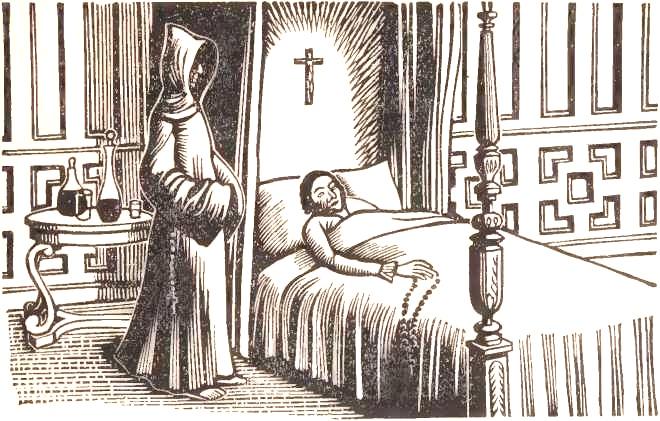
These cowerings and cajoleries and suchlike they were constantly coming up against, and they took no notice of them, being guided by pulse, vigour, water and degree of deviation from the natural state of health; and they knew very well what my state was and what it behoved them to do. They made answer, in a word, very much in the tone of the experienced master-hand, alleging this, that and the other misleading and discredited precedents; and in the upshot the day came when they hade me most precipitately make confession a matter of hours before I was bereft of reason by the stroke.
They tell me I did confess, duly received God in the sacraments, and ordered my last will and testament: of nothing of which have I any recollection. Those present, including my servants, were much edified to see me so resigned. Expressions of love and penitence that came casually to my lips as I received holy communion were remembered afterwards in conversation as most memorable. Everyone envied such indications of spiritual blessedness, and none was more uplifted than my own parish priest, Don Josef Zapatero, who as he left the room kept still repeating some words that —the mind all unwitting—my Catholic nature and Christian rearing had drawn up from my soul and given utterance.
Only, I say, by report did I learn afterwards of my thus discharging my conscience: at the time when I saw to this and to my other preparations for death I was already beyond the last glimmer of reason. And if in my confession no reference appeared to any of the excesses of my past life, it was of a certainty because God willed not that others should be scandalized at such an hour through one who had consumed his whole existence in offences and wrongs against the divine majesty. I am persuaded that this experience of mine with the doctors has been the experience of many, some now dead, others still afive, who have only been bidden confess their sins when reason was already clouded, memory departed, and all power of discernment wrapped up in the greater immediacy of agony and distress, suffering and anguish.
This is not the occasion to take the doctors to task for such abuse and over-confidence. What I do say is that their conscience and the conscience of their patients stand both at gravest risk in the leaving of these matters to so late, and that those whose calling this is ought to keep always very present before their eyes the treacherous nature of disease, the sudden onslaughts, the unlooked-for complications, the deceptive robustness of nature. They ought, in a word, to live under constant chastisement of the false and equivocal character of their principles and of the unfortunate cases that crop up at every moment to call in question their stupid claims to certainty. I make bold to believe that they will give some thought to a matter of such moment.
At last, and not before time, I am approaching the end of my illness, and of this fifth decade. The reader, I take it, will by now be as bored as I am with such store of insignificant and irrelevant detail touching an event that, with minor variations, is the common lot of mankind.
It was on St Bernard’s day, at five in the afternoon, that I had the apoplexy, which kept me in its clutches until two of the following morning. Whether it was induced by the four blistering plasters they had applied to the fleshiest parts of my thighs and legs, or by the first spontaneous vomiting I had ever known, or was what those present insisted on calling a miracle, this I know not. Gradually, however, I recovered my senses and power of movement, that had lain so eclipsed; and this restitution I do believe to have come, if not absolutely by miracle, by special dispensation of divine providence. For on opening my eyes I became conscious that light was dawning anew on my mind, that my memory was less clouded, my movements readier, my head clearer; and although the pain was still there, the noise and oppressive feeling had somewhat abated.
Looking around me, I saw one of my sisters by my bedside, and besought her most earnestly to forbid any and every doctor entry to my room again, save only if one were to drop in as a friendly neighbour. I asked her further to see to it that I never took another dose of medicine, even were I to prescribe it myself; for I wanted to die without having to contend any more with the trials of the profession and its cures. This she promised me, and from that moment I began to experience an indubitable improvement.
For the next twenty-seven days I lived solely on broths; at the end of which time I rose from my bed a very skeleton, so stripped of flesh that, given a scythe, I might aptly have posed for Death. Leaning on a crutch and on the arm of Father Leon, I took my first timid steps in the narrow space of my room. Within a few days I was able to get as far as the street, again with his company and that of my friend Don Josef Najera, professor of surgery in Salamanca and today chief surgeon to the new college at Cadiz. Between them they got me out into the countryside for walks, concerned in their infinite goodness to keep me entertained and in stout heart.
The idea then occurred to me to seek the freer atmosphere of village life. As soon, accordingly, as I could again mount a horse I journeyed the nine leagues to a village called Torre cilia de la Orden, and spent there the whole month of October as guest of the priest, Don Domingo Hernandez Grinon. From him I received every kindness and consideration that one could wish for.
Properly convalescent now, more cheerful in spirits and with every promise of making a good recovery, I returned to k Salamanca at the beginning of November; and setting myself a rigorous diet, to which I kept, I found myself within the year restored in health, mind, judgment and memory alike. The pain in my head is with me still, but less persistent now and more tolerable, though there are times when it assails me anew with the fury of old, so that, little or much, the day is rare when I do not know some suffering and have something to tender to God as offset to my sins.
With increasing robustness, and in a frame of mind to face once again the roads and inns of Spain, I set myself to discharging the vows and promises I had made to God during my illness, in the hope of placating His gentle justice. The first was to visit the shrine of His most holy mother at Guadalupe, and thither I set out on foot on the twentieth day of June 1746. I spent a happy fortnight at that sacred sanctuary, returning thereafter to Salamanca to fulfil other duties and obligations of my office.
In November of the same year I went back to Madrid, to be received there by some with surprise, by others with hospitable welcome, and by most with an astonished alarm, being looked on now as a ghost, now as a dead man. Those better informed of how I had been faring gave me a kind and considerate reception, showering on me congratulations and signs of joy. Such variety of disposition had its origin in the forebodings of the doctors’ bulletins during my illness. Some of these had already in effect signed my death-warrant, which the idle and credulous then put into the post; while others affirmed that if I did escape with my life from the grip of the disease, I should only be fit to drag out my days as a half-wit among my fellows. And they lied, every one of them—as much happens to me when I make my forecasts— since here I am still alive; while as for my reason, I have that I had before, a trifle sprightlier if anything. The severity of the attack must, in fact, have got rid of some phlegm in my blood; and this has made me more fastidious of word, less impulsive of movement, a something untidier in appearance and, I have the impression, somewhat given to flattery and exaggeration. This last grieves me, but finding it the practice among such as are wise in the ways of the world, I am grown resigned.
The ill-disposed and the hostile have taken now in their scribblings to writing me down as crackbrained and a fool; while by the reckoning of those idle seekers after novelty who keep prying into my fife this is the fourth time I have died. So at least the verse obsequies proclaim it that I owe to a macaronic poet of a year ago, whose hunger was such that he could hit on no better idea for raising the price of a meal than to kill me off. As for my lack of wit, they may well be right, if scarcely charitable; but concerning my interments I swear on my fife that they lie from beginning to end, and that the poet is a poet, and the other villains who have been parading me around on a bier base deceivers.
With the renewed sight of me, establishing that I was still very much alive, people got over their terror and credulity, while I resumed my old connexions with the satisfaction of knowing that none among them was going to round on me or take alarm. My lady the Duchess of Alba gave me audience, with a certain precautionary nervousness, it is true, in view of the reports of my presumed madness; and very soon her ladyship’s own good sense removed all doubt. Then indeed was I most respectfully beside myself, to have seen her ladyship suffer that apprehension rather than deny me the rare privilege of kneeling once more at her feet.
Now that I have come to touch on this flattering topic of the kindly interest shown me by persons of the highest station, to the great pufiing-up of my pride, I again cannot forbear to prick my enemies therewithc I will put briefly before them, therefore, the honours and applause I owe wholly to such consideration, the more especially since publication of the fourth instalment of this my autobiography. In the knowledge that herein lies the most pungent satire I can direct against their incurable envy, let them set my modest submissions to the account of their overweening presumption, and be content to moulder for a space while I take delight in dwelling on their stupid grievances and my causes for rejoicing.
His excellency Don Josef Carvajal has several times driven with me in his carriage, seating me at his right hand, through the streets and public avenues of Madrid, has invited me to his table occasions without number, and has escorted me to that of his excellency the Marquis of La Ensenada. Here forty times and more I have been taken inwardly with a profound embarrassment to contrast my unworthiness with the enjoyment of a good fortune so far beyond my wildest hopes, so incompatible with my scandalous demerits; and have given thanks to God to behold poor Diego de Torres, the scorn yesterday—and today—of your most repulsive beggar, raised to heights the grandest heroisms and most soaring ambitions would fain scale.
Their excellencies the Duke of Huescar and the Marquis of Coria have over many years past bestowed a particular abundance of benefactions and distinctions on my respectful gratitude, allowing me entry to the privacy of their studies at all hours without any awaiting of their pleasure in antechambers, that were in itself a privilege. My lords the Dukes of Medinasidonia, Veraguas, Miranda and others have likewise made generous return to my humble obeisances, granting me the same ready access. Of a truth there are few among the great nobles of Spain, as among presidents, ministers and governors alike, to whom I am not indebted for as many tokens of kindness as their magnificence, breeding and readiness to bestow honour can dispense; and all have made me free of their homes and table, their coaches and their benignity. Few again are those among their lordships the bishops of Spain who remain uninformed of my respects, and very rare the one who does not receive with a ready patience and marks of favour my letters, protestations of regard and petitions.
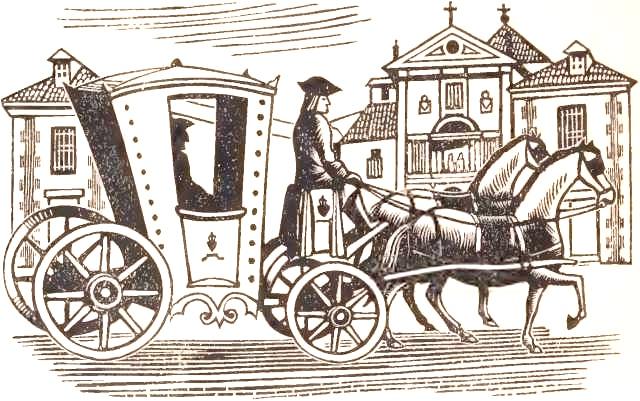
It is many years now since foreigners and pilgrims coming to Salamanca have given up asking for the University, the town square or the cave where according to legend— it may be no more—the devil once taught, and enquire instead after Don Diego de Torres, thinking to encounter perhaps some monster of rare affability or a misshapen oracle and expounder of mysteries,, riddles, fortunes, calamities and absurdities. This much is true, that the beadle, whose charge it is to note the presence or absence of professors from their classrooms, summons me more often to be seen by strangers than to lecture to my students.
Some local feeling exists in consequence; and occasionally a prank played on the ingenuous curiosity of these innocent folk who would know me and have dealings with me betrays the rankling under the skin. But it is not for me to deny to any man his displeasure: so let them shrivel and endure it as best they can, until God provides the solution by removing me from the scene.
In the most distant and most insignificant townships to which business or whim has taken me I have been received by the inhabitants with a gratifying curiosity, with festive clamour, with gifts and offerings in their hands. To come back rich from my peregrinations there wanted only that readiness to accept that others have the knack of combining with their sense of shame, their better nature or their gift for dissembling. To the esteem that my unpretentious writings have won me from the army the troops themselves will bear witness. All I need affirm here is my appreciation of the generous and forthright expression they have been pleased to give to the same.
Some among my enemies—I speak of those I know and come up against at close quarters—have it, and take solace therefrom when among their gossips and cronies, that it could well be as public buffoon that there come my way these gifts and favours, too well known for malice to deny. It is not for me to resolve that doubt, though I can assert for their benefit that the role in question will find me colder than an icicle. I may still confess that, on my own and seated at my desk, I do throw into the street an occasional buffoonery, as they are pleased to call it, aimed at the common, idle reader, which in return for raising a laugh now and again has brought me both my daily bread and public regard. In my discourse with persons of standing, on the other hand, only a slanderer will make bold to say that he has ever heard fall from my lips a single expression that was not of a severe modesty, even when the company would have given me warrant, and confidence, to rave and rant.
Let them instead feel pity, for I am more deserving of this than of insolent fault-finding. Need, and the simpleton tastes of the commonalty, have bound me to this style of writing; and as one who has never commanded other sources of income than his incessant labours, it has been incumbent on me to deck out my scribblings with all the gaudiness necessary to prompt despatch. To avoid having to curry favours, to swindle, to seek advancement: that is why I have been willing rather to know the blushes of a self-conscious jester than the iterations of your shameless impostor, meddling suppliant or importunate place-hunter.
Anyone anxious to discover just why the leading figures in the world of affairs should dispense such bounty to a recipient so unworthy may address his memorials and his curiosity direct. My boldness knows its limits, and I shall continue to seek my patrons’ kindly interest, to show my esteem in every way possible, to make truthful reply to whatever they may ask of me, and for the rest to maintain, without mystery or pose, a natural silence. In short, that interest exceeds by many degrees the minimum entitlement for frequenting the company of the most distinguished; and whether it be accorded me as a clown, or by whatever other title my enemies may choose, the ridicule of the great is to me eulogy enough. And a truce to this mortifying of my adversaries. I well know how it must rile them.
Neither my perchances nor my sufferings, my cares nor my bouts of depression, nor the constant pain in my head, have allowed me the briefest remission from my toils and labours. As much will appear from the respectable bulk of my writings: for without neglecting the calls of my chair or of my clerical state I have completed in rough draft, fair copy and transcript the following books and papers.
First, the prognostics from 1743 onwards, eight in all; the life of Father Jeronimo Abarrategui y Figueroa, Theatine of St Cajetan; a treatise on earthquakes and their varieties; one on bees and the art of bee-keeping; some moral reflexions on the death of his majesty King Philip V; another funeral oration on the transfer of the bodies of their excellencies the Count and Countess of Monterrey to the Augustinian convent of the city of Salamanca; a paper concerning the corpse of a king’s guardsman which was seen to perspire in the general hospital of Madrid; another (this I have not chosen to print) on the shape of the globe; one, in reply, to the Medical Society, on why the intestinal worm causes itching of the nose; and two letters, duly printed, against the anonymous scribbler who attacked me under pretext of criticizing my paper aforesaid on earthquakes. All this in prose.
In verse the following have found their way into print: thirty-six Christmas and Epiphany carols; a ballad in rustic style relating the festivities of the people of Salamanca on the accession of King Ferdinand VI (with another paper in prose on the same theme); and one in Portuguese to Queen Maria Barbara. Another ballad, being a consideration addressed to his majesty in the name of the mayor of Tejares, remains imprinted, as do various sonnets and other poems.
In addition I have worked out all the eclipses of the sun and moon to the year 1800. These I will very gladly make over to any budding astrologers who are dragging behind in material for their almanacs: in which I do them a most charitable service now that Eustachio Manfredi[44] is dead, to whose stall they were used to turn for their lunations. Should they decline my offer, I fear me they must remain but eunuchs at the job.
As well as these intellectual activities, I have embroidered a carpet some ten yards by five and a frieze of the same length and about a yard wide, both to be found in my house; an altar-hanging and a chasuble that the Capuchin fathers of Salamanca keep for more solemn feast-days; ten waistcoats, a curtain and a variety of lesser pieces. Over this period I have, moreover, journeyed six times to Madrid and once to Coria, and have made repeated excursions to neighbouring towns and villages. And withal, I find myself more often with time on my hands than occupied.
Between these travels, labours, diversions and illnesses the fifth decade of my life is fast gliding away. Already I glimpse the misfortunes that await me in the sixth. Should God will that I live to see it also through, I shall throw the story of it too to the public to join the others, that again some may rage and others laugh while I look on amused. Come death instead to take me on the road, I shall make over my jottings to whatever friar attends me as I breathe my last; he will do me the charity of publishing them before some scurvy rhymester comes along to plague my bones with his lies and my skull with idiocies. I trust in God that, whether from exhaustion or remorse, they may let me live in peace once I am dead who have never allowed me as much alive, and that with the life eternal after death I shall be able to sanctify all my deaths in life. Amen.
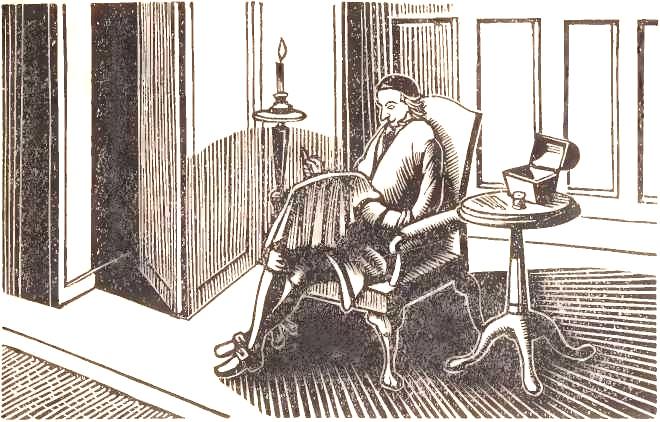
One other thing did befall me in this decade, to wit my retirement from my chair. I had resolved to omit the telling of this as tiresome and irrelevant, but it has since seemed to me to be of some importance that the public should be informed; for I would not have malice or ignorance, under cover of my being no longer alive, wrong my memory, the more so as it could take to itself some colour from a certain report that lies deposited in the university archives. I bring the matter up now, therefore, while all the actors and participants are still here, that truth and my good name may not be exposed, either now or later, to the assaults of faulty intelligence, the passions of succeeding generations or any other of the infinite contrarieties that tarnish and confound historical accuracy. The case was as follows.
In a memorial to the Royal Council of Castile I admitted freely to all my derelictions of duty over the twenty-four years of my professorship, whether the result of eccentricities of temperament, of misfortune, indolence or illness. As compensation for my scholastic shortcomings, and in the hope of meriting the royal clemency, I appended to my confession a statement of other activities and undertakings of a somewhat rarer cast than those my academic colleagues are wont to print and to advance among their titles to distinction.
With this faithful submission, and the confidence born of having never sunk to licensed swindler or tedious place-hunter, I besought his majesty to absolve me from the comings and goings to courtyard and lecture-room and from all the business of the University, and to be pleased to grant me, with the full pension of my chair, the peace and repose my years and health now demanded. His majesty gave order that the whole content of my petition be remitted to the University for its consideration, in particular of any points arising therefrom that might seem to impugn, or alternatively to justify, my request; and asked further for a report on everything that statute, use and precedent had to say concerning pensions and retirement.
The doctors of the University, being called together in full Senate, decided unanimously to make strong representation to the king on the irregularity of my request, setting out for his considered opinion the loss and damage that would accrue to the University from the example of an arbitrary pension award, and maintaining that my claim to such ran counter to all law and usage. The drafting of this resolve the Senate entrusted to four of the more eloquent among its members, who duly embellished it with most impressive terminology in a set of weighty paragraphs. The document still survives as a tribute to their much circumspection and an indictment of my imprudent lapses from industry and choice of interests.
This fruit of long deliberation found its way in due course to the Royal Council. Its arguments and adumbrations failed, however, to win over to the sense of the University the decision of those righteous gentlemen or to alter their previous opinion of my record and reverses. The truth is that they knew my character to be not as represented, and had been well informed from long before of my activities, both from first-hand knowledge and by the voice of public opinion; for this beyond doubt is the least impassioned and most objective censor and informant, more truthful by far than the many who go shuffling through society spying on others concerned only to make their way in life through their own efforts.
I cannot say whether the members of the Royal Council delivered me entirely from the reputation the University threw about me, or whether over this cassock they draped me a more respectable topcoat to cover its blemishes. Such details belong to the arcana of justice and lie beyond my knowledge. What is certain is that of their charity they remitted me to the king’s notice in a light so creditable and meritorious that his majesty was graciously pleased to accord me my retirement with all the emoluments, honours and privileges granted by royal and pontifical favour alike to such as have fulfilled to the letter the conditions and length of service laid down by university law and statute.
I gained my pension, blessed be God, and at this present hour of writing have now enjoyed two years of blissful repose. The University holds to its report in token of its integrity and my fallings from grace; and anyone reading it will note how the impression there conveyed could darken my reputation. I hold to the royal decree, to scatter those shadows. Just what the weight of its judgment confers in honour and pride on my humility all who scan it in the original in my possession, or by the copy in that of the University, may bear witness. So too will as many as live by and enjoy the inviolable justice of his majesty and the wisdom, rectitude and benignity of his Royal Council.
Many a frown have I had cast at me by the prim faultfinders of these quadrangles, and many are the deliberate rebuffs that have been hurled in my face: too many, and too irrelevant, for telling here. The University I forgive for the scant love it has borne me: firstly because in its schools I am still the outsider, suckled rudely and without benefit of the milk of its learning. Its lecture-halls do not bring forth, nor do they tolerate, scholars as haughty and as ridiculous as I, nor do they nourish such speculations or practise such phantasies and absurdities as I used to catch on the wing, anywhere and everywhere, in the days of my merry, uninhibited vagabondage. Truth to tell, I never had the taste or found myself in the humour to scale the heights of rapture or plumb the depths of gloom at which these men of wisdom conduct their business.
Secondly, my easy-going nature is totally at variance with the cast and upbringing of these products of its schools. They are staid, serious, uncheerful, learned, full of judgment, penetration and ambiguities. I am a motley outgrown student, prodigal, ignorant, foppish, pleasure-loving, and so frank and forthcoming that I never open my mouth but I would have the whole world read me through and through.
Thanks to a lazy yet calculated spirit of resignation, I put up with their miserable displeasure; and my patience and civility give me all the solace and standing I need. The vengeance I would have on their chidings is to put these on record and to invite them to explain them; while for consolation I am content to make rigorous examination of my own conscience in the light of their rebuffs and asperities. This undertaking has brought many joys to my soul, and two in particular, which fill it to overflowing with happy content.
The first is the discovery that to not one of them have I ever given faintest cause for disaffection. Let them look me all over, and let that scholar speak or write who has ever suffered through me the slightest impediment or hurt in his high-flying. Let that man speak, of whatever state or condition—and I include here my greatest rivals, opponents and enemies—on whom I have wrought the smallest injury in thought, word or deed. Let that individual come forward, while we are all still alive, to whom I have denied my house, my purse, visits, letters, whatever services, in short, he has judged helpful and has desired of me to the furthering of his ambition or career.
The second satisfaction is the monstrous pleasure I feel at the knowledge that they know me to be, of all the doctors of this University or of any other in Spain, the richest and most famous, the freest and most eccentric, the most courted by the highest personages in the land—and by the mob—of this century, the best pleased with his lot, the least importunate, mysterious, solemn or forbidding, as too the least perturbed by those chaplaincies, chairs and offices the anxious pursuit of which keeps the others as unhinged as the thinking on my follies does me. Anyone who likes is welcome to find fault with my excesses and my shortcomings, and good luck to him; for all who know and have dealings with both me and my rivals, and have to put up with us on the one side of the fence and the other, will throw in their weight for me.
And so, with a cheerful patience, made of two parts artful wit to one of placid resignation, a merry, jesting temperament that is given neither to over-indulgence, to its own worries nor to the cares of others, and with a reasonable degree of agffity that still lets me get this carcase around on foot, horseback or waggon without undue incommoding of its joints, I stride onward, thanks be to God, towards my sixth decade. Adventures galore, of any and every hue, may still lie in ambush for me along the road, but I am not proposing to await the encountering of them in order to include them here.
At this point, then, I leave my story, that I had earlier had in mind to carry further. Should God in His mercy deign to prolong my stay on earth, and should good or ill fortune, the sluggishness of old age, obstinacy or cantankerousness send me stumbling into new embarrassments as plebeian in lineage as those which tripped me up in youth, I may believe there will not lack some chronicler to write them up in ballads, or blind men to bawl them at the street corners. As far as I am concerned, they all have my pardon and licence to start their snarling right now, and to interlard the tale of my calamities with as many lies and absurdities as may spring to mouth or pen.
My own I lay down, and, snapping my flute, retire to laugh my fill at much and many. The first bursts I shall aim inward, being of opinion that in all the farces with all their fools in motley the wide world over there will be found no more powerful incitement to loud laughter than I have in myself. I am the more persuaded when I recall how the repute of my name has been cackled abroad ever since I was twenty, and reflect that while I still live, and for many centuries after my death, I shall be spoken of as a great man and—as though this meant something—writer of books, when instead at every successive stage of my fife I have been an ignoramus and an idle fellow, undisciplined and unlettered.
I shall laugh and laugh again so often as I see my disjointed frivolities promoted to the dignity of book form in the best bookshops in Spain, passing themselves off as serious tomes, feigning authority and making boast from the shelves, nay from the very titles, of learning, erudition and documentary value. For all that in the sum total of their pages there is not to be found one shred of useful purpose, provided they remain unopened they may still claim to compete in presumption and caprice with the haughtiest and most serious of authors.
At this moment, to speak true, I cannot for laughter hold the pen steady in my hand, there coming to my mind the full enormity of the deception I have practised on the world with my crude nonsense and inanities. In the whole tribe of counterfeiters, swindlers and charlatans—and I reckon in with them your hypocrites, the most astute of all at passing off their trumperies, rascalities and other bad change as good coin—I imagine none will be found who has taken his fellows in so outrageously.
Open your eyes, you criticasters: for all your conceit and vaunt of sound sense, not a day passes but they pull the wool over your eyes and judgment with tricks not dissimilar. Examples multiply, and still you do not learn from experience. I speak as an old man who has himself had his drubbing of pretences, deceits and alarms. If you are not to be taken in again just as crudely by some other plausible vagabond as you have been by the flurry and illusion of my tomfooleries, I would have you each one for himself enquire calmly and shrewdly into the reputation of famous and popular figures, especially when that reputation is one for learning or for saintliness.
For most often there will be found, underlying an extravagant name for wisdom and experience, either a stiffnecked imbecile, a spinner of empty words, an eccentric mystery-maker, a dealer in whimsical irrelevances or a pretentious confidence trickster with a style as unlettered as my own; while wrapped up in the cloak of ‘God be praised’ and ‘God’s will be done’ you may look to discover a brazen ruffian, a glutton or a lazybones reeking with avarice and lust.
The upper ranks of society, like the lower, are crawling with fools and cheats; and those who affect the greatest learning or devotion are preposterous coxcombs who study to dazzle us that we may not tumble to their ambition, greed or insolence. There is no merrier calling of a man’s bluff than by poking into his scholarship and serious-mindedness, his gravity, modesty and withdrawal from the world. A few thrusts, and out will come for all to see the medley of calculation, fraud, vainglory, pride and like ingredients, all concealed beneath the nebulous curtain of certain revelations and ecstasies and a gift of grave, deceptive eloquence.
Enough. I leave with my enemies the renewed grief that I live on, still dragging my burden of years through the streets and countryside and wherever men assemble, nimble enough as yet, with nothing repugnant or noisome about my person and without provoking those who behold me to particular derision. My internal economy functions normally. I keep a smiling face to the world, and am much helped in health and cheerfulness by an income of two thousand ducats a year happily secured on five different revenues. I have wished it so, that my gratitude and veneration may resound the more continuously.
The first is held on the sacristy of Macotera, vested in me by charitable deed of her excellency the Duchess of Alba; the second, on a humble benefice in Puente del Congosto, to which I was presented by her son the Duke of Huescar; the third, on that other sacristy in Estepona which I owed to his eminence Cardinal Molina; and the remaining two on stewardships of the estates here in Salamanca of his excellency the Count of Miranda and Duke of Penaranda and of the Marquis of Coquilla, Count of Gramedo. To which fall to be added the pension from my chair and other crusts and crumbs that my calendars and divers writings continue to bring in.
My abode is an old mansion of some distinction, the property of the Count of Penalva: dilapidated portico smelling of the stable, courtyard with awning, antechamber, study, couch, coach, monkey, negro, parrot and other appurtenances and adornments of a lighthearted, crackbrained would-be man of standing. The reverend Capuchin fathers of the two Castiles have allotted me, of their generous poverty and extreme piety, a cell in their monastery in Salamanca. Here on occasion I go into retreat, to escape the idlers, spongers, flatterers, cheats and other importunates who with their insolent and pestiferous buzzing are a nuisance and a plague to busy citizens.
Thanks to the same reverend fathers, I have likewise a tomb in one of the chapels of their church that stands open and ready to receive my bones; and in God’s keeping one thousand three hundred masses already said for my soul in the monasteries of the Discalced Carmelites, that He may in His mercy mitigate the fearsome terrors the thought of death ever calls to my mind, and grant me forgiveness for the innumerable grievous sins I have committed against His divine majesty. Such is my present state; and enough at last of woes and truths.
Epilogue: Summary Account of the Author’s Declining Years
The lives of professors do not lend themselves to autobiography as such, being rarely more than the tale of years of faithful service. Don Diego’s life had interest in terms of his relative unfaithfulness to his University. This led inevitably to a degree of reciprocal feeling, and his retirement became therefore one quarrel more with his ‘enemies’. Twenty years of full and satisfactory service entitled him to honourable discharge with all pension rights. By the University’s reckoning he had not earned that discharge in respect of more than ten years out of the twenty-four; and the weight of evidence lay with the University.
The issue went beyond fact to principle; and the principle, if surrendered or lost, entailed grave repercussions. The ‘loss and damage’ alleged by the University to the crown rested on the consideration that the occupant of a ‘proprietary’ chair continued on honourable retirement to hold legal title to the chair until his death, and to draw full salary, less a minimal deduction—approximately one-thirtieth in this case—for payment of a substitute. The system seemed calculated to the maximum detriment of the subject, however great the eminence of the retiring professor. Where instead he had been an indifferent professor, only recovery by the University of the title to chair and salary, and the finding of a scholar of distinction to succeed, could stop the rot.
And the University commission, reporting to the Royal Council, had not much good to say of Don Diego’s scholarship. His works were ‘void of choice learning and solid doctrine alike, and useless for study or advancement in any faculty’. But Spain has ever been a country of the argumentum ad hominem, and Don Diego’s friends at court served him well. He had the laugh of the University, and it was a long laugh. The man who feared death could not be far off in his late forties, who hovered so precariously on the brink ten years later, lived to draw his salary in retirement for exactly twenty more.
The royal decree, giving him the victory, he might well count among his major trophies. When he told the story it was not to his hand, but he printed it later. It ran, in essence, as follows. ‘Don Fernando, by the grace of God King of Castile, Leon, Aragon, the two Sicilies, Sardinia, Corsica, etc. To you, the Rector and Senate of the University of the city of Salamanca, health and greetings. Know that on the thirteenth day of July of the past year 1750, on behalf of Doctor Diego de Torres Villarroel, professor of mathematics of your University, it was represented to Us that, having in the year 1726 achieved the high honour of election to the said chair and served it from then until now, he had not yet been granted the retirement due to him in accordance with the statutes of the University, fixed in this case at the term of twenty years, on grounds of absence over certain periods, in lieu of and compensation for which he had now served a further four years; there entering into account further the scholarly works he has printed and published, in all twenty-five volumes in quarto, which are to be found in the libraries of various persons of distinction; on which grounds he entreated Us of Our gracious pleasure to grant him retirement from the said chair with all the honours, perquisites and emoluments enjoyed by other professors of the University and to issue letters accordingly; the said Doctor Diego de Torres adding that the University had refused to credit him with the years 1732, ’33 and ’34 which years he spent in Portugal by order of His Majesty King Philip V, who, invoking His royal clemency, was then pleased to restore him to his native land and to all the honours of his chair aforesaid: all which having been considered by Our council in conjunction with the report of Our fiscal and after consultation with Ourselves, it was resolved to issue this Our letter. Whereby we command of you that you have and hold the said Don Diego de Torres as professor emerftus of mathematics, and observe and cause to be observed towards him all customary privileges and seniority; such being Our pleasure; and you will fulfil the same under penalty of forfeiting Our favour and being mulcted in thirty thousand maravedis for Our treasury. Given in Madrid this twenty-second day of May, 1751.’
Don Diego’s scholarship might be open to question, but not his industry. His attachment to his native Salamanca was now confirmed with wont and age, and he settled down to the opportunity retirement afforded to get on with his work. And first of all with his Works. Bringing together the voluminous writings referred to in the royal decree— treatises, satires, prognostics, hagiography, verse, even plays—he launched on the world a sumptuous opera omnia in fourteen volumes, the fourteenth being a reprint of the five chapters till then issued of his autobiography. The imprint is Salamanca, 1752. With the touch of novelty he brought to all he did, he issued the edition by subscription: the first time, we are to believe, a work had so appeared in Spain. And again, in the subscription fist printed in the first volume, he had his revenge on the University. For this was a list to kill all lists. Heading it was the king himself, followed by his ministers, the leading figures of the aristocracy— ‘dukes, counts, marquises, ambassadors, captains-general’— every university and college in the country with one exception, the religious orders and figures of distinction in all walks of life.
The exception was his own University, an exception the odder in that Don Diego was a member of its library committee and charged with the selection and purchase of works on mathematics, philosophy, history, poetry, lexicography and belles lettres. A note appended to the list drew pointed attention to the omission, and invited the curious to approach the University itself for an explanation. ‘I should be very happy were this to pronounce my works, my intelligence or my behaviour so wholly culpable as to exonerate it from any suspicion, now or hereafter, that so great a mother could be capable of harbouring contempt or lack of love towards her sons.’ The University still had its thorn in the flesh, and the thorn was determined to prick.
Don Diego’s next concern lay with the choice of a substitute for his chair. The vacancy was duly intimated in all the universities of the country and the statutory seven months’ notice given for the holding of the public contest, the same that he had experienced and carried off a quarter of a century earlier: an hour’s exposition of a topic, chosen by lot and intimated to the candidate twenty-four hours in advance, arising from Ptolemy’s Almagest, half an hour of argumentation, and an examination by the Senate on the Sphere of Sacrobosco.
Three candidates presented themselves, all former students of Don Diego. This detail implies both that his peaching had home some fruit and that esteem for the science throughout Spain stood still as low as ever. No other university could produce a single candidate. One of the three, practising as a doctor in Andalusia, he held ‘a good speculative astronomer and a notable philosopher on experimental Unes’. The second, a Portuguese, was a man of ‘subtle, profound and upright mind, admirably grounded in geometry, astronomy and philosophy’. The third, who had already taken his doctorate, was Don Diego’s nephew.
Don Diego wanted the best of three good men to win, but i preferably that that best man should also be called Villarroel. He proceeded accordingly on his round of personal visits, by seniority, to every member of the Senate, not—as he made clear to each in turn—to press his nephew’s claims but to protest that no thought was farther from his mind and that, were he to pay heed to the rumours he had heard going around, he would himself withdraw his nephew from the contest and seek his honour and advantage ‘in some more tranquil career’. Ask God, he counselled them, to put half a dozen fools like himself in each community, say fifteen hundred throughout the kingdom, who refused to bribe or blandish in pursuit of their own interests, and you will revolutionize the public fife of the country.
God worked on this occasion through channels of His own. The speculative astronomer from Andalusia died of fever in his inn. Don Diego, who had visited him and offered what help he could, attended his funeral and saw there none of his supporters. The Portuguese obtained a position more to his liking in his own country, and went home. There remained the nephew, who acquitted himself satisfactorily in the exposition and argumentation and ,was about to be proposed for election when the Rector sprang a surprise. This was a memorial from another would-be candidate. Claiming competence in philosophy, geometry, gnomonics, statics, astronomy, astrology and other branches of mathematics, he prayed to be admitted to the lists, even though the date had passed, on the ground that he had not been informed in time, and asked for such further period of grace as would allow him to go to Murcia to collect from the Dominican fathers there, with whom he had studied philosophy, the necessary diploma.
The petition found a supporter, but he was no match for Don Diego, still a full and very determined member of Senate. Don Diego was able to prove the Murcian a bar in his statements and offered to prove him a fool in his knowledge if he were admitted there and then to brief interrogation. The other was not fool enough for that, and disappeared incontinently from the scene.
Again the Senate disposed itself to vote on the again only candidate, and now it was Don Diego’s turn to spring a surprise. The third requirement of candidates, the public examination, had not been complied with, and he insisted it should be. It had not been required of him at his election, he recalled, and he told why: because there was not then a single member of the University qualified to take his and his rival’s measure in the mathematical sciences, most of its teachers still regarding tables and figures ‘as so much witchcraft and cabalistics’. They had still presumed, in their ignorance, to stigmatize him as ignorant thereafter, and he was determined none should do the same with his nephew, or be able to query the validity of his appointment. Nor could there be the same excuse, for many doctors in the University were now ‘curious and intelligent’ in these matters.
Don Diego was enjoying himself. He knew that his colleagues had not changed, either in their opinions or in their i knowledgeableness, when it came to mathematics. He had them acutely embarrassed, and he pushed his advantage. They had recently brandished the statutes against him over his retirement. Now he was the stickler for the statutes; and if they refused to examine on Sacrobosco he gave notice— and asked the clerk of Senate to record the fact—that he would bring the matter to the attention of the Royal Council.
The Senate resolved the examination should proceed, with himself as examiner, other members to intervene as they might feel inclined. The youth was brought in, and stood up valiantly to his uncle’s probing on issues theoretical. Don Diego tarried after each question and answer to give his colleagues their chance: none said a word. After three-quarters of an hour the Rector intimated that the , occasion might end, the Senate being now satisfied. Don Diego was not. There remained still the practical aspect. : The Senate must test their man’s capacity to use his instruments, conduct experiments and make calculation of at least one eclipse, this being among the fundamental and most difficult of all problems in astronomy. Again the Senate endured in patience, until at length the Rector’s gave out; and a second time he hade Don Diego make an end. Don Diego did so and left the room, under pretext, as an interested party, of not embarrassing the voters. Satisfied with his little triumph, he was confident too as to the outcome; and in fact his nephew was elected^with acclaim.
The record thereafter of Don Diego’s activities is tenuous. When the king asked a university opinion on the desirability of standardizing weights and measures throughout the country, he was one of a commission appointed to reply. He served on the board of twelve laymen and twelve ecclesiastics which administered Nuestra Senora del Amparo, an ancient hospital and almshouse—it claimed an antiquity of six hundred years—outside the city walls for victims of leprosy and other contagious diseases; and over the years 1753 to 1757 fought a stubborn battle with authority against a royal decree of four years earlier for the suppression of mendicancy which by drying up the source of its domestic labour threatened its existence. Don Diego was not easily defeated, and at last achieved a satisfactory compromise.
The library was not the only continuing connexion with the University. Another committee had as its concern the unacademic but very important matter of slaughterhouses, in which he found himself involved in 1756. Exactly half a thousand years earlier, in 1256, when the University of Salamanca was still in its teens, Alfonso the Wise had laid down in his famous code the Siete Partidas, along with the function and privileges of a university, some of its basic physical requirements. ‘The town where a university is to be established must have good air and comely approaches, that the teachers who teach and the students who study may live healthily and be able to relax and take their pleasure of an evening when they rise tired from their books. It must likewise be well provisioned with bread and wine and with good and inexpensive lodgings.’
To bread and wine there had soon been added meat; and from the dim past the University had by royal privilege seen to its own provisioning in this respect and maintained its private slaughterhouse. In the end the long arm of municipal encroachment reached here too, and in 1732 the crown abolished all such establishments. The result in Salamanca was a rise in price and a fall in supply, for the city likewise was then in a state of decadence and its administration neither enterprising nor efficient.
The University had therefore taken the decree very ill, and petitioned forthwith for the restoration of its ancient right. But, as a viceroy of Naples once expressed it, ‘if death came from Spain we should live a long time’; and for close on a quarter of a century now the suit, strongly contested by the municipality, had lain pending in Madrid, to the University’s—and the city’s—considerable expense. One theologian, sent to the capital to urge a decision, had delayed or been delayed there five years, achieving nothing. The Senate now decided to try again, and many of its doctors would have liked the commission. The need for results at length constrained it to recognize that ‘none was so experienced in Madrid, so well known throughout the kingdom, so esteemed by ministers, aristocracy and persons of authority in general’, as its professor emeritus of mathematics and astrology. Laying aside its reluctance, it pressed the charge on a very unwilling Don Diego, who advanced weighty reasons against sending anyone and, against sending him, took the opportunity to animadvert on past disdains.
Overruled by a reminder of his still binding obligation of obedience, he took to the so familiar road once again, spent some weeks in waiting on each member of the Royal Council in turn, and succeeded in having the question resurrected and set down for hearing before a first tribunal. This, at the end of a long session, declared itself incompetent to pronounce, and remitted it to a second. After a further seven weeks’ delay pleadings and rebuttals began anew, and Don Diego took occasion to paint a gloomy picture of the present state of his venerable seat of learning, where teachers and taught lived ‘in an intolerable state of wretchedness, despairing to see the relief of their woes so infinitely remote’.
The University, sunk in obscurity, stripped of its pomp and distinction, might still be rich: its members as individuals were extremely poor. The holders of proprietary chairs had enough to eat; the ex-professor of astrology, thanks to his varied activities and eccentricities, was relatively affluent. All the rest, from doctors down to undergraduates, endured pitiable conditions and went short of many of the necessities of life. He, Don Diego, had come at the behest of the Senate; but it was in the name of the poor of town and gown alike that he pleaded, not as an orator but as ‘a humble, sincere philosopher, a loyal son of Salamanca and one well versed in its needs and miseries’.
The city fathers, instead of opposing the claim, as might have been natural enough in other times and circumstances, should be with the University and full of gratitude to see it so altruistically anxious to take over responsibilities. ‘Salamanca lies in the last stages of exhaustion, crippled and useless for the task of looking after its citizens.’ The municipal slaughterhouse was evidence enough. For a population comprising four thousand households and a vast number of religious communities, it dealt with an average of two beasts a day. Allow the University to reopen its abattoirs, and it would gladly provide for the citizenry as well, at much lower prices, without infringing municipal or crown revenues in any way.
After another fortnight for deliberation, the tribunal concluded by setting on one side the issue of privilege and instituted a mixed commission, gown and town, to enquire into the whole problem of the city’s meat supplies. Don Diego communicated the decision to the University, which was well enough pleased; and a week later followed it home, to find the University members of the new joint body already hastily nominated in his absence. Summoned to appear before the original committee, he was asked for a statement of expenses for his close on four months’ stay in Madrid and, on his replying that he wished to claim none, dismissed, no member asking to know anything regarding the negotiations or the exact significance of the upshot or even thinking of saying ‘Thank you’. Don Diego left the room, suffered, and laughed. ‘Thanks be to God, I can still suffer and laugh in silence.’
Writing in 1758, now safely past the grand climacteric but hesitant as ever to promise himself much longer to five, he gives a last picture of himself and his way of life. His ‘numerous household’ now included seven poor women and various other relatives, all sharing the bounty God was still pleased to accord him. He dwelt, not now in an old mansion with dilapidated portico, but in the pride of Salamanca’s Renaissance architecture, the most famous of all Spain’s great houses of the sixteenth century, that still stands and is still more copied, in Spain and across the Atlantic, than any other, the Palacio de Monterrey, seat then as today of the house of Alba.
The friendship and patronage Don Diego had so long enjoyed and so greatly esteemed from the Duchess, the Duke now continued to him after her death; and here he lived rent-free with all his establishment, no longer a ‘would-be’ but in truth a man of standing. Surrounded on all sides by monasteries, convents and churches, he found the seclusion and religious quiet very much to the taste of his declining years and well sorted with the priestly duties he took ever more seriously. His earlier stewardships had increased to sixteen, token of the continuing regard and confidence of his friends among the landed nobility; and their satisfaction with his administration was to him a source of much content. He administered too the estate left by the Duchess of Alba.
All this notwithstanding, he remained first and foremost a University man. In spite of retirement, in spite of ill will, he needed the University, and it needed him, now one of its most venerable figures. At public occasions, meetings of Senate, examinations, chapel services he was still to be seen; and having served it on many commissions and committees, he continued in old age a member of two. On his first love, the library committee, he not merely saw as before to the purchase of books but had been charged to write the history of the library. The other must have been, if possible, even more congenial: it looked to the defence of the Torres Villarroels of a new generation, such poor students, to wit, as through waywardness or misfortune fell into the hands of justice.
For the rest he devoted himself to good works and good offices, ready as ever to help the needy and the unfortunate, the sick in hospital and the wretched in gaol. And in such odd moments as still remained he busied himself at his desk with his earliest and, materially, most rewarding enthusiasm, the peering into the shape of things to come. Taking time now by the forelock, he had already written and prepared for the printer prognostics year by year right up to 1770. The Great Piscator of Salamanca of his title-pages was still, his faithful public could be glad to know, on the job.
A still ungrateful University had cause to know the same; for in that same year 1758 uncle and nephew launched their campaign for the furtherance of its mathematical and astrological studies, particularly on the experimental side, through the creation of an academy—what we should call today a proper department—of mathematics. On this basis alone could the University hope to lift itself out of the rut in which, scientifically considered, it had stagnated now for a century and a half; and through his key post with the library Don Diego had prepared the ground by bringing in from abroad some of the necessary books and instruments. The proposal only called for formulation.
But the new wind blew in vain through those inhospitable halls. Another man, with another temperament and another past, might have won a hearing. It may be doubted. Wherever Africa began, Salamanca remained the citadel of those who were determined Europe should still end at the Pyrenees. Mathematics, the spirit of free experiment, objective truth arrived at through reason: this was unthinkable. For five years Don Diego kept up the attack against all the forces of obscurantism, and the debate, duly preserved in the Senate records, has gone down to history as a monument to the closed mind.
‘The world’, expostulated Don Diego before his fellow-doctors, ‘is of a different humour now, from when this University was founded; men today look for other principles, other studies more attuned to the spirit of the age. Let it not he said in centuries to come that in the year 1761 the University of Salamanca hesitated over or opposed the teaching and development of the practical aspect of sciences so necessary.’ The Senate willed that it should be so said, and in the end rejected the proposed academy, holding that to admit it would be ‘a means to the University’s dishonour’.
Don Diego, turned seventy when this sorry finding ended the discussion, was still young enough at heart not to know when he was beaten. Five years earlier, at its start, he had taken interim action on his own and with his nephew founded the academy privately in his own home, thus enabling the ducal palace of Monterrey to breathe again the spirit of the Renaissance that had presided over its building. And when the Senate finally turned him down he bethought himself anew of that doughty ally against whom even senates were powerless, the Royal Council. It had sided with him against the University in his interests before. It might side with him now against the University’s blindness to its own best interests. It did. The academy was instituted, the walls were breached; and Don Diego’s last service to his saeva mater was his greatest.
Seven years of life beyond the Biblical span still awaited him; but this was his last battle, and there is little more to tell. Concern for his dependants had led him earlier to mention what he was worth. Salary-pension, sacristies, stewardships brought in something over two thousand ducats a year, enough to feed and clothe his little community so exactly now that each thirty-first of December the cupboard was bare and each first of January they started off again with more ducats and new clothes all round. His hooks continued to sell, and a rough reckoning of those still in the hands of the booksellers in Spain or shipped to the Indies gave twelve hundred doubloons; while if the baker’s dozen of prognostics already referred to were to sell as well as their predecessors there could be another sixty thousand reals or more to come in. Whatever their worth in the eyes of the learned, his almanacs had given him name, fame and profit, they had kept him from idleness, and they might yet keep others from want after his death.
Of personal belongings he had, and had wanted, few. About his rooms were to be seen various trinkets and small pieces of jewellery—gold, silver, copper, brass—that served a purpose other than adornment: ‘superfluous, but useful when payments came late and against other—frequent— contingencies’. In his presses some rolls of good linen, shirts, sheets and coverlets. Of furniture, finally, enough beds, chairs and tables for family needs and for the comely entertainment of his guests. Such was the modest inventory of a man who had never sought wealth for its own sake, preferring to take out his share of our common patrimony in experience.
Till the spring of 1769 Don Diego—now seventy-six— might still be encountered at meetings of Senate; thereafter his name occurs no more in its minutes. In December he was too ill to serve any longer on the library committee, and on the nineteenth of June 1770, in the palace of Monterrey, he died. Three and a half years later a fellow-member of Senate, a theologian, pronounced his funeral oration. He spoke much of the charity of the deceased.
[1] Torres’ grandfather was a tapestry-weaver. Later (p. 100) he tells how he took up embroidery, an interest that remained with him all his life.
[2] Jaia ben Masuiah (c. 776–855), chief physician to the Caliph of Bagdad and author and translator of many medical works, including a General Pharmacopoeia, which were long current in Latin versions in the west.
[3] The Latin grammar of Antonio de Nebrija (1480) was still, in an adapted form, the official text in Spain three centuries later.
[4] In May of that year Portugal had joined the Grand Alliance in the War of the Spanish Succession. Peace was not signed between Spain and Portugal until February 1715.
[5] In 1693—the exact date is unknown.
[6] P. Jean Croiset (1656–1738), French Jesuit and theologian, author of Annes chretienne, with lives of the saints for each day of the year, and similar works. For Quevedo see Introduction.
[7] He was in fact then fifteen. The years ten to twelve are one of several gaps in the record. From the time of his pilgrimage to Santiago in 1737 to the publication in 1743 of the first four chapters of the Life we are likewise told not a word.
[8] i.e., in order to disguise one’s student status.
[9] Obviously another notorious rogue of the time who, like the Domingo Cartujo and Pedro Ponce of p. 70, has left no trace.
[10] Where graduations took place, the graduands being under obligation to provide a sumptuous repast.
[11] Early seventeenth-century scholars, one a professor in Padua, the other in Brandenburg.
[12] Torres’ first almanac appears to have been that for 1721. Spain had but lately emerged, humiliated, from a disastrous war into which the ambitions of Isabel Farnese had dragged her, and would soon be dragged into another.
[13] The almanacs of this Italian astrologer of the late seventeenth century enjoyed great popularity in Spain in translation. It was said that he had compiled them for two hundred years after his death, and they were still being issued in Madrid as by ‘the great Piecator Sarrabal of Milan’ as late as 1744.
[14] i.e., up to 1743, the date of publication of chapters 1 to 4.
[15] The statutes gave to the Dominicans a virtual monopoly of the teaching of philosophy. At Alcala the Jesuits, their bitter rivals, had established a claim to alternate in the filling of these chairs, and they now sought—the year was 1717—the same privilege at Salamanca. A royal decree of 1718 settled the issue in their favour. Torres had sided with the Dominicans.
[16] Salamanca was a ‘students’ university’, and the rectorship and vicerectorship were student offices. Torres at this time had a seat on the Senate as representative of one of the student ‘nations’, in which capacity he had been drawn into the dispute over the philosophy chairs.
[17] ‘Ambition is the whole principle of acjion.’
[18] Compendium totius medicinae, Madrid, 1614.
[19] Cypeio, of whom nothing survives, was presumably an exponent of the teachings of Giorgio Baglivi (1668–1707), known as the father of Italian clinicians. Born in Ragusa of Armeruan origin, he was appointed by Clement XI professor of theoretic medicine at the Collegio della Sapienza in Rome, then of anatomy and surgery, and did much to modernize the theory of the humours, rejecting the dogmatic acceptance of traditional doctrines for study of the individual patient. His ‘new system’, to be studied in the Opera omnia medico-practica et anatomica (Lyon, 1704), was known as ‘solidism’.
[20] One of the most famous of Castilian epic themes, set in the tenth century and kept alive in many versions—chronicle, ballad and play—down to El Moro Exposito (‘The Foundling Moor’) of Angel Saavedra, Duke of Rivas, 1834. The seven sons of the house of Lara perished in an ambush laid for them by an uncle, who had already betrayed their father into captivity in Cordoba. There, solaced by a Moorish princess, he had another son, Mudarra (the ‘foundling’), through whom he and his were ultimately avenged.
[21] A notable and very popular poet of the time (1679–1750) in both the epic and the lyric vein. He had a distinguished career as a soldier, fighting in Spain (in the War of Succession), in Africa and in Italy, and became civil and military governor of Barcelona.
[22] Luis had come to the throne on his father’s abdication in January 1724. His death of smallpox at the age of nineteen, after a reign of only seven months, brought Philip V back as king for another twenty-two years.
[23] One of the most notable physicians of the ‘modern’ camp, professor of anatomy and consultant to the royal family.
[24] Then entitled the chair of mathematics and astrology.
[25] Today the Paraninfo or great hall of the University.
[26] See p. 214. The University records give Torres sixty-four votes out of sixty-seven cast.
[27] Holders of ‘proprietary’ chairs, as this was, were required to take out the higher degree of doctor (faculties of law and medicine) or master (theology and arts) within two years of appointment. The two degrees were held equivalent—Torres always preferred the title of doctor—but carried the important distinction that the elaborate ceremonies here parodied only attached to the former. The provision of banquet and bullfight falling on the new doctor, it became customary to delay until several could graduate together and so share the very heavy costs involved.
[28] To what is stated in the text these add merely that the author intervened to restrain Don Juan, his closest friend (see p. 120), and that only the j ealousy of rivals implicated Torres in the affair.
[29] Hamlets in the province of Segovia.
[30] A famous Carthusian foundation.
[31] A French philosopher (1632–1707), author of a Cours entier dephilosophic, ou systeme genSral selon les principes de Descartes (1690).
[32] 18 October, when the university session began.
[33] The year was 1737, not—as the text suggests—1736.
[34] The author’s pen-name in his prognostics.
[35] i.e., ten years later. The present chapter, intended to reach to the age of ‘forty or thereabouts’, includes events down to 1737, when Torres was forty-four.
[36] i.e., the first four chapters of the present volume, published in 1743.
[37] The house of Osorio ranked among the oldest and noblest in Spain.
[38] This treatise on physical and spiritual well-being dealt firstly with the causes of disease, in terms of personal excesses and the influence of air, water and diet, and secondly with the commandments of God and the church concerning the health of the soul.
[39] Foreign minister under Ferdinand VI (1746–59) and one of the leading statesmen of eighteenth-century Spain. His name recurs later (p. 193) as a good friend to Torres.
[40] A euphemism for syphilis (see p. 180).
[41] See note on p. 99.
[42] A reference to the mal francos or morbo galico (syphilis).
[43] An ancient antidote for poison, composed of various drugs mixed with honey.
[44] An Italian astronomer (1674–1739), author of Efemeridi dei moti celesti (1715–50) and other works.