
Douglas M. Kelley, M.D.
22 Cells In Nuremberg
A Psychiatrist Examines the Nazi Criminals
Chapter One: Pan-Germanism and Nazi Ideology
Chapter Four: Alfred Rosenberg
Chapter Seven: Baldur Von Schirach
Chapter Eight: Joachim Von Ribbentrop
Chapter Nine: Constantin Von Neurath & Franz Von Papen
Chapter Ten: Alfred Jodl & Wilhelm Keitel
Chapter Eleven: Karl Doenitz & Erich Raeder
Chapter Twelve: Ernst Kaltenbrunner
Chapter Thirteen: Julius Streicher
Chapter Sixteen: Wilhelm Frick & Arthur Seyss-inquart
Chapter Seventeen: Hjalmar Horace Greeley Schacht & Walther Funk
Chapter Eighteen: Albert Speer & Fritz Sauckel
IN NUREMBERG PRISON WERE....
THE MEN WHO TORTURED MILLIONS...
THE MEN WHO SENT OTHER MILLIONS
TO THEIR DEATH...
THE MEN WHO CAME CLOSE TO RULING
THE ENTIRE WORLD...
BUT WHEN THE BLACK UNIFORMS AND GOLD BRAID WERE STRIPPED AWAY—WHEN THE HIGH POLISHED BOOTS AND DREAD SWASTIKAS WERE REMOVED—WHEN THE SWAGGER AND THE BOMBAST WERE GONE—THEN WHAT MANNER OF MEN REMAINED?
DOCTOR KELLEY TALKED TO THEM AND LISTENED TO THEM AS THEY WAITED IN THE 22 CELLS IN NUREMBERG. HE TESTED AND EXAMINED. HE WATCHED AND STUDIED. THIS BOOK IS THE RESULT AND—FINALLY—WE CAN SEE THE RULERS OF NAZI GERMANY AS THEY REALLY WERE.
“I CONSIDER DOUGLAS M. KELLEY’S 22 CELLS IN NUREMBERG ONE OF THE THREE OR FOUR MOST IMPORTANT BOOKS THAT HAVE COME OUT OF WORLD WAR II.”
—Lewis M. Terman
Emeritus Professor of Psychology
Stanford University
Dedication
To June and Doc
This Book is the complete text of the hardcover book
A Macfadden Book ... 1961
COPYRIGHT 1947 BY DOUGLAS M. KELLEY
ALL RIGHTS RESERVED
PUBLIHED BY RRANGEMENT WITH CHILTON COMPANY,
PUBLISHERS
MacFadden Books Are Published by
MacFadden Publications, Inc.
205 East 42nd Street, New York 17, New York
PRINTED IN U.S.A.
Introduction
THIS IS NOT A BOOK FOR PSYCHIATRISTS, HISTORIANS, OR the uninformed. Psychiatrists and psychologists will find in the professional journals the reports of which this book is at the same time an abstract and an elaboration. For historians, the transcripts of interviews and other records from which much, but by no means all, of the data was taken will, I assume, eventually be made available. As for the third class—I am not inclined to burden this report with more detail than I judge a moderately well-informed reader will require to understand the personalities under examination.
No reader of newspapers, magazines, or contemporary historical literature needs to have retold the history of the Nazi Party. You will not find here a warmed-over account of Hitler’s rise to power, or the Munich Putsch, of the 1934 purge, or the 1944 assassination attempt. What you will find, I trust, is an intelligible analysis of the personalities which were able to warp and control the actions of 80 million Germans.
One of the most important values in civilization is what Korzybski has called “time binding”—the ability to learn from the past experience of others without having to go through it ourselves. It is imperative that we appreciate the horror of the Third Reich without experiencing it. The devastation of Europe, the deaths of millions, the near-destruction of modern culture will have gone for naught if we do not draw the right conclusions about the forces which produced such chaos. We must learn the why of the Nazi success so we can take steps to prevent the recurrence of such evil.
My method in this book will be to relate my conclusions about Nazism to what I learned from and about the top Nazis themselves. During the five months I served as Psychiatrist to the Nuremberg Jail, I interviewed every day at length some of the 22 men held there as war criminals. Except for the insane Hess, this was the first thorough mental checkup any of them had been given.
In addition to careful medical and psychiatric examinations, I subjected the men to a series of psychological tests. Such tests are of accessory value in supplementing medical observations and providing objective data for the case history. The most important technique employed was the Rorschach Test, a well-known and highly useful method of personality study. A few of the criminals were given Thematic Apperception Tests, a projective technique utilizing standard pictures about which the subject makes up a story. The intelligence estimations were made from a German adaptation of the Wechsler-Bellevue Test devised by my assistant, Dr. Gustave Gilbert, the prison psychologist and then a captain in the A.U.S. Dr. Gilbert was also assigned to my office as an interpreter and, at my direction, made records of many of the conversations which I had with these prisoners and which are reported in this book.
The language problem was an important one in some instances; but for the most part, the chief criminals spoke fairly good English. I always used interpreters to prevent misunderstandings, however, in important discussions. Frequently, I would rotate interpreters on different days, getting the same information through rephrasing the questions. In this way I was able to check on the quality of the interpretations and properly evaluate my findings.
As a psychiatrist, I interviewed first of all the men themselves. But, realizing that their prison personality patterns would naturally reflect a desire to curry favor, and for the further reason that any honest testimony is usable in psychiatric synthesis, I also obtained interviews with and written reports from a number of persons who had known the Nuremberg Nazis when they were at the top of the heap.
Such outside evidence provided confirmation that all of the prisoners were exhibiting various degrees of depression. The following excerpts from a letter which one of them wrote to his wife is generally indicative of the hopelessness and discouragement all 22 displayed in greater or lesser degree.
“I doubt whether anyone can understand our state of mind without having experienced all this. The worries about the closest members of the family, the sons missing in action, the destroyed property, and all the personal pain about the whole country, about other relatives, the painful thoughts about the future without any regard to our own fate—all this is so unique that it can only be compared with the Thirty Years’ War of destruction. The great difference is that the catastrophe came within two years and to an extent never witnessed before. We intended to build a more beautiful Germany; instead we now have a heap of rubbish, unimaginable, and not to be eliminated in decades.”
Such a wealth of data was available—from associates, moving pictures, speeches, writings, and other records—that I was able to verify virtually every facet of character of every person under examination. For the record, all historically significant material in this report is based on a minimum of two, and generally three, witnesses. In many instances, I have not revealed the source of my information. But each has been authenticated, and the information is available to interested and qualified individuals.
Complete studies of the personalities discussed in this book are under way. They will be published in the professional journals in due time.
I wish to express here my deepest appreciation to Lt. Col. Renee Juchli who, as Chief Medical Officer of Nuremberg Jail, gave wholehearted support to my studies. I am grateful also to the other members of the medical and nursing staff and, particularly, to Lt. Dorothy Mears who was instrumental in obtaining data from the female prisoners among the lesser Nazis in the jail. I am also grateful to the Commanding Officer of the Internal Security Detachment, Col. B. C. Andrus, who facilitated my work at every step.
Without the support of Drs. Richard M. Brickner, D. Ewen Cameron, Nolan D. C. Lewis, John A. P. Millet, and Margaret Mead, I should never have attempted a book for the lay reader. Without the generous aid of Mr. Nathan Schulman, I should certainly never have completed it.
I owe a debt of thanks also to the many translators who aided me in obtaining various manuscripts and in converting them to English for my use. The Department of State Publication #1864 and other translations were most helpful, as was the work of Mr. T. H. Tetens, head of the Germanic Library in New York City.
Mr. Charles Burnes shared the burden of editorial collaboration in preparation of the manuscript, and I am deeply indebted to him for the time and energy he put into this most difficult task.
Part One: The Environment
What is normal for a pagan barbarian may not be for a creature of a Christian-industrial-twentieth-century culture. Since my return from Europe where I was Psychiatrist to the Nuremberg Jail, I have realized that many Americans—even well-informed ones—do not grasp that concept. For too many of them have said. to me:
”What kind of people were those Nazis really? Of course, all the top fellows weren’t normal. Obviously they were insane, but what sort of insanity did they have?”
Insanity is no explanation for the Nazis. They were simply creatures of their environment, as all humans are; and they were also—to a greater degree than most humans are—the makers of their environment. Though this is not the place to recapitulate the growth of their ideologies, or of their Party, nonetheless I believe that the psychological bent of the 22 Nuremberg Nazis will be more readily apparent if we refresh our memory by recalling the cultural matrices by which they were conditioned.
Chapter One: Pan-Germanism and Nazi Ideology
THE NAZIS AND THE GERMANY THEY MADE ARE EXCELLENT proof of the hypothesis that cultural retrogression can be fostered perhaps more readily than cultural progress. The seeds of progress are always present in every culture, but they need careful cultivation and weeding, encouraging sunlight and showers.
Also present in every culture are the roots of primitive loyalties and hatreds requiring only stimulation to spurt into rank growth. The Nazis guided and led Germany into neo-paganism and barbarism simply by applying a heavy dressing of hate-rousing propaganda and then effective direction to forces already latent in the nation’s makeup. Let me illustrate with three quotations:
First: “It is necessary that our civilization build its temple on mountains of corpses, on an ocean of tears, and on the death cries of men without number.”
Second: “Frankly, we are and must be barbarians... Every act, no matter what the nature, committed by our troops for the purpose of discouraging, defeating, and destroying our enemies is a brave deed, and is fully justified... We should not worry about the opinions and reactions in neutral countries... They call us barbarians. What of it? We scorn them and their abuse... Our troops must achieve victory. What else matters?”
Third: “The new Europe will be a continent restored to barbarism... And this time the foundation for the new Europe will be laid, not by priests and diplomats, but by pirates of destiny... Now, at last, we may frankly confess that the Gospel has lost all meaning for us.”
The origins of those three statements of policy—and, make no mistake, they voiced a continuing German policy—are: For the first, General Count von Haesler, in an address to his troops in 1893; for the second, Major General von Disfurth, in the Hamburger Nachrichten, November, 1914; for the third, Jankow Janeff of the staff of Alfred Rosenberg, in his book Heroism and World Fear, 1937.
It is evident that the Nazis alone did not reverse the stream of German culture; the cult of barbarism had live roots there still in 1923.
Nor did Hitler and Rosenberg invent the myth of the German super-race. Here is evidence in the same sequence: “We are the salt of the earth ... God created us so that we should civilize the world.” (Kaiser Wilhelm II, in his Tangier speech, 1905.)
“The Germans are the chosen people of the earth. They will accomplish their destiny, which is to direct the world and to govern other nations for the good of humanity.” Professor von Seyden, Frankfurter Zeitung, 1914).
“... The Government has decided to extend the German order over the whole world. The world will have to reckon with German economy, with German soldiers, and cannon.” (Dr. Goebbels, in a speech on March 23, 1936.)
The depreciation of ethics, of conscience as a guide to conduct, reached its prime expression in the Nuremberg Nazis. But the way had been prepared. Pedants, generals, and priests had long taught that no moral scruples should stay a hand raised to strike for the German State. Some persons may assume that a higher morality guided Germany’s rulers during the years of the Weimar Republic, but the evidence does not support wishful assumptions. Here is the boastful testimony of Dr. Karl J. Wirth, leader of the Catholic Center Party and Chancellor of the Republic from 1921 to 1922, from the Luzerner Tageblatt, August, 1937:
“As to the rearmament of Germany, Hitler has only continued the rearmament that had been prepared by the Weimar Republic. I, myself, deserve great credit for this prepation ... The great difficulty was that our military efforts had to be kept secret from the Allies ... When Hitler came to power he no longer needed to concern himself with the quality of the German Army but only with the quantity. The real reorganization was our work.”
What of Nazi Germany’s slave-labor policy? The following statement of Ernst Haase, Leipzig University professor and President of the Pan-German League, dates back to 1905, and anticipates the crimes of Frank, Rosenberg, and Sauckel.
“Who in the future is to do the heavy and dirty work which every national community based on labor will always need? ... Is it to be left to any part of our German people to occupy such slaves’ positions? The solution consists in our condemning alien European stock, the Poles, Czechs, Jews, Italians and so on... to these slaves’ occupations.”
These are but a few, not one-hundredth of the whole, of the specific incitements with which the German people were bombarded over the last half century. One can add to them nearly two hundred years of philosophical generalizations in the same tone—the writings of Herder, Schlegel, Schelling, Hegel, Mueller, List, Gobineau, Wagner, and Chamberlain. It was the racial theories of Richard Wagner and his English son-in-law, Houston Stewart Chamberlain, which aroused the nineteenth-century anti-Semitism of Germany and prepared the people for the appalling pogroms of the Nazis.
Other German ideas which the Nazis utilized were those of the Fuehrer Principle, the Folk Hero (Hitler), and the Elite Class (the Party). What Hitler did was to take over these established German concepts and simplify them, make them more primitive. They were already emotionally a part of the people; and when Hitler re-emphasized them, he mobilized the entire emotional content of the people for his Reich.
It is when we understand this that we realize how Hitler and his henchmen were able to take over 80 million men, women, and children, bodies and minds.
Hitler found a people previously conditioned to several explosive ideologies, frustrated by defeat, hungry, wearied by inflation—and homogeneous. He won their attention by promising them solutions for the most pressing problems—food and shelter, and the indignities of defeat. He next captured emotional control of them by appealing to their conditional beliefs and concepts—anti-Semitism, the tribal mores of a warrior nation, and so on. From then on he did with them what he wished.
It is an established scientific fact that a person who is thinking with the emotional (thalamic) brain centers cannot think intellectually (cortically). Hitler had an entire people thinking with its thalamus. In such state they fell easy prey to Goebbels, Streicher, Ley, and the other propagandists. For those who refused to think emotionally and follow him there were such even after 1933—he contrived the concentration camp. And there was always the bullet-pitted prison wall.
Chapter Two: Nuremberg Jail
NUREMBERG WAS A “TOUGH” JAIL. THE FACT THAT TWO of the 22 top Nazis imprisoned there managed to commit suicide does not change that fact. In Nuremberg Jail the former elite of Germany tasted the bitter gall of their own boastful words. All of them ate there their promises of victory; many of them re-ingested the hosannas they had spewn to Hitler. Since this jail, with its implications of defeat, frustration, and indignities, was the environment of these men during the period they were studied, it is worth while to review briefly just how it was run.
The prison block which housed the war criminals was a three-storey structure with a wide corridor running the length of the ground floor. Cells lay on both sides of the corridor, and at either end circular stairways led to the two upper tiers of cells. The catwalks along these upper tiers were screened to prevent any suicidal leap to the corridor. Before and during the trial, the major Nazis were all housed on the ground floor. In the end only those sentenced to be hanged remained there, and the others were moved to upper tiers before they were finally taken away to Spandau Prison in a Berlin suburb.
The individual cells were about nine by thirteen feet. A heavy wooden door several inches thick was centered in the nine-foot wall, on the corridor side. Opposite it was a high, barred window opening into a court. In the center of the door at about chin height was a small drop door about fifteen inches square. This was kept open at all times. The door, opening down, jutted out at right angles into the cell and formed a small shelf on which the prisoner’s meals were placed.
The cells were furnished each with a steel cot fastened to the wall at one side of the door. Opposite it were a lavatory bowl and toilet, the latter without wooden cover or seat. The only other furnishings were a straight chair and a flimsy table on which prisoners were allowed to keep pencil, papers, family photographs, tobacco, and toilet articles. All other personal possessions had to go on the floor. Most of the prisoners kept extra clothes, linen, and so forth, arranged in piles between the foot of the cot and the window. Hess added to these the various small packages of food which he persisted in saving to submit to chemical analysis, one of his delusions being poisoned food.
The only time when a prisoner could be out of sight was when seated on the toilet. Even then his feet remained visible to the guard. Prior to the suicide of Robert Ley, one guard was assigned to watch each four prisoners; thereafter, a guard was on duty at each cell door twenty-four hours a day.
The cells were lighted by an electric bulb in a reflector fastened to the outer side of a grille which fitted into the small door. This light burned with constant brilliance, except during sleeping hours when it was dimmed. Even then it remained bright enough for reading. The reflector was about twelve inches in diameter and covered most of the grille, forcing the guard to peer around the edges at the prisoner.
It was the Jail’s strict rule that head and hands of the prisoner must remain visible all the time he was in bed. Prisoners who snuggled down too cozily during the cold winter nights were brusquely wakened by worried guards, occasionally forced to turn ends about on the cot and sleep facing into the light where they could be better watched.
But, tough as it was, nearly 10 per cent of its top Nazi criminals “escaped” the jail by suicide. The human element is the decisive one in even the harshest prisons. The four-cell guard never suspecting Ley’s “puttering” in the toilet area as he prepared his own strangulation. Goering’s guard never saw him slip into his mouth the tube of potassium cyanide. In any event, once Goering had the poison in his possession, the guard could not have prevented his suicide.
The cell searches, which it was admitted might have been “perfunctory” in the days before the suicide and executions, were another practice typical of a tough prison. Once a week, twice, perhaps four times or oftener, the prisoner could expect a “shakedown.” In this the prisoner was forced to strip and stand in a corner of the cell while M.P.’s went carefully through his bedding, clothing, papers, and other impedimenta. In my months at Nuremberg these shakedowns were so thorough that prisoners needed some four hours to restore their cells to order.
Once a week the prisoners were marched to a shower room where they bathed under supervision. They were allowed to keep one outfit of their own clothing, with several changes of linen, socks, and so on in their cells. Class X (unfit for further Army use) fatigues were issued for lounging and policing their quarters. These “beat-up” GI work clothes were the only garments Streicher and Ley had for months. Before the trial began, the United States Army secured from their families one suit for each prisoner to wear into court.
No suspenders, belts, or shoelaces were allowed in the cells; nor, of course, was anything remotely resembling a weapon. During the trial all laces, braces, and such items were taken away from the prisoners as soon as they returned from courtroom to cell. At first no string of any sort was allowed but, eventually, each of the elderly men who wore shoes was issued two four-inch pieces of thin string to tie through the top holes of his shoes so he need not shuffle as he moved about his cell and the exercise yard.
This yard, about a block square, lay at one side of the cell block. One prisoner would walk fifteen minutes at a time up and down one side of the walled yard while another, within hailing distance but forbidden to communicate, paced up and down the other side.
When the prisoners were moved from Mundorf to Nuremberg some two months before the trial, they had been in confinement for three months. Goering I had seen and treated regularly for his drug addiction at Mundorf; Hess (who reached Nuremberg some time later) had been under British medical care. The others were held virtually incommunicado. Their guards maintained a stony silence except to correct them harshly for some breach of the strict discipline; even the waiters who brought their food were forbidden to return their greetings.
When I came to Nuremberg, therefore, I found a group of “patients” eager to talk. Seldom have I found psychiatric interviews so easy as were most of these. Then and thereafter they talked almost without probing or prompting.
There were exceptions, of course. It is a psychiatrist’s technique to gain the confidence of those in his care—by honestly earning it. But I never succeeded in getting Hess, for instance, to let down the barriers he had erected between himself and reality. Jodl, Raeder, and Seyss-Inquart remained relatively stiff and formal throughout our acquaintance. Doenitz and Ribbentrop, on the other hand, became quite friendly in their attitude toward me, while Goering was positively jovial over my daily coming and wept unashamedly when I left Nuremberg for the States.
As a scientist I regarded my duty in the Jail to be not only to guard the health of men facing trial for war crimes but also to study them as a researcher in a laboratory. I shared the opinion of ethnologists and politicians alike that Nazism was a socio-cultural disease which, while it had been epidemic only among our enemies, was endemic in all parts of the world. I shared the fear that sometime in the future it might become epidemic in my own nation.
Medical men know that when they isolate the germ or virus that causes disease among men, they can prepare a vaccine or serum that will protect us against it. I had at Nuremberg the purest known Nazi—virus cultures—22 clay flasks as it were—to study, and with but a short time in which to work. I took upon myself to examine the personality patterns of these men and, to a degree, the techniques they employed to win and hold power. Though my work was hurried and incomplete, I believe it was sufficiently fruitful to indicate which way we Americans should turn our thoughts and our education, our policies and our political methods, if we are to avoid the sad fate of the Germans.
The Criminals
| Rudolf Hess | b. Jan. 12,1893 | Serving life imprisonment |
| Alfred Rosenberg | b. April 26,1896 | Hanged, Nuremberg Jail, Oct. 16, 1946 |
| Hermann Goering | b. Jan. 12,1893 | Committed Suicide, Nuremberg Jail, Oct. 15, 1946 |
| Hans Fritzsche | b. April 21,1900 | Freed by International Tribunal |
| Baldur von Schirach | b. May 9,1907 | Serving 20 years’ imprisonment |
| Joachim von Ribbentrop | b. April 30,1893 | Hanged, Nuremberg Jail, Oct. 16, 1946 |
| Constantin von Neurath | b. Feb. 2,1873 | Serving 15 years’ imprisonment |
| Franz von Papen | b. Oct 29,1879 | Freed by International Tribunal |
| Alfred Jodi | b. May 10,1890 | Hanged, Nuremberg Jail, Oct. 16,1946 |
| Wilhelm Keitel | b. Sept. 22, 1882 | Hanged, Nuremberg Jail, Oct. 16,1946 |
| Karl Doenitz | b. Sept 16,1891 | Serving 10 years’ imprisonment |
| Erich Raeder | b. April 24, 1896 | Serving life imprisonment |
| Ernst Kaltenbrunner | b. Oct. 4, 1903 | Hanged, Nuremberg Jail, Oct. 16,1946 |
| Julius Streicher | b. Feb. 12,1885 | Hanged, Nuremberg Jail, Oct. 16,1946 |
| Robert Ley | b. Feb. 15,1890 | Committed suicide, Nuremberg Jail, Oct., 1945 |
| Hans Frank | b. May 3,1900 | Hanged, Nuremberg Jail, Oct. 16,1946 |
| Wilhelm Frick | b. March 12,1877 | Hanged, Nuremberg Jail, Oct. 16,1946 |
| Arthur Seyss-Inquart | b. July 12,1892 | Hanged, Nuremberg Jail, Oct. 16,1946 |
| Hjalmar Horace Greeley Schacht | b. Jan. 22,1877 | Freed by International Tribunal |
| Walther Funk | b. Aug. 18,1890 | Serving life imprisonment |
| Albert Speer | b. March 19,1905 | Serving 20 years’ imprisonment |
| Fritz Sauckel | b. Oct. 27, 1894 | Hanged, Nuremberg Jail, Oct. 16,1946 |
| ADOLF HITLER | b. April 20, 1889 | Fate undetermined |
Part Two: The Policy Makers
Adolf Hitler was without question the principal maker of policy for the Nazis tried at Nuremberg, as well as for the National Socialist Party and, between February, 1933 and May, 1945, for all Germany. My analysis of what manner of man Hitler was will follow all the others for the reason that my information about him was largely obtained from his imprisoned aides. And for the further reason that, in the psychiatric profile of each of them, the reader will find some feature which bears a trace of Hitler influence. When we are through with all the rest, these trace elements of character will lend detail to the picture of Der Fuehrer. I shall discuss here, therefore, only three policy makers—Hess, Rosenberg, and Goering.
These three men were among the “elite” whom the Nazi Party, faithfully following the ancient German recipe, developed as officers directly subservient to Hitler and acting as his advisers (insofar as anyone dared). Not all of the officers were policy makers. The men who actually were important in the policies and affairs of state were few. Two, Goebbels and Himmler, committed suicide and were never tried. Of the lot that stood trial, only Goering, Rosenberg, and Hess were really influential. They were actually responsible for parts of Hitler’s basic theory—Hess and Rosenberg in the twenties and early thirties, and Goering after the Party came to power.
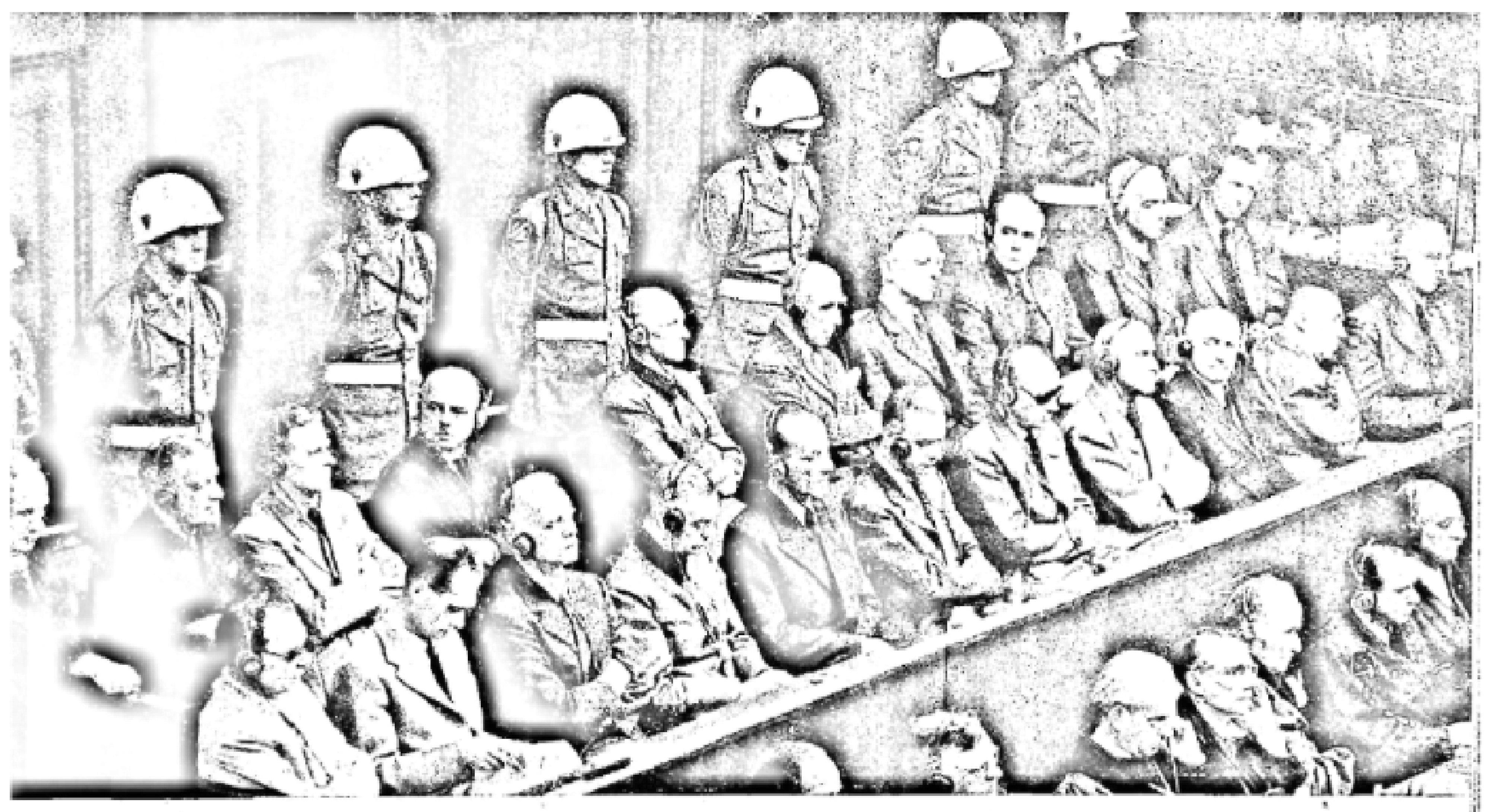
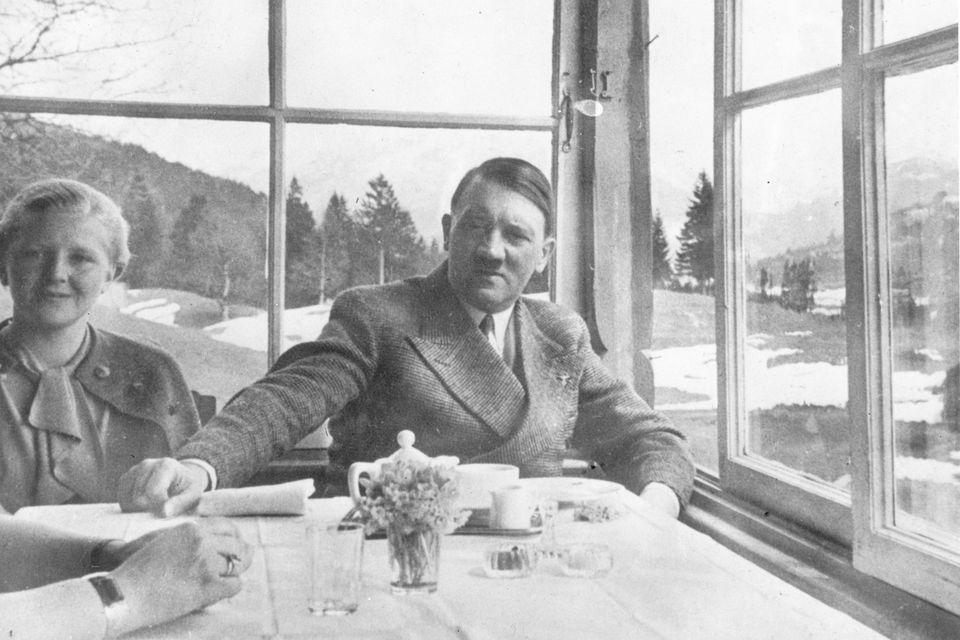
Chapter Three: Rudolf Hess
PROBABLY NO FIGURE IN RECENT YEARS HAS BEEN THE subject of so much publicity and wild guessing as has the one-time deputy of Adolf Hitler, Rudolf Hess. Until May 10, 1941, when he made his dramatic flight to England, Hess’s role in German history was simple and unimpressive. Since that time, however, virtually every intelligent, informed person in the world has at some time speculated on the personality of this puzzling Nazi and the reasons for his flight. Hess’s action is logical only if we can understand his basic psychic structure.
Because Hess had had a psychotic episode while under detention by the British, and because I wanted to clear his mind and keep him in shape for trial, I spent hours at a time, for weeks on end, in his cell. Though he spoke English well and answered most questions quite readily, I never succeeded in getting him to be friendly. He was almost constantly on guard, aloof, clicking his heels and saluting. One day when the question of his treatment came up he explained his attitude: “You are kind, yes. But I do not know if you are a friend. I shall wait until the trial is finished. Then I will know if you are a friend or not a friend.”
Though he was not insane while under my care, Hess could not at any time be called a normal person. He had left Germany at a time when the Reich was master of Europe and potential master of the world. He believed passionately in Germany’s final triumph. As time wore on and the tide of battle turned, his fanatical mind would not accept the growing magnitude of Germany’s defeat. When the end did come, he still insisted upon childish play acting as the deputy of a Fuehrer who was no more. The answering of personal questions he regarded as beneath his dignity.
Hess was an Ausländer, born in Alexandria, Egypt. He was taught by a private tutor until he was fifteen, when he was sent to Germany to complete his education. As a university student he met Karl Haushofer, the famous German professor of geopolitics, who became a sort of second father to him.
When the First World War began, Hess joined immediately the same regiment to which Hitler belonged. Apparently he did not then meet the future Fuehrer, though they served together for three years. Hess left the regiment after receiving a chest wound in 1917. He transferred to the air force and had just become a flier when hostilities ceased.
Following the defeat, Hess drifted to Munich where he took part in the hoodlumism of an anti-Semitic group and, during one street fight, was wounded in the leg. Here he again came under the influence of his old professor, Haushofer, at whose urging he eventually became a member of the Nazi Party.
A vigorous, belligerent member of the early Nazi fighting group, Hess suffered various injuries in many brawls. A quarter of a century later he still boasted scars. In the putsch of November 9, 1923, he played an important role, being assigned to seize several Bavarian leaders as hostages. When the putsch failed, Hess escaped into Austria but later returned and was sentenced to prison in Landsberg Fortress where Hitler was also incarcerated.
Here Hess served as Adolf Hitler’s secretary, taking down, to Hitler’s dictation, the greater part of the Nazi bible, Mein Kampf. (Hess had studied stenography before the war in anticipation of returning to his father’s export-import business.) But he did more than merely set down the words of his master. He instilled into Hitler and into the book the “science of German conquest” which Haushofer had taught him. (Rosenberg, a regular visitor to the prison, also contributed his bit to the book.) It was during this period, in a relatively pleasant prison, that Hess became a close confidant of Hitler and achieved the status which made him finally Deputy Fuehrer of Greater Germany.
From this time forward, Hess was Hitler’s staunchest supporter, constantly demanding wholehearted support from other Nazis. His service to Hitler consisted in acting for the Fuehrer, partly as secretary and partly as deputy at minor state affairs. He developed some antagonism to Goering during the early power period. The two competed for control of various aspects of aviation, and Hess always came off second best. Throughout his entire political life, in fact, Rudolf Hess ran a good second, but always second, to somebody else in the Nazi Party.
Hess was tremendously enthusiastic about the ideals of the Party and was carried away by the organization, its uniforms and parades, its bands and spectacles. He apparently believed in the Nazi theories and worshipped Adolf Hitler as a god. As Nazism succeeded, Hess became more and more attached to and dependent on the Fuehrer who assumed the role of a mystic father in the eyes of his deputy. Hess, whose own father had sent him to Germany to school when he was only fifteen, told me of his relationship to Haushofer and Hitler. He stated that the former took him into his household where “I became as one of the family.” Alone in what to him was a foreign country, he became very attached to Haushofer and readily substituted his teacher for his father. This early break from his own parents, and his refusal to follow in his father’s footsteps as an exporter to Egypt, made his later attachment to Hitler psychologically easier. The break had cast him adrift; in consequence, his juvenile personality sought someone to dominate him. Hitler supplied this need. We find Hess readily running Hitler’s errands, acting as his secretary, doing odd jobs, and in general acting as Hitler’s “little boy.” All through his life Hess has carried out this pattern. His emotions were primarily directed toward his superiors, his father surrogates, rather than toward his wife and children with whom he spent little time and to whom he demonstrated little affection.
As an official, Hess was an extremely hard worker. Everything about his office was well organized. He demanded a tremendous amount of work from his associates and was particularly concerned whenever he had to make a speech. Goering once snorted, “Whenever he had to talk in public, Hess sweat blood.” Baldur von Schirach, Hitler’s youth leader, made much the same comment.
Hess was a constant sufferer from physical complaints which obviously were psychological in origin. He went for years from physician to physician trying all sorts of cures, and if a result was not achieved in a week or two, he would get a new doctor. Finally he lost confidence in the entire medical profession, and thereafter resorted to quacks, nature healers, and astrologers. He eventually established the Rudolf Hess Hospital for the sole purpose of testing cures which were not recognized by the medical profession. All his own searches for cures were apparently fruitless, for his complaints, primarily pain in his stomach, were not cured.
One day I was talking with him about diagnosis when he inquired, “Do you know about the studies of the size of the pupil of the eye?”
I said, “You mean studies of the back of the eye with an ophthalmoscope?”
“No,” he replied, “I mean the pupil—the black opening in the eye.”
“Well,” I said, “I know it expands and contracts.” He interrupted me a bit scornfully, since I obviously did not know what he was driving at. “I mean the science of diagnosis based on the size and shape of the pupil. Haven’t you heard of it?”
He had me there, and I admitted it.
Hess then went on, “It really hasn’t been accepted by doctors in Germany either, but a scientist—he wasn’t a medical man and I studied it a long time. By the change in the pupil, you can not only tell what is wrong with anyone, you can tell where his illness is.”
When I expressed a bit of doubt, Hess became aloof and distant. “I quite realize that an American medical man would not believe this,” he said, “but it is quite true; even I can do it a little.”
He fixed his eyes on mine, and for a moment I was afraid he would label me with some disease. Apparently all he discovered was disbelief, for he indicated that the interview was at an end.
Later I found out that he had a long talk with the German physician, who was helping us, about my qualifications, and referred to the “poor training” given in the United States, where they did not even know about this technique.
The next day Hess felt better about it. He said he realized that I did not know too much of such methods, but after the trial he would look up his associate and see if he could train me! I expressed sincere appreciation. I would like to meet a man who could sell such an idea to anyone—even the gullible Hess.
A highly introverted individual, Hess was known as a polite and chivalrous man. He seldom expressed anger with anyone but always “swallowed his ire” and buried his annoyance within himself. In a group characterized by hedonism, he was outstanding for his lack of bad habits, and for the staid sobriety of his personal life.
His colleagues were inclined to view as his only “vice” his ardent belief in astrology. All the high Nazis mentioned this “weakness” of Hess’s and swore that it was only he, and not Hitler, who collected horoscopes and followed their prognostications in the conduct of his own—and state-affairs.
Never sound, Hess’s health gradually became worse after the years of easy victories over the German people. From Munich on, he lost weight; his determination and drive seemed to be burned out; and he frequently spent long periods at his desk gazing into space. In addition, he grew extraordinarily suspicious of his colleagues—probably unconsciously imitating Hitler who exhibited the same mood of suspicion at this time. (From his history it was obvious to me that he was a basic psychopathic personality with marked hysterical bodily symptoms and fundamental paranoid trends.) By 1940 he was in a state of mind bordering on a severe neurotic breakdown.
His grievous mental state can probably be traced to his discovery, after the Polish war began, that his father substitute, Hitler, was not a god but a cruel and violent person. This must have been deeply disturbing to Hess’s tender mind. The shock was not lessened when he learned, early in 1941, that Hitler planned to violate a basic precept of his earlier father substitute, Haushofer: never to engage in a two-front war by attacking Russia.
In this unhappy circumstance, physically and mentally ill and no doubt brooding over his own always-secondary status, Hess conceived his plan. To him it was logical. It was even brilliant. His logic was that of a sick man fed on fallacies: Were not the Nordic Germans the world’s finest men, led by the world’s greatest man? Would not the English gladly grant that the Germans had already won the war? Would not they, being themselves only slightly mongrelized Nordic cousins of the Germans, recognize the threat of Oriental Communism and approve a German attack to the East?
In Hess’s reasoning the only answer to each of these questions was “yes.” Therefore, all he need do to establish his undisputed right to be Hitler’s successor (and crowd out once and for all the gross Goering) was to achieve, by one brilliant stroke of statesmanship, peace between Germany and England.
In the end, Hess told me, more than “logic” played a part in his decision to fly to England. In late 1940, one of his astrologers read in the stars that Hess was ordained to bring about peace. Later his old professor, Haushofer, told Hess of a curious dream he had had of Rudolf Hess, the German born in Egypt, striding through the tapestried halls of English castles, bringing peace between the two great nations, peace to all the world. All this was strong incitement. How could weak Hess, emotionally immature, an intellectual adolescent, withstand such pressure? He couldn’t. As a matter of fact, he told me he had been so eager to fill his great role that he had made two hasty attempts before he succeeded in reaching Britain. Both attempts were turned back by bad weather. Finally, on May 10, 1941—six weeks before Hitler’s D-Day in Russia—Hess flew over Scotland and parachuted from a height of 20,000 feet. I asked him why he jumped and he said, “I had never flown that type of plane before and wasn’t sure I could land it. Then, too, I was uncertain of the location of the English fields. I did a good job, though, and struck the ground thirteen feet from where I planned.”
Hess was dressed in the uniform of a captain of the German Luftwaffe and gave the name of Alfred Horn, stating that he was on a special mission to the Duke of Hamilton. Haushofer had told him the Duke was an Englishman who would understand the German point of view.
Instead of arranging a treaty through the Duke of Hamilton or any others he asked to see, Hess was thrown into jail. His claim to plenipotentiary status was laughed at. His ego was bruised but, still basing his acts on the assumption that the English regarded themselves as certain to be defeated, he offered ridiculously one-sided terms. Germany would retain all conquered territories, repossess its former colonies, and be free to conduct any type of armed aggression against Russia. In exchange, Germany would magnanimously yield England a free hand in its own Empire. Hess added one other term: since the Churchill government was definitely anti-German, an entirely new English government would have to be selected. It was incomprehensible to him that the British would not discuss his terms.
Four and a half years afterward he was still angry. He told me of his treatment:
“I was taken to a prison somewhere in England where all they did was ask me military questions. I denied any knowledge of military events, and demanded my rights as an emissary. The English would then ask me, ‘Do you have anything to show that you are an emissary?’ I would reply, ‘Of course not. I am the Fuehrer’s deputy.’ They would then ask, ‘Did the Fuehrer send you?’ I would reply, ‘He knows nothing about my mission.’ So the English would say, ‘Then you are a captured aviator, a prisoner of war. Tell us about the disposition of your troops.
“I would ask to see the Swiss envoy, and they would reply that the Swiss envoy did not see ordinary prisoners of war—and what was the disposition of our air force? Then I would demand that they take me to see the highest representative of the king. They would say that certainly this would be done in a few days—and what was the disposition of our U-boats?
“I became extremely angry and said I would not answer questions dealing with military matters, that I was on a diplomatic mission and should be rendered full diplomatic privileges. Then the English would say, ‘Didn’t you bail out over Scotland in the uniform of a captain in the German air force?’ I would say, ‘Naturally. I didn’t want to be taken for a spy.’ So the English would reply, ‘Then, as far as we’re concerned you will be treated as a captain in the air force. Come along now, tell us about the disposition of our troops.”
Hess was held prisoner by the British from the date of his arrival until October 10, 1945. Under the constant badgering of questioners, he at first became depressed over the failure of his mission, and then later developed definite insanity, characterized by delusions that the English were poisoning his food in an attempt to kill him or make him lose his mind. While insane, he made two attempts at suicide. At length he developed a total amnesia.
With the development of the amnesia, his insanity cleared. Then, in the spring of 1945, the amnesia itself also disappeared. At this time he wrote a letter claiming that his amnesia had been entirely false, but observations of the British psychiatrists indicated that much of it had undoubtedly been real. (In fact such fallacious claims are typical of his personality, and he later made the same claims during the trial.) Just prior to the end of the war, this amnesia recurred and was at its height when he was flown to Nuremberg.
Rudolf Hess first came under my care on the evening of October 10, 1945. On his arrival at Nuremberg Jail he was met by the Commandant, Col. B. C. Andrus, who explained that prison regulations required the removal of all personal possessions. Hess objected violently, fuming that he was a prisoner of war and a ranking Nazi officer. He demanded that all his personal possessions be placed with him in his cell.
Colonel Andrus patiently re-explained the rules, and Hess finally agreed to relinquish everything except a number of small parcels. He insisted that these contained material for his defense, including drugs and food which he had brought from England for chemical analysis by an impartial chemist. He offered to permit a guard to remain in his cell twenty-four hours a day, provided these items could be left with him.
In the end Colonel Andrus impressed on him that his rights and privileges were no different from those of any other German prisoner and that his precious parcels would be sealed and locked up in the presence of witnesses. Hess accepted this ultimatum and was escorted to the cell which was to be his home for more than a year.
On arrival at the jail, Hess was, physically, in good shape, but thin. He was dressed in his Luftwaffe uniform, though without insignia. However, his heel-clicking stiffness and somewhat incongruous flying boots—high and black, thickly lined, and made of soft leather with two zippers on each—lent him a military bearing that no array of insignia could have given.
Psychiatrically, he was alert and responsive. His approach was reserved and his general attitude formal, but he gave the impression of making a real attempt at cooperation. His stream of thought was curtailed as a result of his amnesia, the majority of his responses being, “I do not know,” or “I cannot remember.” He claimed to be unable to remember his birth date, birthplace, date of leaving Germany, or any fact or detail whatsoever of his early life.
The next morning when I examined him again, he claimed he could not remember anything that had taken place during his imprisonment in England, and only vaguely remembered the plane trip to Nuremberg across the Channel. He could remember very little of the details of his admission to the prison, but did recall his parcels, and again asked for assurance that they were in a safe place where they could not be tampered with.
At this time Hess’s mood was somewhat depressed, but he showed generally normal reactions. In every way, except for memory, he seemed quite competent and showed no abnormal projections of any type. He continued to be observed daily and was given special examination, including the Rorschach Ink Blot Test. I explained to him the nature of this test—that it was designed to give me an idea of how his mind functioned, without, however, involving the memory.
This test is generally known to psychiatrists and psychologists and is the most useful single technique in a mental examination. It was invented in 1921 by Herman Rorschach, a Swiss psychiatrist, and gained popularity in the United States around 1938. During the war it was extensively used in the armed forces, and I relied heavily upon it in conducting my examinations of the major war criminals. Briefly, it consists of ten cards, on each of which is a reproduction of an enlarged ink blot. Five of the blots are black and white, two are black and red, and three are in assorted colors. Each subject is always shown the same blots in the same order. Then from his reactions—that is, from his description of what each blot may seem to him to be—a complete picture of his personality can be deduced. The test works in a manner analogous to the word association tests, except here the stimuli are meaningless—they actually are ink blots. Consequently, the subject who sees something in the blot must see it because he projects it from himself onto the blot. This is why this method is called a projective technique. The test really represents a small example of the subject’s behavioral reaction when faced with new and meaningless stimuli. During the test, he can do pretty much as he likes, take as long as he wants, turn the cards around, and give as many responses to any of the blots as he desires. The examiner is not so much interested in what he sees as in his behavior during the test, and particularly in how he sees each response. That is why this technique is so useful with people like Hess. Hess concentrated on what to say in order to confuse the psychiatrist, whereas I was mainly interested in how he used the cards.
Empirically, after giving many tests and studying the results of countless thousands of tests published in the professional literature, an examiner can tell a tremendous amount about a person by using the results of this technique. A skilled Rorschach worker can, for example, determine an intelligence level in an individual by checking the accuracy of the responses as to form and quality—that is, how well the responses are seen. Well organized, whole responses (where the whole blot is used), and good human movement responses (where the ink blots or parts of them are seen as humans in action) also indicate high intellect. Hess showed only slightly better than average movement responses, but his form accuracy was good. An I.Q. of between 115 and 120 was disclosed by the Rorschach and confirmed by a straight intelligence test given by the prison psychologist.
In addition to intelligence, the Rorschach responses reveal certain personality patterns—introversion and extroversion, rigidity, preoccupation with tiny details of life in contrast to a more general outlook, etc. It also reveals morbid trends, and with it, pathological traits of every type can be distinguished.
For example, in the second card Hess saw “two men talking about a crime, blood is on their minds.” This response is not exactly rare, but Hess was unable to interpret properly certain details of the card; he became preoccupied with the “bloody thoughts.” This sort of response represents a projection of his own thoughts into the ink-blot figures and tells us that in spite of his alleged amnesia he still carries “bloody memories.” He later admitted the accuracy of this reasoning.
Certain bizarre responses, such as a “cross-section of a fountain” in the ninth card, demonstrate inner anxiety and tension as well as a tendency to deviate from the usual in his everyday thinking.
Hess was quite cooperative in this test situation, partly from curiosity and partly because he felt he could control his responses, not knowing how revealing even the most banal answer could be. He spoke excellent English, but an interpreter was available in case of need.
Seated side by side on his cot (Hess in the center, and I and my interpreter on either side of him), we “ran” a very careful Rorschach, recording his every remark. From it, and from the results of the intelligence tests and personal observations, I diagnosed Hess as suffering from a true psychoneurosis, primarily of the hysterical type, engrafted on a basic paranoid and schizoid personality, with an amnesia, partly genuine and partly feigned.
In less technical terms, Rudolf Hess was an introverted, shy, withdrawn personality who, suspicious of everything about him, projected upon his environment concepts developing within himself. The paranoid element was emphasized in his suspiciousness, his desire to have everything just so his Rorschach responses, however, were not sufficiently de viate to indicate a really active paranoid process at the time but did indicate the possibility of a psychotic episode in the past and the likelihood of such development in the future
On October 16, 1945, I forwarded a summary of his psy chiatric status to Justice Robert Jackson, the American prosecutor. My report summed up all my findings and pointed out that some of Hess’s amnesia was probably genuine and some of it was obvious malingering. It also suggested that contact with his confreres would result in improvemen of his condition.
In this report to Justice Jackson, I requested permission to try to break Hess’s amnesia by the use of hypnosi reinforced by intravenous sedatives such as sodium amyta or pentothal. These drugs, given in small doses, put the subject in an hypnoidal state, assisting the physician in his direct suggestion. I have never had a failure in their use, no any but a beneficial result in many hundreds of cases. It i true, however, that in extremely rare instances people ar sensitive to these drugs and the injections may prove dan gerous. If proper precautions are taken there is really no risk, and the technique is nowhere near as hazardous a crossing a busy street intersection.
Justice Jackson, although he stated he would advise this treatment for a case of amnesia in his own family, felt that in Hess’s instance, any therapy involving the remotest chance of danger would be unwise. If anything happened to Hess, if he caught cold or stumbled and broke his neck two weeks later, it would probably have been attributed to the treatment. I talked to Hess himself at great length about the technique. He was at first willing to try it, stating that he was sure it would fail. When I told him that it always worked, he rapidly changed his mind. He also refused to be hypnotized, and in fact refused any type of treatment. For a long time he even objected to our taking blood for a Wassermann test, but on this count we were sustained by the higher authorities.
Since I was not permitted to treat Hess’s amnesia, I requested consultants to check my findings. Three Russian, a French, three English and three American psychiatrists were assigned to the task. Their findings confirmed my own. All agreed that Hess’s basic personality patterns were hysterical and paranoid. They also agreed that his amnesia, if maintained, would be a hindrance to his defense. Hess’s action on the stand on November 30, 1945, when he made his famous statement—“My memory is again in order. The reason why I simulated loss of memory was tactical”—was a typical dramatic, hysterical gesture which confirmed my opinions and those of the consulting psychiatrists.
This refusal to admit that anything has gone wrong with one’s mind is very common. Frequently people who have been insane, on recovery will state that all their symptoms had been mere pretense. This mechanism protects their ego. It permitted Hess to scoff at the idea that he, the deputy of the Fuehrer, could ever have lost his mind.
I went to see Hess in his cell immediately after his performance in court and asked him why he had done it. He was quite unaware that he had upset his attorney far more than ours. All he could think of was the show he had put on. In fact, he was quite like an actor after a first night.
“How did I do? Good, wasn’t I?” he asked, adding, “I really surprised everybody, don’t you think?” I shook my head and said I didn’t think “everybody.”
Hess stopped for a moment his excited pacing. “Then I didn’t fool you by pretending amnesia? I was afraid you had caught on. You spent so much time with me.”
I asked Hess if he remembered some movies that had been shown earlier of the top Nazis at the peak of their glory. At the time he claimed he could not recognize the men, even himself, in the newsreel.
Now he said: “Yes, I remember. I remembered when the pictures were shown. I thought then that you knew I was pretending. All the time you looked only at my hands. It made me very nervous to know you had learned my secret.”
I had not, of course, learned his “secret” in quite the way he thought. I knew only that he remembered more than he admitted. I had stared at his hands, however, in a deliberate effort to make him crack.
While he had had considerable practice in keeping a straight face, he still became nervous when shown old, familiar scenes. This tension was manifested by a tightening of his hands, readily visible to anyone looking for this symptom. He certainly recognized some of the scenes shown in that picture, although his denial was complete. He realized his inner tension and perhaps recognized its manifestation in the tightening of his fingers. After the picture, he tried to avoid me and kept our conversation to a minimum.
Of course, even after his dramatic disclaimer, Hess still had some amnesia. His mind never did entirely clear, though his memory did improve. In fact, within two weeks of the denouncement in court, there was a marked improvement which Hess himself noted and commented on to me.
From that time forward it became possible to trace the development of his amnesia. In England, during the period of intensive interrogation, Hess had discovered that when in answer to any question he said, “I don’t know,” the British would keep returning to it and hammering away at that particular query. But if he said, “I don’t remember,” the intelligence men seemed inclined to drop the question. Da after day and month after month, he was questioned s interminably, and so often replied, “I don’t remember,” that finally, large sections of his life simply slipped below the threshold of memory. In the end, he was a genuine victim of an induced, even rationalized, amnesia state.
Hess eventually confessed that much of his amnesia had been real and that his boast in court had been false. He even took pride, in time, in reporting the progress of his “cure.” But, though his mind was improving, he once assured me, it was “still weak and my brain tires easily.” This admission was interesting primarily because such a conviction is a typical symptom of the hysteria which is basic for the Hess diagnosis.
If final proof is needed that Hess’s hoax claim was phony it lies in the fact that the “tactical” advantage he claimed have gained—time and opportunity to prepare his defense—simply was not true. At no time did the amnesia favor his defense. In fact, it handicapped his lawyer. His hysterical structure is best revealed in the fact that he chose to thrust himself into the limelight by rejecting his amnesia, fatal as such a step might become, instead of attempting to escape by continued pretense. Such reactions are common among hysterics and are precisely what the psychiatrists expected to happen in his case as the trial progressed.
Also while in prison Hess manifested vague paranoid symptoms, at various times suspecting that his food had been poisoned. These were the same sort of symptoms manifested in England, and I could only conclude that Rudolf Hess, while not actually insane during the months he was under my eye, was certainly a potential candidate for an asylum. Diagrammatically, if one considers the street as sanity and the sidewalk as insanity, then Hess spent the greater part of his time on the curb.
Hess might be called a self-perpetuated hysteric. That is, he maintained his hysterical symptoms in good working order by refusing all types of therapy. It would have been comparatively easy to relieve him of his symptoms if he could have been persuaded to cooperate. But he preferred to suffer, usually selecting periods for the suffering when he was certain of the largest possible audience.
The attention his displays earned gratified his ego, but his colleagues were disgusted with his behavior. Goering in particular was upset, partly because Hess had completely fooled him with his pseudo-amnesia and partly because Goering wanted to preserve the fiction that the Nazi Party was made up of strong men. Not that he ever considered Hess strong. On the contrary, he told me that he had always considered Hess too weak even to be the ideal deputy.
In this connection, Goering one day told me a revealing anecdote. Hitler, anticipating his own death, early in the war publicly named Goering as his successor and Hess to succeed Goering in the event of the latter’s death. “When Hitler told me of it,” said Goering, “I was pleased for myself, though it was only what I expected. But I was furious that Hitler should name that nincompoop Hess to be my successor. I told Hitler so, too, and made a big fuss.”
Goering was sitting on his cot as he told the story. Now he placed his big hands on his knees and leaned forward. “Do you know what Hitler said? He said, ‘Now Hermann, be sensible. Rudolf has always been loyal, a hard worker. I must reward him, so I give him this public recognition. But, Hermann, when you become Fuehrer of the Reichpoof! You can throw Hess out and appoint your own successor.’” And as he explained to me the inner politics of the Party, Goering’s eyes gleamed with admiration for Hitler’s grasp of the fuehrer principle and his casual genius for handling men.
As the trial progressed, Hess became more and more disturbed; transitory amnesic episodes and an increased paranoid reaction—suspicion of everyone, fear of poisoning, and so on—were growing proof of his worry. In the face of the accumulated evidence—all of it testifying to the viciousness of his associates—he sought refuge in recurrent amnesia, and finally became so disordered that he was unable to take the stand in his own defense. As a result, he was considered insane.
Here the Tribunal indicated its good judgment. Death sentences for insane persons are not a part of civilized, democratic law; so the Tribunal compromised by a sentence which will place him behind walls for life.
From the psychiatric point of view, he was definitely a deviate from normal. He was emotionally juvenile, as evidenced by his love of uniforms and spectacles and as emphasized by his flight to England. He was the only prisoner who failed to recognize the reality of his situation; instead he firmly maintained his importance as the Fuehrer’s deputy, refusing to admit the total defeat of Nazism or to abandon the idea that he was not an outstanding patriot.
These, then, are the distinctive aspects of Hess’s personality: the paranoid and childish individual, with gross hysterical manifestations, who had always failed in whatever he attempted and who failed in the most spectacular effort of his life.
Later, as he realizes that he will not hang, he may relax and appear to recover. Such response will, however, be only superficial; and Hess will continue to live always in the borderlands of insanity.
Chapter Four: Alfred Rosenberg
ALFRED ROSENBERG, THE NAZI PARTY PHILOSOPHER, was a tall, slender, flaccid, womanish creature whose appearance belied his fanaticism and cruelty. His conversation, however, did not. He would willingly begin a discussion on any subject under the sun, but no matter from what starting point he began, within five minutes he would be rolling off his tongue the phrases he had worn smooth and round in constant discussion of his own theories of blood and race. Whether one began talking about history, horticulture, or a paratrooper’s high boots, Rosenberg’s quick switch to the subject of blood and race was so certain that one could almost plot it mathematically. Rosenberg gave a remarkable demonstration of the single-track mind in action; and he proved a sore trial to the men who questioned him.
To me, Rosenberg was of constant interest. He was the first, as it were, ordained and official philosopher I had ever known in the flesh, and I must confess that my concept of a philosopher had not prepared me for him. My studies forced me to conclude that Rosenberg was a relatively dull and a frightfully confused man. A large part of his confusion lay in the fact that he was unaware that he could not think straight, and he was further befuddled by the fact that he never realized his intellectual limitations.
Many persons were surprised by the result of our intelligence tests which showed, beyond doubt, that the famous Nazi philosopher was of low—average intelligence. The fiction of his brilliance, I am sure, is the sort of thing which literary German, particularly the literary efforts of German scholars, encourages. So involved and obscure are German philosophical works traditionally, that when Rosenberg wrote a book which no one could make sense of, instead of admitting that they couldn’t understand it, they accepted it as gospel.
But Rosenberg is not a man lightly to be laughed off. As a result of his close contact with Adolf Hitler, his influence on the Nazi Party was probably greater than that of any other single subordinate.
Rosenberg was another Ausländer, a factor of importance in his development. His father was a German executive in a trading company in Revel, Russia, and his mother is recorded as Latvian. He attended school in Germany, and there, as well as at home, he acquired the strong nationalistic feeling common to German families living abroad. In his teens he studied architecture and engineering in Riga, and when the war broke out in 1914, he went to Moscow. There, in 1918, he received his diploma in architecture.
In Moscow he witnessed the Bolshevist Revolution and developed an intense suspicion and hatred of everything Bolshevistic and Russian. Identifying these two hates, he soon coalesced with them all Judaism, constructing for himself a triune hatred to balance his strong affection for the unknown Fatherland. This violent, anti-Semitic, anti-Russian, anti-Bolshevistic attitude was basic in his contribution to Mein Kampf. Naturally, his zeal served to strengthen the same attitudes in Hitler and other Nazis.
Rosenberg returned to Revel in 1918 and undertook an assignment propagandizing against the Reds who had not yet won over Esthonia. However, the Revolution was on the march and, as Red forces approached Esthonia, Rosenberg fled to Germany. In Munich he resumed writing and speaking against Bolshevism and shortly became associated with the National Socialist Party through the influence of Dietrich Eckhardt, the Nazi poet. Rosenberg and Eckhardt were thus among the earliest members of the Party; Hitler did not attend a meeting of the group until almost a year later, near the end of 1919.
Thereafter Rosenberg was at all times one of Hitler’s most constant collaborators. He participated in the 1923 putsch, but was overlooked in the crowd and suffered neither injury nor arrest. When the Nazi Party was recognized officially, Rosenberg was one of three active chiefs of the underground organization. He visited Landsberg Prison virtually every day during Hitler’s term, and there is no doubt that his racial and nationalistic philosophies were written into Mein Kampf at that time.
As the Nazi Party developed, Rosenberg became editor of the newspaper Voelkischer Beobachter, and through it and numerous other publications continued to inject into the Party his theories of the virtues of German blood, the sin of mixing races, the threat to culture embodied in Russian-Jewish Communism. He became established as the Party philosopher and, in 1929, was placed in charge of one branch of propaganda.
In the thirties, Rosenberg made an attempt to take over the Foreign Ministry. However, after a series of unhappy experiences in London—one of his mistakes was placing a swastika wreath on the tomb of the Unknown Soldier in Westminster Abbey—he was recalled, and his diplomatic apprenticeship ended. Ribbentrop eventually replaced him.
Rosenberg retired into the impregnable position of philosopher to the Party and was given a title which, with typical German ebullience, ran as follows: “Deputy to the Fuehrer of the National Socialist Party for the Entire Spiritual and Ideological Training and Education of the National Socialist Party.” His functions were even vaguer than his title, but under its authority Rosenberg had ample opportunity to implement his anti-Semitic, anti-Communistic beliefs.
It was during this “spiritual and ideological training and education” period that he supervised the rewriting of German history. It seems scarcely necessary to point out that the Rosenberg histories, though often contrary to the facts known to the rest of the world, tended to place the Third Reich in the best possible light.
At this time also, Rosenberg wangled, or was rewarded by, appointments to numerous organizations dealing with culture. We find him interested in the physicians’ league, the veterans’ organization, the German Labor Front, adult education programs, the development of German pagan concepts, the Strength-Through-Joy organizations, the schools, universities, and teachers’ training programs. In addition, he undertook the control of literature, the development of German folk studies, and the establishment of an academy for ideological training. He continued as editor of several journals, made countless speeches, and published a large number of pamphlets and books.
This rash of activity in so many fields inevitably resulted in arousing considerable antagonism against Rosenberg within the Party, for he was an outspoken, contentious individual. He fought with nearly everyone and every group in Germany at some time or other. With all universal religions, Catholic and Protestant as well as Jewish, he was in constant warfare.
During this period of intense activity, Rosenberg republished at frequent intervals the Protocols of Zion, which he had first published in 1920. Some writers have maintained stoutly that Rosenberg first discovered the Protocols in Russia. Konrad Heiden’s book, Der Fuehrer, gives a very circumstantial account of Rosenberg’s first acquaintance with the Protocols—one which only Rosenberg could have told. When I cited this book to him, Rosenberg flew into a fury and called Heiden several sorts of a liar, insisting that, though he had heard of them in Russia, he had first seen Protocols in Munich in 1919. He felt at once that they were of “great value in revealing the International Jewish Plot, and I determined to keep them before the public.”
For his multiple activities, Rosenberg was amply rewarded by his old friend, Adolf Hitler. Hitler singled him out for special honor in 1937 by giving him the first German National Art and Science Award at Nuremberg. This was the Nazi equivalent of a Nobel Prize which, it will be recalled, the Nazis had forbidden Germans to accept after the Nobel Peace Prize was awarded in 1936 to Carl von Ossietzky, a pacifist who was at the time a prisoner in a Nazi concentration camp.
Hitler’s backing of Rosenberg continued virtually to the end, in spite of the conviction on the part of other top Nazis that his activities should be confined to purely intellectual ruminations and that he should never be given executive authority.
Shortly after the war began, Rosenberg was put in charge of education. True to form, he began expanding his activities and, in order to obtain educational material, developed a staff which moved into France and confiscated libraries, art collections, and other cultural treasures for the enrichment of the archives of the Nazi Party. These collections, naturally, were made without bothering to get the consent of, or offer compensation to, the owners.
Having stripped France and the Lowlands, Rosenberg in 1941 received his most important executive assignment—one which he was wholly unfitted to fulfill. He was made Reichs-minister for the Eastern Occupied Territories. I suspect that Hitler may have acted partly from a desire to get Rosenberg out from underfoot and partly because, having been born in Esthonia, Rosenberg was assumed to be familiar with the people and problems of western Russia.
As an administrator, Rosenberg failed miserably; as an exterminator, he succeeded almost beyond belief. Here at last was his opportunity to exercise his triple hatred to the extreme. In captured documents I found evidence that he had literally millions of the inhabitants of the area either deported or exterminated. There is little doubt that conquered Russia territories suffered more under Rosenberg than any other area under Nazi domination. Such looting and destruction has never elsewhere been seen.
Had it not been for the record, it would have been difficult to imagine the bumbling prisoner I knew as a mass murderer. He seemed, outwardly, a fairly “normal” man of scholarly mien and habits, in good physical health except for a chronic but not severe rheumatism. He seldom spoke of his family, though he had been married twice. He was divorced from his first wife in 1923 when she, suffering from a lung disease, left him to go to Switzerland to seek a cure. He remarried in 1925 and had one living daughter.
Ordinarily Rosenberg’s face wore a somewhat mild and somnolent expression; but it came awake, alive, and flushed with excitement, when he discussed his theories of his major work, Myth of the Twentieth Century. This opus was the foundation of his prestige, a basic book of the Nazi Party, and the authority on all racial problems. In it he had delineated his theories, but in unbelievably obscure and hazy fashion.
Baldur von Schirach, the youth leader, once swore to me that no one in the Party had ever really read the book. He himself had made a survey of his own subordinates and found that, while every youth leader possessed a copy, not a single one had ever been able to wade through the labyrinth of deviation and free association that characterizes all Rosenberg’s writings. Von Schirach went even further and, with sarcastic humor, commented that since every Nazi had to buy a copy of the book, “Rosenberg should go down in history as the man who sold more copies of a book no one ever read than any other author.”
Though I actually read the book and discussed it with him for hours on end, it took me a tremendously long time to piece together the basic philosophy which had guided his life. Eventually, much to his delight, I succeeded in putting it into fairly precise, if not simple, form.
First of all, Rosenberg believed that all races possess specific and differing physical and mental characteristics. Europeans he divided into five general racial types. He admitted that these five races have so intermingled that it is impossible to separate them at present and that, in consequence, European nations are not true races but are simply nationalistic groups. However, the Nordic racial group, found primarily in Germany, in the Scandinavian countries, and in England, is the purest; and the German (Rosenberg) idea was to remove the impurities in order to re-establish its status as a truly pure race.
On the other hand, Rosenberg maintained that the Jewish people was not a true race, but a nation composed primarily of Oriental (or Arabic) and Armenian types. Because of its religion, however, this nation had not intermingled with others and so, Rosenberg solemnly concluded, must be considered not only a distinct nation but a distinct race. That is Rosenbergian simplicity!
Rosenberg further contended, basing his assumptions primarily on Madison Grant’s The Fall of a Great Race, that the Greek nation deteriorated when it commenced to intermarry with other Mediterranean peoples. Consequently, he preached, the problem in Germany was essentially simple. All the Germans had to do to purify their Nordic race was to prohibit intermarriage with the Oriental-Jewish race and, in a period of time, their blood would again become pure and non-mixed. That is, after mixture was interdicted, the already mixed Nordic blood would slough out its “impurities” and automatically “purify” itself. More simplicity.
Actually Rosenberg’s ideas on German blood were suggested by Darré who in his work Blood and Soil related the basic German blood of the peasant to the soil which he worked. Darré visualized a cycle in which the peasant in life worked the soil into which, on his death, he would be reconverted. Meanwhile his ancestors’ blood was his daily food—in the fodder he fed his meat animals and in the crops which he consumed directly. So German blood, through fertilization of German soil by German bodies, goes from German generation to generation.
Rosenberg, ebulliently fuzzy, said it thus in his major work:
“New faith is arising today. The Myth of the Blood, the faith to defend with the blood the divine essence of man; the faith embodied in clearest knowledge that the Nordic blood represents that mysterium which has replaced and overcome the old sacraments.”
I was more than casually interested as a psychiatrist to find in Rosenberg an individual who had developed a system of thought differing greatly from known fact, who absolutely refused to amend his theories, and who, moreover, firmly believed in the magic of the words in which he had expressed them.
This last characteristic was typically demonstrated one day when I was struggling with the Myth. I was having read back to him various chapters of the book which I had asked him to explain. My interpreter on this occasion was an American officer who had been born in Luxemburg and who had previously interrogated Rosenberg for Army Intelligence. Rosenberg, therefore, knew him and also knew that he was a Roman Catholic.
Consequently, when he started to put my questions to Rosenberg, the philosopher reached over, took the open book from his hands and closed it firmly. I asked him why he had done that, and he very seriously told me that any other interpreter would do but that he did not wish this particular interpreter to have anything to do with his book.
Both my assistant and I were somewhat startled and pressed him for a full explanation. Rosenberg rather loftily replied: “This young officer is working for his country. He is a good soldier and also a good Catholic, and I do not wish to change his way of life. If he were ever to read this book, he would renounce the Church immediately.”
This incident, remember, occurred while Rosenberg was on trial for his life for implementing the ideas in his book! Few authors, “philosophers” or not, are blessed with so firm and fixed a belief in the power of their writings.
Apparently Rosenberg felt that, as a psychiatrist, I could not be further corrupted, for he was quite free in giving me the benefit of his racial wisdom. He was particularly emphatic in pointing out that, as an American, I should be made aware of the dangers of minority groups in this country. It was Rosenberg’s conviction that the only thing wrong with the Nazi Party was that it had developed fifty years too soon, and he prophesied that only a few decades would pass until “the rest of the world will be able to understand us.”
He assured me that the African and Syrian-Oriental races in themselves are respectable; but that only evil and ill fortune come of mixing them with “whites.” He was certain that in America our major problems lie with the Negro race, the Oriental race (on the West Coast), and the “European Oriental” or Jewish race. “A wise politician would have left the Negroes in the country and would have allowed them to execute their own authority in manners and customs,” he warned me. This typically hazy verbalism was part of a harangue on the danger of mixing races in cities where they are apt to intermarry.
“If the American Negro problem is not remedied by step-by-step resettlement in Africa,” he once wrote me in a memo, “then there will be twenty million dispersed blacks and millions of mulattoes in fifty years. After one hundred and fifty years, there would be no more Americans, but only an unholy mess. Since the white strength could still be girded up at that time, there might be an unprecedented bloody revolution.
“The same problem applies to the Jews. A nation that wants to build up its own culture cannot have two and one half million Jews in its industrial capital... Your political parties are unable to free themselves from Jewish influence. Their ideology, which confuses justice among Europeans and the demands of Orientals [I understood this to be a typically circuitous reference to Zionism and Palestine] prevents them from carrying out normal political methods.
“There is, therefore, a fight for leadership within the same area, and if the Jewish viewpoint is triumphant, the pioneers would have fought for nothing. In view of the happenings in Europe, no one would dare to say anything to touch this problem in America, but American life will eventually force a decision at some time in the future. I suppose that the Anglo-Saxon, Scandinavian, and German blood in the United States will be so powerful that it will not allow the beautiful land conquered by the forefathers to fall into the hands of the Oriental dealers, without a fight. Even then this fight would probably be difficult because the Jews, today 150 percent American, would probably mobilize the blacks.” Could anyone ask better proof of the philosopher Rosenberg’s complete inability to think clearly and express his thoughts simply?
Another example of Rosenberg’s superficiality was given in a discussion in which he outlined his recommended solution for America’s “problems.” He was certain that the only way out is by transplanting each racial group to an area where it can develop itself and without contamination of the Nordic group by others.
Rosenberg explained that he had always held the idea that the Jews should be transported, and he suggested Madagascar-a French possession, incidentally-as a likely resettlement area for American Jews. He excused the Germans for not transporting their Jews by saying this was made impossible by outside pressure, so they simply had to exterminate them. He paid Americans the compliment of considering us less likely to carry out such direct and “efficient” measures, and he said that, for us, deportation of the Jews would probably be more feasible than extermination.
I discussed this hair-brained project solemnly with him for a time until I professed to have struck on a grave difficulty. Suppose, I said, the Jews, who tended to live in towns, simply moved into the Madagascarean cities, leaving no one to do the rural work.
Rosenberg, who told me he had been mulling over this deportation idea for twenty years, was extremely surprised and said that at no time had he ever thought of this. Then, as if to give double proof of his tendency to “solve” a problem by glossing it over, he was struck by inspiration. A beatific grin spread across his face. “But, of course,” he said, “how simple! You need only deport your Negroes to Madagascar, too. The Jews can then congregate in the cities, the Negroes can be settled on the land, and all will be well.”
I pointed out that, after all, there were some thirteen to fifteen million Negroes in the United States, many of them American by more generations than the bulk of Americans of north European ancestry; and that these Americans might object to deportation to Madagascar. He shrugged his shoulders and said that in that event the original inhabitants of the island could be forced to work on the farms to feed the deported Jews.
This complete lack of consideration for human values and human rights was characteristic of the man. We see in him the culmination of everything brutal and vicious in the Nazi Party. One has only to read the reports on the total despoliation of conquered Russia to realize the utter devastation that results when such a loose thinker is given power to act on his own.
Rosenberg, although his name is commonly considered Jewish, denied violently any Jewish element in his ancestry. He insisted that he was part Icelandic (instead of Latvian) and part German, but I was interested to note that captured documents established his real attitude toward the name. When Rosenberg was selecting Jews for deportation from Russia, he included, en masse, without investigation, every individual bearing his own name.
Even in the face of overwhelming evidence, Rosenberg maintained that he was not guilty of the crimes of which he was convicted. Half pleading, half boasting, he told me: “What has motivated me in twenty-five years of battle was the idea of wanting to serve not only the German people, but the whole of Europe, in fact the whole white race.
There is little doubt that history will take a dim view of Rosenberg’s high-minded services.
Chapter Five: Hermann Goering
OF ALL THE NAZIS TRIED AT NUREMBERG, THE ONE who made the greatest impression, the one who had been in the public eye longest, was Hermann Goering. He had been described as almost anything from a Machiavellian villian to a fat, harmless eunuch, the general tendency having been to identify him as a mere satellite of Hitler, who spent his days seeking medals, glory, and riches.
Goering’s personality is most important in this discussion since he was the only one of the major Nazis studied. Himmler and Goebbels, his near co-equal colleagues, and Hitler, his Fuehrer, were already dead. These four individuals were involved in virtually every phase of German government and policy. There is little doubt that they were the nucleus of the Nazi Party. In such effective company there would have been no place for a fat and fatuous fool. And Goering was nobody’s fool, not even Hitler’s. He was a brilliant, brave, ruthless, grasping, shrewd executive. This opinion of him is the fruit of many hours spent with him in his cell.
As a prisoner and as a patient, Goering was one of the easiest to get along with and to interview. Each day when I came to his cell on my rounds, he would jump up from his chair, greet me with a broad smile and outstretched hand, escort me to his cot and pat its middle with his great paw. “Good morning, Doctor. I am so glad you have come to see me. Please sit down, Doctor. Sit here.” Then he would ease his own great body-he still weighed about 200 pounds when the trial began-down beside me, ready to answer my questions.
I must add to the list of his less admirable characteristics that Hermann Goering was a man of charming manner (when he chose to be charming), of persuasive speech, and of excellent intelligence bordering on the highest level. In addition, he had a keen imagination and a good educational background. These assets, supplemented by ability as a public speaker, great drive, and a sense of humor, made him Hitler’s most outstanding follower. Obviously his complete disregard of human life and his ability to carry out policy no matter how brutal also elevated him in Hitler’s eyes.
As a result of his capacities, Goering gained control over more activities than any individual in the Third Reich except Hitler himself. A list of his offices as of April 1, 1945, includes: Hitler’s Deputy, Prussian Prime Minister, President of the Prussian State Council, Reich Governor of Prussia, President of the Reichstag, Reich Minister of Aviation, Commander-in-Chief of the Air Force, Reich Forestry and Hunting Master, Chairman of the Ministerial Council for the Defense of the Reich, Member of the Secret Cabinet Council, and Reich Marshal.
And rest assured that fat Hermann Goering performed the duties of every one of his offices effectively.
Goering completely controlled the field of aviation, both civilian and military, and, as president of the major aviation companies, he also controlled the administration of air traffic and the development of all aviation in the Reich.
As an individual, Goering was one of the most powerful figures in German economics. During a short period as Minister of Economics, he almost completely reorganized this department. He developed the Hermann Goering Works, his combine which grew to be the third largest industrial trust in Europe, controlling huge properties not only in the Reich itself but in conquered or annexed territories.
Unwearied by all his commercial and political and military activities, Goering found ample time to undertake numerous political missions abroad and, while at home, to entertain frequently in grand style at his residences in Germany.
With so much power, Goering was inevitably a target for the envy of most of the other top Nazis. He had recurring disagreements on policy with Ribbentrop, Himmler, and others. He developed a special corps of paratroopers to protect him against the “accidents” that might befall a man with such powerful enemies; and, in the end, he had need of his bodyguard. His influence over Hitler gradually weakened during the latter months of the war, primarily as a result of the failure of the Luftwaffe to prevent the wholesale bombing of Germany.
His decline, once it had begun, was hastened by the rivalry and envy of other top Nazis, and he was virtually in retirement during the last few months of the fighting. Goering’s life and his motivations have been as little known as his capacities. His family’s love of country was so great that his mother made the long trip from the West Indies to Bavaria so that her son could be born and brought up on precious German soil. Goering’s father, who had been the first governor of the German colony in Southwest Africa and later its minister-president, was at that time consul general in Haiti. Soon after the child was born, Frau Goering returned to her husband and left Hermann with friends in Bavaria. Three years later the family was reunited, when the parents returned to Germany and settled at the Goering estate of Veldenstein in Bavaria.
The lack of early parental authority undoubtedly accounts for the development of some of Goering’s aggressiveness and uncontrolled drive. Without a father’s or mother’s supervision, he did much as he pleased in these first three years, and early established habit traits that are shown later in his inability to conform to authority. His student years were tumultuous, with frequent transfers from one school to another because of his belligerencies toward other children. Finally a proper vent for this aggressive activeness was found in a military school career, with summers spent in vigorous mountain climbing and hunting.
As a result of his military training, Goering entered the First World War as an officer of infantry. Before the end of 1914, however, he entered the Air Force, and by 1916 was rated one of Germany’s major aces. Although shot down and severely wounded in that year, he rejoined his squadron early in 1917 and eventually was made commander of the Richthofen Air Circus, the most famous of the German air units.
At the conclusion of the war, Goering refused to surrender to the Allied forces and flew his entire unit into Germany where they never officially surrendered. For his Air Force exploits, he was awarded the Pour le Mérite, Germany’s highest military award.
After the Armistice, Goering found himself without special peacetime skill or training. Jobless, he felt a deep sense of frustration in Germany’s defeat. In addition, he was possessed of tremendous energy and deep aggressive drives for which he had no ready outlet. He spent his energies protesting ineffectually against various Allied activities in Germany and in traveling about seeking a job. Finally he went to Sweden and worked in an aircraft plant. In Sweden he courted a married woman, the Baroness Karin von Faulk, and after she had obtained a divorce married her and returned to Germany to live near Munich. There, conscious of the meagerness of his education, he attended the University of Munich for the next year, taking courses in history and political science.
During this period, Goering met Hitler and became an enthusiastic Nazi Party member. When I asked him whether it was Hitler’s oratory or his arguments that won him over, Goering insisted that it was neither but rather eagerness on his part for personal aggrandizement. “I hated the Republic,” he said. “I knew it could not last. I saw that as soon as the Allies withdrew their support, a new government would take over Germany. I wanted to help destroy the Republic and to be, perhaps, the ruler of the new Reich.”
This was a cold-blooded political pragmatism which I had never heard attributed to Hermann Goering. I therefore questioned him closely on the point. This is the story as he told it to me as I sat knee to knee with him on his prison cot. “You see, it was this way. There were at that time about fifty organizations-call them parties-of World War veterans in Germany. They didn’t like the government. They didn’t like the Versailles Treaty. They didn’t like the peace -a peace in which there were no jobs, no food, no shoes.
“I knew that the overthrow of the Republic would be done by these dissatisfied men. So I looked over their parties to see which ones showed promise. After studying each one, I decided to join the National Socialist Party. It was small—that meant I could soon be a big man in it. It appealed to the unhappy veterans-that meant it would have the manpower for a putsch. It attacked Versailles-that gave it character and a target for the emotions of the veteran. Even its anti-Semitism served a purpose-it won over those who needed something more elemental than a political error as a focus for their emotions.
“You see, I was right. The people flocked to us, the old soldiers swore by us-and I became head of the nation. Too late, you would say? But perhaps not... Anyway, I made it.”
In any event, Goering soon became a big man in the little party. He formed the Storm Troops for Hitler, and he was one of the major leaders in the Munich Putsch of 1923. In this action he was wounded in the right thigh and later developed a severe infection which caused him to be hospitalized until 1924. While suffering from this wound, he was given considerable amounts of narcotics and developed a morphine addiction.
Goering’s drug habits have been the subject of much informed talk and bad guessing, and it would be well to clear the subject up here. Following his release from the hospital in 1924 he traveled in Italy and eventually went to Sweden where he entered an asylum and was cured of his addiction. There is no evidence that he exhibited any insane behavior at this time; the biographers who point out that he was held in locked wards overlook the fact that incarceration is common in treatment for morphine addiction. In 1929 Goering suffered a severe sore throat and again took small doses of drugs, but without developing addiction. In 1937--bothered by aching teeth-he began to take para-codeine which is a very mild morphine derivative. He continued to take paracodeine throughout the war.
Confused reports have appeared concerning the dosage Goering took at the time of his capture. These misunderstandings probably resulted from the fact that he had had made up for his exclusive use special pills which he took in quantity. Actually these tiny tablets each contained only a small amount of paracodeine, and a hundred of them, Goering’s average daily dose, are the equivalent of between three and four grains of morphine. This is not an unusually large dose. It was not enough to have affected his mental processes at any time.
Goering took the drug partly because of the addiction, of course. But he took it partly-and few persons realize this difference because he had developed the habit. Addiction and habit are not the same. Goering was a paracodeine addict, but he also had the paracodeine pill habit, in the way that many people have the cigarette habit. It was the need to do something with his hands and mouth, to perform an act he was accustomed to, and liked, doing. Just as smokers are careful to have a supply of cigarettes and tobacco on their desks each morning, so Goering would place on his desk a bottle containing a hundred of his little pills. Then, during conferences or discussions, he would reach out, open the bottle, shake out a few tablets into his hand and, popping them into his mouth, chew them leisurely while carrying on his conversation. Taken in such a manner, they gave him no particular stimulation; but he continued to take them because whenever he cut down on the dosage, he developed pains in his legs.
I can testify that his addiction was not very severe. If it had been, I could never have taken him off the drug in the manner I did, following his capture. I used a simple, straight withdrawal method, cutting down the dosage each day until no more drug was allowed. Throughout, Goering had no special complaint other than occasional pains which were easily relieved by mild sedatives. The only other “medication” I used was psychiatric. Goering was very proud of his physical prowess and his ability to withstand pain. Consequently, it was simple to suggest to him that while weaker men like Ribbentrop (whom he loathed) would perhaps require doses of medicine should they ever be withdrawn from a drug habit, he, Goering, being strong and forceful, would require nothing. Goering agreed that this was reasonable and co-operated wholeheartedly. Thereafter he made light of his pains and, although he suffered some withdrawal symptoms, he never mentioned them unless pressed to do so.
This conviction of his own strength was paralleled by the meticulous attention he paid his body. He could describe in minute detail every scar and blemish on his skin. In discussing the injuries he received when shot down during air combat in 1916, he gave precisely the length and width of the resultant scar in centimeters, enumerated quite specifically the number of splinters which penetrated his hip, and described, apparently with equal accuracy, every milligram of upholstery which was forced into the wound.
He carried with him a beautifully made leather case containing all the accessories for the most fastidious male toilet. But, contrary to rumor, he did not use face powder, eyebrow paint, or lipstick. Nevertheless, he was extremely concerned with the care of his skin, and employed large quantities of face lotion, body powder, and the like. His clothes were beautifully made; his underwear and socks were of the finest silk, and all his habits of dress were concentrated on embellishing what he considered the finest physique in Germany.
This narcissistic attitude proved of some use to me in persuading him to reduce his weight. When captured, he weighed about 280 pounds, and even he was willing to admit that he was somewhat bulgy. When I pointed out that he would make a better appearance in court should he lose some weight, he agreed and ate abstemiously. I wanted to reduce his waist for purely medical reasons. I knew that he suffered from a chronic minor heart ailment and wanted to cut down the load on his heart, it being largely my responsibility to see that he was in good health at the time of the trial.
The straight Army field ration which he received at Nuremberg, and even earlier, probably helped his determination to lose weight; nonetheless, he co-operated well and lost approximately sixty pounds in five months. The only condition he made as part of the bargain was that we permit some of the German prisoners of war to refit his uniform. This concession was granted, not because we were interested in Goering’s appearance but because, without refitting, he would have been unable to keep his trousers up. A side of Goering’s personality which is little known was his extreme fondness for and tenderness toward his family and friends. His abilities as a host have been publicized, and there is little doubt that he genuinely enjoyed giving rollicking parties for those of whom he was fond. Easily swayed emotionally, he put all his great drive and enthusiasm into his current relationships. For him it was the present that counted, a present lighted by the rosy dawn of an always better future.
An understanding of this side of his personality helped me to account for the fact that while his first wife lay dying in Sweden in 1931, Goering remained in Germany working with Hitler.
Other observers have decided that Goering was unemotional because he did not hurry off to his wife’s deathbed; but such behavior is exactly what one should not have expected of this ambitious man engaged at a crucial moment in activities which were to yield him the greatest possible rewards. Even more important than his future in this instance was the fact that he had been in Germany for some time, separated from his wife. When her final illness came he was under the sway of newer enthusiasms. This ability to live in the present, almost cut off from past ties, was typical of Goering.
Three years after her death, and when the Party had finally achieved power, Goering had his wife’s body brought to Germany with tremendous pomp and buried at his estate, Karinhall. This was in 1934.
Thus did Goering try to appease his conscience with a display of pomp and ceremony. He must always have had some deep guilt feelings about his treatment of his first wife. After all, she had left her husband to marry him, and he had then become too embroiled in politics even to be at her side in death. The story of his inattention to his wife has spread through all Germany. In addition, ugly rumors of homosexual attachments had grown up, based partly on his apparent lack of need for his wife and partly on his lack of desire for mistresses-an indulgence so favored by many of his confreres. It was to silence German gossips and to repay the sacrifices his wife had made in getting him started on his political career that he established her in her shrine at Karinhall. In this gesture he paid his debt and freed himself for further matrimony.
The next year he married Emmy Sonnemann. This second marriage was not, I am confident, the political arrangement is has been described as being. Goering seemed deeply attached to his wife, and I am quite convinced that the daughter his wife bore in 1938 is Goering’s own. I mention this because of the considerable doubt raised by Julius Streicher, the pornographer and publisher, who in a newspaper tirade against Goering hinted that little Etta had resulted from artificial insemination. (This accusation, among others, figured in Streicher’s removal from the Party in 1939.)
Goering was not impotent nor was he, as persistent rumors implied, a homosexual. He naturally denied any perversions, and psychiatric observation and independent conversations with other prisoners who had known Goering well seemed to bear him out. He probably sublimated his sex drive into hard work, which gave him his amazing ability to keep going eighteen hours a day. Undoubtedly ambition took precedence over “amour.” However, his home life was a happy one, and the devotion between Goering and his second wife seemed satisfying to both.
Aside from his own future, Goering’s primary concern in jail seemed to be for his family. He once told me that, on his surrender, the only condition he asked was that his family be adequately cared for. His letters to his wife and child indicate not only his strong love, but his effervescent emotions. I quote, for example, from a letter to his Emmy:
“To see your beloved handwriting, to know that your dear hands have rested on this very paper; all that and the contents itself have moved me most deeply and yet made me most happy. Sometimes I think my heart will break with love and longing for you. That would be a beautiful death.” And again:
“My dear wife, I am so sincerely thankful to you for all the happiness that you always gave me; for your love and for everything; never let Etta get away from you. I can tell you endlessly what you and Etta mean to me and how my thoughts keep centering on you. I hold you in passionate embrace and kiss your dear sweet face in passionate love. Forever, Your Hermann.”
It is my opinion that Frau Goering reciprocated to the fullest her husband’s feeling and remained throughout completely loyal to him.
Goering carried this tenderness of feeling into another sphere. Although he himself was a great hunter, he loved animals and felt that they should be protected. For that purpose, he drew up the Reich hunting and forestry laws. For these creatures, for his friends, for his family, nothing was too good. Beyond this circle his interest in any other living thing amounted to almost total disregard.
This curious cleavage in feeling toward his fellow men is clearly demonstrated by his antivivisection law. In a radio speech explaining this law he had stated: “I have forbidden vivisection in Prussia with immediate effect and have put it under punishment for the time being until the law itself puts it under severe penalties, under the punishment of being thrown into a concentration camp.”
That is the true Goering-protecting animals, even preventing their use in medical research, but quick to consign to a concentration camp any human being so zealous as to molest a stray cat. Goering, the ruthless, the cold, the hard, showed less concern for the life of a human being than for the life of an experimental animal.
That is the Goering who led the blood purge in 1934, and who stated in his public speeches at this time: “I would rather shoot sometimes too short or too far, provided only that I shoot. My measures will not be sicklied over with legalistic doubts, nor will they be sicklied over by bureaucratic pressure; here is not justice which I have to exercise; here I have only to annihilate and to destroy, nothing else.”
That is the Goering who, after the Nuremberg anti-Semitic laws were promulgated, demanded enforcement in these words:
“God has created the races. He did not want equality. This equality does not exist. We have never accepted such an idea and therefore we must reject it in our laws likewise.”
That is the Goering who ordered the bombing of Rotterdam, the man who said to me: “Of course, we rearmed. We rearmed Germany until we bristled. I am only sorry we did not rearm more. Of course, I considered treaties as so much toilet paper. Of course, I wanted to make Germany great. If it could be done peacefully, well and good. If not, that’s just as good. My plans against Britain were bigger than they ascribe even now. When they told me I was playing with war by building up the Luftwaffe, I replied I certainly was not running a finishing school.
“I joined the Party because it was revolutionary, not because of the ideological stuff. Other parties have made revolutions, so I figured I could get in on one too, and the thing that attracted me to the Nazi Party was that it was the only one that had the guts to say ‘to hell with Versailles,’ while the others were smiling and appeasing. That’s what got me. Naturally, Hitler was glad to have me because I had a great reputation among officers of the First World War. I was of value, and in turn I was to become leader of the Reich.” This same aspect of Goering’s character appeared in his discussion of the actions of Hitler. “Had Hitler appointed me to the Chancellorship after Munich, I would never have made war,” said Goering. “Instead of invading, I would have crushed Poland economically until she was forced to yield.” Never once did he consider the smaller countries. It was just that he felt he could have accomplished the same ends without risking his neck. I asked him about Rotterdam, and he emphasized that, while the Dutch were surrendering, the English and French were still at war. “It was better to kill a few thousand in Rotterdam and bring the French to surrender than to prolong the war,” was his response. Goering was also quite opposed to the Russian war, not because of the horror that would result, not because of the lives that would be lost, but because it upset his plans for an attack on Gibraltar and because he felt a two-front war would be fatal to Germany.
Charming as Hermann Goering unquestionably was—when, as a prisoner in our hands, it suited him to be so—his own fascinating conversation made it unmistakably clear that he had no sense whatsoever of the value of human life, of moral obligation, or of the other finer attributes of civilized man when they conflicted with his own egocentric aims. He was an individual who one moment could be the life of the party and a friend to all and the next could, without compunction, order all his companions to their deaths.
I recall the day when, recapitulating for me the early history of the Party, he told how he and Ernst Roehm had built up the SA. It was evident that Roehm and Goering were more than brothers in arms, they were friends. Then, casually, Goering told how he and Roehm became rivals for Hitler’s approval and how finally he ordered Roehm shot during the purge.
I broke in: “But how could you bring yourself to order your old friend killed?” Goering stopped talking and stared at me, puzzled, as if I were not quite bright. Then he shrugged his great shoulders, turned up his palms and said slowly, in simple, one-syllable words: “But he was in my way....”
Nonetheless, no matter how much we disapprove of Goering’s ruthless disregard for human life, we must recognize his tremendous drive and capacity for work which, coupled with keen intelligence, made him Hitler’s most valuable executive. He lost favor only because the war was lost. Goering’s final days as a member of the Third Reich reveal how completely his jealous rivals within the Party had influenced Hitler. On April 22, 1945, Hitler had a discussion with Jodl, his commander-in-chief, in which he announced his intended suicide and told Jodl that Goering would assume the Fuehrership. When Hitler also notified Eva Braun, still his mistress, of this decision, Jodl was convinced. He sent word to Goering that Hitler planned to remain in Berlin to the last, but that the end was near, and Goering was to take command on Hitler’s death.
Goering received Jodl’s message late that evening and the next morning wired Hitler requesting further information and the specific date on which he was to assume command. Goering did not know that, after announcing his plans to Jodl and notifying Eva, Hitler had changed his mind. Hitler was not told that Jodl had communicated with Goering and was led to view Goering’s telegram as a move to usurp power.
I questioned Ribbentrop as well as Jodl on this point. Ribbentrop had been with Hitler at the time and he verified all Goering told me. But he swore that it was the consensus of all the leaders then in Berlin-Bormann (successor to Hess), Goebbels, and Ribbentrop himself (Jodl having returned to the field)-that Goering was simply trying to take over the government. Apparently those three, who were all bitter rivals of Goering, joined to convince Hitler of Goering’s duplicity.
Apparently this took some doing, though; for at six o’clock on the evening of the twenty-third Hitler wired Goering that the date had not yet been set but that Goering would be duly notified. Goering, elated, planned a celebration which would mark the achievement of his great dream -empty as it was by then. The party never took place. At eight o’clock the same evening a group of SS troops arrived and put him under house arrest. Their orders read that he had acted in a treasonable fashion toward Hitler and the Party, but that Hitler had ordered his life spared because of his previous great work in the Third Reich.
Goering spent the next four days under house arrest, and on April 27 he received an unsigned telegram informing him that he had been ousted from the Party. On the night of April 29 another telegram arrived, signed Bormann, with direct orders for the SS to liquidate Goering and his staff. But the Gestapo chief, Kaltenbrunner, was reluctant to have Goering shot without having Hitler’s signature on the order. He delayed, and Goering lived.
There is little doubt in the minds of everyone concerned with this affair that Hitler probably never saw the Bormann telegram and that it was conceived and sent by Bormann and Goebbels. By May 2, Goering had completed plans for his liberation. At three o’clock that afternoon a number of Luftwaffe paratroopers passed through the grounds of Goering’s castle and “by coincidence” the lead truck of the convoy broke down. The paratroopers all got out to stretch their legs and suddenly surrounded Goering’s guards. As simply as that Goering was again a free man.
The rescue maneuver, while spectacular, was hardly worth while, for at eight o’clock that evening an order from Kesselring, commander of the area, arrived, officially ordering Goering’s rescue. Twice freed, he remained in his castle until a week later when he surrendered to the American Army.
Goering’s surrender was typical. He arrived laden with jewelry, joy, and a trunkful of paracodeine pills-the entire German stock of the drug; and since the drug was unknown outside Germany, that means the entire world supply of paracodeine. He greeted his captors jovially, accepted the Army’s contention that he was a prisoner of war, and gladly surrendered his valuable baton, the symbol of his marshalship.
On his arrival at “Ashcan,” the code name for the American prison camp at Mondorf, he was upset by being informed that the services of his adjutant no longer were needed; he was further annoyed to learn that his personal possessions would be stored in the prison safes rather than in his room. He first blustered and complained, but when his protests brought no results, he resigned himself and thenceforth received much the same treatment as any other German prisoner without seeking to pull his rank on the prison authorities.
My arrival at “Ashcan” followed the first withdrawals of his drug. The study of my patient led me to observe with particular interest the personal possessions he had brought into captivity, demonstrating as they did his love of finery and the narcissistic structure of his personality. He had brought three large rings, truly massive baubles-a ruby, an emerald, and a blue diamond, each set in a heavy platinum mount. He told me that he always carried these rings so as to be able to select each day the color which best suited his mood.
Another item was a monstrous unset emerald which he claimed to be the largest he, an experienced emerald collector, had ever found. It was by all odds the largest I ever hope to see, a truly tremendous stone measuring about one inch by one half inch. He carried gold cigar and cigarette cases, gold pens and pencils, and four jeweled watches and traveling clocks in his baggage. Everything he had was of the finest quality-and most of it had come from the occupied countries.
Goering’s fondness for the finest in everything applied not only to his personal possessions but to his dwellings. He maintained a number of castles which he had furnished with some of Europe’s finest art. And he apparently knew the merit of his paintings. His collectors have stated that his knowledge of art was not at all superficial but rather that of a seasoned and intelligent connoisseur.
Most of the art Goering looted had been recovered befort I left Nuremberg. When I asked him why he took paintings, tapestries, and sculpture on so magnificent a scale, he assured me: “I had no intention of keeping them for myself. Always I thought of Germany. I made plans that on my death a huge museum would be created for the German people.” He paused and cast me a proud side glance. “Naturally, the great gift would be known as the Hermann Goering Collection.”
Egotism? Certainly. And such egotism without ethics is dangerous to society, particularly when found in a strong character. Hermann Goering was strong, and knew his strength.
Moreover, he was a natural leader. When the trial began he demonstrated his peculiar abilities of leadership immediately by assuming his place at the head of the dining table. No one questioned this. His right to command was apparently taken for granted by all of the prisoners, and thereafter Goering fancied himself as a leader in the defense of his compatriots. He said to me: “We are sort of like a team, all of us who have been accused, and it is up to us to stick together to accomplish the strongest defense. Naturally, I am the leader, so it is my problem to see that each of us contributes his share.”
As the trial continued, this bid for leadership was somewhat defeated by evidence of Goering’s part in the atrocities. Several of the more shrewd, led mainly by Schacht, who was one of Goering’s bitterest enemies, tried to pull away from their erstwhile deputy Fuehrer. Nevertheless, his power was not broken; and whenever anything of importance came up, the accused men in the dock could be seen looking to Goering for advice and leadership.
As distinctive as Goering’s natural assumption of leadership was his ability to disregard those aspects of the circumstances which denied or belittled his authority. The sudden change of environment from a situation wherein his slightest wish was immediately granted to incarceration in a tiny cell containing only a bed, a table, a chair, and a toilet, must have been profoundly shocking, and yet Goering probably complained less and accepted prison routine with more grace than almost any other of the group.
He was a man of big ideas, massive plans. Even in prison, he remained primarily concerned with fundamental issues, and the petty problems of daily prison life he simply shrugged away. What complaints he made were about lack of communication with his wife. Once he was able to send and receive letters regularly, he settled back and became a nearly model prisoner. This ability to adapt himself to a sudden change was one of Goering’s primary assets. His simple interest in the end point, rather than in the situation as it developed, had been characteristic of him throughout his life.
At Nuremberg, Goering assumed that he would be found guilty and condemned to death. He accepted this fate—maintaining constantly that he was being punished as a German patriot rather than as a war criminal and throughout the trial concerned himself with keeping his name as free as possible from the taint of atrocities and war crimes.
So far as the organization of the Party and the plans for war were concerned, Goering from the first willingly admitted his part to me. In the trial, and to me on occasion, he stressed that he did what he did only to build a greater Germany, not for his own personal aggrandizement. In intimate talks on the bunk in his cell, however, he sometimes confessed that his basic motive had been that single, driving ambition to achieve for Hermann Goering supreme command of the Third Reich.
He reached his goal too late. At Nuremberg he was a fuehrer without a country, a marshal without an army, a prisoner accused of waging aggressive war against peaceful peoples and of the deliberate murder of millions.
In such straits, he did not lose hope or even ambition for posthumous glory and power. His sole aim became to establish himself in the minds of the German people in such a way that he would go down in the history of his country as one of its great heroes. Time and again he said to me boastfully: “Yes, I know I shall hang. You know I shall hang. I am ready. But I am determined to go down in German history as a great man. If I cannot convince the court, I shall at least convince the German people that all I did was done for the Greater German Reich. In fifty or sixty years there will be statues of Hermann Goering all over Germany. Little statues, maybe, but one in every German home.”
In spite of the grind of prison life, Goering’s moods were usually good and he loved to tell jokes, most of which were not very funny but which he always enjoyed, regardless of their effect on anyone else. One of his favorite stories had to do with the differences between Germans and other people. I never failed to be amused, not by the tale, but by the teller:
“If you have one German-” he would begin sententiously but with a twinkle in his eyes. “If you have one German, you have a fine man; if you have two Germans, you have a Bund; three Germans together result in a war. On the other hand, if you have one Englishman, you have an idiot; two Englishmen immediately form a club; and when three Englishmen get together you have an Empire...” Already, deep down within the big man there would be the premonitory rumblings of the laughter to come. He would control himself and continue: “One Italian is always a tenor; two Italians make a duet; when you get three Italians then you have a retreat.” Finally, “One Japanese is a mystery. Two Japanese are a mystery. But three Japanese? They are a mystery too!”
At the final word his great mouth would open wide and a bellow of laughter would issue. Eyes squeezed tight and shoulders shaking, he would raise his ham-size hands shoulder high and bring them down resoundingly on his great thighs. All the while gusty blasts of laughter escaped him.
In the intimacy of his cell, Goering talked freely and apparently honestly of his relations with Hitler. He admitted that he had had many differences with Hitler and that, as time went on, their arguments became more and more serious. He pointed out that he was the only one who dared argue directly with Hitler during the war years and explained that these arguments eventually led to Hitler’s distrust of him. Everyone else, he agreed, used to accept unquestioningly whatever Hitler said. When I remarked that in America all of Hitler’s followers, including Goering, were considered “yes-men,” Goering nodded understandingly. “That may be, but please show me a “no-man’ in Germany who is not six feet underground today.”
Goering apparently had a close attachment to Hitler-but a curious one. His was no deep, unreasoned love for his Fuehrer, but a cool, intellectual admiration for Hitler’s organizational capacity and his uncanny ability to control people en masse.
Goering once told me that Hitler had a hypnotic effect on audiences and that when he was driven through cheering crowds, people would rush up to the car in an almost hysterical state. Indeed, Goering told of women struck and knocked down by the vehicle, who would arise and continue their wild cheering for the Fuehrer as if oblivious of their sometimes quite apparent injuries.
No doubt Goering was pleased with Hitler’s suicide since it opened the way to his own rise to leadership. But the reason he gave for approving Hitler’s way out was probably also valid and a measure of the regard he had for his leader. “It was not cowardly of Hitler to commit suicide,” he explained to me one day. “After all, he was chief of the German State. It would be absolutely unthinkable to me to have Hitler sitting in a cell like this waiting trial as a war criminal before a foreign tribunal. Though he hated me at the end, he was for me, after all, a symbol of Germany. Even the Japanese insisted upon not bringing their Emperor to trial.
“No matter how much harder it is to me now, I would still rather suffer any consequence than to have Hitler alive as a prisoner before a foreign court. That is absolutely unthinkable.”
Now that he was the only individual left of the major Nazi hierarchy, Goering felt great responsibility, not for its crimes, but for its evaluation by history. He was greatly relieved when Ley, the labor leader, committed suicide: “It is just as well,” he said. “I had my doubts about how he would behave at the trial. He would probably have made a spectacle of himself and would have tried to make a fantastic, bombastic speech. It is a good thing he got himself out of the way.”
Goering was also somewhat concerned over Ribbentrop, and after the trial began spent some time bucking up the former Foreign Minister to make a strong stand and not break down with a plea for mercy. None of this was selfless leadership. Goering had only contempt for most of his colleagues, and he would have been quite willing to convict all of them of the most heinous offenses if by so doing he could have vindicated himself.
Goering’s whole aim, from the time he surrendered, was to build up Hermann Goering for posterity. He even tried hard at one point to convince me that if he had been given a free hand he could have re-established his Luftwaffe, and perhaps the Germans might have won the race for the development of the atom bomb.
Speer, who as Minister of Armaments was directly concerned with these problems, took a poor view of Goering’s enthusiasms. He complained to me that these boastful outbursts of Goering’s were constantly getting everyone into trouble during the war. On one occasion, Speer had delivered a pilot model of a jet-propelled plane to Goering. Goering immediately showed it to Hitler. Hitler was pleased with its superior performance and asked Goering how many he had. Goering said 500, although he knew Speer did not have even the machine tools with which to begin producing them. When the plans Hitler made after seeing the single pilot plane fell through for lack of hundreds like it, Goering simply blamed Speer for not having produced the 500 aircraft.
Goering never felt that he was a war criminal, and he challenged the right of any tribunal to try him. He actually never felt that what we called war crimes were criminal at all. He simply called them “brilliant strategy.”
But Goering was not afraid to die for his strategy. “What is there to be afraid of?” he once asked me. “After I have given orders to hundreds of thousands of men to go into battle, frequently knowing full well that many would not come back, plain soldiers who had no choice in the matter, should I, their leader, cringe when called on to face the enemy?
“This is just like going into battle and I will show them that I can not only dish it out, but can take it as well. I do not recognize this trial’s legal jurisdiction, but since they have the power to enforce their will, I am prepared to tell the truth and face anything that may come. One by one, they break down. Ley commits suicide; Kaltenbrunner gets sent to the hospital; Ribbentrop loses his nerve. Not me!
“Hermann Goering is a soldier. I made war-that is true. As long as every nation has its selfish interests, you have to be practical. I am a practical man.”
He stopped for a moment and looked around his cell. It seemed he was realizing that “practical” men avoid such ends as this rough prison and the gallows. He went on: “But I am also convinced that there is a higher power which pushes men around in spite of all of their efforts to control their destiny....”
That was the only time I ever saw Goering realize that he alone could not face and perhaps conquer the entire world.
Thus, in his prison cell, Goering demonstrated all of those personality characteristics which have made him what he was throughout his life. He still maintained his extroverted reaction patterns, his need for attention, his narcissistic bodily fixations. He daily demonstrated, though restricted by the prison environment, his dominant drives, his ability to visualize clearly his goal, and his willingness to attain his end regardless of the cost. He still possessed all the forcefulness, brutality, ruthlessness and lack of conscience which made him the ideal executive for Adolf Hitler in the control of the Third Reich.
In his final suicide, Goering carried out his ideals to the very end. He had faced the International Tribunal with courage but denied its right to judge or sentence him. In his last moments of life, he took matters into his own hands and, once again the dominant figure, cheated the hangman of the Allied nations.
At first glance his action may seem cowardly-an attempt to escape the punishment meted out to his compatriots. Careful consideration of his actions, however, reveals that here is the true Goering, contemptuous of man-made rules and regulations, taking his own life at his own convenience and in a manner of his own choosing. By this action he has joined the other top Nazis-Hitler, Goebbels, and Himmler, who preferred death by their own hands to ignominious hanging.
Goering, however, went a step further than his former associates. He stoically endured his long imprisonment that he might force down the Allied Tribunal and browbeat the prosecuting lawyers on their own terms. By these methods he established himself with the German people. His suicide, shrouded in mystery and emphasizing the impotency of the American guards, was a skillful, even brilliant, finishing touch, completing the edifice for Germans to admire in time to come.
The immediate refusal of the Allied Control Council to publish his final statement to the German people plays into his hands by appearing to be motivated by fear of the power of his words, even after his death.
There seems little doubt that Hermann Goering has reestablished himself in the hearts of his people. The Nuremberg trial has only strengthened this feeling; and history may well show that Goering won out at the end, even though condemned by the high court of the Allied powers.
Part Three: The Salesmen
The Nazi Party was set up much like any corporation, albeit one most autocratically run. The top Nazis were the board of directors and Hitler was chairman. As with most such boards, the chief concern of this one was profit-in literal terms, power. To get power the Nazis had first of all to sell their product-their Party and its policy-to the German people.
Josef Goebbels, Hitler’s Minister of Propaganda and one high in the policy-making councils, was given this job. Along with the current policy, he also sold the basic premises of Nazism: that Jews were at the bottom of all evil; that Germans were superior to all other peoples; that the interests of the German State came before all else; that the individual’s highest achievement was service to the State; that the Fuehrer personified the State, could do no wrong, and was answerable to no one.
The selling of Nazism abroad, necessary to achievement of the ultimate good-Deutschland über Alles-was in the well-manicured hands of Joachim von Ribbentrop, a weakling who set no policy and sold no big bills of goods. His lack of success in the international field can be measured by the fact that, though there were Nazi-aping minority groups in most countries of the world prior to 1939, nevertheless, in the showdown thirty-four sovereign states declared war on Germany and on various of her eight satellites.
At home the selling was much more effectively done. The chief domestic salesman was Dr. Paul Josef Goebbels. Goebbels escaped us by suicide, but I obtained considerable information about him from his aid, Hans Fritzsche, whose regular broadcasts were accepted as setting the line for German propaganda during the war.
Chapter Six: Hans Fritzsche
ONE OF THE THREE NAZIS ACQUITTED AT NUREMBERG, Hans Fritzsche was one of the more intelligent, and least significant, of the entire group. He was educated in the Bochum public schools and was just old enough to serve as a soldier in the First World War, having entered the Army when he was 17.
After the war, Fritzsche attended the university at Berlin, where he studied history and political economy. In 1924 he entered politics and, later, journalism. Through his work as a writer he met Goebbels who was impressed with the young man and found his talents useful. In 1933, when the Nazis came to power, Goebbels gave Fritzsche a post in Propaganda. He rose in the Ministry, became Chief of the German Press Section, and finally, in 1942, Reich Minister for Radio Propaganda, in which capacity he supervised all broadcasts in Greater Germany. In this important post Fritzsche made regular broadcasts which were looked upon as setting the tone for German propaganda.
Fritzsche’s broadcasts were, notably anti-Semitic, venting an antipathy which he developed at the university. There, a veteran seeking a scapegoat for his share of German frustrations and defeats, he had accepted the thesis that the many Jewish students held themselves aloof from the non-Jewish students. He learned to hate Jews then, and developed the faculty as he grew older. In jail he sought to excuse the violence of his broadcasts by pointing out that he had always objected to the pornographic obscenity in Streicher’s anti-Jewish broadcasts.
Fritzsche, a clear thinker, realized that the crimes against humanity were the most serious charges brought against the Nazis at Nuremberg; he may also have concluded that incitement to such crimes might be the grounds for his own conviction. He professed to be extremely bitter against all the top Nazis Hitler, Himmler, and Ribbentrop in particular. He told me he thought Goering was less responsible for mass murders than the others, but he was certain that Goering had been aware of them. His conclusion was that Goering simply refused to interest himself in anything that made him uncomfortable or endangered his position in the Reich. (Fritzsche assumed that Goering placed a far higher value on human life than I judged to be the case.)
As for himself, Fritzsche denied any knowledge of the atrocities-except that he had learned of a plan of Hitler’s to kill all captured Allied pilots following the Dresden bombing. He claimed credit for working through Goebbels and Ribbentrop to have this decision changed. Whatever the reason, the proposed massacre never took place.
During the trial Fritzsche was a rallying point for those of the group who were inclined to oppose Goering’s total leadership-Schacht, Schirach, Speer, and others, who seemed to have the ability and the desire to think and plan for themselves.
Through Fritzsche I obtained much of the information I was able to gather about Goebbels. Fritzsche maintained, and his opinion was backed up by that of all the others in the jail, as well as by outside evidence, that Goebbels was of extremely high intelligence. He was well educated, original in his ideas, possessed of an excellent memory, had a well-rounded knowledge of people as individuals and en masse of their motives and of their capacities.
Fritzsche pointed out that the many-sidedness of Goebbels, this overabundance of ability-of which the Propaganda Minister was fully aware-accounted for his tendency to exaggerate the importance of his own opinions and his inclination to belittle the opinions of others. Goebbels was quick to make snap judgments; typical was the way in which the word of one of his subordinates, if it agreed with his own view or helped crystallize it, could become to Goebbels a classical expression of the belief of the entire nation. On the other hand, Goebbels would frequently pass up what seemed to be the opinion of the multitude, simply dismiss it with a wave of his hand. On such occasions his justification was that it was the function of his Ministry not to discover public opinion but to create and mold it.
Fritzsche also emphasized Goebbel’s extreme diligence, declaring that his dead boss had been accustomed to work systematically from earliest morning until late at night. Goebbels was incredibly well informed. Himself an omnivorous reader, he had a large staff assigned to abstract current books, magazines, newspapers, etc. for him. Fritzsche also made the observation that Goebbels’ extreme drive and excellent organizing ability were shared by Himmler who, with Goebbels, controlled most of the major offices not held by Hitler and Goering.
It was Fritzsche’s opinion that Goebbels’ crippled right leg, which caused him to limp, and his short and fragile and wholly non-Nordic body, accounted for his ambition and drive. This is a plausible explanation and is shared by most observers.
The same motivation presumably accounts for his sexual adventures. Goebbels’ marital unfaithfulness was notorious. Fritzsche said Hitler frequently intervened to reconcile Goebbels and his wife. Frau Goebbels had previously been the wife of a rich manufacturer whom she divorced to marry Goebbels, and during the early days of Nazidom, had been of great value to him in social and diplomatic encounters. In the end she apparently died with her husband and children.
Probably Goebbels simply could not have been a kind husband and father. He possessed a decided sadistic streak and frequently utilized sarcasm, cruel jokes, and mockery, not only in his speeches, but in direct, withering blasts at his aids and co-workers. He was quick to anger and dramatic in its expression. Often his fury took the form of long monologues which were so classically developed that strangers, overhearing his tirades, believed he was acting and not actually emotionally stirred.
Goebbels’ attitude toward his friends was characterized by coldness, that toward his subordinates by harshness. He seldom praised. He was not really liked by the people who knew him, but he was popular with the public because, so Fritzsche felt, he had moved freely among them, especially during the period of the bombings.
Apparently virtually all Germans admitted the high caliber of Goebbels’ intellect. His speeches and writings demonstrate for all the world his uncanny skill in deviating from the truth, while still maintaining an appearance of perfect logic and authenticity. His influence with Hitler developed continuously during the years of the Third Reich, until at the end Goebbels alone of the original group remained in favor.
At the very last Goebbels withdrew into his shelter and refused to see any of his previous associates. Apparently he was primarily concerned at this time with Hitler’s suicidal decisions. The only time Fritzsche saw him after April 21, 1945, was when Goebbels and his family were laid out in the morgue as corpses.
It is significant that these opinions were voiced by Fritzsche at a time when he was facing trial for his life for crimes of which Goebbels was certainly guilty. Whether Fritzsche in the future abides by, or changes, these opinions will help us gauge how well the Nuremberg court assessed his complicity in the crimes of his master.
Chapter Seven: Baldur Von Schirach
THOUGH HITLER VALUED GOEBBELS HIGHLY, HE UNderstood also how essential it was that he sell his ideas to the youth of Germany, not merely through the adults, but direct. While Goebbels and his aids bombarded the public with a general type of propaganda, an organization especially created for the purpose undertook to indoctrinate the youth with Nazi ideology. For heading this important work, Hitler in 1932 chose Baldur Benedekt von Schirach, an intense, romantic-minded youth, ardent in his adoration of Hitler.
Schirach was the youngest of the Nazis on trial. His ancestry is interesting because of its American aspect and because it lent-though in obverse-the Ausländer flavor to Schirach’s character, which we have seen in the cases of Hess, Rosenberg, and even Goering.
Schirach’s great-grandfather, Frederick von Schirach, was an American and a Union officer in the Civil War. This von Schirach, serving with the Fifty-fourth New York Volunteer Regiment, lost a leg at Bull Run, and thereafter served as a major and adjutant on the General Staff. In 1865, he was one of the honor guard at the bier of President Lincoln.
Frederick’s wife was Elizabeth Norris of Baltimore. The Norris’ were a family of French origin and were the owners of a locomotive factory in Philadelphia.
After the Civil War, the von Schirachs moved to Kiel where, in time, a grandchild-the father of Baldur-was born. This grandchild was American by birth, of American parents. He grew up an American, and married a Philadelphia girl named Emma Tillen; but he forswore his American citizenship, became a subject of the Kaiser and an officer in the Imperial Guard. Thus Baldur, though his parents were Ausländer Americans by birth, was born a German.
He grew up in Weimar, and early in life demonstrated interest and talent both for outdoor sports and the arts. He studied German and English literature at the University of Munich, and wrote a number of poems, some of which were published in 1927.
This is the story of his career as Schirach told it to me: “As a boy I was not politically minded, being instead a devotee of literature and, in particular, of poetry. When I was 17, however, I got hold of the book, Eternal Jew, by your great automobile manufacturer, Ford. This book opened a new world to me, and profoundly influenced me. “Some time after reading this book, while still filled with its revelations about International Jewry, I first met Streicher whose opinions about the Jews you know. They are even stronger medicine for an impressionable youth than those expressed in Eternal Jew.
“After meeting Streicher I became even more engrossed in political problems. I neglected my literary friends and consorted chiefly with political thinkers, all of whom spoke of the Jews as Streicher did. Among friends who assumed that all Jews were evil and all the ills of Germany were fostered by Jews, I came naturally and without question to think and feel as they did. My convictions were only more firmly set when one of my new associates brought me the Protocols of Zion to read.
“Then I met Hitler. I was young and impressionable, filled with an eager zeal to destroy Germany’s enemies and restore my Fatherland to its rightful greatness. Hitler, in his speeches and in his person, inspired me profoundly. I wanted only to be near him, to serve him and, thereby, save Germany. That was all I thought of, all I dreamed.”
Actually, Schirach admitted at another time that he came to Munich already imbued with the Nazi faith; and chose that University because he knew Hitler had his headquarters there. In any event, while a student at the University there, he became an active Nazi.
“I became one of the Party’s staunchest supporters,” he once said, “and I was a convinced anti-Semite. I firmly believed in these principles-until the end of the war. Imagine how astounded I was then to discover that Ford had withdrawn his writings many years ago, and that the Protocols of Zion were forgeries. Could I have been anti-Semitic if I had known these two facts? I do not know.
“I do know that I soon learned not to place too much credence in Streicher’s exaggerated accounts of Jewish rottenness. I know that he himself was vile, and that there was other evil within the Party. But I had taken Nazism as my religion in my youth, and I was idealistic, enthusiastic, and easily led. It was not easy for me to believe that all the Nazi promises were false.
“But, in spite of my Party loyalty and my confirmed, intellectual anti-Semitism, I never participated in any actual atrocities. I did, in one speech, approve the evacuation of Vienna’s Jews, but only at Hitler’s suggestion.
“Then, when all the atrocities came to light at the end of the war, my worst fears were realized. It is true that I had had some glimmering of what was going on in 1942. At that time both my wife and I had argued with Hitler himself against the deportation of the Jews. Hitler became exceedingly excited and ordered us out of his house. We were sure we would be arrested, but nothing came of it-except that I was after that gradually dropped from Party activity.
“When the war ended, and I knew how my Party and my Fuehrer had robbed Germany of honor by the atrocities, I was most upset. I studied what I should do. I knew my own responsibility was great and I felt I should try to undo some of the evil. I would not commit suicide like a coward. I did not even evade arrest. Instead, I proposed to American authorities that all youth leaders be called together for a re-education program and that I deliver myself as a hostage to take the consequences of our earlier, blind mistake. I hoped in that way to make good somehow for what I had done.”
In reading this statement, one must keep always in mind that Schirach was making out the best case he could for Schirach. Aware of that and with consideration for information on him I had obtained from other sources, I concluded that Schirach was good material gone wrong. He will have twenty years in prison to ponder on his error.
Schirach tested high in intelligence. He was an executive of great imaginative powers, tremendously active, with great drive. His record proves those qualities. He organized all German youth on the basis that “youth must lead youth.” In fact, he claimed that slogan as his own, although it has been widely attributed to Hitler.
And Schirach organized German youth virtually single-handed. He did it chiefly by traveling continuously by plane, train, and auto, and regularly visiting all of his subordinates, never directing affairs from headquarters. He always maintained personal contact with the youth, visiting their camps and places of work. He once boasted to me that there is hardly a town or village in Germany which he has not visited. He also set up a system under which once a month all district youth leaders met in a single group for personal discussions. Every meeting enabled him to check on each of his subordinates and give them their orders by word of mouth.
Schirach’s incredible appetite for work is one of the reasons he was able to weld German youth into a strong, organized force in so short a period. But not all his success can be attributed to him personally. We must not forget that the authority, rules, and laws of the Nazis permitted him to carry out activities prohibited to any other youth movement. He had the backing of Hitler, and he seized the property and equipment of all other rival organizations, literally forcing them under his control.
Nonetheless, Schirach was ideally suited to his task. He was young and enthusiastic, he possessed a fanatical devotion for Hitler and his principles, and he had apparently inexhaustible physical and mental energy. Finally, he was of good family, well educated, and handsome, a young man of keen imagination and considerable creative and literary ability. Moreover, he was-second to Hess-the Nazi without a vice.
I know the rumors that have been whispered about Schirach’s alleged homosexuality. I investigated them and I can say flatly that there is no evidence of any homosexual trends in this individual. Married young-his wife was Henriette Hoffman, the 18-year-old daughter of Hitler’s photographer-he has three sons. He insisted that his aids also marry in their twenties because “leaders of youth, if unmarried, arouse suspicion.” In fact, he considered himself the stoutest foe of sexual aberrations among the Hitler Youth; and he insisted that his policy of bringing young men and women together in various “harmless contacts” did much to cut down the rate of homosexuality in Germany. He admitted that occasional homosexual incidents occurred under his administration, but maintained that toward the end the Hitler Youth was completely cleared of such elements.
There is no doubt that Schirach recognized that his “harmless” policy of exposing German boys and girls to the possibilities of heterosexual experimentation went far beyond what would be considered “moral bounds” in most cultures. He, of course, denied responsibility for promiscuity, and it is true that much of the incitement, the “have fun by having a baby for Hitler” propaganda, was sponsored by ministries other than his. Himmler, in particular, encouraged SS youths to make a baby at every opportunity and urged German girls that their first duty was to bear German sons-in wedlock or out.
Fully aware of the job that had been done on the youth of Germany, Schirach nevertheless maintained that his former charges could be remodeled by education from America. He advocated that the educators chosen should themselves be youthful, as his leaders were, and he assured me that his basic training plans could be used to advantage. He advised, however, that non-combative sports and games be employed and that numerous youth groups be organized -by churches, hiking groups, football leagues, and other non-political agencies.
Schirach professed to feel deeply upset because he had led the youth of Germany to believe in the ideals of the Nazi Party. His only excuse was that he himself believed what he taught. He expounded to me many times the thesis that the youth of Germany should not be punished for following in Schirach’s footsteps, and he insisted that he was willing to accept the blame and pay any price that might be demanded.
After months of almost daily discussions with him, I concluded that Schirach’s emotional reactions were quite genuine and his feelings of guilt profound. But his convictions were still those of a romantic easily led. To the end of the trial he remained the enthusiastic juvenile. No mature intellect would assume that, by Schirach’s imprisonment-or even death-alone could total absolution be achieved for all German youth. Schirach’s death would have meant nothing; it will require years of re-education before the basic doctrines of Nazi philosophy can be eradicated from the minds of youthful Germans.
Chapter Eight: Joachim Von Ribbentrop
IN ADDITION TO SELLING HIS PARTY AND PROGRAM within Germany, Hitler had to consider foreign acceptance as well. For this he needed smooth, clever, unscrupulous types, but not such shifty men that he himself could not trust them. It was plain that some men in the foreign service which he inherited from the Republic were of this sort, but for his chief diplomat, Hitler went outside the service and discovered his own.
The ideal man for the job had to possess unique qualifications: He must be a fanatical Hitlerite. He must make a good surface impression. Because he would be expected to sell not only the product but the customer, he must be facile in employing varying approaches (depending on the war potential of the customer). Finally, he must not have an original thought in his head but be limited to parroting the Fuehrer’s words, driving for the Fuehrer’s ends.
Hitler chose for this task Joachim von Ribbentrop. It was a choice eminently satisfactory to both.
Of all the Nazi criminals, von Ribbentrop demonstrated the greatest degree of insecurity and tension. His cell was always in a chaoic mess, the floor literally strewn with crumpled and trampled papers. As he paced this littered cave, he reminded me of nothing so much as a child, intelligent but definitely immature, who had been cut off completely from his parents and all sense of security.
This reaction to the war’s end and what followed is understandable if we realize the deep attachment Ribbentrop felt for his father and realize further that, for years, Hitler had been a direct father substitute for the little-boy Ribbentrop.
Ribbentrop’s father had been a soldier, but one obviously of a wide range of interests, capable of inspiring and holding a son’s affection. Ribbentrop on one occasion spoke very freely with me on this subject. “My feelings toward my father were such that I liked and admired him more than anyone else in this world, except my wife and children. Since my childhood, there had never been a change in our relations. I always had a very free exchange with him on all subjects and I felt his death [on Jan. 1, 1941] more than I can express.”
Ribbentrop’s mother died of tuberculosis when he was about eleven years of age, and he had but a vague childhood recollection of her. He remembered her only as a very sweet, delicate, suffering woman who was in bed most of the time. Because of her illness, the children were usually kept away from her. Consequently, Ribbentrop grew up without a mother’s guidance during his adolescence and this accounts, to some degree, for his firm paternal attachment.
In 1920 Ribbentrop married Elise Henkell, the daughter of his employer. He was profoundly attached to her and assured me, “Our life together has been full of such happiness and harmony as is seldom given to two human beings.” The sentiment was apparently shared by Ribbentrop’s wife and was shown by her faithfulness to him during the days of his indignity. Although for more than a year she was unable to see her husband in the jail, she nevertheless came regularly and would wait patiently many hours to obtain even a word indirectly from him. Of all the wives of the war criminals, she was the most active in planning and aiding her husband’s defense.
As I observed her devotion, her determination to help him, the manner in which she went about arranging for counsel and obtaining evidence, the feeling grew in me that not only had Ribbentrop found a father in Hitler but a mother in his wife. This impression was strengthened by one of his physicians who told me he had observed the same thing throughout their entire marriage. Frau Ribbentrop had supervised the home with an iron hand, hired and fired Ribbentrop’s own personal servants, valet, chauffeur, physician—even hired and fired members of his Foreign Ministry staff. It was, in fact, largely through her efforts that Hitler became interested in her husband in the first place. It is likely that Frau Ribbentrop knew how weak her husband was and how greatly he needed assistance.
Certainly Frau Ribbentrop’s mother did. The mother-in-law has been frequently quoted as having commented on how extremely odd it was that, “Of all my sons-in-law, the most foolish became the most prominent.”
Ribbentrop himself must have doubted his ability to compete in the big business of international relationships; this inferiority feeling unquestionably accounted to a large degree for the dramatic egocentric displays he put on in the performance of his duties.
His background was certainly inadequate for a skilled diplomat. He completed only elementary school and was then trained in languages, learning his English in London and Canada. He also studied dramatic art. His record in the First World War was not outstanding. He was a victim of tuberculosis during the war years. The affliction apparently cleared and he served in the War Ministry and on the staff of the peace conference delegation. Thereafter, he entered private business as an importer and exporter of liquors.
At first Ribbentrop was undoubtedly interested in his business primarily as a means of winning a livelihood and a fortune. But as he made more and more money and important friends, he found he was able to utilize his products to win political influence and friends in high places. In Germany during the early twenties, liquor was difficult to obtain, and Ribbentrop began deliberately to court important people with gifts of rare vintages.
The system was apparently successful. Ribbentrop’s business remained an asset he never relinquished even after it had helped bring him political power and international prestige. He could, it seemed, afford to ignore the snide remarks of political opponents who sneered that, as a diplomat, he was an excellent champagne salesman.
As a matter of fact, he told me he continued to run his business right through to the end of the war, having had a special commission from Hitler permitting him to do so. In turn, he functioned as Foreign Minister without salary. He was inordinately proud of this donation of his services to the German Government, boasting that he religiously turned back to the Reich all his salary except actual governmental expenses.
Ribbentrop explained to me that his interest in politics grew out of his import-export business, but I am convinced it had deeper roots. Such explanation alone would not account for the restless energy and never-sated ambition which drove him for years.
It is more likely that his ambitious drives developed early in childhood following the confusion in familial relationships resulting from his mother’s death. Apparently he had had to strive for his father’s affection and at this time formed habit patterns that later forced him to seek personal aggrandizement through political power. However, his business trips abroad did develop a political view of German problems, and this resulted in his joining forces with the Nazis early in 1930. Appointed to a minor office in 1934, he received his first major post, the ambassadorship to London, in 1936.
Ribbentrop’s record of advancement has been amply reported and is of little concern to us here. What is important to realize is that Ribbentrop was an individual suffering from feelings of inferiority who sought power in an over-compensatory drive. In this way he resembled Hitler, to whom, after only one meeting, he became emotionally very attached.
Ribbentrop’s wife furthered the attachment by giving frequent parties for the coming Fuehrer in the years between 1930 and 1933. Hitler was much impressed with the tasteful and luxurious surroundings of the Ribbentrops, and a fair share of his cultural attitudes was no doubt the result of the patient coaching of Frau von Ribbentrop. Mutually complementary in political aptitudes and cultural attainments, the Ribbentrops and Hitler developed a close personal relationship which finally resulted in the appointment of von Ribbentrop as Foreign Minister.
With his ascendancy to power, Ribbentrop developed an attitude which prevented any type of criticism or aggression against him. Surrounding himself with loyal followers, he assumed an air of arrogance and disdain which repelled all who sought to approach him. This defense was so effective that he eventually carried it over into his own office. One of his assistants, who hated him, described Ribbentrop for me in this fashion:
“He would enter a room as though he were descending from a cloud and then suddenly, with a start of surprise, notice that others-mere humans-were also in the room. He treated us like dogs. He would require his entire staff to line up at an airport and wait for hours until the plane bearing him arrived.
“We would then all line up at the door, Ribbentrop would appear and greet us with a frozen smile, raise his hand in the heiling gesture, and rapidly enter his private car to be driven off. We who had perhaps been waiting five or six hours, would then find our cars and drive after him.
“If Frau Ribbentrop happened to be traveling with him, it was required that every married member of the staff have his wife at the airport as well to greet her. Many times all the under-secretaries stood waiting for hours in pouring rain, just so the Ribbentrops might be guaranteed a welcome worthy of their status.”
Ribbentrop was extremely theatrical in his reactions and frequently was called “the movie actor” by his colleagues because of his studied gestures. His technique of arm raising when he heiled Hitler was strictly individual, and several members of his staff assured me with conviction that the Ribbentrop salute, in its flawless and apparently casual perfection, had cost him countless hours of practice before a mirror.
No doubt some of Ribbentrop’s dramatic posturing stems from his early training in the drama. Like many actors, he was over-temperamental, gracious one moment and shouting and cursing his staff the next. He was meticulous in his clothing and apparently felt that his staff was an extension of his personality. In consequence, he required members of the foreign staff to be equipped with special uniforms, adorned with medals. Incidentally, Hitler helped Ribbentrop design these staff uniforms. When any special event was planned, Ribbentrop would prepare a lengthy memorandum, detailing precisely what was to be worn, even to the proper collar button.
Goering, who had little more than scorn for this other clothes horse, Ribbentrop, described him for me in this fashion:
“He was a boundless egotist-a wine salesman who was successful in business, but had neither the background nor the tact for diplomacy.
“I tried to advise Hitler to remove him for two reasons: First of all, he was persona non grata to the British, and even Hitler wanted to keep on good terms with the British. They disliked Ribbentrop because of that stupid tactlessness.
“He had hardly gotten off the train when he went on his mission to London before he started giving them expert advice on controlling the balance of power against Russia, completely insensitive to the fact that the British considered themselves experts on power politics and were always trying to give us advice on how to protect Germany in the East.
“Then, upon presentation to the King, he greeted him with ‘Heil Hitler.’ The British, of course, regarded it as an insult to the crown. I was even able to make Hitler see that point. ‘Suppose Russia sent a good-will ambassador to you,’ I said, ‘and he came and greeted you with ‘Long Live the Communist Revolution!”“ Here Goering raised his fist in the Communist salute and laughed heartily at such lese-majesty.
“The second reason I wanted Hitler to get rid of Ribbentrop was that he didn’t have the background for diplomacy. Hitler was no one to judge this, because he had never traveled abroad himself. Just because the wine merchants Ribbentrop associated with happened to include some English lords, Hitler thought he had a man with ‘connections.’ I told Hitler that if he wanted to have any dealings with England he could do much better through my connections-with Lord Halifax, for example.
“In spite of his ignorance, Ribbentrop was as arrogant as a peacock about his position. Just imagine! At the time of the signing of the Axis pact with Japan, with the newsreels and all that, he wanted me-the second man in the Reich—to stand behind him for approval! Can you imagine the gall? I told him that, if I did pose with him, I would sit down and he could stand behind me. But I didn’t want to be in it at all, because I hadn’t read the pact yet, and might take exception to it later only to find that I had identified myself with it.”
There is more than the evident depreciation of one Hitler lackey for another in that naive comment. Recall, if you will, the significance of the Tokyo-Berlin-Rome pact and realize that this epoch-affecting, war-making agreement was signed, sealed, and recorded by cinema without even being read by the Number Two Nazi.
Ribbentrop, whatever his qualities as a statesman, was nonetheless a loyal follower of Hitler. His relationship to his Fuehrer was one of true worship. Hitler undoubtedly replaced Ribbentrop’s father in the scheme of his life. This relationship was commented on by everyone who worked with Ribbentrop, and his under-secretaries invariably mentioned how he glowed after every interview with the Fuehrer.
Hitler apparently realized his hold on Ribbentrop and used it for all it was worth. He was also apparently aware of the fact that the utterly devoted Ribbentrop seldom had any inclination to follow his own ideas, and would carry out to the letter any order of Hitler’s. Until 1941, however, Ribbentrop would occasionally argue with Hitler before accepting his orders as final. Then Hitler put an end to all such obstruction in typical fashion. Ribbentrop told me of it.
“In 1941, Hitler and I had a disagreement. It was really a very simple sort of thing-over a decoration. I had a decoration for service in the Foreign Office, and Hitler was bringing out a new decoration which would have made mine only a second-class one.
“Really it wasn’t very important. However, we argued and I lost my temper and stated that if my opinion wasn’t good enough, I would resign. [Apparently Ribbentrop had used this somewhat childish argument at other times and Hitler had had enough of it.]
“Hitler looked at me, walked up and down, got white, sat down in a chair, held his head in his hands, and muttered that I was killing him.”
The “dying” Fuehrer then held forth for an hour-apparently looking very ill-recapitulating all their previous disagreements and the arguments they had had over treaties and problems in occupied countries. With Ribbentrop’s sins recounted, Hitler then announced that his ungrateful Foreign Minister could leave but that he, Hitler, was about to have a stroke, that his ears were ringing, that he felt faint, that he would die and that Joachim von Ribbentrop must be considered the direct cause of the death of the Fuehrer and the total collapse of the German nation.
“I became very upset,” Ribbentrop went on. “He looked like death. He seemed unable to breathe. He was very pale and you could see his veins stand out on his forehead. I thought he would die, and I seized his hand and took an oath that I would never do this again, that I would always stand behind him, no matter what he might plan to do. He rallied and thanked me, and we parted not too friendly.”
Although Hitler’s dramatics sound “corny” in cold type, Ribbentrop was apparently profoundly upset; thereafter—despite convictions that Hitler’s policies were not always sound-he never crossed the Fuehrer again. He told me in all earnestness that when he thought of objecting, the vision of Hitler’s face, strained and pale and haggard as it was on that fateful day, would float before his mind’s eye and dissuade him. He apparently believed that any protest by him might actually cause Hitler’s death by a stroke or profound emotional shock. This somewhat simple belief seemed quite firmly grounded in Ribbentrop. Even in Nuremberg Jail, during the early period of his captivity, he was still the staunch supporter of the Fuehrer.
Perhaps the best source of information about Ribbentrop -other than his own unguarded utterances-was his secretary, Margaret Blank, who had served him for many years. She prepared for me this summation of his abilities and his frailities:
“The characteristic qualities which he showed at the beginning of his political career have also determined his nature during the later years of his activities as Ambassador and Reichsminister. He considers nothing ‘impossible’ for his employees. A once-given order must be executed-and that immediately. In this respect he knows no pity. Whatever he demands of himself, denial of private life, a reckless disregard for health whenever circumstances require it, he also expects from his subordinates. His work means more to him than anything else, and he requires the same attitude of his co-workers. Whenever great news is in the making, his own drive inspires his whole surroundings, and everybody happily does the job assigned to him. During those times he does not distinguish between day or night, but whenever the job is finished and there is little work to do, Ribbentrop always shows his appreciation. But even during quiet and normal times, Ribbentrop’s working schedule is unusual. It may be that he is a natural night worker; the fact that he occasionally suffers from insomnia would seem to confirm this. He does not like to be awakened before 9:30 A.M., and frequently much later. The late start of his work, with lectures by the Reichminister’s advisers, postpones the whole daily schedule. The dinner which had been ordered for half-past one or two o’clock can often not be taken until three or four o’clock, or even later. More than once we were served supper as late as ten o’clock. Ribbentrop seldom goes to bed before two in the morning. Even his meals don’t constitute a real relaxation for him. The conversation is almost exclusively monopolized by him and pertains only to official and political matters. One gains the occasional impression that he tries to add a lighter and more personal touch to these conversations, for instance, when one of his staff members has a birthday or someone has returned from a vacation and is asked to tell about it. But it happens very seldom and only for a short while, after which his thoughts and his conversation wander back to politics, as though attracted by a powerful magnet. Sometimes, late in the evening, he tries to take his mind off business and politics, seeking diversion and rest by having some movies shown to himself and his staff. He always demands pleasant and humorous films, while he declines serious and tragical pictures.
“This kind of life leaves Ribbentrop little or no time for reading or for the cultivation of his hobbies. In the last few years, he must have done most of his reading during sleepless nights. Despite this fact, he repeatedly amazed us with his tremendous knowledge, extending into every sphere. As he had never graduated from a university nor engaged in academic studies, I can only assume that he had read a lot before his political career. His excellent memory enables him never to forget what he has once learned.
“Ribbentrop loves music and in addition has great understanding and inclination for it. He is an excellent violinist, but although, to his great pleasure, he bought a very old and valuable instrument, he has to my knowledge only played it once. He attended concerts or plays occasionally, but discontinued this during the war. Sometimes, while in the field, he had good radio programs and phonograph records played to himself and his immediate staff. He prefers Wagner and Beethoven. His other interests in art mostly pertain to paintings. He is familiar with the works of all epochs of art, and he also shows interest in contemporary painting.
“Another one of his hobbies is hunting. However, even on those occasions when many official guests were invited, he never went without his complete staff in order to be ready for work at any time. Here, too, the iron rule which he imposed on himself and his co-workers was in effect, i.e. that work and duty and constant readiness at any hour come first, and that only the remaining time can then be used for private life. I still believe that during the hunting, Ribbentrop was freer of political thoughts and more carefree than on any other occasion. The fact that Ribbentrop is able to endure the physical hardships of hunting, after lacking any physical outdoor exercise for months, is proof of his strong and persistent will power. It furthermore showed that, despite his occasional ailments, he has a basically sound and strong nature. This is the only way to explain the fact that he did not suffer any severe illness during the many years when he worked under great mental strain and with complete neglect of his health. If he really has to stay in bed for a while, he receives reports in his bedroom, dicates and phones his instructions from his bed. I remember that, in the summer of 1943, while in Fuschl, he was ill with pneumonia. Because of the steady worsening of the situation in the East, the Fuehrer had to move his headquarters quite suddenly from Berchtesgaden to East Prussia. He expected his Foreign Minister to do likewise. Although the consulting physician urgently advised against it and declined any responsibility for such a move, Ribbentrop could not be held back. This was an order or a wish of the Fuehrer, and in this case Ribbentrop knows no doubts. Although still bedridden, he worked the whole night through, and, at the most, slept for one hour. He left Fuschl by car at six o’clock in the morning and landed by plane, only a few hours later, in East Prussia. The physicians were extremely worried, but the iron will power of the patient was apparently stronger than the disease, for he eventually recovered.
“Ribbentrop is not an easy patient and his strong wilfulness causes much extra work for his doctors. When a physician actually prescribes a daily schedule with regular work, sport, meals, and sleep, he will follow this schedule for several days. After a while small deviations from the schedule occur, and before long everything has gone back to routine. Ribbentrop is temperate in everything, he eats, drinks, and smokes little. The only sphere in which he does not know any temperance is his work. Many have accused him of personal ambition. Although it is unusual for a man to rise from a “champagne salesman” to a diplomat, and even to a Foreign Minister, I cannot agree to the statements accusing him of ambition. I believe Ribbentrop to be an exclusively clever man, and his cleverness together with his complete idealistic devotion to his mission to improve the foreign policy of the Third Reich has lifted him from the representative for disarmament to the Ambassador in London, and finally to the Foreign Minister of the Greater German Reich. He was an absolute outsider and had at the beginning of his job all the advantages and disadvantages of an amateur. Bureaucracy and rank hierarchy are repugnant to him, and his temper does not tolerate any obstructions or difficulties.
“At this time he completely reorganized the partly deteriorated Foreign Office. Filled with energy and possessed of the National Socialist Idea, he plunged himself into his extensive work. His buoyancy and speed were new to the existing civil service system and, of course, inconvenient. He therefore made himself numerous enemies and opponents among his employees from the start. He finally became dependent on a small but absolutely trustworthy staff of his co-workers. Because he was no professional diplomat, he was of course dependent on the help of several experts. He found those among the old civil servants, but their activity did not extend beyond the routine work, while all decisions of any importance were made by the Foreign Minister himself. He gave very limited individual powers to his co-workers and even to his mission-chiefs abroad. They were not to take any steps, unless they had the express authority from the Reichsminister. The instructions which he gave to them, as well as those he gave to his States Secretary and his section chiefs in Berlin, were always of a very detailed nature, and he demanded that they be followed to the letter. This attitude springs partly from a deeply rooted mistrust in the ability, and in certain cases also in the loyalty, of his co-workers. On the other hand it is based on a highly developed sense of responsibility, out of which, in accordance with the leadership principle current in Germany, he feels himself personally responsible to the Fuehrer for even the smallest detail. The fact that Ribbentrop believes it his duty to work out all details himself, instead of giving directives on a broad basis, explains the overabundance of work which passes through his hands day by day and without any let-up. He often remarks with a sigh, ‘I just have to do everything myself.’
“The decisive factor for his activity is his implicit and unreserved faith and obedience to the Fuehrer. Even at times when the decisions of the Fuehrer do not correspond with Ribbentrop’s opinion, he will, and without resistance, execute them, just like a soldier will obey the orders of his superior. I was asked repeatedly why Ribbentrop, like other leading personalities, did not quit his job when he found out that his and the Fuehrer’s ideas differed in so many points. I know that Ribbentrop had asked the Fuehrer at least once, perhaps even several times, to be given a command at the front. After the Fuehrer had declined any such request, Ribbentrop could do nothing else but continue to keep faith in the man to whom he had once sworn allegiance, and to execute his orders.
“Ribbentrop expects from his employees the same attitude which he himself takes toward the Fuehrer. I have already mentioned that it was not always easy, especially for a woman, to meet his expectations to the complete neglect of one’s private life. However, I myself worked with great pleasure as his private secretary for over ten years, and I believe that the difficulties caused by working for and with Ribbentrop were more than made up for. He is very sparing with praise and recognition, but when he does find words of thanks and appreciation, they carry that much more weight and spur one on to greater effort.
“Despite his tremendous work, he still finds time to show interest in the welfare of his surroundings. His staff is well taken care of financially and materially, and he gives generously after some especially well-done job or at Christmas. He takes warm human interest in his employees, even the smallest ones, be it a case of illness or damage suffered through bombing, and he sometimes extends his interest even to their whole families. He then sends the best doctors to the patient, expects a daily report, and will pay all the expenses. He makes big presents and grants a generous vacation. I myself had opportunity to experience to a great extent this warm, human sympathy.
“Generous in his once-given confidence, Ribbentrop became hard and inexorable should anyone disappoint this confidence. Faithlessness and disloyalty in his eyes constituted the biggest crimes. Should anyone disappoint Ribbentrop’s trust, he would be out of his good graces immediately, and could regain his former confidence, if at all, only after a long time. I remember two cases where employees took advantage of the great confidence of their boss, the Foreign Minister, without having committed actual blunders. Ribbentrop knew no pardon; both of the employees were immediately fired, under humiliating conditions. I believe it important to mention Ribbentrop’s high evaluation of personal faith and loyalty because it will help to understand the faith which he himself kept to the Fuehrer to the bitter end.”
In this interesting document we find Ribbentrop well portrayed. We find also-and I preserve it for the record-a curiously inconsistent use of the present tense. Though her chief had been in jail for a year facing almost certain execution, though his Ministry and its “Greater German Reich” were already dissolved, this loyal woman insisted on writing as if the Nazis still ruled and Ribbentrop still stood, a loyal servant, at his Fuehrer’s side.
To his doctors, Ribbentrop was perhaps more of a problem than even his secretary realized. He suffered for years from a functional weakness of the left facial nerve with resulting neuralgic pains and occasional drooping of the left eyelid. He called in a number of physicians, requested their advice, obtained their medicine, and then paid no further attention to them whatsoever, claiming that he knew more about his affliction than they did. This behavior was repeated in prison, where Ribbentrop gave a long, detailed, but garbled opinion of what was troubling him to the American medical officers.
Ribbentrop’s physicians also confirmed the manner in which his moods changed according to whether Hitler smiled on him or turned his face away. If a considerable time elapsed during which he was not ordered into the presence of the Fuehrer, his moods became ugly. As soon as he was called, his mood rapidly underwent a change for the better. After his return from an interview, he was jovial and extremely talkative. It was, one physician said, as if he had “met with God.”
Ribbentrop’s tactlessness was also commented on by his physicians, as were his tyrannical and intolerant attitudes toward opinions other than his own. He took a positive delight in making people wait for him for long periods and frequently would require a foreign diplomat to sit in his anteroom daily over a period of weeks before he could find time to see him.
When I first visited Ribbentrop’s cell in the Nuremberg Jail, I found him depressed, uncontrolled, and almost helpless. I attributed this condition chiefly to the fact that he had been cut off from his emotional sustenance. He could not communicate with his wife, and his Fuehrer-father was dead.
His cell was easily the most untidy in the entire jail, and he seemed wholly unable to make up his mind on any point. He was, to use a common psychiatric phrase, extremely disorganized. Each day when I came to talk with him, I would find him pacing up and down through the crumpled papers on his floor, wringing his hands. His inevitable greeting was, “Doctor, what shall I do? What shall I do?”
Then would begin a barrage of impossible demands. He requested interviews with anyone and everyone. During my examinations he would interrupt to ask innumerable questions, then apparently pay no attention whatsoever to my replies. Shortly he would repeat the question. When he got an idea, he worried it to death. In surface matters he was very polite and cordial, and he constantly flattered the “Colonel-Doctor” in an attempt to find out what others really thought of him.
Ribbentrop was a clever individual, but not brilliant. He had only average intellectual ability. In conversation, however, he was able to feel one out and frequently showed himself adept in laying traps in order to gain some piece of information.
Whenever the conversation turned to Hitler, Ribbentrop became positively fanatical. Again and again he made this emphatic declaration: “I have always stood behind the Fuehrer and always will.” Then invariably he would quickly add that, although he had stood with Hitler on everything, “I had nothing to do with policy and I am not guilty of any crimes.”
One day during the trial, motion pictures were shown, including several scenes of Hitler. Afterward in his cell Ribbentrop, whose eyes were literally aglow with remembered glory, seized me by the arm and shook it. “Can’t you feel his personality?” he asked breathlessly. I was silent, and he cooled for a moment. “Perhaps it is not conveyed through the screen. But I can feel him myself-his strong, vital personality.”
He then added: “Even though I am here in jail on trial for my life, if Hitler were to walk into this room at this moment and command anything, I would do it immediately without thought of consequence.”
This devotion to Hitler was real. It was strikingly demonstrated when, having left Berlin during the latter part of April, 1945, Ribbentrop telegraphed Hitler on April 27 requesting permission to return to the capital to die beside his Fuehrer.
His utter loyalty all but survived the shock of Hitler’s will. In this last testament of his idol, Ribbentrop was not mentioned and the position of Foreign Minister was given to Seyss-Inquart. When Ribbentrop heard of this he became completely stupefied and then almost hysterical. At first he refused to believe that he had been left out; he felt certain that Hitler must have given him an even better position. When it became obvious that his name was not mentioned, he consoled himself that Bormann and Goebbels had prepared a false will or perhaps that Hitler had become insane or had signed the will without knowing its contents.
When he first heard the will read, his stunned question had been, “Didn’t it mention my name anywhere, anywhere at all?” Later, excited and talkative, he recalled Hitler’s statement on his fiftieth birthday anniversary which had named Ribbentrop as the most sincere and loyal of his followers. Finally, after almost two hours of repeated assurances that Hitler had really not mentioned him in the will, he ranted hysterically: “It makes me very bitter. I gave him everything. I was loyal. I always stood up for him. It was very hard. I stood his temper, I took everything he gave me, and then he just chucked me out. It makes me very bitter. This hurts me more than anything else he could have done.”
This rejection of his Fuehrer apparently weighed seriously on Ribbentrop’s mind and, later, in his testimony, for the first time he openly questioned the theory that Hitler was the ideal man, and placed on Hitler blame for the failure of the Third Reich.
There is no doubt that Ribbentrop did not deteriorate in prison. In spite of his chronic complaints, his inability to make up his mind, his loose talk, his depression, and his emotional vacillation, he was not insane. He was, instead, an individual who, without actual ability, achieved a high position, maintained his status by freezing out anyone who might challenge him, and who-at last-descended to the depths of despair. Trapped in a cell, with only the gallows to look forward to, unable to find a solution within himself, and not knowing which way to turn, Ribbentrop, at the end, was a terribly frightened rat in a trap.
Like a cornered animal, however, he showed some courage at the very end. Probably the news of Goering’s suicide and the realization that he was now the leader of the death procession, holding the center of this final stage, stiffened Ribbentrop and made him a more competent person in his last seconds than at any other time in his entire life.
Chapter Nine: Constantin Von Neurath & Franz Von Papen
HITLER FOUND TWO MAJOR CAREER DIPLOMATS READY to do his bidding, and of them he made full use-the Baron von Neurath and the ex-cavalryman, ex-master saboteur von Papen.
Trained for the diplomatic service, von Neurath began his career as soon as he completed his studies in 1901. Thirty-one years later, having shifted his allegiance from monarchy to republic, he was a success-Foreign Minister at 59. By the time he was a few weeks past his sixtieth birthday, he had again followed through a change in government without missing his step, and was appointed Hitler’s Foreign Minister. He held the post until 1938, when Ribbentrop succeeded him. Therefore, he functioned in a less exalted role, but still for the Nazi Party, part of the time as Protector for Czechoslovakia.
In his talks with me in Nuremberg Jail, von Neurath maintained that he realized the danger Nazism represented for Germany and stayed on in the foreign service merely to exercise a counterinfluence against its revolutionary ideas. In studying his record, however, I could find little evidence of any counteraction; and I am of the opinion that, in von Neurath, we have a well-integrated, intelligent, smooth personality type who carried on his chosen profession successfully by changing his own attitudes as his superiors were changed. Now he was making anxious efforts to wriggle out of the predicament in which his service to Nazidom had put him.
He acted the part of a loyal German in trying to sell to foreign countries whatever government might be in power. He merely rationalized his violation of twentieth-century ethics in his service to the Third Reich by professing to have been working against the Nazis.
At 73, physically aged even beyond his years, Neurath can never expect again to be a free man. In a sense one can say that the cultured, well-mannered old diplomat has lived a life of slavery, sacrificing the essentials of freedom -a man’s integrity and his convictions-to success in the Foreign Office, no matter what ruler reigned above him.
* * *
Franz von Papen was a different type of personality. While studying as a young gentleman-the weighty problems of hunting in England, he acquired the bulk of his English upper-class mannerisms, including accent. Originally he was in the cavalry but in 1910 was assigned to the General Staff and became military attaché to the German Embassy in the United States in 1913.
His success in directing espionage and sabotage from Washington during the First World War is well known. After the war, he returned to his farm in Westphalia. Out of sympathy and out of favor with the Weimar Republic, he re-entered political life at the bottom. He became bourgo-master, was elected to the Prussian Diet, and finally was asked by Hindenburg to form a government and act in the capacity of Chancellor in 1932. In this key position, he was able to watch the masterly maneuvers of Hitler; and, in order to change bandwagons without again descending to the burgomaster level, he fell in with Hitler’s demand for the Chancellorship.
Von Papen told me emphatically that he was strongly opposed to Hitler at this time-something I find easy to believe, because Hitler was actually displacing him as top man in Germany. However, von Papen (a much more canny individual than von Neurath) recognized the potentialities in this upstart party. Though he had much to lose, he obviously preferred to carry on as a small frog in a big puddle than to wind up a dead frog in no puddle at all. The excuse, used by so many others with so much less effect, “only for the reason that someone should act as curb to Hitler’s ambition,” earned him a full acquittal at Nuremberg.
So thoroughly did von Papen convince Hitler of his eagerness to be a good Nazi that he earned the position of Vice-chancellor. But, unable to control a penchant for conspiracy, he was accused by Hitler of plotting against him. He almost lost his life in the 1934 purge but got away with official dismissal.
Although Hitler had once apparently decided to liquidate him and had then formally dismissed him, von Papen still felt it his duty to “watch over the growth of this party.”
And so a few weeks later-he accepted Hitler’s appointment as minister to Austria. He obviously did not do too good a job of “checking Nazi activities” in Vienna, which Hitler had promised the Austrian Government would be done, for while von Papen was in charge there, Nazism flourished.
As history records and as he, himself, admitted to me in jail, von Papen actually worked hard for the Nazis in Vienna in an attempt to bring about anschluss. He was engagéd on this project for four years before he was recalled in 1938.
He frankly admitted to me his regret at this development, for his entire four years had been expended in perfecting a diplomatic maneuver whereby Austria would be taken into the Reich without bloodshed. Hitler apparently grew impatient, however, substituted Seyss-Inquart for Papen, and accomplished anschluss the very next month. Papen professed to be very shocked at the ultimatum-and-arms technique employed. His idea had been to take the country by undercover work and infiltration, but peacefully. Hitler’s idea was simply to take it.
Von Papen sincerely attempted to convince me that his support of an Austrian Nazi Party, whose aim was to overthrow the Austrian Government, represented an effort to do good for all Germandom-and thus the world. He naively offered his Austrian record of conspiracy as demonstrating his constant desire to block Hitler’s aggressive methods.
Papen achieved more success in his next job, in Turkey, where he was sent to prevent the encirclement of Germany. He was there when Hitler marched into Poland. He said to me: “When war broke out, against all my hopes and endeavors, I resolved to stay in Turkey. By my activity there, I kept Turkey out of the war.”
He was quite proud of this accomplishment and talked eagerly of it. It was his thesis that: “If Turkey had joined in with the Allies early in the war, millions of Turks would have lost their lives. I personally have, therefore, saved their lives; and, while my keeping Turkey from an alliance with the other powers may not be considered favorable to the Allies, I consider it an act of humanity to have spared Turkey the devastation and death of open war.”
As a matter of fact, von Papen talked himself into believing his own rationalization, and he sincerely looked on himself as a savior of life rather than as a member of a Party whose primary aim seems to have been quite the opposite.
Von Papen is of good intelligence, well integrated, and not at all emotional. His calculated retirement and new start in politics after the First World War was well thought out and successful. Though he achieved the Chancellorship only in time to be swept aside by Hitler, he did not give up but sought means to continue, even though with lessened authority, as an official of the Third Reich.
He had no scruples in joining Hitler’s party for his own purposes, nor in switching his loyalties when the situation changed. But his double dealing never won von Papen the power he craved. It did, however, earn him a good living and a firm basis for fame within his own country-things which he values highly. By his own admission, he obviously lacks basic integrity and has ever been quite as willing to serve one master as the next-provided that he got something out of it.
Von Papen’s attitude is perfectly rational, and his basic personality must be considered as entirely normal, except for his inability to abide by the accepted code of honesty and loyalty, either in word or in act.
Part Four: The Gunmen
Hitler knew from the beginning that he could not be sure of mastering either Germany or the world with simple salesmanship. The front man with the smooth tongue must be backed by a hard-visaged individual with a gun. The SA, the Gestapo, and the German military arm, in turn, were built up as Hitler’s mounting successes and ambitions created need for them. Their use netted clear gain until, on September 1, 1939, Hitler overstepped himself by invading Poland.
The original purpose of the SA had been to intimidate rival parties and, if necessary, seize power in a putsch. It was never used for the latter purpose, though its very existence no doubt eased Hitler’s rise to power by legitimate means and made it possible for him to abrogate law when he had the opportunity.
The Gestapo, as a secret police organization, was literally at war with all Germans from the beginning. Having crushed any incipient revolt at home, it was given the task during the war of discouraging revolt on the part of non-Germans as the Greater Reich expanded during the early military successes. Its duties inevitably involved it in atrocities.
On the other hand, the armed services, while perhaps not directly involved in atrocities, were inescapably responsible for the planning of Hitler’s wars of aggression. The chiefs of the German General Staff and High Command, two commanders of the German Navy, and the chief of the Secret Police all stood trial at Nuremberg. Only the naval commanders escaped the death sentence.
Chapter Ten: Alfred Jodl & Wilhelm Keitel
OF THE TWO ARMY LEADERS, JODL, CHIEF OF THE GENeral Staff, is the more interesting. Although he was born in Würzburg in western Germany, his family actually was Bavarian in origin. His father was descended from an old Munich family. One day in an expansive mood, Jodl told me: “You can still find the family name there. It means ‘steer.’” You may gauge the reserve of Jodl by accepting this volunteered information as an attitude bordering on intimacy. A little man with a dominant red-veined nose, Jodl had a shell of Prussian iciness.
Jodl had attended school in Bavaria and, following in the family tradition, prepared for an Army career. His first marriage was to the daughter of a retired colonel of French descent whose family had come to Germany during the French Revolution. Jodl served with the artillery and the General Staff during the First World War. In 1914 he was wounded in the right leg but recovered without lasting ill effects.
Jodl advanced in the usual promotional pattern until he came to Hitler’s attention near the start of the war. By the war’s end, he was second only to Keitel. His wife died of pneumonia during the war, and shortly thereafter Jodl remarried. His second wife, the former Louise von Bender, a tall, blond, unattractive woman, had been a close friend of the family since 1934 and had nursed the first Frau Jodl during her last illness.
This second marriage seemed to have been a true, middle-aged love match. When I asked about its following so close after the death of his first wife, Jodl’s severe face softened and flushed. Then he said shortly: “Our marriage was in March, 1944. You know the future looked very dark even then. We married at that time to have at least a short time together.”
The second Frau Jodl is a most energetic personality and was extremely active in her husband’s defense. She was, in fact, eager to testify in his behalf. The reason she did not throws an interesting sidelight on the character of the exceedingly proper Colonel General Jodl. When he received his wife’s request that he have his lawyer call her as a defense witness to testify to his character and to his innocence of even a knowledge of atrocities, I could see that he was moved. But only for a fraction of a second. His answer was snapped out with obvious sincerity. “No. Of course not. German women do not appear in public.”
Even had he known positively that his wife’s appearance on the witness stand would have saved his life, I am sure the reaction of this traditional German male would have been the same.
Jodl’s whole attitude was one of cold indifference to defeat, coupled with eager activity in the preparation of his defense. He was the most difficult of all the prisoners to talk with. His outer shell of reserve would have done credit to the coldest Prussian officer. For days our interviews consisted of the exchange of a few words, mostly monosyllabic responses to questions I asked. Throughout these questionings he stood formally at attention. To the end he always clicked his heels when I entered his cell.
Eventually, however, he relaxed to a degree, and we had a number of relatively friendly discussions. He had been surprised by the indictment, maintaining that, as a soldier, his duty was merely to obey orders. But he swore that he had known nothing of and could not understand the atrocities. “The men who did such things must have been beasts, not real Germans,” he said.
In his defense, Jodl chose to overlook the fact that he had been in a position to influence Hitler had he so desired. However, he was an inordinately ambitious man, and he seemed never to have done anything that could have compromised him with the Nazi Party. His shy, retiring personality, extremely high intelligence, and organizing ability were other qualities which made him highly acceptable to Hitler.
* * *
Wilhelm Keitel, unlike Jodl, was Prussian born and bred and a typical Prussian general. Keitel was educated by private tutors. His father was wealthy, the scion of an old Hanoverian agricultural family. His ancestors had been Prussian military men and agricultural leaders for more than a hundred years.
Keitel married in 1904 and had five children. One daughter died of tuberculosis, and one son was killed on the Russian front. The whereabouts of his other sons he did not know.
Keitel was a traditional Prussian gentleman, intelligent, though lacking Jodl’s over-all ability. He was much more emotional than Jodl and consequently talked much more readily. He professed to be concerned over the fate of the German people but maintained that, as a leader of the German Army, he was, of course, responsible only for the military activity of the Reich.
Though he had served on the General Staff in the First World War, Keitel had won promotion relatively slowly until after the Nazis came to power. He had been top man among the German military ever since Hitler’s dismissal of von Blomberg and von Fritsch in 1938.
Keitel was undoubtedly an ideal assistant to Hitler; his conditioning to unquestioned obedience was absolute. For him there was no such thing as objecting to an order of the commander-in-chief. When I asked him how officers and gentlemen could have carried out the outrageous orders of Hitler, he said again and again, “We can only receive orders and obey. It is hard for Americans to understand the Prussian code of discipline.”
In jail he worked hard at trying to understand the non-Prussian code; and, by the time the trial ended, he said in open court: “I did not see the limit which is set even for a soldier’s performance of his duty.”
Keitel endeavored to save his neck from the noose, as Jodl did (and with equal unsuccess), but what truly seemed to worry him more than death was the honor of the Army leaders. He admitted to me that the crimes and atrocities ascribed to them represented a blot which, if established, could never be removed. He became profoundly emotional when discussing his German honor. He would, I am sure, have much preferred suicide to hanging.
Keitel was always co-operative in interviews and was particularly impressed with the psychological tests we administered. He seemed to think the American techniques were much better than what he called the “silly nonsense” of the German Army psychologists. He fumed that the latter had “even flunked my son on an officer’s candidate test because of some stupid business in a dark room and an exercise for voice-saying that his voice was not loud enough for an audience, when it was not there!” To show how silly he thought them, Keitel thereafter discontinued psychological activities in the German Army.
Keitel was loyal, not only to his family, but to Hitler. He was enthusiastic about his Fuehrer as a military man, declaring that he was easily a genius. Hitler excelled particularly in strategy, Keitel insisted, being far superior to Goering and von Ribbentrop. And superior also, Keitel admitted, to Jodl and himself.
Keitel attributed the atrocities to the SS, and the disgrace of the Army to its connection with the fanatical elite corps which Hitler set up outside the regular army organization. He maintained that he, personally, knew nothing of any atrocities and that, if he had learned of them, he would have left the Party. Hitler, he said, had limited his knowledge to what needed to be known for the planning of military action.
Actually, with the examples of von Blomberg, von Fritsch, and other generals who had offended Hitler always in mind, it seems that Keitel had never had the courage to be anything but a “yes man.” He once indirectly ascribed his lack of opposition to the fact that he did not like to go on record even as tentatively opposed. Hitler had a technique of bringing a secretary into every conference to make a stenographic report, and Keitel complained that this “completely eliminated free expression of opinion.”
Actually Keitel was as intelligent as Jodl, but he lacked the latter’s planning ability. In the over-all setup, it would appear that Keitel was the Army front man and pacifier of Hitler, while Jodl did the real work.
In jail, both Army officers were meticulously neat and kept their cells in perfect order. They were the only ones who ever complained about a shortage of scrubbing equipment—no doubt a reflection in both of the Spartan training of the Prussian military system.
Chapter Eleven: Karl Doenitz & Erich Raeder
OF THE TWO NAVAL COMMANDERS, BOTH OF WHOM were given prison sentences, Karl Doenitz is easily the more remarkable. Doenitz’s entire life was lived near or on the North Sea. He joined the Navy in 1910 and, during the First World War, was captured by the British. In prison he feigned insanity, though unsuccessfully. He explained to me: “After all, I was only a youngster. I knew nothing of insanity or how to feign it. Two companions and I decided it might aid our efforts to escape if we were adjudged insane. We decided we should imitate submarines. We walked about, our heads hunched down, going ‘Bzzzz, bzzzz,’ and insisting we were U-boats. The British doctors were too smart for us. We didn’t get anywhere. Solitary confinement cured our ‘mental state’ in no time.”
Repatriated in 1919, Doenitz continued in the Navy. He became commander of the destroyer flotilla, then commander of a cruiser, and, finally, Supreme Officer in Charge of the U-boat Flotilla. In this position he spent much of his time at sea and, even during the war, apparently had little to do with German politics until he was called by Hitler in 1943 to succeed Raeder as Commander of the German Navy.
Highly intelligent and well-informed, Doenitz was also a friendly type of personality and one possessing an excellent sense of humor. He consistently denied any responsibility as a war criminal, contending that he acted only as a naval officer and that his Nazi affiliations were slight. There is little doubt, however, that he had been a real admirer of Hitler. There is equally little doubt that he was honestly shocked by revelations of the brutality Hitler employed.
In dealing with simple, direct men like Doenitz, Hitler apparently was able to act with marvelous ability the part of a bluff, straightforward person, concerned only with naval affairs. Doenitz was highly impressed by Hitler’s brilliance as an organizer and by his superior memory and knowledge of naval affairs.
It would seem that Hitler realized that Doenitz was essentially an honest and ethical person and hence did not involve him in the duplicity and scheming which marked his relations with other subordinates. In return, although not a member of the Party, Doenitz was fanatical in developing Nazi ideals in the German Navy.
A part of this firm admiration for Hitler is probably attributable to the fact that through Hitler the Navy, Doenitz’s true love, was rebuilt, and Germany again became a world power. No doubt Hitler recognized Doenitz’s high regard for him and counted on Doenitz to take his side when he quarreled with Raeder over the value of capital ships. Hitler considered battleships obsolete. Raeder insisted they were not. When Doenitz was called in to replace Raeder, he confounded Hitler by maintaining Raeder’s point as to the value of large capital ships.
Doenitz had little opportunity in the few years he was Commander of the Navy for more than occasional meetings with Hitler, and he apparently was sincere in his simple belief that Hitler was a kind, straightforward gentleman. In jail, he learned more about Hitler and, in the end, concluded that his appointment as Hitler’s successor was due to the fact that all other successors were either dead or in disgrace and he was the only honest man left in Germany.
There was this much truth in his belief: Doenitz was the only leader for whom the Luftwaffe, the Army, and the Navy had respect. My checking confirmed for me that Doenitz was right when he told me: “After all, I was the only leader left alive who was not under arrest or under orders of death. Of course the Army leaders were still active, but neither the Navy nor the Luftwaffe would pay any attention to them. Consequently, I was picked simply because it was felt I could most easily bring about peace. This I did as fast as possible; and now, as Hitler’s successor, the Americans want to hang me. This seems to be an example of Yankee humor.”
Doenitz got along quite well in Nuremberg Jail through his own sense of humor. Everything-the seatless toilet, K-rations, even an occasional bad night’s sleep-was twisted into some sort of joke. He was not in such a humorous mood, however, after the films and testimony of the Nazi atrocities. He seemed truly amazed that such murders as he saw in the movie could have been perpetrated.
At the start of the trial, Doenitz had been fully convinced that the court would never convict him, but as it progressed, he lost hope. Most interesting to me was the change in his attitude toward his erstwhile hero, Adolf Hitler. In one of my last talks with him, he made the cynical comment: “All I can say is that Hitler must have had two sides to his character and he was clever enough to conceal the other side from decent people.”
Doenitz took prison life well, employing much of his time improving his English by reading both prose and poetry. He was of keen intelligence, definitely above average, and in addition had excellent constructive, imaginative, and creative ability.
He felt toward the end that the German people had been led to destruction by Hitler; for a time he even cherished the faint hope that he might be acquitted so that he could play some part in their rehabilitation. More of a gentleman and much smarter than most of the prisoners, he relied on his intelligence and speaking ability to meet a situation rather than on the cold formality of the other military men.
It is my opinion that Hitler used good judgment in selecting Doenitz as his successor. Doenitz is undoubtedly a leader of great stature and a most competent man. In prison, Doenitz naturally felt that his appointment was a dubious compliment, and he was bitter in pointing out that his seven days of fuehrership netted him nothing except an opportunity to hang with the other German criminals-a situation not humorous even to him.
* * *
Doenitz’s assumption that except for the accident of his succession to Hitler he would not have been brought to trial was quite obviously false. As Commander of the Navy, he would almost certainly have had a chair in the dock, as did his predecessor, Grand Admiral Erich Raeder.
Raeder’s home life was spartan and unhappy. In his boyhood he decided to study for a military doctor’s degree, but he abandoned that ambition and in 1894 enlisted as a naval cadet.
Raeder prided himself on his physical and intellectual ruggedness, which he attributed to his early training. “As a cadet,” he once said, “I noticed the development of an inner firmness, and I became hard, even against myself.”
As a junior naval officer, Raeder edited several naval papers and, during the First World War, served as commander of a light cruiser. He also held the position of Chief of Staff of the Reconnaissance Forces. In 1928, he became a full admiral and, in 1935, Commander of the Navy. Raeder had little early connection with the Nazi Party. However, when Hitler came into office in 1933, they soon became friendly; and Raeder sold Hitler on the idea of a strong naval organization, particularly the pocket battleship.
Personally, Raeder is a quiet little man, cold and hard, with very little to say. Intellectually, he is merely good average, not approaching Doenitz in brilliancy. He is fussy in nature and aloof; during interviews he maintained a wall of formal coldness against any conversational overtures of an intimate nature, though he willingly answered any direct questions.
Neither of the naval officers follows the classical Prussian pattern represented by the Army leaders. Both Doenitz and Raeder are typical naval leaders, skillful in their own techniques, and embroiled in politics primarily as a method of developing their own branch of service.
Raeder, however, was much more intimate with Hitler than was Doenitz. I have no doubt that Raeder deliberately entered the political field to build up the Navy-and himself as well-whereas Doenitz actually was a more firm believer in Nazi principles. Raeder was a schemer who planned to use Hitler for the Navy; Doenitz was a disciple who wanted to serve Hitler with the Navy.
Chapter Twelve: Ernst Kaltenbrunner
AFTER THE CZECHS DISPOSED OF THE HANGMAN, HEIDRICH, Ernst Kaltenbrunner acted as Hitler’s hatchet man and Chief of the Gestapo. He was one of the few top Nazis who were not in the First World War. He was barely 15 at the time of the Armistice.
Thereafter, as a relatively impoverished student, he did odd jobs and studied without much direction for some years, until he finally took up law at the urging of his father. He won his degree as Doctor of Jurisprudence in 1926.
Kaltenbrunner the lawyer was not outstanding. Then in 1928, still apparently a lost soul of the “lost generation,” he entered politics, eventually becoming an under-secretary in the Austrian Government.
Though he had been interested in the illegal Austrian Nazi Party, Kaltenbrunner did not join until 1933 when Hitler took over Germany, and not until 1939, when the Party was legalized in Austria, did he become openly a Nazi. There you have the behavior of a timid man-a great, hulking, tough-looking murderer who was at heart a shivering coward. A huge individual, well over six feet, with large bones and gross features marred by scars, he was a typical bully, tough and arrogant when in power, a cheap craven in defeat, unable even to stand the pressures of prison life.
After he had been in jail about six months and just shortly before the trial was to begin, Kaltenbrunner became extremely depressed. I visited him frequently in his cell. Almost every time he broke down and cried. He was frightened and wanted to be comforted. He was sure he would not receive a fair trial. It was a true case of the crybaby who is convinced that “everybody picks on me.” All the toughness had melted away. The hardness of character which marked him as an executioner had been replaced by this soft, sobbing personality who eagerly sought reassurance as to his future.
On November 17, 1945, Kaltenbrunner developed a spontaneous subarachnoid hemorrhage. This condition results from the rupture of a tiny blood vessel located in the membrane covering the brain. It does not result in a stroke or paralysis such as occurs when the bleeding is directly into the brain. In a subarachnoid hemorrhage, the bleeding is into the spinal canal and the fluid areas surrounding the brain.
Such illnesses may be fatal, but Kaltenbrunner suffered only severe headaches and inability to get about. He was hospitalized for a considerable period but eventually returned to the trial. After several days, however, he had a secondary hemorrhage which required further hospitalization. Such hemorrhages are spontaneous and cannot be predicted or prevented. It is possible, however, that his fear of standing trial and the increased tension and agitation resulting from his fear caused blood pressure rises and were partially responsible.
In court Kaltenbrunner maintained what was for him a good, unemotional front. Psychologically, he was a fairly simple soul-harsh and ruthless when on top, sobbing for mercy when the situation was reversed.
Even the thin scars that criss-crossed his heavy features were not the marks of courage they seemed. Instead of being dueling scars acquired in the University, for which they were often mistaken, Kaltenbrunner’s scars were received when his face crashed through a car window in a prosaic auto accident.
Of far more interest than Kaltenbrunner, the auslander, was his chief, Heinrich Himmler, the school teacher, the sadist, who taught Kaltenbrunner the technique of terror and the refinements of torture. Himmler, who had the fortitude and skill to suicide when the British caught him, was a man of boundless ambition. His mousy, teacherish front masked hunger for power and scorn for his fellows, and he joined the Party to develop political opportunities for Heinrich Himmler.
Intellectually a dilettante, Himmler was one of those men who know a little bit about a great deal. He fancied himself an expert in race problems, and it was he who developed the theory of transplantation of populations. He did a bit of digging in some of the old German mounds, unearthing occasional arrowheads which he treasured. Schirach told me that he carried these souvenirs with him, showing them at every opportunity and posing as an archaeologist.
He also considered himself an anthropologist, and apparently swallowed whole-if undigested-the racial doctrines of Rosenberg. He ordered that no man could become a full-fledged member of his SS unless he could prove his family pure Aryan as far back as 1800. Officers had to prove the line pure back another fifty years.
Himmler sent out orders throughout all the conquered regions instructing his underlings to restore to Germany estrayed German blood, which they were to recognize by the blue-eyed-blond test. The orders applied only to children. In the Ukraine, for example, an order was published instructing that all blond, blue-eyed children-since they were obviously of German origin-were to be given adequate rations to keep them alive so they might be returned to the Reich. All other children, as obviously non-German in origin, were to be allowed to die.
It would require no scholarly monograph to establish that Himmler knew next to nothing about the problems of mass migration, and probably nothing of archeology, certainly nothing of genetics. What he did know—and well—was how to obtain, hold, and abuse power. He was probably directly responsible for more abuse of the police power than has ever been realized.
Emotionally, Himmler seems to have been a withdrawn sort of individual who kept up an unpretentious front. He was that but that was not all. For Himmler’s private life represented the ultimate in duplicity. Even in his marital relationships he was not merely two-faced. Schirach, Kaltenbrunner, and others assured me that this puerile-looking, nearsighted man maintained a wife and perhaps as many as four or five mistresses in homes suitable to their station.
In official relations with other Hitler henchmen, he was a placid, unimpressive person. To his subordinates, to the prisoners in his power, he was an arrogant, sadistic, heartless killer. This vicious reputation, brought to America by refugees from his “justice,” apparently had not caught up with Himmler at home. In Germany he was almost unbelievably successful in hiding this phase of his personality. Even his colleagues at Nuremberg were, beyond question, dumfounded by the extent of his atrocities and crimes against humanity.
That is not true of all the Nuremberg Nazis-Kaltenbrunner, for instance, knew well what his master’s tricks were but it is true for most. Not that they were unaware that he was guilty of atrocities, but even those who had guilt knowledge or were themselves guilty in part, never knew what black crimes Himmler had charged to the account of all Germany. I say, as a psychiatrist and psychologist who employed sound observational techniques, that all but a very few of the men on trial were surprised by the ruthlessness, the sadism, the fiendishness that prosecution testimony attributed to Himmler.
Part Five: The Rabble Rousers
For the average German, the Nazi appeal was emotional, Nazism merely refurbished old folk concepts, themselves the outgrowth of emotional rather than rational evaluations of German and Jew, of friend and foe, of Fatherland, race, soil, and the godhead.
Hitler had need of the average German’s support, even adulation. In a modern world where men can read and hear radio broadcasts, a minority can rule only so long as it retains-by whatever methods-the backing of the thoughtless multitude.
To assure Nazisn of that backing, Goebbels and Fritzsche did their part in directing all that was written or spoken on the radio; Himmler and Kaltenbrunner subdued, often by killing, the few who denied the Hitlerian theses; but there remained a further duty which neither of these formal ministries performed-propaganda, not by authentic-sounding falsehoods or by fear, but by arousing the deep, unreasoned emotions of the masses.
The masters of this appeal were two relatively stupid, virile men, Julius Streicher and Robert Ley, two of the staunchest of Hitler’s adherents-and the least admired by their colleagues. Though their talents were primarily vocal, Hitler rewarded both of them with positions far beyond their abilities. In spite of official honors, however, they were ever ready to mount soap boxes whenever Hitler’s plans required a rekindling of mob spirit. In spite of defeat, imprisonment, the revulsion of humanity, and even the scorn of their jailmates, they remained rabble rousers to the end.
Chapter Thirteen: Julius Streicher
TO HAVE SEEN JULIUS STREICHER LOUNGING ON HIS cot, a bald, paunchy, loose-skinned man in cast-off GI work clothes, one would have found it hard to believe that this creature had once held thousands of “sensible” Germans spellbound. I spent much time with Streicher, not because he was an entertaining conversationalist but because he was a prime example of the man who lives, and succeeds, by emotion almost exclusively.
Short, stocky, fiery-tempered Streicher was a Bavarian. Early in life, he prepared to follow the family career of school teaching and, before the First World War, taught in the elementary schools in Nuremberg. He served as an officer during the war and, on his return, formed an organization of other officers whose mutual interest was anti-Semitism. When I inquired how war service had inspired a hatred of Jews, he assured me that even before the war he had found his life work.
At that time, he said, he had participated as a speaker in a Democratic Youth organization which had frequent dealings with young Jewish lawyers. “I was told at that time,” he said, “that I must be very careful what I said, because the Jews had great power and would be dangerous to us.
“I did not quite understand this remark at the time; but after the War, I saw that the Jews were everywhere in Germany, especially in Marxian parties, and that they had started their international instigational speeches. I saw how Jews suddenly appeared as important members of the Government and its agencies. I witnessed how they praised treason as heroism in their controlled press, and how they pictured a mockery of Christ. They demanded in public discussions even such things as the abolishing of the law which called punishment for abortion.
“After having seen and experienced all this and even more, I, the German, realized the danger and the constant threat of the Jews, and I joined the movement of those men who had recognized the Jewish danger and begun to fight it.” Streicher’s anti-Semitism can only be described as fanatic. Medically, it represents a true paranoid reaction. That is, Streicher had a systematized series of beliefs which superficially seemed logical, but which were founded purely on his own emotions and prejudices and not on known facts. This system he elaborated and continued for so long that he actually and firmly believed it.
In my talks with Streicher, I found it impossible to carry on a conversation for more than a few minutes without his veering off into a discussion of the “Jewish problem.” He worried constantly about the Jewish conspiracy. Twenty-four hours a day, his every thought, his every action bore some reference to his beliefs.
In other matters he was essentially rational, although his intelligence was only low-average. The standards of his notorious newspaper, Der Stuermer, were of course even lower. He was an indifferent water colorist, an ardent-possibly a good-farmer. His speech was blunt, tactless, and at times uncouth. His body was rugged, and he took great pride in his strength and sexual vigor. He boastfully admitted that he had been a famous fornicator and, even at the age of sixty-one, contended that the only true test of his physical health would be to make a woman available to him.
Of unclean mind, Streicher was physically clean, even tidy, and spartan in the care of his body. To the amazement of the American soldier guards, he got up regularly at six o’clock, went through a period of rigorous calisthenics, then doused himself with a bucket of cold water, even in the middle of winter.
Though he devoted his time to reading and writing, the only books in which he had interest were those which dealt with the Jewish problem or which gave him material for discussion in the light of his own familiarity with the subject. And, from his point of view, anything by or about a Jew or Jews was evidence against Jewry. For months before and during the trial he was engaged in an analysis of the Bible, determined to demonstrate that, even in their own writings, the Jewish people have condemned themselves.
I questioned him about his notorious collection of pornography-one of the most publicized in the world. He seemed not at all abashed to be known as a collector of obscenity but maintained that his entire library had come from Jewish sources. In bland explanation he said, “I studied it only to demonstrate the type of literature these people read.”
Apparently he indulged in this type of research most diligently, for he seemed to know the books by heart. The enthusiasm with which he described these volumes led me to suspect more than interest in their alleged source.
It is, of course, true that Streicher had a vast library—by no means all pornography-and that many of these books had been stolen from Jews. Ironically these thefts may prove to be the only good Streicher was ever guilty of. Whenever a synagogue was desecrated or a rabbi thrown out of his home and Streicher learned of it in time, he had brought to him all the salvaged books and papers which would otherwise have been burned. From them he selected the rarest manuscripts and finest volumes, and compiled in Der Stuermer’s library a magnificent collection of Jewish works, and this complete library survived the destruction of Nuremberg. Thus, this instigator responsible for the destruction of great quantities of Jewish literature, who reveled in the title of Jew Baiter No. 1, has preserved for posterity a large share of the worthwhile and rarest literature of the German Jews.
Streicher did not confine himself to publishing his own libels on the Jews. One of the most odious of books printed by Der Stuermer Press is The Poisonous Mushroom, a book of fables for young and old, by Ernst Heimer. In it, on page 6, a teacher is addressing his class:
“It is almost noon,” he said. “Now we want to summarize what we have learned in this lesson. What did we discuss?”
“All the children raise their hands. The teacher calls on Karl Scholz, a little boy on the first bench. ‘We talked about how to recognize a Jew.’
“‘Good! Now tell us about it.”
“Little Karl takes the pointer, goes to the blackboard, and points to the sketches.
“One usually recognizes a Jew by his nose. The Jewish nose is crooked at the end. It looks like the figure 6. Therefore, it is called the “Jewish Six.” Many non-Jews have crooked noses, too. But their noses are bent, not at the end but further up. Such a nose is called a hook nose or eagle’s beak. It has nothing to do with a Jewish nose.’
“Right!’ says the teacher. ‘But the Jew is recognized not only by his nose...’ The boy continues, ‘The Jew is also recognized by his lips. His lips are usually thick. Often the lower lip hangs down. That is called “sloppy.” And the Jew is also recognized by his eyes. His eyelids are usually thicker and more fleshy than ours. The look of the Jew is lurking and sharp.’
On page 9-”Then the teacher goes to the desk and turns over the blackboard; on its back is a verse. The children recite it in chorus:
From a Jew’s countenance-the evil talks to us, The devil, who in every land-is known as evil plague. If we shall be free of the Jew-and again will be happy and glad,
Then the youth must struggle with us-to subdue the Jew devil.
Streicher himself fanatically believed that one could tell a Jew by his physical characteristics. He couldn’t, of course. One of my top interpreters was a German refugee who had escaped from Germany in 1939. Like many other German Jews, he was typically “Nordic” in appearance—blond hair, blue eyes, slender athletic body.
One day Streicher gave me some notes on the Jewish question. He warned me to have them translated by “an intelligent Aryan, because a Jew would falsify the translation.” He then handed the notes past me to my Jewish interpreter saying, “Here—you do the translating. You’re a good German.” So much for infallibility!
In The Poisonous Mushroom, beginning on page 32, there is another example of Streicherian propaganda:
“Inge sits in the reception room of the Jew doctor. She has to wait a long time and starts to look through the journals on the table; but she is much too nervous to read even a few sentences. Again and again she remembers the talk with her mother. And again and again her mind reflects on the warnings of her leader of the BDM [League of German Girls] A German must not consult a Jew doctor! And particularly not a German girl! Many a girl that went to a Jew doctor to be cured, found disease and disgrace!’
“When Inge had entered the waiting room, she experienced an extraordinary incident. From the doctor’s consulting room she could hear the sound of crying. She heard the voice of a young girl, ‘Doctor, doctor, leave me alone!’
“Then she heard the scornful laughing of a man. And then all of a sudden it became absolutely silent. Inge had listened breathlessly.
“‘What may be the meaning of all this?’ she asked herself, and her heart was pounding. And again she thought of the warning of her leader in the BDM.
“Inge was already waiting for an hour. Again she takes up the paper in an endeavor to read. Then the door opens. Inge looks up. The Jew appears. She screams. In terror she drops the paper. Frightened, she jumps up. Her eyes stare into the face of the Jewish doctor. And this face is the face of the devil. In the middle of this devil’s face is a huge crooked nose. Behind the spectacles, two criminal eyes. And the thick lips are grinning. A grinning that expresses, ‘Now I got you at last, you little German girl!’
“And then the Jew approaches her. His fleshy fingers stretch out after her. But now Inge has her wits. Before the Jew can grab hold of her, she hits the fat face of the Jew doctor with her hand. Then one jump to the door. Breathlessly Inge runs down the stairs. Breathlessly she escapes the Jew house.”
This is a typical attack on the Jewish intellectual and professional group. It is crude, childish propaganda, typical of the Streicher approach.
Also typical-but this time of German toadying and of the egoism of the major Nazis-is the technique employed by Heimer apparently to assure his book of a publisher. Starting on page 61 is this thick slice of blatant flattery:
“The pimpf [Hitler youth between ten and fourteen] so far has not said anything. Suddenly he stops. Then he grasps his two friends by the arms and pulls them away. They stop in front of a billboard. They read a large poster. It says:
Julius Streicher
Makes an Address in the People’s Hall
Subject:
The Jews Are Our Misfortune
“‘That is where we go!’ shouts Konrad. ‘I have wanted to hear him speak for a long time.’ ‘I heard him once, at a meeting two years ago,’ said Erich. ‘Do tell us all about it!’ the two pimpfs beg. The Hitler youth recounts:
““The meeting was overcrowded. Many thousands of people attended. To begin with, Streicher talked of his experiences in the years of struggle, and of the tremendous achievements of the Hitler Reich. Then he began to talk about the Jewish question. All he said was so clear and simple that even we boys could follow it. Again and again he told examples taken from life.
““At one time he talked most amusingly and cracked jokes, making all of us laugh. Then again he became most serious, and it was so quiet in the hall that one could hear a needle drop. He talked of the Jews and their horrible crimes. He talked of the serious danger which Judaism is for the whole world. “Without a solution of the Jewish question there will be no salvation of mankind.” That is what he shouted to us.
“All of us could understand him. And when, at the end, he shouted the “Sieg Heil” for the Fuehrer, we all acclaimed him with tremendous enthusiasm. For two hours Streicher spoke on that occasion. To us it appeared to have been but a few minutes.”
In his public life this bellowing beast, whose appeal seldom rose above the belly and never so high as the cortex, was Gauleiter of Franconia. He was notoriously tyrannical, and he led what even the Nazis considered a loose life. It was partly, perhaps, because of his reputation for drabbing; partly, no doubt, because of the bad odor of his pornographic library; and certainly in part because Hermann Goering rankled at Streicher’s charge that he had not fathered his own child-it was, as I say, for these reasons, plus the fact that his colleagues disliked him, that Streicher was expelled from the Party in 1939.
Banished to his farm at Pleikershof, near Nuremberg, he went into retirement with his thirty-five-year-old secretary whom he finally married shortly before his arrest. His life on the farm was indicative of his personality. He built an expensive series of three barns, formed like a U, stocked them with the finest cattle and pigs, and then, for himself, built a small apartment on the second floor, directly over the pigpen.
Even Streicher’s murderous jailmates were repulsed by the grossness of his moral fiber. When he was brought into the American prison at Luxemburg before the removal to Nuremberg, they tried to refuse to eat with him. A formal delegation, headed by Doenitz, requested that at least they be treated as gentlemen and not be required to eat at the same table with Julius Streicher. The request was rejected, the American authorities pointing out that they were all in the same boat and all would have to mess together.
Streicher’s former associates, however, maintained their aloofness, and the only person who would talk with him at all during this period of imprisonment was his bosom companion, the deteriorated Robert Ley. Streicher, for his part, defensively insisted that the scornful majority were below him. He suggested that they had guilty consciences, whereas he had done nothing to be ashamed of and was, in fact, an admirable fellow who had sought only to rebuild Germany.
Streicher’s technique was vocal, but forceful. Intellectually childish, he gained his ends by violent tirades in Der Stuermer and by long haranguing speeches. It was during the course of one of these speeches that he first met Hitler, who impressed him greatly-not by what Hitler said, but by how long he took to say it. It seems that Hitler was the only person Streicher ever met who could talk longer than he. That truly was something; Streicher’s speeches used to last two hours and sometimes three.
A second touch of irony in the record of Streicher, the preserver of Jewish literature, is one which he enjoyed richly. The fortune of Streicher, the anti-Semitic publisher, was made for him by Jews. Particularly in the early days of Der Stuermer, when Streicher published a juicy anti-Jewish libel, he knew that every available copy of it would be bought up by Jews in order to prevent its general circulation. Having discovered this, Streicher thereafter made his articles as nasty as possible in order to spur Jewish buyers. Such Jewish “support,” he boasted, put him on the way to riches and power.
Although he participated actively in stimulating the pogroms of the Nazis, Streicher denied taking part in them. He was proud of having been the firebrand that touched off the conflagration but insisted that he was quite innocent. “I do not actually hate the Jewish people personally,” Streicher once stated. “My struggle against them was born of deep understanding.”
From a study of his speeches and his writings, I gathered that his “understanding” was barely superficial, but even superficial knowledge probably seemed deep to this thick-headed man. True to his fanatical belief, he attributed all of the misfortunes of the war to the “International Jews,” and he was firmly convinced that the Nuremberg trials were simply being staged as a result of pressure brought about by the “Jewish press.”
“Naturally,” he said to me when the trial was well along, “I expect to be found guilty, but I am gad that the court at least pretends to be fair, because I may have a chance to testify and reveal to the world the true structure of the International Jew and to warn the world of this outstanding menace.”
In anoher interview, he enlarged on the theme that he was being sacrificed. “The entire history of the world has proven,” he orated, “that the bearers of truth and understanding are always a minority. I am one of that small group. The knowledge of belonging among the pioneers of the truth gives me the inner strength to survive all hardships of these trying times.”
It was indeed fortunate for Julius Streicher that he possessed that “inner strength,” since, because of his violent, irrational, and obscene beliefs, he stood essentially alone in the world.
Chapter Fourteen: Robert Ley
DR. ROBERT LEY, REICHSLEITER AND CHIEF OF THE German Labor Front, was the only member of Hitler’s group who demonstrated actual organic brain disease. A most unprepossessing character in salvaged GI fatigues, he was as irrational and vocal as Streicher, whom he also resembled in physique. He was short, stocky, bald, and paunchy. One of the most ardent of Hitler’s early followers, he achieved power not because he was qualified to exercise it but simply as a reward for his ability to rouse mob spirit with his tongue.
Ley had been the seventh of eleven children born to a small farmer. His childhood was hard, his youth unhappy. Despite his poverty, however, he managed to make his way through elementary and high school and, finally, the University. As a student he worked at tutoring and odd jobs, and he had just reached the point of qualifying for his degree of Doctor in Chemistry when the First World War broke out.
Ley volunteered and, as he put it, “participated in the war from August 6, 1914, until January, 1920.” He enlisted as a private, was promoted to a lieutenancy in the Air Force, was decorated and wounded three times. On July 29, 1917, while acting as a flight officer, he was shot down near Arras. His pilot was killed and he received severe burns and a head injury. Captured by the French, he was unconscious for several hours and unable to speak for nearly a week. After this injury, he developed the stammering which characterized his speech for the rest of his life. His imprisonment lasted for more than a year after the end of the war-which explains the post-Armistice date on his record.
He returned to Germany early in 1920 and received his Doctor’s degree Magna Cum Laude. He then became an assistant at the University of Westphalia and shortly afterward was married. He soon entered politics, becoming a National Socialist in 1924. Leaving the University, he became a chemist with I. G. Farben but soon quit that post “because of political differences with my superiors.” Thereafter, he devoted full time to politics.
In the early days of the Nazi movement, Ley apparently worked very hard. “My duty was to speak for the Fuehrer at times and places where he could not be,” he told me. “I gave a great many long, vigorous political speeches, sometimes as often as one a day.” He apparently had a strong inner drive which forced him into his work. As he explained it: “It was fate. An inner voice drove me forward like hunted game. Though my mind told me differently and my wife and family repeatedly told me to stop my activities and return to a civil and normal life, the voice inside me commanded, ‘You must; you must,’ and I obeyed that irresistible force, fate. Call it mystic; call it God.”
Ley obviously had long been an unstable type of personality. The deterioration of his brain was not due to syphilis or other communicable diseases but rather seems to have been a spontaneous degeneration, possibly accelerated by alcohol, and perhaps influenced by his old head injury. At any rate, throughout his official career we can see evidence of instability in his every move.
His family life was irregular. He divorced his first wife, his second committed suicide in 1942. From 1943 on Ley lived with a young Esthonian girl but did not marry her, possibly because Hitler disapproved such a match.
Ley was totally unable to carry on a coherent conversation. He turned every topic into a ranting speech. In this he undoubtedly resembled Hitler. Often when I talked with him in his cell, he would begin an ordinary conversation and, as he became interested, he would stand, then pace the floor, throw out his arms, gesticulate more and more violently, and begin to shout.
His memory seemed quite good, except for recent occurrences, and his intellect did not seem to be much impaired. The most important thing medically was his striking lack of judgment, a reaction which-with marked emotional instability occurs more frequently following injury or deterioration of the frontal lobes of the brain. From such medical and psychological evidence, particularly the Rorschach Ink Blot Test, I diagnosed actual physiological degeneration of his frontal lobes. Time was to prove the diagnosis right. Without doubt, Robert Ley’s inability to control his emotions and his colossally bad judgment were due to this actual brain damage.
As with a few of the other Nazis, I was fortunate in the case of Ley in being able to obtain the opinion of his secretary. She was the youngest of the corps of Nazi bigwig secretaries, and the prettiest, but not the most intelligent. Nonetheless, her comments are enlightening:
“Only a man like Ley who was idealistic and optimistic anyway and who always saw the world through rose-colored glasses, who was always drunk and who, therefore, always saw people better than they really were, was the right man for the organization of the German Workers’ Front.
“Hitler had little knowledge of men. In this case, however, he had picked the absolutely right man. The fact that the position of a labor leader was always a point of attack was emphasized because Ley, himself, was no diplomat and seldom behaved himself in a diplomatic manner.’
If we add this to our knowledge that Ley had actual impairment of judgment, we get the picture of a dynamic, outspoken, uninhibited rabble rouser. There is little doubt that Hitler used Ley well. Through him Hitler was able to stir up labor to work for the Greater German Reich, and it is certain that Ley painted impossibly rosy pictures of the future to seduce the German laboring class.
His secretary puts it this way:
“He was rich in ideas. As a matter of fact, he was somewhat fantastic at times. He had impossible and often impractical ideas and plans for the expansion of the German workers’ incomes. For instance, he wanted to form a gigantic fleet of 100 pleasure ships for the German workers. He sought to relieve the housing shortage by the leasing of gigantic building projects and the setting up of huge labor pools. He wanted to improve the old-age pension system and guarantee each worker a minimum of ninety marks a month.
“At times, in fact, he promised all these things and more in his speeches. The reason these promises were not known is that the Propaganda Ministry always wrote Dr. Ley’s speeches, or rather wrote a Goebbels’ vérsion of the speech for distribution to the press. In this way hundreds of thousands-even millions-of workmen heard Dr. Ley in his own words promise them automobiles, vacation tours, beautiful new homes, and much more besides; but the Party rank and file, the outsiders, the non-workingmen never heard of these shining promises. Then, when the promises were not fulfilled, Ley had only to make another spellbinding speech, with new promises, and the workers were happy again.
“We who call ourselves Ley’s co-workers considered him a fanatic. He loved children and animals and exaggerated this love like everything else. He lived in a world removed from reality. He had little knowledge of the everyday things of life, particularly the war, and did not want to know anything about it either. When he heard about it, he would not believe it. For instance, when he was told about the bad mood of the German people as the result of the constant bombings, he refused to believe it.”
This sort of thing, with his unshakable belief in Hitler’s wisdom and his unalterable conviction of a German victory, establish Ley’s reactions as definitely abnormal. He revered Hitler as a God-like man. As a matter of little-known fact, Ley wrote a book so blatantly eulogizing Hitler that even the Fuehrer was embarrassed. Hitler had the entire publication destroyed with the exception of a single copy which he is supposed to have kept in his personal library.
Ley appeared to his associates, who did not know that the inhibitory centers of his brain had ceased to function—that he quite literally had no judgment but only spontaneous emotional responses—as a vital, tough, excitable, intellectually gifted individual. He was generally disliked. His tendency to express his opinions frankly and directly made him a social outcast. But, by virtue of his affection, perhaps, he never bore grudges or engaged in the intrigues so common in the Nazi Party.
These reactions of Robert Ley are for the most part direct manifestations of the imperfect functioning of his brain. His bluntness and lack of tact, his lack of concern for the opinions of others, his uninhibited reaction to a situation and subsequent dismissal of the unpleasant, his totally bad judgment, are all typical findings in individuals suffering frontal lobe damage or excision.
I asked him to prepare for me a short exposition of his ideas on the rehabilitation of Germany, and he responded with the following document-title and all. I am including it here because it demonstrates better than any medical account his inability to stick to one subject and his tendency to turn any discussion into a speech to the German people.
Life or Fame?
A Political Analysis by Robert Ley
CARL HAUPTMANN ASKS THIS QUESTION AT THE END OF his dramatical work, Napoleon Bonaparte: “Life or Fame?” I believe that this problem should not be expressed as an antithesis, but as a complete whole. For the individual, Fame can have the highest value; for a people, Life definitely occupies this position, and the fame of an individual consists of insuring this Life under all possible circumstances.
Hitler’s fame is unassailable. He crowned his great work and his famous deeds with the supreme sacrifice. He fought right up to the entrance to his shelter, and there, as the last one, he fell-faithful unto death. The highest fame belongs to him, and he will appear to posterity as the shining hero of this period, even though life continues its hum-drum course, a fact which I could not grasp at first. The sun comes up at the scheduled time each morning and sets again in the evening, just as if no Hitler had ever lived; the earth continues to turn, and humanity lives and continues its daily tasks. Nothing stands still; everything moves and Life demands its rights without hindrance.
And Germany must live on and wishes to live. This people has a right to live, for through its singular development of strength, which enabled it to withstand three world powers for six and a half years, it has proved that its defeat is not due to weakness or disease, but to the overwhelming power of its opponents. Germany need not be ashamed of its defeat. She must, however, recognize this defeat unconditionally and draw the correct conclusions from it. And the former opponents should do the same. Germany is defeated, totally defeated, but even in its defeat it has displayed such a strength that it must be in the interest of Germany and of the world to retain this strength and to render it useful. Germany wishes to live and must live. And it is now the task of all of us to find the ways and means to achieve the maximum possibilities out of its living.
While the end of the war leaves many problems unsolved -problems that will have to be solved sooner or later-one question has been definitely answered. The age of nations has ended; the age of continents is beginning. Individual peoples will play only inferior roles; the struggle for the maintenance and preservation of races will rule during the next 1000 years. Adolf Hitler always foresaw this decision. He knew that if Germany succumbed, that the last nation had lost in its death struggle for all nations and people and mainly for Europe.
Two continents rule the world-America and Asia, although Asia is temporarily composed of two great groups, Russia and China. I count England as a part of the American contingent, for without America or Russia it would never have attained its full stature.
In the middle, between America and Asia, lies Europe, which at the moment is ruled half and half by the two factors. Unfortunately, however, as a result of its geographical position, this demarcation line runs through the middle of Germany. “Whoever controls Germany, controls Europe,” says an old proverb. But there is the crux of the matter. Because of that, the struggle will continue until this question of dominion is decided. That, along with certain other doctrinal and revolutionary questions, is my deepest conviction.
Should the German people wait until this struggle, which is going on in its midst, is decided and then make its choice, steeped in apathy and fatalism, after it is decided? Or does the German people not have the sacred duty now and always to make up its own mind and to influence the course of events so that the best living conditions will be insured for its future? Whoever allows himself to be led blindly into the flood will certainly go under; on the other hand, whoever, even in the stormiest waters, struggles against the elements has a chance to be saved. He who forsakes himself is forsaken also by God. The worst danger is apathy and fatalism, and close behind comes a senseless quarreling with fate. We must proceed from these stated facts as unchangeable precepts and draw from them the conclusions which, considering our positions, appear the most expedient for us. Let us act only in Germany’s interests and serve only Germany. I promise you, my Germans, that I shall act only as a German. That is the most honorable and proper.
Despite my lively imagination and my governing feeling, nature has endowed me with a healthy and sober understanding, and with careful and sober consideration I shall write down my thoughts about the coming fate of the German people. I have no illusions, but, at the same time, I overlook no factor that works in Germany’s favor. I shall carefully weigh both sides of the question, and then, as a politician, draw my conclusions. I shall not be led by wishing, but only by facts.
To begin with: 1) Germany is totally defeated, its territory divided, its economy crippled, its cities in ruins, and its freedom destroyed. 2) Worse than that is the threatening danger that the substance of the German people is being destroyed. Hunger, want, and misery, which are already increasing the unprecedented losses, remind one of the decline of Carthage. 3) Worst of all is the danger that, if the heart of Europe—Germany—stops beating, the whole body will sicken and die. Since there is no such thing as a vacuum in the world or among peoples, however, Asia with its fantastic potential of population would pour in. America, which itself is under-populated, would take no part in the resettlement of Europe, and would therefore have no voice in its fate. The power potential would then necessarily turn in favor of Asia. The presence of the occupation would not change matters in the slightest. Germany’s and Europe’s power in humanity and energy would be dispersed, and Asia’s power and population would replace it, as it is already beginning to do. And the most important reason is that Asia possesses a powerful and dynamic Idea—Bolshevism, against which the western nations have not yet found an adequate defense. One can think what one will about national socialism; up until the present it was the only idea which held its adherents steadfast against bolshevism. I am sure that this will be the development unless a stop is put to it. Germany-even present-day Germany, the German people-and its former western enemies-America and England, most of all America-still have the power to stop and to turn aside this development. And to back this up I should like to enumerate the reasons as coolly and soberly as I did for the fall of Germany.
1) America is for the moment without reservation the victor of the world and hence the ruler of the world. As a result of her technical and armament superiority she has enough time to mobilize for her own uses the still existing powers of Germany-Europe-and to commit them in such a way as to insure definitely her hegemony. These powers are:
2) In the middle of Europe, in spite of all losses, there are still living 80–90 million Germans who are obsessed with one idea—national socialism—and, whether they wish it or not—will remain so obsessed.
3) The national socialist idea displayed an authority, a leadership, and a discipline which heretofore had never been equalled. That is all still existent. It can still be put to use. Even the Fuehrer, as a result of his sacrificial death, can cast from the grave a mystical power which will be even stronger perhaps than that of the living Adolf Hitler. Whoever can make use of this has Germany, and with Germany, Europe. For he will win these 80–90 million Germans; and since ideas are not bound down according to occupation zones, and modern. technical means of communications enable one to disseminate ideas across demarcation lines, all Germans will be beholden to him who acts so wisely and with such foresight.
I am absolutely certain that the Germans in every province and territory would awaken from their stupefaction in order to acclaim whoever took advantage of these potentialities. Above all, the German youth. I do not deceive myself: they would belong to America without exception, if America had the courage to take this step. I know that from the American standpoint such a step would be bold, but from my standpoint it is a wise and self-evident step. For I know the German people as few people know them. They will gratefully grasp the American hand which saves them from destruction.
And now I turn to you, German people; I have already said that I write and act only as a German.
1) You must make up your mind for or against, for America or for Asia. You have no other choice. Agreed that you will regain your material life with Asia, perhaps it will even be a good life. The little ordinary man will say: to me it makes no difference, as long as I can only live. The man of limited beliefs and pure understanding will refer to Bismarck and base the connection to Asia on him. But I say to you, German people, that is your national degeneration. Asia will absorb and inundate you. Germany and Europe will become a part of Asia. Everything worthwhile, everything high, your blood, your culture, your individuality, in one word, your substance, will degenerate. German people, I speak here in the exact manner of the Fuehrer. I know from many conversations that I had with him. He refused to reach any understanding with Asia because he knew that Germany would only drown in the resulting flood. He had respect, perhaps even admiration, for Stalin, but he always shook his head to the suggestion of a rapprochement. He would rather as he often said-fight to the bitter end than to reach an agreement with the Asiatic side and be flooded by it. He looked upon Germany as a dam against this flood and therein he saw his task, his mission.
Now this dam is broken. You German people cannot rebuild it alone. America must rebuild it, if she wants to live herself, and you German people must render America assistance. For you and America there is no other choice.
America does not wish to rob you of your national individuality. She must wish you to retain it. For one thing, America itself is of European blood-almost one-third German blood-secondly, your individuality gives you a strength which America needs in the coming struggle with Asia. America will not attack your substance, but, in her own interest, will see that economic conditions are so arranged that you can live once more.
2) No other but America can or will help you in the reconstruction of your cities, your economy, and your culture. No other has the power, the means, or the necessary interest.
3) On the other hand, America will want it guaranteed that these means will be used in her interest. She will understandably want her own gain. This gain, however, is also your gain-her interest, your interest. The closer you tie your fate to that of America, German people, the better it will be for you. Alone you can do absolutely nothing. You will only become the pure prey of the Asiatic flood. With America you can be saved, and with her, out of gratitude and in her interest, you can build a new wall against Asia.
How do I consider this relationship between America and Germany; how should this friendship be arranged? America is the conqueror, you the conquered; consequently America will lead and you will follow. It is good to admit that with all frankness even if it hurts. Contemporary history knows an analogy, though on a smaller scale-the relationship between the Boers and England after the war in South Africa. At that time the Boer people suffered a defeat as total as Germany. That war was carried on with the utmost bitterness and hate. At that time England originally coined the term “War Criminal,” and two men, who are today respected ministers, Smuts and Botha, were the first war criminals and lay in prison. The first concentration camps were established then with all of the hideousness that they have today. In short, such a hate and a bitterness had never before existed. But notwithstanding that, South Africa is today one of the most faithful members of the British Commonwealth, and Sir Smuts is its Premier. The English and the Boers acted with reason, recognized their mutual interests, and came to agreement. The Boers were subjugated, the English recognized their individuality, rebuilt their country, and both have gained unprecedented blessings and wealth from the understanding. Can the Boers have more freedom than they now enjoy, and can England have a better guarantee of its power than it presently has from a prosperous and grateful South Africa? So I think of the relationship between Germany and America. Germany saves its people and will arise again, and America wins Germany and Europe. How do I think that this plan can be executed?
1) Between Germany and America there stands something like an evil spirit-anti-Semitism. Until the Jewish problem in Germany is solved, I see no chance to gain the trust of Americans. That is the prerequisite to success. In my work My Political Testament I wrote at some length about this subject and pointed out the way along which we can and must come to a complete solution of this burning question. Only when we seriously tackle this problem can we take the next step to bring the German people under American protection and to make them into a member of the American Commonwealth.
2) This step must be taken with Hitler, not against Hitler. Only then, as I said above, will we have the necessary Authority, Leadership and Discipline. The national socialist idea—purged of anti-Semitism—joined with a reasonable democracy is the most valuable thing that Germany can contribute. Without this idea the reconstruction of a European wall against Asia is totally impossible. Only national socialism works continually against bolshevism. That must be fully understood.
It will also be fitting that something similar to the Party be reorganized, even-as far as I am concerned—if it were under the “Strength through Joy” form. The men are still present, and they were and are the best representatives of German leadership. The most respected and active citizens are those men who worked as Gauleiter, Kreisleiter, and Ortsgruppenleiter. Today they are all, or almost all, incarcerated. They should be used for this noble purpose—effecting a reconciliation with America and making Germany pro-American; they could accomplish miracles. I even venture to say that without this leadership and organization the goal of a political and economic reconstruction will never be reached. With this leadership and organization all of these problems can be speedily solved.
I know that I speak boldly. But what is the danger for America? She can readily erase all doubts, mistrust of the occupation through such an action. It is clear that this work can proceed only under the official supervision of the occupation authorities.
Aside from these facts, there is another point which must be strictly observed if a respectable propaganda can be carried into every hamlet in Germany, and if this German-American cooperation will be successful.
3) This action must be carried through in complete secrecy. I believe that this lies first in the interest of American foreign policy in order that her hand may not be shown to Asia too early. It is also in Germany’s interest to use this—I might even say-illegal way to reach every German, even those in the East and Southeast. And third, the propaganda in favor of America, as well as that for a reconciliation with the Jews, will be more penetrating if it smacks of an illegal romanticism. I know the German, above all the youth. I do not speak in this manner because I should like to shirk from the ideas which I have and which are better expressed now than later; reason bids me make these suggestions. Only after this plan has shown itself practicable—perhaps after one year-shall we national socialists be able to speak openly of our ideas; for that reason I further suggest:
4) The head of this action, the leadership, should remain under the present form and appearance in Nuremberg. The American staff in the front office in the Palace of Justice, the German working staff in the internment wing of the prison. Everyone who would not belong to this working staff should be transferred, and those persons among the internees who are picked to assist, and who volunteer to do so, plus a few helpers, should remain. Solitary confinement should of course be abolished. I do not ask for any other favors. It is clear that the technical assistance of propaganda be placed at the disposal of me and my staff. This procedure would guarantee a strict secrecy and would offer the American authorities the evidence that we are acting in an honorable and fair manner.,
In order to test this theory out in actual practice, I suggest that it be begun in one Gau-in Gau Franken-Vumberg-then to extend it gradually throughout Bavaria until finally all of Germany would be included. Through this gradual extension, we could be insured against surprises.
I should not draw further conclusions. at this time. They will appear automatically to America and Germany. I shall also not enumerate further details; they would only confuse the larger connection and the larger view.
I should only like to call attention to one more thing in the utmost clarity. If America does not take over, then Asia will! Germany is leader-less; if it wants to live at all, and it does want to and must live, even if this means giving up its last and highest value-its substance-then it must attach itself somewhere, either to America or Asia. Asia is on the march; America must act, and Germany must place itself without hesitation and with utmost trust under America’s protection.
I have done my duty in expressing that courageously—even if it costs me my life-May God see that things happen for the best!
Fame for the individual; Life for the nation!
I submit that this is an astounding document. But to Ley it was perfectly logical that he and I instigate a German-American conspiracy in which our Military Government would constitute itself a front and camouflage for a Nazi rebirth carried on within the Jail, and from there directed by Ley and his colleagues. I need not add, I trust, that this proposal went no further than the official files.
Ley’s last commission from Hitler was to organize the Hitler Free Corps, a group to be recruited from the men, women, and youths of the Labor Front and staffed by labor leaders. Organized in groups of nine-eight men and one woman-Free Corps units were to carry on guerrilla warfare, offering whatever resistance they could to the advancing Allies. Ley maintained that various groups actually went into action near Berlin but that most of the members were killed.
When Ley was captured by the American Army, he made three mild suicide attempts. In Nuremberg Jail he abandoned for a time his suicidal trend and even concluded-as he indicated in “Life or Fame?”-that there had been a few flaws in Nazi ideology. When I asked him how he, an ardent, old-time Nazi, could so quickly forswear his beliefs, his answers revealed the simplicity of his thought processes. “I arrived at my conclusion by study,” he said. “Throughout history it has always been obvious that the right party was successful. In every war, victory came to the right side. Since we, the German people, led by National Socialism, have been so badly beaten, it is evident that we must have been wrong. And, since anti-Semitism was so great a part of our program, I have decided that herein lay our great and grave error.”
If this naïveté was typical of Ley’s reasoning, his solution for the Jewish problem was even more so. For, despite his condemnation of anti-Semitism, Ley was still convinced that the Jews constituted a problem in Germany. “When I returned from the War in 1920, a hero, an old soldier deserving the best of my broken Fatherland, I found that the Jews had the best jobs and we veterans were allowed their leavings. I became convinced that the Jews were the ones who had encircled and attacked Germany, and all I have done under Hitler has been simply self-defense against the Jews.
“Instead of killing the Jews, however, which the course of the war proved to be a mistake, Hitler should have left the entire problem to me. How simply I would have solved it without shedding a drop of blood! After all, I was both the labor leader and the person in charge of housing through-out Germany. I would have, first, denied the Jews in Germany the right to work and, second, denied them a place to live.
“You see how good my plan would have been? Without jobs, they could not earn a living. Without homes, they could not have lived even if they need not work. All the Jews in Germany would have quietly packed up and moved elsewhere: Is it not so?”
The solution, on the surface, is as simple as the functioning of Ley’s mind.
Ley anticipated that in the trial the persecution of the Jews would be cited against the Nazi leaders. This bothered him greatly. At every interview he reiterated the statement that he himself had never killed anyone; that he was a patriot and would die a patriot, but he could not bear the thought of being called a criminal.
Immediately after reading the indictment where in he was charged with being a criminal, he became violently disturbed, orating and ranting, maintaining his innocence, and swearing that he would never face trial against such charges. In the middle of this tirade he marched dramatically to the far end of his cell, placed his back against the window, flung out his arms, and cried, “Shoot me! Shoot me now as a German. Do not try me as a common criminal!” I saw him again a few days afterward and asked how he was getting along with his defense. He launched into a bitter harangue. “How can I prepare a defense? Am I supposed to defend myself against all these crimes which I knew nothing about? Hitler and I were only working for the good of the people. If, after all this bloodshed, some more sacrifices are needed to satisfy the vengeance of the victors, all well and good.”
Then, again, he placed himself against the wall and with arms outspread again begged to be shot. When I once more refused his plea, he continued more quietly: “All well and good; you are the victors, but why should I be brought before a tribunal like a c—c—c—c—c.” At this point he stammered so severely he was utterly unable to continue. When I supplied the word “criminal,” he added: “That’s it. I cannot even get that word out. I cannot even say it.”
Ley obviously brooded over his fate the rest of that day and night. Next morning he was still discussing it. Then, at 8:15 P.M., on October 25, 1945, Ley hanged himself in his cell. He was pronounced dead by strangulation at 8:45 P.M. His technique was evidence of his desperation. He had torn the hem from a bath towel, formed a noose and soaked the knots in water so they would not slip. He then tied the improvised rope on the overhead water pipe of his toilet, sat down on the toilet, put his head through the loop, and stuffed his mouth with rags torn from his underwear so that he would not scream at the last.
He then leaned forward against the noose and strangled himself by deliberate, sustained pressure of his own body. Such a death is both slow and painful. It demonstrated Ley’s violent will to die.
Medical and psychological examinations had indicated evidence of organic brain damage, but I was extremely eager to verify the diagnosis and to discover the cause of deterioration. I therefore seized the opportunity to make complete studies. Post mortem examination revealed definite brain damage of the deteriorating type in the frontal lobe area, verifying the diagnosis and accounting for Ley’s peculiar behavior as Labor Leader of the Reich.
The final episode in Robert Ley’s career I report here not to throw any light on his character but because it is gruesome evidence of the actual feeling of some Germans for their leaders.
Ley’s body, after the brain had been removed, was turned over to German undertakers who hauled it away in an open box which had been lined with butcher’s paper. At the cemetery, the box was dropped off beside a freshly dug grave. There Ley’s nude body lay exposed for some time until a couple of aged gravediggers, bleary-eyed men with dripping noses, turned up.
“So this is the great Robert Ley, huh?” said one. The other grunted a few caustic comments on Ley and his works. Then together they tipped up the box, and the body fell into the open hole, six feet downward, to sprawl face buried in the gravelly mud. Ley’s only covering before the clods began to fall was a single flap of coarse butcher’s paper stuck to his back. With no more comment, the two old men shoveled in the earth and flattened it over to make a concealed grave.
Part Six: The Businessmen
Whether in big business or big politics, no organization can succeed without competent legal and financial talent. Hitler soon learned this and early set about recruiting the best men he could buy. He paid for them with promises—of power, prestige, and wealth—and let them make their own collections.
One of the men enticed with anticipated glory was acquitted at the Nuremberg trial, but there is no indication that all of them did not each set his own price on his services and collect as he could. In turn each supplied the legal tricks or the money-wise shrewdness Hitler demanded. With them he built up his regime. He could not have done it without them.
Chapter Fifteen: Hans Frank
As GAULEITER OF POLAND, DR. HANS FRANK SENT millions of people to their doom. But the work of an executioner was not that for which he had been made great within the Nazi Party. Frank was Nazism’s legal brain; that he became the master of its Polish charnel house was almost a trick of fate.
Frank had been trained in the profession of his father, a lawyer. As a child he was quiet but obstinate and preferred studying by himself to games with other children. His mother was very proud of his ability and related that, on his first trip to school, he carried with him a newspaper which he had already learned to read.
As a student, Frank published papers and magazines for his fellows and spent most of his remaining time reading and writing. He was, by all standards, definitely not a mixer. In 1924 he received his Doctor of Jurisprudence degree and in 1926 passed the state legal examinations.
He married in 1925 and had five children. His wife was a Roman Catholic, as were all other members of his family, but Frank left the Church when he joined the Nazi Party. He was a penitent reconverted Catholic before he was executed. Even during the years when he somewhat cynically described himself as “an old Catholic,” he urged his employees to attend Mass and asked to be included in their prayers. A hint that Frank never completely forswore Catholicism for paganism may be found in The Cabin Boy and Columbus, a book which he published in 1944, and which has strong Catholic implications.
Frank’s major hobby was mountain climbing; he also spent considerable time in his Bavarian homeland studying geology. He was interested in the history of Bavaria and Munich and had a large collection of books on the subjects. In the late twenties he took over his father’s legal practice, after the later had been disbarred for embezzlement. Frank’s father, however, continued to manage the practice while ostensibly serving as his son’s bookkeeper. When Frank became Bavarian Minister of Justice under the Nazi Party, the senior Frank was reinstated, but soon embezzled again; and in spite of the influence of his son, he was disbarred a second time.
Frank was young and did not volunteer for the Army during the First World War; near the end, however, he was called up and served briefly in the First Bavarian Regiment.
After the war he became interested in an anti-Semitic organization led by Dietrich Eckhardt in Munich. Soon afterward he became a member of the small Nazi Party and Hitler’s eager servant. Frank took part in the Munich Putsch and, although he was not arrested, left Germany for several months. He did not return to Munich until the latter part of the twenties; when he did, he immediately became an active and enthusiastic Nazi. During the last years of the Republic, his law practice included numerous defenses of Nazis, and he also served as Hitler’s personal attorney.
When the Nazi Party achieved supremacy, Frank began to reap the rewards he had anticipated for his loyalty to Hitler. As Bavarian Minister of Justice, he introduced a new low in ethics by continuing his own active practice. He soon had a spate of rich clients eager to pay well to have their cases handled by a lawyer who was at the same time the highest judicial authority in the province.
Frank rapidly received more promotions and eventually was named a Reichsleiter and appointed President of the Academy for German Law and Reich Minister Without Portfolio. As he grew in importance, he expanded in arrogance. He made many enemies in his own profession by becoming the Nazi state’s chief instrument in destroying old principles of law. It was Frank who did most to establish the thesis that German law existed not to protect the individual but exclusively to benefit the nation-that is, Hitler and his Party.
In 1939 Frank was appointed Administrative Chief of Poland and, from that time on, occupied himself with that one task. Frank’s secretary, a wishy-washy, elderly woman eager to aid his defense, gave it as her opinion that the assignment to Poland came as a demotion, the direct result of pressure against Frank by his enemies within the Party, Frank shared this view in part.
In Poland, eager to regain Hitler’s full approval, he concentrated his energies on the persecution and extermination of the Jewish population. More than any other person, Frank was responsible for the liquidation and deportation, in only four years, of a million and a half Jews-nearly the entire Jewish population of Poland. Complementing his decimation of the Poles, Frank aggrandized the status of the Germans in Poland. In the end, by his order, all education, music, museums, libraries, and scientific institutions were restricted to the use of the few thousand racial Germans in Poland. It was Frank’s idea that the remaining Poles should degenerate into slave labor.
Frank was of medium height, active, intense and extraordinarily well-read. Even in the prison, between interviews, during his meals, and through most of the nights, he could be found poring over books from the prison library. He had an excellent memory and had at his tongue’s tip a tremendous amount of academic information. He was interested in art and, in his days of power, sought out artists and scientists whom he persuaded to give lectures for him. He was particularly fond of music and, unlike most Nazis, preferred Beethoven, Mozart, Chopin, and Strauss to Wagner. He found relief from political frustrations and tensions in music and in chess. He played chess well and employed his skill not only for diversion but also as a personnel-management technique. Whenever he wanted to make up with one of his assistants whom he had treated roughly during the day, he would invite the aide to a chess game and skilfully allow the man to win.
In addition to an excellent intelligence, Frank possessed a keen imagination. He was constantly creating new ideas and plans. He had boundless enthusiasm, but lacked persistence, and seldom saw his plans through to fruition. Often in a few days he would lose all interest. His secretary analyzed him as an optimistic artist-philosopher, who had the desire to lead his own life in his own way. He was extremely gracious to his friends but protected himself from the pressure of his political contacts and his numerous enemies by a wall of arrogance and unco-operative defiance.
Not only his secretary but all his subordinates who could be interviewed were loyal to Frank and tended to present only his best points. Apparently he was kind to his underlings and loyal to his friends. One of his aides told me with conviction that, “Dr. Frank had a soft heart. In order not to show it, he often hid it behind an aloof or gruff exterior ... He gave orders to his men without listening to their arguments, which naturally made co-operation difficult.” These “orders” during Frank’s term as Gauleiter of Poland involved the deaths of millions of helpless human beings. This white-washing made no mention of that. Neither, with very few exceptions, did the comments of most of Frank’s other aides whom I questioned.
Frank himself felt very definitely that Adolf Hitler had turned against him and that his assignment to Poland was a form of punishment. He stressed the fact that, after 1939, he was relieved of all political offices such as Reichsleiter of the Legal Association and President of the Legal Academy. He was convinced that this was the result of speeches in which he had criticized the terror regime and the concentration camps. Frank claimed that he attempted to resign at the time but that Hitler had refused to let him.
Frank was captured on May 3, 1945, and immediately attempted suicide by cutting his left wrist, his arm, and his throat. The injury to his throat was quite superficial, but the wrist slashes severed some of the nerves, and he developed a moderately severe paralysis of his left hand.
In prison he preserved for the most part a philosophical calm, defending his activity by maintaining that he was only a titular head. He kept his cell in neat condition and during interviews was courteous but formal. He was easily upset and was obviously quite emotional. He cried when he received letters from his family and became violently angry when discussing Hitler’s less defensible policies. He contended that the indictment of himself and his associates was a “political document which, although somewhat exaggerated, is a horrible commentary on our leadership.”
Even before his readmittance to the Catholic Church, he went on record to the effect that “Hitler was the most destructive phenomenon in history,” a malevolent being who had inspired “a sort of mass insanity in his followers, with the result that they carried out his brutal ideas without question.”
Frank developed an attitude of almost godlike martyrdom as he grew resigned to his probable fate. He told me: “Someone must be held responsible. The leaders must pay for the crimes of Hitler and Himmler who escaped.” In the next breath, however, he would deny his own guilt, claiming “The question of individual guilt is beside the point. If we do not take the blame, the whole of the German people must suffer.”
He often sneered at the “whining” of other major leaders. “They tremble for their own necks now. But it did not bother them when they dragged millions of people to war and made fine speeches about braver and more unselfish sacrifice for the Fatherland even unto death. Now that their own lives are at stake, they shiver and whimper, and the ones most responsible bow out of the picture with cowardly suicide.” Apparently he had forgotten that it was only through the skill of American medical officers that his own suicide attempt was a failure.
As the trial came nearer, Frank became religious. He was baptized in his cell on October 25, 1945. At about this time he explained that he felt his fate had been sealed by a destiny which identified him with the most horrible crimes in history. Admitting the magnitude of the German crimes, he said: “All my misdeeds were committed in enthusiasm for Hitler. Now I have confessed and accepted my share of the guilt. I will pay by taking my punishment.
“Many things have become clear to me in the loneliness of this cell. There is a definite irony which is far more devastating than any punishment that man has devised. Hitler represents the spirit of evil on earth and recognized no power greater than his own. God simply watched this band of brethren puffed up with their puny power and then simply brushed them aside in scorn and amusement.
“I tell you the scornful laughter of God is more terrible than any vengeful laws of man. Here are the would-be rulers of Germany, each in a cell like this with four walls and a toilet, awaiting trials as ordinary criminals. Is that not a proof of God’s amusement at a mass, sacrilegious quest for power?
“But are these people thankful for these last few weeks in which to atone for their sins and to recognize that they have been in league with the devil incognito? No. They worry about their own little necks and cast about for all kinds of little excuses to absove themselves of blame. Can they not see that this is a horrible tragedy in the history of mankind and that we are symbols of an evil that God is brushing aside?”
It was obvious that Frank, to himself, was a great tragic figure, a representative of God, who had sold his soul and was but purchasing it back at the cost of his life. This feeling made it possible for him again to achieve that attitude of superiority and dominance for which he had always striven. He was, in fact, using the knowledge that he must die as a crutch to bolster his ego.
On the other hand, he honestly felt-with typical self-centeredness, that by confessing and giving up his own life he could gain the approval of the world. The superficiality of his “atonement,” unrecognized by himself, was demonstrated during the trial when the Vatican introduced certain evidence. Frank, through his lawyers, challenged the Vatican’s right to introduce this material and threatened to leave the Church again if the Vatican were to act as a political power.
After his adoption of the beatific attitude, Frank became increasingly aloof and withdrawn, and he turned his entire emotional drive and keen imagination to building himself up as a great and good man. Consequently, he grew angry and then deeply disturbed by the atrocity movies and documents which tended to deny his virtue. After the films were shown he made a long and vehement protest against the men who could have done such deeds, worthy of the direst punishment. Then, in a lower tone of voice, he again declared his own complete innocence.
As a psychiatrist, I should say that Frank’s beatific tranquillity merely hid his own tensions, and that he had converted these tensions into an outward-appearing composure which protected him from his own feelings. This was a dangerous removal from reality. Frank was the type who could I have developed insane reactions.
Chapter Sixteen: Wilhelm Frick & Arthur Seyss-inquart
Two OTHER LAWYERS WHO WON NOTORIETY AND ASSUMED guilt second to Frank were Frick and Seyss-Inquart. Wilhelm Frick was of average height, bland looking, with close-cropped white hair. He had been Hitler’s first Minister of Interior and, during the war, the German “protector” of Bohemia and Moravia. Frick would have reached his full three score and ten had his hanging been a few months delayed.
Frick attended several universities, though both his law degree and his doctorate he obtained from the University of Munich in 1903. Early involved in politics, he became a district court lawyer at Munich, without, however, achieving prominence until he met Hitler and joined the Nazi Party. He was then past forty. One of the first members of the little group that centered around Der Fuehrer, he was also one of the first whom it managed to send to the Reichstag in 1924.
Frick was, simply, a career politician. Suave, polite, evasive, he was also cold, hard, and completely devoid of moral integrity or human sensitivity. He viewed the Party as a vehicle on which he could ride to power, and he was ruthless toward anyone who got in his way.
In jail and facing death, Frick did not recant. He maintained in our interviews that the victor had the right to rule as he saw fit, and he accepted his fate. He sought to excuse himself by contending that the Nazi Party had done a great deal of good for Germany. As one of the men who promulgated the Nuremberg Laws, he argued that they were scientifically and politically sound and necessary. Failing to establish these points, he shifted ground to claim that he, personally, “had merely helped prepare these instruments for German racial purity, and when the actual slaughter of Jews began, I was in a position which prevented my interfering.”
It was much the same weak, hair-splitting defense as that of Rosenberg and Streicher. “I never wanted the Jewish people killed, but anti-Semitism developed beyond my control.” This is characteristic of Frick, quiet and retiring in nature and preferring to be a power behind the throne rather than in the driver’s seat like Goering. It is typical that my notes on the man are scanty, since he was not impressive, just an average friendly appearing fellow in a sports jacket, his gray hair cut extremely short-G.I. style. This deceptive mildness was one of his main sources of strength, since no one could easily realize that his smooth face hid a vicious, ruthless killer. Kaltenbrunner at least looked the part, but Frick, who was with Hitler in the Munich Putsch and who knew and supported his every move, appeared more suitable as a clerk than as the powerful Minister of the Interior.
Frick never once in my presence displayed any feelings of guilt-even for the sick, insane, and aged, the “useless eaters” who were put to death with his full knowledge. He exhibited at all times an unemotional personality pattern -that of a typically self-seeking individual who had ridden the band wagon with only his own aggrandizement in mind.
* * *
Arthur Seyss-Inquart, another of the Ausländers, was the second most intelligent of the defendants tested at Nuremberg. He was born in the province of Moravia, which was then Austrian territory. Tall and slender, with a limp which was a memento of his service as an officer in the Austrian Army during the First World War, he was reserved, introspective, studious. His wound had won him release from the Army, and he had received his law degree in 1917 shortly before the independent Czechoslovakian state was founded.
Seyss-Inquart migrated from Moravia to Austria and entered Austrian politics in 1930. Between 1934 and 1938 he worked with the illegal Austrian Nazi Party but refrained from actually joining. In 1938 Schussnigg, apparently assuming he was a loyal Austrian, appointed Seyss-Inquart Minister of the Interior and Security. Thereupon Seyss-Inquart revealed his true bent and opened the border to German troops.
Oddly enough, at this time Seyss-Inquart was not yet a member of the Nazi Party and could not be immediately rewarded for his treachery by an official Nazi appointment. This deficit was soon remedied, however, and Seyss-Inquart took over as Governor of Austria.
In 1939, following the conquest of Poland, he served as assistant to Frank and helped instigate the Polish terror. In 1940 he was appointed Commissioner of the Netherlands, and in that post, he was responsible for the persecution and slaughter of Dutch Jews and the brutal forced labor and forced export programs by which Holland was robbed and her youth destroyed.
Personally, Seyss-Inquart was aloof and cold in his manner and, throughout my observation of him, remained convinced that the things he did were for the best for Germany. The outcome of the war had left him all but completely dejected. “In view of the complete catastrophe of Germany and of the German people nationally, economically, politically, and spiritually, there is nothing left to do but wait patiently for the development of the situation and hope that the suffering was not all in vain.”
In this icy and introverted personality, there was concern only for the sufferings of the German people. Apparently there was no room in his withdrawn soul for sympathy toward the countless thousands of Austrians, Poles, and Dutchmen who perished as a direct result of his orders.
Chapter Seventeen: Hjalmar Horace Greeley Schacht & Walther Funk
HJALMAR SCHACHT OWED HIS TWO MIDDLE NAMES TO his family’s fondness for the great American newspaper editor. At 69 he was still undoubtedly the most intelligent of the entire group of Hitler aids who stood trial at Nuremberg. A perfectly stable personality, Schacht was simply a man interested in making money, an eager banker who discovered that the Nazi Party was-for a time-an ideal investment.
Schacht had traveled extensively through Europe, Asia, and North America, and he spoke excellent English and French. His personal life was that of any sober, important businessman, and he always conducted himself as such, even in jail. He had been married twice, the second time to a woman thirty years his junior. His first wife died a few years after the end of the First World War.
Schacht’s whole career had been in finance. He began life as a mere run-of-the-mill banker. However, by 1923, he claims to have been responsible for the re-evaluation of the mark which ended the post-war inflation. As a result of this maneuver, he became President of the Reichsbank and, thereafter, employed himself primarily in developing German economy.
In defense of his Nazi activity, he assured me that, even after 1933, his efforts were devoted not to strengthening Nazism but primarily to building a strong Germany. In line with this, Schacht carefully pointed out that it was necessary, of course, to build a strong German Army, Navy and Air Force. Nonetheless, he could not deny that, had it not been for him, the Nazi Party would have had a thin pocketbook. However, Schacht insisted-and he convinced the court—that he disagreed with Hitler’s basic policies and most of the Nazi ideology. Until 1938, in spite of whatever disagreements—there might have been, he nevertheless remained Hitler’s foremost broker. At that time, Schacht said, he felt that overemphasis on armaments was tending to upset the German economy. There followed an open break with the Nazi Party and, as war approached, Schacht was replaced as head of the Reichsbank by Funk.
The Schacht defense was, even in the intimacy of a cell, better than most. Possibly foreseeing his postwar predicament, as early as 1942 he began to point out for the record Germany’s doubtful future. Though he was then living in retirement on his farm, his protests eventually reached the ears of Hitler and he was placed in a concentration camp in 1944.
Schacht always maintained that he had been connected with two attempts on Hitler’s life. He refused to discuss these attempts, as they formed a part of his proof that he was not a Hitler supporter. As best I could determine from his casual remarks, his role was a minor one, and he was never actually involved in the carrying out of the plots.
Schacht was overjoyed when his concentration camp was swept up by the American Army. But he was more than a little annoyed when the Americans, instead of freeing him with honor as a member of the German underground, listed him as a war criminal and put him on trial. Understandably, he nursed thereafter a bitter grudge against both Nazism and the Allies.
Basically, Schacht’s is a somewhat constricted personality. All of his actions stemmed primarily from intellectual rather than from emotional levels. His attitude toward the trial was that hanging was quite in order for Goering and his ilk. He himself resented being in prison and being listed as a war criminal. He maintained that, obviously, he was not an associate of Goering or Kaltenbrunner or Streicher; consequently, he didn’t expect to be hanged. He put it this way in one of our interviews: “I understand that the German leadership has much to answer for, and it is better to determine the truth in court, to establish relative guilt and innocence once and for all. Of course, anyone who is innocent will not be punished.”
Schacht’s excuse for his own behavior was interesting and obviously convincing to the court which acquitted him. “I was fool enough to believe in Hitler’s peaceful intentions in the beginning. I did support rearmament only to the point of insuring Germany’s security, but I became more and more suspicious as he tried to absorb all of the country’s financial resources in armaments.
“The turning point came when he dismissed von Fritsch who never wanted aggressive war, and put in his lackey, Keitel. I then withheld funds for further armament and got kicked out as a result. The more aggressive he became, the more defeatist I became. Finally, he threw me into a concentration camp in 1944.
“As for anti-Semitism, I did exact an understanding from him as early as 1934 that there was to be no discrimination in the industrial field. The basic problems were not really racial anyway. That’s just a lot of nonsense. It was essentially a question of curtailing Jewish over-representation in business and in the professions.
“I first found out about the atrocities while I was interned in Flossenburg. I could hear people being forced to undress and being made to march to their death. It was beastly. The only reason I can imagine why I was kept alive was in case I might be needed as a possible hostage or negotiator.”
In these few paragraphs, Schacht revealed his true feelings about Nazi Germany. A shrewd, highly intelligent, fish-blooded banker, he reorganized the German financial system and aided the Nazi Party because it was a way to build a better Germany-and so a better banking system which he could head.
His reaction toward persecution was not based on any feeling for the persecuted but rather on how the financial status of Germany, and consequently himself, would be affected. His arguments with Hitler were not based on any real differences of opinion concerning Hitler’s aggressive drives, but rather on Schacht’s intellectual conclusion that such drives would result in defeat and bankruptcy for Germany, and loss of financial stature for Schacht.
Schacht was merely a financier without conscience. He co-operated with the Nazi Party simply because it afforded him the greatest scope for development of his own ideas and the rapid increase of his personal fortune and prestige. Schacht was adjudged “not guilty” on the fact that he left Hitler’s cabinet eight months before the actual moment when Polish troops resisted invasion by German armed forces. I cannot resist asking: Would Schacht have been “guilty” if Austrian troops, eight and a half months before he left office, or Czechoslovakian troops, only five weeks before, had fired on invading German soldiers?
When Hitler decided to replace Schacht as head of the Reichsbank with Walther Funk, he made one of his poorest choice. Physically and emotionally, Funk and Schacht are direct antitheses. One could scarcely imagine greater contrast to the tall, slender, aristocratic, and intelligent Schacht than Funk, who was short, waddling, fat and paunch-heavy, coarse-featured, and of only average intellectual ability. While Schacht is cold, shrewd and egocentric, Funk is emotionally labile and quite susceptible to outside stimulation. He will not be happy as a lifer in prison, the living, labeled remnant of a government of ghouls who hoarded in the Reichsbank vaults the pitiful gold teeth and fillings from the mouths of their multitude of victims.
It is my opinion that Funk was so poorly qualified for the job Hitler gave him that he was able to appear to perform it only because of Schacht’s previous skillful organization of the Reichsbank. Funk was a servile errand boy, a greasy “yes-man” without the capacity to guide or to abet the Nazi Party.
Born on August 18, 1890, Funk grew up on a farm—”with the horses and dogs,” he once told me. His education was limited to high school, although he took some postgraduate work in literature and jurisprudence. He became a journalist and, after joining the Nazi Party in 1931, was made publisher of an economic-political magazine. In 1933 Hitler appointed him Chief of Press and, four years later, elevated him to his cabinet as Minister of Economics. He succeeded Schacht in the Reichsbank in 1939.
Aside from Hess, Funk is the only one of the Nuremberg Nazis who believed in astrology. Almost as soon as I began my first interview with him, he volunteered that he had been “born on a Sunday morning at nine o’clock in the sign of the Lion, the particularly favorable constellation of Jupiter.” Funk was extremely self-centered, greatly concerned with his bodily health. He wept frequently in his cell, overwhelmed by maudlin self-pity. He was easily affected by other persons and made more complaints than any other in the jail. He was ready, even adept, with words.
Funk was the anomaly of Nuremberg Jail. Definitely a weak inadequate, soft personality type, it is surprising that he was able to get by at all in the Nazi big league. It is possible that a ready wit alone saved him-that the other hard-working Nazi leaders found some relaxation in his presence.
Chapter Eighteen: Albert Speer & Fritz Sauckel
THE PRODUCTION END OF HITLER’S BUSINESS ENTERPRISE, including labor and construction, was looked after by the architect Speer and the recruiting agent Sauckel.
Albert Speer, originally Hitler’s architect and then later Reich Minister for Armament and Munitions and chief of the Todt organization, can be written off as an extremely intelligent, sensitive, creative, highly skilled architect, boyish in nature and concerned only with his work. I have often thought of Speer as a racehorse in blinders-a creature born and bred to perform one aesthetic function and able to see only enough to accomplish his primary purpose.
Speer exploited the Nazi Party even more objectively than Goering. He toadied to Hitler much in the same fashion as Coda Vinci buttered up Ludovico Sforza. Joining the Party in 1932, Speer soon was commissioned by it to remodel one of the major buildings in Berlin. His architectural skill was excellent, but his arithmetic was not. The expense in which he involved the Party, far beyond his estimate, caused a bitter row and brought down Munich’s wrath on the Berlin group. Thereafter, for about a year, Speer was offered no further Party work. With Hitler’s rise to power in 1933, however, expense was no longer a serious problem. Besides, the Fuehrer liked Speer’s grandiose style, and he was commissioned to decorate several Party rallies. Eventually Speer was formally appointed Hitler’s architect, and Hitler became very fond of the shy, sincere, intelligent man, whose flattering genius was co design the basic structures for the “thousand-year Reich.” Aside from a very lively realization of where his commissions came from, Speer had no strong interest in anything but architecture. Even in jail-where he surely would not have been, except as Minister of War Production-he considered the eighth of February, 1942, a day of good fortune for him. That was the day Todt was killed in an air-plane crash and Speer became master of all construction in Germany. The fact that he became responsible for all war production also was a distraction he could not avoid. I doubt if he ever worried about the care and feeding of his slave laborers. He refused to be diverted and spent most of his time doing architectural and research work.
A quiet, introverted prisoner, in jail Speer spent his energies in the same direction-making architectural drawings. He showed little concern over his fate or his defense. His whole attitude toward the trial was reflected in a comment he made to me after a motion picture of a Party ceremony was shown: “I was glad they showed the pictures because they gave me an opportunity to see again the beautiful buildings that I planned.” He may, even now, count twenty years in prison a small price to pay for the structures he designed.
Speer’s guilt rests on his responsibility for misuse of slave labor as Chief of War Production. It is likely that he handled this job as he handled everything else, as an architectural dreamer to whom buildings were more important than lives, rather than as a practical producer of war goods. It is probable that the great Todt organization carried on successfully in spite of Speer, rather than because of him.
* * *
Fritz Sauckel, chief of slave “recruitment” for Nazi Germany, was without doubt the most insignificant of all on trial. Physically, he was a small man; intellectually, he was only average; emotionally, he was extremely immature. When I first interviewed him, he was full of excuses for his actions; but when I pinned him down with actual evidence of criminal mistreatment of foreign workers, he would switch to a vigorous statement of his belief in the Fuehrer and declare himself ready to die for having carried out Hitler’s orders.
The general and repeated pattern of his behavior was, first, cringing friendliness and eagerness to “explain” his position, then flat defiance when it became obvious that he was guilty.
Sauckel attended grammar school for five years, then went to sea as a cabin boy. That was the end of his schooling. The rest of his education was picked up in a score of forecastles and in virtually every port in the world.
Almost with the opening of the First World War, the merchant ship on which he was serving was captured, and Sauckel became a prisoner of war. He was held in France for five years and reached home almost a year after the war ended. Thereafter, he worked as a factory hand and, in time, as a tool maker. He became something of a labor leader and, during the twenties, was involved in the factional strife that raged among German social democrats, communists, and other groups. As a social democrat, he took part in many strikes and labor negotiations.
Becoming more active politically, in 1927 he was made district leader and, eventually, Governor of Thuringia. He swung his influence to the side of the National Socialists in 1933, and Hitler paid him off with appointment as Reichsleiter in Thuringia. After the war began in 1939 he was appointed one of the general leaders of labor in the Four Year Plan.
Sauckel’s political motivation was that of a simple, uneducated individual who accepts what the Party says and operates as if it were established truth. He was convinced that the Allied nations-plus the “International Jews” of course -had done irreparable damage to the German people. He felt that it was his mission to fight against these influences. I had access to some of Sauckel’s letters to Hitler. They were, literally, worshipful in tone. Without question, he had for Hitler the loyal fidelity of a dog to its master. In Nuremberg Jail he came to feel that perhaps Himmler and Goebbels had corrupted Hitler, and he held them responsible for leading the Party into the crimes against humanity. He contended, however, that his own hands were clean of blood, and he was really confident he would not be executed.
His point was that he was merely employed to obtain labor for Germany. That so many workers died in Germany was not his problem. He saw no connection between the deaths and his orders that Germany was to have first choice of all available labor forces in conquered countries. He admitted nothing wrong in the uprooting of hundreds of thousands of French and Dutch and other foreign nationals so that Germany might win the war. He quite apparently had no guilt on his conscience. After all, he had been told, and he believed, that Germany had the absolute right and even the duty to mobilize labor in Europe. He honestly believed that Germany was the savior and defender of Europe, and he had convinced himself that the deportation of countless for forced labor in Germany was for the good of all Europe.
Sauckel was one of the few individuals in Nuremberg Jail who had neither the breadth of vision nor the depth of conscience to realize his guilt. Small of stature, both physically and psychologically, he certainly did not give the impression of being a leader. It was not surprising that Sauckel actually derived satisfaction from being on trial. I suspect he took a shred of it with him to the gallows. Heretofore, he had been accustomed to being-and to being classed as a second-rate Nazi. To be classed with the major Nazis, even as a war criminal, was for Sauckel definitely aggrandizement of the ego.
Part Seven: Der Fuehrer
Hitler’s Germany was a huge organization, ruthless and all-powerful, impersonal in its dealings with even its own officials, demanding only results and caring little for the manner of their achievement. It was all of that, and more. It was the organization plus the organizer, Adolph Hitler. The one could not have been without the other.
The effective impersonality of the Nazi machine, its total lack of human feeling or conscience, stems directly from Hitler’s theory that a few men carefully chosen, adroitly assigned, and required to show results, can be the totalitarian leaders of an entire country. Hitler selected and assigned the men. That they got results is a matter of record.
It is important to realize that the Nazi system was not set up as other governments have been but that it represented the end point in the development of a totalitarian state. Each individual German was directly subordinate to Hitler, as well as to every subleader of rank superior to his own. Hitler’s decision on all matters was final, and he controlled not only the function but the lives of his subordinates.
Obviously the most important person in the hierarchy was Adolf Hitler. Numerous books have been written giving, more or less completely, the story of his life, and such data are of extreme importance if one is to deduce the structure of Hitler’s personality and answer the question of how it came to develop along the lines it did.
But for the purpose of this book I have been more interested in the comments of his contemporaries, his aides, his personal physicians, and his secretaries. Much of this material has hitherto been unpublished, and some of the critical evaluations of his personality are from men now dead.
How Hitler got his personality is a problem for detailed analytical study, a task still unfinished. What follows is a portrait of that personality.
Chapter Nineteen: Adolph Hitler
IT CANNOT BE DENIED THAT ADOLF HITLER WAS A REMARKABLEmarkable personality. I use the past tense because-though he was reputed to fear death and had a strong antipathy to suicide-the consensus of his closest friends with whom I talked is that he is dead, and that he killed himself.
Of course, it was well known that Hitler had for many years demonstrated a definite fear of death. He frequently remarked that he must work rapidly because his time was running short. He constantly forced his associates to work overtime in order that their tasks might be done in case something happened to him. He lived with a gnawing fear of stomach cancer, which was no more than a nervous belly ache.
Coupled with these fears of death was his intense dislike of any talk of suicide. It was a Hitlerian dictum that, “No one but a weakling or a fool ever would commit suicide.” There would always be, he insisted, some way of restoring one’s position so long as life lasted; after death there was no hope. Those were the opinions Hitler expressed again and again in the days before disaster impended.
As the military catastrophes of 1944 mounted, however, his associates noted that Hitler was changing his tune. As time went on and defeats multiplied, and as his own body gave way to the strain, he was heard to say that he could easily understand how someone who was no longer healthy could kill himself. At this time he was particularly concerned with a partial paralysis and tremor of his left hand, and he expressed a terrible fear that this affliction might spread to his right hand. One day he said flatly that if this happened, he would put an end to himself.
Another factor in Hitler’s developing suicidal potentialities was mentioned to me by Goering. Goering was present when the pictures of the defiled Duce and his mistress were shown to Hitler. Still visibly excited by the recollection, his fists clenching spasmodically, Goering told the story:
“We got the complete pictures of Mussolini, dead in the gutter with his mistress-and hanging in the air upside down. They were awful. Hitler went into a frenzy. He seized the pictures and went up and down the hall shouting, ‘This will never happen to me!’ And he waved the pictures in his hand. Afterward, Hitler several times brought up the subject spontaneously. He swore that he would never be taken alive and that no angry Germans would ever have the opportunity to befoul his corpse.
“That is also the reason why Hitler never led a last heroic charge against the Russians. We talked about it, but Hitler decided he might not be killed. He might only be wounded, after which he would be subjected to the same treatment as Mussolini.”
Finally, in studying the events that led to Goering’s fall from favor, I ascertained that Hitler had also discussed the idea of suicide with Ribbentrop, Jodl, Himmler, Goebbels, and Bormann during the week of April 30, 1945. His last testament declares that, “My wife and I choose to die in order to escape shame and overthrow or capitulation.”
Psychologically, therefore, it is quite within the realm of possibility for Hitler to have committed suicide. That he had his body and that of Eva Braun cremated rather than preserved to be buried in pomp by the German people is also reasonable in view of his fear of mutilation.
I stress these facts because Hitler’s basic personality, as will be made clear, is of the paranoid hysterical type which ordinarily makes only suicidal gestures and succeeds only by accident. In Hitler’s case, however, the pressure toward the end must have been extreme, and we find gradually increasing trends toward actual, culminated suicide as an escape.
That Hitler was a remarkable man was the basis of his idolization by the German people; this must be admitted by those of us who were his bitterest enemies. Biographers in Germany have written endlessly, and worshipfully, portraying his every good point. Biographers outside Germany, many of whom were refugees from his terror, emphasized his weaknesses and peculiarities; they picture him as unstable, sexually perverted, intellectually inadequate, an uneducated, domineering fool.
If we are to understand why this physically unpretentious individual was able to control totally the lives of so many persons; we must abandon our prejudices and concentrate on those facets of Hitler’s personality which made him able to rule.
Hans Frank, in the autobiography he wrote in prison—”for my children, so they may learn from my mistakes”—said this:
“It is not easy to explain how the fate of the whole Reich could have depended on an ordinary individual, a clod of petty and ephemeral flesh and blood like the rest of us.... “I believe that the figure of Adolf Hitler will remain as a vague nightmare in German memory, a page for future legends. And those legends will tend to forget the pain and suffering he caused but will, instead, elevate and glorify the personality of one man who made the German people and the German nation his own willing private property, which he could command to his own liking.”
This, I fear, is an accurate prognostication. The Hitler legend can be rendered relatively harmless only if we help all the world to see Adolf Hitler as he actually was. In order to portray him most objectively, as a human organism, let us first look at him through the eyes of the doctors who treated him. The following is abstracted from the reports of his physicians.
Physically, Hitler weighed about 150 pounds and was five feet nine inches in height. His skin was pale, and his physique generally unprepossessing. Medical examinations were essentially normal, and the usual medical procedures were generally negative. Toward the end of 1943, he developed some weakness of the left leg and of the left arm, in which he also developed increasing tremulousness. He was studied by a number of physicians, and the symptoms were diagnosed as hysterical reaction without actual nerve damage.
In the spring of 1944, the tremor became so bad that Hitler was frequently unable to use his left hand and usually carried it held close to his body. At times during this period, he would become extremely upset by the constant shaking of his hand, and he would hold it still with his right hand. Interestingly enough, one of his physicians points out that whenever Hitler was asked about it, the tremor would stop.
After the unsuccessful attempt on Hitler’s life in July, 1944, when his right leg and arm were bruised by the blast, his left hand recovered perfect functioning for about eight weeks. Then, as the right side returned to normalcy, the left side began again to get progressively worse; and during the winter of 1945, his left hand and arm seemed almost useless. Aside from this hysterical reaction,
Hitler presented no physical abnormalitics of any type. Hitler’s personality, however, is a much more difficult problem. As one of his physicians unemphatically put it: “His psychic state was very complex.”
In order to understand Hitler’s reactions to life, we must review briefly his family problems, his youth and young manhood-what is called his developmental background. Hitler’s father was apparently a somewhat unstable individual who had married three times, possessed great ambition, and was extremely strict. Hitler at times throughout his life commented on his father’s firmness. From it he apparently developed, early, a violent hatred of authority of any type-except that exercised by himself or in his name.
Hitler’s mother, on the other hand, was a simple housekeeper; and he spoke frequently and respectfully of her as a modest and quiet woman who lived only for her children. She apparently was often afraid of the harshness of her husband, who was unindulgent toward his family. A great number of Hitler’s biographers have emphasized Hitler’s firm attachment to his mother and have suggested that he suffered from an Oedipus complex. This may well be.
When Hitler was 19, his mother died and, in a spirit of revolt against his father, he went to Vienna to live with an aunt. Here he had little supervision. He failed to qualify as a student of architecture, was apparently lazy, and showed his resentment of authority in his refusal either to attend school or to work. He developed during this period his strong feeling for Germany and an intense hatred for Vienna, particularly the Jews of Vienna.
Hitler’s political beliefs probably stem from the fact that Linz, his home city, was a rural town in the German style, quite unlike sophisticated Vienna. Hitler must have bitterly resented the fact that in Vienna he was an utter nobody. In contrast to the strong grounding in pro-Germanism and anti-Semitism which Hitler acquired there, he got only little more than a smattering of artistic skills. He had hoped, of course, to be an architect; he was willing to settle for a career as a water-colorist. He achieved neither.
Later, having failed at everything he tried, Hitler left Vienna and went to Munich, and it was here that he volunteered for the German Army following the outbreak of war in 1914. Almost every biographer has commented on the fact that Hitler found in war a solution to his problems, an outlet for his aggressions. He was now a soldier in the pure German tradition and had a certain amount of authority. Karl Brandt, one of his physicians, in discussing this phase of his life states:
“I want to stress the emotional awakening of understanding, reason, and criticism that took place in Adolf. Hitler during this period. While in the field, he almost exclusively carried books of the philosopher Schopenhauer with him. Adolf Hitler was found to be a brave and reliable soldier. He became regimental messenger and remained on this job until the end of the war. Although his qualities as a soldier were excellent, he became only a corporal. A promotion would have meant the loss of his position with the regimental staff. Because of the centralized and supervisory nature of this work, he decided against a promotion. A strong friendship prevailed among all messengers, and no one wanted to quit his job of his own free will. To understand Adolf Hitler fully, it is important to note that this first war changed the artist or rather the artistic nature into a hard, resolute man. He became more and more estranged from Schopenhauer. Hitler was also appointed by the officers as a speaker for the soldiers, and even here his speeches contained political tendencies. In the strongly left-orientated Munich, Hitler took the national direction as emphasized at Lintz, and slowly introduced socialistic feelings developed from the comradeship of soldiers and veterans.”
These comments by a physician who worked with Hitler for many years are probably accurate. They give us, moreover, an insight into his behavior as a soldier. While Brandt emphasizes that a permanent corporal’s rating was Hitler’s choice, there is a strong likelihood that he was lucky to maintain even this rank. Brandt’s picture of Hitler, a man who was finding himself through political harangues to his comrades, is not appealing to a superior officer in any army. In the iron-disciplined Wermacht, Hitler, with his petty hatreds, his emotional explosiveness, his persuasive speech, and his political ideas, must have been a considerable burden to his officers; and it is surprising that he was not “busted” to a buck-private.
There is no doubt that Hitler’s character was influenced by the war and that the comradeship which he developed represents his first actual attachment to other people. In addition, during the war Hitler undoubtedly, while acting as a representative of the soldiers, realized his ability as a powerful and able speaker. As he gained confidence, he continued his political activity. The rest of his developmental period has been adequately recorded by his biographers.
In discussing his adult personality, his physicians state that he possessed certain personality characteristics which must be understood. These include a strong intuitional artistic talent, a tremendous physical energy allied with personal courage, an excellent mind, which included an outstanding memory, and an absolute will power, tending to intolerant resoluteness.
In addition, he had a dominating personality and an uncanny ability to shift his approach to meet the situation. These factors are obviously the basic building stones of Hitler’s personality. They have been verified by all who knew him and seem to be those things in his personality which are outstanding.
In order to get a better picture of these positive assets, let us look briefly at each point.
His artistic talents have been mocked by many artists who considered only his attempts at painting. Just how good Hitler was as a painter is hard to say and is a question for the art critics. In addition to painting, however, he was extremely interested in architecture, and many of his plans for the remodeling of Berlin, Munich, Lintz, etc., dated back to the early years. He always had an idea in mind of being an architect, and he planned the Reich autobahn as well as the German railway. He always regretted his inability to carry out his architectural ideas and stated: “As I want to be an architect, and because I am an artist, I must, in order to realize my plans, choose a detour and engage in politics. No regent will ever grant me the funds which will be necessary for the execution of my plans.’
In addition to his architectural inclinations, Hitler, even during his darkest moments, was always sketching and drawing. On surveys at the Eastern and Western fronts, he frequently sketched gun positions, pill boxes, and defense lines. He also turned his hand towards costume designing and designed the uniform of the Foreign Ministry.
His energy is common knowledge to everyone. The records of World War I indicate that he had personal courage and that he was an energetic worker. Comments by his coworkers indicate that he could frequently work for several days without stopping, and that he did most of his work at night. He stated that when a student in Vienna, he had to work during the day and learn to read and study at night and, consequently, developed the habit. During his last few years, he was sustained in his efforts by various physicians who gave him numerous injections, particularly of glucose, which may have to some degree increased his energy output. On the whole, however, we find that he was always a diligent worker, constantly on the job, and possessed of a terrific driving force.
His intelligence is a moot question. So far as the records show, he was never given a formal intelligence examination, but the fact remains that he must have been well above average.
His memory, vouched for particularly by Brandt but verified by virtually every person who ever worked with him, was apparently phenomenal. Although he had not received a good formal education, he read constantly in every field and was obviously able not only to read rapidly but to retain and utilize information so gained. His memory seems equally good for happenings, persons, or abstract subjects. Brandt states that during ten years of constant and skeptical checking on him in encyclopedias and dictionaries, he never once caught Hitler in a mistake of memory.
In the military field, Keitel swore that Hitler was a strategical genius. There is no doubt that he was well-read in his tremendous military library of nearly every book known to military science. His excellent memory also greatly impresed Doenitz, who told me that Hitler was able to give at any time complete descriptions with all specifications of every type of naval craft. Keitel and Jodl were also amazed at this ability. Hitler, in an off-hand way, could cite any information concerning any piece of Wehrmacht ordnance, listing all its specifications from memory.
Hitler’s intellectual ability, however, consisted in more than a remarkable memory. It can be seen also in his great organizational capacity. He was apparently a born organizer and had the rare ability to place his followers, generally, in the most useful positions.
Finally and this is my own conclusion based on the testimony of his doctors, secretaries, and ministers-Hitler had a profound conviction of his own ability, amounting to megalomania. He firmly believer that he was the only individual who could lead the Third Reich to success, and at times he seemed to feel that he had been chosen by Heaven for the task. As a consequence, he was excessively intolerant of any ideas which did not agree with his own. In fact, he could not tolerate competition in any sphere, and he would become seriously upset when anyone argued with him.
In his own private circle, Hitler’s behavior was generally genial. No one crossed him, and he was liked by his intimates for the usual reasons-kindliness and cordiality. He was especially friendly toward children and older people. He had a great understanding for the little pleasures and in his dealings with women displayed a positive charm.
Everyone who discussed this point with me mentioned that Hitler behaved like “a Viennese gentleman”-a German character similar to our “Southern gentleman.” This behavior not only included the usual social amenities but an exaggeration of grace. For instance, Hitler made it a point to kiss the hand of any woman to whom he was introduced. He apparently liked to be with women and often demanded, with a minimum of tact, that the most beautiful and interesting sit beside him. Brandt observed that Hitler sometimes became almost coquettish with the feminine sex.
Hitler’s ideal of woman was a creature of beauty and intelligence-for the amusement of men at parties and dances. He felt, however, that women’s intelligence should not be along political lines; and he often said that, so far as he personally was concerned, he was not interested in women who had original ideas because he himself had “enough ideas for.both.”
Curiously, according to Brandt who knew her well, Eva Braun-Hitler’s favorite and eventually his wife-though pretty, intelligent, and extremely energetic, was somewhat masculine in nature. She dressed most often in sport clothes, and her interests were swimming, skiing, and mountain climbing. Brandt described her character as being harsh rather than womanlike or soft.
Hitler’s failure to marry his acknowledged mistress until the last hours of his life has provoked much comment. The explanation, it seems, was political, and it displays an anxiety on Hitler’s part lest he lose even sexually incited public support. Both Goering and Schirach, who had parts in the decision against marriage, agreed that it was based on the feeling that an unmarried Hitler had a greater appeal for German women folk than a married Fuehrer would have. Hitler, they said, agreed; and the idea was apparently strongly shared by Goebbels, who made the most of Hitler’s bachelorhood in his promotion of “beautiful Adolf.”
I am convinced that Hitler was not, overtly, a sexual pervert-as so many biographers have hinted or charged outright. All the evidence I was able to obtain from his physicians and friends indicate that he did manifest less sexual energy than the average man, and was perhaps even what is called a “latent homosexual type”-one with a deeply repressed homosexuality. He made a virtue of this buried sex drive, converting it into the energy that made it possible for him to work eighteen to twenty hours a day.
When I put the question of Hitler’s sexual abnormality to Goering, I got, interestingly enough, the flattest of all denials. Goering snorted: “Hitler was just as normal in every way as any normal man.”
Along with his superiority feelings, his megalomania, Hitler exhibited some very definite neurotic reactions. One already mentioned was his inability to accept the opinions of others. According to Dr. Brandt, in time “this be-right attitude was followed by an absolute wanting-to-be-right attitude.” He came to hate people who knew more than he did, to tolerate those who knew as much and, often, to adore those who knew less.
Doubtless his early military and political successes furnished convincing-for him-evidence that he was and could only be right. When a failure occurred or a mistake was made, it was, Adolf. Hitler found it easy to believe, never his fault but always the fault of someone else. During his years as Fuehrer, he became more and more possessed with this idea. It is a typical one in individuals who feel inner insecurity.
In social matters, also, the plebeian Hitler gave evidence of this same feeling. He was extremely painstaking in his social manners because he felt the inadequacy of his early training. According to two of his secretaries, whenever he was to play the role of host, he nervously supervised and checked all preparations. When the event was over, he would frequently seek reassurance from his household or official staff that he had “given a good show.” He was especially eager for praise for any performance on the ballroom floor. This reaction toward social adventures increased as time went on. Even after becoming the Fuehrer who could do no wrong, Hitler would mutter while planing some affair: “I’ll show them I know as much as they do about such matters.”
As a further example, I was told how he had insulted the Italian King and court by stalking away from the supper table at a party given at the Castle of Naples. The explanation was that, during the meal, an argument or discussion arose as to types and purposes of various formal costumes. Hitler believed that the King and his court deliberately brought up the subject of dress to show off Hitler’s ignorance and embarrass him socially.
These feelings of inferiority can undoubtedly be traced back to the inadequacies of Hitler’s early life and the frustrations of his years in Vienna. In overcompensation, he developed a refusal to accept counsel or opinions from others. Another compensatory device was to surround himself with intelligent people and then astound them with his superior knowledge. So long as the device worked, Hitler would seem a calm conversationalist. But if a discussion seemed to be getting away from him, he would become more and more outspoken and his voice would rise until he was out-shouting all other voices.
The rumor that he had occasional outbursts of rage is undoubtedly true, but the tales of such rages resulting in carpet-eating, tearing the curtains, and so on have never been verified by any of his physicians or by his closest associates—and I questioned virtually everyone we could lay military-police hands on who might have known. Hitler would, however, brook no interruption at such a time; angry, he was a determined monologist.
Even in friendly “discussions,” Hitler frequently held the floor endlessly, and he did not relish any comment more constructive than “yes.” Schirach, recalling the early days of his youth movement, told me of one day when he, Goering, Goebbels, and several others were discussing general problems with the Fuehrer, and he had the temerity to introduce a suggestion. “Several of my older and more experienced colleagues tried to shush me,” he said. “I did not know why then, but later both Goebbels and Goering took me aside and explained why it would be better if I made these suggestions to one of them after the Fuehrer had finished talking and broken up the meeting.”
In addition to his feelings of inadequacy, Hitler exhibited other signs of definite neurotic reactions. He suffered from a large number of phobias and compulsions. He had a marked fear of death and, because of it, had up to five physicians in constant attendance. He consistently refused to allow anyone to give him a comprehensive examination. He would never permit X-rays because he feared they might reveal an incurable cancer.
Hitler would seldom touch an animal unless he was wearing gloves. On those occasions when he caressed his dog without gloves, he would immediately go and wash his hands many times. He was apparently fascinated by, but fearful of, horses. He surrounded himself with pictures and tapestries of the finest stallions but refused adamantly to do any actual riding. This is a fairly common reaction in men like Hitler. To him the stallion probably represented a strongly sexually potent animal-all the pictures displayed their sex organs. Hitler surrounded himself with such pictures, enviously admiring their strength and yet actually afraid of the animals themselves, who possessed these qualities which he acked but most desired. From the pictures, he derived vicarious “sexual strength”-a satisfactory substitute-until faced with the real thing, when the satisfaction turned to hate und fear.
His personal life, while extremely simple, indicates strong persistence of habits. He was extremely clean, bathed frequently, and offered as his reason for being a vegetarian that eating meat caused his perspiration-which poured off him during his speeches-to smell bad. He did not drink and gave up smoking during his student days in Vienna. In fact, he came to dislike tobacco so much that no smoking was permitted in his presence, and he often commented on the disagreeable odor of those who had a taint of tobacco smoke on their clothes.
His daily routines were strict and were followed to the minutest degree. All his intimates agreed on this. Whenever he took a walk, it was-if feasible-always the very same walk he had taken the day before. If he took his dog across a field and threw a piece of wood for the dog to retrieve, the next day he would throw the piece from exactly the same spot and in the same direction. Each day the dog had to sit down at the some place and wait until Hitler sent him to get the stick. That exact procedure would be repeated day after day until the animal finally would go through the routine without a word from his master.
At Berchtesgaden, Hitler had a small courtyard where he exercised, always taking precisely the same number of steps along the same path each time. Any attempt to persuade him to deviate from the pattern resulted in considerable agitation and anger on his part.
He was more than meticulous about his clothing, particularly his linen. If at any time he got a spot on his collar, he would at once bathe and change all his clothing, including his underwear. He avoided everything he could of a soiling nature, cleaning his teeth immediately after eating anything and washing his hands many times each day.
Such behavior, generated through a fear of dirt or disease germs, is typical of many obsessive compulsive neuroses. In Hitler this obsessive pattern was part of his basic structure, having been established early in childhood. It can be considered as not severe, since his compulsions did not actually interfere to any great degree with his daily life.
On the other hand, such actions are most revealing in emphasizing the basic structure of his nature. It is this obsession-compulsion component that drove him on to his final destruction. Because of the rigidity of his personality, typical in such characters, he was unable to shift his goals-even when they obviously led only to failure and death.
His obsessive beliefs forced him into quick decisions. For example, his fear of stomach cancer, a purely neurotic obsession, caused him to turn from a fairly successful campaign against Britain to the hopeless Russian debacle. Goering’s explanation was that Hitler felt he might soon die (obsessive fear) and consequently, since he was the only one who could successfully fight against communism (compulsive drive), Russia must be attacked immediately. The horrors of this decision are well known, and it is appalling to realize that an entire war was precipitated because of the severe hysterical stomach cramps and obsessive-compulsive fears of a psychoneurotic who happened to be in a position of command. He paid a tremendous amount of attention to his own body. For twenty years he suffered from complaints of the gastro-intestinal tract, primarily stomach pains and gas. His digestion and digestive control played a most important part in his life and usually was the topic of long table conversations. Examinations never revealed any actual organic disease, and it was the consensus of all his physicians that he suffered from a gastric neurosis.
In the course of time, tremendous amounts of medicine were tried, appraised, and ultimately rejected. Hitler was constantly calling in new physicians and often had one or two in continuous attendance, almost always inviting them to meals so he could discuss the effect of this or that food on his stomach. Some of these physicians gave him amazing amounts of medicines and, in his last year or so, he received constant injections at the rate of one every two hours or so. Whenever he would be given a new drug which he felt helped him, he would order great amounts of it stocked for his personal use and then proceed to take it regularly for days, weeks, months, and even years, whether it was recommended so to be taken or not.
Whenever he went on a trip, he carried great quantities of medicines with him, and if any specific remedy was forgotten, it resulted in a minor affair of state. He was so frightened of being in an accident that usually Brandt, his surgery and first-aid specialist, was required to accompany him on all journeys with a completely equipped emergency surgical outfit.
During the last few years of his life, Hitler developed what Brandt describes as an actual addiction to medicines. While he never took any type of opiate or other narcotic, ne certainly did rely on injections of glucose and vitamins, which were given-at the end-sometimes hourly. Most of the medicines were stimulants, and it is quite possible that his constant overstimulation accounts for the small amount of sleep he needed.
Hitler was, also, profoundly suspicious of almost everyone and set up very elaborate systems of checking on even his closest associates. After the assassination attempt in 1944, he became more wary than ever, refusing to see anyone but his most intimate friends and apparently not even fully trusting them.
According to all his physicians, he had an unswerving belief in his fate. And Schirach, confirming this, told me how the morning after the death of President Roosevelt, Hitler greeted him with gleaming countenance and pointed out that this was an act of Divine Providence for his special benefit. He was convinced that this Providence had called him to be the savior of his country and that It would support his decisions. There seems to be little reason for doubt that, until the very end, he honestly believed that he would succeed in his task because of divine backing.
Frank, in a lengthy manuscript written while in prison, says of this megalomania:
“What was Adolf Hitler? A statesman? But he formally stripped the State of its important essential institutions, such as legal rights, a constitution, administration, and, finally, destroyed the Reich with regard to its foreign policy and by war. Was he a Party man? But he systematically undermined his own Party program, devalued its ideas and made the party organization a tool for the political workings of his own group. Was he an artist? But he suppressed and hindered the work of the only true creator of any art, the free creative personality. One can ask without ending and then can only say ‘no,’ because he was constantly destroying whatever he had set up. What then was he? He was Adolf Hitler, an original, unique thing without equal; a flaming giant, a storm of fire, a gigantic being of destructive origin; he was the greatest destructive phenomenon of all times; the active incarnation of the death of Europe, who in the mammoth shape of a Caesar made and enforced his own laws. He was absolutely and totally ego-centralized; a world in himself; a man who did not recognize any decisions whether they were made ahead of him or behind him, around him or above him. He used everything, be it people or work, only as a means toward the purpose of accomplishing his own ends. He always spoke of his aim to create a happy Reich for the Germans and I do not doubt that this was the starting as well as the final point in his plan, but he showed presumptive blindness and intensive stupidity in gambling the existence of the whole country in order to accomplish his ‘idea’ or his ‘mission.’ With him there was only one decisive factor-success counts! He was more a power in the history of nature than that of mankind. He was something born during the time of giants and suddenly appearing in the world of the 20th century. He spoke the simple language of those times and his ideas and conceptions seem to date back to that epoch. This explains several things: His viewpoints on history were primitive, as can be seen from his ideas on race the right of the stronger and the leadership idea in the absolute power of the chieftain. This also explains why he chose for his opponents the oldest powers in the world—Christianity and Jewry. Hitler was without any tradition, without form or pattern, and anti-human, anti-traditional and anti-cultural. He possessed a complete blindness towards everything that went on around him, with a lack of feeling which resulted in actual hatred for any objective or realistic viewpoint. He had the qualities of iron, was hard and cruel and at the same time he had the paralyzing quality of overwhelming power. He was thereby one of the most tragical figures which ever marched across the universal stage.’
Frank’s summary portrays the strength of Hitler’s basic character, although it is plain that Frank himself still feels the influence of Hitler’s personality. In fact, the impact of that personality continued to be felt by most of his henchmen. It is impossible to put one’s finger exactly upon the reason for this profound effect, but most of his associates believe that the things which were most effective were his powers of speech which overwhelmed all opposition, his terrific energy, and his ability to shift his personality rapidly and without apparent effort. This last technique enabled him to appear as a simple, friendly individual to one person and as a dominating, unyielding tyrant to another. He had an uncanny ability to estimate the effect of his personality upon an individual and invariably supplied that type of personality which would be most effective in securing his own way. In discussing him with many individuals, I concluded that he had many faces and that many of his followers were apparently unaware of all but the façade which he had presented to them. He seemed to permit each individual to project upon him that type of personality which that individual most respected and admired. With Goering he was friendly, outspoken and blunt; with Doenitz he was simple, intellectual and quiet; with Schirach he was a dominating authority; and with Ribbentrop he was a father and a master.
In addition to these personality assets, Hitler’s eyes, which everyone speaks of as having an almost hypnotic effect, were real personality assets. He had apparently learned the knack of actually staring down opposition. On women, of course, he lavished his “southern” charm and friendliness, and the general run of men he impressed with his “knowledge”that is, by a spectacular display of superficial information and by memory feats, which they interpreted as true education and brilliance.
Almost every person I talked with emphasized Hitler’s modest private life. Though he could, obviously, have chosen any surroundings, he limited himself primarily to simple things. His ability to go long periods without eating, possiby a hangover from his, starvation days in Vienna, used to give frequent stomachaches to his employees, who could not eat until he did. When he did eat, it was usually with his adjutants and secretaries, and business continued right through the meal.
He liked to have all his people around him and immediately noticed whenever any official or employee was missing. This habit deprived all his office staff of free time, in particular the married men, who saw almost nothing of their families. Hitler occasionally would think of this problem and would then invite the wives to a sort of family dinner.
Apparently Hitler’s only personal luxury was beautiful, modern, and extremely speedy automobiles. Although he did not drive, he was fond of riding and was quite interested in the actual mechanics of his cars. He also liked to collect art objects and paintings for his home. This hobby became especially evident after he introduced the systematic plunder of occupied countries.
My inquiries convinced me that Hitler was honestly loyal to those who had been with him in his early years, and he gave most of them positions as rewards of friendship. In fact, he overdid this and frequently kept in positions of power persons who obviously did not have the requisite abilities. He was loyal also to those in his immediate official and household circles; and, if any one of them became ill, he would call in physicians and follow the invalid’s progress, sometimes hour by hour. Those who were well, however, he often worked almost beyond their endurance. He himself usually worked by night, and this habit accounts for many of the momentous decisions which were released during the early morning hours.
Hitler’s relationship to Goering was one of the closest. Goering was one of the few persons Hitler’s secretaries remember as being able to joke successfully with the Fuehrer. Goering was also, by their testimony and his own, the only member of the inner circle who actually dared to present contrary ideas. Keitel and von Ribbentrop were frequently spoken of by Hitler as the faithful executors of his commands. Bormann and Hess, who actually had the closest personal relationships with him, were apparently quite passive to his demands and ran his errands willy-nilly.
Hitler read a great deal and developed an ability to skim books and yet absorb their contents. His library of some 16,000 volumes was devoted mainly to technical books about war, biographies, architecture and painting, natural history, and a fair proportion of ordinary cheap novels. He was a great admirer of the writings of Dietrich Eckhardt, who was also one of his closest personal friends.
Hitler almost never listened to the radio, even to musical programs. He had, however, records made of Richard Wagner’s operas and played these constantly in his quarters. His enthusiasm for Wagner’s music remained high throughout his life.
In painting, he had a preference for Machhardt, several of whose portraits he acquired. Hitler also encouraged many of the young contemporary painters; and while he felt that the moderns did not approach the older painters, he wished to encourage them and to be known as a knowledgeable patron of painters.
During the years of Hitler’s development, he seemed to undergo some personality changes. In the early phases, when he was recruiting his party and leading the Munich Putsch, he was seemingly a friendly and much more humane type of individual. During the years 1933 to 1939, he became extremely energetic and businesslike but still maintained friendly relationships with his associates. After the war began, he became increasingly suspicious and, following the attempt to kill him in 1944, he developed outright mental abnormalities.
Schirach described these three phases of Hitler’s life as, first, “the human phase”; second, “the superhuman phase”; third, “the inhuman phase”-the period in which concentration camps blossomed, giving off the aroma of death over Germany and conquered Europe.
II
In the last ten months of his life, Hitler did not trust even his most loyal aids. His secretary, Fraulein Wolf, gave it as her opinion that the assassination attempt “broke him up inside.” Even though he still held himself erect and worked longer hours than ever before, he gave her the impression of being a much older man than he really was. Although the paralysis of his left hand became worse than before, he refused to rest more than a few hours a day. His walk became uncertain, and he obviously was failing physically.
Hitler’s hysterical evaluation of the situation was that, since he had survived the assassin’s bomb, Heaven meant him to go ahead with the work for which he had been chosen. This reaction accounts to a large degree for his absolute refusal to consider surrender, although his armies were beaten on all sides.
During this period, the air attacks were being stepped up on all sides in frequency and force. But Hitler, according to Fraulein Wolf, apparently lost all interest in them. Whereas early in the war he had often visited bombed areas and spoken sympathetically to bereaved families, bombing casualties did not seem to bother him any more. He did not worry about the German people and transferred his concern only to industry and military installations. He grew increasingly hard. His staff often heard statements such as, “Men who would master the general fate must become used to being hard, no matter how difficult this may be.” In discussions he increasingly avoided themes unpleasant to him; Goering and others told how he ignored the over-all damage to Germany by simply having the curtains of his car drawn whenever he drove through bombed sections.
After the Russians took East Prussia, Hitler’s activity, already frantic, increased. He took frequent injections of stimulants and grape sugar, attended conference after conference and slept hardly at all. He finally worked himself into a suspicious lather-no doubt needled by the sly suggestions of Goebbels and Bormann (Hess’s successor), the only old Nazis with him at the end. Although Bormann was the workhorse type, it seems that even he shared the all-consuming hunger for power that characterized his better-known colleagues, whom he took this opportunity to knife. At this time, when Hitler trusted no man out of sight, he wrote his final testament, ignoring or marking for death most of his old supporters and leaving only Goebbels and Bormann in positions of control.
Adolf Hitler reached the end of his tether a neurotic, suspicious individual, unable to sleep, unable to accomplish anything to save even the last vestige of his grandiose vision, driven to despair and finally to death by his own hand.
Perhaps one of the most intimate and clearest views of Hitler history will ever have is that given by Christa Schroeder, one of his personal secretaries. Fraulein Schroeder was a motherly, maiden female in her late forties, of medium height, stocky, sloppy, non-Nordic in appearance. She had been with Hitler eight years and knew him well. Brilliant, an indefatigable worker, she readily told all she knew-or would admit to herself-about Hitler. To her, however, even when the evidence of his brutality became undeniable, he remained a hero. Her comments, consequently, though frank, are those of a person who refused to see anything but greatness in Adolf Hitler.
This is a summary of her characterization of her Fuehrer which she wrote for me:
“It is probably assumed that Hitler’s secretaries had to do continuous jobs for him and thereby gained insight into his varied operations. This was not the case. I therefore consider it necessary to start out with an explanation of the sort of things that Hitler’s secretaries were required to do.
“In the years before the war, they had their particular sphere of work in his private office, where only work of a general nature was done. Hitler received all important or secret letters, contracts, etc., through Schaub, who kept them locked up after Hitler had acknowledged them. This refers to those that Hitler did not keep in his own private office, which his secretaries could enter only occasionally and then only in Hitler’s presence. Hitler’s habit was to use his secretaries only for single dictations, which never made it possible for them to get a complete picture of either the plan or the success of an enterprise.
“These tactics were consistent with Hitler’s principle never to let anyone know anything that he did not absolutely have to know. Those whom it was absolutely necessary to let in on something, he informed only when the time made it immediately necessary.
“For example, there was always great secrecy concerning the destination and reason for a trip. The trip to the main headquarters at the beginning of the operations in the West occurred in the following manner. Those persons chosen to accompany him were made to understand that a trip was scheduled for that evening. Purpose, destination, and duration were not disclosed. Those concerned were driven out of Berlin by auto to a small unknown railroad station and boarded Hitler’s private train, which was going in a northerly direction. A guessing game started, which was diverted into false channels by the remark of an informed military adjutant, who asked if everyone had swimming suits, and by Hitler’s own remark that there would be an opportunity to bring home a sealskin as a trophy. It was generally assumed that the trip was to Norway. The train kept to a northerly direction until shortly beyond Hanover, and then it turned toward the west. At the station that we reached early at dawn and in the vicinities that we passed thereafter by auto, all name plates were carefully removed. Not until we had reached the camp in the Eifel and were standing in front of Hitler’s barracks listening to cannon fire in the vicinity, did he say to those around him, ‘This morning the offensive against the western powers has begun.’
“This example was not one that stood out particularly from other happenings, since all things occurred in a similarly secret manner. This was probably due to the fact that Hitler did not trust anyone completely and fully. I had the impression that Hitler trusted the individual person only to a strictly limited extent, as much as was necessary for the moment and the task at hand. This general mistrust of Hitler’s spread to his whole staff and created a generally depressed atmosphere.
“Until the year 1937–38, I had little opportunity to learn anything about Hitler’s personality. I saw him briefly in the morning when he came to the office. After the end of the conferences he sometimes stopped in my room for a few minutes to look at presents, which came for him daily and which were laid out there. He was friendly to me on these occasions and sometimes exchanged a few words with me, which rarely went beyond questions concerning my well-being, however. In cases of sickness, he was particularly considerate. He sent presents; and one time when I was in the hospital for several months, he came to see me himself and told the doctor that anything that was necessary must be done. This consideration of Hitler’s resulted from a need he had to hold on to an individual person to whom he had become accustomed. He was always particularly friendy to those people whom he needed at the moment. He always conversed with me in a particularly nice way before and after a long dictation, as if he knew how strenuous it was to write for him.
“He usually dictated speeches and long compositions only at night. He often said that the best thoughts and ideas came to him then. For the same reason, he always went to bed a couple of hours after midnight. The hour of retirement was continually postponed during the course of the last few years. In the last month of his life he went to bed at about eight o’clock in the morning. He never slept for more than four or five hours.
“He always postponed long dictations until the last minute. In the case of Reichstag speeches that had already been announced, he had to be continuously reminded to start with the dictation. He usually replied that he had to await some political development or other in order to base his speech on the outcome. When he had received the awaited information, he usually went into his room, considered the construction of the speech, and noted down some of the main points. After this, he started to dictate immediately. He usually dictated directly for the typewriter for two reasons: In the first place, he liked to have what he had already stated continuously before his eyes, and in the second place, he enjoyed the continuous merry clattering of the machine. When he had once gotten into the swing of things, he dictated in a fast, mostly a racing, tempo. Sometimes he worked himself into an excitement that was positively fearful. This was particularly the case in those speeches which contained attacks against Churchill, Roosevelt, or Bolshevism. At that time his voice swelled to its loudest, he gesticulated with his hands, and his flushed face showed an angry expression as if the enemy in question stood directly before him. He also was in the habit of standing still during these angry remarks, whereas he otherwise always walked up and down while speaking. Sometimes he walked rapidly, sometimes more slowly. When he was excited, he spoke so loud that one was able to hear his voice through double doors and several rooms away.
“He let the manuscript lie until the next morning and then started the corrections, which never seemed to end. He used to correct each one of his speeches three or four times. After each time, it had to be written anew. His corrections consisted primarily of substituting a new, more appropriate, word for one of the concepts. Even after he had stated that a speech was satisfactory, he continued busying himself with it, reading various parts of it aloud to himself, until his departure for the Reichstag. Whereas he was often monosyllabic and seemingly far away in the days preceding the dictation, he appeared much friendlier and more loosened up afterwards.
“After 1938 he got into the habit of inviting his secretaries to meals or tea, and into his dining car on trips after, for instance, a long dictation. In the circle invited were included primarily the men of his staff and any guests who happened to be traveling with him. During his stay at the Berghof, which often lasted several weeks, he also took his meals regularly with his staff and the guests and also desired guests to attend this afternoon and evening teas. In spite of the fact that he often said that each man should have his own personal freedom, he was extremely displeased when anyone dared to remain away from these get-togethers. Even during the war he continued with his habitual afternoon and evening teas. At the beginning of the war, he took his meals in the headquarters dining room in the company of the general staff officers. He discontinued this suddenly in the year 1941, because several generals had disagreed with him during meal time. He was of the opinion that the generals forgot the limits of respect because of the common meals, and from then on he ate by himself. When this became too boring for him, he sometimes invited a guest who happened to be at the headquarters. After a while, however, he was sorry, because these guests would always carry on official conversations while eating; so he discontinued these invitations. The way I heard it from the guests was that it was Hitler himself who always started talking about official things. After 1944 he started eating with his secretaries, which he continued doing until his death. They were told never to talk about any official or unpleasant things, which they never did, with the exception of those times when Hitler came to the table angry and, forgetting his own prohibition, bared his soul.
“Hitler was modest in his own way of living. He was a vegetarian through conviction. He regarded alcohol and nicotine as destructive substances. He liked frequently to hold long, complete lectures concerning their destructive nature. His clothing was also simple, without any decorations.
“No matter in what company Hitler was, or what the subject was, it was always necessary for him to do all the talking. I often had the feeling that it made no difference to whom he was speaking, and that the only thing of importance was to have listeners. He touched many areas of thinking in his talks, but they concerned primarily himself, his goals and ideas. It sometimes happened that he would touch the same theme several times within a few days. He attributed great significance to the talking about himself. He sometimes explained that things about which he had been in the dark previously often became clear to him while talking about them. He also mentioned that the German language, with its many specialized expressions for concepts, was particularly suitable for building bridges into unexplored territories.
“Hitler’s memory was truly phenomenal. He often surprised experts with exact technical facts which they themselves had momentarily forgotten. He knew all about German and other types of ships and remembered exactly when they left their ports and what their tonnage and loads were. He remembered where and when he had last seen any given man and what they had talked about, even after a period of years. He knew the plans of almost all the important edifices in the world by heart; and he remembered happenings of his childhood just as well as happenings during the first World War or occurrences during combat. He had the faculty of immediately comprehending everything he read and retaining it forever. Whenever there was a question, as for example, concerning the length of a bridge, Hitler always turned out to be right whenever the encyclopedia was brought out as umpire. No wonder that no one ever dared to have a different view and that he considered himself infallible in every way. This lent an extremely convincing air to his speeches. He never spoke as one doubting the results. He saw only the goal, clear and glittering, and skipped all obstructions in his enthusiasm. For this reason, his convictions, often brought forth in a classically simple manner, were indelibly imprinted upon the minds of others.
“After several of his actions had succeeded in spite of the prophecies of others, his feeling of his own invincibility rose to an extreme. It came to the point where he no longer allowed any argument. His iron will, which had allowed him to hold on to a given goal or conclusion, even in previous years, assumed more and more the form of obstinacy. If anyone expressed any doubt, he was accused of narrow-mindedness. And, by giving some examples of where he had been right, Hitler was able to convince people in spite of their doubts.
“Hitler understood well how to make the people have confidence in him. That this was possible was probably due in part to the fact that he himself was deeply convinced of having been chosen to fulfill his mission. At any rate, he himself often said this; he stated that he saw the evidence for it in the fact that he had never been injured in spite of all the planned assassinations, as, for instance, the one of the 20th of July, 1944, where he, through a miracle, escaped with only minor injuries. In spite of the fact that he otherwise denied all things that were beyond the earthly sphere, he admitted the ruling of a supernatural power in this case, which resulted in the idea of a man chosen by God actually being associated with his person. This was never openly mentioned, but I believe that Hitler was aware of what power this conception of his person had, and that he was therefore interested in avoiding anything which could besmirch his halo. In addition, he confirmed this conception by expressions concerning his ‘infallible feeling’ which allowed him to leave something undone or do it at the proper moment. He also spoke of ‘premonitions of evil.’ As a matter of fact, he already had a bad feeling at the beginning of July, 1944. He gave Eva Braun directions, in bidding her good-by at the Berghof, as to what she should do in the case of his death. He told me on the 19th of July, 1944, during lunch that he had had a very bad feeling. He said that nothing must be allowed to happen to him now because he did not have any successor.
“In all the conversations that Hitler held in our presence, he always emphasized that all his dealings were dictated by the desire to make a better future possible for the German people. He never spoke about concentration camp matters nor actions concerning Jews. He behaved toward us exactly in such a way as if these things did not exist. When he sometimes talked about the fact that war was necessary, that during natural catastrophes millions of human lives must be destroyed, but that life afterwards would run on just as before, his face often had a cold, determined expression. The absolute cruelty one would gather from this way of talking was softened somewhat by the real feeling of consideration he expressed when listening to the misfortune of an individual person. Since he had once answered to the question as to why he had not followed the English after the defeat at Dunkirk, ‘Because I wanted to save human lives,’ I did not doubt that he suffered very much during the development of the air war, which called for innumerable sacrifices. His obstinate will, however, did not allow a changing of the course, once it was started.
“His strong will, too which everything had to bend, did not exclude himself. He was hard with himself and continually exhausted himself mentally. He did not consider that the mind needs a certain amount of rest in order to be refreshed. As his mental and physical strengths waned, he took no heed but started using artificial means, being convinced that with these, together with his iron will, anything was possible.
“In 1945 his physical decline became more and more obvious. His left hand trembled more and continuously. He always pulled the right leg after him a little when he walked. The trembling of the hand was obviously painful, because he always tried to hide it with his right. When he wanted to lie down on the sofa during tea, he had to have a servant put his legs up for him because he was not capable of doing it himself any more. He was unable to see very much with the right eye and practically nothing with the left. The mental decline could no longer be hidden either. His conversations had shrunk to a frightening plane.
“As I saw Hitler for the last time on the night of the 20th-21st of April, he presented the picture of a completely broken man who could not see a way out any more.”
In summary, from a medical viewpoint, we would diagnose Adolf Hitler as an individual who in early life suffered from marked frustration and, as a result, suffered definite feelings of inferiority thoughout the remainder of his career. In order to overcome these feelings, he developed an overcompensation, which finally culminated in actual belief in his own superiority and Divine mission on earth. He would be classified as a psychoneurotic of the obsessive and hysterical type, and these obsessive and compulsive patterns, driving along lines of hyper-compensation, forced him into situations from which he could not withdraw; and the development of these situations resulted in the war. In addition, he had definite hysterical symptoms as manifested by his stomach complaints, his outbursts of anger, and his hysterical paralysis of his left side. Basically, he also showed paranoid or persecution patterns, manifested by his marked suspiciousness and his feelings, both for himself and for Germany, that every nation and people was persecuting him. Other evidence of his paranoid and persecution patterns was his projection on to others of the blame for anything untoward that happened in the Third Reich.
In simple terms, Hitler was an abnormal and a mentally ill individual, though his deviations were not of a nature which in the average individual would arouse the serious concern of others. He was able, by his drive, his intelligence, and his ability in handling people, to reach a position where, in the end, his pathological deviations could disrupt and almost destroy the entire civilized world.
Part Eight
Chapter Twenty: What Does It Mean to America?
*IN MY STUDY OF THE NUREMBERG NAZIS, IT BECAME APPARENT that their personalities and their reign of terror in Germany yielded information which could well be adapted and applied to our own problems. In Germany we found a businesslike machine set up to control 80 million persons and to assure unlimited personal power for those in charge. This political machine had been developed legally—even democratically. Once in power, however, it rolled like a juggernaut over the rights of the people.
Here in America we are very apt to say to ourselves, “We are much too civilized for such a situation to develop. We could not possibly regress to a point where a small group could seize total power. We Americans could not ever permit any few men so to control our lives that the life or death of the population was completely in their hands.”
Are we, then, so very different from those people on whom totalitarianism has been painfully and brutally imposed? The answer is that, so far as I can determine, there is no real difference between the individual German and the individual American except for the German’s more ardent belief in his ideologies. It is true that the German nation has a more homogeneous culture. It has had a common speech, a common philosophy, perhaps, for a much longer period than we have been a nation. Consequently, Germany would be more easily swayed by skillful propaganda. But, aside from our lack of homogeneity, and all that it implies in varying origins, a two-party system, and legal “paper” guarantees of minority rights, I am convinced that there is little in America today which could prevent the establishment of a Nazi-like state.
Such a statement may sound extravagant. It might be answered, “We do not have the leaders and neither do we have the basic ideologies and concepts which these would-be leaders could use.
Let us examine the facts.
As far as the leaders go, the Hitlers and the Goerings, the Goebbels’ and all the rest of them were not special types. Their personality patterns indicate that, while they are not socially desirable individuals, their like could very easily be found in America. Neurotic individuals like Adolf Hitler, suffering from hysterical disorders and obsessive complaints, can be found in any psychiatric clinic. And there are countless hundreds of similar ones, thwarted, discouraged, determined to do great deeds, roaming the streets of any American city at this very moment.
Strong, dominant, aggressive, egocentric personalities like Goering, differing from the normal chiefly in their lack of conscience, are not rare. They can be found anywhere in the country-behind big desks deciding big affairs as businessmen, politicians, and racketeers.
Shrewd, smooth, conscienceless speakers and writers like Goebbels, slick, big-time salesmen like Ribbentrop, and all the financial and legalistic hangers-on can be counted among the men whose faces we know by sight.
Political rabble rousers, the Streicher and Ley types can be encountered at any political meeting; and I am sure in our armed forces we could locate smooth, political generals or colonels who would be willing to string along with a party able to assure them rapid promotion to the top.
No, the Nazi leaders were not spectacular types, not personalities such as appear only once in a century. They simply had three quite unremarkable characteristics in common and the opportunity to seize power. These three characteristics were: overweening ambition, low ethical standards, a strongly developed nationalism which justified anything done in the name of Germandom.
Let us look about us. Have we no ultranationalists among us who would approve any policy, however evil, so long as it could be said to be of advantage to America? Have we no men so ruthlessly eager to achieve power that they would not quite willingly climb over the corpses of our minorities, if by so doing they could gain totalitarian control over the rest of us?
So much for the leaders of a potential American Nazism. What of the followers? Shocking as it may seem to some of us, we as a people greatly resemble the Germans of two decades ago. We have a very similar background of ideological concepts, and we are similarly inclined to base our thinking on emotional rather than on intellectual evaluations. And no one can deny that the basic appeals that Hitler used-demanding minority persecution, demanding development of a stronger nation, demanding that veterans take over the government, demanding government control of private business-all are present in the United States today.
It is a deeply disturbing experience to return from Nuremberg to America and find the same racial prejudices that the Nazis preached being roused here in the same words that rang through the corridors of Nuremberg Jail.
As has been pointed out, Rosenberg and Hitler did not originate Germany’s racial prejudices. These have existed in all countries and, in one form or another, for all recorded time. They persist, with special variation, in America today. Let me quote:
“America has a two-fold problem in that it not only has an intellectual Jewish minority, but it also possesses a large mass of human strength among its Negroes. If these two minorities get together, a revolution will take place, which may result in the Nordic group being completely overwhelmed.”
Does that sound utterly ridiculous? It should, because its source is that font of so much frantic nonsense, Alfred Rosenberg. But we who would be intelligently aware of our problems dare not lightly dismiss such pronouncements; the attitude which inspired them did not breathe its last when Rosenberg and his ten companions died. We can find the same ideas thinly veiled in our public press today.
Even worse, we find some of our top political men, members of our highest governing bodies, making statements which would do credit to Rosenberg, Hitler or Goebels. And we must not forget what happened to millions when the ludicrous Rosenberg had an opportunity to put into action the racial theories with which he had long been poisoning himself.
Many people will say that this is a country of free press and of free speech. After all, the American racists are just talking or writing, and anyone in America has a right to talk or write as he pleases. That is quite true. But, at the start, Hitler and Streicher and Ley and Rosenberg were just talking also.
Interestingly enough, von Schirach, Frick, Speer, and others of the less ardent Nazis all said: “It does not seem possible that this could have really happened. Back when the Party was being formed, we used to listen to these speeches. Just speeches. Not one of us expected anything more from them than simple stimulation of the crowds. No one of us felt that any human being would ever lose his life because of these speeches. We thought we were listening to political propaganda. We, ourselves, made the same speeches. We never dreamed it would go so far.”
The power of the spoken word has been emphasized over and over. As a matter of fact, human beings in their present state of development are more moved by words than by reason. We allow ourselves to be overcome by emotional assault and battery and in turn use it to try to destroy the concepts and ideals of others.
M. F. Ashley Montague in his recent book Man’s Most Dangerous Myth: the fallacy of race, discusses the racial problem in a most intelligent and entertaining fashion. His chapter on race and blood should be studied in every school and read by every American. Montague points out how widely accepted is the fallacy of blood differences, and he emphasizes the use of this myth for political purposes.
Just one year after the end of the war, in one of our populous states, a cheap and dangerous politician utilized racism and the concept of white supremacy as the major features of his congressional campaign; another employed them in his successful effort to recapture a governorship. In both cases it was a coldly calculated technique for political gain. There is absolutely no difference between the methods of these men and those of Streicher or Hitler.
Again, in other states, returning war veterans of Japanese origin, American military heroes who had been deprived of their homes early in the war as a defense measure, were held up to ridicule, were discriminated against, even shot at. The mobs which attacked them were incited by a few unscrupulous individuals who had benefited by forced removal of the Japanese.
Any analysis of the motives for the political use of racial myths anywhere invariably reveals that those who employ them do it in the same fashion as did Hitler and his cohorts. They use racism as a method of obtaining personal power, political aggrandizement, or individual wealth. We are allowing racism to be used here for those ends. I am convinced that the continued use of these myths in this country will lead us to join the Nazi criminals in the sewer of civilization.
Despite the lesson of history, in the United States today the ideologies of the Nazis pass from parent to child, from teacher to student, from author to reader. By so much as we nurture racism and similar indigenous racial attitudes, we risk development here of a totalitarian state.
The danger is obviously not immediate. We are a vast country, made up of so many different types of populations, with so many different specific attitudes and interests. This heterogeneity of structure is our present salvation, but smaller areas can be, and already have been, developed into typical Nazi-Fascist centers. The power politics of Huey Long, who enforced his opinions by police control, were identical with those of Hitler. Hitler’s success in seizing first a small area and making it firmly totalitarian must not be forgotten. From a center of strength in Bavaria, he extended his control over all Germany. From a similar center of strength in any single state of this country a similar extension could be predicted.
Observe an extension technique which Hitler employed in January, 1933, which was decisive in his rise to power:
At that time, there were local elections in one of the smallest German states, Lippe-Detmold. Ordinarily, nobody outside Lippe-Detmold would have been vitally interested in this election. But Hitler decided to make it a test case. All the most brilliant and tireless speakers and agitators of the Party invaded that tiny state. Hitler spoke three or four times a day, even in the smallest villages and to audiences of not more than fifty. So did the others. The susceptible population of Lippe-Detmold was swept away by all the attention, the freely given promises, the emotional appeals. As a result, National Socialism scored a landslide victory.
Then Goebbels went to work. In arguments reminiscent of “As Maine goes-” the Party press heralded the election as symptomatic of the will of the entire German nation. The government was impressed; von Papen brought pressure in high places; he talked with Schleicher who resigned the Chancellorship, and Hitler was appointed Chancellor of the Reich on January 30, 1933.
But, you may argue, “This is a democracy and in a democracy every individual should be able to vote. In a democracy it should be easy to spot the budding dictator and defeat him at the polls, legally and democratically, before he gains power.”
Theoretically, this is true. But we must never forget that Hitler was elected by democratic methods in a democratic system, which we ourselves helped to set up. He was elected in a democratic way because of the failure of German democratic forces to prevent his election, because of the fundamental apathy and lack of interest of those forces. Such apathy and disinterest is not unknown in the United States. It has been made painfully obvious in many elections that a small minority, functioning as an active unit, can and does win elections that determine the fate of an apathetic, lethargic, nonvoting majority.
Here, then, lies the method for the prevention of a totalitarian state. Our primary duty is to vote and, if we are to insure ourselves against totalitarianism, we must first of all remove all voting restrictions from all our citizens. It is time to make the ballot really free, to eradicate the poll tax and other restrictions on voting.
Second, at every election every individual citizen eligible to vote must cast his ballot. The larger the vote, the more difficult it is for a machine-guided minority to control elections.
Third, we must refuse to vote for anyone who makes political capital out of such emotion-laden terms as Jew or Gentile, Protestant or Catholic, White or Negro. And we must undertake to free ourselves from the traditional, emotional use of those terms and others in the same category: Oriental and blood and race and so on.
Finally, we must reform our system of education to teach students to think. We may even have to rebuild our langauge habits, eliminating those generalities which actually mean nothing, but which produce in unthinking persons strong emotional reactions.
If we carry out these four steps-simple to outline but extremely difficult to effect-we shall have established a functional political democracy by giving every citizen the right inherent in such a democracy. The United States will never reach its full stature until we do.
We shall, of course, never reach that goal until we, as a people, individually develop beyond our present emotional adolescence. We cannot have a mature nation of infantile citizens. As a psychiatrist in the Army, I became convinced that the country which had produced so many thousands of infantile young men was itself emotionally immature. Far too few of our soldiers, or their officers, were mature; a frighteningly high percentage had an emotional-intellectual age of about ten years. One can say, with reason, that the Germans behaved like children under the rule of Adolf Hitler. We are not yet reduced to such a state but we are—like Hess—teetering on the curbstone.
We can achieve national maturity only through the development of each individual to a true adult status. When such maturity is reached, each individual will then be competent within himself to evaluate properly the mouthings of our propagandists. Until then, total voting and an attempt to guard ourselves against the tyranny of words and to evaluate properly each candidate for public office is the only answer. This answer depends on the citizens of the United States—every single one of us.
It is up to us to determine whether to foster racial hatreds and prejudices. It is up to us whether we learn from the holocaust of Europe and apply what we learn to our own lives. It is up to us to develop a truly democratic nation where we and our children can live without bickering, without hatreds, emotionally secure because we are an emotionally mature nation.