
E. A. S. Butterworth
The Tree at the Navel of the Earth
Chapter I: The Mountain, the Pillar and the Tree
Chapter II: The Central Symbols in the Mediterranean and Beyond
Chapter III: The Twin Mountains, the Twin Stars and the Dioscuri
Chapter IV: In the Garden of Eden
Chapter V: The Associated Symbols: I. The Lunar Crescent and the Bowl
Chapter VI: The Associated Symbols (continued): II. The Sun and the Thunderbolt
§ II. The Myths of Etana and Jimutavahana
Chapter VIII: Some Signs of the Practice of Yoga in Western Asia and the Eastern Mediterranean
Chapter IX: The Tales Odysseus told Alkinoos, and an Akkadian Seal
THE TREE AT THE NAVEL
OF THE EARTH
BY
E. A. S. BUTTERWORTH
WITH THIRTY-ONE PLATES
WALTER DE GRUYTER & CO.
BERLIN 1970
©
1970 by Walter de Gruyter & Co., vormals G. J. Goschen’sdie Verlagshandlung — J. Guttentag, Verlagsbudihandlung — Georg Reimer — Karl J. Trubner — Veit & Comp., Berlin 30 Printed in Germany
Ohne ausdriickliche Genehmigung des Verlages ist es audi nidit gestattet, dieses Buch oder Teile daraus auf photomechanisdiem Wege (Photokopie, Mikrokopie) zu vervielfaltigen. Satz und Druck: Thormann & Goetsch, Berlin 44
Archiv-Nr. 35 54 701
Preface
The branches and fruit of the Tree of Life and World Tree appear in the art and myths of Greece, but its roots are in Asia. This book accordingly pursues its enquiry rather more in ancient Asia than in Greece, paying especial attention to the Mediterranean fringe of the continent (but excluding Asia Minor and Egypt), to Mesopotamia and, leaping over Iran, to India. As readers of Dr. E. O. James’s valuable survey, The Tree of Life, will know, the symbol is to be found over a great part of Europe and Asia, but in this book its interpretation is attempted in an aspect which demands intensive concentration within narrower bounds. The region is still very large. The relevance of the subject to the background of Christianity is not wholly left out of sight, and the final chapter considers the meaning of the engraving of the crucified Christ on the Lotharkreuz at Aachen in its connection with the ancient symbol.
This work could not have been written had I not received much kindness, in the form of detailed advice and permission to make use of libraries, from scholars in, to me, less familiar fields. In particular I should like to thank Professor Dr. Fritz Maass, now of the Johannes-Gutenberg-Universitat, Mainz, then Rector of the Kirchliche Hochschule, (West) Berlin; Professor Dr. Einar von Schuler, Director of the Abteilung altorientalische Altertumskunde, and Professor Dr. Anton Moortgat, formerly Director of the Institut fur vorderasiatische Altertumskunde, in the Free University of Berlin, and, lastly in time, Professor, dr. phil. P. J. Riis, who holds the chair of Classical Archaeology, and Professor, dr. phil. Jorgen Laessoe, director of the Assyriological Institute, in the University of Copenhagen. To each of these I am extremely grateful.
Mr. R. D. Barnett, Keeper of Western Asiatic Antiquities in the British Museum and Mr. J. Boardman, Director of the Ashmolean Museum, have both patiently answered my questions and generously allowed me to reproduce photographs of some of the objects in their collections. For a like assistance and generosity I wish to thank Professor Dr. A. Greifenhagen, Director of the Antiken-Abteilung der Staatlichen Museen, (West) Berlin. To Professor Dr. Kurt Bittel, then President of the German Archaeological Institute, I owe the invaluable concession of the use of the Institute’s library over a period of several years. To other members of the Institute’s staff I am indebted for help freely offered. Mr. G. K. Jenkins, Keeper of the Department of Coins and Medals in the British Museum, kindly helped me to choose and provided the photographs of the coins in Plates II and III (a). My thanks are also due to Professor Dr. Theodor Meyer of the Staatlichen Museen, (East)Berlin, for information and for permission to publish the photographs at Plates IX, XXII (a) and XXIII (b). Acknowledgements to institutions for permission to publish photographs are made in the list of illustrations. Cooper Square Publishers Inc., New York, have been good enough to allow me to quote from S. H. Langdon’s book on Semitic mythology (Volume V in their series The Mythology of All Races’). Lastly, I should like to record my high appreciation of the assistance and support given to me by the publishers of this book.
I do not know how many times the manuscript of the book has been redrafted. The achievement of my wife who unravelled, typed and retyped its abominable complexities should in justice entitle her, inadequate as the distinction is, to be named its co-authoress, for I doubt if anyone else could have found the way through them.
Illustrations
| Plate I |
Votive tablet from Lilybaeum showing inverted lunar crescent and disc; three pillars on double base or altar; caduceus-like staff; divine symbol based on cone; candelabrum; human figure. (By courtesy of the Museo Ardieologico Nazionale, Palermo). Inscription: Corpus Inscriptionum Semiticarum, I. 138: (translation: Domino Baali Hammoni. Quod vovit Hanno, filius Adonbaalis, filii Gerastarti, filii Adonbaalis, quia audiit vocem ejus, benedicat ei). |
| Plate II |
Coins, from left to right: Top row: Delphi, c. 480 B. C. Omphalos-symbol. Cyzicus, c. 450–400 B. C. Two eagles on omphalos decorated with fillets. Below, a dolphin. Delphi, time of Hadrian (117–138 A.D.). Omphalos on rocky hill; sleeping snake wound 3*A times round omphalos, with head resting on top. Tyre, time of Gordian III (224–244 A. D.). Sacred tree between two omphalos-shaped rocks. Below, (Α)ΜΒΡΟΣΙΕ (ΠΕΤΡΕ). Middle row: Emesa, time of Caracalla (211–217 A.D.). Temple facade containing omphalos on apparently square base. Emesa, time of Antoninus Pius (130–161 A. D.). Eagle on omphalos. Emesa, time of Caracalla. Temple facade with rectangle in pediment. Omphalos on apparently square, balustraded base. In front of omphalos an eagle. To either side of top of omphalos, a sunshade. Bottom: Seleucia Pieria, time of Severus Alexander (222–225 A.D.). Temple facade with recumbent crescent containing 4-pointed star in pediment. Baseless omphalos, apparently draped with fillets. (By courtesy of the British Museum). |
| Plate III |
a) Coins of Cyprus, showing shrine of the Paphian Aphrodite. (By courtesy of the British Museum). b) Coin of Byblos, showing shrine of Aphrodite (Ba’alat) (M. Ohne-falsdi-Richter, Kypros, die Bibel und Homer, Pl. CXXXVI). |
| Plate IV | Carthaginian relief of Roman times showing, at top, open hand, below, arch, the goddess Tank holding the orb-in-crescent and flanked by door-post (?) signs, inscription, a cone surmounted by concentric circles, two doves. Translation of inscription: Dominae Tanitidi, faciei Baalis, [et domino Baali] Hammoni; quod vovit Abdesmunus, filius Safati. (Corpus Inscriptionum Semiticarum, 1.183). (By courtesy of the Bibliothque Nationale, Paris). |
| Plate V |
a) Impression of cylinder-seal from Cyprus, fifteenth to twelfth centuries B.C., probably late twelfth. (By courtesy of the Ashmolean Museum, Oxford. Cat. no. 975). b) As V (a). (Cat. no. 977). c) As V (a), but by courtesy of the Metropolitan Museum of Art, New York (Cesnola Collection, 1874). (From Curium, Cyprus. Accession no. 74.51.4340). |
| Plate VI |
a) As V (a). (Cat. no. 974). b) Apparently as V (a), but present location of seal unknown. Cesnola Collection. Drawing in Ηέΐέηε Danthine, Le Palmier-Dattier et les Arbres Sacres dans I’Iconographie de l’Asie Occidentale Ancienne (Paris, 1937), Pl. 175, no. 1035. |
| Plate VII |
a) Menorah or seven-brandied candlestick, with (right) shofar or ritual horn and, possibly, scroll-box: carving from synagogue at Peki’in. (From E. Sukenik, The Ancient Synagogue at Beth Alpha, Jerusalem and London, 1932). b) Bottom of glass vessel showing in lower panel two menorahs with, below left-hand menorah, two shofars. (Same source as VII (a)). |
| Plate VIII |
a) As V (a). (Cat. no. 978). b) As V (a). (Cat. no. 970). c) As V (a). (Cat. no. 980). |
| Plate IX | Orthostat from wall of temple or palace at Guzana (Tel Halaf) (c. 900 B.C.). (Staatlidie Museen [East] Berlin). |
| Plate X | Relief from the temple at Amaravati, India (from J. Fergusson, Tree and Serpent Worship, 2nd. Ed., 1873, Pl. XVI, 2, by permission of the British Museum). |
| Plate XI | Relief from Sandii (from Fergusson, op. cit., Fig. 3, by permission of the British Museum). |
| Plate XII | Relief from Sandii (from Fergusson, op. cit., Fig. 1, by permission of the British Museum). |
| Plate XIII |
a) The seal of Adda, the scribe: the Sun-god emerging from the cleft between two mountains, Ishtar, Ea, and other deities (Akkadian, mid-third millennium B.C.) (British Museum, cat. no. 89115). b) The Sun-god emerging from between two mountains, flanked by gateposts, with attendant deities (Akkadian) (British Museum, cat. no. 89110). |
| Plate XIV | The Stele of Naram-Sin (Louvre). |
| Plate XV |
a) Kirikiri, king of Eshnunna, before the god Tishpak (period of the Third Dynasty of Ur, c. 23rd. Century B.C.) (By courtesy of the Oriental Institute of the University of Chicago) (Cat. no. A. 7468). b) Akkadian seal showing the snake-god as Ningiszida before a firealtar and another deity. (By courtesy of the Oriental Institute of the University of Chicago: Tell Asmar, 31/601). |
| Plate XVI | The Cakras or Lotuses according to the Sat-Cakra-Nirupana. (After an illustration in A. Avalon (Sir John Woodroffe), The Serpent Power (Madras, 6th. Ed., 1958)). |
| Plate XVII | The Ajna-cakra. (After an illustration in Avalon (Woodroffe), op. cit.). |
| Plate XVIII | The god Vishnu in meditation upon the Lotus of the Navel in the coils of the five-headed cobra (Kundalini), with other deities (by courtesy of the Gallery Menist, Amsterdam). |
| Plate XIX | Attic vase-painting of Pluto and Persephone (c. 430 B.C.). (British Museum, Cat. no. E. 82). |
| Plate XX | The Indian vajra (Tibetan, rdo-rje) in three stages of development (after an illustration in Lama Anagarika Govinda, The Foundations of Tibetan Mysticism). |
| Plate XXI | Zeus holding the keraunos and staff (red-figured amphora, No. F. 2163, in the Antiken-Abteilung der Staatlidien Museen, (West) Berlin). |
| Plate XXII |
a) The lightning-flash as a form of the tree of life (Western Asia, about 900 B.C. The precise origin of this stone is not known). (Staatlidie Museen, (East) Berlin, no. 10279). b) Gold ring found by H. Schliemann at Mycenae (National Archaeological Museum, Athens). |
| Plate XXIII |
a) Sumerian seal-impression of the Third Early Dynastic Period (field photograph by courtesy of the British Museum: U. 11734). b) Akkadian seal-impression (Staatliche Museen, (East) Berlin: Vorder-asiatische Sammlung, no. 638). c) Akkadian seal-impression (field photograph by courtesy of the British Museum: no. 9679). |
| Plate XXIV |
a) Akkadian seal-impression (by courtesy of the British Museum). b) Seal-impression of the Jemdet Nasr period (by courtesy of the Oriental Institute of the University of Chicago: no. A. 17832). |
| Plate XXV |
a) Scarab from Gaza (by courtesy of the Palestine Archaeological Museum, Jerusalem: no. 47584). b) Akkadian seal-impression showing a monster identified with the Hydra of Greek myth (by courtesy of the Oriental Institute of the the University of Chicago). |
| Plate XXVI |
The Muladharaand Svadhishtana-cakras (after an illustration in Avalon (Woodroffe), op. cit.). a) Gold ring from Mycenae (by courtesy of the National Museum, Athens). b) Bronze plaque from the Psychro cave, Crete (Ashmolean Museum, Oxford). |
| Plate XXVIII | Laconian black-figured vase-painting showing Atlas and Prometheus, with pillar bearing foliage below (Museo Vaticano Etrusco Gregoriano). |
| Plate XXIX | The ‘Lotharkreuz’ (back) (Domsdiatz, Aachen). |
| Plate XXX |
Detail from the arms of the Lotharkreuz: a) St. John, the Sun. b) The Virgin, the Moon. |
| Plate XXXI | The upper part of the Lotharkreuz. |
Chapter I: The Mountain, the Pillar and the Tree
§ I
‘Above the wide, motionless deep, under the nine spheres and the seven storeys of heaven, at the most central place, the navel of the earth, earth’s stillest place, where the moon does not wane and the sun does not set, where eternal summer reigns and the cuckoo calls unceasing, there the White Youth found himself.’ So begins a tale of the Yakuts of Siberia[1]. In this wonderful place, the White Youth, who is the First Man, saw a mighty hill and on it a great tree. The top of the tree rose above the seven storeys of heaven and was the horse-stake of the supreme god, Orun-ai-toyon. The sap and resin of this tree give to old, exhausted and hungry animals their youth again or sate their hunger. The roots of the tree penetrate to the underworld, its uppermost branches have thrust through all nine spheres. Water bubbles forth perpetually from beneath its roots.
In the tree dwells a spirit, an ancient goddess with snow-white hair and a body as gaily-coloured as a partridge’s; her breasts are very large. She emerges from the tree as far as her waist, and as she does so, the tree, steadily creaking, grows smaller. As she withdraws into it once more, the tree, still creaking, regains its former size. From this divinity the lonely man learnt that his father was Ar-toyon (‘The highest Lord’) and his mother Kubaichotun. These two had let him down on to earth from the third heaven, immediately after they had generated him, in order that he might become the ancestor of mankind. At the same time the goddess took everlasting water from under the root of the tree, poured it into a bladder, and gave it to the man, saying, ‘Bind this under thy left arm; it will bring thee salvation in extremity.’
The words still lay a spell upon us. Many of the images and symbols that surround the Tree of Life are here assembled: the many-storeyed heaven (whether three-, or seven-, or ninefold), the moon and sun that never set, the unceasing sound of a bird’s song, the mountain, the Tree itself, its top passing through and beyond the highest heaven, a sap generated within its brandies that resuscitates man and beast, the everlasting water bubbling from beneath its roots, the ancient, large-breasted goddess who inhabits the tree, and at its feet the first man. It stands at the navel of the earth, ‘earth’s stillest place’; in the heaven, remote and seldom mentioned, a divine pair.
A golden birch-tree grows on a mountain in a poem of the Tartars of Minusinsk; buried in the earth below it lies a golden bowl, filled with the water of life. Its guardian, placed there by Kudai himself, is the first ancestor of all Tartars[2]. The peoples of the Altai mountains tell of ‘a gigantic fir-tree which grows in the navel of the earth, in the central point, the highest of all the trees on earth, its top reaching to the house of Bai-Olgon’[3]. The tree stands also in the North[4].
In China and Japan the forms of a World Tree and a World Mountain are sometimes assimilated to each other[5], and a central Asiatic legend places a World Tree on top of a three-stepped mountain[6]. On each side of the, presumably, four-sided mountain is an island; there are four islands in all, and they are called regions of the earth.
The lamaist Kalmucks know of the mountain Sumeru, which reaches as high into heaven as it does downwards into the universal ocean, where it rests on a layer of gold, which again is borne by a tortoise. Seven rings of golden hills surround it, separated from each other by seven concentric seas. These seas are all sweet except for the outermost, which is salt, and is bounded by a last, iron, ring of mountains. The peak of Sumeru is approximately pyramidal, its south side being blue, the west red, the north yellow and the east white. The quarters of the earth lying in each of these directions have the same colours. In the salt sea lie, north, south, east and west, four special parts of the earth, large islands, each with a smaller island lying on either side of it, so that there are in all twelve islands lying round the central point. This is a picture of the world which in varying, but recognisably similar, forms is found in Tibet and other Buddhist lands. Some North American Indians also associate particular colours with the four points of the compass[7], and Holmberg says that the same is to be found in Jewish tradition. Sumeru, Mount Meru, is well known in Indian religious tradition as the mountain at the centre of the world. To Mount Meru we shall return later.
To this centre or navel of the earth, whether mountain or tree, or both, corresponds a centre in the sky. The supreme deity of the Chukchees of Siberia has his seat at the Pole Star. The shaman in the Altai mountains chants On the earth be heaven’s navel; let earth’s navel be in heaven’[8]. The two extremes are joined by an axis. The lofty centre of the world is often neither a tree nor a mountain; even in the Yakut legend which we quoted at the beginning of this chapter, the mountain and tree were also the horsestake of the highest god. The Buryat and Kalmuck Mongols speak of a gigantic golden pillar which supports the heaven, and so do (or did) the Tartars of the Altai and the Uigurs; for the Kirghiz, Bashkiri, and some other Tartar tribes of Siberia it is an iron pillar, while the Teleyuts call it The sole stake’ and the Orochon-Tungus ‘the golden stake’[9].
As Professor Mircea Eliade remarks, the World Tree is a symbol which complements, or on occasion overlaps with, that of the Central Mountain, both symbols being only more elaborate forms of the Cosmic Axis or Pillar of the World[10].
The Dolgans used to set up four-cornered stakes or pillars, which were held to have their counterpart before the dwelling of God. The stake was given a roof which represented the sky. The point of the stake, however, protruded through this roof and on it was often perched a double-headed eagle. Sometimes there are four slightly shorter stakes round the central stake, one for each point of the compass; these support the roof. Occasionally the roof is missing[11].
The central stake of the Dolgans therefore is not simply the pillar which holds up the sky: it passes through the roof and so goes beyond the sky, and on its upper end sits an eagle. The same conception is to be found in the shamanist ceremonies[12] of the Altai Tartars. For these ceremonies a special, new, tent is erected, covered with felt blankets and carpets. This tent, in Holmberg’s view, represents the tent of Heaven[13]. In the middle of it a young birch-tree with abundant foliage is placed, with its top protruding through the smoke-opening, and so, symbolically, beyond the sky. The lower branches are lopped off close to the stem, and on one of the upper ones a piece of cloth is fastened so as to hang down like a flag. In the stem, lower down, nine deep notches, called steps, are cut. This is an intermediate form between tree and stake. The door of the tent always faces east. The Buryats[14] set up a similar tent at the consecration of a shaman, and place a birch-tree inside it with its roots in the south-west corner (leaving the fireplace free) and its top projecting through the smoke-opening towards the north-east. This birch symbolises the ‘door-god’: he opens the door of heaven to the shaman, who sometimes climbs along the tree into its top and even on the top of the tent, praying aloud to the gods. The Soyots of Mongolia place a pole in the middle of a sacred tent; it goes through the top of the tent, is hung with strips of cloth, and has notches in it.
The Chukchees say that at the Pole Star there is a hole, through which it is possible to pass from one world to another. There are several levels or storeys of worlds, one above the other, and all these worlds are connected with each other by holes situated directly under the Pole Star. The heroes of several tales fly through them, seated on eagles or ‘thunderbirds’[15]. The Ostyaks speak of a seven-storeyed heaven with seven smoke-holes. Yakut shamans wear on their dress round iron plates with a hole through the middle. They represent the disc of the earth. According to central Asiatic legend, the hole in the earth is in the north, and so corresponds to the Pole Star, which is the centre of the heaven[16]*. As we have seen, the great tree is sometimes said to be in the north. The central pillar or tree is thus connected with the sky but goes beyond it.
The Dolgan stake surmounted by a bird above its ‘roof’ and the tents with a tree or pole jutting out through the smoke-opening which are used at the consecration of a shaman by the Altai Tartars, the Buryat Mongols and the Soyots, all point to a belief in something, accessible no doubt only to the specially endowed, which is beyond the sky that limits our vision. The Tchuvash of the Volga, according to Holmberg[17], explain meteorites by a tear in the tent-like cover that forms the sky, the gods making the rent in order to see what is going on upon the earth. The man who sees the heaven thus split is happy, for the gods grant him the wish that he has at that moment. The Ostyaks likewise believe that God grants men everything they ask at the moment when the doors of heaven are open. The Buryats hold that the gods sometimes quickly open the gate of heaven. It is only open for a moment, but, while it is, a wonderful light shines from it and lights up the whole earth in a unique way. Holmberg thinks that the reference is to meteorites, but this is clearly not so: shooting stars do not, even momentarily, light up the whole world in a unique way. The light shines, not from the sky, but from beyond it. The strips of cloth that hang from the top of the birch-tree that protrudes from the ceremonial tent of the Altai Tartars, the Buryats and the Soyots seem to represent rays of light from beyond the world, for they are above the tent. The momentary opening of the doors of heaven is indeed a widely-spread conception: A. Friedrich and G. Buddruss, in the introduction to Schamanengeschichten aus Sibirien[18], quote an aphorism of Lao-Tse: ‘Canst thou, when the gate of heaven opens or shuts, be as a bird-mother?’ In the twelfth book of the Odyssey, one of the doves that bear the ambrosia up to Zeus is always caught between the Moving Rocks. The Buryats, we have remarked, call the birch-tree that passes through the shaman’s consecration-tent the ‘doorgod’: it opens the door of heaven to him. Eliade[19] and others have identified the idea of the door or gate of heaven with that of the passage perilous, the razor-sharp bridge and other difficult transitions which are now only possible to the shaman, the yogi, the initiate and the dead.
The Goldi say that the gods filled the space between men and the stone edifice of heaven with air in order to conceal the stonework from the eyes of men. The dome of heaven is not, however, always so rigid a structure: the Yakuts hold that the world grew from small beginnings and in their sagas the ‘iron tree’ declares, ‘When Heaven and Earth began to grow, I grew with them’. The legendary Iranian mountain Hara-berezaiti also grew (out of the earth) to its present height in the course of time. It now rises in three or four steps to the light that has no beginning[20]. Whatever the tree, pillar or mountain may signify, therefore, it would seem on occasion to have something to do with the genesis of the world. At its foot appears the First Man.
The Buryats believe that the sky, which is shaped like a dome, rises and falls continually. As it rises, a cleft appears between the rim of the dome and the earth beneath it. One of their legendary heroes kept this cleft open by placing an arrow as a support to the rim of the dome and so slipped through the opening to the outside world. Apparently the idea of a rising and falling sky is widespread in the northern hemisphere, including North America, whence comes the Algonquin story of four brothers who, in climbing up to heaven, missed the moment, when the sky was near the earth, for jumping from one to the other, and fell into the cleft[21].
It is obvious that much of the myth and tradition of Siberian tribes came from elsewhere. Some is of Buddhist origin. In particular, the imagery of the Tree, the Mountain, the Pillar and the Lake or Spring of Water are found in oral and literary tradition and in art over a great part of Asia, in ancient Egypt and in Europe. It is for these reasons that we seek in other contexts the explanation of such myths as those we have just narrated.
Their origin is not to be found in nature, where one would look in vain for anything that resembles a rising and falling sky, an iron tree or a mountain that grew with heaven and earth. Indeed, we are expressly told in the Buryat legend that the hero who passed through the gap between sky and earth attained the outside of the world; that is, he had passed beyond nature.
The momentary and wonderful illumination of the world when the gate of heaven is opened is also, as we have remarked, incapable of natural explanation in the ordinary sense. The Tchuvash may indeed believe that the explanation of meteorites is that given by Holmberg, but even this presumes a source of light and divine presences beyond the sky, while it fails to give a reason why the man who sees the flash should both be happy and be granted his wish by the gods. The Buryat statement may prove to be the key to both the Tchuvash and the Ostyak beliefs: the flash, and what it reveals, itself satisfies the desire of him who sees it.
We may now ask whether this illumination from outside the world, from beyond the sky, is related to the stake or tree (with or without the mountain on which it sometimes grows) which pierces through all the worlds, by way of the apertures in them, along the axis joining the navel of the earth and the centre of the heaven through the Pole Star. This may prove a somewhat complex enquiry, yet we may here recall the birch-tree which the Buryats called the ‘door-god’ of heaven, and should not refuse to consider in this context the words of the Gospel according to St. Luke (4, 5): ‘And the devil, taking him up into an high mountain, showed him all the kingdoms of the world in a moment of time.’ For this enquiry, however, we are not yet ready; first we must return to the World Mountain and the Tree of Life.
§ II
Both the Tree of Life and the mountain are situated at the navel of the earth, a place which in many legends flows with mead or honey. The liquid sometimes flows from the tree itself: from the ash Yggdrasil trickles honeydew, while from the Indian Jambu tree springs a yellow sap. In Brahman tradition the stream which flows round Mount Meru comes from the fruits of the Jambu tree. ‘These fruits are as big as the body of an elephant, and when they fall, they burst and from the juice arises the stream Jambunadi. Those who drink of it do not age, always retain the full power of their senses, do not sweat or have an unpleasant smell, and remain pure of heart. The Jambunadi flows round Meru and returns to the foot of the Jambu tree again’[22].
Sometimes the sap is white and milk-like, but the liquid is found as often in the spring beneath the tree as in the tree itself. Sometimes it takes the form of a lake of milk. The Yakuts say it surrounds the throne of the god of heaven, and Altai tradition places it in the third heaven, where Paradise lies. In some stories from central Asia the lake of milk is on a heaven-high mountain. A mighty Khan promised his daughter to the man who could get him a feather from the wing of the eagle Garuda. An expedition set out. A youth who had joined the hunting-party of heroes asked where the bird dwelt. As the party reached the great mountain, they noticed that the sky above them had begun to turn white. The youth asked what lay behind the sky and was told that the Lake of Milk was there. ‘But what’, he then asked, ‘is the dark patch in the middle?’ ‘That’, they answered, ‘is the wood in whidi the bird dwells[23].’ In this story the Lake of Milk lies on a heaven-high hill, which the heroes climb. The wood in the middle of the lake can hardly be other than the World Tree and Tree of Life (as it is in some other stories), in the top of which, according to other legends, this great bird is to be found[24]. We may recall the double-headed eagle perched on the Dolgan stakes.
Myths of the Altai peoples make the Lake of Milk the source of life. It is also conceived as the goddess of birth and of fertility and prayers are directed to her. We may think that the great Khan who promised his daughter to the man who could get a feather from the wing of Garuda was the Supreme Being and his daughter the divinity who was the Tree or the Lake. The Milk-Lake Mother is not peculiar to the Turkic peoples: she recurs in Iranian myth[25].
From the Garden of Eden in Genesis, in the middle of which stood the Tree of Life and the Tree of the Knowledge of Good and Evil, issued four rivers. The four rivers are also found in a legend of the origin of the Ganges, which is said to issue from the foot of Narayana, the omnipresent Being and divine radiance that sustains the world and is the indwelling spirit of all things[26]. From the foot of Narayana, the stream enters the moon and flows thence to the Zodiac and from there, at a great distance, past the south side of Mount Meru. A fiery wind divides it into four rivers which descend upon the four highest peaks of Meru and thence to the four points of the compass; passing down these four sides of the mountain, they traverse the continents and enter the Ocean at the cardinal points of the compass[27].
Calypso’s isle of Ogygia, as it is described in the Odyssey, has a good deal in common with what we have seen of Siberian, Indian and other tradition about the centre of the world. The wave-washed island is the navel of the sea (όμφαλός -θαλάσσης); it is wooded, and the goddess herself is the daughter of Atlas, ‘who knows the depths of the whole sea and himself holds the pillars that keep earth and sky apart’[28]. Calypso is found in a great cave where a fire of cedar and juniper is burning on a hearth; the smell of it pervades the whole island. Like Circe, she sings as she works at a loom with a golden shuttle. A wood grows round the cave, and various kinds of birds sleep in the trees. At the entrance is a vine with abundant bunches of grapes. Four streams issue from it together, and turn in different directions[29].
Calypso, then, the goddess in the navel of the sea, lives in a cave in a wood (a wood, we have said, may replace the single Tree of Life). The birds of various kinds are not a part of the scene that Hermes finds before him when he reaches the island, for they are not flying about or singing but are only said to roost or sleep in the trees. They are, as it were, attributes of the wood; they belong to it and have to be mentioned. The Yakut legend with which we opened this chapter combines two forms of the myth of the navel of the earth, for the White Youth, the First Man, finds himself not only beneath the great mountain and the tree which surmounts it but also beside a still lake of milk, which lies to the south of them. From this lake of milk he saw to the north, with mountains behind it, a dark wood, the trees of which rustled day and night and in which moved animals of all kinds[30]. We have seen that the lake of milk is, in stories from the Altai mountains, the source of life. So also must be the wood, which, as a form of the Tree of Life, stands beside it. This is surely the reason why the wood is said to be full of all kinds of animals. It seems highly probable that the various kinds of bird which inhabit the wood round Calypso’s cave in the navel of the sea are a form—a slightly rationalised form, perhaps—of the animals that live in the dark wood at the Yakut centre of the world, which wood, in another Yakut tale we have already quoted, is in the middle of the Lake of Milk.
Calypso is weaving at a loom. Holmberg, quoting[31] the Mahabharata, finds that the image of weaving at a loom is associated with the axle of the world and the rolling course of time. (The sun, presumably, is thought of as a cosmic shuttle). In this passage, in which every image is a part of an iconographic whole, we must accept Calypso’s weaving as a symbol also, and, remembering the connection between spun thread and a man s fate in Greek myth, at least be prepared to consider the possibility that it bears the same sense as it does in the Mahabharata.
The four streams have a clear parallel in those that descend the four buttresses of Mount Meru and flow into the circumambient ocean, and it is permissible to see in the fire within the cave from which they apparently issue something common to it and to the fiery wind that divided the great stream into four rivers above the peaks of Meru. Of the meaning of this fire and wind we shall speak later: they are of great importance for the understanding of the symbols used in this image. That Calypso was the daughter of Atlas, ‘who held the pillars that keep the sky and earth apart’ is a statement that cannot be misunderstood: here (Atlas held the sky upon his shoulders in other versions of the myth) was the World Pillar, which in other settings may be a great mountain or tree. If Atlas also knew the depths of the whole sea, where should he reside but at the όμφαλός θαλάσσης, in the navel of the sea?
Odysseus, however, was not in the cave or the grove, but on the shore, grieving, for the Homer we know was not a friend of the world into which we are enquiring, and Atlas for Homer was δλοόφρων, of baleful mind. Nevertheless, Odysseus had once been associated with the pillar in the navel of the sea, and there is a remarkable Attic vase-painting[32] which shows Odysseus bound, not to a mast, but to a pillar with a capital, surrounded by the sea, but with no sign of a ship. On either side of him is a Siren perched on a rock, the one playing a lyre, the other a double flute. They are depicted as birds with human faces, necks and hands. Out of each rock a branch of foliage grows inward toward the centre where Odysseus stands at the pillar. The two rocks we shall meet with again (see Chapter III).
The Tree of Life is in fact known to Greek myth. Tantalus, who, as I have sought to show elsewhere[33], was a shaman[34], or more probably a yogi, was punished for a notable act of impiety: he introduced the practice for mortal men of dining with the gods. Shamanism in Siberia and central Asia places the World Tree in the centre of its cosmology. It seems not to have been otherwise in remote antiquity. The punishment of Tantalus is said to have been that he stood in water up to his waist, but as, thirsting, he sought to put his lips to it, the water receded. Above his head were the branches of a tree from which hung an abundance of fruit, but for all his hunger they evaded his grasp as he reached for them. Apollodorus tells us they were snatched by winds as high as the clouds: this tree is on a gigantic scale. The image is clear beyond mistake: Tantalus is standing under the tree of Life[35], from beneath the roots of which springs the Water of Life, or at the foot of which it lies as a lake. It is also the World Tree. The story that over Tantalus’ head was poised a great stone which threatened to fall and crush him, and that this was a punishment for his assertion that the sun was a mass of hot iron[36] seems to imply an orginal in which the sun stood directly over Tantalus’ head. About this last doctrine we shall speak later: an analogy of the sun is to be found in the closest possible connection with the concept of the World Tree or Pillar.
In ancient Greece the conception of a central pillar that passes through the universe was not confined to the myth of Atlas. Er, recounting his vision in the tenth book of Plato’s Republic (616B), tells of a place from which one could look down upon a ‘straight light, like a pillar’ that was stretched through the whole of heaven and earth (the immediately following comparison with a rainbow refers only to the quality of its light). Plato knew also that one could, like the Algonquin heroes and the Buryat shamans, pass beyond the natural universe: in the Phaedrus (247b) we read that ‘those souls whom we call immortal, when they attain the summit (of the celestial vault), pass outside it and stand upon its back (i.e., its outside surface), and, standing there, are carried round by its rotation, and they gaze upon the things that are beyond the sky.’ A connection between such Greek images as these and the Germanic pillar called the Irminsul was observed by A. B. Cook”.
We may sum up our survey, so far as it has gone, as follows. The beginning of all life and the power to regenerate is found in the Tree of Life or at its root; there lives a goddess who provides the life-giving drink, whether milk from her heavy breasts, or the honey-like sap of the Tree, the juice of its fruit or the water that gushes forth from beneath its roots or flows past it as a river, or again milk that lies at its foot as a lake, or the yet more mysterious nectar and ambrosia (amrta) and soma. In many tales a snake dwells at the foot of the tree[37]. In certain central Asiatic stories the serpent Abyrga coils round the tree while the eagle Garide, which lives in the top of the tree, attacks it. The flight of this great bird, which is the same as the Indian Garuda, causes the thunderstorm. These two beings, the snake at the foot of the tree and the eagle in its summit, and their strife, occur in many legends and works of art, and we must give them much attention later on.
§ III
First, however, we must return to the Yakut story with which this chapter opened. The supreme god and the birth-goddess Kiibai-chotun had set the first man down on earth. The first man wanted to know whence he came, and reflected; reflecting, he decided that he was born in the very place where he then was, that is, where the tree stood. Tf I had fallen from Heaven,’ he said, ‘snow and hoar-frost would cover me; if I had risen from the depths of the earth, I should have on me the dust of the earth.’ The man then says to the Tree: ‘Be my mother, as though thou hadst born me. Be me creatress, as though thou hadst made me. Thou didst rear me to manhood, who was an orphan; thou hast made me to grow, who once was small’[38]. In other words, man was not created by any other being, not even by a god. He was without parents, and the Tree had reared him to his full stature. The tree had done the same for all living creatures, as the first man says, for his cattle, for the birds and beasts he hunted and the fish he caught in the dark waters.
It is time that we turned to the most famous of all examples of the Tree of Life: let us look at the story of the creation of Adam and Eve and of their fall in the book of Genesis. The first chapter of Genesis tells of the creation of the heavens and the earth and then, in their order, of the animals. Finally, God creates man and woman together. The account in the second chapter is different; after ‘the heavens and the earth were finished, and all the host of them and when all the plants had been created and set in the ground, God formed man of the dust of the ground, and breathed into his nostrils the breath of life; and man became a living soul.’ Then ‘the Lord God planted a garden eastward in Eden’ (2,8) and took man and put him into the garden of Eden ‘to dress it and to keep it’ (2,15). After this, the animals are created by God ‘out of the ground’ (2,19) and, finally, God makes woman out of a rib taken from Adam’s side (2,21 and 22). Woman is thus the last of all things to be made.
The next chapter contains a sentence that contradicts the whole story. ‘And Adam called his wife’s name Eve; because she was the mother of all living’ (3,20). She was not just the mother of all generations of men to come: before ever the first of their sons was born, Adam called his wife Eve ‘because she was the mother of all living.’ In the Yakut story whose continuation we have just given above, the First Man says, ‘If I had fallen from Heaven, snow and hoar-frost would cover me; if I had come here from south, north, east or west of the central place, I should bear on me traces of tree or grass and should have the smell of the winds; if again I had risen from the depths of the earth, I should have on me the dust of the earth.’ The author of the book of Genesis seems to have taken care that Adam could say no such thing, for he tells us expressly that God formed Adam ‘of the dust of the ground[39].’ The animals too are created by God ‘out of the ground’ and, last of all, woman out of Adam’s side. Nor is the conclusion of the Yakut First Man’s reflection on his place in the world possible for Adam. The White Youth decided that he had been born in the very place where he was, that is, where the Tree stood, but in Genesis the garden of Eden, in the midst of which was the Tree of Life and of knowledge of good and evil[40], is planted by God after he has created Adam. Nor is it planted where Adam was created, but ‘eastward in Eden’, and God then removes Adam and sets him in the garden. Unlike the Yakut First Man, he cannot say that he has not the traces of tree and grass and the smell of the wind upon him; he cannot say that he did not rise from the earth.
That the contradiction is deliberate there can, I think, be no serious doubt[41]: the Yakut story, wherever it may have come from, is undoubtedly very old. Ever since the book of Genesis was included in the Christian canon, hearers and readers must have asked themselves why Adam should have been forbidden to eat of the tree of the knowledge of good and evil. There is some conflict concealed in the narrative. What would seem more necessary for man than such knowledge? If he has not this knowledge, there would appear to remain only the fiat of authority to guide him. Indeed, the voice of this authority is recorded in the Ten Commandments.
The warning is given by the Lord God (2,17), that in the day that he eats thereof, man shall surely die. But the tree of knowledge is at least possibly the same as the tree of life. One cannot die of eating of the tree of life. The serpent indeed denies that to eat of the tree will bring death (3,4 and 5): the eyes of men will be opened and they will be as gods, knowing good and evil.
The woman, Eve, who is the mother of all living, is surely none other than the woman who dwells in the tree in the Yakut tale[42], just as the serpent is the same as the snake that winds round the foot of the tree in other tales[43]. A painting in the tomb of Thutmosis III of Egypt shows the young king being suckled by a female breast which emerges from a tree[44]. Some east European legends place the Virgin Mary at the foot of a tree where she guides destinies and gives drink to souls from the well of life beneath the tree[45]. Holmberg[46] holds that the Paradise myth of the Semites is not to be differentiated from that of other peoples, and that those born in that Paradise also were nourished with its noble liquids, with milk and with honey. This source of nourishment, furthermore, gave birth to all living things, just as Eve is said to have done.
The Great Mother is too familiar a conception to need elaboration here. It is in part[47] this conception which the second chapter of Genesis seeks to destroy. In the second chapter, as we have seen, woman is created last of the whole creation, after even the animals, before whom man was made. She is created out of man: man bears woman, not woman man. The attempt of a patriarchal world to obliterate the notion of matriarchality seems clear: ‘thy desire shall be to thy husband, and he shall rule over thee’ (3,16). The wisdom of the Tree in the midst of the garden was brought to Adam by the woman, and his offence was that he listened to her: ‘Because thou hast hearkened unto the voice of thy wife, and hast eaten of the tree, cursed is the ground for thy sake... In the sweat of thy face shalt thou eat bread (not the fruit of the tree of life), till thou return unto the ground; for out of it thou wast taken: for dust thou art, and unto dust shalt thou return.’ Once more the lesson is rammed home: Adam did not begin at the foot of the Tree of Life; the Great Mother did not bear him. He was made of the mere dust of the earth, and God breathed life into him. Adam is humbled, even if Eve is brought lower still, and the Lord God is exalted.
The Ten Commandments establish laws, firstly, to maintain the authority and honour of the god who unites and preserves the poeple of Israel, and, secondly, for the behaviour of that people towards each other. Whatever else he is, this god is an invisible Tribal or political ruler with strong principles of social and moral order: as such he quite logically declares himself a jealous god. Without one god, there cannot be one people. The Lord God has an intense hostility to any other allegiance, and in particular, as we have seen, to the Tree of Life, the popular and uncomprehending celebration of which was widespread: ‘thou saidst, I will not transgress; when upon every high hill and under every green tree thou wanderest, playing the harlot’[48]. And again: ‘The Lord said also unto me in the days of Josiah the King, Hast thou seen that which backsliding Israel hath done? She has gone up upon every high mountain and under every tree, and there hath played the harlot’[49].
We shall find that, in our enquiry after the nature of the Tree of Life and the World Mountain, ancient Mesopotamia will claim some of our attention, and we may here recall the words of Isaiah’s exultation over the King of Babylon (the most significant words are italicised):
‘How art thou fallen from heaven, O Lucifer, son of the morning! how art thou cut down to the ground, which didst weaken the nations.
‘For thou hast said in thine heart, I will ascend into heaven, I will exalt my throne above the stars of God: I will sit also upon the mount of the congregation, in the sides of the north:
I will ascend above the heights of the clouds; I will be like the most High’[50].
And in Babylon itself the words of its king, Nebuchadrezzar, when he told Belteshazzar (Daniel) his dream: T saw, and behold a tree in the midst of the earth, and the height thereof was great. The tree grew, and was strong, and the height thereof reached unto heaven, and the sight thereof to the end of all the earth; the leaves thereof were fair, and the fruit thereof much, and in it was meat for all: the beasts of the field had shadow under it, and the fowls of the heaven dwelt in the boughs thereof, and all flesh was fed of it’[51].
Daniel’s interpretation of the dream does not change the character of that tree, and it seems to complement the thoughts which, in the passage we previously quoted, Isaiah attributes to the King of Babylon.
In a famous passage Ezekiel[52] made a like comparison: the Assyrian king was a cedar in Lebanon, with a shadowing shroud, i.e., with a canopy or sunshade. ‘The waters made him great, the deep set him up on high. All the fowls of heaven made their nests in his boughs, and under his branches did all the beasts of the field bring forth their young, and under his shadow dwelt all great nations.’ The Lord God has destroyed him.
We have already noticed that central Asiatic legend speaks of a great bird, the eagle Garide, which is the same as the Indian Garuda, that dwelt in a forest on the top of a mountain, or in an immense tree. In Ezekiel[53] we read again: ‘Thus saith the Lord God; a great eagle with great wings, longwinged, full of feathers, which had divers colours, came unto Lebanon, and took the highest branch of the cedar: he cropped off the top of his young twigs, and carried it into a land of traffick...’ The eagle plants a vine[54]. The vine turns her shoots towards the eagle and her roots bend towards the bird and are below it. This seems to mean that the vine is thought of both as growing normally and as upside down, with the roots in the air. So too sometimes, as we shall see, is the great tree. The vine is planted in a good soil by great waters. The Lord God will destroy it. The eagle is assimilated to the king of Babylon, but we shall see that it comes of older and more widely-spread ancestry. The eagle and the cedar and the vine are intimately connected; it would probably not be mistaken to see the vine with its grapes as an alternative form of the cedar, which is an equivalent of the great tree in the north that we found in some shamanist tradition. The topmost twigs of the cedar, which the eagle took, seem to become the vine. For Isaiah, as we have remarked, the king of Babylon is the tree and the king’s will was to sit on the mount of the congregation ‘in the sides of the north’. This northern location we have seen to be connected with the axis mundi, which passes through the Pole Star. The Lord God hates the tree and the vine and will destroy them. Ezekiel in a vision[55] is bidden by God look towards the north, ‘and behold northward at the gate of the altar this image of jealousy at the entry.’ It is an abomination.
What is this vine that grows by Calypso’s cave in the navel of the sea, the cave from which issue the four streams, and, taken, it seems, from the great cedar and planted by the eagle to grow by great waters, is denounced by Ezekiel? What is this tree which can confer priceless gifts? What is the mountain at the navel of the earth on which the tree sometimes grows, or which on occasion replaces it? What is the pillar that reaches from the earth to heaven and pierces the storeyed universe? What is the serpent in Eden? What is the eagle? And what, if anything, have these to do with the light beyond the world? Before we can answer these questions we must examine in some detail certain relics of antiquity.
Chapter II: The Central Symbols in the Mediterranean and Beyond
§ I
We have remarked that the Siberian myths which speak of a World Tree, Pillar or Mountain, and of a navel or centre of the world at which it is found, originated far to the south of the peoples who, a generation or two ago, still related them. Their immediate ancestor was no doubt, at least in part, Buddhist doctrine and lore, but their roots lie very much further back in time. At the end of the last chapter we saw that the same kind of images may be found both in the Odyssey and in the story of the Creation in the second chapter of the book of Genesis, where they seem to be part of an earlier religious stratum. In this last context we saw that the proper doctrine of the Tree of Life was unacceptable to the author of our version of Genesis and to certain prophetic writers of the Old Testament, and that they seemed to think it irreconcilable with the authority of the Lord God.
Let us, for the time being, leave myth on one side, and see if, further south, within the lands bordering on the Mediterranean, there is any evidence, among the material remains of the past, of the conception of a central and sacred tree, pillar or mountain. Since Calypso’s isle was, in the Odyssey, one such centre, we may begin with the Mediterranean itself, and, in particular, with the Aegean. It so happens that, for this area, a survey has already been made which, though nearly seventy years old and not by any means extending over the whole field of ideas that we have seen to be connected with the World Tree, or indeed putting forward the notion of a World Tree or Pillar at all, nevertheless shows that in this region at least there was, in remote antiquity, a cult closely connected with a sacred pillar and a sacred tree.
In 1901 A. J. (later Sir Arthur) Evans published[56] a study entitled The Mycenaean Tree and Pillar Cult and its Mediterranean Relations. In it he put forward evidence for a cult of tree and pillar which he declared to be ‘so widespread that it may be said to mark a definite early stage of religious evolution’[57]. Whether the word ‘evolution’ and Evan’s view of the cult as being of a ‘primitive religious type’ are appropriate we may judge later. Celebrated as the essay became, Evans’s theme as a whole failed to produce any considerable offspring among those interested in early Aegean and Mediterranean religion because neither the wider connections of the symbols nor their inner meaning was then obvious. It was recognised that he had demonstrated the existence of a tree cult but his view that there was a pillar cult, closely related to the tree cult, if not ultimately identical with it, met with criticism. The chief objection, that certain of the pillars are represented as performing an architectural function, we shall deal with separately. In the main, Evans was right about both forms of the cult.
Professor Μ. P. Nilsson agrees with Evans in general that stalagmites in certain Cretan caves were sometimes objects of cult[58]. (One may be reminded of that very early goddess, Niobe, who was turned to stone and from whom tears flowed day and night). Most of the evidence, however, consists of constructed objects, and a part of it we will now briefly recapitulate.
Evans draws attention to the development in later Greece of the anthropomorphic statue out of ‘the pillar form of the divinity’. There were isolated instances where the column, whether of stone or wood, remained, but they were exceptions: ‘Apollo leans gracefully against the pillar or sits upon the omphalos that were the earlier material representatives of his godhead’[59]. We shall later find reason for holding this great, long-drawn-out change to have been, not a development, but a revolution. In Evans’s view, ‘the prevailing character of the Mycenaean worship was of the older anicomc kind’[60]. To it he relates the cult of Zeus among the oaks of Dodona, the sacred plane-tree of Zeus Agamemnon and the stone beneath it at Delphi, the plane-tree of Helen at Sparta and that of Menelaos at Kaphyai in Arcadia, and the cult of the Arcadian Zeus, whose altar, with twin columns in front of it facing the rising sun, was on the top of Mt. Lykaios. (Pausanias adds that on top of each column was set a gilded eagle[61]). Of twin columns, as distinct from a single pillar, we shall speak later. In this context Evans refers to the square image of Zeus Teleios at Tegea mentioned by Pausanias[62], who says that the Arcadians seem extremely fond of this (square) form, and to the tree-cult at Gortyn, Phaistos, Aptera, Hierapytna and elsewhere in Crete. All these sacred trees, mountains and aniconic images Evans attributes to ‘an early stratum’. In Italy he finds parallel forms.
Semitic religious sources are used by Evans for comparative illustration, for example, the stone which Jacob set up as a pillar[63] and the stone of witness which Joshua set up ‘under an oak that was by the sanctuary of the Lord’[64]. He points out that it was only ‘graven images’ that were forbidden by earlier Israelite cult. Trees could give forth oracular sounds[65] and the angel of the Lord came and ‘sat under an oak which was in Ophrah’ and spoke to Gideon[66]. Holy fires play about certain trees, such as the burning bush out of which God spoke to Moses on his sacred mountain, Horeb[67], and the sacred olive tree at Phoenician Tyre[68].
Sacred pillars among the Semites are frequently found in groups: Carthaginian monuments often show three (a Mycenaean monument shows five) such pillars on a single base[69], the central pillar being taller than the others (see Plate I). Evans finds the same pattern in the appearance of three supernatural beings to Abraham beneath a tree at Mamre[70]. Evans may or may not be right in thinking that the ‘three men’ imply that there were three trees, but the pattern is one that we shall meet with again. Evans does not mention that only one of the ‘men’ is addressed as ‘Lord’, while the other two, who in the Authorised Version are spoken of as ‘angels’[71], are evidently subordinate. They go off together to visit Sodom, while the Lord stays behind and Abraham stands before him and addresses his petition to him to spare the city if enough righteous men be found in it. Evans is probably right in thinking that the Lord, who stayed behind, was in the tree beneath which Abraham sat. When later we come to consider certain monuments of the Hellenic Near East we shall find precisely this relationship between a central, sometimes non-anthropomorphic, figure and two attendant figures which are often anthropomorphic.
Mycenaean ‘dove shrines’ have three openings, in each of which is a column, at the base of which are the ‘horns of consecration’[72]. Above, and in the centre, is a single altar (or what Evans takes for such)[73]. On each of two gold rings from Mycenae appears a tree, obviously of special significance, with a ‘tripartite’ stem, that is, a stem which seems to be divided into three veins[74]. Two examples of objects with features both of pillar and of tree, columns which Evans describes as ‘fluted’, really seem to have the triple stem to which he himself has drawn attention[75]. There seems to have been a trinity, or triad, of which the central member was of especial importance, distributed over a large area of the Near East.
In the pillar cult of the Aegean area the pillars may actually perform an architectural supporting function. Evans sees analogies in Egyptian pillars to the religious idea exemplified, as he believes, by the pillar that is the central feature of the relief on the Lion Gate at Mycenae and by the columns in a fresco found in a shrine in the Palace of Knossos. The two brazen pillars set up by Solomon at the porch of the Temple[76] are also cited by him. They had capitals of ‘lily’ shape[77], adorned with a network of pomegranates. In Evans’s view the Semitic types of the sacred pillar represent the divinity as ‘a pillar of the house’, but we may also notice that in the same connection he had already referred to ‘the sacred Dad or Tat pillar (of Egypt) with its fourfold capital that was supposed to support the four quarters of the heavens’[78].
Evans observes that what he calls the vegetable columns of Egypt, such as those derived from the lotus and blue water-lily, are sacred by nature. Connected with this type of pillar is a kind of floral capital in which the outline is that of the fleur-de-lys while the upper petal is spread out so as to form a sort of palmette. These palmette capitals have an apparent affinity in Evans’s opinion to certain Cypro-Mycenaean seal designs, where the centre of various cult scenes is an object which may appear as a palmette column, a ‘vegetable pillar’ with a top surrounded by rays, or a simpler rayed pillar[79]. While the form of the rays was in greater or less degree derived from Egyptian palmette capitals, Evans holds that the radiation has a religious significance and compares it to the rays that stream from Shamash, the Babylonian Sun-God, certain Syrian and Anatolian divinities, and the luminous pillars of Melkart at Tyre. At Plate IX will be seen an example of a palmette-topped pillar, with a clear vegetable motif, carved as the sole figure on a stone orthostat from a temple site in Guzana (Tel Halaf)[80].
From the lower part of these pillars sometimes emerge, in a symmetrical, stylised pattern, two serpentine vegetable lines, which may on occasion be taken for snakes[81]. Some such pillars have in the middle a slab or a globe dividing the shaft into upper and lower halves. The pillar may represent either a male or a female aspect of divinity, or both, being hermaphroditic.
The formal, schematic pose of the animals and monsters which support sacred trees and columns Evans sees to be alien to the native genius of Mycenaean art, ‘so free and naturalistic in its home-born impulses’. They are set in this ‘heraldic and traditional form’, symmetrically disposed on either side of the pillar or tree and in close relationship to it, because they are thought of as performing a religious function. Evans is concerned to point out that, while some of these pairs of opposed animals have Babylonian prototypes, the same pattern reaches back in Egypt into pre-dynastic times. For our purpose, the question whether Mycenaean art was in this matter influenced chiefly by Egyptian models or by designs ultimately derived from Mesopotamia is of little importance, for we shall see that the roots of this very distinctive form lie much further back in time than the Mycenaean world. In designs of this type the sacred tree shades off into the pillar with a more or less stylized foliate top. The most famous example of the antithetical placing of animals on either side of a sacred pillar is that on the Lion Gate at Mycenae[82].
The pillar is sometimes replaced by what Evans takes to be the anthropomorphic image of the god between the lion supporters. Such images are, in Evans’s opinion, to be distinguished from those of a male hero grappling with a pair of lions. These latter are, he thinks, more likely to be adaptations of the type of Gilgamesh (or as Henri Frankfort preferred to call it, ‘the nude hero’). The central figure may, however, be female, and as such has parallels in Asia Minor: Evans cites a Phrygian image of Cybele. He thinks it probable that the same pillar could become the habitation, now of the male, now of the female, member of a divine pair.
On Cypro-Mycenaean cylinder seals, two unequal pillars are quite often shown in cult scenes. An example from the Cyprian Salamis[83] has one pillar, the taller, marked by a semicircle of rays round its upper end and having three small circular constituent parts, one at the top, one at the bottom and one in the middle, separated from each other by the two parts of the shaft. The other is shorter and, where the rayed pillar has small circles, has very well marked horizontal slabs.
In another example of a cult scene with two different types of pillar (in this case from Knossos)[84], a female figure stands in adoration before a smooth obelisk, in front of which descends through the air a small male figure, from whose shoulders issue rays[85]. Within the gate of a walled enclosure is a second pillar, having a transverse slab at the top and another at the bottom, as a foot or base. About the middle of the shaft are two swellings, one close above the other. Evans takes them to be a central division of the pillar of the same kind as the central slab in the scene on the Cypro-Mycenaean seal. It is clear that in either case the taller pillar, in the one case with a rayed top, in the other associated with a radiant figure descending through the air and with a woman in adoration before it, is a sacred pillar. This pillar seems to be connected with luminous vision. The shorter pillar would seem to be something of the nature of a candelabrum or a column on the topmost slab of which some combustible substance could be lit[86].
Evans holds, then, in this article that about the middle of the second millennium B. C., and later, a cult existed in Mediterranean countries and the neighbouring lands of the Near East which centred round a pillar, or sometimes two pillars, or a group of pillars of which one was central and dominant, or round a pillar associated with a tree, or a pillar designed as a shaft bearing an elongated lotus flower, or as a column from which foliage issues at the top or which is flanked by foliate patterns, or simply round a tree alone. This pillar or tree, in what Evans holds to be its later phases, takes on an anthropomorphic shape. Sometimes the whole pillar, or more commonly its upper part, is represented as shooting forth rays of light.
It is true that the prominent position assigned by Evans to the ‘tree and pillar cult’ in Minoan and Mycenaean religion has been contested, notably by Professor Μ. P. Nilsson, and it may be that in the Minoan-Mycenaean civilisation it was a recessive element. This, however, means no more than that its true practice and ascendancy must be sought in an earlier age and possibly in a different region. That it was extraordinarily persistent and long-lived, however, is apparent both from the survival of its symbols as central objects of reverence into imperial Roman times and from the clear traces of it to be found in the myths of much later ages still. We shall indeed see reason to think that its essential meaning may have been an element in the Christianity of the dark ages in Europe, and perhaps not unknown to the mediaeval Church.
We must, before leaving Evans’s article, say something of the criticism made of his view that there was a pillar-cult. The chief critic has been Μ. P. Nilsson, who refuses to agree that the pillars represented as bearing capitals are aniconic images of deity. Of Professor Nilsson’s observations a refutation by Dr. Hans-Volkmar Herrmann[87] deserves attention. To this some further evidence in support of Evans may be added. Nilsson’s denial[88] of the religious significance of the square pillars found in some chambers of Cretan palaces may be justified, but that certain pillars which seem to perform a supporting function are nevertheless intrinsically divine is shown quite unmistakeably on three Spartan reliefs depicting Helen[89]. It is true that these reliefs are of very late date, namely, the first century B. C., but it is also clear that they derive from an ancient model, for their columnar origin is immediately apparent. In these reliefs the goddess stands stiffly upright, her arms close to her sides: in one of them her feet rest on a raised base of the same width as her dress. It seems to be the vestigial base of the column. The dress is either perfectly straight or curves slightly outwards at the waist. In each case the goddess wears a polos, a type of headdress which performs the function of the capital of a pillar. In two examples[90] it is shown as supporting the pediment of a temple, in the third it touches the beam-like upper frame of the relief, as though supporting it. The figure is that of a divine being, her form derived from a pillar; she is performing the function of a pillar, that is, of support, yet she is to be worshipped in her own right.
What does she support? Tie temple? Surely there is a symbolism here which goes beyond the building as a centre of the cult: the polos is worn when no building is shown. In the case of the third relief, where the polos supports the upper frame of the relief, it is clear that the support symbolised has a reference beyond any such local or merely hieratic concept. We may perhaps think of the Egyptian Dad (Ded) pillar to which Evans referred, the pillar which supported the four quarters of the heaven, or of the daughter of Atlas in the passage of the Odyssey which we examined in the last chapter. We shall in fact later see that the connection of Helen with the ‘daughter of Atlas’ in such a context is by no means a remote one. It is at least clear that Professor Nilsson’s objection to the capital-crowned pillar as merely representative of a building such as a royal palace, can hardly be maintained.
§ II
Evans, as we have noticed, thought that the omphalos was probably a form of the pillar which was the centre of the ‘tree and pillar cult’. For some readers a few words in description of the omphalos may be welcome. The omphalos varies a great deal both in shape and in size. Its typical shape is approximately that of the old-fashioned domed bee-hive, but it may be much lower and flatter in outline or, alternatively, may assume shapes which approximate to a cone or a jar or a modern hock-bottle or a skittle. It may, as represented in vase paintings, even be egg-shaped. It may stand flat on the ground (partly buried in it), or on a base, which base may apparently consist of a single square slab, or rise in two, three or more steps, or take the form of a cube (if we may judge by certain representations on coins). In any case, the base seems always to be square, so far as its plan can be judged.
The surface may be plain, or carved into a representation of network, or, when it appears in a vase-painting, bear a more or less chequered pattern. In size, it would seem that the omphalos may range in height from less than a foot to (if one may judge from vase-paintings) some three or four feet. The author of a recent work on the omphalos[91] does, indeed, not admit that all these different objects are omphaloi, but the theory which causes him to limit the name ‘omphalos’ to objects which are more or less of bee-hive shape is, I think, mistaken, useful and even valuable as his book is[92].
The word ‘omphalos’ normally means a navel, though it may on occasion mean the umbilical cord, or the shoot of a seed. W. H. Roscher, who wrote what is still the most comprehensive study of the omphalos, found the meaning of the word ‘omphalos’ a stumbling-block to its application to an object which rises above the ground. As he observed[93], the word should properly describe a depression, not the opposite thereof. The remark is to the point. Roscher indeed came very near to the discovery of what the omphalos really is; certain materialist presuppositions, common in his day as in this, were important reasons for his failure to understand the evidence which he had himself presented.
Before Roscher published his studies, the consideration of the omphalos had been strongly influenced (as it still is) by the work of Miss Jane Harrison[94]. Miss Harrison saw the omphalos as originally a grave-mound or tomb marking the place where some important person had been buried. The ghost of the dead man or woman, in the case of a person of influence, dwelt in the tomb and was primarily thought of in the form of a snake. (We shall examine later the close connection between the omphalos and a snake). With the dawn of anthropomorphism in religion, the earth began to be thought of as a mother, and the ghosts, or snake-like beings which dwelt in a tomb (and of which there was in Miss Harrison’s view, originally only one) were thought of as her daughters, whom Miss Harrison identified with the Erinyes or ‘Furies’ sometimes associated with the immediate neighbourhood of omphaloi. An omphalos was a tomb around which such beliefs had accumulated. The Earth Mother herself, Ge or Gaia, was thus, in pre-Greek times, closely associated with the omphalos, although with the coming of the Greeks Zeus and Apollo usurped her ancient seat. The opening lines of Aeschylus’ Eumenides were in this connection an important piece of literary evidence.
Miss Harrison drew attention in the course of her article to certain paintings on vases which seemed to her to confirm her view. One, on an archaic vase[95], showed a grave-tumulus (that is, an omphalos) surmounted by the type of funeral vase called a bitrophoros and flanked on either side by a mourning figure. On the omphalos, at the bottom, is painted a snake, and above the snake are four small, winged and fluttering human figures. A white (funeral) lekythos at Jena shows similar figures, under the guidance of Hermes, issuing from a large sepulchral pithos or jar partly buried in the ground. These little winged figures or eidola Miss Harrison holds, no doubt rightly, to be the ghosts of the dead. A question which Miss Harrison does not raise, but which must nonetheless be asked, is, why, if the omphalos is the tumulus above the grave of a dead man or woman, are several ghosts shown fluttering within it? The mourners are surely mourning one, not several dead; the tomb is not a multiple grave. Moreover we observe that snake and winged ghost are depicted as separate entities: they are not to be confounded. There is also a third objection to her view: the figures, being winged, therefore fly, and can hardly be thought of as confined to an existence below the earth. Indeed, as we have remarked, the lekythos at Jena shows the eidola issuing from the mouth of the half-buried jar. On an Etruscan gem in the British Museum[96] (not referred to by Miss Harrison in this context) Hermes is shown, the kerykeion in his left hand, bent over a funeral vessel from which he conjures up with his right hand the dead man, whose head is already appearing through the mouth of the jar. Hermes is relevant to this context.
Hermes was the son of Maia, and Maia and Calypso were daughters of Atlas. In the Odyssey Hermes appears both on Calypso’s isle, the ‘omphalos of the sea’[97], and on the island of Circe. Like Calypso, Circe sings at a loom, and we have noticed (p. II) the possible association of this weaving with the ideas of the rolling course of time and the axle of the world. Moreover, we saw at the beginning of Chapter I that Asiatic tradition associates the still centre of the world, and the tree that stands there, with a sun and moon that never set, and a bird that calls unceasingly (in various accounts it is the cuckoo). As to the bird that calls unceasingly, we remark that the name of ‘Circe’, who sings at her loom, like Calypso, is, apparently, being translated, a female bird, albeit a kind of hawk (but see pp. 180 f. below). There appears likewise to be a sun that is always directly overhead above Circe’s isle, for Odysseus says[98], without explanation, that one cannot tell where the sun rises or where it sets. The statement might at first sight be taken to mean that he and his companions were in total darkness (if it were merely an overcast sky it would surely have been mentioned), but earlier in the same book of the Odyssey we learn that Circe was the daughter of the Sun: Odysseus and his companions must have been bathed in her father’s radiance. The reason, therefore, why Odysseus does not know where east and west lie can only be that above the island the sun was always in the zenith: the place was like the still centre of the world in Yakut tradition (p. 1) in that the sun never set there. We are reminded of the highest peak of Mr. Lykaion in the Peloponnese, the αβατον of Lykaian Zeus: anyone who trod on it lost his shadow[99]. The same was said of Mt. Dikte in Crete: the scholiast on Callimachus’ Hymn to Zeus (11—12) tells us that any pregnant woman or creeping thing that entered upon the mountain became unfruitful and the body lost its shadow. Like the Yakut tale, the doom of Tantalus in Greek myth seems to connect the tree of life with a sun which is always above the head (see p. 11).
The isle of Circe was not the only place in the world of early Greece where the supreme source of light shone from directly overhead. But if the sun was always in the zenith above the island, it was no ordinary island of the ordinary world, nor was it an ordinary sun: Circe’s isle must in some sense have been on the central axis of the universe. This is further suggested by the goddess’s sending Boreas, the north wind, to bring Odysseus to the underworld, for the wind blows from the direction of the Pole Star through whidi a prolongation of the axis of the world must pass (see pp. 4 f. and 17). That is, it blows from directly overhead[100], just as the sun shines from directly overhead. In other words, Odysseus speaks with the dead on Circe’s island itself, for there he is at the navel, the omphalos, of the world. The meaning of the strange cosmology will become clear later.
Circe provides Odysseus with a black ram and ewe for sacrifice, she robes him and herself and veils her head[101]: she becomes like Calypso, ‘the veiled one’—for what? For nothing, in our version of the Odyssey; Odysseus simply goes and rouses his companions for the voyage. But plainly a ritual was about to begin: an earlier epic must have told of a conjuration of the dead by Circe on the island at the centre of the world. There is no essential difference between this island and that of Calypso, nor between the two goddesses. Hermes meets Odysseus on the island when he is on his way to Circe, and gives him the plant with the flower like milk which will preserve him in his dangerous enterprise. Hermes, then, we may reasonably conclude, is, as befits the son of a daughter of Atlas, to be found at the omphalos, the navel of the world, and there he, the Psychopompos, was surely present when the souls were conjured by Circe for Odysseus.
To return to the representations of Hermes guiding souls: Dr. Herrmann, following in Miss Harrison’s footsteps, says that the mouth of the funeral vessel projecting from the ground becomes the entry to the underworld[102]. This is true, but not the whole truth: like his predecessor, Dr. Herrmann is influenced by the evidence that libations were poured to the dead through tubes or other vessels inserted into the grave immediately above the body of the dead man. What both Miss Harrison and he have apparently overlooked is the fact that the eidola of the dead, and in the last-quoted case the dead man himself, are using the mouth of the jar not so much as an entry to as an exit from the underworld. They are winged, they are not only chthonic beings; the mouth of the jar is evidently not simply the entrance to a subterranean region but also the passage to an upper world[103]. A conical omphalos on a Carian coin of the first half of the fifth century B. C. has a vertical stripe running up its centre which seems to represent an internal channel, whether imaginary or real[104]. As we shall see, the truth would appear to be not that the omphalos is a grave-mound, but that the grave-mound is an omphalos, and through the navel of the world souls could be conjured by the veiled Circe or by Hermes Psychopompos.
Miss Harrison speaks with approval[105] of Cicero’s opinion that ‘the gods of Greece are but mortals translated.’ This view seemed to be confirmed by the similarity of the offerings made to heroes in later times to those made to the dead in the heroic age depicted by Homer. The importance of offerings of blood poured on the earth has often been insisted on in this connection, but the earliest ritual libations may have been those bloodless offerings, called nephalia by the Greeks, which were offered to the chthonic powers. They consisted of a mixture of water, milk and honey called melikraton, which was poured upon or into the earth. Fruit and cakes were also offered, as well as a kind of gruel called pelanos. It has been thought that pelanos originated in a time before men had learned to make a firm bread with kneaded dough. The absence of wine or oil from these offerings also suggests that they date back to a period before the vine or the olive was cultivated and therefore earlier than the Minoan-Mycenaean civilisation. Although a Roman relief based on Greek originals shows an offering of blood being made at an omphalos[106], one would not be justified in inferring from this that the offering of blood was necessarily connected with the omphalos in much earlier times[107]. At any rate, as an offering made at the omphalos, the libation of nephalia may well be equally old, and nephalia are not distinctively an offering to the dead. In other words, we may have in the offering of blood an intrusion from another cult. If our interpretation of the tomb is correct, namely, that it was originally thought of as sited on the navel of the world, the nephalia cannot be thought of as merely an offering at a grave.
Dr. Herrmann thinks that the round graves which are found in Mediterranean lands from Neolithic times onwards very probably influenced the plan of the omphalos, giving it its circular shape[108]. The circular shape of the omphalos and the grave and the offering-tube is shared also by the tholos or bee-hive tomb, sometimes by the bothros or sacrificial pit used in chthonic rites, by the ring-altar (found most frequently in Sicily), the circular Helladic and Mycenaean hearth, the tripod hearth of Crete, and various other forms of round and hollow altar used in pre-Greek ritual[109]. The round altars are clearly to be contrasted with the rectangular structures which appear at the beginning of the first millennium B. C. and are to be associated with Greek cult[110].
Dr. Herrmann is probably right in seeing a common influence at work in the circular shape of these constructions and objects. We may go further and draw attention to the fact that there is not infrequently a second and much smaller concentric circle within the main circumference. Looked at from above, the omphalos with a channel or pipe running vertically through it, shown, as we suggest above, on a Carian coin (and found in F. Courby’s disputed Delphic omphalos) would present just such a pattern. It reappears in a kernos from the palace of Malia[111], and the Sicilian ring-altar. Other evidence, some of which we shall cite in the rest of this chapter, suggests that the omphalos, the central passage between the worlds, and the tree of life at the earth’s navel were intimately connected in early Mediterranean antiquity. This vertical passage through the omphalos, the central passage between the worlds, is of the first importance for our theme.
§ III
Miss Harrison held that the belief that the omphalos was at the centre of the world arose only with the rationalising influence of Ionia and in particular of its geographers. Dr. Herrmann[112] even goes so far as to say that the proposition that the omphalos originally had nothing to do with the idea of the centre of the world ‘is no longer seriously doubted by anybody.’ We have seen that there is evidence to suggest that the association of the omphalos with the centre of the world is very ancient, and certainly far older than the time of the Ionian cosmologists and geographers. We may indeed have some doubt about the sense in which the omphalos was said to be the centre of the world. To this question we shall have to return later, for the answer to it lies at the very heart of our subject. Perhaps, however, we may remark that those who think like Miss Harrison and Dr. Herrmann seem to have been misled by the application of the word ‘omphalos’ to a type of object. We have already noticed Roscher’s comment that the word should be applied to a depression, not to a protruberance. The view now said to be unfashionable is surely the true one: the original meaning of ‘omphalos’ in this context was that of central position (though the notion of a navel-string may also have been present). The word was only applied secondarily to the rounded object that commonly went by that name in later antiquity.
Roscher[113] gives some reason for thinking that with the notion of central position went the image of an umbilical cord stretching from the navel of the earth to the uttermost height of heaven. The idea of a cord of some sort binding heaven with earth is indeed almost certainly very old. Roscher notes that the Sumerian DUR. AN. KI and the Babylonian markets same u irsitim mean ‘the bond of heaven and earth’. Sanctuaries in Nippur, Larsa and, probably, Sippar were called DUR. AN. KI[114]. Gudea of Lagash laid two ‘temens’, ritual foundations, that ‘above’ or ‘of heaven’ and that of the apsu, the fresh-water deep below the earth. E. Burrows thought the idea might be that the temple was, ‘as it were a lofty column, stretching up to heaven and down to the underworld—the vertical bond of the world’[115]. The notion somehow survived into late Hellenistic times in the Mediterranean world: Callimachus calls the navel-string of the infant Cretan Zeus όμφαλός (Hymn to Zeus, 44), and says that the Kydonians name the place where it fell off ‘the Omphalian Plain’.
The idea of a navel of the earth’s surface depends, as Roscher points out[116], on the conception of the earth as either a disc or a square plate. The notion of a centre to the disc or plate of the earth disappeared when the earth was conceived as a sphere, and was replaced by that of an axis. This change took place in Greece before the Christian era, but in archaic and earlier times the earth was thought of as flat. The Milesian geographers, notably Anaximandros and Hekataios, used the site of the oracle of Didyma (Branchidai) at Miletus as the centre of their map of the world[117]. This oracle was held to be situated at the navel of the earth[118] and until its destruction by the Persians in 494 B. C. was a rival of Delphi. In the pseudo-Hippocratic work Περί Εβδομάδων (On Sevens’) is contained a description of the world as divided into seven parts on the analogy of the human body[119]. In Roscher s view the work is pre-Pythagorean and he refers to its author as ‘the old Ionian cosmologist’[120]. The centre of this map is Ionia, which is called the midriff (φρένες = praecordiaf of the inhabited earth. The expression ‘midriff’ or ‘diaphragm’, Roscher observes[121], means more than a mere geographical centre: the cosmologist who wrote the work holds the constant view that the universe is organised as a living macrocosm in just the same way as the human body is organised as a microcosm. He therefore places the reason and soul of the Cosmos in the middle sphere of the seven spheres (i.e. in that of the moon), because, like Homer, he sets the soul and reason of man in the diaphragm, i.e. in the middle of the human body. In another passage[122] Roscher relates midriff, navel and the soul of man.
The analogy of the earth and its seven regions with the human body and its seven parts is evidently likely to be old, even if the number seven is not the oldest of significant numbers. Roscher’s suggestion[123] that the legend that Apollo and Dionysus came into the world as seven-months’ children is evidence of the virtue of seven in early times seems likely to be right. A diadem found in a shaft-grave at Mycenae[124] seems to show that this virtue was known on the Greek mainland in the second millennium B. C.: it has seven rays, on each of which are seven bosses[125]. The religious significance of the number seven appears in ancient Mesopotamia in various ways, such as, for instance, the seven walls of Ecbatana and the seven Babylonian planetary deities. Both the connection with the number seven and the association of the regions of midriff and navel with the soul and reason of man in a macro-cosmic-microcosmic setting suggest that the original sense of ‘navel of the earth’ had little to do with Ionian geography.
There is some literary evidence in the same sense. The ‘omphalos of the sea’ in the Odyssey, of which we spoke in the first chapter, implies an omphalos of the earth[126]. Epimenides’ denial—
Or if there be such, only the gods, not men behold it—[127]
implies that a belief in a central navel of the earth in fact existed, and seems to suggest that it is something divine, not terrestrial. Epimenides’ date is uncertain, but he is not believed to have been writing (or giving utterance) later than the year 500 B. C. and may be a good deal earlier. Fifth-century literary evidence that there was an ancient belief in the omphalos as the centre of the earth is suspect in some eyes, as being due to an attempt to exalt the Delphic oracle, or at the most to a tradition started by Ionian geographers. Pindar, however, shows us that he knew the belief to be older than this. He relates[128] the story of Pelias, who was warned ‘at the central navel of the fair-tree’d mother’ to beware of a man with one sandal. It is not certain that this omphalos was that of Delphi; if it was, it was certainly pre-Apolline (being apparently that of a goddess, even if the goddess was Gaia), yet it is central. This oracle has not the sound of a tradition originating in Ionian cosmography.
According to the lexicographer Hesychius, not only Delphi but Paphos was known as the ‘navel of the earth’[129]. There was at Paphos on Cyprus a temple of Apollo containing, it appears, an omphalos[130], but it was probably not chiefly on this account that the place was called the ‘navel of the earth’. There was a more famous shrine there, that of the Phoenician Aphrodite (Astarte), which is depicted on Cyprian coins of imperial Roman times. An example is shown at Plate 111(a). It has been thought likely that Paphos was called the navel of the world because the cone-shaped monument of the Aphrodite worshipped there was considered to be an omphalos[131]. That the oracle at Delphi belonged originally, not to Apollo, but to a goddess was evidently well known in fifth-century Greece. Herrmann shows that there is good pictorial evidence for holding that at Eleusis (which he remarks might be called the most important chthonic shrine in Greece) there was an omphalos which was especially associated with a goddess and was the centre of important ritual[132]. Eleusinian ritual must have had its origins in preOlympian religion. Some late evidence shows ancient symbols, apparently with unchanged significance. A Carthaginian relief, dating from Roman times, of which we shall have more to say later, is shown at Plate IV. It depicts in its upper part the winged goddess Tanit, the Queen of Heaven; in the lower part there is a cone or conical pillar which much resembles that of the Paphian Aphrodite. Above the cone appears the circle with a dot or very small circle in its centre which, as we shall suggest, was the symbol of the omphalos. Towards it fly, from either side, two ring-doves; they remind us of the legend that two eagles (or swans or crows) were despatched by Zeus from the opposite ends of the earth and that they met at the Pythian oracle, which had its seat at the Delphic omphalos[133]. The two eagles were, until their destruction in the Phocian War, represented there in gold. At the same time, the fact that the birds are doves suggests an affinity to the Paphian shrine, as does the conical pillar beneath the concentric circles. Indeed, imperial coins show a bird on either side of the Paphian omphalos. The symbol of the omphalos (see pp. 36 ff.) above the cone-shaped pillar with the birds converging on it as on a centre links Tanit with both the Paphian cone and the Delphic and other omphaloi[134]. All three are, moreover, by this convergent symmetry, denoted as centres. It is thus highly probable that it was indeed on account of the cone of Aphrodite that Paphos also was a navel of the world. It is difficult to believe that the influence of Delphi led to the imitation of Delphic claims at Paphos: the idea of the navel of the world is not a Delphic invention[135].
We may sum up the conclusions reached so far about the omphalos as follows. The literary evidence suggests that the idea of the omphalos as the centre or navel of the world was known, at the very latest, by the date of the composition of the Odyssey. It was not originally thought of as a geographical centre but seems at times to have been conceived as a navelstring between earth and heaven. Chthonic ritual seems to be closely associated with the omphalos. The essential identity of tree, omphalos (as navel string), cone and pillar is strongly suggested. As a pillar or as a stylised tree it is sometimes associated with radiant light. As omphalos it is on occasion to be seen as a channel by which the souls of the dead may pass from the underworld into an upper region. There is some hint of an association with the human body. The symbol may be connected with either a god or a goddess, or even be, as Evans finds, hermaphroditic.
§ IV
We spoke above of the conception of a passage which passes from the underworld upwards through the universe along its central axis; at its upper end, at the uttermost limit of the world, shines the Pole Star or, alternatively, a sun (pp. 28 ff. and 124). We then considered, in the succeeding section of this chapter, the claims of more than one shrine of antiquity to be the navel of the world. These are macrocosmic conceptions, that is to say, they do not arise, at least at first sight, from any direct concern with the human person: they are on a larger scale. We have also seen, however, that these macrocosmic ideas of the navel of the world seem sometimes to have a connection with the human body. There is archaeological evidence which appears to associate the idea of the navel of the earth with the persons of human beings of a sacred or priestly character. This evidence we shall now examine.
A distinctive sign, referred to above (p. 36), is a central symbol in this evidence: it consists of a circle with a much smaller concentric circle, or, more commonly, a plain dot within it[136]. Sometimes the outer circle is double, that is to say, there is a slightly larger concentric circle round it. The distribution of this symbol is very wide in time and fairly extensive in space. In Asia it appears about the end of the fourth millenium B. C. on cylinderseals of the Jemdet Nasr period in Mesopotamia and recurs later in Mesopotamia, Palestine, Syria and Cyprus, where we find it on seals produced at some time between the beginning of the 15th and the end of the 12th centuries B. C. Much later, in the fifth century B. C. and afterwards, it appears on the coast of Asia Minor and the mainland of Greece. Many of the appearances of this symbol are generally considered to be merely decoration, and it may indeed for many craftsmen have become a figure known vaguely to be appropriate to certain religious motifs, but of forgotten significance. Being very easily produced, it was also useful in an apparently secular context; a cluster of them, for instance, can serve to represent a lion’s mane. Nevertheless it is, in some examples certain, and in others very probable, that this sign has a definite meaning. That is not to say that it has no other meaning; indeed it is clear that within the same religious context it could be used in at least two different, though related, senses.
To take a very late example first: the symbol appears, on imperial coins of Cyzicus, in the pediment of a temple. The Apollo of Cyzicus is identified by W. H. Roscher with that of the Didymian cult at Miletus (Branchidai). Now the temple at Miletus claimed, independently of Delphi, to be at the navel of the world[137]. (A coin of Cyzicus, showing an omphalos flanked by two eagles, is shown in Plate II, top row, second from left). The suggestion that the sign represents the navel of the world is not new[138]; whatever it means, it is at least evident that, if it appears in the centre of a pediment, it has a meaning for the cult celebrated there. Now a coin of Delphi, of about 480 B. C., also illustrated at Plate II (top left), bears precisely the same symbol within a partly-obliterated incuse square. That on the Delphic coin it represents the όμφαλός γης, the navel of the earth, seems in itself extremely probable, and this view, strengthened by the evidence from Cyzicus, receives further support from some approximately contemporary Carian coins[139] which show on the reverse an incuse square containing a cone, the cone being in two cases flanked, like the Delphic omphalos and that of Cyzicus, on either side by what appear to be birds. The cone, like that of Paphos (also flanked by birds), is, I would suggest, clearly an omphalos. The incuse square probably represents the square base which at this time had apparently become usual for omphaloi, and which is likely to have symbolised the four-cornered earth[140]. It is a feature common both to the Carian and to the Delphic coins and this fact can hardly be ascribed to coincidence. The cone within a square and the concentric circles or dot-in-a-circle (which we have taken to represent an omphalos at Delphi and Cyzicus), set in the Delphic coin also within a square, seem likely to be identical in sense.
This is confirmed by the relief from Carthage, of which we have already spoken, shown at Plate IV. We remarked that the cone in the lower panel is flanked by two convergent doves, and that the relationship of the design to the cone of Aphrodite at Paphos (Plate 111(a)) is obvious. Since both were Phoenician foundations, this is not surprising. The combination of cone, flanking birds, the concentric circles and the tradition that at Paphos was the navel of the earth (see p. 35) seems to make certain our view that, at any rate from the fifth century B. C. onwards, the symbol of the concentric circles or the dot-in-circle denoted, in the Mediterranean area, the omphalos, the navel of the earth.
A group of cylinder-seals from Cyprus, all of which may be dated between the fifteenth and twelfth centuries B. C.[141], is extremely valuable for the light which it throws upon the significance of the omphalos and the tree of life or world-tree in the Near East at an earlier time. Impressions of five of these seals are shown at Plates V and VI. In interpreting the scene on these seals we must start from an assumption, namely, that the dot-in-circle symbol which appears on them has the same meaning as it appears to bear on the fifth-century coin of Delphi shown at Plate II, on imperial coins of Cyzicus and in the Carthaginian relief at Plate IV. At first sight this is a considerable assumption, but when we observe that on all the three seals shown at Plate V it is associated with a sacred tree, this assumption seems to become reasonable. The tree and the omphalos sign taken together surely confirm each other’s meaning: the tree, if we may be guided by the analogy of other examples which we have noticed in later Asiatic contexts, is the tree which stands at the navel of the earth. There are other symbols shown in these impressions, some of which remain obscure; some, however, seem to disclose their nature on further examination. The most obvious of these latter is the object described from its shape as an ingot[142]. It is seen below the omphalos-sign on Pl. V(a) and below omphalos-sign and recumbent crescent on V(c). On a smaller scale it appears on either side of the head of the man shown in the middle of Plate V(b) and (c). Plate VI (a) shows us that in fact these ‘ingots’ are four-pointed stars. Plate VI(b)[143] confirms that the space between the two vertically-disposed omphalos-signs of VI(a) may be regarded as a source of light. Whether we call this four-pointed source of light a sun or a star does not for the moment concern us. Mlle. N. Perrot held it to be a star, while asserting that the omphalos-sign was the sun[144]. This identification of the symbol as a representation of the sun, though accepted by others, including, as we shall notice, A. B. Cook, is, in my view, certainly mistaken (see footnote and pp. 90 f.). In Plate V(c), between the four-pointed star to the left of the tree and the omphalos-sign above it is a flattened crescent. This may be a recumbent sickle moon, in which case the four-pointed star or sun may perhaps be regarded rather as a chthonic than as a celestial source of light. All three seals show a bucranium (bull’s head). The bull’s head may indicate sacrifice, but, whether it does so or not, it shows that the complex of omphalos, tree and the naked male figure is associated with the bull. In this connection one should pay particular attention to what may be a small trident to the right of the tree above the bucranium in Plate V(c). Elsewhere[145] it has been shown that the trident is a mark of supernatural power which is especially associated with shamans and others held to have gifts of communication with the spirit-world. The trident of Poseidon is to be understood in this sense. Poseidon is regularly associated with the bull and, although we should not seek to detect here the deity known by the name Poseidon in later Greece, it is probable that we have here depicted a complex of ideas very much like those from which Poseidon sprang. (Apollodorus[146] makes Belos, i.e. Baal, a son of Poseidon, and in Cyprus and the neigbouring mainland this affiliation may be relevant).
The central figure in all the three seal-impressions of Plate V is a naked man. We shall later (Chapter IV) notice the association of nakedness with certain kinds of priesthood, ecstatic prophecy and shamanism. Before we examine further this human figure of Plate V or the seals represented in Plates VI(a) and (b) we must define the thought which seems to lie behind all of them[147]. We have taken the dot-in-the-circle symbol as a sign standing for the navel of the world, where, in other contexts, the world-tree, or tree of life, is said to grow. The identification of the tree shown in these seals with the world-tree or tree of life is certainly, as we have said, derived from analogy, but the coincidence of these two symbols in immediate association with each other in a religious setting can scarcely be due to chance. There is also the possible trident of Plate V(c), the connection of which in later Asiatic shamanism with the world tree we have already mentioned. That the scenes depict an identity of location of tree and omphalos is virtually certain. We cannot, however, dissociate the naked man from this setting: if the tree is at the navel of the world, so too is he, for the scene is plainly held together by a single conception; in some sense also a bull is present.
Let us now turn to Plate VI. Plate VI(a) shows no tree. Instead, the naked human figure, with a four-pointed star on either side of his head, alternates with two omphalos-signs, one above the other, with a four-pointed star or sun between them. To the left of the lower omphalos-sign in the middle and apparently also to the left of the left-hand human figure, on the same lower level, are tapering marks of a distinctive character. Similar tapering strokes appear to the left of the tree in Plate V(a) and, higher up, and inverted, on Plate V(b).
To find a parallel to the connection of a similar tapering object and the tree of life, or to be more exact, a derivative of that tree, we have to move forward in time to the later Roman empire, but geographically no great distance from Cyprus. From Priene on the coast of Caria to various sites in Palestine, examples have been found of reliefs and other carvings showing the menorah, or seven-branched candlestick of Jewish ritual. The finds date from the fourth century A. D. and from sometimes possibly earlier as well as somewhat later times[148]. The menorah seems to be quite clearly derived from the form of a tree: it is a candlestick because it represents a flaming tree, a modality of the tree of life to which we shall return.
The menorah, like the tree of life in other contexts, had a great correlative in the cosmic tree. At the beginning of the Christian era the cosmic aspect of the seven-branched candlestick was especially emphasized, for, as F. Cumont pointed out[149], its seven lamps are spoken of as representing the seven planets. This dimension of the menorah is, however, likely to have a long ancestry. Beside the menorah in these representations will commonly be seen an object identified by the late Professor E. L. Sukenik with the shofar, the ancient ritual horn of Israel. The shofar shares something of the macroscopic dimensions of the seven-branched candelstick, for it seems, sometimes and in some sense to have been thought of as the voice of God: according to Exodus xix, 16, and xx, 18, it was the voice of the shofar (translated as ‘trumpet’ in the Authorised Version), issuing ‘exceeding loud’ from the thick cloud on Sinai, that made all in the camp tremble. Some post-Biblical Jewish tradition further suggests that a secret mystical knowledge is connected with the shofar[150].
The shofar used on New Year’s Day was straight, and made from the horn of a wild goat. On other occasions the shofar was made from a ram’s horn, and curved in shape, but the horns of other clean animals (except cow or calf) might also be used[151]. Thus the shape of the shofar may vary. Two examples are illustrated in this book, one from the ancient synagogue at Pek‘in (Plate VII(a)), and one from a painting on a glass bowl (Plate VII (b)). Further examples will be found in Sukenik’s The Ancient Synagogue at Beth Alpha[152]. The resemblance in shape and the position beside the tree suggest strongly that the tapering mark is a ritual horn, depicted as the shofar is depicted beside the menorah.
We notice the same tapering mark to the left of the tree in Plate VI(b). An examination of the examples illustrated by Sukenik leads to the conclusion, as I suggest, that the shofar cannot be ultimately distinguished from the cornucopia. The forms assumed by both are frequently, to all intents and purposes, identical. The horn of Amalthea, the goat which gave suck to the infant Zeus on the island of Crete, was broken off in a tree, and it would be hazardous in the extreme to deny an identity of nature in Amalthea’s horn and the cornucopia. Ovid at any rate identifies them in his version of the legend, according to which the goat suckled the god but broke off one of her horns in a tree. The nymph (who is identified with Amalthea) picked it up, filled it with apples, bound it with fresh grasses and bore it to the god’s lips. In the poet’s words:
truncaque dimidia parte decoris erat.
sustulit hoc nymphe cinxitque recentibus herbis
et plenum pomis ad Jovis ora tulit. (Fasti,N. 121 if.)
Certainly, the representations of the menorah and shofar and the literary sources for the legend of Amalthea are far later than the Cypriot seals. The horn of Amalthea, however, is surely of a fairly high antiquity and it seems likely that menorah and shofar own antecedents over a long period in Canaan and perhaps further north. Both seem to belong to the eastern Mediterranean and its hinterland. The prescription of the use of the shofar for the announcement of the new moon and solemn feasts (Numbers, x, 10; Psalms, Ixxxi, 3) associates it with a lunar calendar and religion. Nor perhaps is it insignificant that the shofar on certain occasions had to be made of the horn of a wild goat and that such was the horn of Amalthea.
It is true that the shofar was sounded as a horn, while the cornucopia, which is also associated with rivers, may be thought of as an inexhaustible rhyton, a vessel from which liquids were poured, in the classical world, into cups and bowls. With the shofar as a sounded horn we may compare the conch-shell, blown in ritual beside a sacred tree, as we may see it on a Minoan seal[153]. It seems that we have here to do both with a mystical conception of sound to which we shall later return, and with a mystical food and drink, whether called water, milk, nectar or ambrosia, which, being divine in nature, was fitted to be the nourishment of the infant Zeus. To this theme we shall return in Chapter V.
Perhaps we may here adduce the cone (as far as I know, hitherto unexplained) which often protrudes from the mouth of the cornucopia. May it not confirm the connection with the omphalos, in that its origin is to be seen in such cones as that of Aphrodite-Astarte at Paphos and Byblos and those depicted on the Carian coins referred to above? Possibly we may also see in the two ribbons which sometimes hang from the horn of plenty survivals of the two snake-like or vegetable appendages that Evans noticed emerging from certain pillars which he found to be essentially identical with sacred trees (see p. 22). The winged disc of Assyria, which is also connected at times with a sacred tree, has similar twin appendages in some representations.
In Plate VI(a), however, the tapering mark occurs, not with the sacred tree, but with the lower of two vertically-disposed omphalos-signs. The fact that the shofar or cornucopia, if such it be, appears both beside the lower of two vertically-disposed omphalos-signs in Plate VI(a) and beside the tree in Plate V(a) and (b) and Plate VI(b) suggests a conclusion: two omphalossigns, one set above the other, with the four-pointed star or sun in between them, have a close connection with the tree with which the mark is elsewhere associated.
Other evidence leads to a further conclusion: the vertically-disposed omphalos-signs stand also, and primarily, for a human being of sacred character or calling. In Plate VIII(a) there are seven objects: a four-pointed sun-star, a bucranium, a snake, two animals, which Mr. Buchanan calls goats, but which might also be either oxen or donkeys, a small inverted human figure, and a large human figure wearing a kind of kilt, who is leading one of the animals by a halter. To the right of each of these objects, except the animal which is being led, is an omphalos-sign. To the right of the human figure leading the animal are three such signs, disposed more or less vertically above each other. There are thus seven objects and eight signs. If we assign to the led animal one of the two lower omphalos signs which are to the right of the larger human figure, we are left with two vertically-disposed omphalos-signs to the right of this figure. In Plate VIII(b) there are five objects and seven dots or blobs, which, on the analogy of the seal at Plate VIII(a), I take to stand in this seal for the omphalos-sign. To the right of each of the two human figures (apparently female) in Plate VIII(b) are two vertically-disposed ‘blobs’. One animal (a lion?), like the led ox, donkey or goat in Plate VIII(a), has no ‘blob’ (omphalos-sign) to the right of it, but there is an additional blob or omphalos-sign next to the lower of the two vertically-disposed signs beside the human figure to the right of it. It is clear that there was no room for an omphalos-sign or a blob immediately to the right of the led animal in Plate VIII(a) or of the supposed lion in Plate VIII(b); the sign proper to it is displaced so that it is to be found in each case next to the lower of the two vertically-arranged signs.
What does this mean? The meaning is surely clear: each of the objects —four-pointed star, bucranium, serpent, two animals, small inverted human being, and the larger human being in a normal position (Plate VIII(a)) ‘lion’, bucranium, serpent, and two human beings (Plate VIII(b))—are are regarded as present at the omphalos, for they are individually so marked. The human figures (except for the small inverted figure) are in each case marked by two omphalos signs, instead of one, arranged one above the other. The same pattern is found in a seal from Gaza[154]. In this complex it is clear that two vertically-disposed omphalos-signs are intended to denote a priest or person of sacred calling. If we apply the principle to Plates VI(a) and VI (b) we may recognise in the signs so arranged, with the intervening four-pointed star or sun in the former and the depicted radiance in the latter, a sacred or priestly person whose body has become luminous or radiant or transfigured. In Chapter V we shall consider the fiery olive-tree of Tyre whose ever-burning trunk, according to Nonnos, gave forth a friendly glow’. In Nonnos’ account it is the tree, rooted in the ‘navel’ of the rock, which is radiant. We have suggested an identity of location of man and tree (p. 41). In Nonnos’ words we may therefore find some measure of confirmation both of this suggestion and, later, of our view that the two vertically-disposed omphalos-signs with a source of light, whether as star, sun, or radiant column, indicated between them are intended to represent a transfigured human being. In the case of the seal shown at Plate VI(a) we may identify this person with the naked figures shown to the left of the sets of
Why is the sacred person denoted by two vertically-disposed omphalossigns? We must remember that the omphalos-sign is, as it were, a section through the channel that runs through the universe from height to depth and from depth to height. In Chapter III we shall treat the subject of the ‘way up’ and the ‘way down’ at some length. This subject, as we shall see, cannot properly be dissociated from shamanism, and from some spiritual or psychosomatic doctrines with which shamanism has a relationship[155]. We must here anticipate a conclusion which we shall later reach with the statement that the channel through the centre of the universe is to be conceived as passing through the sacred person himself along the line of, or parallel to, his spinal column. Whether the sacred person is considered as being within this channel, or whether it is conceived as passing through him is not for the moment of importance. All that we have here to understand is that the shaman, seer or priest is thought of as naturally related to the underworld powers by this axial channel or to the celestial powers by its upward prolongation, or to both. He is apparently capable of both ascent and descent, whether the source of his power lie in the underworld or beyond the heaven. It is for this reason that he is represented by two omphalos-signs, one at his head and one at his feet. They signify the ‘way up’ and the ‘way down’ which the man or woman of sacred power can travel.
In fact, the chthonically-rooted and the celestially-rooted shamans were often rivals, although the way up and the way down were, strictly speaking, the same channel. This difference, as well as recognition of the common conception which united them, is apparently to be seen in the seal-impression shown at Plate VIII(c). On the left are two naked figures, with a dagger between them, advancing towards a sacred tree. On each side of the lower part of the tree-trunk are two vertically-disposed omphalos-signs. The dagger seems to mark the two naked figures as having a sacrificial function as priests. The position of the arms in each of the two figures is plainly intended to differentiate the one from the other. The figure immediately to the left of the tree has both arms raised aloft. The figure behind him has one arm raised while the other points emphatically downwards, an attitude which appears in Egypt in a ritual setting as early as the sixth dynasty[156]. One arm is commonly raised in veneration or worship; the second raised arm of the figure immediately to the left of the tree may then be taken as pointing upwards as emphatically as the arm of the other figure points downwards. The reference, after what has been said above, seems clear: the one priest represents the ‘way down’ and may be called a ‘black’ shaman, while the other represents the ‘way up’ and may be seen as a white shaman. There may be overtones of cursing and blessing. The two are, however, united by the world tree[157] and are represented as standing on either side of it beneath its branches by the two sets of vertically-disposed omphalos-signs. This seal exemplifies with exceptional clarity the conception behind the Cypriot seals which we have been considering.
Of course not all craftsmen showed a like consistency. A seal found by Flinders Petrie at Gaza[158] shows three figures, two of them separated by a dagger, and a tree. One figure has both arms raised while the other two have each one arm raised and are pointing downwards with the other. The tree has only one omphalos-sign on each side of the base of the trunk. Another seal from Gaza[159] shows three similar figures separated by a dagger on either side of the central figures; two have both arms raised while one has one arm raised and one pointing downwards. There is no tree. Such variations are only to be expected, for, while one seal of this type has been found in Syria, the place of origin of those from Gaza is uncertain, as is that of the seal shown in Plate VIII(c). Despite the resemblances between the figures, there is no reason to expect that the craftsmen (whose execution is in all cases crude) should work to a single pattern which precisely and uniquely expressed the doctrine of the cult. The comparisons which we have been able to make are, it may be suggested, enough to establish clearly the meaning o two omphalos-signs placed one above the other and to make it at least probable that the positions of the arms of the naked priestly figures are to be interpreted as representing chthonic or celestial orientation, with a possible implication of cursing or blessing.
§ V
We may finish this chapter by referring, firstly, to a Laconian black-figured vase-painting[160] (Plate XXVIII) in which symbols closely related to the Tree of Life, the navel of the earth and the Axis Mundi are to be found together. The whole scene depicted is supported upon a truncated pillar, from the base of which spring, on either side, stylised flowers, symmetrically disposed. Gerhard takes it to be the pillar of Atlas, which keeps heaven and earth apart, and there is no reason to think he is not right. The flower that grows from its base on either side reveals the identity of the pillar with the Tree of Life and relates the pillar to those noticed above as having a double snake-like or vegetable proliferation at the base (see p. 22 with n. 26, p. 44 and Plate IX). In the scene which it supports there appears on the right a figure identified by Gerhard with Prometheus, bound, not to a mountain, but to a pillar, on the top of which stands a bird. Gerhard quotes Hesiod, Theogony 521, for the fettering of Prometheus to a pillar[161]. The identification with Prometheus seems to be correct (although C. Albizzati holds the figure to be Tityos), and the interchangeability of mountain and pillar and also the extremely close relationship of Prometheus to the complex which we are discussing confirm it. A large bird of prey is attacking Prometheus’ breast.
On the left stands a figure which with one hand supports, just above his shoulder, a great mass, of irregular outline, while with the other he points to Prometheus. Behind this figure, and apparently about to bite him, is a snake. The figure is identified with Sisyphus by Albizzati and by Gerhard, the latter of whom, however, considers the possibility that it is Atlas. Certainly, the attitude of the left-hand figure, supporting the great mass above his shoulder, suggests Atlas rather than Sisyphus: he is not rolling a stone up a mountain. On the other hand, the irregular shape does not suggest the vault of heaven but a lump like a boulder. The vault of heaven moreover appears to stretch above Prometheus: the figure on the left is chthonic and may be supporting the earth. There was, however, a pictorial tradition that Atlas supported the earth as well as the sky, as Pausanias tells us[162]. For our purpose it is perhaps not very important to decide whether Atlas or Sisyphus is intended, for Sisyphus married Merope, who was a daughter of Atlas: he belongs to the world of the central pillar. Atlas was the brother of Prometheus, however, and seems to correspond more appropriately to the latter. We should pay particular attention to the snake behind Sisyphus or Atlas and the bird of prey that is tearing at the breast of Prometheus, for we must in due course consider the warfare of the eagle Garuda with the serpent in Indian legend and in this painting the eagle and Prometheus are related in some way to Atlas (or Sisyphus) and the snake. This is shown by the fact that the whole scene is supported on the single pillar below and by Atlas’ pointing hand. The design is evidently intended to show that the two sufferers, the bird-topped pillar of Prometheus, the eagle that rends him, the burden carried by Atlas (or Sisyphus), and the snake that apparently menaces his life are all a part of the iconography of the pillar of the world, the Tree of Life. To the eagle and the serpent, then, we shall return.
Secondly, we should look at some evidence from two sites much farther east than any so far considered. The temples at Sanchi and Amaravati in India are relatively late work, the former having been built in the first century A. D. and the latter in the first half of the third century A. D. Nevertheless, the reliefs carved upon them derive from a tradition, whatever the origin of that tradition may have been. At both sites several of these reliefs show what Fergusson[163] calls topes, stupas or dagobas. They are so like some Western omphaloi that had they occurred in the west we should not have hesitated so to name them, and there is no apparent reason for thinking them essentially different from those of the eastern Mediterranean. Indeed, the omphalos surmounted by the short pillar and capital referred to immediately below appears on coins of Perge in Pamphyha[164].
In Plate X is shown one such omphalos (from Amaravati). Like many Western omphaloi it bears the image of a snake, not in this case wound round it, but coiled up within a panel on the drum-like part beneath the dome. The snake is a five-headed cobra. Round the bottom of the drum runs a pattern apparently based on inverted lotus-blossoms. On the top of the dome of the omphalos is a short pillar which, immediately below the capital crowning it, divides into two. In another example from Amaravati the pillar is not so divided[165]. The capital in turn bears a mass which rests upon it and bulges downwards on either side. The mass is evidently represented as something soft, and might suggest a cloud to the observer. It is patterned all over with a design of sunshades, and it is clear that the intention is to represent the cloud-like mass as a screen from some radiance like that of the sun.
We surely have here combined the omphalos with its snake (in five-headed form) and the world-pillar which supports the heaven. The fact that the omphalos is a chamber-like base of the pillar seems clearly demonstrated. As the pillar which supports the sky must obviously be at the centre of the world, so too is the omphalos, out of which it grows, truly the όμφαλός γης, the navel of the earth. The sky is here the denser lower air which the Greeks distinguished from the bright aether, and it hides from mortal eyes, as the symbolical sun-shades show, the ultimate radiance which is beyond the frontier of the visible universe.
At Sanchi the Tree of Life appears, both in connection with pillar-bearing omphaloi and without. In Plate XI the tree, surmounted by a sunshade and flanked on either side by two pairs of reverent or adoring figures (the upper pair winged), stands between two omphaloi. The capital of the pillar that rises from each omphalos is also topped by a sunshade. Each omphalos and pillar is venerated by two figures, one above the other, the upper one winged. The figures bear garlands, and the tree, the omphaloi, the pillars and the central sunshade are decorated with them. On the right-hand omphalos are suspended lotus-blossoms. The tree itself stands behind a wall and the whole scene is separated from the spectator by a low fence. Across the top runs a band ornamented with a succession of triangles, apex upwards. The duplication of the omphalos, mountain or pillar to frame the tree of life, or the duplication of the tree itself, is a subject to which we shall recur (Chapter III). It does not invalidate the view that, when it occurs alone, the structure of omphalos and pillar represents the central world pillar.
Another relief from Sanchi is shown in Plate XII. Here the scene is laid within a frame which approximately corresponds in shape to a fictive interior of an omphalos surmounted by a hollow pillar. Below, is a chamber with a rounded dome which opens out into a passage which leads upwards. The left-hand wall of the chamber bears a lotus-design. At the bottom, in the centre, sits a man with a hand raised in, apparently, healing or blessing. Behind him and overshadowing his head, rises the quintuple hood of a five-headed cobra. Behind the cobra is a wall or enclosure over which appears the flower-bearing and garlanded Tree of Life. Above it, in the passage that leads upwards out of the dome, are two sunshades, one over the other. Attendant figures appear on either side of the seated man, the snake and the tree.
Fergusson identifies the seated man beneath the cobra with the Naga Raja, the ruler of the mythical snake-people. He comments: ‘it is not the Serpent that seems to be honoured in these pictures. The tree occupies the place of honour and the Serpent looks more like a guardian angel, the protecting ‘numen’ of the Raja and his people; but still unless the Serpent were considered as a supreme and powerful being elsewhere, he would hardly be selected to perform the function which he is here represented as fulfilling’[166].
We have earlier seen reason to think that, both in Greece and in Asia Minor, there was a tradition that a vertical passage ran through the omphalos. The kingdom of the Naga Raja was below the earth[167], and in this scene we see him seated in it, but a way leads directly upward from it towards the final radiance which the sunshades are intended to suggest. In the Naga Raja’s kingdom grows the Tree of Life. To the serpent himself we shall turn our attention later.
Evans was right. The cult of tree and pillar were essentially one, and the omphalos may be seen as the base of either. There is some reason to see in its chamber-like shape an indication of the house of Hades. The tree itself is occasionally represented as hollow; to a remarkable Mycenaean example of such a tree we shall refer later. Through the omphalos a vertical passage sometimes runs upwards, and there is evidence that it rises towards a source of light[168]. Some of the pillars are topped by representations of rays of light, or indeed their whole length may be depicted as radiant. Cylinderseals from Cyprus, Syria and Palestine show that the symbol we have called the ‘omphalos-sign’, and which we have suggested may be regarded as a section cut through the passage that runs up and down the axis mundi, is used, when arranged in vertically-disposed pairs, to symbolize a priest, shaman or sanctified person. Sometimes the body of this shaman or sanctified person is represented as radiant or transfigured. In Cyprus, Syria and Palestine the symbol appears together with the sacred tree or world-tree in such a way as to show that the tree and the usually naked human being who several times appears with it are both present at the same place, the navel of the world. There is reason to think that in some way tree and sanctified person are identified.
Before, however, we can pursue this insight further we must consider these symbols in another form.
Chapter III: The Twin Mountains, the Twin Stars and the Dioscuri
Towards the end of the last chapter we described an Indian relief that showed two domed objects which we called omphaloi, and between them a sacred tree (Plate XI). When Marco Polo, while still apparently in Arabicspeaking lands, was on his way to the court of Kublai Khan, he was told a story of a ruler called the Sheikh of the Mountain. This Sheikh, in days gone by, had lived in a country called Mulehet, a name which, according to the Saracens (says Marco Polo), meant ‘heretics’. This Sheikh had had a great garden made, the most beautiful that ever was seen, in a valley between two mountains. The garden contained all the best fruits in the world, and in it were built magnificent palaces. There were also four conduits there; they flowed, one with wine, on with milk, one with honey and one with water. In the garden dwelt lovely maidens, who excelled in playing musical instruments, singing and dancing. The Sheikh declared that this garden was Paradise. To it only the Assassins were admitted. The rest of the story, I fear, does not immediately concern us[169].
That the original of this Paradise is essentially the same as that of the garden of Eden is clear. The four rivers of Eden remain, rivers which we have already compared with the four torrents that descend the four sides of Mount Meru and the four streams that rise from Calypso’s cave in the Odyssey and flow in different directions. The tree of life in the midst of the garden has become ‘all the best fruits in the world’, just as the one woman beside or within the tree has been multiplied into a number of lovely maidens.
The liquids which flow in the rivers are the same as those which Circe bids Odysseus offer, and which he does in fact offer, before sacrificing the victims whose blood drew the shades of the departed to him[170]. In the last chapter we saw reason to think that this conjuration of the dead happened on Circe’s isle and that this isle was, like Calypso’s, at the navel of the world. Like Calypso’s and Circe’s islands, the Sheikh’s Paradise is haunted by the sound of singing. The maidens also play musical instruments. We have spoken (p. 10) of an Attic vase-painting which shows Odysseus bound to a column in the midst of the sea and flanked by two Sirens, each upon a rode, one playing a lyre, the other a double flute. The column clearly stands at the navel of the sea (see pp. 8 ff.), like the islands of Circe and Calypso, for unless it is a conventional form of the axis mundi it makes no sense in this setting. Again we seem to have different forms of the same tradition before us.
The Sheikh’s Paradise lay between two mountains. The flaming olive-tree of Tyre, which we shall later see to be, in several respects, a classical example of the tree of life, is depicted on Tyrian coins as set between two ‘ambrosial rocks’. (The literary tradition, we shall notice, is different). These two ‘ambrosial rocks’ are not to be distinguished from two mountains, nor the olive-tree between them from the fruit-trees of the Sheikh’s Paradise. Nor are the ambrosial rocks or the two mountains to be distinguished from the twin ‘omphaloi’, between which grows the sacred tree, on the relief at Sanchi (Plate XI). Tree, pillar, omphalos and mountain we know to be all forms of a concept which is at bottom the same. In the vase-painting which we have just recalled, the Sirens that flank Odysseus are perched on two rocks, one on either side of the pillar to which Odysseus is tied. The essential symbols are the same as in the Sheikh’s Paradise, on the Indian relief, and on the Tyrian coins, in that the pillar is in the middle, the rocks or mountains on either side, but elements of confusion show themselves: the Sirens, who make the music that in other contexts is made by maidens in the garden between the mountains and by Circe and Calypso in the middle of their islands, are placed on either side of the centre. Moreover, the motif of the tree, although present, is likewise removed to the flanking rocks, from each of which a spray of foliage stretches towards the central column and Odysseus. There is thus a suggestion that there are two trees. Many scholars (as we shall later remark) hold that the Garden of Eden in Genesis contains two trees, the Tree of Life and the Tree of Knowledge of Good and Evil.
Representations of the twin mountains go back to an antiquity much greater than that of Greece, namely, at least to that of the Akkadian cylinder seals of the third millennium B. C. H. Frankfort shows[171] a design from a seal of Lugalushumgal, the vassal of Shargalisharri of Akkad, in which a divine figure, called the Sun-god, is seen stepping out of the hollow between two mountain peaks. One foot rests on a ledge at the base of the right-hand peak, while with the other the god steps on to the left-hand peak. Out of the side of the mountain on the right grows a tall tree, plainly the now familiar tree of life. It out-tops the mountain and on its tip a bird appears to be seated. Two other examples of seals showing the ‘Sun-god’ emerging from between two mountain-peaks are to be seen in Plate XIII (a) and (b). Rays of light stream from the upper part of the god’s body. In XIII (a) the Sun-god, Marduk, in the presence of his father Ea (who had his chamber in the waters but here, uniquely, rests the foot of one bared leg upon the right-hand mountain-top and thus shows his relationship to the mountain as well as to the deep), emerges from the cleft between the two peaks. Rays stream upwards from his shoulder. The space between the two peaks is thus associated in these three seals with radiant light. In the last of the designs which we have just described, the tree of life (or, as we shall suggest, the plant of birth) is again to be seen (but reduced in scale), this time growing out of the left-hand peak.
There seems therefore to be a very old tradition which makes the tree of life grow out of one of the two mountains, not out of the space between them. It might be said that this is a matter of convenience for the artist, as the space in the middle is taken up by the ascending and radiant deity. Again, the Syrian and Hittite ‘weather god’ stands equally balanced on two mountains[172]. We shall see, however, that in fact one mountain sometimes appears to be more important than the other, and that this is so both in ancient Mesopotamia and elsewhere.
A central Asiatic story of Indian origin is quoted by Holmberg (Harva)[173]. In the beginning there was no land, but an expanse of water only, out of whidi jutted two mountains. On the peak of one of the mountains were three temples in which thirty-three Tengere or gods dwelt. At the foot of this mountain lay a three-cornered field, from whidi rose the lofty Zambu-tree. The tree out-topped the mountain. The Tengere, the gods, lived on its fruits, but the Asuras, who lived beneath the tree, demanded of the Tengere that they should declare why they, the Tengere, ate of the tree that grew in the Asuras’ land (namely the three-cornered field). The Asuras finally, in exasperation, attacked the gods, but were destroyed by them. The gods thereupon threw sand and gold down from the mountain-top, and so arose the earth. A god and a Goddess entered upon the earth in order to populate it.
Although two mountains are spoken of at the beginning of the tale, nothing more is said of one of them: the great tree grows beside the other, rising out of the three-cornered field at its foot. The gods live on its summit. The Zambu-tree is evidently the Indian Jambu-tree, within the fruits of which are many sweet kernels which heal every illness. The triangular field is the triangle within the yellow square of the element Earth in the Muladhara lotus (see Chapter IV). From it rises the column of the susumna, the trunk of the ‘tree’ (see Plate XXVI). Of the susumna we shall likewise speak in Chapter IV. The triangle is that often marked on sacred female figures from prehistoric times onwards, apex downwards and resting on the vulva, its three sides enclosing the mans veneris, the female thus represented being designated as a source of life. Professor Stuart Piggott[174] remarks that a sealing found on a Harappa site bears the image of a woman from whose womb a plant issues; it suggests the power that renders the earth, and nature at large, fertile. No doubt this is the original tree of life, but to dismiss it simply as a fertility-image would be very greatly to misconceive the scope of the symbol, and in any case, as we have said, there is sometimes a second tree.
There is then a difference between the two mountains and the difference is sometimes shown in what one might call the evanescent character of one of them: it tends to disappear. This tendency of the second mountain to disappear is reflected in ancient art. A very well-known monument of ancient Mesopotamia, now in the Louvre, is the stele of Naram-Sin (Pl. XIV). Naram-Sin was the grandson of Sargon of Akkad, and reigned in the latter part of the third millenium B. C. The stele was very probably erected originally in Sippar, peculiarly the city of the god Shamash, but it was discovered in Susa, whither it had apparently been taken as booty. Although the remains of the original inscription on it imply that the monument commemorates a military victory, the king wears the horned headdress which marks him as a divine figure, and two of the members of the retinue who immediately follow him carry, not weapons, but ceremonial staves surmounted by cult emblems. If he is a conqueror, the king is also very markedly presented as the head of the state’s religion. He is almost naked. He has arrived at the foot of a smooth conical mountain. Directly below the mountain is a tree and precisely underneath it a second tree. The peak of the mountain points to a star. The two trees, the conical mountain and the star all lie on the same vertical axis. In the scene as a whole, the defeat of the pig-tailed enemy is overshadowed by, and clearly derives a meaning from, the approach of the great king to the even greater mountain.
To the left of the star, and on the same level, is a second star, and above and equidistant from these two stars is a third (partly obliterated by damage), the three stars forming a triangle. Professor Parrot says of the three stars that they are ‘the only reference to the benevolent deities which have looked with favour on this struggle’[175]. The conical mountain is thus assumed to represent a part of the natural landscape in which the victory took place. Only the three stars, on this view, have a religious significance. But the king wears the horned headdress of divinity, he is almost naked, some of his retinue carry insignia of cult office: may not the quite unrealistic mountain also be a symbol in keeping with these elements of the scene? Once we have discarded the notion that the delineated persons and objects are of purely military significance it becomes apparent that the three stars may be not merely the incongruous summit of a natural landscape but be related to the scene depicted below, and that this scene may contain much religious symbolism. If this possibility be provisionally accepted, we are bound to ask ourselves whether the vertical axis which runs through the two trees, the mountain and the right-hand star is a significant line of connection. Whatever the notions of the artist may have been, we should in this case be confronted with the familiar symbols of the Axis mundi, the axis which in other contexts we have seen to pass through the aperture in the sky which is sometimes identified with the Pole Star.
The three stars mark the angles of a roughly equilateral triangle. It is the right-hand corner star that lies on the axis running through the mountain and this fact itself puts a further question to us: if the vertical axis that runs through the rigth-hand star is symbolically intended, why is the arrangement asymmetrical, leaving no vertical connections for the other two stars? Let us first consider the three stars as a pattern.
We can only attempt to understand the significance of the triangle through a purely formal approach, for an equivalent design of stars is not to be found in ancient Mesopotamian art[176]. Where else do we find a pattern of stars so arranged? The only parallels are remote in time and belong to the eastern Mediterranean area: a conscientious scholar might be inclined to dismiss them. Yet it would, I suggest, be an error to do so: after all, the symbol of the tree of life itself has been used as a motif in religious art from ancient Sumer to mediaeval England and twentieth-century Siberia. The author has seen it in an exhibition of traditional Japanese dancing. Moreover, not only has the central symbol of the tree been so used, but auxiliary symbols too which we have not yet considered. We shall therefore take notice of the few examples of such a pattern of stars cited by F. Chapouthier in Les Dioscures an Service d’une Deesse[177].
Chapouthier points out[178] that, after the battle of Salamis (in 480 B. C.), the Aeginetans consecrated at Delphi three stars fixed to the top of a mast. One cannot doubt’, he says, ‘that two of them, those on the transverse yard, represented the Dioscuri’. Lysander, after the battle of Aegospotami, consecrated two stars, representing the Dioscuri. On coins of Tripolis[179] the starred ‘bonnets’ of the Dioscuri are suspended at the mast of a ship, the mast bearing a terminal star at the top which Chapouthier holds to represent Helen[180]. On an altar from a sanctuary at Epidaurus which belongs to the first half of the fourth century B. C. is a circle containing three stars arranged in a triangle, one star above, two below. The dedication is ‘to Asklepios and the gods in the Anakeion’. Chapouthier (in my view, unnecessarily) doubts whether the star at the apex really stands for Asklepios, a deity whose omphalos, staff and serpent connect him closely with the tree of life. Lastly, Chapouthier mentions a bas-relief from Tehneh in Egypt which shows a central female figure (mutilated) and on either side a man in Roman military dress holding his horse by the bridle: above each of the three figures there is a star. There is certainly more than a hint of the Dioscuri in the two horsemen.
Chapouthier’s study shows, inter alia, that the goddess whom the Dioscuri accompany is by no means always the same: they are not bound to any one deity, or indeed to any deity at all other than themselves. Helen appears on Spartan reliefs without them, and they appear at times without any third figure. The Heavenly Twins of the Zodiac, with whom the Dioscuri were sometimes identified in later antiquity, were first named as such in Babylon[181]. On coins of Alexandria they were, as signs of the Zodiac, called Apollo and Herakles. Thus the evidence suggests that where, in a triad of stars, two represent the Dioscuri, there is no necessary connection between them and the deity or third star which they accompany. In the triangle of stars, the two lower ones may be linked as ‘twins’ while being independent of the star at the apex. I propose that we tentatively apply this principle to the stele of Naram-Sin: we shall treat the two lower stars as independent of that at the apex.
It is first to be noticed that, in the seal shown at Plate XIII (b), there are two stars, each above a mountain peak, without a third star. Each star has been somewhat displaced outwards to make room for the rays and the saw held by the deity. The unifying, or centralising, effect of a third star, at the apex of a triangle of which the two stars shown would form the base, is performed by the radiant figure in the centre, just as Helen or Isis might perform it between the Dioscuri. Like the Dioscuri, the two stars are in some way different from each other, for the still uninterpreted signs beneath them are different. The first point, however, is that two stars on the same horizontal base and set each above a mountain peak were not entirely unknown in Akkad.
If, as has been suggested, the mountain on the stele of Naram-Sin is really connected with the right-hand star of the two lower stars at the top of the stele, one might thus expect also a mountain which, as its twin, pointed to the left-hand star. Now we have already seen, in two of the three Akkadian seals quoted above (pp. 54 f.) the tree of life growing on one of the twin mountains. In both cases it was a single tree. Here, in the stele of Naram-Sin, we have two trees in a vertical line with the peak of the single mountain, and with the right-hand star of a pair of stars.
While the arrangement surely has a purposed significance in keeping with the rest of the scene, the fact that there are two trees so placed, and two stars, demands an explanation: the meaning of this symbolism is not immediately plain. The feature is striking, and, with the two lower stars of the triad, suggests that a duality is here explicitly reduced to a unity. Instead of one tree, two mountains, and, in the case of the seal shown in Pl. XIII (b), two stars, there are two trees, set one above the other, two stars on a horizontal plane, and one mountain. The relation of the two trees to each other may have been uncertain: they might have been placed expressly as a duality, that is, so as to stand side by side, like the two lower stars and like the stars of the seal in Plate XIII (b), so that another perpendicular could have run through what would have been the left-hand tree, and (if the width of the slab allowed) through a second mountain, to pass upwards to the left-hand lower star. We have already remarked that the two mountains in Plate XIII (b) are meant to point each to the star above them. It looks as though we have, behind the three designs on the seals and that on the stele, a complex of identical symbols through which runs a strain of ambiguity: it seems to be doubtful to their designers whether they should be singular or dual.
Let us then aks the direct question, why is the second mountain, that which should, on our hypothesis, point to the left-hand lower star, in fact missing? For the explanation of this (if the hypothesis be provisionally accepted) we must return to the Dioscuri.
There are various, and in some points mutually contradictory, accounts of the genesis of the Dioscuri, but by far the richest in significant detail is that of Pindar’s tenth Nemean ode. This ode was probably composed somewhere between 468 and 458 B. C., but it is evident that at least one of Pindar’s sources contained very old material. Pindar begins by saying that Kastor and Polydeukes, the Dioscuri, had been guests of Pamphaes, ‘All-Shining’. They quarrelled with another pair of brothers, by name Lynkeus and Idas, known collectively as the Apharetidae. There are distinct signs, however, as we shall see, that Lynkeus and Idas are local Peloponnesian figures who were assimilated to the Dioscuri and in Pindar’s ode are still not properly to be distinguished from them: the Apharetidae are thus, in essentials, doubles of the Dioscuri. The quarrel therefore, if this identification is sound, was between the Dioscuri themselves, or, if it is preferred, between Lynkeus and Idas. (The father, Aphareus, was a Danaid figure, and so possibly connected with the Danaid-Tyndarid Helen: see the (mythical) genealogical table on p. 28 of the author’s Some Traces of the Pre-Olympian World).
The fact (if it be accepted for the moment as such) that the two brothers quarrelled suggests a divergence of interest or of outlook; they were not indistinguishable. Now there are three signs which show that we have here to do with shamanism. Firstly, one or both of the Dioscuri is, or are, in Pindar’s narrative, seated in the hollow stump of a tree. The hollow tree-stump is a part of the legendary iconography of shamanism, being simply a form of the world-tree, and as such is nothing else than a figure for the hollow axis mundi, the passage that runs vertically through the universe from depth to height. Indeed, when in the eleventh Pythian ode (line 64 (69)) the Dioscuri return aloft they are still said to be not ‘on’, but ένδον Όλυμπου, inside Olympus.’ So is a Yakut shaman of Siberia said to have held converse with a presence within a tree-stump: a voice came from the stump, addressing the shaman as ‘my kinsman, with whom I was brought up in a single nest[182] (i.e. on a branch of the world-tree, whose boughs carry the nests in which the souls of shamans-to-be are raised). That is to say, the voice from the treestump was that of a brother shaman.
Secondly, Lynkeus has the shamanist gift of seeing things that are concealed from ordinary men. The name Lynkeus has been held to be connected with the root of λεύσσω[183] (to look, see) and the id- in the name Idas appears to carry the same suggestion of sight or knowledge: in other words, they are seers. Thirdly, Aphareus, by tradition the father of Idas and Lynkeus, was the brother of Leukippos, who, as I have sought to show elsewhere[184], is the winged horse of the ‘white’ or celestial shaman.
Now, as a result of the final dispensation of Zeus after the conflict, when the apparently inanimate Kastor has been restored to life, the Dioscuri spend alternate days υπό κενθεσι γαίας[185] or γαίας ύπένερθεν[186], underneath the earth, not, as the story commonly goes, simply ‘on’ earth. The intervening days are spent with Zeus, who had said to Polydeukes, and only to him, ‘Thou art my son’[187]. For Polydeukes alone was it properly destined that he should dwell ουρανου έν χρυσέοις δόμοισιν[188], ‘in the golden mansions of heaven’. In other words, the Dioscuri are, as has always been known, not the same, and it is clear that the difference between them is that the one, Kastor, has his home beneath the earth, while the home of Polydeukes is celestial. The latter alone is the son of Zeus. This corresponds precisely to the distinction between the spirit powers of ‘black’ and ‘white’ shamans. In later times this difference was shown, in reliefs and other representations of the Dioscuri, in a variety of ways. Chapouthier observes that there are some representations of the Dioscuri (including one from Sparta) in which the head of the spear held by the one brother rests on the earth, i.e., is directed downwards, while that of the other points upwards[189], or again they may, in late work, appear as representing the morning and evening stars, with, in the latter case, a reversed torch[190].
The earlier character of the Dioscuri is, however, represented in Chapouthier’s words, which are the more telling because he does not interpret the Dioscuri in the way here advanced: firstly they have, even when depicted as horsemen, a quality of immobility[191]; secondly, they flank a central figure of which, he says, ‘semblable a une colonne, elle fournit a la representation... un axe ideal’; and thirdly, they, and the central figure, are all of them independent of each other, almost never engaging in a common action. It is noticeable that their spears are always held vertically, not horizontally. In earlier times the Dioscuri were indeed represented as pillars, and Chapouthier quotes Plutarch to that effect: ‘ The Spartans call the ancient statues of the Dioscuri dokana, which are two parallel wooden pillars’[192]. They are in fact the axis that leads up to heaven and the axis that leads to the underworld.
Let us return to Pindar. In the pursuit of their quarrel, Lynkeus and Idas confront Polydeukes, who is apparently alone. There is here no mention of Kastor. The Apharetidae strike Polydeukes with a ‘smooth stone, a monument of Hades’[193]. It is distinctly possible that Άΐδα, ‘of Hades’, here contains much of its real meaning, ‘of the unseen’; it is certainly clear that it is a stone pillar which has a connection with the underworld, for, according to Pindar, they are standing at a tomb and there is the subterranean connotation of ‘Hades’. When the son of Zeus is struck by a monument of the underworld it is overwhelmingly probable that the contrast is no coincidence: the chthonic world, that below the earth, has assaulted the celestial. We may think of the Ahuras, who dwelt at the foot of one of the two mountains in the Altai legend, attacking the Tengere who dwelt at the top.
There is still no mention of Kastor. Zeus, in defence of Polydeukes, flings the thunderbolt, which slays Idas. Only after this do we discover that Kastor is dying on the ground. There is no suggestion that Idas or Lynkeus had killed him (they had assaulted Polydeukes only), and everything points to his having been slain by the thunderbolt that destroyed Idas. Idas cannot be other than a double of Kastor. This is virtually confirmed by the wording of Polydeukes’ prayer to Zeus: καί έμοί -θάνατον σύν τωδ’ έπίτειλον[194], On me too, with him who lies here, send death’. The implication in these words that Zeus had killed Kastor is very strong indeed; taken with the absence of Kastor from the scene when the Apharetidae are in action, and the consequent absence of any suggestion that either Lynkeus or Idas had killed him, it is surely conclusive. Indeed, some of the ancient grammarians had read ήμενον, the masculine accusative singular, in line 62 (116), evidently because Polydeukes alone appears in the contest with the Apharetidae: only one Dioscurus was in the tree-trunk. The converse follows: if Idas and Kastor are essentially one and the same, then it was Kastor, whom the thunderbolt of Zeus destroyed, who had assaulted Polydeukes. Lynkeus was not destroyed by Zeus (although he was wounded in the fight, by whom is not clear), and the implication is that he and Polydeukes were not enemies: Lynkeus also was of the party of the celestials. It looks indeed as though he and Polydeukes are likewise doubles.
The conclusion of this argument is that in one of Pindar’s sources the struggle was between Polydeukes and Kastor, and that only the former was a ‘Dioscurus’, a champion of Zeus. Kastor belonged not to the terrestrial and mortal, but to the dithonic world, the underworld.
Now it seems in fact to be true that in modern Siberia the ‘white’ shaman has been favoured as against the ‘black’, but that both kinds were still to be found together in the nineteenth century; some shamans even professed the ability to penetrate into both the celestial and the subterranean worlds[195]. The great tree in the Yakut story with which Chapter I opens penetrated as far below the earth as its trunk and branches did into the upper world. This indeed is the important point: black or white, the shaman was still a shaman, and his channel of communication with the spirit worlds was the one central axis of the universe. They were not absolutely sundered. It was this that made Polydeukes and Kastor ‘brothers’, and caused the former to plead for the latter. So too the voice from the hollow tree-stump in the Yakut tale hailed the shaman as ‘My kinsman’, and so also the figures we have interpreted as chthonic and celestial shamans or priests on the seal-impression shown at Plate VIII (c) are shown in symbolic form standing together, on the right, on either side of the World Tree or Tree of Life.
Yet there are two stars in the sky, and a second mountain that has a somewhat shadowy existence. Now we have seen both in myth and in the evidence of archaeology that the ancient concept, going back at least to Mycenaean times in the eastern Mediterranean but plainly not originating there, of a central passage through the universe from depth to height was, at any rate in archaic Greece, expecially associated with Hermes as the guide of souls, the Psychopompos. We have in a very well-known passage of Greek literature evidence that there was also a tradition that this passage for souls between the worlds was sometimes a double one. Let us turn to the myth of Er in the tenth book of Plato’s Republic[196].
Plato’s myth seems to have come from Asia Minor. Er, the son of Armenius, by descent a Pamphylian, fell in battle. After ten days had passed, his body, with those of others of the slain, was taken up for burial. Unlike those other bodies, however, it was found not to have begun to decompose. On the twelfth day after his death, the body of Er was about to be buried when the man came to life again and began to describe what in those twelve days he had seen in the other world. He said that his soul, on leaving his body, travelled with many others to a mysterious place in which there were two gaps (χάσματα) next to each other in the earth and opposite them two gaps in the heaven above. Between these gaps sat judges who passed sentence on each soul. The just were ordered to take the right-hand way, which led upwards through the heaven (διά του ούρανοΰ), while the unjust were bidden to take the left-hand path, which led downwards. We need not, for our immediate purposes, follow the myth further.
The picture, up to this point, is clear enough. There is, on either side of the judges, a way which passes vertically upwards through the heaven and downwards into the earth. The ways are channels by which souls pass upwards into the world beyond the celestial vault or downwards into the underworld. That the two gaps in the sky may be thought of as two stars is a consequence that follows naturally to anyone who is familiar with the notion, of which we spoke in Chapter I, that the stars are holes in the tent or vault of heaven through which shines the light beyond the world. We have here, in the myth of Er, once more the conception of the vertical passage through the universe, by which souls may travel in the one direction or the other, with the difference that the passage is doubled, the one on the right apparently leading upwards, the other down. We should compare also the position of the judges between the two vertical passages with that of the ‘Sun-god’ on the Akkadian seals in whidi the ‘Sun-god’ rises between two mountains. (See Plate XIII (a) and (b)[197]). This Akkadian ‘Sun-god’ also is in some sense a judge: in his hand he carries the saw with which he ‘cuts decisions’[198]. In the seal shown at Plate XIII (b) as we have already noticed, there is a star on either side of the radiant deity, the left-hand one over the peak of the left-hand mountain, the right-hand one displaced by the saw of decision.
The evidence is, one may reasonably think, convincing. We have maintained that omphalos, mountain, pillar and tree were identical in what they symbolised, and that they represented on the macrocosmic scale a channel by which the soul passed from this world to an underworld of some kind or from the underworld or this world to a world of light, conceived of as beyond the natural heaven, the flammantia moenia mundi. When there are two mountains, then the channels also are thought of as two, and that there were precisely two such channels in an eschatology of Asia Minor we have seen from the Platonic myth. Later we shall find that this remarkable cosmology is widely spread over Asia. That its symbols are to be seen on Akkadian seals seems to be incontrovertible: the two mountains, the radiant judge between, and the stars — the ‘gaps’ in the heaven of the myth of Er—above the mountain peaks, the tree of life shown on one of the mountains, make an accumulation of evidence which cannot be explained as coincidence.
We can now answer the questions, Why, in the Altai legend with Indian connections, was one of the two mountains that rose from the primordial sea not mentioned again after the opening of the tale? Why, in the artistic representations, is the one mountain often distinguished from the other?
The reason is supplied in the first place by Pindar’s account of the contest of the Dioscuri, by the myth of Er, and by the symbolism, of which we have already spoken, of the Dioscuri in the art of late antiquity. The one channel or way through the universe was of chthonic origin; that is to say, although the channel ran vertically right through the universe, the seat of the soul and of spiritual power was thought of and felt to be in the invisible underworld. The upward passage was not of primary importance. The soul’s natural home was below, the tendency was to find an underworld base for any upward ascent. Even though the ‘black’ shaman could fly through the entire universe, the seat of power and life was below. The other channel ran downwards from the eternal light, which was, for those who entrusted their souls to the leading of the ‘white’ or celestial shaman, the source of their salvation. This conception is clearly reflected in a Siberian shamanist design (reproduced in Schamanengeschichten aus Sibirien, Fig. 1, p. 21) which shows three spirit figures between two trees, the one tree growing the normal way up, the other upside down, its roots in the air.
In oral tradition and in literature the tree may likewise be described as having its roots in the air, its tip in the ground. Examples of this tree which hangs upside down can be found in a range extending from the religious literature of India to the folk-song of Finland[199]. According to Holmberg (Harva), the Arab writer Masudi (Morug-el-Dseheb) attributes to Plato a description of man as a heavenly plant, which Masudi takes to mean that man is like an inverted tree with its roots toward heaven and its brandies toward the earth. On p. 16 we saw that Ezekiel seemed to speak of the vine, which was apparently equated with the great cedar of Lebanon, both as growing the normal way up and as growing upside down, with its roots in the air. The Katba Upanisad[200] takes us further: ‘With the root above and the brandies below (stands) this ancient fig-tree. That (indeed) is the pure; that is Brahman. That, indeed, is called immortal. In it all the worlds rest and no one ever goes beyond it. This, verily, is that.’
The hostility between the black and white, or chthonic and celestial shamans was real. In the extraordinary Yakut epic called The Two Sbamanesses, the strange being Suodalba, who befriends the two sons of the shamaness sisters, has a shamaness of the lower world for his mother, and a hero of the world of light for his father. His whole aspiration is towards the world of the children of light[201]. In the relief from Sanchi, in India, to which we referred at the opening of this chapter, in which the tree of life is shown flanked by two dagobas or ‘omphaloi’, one on either side, only the righthand ‘omphalos’ is hung with lotus-flowers (Plate XI).
The mountain seems to have been a symbol especially of the upward path. The shaman-hero of the Yakuts, Uriing-Uolan, comes, on his journey in search of a wife, to a place surrounded by rock walls so high that no bird could fly over them. At the bottom of this rock funnel stands a withered tree which exerts a poisonous influence on his winged horse. Three Sirenlike maidens there entice him into a hut where he falls down a great shaft[202]. There is plainly a vertical passage here running upwards inside a mountain and downwards into the underworld. We may recall the vertical passage through certain omphaloi (see p. 32). The hero’s sister, seeking him, comes to the same place, learns what has happened from the ailing horse, and mounts on her shaman’s drum through the seven heavens to her father. The way up and the way down are the same passage, but the malevolent trickery of the maidens and the poisonous exhalations of the tree at the bottom of the funnel through the mountain are brought to the fore in this tale.
Just as there cannot be more than one axis mundi, and just as there is only one central passage through the universe from the underworld to the light beyond the natural heaven, so there cannot properly be two Dioscuri, champions of Zeus, each appearing separately but simultaneously in the night-time sky. Indeed, as we have seen from the text of Pindar, it is evident that originally there was only one. His ‘star’ will not have been one of the zodiacal constellation of the Gemini nor yet the Morning and Evening Stars, but the Pole Star. The ‘heavenly twins’ are thus a relatively late development, for there is but one true Dioscurus, one central opening, one passage whose upper end shines down upon us as the Pole Star. With the change from a lunar to a solar calendar, the central star seems to have become a sun which was always overhead.
We may now return to the stele of Naram-Sin with some assurance that we are not pursuing a will-o’-the-wisp. The imagery of the work is, iconographically regarded, in a transitional state between the simple tree on a mountain and the double peaks, surmounted each by a star, on the seal in Plate XIII (b). The two lower stars of the triangle of stars at the top are essentially Dioscuri, that is to say, they represent the sky-piercing upper ends of the upward and the downward ways. The two trees on the same vertical axis as the peak of the mountain show, on the other hand, that the tradition of a single axis was not extinct. The next stage in the development of the iconography of this theme might be the displacement of the trees to either side, so that both stood on the same horizontal plane. This development in fact took place: it wandered, in the course of a great period of time, westwards, where it appeared both in literature and art. Tantalus in one Greek tradition[203] stands with the branches of the tree of life hanging over either shoulder: he is, it seems, standing between two trees. Ancient renderings of the Jewish Ark of the Covenant sometimes show it flanked by a doubled menorah. On the Greek vase referred to earlier in this chapter and on p. 10, form the flanking rocks on either side of the central pillar and Odysseus grow sprays of foliage that stretch toward the centre. The rocks themselves are forms of the twin mountains. The trees may alternatively become a single tree on one of the mountains, or between them. The seal in Plate XIII (a) actually marks the distinction between the two mountains. On the right-hand mountain the god Ea (the Sumerian Enki) places his foot and so designates it as his own. Ea had his dwelling in the Deep, the apsu, the underworld sea, the interior of which was once a well[204], that is to say, a hollow shaft, in other words, the downward way. Above the left-hand mountain hovers a winged figure generally identified with the goddess Ishtar. Ninanna, Innini, the Sumerian Queen of Heaven, would seem to be the ancestress of this Ishtar, who, according to Frankfort, nowhere else appears winged[205]. The meaning of the wings however is surely clear: they dissociated her from the chthonic forms of the great goddess of Sumer and Akkad. She is thereby marked as celestial, in contrast to Ea of the Deep. We may thus perhaps see in the plant growing out of the left-hand mountain rather the plant of birth which Etana sought in the third heaven of the supreme and highest deity, Anu (Sumerian An)[206]. The bunch of dates which, according to H. Frankfort, Ishtar is carrying in her hand, seems to be a further mark of celestial origin, for the date-palm appears to have been sacred to Anu. It was said to have been created in Heaven with the tamarisk[207]. If this interpretation of the two deities who respectively mark the two mountains be a true one, we may feel reasonably sure that our reading of the nature of the mountains and of the difference between them is confirmed.
We have already noticed (p. 33) that Gudea of Lagash laid two ritual foundations, one ‘of the heaven’, the other ‘of the apsn’, and that this double foundation has been seen as possibly containing the idea of a temple as a column reaching upwards to heaven and downwards to the underworld. The inference is certainly sound. That Gudea laid two foundations shows that at this time the upward and downward axes were conceived, not as coinciding, but as parallel. Mlle. N. Perrot[208], indeed, has shown that two trees at the gate of heaven corresponded to two trees or posts in Gudea’s temple at Lagash. It then follows from the argument of E. Dhorme, quoted by Mlle. Perrot, that one of the two trees at the gate of heaven is also the kiskanu-tree of the apsu, the fresh-water deep, of Ea at Eridu. To the kiskanu-tree we shall briefly return. Here we notice that one of the trees in each of these pairs is connected with the underworld depths of water, and that we are thus presented quite clearly with parallel axes, one of celestial origin and one rooted in the world below.
The symbols of the single axis of the universe are strongly present in Sumerian tradition. Not only the ‘well’ in the interior of the sea is evidence of it. S. H. Langdon[209] sees the whole enormous Sumerian pantheon as probably derived by theological elaboration from An (later Anu), the highest Being. The original conception, he thinks, was monotheistic. The name ‘An’ means ‘high’. Langdon points out that the sign for dingir also stands for An. The name of every Sumerian deity, except for An himself, is preceded by the word dingir, ‘god’, a fact from which he concludes that An (Anu) was the oldest of the deities; he was, simply, ‘god’. The ideogram for writing ‘An’, ‘god’, ‘high’, ‘Heaven’, and ‘bright’ was a star. That this star was the Pole star, about which the heavens revolve, appears from a prayer to the Pole Star which begins with the words, Ό star of Anu, prince of the heavens’. At Erech, says Langdon, a little obscurely, sacrifices were made every morning of the year ‘to the polar stars of Anu and his wife Antum’[210]. We have thus, in the depths of the universe, the abyss of water, apsu, in which was the chamber of Enki, the later Ea. The interior of the apsu was a well. At the summit of the world was the Pole Star, which seems in some sense to have stood for the supreme being, An (Anu). These are surely the extremes of an axis or channel running from height to depth. A tree certainly was sacred to Anu[211]. The mountain was firmly present also. The world itself was conceived of as a mountain[212], or as ‘the house of the mountain’, in the interior of which stood the mountain itself. The god Enlil, who was, strictly speaking, the god of the middle world, below Anu but above the underworld over which the goddess Ereshkigal ruled, is addressed in a hymn with the words,
Whose foundation is laid in the pure abyss...
Enlil here passes through the whole universe from bottom to top, and dwells within a mountain. For the earliest Sumerians, however, Enlil himself, in Langdon’s opinion[213], was but an aspect of An. The relation between mountain and tree of life seems to be suggested by two lines from an epic called The King, the day, the sheen of whose splendour is far-famed·, the god Ninurta
And the plants with one accord named him as their king[214].’
That is, Ninurta appears to have borne seeds which, having scaled the mountain, he could scatter. The king of Babylon, in celebrating the New Year’s festival, was entitled ‘Ninurta who avenged his father’[215]. In this context we should remember that G. Widengren found, in an essay to which we have already referred, that the ancient Mesopotamian king was himself the tree or plant of life[216]. That is, Ninurta in the lines quoted appears to represent the king, who, having attained the summit of the mountain, is thought of as the Tree of Life standing upon it. In the part of the poem in which twenty different kinds of stone receive either condemnation or praise, the stone called the ‘mountain-stone’, which is plainly no sort of material object, receives the highest honour.
There was an underworld tree, in addition to that sacred to Anu. It was planted in Eridu by Enki (Ea), and, named the kiskanu-tree, received from three gods the incantation of the Deep[217]. Arallu, the underworld to which the souls of the dead descended, was also known as ‘the mountain’, or ‘the mountain house of the dead[218].’ In Arallu judgement was passed upon the departed. This association of the mountain with judgement led to a word for ‘mountain’ being used for ‘place of judgement’ not only in myth but in legal procedure. We may in this context remember once more the judges whom the supposedly dead Er saw between the upward and the downward paths.
It is thus clear not only that the mountain and the tree are well represented in Sumerian and later Mesopotamian myth, but that they expressed the conception of an axis mundi. It rose in the shape of a mountain out of the underworld and reached its culmination in the Pole Star. The mountain in the stele of Naram-Sin points to the right-hand lower star, not to the central, apical, star, because this latter star was introduced only to restore unity to the picture of a universe divided by two axes. On one of these two axes the mountain was bound to lie. At a later stage, when the conflicts between those who championed the one or the other path had subsided, the tree or pillar (standing for the single mountain) was restored to a central position between the two mountains or rocks. In the stele the identity of the apical star is ambiguous: it ought to stand for the Pole Star, but the mountain can only rise to the Pole Star. The left-hand lower star likewise represents a way which can only descend from Anu, from the Being represented by the Pole Star. In other words, and properly speaking, each of the three stars is the same, the Pole Star, for there is only one axis of the universe. What names, if any, the sculptor of the relief would have given them remains quite uncertain. They may have been Anu, Enlil and Ea, or they may not. Professor Parrot, in so far as he sees a certain lack of connection between the three stars and the scene below, is probably right, in that the design of a triangle of three stars may well have been taken over as a whole by the artist and applied to the symbolical scene below. If they were not relevant, however, they would not be there.
Whether this interpretation of the imagery used in the stele of Naram-Sin be accepted or not, the meaning of the twin mountains of art and of myth, in association with the tree of life or central pillar or radiant deity or another symbol, seems now to be clear and certain. The apical star on the stele is, on the seal shown in Plate XIII (b), replaced as the central or axial source of light by the radiant figure rising between the two mountains, over each of which is set a star. The proper and ultimate sense of Pindar’s statement that Kastor and Polydeukes, before their quarrel, had been guests of Pamphaes, ‘All-Shining’, is now clear: they had evolved from the central source of light. The ‘Dioscuri’ had, long before Pindar’s time[219], severally acquired existences, a fact which compelled the poet to write of them as having been ‘guests’ of the All-Shining one. Originally, however, they had been the All-Shining One himself, sole and undivided.
Chapter IV: In the Garden of Eden
§ I
What was the offence of Adam and Eve when they ate of the tree in the midst of the garden? It is time that we asked this question, for it brings man and woman on the one side and the tree of life[220] on the other into the most intimate and catastrophic contact. The story of the Fall of Man is in the third chapter of Genesis. The serpent tells Eve that, although (as she says) God has told her that she and Adam are not to touch the tree lest they die, in fact God knows that ‘in the day ye eat thereof, then your eyes shall be opened, and ye shall be as gods, knowing good and evil.’ Eve sees that the tree is ‘a tree to be desired to make one wise’, and they eat.
Immediately upon this we read: ‘And the eyes of them both were opened, and they knew that they were naked; and they sewed fig leaves together, and made themselves aprons.’ The Lord God, walking in the garden in the cool of the day (the words are relevant), calls Adam, asking where he is, and Adam answers, Ί heard thy voice in the garden, and I was afraid, because I was naked; and I hid myself.’ And God replies to Adam: ‘Who told thee that thou wast naked? Hast thou eaten of the tree, whereof I commanded thee that thou shouldest not eat?’
The offence of Adam and Eve is in some way bound up with their nakedness. Later generations of course have often interpreted this as meaning that by eating the fruit of the tree Adam and Eve forfeited a sexual innocence which they had possessed up to that time: they saw that in sexuality lay something that disturbed the harmonious order of the created world in which they lived. One must admit that a trace of some such meaning may conceivably be found in the ‘aprons’ of fig leaves in the text, but it is quite clear that this is not the essence of what had happened: Adam does not say Ί was ashamed before Eve, because I was naked’, but, T heard thy voice in the garden and I was afraid because I was naked’. Why then did Adam in his nakedness fear God?
When Adam and Eve ate of the fruit, their eyes were opened and they knew that they were naked. The opening of their eyes and their awareness of being naked are thus connected. Professor Georges Pidoux[221] has pointed out that the phrase ‘to open the eyes’ has a special meaning in the Old Testament. In Genesis, 21, 9, Hagar’s eyes are opened by God when her child is dying of thirst in the desert: she hears an angel speak from heaven and sees a well. In II Kings, 6, 17, the eyes of Elisha’s servant are opened by God and he sees the mountain full of horses and chariots of fire round about Elisha. In the next verse and in verse 20 God, at Elisha’s prayer, smites the Syrians with blindness; he opens their eyes and they are in Samaria. The story of Hagar, if taken by itself, may be read simply as a story of thirst in the desert, but the opening of Hagar’s eyes is accompanied by the sound of an angel’s voice, and when those of Elisha’s servant are opened, he sees a supernatural vision. The Syrians, it appears, are deluded by supernatural means into thinking they are in another country, which they behold when their eyes are opened. In each case, then, supernatural vision follows upon the ‘opening of the eyes.’
The most explicit statement of all is in Numbers, 24, 3 and 4: ‘... Balaam ... hath said, and the man whose eyes are opened hath said: he hath said, which heard the words of God, which saw the vision of the Almighty, falling into a trance, but having his eyes open...’ The same words are repeated in verses 15 and 16. When his eyes are open, Balaam both hears the voice of God and sees him in a vision: he is in a trance.
All these instances describe supernatural vision (even though for the Syrians it was a delusion), the hearing of the voice of God or of an angel. In the case of Balaam the experience is expressly described as having occurred to Balaam when he was in an ecstatic or trance-like state[222]. The words ‘the man whose eyes are opened’ mean on this evidence ‘the man who sees divine or spiritual things and hears the voices of divine beings in a state of abnormal consciousness’. The serpent says to Eve that when she and Adam eat of the tree, their eyes will be opened, and they will be as gods, knowing good and evil. Some scholars have held that this last means ‘knowing all’[223]. Whatever it means, it is an exalted, god-like knowledge, attained in an ecstatic, trancelike or visionary state.
In the story of the Fall, then, this state of abnormal consciousness is immediately connected with the nakedness of Adam and Eve. What did this nakedness imply? There is, in the book of Exodus, a reference to nakedness in a quasi-ecstatic condition: when Aaron made the golden calf, the people worshipped it dancing and naked[224]. If the people were naked, so surely was the priest. There are some signs that Aaron was a kind of shaman, as we shall immediately see. The fact that Asiatic shamanism in its myths and art embraces as a central image the tree of life, or World Tree, suggests that the nakedness in Eden may have had a connection with something like shamanism also.
Aaron’s shamanism appears notably in his rod, which blossomed and bore almonds[225] and thus seems to be an image of the tree of life. Moreover the rod has an independent power characteristic of the shaman’s staff[226]. When Aaron contends before Pharaoh with the wise men, sorcerers and magicians of Egypt[227]» they all cast down their rods upon the ground; the rods become serpents, Aaron’s rod devouring all the others. Aaron therefore only differed from the ‘sorcerers’ of Egypt in that he was stronger. The association of the serpent both with the tree of life and with the sorcerers’ rods is, in the context as a whole, almost certainly not fortuitous, for Aaron apparently is the traditional founder of the bull-worship at Bethel[228], and the pillar-cult at Bethel was, as a pillar-cult, a form of the cult of the sacred tree or tree of life. The bull-worship was in all probability a part of the complex of the pillar-cult, and the association of much Asiatic shamanism with the bull is widely attested. The association of tree, priest and bull is to be found on cylinder seals of a type already discussed (pp. 39 ff., and Plates V and VI), with connections with Syria and northern Palestine. The shaman also dances, as Aaron would seem to have done.
The other evidence of Aaron’s shamanism is indirect. While post-exilic writers raised Aaron’s line to the priesthood, exilic and pre-exilic writers either ignored him or looked at him with suspicion[229]. Moses found his supporters against the Aaronic worship of the golden calf, with its nakedness and dancing, in the sons of Levi. Now in Ezekiel, 44, 17–19, we find an explanation of the injunction that the Levite priests are to wear, not wool, but linen garments when they enter in at the gates of the inner court of the temple: it is to avoid the possibility of their sweating. They must particularly not sweat in the inner court, that is, in the holiest part of the building. We are not dealing here with the usages of polite society; there must have been an especial religious reason why the appearance of sweating should be avoided in that place, and the reason is perhaps relevant to the cult whidi Aaron celebrated.
Now K. Meuli in a celebrated article[230], in whidi he drew attention to the ancient evidence of shamanist practices in the countries to the north of Greece and in Greece itself, has pointed out the close association of the generation of bodily heat and sweating with the ascetic exercises involved in attaining the ecstatic stage of shamanizing, exercises which commonly include dancing as well. The practice of tapas, that is, the generation of heat by ascetic exercises for religious and, in particular, ecstatic purposes, is indeed widely known to historians of religion. If we take the injunctions which aim at the avoidance of sweating in the performance of ritual by the Levite priests together with the hostility of this priesthood to the Aaronite cult of the golden calf, it seems possible that the naked dancing before the golden calf was connected with a practice of generating heat in the practice of tapas. From this the Levite priesthood wished to dissociate itself.
Nakedness and prophecy certainly went together. In I Samuel 19, 23–4, it is related of Saul that he went to Naioth in Ramah, and the Spirit of God was upon him also (i.e., as well as on the messengers he had sent), and he went on, and prophesied, until he came to Naioth in Ramah. And he stripped off his clothes also, and prophesied before Samuel in like manner, and lay down naked all that day and all that night. Wherefore they say, Is Saul also among the prophets?’ When we consider the evidence from ancient Mesopotamia we shall discover that a certain sacredness of person, the quality of a holy man, went together, at least in early times, with nakedness and an ecstatic or mystical condition and that it is there also, sometimes at any rate, connected with the generation of heat, the practice of tapas.
But the Lord God walks in the garden of Eden in the cool of the day. We see that the offence of Adam and Eve was, in all likelihood, that they had cultivated a practice, at least akin to shamanising, in which they had attained a condition of ecstatic vision or consciousness, called eating of the tree of life, or of the tree of the knowledge of good and evil. When their eyes were opened and they knew that they were naked, Adam and Eve knew that they were seers and persons of power and sacred quality in their own right. H. J. Stoebe[231] has remarked that the words ‘Ye will become as gods’ in Genesis 3, 5, indicate a striving of man for autonomy. Another scholar[232] lays weight on the importance of remembering that the Biblical story of Paradise is not about a ‘garden of God’ in which man is only a guest, but that the garden was specially planted for man. In Stoebe’s words[233], the Jahwist (i.e. the author of that part of Genesis in which God is ‘Jahweh’) probably held that the attempt of man to decide for himself was crimen laesae majestatis. Man in the shadow of the tree of life has, it seems, a peculiar spiritual independence. He is a seer, with knowledge and power, and he is naked. When Adam saw what he was, he knew that he challenged God, and was afraid.
The fruit of the tree of life has great sweetness; in Chapter I we saw that the tree is on occasion spoken of as oozing honey from its boughs. Such a tree reappears as a wood (as the tree of life often does) in Samuel 14, 25–28; in it honey dropped upon the ground, and Jonathan, putting the rod which was in his hand into the honey (let us not forget Aaron’s rod, which both blossomed and became a serpent), tasted of it ‘and his eyes were enlightened’. In verse 29 Jonathan attributes the enlightenment of his eyes to the tasting of the honey. This action displeased Saul, the king, as much as it had, in Adam and Eve, displeased the Lord God, and presumably for the same reason: it was an apparent act of disobedience and a challenge to the supreme authority. For Saul also was ‘among the prophets’. The people were on Jonathan’s side. In its present setting the narrative is involved with the story of the very strange campaign against the Philistines, but it plainly has nothing to do with military operations. In the Brhad-aranyaka Upanisad (II.5), the Honey Doctrine is the secret knowledge possessed by the seer Dadhyan. India is not Palestine, but certain types of ecstatic doctrine and practice were certainly common to both regions. Whether they existed contemporaneously in the same forms in both is a different question, but there is no doubt, as we shall see, that similar doctrines and imagery in art as well as in literature are to be found in Indian tradition and on the eastern shores of the Mediterranean.
Although it may at first seem a far cry from the Old Testament to the shaman traditions of Siberian peoples, we have, in the common central element of the tree of life, ground for adducing evidence from this latter source. The Siberian traditions contain stories of the power of the first shamans and of their rivalry with God. A Buryat tale relates that the first shaman, having announced his limitless power, was put to the test by God, who shut up the soul of a girl in a bottle, which he stopped with his finger. The shaman flew up to heaven, where he changed himself into a spider and stung (sic) God in the face. The startled deity withdrew his finger from the bottle and the girl’s soul escaped. In his anger, God limited the power of the first shaman, and the capacities of succeeding shamans have since been diminished[234]. The story is crude, but the spiritual crisis from which it springs was immense. The offence of Tantalus, who was also a kind of seer or perhaps ecstatic, was similar: he stole nectar and ambrosia from the gods and gave it to his companions—again, an act of lese-majeste. He dwells in Hades beneath the tree of life, standing up to his waist in the water of life.
It is now time for us to turn our attention to the image of the tree of life and to seek its preciser meaning. We shall do well to begin by considering the serpent, the serpent which invited Eve to eat of the fruit of the tree. This same serpent is to be found elsewhere than in the Old Testament. Farther east, for instance, it appears not only in Indian art, as we have already seen, but in Indian literature. A story of the Buddha’s enlightenment is told in a passage from the Buddhacharita of Asvaghosha[235]:
‘Then Kala, the best of Serpents, whose majesty was like unto that of the lord of elephants, having been awakened by the unparalleled sound of the Buddha’s feet, uttered this praise of the great Sage, being sure that he was on the point of attaining supreme knowledge: “Inasmuch as the earth, pressed down by thy feet, O Sage, resoundeth repeatedly, and inasmuch as thy splendour shineth forth like the sun, thou shalt assuredly to-day enjoy the desired fruit. Inasmuch as rows of birds fluttering in the sky offer thee reverential salutation, O lotus-eyed One, and inasmuch as gentle breezes blow in the sky thou shalt certainly to-day become the Buddha”. Being thus extolled by the best of Serpents, and having taken some pure grass from a grasscutter, he, having made his resolution, sat down to obtain perfect knowledge at the foot of the great holy tree.’ The resemblance of the inducement in the Serpent’s invitation to Eve to that which brought the Buddha to sit at the foot of the sacred tree is so close and so plain that we need not spend time on labouring it.
Another Indian story, this time from the Mahavanija-jataka[236], tells of a band of merchants, who travelling through a waterless and barren forest region, came upon a large and beautiful banyan-tree. They observed that the tree dripped with water, and decided to cut off its eastern branch, from which, when they had so cut it, flowed a clear stream of water, of which the merchants drank and in which they bathed. They then cut the southern branch of the tree, and the injured branch produced for them meat and rice, porridge, ginger and soup. The western branch was then assaulted, and from it came women in wonderful garments and ornaments, and the merchants dallied with them. The severed northern branch gave them pearls and beryls, silver and gold, garments of silk and carpets of wool and other desirable things. Then the merchants in their greed decided to cut down the tree itself, that they might gain still more, and, despite the entreaties of the chief of their party, did so. Then the Naga king, that is, the great cobra who is the ruler of the kingdom of the Nagas, in his wrath ordered the destruction of all those greedy and ungrateful merchants, except for their leader. They were all slain and reduced to ashes[237].
In this tale, the deeper meaning of which we shall for the time being pass over, we notice that the tree is not only the all-fruitful tree of life, but also the world-tree, which has an eastern, a southern, a western and a northern branch. It is the peculiar care of the king of the serpents, who slew and reduced to ashes those who maltreated and abused it. In all these stories, that of Genesis, of the Buddha, of the greedy merchants, the serpent is in the most intimate relation to the tree. Until we understand the serpent we shall not be able to understand the tree either.
That the sense of the symbols of tree, pillar, omphalos and mountain is the same we already know. In later antiquity the serpent is indeed often near, or even wound round, the omphalos, in representations on coins and in other art of Greece and the Hellenised Near East[238]. Greek myth relates that when Apollo came to Delphi, he slew the Python, the snake that guarded the holy site of the omphalos. It is the mountain, however, which shows us most clearly the meaning of the serpent. The symbols themselves are on what we might call a macrocosmic scale: the tree of life is also the World Tree. In Indian tradition the mountain, Sumeru, Mount Meru, is the mountain at the centre of the world. That which they symbolize, however, is on a microcosmic scale, and this microcosm is, as we have already seen some reason to think[239], the human body. Mount Meru is in fact an image of the spinal column, Merudanda[240]. The physiology involved is not that of medical anatomy. It might be called psychosomatic, for it is an anatomy that has to be imagined as the basis of certain exercises in a form of Yoga. Through the centre[241] of the Merudanda, according to this psychophysiology of certain methods of yoga, runs a hollow passage or vein, called a nadi. There are a very large number of nadis in the body, the chief of them being that which runs up through the spinal column. This nadi is called the susumnd. Within the susumna is a sheath called the vajra and within the vajra another sheath called citrini[242]. In the hollow inside citrini is the serpent power, Kundalini. ‘Kundala means coiled. The power is the Goddess (Devi) Kundalini, or that which is coiled; for Her form is that of a coiled and sleeping serpent in the lowest bodily centre, at the base of the spinal column, until... She is aroused in that Yoga which is named after her’[243].
The rousing of Kundalini is a part of the process of a certain kind of yoga, and in order to understand the purpose of this process we must, as Professor Eliade tells us, relate it to three other concepts[244], to wit, the following: (1) the law of causality which binds man to the universe. This law is called karma. (2) The process that maintains the universe. This universe is may a·, the word may be translated as ‘cosmic illusion’ in some settings, while in others it may describe an objective form of existence. Its dangerous yet insignificant quality is then only not apparent by reason of man’s avidya, his state of ignorance. (3) Absolute reality, to attain which one must dispel or transcend may a: it is not attainable in the experience subject to the law of karma. This absolute reality goes by various names: it is the Self (atman) (which is not the mere individual self as distinct from other individuals) or Brahman. It is the unconditioned, beyond all possible experience, nirvana, the indestructible. If we may for the moment make an over-simple statement, we may say it is regarded as the true goal of human endeavour. The act of reaching it is thought of as liberation. Yoga is the technique of attaining this liberation.
A part of this technique in one form of yoga, then, is the rousing of Kundalini. In itself, the act of awakening Kundalini is far from achieving the object of yoga; it is an element in the whole process which has, because of its nature, effects and imagery, become well known. A necessary part of the method of rousing Kundalini is a carefully-regulated manner of breathing, and in the course of the process an extraordinary heat, or sensation of heat, is generated. When the breath, controlled in the prescribed way, ‘reaches the region of fire below the navel, the fire becomes bright and strong ... The heat in the body then becomes very powerful, and Kundalini, feeling it, awakes from Her sleep ‘‘just as a serpent struck by a stick hisses and straightens itself.” Then it enters the susumna[245].’ The channel of the susumna passes through a series of centres called either ‘lotuses’ or cakras (wheels or circles), on its way towards the Sahasrara or ‘Thousand-petalled* Lotus in the crown of the head (which, however, the susumna, running through the backbone, does not reach). In the Yoga of which we speak there are six such centres, lotuses or cakras (in the Hindu doctrine the Sahasrara is not counted as one of them)[246]. They are situated approximately at the base of the spine and at places along the susumna corresponding to the region above the pubes, to the navel, the heart, the throat and also to a point between the eyebrows. The awakened Kundalini, moving upwards, ‘pierces the pericarp of the six Lotuses and shines like a thread strung with gems’[247]. The Sahasrarapadma, the ‘Thousand-petalled Lotus’, above the cakras, is, it seems, attained by very few indeed, but those who have done so have reached their ultimate aim, liberation from the bonds of the natural world. This is a state beyond mind, which is a part of nature.
Both Kundalini, in the form of a Naga or Serpent-being, and the great bird Garuda are associated in Indian art and legend with Vishnu, whom Garuda sometimes bears aloft on his back. The bird nests in a silk-cotton tree by the shore of the Southern Ocean. Garuda and the Nagas are associated in Indian art and legend with Vishnu, whom Garuda sometimes bears aloft on his back. The bird nests in a silk-cotton tree by the shore of the Southern Ocean. Garuda and the Nagas are frequently, but not invariably, at war with each other. The association of both with Vishnu, a god who is at times represented in trance-like contemplation under the influence of the great serpent, shows that there is in the background an original common relationship. Their reconciliation (which we shall consider in Chapter VII) is a subject of several Indian tales. The nature of the relationship is strongly suggested by a story in which Garuda seized a Naga king by the head. The Naga, being a snake, resisted by twisting its body round a branch of a banyan-tree that was especially valued by a Himalayan hermit who was wont to sit beneath it. The great bird, not relinquishing its hold, lifted both snake and banyan-tree into the air and bore them off. Finally dropping both, it sought out the anchorite so seek his pardon for having taken away the tree that meant so much to him. The hermit declared both Naga and Garuda guiltless, and Garuda gave him a spell of priceless worth and the necessary means (‘simples’) to its effectiveness[248]. In another story (see p. 157) Garuda bears off nectar as the result of heroic achievement. It is clear in the light of the symbolism of tree and serpent, that in these stories Garuda represents the flight of the spirit into freedom on its liberation from the domination of mind and body. Kundalini cannot reach this height: when the highest cakra of the psychosomatic askesis is reached, another power takes over. Thus upon the posts set up by the Dolgans of central Asia a bird is carved, in flight above the support which it no longer needs (see p. 3). The imagery common to Asiatic shamanist stories and to many stories which have the practice of Kundalini-Yoga, as their background leaves no serious doubt about the nature of the flying bird upon the post: it is the equivalent of Garuda, in whom we may see a symbol of ecstatic flight. Madame Helene Danthine finds it difficult to understand why, if the Assyrian palm-trunk is really the cosmic pillar, the winged disc, instead of resting on it, hovers above it[249]. At the risk of anticipating some of our argument, I suggest that the reason may be found by comparison with the Indian Garuda.
Kundalini, the Serpent Power, sleeps coiled up in the Muladhara, the lowest of the centres or lotuses. In the Mandala[250] of the Muladhara, lotus (Plate XXVI) Kundalini is represented as a snake wound three and a half times round a linga (phallus’)[251] with her head resting upon and closing the opening exactly as the serpent is wound three and a half times round the Delphic omphalos in Plate II (top row, third coin from the left), its head resting upon the top. The Sat-Cakra-Nirupana[252] describes the Kundalini·. ‘Like the spiral of the conch-shell, Her shining snake-like form goes three and a half times round Siva, and Her lustre is as that of a strong flash of young strong lightning. Her sweet murmur is like the indistinct hum of swarms of love-mad bees. She produces melodious poetry ... and all other compositions in prose or verse ... It is She who maintains all beings of the world by means of inspiration and expiration, and shines in the cavity of the root (Mula) Lotus like a chain of brilliant lights’. ‘She is the receptacle of that continuous stream of ambrosia which flows from the Eternal Bliss. By her radiance it is that the whole of this Universe and this Cauldron is illuminated’[253]. At Plate XVIII will be seen an Indian brass group showing Vishnu contemplating the lotus of the navel (the stalk of the lotus issues from the god’s navel) beneath the overshadowing five-fold head of the Naga who is Kundalini. Vishnu reclines in the Serpent’s coils, surrounded by other deities. The five heads of the cobra represent the five lotuses from the Muladhara to the Visuddha or throat lotus.
That Eve is indeed the deity that inhabits the Tree of Life is not a new suggestion. In the Siberian myth with which this book opens, the old woman with the very large breasts who emerges from and retires into the great tree is obviously one with it. Ancient Egyptian renderings of the tree of life not infrequently show the goddess or her breast issuing from the tree. We have already, in Chapter III, noticed the association of the Great Mother in the Near East with a sacred tree: Eve, the mother of all living, is certainly no different from these. We may go further: the serpent and Eve converse together, but Adam and the serpent never speak to each other. Eve is the intermediary, and when God calls Adam to account, the latter says the ‘woman’ tempted him, not that the serpent tempted the woman. It seems that ‘the woman’ and the serpent, though distinguished in God’s judgement upon Adam and Eve, may properly be one and the same. If the tree is equated with Mount Meru, and if Mount Meru is the macrocosmic form of the Merudanda, the spinal column, as it is, and if the female serpent Kundalini inhabits the susumna within the Merudanda, and if the woman is, in important instances, thought of as dwelling inside the trunk of the tree, then the conclusion that woman and serpent are the same almost certainly follows. In the garden of Eden, we may fairly hold, they were originally identical. Adam cultivated supernatural vision, obtained by ‘eating of the tree’, and the serpent offered it to him through Eve. Eve and the serpent are in essence the same as Kundalini.
The generation of heat by tapas is a part of the Kundalini-Yoga, and is involved in the rousing of the serpent-power. We have seen that such generation of heat was probably not unknown to the pre-exilic Levite priesthood, who seem to have been hostile to it, as God was hostile to Adam when his eyes were opened in his nakedness.
The serpent’s claims on behalf of the tree in Eden, like those made by Kala, the ‘best of serpents’, for the tree under which the Buddha then took his seat, are thus justified: those who ate of it would indeed become as gods, knowing good and evil. They who mastered the practice of rousing Kundalini, with the ascetic and spiritual disciplines that were needed, might attain that absolute reality which is beyond the universe of all possible experience. It was indeed a tree to be desired to make one wise.
We should mention here one more appearance of the tree and the serpent, this time in the literature of the Hellenic Near East towards the end of the ancient world. The poet Nonnos, who was born at Panopolis in the Egyptian Theba’id, composed, in the fifth century of our era, an immense mythological poem in Greek called the Dionysiaca. In the fortieth book of this work the god Dionysus approaches Melkart, who is called Astrochiton, ‘Star-robed’, and is identified with Herakles, and later on with Helios, the Sun. He asks Melkart to recount the story of the foundation of the city of Tyre.
The Star-robed One tells him that the site of Tyre was once inhabited by a people as old as time; they were pure offspring of the virgin earth, their bodies having come forth from the unploughed, unsown mud. That is, they were neither begotten nor created, and so knew no power greater than themselves. Melkart-Herakles came to them while they were asleep and, taking on a shadowy human countenance, told them to build and launch a ship, the first that ever sailed, and to voyage in it over the sea until they came to two rocks, named by Nature herself ‘the ambrosial rocks’, which floated and wandered upon the waters.
On one of these rocks, says the star-clad Melkart-Herakles, grows an olive-tree which is coaeval with the rocks themselves; it is ‘self-rooted’ and joined to the rock in the very navel (μεσόμφαλον) of the waterfaring stone[254]. On the top of the tree is perched an eagle and a well-made bowl (φιάλην). The tree is in flames: ‘self-made fire spits out wonderful sparks’[255] from it, yet, although the olive-tree is enveloped in the glow of the fire, it is not consumed by it. A snake writhes round the trunk, but does not attack the eagle, nor does the eagle attack it. Nor are the snake or the eagle burned by the fire, which keeps to the middle of the tree and sends out a friendly glow (φίλον σέλας). Moreover, though the branches of the tree are shaken by winds, the bowl (κΰλιξ) remains unmoved at the top of the tree.
Melkart-Herakles tells the people as old as time that they must catch the ‘wise bird’, the high-flying eagle, who is of the same age as the olive-tree, and sacrifice him to Poseidon (κυανοχαίτη) and to Zeus and the Blessed. The bird will come willingly to the sacrifice. Then will the rode cease to wander and will unite itself to the ‘unyoked’ (άζυγι) rock; upon both rocks is a city then to be built. (In passing we may remark the word ‘unyoked’: ‘yoga’, etymologically cognate with the words jugum and ‘yoke’, is so called because it is an act of union).
With one of the images that appear in this story we shall deal in Chapter V. Here we notice only the association of the serpent that curls round the tree with ‘self-made fire’ and with light. The ‘self-made’ fire which ‘keeps to the middle of the tree’ and sends out a ‘friendly glow’ and does not burn the snake is surely nothing else than the fiery heat that is associated with the rousing of the serpent power, Kundalini. It is a friendly glow because it is essential to obtaining that fruit of the tree which is so greatly to be desired. The fact that it is self-produced, its proximity to the serpent, which it does not harm, and its location in the trunk of the tree leave no serious doubt about its nature. In an Indian story related above in this chapter, those greedy and ignorant merchants who sought to possess the wonderful tree and all that issued from it, and so destroyed it, were burned to ashes by the King of the cobra-people. Of the danger of the Serpent to the foolish and ambitious, ancient tradition, as we shall see, has more than this to say.
Thus Nonnos on the Tyrian tree. The prince of Tyre, according to Ezekiel, xxviii, claimed to be God. He was wiser than Daniel: ‘there is no secret that they can hide from thee’.
The prince had however become exalted by his riches:
‘6. Therefore thus saith the Lord God; Because thou hast set thine heart as the heart of God;
‘7. Behold, therefore I will bring strangers upon thee, the terrible of the nations: and they shall draw their swords against the beauty of thy wisdom, and they shall defile thy brightness.
‘9. Wilt thou yet say before him that slayeth thee, I am God? but thou shalt be a man, and no God, in the hand of him that slayeth thee’.
Ezekiel addresses the Tyrian prince: ‘Thus saith the Lord God; thou sealest up the sum, full of wisdom, and perfect in beauty.
‘13. Thou hast been in Eden the garden of God; every precious stone was thy covering... the workmanship of thy tabrets and of thy pipes was prepared in thee in the day that thou wast created.
‘14. Thou art the anointed cherub that covereth; and I have set thee so: thou wast upon the holy mountain of God; thou hast walked up and down in the midst of the stones of fire.
‘15. Thou wast perfect in thy ways from the day that thou wast created, till iniquity was found in thee.
‘By the multitude of thy merchandise they have filled the midst of thee with violence, and thou hast sinned: therefore I will cast thee as profane out of the mountain of God: and I will destroy thee, O covering cherub, from the midst of the stones of fire’.
The prince of Tyre was divine, he had been in Eden, the Lord God himself recognised that he had been perfect in wisdom and beauty. He had been upon the holy burning mountain (for so we must understand the mountain of God and the stones of fire). There is an Akkadian seal[256] in which a naked man wearing the horned headdress of divinity is spread out upon a burning mountain. The combination of horned headdress and nakedness is rare in Mesopotamian religious art; it occurs in one other, as I think, related Akkadian seal[257], of whidi we shall speak in Chapter VIII, where also fiery heat is a dominant element of the scene. The Mesopotamian deities normally are robed. We have traced in this diapter a connection between nakedness and ecstasy or prophecy, and when this is combined with the horned headdress we may reasonably see in the naked figure a man who was regarded as a god. Ezekiel refers to the pipes of the prince of Tyre as though they were connected with his divine condition. It is striking that at the foot of the burning mountain of the Akkadian seal kneels a man playing a pipe. (Le Clerq’s and Frankfort’s view that the man is blowing the flames brighter does not persuade: a mere mechanic accessory devoid of ritual or religious significance would surely not be depicted. In the lower panel of Plate XXIII (a) a sacred tree grows upon a mountain, and under it sits a monkey playing a pipe). We may see in the burning mountain on which the naked figure in the Akkadian seal is outstretched an essential identity with the mountain of God and the stones of fire where the Tyrian prince who claimed to be God had been in his beauty and wisdom. The prince had attained the knowledge and the state which the serpent had promised to Eve, and, through her, to Adam.
The prince had been in Eden, and there, it seems, was the burning mountain, which is surely Mount Meru, heated in the tapas of Kundalini. The Tyrian olive-tree burns, but snake and eagle are unharmed; the mountain burns for the Prince of Tyre. There remains the question, Where was the Jewish Eden and the tree in its centre?
The tree of life, we have seen, is explicitly placed, by a variety of traditions, at the navel of the earth. The idea of the navel of the earth is present in Jewish tradition. The name of Mount Tabor itself may be derived from tabbiir, navel, and it seems very probable that Mount Gerizim was considered as the navel of the land for both northern Israel and later for the Samaritans[258]. There seems to have been such a centre in Phoenicia[259]. Jerusalem however is the high and sacred centre par excellence[260]. The temple in Jerusalem is the summit of the earth. Palestine is higher than all lands; its culminating point is the sacred rock or the altar of the temple. In a Talmudic text the altar is a tower, while in one midrash it becomes the stair of Jacob, in another the navel of the world. Elevation and centrality thus go together, and this obviously unrealistic conception has been traced to the Babylonian idea of the earth as a dome-shaped mountain rising out of the universal ocean[261]. The centre or navel of such a dome, the omphalos in fact, is naturally thought of as its highest point.
The central Rock at Jerusalem has a connection with the underworld also. As the Babylonian temple is related[262] to the apsa, the deep of fresh water, so was the temple at Jerusalem related to its Hebrew equivalent, the tehdm[263]. The tehdm is sometimes the source of beneficent waters, sometimes the abyss containing a flood which threatens to destroy the world. The sacred rock of Jerusalem is related to the tehdm in either aspect[264].
A reference to the central position of Jerusalem is perhaps to be seen in Psalm Ixxiv, 12: ‘For God is my King of old, working salvation in the midst of the earth’[265]. Apparently in Ezekiel, xxxviii, 12, the Authorised Version’s ‘the midst of the earth’ would be more correctly rendered ‘the navel of the earth’. This expression, as E. Burrows said, coheres well with the doctrine that creation began from Sion: in the words of a midrash, ‘as the embryo grows from the navel, so God began to create the world from the Navel...’[266]. In Psalm xlviii, 2, Mount Zion is in the north, and there is no doubt that the argument[267] that this refers to proximity to the pole of heaven is sound: the Pole Star in the heaven, as we have already seen, corresponds to the navel of the earth below. Some evidence is late, but there are enough indications to suggest that the conceptions contained in it reach far bads into the history of Palestine and the lands bordering on it and of the people of Israel. In particular, these conceptions are not simply the result of Babylonian influence[268]. The tree in Eden, then, according to some Jewish tradition grew where one would expect it to grow, at the navel of the earth.
§ II
These conceptions and practices were carried westwards, largely, it seems, by the Phoenicians. Let us return to the Carthaginian tablet in Plate IV. In Chapter II we spoke of Tanit, the upper part of whose figure appears in its upper panel. Before turning our attention to the lower panel, we should notice the open hand at the top of this, as of many other such votive tablets. It would be unwise to be categorical about its meaning but probably it signifies divine protection of women in labour, an act of healing, and power over winds and waves[269]. The inscription, in a common formula, dedicates the tablet ‘to the Lady Tanit, Face of Baal, (and to the Lord Baal-)Hammon’.
If the upper panel of the tablet shows Tanit, it would seem then to follow that the lower panel in some way presents Baal-Hammon (-Hamman or -Haman). The lower panel contains the cone surmounted by concentric circles in which, as we have proposed, may be seen an omphalos of the type of that at Paphos and Byblos, and above it the sign which indicates its position at the navel of the earth. This cone and the concentric circles over it are often assimilated to a body and circular head, to which are added lightly-engraved arms, raised so as to produce the figure of a goddess in an attitude of benediction[270]. The resultant form, as in our tablet, approximates to the shape:
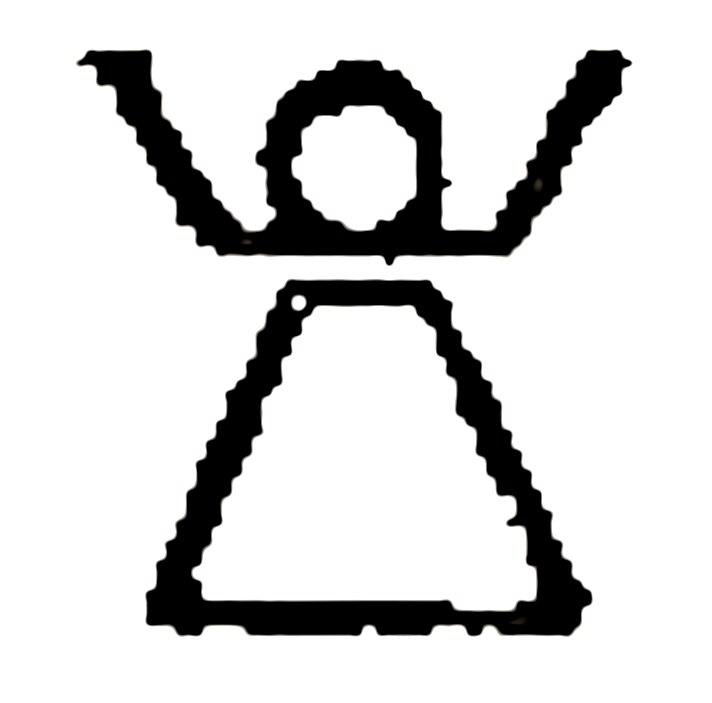
This conversion of the cone and circles into the likeness of anthropomorphic female deity, marked as it is by the light cutting of the arms, is a visible rendering of the phrase ‘Face of Baal’. The cone and superimposed concentric circles, then, are the symbols of Baal, as the inscription implies. A coin of the time of Hadrian from Alexandria[271] confirms the interpretation: it shows the head of Zeus-Ammon and, resting on the head, the ‘omphalos-sign’, the two concentric circles. Philippe Berger’s description[272] of Tanit as an emanation of Baal fits the appearances well. Tanit, in Berger’s view, is in essence no different from Aphrodite Urania, und he sees her as the inventress of the science of omens and prophecy. The attempt to remake the symbols of Baal-Hammon in her likeness may be due to a conflict between the idea of an Earth Goddess and the Egyptian notion of an Earth God.
Be that as it may, at this point we must correct a mistaken interpretation of the concentric circles above the cone and the head of Zeus-Ammon or Baal-Hammon on the Alexandrian coin[273]. Cook and others have seen this symbol as a solar disc, probably because of the association of the Libyan cult of Zeus-Ammon with the sun. There is no doubt that the deified sun was worshipped in the public cult of Zeus-Ammon, and it seems likely that this aspect of the cult was drawn from that of the Egyptian Amen-Ra. There was however a very marked Semitic element in the cult. The title Ba‘ al-Hammdn has been rendered in two ways, as ‘Fiery Lord’ or ‘Lord of Heat’ and as ‘Lord of the Stone Pillars’. Cook[274] regards the latter as the more probable translation. Baal-Hammon is very closely akin to the Tyrian Baal, Herakles or Melkart, so much so indeed that Polybius calls him Herakles, while a statue of Zeus-Ammon in Vienna apparently shows the god holding Herakles’ club[275]. Q. Curtius Rufus[276], writing of the Libyan cult of Zeus-Ammon, says, Id quod pro deo colitur non eandem effigiem habet quam vulgo diis artifices accommodaverunt: umbilico maxime similis est habitus, smaragdo et gemmis coagmentatus. Curtius, we notice, does not call the object a god or an image of a god, but says ‘that which is worshipped in the place of a god’. Its exterior is very like an omphalos, encrusted with emerald and gems. Cook quotes Theophrastus for the statement that there was a stele of emerald in the sanctuary of Herakles at Tyre and that obelisks of emerald were said to stand in an Egyptian temple of Amen-Ra. The stone was apparently chosen for its colour[277]. Imperial coins of Tyre show a portable shrine containing an omphalos of the kind which appears on coins of Perge in Pamphylia[278]. There is thus some confirmation of our view that the concentric circles above the cone in the tablet at Plate IV are, as elsewhere, an omphalos-sign. The public cult of the sun at Siwa, the site of the Ammoneion, did no more than duplicate, in an image comprehensible to the many, the contemplation of that sun which is always in the zenith above a navel of the earth (see pp. 28 f. and Chapter VI). Two concentric circles are not a plausible image of the sun. As we have already said, they really represent a section through the hollow axis of the world: the inner circle is a passage.
Further evidence strengthens the Phoenician ancestry of this aspect of the cult of Baal-Hammon. In an article published in the Gazette Archeologique for 1879, P. Berger examines a broken silver strip which bears in the middle the busts of Tanit and Baal-Hammon[279]. The two busts are flanked on either side by a serpent twining round and over a post. In these Berger sees symbols of Esmun, the Phoenician Aesculapius, who made with Baal and Tanit ‘a veritable trinity’. They remind us of the great importance of the power of healing at centres of oracular power. As some of the symbols are repeated on either side, it is possible that the caduceus which appears on the left among the signs connected with Tanit may have been reproduced on the right also among those connected with Baal-Hammon, but the damage to the strip renders this uncertain. The caduceus is of course the symbol of Hermes in the Greek world, but to Hermes in this context, as it would appear, corresponds the Phoenician Cadmus, in whom F. Lenormant saw Qadmon or Qadmiel, who is Malak-Baal, the herald, minister of his father[280]. The Ammon of Libya, if bearing a human face, has also a ram’s horns, turned downwards and curled beside his head, and sometimes is simply ram-headed; in this guise he is clearly of Egyptian origin. The spirit behind the cone or omphalos, however, eludes representation. Herodotus has an illuminating passage in this context: ‘the (Egyptian) Thebans say that Herakles much wanted to see Zeus, but Zeus did not wish to be seen by him. In the end Herakles became importunate and Zeus... flayed a ram, and, cutting off its head and holding the head in front of him, put on its skin. So he showed himself to him’[281]. Herodotus goes on to describe cult relations between Herakles and the Ammon (which he calls Zeus) of Egyptian Thebes. We shall have something to say below of the Herakles who was equated with Melkart of Tyre.
The oldest connections on the Greek mainland with the Libyan cult seem to be attached, firstly, to Boeotian Thebes[282] and then to Dodona. The former is by tradition a Phoenician foundation, and, according to Silius Italicus at least, the cult of Dodona was founded from there. The connection of Dodona with Zeus-Ammon seems to be quite well supported by evidence. The Libyan cult and that of Dodona appear each to have had their centre in an oak grove, haunted by doves and containing a pool with similar and surprising qualities[283]. The Libyan pool was called the aqua Solis[284], but it may be relevant to consider this sun in the light of that referred to on pp. 28 f. Likewise sun and pool together may have a special meaning for an inner circle: there is a legend that the ray of the midsummer sun at noon descended vertically into the well beside which Christ spoke to the woman of Samaria[285]. If one bear in mind the substance of Christ’s words to the woman of Samaria, one may see the probability of a common conception behind that well and the aqua Solis at the Ammoneion: it is reported that Ammon, when all the gods for fear of Typhon changed themselves into animals, appeared with a ram’s horns and in clothing of wool to lead those who thirsted to a spring[286]. There is connection with a sun, vertical above the pool; the concentric circles of the omphalos-sign represent, not that sun, but the vertical way upward to it and down into the world below.
A very remarkable bronze[287], apparently from north Africa and dating to imperial times, seems to give us clear evidence of the nature of the cult of Zeus-Ammon. The work shows a snake, a kind of άμφίσβαινα, for it has a head at each end. At the writhing lower end is the head of a bearded snake. The body broadens upwards in an upright position into a human head and shoulders (the arms are missing). On the head are the ram’s horns of Zeus-Ammon. Cook calls the figure a ‘Sarapis... equipped with the horns of Ammon’, but notices that P. Kabbadias and S. Reinach describe it as Zeus-Ammon. The serpent rises from the top of an oblong base which Cook thinks may be the god’s kiste or sacred ‘chest’, an object which appears also beneath the head of Zeus-Ammon on a coin[288]. There are traces on the head which show that something was worn there, perhaps a kalathos. Round the neck hangs an object representing the facade of a shrine. The shoulders are covered by a cape. Cook rightly remarks on the net-work pattern incised on this cape and thinks that it is probably a kind of agrenon. On the exposed belly of the snake, before it disappears beneath the cape, are four squares, one above the other at regular intervals. In the middle of each square is an open eye.
There are, then, several unusual features about this being which is half serpent, half man-divinity. Firstly, there is the snake with a snake’s head below and a human-divine head above. Why does the serpent not end in a tail? The head at the end of the tail shows, I suggest, that the serpent lives independently below, and only on occasion plays a part which raises and supports the human-divine upper part. It is not a figure of a snake-man or snake-god; if it were, it would end in a tail. The four squares, each with an eye in the middle, ranged at intervals up the belly have no parallel at all, as far as I know, except in the cakras of Kundalini-yoga, marked here, not on the body of a man, but on that of the serpent Kundalini herself. Certainly, the form of the centres differs from that of the Indian cakras, but we shall notice further reason for thinking their essential meaning is similar. There is no reason why the open eye should not symbolise a state of abnormal vision.
Secondly, there is the cape, which is rounded and has no opening in front. The criss-cross pattern may well be in one aspect a sort of agrenon, the net worn over the upper part of the body by priests and, sometimes, deities. One remembers also, however, that omphaloi often shew a net-work of this kind over their surface. The snake disappears into the cape, the shape of which, though it may have been that of the mantle worn by certain priests, is not at all inapt, together with the net-work, to represent an omphalos. (It is perhaps worth remarking that D. B. Harden’s description in his book, The Phoenicians, p. 103, with illustration on p. 203, mentions no agrenon, nor is there any sign of a cape of this kind, in the dress of the priest of Melkart at Gades). An association of snake and omphalos here with the pendant representing a shrine on the necklace would accord with the tradition recorded by Curtius that the object of worship at the cult-centre of Juppiter-Ammon was in a housing shaped like an omphalos. The association of snake and omphalos is already familiar to us. The author has seen, in a traditional Japanese dance presenting the doctrine of Kundalim-yoga, the serpent disappear from the stage into a great bell (from which later emerged a princess). The bell stood upon the stage like an omphalos. At any rate the implication which we have just exposed in the peculiarities of the serpent seems likely to be valid: the practice of something like the Kundalim-yoga was not regarded as inconsistent with the cult of Zeus-Ammon at this period. The work belongs, however, as Cook says, to an eclectic age, and, though it seems virtually certain that the serpent is the equivalent of Kundalini, over the identification of the whole as a consistent representation of Zeus-Ammon hangs a faint nimbus of doubt. The cause of the doubt lies in the writhing serpent body and head, for this suggests not so much Zeus as Typhon (Typhaon, Typhoeus), whose other characteristics of fire and wind are likewise suggestive of Kundalini. Typhon was an enemy of Herakles-Melkart, siding with El (Cronos) against Ba’alshamin (Ouranos). Ba’alshamin was supported by Ba’al (Hadad), with whom Melkart has a close affinity[289], and Melkart-Herakles and Zeus-Ammon are closely related.
So perhaps it would remain were it not for another extremely interesting and seemingly little-known monument, also, it would appear, from Roman North Africa. This monument, a stele or, rather, slab, is illustrated and very acutely discussed by F. Lenormant in the Gazette Archeologique for 1880[290]. It is the relief at the top, above the inscription, which concerns us. The middle of the relief is occupied by the reclining figure of Saturn. The god is lying on his left side, upon cushions, his right hand holding the harpe or bill-hook; he regards the observer full face. On the left appear a male head and shoulders with, behind the head, the rays of the sun; on the right are the head and shoulders of a female who bears on her head the recumbent lunar crescent. This arrangement is the same as that to be seen on the Lotharkreuz at Aachen (Pl. XXIX) and in not a few ancient monuments (see pp. 211 and 216). Lenormant equates Saturn (Cronos) with Baal-Hammon in the Roman provinces of Africa[291]. How Baal-Hammon could be identified both with Zeus and with Cronos is a question on which we have too little knowledge, though we shall recur to it later[292].
The attitude of Saturn in this stele, said Lenormant, was unique among the stelae from Roman Africa. The general attitude of the body, especially that of the left arm behind the head, ‘is the consecrated pose in ancient works of art for expressing repose, and even sleep. It is, for example, that of the classical representations of Ariadne asleep at Naxos’. Lenormant then refers to I Kings, 18, 27, where Elijah mocks the prophets of Baal and of ‘the grove’: ‘Cry aloud: for he is a god; either he is talking, or he is pursuing, or he is in a journey, or peradventure he sleepeth and must be awaked’. He agrees with a suggestion that the terms of Elijah’s derision are, each of them, allusions to myths related about the god and his labours. These myths are parallel to those of Herakles, his journeys and his periodic slumbers.
Certainly, the ‘pursuing’, the hunting of wild beasts, occurs prominently enough among the labours of Herakles. According to H. Seyrig[293], the Babylonian god Nergal has provided a part of the character of Herakles-Melkart, and Nergal, besides being a god of war and of pestilence, has among other qualities that of being a mighty hunter, ‘de la chasse aux grands fauves’. As to the periodic slumber, Lenormant seems not to have distinguished the Greek myths about Herakles from the ritual of Melkart. The stories of the labours of the Greek Herakles[294] show no direct trace of a tradition of periodic slumber (though the hero becomes ill); this is a characteristic of Melkart, whose ‘awakening’, called the εγερσις Ήρακλέους, took place in the period February-March. It is easy to see in this awakening of the god, as does R. Dussaud[295], a ceremony intended to re-animate the failing power of an agrarian god by the sacrifice of quails. The story is that during his visit to Libya Herakles-Melkart, son of Zeus and Asteria, having been killed by Typhon, was revived by the smell of a roasting quail offered him by lolaos. Dussaud equates lolaos with Esmun. Melkart was evidently not dead but in a state of unconsciousness. Lenormant rightly connects this myth with that of the struggle of Typhon and Zeus, the incapacitation of Zeus by Typhon’s theft of his sinews, and their restoration by Typhon under the suasion of Cadmus’ flute-playing[296]. Typhon, according to the former tale, is found in Libya. He had, as we have remarked, sided with Cronos in the struggle with Ouranos. The oracle of Baal-Hammon at Siwa seems to have been associated both with Cronos[297] and with Zeus, and we may therefore expect to find in its manifestations aspects of both gods. The serpent, with the four squares enclosing eyes on its belly and the head of ‘Zeus-Ammon’, may then symbolize the power of Typhon present in the Cronos-aspect of the deity. It was with the harpe, the bill-hook, which is particularly associated with Cronos (though in one context also with Zeus[298]), that Typhon severed the sinews of Zeus.
Now we shall later (pp. 150 ff.) draw attention to the fact that in some settings the lion takes the place of the serpent and with the same or similar meaning. This happened not only in Mesopotamia but also in Phoenicia and Syria. At Tyre, where there is a fusion of deities in Herakles-Melkart, while, as we have seen, the snake winds round the fiery tree, Herakles himself is accompanied by the lion, or wears the lion-skin, or both[299]. If the serpent was a symbol of the power whidi aids translation into an abnormal state of consciousness or into trance, so also was the lion. Lenormant draws attention to the leonine appearance of the head of Saturn in the relief, and with this lion-like head he connects the striking fact that, although the pose of the body is typically one of sleep, the eyes are open. He adduces evidence that in antiquity the lion was believed to sleep with its eyes open. Lenormant’s observation is surely just. We have noticed the open eye in each of four squares on the belly of the snake with the head of Zeus-Ammon. Earlier in this chapter we have noticed the special meaning in the Old Testament of the phrase, to ‘open the eyes’ and have seen that in one passage it is expressly connected with the change in consciousness called falling into a trance. It is a condition, which, as we saw in the story of Adam and Eve themselves, is regarded or felt as one of god-like insight, to such an extent indeed that he who enters into sudi a state may be seen as arrogating to himself the power, knowledge and authority of deity. It is a power latent in, or a condition open to, man himself and therefore knows no altar and no god to be revered. Its symbols are thus no anthropomorphic god but the axis mundi, the tree of life, the cosmic tree, the pillar, the mountain, the omphalos, the shaft that descends into the underworld, and the serpent or the lion. This is the scope of the symbol, the cone surmounted by concentric circles, in the lower panel of the tablet shown at Plate IV. Such is the essence of Baal-Hammon, whatever accretion of crudely superstitious deification may have grown up about the aniconic image.
Having gained this clearer view of the general meaning of the symbols, we have by no means emerged from the obscurity that envelopes their more precise significance. Cronos (Saturn) and Zeus are distinguished in Greek as are El and Baal in Semitic myth. Is the trance-like sleep of Saturn the same as that which preceded the εγερσις Ήρακλέους, the awakening of Melkart-Herakles? Typhon killed Herakles-Melkart, who was revived by lolaos (Esmun) with a roasting quail. Herakles-Melkart was the son of Zeus and Asteria, and Zeus also was rendered powerless and faint by Typhon until the sound of Cadmus’ flute restored his strength. The eyes of Adam and Eve are opened like those of Saturn, but the condition of the former is associated with a serpent, that of the latter with a lion. Are all these instances of the same askesist Is the trance-like condition that which succeeds upon the fiery onslaught of Typhon, in whom we recognise the figure of Kundalini? Are not the open eyes upon the belly of the bronze snake in whom we have seen both Kundalini and Typhon, beneath the head of Baal-Hammon, signs of that condition of trance attained by Adam in Eden? That a trance-like state may succeed upon the rousing of Kundalini seems to be confirmed by reports about those who have attempted the practice of the yoga without knowledge of how to control its effects[300]. In particular, to rouse the practicant who has entered into the trance may not be easy, and we may, I suggest, take the stories of the roasted quail and the flute-playing as true accounts of traditional methods of doing so. In the former case it was no doubt the burnt feathers that were effective, a remedy for fainting which has survived into modern times. (The Phoenicians, with the abominable cruelty that distinguished them, burnt the quails alive.) The open-eyed slumber of Saturn may, in spite of the fact that the god is lying on his side, not differ from the state of Vishnu illustrated in Pl. XVIII. The Indian god is seen recumbent in spiritual concentration upon the lotus of the navel. The lotus which is the object of his meditation seems also to be present in the imagery surrounding Tanit and Baal-Hammon. Of the figure:
The editor of the Corpus Inscriptionum Semiticarum[301] says that it may sometimes be found doubled at the foot of a tablet, the one figure resting on a caduceus, the other on a lotus. Sometimes the image of a man or woman, clad in a long robe, stands at the top of the tablet with the right hand raised as though in blessing and the left hand holding a lotus to the breast[302]. It is possible that the lotus thus came to represent in certain contexts a state of trance which was considered to be blessed..
It is thus virtually certain that a kind of sleep or trance characterized the cult of Baal-Hammon, and the practice of this condition was known from the Corycian cave in Cilicia, where Typhon was born, to Phoenicia, Libya, Carthage and, probably, Sardinia and Sicily[303]. Typhon was earth-born, the son of Earth. He may have been so called because the trance-like state was induced with peculiar ease in certain places, or because its first practicants lived in caves, or because such an ascription of his parentage conveyed the subconscious character of the forces involved or because his fiery power was felt in the hollow cavern of the body. They were forces that prevailed when the normal consciousness was in abeyance.
Saturn (Cronos, El) and Zeus are names which cannot really have been used indifferently of the Libyan Ammon. F. Lenormant[304] draws attention to the rebirth of Melkart: he is reborn at his awakening. Dussaud[305] emphasizes his re-animation through fire. Ammon is said, when attacked by Cronos, to have fled to Crete and there to have married the daughter of one of the Kouretes[306]. This suggests a connection of Ammon with the Cretan Zeus, who according to one tradition was born in a cave from which was yearly seen the light of a fire at the time of the birth[307]. Indeed, from the fifth century B. C. onwards there is evidence on coins of both an elder and a youthful, beardless Ammon, the latter of whom is probably to be identified with a Libyan Dionysus, the son of Ammon[308]. It is possible that we should see in Cronos-Saturn the element of trance, from which the awakened hero emerges as a Zeus new-born. This infant Zeus does not sleep, but grows in strength, like the infant Herakles, whose strangling of serpents when he was still a babe may represent the conquest of the Typhon whose onslaught had brought on the state of trance[309]. With the Cretan Zeus is connected, as we shall see in Chapter VI, the keraunos, the ‘thunderbolt’, in the heart of which is an image of growth. Aeschylus[310] calls the thunderbolt which saves its master άγρυπνος, ‘unsleeping’. Reborn into new life, the hero, having put the state of sleep behind him, entered into a new state of awareness.
In Die hellenistischen Mysterienreligionen (3rd. Ed., pp. 288f.) R. Reit-zenstein quotes a passage from the Corpus Hermeticum (X. 4 and 5) which, intellectualised though it is, seems to point unmistakably to an origin in the very practices we have sought to elucidate. It speaks of those who ‘are often removed from the body into a sleep in which they behold the fairest vision (κατακοιμίζονται πολλάκις από τοϋ σώματος εις την καλλίστην δψιν), as happened to our ancestors Ouranos and Kronos ... When thou canst say nothing about it (the vision), then shalt thou see it. The knowledge (γνώσις) and the vision (θέα, codd. θεία) is silence and a vacancy of all the senses (καταργία πασών των α’ισθήσεων). For he who has discerned it in his mind can discern nothing else (οΰτε γάρ άλλο τι δύναται νοήσαι δ τοΰτο νοήσας), he who has beheld it can behold nothing else, nor hear anything else, nor move his whole body. Forgetting all his bodily perceptions and movements, he is at rest.’ This vision illuminates the whole mind and setting the whole soul on fire, draws it up through the body, changing the whole man and transporting him into ultimate Being (ε’ις ουσίαν μεταβάλλει). Reitzenstein shows that this ultimate state is one in which the man is spoken of as deified. The ascent of the burning soul through the body is, one may think, a recollection of the fiery ascent of Kundalini or Typhon through the susumna. The words, chosen from philosophy, are those of one writing at a certain remove, but the author speaks of something which for others had been instant experience. If the body were thought of as a cavern or hollow mountain (see pp. 163, 165 f.), then it would have been filled with the light of the fire, the changed man emerging from it as a god, like the infant Zeus from the fire of the Cretan cave and like the prince of Tyre, who had walked upon the burning mountain and had been in Eden.
Chapter V: The Associated Symbols: I. The Lunar Crescent and the Bowl
§ I
Let us continue our study of the burning olive-tree of Tyre. We have spoken of the snake that is wound round it. We turn now to the bowl that rests upon the top of the tree.
A bowl may usually be assumed to contain a liquid. The tree of life often has a pool at its foot, whether of water or milk, the water of life may spring from its roots, a honey-like sap may ooze from its branches, its fruits may be full of abundant juice, but it seems never to bear a receptacle for the divine liquid on its summit except in the description by Nonnos. Nonetheless, even if the Tyrian tree described by Nonnos is a synthesis, we are bound to see whether an image comparable with the bowl is to be found in other relevant settings. It is certainly not a fanciful addition by the poet.
Since one aspect of pillar, mountain, omphalos and tree of life is their central position as symbols, whether as navel of the earth or sea, or as axis mundi, we should, in seeking other instances of the bowl, expect to find it, if at all, surmounting some central figure of a group. This central figure should have a close relation to the tree of life. There is, however, as far as I know, no representation from late antiquity of a tree, pillar, mountain or omphalos surmounted by a bowl. On the other hand, from the seven centuries preceding that in which Nonnus wrote, there survive a variety of examples of a symmetrical group centred upon a figure or symbol which is sometimes connected with a sacred tree and sometimes with a saucer-like object identified with the crescent moon on its back. The group and its connections seem to belong to the area surrounding the eastern Mediterranean: from Asia Minor to Egypt, from Delos to Syria, reliefs and coins and other works of art and craftmanship bear representations of a triad consisting of the Dioscuri, the ‘Heavenly Twins’, disposed on either side of a divine figure or a symbol with which the lunar crescent is sometimes associated.
In the third, and most of the second, centuries B. C. this triad is represented by symbols, not by complete figures, and is found on coins[311]. The Olympian order had been broken, and people seem to have worshipped, not a goddess, but ‘a divinity’ or ‘something divine’[312]. The inscriptions accompanying the monuments bearing the triad are always in Greek, never in Latin[313].
When it is a goddess that appears between the Dioscuri, she is either without attributes, in which case F. Chapouthier holds her to be Helen[314], or distinguishable by a variety of attributes as one of a number of goddesses. Helen at one time was, as we know, closely connected with a tree-cult. A goddess associated with emblems of light, and especially with the recumbent ‘lunar crescent’ is identified as Helen[315], but other goddesses, Isis, Artemis, Astarte, Hekate, Cybele, Demeter and Tyche (Fortuna) are recognisable, and all of them except Tyche are regularly or, in the case of Cybele and Demeter, on occasion accompanied by the same lunar symbol. On coins of Trajan’s time from Alexandria the goddess whom Chapouthier holds to be Helen bears the recumbent sickle moon on her head[316]. Indeed, this emblem is nearly always carried on the head[317]. On one gem the central image between the Dioscuri is simply the same recumbent crescent by itself above a table of offering[318]. The figure of Helen often merges with that of one or other of a number of goddesses; as at Sinope and Delos, she is πολυώνυμος, ‘of many names’[319].
On coins of Gythion the tree between the Dioscuri is Helen’s tree[320]. There are other instances of a plant or a tree in the same position. Helen is sometimes marked, when she appears in the middle of the triad, by a star, which Chapouthier holds to be proper to her[321].
The part played by Helen in this triad of figures or symbols is thus considerable. That played by the lunar symbol, the recumbent crescent, is even greater, for several goddesses are distinguished by it. In all this we must not overlook Helen’s connection with a source of light sometimes represented by a torch[322]. The recumbent crescent is not an essential attribute of Helen, and her radiance may be represented by a torch or a star. The ‘crescent’ does not accompany representations of Helen and the Dioscuri in Sparta, although in Pisidia they frequently appear together with it. Chapouthier attributes the latter fact especially to the cult of Men Askaenos at Antioch[323]. At any rate, it seems to be especially characteristic of the eastern end of the Mediterranean. Indeed, as we have remarked, Chapouthier considers the star rather than the lunar sickle to be Helen’s special luminary. It may thus be questioned whether the recumbent sickle, when connected with Helen, is to be thought of as a source of light at all. In Egypt, from the eighteenth dynasty onwards the sacred tree appears in art. The goddess Isis, in the form of a breast emerging from a tree, is shown in the act of giving suck to the young Pharaoh, Thotmes III[324]. Isis regularly appears in later times bearing the so-called lunar crescent, in a recumbent position, on her head, on occasion with the Dioscuri on either side of her.
The evidence points clearly to a common element in the conception of the goddesses we have named which causes them, in the hinterland and islands of the Aegean and eastern Mediterranean, to be distinguished by the recumbent crescent, worn most frequently on their heads. That in one aspect the symbol is a reminiscence of the horns of a cow seems very probable, but there is other evidence which strongly suggests that it had already acquired a different significance long before the Hellenistic age. Although, as I have said there seem to be no instances of the recumbent lunar symbol appearing above a tree on any monuments of the Hellenistic and early Christian centuries, there would be nothing surprising in this collocation during that period: Isis and Helen, both at times symbolised by a tree, bear the symbol on their heads; the tree appears between the Dioscuri, and so does Isis as well as Helen. In one instance at least the symbol appears by itself above a table of offering between the Dioscuri. It is at least worth asking ourselves whether the bowl which rests upon the top of the burning tree at Tyre in Nonnos’ Dionysiaca is this same recumbent lunar symbol. Some instances of the recumbent crescent above a sacred tree are certainly known. They date from Assyrian times (see the end of this chapter with footnote 80).
Could this possible identification of the recumbent sickle moon with a bowl be a mere confusion on the part of the poet? Later Christian evidence at any rate suggests that there is no confusion. From a fairly remote pre-Christian antiquity in Mesopotamia the recumbent sickle is found containing in the hollow of its embrace an orb or disc which is commonly taken to be either the sun or the disc of the full moon. An example of the same combined symbol dating from Roman times will be seen in the hands of the Carthaginian Tanit in the relief shown in Plate IV. In Christian art the recumbent ‘lunar crescent’ acquired a stem and base and was interpreted as the Communion chalice and the orb above as the Communion wafer, although their identity with the ancient combined symbol is plain. An example is to be seen on the west door of the late mediaeval church of St. Peter and St. Paul at Lavenham in Suffolk. The recumbent lunar sickle is not a normal, nor a probable, image of the chalice, and one may therefore assume that it had an aspect as a receptacle for a divine liquid which caused it to be used as a symbol of the communion cup. It is true that on the famous gold ring found by Schliemann at Mycenae (Plate XXII (b)) the crescent appears standing upright upon one of its horns, but this is most unusual, if not unique. Much older examples from Mesopotamia are invariably in the recumbent position, while in a Carthaginian example from Lilybaeum, admittedly of Roman times, which is shown in Plate I, it is, as in other Phoenician instances, actually inverted, with its hollow side downwards. Here there was clearly no intention of representing the ordinary crescent moon, thought there may be an assimilation to the arch of heaven[325]. This assimilation to the night-time sky (if such it is) seems to go back to Mycenaean times (see footnote 15), but we shall find another interpretation of the inversion in the final chapter.
The symbol, as we have seen, is associated with, among other goddesses, Helen and Isis in particular. Two passages in literature associate these goddesses with a cup or bowl. According to Pliny[326], Helen dedicated, in the temple of Athena at Lindos on Rhodes, a cup made of electrum. It was said to be shaped to the measure of her breast. At the festivals of Isis at Corinth milk was poured from a golden cup shaped like a breast[327]. Indeed, with Tyre, where Nonnos’ wonderful tree grew with the bowl balanced on its tip, Helen is associated in the curious tale of Simon Magus. Simon Magus, a native of Samaria of the first century A. D., after a visit to Egypt, met at Tyre the courtesan Helen, whom he presented to his disciples as the παμμή-τωρ ουσία και σοφία, the All-Mother, Being and Wisdom, while giving himself out to be the δύναμις μεγάλη, the great force or power, of Zeus. The disciples of Simon held that this Helen was a re-incarnation of Homer’s Helen, and raised statues to her, but with the attributes of Athena, and these statues were placed beside that of Zeus, the image of Simon[328].
Now Simon had, as the legend relates, studied Greek magic and wisdom in Egypt. According to Herodotus[329], there was, in the precinct of Proteus at Memphis in Egypt, which was situated in a Tyrian settlement in that city, a shrine of ‘the stranger Aphrodite’, whom Herodotus identified with the Greek Helen. Chapouthier[330] thinks Herodotus was wrong in holding this ‘stranger Aphrodite’ to have been a Greek goddess, pointing to the situation of the precinct in the Tyrian settlement at Memphis. He takes this Aphrodite to have been Astarte. However this may be, in the Odyssey it is presumably the same Proteus of Memphis who tells Menelaus in Egypt of the immortal benefit that he, Menelaus, receives through his marriage to Helen, a benefit which results from his having become the son-in-law of Zeus[331].
According to one Greek account, Helen travelled to Egypt while her image alone went to Troy. It may be relevant, if we bear in mind Helen’s association with the tree-cult, that the first appearance of a tree-cult in Egyptian art cannot, on such evidence as we have, be put earlier than the Mycenaean age of Greece. That there was ground for Herodotus’ identification with Helen of the ‘stranger Aphrodite’ in the precinct of Proteus in the Tyrian settlement at Memphis is clear enough. Strabo[332] also said that this Aphrodite of Memphis was considered to be a Greek goddess. He added that some people said her shrine was that of Selene, the moon.
A connection of Helen with Tyre in late antiquity and with Egypt and Tyre in earlier times, seems then to be established. We notice however the statement that Helen was presented by Simon’s followers under the guise of Athena. It appears that Athena is here to be equated with the northern Arabian goddess Allat, who herself is an armed form of Ishtar (Astarte, Aphrodite)[333]. We may also recall that at Athens the olive-tree was sacred to Athena; the Tyrian tree was also an olive. That there was an intimate connection between Athena and Helen on the shores of Asia is plain, for Helen dedicated the electrum cup in the shape of her breast in the temple of the Lindian Athena. If we accept the proposition that Menelaus in association with Helen has a certain divine quality[334], we may perhaps see a further reference to Helen’s cup in the bowl[335] which was Menelaus’ greatest treasure and which he, in Helen’s presence, ceremoniously (through Megapenthes) handed to Telemachus. The king of the Sidonians had given the bowl to Menelaus when, on the latter’s return voyage, the palace at Sidon had ‘covered him about’ (άμφεκάλυψε). The verb is a strange one and is not a natural way of saying ‘when I stayed there’. It seems to mean that Menelaus and Helen (for Helen was with him on his ‘return’) were hidden within the palace, as though they were somehow involved in its inner or secret life. In the fourth century B. C. a king of Sidon calls himself first a priest of Ashtoreth and only secondly the king of the Sidonians[336]. How far back such a priestly and royal tradition went in Sidon we do not know. Whatever meanings lie behind the Homeric passage, the evidence we have cited suggests a connection between, firstly, Tyre and Helen, and, secondly, Sidon, Menelaus and Helen on the one side and on the other a greatly-esteemd bowl. This bowl, with the robe that Helen at the same time gave to Telemachus, has a significant place in ritual. Helen is indeed a goddess of many names: she merges into Athena (who in Semitic lands is but Allat or Ishtar Armata), into Astarte and Artemis and, apparently, into Isis.
In the last three or four centuries, then, of the pre-Christian world and in the opening centuries of the Christian era, the lands lying round the eastern end of the Mediterranean, islands off their shores and the mainland of Greece know of a goddess called by several names who is associated in some places with a tree-cult, with a source of light and (except in Greece) with a recumbent lunar crescent which, we suggest, may also be a cup or bowl. It is implied by the mention of a cup with a breast-like form as associated both with Helen and with Isis, and by the painting (certainly, of a much earlier period) of Isis as a divine tree suckling the young Pharaoh, Thotmes III, that the vessel contains a kind of divine milk. We have seen (p. 7) that in a central Asiatic myth a lake of milk is found on the top of a mountain. In the middle of the lake is a grove of trees, and in this grove lives a great eagle, from whom an aspiring hero seeks to win a tail-feather. On the summit of the Tyrian tree rested the bowl, in its branches an eagle.
§ II
If we trace the recumbent lunar crescent as a symbol back into an earlier age and eastward into ancient Mesopotamia, we find it first, so far as I know, in the Jemdet Nasr period, that is, about the end of the fourth millennium, on a cylinder-seal from Ur[337], where it appears between the horns of a wild sheep. In this period it appears on the same seal as a star or sun[338]. In the Second Early Dynastic period, early in the third millennium, it appears more frequently[339], but clearly it is then not always a simple naturalistic representation of the crescent moon, for in at least two seals it contains in its hollow three ovals, eggs or dots[340]. The star (or sun) appears also in this period, and in the Third Early Dynastic period the two symbols appear on occasion together[341]. Generally, however, each symbol continues to appear by itself, though in the Akkadian era not only do they appear sometimes together in the same field[342] but, apparently for the first time, the crescent appears embracing an orb or disc[343], or a star[344]. It is still more common, however, for the two symbols to appear independently of each other. During the Third Dynasty of Ur (between, approximately, 2280 and 2180 B. C.), the orb or disc for the first time fills the whole hollow of the recumbent crescent (Plate XV (a))[345], and this union of the two symbols occurs frequently during the First Babylonian Dynasty (c.2100—1750 B.C.), and afterwards.
The development of these two symbols seems to represent a process by which two independent cults, or two not very clearly-related aspects of a single religious whole, gradually became more closely connected until they were on occasion fused in a single act of ritual, religious practice or comprehensive conception. Of course, both crescent and star continue to appear separately also. It seems, as we have remarked, clear that the recumbent sickle does not stand simply for the moon of heaven: the three ovals or eggs in its hollow show that. In the Akkadian seal at Plate XV (b) it will be seen that the apparent flattened crescent is marked by three sets of double parallel stripes, one in the middle and one near each end: it is again not the moon simply as a natural luminary. At the same time it seems that the recumbent crescent by itself stood for no central and independent object of cult in ancient Mesopotamia, for (so far as my observation goes) it is very seldom to be found directly above a divine figure. On the contrary, one is struck by the fact that it is very commonly found above the space between two gods or between a god and a ministrant, whether in its simple form or embracing the orb or disc[346]. Only rarely is there an object in between the two main figures whidi might be intentionally related to the recumbent crescent above. In an Akkadian cylinder-seal[347] the crescent appears above a small tree between two figures in a scene which, in Frankfort’s view, shows the harvesting of dates. The formality of the design on the right, together with the crescent itself, suggests a religious rather than a secular scene; nevertheless, it remains uncertain whether the recumbent crescent and the small tree below it are connected with each other. In another seal[348] the discin-crescent appears above a miniature figure between two principal figures, but the question whether there is a relationship between the symbol and the miniature figure is likewise open.
At Plate I a Carthaginian votive tablet shows, within a represented pediment, above the central pillar of a group of three pillars, the disc-increscent inverted, that is, with the hollow of the crescent turned downwards above the disc. This seems to have been a peculiarly Phoenician way of representing the disc-in-crescent, and it appears on the torso of a statue of a royal figure found at Sarfend (the ancient Sarepta), a town between Tyre and Sidon[349]. The inverted crescent and moon-disc is especially common in association with Tanit and is one of the symbols which seems to connect her with Astarte[350]. It seems clear that, when the lunar crescent is found inverted, its connection as a symbol with the natural moon has become vestigial. A question which may be significant for us here is whether the three pillars, or only the central pillar, are meant to be related to this disc and crescent. As the three pillars clearly form a trinity, the central one can hardly be considered in a relationship which does not involve the other two. Moreover, the fact that orb and crescent are in the pediment relates them to all that is below. We shall therefore consider the disc-in-crescent here as somehow related to a trinity of pillars, and shall remember at the same time the equivalence of pillar and tree. The tablet is of course a late work, of Roman times, but the symbols are old. Great as is the interval of time and different as the geographical setting likewise is, it is perhaps relevant in this connection to point to the three sets of parallel lines that mark the crescent in Plate XV (b). Nor can we consider the three ‘eggs’ in the recumbent crescents in the two seals referred to above, as certainly irrelevant. The ‘moon’, which, we have already remarked, is in these cases not just the familiar moon in the sky, seems sometimes to be connected with a trinity. It is a container, it would seem, for the three ‘eggs’ rest in it.
A link with the symbolism of the tablet from Lilybaeum may possibly be found in the gold ring shown in Plate XXII (b). In this seal (as in one other) Evans, with his remarkable eye for significant detail, drew attention to the tripartite stem of the sacred, fruit-laden tree (see pp. 21 and 193 ff.). Above the scene which centres upon the sacred female figure seated beneath the tree, a wavy border cuts off a panel in which there is a ‘sun’ and a ‘crescent moon’, which latter, as we have already observed, is unique in standing upright upon the tip of one of its horns. It is not the natural luminary of the sky, for it has its hollow side turned towards the ‘sun’, and the pattern upon the solar disc probably shows an ultimate source in Mesopotamia. The artist of this seal was evidently at some remove from the originals, but it is obvious that we have here simply a re-arranged, or disarranged, form of the disc-increscent of ancient Mesopotamian, and later Near Eastern, art. We cannot in this context disregard the vertical threefold division of the tree-trunk underneath: the three sets of vertical and parallel lines upon the ‘crescent’ of the Akkadian seal of Plate XV (b) and the three pillars associated with the inverted disc-in-crescent symbol on the Lilybaeum tablet, together with the three ‘eggs’ in the crescent which appear in the two seals referred to above (see footnote 30), make an accumulation of evidence, however difficult to interpret, that the ‘crescent moon’ is by no means simply the moon in the sky, that it has a relation to the cult of tree and pillar, and that it seems sometimes to be related to a triad or a number of triads.
An example from Greek art may throw some light upon a part of the evidence and at the same time go some way to confirm the antiquity of the tradition used by Nonnos. A red-figured fifth-century Greek vase in the British Museum[351] shows a Silenus, who apparently represents Herakles, attacking a snake with a club: the snake is wound round a tree in the upper branches of which hang three jugs. If the scene really alludes to the story of Herakles’ acquisition of the golden apples of the Hesperides, the connection of Atlas with the myth assures us that this is indeed the tree at the centre of the world. Nonnos, then, was not alone in placing a vessel containing some liquid at or near the top of the tree of life. In this case there are three vessels. That they are jugs and not bowls seems not to be important in this connection. That they are three is of more interest. Even if the vase-painting illustrated by Professor Brommer together with his study of it is inspired by a scene from a satyr-play, we must take its very simple features as the offspring of some tradition: the three jugs in the tree, as our other evidence suggests, are not merely the painter’s invention. There is thus some reason to see, in some cases, a suggestion of a triple flow of the divine liquid in or upon the tree of life. We shall return to the triple flow in a later chapter.
§ III
If we pass eastward beyond Mesopotamia, the lunar crescent makes one extremely striking and significant appearance, in India. We spoke in Chapter IV of that form of yoga wherein the coiled serpent Kundalini is roused from her sleep at the base of the susumna. The place where she sleeps is called the Afa/a-lotus or Miila-cakra. There are a number of ‘lotuses’ or cakras at intervals along the Susumna·. in the form of the Kundalini-Yoga set forth in the Sat-Cakra-Nirupana[352] there are six (see Plate XVI). These ‘lotuses’ are, as has already been said, centres of concentration in the psychosomatic discipline of this kind of yoga, by which Kundalini is raised to each of them in turn. Above them and beyond the upper end of the susumna, in the crown of the head, is the Thousand-petalled Lotus, the Sahasrara. According to one rendering of verse 46 of the Sat-Cakra-Niriipana, from the Ama-kala within the Sahasrara flows a continuous stream of nectar (the alternative reading makes her the receptacle of the nectar). Within the Ama-Kala, as verse 47 also tells us, is Nirvana-Kala. She is of the shape of the crescent moon. It seems she is as a bowl overflowing with a ceaseless libation.
Now the Sahasrara is the final goal, very rarely, if ever, attained, of him who practises this kind of yoga. In the Hindu system it is not counted as a cakra, lotus or centre. The highest of the cakras is the Ajna-cakra, described as being between the eyebrows, a position which nonetheless seems to remove it from the susumna. The Ajna-cakra is the so-called ‘third eye’. It is the region of manas, mind.
The lotus named Ajna-cakra is, in the words of verse 32, ‘like the moon, beautifully white’; the Indian Commentator, in his note on the verse, remarks that ‘the moon is the receptacle of Amrta, or Nectar, whose characteristic is coolness’. (The Sanskrit word nirvaana in fact means, approximately, ‘the cool’[353]). Woodroffe’s book contains illustrations of the images associated with different lotuses or cakras. A drawing of the imagery of the Ajna-cakra, based on Woodroffe’s illustration, will be found at Plate XVII in this book. There are two immediately noticeable features of this imagery of the Ajna-cakra. Firstly, one notices that, at the top, there appears, clearly and unmistakably, the disc within the embrace of the recumbent lunar crescent which is familiar to us from innumerable cylinder seals of ancient Mesopotamia, and on many seals and monuments of the Near East and of the Phoenician world as far west as Carthage. Above it is a horn which resembles the shofar, as Professor Sukenik believed it to be, shown in Plate VII (a). When the Commentator remarks that the moon is the receptacle of Amrta, nectar or ambrosia, it sems certain that he is referring to the recumbent lunar crescent, which is thus virtually named a bowl of nectar.
Above this bowl, if we may so regard it, is the shofar-like horn. We have already seen some signs of an ultimate identity of the shofar and the cornucopia (pp. 42 ff.), and the imagery of the Ajnd-lotus seems to show the horn or cornucopia poised to pour nectar into the crescent-bowl. The horn of the goat Amalthea of Greek tradition is equated, in some texts at least, with the cornucopia, and we remember that from the horns of the divine goat issued nectar and ambrosia. For the moment we shall disregard the orb of the full moon (as it is in this context) within the hollow of the crescent, to return to it in the next chapter.
It seems therefore as though the Ajna-lotus and the Sahasrara, the ‘Thousand-petalled’ lotus at the top of the head, duplicate each other. Both are sources of a stream of nectar, and in both there is a crescent moon. The upper part of the imagery of the Hjnd-lotus is apparently derived ultimately from Mesopotamia as far as the orb-in-crescent symbol is concerned and, so far as our knowledge goes, from the Mediterranean fringes of Asia in its reproduction of the cornucopia or shofar-Yike symbol. This much seems to be almost certain. That a good deal of the imagery of the Apw-lotus is an intrusion becomes still clearer when we consider the fact that it has two petals. Not only has no normal flower, let alone a lotus, two petals, but the number two breaks the sequence of increasing numbers of petals in each successive lotus above the root centre, the Afwa-lotus, which has four. The succeeding lotuses, as depicted in Woodroffe’s edition of the Sat-cakra-nirupana, have six, ten, twelve and sixteen petals. This last is followed by the Ajn5-lotus with two, and at the summit beyond the djw-lotus is the ‘Thousand-petalled’, the Sahasrara lotus. If we bear in in mind also that the Ajna-lotus duplicates the Sahasrara as a source of nectar, we cannot doubt that the ApJ-lotus is in much of its imagery and in its apparent function as the ultimate origin of the stream of nectar, an intruder, and, to judge by the imagery, an intruder from the west. This may embolden us to make an admittedly speculative suggestion about the origin of the two petals of the Ajna-cakra or lotus. They are not derived from a flower. May they perhaps be the wings of the winged ‘solar’ disc of Assyria, assimilated to the petals of a lotus? If so, they give us a terminus post quern for the insertion of the Ajna-lotus, or of much of its total complex, into the sequence of cakras in this system of yoga. It looks as though a western conception of the flow of nectar from an ultimate source into a shallow bowl has been placed at the head of the system of lotuses below an older image, the Sahasrara, which contains the same elements (see p. 197). We may here remember that the Assyrian winged disc frequently appears above a palm-tree (see p. 83).
The identification of the shofar and the cornucopia may receive a certain confirmation in the passage of the Sat-Cakra-Nirilpana which describes the Ajna-lotus. In verse 33 it is said that within the Yoni, that is, the triangle, in the lower part of the jijw-lotus imagery, is ‘the first Bija of the Veda’. This ‘first Bija of the Veda’ is the Pranava, the syllable Orp, which is the articulate representation of primal sound[354]. The Pranava also sheds illumination, for it makes visible the Nadi Citrini*[355], which latter may be described as the vessel that contains the upward course of Kundalini within the vajra, which in turn is within the susumna (see p. 82). There is thus, in the thought behind this passage, an ultimate identity of nature in the subtle premises of sound and of light. That a sounded horn should also be thought of as a symbol of that which is potentially perceptible to other senses, is not, on this transcendental level, self-contradictory, and that a horn like the shofar could also be thought of as the spring of a stream of nectar becomes a possibility.
Admittedly, the depicted horn in the illustration (Plate XVII) is not within the triangle of the Xoni, and we are thus at first sight unable to relate the Pranava directly to it. The Indian Commentator, however, in his note on verse 35, expressly states that the half- or crescent moon and the Bindu[356] within it, found in the imagery of the Ajna-cakra, are linked with the element in the Yoni below it to form the Pranava (Om). The syllable Om, in those parts of the Upanisads which explain the significance of ritual recitation, seems to stand for a conception of the primal sound as that which renders prayer effective[357]. In the Chandogya Upanisad, I. 4. 3—4, the gods took refuge in the sound aum (om) and thereby became immortal and fearless. The sun continually gives forth the sound aum[358]. Utterance is the mystical source of an exalted nourishment[359]. The gross material perversion of this in sacrificial ritual is satirised in the Chandogya Upanisad[360]: a pack of dogs moves along together singing, ‘Aum, let us eat; Aum, let us drink; Aum, may the god Varuna, Praja-pati and Savitr bring food here. Aum.’ It is not difficult to see that that which the sound of horns like the shofar symbolised could be lost in the cornucopia filled with fruits.
The half-moon of the Ajna-lotus is the receptacle of nectar. The half- or crescent moon is commonly associated with liquids in this context: the sixpetalled Svadhisthana-lotus[361] (the second in the ascending series) contains in its centre a recumbent crescent moon within an eight-petalled lotus which here symbolises the white ‘region of water’. The Brhad-aranyaka Upanisad[362] has the following passage:
“Gargya said: ‘The person who is yonder in the moon, on him, indeed, do I meditate as Brahman’. Ajatasatru said: ‘Please do not talk to me about him. I meditate on him as the great white king Soma. He who meditates on him as such, for him soma is poured out (in the principal) and poured forth (in the subsidiary sacrifices) every day. His food does not get short.”
Dr. S. Radhakrishnan, citing Rangaramanuja, notes, ‘Soma is the name for the moon and the juice from the creeper which is used in the sacrifices.’ The moon is quite clearly a receptacle for a divine liquid with a number of names, water, nectar and soma being but three of them. We have to do with a concept which has both an inner, psychic meaning and an outward, ritual sense. In the Chandogya Upanisad[363] there is a passage on the disciplined life, in which the following words occur:
‘Now what people call a course of fasting is really the disciplined life of a student of sacred knowledge, for the self which one finds by the disciplined life of a student of sacred knowledge does not perish. Now what people call the life of a hermit is really the disciplined life of a student of sacred knowledge. Verily, ar a and nya are the two seas in the Brahma-world in the third heaven from here. And there is the lake Airammadiya and the tree showering Soma, there is the city of Brahman Aparajita and the golden hall built by the Lord’. This third heaven is evidently attainable by the right student of sacred knowledge. There is the summit of The tree showering Soma’. Soma is the divine liquid contained in the crescent moon. But this crescent moon, it has been shown, is a receptacle. ‘The tree showering Soma’ has therefore at its top a receptacle or bowl from which the liquid flows. We have already, in considering the Ajna-cakra, noticed that a part of the imagery is apperently derived from Mesopotamia and the Mediterranean edges of Asia. In this western portion of the imagery is the orb-in-crescent. This Soma-filled bowl may be the bowl which rested on the top of Nonnos’ burning tree at Tyre.
Greek myth and Indian imagery seem to concur: the horn of Amalthea (in spite of some contrary opinion[364]) is not essentially different from the horn which Herakles tore from the bull that was the river Achelous. In the imagery of the Ajna-cakra, the divine liquid flows out of a horn on to the moon, but another Indian tradition (see p. 8) makes the river Ganges flow from the foot of the divine Being on to the moon and thence, through the Zodiac down upon Mount Meru. From the Mediterranean to India either nectar or a river could issue from the horn or flow into the moon. It has however been well observed[365] that although Zeus and Herakles were connected with the formation of the image of the cornucopia, they rarely bear it as an attribute, and that it passed early into the hands of those gods who better represent the possession of material goods. The remark chimes in perfectly with the satirical passage cited above from the Chandogya Upanisad on the degeneration in the use of the syllable Aum (Om).
We are moving now in three worlds. There is a cosmic world, consisting of an underworld, the earth on which we live, and above it storeyed heavens, which may vary from three in number (as in the quotation from the Chandogya Upanisad) to seven or more. There is the world of sacrifice, of ritual which may be conceived in different ways, varying from simple representation by symbolic actions of spiritual experience to acts which of themselves exert a magical power upon persons and events. Sacrifice may be accompanied by ecstasy. There is, thirdly, the inner world of spiritual experience, which in gross figures may be rendered in some way acceptable, if not intelligible, to people at large by its reproduction in the forms of the other two worlds. In other words, a personal experience, attained in rigorous practice and in privacy by a few, is described to the religious public in terms of an ascent into upper regions beyond the sky, of (as we shall see in more detail) illumination or entry into a world of light, of knowing the primal sound of the cosmos and of drinking a draught of divine liquid, poured out from some celestial source of coolness. This last experience is symbolised by the pouring of water, milk, honey, soma or wine in sacrificial ritual. Soma seems to be peculiar to India, but the other liquids are represented in the four rivers of Eden.
§ IV
No religion is pure and unmixed with elements of other religions, and no doubt the recumbent lunar crescent, which, as we maintain, sometimes represents a bowl, unites with the ecstatic experience of which we have just spoken a quite different cult of the moon as arbitress of nature. A macro-cosmic world and a ‘microcosmic’ world, or, more accurately, a psychosomatic constitution of man, are thus linked and it is probably through this link that an element of ritual was associated with the concept of the sacred tree. Through some such association, we may judge, the image of a bowl (rather than of a natural source) entered into the complex around the tree. We shall not pursue the development of this association of the two worlds in ancient religious thought any further at this stage, but may ask what sort of bowl could be so consistently represented by the recumbent lunar sickle. What bowl is so shallow as this, yet might be appropriate to a religious context?
As far as late antiquity is concerned, there was one such bowl which was in use all over the Hellenic world, and which, if we bear in mind the conservatism of religious usage, we may take, in its associations, to be of considerable antiquity. This is the patera, phiale or libation bowl used in sacrifices. The patera is a shallow dish raised towards the rim; the Greek form is commonly a φιάλη ομφαλωτή, with a central boss, into which the finger-tips fit on the underside. It was filled from another vessel which, we shall suggest, at one time was generally a horn. An Egyptian patera of the nineteenth dynasty, showing strong Western Asiatic influence, has a sacred tree depicted on it[366]. We have already noticed in Cypriot seals of the second millennium B. C. the association with a sacred tree of a sign which we believe to represent a ritual horn of the type of the shofar. In some parts of Syria, Palestine and the region of the Jordan there have been found monuments of a deity whom the Greeks knew as the tribal god of the Nabataeans, a people who inhabited what later became the Roman province of Arabia, and who have left Petra behind them as their most famous memorial[367]. Maurice Dunand[368] reproduces a statue of this deity, whom the Greeks called Dusares. The statue was found in the Hauran[369]. The god, who is represented in a Greek style, carries in his right hand a phiale and supports with the other a cornucopia filled with fruits. Clusters of grapes are carved beneath its mouth. We may perhaps see here in concrete form that association of the ritual phiale or libation-dish with the cornucopia which, as we suggest, represents the ecstatic experience which gave rise on the one hand to the ritual and on the other to the image of the cornucopia itself.
The main seat of the cult of Dusares was at Petra, where, according to F. Cumont[370], the central object of cult was a four-cornered black stone about twice as high as it was wide. The blood of sacrificed animals was allowed to run over it. The stone was regarded as the virgin mother of the god. We find the apparent origin of the cult therefore, in its outward form, in a pillar. This view of the stone as a pillar seems to be confirmed by imperial coins on which, if A. B. Cook[371] is right, the cult object appears as a tall pillar flanked by shorter pillars, by an omphalos (as it seems to be) or a triad of omphaloi, the largest in the centre. The god is represented on coins as carrying a phiale and a hasta[372], which we interpret (since he has no association with hunting or warfare) as we have interpreted the ‘spears’ of the Dioscuri (see p. 62), that is to say, as a symbol of the ‘way up’ and the ‘way down’ for the souls of men along the axis of the universe. Some confirmation of this will be found below. The god had a sacred spring or waterfall. The vine is said to have been introduced at a fairly late date into the area settled by the Nabataeans, and for this reason the identification of the god with Dionysus is held by Cumont to be late. If we recall the god’s sacred spring or waterfall, we may suspect that wine has replaced water in his cult, and that the latter liquid once poured from the cornucopia, which is, as we know, associated in some Greek myth with rivers[373]. It is associated also with Hermes, for this god gave it in the form of the horn of Amalthea to Herakles before that hero drove off the cattle of Geryon[374]. Hermes we saw to be connected both with the Tyrian Baal and with Calypso at the navel of the sea, as he is also with Circe’s island, where the sun was always in the zenith (see the next chapter). He gave Odysseus the plant with a root like milk before the latter encountered Circe. Round Calypso’s cave grew a vine and from the cave’s mouth issued four streams, in which we have already seen the rivers of Eden. Herakles (who tore the horn from the bull that was the river Achelous) relieved Atlas of his task of upholding the sky. On some Athenian coins of relatively late date the cornucopia appears leaning against an omphalos[375]. The cornucopia, the hasta and the god’s virgin mother who was a stone pillar make it difficult to dissociate Dusares-Dionysus from the complex imagery which clusters round the navel of the world.
In our pursuit of evidence of the recumbent lunar crescent as a receptacle like the phiale or some flat, shallow sacrificial bowl, we have found in two instances that a horn, which may be seen in the one case as a pouring-vessel and in the other is certainly a cornucopia, accompanies the image of a libation-dish. The first instance occurs in India, but in the Western Asiatic imagery of the Ajna-cakra, in the Kundalini-Yoga; the second is an attribute of Dusares. A third instance occurs still further west, in a well-known Attic vase of the mid-fifth century B. C., now in the British Museum[376]. The interior of the bowl of this vase shows a painting of (according to the inscriptions) Pluto and Persephassa (Persephone) (Plate XIX). The god reclines on a couch, supported on his left elbow, holding in the crook of his arm a large cornucopia. His right arm is stretched out towards Persephone, to whom he offers a shallow, stemless dish or phiale. The mood of the scene is grave, and this is shown not only in the faces of the two figures. The cornucopia contains no abundance of fruits, but is a bare, unadorned vessel from which the drink that has been poured is now offered to Persephone. The offering is one of serious, even fateful, import. H. Metzger[377] has shown with a great deal of persuasiveness that this vase is only one of a number of pieces of evidence that Dionysus shared with Hades or Pluto dominion over the underground world of the dead and that he is associated at times with Persephone or Kore in this capacity. In the vase referred to, Pluto wears the ivy crown and mitra of Dionysus, and is in Metzger’s view a hybrid figure, of which there are other examples, notably in scenes of symposium, combining characteristics of the two gods. A Dionysus who rules with Hades over the souls of the dead and pours drink from a cornucopia into a phiale may link us with the figure of Dionysus-Dusares, referred to above, who is shown on coins with the phiale and hasta (and a leopard at his feet). We have suggested that the hasta is, like the spears of the Dioscuri, the axis mundi along which the souls of the dead might travel up from the underworld to the highest heaven or downwards to the world below. It is probably not irrelevant that in Roman imperial times Dusares became a sun-god, for, even when we bear in mind the syncretistic tendencies of the age, we remember that Circe, who dealt with the spirits of the dead in the underworld, was also a daughter of Helios, who seemed to be stationary in the zenith above her isle[378]. If Metzger is right, we find the phiale, or libationdish, the cornucopia, the axis mundi, the underworld and, indirectly, the god Hermes (already, was we have seen (pp. 28 ff.) present as Psychopompos at the όμφαλος θαλάσσης, the navel of the sea) associated with Dionysus and a draught of some divine liquid. Further evidence, tending strongly to confirm our view of the recumbent crescent, will be found on p. 121.
Finally, we must notice one other aspect of Dusares: his festival was celebrated on December 25th. at Petra, and he appears on a relief as a child rising out of an acanthus[379].
§ V
We have drawn attention to the remarkable fact that it is difficult to find a certain and direct connection of the sacred tree and the recumbent lunar sickle in their earliest settings, namely in the scenes engraved upon Sumerian and Akkadian cylinder seals. They may occur in the same pictorial field, but never, so far as I know, in immediate and certain relationship. Even Indian tradition is sometimes ambiguous: it speaks indeed of the tree showering soma in the third heaven, and we have seen that this implies almost certainly the idea of the moon-bowl showering the liquid upon the tree, yet in one Upanisad at least we find a passage which seems expressly to dissociate the moon from the idea of the world pillar, which we know to be but a form of the axial passage which is also represented by the cosmic tree. In the Brhad-aranyaka Upanisad[380] we read: ‘“Yajnavalkya”, said he, “since the sky is, as it were, without a support, by what means of ascent does a sacrificer reach the heavenly world?” “By the Brahma priest, by the mind, by the moon. Verily, mind is the Brahma of the sacrifice. That which is this mind is yonder moon. This is the Brahman. This is freedom.” ’ The words seem expressly to deny the possibility of ascent through a world-pillar into the celestial world. They thereby of course imply that the belief in such a possibility existed, but they seem also to stand for another doctrine. The passage is too brief to be entirely clear, but it appears to relate the presiding priest, the mind conceived as a single creative being or presence, and the moon, which is also the same as that mind. In a passage that follows shortly upon this[381] we find that soma, the sacrificial juice, is poured into the earth for the benefit of the world of men, ‘for the world of men is down below, as it were’. The ‘world of the fathers’, in this passage, is above the world of men and below the world of the gods. To each is related a particular kind of sacrifice, to the world of the fathers flesh, to the gods a burnt offering. It seems, therefore, as though there is here an attempt to deny that the way of liberation or freedom is to be found through any ‘support’ of the ‘sky’, that is, a disciplined autonomous way taught by master to disciple or father to son. It lies, in this passage, in sacrificial ritual, when this is properly grasped by him who offers the sacrifice through the priest. The ascent is made through the mind and the sacrifical fire, not, it seems, through tapas, the heat generated in the body by the ascetic discipline of yoga and ecstasy. The mind is both the moon and the Brahman, the cause of the universe that is itself without attributes.
The opposite pole of Brahman is prakrti, which is almost not-self, the principle of matter. Brahma is Brahman thought of in the aspect of Creator. In the words of Dr. Radhakrishnan[382], ‘Into the original stillness of prakrti... Brahma sends sound, nada-brahma. By his ecstatic dance the world evolves’. The concept of sound we saw to have a subtle and profound meaning in its connection with the shofar, the horn which, it is suggested, is essentially identical with the original nature of the cornucopia. In the mandala of the Ajna-cakra it appears poised above the lunar crescent as though liquid is pouring from it into a bowl. In the passage first quoted it is brought into connection with, on the one hand, the mind as Brahma, Creator, in the sacrifice, and, on the other, the mind which is absolute undetermined freedom, the Brahman, conceived as detached from all individualisation in the image of the moon. In § III of this chapter, however, we saw that in this same Upanisad the moon and soma are related in the closest possible way. The suggestion that the moon is a vessel holding a divine liquor is thus reinforced, for this liquor issues from the sZ>of«r-cornucopia as sound. It is related to the world below, and the context implies that the three worlds are separate from each other. Only through ritual performed with understanding is any communication possible between them.
There is however at least one piece of evidence which seems to point to a connection between a bowl and the tree of life in Mesopotamia and its northern borders. G. Widengren, as we have already remarked, has shown that the Sumerian king himself was the tree of life. A relief from the palace at Nimrud[383], although of a late Assyrian period, in A. Moortgat’s view shows the king in this capacity, for the genii that flank the scene are exactly like and bear the same pails and cedar-cones as those who tend the sacred tree. The king, seated on his throne among ministrants, holds a bowl before him. What is happening is far from certain, and in this context we cannot go much beyond drawing attention to the association of king, sacred tree and bowl[384]. It may be that the king is shown ritually experiencing the final bliss of the outpouring of nectar vouchsafed to those who reach the goal of ascetic practice. Alternatively, he may be offering the water of life to those dependent on him. Whatever the meaning of the act delineated, he surely performs it on behalf of the whole city. If he does so, he is in some sense an intermediary. We may remember that Gilgamesh failed to find everlasting life. It is true that he nearly succeeded, and it is unfortunate that the condition of the text prevents us seeing at the critical point why he failed. Adapa was tricked out of eating the proffered food of life by his divine father Enki: he too found that the gods were determined to reserve everlasting life for themselves. Why then should the Assyrian king, if there was on this matter a continuity of belief, be shown holding what seems likely to be the water of life in a bowl? As a man, he had no hope of immortality.
We may suppose that in this ritual the king has taken on something of the status of a god, and this will probably have been his part also in the earlier periods of Mesopotamian civilisation. The tree-planted ziggurat at Ur, attached to the temple of the Moon-god, Nannar, no doubt rose, in the eye of the imagination, to the moon itself. It was the artificial image of the tree-crowned mountain that, in the later shamanist cosmology of Asia, ascends to heaven in the form of the world-tree. It had generally ceased, however, if we are not mistaken, to be an image of the ascent of man’s spirit, and stood there as a mark of the whole city’s dependence, through the King, on heaven. ‘The last king of Isin put his own son at Ur as high priest of the Moon-goddess Nin-gal’[385].
If this speculation is justified, when we find the recumbent crescent above a ceremonial scene, without its being related directly to any one figure or sacred tree beneath it, we may take it as meaning that the whole action depicted takes place in the service of the gods[386]. If gods alone are shown, it would be a symbol of the immortality which is theirs. It is a constant memorial to man’s, and all nature’s, dependence on the gods.
In the midst of all this refinement of at least partly hypothetical royal and priestly doctrine, we may not forget that it is the moon: it is the sign of the night, of the night that is especially the time of certain spirit powers, as the sun and day are of others.
Nevertheless, there is reason to think that the disbelief in man’s power to transcend nature did not prevail always and everywhere in Mesopotamia. The recumbent crescent was on occasion clearly something other than a bowl. The moon is a voyager through time and space. In Plate XV (b) we see an Akkadian seal in which the crescent is marked by three sets of parallel lines. A seal[387] from Susa, of the Uruk or the Jemdet Nasr period, in which two crescent shapes marked by three similar sets of vertical parallel lines float, each with its fantastic oarsman, above two fishes, seems to show that these three bands may at times be marks of a kind of boat. Two Akkadian seals[388], one containing a figure apparently carrying an uprooted tree of life, the other the figure which Frankfort calls the Birdman, markedly associate a crescent moon with the seated figure of the god Ea. Two streams flow from the god. We shall see later[389] that there is sometimes reason to see in these streams a prototype of the great Greek stream of Okeanos which encircles the world. An Assyrian seal actually shows a priest wearing the fish-tail robe, which Mlle. N. Perrot sees as a mark of a priest of Ea, with a sacred tree behind him and above it a deeply-curved lunar crescent[390]. The image of the moon as a bowl or cup which is also a boat, and the story of Herakles voyage in the cup-boat (for the story of Herakles has its origin in Western Asia[391]) over the stream of Okeanos are important for our understanding of the background of spiritual askesis or of ecstasy in ancient Mesopotamia[392]. The sun, however, is also involved and we shall do best to defer to the next chapter our consideration of this fragment of myth.
Chapter VI: The Associated Symbols (continued): II. The Sun and the Thunderbolt
§ I
We have caught momentary glimpses in the more ancient background of Greek tradition of a world in which the image of the sun plays a part unknown to the Olympian religion (see pp. 28 f. above). It is not the natural sun of heaven, for it neither rises nor sets, but is, as it seems, ever in the zenith above the navel of the world. There are some signs of an ambiguity as between the Pole Star and the Sun, for while there is, as we have suggested, a hint of the Pole Star in the wind from the north that is to bring Odysseus to the underworld from Circe’s isle, it is the sun that is in the zenith above the island. Again, in the Gilgamesh Epic, when the hero is journeying in the darkness through the double mountain, Mashu, after nine double hours’ march he feels the north wind in his face, and at the eleventh double-hour sees the first ray of the sun[393]. We may see in this duality traces of two different cults, and perhaps peoples, both of which had the same spiritual conception and a similar cosmology, but of which one used a lunar calendar, that is to say, regarded the night-time sky as the more significant, and the other used a solar calendar. The same image of an unearthly sun we saw to be pendent over Mts. Lykaion in the Peloponnese and Dikte in Crete. The sun, however, was not a symbol of a purely celestial religion, to be distinguished from chthonian religious conceptions, for we held that on Circe’s isle was also the entrance to the underworld. This is in keeping with the image in the Yakut story quoted at the beginning of Chapter I, the image of the great tree whose top pierces the highest heaven but whose roots reach downward the same distance into the earth, the tree at the centre of the earth, earth’s stillest place, where the sun and the moon never set. We know of the vertical passage through the universe, but have now to consider the sun which shines at its upper end.
This image of the sun was known in India. In the Chandogya Upanisad[394] we find the following:
‘1. Henceforth, after having risen in the zenith, he (the Sun) will no more rise or set. He will stand alone in the middle. On this there is this verse:
2. It is not so there. The sun has not yet set; nor has he ever risen. O ye gods, by this truth, may I not fall from Brahma.
3. Verily for him who knows thus, this mystic doctrine of Brahma, the sun neither rises nor sets. For him it is day for ever’[395].
It is not a doctrine for the general religious public:
‘5. Verily, a father may teach this Brahma to his eldest son or to a worthy pupil.
6. And to no one else. Even if one should offer him the whole of (this) earth encompassed by water and filled with treasure. (He should say) ‘This, truly, is greater than that—yea, greater than that’.’
The meaning of these verses is clear enough. ‘The process of Yoga consists in rousing the radiant serpent and lifting it up from the lowest sphere to the heart, where in union with prana or life-breath its universal nature is realised, and from it to the top of the skull. It goes out through an opening called the hrahma-randhra, to which corresponds in the cosmic organism the opening formed by the sun on the top of the vault of the sky’[396]. The ‘sun’ is thus, like the Pole Star, conceived as an opening into the radiance beyond the sky. It is the image of an experience known to a circle who hand their knowledge on only to a chosen few. We are now used to the macro-cosmic-psychosomatic ambivalence of the tree or pillar or mountain, which is at once World-Tree, World-Pillar, World-Mountain, and spinal column or body of a man. It is not difficult, after our study of the Cypro-Mycenaean seals shown in Plates V, VI, and VIII, to interpret the pillars with a rayed top, to which Evans drew attention in his study of the Mycenaean tree- and pillar-cult. Evidence of the practice of yoga in Western Asia in the third and second millennia B. C., to be examined later, will enable us to see these pillars as representations of the structure of the yogi’s world and of the ultimate moment of radiant vision and of liberation which is the goal of his psycho-somatic discipline. This goal is reached, as we have said, in the Sahasrara, the Thousand-petalled Lotus in the crown of the head, within which is the Ama-Kala. Within the Ama-Kala is the Nirvana-Kala. The Nirvana-kala ‘is as subtle as the thousandth part of the end of a hair, and of the shape of the crescent moon’[397]. In the middle of the Nirvana-kala (i.e., in the hollow of the crescent) ‘shines the Supreme and Primordial Nirvana-Sakti; She is lustrous like ten million suns, and is the Mother of the three worlds. She is extremely subtle, and like unto the ten-millionth part of the end of a hair. She contains within Her the constantly flowing stream of gladness, and is the life of all beings. She graciously carries the knowledge of the Truth to the mind of the sages[398].’ The Indian Commentator remarks on this verse that the author is speaking of the Parabindu. Of the Parabindu we shall shortly have something to say.
The image is thus the same as that which we held to be interpolated into the Ajna-cakra, the sixth lotus, namely that of the recumbent crescent holding in its hollow a round spot, drop or dot, the Bindu[399]. It shines with a brilliant light. ‘Parabindu’ means the ‘Supreme Bindu’. Within this infinitesimally small drop or dot is truth, joy and the source of the universe, the three worlds.
In the Isa Upanisad[400] we read: ‘The face of truth is covered with a golden disc. Unveil it, O Pusan, so that I who love the truth may see it.
Ό Pusan, the sole seer, O Controller, O Sun, offspring of Praja-pati, spread forth your rays and gather up your radiant light that I may behold you of loveliest form. Whosoever is that person (yonder), that also am L’ (The Brhad-aranyaka Upanisad[401] contains exactly the same verses, and may be the source of those in the Isa Upanisad).
The fact that the sex of the ‘person in the sun’ (as the being addressed is sometimes called) varies from male to female reflects the ultimate unity of Siva, the male, and Sakti, the female, in the Parabindu. It may be recalled that Evans, with that extraordinary sense for significant detail on which we have remarked before, observed that the radiant pillars of whidi he spoke seemed sometimes to be hermaphroditic (see p. 22). More significantly still, the seer identifies himself with the ‘person’ in the sun, ‘whomsoever he maybe’.
Now there is no doubt that the symbol referred to in these passages is the orb-in-crescent, the Nirvana-Sakti in the Nirvana-kala, or, if it is preferred, the disc of the sun contained in the hollow of the recumbent crescent moon. This is the sun that is always in the zenith, and it is always in this place because it is in the Sahasrara, the Thousand-petalled Lotus, which is in the crown of the head.
Yet it is not only an image of the sun, chosen to represent the luminous vision. For that matter, the image of the lightning-flash occurs also[402]. The golden disc, the sun-like spot, is also the Parabindu. The word bindu literally means a point, and it is used also for the dot which in Sanskrit denotes the nasal breathing. In philosophy it is used for the knowing subject, the Τ’, in the active state of consciousness. Further, it makes the known dependent on the knowing self. An object of knowledge may be extended in space or time, but the bindu, when the object of knowledge is completely subjectified, is thought of as a point unextended in space or time. In such a condition, of course, it cannot even have position, for it has re-absorbed space into itself[403].
In the Sat-Cakra-Niriipana[404] the Great Void (Stiny a) is said to shine inside the triangle that itself shines like lightning within the Sahasrara. This void is the Parabindu. It is ‘the chief root of liberation’. Here is the divinity called Parama-Siva: ‘He is the Sun which destroys the darkness of nescience and delusion’. The image combines the ecstatic experience of quasi-luminous vision, attained by intense concentration within a precise ascetic discipline, with the conclusion of a process of thought about the nature of reality.
The opening verse of the Sat-Cakra-Niriipana runs: ‘Now I speak of the first sprouting shoot (of the Yoga-plant) of complete realisation of the Brahman, which is to be achieved, according to the Tantras, by means of the six Cakras and other things in their proper order’. The practice of Yoga is compared to a plant, through which one grows into knowledge of reality. The centres of concentration, the cakras, are called flowers, lotuses; it culminates in the Thousand-petalled Lotus, the Sahasrara, wherein is the experience of light and of the ambrosial stream of joy. In the Sahasrara the ‘Sun’ and ‘Moon’ are contained within a triangle (with its apex directed downwards) which is said to be like lightning. Within this triangle is, as we have seen, Ama-kala, within whom in turn is Nirvana-kala, shaped like the crescent moon, and the Parabindu. Ama-kala ‘is lustrous and soft like ten million lightning-flashes’[405]; ‘She is as thin as the hundredth part of a fibre in the stalk of a lotus’.
Throughout the description of the place of the experience of ultimate reality, the visual images of lightning and of the lotus-plant recur. The images of light have their source in ecstatic experience, as we have said: those of the plant and the flower spring from the ideas of growth and of unfolding bloom. The two are united with the bindu in what is commonly, but quite misleadingly, known to mythology and art from the classical Mediterranean to the far East as the ‘thunderbolt’. The word ‘thunderbolt’ is misleading because it is an exteriorisation on the plane of nature of an experience, deeply considered, of the ultimate reality of the world of human consciousness, and so of the true path for the wise and virtuous. Sixty years ago P. Jacobsthal[406] pointed out that the forms of lightning and of a flower were combined in Greek art. He thought that the plant forms, whether as bud or as flower, of what he took to be originally the lightning-flash were developed in Greece, perhaps in the seventh century B. C., after the two- or three-pronged lightning-flash, seen for instance in the hand of the god Adad, had been received there as a symbol from Western Asia. It was, he thought, the poetical imagination of the Greeks, which could see fire as a flower, that mingled the two. C. Blinkenberg, quoting Jacobsthal’s essay, showed[407]—and it must have made somewhat startling reading to the classical scholars and archaeologists of the day—that the Hellenistic keraunos (thunderbolt) appeared in Tibetan art, only slightly modified, as the dorje (more correctly, apparently, rdo-rje[408]). Blinkenberg may have been right in thinking that this particular form of the ‘thunderbolt’ spread to Tibet and Japan from the Hellenistic kingdoms of central Asia, but it is certain that the ideas which it embodies have, both in Asia and the Mediterranean, a much longer ancestry.
Let us look at the Tibetan rdo-rje (pronounced ‘dorjay’), or its identical Hindu equivalent, the vajra (Plate XX). In the centre of the vajra is a sphere. This sphere represents the bindu, the seed or germ of the universe[409]. It is the original element in the vajra. A spiral issuing from its centre symbolizes the potential capacity of the bindu to grow and to become the whole world of consciousness. Opposite each other, two stylised lotus blossoms grow from the bindu, itself an undifferentiated point which, as already remarked, has not even spatial position. They are said to represent polarities in conscious existence. Therefrom originates space: from the four quarters of the extended universe spring four spokes which, bending over, meet at the fifth, central, spoke, which is Mount Meru (see p. 80). These five spokes are also, in Buddhist doctrine, the five transformed constituents of consciousness[410]. (The circle of spokes may be increased from four to eight round the central spoke). They seem to be elongated lotus-petals.
The same constituent parts of the ‘thunderbolt’ appear in the hand of Zeus. At Plate XXI will be seen the keraunos in the left hand of a Zeus who appears on a red-figured amphora in (West) Berlin. The vase is dated ‘after 480 B. C.’ The central element is not shown in detail, and is partly obscured by the thumb and fingers of the god; one sees only that here the keraunos swells out to a more or less rounded shape. As in the vajra, two identical plant motifs (though not of the conventional lotus kind), grow outwards in opposite direction from the centre. In the vajra were four spokes bent inwards at their ends to meet at the centre spoke; in the keraunos there are four leaves, arranged in two pairs, one below the other, and bent outwards from the centre shoot. In spite of the differences of conformation, the essential identity of the elements in the two ‘thunderbolts’ seems to be clear. In his right hand Zeus holds a staff, on the top of which appears a variation of the same vegetable theme. From a corolla obviously formed of four outward-curving petals, of which only three can be shown because the fourth is hidden from view, rises a central shoot. This is only a re-arrangement of the motif that grows outwards in either direction and forms the opposed ends of the keraunos’, it demonstrates that the two pairs of leaves or petals shown as part of the upward or the downward growth from the keraunos are also to be thought of as four petals or leaves all springing from the same level, as do the spokes from the ‘lotuses’ of the vajra. A. B. Cook[411] indeed holds that the vegetable motif in the keraunos is the lotus.
Why has the keraunos in the hand of Zeus so commonly elements both of the lotus and of fire or lightning? According to Cook[412], the fork or threepronged symbol held to represent lightning in the hands of Western Asiatic deity first began to acquire the shape of a lotus-flower under the Sargonid dynasty of Assyria. We have already spoken of the tension between the protagonists of ‘the way up’ and ‘the way down’, of the celestial centre of power and that of the underworld (see especially Chapter III), and we shall recur to it (in Chapter VII). It was one of the enduring conflicts of antiquity until the Olympian movement ended it on the Greek mainland after, as we suggest, a movement of reconciliation had already begun in Western Asia. We shall notice later that the Cyclopes, whose deity was Poseidon, possessed the keraunos before they had to surrender it to Zeus and Apollo. This seems to imply that the keraunos was a symbol for those whose spiritual centre lay in the underworld before it became an image of celestial power. It is certain that the contest between the two was at some period acute and it is conceivable that reconciliation found its visible expression in Western Asia in the transmutation of the lightning-flash into the likness of a lotus before the latter appeared on black-figured Greek vases[413]. If the keraunos at some earlier time had connections with the underworld represented by Poseidon, it will hardly, as one might think, have been lightning that issued from it; it would seem more likely to have been a plant rooted in the underworld or in the water below the earth. That the flower was the lotus rather than, perhaps, some notion of the kiskanu-tree may be attributed in any case to the increasing infiltration of Western Asia by Egypt-
Such a view, however, does not entirely cover the facts. Cook[414] has very persuasively contended that Poseidon is but a specialised form of Zeus, and has shown, among other evidence, that Poseidon may appear, as on a coin of Messana, bearing the keraunos[415] or, as on a scarab of late Etruscan style, bearing both keraunos and trident[416]. This underlying identity of the two gods would cohere perfectly with the view which we have already maintained, ‘that the way up’ and ‘the way down’ were originally one and the same, that in an earlier age ‘black’ shaman and ‘white’ shaman, for all their enmity, were brothers. In Some Traces of the Pre-Olympian World I have brought evidence to show that the trident of Poseidon is a mark of supernatural, and, in particular, of shamanist power. Now the common belief that lightning is exclusively a celestial symbol seems not to be justified: lightning may be an attribute of the Cyclopes[417] in art and the Etruscans apparently believed in lightnings that sprang from the ground. We may take it that such ideas were not restricted to the Mediterranean world and when, in the ninth century B. C., the lightning-forks held by Western Asiatic deity for the first time became double-ended[418] this may have indicated the reconciliation of both heavenly and chthonian power. Such an interpretation would account for the view of the lotus-flowers growing in opposite directions from the bindu as representing polarities in the cosmos and human existence.
What of the bindu with its spiral, which should be contained in the palm of Zeus’s left hand? In later fifth-century Greek, Hellenistic and Roman art it appears frequently in the form of a spiral central spike or lotus-shoot at either end of the keraunos, but its original character is more clearly referred to in literature. In a passage of Apollonius Rhodius’ Argonautica[419] Kypris speaks of ‘that very beautiful plaything of Zeus which his dear nurse Adrasteia made for him in the Idaean cave, when he was still a young child. It was a sphere, easy to roll—thou shouldst not get thee a better from the hands of Hephaistos. It was made of (two) golden circles (i.e. half-globes), and around (the edge of) each ran a double seam. The stitches were hidden and a dark blue spiral ran over all (the sewing). If thou wert to take it in thy hands and throw it, like a shooting star it would draw a blazing furrow through the air’[420].
The plaything of the infant Zeus was a sphere. It was clearly the ‘thunderbolt’, for it left a fiery trail in the air behind it, and it was surely the true centre of the ‘thunderbolt’, the bindu of the Indian and Tibetan imagery, for a spiral ran over its surface. The invisible division into two halves seems to be a reminiscence of its ‘polarity’ (see Plate XX). Callimachus tells us a little more[421]’: Adrasteia lulled the Zeus-child to sleep in a golden cradle, where the goat Amaltheia suckled him. In Callimachus’ Hymn the nourishment of Zeus was milk and honey, but from the horns of Amaltheia, as we know, flowed nectar and ambrosia. In the imagery of the Ajna-cakra a horn is poised above the lunar crescent with an orb in its hollow (see Pl. XVII) and we saw reason to believe that this imagery, apparently of Western Asiatic origin, represented the stream of nectar pouring into the bowl from which it showered over the tree[422] which was also Mount Meru, the spinal column. According to the mythographer Hyginus[423], Adrasteia hung the cradle of Zeus on a tree. It seems beyond question that behind these stories of the golden cradle of the Cretan Zeus and the Plaything which his nurse Adrasteia gave him lies the symbol of the orb-in-crescent, the ‘sun’ in the hollow of the ‘moon’, which is the bowl that rests on the top of Nonnos’ tree. This ‘sun’ we know to be the Parabindu.
There is a suggestion of a connection between the Cretan Zeus and the omphalos. Since the Parabindu, as the sun in the zenith, corresponds to earth’s centre through Mount Meru, this is not surprising. Callimachus[424] tells us that when the nymph bore Zeus from Thenai towards Knossos, the infant god’s navelstring fell off, and the Kydonians called the place where it fell ‘the Omphalian plain’ ever after. An aetiological myth? Certainly, but it associates the omphalos with the Cretan Zeus, who already holds the bindu with its spiral in his hands. A late but eloquent survival of the same conception is to be seen in a statue at Chatsworth, apparently of Syrian origin and dated to the fourth century A. D. It shows the headless trunk of a prophet or prophetess. Over the navel, the robe is drawn into a great spiral.
At Plate XXII (a) is illustrated a Western Asiatic form of the single-ended three-pronged fork in which lightning-flash and vegetable motif are combined. The stone, now in the Pergamon Museum in (East)Berlin, was apparently (but not certainly) found at Tel Halaf and may be ascribed to a time round about 900 B. C. The vegetable motif is seen in the two pendants which seem to be directly derived from the date-clusters shown in representations of the date-palm as a sacred tree[425]. In spite of this combination of ‘lightning-flash’ with a vegetable motif, the design, rising as a cult object from a stand, shows nothing of the heart of the keraunos, the orb which represents the bindu. Rather is it to be seen as related to the radiant tops of certain pillars, where radiance and palmette suggest each other. Here the palmette has disappeared, and the pendent date-clusters instead bear witness to the sacred tree. The fusion of lightning-flash and sacred tree may have occured somewhat before the pronged lightning and the lotus began to merge into each other. The spiral in the bindu, as an image, seems to belong to a different tradition. Later, in the Near East, the pillar itself acquired spiral fluting.
§ II
In the last chapter we referred to a Greek vase-painting which apparently shows Herakles stealing the apples of the Hesperides. The tree grew on Mount Atlas in the north (‘among the Hyperboreans’)[426]; the daughters of Atlas used to pick its fruit. This connection with Atlas assures us that the tree grew at the navel of the world (see pp. 8 f.). Other of Herakles’ labours are set in a related context, and for our present subject one story in particular is illuminating. Herakles is said to have drawn his bow at the Sun, apparently on his way to carry off the cattle of Geryon. Now the Sun was accustomed to travel over the ocean to the east all night in a golden goblet (δέπας). This goblet-boat the Sun gave to Herakles, after the latter had aimed his bow at him, and it bore the hero over the Ocean, which tossed him about wildly[427]. Apollodorus[428] says that Herakles drew his bow at the Sun when he became heated on his journey.
The bow and arrow are common images of the disciplined ecstatic quest of reality. In the Maitrayana (or Maitri) Upanisad*[429], the primal sound Om is compared to an arrow, with manas (thought, mind) as its point, laid upon the bow of the human body. He who has practised yoga[430] pierces through the darkness with it to ‘Brahman, who sparkles like a wheel of fire, of the colour of the sun, full of vigour, beyond darkness, that which shines in yonder sun, also in the moon, in the fire, in the lightning. And having seen Him assuredly, one goes to immortality.’ The Mundaka Upanisad[431] says, ‘Taking as the bow the great weapon of the Upanisads, one should place in it the arrow sharpened by meditation. Drawing it with a mind engaged in the contemplation of that (Brahman), O beloved, know that Imperishable Brahman as the target.
‘The syllable aum is the bow; one’s self indeed is the arrow. Brahman is spoken of as the target of that. It is to be hit without making a mistake. Thus one becomes united with it as the arrow (becomes one with the target)’.
Of much earlier date than the Upanisads, probably of the eighteenth century B. C., is a bronze statuette, now in the Oriental Institute of the University of Chicago, from Tel Zimiriyan on the coast of Syria[432]. The figure is an apparently horned god with a very large protruding navel. In one hand he carries an axe, in the other a bow. The bow and the omphalos are here brought together in a single person. The unnatural size, and the protruberance, of the navel unmistakably mark the god as associated with the navel of the earth; the horns (or ass’s ears) confirm the impression that the figure is not intended to be naturalistic. In such a context we must take the axe (whatever it may signify) and the bow as being likewise symbols of something other than workaday activities. Lastly, we should not forget the shaman Abaris of Greek legend who came out of the north, riding upon an arrow[433].
The heat which Herakles experienced will have been that raised by tapas, ‘austerity’: he was not a fool, who tried to shoot the sun in the sky because its rays made him over-warm. The heat produced in tapas accompanies the attempt to reach the light of ultimate reality. The meanings of Herakles’ bow, the sun and the heat felt by the hero are all to be sought in the practice of ecstasy. The violent tossing on Ocean seems to point to dancing, but other interpretations of this are possible, and all are speculative.
What of the goblet that was also a boat, in which the sun rode? That the ‘goblet’ and the ‘boat’ are the recumbent lunar crescent is, I suggest, certain. When the moon had set below the horizon, it carried the sun on the stream of Ocean back to the east. The fact that the times of the rising and setting of sun and moon fit but imperfectly into such a scheme shows only that the spiritual or ascetic symbols are the originals, not the sun and moon of nature.
We have in the last chapter argued at length that the crescent was at times a bowl. It is also exactly the shape of the model boat carried by a ministrant on one of the long panels of the Hagia Triada sarcophagus. A silver model boat found by Sir Leonard Woolley in a tomb at Ur[434] is the same shape. Both boats must be seen as conveyances for the souls of the dead, as vessels for spirits. For Herakles, the goblet-boat was a conveyance over the stream of Ocean and so beyond the world. When the sun rides in the ‘goblet’, the picture summoned up is the same as that of the orb-increscent.
The cult object at the Libyan oracle of Zeus-Ammon was, as Q. Curtius Rufus (IV. 7. 23) tell us, carried in a golden boat with many silver paterae hanging along its sides. If the golden boat is, as A. B. Cook holds (surely rightly), the Egyptian solar barque, in which the sun travelled by day, the many silver paterae certainly stand for the moon, which must then have represented the ‘evening barque’ in which the underworld journey to the east began. Cook indeed points out that Sesostris (Rameses II) is said to have dedicated in the temple of Amen-Ra at Thebes a boat of cedarwood, ‘gilded without and silvered within’[435]. This boat apparently represented both the daytime and the night-time journeys of the sun. In Chapter V we argued that the recumbent lunar crescent is at times a universalised sacrificial patera; in Chapter IV we spoke of the connection between Herakles and Zeus-Ammon, who is sometimes represented by an omphalos (e.g. in Plate IV). Herakles is an archer: he aims at a Sun whose light issues from the ultimate reality which in India is Brahman; he is found at the omphalos of the earth, voyages in the lunar boat-bowl and seeks knowledge of Zeus-Ammon. We have seen (p. 120) that, in a sacrificial setting, certain Indian teaching thought of the moon as, in some sense, the mind, freedom and ultimate reality. It was attainable only by the mind and the priestly ritual of sacrifice. The doctrine seemed to be contrasted with that of the axis mundi. The combination, in the orb-in-crescent, of the Sun which is the Parabindu with the boat which is both the moon and a ritual patera might thus be held to place that Sun, the light which is always in the zenith, in the sacrificial vessel of the priest. The two irreconcilables of the Upanisad are formally united. The moon is, however, compared with the Sun that is perpetually in the zenith, a wanderer who pursues her own course independently of any man’s will. At the Libyan Ammoneion oracular responses were given as the solar-lunar barque containing the omphalos was carried in a procession which followed an erratic course at the indication of the god alone[436]. Thus, it seems, was represented the freedom, the unsearchable divine independence, of which the moon’s course also was held to be an image: ‘the wind bloweth where it listeth’. This aspect of the divine is not the target of the aimed arrow, and we may think there is inconsistency in the ceremony by which the omphalos was carried in procession on an indeterminate course.
Herakles was, as we shall see in more detail when we come to consider the ‘Hydra’ seal, a type of mystic or spiritual hero whose way involved tapas or asceticism. This way, to judge by the tradition of the hero’s prowess and by his appearance in art, would seem to have been directed towards attaining a certain kind of strength. At some stage its practice became involved, as the myth appears to tell us, with ritual, perhaps in a mysteryreligion, and thus it may have been that the Sun fell into the embrace of the moon-bowl. The disciplined self-control of the spiritual hero, the strong archer, accepted the aid of the priest and the ecstasy was attained in the course of ritual offering. Yet we cannot be sure: the moon-bowl was sometimes, as we think, brimming with soma or nectar, and the true archer may have been rewarded with the draught of sweetness. Not ritual and ecstasy but two ways of ecstasy may sometimes thus be joined. Yet Herakles was violently tossed in the cup-boat as he travelled over Ocean at the edge of the world; perhaps the way that led to the trance from which he later awoke was no gentle one. It looks as though the symbol of the orb-in-crescent may have had several meanings. The orb alone however, the Sun, the Bindu which is the pregnant Void, the vajra, the ‘thunderbolt’, Keraunos, is a simple symbol and its meaning is not to be mistaken.
Let us return for a moment to the Indian imagery of the Kundalini-Yoga. In the course of a description of the imagery associated with the first or lowest cakra or lotus, the Muladhara, the Sat-Cakra-Nirilpana (verse 6) says: Ornamented with four arms and mounted on the King of Elephants, He (viz., the Dhara-Blja, which is the same as the Indra-Blja) carries in His lap the child Creator, resplendent like the young Sun...’ The Commentator cites an authority according to whom ‘in the Muladhara is the Dhara-Bija, and in its Bindu dwells Brahma, the image of a Child...’ The Child Creator is then the potentiality within the Bindu to give rise to the whole world. In verse 20, Rudra, an aspect of Siva, is seated ‘in the lap’ of fire. He is the destroyer of creation. That is to say, he is the power to destroy the world and so reduce all to the Bindu, the point of consciousness. If the spiral on the orb at the centre of the vajra or thunderbolt represents the capacity of the Bindu to expand into the universe, then the reverse process, initiated by Rudra, would give rise to a spiral running inwards to the centre. The two spirals would give the effect of the Minoan spiral used in the running-band decoration, and such, in a remote past and, perhaps, a distant region, may have been its origin[437]. The recurrent double spiral would then have represented the cyclic destruction and renewal of the world. At least we have seen that the Cretan Zeus once held the Bindu and its spiral in his hands.
Chapter VII: The Symbols of Ecstasy in Ancient Mesopotamia: The Epic of Gilgamesh and the Myths of Etana and the Indian Prince JImutavahana
§ I. The Epic of Gilgamesh
The Epic of Gilgamesh relates some strange events in the life of a king of Uruk. It is no unitary composition: while the poem doubtless received a final shape at the hands of some unknown poet, passages of varying antiquity and even contradictory meaning may be seen in it[438]. What appears to be its original theme bears immediately on our subject.
Let us for the moment leave on one side the nature of Enkidu, the companion of Gilgamesh, and consider the purpose of their expedition to the cedar forest guarded by Humbaba (or Chuwawa). The ostensible intention appears to be to destroy Humbaba, and in this the expedition is certainly successful. H. Schmokel[439] is inclined to approve a view that the background of the story is formed by raids on the cedar forests of the Lebanon, Anti-Lebanon and Amanus mountains by bands from surrounding countries that lacked large trees, raids which may well have involved the slaying of the forest wardens. Such events may indeed have provided some of the matter of which the existing epic is composed, but there are other elements in the poem which are clearly of a different character.
To begin with, the elders of Uruk, who have gathered to wish Gilgamesh and Enkidu well on their expedition, impute a quite different purpose to Gilgamesh: ‘Mayst thou (unhurt) bathe thy feet in Humbaba’s river, which thou seekest!’[440]. The hero is therefore really seeking a stream of water in a forest on a mountain. This stream is Humbaba’s river; on this view of his intention Gilgamesh does not apparently mean to kill Humbaba. The Akkadian fragment from Boghazkoy[441] relates a dream which Gilgamesh dreamt in the forest on the slopes of the mountain. A mountain fell, threw him down, and caught him by the feet; his surroundings became glowing bright, and a man appeared who was the most glorious in all the land. He drew him out from under he mountain, gave him drink so that he came to himself, and set his feet on firm ground. Thus again the element of water, or some liquid, appears, and it is handed to Gilgamesh by a man who appears out of a background of glowing brightness. We notice too that the mountain caught and held Gilgamesh by the feet. Enkidu interprets the mountain as Humbaba[442].
In the Hittite fragment A[443], Gilgamesh and Enkidu take the axe which they have brought with them, and ‘fell the cedar’ — not the trees of the grove, but a single tree. The ‘Chicago fragment’[444] in Old Babylonian seems to take up the story as the two companions enter the wood. There is a radiance in the forest, for Gilgamesh says to Enkidu, ‘The brightness of the rays pales in the tangle of trees. The glow disappears and the brilliance of light is no more.’ It is not certain whether this fading of the radiance follows upon the felling of ‘the cedar’, related in the Hittite fragment A. Enkidu replies: ‘First catch the bird, then whither are the young (without a mother) to go for refuge? The rays of light we will seek later. Like young birds, they will wander about. First (?) kill him (Humbaba), (then afterwards his servants).’ Gilgamesh and Enkidu kill Humbaba, fell seven cedars, and slay ‘the cedar’[445], which cries out as Humbaba falls: ‘When he slew him, Enkidu slew the forests and the cedar trees: Enkidu slew (the lord) of the forests, before whom Lebanon and Hermon quaked’. Although Humbaba and ‘the cedar’ are here distinguished, originally they may have been identical: when the cedar is felled (if we may see some continuity of story between the Hittite fragment A and the Chicago fragment), the brightness of the rays begins to diminish. At any rate, they stand and fall together. Gilgamesh is reluctant to kill Humbaba, for, he says, the brilliance is already fading. Enkidu will not accept this argument, and urges Gilgamesh to destroy the source of the rays’ vitality. Humbaba, we have noticed, is identified by Enkidu with the mountain. He may be the great cedar. He is also the source of light. There is then an apparent identification here of mountain and a (radiant) tree, a subject of which we have already spoken.
It seems that two different meanings are to be found in the ‘rays’. Firstly, there is the radiant light within the forest, of which the source is Humbaba. We may relate Humbaba here to the man who appeared to Gilgamesh in his dream in an ambience of glowing light. If we cannot so identify them, the dream seems so be without relevance. We have always seen mountain and tree as apparently equivalent symbols, and when, in the dream, a mountain falls and catches Gilgamesh fast by the feet, there seems to be no reason why we should not treat it as an alternative symbol for the forest, or for the single cedar, growing upon the mountain. Gilgamesh, who, as we saw, had originally intended to bathe his feet in Humbaba’s river, receives drink at the hands of the man who stands in the glow of light, after the mountain has caught him by the feet.
The reader is asked here to recall the argument (pp. 39—52) about the Cypriot seals shown in Plates V and VI, together with Nonnos’ description of the fiery olive-tree of Tyre. On p. 41 we came to the conclusion that on these seals a man and a sacred tree were depicted as both standing at the same place, the navel of the world. In Plates VI (a) and (b) this place, we held, was occupied by a sacred or priestly person whose body had become radiant or transfigured. This radiant figure is still associated with the tree in Plate VI (b). All of these seals, except that shown in Pl. VI (a), include a bucranium (a bull’s head), in the scene: in Tablet 8. ii. 10—12 Gilgamesh says that he and Enkidu ‘climbed the mountain and killed the bull of heaven, felled Humbaba in the cedar wood’. It seems virtually certain that in essence the encounter of Gilgamesh and Enkidu with the radiant Humbaba and the cedar-tree in the Epic deals with the same kind of subject as these cylinder seals. The seals are between five and eight hundred years later than the possible date at which the Epic was written down, but the scene has only moved from the Lebanon and Mt. Hermon to Cyprus, the adjacent Syrian coast and Anatolia. In between (if perhaps at a later period) lay Tyre and its legend of the burning tree.
A second meaning of the ‘rays’ that issue from the great cedar is suggested in the words of Enkidu to Gilgamesh quoted above. Gilgamesh had said that the brightness of the rays was fading (he meant apparently that it was fading of itself). Enkidu replies: ‘First catch the bird, then whither are the young (without a mother) to find refuge? The rays of light we will seek later. Like young birds they wander about. First kill him (Humbaba), (then afterwards, his servants)’. The ‘rays’ here seem to stand for disciples of Humbaba; they run about like young birds, but once Humbaba has been slain they can be dealt with. Schmokel sees them as servants of Humbaba. When Humbaba has been killed, seven cedars are felled and, it is added, ‘the cedar’ is ‘slain’. That ‘the cedar’ here stands for both Humbaba and his influence appears to be a very probable conclusion. The seven cedars that are felled after Humbaba’s death seem to be his disciples or entourage: when all are dead, ‘the cedar’ can be said to have been killed. The aggressor against Humbaba is Enkidu; Gilgamesh, we saw, is reluctant to kill him. Indeed he had set out on a pilgrimage to bathe his feet in Humbaba’s river. Humbaba appears as a person of sanctity: he is the bull of heaven, he seems to have disciples, he is radiant.
The luminous appearance of holy men and sacred persons who have practised an ascetic discipline is well known in Eastern tradition. The Buddha is spoken of as becoming luminous at his Enlightenment[446] and we should remember here the transfiguration of Christ upon a high mountain, the radiance depicted as surrounding not only the heads of saints but sometimes their whole bodies, the often radiant and pointed oval called a mandorla in which sacred figures, and in particular the Christ Child, appear in Christian art, and indeed the remarkable phenomenon recorded not many years ago by a German traveller in India[447], in which the body of an Indian contemplative apparently became luminous before his eyes.
Gilgamesh, however, at some stage became a king of Uruk: we have no evidence that the persons who radiate light, or who appear out of light, in these passages of the Epic, are masters of purely spiritual powers. In Chapter III of Some Traces of the Pre-Olympian World I have drawn attention to signs in the Odyssey of a tradition of the slaying of kings in which, immediately after his death, the old king appeared to his successor transfigured, young and superlatively handsome. The tradition appears not to be Greek. It is true that the vision is not said to be suffused with light, and if it be thought that the descriptions differ too much to be fairly correlated, the objection, taken an pied de la lettre, would be reasonable. I would only suggest that the comparison may perhaps be valid and that its terms need not necessarily be exactly the same in each instance.
The radiance of Humbaba appears to excite Enkidu’s hostility. We have seen that a man in surroundings glowing with light came to Gilgamesh in his dream, after a mountain had fallen upon his feet and held them fast. The man then gave Gilgamesh drink. What, firstly, is the meaning of this imagery of a mountain that falls upon the hero’s feet and holds them fast?
Let us, as a hypothesis, suppose that the mountain in the dream of Gilgamesh was, as we have already suggested, the cedar itself, and that its fall was an assurance, conveyed in the dream, that the cedar Humbaba would fall. When he fell, Gilgamesh himself would be fixed to the place where Humbaba fell, but somehow would be refreshed by a vision of a man in light, and a draught to drink. What then is meant when it is said that the mountain in its fall held fast the feet of Gilgamesh? Is it to be understood in its most literal sense, that Gilgamesh, who had been used to moving his feet, could no longer do so, that he had, perhaps, been used to dancing and might dance no longer? That Gilgamesh was a kind of Saul?[448] The suggestion is not altogether wild: we shall find that Enkidu has an intimate connection with shamanism. It is Enkidu, moreover, who urges Gilgamesh to fell the cedar. Humbaba was ‘the bull of Heaven’: was Enkidu an enemy of the bull of heaven? Was he a ‘black’ shaman, who was rooted in the underworld, when Humbaba, perhaps, had been a ‘white’ shaman, celestially-directed, indeed a ‘bull of heaven’?
There is unmistakable evidence that Enkidu in one Sumerian myth was a shaman. In the Epic of Gilgamesh itself, Gilgamesh seems to have been first a shaman, as we shall see, and then to have followed the very different life of a king. The evidence that presents Enkidu as a shaman is partly contained in the Sumerian myth variously named ‘Gilgamesh, Enkidu and the Underworld’ and ‘Gilgamesh and the Haluppa-Tree’, a part of which is used to make the twelfth and final tablet of the Epic of Gilgamesh.
The first part of the myth, not used by the Babylonian editor, may be summarised as follows. After a short account of the creation of the world, we hear of the Haluppa-Tree. It grew at first as a feeble sprig on the bank of the Euphrates, but, having been uprooted by a flood, it was replanted by Inanna (the Sumerian forerunner of Ishtar) in her temple garden in Uruk. When the tree was full grown, Inanna wished to have a bed and a throne made of its wood, but three demons that dwelt in the tree prevented her from felling it. The three demons were a snake that lived in its roots, the female being, Lilitu, who lived in its trunk, and the storm-bird that lived in the top of the tree. Gilgamesh kills, or drives away, the evil spirits and thus helps the goddess to fulfil her wish.
As his reward, Gilgamesh obtains the pukku and mekku made out of the roots of the tree. These objects are almost certainly a drum and a drumstick[449]. In some way unknown, they fall into the underworld and Gilgamesh bewails their loss. At this point the twelfth tablet begins.
Gilgamesh cries, ‘Who will bring me the drum from Hades, who will fetch the drumstick from the underworld?’ Enkidu offers to do so. Gilgamesh advises him, in his venture into the underworld, not to put on a clean garment, not to anoint himself with refined oil, not to brandish the throwing-stick, not to wear sandals. That is to say, the man who can fetch the drum and drumstick from the underworld is one who, seemingly by ancient tradition, is dirty in body and clothing, and goes barefoot and unarmed. He is apparently then not one who conducts formal, official ceremony, nor is he a man of war. Further, Enkidu is to make no noise, he is neither to kiss nor to strike his wife or his child. He is not to disturb Ereshkigal, the mother of Ninazu, who sleeps below with bare shoulders and breast. Enkidu, it appears, is to avoid all contact with his family, and to observe silence. In other words, before the descent to the underworld begins, quiet, solitude and a mind free from aggressive intention are enjoined.
Enkidu, however, did all that he was bidden not to do. He put on a clean garment, and those below knew him for a stranger. He swung the throwingstick in the underworld, and all those who were slain by the throwing-stick surrounded him; he held a staff in his hand, and the spirits feared him. He wore sandals, and made a noise in the underworld. He kissed and struck his wife and child. He disturbed her who slept below. Enkidu never returned with the drum and drumstick from the underworld.
The great tree that rises through the universe from bottom to top is one of the central features of Asiatic shamanist cosmology. Shamans are raised in nests on its branches before they are born into this world. The shaman’s drum is perhaps his most well-known accessory. It helps to bear him upon his ecstatic journeys whether into the upper regions or to the centre of the world[450]. In it he may entrap the spirits which he summons.
M. Eliade[451], writing of Siberian and Asiatic shamanism in recent times, draws attention to the intimate connection between the shaman’s drum and the cosmic tree. From a branch of the tree at the centre of the world the shaman dreams, in his initiatory sleep, that he makes the wooden frame of his drum. Because the frame of his drum is made of the wood of the cosmic tree, the shaman, by means of his drumming, is projected magically into the propinquity of that tree. The shaman had been guided by spirits or a supernatural will to the actual tree from which he was to make his drum, and this tree is transformed, by the ritual preliminary to its selection, into a representative of the cosmic tree. The drum and the drum-stick made out of the wood of the Haluppa-tree, the power to visit the underworld whidi is a commonplace among certain shamans, the silence and isolation from the family before the descent, taken together, put it beyond doubt that we have here to do with ‘black’ or chthonian shamanism.
Since the first draft of this chapter was written, the important article by the Hungarian scholar J. Makkay referred to in footnote 12 has, by the kindness of the author, been brought to my attention. Makkay confirms in considerable detail the shamanist character of the drum and drumstick of Gilgamesh. I venture to differ from him in some degree on the meaning of Enkidu’s descent into the nether world, to which we now turn.
What is the meaning of the story of Gilgamesh’s loss of his drum and drumstick? It would seem to mean that he lost the power of shamanising. If he once possessed the power, how did he come to lose it? Now Enkidu himself appears to have had one power peculiar to shamans: he could descend into the underworld. Gilgamesh however warned him that he must observe certain conditions if he was to carry out his enterprise successfully: his clothing must be dirty, and his feet bare, he was to carry neither throwing-stick nor staff, he was to shun society, even that of his family. But Enkidu, as we have seen, put on clean clothes and sandals, carried his weapon and staff, and did not seek solitude. Yet in some way he seems to have undertaken something whidi could be seen as an attempt to visit the underworld. It looks as though he played the role of a priest at a public religious ceremony, carrying his symbols of office coram publico. He became the functionary of an official institution, not a solitary but the priest of a warring community: he abandoned the life and ways of a shaman. As soon as he did this, he lost the power of penetrating into the underworld.
Yet the drum and drumstick belonged to Gilgamesh. Was Gilgamesh a shaman? If so, why could he not go down to Hades and recover them himself? There is, I think, enough evidence to show that Enkidu was nothing else than an aspect of Gilgamesh, or, rather, a sort of alter ego of the hero. The loss of Gilgamesh’s drum and drumstick carries the same meaning as Enkidu’s failure to return from the world below. Gilgamesh, the king, took on himself a priestly role. No doubt a process of historical change is here attached to the figure of Gilgamesh. Only the shaman can converse with spirits and move in the spirit world; Gilgamesh became a priest and, as such, a figure who moved only in human society. This role he is likely to have assumed when he became king.
In the first tablet[452] of the Epic Enkidu is described as ‘the mighty, the hero, the offspring of stillness, the progeny of Ninurta, covered with hair all over his body, with a tuft of hair like a woman’s... He knows neither land nor people, is clothed with a garment like that of Sumukan (i.e., presumably, a shaggy coat of hair, for Sumukan, though he plays a part in the underworld, is the god of the animals of the steppe), feeds on grass like the gazelles, with the steppe animals goes to drink, and rejoices among the wild beasts at the waterside.’ The eighth tablet[453] is even more explicit: Enkidu’s mother was a gazelle, his father a wild ass; the ‘fair-tailed ones’ and the wild animals of the steppe brought him up. Enkidu seems in these passages to be, not a hairy, nomadic man, but a wild animal of the plains. Yet he is held by Ninsun, mother of Gilgamesh, to be of equally high birth with her son[454]. He is indeed a man[455]. At the same time he seems to be assimilated to a Master Spirit of Animals, Sumukan, who has access to the underworld. His father and mother were wild animals, but he is Gilgamesh’s strong helper in need.
It is quite clear who, or what, in general Enkidu is. The majority of the spirit helpers of shamans have animal forms[456]. They may be bears, wolves, stags, elk, birds of various kinds. The shaman himself may appear as an animal, quite commonly as a bull[457]. These relationships go back to a world ; of hunters and gatherers[458], in which also the figures of Masters of Animals take their rise[459]. There is none of them which is not incorporated in Enkidu. Gilgamesh is drawn so strongly to him, that it is as if he were, as the Epic puts it, drawn to a woman. The late Miss M. A. Czaplicka, in her valuable work, Aboriginal Siberia[460], observes that the ‘animal-protector’ of the shaman ‘seems to be of a totemic and personal nature, to a certain extent “of one blood and flesh” with his protege’. This expresses the relationship of Enkidu to Gilgamesh very well, and coheres perfectly with the unmistakably shamanist character of the drum made from the wood of the holy tree.
If this is the truth about the relationship of Enkidu to Gilgamesh, it follows that the death of Enkidu, implying, as it does, Gilgamesh’s abandonment of shamanism, brought with it a severance of men’s relationship with the world of spirits and of gods. Only the shaman could converse with spirits. Man now became wholly a social or political being, bound inescapably to mortality and to the fortunes of the state. After the destruction of Humbaba, Enkidu is made to say to Gilgamesh[461]: I am not like him who falls in battle; before the battle I was afraid, (therefore I die without fame). Only he who (falls) in battle, O my friend, (is happy)’. The life and death of the soldier are exalted: the spiritual hero becomes a warrior.
Gilgamesh, after the deaths of Humbaba and Enkidu, seeks from Siduri[462] a way of escape from the doom of death without resurrection. Siduri tells him that the gods, when they created men, kept life for themselves and allotted death to mankind. She urges Gilgamesh to eat, enjoy himself day and night, feast daily with dancing and games. ‘Let thy clothes be clean, wash thy hair and bathe, look at the child that clutches thee by the hand, let thy wife rejoice in thy bosom, for such things are the pleasure of mankind’. Thus Gilgamesh is urged to do just the things which he enjoins upon Enkidu that he should not do when the latter declares himself ready to seek the lost drum and drumstick in the underworld. Likewise, Enkidu was to show himself below as a man of peace, not as a warrior. The shaman and the centralised state could not live together.
When the mountain fell and held Gilgamesh by the feet, we have suggested that the status of Gilgamesh, his whole way of life, was changed. We have already put forward the idea of a cessation of a shamanist past, but probably something more is intended. Enkidu had known neither land nor people, he had run with the wild animals, but Gilgamesh became the king, the sacred tree on the mountain, and this meaning is conveyed by saying that his feet were held fast. Gilgamesh moreover originally sought Humbaba’s stream and when Enkidu urged him to destroy the source of the radiance in the cedar forest, the king seems to have been reluctant to do so. We have tentatively proposed that the felling of the cedar was the slaying of Humbaba, and of the seven cedars the destruction of Humbaba’s disciples. There are two more steps to take: Humbaba apparently stands for a king, and, as the cedar with stream of water, is for Gilgamesh the object of his desire. I suggest that ‘Humbaba’ may have stood for the predecessor of Gilgamesh, whom Gilgamesh supplanted by force[463], and for the Sumerian kingship itself.
G. Widengren[464] has pointed out that in three passages from Sumerian royal hymns the king is addressed as a cedar or proclaims himself as such. The third of these passages runs as follows:
who in the forest of cedars is acclaimed with joy,
standing in the oracle-place of Apsu, the adorned,
purified with sparkling lustration.
Widengren makes clear the association of this tree with a stream, and particularly with twin streams, of water[465]. We have only to point out the ‘shining splendour’ of the body of the hero-king who is a cedar standing in a forest of cedars to make the parallel with Humbaba precise. Perhaps one further suggestion, before we pass on, may be worth consideration. Widengren refers[466] to the ‘seven wise men’, the apkalle, who carry, each in his right hand, an er«-twig (though this is sometimes a shoot of the date-palm). The apkalle are associated with the apsu of Eridu, where grew the kiskanu- tree, which Widengren holds to be the same as the Tree of Life. We have called the ‘rays’, which are apparently also seven cedars, ‘disciples’ of Humbaba or members of his entourage. It is possible that they were the apkalle, the seven wise men[467].
The symbols of the mountain and the tree of life we have seen to be symbols of forms of supernatural or ecstatic discipline and experience, but they now seem to become symbols of the Mesopotamian kingship. The process by which they did so may have been in principle a simple one. In a small society living in close contact with nature, the shaman, seer or ascetic enjoyed a considerable prestige and in some cases may have been a man of general ability. As such he may in some sense have become a leader of his tribe, and both his special discipline and his more general capacities may have been handed on, together with a more firmly established position, to his heirs and successors. Whether by the growth of the tribe, by conquest or the adoption of a settled way of life, the position of this leader may have developed into that of ruler rather than that of seer, ‘prophet’ or ascetic, so that the latter quality receded as the other advanced into the foreground of his and the people’s attention. The genuine element of ascetic discipline with its desired end in ecstasy, can then only have dwindled, while it took on an increasingly public and ceremonial aspect in religious ritual. The leader with the tradition of supernatural powers became in the course of generations king and priest. The symbols of his spiritual quality remained but had lost all save a ceremonial meaning: the tree on the mountain may then often signify no more than the king himself.
The story of the Epic, then, is not, in its essence, the story of a king who, suddenly made aware by the death of his closest friend of the doom of mankind, seeks escape from that doom and fails to find it. It is rather the story of paradise lost: in ecstasy, whether of a shamanist kind or of some other discipline, the ascetic of spiritual life had found an experience that he could call immortality. Gilgamesh, the descendant of nomad shamans, had once known a way of escaping from the mortal world into the spiritual but, taking upon himself the Sumerian kingship, had abandoned it for the secular duties, the formal rites and the political aims of a ruler. He had entered the closed world of a human society, which found its purposes within itself.
A shamanist background is powerfully present in Sumerian myth, and shamanist scenes or figures sometimes appear in the designs carved upon cylinder seals. Let us turn briefly to the myth of Etana.
§ II. The Myths of Etana and Jimutavahana
Etana was the thirteenth of a line of kings who reigned at Kish, where kingship had descended again from Heaven after the Flood. No Sumerian text of the legend of Etana has been found, and it is known only from an early Babylonian and a late Assyrian version.
In the beginning, so runs the story, men had become numerous, and the Igigi, the gods of heaven, hated them. It was the gods of the sea below the earth, that is to say, Ea and his associates, the Anunnaki, who wished to make an ordered society of men. Kingship was still laid up in heaven and unknown upon earth. Somehow the Igigi too then became patrons of mankind. There is a long break in the text after this, in which the age before the Flood, the Flood, and the founding of the kingdom at Kish will apparently have been described[468].
When the text is resumed, the Eagle and the Serpent are swearing an oath of friendship. In the relatively late versions that are all we possess, the oath is taken before Shamash. The eagle and the serpent hunt together, finding food for each other in the mountains, the eagle capturing wild bulls and asses for the serpent and its offspring, while the serpent provides the eagle and its young with goats and kids. At this point we may refer to the Sumerian seal-impression (Plate XXIII (a)), which shows in its upper panel, on the right, the lion-headed eagle Imdugud attacking a bull with a bearded human face. The bull, which is lying down, touches with one raised foreleg a plant or tree growing on a pile of rocks evidently intended as a mountain. In the figure of the lion-faced eagle, the eagle-like aspect of the creature is emphasized. On the left of the tree-surmounted hill another bull with a bearded human face lies touching the rocks with a foreleg; on its back, in an apparently menacing attitude, is a winged lion. Here the aspect of lion is emphasized in relation to that of bird, but the elements of the beast are the same as those of Imdugud, the lion-headed eagle. A stag, touching with raised foreleg a flowering plant, lies between the two bulls in the recurrent pattern.
The oath sworn by eagle and serpent ran thus: ‘Whosoever transgresses the boundary of Shamash, may Shamash smite him calamitously by the hand of a smiter. May the mountain close its entrance against him.’
The following elements of the story are thus present in the upper panel of the seal: a mountain, an eagle which attacks a bull, a lion (as a component of the eagle which attacks the bull), a plant or tree, a stag and a flowering plant. The attack of the lion-headed eagle upon the bull in the one context, and of the (eagle-)winged lion in the other, strikes our attention. The eagle does not in nature prey upon bulls. The lion does so, but in nature the lion is not winged. Nor have bulls human faces. The tree or plant growing upon the mountain which each bull touches with a fore-hoof, shows that we have in this seal-impression to do both with the symbols of a supernatural world of an ascetic character and also, in view of our remarks on the Epic of Gilgamesh, with a symbol of the kingship.
We have seen evidence that the lion and the serpent were in some settings equivalent figures. Certainly, in a late context the lion in Asia Minor could be a figure for ecstatic rage. In the Attis poem of Catullus[469], the gallus was driven to his deed of self-castration in the dark Phrygian grove of Cybele by the goad of raging madness (stimulates... furenti rabie). The band of devotees rushes over the forested heights of Ida to the sound of drums and cymbals. Attis, in frenzy, furibunda (given a feminine ending after his emasculation), tears through the woods like a runaway heifer, until, overcome by exhaustion, he subsides into sleep, and the rabidus furor animi ebbs away in the stillness. At sunrise he awakes, once more in his right mind, and laments in tears what he has done: where was his native land, that he sought the groves of Ida, to dwell in the snow among the chill lairs of wild beasts?Was he to leave his country, his possessions, his friends, his parents, forum and sports, society and admiration?
The utterances of the repentent devotee reach the ears of Cybele, who, unyoking the lions from her chariot, prepares to send one of them to rouse Attis once more to a state of madness, so that, smitten by frenzy, he may return to her grove. The lion, urged to lash his tail, roar and shake his mane, is then released by Cybele; bounding down the mountain-side, he finds Attis on the sea-shore. The lion charges and Attis flies demens into the wild groves, and there abides all his life, the slave of Cybele.
The Lion of Cybele then, in the tradition which Catullus knew, was the force that, with dancing, cymbals and drums, drove the devotee of Phrygian Cybele to such a state of frenzy that, Veneris nimio odio, he castrated himself to be her follower.
Let us return to a much older Mesopotamia. In Plate XXIII (b), a cylinder-seal impression of the Akkadian period, three almost naked men, of a type which Frankfort classes as a form of the ‘nude hero’[470], show their mastery over two symmetrically-rising lions. The man in the centre grasps both lions above the fore-paw. The other two place each a foot on a lion’s back at the base of the tail, while holding the tail with one hand and the lion’s other paw with the other hand. We have already noticed a connection between nakedness and ecstatic prophecy, particularly in Palestine[471]. The scene makes a strong contrast to that drawn by Catullus. The men here are not frenzied servants of any deity. No lions drive them into transports of madness. On the contrary, they are masters of the raging lions, and hold them in a firm control. This they do, not through the power of a god, but of their own strength.
The seal-impression shown at Plate XXIII (c) confirms the interpretation. Two heroic figures of the same kind, this time completely naked except for a belt, show their control over two bulls, each man holding his bull by a hind-leg and by the throat. Between the two groups there is a figure which puts the meaning of the scene beyond all doubt: a human figure is seen in flight seated upon an eagle. This is the ecstatic flight of the spiritual hero, as it is also depicted, more elaborately, in a seal of which we shall speak below. The bull with whom the hero struggles is the animal form, of whom we saw above that Enkidu was a type, which represents the surge of supernatural power that takes possession of the shaman. A small seated divine figure, with branches sprouting from his shoulders shows the relation to the tree or plant of life.
In the lower panel of the seal-impression shown at Plate XXIII (a) we see a bird-bodied figure with a human head and arms bearing a trident. The bird-human plainly stands for the man who is capable of ecstatic flight. The trident, as I have shown elsewhere[472], is, from ancient Greece to India, Siberia and Korea, a symbol of supernatural power, and in particular of ecstasy such as is associated with shamanism. That its general significance has ever been of a materially different kind seems improbable. Here, carried by the bird-man, it coheres perfectly with its significance in other contexts. Above the scene in the lower panel is a recumbent crescent, a symbol which we have perhaps sufficiently examined. On the right is a tree growing on top of a mountain, symbols which, in their general sense, need no further elaboration. In the top of the tree a bird is perched. Beneath the tree sits a monkey playing a pipe. We have noticed the connection of Sirens, one playing a double flute, with the navel of the sea, and the pillar that stands there (see p. 10), and of musician-maidens with the paradise of the Sheikh of the Mountain (pp. 53). Of the ultimate meaning of sound in this context we have also said something (pp. 113 f.). We have spoken in Chapter IV of the role of a flute in the awakening of Herakles-Melkart. A shoot of the tree springs out from the mountain and touches the muzzle of the bull lying there. Two lions walk towards it.
If we are right in equating the lion with the serpent, which we already know to be in essence the power known as Kundalini, then we see from this sealing that the implication in the myth of Etana that serpent and bull belong to the same world is valid in a wider context in ancient Mesopotamia. Plate VIII (a) shows us, further, that the bull’s head, the bucranium, and the serpent belong to the same setting in Cyprus and the adjacent mainland in the second half of the second millenium B. C.
An impression of an Akkadian seal, reproduced at Plate XXIV (a), confirms our conclusions. The scene has been thought[473] to represent the flight of Etana, a part of the myth of which we have not yet spoken, and there is no doubt that it portrays an event of the same nature, whether or not there is a specific allusion to Etana. On the left there is once more the tree with a bird in the top. The bird seems not to be essentially different from the eagle Garuda of Indian legend, who, as we saw in Chapter I, is known to central Asiatic legend also, and there is found in a grove of trees on the top of a mountain. The trees grow in the middle of the lake of milk (see pp. 7, 9). Nor is there any reason not to see in the bird a form of the eagle in the branches of Nonnos’ burning tree at Tyre. Round Nonnos’ tree, as round the tree in Eden, wound a serpent. In the scene on the seal there is no serpent, but there are two lions, one of which, rearing up, rests three paws against the tree-trunk, while the other holds its muzzle to the base of the tree. They are clearly meant to be associated as closely with the tree as is the serpent, and we are justified in regarding them as in a general sense equivalent to the serpent[474]. Even Kundalini herself is said to be seated upon a lion in the Brahma-dvara of the lowest cakra before beginning her ascent to pierce the cakras[475]. To the right of the tree is a square marked with lines. It may represent a pool beneath the tree. Two shepherds, or priests with a sacred flock of sheep, approach the tree, the leading one raising his arm in a gesture of reverence. Above is seated a figure apparently engaged in pouring a libation over the tree. The intention of the figures and shapes above the flock of sheep is unknown to me, but to the right an ecstatic appears in flight upon the eagle which, on the left, is in the top of the tree. The two lions look up at him. Between them is a bucket (situla) of a type which appears in ritual and mythical scenes from Akkadian to Assyrian times. The object beneath it I cannot recognise.
It looks as though at some period (not necessarily that of the seals) the lion and the eagle tended to be associated together in one tradition, and the serpent and the bull in another. All (except the serpent, who does not appear) are connected with a tree upon a mountain in the seal illustrated in Plate XXIII(a), though the later literary tradition of the myth of Etana makes a distinction:
All their children were conceived, all were born.
The serpent begat in the shade of an elm.
The eagle begat on its mountain peak.’[476]
Here the serpent is associated with the tree, the mountain with the eagle. Certainly, the accord of serpent and eagle is broken in the myth, and the cause of the breach is the aggression of the eagle, which, after its young had grown strong, planned to devour the young of the serpent:
I will ascend and in Heaven dwell,
I will descend and eat fruit from the tree-tops.
My children have grown up and become large,
They shall go and seek (food for themselves:)
They shall seek the plant of birth.
One of the young eagles warned its parent of the imprudence of this intention, but the eagle devoured the brood of the serpent and cast the serpent from its nest, which it destroyed. The poem identifies the eagle with the evildoer, Zu. The pattern of the contest is the same as that which we traced in the story of Kastor and Polydeukes in our analysis of the twin mountains: we seem to have here once more a story of the rivalry of celestial and chthonian shamans. There is even the same suggestion of an underlying bond between them: the wise eaglet tries to hold his father back from his proposed course. In our study of the twin mountains in Chapter III we saw that the tree of life grows upon only one of the two mountains. The essential symbols seem to be tree and mountain, and when there is discord, they seem to be contrasted.
The serpent appeals to Shamash, and Shamash advises him: the serpent will find in the mountains the carcass of a wild bull and is to hide inside it. When the eagle (here conceived apparently as a vulture) descends upon the carcass and enters into it, the serpent is to seize him and strip off his wings and talons. The wise eaglet again warns his parent, but the eagle is not to be dissuaded and is duly seized by the serpent, stripped, and cast into a pit.
The eagle in his turn appeals for rescue to Shamash, who tells the eagle that he is to help a man, by name Etana, whom he will send him. Etana, who was the King of Kish, had always honoured the gods and revered the souls of the dead. He prays to Shamash: Ό lord, by thy command may (a child) come forth; give me the plant of birth. Show me the plant of birth; deliver my offspring and make me a name’. The god directs the king to the pit where the eagle is imprisoned, and tells him that the eagle will show him the plant of birth.
Etana finds the eagle and ‘in the eighth month Etana lifted him from the pit and gave him food; he ate like a ravenous lion and became strong.’ According to S. H. Langdon, Etana was seeking an heir, and Langdon presumably interprets the ‘eighth month’ as that of pregnancy. But this is plainly wrong: if his wife is eight months pregnant, is the husband then to ascend to Anu to seek an heir? Moreover, the plant of birth is in the keeping of Anu, in the third heaven: was every potential father to ascend to Anu if he wished to have offspring? The plant of birth is surely of quite another nature, and the offspring which Etana seeks is not, in the ordinary sense, a child. We must not dismiss from our minds the thought of the Holy Child as a symbol of rebirth. Those who would enter the Kingdom of Heaven must become as little children. Although it must be left to others to demonstrate the great antiquity of the idea of second birth, it is clear that, when । one bears in mind both the strength of the objection to the notion that J. Etana was seeking a bodily heir and the known symbolism of serpent, tree, eagle, mountain, descent into the pit and ascent into heaven, there is good reason to interpret the flight on the wings of the eagle as ecstasy. The symbols are those of shamanism. Such an ascent is a spiritual experience which comes only to those who, sometimes together with a psychopathic affliction, have undergone ascetic discipline, and he who undergoes it is born of the spirit. Moreover, it seems from the wording of Etana’s prayer to Shamash that the plant of birth and the desired child are identified. We shall return to the subject of Second Birth and of Etana’s desire.
Etana the King, however, failed to obtain the plant. He abandoned his intention as he approached the gates of the abode of Anu and bade the eagle descend. In this descent he seems to have perished. In Some Traces[477] I have (as I believe) shown that the Greek myth of Bellerophon is a story of shamanist initiation, dance and flight, followed by a calamitous fall when the hero seeks to soar upon his winged horse to the assembly of the gods. In their nature and outcome the flight of Bellerophon and the flight of Etana seem to be indistinguishable.
Certainly, we have more detail about the latter. In his ascent, Etana passes the first heaven, where Sin (the Moon God), Shamash, Adad, and Ishtar dwell. Ishtar sat in splendour, lions crouching at the foot of her throne. In the second heaven are Anu, Ea and Enlil. This is the plane of the three paths of the fixed stars[478]. The third heaven is inhabited by Anu and Ishtar. We notice that Ishtar dwells in both the first and the third heaven, Anu in the second and the third. Langdon thinks it probable that there was originally only the god An (Anu), from whom all the gods were descended[479]. There has evidently been a multiplication of heavens (there were to be yet more), Ishtar and Anu both retaining their old positions and acquiring new ones. Etana’s aim may, in one school of thought, have been union with Ishtar: the king was also a shepherd, Ishtar is said to seek a shepherd for men, and the eagle promises ‘a dowry like a bridegroom.’[480] Nevertheless, the stated aim of the ascent was to obtain the plant of birth from Anu.
The story appears to be meant to teach the impossibility of transcendental experience, and the danger of the attempt to rise on the wings of the ‘eagle’. The serpent, however, had prayed to Shamash: ‘Thy net is the wide earth, thy trap is the far-away Heaven. From thy net may the eagle not escape...’[481]. The serpent’s universe has limits, and the aspiring spirit may not go beyond them. Shamash himself is said to be in the first heaven, and presumably his ‘net’, which, as the serpent prays, the eagle may not escape, is spread there. When Etana honoured the gods and sacrified to Shamash, he is said also to have revered the souls of the dead[482]. As the dead dwell inside ‘the mountain’, Etana seems to have cultivated rather a chthonian than a celestial world before he attempted the ascent to Anu. He was able to raise the eagle from the pit into which he had been cast and therefore must have had access to the underworld (for the ‘pit’ is surely the way down to the underworld)[483]; yet he could soar into the heavens. In other words, he was an ecstatic or shaman who had access to both worlds, that of the white as well as that of the black shaman. His act, in raising the eagle, may be seen as reconciliation of the one world with the other.
Much of our interpretation of the myth of Etana receives confirmation from India, for there, remarkably enough at first sight, the myth reappears in a significantly altered form. In the Indian setting it is called the legend of Jimutavahana[484].
The legend of Jimutavahana begins in the Himalayas, where there was once a king of the Vidyadharas, by name Jlmutaketu. JImutaketu possessed a wonderful tree which granted every wish. Through the favour conferred by this tree the king had a son named Jimutavahana. This prince had compassion for all creatures and persuaded his father to give up the private possession of the tree and let it serve instead the benefit of the whole world. Convinced of the futility of all worldly greatness, Jimutavahana brought his father to abandon his royal position and to live with him in a tree-shaded hermitage in the mountains.
Jimutavahana formed a friendship with one Mitravasu, the son of Visvavasu, the overlord of the Siddhas (persons possessed of supernatural powers), and married his sister. Jimutavahana had the power of remembering his previous states of existence and knew that in a former life also the sister of Mitravasu had been his wife. Accompanied by Mitravasu, he went to view the shores of the ocean and there he saw a young man, accompanied by his lamenting mother, being led by a soldier to the flat top of a cliff. The prince asked him what was happening, and received an answer which may be summarised as follows:
The two wives of Kasyapa (the father of the Nagas — see below), Kadru and Vinata had a dispute. Kadru said the Sun’s horses were black, Vinata that they were white. They made a wager, and she who lost it was to become the slave of the other. Kadru induced her sons, the Nagas, to blacken the horses of the sun with ‘blasts of venom’. By this trick Kadru enslaved Vinata.
The Nagas were the snake-people, and are represented by cobras. Yet, as will be seen, they were not mere snakes.
Garuda, the great eagle, the son of Vinata (who had held the horses of the sun to be white), besought Kadru to free his mother. Kadru s sons, the Nagas, answered him: Ό son of Vinata, the gods have just begun to churn the sea of milk: fetch thou the nectar and give it to us... Then do thou take thy mother unto thee; for thou art the best of mighty warriors.’ Garuda thereupon betook himself to the ocean of milk and there, by his great valour, obtained the nectar. The god Vishnu, in admiration of his prowess, declared himself ready to grant him a wish. Garuda, the eagle, replied that he wanted to have the Nagas as his food, and Vishnu gave his consent. The god Indra (who himself at times takes the form of Garuda) told Garuda that he must take care that the ‘foolish snakes’ did not eat the nectar, so that he, Indra, might take it back.
Garuda went to the Nagas, bearing a vessel of nectar. He placed the vessel on a bed of darbha grass, and the Nagas released Vinata. Garuda departed and just as the Nagas were about to take the nectar, Indra swooped down and bore the vessel off. The Nagas licked the darbha grass, seeking spilt drops of nectar, and so split their tongues.
Garuda now began to devour the Nagas, until it seemed that they would all perish. The Serpent-king, Vasuki, then proposed to Garuda that he, the Naga king, should set every day a Naga on a rock which rises out of the ocean, to be the prey of Garuda, and that Garuda in return should leave his kingdom alone. Garuda agreed, and devoured thereafter one Naga a day.
The young man, Sankhachuda by name, who was accompanied by the soldier, said that he was himself a Naga and that his turn had now come: he was the latest offering to Garuda. Jimutavahana was deeply grieved at these words. He found it cowardly of the Naga king not to have made himself the first offering to Garuda. Garuda himself was doing a most evil thing, only to gratify his body. The prince proposed to offer himself instead of Sankhachuda to Garuda, but the young Naga refused: Tt is not meet that a string of pearls be destroyed for the sake of common glass’. Sankhachuda then departed to do reverence to Siva Gokarna before his imminent death, but while he was away Garuda approached, Jimutavahana offered himself, and the eagle bore him off, ‘striking at him with his cruel beak’. Garuda carried the prince to a high mountain peak and there started to eat him. A rain of flowers at this moment fell from heaven.
Meanwhile the Naga had returned and found the rock of slaughter spattered with blood. He started off to follow the eagle to its mountain peak. In the meantime, Garuda, seeing that his victim appeared to be filled with joy, suspected he was no Naga. The prince declared that he was a Naga, and bade Garuda continue his meal. Sankhachuda then arrived and called out to the great eagle to stop: ‘He is no Naga; I am the Naga meant for thee.’
Garuda discovered that his actual victim was the prince of the Vidyadharas and, beginning to feel deep remorse, wished to cleanse himself beginning of his great sin by ‘entering the fire’. Jimutavahana, however, said, ‘Lord of the winged tribe, why art thou thus perplexed? If in good sooth thou dreadest sin, then henceforward let these serpents no longer serve for thy food. Besides, repent of those which thou didst slay before. This, indeed, is here the remedy for guilt; none other will avail.’
Garuda then brought nectar from heaven to bathe Jimutavahana’s injuries and to revive the bones of the dead serpents. The goddess Gauri herself appeared and sprinkled the prince with nectar, so that his limbs were renewed in a greater beauty, and drums were beaten in the heaven. Garuda showered the whole sea-shore with nectar, causing the dead snakes to rise up alive. Sankhachuda was sent back by Jimutavahana to the underworld, to which, as a Naga, he belonged, but the fame of Jimutavahana spread through the three worlds. Gauri moved the prince’s greedy kinsmen (who had sought to take the kingdom from him) to revere him and invite him back to rule over the Vidyadharas in his own home on the slopes of Himavant.
Much is missing from the texts of the Mesopotamian tale, and in some things it seems to differ from the Indian legend. Yet in the story of the warfare between the eagle and the serpent identical images are used. The serpent belongs to the underworld, the eagle, naturally, to the celestial. We saw reason to see behind the Mesopotamian story the rivalry of black or chthonian shamans and white or celestial shamans: in the Indian story, Kadru, the mother of the chthonian Nagas, says the horses of the Sun are black, while her sister, the mother of Garuda, declares them to be white. In each, the eagle bears a royal person aloft.
If we return to the beginning of the Indian story, we see that the father of Jimutavahana has a ‘wonderful tree’ which is clearly the tree of life. Through the favour of this tree Jimutaketu, the king, had obtained a son, Jimutavahana. Now Etana, we remember, undertook the ascent to Anu in order to fetch the plant of birth. We suggested that the evidence pointed to Etana’s having sought, not a bodily heir, but a ‘second birth’. Such a plant, the kiskanu-tree, certainly was found by Gilgamesh in the depths of the ocean, where Ea dwelt at the junction of the two streams. Gilgamesh said of the plant that its name was ‘The old man becomes a young man’. T will eat it’, said the king, ‘and return to my youth again.’ A serpent, however, stole the plant from Gilgamesh, and as it departed, it sloughed off its skin. In the Mesopotamian tale it was the snake, not the man, that renewed its youth. Widengren points out that the Mesopotamian king was both the possessor[485] of the tree of life, and the tree itself. The kiskanx-tree, as we have already said, he identifies with the plant or tree of life. This tree, then, can make the old young.
The Indian myth seems to have the same meaning. Jimutavahana, the son of the king, is obtained by favour of the wonderful tree. Through the young man the father then undergoes a reformation of character: he is persuaded by his son to give up his possessive care for the tree and to let it be of benefit to the whole world. Indeed, he gives up his kingdom and goes with the prince to a hermitage. In the Yakut tale with which this book began, the White Youth (by ‘white’ we must presumably understand ‘shining’), finding himself at the foot of the great tree, decided that it was in that very place that he came into existence: his connection with the tree is of the most intimate kind. We saw above[486] that the Mesopotamian king himself was both a cedar or a kiskanu-tree and also a hero whose body was shining splendour.
Before we go any further with this argument let us notice certain other points of comparison between the two stories. The conclusion of each version is characteristic of the regions that gave rise to them. Like the Epic of Gilgamesh, the story of Etana rams home the lesson of the vanity of human hopes of attaining heaven or coming into contact with the divine world. The Indian ending, which may have been shaped by Buddhism, is quite different: the self-sacrificing virtue of Jimutavahana brings about the reconciliation of Garuda and the Serpent-people and the revival of the latter by the divine nectar which Garuda bestows. Yet we have remarked that in the myth of Etana one of the young eagles warns its parent not to attack the serpents. Not all of the eagle and serpent families are foes; there is still a tenuous but real bond between the two. In Chapter III we found exactly this bond between blade and white shamans still given its place, even at the climax of their contest, in the Greek story of the brothers Kastor and Polydeukes.
Etana’s attempted ascent upon the eagle to Anu fails; he does not obtain the plant of birth. Garuda, in the Indian story, succeeds: he obtains by his valour, the nectar, and, sprinkling it on the bones of the serpents, brings them to life. For all these contrasts, there is plainly a common ancestry to the two myths, if one was not derived from the other. The plant of life sought by Gilgamesh, and called ‘the old man becomes young’, and the plant of birth desired by Etana, the king, for the sake of a longed-for son are essentially the same as the wonderful tree by whose favour the king Jimutaketu obtained his son Jimutavahana. Jimutavahana is significantly said to have the power of remembering previous existences, a capacity attributed to a few of the greatest yogis in Indian and Tibetan tradition[487]. He is a person of sacred quality, and his joyful self-sacrifice on the mountain-top, when it is recognised by Garuda, moves the eagle, who is also a hero, not only to repentance but to the revival of the slain by outpourings of nectar.
The Biblical story of Adam and Eve in Eden[488] follows, in the lesson it teaches, the Mesopotamian legends of Gilgamesh and Etana: man is shut out of Paradise, for he is not to know those things which are divine and pertain to the knowledge of good and evil. The law of the community, in this case the people of Israel, is his only guide, and ritual alone, prescribed by law and performed by priests, remains to hint at the world of spirit. Christ however was transfigured on a high mountain, and ‘his raiment became shining, exceeding white as snow; so as no fuller earth can white them’ (St. Mark, 9. vv. 2–3).
The White, or, as we suggest, Shining Youth (whom we may reasonably see in Plate VI (b)) is an Adam, the First Man, for in the Yakut tale he came into existence without earthly parents, at the foot of the great tree in whose trunk dwelt the ancient goddess. Likewise Adam was, as we saw in Chapter IV, gifted with supernatural knowledge, knowing good and evil: these gifts he had obtained by eating of the tree at the proposal of the serpent who was (as we have suggested) Eve herself, the spirit of the tree. The enlightened Adam, then, is a perfected man such as Etana and Gilgamesh sought to become and such as Jimutavahana, son of Jimutaketu by favour of the wonderful tree, actually was. The ‘son’ of Jimutaketu is Jimutaketu himself, reborn by favour of the tree, the perfected practice of yoga that rewards its heroes with the nectar of liberation. Like the serpent that sloughed its skin, Gilgamesh and Etana had sought to cast off, and Jimutaketu had cast off, the old Adam, the old or unregenerate man, and become young again. The story of Etana shows that three thousand years before Christ there were men who knew something of what it was to be called the Son of Man[489].
Chapter VIII: Some Signs of the Practice of Yoga in Western Asia and the Eastern Mediterranean
The centres of concentration associated in the Indian practices of yoga / with parts of the body (see Plate XVI) are known by two names, as cakras and as lotuses. Representations of the lotus-flower are, so far as I know, unknown in Sumerian art, and if the centres of yogic concentration are represented on Sumerian monuments, as our study will suggest they may be, another symbol than the lotus-flower will have been used for them. The I lotus, however, represents not only the different centres of concentration: 1 it may indicate that the seer or mystic is in a state of enlightenment, vision or ecstasy. Thus the Buddha often appears seated on the lotus. The Om mane padme hum of Indian contemplation sees the ultimate reality of the world in the heart of the lotus. Some Egyptian deities may also appear seated on the lotus-flower, and an ivory tablet showing a god in this position has been found beyond the Euphrates at Arslan-Tash, east of Carchemish. The tablet is dated to about 840 B. C., the influence under which it was made having spread through Palestine from Egypt[490]. The base upon which the three pillars stand in the Carthaginian tablet from Lilybaeum shown in Plate I seems not to be derived from the ‘waisted’ altar but to be a schematized form of the double lotus, upon which the Buddha is so often represented. The lotus may also appear in western Asia in the hand of a ruler, but in this connection it does not immediately concern us. We are seeking much earlier symbols than these.
If, in the context of Indian spiritual exercise, the lotus may stand either for a centre of concentration in the body, or for the place where the act of concentration takes place, and so signify the act, or the blissful condition itself, there seems to be no reason why this should not be true of its Equivalent, the cakra. The Sanskrit word cakra means a wheel or circle. We have already identified a wheel, or circle, with a dot in the centre, or rather two (sometimes three) concentric circles, as meaning precisely the place where a supernatural or ecstatic manifestation takes place, and have called these concentric circles or the dot-in-circle the ‘omphalos-sign’. In this sense it seems to be equivalent to the lotus on which a deity or sacred symbol is placed. I suggest that this sign is in fact the cakra, and that just as its equivalent, the lotus, may be used in two senses in India, Java and other regions to which Indian influence has extended, so also may the ‘omphalos-sign’ be used in Western Asia.
We shall now consider evidence that, like the lotus, the sign may be used to mean one or more of the centres of psychosomatic concentration in the body. To some indications of its immense antiquity we shall refer in a later chapter.
Before we come to the evidence, we should recall the tendency of Indian yoga to see the world as a macrocosm of the yogi’s psychosomatic anatomy, or, conversely, to see the Vedic conception of the world as a sacrifice (to use M. Eliade’s term) ‘interiorised’[491]. The body becomes a microcosm; thus it is that the spinal column and Mount Meru, the cosmic axis, are identified. Similarly, the stages of the ascetic discipline represented by the cakras become a storeyed heaven. Seven heavens reflect seven lotuses. Eliade cites[492] a Tantric text according to whicli Sumeru (Mount Meru) is in the body: the hollow interior of the mountain is itself supreme truth. The interior of the mountain is elsewhere a form of the underworld, which is thus equated with the Void.
In the light of this last image, and bearing the Sumerian world-mountain in mind (see p. 70), let us look at the seal-impression shown in Plate XXIV (b). It shows two mountains, one upside-down, the other the right way up, in a repeated pattern. On the summit of each mountain grows a tree, from which hang the symmetrically-disposed pendants sometimes depicted on sacred trees[493]. In the interior of the inverted mountain is a stylized tree upon a square base; in the interor of the other mountain are eight omphalossigns arranged in a cone-shaped figure. Both mountains are outlined by borders marked by a series of close lateral stripes. To interpret with certainty each element in the design, symbolic though it is, is hardly possible. The lateral stripes may indicate radiance; an Akkadian seal showing a nude divine figure outlined against a burning or radiant mountain[494] suggests that this may be so. The square in the reversed mountain may represent an altar, an enclosure, the four-cornered earth or an altar or enclosure which represents the square of the earth. What is certain in such a context is that the eight omphalos-signs are not a ‘filling-pattern’, that last resource of the baffled interpreter.
Let us first take note of the eight omphalos-signs. If we may postulate the equivalence of ‘omphalos-sign’ and cakra, we may see a system of eight cakras, that is, an ascending sequence of eight contres of concentration. If this is the meaning of the signs, they have been adapted to the contours of the mountain for artistic reasons. The tree with its two pendants set within the mountain is certainly a sacred tree. The tree on the mountain is, as we know, a frequent combination in Mesopotamian art from the Uruk period onwards and it is evident, if we consider the assimilation of the king in literature to a tree on a mountain (see p. 71), and the frequent symmetrical grouping of animals on either side of the tree, that the idea of a universal centre is contained in it: that is to say, the tree at times stands for the king on whom nature itself depends. We shall see in the next chapter that it is a stage in the practice of certain kinds of yoga that the yogi should conceive of himself as embodying the universe (in order that he may transcend it). The mountain in this design seems to the world mountain (pp. 70 and 88 f.). If, in the seal we are now considering, the sacred tree, the tree of life, within the one mountain represents a sacred person (whether the king himself or not), then the symmetry of the design itself seems to require the same reference in the eight ‘omphalos-signs’ within the other mountain: like the tree, they would then represent a sacred person, and it is possible that this sacred person is the king.
We may perhaps relate to this mountain with the eight ‘omphalos-signs’ the sacred trees marked by seven bands round their trunks below the crowning winged disc, to be seen on seals ascribed by Frankfort to the second Syrian group, that is, to between c. 1600 and 1400 B.C.[495]. It will be remembered that, as we suggested in Chapter V, § III, elements in the Indian imagery of the Ajna-cakra, the lotus or cakra which is between the eyebrows, may have been derived from the winged ‘solar’ disc of Assyria and neighbouring regions. It does not follow from the Egyptian origin of the winged disc that the sequence of seven bands should have also been derived from that country. The ziggurat at Babylon described by Herodotus had eight stages, of which the summit itself was the eighth. A ziggurat was an image of a sacred mountain which at Nippur, Larsa and, probably, Sippar was named ‘the Bond of Heaven and Earth’. The king’s palace in Babylon was apparently called ‘the Bond’, while the name given by the Sumerian king Gudea to his temple, ‘the Great Binding Post’, suggests a link with the image of the cosmic pillar or tree[496]. It is, we may think, not extravagant to see a common source of the eight stages of the sacred tree and the ziggurat and of the eight cakras of the mountain on our seal, earlier though it is than the Syrian seals. Possibly also the seven days and the eighth of ‘solemn assembly’[497] with which Israel celebrated the Feast of Tabernacles are worth considering also in this connection. That there was, according to Herodotus, no statue of a god in the temple on the eighth stage is perhaps relevant: the mountain, we have already seen, was hollow and thus enclosed the Void in its interior. The summit of the sequence of cakras contains the Parabindu, according to the Sat-Cakra-Nirupana, and the Lord God of Israel hated graven images. If this summit-temple was annually the scene of a ‘sacred marriage’, this may be but a sign of two levels of significance of which we shall speak in a later chapter.
Meanwhile, we should not forget the close relationship between a naked (and therefore possibly ecstatic) figure and a radiant mountain shown on the seal referred to above (see footnote 5). We have already discussed this seal in Chapter IV, but may here recall our comment briefly. The naked figure outlined against the blazing or radiant mountain wears the horned headdress of divinity. Gods on Sumerian, Akkadian and later seals are almost invariably robed: this figure is most unusual. Nudity we saw to be associated with ‘prophecy’, ecstasy, or a state of mystical vision, a state in which men ‘become as gods, knowing good and evil’. This naked figure with the headdress of divinity, lying upon the burning mountain is apparently, then, just such a one as was the prince of Tyre and as Adam was in Eden: he is a godman, who has attained this state through tapas, the heat-producing exercise of the ecstatic discipline, represented in the burning mountain. Here, we would only draw attention to the trident-like object held by the naked figure nearest to the man on the burning mountain, and would ask the reader to bear it in mind when we come to discuss the ‘Hydra’ seal (Plate XXV (b)) below in this chapter. It appears to be identical with the object shown in the relief at Plate XXII (a).
There is, then, some reason to suspect that the Tantric text whidi described Mount Meru as within the body, and supreme truth as contained in the cavern of its interior, may have reproduced a doctrine of great antiquity which was at one time known in ancient Sumer. This doctrine seems to have involved cakras or centres of concentration. The correspondence between the Tantric conception and the seal-impression shown at Plate XXIV (b) is at least remarkable.
We may now turn to a specific piece of evidence which at least confirms the existence of the practice of yoga in Western Asia in the earlier second millennium B. C. This is the scarab shown at Plate XXV (a). This scarab was found at Gaza[498] and, as will be seen, it shows a human figure, wearing a kind of kilt but otherwise apparently naked, with three ‘omphalos-signs’ or, as we have suggested, cakras, on either side of him.
The importance of this piece lies in the fact that in each group the three signs are linked ba a double parallel line, a kind of tube. Now the cakras are in all Indian imagery linked by a tube: it is the channel, the susumna within which Kundalini moves upwards from cakra to cakra in the system of yoga commonly named after her. Plate XVI shows the sequence of linked cakras. Plate XXVI shows in more detail, rising from the lowest cakra (the Muladhara lotus), the tube of the susumna which connects this centre with the centre above it and passes on to the higher centres in turn. These cakras joined by, was we suggest, the susumna are clearly meant to be related to the kilted figure in the centre.
The excavators could not date individually the many scarabs found. Most, apparently, were of a manufacture contemporary with the thirteenth dynasty of Egypt. It is remarked that hieroglyphics seem often not to have been understood. The origin, moreover, of the objects found at Gaza is, as the excavators point out, not certain. Our scarab is the only one which shows the connecting tube. It also shows another feature: the three cakras on the right each have beside them four incisions, evidently deliberately made. There are thus twelve incisions altogether. The human figure in the middle looks towards them. The interpretation here becomes uncertain, but it is at least possible that the three groups of four lines are meant to indicate radiance: perhaps the figure is to be seen as looking towards the last three centres, the most difficult to achieve, with the conquest of which he will become transfigured. We should however remember the other meaning of ‘rays’, which we encountered at the slaying of Humbaba in the Epic of Gilgamesh: these ‘rays’ were, fairly certainly, members of a sacred college, or disciples. If this is the true sense of the incisions on this scarab, then we may read the scarab as referring to a group that practised something like the Kundalini yoga and consisted of a master and twelve disciples. Other scarabs from Gaza bear omphalos-signs or cakras, but there is no constancy in the number of cakras carved in their designs: they vary from two to eleven[499].
The well-known Akkadian seal-impression at Plate XXV (b) shows unmistakably that the conceptions and practice of Kundalini-yoga were known, at least by tradition, in ancient Mesopotamia. The late Miss Rachel Levy[500] saw in this seal an early representation of the story of Herakles and the Hydra, and it seems certain that she was right. (An incised fragment also reproduced by Miss Levy shows multiple serpent-heads, in aggressive posture, growing out of a serpent body. A man stands before them holding out a severed head). We have to answer the question: what, in the context of this seal, is the apparent meaning of the story?
The identification of the four standing figures is uncertain, and we shall only remark the important fact that the two nearest to, and at opposite ends of, the Hydra, are apparently clothed only in a kilt or skirt, and wear the horned headdress of divinity. They may therefore be connected with, on the one hand, the kilted figure in the centre of the Gaza scarab (Plate XXV (a)) and perhaps other kilted figures, and, on the other hand, the nude figure with the horned headdress shown against the burning mountain in the sealimpression referred to above (p. 165). As the Hydra is itself on fire, or at least radiating heat, this latter connection may be a sound one. The figure behind the Hydra is prodding it with a spear with a trident handle (see above, p. 165, for the trident in the ‘burning mountain’ seal). We have already referred to the evidence[501] that the trident is an emblem of supernatural power (not simply of superhuman natural forces); it is particularly associated with ecstasy. This figure seems to be stimulating the Hydra to a state of greater heat and more menacing force. The figure at the other end has a plain spear, and has clearly just slain the fourth of the downwardhanging snake-heads, while the three heads above still threaten him, their forked tongues extended against the hero.
There are in India many monuments, sometimes of Vishnu and of other Hindu deities, sometimes of the Buddha, seated (more rarely standing) beneath the hood of a many-headed cobra[502]. The great arching hood may bear three, five, seven or nine heads. The seated figure beneath is usually represented as in a condition of tranquillity, sometimes clearly in contemplation or a state of interior vision. In the Indian context there is no doubt that a man is intended who has reached the ultimate stage of the Kundaliniyoga, even when not Vishnu but the Buddha is represented. There is evidence that Vishnu may appear as a type of the mystic who has attained his goal: see, for example, Plate XVIII. That the cobra heads represent the serpent power, Kundalini, at each separate cakra or lotus seems to be certain.
The seven snake-heads and the heat of the Hydra, the trident of the urgent divinity who is yet also (it appears) a man, point very clearly to a type of Kundalini-yoga. This yoga is intimately associated in some Indian doctrines with the god Siva[503], whose common attribute is the trident. What then of the Akkadian hero facing the seven serpent-heads? He is, like the bearer of the trident at the other end of the Hydra, crowned, as we have remarked, with the horns of divinity, but his spear has no trident head. If the trident is a mark of supernatural power, then the spear of the hero facing the serpent-heads, which lades the trident, is not a mark of supernatural power: the hero is conquering the supernatural, or divine, force confronting him by the exercise of his own power. In the process he transcends the normal status of humanity, and becomes a god-man, as his horned headdress shows. In the scene on the seal, the hero has apparently raised Kundalini through four cakras, and faces now the achievement of the final three.
The serpent-heads show that the Hydra is really a snake, as indeed the incised fragment referred to above (p. 167) demonstrates. The heat exuded from its body and the progressive victory of the hero over the seven heads makes it clear that it is of the same kind as Kundalini. The rousing of Kundalini is the rousing of a power which, though it is latent in the human body, is potentially dangerous[504] and must be controlled by the concentrated spiritual and mental force of the man who knows how to do it. It is a power which is strange to the normal human consciousness, and which, when roused and released, has the quality of an extraneous force, a divinity: this is represented in the seal by the trident head of the staff of the man who stands behind the Hydra, and prods it at the point where the first cakra, the resting-place of Kundalini, is situated, at the base of the spine (or, as it is otherwise described, between the anus and the testes) (see Plate XVI). Yet, apart from the trident-head to the staff, the two figures are identical, and indeed are (on this interpretation) one and the same man in two aspects. Both powers are present within him. The contrast between the four lower, drooping, heads and the three active, raised, heads that menace the hero indicate the upward passage of the serpent power. As M. Eliade puts it, summarising Avalon (Woodroffe): ‘The awakening of the Kundalini arouses an intense heat, and its progress through the cakras is manifested by the lower part of the body becoming as inert and cold as a corpse, while the part through which the Kundalini passes is burning hot’[505].
We should here remember the serpent-god Ningiszida, whose name means ‘Lord of the tree of truth’ and who has an association with fire[506] (see Pl. XV (b)).
It is clear, as we have said, that there is no basic difference between the symbolism of this seal and that of the many Indian representations of a god or of the Buddha seated beneath the many-headed cobra hood. It is apparently Mahayana Buddhist doctrine and Advaita Hinduism which in certain respects are most closely related to the spiritual teaching that lies behind some at least of this ancient western Asiatic askesis. This is not, chronologically, surprising, for according to Buddhist tradition Prince Gautama, Sakya Muni, was but the latest of a long sequence of Buddhas. In other words, a proto-Buddhist type of doctrine of human nature and destiny had already long existed when the Enlightened One devoted himself to teaching and exemplifying it in his own life. It now appears that the prerequisites of such a doctrine and practice existed in Western Asia at least at a very early date.
Buddhism makes no statement about God, but concentrates its attention upon the spiritual perfection of the human being. Some forms of its doctrines and practice are essentially mystical, but there is no unio mystica as this is commonly conceived, for there arc not two spirits to be joined but one to be liberated. Hinduism knows two approaches: the human spirit may be ‘separate from (Dvaita, Visistadvaita) or one with (Advaita) the Divine Spirit’[507]. The latter sees spiritual perfection in the discovery of the true Self, which is other than the merely individual self. It is in this connection that Herodotus’ statement seems especially significant: in the temple at the summit of the eight-stepped ziggurat in Babylon there was no image of a god. Assyriologists may point to the great Babylonian pantheon as a standing contradiction of the possibility of such a doctrine in ancient Mesopotamia. Further evidence nevertheless confirms the existence of ecstatic doctrines and ascetic practises at some time in that region. Whether they existed contemporaneously with the seals may perhaps be debated; the symbolism of the ‘Hydra’ seal however is vivid and detailed, and suggests direct knowledge of that which it symbolises. Herodotus’ evidence is late, while the Gaza scarab showing the cakras linked by the susumna, whatever its origin, may perhaps be dated to about 1700 B.C. The symbols therefore persisted over a long period of time in Western Asia. There is no intrinsic difficulty in supposing that at some early period an esoteric spiritual practice co-existed with the public cults of Sumer and Akkad. Indeed the Epic of Gilgamesh, as we have seen, reflects the tension between them[508].
There are clear traces of the extension of such doctrines in the Greek world. Some of this penetration may have taken place during the orientalising period of Greek art in the seventh century B. C. but some of it happened much earlier. Thus the Ajna-cakra in the forehead is widely represented as a third eye. The Commentator on the Sat-cakra-Nirupana quotes authority for the image of Kundalini herself as having three eyes[509]. Pausanias[510] records an image of Zeus on the acropolis of Argos as having three eyes. The statue was evidently old: Pausanias calls it a xoanon, and says that this Zeus was the paternal family deity of Priam, son of Laomedon. It had stood in the courtyard of Priam’s palace, and was said to have been brought to Argos after the sack of Troy. The three eyes, according to Pausanias, signified that Zeus ruled in heaven, below the earth and over the sea. This is not the Olympian Zeus, but there was a Carian deity, ‘Zeus Chrysaoreus’, who combined the characteristics of Zeus and Poseidon and was associated with the Danaid people who are particularly connected with Argos[511]. This deity, as Chrysaor, sprang with Pegasus from the body of Medusa, who shows clear connections with ecstasy. The iconographic detail of the Gorgoneion (the mask of Medusa) resembles to an astonishing degree the mask worn by a dancer for trident-bearing Kali, a consort of the Indian deity Siva*[512]. Pausanias’ statue was probably archaic, and was traditionally associated with Asia Minor; its Danaid affinities, however, take us much further back in time, far into Asia and into the world of supernatural power and of ecstasy.
Chapter IX: The Tales Odysseus told Alkinoos, and an Akkadian Seal
The story of Polyphemus, as Professor D. L. Page points out in The Homeric Odyssey[513], is a tale which is widely spread over Europe and beyond. No less than 125 examples of it have been collected, of which few, if any, are derived from the Odyssey. However widely-spread a folk-tale may be, it would be quite wrong to assume that it originated in a mere-story-teller’s fiction. There is a great deal more behind folk-tales than that, and the only point at which I should venture to differ from Professor Page (and other classical scholars) is at his view of Homer as simply a grand story-teller in the medium of epic poetry. It seems to me certain that the poet (or poets) of the Odyssey had a purpose in mind beyond that of telling the story of the epic itself.
The true nature of the Odyssean Cyclops has not, as far as I know, hitherto been recognised. Homer makes of the Cyclops an absurd and barbarous figure inhabiting the world of fairy-tale. This is not the place to set out the elaborate, and startlingly successful, attempt of the Odyssey to ridicule, disguise, and destroy a movement, or element, of the earlier world, which, originating in Asia, had apparently been active in Greece also in early times. It must however be said that the Odyssey, as we now have it, was a part of the educational, or propagandist, aspect of the Olympian revolution, which derived its immense scope and significance from the fact that it was in part a political and social movement[514]. Homer’s treatment of the story of Polyphemus bears this out.
The Greek word κύκλος, from which ‘Cyclops’ is formed, means a circle or wheel. The Sanskrit word cakra has the same meaning, as well as having its special sense of a bodily centre of concentration in the practice of yoga. In itself, this would not be a matter for comment, but when it is seen in the light of the truth about the Cyclopes, the degree of identity of meaning in the two words begins to arrest our attention. According to Hesiod[515] the Cyclopes gave thunder, lightning and the blazing ‘thunderbolt’ (κεραυνός) into the hands of Zeus. Apollodorus[516] says the same and adds[517] that Apollo slew them. They were therefore beings of some consequence and as victims of Apollo belong to the pre-Olympian world. We have already established the nature of the thunderbolt of Zeus (Chapter VI) and have seen that it is a symbol of ultimate reality, human consciousness and the natural universe which is still understood to-day in India and, until recently, was so in Tibet. The Cyclopes therefore are not barbarian monsters but are intimately connected with the conception of the vajra, as was the Cretan Zeus.
Homer, in the ninth book of the Odyssey, prefaces the account of Odysseus’ visit to the Cyclops with that of the visit to the land of the Lotus-eaters, who eat flowers for their food. The Lotus-eaters were apparently peaceable, even friendly, people[518], who gave to the three companions whom Odysseus had sent to reconnoitre the land the fruit of the lotus to eat. ‘Whoever ate the honey-sweet fruit of the lotus no more wished to send back news or to return, but desired to remain there with the lotus-eating men, feeding on the lotus, and to think no more of returning’. It is implied that they no longer wished to interest themselves in practical affairs or see their families. So too, as we have already remarked, did Calypso, daughter of baleful Atlas, in the first book of the Odyssey keep Odysseus on her island at the omphalos, the navel, of the sea; with soft and winning words she sought to bring him to forget his Ithacan home. To live isolated from the world, eating the honey-sweet lotus, as we shall see, is not here a description of indolence but of the monastic life of the contemplative yogi. The flowery food (ανθινον εΐδαρ) of the lotus-eaters must have been ambrosia and nectar[519], if, as will be suggested, we have to take ‘lotus’ here in its sense of ‘blissful condition of ecstasy’.
Odysseus compels his companions to return to the ship. They come to the land of the Cyclopes. The Cyclopes are arrogant and without laws (άθεμ-ιστών). They take what heaven sends, neither planting nor ploughing; grain and the grape grow of themselves in abudance. They herd sheep and goats. They hold no councils nor courts, but dwell, each family by itself, in caves in the mountains. They are thus, as the Odyssey emphasizes, not a political group at all. The implication is, for the Greek hearer, that they are a primitive, uncivilised people, for Odysseus goes on to say that they build no ships in which to visit the cities of men, they use no ploughs, they do not exploit the abundance of their island. In this they closely resemble the Lotus-eaters. To another hearer than a Greek caught up in the Olympian revolution and, particularly, the Apolline movement, there are other ways of regarding this settlement of families: they had cut themselves off from politics and commerce to pursue, for some reason not yet explained, a life of independence and pastoral simplicity. For Odysseus, however, the dearest and trustiest of his comrades on this occasion was Polites, Citizen[520].
We notice in passing that Odysseus likens the Cyclops to no ‘bread-eating man, but to a wooded peak standing up alone, apart from the others’[521]. One may speak of a ‘mountain of a man’in English, and Homer could have done much the same in Greek, but why the wooded top? A thick thatch of hair? Nothing in the text bears out so quaint a notion. We may ask, without answering our question, but remembering the association of the Cyclopes with the ‘thunderbolt’, whether behind the curious simile lies the image of the tree, or grove, on the top of a mountain with which we have become familiar in preceding chapters. That foothills are commonly forested, and probably were so more commonly in ancient Greece than to-day, hardly explains the image.
When Odysseus sets out for the cave of the Cyclops he is careful to emphasize his veneration for Apollo and the favour shown him by Apollo’s priest[522], but he tells us also that he took with him the twelve best (άπιστους) of his companions[523]. The account of the gift of wine by Apollo’s priest, fifteen lines long, follows immediately on the statement that the hero had chosen his twelve ‘best’ companions to go with him to visit the Cyclops. Elsewhere[524] I have drawn attention to the possible religious significance of the group of a leader and twelve followers, and here it is right to recall the twelve ‘rays’ on the scarab from Gaza bearing the omphalos-signs or cakras linked by the channel of the susumna. The suggestion was made (p. 167) that the rays represented twelve disciples of the kilted man in the centre of the design. The original purpose of the visit to the Cyclops may then have been to make a pilgrimage to a spiritual leader. The length of the passage which describes the wine as a gift of Apollo’s priest, following immediately, as it does, on that which mentions the choice of twelve companions, invites reflection: does Odysseus protest Apollo’s patronage too strongly? After all, Apollo is said to have slain the Cyclopes: did Odysseus and his twelve companions originally come as friends of the Cyclopes, to Polyphemus as a master, or as emissaries of a political, Apolline, world, to destroy him? Alkinoos tells us that the Cyclopes, like the Phaeacians and the Giants, were known for the closeness of their relationship to the gods[525]. Cyclops says that he has no fear of the gods; he thinks nothing of aegis-bearing Zeus[526] and the blessed gods, for the Cyclopes are stronger. If one consider carefully the implications of these statements, and the original possession by the Cyclopes of the ‘thunderbolt’ with the bindu, or point of the Void, which is the source of the universe, at its centre, one must surely come to the conclusion that the Cyclopes held a distinctive doctrine about things spiritual. If we may argue from the bindu, in which the knowing subject in the act of awareness and the generation of the universe are equated, it made no distinction between the central essence of human nature and ultimate reality itself (see p. 170). A man was therefore potentially ‘divine’. Man himself is capable of attaining liberation from birth and death, of knowing immortality. There is no world of ‘gods’ separate in kind from the world of men. The Olympian religion however made precisely this division of the universe between Gods and men. To the ignorant its denial might appear as arrogance. The sin of Tantalus was that he taught his followers the mysteries of the gods and shared with them the divine ambrosia.
I know of no possible explanation of the ‘eye’ in the forehead of the Cyclops if it is not the Ajna-cakra of a form of yoga (see Plate XVI). Yoga is often practised against the background of the Advaita doctrine, and issues, as we saw in the last chapter, in a regenerate or ‘enlightened’ man. Odysseus, as I suggest, in grinding out the ‘third eye’, shows, in our Odyssey, his antagonism to any such view of man. We have already raised the question whether, in the source from which Homer drew the elements of the story, Odysseus was a foe of the Cyclops or a visitor in quest of enlightenment. We shall not attempt to answer it, but must draw attention instead to the real significance of Odysseus’ naming of himself as ‘No man’ in his answer to the stupefied Cyclops. To name oneself ‘No Man’ or ‘Nobody’ is something that needs explanation in itself, quite apart from the consequence of the lie for the Cyclops.
We have spoken of the tradition that the Cyclopes were the original possessors of the ‘thunderbolt’ of Zeus, and have just reminded ourselves that the centre of the thunderbolt was a representation of the Void which was at once the Self and the potential world as an object of consciousness. It is not known how far back this conception reaches into the past of Indian spiritual thinking: it is found in Buddhist tradition, but much that is emphasized in Buddhism has its origin in earlier doctrines. Sunya, the Void, as we have seen, is an integral part of Indian doctrines associated with yoga. The Indian sage Bodhidharma, who arrived in China in 520 A. D., is regarded as the twenty-eighth and last patriarch of the Dhyana school, known generally under its Japanese name of Zen Buddhism, but the characteristic attitude of this school is so independent that there seems to be doubt whether is should be regarded as a form of Buddhism at all. Bodhidharma, it is said, was invited by the Emperor of China to converse with him. The Emperor spoke of his devotion to Buddhism, and the manifest evidence of it, and asked his Indian visitor what degree of merit he had obtained thereby. He was told he had obtained none. In the answer to another question he learned that the first principle of Buddhism was ‘vast emptiness’. Apparently the Emperor saw the immediate relevance of this reply to his conception of individual identity, for he then asked his visitor who it was that stood before him at that moment. T have no idea’ is the answer attributed to Bodhidarma[527]. Similar stories teach the unreality of the individual mind (while the present moment, on the other hand, is always of decisive importance). There is a rejection of dependence upon words and an insistence on standing outside scriptural tradition. The enlightened man is aware that his nature is not his own: ‘Even and upright his mind abides nowhere’[528]. Such then are the consequences of the doctrine of the Void, which is symbolised by the centre of the Cyclopean ‘thunderbolt’. However improbable it may seem at first sight, this is the ultimate significance of the κεραυνός. The myth of the Cretan Zeus and Hellenistic representations of the thunderbolt both point to a common source with the Indian tradition. Mrs. David-Neel likewise tells & us in Initiations and Initiates in Tibet that they Lamaist mystics of Tibet deny the existence of an ego[529].
This then is the meaning of Odysseus’ reply to the Cyclops’ enquiry after his name: he is No-man (Οΰτις) for no man (οΰτις), as the Cyclops well knows, has an identity that can be seized and maintained through time by a word or name. It is mockery of the Cyclopean doctrine of what is real, and the torment of the Cyclops at the hands of Odysseus may be seen as something like Dr. Johnson’s rebuttal of Berkeleyan idealism. It may be tentatively suggested that the cannibalism so surprisingly attributed to this solitary shepherd, in that he devoured the companions of Odysseus, is a brutalised rendering of the methods by which the Cyclopes destroyed in their disciples the conviction of a continuous individual identity. If we may judge by the traditions of the Zen school of Buddhism, these may have included paradox, nonsensical problems, psychological shock or even a blow if its meaning could be conveyed with it. A ruthless concentration and a ‘fierce technique’, ‘scornful of the usual apparatus of religion’[530] certainly marks that school, and the stories of Bodhidharma make it probable that at one time they characterised the Indian circles from which he came. Esoteric Lamaist masters similarly make very severe demands upon their disciples, which in legend (but only in legend) may include their deaths[531].
If the symbol of the Void was known in the traditions about the Cretan Zeus[532], and the cakras were represented on the scarab of the earlier second millenium B. C. found at Gaza, the possibility of the reflection of such doctrines in our Odyssey is clearly to be taken seriously. Nor can the xoanon of the three-eyed Zeus at Argos be overlooked, a deity who may, as we have remarked, be equated with the Danaid Chrysaoreus, and, if so, was as much Poseidon as Zeus. This reflection of doctrines and practice becomes the more probable if they met with antagonism in the Greek world, as they seem to have done when the political current that bore the cult of Olympian Zeus and Apollo with it started to flow in strength.
The Cyclops’ lord is not Zeus but Poseidon, whose trident, like those of Siva and of Asiatic shamans, is, as I have sought to show elsewhere[533], a mark of superhuman powers associated with ecstasy. Poseidon is not a ruler of gods and men, like Olympian Zeus: he is not a political deity but a figure of the powers which may become accessible to man. It is this that explains the gigantic stature of Polyphemus. The Cyclops is πελώριος, he is like a mountain-peak standing up alone among the hills. Odysseus overcomes him, not by main force but by low cunning, δόλω, when he stupefies him with wine. It is in the structure of thought that lies behind the ascetic practice of yoga, which is the true source of the Odyssean figure of the Cyclops, that the reason is to be found for the presentation of Polyphemus as a man of enormous size.
In the earlier stages of yoga the novice yogi aims at transforming the fragmented chaos of psychophysiological life into a cosmos[534]. The goal is autonomy, and the method of achieving it involves control of the breath. Through this controlled breathing and the accompanying bodily postures and acts of mental concentration, the yogi acquires his own centre; his blind participation in the becoming and passing away of the universe is suspended. He becomes a universe in himself, his centre an adamantine axis which is assimilated to the axis of the world, which is the Tree of Life./Exactly as Indra, who personifies the axis of the Universe, separates day from night, the Earth from the Sky, and makes the Cosmos ‘be’—so does the unified breath play its part as the pillar of the human body’[535]. The breaths are identified with the cosmic winds, correspondences to sun and moon are found in the body of the yogi. The spinal column is equated with Mount Meru, the cosmic axis[536]. This is, to be sure, only an intermediate stage in the development of the yogi: in the final stage of liberation, he withdraws from the cosmos, becoming autonomous and free. During this intermediate stage, however, man is, as Eliade puts it, recast ‘in new, gigantic dimensions’, he becomes a ‘macranthropos’. It was for this reason, I suggest, that Polyphemus stood up alone like a mountain-peak among the hills.
In the equation of the breath with the winds and the conception of the rigid axis, formed by the yogi’s control of his cosmos, which is assimilated to the axis of the universe, we may find the key to the story of Odysseus’ visit to the isle of Aeolus. Odysseus sails to Aeolus’ isle after his encounter with the Cyclops. Aeolus had been given dominion over the winds, ‘to hold them or let them go as he liked’. He lived on a floating island which in another respect was like no island of the natural world: it was surrounded by an unbreakable brazen wall. Why? Such detail is always significant. We may see in the island’s brazen wall the adamantine axis of the world which, being assimilated to the susumna, is conceived as a hollow tube running through the cosmos from depth to height. Aeolus has twelve ‘children’, the number which we have already noticed as apparently normal for disciples of a master. Homer makes them Aeolus’ sons and daughters, living together as husbands and wives, and in other respects depicts a cheerful family life within the brazen wall. But the brazen wall and the floating island are not elements of the same world as the domestic life attributed to Aeolus. Nor is Aeolus’ action in giving Odysseus the winds in a bag anything explicable in natural terms. As only the West wind, moreover, was needed to take Odysseus’ ship home, and that was left free to blow, why should Odysseus receive the other winds also into his charge? A. B. Cook suggested that the island of Aeolus was ‘an island of souls’, for ‘winds are notoriously akin to souls’. Bernhard Schweitzer had already written at some length (and admirably) on the relationship of souls, πνεύμα and the storm-winds, and should be consulted[537]; his remarks seem to be relevant. When Odysseus went to visit the Cyclops, he took his twelve ‘best’ men with him. It was suggested that these may have been disciples, and that Odysseus may have been taking them to visit a man known for his spiritual attainments. The sequel to Aeolus’ gift of the bag containing the winds to Odysseus seems to bear this out. It is a commonplace that the practice of some forms of yoga may be dangerous and that the methods to be used can only be learnt from a master and under his supervision. Odysseus’ ‘bag of the winds’ is perhaps a symbol of his mastery of the breaths; the disaster that followed when his followers, moved by greed, tried to experiment by themselves would then be represented by the chaos of winds that burst upon them when they opened the bag while their master slept.
The adventure with the Laistrygonians which follows next, contains come elements which may be significant in a like sense. The island of Lamos is apparently in the far north, in the land of the midnight sun[538]. We have drawn attention[539] to the fact that the cosmic pillar, tree or mountain, the centre of the world, is commonly thought of in Asiatic myth as situate in the north. Odysseus’ companions, sent to make enquiries of the inhabitants, meet the wife of the ruler. She is, like the Cyclops, as big as the peak of a mountain. The Laistrygonians are said to be like, not men, but Gigantes. The Phaeacians, we have already remarked, were said by Alkinoos to be like the Cyclopes and the Gigantes in that they were accustomed to converse with the immortals. No doubt Homer here intends us to think of the Laistrygonians as beings of gigantic stature and, like the Cyclops, of hostile and barbarous mind. We have seen, however, that in enormous size is probably hidden an originally quite different meaning from that intended by our Odyssey.
Whatever degree of significance may be attributed to these elements in the description of the Laistrygonians, there can be no doubt about the island of Circe, which is Odysseus’ next place of call. We have already noticed the significance of some details in the description of Circe and her island[540]. It is at the navel of the world and there, in an earlier epic, as we have maintained, Odysseus descended to the underworld and returned from it. ‘Nor did Circe overlook us on our return from Hades’[541]. Circe indeed addresses Odysseus and his companions as δισθανέες, ‘you who die twice, when other men die once[542]. That a deep experience lies behind the story of Odysseus’ and his companions’ sojourn on the island of Circe may be suspected from these words alone. Those who die twice are also twice born.
The name Circe is related, as is widely agreed, to κίρκος, a kind of hawk. Although A. B. Cook[543] rejects the connection with κίρκος, a circle, thinking that this was added later, on the ground that there is no Greek evidence for associating the Homeric Circe with a circle, we have seen that there is such evidence. Circe’s isle, where the sun was always in the zenith above it, was at the navel of the world, as Calypso’s isle was at the navel of the sea. The sign of the navel, the omphalos, was, we saw, two (occasionally three) concentric circles, the smaller, inner, circle being often represented by a dot. A. B. Cook, seeing Circe as a solar power, rightly finds no inconsistency between the solar nature in the goddess and her representation as a hawk. Whether κίρκος, as meaning a circle, is cognate with the Sanskrit cakra (wheel or circle) is a question which must be left to the comparative philologists: at any rate the concept of a circle and the word cakra we have already found to be deeply embedded in the complex of the navel of the earth. It is at least certain that we have to do here with identical ideas. The name Circe thus seems to be of ambiguous connotation: we can certainly not reject its proposed meaning as ‘the goddess of the circle, the omphalos’. The concepts of the navel of the earth and the Cosmic Tree or Tree of Life are indissolubly connected, and we have seen evidence of their existence in Sumerian art and literature and in other Asiatic contexts. Cook, citing the late Miss Jane Harrison, gives reason for thinking that the story of Circe has an oriental origin[544].
When Odysseus leaves Circe in his homeward voyage, he will be exposed, as the enchantress tells him, to the temptation of the Sirens’ voices. The origin of the Sirens in Greek art is generally held to have been oriental, but about their nature is still debate enough for it to be unprofitable for us to linger with them any longer than Odysseus did, beyond recalling the association of the tree of life with sound and with music. We have spoken of the vase-painting which connects them and Odysseus directly with the world-pillar (see pp. 10, 54).
Circe tells[545] Odysseus that he will have a choice of two routes. One route passes between the Planktai, as the blessed gods call them, the two rocks that stand up in the foaming sea, and clash together continually in tempests of fire. Not even the doves that bear the ambrosia to Zeus the father can fly between them and get through: one is always caught. This danger is of a kind to which we have already alluded[546]: it is the difficult or perilous passage, which marks a transition from one state of being to another. It may take various forms, such as crossing over a sea on a bridge no wider than a hair, or through an opening, such as a door, which only offers itself for a moment of time. It is clear that the sea out of which the Planktai rise is no ocean of the ordinary world, for the moving rocks lie on the route traversed by the ambrosia-bearing doves on their way to Zeus: they are in the upper regions of the air. Thus Odysseus is being warned by Circe of the dangers of the ascent into heaven. Such a flight into the upper world is -typical of shamanism, and the dangers encountered in the course of it make much of the material of shamans’ narrations. The Planktai are characteristic of these risks[547].
Odysseus, as Circe plainly intends him to do, goes by the other route, which passes between Scylla and Charybdis. The passage runs between two rocks or mountains which rise out of the sea; the one, inhabited by Scylla, rises into the clouds, the other, less lofty, has, growing on its side, a fig-tree and at its foot the alternately spouting and emptying funnel in the waters named Charybdis. In Chapter III, analysing the image of the twin mountains, we came to the conclusion that the one represented the upward way along the axis of the universe, the other the way downward along that axis into the depths. We noticed that one of these two mountains was distinguished by a great tree growing out of its side or from its base. In a story from central Asia, apparently of Indian origin, the two mountains rise out of the water[548]. The Akkadian seal illustrated at Plate XIII (a) shows in schematic form what one must take in some way to have been the source of the Odyssean description of the two mountains associated with Scylla and Charybdis. In the Odyssey Scylla’s mountain is higher than that on which the fig-tree grows; its top is hidden in cloud. This mountain clearly represents the upward way. The other mountain, bearing the fig-tree, marks the downward way: at its base is the funnel of Charybdis, which goes down to the bottom of the sea. In the seal, it is true, the mountain on the left, which we had identified[549] as that of the upward way, in this case bears, it was suggested, the plant of birth which is in the heaven of Anu. This raises no obstacle to its equation with the higher of the two mountains in the Odyssey, for in fact either mountain, that of the upward and that of the downward way, may bear the plant or tree; in the case of the mountain of the downward way it may be the kiskanu-tree.
In our Akkadian seal Ea sets his foot on the right-hand mountain, thus claiming it for his own. Now Ea had his dwelling in the apsu, the sea below the earth, the interior of which was once a well[550]. The apsu, the underworld Deep, and the well or funnel which runs down through it, are thus associated with the mountain. This is, however, precisely the same picture as that which the Odyssey gives us of the lower mountain: the well in the sea is the Odyssean Charybdis, at the base of the mountain on which, in the seal, Ea sets his foot. Whether the winged figure on the left-hand mountain is to be equated with the benevolent Krataiis[551], the mother of Scylla, naturally remains uncertain. The sea, then, on which Odysseus is sailing is the underworld sea, the Deep, the apsu of Ea: Odysseus is making the underworld journey of the ‘black’ shaman[552]. On the Akkadian seal a radiant figure, identified with the Sun-god[553], begins to rise between the two mountains. In the Odyssey Circe tells Odysseus that if he steers a successful course between the two great rocks he will come to Thrinacia, the island where the herds of Helios, the Sun, are pastured, and this he does. (One may take it that Thrinacia was the island of Helios, but that Homer is inhibited from calling it so outright because Circe’s isle also was the island of the Sun). It seems beyond serious question that in this Akkadian seal appears a precise pattern of these two episodes of the Odyssey.
This voyage of Odysseus to the island of the Sun (as we take Thrinacia originally to have been) in certain ways resembles that of Herakles in a bowl across the Ocean when, heated, he aimed an arrow at the Sun. The meaning of this piece of myth was set forth in Chapter VI, § II. Here we notice that the Akkadian cylinder seal in Plate XIII (a) shows a figure on the left which, since Miss Rachel Levy’s study referred to above, has generally been taken to be the oriental prototype of Herakles. He carries a bow, in accordance with the symbolism of the arrow shot at the Sun. Even this detail seems to be reflected in the Odyssey, which tells us that one might shoot an arrow over the gulf between Scylla and Charybdis.
The passage between the two rocks is clearly conceived as a gateway to another world: in the Akkadian seal shown in Plate XIII (b), for all its similarity in design to that in Plate XIII (a), gateposts in the form of bound bundles of reeds flank the mountains on either side. One idea is there superimposed on another. Properly speaking, the vertical passage through the mountain is the way into the other world, above or below. The sun or the Pole Star shines at the upper end of the passage through the interior, as we have seen. The way up and the way down having been divided and placed side by side so that two mountains appear instead of one, the resultant image of two mountains with a gap between suggested a gateway, the idea of which, as a door only momentarily opened, was already present in the world of the shaman and of other kinds of ecstatic. Through the door the ecstatic hero passes in the twinkling of an eye, into the everlasting light. Thus the gap between the mountains becomes another form of the difficult or perilous passage, and in the centre of it rises a radiant figure. Scylla and Charybdis originated in the time when the two mountains first appeared, but Odysseus’ perilous journey between them belongs to a third period characterised by the Akkadian seal of Plate XIII (b).
The sequence of tales told by Odysseus in the hall of Alkinoos and Arete, from that of the Lotus-eaters to the disaster of the herd of Helios, is, we have suggested, a series of scenes illustrating different aspects of an ecstatic discipline which sometimes appears to be shamanist, sometimes to be drawn from the practice, doctrine and imagery of yoga. We shall not attempt here to enquire more deeply into this ambiguity, which we encountered also in Chapter VIL Yoga and shamanism have in fact both points of contact and differences[554]. The Odyssey is in no way sympathetic to either discipline, the eastern origins of which seem to be certain. Homer was committed to the Olympian revolution and to a political world. In the next chapter we shall say a little more about the symbols and the origin of the systems of thought and belief which he sought to suppress.
Chapter X: Some Origins
§ I
The animals which form symmetrical groups in Sumerian and later Mesopotamian art may be derived from the animal-ancestors and animal protectors or guides[555] of the shamans of an earlier age. As such they would be survivals of a time when men had felt themselves inferior to the animals, to their strength, swiftness, beauty and vitality. The symmetry round a central figure, however, suggests dependence. It was not only with weapons that men overcame the wild beasts: the art of the palaeolithic caves that shows men, in animal guise, casting spells over wild creatures[556] seems likely to have intended the portrayal of a power like that of the hereditary porpoise-caller of the Gilbert Islands described by Sir Arthur Grimble. The porpoise-caller’s ‘spirit went out of his body’ in a kind of dream; ‘it sought out the porpoise-folk in their home under the western horizon and invited them’ to a feast. This is an act of ecstasy, and it was perhaps from such controlled acts of communication in ecstasy with the animals that were revered as they were hunted that men developed the methods of shamanism and of yoga.
Before the porpoise-caller disappeared into a hut by the shore of a lagoon he bade Grimble wait, adding, T go on my journey’[557]. From such a journey in a ‘dream’ it is probably no great distance to the shaman’s journeys in the spirit-world. The porpoises came from the open sea, stranded in the shallows and were hacked to pieces by the islanders. The feast was held that night. During the hours preceding the arrival of the porpoises all the people of the village took part in the preparation of the mock feast to which the animals were being invited, and in this time of waiting none might use the word for porpoise: they might only be spoken of as ‘our friends from the west’. The act of ecstasy with its treacherous invitation was a trap as is the whistle like the call of the doe by whidh the buck in some parts of Europe is still lured before the waiting rifle. Few men, doubtless, were at any time capable of inducing controlled ecstasy, but it may nonetheless be as old as man the hunter. As a method, it would suit a time when weapons were feeble and their range the length of a man’s arm.
There is some evidence that the origins of the conceptions and practices which we have been treating may go back to palaeolithic man. Three ‘omphalos-signs’ occur on a Magdalenian churinga[558] (seemingly togetherwitH a representation of a tree). Magdalenian and Australian churingas are apparently indistinguishable in form and decoration, and Miss Levy[559] seems to be right in seeing the culture of some Australian aborigines as a survival of a palaeolithic culture which was at one time world-wide. The concentric circles which we have called the omphalos-sign appear in the ground drawings made by an Australian tribe, the Warramunga, in the course of certain religious ceremonies and the account given of their meaning in these ceremonies may be relevant to our theme. The Warramunga ceremonies probably arrived much later in Australia than the first immigrant people. They may have been acquired from another culture, presumably in South-Eastern Asia, but perhaps nearer to India; however this may be, it was a stone-age people that brought and practised them.
The ceremonies deal with an immense mythical snake called the Wollunqua, a fact in itself remarkable, for almost all totems of the Australian tribes are real animals, plants or objects. Like other totemic ancestors, the Wollunqua in early times had wandered about the country, leaving stores of spirit persons at certain places, persons who were continually passing into a state of re-incarnation[560]. The members of the tribe have no very clear idea of the purpose of the Wollunqua ceremonies (although propitiation seems to be a part of it), and do not understand the meaning of the words used in some places in the ritual, impressive and deeply-felt as this seems to be. The men of the tribe, at the same time as they perform ceremonies for multiplying the various totems, whether animal or plant or inanimate object, of their different totem-groups, ‘perform what, so far as their form is concerned, is a strictly similar series of ceremonies, but there is no idea associated with them of securing the increase of the Wollunqua, nor apparently have they any desire to do so.’
The Wollunqua started on his travels from a large rock-pool called Thapauerlu in the Murchison Range. At different places he reared up and tried to plunge down into the earth so as to return to Thapauerlu, but only succeeded in doing so after several such attempts, and from the place where he succeeded he travelled underground back to Thapauerlu. He has as his constant companion a man who originally came out of his body. The ceremonies, which take several days, re-enact, with the aid of ground-pictures, the stages of his wanderings and his final disappearance below the earth.
The first of the ceremonies was connected with a place where the snake, at a well, tried to go underground but found the ground too hard. The ground-drawing showed a set of concentric circles representing the well, and three others representing ‘trees near to the well in which the Wollunqua left behind him a supply of spirit individuals ...’[561]. In another drawing one of the sets of circles stands for a place where the great snake stopped in his wanderings and looked about, seeking where to go, four others being connected with a meeting of the Wollunqua with two hawks who are said to repregent the men who made fire for the first time in the tribe by rubbing two sticks together. Of these four, one with six bands streaming outwards from it stands for the fire made by the hawks at a certain place, two represent springs of water at places where the hawks eat white ants, and one stands for a tree which arose at the place where the birds threw away the remains of the ants.
The final ground-drawing shows the long body of the Wollunqua, with the footprints of the man who is his companion beside it, his head just at the point where he finally dived underground, holding the man in his coils. This point is marked by a set of concentric circles. There are four other sets of circles, two representing trees and two bushes, in all of which the snake left spirit-children behind.
Other of the drawings, described but not illustrated in the account by Spencer and Gillen, showed sets of concentric circles representing two special gum-trees, three native wells, a rock-hole where the Wollunqua failed in an attempt to go underground, and an anthill. One which contained the anthill, the rock-hole, one of the trees and a well was given a name which showed that the snake first emerged, apparently as a totemic ancestor, from the ground at that place[562]. Another drawing contained five sets of circles, three of which represented ant-hills, where spirits had been left by the Wollunqua, one a big tree and one a place where the snake had tried to go underground. In all, there were eight ground-drawings, one for each day of the ceremonies.
Let us compare these images with the symbols which we have examined in the course of this book. First of all, there is the snake itself. It lives under the earth and is not only the sole snake of its kind, but is of prodigious size, that is, resembles no normal totemic animal. The serpent Kundalini reposes when asleep in the earth square of the Miiladhara-cakra. There, in the mandala of this cakra, she is shown as coiled round the lingam, the male organ of generation, here spoken of as Siva. When the Wollunqua dived underground it coiled itself round the man who is its constant companion. The Wollunqua wanders, seeking which way to go: in the Sat-Cakra-Nirilpana, the Sanskrit poem which celebrates the progress of Kundalini through the cakras, the Wandering (samsara), birth and rebirth in the world, is twice spoken of (vv. 45 and 54). In the Paduka-Pancaka it occurs at the climax of the final verse. (Both poems are translated in Avalon’s (Woodroffe’s) The Serpent Power).
The sets of concentric circles represent trees, wells, rock-holes and ‘stopping places’, of whidi the first, as touching the subject of this book, need no comment and the two next can be (I do not say should be) regarded as combining the features of the downward channel through the universe and the lake, stream or spring which commonly accompanies the tree of life. The anthill can likewise be equated with the mountain, pillar or ‘omphalos’. At several of these points the Wollunqua left ‘supplies of spirit individuals’. These last are at least at points of entry into the world from the spirit-world, and it would seem possible that all the sets of concentric circles, which are not to be distinguished in form from omphalos-signs, may be regarded as gateways between two worlds. This is precisely what an omphalos is. The Wollunqua’s unsuccessful attempts to return underground at certain of them seem to imply that they had indeed the character of sudi points of entry, but that he had to pursue a certain course before finding the right entry for return to the place from which he came. They could thus be regarded as a sequence of cakras which has to be completed before the goal can be reached. The word cakra, it will be remembered, means ‘wheel’ or ‘circle’.
It may of course be said that in the great desert of Central Australia the few trees and the anthills are striking features, while the wells are necessities of life so obvious that they are almost certain to occur in the story of the serpent’s wanderings. There is force in this objection, but it does not explain the sets of concentric circles as points of egress and entry from and into the spirit-world.
The meeting of the two hawks with the serpent also inclines one to see in this myth a possible reminiscence of the matters treated in the preceding chapters. The two hawks stood for the two members of the tribe who first made fire. That they are birds suggests that in some way they brought fire down from above. One cannot but think of Prometheus, who brought fire down from heaven to men, who is closely connected with a bird, in that a vulture tore at his liver, and is connected in art with the tree of life and a pillar and in literature both with a pillar and with a mountain that towers above an abyss[563], in other words, with the navel of the world. In the Greek vase-painting shown at Plate XXVIII[564], Prometheus and the vulture are contrasted with Atlas (or with less likelihood Sisyphus) and a snake, and both are linked with each other by the tree of life that supports the whole scene. The Mesopotamian myth of the serpent and the eagle also comes to mind, but it is especially the fact that there were two hawks that connects the concentric circles in the Australian ceremony with the omphalos or navel of the earth. We recall the two eagles or swans or crows that met at the Delphic omphalos, and the two doves that converge upon the cone of Aphrodite at Paphos, upon that of Tanit of Carthage and upon other similar cones. The Delphic omphalos moreover had its serpent. Where the two hawks met the Wollunqua they made a fire, which in the grounddrawing was represented by wavy lines radiating from a set of concentric circles. The association of Kundalini with fire, and the notion of the glowing or radiant column, as in the burning olive-tree of Tyre, rooted in the very navel of the rock, are familiar to us. Four other sets of such circles attached to this drawing represented three wells and a tree. We may perhaps recall the three jugs that hang in the tree in the Greek vase-painting referred to on p. 110. Whether the three wells repeat the number of sources of water by coincidence, we can hardly judge, but we shall do well at least to note that in each case there are three sources of water and a tree. The snake was also represented by curving bands issuing from a large set of concentric circles.
Before the sequence of ceremonies that centred upon these drawings began, there was another which took place at a long mound bearing a design of the great snake upon it. This preliminary ceremony was apparently intended both to persuade and to coerce the Wollunqua into staying where it was, for it was capable of issuing forth from below and doing injury. Similarly, the man who was its companion sought to persuade the Wollunqua to return to its resting-place when it had set out on its wanderings, and in the grounddrawing for the final ceremony he is symbolically represented as lifting up his arms and striking the snake to drive it back to Thapauerlu.
The symbols used seem to cohere too closely with those connected in antiquity with the tree at the navel of the world for the likeness to be due to chance. The tree of life or cosmic tree itself seems to have been represented in another ceremony of the Warramunga tribe: a special pole, twenty feet long and red-ochred all over, was set up in the ground with a bunch of green gum-twigs tied to the top[565]. Spencer and Gillen were unable to find out its significance[566]. In the Wollunqua ceremonies it is clear that the snake, even if it has some of the character of an animal-ancestor, has also another aspect which makes it an unwelcome and dangerous power if allowed to leave its resting-place. The significance of the details of the ceremonies has been largely forgotten by the tribesmen themselves. They are apparently ceremonies both of remembrance and of rejection of all that the Wollunqua stood for. The serpent is to be kept in its resting-place below the earth: when it once escaped, the man who was its mate in the end drove it back underground to Thapauerlu, and there it has to be persuaded to stay and do no harm. If Kundalini and the idea of the navel of the earth are very old, so apparently is the hostility towards them.
Such an interpretation of the designs and the story as a whole is nevertheless somewhat uncertain; some confirmation would be welcome. As to the ‘omphalos-signs’, however, the sets of concentric circles, it seems clearer that these in some sense represent points of entry and exit between this world and the world of spirits, an interpretation which would account for their presence on churingas. If this be accepted, there may be a real continuity in the meaning of the signs from palaeolithic times until those of Akkad, of Classical Greece and, as far as the word cakra is concerned, of present-day India.
It is remarkable that the man who is the Wollunqua’s companion was said to have originally issued from· the snake. So too elsewhere there are stories in whidi the first man, as we have seen, originated at the foot of the Tree. The intimate association of the man and the snake is evidence which cannot be treated lightly.
Some other evidence from peoples living in simple material conditions may show traceable connections with antiquity in the Mediterranean and Asia, although similarity of experience may account for the identity of imagery in certain cases. A few examples must suffice here. We have spoken in some detail of the ‘way up’ und the ‘way down’. Of these as ways for the souls of the dead and those who are to be reborn, The Tibetan Book of the Dead is the most extensive account known to me; it is, however, too large a subject for treatment here. We have, however, in Chapter III and elsewhere, examined them as ‘ways’ for the shaman. We have seen ways down through the sea (p. 182). These were known to the Eskimo whom Knud Rasmussen visited to the west of Baffin Land. ‘For the very greatest (shamans), a way opens right from the house whence they invoke their helping spirits; a road down through the earth, if they are in a tent on shore, or down through the sea, if it is in a snow hut on the sea ice, and by this route the shaman is led down without encountering any obstacle. He almost glides as if falling through a tube so fitted to his body that he can check his progress by pressing against the sides, and need not actually fall down with a rush. This tube is kept open for him by all the souls of his (dead) namesakes, until he returns on his way back to earth’[567]. We may recall the well symbolised in one of the Wollunqua ritual drawings wherein the snake left a store of spirit individuals. —
Odysseus, we have remarked, is told by Circe that there are two ways by which he can reach home. One of them, which he is not to take, goes between the Moving Rocks. Even of the doves that bear the ambrosia to Zeus one is always caught by their closing walls. ‘An ordinary shaman (of the Hudson Bay Eskimos) will, even though skilful, encounter many dangers in his flight down to the bottom of the sea; the most dreaded are three large rolling stones which he meets as soon as he has reached the sea floor. There is no way round; he has to pass between them, and take great care not to be crushed by these stones, which churn about, hardly leaving room for a human being to pass’[568].
That this is one of the many points in the Odyssey at which we catch gleams of a much more distant past is obvious. In the materialist age in which we live these glimpses are largely overlooked; they come between passages of quite another kind, composed in the archaic age of Greece, and are congruent, as we too often think, with the ideas of our own times. They become ‘folk-tale’, even fancy: that they once had a meaning through which deep insights may be possible into the foundations of man’s nature, thinking and history seems to occur to few. We cannot pursue this trail further now. For one thing it leads into too remote a world for the purpose of our present study. Even the shamans with whom relatively modern investigators have spoken often held that the great age of shamanism lay in the past: the modern shaman was feeble by comparison with his ancestors. According to the Koryaks of Siberia, Tn the time of Big Raven’ (whom I take to be a symbol of ecstatic flight, so that the phrase means ‘when shamanism was at its height’) ‘there was no sharp distinction between men, animals and other objects; but what used to be the ordinary visible state in his time became invisible afterwards. The nature of things remained the same; but the transformation of objects from one state into another ceased to be visible to men, just as the kalau (evil spirits) became invisible to them. Only shamans, that is, people inspired by spirits, are able to see the kalau, and to observe the transformation of objects. They are also able to transform themselves by order of the spirits, or in accordance with their own wishes’[569]. We are back in the world of the hunter, who knew men who could communicate with the wild animals.
§ II
Let us turn again to the ancient civilisations. We have seen that a discipline apparently identical with the Kundalini-Yoga was known in Western Asia in the third millennium B. C. We have also seen that there is reason to associate its practices with Mount Meru, the mountain at the centre of the world, the channel or hollow within which is a macrocosmic likeness of, the susumnd. running .up. the spinal column. The world-mountain may be replaced by the cosmic tree, or by the pillar which is the axis of the world. We can now go a step further. It was noticed in Chapter II that Evans, in his study The Mycenaean Tree and Pillar Cult, remarked on the triple channels running up certain pillars and up the trunk of the tree in Schliemann’s gold ring from Mycenae (Pl. XXII (b)). This seems to suggest that the channel of the susumna itself may be flanked by a channel on either side, and in the Kundalini-Yoga this is indeed so. These channels or nadis on either side of the susumna are the ways by which the vital force called prana moves in the practice of the unifying concentration. The prana is said to move in the two flanking channels because of a polarity in human nature which is paralleled by a duality in the cosmic scale. This duality is represented by night and day, and the two channels are named Ida-nadi and Pingala-nadi, Moon-channel and Sun-channel[570].
In the scene on the Mycenaean ring not only are there three channels in the trunk of the Tree of Life, but above, separated from all that is below by an undulating band, are sun and sickle moon. In Plate I, the votive tablet from Lilybaeum, three pillars stand on a base in which we have seen a stylised form of the double lotus used to represent the seat of meditation. In the pediment (and so separated from what is below like the sun and moon on the Mycenaean ring), directly above the central pillar, is again a disc with the lunar crescent inverted above it. There seems to be no reason for distinguishing, in spite of the inversion, between this disc-and-crescent and that above the scene on Schliemann’s ring, on which the crescent is in any case also displaced: the three grooves in the tree-trunk, beneath which the goddess sits holding the three stalks bearing the seed-capsules of the lotus, seem to be in essence the same as the three pillars on the double-lotus base in the Lilybaeum tablet. In the field of the tablet appears the symbol of the goddess Tanit. That Tanit, like the Tree of Life, is associated with the navel of the earth we have already established through the convergent birds and the omphalos-sign above the cone in the relief from Carthage (Plate IV). Indeed the omphalos-sign is apparently contained in the symbol of Tanit. On the relief from Carthage Tanit holds the disc-in-crescent in her hands. It seems probable, if we compare the Mycenaean ring with the tablets from Lilybaeum and Carthage and bear in mind the triad of susumna, Ida-nadi and Pingala-nadi, that is, central channel, moon-channel and sun-channel, in the psychophysiology of Kundalini-Yoga, that we are confronted in the Lilybaeum tablet and the Mycenaean ring with identical concepts. Such in essence are, I suggest, the triads, whether of pillars, channels or figures, which drew Evans’s attention. Where the man of sacred vocation sits in disciplined concentration, there is the centre of the earth.
How far this was understood at the times when, and in the places where, the tablets and the ring were made, the one so remote in time from the others, is another question. We are at the moment concerned with the proper meaning of the symbols; nevertheless one is struck by the didactic quality of the Mycenaean ring. There are three channels in the trunk and three lotus-stalks in the hand of the goddess beneath the tree; the goddess herself has two ‘bell-idol’ companions, one on each side of her and the tree, and so forms the centre of a third triad, while as, apparently, she is embodied in a living woman who represents her, this woman with the two ministrants who approach her makes a fourth triad. As the goddess, she may represent Kundalini, while the bell-idols on either side, one associated with the tree by touch, the other standing on an eminence, may in this case represent the flanking Moon-and-Sun-Channels on either side of the central channel. This appears to be suggested by the unique position of crescent moon and sun. The disc- or orb-in-crescent has been taken apart to show clearly the moon on one side, the sun on the other. Their reference must be to the scene below, and may in particular be to the Moon- and Sun-channels.
The tree is emphatically the tree of life: it has no leaves, but fruit alone, and that in abundance. The six lion-heads along a part of the edge presumably replace serpent-heads: we have already seen that the lion may replace the serpent in this context. We may then compare them with the seven serpent-heads of the Akkadian ‘Hydra’ seal (Pl. XXV (b)). The divine spouse is also shown descending from heaven with staff and figure-of-eight shield, apparently seen in a vision or known in unio mystica.
We have spoken above of the disc as the sun and the crescent as the moon. The crescent is certainly the moon, but about the disc or orb there is some ambiguity. Sometimes at least the plain disc without a rayed pattern is the moon, as it is represented for instance by the alabaster disc found by Sir Leonard Woolley in the temple of the Moon-goddess at Ur. In the part of the Indian Sat-Cakra-Nirilpana which speaks of the Sahasrara, the Thousand-petalled lotus which is the culmination of the yogi’s concentrated askesis, both crescent and full moon are mentioned:
‘Within it (the Sahasrara) is the full Moon, without the mark of the hare (i.e. the man in the moon), replendent as in a clear sky’ (v. 41). Within the Ama-Kala of this Moon is the Nirvana-Kala, ‘which is as subtle as the thousandth part of the end of a hair, and of the shape of the crescent moon (v. 47). The Indian Commentator, on verse 41, however, quotes authority for the presence of the Mandalas of Surya (Sun) and Candra (Moon) in the pericarp of the Thousand-petalled lotus. The Ama-Kala herself ‘is pure, and resembles (in colour) the young sun’. The Commentator on v. 48 says that the three Mandalas which, according to another source, are within the triangle in the pericarp of the Sahasrara, are those of Sun, Moon and Fire.
There is thus an uncertainty about the nature of the source of light: while the crescent is always the moon, the disc seems sometimes to take on attributes of the sun. (I have not cited all the instances of either in the passage on the Sahasrara). The Commentator indeed, writing on v. 49, quotes an unnamed authority as saying that in the Sahasrara ‘is the formless and lustrous One... She is Moon, Sun and Fire.’ One gains the impression that the likeness to the sun is secondary to that to the Moon in the poem, and so it may sometimes have been in Western Asia: the disc is not always rayed, though in Mesopotamia it is commonly so.
The rayed sun-disc (Pl. XV (a)) in the embrace of the crescent seems to have arisen in the Third Dynasty of Ur[571], and to have spread from there to Syria, Asia Minor and neighbouring lands[572]. For its doctrinal significance in this area we may cautiously use the evidence we have surveyed, from the Ajna-cakra in the imagery of Kundalini-Yoga (Pl. XVII) (bearing in mind that the Bindu in the recumbent crescent there cannot be thought of as unambiguously taking its form from any one celestial luminary) to Schliemann’s Mycenaean gold ring (Pl. XXII (b)) and the solar and lunar boat in the cult of Zeus-Ammon. If then the disc or the orb-in-crescent, in its varying forms, is, as has just been suggested, related to symbols of a triple channel, of which the right and left-hand channels are represented by the sun and moon, we find a curious interaction of history, cosmology and psychosomatic discipline in the service of the same spiritual needs. If the sun and moon were originally independent symbols (see p. 107), their union in the disc-in-crescent seems to imply that the three channels which we have found associated with the composite symbol were originally independent also. The triad susumnd, Ida and Pingala of Indian and Tibetan yoga are then not a necessary and indivisible trinity but the result of an historical fusion of three independent channels. The exercises in concentration which involve all three are thus the result of accommodation to this fusion: the channel that was known in the lunar discipline and that known later to the solar discipline were each of them the sole axis mundi. There could not be two axes, and therefore a third had to be set in the middle between them to restore the centre. If this account of the origin of the triad is correct, it fits precisely into that given in Chapter III of the three stars at the stop of the stele of Naram-Sin and of the Dioscuri as outriders of a central figure or axis, themselves originally each a sole axial channel, chthonian and celestial. Thus it was, probably, that three identical jugs came to be hung in the tree in the Greek vase-painting noticed on p. 110. Susumnd, Ida and Pingala are also known by the names of the three principal rivers of India[573].
This detachable quality of the two outside channels appears very clearly in some of the sacred trees on Assyrian seals. It appears for instance in a seal[574], of the last quarter of the second millennium B. C., in which the flanking channels, in the middle panel of the seal, peel off from the conical trunk of the tree as two pairs of branches, one pair above the other. The pendants on either side just beneath the leaf-crown seem to express the idea of the channels as descending vessels of fruitfulness (which appear elsewhere as bunches of dates hanging below the leaf-crown of a palm-tree) in contrast to the ascending veins which become branches. Thus the celestial and chthonian movements are apparently represented in duplicate form in these variations of the simple vertical triad of channels. In the bottom panel of the same seal the branching channels on either side of the central column of the tree-trunk have curled up into mere volutes, such as may be seen at the base of the column in Plate IX in this book. In an Assyrian seal[575] of the ninth century the three channels run intact up the whole length of the stem of the tree, with the branches growing out of the flanking channels, the pendants from the evanescent crown also still visible. In another[576], also with intact triad of channels, the pendants have disappeared. In a third Assyrian seal[577] of this century, there is no tree but a tapering pillar, the flanking channels curving outwards into an abbreviated volute on either side half-way up the pillar. Although the triple stem or channel is not by any means always present in Assyrian sacred trees, and although the source from which it entered the repertoire of Assyrian seal-cutters is obscure, it is clearly no decorative flourish but an element in a pictorial tradition.
This means that at some time in the last third of the second millennium B. C. there was, in contact with the rising Assyrian power, a sculptural or pictorial tradition, used by Assyrian craftsmen, in which symbols appeared that fit with remarkable accuracy into the psychosomatic physiology of the Indian Kundalini-Yoga. We have already found reason to see in the Ajna-cakra elements from Western Asia and on quite other grounds have suggested that the two lotus-petals of this cakra are derived from the winged disc of Assyria (see pp. 112) (if they had not already arrived in India direct from Egypt at an earlier date). It may be, then, that the triple trunk of the tree of life and of the pillar, with its outward and downward curve of the flanking channels at the top[578], were brought to India and became the Idanadi and Pingala-nadi, the Moon- and Sun-channels on either side of the susumna, in some pictorial form that was easily accepted because it sprang from a virtually identical doctrine and practive that had been known in Western Asia and the Eastern Mediterranean from much earlier times. The direction of the movement between East and West may be disputed: that it occurred seems certain.
The multiple significance of symbols is sometimes, but not always, to be explained historically. The recumbent lunar crescent doubtless arose in a time when the night-time sky was deemed more pregnant with meaning than that of day, but the recumbent crescent suggests the associations of horned bull or cow as well as of bowl, and neither of them is obviously earlier than the other. Sacrifice, imitative symbolic ritual and ecstasy may always have been contemporary with each other, for great spiritual movements must comprehend variety of experience. The moon-bowl which is also a boat may be later: rafts preceded boats.
§ III
In the course of our study of the symbols of the tree of life and its universal form, the cosmic tree, we have seen it as an accompaniment, now of shamanism, now of yoga. Shamanism and yoga are not the same: the former is ecstatic in character, whereas ‘the goal of classic Yoga remains perfect dwionowy, enstasis...[579]’ This is not the place in which to offer a comparison oFthe two; in any case this has been done by M. Eliade[580]. One may, however, see an element of ecstasy in yoga too: it confers liberation. Both have absorbed a great deal from earlier methods, among these methods being tapas, the generation of intense inner heat, commonly, as we have remarked, by mental concentration together with controlled retention of the breath and certain postures. ‘The experience is always accompanied by luminous phenomena’[581] and after all that has been said there can be no doubt that it lies behind such images as Nonnos’ burning, radiant and wind-shaken tree at Tyre. The ultimate end of the experience is the interior vision of light and of the world[582]. This most ancient vision is well known also to Christian mystics: ‘the highest experience of the mystic’, according to Richard of St. Victor, ‘is the direct and sole work of God; it is an illumination whidi > comes as a flash of lightning: in modum fulguris coruscantis.’ According 1 to St. Bernard, the same experience comes Veluti in velocitate corusci luminis. St. Bonaventura in his Itinerarium mentis in Deum apparently follows , Richard closely[583]. This is the experience of which the Buryat shamans knew (see p. 5), the momentary flash of light that illuminated the whole earth in a wonderful way, and the meaning of St. Luke, 4, 5, as we have suggested, is surely no different: ‘And the devil, taking him up into a high mountain, showed him all the kingdoms of the world in a moment of time’.
The Eskimo shamans, according to Knud Rasmussen, spoke ‘of a mysterious light which the shaman suddenly feels in his body, inside his head, within the brain, an inexplicable searchlight, a luminous fire, which enables him to see in the dark, both literally and metaphorically speaking, for he can now, even with closed eyes, see through darkness and perceive things and coming events which are hidden from others; thus they look into the future and into the secrets of others’. When the shaman first receives this illumination, ‘it is as if the house in which he is suddenly rises; he sees far ahead of him, through mountains, exactly as if the earth were one great plain, and his eyes could reach to the end of the earth’[584]. He can also ‘discover... stolen souls, which are either kept concealed in far strange lands or have been taken up or down to the Land of the Dead’.
The experience is the result of meditation in solitude; it owes nothing to society, and its origin, as Richard of St. Victor wrote, must be in the divine reality itself. In as far as the tree, the pillar and the mountain represent the ascent or descent to a similar experience, or at least to a contact with spirit powers, this divine origin of something that issues from a personal askesis carried out in solitude makes it impossible to see the tree of life J as merely the symbol of a fertility cult, although it may have such an aspect at times. It would be wrong therefore to see in the large-breasted woman who emerges from the tree a crude image of man’s desire for offspring or of his need of an abundance of the plants and animals from which he lives. The nature of the yogi’s union with Sakti, who is ‘lustrous like ten million suns and is the Mother of the three worlds ... the life of all beings’ (Sat-Cakra-Nirilpana, v. 48) is not inconsistent with, and actually demands, rigorous ascetism. The same method of yoga may be used in Tantric Buddhism, not for the purpose of union with Sakti, the creative female aspect of the ultimate Being whose male counterpart is Siva, but for the sake of prajha, knowledge. Only through such knowledge can one be free of the illusion through which man is kept in bondage to nature and the world[585]. These ends, then, are diverse, the one a unio mystica[586], the other detachment, although much of the imagery used is the same. This fact alone warns us of the difficulties of distinguishing doctrines when so little of the ancient evidence has been considered. One may, however, bear in mind that in the Hatha-Yoga, through which Kundalini is roused, the heroic saint who achieves both bliss and liberation himself becomes Siva and also Sakti, uniting both aspects of Being in himself. We should remember this when we consider hermaphrodite pillars. The body, as a manifestation of the divine action in nature, is Sakti[587]. The heroic saint in this form of Hindu Tantric doctrine is both master of his body and also one who partakes in the life of spirit, which is for nearly all men hidden behind the veil of consciousness.
On the other hand, the Yoga-sutras, which, ascribed to Patanjali[588], contain much ancient tradition, set forth a classical yoga of renunciation. It is a temptation to the true yogi in the final stages of his askesis to make use of the occult powers which he acquires. He becomes as a god, but his true goal involves rejection of the divine condition apparently within his grasp. The gods tempt him to rejoice with them, to enjoy celestial women, to drink the elixir which conquers old age and death, but to yield to them is to fail of liberation[589].
§ IV
These are not spiritual doctrines for the many, and the early civilisations knew this. We have paid some attention to the rendering in the Epic of Gilgamesh of the despair in the heart of the Mesopotamian king, who stood at the centre of the conflict. The tree of life had represented that spiritual achievement of his remotest predecessors to which in the last resort he owed his position and his sanctity; it had, however, become a symbol of a power, at once magical and materialist, on which the community conceived its wellbeing to depend. In other words, in some settings, and in particular, it would seem, in Sumer and Akkad, the tree of life must be seen as having two circles of meaning, an inner and an outer. The outer circle, that of ritual and public myth, embraced such concepts as the prosperity, fertility, and health of the people, their crops and their herds. Of the inner circle, of esoteric meaning, we know that it once existed, and that out of it the kingship, descended from heaven, evidently grew to its full worldly stature: of the background of shamanist ecstasy and the practice of yoga the evidence we have seen allows no doubt. How long it survived, once the kingship was established, is quite another question.
Some Akkadian evidence for the inner meaning of the symbols is, however remarkably, intimately connected with Greek myth, and the two shed light upon each other reciprocally. Let us turn to the great bird of some Akkadian seals.
It is not clear whether the chthonic tree came before the eagle, the bird (depicted in Plates XIII (a), XXIII (c), XXIV (a)) which we see both lifting the shaman or mystic in his ecstasy and apparently in strife with the adherents of the tree in a number of Akkadian seals[590]. There appears to be a clear distinction between these two roles of the eagle. The reason for the strife is not entirely obvious, but it seems that rivalry for the chief possession of the tree played a part in it. Several Akkadian seals seem to show the bird as a thief of the tree, or of a spray from it. We may recall Ezekiel’s vision of the eagle which cropped the topmost shoot off a cedar of Lebanon[591]: the prophet was surely using a very old image. Frankfort[592] is strongly inclined to see in the great bird on some Akkadian seals the personage called Zu who stole ‘the tablets of destiny’ from the king of the gods. He thinks[593] that in Akkadian times the oracular powers associated with sacred trees gave these trees, or plants, qualities which in later times were indicated by the phrase ‘tablets of destiny’. It will be remembered that Prometheus, who had stolen fire from Zeus, alone knew what fate held in store for the sovereign deity[594]. There seems to be some connection between Prometheus’ possession of this knowledge and his theft of fire from Zeus. Whether this fire which Prometheus had stolen was originally the material element of fire or the fire which made some sacred trees burn like the sacred olive-tree of Tyre is a question to which the probable answer may become clear in what follows.
The eagle which tore at Prometheus’ liver was no doubt always associated with him: enough is known of the disciplines of the ecstatic and other spiritual ascetics to justify our thinking that the sufferings symbolized by this image are those of the askesis itself, in which the novice offers his body to be devoured by what appear to him to be demoniac powers, until he learns their true nature. The reader may consult, inter alia, M. Eliade’s Yoga, the author’s Some Traces of the Pro-Olympian World in Greek Literature and Myth, and, especially, the vivid witness of Alexandra David-Neel in With Mystics and Magicians in Tibet[595]. Here I would only quote the words of the North American Eskimo shaman to Knud Rasmussen, after describing an extreme trial of his novitiate: ‘A real shaman does not jump about the floor and do tricks, nor does he seek by the aid of darkness, by putting out the lamps, to make the minds of his neighbours uneasy. For myself, I do not think I know much, but I do not think that wisdom or knowledge about things that are hidden can be sought in that manner. True wisdom is only to be found far away from people, out in the great solitude, and it is not found in play but only through suffering. Solitude and suffering open the human mind, and therefore a shaman must seek his wisdom there’[596].
We have seen[597] in a vase now in the Vatican (Pl. XXVIII) that Greek art associated Prometheus with the tree of life, with a pillar (as did Hesiod also) instead of a mountain, and with, most probably, Atlas, whose brother in any case he was. Of the connection of a bird, commonly an eagle, with this complex we have seen ample evidence. Those who see in the eagle only the punitive emissary of Zeus overlook, among these other considerations, the god’s connection with the sky-pillar and ‘the road of Zeus to Kronos’ tower’[598], as we shall shortly see. Prometheus, as the brother of Atlas, is almost of the very substance of the axis mundi, and on the top of that axial pillar, as of the World Tree and tree of life, we may find the eagle perched (pp. 3, 7 f., 19, 86). At the same time, where the eagle is seen, the presence is also implied either of the man who suffers its ravages in his body or of him who is raised in flight upon its back, or of one in whom both experiences are combined[599].
In the Greek vase-painting of Pl. XXVIII, while Prometheus on the right is attacked by the eagle, on the left Atlas (or, improbably, Sisyphus) is threatened by a snake. In the Akkadian seal shown at Plate XIII (a) the bird which Frankfort inclines to see as an associate, if not a form, of Zu appears on the right, together with Ea, the god of the Deep of fresh water. The bird indeed seems to be leaving Ea’s hand as it stoops to attack. In the Aeschylean Prometheus Bound, not only are the Daughters of Okeanos the sympathetic chorus, but Okeanos himself visits Prometheus and assures him that he, Prometheus, will never say that he has a firmer friend than himself, Okeanos[600]. That Ea and Okeanos may have been very closely related appears in the first place from the fact that Okeanos was not the open sea but a stream encircling the world, while the two streams that flow from Ea’s shoulders approximate to the same conception. The attacking eagle, as we have said, implies one who is attacked, and as the passage of Mrs. David Neel’s book referred to above shows, the attacks may well be a part of the training imposed by a master and teacher. If Ea and Okeanos have a considerable degree of identity, Ea’s eagle would seem to imply an Akkadian Prometheus, of whom Ea, like Okeanos, was a ‘firm friend’. Ea is in fact the friend and saviour of men in Sumerian-Akkadian myth[601]. The eagle’s attack seems indeed to be directed at the radiant being rising in the centre, and the conclusion to which one is almost bound to come is that the radiant figure is an Akkadian Prometheus, emerging in a state of luminous vision from the severities of his askesis and the agonies of the eagle’s devouring beak. In this case the hollow stem in which Prometheus hid the fire, for the theft of which he was chained to the mountain, seems likely to have been the susumnd, which, running upwards through Mount Meru, affords a passage to the fiery heat of Kundalini. The myth connects the chaining to the pillar or the mountain with the theft of the fire in the hollow stem.
On the left of the scene stands a figure which is now generally recognized as a prototype of Herakles, with bow, club and lion-skin[602]. Behind this ‘Herakles’ stands a lion. We have already seen[603] that the lion sometimes take the place of the serpent at the tree of life, and certainly does so on another Akkadian seal (Plate XXIV [a]). We may therefore provisionally regard the lion here as standing for the serpent of other scenes. Herakles, it will be remembered, at one time took over from Atlas the task of supporting the heavens: the story emphasizes the hero’s intimate connection with the axis mundi. His club is probably a shrivelled tree of life. In the Greek vase-painting of Pl. XXVIII Atlas (or Sisyphus) is on the left and Prometheus on the right. The serpent is just behind Atlas, as the lion stands behind the Akkadian ‘Herakles’. In the seal the tree or plant of life grows out of the mountain immediately in front of ‘Herakles’. On the other side is Ea and the eagle. The eagle, which on several Akkadian seals evidently attempts to carry off the tree of life, or a part of it, is in Greek legend shot by Herakles, who releases and heals Prometheus.
This astoundingly fecund Akkadian seal thus contains not only the scheme of the Odyssean adventure of Scylla and Charybdis, but also three main figures of the Greek myth of Prometheus. The theme of this seal is that both the way indicated by the tree or plant of life growing out of the left-hand mountain, and the Promethean way, if we may so term it, of the right-hand mountain (‘the way of Zeus to Kronos’ tower’[604]), may lead to the state of luminous vision represented by the radiant figure between the two mountains. In the Odyssey, as we saw, this radiant figure has become the Sun-god: it has passed from the private circle of the ascetic mystic to that of the religious public with its deities, some of whom are identified with the greater forces of nature. The ultimate unity of the upward and the downward ways is reproduced also in the Greek vase-painting of Atlas and Prometheus already spoken of: both figures, with the chthonic serpent of the one and the celestial eagle of the other, are opposed as parts of a single scene supported by the tree-pillar of life. In the seal, the way of ‘Herakles’, with the lion that (as we hold) stands for the serpent wound round the tree of life, is also symbolised by the bow, an image of which we have already made mention[605]. The lion-skin worn by ‘Herakles’ may have a meaning distinct from the lion that stands behind him: as the skin sloughed by the serpent that stole the plant of life from Gilgamesh[606] surely implied that the snake had put on new life, ‘immortality’, so the lion-skin worn by Herakles may bear a similar meaning. This, however, is uncertain: the lion-skin may be the remnant of the animal-ancestor of a particular clan-cult.
Of Ea and the bird that may be Zu, who stole the tablets of destiny, we have already spoken, but we must notice also that Pindar in his second Olympian Ode[607] connects ‘the way of Zeus to Kronos’ tower’ with the Island of the Blest, which is apparently for him in the stream of Okeanos, for the breezes that are daughters of Okeanos (ώκεανίδες αύραι) blow about it. ‘A flower of gold flames there’. This is very strongly reminiscent of the vajra, the keraunos or so-called thunderbolt, of which we have already spoken (pp. 128 ff.), with its characteristic mixture of flower and flame and golden colour. The flaming flower of gold seems indeed to grow on either hand, from ‘noble trees on the land’ and also from the water. The picture becomes that of land bearing the noble trees with flaming flowers on one side, and on the other the water of Okeanos bearing a like fiery efflorescence. If this is the right interpretation of the passage (and it seems clearly to be what is intended), the tree-bearing land on the one side and the water of Okeanos on the other exactly fit the essential scheme of the Akkadian seal, and the suggestion of radiance, with its ambiguity between a single flaming flower and a fiery flowering on either side, may well be seen as a diffused reflection of the radiant figure in the centre. Lest it should be thought that the breezes which are daughters of Okeanos are mere turns of phrase, the reader may refer to the fragment of Pindar cited by A. B. Cook[608], where the ‘awe-inspiring ladder of Olympus’ rises near the springs[609] of Okeanos to Zeus the Saviour. If one consider the figure of Ea, with one foot upon the mountain, the eagle at his hand, and the two streams issuing from his shoulders, not only does the phrase ‘springs of Okeanos’ acquire a precise meaning, but the ultimate Akkadian origin of the Greek verses cannot be seriously doubted, any more than we can doubt that the figure by the lefthand mountain is a real prototype of Herakles. By what paths the image travelled in the course of one and a half millennia and more is a question to which as yet there is no answer.
A consequence of this conclusion, together with the argument involving Prometheus and Zu, is that we can interpret the eagle in this and a number of other Akkadian seals with virtual certainty as essentially a form of the eagle of Prometheus. We have suggested that this eagle was not originally punitive but a figure expressive of that agony of the ascetic of the spiritual way in which his body is devoured by fiendish agencies. It was not the only way, as the other moutain bears witness, but it explains the tradition which way, as the other mountain bears witness, but it explains the tradition which enabled Pindar in this context to write of Zeus the Saviour (σωτήρος... Διός). It is not extravagant to see in the right-hand mountain of the seal a prototype of the ‘tower of Kronos’, in Ea, who rests his foot on it, the iconographic ancestor of Okeanos, in the eagle who is apparently Zu, Prometheus’ ‘way of Zeus’. Opposite waits Herakles, of the other way, holding the bow with which he later shot the eagle and ‘liberated’ Prometheus. On this mountain grows the plant or tree of life: it is Pindar’s ‘land with noble trees’. Pindar gives the flaming flower to both sides: the seal expresses the same idea of a common goal by making the radiant figure rise between the two mountains. The reader should compare these pictures with that of the Central Asiatic legend of Indian origin recounted on pp. 55 f.
A myth of Ea (Sumerian, Enki; Greek, Oannes), related by Berossus, makes him the teacher of mankind. Until Oannes appeared from the sea, men lived without laws like the beasts of the field. By day Oannes taught them letters, science, arts, laws, the construction of cities and temples, geometry, agriculture and all that softened and humanised their lives. At night he retired into the sea. No improvement has ever been made upon his teaching[610]. In the Prometheus Bound[611], Prometheus says that once men lived in such a way that ‘seeing, they saw in vain, hearing, they heard not’; they knew no architecture or carpentry and lived in sunless caves. Prometheus taught them to know the coming of the seasons by observation of the stars; he taught them numbers, letters, the memory of things, the taming of animals to their use, the building of boats, medicine, the varieties of mantic science (μαντικής, ‘prophecy’), the distinction of real visions from dreams, the understanding of omens and augury, the meaning of the signs in sacrifice, the working of the metals in the earth. In short, πασαι τέχναι βροτοΐσιν έκ Προμηϋέως (506): ‘all the arts came to men from Prometheus’.
Shamans are particularly associated with poetry, and have a special connection with fire and with smiths[612], as also, of course, with the healing of diseases. There is no doubt of the close association of the arts, skills and varieties of knowledge with the shaman in early times. In the case of the Greek myth of Prometheus it seems clear that it is derived directly from Asia. Even the traditional settings of the mountain to which the hero or demi-god was chained lie outside Greece, and in so far as the myth has an origin in shamanism or another spiritual asceticism, it appears to be that which lies behind Akkadian tradition. There seems to be ground for seeing in Prometheus a figure of the spiritual hero who found his inspiration in Ea (Enki), and thereby, at some stage of history, perhaps incurred the hostility of the celestial power. In this way the eagle of ascetic agony was, presumably, changed into the punitive emissary of Zeus.
Chapter XI: The Crucifixion on the Lotharkreuz at Aachen
The appearances of the symbols we are dealing with cover very long periods of time. We found in the last chapter some reason for thinking that the origins of some of them and their parent conceptions and experiences may lie in the palaeolothic age of mankind. That, however, is a matter the further investigation of which lies outside the scope of this book. Even within the range of time which defines its limits, the intervals are by most scholarly standards still very great. Nevertheless the identity of the symbols appears to be certain. They persist into the Christian era and it would be premature to close this book without paying some attention to their use under Christianity. A striking and important monument of imperial Christian art, now by reason of ancient symbols become mysterious beyond the mystery which it represents, is the Crucifixion on the back of the so-called Lotharkreuz at Aachen (Pls. XXIX-XXXI). In seeking to interpret it we may turn first to the well-known bronze plaque from the Psychro cave in Crete, illustrated at Plate XXVII (b), for a certain collocation of symbols is common to both.
The date of the plaque is uncertain. Mr. J. Boardman writes, Tf the signs in the bottom right-hand corner are in fact in the Linear A script... the plaque could hardly be later than Late Minoan Γ[613] If the signs are not in Linear A script, we can hardly say more than that the work is Minoan.
Evans[614], commenting on the plaque, regards the dove[615] perched on the spray of foliage within a pair of ‘horns of consecration’ as ‘the central object of the cult’ on account of the scale on which it is drawn. ‘It is the ritual equivalent of the birds perched on the leafy shafts of the sacred Double Axes on the Hagia Triada sarcophagus, of the doves resting on the capitals on the miniature pillar-shrine, and of those which in the case of the gold relics from the Mycenae Shaft Grave poise, not only on the altar horns, but on the actual votary’. Evans thinks the birds represent ‘possession by the divinity’, whom he sees as ‘the Great Minoan Goddess in her aspect as Lady of the Dove, while the fish brings in her marine attribution’. ‘The tree, dove and fish ... aptly symbolize her dominion of earth, air and water’.
Certainly, the dove cannot represent the same power as the eagle of Prometheus, or that identified with Zu and, as we have seen, associated with Ea, nor yet the Indian Garuda. The meaning of birds in ancient symbolism is various. The spirit of the seer Kaineus flew up from the logs piled by the Centaurs above his tomb in the form of a bird with yellow wings. A Minoan gold ring[616] seems to show a bird in a tree-cult scene as representing a spirit, liberated in ecstasy by drumming and dancing; it flies upwards from the altar towards the dancing priestess by the tree, behind the crouching drummer. (The design is partly obliterated and the whirling dancer is now only indicated by a floating strand of hair or perhaps adornment, but comparison with Plate XXVII (a) and another Mycenaean ring[617] makes it certain that she occupied the space between bird and tree). The fact that the bird flies up from the altar, not from the tree, shows that the spirit is released in ritual. In this, as in other similar Minoan and Mycenaean seals, the tree is being violently shaken as though to liberate a spirit within it. In the plaque whidi we are now considering, within the ‘horns of consecration’ at the top, birds fly upwards on either side of the spray of foliage between them. The birds seem here to be released from the tree or spray. The great dove perched with folded wings upon the left-hand spray would thus appear to be the spirit inhabiting the tree, a spirit which may be released from the tree in which it dwells. If it be regarded as a symbol of a goddess of earth, air and water, as Evans sees it, the veneration of the man standing on the right is explained, but not the apparent liberation from the tree of a spirit or spirits in flight.
In front of the dove is a curious object which one may interpret, doubtfully, as an attempt to represent the drum beaten in Minoan and Mycenaean scenes of dancing by the sacred tree. It may, on the other hand, be a conchshell, but the drum is more commonly associated with tree and bird. If it is a drum, it would tend to confirm the interpretation which the evidence already suggests: there is a spirit in the tree which the initiates of the cult can release into the world by shaking the tree as they dance themselves into a state of ecstasy. The same spirit may then inhabit both tree and ministrant or initiate: hence, it may be suggested, the doves which, as Evans reminds us, perch upon the little gold ‘votary’ from the Mycenaean shaft grave. The spirit is apparently liberated from the tree to enter into the dancer: it may be, not ecstasy, but, as Evans holds, possession. Behind the cult, if this is the right interpretation, lies the idea of a certain unity of tree and dancer, for the spirit that the latter can release from the tree and from the altar by the tree is one with that which enters into her. We shall shortly find confirmation of this interpretation in another seal. The bird on the spray, however, is a dove: we should not forget the doves that in the Odyssey bear the ambrosia up to Zeus between the moving rocks. The latter may be a reminiscence, and a fusion, both of ecstatic flight and of the experience which, as we have seen, has been likened to the ambrosial draught. The double aspect of the birds in the Odyssean image is not unlike that of the Minoan doves released apparently to possess the priestess in an abnormal experience.
The dove is, in its amorousness, a symbol of love as sexual attraction. The dove on the spray seems to connect the spirit of the sacred tree with a goddess resembling Astarte, later though the evidence is for that goddess and her doves. Astarte was at some stage assimilated to the Western Semitic goddess Atirat, who at the time of the first dynasty of Babylon appears as the consort of the god Amurru. An inscription of Hammurabi calls Atirat ‘daughter-in-law of the king of heaven’ and ‘mistress of abundance and sensual delight’[618]. Atirat was later identified with a tree or stake, and is equated with the cult object called Asera(h) in the Old Testament[619]. The tree in the centre of the Psycliro plaque is, like the ancient representations of the Jewish menorah, apparently a cult object rather than a living tree, for it has a rectangular base, and it is perhaps not mistaken to see a genuine relationship of the tree and the dove of this plaque to a divinity similar to both Atirat and Astarte. Atirat appears in the Ugarit texts as ‘mistress of the sea’, and her servant and messenger is the ‘Fisher of Atirat’[620]. We notice the fish in the field of the Psychro plaque. She had apparently a connection with Tyre. Transferring, as it seems, her association as consort from El to Baal, she introduced the cult of Baal and herself into Israel. Yet she was daughter-in-law of the king of heaven. We may perhaps wonder if it was to a related heavenly ruler that the doves, suggestive as they are of the Astarte with whom she became merged, bore aloft the ambrosia in the Odyssey.
These connections, however, are speculative. What appears reasonably certain is that the large dove with folded wings perched upon the spray is the spirit of the tree, that it can, as scenes on some Minoan and Mycenaean seals make clear, be released from the tree and that it may then, as Evans also thinks, enter into the priestess. The Mycenaean gold ring at Pl. XXVII (a)[621] actually shows the sacred moment at which this happens. The central figure, the priestess, seems to have paused in her dance; she, and she alone, stands and looks, in an attitude of receptive expectancy, towards the shaken tree. The tree is outlined with an efflorescence. The man who is bending the sacred tree down averts his head and eyes from it, while on the other side of the scene the woman attendant has turned her back and hides her eyes in her arms. Ordinary mortals may not be privy to a moment and an event so sacred. The efflorescence, as I have called it, around the foliage of the tree may really be intended to show a glow of light. It is in any case the moment when the spirit leaves the tree and enters into the appointed priestess.
Besides the dove, the sun and moon in the upper corners of the plaque show that ‘the Lady of the Dove’ was also at home in an upper world. In the Mycenaean gold ring shown at Plate XXII (b) sun and sickle moon likewise appear in the panel above the main scene. The female figure with large breasts seated below the tree seems clearly to be in one aspect the spirit that dwells in the tree: the two bell-shaped idols, one touching the tree, the other holding a spray, on either side of her probably imply that the central figure also is a deity. She is however at the same time also human, as we have observed above: the two ministrants approach dressed, like her, in the apparel of Minoan-Mycenaean ladies. She is surely the priestess as seeress, in a state in which she and the spirit of the tree are one. The small figure behind the figure-of-eight shield may be seen in trance. The cult may not be identical with that of Plate XXVII (b): there are lion-heads and no bird. Nevertheless, they are related: tree and sun and moon are present in both. Sun and recumbent crescent, we have seen, are closely connected in Asia with the spiritual discipline of the yogi and the seer. They are also luminaries in a universe at once natural and divine which reflects the inner nature of man on a cosmic scale. Conversely, if they symbolise the universe, they symbolise also its relationship to yogi and seer, to man himself as the potentially is. The Aristotelean cosmology which Galileo fractured beyond repair was not only an attempt to systematize observations of celestial movement but a restatement of very ancient conceptions which arose ultimately not only from observation but from reflection upon rare experiences. This esoteric knowledge of the universe and of man naturally underwent a transmutation when it was represented to ordinary people: a goddess who was apparently the force that ordained the copulation and increase of men and of animals was necessarily seen as a different kind of power by those few who in ascetic discipline and solitary concentration had become the servants of the Mistress of Heaven, of the Sea and of the Wild, perhaps in unio mystica.
Sun and moon appear, then, in connection with the sacred tree on the plaque from the Psychro cave and on the ring from Mycenae (Pl. XXII [b]). They appear, nearly a thousand years later, with a sacred palm-tree on a red-figured Attic pyxis now in Berlin[622]. The vase-painting shows a palm-tree with volutes at the bottom, the volutes giving the clearly-intended impression that the tree is growing out of the capital of a pillar. There are two projecting coronae of leaves[623], then a tapering trunk, of which the top is cut off by the ornament surrounding the ring-handle in the centre. On the right of this tree Helios, marked by the radiant disc of the sun, drives a pair of horses, on the left a winged Selene[624] drives four. In between Night is seated on a single horse. Carl Robert calls the tree ‘one of the pillars which, as the Odyssey puts it, hold Heaven and Earth apart’[625].
This great image survived into the Christian centuries, and reappears in the beautiful design of the crucified Christ on the back of the ‘Lotharkreuz’ at Aachen.
The ‘Lotharkreuz’ may have been made about the year 1000 A. D. for the Emperor Otto III, though some have put its date rather earlier and connected the cross with Otto II[626]. The front of the cross contains in its centre a Roman imperial portrait; our concern is principally with the engraved crucifixion on its back.
We immediately notice the sun and sickle moon upon the heads of St. John and the Virgin on the arms of the cross to either side of the dead Christ. The cross is assimilated to the tree of life in the Garden of Eden through the serpent which lies coiled round its base. Above it, in a laurel wreath, is a dove with folded wings. It is, then, in one aspect, a tree, with sun and recumbent[627] crescent moon on either side and a dove above it. To this extent it quite unambiguously reproduces the imagery of the Minoan bronze plaque from the Psychro cave (Pl. XXVII [b]). If the tree bearing the dove in the Minoan plaque is the tree of life, the sun and moon show it to be also the cosmic tree. We may recall the words of the Tungus shaman of Siberia: ‘According to our ideas, the soul of the shaman, when he shamanises, climbs up to God upon this tree. For during the rite the tree grows and invisibly readies the summit of the sky’[628]. On the Attic pyxis Night rides in the centre between Selene and Helios: at the summit of the Lotharkreuz, in the centre, is the flame-filled lunar crescent.
In late pagan antiquity sun and moon were attributes of the Emperor; they represented his cosmic sovereignty, and after Constantine were retained as marks of his universality. In some Hellenistic religious thought they had represented Aion, the world god who is man and woman. In the fifth century they appear with Christ as Cosmocrator[629]. This does not imply an assimilation of the Emperor to Christ at this early period, for the portrait of the Emperor as Pantocrator in the centre of the Cross is earlier than that of Christ in this place[630]. The origin of the practice of placing the portrait of the Emperor in this position may be sought, as it seems, in Palestine and Syria[631]. The conception behind it is that of the salvation of him whose portrait is set in the centre through the victory of Christ on the Cross and of his eternal power. Constantine the Great seems to have had a sceptre topped by a Christian symbol, presumably a cross or perhaps a chirho, put in the hand of a seated statue of himself erected in Rome in 313.
The cross was an instrument of divine protection for him who wore or held it. It conferred life: δ ζωοποιός σταυρός, βοήθησαν τούς δέσποτας[632]. Sceptres bearing the cross probably[633] replaced the older sceptres topped by the eagle of Jupiter, the club of Hercules or the caduceus of Mercury, which might be placed in the Emperor’s empty seat at the games or be held by the Emperor in his hand. The eagle of Zeus and attributes of Herakles have been seen in the previous chapter in their relationship to the tree of life and the central pillar of the world. The caduceus of Hermes is very closely related to shamanism[634], and as such can hardly fail to be related to the axis mundi or cosmic tree of shamanism. If this view of the imperial sceptre be correct, the cross on its top will not have changed the sceptre’s intrinsic quality. Indeed, by the seventh century the Cross itself was called ‘the Tree of Life’ (τό ξΰλον ζωής)[635]. In the atrium of the Holy Sepulchre, which was called the ‘garden’, ‘holy garden’, ‘Paradise’ or ‘new Eden’, was an omphalos, and Origen suggests that Christ’s burial for three days at the centre of the earth is forecast in the Psalms[636].
The assimilation of the Cross to the Tree of Life goes farther. The wound of Christ, in a chant sung on Good Friday and recorded in the Typicon of Jerusalem, is compared to the life-giving fountain that flows forth from Eden to water the Church. It is the water of baptism[637]. About the end of the sixth century or the beginning of the seventh, the Holy Sepulchre became a form of the Fountain of Life[638], but St. Ambrose had already called the river in Eden which divided into four streams the fons vitae aeternae and identified it with Jesus Christ. P. A. Underwood[639] draws attention to St. John, 3.5: Nisi quis renatus fuerit ex aqua et Spiritu, non potest introire in regnum Dei. Leo the Great (who became Pope in 440) wrote in a sermon[640], ‘And for every man coming to a rebirth, the water of baptism is an image of the virginal womb whereby the same Holy Spirit who also impregnated the Virgin impregnates the Font’. (The similarity of the idea behind these words and that behind our interpretation of the Mycenaean seal of Plate XXVII (a) deserves attention). ‘The water regenerates the Believer’. The pillars and roof of the fons vitae in Carolingian art are derived from the Armenian tholos[641], and this in turn is marked by clear symbols of the tree of life and its alternative, the vine.
The tholoi or tempietti depicted in the Armenian group of Gospel manuscripts (with one exception) are flanked by two tall pointed trees, evidently cypresses. We may recall the instructions on some of the Orphic’ grave tablets, found in Southern Italy and Crete. On a tablet of the 4th—3rd century B. C. from Petelia in S. Italy:
And by the side thereof standing a white cypress.
To this Well-spring approach not near.
But thou shalt find another, from the Lake of Memory
Cold water flowing forth, and there are Guardians before it.
Say: “I am a child of Earth and of Starry Heaven;
“But my race is of Heaven (alone). This ye know yourselves.
“And lo, I am parched with thirst and I perish. Give me quickly
“The cold water flowing forth from the lake of memory”.
On a tablet of the second century B. C. from Crete:
The Well-spring flowing forever on the right, where the cypress is,
I am the son of Earth and of Starry Heaven[642].
The connection of cypress and well is essentially the same as that of the cypress-flanked Armenian tholos and the Carolingian fons vitae, the connection of tree of life and water of life. We also notice that as there are two cypresses, one on either side of the tholos, so there are apparently two trees and two wells by the House of Hades, and the one on the right is that from which the dead man must drink. He is a son both of Earth and of the nighttime heaven, but trusts for his salvation in his descent from the latter. An ampulla from Bobbio[643] of the sixth or seventh century A. D. shows a cross (with rosettes at the ends of the arms) surrounded by a star-studded mandorla and adorned by four angels. A cross on the back of an ivory triptych from Harbaville[644] has two flanking cypress-trees bending inwards to touch the centre of the Cross. At the foot of the Cross are shrubs, vines, flowers and small animals, and vines wind round the cypresses. The background is again studded with stars and contains the inscription IC XC. The pre-Christian son of Earth and starry Heaven, whose race is of Heaven, the cypress-tree and life-giving water, and the pattern of the two ways, to left or to right (see Chapter III on the twin mountains), are continued in this early Christian imagery that surrounds the Cross.
The son of Earth and starry Heaven is to turn to the right and drink of the water that is on that side. To the left, by the other well, stood a white cypress-tree: why white? The son of the night-time sky turns to the right; to the left, surely, then is day, the side of the sun, represented, not by a dark, but by a white cypress. This corresponds to the symbols of the Lotharkreuz. To the left is St. John with the radiant sun behind his head, to the right is the Virgin with, behind her head, the crescent moon. This may also correspond to the plaque from the Psychro cave, but as it is disputed which is the back and which the front of this piece, we cannot be sure. It corresponds to the Sun-channel and Moon-channel of Hatha-yoga, for when the Pingalanadi (Sun-channel) is said to be on the right, the Ida-nadl on the left, it is of course the yogi’s right and left that is meant, not the observer’s. Sometimes, it is true, the positions are reversed, as in the Berlin pyxis spoken of above (p. 212), but the traditional arrangement seems to be that of Hatha-yoga, which in this matter may perhaps be regarded as canonical.
The scheme of the engraved cross on the back of the Lotharkreuz is the triangle with its apex pointing downwards, described by the Commentator on the Paduka-Pancaka (v. 4)[645]. This triangle is a part of the object of meditation. Its three sides are the Line of Fire, the Line of Moon and the Line of Sun. On the Lotharkreuz the triangle starts at the serpent round the foot of the Cross, and its sides run thence to the Virgin and crescent moon, from there to St. John and the sun, and from there back to the foot of the Cross. The Commentator quotes the Brhat-Sri-krama as saying that the first of these lines starts from the Vahni-(Fire-)Bindu. The line is thought of as being ‘she’ who ‘is coiled up in the Bindu’. (For the spiral in the Bindu, see pp. 129 and 131 and Plate XX). ‘She’ is thus assimilated to the serpent Kundalini in the Muladhara Cakra, the lowest lotus or cakra; she is coiled round the foot of the cross. Of the identity of the serpent of the tree of life with Kundalini we have spoken in Chapter IV. This Bindu is also assimilated to the thunderbolt, as we have seen in Chapter VI. The thunderbolt, it was observed, combines elements both of fire and of a growing plant, and in the passage cited by the Commentator, ‘she’, the ‘Line’, comes out of the Vahni- or Fire-Bindu ‘as a sprouting seed from the South’. The introduction of the point of the compass implies the growth from the Bindu, which is a point or drop, to an image of cosmic dimensions. This ‘Line of Fire’ runs to the North-East corner of the triangle, to the Candra- or Moon-Bindu; on the Lotharkreuz to the Virgin and crescent moon. From the North-East corner runs the ‘Line of Moon’ to the North-West corner, to the Surya- or Sun-Bindu, and from the North-West corner the ‘Line of Sun’ runs down to the Vahni-or Fire-Bindu again. On the Lotharkreuz the two lines run from the Virgin and crescent to St. John and the sun, and thence down to the coiled serpent. From the point of view of the observer, therefore, or rather of him who meditates on the triangle and on that which is in and around it, the Moon is on the right, the Sun on the left.
The night-time sky, as we have seen, continued to recur in Greek and early Christian imagery related to the tree of life. Even now, at the shrine of the Virgin of Montaigu (Scherpenheuvel) in Belgian Brabant, where the central object of worship has always been the Virgin in the Tree (except, apparently, when the influence of the Counter-Reformation was strong) and where a great tree (although itself a fairly modern replacement) hangs above the altar, the dome of the building is studded with stars. Like the virgin Artemis, whose association with a tree-cult is well known, the Virgin has a peculiarly close relation to the night-time sky.
The crucifix engraved on the back of the Lotharkreuz has thus very strong and clear connections with pre-Christian antiquity. Both the male Sun and the female Moon (in all their symbolical senses) have been thrust to one side and the other. Above the head of Christ a hand reaches down from above holding a laurel wreath. In the middle of the circle of leaves is a dove with folded wings. The wreath of laurel is no doubt the victor’s crown. F. Cumont, in an article[646] on a fragment of a Roman sarcophagus of imperial times whidi shows both Jewish and other Near Eastern as well as classical motifs, discussed a circle supported by two winged Victories which appears in the relief. The circle encloses a seven-branched candlestick, with clearly arboreal features. The seven-branched candlestick in this position is surprising, for this place is usually occupied by the bust of the deceased. Cumont held that the substitution of the menorah for the likeness of the dead man both indicated the latter’s adherence to the Jewish religion and represented the state to which the luminous souls of the just would be called, the lighted menorah at this time symbolising the zodiac. The Victories must, as Cumont says, represent the triumph of immortality over the powers of sin and death. It is surely legitimate to see in the laurel wreath a parallel symbol of victory over death encircling the dove which is the immortal and victorious spirit of the Christ below.
The dove is at rest and the hand of God holds the laurel crown. Just as the lighted seven-branched candelstick symbolised the zodiac, so the Spirit of Christ, it would seem, is victorious and at rest in heaven.
The dove has ascended from the body that hangs upon the cosmic tree. If we are right, as I believe we are, in citing the plaque from the Psychro cave as evidence, the dove was originally the spirit of the tree, and this spirit, we saw, could enter into the appointed priestess, so that her spirit and that of the tree became one and the same. The dove seems indeed to have become a symbol of divine spirit, as it is in the New Testament, but instead of representing the female spirit of the tree, it has become the spirit of the Son, who hangs upon it. The change is not a trivial one: it is a superficial sign of a change of immeasurable consequence. In Chapter VII we considered the myths of Gilgamesh, Etana and Jimutavahana, and saw in them an exposition of the meaning of the phrase, ‘the Son of Man’. We saw that the Son was regenerate Man. The snake that stole the plant of birth from Gilgamesh sloughed its skin. It did not die, but was renewed in a fresh life. Through the wonderful tree the king Jimutaketu had a son, Jimutavahana, who was, we concluded, himself. The crucified Christ of the Lotharkreuz hangs upon the Tree, but the mark of his victory over death is not rebirth as regenerate Man but the translation of his spirit aloft to receive its guerdon from the hand of God the Father and be at rest on high. It is a different meaning of immortality. Jesus Christ is not reborn through the Tree, but dies as man to become spirit on a scale exceeding that of human life. The Cross is barely the tree of life still, but it is very clearly the cosmic tree. The serpent is no longer a kind of Kundalini, but a horned viper, the Evil One. Immortality has become a form of being after physical death. Although the symbols remain, liberation into eternal life is no longer to be known in this life.
The change, of course, had started long before. The Minoan and Mycenaean tree-cult scenes of which we have spoken, with the exception of Schliemann’s ring (Plate XXII (b)), show that clearly. The Minoan-Mycenaean tree is not a symbol of man, but a natural tree with a magical property: it contains a spirit which can be induced to fly out of the tree and enter into a chosen human being. It has a separable soul. There is thus a vague recollection of the identity of the tree of life and man, but it is, on the face of things, not understood. Yet there is a sign that it may have been understood in some places rather better than these seals suggest, and this sign is Schliemann’s Mycenaean ring. We have spoken of this ring and its curiously didactic quality (pp. 109 f. and 193 f.). It seems to be a statement of the doctrine of a kind of yoga, whereas the cult scenes of dancing and of shaking the tree suggest a ritual and one with a different underlying thought. The two conceptions thus presented are not consistent, and one of them survives in a part of the imagery of the Lotharkreuz. No doubt the kind of conception which appears in the Minoan and Mycenaean scenes of cult dancing before a sacred tree was widely spread in the Eastern Mediterranean and the lands bordering on it, and we need not seek a specifically Cretan or Greek ancestry for the dove and its relationship to the tree.
The Virgin Spirit of the Tree of Life, however, has not vanished altogether: she is seen in the Virgin Mary, at the end of the right arm of the Cross, with the lunar crescent behind her head. We have already seen that in this position she corresponds to the right-hand cypress by the well where, in the Orphic tablets, the Son of Earth and Starry Heaven is to drink. To the white cypress on the left, as we also saw, corresponds St.John with the flaming sun behind his head. The two seem to embody not only solar and lunar cult but the hermaphrodite aspect of the tree of life, in which male and female principles are ultimately fused in the union of what in Indian Tantric doctrine are commonly called Sakta and Sakti. It would take us too far afield to try to expound the meaning of these terms in Indian thought, but we may also see in the symmetry of the two figures on the Lotharkreuz, and in the dove, which was once the symbol of a female deity but became the image of liberated spirit, relics of ancient disciplines directed to fusion with the powers behind the universe rather than to liberation from its processes.
At the summit of the Lotharkreuz Crucifixion is the flame-filled bowl of the recumbent lunar crescent, a crown to the whole design as strange as it is striking. If the recumbent crescent had been set there by itself, without its fiery content, it would have been less puzzling than it is, but even so it would have been a remarkable, if not unique, culmination to a Crucifixion. No parallel in ancient literature or art is known to me.
The artist of this engraving is soaked in non-Christian oriental tradition. It is, for the interpretation of the flame-filled bowl, important to decide from what part of the East the symbols and motifs are drawn. The triangle from the Serpent at the foot of the Cross to the Virgin and Moon, thence to St. John and the Sun and back to the Serpent is, as we have seen, apparently of Indian origin. Although it may be Indian in origin, however, it is very improbable that it was taken directly from an Indian source. Thus, the Moon, as Avalon (Woodroffe) tells us[647], in this context is associated with Vishnu. In the Greek and Latin languages, however, the moon is feminine, and a male figure is impossible here: the stylised Virgin belongs to the established pictorial tradition which we have examined in Chapter V. This moon and Virgin are from the Near East. The dove, as a religious symbol, is at home in the Eastern Mediterranean and on its Asiatic shore. Syrians are known to have been settled in the Rhine valley at or near Mainz[648] about the time when the Lotharkreuz is supposed to have been made. Moreover, there is a hint in the design of a connection with the imagery of the early Christian mysticism of Syria.
The triangle marked by the foot of the Cross, the Virgin and St. John seems as an image of the mind’s movement in contemplation to be referred to in the Syrian mystical work called The Book of the Holy Hierotheos. Part of this work at least is probably by a Stephen bar Sudaile who lived in the latter part of the fifth century and the earlier part of the sixth century A. D. The contemplation of the Cross plays a strikingly large part in the book’s teaching on mystical experience, and Geo Widengren[649] seems to identify the Cross, the Tree of Life and Christ in this context. The same author elsewhere identified the Tree of Life, Tammuz and the Mesopotamian king[650]. In the ascent of the Mind in contemplation it is filled with its own light. Its rays penetrate even into the Abyss, and it will pass through the place it has attained to from the East to the West[651]. This appears to be the route of the triangle as we have traced it. In a passage dealing with the highest state which the Mind (as The Book of the Holy Hierotheos uses the word) can reach, there is reference to the image of the Universal Fire, which seems to be equated with the sun. If we see in the ‘Abyss’ what is known in Indian doctrine as the Vahni- (Fire-)Bindu (see above, p. 217), a point represented on the Lotharkreuz by the coiled serpent at its foot, passing from East to West will be represented by the movement of the Line of Moon from the Virgin to St. John. The hypothesis seems to be a probable one, but we must be quite clear about one thing: the ascetic mysticism of Stephen bar Sudaile belongs to a different world to that of the Lotharkreuz, even though the symbols appear to be the same. As we have seen (p. 219 above), the conceptions of eternal life are different.
The provenance of the various features of this Crucifixion, then, is mixed. The recumbent crescent by itself has been sufficiently discussed in Chapter V. From what has been said above about the change in the meaning of immortality which this work seems to reveal it follows that the recumbent crescent could not rain nectar upon a dying Christ. That draught is an experience for the living. The Figure on the Cross is at the point of death, and the recumbent crescent is filled with fire.
Let us consider the fire. We have seen that the design of this Crucifixion shows marks of an origin in ideas current during later antiquity in the eastern Mediterranean and the Near East. Where in this region is a conception of God as fire to be found, a conception which might have found its way into Christian symbolism? The Divine Fire-Reason of Stoicism springs immediately to mind, with the cyclic Conflagration of the world. Is its source Greek? Now it may be true that there is some debt to Aristotle in this Stoic supreme principle, but it is certainly not primarily due to Aristotle, for neither pneuma or aether nor yet the principle of light and transparency are, in Aristotle, such that they could stand for the Supreme Being, the Unmoved Mover. Nor is there any Aristotelean precedent for the cyclic Conflagration. It would not be difficult to find very much closer connections with Indian religious imagery[652]. The oriental connections of Stoicism have indeed been noticed, though they are, at any rate in the first place, mostly with the Near East, eastern Mediterranean, and Asia Minor, as one would expect. Zeno himself came from semi-Phoenician Cyprus and the leading figures of its earliest generations came from north-western Asia Minor, Cilicia, Seleucia in Mesopotamia, Babylon and Carthage. Apart, however, from the question whether the flames at the top of the Lotharkreuz could, in the year 1000 A. D., possibly be a reminiscence of Stoicism, there remains the recumbent lunar crescent which contains them. Stoicism has nothing to say about any lunar symbol.
If we look further back in time, however, there is one most remarkable precedent for the flame-filled crescent as the Ultimate or Absolute Being, and it is to be found within the area which later produced the first leading Stoics. The Eternal Fire of Heraclitus of Ephesus is endowed with reason and is responsible for the governance of the world[653]. This Fire, though it is the Logos and the ultimate reality from which all arises and to which all is reduced, is a material substance. The substance is the same as that of the sun, and the sun is an ‘intelligent kindling’ (αναμμα νοερόν)[654] from the sea. It is here that we first find, as I suggest, the connection of fire and the lunar crescent in an appropriate context. Heraclitus held the heavenly bodies to consist of vessels (σκάφαι) which, when their concave sides were turned downwards, collected exhalations from the sea. These exhalations ignited in the inverted bowls and we saw the light from their fires as stars, moon and sun. Both eclipses of sun and moon and the phases of the moon were due to the fact that these vessels turned over, little by little presenting their convex sides to our gaze[655]. When the bottom of the vessel called the moon was turned to earth we saw nothing.
The moon is thus a flame-filled bowl. The image at the head of this Crucifixion, however, is unlikely to be derived directly from Heraclitus. It is no diminution of the Ephesian visionary’s stature to hold that the elements of his thought were taken from other sources. We have ample evidence in Phoenician religious imagery that the lunar crescent was thought of sometimes as recumbent, sometimes as hanging with its hollow side downwards, the ‘sun’ in its embrace. It is to be seen in these two contrasted positions in Plates I and IV, so illustrating the main phases of Heraclitus’ doctrine on the light from the heavenly bodies and its obscuration. There is, of course, a difference: in the thought of Heraclitus, the Logos, the Reason in the Fire, is indissolubly connected with the material element of Fire, is indeed indistinguishable from it. In the Phoenician use of the symbol of the disc-in-crescent another conception is discernible. The inverted crescent embracing the disc of sun or moon, on the analogy of Heraclitus’ belief, sheds light downwards. We noticed in Chapter V (p. 109) that it appears both in the pediment above the three-pillared altar in Plate I and on the torso of a royal figure from Sarepta (Sarfend) on the Phoenician coast. In the former it seems, on the Heraclitean analogy, to shed light upon the altar and the three pillars for the worshipper who stands before them: the divine light illuminates them with meaning. The symbol on the royal torso would likewise mark its wearer as a source of light and so as a divine being. In Plate IV, however, the crescent lies on its back, and the goddess herself holds it. The disc in its hollow can shed no light downward. Above Tanit’s head is the arch of heaven, beneath her are the symbols of the navel of the earth. The implication appears to be that she is both present at the navel of the earth and at the same time invisible and unknowable. She sheds light, as we see in Plate I, but she herself can never be known. Just as, on the Attic pyxis referred to on pp. 212 f. above, Night rides in the middle between Selene and Helios, so at the highest point above the Cross on the Lotharkreuz is darkness: the recumbent lunar crescent is interposed between the Crucifix, which is still in part the Tree, and the Divine Fire.
It may be objected that the crescent at the summit of the Lotharkreuz contains, not a disc, whether of sun or of moon, but flames. The difference is perhaps less than may be thought. We mentioned above that the Book of the Holy Hierotheos seemed to equate the Universal Fire with the Sun. Further, the flames on the Lotharkreuz seem to spring from a number of minute particles. Xenophanes of Colophon, whom Heraclitus refers to by name, is reported to have said that the sun arises fresh every day from particles of fire (έκ πυριδίων) collected together from moist exhalation from below[656]. This describes very well the flames in the crescent on the Lotharkreuz: they are particles of fire. Thus they may represent the constitution of the sun thought of as Xenophanes conceived it. Yet why should the sun be thought of, not as a disc, but as a formless assemblage of flames? The only likely reason seems to be that it is here influenced by the idea of Keraunos, the ‘thunderbolt’, which, Heraclitus declared, ‘steered’ all things and which he equated with the Eternal Fire[657]. Even for Pindar, as we saw (p. 205), the keraunos was an efflorescence of flame. If Heraclitus really meant the keraunos (i.e. vajra) by his Eternal Divine Fire, but had heard only corrupted and imperfect accounts of it, then the fire-filled crescent of the Lotharkreuz becomes easier to understand.
There are in fact signs that fragmentary doctrines about the nature of the keraunos lie behind some of Heraclitus’ statements. In Chapter VI we saw that the keraunos and the sun-like spot or disc in the hollow of the recumbent crescent were essentially identical with each other and with the bindu or Parabindu of the Indian mystical doctrine set forth in the Sat-Cakra-Nirupana. In the final paragraph of that chapter attention was drawn to the capacity in the bindu to give rise to the whole world: within it sat Brahma, the Creator, in the image of a child and ‘resplendent like the young sun’. But like ‘the young sun’ also[658] is Rudra, an aspect of Siva, the destroyer of creation. He is seated in the lap of fire. Within the bindu, then, in this case the bindu of the Manipur a- or Navel-lotus, is the power residing in the fire and comparable to the sun, to create the world and to destroy it. From the bindu grows the world and to the bindu it may be reduced. This is, we have seen, the keraunos, and Heraclitus himself named primal fire Keraunos. The Heraclitean fire is also the Logos, it is the Divine Reason. The bindu we have found in the same chapter to be in one aspect the knowing self in consciousness. It is the Knower in the act of knowing. The original source of Heraclitus’ primal and ultimate Fire, as of his doctrine of eclipses and the phases of the moon, is surely this keraunos, that is, the keraunos in its original sense. The imagery took different forms at different times and in different parts of the Mediterranean and the Near East, and it is clear that the meaning behind it became distorted and even falsified in transmission, so that at first sight it would be hard to recognise that the conceptions behind the Phoenician disc-in-crescent and behind the phases of the moon, the eclipses of moon and sun and the ultimate Fire of Heraclitus were all variant products of the same original imagery[659]. From the same source, it is proposed, arose also the flaming crescent that surmounts the Crucifixion on the Lotharkreuz.
We return to the Crucifixion. The wound of Christ in the Lotharkreuz is small, almost unnoticeable; the figure is wholly the sacrificed cosmic Christ. So, six hundred years later, could Marlowe’s Dr. Faustus cry, ‘See, see where Christ’s blood streams in the firmament!’. The design is intellectual. The imperial image occupies the centre of the front of the cross, and to the power of this Cross the Emperor looked for salvation. It is, however, no longer the Tree of Life through which ‘the old man becomes young’ and the once-born are born again. Much of the imagery is the same, but it serves that other ancient conception, the world as a sacrifice. We must not forget the dark history and the Western Asiatic filter through which this thought has passed, nor indeed the paganism of northern Europe, even at this time. Christ is a full, perfect and sufficient sacrifice, oblation and satisfaction for the sins of the whole world: Tammuz was no more and the Christian ruler was safe from the doom of divine kingship. The sacrifice of Christ, eternally present in the cosmos, ended the sacrifice of men. With the kind of divinity once attributed to a Roman emperor such doctrine could well be reconciled. It could be so reconciled, but it needed, and needs, a Church to maintain the sacrifice and its doctrine. Ritual is a domain of the priest and much of ritual is intended for secular people who take part under the priest in the enactment of the story that explains the sacrifice. The attempt at direct communion with the divine and the disciplined effort to incorporate something of it in a life that is nourished by contemplation are for a few who have the calling to it. For them too ritual can be a powerful aid. These few are undoubtedly the leaven of the whole loaf; without them no church and no religion could survive. Ritual and obligation would lose their meaning, though the voyage they undertake goes far beyond the bounds of ceremony, and is undertaken in solitude. In the study which we made in Chapter II of some Cypro-Mycenaean seals, we saw that the Tree of Life had, in the eastern Mediterranean, been surrounded by priestly ritual in the second millennium B. C. and probably very much earlier. This ritual had in Mesopotamia become attached to the Tree, which was the king, because the king had become the centre of a theocratic state. The deep agony of the king, represented by the thorns of the Tree (Chapter VII, n. 52), is not suggested in the words we have just used, but at least the sorrow of soul of the early kings who were caught in it is gravely and wonderfully reflected in the Epic of Gilgamesh.
We shall follow the track no further. This book has done no more than allude to the kingly, priestly and communal aspects of the Tree of Life and World Tree. Others have written on these matters with learning and insight. We have tried to say something about that inner nature of the Tree and its symbols of the centre of the earth and the light in the zenith which made it a figure of the source of life and the heart of the universe. It is a symbol with many aspects, and a number of forms, which could be used, like the Christian Cross, even by enemies as proper to the cause of either side. There seem to have been those who saw in Christ a figure of the perfected man of whom the image speaks. Human life, however, seen in terms of the eternal sacrifice inherent in the cosmos, acquired a dimension which only the divine king and the initiate had known: annihilation became the Void, and the Void a mystery to be embraced without despair. The Lotharkreuz bears in a special sense salvation for the ruler, but the symbols on its bads pronounce also a doctrine for mankind.
Index
Aaron 75 f.
Abaris 134
Abraham 20
Abyrga 12
Achelous 115,118
Adad 128, 155
Adam 12 f., 15, 73–75, 77 f., 84 f., 97 f., 161, 165
Adapa 122
Adrasteia 131
Advaita (spirit) 169 f., 175
Aegean, The 18, 21 f., 103
Aegina, Aeginetan(s) 58
Aegospotami 58
Aeolus 178 f.
Aeschylus 27, 100, 189
Aesculapius 92
Africa (Roman North) 93, 95
Ahuras 55, 62
Aion 213
Ajatasatru 114
Ajna-cakra (-lotus) 111—115, 118, 121, 126, 132, 164, 170, 175, 195, 197
Akkad(-ian) 54, 56, 59, 65, 68, 87 f., 107 f., 110, 120, 123, 138 f., 151—153, 163, 165, 168, 170, 182—184, 191, 194, 201, 203 f.
Albizzati, C. 47 f.
Alexandria 59, 90
Algonquin(s) 6, 11
Alkinoos 180, 184
Allat 106
Altai (mountains) 2—5, 7—9, 62, 183
Ama-Kala 111, 126, 128, 195
Amalthea 43, 112, 118
Amaravati 49, 51
Ambrosia (Amrta) 5,11, 43, 79, 84 f., Ill f., 132, 173, 175, 181, 191, 210 f.
Amen-Ra 91, 135
America, North, Indians of 2, 6
Ammon 92 f., 99
Ammoneion 93, 136
Amrta, see Ambrosia, Nectar
Amurru 108, 210
An (see also Anu) 69 f., 155
Anatolia(n) 22, 140
Anaximandros 33
Antioch 103
Antum 70
Anu (see also An) 69–72, 154—156, 159 f.,
182
Anunnaki 149
Aphareus, Apharetidae 60—63
Aphrodite 24, 35 f., 39, 105 f., 189
A. Urania 90
Apkalle 148
Apollo, Apolline 19, 34—36, 38, 59, 80, 130,
173—175, 177
Apollodorus 10, 40, 68, 97, 133, 173
Apollonius Rhodius 131 f.
Apsu, The 68—70, 147 f., 182 f.
Aptera 20
Apuleius 104
Ar-toyon 1
Arab(s), Arabia(n), Arabic 72, 106, 117
AralW 71
Arcadia(n) 19, 20
Arete 184
Argonautica, see Apollonius Rhodius
Argos 170 f.
Ariadne 95
Aristotle, Aristotelean 212, 222
Ark of the Covenant, The 68
Armenian tholos, see Tholos, Armenian
Armenius 64
Arrow(s) 133 f., 183
Artemis 102, 106, 218
Asera(h) 210
Asherah, see Asera(h)
Ashtoreth 106
Asia Minor 23, 51, 64, 101, 150, 171, 195,
222
Asklepios 58
Assassins, The 53
Assyria(n) 83, 103, 112, 121—123, 139, 149, 153, 164, 196 f.
‘AStar 72
‘Astart 72
Astarte 35, 102, 105 f., 109, 210 f.
Asteria 96, 98
Astrochiton 85
Athena 104—106
Athenasus 133
Athens, Athenian 106, 118
Atirat 210 f.
Atlas 8, 10, 25, 28, 30, 48 £., 110, 118, 173, 189, 202—204
Atlas, Mt. 133
Atman 81, 198
‘Attar 72
Attis 150 f.
Aum, see Om
Avalon, A., see Woodroffe, Sir John
Baal 41, 90—92, 95, 98, 118, 211
Baal-Hammon (-Hamman, -Hitman, etc.) 91 f., 95, 98 f.
Ba’alshamin 95
Babylon(-ian) 15—17, 22, 33, 35, 59, 71, 75, 88 f., 96, 139, 142, 149, 165, 170, 195, 210, 222
Bai-Ulgon 2
Balaam 74
Barnett, R. D. 65
Bashkiri 3
Bellerophon 155, 203
Belteshazzar 16
Berdyczewski, Μ. I. 13
Berger, P. 90, 92
Bes 97
Bethel 76
Bindu 113, 126—129, 131, 133, 136 f., 175, 195, 217, 224 f.
Birdman 151 f.
Birds in Minoan-Mycenaean cult scenes 208—211, 218 f.
Birds, Two 36, 39
Blinkenberg, C. 128
Boardman, J. 208
Boat, Moon as 123, 133—136
Bodhidarma 176 f.
Boghazkoy 139
Boreas 29
Bow 133 f., 204—206
Brahma 120 f., 125, 137, 224
Brahma-i/vant 153
Brahma-ram/Ara 125
Brahman 66, 81, 114, 120 f., 127, 133, 135
Branchidai 34, 36, 38
Breathing, Breaths 82, 178
Brommer, F. 96, 110
Buchanan, Briggs 39, 44
Bucranium 40, 44
Budde, K. 77
Buddha, The 79, 85, 141, 168 £.
Buddhism, Buddhist 6, 18, 129, 169 f.,
176 f., 199
Buddruss, G., see Friedrich A. (and
G. Buddruss)
Budge, E. A. Wallis 121
Burrows, E. 33, 88 f.
Buryat(s) 3—6, 11, 78, 198
Byblos 90
Cadmus 92, 96, 98
Caduceus 99
Cakra (lotus) 82 f., 98, 111—115, 127, 136, 153, 162—170, 172, 177, 180 f., 188 f., 191, 197, 217
Callimachus 29, 33, 132
Calypso 8 £., 17 f., 28 f., 53 f., 118, 173, 180
Canaan 43, 72
Candra 195
Candra-bindu 217
Carchemish 68
Caria(n) 30—32, 38, 41, 171
Carolingian fons vitae, see Fons vitae
Carthage, Carthaginian 20, 36, 39, 89, 99, 104, 109, 111, 189, 193 f., 222
Catullus 150 f.
Cedar(s) 16 £, 139—141, 147 f.
Cesnola collection 40
Chalice 104
Chapouthier, F. 25, 58, 62, 102—105
Chatsworth 132
Child Creator, The 137, 224
China 2, 176
Chipiez, C., see Perrot, G.
Christian(ity) 14, 24, 42, 104, 198, 208,
Christian(-ity) 14, 24, 42, 104, 198, 208, 213—215, 217—220, 222, 225—227
Chrysaoreus 171, 177
Chukchee(s) 3 f.
Churinga(s), Magdalenian and
Australian 186, 190
Cilicia 99, 222
Circe 8, 28—31, 53 f., 118 f., 124, 180—183, 191
Citrini 113
Cloud of Unknowing, The 198
Constantine the Great 213 f.
Cook, A. B. 11, 40, 90—96, 99, 117, 128, 130, 135, 179—181, 202, 205
Cooke, G. A. 109
Coolness, 73, 111, 116
Corinth 104
Cornford, F. M. 216
Cornucopia 43 f., 114 f., 117—119, 121
Corycian cave, The 99
Cosmocrator, The 214
Courby, F. 31 f.
Creator, Child, see Child Creator
Cretan, Crete (incl. Minoan) 19 f., 24 f., 29, 31 f., 43, 99 f., 124, 137, 208—213, 215, 219
Cronos (Kronos) 95—100, 202, 204—206
Cumont, F. 42, 117 f., 218
Curtius (Q. Curtius Rufus) 91, 93 f., 135
Cybele 23, 102, 150 f.
Cyclops, Cyclopes, Cyclopean 130 f., 172—180
Cyprus, Cypriot 23 f., 35, 37, 39, 41, 43, 47, 51, 97, 116, 140, 152
Cyzicus 36, 38, 39
Czaplicka, M. A. 146, 192
Dad(Tat) (pillar) 21, 25
Dadhyah 78
Danaid(s), D.-Tyndarid 60, 171, 177
Daniel 16
Danthine, H. 21 f., 40, 83, 116, 121, 123, 133, 163, 169
David-Neel, A. 174, 177, 202 f.
Deedes, C. N. 46, 137
D6er, J. 213 f.
Delos 101 f.
Delphi(c) 19, 23, 26, 31 f., 34—36, 38 f., 58, 80, 84, 189
Demeter 102
Deuteronomy (Book of) 210
Dhorme, E. 69
Dhyana (school of Buddhism) 176
Didyma 33, 36, 38
Diels, H. 216, 222—224
Dikte, Mt. 29, 124, 132
Dingir 69 f.
Diodorus Siculus 93
Diogenes Laertius 223
Dionysus 34, 85, 99, 118 f.
Dioscuri 58—63, 66—68, 72, 101—103,
117, 119, 196
Dodds, E. R. 134
Dodona 19, 92
Dolgan(s) 3 f., 8, 83
Dorje (rdo-rje) 28 f.
Drum 143—147, 209 f.
Dunand, M. 117
Dusares 117—119
Dussand, R. 95—97, 99
Dvaita (spirit) 170
Ea 55, 68—72, 123, 149, 159, 182 f., 203—207, 209
Eagle 3 f., 7, 16 f., 19, 36, 49, 86, 149—160, 189, 201—207, 209
Ecbatana 35
Eden 8, 12—14, 53 f., 75, 77, 85, 87 f., 98, 100, 118, 153, 161, 213—215
Egypt(-ian) 6, 14, 21 f., 25, 46, 58, 76, 84 f., 90—92, 101, 103, 105, 116, 164, 166, 197, 225
Eisler, R. 4
El 95, 98 f., 211
Elagabal 51
Eleusis 36
Eliade, Mircea 3—5, 63, 76, 78, 81,143, 145, 163, 169, 178, 183 f., 198, 200, 202
Elias 20
Elijah 95 f.
Elisha 74
Emesa 51
Enki 68, 70 f., 122, 206 f.
Enkidu 138—147, 151
Enlil 70, 72
Enlightenment of the Buddha 79
Epidaurus 58
Epimenides 35
Er 64—66, 71
Erech 70
Ereshkigal 70, 143
Eridu 68 f., 71, 148
Eringes 27
Esagilla 68
Eskimo(s) 191, 199, 202
Esmun 92, 96
Etana 69, 149, 152—156, 159, 161, 219
Etna 99
Etruscan(s) 28, 130 f.
Euphrates 142
Europe (-an) 6, 14, 24
Evans, Sir A. J. 18–26, 37, 51, 104, 109, 125 f., 193, 208—210
Evans-Wentz, W. Y. 160, 177
Eve 12—14, 73—75, 77, 79, 84 f., 97, 161
Exodus (Book of) 20, 42, 75, 210
Eyes, Opening of the 74, 94, 97
Ezekiel 17, 66, 87 f., 201
Ezekiel (Book of) 16, 89
Fennell, C. A. M. 61
Fergusson, J. 49, 51
Findeisen, H. 143, 146
Finland 66
Eire-bindu, see Vahni-bindu
First man, see Man, First
Flute 10, 54, 88, 96, 98, 152
Fons vitae 215
Fortuna, see Tyche
Four streams, see Streams, four
Frankfort, H. 23, 54 f., 65, 68 f., 71, 88, 107 f., 123, 151 f., 164, 169, 183, 195, 201, 203
Friedrich, A. and Buddruss, G. 2, 5, 146
Gaia (Ge) 27, 35
Gades 94
Ganges 8
Gargya 114
Garide, see Garuda
Garuda 7 f., 12, 16, 49, 82 f., 152, 157—160,
209
Gauri 159, 161
Gaza 45, 47, 166 f., 170, 174, 177
Ge, see Gaia
Gemini, see Twins, The Heavenly
Genesis 8, 12—14, 18, 20, 54, 73—75, 77
Gerizim, Mt. 88
Gervasius of Tilbury 29
Geryon 118, 132
Giant(s) 175, 180
Gigantes, see Giants
Gideon 20
Gilgamesh 23, 122, 138—148, 159, 161, 219
Gilgamesh Epic 124, 138, 142, 145, 148, 160 f., 167, 170, 200
Goff, B. L. 107
Goldi 5
Gorgoneion 171
Gortyn 20
Govinda, Lama Anagarika 81, 128 f.,
141, 193
Greifenhagen, A. 212
Grimble, A. 185
Gudea 33, 69, 165
Guthrie, W. K. C. 29
Guzana (Tel Halaf) 22, 132
Gythion 102
Hadad 95, 99
Hades 51, 62, 79, 119, 143, 180, 215 f.
Hadrian 90
Hagar 74
Hagia Triada (sarcophagus) 135, 209
Ualuppa-tree 142, 144
Hara-berezaiti 5
Harappa 56
Harden, D. B. 94
Harrison, J.E. 27 f., 30—33, 35, 181
Harva, Uno, see Holmberg, Uno.
Hauran, The 117
Haussig, H. W. 72, 117, 210
Hawk(s) 28, 180, 187, 189
Heat, see Tapas
Hekataios 33
Hekate 102
Helen 19, 25, 5 8—60,102—106
Helios 85, 119, 183 f„ 212 f., 224
Hephaistos 131
Heraclitus 222—225
Herakles 59, 100, 85 f., 91 f., 95—98, 110, 115, 118, 123, 133—136, 152, 167, 183, 203—206
Hercules, see Herakles
Hermes 9, 27 f., 30 f., 64, 92, 118 f., 214
Hermon (Mt.) 139 f.
Herodotus 58, 92, 105, 165, 170, 225
Herrmann, H.-V. 25, 26, 28, 30—33, 36
Hesiod 48, 173, 202
Hesperides 110, 133
Hesychius 35, 118
Hierapytna 20
Hittite(s) 55, 139
Holmberg, Uno (Harva, Uno) 1—5, 9, 14, 38, 55, 66
Homer 10, 31, 34, 105 f., 172 f., 175, 179 £, 183 f.
Honey 78, 116, 132
Hooke, S.H. 33, 46, 88, 137
Horeb 20
Humbaba 138—142, 146—148, 161, 167
Humphreys, C. 176 f.
Hydra, ‘Hydra’ seal 136, 166—169, 194
Hyginus 10, 132
Hyperborean(s) 133
Ida (Mt.), Idaean 132
Ida-nadi 193 f„ 196 f., 216
Idas 60—63
Igigi 149
Imdugud 150
Inanna (Innini, Ninanna) 68, 142
India(n) 8, 49, 51, 53, 55 f., 66, 78—80, 82—84, 86, 115 f., 120, 125, 131, 135, 152, 159,162—166, 173,176 f., 182, 186, 191, 195—197, 206, 209, 220, 224
Indra 178
Innini, see Inanna
lolaos 96
Iran(-ian) 5, 8
Irminsul 11
Isaiah 15
Ishtar 68 f., 72, 106, 142, 155, 161
Isin 122
Isis 102—104, 106 f.
Israel(-ite) 15, 20, 74, 89, 161, 165, 211
Ithaca(n) 173
Jacob 20, 88
Jacobsthal, P. 128, 212
Jambu(tree) 7, 56
Jambunadi 7
James, E. O. v, 122
Japan(-ese) 2, 58, 128
Jemdet Nasr period 37, 107, 123
Jena 27 f.,
Jeremiah 15, 210
Jeremias, J. 59, 89
Jerusalem 13, 29, 88 f., 215
Jew(s), Jewish 2, 13, 41 f., 68, 88, 218
Jimutaketu 156, 161, 219
Jimutavahana 156—161, 219
Jirku, A. 106, 134
Jochelson, W. I. 192
Jonathan 78
Jordan 117
Judges (Book of) 20, 210
Joshua 20
Joshua (Book of) 20
Jupiter 214
Juppiter-Ammon 94
Kabbadias, P. 93
Kadru 157, 159
Kaineus 209
Kali 171
Kalmuck(s) 2 f.
Kaphyai 19
Karma 81
Kastor 60—63, 72, 154
Kasyapa 157
Kekrops 31
Keraunos 100, 128—131, 133, 136, 173, 176, 205, 224 f.
Kerykeion, see Caduceus
Kings (Book of) 71, 74, 95, 210
Kirchner, H. 185
Kirghiz 3
Kish 149, 154
Kiskanu-tree 69, 71, 130, 148, 159 f., 182
Knossos 21, 23, 132
Kollautz, A.., see Miyakawa, H. (and
Kollautz, A.)
Korea 152
Koryaks, The 192
Kouretes 99
Krataiis 183
Kronos, see Cronos
Ksenofontov, G. V. 146 (see also Friedrich, A. and Buddruss, G. for German translation)
Kubai-chotun 1, 12
Kudai 2
Kundalini 81—86, 88, 94 f., 98, 100 f., 113,
118, 152 f., 166—169, 188—190, 194,
200, 203, 217, 219
Kydonian(s) 33, 132
Kypris 131
Laconia(n) 47
Lagash 33, 69
Laistrygonians, The 179 f.
Lamaism, Lamaist 177
Lane, A. 47
Langdon S. H. 68—71, 106, 149, 153—155,
203
Lao-Tse 5
Larsa 33, 165
Latham, R. E. 53
Laumonier, A. 171
Lebanon, The 16, 66, 138, 140, 201
Lebanon (Mts. of) 138 f., 201
Lenormant, F. 92, 95—97, 99
Leo the Great (Pope) 215
Leukippos 61
Levi, The sons of; Levite 76 f., 85
Leviticus (Book of) 165
Levy, G.R. 123, 165, 167, 183, 185 f., 203
Libya(n) 91—93, 96, 99, 135 f.
Lilitu 143
Lilybaeum 24, 104, 109 f., 193 f.
Lindos, Lindian 104, 106
Line of Fire, of Moon, of Sun 217
Ling, T. Ill
Linga 83
Lion(s) 23, 45, 97 f., 149—154, 194, 204
Lotus 21, 24, 49 f., 84, 98 f., 112, 128, 130,
162 f., 173
Lotus (cakra), see Cakra
Lotus (seat) 162, 193
Lotus-eaters 173 f., 184
Lotus-plant 128, (173)
Lugalushumgal 54
Lykaion, Mt. 19, 29, 124
Lykaon 31
Lynkeus 60—63
Lysander 58
Mackay, E. J. H. 47, 166
Macrocosm(-microcosm) 37, 178 f., 193
Mahabharata, The 9
Maia 28
Makkay, J. 143 f.
Malak-Baal 92
Malia 32
Mamre 20
Man, First (White Youth) 1 f., 5, 9, 13, 159—161, 191; see also 219
Nanas 111, 133
Mandala 83, 121, 188, 195
Manipura-\otus 224
Marduk 55, 68
Marinatos, S. 32, 34
Mashu 124
Masudi (Morug-el-Dseheb) 66
Maya 81
Medusa 171
Megapenthes 106
Mekhitarian, Arpag 14, 103,107
Melkart 22, 85 f., 91 f., 94—99, 152
Meltzer, H. 91
Memphis 105
Men Askaenos 103
Menelaos(-us) 19, 105 f.
Menorah 41 f., 68, 210, 218
Mercury 214
Merope 48
Meru, Mount, see Sumeru
Merudanda 80 f., 84
Messana 130
Metzger, H. 119
Meuli, K. 76
Microcosm, see Macrocosm
Miletus, Milesian 33 f., 36, 38
Milk, Lake (Sea) of 7—9, 11,152,157
Minoan, see Cretan, Crete
Minusinsk 2
Mitravasu 157
Miyakawa, H. (and Kollautz, A.) 61, 146
Mongol (s) 3
Mongolia 4
Montaigu (Scherpenheuvel) 217
Moon, lunar 40, 43, 95, 101—116,120—124, 126—128, 132,134—136, 193, 195—197, 211—213, 217, 220—225
Moon-bindu, see Candra-bindu
Moon-channel, see Ida-nadi
Moortgat, A. 65, 121, 135, 148
Morenz, S. and Schubert, J. 99
Morug-el-Dseheb, see Masudi
Moses 20
Mount Meru, see Sumeru
Milla-lotus (cakra) 111 f.
Muladhara-lotus (cakra) 56, 83 f., 136 f.,
166, 188, 217
Mulehet 53
Murray, Gilbert 216
Murray, Margaret A. 47, 166
Mycenae(-an) 19—22, 24, 31 f., 34, 51,
64, 104 f., 125, 173, 193, 195, 209—212, 219
Nabataean(s) 117 f.
Nadi(s) 113, 193
Naga, Naga-king, Naga-raja 51, 80 82—84, 157—159
Nakedness 41, 56, 73—75, 77 f., 87 f., 151, 165
Nannar 122
Naram-Sin 56, 59, 67, 71 f., 196
Narayana 8
Navel, see Omphalos
Naxos 95
Nebuchadrezzar 16
Nectar 11, 43, 79, 83, 111—115, 132, 136, 157, 160, 173, 222
Nergal 96 f.,
Nilsson, Μ. P. 19, 25 f., 209
Nimrud 121
Ninanna (Ininni), see Inanna
Nin-gal 122
Ningiszida 169
Ninsun 145
Ninurta 70 f., 145
Niobe 19
Nippur 33, 165
Nirvana (nirvaana) 111
Nirvana-Kala 126—128, 195
Nirvana-Sakti 126 f.
‘Nobody’, see ‘No Man
‘No Man’ 176 f.
Nonnus(-os) 45, 85 f., 96, 101, 104, 110, 115, 132, 152, 198
North, F. S. 76
North, The 2, 9, 15, 17, 29, 89, 124, 180
Nudity, see Nakedness
Numbers (Book of) 74 f.
Oannes 206
Obbink, H. 75
O’Brien, D. 225
Ocean, The 133—136
Odysseus 10, 28—30, 53 f., 68, 118, 124, 173—184, 191
Odyssey, The 5, 8, 18, 25, 28 f., 35, 37, 53, 105, 141, 172—175, 177 f., 180, 182—184, 192, 204, 210 f.
Ogygia 8, 28
Ohnefalsdi-Richter, M. 24
Okeanos 123, 203, 205
Olympian (order, etc.) 28, 102, 124, 130, 171, 174 f., 177 f., 184
Om (Aum) 113—115, 133 f.
Omphalian plain 33, 132
Omphalos (Navel) 1, 3, 6, 8, 10, 13, 23, 26—41, 44 f., 49—52, 53 f., 65, 67, 80, 82—85, 88—92, 94, 97 f., 117—119, 124, 132—136, 152, 180 f., 188—190, 193, 214, 224
Omphalos-sign 37—39, 41, 44—47, 93, 163 f., 166 f., 180, 186, 190, 193
Ophrah 20
Orb-in-crescent 107—112, 135, 193, 195
Origen 214
Orochon-Tungus, see Tungus, Orochon-Orphic’ grave tablets 215 f., 220 Ostyak(s) 4, 5, 6
Otto III, The Emperor 213
Ouranos 95, 100
Ovid 43
Paduka-Pancaka, The 188, 217
Page, D. L. 172
Palestine 37, 41, 51 f., 76, 78, 88 f., 117, 151, 214
Palmyra 97
Pamphaes 60, 72
Pamphylia(n) 49, 64, 91
Panopolis 85
Pantocrator, The 214
Paphos, Paphian 24, 35, 36, 38 f., 90, 189
Parabindu 126—128, 132, 135, 165, 224
Paradise, see Eden
Parrot, A. 57, 72
Patanjali 200
Patera (phiale) 86, 116—119, 135
Pausanias 19, 29, 31, 48, 170 f.
Pegasus 171
Pelias 35
Peloponnese, The 29, 60
Perge 49, 91
Perrot, G. et Chipiez, C. 109
Perrot, Nell 40, 69, 121, 123, 161, 169
Persephone (Persephassa) 118 f.
Persia(-n) 34
Peter (the disciple) 20
Petra 117, 119
Petrie, Flinders 45, 47, 166
(Petrie, Flinders), Mackay, E. J. H. and
Murray, Margaret A. 47, 166
Phaeacia(ns) 175, 180
Phaistos 20
Pharaoh 76, 103, 106
Phiale, see Patera
Philistines 78
Phoenicia(n) 20, 35, 88 f„ 92—94, 98—100, 104, 109, 111, 223, 225
Phrygia(n) 23, 151
Pidoux, G. 74 f.
Pietschmann, R. 91
Piggott, S. 56
Pindar 35, 60, 62, 66 f., 72, 205 f., 224
Pingala-nadl 193 f., 196 f., 216
Pipe, see Flute
Pisidia 103
Planktai 181 f.
Plant of birth (Plant of life) 154 f.,
159—161
Plato(nic) 11, 64—66
Pliny 104
Plotinus 198
Plutarch 35
Pluto 118 f.
Pole Star 3 f„ 6, 17, 29 f., 37, 57, 67,
70—72, 89, 124 f., 183
Polites 174
Polo, Marco 53
Polybius 91
Polydeukes 60—63, 72, 154
Polyphemus 172, 175, 178
Porada, E. 39
Poseidon(-ian) 40 f., 86, 130 f., 171, 177 f.
Praja-pati 114, 126
Prakrti 23, 121
Prana 125
Pranava 113
Priene 41
Prometheus 48 f., 189, 201—207, 209
Proteus 105
Pseudo-Dionysius 198
Psydiro cave, Plaque from the 208—213,
216, 218
Pukka and mekku 143
Pusan 126
Pythian (oracle) 36
Python 80
Qadmiel (Qadmon) 92
Qadmon, see Qadmiel
Radhakrishnan, S. 114, 121, 125
Rameses II, see Sesostris
Rasmussen, K. 191, 199, 202
Reinach, S. 93
Reitzenstein, R. 100, 124, 178, 218
Rhodes 104
Riemsdmeider, M. 68
Rivers, four, see Streams, four
Robert, C. 213 f.
Roman, Rome 31, 35 f., 41, 58, 104, 117, 119, 213, 218, 225
Roscher, W. H. 13, 26 f., 29, 33—36, 38, 49, 59, 80, 117 f.
Rouse, W. H. D. 86
Rudra 137, 224
Sacred marriage 165
Sarfend, see Sarepta
Sahasrara-padma (S.-lotus) 82, 111—113, 126—128, 194 f.
St. Ambrose 215
St. Bernard 198
St. Bonaventura 198
St. John 213, 216 f., 220 f.
St. John, (The Gospel of) 215
St. Luke (The Gospel of) 7, 20, 199
St. Mark (The Gospel of) 161
St. Victor, Richard of 198 f.
Sakellariou, A. 209
Sakta, Sakti 126, 199 f., 220
Salamis (Cyprian) 23
Salamis, Battle of 58
Samaria, Samaritan(s) 29, 88, 93, 104
Samuel 77
Samuel (Book of) 20, 77 f.
Sanchi 49—51, 67
Saracens 53
Sarapis 93
Sardinia 99
Sarepta (Sarfend) 109, 223
Sargon of Akkad 56
Sargonid (dynasty of Assyria) 130
Sat-Cakra-Niriipana 84, 111—114, 126—128, 136, 156, 165, 170, 188, 194, 224
Saturn 95, 97—99
Saul 77 f.
Savitr 114
Scherpenheuvel, see Montaigu
Schliemann, H. 104, 173, 193, 195, 219
Schmokel, H. 124, 138, 141, 143, 145—147
Schweitzer, B. 96,179
Scylla and Charybdis 182—184, 204
Seals, Cypriot and Cypro-Mycenaean 21, 23 f., 125, 140, 225
Seals, Minoan-Mycenaean 22, 193—195, 209, 211, 215, 219
Seal(s), Sumerian, Akkadian, Assyrian 167—169, 182—184, 194—197, 201, 203 f., 206
Selene 105, 212 f., 224
Seleucia (Mesopotamia) 222
Sellers, E. 10
Semites, Semitic 14, 20 f., 91, 98, 210
Sepulchre, The Holy 215
Serpent (Snake) 27 f„ 44, 48—51, 58, 73 f., 76, 79—86, 88, 92—94, 97 f., 100, 149, 152—161, 167—169, 186—191, 194, 203 f., 217, 219—221
Sesostris (Rameses II) 135
Seven-brandied candlestick, see Menorah
Seyrig, H. 95—97
Shaman(s), shamanism 4 f., 10 f., 40, 46, 51, 60 f., 63 f., 66 f., 75—78, 131, 134, 141, 143—149, 151 f., 155, 160, 177, 183 £., 185, 191 f., 198 £., 201 f., 207, 213 f.
Shamash 22, 56, 149 f., 154—156
Shargalisharri 54
Sheikh of the Mountain 53 f., 152
Shofar 42—45, 112—114, 117, 121
Siberia(n) 1, 3, 8, 10, 18, 58, 61, 63, 66, 78, 84, 143, 152, 180, 192
Sicily, Sicilian 32, 99
Siddha(s) 157
Sidon, Sidonians 106, 109
Siduri 146
Silenus 110
Silius Italicus 92
Simon Magus 105
Sin (Moon-god) 155
Sinai 42
Sinope 102
Sion (Zion) 89
Sippar 33, 56, 165
Sirens 10, 54, 152, 181
Sisyphus 48 f., 189, 203 f.
Siva 23, 83 f., 126, 158, 168, 171, 177, 188, 200
Siwa 91
Snake, see Serpent
Solomon (temple of) 21
Soma 114—116, 120, 136
Soyot(s) 4 f.
Sparta(n) 19, 25, 59, 62, 103
Spencer, B. and Gillen, F. J. 186 f., 190
Spiral 129, 131—133, 139; see also
81 (on Kundalini) and 217
Star(s) 40, 44, 60, 64 f., 103, 107 f.
Evening: 62, 67
Morning: 62, 67
Three: 57—59
For Pole Star, see s. v. Pole Star
Star, Pole, see Pole Star
Star, four-pointed 41
Stephen bar Sudaile 221
Stocke, H. J. 75, 77
Stoic(ism) 222
Strabo 105
Streams, four 8, 53, 116, 118
Sukenik, E. L. 41 f., 112
Sumer(-ian) 13, 33, 58, 68—71, 120 f., 142,
147, 149, 163, 165 f., 170, 181, 185, 203
Sumeru 2f., 7—9, 53, 80, 84, 88, 115, 129, 132,163, 166, 178, 193,203
Sumukan 145
Sun, The 22, 28 f., 93, 109 f., 112,124—128, 133—137, 157, 159, 178, 183, 212, 218, 220
Sun-bindu, see Surya-bindu Sun-channel, see Pingala-nadl Sun-disc, see Orb-in-crescent Sun-god 55, 65, 119, 183, 204 Sunshade(s) 50 f.
Silnya 127, 176
Suodalba 66
Surya 195
Silrya-bindu 217
Susa 56, 123
Susumna 56, 82, 84, 100, 111, 113, 166, 175, 179, 193 f„ 196, 203
Svadisthana (-lotus, -cakrd) 114 Symplegades 182 (see also 181) Syria(n) 22, 37, 47, 51, 55, 74, 76, 97, 101, 117, 132, 134, 140, 164 f., 195, 214, 220 f.
Tabor, Mt. 88
Tammuz 221, 225
Tanit 36, 89 f., 92, 98, 104, 109, 189, 193, 223
Tantalus 10 f., 29, 68, 79, 175
Tapas 77, 88, 120, 134, 136, 165, 198
Tartar(s) 2 f., 5
Tat, see Dad
Tchuvash 4, 6
Tegea 19
Tehneh 58
Tehom 89
Tel Halaf 22
Telemachus 106
Teleyut(s) 3
Tel Halaf, see Guzana
Tengere 55, 62
Thapauerlu 187, 190
Thebaid (Egyptian) 85
Thebes (Boeotian) 92, 100
Thebes (Egyptian), Theban(s) 92, 135, 225
Thenai132
Theophrastus 91
Tholos, Armenian 215 f.
Thorns (of cedar and of plant of life) 161, 226
Thotmes III see Thutmosis III
Thrinacia 183
Thunderbolt, see Keraunos
Thutmosis III (Thotmes III) 14, 103
Tibet 128 f., 131, 173, 177, 196
Tityos 48
Trajan 102
Trance 74 f., 82, 97—99 (see also 100), 136
Trident 41, 130 f„ 151 f., 165, 167—169, 177
Tripolis 58
Troy 105, 171
Tungus 213
Tungus, Orochon, 3
Twins, The Heavenly 59, 67
Tyche (Fortuna) 102
Typhoeus, see Typhon
Typhon (Typhaon, Typhoeus) 93, 95—100
Tyre, Tyrian 20, 22, 45, 54, 85 f., 88, 91 f., 95, 97, 99, 101, 103—107, 109, 115, 118, 140, 152, 189, 198, 211
Tyre, The Prince of 86—88, 100, 165
Ugarit 72, 210
Uigur(s) 3
Underwood, P. A. 214—216
Unio mystica 170, 194, 199, 212
Upanisad, Brhad-aranyaka 78, 114, 120, 126
V., Chandogya 113—115, 125
U., Isa 126
U., Kat ha 66
U., Maitrayana (Maitri) 133
U., Mundaka 134
U., Subala 8
Ur 57, 107, 122, 135, 194 f.
Uruk 123, 138, 142
Uriin-ai-toyon 1
Urung-Uolan 67, 156
UtnapiStim 161
Vahni-bindu 217, 221
Vajra 113
Vajra 129, 136, 205, 224
van Buren, Mrs. E. D. 107, 123, 128, 195
Varuna 114
Vidyadhara(s) 156, 158 f.
Vinata 157
Vine, The 8, 31, 66, 117 f.
Virgin (Mother), The 14, 117 f.
Virgin Mary, The 213, 215—221
Vishnu (Visnu) 82, 98, 157, 168, 220
Visistadvaita (spirit), see Dvaita
Visuddha-cakra (lotus) 84
Visvavasu 157
Vogel, J. Ph. 79, 156, 168
Void, The (Great) 136, 165, 175—177, 227 see also Siinya
Volga 4
Wandering, The 188
Warramunga, The 186, 190
Weinreich, O. 90
White Youth, see Man, First
Widengren, Geo 16, 42, 71, 121, 147 f., 159, 221
Wind(s) 124, 178, 198
Wollunqua 186—191
Woodroffe, Sir John (A. Avalon) 23, 80—82, 84, 98, 111, 113, 127, 153, 168—170, 188, 193, 200, 202, 217, 220
Woolley, Sir C. Leonard 57, 122, 135, 194
Xenophanes of Colophon 224
Yajfiavalkya 120
Yakut(s) 1, 4 f„ 7, 9, 12—14, 29, 61, 63 f., 66 f., 124, 159, 161
Yggdrasil 7
Yoga, yogi 10, 81—83, 85, 98, 111, 118, 125, 127, 133,136,162—171, 176, 178, 184 f., 192—201, 212, 216 f., 219
Yoga-plant 127, 217
Yoni 113
Zambu-tree 55 f.
Zen Buddhism 176 f.
Zeno 222
Zeus 5, 19, 27, 36, 61—63, 67, 86, 92, 96—100, 105, 115, 129—132, 173, 175—178, 181, 201 f., 204—207, 210, 214
Z.-Agamemnon 19
Z.-Ammon 90—95, 97, 135, 195, 225
Z. Chrysaoreus, see Chrysaoreus
Zeus, Cretan 33, 43, 99 f., 132, 176 f.
Zeus, Lykaian 29
Zeus, Three-eyed 170 f., 177
Ziggurat 122, 165, 170
Zion, see Sion
Zodiac, The 8, 59, 115
Zu 154, 201, 203, 205 f., 209
Plate I
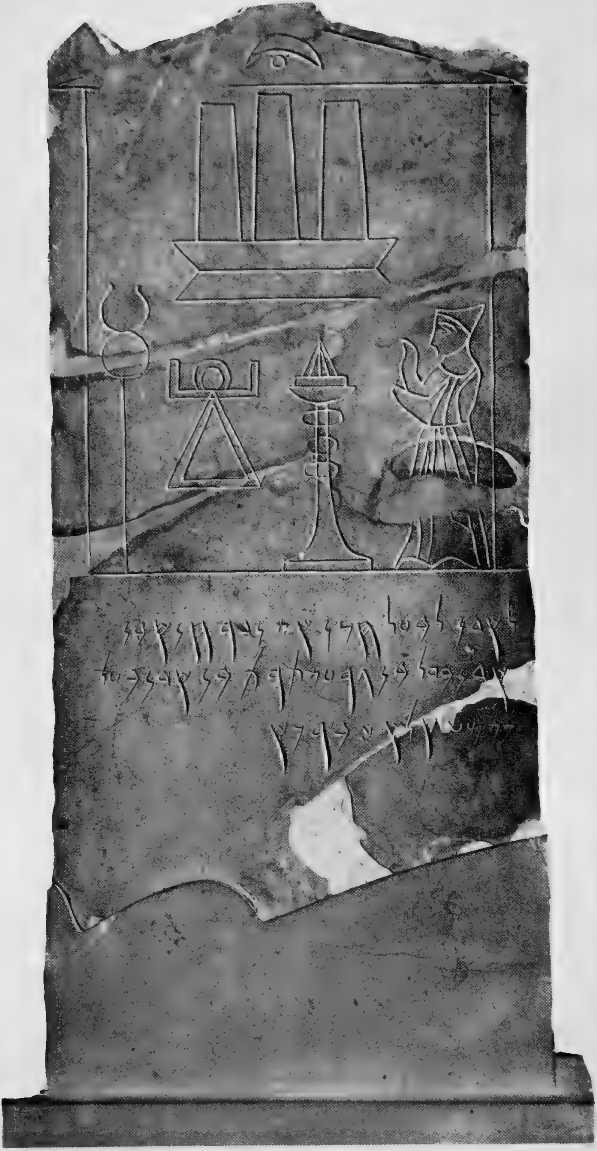
Plate II

Plate III


Plate IV
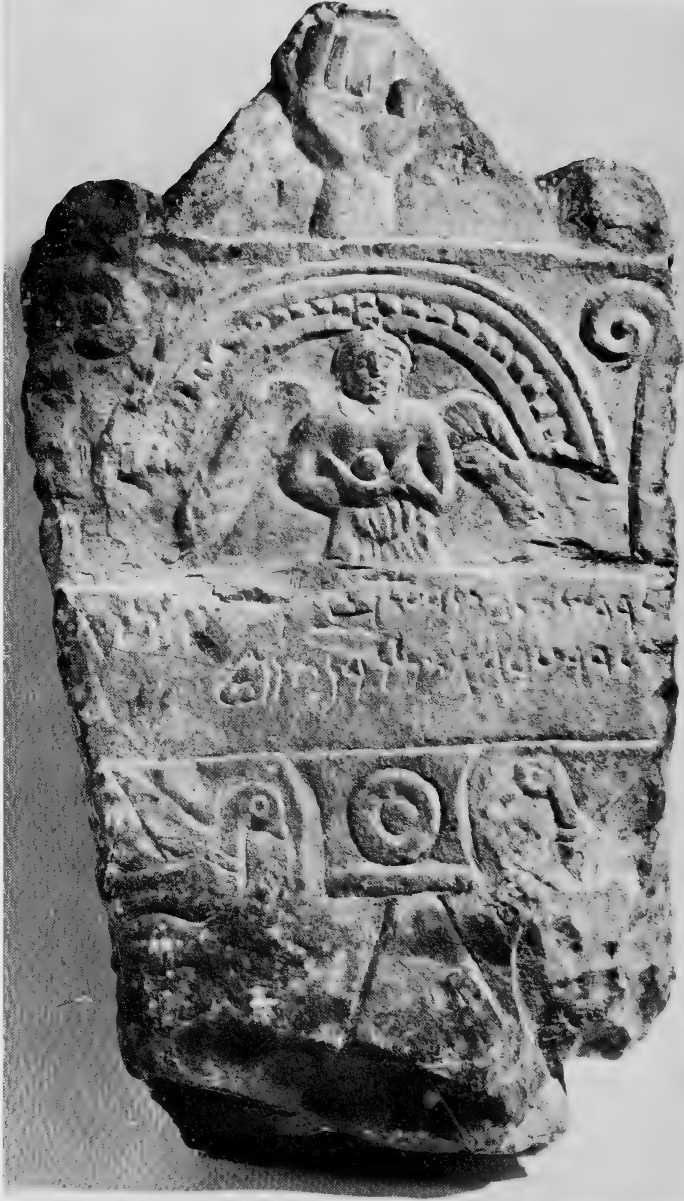
Plate V

Plate VI
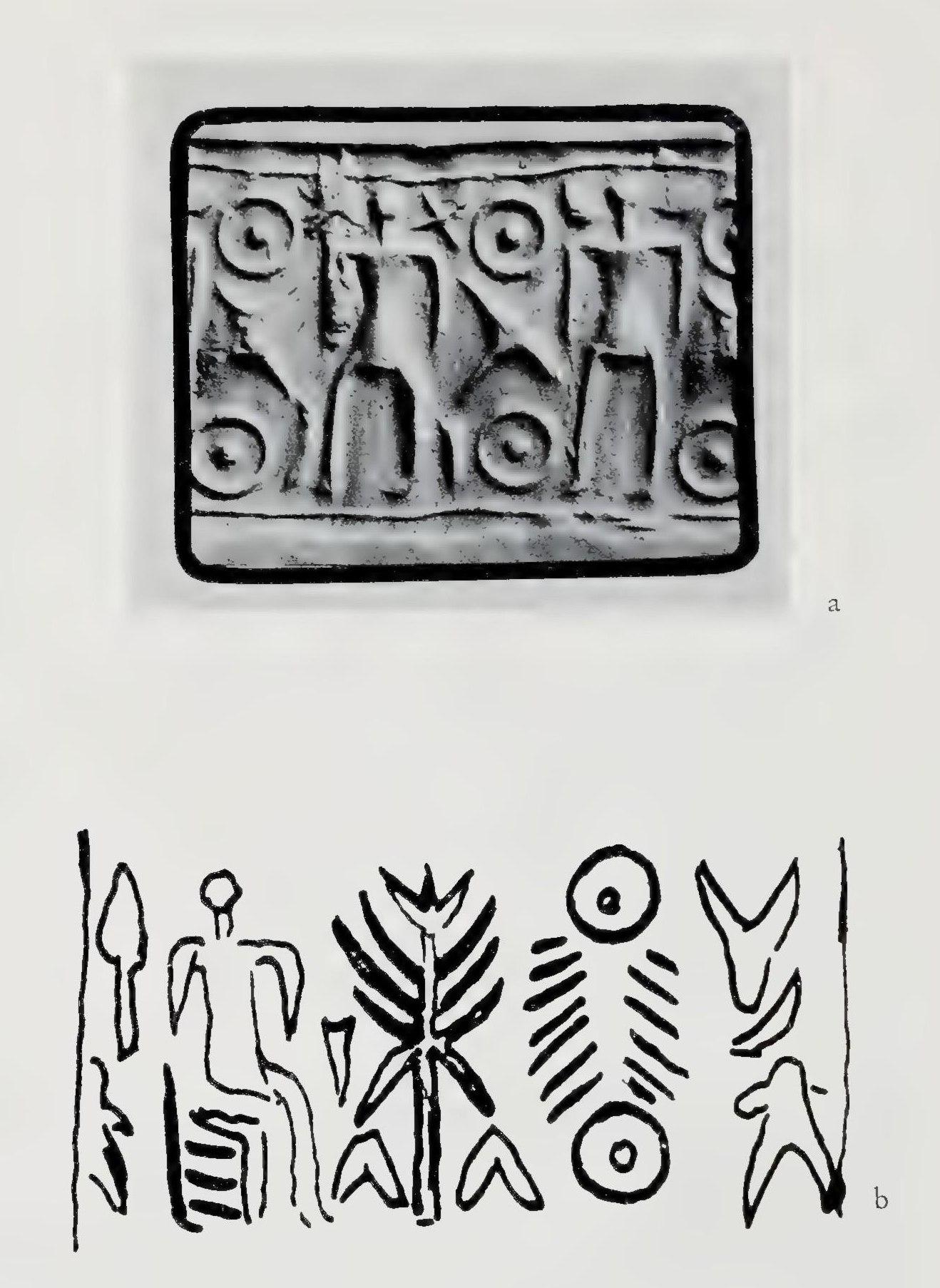
Plate VII

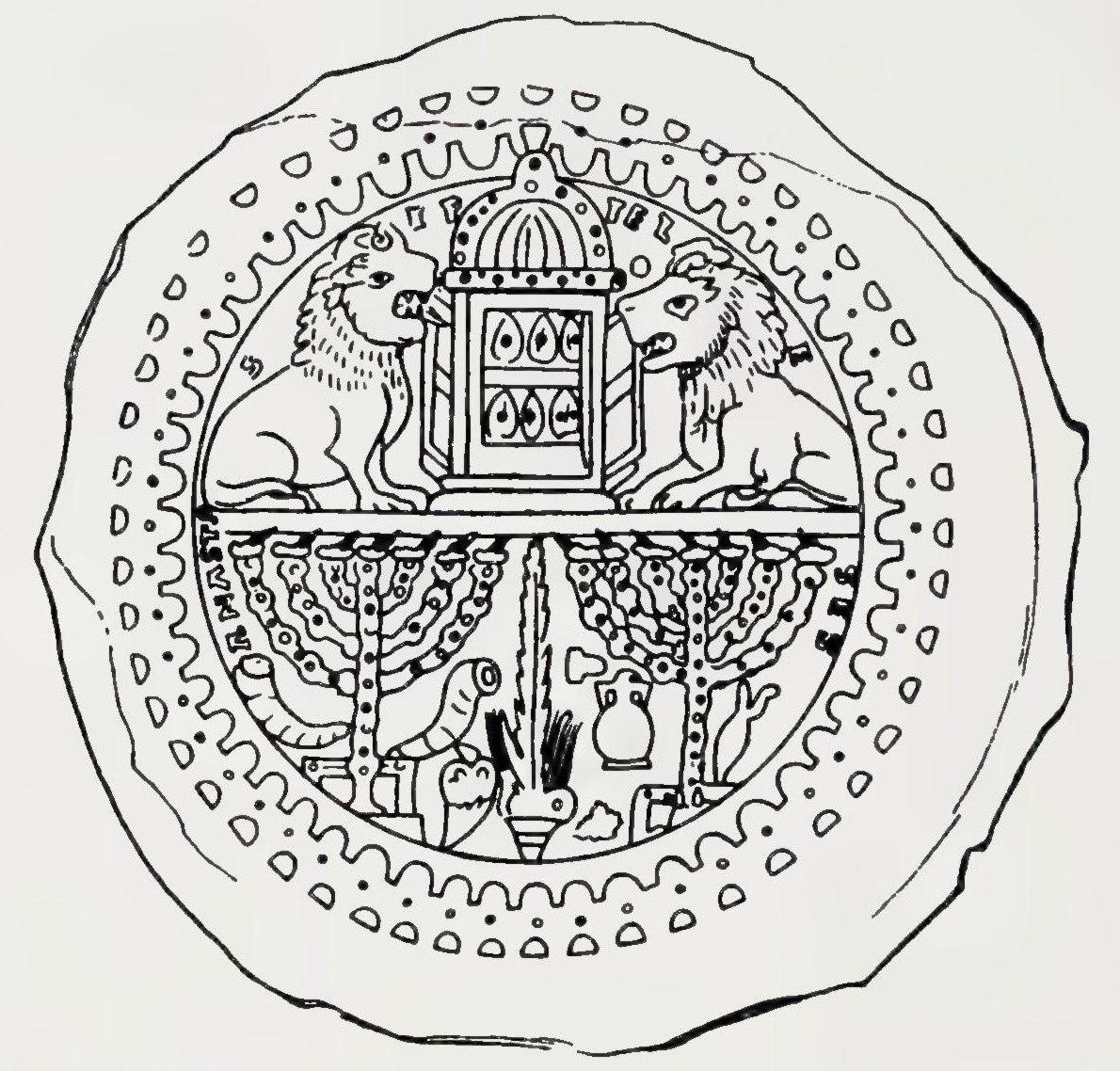
Plate VIII
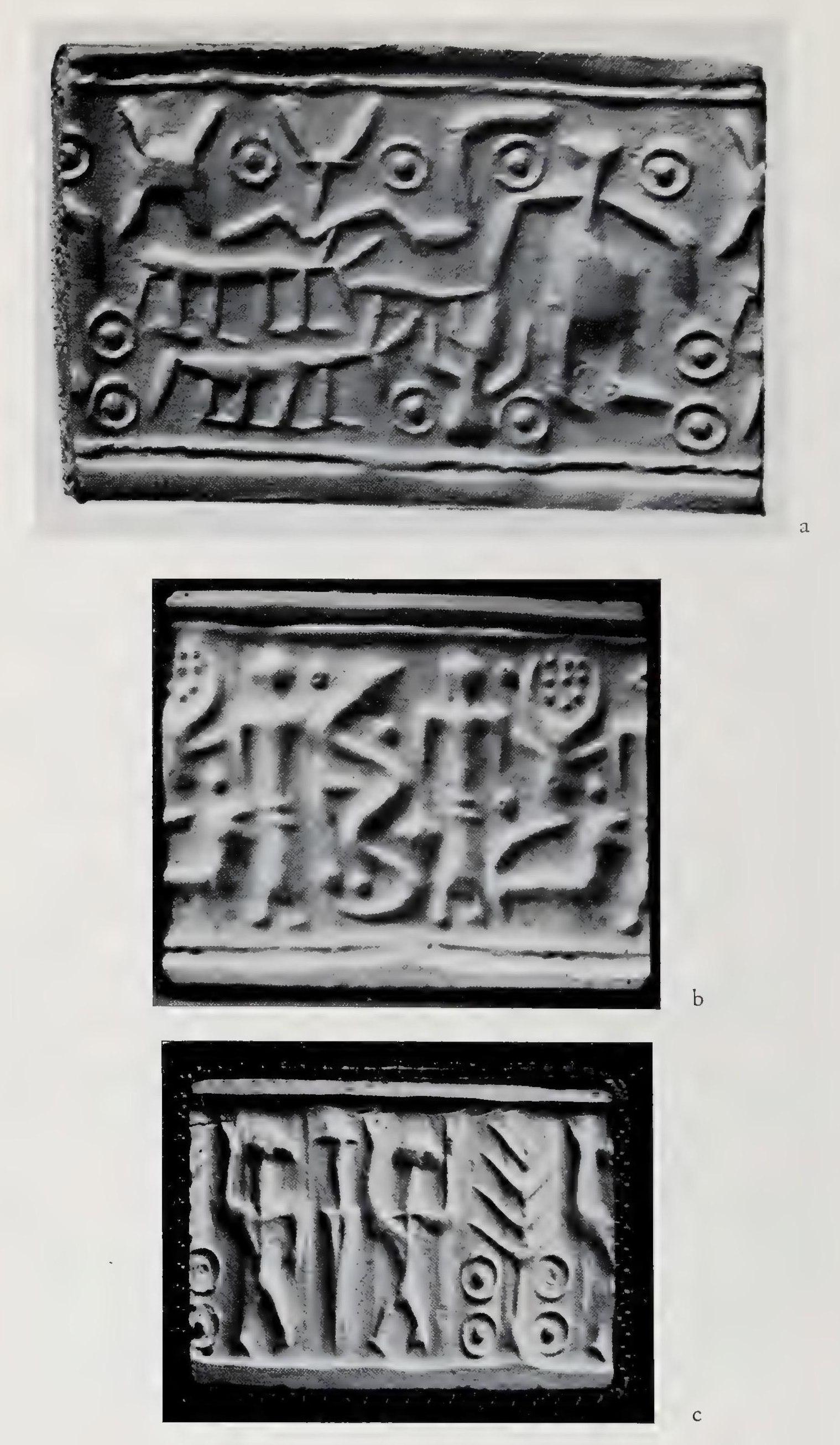
Plate IX
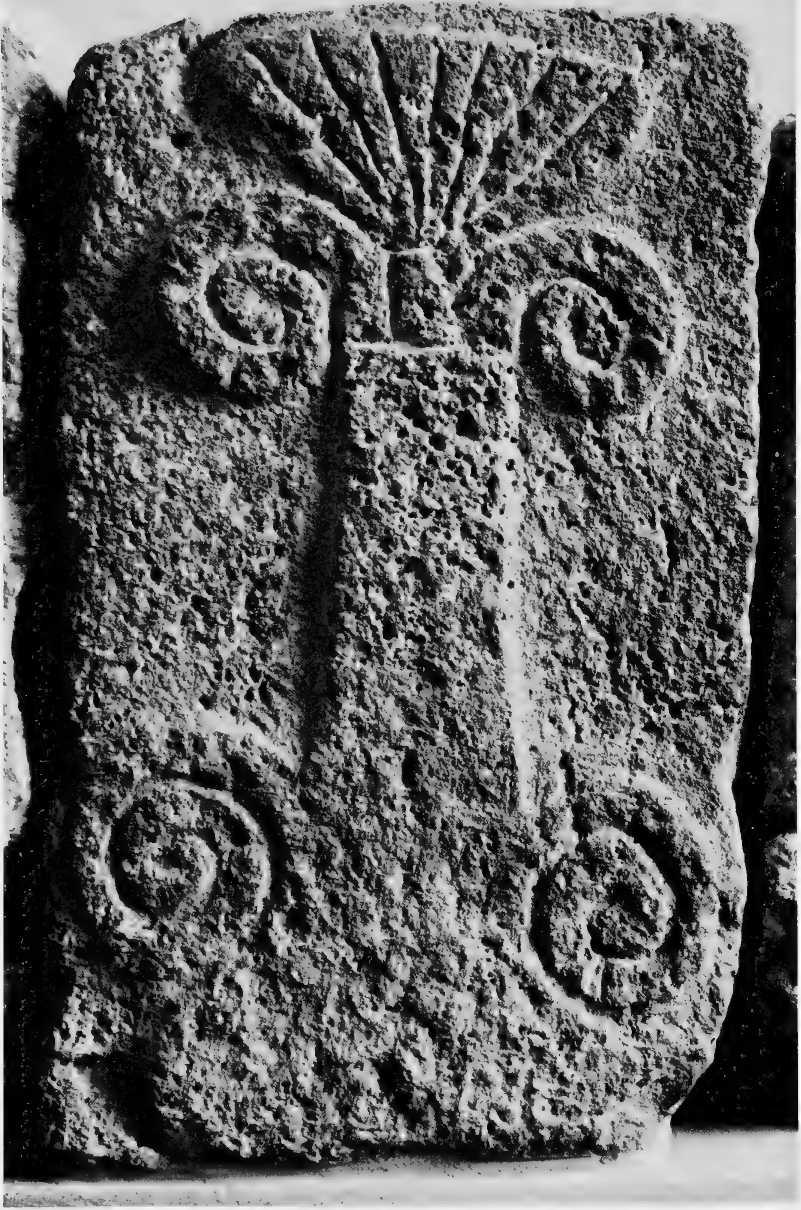
Plate X
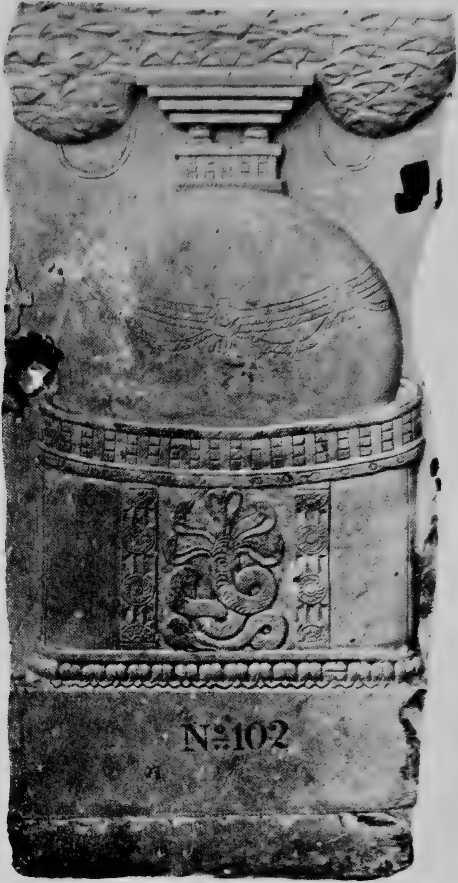
Plate XI
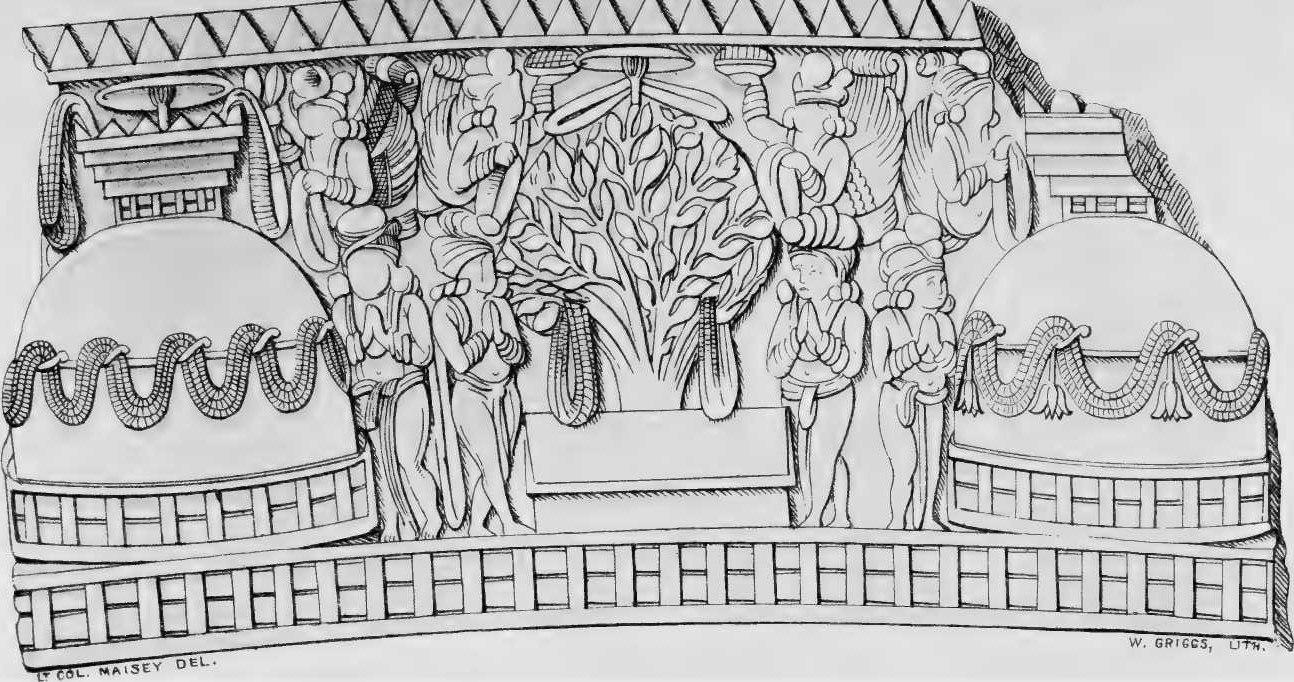
Plate XII
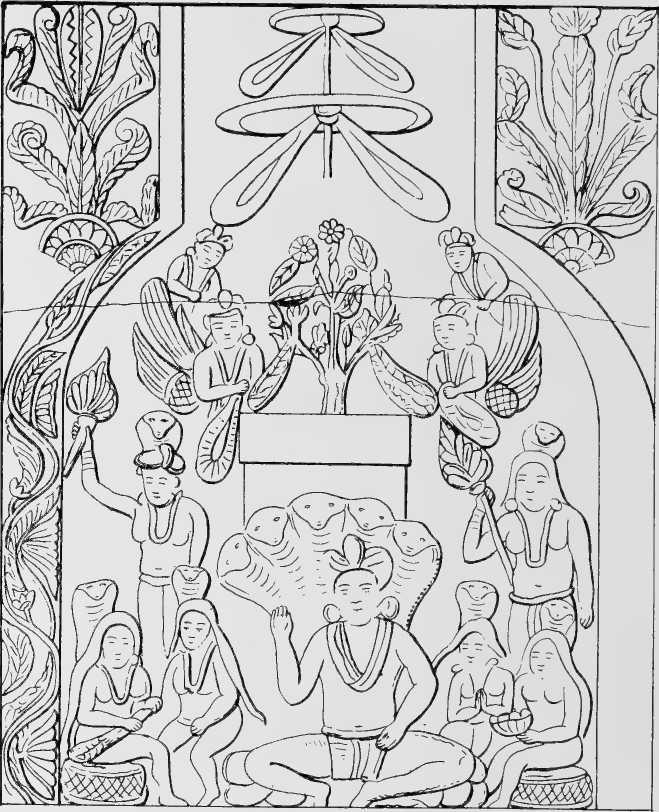
Plate XIII
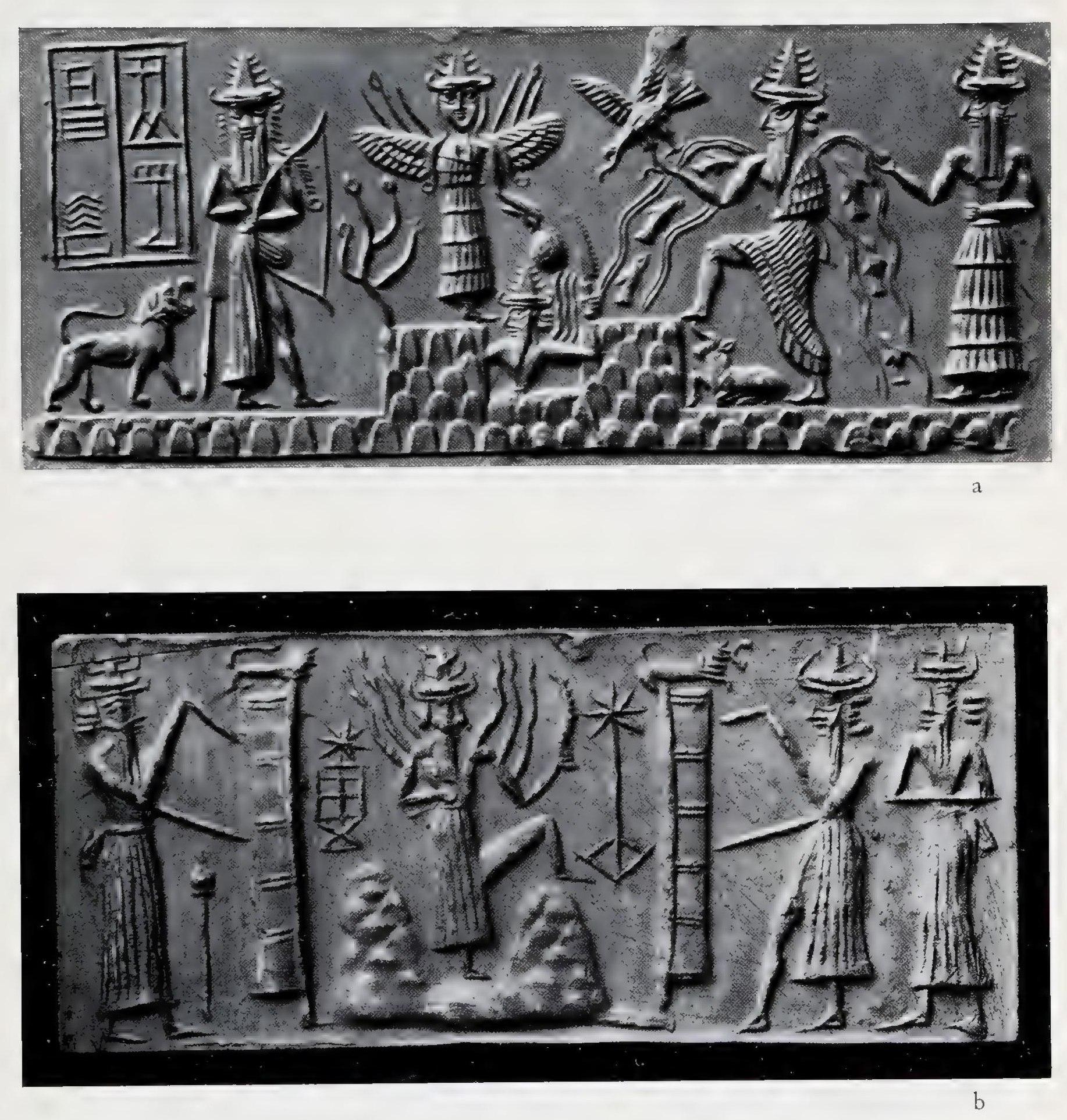
Plate XIV
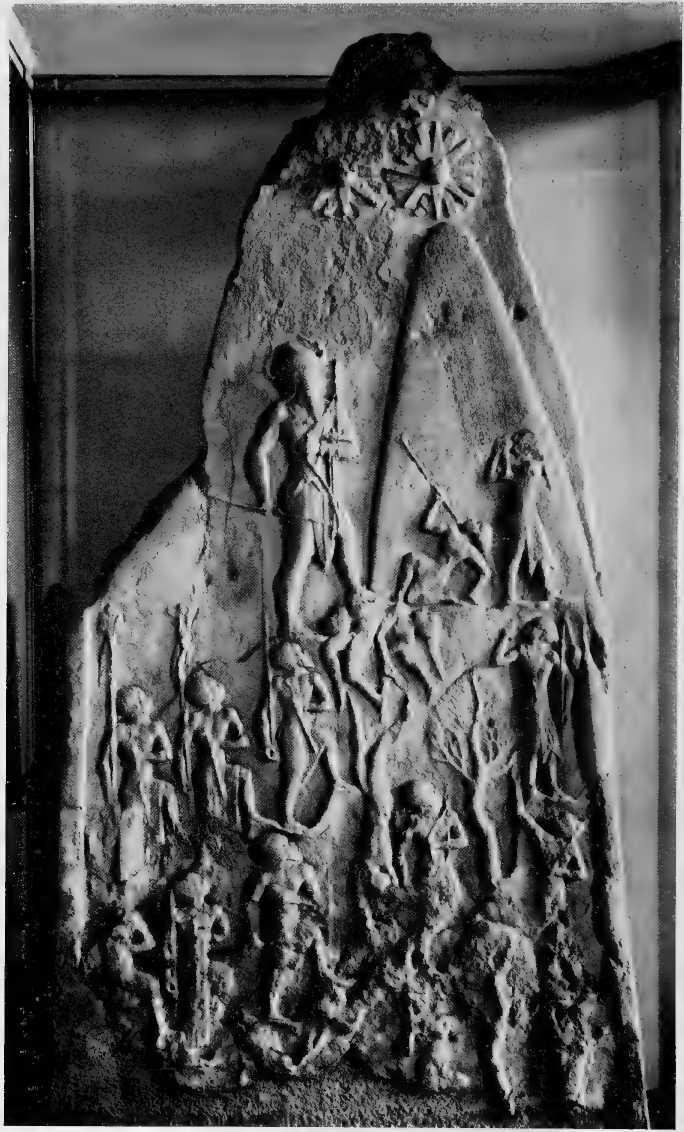
Plate XV
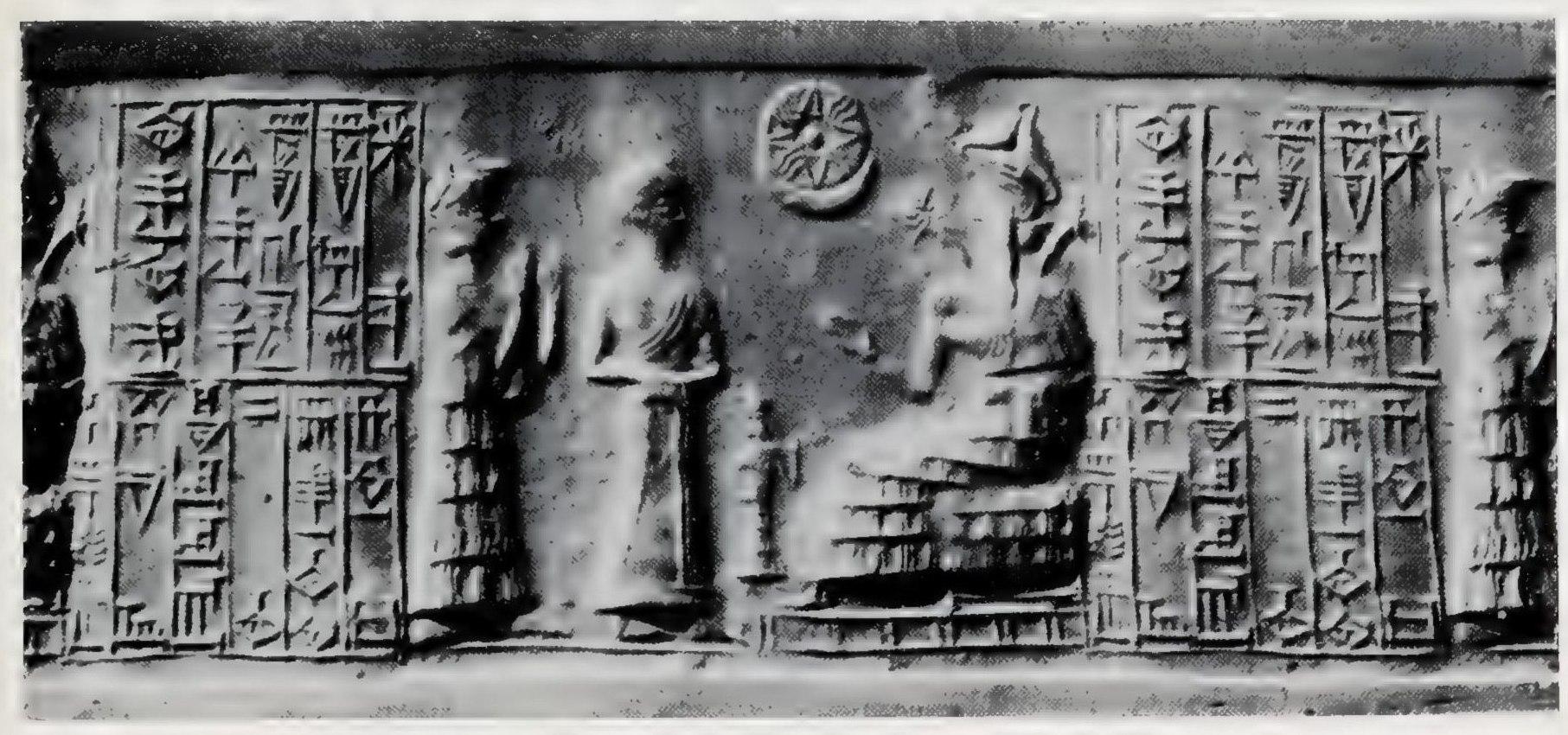
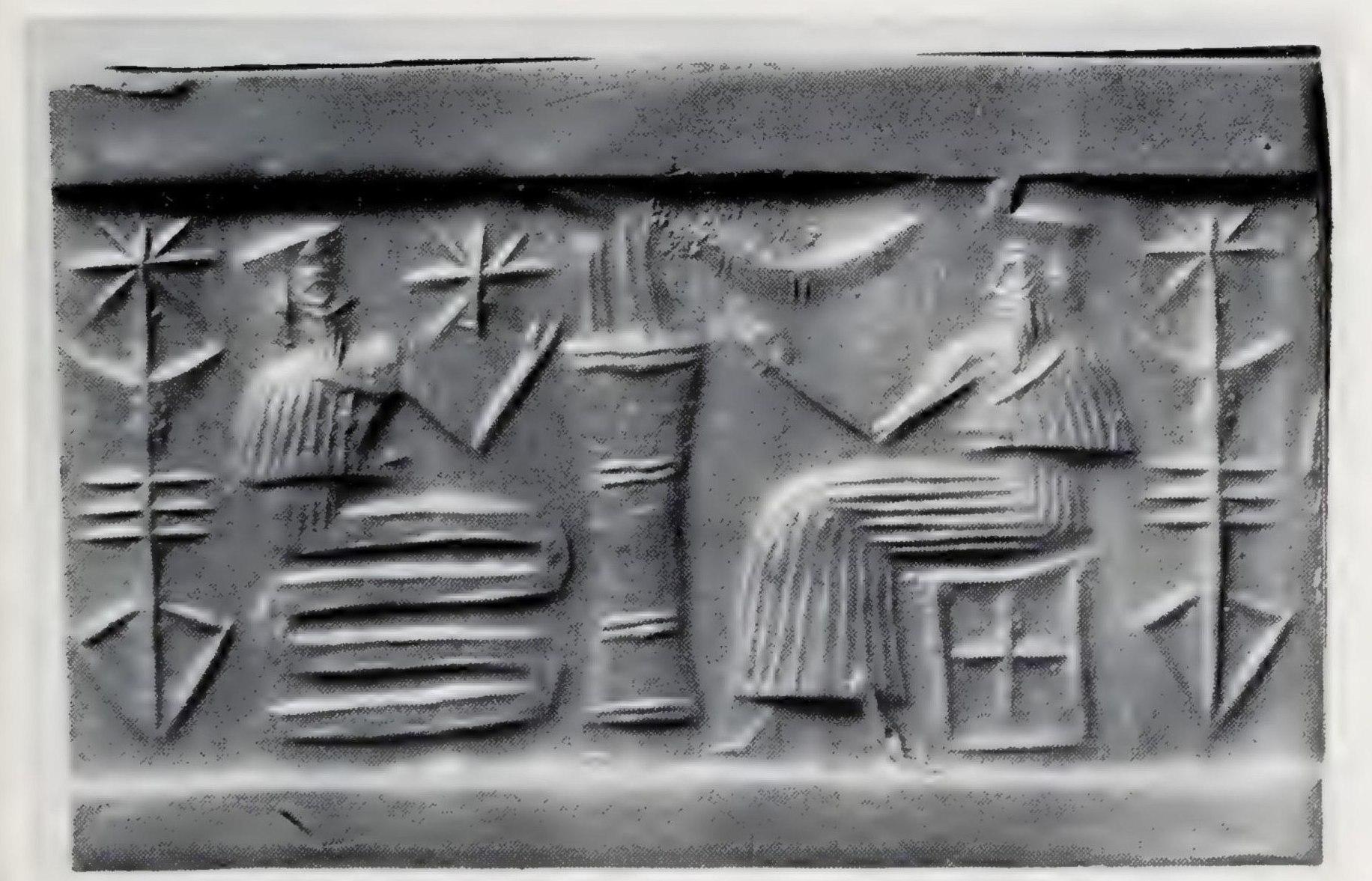
Plate XVI
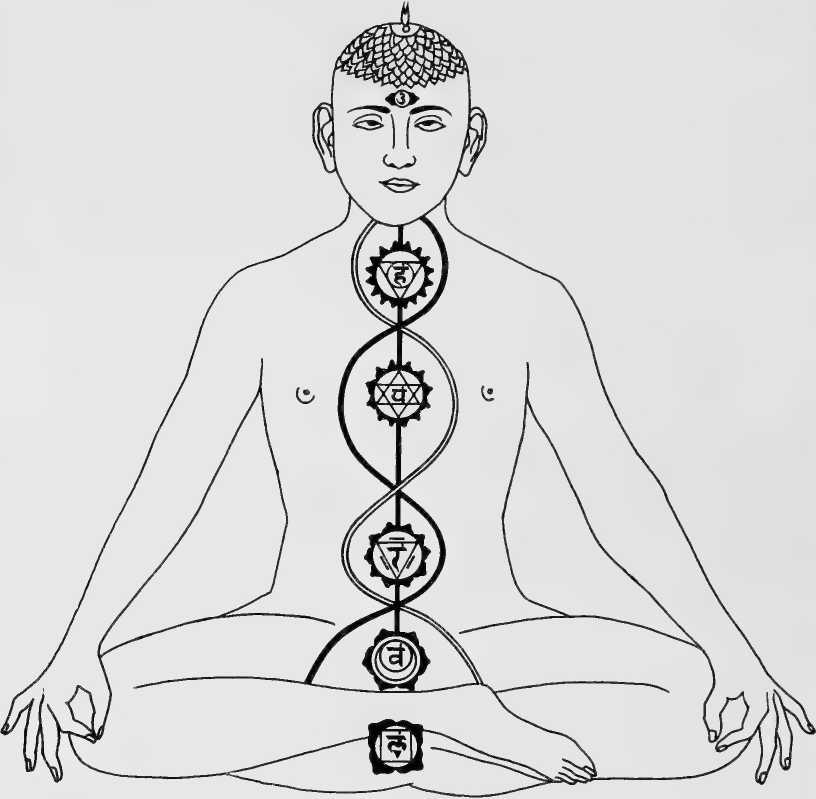
Plate XVII
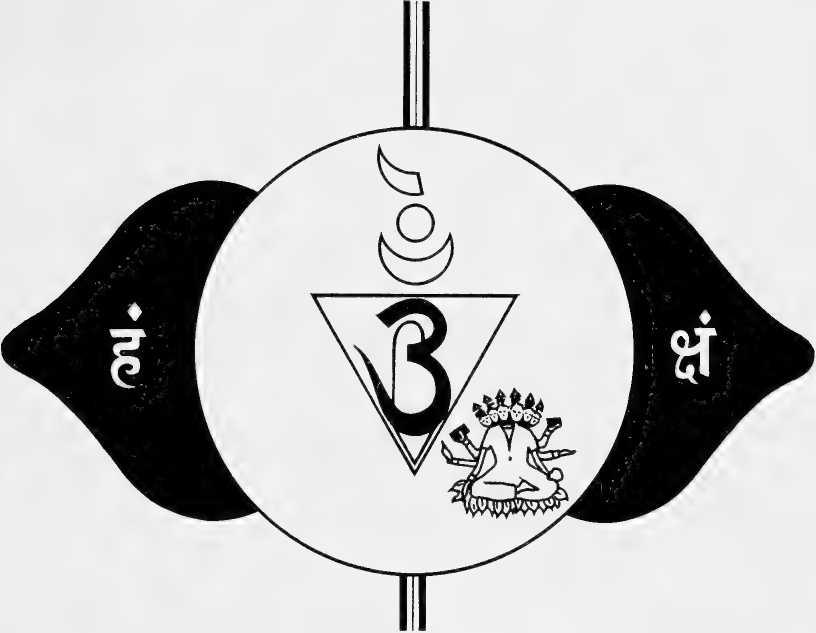
Plate XVIII
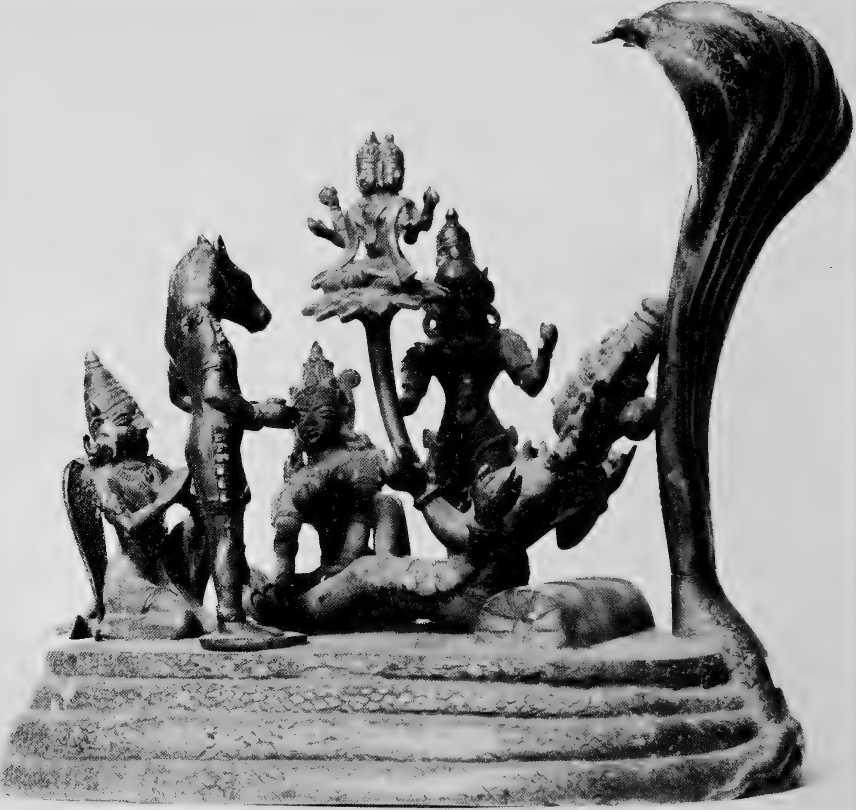
Plate XIX
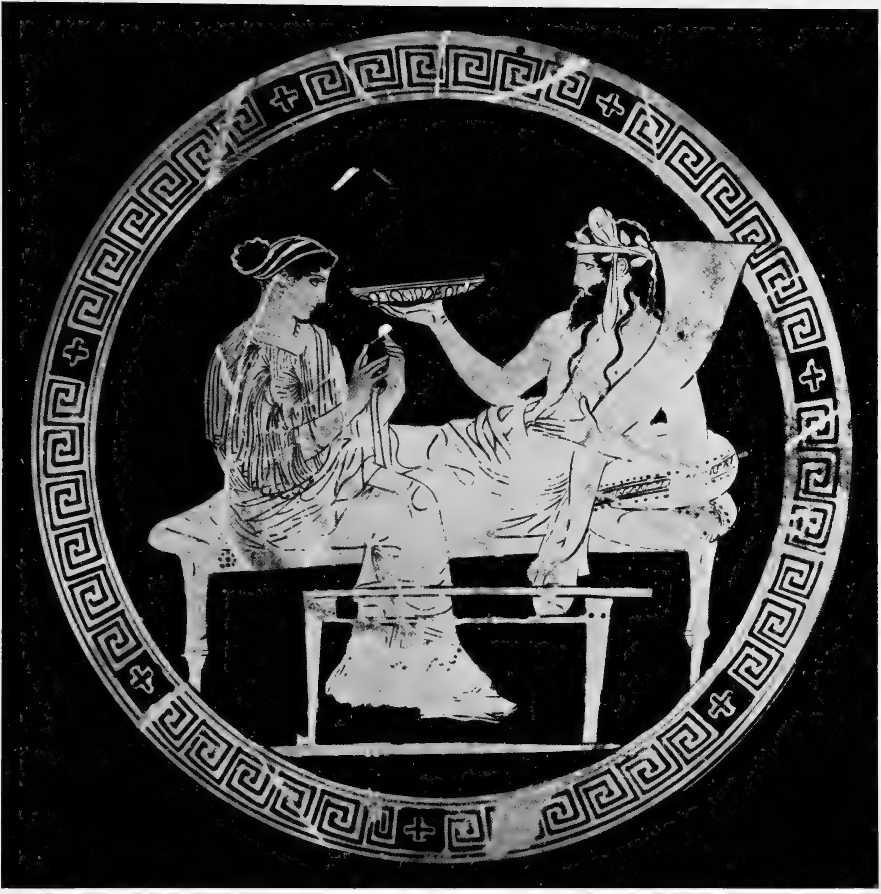
Plate XX
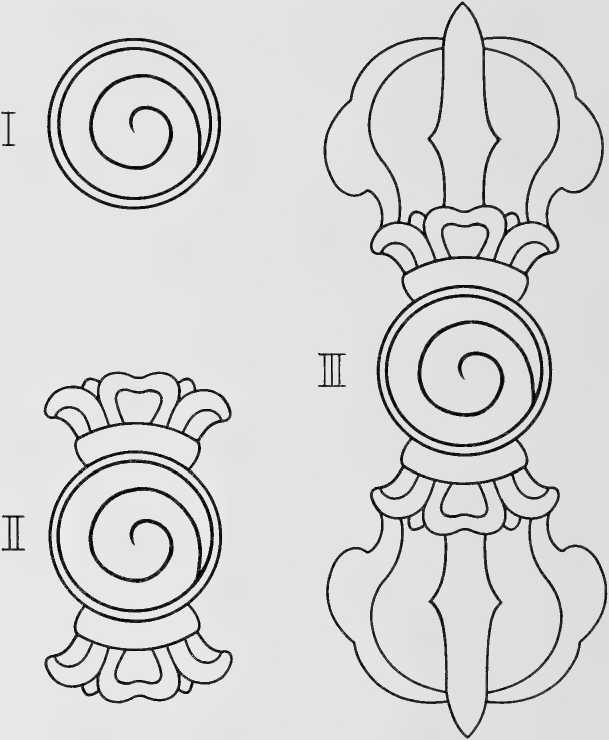
Plate XXI
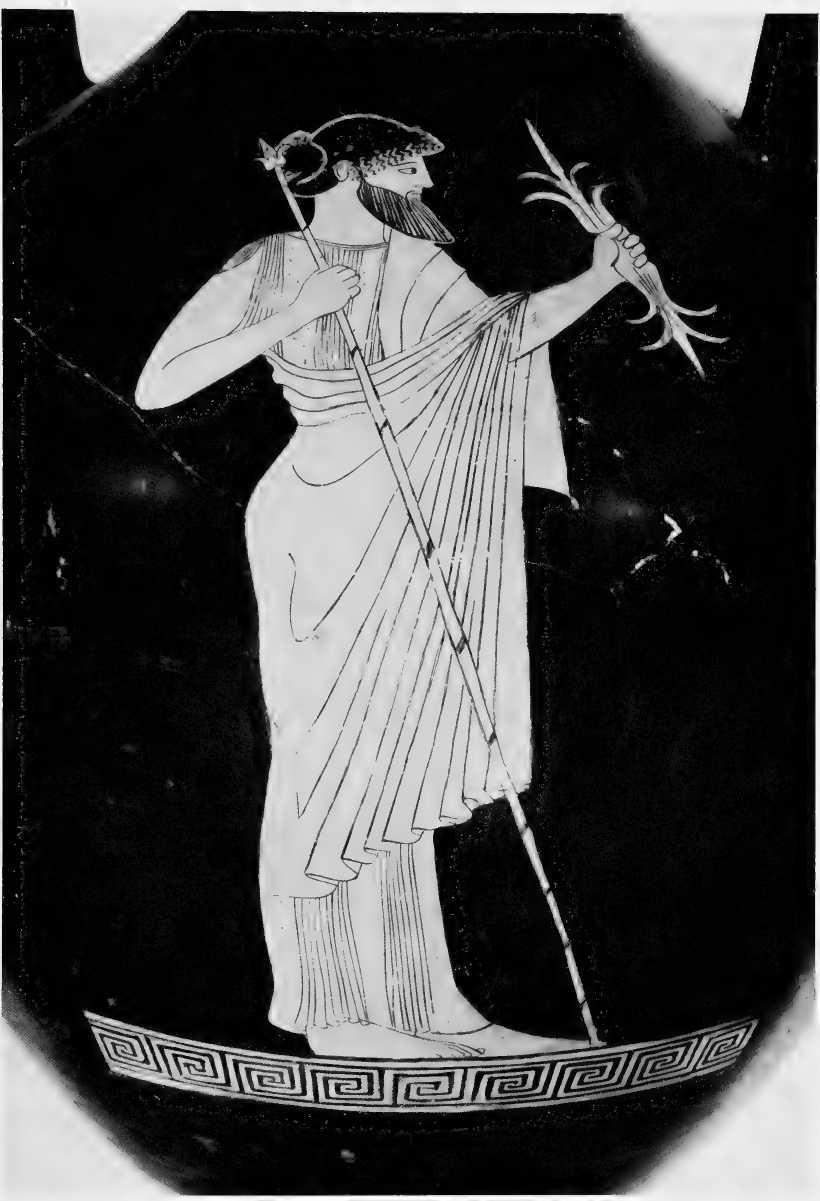
Plate XXII
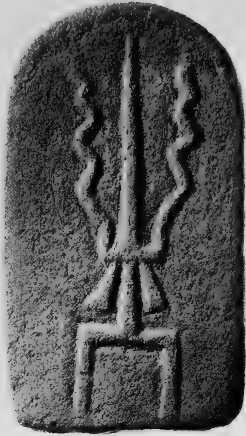
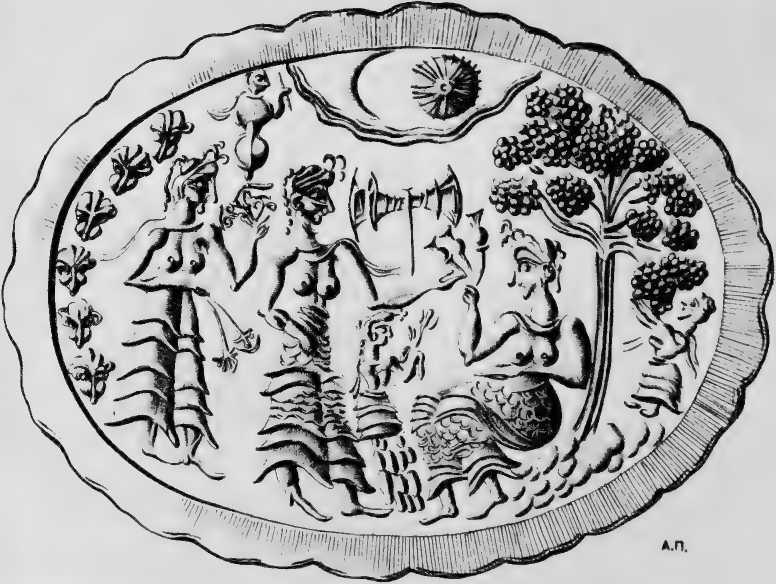
Plate XXIII
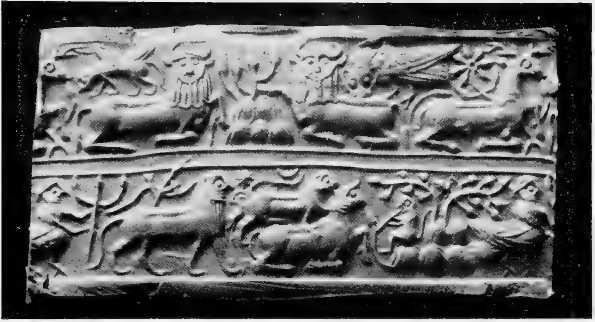
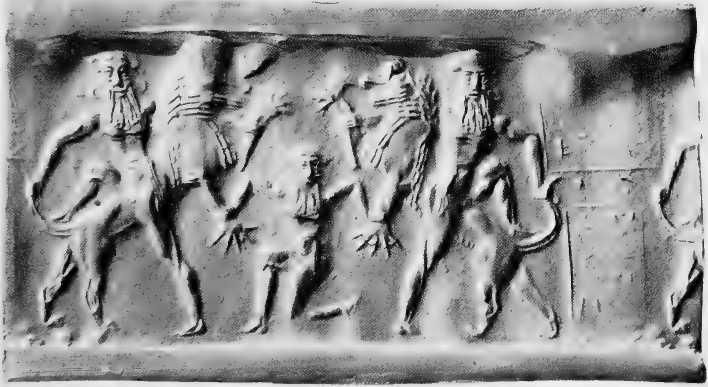
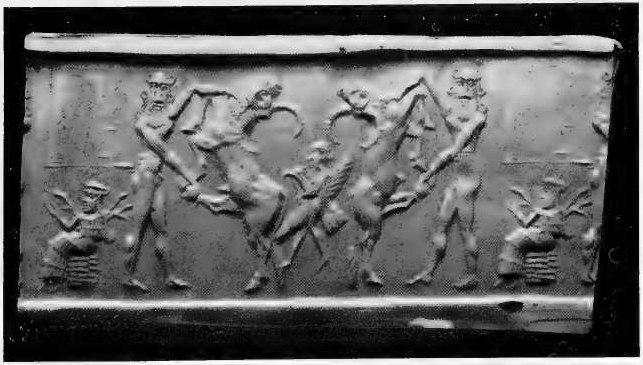
Plate XXIV
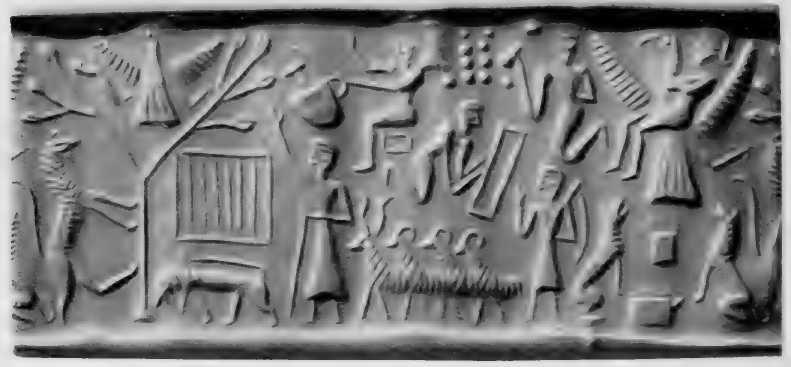
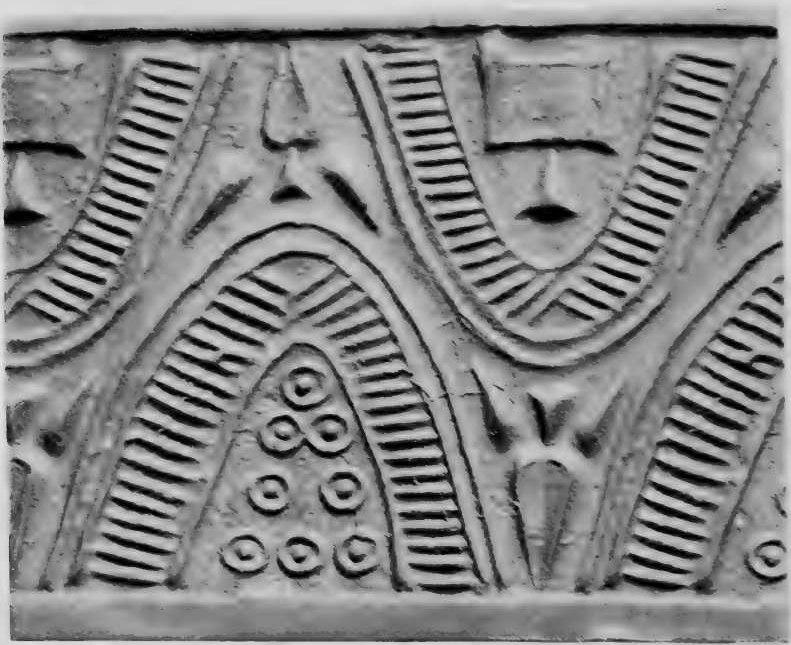
Plate XXV

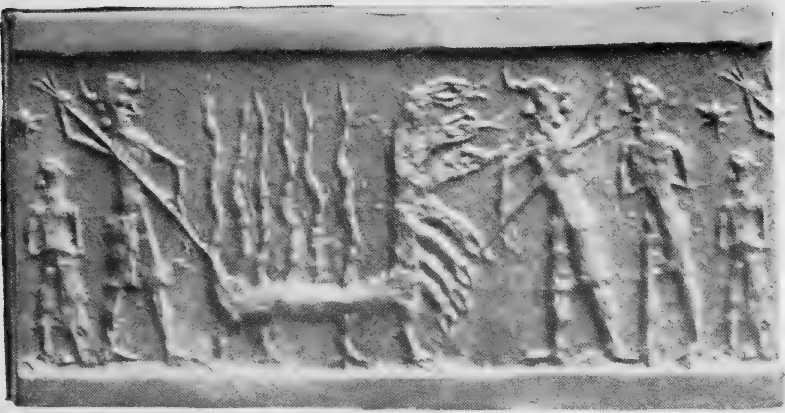
PLate XXVI
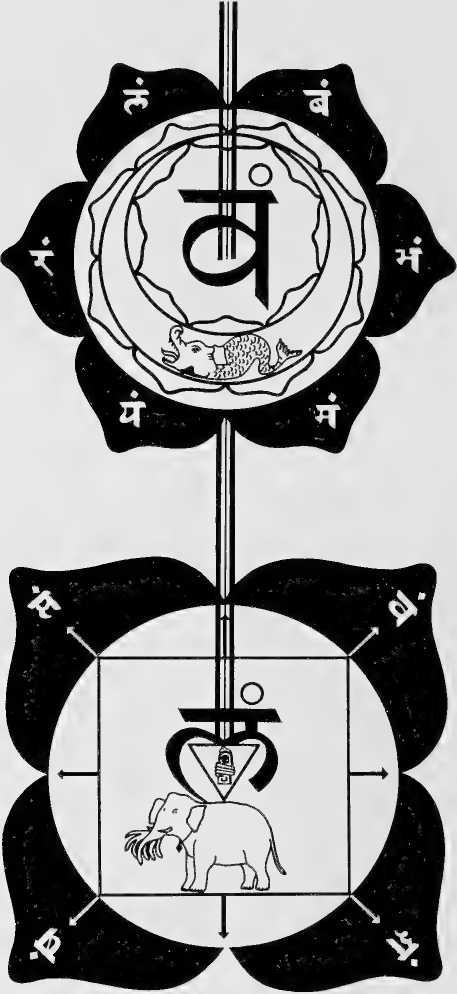
Plate XXVII
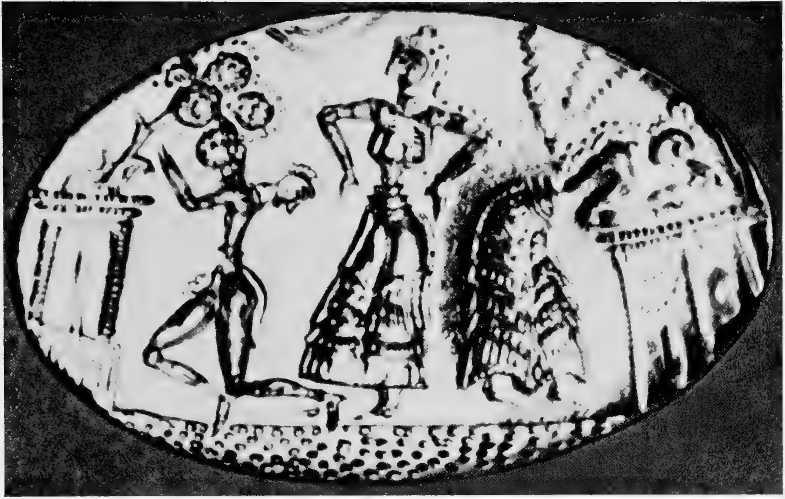
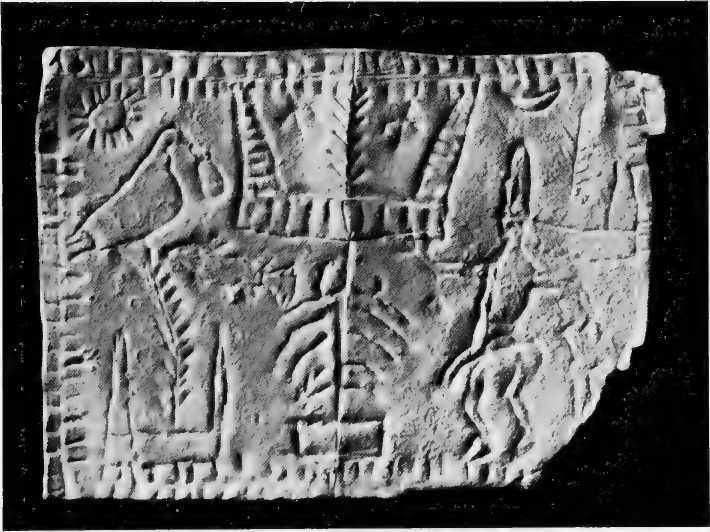
Plate XXVIII
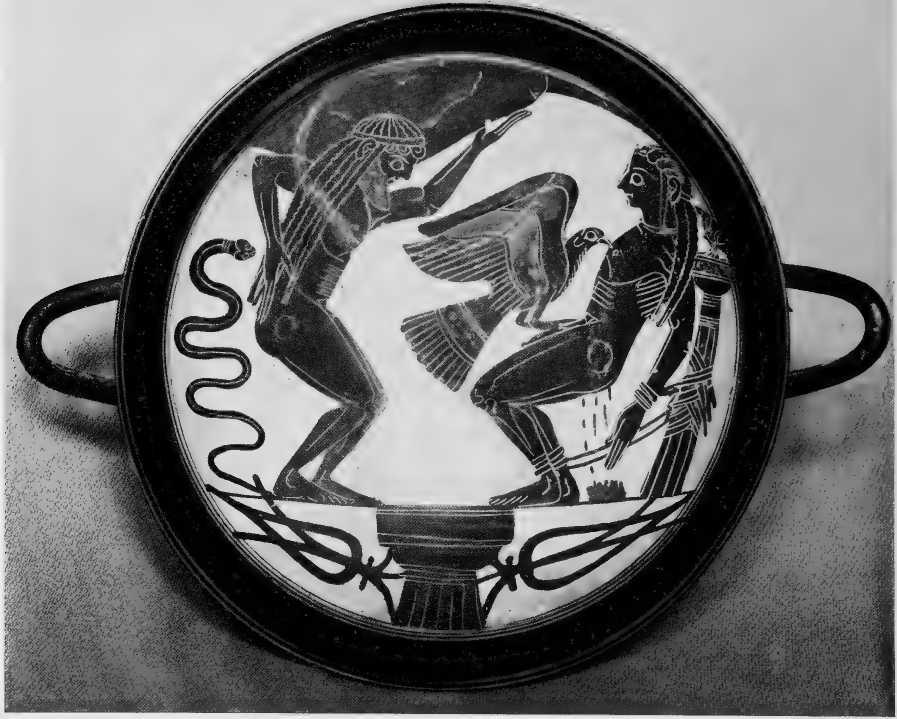
Plate XXIX
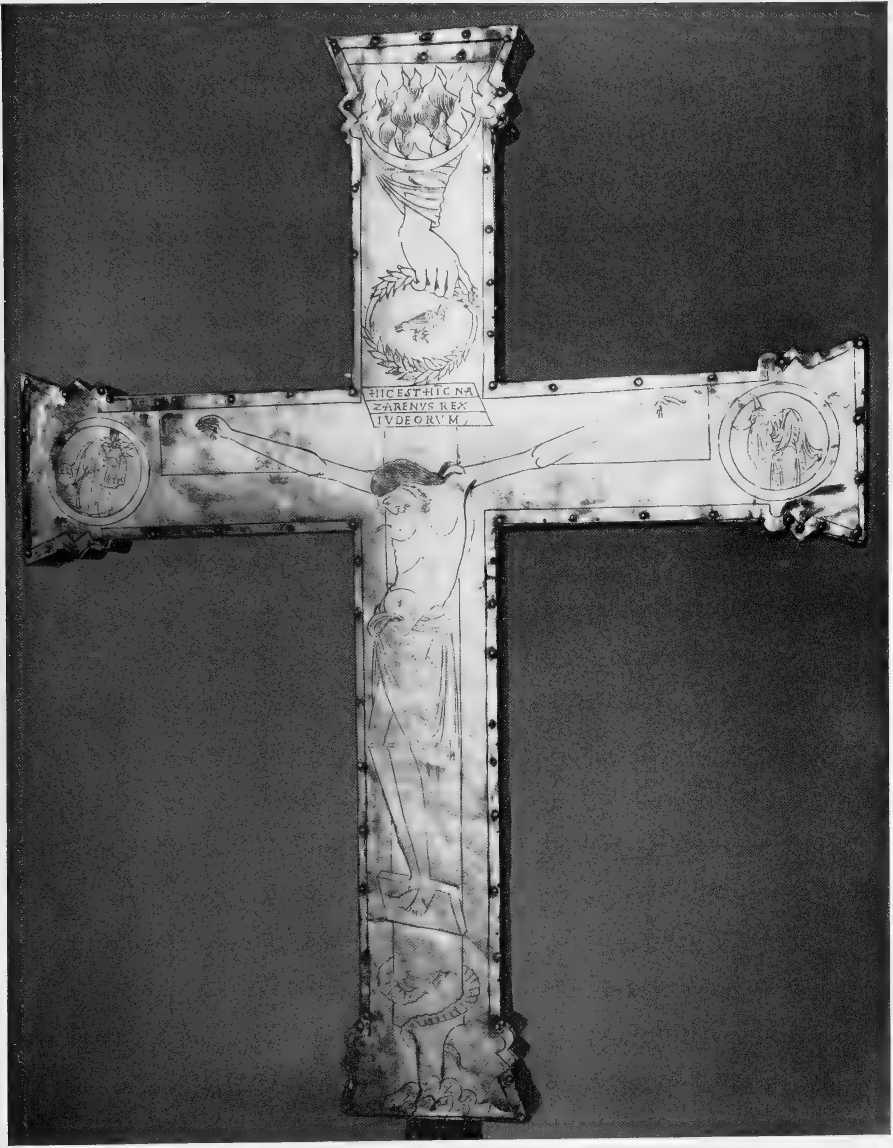
Plate XXX
Detail from the arms of the Lotharkreuz:
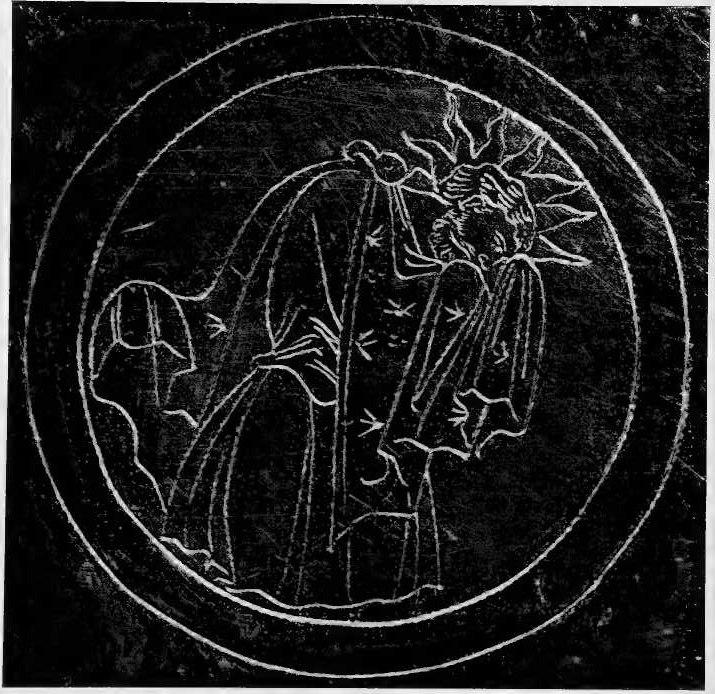
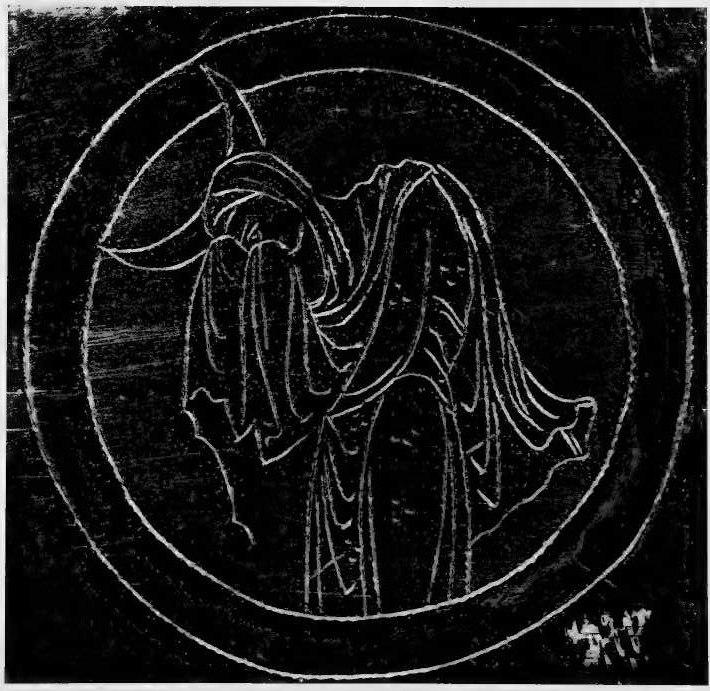
Plate XXXI
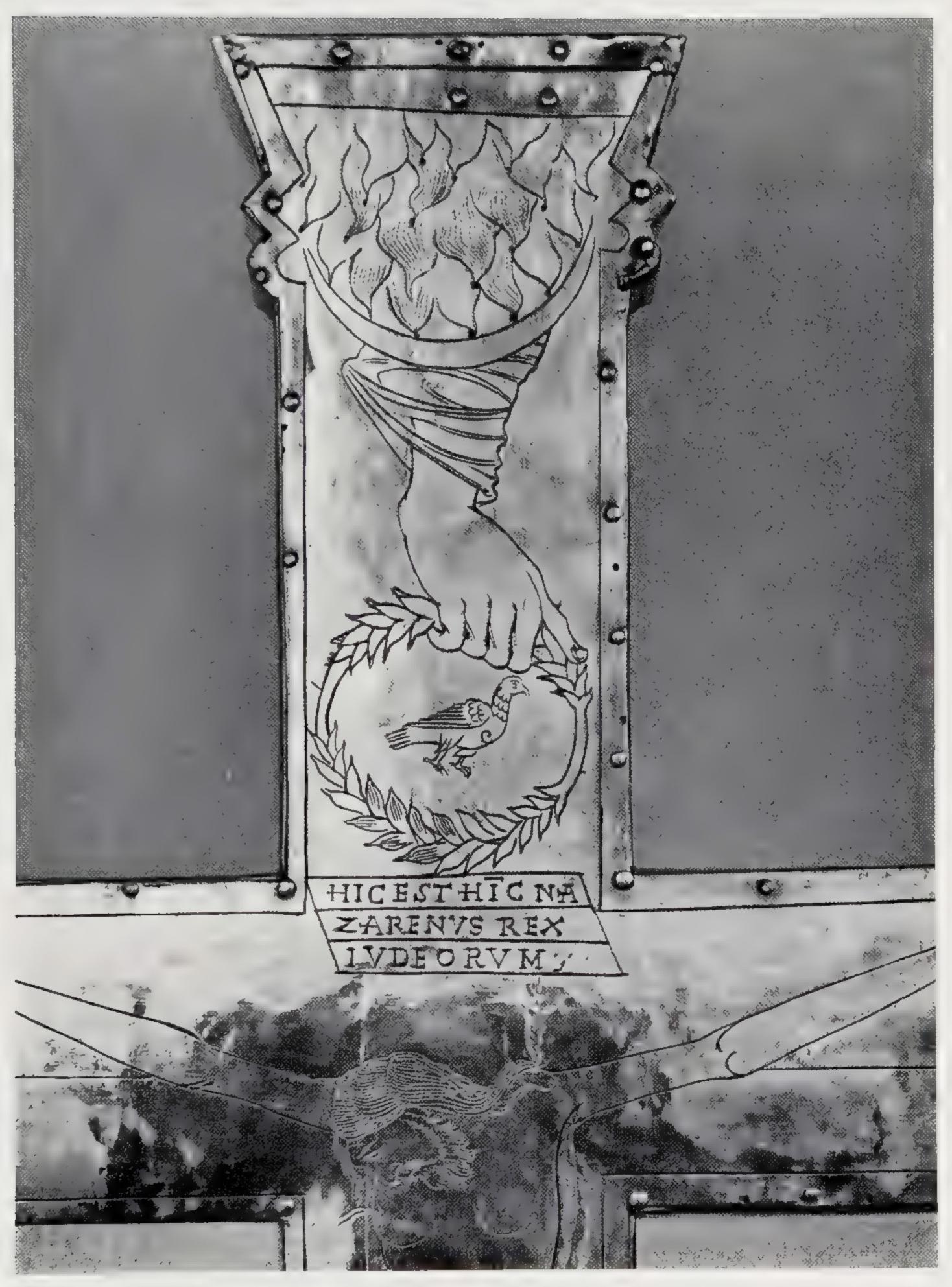
[1] Uno Holmberg (Uno Harva), Der Baum des Lebens (Helsingfors, 1922) (hereinafter referred to as B. d. L.), pp. 57 if.
[2] B. d. L., p. 6.
[3] B. d. L., pp. 51 f.
[4] Schamanengeschichten aus Sibirien, transl. from the Russian by A. Friedridi and G. Buddruss (Otto Wilhelm Barth-Verlag, Miindien-Planegg, 1955) (hereinafter referred to as Schamanengeschichten), p. 156 (Ksenofontov).
[5] B. d. L., pp. 43 f.
[6] B. d. L., p. 44.
[7] B. d. L., p. 49.
[8] B. d. L., p. 9.
[9] B. d. L., p. 2.
[10] Le Chamanisme et les techniques archaiques de I’extase (Paris 1951), p. 244.
[11] B. d. L., pp. 15 f. with Figs. 5 and 6.
[12] On the World Tree in its connections with shamanism, see Eliade, op. cit., pp. 51 ff., 160 ff., 179 ff., 244 ff., 255 ff. For tree, hill and lake together as the scene of the birth of (twin) shamans, see Schamanengeschidnen, p. 108 (Ksenofontov).
[13] B. d. L., p. 28.
[14] For a detailed account of the initiation of the Buryat shaman, see Eliade, op. cit., pp. 116 if.
[15] B. d. L., p. 30.
[16] B. d. L., pp. 30 f.
[17] B. d. L., pp. 21 f. Unfortunately, I have not had access to R. Eisler, Weltenmantel und Himmelszelt.
[18] P. 44.
[19] Op. tit., pp. 419–23.
[20] B. d. L., p. 46.
[21] 5. d. L., p. 12.
[22] B. d. L., p. 76.
[23] B. d. L., p. 78.
[24] See for instance, Schamanengeschichten, p. 156. To the bird Garuda in Indian legend we shall return in Chapter VIII.
[25] B. d. L., p. 80.
[26] Subala Upanisad, VI and VII.
[27] B. d. L., p. 73.
[28] Od. 1.50 ff.
[29] Od. 5.57 ff. It is not expressly stated that the streams rise at the mouth of the cave, but from the context this seems to be the obvious meaning.
[30] B.d.L., p. 58.
[31] B.d.L., 105.
[32] On a black-figured lekythos with a white ground: Journal of Hellenic Studies, XIX (1892–3), E. Sellers, ‘Three Attic Lekythoi from Eretria.’
[33] In Some Traces of the Pre-Olympian World in Greek Literature and Myth (Berlin, 1966), Chapter IV. See, for the connection of shamanism with the World Tree, footnote 12 above. Nevertheless, I am now strongly inclined to see in Tantalus’ and his associates’ practice of ‘dining with the gods’, when this is connected with a sun overhead, a reference to the practice of a form of yoga. Ground for this will appear in later chapters.
[34] The description is taken from Hyginus. Apollodorus, Epit. 2.1., speaks of trees growing on either side of Tantalus, the branches hanging over either shoulder until the winds carried them up to the clouds, out of his reach. This is another form of the same conception: the pillar may be double, the mountain have two peaks, there may be two trees. We shall take notice of this double and symmetrical form of the symbols in Chapter III. Homer, Od. 11.582 if., speaks of fruit-bearing trees of many kinds. We have seen that the tree might in some legends become a grove or forest.
[35] Diels, Frag. d. Vorsokr., Anaxagoras, A. 20 a=Schol. Pind. Ol. 1.97.
[36] Zeus, II, pp. 36 ff.: ‘Zeus and the Sky Pillar.’
[37] B. d. L., pp. 67 f.
[38] B. d. L., pp. 68 f.
[39] The elements of the story are of course very much older than the composition of Genesis. In Sumerian myth man is made by a god and a goddess out of clay, for the service of the gods.
[40] Although in Gen. 2,9 and 3,22 two trees are spoken of, this may have arisen from the necessities of the revised story. In 3,3 there is simply ‘the tree which is in the midst of the garden’, no other tree being mentioned. In 2.9 it is ‘the tree of life’ which is ‘in the midst of the garden’, to which is added ‘and the tree of knowledge of good and evil’. It is apparently because Adam, having eaten, did not live for ever (3,22) that the author of these passages felt obliged to make two trees, one of knowledge and one of life. Nevertheless, there is another possibility, for which see Chapter III.
[41] W. H. Rosier, Omphalosstudien (Leipzig, 1913), p. 27, quotes Μ. I. Berdyczewski as saying that Rabbinic and mystical Jewish literature as a whole is soaked in the.idea of the navel of the earth; ‘Not only is Jerusalem and the site of the Temple the middle point or navel of the world: the whole creation issued from this place.’ (My italics).
[42] See the beginning of this chapter.
[43] B. d. L., pp. 67 f.
[44] Arpag Mekhitarian, Aegyptische Malerie (Geneva, 1954), p. 38.
[45] B. d. L., p. 66.
[46] B. d. L., p. 81.
[47] The other belief, if we may so term it, to which the idea of a Creator God is opposed, will appear later.
[48] Jeremiah, 2,2Q.
[49] Jeremiah, 3,6.
[50] Isaiah 14,12–14. The italics are mine.
[51] 31,3 ff.
[52] 17,3 ff.
[53] Daniel, 4,10–12. On the ancient Mesopotamian king as himself the tree or plant of life, see Geo Widengren, The King and the Tree of Life in Ancient Near Eastern Religion (King and Saviour IV) (Uppsala Universitets Arsskrift, 1951:4), especially pp. 42 ff. and 56 If.
[54] The second eagle and second vine seem to be a duplication.
[55] 8, vv. 5,6.
[56] In The Journal of Hellenic Studies, XXI (1901).
[57] Ibid., pp. 106 f.
[58] See Μ. P. Nilsson, The Minoan-Mycenaean Religion (2nd. Ed., Lund, 1950), pp. 258 f. It must be remembered that Nilsson’s criticisms relate to the evidence within the Minoan-Mycenaean world only.
[59] Op. cit., p. 127.
[60] Ibid., p. 126.
[61] Pans., 8.38.5.
[62] Paus., 8.48.4.
[63] Genesis, 28, 18.
[64] Joshua, 24, 26 and 27.
[65] Samuel, 5, 24.
[66] Judges, 6,11.
[67] Exodus, 3,1 fi.
[68] Loc.cit., p. 134.
[69] Ibid., pp. 138 f.
[70] Genesis, 18.
[71] Genesis, 19, 1. Cf. also the appearance of ‘Moses’ and ‘Elias’ with Christ upon the mountain at the Transfiguration, and Peter’s proposal that three tabernacles should be built for them, Luke, 9, 28 ff., and the two angels at the empty tomb, 24,4.
[72] Evans, loc. cit., p. 139, and Fig. 27, p. 144.
[73] Evans, loc. cit., pp. 140 f.
[74] Ibid., p. 142.
[75] Ibid., pp. 154 ff. See below, p. 130.
[76] 7 Kings, 7,15 ff. Cf. Jeremiah, 51, 21 ff.
[77] See Helene Danthine, Le Palmier-Dattier et les Arbres Sacres dans I’iconographie de l’Asie occidentale ancienne (Paris, 1937), pp. 181 f., for the distinction between lotus and lily in design. Both seem to be of Egyptian origin.
[78] Evans, loc. cit., p. 143.
[79] Ibid., p. 149, fig. 28.
[80] The palmette is less suggestive of radiance than the examples which Evans has in mind. See, for such examples, H. Danthine, op. cit., Pls. 161,162, 174,179,185.
[81] Ibid., pp. 150 f.
[82] Evans argues that the pillars in cult scenes from Aegean countries are connected with solar divinities, finding confirmation of this in a Cretan seal (p. 161, fig. 41) showing a ‘baetylic’ table of offering, i.e., one with a stout central pillar with slender columns nearer the edge of the table. Two lions stand, one on eadi side, with their forelegs on the table. Above the table of offering and between, and slightly above, the averted lions’ heads, is what Evans takes to be a ‘rayed sun’. This identification as a ‘sun’ seems questionable: the area of the rayed circle is not a plain disc, for it contains another circle, small and concentric. This is not a natural way of representing the sun and there seems to be no reason for the inner ring. What it more closely resembles, when shorn of its rays, is the symbol of the omphalos (with the square base omitted) as it appears on Delphic coins of the fifth century. (See Plate II, top row, left, in this book). This symbol may be of great antiquity; it certainly goes back at least to the second millennium before Christ in the eastern Mediterranean (see below). If Evans is, as we think, right in believing pillar and omphalos to be identical in essence (p. 173), this would cohere particularly well with the rayed pillars, of which examples from Cyprus have already been described. One instance shown by Evans (p. 173, Fig. 49) is surrounded by rays along its entire length, not only at its upper extremity. See also Plate VI (b) in this book. What we have here, then, is possibly not a ‘sun’ but a symbol of the rayed omphalos-pillar above the pillar-based table of offering.
[83] Ibid., p. 169, Fig. 47.
[84] Evans, loc. cit., p. 170, Fig. 48.
[85] These rays might be taken to be floating hair. It is perhaps not irrelevant (in view of what is to be said later) to draw attention to the fact that in certain Indian doctrine matter (Prakrti) is analysed into ‘motion radiating lines of force in all directions, symbolized as the Hairs of Siva’ (A. Avalon [Sir John Woodroffe], The Serpent Power [6th. Ed., Madras, 1958], p. 71).
[86] See Plate III (a) in which a Cypriot coin of imperial Roman times shows, on either side of the cone in the temple of the Paphian Aphrodite, objects which are identified as candelabra by M. Ohnefalsch-Riditer, Kypros, die Bibel und Homer (Berlin, 1893), in the commentary to Pl. CXXXVI, 4 (Text, p. 182). See also ibidem, Pl. LXXXII, 1, 2 and 3, and, for photographs of two such candelabra, Pl. XLIII, 9 and 10. For a candelabrum of a slightly different type, see the stele from Lilybaeum shown on Pl. I of this book. For an example of a rayed pillar, in this case adored by a fantastic beast, see Ohnefalsch-Richter, ibid., Pl. XCIV. The genuineness of this last may be questioned.
[87] Omphalos (Munster, 1959), pp. 35 ff.
[88] See The Minoan-Mycenaean Religion, 2nd. Edition, pp. 236 ff.
[89] Illustrated by F. Chapouthier, Les Dioscures an Service d’une Deesse (Paris 1935), pp. 41 ff., catalogue nos. 20, 21, 22. Chapouthier gives references to Tod and Wace, Catalogue of the Sparta Museum, p. 158, nos. 201, 203, 202, respectively.
[90] Nos. 20 and 21.
[91] H-V. Herrmann, Omphalos (referred to above, footnote 32).
[92] W. H. Roscher, Omphalosstudien (Leipzig, 1913), p. 100, observes that the Delphic omphalos is represented in vase-paintings as low, baseless and almost hemispherical, as a ‘bee-hive’, as a fairly pointed ‘Kegel’ (ninepin), high and standing on a stepped base, or as a great egg, flattened at the lower end, sometimes as rising out of the calyx of a flower.
[93] Omphalosstudien, p. 79.
[94] Especially by an article, ‘Delphika’, in The Journal of Hellenic Studies, XIX (1899).
[95] Illustrated loc. cit., p. 219, Fig. 4.
[96] Cat. no. 765. The gem dates from about the 4th. century B. C. Herrmann mentions it without identification.
[97] It may be objected that Hermes only appears on Ogygia as the messenger of the Olympian gods. In Some Traces of the Pre-Olympian World in Greek Literature and Myth (Berlin, 1966), I have sought to show that the original epics from which our Odyssey was composed were of quite a different character to the poem which we now have and that they belonged in subject to the pre-Olympian world. The assembly of Olympian gods in our Odyssey is therefore a later device and Hermes’ presence on the island of Calypso was not due to his having been the messenger of the Olympians. In Od. 12.390 Hermes is again associated with Calypso: he is said to have told her the story of the slaughter by Odysseus’ companions of the cattle of the Sun, on the island of the Sun. As we shall see immediately below, Circe’s island itself seems to have been the original island of the Sun.
[98] Od. 10.190 If. Odysseus’statement flatly contradicts the mention of sunset and dawn immediately above: parts of two unreconciled passages, one from an older epic, here stand in mutual contradiction: one is a tale of the everyday world, the other speaks of another world.
[99] Paus., 8.38.6. Cf. also Gervasius of Tilbury, Otia imper. (ed. Liebrecht), p. 1 (comparing p. 54), quoted by W. H. Rosdier, Omphalosstudien, p. 27: Majores nostri civitatem sanctam Jerusalem in medio nostrae habitabilis (οικουμένης) sitam scripserunt secundum illud: Operatus est salutem in medio terrae’... Hoc autem circumferentiae centrum arbitrantur quidam in illo loco esse, ubi Dominus locutus est ad Samaritanam ad puteum; illic enim in solstitio aestivo meridiana bora sol recto tramite descendit in aquam putei, umbram nMam aliqua parte monstrans, quod apud Syenen fieri tradunt philosophi’. Geographically, of course, this is impossible: neither Christ’s conversation at the well with the woman of Samaria about the water of life nor this story of the sun’s ray descending vertically down the well into the water have anything to do with the world of nature.
[100] W. K. C. Guthrie, The Greeks and their Gods (London, 1950), p. 78, refers to the interpretation of ‘Boreas’ as ‘the wind from the mountain’. It is easy in Greece to see a purely geographical origin in the name, if this is a correct explanation of it. One may perhaps point out, however, that the World Mountain is at the centre of the world on the axis that passes through the Pole Star.
[101] κεφαλή δ’έπέθηκε καλύπτρην, Od. 10.545.
[102] Op. cit., pp. 56 f.
[103] Miss Harrison, of course, recognised the anodos of a goddess through the omphalos or tumulus: see Prolegomena, pp. 276–85 and 640.
[104] Sylloge Nummorum Graecorum Deutschland (Karien), Vol. 7 (Berlin, 1962), Pl. 73, no. 2350. The disputed omphalos found at Delphi by F. Courby is not adduced here on account of the uncertainties associated with it, but archaeologists may think it worth reconsidering, because of the hole which is stated to be bored vertically through it, in connection with the Carian coin.
[105] Loc. cit.,p. 231.
[106] Herrmann, op. cit., p. 90 and Pl. 9,2. The relief is reproduced on coins.
[107] Pausanias, 8.2.1., in contrasting the ideas and practice of Kekrops and Lykaon, suggests that there were two parallel and contemporary ritual traditions in Greece in very early times.
[108] Op. cit., p. 69.
[109] Op. cit., pp. 96 ff.
[110] Op. cit., p. 95.
[111] Illustrated by S. Marinatos, Kreta and das mykenische Hellas, Pl. 56. See also the Early Minoan pan from the Cyclades, ibid., Pl. 5.
[112] Op. cit., p. 22.
[113] Omphalosstud., pp. 12 ff., 23 f.
[114] E. Burrows, ‘Some Cosmological patterns in Babylonian Religion’, in S. H. Hooke (Ed.), The Labyrinth (London, 1935), pp. 46 f.
[115] Ibid., pp. 46 f.
[116] Op. cit., pp. 20,79. Cf. also pp. 41 f.
[117] Ibid., pp. 44 f.
[118] Ibid., pp. 43–53.
[119] Ibid., p. 3.
[120] Die hippokratische Schrift von der Siebenzahl und ihr Verhaltnis zum Altpythagoreismus (Berichte d. sadis. Akad. d. Wiss., philologhist. Klasse, 71. Band, 5. Heft, Leipzig, 1919), p. 32.
[121] Omphalosstud., p. 39.
[122] Ibid.,p. 12.
[123] Die Hippokrat. Schrift v. d. Siebenzahl, p. 37.
[124] Illustrated by S. Marinatos, Kreta u. d. myk. Hellas, pl. 169.
[125] The diadem exhibits other significant numbers: the front of the diadem itself has 7 ringed bosses (5 with double rings), 2 bosses with double beaded rings round them, making a total of nine ringed bosses (of which five or seven can be considered separately), and 18 single-beaded rings.
[126] The truly desperate attempt of Miss Harrison to avoid this conclusion will be found in JHSXIX (1899), p. 243.
[127] Roscher quotes Plutardh, Mor. 409E (Kinkel, Ep. Graec, Frag. I, p. 243).
[128] Pyth. 4.74 (131).
[129] s. v. γης όμφαλός.
[130] Roscher, Omphalosstud., p. 30.
[131] Ibid.
[132] Omphalos, pp. 104–114.
[133] Roscher, op. cit., p. 77.
[134] Roscher, ibid. Cyzicus was a colony of Miletus. The ancient oracle of Apollo at Branchidai (Didyma), Miletus, apparently made its claim to be the navel of the earth during the 7th. and 6th. centuries B. C. See Rosdier, op. cit., Chapter III.
[135] Cf. Roscher, Neue Omphalosstudien (Leipzig, 1915, No. I, Band XXXI, Abhandl. d. konigl. sachs. Gesellsch. d. Wiss.), p. 13, n. 31.
[136] This symbol perhaps appears in another form in the φιάλη ομφαλωτή, the saucer-like libation-vessel with a boss in the middle, used in Greek cult.
[137] See footnote 63.
[138] It was made by Holmberg, B. d. L., p. 91.
[139] Sylloge Nummorum Graecorum, Deutschland (Karien), Vol. 7, pl. 73, 2346—2350.
[140] See Holmberg, op. cit., pp. 4 and 24 f., with Fig. 10.
[141] Edith Porada, ‘The Cylinder Seals of the Late Cypriote Bronze Age’, American Journal of Archaeology, LII (1948), places seals of this kind in her groups XI and XII and dates them to the later fourteenth or earlier thirteenth century B. C.
[142] Briggs Buchanan, Catalogue of Ancient Near Eastern Seals in the Ashmolean Museum (Oxford, 1966), Vol. I, Nos. 974,975, 977, 978.
[143] Helene Danthine: Le Palmier-Dattier et les Arbres Sacres, Pl. 175, no. 1035. I have tried in vain to discover where this seal now is; it is one of the seals from the Cesnola collection which seem to have disappeared. Some general cautionary remarks about this collection will be found in Madame Danthine’s work, p. 195, n. 2.
[144] Les representations de I’arbre sacre sur les monuments de Mesopotamie et d’Plam (Paris, 1937), p. 75. Mlle. Perrot gives no reason for her interpretation of the dot-incircle as the sun. Against it one may urge that the appearance of stars and the sun together in such a context is probably unique; that the dot in the middle becomes unaccountable; and that a multiplicity of these signs in a single seal would have to be interpreted as a multiplicity of suns, which is unacceptable. Mlle. Perrot declares it to be impossible to determine the relation of the different objects to each other, and this perhaps explains the interpretation, at least in part.
[145] See the author’s Some Traces of the Pre-Olympian World in Greek Literature and Myth, Chapter IV.
[146] 2.1.4.
[147] A very similar seal in the Ashmolean collection, cat. no. 976, is not illustrated here.
[148] See E. L. Sukenik, The Ancient Synagogue of Beth Alpha (Jerusalem and London, 1932), Chapters V and VI. The relationship of the menorah to the ancient Sumerian cosmic tree is noticed by G. Widengren, The King and the Tree of Life in Ancient Near Eastern Religion (Uppsala, 1951), Additional note no. 2, pp. 64 ff.
[149] ‘Un Fragment de Sarcophage Judeo-paien’ in the Revue archeologique, 5[e] sAie, tome IV, juillet-dAembre, 1916, p. 11. Cumont, however, being apparently unaware of the macroscopic or cosmic conception of the tree of life, thinks that the seven-brandied candlestick had completely lost at this time any connection it may have had with the sacred tree.
[150] The Jewish Encyclopaedia, s. v. Shofar.
[151] Ibid.
[152] Plates 1(a) and VIII; figs. 22 (p. 19), 28 (p. 27), 30 (p. 28), 31 (p. 29), 32 (p. 30), 34 and 35 (p. 31),38(p. 34).
[153] Μ. P. Nilsson, Geschichte d. griech. Religion, I. Pl. 7,3.
[154] Flinders Petrie, Ancient Gaza, Vol. IV (London, 1934), Pl. XII, no. 7, where a human figure is marked by two vertically-disposed omphalos signs to its right, while a lion has its muzzle to a third omphalos sign. An ox to the right of the lion admittedly has a different sign, a kind of stroke, possibly a crescent, but perhaps a shofar-hke horn; nevertheless, the arrangement of the two signs, one above each other, beside the head and the feet of the human figure, is clearly intended to associate them with this figure.
[155] See the author’s Some Traces etc., pp. 144 I.
[156] S. H. Hooke (Ed.), The Labyrinth, Chap. I, ‘The Labyrinth’, by C. N. Deedes, p. 8, Fig. 9.
[157] This seal (no. 980) is included among the seals from Cyprus in the Catalogue of the Ashmolean Museum, which, however, suggests the possibility that it may come from Palestine.
[158] Ancient Gaza, vol. IV, Pl. ΧΠ, no. 5.
[159] Ancient Gaza, vol. V (Flinders Petrie, E. J. H. Madcay and Margaret A. Murray, London, 1952), Pl. IX, no. 38.
[160] Gerhard, Auserlesene Vasenbilder, ii, plate 86; C. Albizzati, Vast Anttcht Dtpintt del Vaticano, V, p. 66, No. 220 (Pl. 17); A. Lane, Greek Pottery (London, 1948), Pl. 31 A.
[161] For further representation in art of Prometheus bound to a pillar, see Gerhard, op. cit., ii, p. 20, n. 3. Gerhard dismisses the suggestion that the figure on the right in the scene under discussion is Tityos.
[162] 5.11.2.
[163] James Fergusson, Tree and Serpent Worship, 2nd.Ed. (1873). He makes a distinction between tope and stupa on the one hand and dagoba on the other, but says that they are externally indistinguishable (pp. 86 and 89).
[164] W. H. Roscher, Omphalosstudien, plate I, nos. 19,20 (citing Baumeister, Denkm., 603, nos. 645, 646). Roscher calls the protruberance a sort of ‘Knauf’ (spout), but that it is a crude representation of the abbreviated pillar and capital seems certain.
[165] Fergusson, op. cit., Plate XCVII.
[166] Op. cit., p. 125.
[167] The resemblance of the shape of the Naga Raja’s chamber to a Mycenaean ‘bee-hive’ tomb may be thought close enough to deserve attention.
[168] Not only the Indian evidence just cited suggests this: W. H. Roscher, Omphalosstudien, Plate I, no. 18, shows a design on a coin of Emesa in which, above and to either side of an omphalos-like object, shown standing in the temple of Elagabal, appear two sunshades of the same type as those we have noticed at Sanchi and Amaravati. Roscher himself identified them as sunshades in Neue Omphalosstudien, Pl. II, no. 15. The third coin in the middle row of Plate II in this book, which is also from Emesa, shows a sunshade on either side of the omphalos.
[169] The account will be found in R. E. Latham’s translation of The Travels (Penguin Classics, Harmondsworth, 1958), pp. 39 ff.
[170] Od. 10.519 f.; 11.27 f. The two types of sacrifice, the bloodless and the bloody, appear to imply that two traditions of ritual were here fused.
[171] In Cylinder Seals (London, 1939), p. 99.
[172] Frankfurt, op. cit., p. 152.
[173] B. d. L., pp. 62 f., citing G. N. Potanin, Otserki severo-zapadnoi Mongolii, IV, pp. 223 f.
[174] Prehistoric India (Harmondsworth, 1961, Pelican series), p. 201.
[175] Andre Parrot, Sumer (German edition, Munich, 1960), pp. 174 f.
[176] We may perhaps, however, compare the three star-like flowers worn as a headdress by a woman in the royal burial at Ur. They are illustrated in C. L. Woolley, Ur Excavations, Vol. II., The Royal Cemetery, Plate no. 144. The design of the stars on the stele has a certain floral pattern.
[177] Paris, 1935.
[178] p. 142. It is, however, only right to remark that Herodotus (8.122) does not actually say that the stars were arranged in a triangle, however likely this may be.
[179] Chapouthier cites Brit. Mus. Cat. Coins Phoenicia, pl. XXVIII, 8.
[180] See also ibid., p. 141.
[181] Ibid., p. 256, with reference to Jeremias in Roscher’s Lexicon, s. v. ‘Sterne’, col. 1450.
[182] Cf. Schamanengeschichten, pp. 157, 194; H. Miyakawa and A. Kollautz, ‘Zur Ur- und Vorgeschichte des Sdiamanismus’ in Zeitschrift fiir Ethnologic, Band 91, Heft 2 (Braunsdiweig, 1966), p. 172.
[183] C. A. M. Fennell’s edition of the Nemean and Isthmian odes (Cambridge, 1883), note on Nem. X, 61 (115).
[184] Some Traces of the Pre-Olympian World, pp. 33 f.
[185] Nem. X, 56 (105).
[186] Ibid., 88 (165).
[187] Ibid. 80 (150).
[188] Ibid. 88 (165).
[189] Les Dioscures, etc., pp. 110 f.
[190] Ibid., p. 277.
[191] Ibid.,p. 108.
[192] Ibid., p. 109. Pint, de frat, amore, 478A.
[193] Nem. X, 67 (125).
[194] Ibid., 77 (145).
[195] On ‘white’ and ‘black’ shamans, see Eliade, Le Chamanisme, etc., pp. 170–175.
[196] Resp. 614b et seq.
[197] It has been suggested that the seal at Plate XIII(a) is not an original (Pinches, Proceedings of the Society of Biblical Archaeology, XXXIII (1911), pp. 213–220, pl. XL), but Mr. R. D. Barnett, Keeper of the Department of Western Asiatic Antiquities of the British Museum, tells me that Pinches and Unger, who followed him (Reallexicon der Assyriologie, III, p. 7), were almost certainly wrong.
[198] H. Frankfort, Cylinder Seals, p. 95. A. Moortgat, Tammuz (Berlin, 1949), pp. 63 f., sees a quite different meaning in the saw. Both may be right, for a symbol seldom has only one meaning.
[199] B.d.L., pp. 54 ff.
[200] II. 3.1.
[201] Schamanengeschichten, the poem quoted on pp. 269 ff.
[202] Ibid., 292 f.
[203] Apollodorus, Epit., 2.1.
[204] ‘When the interior of the sea was a well, Then Eridu was made and Esagilla [the temple of Marduk in Babylon], Esagilla, which in the Deep the “King of the Holy Chamber” [Ea] inhabited.’ S. H. Langdon, Semitic (Mythology) (Vol. V of the The Mythology of All Races, republished New York, 1964), p. 112.
[205] H. Frankfort, Cylinder Seals (London, 1939, reprinted 1965), p. 106. See, however, the winged Ishtar on the orthostat from Jerablus-Carchemish, M. Riemschneider, Die Welt der Hethiter (Stuttgart, no date), Plate 42.
[206] Langdon, op. cit., pp. 95,171.
[207] Ibid., pp. 98 f. Frankfort’s identification of the bunch of dates will be found op. cit., p. 106.
[208] Les representations de l’arbre sacre sur les monuments de Mesopotamie et d’Elam, pp. 45 if.
[209] Op. cit., pp. 88–94. See also the first four lines of the Sumerian poem quoted ibidem, p. 190.
[210] Ibid., p. 94. It is conceivable that, since two Pole Stars are impossible, one of them, that of Antum, tended, like one of the two mountains, to disappear.
[211] Ibid., p. 97.
[212] Ibid., p. 99.
[213] Ibid., p. 93.
[214] Ibid., p. 119. Langdon thinks the poem describes either ‘some invasion of Sumer in remote antiquity’ or ‘some nature myth’. Obscure as the text is, and marked by large lacunae, it seems to imply, on the showing of the passages quoted by L., a different interpretation from either of these somewhat vague and discrepant suggestions.
[215] Frankfort, op. cit., p. 152.
[216] See Chapter I, note 51.
[217] Langdon, op. cit., p. 152.
[218] Ibid.,p. 161.
[219] The morning and evening stars appear in Western Semitic tradition as deities of precisely the same type as the Dioscuri, namely, as riders either of horses or of camels, in southern Arabia as two boys riding on lionesses: see H. W. Haussig(ed.), Gotter and Mythen im Vorderen Orient (Stuttgart, 1965), s. v. Arsu. A male deity ‘Attar was known at Ugarit and in southern Arabia, later becoming ‘Astar, identified in Canaan with the morning star. The female deity ‘Astart was the evening star, and corresponded therein to the Mesopotamian Istar. (Haussig, ibid., s. v. ‘Attar).
[220] For the moment we shall ignore any possible distinction between the tree of life and the tree of the knowledge of good and evil.
[221] ‘Encore les deux arbres de Genese 3!’ Zeitschrift f. d. Alttestamentliche Wissenschaft, Vol. 66 (New Series, Vol. 25), 1954.
[222] The words in a trance are italicised in the Authorised Version, and are therefore to be understood in the convention of the A.V. Pidoux’s interpretation of the phrase ‘to open the eyes’ seems to be mistaken in one important respect. He mentions the almost total silence of the Ο. T. on the stories of Paradise and the Fall, observing that the Hebrews were preoccupied with problems of their own existence: it is not so much man in general as man integrated into the Israelite nation that interests them. But then Pidoux goes on to declare that the chapters of Genesis that describe Eden and the Fall should be interpreted in the light of the Bible itself, which, he himself asserts, never alludes, except in a chapter of Ezekiel, to the events of Genesis 2 and 3. But Adam is the common progenitor of mankind and Eve the mother of all living; they are not Israelites, and therefore on Pidoux’s own showing the rest of the Old Testament is an unsuitable source of evidence for the interpretation of the story of the Fall. It is probably in part this false starting-point which leads Pidoux to overlook the supernatural character of the experience described as ‘opening the eyes’, which he takes to mean the bestowal of complete power or vigour, but in a sense in which, if I have understood Professor Pidoux rightly, this power or vigour is not distinguished, except in degree, from ordinary bodily strength and energy.
[223] H. Obbink, ‘The Tree of Life in Eden’, Zeitschrift f. d. Alttestamentliche Wissenschaft, Vol. 46 (N. S. vol. 5), 1928, thinks the writer of the story in Genesis used ‘the old Babylonian datum of the tree of truth, called in his narattive the Tree of Knowledge of good and evil. By this second tree he introduces an ethical element (unknown in Babylon)’. H. J. Stoebe, ‘Gut und Bose in der Jahwistischen Quelle des Pentateuchs’, Zeitschrift f. d. Alttestamentliche Wissenschaft, Vol. 65 (N. S. Vol. 24), 1953, argues that ‘good and evil’ here mean ‘what is useful to man and what is harmful’: it has neither a markedly ethical nor an intellectual character, though both elements are contained in it. Gen. 3.22 thus means that man is like a god, not in the sense that he has a divine knowledge of everything, but that he can now decide between good and evil, that is, can shape his life independently.
[224] Exod. 32,19 and 25.
[225] Num. 17,8.
[226] See the author’s Some Traces of the Pre-Olympian World etc., pp. 147,149–54,157.
[227] Exod. 7.8 ff.
[228] F. S. North, ‘Aaron’s Rise in Prestige’, Zeitschrift f. d. Alttestamentliche Wissenschaft, Vol. 66 (N. S. 25), 1954, citing R. H. Kennett, ]. T. S. 6 (1905), 166 £f.
[229] North, ibid.
[230] ‘Scythica’, Hermes, Vol. 70, 1935. On the same topic in a more general aspect see M. Eliade, Le Chamanisme et Ies techniques archaiques de Textase (Paris, 1951), pp. 412 ff.
[231] loc. cit.
[232] Karl Budde, Die Biblische Paradeisgeschichte (Giessen, 1932), p. 13.
[233] loc. cit.
[234] M. Eliade, Le Chamanisme, etc., pp. 76 f.
[235] Quoted by J. Ph. Vogel, Indian Serpent Lore (London, 1926), p. 99.
[236] No. 493: Jataka, Vol. IV, pp. 350 ff. Cambridge transl., Vol. IV, pp. 221 ff., cited by Vogel, op. cit., p. 139 f.
[237] Vogel, ibid., p. 139 f.
[238] See Pl. II, coin of Delphi (top row, third from left), and Roscher, Omphalosstudien, Pl. I, no. 8; Neue Omphalosstudien, nos. 3, 4, 6, 11, 12, 14, 20 (pillar-like omphalos), 22, 23, 26.
[239] See pp. 41 and 67.
[240] Arthur Avalon (Sir John Woodroffe), The Serpent Power (6th. Ed., Madras, 1958), pp. 103,110,147, 321 ff.; M. Eliade, Yoga (English transl., London, 1958), p. 235.
[241] Whether the susumna is within or outside the Merudanda has sometimes been disputed (Avalon, op. cit., p. 323), but Lama Anagarika Govinda thinks the point unimportant, Foundations of Tibetan Mysticism (London, 1959), p. 159. It is certainly commonly thought of as within the Merudanda.
[242] Avalon (Woodroffe), op. cit., p. 323.
[243] Ibid., p. 1. See also Eliade, op. cit., pp. 245 ff.; Govinda, op. cit., p. 156.
[244] See Eliade, op. cit., p. 3.
[245] Avalon (Woodroffe), op. cit., p. 210.
[246] ΐω.,ρρ. 2,n. 2; 163.
[247] Ibid., p. 327. The precise location of the cakras is a matter of discussion among western scholars. The word cakra is pronounced as thought it were spelled ‘diakra’, as indeed it occasionally is.
[248] Vogel, op. cit., p. 158.
[249] Op. cit., p. 161.
[250] A Mandala is a diagram used as an aid to meditation upon a particular cakra or lotus. Each cakra has its own Mandala.
[251] It would be quite wrong to seek a phallic origin for the omphalos on the strength of this. The linga simply represents the male Siva.
[252] Verses 10—11. Avalon (Woodroffe), transl., ibid., p. 346.
[253] Verse 12, ibid., p. 351, where footnotes explain that the Cauldron is the lower half of the egg of Brahma.
[254] άλήμονες είν άλι πέτραι
ας Φύσις ’Αμβροσίας έπεφήμισεν, αίς ένΐ θάλλει
ήλικος αύτόρριζον όμόζυγον ερνος έλαίης,
πέτρης ύγροπόροιο μεσόμφαλον. (40. 468 ff.).
[255] I have made use of W. H. D. Rouse’s translation in the Loeb edition.
[256] Frankfort, Cylinder Seals, pl. XVIII j.
[257] Ibid., pl. XXIII j.
[258] E. Burrows, ‘Some Cosmological Patterns in Babylonian Religion’ in S. H. Hooke (Ed.), The Labyrinth, p. 51 f.
[259] Ibid., p. 52.
[260] Ibid., pp. 53 ff.
[261] Burrows cites Joachim Jeremias, ’Άγγελος II, p. 95.
[262] Burrows, ibid., pp. 47 f., 50.
[263] Ibid., p. 55.
[264] Burrows, ibid., pp. 57 f.
[265] Ibid., p. 56.
[266] Ibid., p. 57. Similarly, Uno Holmberg, B. d. L., p. 92.
[267] Burrows, ibid., p. 65.
[268] See Burrows, ibid., esp. p. 53.
[269] Otto Weinreich, Θεοΰ Χείρ, in Antike Heilungswunder, ed. Wunsch and Deubner (Giessen, 1910), p. 12.
[270] See Corpus Inscriptionum Semiticarum I, pp. 281 f.
[271] A. B. Cook, Zeus I, p. 360, fig. 276.
[272] Gazette Archeologique (1879), ‘La Trinite Carthaginoise’, p. 136.
[273] Berger, loc. cit., identifies Juppiter-Ammon and Baal-Haman, and appears to be Hght in doing so: see Cook, ibid., pp. 354 ff. Cook, however, gives much weight to a supposed Greek element in the cult (pp. 361 ff.).
[274] Ibid., p. 354.
[275] Ibid., p. 356, with n. 2.
[276] IV. 7.23. R. Pietschmann in Pauly-Wissowa, RE, s. v. Ammon, flatly says, without a word of explanation, that Curtius is wrong in describing the housing of the object of worship as like an umbilicus. Cook refers to a careful study of the matter by H. Meltzer, supporting Curtius, and, inclining to agree with Meltzer, adds his own reasons for holding him to be right, op. cit., pp. 355 f.
[277] Op. cit., pp. 356 f.
[278] See pp. 50 f. above. A Tyrian coin showing such an omphalos is illustrated by Cook, op. cit., p. 356, fig. 273.
[279] Also illustrated in Cook, ibid., Pl. XXVI, after p. 354.
[280] Gaz.Arch., 1880, pp. 44 ff.
[281] 2.42.
[282] Cook, op. cit., pp. 352 and 365.
[283] Ibid., pp. 361–71. Cook is here, as ever, comprehensive and lucid, but in this passage he seems to force the Greek element as a prime motor. The Greek connection seems clearly to be of Phoenician origin.
[284] Q. Curtius Rufus, IV. 7.22; Diodorus Siculus, 17.50.
[285] See Chapter II, n. 44.
[286] Pauly-Wissowa, RE, s. v. Ammon, citing Martian. II. 157.
[287] Cook, op. cit., p. 360 with fig. 275.
[288] Ibid., fig. 276.
[289] Rene Dussaud, ‘Melqart’, Syria, XXV (1946–8), pp. 212 ff.
[290] Pp. 42—7. Illustration on p. 40.
[291] See also Cook, Zeus I., p. 376, n. 1.
[292] In as far as Baal-Hammon was Melkart of Tyre, he will also have been identifiable with Herakles, whom the Greeks equated with Melkart at least as early as the 6th. century B. C.: see Henri Seyrig, ‘Antiques Syriennes: Heracles-Nergal’ in Syria, XXIV (1944–5), pp. 69 f.
[293] Loc. cit.,p. 71.
[294] On the Greek Herakles, see Bernhard Schweitzer, Herakles (Tubingen, 1922), and F. Brommer, Herakles (Miinster/Koln, 1953).
[295] Syria, XXV (1946–8), ‘Melqart’, pp. 207 f.
[296] Lenormant cites Nonnos, Dionys., 1.481 fE. It is worth noticing the tessara illustrated by Seyrig, loc. cit., Pl. II, showing the head of Herakles and his club on one side, on the reverse a double flute and syrinx.
[297] Cook, Zeus I, p. 376, n.
[298] Apollodorus, I. 6.3.
[299] Seyrig, op. cit., p. 68, thinks the god in the guise of Herakles at Palmyra is Nergal, and that this identification occurred at Tyre also. At Palmyra he carries the double axe and is accompanied by a lion. Dussaud, op. cit., p. 221, thinks the Greek Herakles was assimilated to Bes in Cyprus and there borrowed from him the lion-skin. Dussaud explicitly dissents from Seyrig (p. 226 f.).
[300] Avalon (Woodroffe), The Serpent Power, p. 20, gives an instance. I have seen one other brief account (in a newspaper) of a young man who had to be taken to hospital to be roused out of the trance after an attempt to practise this yoga without the guidance of a master.
[301] Vol. I, p. 281.
[302] Ibid., p. 282. For Amun on the lotus see S. Morenz and J. Schubert, Der Gott auf der Blume (Ascona, 1954), pp. 52 ff.
[303] Typhon was said to have been buried beneath Etna.
[304] Op. cit., pp. 43 f.
[305] Op. cit., p. 208. Dussaud compares the Tyrian festival of awakening with the festival of the pyre at Hierapolis in honour of Hadad, and (p. 212) in this context equates Zeus and Hadad.
[306] Cook, Zeus I, p. 376 n.
[307] Cook, Zeus II, Appx. B, p. 928, citing Ant. Lib. 19. On the Cretan Zeus see Cook, Zeus I, pp. 644 ff.
[308] Cook, Zeus I, pp. 371 ff.
[309] It is significant that the story is apparently connected with Thebes (through Alcmena and Amphitryon); the city was by tradition a Phoenician foundation.
[310] P. V., 360.
[311] F. Chapouthier, Les Dioscures au Service d’une Deesse (Paris, 1935), p. 97.
[312] Ibid., p. 331.
[313] Ibid., p. 100.
[314] Ibid., pp. 127 ff., and esp. 134 ff.
[315] Ibid., pp. 138 ff., and esp. 143.
[316] Ibid., p. 140.
[317] Ibid., p. 195.
[318] Ibid., p. 141. No. 58 in Chapouthier’s catalogue.
[319] Ibid., p. 148.
[320] Ibid., p. 149. Illustrated ibidem, Chapter I, Catalogue No. 97.
[321] Ibid.,p. 141.
[322] Ibid., pp. 138 ff.
[323] Ibid., pp. 232 f.
[324] A. Mekhitarian, Aegyptische Malerei (Geneva, 1954), p. 38.
[325] See A. J. Evans, ‘The Mycenaean Tree and Pillar Cult’, J.H.S. XXI (1901), p. 139, Figs. 22 and 23, and Plate IV in this book.
[326] Hist. Nat. 33.81: Minervae templum habet Lindos insulae Rhodiorum, in quo Helena sacravit calicem ex electro; adjicit historia, mammae suae mensura. Chapouthier, op. cit., p. 144.
[327] Apuleius, Metam., 11.10; Chapouthier, op. cit., p. 252.
[328] Chapouthier, op. cit., pp. 145 f.
[329] 2.112.
[330] Op. cit., pp. 146 f.
[331] Od. 4.561–9.
[332] XVII, 807, cited by Chapouthier, op. cit., p. 269 n.
[333] S. H. Langdon, Semitic (Mythology), Vol. V of Mythology of All Races (Republished New York, 1964), Chap. I, n. 63, p. 381.
[334] See the author’s Some Traces of the Pre-Olympian World, etc., Appendix I, ad init.
[335] The bowl, which is a mixing-bowl (κρητήρ), is associated with a δέπας άμφικύπελλον in Od. 15.120. For Helen’s possible connection with a specially-prepared draught of wine see 4.219 if. For άμφεκάλυψε cf. 4.180.
[336] Anton Jirku, Die Welt der Bibel (Europaischer Buchklub, Stuttgart), p. 36.
[337] B. L. Goff, Symbols of Prehistoric Mesopotamia (New Haven and London, 1963), Fig. 379 (with p. 101). I am not here concerned with the crescent as symbolising the Moon-God, Sin; for this aspect the reader is referred to Mrs. E. D. van Buren’s Symbols of the Gods in Mesopotamian Art (Rome, 1945), pp. 60 ff.
[338] Ibid., Fig. 415.
[339] Also H. Frankfort, Cylinder Seals (London, 1939), Pls. X a, h; XI1.
[340] See Frankfort, ibid., Pls. Xa and XII; also A. Mekhitarian, Aegyptische Malerei (Geneva 1954), p. 88, for two eggs in a recumbent crescent, which is evidently either a nest or a dish (see comment, p. 88).
[341] Ibid., Pls. XIII h, XV k. The remaining observations in this paragraph are based on the seals illustrated in Frankfort’s Cylinder Seals.
[342] Ibid., Pl. XXz.
[343] Ibid., Pl. XXI i. Mrs. van Buren, op. cit., p. 62, apparently takes the first appearance of the crescent embracing the disc to have occurred in the Early Babylonian Period.
[344] Ibid., Pl. XXII e.
[345] Ibid., Pl. XXV e.
[346] See, for instance, Frankfort, op. cit., Pls. XIV f, XXI g, XXIII d, f, XXV e, h, XXVI e, f, XXVII a, b, d, f, g, j, k, XXIX m, XXXIII b, and Plate XV in this book. Only in one case does there seem to be an exception: the crescent, with or without the orb, appears to have a relationship to the symbols of the god Amurru.
[347] Frankfort, op. cit., Pl. XXIV d.
[348] Ibid., Pl. XXVII j.
[349] G. Perrot et C. Chipiez, Histoire de l’Art dans 1‘ Antiquite, p. 428.
[350] G. A. Cooke, North Semitic Inscriptions (Oxford, 1903), p. 133.
[351] Illustrated by F. Brommer, ‘Herakles und die Hesperiden auf Vasenbildern’, Jahrbach des deutschen archaeologiscben Instituts, Vol. 57 (1942).
[352] Edited and translated, with an introduction, by Arthur Avalon (Sir John Woodroffe) in The Serpent Power (Madras, 6th. edn., 1958).
[353] Trevor Ling, ‘Buddhist Mysticism’ in Religious Studies, Vol. 1, No. 2 (April, 1966).
[354] Avalon (Woodroffe), op. cit., p. 196. The subject is complex. Woodroffe made a pioneer effort to expound it in relation to the Kundalini-Yoga., op. cit., pp. 82–102.
[355] See also $at-Cakra-Niriipana, verse 2.
[356] See below, pp. 129 ff.
[357] For instance, Chandogya Upanisad, I. i.
[358] Ibid. 1.5.1.
[359] Ibid. 1.13.4: ‘Speech yields to him the milk which is the milk of speech itself. He becomes rich in food, an eater of food — one who knows thus this mystic meaning of the samans (chants), yea, who knows the mystic meaning’.
[360] 1.12.5.
[361] Sat-Cakra-Nirilpana, vv. 14–18.
[362] II.1.3.
[363] VIII.5.3.
[364] Daremberg et Saglio, Dictionnaire des Antiquites grecques et romaines, s. v. Cornucopia.
[365] Ibidem.
[366] H. Danthine, op. cit., p. 170.
[367] Pauly-Wissowa, RE; Roscher, Lexikon d. gr. u. rom. Mythologie; Daremberg et Saglio, Dictionnaire des Antiquites greques et romaines; H. W. Haussig (ed.), Gotter und Mythen im Vorderen Orient (Stuttgart, 1965); all s. v. Dusares.
[368] Maurice Dunand, Le Musee de Soueida (Paris, 1934), No. 42, with Plate VIL Dunand says that the cornucopia and the patera also occur in the hands o£ Dusares on an altar.
[369] It is questionable whether the statue still exists as the museum was largely destroyed in the Djebel Druze rebellion.
[370] Pauly-Wissowa, RE, s. v. Dusares, and s. v. Cornucopia for references.
[371] Zeus, III, pp. 907 ff., ‘The stone of Dousares’.
[372] Daremberg et Saglio, loc. cit.
[373] See Daremberg et Saglio, s. v. Amalthea.
[374] Hesychius, s. v. Άμαλθείας κέρας.
[375] W. H. Roscher, Neue Omphalosstudien, Pl. II, no. 23. (The description is given erroneously as that of no. 22, while the description numbered 23 in fact applies to no. 22 in the plate).
[376] Catalogue no. E. 82.
[377] ‘Dionysos Chthonien d’apres les monuments figures de la piriode classique’ in Bulletin de Correspondence Hellenique, LXVIII—LXIX (1944 5).
[378] See pp. 28 ff.
[379] Dunand, op. cit., 3, with Plate V. Dunand remarks, ‘C’est que ce dieu, qui porte 1’epithete de Θεός ανίκητος a du Stre, lui aussi, assimile ό un dieu qui renait chaque annee au solstice d’hiver’.
[380] ΙII.1.8.
[381] III.1.6.
[382] The Principal Upanisads, p. 87.
[383] A. Moortgat, Tammuz, Fig. 57 (folded sheet), citing E. A. Wallis Budge, Assyrian Sculptures, Pl. XXX—XXXII. For Moortgat’s identification of the king with the Sacred Tree in this scene, see pp. 134 ff.
[384] See Geo Widengren, The King and the Tree of Life in Ancient Near Eastern Religion (Uppsala Universitets Arsskrift, 1951). A summary of different interpretations will be found in N. Perrot, Les representations de l’arbre sacre sur les monuments de Mesopotamie et d’Liam, pp. 100 fF. There is an important discussion of the subject in H. Danthine, op. tit., pp. Ill—21 and 133 f.
[385] Sir Leonard Woolley, Ur of the Chaldees (London, 1950, Pelican series), p. 111. See p. 83 for the Akkadian King’s daughter as Priestess of the god.
[386] See summary in E. O. James, The Tree of Life (Leiden, 1966), pp. 95 f., 141.
[387] Frankfort, op. cit., p. 26, text-figure 8.
[388] Ibid., Pl. XXIII, d, f.
[389] In Chapter X, § IV.
[390] Op. cit., Pl. 24, fig. 99. See pp. 121 f., where Mlle. Perrot also mentions a NeoBabylonian seal in which the tree is surmounted by a lunar crescent containing a divinity. See also E. D. van Buren, op. cit., pp. 63 f. As to the fish-tail robe, see, in qualification of Mlle. Perrot’s view, H. Danthine, op. cit., pp. 112 f.
[391] See G. Rachel Levy, ‘The Oriental Origin of Herakles’, JHS, LIV (1934).
[392] In treating the recumbent lunar crescent in its aspect as a bowl, we have omitted all consideration of it as representing the horns of a bull or cow. An animal in religious symbolism seems nearly always to spring from an origin in a particular people or tribe and its peculiar cult, and were we to follow up this track, interesting as it may promise to be, we should be compelled to treat the symbolism of the sun in the same way. This would justify a book given wholly to a study of the two symbols, the peoples and traditions associated with each, their conflicts and the issue of their encounter. It cannot find a place in this book.
[393] Tablet 9, V, 38—39 and 45—46 (H. Sdimokel, Das Gilgamesch-Epos, Stuttgart, Berlin, Koln, Mainz, 1966, transl., p. 83). The passage may refer to a ritual initiation: see R. Reitzenstein, Die Hellenistischen Mysterienreligionen (Photoreprod. 3rd.Ed., 1927: Stuttgart, 1966), pp. 55 f., for a parallel.
[394] III. 11.1—3.
[395] See the commentary on these verses, Radhakrishnan, op. cit., p. 386.
[396] Ibid., p. 76.
[397] Sat-Cakra-Niriipana, v. 47 (Avalon [Woodroffe], op. cit., p. 445).
[398] Ibid., v. 48 (p. 447).
[399] Cf. also Sat-Cakra-Niriipana, v. 35, where the ‘Ma-kara, shining in its form of Bindu’ is said to be above the half- or crescent moon.
[400] 15–16 (Radhakrishnan, op. cit.,p. 577).
[401] V. 15,1—2.
[402] e.g., Sat-Cakra-Niriipana, w. 25, 42.
[403] Avalon (Woodroffe), op. cit., pp. 34 f.
[404] Vv. 41 f., with commentary.
[405] Sat-Cakra-Nirilpana, v. 46.
[406] In Der Blitz in der orientalischen und griechischen Kunst (Berlin, 1906). See also A. B. Cook, Zeus II, pp. 764 ff., 769 ff., 776 ff., 786 if., and, for Mesopotamia, E. D. van Buren, Symbols, etc., pp. 67 ff.
[407] The Thunderweapon in Religion and Folklore (Cambridge 1911), pp. 45 f.
[408] Lama Anagarika Govinda, The Foundations of Tibt :an Mysticism (London, 1959), p. 62.
[409] Govinda, op. cit., p. 62.
[410] Ibidem.
[411] Zeus, II, pp. 722–64.
[412] Ibid., pp. 767 ff.
[413] Ibid., p. 776, fig. 740.
[414] Ibid., pp. 582 ff., 786 ff.
[415] Ibid., fig. 757.
[416] Ibid., fig. 760.
[417] Ibid., p. 805, with n. 6.
[418] Ibid., p. 767.
[419] III. 132 if.
[420] The last three lines are in Greek:
κρυπται δέ ραφαί εϊσίν ελίξ δ’ έπιδέδραμε πάσαις κυανέη. άτάρ εϊ μιν εαις ένί χερσ’ι βάλοιο, αστηρ ώς, φλεγέθοντα δι’ ήέρος ολκόν ϊησιν.
[421] Hymn to Zeus, 47 f. That Apollonius speaks of the cave on Mt. Ida, while Callimachus speaks of Mt. Dikte, is in this context of no significance. Adrasteia is the nurse in both settings.
[422] See Chapter V, § III.
[423] Fab. 139.
[424] Hymn to Zeus, 42 ff.
[425] See Helene Danthine, Le Palmier-Dattier et les Arbres Sacres dans Plconographie de PAsie Occidentale Ancienne, Plates 2(4), 3—12.
[426] Apollodorus, Biblioth. 2.5.11.
[427] Pherecydes apud Athenaeus, XI. 39, p. 470 CD.
[428] 2.5.10.
[429] VI. 24.
[430] Ibid., VI. 18 if.
[431] 2.2.3–4.
[432] Anton Jirku, Die Welt der Bibel, Pl. 75.
[433] See E. R. Dodds, The Greeks and the Irrational (Berkeley and Los Angeles, 1956), p. 141 with n. 34.
[434] Moortgat, op. cit., Pl. 23a, with pp. 62 ff.
[435] Zeus I, pp. 357 f.
[436] A. B. Cook, Zeus I. p. 355, n. 2, cites Diodorus Sic., 17.50: the bearers of the barque προάγουσιν (τον θεόν) αύτομάτως, δπου ποτ’ δν αγη τό τοΰ θεού νεΰμα τήν πορείαν.
[437] This origin of the Minoan running spiral, if one consider the nature of the divine king, would not be inconsistent with an ultimate source of the pattern identical with that proposed for the labyrinth by C. N. Deedes in The Labyrinth (edited by S. H. Hooke), pp. 4–11.
[438] The remarks made below assume some knowledge on the reader’s part of the Epic in translation.
[439] Das Gilgamesch-Epos (Stuttgart, Berlin, Koln, Mainz, 1966), pp. 50 f., n., and 52, n.
[440] Yale Tablet, 3, Col. VI, 38 f.; Schmokel, op. cit., p. 47. All citations from the Epic have been translated by me from H. Schmdkel’s German version.
[441] Schmokel, op. cit., pp. 54 f.
[442] Tab. 1, III. 38 If., Assyrian version; Schmokel, p. 55.
[443] 7 ff. Schmokel, pp. 56 f.
[444] Schmokel, pp. 59 f.
[445] Chicago frag., v. 40; Schmokel, p. 60.
[446] Govinda, op. cit., p. 216.
[447] Ibid., p. 164, n. One would naturally wish a further acquaintance with the author of the book in which the experience is described, but Lama Anagarika Govinda at any rate seems to have no hesitation in accepting it in its obvious sense.
[448] See Chapter IV, § I.
[449] Schmokel, op. cit., p. l»,n.l; J. Makkay, ‘Some Ancient Sources to the Shamanism’, Alba Regia, 6–7 (1965–66), p. 30.
[450] See H. Findeisen, Schamanentum (Stuttgart, 1957), pp. 148ff.; M. Eliade, Le Chamanisme et les techniques archa’iques de I’extase (Paris, 1951), pp. 159 ff.; the author’s Some Traces of the Pre-Olympian World in Greek Literature and Myth (Berlin, 1966), pp. 140,169.
[451] Op. cit., p. 160.
[452] Col. II, 35 ff.; Schmokel, p. 28.
[453] Col. I, 3 ff. Schmokel, p. 76.
[454] Tab. 1. V. 46; 1. VI. 15, 20; Schmokel, pp. 34 f.
[455] 1. VI. 18; Schmokel, p. 35.
[456] Eliade, op. cit., pp. 94 ff.
[457] Findeisen, op. cit., pp. 30 ff. G. V. Ksenofontov’s collection of stories, which bear out these relationships of shamans and particular animals, will be found in Schamanen-geschichten (transl. Friedrich and Buddruss), pp. 160—8. See also H. Miyakawa and A. Kollautz, ‘Zur Ur- und Vorgeschichte des Schamanismus’, Zeitschrift fiir Ethnologic, Bd. 91, Heft 2 (Braunschweig, 1966), pp. 173 ff.
[458] Findeisen, op. cit., p. 28, is careful to point out that shamanism as we know it to-day has no connection with hunting magic, animal ritual or totemistic genealogies, and concludes that shamanism in its modern sense arose at a later stage than the hunting world.
[459] See Findeisen, op. cit., Chap. II, “Schamanentum und Tierschicht”.
[460] Oxford, 1914, p. 183. The authoress’s citation is from Troshchanski, The Evolution of the Black Faith.
[461] Tab. 7. Col. VI, 16–18; Schmokel, p. 76.
[462] Tab. 10. II. 1 ff.; Schmokel, p. 88.
[463] See Schmokel, op. cit., p. 24, n. 3. I hope to write elsewhere at greater length upon this theme.
[464] The King and the Tree of Life in Ancient Near Eastern Religion (Uppsala Universitets Arsskrift, 1951), pp. 43 ff.
[465] Ibid.,pp. 11–19.
[466] Ibid., p.20.
[467] See also A. Moortgat, Tammuz (Berlin, 1949), especially pp. 27–32 and 79 f., on some aspects of this subject. The importance of Uruk as a centre of these conceptions is stressed.
[468] The Mythology of All Races, Vol. V: S. H. Langdon, Semitic (republished New York, 1964), pp. 166 ff.
[469] Carm. LXIII.
[470] Op. cit., p. 90.
[471] See Chapter IV, § I.
[472] Some Traces, etc. Chap. IV, with Plates III—XV.
[473] Frankfort, op. cit., p. 138 f.
[474] The substitution of lions for the serpent nonetheless seems to show that the seal does not refer directly to the myth of Etana.
[475] Sat-Cakra-Nirilpana, the Commentator on vv. 11—12, citing the Kankala-malini-Tantra (Avalon, The Serpent Power, p. 350).
[476] Langdon, op. cit., p. 168.
[477] pp.167–72.
[478] Langdon, op. cit., p. 173.
[479] Ibid., p. 89.
[480] Ibid., pp. 167, 170.
[481] Ibid., p. 169.
[482] Ibid., p. 171.
[483] Cf. the shaft at the bottom of the ‘funnel’ within the mountain, with the poisonous tree growing beside its entrance, into which the hero Urung-Uolan fell, p. 67 above.
[484] The hero’s sister flew up the funnel within the mountain to obtain his rescue by the favour of the Supreme Being.
[485] J. Ph. Vogel, Indian Serpent Lore (London, 1926), pp. 179 ff. Vogel cites Kathas., xxii, 16–53, 168–256 (Tawney’s transl., vol. i. pp. 174–86), giving further references on p. 170.
[486] Op, cit., pp. 20 ff.
[487] p. 147.
[488] W. Y. Evans-Wentz, The Tibetan Book of the Dead (3rd. Ed., Oxford, 1957), pp. 40 f.
[489] We should not overlook, remembering Eve, the double appearance of Ishtar near the summit of Etana’s ascent nor the two actions of the goddess Gauri (who approves of Jimutavahana’s spouse) towards the end of the Indian tale.
[490] Mlle. N. Perrot, op. cit., pp. 14 fF., quotes two passages from the Epic of Gilgamesh to show that the cedar which grew on the mountain of Humbaba and the plant of life which the hero sought through Utnapistim were different, the former being the true sacred tree. Mlle. Perrot recognises that I’idee symbolique du vegetal dispensateur de vie lies at the root of both, but their essential identity is revealed by the fact that on both grows a thorn. If Gilgamesh should obtain the plant of life, it would pierce his hand. The nature of the thorn is not revealed: it is a ‘mystery’. Gilgamesh loses the plant of life to the serpent. If the cedar was the king himself, then the thorn would seem to be hidden in his role as king. The cedar as a thornbush is in Tablet V, col. 1 (Schmokel, p. 53), the thorn-bearing plant of life in Tablet XI, 268 f. (Sdimokel, p. 110).
[491] S. Morenz und J. Schubert, Der Gott auf der Blume (Ascona, Switzerland, 1954), p. 79.
[492] M. Eliade, Yoga (English transl., London, 1958), p. 235.
[493] Ibidem.
[494] When the sacred tree is a date-palm they are shown as clusters of dates: see H. Danthine, Le Palmier-Dattier et les Arbres Sacres, Pls. 2—12.
[495] Frankfort, op. cit., Pl. XVIII j.
[496] Op. cit., Pl. XLII, e, i.
[497] See p. 33 and G. R. Levy, The Gate of Horn, p. 169 f., with references.
[498] Leviticus, 23, v. 36.
[499] See (Flinders Petrie) E. J. H. Mackay and Margaret A. Murray, Ancient Gaza V (London, 1952), Pl. IX, 32.
[500] Ibid., Pl. IX, 51–4,173–9.
[501] G. Radiel Levy, ‘The Oriental Origin of Herakles’, Journal of Hellenic Studies, LIV (1934).
[502] See Some Traces, etc., Chapter IV, with plates.
[503] See J. Ph. Vogel, Indian Serpent Lore (London, 1926), Frontispiece and Pls. II, V, VI(b), XVII, XIX, XX.
[504] Avalon (Woodroffe), op. cit., pp. 24, 35, and elsewhere.
[505] Sir John Woodroffe, Sakti and Sakta (6th. Edn., Madras, 1965), p. 692.
[506] Yoga, p. 246.
[507] H. Danthine, op. cit., p. 150; N. Perrot, op. cit., pp. 12 and 45 ff.; Frankfort, op. cit., pp. 119f.
[508] Woodroffe, Ibid., p. 675.
[509] Lest there be misunderstanding, it should be said that the methods of Yoga are applicable both to Dvaita and to Advaita and that both exist side by side in Indian religion.
[510] Avalon (Woodroffe), The Serpent Power, p. 350.
[511] 2.24.5.
[512] A. Laumonier, Les Cultes Indigenes en Carte (Paris, 1958), pp. 193 ff. and 210, and the author’s Some Traces of the Pre-Olympian World, etc., pp. 24 ff. The Sthenelos who, according to Pausanias, was said to have brought the statue to Argos, seems likely to have been a Perseid (Some Traces, p. 26), but the Perseids appear to have had a special connection with the Danaids (ibid., pp. 38 ff.).
[513] Some Traces, pp. 151 f., 164, with Plate XV.
[514] Oxford (1955, corrected London and Beccles 1966), p. 3.
[515] One aspect of this in the Odyssey has been set out in Chapter III of Some Traces etc.
[516] Theog., 501—6.
[517] 1.2.1. and 3.10.4.
[518] 3.10.4. ° 9.92 £.
[519] It is worth noticing that the fruits on long stalks held by the goddess seated under the fruit-bearing tree of life on the gold ring found by Schliemann at Mycenae (Pl. XXII [b]) are not, as is commonly held, poppy-heads but the seed-heads of Nymphaea lotos, or a closely-related species, as anyone who takes the trouble to visit a botanical garden can see for himself.
[520] Od. 10.224 f.
[521] Od. 9.190 ff.
[522] Ibid., 197 ff.
[523] Ibid., 195.
[524] Some Traces etc., p. 130, n. 70.
[525] Od. 7.201 if.
[526] Od. 9.273 ff.
[527] Christmas Humphreys, Buddhism (3rd. Ed., Harmondsworth, 1962), p. 181.
[528] Ibid., p. 186.
[529] 2nd. Edition, English transl. (London, 1958), p. 19. Cf. p. 198.
[530] Humphreys, op. cit., p. 179.
[531] Alexandra David-Neel, op. cit., pp. 53 f. See also W. Y. Evans-Wentz, Tibet’s Great Yogi, Milarepa (O. U. P. paperback, 1969, reproducing 2nd. Ed. of 1951), p. 107.
[532] See pp. 129—32.
[533] Some Traces etc., pp. 149—53 with plates III-XV.
[534] Eliade, Yoga, p. 97.
[535] M. Eliade, ‘Cosmical Homology and Yoga’ in The Journal of the Indian Society of Oriental Art, V (1937), p. 192.
[536] Eliade, Yoga, p. 235. See also the passage from the Corpus Hermeticum (XI. 20) cited by R. Reitzenstein, Die hellenistischen Mysterienreligionen, 3rd. Ed., p. 167.
[537] Cook, Zeus, III. p. 109. See also id., Ill, part 2, Appendix P, ‘Floating Islands’ and Schweitzer, Herakles (Tubingen, 1922), pp. 67 if., and especially 75 ff.
[538] Od., 10.82 ff.
[539] pp. 2, 4.
[540] pp. 28 ff.
[541] Od., 12.16 f.
[542] Od., 12.22.
[543] Zeus, I. pp. 238 ff.
[544] Zeus, I. p. 240.
[545] Od., 12. 59 ff.
[546] See pp. 5 if.
[547] See A. B. Cook, Zeus III, Pt. 2, Appendix P., p. 976: ‘The right conclusion is drawn by O. Jessen..., viz., that both the Planktai and the Kyaneai or Symplegades presuppose the belief in a doorway to the Otherworld formed by clashing mountain walls’.
[548] See pp. 55 f.
[549] See p. 55.
[550] See p. 68 with note 36 (Chapter III).
[551] Od. 12.124.
[552] Cf. the sea below the earth which the shaman of the Altai mountains has to cross on a bridge as wide as a hair (Eliade, Le Chamanisme, etc., p. 185). As most of the expeditions to the underworld are made by shamans who are guiding the souls of the dead, or rescuing those of the gravely ill from the underworld, one may be permitted the speculation that Odysseus was originally engaged in accompanying the soul of Elpenor, who otherwise seems a somewhat inexplicable intruder into the story.
[553] Frankfort, Cylinder Seals, pp. 105 f.
[554] See Eliade, Yoga, pp. 311—41.
[555] See Some Traces, etc., pp. 140 f. and 170, n. 145.
[556] Horst Kirchner, ‘Ein ardiaologischer Beitrag zur Urgeschichte des Schamanismus’, Anthropos, vol. 47 (1952). G. R. Levy, The Gate of Horn, Chapter I.
[557] A Pattern of Islands (London, 1952), pp. 133 ff.
[558] G. R. Levy, The Gate of Horn, p. 32, text-figure no. 39. A churinga is an object, sometimes taking the form of a bull-roarer, which is held by certain aboriginal Australian tribes to be in some sense a repository and source of spirits.
[559] Op. cit., pp. 29 f.
[560] B. Spencer and F. J. Gillen, The Northern Tribes of Central Australia (London, 1904), pp.226 ff.
[561] Ibid., pp. 739 ff.
[562] Ibid., p. 241.
[563] Aesdi, P.V. 142 (φάραγγος).
[564] See pp. 47 if. above.
[565] Spencer and Gillen, op. cit., p. 380.
[566] Ibid., p. 391 n.
[567] Knud Rasmussen, The Intellectual Culture of the Hudson Bay (Iglulik) Eskimos (Report of the Fifth Thule Expedition 1921—1924), transl. by W. Worster (Copenhagen, 1929), p. 126.
[568] Ibidem.
[569] M. A. Czaplicka, Aboriginal Siberia (Oxford, 1914), p. 268, quoting W. I. Jochelson, The Koryak, p. 24.
[570] Govinda, op. cit., pp. 150—159; Avalon (Woodroffe), op. cit., pp. 110 f.
[571] Avalon (Woodroffe), The Serpent Power, p. 111.
[572] Frankfort, Cylinder Seals, Pl. XXXII (c).
[573] Ibid., Pl. XXXIII (a).
[574] Ibid., Pl. XXXIII (h). See also XXXIV (a).
[575] Ibid., Pl. XXXIII (c).
[576] The outward and downward curve of the Ida- and Pingala-nadis from the Ajfia-cakra to the nostrils seems to be reproduced in the flanking channels of some of the Assyrian seals referred to above. For this downward curve of the two nadis to the nostrils see Avalon (Woodroffe), op. cit., p. 112.
[577] Frankfort, op. cit., pp. 162, 180, and Mrs. van Buren, op. cit., p. 62, place the first combined appearance in the First Dynasty of Babylon, but see pp. 107 f. above.
[578] Frankfort, op. cit., pp. 253, 274, 275.
[579] M. Eliade, Yoga (American transl., London, 1958), p. 339.
[580] Op. cit, pp. 311—341.
[581] Ibid., p. 334.
[582] Ibid., p. 331.
[583] The Cloud of Unknowing (Abbot Justin McCann’s version, London, 1952), p. 43n. It is to be noticed that the Christian writers, in using the comparison with lightning, refer only to the swiftness and brevity of the moment of vision. The capacity of the beginner for deluding himself with sights, sounds, scents and sensations of heat is dealt with in Chapters 45—53 of The Cloud of Unknowing: such things have nothing to do with the love of God, and may well lead to derangement. They are likewise inconsistent with the Void, just as the ‘Self’ meant by the Atman is not the individual self. The true mystics of antiquity must have known the dangers as well as the Christian mystics know them. Chapter 44 of The Cloud is headed ‘How a soul shall dispose itself on its own part, so as to destroy all knowing and feeling of its own being’. The work owes a great deal to the Pseudo-Dionysius of the Corpus Areopagiticum, whose ultimate debt to Plotinus by no means excludes the possibility, even the likelihood, of an Oriental mystical element in his teaching.
[584] Knud Rasmussen, op. cit., pp. 112 f.
[585] A brief introduction to this subject may be found in Govinda, op. cit., pp. 94 ff. See also Avalon (Woodroffe), The Serpent Power, p. 187.
[586] Avalon (Woodroffe), The Serpent Power (6th. Ed.), p. 295.
[587] Ibid., p. 292.
[588] See Eliade, Yoga, p. 9.
[589] Ibid., p. 89.
[590] Frankfort, op. cit., pp. 132 ff. It will be seen that the interpretation put forward in this book differs from Frankfort’s in a number of respects.
[591] See p. 16.
[592] Op. cit., p. 136.
[593] Op. cit., p. 135.
[594] Aesch., P. V., 907—915.
[595] Yoga (American transl.), pp. 221 f.; Some Traces, etc., pp. 137 ff.; With Mystics and Magicans in Tibet (English translation, Penguin Books, London, 1936), pp. 139—152. See also for physical suffering and danger arising at certain stages in the askesis, Avalon (Woodroffe), The Serpent Power, p. 231.
[596] The remarks of the Eskimo shaman Igjugarjuk to Knud Rasmussen will be found in the latter’s Observations on the Intellectual Culture of the Caribou Eskimos (Report of the Fifth Thule Expedition 1921—24) (Copenhagen, 1930), pp. 54 f. Igjugarjuk’s extremely severe training as a novice seems to have something in common with the kind of training which is reported of some Tibetan ascetics in their novitiate.
[597] Pp. 47 ff. above.
[598] A. B. Cook, Zeus, II, pp. 36 ff., ‘Zeus and the Sky-Pillar’.
[599] As they were in the case of Bellerophon (the horse taking the place of the eagle). See Some Traces, etc., pp. 167—72.
[600] 298 f.
[601] Mythology of all Races, S. H. Langdon, Semitic, p. 108.
[602] G. R. Levy, ‘The Oriental Origin of Herakles’ in The Journal of Hellenic Studies, LIV (1934); Frankfort, op. cit., p. 115.
[603] Pp. 150 ff. above.
[604] Pindar, Ol.2.70.
[605] Pp. 133 f. above.
[606] Epic of Gilgamesh, Tab. XI, 263—290; Schmokel, op. cit., pp. 110 f.; S. H. Langdon, Semitic Mythology, pp. 225 ff.
[607] 70 ff.
[608] Zeus II, pp. 36 ff., ‘Zeus and the Sky-Pillar’. Frag. 30 (Schroeder).
[609] Reading παγαν for πάγον.
[610] Langdon, op. cit., p. 103.
[611] 447 ff.
[612] Eliade, Le Chamanisme, etc., pp. 233 f., 386, 408 ff.
[613] The Cretan Collection in Oxford (Oxford, 1961), p. 46. Boardman reverses Evans’s right and left in the plaque: ‘The side from which the decoration was impressed is better considered the front (pace Evans)’ (p. 49). The reproduction in this book shows the front according to Evans, whose view will be found in The Palace of Minos, I, p. 633, n. 1.
[614] Op. cit., pp. 634 f.
[615] Identifiable as sudi by the collar, which is barely visible in the reproduction shown here.
[616] From Phaistos. The ring is illustrated in Μ. P. Nilsson, Geschichte der griechischen Religion, I, Pl. 13, 7.
[617] Nilsson, op. cit., Pl. 13,8; Agnes Sakellariou, Corpus der minoischen und mykenischen Siegel des Nationalmuseums in Athen, I (Berlin, 1964), No. 219.
[618] H. W. Haussig, Worterbuch der Mythologie, art. Atirat.
[619] II Kings, 23, 6. Cf. also Ex., 34,13; Deut., 7, 8; 27, 9; Jer., 17, 2; Judges, 6, 25–30, etc.
[620] Haussig, loc. cit.
[621] Agnes Sakellariou, op. cit.. No. 126 (Inv. no. 3179). Mme. Sakellariou, like others before her, interprets the scene as one of mourning when the tree is torn out of the soil. She does not describe the exactly similar action of a figure in a seal from Vaphio (ibid., No. 219, Inv. no. 1801) as ‘tearing the tree out of the soil’ but as ‘trying to draw the brandies down’. The standing figure in the middle of the former scene (our Plate XXVII [a]) she describes with the words, ‘In der Mitte eine trauernde Frau’. It is surely quite clear that this standing woman is not mourning. The sole reason for the idea of mourning whidi has obsessed so many distinguished commentators is the attitude of the woman bent over the altar with her head buried in her arms. Have none of these scholars played hide-and-seek when they were children?
[622] F 2519, reproduced in Corpus Vasorum Antiquorum, Deutschland, Berlin, Antiquarium, Vol. 3, by A. Greifenhagen (Munich, 1962), pl. 138. For identification of Selene and Night see Professor Greifenhagen’s comments.
[623] P. Jacobsthal, Ornamente griechischer Vasen (Berlin, 1927), Textband, p. 100, sees in a plurality of such coronae of leaves a mark of oriental influence.
[624] Selene is identified by a similar scene (but without the tree) on a rf. pyxis in the British Museum (1920.12–21.1).
[625] Archaeologische Hermeneutik (Berlin, 1910), p. 48. Robert identifies Nyx as Selene and vice versa. The London pyxis shows this to be mistaken.
[626] J. Deer, ‘Das Kaiserbild im Kreuz’ in Schweizer Beitrage zur Allgemeinen Geschichte, 13 (1955), pp. 109 f.
[627] If the Virgin were upright, the crescent on her head would be fully recumbent.
[628] Schamanengeschichten, p. 214.
[629] Deer, loc. cit., p. 92.
[630] Ibid., pp. 89 ff.
[631] Ibid., p. 89, with references.
[632] Quoted by Deer, op. cit., p. 87, from The Ceremonies Book of Constantine VII.
[633] Deer, op. cit., p. 101, quoting A. AlfSldi.
[634] See my Some Traces of the Pre-Olympian World in Greek Literature and Myth, pp. 149—167.
[635] Paul A. Underwood, ‘The Fountain of Life in Manuscripts of the Gospels’, Dumbarton Oaks Papers 5 (1950), pp. 97 ff.
[636] Ibid.,p. 105.
[637] Ibid., p. 106.
[638] Ibid., p. 117.
[639] Ibid., p. 43.
[640] In Nativitate Domini IV, quoted Underwood, op. cit., p. 63.
[641] Underwood, op. cit., pp. 89 f.
[642] Text in Diels, Fragm. d. Vorsokr. (1912), ii. 175. The translation I have used is Murray’s, modified by F. M. Cornford, Greek Religious Thought (London, 1923, reprinted 1950), pp. 60 f.
[643] Underwood, op. cit., p. 99 with fig. 49.
[644] Ibid., fig. 48.
[645] Avalon (Woodroffe), The Serpent Power, p. 491.
[646] ‘Un Fragment de Sarcophage judeo-pai’en’ in Revue archeologique, 5[e] serie, tome IV, juillet-decembre, 1916. See also R. Reitzenstein, Die Hellenistischen Mysterienreligionen (3rd. Ed., republished Darmstadt, 1956), pp. 146 ff.
[647] The Serpent Power, p. 491, n. 1.
[648] A pamphlet giving inscriptions on early gravestones from Mainz was published locally, but I have lost my copy and rely here on my memory.
[649] Geo Widengren, ‘Researches in Syrian Mysticism’, Numen VIII, 3 (offprint published by E. J. Brill, Leiden, 1961), pp. 169 ff.
[650] The King and the Tree of Life in Ancient Near Eastern Religion (Uppsala Universitets Arsskrift, 1951).
[651] Widengren, ibid., p. 189. There is some obscurity in the passage as represented by Widengren, since the movement from East to West is described after the Mind has readied ‘the place of the West’. I take it that this is simply a more detailed account of the movement by which it reaches ‘the place of the West’.
[652] Thus, for final conflagration as spiritual achievement, see Subala Upanisad, XV. For a relevant image, cf., inter alia, Maitri Upanisad, VII. 11: ‘... the nature of the ether within the space (of the heart) is the same as the supreme bright power. This is manifested in a threefold way, in fire, in the sun, and in the breath of life’.
[653] λέγει δέ και φρόνιμον τοΰτο είναι τό πΰρ καί τής διοικήσεως των δλων αίτιον. (Hippolytus, IX. 10; Η. Diels, Fragmente der Vorsokratiker, Herakleitos, B. 64).
[654] Diels, loc. cit., A. 12.
[655] Diogenes Laertius, IX 9—11 (Diels, loc. cit., A. 1).
[656] Aetius II. 20.3 (Diels, op. cit., Xenophanes A. 40).
[657] Hippol. IX. 10 (Diels, op. cit., Herakleitos, B. 64).
[658] Sat-Cakra-Niriipana, vv. 19 (with Commentary) and 20.
[659] D. O’Brien, ‘Derived Light and Eclipses in the Fifth Century’, JHS, LXXXVIII (1968), cited evidence of a tradition of a ‘fiery moon’, but (a) this would naturally refer to the full moon as well as the moon’s phase (b) the idea seems to have no religious or spiritual connotation.
Perhaps I may take this final opportunity to qualify the interpretation, put forward above, of the vipera cerastes coiled round the foot of the Cross as the Evil One. It seems likely that this was the dominant aspect of this snake, at least in the West; nevertheless, we should perhaps remember that according to Herodotus (ii. 74), the Egyptians regarded these snakes as sacred and buried them when they died in the temple of Zeus (Ammon) at Thebes. The fact that one of them appears at the foot of the Cross emphasizes the strength of the Near Eastern influence on the design of this Crucifixion.