
Edwin Oliver James
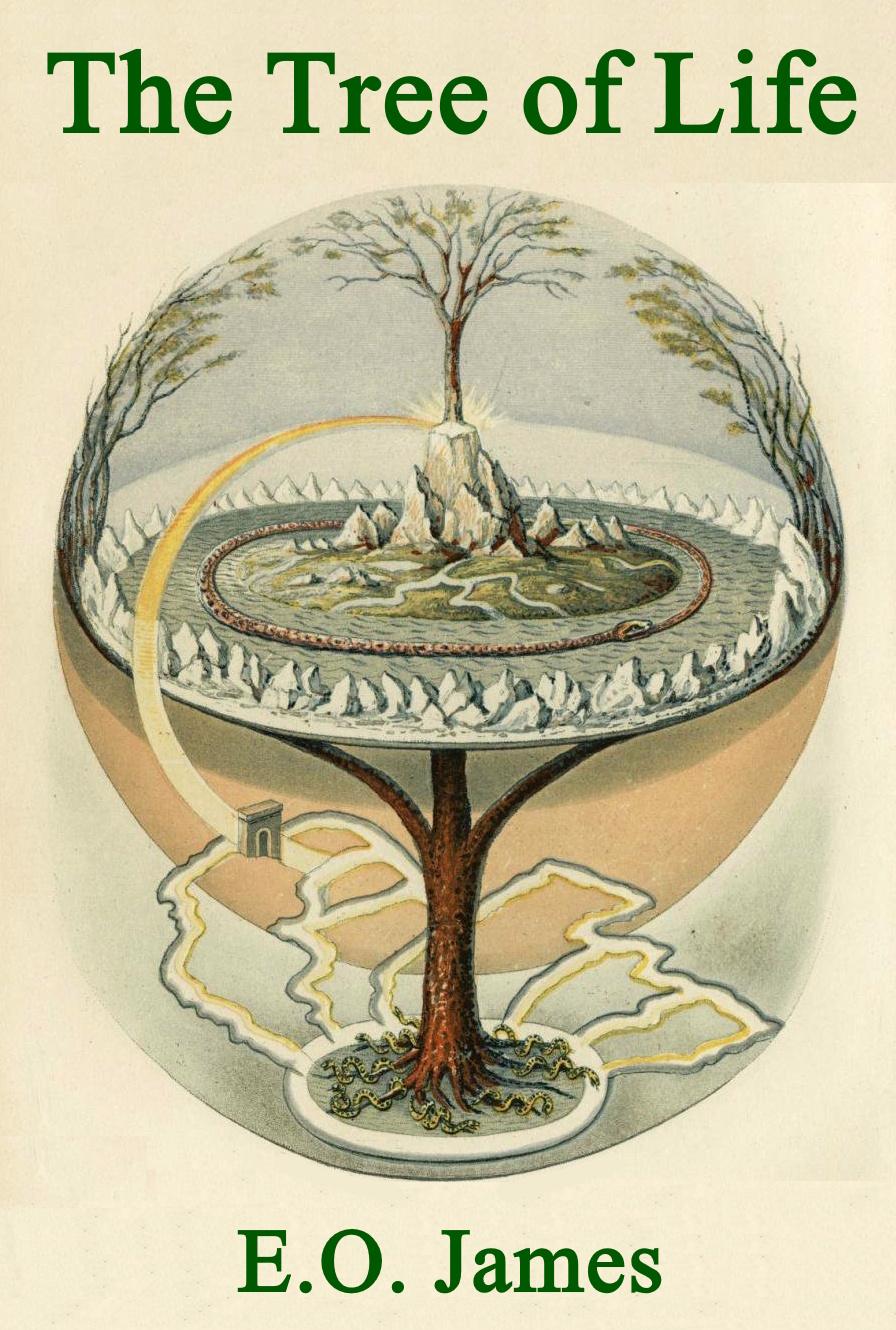
The Tree of Life
An Archaeological Study (Numen Book Series, Volume: 11)
Chapter One: The Sacred Tree and the Water of Life
The Neolithic Pre-pottery Settlement in Palestine
The Primeval Waters of Nun and the Nile
The Inundation and the Season Sequence
The Waters of Life in Mesopotamia
The Sumerian and Akkadian Creation Epics
The Primordial Waters of the Apsu
The Syro-Palestinian Climatic Conditions
Sacred Trees, Springs and rain in Israel
The Water Cult in the Harappa Cilivization
Tree worship in the Indus valley
Zeus and the Worship of the Oak
The Mother goddess and the Sacred Tree
Chapter Two: The Cult of the Sacred Tree and Stones
The Collocation of the Sacred Tree and the Pillar
Asherim and Mazzeboth in Palestine
Jachin and Boaz Pillars at the Temple of Solomon
Portal Shrines and Threshold Rites
The Almerian Megalithic Culture
The Megalithic Tombs and Temples in Brittany
Stonehenge, Druidism, the Oak and the Mistletoe
Woodhenge, the Overton Sanctuary and Avebury
Chapter Three: The Tree of Life in Paradise
The Nile in the Cosmology of Egypt
The Solar and Osirian Eschatology
The Field of Rushes and Tree of Life
Eden the garden of God
The Yahwistic Story of Paradise
The Tree of Life in the Johannine Apocalypse
The Haoma Plant in the A vesta
The Platonic and Orphic Elysium
The Tree of Life in the Isiac and Attis Mysteries
Chapter Four: The Tree of Life and the Sacral Kingship
The Divinity of the Pharaoh in Egypt
The Tree of Life on Mesopotamian Seal Cylinders
The Davidic King a Branch of Yahweh
The Davidic and Priestly Messiahs
Eschatological and Messianic Imagery in the Qumran Sect and in Christianity
The Hittite King at the Purulli Festival
The Rise of Civilization in Greece and Crete
The Eleusinian Kingship and Triptolemus
The Sacral Kingship and the Eleusinian Mysteries
The Cosmic Tree in Egyptian Cosmogony
The Cosmic Tree in the Sumerian Myths of Origin
Cosmic Imagery in Hebrew Literature
Cosmic Mythology in Ancient Israel
The Cosmic Tree in the Upanishads
The Hellenic Olympian Cosmogony
The Homeric, Hesiodic and Orphic Theogonies
The Embroidered Cloth and Winged Oak
The Scandinavian Yggdrasil World-Tree
The Christian allegorical Cosmic Tree
Chapter Six: The Female Principle
The Sacred Marriage and its Symbolism
The Goddess in the Nile Valley
Anat, Asherah and Astarte in Palestine
Anatolia: The Goddess at Yazilikaya
Chapter Seven: The Tree of Life and the Cult of the Dead
The Revivification of the Dead
The Predynastic Cemeteries in Egypt
Amratian and Gerzean Mortuary Equipment
Mesopotamia; The Mortuary Cultus
The Babylonian Conception of the Afterlife
The Cult of the Dead in the Ugaritic Texts
Mortuary Equipment and Modes of Burial
Hebrew modes of Burial and Obsequies
The Breath of Life and the Tree of Life
Crete: The Symbolism on the Hagi a Triada Sarcophagus
Mortuary Cult Scenes at Mycenae
The Treasure of Atreus and the Tholoi Tombs
The Homeric Conception of the Soul and of Hades
The Mystery Afterlife, (a) Eleusis
Dionysus, the Trees, the Vine and Lord of Souls
Christian Symbolism on Sarcophagi and in the Catacombs
Chapter Eight: The Theme of the Tree of Life
The Sacredness of the Tree of Life
The Conception of the Sacred the Profane
The Milieu of the Tree of Life
The Totem and the Tree of Life
The Socialization of the Life Principle
The Sacred King and the Tree of Life
The Tree of Life and Cosmic Phenomena
The Judaeo-Christian Cosmic Imagery
The Composite Hellenic Cosmogonies
The Ionian and Platonic Cosmogonies
The Cosmic Imagery of Pherecydes
The Goddess and the Tree Motif
The Easter Ceremonies and the Attis Rites
The May-Queen and the May-pole and the Green Man
The Autumnal Samhain Observances
Copyright 1966 by E. J. Brill, Leiden, Netherlands
All rights reserved. No part of this book may be reproduced or translated in any form, by print, photoprint, microfilm or any other means without written permission from the publisher
Preface
Although the Tree of Life was a basic symbol in Near Eastern myth and ritual and has been a widely distributed recurrent theme in the history of religion, less attention has been paid to it than its prominence, persistence and significance merit. Not infrequently references have been made to it in the relevant literature, as, for example, by Professors Sidney Smith, Hooke, Langdon, Eliade and Engnell, while following in the wake of Sir Arthur Evans’ notable regional study of ‘The Mycenaean Tree and Pillar’ in ‘The Journal of Hellenic Studies’ in 1901, Professor G. Widengren has produced an admirable monograph on ‘The King and the Tree of Life in ancient Near Eastern Religion’ published in the Acta of the University of Uppsala in 1951. But so far as I am aware the only book in English specifically devoted to the subject as a whole is that by Mrs J. H. Philpot in 1897, collating the data then available and not easily accessible to the general reader, for whom the work was intended. It is true that in 1905 a volume was published by A. E. Crawley with the title “The Tree of Life’, but, in fact, only a few references were made in it to the subject of its designation, restricted for the most part to the Tree of the Cross in Christian tradition. Frazer’s monumental treatise, again, hardly can be regarded as falling within this particular field of inquiry as the idea of the work as originally conceived was to explain the rule of the Arician priesthood, and the ‘Golden Bough’ eventually became rather lost in the jungle of luxuriant growth in which it was entangled. But in any case it was the legend immortalised by Virgil and the sacral kingship of Nemi that was the object of the quest. Therefore, all things considered, the time seems to be ripe for a full scale volume specifically devoted to the theme, motifs and imagery of the Tree of Life, specially as the archaeological evidence bearing upon the sacred Tree has now accumulated in the ancient Near East, the Fertile Crescent, Iran and India, as well as in Crete and the Aegean, in Greece and Rome, in Syria and in Judaeo-Christian iconography.
Arising in the first instance in the urge of life and its renewal, everywhere these dynamic creative and rejuvenating aspects and functions have given symbolic expression to one of the most deeply laid strivings of mankind in the induction and impulsion of everrenewing vitality and the riddance and expulsion of barrenness, aridity
and sterility. These being the fundamental elements embodied in the Tree of Life theme and its imagery it has acquired a permanent significance and adaptability to changing world views, social structures, theological systems and ideologies; thereby meriting serious consideration in its socio-religious and cosmic contexts as a consolidating dynamic and the expression of the essential values of life and creativity in a transcendental setting in a variety of environmental, and cultural conditions and historical situations.
Furthermore, as a cult-object the Tree of Life has considerable archaeological importance having acquired diverse and widespread symbolism and. imagery in representational forms and motifs; on iconography, intaglioes, incised gems, cylinder sealsand signets, either as cultic scenes, paintings and engravings, or conventionalized designs and patterns ; on altars, sarcophagi, rings, sherds, bas-reliefs ; as grave goods, in cemeteries, ossuaries, necropoli ; and as an essential part of the ritual equipment of temples and sanctuaries. From all these many occurrences a good deal of light is thrown on the religion, culture and civilization of which they are a product, and on the contacts with neighbouring peoples and lands. While the archaeological evidence manifestly has its limitations being confined for the most part to concrete material objects or structures surviving from the remote past in tangible forms, nevertheless, thoughts and abstract ideas about life and death, procreation, birth and generation, often may be inherent in the material.
Moreover, when it includes hieroglyphic inscriptions, as in the Nile valley, and cuneiform tablets of the texts in Mesopotamia, it is brought into direct contact with the literary tradition supplying documentary evidence of supreme importance, the contents of which may be illustrated by the scenes, designs and symbols on the cultobjects discovered at the sites. As my lamented friend the late Professor Ian Richmond pointed out in his Riddell Lectures at Durham, to which further reference is made in a later chapter of this volume, archaeology lies between ‘the empiricism of science’ and the discrimination of history. The archaeologist’s main line of approach is through the concrete evidence of human activity and his business is to observe or to replace such evidence in correct relationship; in short to interpret it. ’But, as he says, this initial emphasis upon the concrete does not, or should not, divorce the archaeologist from the closest possible contact with abstract thought.
The main purpose in the present inquiry is this combination of the two disciplines, and their respective approaches, techniques, traditions and data, brought into relation with the underlying values, realities and symbolic motifs conceived in human terms. Such a demonstration of the interaction of the concrete symbols and imagery in the Tree of Life theme and the abstract concepts inherent in them can hardly be without significance archaeologically, culturally or spiritually, particularly when the basic motif lies at the heart of one of the most fundamental human impulses and urges with far-reaching empirical, social, cultural, historical and religious implications.
All Souls College, Oxford
E. O. James
Abbreviations
| A.B. | Anat-Baal Texts. |
| A.J.S.L. | American Journal of Semitic languages and Literatures, Chicago. |
| A.N.E.T. | Ancient Near Eastern Texts relating to the Old Testament, ed. by J. B. Pritchard, Princeton, 2nd. ed. 1955. L’Anthrop. L’ Anthropologic. Paris. |
| B.A.S.O.R. | Bulletin of the American Schools of Oriental Research, Jerusalem and Baghdad. |
| B.S.A. | British School of Athens Annual. |
| C.G.S. | Cults of the Greek States by L. R. Farnell, 5. vols. Oxford, 1896–1909. |
| C.I.L. | Corpus Inscriptiones Latinorum. |
| C.T. | Cuneiform Texts. |
| E.R.E. | Encyclopaedia of Religions and Ethics, Ed. by J. Hastings, 1908–26. |
| G.B. | The Golden Bough by J. G. Frazer, 3rd ed. 1911–17. |
| LP.E.K. | fahrbuch fiir Pràhistorische und Ethnographische Kunst. Cologne. |
| J.A.O.S. | Journal of the American Oriental Society, New Haven. |
| J.E.A. | Journal of Egyptian Archaeology, London. |
| J.H.S. | Journal of Hellenic Studies, London. |
| J.N.E.S. | Journal of Near Eastern Studies. Chicago. |
| J.R.A.I. | Journal of the Royal Anthropological Institute, London. |
| J.R.A.S. | Journal of the Royal Asiatic Society of Great Britain and Ireland. |
| K.U.B. | Keilschrifturkunden aus Boghazköi, Berlin, 1921- |
| P.T. | The Pyramid Texts, by S. A. B. Mercer, vols i-iv. 1953. |
| P.P.S. | Proceedings of the Prehistoric Society, Cambridge. |
| S.B.E. | Sacred Books of the East. Oxford, 1879–1910. |
Bibliography
Chapter One
Albright, W. F., Archaeology and the Religion of Israel, Baltimore, 1946
Breasted, J. H., The Development of Religion and Thought in Ancient Egypt, 1914.
Budge, E. A. W., The Gods of the Egyptians, 1904.
Clark, J. G. D., Alesolithic Settlements of Northern Europe, Cambridge, 1936.
Crooke, W., The Popular Religion and Folk-Lare of Northern India, 1896.
Evans, Sir Arthur, The Earlier Religion of Greece in the light of Cretan Discoveries 1931.
———. The Palace of Alinos, vol. i. 1921.
Gordon, C. H., Ugaritic Literature, Rome, 1949.
Harrison, J. E., Themis, Cambridge, 1912.
Kenyon, K. M., Digging up fericho, 1957.
Kramer, S. N., Alythology of the Ancient World, 1961.
———. Sumerian Alythology, Philadelphia, 1944.
Langdon, S., Tammus and Ishtar, Oxford, 1914.
———. Sumerian and Babylonian Psalms, Paris, 1909.
Mackay, E., The Indus Civilisation. 1948.
———. Further Excavations at Alohenjo-daro, New Delhi, 1938.
Marshall, Sir J., Alohenfo-daro and the Indus Civilisation, vol. i. 1931.
Piggott, S., Prehistoric India, 1950.
Smith, W. Robertson, Lectures on the Religion of the Semites, New ed. S. A. Cook, 1927.
Speiser, E. A., in Ancient Near Eastern Texts, edited by J. B. Pritchard 1955.
Stein, Sir Aurel, Memoires of the Archaeological Survey of India. 1925.
Strong, H. A. and Garstang, J., The Syrian Goddess, 1913.
Thureau-Dangin, F., Rituels Accadiens, Paris, 1921.
Wheeler, Sir R. E. M., The Indus Civilisation, 1960.
Vats, MS., Excavations at Harappa, Delhi, 1940.
Chapter Two
Albright, W. F., Archaeology and the Religion of Israel, Baltimore, 1946.
Atkinson, R. J. C., Stonehenge, 1956.
Budge, E. A. W., The Book of the Dead, 1923.
Cook, A. B., Zeus, Cambridge. 1925. vol. ii.
Daniel, G. E., The Prehistoric Chamber Tombs of France, 1960.
Evans, Sir Arthur, The Mycenaean Tree and Pillar Cult, 1901. The Palace of Minos, vol. i. 1921.
Evans, J. D., Malta, 1959.
Farnell, L. R., Cult of the Greek States, vol. ii. Oxford, 1907.
Frankfort, H., Cylinder Seals, 1939.
Frazer, Sir J. G., The Golden Bough, vol. ii, 1911.
Gardiner, A. H., and Davies, N. de G., The Tomb of Amenemhet, 1915.
Glueck, N., The Other Side of fordan, New Haven, 1943.
Graham, W. C. and Gray, H. G., Culture and Conscience, 1936.
Hawkes, J. and C. Prehistoric Britain, 1947.
Jeremias, A., Das Alte Testament im Lichte des alien Orients. Leipzig, 1930.
Kendrick, T. D., The Archaeology of the Channel Islands, vol. i. 1925. The Druids, 1928.
Loud, G., Khorsabad, Pt. i. Chicago, 1936.
Macalister, R. A. S., Tie Excavations of Ge^er, 1912.
Moret, E., The Nile and Egyptian Civilisation, 1917.
Murray, M. A., The Osireion at .Abydos, 1902.
Nilsson, M. P., Minoan-Mycenaean Religion. Lund, 2nd. ed. 1950.
Persson, A. W., Prehistoric Religion in Greece, California, 1942.
Petrie, Sir F. W. M., Tell el Amarna, 1894.
Piggott, S., The Neolithic Cultures of the British Isles, 1954.
Robinson, G. L. R., The Biblical WPrld, 1901.
Smith, S., Early History of Assyria, 1928.
Stone, F. S., Wessex, 1958.
Zammit, T., Prehistoric Malta, Oxford, 1930. The Neolithic Temples of Hajar Kim and Mnaidra, Valetta, 1927.
———. The Neolithic Hypogeum at Hal-Saflieni, 1928.
Chapter Three
Barton, G. A., Semitic and Hamitic Origins, 1934.
Budge, E. A. W., The Book of the Dead, 1923.
Charles, R. H., Eschatology. A Critical History of the Future Life. 1913.
Cook, A. B., Zeus, vol. iii. Cambridge, 1938.
Evans, Sir A., Palace of Minos, vol. ii. 1928.
Frazer, Sir J. G., Folk-lore in the Old Testament, vol. i. 1918.
Graillot, H., Le Culte de Cybe’le, Paris, 1912.
Guthrie, W. K. C., Orpheus and Greek Religion. 1935.
Heidel, A., The Gilgamesh Epic and the Old Testament Parallels, Chicago, 1949.
———. The Babylonian Genesis, Chicago, 1951.
Hepding, H., Attis, seine Mythen und sein Kult, Giessen, 1903.
Kramer, S. N., Sumerian Mythology, Philadelphia, 1944.
Langdon, S., Le Boème Sumérien du Paradis, du Deluge et de la Chute de Phomme, Paris, 1919.
Messner, B., Babylonien und Assyrien, Heidelberg, 1925.
Mercer, S. A. B., The Pyramid Texts, 1929, 2. vols.
Modi, J. J., The Religious Ceremonies and Customs of the Parsees, Bombay, 1922.
Nilsson, M. P., Minoan-Mycenaean Religion, Lund, 1950.
Poebel, A., Historical Texts, University of Pennsylvania, 1914. iv. No. 1. 62.
Rhode, E., Psyche, 1925.
Webster, T. B. L., From Mycenae to Homer, 1958.
Zaehner, R. C., The Dawn and Twilight of Zoroastrianism, 1961.
Chapter Four
Bruce, F. E., Second Thoughts on the Dead Sea Scrolls, 1956. ’
Burrows, M., The Dead Sea Scrolls, 1956.
Cooke, S. A., Religion of Ancient Palestine in the light of Archaeology, 1930.
Davies, N. de G., The Tomb of Rekh-mi-Re at Thebes, New York, 1943.
Driver, G. R., Canaanite Myths and Legends, Edinburgh, 1956.
Dupont-Sommer, A., The Dead Sea Scrolls, 1952.
Dussaud, R., La religion des Hittites et des Hourrites et des Phéniciens, et des Syriens.
1945.
Frankfort, H., Kingship and the Gods, Chicago, 1948.
———. Cylinder Seals, 1939.
Gaster, T. H., Thespis, New York, 1950.
Garstang, J., The Hittite Empire, 1929. The Land of the Hittites, 1910.
Gordon, C. A., Ugaritic Literature, Rome, 1949.
Gray, J., The Legacy of Canaan, Leiden, 1957.
Harper, R. F., The Code of Hammurabi, Chicago, 1904.
Gurney, O. R., Hittite Prayers of Musilis II. Liverpool, 1940; The Hittites, 1954.
Johnson, A. R., Sacra/ Kingship in Ancient Israel. Cardiff, 1955.
Labat, R., Le caractère religienx de la royaulté assyro-babylonienne, Paris, 1939.
Laroche, E., Recherches sur les noms les Dieux Hittites, Paris, 1947.
Milik, J. T., Ten Years of Discovery in the Wilderness of Judaea, 1959.
Mylonas, G. E., Ancient Mycenae, 1957.
Notscher, F., Ellil in Sumer und Akkad, Hanover, 1927.
Nilsson, M. P., Minoan-Alycenaean Religion, Lund, 1950.
———. Greek Popular Religion, Columbia Press, 1940.
Palmer, L. R., Alycenaean Greek Texts, Oxford, 1963.
Radin, C., Qumran Studies, Oxford, 1957.
Schaeffer, C. F. A., Cuneiform Texts of Ras Shamra-Ugarit, 1939.
Seims, A. van, Marriage and Family Life in Ugaritic Literature, 1954.
Sethe, K., Dramatiscbe Texte zu altaegyptischen Mysterienspielen, Leipzig, 1928.
Smith, S., Early History of Assyria, 1928.
Ventris, AL and Chadwick, J., Documents in Mycenaean Greek, 1956.
Ward, W. H., The Seal Cylinders of Western Asia, Washington, 1910.
Widengren, G., The King and the Tree of Life in Ancient Near Eastern Religion,
Uppsala, 1951.
Wace, A. J. B., Mycenae. Princeton, 1949.
Webster, T. B. L., From Mycenae to Homer, 1958.
Chapter Five
Abidharma, Pra/naptisastra (Sarvastivadin school).
Brandon, S. G. F., Creation Legends of the Ancient Near East, 1963.
———. Alan and his Destiny in the Great Religions, Manchester, 1962.
Brown, N. O., Hesiod’s Theogony, New York, 1953.
Burne, I. F., Cosmogony (Greek) in E.R.E. IV.
Chiera, E., Sumerian Religious Texts, Upland, 1924.
———. Sumerian Epics and Alyths, Chicago, 1934.
Coomaraswam, A. K., Yaksas, Washington, 1928.
Davies, N. de G., The Rock Tombs of El Amarna, 1908.
Erman, E., Literature of the Ancient Egyptians, 1927.
———. Handbook of Egyptian Religion, 1902.
Evans, Sir A., Palace of Minos, vol. ii, 1928.
Frankfort, H., Cylinder Seals, 1939.
Gùterbock, H. G., Forgotten Religions, edited by V. Ferm, New York, 1950.
Gunkel, H., Schopfung und Chaos Wi/pyit und End^eit, Gottingen, 1895.
Guthrie, W. K. S., Orpheus and Greek Religion, 1935.
Heidel, A., The Babylonian Genesis, Chicago, 1942.
Jacobi, H., Cosmogony (Indian) in E.R.E. IV.
Jacobsen, T., The Intellectual Adventure of Ancient Alan, Chicago, 1946.
Jaeger, W., Theology of the Early Greek Philosophers, Oxford, 1947.
James, E. O., Alyth and Ritual in the Ancient Near East, 1958.
King, L. W., The Seven Tablets of Creation, 1902.
Kirk, G. S. and Raven, J. E., The Presocratic Philosophers, Cambridge, 1957.
Kramer, S. N., Sumerian Mythology, Philadelphia, 1944.
Nilsson, M. P., History of Greek Religion, Oxford, 1925.
Philpot, J. H., The Sacred Tree, 1897.
Schaeffer, C. F. A., The Cuneiform Texts of Ras Shamra-Ugarit, 1939.
Sethe, K., Dramatische Texte zu aitaegyptischen Mysterienspielen, 1928.
Speiser, E. A., in Near Eastern Texts, ed. J. B. Pritchard, Princeton, 1955.
Turville-Petre, E. O. G., Myth and Religion of the North, 1964.
Wensinck, A. J., The Navei of the Universe.
Wilpert, J., Die romischen Mosaiken und Malereien, Freiberg, 1916.
Chapter Six
Blackman, A. M., The Rock Tombs of Meir, Pt. ii., 1915.
Bittei, K., Naumann, R., Otto, H., Ya^ilikaya, Leipzig, 1941.
Brand, J., Popular Antiquities of Great Britain, 1827.
Brugsch, H., Religion und Mythologie der alien Aegypten, Leipzig, 1885.
Budge, E. A. W., The Gods of the Egyptians, vol. ii., 1904.
Buren, E. D. van, Orientalia, 13, 1944.
Cook, A. B., Zeus, Cambridge, vol. iii., 1940.
Erman, A., Aegypten und aegyptische Laben im Altertum, Leipzig, 1923.
Frankfort, H., Ancient Egyptian Religion, New York, 1948.
Farnell, L. R., Cults of the Greek States, vol. i., Oxford, 1907.
Garstang, J., The Land of the Hittites, 1910.
Graillot, H., Le Culte de Cybele, Paris, 1914.
Gurney, O. R., The Hittites, 1952.
———. Prayers of Mursili II, Liverpool, 1940.
Jacobsen, T., Intellectual Adventure of Ancient Man, Chicago, 1946.
James, E. O., The Cult of the Mother Goddess, 1959.
Junker, H., Der schende und blinde Gott, Munich, 1942.
Kees, H., Aegypten ReligionsgeschichtHches Lesebuch, 10. Tubingen, 1928.
Langdon, S., Sumerian Liturgical Texts, Philadelphia, 1919, vol. x, No. 4.
Laroche, E., Récherches sur les noms de Dieux Hittites, Paris, 1947.
Lucian, De Dea Syria.
Macalister, R. A. S., Excavation of Ge^er, vol. ii., 1912.
Mannhardt, W., Der Baumkultus der Germanen ihrer Nachbarstamme, Berlin, 1875.
Nilsson, M. P., Minoan-Mycenaean Religion, Lund, 1950.
Rose, H. J., Handbook of Greek Mythology, 1933.
Rowe, A., The Topography and History of Beth-Shan, Philadelphia, 1930.
Showerman, G., The Great Mother of the Gods, Bulletin, University of Wisconsin, No. 43, 1901.
Vincent, L. H., La religion des fudaeo-Armaeens d’Elephantine, Paris, 1937.
Chapter Seven
Albright, W. F., The Archaeology of Palestine, 1949.
Breasted, J. H., Development of Religion and Thought in Ancient Egypt, 1914.
———. The Dawn of Conscience, 1930.
Brunton, G., Mostageddo, 1937.
Brunton, G. and Caton-Thompson, G., The Badarian Civilisation, 1928.
Budge, E. A. W., The Book of the Opening of the Mouth, 1909.
The Book of the Dead, The Papyrus of Ani, 1934.
Caton-Thompson, G., and Gardener, E. W., The Desert of Fayum, 1934.
Cooke, S. A., The Religion of Ancient Palestine in the light of Archaeology, 1930.
Coutenau, C., La civilisation phe’nicienne, Paris, 1949.
Cumont, F., Les Religions orientales dans le paganism romain, Paris, 1929.
Duncan, J. J., Digging up Biblical History, 1931.
Edwards, I. E. S., Tbe Pyramids of Egypt, 1961.
Edgar, C. G., Excavations at Phylokopi in Melos, 1904.
Evans, Sir A., Tbe Palace of Minos, vol. iv., 1935.
Fakhry, Ammad, The Pyramids, 1962.
Farnell, L. R., Cults of the Greek States, vol. v., 1907.
Frankfort, H., Ancient Egyptian Religion, New York, 1948.
Ginsberg, H. L., Ugarit Myths (Aqht Text) in Ancient Near Eastern Texts, 1955.
Harrison, J. P., Prolegomena to the Study of Greek Religion, Cambridge, 1903. , Themis, 1912.
Huiks, R., Carolingian Art, 1935.
Lehmann-Hartleben, K. and Olden, E. C., Dionysiac Sarcophagus in Baltimore, Baltimore, 1942.
Lods, A., La croyance à la Vie Putur et le culte des marts dans l’antiquite’ Israelite, Paris, 1906.
Morey, C. R., Early Christian Art, Princeton, 1942.
Oesterley, W. O. E., Immortality and the Unseen World, 1921.
Nilsson, M. P., Homer and Mycenae, 1935.
Paribeni, R., Monumenti Antichi, Rome, 1908.
Pedersen, L., Israel-. Its Life and Culture, vol. ii., 1947.
Persson, A. W., New Tombs at Dendra near Midea, 1942.
Petrie, Sir F. W. M., Prehistoric Egypt, 1920. The Royal Tombs of the First Dynasty, 1900.
———. Abydos, 1902–3. The Pyramids and Temples of Gi^a, 1882. Medum and Memphis, 1910.
Picard, C., Les religion pré-héllenique, Paris, 1948.
Rhode, E., Psyche, 1925.
Richmond, I. A., Archaeology and the After-Life in Pagan and Christian Imagery, Oxford, 1950.
Rostovteff, M. L., Mystic Italy, New York, 1927.
Seth Pringle-Pattison, A., The Idea of Immortality, Oxford, 1922.
Skinner, J., Genesis, (International Critical Commentary) 1912.
Strzygowski, J., Origins of Christian Church Art, Oxford, 1923.
Watelin, L. C., Kish, Paris, 1934.
Woolley, Sir L., Excavations at Ur, 1954, Ur Excavations, Al’Ubaid, vol. i. 1927.
———. The Royal Cemetery, 1934.
Chapter Eight
Brand, J., Popular Antiquities of Great Britain, 1882.
Breasted, J. H., Ancient Records of Egypt, vol. i., 1906.
Chambers, R., Book of Days, 1886.
Detering, A., Die Bedeutung der Eiche seit der Vorreif, Leipzig, 1939.
Ebeling, E., Tod und Leben nach den Vorstellungen des Babylonier, Berlin, 1931.
Evans-Pritchard, E. E., Nuer Religion, Oxford, 1956. The Divine Kingship of the
Shilluk of the Nilotic Sudan, Cambridge, 1948.
Frankfort, H., Kingship and the Gods, Chicago, 1948.
Frazer, Sir J. G., The Golden Bough, Pt. IV (The Dying God), 1914.
Hone, W., Everyday Day Book, 1820.
Hooke, S. H.,Myth, Ritual and Kingship, 1958 (Editor of)
———. Origins of Early Semitic Ritual, 1938.
Hull, E., Folk-lore of the British Isles, 1928.
James, E. O., Origins of Sacrifice, 1933. Seasonal Feasts and Festivals, 1961.
James, Sacrifice and Sacrament, 1962.
Kirk, G. S. and Raven, J. E., The Presocratic Philosophers, Cambridge, 1957.
Kramer, S. N., Sumerian Mythology, Philadelphia, 1944.
Labat, R., Le caractère religieux de la royauté assyro-babylonienne, 1939.
Lévy-Bruhl, L., Les fonctions dans Sociétes Inférieures, Paris, 1915. La Mentalité primitive, 1921. L’experience mystique les symboles che^ les primitifs, 1938.
Luckenbill, D. D., Ancient Records of Assyria, Chicago, 1927.
Marett, R. R., The Threshold of Religion, 1914.
Malinowski, B., Myth in Primitive Psychology, 1926.
Meek, C. K., The Northern Tribes of Nigeria, 1925.
Moret, A., Le Rituel du Culte divin journalier en Egypte, 1902.
Pallas, S. A., The Babylonian Akitu Festival, Copenhagen, 1926.
Philpot, J. H., The Sacred Tree, 1897.
Seligman, C. G., The Cult of the Nyakang and the Divine Kingship of the Shilluk, Khartoum, 1911.
Smith, W. R., The Religion of the Semites, 1927.
Stubbes, P., The Anatomie of Abuses, 1877–82.
Thistleton-Dyer, F., British Calendar Customs, 1876.
Turville-Petre, E. O. G., Myth and Religion of the North, 1964.
Widengren, G., The King and the Tree of Life in ancient Near Eastern Religion, Uppsala, 1951.
Wensinck, A. J., ‘The Semitic New Year and the Origin of Eschatology’. Acta Orientalia I. 1923, ‘Tree and Bird Cosmological Symbols in Western Asia’, Verhandelingen der Koninklijke Akademie van \Fetenschappen, Amsterdam, vol. xii., 1921.
Wright, A. R., British Calendar Customs, 1938.
Chapter One: The Sacred Tree and the Water of Life
The sacredness of trees and plants is so firmly and deeply rooted in almost every phase and aspect of religious and magico-religious phenomena that it has become an integral and a recurrent feature in one form or another at all times and in most states of culture, ranging from the Tree of Life to the May-pole. Around the symbol beliefs, customs and ideas have collected which have been conditioned and determined very largely by the soil in which it has appeared and come to fruition. Behind it, however, lies the basic themes of creation, redemption and resurrection, resting uponTEe conception of an ultimate source of ever-renewing life at the centre of the cosmos, manifest and operative in the universe, in nature, and in the human order.
The Prehistoric Forest Folk and their Environment
In its earliest and most primitive modes of expression the sacred tree was and is the embodiment of the indwelling supramundane principle of life associated with mysterious and awe-inspiring phenomena in general calculated to arouse a sense of the numinous, and in particular with that which displays indications of vitality, growth and the emotions of the eerie aroused by primeval forests their pecuhar sounds and silence, loneliness, dim religious light, long shadows and enchantments. Such an environment became widespread in Europe when the ice retreated northwards at the end of the Palaeolithic period some 14000 years ago, and the steppes and tundras became forested during the milder interglacial oscillations. The prairies of North Africa and Western Asia were transformed into deserts with fertile oases, and in Northern Europe the frozen plains were covered with a succession of forest trees beginning with birches and willows, followed by pines and hazel, elms, limes and oaks, and lastly by the beech in Denmark. In so-called Boreal times when the summers were longer and warmer than they are now in that region, and the distribution of land, sea and lakes was assuming its present proportions and elevations, the Forest folk were established over the whole of the northern plain from Central Europe to Finland.
Continuing to hunt the reindeer in the woods their several groups were brought into contact with each other during these expeditions, while on the coast, lakes and meres the fisherfolk eked out an existence more permanently located with camps to which return was made in the summer, the winter being devoted to hunting fishing, fowling and root-and nut-gathering. Some of the Magdalenian survivors lingered in their old haunts making the best of the precarious Mesolithic conditions that prevailed at the end of the Upper Palaeolithic when the majority had followed the reindeer and the cold-loving fauna to the Arctic regions, and settlers from the neighbourhood of the Black Sea and Southern Russia, with their Gravettian cultural affinities, had already infiltrated into Europe from Hither Asia and adopted a sedentary life in small groups in open glades of the forest, and on the banks of the rivers, or lakesides.
The Neolithic Pre-pottery Settlement in Palestine
Such was the environment in which no doubt the cult of the sacred tree emerged, but it was not until Neolithic cultural conditions began to be established that evidence is forthcoming which throws light on its development. In South-west Asia, chiefly on the Syrian hills, on the Persian highlands, and in the caves at Wadi el Natuf on Mount Carmel in Palestine wheat and barley grew wild, and the remains of a culture have now been revealed in which hunting was combined with elementary attempts at the cultivation of grain. Thus, sickles have been found in Natufian sites which were employed for cutting straw or the stem of grass, together with mortars and rubbers for grinding corn-perhaps wheat and barley, both of which grow wild there. The dog had been tamed but no traces of other domestic animals occur in their settlements, or any indication of a knowledge of pottery making. The transition from hunting, fishing and collecting edible fruits to the cultivation of the soil and its products and the keeping of flocks and herds was very gradual. At first it seems to have been localized in certain places, notably in oases like Jericho and the surrounding district in Palestine where Miss Kenyon has discovered a very early agricultural settlement without pottery dated between 8000 and 6000 B.C.,[1] though Dr. Braidwood would reduce the estimate to about 5000 B.C.[2] Whatever may be the precise date, it is now becoming evident that it is to such fertile oases rather than to the great river valleys (e.g. those of the Nile and the Tigris and Euphrates) that the earliest traces of agriculture have to be sought
At the pre-pottery Jericho settlement luxurious growth was produced by a spring producing a thousand gallons of water a minute irrigating the oasis, the palm-trees, banana groves and corn fields of which are in striking contrast to the surrouding arid plain. The hill country, as Miss Kenyon infers, probably was heavily wooded and did not become inhabited until it was irrigated by the urban population in the tell in the third millennium B.C., and an efficient agriculture and town-life had been established. In the meantime the dependence of the cultivation of the soil on the water-supply had been recognized. Moreover, from the remains of shrines with cult-objects which include phallic symbols and female figurines, so intimately connected with the worship of the Mother Goddess in the Fertile Crescent, Western Asia and the Aegean, as fertility emblems, and a menhir resembling the mazzebah prominent in Semitic sanctuaries in association with the asberab and sacred trees,[3] it would seem that a vegetation cult existed. In the central room of what may have been a ‘temple’ was a rectangular plastered basin used perhaps in connexion with ablutions and lustrations, and in view of the subsequent intimate relation between the water of life with other vitalizing agents, notably the tree of life, it is by no means unlikely that at the Neolithic settlement at Jericho the concept of a sacred life-giving power had emerged in conjunction with the perennial spring at the foot of the tell which derived its copious supplies of water from a mysterious underground source making the desert blossom as the rose.
Sacredness inherent in Trees
In Mesopotamia, for instance, when the Tigris and Euphrates merged with the sea producing luxuriant growth in the southern marshes all life was regarded as having sprung from the primeval watery abyss, as will be considered in due course. Suffice to say here this combination of sacred trees and life-giving waters, so deeply laid in ancient tradition, mythology, romance and folklore, would seem to have arisen under the climatic, topographical and ethnological conditions that prevailed in prehistoric and protohistoric times. The forests which were so widespread at the end of the Palaeolithic and during the Mesolithic periods, and their chalcolithic aftermaths, were imbued with a sense of mystery and awe, and in this numinous environment it may reasonable be conjectured that they readily became peopled with supramundane powers and beings associated with their trees and vegetation. In their solitudes it appeared spirits had their abode and in the rustling of the leaves their voices and whisperings could be heard, just as the hum of insects, the cawing of rooks, the song of birds, the cooing of pigeons, and perhaps the disttant forebidding roaring of lions and trumpetings of elephants or mammoths, breaking the silence were attributed to superhuman denizens, for good or ill.
Whether or not a particular tree was thought to be tenanted by a diving being, its sacredness was more than that of a symbol. Like sacred springs and rivers the sanctity of trees was due to .their being permeated with the life displayed in their growth akin to that of human or animal organisms. This might be associated-with.arLindwelling spirit or deity, or a theophany manifest in conjunction with them and interpreted accordingly in terms of a cult-legend, but, nevertheless, it was their inherent qualities that gave them their status and significance. For this reason they were treated as a god, or the equivalent, venerated, propitiated, assigned a cultus, honoured with sacrifices and surrounded with tabus because of the supernatural power and life that resided in them. Thus, in the worship of an Earth-god the presence of a tree in addition to an altar has been required, and sometimes the deity has been represented by an entire wood. Indeed, in an ancient prayer T’ang, the founder of the second dynasty in China, during a drought is said to have offered himself as a victim to the wood of Sang, the great Earth-god being a pine-tree,[4] In Crete and the Aegean Zeus was conceived as a triple divinity, a Sky-god, a Water-god and an Earth-god, who dwelt in a sacred oak and was served by a sacral king regarded as an incarnation of Zeus himself.[5] Behind such beliefs and customs as these, which will be considered in greater detail as this inquiry proceeds, lay the recognition of the divine life inherent in the trees of the forest, in water, and in the earth, the same vital essence manifesting itself in each and all alike.
Passing from the woodlands to the desert every sign of animation in a vast panorama of lifelessness was arresting giving emphasis to the mystery of life. The ancients were incapable of conceiving or condoning, except as an anomaly, an inanimate world. As A. E. Crawley says, ‘it is not at all likely that at one stage man regarded everything as alive, and at a later stage gradually discriminated between animate and inanimate. The fact is that he began by regarding everything as neuter, merely as a given’.[6] Normally the world appeared as redundant with life, manifest in the trees in a wood, the water in a river, stream, or lake, a spring or the sea, the fertilized earth, or the sun in the sky. Anything, in fact, that arrested attention, such as a mighty rushing river, or a tree, or plant of peculiar appearance, or of unusual size or behaviour, became endowed with sacredness, acquired individuality, and developed a will and character of its own.
The Primeval Waters of Nun and the Nile
This was most apparent in a country like Egypt as a remarkable oasis in a vast desert — veritably ‘the gift of the Nile’ as Herodotus recognized. There the distinction between the living and the nonliving is in striking contrast, and it depends primarily and essentially on its fertilizing river and its irrigation canals. The most insistent fact undoubtedly has been ‘the all-enveloping glory and power of the Egyptian sun’, as Breasted pointed out,[7] but, nevertheless, although it was personified as the source of life and supreme god, unless its blazing rays had been rendered beneficent by having been brought into conjunction with the Nile, in a rainless land they would have been devastating transforming it into the surrounding desert.
Flowing out of the streams rising in the great African lakes and the mountains of Abyssinia, in the spring when the snows melt and the African rainy season begins, the river becomes flooded and overflows its banks leaving in its valley a very fertile desposit of silt. This renews the soil and creates an extremely fertile oasis in the desert, extending from the First Cataract at Aswan to the Mediterranean, broadening into the flat marshes of the Delta near Memphis where Lower Egypt begins. The ‘Two lands’ of Upper and Lower Egypt actually cover less than ten thousand square miles. In May the level of the Nile is so low that if it were not for the annual inundation in June its banks would become arid. But being covered first with a vegetable detritus and a month later with a rich humus containing minerals and potash they become exceedingly fertile as the waters continue to rise until they recede in October, with a reserve of water for their dykes for the rest of the year supplied by the irrigation canals aided by the dykes and water wheels. In such climatic and topographical conditions with the heat of the sun tempered with cool winds a stable agricultural civilization could hardly fail to develop in the oasis with every natural resource in its favour in striking contrast tothe arid wilderness all round. Since it all depended on the conjunction of the sun and the river they were both personified and deified ; the one supreme in the sky, the other emerging from the underworld at the First Cataract and eventually identified with Osiris, the most popular and beneficent god of ancient Egypt, the son of the Earth-god Geb and who became lord of the dead dwelling in the nether regions.
The Inundation and the Season Sequence
At the approach of the annual inundation Geb was represented in the Pyramid Texts as saying to Osiris, ‘the divine fluid that is in thee cries out, thy heart lives, thy divine limbs move, thy joints are loosed.’ In other words, that the waters that bring life to the soil proceed from the resurrection of Osiris. At first the Nile was deified under the form of its ancient name Hapi whose symbols were water and water plants, and as a vegetation god was identified with Osiris from whom the river said to have come forth, and also with Nun the watery abyss.[8] Gods and men were thought to live by the moisture that was in him, equated with that of the primeval watery mass personified as Nun, the matrix of the Sun-god Re, the principal regenerative agent. Thus, in his several aspects and identifications Osiris was the imperishable principle of fife bringing forth abundance every year as the ‘Water of Renewal’ rises, and Isis his devoted and faithful wife in her capacity of ‘the spouse of the Lord of the Inundation’ and ‘Creatrix of the Nile flood’, was the fruitful land irrigated and fertilized by him as the begetter. As the power of the Nile she was identified with Satis, the goddess of the Cataract; as the producer of fecundity by her waters she was called Anget ; as the giver of life she was Ankhet, later represented as Nephthys; and as the Lady of the Underworld, Amant, she shared with Osiris the attribute of life bestowing and became the female counterpart of the primeval watery deep from which all life sprang.[9]
The Cult of Isis and Osiris
The cult of Isis as the goddesss differed, however, from that of Osiris the male god, in that it centred in the mystery of birth rather than of life issuing from death, but the connecting link between the two divinities and their respective roles was the Nile. Both of them were concerned with vegetation, Osiris as Lord of the grain, and Isis as the personification of the tilled soil and the harvest fields — the fertile earth fructified by the life-giver bringing forth in abundance. Then the mourning and lamentation for her husband at the summer solstice, making the Nile swell and overflow with her tears, was turned to exultant joy in the autumn with a wealth of pageantry and symbolism. Behind this death and resurrection drama lay the Inundation as the source of regenerative power in the cultus of the Osirian hero and heroine, Isis having been a predynastic river-goddess or water spirit before eventually, as the daughter of Geb and Nut and sister of Nephthys and the wife of Osiris, she emerged as a universal Mother Goddess of many names. As the female counterpart of the waters of Nun she readily acquired the attributes of the Earth and Corn goddess, including those of Mut, another ancient Water-goddess who was designated the wife of the Nile, whose sanctuary in Thebes was connected with the sacred lake Asheru. Similary, Nut, the mother of Osiris, Isis and Nephthys, was depicted standing on a sycamoretree pouring out water from a vase. But Osiris remained the waterdeity par excellence, the god of the Nile and its inundation flooding the oasis with his fertilizing water and depositing upon it its alluvial soil, bringing forth its luxuriant vegetation in such abundance.
The Waters of Life in Mesopotamia
In Mesopotamia the geographical situation is not very different from that in Egypt. The Tigris and Euphrates taking their rise in the Armenian mountains in the highland zone were the main channels along which the waters from these heights were conveyed southwards to the Persian Gulf silting the lower reaches for 125 miles from Basra, transforming it into a alluvial plain on which the Sumerian civilization developed in the third millennium B. C., the northern agriculturists moving south and irrigating the fertile soil. At first only a small portion of the reclaimed area was cultivable, the pluvial conditions having given place to an arid climate with a scanty rain fall in winter and devastatingly hot and dry summers. Tidal lagoons extruded inland nearly to the limestone ridge on which the ancient city of Eridu was erected by the Sumerians, but irrigation was required to ripen the grain on the fertile soil. This having been accomplished by the highlanders before 3000 B.C., they engaged in mixed farming combining agriculture with herding cattle, sheep and goats, and in the invention of the art of writing in a cuneiform script on clay tablets, which became the principal written learned tongue in Western Asia for the next two and a half millennia, employed to write in addition to Sumerian, Elamite in Susiana, Hittite and Hurrian in Anatolia, Ugaritic in Syria, and occasionally Hebrew, Aramaic, Egyptian and Old Persian texts, as well as those of Semitic and Akkadian.
The Cult of Dumuzi-Tammuz
From these sources once the decipherment of the cuneiform had been achieved by Grotefend, Rawlinson, Hincke and Oppert in the middle of the last century, a vast store of literary documents covering a wide region in the ancient Near East from about 2500 B.C. onwards, have become available throwing a very considerable amount of light on the beliefs and practices current at that time as well as on the climatic, cultural and environmental conditions in an urban civilization established on the foundations of a peasant agricultural society in which Semitic influences were increasingly penetrating the Sumerian substratum. Until recently it has been generally thought that the Tigris and Euphrates were personified in a youthful god Dumuzi-Tammuz who represented the Mesopotamian counterpart of Osiris in Egypt, Adonis in Phoenicia and Attis in Phrygia, as the first West Semitic Asian year-god typifying the annual decline and revival of life in nature. So regarded he was described by Langdon as ‘the Faithful Son of the fresh waters which come from the earth’, the ‘lord of the flood’,[10] whose original name was ab-tt, ‘the father of plants and vegetation’. In this capacity he was the Frazerian ‘dying god’ wilting in the heat of summer and reviving at the winter solstice. But since it now appears from the recent investigation of the Sumerian myth that Dumuzi, the Shepherd-god of Erech, remained in the nether regions, his resurrection was not an original feature of the legend as heretofore imagined.[11] Moreover, Jacobsen maintains that being essentially a shepherd deity he represented the life-giving powers in milk, and when the milking season came to an end in the spring he died.[12]
Now it is unquestionably true that lamentations for the dying god characterized the Tammuz cultus, brought into relation with the myth of Inannas’s Descent into the Nether World’.[13] In Babylonia a mood of despair respecting the fate of the dead predominated. The grave was regarded as a cui de sac, a Land of No-return where quasi divine heroes like Gilgamesh, kings and commoners alike were destined to wither away like the vegetation in summer, huddled together in a semi-conscious condition. The gods had decreed that man should not become immortal, having reserved this boon for themselves, and even for them to visit the dread abode was a perilous and forbidding undertaking, as Ishtar and Gilgamesh discovered. Du-muzi, who was originally a king of Erech in the third millennium B.C. rather than a god, suffered this fate when he ‘stayed dead’ in Kur, the House of Darkness’, according to the legend. In one account he was deprived of eternal life because having successfully wooed the goddess Inanna, queen of heaven, he rejoiced when he ought to have bewailed her misfortunes in the underworld. Therefore, she looked down upon him with ‘the eye of death’ and ordered him to be carried by demons to the netherworld, and eventually came to a tragic end in his sheepfold at their hands. Then no more milk was poured out from the holy churn.
If this was, as it seems to have been, the end of the Sumerian story it precludes the resurrection sequel so far as Dumuzi is concerned, Inanna alone returning to life. Nevertheless, in a later Semitic version of the episode the Akkadian goddess after her eventful visit to the realm of the dead returned with her regalia restored to her. Tammuz, ‘the lover of her youth’, washed with pure water, anointed with sweet oil; clothed with a red garment, and playing on a flute of lapsis’, and on ‘the day that he rises to men’, she was made to play the lapsis flute and the carnelian ring will come up to her, with the wailing men and women, the dead rising and smelling the incense.[14] In the Sumerian myth Inanna was herself restored to life by Enki fashioning two creatures, kurgarru and kalattirm, and sending them to the underworld with the water of life and the food of life to sprinkle her body with them to revive it. To complete the resurrection aspect of the story it only remained for the ritual process of revivification to be extended to Tammuz in the Assyrian version.
In the myth of Adapa Tammuz and Ningishzida are represented as the doorkeepers of heaven, very much as Tammuz and Shamash are said to have been the guardians of the kzskawhtrce in Eridu which had the appearance of lapis-lazuli and was erected on the Apsn and rooted in the underworld. In both cases Tammuz would seem to have been regarded as surviving his disappearance from the earth, like so many of the gods of this type closely associatedwiththeTreeof Life and the season-god theme. In the present condition of the broken and fragmentary Sumerian cuneiform tablets and their decipherment it is by no means clear how the deification of Dumuzi was achieved or how he came to be regarded as the husband of Inanna. But however it was accomplished its purpose was to ensure the fertility and prosperity of the land. To this end he was identified with the Sumerian king and in this capacity his ritual marriage with Inanna in the person of the queen or a priestess was celebrated annually in the New Year Festival.
The Sumerian and Akkadian Creation Epics
Thus, at Babylon the renewal of nature and of society was enacted in the second millennium B.C. against the background of the Akkadian version of the Creation story, commonly called Enuma elish from the opening words ‘when above’, which was recited on the fourth day of the New Year Festival. Its main object was to glorify the god of Babylon, Marduk, as the hero of the struggle between the cosmic order and the powers of Chaos (Tiamat and Apsu), and to commemorate the building of his temple first in heaven and then on earth, where the rites were performed, culminating in the sacred marriage of the Icing. At first it may have been held in Nippur centred in the Storm-god Enlil, the second member of the Great Triad of Babylonian deities, who was elected the leader of the gods after he had subdued Tiamat by his storms. When Babylon became the capital under Hammurabi at the beginning of the second millennium B.C. Marduk succeeded Enlil as the hero of the Epic until he was replaced by Ashur after the Assyrians became the dominant power. But while the names of the principal figures in the drama changed with the fortunes of the cities, or the lands in which it was enacted, the ritual was performed with the same intention and followed the same general pattern based on the Tammuz theme in its later Akkadian form. Although none of the present texts are earlier than the first millennium B.C. belonging for the most part to the Seleucid documents of the third and second centuries B.C.,[15] nevertheless, they represent copies of earlier texts which include material borrowed from earlier sources going back to the Sumerian period.[16]
The Primordial Waters of the Apsu
Thus, the Sumerian and Semitic cosmology in the third millennium B.C. was in agreement with the Enuma elish in postulating the primeval sea as the matrix of the creation of heaven and earth, personified in a goddess (Nammu) who produced anki the universe. From the parent gods sprang the generations of the pantheon, (Enlil, Enki, Apsu, Tiamat and Marduk in the respective traditions) and after the earth had been formed man was fashioned to supply the gods with nourishment. For our present inquiry it is significant that alike in the Babylonian and Sumerian cosmology creation emerged from the primordial waters. In the Enuma elish the originating cause consisted of a male and female (Apsu in Sumerian derivation and Tiamat its Semitic female counterpart). In the Sumerian prototype the primeval ocean seems to have been conceived as eternal and uncreated, and from its own inherent life-giving power it engendered heaven and earth as a composite material structure subsequently separated with the air occupying the space between them. From the union of these primeval elements, water, earth, and air, all life proceeded. In the Babylonian version (the sweet waters’ personified as Apsu, the primeval male, mingled with the salt waters of the ocean (i.e. Tiamat his consort), and from their union their son Mammu was born, representing the mist and clouds arising from the waters. So as the Tigris and Euphrates merged with the sea to produce the luxuriant growth in the southern Mesopotamian marshes, all life was regarded as having sprung spontaneously from the primeval watery deep. When in the Sumerian version Kur, the counterpart of Tiamat, was attacked and destroyed by Ninurta, the son of Enlil, the primal waters were freed and rose to the surface preventing the fresh water from reaching the fields, and so making vegetation cease. Thereupon Ninurta set up a heap of stones over the body of Kur to hold back the waters, and directed those that remained on the soil into the Tigris thereby restoring the productivity of the land.
Thus, the two rivers being regarded as the offspring of the ‘great deep’ encircling the earth they became respectively ‘the soul of the land’ and the ‘bestower of the blessings’. At the same time, however, unlike the Nile, they were capable of causing widespread disaster (e.g. devastating floods and storms), and so were personified as Tiamat, ‘the bitter waters’ of the sea. The life-giving ‘sweet waters’ in the rivers, canals, wells and springs came from the earth, which was equated with Enki, as the active male principle in both procreation and birth, brought into relation with the begetter and with Ninhur-saga, ‘Mother earth’, as the immobile passive element in productivity in the fertile soil. Water as the supreme fertilizing agency became the symbol of life, and Enki the creative power manifest in the life-bestowing waters, and also in the creative aspect of thought and intelligence giving him the status of the god of wisdom and craftsmanship, and of knowledge operative in magic, incantation and the spells of the priests, driving away demons and malign influences, and controlling the productive forces of the country in their several aspects. Therefore, it was Enki who was responsible for the water of life to revive Inanna-Ishtar and to rescue her from the nether regions, ‘to make verdure plentiful’ by applying to the soil the water of life drawn from ‘the pure mouth of the Tigris and Euphrates’.[17]
Therefore, in the intricate Sumerian myth of Enki and Ninhursaga it was he who was alleged to have provided the terrestrial paradise Dilmun with abundance of crops in the ground rendered fertile by ‘the sweet water’ brought up from the earth at his behest.[18] Wherever Dilmun was situated, whether in south-western Iran on the eastern shore of the Persian Gulf, or on the island of Bahrein in the Gulf,[19] the marshlands in the neighbourhood of the delta of the Euphrates were represented as having been transformed into a veritable Eden by his alliance with Ninhursaga, symbolizing the union of the soil and the life-giving waters.
The Kiskana-tree at Eridu
At Eridu at the head of the Persian Gulf where formerly the two rivers flowed into the sea and gradually produced the alluvial fertile delta, the human race was said to have been fashioned from clay by the Sky-god Anu and endowed with the breath of life by Enki, the lord of the watery deep’, whose temple, ‘the house of wisdom’, was erected there. In its grove (engttrra) stood the sacred kiskana-tree, having the appearance it was said of lapis-lazuli and stretching towards the subterranean apsu where Enki had his abode.[20] Being almost certainly the black pine of the Babylonian paradise[21] it was believed to have derived its vitalizing power from the waters of life and made operative in the tree of life. The kiskana-tree, in fact, combined these life-bestowing characteristics with those of the cosmic tree rooted in the omphalos, or navel of the earth; Eridu being regarded as the centre of the world, and the waters of the apsu as the substance out of which the universe was created and given its generative potentialities. Both trees embodied or symbolized the cosmos, often represented as a giant tree with its roots either in the nether regions or in the sky, and its branches spread over the whole earth.
The Syro-Palestinian Climatic Conditions
Passing from Mesopotamia to the Syro-Palestinian section of the Fertile Crescent between the Mediterranean and the desert although an integral part of the same geographical region and cultural entity, topographically and climatically it had distinctive features. Thus, at no time has it been subject to drought comparable to that in Mesopotamia or Arabia. In this fertile oasis the hillsides of Galilee are decked in spring with a profusion of wild flowers such as the scarlet pimpernel, crimson anenomes and cyclamen, with the green corn waving in the cool breezes on the fields below. Indeed, the north is described in the Old Testament as essentially ’ a good land, a land of brooks of water, of fountains and depths, that spring out of the valleys and hills, a land of oil olive and honey’.[22] In the long rainless summer figs and grapes ripen, and only in Judaea and on the edge of the desert in times of occasional prolonged drought have serious conditions of famine occurred periodically. Nevertheless, the recurrence of these catastrophes has been an ever-present fear in Palestine as is clear from the Old Testament[23] and in the Ugaritic texts on the cuneiform tablets at Ras Shamra on the southern coast of Syria, dating from the middle of the second millennium B.C., where the struggle between fertility and sterility is a predominant theme.
The Ugaritic Baal-Anat Cult
In these myths the seasons are represented as being under the control of Baal, the god of rain and life, ‘the Rider of the Clouds’, who ruled the earth from September to May, while his adversaries Mot, the god of aridity and death, and Prince Sea (Yam), held dominion in the rainless summer. The contest being perennial neither of the combatants could be finally and completely destroyed. At the end of the summer and the opening of the rainy season the sacred drama in which these myths and their rites in all probability were enacted was held to establish the rule of the beneficent Weather-god and to ensure the return of the rain. The priest went to the sea and poured ladlefuls of water into basins and carried them to his temple after a furious ritual combat had been fought depicting the victory of Baal over Mot. Then Baal opened the lattice in his mountain palace on Mount Sapan to allow the rain to fall on the parched ground, and to rejuvenate its vegetation.[24]
Their great dread being the failure of rain and dew with the inevitable effects on the harvest of the grain, grapes, olives and fruits at the proper seasons in their regular sequence. Baal being essentially the Water-god it was he who was responsible for the maintenance of the succession of events during the year upon which the crops depended for their fruition, rain and dew being the most urgent requirements. Associated with him was his sister-consort Anat, the West Semitic Astarte, who combined fertility functions with those of a warrior-goddess, while Mot ‘wandered over every mountain to the heart of the earth, every hill to the earth’s very bowels’, bringing desolation by robbing them of the breath of life.[25]
Fertility unquestionably is the main theme in the Ugaritic myths based it would seem on the seasonal or septennial cycle with Baal as the dynamic Young god combining the qualities and functions of the Weather-Storm-god in Western Asia. Thus, he is constantly called the son of Dagon, the Amorite Corn-god and Storm-god, whose sister Anat among her various alliances was the wife and champion of Baal. He was also identified with the ancient Semitic Storm-god Hadad or Ramman, but exactly how he usurped the office and status of El, the counterpart of Anu in Babylonia, as the head of the Ugaritic pantheon, cannot be ascertained in the present fragmentary state of the tablets. It would seem to have been a long drawn out struggle in which El gradually decreased in potency and control, like so many Supreme Beings of an older generation of gods, while Baal as the younger more virile intruder in the Canaanite pantheon increased. Moreover, in spite of his celestial affinities and maturity El was never the Creator in the true sense of the term. He was essentially’ Lord of the earth’, and he may have been rather a shadowy reflection of a primordial High God presiding over human affairs, agriculture and fertility.[26] Nevertheless, he was the begetter, ‘the Father of mankind’, ‘the Creator of creatures’, and one of the several fathers of Baal and of Anat before his virility declined. Therefore, his impotence was a cause for some anxiety as it was calculated to have reciprocal effects in nature inaugurating a cycle of lean years. Hence the suspense when the aged El fashioned two women and after an erotic display endeavoured to copulate with them on the outcome of which the fertility of the land depended. Consequently, the birth of two ‘beautiful and gracious gods’ suckled by Asherah his consort,[27] thereby imbibing life in greater abundance which would endure for seven full years, typified a septennial period of plenty.[28]
It seems very probably that this is a cultic text in the form of a seasonal drama depicting a sacred marriage resulting in the birth of certain gods for the purpose of promoting fertility at the ingathering of the first-fruits in the spring. This is suggested by the literary structure of the text in a dramatic form with stage directions, and the theme accords with that of the sacred marriage thoughout the ancient Near East to promotie the fecundity of the soil and its products.[29] The most appropriate occasion for such a celebration would be the Canaanite festival of the first-fruits, especially if in fact the two women impersonated Anat and Asherah under the designations Remy and Atrt, with El playing the leading role.
In the background lay the Tammuz cultus adapted to Syro-Palestinian meteorological and topographical conditions, with Baal replacing El as the principal figure, responsible for the rain as ‘the Lord of the furrows of the field’.[30] It was he who appointed and regulated the seasons and the weather as ‘the Rider on the clouds’, and feared as the Lord of the storm and of the thunder, rocking mountains and making the earth quake. Though like El he was not regarded as the Creator, or the ultimate source of life, he was ‘the Lord of abundance’, ‘the irrigator of heaven and earth’. Therefore, when he was slain and descended to the nether regions he took the rain-producing clouds with him thereby depriving the earth of moisture. Vegetation languished and fecundity was suspended until his reign was restored and confirmed by El, after his adversary had been killed by Anat, and, his flesh scattered over the fields like the seed.[31] This anomalous treatment of a god of death and aridity at least had the effect of the planting of Mot becoming the prelude to the resurrection of Baal, making ‘the heavens rain til and the wadis run with honey.’[32]
The battle between life and death in nature exemplified in the seasonal sequence being basic it would seem in the Ugaritic cultic drama, it conformed in its main outline with the Adonis theme established in Syria, however much it may have been adapted to local conditions and variations. The rhythm of nature had to be maintained and Baal was the god who controlled the regularity of its processes. There, when it was his turn to bring life out of the earth El had no choice but to ‘overturn Mot’s throne and break the sceptre of his dominion’, forcing him to surrender in the struggle between the two antagonists, and to acknowledge the kingship of Baal, thereby bringing the drought to an end.[33]
Baal, however, as king of the gods dominating the Canaanite pantheon was a composite deity combining the characteristics of a rain, storm, weather, and water vegetation god. His name was derived from ba’ln, a generic term for ‘lord’, and so applicable to a variety of gods exercising generative functions closely connected with rain, rivers, trees and other life-giving agencies. In this guise he was a recurrent figure in widely dispersed theogonies, whatever might be his designation (e.g. Baal, Hadad, Ramman), usually in conjunction with his consort Anat, Asherah, Astarte, Ashtaroth, and Atargatis, all of whom were derivatives of the Mesopotamian Inanna-Ishtar, merged into a single goddess of maternity and fertility with warrior features as the leader in battles. In the Ugaritic texts Asherah, primarily a goddess of the sea was the wife of El and at first antagonistic to Baal whose consort was Anat, though subsequently at Samaria she appeared in that role herself in the ninth century B.C.
Asherah And Astarte
In the Old Testament Asherah was equated with Ashtaroth and under both names she was associated with Baal and the Canaanite cultus,[34] her cultic symbol being the trunk of a tree with the branches lopped off. This sacred pole, called an asherah, was a prominent feature in Semitic sanctuaries,[35] deriving its title from the widespread goddess who was so intimately connected with the sanctity of trees and springs, though it also was venerated as a male deity.[36] But Asherah was unquestionably both a sea-goddess and a sacred tree. Albright has suggested that her appellation means’ she who walks in the sea’, like the Syrian El-Khadar, or ‘Green Man’, and ‘the one who wades in the sea’.[37] In Arabic athr and athart are used of palm-trees, and, athara of water, athari meaning ‘irrigated’ soil’,[38] Therefore, as palm-trees are naturally watered and can survive without rain or irrigation, they were readily regarded as receiving their nourishment from the goddess who was the bestower of the water of life to the tree providing the staple diet of the desert. She was ‘the one who causes verdure to spring forth, the creatrix of everything’, including the gods,[39] just as her counterpart Atagartis was ‘the divinity who out of moisture produces the seeds of all things’. Under her sanctuary at Hierapolis was a chasm through which the waters of the Flood were drained off.[40] Twice every year water was brought from the sea and poured into the chasm by the priests to renew its vitality with the traditional source of the fresh water from the primeval great deep.[41] Similarly, the chief Phoenician shrine of Astarte was at Aphaka where the Adonis river (the modern Nahr Ibrahim) emerges from Mount Lebanon at the Stygian fountain as the waters into which the goddess was believed to have descend ed once a year in the form of a star.[42] Healing springs abound everywhere along the northern coast of Palestine while the stately palm-trees in the Arabian wadis, and the cedars of Lebanon were revered as the abode of the goddess in one or other of her manifestations and designations.[43]
The numina inhabiting sacred springs, rivers and trees, however, were not confined to the goddess comprehended under the title ‘Ashtart’ and its derivatives. In the addition to the Astartes there were numerous Baalim in the form of local divinities who in Palestine were worshipped ‘on every high hill and under every green tree’.[44] As a generic term it could be applied to any divine being who was associated with a sacred place or cult-object without having a particular allocation. Baal Lebanon, for example, merely signified ‘the lord of Lebanon’, or Baal Tamar, ‘the master of the palm-tree’.[45] Throughout Canaan, in fact, there was a widespread diffusion of place names compounded with baal, all of which doubtless were or had been cult-centres of this nature, especially in the more fertile region, such as that in which the prophet Hosea lived, where the oil, grain wine, flax, and figs were attributed to the local baalim, and sacrifices were offered under oaks, poplars, terebinths, and on the top of the mountains.[46] It is not surprising, therefore, when the Israelites settled in Palestine that they continued the cultus already estabhshed at sacred trees, wells and springs all over the country, sometimes directing the worship to their own desert god, Yahweh, but often adopting the existing cultus with little or no change in either the rites or the Baal to whom they were offered. Having become agriculturists rather than nomadic shepherds, the Ugaritic vegetation tradition would doubtless seem to be more in keeping with their cultural environment.
Sacred Trees, Springs and rain in Israel
To pay homage to the gods of the country in which they had settled would be in accordance with established practice. In the cultivation of the soil and its crops Dagon as ‘the Lord of grain and tillage’, and his son Aleyan Baal with his consort-sister Anat and subsequently with Asherah, would be calculated to ensure the return of the fertilizing rain and to secure the life-giving waters of the deep springs. They were the dispensers of bountiful harvests, and so to them recourse would have to be made, particularly by the peasant section of the population. But the mono-Yahwists of the desert tradition also resorted to springs and sacred trees to receive theophanies and oracles from the god of Israel. Thus, Abraham is said to have been the recipient of divine disclosures at the terebinth of Morah at Shechem and at Mamre, and to have planted a tamarisk for this purpose at Beersheba.[47] The prophetess Deborah exercised her functions at Bethel under a palm-tree which marked the grave of the nurse of Rachel.[48] Before attacking the Philistines David sought divine guidance of Yahweh by the rustling of the leaves of the mulberry-trees,[49] and the asherim, or sacred poles in the form of a trunk of a tree with the branches lopped off, as the symbol of the Semitic goddess, remained part of the Canaanite ‘high places’ appropriated by the Israelites until the reformation by Josiah in 621 B.C., long after Palestine had become ‘the land of Yahweh’; and the prophet Hosea retained the idiom of the sacred marriage in describing the country as ‘the wife of Yahweh’ in the eighth century.[50]
Nevertheless, notwithstanding the retension of the Canaanite symbols, modes of worship and veneration of trees and springs and kindred sacred life-bestowing agencies, it was Yahweh, the God of Israel, who was regarded as the dispenser of rain and of the fruits of the earth. Thus, in the reign of Ahab and his Tyrian wife Jezebel this became definitely established in the ritual combat between the two cults in the sanctuary of Aleyan-Baal on Mount Carmel enacted, according to the narrative, in a rain-making ceremony. There at a time of prolonged drought Elijah, the champion of Yahweh is alleged to have demonstrated in a dramatic manner that it was he and not Aleyan-Baal who was the controller of the weather in the land of his adoption.[51] The ‘former rains’ in the autumn and the ‘latter rains’ in the spring were in his hands, and like Baal in the Ugaritic texts, he opened the lattices in the upper firmament in the sky and in the clefts in the clouds poured down the revivifying waters on the parched ground.[52]
Therefore, for the mono-Yahwists he as the Lord of creation was wholly and solely responsible for the fertilization of the earth, the growth of vegetation and the rainfall on which it depended, It was this contention that lay behind whatever may have been the actual occasion of the Carmel tradition, and the deeply rooted cult of the sacred trees and the life-giving waters in its Yahwistic reinterpretation. Although the cultus of the high-places was resolutely condemned as apostasy to Yahweh at the Josiah reformation and absolutely forbidden,[53] the sanctity of the water of life survived in post-exilic Judaism in the lustration and libations on the last day of the Feast of Tabernacles (Tishri 21) when a pitcher of water was taken by the priests to the temple from the pool of Siloam, and solemnly poured out with a wine oblation beside the altar,[54] Originally this doubtless was a rain-making ceremony as in the Talmud it is said that the waters were offered to Yahweh that ‘the rains of the year may be blessed to you.[55] The observance ceased after the destruction of the temple in A.D. 70, but a prayer was added in the liturgy on the seventh day of the festival — ‘the Day of the Water-libation’ — addressed to Yahweh as the Lord of creation responsible for sending the rain to fertilize the earth.
The Water Cult in the Harappa Cilivization
On the other side of the Iranian plateau in Western Asia in the third and second millennia B.C. a highly developed urban civilization became established in which a water cult and tree worship were prominent features, particularly in association with the worship of the Mother goddess. This was most apparent at Mohenjo-daro in the Indus valley where the excavations of Sir John Marshall have brought to light a well-planned strongly fortified city in the centre of which stood a great bath surmounted with a stupa apparently used for ritual purposes. Some of the other more pretentious buildings within the citadel may have been shrines of the Great Mother, especially in view of the numerous clay nude female statuettes with head-dresses similar to those in this context in Syria and the eastern Mediterranean, and those carved on seals.[56] To enhance their lifegiving powers many of them were painted over with a red slip or wash, doubtless as a surrogate for blood so widely used as a vitalizing agent.
Grotesque figures of women occurred in the Kulli culture in the foothills of southern Baluchistan and in the north in the Zhob valley where small farming groups were established before 3000 B.C.. These statuettes are described by Professor Piggott as ‘a grim embodiment of the Mother-goddess who is the guardian of the dead-an underground deity concerned alike with the crops and the seed-corn buried beneath the earth.’[57] In style and features they are so uniform that Sir Aurel Stein thinks they may have been intended to represent some tutelary goddess.[58] That they had a fertility significance is shown by a phallus carved in stone at the mound of Mogul Ghundai near the left bank of the Zhob river south-west of Fort Sandeman, and at the neighbouring mound of Periano-Ghundai on the right bank where a vulva is depicted with great prominence.[59] They may have been a rather later intrusion in Turkestan and northern Iraq by settlers from Sialk, Giyan and His sa on the edge of the Persian desert, and in the earliest settlement in Susa in the first Elamite period, about 2800 B.C., clay female figurines has been found.[60]
In the Indus valley at Mohenjo-daro and Harappa they have occurred at all levels and there nude male figures associated with the sacred pipal-tree frequently occurred in the iconography, though not in juxtaposition with the Goddess, Whether or not she had a male partner in the Harappa civilization as elsewhere in the ancient Near East, limestone conical phallic Unga frequently are shown in conjunction with femalejww rings depicting vulva,[61] symbolizing the mystery of birth in which the Goddess was the most potent agent as the instrument of fecundity embodied in her images endowed with quickening and fertilizing power in the process of generation. In her fertile womb the divine soul-substance was fashioned and brought forth as a living organism. The union of the god and the goddess typified that of the sky and the earth as the respective sources of reproduction. In India, however, this duality found expression in Shakti, a term denoting the vitalizing power or energy associated with the male deity, Shiva, regarded as an androgynous Creator who produced his own consort from the female side of his nature. Nevertheless, the quiescent female divine energy (sakti) usually was personified as the wife of the active male deity, joining with him in the creation, sustaining and sometimes the destroying of the natural order. As the Great Mother she was the prototype of prakriti, the eternal reproductive principle, united with the eternal male principle and cosmic soul, purusha, in the generation of the gods and of the universe. At a lower level she was represented by the enumerable gramadevatas, or village goddesses, while in the Rig Veda she reappeared as Prithivi, the Earth-goddess of the Vedic Aryans, fertilized by the bull sacred to Shiva, who inherited from Pasupati, the Lord of the Beasts, a fertility significance. With the bull and the tingavi as his symbol Pasupati became the Reproducer and Destroyer, until eventually every bull and every cow was regarded as embodying the spirit of fertility, as in the Ugaritic texts.[62]
On the well known carved seal at Mohenjo-daro a nude threefaced god identified by Marshall as that of Shiva as Pasupati, sitting on a lower throne in what seems to be the yoga posture and covered with bangles. On the head is a pair of horns resembling those of a bull with a tall head-dress between them. At the end of the waistband there is a projection which may be a phallus. Of the three faces, one is in front and the other two are in profile. On the right below the dais are an elephant and tiger and on the left a rhinoceros.[63] If, as is very probable, it is the prototype of Shiva as the Lord of Beasts and prince of Yoga, his cultus must go back at least to the Bronze Age in the Indus valley. It is generally recognized that in Vedic India male gods predominated though in the Harappa period the worship of the Mother goddess seems to have been fundamental and closely associated with the pipal-god and his male subordinates connected with the Unga, sacred trees and diverse animals, just as in the Vedic pantheon the Earth-goddess was a prominent figure appearing under a variety of names and arboreal forms.
Tree worship in the Indus valley
In addition to the Unga, the bull and the three-headed or threefaced animal or god, pipal-and acacia trees are of very frequent occurrence on the Indus seals, often in association with a horned deity and fabulous creatures, such as unicorns and bird-men. The Ficus religiosa, commonly known as the pipai as a variety of the figtree, was intimately connected with the unicorn, and in the Hindu Atharva-veda it is called the seat of the gods (devasadana).[64] It was inhabited, in fact, by various gods, such as Lakshmi, the consort of Vishnu and the Indian counterpart of the Roman Ceres, and on a Mohenjo-daro seal the buffalo-headed god was portrayed, the horned-goddess being also depicted in the midst of the tree, before which another horned deity is represented kneeling in obeisance to it.[65] Behind him is a composite animal in the form of a goat and a bull with a human face.[66]
On another seal a very small nude god is shown between the branches of a tree with attendant female figures, while on a clay amulet between two trees held by men is a deity with outstretched arms, perhaps in process of planting them in the prescribed ritual manner. The presence of composite and fabulous animals comprising a human face in conjunction with the features of a unicorn, ibex, bull, tiger, scorpion, cobra, and centipede on an elephant’s trunk, may indicate that their role was that of protecting the sacred tree from attack by demons with malicious intent to steal its life-giving fruit or branches,[67] scorpions being in particular guardians of the tree of life. On another seal from^Mohenjo-daro three birds with beaks open as if screeching to give alarm are represented above two trees between two animals and three crocodiles with birds’ heads.[68] Swastikas on or in association with acacia trees also occur on seals[69] as a protection against demonic attacks on their beneficent properties, being always an auspicious symbol representing Ganesa as the god of good luck.[70] Sometimes around the tree a railing was erected at Harappa to preserve its sanctity.[71]
From the Indus seals and amulets the pipai and acacia appear to have been the most venerated trees, the former (Ficus religiosa) having remained an object of universal worship in India, and as the abode of the Hindu Triad, Brahma, Vishnu and Shiva, it became peculiarly sacred equated with the highest concept of deity in Hinduism and so deeply laid in the ancient Indus civilization. It was worshipped by pouring water on its roots, making votive offerings to it by tying rags on its branches and applying red ochre as the surrogate of blood to its trunk. Its leaves, like those of the poplar and mulberry-tree, rustle with the slightest wind, and, therefore, it readily acquired oracular qualities and reputation. Related to it is the Ficus Indica, or banyan, sacred to Vishnu, and the Bodhi, or Bo-tree (illumination) at Buddh Gaya, under which Gautama the Buddha sat during those fateful hours when he received his enlightenment with such far-reaching consequences for eastern Asia. Around this venerable Wisdom-tree, said to be the oldest historical tree in the world, a cult developed based on a pre-Buddhist legendary tradition as references to a holy tree occur in the earliest accounts of the illumination of the Buddha. It would seem, in fact, to have been evolved out of the primitive Indian tree cult in which, as we have seen, the Ficus religiosa was so conspicuous for its life-giving, magical and medicinal properties, and as the abode of the indwelling gods long before it acquired its status among the Buddhists and Jains as well as in the Hindu tribes, where it was firmly established.
In the Vedic literature references to amulets and charms as said to have been made of pipai wood to destroy enemies, to secure the birth of male children, or for healing purposes.[72] Under this sacred tree the gods were said to sit in the third heaven, and it reigned supreme over all the other trees,[73] giving vigour and abundance,[74] its roots being laid in heaven.[75] Therefore, rags have been frequently hung upon it as votive offerings, especially at marriages and when fever has prevailed a cotton string which has never touched water has been tied round its trunk in Mizapore.[76] The vata, or banyan-tree is similarly adorned with garlands of betel nuts and cocoa kernels, or with the wedding robe of the bride in Gujerat.[77] Its sanctity is attested by Rama, Sita and Lakshmi having been alleged to have sat under it, and it is still an object of worship at the full moon by married women, as is the pipai, especially among high caste women, in the form of Vasudeva, on the fifteenth day of the month if it falls on a Monday. This is done by pouring water on its roots, smearing the trunk with red ochre and circumambulating it sun-wise eight times.[78] On Sundays when Lakshmi takes up her abode in it offerings are made which include libations of water, milk and sugar, and models of the tree are fastened to it. So great were its many virtues that in Vedic times kings drank its juice instead of that of soma.
The Cult of Soma
In the Rig-vcda the narcotic and intoxicating effects of the juice of soma were regarded as divine power, the sacred plant being the food of the gods. Sometimes it is depicted as a stream or spring[79] but its was essentially a mystic medicinal herb often growing at the source of paradisal waters (symbolized by a ‘flowing vase’), on a mysterious island or sacred mountain, imparting life, fertility, regeneration and immortality. Its properties were obtained by the consecration of the branches of the sprigs, crushing them in a mortar and mixing the intoxicating juice with milk for sacramental consumption after it had been offered to the gods. At first this was confined to the gods and the priests, but gradually it was extended to the three chief castes, giving to the gods and men strength, to the poet inspiration, to the aged renewal of virility and ultimately a blissful immortality together with all the blessings it bestowed.[80]
Soma, however, (and its Avestan counterpart Haoma)[81] was both a plant and a god. As a yellow plant growing on the mountains it was employed by the Vedic and Avestan priests for its sacred functions, having been gathered by moonlight and washed in water and milk in order to identify it with its heavenly white counterpart as the elixir of immortality. But Soma was also equated with the moon in the Mahabharata, and acquired militant characteristics. It was, however, primarily as the life-giving plant that it dispensed its divine power sustaining the cosmic order by a sacrificial act whereby the god Soma was slain when the sacred plant was pounded in a mortar by the priests, the elixir of immortality having been brought down to earth from the highest heaven where it grew among the clouds that surrounded the misty heights. By its perpetual sacrifice the sun and the universe were sustained and eternal life was bestowed on mankind. ‘We have drunk soma; we have become immortal; we have gone to the light; we have found the gods’.[82] Thus, ascending in spirit to the heavenly realms man was made virtually divine, the sacrificer becoming the sacrifice which was Prajapati.[83] The god Soma conceived as a victim who is immolated and then restored to life,[84] very much as in the Christian doctrine of the Atonement and the Resurrection, and their extension in the Eucharistic oblation, Christ is at once the priest and victim.[85] Moreover, Soma like Agni and Indra was represented as all the deities.[86] But in the brahmanas and the late Atharva-veda the mystical interpretation of the plant-god as the moon-god was established,[87] and in the Epics and Puranas he was described as ‘lord of the stars and the planets as well as of priests and plants, of sacrifices and of devotions’.[88]
The connecting link between Soma and the moon is their mutual association with rain and fertility. Soma is present in the rain from the clouds shed wherever the sacrifice is offered, and it is the revivifying water of eternal youth that nourishes the plants and infuses into them its fecundating and healing properties and powers. Similarly, ‘the moon is in the waters’ and ‘rain comes from the moon’.[89] Hence the vital relationship between Soma and the moon, rain and vegetation. Moreover in India this correlation is very deeply laid.
Thus, in the Indus valley tree-worship and the sanctity of water were outstanding features especially at Mohenjo-daro where the reverence paid to water and its prominence in the great bath (39 by 23 ft.) west of the stupa in the citadel with verandahs, galleries and rooms cloistered walk.[90] Here it would seem priests and worshippers assembled in considerable force judging from the dimensions and equipment. To the east of the bath near the chief staircase a large well appears to have been used for ablutions before entering the sacred precincts as well as perhaps for filling the bath. At the back of the enclosing verandahs was a lustrai chamber, and further to the north were eight well built small bathrooms about 9 1/2 by 6ft. in a building which Mackay assigned to members of the priesthood.[91] That this elaborate complex had a religious significance hardly can be doubted, ceremonial bathing in all probability having been a developed ritual at Mohenj-daro and in the Harappa civilization in which priests and laymen performed regular ablutions, perhaps at prescribed times and seasons. In an adjoining large building (150 by 75ft.) on the north side of the Great Bath they may have assembled on these occasions, unless as Sir Mortimer Wheeler believes, it was a granary.[92] A long building (230 by 78ft.) to the north-east with an open court with three verandahs has been described by Mackay as either the residence of the high-priest or of a college of priests.[93]
While water-worship appears to have been an established practice in the Indus valley cities no evidence is available concerning the veneration of the river comparable to that which later characterized the Ganges, the Jumna and other great Indian rivers, and still remains an integral element in Hinduism. To this day it is the fervent desire of every devout Hindu to undergo ceremonial purification in the sacred waters of the ‘river of three worlds’ flowing in heaven, on earth and in the nether regions, and to die at the confluence of the Ganges, at Prayaga where it joins the Jumna, or at Benares, ‘the lotus of the world’, the sacred city of Hinduism and also the cradle of Buddhism where ’the wheel of the Dhamma’ was first set in motion. There some 30,000 Hindu and Buddhist pilgrims flock annually with no less ardour and devotion than their Catholic counterparts make their way to the Pyrenaean water-shrine at Lourdes. But the deification of the great Indian rivers by the Vedic Aryans implied the personification of the sacred waters rather than sacramental lustrations and libations employed to afford a fresh outpouring of life and healing virtues, or the removal of harmful influences as a ritual purification.
Water as a revivifying and cleansing agent, however, was a heritage from prehistoric times in India as it was in Egypt, Babylonia and throughout the Ancient Near East, like the sacred tree as a powerbearer and sustainer, and sacred plant, such as soma or haoma bringing divine life to the community. It was, in fact, from her tree that a beneficent goddess frequently was represented handing down living water to her votaries because the ‘water of life’ brings fruitfulness, prosperity and immortality. In Vedic India its potency was personified in terms of deified rivers, though sacrificial oblations were offered to many of them long before they were regarded as watergods or even the abode of clearly defined spiritual beings. Specific divine forms emerged from encounters with and experience of a sacred superior force or will, or numinous transcendental power. From the innumerable potencies revealed in forest, field, vegetation, springs, rivers, wells and the life-giving rain and dews, have arisen as a structural relation from the particular environment and cult object in association with which it has occurred. A tree-or water-god was a living power connected primarily and essentially with some concrete object or event actually seen or experienced and dealt with directly according to the existing circumstances. It was these which in due course became departmentalized deities and spirits when they acquired individuality, distinguishing names and specific forms.
Zeus and the Worship of the Oak
As in India this became apparent in the emergence of the river-gods and of the Vedic pantheon in general, so in Greece tree-gods and sacred groves embodied the life of vegetation interpreted in terms of deities with whom they were associated. Thus, the mantic oak of Dodona was equated with Zeus, the Sky-god and ‘cloud gatherer’ who controlled the weather and sent the rain to fertilize the earth. It was by means of this sacred tree that the Pelasgian Zeus uttered his oracles at Dodona, heard in the rustling of the leaves.[94] This region was notorious for its violent thunderstorms and drenching rains, and it was the identification of Zeus with water and the oak at Dodona rather than his capacity as the Sky-god par excellence that was emphasized there. From its roots an oracular spring arose,[95] and to it recourse was made to ascertain his will and that of his consort Dione (Juno), the mother of Aphrodite, an oaken goddess with whom he contracted an alliance on the pine-clad mountain of Cithaeron, once covered with oak-trees, notwithstanding his previous union with the corn-mother Demeter.[96] There the oak was the centre of the oracular cult, aided perhaps by the cooing of its pigeons, the humming of the bronze gong hung on the trees, and the sounds issuing from the sacred spring.
The Tree Cult in Crete
While this doubtless was mainly an inheritance from its earlier Indo-European sources coupled with that of its immediate environment in the forested northern slopes of Plataea in Boetia and elsewhere in the Arcadian mountains, it was from prehistoric Crete that the tree-cult chiefly derived its characteristic features in Greece and the Aegean. Before the Indo-Europeans reached the pastures of Thessaly from southern Russia and settled under the shadow of Mount Olympus, Crete with its succession of winds and currents making it accessible from the Delta of the Nile and Syria as well as from Cilicia, Anatolia and Western Asia Minor, it had become the centre of cultural and religious influences from Neolithic times when the impact on the indigenous substratum gave rise to a new civilization named by its discoverer Sir Arthur Evans as Minoan. Nowhere is this more conspicuous than in the vegetation cults where the tree of life is the most prominent object usually in conjunction with water in libation jugs, goddess figurines, sacred pillars, horns of consecration and the double axe. But, as Evans has pointed out, whereas these cult-objects acquired sacredness only when they were ‘charged’ with divinity, ‘the sacred tree might itself be regarded as permanently filled with divine life as manifested by its fruits and foliage.’[97] Even though deciduous trees shed their leaves in the winter this could be and was explained in terms of the temporary disappearance of the deity with reciprocal effects on vegetation.
The Mother goddess and the Sacred Tree
The sacred tree in Crete, however, was primarily the embodiment of the Mother goddess, often in association with her young virile male partner. Thus, in the Middle Minoan period (c. 2100–1700 B.C.) when under influences from Western Asia she emerged as an individualized anthropomorphic figure in her threefold capacity of Earthmother, the chthonic divinity, and the Mountain-mother, she was represented in the cult scenes on signet rings as the Mistress of the Trees as well as the Lady of the wild beasts and guardian of the dead, with her appropriate symbols. Sometimes, as will be considered in the next chapter, the branches of a tree loaded with leaves and fruit are shown spreading over a sacred pillar or cairn with attendants holding libation jars, while in other cases boughs or libation jars occur between the horns of consecration. As the chthonic Earth-mother in her dual capacity of fertility goddess and mistress of the nether regions offerings were poured out to her as libations on the ground. Thus, in the famous cult scene at Hagia Triada two miles from Phaestos near the south coast of Crete, in a kind of chamber-tomb ascribed to the Late Minoan II and III, bottomless libation jars occur through which the blood of a bull sacrificed on an altar flows down into the earth. Above the altar are horns of consecration with an olive-tree spreading its branches up above a pole painted pink without foliage with a double axe and a bird, and a priestess with a vessel of offerings, a libation jug and a basket of fruit. Behind the bull as the sacrificial victim was a figure playing the double pipes.[98]
The setting unquestionably is funereal, the Goddess with her priestesses being engaged in a sacrificai oblation on behalf of the deceased, apparently with the blood flowing down to Mother earth as the ultimate source of rebirth.[99] Professor Pedersen has suggested that the episode depicts the sacred marriage of Zeus and Hera and her bridal bath as an expression of the renewal of nature by the spring rains. The Goddess, it is said, is carried away on a chariot with griffins before the end of the year and brought back in a chariot with horses in the spring to be united with the god in the form of a cuckoo, the union being symbolized by the leaf-clad twin pillars. The Goddess disappears and the pillars are denuded, the renewal having been effected by the sacrifice of the bull.[100] Jane Harrison similarly thought ‘the picture speaks for itself ; it is the passing of winter and the coming of spring; the passing of the Old Year, the incoming of the New; it is the Death and Resurrection of Nature, her New Birth.’[101] While unquestionably the bridal song of the new birth of vegetation is invariably translated into ritual action in the spring seasonal drama, it is that of the chthonie goddess of fertility it would seem that is portrayed in this scene in its mortuary setting, perhaps as a rite de passage to facilitate the journey of the soul to its final abode rather than, as Evans thought, to summon it back to the land of the living and the divinity to her resting place.[102] As the goddess and her sacred tree have been always so intimately associated with immortality and the land of the dead, it is not surprising that the tree should play a prominent role in burial places as the embodiment of life-giving forces as well as in the vegetation cycle.
Chapter Two: The Cult of the Sacred Tree and Stones
So potent was the sacred tree that in becoming the centre of a cultus its powers were manifested in its branches and foliage and extended to groves and plantations, while the trunk of the leafless tree developed into a sacred pole or post familiar in the form of asherahs in Semitic sanctuaries, frequently in association with sacred pillars. It was this dual cult that became so conspicuous in Minoan-Mycenaean religion as was shown by Sir Arthur Evans in his pioneer article in the Journal of Hellenic Studies in 1901. There, as will be considered in greater detail later in this chapter, he demonstrated that in Crete and the Aegean the two cult objects were so closely related to each other that they were virtually identical in their sacredness and functions, often in conjunction with libation jugs, the double axe, horns of consecration and the worship of the Mother-goddess. Indeed, the tree of life, the water of life and the sacred pillar were the most prominent features of Minoan-Mycenaean shrines, and the three most important and widespread objects of worship in them, extending over the greater part of the Ancient Middle East, Egypt and the Eastern Mediterranean, and wherever the cultural influences of this region were felt. While their precise significance and interpretation are still a matter of debate, their recurrence in a cultic milieu is beyond dispute as is their sacredness, either on their own account as inherently divine, or as an integral part of a sacred grove, plantation, or sanctuary, or as the embodiment of a particular deity.
The Collocation of the Sacred Tree and the Pillar
That in many cases it was from the sacred tree that the posts and pillars emerged is very probable. As we have seen, the tree acquired its sacrednes by virtue of its vitality manifest in its powers of growth and fruitfulness, by its numinous qualities in primeval forests and groves, and its early connexions with magic plants, the water of life, the omphalos and immortality. As the divine centre and source of life, around it and from it as the cultus developed a complex worship grew up in which were incorporated an increasing number of emblems symbols and manifestations. Of these, however, the sacred posts and pillars had pride of place, especially in the Minoan-Mycenaean scenes and in the Semitic Canaanite sanctuaries, and to a greater or less extent wherever the tree was venerated. The tree, in fact, occupied a similiar position in relation to the pillar as it did to the water of life in Mesopotamia and elsewhere, though whereas water was itself a life-bestowing agent the post and the pillar usually derived their sanctity from the tree.
Among the trees there were degrees of sacredness, importance and significance. A large widespread tree towering above all the rest, or one associated with a supreme deity like the oak of Zeus, or with outstanding figures such as the Bodhi-tree under which the Buddha attained enlightenment, stood out conspicuously as a centre of worship and attracted a considerable number of votaries. This also applied to trees which had gained a reputation for mantic and healing properties. Their presence enhanced the fame and status of the sanctuary or shrine in which they were venerated, especially when they were regarded as the Tree of Life or the Tree of Knowledge equipped with unique life-giving and oracular and divinatory powers. Sometimes, as for example the Chaldaean cedar associated with Enki(Ea), both these functions and qualities were combined, while the traditional sanctity of the Tree of Life in Greece connected with Demeter, Dionysus and the ficus ruminalis on the Palatine with Romulus, was firmly established in the later cult. In Hebrew tradition the tamarisk, the terebinth, the oak and the cypress were singled out as the scene of epiphanies and theophanies, often in conjunction with ma^eboth and asherim, either as living tress or as posts or poles.
Asherim and Mazzeboth in Palestine
This was most conspicuous in the Canaanite ‘high places’, or local sanctuaries, both before and after their adoption by the Hebrews, and they remained part of the cult equipment in the temple of Yahweh in Jerusalem down to the time of the Josiah reformation in 621 B.C.[103] Sometimes asherim were erected under living trees,[104] and so prevalent were they that originally almost every sanctuary seems to have had either a sacred tree, a grove or post as symbols of the Mother-goddess, together with mazzeboth in the form of obelisks or votive stelae. All these sacred objects were regarded as impregnated with divine life or as the abode of an indwelling divinity, often in the case of the menhir used as an altar,[105] sometimes having possibly a phallic significance in a vegetation cult. They had, however, a variety of forms and purposes, though being originally derivatives of the sacred tree they were primarily and essentially bestowers of life.
While they were regarded with extreme disfavour in the pre-exilic period in Israel and definitely prohibited in the Deuteronomic code,[106] previously they appear to have been generally accepted as the normal adjunct to worship, especially in the northern kingdom.[107] On at least three occasions Jacob is said to have set up ma^eboth and to have had numinous experiences in association with them, and Joshua erected a gilgaf or stone circle, to commemorate the passage across the Jordan,[108] doubtless to give an Israelite interpretation to a cromlech already in existence at a local sanctuary. It was at Gilgal that Saul incurred the displeasure of Samuel and the judgment of Yahweh, as it was alleged, when he offered sacrifice there to consecrate the battle against the Philistines,[109] while Samuel had himself set up a baetylic pillar, Eben-ezer, to commemorate a victory.[110] At Shechem the stone attributed to Jacob was named God, the god of Israel,[111] and during his lifetime Absalom reared a pillar to perpetuate his memory,[112] while Laban and Jacob established the boundary between their respective territories by a ‘cairn of witness’.[113]
Bethel
It was, however, chiefly to explain the origin of Hebrew high-places that the patriarchal legends grew up around sanctuaries at Bethel, Beersheba, Hebron, Mamre, Shechem and Ophrah in terms of theophanies vouchsafed by the god of Israel to Abraham, Isaac and Jacob at their sacred trees, wells and stones. Thus, they were transformed into legitimate Israelite places of worship, Yahweh having appropriated them as the god of the land and put his seal upon them, notwithstanding their having been previously occupied by other local divinities. The foundation of the great sanctuary at Bethel, for example, was attributed to an accidental incubation there by Jacob on his way to his ancestral home at Padan-Aram. Passing the night in this ancient megalithic shrine he became the recipient of a nocturnal vision in the form of a dream, and as a result of this incubational experience he is said to have set up one of the menhirs, poured oil upon the top of it, and called it Bethel, ‘a house of god’, the original name of the place having been Luz.[114] It was, in fact, according to the story, the ritual anointing of the stone that gave rise to the sanctuary.
Excavations at the site have revealed levels dating from about 2000 B.C. to the Late Bronze Age and Iron Age I(c. 1500–1000 B.C.), with four destructions by fire in the 11th and 12th. centuries B.C. At the beginning of the second millennium b.c(2000–1700) in the sparsely populated hill country north of Jerusalem it seems to have been a settlement before it became a well-constructed town; one of the royal Canaanite cities doubtless having its own sanctuary like Shechem, Shiloh, Gezer south east of Jaffa, Megiddo at the entrance to the plain of Esdraelon, and Lachish, the modern Tell ed-Duweir. Indeed, throughout its checkered history it was essentially a cultic centre in which bull-worship occupied a prominent position, and in the time of the Judges the Ark of the Covenant was kept there.[115] In the Hebrew monarchy after the separation of the northern kingdom it became the rival of Jerusalem,[116] and both Elijah and Elisha had their abode there.[117] In the eighth century it was a royal sanctuary and in it the prophet Amos denounced its sacrificial worship.[118] Thus, the patriarchal tradition centred in the Jacob cult-legend was maintained in order to give a Yahwistic foundation to the establishment of the sanctuary in a megalithic setting.
Gezer
At Gezer on the lower slope of the Judaean hills some five miles from Ramleh, between Jerusalem and Joppa, alignments of sacred pillars of unequal size and appearance were a conspicuous feature of the shrine excavated by Macalister from 1902 to 1908,[119] though the absence of a courtyard, altar or asberab differentiated it from the normal contents of Palestinian bamabs, or high-places, in the open air. Even the columns are not true to type as wa^ebabs, and may have been merely memorials of the kings of the city,[120] or mortuary monuments.[121] That they had a sacred significance of some kind is evident from their occurrence within the sanctuary, founded according to Macalister in the second half of the third millennium B.C., or at any rate in the Late Bronze Age(l500-1200 B.C.). If it was a mortuary shrine they may have had much the same purpose and significance as those in the temple of Dagan at Ugarit, or perhaps as the funerary stele associated with Absolom.[122]
Petra
On the east of the northern end of the menhirs was the entrance to two natural caverns connected with each other by a narrow passage containing a burial, though originally they were inhabited by cave-dwellers. Similarly, at Petra in the mountains of southern Transjordan north of Aqabah, cave-tombs recur excavated in the rock by the Nabataeans of Edom, clearly intended for sacrificial rites. Situated on the caravan route from Africa, South Arabia and India, Petra came under a variety of influences, oriental, Syrian, Egyptian, Greek and Roman, which were reflected in the architecture, cult-equipment and adornment of its sanctuaries, shrines and tombs. Thus, a temple excavated by Nelson Glueck in 1937 on the hill called Jebel el-Tanur, south-east of the Dead Sea, was erected on a platform facing east, with a large courtyard in front, having a combination of Greek and Semitic traditions, and dedicated to Hadad, the Syrian Storm-and Weather-god, subsequently identified with Zeus and with his female partner Artemis, as at Hierapolis its goddess Atargatis fused with Astarte shared a temple with Zeus.
The latest construction at Petra was assigned to the reign of Aretas IV (9 B.C.-40 A.D.), and below it lay earlier phases which conformed to the general pattern of ancient Palestinian sanctuaries, as in the neighbouring Edomite royal high-place erected near the summit on a ridge above the Roman amphitheatre.[123] This is the best example of a batttab in excellent preservation approached by a rock-cut stairway from several directions. It consisted of a large court 47f., in length and 20ft. in breadth where the worshippers assembled to assist at the offering of the sacrifices on the altar facing the raised platform. Above on the brow of the hill stood two menhirs about 18ft. in height and 100ft. apart, the batttah itself standing on an oval rock dome some 300ft. in length and 100ft. broad.[124]
Jachin and Boaz Pillars at the Temple of Solomon
After David had conquered the Jebusite stronghold at Jerusalem about 1000 B.C. and made it the new capital and cultic centre of Israel, installing the Ark on Mount Zion, his son Solomon erected the temple as an adjunct to his palace on the south side of the eastern hill called Ophel with the aid of skilled Phoenician craftsmen and workmen supplied by Hiram.[125] The plan conformed to the Mesopotamian dong house’ temples with vestibules, broad room, nave and adytum, and in front two bronze columns, called Jachin and Boaz, adorned with pomegranate designs and capitals, measuring it is said 12 cubits in height and 4 in diameter, rather like those in the Neolithic temples in Malta.[126] In Syrian temples the columns were often at the entrance to the vestibule whereas the Chronicler says that Solomon had them erected ‘before the house’, one on the right and the other on the left.[127] The walls were lined with Phoenician cedar wood from Lebanon and decorated with carvings of palm-trees and open flowers with lilywork on the capitals of the pillars.[128]
There can be little doubt that these two free-standing columns flanking the entrance were baetylic like those in the comparable Phoenician, Syrian, Assyrian, Cypriote and Maltese temples, originating in all probability as cult-posts of the asherab type and stylized sacred trees, though their origin and significance remain in debate, ranging from ma^eboth to cressets, or fire-altars, as Robertson Smith and Albright have conjectured.[129] As in Assyria on the fagades of the Khorsabad temples figures holding vases containing living water were depicted, so in the temple of Solomon the Sea of Bronze seems to have had a similar purpose suggesting that the columns had fertility associations in a mythological setting, in which the Tree of Life in all probability featured, as it did in the Palestinian local high-places, whatever other purposes the sanctuaries may have served.
The Djed-column in Egypt
In Cyprus similar terra-cotta posts have occurred showing the transition from the tree to the sacred post[130] while in Egypt the oldest emblem of Osiris, the Z^W-column, has the appearance of the pillar, either as a tree with the branches lopped off, probably a conifer, or four lotus-blossoms standing one within the other.[131] If Syria was the cradleland of the Osiris cult,[132] it was there that the cedar was the most venerated and venerable sacred tree, being especially an object of worship at Byblos, the Phoenician port on the Syrian coast constantly visited by Egyptian ships trading in timber felled in the forest of Lebanon.
In the myth of Osiris as recorded by Plutarch[133] when he was killed by his brother Seth his body was placed in a coffer and thrown into the Nile. Floating down the river and out to sea it came ashore at Byblos. Here an Erica-tree grew up round it and enclosed in its trunk the chest containing the corpse. Eventually it was cut down by the king and made into a pillar of his house. Like Demeter at Eleusis, when the sorrowing Isis came to Byblos in her search for the body of Osiris she was taken into the royal household as nurse to the queen’s child whom she tried to make immortal by burning him in the fire. Revealing her identity Isis obtained the pillar, cut it open, and wrapped the trunk in fine linen, anointing it with ointment. She then gave it to the king and queen who placed it in the temple of Isis where henceforth it was worshipped by the people of the city. Meanwhile Isis sailed away with the coffer and its sacred contents, and although the body fell into the hands of Typhon at Buto, who dismembered it into fourteen pieces which he scattered abroad, they were collected by Isis and with the help of Anubis were restored and mummified, and ultimately revivified by his posthumous son Horus.
The death and resurrection of Osiris was enacted at the autumnal feast in the fourth month of the Inundation known as Khoiak, on the first day of the first month of winter, when the Nile had reached its height and the obsequies of its personification, Osiris, appropriately were celebrated. As they were depicted in the Ptolemaic inscription on the walls of the Osirian temple at Denderah in Upper Egypt north of Thebes they occupied the last eighteen days of Khoiak, opening with the ploughing and sowing ceremony on the twelfth day. From then to the twenty-first the effigy of the dead Osiris, moulded in gold in the form of a mummy, was filled with a mixture of barley and sand, wrapped in rushes, laid in a shallow basin and watered daily. On the next day (22nd.) it was exposed to the sun before sunset and sent on a mysterious voyage with images illuminated by lights on the boats until the twenty-fourth. Then it was buried in a coffin of mulberry wood and laid in a grave, the effigy of the previous year having been removed and placed in a sycomore-tree. On the thirtieth day when the inundation was due to subside and the sowing of the grain to begin, the interment of Osiris was enacted in a subterranean chamber where the effigy in its coffin was placed on a bed of sand.[134] In the bas-reliefs at Denderah he is represented as the ithy-phallic dead god swathed as a mummy in the act of rising from his bier and being presented with the crux ansata, the sign of life, and on the tomb of Kheraf at Thebes and elsewhere the Z^W-column is shown in process of being set up by the Pharaoh with the help of the high-priest of Memphis as a symbol of the renewal of vegetation at the approach of winter.[135] At Abydos, the reputed home of the body of Osiris, Seti I and Isis are portrayed raising between them the pillar swathed in a cloth,[136] while on the Denderah inscription it is said to have been erected in Busiris on ‘the day of the interment of Osiris’.[137]
The Djed-column unquestionably was a very ancient symbol of Osiris at Memphis before it was associated with Ptah there, or became the backbone of Osiris buried at Busiris. The probability is that originally it was a sacred tree devoid of its branches, and that its ceremonial raising at the autumnal festival indicated his restoration from the grave at ‘the Season of Coming Forth’ when the fructifying waters of the Nile were beginning their annual renewal of the soil and its products.[138] Thus, notwithstanding the fact that he was regarded as the dead king, his mummy was portrayed in the Ptolemaic temple of Isis at Philae with stalks of wheat watered by a priest from a pitcher to symbolize the sprouting grain in the fields, just as Osirian figures of earth containing germinating seeds were watered for a week and placed in tombs in the Eighteenth Dynasty to give life to the dead.[139]
Therefore, the Djed-column as the personification of Osiris and its cultic setting was comparable to the Tree of Life and its symbolism interpreted in terms of the rise and fall of the Nile and the annual renewal of nature. There is no reason to doubt that from the beginning it was associated with Osiris, probably before it took up its abode in the eastern Delta from Syria. It may be that it derived its name from the ensign of Busiris known as Dediv, the Egyptian word for town being n.t., or in the feminine dd, Osiris being ‘Lord of Dd f, and the town ‘the house of Osiris’, and the sacred pillar the Djed as his symbol and embodiment.[140] Represented as the bare trunk of a tree stripped of its leaves the pillar might well be interpreted as the backbone of Osiris and its raising on New Year’s eve the enactment of his resurrection. So closely was it associated with him, in fact, that it became the hieroglyphic symbol for his name.
Sacred Trees in Egypt
Although Osiris seems to have been the only Egyptian god who had a cultic post as his emblem or embodiment, in late temples each nome had one or more sacred trees, particularly sycomores, acacias and date-palms, in which a divinity dwelt, planted often in cemeteries near deep wells or pools, filled with earth from alluvium of the inundation in which the plants were grown.[141] At El Amarna in the palace and the houses of the wealthy the wooden pillars were carved in the form of trunks of palm-trees, sometimes overlaid with coloured or gilded plaster.[142] In a Nineteenth Dynasty stele of Tehuti-Hetep and Kayay is the representation of a goddess giving food and water to a man and woman kneeling before her. The tree has horizontal bands round the stem and stands in a cup-shaped depression into which the water fell when it was watered, as is shown by the goddess, bearing the name of Isis, holding a vase in her right hand from which four streams of water issued. On her left hand is a tray of food. Behind her is a small figure of a man with a shaven head carrying a papyrus-stem in his left hand. Above her ‘Hathor Lady of the West’ is depicted as the mistress of the sycomore and at the back is an inscription ‘she gives water as is right’.[143]
Hathor and Nut dwelt in the great tree of heaven and supplied the souls of the dead with celestial food while Nut appears in a vignette of the Book of the Dead in a sycomore.[144] The olive-tree was the abode of Horus and the date-palm that of Nut designed on a Nineteenth Dynasty relief with human arms and breasts holding a jar from which two streams of water emerge and a tray of food.[145] At Heliopolis the Ished tree of life arose when Re, the Sun-god, first appeared, and on its leaves the names and years of the Pharaoh in the new solar line were inscribed as their annals,[146] while on the eastern edge of the world in the Fields of Reeds of the Blessed two sycomores from Turkis stood between which Re set forth on his course across the horizon.[147] It was as the Lady of the Sycomore Tree growing on the edge of a stream that she was regarded as welcoming every new arrival in paradise from her beautiful and shady tree in the foliage of which she was half-hidden holding out to them food and water. On earth ‘bouquets of life’ were distributed in the New Kingdom from the ished-trec as tokens of the blessing and good wishes of the god of the locality from which they came. In the case of kings they might be bestowed on the anniversary of the coronation or on other festivals.
The Assyrian Sacred Tree
In Babylonia and Assyria, again, the sacred tree, notably the date-palm, was the source of life and from its branches and leaves radiated its mystic power and virtue. Being the abode of the god the tree often portrayed the deity in anthropomorphic form with branches protruding from his body. The frequent occurrence in Mesopotamia, Palestine, Syria and the Aegean of two animals flanking a tree or plant probly has a symbolical fertility significance, but this has become apparent when, as on several Assyrian seals of the thirteenth century B.C., an artificai tree is the central feature of a rite.[148] As at Khorsabad, to which reference has been made, ornamented cedar trunks stood on either side of the entrance of the temple[149] and at the New Year Festival at Assur a bare tree-trunk round which bare bands or ‘yokes’ had been fastened and fillets attached. This, as Sidney Smith says, was ‘a ritual act intended to promote the revival of nature in the New Year.’[150], comparable to that connected with the asherah in Syria and Palestine, whence it may have been introduced into Assyria, and also with the Z)/W-column in Egypt.
In Assyria the sacred tree treated in this ritual manner was associated with the god Ashur and his solar symbol the winged disk, the counterpart of Marduk in Babylon in the Emma eleish. Therefore, like Osiris in Egypt, he was a dying and reviving god whose restoration to life at the New Year was enacted in the customary ritual and its emblems. The Z^W-pillar and the ornamental Assyrian tree, indeed, may have had a common origin. Thus, the god portrayed in the winged disk is shown hovering over a tree in scenes illustrating the Assyrian Annual Festival, and on Assyrian cylinder seals, while the metal bands recur round the tree of Ashur and the Osirian DJed- column, pointing perhaps, as Sidney Smith suggests, to the equation of the two gods and their myth and ritual in their respective river valleys.[151] If this were so, the cradleland must be sought in the west, and Byblos as the Osirian centre undoubtedly has claims to have been the original home; it is by no means improbable that it was around a sacred tree-trunk or pole that the common cultus arose.
The Pillar Beatylic
On Mitanni seals of the second millennium B.C. the Syrian and Egyptian features recur in the ritual scenes, together with the winged disk, sometimes supported by a sacred pillar or as an ornamental pole having an Indo-European cosmic significance and designated the ‘pillar of heaven’.[152] The outstretched wings supported on one or two pillars became a detached sacred tree in northern Syria and Ashur, the cosmic element having been eliminated when it was transformed into an asherah, although the winged disk continued to symbolize the sky left without its supporting columns. Posts, however, often were surmounted by a celestial or solar symbol, or that of the deity in some aspect. Gods conceived anthropomorphically not infrequently have been worshipped in relation to a baetyl, as, for example, in India where Shiva and Vishnu were pictured in quasi human shape though for cult purposes they were venerated aniconically in a phallic emblem or a salagraamma stone annually wedded to the tulsi (basil) plant as the embodiment of various deities (e.g. Vishnu and his consorts Lakshmi, Sita, Rukmini). From it Visvakarman, the creator of the universe fashioned heaven and earth, and in it Vishnu resides as does Shiva in the Unga, though as a cult object it has been less prominent in the temples than the Unga androni, and distinct from phallic symbols in general.
The immediate affinity of the baetylic pillar being with the Semitic ma^ebah and asherah and, therefore, with the sacred tree, it is in this context that it has to be interpreted. While it may have had a phallic significance on occasions as a result of its intimate association with fertihty rites, myths and festivals, nevertheless, as the life emblem par excellence it acquired a variety of connexions, conventionalizations, and purposes, ranging from those concerned with fecundity to the omphalos and the cosmic pillar. Thus, in its Indo-European guise the sacred tree, as we have seen,[153] was very intimately associated with the Goddess cult from its appearance on the seals of Western Asia and the Harappa civilization to its later saivistic manifestations in Saktism. In Vedic India it was also conspicuous in the sacrificial posts in front of altars to which victims were bound, and which apparently were addressed as trees,[154] or ‘lord of the forest’ (vanaspati), ‘the pillar of heaven’ supporting the earth, and as baetyls guarding the fields and crossways like the boundary stones, or termini, in ancient Rome.
Indian Menhirs
As the cult developed from its arboreal origins in India and its baetylic aspects were associated with the Unga it acquired a phallic symbolism in Saivism, and sometimes was employed as a baetylic amulet endowed with apotropaic powers. Miniature conical baetyls abounded in the Indus valley civilization, as we have seen, often with indications of joni rings, suggesting that a phallic element was in fact firmly established there, together with the pipal-tree and floral motif prominent on seals and amulets, derive apparently from Western Asia.[155] This conjunction of the baetylic tradition with that of the sacred tree was as persistent as it was deeply laid in India, menhirs as monuments or designs being almost as common as the pipai and the floral motif. Thus, from Assam to the Bastar Gonds and in the Mysore States and the south of India generally, the megalithic tradition has survived especially among the aboriginal tribes with a mortuary and sacrificial significance mainly connected with the commemoration and disposal of the dead.[156] Menhirs occur sporadically from Hyderabad in the Deccan to Tra vancore, but less frequently than cists, dolmens, pit graves and stone circles, and mainly exercise a commemorative function as in the north. In the burial-caves is a central rock-cut rectangular pillar rising to the roof which may have been a free-standing structure originally,[157] and in the hill country along the western frontier slab covered cists with port-holes are prolific in elevated positions. But the transition from Neolithic and Chalcolithic to Iron Age monuments cannot be determined with any degree of certainty in the present limited knowledge available in this region. The megalithic culture was an intrusive element among iron-using people making wheel-turned pottery about 300 B.C., infiltrating southwards into Chalcolithic communities, continuing into the third century A.D.[158] While it was primarily centred on the cult of the dead it was connected also with fertility rites and ancestor worship particularly in Assam.[159] Another feature was that of the baetylic pillar of the house recurrent in the Semitic world, in the Aegean and the Balearic and Maltese islands, and the Carthaginian and Phoenician free-standing columnal divine impersonations with their floral adornments connecting them with the Jachin and Boaz twin pillars in Jerusalem, the bronze pillars of Melkart, the ‘two pillars of the house of Dagon’, the asberab in the Canaanite sanctuaries, and the lotus-lily columns and palmette pillars in Egypt.
Baetylic Shrines
This intimate association of sacred trees, fountains and streams with menhirs and baetyls was a very widespread and recurrent phenomena having arisen in the same soil as that which produced the Tree of Life, shading off into a foliated column, sometimes accompanied by heraldic animals. It was the identification of the pillar and the tree that found expression in the shrines at the entrances to temples, sanctuaries, towns or houses in which threshold rites were held. Although it is true that ma^eboth and asherim which were real cultobjects stood free and did not serve any constructive purpose,[160] nevertheless, as Evans maintained, pillars not infrequentlydid assume an architectural form and structural function,[161] supporting the architraves of the building, to say nothing of the firmament of heaven. When it became a supporting pillar of a sacred edifice it may have retained its former sanctity to some extent, at any rate when, as at the palace of Minos at Knossos, some of them appear to have been superfluous for structural purposes and had upon them sacred signs, such as the double axe.[162]
Portal Shrines and Threshold Rites
The transformation of the sacred tree or pillar into an anthropomorphic figure as the vehicle of sacred power opened the way for it to be regarded as the abode of specific guardian spirits and divinities at the threshold of sanctuaries, temples, cities and houses, affording protection from harmful influences, repelling evil, and bestowing divine beneficence and secular guidance. In portal shrines altars were erected and offerings made to the indwelling deity or spiritual being, as, for example, at the gates of Canaanite and Phoenician cities to make them secure, at Babylonian temples and palaces, at the entrances to Egyptian tombs and buildings and among the Hebrews at the door of ‘the tent of meeting,’ and later at the twin obelisks before the temple of Solomon.[163] In Greece doors were crowned with garlands before the Peloponnesian war, and protective images and symbols of Hecate and Hermes were common in Athens,[164] while in Rome Janus was the guardian of the symbolic gateway (ianns, ‘a door’) at the north-east corner of the Forum,[165] from which Janus derived his name.[166]
The Ianns geminiti in the Forum was a ceremonial adjunct opened only on the declaration of war, the god being represented by a statue placed between the two gates.[167] Whether or not he was originally the god of doors and gateways, as has been strenuously affirmed and denied,[168] he certainly presided over doors as Macrobius and Cicero declared,[169] and became the god of beginnings the first month of the year, Januarius,[170] bearing his name. It would seem to be very probable that he was in fact originally the ancient deity of the doorway before he was transformed into an early form of the Sky-god Jupiter and the male counterpart of Diana as a result of the speculations of the Roman philosophers and their more recent successors,[171] his rustic and megalithic agricultural associations clinging to him and his shrines long after urban conditions became established.
This intimate association of stocks and stones with sacred emblems like the double axe and horns of consecration, and reliefs of a god or goddess flanked with heraldic animals and accompanied by attendants and votaries (Fig. 2), was so fundamental in the Minoan-Mycenaean protohistoric background, as Evans was the first to recognize, that it survived in classical times both in Greece and Rome, sacred boughs and libations being a very conspicuous and widespread feature in the cult. On gems and seals are enclosures called by Evans ‘portal shrines’, with high walls and a gateway composed of jambs of ashlar masonry, and a wall of smaller stones. Thus, on a signet ring from Knossos such a hypaethral sanctuary is represented enclosed by a wall with an obelisk in front and above branches of trees with leaves like those of fig-trees. Below is the nude figure of a Young god holding out a shaft or weapon suspended in the air before a free standing column, and in front of him is a taller figure of the Minoan-Mycenaean Mothergoddess with upraised hands.[172] To the left is a podium on which she and the very high obelisk-baetyl with four rings towards the base stand in the open court of the temenos.
Vegetation Cult scenes
In a similar scene depicted on a ring from Mycenae is a group of three figures comprising the Goddess in the centre in a flounced skirt with her hands near her waist, and looking towards a tree laden with fruit and a male attendant eating it from a branch of the tree inclining over an entablature supported by columns and containing what may be a small pillar. To the right is a piece of an adjoining wall and a double cornice above.[173] All the figures are represented standing on a stone base or platform, the tree growing within the temenos. On a seal from Knossos is the epiphany of the Mountainmother in a flounced skirt holding a shaft or spear to a male votary and flanked with two lions. To the left is a two-storeyed shrine with columns and horns of consecration.[174]
In the museum at Candia a sacred tree with scanty foliage is shown in an enclosure on a gold ring. The stem is grasped by a woman with both hands. On the left is an almost identical female figure in a flounced skirt with the upper part of her body naked revealing prominent breasts, standing with her back to a tree and her arms extended to a third woman clad in the same manner. The door jambs are drawn with double lines and double cornice, and in the aperture a short slender free-standing pillar. To the left is a similar construction with a tree above and in the fields are chevrons.[175] The impression is that of a closed double door. On a ring from a cist in a small tomb near the western border at Knossos an orgiastic dance performed by four female votaries in Minoan garments in a field of lilies appears to have been reproduced. Above the chief worshipper in the centre is a small female figure in the attitude of descending rapidly while to the left is a human eye regarding the dance in honour of the Goddess at the renewal of nature in the spring.[176]
On a group of Minoan-Mycenaean signets the vegetation cycle is portrayed in a series of cult scenes in which the sacred tree and pillar are represented in association with the Goddess in a variety of settings. Thus, one now in the Ashmolean museum at Oxford, said to have come from the Vapheio tomb, shows a kneeling woman bending over a large jar with her left arm resting on the rim. Her head is inclined forward in an attitude of mourning, and to the right of her is a large elliptically rounded stone with the leafless branches of a tree behind it Above her are the eye and ear symbols, and a little to the left is a small rigid male figure holding what may be a bow. Further to the left is a woman in a flounced skirt apparently dancing or gesticulating, her left hand raised towards her left shoulder and the right arm stretched upwards.[177] Both Evans and Nilsson agree in interpreting the small male figure as the partner of the Goddess in the guise of a youthful archer. Persson, on the other hand, thinks the jars are sacred stones signifying a pithos burial, the woman being engaged in lamentation, the leafless tree symbolizing the dying vegetation in winter, and the eye and ear indicating that the lamentations have been heard and rewarded.[178] The theme, in short, is that of the Adonis cult very much as Evans equated the Vapheio scene with the Cretan Zeus in a Rammuz role.[179] If the enclosure was in fact a tomb containg a sacred stone it is brought into line with the grave of Attis in Phrygia and of Zeus at Knossos. The mourning, therefore, interpreted in these terms, could be regarded as a Minoan version of the suffering Goddess theme in West Asia brought into relation with the vegetation cycle symbolized by the budding leaves and ripening fruits, the barreness of winter having given place to the new life in its spring setting.
That the disposal of the dead and their mortuary rites were an important aspect of the tree and pillar cult is clear, especially in megalithic tomb construction and sepulchral ritual. This is indicated by the prominence of cairns and table-altars of the dolmen type in conjunction with baetylic columns and sacred trees in the Minoan-Mycenaean scenes often in a chthonic context. Thus, as we have seen, in some pillared chamber tombs the cult-pillar became the base, capital and architrave affixed to the shaft erected between daemons and heraldic animals, with the Mother-goddes in her dual nature and her horned beasts on either side of foliated trees or pillars. From the baetylic shrine the pillar became the support of the capstone in a subterranean megalithic vaulted chamber below a corbelled roof, as, for example, in the cyclopean rock-cut vaulted tombs in the Balearic Islands. In that known as Es Tudons in Minorca, the entrance at the west end has three courses of upright masonry inclining towards an angle of 67°, the eastern end being rounded resembling the stern and brow of an overturned ship (navetas’). The monuments stand on a platform above the level of the rock, forming the fore-court bounded by rough stones. In front of the entrance are two slabs of stone becoming a second semicircular area concentric with the forecourt. A narrow passage led from the entrance to an antechamber about 10ft. high, while a second passage led to the main chamber, constructed like that in the rock-cut tombs except that the roof made of great slabs was flat instead of rounded. At the far end is a terminal ledge, 2ft, above the floor-level as in the caves. Like the Sardinian Giants’ Graves these navetas probably were reserved for the burial of chieftains.[180]
Maltese Megalithic Sanctuaries
It was, however, in the great Maltese megalithic sanctuaries that the baetylic shrines reached their zenith in the western Mediterranean in the Bronze Age. Although it is difficult to determine exactly when the colonization of the islands occurred, Neolithic farming communities seem to have established themselves there from Sicily at the end of the third millennium B.C.[181] This occupation was succeeded by a megalithic culture perhaps about 1800 B.C. and under its influence rock-cut tombs were transformed into the elaborate labyrinthine burial vaults, or so-called apsidal ‘temples’, of Mnaidra, Hagiar Kim, Tarxien and the Gigantia on the neighbouring island of Gozo, and the Hypogeum, or catacomb of Hall Saflieni, to the north-west of the village of Tarxien. To the development of these vast stone structures many influences from Egypt, the Eastern Mediterranean and Western Asia have contributed, especially contacts with the Aegean, Sicily, Italy, and if Malta was not ‘a sacred island’ as Zammit regarded it,[182] it was, nevertheless, a very important religious centre in this region in which the tree and pillar cult played a prominent part in its huge megalithic sanctuaries.
Thus, the earliest of the surviving monuments, Ta Hagrat (the Stone Heap), near the village of Mgarr, excavated by Zammit between 1922 and 1926 and assigned to the second and third phases of the earliest Maltese culture, consists of a small oval corridor flanked by the remains of six parallel stone slabs, three on each side, leading to a central court with recesses or chambers shaped like a horseshoe, entered through a trilithon doorway, If, as is not improbable, it represents an early attempt to erect a sanctuary on the plan of a rock-cut tomb, as these megalithic constructions were elaborated sacred pillars they were set up in the chapels, as, for example, at Hagiar Kim near the village of Qrendi on the south coast of Malta, where they have survived in apsidal cells in the outer wall with an altar in front resembling Mycenaean’ pillar shrines. Near the northern entrance stands a huge column while in a dolmen-like cell a pillar with an altar before it supports the capstones. In an extension of the temple a baetyl carved in relief with a spiral pattern is similarly situated with a mushroomshaped monolithic altar in front of it. It was, however, in the final phase of the Maltese temples when Aegean influences were permeating the island that these niches and altars appear.
Nevertheless, in taking over this symbolism the tree and pillar cult found a congenial home in Malta where already its essential elements were established. The entrances to the temenos were horn-shaped each with its own trilithic gate and chapels flanked with monolithic columns leading to a passage of upright slabs formerly supporting capstones resembling the passage in chambered tombs. On the threshold of the gateways and of the chapels the sacred tree or foliage occurs in spiral reliefs, and at Mnaidra and Hal Tarxien a building is carved in relief near the entrance with pillars and a domed roof.[183] Everywhere decorated sills of this nature recurred, while the facade in the form of a wall of massive orthostats round a circular platform, once roofed with stone slabs, constituted the temenos. Within was a tendency to produce dual temples with pairs of apses and flanking pillars before the doors, and of elaborately decorated spirals and reliefs. Thus, the Gigantija on the island of Gozo which originally consisted of a single shrine, became two separate buildings, each having two sets of parallel lateral elliptical areas with niches and ‘altars’ in the second enclosure. A paved corridor with carved stone blocks connects the two edifices, the outer walls of which were made of huge slabs of limestone 16ft. in height.[184] In the second rather smaller temple the ‘altars’ composed of a horizontal slab resting on uprights, in a recess on each side of the entrance to the passage, and with the niches, probably represent later additions, as was also the stone circular platform in front of the shrine.
The most outstanding example of the last phase of the Maltese temple architecture is that of the Tarxien complex belonging to the end of the megalithic occupation of the island. The three separate structures which have now been distinguished in this group were built at different times, that on the east being the earliest construction. The ruins in the western section are the most defective, especially the large carved facade. The corridors, however, appear to have been sheltered by long horizontal slabs, the apses to have been domed with corbelled cupolas and the walls decorated with geometric spiral patterns and designs like those ornamenting two altars flanking the entrance to the rear chambers. The carving in high relief is sometimes fanciful in its patterns, but, nevertheless, latent in it are foliated and vegetation motifs suggestive of the tree cult, while on the ceiling of Hal Saflieni is a scroll symbolical design executed in red paint interspersed with disks and a spiral pattern which may represent the Tree of Life.[185] From it the spirals appear to project rather like the branches of a leafless tree and the disks could have been designed to represent the fruit. In an adjoining circular painted room are parallel rows of red spirals and trees of similar decoration in red paint occur on the walls and ceilings of most of the halls and facades of the Hypogeum. On an altar at Hagiar Kim is a beautifully carved design of a tree growing in a pot or tub on each of its four sides, and on another altar a slab carved in relief with a double spiral pattern suggestive of Aegean influences.
It was not, however, only to the Eastern Mediterranean, Sicily and Italy that these great megalithic monuments owed much of their structure and cultus. From Western Asia came the worship of the Mother-goddess which occupied such a very prominent position in the Maltese temples and their equipment. Thus, in the main court of the Tarxien temple were the remains of a huge headless obese female statue, probably not less than 8ft, in height, arrayed in a fluted skirt with thick pear-shaped legs. Probably it was originally erected in a sitting posture with the hands resting on the thighs towards the genital organs, the right hand pointing to the vulva.[186] In a small similar seated figurine the knees are drawn up against the chest and the pendulous breasts touch the thighs, while among the Neolithic debris the fragment of a clay female figure has been found with a sexual triangle marked by a deep incision.[187] At Mnaidra was a female torso in red clay with large protruding breasts resting on an immense projection from the abdomen, suggestive of pregnancy.[188]
This nude steatopygous type of figurine is most conspicuous in the Hypogeum at Hal Saflieni where those in clay and alabaster resemble the examples from Hagiar Kim and the Tarxien temples. Among them one is broken and represents a women clothed and lying on her right side with her face downwards. The other is rather larger with her head resting on her arm supported by a pillow.[189] The hips of this ‘sleeping lady’ are very large, the abdomen is grooved and corpulence stressed, as in the ‘Venus of Malta’ at Tarxien and the figurines at Hagiar Kim. Before it became an ossuary the Hypogeum doubtless was a principal centre of the Goddess cult on the island where a variety of life-bestowing rites were performed, votive and oracular. It was at Hal Tarxien, however that she reigned supreme in the island dedicated to her worship, and attended by priests resembling Chaldaean officials who offered burnt offerings before her statue on the altar decorated with spirals near by. The blood of the victim was poured into a cylindrical stone vessel with a hollow base having pit marks on the outside and a deep cavity at the top to receive it.
On the western side of the court oblong stone pillars ornamented with spirals also may have served the purpose of altars.[190]
It is difficult to avoid the conclusion in the light of all the evidence now available that Malta was the focus in the Western Mediterranean of the West Asian cult centred in the worship of the Mother-goddess in which the sacred pillar and possibly the tree were among the objects of veneration. With this source of life-giving energy contact was made by pouring blood sacrificially on pillar-altars like those at Maidra and Hagiar Kim, which appeared quite suddenly at the end of the Maltese temple period when Aegean traits became established on the island and in its cultus. In addition to sacrificial rites incubation and oracular divination were practised in the Hypogeum in conjunction with the worship of the Goddess. In the huge subterranean sanctuary a priesthood in all probability was initiated and engaged in a great variety of ritual functions, though the absence of light suggests that it was devoted mainly to sacerdotal rather than to public worship. Nevertheless, such was its sanctity that in due course it was converted into a mausoleum, perhaps for its votaries, no less than seven thousand interments having been discovered in its holy red soil; temples and place of burial having been in close proximity as in other centres of the megalithic tradition.
The Almerian Megalithic Culture
On the southern and eastern shores of the Iberian peninsula this was very apparent especially in Almeria and the surrounding district where communal graves, ossuaries, cists, chambered tombs and corbelled vaults were abundant. There practically every type of great stone monuments was represented and the cult of the Mother-goddess made its influence felt from Malta, and found expression in hundreds of rather less corpulent female figurines in the megaliths at Los Millares. Some of them are highly conventionalized being little more than outlines of human figures in stone without faces, others with incised faces and ‘owl eyes’.[191] Similar designs occur on croziers and plaque-idols in the Palmella graves in Portugal as well as on the Almerian bovine phalanges.[192] The circular corbelled tholoi on the spur of the plateau on the Almerian hills overlooking the valley of the Anderax river had entrance passages and side chambers like those at Khirokitia in Cyprus and Mesara in Crete with a retaining wall pierced by a porthole as a doorway, sometimes divided into a series of antechambers by other doors. Funeral rites and sacred dances were held in the circular forecourt outlined by stone blocks, and in the interior of the necropolis the slabs forming the walls were decorated with stylized cultic designs while interments and skeletons were scattered about in the passages.[193]
In Andalusia, fertile and rich in minerals, vast tombs were erected, notably at Antiquera at the base of the Sierra de los Torealis, between Malaga and Granada, where the Cueva de Menga consists of a lofty passage leading to a rectangular chamber 25 metres in length and 6 metres in width, rising to a height of 3 metres at its inner end. This was cut out of a ridge in a cliff and covered with four large slabs and a low earthern mound supported by three large central pillars. The chamber was walled with four carefully dressed immense upright stones, all but the last inclined inwards, and the gallery covered with a single slab. The entrance is composed of four stones lower in height than the rest of the uprights but showing no indications of an inward decline. The roof formed of four vast slabs appears to have been supported by pillars at intervals along the centre of the gallery although now only the central one actually acts as a support to a capstone. Nevertheless, it seems that the weight was taken by packing stones, the square pillars having been set in sockets in the rock floor, suggesting that their purpose was structural as in the case of so many of the Semitic columns. But, as we have seen, this doe. nor preclude their having had a ritual baetylic character derived originally from the free trunks from which they were hewn. The floor in the forecourt devoid of any inward inclination does not give indications of having supported capstones, and the outward trend of the last two suggest that they may have been part of a stone circle.[194]
On the same hill about 80 yards from the Cueva de Menga is a smaller chambered tomb, the Cueva de Viera, almost identical in general plan but differing considerably in detailed construction and design. Consisting of a single chamber entered by a long gallery divided from it by a stone doorway at one end and by a similar portal from an outer passage of rough stones at the other end. The uprights and cover stones of the inner passage and chamber are carefully dressed and fitted together like those of the Cueva de Menga, except that they are less regular and the capstones and their supporting pillars are connected by dry walling between them set in. clay mortars. Beyond the outer doorway in the form of a rectangular opening in a stone slab is the remains of a portal, and cup-markings on three of the uprights of the passage and outside the door. Two kilometres away in an isolated and neglected double-chambered tomb of cupola type, the Cueva de Romeral, the inner doorway from the main chamber is formed by four pillars and a linted, with the tops of the inner pair of door jambs sloped downwards towards the chamber. While these three megalithic monuments have their own distinctive features, they illustrate the tendency in southern Spain from Almeria to Algave for uprights to exercise a dual function at once baetylic and structural in a dolmen type of shrine and megalithic tomb, thereby indicating the complex character of the cultus deeply laid in the veneration of the sacred pillar and tree.
While Almerian influences were being diffused westwards to Portugal and along the east coast and the Ebro valley, they were also penetrating northwards to Catalonia, the Basque province and the Pyrenees. On the Atlantic littoral and the hinterland a similar movement occurred with the megalithic architecture becoming less complex, small passage-dolmens of inferior workmanship taking the place of the great tombs of the south. In Galicia, the Basque provinces and the Spanish Pyrenees free-standing rectangular closed dolmens or cists became prevalent, polygonal in the north-west and square in the north-east. Dr. Glyn Daniel has traced the spread of the chambered long barrow from the Mediterranean through Aveyron, Poitou and Touraine to northern France.[195] But for the Iberian megalithic tradition, notwithstanding the hazards of the Bay, the route of the diffusion lay along the Biscay coast to the greatest concentration of the monuments round the Gulf of Morbihan in Brittany, with an extension from Finistère to the Charente. This occurred probably before the arrival of the Beaker folk in northern Europe in the latter half of the Passage Grave period, probably between 1800 and 1700 B.C. as a result of a twofold movement from Iberia, subsequent to the first settlement of the Passage Grave people in Brittany. The chronology of these colonizations, however, is still very uncertain.
The Megalithic Tombs and Temples in Brittany
Nevertheless, in the Gulf of Morbihan with Carnac as the centre, the southern coast of Brittany and its neighbouring islands, which, with Jersey on the north coast, may have been joined to the mainland, types of megaliths can be distinguished based on Iberian prototypes adapted to local conditions and the available materials. For example, the great circular tumulus, Kercado, three kilometres north-east of Carnac, 20 metres in diameter and 3.5 metres high, originally had a menhir on top of the mound with a stone circle surrounding it, resembling the Aegean tholoi (Fig. 00). An ashlar retaining wall was splayed out to form a forecourt with a portal in the centre having a massive slab on each side. At the base of the wall lay a causeway of closely packed stones from three to six metres wide flanked by the stone circle. This seems to have been a development of the ritual enclosure at Los Millares and of the forecourt in the Aegean tholoi and rock-cut tombs, extended to embrace the entire structure.[196] In Brittany at the inner end transcepts sometimes were added on either side of the gallery, as in the Passage graves of Mane-Brae, Goderan and Clud-er-Yer, whether or not they were evolved in France from Iberian tholoi with lateral cells, as at Los Millares.[197] or as Daniel suggests, they represent an independent line of development from the Gallery graves related to the Balearic navetas and the Sardinian giganti.[198]
Be this as it may, except that coarse flat-bottomed jars resembling flowerpots, characteristic of the Seine-Oise-Marne (S.O.M.) ware, are more plentiful in the Morbihan Gallery graves than in the Passage graves, both contain much the same variety of goods indicative of Brittany having been the centre of the megalithic cult in northwestern Europe which attracted votaries from a wide area. In addition to the Mediterranean contacts and affinities, there were connexions with southern France, the valley of the Loire and the Paris Basin along the valley of the Seine and its tributaries (e.g. the Aisne, Oise and Marne), and subsequently a Beaker influx, except in the corbelled tombs in Morbihan. That it was primarily a highly developed mortuary ritual centred in the disposal of the dead (including in all probability powerful chiefs and heroes) in chamber tombs is apparent from great dolmens like the Table des Marchands at Loc Mariaquer, and the tumulus nearly 200 ft. in diameter and having twenty-two slabs covered with engraved sacred designs on the island of Havr’inis, Morbihan. This is confirmed by the array of grave furniture, votive offerings and the remains of horses and oxen as sacrificial victims.
The concentration of megalithic graves round Carnac, in fact, is unique in Europe, but that the cultus was not confined to burial ritual is indicated by the alignments there of nearly three thousand menhirs covering an area of 2, 800 metres divided into three groups —• the Field of Menec with a cromlech to the north of the village; the field of Kermario and the Field of Kerlescan at the west, also having a stone circle with rounded corners orientated in relation to the solstices. This would seem to have been a huge sanctuary for seasonal gatherings in which the pillar cult played an important part; those at Menec perhaps for the celebration of the midsummer rites, and those at Kermario for the equinoxial ceremonies in the spring and autumn. As alignments often end in tumuli at Carnac, Mane-er-Hroeck, Locmariaquer, Clud-er-Yer and Kergo, they may have retained a mortuary significance, but the vast proportions suggest that the rites had other purposes as in the Eastern Mediterranean and Western Asia.
Statue-Menhirs and Statuettes
Indeed, as we have seen, the worship of the Mother-goddess in the setting of the seasonal sequence was an integral element in the megalithic tradition, and this has found expression in her image having been carved on statue-menhirs and cult-objects, together with her symbols, such as the axe and horns of consecration, notably in Gard, Brittany, the Channel Islands, the Upper Marne and the Paris Basin, as well as in southern France, Spain, the Aegean, the Fertile Crescent and Asia Minor. Thus, the female figures with breasts in high relief are conspicuous in Aveyrin, the Tarn and Gard, and in a rectangular granite pillar 5ft. 6 in, height, called ‘La Gran’ mere du Chinquière, now standing it the gates of the churchyard of St. Martin’s, Guernsey. The head is carved out of a block with a massive chin, arched eyebrows, oval eyes, a broad nose and deep upper lip. Two elevations on the side of the statue suggest arms and hands, and in the centre are two breasts close together in high relief with a suggestion of nipples, surmounted by a circular grove. Ornamentation about the head and shoulders may have depicted a head-dress while facial features are indicated in low relief.[199]
This attempt to carve the head and portray the breasts in high relief leaving the rest of the bust undefined suggests a relationship with the Iberian Cerro de los Santos carvings[200] in juxtaposition with the archaic French schematic statue-menhirs. Thus, in the churchyard of S. Marie-du-Catel in Guernsey is a granite menhir recovered from the chancel, where it stood half-way between the north and south walls, having two projecting breasts close together and suggestions of two shoulders carved at the sides of the boulder. The top is domedshaped to indicate the head but devoid of facial features though hammer or chisel marks led Sir Edgar MacCulloch to conjecture that an attempt may have been made to fashion a face.[201] Beneath the dome two ridges may have been intended to represent a head-dress or tresses of hair with perhaps a necklace or collar above the breasts, as in the carving of a goddess in a cist at Bellehaye near Boury in the department of Oise where two hemispherical breasts occur three-quarters of an inch apart with a collar above about fifteen inches in length formed by three U-shaped bars.[202]
In the corbelled Passage graves of Collorgues near Uzes in Gard two statue-menhirs were used as roofing slabs on which the face, arms and fingers were sculptured in relief depicting in a stylized manner the nose, eyes and a necklace, together with a curious object variously described as an axe, a stick or a sheaf of corn. One such menhir constituted a lintel in the tomb.[203] In the Marne valley on the walls of the artificial caves in the valley of the Petit Orin conventionalized figures of the Goddess were carved or depicted in charcoal at the Midi carrying an axe guarding the ante-chamber of the tomb.[204] In these figures the face with the eyebrows and wedged-shaped nose were emphasized rather than the breasts, which appear only in one instance. In an Iron Age allée couverte in the forest of Mesnil at Tresse, Ille-et-Vilaine, in Brittany near St. Malo, four breasts were sculptured in relief on the northern side of the traversal stone and on the inner face of an upright in the northern alcove, representing on the traversal side twin pairs from two young virgins, and on those on the western support of the alcove are of the maternal variety.[205] If, as is suggested, they are post-Christian their relation to the cult of the Great Mother, so prevalent in Amorica during the Roman occupation, is easily explained, having become firmly established in the megalithic tradition before it made its way along the Atlantic littoral from Spain, Malta and the Near East, recurring in the Graeco-oriental mystery religions. Throughout its widespread diffusion, as has been demonstrated, it found its expression in a variety of ancient symbols such as the tree of life, a pillar, a mummy, an axe or cone, the horns of consecration of a cow, the crescent moon and female breasts, as personifications of the Female Principle of creation and life, and the Mother-goddess nourishing all animate things at her breast.
In Britain indications of the extension of the cult across the Channel from Brittany and elsewhere in France have been found on the chalk Downs and uplands from Wessex to Norfolk. Thus, at Windmill Hill near Avebury in Wiltshire, the site that has given its name to the Neolithic A culture in Britain, a female statuette crudely carved in chalk with phalli have been recovered,[206] while a bone resembling a probable phallus comes from the Neolithic causewayed camp above the Goodwood race course at Trundle near Chichester[207] and a more convincing example from a long barrow at Thickthorn Down at Cranbourne Chase in Dorset.[208] Similar finds have been recorded at Whitehawk causeway camp on the Brighton race course, in flintmines at Blackpatch on the Sussex Downs near Findon, and at Maiden Castle adjoining Dorchester in Dorset a conventionalized headless torso is suggestive of a skirted figure. In the Romano-British temple above the Neolithic long barrow on the hill on which the Iron Age fort was erected figures of Diana and Minerva have been discovered among the cult-objects.
It was, however, in the flint mines at Grime’s Graves to the northwest of Thetford at Brandon in Norfolk, in a ritual deposit in Pit 15, that the most interesting example of a grotesquely obese pregnant woman carved in chalk came to light in 1936 with a phallus below her on the left side. In front an ‘altar’ had been erected in the form of a triangle composed of blocks of flint with a chalk cup at the base opposite the figure, and seven deer-antlers heaped on and around the ‘altar’, presumably as votive offerings.[209] A chalk lamp also was placed at the base. It is possible, as has been suggested, that this ritual deposit was a shrine of an Earth-goddess built in a sterile shaft to make it produce flint in greater abundance, or to render the mine as a whole more productive. If this interpretation is correct it constitutes merely the extension of the fertility cult to the mineral content of the earth’s productivity to counteract the sterility of this particular shaft and ensure a more plentiful supply in the subsequent mining operations. At all events it is indicative of the practice of a ritual in which female figurines and phalli were dominant symbols as at Windmill Hill and Cranbourne Chase, and on the Sussex Downs. Nevertheless, they were by no means prevalent in Neolithic sites in the British Isles, just as in northern France clay statuettes were exceptional, confined to the camp on the downlands at Fort Harrouard,[210] and possibly to Gard, if, as Déchelette maintained, the figurine from La Grotte Nicolas is a genuine example.[211] Chalk or bone phalli are also rare and dubious in the Windmill Hill sites but the occurrence of the symbolism at several causewayed camps and tombs in association with that of the Mother-goddess, suggests Anatolian rather than Minoan influences, while the Grime’s Graves statuette is nearer to the Palaeolithic ‘Venus’ technique and its cultus.
Stonehenge, Druidism, the Oak and the Mistletoe
In the Neolithic and bronze Age, however, the’mystery of birth and generation tended often to find expression in a megalithic and beatylic setting, and it was around ancient stone monuments that reminiscences of the worship of the sacred tree lingered on. In the case of the enigmatical Druids this belief has been revived in comparatively recent times in association with Stonehenge. On this subject a great deal of nonsense has been written since the seventeenth century of the present era, and it is quite certain that the Druids could have had no connexion with the circle on Salisbury Plain, or any other megalithic monument, in the Neolithic or Bronze Age. From Tacitus and Caesar it would appear that the Celtic priesthood flourished in Britain at the time of the Roman occupation,[212] probably as a product of the La Tène civilization in the third century B.C. According to Julius Caesar Britain was its headquarters whence it spread to Gaul,[213] and it may have been in these Isles that the mistletoe which grew on the trees in groves of oak (drmemeton from the Latin nemits) from which the Druids derived their name (the Greek drns, ‘Oak’; Celtic daur), was venerated when it was cut with a golden sickle on the sixth day of the moon, and two white bulls were sacrificed to impart sacramentally fecundity to barren animals.[214] While human sacrifices may have been offered at druidical ceremonies as they undoubtedly occurred in Celtic rites,[215] the holocaust of victims in wicker cages probably they have been exaggerated by the classical writers in their endeavours to discountenance Druidism as a barbarous institution. But whatever may have been the precise nature of druidical ritual, the oak and its mistletoe were held in the highest esteem and venerated accordingly, and apparently they never performed any rites except in the presence of a branch of it when they assembled in their groves.
Whether or not they resorted to Stonehenge and other megalithic sanctuaries cannot be ascertained with any degree of certainty. So far as Stonehenge is concerned their only possible connexion with it could have been at the end of its third phase when the fifty-nine Z and Y holes were dug in the Early Iron Age, or in Roman times after the lintelled circle had been erected. An attempt then may have been made to construct a double bluestone circle outside the sarsen circle arranged in the shape of a horseshoe surrounding the so-called Altar-stone.[216] This, however, was never carried out though the sixty bluestones were re-erected inside the lintelled sarsen circle. It is not unreasonable to assign to the Druids some part in this reconstruction and their adoption of the ancient Bronze Age sanctuary for their own purposes and rites,[217] though at the most it cat? only be a conjecture lending no support to the fantastic claims and interpretations of Stukeley and his successors. Moreover, it is not at all likely that Stonehenge in its present form was a product of Druidism, even supposing that it was visited and used for the performance of their rites. Again, Evans’ interesting contention that its original cultobject within the central trilithons was a sacred tree[218] is incapable of proof or demonstration, though in view of the intimate cultic association of the sacred tree with baetylic and other megalithic monuments, this unique structure in its several aspects and checkered history stands in this tradition.
Thus, the recent discovery of incised engravings of flanged axes and hiked daggers on the trilithons having affinities with very similar Mycenaean symbols[219] is indicative of eastern Mediterranean influences closely connected with the tree and pillar cultus. On the surface of one of the recumbent trilithons is an oblong figure resembling those suggestive of the worship of the Mother-goddess on megaliths in Brittany, while the imported objects in this part of Wessex (e.g. Iberian flanged bronze axes, gold ornaments, amber disks, blue glazed beads and stone axes inspired by Minoan bipennes) are all suggestive of the maritime and amber routes along which the Mediterranean fertility religion passed to Britain and the Baltic.
In the great sanctuary on Salibury Plain open to the sky a composite ritual was performed it would seem since it was first established at the end of the Neolithic (c. 1900–1700 B.C.) with a bank and ditch encircling ritual pits (Aubrey Holes), a circle, a cremation cemetery and probably the Heel Stone to the north-east. Then came an influx of Beaker folk from the Rhineland about 1700 B.C. who had had Indo-European contacts in Central Europe and may have introduced the worship of the Aryan Sky-god both’at Avehury and Stonehenge. There they created a double circle of bluestones brought from the Prescelly mountains in Pembrokeshire, where doubtless they had acquired already a sacred significance, and so had to be taken to the central sanctuary in Wessex. Between 1500 and 1400 B.C. this circle was dismantled and a circle of sarsen stones from the Marlborough Downs inserted with five large trilithons joined by lintels at the top, within which later some of the bluestones were set up in the form of a horseshoe, together with the recumbent ‘slaughter stone’. It was during this third phase when the sanctuary was at its zenith that the axes and daggers were incised on the sarsen trilithons as a result of the penetration of influences from the eastern Mediterrean and the Near East bringing with it apparently the fertility cult of Mother-earth. If eventually in the Early Iron Age the mysterious Druids ever excercised their functions there it was in its last phase when Iron Age pottery made its appearance on the site in the Z and Y holes.
Woodhenge, the Overton Sanctuary and Avebury
In the neighbouring circular enclosure about 250ft. in diameter, known as Woodhenge, two miles to the north-east on the Amesbury to Marlborough road, discovered from the air in 1925, six concentric rings of holes contained originally wooden posts or tree-trunks from one to three feet in diameter, presumably for the purpose of supporting the roof. This would appear to have been dome-shaped and ridged, open to the sky in the centre and orientated perhaps in the direction of the midsummer sunrise.[220] On the axis to the south-west of the centre was a grave containing the skeleton in the contracted position and the skull of a child split in half before burial, suggestive of a foundation sacrifice when the monument was first erected. In the second timber ring was a hole in which a menhir had been inserted now indicated by a concrete block.
Like the Sanctuary on Overton Hill on the south side of the Bath road about four miles from Marlborough in the direction of Devizes, Woodhenge in all probability was constructed by the Beaker folk for ritual purposes connected with the seasonal drama in the spring and autumn on which vegetation depended for its annual renewal. Thus, among its cult objects are two ceremonial axes carved in chalk, and these recur in pits near the site. In the sacred enclosure on Overton Hill the Sanctuary was connected with Avebury by some 200 standing stones and contained six concentric timber circles with a slender upright post the centre, its hole being only 42 inches in depth and 10 inches in diameter at the base. Originally in all probability there was a single ring of eight slender posts open to the sky. This subsequently was enclosed by another circle to which the central post may have belonged, unless it was the focal print of the whole structure. Finally,, a third wooden building was added open perhaps at the centre to afford light and ventilation. This may have been destroyed by the Beaker people when they took possession of the Sanctuary about 1600 B.C., and replaced it by two concentric circles of sarsen stones.[221] Unlike Woodhenge it underwent a succession of reconstructions before it was occupied and transformed by the Beaker folk prior to their erection of the vast earthwork and stone circles at Avebury with its great circular internal ditch, lofty bank and massive circles, fragments of which still remain.[222]
Avebury
In its former grandeur enclosing an area of twenty-eight and a half acres and three quarters of a mile in circumference, containing a hundred blocks of undressed sarsen stone, Avebury unquestionably was the largest and most important sacred place in Britain in the Bronze Age between 1700 and 1500 B.C. What took place within the enclosure cannot be determined in the absence of any clear indications of the nature of the cult that was practised there. Beaker burials have been found in association with the ritual deposits in the stone holes, as at the Overton Hill Sanctuary in one of the inner circles, but in such a complex and extensive structure with its colossal assembly of worshippers a great variety of rites must have been performed for varying purposes. Neither here nor at Stonehenge the mass of traditions, beliefs and practices, linking east and west, doubtless were very imperfectly synthesized, and cannot be explained or rationalized on one principle or line of development. Nevertheless, ritual has a habit of persisting while its interpretations and modes of expression constantly change. Probably the sun played some part in the dromenon though the absence of specific orientations makes it unlikely that they were solar temples. Under Beaker influence the Indo-European Sky-religion may have predominated over the Mediterranean worship centred in the Earth-mother and her chthonian rites. This, however, was too deeply laid to be eliminated, and the vast collection of folklore that has gathered round standing stones and other megalithic monuments, notably in Brittany and the British Isles, often in conjunction with trees and posts,[223] shows how persistent has been the fertility tradition inherited from the Neolithic and Bronze Age menhirs, dolmens and alignments when they were potent cult centres of baetylic worship. In spite of repeated injunctions of ecclesiastical Councils (e.g. the Council of Arles in 452, and that of Tours in 567 of Nantes, Rouen and Toledo) prohibiting the veneration of sacred trees and stones and the ordering the destruction of groves and megaliths, all attempts to uproot the tree of life and its derivatives and symbols proved to be ineffective, the cultus having become an intergal part of the religion and daily life of its votaries throughout its widespread distibution.
Chapter Three: The Tree of Life in Paradise
It was not only in groves and megalithic sanctuaries and shrines in association with magic plants, sacred trees and stones that the tree of life exercised its functions. Being essentially the source and giver of life in all its different forms and aspects it tended to have its roots in paradise, whether this was located in some terrestrial or celestial abode, on isles of the blest, or far away in the west. This, in fact, was one of its features which distinguished it from other sacred trees that were venerated for various reasons and in divers capacities, brought into a close relationship with the water of life. It was not, however, a universal occurrence.
The Nile in the Cosmology of Egypt
In Egypt, for instance, it was by no means apparent though it may have been latent in the cosmology and its eschatology. As so much depended on the rise and fall of the Nile making cultivable and habitable this small oasis in the midst of barren desert, it is not surprising that it has been personified, and deified and made the focal point of the cosmology as the source of life. The ‘Two Lands’ of Upper and Lower Egypt were orientated in relation to it, and it had its celestial counterpart in the heavenly realms. Thus, the earth was conceived as emerging from the primeval ocean deified as Nun, from which fife issued and the cosmic order was established out of a state of chaos, as evidenced by the regularity of the behaviour of the Nile at the annual inundation. Below were the subterranean waters of the Duat from which the sun was reborn every day, and from its caverns the Nile poured forth in two whirlpools near Elephantine, (i.e. Aswan at the First Cataract). Surrounding the world was the Great Green orCircuit, the Okeanos, and at its boundaries were a chain of mountains on which the vault of heaven rested personified as the goddess Nut or Hathor, the celestial cow whose under belly, according to one account, was studded with stars, and whose four legs were the posts on which the sky stood and constituting the milky way along which the boat of the sun pursued its course.
The Solar and Osirian Eschatology
Whether the sky-world was regarded as supported by a Cow-goddess, posts, mountains or the arms of the Air-god Shu, it was the abode of the Sun-god, Re, the heavenly father of the reigning Pharaoh, who was destined to ascend to his celestial kingdom at death either as a falcon, or on a ladder or a stairway, and there to enjoy all the delights it bountifully provided, eating divine food, drinking living water, feeding on the tree of life and having sensual pleasures of every description.[224] Although at first this was reserved for the king as the incarnation and son of the Sun-god, after the Vlth. Dynasty the nobles were given access to the royal paradise, and ultimately it was open to all and sundry, largely as a result of the Osirianization of the hereafter.
In his complex personality Osiris was the lord of the dead, the personification of the Nile and of the attributes of the Tree of Life, animating the growing grain, the rising water of the inundation, the recurrent life in the earth, responsible for the rejuvenation in the moon, and giving support beyond the grave to commoners as well as to kings. While he was himself dead a king, nevertheless he was credited with bestowing immortality on mankind at large, and as early as the IXth or Xth. Dynasty he was the judge of the dead. Moreover, it was believed that those who were interred in the cemeteries at Abydos, where he was alleged to have been buried, came under his special protection in the next life, rising from death to newness of life and sharing in his offerings and merits. Therefore, if it was not possible to obtain a tomb there a stela or cenotaph often was erected within the sacred precincts in the hope of securing a safe journey to and a place in the Osirian world beyond the grave.
While the ancient belief persisted that the departed continued to dwell in their tombs, or in the cemeteries on the edge of the desert in which they were buried, from very early times each individual was accorded an intangible immaterial Ka as a spiritual double and protective genius separable from and independent of the body, to which the deceased went at death. Even in the Predynastic period the soul was thought to be capable of leaving the tomb and flying up to the sky-world as a bird (the Ba) and there to rejoin the Ka where it lived a more spiritual existence having been transformed by the mortuary ritual into the Akhu. Therefore, like the gods, the dead could be at once on earth and in a distant blessed extra-mundane sphere wherever it might be situated, manifesting themselves at their tombs or former haunts as Ba’s, or visible at night as stars.[225] Though reminiscences survived of a Golden Age when the gods and men dwelt together on happy and familiar terms, nothing comparable to a terrestrial paradise so prominent in Semitic tradition occurs in the Egyptian texts. The Osirian domain, as we have seen, originally was located in the nether regions while the solar realm was in the skyworld with its celestial Nile and its heavenly ocean, a primeval hill which became the centre of the earth separated from the world by the subterranean primeval waters, the cosmic Circle constituting the land of the dead.
The Field of Rushes and Tree of Life
Eventually the Osirian underworld in the West was incorparated in the solar sky-world by the Heliopolitan priests, as is evident in the Pyramid Tests, when it was transferred to the celestial sphere,[226] Osiris retaining his position as the lord of the dead. But although the region was referred to as the ‘Field of Rushes’ (or Reeds) and the ‘Field of Offerings’, located sometimes in the underworld and sometimes in the northern part of the sky, no attempt was made to describe its nature and contents.[227] The imagery in the occasional references to it seems to be an idealization of the Nile valley with beautiful roads and winding lakes difficult to cross on the journey to the final abode, and corn four cubits in height with ears measuring one cubit.[228] Egypt being relatively treeless, trees not being a prominent feature in the landscape they were seldom mentioned in the texts, apart from references to their occurrence as the abode of Osiris, and concealing in their foliage Nut and Hathor, or the persea-tree (isd) out of which the Sun-god rose daily at Hehopolis. Nevertheless, the Tree of Life in the midst of the Field of Rushes was one of the most important of the sources from which the deceased Pharaoh hoped to derive his sustenance in the realm of his heavenly father, Re.[229] But neither the Tree of Life nor a clearly defined paradise was as conspicuous as in Mesopotamia where at Eridu the Sumerian Kiskantt-tree. grew in the sanctuary of Apsu near the sacred pool in the temple.[230]
Dilmun in Mesopotamia
This tree was identical with the black cedar (bastimi) of Dilmun, where, as has been considered,[231] the sweet and bitter waters mingled, personified as Apsu and Tiamat. There the gods were brought forth and heaven and earth were separated with the air between them, and the sun and moon were produced from it. From this union of air, earth and water interpreted in terms of their several gods and goddesses, all life was conceived as aided by the sun in a not clearly defined capacity.[232] When the world was divided among these deities a battle between Enki, the god of the waters, and Ninhursag, Mother-earth, the scene being laid in Dilmun, represented as the pure land of the gods where innocence and bliss prevailed, and the Tree of Life flourished. Dilmun being the name of a paradisal island and the district now known as Bahrein on the Persian Gulf, originally probably on the Arabian side in which everything obnoxious and offensive had been excluded — the raven and the kite uttered no cries, the lion did not kill, or the wolf snatch a lamb, unknown was the kid-destroying dog and the grain-devouring boar. The sick, the infirm and the aged were no longer seen or the unwashed maid, while lamentations were not heard for ‘the singer utters no wail’, and sickness, sorrow and sighing were no more. The only thing that was lacking was sweet water until Enki ordered the Sun-god to bring it forth from the earth. Then Ninhursag, the Sumerian goddess of the soil, gave birth to a Daughter, Ninsar, and Enki continued to impregnate one goddess after another until finally Utu, the goddess of plants and weaving was born; their union representing the renewal of vegetation by the annual inundation in Mesopotamia, Ninsar having conceived on the edge of a river according to the myth.[233]
Dilmun now became the bright and clear ‘land of the living’ where the sun rises, a terrestrial paradise, an emerald isle green with lustious meadows prolific with fruit-laden fields, Ninhursag having made eight plants to sprout forth. These however, Enki ate one by one to the indignation of the Goddess who pronounced upon him the curse of death so that eight of his organs failed. To save his life the gods elicited the services of the fox to bring back Ninhursag to Dilmun, placate her and induce her to remove the curse from Enki and bestow upon him life and health. This accomplished she gave birth to eight gods (i.e the plants he had eaten) to heal each of his stricken organs, the name of the recuperative deity sounding like that of the parts of his body affected by the curse.
Here the myth ends but the episode seems to have been a prelude to the establishment of Dilmun as the garden of the gods in which the flocks were first born and the grain thrived under the idealized conditions of the climate and the fresh water brought up from the earth by the Sun-god like the mist in the Hebrew Eden. Dilmun, in fact, was the Sumerian counterpart of the Biblical paradise planted by Elohim eastward in the delectable garden with its four rivers and containing everything pleasing to the eye. It too was abundantly provided with all that the gods required for their comfort and well-being, but to keep them supplied with an additional source of nutriment the human species was created to offer sacrifices perpetually. To what extent in return mankind enjoyed its life-giving products is difficult to ascertain in the fragmentary state of the Sumerian myths, and the various locations assigned to Dilmun, sometimes on the western shore of the Persian Gulf, south of Elam,[234] or on the island of Bahrein in the Gulf,[235] or, again, as Albright now thinks in south-western Iran.[236] He has been led to this conclusion by the Sumerian deluge myth which is crucial in any attempt to solve the problem in the present state of the evidence.
Zlusudra and Gllgamesh
In the Sumerian version of the Flood story Ziusudra, the counterpart of the Akkadian Utnapishtim and the Biblical Noah, was given an immortal soul after the Flood and took up his abode with Anu and Enlil in Dilmun’, the place where the sun rises’.[237] This ‘mountain’ must have been in the east, probably south of Elam, ‘the land of cedars’, Dilmun being represented as a land of cedars and aromatic spices. Thus, Gilgamesh is said to have gone to the cedar mountain, ‘the mountain of life’, in order to obtain immortality. On his arrival he sought the aid of Utu to gain access to the cedar forest over the mountains accompanied by his deceased friend Enkidu. The text is very defective at this crucial point but from its Babylonian counterpart the probability is that after Huwawa, the guardian of the forest, had been overcome the cedar was felled but Gilgamesh failed to obtain immortality.[238]
We cannot be sure, however, that ‘the man of life’ in the Sumerian version who dwelt on the cedar mountain was Ziusudra, and the mountain of the cedar forest is not identical with that to which Utnapishtim resorted in the Babylonian epic. Nevertheless, from the setting of the two stories it would seem that Dilmun was a land of cedars regarded as sacred trees, and, therefore, they would be tabooed and carefully guarded like the tree of life in Eden and elsewhere. This is certainly suggested in the later Babylonian version where Gilgamesh’s efforts to reach the cedar mountain and secure its priceless boon at all costs is in line with the Sumerian quest. After a long break in the fragment of the Sumerian myth on Dr. Poebel’s tablet, Ziusudra, as we have seen, is said to have been rendered immortal by the bestowal upon him of ‘life like a god’, and ‘breath eternal’. He was then translated to the ‘mountain of Dilmun, to the place the sun rises’.
On tablet XI of the Babylonian epic Utnapishtim and his wife were raised to divine rank after the Flood by Enlil and invested with immortality. Henceforth they were to reside in an unnamed Elysium at the south of the rivers which ocrresponds to Dilmun on the eastern shores of the Persian Gulf in the Sumerian version. It was said to be far away and the journey of Gilgamesh was long and perilous ending in failure to secure the boon. Nevertheless, among its magic plants was that which Utnapishtim gave him, growing on the bottom of the sea and having the power of rejuvenation. Securing it by diving into the water, it was snatched from him on his journey back to Uruk by a serpent while he was swimming in a pool. Therefore ‘in vain had he strained his muscles and spent his heart’s blood’ only to do ‘the serpent underground good service.’[239]
The Adapa Myth
This is in accord with the Mesopotamian conception of immortality being a divine prerogative withheld from mortals who were destined by the gods to suffer the common fate of all in Irkalla, the Land of No-Return, the House of Darkness’. Gilgamesh had been warned by the scorpion-men guarding the sacred mountain of the cedar forest and then by Shamash, the Sun-god, and the goddess Siduri, that his efforts to frustrate the divine decree would be without avail. Therefore it ended in disillusionment, and the verdict of the epic was confirmed by the myth of Adapa which like that of Gilgamesh maintained the futility of mortal men endeavouring to gain eternal life. Here the son of Enki, Adapa, begotten to be ‘the seed of mankind’ and the leader among men, was endowed by his father with a share of his divine wisdom, but deprived of immortality.
The story opens with the overturning of a boat in which Adapa was fishing in the Persian Gulf by a sudden gale blown up by the South Wind, and his being thrown into the water. Enraged he cursed the Wind and broke one of his wings thereby preventing his blowing for a week. Upon learning the cause Anu, the Lord of Heaven, summoned Adapa to appear before him. Thereupon Enki instructed his son to dress in mourning in order to arouse the curiosity of and excite the pity of the gatekeepers Tammuz and Gizzida, who inquired the reason for his being arrayed in this garb. Explaining that he was mourning for themselves who had disappeared from the land they were touched and flattered, and agreed to intercede with Anu on behalf of Adapa. He, however, had been warned by Enki not to eat or drink anything offered to him, and so he refused the food of life when it was brought to him through the good offices of Tammuz and Gizzida, and so lost the boon of immortality for himself, as he was sent back to earth by Anu to die of sickness and disease in due course.[240]
The rest of the tablet is too fragmentary to determine the sequel of the story. Heidel thinks it was an attempt to explain how mankind lost eternal life and became the victim of illness and disease.[241] In the text, however, it is said that the goddess of healing, Ninkarrak, would allay all the maladies of humanity,[242] and so far from its being the first sin, Adapa lost immortality by following the advice of his divine father Enki. Nevertheless, it confirms the Babylonian belief that death was a misfortune that could have been averted, at any rate by quasi divine persons like Gilgamesh and Adapa, but that mankind was not destined by the gods to become immortal even though individuals may have been given a chance to acquire it by eating lifegiving substances involving a journey to the heavenly realms. It was there in the abode of the gods that the Tree of Life and its rejuvenating fruit was to be found and so carefully was it guarded that it was virtually inaccessible except to very privileged persons having a semidivine status, and even then it seems to have been destined to be lost.
Eden the garden of God
The Yahwistic Story of Paradise
In Hebrew tradition very much the same situation was maintained except that in the first instance the Biblical paradise was a human rather than a divine abode located on earth. Unlike Dilmun Eden was not a garden of the gods inhabited by divine beings though it was alleged to have been planted by Yahweh Elohim ‘eastward’ in a region from which the four great rivers of the world flowed, and to have been visited by him to converse with the man and woman whom he had installed in it. As regards the locality of Eden its situation has long been a matter of debate ranging from the Far East to Armenia, Somaliland, Arabia, the Persian Gulf and even the North Pole! According to the Hebrew story in the form in which it was recorded in the seventh century B.C. in the J E narratives in the book of Genesis, wherever it may have been placed it was irrigated by four streams named Perath, Hiddekel, Pishon and Gihon proceeding from a river which divided and became ‘four heads’. Of these the Hiddekel has frequently been equated with the Tigris and Perath with the Euphrates, but all attempts to locate the other two have completely failed. The Pishon is said to have encircled the land of Havilah where there was gold, bdellium and onyx stone (malachite), and the Gihon to have encompassed the land of Cush, probably Ethiopia.
If, however, the Hiddekel and the Perath represent the Tigris and Euphrates these two rivers never had a common source, and Havilah in the book of Genesis is described as being both in south-west and north-east Arabia.[243] Pison and Gihon have had a variety of identifications none of which has proved to be convincing. Josephus and the Christian Fathers (e.g. Eusebius, Ambrose, Jerome and Augustine) regarded the Pison as the Ganges while Gihon was identified with the Nile by Josephus, and most of the Fathers, a view that has been maintained by later writers, the river having been defined as‘encompassing the whole land of Cush,[244] equated with Ethiopia. This, however, presupposed that the Nile and the Euphrates came from the same source. The ‘land of Havilah’ is equally an enigma in spite of repeated attempts to locate it in various parts of Arabia and the Nubian desert.[245]
All these efforts to interpret a mythical cosmography in terms of actual geography are doomed to failure in the absence of an accurate knowledge of the courses of the two principal rives in the ancient Near East and the Fertile Crescent when the narratives were compiled. Then it sufficed to adapt the Sumerian and Akkadian paradise and the myth of Enki and Ninhursag to Hebrew requirements with additions borrowed from Egypt, Anatolia, Syria and Iran, where a terrestrial vineyard-paradise at the source of rivers was a familiar feature in the current mythology and its cosmology.[246] This resulted in a complex composite story defying topographical location, with embellishments not in keeping with the rest of the narrative or capable of geographical elucidation.
The Phoenician Garden of God
In the Phoenician counterpart of the Genesis myth ‘the garden of god’ situated on a sacred mountain where a semi-divine being dwelt with an ‘anointed cherub’ who tended it and guarded its magical precious stones.[247] There he roamed about among the flashing stones of fire, perfect in all his ways, endowed with wisdom and beauty, until he aspired to become divine and ‘sit in the seat of God’. Then he was driven forth like Adam and Eve and hurled to the earth, destined to die ‘as those who were slain in the midst of the seas’. This episode was applied to the king of Tyre who for the same offence was condemned to meet the same fate. He too had been in Eden vested with the same garments set with twelve magical stones and having perfect wisdom, wiser then Daniel, and in possession of great wealth, but when he claimed to be virtually a god he brought destruction upon himself. Similarly Pharaoh in Egypt was likened to ‘a cedar of Lebanon’ nourished by the sacred waters, above all the trees in the garden of god in beauty and stature. His boughs were multiplied and his branches became long because of the multitude of the water in which the roots were set. So great was he that the trees of the garden could not conceal him. But because he ‘set his heart as the heart of God’ he likewise was cut down and his branches fell upon the mountains and in the valleys, and his branches by all the watercourses.[248]
The Two Trees in Eden
In these two versions the paradise is represented as an abode of pure delight, a pleasant garden or holy mountain watered by fresh water and having either magical stones or fruits conferring divine wisdom and immortality, tended and guarded by a divinely appointed keeper without the toil and hazards of husbandry. In the Genesis Eden the Tree of Knowledge in the midst may have been a vine and the Tree of Life a date-palm as Barton has suggested.[249] In the present form of the narrative the Tree of Knowledge occupies the central position in the Fall story, the Tree of Life being introduced as if it were an after thought, placed next to it and carefully guarded lest the erring couple should pluck its fruit and so gain the boon of immortality. To prevent this solution of their predicament they were driven out of the garden altogether and a winged-cherubim with a flaming whirling sword was stationed at the Tree of Life to protect it.[250]
It may be that originally it was the Tree of Life that played the central role as it was the more important of the two trees and had to be treated with the utmost caution as in so many parallel myths.[251] That the Tree of Knowledge alone existed at first, as Budde and Charles have suggested,[252] is less probable, even granting that it conferred the control of malign forces by rituals and incantations rather than moral and ethical understanding. In the Babylonian background, we have seen, it was the magic plant of life of which Gilgamesh was robbed by a serpent, and this was in accord with the prevailing negative conception of the Land of No-return. In pre-exilic Israel when the J recension in its later form was compiled, a similar attitude to the afterlife had been adopted. Sheol having become a shadowy cui de sac comparable to the Greek Hades and the Babylonian underworld, its denizens were devoid of conscious existence.[253] Interest then was concentrated on how and why death had come to be the normal lot of man and virtually the end of his life in any real sense. The Eden Fall story supplied an answer in terms of the two trees.
The Apocalyptic paradise
In the background, however, lay not only the Tree of Life in the garden but also the creation of the human species as an immortal being. In post-exilic Judaism this earlier belief that man originally was intended to be immortal gradually received recognition, though it is only in the apocalyptic literature, in and after the second century B.C., that the Eden story is re-interpreted along these lines. In the Old Testament no mention is made of paradise in this connexion, the word pairi-dae^a of Persian origin signifying a park, orchard or garden containing trees, occurring only three times in the canonical Hebrew scriptures, (Neh. ii. 8, Song ix. 13, Eccles, ii 5) translated in the Septuagint by the Greek TrapaJewo?. There it is also used as a synonym for the Garden of Eden as well as for the Hebrew gan, a garden in a figurative sense, but never for the abode of the dead. It was not until the second century B.C. that it became the designation of the dwelling place of the elect righteous after death, as, for example, in the book of Enoch where Enoch, Elijah and other heroes had their abode in an obscure region on earth under the care of the archangel Gabriel[254]. In this Elysium beyond the Erythraean sea (i.e. the Persian Gulf) stood the tree of wisdom whereof Adam and Eve ate to their sham and confusion, but which after the Judgment will be transplanted to the Holy Place beside the Temple of God[255]
Similarly in the book of Jubilees Enoch is said to have been conducted into the Garden of Eden in majesty and honour when he was translated,[256] and in the Twelve Patriarchs it is maintained that the gates of paradise will be opened to Adam and the saints, the sword removed and they will eat from the Tree of Life and be clothed with joy.[257] At first “the Garden of Life’ was open only to Enoch and Elijah who had been taken straight there at their translation, but in the first century B.C. it was extended to all the elect,[258] and an intermediate state for the righteous. Then it was transferred to the heavenly realms and divided into a series of abodes between the corruptible and the incorruptible, of which paradise is represented in II Enoch as the third heaven equipped with flowering trees and life-giving plants guarded by angels.[259] Whether it was destined to be the abode in eternal life is not clear but at the turn of the era the tendency was for paradise to be regarded as the final home of the elect when all corruptible things will pass away.[260]
The Rabbinical Literature
In the Rabbinical literature both a terrestrial and celestial paradise are maintained, the heavenly sphere being based on the Garden of Eden as the prototype, interpreted metaphorically as an idealization of that which was lost by Adam. In the Talmud its inception was before the creation of the earth but it has been confined to Enoch, Elijah, Moses, Ezra and the Messiah who there await his appearance on earth. But after the Judgment the righteous will be received in it and vouchsafed the Beatific Vision of the glory of God.[261] The happiness in store for those who attain Gan Eden is symbolized by a banquet and the fragrance of aromatic plants, though the chief joy will be the realization of the divine presence, the Holy One walking and talking with the righteous as in the original paradise.[262]
In the later rabbinical literature attempts were made to describe the arrival of the soul in Gan Eden, his clothing in eight robes of glory and crowning with two crowns, one of gems and pearls, the other of gold, before he was conducted to his bejewelled chamber with four streams of milk, wine, balsam and honey-issuing from it, and to be enjoyed by the occupant. In every corner of the garden are eighty species of splendid aromatic trees with the Tree of Life in the centre, its branches covering the whole of paradise and containing five hundred thousand different varieties of fruits.[263] Fancy often, in fact, was so allowed to run riot that it is impossible to determine whether the land of the blessed was in Sheol, heaven or on earth, and sometimes two paradises were conjectured, one for the perfect in the celestial realms, the other for those striving towards perfection.
The Tree of Life in the Johannine Apocalypse
In the Johannine Christian Apocalypse, which forms the conclusion of the New Testament canonical scriptures, the imagery again is based on the Genesis story together with the Phoenician Garden of God recorded in Ezekiel xviii; the heavenly paradise as the New Jerusalem being represented as coming down from the celestial realms in a new heaven and earth, with death, sorrow and pain eliminated for ever, together with night and day and the sea.[264] The Tree of Life which once stood in the Garden of Eden and in the Phoenician mountain paradise was to be transplanted in the millennial kingdom to be established on earth before the Judgment, none being allowed to eat of it who had not been victorious in the struggle against evil.[265]
In the final vision it is represented as being in the centre of the heavenly city by the banks of the river of the water of life yielding twelve manner of fruit every month, its never fading leaves being for the healing of the nations.[266] But as the tree is said to have been placed on both sides of the river and in the midst of the street, it can hardly have been conceived as a single tree hke its prototype in Eden. Rather two rows of trees flanking the river on its banks, or on either side of the space between the river and the street, seem to have been visualized. In any case they were closely related to the river of the water of life, but whereas this might be drunk freely by all[267] the fruit of the Tree of Life was reserved for those who had overcome in the strife, and whose names were written in the Lamb’s book of life.[268] In the heavenly Jerusalem, however, all the redeemed were pictured in a state of blessed immortality in which the perfection of a terrestrial Garden of God was combined with that of an eternal city equipped and adorned with mystic precious stones and metals like Ezekiel’s paradise, and from which ‘anything unclean, or that maketh an abomination and a lie’ had been excluded for ever.[269]
The Haoma Plant in the A vesta
In contrast with the Judaeo-Christian apocalyptic literature and that of the patristic and medieval periods where speculations about the distinction between a terrestrial and a heavenly paradise abound, in the New Testament paradise only is mentioned three times — in St. Luke xxiii. 43; II Cor. xii. 3,4; and Rev. ii. 7 — while the symbolism of the Tree of Life is confined to the Johannine Apocalypse. In Persia, on the other hand, where, as we have seen, the name ‘paradise’ appears to have been first employed to signify the land of the dead as a park or garden, the sacredness of trees and plants was widely maintained by Zarathusthra and his followers. This goes back to Indo-Iranian times and is most conspicuous in the sacrifice of Haoma, or Yasna Ceremony, which constitutes the centra act of Zoroastrian worship. This derives its name and significance from the yellow horn (Sanskrit Sowa)[270] which grows on the mountains and is so called because it is squeezed or pounded in order to extract its intoxicating juice regarded like Soma as the elixir of life, originally drunk by all the worshippers, but now only by the priests. Ahura Mazdah, the Wise Lord and sole Creator, was believed to have planted it first on Mount Haraite in the Elburz Caucasian range, its prototype gaokaren (white thorn) bestowing immortality on the faithful at the final Rehabilitation of all things.[271] Haoma also is said to be found among other medicinal herbs at the source of the waters of Ardvisura on an island in lake Vourokasa.[272] Its mystic regenerative properties are obtained by the consecration of the branches and sprigs, crushing them in a mortar, and mixing the intoxication juice with ‘milk’ (gaowan), consumed sacramentally at the Yasna ceremony.
In the Avesta the name Haoma is applied not only to the plant under the designation Zairi, ‘the yellow or golden one’, but also to an ancient heroic figure called Duraosha and Frashmi who discovered it and who lived before the time of Vivahvant, the father of King Yima, the primal ancestor.[273] Incarnate in the Haoma he immolated himself and from his body broken perpetually as the sacrificial victim the life of his divine essence streamed forth giving wisdom, courage, health, greatness, inspiration and exhilaration, making both soul and body immortal in righteousness.[274] Thus, the dying plant-god confers upon his votaries immortality by bestowing upon them sacrificially and sacramentally his own divine life which was derived from the ‘king of plants’ in paradise, giving immortality to all who partake of it, effecting also the regeneration of the universe.[275] To counter this constant stream of life Angra Mainyu, the Iranian destructive spirit and author of death, subsequently the principle of evil (Ahriman), created a lizard in the waters of Vourokasa to destroy the mystic tree Gaokaren, but was prevented from achieving his purpose by ten fish who protected it, continually swimming round it by the tree called ‘Inviolable’ or ‘Impassive’ which grows near it in paradise.[276]
The Origin of Evil
Nevertheless, the problem of evil has been fundamental in Zoroastrianism throughout its history, and having proclaimed Ahura Mazdah, ‘the Wise Lord’, as the one and only true all-righteous God, Zarathushtra postulated two primal twin spirits, Spenta Mainyu and Angra Mainyu, in perpetual conflict as sources of the struggle between the two opposed forces. Over both Ahura Mazdah is represented as supreme and destined ultimately to secure the final victory of the principle of good when Angra Mainyu (or Ahriman) is rendered powerless for ever and all things are restored to their original perfection and pristine splendour. Exactly how or when the conflict began is obscure, but Yima, the son of Vivahvant (the counterpart of the Vedic Yama) is represented as the Primal Man, and the progenitor of the human race who fell from grace by despising its Creator. Exalting himself like the Phoenician king, he gave mankind portions of the bull to eat and perverted the Haoma rite by burning the sacred plant[277]. Later he was equated with death itself and made lord of the land of the dead. The cause of his ‘fall’, however, may be a subsequent interpretation as no mention of his sin is made in the earliest texts,[278] where only his prosperous reign of peace and plenty in perpetual light for a thousand years is recorded.[279]
Zoroastrian Eschatology
When this Golden Age came to an end Yima was deprived of his glory for some reason and the age of innocence gave place to a later generation in which apostasy disease, death and misery prevailed. As a result mankind became mortal and prone to evil. The kingly glory (kavaim khtuareno) then departed departed from Yima, perhaps because like so many quasi-divine primal ancestors and heroes he aspired to attain the fulness of deity, equating himself with Ahura Mazdah, performing the life-giving Yasna ceremony as his own self offering together with the rites that accompanied the sacrifice of the bull, giving its flesh to mortal men to eat. For these sacrilegious presumptions he was censured by Zarathusthra and made responsible for the loss of immortality and the origin of evil and disorder. To remedy this and establish the kingdom of righteousness the ‘good religion’ was instituted, but when it failed to accomplish the end in view on earth gradually the hope emerged of the re-creation of the world. When the powers of evil would be destroyed for ever and a new era would be inaugurated by the Saoshyant, or ‘Saviour’, and his helpers. Then the dead would rise to newness of eternal life, be re-united with their souls, and having been purged from sin in a molten sea, they would enter the paradise of everlasting bliss.[280]
That Zoroastrianism represented a reform in the traditional religion of Vedic India is clear from its later reversions in the Avesta to its earlier beliefs and practices before the reformation occurred. This is apparent in the unmistakable identification of the Haoma rite with the cult of Soma,[281] and the contradictory attitude adopted in the Gathas and the later Avestan liturgy to the sacred plant and the sacrifice of the ox, in contrast to that of Zarathushtra himself, who condemned the slaying of the animal victim as an abuse attributed to Yima and ‘the followers of Lie’.[282] Whether or not he did in fact repudiate animal sacrifice and the Haoma ceremony as such, which certainly seem hardly likely in view of the prominence of the rite in his reform, both unquestionably were features in Indo-Iranian religion, and originally the names and plants Haoma and Soma were the same. Moreover, the Hindu and Zoroastrian cult was identical in form and purpose. The later association of Soma with the moon as its nectar gave it, however, a celestial significance and the blest who dwelt in the third heaven imbibed the sacred juice at their banquets with the gods, thereby reinvigorating themselves as immortals. Sitting on a litter of grass in the south quarter of the land of the dead they drank the Soma with Indra, the insatiable consumer of the beverage, when it was poured out in the heavenly offering on the sacrificial ground. As a paradisial prototype it was drunk only by gods and heroes, and just as the miraculous Tree of Life grew beside an ageless river,[283] so Soma in the Rig Veda was equated with a spring or stream as the source of life and growth in heaven and on earth.
The Islamic Paradise
It was, however, in Arabia that paradise and its sensual defights were depicted most vividly notwithstanding several attempts to interpret them figuratively like the images in the Johannine apocalypse. But it has been generally held by Muslim exponents of the Islamic doctrine of the afterlife that both the pleasures of paradise and the torments of hell are to be understood literally in the same sense understood by the concrete minds of the men of the desert. In the Qur’an of the eight heavens mentioned, paradise (al-Jannah), ‘the garden’, is confined to one region (Firdaits) in the succession of seven celestial abodes or stages of bliss through which Muhammad passed, as it is supposed, during his nocturnal journey with Gabriel from the Ka’ba in Mecca to the temple at Jerusalem meeting Adam in the first, Jesus and John the Baptist in the second, Joseph in the third, Enoch in the fourth, Aaron in the fifth, Moses in the sixth and Abraham in the seventh.[284]
These traditions, however, are very confused in the several accounts of the vision or dream, embellished with romantic fantasies.[285] The only mention of the episode in the Qur’an is in Surah xvii where in the opening verse it is said that Muhammad ‘journied by night with his Servant from the Sacred Mosque to the Furthest Mosque’, equated respectively with the Ka’ba at Mecca and the Temple at Jerusalem. In verse 62 the vision is coupled with ‘the tree cursed in the Qur’an’, presumably that known as Kaqqum,[286] the fruit of which was bitter, and as it were ‘heads of Iblis’, the Satan, coming up from the bottom of hell. Of it the damned ate and then drank a draught of hot water before returning to the infernal regions.[287]
In contrast with this thorn-tree familiar in Arabia, planted according to the Prophet for the torment of the wicked, was the Lote-tree standing in the seventh heaven, on the right hand of the throne of God, beyond which even the angels were not allowed to pass. All the trees is these verdant celestial gardens were of pure gold widi branches laden with precious stones and delicious fruits hanging within easy reach of the believers who dwelt therein under idealized conditions of climate and vegetation, clad in silken garments, reclining on bridal couches served by dark-eyed houris and youths having the appearance of pearls.[288] In the centre was a marvellous tree called Tuba, or Tooba, so immense that its branches could not be circumscribed on the fleetest horse in a hundred years yet any of its fruits could be picked at will by the boughs spontaneously bending down to the blessed, their size and taste being unknown to mortals. From the tree the rivers rise and flow with water, milk and honey, while others are filled with wine. Perpetual youth, or the vigour and virility of the prime of life are eternally renewed, the bliss of heaven being without end or diminution
All this implies of course the resurrection of the body in a localized paradise better than anything in this world but, nevertheless, differing from it in decree of excellence rather than in kind. The life lived there is described in terms calculated to appeal especially to the Arab of the desert in an idealized environment portrayed as a perfect garden with rivers, flowing springs and fruitladen shady trees with delicious fruits, equipped in fact with everything that could be desired and desirable in a terrestrial paradise. While they are ‘secrets from the earth’[289] it is definitely asserted in the Qur ‘an that those who attain to the land of bliss are provided with fruit identical with that grown on earth. Indeed, in the Mishkat al-Masabih Musselmen are said to be ‘given strength and vigour in paradise to have connexion with many women ; the powers of one hundred men will be given to one man’.[290] But when all these pleasures have been enjoyed to the fullest extent devout Muslims would be in agreement with Al-Ghazali that ‘nothing of the delights of paradise can be compared to the delight of meeting God; for the other bodily enjoyments of paradise dumb animals share with the believer, but this is reserved for him alone.’
Elysium and Hades in Greece
Similarly in Greece, life being centred primarily in this world survival after death tended to retain a terrestrial character in spite of the Homeric conception of Hades as a gloomy dark abode beneath the earth or in the far west inhabited by insubstantial shades (tata ESoAov) leading a cheerless shadowy existence, fluttering about like bats, devoid of consciousness.[291] This, however, like Sheol among the Hebrews was a later development when instead of continuing its customary life in association with the body in the tomb, as in Egypt, with an adequate supply of grave goods and offerings, the mortal remains were destroyed by fire to liberate the breath-soul, interment having given place to cremation.
In the Minoan-Mycenaean and Helladic background there was a much more defined belief in an afterlife and cult of the dead in which a land of bliss seems to have been a feature. Thus, the Middle Helladic (c. 1650–1500 B.C.) carefully constructed shaft-graves at Mycenae have revealed elaborate furnishings presupposing a developed mortuary cultus,[292] at any rate among the upper classes. This is confirmed by the great beehive tombs and their elaborate tendance in the next half of the second millennium erected by Mycenaean rulers and imitated by the rest of the people on a very small scale as far as they were able. That these beliefs and their cult persisted in conjunction with the Homeric Hades as a land of pale and powerless fluttering shades is suggested by the survival of earlier Mycenaean customs in the funeral of Patroclus, which included the immolation on the pyre[293] of horses and twelve prisoners, together with sheep and oxen, reminiscent of the pre-Homeric sacrificial rites at the tomb of Midea near Dendra and at Drachmani.[294] The fasting of Achilles as the chief mourner, the lamentations of the wailing women, and the setting of the ritual,[295] all point to this conclusion.
Moreover, Homer himself, or his tradition, introduced the belief in an Elysium where heroes and privileged people enjoyed eternal bliss under conditions not very different from those which prevailed in the regions considered in the foregoing discussion of the evidence, while still retaining the nebulous existence as the lot of ordinary mortals after death. But it was only the elect like Kadmos, Harmonia, Herakles and Menelaus, the younger brother of Agamemnon, and the husband of Helen as the son-in-law of Zeus, were promised an Elysium in the Isles of the Blest without dying. Retaining their bodies and becoming virtually gods they were enabled to enter the Elysian Fields situated at the ends of the earth where the sky was always clear and the refreshing breezes blew, after descending to Hades and crossing successfully the river of Acheron in the boat of the ferryman Charon.[296] But although Orion sat in judgment over the dead, holding his golden staff and pursuing wild beasts over the desolate plains of Asphodel and Minos, he was devoid of consciousness, and the mother of Odysseus gazed vacantly at her son in Hades.[297] Achilles, like Enki in the Babylonian land of No-return, opined, ‘speak no comfortable words to me, glorious Odysseus, concerning death. I had rather be another man’s serf of the tilth, a portionless man whose livelihood was but small, rather than be lord over all the dead that have perished.’[298]
This, however, could not be the final verdict either for semi-divine heroes or for ordinary mortals. The Homeric Hades may have given expression to some extent to the innate Greek character, as Nilsson has affirmed,[299] but although it has survived in popular belief throughout the ages, it certainly does not appear to have been the original or the most satisfactory conception of the afterlife. As Rhode says, ‘the Homeric picture of the shadowlife of the disembodied soul was the work of resignation, not of hope. Hope would never have beguiled itself with the anticipation of a state of things which neither afforded men the chance of further activity after death, not, on the other hand, gave them rest from the toil of life; one which promised them only a restless, purposeless fluttering to and fro, an existence, indeed, but without any of the content that might have made it worthy of the name of life.’[300] The songs of the brave days of old when gods and heroes freely intermingled may have provided entertainment for the princes of Ionia when they were sung in their courts, but they derived no more consolation, anticipation or inspiration from them concerning their destiny in the afterlife than did the rest of the community. The glories of the past in their romantic setting did not suffice wherever the Elysium might be located when it was confined to relatives of the gods like Menelaus. The Olympians themselves being purely anthropomorphic figures with human qualities and attributes were not concerned with human destinies and bestowing immortality on mankind in a blissful existence in a ‘land of Cockaigne’. On occasions, however, they might do something of the kind for one of their connexions as an isolated incident, transferring him to a remote region beyond the sea on the borders of the world with a perfect climate free from snow, storm and rain and having other idealized conditions comparable to their own abode on Mount Olympus.[301] Such was the happier lot of Menelaus in the domain of the fair-headed Rhadamanthys, himself a son of Zeus by Europa, whose legend may have been borrowed from Minoan sources.[302] There ‘life is easiest for men’ and upon those privileged to enjoy it immortality is conferred by eating ambrosia and drinking nectar. Once Elysium was incorporated in the Homeric poems the idea of an earthly paradise became widely accepted in Greece, and was developed by the Epic poets in terms of magic lands, isles of the blest and a golden age in the past when Kronos ruled under happier conditions everywhere.[303]
The traditional Hesiodic earthly paradise was represented in terms of Orphic and Pythagorian mysticism by Pindar. Round the Islands of the Blest ‘the breezes of Okeanos were said to blow and flowers of gold to glow, some ashore on glorious trees, others fed by the water with chains thereof they entwine their hands and twine garlands according to the just council of Rhadamanthys, whom the mighty sire, husband of Rhea throned in the highest, hath as ready assessor.’[304] After the death of the body the soul was judged in Hades, the wicked were condemned to Tartarus, the Pythagorean hell opposed to the bliss of heavenly existence. Those who had lived the good life on earth, after a process of reincarnation extending over three lives on earth, having made atonement for original sin its consequences, were purified and admitted to the Island of the Blest to join the ancient heroes in eternal bliss, soul and body being re-united for ever.[305] Although it was still situated in the Ocean it was no longer an earthly paradise in a far-off country like the Hesiodic Elysium, or the Gardens of the Hesperides to which in the earliest version of the story Herakles journeyed and having gathered the golden apples from the Tree of Life entered the Land of Bliss.[306] As it acquired a more ethical content[307] the Tree of Life imagery ceased to play its former part in the Pindaric Elysium. Games, music and pleasant odours remained for the righteous in the Isles of the Blest, but judgment was based on ethical consideration even though Homeric and Hesiodic ideas were by no means wholly iradicated.
The Platonic and Orphic Elysium
This also applies to Plato’s attitude to the afterlife which was strongly influenced by Orphism. While he accepted and developed the Orphic doctrine of the pre-existence, reincarnation and liberation of the soul incarcerated in the prisonhouse of the body, and added a realm of Ideas attained by the pursuit of philosophy[308] in the myth of Er, the earlier imagery was retained. On the Orphic gold plates discovered in graves in southern Italy and Crete, probably not later than the fourth century B.C., verses of poems occur warning the deceased against approaching a spring to the left of the house of Hades by the side of which stands a white cypress tree. Going on to another, the lake of Memory (Mnemosyne) its guardians should be asked for cold water flowing from it, explaining that he is ‘a child of earth and of starry heaven’ parched with thirst and about to perish. After receiving this water from the holy spring he would be able to join the heroes in their Elysium.[309]
In Plato’s version of these inscriptions, in his myth of Er souls still in process of rebirth had to drink a limited quantity of the water from the spring of Lethe (Forgetfulness) before being reborn to make them forget the sorrows of earthly life and the wearisome journey in the stifling heat of the arid plain of Lethe.[310] The orphic initiates, on the other hand, having got beyond the fear of further reincarnation had to avoid it and ask for a draught from the water of life to secure conscious immortality in the Land of the Blest, the white cypress being in all probability a miraculous chthonian tree of Life like the silver apple-tree beside, the palace, and a shining well with its five streams in the Celtic Elysium.[311] A branch of this tree covered with white blossoms was taken by Bran the son of Febal to his royal house and there a woman appeared to him in strange apparel telling him in song that she had brought it to him from a distant isle where it had grown from time immemorial, a delight to the eyes and on it birds called to the hours of the day. She then bade him search for it in her Island of Joy where he eventually enjoyed a perpetual feast.[312]
For Plato sojourn in Elysium, or the Isles of the Blest, was a period of testing rather than a final state to be attained for ordinary mortals after a long process of rebirth lasting perhaps for ten thousand years, involving judgment after death in an extramundane abode in a cycle of lives.[313] But in spite of the somewhat confused distinctions between these periodic visits to purgatorial ‘heavens’ or’ ‘hells’, variously located and described, and the ultimate state of perfect bliss in the Orphic-Platonic tradition, the earlier conceptions of paradise survived in Greece in which the Tree of Life and its adjuncts had played their part. Thus, the Pindaric Elysium remained a eulogized Land of the Blest, while in the Eleusinian Mysteries, being in origin Mycenaean with a Minoan background, an idealized continuation of terrestrial existence was retained against that of the subterranean realm of Pluto to which Persephone was taken at her abduction.
The Eleusinian Ritual Rebirth
The cult of Demeter at Eleusis, unlike Orphism, was essentially Hellenic and agrarian in origin and content having affinities to the Thesmophoria at the autumn sowing of the new crops celebrated in the month of Boedromion (September/October). Since it was at this season that ploughing began in Attica it was an appropriate time to fertilize the soil by magico-religious rites of which those performed at Eleusis in honour of the Corn-goddess and Earthmother, Demeter and her daughter the Corn-maiden, Kore (or Persephone), were the most famous. Behind them as Nilsson has suggested, lay in all probability a still more ancient festival connected with the bringing up of the corn from the subterranean silos in which it had been stored after it had been thrashed in June.[314] During the intervening period the fields were barren, and not until the winter rains commenced in October could they be ploughed and sown. Interpreted in terms of the Demeter legend in the so-called Homeric Hymn, assignned to the seventh century B.C., this sequence of events was equated with the carrying off to Hades of the Corn-maiden by Pluto-originally Plouton the god of the wealth of the fertile earth later confused with the ruler of the under world — and her subsequent return to the upper world when the corn fields became green and the crops revived in the pluvial winter months.
These agrarian rites and their mythological interpretations acquired a deeper significance in relation to life and death at the human level, having a notable influence on the conception of the hereafter. As the dried-up corn sown in the fertilized ground was quickened and in due course produced a new harvest, so those who were initiated into the Mysteries of the Corn-mother underwent a spiritual experience in the telesterion at Eleusis beholding sacred sights which might never be revealed. From this they emerged with a hope and assurance of having secured a new quality of life which carried with it the hope of a blissful eternity in the Eleusinian Elysium with its ‘flowery groves and meadows full of roses’. As Plutarch affimed, ‘death and initiation clearly closely correspond, word for word, and thing for thing. At first there are wonderings and laborious circuits, and journeyings through the dark full of misgivings where there is no consummation; then, before the very end, come terrors of every kind, shivers and trembling, and sweat and amazement. After this, a wonderful light meets the wanderer; he is admitted into pure meadow lands, where are voices and dances, and the majesty of holy sounds and sacred visions. Here the newly initiated, all rites completed, is at large.’[315]
In the Eleusinian Mysteries this hope of a blessed afterlife doubtless went back to its Minoan-Mycenaean foundations where, as we have seen,[316] the Tree and Pillar cult was a characteristic feature, especially in association with the Mother-goddess. Moreover, on the enigmatical ‘Ring of Nestor’ were what Evans believed to be scenes of initiation into paradise divided by the tunk and branches of the Minoan Tree of the World,[317] suggesting a connexion between the Tree of Life and a Minoan Mystery cult and conceptions of the afterlife subsequently given fuller expression at Eleusis. Be this as it may, there can be little doubt that the Eleusinian land of the dead was influenced originally by its Minoan-Mycenaean prototypes in which trees, plants and fruits having mystic life-giving and other magic properties, like the pomegranate of Kore, recurred and became associated with Demeter and her cultus.[318] As through her came the fruits of the earth from the soil she fertilized, so for her initiates the grave was the entrance to a fuller existence in the delectable meadows of Persephone. Thus, as Cicero declared, himself an Eleusinian initate, ‘among the many excellent and divine gifts of Athens to the life of man, nothing is better than those Mysteries by which we are drawn from savagery to civilization. They are rightly called initiation (beginning ) because we have not only received the method of living with joy, but also of dying with better hope.’[319]
The Tree of Life in the Isiac and Attis Mysteries
Here unquestionably lay the widespread appeal of the Hellenized Mysteries such as those of Isis and Attis in the Graeco-Roman world, which, like their Eleusinian counterpart, offered to their votaries an infinitely more attractive afterlife under conditions comparable to those of an idealized paradise. In contrast to the Homeric Hades, or the precarious existence of the Roman manes in their downs aeterna, dependent upon the offerings of food and drink made on their behalf by their relatives at their tombs on anniversaries, the Isiac mystae died symbolically to be reborn as the son of the Egyptian goddess, the wife of Osiris and mother of Horus.[320] In the Hellenized form of the cult in the Roman Republic and Empire this was accomplished by preliminary ablutions of Nile water and fastings followed by an elaborate ritual initiation, described in detail by Apuleius (A.D. 123–155) in the eleventh book of the Metamorphoses.
Under the synonym and figure of Lucius, the hero of the romance, an account is given of how he ‘approached the realms of death’ in order to attain his ‘spiritual birthday in the service of the sacred rites’. With the aid of a passion play representing the sorrowful search of Isis for the dismembered body of Osiris, depicted on a fresco in the museum at Naples recovered from Herculaneum, and esoteric rites and revelations he was not permitted to divulge, he underwent a mystic death at midnight, ‘setting his foot on the threshold of Proserpine’. He saw the sun gleaming with bright light and ‘entered the presence of the gods.’ To what, however, the Tree of Life symbolism of the resurrection of Osiris[321] was included in the dromenon and sacred sights is not indicated. As we have seen, it was, nevertheless, integral in the original drama, and it was this that gave the Isiac its significance and appeal. Thus, its initiates found behind the purifications, ceremonial observances and esoteric disclosures a deeper meaning which enabled them to acquire renewal and strength from Isis in this life and in the world to come everlasting bliss through the immortal glory of Osiris in Proserpine. It was this hope that gave the Mystery its popularity in the West, extending from Egypt to southern Italy, Sardinia, Sicily and Malta, persisting sporadically in the Roman world everywhere until the fifth century A.D.
That the symbolism of the sacred tree had a place in the Isiac initiation ritual is indicated by a palm-tree with golden leaves and a caduceus being carried in the procession, and a figure representing Anubis bearing the same wand in his left hand shaking a green palm with his right hand while after his initiation Lucius is said to have been adorned with a chaplet of palm leaves on his head. Similarly, eventually when the Attis cult was established in the Empire after Cybele had been introduced from Phrygia in 204 B.C. and given a temple on the Palatine hill in Rome, tree symbolism became a prominent feature in the enactment of the cult-legend. Thus, the spring festival in March opened with a procession of reedbearers (cannophorP) commemorating the finding of Attis in the reeds of the river Sangarius in Phrygia. A week later (on the 22nd. of March) a sacred pine-tree was taken to the Palatine temple by dendrophori under which Attis was alleged to have mutilated himself. His body, represented by a pine, was wrapped in linen, garlanded with violets, said to have sprung from his blood, and, therefore, duly venerated. After a day of mourning on the Dies Sanguis (24th.) when originally the neophytes castrated themselves, sorrow was turned into joy at the dawn of the following day with the announcement that the god had risen, and ‘after toils we also shall find salvation.’ The Hilaria was then celebrated with feasting, merriment and saturnalian licence.[322]
In this crude Easter drama with its life-giving tree symbolism the restoration of the Young god in all probability was regarded as the earnest of the resurrection of those who shared in his triumph over death. This is suggested both by the cult-legend and its ritual and the concluding words at the end of the Dies Sanguis. Attis was, in fact, essentially a tree-god embodied in the sacred pine whose death and resurrection were celebrated and enacted at the spring festival with the appropriate symbolism. In the Empire, however, he acquired a celestial and solar status and significance, but whether his tree imagery was retained in association with the happy afterlife his initiates hoped to enjoy cannot be determined in the absence of evidence on this aspect of the cult. Nevertheless, the Tree of Life theme was so fundamental in the background of the Mysteries of Attis, as in that of the Isaic, that those who had become so closely identified with the death and resurrection of the god may well have expected hereafter to be recipients of his regenerative gift of life immortal in the fields of Elysium, whatever precise form they may have thought they would take.
Chapter Four: The Tree of Life and the Sacral Kingship
As in paradise the Tree of Life was a central feature often carefully protected by supernatural beings, so on earth the sacral king not infrequently assumed the role of its guardian and priest. The king of Tyre, as we have seen, occupied this position as the priestprophet of the Phoenician Garden of God, and exercised his functions accordingly, until iniquity was found in him, and having incurred divine wrath he was ‘brought to ashes upon the earth’. Normally, however, the sacral king in the ancient Near East and the Fertile Crescent stood in such an intimate relationship with the gods that he was virtually, or, as in Egypt actually divine; or, as in Mesopotamia, the ‘tenant farmer’ responsible to the god for the use of the god’s land, the administration of the community, and the right ordering of all things within his domain. In these capacities he was much more limited as a consolidating dynamic focus that was the Pharoah in the Nile valley who was the official intermediary between the nation and its deities himself being regarded as the living embodiment of the gods he incarnated
The Divinity of the Pharaoh in Egypt
The Predynastic king Scorpion, who probably preceded the traditional founder of the Dynasty, Menes, about 3200 B.C., was thought to have inherited the divine attributes of the Sky-god Horus when his worshippers in the north conquered Upper Egypt and their rulers reigned as Horus kings with Edfu (Behdet) as the cult centre. Then Horus the Behdetite became the divine ancestor of the royal line and bestowed his own Horus name on the Pharaohs who embodied his nature.[323] This, however, was only one source of Pharaonic divinity. When under the influence of the Heliopolitan priesthood the king became the son of the Sun-god Re, who was identified with Atum the self-existent Creator existing alone before the birth of the gods,[324] the kingship acquired creative functions beyond human control. This was further enhanced when at death kings became Osiris, the lord of the underworld, who was equated with the Nile and was manifest in the vegetation that came forth from the earth. Both from his own body and from the mummy of the deceased Pharaoh grain was represented as sprouting, personifying the resurgence of vitality, because in Egypt the kingship was the epitome of all that was divine and, therefore, the principle life-giving agent and instrument on earth as the centre of vitality.
Thus, after the incorporation of the Osiris myth in the solar cultus in the Sixth Dynasty every Pharaoh became at once Horus the Elder, the son of Re, and from the Osirian standpoint he reigned as Horus the posthumous son ofosiris. Moreover, Memphis its god Ptah, who was the creative power in the earth bringing all things into being by his divine utterance and thought, was also proclaimed in Upper Egypt as ‘the King of the Two Lands’, and for more than three thousand years the coronation was held there under the auspices of Ptah.[325] It was he who installed the kings on the throne, and from him they also derived their attributes and functions.
With such a complex personality the Pharaoh constituted the totality of divinity on earth, in heaven and in the underworld, Horus, Re, Osiris and Ptah all having been represented as the first rulers in Egypt. To that extent the Pharaoh was the image of them all. He reigned as ‘the shepherd of the land keeping the people alive’, co-ordinating the natural and social forces under his control for the well-being of mankind, maintaining the divine order of society and championing justice (Maaf), of which he was the source. In short, as was declared on the tomb of Rekhmi-Re, a vizier at Thebes in the Eighteenth Dynasty, ‘the King of Upper and Lower Egypt is a god by whose dealings one lives, the father and mother of all men alone by himself, without equal.’[326]
He was, in fact, the embodiment of the various manifestations and syncretisms of all the gods he incarnated. These included in addition to those already mentioned, Khnum, the ‘fashioner of men’ and ‘maker of the gods’, Best, the solar goddess who protected the Two Land, Sekhmet the wife of Ptah, representing the destructive powers of the sun, and Thoth the god of wisdom, omniscient and the ‘goodly shepherd watchful for all mankind whom their maker has placed under his supervision,’ giving food in abundance, creating and sustaining the entire land.[327] Occupying such a unique position he fulfilled a role in the Nile valley comparable to that of the guardian of paradise and the Tree of Life in their various locations. He too was the connecting link between the earthly kingdom, the celestial and the underworld, the dispenser of life, health and prosperity, exercing control over natural forces and vegetation, and after death having power over the Nile, symbolized in the raising of the Djed column which, as we have seen, was an emblem of the Tree of Life,[328] so intimately associated with the resurrection of Osiris, the inundation, the growing grain, and the fertility of the soil. In all these beneficent operations he was giving expression to the mysterious powers which the Tree of Life embodied and symbolized. For the Egyptians he was the bond between themselves, the natural order and its processe^, and the gods, in striking contrast to the Mesopotamian king who never assumed or was accorded these functions and attributes.
The Kingship in Mesopotamia
Geographically and climatically Mesopotamia being so very different from the Nile valley it did not lend itself to a stable social structure unified under a single ruler exercising absolute divine sovereignty as the dynamic centre of the nation. The devastating drought in summer, the torrential rainfall and floods in winter and the uncertain behaviour of the Tigris and Euphrates fostered the formation of small city-states loosely bound together to meet recurrent emergencies under a secular ruler bearing the title of lugal (i.e ‘great man’) and a high-priest (sangu mah), together with a local governor (ensi), jointly responsible for the conduct of civil, religious, military, economic and social affairs. In this organization the position of the king was not very clearly defined or exclusively maintained. In addition to the administration of the realm however, he was concerned with quasi-priestly functions, representing his subjects before the gods and interpreting their will. He appointed the high priest both in the gods and interpreting their will. He appointed the high-priest both in the Early Dynastic and Assyrian periods, and himself assumed the title and office of priest (sangu).[329] In the King-Lists the kingship is said to have ‘descended from heaven’ before the Flood in the third millennium B.C., and to have been bestowed by Enlil upon his city and cult-centre Nippur, though it never became the Dynastic capital in spite of the prestige it acquired from the Stormgod as the second highest of the deities in the Sumerian Triad.
It was not, in fact, until Hammurabi made Babylon the capital of southern Mesopotamia at the beginning of the second millennium, and the administrative functions of Enlil were transferred to its god Marduk, who had been declared head of the pantheon by Anu and Enlil, that a Babylonian monarch was entrusted by divine decree with supreme executive authority in Sumer and Akkad.[330] But neither Enlil nor Marduk occupied the position in Mesopotamia that Osiris and Re held in the Nile valley, and Hammurabi and his successors never were comparable to the Egyptian Pharaohs as divine rulers. Marduk was not the creator and source of all the other gods like Re and Ptah, engaging in creative activities as the demiurge, and it now appears that even his long established Tammuz role is open to question.[331]
As the hero of the Creation Epic Marduk was accorded supremecy in the pantheon as a reward for his victory over Tiamat and the powers of Chaos. This carried with it control over the processes of ‘the creator of the grain and the plants, causing the grass to spring up’, giving to the kingship its sacred character and significance. At the Annual Festival at Babylon on the ninth day of Nisan, after his reinstatement on the throne by the high-priest the king went in a triumphal procession to the Bit Akitu, the ‘House of the New Year’s Feast’, in commemoration of the victory of Marduk and the gods over Tiamat and Chaos on the eve of creation. Holding the sceptre in his hand he proceeded to the great hall in the outskirts of the city across the Euphrates ‘grasping the hand of the great lord Marduk’, to receive a fresh outpouring of divine power. On its copper doors Sennacherib caused his own figure to be engraved in the chariot of Ashur, the Assyrian form of Marduk, in the representation of the conquest of the forces of evil in the primeval battle.[332] Although exactly what took place is not recorded in the extant texts, there can be little doubt that it was this conflict that was ritually enacted, presumably by the king in the role of Ashur (i.e. Marduk), Sennacherib describing himself in the design as ‘the victorious prince standing in Ashur’s chariot.’
The victory of Marduk having been duly celebrated a return was made to the Esagila on the tenth day of Nisan. There it is very likely a sacred marriage was enacted by the king and queen (or a priestess), apparently in a chamber decorated with greenery calledgigunu Ninlil, the wife of Enlil, being known as ‘she of the gigunii)[333] and described as ‘the seat of joy’[334] situated in one of the stages in the ziqqerat, or at any rate somewhere in the temple campus. The purpose of the union was the restoration of the fertility of the soil and its crops, of the flocks and herds and of man, after the period of aridity; the Bit Akitu where the rites de passage were performed being appropriately equipped with carefully watered extensive gardens surrounding the large cella.
Even if it be granted, as von Soden recently has contended, that Zimmern’s Berlin Assyrian text[335] does not refer to the death and resurrection of Marduk,[336] the sacred marriage remains as an integral part of the festival. This goes back to the Sumerian celebration of the renewal of vegetation in the New Year by the marriage of Inanna (the (the counterpart of the Assyrian Ishtar) with the king of Isin, Iddin-Dagon, identified with Dumuzi, the shepherd-king, who incarnated the creative powers of spring, thereby arousing the vital forces in the dormant soil.[337] These nuptials were held annually at the spring festival at Isin by the king who thereby played the role of the Young god as the husband of the Goddess, and all that this signified for the fecundity of the earth and its products at the spring equinox, whether of not his death was involved in the revival if nature
The Tree of Life on Mesopotamian Seal Cylinders
That Marduk and Ashur represented the hero of the fight with Tiamat is also beyond question in the later mythology, and on Assyrian cylinder seals and slabs from the palace of Ashurbanipal at Nimrud Ashur is frequently represented sitting in a winged disk and hovering over a tree.[338] Around the trunk are bands of metal, as in many other instances, together with intertwining boughs, the whole scene being surrounded by an arbour of twigs. It is possible, as Professor Sydney Smith has suggested, that there may be some cult-connexion between this symbol of Ashur and the Osirian 2?/W-column in Egypt,[339] with a common origin perhaps in Syria at Byblos. But quite apart from this conjecture, a divine figure holding a branch, a plant or a stalk of grain is of frequent occurrence on Babylonian seals, sometimes including a staff or trunk, a dot on each side of it probably indicating the fruit of the Tree of Life.[340]
Thus, a god seated on a stool is shown on a seal impression on a tablet of the Third Dynasty of Ur at Umma holding in his hand a rod with five bells in a Tree of Life setting, while a god in a winged disk with attendant figures flanking a highly stylized sacred tree.[341] The King Sadikanni (c. 850 B.C.) wearing a royal pointed hat is represented adoring Ashur with uplifted hand and holding a cord or ribbon from the god. Behind him is an eagle-headed winged genii holding a pail, and at the end of the cords from Ashur is an emblem which may be that of the wife of Ashur, Belit-Ninkharshag. The contest between Marduk and the forces of Chaos has been frequently depicted on cylinder seals in a variety of scenes, in one of which behind Enki surrounded by streams, stands his minister Usmu with his two-faces and a tree in the background which may or may not be the Tree of Life. Very often in Assyria this sacred tree on these cylinders (generally a palm) has above it the winged disk and winged figures on either side holding its fruit in one hand and a basket or pail in the other, the worshipper usually being the king in a niche, as in the Assyrian bas reliefs sculptured on rocks near the places where their victories were won, with a female figure on the other side. On a considerable number of cylinders a human torso is portrayed with the body, legs or skin of a fish, or of a bird, before the tree under the image of Ashur.[342] The Assyrian texts, however, throw no light on their use except as apotropaic figures as a protection against illness. Their connexion with the combat group is as protectors against evil and with their association with the winged disk.
From our point of view the pictorial renderings of these artificial sacred trees as the central feature of a ritual scene are informative because unquestionably they have a sacred rather than a decorative purpose in which the king occupies the position elsewhere taken by Ashur.[343] That the tree was the source of supernatural power and efficacy is suggested by the metal bands, or ‘yokes’, fastened round the trunk with fillets attached to them, this being a ritual act, as Sidney Smith has pointed out, ‘intended to promote the revival of nature in the New Year,[344] very much as the sacred pine was decorated by the cannophori in the Attis rites in Rome, and the ashertttt in Syria and Palestine, or as the May pole in Western Europe has been similarly treated, like their Egyptian prototypes.
In this iconography the king is very closely related to the god controlling the weather and vegetation, and poles similarly decorated played an important part in the Assyrian New Year Festival where Ashur was represented as a tree-god and was a symbol of royal power giving his divine aid to the king in his conflicts and life-bestowing functions. Whether or not Marduk and Ashur were manifestations of one and the same god cannot be determined, but in any case each divinity had his own distinctive characteristics, history and milieu, but in respect of his relationship to the kingship the iconography leaves little room for doubt about the part played by the sacred tree and the king in the New Year and Accession ritual, and in their intimate association in the royal cultus in its several aspects.
The Kingship of Keret
In Syria and Palestine the sacral Kingship is less clearly defined in the available evidence. Thus, in the fragmentary texts recovered from the archives at Ugarit on the northern coast of Syria belonging to the middle of the second millennium B.C., Keret and Dan’el appear to have fulfilled the customary role in exercising control over the crops. Keret, however, was primarily represented as a leader in war though he appears to have been regarded also as a dynastic-founder and a dispenser of fertility with priestly functions in the seasonal rites.[345] Thus, the sacred marriage is given prominence and the myth may have been enacted at royal weddings and the New Year Festival to promote fertility and the continuance of the succession. The king also sacrificed to Tor-El and Baal,[346] the connexion between Keret as the Primal Man and the actual ruler resembling that of the king of Tyre with the guardian of the Garden of God in the Phoenician myth.[347]
Indeed, as Albright says, ‘the epics of Keret and Dan’el are much less purely mythological in character than the Baal Epic, and they may have a nucleus of legendary history, heavily embroidered with myth and folk-tale.’[348] Gods intervene in human affairs in the usual manner in this literature but the events seem to have been located in Tyre and Sidon with a milieu, as Ginsberg points out, which was closely connected by cultural ties with what was later known as Southern Phoenicia, not far from it geographically.[349] Attempts have been made to place it in Galilee and the headwaters of the Orantes, or, like Mowinckel, to dismiss any historical interpretation, making Keret purely an Adonis-figure.[350] But the story seems to be more in the nature of a saga than of a myth with Phoenician affinities, its purpose being to show how the lineage of King Keret was re-established after it had been wiped out leaving him as the only survivor.
In a dream El appeared to him and instructed him to launch a campaign against Udum (identified with Edom) with a view to demanding the grand-daughter (Hurriya) of the king as the price of peace. This apparently was accomplished successfully as their nuptial festivities are recorded on the fragmentary tablets, and mention is made of their sons having grown to maturity seven years later, one of whom tried to make Keret abdicate when he was ill.[351] In anger the king cursed this arrogant son, Yassib, and caused the succession to pass to his younger daughter. Here the story ends on the extant tablets, but it seems very likely that its purpose was to indicate the inauguration of a new dynasty and to insure the succession of the Keret line by showing how it was re-established after ithad been virtually wiped out.[352]
How much of this story is history and how much fiction cannot be determined, but at least the importance of the dynasty is demonstrated for the well-being of the community together with the descent of the kingship from El through Keret. Moreover, the king’s illness was alleged to have brought a drought on the land until on his recovery Baal, the Storm-god, sent first rains to renew the vitality of the parched soil. Therefore, it is by no means improbable that the myth had a cultic significance in relation to the marriage of the king, which may have coincided with the New Year Festival at the season of the early rains.
As we have seen,[353] at the beginning of the rainy season the Baal-Anat myth probably was enacted to facilitate the growth of vegetation at this critical juncture believed to be under the control of Baal, ‘the lord of the furrows of the field’. This dynamic Young god, the son of the Amorite Corn-and Storm-god Dagan (whose sister Anat was his consort, among her many alliances,) like the widespread Semitic Hadad or Ramman with whom he was identified, was regarded as the ‘Lord of abundance’ and ‘the irrigator of heaven and earth’. In the iconography this god of many names—Baal, Aleyan-Baal and Hadad (or Adad)—was represented carrying in his hand the branch of a tree or a flower or plant’, ‘his eyes before his hands (witnessing) that they wrest the cedar from his right hand’. Enthroned in his temple as king over the gods and men he holds his sceptre in the form of a cedar club or staff, a derivative of the Tree of Life, indicative of his royal status in heaven and on earth. ‘Invested with sovereignty alone he had sway over the gods, so that the gods and men may have nourishment’, satisfying’ ‘the multitudes of the earth’.[354] In addition to a branch, twig or blossom, sometimes the king is shown sitting on a stool or throne holding a bowl or chalice in the attitude of a life-bestowing ritual.
The Composite Bow of Aqhat
In the Tale of Aqhat, the son of Dan’el, who seems to have been an ancient Canaanite king and dispenser of fertility controlling the rain, the theme is centred in a composite bow with magical properties. Unfortunately the text breaks off at the crucial point, but it appears to combine a seasonal motif resembling the myth of Orion in Greece.[355] with historical and mythological elements. The bow was made from trees of Lebanon, tendrons from wild bulls, horns from wild goats and sinews from the hocks of bulls,[356] and was acquired by Dan’el while he was sitting beneath’ a mighty tree’ exercising his judicial functions at the gate of the city. In due course he gave it to his son Aqhat with instructions concerning its use. The goddess Anat, however, was intent on obtaining it and when he was hunting she encountered him promising him silver and gold and immortality if he would give it to her. Refusing the offer with scorn as ‘fairy-tales’ he told her to have a bow made of the requisite materials by Kothar, the craftsman who had prepared the one in his possession. Furious at this rebuff she went to her father El and with violent threats demanded the downfall of Aqhat. Commissioning Yahpan to render him unconscious and so enable her to obtain the bow, inadvertently he killed him and dropped the bow into the sea and broke it. The sister of Aqhat discerned the death of her brother, observing a flight of vultures, and moved her father Dan’el to initiate mourning rites and invoke a drought for seven years. He thereupon pronounced a curse on vegetation in the soil polluted by the shedding of blood upon it. Rain ceased to fall from the clouds on the summer fruits and dew on the grapes, and the husk withered. ‘For seven years shall Baal fail, eight the Rider on the clouds’.[357] Meanwhile strickened with grief Dan’el set to work to extract the mortal remains of his son from the gizzards of the vultures with the aid of Baal, and to secure their burial. He then went on a tour to see for himself the havoc wrought on the parched ground and its crops-the ear of the corn in the husk withered, the blasted buds and the threshing floors dried up. At the spot where the tragedy occurred he cursed ‘the arbour of dates clustering near the spring’ so that it withered, its roots being unable to flourish in the earth.[358] Then he retired to his palace while Paghat set forth on an expedition to avenge the death of her brother. Discovering his assailant she made him drunk so that he would betray himself as the murderer.[359] But at this point the narrative ends, though on the missing tablets it would seem probable his fate was recorded.
Be this as it may,.as the episode appears to have coincided with the harvest, and the death of Aqhat occurred inadvertently at the instigation of Anat, thereby bringing the myth into relationship to some extent with that of Aleyan-Baal and Mot, the ‘epic’, if such it can be called, could be interpreted as having a seasonal ritual significance connected with the summer drought and the restoration of the revivifying rains ; and of the divinity or sacral king personifying the course of events in nature as in the Baal-Anat cycle and its Mesopotamian prototypes. The bow coveted by the Goddess clearly was regarded as equipped with life-giving and other magical properties to be recovered and secured by Anat at all costs, whether subtlely or by force, such was the importance he attached to it. It was presumably because of its qualities and functions that it was being carried by Kothar to the gods when Dan’el came into possession of it, and the subsequent course of events confirms this conclusion. Moreover, the entire episode is set in the milieu of the Tree of Life theme and its iconography with the divine king (Dan’el and his son) in his customary role.
The Worship of Dagan and Baal
In the two temples at Ugarit excavated by Professor Schaeffer, dedicated respectively to Baal and his father Dagan, that of the West Semitic grain-god, Dagan, was divided into two rooms with thick walls suggestive of an esoteric cultus. That in honour of Baal had an open court at one end indicative of public worship attended by a considerable number of worshippers.[360] The texts doubtless were recited or enacted in the small sanctuary in a ritual appropiated to a god who was regarded by the Phoenicians as Lord of the grain and the tillage and inventor of the plough, his symbol being on a seal being that of an ear of wheat.[361] Originally Dagan was an Amorite deity who in the middle of the third millennium B.C. was imported to Mesopotamia and became established in the middle Euphrates region. In Babylonia he was closely associated with Anu as the Old Bel, and in Assyria with Enlil, assuming in these capacities the role of the older generation of gods controlling agriculture. The popular derivation of his name from the Hebrew dagh, ‘fish’, making him a fish-god,[362] lacks documentary evidence, and against it is the fact that he was not an object of worship on the Palestinian coast. The theory may have arisen in some measure by confusion with the fish-god of Sidon and ichthyomorphic representations of gods half fish and half human.[363] But everywhere, including the references to ‘Dagon’ in the Old Testament, he is assigned agricultural functions primarily concerned with the protection of the crops. Thus, when he was adopted by the non-Semitic Philistines as the god of Ashdod after their settlement in Palestine, his image is said to have been smitten by Yahweh when the Ark of the Covenant was lodged beside it in his temple there, and the crops were destroyed by a plague of mice, the god of Israel thereby attacking Dagan in his own domain.[364]
From northern Palestine his worship spread to the south[365] where it was taken over by the Philistines, and at Gaza games were held in his honour.[366] But although he found a place in many pantheons in Western Asia it was especially among the Phoenicians and Canaanities, that he became a prominent figure in the Ugaritic cult legend and in all probability in the seasonal drama. His temple at Ras Shamra was prior to that of Baal, but, nevertheless, it does not appear to have been constructed for the performance of a public ritual comparable to that of the more virile Young Storm god Aleyan Baal. However, they both were essentially vegetation deities, and in their cultus in the Palestinian groves and high places, their designations and symbolism were so identical as to be inseparable. When a stele was set up to Dagan frequently he was addressed as Baal, and vice versa. As their functions coincided in relation to the perennial conflict between drought and sterility, and their assumption of the sacral kingship, the Tree of Life theme and its iconography were common to them both.
In the early days of the Hebrew settlement in Palestine this composite cult was readily assimilated, often with little or no adaptation, and was one of the primary reasons for the mono-Yahwist suspicion of and opposition to the institution of the monarchy. In his origin and traditional background Yahweh was essentially a desert deity rather than an agricultural vegetation god like Baal, Dagan, Hadad or Ramman, and their Mesopotamian and Egyptian counterparts. Therefore, when the Israelites established themselves in Canaan an almost inevitable conflict arose between the nomadic and the sedentary traditions and their respective cultus. Even before the monarchy under Saul and his successors was set up in the tenth century B.C. Gideon in the turbulent days of the Judges had succeeded to a kind of hereditary kingship at Ophrah in the hill-country of Manasseh.[367] The success of the local shrine he created there in place of that of the altar of Baal and its Asherah show that Yahweh had begun to make progress in Isrealite Palestine in the previous century, though the indigenous vegetation myth and ritual were much too firmly rooted to be eradicated by an alien intrusion from the desert. Nor, indeed, was it by any means unacceptable to a considerable section among the invading or already settled Hebrew tribes.
If Yahweh was never a vegetation god, when Palestine officially became his land as the national deity he had to exercise much the same functions as the Canaanite divinities and their cults in the control of rain and fertility, as is shown by the Carmel conflict,[368] and the manner in which the occurrence of the various theophanies are described, at sacred trees, springs and menhirs, on Horeb the Mount of God, and in ancient Canaanite sanctuaries like Bethel and Shechem. His sovereignty over nature and human affairs is represented as going back behind the monarchy to the Patriarchal period and its cultlegends. After the Exodus this was intensified when the might of Yahweh became the consolidating dynamic of the desert Hebrew tribes under the leadership of Moses, the traditional founder of Yahwism, as it found expression in due course in the ethical monotheism of the prophets and post-exilic Judaism. Moses, in fact, is depicted as combining the offices and functions of a quasi sacral king, being at once the cult leader, the ritual expert, the lawgiver and the ruler, endowed with supernatural power and the recipient of special divine self-disclosures.[369] In these several capacities he was enabled to have direct intercourse with Yahweh at special times and places in a more intimate manner than was possible in the case of the ordinary prophetic instrument of the divine will.
The Rod of Moses and Aaron
Moreover, fike so many sacral kings he and the enigmatical Aaron are said to have exercised their functions with the aid of a ‘sceptre’ in the form of a rod which they were commanded by Yahweh to hold in their hands when they performed their signs before Pharaoh.[370] That this was regarded as a normal magical instrument is clear from the fact that the Egyptian magicians did the same as Moses in turning the rod into a serpent and back again into a rod. Both displayed as it were their credentials of being equipped with a cult-object endowed with supernatural powers which incidentally were closely associated with serpent magic, and, therefore, with the Hebrew Eden story as well as with the snake magic so prevalent in Egypt. Indeed, in later Judaeo-Christian tradition the rod of Moses became a branch of the Tree of Knowledge which Adam and Eve took with them when they were expelled from the garden, and was passed on to Noah and Abraham until eventually it came into the possession of Moses from his father-in-law Jethro.
The rod of Aaron, generally regarded as a rod of the almosd-tree (i.e. the Hebrew shakeah, ‘to watch’ : the ‘tree of watchfulness’) symbolizing the authority of the priesthood and of the sacred oracle under its care, as the messengers of Yahweh,[371] and the harbingers of the light of the presence of God.[372] It was the rod of the priestly tribe of Levi bearing Aaron’s name which was alleged to have budded, blossomed and formed ripening almonds as a sign of the tribe having been selected by Yahweh to be the exclusive possessors of the priestly office.[373] As a token of this divine choice the rod was replaced in its former position before the Ark. Whether this originally was identical with that of Moses is a matter of conjecture,[374] but in any case in the present narrative both of them are assigned the same nature and properties pertaining directly or indirectly to those of the Tree of Life.
That they were branches or twigs of living trees is indicated by their being regarded as blossoming or becoming transformed into a snake. As a cult-object an artificial serpent set on a pole called Nehustan attributed to Moses continued to be venerated and to receive offerings until the eighth century B.C.[375] because of its alleged healing and fertility powers. Whether the Mosaic story occurred in the je narrative in the first instance or was a later interpolation is still in debate. Representations of a bronze serpent found at Gezer, Beth-shan and Taanach show that this cult was established in pre-Israelite Canaan.[376] That it persisted in Israel is clear from the recurrence of the worship of Nehustan in Solomon’s temple together with designs of palm-trees and cherubim on posts of olive-trees until it was destroyed by Hezekiah[377] on account of its having been a Canaanite cult-object with idolatrous intent — probably a Jebusite symbol taken over by the Israelites when David captured Jerusalem. Its alleged Mosaic origin may have been introduced to justify its place in the Temple and in the Yahwistic cultus until eventually the story was allegorized by Philo,[378] and given a typological significance in the Fourth Gospel in relation to the Tree of the Cross.[379]
This is hardly surprising as from Eden to Calvary the serpent, the Tree of Life and the Kingship have been in such close conjunction in Judaeo-Christian Messianic theology and iconography. In the paradise lost and regained theme this has been a recurrent feature in which the figure of the dying and reviving god personified in the sacral king has been predominant, inherited very largely from its Mesopotamian and Egyptian background. In Israel it assumed a character of its Mesopotamian and Egyptian background. In Israel it assumed a character of its own because the bond between the nation and its god was dependent upon the observance of the covenant (berith or cultus) established with the house of David, who was regarded as the anointed son and servant of Yahweh.[380] This gave him and his successor the status of sacred persons, and like Moses cult-leaders exercising priestly functions. Thus, David wore an ephod and danced ecstatically before the Ark when it was installed on Mount Zion.[381] There he took over the priesthood of the god Zadok and Nathan as his kohen and nabi respectively. His son Solomon was called the son of Yahweh[382] and offered burnt offerings and peace offerings three times annually on the altar of Yahweh in the Temple.[383] But the Davidic covenant had a wider significance than the monarchy and was independent of the throne. This differentiated the Hebrew kingship from that elsewhere in the ancient Near East and the Fertile Crescent. In Israel the king ruled only by divine permission and the will of his subjects, the Sinaitic covenant being thought to have been prior to the monarchy going back to the Mosaic confederacy in the desert and to its Abrahamic prototype. Indeed, as has been indicated, the institution was regarded with the gravest suspicion by the pre-exilic prophets both as an affront to Yahweh and because of its antecedents in the Canaanite cultus.[384] Therefore, it lacked the stability as a unifying centre which the throne exercised in Egypt.
The Davidic King a Branch of Yahweh
It was not until after the Exile when the Davidic King acquired a Messianic significance as ‘the firstborn of many brethren walking in meakness and righteousness’[385] that it formed the basis of the conception of the ideal ruler. Then the traditional covenant with Abraham ratified at Sinai and renewed with the House of David was interpreted in terms of a Messiah (niashiakh’) and applied to kings, priests and rulers like Cyrus the Persian, Zerubbabel, Jeshua the son of Jozadak and Simon Maccabaeus. Jeremiah had foretold the rule of such a Saviour-King who would execute judgment and righteousness of the earth as the righteous shoot of David reigning as king[386] — a title applied to the heir apparent of the king of Sidon.[387] At length the office was given an eschatological connotation under the name of Melchizedek (sedek ‘righteousness’, and ‘prosperity’)[388]. The mystical occupant was regarded as enthroned in triumph eternally on Mount Zion as the vicegerent of Yahweh, ‘having neither beginning nor end of life’.[389]
Zerubbabel having Davidic descent, on becoming governor of Jerusalem in 520 B.C. was, in fact, hailed as the deputy of Yahweh and occupied a position in the cultus comparable to that assigned to ‘the Prince’ by Ezekiel and his successors.[390] When his mission came to an end the hierarchic organization was developed around the high-priest who became the guardian of the Temple and its worship as the descendant of Eleazer, the alleged son of Aaron. This has caused some confusion in the Hebrew text in the eighth night-vision in the book of Zechariah where the high-priest Jeshua as head of the theocratic kingdom later was substituted for Zerubbabel as the builder of the Temple and the ‘Branch’ or ‘shoot’ (semah), described as the Servant of Yahweh, is represented as the ruler of the Messiah Age.[391]
Behold the man, the Branch(Shoot) is his name
And he shall sprout up out of his place,
And shall build the Temple of Yahweh.
It was Zerubbabel not Jeshua who would sit on his throne and rule as the anointed Messiah, crowned apparently with two crowns, one of which containing a stone bearing an inscription from Yahweh himself, made out of gifts from the exiles in Babylon and subsequently placed in the Temple.[392]
Here the Davidic Messiah was identified with a historical ruler called the Shoot of Yahweh giving more precise definition to the earlier conception of the anointed servant as ‘a rod out of the stem of Jesse and a Branch growing out of his roots’ upon whom the spirit of wisdom, understanding, counsel and might, knowledge and the fear of the Lord’ should rest, whose appearance and endowment would mark the return of the Golden Age. Tn that day there shall be a root of Jesse which shall stand for an ensign of the people; to it shall the Gentiles seek; and his rest shall be glorious.’[393]
The Davidic and Priestly Messiahs
In this eschatological setting the Messianic ‘Branch’ or ‘Shoot’ symbolism recurred notably in The Testaments of the Twelve Patriarchs where the metaphor of a tree cut down to the stump and sending out fresh shoots was employed to illustrate the shining forth of the sceptre of his kingdom’, and ‘the rising of a stem from his root’, from which should ‘grow’a rod of righteousness and the Gentiles, to judge and to save all that call upon the Lord’.[394] If the book was written by a Pharisee in the second century B.C. prior to the later Maccabees,[395] the setting up of the Messianic kingdom may have been expected by a prince of the reigning priestly house. In any case, in the apocalyptic literature the rule of an earthly Messiah was contrasted with that of a transcendental heavenly Son of Man as an eschatological angelic being enthroned beside the Ancient of Days,[396] and heralding the new creation. There are also references to a Levitical as well as to a Davidic Messiah in The Testaments of Twelve Patriarchs arising probably from priestly sources over and above those of the civil administration. Doubtless there were Christian interpretations in the text but fragments of an earlier version of The Testament of Levi have been found in the Dead Sea Qumran caves, and there can be little doubt that the two Messianic figures were current in the pre-Christian apocalyptic period and its literature, in which, in all probability, the Tree of Lfe metaphorical symbolism was not without its influence on the delineation of the office, function and figure of the Messiah co-ordinated as king, priest and angelic being. Even the essentially human Son of David in The Psalms of Solomon (c. 63–37 B.C.), destined to reign in a restored Israel without supernatural power, was, nevertheless, to be raised up by God and to depend upon Him, ruling with wisdom, justice and holiness as His vicegerent.[397]
Eschatological and Messianic Imagery in the Qumran Sect and in Christianity
Similarly, the Qumran sect at the north-western end of the Dead Sea looked for two Messiahs, one from Aaron representing the priesthood, and the other from Israel with Davidic descent as the anointed leader of the laity, corresponding more or less to the two figures in The Testaments of the Twelve Patriarchs. The latter known as ‘the Prince’ of the congregation would be a tower of strength laying waste the earth with his rod ‘for God hath raised him up as the sceptre of rulers’, and ‘all nations shall serve him, and by his holy name he will make him great’. It was, however, the priestly Messiah who would have precedence over the civic leader .when they would meet at a sacred Messianic banquet,[398] their respective status and functions, however, symbolized by the sceptre and star, were apparently complementary rather than those indicating superiority and inferiority both being concerned with the establishment of the kingdom of God, like the priest and ruler in post-exilic Judaism.
The discovery of these scrolls in and since 1949 certainly has had a profound effect on our knowledge of the Hebrew text of the Old Testament, and of the milieu in which Christianity arose as they comprise the library of a Jewish sect from about 100 B.C. to A.D. 70, when it seems to have been implicated in the revolt against the Romans. It was either identical with or very closely related to the Essenes, an ascetic Jewish quasi monastic community prominent in Palestine at the turn of the era and having had close affinities with Iran and Mesopotamia about the time of the Maccabaean revolt.[399] There were, in fact, several allied sects having Jewish associations it would seem such as the so-called ‘Damascus Covenanters’ known through the Zadokite Documents and the Qumran group appear to be one of them, essentially Essenic but having not unimportant variations of its own. All stood outside orthodox Judaism but were united in the strict observance of the Torah, set against a wider Iranian and Mesopotamian background. Thus, in the Manna/ of Discipline of the Qumram sect an almost exact parallel occurs to the Zoroastrian dualistic interpretation of the origin of evil revealing unmistakable contacts with Iranian sources.[400]
This is by no means an isolated example of direct borrowing by Judaism from Mazdaean, Mesopotamian and Phoenician literature especially in respect of eschatology, astrology, lustrations and Messianic ideas. Zoroastrian influence is apparent in the Qumran Hymns of Thanksgiving (iii. 14–26), and it was largely through the Essenic and kindred sects that swarmed in Jewry in and after the second millennium B.C. that eschatological and Messianic imagery acquired a close resemblance to the corresponding Tree of Life ancient framework of the Tammuz, Adonis, Attis and Osiris cults. Thus, according to Josephus the Essenes were interested in the virtues of magic plants and stones, and Pliny described them as ‘companions of palm trees’ and probably cultivated them for food.[401] At Khirbet Qumran beams and charred trunks of palm-trees have been found and date palms in the caves in the eaves,[402] but whether or not they had a sacred significance is not indicated. Lustrations we know were practised for ritual purposes to make atonement and for sanctification and purification, but nothing at all comparable to an initiation baptismal rite at the installations has come to light, except perhaps ‘basins’ which could have been baptismal ritual baths but this is not very likely though Josephus refers to the Essenes taking a cold bath before meals.[403] That they engaged in ceremonial banquets to which importance was attached is established, but these were more in the nature of the Jewish Chab^rah (quasi-religious gatherings of friends for a common meal) than a genuine sacramental ordinance in any sense comparable to the Eucharist as the central rite in Christianity.
It is true that the anomalous figure of the ‘Teacher of Righteousness’ has given rise to a good deal of speculation about the possible relationship of the alleged founder of the Qumran sect with that of Christ in Christianity. This teacher it has been alleged was a suffering Messiah put to death by an opponent designated the ‘Wicked Priest’ in the scrolls who was expected to rise again from death returning to the earth as the Messiah. While there are some parallels between the two figures there is little to suggest in the available evidence that the Teacher of Righteousness did in fact anticipate the teaching, passion and Messianic claims of Jesus as Dupont-Sommer and Mr Allegro maintain. He did not occupy a focal position in the Quran sect assigned to Christ in the Christian church, nor did he have the same deeply laid roots in Judaism and in the myth and ritual in the Mystery cultus in the Graeco-Roman world. No particular significance appears to have been attached to his death, nor did he claim to be a Messianic figure himself. He merely was thought to prepare the way for the Messianic Age, and it has yet to be proved that John the Baptist had contacts with the Qumran sect in the Judaean desert. On the contrary the Baptist asserted that he was a voice crying in the wilderness to whom multitudes flocked, rather than a member of an ascetic independent sect. The Teacher seems to have been an isolated persecuted leader setting a high ethical standard who made a sudden appearance and having suffered for righteousness, like thousands before and after him, he passed into oblivion without leaving behind a succession of apostolic followers, a church, a theology, a mysticism, or a sacramental system to maintain and perpetuate his memory and show forth his death and resurrection in a sacrificial liturgical rite, celebrating his victory over sin and death.[404]
In the Christian tradition this theme of the dying and reviving god was brought into relation with that of the conquering Christ under the apocalyptic symbolism of the lamb slain before the foundation of the world to ensure the final triumph of good over evil and of life over death. The malign forces, like those of Tiamat in Babylonia, were personified in the dragon and his host in conflict with the archangel Michael whose cult originated in Phrygia, and their destruction was celebrated by the sacred marriage of the victorious Lamb as the prelude to the reign of universal peace, prosperity and righteousness in the New Jerusalem where the Tree of Life is said to be for the healing of the nations.[405] Then the divine kingship will be established over all creation. Behind this imagery and allegory lay the complex mythology of the Kingship and the Tree of Life derived from Egyptian, Mesopotamian, Iranian, Jewish and Essenic sources, but however much Christian Messianism may have been influenced by current and earlier mythology, Jewish and pagan, it was unquestionably the historic Jesus who in the first instance produced the conviction of his messiahship among his followers and laid the foundations of the Christendom that emerged out of these events and claims at the turn of the era. The cult of the sacral kingship, the ritual combat, the sacred marriage and the Heavenly Man, exercised a formative influence on the subsequent course of the development and the pattern it assumed because it was around the figure of Christ the King at the break up of the Roman Empire, and in the Dark Ages that followed, that the social structure and its moral values as well as the ecclessiastical organization found a new unifying centre with a priesthood and cultus rooted in the sacral kingship in the civilization in which Christendom emerged.
The Hittite Kingship
In Anatolia although thousands of Hittite texts have now been recovered and translated from the royal archives at the ancient capital Hattusas, near the village of Boghazkòy, many of which deal with the sacred functions of the king, they are confined to two centuries in the Great Hittite Empire (c. 1400–1200 B.C.). Therefore, they afford information directly only on a very limited period in the history of this remarkable civilization, and on a particular aspect of it. Moreover, the contents of a large number of the available clay tablets still await decipherment and publication. They have been supplemented, however, by others from excavations at such sites as Kiiltepe, the ancient Kanash, near Kayseri, on which references occur to local princes and their palaces, among whom is Amittas, a legendary figure in the second millennium B.C., the son of Pithkana, known from a Hittite text. He controlled the greater part of the Cappadocian plateau and could have been the ‘great prince’ from whom the royal line was descended rather than from King Labarnas in the Telipinus chronicle.[406] Be this as it may, the pre-Hittite princes had established a stable civilization in the Middle Bronze Age in which they became the chief priests of the gods whom they represented in a sacerdotal capacity. By about 1380 B.C. the Hittite kingdom had come into being under Suppiluliumas, king of Hatti, who conquered the Mesopotamian kingdom of Mitanni and the Hussi lands, and incorporated them into his empire, sending armies also into Syria and Palestine and making Lebanon his frontier about 1370 B.C.
Although the Hittite kings were never regarded as divine in their lifetime they were, nevertheless, thought to be endowed with supernatural powers at their accession. Consequently, they functioned in their official capacity, often accompanied by the queen, at the sacrifices and ritual feasts in the prescribed seasonal festivals, and at the shrines, pouring out the libations arrayed in their regalia to a great variety of gods. Daily the king (Mursilis II) addressed the vegetation god Telipinu luring him to his temple with ‘sweet and soothing essence’, and entreating him with sacrificial loaves and libations, to secure his ‘favour and clemency, to grant health strength and enduring years for himself and the queen and his subjects, and everlasting fertility to their crops, vines, fruit-bearing trees, cattle, sheep, goats, pigs, mules and asses, together with the beasts of the field, and to their peoples. Let them flourish! Let the rains come! Let the winds of prosperity pass over! Let all thrive and prosper in the Hatti land.[407]
Similarly, when Hattusilis II acceded to the throne in 1275 B.C., who in his youth had been appointed priest of the goddess Ishtar of Samuha, he became priest of the Storm-god of Nerik, the son of the Sun-goddess of Arinna, adopting the Hurrian Ishtar as his patron goddess.[408] As the taberna, or Great King, there was no hmit to his power, civic and sacred ahke, and Hattusilis regarded himself as the hero beloved of the goddess and the incarnation of Labarnas, the founder of the royal line. Such, in fact, was their sacredness that the Hittite kings were surrounded with tabus in a manner that in practice hardly differentiated them from the Pharaohs in Egypt. Moreover, subsequently he was reverenced as ‘the Sun’ and adopted as his monogram the winged solar disk hovering over his head as his symbol of royalty, as in Egypt and Mitanni, where it was supported on a pillar. A star was added to distinguish it from the Egyptian solar disk, but it was definitely a solar emblem adopted by the kings of Mitanni as a symbol of the sky and subsequently equated with the Vedic cosmic pillar of heaven,[409] introduced into Western Asia by the Indo-Europeans. From Syria it was taken over by the Hittites as their own emblem of imperial power very much as in Assyria it was transformed into the symbol of Ashur giving divine aid to the king in his conflicts and life-giving functions.
The supreme patron of the Hittite monarchy was the Sun-goddess of Arinna, Wurusemu, ‘the Lady of the Land’ and the producer of fecundity, rising from the sea, often addressed in masculine terms as the ‘shepherd of mankind’.[410] In the official theology her spouse was the Weather-god of Hatti, himself a celestial deity embodying different manifestations of the god of rain, storm and thunder, but occupying the status of the Young god in relation to the Mothergoddess, as elsewhere in Asia Minor and the Near East. Like Ishtar in Mesopotamia and the Hurrian Hebat in relation to Teshub, she had precedence over her husband-son. Thus, in the state religion the Weather-god of Hatti took second place to the Sun-goddess of Arinna. She was the queen of the land, mistress of the kings and queens of Hatti, directing the government of the country.[411] This no doubt explains in some measure the status of the queen who at the death of her predecessor, the queen-mother, became the Tawannannas, the priestess of the Goddess, and acted as regent during her husband’s absence. Her title was derived from her ancestor, the wife of Labarnas, and enabled her to take an independent and important part in state affairs, and to assist the king in his sacred functions, sacrificing to the Goddess (the Hurrian Hebat) as her priestess in the later Hittite empire.
The mother-goddess and the Weather-god being the personification of the reproductive forces in nature they assumed their familiar roles in the Tree of Life theme, the Goddess acquiring a solar status identifying her with the Sun-god, the lord of heaven whose emblem was adopted by the Hittite kings. Trees, rivers and springs were regarded as sacred, as, for instance, the tree used apparently as a lifegiving symbol in inscriptions preserved on a relatively late sculpture from Sakje-Geuzi near Marash in North Syria. On the sculpture from a mound of Arelan Tepe, Malatya, a long-robed figure probably that of the king, is displayed pouring a libation to the Storm-god Teshub from a pitcher, and holding a lituus in his other hand. A goat for sacrifice is in the background. On another stone representing the sacrifice the god is a winged figure with a pointed cap like that worn of Teshub in the other sculpture, holding in his right hand the symbol of power and royalty, and in left hand a sceptre. A priestess (possibly the queen) is shown with the left hand raised standing on a sacred tree, as on a royal seal at Mitanni, either in the act making an offering or in intercession, and with her right hand pouring a libation from a pitcher.[412] It is not known when the Hittite kings adopted the winged disk but they assumed the title of ‘my son’ as the equivalent of ‘my majesty’ about 1400 B.C. in the New Kingdom, probably under Egyptian influence in imitation of the Pharaohs.[413]
Yazilikaya Iconography
In the great rock-sanctuary known as Yazilikaya about two miles from Boghazkóy, there are badly weathered bas-reliefs of converging processions inscribed on the walls opposite the entrance. On the right side with two exceptions all the figures are those of robed females, while on the left side are males with two females interspersed with winged mythological beings. That they are those of divinities is not in doubt but their identification is almost impossible in the weathered conditions of the reliefs and inscriptions. The figure of the Goddess, however, bearing the name of Hepatu in the hieroglyphic script (i.e Hebat, the Hurrian wife of Teshub) is clearly defined. Clad in a fullsleeved robe with pleated skirt and wearing a tiara she is represented standing on a panther or lion holding a staff in her left hand. Her right hand is stretched out to greet a male figure approaching her to whom she proffers her gifts, taking the form of pictorial or hieroglyphic signs too indistinct to be identified.
Behind her is a smaller beardless youth with a pigtail, wearing a short tunic, upturned shoes and a conical fluted hat. He too, mounted on a panther or lion, clasps a staff with his outstretched right hand, and in his left hand he holds a double axe. On his belt hangs a dagger, and a pair of human legs of a smaller figure clad in the same fashion under the usual oval emblem. As the symbol which seems to denote his name is apparently the sign for the god Sharma or Shamma, the son of Teshub and Hebat, it is probable that he is the youthful son of the Goddess who appears again on a much larger scale in the small gallery beside the main shrine holding King Tudhaliya IV in his embrance. Opposite to the Goddess Teshub is delineated bearing the symbol indicating the Weather-god of heaven, and depicted as a bearded figure with a horned mitre and carrying a mace or club in his right hand, a dirk with crescent-shaped handle hanging at his left side.[414] Behind him follow two goddesses vested like Hebat at the head of the procession, perhaps the daughter and grand-daughter of the Sun-goddess of Arinna.[415]
In the smaller gallery guarded by two winged figures at the entrance of the inner sanctuary, a colossal figure of the ‘dirk-god’ curiously carved to represent the Young god enveloped in lion kins wearing a conical cap, and taping to a point below the knees, the body composed of four crouching lions, two facing downwards and two upwards, back to back. To the right are two figures, one that of the youthful god embracing the king in a cloak from which the hilt of a sword projects. In his right hand he is carrying a lituus, as in the similar representation of the priest in the outer sanctuary. Some 20 miles to the north-east of Boghazkoy a similar figure occurs in the palace at Alaja Huyuk (Euyuk) followed by a priestess, each with one hand raised, approaching the image of a bull on a pedestal with an altar in front of it. On the other relief a priest is shown followed by a priestess moving towards a goddess pouring a libation at her feet.[416]
The Hittite King at the Purulli Festival
These sculptures seem to be symbolic representations of a fertility ritual in which rites connected with the Mother-goddess were performed in the outer recess of the sanctuary and those of the Young god in the inner chamber. If at the spring festival the sacred marriage of Hebat and the Hattie Weafher-god were celebrated at Yazilikaya as Garstang has suggested[417] it is by no means unlikely that the king and queen repaired to this sanctuary to perform the renewal rites so widely practised in Western Asia. Thus, a recently published tablet contains a reference to ‘the mighty festival of the beginning of the year’ when ‘all the gods have gathered and come to the house of the Weather-god to eat, drink and be satisfied and pronounce the life of the king and queen and the life of heaven and earth.’[418] The scene is laid, it is true, in the celestial realms but Yazilikaya was the most likely place for its ritual observance in the Land of Hatti at the New Year Festival known as Purulli at the vernal equinox, as at the Aki tu in Babylon. The converging processions suggest the perambulations during the New Year rites which ended in a sacred marriage. In the Hurrian iconography and mythology Teshub was associated with the two bulls Seri and Hurri, ‘Day’ and Night’, attached to his chariot, and he was frequently depicted standing on a bull, the symbol of vital force, whose appearance round the legs of the Weather god and his consort at Yazilikaya indicate the nature of the ritual performed at the sanctuary.
So important was the Purulli festival in the spring that Mursilis II interrupted a military campaign to officate at it.[419] Its cult legend apparently was the myth of the slaying of the dragon recorded in two versions on the fragmentary tablets,[420] taking the form of a ritual combat as in the Babylonian Creation Epic and in the Osiris-Horus myth, illustrating the struggle between Illuyankas and the Weathergod. According to the second version the dragon was vanquished. The concluding fragment of the text is interpreted as a ritual epilogue describing the procession of the gods and goddesses, and the installation of the Weather-god in the temple at Nerik, the cult-centre of another Storm-god.
Whether or not the myth was the libretto of an ancient Hittite cult-drama, as Gaster suggests,[421] comparable to the Mumming play in folk tradition, the leading theme was the familiar personification of the conflict between the forces of good and evil resulting in the victory of the god responsible for the control of rain over the dragon of drought and flood in which the king was the celebrant, the ritual following the usual pattern. The purpose was the re-invigoration of the earth at the end of the winter, the so-called ‘Festival of the Year’ having been held during the winter months at which the king performed the rites. The story would seem to lie behind the Greek version of the Typhon myth where Zeus living on Mount Casius in North Syria after losing his sinews regained his strength and finally slew his enemy with the help of the dragon’s daughter.[422] Similarly, the Anatolian myth of Kumarbi in the Hurrian texts recording a struggle for power between different generations of gods has its counterpart in the theogony of Hesiod. As Kumarbi, ‘the father of the gods’, spat out of his mouth the seed of the gods and impregnated the Earth-goddess who gave birth to them in due course, so Ge in the Greek variant produced Heaven and Kronos emasculated his father at her injunction. The rest of the tablet is unintelligible, but it seems from the fragments that as in the crude Hesiodic story the Goddess gave birth to the Weather-god Teshub who finally became king in the place of Kumarbi, the younger god having defeated the older god by emasculating him.[423]
The Rise of Civilization in Greece and Crete
In view of the contacts between Anatolia and Greece in the second millennium B.C. the diffusion of these myths and their ritual expression is not surprising, and the end of Illuyankas in Sicily suggests the course of the spread of the myth from Asia Minor to the Mediterranean through the Aegean, perhaps by Hurrian, Mycenaean and Phoenician traders.[424] In Greece, however, the physical environment and historical background differed considerably from the conditions that prevailed in Anatolia and the ancient Near East. Greece was a country shut in on the north and west by mountain ranges with short valleys leading in one direction to difficult passes and in the other to ports harbouring small ships with no great rivers like the Tigris and Euphrates or the Nile. This made for small relatively isolated communities whose principal contacts by sea were with the adjacent islands, notably Crete, and overland with the Indo-European invaders who had made their way from the west side of the Black Sea along the Danube to the pastures of Thessaly about 2000 B.C. Greece, in fact, was essentially a country of peasants and herdsmen subsisting on a none too fertile soil dependent upon grain, figs, olives and vines, overlaid by a higher culture and subject to external influences from Western Asia, Crete and Egypt. Notwithstanding the rise of an urban civilization in certain centres under these influences, rain was and remained an urgent need for a country that was mainly dependent on agriculture. Attention was concentrated, therefore, upon the Aegean Earthmother who embodied the principle of fertility, and on the Indo-European Sky-father Zeus, and his vassals on the misty heights of Mount Olympus in Thessaly, who as the ‘cloud-gatherer’ sent the rain and controlled the weather, manifesting his power in lightning and thunder.
In the Aegean and the adjacent islands the sacral kingship was firmly established occupying a position comparable to that it held in Western Asia. Thus, in Crete as in Anatolia the royal palace was a sanctuary where the priest-king performed his sacerdotal functions. This is most apparent at Knossos with its enumerable shrines and the symbol of the double axe everywhere inscribed on its walls. In the Room of the Throne to the west of the central court he appears to have sat on an elaborately carved throne with frescoes of griffins behind it and guarding the entrance to the inner shrine. Like the shrine of Mem Askaenos near the ancient Pisidian Antioch,[425] it may have been a Hall of Initiation used for the installation and enthronement of the priest-king, described by Evans as ‘the adopted son on earth of the Great Mother of its island mysteries’.[426] A painted relief at the end of the so-called ‘Corridor of the Procession’ at the entrance to the palace proper, is thought to be that of the priest-king crowned with waving peacock feathers and a collar of fleur-de-lion, a lin-cloth clasped by a girdle, and surrounded with fantastic flowers and butterflies.
In similar designs on gems he is shown holding a griffin. Opposite the throne is a tank which may have been used for lustrations, and an overturned oil-jar to the left may have contained oil for the rite of sacring. Representations of libations poured from jugs, often with tall necks, long lips and high handles, are of frequent occurrence in Minoan processions and other scenes on gems and seals, while on the Hagia Triada sarcophagus, as we have seen, libations poured into a large amphora are shown.[427] A comparable scene on a seal from the palace at Knossos shows a goddess with a tree behind her laden with fruit pouring a libation into a jar with a similarly clad attendant on the other side having her arms outstretched over the amphora. On another seal impression from Knossos a woman performing the same action into a jar between two horns of consecration is seated on a stool bearing some resemblance to the throne in the palace. Behind the jar a tree or bush is imperfectly delineated.[428] Ritual scenes of this character, so prevalent in Minoan iconography, indicate the association of libations with the Goddess cult and the magico-religious control of vegetation notwithstanding the large number of forgeries in the hoard from Thisbe. The recurrence of the theme, ho wever, in the palace at Knossos brings it into relation with the sacral kingship suggesting that the ritual connected with the sacred tree, the goddess and the kingship throughout the ancient Near East and the eastern Mediterranean was duly performed by the Minoan rulers in their palaces which replaced temples in Crete.
The Minoan Priest-Kings
Whether or not the royal line was founded by the traditional Minos who was supposed to have ruled at Knossos for nine years and instituted the monarchy, it is impossible to determine. It may be that the story rests on some historical basis around which a cycle of heroic legends collected associating him with the beginnings of the maritime civilization that now bears his name. But how much of this is fact and how much romance and reminiscence probably never will be known, though with the decipherment of the inscribed Linear tablets more light may be thrown on the problem. In the Attic version of the story he was unquestionable a divine king, the son of Zeus by Europa, the daughter of Agenor, king of Tyre, who was carried off to Crete in the form of a bull. There she gave birth to Minos who married Pasiphae, daughter of Helios, the Sun-god, and became the divine ancestor of the sacred dynasty of priest-kings.[429] Whatever may lie behind the myth Crete became the home of a composite culture in which Anatolian, Nilotic and oriental elements were conspicuous in the Palace régime at Knossos and Phaestos. By the Middle Minoan period (c. 1850 B.C.), when material prosperity and artistic achievement were at their height, the power of the sacred dynasts had increased enormously in central Crete by a skilful combination of the divine authority claimed by the priest-kings and their political acumen and economic enterprise. The commercial contacts with Egypt and the Aegean were utilized in the interests of the stabilization of the social structure centred in the sacral kingship, and necessitated the reconstruction of the palaces and their equipment as sanctuaries.
The Mycenaean Kings
On the mainland a similar royal cult was established in the Mycenaean palaces almost identical with that of Crete having its focus at Mycenae where in the Bronze Age a residence for the kings was erected on the summit of the citadel. Within the walls Schliemann excavated six royal shaft-graves belonging to the Middle-Late Helladic I period which were part of a large Middle Helladic cemetery and contained a wealth of gold and silver vessels and other funeral equipment and ornaments. Outside the walls were the tombs of Clytemnestra and Aegisthus, and the recent excavations of Professor Wace in the prehistoric cemetery by the Cyclopean walls have disclosed the remains of houses in the lower citadel.[430] It now seems that the palace was constructed on the top of the hill, and in the hillsides the kings were buried in the great beehive tholoi, while commoners were interred in the rock-cut chamber tombs in the adjacent hills.[431] The structure and contents of the imposing so-called Treasury of Atreus and the Tomb of Clytemnestra on the slope of the ridge near the chapel of St. George, the latest and finest of the tholoi, demonstrate the importance both of the citadel and its rulers, comparable to that of the Minoan priest-kings at Knossos.[432]
Mycenae being the meeting place of the Western Asian and the Eastern Mediterranean cultures in the Late Bronze Age two contempoary dynasties co-existed there, the one burying their rulers in shaftgraves, the other in tholoi. From about 1600 B.C. the Helladic lords of the indigenous population who interred in shaft-graves had Cretan affinities though, unlike the Minoan priest-kings they were cleanshaven as their death-masks reveal. But their situation on the trade-route from Corinth to the north and to the west gave them a wider European status and influence. After the fall of Knossos about 1400 B.C., or perhaps rather later, and the cessation of the predominance of the Minoan rulers in the region, the Helladic lords of Mycenae held sway in the Aegean, their independent domination being manifest in their sepulture (i.e. tholoi and chamber-tombs) and its cultus and equipment, as well as in their palaces, in spite of the Minoanization of the ruling classes.[433] The warlike propensities of the Late Helladic Mycenaean rulers, finding expression in their massive fortified cities as they extended their control by their military campaigns, gave them a firmly established position in the Aegean encouraging them to erect, like the Pharaohs in Egypt, an ‘everlasting habitation’ in their tombs in keeping with the splendour of their royal residences and their status and accomplishments as sacral kings.
That they, under the name of wanax instead of PacrAecx;, were accorded virtually divine honours is apparent as this title applied to them is that assigned to the Young god, corresponding elsewhere to ‘Adonis’, ‘the Lord’. Furthermore, there is evidence for a close connexion between the wanax, ritual offerings, the cultivation of the soil, land tenures (temenos, the ingathering of harvest, unguents and the Goddess-cult.[434] Thus it would seem that the Mycenaean rulers were intimately associated with the vegetation cultus so fundamental in the ancient Near East in which the Earth-mother, the Young god, the sacral kingship and the sacred marriage were the integral elements centred in the Annual Festival. At Mycenae, as we have seen, tree designs occur on gems, signet rings, ivory handles, paintings and in tombs, often in association with the figure of the Goddess, as, for example, in the scene showing her sitting under a tree approached by a woman with offerings of flowers and behind her fruit being picked from a tree.[435] In a grave in the circle outside the citadel a large tree, perhaps a palm with spreading branches, is represented growing out of a vase or flower pot with two handles, regarded by Dr. Mylonas as symbolic of the earth from which the tree grows; the handles being in fact two branches of the tree ‘returning to earth’ as in the Anatolian Tree of Life.[436]
The Cult of Demeter
Although the palace on the Acropolis at Mycenae has not revealed a cultic equipment analogous to that at Knossos, on the north side of the North Corridor the pavement of a room in the Late Helladic deposit that seems to have been a shrine contains the remains of two stucco altars of the same type as those in the Shrine of the Double Axe at Knossos, together with hearths or tables of offerings of the same Late Minoan design.[437] If the excellent ivory carving of two women squatting with a boy standing before the knees of one of them, found by Wace at the base of the great north terrace wall of the Greek temple built over the ruins,[438] came from the shrine in the palace, it may represent the divinities to whom the temple was dedicated. These Professor Wace has identified with the Eleusinian trio, Demeter, Persephone(Kore) and lacchos, the Young god. The Greek temple was dedicated to Athena according to an inscription on a bronze plate discovered by Tsountas on the north-west of the summit.[439] But if the ivory came from the shrine it is conceivable that the Eleusinian divinities were worshipped there as it has now been demonstrated that the Mysteries were of Minoan-Mycenaean origin,[440] and established at Argolis, Argos and between Argos and Mycenae there was a sanctuary of Demeter. Nevertheless, the identification has yet to be proved and until this has been done it must remain in the nature of conjecture.[441]
Whether or not the ivory group represented the Eleusinian trio in some form or another, the Mysteries went back to Mycenaean times and behind them lay the Minoan-Mycenaean sacral kingship and the worship of the Goddess so prominent in Crete, the Aegean and Anatolia in the second millennium B.C. In the Peloponnese, Crete, the Cyclades, the Troad and in Cyprus her emblems and representations abounded on cult objects, for the most part of Western Asian origin and significance, the Aegean being virtually an Anatolian province as Evans recognized.[442] At Knossos the Minoan Goddess as the Earth-mother was the predominant figure recurring on the Linear tablets under the name of Potnia, ‘the Mistress’, used sometimes as an epithet of Athena as in Homer, though often standing alone as a divine name designating the ‘queen’, the Mistress of the Trees or of the Wild Beasts.[443] When the male god appeared he was generally a later addition in a subordinate capacity as the Young god. In most of the cult scenes, however, the Goddess is the most prominent figure accompanied by votaries and the sacred tree, personifying the principle of birth and fertility and the female principle, as will be considereed in greater detail later.[444]
The Eleusinian Kingship and Triptolemus
While it cannot be ascertained precisely what form the cult took when the rites were first held at Eleusis, probably in the open air as in Crete, or exactly when it was introduced, it is clear that it was essentially agrarian in origin and function having affinities with the Thesmophoria at the autumn sowing of the new crops in honour of Demeter,[445] and that the events leading up to the establishment of the Mysteries recorded in the Homeric Hymn were centred at the palace of Keleos, the Archon of Eleusis. It is, indeed, very probable that the rites were in fact vested’as a hereditary possession in the ancient priestly family of the Eumolpidae, with its mystery ancestry, who were in charge of them. Like the Kerykes, or heralds of the initiates, they held their offices as the hereditary successors of the Archon. That they were of royal descent is suggested by the iconography on reliefs in the sancturary at Eleusis, going back to the archaic period (c. 700–510 B.C.). On a relief in the museum at Eleusis of the fourth century one of the princes is depicted with Triptolemus, the legendary culture-hero, who is portrayed in his chariot teaching the methods of the cultivation of the soil made known to him by Demeter. In his right hand he holds the ears of corn, and looks intently at the Goddess in an attitude suggestive of listening to her instructions. In his raised left hand is a sceptre, and he is seated in a magnificently carved throne drawn by winged dragons, Persephone standing behind him holding burning torches. On a plaque in the museum dedicated to the Eleusinian gods he is similarly represented enthroned in a chariot holding out his left hand to receive corn from Demeter who sits in front of him. Behind is the figure of a young man carrying a torch, perhaps Eubuleus, who may have been one of the king-gods to whom the relief is dedicated, like Lakrateides, described as the priest of Theos and Thea (i.e. Plouton and Persephone).[446] Triptolemus in the Homeric Hymn is referred to as ‘a king who deals with justice’ to whom Demeter revealed her Mysteries,[447] while Pausanias[448] and Apollodorus[449] make him the son of Keleos and Mataneira. His mission to disseminate the methods of growing cereals is mentioned on a fragment preserved by Dionysios of Halikarnassos[450] after they had been first applied with success on the Rarian plain at Eleusis.[451] It is hardly likely, however, that it played any significant part in the esoteric Mysteries as the story was common knowledge and a subject of frequent representation on vase paintings and sculpture in the classical era (450–400 B.C.). These show the panhellenic hero as a hierophant of the Goddess with a temple on the Rarian plain equipped with a threshing floor and an altar, but its contents were said by Pausanias not to be revealed to the uninitiated,[452] presumably because the inner sanctuary was reserved for the Mysteries and their votaries. He was essentially the instrument of Demeter in the cultivation of the soil and in this role he stood in the sacral kingship tradition sowing the seeds she had given him all over the earth. Thus, as she personified the functions of the Tree of Life as the source of the processes of vegetation, he was her divine royal agent commissioned to carry out his mission on her behalf and under her guidance.
The Sacral Kingship and the Eleusinian Mysteries
Nevertheless, Triptolemus and the kingship at Eleusis cannot be divorced entirely from the Mysteries since they were an integral part of the cult of Demeter and gave ritual expression to her lifegiving functions, under the control of the Archon of Athens and the ancient royal priestly families responsible for their performance. Although little is known about what exactly took place in the Telesterion at Eleusis when the initiates assembled on the night of the 22nd of the month of Boedromion, they beheld sacred sights veiled in darkness and in complete silence which might never be revealed. So well has the secret been kept that neither by word nor by visible portrayal has the tabu been broken. Before the rites acquired a more personal application in bestowing immortality on the initiates the primary motif of the agrarian festival was the renewal of vitality in the regenerative process. Hippolytus, who lived in Rome in the first half of the third century A.D. and confused the Phrygian Attis rites with those of Demeter, maintained that the final revelation in the Telesterion was a reaped ear of wheat.[453] Tertullian, on the other hand, declared it was a phallus that was shown to the neophytes as the sacred symbol par excellence.[454] An ear of wheat was an Attis emblem, and it was of frequent occurrence in the Eleusinian iconography. Therefore, it would hardly seem to be very likely to have aroused intense religious emotion by its exposition unless it had acquired some very special significance handed down perhaps from the original agrarian rites in which the tree and grain sometimes constituted the symbolism in association with ecstatic dances. It is possible, again, that a phallus may have been among the sacred objects revealed, as in the Thesmophoria where it survived as a fertility charm, though not as an emblem of immortality or of rebirth. The most sacred objects of the cult and any mystic formulae employed in the Telesterion would be in accord with the main purpose of the culmination of the initiation. This unquestionably was to secure a quality of life that would endure beyond the grave, and a corntoken symbolism would be more in keeping with the origins and purpose of the Mysteries.[455] The germinating wheat, like the Tree of Life, indicated the vegetation cycle—life, death and revival — the seed planted in the ground and dying in order to bring forth new life in the spring and at harvest, readily becomes a symbol of resurrection as St. Paul recognized when he employed it metaphorically in this context.[456]
If, as has been suggested, a sacred marriage of the hierophant with a priestess was in fact celebrated as part of the dromena, symbolizing the union of heaven and earth to fertilize the soil, it may have occurred in an underground chamber before which the initiates were assembled, as Foucart has conjectured.[457] The very primitive formula quoted by the Neoplatonist Proclus in the fifth century A.D. in a passage amended by Lobeck has been assigned to the Eleusinian Mysteries. The Athenians, it is said, gazed up to the sky and cried aloud at the appropriate season. ‘Rain (O Sky) conceive. Conceive (O Earth), be fruitful’.[458] This, as Farnell points out, ‘savours of a very primitive liturgy that closely resembles the famous Dodenaean invocation to Zeus, the Sky-god and Mother-earth; and it belongs to that part of the Eleusinian ritual, “quod ad frumentum attinei”Late though it be, it has, he says, ‘everywhere the genuine ore of an old religious stratum sparkling all the more for being found in a waste deposit of Neoplatonic metaphysic.’[459] But such a late source is hardly reliable evidence of what actually took place in the Telesterion at Eleusis at the hey day of the Mysteries. Nevertheless, it accords with the background of the rites before they were transformed into an esoteric death and resurrection mystery to bestow a blessed afterlife on its initiates. Moreover, that it continued to be under the direction of the Eumolpidae and the Kerykes preserved its ancient association with the sacred kingship and the theme and symbolism of the Tree of Life.
Chapter Five: The Cosmic Tree
Frequent reference already has been made to the Tree of Life having a cosmic significance in a variety of different settings. We shall now endeavour to bring these together in a cosmogonic pattern with a view to determining the part played by the imagery in the cosmology of the Fertile Crescent, the Ancient Near East and the Aegan. This will require some consideration of the cosmic speculations current in this crucial region that the symbolism of the sacred Tree may be assigned its proper place and function within the wider range of cosmogonic ideas and legendary tradition.
It is true that under Palaeolithic and Mesolithic cultural conditions Early Man does not appear to have been interested in cosmic origins except in so far as they were in some way related to his ever-present problems, observations and necessities. It is possible, as Professor Brandon has recently suggested, that the process of biological birth coupled with the creative experience and understanding gained in the execution of cave art may have given rise to the notion of creativity due to a personal act of creation.[460] But it was not until the third millennium B.C. that cosmogonic speculations were first recorded in the collections of hieroglyphic texts in the Fertile Crescent and in Western Asia.
The Cosmic Tree in Egyptian Cosmogony
In Egypt the initial cause of events was interpreted in the Pyramid Texts of the Heliopolitan priesthood (c. 2480–2137 B.C.) as a series of births among the gods beginning with the emergence of Atum from a lotus in the primeval watery abyss, before the heavens and the earth had been formed.[461] This pre-existent ultimate source of all things was created by the utterance of his name and so became Khepri, ‘he who exists by himself’.[462] Behind him lay Nun, the creative principle variously applied to the primordial waters, the Nile, the ‘green’ ocean, the sky and the Sun-god who like Atum arose out of it concealed in a lotus.[463] In this primeval background trees and plants were a conspicuous feature as the original abode of the gods, in addition to Atum and Re with their lotus manifestations, the two celestial deities Nut and Hathor concealing themselves in the sycomore tree and its foliage where Osiris also dwelt. From the persea-tree at Heliopolis Re proceeded in his daily course across the horizon and Horus had his lodging in the olive-tree. Therefore, as the gods were envisaged in the primordial state as having resided as it were in the womb of a sacred tree, and as so associated with it prior to their appearance as cosmic deities, it would seem very probable that the lifegiving tree and the creative waters were the basic conception in the Egyptian cosmogony, themselves having a cosmic significance.
The Heliopolitan Ennead
Thus, in the Heliopolitan texts it is by no means clear whether Atum or Nun was regarded as the head of the Ennead, doubtless because they both emerged from the same primary source. Atum, however, was usually assigned precedence and having reproduced from himself by masturbation Shu, the atmosphere, and Tefnut, the personification of moisture, he was identified with Re the Sun-god, having already become Khepri. From this trio with Nun as the primeval watery matrix, the Ennead developed, Shu and Tefnut producing Geb, the earth, and Nut, the sky.[464] To these were added, under the influence of the Osirian mythology, Osiris and Isis, Seth and Nephthys, while to add to the confusion Re was regarded as the son of Nun as well as identical with Atum. Originally Re and Atum were undoubtedly independent gods, and throughout the subsequent development of the cosmogony the composite deity Atum-Re was represented at once as self-existent and yet a product of the preexistent Nun in his dual capacity.
When Re became the head of the pantheon after the unification of Upper and Lower Egypt, he combined all the creative forces in nature inherited from his father Nun, becoming ‘greater than he who made him’.[465] Moreover, according to one ancient tradition he was thought to be born every morning from the womb of the Sky-goddess Nut, begotten by the Earth-god Geb ‘before the corporation of the Ennead of Heliopolis’.[466] This reverses the normal order of the sky being regarded as female and the earth as male as a unique feature in Egyptian cosmogony, but it conforms to the Tree of Life theme inasmuch as it makes the Sun personified as Re spring from the earth impregnated by the sky, very much as the inundation equated with Osiris produced the fruitful valley of the Nile. So Re raised himself from the waters out of the lotus, or from the primeval cosmic-egg in which he was also supposed to have been born, according to the Hermopolitan cosmogony.[467]
The Hermopolitan Ogdoad
Hermopolis in Middle Egypt had its own cosmogonic mythology, being one of the places where the primeval hill was held to have emerged as an ‘isle of flame’ from the waters of Nun on which the Sun-god Re first appeared from his egg.[468] There an Ogdoad of four pairs of gods and goddesses had their habitation before the creation under the leadership of the self-created Thoth who made the world by his divine utterance. The first pair consisted of Nun and his consort Naumet, the celestial expanse over the watery abyss, who ‘made the Nile, who created the grain, and caused the corn to arise.’ The next pair was Huh and Hutet, personifying perhaps the boundless expanse of the waters, while Kuk and Kuket appear to have represented the darkness and obscurity that prevailed before the advent of the Sun-god. Finally, came Amun and Amunet, who seem to have been the intangible hidden motion manifest in breath and wind, ‘blowing where it listeth’, the sound of which might be heard without revealing whence it comes and whither it goes. It is hardly surprising, therefore, that Amun became identified with breath and the mysterious source of fife, brooding upon the face of the waters to stir them into vitalizing activity, producing the rise of the primeval hill.[469] As head of these eight deities Thoth stood apart from the Ogdoad he brought into being from the egg he laid on the waters because as the self-begotten first god he was the personification of divine intelligence, omniscience and omnipotence, exercing his creative activity by the word of his voice’.
The Hermopolitan cosmogonic myths, however, are so confused and contradictory that it is impossible to be sure what exactly was the relation of Thoth to the Ogdoad, and whether it was they who created Atum who produced the eight gods. Equally uncertain are their respective cosmic functions, but that all seem to have been intimately associated with the primeval lotus as the ultimate source of life and of cosmic activity, with the primordial hill as its initial product with its egg from which the Sun-god was born and carried on the work of creation. The tremendous fertility of the inundated soil bringing forth trees, wheat, barley, figs, fruits, grapes and vegetables in such abundance found expression in the cosmic significance of the lotus as the origin of all life and fertility which, in conjunction with the fecundity of the waters, was responsible for the creative cosmic process in its manifold aspects. Thus, this product of the primeval alluvium became the cosmogonic symbol brought into relation with the sun and the Nile as the two most potent factors in the Egyptians oasis.
The Memphite Theology
At Memphis, however, where at the head of the Delta the primordial hill was also thought to have risen from Nun, all that exists was assigned to Ptah-Ta-Tjenen, ‘Ptah of the Risen Land’, and functioned through him as the ground of all creation. He was prior to Atum-Re because the eight gods who brought forth the sun proceeded from him, and the royal capital of the two kingdoms was regarded as the ompholos, the centre of the world. There Ptah by thinking called the ‘heart’ into existence, and by commanding as the ‘tongue’ he fashioned the cosmic egg on his potter’s wheel from which the earth was hatched and carved as a statue.[470] Thus, he became ‘the mighty great Creator’ from whom the cosmic order emanated virtually ex nihilo as it was ‘in his heart and in his tongue’, while Atum and all the gods came into existence by his creative process of thought, and were set in their places and assigned their functions. He gave them their forms, made their statues, set them in their cities and founded their temples. With him they were ‘all at one, content and united with the Lord of the Two Lands’.
The Ennead completed ‘men, animals, all creeping things and whatever lives’ were created by his divine utterance and by his power all things were sustained and the earth made to bring forth its abundance. But though the power of Ptah was in the earth he was primarily the transcendent Creator rather than a divine immanental principle being the ultimate source of all that exists by the exercise of his creative thought issuing in a divine word and command. Since he was anterior to the things he fashioned and made to grow, unlike the other Egyptian cosmogonies that of the Memphite Theology did not emanate in the first instance from the Tree of Life, or from another natural phenomenon. As an abstraction it was unique in this respect in cosmic tradition prior to the rise of ethical monotheism in Israel, of Avestan dualism in Iran and philosophic thought in Greece. But it involved no attempt to move away from polytheism so firmly established in Egyptian cosmology.
Amon-Re
It was not until in the New Kingdom when Thebes became ‘the Eye of Re’ and absorbed the Heliopolitan, Hermopolitan and Memphite cosmogonies and their respective Enneads, that Amon was made the body of Ptah and the face of Re controlling and pervading the heavens, the underworld and the entire universe. This opened the way for a henotheistic approach to the origins and maintenance of the creative process since Amon, the ‘Hidden One’, was brought into conjunction with Re, the Sun-god, so completely that in this dual capacity he constituted a single transcendental and immanent deity worshipped at Karnak and Luxor as ‘king of the gods’. The sun manifested the divine as the source of life combining in Amon-Re the status and all the attributes, authority and functions of the solar deity par excellence, supreme in the pantheon.
The Aton Interlude
Thus, the Egyptians arrived at a conception of a universal god without abandoning their polytheistic tradition. No one god was alone supreme except during the very short and abortive attempt by Amenhotep IV, known as Akhnaton, to establish the Aton, the ancient god of light and of the air, whom he proclaimed as the sole god of heaven and earth controlling all things and manifest in the disk of the sun. In this interlude in the Eighteenth Dynasty (c. 1387–1366 B.C.) the temples of Amon-Re were closed, a new hierarchy was set up, and the names of all the other gods were erased from the monuments, their images destroyed, and the capital was moved to Amarna in Middle Egypt and renamed Akhetaton, ‘the Horizon of Aton’.[471] But, nevertheless, even in the Hymn of the Aton ascribed to Akhnaton, recorded on the tomb of Ay at El-Amarna, although it bears a striking resemblance to the Hebrew Psalm civ, is not very different from the Cairo hymn to Amon-Re composed probably in the reign of Amenhotep II(c. 1450–1425 B.C.), and in other hymns to the Theban Sun-god. The language is more exalted and the spiritual concepts rather loftier, but the splendour, power and beneficence of Aton is extolled in much the same terms as a physical phenomenon.
Aton is described as appearing ‘in the horizon of heaven’ filling every land with his beauty, ‘the beginning of life’, ‘creator of the seed in woman and making fluid into man. At his birth he opened his mouth to enable him to breathe, and the chick in the egg to come forth and walk upon its legs’:
Thou didst create the world according to thy desire
Whilst thou wert alone:
All men, cattle and wild beasts,
Whatever is on the earth, going upon (its) feet,
And what is on high, flying with its wings
It was he who set every man in his place in Syria, Nubia and Egypt, supplying them with their necessities, separate speech, their natures and the colour of their skins. He made ‘a Nile in the underworld, and bringest it forth as thou desirest to maintain the people of Egypt.’ In heaven also he ‘set a Nile that it may descend for them and make waves upon the mountains, like the great green sea to water their fields in their towns. To make all prosper that he had created he ordained the seasons; the distant sky to shine in it, and to see all that thou dost make as the living Aton. O how excellent are thy designs O Lord of Eternity.’ Finally, these lofty cosmic sentiments conclude with Akhnaton’s own claim to be himself the son of the Sun-god like his predecessors:
There is no other that knowest thee
Save thy son Akhnaton.
Thou has made him wise
In thy designs and in thy might.[472]
Khnum the Divine Potter
By substituting the solar disk and its rays for the anthropomorphic and theriomorphic symbols he unquestionably spiritualized the conception of sun-worship and divine creative activity which was not confined to Egypt. He did not, however, actually deny the existence of Re, Ptah or Osiris like the Hebrew prophets when they denounced all the rivals of Yahweh in Israel. After the death of the heretic Amon-Re and the syncretistic cultus were immediately restored with the accession of Tutankhamen and the re-establishment of Thebes as the capital and the reinstatement of the Amon priesthood. The weakness of the Akhnaton interlude lay very largely in its being a heretical variation of the solar cultus by an individualistically-minded Pharaoh who was a weak and disinterested ruler, ardent in his eradication and persecution of the former régime. By the elimination of Osiris he failed to inculcate its ethical evaluations and those aspects of the Tree of Life theme which were fundamental in the Fertile Crescent. In contrast was the ram-headed Khnum, the ancient fertility god of Elephantine at the first cataract and at Philae, whose creative functions in fashioning mankind on a potter’s wheel went back to the Old Kingdom when the Pharaohs were regarded as his son.[473] At Luxor he was depicted on a relief creating the infant king Amenhotep III and his Ka on his potter’s wheel, with the goddess Hathor animating them with the crux ansata, the symbol of life. He was, in fact, the maker of heaven and earth and the underworld, of the water and of the mountains. He raised up the heavens on their four pillars and made the Nile, and although he was not one of the great gods in Egypt, so embracing were his cosmic activities that he was often associated with Ptah and Horus, and his symbol, the ram, became ‘the living soul of Re’.[474] In the Roman period he was identified with Re and worshipped as the creator of the gods, the almighty Master of the wheel modelling man, cattle and everything each day.[475]
Cosmogonic Symbolism
Such then was the Egyptian conception of the cosmogonic ordering of the universe emerging from the primeval ocean of Nun which remained on or bellow the earth and surrounded it as the Okeanos, or ‘Great Circuit’. The vault of heaven was supported by a chain of mountains or posts at the four cardinal points and personified as the Sky-goddess Nut, or as the celestial cow studded with stars, across whose body the Sun-god pursued his daily course in his boat. But not withstanding the complexities and inconsistencies of the symbolism and its mythology they were complementary approaches to the same general pattern of cosmology in which the Nile, the sun, the sky, the cow and the bull were the essential features, varying according to the cult-centres with which they and their gods were associated-Heliopolis, Hermopolis, Memphis, Thebes or Elephantine. The creation stories in which their several gods were represented were regarded as the primary and contemporary source of all existence — Atum-Re, Thoth, Ptah, Amon-Re or Khnum. Each and all had behind them the conception of divine creativity manifest in the heavens, the sun, the wind, the earth and its vegetation, making and fashioning all that exists according to predetermined designs and purposes. This was achieved by sexual processes of generation and birth on the part of the Creator-god, or by the projection of thought given expression in divine utterance. The cosmological symbolism was personified as divine creative powers manifest in cosmic phenomena.
The earliest and most fundamental imagery it would seem was focussed on the dynamic recreative aspects and processes in nature comparable to that which found expression in the Tree of Life, Egypt depending upon the beneficence of the waters of the inundation and its rich fertile alluvium, producing from its inherent vitality life in greater abundance at the appointed seasons. This was the basic fact and factor in the civilization that arose in the valley of the Nile deeply laid in its Neolithic and Chalcolithic foundations. It is hardly surprising, therefore, that the work of creation and its creators was visualized in the first instance as proceeding from trees and plants like the lotus and papyrus in the primeval waters when the earth had emerged from ‘the Lake’ of which the Nile flood was the prototype.[476] This initial ‘bringing forth’ (mg) with its arboreal symbolism and Osirian death and resurrection mythology was overlaid by the solar theology and cosmogonic tradition, mainly under Heliopolitan influences, which spread over the whole country, almost every local god becoming identified with the Sun-god and his cultus, while its Ennead set the pattern of the cosmology.
The Akkadian Creation Epic
In Mesopotamia cosmogonic speculation and imagery were conditioned by the geographical environment with its perennial struggle against the adverse forces that seemed to control the cosmic order and the course of events in the phenomena of nature. This, we have seen, found mythological personification in the conflicts among the gods the best-known account of which occurs in the Akkadian Creation Epic (the Emma elish) belonging to the early part of the second millennium B.C. In order to extol Marduk, the newly appointed god of Babylon, and his temple, the Esagila, his creative acts and conflict with Tiamat were recorded, out of which the heavens and the earth emerged from the primordial oceans, Tiamat and Apsu. These were personified as the primal male Apsu, the sweet-waters of the abyss, and his consort Tiamat, the salt-waters of the ocean. From them the generations of the gods were born whose boisterous behaviour became so disturbing to their progenitors that Apsu decided to destroy them. Tiamat, however, opposed this massacre and Ea (the Sumerian Enki) killed Apsu and imprisoned his vizier Mummu, and established himself as the leader of the younger gods. From him and his wife Damkina Marduk was born and when Tiamat created a host of renegrade gods to avenge the death of Apsu, placing them under the leadership of her new husband Kingu, Marduk was appointed by Ea to slay her and her monstrous auxilaries. Having succeeded in disposing of her in single combat with the aid of magical weapons Marduk split her skull and divided her body into two parts like a mussel. With one half he formed the sky as the roof of the upper firmament to prevent the waters of Tiamat from escaping, and constructed residences above it for Ea, Enlil and Anu. He then set the constellations in their stations to determine the months of the year and caused the moon to mark the sequence of night and day. Finally, the creation of mankind was undertaken by Ea in conjunction with Marduk from the blood of Kingu, for the express purpose of relieving the gods of menial tasks.[477] In gratitude for all that he had accomplished the gods erected the Esagila in Babylon in his honour building shrines for themselves in it. Then when the temple was completed the fifty great gods assembled for a banquet at which was conferred upon Marduk his fifty names assigning to him the powers of all the gods in the pantheon.
In this Akkadian version the creative activities of the ancient Sumerian prototypes were transferred to Marduk and to the city of Babylon as the new capital of Hammurabi’s empire. In the background may have been the perennial struggle against the recurrent Mesopotamian floods interpreted in terms of the primeval conflict between Tiamat and the waters of Chaos with Marduk in the role of the Young virile Storm god.[478] Since it was this cosmic struggle that was repeated annually at the New Year Festival in order to maintain the right ordering of the universe and its processes, and to secure the renewal of life at its source, it is not surprising that the enactment of the Creation story occupied a dominant position in the Akitu celebration in the Esagila at Babylon, constructed as it was alleged in the Enuma elish to commemorate and perpetuate the victory of Marduk over Tiamat, and the creation of man to render service to the gods.
The Cosmic Tree in the Sumerian Myths of Origin
Although the creation of the universe is not explicitly described in the Sumerian cosmogonic myths in the third millennium B.C. yet in the literary documents references occur to such events as the birth of the heaven and the earth by the goddess Nammu, the personification of the primeval ocean, in the form of a vast cosmic mountain before they were separated by Enlil as the Air-god. He then fashioned the pickax as an agricultural instrument and brought up the seed of the land from the earth.[479] While no coherent cosmogonic scheme is discernible Enlil most frequently appears in the role of Creator, the father of the gods, the king of heaven and earth, who ‘caused the good day to come forth’, and produced the plant and animal life in conjunction with Enki, the Water-god. Together they sent from heaven Lahar, the Cattle-god, and his sister Ashnan, the Grain-god, to produce food and clothes for the Anunnaki, the attendant deities who were followers of Anu.[480]
Before the establishment of the Akkadian empire Enlil took precedence over Anu and Enki occupying the second place in the Great Triad, but no god in Babylonia had a permanently assured status. Anu was a shadowy figure representing the supreme authority in the heavens, controlling and overruling the universe, but Enlil originally appears to have been the hero of the Sumerian creation story before Marduk usurped his position and acquired his attibutes and functions. He exercised divine power manifest equally in the raging storm spreading terror and destruction to gods and men alike, and in his beneficent upholding of the cosmos bringing order out of chaos, and in the creation of heaven and earth controlling the forces of nature. Being less lofty and obscure than Anu he became the head of the pantheon and the most prominent god in Sumer. In consequence his cult-centre Nippur was accorded supremacy before Babylon rose to pre-eminence. Nevertheless, Eridu, as we have seen, was the oldest Sumerian city, and its god Enki was ‘the lord of the Abzu’ (Apsu), associated with the ‘sweet waters’ in the marshlands of the delta of the Euphrates, was essentially also the Sumerian creator god who when Enlil was installed on the earth applied himself to its fertilization.[481]
On his arrival the land was completely barren except for the carob-tree which was ‘the tree unique planted on the sacred banks of the Euphrates’. Nourished by its waters, ‘the south beating on its trunk, it moved itself in its foliage’[482] From this primeval source of vegetation with its Dilmun associations,[483] he began the fertilization of the arid soil with the help of ‘the plough and the yoke’, making the grain grow in the steadfast field, arranging the canals and ditches to irrigate the land with purified water from the Tigris and Euphrates. He ‘called to the steadfast field, he caused it to produce much grain’ which was heaped up in the granaries. ‘With Enlil he increased the abundance of the land’, made the life-giving rain to descend upon it, and turning the pickaxe and the brick mould began building operations in conjuction with Enlil, under whose direction and with his blessing he created his temple in Eridu. Finally, he built stalls and sheepfolds and placed them under the care of Dumuzi, the Shepherd-god. Having established the farm, the field, the flocks and herds and the ‘sea-house’ (temple) he raised the city from the abyss as a mountain above the waters. This too he covered with vegetation, filling the air with birds and the sea with fish, and then proceeded to Nippur to secure the blessing of Enlil on the newly-created city and its temple, given at a banquet provided by Enki for Enlil and the gods. Thus, notwithstanding all that Enki accomplished, Enlil and his sacred city remained supreme, ‘great ruler of the gods in heaven and counsellor of the gods on earth, judicious prince.’[484]
In the latter half of the third millennium B.C., however, Enki played a predominant role in Sumer, and Eridu was the traditional site of the fashioning of the human species from clay by Anu and its endowment with the breath of life by Enki. He was at once, in fact, the giver of life, the patron of the arts, the creator of the ‘fates’ determining human destinies, the personification of the rivers, the guardian of the fountains, and the lord of incantations. Furthermore, he is depicted as beginning his creative activities travelling in a boat on the streams in the marshlands of the delta amid sprouting plants and trees[485] reminiscent of the Dilmun paradisal background of the Enki myth with its life-giving streams and the unique carob-tree on the banks of the Euphrates, and the black-&’.r&MM/-/zw in the grove at Eridu, with its vitalizing properties and cosmic characteristics, having its roots in the omphalos embodying or symbolizing the universe.[486] Water in Mesopotamia being regarded as the source of all existence, trees and vegetation readily became the first-fruits of generation, basic alike for the means of subsistence, human institutions, and the social and cosmic structures respectively.
In Babylonia the gods were an integral part of the cosmic order and its creative processes just as the social and political structure on earth was represented as an event in that of the gods. Both the cosmic and social organizations were thought to have emerged out of divine creative activity centred in sacred cities and their sanctuaries, the sacral kingship, as we have seen, having come down from heaven manifest in the rulers of the great ancient Sumerian cities as the earthly analogues of the cosmic order. Thus Nippur as the navel of the world occupied much the same position as the Egyptian cities such as Heliopolis and Hermopolis which claimed to possess the Primordial Hill and erected their temples on it. Similarly, Babylon at the beginning of the second millennium B.C. was made supreme in the world established by Marduk in the midst of an enduring kingship ‘whose foundations are as firmly grounded as heaven and earth’ when he usurped the position previously occupied by Enlil. To establish his status in the Enuma elish Marduk was made the son of Enki, and given a cosmic significance in the ordering of the universe and of the astral bodies, comparable to that of his predecessors, together with the creation of mankind and the determination of human destinies.
Although no god retained his supremacy indefinitely like the solar deities in Egypt, Marduk eventually giving place to Ashur in the widely dispersed Assyrian empire, it was on the accepted principle that events were controlled by those in the celestial sphere. All existence was, in fact, part of a unified cosmological order as a coherent cosmogonic whole, political and radical changes on the established rule being related to upheavals and conflicts among the gods. It was they who deposed Enlil of Nippur and transferred his domain and domination to Marduk of Babylon, and subsequently to Ashur in Assyria. But because they were regarded virtually as the universe in its several aspects they were themselves products of the creative process, rising and falling in their struggles for mastery in the cosmic drama; celestial events having their mundane counterparts in natural phenomena, the social structure, and the fortunes of sanctuaries.
The Telepinu Myth in Anatolia
In Anatolia and Syria the situation was different. As we have seen, fragmentary Hurrian and Hittite cosmogonic texts have been recovered comparable to those in the Mesopotamian cycle with the Weathergod Teshub as the principle figure in a similar vegetation role. Both in Anatolian and Ugaritic mythology the cosmic order was regarded as intermingled with events on earth but genuine creation stories have not been found. The Hittite cultic myth of Telepinu concerning the god who disappeared in a rage taking the grain with him and preventing the cattle, sheep and mankind from breeding, and the trees and vegetation from producing new life,[487] stands in the Dumuzi Tammuz and Adonis tradition, as does that of Aleyan-Baal and Mot in the Ras Shamra texts. In both famine ensued and all life was withdrawn, the trees lost their leaves and the fields their verdure, and in the Telepinu myth even the gods could not satisfy their hunger or quench their thirst. At length he was induced to return on the wings of an eagle, and then life and virility were restored. An evergreen was set up in the temple and from it a fleece was suspended signifying the fat of the sheep, the grains of corn, wine and cattle. This of course is the usual recurrent vegetation theme closely connected with the Tree of Life symbolism, but it does not occur in a cosmogonic context, no reference being made to the origin of the universe.
The Ugaritic El-Baal Epic
In the Ugaritic texts the High God El was more or less the counterpart of the Mesopotamian Enki(Ea) since he dwelt at the ‘source of the floods in the midst of the headwaters of the Two Oceans’[488] as Ea had his habitation on the primordial waters of the Apsu.[489] Again, Baal as the Weather-god defeated Yam, the Prince of the Sea, with the aid of a magic weapon and incantation in much the same manner as Marduk destroyed Tiamat to obtain an eternal kingdom.[490] There are also parallels between the disappearance and return of Telepinu and the absence in the nether regions and restoration of Baal.[491] But in spite of the similarities in all these myths and their enactments in the Ugaritic texts a genuine cosmic tradition is lacking, there being nothing comparable to the Egyptian and Mesopotamian cosmogonies. Neither El nor Baal is represented as the creative source of all existence, El being essentially a shadowy Supreme Being, ‘the Father of Years’, living far away on the Mount of the North and ‘in the midst of the fountains of the two deeps’, while Baal had his palace on a lofty mountain in the northern heavens as ‘the exalted Lord of the Earth’ in perpetual struggle with the forces of death, drought and decay.[492] They reigned over gods and men, and their abodes it is true had a cosmic significance inasmuch as they were regarded as the omphalos rather like the Egyptian Primordial Hill. But whatever creative functions El may have exercised were before his supremacy was usurped by Baal, whose principal task was the maintenance of the seasonal sequence and the rejuvenation of vegetation rather than the creation and establishment of the universe.
Before Baal was introduced into the Canaanite’pantheon he may have been identified with the ancient Semitic Storm-and Weather-god Hadad (the Akkadian Adad) and Teshub, around whom the same kind of myth and ritual collected as in the Ugaritic Aleyan-Baal cycle.[493] Exactly when and how he acquired the leadership over El and the rest of the pantheon in Syria are not apparent. It would seem to have been a long drawn out struggle and he was by no means the only divinity there on whom fertility was thought to depend — hence the struggles for predominance among him and his rivals. Indeed, as Hum contracted into El was the generic Canaanite word for ‘god’ (i.e. ‘the powerful one’), so bafu (i. e. Baal) was the generic term for ‘lord’, readily applicable to a number of gods exercising similar functions and having the same attributes. As El declined in potency and control of mundane affairs Baal as a composite deity combined the common qualities and characteristics of a Storm-and Weather-god. In this capacity he became a recurrent figure in widely dispersed theogonies without assuming the status of a cosmogonic Creator in the absence of any systematized account of the origin of the Canaanite pantheon of of the emergence or the universe from primeval chaos expressed in the ideogram of the cosmic tree, as in the Fertile Crescent, Mesopotamia, India and elsewhere.
Cosmic Imagery in Hebrew Literature
Conversely, in the Hebrew literature although the cosmos was not actually represented in an arboreal imagery, the Tree of life in Eden acquired a cosmic significance, especially in the Apocalyptic and Rabbinical symbolism where its roots were said to extend from above downwards, and its branches to spread over the earth. From the waters of paradise, as we have seen, sometimes it was supposed it derived its life-giving properties, and as Eden was closely associated with Eridu where the cosmic tree was rooted in the omphalos, it too tended to symbolize the navel of the earth like Eridu and Jerusalem.[494] In Ezekiel’s vision of the Temple the angelic guide revealed to him the miraculous waters ‘issuing from below the threshold of the house towards the east’, the stream coming from below the entrance of the Temple with fruit-bearing trees along the banks deriving their vitalizing virtue from the perennial flow of the sacred water from the centre of the world.[495] Here the water-tree associations belong to the same cycle of ideas and images as the Tree of Life in the Eden story, and that of the Book of Enoch and the Johannine New Jerusalem symbolism in the New Testament Apocalypse.[496]
In all these cosmological references ‘the blessed place in which there were trees’ was situated in ‘the middle of the earth’ as the equivalent of its heavenly prototype. It was there, be it in a garden, city, temple or on a mountain or hill, that the gods descended to earth to hold converse with their appointed agents and embodiments, and to bestow their gifts often by means of the life-giving trees that sprang forth from the sacred waters ‘for the healing of the nations’, for reinvigoration, and the boon of immortality. In the Mishna the Temple is said to have been erected immediately above the Tehorn, or primeval abyss, which passed the south-side of the altar and emerged at the eastern gateway, the rock of the temple as the highest point of the earth, closing its mouth. Here the creation was alleged to have begun[497] and ever since to have been the source of the beneficent fresh waters giving life, and of the malignant Téhom the source of the flood.
Yahweh as Creator
That Yahweh is alluded to as ‘sitting on the flood’ probably is a reference to his sovereign rule over the waters from his throne in his temple above the rising waters of the deluge, for, unlike El and Baal, he was the exclusive Creator of all things in heaven and on earth. Other nations might have their own deities, such as Chemosh of Moab, or Aleyan-Baal in Syria, but in spite of the pre-exilic syncretisms there are no indications of an attempt at any time to establish a theogony genealogically relating Yahweh to the neighbouring gods, and in the later literature he was alone the one Supreme Creator by whose act and word order was brought out of chaos. He stood over and against creation but was never identified with it. He weighed the wind and measured out the waters ; he made a decree for the rain and a way for the lightning and the thunder, upholding the earth with its pillars and the heavens with their stars, in true Semitic fashion; and held dominion over the whole of nature. Heaven was his throne and the earth his footstool, both being the work of his hands, for he transcended the whole of creation as its Creator and Sustainer,[498] It was he who stretched out the heavens as a curtain, spreading them as a tent, and like Baal he made the clouds his chariot and the winds his messengers, who laid the foundations of the earth.[499] The sky being regarded as a dome-shaped structure, or ‘firmament’, resting on the circle of the earth with its pillars and the bases of the mountains on which it rested deeply laid in the watery abyss Yahweh was conceived as enthroned in transcendent might on the upper firmament. From this exalted position he had but to touch the mountains to make them break into volcanic eruption, to look at the earth and it trembled in seismic disturbance, and to walk upon the wings of his ministers for the wind to come and the flaming fire to burst forth.[500]
Cosmic Mythology in Ancient Israel
When he engaged in mythical battles with demoniacal powers personified as Rahab, Leviathan and other monsters of chaos, like Marduk in his struggle with Tiamat and her hosts, it was in order to depose them and assert his absolute sovereignty, seizing their power and occupying their throne in unchallenged might.[501] He fought against dragons and demons as the supreme Creator conquering chaos and creating an orderly cosmos, endowing it with light and life, and setting the sun, moon and constellations in their respective courses. Even as late as the end of the Exile in the sixth century B.C. the Deutero-Isaiah called upon him to awake and put on the strength of his arm ‘as in the ancient days’ when he clave Rahab in pieces, pierced the crocodile (famin’), and dried up the abyss, just as he made a way through the Red Sea for the ransomed captive Israelites to pass over its waters to the safety of the desert.[502] As Marduk used the body of Kingu to create the universe so Yahweh is represented as employing that of Rahab for the same purpose. Having smitten him and bowed down his helpers he pierced the flying serpent and slew with his great sword the many-headed Leviathan, indistinguishable from the Ugaritic Lotan, Prince of the Sea, and other mythical monsters connected with the primeval abyss.[503] Over all these demonic powers with their various designations-Leviathan Tahab, Tannin, Tehom and the serpent Nakhash, Yahweh was the supreme Creator destroying the hostile forces in his pre-cosmic struggle with them before he divided the sea, dried up the mighty rivers and transformed the destructive waters into lifegiving rains, wells and springs when the dry land appeared and was made ready for vegetation to emerge and the seasonal sequence become established.[504]
That behind this primitive imagery lay the ancient cosmic struggle of the opposed forces of good and evil, indistinguishable from that in the Near Eastern mythopoeic cosmogonies, notably in Mesopotamia, cannot be doubted. Although it was a firmly established belief in ancient Israel it was rigidly excluded in the Priestly Creation story in Genesis, and, as has been noted, the primeval waters of chaos were not personified. In the Psalms it was retained to some extent, as it was in Deutero-Isaiah[505] and the book of Job,[506] but everwhere the victory of Yahweh was extolled in terms of his unique transcendence and absolute omnipotence in heaven and on earth. By divine right he exercised universal dominion,[507] and as this became the predominant conviction in post-exilic Judaism gradually the earlier cosmic struggle was felt to be inconsistent with the monotheistic outlook which was given expression in the Priestly Creation narrative. In the Apocalyptic and Rabbinical literature, however, it regained its former prominence, the creation of Leviathan and Behemoth being assigned to the fifth day of creation, the deity playing with the monsters during the last quarter of each day. At the final Messianic rule Leviathan will be killed by Gabriel and his flesh will be eaten by the righteous at the banquet.[508]
The elimination of this deeply laid cosmic mythology in the Priestly story is the more remarkable if, as seems very probably, it was drawn up in didactic form with its repeated refrain and strophical arrangement for liturgical recitation in the temple at the annual celebration of the enthronement of Yahweh to vindicate his creative work. In describing the course of events whereby the cosmos was called into being from the primordial waters of the abyss’some reference to the ancient demonic conflict might have been expected. Instead the succession is represented in an orderly series of mighty acts from the initial creation of the universe to the fashioning of mankind from the dust of the earth, as a prelude to the earlier Yahwistic story of the catastrophe in Eden and the resultant recession culminating in the Flood and the Abrahamic covenant. In the drama of creation and its sequel the course of events is carried on in Psalm cxxxvi to the deliverance from Egypt and the conquest of Palestine, concluding with an invocation and thanksgiving to ‘the god of the heavens’ appropriate in a liturgical enactment of the panorama, and reiterated in Psalm civ with a passing reference to Leviathan as a playful dolphin or whale. Every stage of the great cosmic theme was given liturgical expression in order to secure a fresh outpouring of re-creative power, primarily in the spring and in the autumn at the New Year Festivals. Thus, the symbolism of Eden and the Priestly creation story acquired a permanent place and significance in the Judaeo-Christian tradition and worship.
The Asvatha Tree
It was, however, in India that the cosmic tree was the most conspicuous feature in cosmological speculation and imagery. Although no attempt was made to establish a clearly defined cosmogony with a liturgical content comparable to that in the Hebrew creation stories, widely different conceptions about the origin and nature of the universe being held at all times, yet in the Vedic period it was generally agreed that the world consisted of sky, air, and earth, heaven and earth being personified as gods, divinely generated and themselves the parents of other gods. In all probability when the tall dark-skinned Aryan-speaking Indo-Europeans made their way into Sind and the Punjab from their cradleland in western Asia east of the Caspian Sea between 1500 and 1200 B.C. they brought with them their own ancient Vedic pantheon and its symbohsm. On their arrival, however, they found already established in and around the Indus valley the highly developed urban civilization with its homogeneous curlture that flourished in North-west India from about 2500 to 1500 B.C., especially at Mohenjo-daro and Harappa. From then onwards sacred places frequently were constructed round a tree as the principal object of veneration. The essential element of a Yaksa shrine, for example, is a stone altar placed beneath the tree sacred to the Yaksas, or nature spirits associated with fertility.[509] These trees, usually the flowering sol, with their female counterparts, the Yaksi, were regarded as the personification of fife and of fecundity, inexhaustible in abundance in both the vegetable and animal worlds. Sometimes they were represented in huge archaic statues carved in relief as cultimages such as those discovered at Parkham and now in the Curzon Museum at Muttra, standing 8ft. in height. They were personified as the bride of the tree having the effect of making it blossom when embraced by a Yaksi. She also symbolized the sap as the life-fluid of a tree, and the vitalizing qualities of water, flowering plants or trees (e.g. the lotus) being represented as emerging from the mouth or navel, as in the vase imagery. Thus, in the Atharva Veda it is said ‘a great Yaksi in the midst of the universe reclining in concentrated-energy papas’) on the back of the waters, therein are set whatever gods there be, like the branches of a tree about a trunk.’[510]
The Cosmic Tree in the Upanishads
This reference to the Tree of Life springing from what was virtually the navel of the universe where Yaksas exercised their functions as gurardians of the source of life was closely connected with the emblem of water, Varuna and Pasupati each being called ‘a Yaksa within the waters’.[511] In this capacity they were represented as at once the cosmic powers and the cosmic process manifest in vegetation and the creation of the universe. Within the primeval waters ‘prior to the sky, prior to the earth, prior to the living gods’ was ‘the germ in which all the gods exist of find themselves; on the navel of the Unborn stood that in which all beings stood’.[512] It was there that the gods arose ‘like the branches of a tree round about a trunk’[513] and in the Upanishads Brahman is equated with the undying ancient fig-tree with its roots above and branches below. In it all the worlds repose, and beyond it no one passes.[514] Similarly, in the Bhagavad-Gita the universe is represented as a tree the roots of which are in heaven with branches stretching downwards into the world.[515] This Asvatha tree is a symbol of creation, the image taken from the Katha Upanishad, but here standing for samsara, rebirth and the world of sense. It is probably to be identified with the pipai (Ficus religiosa) rather than the banyan (nyag-rodha; Ficus indica), expressing both the entire cosmos and the central position in the universe occupied by man, with Brahman above and the lower forms of life below.
Thus, Sankara interpreted it in terms of sawsara extending from the unmanifest to the immobile, to be cut down by attaining severance from the world of rebirth and its manifold miseries, old age, death and sorrow, continually in a state of flux destined to come to nothing in the end. Its stem is sapless deriving its strength from the root of Brahman, and springing from the seed of the unmanifest. Its luxuriant growth and foliage are produced by the sprinkling of the waters of sensible desire and activity. Its shoots are the objects of the organs of perception. Its branches are the Sankhya tattvas which increase in height and depth growing by the gunas of nature (i.e. its energy and strands). Its trunk is like a cluster of thick strands constituting the material world, its leaves are the teaching of the Vedic rhythms (Sruti, Smriti, Logic), its flowers are the sacrifice whereby the universe is sustained, and its fruits are the pleasures and pains experienced by mankind watered by desire. Therefore, so long as these are enjoyed and maintained suffering humanity is held fast in the coils of Prakriti, destined to birth and rebirth. Not until the tree is cut down by the axe of detachment and the mystic knowledge taught by the Upanishads, will liberation be achieved and the cessation of birth attained
It is generally agreed by the commentators both ancient and modern that the Asvatha tree symbolized cosmic existence centred in samsara, the hewing down of which is the essential requirement for release from its net-work of roots. The attitude to the Cosmic Tree, therefore, has been determined in Indian tradition by the fundamental motif of complete detachment from cosmic existence leading to absorption in the Infinite and Eternal as a transcendental status. The Tree is the image of the universe having its roots above the ground in the visible world and below ground in the hidden places, sustained by the sacrificial cultus and its Vedic hymns. These, therefore, are its leaves keeping it alive. To cut it down root and branch is to become cut off from all sensible objects and phenomenal existence in complete withdrawal from the cosmic order. Consequently, whereas in western mythology the Tree of Life has been the means whereby life in greater abundance and endurance has been sought, in the Vedic literature complete severance from it has become the aim with the aid of the sacred knowledge of the Veda. But the image of the cosmic Tree as employed by Krishna in the Gita is meant to be a mystery, as in the usual context to cut down a tree equated with the Vedas would be sacrilege. The Upanishadic asvatha, as we have seen, had its roots above in Brahman higher than all forms of the Tree of the World, to be worshipped with the sacred syllable aum.[516] Such a tree is also not unknown in the Puranas, its most important feature being that its roots are ‘above’, suggesting that the ultimate source of all creative activity and spiritual values transcend the activities of the phenomenal world of time and space. As the Vedic deities were primarily nature gods living in a heavenly asvarga, the Cosmic Tree represented the various aspects of everyday life and its values nourished by the gunas and the spreading roots from a hidden transcendental source. This was recognized in the Gita at a time when Vedism was in process of transformation, and involved the elimination of some of the traditional customs and beliefs, symbolized by the downward tangle of roots barring the Absolute way. Having sundered the Tree with the weapon of non-attachment then the path was to be sought leading to no-return in contrast to the relativist cyclic path of a succession of existences.
Puranic Cosmogony
The unity of the Godhead as the cause of creation and the origin of the world in which the Tree of Life, the primeval waters and the cosmic omphalos are fundamental concepts and symbols in the Vedic, Upanishadic and Puranic cosmogonies, recurring in different contexts and modes of expression according to the tradition or philosophy adopted. The one Brahman is basic in the monistic approaches to cosmologies, and in the encyclopaedic Great Epic, the Mahabharata, a product of several periods and authors, Purusha and Prakriti are made aspects of Brahman in an attempt to combine the Vedic, Upanishadic and Sankhyan cosmic speculations. Originally Varuna was the root of the Tree of Life, the source of all creation,[517] and it was he apparently who was the Unborn. From his navel the undying World Tree sprang until Varuna was supplanted by Prajapati and subsequently by Vishnu.[518] From the waters or from the navel of Vishnu came the lotus from which Brahman emerged, followed by the successive creations of the universe.
But such were the contradictions in the cosmology that none of them have secured general acceptance though that in the Laws of Manu has been most widely adopted.[519] There the universe is portrayed as existing in the beginning in darkness until ‘the divine self-existent’ (Svayambhii) desiring to produce from his own body beings of many kinds, first with a thought created the waters and placed in them the germ of life which became the golden egg equal to the sun in brilliance. From this he was born as Brahman, the progenitor of the universe. Dividing the egg into two halves he formed heaven and earth with the middle sphere between them, and the eight points of the horizon, and the eternal abodes of the waters. From himself he drew forth the mind, which is both real and unreal, and self-consciousness. Then the soul and all the products affected by the three qualities and the five organs which perceive the objects of sensation. Next he created all beings together with their function, assigning to them their names, actions and conditions. He also created the gods endowed with life, the eternal sacrifice and the Veda, the planets, the rivers, the oceans, the mountains, the plains, the lunar divisions of time and the seasons ; indeed, the entire cosmic order, good and bad alike. Dividing his own body into two portions, one half male and the other female, he produced Viraj, from whom sprang Manu. He in his turn brought into being ten Prajapatis, or great sages, who with their posterity created other gods, demons, men animals and plants by means of austerities.
According to the Vishnu Purana, the self-existent Brahman is Vasu-deva, originally a unity but manifest in three successive forms—Purusha, Pradhana and Kala (time)—Pradhana (the equilibrium of the three) producing Buddhi, who gave rise to Ahamkara and the five subtle elements, the gross elements, and the eleven organs, very much as in the Sankhya philosophy.[520] The first creation was that of Mahat or Intellect, called Brahman, and this was followed by that of the rudimental elemental principles (Bhuta-sarga), a modified form of ‘egotism’ termed the organic creation, leading up to perceptible inanimate objects, the animals and divinities, and finally man, with the addition of an eighth creation called Anugraha possessing both the qualities of goodness and darkness. Of these five were secondary and three primary, while a ninth, the Kaumara, was both primary and secondary, all being ‘the radical causes of the world, proceeding from the sovereign Creator.’
Cosmogony in the Puranas in their present form is heterogeneous the Sankhyan evolutionary theory of creation having been modified under Vedantic influence to bring it more into line with the unity of Brahman and the allegorical and mystical interpretation of the Bhagavad Gita. Purusha and Prakriti are represented as two aspects of the one Supreme Lord of all, designated Brahman, Vishnu or Shiva according to the particular sect to which the Purana belongs. In this Trimurti Brahman is the Creator, Vishnu the preserver and Shiva the destroyer, though in fact each of the sects regards its own deity as the Supreme Being. Thus, for Vaishnavites Vishnu is the one unchangeable, eternal, supreme God in three hypostases, creating the universe in the capacity of Brahman as its soul, substance and ruler, preserving it through successive ages by his own will and power as the Lord of all, and ultimately as Shiva or Rudra devouring all things and converting the world into one vast ocean as at the beginning. As Janardana, ‘the object of adoration to mankind’, he assumes all these aspects, attributes and functions as the one mighty and only God, according as he creates, preserves or destroys.[521] Similarly, in the Saiva Puranas and in the Linga Shiva occupies the same position very much as in Egypt Amon, Atum and Horus were identified with Re as the common solar Supreme Being with Ptah and Osiris in their several capacities.
But behind this heterogeneous Puranic cosmogony lies the fundamental primordial all-pervading generating principle of which the Trimurti and their hypostases are the expression distinguished by their attributes and function in creation and symbolized by the Cosmic Tree. Thus, the eternal asvatha with its roots above and branches below is Brahman, and all the worlds rest in it. In other words it is the manifestation of Brahman in the cosmos while in the Bhagavad-gita the indestructible tree also expresses the condition of man in the world In all this mythology and cosmology the Tree is the image of the cosmos, the centre of the world and the support of the universe endlessly renewing itself with inexhaustible life from the absolute source of Ultimate Reality. In Hindu India, however, this raised a metaphysical problem when the phenomenal world was interpreted in terms of Maya, or illusion, and the final goal was release from cosmic existence. Then the only escape from the wheel of rebirth was a withdrawal from existence itself.
The Hellenic Olympian Cosmogony
In Greece where metempsychosis and a pantheistic trend were recurrent, especially in Pythagorean, Orphic and Platonic circles and among the Pindaric poets, rationalistic cosmic speculation rejected perpetual cycles of descents and ascents in turn the prelude to further descents as nothing more than idealized and less closed circles of a finite eternity constantly repeating itself. While the Olympian gods were never regarded as transcending the universe or ordering human affairs, and behaved more like conquering chieftains than creators or cosmic deities, nevertheless, Zeus as ‘the cloud’gatherer’ on the misty heights of Olympus continued to portray the celestial realms like his Vedic prototype Varuna, his portion being ‘the broad heaven in brightness and in cloud alike’.[522] In addition to the gods whose abode was in the sky and on sacred mountains, and the chthonians who dwelt in and under the earth, there were those who made their bed in the ocean and exercised their functions in great waters with their primordial background, occupying an intermediate position between the upper and lower divinities. Behind this tripartite partheon was the ancient somewhat obscure figure of Kronos who may have been originally a harvest deity transformed into the Lord of the universe and married to Rhea his sister, the Cretan Earth-mother. From this union were born Zeus, Poseidon and Hades, who eventually cast lots for the division of the universe among them. Zeus obtained thereby dominion in heaven, Poseidon ruled in the sea, and Hades in the nether regions. The earth was their common property, and they all lived together on Mount Olympus.[523]
The Syncretistic Zeus
This version of the Homeric-Hesiodic myth seems to have been a variant of the Anatolian Kumarbi story in the Hurrian texts in which Ouranus, the heavens and the first of the gods and begetter of Kronos and the Titans by Ge (Gaia) the Hellenic Earth-mother, became the father of Zeus and the counterpart of the Hurrian Anu, Kumarbi and Teshub.[524] Since, as we have seen,[525] the Anatolian myth goes back to Mesopotamian sources, it is not improbable that it passed to Greece through Phoenicia and Cyprus in the middle of the second millennium B.C. where eventually it was transformed into a theogony by Hesiod, who had gone to Boeotia from Western Asia Minor. As the Aryan, Anatolian and Aegean elements became composite stories the tradition developed round the syncretistic Zeus as the Sky and Weather Olympian leader as the common centre, and gradually assumed a cosmic significance. Thus, without essentially changing his character and functions in due course he became the supreme god of the pantheon, the Creator and the one Primary Being and Life force from whom all existence emanated and to whom it was destined to return. By the Pindaric poets and the Ionian philosophers he was conceived pantheistically as the source andrenewer of life, all-wise and all-powerful, combining in a common divine unity all the gods as the universal Cause of all being reducing all things to a single principle.[526] From Heraclitus, who had maintained that only matter had any existence whatever, the Stoics arrived at a materialistic monism in which the universe was only a mode of Deity, regarded as the World-reason, until in the great ‘Hymn of Cleanthus’ in the third century B.C. Zeus became the ground of all creation standing outside the world in whom all things lived and moved and had their being.[527] )
In Greece, however, cosmogony found expression primarily in theogonies and their mythology which were conditioned very largely by the topographical conditions brought into relation with their pre-Hellenic Thraco-Phrygian, Cretan and Anatolian contacts. Thus, in the complex pattern of the Homeric and Hesiodic cosmogonies many different strands derived from a variety of sources have been combined and superimposed on the basic indigenous Indo-European Olympian Sky tradition and the Aegean chthonian cult of the soil, going back to the second millennium B.C. While it cannot be definitely affirmed that the fertilization of the earth was an established feature in Minoan religion in the absence of sexual symbolism,[528] but the principle of fertility is too deeply laid in the cultus to leave room for doubt about the importance of its role in this context, or of its influence in Greek religion[529]
That this acquired a cosmic significance is suggested in the Kronos myth where his spouse Rhea, with her Cretan origins, Cybele affinities, orgiastic elements and frenzied dancing, was the mother of Zeus, and the stone disgorged by him became the omphalos in the adytum of Apollo at Delphi. Moreover, fire is said to have been seen issuing annually from the cave in Crete in which Zeus was born regarded as his blood which could indicate that he was the year-god giving new life in the spring.[530] Be this as it may, the Cretan Zeus was a more primitive figure having vegetation antecedents than the Indo-European Sky-god, embodying the processes of fecundity on earth rather than renewing them by sending the vitalizing rain from the heavens. But the normal cosmic relation of the Sky-god father to the Earth-mother was that of husband and wife, not of mother and son. The struggle between Zeus and the Titans, representing the conflict between heaven and earth may be a reflection of the defeat of the chthonian indigenous Aegean cult by the Olympian Sky-religion, and when this was accomplished and the two traditions were fused the syncretistic Zeus became the predominant figure in the cosmogony that emerged. In the final product many of the earlier fertility elements were retained, and the duality inherent in the Orphic cosmogony also was incorporated.
The Homeric, Hesiodic and Orphic Theogonies
When the Homeric literature was compiled about 750 B.C. the universe consisting of the earth, the sea and the heavens was visualized as encircled by an all-encompassing deep-flowing Okeanos resembling the waters of Nun in Egypt and to some extent those of the Apsu in Babylonia, from which the springs and the wells, both bitter and sweet, and all the rivers flow. This was represented by Hephaestus on the rim of the shield of Achilles.[531] Beginning with the Pillars of Herakles Okeanos was thought to proceed through the fabulous Elysian Fields to Hades, its river Styx being a tributary of it, to its source in the west where the sun sets. By night he traverses it in a golden bowl to return to the east.[532] As a seafaring people the Greeks may have been acquainted with the vast expanse of ocean if they penetrated the Pillars of Herakles, but as this is described as a river it would seem more likely that it was influenced by Egyptian and Mesopotamian cosmology where, as we have seen, the geographical conditions were more in accord with their cosmic mythology,[533] making Okeanos the origin of all things,[534] including the gods.
Similarly, in the Hesiodic Theogony in the beginning it was from Chaos that Okeanos, Tethys and the Titans were born to Gaia and Ouranos, prior even to Kronos and Rhea and, therefore, to Zeus.[535] The earth emerged from Tartarus, ‘a dark place in the depths of the ground’, together with Eros (love) and Erebos (darkness) leading to Night, from whom by union with Erebos Aether, the Upper Air, or Light and Day, were born. Gaia as a cosmic principle brought forth of herself the earth and its mountains, hills and glens, the sea with its raging swell and the heavens (Uranos) as a covering. Then she mated with Uranos and produced all the rest of the gods.[536] At the top stood Okeanos and although the theogony follows the normal procreative method in its generation, like the Egyptian genealogical scheme of descent and succession, there is an underlying impersonal conception of a cosmic order emerging within itself as a creative process, couched in familiar mythological forms and nomenclature that were still surviving in Boeotian peasant lore, with Eros as the dynamic force.
This is more apparent in the closely allied Orphic cosmogony in which the three first principles were Heaven Earth and Night[537] with Kronos at the head as Time that never grows old. From him were begotten the Aether, Chaos and Erebos as the primeval principles, and he fashioned an egg in the Aether, from which sprang Eros who became Phanes, the Creator. As in Homer Night was the supreme conception, with Earth and Heaven as the oldest pair, in the more developed post-Aristotelian and Neoplatonic mystical theogonies with Phanes appeared Protogonos or Metis, representing Light and Lover (generation), the firstborn of the gods, Phanes being the first Orphic deity, the source of all life. In the later Phapsodic version of the poem he was Light par excellence, existing before the sun he created. He was the light of reason, the light of life and of love, and the author of wisdom. As Eros he was the principle of generation exercising his creative functions in bringing into existence the gods and the world before he was swallowed by Zeus and subsequently reborn as Dionysus.
In these later Orphic composite theogonies Zeus retained his position as Creator without coming into conflict with their dualism. Night appeared as the original creatress producing the primeval egg in Erebos begotten by two Titans. This may go back to the time of the Orphic gold plates, perhaps as early as the fifth century B.C.[538] Whether or not this had any affinities with the almost identical feature in the Hermopolitan cosmogony in Egypt,[539] it would seem to have been derived from some ancient source in which the imagery was so prominent, notwithstanding its occurrence in a passage in the classical comedy of Aristophanes[540] written about 414 B.C. It was not known apparently to Hesiod who makes no reference to it, but it became an established episode in the later Orphic cosmogonies, representing Night as existing before the cosmic egg, not his child as in the Rhapsodies, and Eros as the Creator born from the egg. As the Orphic theogonies were not much concerned with creation this may have been derived and incorporated from some earlier mythological source, the roots of which were very deeply laid not only in Hellenic tradition but with ramifications throughout the Near East and the Fertile Crescent in the setting of the death and resurrection Tree of Life theme. But as Dr Guthrie says, ‘the Orphic showed a genius for transforming the significance of this mythological or ritual material, and sometimes saw an opportunity of preaching his religion through the medium of symbols which were in their origin of the crudest and most primitive.’[541]
Thus, while the Homeric and Hesiodic background is little changed, and this clearly contained a great deal of traditional cosmology, and most of the gods in it continued to play their customary roles in the cosmic drama with Zeus still assigned pride of place, new features appeared such as the world-egg and the equation of Eros with the Orphic Phanes as the Protogonus and Creator anterior to Zeus. The ancient pre-Olympian Kronos, when the first letter in his name was aspirated was transformed into Chronos and made the personification of ‘Time’ as an abstract principle in which all things had their origin and to which they were destined to return to their appointed ends in a teleological process. Zeus then was assigned the status of Phanes as the first god, the beginning, middle and end of creation, leaving Time as the first principle containing the seeds of all being from which the phenomenal order emerged.’ Everything comes out of One and is resolved into One’.[542] By ‘swallowing’ Phanes Zeus was transformed into the Orphic Creator, and what was borrowed from the earlier theogonies was transmuted and remoulded and made subservient to the purposes for which it had been extracted and utilized in Orphic cosmogonic myth and ritual.
The Embroidered Cloth and Winged Oak
This mythic tradition was rationalized as early as the sixth century B.C. when Pherecydes of Syros maintained that Chronos, Zas and Chthonie always existed, Chronos being identified with Ge, the Earthmother and Zas presumably with Zeus. But ‘Chthonie came to be called Ge because Zas gave her Ge as a ger as (gift).’[543] This etymological interpretation of the original forms of the gods seems to have been intended to bring Zeus the Sky-god into relation with the Earthgoddess Ge who in her Cyprean form was Za Chthonie (^a xOovoq), derived from x0óv to represent the Earth, probably in its subterranean aspects. Being on the borderline between myth and philosophy Pherecydes took the Kronos legend and transformed him etymologically in the Chronos, or Time, virtually as a metaphysical abstraction combining the concept with the sacred marriage of Zas and Chthonie and the embroidery of the cloth with cosmic designs as a wedding gift, recorded in a long fragment discovered on a papyrus of the third century A.D. quoted by Clement of Alexandria.[544]
After a great palace had been built for them, furnished and provided with menservants and maidservants the wedding was celebrated. On the third day of the festivities Zas weaved a fine tapestry decorated with images of Ge and ‘Ogenos’ (presumably Okeanos) and presented it to Chthonie as a token of his love. This may have been intended to be an allegory of a creative act whereby Zas undertook a cosmological creation symbolized by his weaving of the cloth portraying the earth (Ge). This afforded a precedent for the first ceremony of the Anacalyteria (the ‘unveiling’ of the bride’) in the nuptial rite with a cosmic significance behind it going back to the threshold of creation. That it was originally connected with the cosmic stucture of the earth is suggested by the association of the embroidered cloth with the winged oak (iquKÓKTepot; 8pu<;), a mysterious tree on which the tapestry was hung.[545] Various possible interpretations have been placed upon this symbolism bound up so very closely with the theogony of the primeval trio who later became known as Zeus, Kronos and Hera, Chthonie acquiring the name of Ge, Earth, when she was presented with the cloth. She then like Hera, who succeeded to her functions and with whom she was equated, assumed the control and guardianship of marriage[546] as well as of the earth of which she was represented as the substructure, symbolized perhaps by the oak as the foundation and support of the world, and the nuptial veil as its convex surface. The intimate association of Zeus with the oak[547] makes it the most appropriate cosmic tree for this purpose in view of the creative activities of Zas (i.e. Zeus), who was said to have laid the cloth upon its branches, apparently to form the substructure of the cosmos.
The Scandinavian Yggdrasil World-Tree
The Cosmic Tree that seems to have been indicated in the cosmogonic imagery of Pherecydes resembles the great Teutonic three-rooted Yggdrasil World-Tree of prodigious dimensions the branches of which reached to the heavens and covered the entire world, the roots running under the earth to support it. One of them went down to the sombre mist-world of the dead, Niflheim, where it is constantly grawed by the dragon Nidhug in order to destroy the tree and the world depending on it. The second root extended to the abode of the giants and entered the spring of Mimir, an enigmatic sage in whom dwelt all wisdom and who was the guardian of the Tree in the nether regions. The third reached the realms of the gods above the sacred fountain of Urd(Fate), the water of which was frequently sprinkled on the Tree to revive its vigour.[548] But in spite of this care and attention eventually it was destined to shed some of its leaves and branches and begin to shiver and groan. This would be the sign of the approach of the end of the age heralded by a struggle between the gods and the frost-giants. But although Yggdrasil would be severely shaked it would not be destroyed. On the contrary, evil would be conquered and the World Tree would flourish as never before marking a new age and a new earth, having within its wood the ancestors of the future race.[549]
This ‘chief and most holy seat of the gods’ represents the Cosmic Tree par excellence, and doubtless has given rise to the localized vard trad, or ‘protecting trees, on which the well-being of a household or locality has been thought to depend in Scandinavia, unless it was these vards trads that developed into the universal Yggdrasil ash with its cosmic significance. Near a magnificent temple at Uppsala in Sweden dedicated to the worship of Thor, Wodon and Frigg, a very large evergreen tree with outstretching branches stood beside a fountain or sacred spring in which it is said human sacrifice was practised by ‘sinking a living man in it’.[550] This tree-sanctuary may have given rise to the conception of the universal three-rooted Yggdrasil ash as the central tree of the universe, the link between the sanctuary and the World-Tree being Vardtrad as the abode of the guardian to the homestead and the divine community on which the destiny of the gods depended. An eagle, a hawk and a squirrel dwelling in the branches of the Yggdrasil and snakes and stags lurking below it, connect it with a sacred grove. There at the fountain of Urdin ‘Asgard, it was maintained, the gods met in council every day and sat in judgment to determine the divine ordering of the cosmos and of human destinies.[551] The three Norns of the giant race who lived under Yggdrasil by the well of Urd and sprinkled it made the laws and allotted life to men and their fates.
In the Saxon Teutonic literature frequent reference is made to an irminsul, or ‘giant column’, in association with temples, often in the form of a greatly venerated lofty pillar which originally was the trunk of a sacred tree as the symbol of the mythical world-pillar which supported the sky — the universal column sustaining all things. Yggdrasil at first may have been a kind of irminul, the Saxon counterpart of a kind of the Vard trad in Sweden, standing beside Odin’s Valhall, the grove or tree of Glasir with leaves of gold. Such a tree surpassing all in its fairness could readily develop into a World-Tree like the symbolic irminsul. In the Eddie poems and the Prose Edda composed by Snorri Sturlusen in the twelfth to thirteenth centuries different representations of Yggdrasil are given showing that it had a great varity of forms, functions, symbolical fancies and locations, but its roots always have been regarded as deeply laid in its cosmic foundations with its branches reaching to the heavens, and wherever and whenever it has occurred it has been, as Carlyle recognized, ‘one and the same Life-tree’. Its various denizens have symbolized natural phenomena—the stags the four winds; the eagle and the hawk, the air and the ether respectively; the snake Nidhug who gnaws the root; the volcanic forces; and the squirrel the hail and the atmosphere. Thus, in the Yggdrasil traditions of the Eddas its cosmic functions predominate in spite of the fantasies that have been woven round the main conception often obscuring its essential purposes and real symbolism.
The Kalevala Tree
Similar to this Norse World-Tree that in the Finno-Ugrian Kalevala, the composite national epic going back to an unknown antiquity, alleged to have been planted by its principal hero Vàinàmoinen, son of the Virgin of the Air, in the ashes of some grass mown by the water-maidens. From the acorn an oak-tree sprang up with many branches rising above the clouds hiding the light of the sun, moon and the stars. To remove this monstrous growth enveloping the world in darkness at the request of Vainamoinen his mother sent a small aquatic creature who became a giant and with three blows cut down the tree ‘shaking earth and heaven in falling’. The trunk then extended far eastwards, the tree-tops westwards, the leaves were scattered to the south, and the branches to the north, carrying wherever they went the beneficent magical powers of the cosmic Tree conferring ‘eternal welfare’ and ‘delight that never ceases’.[552]
The Christian allegorical Cosmic Tree
In Christian tradition, as we have seen, the mystery of redemption and the Cross of Christ often were interpreted allegorically in relation to the Tree of Life in the garden of Eden, and their correlation not infrequently has been given a cosmic significance, Golgotha becoming -the omphalos. Thus, in the third century A.D. the Tree of Life was described poetically as growing to an immense height, its branches stretching out to encircle the whole world from its centre on Calvary, with a bubbling spring at its foot. Thither all nations would resort to drink its sacred water and ascend to heaven by way of the branches of the tree.[553] The theme constantly was portrayed in Christian art and decoration,[554] and it was expounded by Hippolytus in the third century in an Easter sermon in terms of the ancient cosmogonic imagery. ‘This tree, wide as the heavens itself, has grown up into heaven from the earth. It is an immortal growth and towers twixt heaven and earth. It is the fulcrum of all things and the place where they are at rest. It is the foundation of the round world, the centre of the cosmos. In it all the diversities in our human nature are formed into a unity. It is held together by invisible nails of the Spirit so that it may not break loose from the divine. It touches the highest summits of heaven and makes the earth firm beneath its foot, and it grasps the middle regions between them with immeasurable arms.’[555]
Similarly, in the previous century in The Shepherd of Hermas the vitality of the willow when its branches had been lopped off is explained in the eighth Similitude as a cosmic Tree overspreading plants and mountains and the whole earth, symbolizing the Son of God proclaimed throughout the world. Its twigs are the Law of God exemplifying the vital power implanted in the earth at His incarnation, and sheltering his people under its foliage. ‘For He Who created this tree willeth that who received branches from it should live. And I hope that when these twigs have received moisture and been watered, the most part of them shall live.’[556]
By mounting from earth to heaven man and the universe, it is contended, will scale the heights from which they have fallen to recover what was lost by climbing its branches and being united with its growth, Thus, the Cosmic Tree is represented allegorically as the means whereby a fallen cosmos is reconquered. Life emerging from the earth, with its chthonic implications, interpreted in terms of the Easter victory and the Christian symbolism, attains its perfect fulfilment in the consummation of the cosmic process in an eternal kingdom. The mystery of the Cross providing the key to the World-Tree of Life gathering the universe in its immense dimensions.
Chapter Six: The Female Principle
One of the most prominent figures in the iconography of the Tree of Life has been that of the Goddess in her several manifestations and capacities as the life-producing Mother and personification of the Female Principle. Behind this imagery lay the mystery of birth, fecundity and generation, going back to Palaeolithic times in its earliest modes of expression. Then Early Man in his struggle for existence and survival, depending on the chase and wild plants, fruits, roots berries and other vegetable products for his means of subsistence, resorted to magico-religious aids to maintain his food supply. These took the form of bone and ivory female figurines, commonly called ‘Venuses’, often with the maternal organs grossly emphasized suggestive of pregnancy, cowrie shells and similar emblems and amulets indicative of fecundity, together with scenes depicting fertility dances and other ritual devices to facilitate and promote propagation in man and beast. Besides the corpulent type of statuettes others are slender suggestive of a virgin rather than a matron, representing apparently the two aspects of the female creative function persisting in the figure of the Virgin Mother, either nude or clad, indicating the mystery of birth for which she is responsible, lavishing renewed fife in nature and upon mankind.[557]
With the transition from food-gathering to food-production under Neolithic conditions the female principle continued to predominate in the cultus that had grown up around the mysterious generative processes, but now attention was concentrated increasingly upon the growth of the crops and on herding, together with the part played respectively by the male as the begetter and the female as the producer in giving birth to offspring and in the vitalization of the fruits of the earth. Thus, notably in Western Asia, the Aegean and Crete, the sacred tree was primarily the embodiment of a Goddess, often in association with her young virile male partner as husband, son, or paramour. Indeed, in the Middle Minoan period (c. 2100–1700 B.C.), largely under influences from the Ancient Near East, she emerged as an individualized anthropomorphic figure in her threefold capacity of the Earth-mother, the Mountain-mother and the chthonie divinity. As the Tree of Life took human form as a goddess so she became in due course the Great Mother of many names, her attributes and emblems being as diverse as the fruits and foliage of the Tree from which she was derived. These are represented in cult scenes in which she appears as the Mistress of the Trees as well as the lady of the Wild Beasts and the guardian of the dead, with her appropriate emblems symbolizing the awakening life.
The Mesopotamian Goddess
As Langdon pointed out, in Mesopotamia whereas the intensity of the worship of other gods depended somewhat upon the political importance of the cities where their chief cult existed, before the order of the gods arose, before the complex theology of emancipations supplied the religion with a vast pantheon in which the masculine element had predominated, the reproductive powers of the earth had supplied in prehistoric times a divinity in which the female element predominated.[558] The virile Young god remained the servant and son of the Goddess, and when the birth cult was brought into relation with the seasonal cycle and its vegetation ritual was regarded as the generative power in nature as a whole responsible for the renewal of fife in the spring after the blight of winter or in the autumn after the drought of summer. Therefore, she epitomised the theme and function the Tree of Life as the personification of the female principle in its Life-giving-aspects and attributes as mother and virgin including in summer among her various designations those of the goddess Ninhursaga, ‘the Mother of the Land’, and Nintu ama Kalamma, ’the Lady who gives birth’, who having become Dam-gal-nunna,‘ the great spouse of the Prince’, Enki, in this capacity she conceived as the fertile soil and gave birth to vegetation.
Ninhursaga
As the Mother-goddess Ninhursaga was ‘the Lady of the mountain’ where nature manifested its powers of fecundity in the spring in luxuriant vegetation on its lush slopes.[559] Being the goddess of the earth she produced all life, and eventually Uttu, the goddess of plants, was born after a gestation of only nine days by a complicated process of a series of impregnations by Enki of three generations of goddesses until finally she appeared. Then she in her turn was impregnated by Enki and eight different plants sprouted — the tree-plant, the honeyplant, the roadweed-plant, the apassar-plant, the thorn-plant and the cassia-plant. These he ate and thereby incurred the wrath of Ninhursaga who pronounced the death-sentence upon him and then disappeared. By the intervention of the fox she was brought back and Enki was restored to life and health.
Inanna-Ishtar
The scene of this creation myth, as we have seen,[560] was laid in Dilmun, represented as a paradisal land of the living in which sickness and death were eliminated and sacred trees were a prominent feature. Originally Ninhursaga may have been equated with Ki, Mother-earth, the spouse of Ana, the Heavenly, from whose union Enlil, the Air- and Storm-god, and Enki were born. Both these offspring are said to have co-habited with their mother and given rise to a succession of gods and goddesses who exercised vegetation and cosmic functions. Similarly, Inanna, queen of heaven, subsequently identified with the planet Venus, at first was a vegetation goddess, apparently the patroness of the vine, and of the flocks and herds, and associated the snake in her iconography.[561] She seems to have been concerned primarily with the fertility of the earth, and like most Mother-goddesses to have been actively engaged in love and war. But it was in conjunction with the Shepherd-god Dumuzi that she was the source of all life in the universe, the prototype of the Akkadian Ishtar, engaging in a sacred marriage with her spouse which was celebrated in the city-states to secure fruitfulness to the crops, the people, their flocks and herds and the whole land, in the manner that has been discussed,[562] the chief deity of the temple and his consort being the protagonists.
Whether or not Tammuz was originally a dying god, his rites eventually reached their climax in a seasonal festival in which the sacred marriage as a fertility rite was celebrated in the spring. Then in the Assyrian version of the ‘Descent of Ishtar to the Nether Regions’ the rising of Tammuz from the underworld is indicated. In Hades he with Shamash was the guardian of the Kiskanu-tree, and in the second millennium B.C. he was symbolized by a cedar and the goddess by a palm-tree, or a palm-branch, and as the bride of Tammuz Ishtar had sprays of aromatic cedar twined around her.[563] The ear of corn was the emblem of the bridegroom in the archaic period, and often occurred on seals in association with the palm-tree in bridal scenes, and at the entrance to temples in which the sacred marriage was performed. Tammuz was a god of corn as well as ‘Lord of the sheepfolds’, and plants of various kinds were his symbols, together with the snake emerging from Mother-earth with the sprouting corn. In the representation on Akkadian seals of the New Year Festival the Mothergoddess is portrayed with the branches of a tree and carrying a cluster of dates with Marduk emerging from the mountain, the tree being the symbol of the Goddess is shown with ears of corn sprouting from his shoulders, and Inanna-Ishtar is depicted holding or receiving a plough, or seated on a pile of corn, or assisting Tammuz rising from the ground or a mountain.[564]
The Sacred Marriage and its Symbolism
In this symbolism the relationship between the god and the goddess is that of husband-brother in which life comes forth from the Goddess as the female principle being the source rather than in Egypt where it proceeded from the male gods in the Enneads. In Mesopotamia the Goddess was dominant and the Young dependent upon her. He was the vital force in plants, man and animals, and so appeared as the virile husband of the Goddess, but, nevertheless, she was the source of life as its First Cause. It was from the fertile earth that the Tree grew and bore its fruit, and in Mesopotamia, as also in Greece, Syria, Anatolia and elsewhere, it symbolized the generative principle in nature personified in the Mother-goddess, Ninhursaga, Innanna-Ishtar, whereas in Egypt it was in the male deity, Geb or Ptah, But both the female and the male aspects of the generative process had to be brought into conjunction in the sacred marriage to be maintained. In Mesopotamia, the Goddess invited the king to share her nuptial couch,[565] she being the active partner in the alliance in relation to the male gods or their royal servants on earth who exercised the role of the Young god as her subservient bridegroom.[566] Throughout she is represented as taking the initiative because she bestowed the bounty of the sacred marriage employing her consort as the instrument to supply her gifts and secure the revival of nature in the spring.
Mother-earth being the inexhaustible source of new life the divine power manifest in fertility in all its manifold forms was personified in the Goddess who was regarded as the incarnation of the reproductive forces in nature and the Mother of the gods and of mankind. It was she who renewed vegetation, promoted the growth of the crops and the propagation of man and beast. In the guise of Inanna-Ishtar her marriage, embodying the creative powers of spring was held to symbolize and effect the renewal of life at the turn of the year, delivering the earth from the blight and drought of sterility. But this union was only secured and consummated after the perennial struggle between the two opposed forces in nature, those of fecundity and barrenness, had been successfully acomplished by the defeat of the malign powers of Tiamat, primeval Chaos, threatening all existence. It was upon this victory of the Goddess and her husband, and all that they personifed, that the new life depended in Mesopotamia.
The Goddess in the Nile Valley
In Egypt since creative activities were centred in the male gods who were responsible for the life-giving powers of the soil, around them rather than the Goddess the salient features of the Tree of Life theme and its symbolism found expression. Thus, at Memphis the Goddess had no place or part in the quasi-philosophical conception of creation in which Ptah as the First Cause brought all things into being by his thought and utterance.[567] Geb at Heliopolis is represented genealogically as a cosmic emergence from the waters of Nun making his appearance in the form of a Phoenix on the top of the primordial hill. On this omphalos the great solar temple, ‘the House of the Obelisk’ was erected and Atum mated with himself to produce Shu, the atmosphere and his consort Tefnut, the goddess of moisture, the progenitors of the Earth-god Gebaand Nut the Sky-goddess. In this geneaology the Earth was not the primary cause of creative energy though as the father of Osiris and Isis Geb occupied a significant position in the vegetative process. From him sprang the two most prominent figures in the forces of generation in the Nile valley, Osiris being equated with the fecund waters of the inundation and the annual sprouting of the grain from its fertile soil. Similarly Isis as the sacred ‘throne’ of the king was virtually his mother and the source of his life-giving functions and attributes identified with Thermouthis, the goddess of harvest, and with Hathor, the Mother-goddess, the patron of love and fertility. Howering over the restored and reanimated body of Osiris as a falcon she conceived and gave birth to his posthumous son Horus,[568] and what she did for Osiris, Horus and the king in a maternal capacity she did for mankind and vegetation as a lifeproducer.
Isis of Many Names
Isis, however, in the early texts was not the queen-mother. As the deified throne and as Seti I is represented on a relief at Abydos sitting on her lap she was the mother of the king in the sense that she ‘made’ the pharaohs,[569] who, in fact, called themselves sons of Isis.[570] As Frankfort says, ‘the bond between the king and the throne was the intimate one between his person and the power which made him king’.[571] This constituted him the successor of Osiris as the reigning Horus inheriting his divine status and power both in his own right as the son of the Sun-god Re, and as the heir of Osiris by virtue of his enthronement and the bestowal of his regalia. Therefore, the Goddess of the sacred stool and all it signified was ritually the mother of the king as well as of Horus, and the devoted wife of Osiris. She never, however, occupied the position of Hathor or of Nut as the Mother-goddess, though each of them was depicted with cow’s horns, so frequently an emblem of the Mother-goddess.
In addition and complementary to her maternal and fertility aspects Isis was also ‘mighty in magic power’ having possession of esoteric knowledge of the mysteries of life and death. But primarily she was the ‘Creatress of Green things’ (vegetation) and ‘Lady of Abundance’, cultivating lands and fields, the goddess of harvest, extending her influence as a giver of life to the underworld and its denizens over which Osiris originally ruled.[572] Depicted as a chaste matron draped in a long robe in contrast to some of the gross representations of the Magna Mater in Western Asia, Isis was a dignified figure with a lotus on her forehead and a vulture head-dress, the horns of Hathor, and the solar disk with two plumes surmounted by the hieroglyphic symbol of her name (s.t. = ‘throne’), and sometimes wearing the double crown of Upper and Lower Egypt, adorned with the feather of truth (maat) and the ttraetts over her forehead showing her divine origin, and holding the crux ansata and a papyrus sceptre. Thus portrayed, often with poppies, ears of wheat, torches, serpents as adjuncts, she was shown personifying all that was most vital in the maternal principle, its attributes and duties brought into relation with those of a vegetation divinity, and eventually becoming a Mystery goddess who alone knew the secret name of Re and the secret of his creative power.[573] In her maternal capacity she was represented with the infant Horus, or Harpocrates, on her lap or clasped to her breast and suckling the king as his mother. In the Book of the Dead and on a stele from a Nineteenth Dynasty tomb at Saqqara she is shown standing behind Osiris in the Judgment Hall. Often in these later examples she is crowned with lotus flowers, as the emblem of resurrection, the crescent moon or the Sirius star, and holds a sistrum in her right hand, and the horn of plenty, or a ewer, in her left hand. A mantle is thrown over her shoulders ending in a knot over the breasts and the fringes of her tunic reaching to the ankles.
As myths and legends accumulated round her together with a mystery cultus which have given her a unique position in the Goddess tradition in spite of her not being actually a Mother-goddess comparable to Inanna-Ishatar or Hathor. She was identified with almost every goddess in Egypt, and notwithstanding her subservience to Osiris she was in due course equated with the Magna Mater of Western Asia, when her syncretistic Mysteries were established in the GraecoRoman world in the fourth century B.C. Then as ‘the Goddess of ten thousand names’, the source of all life and beneficence,[574] she became the most popular of the Mystery divinities greater than even Osiris or any of her counterparts among the allied goddesses (e,g. Ishtar, Astarte, Demeter, Cybele, Rhea). Although her cultus was regarded with suspicion by the Roman Senate, it did in fact escape the erotic and orgiastic elements associated with the Western Asia Mother of the gods, and made considerable demands on the chastity of her female votaries, often to the despair of their husbands.[575]
The Isiac and its Symbolism
At first it came into the Graeco-Roman world as a private esoteric ritual and by the fourth century B.C. was established in Greece in the Piraeus reaching Syracus and Palermo in Sicily in the next century, whence it passed to Pompeii, Pozzuoli and the Compania as that of the leading goddess of the Hellenized Mediterranean. She then became the outstanding syncretistic figure with an influential priesthood and festivals that made a popular appeal. In the Ptolemaic era the worship of the Memphite Apis bull was fused with that of Isis in the Serapeum at Alexandria, and the Hellenized Isiac spread rapidly among the Greeks and Romans. Thus, at the excellently preserved temple at Pompeii where Alexandrian influences were apparent in the frescoes, a cistern containing Nile water stood at the top of a flight of steps, and the internal arrangements and cells for the priests were adapted to the requirements of the Egyptian rites. Greeks and Macedonians in the military and commercial services may have been largely responsible for its propagation, and an Egyptian priest of Heliopolis, Manetho, Was actively engaged in its formation and dissemination. So successful were these afForts that before the end of the Republic Isis had eclipsed Serapis to a considerable extent, and even at Alexandria she became the more important of the two deities, her festivals in a Hellenized setting being the most frequently celebrated by an Egyptian priesthood with its own ceremonial and symbols.
According to Plutarch, Ptolemy Soter employed Manetho and Timotheus, a member of the Eleusinian family of the Eumolpides,[576] to formulate this syncretistic Mystery in association with Serapis who was identified with Osiris. The priesthood remained mainly Egyptian and when some of the rites were performed by Greeks they shaved their heads and wore Egyptian vestments. The liturgy was celebrated in Egyptian though Greek was used as the language for the rest of the ritual. The aim, in fact, of the Ptolemaic syncretism was to create an Egyptian-Greek divinity in whom both elements in the population could unite in a common public yet esoteric worship. Its composite figure met the requirements of the situation by a spiritual and ethical refinement which differentiated the Hellenized Isiac from the original Osirian drama at Abydos, while at the same time offering to the initiates rebirth here and hereafter with the minimum of dogmatic precision. As a result the Mystery acquired an ever-increasing importance in the first three centuries of the Christian era. After the destruction of the statues and altars of Isis on the Capitol in Rome on five consecutive occasions between 59 and 48 B.C. proved to be wholly ineffectual in withstanding the popular demand for the cult, temporary recognition of it was given in 43 B.C.[577] It was again forbidden in Rome by Agrippa in 21 B.C. and suppressed by Augustus when it was connected with Antony and Cleopatra, but on the accession of Gaius in A.D. 37 the decree was reversed, though it was not until about A.D. 215 that the Goddess was given a temple on the Capitoline hill by Aurelius Caracella.[578]
The Temple of Isis at Philae
In the meantime the Isiac was celebrated in the Campus Martius in Rome and the temple was enlarged by Domitian, and under Vespasian Isis was depicted on imperial coins. The imposing temples erected to Egyptian deities under Ptolemaic rule included that built in her honour on the island of Philae near Aswan at the head of the First Cataract. In this magnificent edifice her cult was continued uninterruptedly until the end of the sixth century A.D. when as the last stronghold of the Mystery it was terminated by Justinian and about A.D. 577 it was converted into a Christian church by Theodorus, dedicated to St. Stephen. There within a hallowed acre of 50 yards by 160 it was the chief of the six temples served by a priesthood that ruled the whole of Lower Nubia and claimed authority said to have been given to them by Zoser, a Third Dynasty Pharaoh, though in fact it was not until about 350 B.C. that Nekhtnebi, the last of the Pharaohs, built a temple for her there. This was soon largely destroyed by floods and subsequently reconstructed by the Ptolemies, the decoration continuing under them and the Roman Emperors. To it the Nubian tribes resorted notwithstanding their traditional animosity towards the Egyptians, such was the long established sanctity of the ancient sanctuary on this site, and the reputation of its goddess with whom Isis eventually was equated. It was also visited by the Ethiopians to secure fertility for their land by taking their image annually to her principal sanctuary in the Hellenistic world.
The syncretistic character of the worship of ‘the Goddess of many names’ at Philae is shown by the numerous shrines to the divinities she comprehended-Osiris, Horus, Hathor, Nephthys, Khnum, Satet and Thoth. But in reliefs Isis as the Great Mother predominates, and the earliest of the temples was dedicated to her and Hathor including the gods of the opposite island, Bigeh (Senem). The six pillars on the west side have Hathor heads above the lotus capitols supporting the architrave. The colonnade leading up to the first pylon are in Ptolemaic style, and the reliefs on the screen wall portray Neckhtnebi, the original founder, standing before mutilated figures of Isis and the other gods. On the outer walls reliefs have survived of Isis, Horus, Osiris and Hathor, and other gods and Ptolemaic Pharaohs. In a chamber in the south-west corner the mummy of Osiris lying on a bier is represented with stalks of corn springing from it, while a priest pours water upon them from a pitcher. Isis with the horns of a cow on her head is similarly illustrated in a relief pouring a libation in honour of Osiris. In the series of sculptures portraying the history of Osiris and his grave overshadowed by a methide plant a tamarisk is figured with two men watering it, the inscription making it clear that the verdure of the earth was attributed to that of the tree.[579]
The association of Osiris with the sprouting grain taken in conjunction with the autumnal rites with which they were usually connected, and the beds of Osiris containing germinating seeds which were watered for a week and placed in tombs to give life to the dead,[580] show how very intimately the annual renewal in nature was related to the death and revival of Osiris in which Isis was pre-eminent. Similarly at Abydos, the reputed home of the body of Osiris, she with Seti I is represented in the Hall of the Osirian Mysteries setting up the Z>/W-column swathed in a cloth, and at Denderah it is stated in the inscriptions that the pillar was raised in Busiris on ‘the day of his interment.[581] As we have seen, on the first day of the Feast of Khoiak the king and queen performed this rite to secure his release from the grave at ‘the Season of Coming Forth’ when the Nile was beginning its fructification of the land.[582] At Denderah north of Thebes on the west bank of the Nile, his funeral rites in the month of Khoiak were inscribed on the walls of the three small chapels in the Ptolemaic temple,[583] and in the inscription it is said that ‘he made the corn from the liquid that was in him to nourish the nobles and the common folk, ruler and lord of food offerings; sovereign and lord of vistuals.’[584] Nowhere, however, could the rites enacting this aspect of the culture hero and lord of the grain be more appropriately performed than in the Ptolemaic temple of his devoted sister-spouse on the island of Philae that claimed to be the source of the great river he personified.
Apuleius and the Isiac
The persistence of the Isiac during the first three centuries of the Christian era is demonstrated in the graphic account of the initiation of Apuleius under the figure of Lucius, the hero of his fanciful romance the Metamorphoses (i. The Golden .Ass’), based on a Greek folktale in which witchcraft and magial asceticisms are skilfully combine with revelations of the esoteric Mysteries of Isis at the spring festival, and the profound religious experience he then underwent. The story opens with Lucius being changed into an ass accidentally by a charm he was handling as in a modern fantasia entitled Vice Versa, the asceticisms practised and the mysterious sights seen and the things heard while in this state of transformation, some grotesque and unedifying, others having considerable moral and spiritual significance, apparently represent the initiation experiences of Apuleius. These included abstaining from ‘profane and evil foods that he might more rightly approach the secret mysteries of this, the purest of all religions.’[585] When he had passed through three stages of his initiation and reached that of admission to the priesthood the Goddess disclosed herself to him as ‘nature’s mother, queen of the dead, primal offspring of the ages, mightiest of deities’, and encouraged him to go forward.! When thou shalt have run the course of thy life and passed to the world beneath’, she said, ‘there too in the very vault below the earth thou shall see one shining amid the darkness of Acheron and reigning in the secret domain of Styx, and thyself dwelling in the fields of Elysium shalt faithfully adore me as thy protector.’
The climax was reached when he was taken to the inner chamber of the temple at night. There with the aid of a sacred drama which included the search of Isis for the dismembered body of Osiris depicted in a scene in the museum at Naples from Herculaneum, and other rites which he was not permitted to divulge, he ‘penetrated to the boundaries of the earth; approached to Proserpine (Persephone), when he had been borne through all the four elements he returned again and at midnight he beheld the sun gleaming with bright light ; and came into the presence of the gods below and the gods above and adored them face to face.’ In the morning he was presented to the people clad in the gorgeous vestments of the Sun-god with twelve stoles, a coloured linen garment, and a precious scarf on his back, all decorated with animal designs. In his right hand he carried a burning torch, and on his head he wore a crown of palm leaves. A year later he was advanced to the status of the invincible Osiris, and then to that of the priesthood and membership of the college of pastophori, dedicating himself to the service of the Goddess for the rest of his fife,[586]
Making due allowance for the fanciful character of the romance, it was undoubtedly based on inner knowledge of the Isiac and enough has been disclosed to show the general character and purpose of the rites. Unlike those of the Phrygian Magna Mater, Cybele, eroticism was eliminated even to the extent of abstinence from sexual intercourse altogether in preparation for the rites and during the puri dies of the votaries, together with other tabus to remove ritual impurity and ward off malign influences. But behind these observances those who were invited to ‘sup at the couch of the Lord Serapis’ and his chaste sponse in the temple of Isis found a deeper meaning which enabled them to gain renewal and strength from the Goddess in this fife, and in the world to come everlasting bliss through the immortal glory of Osiris. If it remained essentially Egyptian in origin and setting, nevertheless, the cult became so highly Hellenized and Isis herself such a syncretistic figure, having assumed the form and absorbed the qualities and functions of so many allied and closely related goddesses, that she was able to secure the allegiance and satisfy the spiritual needs of all and sundry in the Graeco-Roman world while at the same time retaining her original characteristic features as the source of all life and beneficence. If her Mysteries never exercised quite the same influence as those of the Magna Mater of Asia Minor, or held a unique place like those of Mithraism in military circles, in all the larger centres of the far-flung Empire her temples were thronged with devotees, women in particular finding in ‘the Goddess of many names’ a mystic object of devotion supplying what the contemporary cults appear to have lacked, and becoming finally ‘the Saviour of the human race’ as the redemptress. Thus, it was said of her in the Metamorphoses that ‘the Phrygians called her Mother of the gods, the Athenians Minerva (sc. Athena), the Cyprians Venus, the Cretans Dictynna, the Sicilians Proserpine, the Eleusinians Ceres (sc. Demeter), others luno, Bellona, Hecate, or the goddess Rhamnus (Nemesis), but the Egyptians called her by her right name, the queen Isis.’[587]
Hathor and Isis
If, however, she acquired this universal status and significance, in Egypt the goddess with whom she was most completely identified was Hathor, the heavenly cow, because they were both so intimately concerned with motherhood though neither of them were comparable to Inanna-Ishtar in Mesopotamia as Mother-goddesses since they only reproduced fife within the already established creation brought into being by Re-Atum, Ptah or Khnum. As the Sky-goddess par excellence Hathor was regarded at once as the daughter of Nut and Re and as the Goddess of the sky as the mother of Re. She was never, however, the spouse of Osiris, her son being Horus Lord of Heaven, rather than the posthumous offspring of Osiris conceived by Isis.
These inconsistences, which have led to much speculation among Egyptologists,[588] have arisen out of the several attributes and offices with which Hathor has become associated regardless of rationalized relationships and genealogies. For practical purposes the Goddess combined in her complex and comprehensive personifications a number of allied interconnected identical concrete situations and phenomena however exclusive or contradictory they may appear to sophisticated thought. Hathor like Isis exercised maternal functions and both were associated with the Horuses in their several capacities. Therefore, she was sometimes considered to be the mother of the solar Horus as the wife of Re, and also the nurse of Horus the son of Isis and the wife of yet another Horus as the Lady of Punt, a lionessdeity. But in human form she was primarily and essentially the cowgoddess with horns and the solar disk on her head, appropriate to her maternal and celestial status. It was as a cow that she became the mother of Horus the Elder and subsequently one of his many wives, though it was not until all reproductive goddesses were identified with her that Isis was equated with Hathor and adopted her horns.
Hathor and the Sacred Tree
The connexion of Hathor with trees is more difficult to understand. It was almost certainly an ancient association going back to predynastic times like her head symbolism in the prehistoric rock-drawings in southern Upper Egypt.[589] Originally her home seems to have been in the marshes and it was the wild cow with which she was at first identified. At Deir el Bahari her statue depicts her parting the stalks of papyrus with her head,[590] and in the western desert at Thebes she is represented appearing in a lump of flowering papyrus, this being the plant sacred to her. As such it was said in the Pyramid Texts to have been pulled up by Unas in whom resided the power of the sacral kingship, as a ritual act prior to his having intercourse with the Mother-goddess as the great wild cow.[591] Whether this was accomplished by his becoming incarnate in the bull like the god Ukh at Meir[592] is a matter of conjecture, but papyrus seems to have been a constituent element in the Z^W-column with which she was also equated, both being a product of the eastern Delta, and having the same ritual significance as other vitalizing agents intimately connected with Hathor.[593] The long traditional connexion of the Goddess with the sacred tree and plants,[594] together with the Z>/W-column and its cultus, gives her a definite position in the Tree of Life tradition, and her popularity as a Mother-goddess found expression at Denderah in her portrayal as seven Hathors of Heliopolis, Aphroditopolis, Sinai, Memphis, Herokleopolis and Keset, represented as young and beautiful women with cows, horns, solar disks and vulture head-dresses, carrying tambourines in their hands. So widespread was her worship that she had shrines not only all over Egypt but also in the peninsula of Sinai, in Nubia and at Byblos in Syria, Denderah remaining her most important centre.
From the Gerzean phase of the Predynastic to the Hellenistic and Roman periods she exercised her maternal functions wherever she was venerated becoming identified with all the local goddesses as well as being the mother and wife of Re and Horus ‘mistress of the stars’, the Lady of the West’ and of the underworld, of Byblos; the Goddess of Love, of music, of the sistrum and of the dance. In the Greek period she was the patroness of women who became Hathors at their death, just as men became Osiris. As the protectress, midwife and nurse of pregnant women, and as herself wife, mother and daughter, she embodied all that was most characteristic of the best in womanhood, and symbolized the reproductive forces in nature in their several aspects. She was, in fact, essentially the Mother-goddess and the personification of creative power in heaven and on earth, without being actually herself its creator. With her at Denderah Nut, the personification and deification of the sky, was identified as the wife of the Earth-god Geb, and also the daughter of Shu and Tefnut. She too became the ‘Lady of heaven’, ‘mistress of the Two Lands’, and in Thebes she was the mother of Isis and Osiris, and of Nephthys and Seth, thereby giving her another link with Isis.
Nut
Nut also had connexions with the underworld as well as with the heavens and the clouds, appearing in the guise of a great cow with stars on her body, and legs forming the four cardinal points.[595] The sun entered upon his daily course to be reborn by her in the sky in the east having passed through he body during the night and sailed over her back in the day before he entered the boat of Re at noon. Making his entrance by impregnating her as the ‘Bull of Heaven’— the embodiment of virile fecundity-like Geb, the Earth-god, the rising sun being the calf born of Nut each morning.[596] In the Osireion at Abydos there were sculptured representations of her on the roof of a chamber behind the temple of Seti I belonging to the Nineteenth Dynasty. Although in due course she absorbed the attributes of many goddesses and acquired various titles, becoming virtually a form of the Mother of the gods, she tended to be too remote to be an object of worship in her own right. Nevertheless, she stood in the Mothergoddess tradition, as did Neith, the very ancient goddess of Sais in the western Delta who was also identified with Hathor and Isis and their cow-symbolism.
Neith
Neith, however, originally was connected with the chase represented with bows and arrows as the goddess of hunting and war, though like Nut she was also the personification of the primordial waters of Chaos and as early as the Fourth Dynasty she was regarded as the mother and daughter of Re to whom she gave birth daily. Having acquired maternal functions she was identified with Isis and Hathor, and as Anubis gave protection and rebirth to the dead.[597] By the Twenty-sixth Dynasty (655 B.C.) when the Pharaohs of Sais were at the height of their power, she was the supreme deity of the state and the creative power of heaven, earth and the underworld, the eternal, self-existing, self-sustaining and all-pervading female principle. Without the aid of a male partner she was believed to have brought forth the Sun-god, and as the universal Mother to have ‘made the germ of the gods and men’, existing when ‘nothing else had being and who created that which exists after she had come into being.[598] From this exalted position she fell when the Dynasty collapsed in 525 B.C., but life-giving powers were later still attributed to her by classical writers.[599]
In all these various aspects and forms of the Goddess syncretistic thought and practice in the Fertile Crescent and the Ancient Near East were moving towards the conception of one universal Magna Mater often having different names but with an underlying unity representing an all-embracing divinity in whom the reproductive forces of the earth in particular were personified, and combining in herself the local aspects of the cultus and its personnel. This, as has been demonstrated, was apparent in the case of Inanna-Ishtar in Mesopotamia and of Isis and Hathor in Egypt. In Syria and Palestine it recurred if less clearly defined in the figures of Anat, Asherah and Astarte, representing the three main features of womanhood as wife, mother, lover or mistress, having much in common and often being confused and combined one with the other. Thus, when Semitic influences became strongly felt in Egypt in the New Kingdom Anat in the guise of Anata was ‘the Mistress of the Sky’, ‘The lady of the gods’, and the daughter of Ptah and Re at Memphis, and in her many syncretisms she was identified with Isis and Hathor as the Mothergoddess, with Sekhmet the wife of Ptah, and Rameses III called his favourite daughter Bent anta, ‘daughter of Anta’ In the Egyptian treaty with the Hittites Anata was represented with Astarte as the maternal goddes ; of the Syrian Kheta, and in addition to her martial functions as ‘Mistress of horses’ ‘Lady of chariots’ and ‘shield of the king’, she was the goddess of love, who, like Aphrodite, conceived but never brought forth. Conversely, some of the Western Asian goddesses were as closely allied to their Egyptian counterparts in their forms and features, wearing a Hathor head-dress and sometimes a sexual triangle, and holding in an outstretched hand a lotus blossom or a papyrus sceptre.[600]
Anat, Asherah and Astarte in Palestine
In Syria and Palestine these various features were brought together in the Goddess cult in the Late Bronze Age around the figures of Anat, Asherah and Astarte whose names recur most frequently in the literary sources and their figures in the iconography, having much in common though they were independent personalities. Thus, in the Ugaritic Canaanite texts, as has been seen, the vegetation theme is firmly established in which Anat and Asherah play the leading role. As the rival aspirants for supremacy they both endeavoured to become the consorts of Aleyan-Baal, ‘the lord over the furrows of the field’, bestowing the fructifying rain which in Syria was the principal source of the fertility of the soil,[601] in contrast to the Nile in Egypt and the Euphrates in Mesopotamia. It was, in fact, his sister-spouse Anat who with the help of the Sun-goddess Shapesh went in search of Baal when he descended to the nether regions and thereby caused vegetation to languish and fecundity to cease. She hunted every mountain in the land lamenting as bitterly as Demeter for Kore or Adonis for Attis, ‘desiring him as doth a cow her calf or a ewe her lamb’,[602] the bull being the symbol of life and propagation in the guise of the son or husband of the Goddess.
At first Asherah, who was the wife of the earlier Supreme Being El, was the adversary of Baal rejoicing at his death, but later she joined forces with Anat supporting his struggles against Yam, Prince of the Sea, and Mot,[603] personifying the seasonal cycle of rain and aridity, watched over by the shadowy figure of El who having gradually decreased in virility retired into the background. He did ‘overturn Mot’s throne and broke the sceptre of his dominian’, however, and so forced him to surrender and acknowledge the victory of Baal, bringing drought to an end and re-establishing the fertility of the earth. Thus, the efforts of Anat on behalf of her brother-husband prevailed. Asherah was bribed to intervene for him with El at her behest and even to assert his supremacy.[604] But although Anat used all the violence at her command to further the ends of Baal as his consort and helper, she never occupied the position of Inanna-Ishtar in Mesopotamia.
Always she was overshadowed by her dominant virile husband with whom she had passionate nuptial relations. It was he who was ‘the giver of life and she was but his instrument and agent, their union being represented as that of the bull and the cow. Both she and Asherah appear also to have had sexual intercourse with El in his old age and given birth to the ‘Gracious Gods’,[605] and this crude episode may have been enacted, perhaps at the spring festival, of the first-fruits at the beginning of wheat harvest, depicting a sacred marriage resulting in the symbolical birth of two divine beings, Shahru (the Dawn) and Shalma (the Sunset), and the consequential promotion of fertility and the abundance of bread and wine.[606] But whatever may have been the occasion of the ritual there is every indication that a hieros gamos in its customary setting was an essential element in the cult drama.
The relations, however, between the two goddesses are so complex and obscure that it is impossible to determine in what they actually consisted in the original traditions when El and Anat may have dominated the scene before Baal gained supremacy and having obtained absolute sovereignty he annexed Asherah, the chief god invariably consorting with the chief goddess, often in the capacity of spouse and sister. But behind the saga in all probability lay the conflict between the two goddesses to obtain the status of the wife of Baal, but it is impossible to say whether or not they were hypostases of the same original divinity.
Ashtart or Astarte, the Ashtareth of the Old Testament, is seldom mentioned in the Ugaritic texts. In Egypt, as we have seen, she was fused with Anat, ‘the Mistress of the Sky, and like Asherah the Creatress of the gods, while later in Syria her cult was replaced by that of Atargatis and her husband Hadad. Everywhere, however, she was in the first instance the great female principle responsibile for fertility and reproduction, the feminine counterpart of Baal, symbolized by the lily and the serpent, and finding expression in the erotic aspects of sexual desire and love, together with more ferocious qualities. Her identification with the Greek and Phoenician Aphrodite and the Mesopotamian Ishtar is in accord with her sexual character, but her many titles and compounds have led to the considerable confusion about her nature and attributes and functions in her later manifestations. This is most apparent in the Canaanite, Phoenician and Hebrew texts, but behind them lies the archetypal figure of Innana-Ishtarr as the Mother-goddess.
The Goddess Cult in Israel
Being the Goddess par excellence her male partner became predominant, but by contracting unions with more potent and influential deities she succeeded in absorbing lesser goddesses thereby retaining most of her essential qualities and in some measure her earlier status. Thus, in Palestine, as has been considered,[607] sacred trees and poles as her original symbols continued to be the principal objects of veneration in the sanctuaries, and to be known by the designation of the goddess as Asherah, her cultic imagic image. Similarly, the so-called Astarte figurines and plaques found in abundance at Gezer and elsewhere (e.g. Tell en-Nasbeh, Shechem, Megiddo and Gerar), and the representation of the Goddess on a stele at Beth-Shan dedicated to Ashtareth-Karnaim[608] show that Anat and Asherah were as firmly established in these sites as was Astarte throughout the Semitic region. If these cult-objects did not occur in the Early Iron Age Isrealite levels in the central region[609] at Tell en-Nasbeh (Mizpeh) in the ninth century the temples of Asherah and Yahweh appear to have stood side by side with a temple of Astarte to the east containing figurines.[610] As has been already discussed[611] it is clear that the worship of the Goddess in its familiar setting persisted in Israel until the Exile, and then recurred in the heretical Jewish colony of mercenaries at Elephantine near Aswan in Upper Egypt in the middle of the sixth century B.C. There goddesses with Canaanite names (e.g. Anath-Yahu, the Yo-Elat in the Ugaritic texts) were assigned to Yahweh so deeply ingrained was the cult that it defied the attempts of the pre-Exilic mono-Yahwists to eradicate it.[612]
Thus, notwithstanding the efforts made during the Josiah reformation in 610 B.C. to deal with the situation Jeremiah lamented the worship of the Queen of Heaven in Jerusalem both before and after the fall of the city in 586 B.C.,[613] and in the Northern Kingdom Amos and Hosea were no less scathing in their denunciations of the cultus at Bethel, Gilgal and Beersheba in their day in the middle of the eighth century.[614] It was, in fact, from Bethel apparently that it was imported into the Jewish-Arameaan community at Elephantine. Since the beginning of the monarchy ritual prostitution had been practised at Shiloh where priestesses were attached to the temple to whom the sons of Eli had recourse,[615] and they continued to exercise their functions in the eighth century when they were encountered and denounced by Amos and Hosea,[616] as they did in Judah in the next century in spite of the efforts of Asa to suppress and drive out of the land the ^pnah and their male counterparts, the qedesbim (Sodomites).[617] The goddess cult was too deeply laid in Palestine to be eradicated by denunciation and legislation,[618] and to gloss over this unedifying situation the later redactors represented the ritual cultic prostitutes as common harlots rather than ^pnah in her service. Jephthah the Gileadite hero seems to have been the son of a ^onah, and behind the obscure story of the sacrifice of his daughter and the bewailing of her virginity and that of the maidens of Gilead,[619] may lie a Canaanite fertility rite in a Tammuz setting connected with ritual prostitution.
Be this as it may, the Goddess vegetation symbolism in the Old Testament was subsequently brought into conjunction with the covenant of Israel with the covenant of Israel with Yahweh, and re-interpreted in terms of this sacred marriage between the nation and its god, looking forward to the time when purged of its corruptions it would be remarried with him. Then the earth would bring forth an abundant harvest of corn, wine and oil, having given up consorting with the Baalim likened to fornication and adulteries.[620] All this was expressed by Hosea in terms of his own unhappy domestic life, married as it was alleged to a woman who may have been a temple prostitute.[621] The symbolism employed in the allegory is that of the goddess cult and its theme interpreted in relation to the covenant of Israel with Yahweh in which the worship of other gods was regarded as prostitution having disastrous consequences. It was not until a complete break was made with the Palestinian environment and cultic traditions that post-exilic Judaism was purged of its Canaanite and Mesopotamian accretions in which the Mother-goddess and her fertility symbolism constitute such a very conspicuous feature.
Anatolia: The Goddess at Yazilikaya
In the adjacent ‘Land of Hatti’ to the north-east of the Anatolian plateau in Asia Minor female divinities in association with a virile Young god played a predominant role symbolizing the vital forces as in the rest of Western Asia. Thus, in the sculptures on the rocks of the sanctuary at Yazilikaya the two long converging processions were depicted as being lead by the Weather-god and the goddess Heparty (Hebat).[622] Behind her on a panther or lion is a youthful male figure, probably Sharma or Sharruma, holding a staff and the double axe, and portrayed again in heroic proportions on the side of the main shrine holding in his arms King Tudhaliyas IV. Two goddesses follow standing on a double-headed eagle with outstretched wings, representing perhaps Mezzulla, a daughter of the Sun goddes of Arinna, and Zintulu her granddaughter.[623]
Of the various uses and purposes of this great open-air sanctuary it may be that the outer recess was the shrine of the Mother-goddess, and the inner chamber that of her son for the reasons that have been considered.[624] It would seem that the iconography on one side of the principal gallery symbolized her cult and its enactment, while that of the inner shrine had reference to the coronation, and possibly to the sacred marriage as an annual ritual renewal, or as the representation of the union of the Weather-god of Hatti with Hebat with their respective retinues, as on the occasion of the marriage of Hattusiles III to the high-priestess of Puduhepa, the Sun-goddess of Arinna, the daughter of the priest of Ishtar of Lawazantiya.[625] While this is not actually confirmed in the texts, nevertheless, in the Egyptian treaty between Hattusiles and Rameses II the Hittite queen appears on a royal signet embracing the Sun-goddess of Arinna.[626]
The Sun-goddess of Arinna
The processions suggest perambulations which have been of frequent occurrence in New Year rites closely connected with the sacred marriage, and the presence of the bull-man in them is also indicative of a fertility motif as the bull was the emblem of vital force so often associated with the Goddess and the cow. At Yazilikaya, however, the Weather-god of Hatti occupied a subordinate position before he became the spouse of the Sun-goddess of Arinna, the ‘Queen of the Land’, and was then exalted as ‘Lord of Heaven’, and the Shepherd of mankind. In this capacity he was responsible for the fertilization of the earth, while the Goddess was the supreme patroness of the state and its monarchy, ‘the father and mother of every land’. But although the Sun-goddess of Arinna eclipsed all other deities male and female her status is not easy to define as her relation to the Sun-god was obscure, her husband being the Weather-god of Hatti who eventually himself became celestiahzed as the ruler of the skies.[627] But she absorbed the features and characteristics of the local goddesses and solar deities, and exercising an independent cultic role, especially in the New Year Festival, it was upon her that the life and well-being of the state and vegetation depended.
The Anatolian goddesses were in the first instance Earth-mothers, and when they multiplied and were grouped into pantheons the Supreme Goddess assumed a variety of divine personalities. In this syncretistic process Shaushka, the sister of Teshub, as the Hurrian goddess of sexuality, love and warfare, combined belligerent qualities with those of fertility, and other Anatolian goddesses, such as her attendants Ninatta and Kalitta, played a similar role in the Tree of Life theme. It was, however Hannahannas, the ‘Grandmother’, whose name was written with the ideogram of the Sumerian Mother-goddess Nintud, who was the equivalent of the Phrygian Magna Mater.[628] To her appeal was made by the Weather-god to bring back Telepinu to restore fecundity when he disappeared in a rage,[629] but she was never represented as her son or husband. Before she attained her later status she was only a minor Hurrian goddess with perhaps Phrygian affinities, though the orgiastic rites practised at Pessinus do not appear to have been at all prominent among the Hittites. Reference is made to ritual prostitution at Boghazhoy in association with the consort of Telepinu,[630] but organized orgies are not mentioned in the texts.
Nevertheless, notwithstanding these cultic variations throughout Western Asia the Goddess and her worship had the same characteristic features in respect of the seasonal rhythm in nature with the growth and decline in vegetation and fecundity in which she was the embodiment of the female principle of generation and procreation, often in association with a youthful virile partner. She being everywhere the primary source of all life as the Mother archetype, in contrast to the male creative principle in Egypt, she was worshipped in relation to the ebb and flow in the life of nature being responsible for bringing forth perpetually from her fertile womb, even though she might still be regarded as ever-virgin by her powers of immaculate conception by virtue of her inherent vitality. Hence her identification with the self-productive soil and its products as the universal Mother earth.
Phrygian: The Magna Mater
If it was on the fertile plains of Mesopotamia that this personification of the life-bestowing principle was introduced into Asian Minor, largely through the influence of Hurrian and Hittite peoples, Phrygia became the cradleland of the cult of Cybele. Centred at Pessinus, it spread westwards finally reaching Greece, and in 204 B.C. was transferred to Rome. From Phrygia and Anatolia the Minoan Goddess and her emblems became established in Crete depicted in clay and porcelain as the Earth-mother the Mountain-mother, the Mistress of trees and the Lady of wild beasts, often seated beneath her tree receiving offerings of the first-fruits of her bounty. The origins of this cult may go back to Neolithic times (c. 3500 B.C.), but it was not until the Middle Minoan period (c. 2100–1700 B.C.) that the Goddess herself emerged as an individualized figure under Asian influences representing procreative like life Anat, Astarte and Asherah in Syria and the Babylonian Ishtar, each possessing a character of her own. As Rhea she became the clearly defined Minoan goddess par excellence who from the fifth century B.C. was identified with the Phrygian Magna Mater, while on the mainland her functions and attributes were divided among a number of goddesses[631].
In Phrygia Cybele became the centre of an orgiastic cult her votaries wandering through the mountains performing ecstatic rites, frantic dances, and mutilations to the tones of barbaric music analogous to the Thracian Dionysian revels and indicative of considerable antiquity. It may have been in Thrace that this wild and savage cultus originated, designed for the purpose of establishing a highly emotional union with the deities on the part of their frenzied meanads who thereby became possessed by the spirit of the divinity. Be this as it may, in Phrygia it was adopted by the votaries of Cybele, notably at Pessinus in Galatia and on Mount Ida, the climatic conditions perhaps facilitating the emotional reactions with the sudden appearance of vegetation by the spring rains after the devastating scorching heat of summer. Her emblem was the black stone or meteorite in which her procreative life was embodied, fostering in the cultus the state of ecstasy and self-abandonment.
Though her delirious worship sometimes existed by itself usually it was accompanied by that of her lover Attis, who stood in much the same relation to her as did Adonis to Astarte in Syria. Originally a tree- and vegetation-god long before his legend was Hellenized, Attis had become equated with Cybele, reminiscences of this union occurring in the Phrygian pre-Hellenic myth of Agdistis current at Pessinus. As recorded by Pausanias an hermaphrodite monster, Agdistis, was conceived by Nana from the seed of Zeus emited in his sleep on the earth, and was afterwards castrated by the gods. From his genitals an almond-tree sprung up the fruit of which was eaten by the daughter of the rivergod Sangarius and bore Attis. Reared by a he-wolf he became of goodly countenance causing Agdistis to fall in love with him. He, however, was about to marry the king’s daughter (who according to Arnobius was Nana), whereupon Agdistis suddenly appeared, struck him with madness and caused him to emasculate himself under a pine-tree. There he bled to death. The pine was preserved by his mother in her cave and she and Agdisits lamented loudly and bitterly his death. The corpse remaining undecayed it became the centre of the ecstatic rites at Pessinus.[632] In a Lydian version of the story, like Adonis, he was killed by a boar,[633] but both agree that he came to an untimely end, was wildly lamented and became the object of frenzied worship.
Agdistis, in fact, seems to have been a double of Attis, and Nana of Cybele, Attis being his own father and Cybele the virgin mother who was androgynous like so many other Great Mothers.[634] This bisexuality is in accord with the symbolisation of divine life in the Thraco-Phrygian Tree of Life theme in which the evergreen pine-tree is such a conspicuous feature. Indeed, after his death Attis is said to have become a pine-tree.[635] Moreover, as the god of spring he retained his virility after his castration, being a perpetual creative force, whereas in the Adonis cult the emphasis was on mourning his death, personifying the harvesting of the crops marked by his disappearance.[636]
When the Magna Mater was diffused in the Graeco-Roman world Cybele remained the dominating figure with Attis occupying a secondary status in attendance upon her as her priest, youthful paramour and servant. Those who entered her service whether in Pessinus, Lydia or Rome were required to castrate themselves, the gallos (high-priest) being regarded as the embodiment of the Goddess, who at Pessinus was represented as himself Attis.[637] In this capacity he was a kind of sacral king by virtue of his union with the god during the performance of the ecstatic rites. In Rome, however, Attis was looked upon particularly with disfavour when the black stone incarnating the Phrygian Mother was brought from Pessinus to stem the tide at the close of the Hannibalic war in 204 B.C. at the dictates of the Sibylline books, and duly installed in the Palatine Hill in the Temple of Victory. It was she, not Attis, who then produced the bumper harvest on her arrival, and the following year, as it was maintained, drove Hannibal out of Italy.
This, however, raised a problem for the Roman Senate. Whether or not the true nature of the Phrygian Idaean Mother and her rites was properly’appreciated when advances were made to Attalus, the king of Pessanus, to secure the introduction of her embodiment into the capital, nevertheless, the orgies had by no means spent their force at the beginning of the third century B.C. On the contrary, although her cult had been Hellenized both Cybele and Attis remained essentially orgiastic. Thus, the^/// continued to lacerate and scourge themselves amid scenes of frantic frenzy and outlandish music at the spring festival when young men stripped off their clothes and emasculated themselves throwing their severed organs into houses as a life-giving offering in exchange for female attire and ornaments.[638] Castration and the accompanying reckless revels were regarded as a foreign extravagance in the Graeco-Roman world, not to be condoned, or at any rate to be kept strictly within the limits of the aliens who engaged in these unedifying rites and practices.
A eunuch-priesthood was forbidden alike by Hellenic, Babylonian and Judaic law, and galli were excluded ex hypothesi from temple worship in these lands, as in the code of Lesbos. But it was a recurrent feature in the Goddess cult, especially in that of Adonis and Astarte, the Ephesian Artemis, Atargatis and Hekate, as well as in the Cybele-Attis cult. Therefore, when the Magna Mater gained access to Rome and after the erection of her Palatine temple in 191 B.C. obtained a recognized official status, except for the annual celebration of the Megalesia and its turbulent procession and Indi (games) on April 10th., her observances were confined to her own precincts and Roman citizens were prohibited from taking any part in them except as spectators, the ritual being performed exclusively by the Phrygian^///.[639] Making due allowance for Lucretius having embellished from earlier Greek sources his account of what took place in the procession, as, indeed, he himself admits, the rites were such that they were not merely unedifying but potentially a dangerous foreign expression of ecstatic fanaticism. To ignore them would have been to condone them. Therefore, to keep them withing bounds a praetor nr banns was appointed to exercise a watching brief over the Megalesia when it acquired a place in the calendar, and every effort was made by the Senate to isolate the cultus and bring it under some measure of control, with the result that gradually the observance lost a good deal of its novelty and interest for the Romans. Thus, by the end of the Republic the games had become little more than a public holiday, and the event had so declined in public esteem that when the high-priest of the Magna Mater from Pessinus appeared in the Forum arrayed in his vestments to demand a public expiation for an alleged profanation of the statue of the Goddess, he was mobbed by the populace.[640]
With the establishment of the Empire it became possible to give the cult a recognized status without fear of serious abuses or dangers. Therefore, the ceremonies were extended to six days by Augustus in 22 B.C., and the Palatine temple was rebuilt after the second fire in it in A.D. 41. The priesthood was opened to Roman citizens under the control of the qnindecimviri, who had the custody of the Sibylline books and supervised the foreign cults. The way was now open for the enactment of the death and resurrection of Attis in a sacred drama in which, as we have seen, tree symbolism played a conspicuous part, in what was the spring counterpart of that of the Isis mystery in the autumn.[641]
Adonis and Aphrodite
In both the celebrations it was the renewal of life that was the occasion of the universal rejoicing with which the rites closed, in contrast to the more sanguinary observance in July of the death of Adonis which had come to Rome from its home in the Phoenician Byblos. There it was the mourning of the women for the god slain by a boar that overshadowed his resurrection, though eventually be became identified with Attis. At Alexandria, however, in the Hellenized version of the Adonis myth immortalized by Theocritis,[642] his wedding with Aphrodite was given ritual expression in conjunction with the lamentations over his dead body on the following day. Thus, images of the divine pair were exhibited apparently embracing on a couch with growing plants in silver baskets, ripe fruits and cakes beside them, and over all arbours of greenery,[643] indicative of a fertility motif in its customary setting and with its usual symbolism.
The reference to the resurrection, however, is obscure, and Theocritus definitely says that after the day of mourning nothing further was heard of Adonis for another year,[644] though in some places his revival seems to have been celebrated annually.[645] At Alexandria the scene depicted is that of a sacred marriage well supplied with a nuptial banquet which may perhaps have had life-bestowing properties prior to the consummation of the union. But, as has been pointed out, the Adonis cult represented the decline rather than the renewal of vegetation, and lamentation followed the marriage with Aphrodite in the Alexandrian text, just as in the Phoenician sanctuary of Astarte at Byblos the death of Adonis was annually mourned with bitter wailing, even the river called by his name which rose in Mount Lebanon being stained red with his blood,[646] and the scarlet anemone was said to have sprung from or been stained by it.[647] In Syria, however, as Lucian affirms, Adonis came to be regarded as Osiris, and the statue at Hierapolis really represents Rhea and Attis.
Aphrodite was equally an un-Hellenic foreign divinity of the Mother-goddess type akin to the Cappadocian Ma, the Avestan Anahita, Ishtar and Astarte, who may have reached Greece from Cyprus. Primarily concerned with love, marriage and sexuality she was a personification of the maternal principle, and her cult in one form or another was almost universal in the Eastern Mediterranean and Western Asia, from rhe Caspian Sea to Crete and Italy. Her principal sanctuaries in the Greek world were at Paphos and Amathus in Cyprus, and at Cythera and Corinth, and it was in Cyprus in all probability that she entered Greece. There she absorbed the cults of kindred goddesses, such as Ariadne, or in the Homeric mythology she became the daughter of Zeus and Dione, the wife of Hepaestus and Ares. In alliance with Adonis she was mainly concerned with vegetation, fertility and the sacred marriage, and the dying and reviving god theme. In this context she stood in the Tree of Life tradition as one of its many personifcations taking divers shapes as Mother and Maid.[648]
This, as we have seen, was most apparent in the vegetation symbolism in her rites at Byblos and Alexandria, and it recurred at Paphos and Corinth where ritual prostitution was practised. If Adonis was primarily a dead god, Aphrodite was the goddess of love life and generation, personifying the sexual instinct and the maternal principle. In Greece, however, while her lovers were numerous she found herself there faced with firmly established rivals e.g. Hera, Athena, and Artemis - with whom she had to contend for paramours, and her festivals were of little importance. It was from Cyprus where in her myth she first came ashore, rising in her exquisite beauty from the foam proceeding from the generative organs of Uranus, that she was carried in a sea-shell to Kythera off the coast of Sparta, before reaching her final Cypriote resting place. On stepping on the ground the earth blossomed under her feet, and she was received with joy and arrayed with divine regaha by the gods. In Cyprus she was called ‘the Celestial’ (Urania) because her origin was connected with the Kronos cosmic myth and in this capacity she controlled the winds, the clouds, and also became the goddess of the sea and of sailors. Like so many of her counterparts she had chthonian associations in alliance with Hermes, and displayed militant characteristics.[649] In short, she combined all the features of the oriental Magna Mater, matron and virgin, the ‘Lady of Spring blossoms’ in the Pervigilium Veneris,[650] and wherever she went the flame of love was kindled and new life was generated, Through seas and mountains and tearing rivers and the leafy haunts of birds and verdant plains’ she struck’ fond ‘love into the hearts of all, and made them in hot desire to renew the stock of their race, each after his own kind’, regardless of all restrictions in an abandon of ravishness and voluptuousness. Her girdle, in fact, could render those who wore it irresistible.[651] Exalted as the generative force pervading all nature, imparting an unconquerable passion of love for good or ill, she was extolled by the poets as the author and giver of life through the natural processes of birth and regeneration.
Athena
Another pre-Hellenic goddess who was extensively worshipped in both Greece, the Aegean and Crete was Athena, the patroness of Athens in Attica and of Athens in Boetia. Her name with its nonGreek suffix na, which recurs also in the placename Muzypat. whose goddess Mykene (a heroine) may have been ousted by Athena[652] when a small temple about a 100ft. long, known as ‘Hekatompedon’, or hundred-feet cella, was erected on the Acropolis in the sixth century B.C. over an ancient megaron on the site of a Mycenaean palace as at Mycenae, probably to house the wooden statue of Athena Polias,[653] as the guardian of the city, later enshrined in the adjacent Erechtheum.[654] This precursor of the Erechtheum appears to have been the only sanctuary on the Acropolis when it was first constructed, and in it the cultus of Athena doubtless had long been established as at other similar citadels. In the Late Bronze Age the settlement around it had become one of the most import and towns, and when it was dispersed about 1100 B.C. the Acropolis must have retained its sacred tradition as the centre of worship.
Although the details of the old temple have not been discovered it lay between the Parthenon and the Erechtheum, and the foundations suggest that it followed the general plan of the Erechtheum with a cella facing east and having a colonnade and porches of four bays at both ends. In it probably were worshipped both Athena and Erechtheus, a fabulous king of Athens often confused with Erichthonius, an Attic hero, the son of Hephaestus, born from the fertile earth on which his seed had fallen, and who was nurtured by Athena.[655] At the western end were two lions flanked by serpents, and on the site within the precinct were the sacred ‘tokens’ of Athena which included the olive-tree to the west of the Erechtheum said to have been planted by the Goddess to establish her possession of the sanctuary against the rival claims of Poseidon, representing perhaps the struggle between the two cults.[656] To mark the spot an olive-tree was planted on February 22nd. 1917, excavations having revealed Late Helladic Mycenaean sherds in the vicinity.
That the olive token of the triumph of Athena at her principal cult centre was originally the Tree of Life on whose preservation and veneration the existence of the state depended is very probable. Thus, it is significant that when the city was sacked by the Persians in 480 B.C. and the tree was burnt it could not be destroyed, a shoot, it was alleged, springing from the stump after the conflagration.[657] Indeed, the belief obtained that Athens could only revive when a new shoot appeared from its sacred tree which was so very intimately associated with Athena, its patron deity. That she ever herself was regarded as the olive-tree, as Jane Harrison maintained,[658] is most improbable, but, nevertheless, her life seems to have been bound up with it to such an extent that it became the outward and visible manifestation of her vitalizing power together with the flora and fauna issuing from the crevices and holes of the Acroplis.[659]
In her Cretan cradleland, however, she was primarily a household divinity of the Minoan palace cult, and on the mainland the Goddess of the Mycenaean princes in their exalted palaces, her fertility attributes being revealed in her tree and snake symbolism. Her association with craftsmanship (ts^u^) was derived from her domestic Minoan protototype as the goddess of the household,[660] but when she became Athena Polis at Athens she acquired martial characteristics being involved in its wars. In this capacity she was depicted equipped with spear and shield, life the Mycenaean goddess, and in the Homeric Hymn as emerging from the head of Zeus at her birth in full armour, the earth groaning and the sea foaming. She never, however, lost her original female attributes and functions, continuing her interest in house hold affairs, arts and crafts, and such was her skill in this domain and her insight into the mystery of life, that she became the personification of wisdom,[661] as well as the helper of craftsmen, protectress of the home and the citadel, and of the cities over which she presided as the patroness involved in their wars and eventually becoming a mighty and furious warrior-goddess, and the slayer of the Gorgon.[662] But she was essentially concerned with strategy as the personification of wisdom bringing intelligence to bear upon her tactics both in warfare and in her statecraft.
Her title Pallas Athena, ‘Pallas’ being derived probably from the Greek jraUaxe (maiden), indicates her status as a Virgin-goddess, and later applied to maiden-priestesses. Thus, Erechtheus who she adopted as her child was brought forth by Gaia, the Earth-mother, Her life-giving powers arose spontaneously out of herself, and she was represented as a beautiful and stately virgin in spite of her martial features and functions and warrior imagery[663] She was, however, also identified with Kore the Eleusinian maiden daughter of Demeter, and this, like her association with the serpent, gave her a chthonian aspect, coupled with her life-bestowing qualities. Both of these aspects were symbolized in the chryselephantine statue in the Heraeum at Argos (c. 430 B.C.) where she is portrayed holding a pomegranate, the emblem of Kore who as the abducted Corn-maiden by having partaken of the fruit in Hades was bound to Pluto for half the year. Athena, however, as the favourite daughter of Zeus, was depicted by Pheidias as at once the patroness of the arts, the protectress of cities, presiding over their destinies, the personification of wisdom and intelligence and the goddess of war as Pallas from the palladium, or ‘thunder-shield’, represented in the form of a beautiful woman ‘fair and tall and skilled in gleaming crafts’,[664] and wise and mighty in war. But the olive tree suggests that in her Minoan-Mycenaean background lies a tree-cult in which when the tree was personified as the Mother-goddess, taking divers forms as Mother and Maid, she represented the spontaneous divine life and so became the patroness of marriage.
Hera
Hera, the official wife of Zeus, again was a pre-Hellenic goddess who was a deity of marriage and of the sexual life of woman. Before she was brought into the Olympian tradition and made the spouse of the head of the pantheon she was the goddess representing every aspect of maternity and of female life in general, this eventually giving her a lunar guise. At first she may have been regarded as a virgin, no male partner of any prominence having been assigned to her apparently until she became the only legitimate wife of Zeus.[665] At Argolis where she was the chief goddess her most ancient temple was superimposed on two Mycenaean palaces although nothing else of Mycenaean origin has been found there.[666]
That she was an Earth-goddess, as has been suggested by Weicker,[667] is very doubtful,[668] but, nevertheless, her union with Zeus is described in terms of a sacred marriage which, as already has been pointed out so frequently, normally everywhere had as its object the renewal of fife in nature in the seasonal cycle. Indeed, Rose agrees that this was the purpose of these weddings, and recognizes that ‘it is not without reason that a reminiscence of this is found in the famous passage in the Iliad in which all manner of flowers and also thick soft grass spring up to make a marriage-bed for Zeus and Hera on Mount Ida.’[669] Therefore, their nuptial relations were intimately associated with the productivity of the soil, and of fecundity in general, Hera being the goddess of maternity whose life-bestowing powers can hardly be excluded from the fertility of the soil, whether or not she was ever an Earth-mother.
While her origin is obscure she stands in the Rhea tradition with its Cretan background though Samos off the western coast of Asia Minor is her traditional birthplace and a centre of her worship second only to Argos in importance, going back it was said to the time when she contracted her alliance with Zeus there.[670] But it was at her shrine in Crete near Knossos that her marriage was celebrated annually in the first century B.C.[671], and in Greece it was held not only at the principal sites (Argos, Samos, Euboea, Mycenae and Sparta) of Mynceaean origin, but also in Boeotia, Attica, Corinth and the Peloponnese, and even in Athens, the city of Athena, but not in Thessaly and the northern coast. In Argos and Samos she was the tutelary goddess of the city responsible for the increase in its population ‘guarding the keys of wedlock’, with the goddesses of childbirth, the Eileithyiae, as her daughters.[672] But in Argos she was venerated as the virgin mother renewing her virginity annually by bathing in the spring of Kanathos near Nauplia.[673] Her union with Zeus there was said to have been effected by his pursuing her as a cuckoo in a mountain called xuxxóytov, that on which the event is said to have taken place, suggestive of the springtime, as are the flowers springing up beneath her feet.[674]
The setting, therefore, of the mythology that has collected round her is in accord with the vegetation role in the Goddess cult and its theme though no specific associations with the Tree of Life as such are indicated. But if fecundity was a basic element in her constitution and marital functions, she acquired a variety of epithets and images which included the horned moon and other connexions with cattle, she herself being transformed into a cow. Nevertheless, at Argos the sprouting ears of corn were called the ‘Flowers of Hera’, and when her milk fell on the ground lilies sprang up, while on coins of Elis she was represented crowned with fleurs-de-lys.[675] She was, infact, worshipped as the Goddess of Flowers (avOeia) girls in her service in her temple being called ‘flower bearers’, and in the spring a flower festival (’HpocavQela, ’HpoavQta) in her honour by Peloponnesian women, which might be described as the prototype of our later May Day revels.
It was, however, in a festival known as the Daedala at Plataea that a tree imagery was most apparent. At it an effigy of Hera called Daedala was made from an oak of gigantic girth cut down in the forest specifically for the purpose. It was then dressed as a bride and placed in a waggon with a woman representing a brides maid. Amid a dancing crowd and pipers it was conveyed to the river Asopus, and every sixty years fourteen images were carried in the procession to the top of Mount Cithaeron, where a wooden altar was erected and with animal victims the images were burnt on it in much the same manner as at the Midsummer fire festivals in peasant Europe.[676] and doubtless for similar purposes. The ritual was explained by a myth describing how a quarrel between Hera and Zeus was resolved by Zeus dressing up a statue fashioned from an oak as the nymph Plataea whom he announced his intention of marrying to the rage of Hera. When she tore off the veil she discovered the ruse and became reconciled to her official husband Zeus.[677]
Behind the festival and this aetiological interpretation of it lay, however, in all probability an ancient observance in which a sacred marriage with a tree symbolism was a prominent feature, and having the effect of producing the renewal of fertility in nature. Subsequently, this was transformed into a union between the two principal Hellenic deities, Zeus and Hera, explained in an unconvincing aetiological myth in which the original purpose and significance of the festival is obscured. At Samos where Hera married Zeus, in the Hereum was a statue of the goddess dressed as a bride, the sacred marriage being celebrated annually there in which an image of Hera was hidden and discovered near the sea-shore.[678] This has been explained as reflecting the custom of abduction,[679] but in both cases the ritual was connected with vegetation and the sacred marriage, whatever other nuptial customs and beliefs may have been read into it. Thus, in the Hereum around a willow (lygos) regarded as the oldest of all existing trees, under which Hera had been born, a festival was celebrated called the Tonea closely connected with the hieros gat/tos in which both the antiaphrodisiac and the aphrodisiac qualities of the willow may have been exploited to enable the goddess to recover her virginity after her annual marriage with Zeus and to increase her powers of fecundity.[680]
Artemis
At Sparta similar rites were performed in association with the image of Artemis known as Lygodesma, the ‘Willow-bound’, who was another pre-Hellenic goddess, probably of Minoan origin long before she became the sister of Apollo of classical mythology.[681] Like Hera she too seems to have been a virgin[682] when she was goddess of wild nature, the ‘Lady of the Beasts’ in the forests and hills, groves and meadows, in which she used to roam, hunt and dance. A‘noisy goddess’ perhaps, as Homer described her,[683] but, nevertheless, she was a daughter of Zeus who became the most popular goddess in Greece among the peasantry as the bestower of fertility on man and beast, the helper of women in childbirth, the fosterer of the young, intimately connected with the life giving bough called /opuSaXv) in the Spartan festival of the Tithenidia, as well as with the Lygodeswa, and with lakes, trees and woodland life in general, together with river and still and running water. In Arcadia she was the goddess of the nut-tree (xaptav^ cf. xapua), and the cedar (xaSpeàTK;, cf. x£3po<), while in Laconia she was identified with the laurel (Aacpva(a) and with the myrtle,[684] while in Achaea at Teuthea she was Nemidia, the ‘goddess of the woodland pastures’.
Although as the giver of fertility she could hardly be other than a Mother-goddess she was certainly represented as essentially chaste (parthena) in the sense of being unmarried, and, like Hera at the spring Kanathos, having the power of periodically renewing her virginity by some ritual device in spite of her relations with possible paramours, and of orgiastic dances as at Elis and Laconia,[685] from time to time. In her Minoan-Mycenaean manifestations these ecstatic rites connect her with Phrygia and Cybele, as do the lions with which she was so often flanked.[686] When she acquired a more ethical status in classical times in Greece as the personification of chastity, her original maternal characteristics were preserved. Thus, in her festival at Ephesus in the spring, known as the Ephesia, her creative and all-sustaining powers of fecundity were stressed in her many-breasted image believed to have fallen from the sky, with its outstretched arms, lions and rams, and bulls in relief on her shoulders and legs, denoting her fostering of the life of the wilds and of the fields. In this capacity of the TtoXójxaaTo^ (the multimammia), like her Anatolian counterpart, she was served by priestesses, and a Megabytes, or Eunuch high-priest, vested in the same manner as the eunuchoid priests on Hittite reliefs. It is possible, in fact, that castration was practised by her votaries in in dedicating themselves to her service.[687]
Similarly, her female companion Hellenized as Britomartis was of Cretan origin where originally she was venerated as the goddess of the Diktaean mountain with whom she became identified. Her designation Diktynna was interpreted etymologically in terms of the ‘net’ (Slxtvov) in which she was said to have been caught by a fisherman when she leapt off a cliff into the sea to escape from Minos. This late syncretistic aetiological myth was told by Callimachus to explain her name and account for her being worshipped as Aphaea in Aegina.[688] There she was pursued by Minos but again vanished away, this time in a grove sacred to Artemis, where later a temple was erected in her honour under the name of Aphaea. But in fact both Diktynna and Aphaea, Uke Britomartis, were Cretan Mother-goddesses originally called after the mountains on which their cultus was established before they were brought into relation with Artemis and the Hellenic Olympian pantheon. At the site of the temple at Aegina numerous Mycenaean remains have been found,[689] and it is significant that Aphaea resorted to a grave of Artemis connecting her with the original Minoan-Mycenaean milieu of the tradition and its Tree of Life symbolism.
Hekate
The ancient chthonian goddess Hekate was also so intimately associated with Artemis that it is often difficult to separate the one from the other, she being a goddess of women identified with Artemis in Hesiod[690] and said to be the daughter of of the Titan Perses and Asterie in a passage that may be a later Orphic interpolation. Elsewhere her mother was supposed to have been either Leto, Night or Pheraea.[691] But whatever may have been her Hellenic genealogy in her pre-Greek guise she combined most of the features of the Minoan goddess-those connected with childbirth, the nurture of children, fertility and fecundity in general, together with victory in war, and skill in games, as well as being particularly associated with the nether regions, and later with the moon.[692] Her name seems to be a Greek epithet signifying ‘she from afar’ (Exavr)), but though her cult was firmly established in Boeotia, especially in Aegina, and was widespread in the northern and southern Aegean islands, in Asia Minor, Italy and Sicily, she was almost unknown in Arcadia,
If she was of Hellenic origin her cult must have been obscured and eventually revived in the north of Greece, but Farnell regards her as a foreign importation from Thrace, the home of Bendis, with whom Hekate has many points in common.[693] And Strabo maintained that she belonged to the Thraco-Phrygian ecstatic orgiastic ritual of the Earth-goddess,[694] and, therefore, originally was connected with fertility. In any case her cult flourished particularly in Samothrace, Thessaly and on the coast of Asia Minor, especially at Aegina where she was worshipped as a principal goddess. But while Hekate was intimately concerned with birth, marriage and fecundity like so many Mother-goddesses associated with the earth and vegetation in some way or another, she tended to become a chthonian power, worshipped in the Samothracian Mysteries and finding a place in the Homeric Hymn to Demeter. But she often appeared as a sinister figure ruling over ghost and demons, and liable to be seen with her hounds at crossroads where she had to be placated at full moon with food offerings known as ‘Hekate’s Suppers’.[695] It has been, however, with the nether regions and the afterlife in general that the cult of the Earthmother and that of the Tree of Life have tended to become so intimately associated, and it is to this aspect of the tradition that we must now turn.
Chapter Seven: The Tree of Life and the Cult of the Dead
If at first it was maternity that held the field with the life-producing mother and the symbolism of the Tree of Life as central figures in its personification and imagery, the extension of the process of vivification to the dead brought the mystery of death into relation with that of birth and fertility. Therefore, throughout its long and checkered history the theme of the Tree of Life has always been very closely connected with the cult of the dead in its various aspects. This already has become apparent in the course of the present inquiry as is shown by the constant references to death and immortality as recurrent features in the cultus. The Tree of Life and the Tree of Death so often occur in juxtaposition because they constitute two facets of the life process constantly in a state of flux as evidenced by the rhythm of nature reflected in the seasonal sequence and by the transitions in the human organism from the cradle to the grave. These, of course, have been dependent upon and conditioned by the vagaries of the environment, the climate and the state of culture in which they have emerged.
The Revivification of the Dead
Under Paleolithic conditions survival in time and space depended very largely on factors and circumstances outside human control. This made recourse to supernatural magico-religious means appear essential in the maintenance and preservation of life in constant fear of death. In the more secure Neolithic when agriculture and herding replaced hunting and collecting wild fruits and roots, attention was concentrated on the vagaries of the seasons around which a vegetation and fertility ritual developed to promote and conserve life along much the same lines as in the Palaeolithic. Thus, figurines of the Venus type discussed in the last chapter were placed in graves with cowrie shells, red ochre, and such life-giving objects and agents as the double axe, the dove, the bucrania and the serpent, presumably, as in the Upper Palaeolithic interments, to facilitate the revivification of the corpse. Fertility charms connected with the female principle, like red ochre as a surrogate of blood, were widely employed as vitalizing agents, and became symbols of the Mother-goddess with whom the cult of the dead was so intimately associated.
The Predynastic Cemeteries in Egypt
It was, however, in ancient Egypt that the afterlife and its mortuary ritual was most fully developed in the Fertile Crescent centred in the first instance in the throne and its occupants as divine kings. Indeed, the foundations were laid in the Predynastic period going back to the three Neolithic cultures - the Badarian, the Amratian (Naqadaean) and the Gerzean (Semainian) - in which the graves were equipped with an abundance of funerary furniture. Indeed, even before the settled agricultural community was established at Badari an earlier semi-nomadic phase has been detected by Dr Brunton at the village of Deir Tasa contemporary with that at Merimdi Benisalame, near the western edge of the Delta, in the fifth millennium B.C.[696] As, however, the graves were found in the same cemeteries as those of the Badarians, and some of them cut into each other, there is some doubt about this.[697] Nevertheless, the burials represent an early Neolithic series of interments in which at Badari quantities of glazed steatite beads, pottery, cooking-pots and food bowls with a few traces of grain (barley and wheat), perforated shells, female figurines, amulets, hair-combs, slate palettes, grinders and querns occurred.[698] A number of roots of trees were uncovered during the excavations, often well below the desert surface, some of which may have been acacia and tamarisk, suggesting that they flourished in prehistoric times before the encroachment of the desert.[699] But whether anything in the nature of a cultus was associated with them is not indicated in either of the village sites or in the cemeteries, where incidentally granaries in the form of grain-pits were prevalent. These certainly were not graves, and contained no objects except an occasional sherd, but they show that grain was plentiful as in the Fayum.[700]
Amratian and Gerzean Mortuary Equipment
In the subsequent Amratian culture in Upper Egypt, soon after 4000 B.C., notwithstanding an infusion of Libyan or Getulan strains from the margins of the desert, the mortuary ritual underwent very little change. The graves continued to be oval, though they were sometimes either plastered with mud or lined with brick, and tended to become more communal. The equipment, however, was much the same consisting of pottery, amulets, heads, shells, palettes, ivory combs, mace-heads and, bangles. For example, in an undisturbed grave of a female beads, mostly carnelian with four turquoise, three calcite and several lapis-lazuli, were placed at the neck of the body. On the right wrist was an ivory bracelet, and on the left two cowrie shells. At the hands a slate palette, an ivory pin and resin were grouped and two pots were near the head and hands. On each wrist was a bone bangle, and in front of the face was the leg of a kid or some other very small animal.[701] Vegetation, however, does not appear to have featured in the grave equipment though the cowrie shells had a fertility significance symbolizing the portal through which the embryo emerged form its mother into the world. In the closely related rather later lake-side settlements in the Fayum much the same mortuary practices obtained,[702] but at Merimde in the western marshes of the Delta, west of the Rosetta branch of the Nile, corresponding in time to Tasa in Upper Egypt, goods were absent altogether in the pitgraves among the huts in the settlement, or within them near the fire-place.
As Asian influences began to make their way into Lower Egypt in the middle of the fourth millennium B.C. a more advanced chalcolithic culture made its appearance in which while burial in the contracted position in rather deeper oblong trench graves continued, provision was made for the increase in funerary offerings which rapidly developed. Thus, either a ledge was added outside, or the corpse was laid in a niche cut in the rock, or on a bier or in a coffin. In this final phase of the Predynastic culture, known as the Gerzean or Semainian, to the decoration of the painted pottery on the geometric patterns, which predominated in Amratian designs, were added drawings of plants, animals and men. It seems unlikely that the so-called ‘painted tomb’ at Hierakonpolis. In the west bank of the Nile south of Abydos, at the southern end of the cemetery, was in fact a tomb,[703] and so its hunting scenes, ships and combats pained in red, black and white, are not primarily concerned with the cult of the dead.[704] On no other contemporary graves do wall paintings occur, but some of the designs resemble those on the funerary pottery of the period recovered from the tombs and cemeteries.
On the Predynastic and Protodynastic sherds plants are not an uncommon form of decoration with a number of different forms. The leaves are variously depicted, some straight, others curling over or inwards. A branching tree with narrow leaves which may be an acacia, and a flowering plant with bell flowers, also are shown, and reeds above water.[705] But here, again, their purpose and significance are not indicated. The fact, however, that grain was buried with the dead in the Neolithic graves, and that offerings were made on their behalf leaves no room for doubt that a mortuary cultus was definitely established in Predynastic times before the unification of Upper Egypt was effected, perhaps by a king of Hierakonpolis, soon after 3000 B.C.
Dynastic Tomb Comstruction
Once this was accomplished significant changes in tomb reconstruction became apparent in giving expression to a development in the cult of the dead and the conception of the afterlife, but following the general pattern of the earlier customs and beliefs. The Predynastic pit-graves continued to be the normal method of interment for the majority but with the elevation of the local chieftains to the exalted position of the single ruler of the ‘Two Lands’ of Upper and Lower Egypt a rapid elaboration of royal tombs and their cultus ensued. Already, as has been seen, the Predynastic graves had been lined with mud-brick and covered with sand or stones over a wood roof. Below ground a sepulchral chamber was constructed undercut on one side to afford space for the funerary furniture. On the east side of the mound was a so-called ‘false door’ to enable the soul to fly out and return. This subsequently developed into a chapel of offerings which in the royal tombs became a temple. As the shaft was deepened steps were added to gain access to the chamber below, and smaller rooms were constructed to contain the offerings, rather on the plan of the houses and palaces of the living, as in the case of the royal tombs at Abydos at the beginning of the Dynastic period.[706]
In the second Dynasty the wooden roof was replaced by a corbelled vault of mud-brick with a niche in front of which oflerings were laid, while the outside walls were ornamented with vertical recesses and projections. When stone was substituted for brick in the Third Dynasty a figure in relief of the Ka, or guardian alter ego of the deceased, was sculptured, and became the recipient of the food and drink offerings placed before it in the niche. When this was deepened and walled in with masonry across the entrance, the jambs of the false door extended to form the fagade of the niche. To prevent it being obscured a cross passage was left inside the enclosure, and the end of the chamber was walled off as a separate cell, or serdab, within the mastaba tomb to enable those making offerings to enter it. At Denderah this passage in the Sixth Dynasty contained an increasing number of entrance doors along the front but no serdab, though at Saqqara it was retained within the tombs.
The Pyramids and their Texts
It was from these ‘everlasting habitations’ of the Pharaoh that the earliest type of pyramid was constructed with a long sloping passage and a coat of masonry around it. A Succession of mastabas were then superimposed on each other in steps of decreasing height and size in the form of a pyramid. Steps were filled in with stones and the groundplan was made square, the sides were straightened and brought to a point at the top. At Saqqara in the Third Dynasty Zoser (c. 2780 B.C.) had a huge oblong stone mastaba constructed on which five other mastabas were piled to a height of 200 feet in six steps and surrounded with a wall 23 feet high.[707] At Medum in the Fayum in the Fourth Dynasty Sneferu either erected or completed a flat-topped royal tomb in three unequal stages with a sloping passage like that of the mastaba beginning at the ground level.[708] In the new Dynasty the Great Pyramid of Giza was built by Cheops (Khufu) rising in successive heights to 481 feet with an entrance on the north face at a height of about 55ft. leading to a passage terminating in a chamber.[709] But as the Pyramid was closed after the burial of the Pharaoh the royal cultus had to be conducted in the court of the mortuary chapel opposite the east face of the Pyramid, usually consisting of several rooms corresponding to the chapel and storeroom on the east side of the mastaba, containing provisions for the deceased in the west wall of the chapel and a portrait statue of him sometimes represented sitting at a meal before the table of offerings.
At first the offerings were made at the tomb, and this continued the normal practice for commoners. Then a niche replaced the tablet of the table of offerings and a false door was added in the mastabas, but at the end of the Third Dynasty in the royal tombs a separate court was attached to the side of the tomb in which eventually an independent temple was erected. At a respectful distance the mastabas of members of the royal family, courtiers and officials were arranged in rows. At the entrance of the pyramid campus at the lower end of the causeway stood the Valley Temple to which the body of the Pharaoh was brought to undergo the preliminary ablutions and purifications in the first hall unless these rites were performed on the roof. Then followed the embalmment, and finally the ‘Opening of the Mouth’ ceremonies in front of the statue in the great hall, and later in the mortuary chapel, to restore the faculties to the mummy in order that it might become a Ba, or living soul.[710]
Whether or not the actual mummification was carried out in the Valley Temple, or only the rites were performed there, their purpose was to revivify the deceased, and in the case of the Pharoahs, being already divine sons of the Sun-god,[711] to restore them to their heavenly estate and status. Indeed, at first ascent to the celestial realms at death was confined to the kings in Egypt by virtue of an agreement between Atum, the Sun-god, and Geb, the Earth-god, with the aid of the ancestral spirits in the ascent of the heavenly ladder.[712] So long as Re remained the Ka of the Pharaoh the potency of the sovereign was unique, his Ka alone being depicted on the monuments. Its extension to the priesthood and then to the rest of the community, facilitated by the celestialization of the worship of Osiris, opened the way for the divine vital force inherent in nature, the gods and the kingship to be a universal possession, commoners also being assigned a Ka like the Pharaohs. Thus, in the Middle and New Kingdoms the Ka acquired a more impersonal character as the vital principle in this life, born with the individual, sustained throughout his life and preceding him to the next world. It was symbolized by two upraised arms with outspread hands, distinct from the human-headed Ba, with its ghostly attributes and functions in the grave, and in relation to’ the mummy or the portrait statue.
The Reanimation Ceremonial
In Egypt attention being concentrated on the preservation and reanimation of the body and its burial in an ‘everlasting tomb’, together with the portrait statue, the purpose of the mortuary ritual was to reconstitute and resuscitate the deceased after the dissolution at death by magico-religious devices external to him to enable him to continue his existence in the after life as a kind of idealized reflection of this world. In the texts inscribed on the walls of the interior chambers and passages of the pyramids, dating from about 2500 B.C. in their archaic forms, used by the priests for liturgical purposes, the solar and Osirian cults ar intermingled. Being designed to secure the deification of the Pharaoh by transforming him into an immortal divine being as the son of the Sun-god Re and of Osiris, the celestial Lord of the underworld and the link with the sacral kinship and the Tree of Life motif. This involved a variety of cui tic techniques to effect his revivification and assimilation with his heavenly father and the resurrected Osiris, or to enable him to join the Sun-god in his daily course across the horizon.[713] These, of course, are frequently confused and obscure, particularly when the afterlife ceased to be a royal prerogative and was situated originally in different localities, in the tomb, in the west, in the underworld, or in the celestial regions and the cosmic circuit.
In the case of the specifically royal Pyramid Texts it was the dead king who was the object of the mortuary ritual and in combination with the solar cult Osiris was the principal deity concerned. Thus, in the liturgy of Unas, the last king of the Fifth Dynasty, Atum was addressed on behalf of his deceased son (Unas), described as Osiris, whom ‘the Sun-god had made to endure and to live, dying not’, because he is Osiris and equated with a number of other gods, such as Shu, Tefnut, Geb, Nut, Isis Nephthys and Horus.[714] In short, the Pharaoh lived because Osiris had been resuscitated by Isis and Anubis, and he had himself reigned as Horus, the posthumous son of Osiris, and stood in a divine relationship with the Heliopolitan Ennead.[715] But to make his rejunvenation secure his identification with Osiris had to be effected by a ritual repetition of the revivification of Osiris involving the lustration and mummification of his body and its re-animation.
Though at first the Opening of the Mouth ceremonies were performed on the portrait statue, and later in the New Kingdom (c. 1575–1087) transferred to the mummy, it seems that in the Fourth Dynasty this threefold treatment of the corpse took place in the Valley Temple and the Queen’s Temple at Giza. On the day of burial probably a rite was performed corresponding to the Opening of the Mouth and the daily Toilet Ceremonies of the king to restore to life the embalmed and desiccated body.[716] It was, however, the entire psycho-physical organism and not merely the Ba, as Professor Spiegel has suggested,[717] that had to be revived, though it may be, as he maintains, that a Mystery play was enacted in the tomb to facilitate the re-animation of the statue in the serdab.
In any case, Osiris was the central figure in the mortuary ritual recorded in the Pyramid Texts in his peculiar relation to the king and his Ka when the Osirian eschatology was extended to embrace all mankind and everyone joined his Ka after death enjoying the same idealized afterlife. At first continued existence was believed to be in the tomb as ‘the everlasting habitation’, and in the cemetery, with needs similar to those in this life, and, therefore, requiring food and drink offerings and an adequate equipment of grave goods. When the vital principle was identified with the breath animating the body it became the Ba envisaged as a human-headed bird, depicted as hovering over the mummy, holding in one hand a swelling sail as the hieroglyph for wind or breath, and in the other the crux ansata, the symbol of life. This probably was a survival of the ancient primitive conception of the disembodied breath-soul before it was incorporated in the complex Egyptian anthropology in the Pyramid Texts, the Coffin Texts and the Book of the Dead, brought into conjunction with the Ka, regarded originally as the impersonal vital principle.
The complications and contradictions of the Egyptian conception of the psycho-physical constitution of the human organism and of the afterlife arose partly from the confusion of thought and speculation about the divine nature and attributes of the Pharaohs and their application to mankind as a whole, and partly to the Osirianization of the solar cult. Like the gods, first the Pharaohs and then the dead in general, were thought to be in heaven, on earth and in the underworld at the same time, equipped with an immortal Ba, an imperishable body or portrait statue, and a Ka as the vital force and protective genius born with the individual and guiding and sustaining him in this world, preceding him to the afterlife. When commoners as well as kings were also assigned a Ka with the judicious aid of magical spells, amulets and texts, they too attained a blissful immortality in the kingdom of Osiris watered by the heavenly Nile. The fertile soil ploughed by a yoke of a thousand oxen, produced harvestsof corn in abundance and gigantic maize in its ‘beautiful meadows’, and all the desirable things depicted on the walls of the tomb and described in the Pyramid Texts. This included hunting and ploughing without undue exertion, feasting, playing draughts, enjoying sexual delights and travelling with musicians on the Nile. To carry the sacks of grain, irrigate the banks of the river, convey the sand from the east to the west and other menial tasks, innumerable Ushabti figures of servants were supplied in the tombs.[718]
The Osirian Afterlife
It was essentially in an agricultural milieu that the Osirian afterfife was conceived and portrayed whether it was located in the Delta, at Byblos, in the west, or in the north-east of the sky. The conditions were for the most part an idealization of those that prevailed in the Nile valley from Predynastic times onwards set against an even earlier background in which the dead received sustainance from a goddess, later identified with Hathor, who bestowed food and drink upon them from a great shady sycomore-tree standing over the cemetery. In an old prehistoric text the sycamore of the tomb of Osiris was addressed and personified as the divine hero (Osiris), and connected with the goddess Nut and Hathor,[719] but also under it were the gods of the underworld. On the other hand, lofty sycamores on which the god sits were placed in the east of the sky, or at the eastern gate of heaven.[720] So closely associated is this iconography with the Tree of Life motif and the Osirian hereafter that in all probability it goes back to the oldest theology of a future life when the dead were thought to survive with needs and desires similar to those in this life imparted to them from the divine source of all vitality and virility of which Osiris was the personification in the Nile valley, at once the dead king and the god of resurrection, both on earth and in heaven.
Becoming Osiris at death first the Pharaohs and then in the Middle Kingdom every man underwent the same processes of ritual renewal in order to acquire this status and share in his resurrection. But while the restoration to life was accomplished by magical techniques, charms and amulets, as Osiris was pronounced ‘true of heart and voice’ by the council of the gods at Heliopolis,[721] so the heart of everybody had to be weighed against the feather of truth in the Hall of the Double Truth in the presence of Osiris and his forty-two assessors. If a declaration of innocence was secured by magical devices calculated to balance the scales on the day of reckoning, the emphasis given in the 135th. chapter of The Book of the Dead to the enumeration of the good deeds in the ‘negative confession’ made by the deceased against the use of false weights, robbing a widow and the poor and stealing in general, shows some recognition of moral duties and ethical evaluations.[722] This is confirmed by the attitude of the scribe entering the Judgment Hall portrayed in the Papyrus of Anu, now in the British Museum, composed in the New Kingdom but containing extracts from earlier sources.[723]
Therefore, in the Osirian democratization of the afterlife moral conduct was not wholly excluded as a determining factor in the destiny of the deceased. But in the New Kingdom the mortuary texts from The Book of the Dead, nevertheless, were regarded as efficacious in securing not only the vindication of the dead irrespective of their moral character, but also all the delights of the afterlife. Thus, in The Book of Ani the Scribe it is asserted that if the spells and incantations be written on the coffin the occupant ‘shall come forth by day in any form he desires and shall go into his place without being prevented. There shall be given him bread and beer and meat upon the altar of Osiris. He shall enter into the peace of the field of Earu, according to this decree of the one who is in the city of Dedu. There shall be given to him wheat and barley there. He shall flourish as he did upon earth. He shall do his desires like nine gods who are in the underworld, as found two million of times. He is Osiris : the Scribe of Ani.’[724]
As the Pyramid Texts were Osirianized in Heliopolis so the Osirian books were solarized in the Coffin Texts, The Book of the Dead, The Book of Gates and The Book of the Two Ways. In the Fields of the Blest the earlier Osirian underworld tradition persisted overlaid and re-interpreted by that of the priests of the Sun-god Re, as in the Pyramid Texts, in terms of the heavenly kingdom, the deceased king sometimes becoming a star, or Osiris, without ceasing to be Re. Thus, he continued to make the nocturnal journey in his boat through the Duat, or underworld, to bring light and food to its denizens. But this sombre subterranean realm was transformed into the earlier Osirian delectable paradise, with fertile islands, lakes, streams, canals, the celestial Nile running through it with the Judgment Hall between the fifth and sixth divisions. Therefore, the subsequent developments constituted a return to the pre-Heliopolitan Kingdom of Osiris in the West, associated perhaps with the Delta or the traditional home of the culture hero, with its tree symbolism corresponding to the designs on the coffin of Osiris at Denderah, and of the D;W-column in the New Kingdom.
Mesopotamia; The Mortuary Cultus
In Mesopotamia the cult of the dead and the conception of an after-fife, as in most other aspects of the respective cultures, differ considerably from the mortuary cultus and its eschatology in Egypt. That climatic and geographical conditions in the valley of the Tigris and Euphrates undoubtedly played an important part in this differentiation is apparent in the absence of natural desiccation in the preservation of bodies interred in the soil devoid of agents producing these effects so potent in the hot Egyptian sand. This, like the unpredictability of the two great Mesopotamian rivers, was reflected in the Sumerian and Babylonian cult of the dead, its practices and beliefs, both as regards the non-existence of vast and enduring tombs and pyramids, a wealth and an elaboration of mortuary equipment, or any attempts at embalmment and mummification.
The Babylonian Conception of the Afterlife
In both regions, however, the maintenance of life was fundamental, but in Mesopotamia this was virtually confined to the natural processes of fertility and fecundity on earth in the human, animal and vegetation spheres. Behind this vital principle manifest in the natural order lay the divine cosmic powers and supra-mundane forces operative in the world and in society, but for man the gods had decreed that death was his inescapable destiny, all attempts at seeking the boon of immortality by magico-religious plants, trees, and other devices being doomed to failure. This, as we have seen, is made abundantly clear in the Gilgamesh Epic and in the myth of Adapa.[725] In the Babylonian texts the afterlife is represented as a shadowy existence in a sombre ‘Land of No-return’, Irkalla, beneath the earth; a House of Darkness and Dust, surrounded by huge walls and strongly guarded with bolts and bars, ruled by the goddess Ereshkigal and her husband Nergal, in which all irrespective of status survived in a semi-conscious condition, and withered away like vegetation in the devastating heat of summer in Mesopotamia. This mood of despair found expression in the lamentations for Tammuz and Marduk imprisoned in these grim nether regions, symbolized as a subterranean mountain in the Enuma elish.[726] Nevertheless, in the background lay Dilmun, the paradise at the confluence of the Tigris and Euphrates[727] where gods and heroes like Ziusudra (Utnaphishtim) were revivified and lived for ever. This ‘clean, bright, pure place’ where ‘the sun rises and sickness and death are unknown, the land of the living’ is full of ‘sweet waters’ near which stood the kiskantt-tree of life and its sacred cedars, was, however, reserved for the favoured few. Thus, Gilgamesh was prevented from felling one of the cedars presumably in order to secure immortality,[728] just as in the Akkadian version he lost the magic rejuvenating plant to renew his youth when it was carried off by the serpent while he was bathing.[729] Therefore, if the quasi-divine founder of Erech, like Adapa the son of Enki, failed to reverse the decree of the gods that death should be the portion of man, less exalted mortals could not hope to succeed.
The Sumerian Cult of the Dead
It would seem, however, that behind this negative attitude to the afterlife in Babylonia and Assyria lay a more positive conception of human survival in view of the adequate provision for the sustenance of the dead, sometimes renewed by monthly offerings of food and drink, together with personal equipment in Sumerian graves.[730] It is true that apart from the amazing wealth and elaboration of the royal tombs excavated by Sir Leonard Woolley in the great cemetery at Ur, dated between 2900 and 2700 B.C.,[731] the disposal of the dead was in simple graves or brick vaults in cemeteries, or under the floor of the court or of a room in the house of the deceased. The body was wrapped in a mat or in a linen winding-sheet, frequently in the flexed position, with a few personal belongings and ornaments, sometimes placed in a pottery coffin, or larnake, or in two large jars (pithoi’).
Although it was only in early Dynastic times in the royal tombs that there was any approximation to the Egyptian cult of the dead, these grave goods and modes of disposal suggest a behef in immortality which at any rate in the case of the royal obsequies, with their galaxy of wealth and large-scale immolation of members of the king’s household, indicate an afterlife comparable to that enjoyed on earth, under perhaps idealized conditions like those portrayed in Dilmun, the Land of the living, with its Tree of Life symbolism. But for the masses probably it was little more than an undefined survival in the tomb. Therefore, to be unburied, or to be disturbed in the grave, was the worst fate that could befall a man after death. But in Mesopotamia it appears the next life for the most part was so obscure that it afforded little or no opportunity for speculation or elaborate tendance, and it readily degenerated into a shadowy existence in a subterranean cul-de-sac; a static condition devoid of personality and consciousness; a withering away or petering out, cut off from the main stream of life, blighted fike a lifeless tree encumbering the ground.
The Cult of the Dead in the Ugaritic Texts
While a similar sequence obtained in the Hebrew mortuary cultus and conception of the hereafter, largely under Mesopotamian influences, eventually life after death acquired a different connotation in a theological context. In Palestine, as throughout Western Asia, the cult of the dead was intimately associated with the seasonal fertility ritual connecting the revival of life in the spring with regeneration beyond the grave. In the Ugaritic texts, as we have seen, the descent of Baal to the underworld was related to the decline in vegetation with mourning rites resembling the weeping for Tammuz in Mesopotamia and Jerusalem, and his return with ‘the heavens raining with fat’ and ‘the wadis flowing with honey’.[732] But here, again, the cultus was confined to the seasonal cycle in nature, as in Babylonia, there being no indications in the texts of a reciprocal effect on the destinies of mankind in the afterlife comparable to the death and resurrection theme in the Egyptian cult of the dead, and the Mystery eschatology. The land of the living was on earth. Thus, in the Ugaritic Aqhat text when Aqhat, the son of the hero Danel, was killed a ban of seven years was placed on the rain clouds in winter and the dews in summer, and not until the goddess Anat, who had been responsible for the murder, repented and mourned the demise of Aqhat, and her sister had avenged the crime, and the body was decently buried, was the curse removed.[733] The sequel is missing in the text, but in all probability it followed the usual course of events in the vegetation theme, Aqhat being restored to life and fertility returning to the arid soil. In any case, the emphasis was on the proper interment of the corpse and the due performance of the mourning rites.
Mortuary Equipment and Modes of Burial
Similarly, in the Hebrew scriptures considerable importance is attached to the disposal of the body after death and prescribed mourning observances for the safety and well-being of the surviving members of the community in addition to the welfare of the departed. This is confirmed by the archaeological evidence which has revealed a mortuary equipment from the Middle Bronze Age (c. 1800–1500 B.C.) consisting of food offerings in pottery vessels, raiment, personal belongings, jewelry, tools, lamps and amulets, virtually the same as in the pre-Israelite Canaanite graves, as were the methods of burial in family graves, shaft tombs, grottoes and ossuaries, sometimes in coffins and in stone sarcophagi in later times,[734] In spite of rifling by grave-robbers a great variety of objects have persisted, some derived from Egypt and Western Asian sources, at Gezer, Ain-Shemesh, Beth-Shemish, and elsewhere, which include figurines, scarabs, Horus eyes and other amulets, animal bones, ashes and skeletons of child foundation sacrifices.[735] But in the Bronze Age grave goods taken as a whole tended to be meagre, sometimes confined to only a dagger or a few beads and pins, and a vessel or two.
Scattered about in Canaan, however, were sites claimed to be the graves of the outstanding personalities among the Hebrew patriarchal ancestors, such as the cave of Machpelah at Mamre (Hebron) which was said to have been purchased by Abraham from Ephran the Hittite,[736] situated perhaps within its sanctuary and containing eventually his mortal remains and those of his wife Sarah, Isaac and Rebekah, Jacob and Leah.[737] The grave of the nurse of Rebekah at Bethel was marked by a sacred oak to which resort was made for divinatory purposes,[738] while above that of Rachel near Ephrath (Bethelehem) Jacob is said to have erected a sacred pillar.[739] The mummified body of Joseph brought up from Egypt by the Israelites was buried at Shechem a site specifically associated with Jacob, in ground he is alleged to have bought from the son of Hamor,[740] now commemorated by the Muslim shrine standing on the spot. In the vicinity was the ‘mound of the Oak’ under which Jacob buried his teraphim.[741]
All these burial places of the illustrious figures in the Patriarchal tradition were located in the thickly wooded hill country of Palestine which afforded also grazing grounds for herders where ancient sanctuaries with pillars, altars, and doubtless sacred trees and asherah, were already established before they were appropriated by the Hebrew re-founders. In association with them a mortuary cultus developed which was more concerned with the exploits of the occupants and the theophanies that were held to have occurred at them, in the miheu of the theocratic nation tradition, than with their actual status and functions in the afterlife of the personages commemorated. Nevertheless, they bear witness to the belief in a continuance of life beyond the grave lived apparently in the tomb, and so requiring sustenance, lamps and other material equipment, comparable to that in the Phoenician and Syrian graves equipped with similar utensils, weapons and ornaments.[742] At Ras Shamra ritual deposits with a large clay pipe and bottomless jars were buried upright in the ground through which libations were conveyed to the dead buried below have been found, together with other devices for the same purpose indicating the importance attached to an adequate supply of libations becoming accessible to the dead. In front of the pit was a window in the wall of the funerary chamber and connected with it by a window, a cup being provided inside the jar. Cup-markings into which liquids were poured leading by gutters to the tomb were utilized for these lifegiving libation rites which brought the cult of the dead into direct relation with the identical magical rites performed to ensure the fertility of the soil.[743]
Hebrew modes of Burial and Obsequies
The Hebrew shaft-tombs with the burial chamber sunk in the rock at the bottom of the shaft were remodelled on the general plan of the dwellings of the living, and equipped with the images of domestic divinities, as in the earlier Canaanite graves, to ward off evil influences. The bodies tended to be laid on benches cut in the walls of small chambers, except in the case of kings who frequently were interred in a more elaborate hypogaeum with several chambers, each containing the mortal remains of his predecessor on the throne. But the introduction of shaft-tombs in cemeteries in the second millennium B.C. rather than in family vaults or jars beneath their houses, separated the dead from their intimate contact with the living in their former haunts. Hitherto in the case of the ancestral heroes this relationship had been maintained by their veneration at the place of their burial by the practice of divination at these sacred sites, the due performance of the obsequies as rites de passage, coupled with the mourning ceremonies and observances, and the provision of libations and other means of sustenance at the tombs of the deceased members of the household. These customs had the effect of consolidating the family relationship deeply laid in Israel, and to some extent they survived in the monarchy. Thus, graves continued to be located as near the home as possible. Samuel was buried in his own house in his native town, Rama,[744] as was Joab, who was interred in his house in the desert.[745] Asahel, a servant of David was laid in his father’s sepulchre at Bethlehem[746] and Manasseh was buried in his own garden below the royal tombs.[747] David made Jerusalem the royal mausoleum,[748] and this practice was continued by the kings of Judah,[749] with the exception of Hezekiah who was buried on crown land outside the city, but nevertheless, in ‘the ascent to the graves of the sons of David’.[750]
Necromancy
The fact, however that the cult of the dead and its observances had undergone so little change from the established practices in Palestine and the adjacent countries aroused the gravest suspicions among the mono-Yahwists, particularly as it coincided with a marked growth in necromany. If the dead were not only active and conscious but also endowed with supernatural power, and the recipients of mortuary rites to render them more potent, virtually as elohim possessing divine knowledge, that they should be consulted about the course of present and future events is hardly surprising.[751] It was to prevent this traffic with the departed that the Deuteronomic legislation and the pre-exilic prophets denounced the ancient cult of the dead and all communication between the living and the dead through the medium of oracles, divination and spiritistic séances.[752] Saul, indeed, is said to have ‘put away those that had famihar spirits (‘abbotti) and the wizards, out of the land’[753] because this illicit recourse to necromantic practices conflicted with the mono-Yahwist conception of divine omniscience vested solely in Yahweh. But so ingrained was the popular cultus that it continued unabated as an ‘underground movement’. Therefore, when Saul found himself at the end of his tether in his campaign against the Philistines, and the oracle of Yahweh gave him no guidance, on the night before the fatal battle on Mount Gilboa he sent his servant to seek out a medium through whom he could discover by occult knowledge what was about the befall him. When in due course she was located at Endor and the king, having disguised himself, told her to call up the deceased Samuel, he appeared as an elohim, wrapped in his familiar cloak, and was recognized at once by the woman and by Saul. Thus, it is clear from the narrative[754] that the departed were thought to retain their earthly appearances, to be conscious of past, present and future events in this world, and who could be consulted about them by the living with the aid of a medium. It is true that Samuel having been a seer might be expected to have superhuman knowledge in the underworld, and, in fact, was called an Elohim, or divine being, by the woman. But unless the dead were generally believed to have the ability to communicate information there would have been no point in trafficking with them by occult methods.
The Dead in Sheol
It was doubtless this widespread and deeply laid practice that reacted in favour of the afterlife being represented by the mono-Yahwists as a subterranean region called Sheol, resembling the Babylonian Land of no-return, in which the shades of all men, without respect of persons or ethical considerations, lived in silence and forgetfulness as rephaim, or ‘powerless ones’, devoid of memory, ‘knowing not anything’.[755] Furthermore, Yahweh was ‘the god of the living’ whose concern was with his chosen people and the fortunes of the land of his adoption on earth. Therefore, Sheol was outside his jurisdiction, and its denizens were cut off from communion with him even though attempts were made sporadically to extend his power to the dreaded domain.[756]
Exactly when this negative attitude was adopted and to what extent it was borrowed from its Babylonian counterpart is in debate. It may have emerged originally from the pre-prophetic chthonian beliefs about a conscious existence in the tomb requiring tendance and experiencing the same needs and conditions as in their former life on earth.[757] As the term rephaim also was applied to an ancient race of giants[758] and was equated with the Nephilim in the folk-story in Genesis VI. 1–7 concerning the sons of god contracting unions with the daughters of men, they were always regarded as ‘weak ones’, and the ancient Hebrews unquestionably ascribed considerable power to the dead, as has been demonstrated. In the Ugaritic texts both Danel and Keret were referred to as rephaim, as were other members of a guild associated with the fertility ritual, thereby connecting the cult of the dead with that of fertility but, in Yahwism it was only as witless shades in an unsubstantial afterlife that they survived.
The Nephesh and the Afterlife
At first they may have been quasi-divine beings (elohim), but with the development of the concept of the soul a duality of nephesh, or ‘vital breath’ which was withdrawn at death, and of ruach, or the indwelling life or energy including all the emotional, intellectual and volitional elements in the life of man, and of life giving power,[759] bestowed upon Adam and his descendants at the creation.[760] After death all that remained of the psycho-physical organism was a shadowy ghost-soul. Whether the inbreathing of the breath of life was actually acquainted with the divine energy called ruach, with which it was identified after the Exile, is by no means clear. Death was regarded as the dissolution of the unity of an aggregate of physical and psychical elements of the conscious life animated by the nephesh, and constituting the creation of man in the divine image and likeness, and repeated at every subsequent birth. In the relatively late post-exilic book of Ecclesiastes this process of creation is represented as being reversed at death when the body returned to the dust of the earth and the spirit (ruach) returned to God who gave it.[761] But the nephesh survived in Sheol as a phantasmal ghost or shade in a nebulous afterlife in which conscious personal immortality had no dynamic purpose or function.
In the Yahwist Eden story nephesh as the principle of life constituting a living being is said to have been breathed into the nostrils of Adam fashioned from the dust in order to make him a living soul.[762] In the creation of animals the same life-principle (nephesh hayyah) is assigned to ‘every living creature’,[763] thereby suggesting that it was not confined to the human species, being connected with the breath and the blood,[764] and sacred to God who gave it. Therefore, when the nephesh leaves the body through the nostrils, or by the pouring out of the blood, the organism dies, the physical vitality ebbing away. Similarly, when it is restored the body is revived,[765] just as to be preserved from Sheol is described by the Psalmist as re-establishment in vigour and prosperity by the restoration of the indwelling life force.[766] That the nephesh was regarded as a tangible insubstantial independent entity capable of leaving and re-entering the corporeal integument is apparent in the repeated references in the Old Testament to a ‘separable soul’, as, for example, when Abigail said to David ‘though man be risen up to pursue thee, and to seek thy soul (nephesh), yet the soul of my lord shall be bound in the bundle of fife with the Lord thy God; and the souls of thine enemies, them shall be shng out, as from the hollow of a sling’.[767]
Here, as so frequently among primitive people, the detachment of the soul and its preservation in a bag, sacred stock, stone or tree, or other objects such as the churinga among the Australian aborigines,[768] is of common occurrence.[769] But as in the underlying belief in the conception of transmigration and reincarnation so prevalent in both primitive and the higher religions, it was in her last breath when the nephesh was leaving her body that Rachel named her son Ben-Oni, changed by Jacob to Binpawin (Benjamin) to avert an ill-omen[770]. Conversely, Elijah at Zarephath recalled the soul of the son of the Phoenician widow by stretching himself upon the child three times making supplication to Yahweh, according to the narrative, for its return.[771] Ezekiel denounced what seems to have been the custom of witches to catch souls in a net to do them grievous harm,[772] as in Polynesia, and Isaiah included ‘soul houses’ among the amulets worn by well-to-do ladies in Jerusalem,[773] perhaps as repositories for the nephesh.
The Breath of Life and the Tree of Life
Nevertheless, in Hebrew anthropology and practice the psychophysical organism was envisaged synthetically as an integrated psychical whole rather than as a duality of body and soul as in Greek and modern philosophical and theological thought. Neither of the elusive terms nephesh nor niach connote ‘soul’ and ‘spirit’ in this sense, whether or not man was regarded as having been created immortal. The divine inflation of Adam with the breath of hfe in the Eden story only animated him like every other living creature, unless this statement in Genesis II. 19 is a post-exilic gloss, as has been suspected.[774] But in any case, animals like man having been created out of the dust of the ground their endowment with life was a process of vitalization for the purpose of providing Adam with companions in the garden. When they failed to supply what he required in comradeship, a second human creation was effected only to become the cause of the fatal catastrophe which ensued, involving the sentence of death and expulsion from Eden, lest the enlightened human pair should partake of the Tree of Life and live for ever.[775]
This raises the question whether in the first instance man was created immortal as a result of his having been made ‘a living soul’, and in that case was the Tree of Life introduced into the story more or less surreptitiously? As we have seen, in the J narrative it is the Tree of Knowledge that is given the central position in the garden and[776] in the injunction allowing Adam to eat freely of all the trees except the one in the midst of the garden,[777] no mention is made of the carefully guarded Tree of Life the fruit of which conferred immortality. Is the inference that the original intention of the Creator was that man should live for ever provided he did not infringe the prohibition; the Tree of Life being in the nature of a secondary recession borrowed from the ancient motif so prominent in the symbolism of rejuvenation? This is a possible explanation of its occurrence as an irrelevant interpolation. On the other hand, it would seem that the potency of the Tree of Knowledge was such that to partake of its fruit had fatal consequences, death being the result of eating thereof. Therefore, it was virtually a tree of death, and the serpent was cunning enough to have recognized its fatal properties, and so induced the woman and her husband to lose the boon of immortality. Once this had been done, contrary to the divine command, man became mortal and so had to be debarred from having access to the Tree of Life with its powers of rejuvenation and recuperation forfeited by the wilful act of disobedience. Now to dust he must return, and when the Yahwist and Elohist versions of the story were combined this was in accord with the Sheol doctrine that then prevailed in pre-exilic Israel in official circles, and with the Babylonian conception the Land of No-return and the Gilgamesh episode of the forfeiture of immortality by the loss of the magic plant.[778] ‘For dust thou art, and unto dust shalt thou return.’[779]
This, however, would not appear to have been the original conception of the creation of man as a ‘living soul’ carrying with it the endowment of immortality. Prior to the Fall episode there is nothing in the narrative to suggest that the Tree of Life was tabu, and, therefore, presumably he was not forbidden to eat of its life-giving fruit. No mention of death occurs until after the catastrophe. Thus, it would seem that immortality was regarded as the normal state, probably periodically renewed by eating the fruit of the Tree of Life as in other accounts of the theme and its symbolization. There it is invariably some untoward event that prevented the operation of the normal process of ever-renewing life, bringing it summarily to an end in death in this world, or, as in Babylonia and in pre-Exilic Israel, in a shadowy subterranean cui de sac in a state of unconscious inactivity.
In Judaism, however, this was only a temporary phase, and eventually in the centuries immediately preceding the Christian era (180 B.C.—c. A.D. 100), especially when the influence of eschatology began to be felt, probably largely from Iranian Zoroastrian sources, Sheol was transformed into an intermediate state in the apocalyptic literature in which the righteous and the wicked received the due reward of their deeds and the Tree of Life exercised its benevolent functions in the third heaven. Job had already expressed the conviction that in the end God would vindicate him of his innocence in Sheol where he would see Him after worms had destroyed the body,[780] though hardly as the text has been rendered in the light of later conceptions of the resurrection of the flesh. Only once, in fact, is the belief in eternal life and retribution affirmed in the Hebrew canonical scriptures (in Daniel xii. 2), and then it was as a return of the soul to earth in a restored body. It remained, however, for the apocalyptics to formulate a definite conception of the afterlife with symbolic imagery portraying a series of abodes resting on pillars and having gates and portals, with a park or garden containing mystic trees, as in the celestial counterpart of the Garden of Eden.[781] But no attempt was made to systematize this eschatology either in its Jewish or Christian forms, but behind both literatures the Tree of Life in Eden retained its original position and functions in a new heavens and a new earth.[782]
Crete: The Symbolism on the Hagi a Triada Sarcophagus
In Greece the conception of immortality developed along very similar lines. In the pre-Hellenic background of the classical culture a considerable wealth of funerary equipment has been recovered, especially from the Helladic shaft-graves and the Mycenaean tholoi, bearing witness to the importance attached to the disposal of the body, particularly by rulers and princes who were virtually accorded divine honours. It is possible that this may have been due in some measure to Egyptian influences in the second half of the second millennium B.C., though there is no indication of the preoccupation with death being comparable with that in the Nile valley.
In Crete, however, as Dr Paribene has shown, a close comparison with Egyptian funeral customs is apparent in the Minoan sarcophagus found in the chamber of a tomb at Hagia Triada near Phaestos on the south coast of the island.[783] An upright figure before the tomb is likened to the representation of the ‘Opening of the Mouth’ of a mummy by Anubis, and the sacred tree in front of him and its garden to that beside the tomb of Osiris. Behind the tree an altar or table of offerings is shown with three men dressed in animal skins bringing mortuary gifts and a boat, and images of bulls. Beneath two double axes set on poles covered with foliage priestesses facing in the opposite direction are depicted pouring libation into a jar between the two leaf-clad poles while birds perch on the axes. On the other side of the sarcophagus in front of a sacred procession of five women led by a lyre-player, a bull as the sacrificial victim is depicted in process of being stabbed in the neck, the blood flowing into a vessel below. To the right is a structure which may be intended to represent an altar with horns of consecration and an olive-tree spreading its branches over it. In front a pole without foliage and further on a second altar on which a priestess places a libation jug and offerings of fruit.
As interpreted by Paribeni the scene portrays the funeral ceremonies in a quasi-Egyptian setting to assist the transition of the deceased, shown as a mummy, to the afterlife, and as a testimony of the prescribed rites having been duly performed by the mourners and kinsfolk. The provision of altars and the emblems of the goddess and the Tree of Life give an added sanctity to the sarcophagus, revealing the nature and purpose of the ceremonies performed at it. These included libations and the pouring of the blood of the bull on the ground sacrificially on behalf of the deceased, doubtless as a regenerative offering, and to secure the aid of the gods on his journey to the other world. Evans, on the other hand, following to some extent von Duhn, thinks that the divinity is charmed down into the tomb by the sacrifice, and with the aid of ritual music played on the double pipes and pyre, the deceased is called back to his resting place for brief communion with his survivors responsible for the rites.[784]
The pouring of the blood of the victim on the ground by means of bottomless ritual jars, however, can hardly be other than an offering to Mother-earth as the ultimate source of rebirth. Conversely, Professor Pedersen thinks the episode depicts the sacred marriage of Zeus in the form of a cuckoo with Hera and her bridal bath as a mythical expression of the spring rains renewing nature. The imagery on the short sides of the sarcophagus showing two women in a chariot drawn by horses or stags, and two other persons in a chariot drawn by griffins, he interprets as the goddess being carried away on a chariot with griffins before the end of the year and brought back in a chariot drawn by horses in the spring to be reunited with the god in the form of a cuckoo, the two leaf-clad pillars symbolizing the union. The goddess then disappears and the pillar is denuded, but the blood of the sacrificed bull effects the renewal of nature, expressed by the offering of the bath and the calves.[785] Miss Harrison as we have seen (p. 31), takes a rather similar view maintaining that the scene represents the passing of the Old Year and, the incoming of the New Year, in a death and resurrection drama to effect the new birth of vegetation in the customary manner. The blood of the bull she equates with the regeneration of the sacred tree as a rejuvenating offering; the priestess standing before the tree-sanctuary pouring water into the vessel on the altar being explained as a ‘token that the water is the rain-bath (Xocovpa) of the earth’s bridal. Above are fruit-shaped cakes (piagai) for it is food that the cuckoo of spring brings her.’[786]
Whatever may be the interpretation of the scenes in these several aspects their occurrence on a sarcophagus presupposes their having a mortuary significance. Moreover, their association with the goddess worshipped in the form of a tree within an enclosure, and other aspects of the Tree of Life motif suggest a combination of funerary ritual with that of the Minoan Earth-mother.[787] Life is conceived as a vital energy produced by the earth and requiring renewing continually by oblations, sacrificial blood and the fruit of life-giving trees and plants reinforced by lyre-players, double axes and birds, that thereby it may be imparted to the deceased in the tomb. If the goddess depicted is that of the Minoan Mother, Lady of the underworld, the chthonian character of the funeral scenes is not difficult to understand and why they should be brought into conjunction with the vegetable cult and its arboreal symbolism.
Larnax Designs
Similarly designs recur on sarcophagi and larnakes, or pottery coffins, of the Late Minoan period displaying the same symbols, and these have been sometimes copied and reproduced on signet rings.[788] On a larnax from Episkopi near Hierapetra on one panel two bulls, a bird and three pairs of horns of consecration with a double axe are shown.[789] The execution is very poor and, relatively late, but it indicates that the cultus was sufficiently established to have survived for some time, though apparently with the omission of the vessel with the priestess. On another example discovered at Palaikastro is a slender column with a base and moulded capital supporting a pair of horns of consecration and a double axe springing from between two flowers ; the column taking the place of the stem, and the axe and the horns of the flowers. On the other panel on the right there is a winged griffin with uplifted tail, and above it two pairs of horns, and on the remaining panels a fish(? dolphin) represented upside down, and a bird with outspread wings.[790] But by this time the degraded ornamentation may have lost a good deal of its earlier cultic symbolism though from the nature of the designs they were based on the Hagia Triada motifs.
Mortuary Symbolism at Knossos
In the Temple Tomb of the Goddess in the glen above the palace site at Knossos, which corresponds in essential details to the temple of Aphrodite, ‘the Lady of the Dove’, described by Diodorus as the legendary tomb of Minos in Sicily,[791] the double axe and horns of consecration occurred in the upper sanctuary leading to the sepulchral chamber below. This was in the nature of a ritual pillar crypt, used as a shrine as well as a tomb, the structural pillars being, in fact, baetylic pillars, and the Goddess the guardian and reviver of the dead.[792] At Knossos the combination of the mortuary ritual with that of the Goddess, coupled with the cult of the Double Axe and the sacred pillar, was of frequent occurrence in the scenes on the walls of the palace. The Minoan funerary ceremonial, however, seems to have been relatively simple, consisting mainly of interring the corpse in a burial chamber, often in circular tombs, with grave goods in annexes, and pouring out libations within a special enclosure. In the ‘Tomb of the Double Axes’ at Knossos vessels had been placed before a sacred pillar against the inner wall, evidently as an offering on behalf of the deceased to the Goddess as the guardian of the dead.[793] Nilsson contends that in Late Minoan times they were deified, probably under Egyptian influences, and worshipped in a divine cult like Osiris. Therefore, the scenes and sacred objects such as the double axe, the horns of consecration and the sacred tree and pillar, depicted on the walls of the palace and the shrine belonged to the deification of the dead rather than to funeral rites.[794] While the veneration of illustrious departed cannot be excluded from this cultus with so many different symbols, it would seem that those occurring on tombs and in sepulchral chambers in the first instance had reference to the cult of the dead whatever secondary and subsidiary purposes they may have served. But the equipment certainly suggests that the cults of the Goddess, of the tree and pillar and the libation rite were very prominent features.
In the Cyclades, connecting Crete with the mainland and colonized from Anatolia about 3000 B.C., in the oldest prehistoric cemeteries at Pelos in Melos the small cist-graves were constructed of four slabs, the floor paved with thin plates of schist, and the whole structure covered with a large capstone. Some of them contained several bodies, as at the cemetery of Antiparos, but the contents of the various island tombs consisted of not more than two earthen ware vases in a single grave, together with sherds with varying incised patterns, obsidian blades with a monotonous informity.[795] In the later graves ‘fiddle’ shaped ‘idols’ made their appearance, and with them were copper daggers, silver ornaments, marble bowls and quaint female figurines emphasizing the sexual triangle, indicative of the goddess cult as an element in the mortuary ritual.[796] But although the Cyclades lay on the route from Anatolia to Greece, only at Phylakopi II in Melos have tree-patterns been represented, as, for example, on a large vase of the Early Mycenaean period encircled by fruit-trees with the fruit (probably pomegranates) as red disks.[797] But while they suggest vegetative motifs they appear to be purely decorative as in similar floral arboreal designs on Mycenaean pottery elsewhere, devoid of any cultic or mortuary significance.
Mortuary Cult Scenes at Mycenae
On the mainland a great wealth of funerary equipment has been recovered from the shaft-graves of the Helladic kings and from the Mycenaean tholoi which throws a good deal of light on the development of the cult of the dead and the afterlife in Greece. As we have seen, from many of the shaft-grave vessels and on signet rings the Goddess seated beneath her tree with her attendants are the most prominent features,[798] and these not infrequently occur in a mortuary context while, as at Sphoungaras in Crete, burial jars were placed in the shade of sacred trees.[799] The excavations at Mycenae since the second World War have brought to light a number of carefully constructed Middle Helladic shaft-graves in the Grave Circle outside the citadel west of the tholos tomb called the ‘Tomb of Clytemnestra’ near the Lion Gate, in which bronze swords and daggers, vases, a silver jug and a box covered with silver, sherds decorated with Minyan and matt-painted designs of the Phylakopi style were found beside the skeleton of adults and children presupposing a cult of the dead. In some cases secondary interment had been practised, the bones of the late skeleton having been laid at the feet of an earlier burial, suggesting that the large shaft-graves belonged to royal or important persons as Schliemann surmised. They are essentially Helladic and no Minyan objects have occurred representing a pre-Trojan Middle Helladic (c. 1650–1500 B.C.) anticipation of the monumental Mycenaean tombs attributed in tradition to Clytemnestra and Aegisthus, Agamemnon and his followers.[800]
Among fragments of pottery presumed to have come from Lower Helladic graves when the cemetery was plundered there was an early Late Helladic II straightsided alabastron with an ivy-leaf design.[801] On a signet ring from the Acropolis, dated in the late fifteenth century, the goddess is depicted beneath her tree in full foliage holding three poppy heads with a votary behind her picking fruit from it. Above her stands a second worshipper surmounted by the double axe, while two others similarly clad with necklaces, one of whom holds a bouquet in her raised left hand and in her right hand she carries two large flowers on long stalks rather like irises. This collection of figures with flounced skirts and necklaces and raised arms, plucking fruit or presenting flowers which have been included in the scene have been the subject of much -speculation,[802] but whatever interpretation is put upon them unquestionably it is the sacred tree in association with the goddess and her emblems that predominate. At the foot of the tree, as Persson maintains, the epiphany of the goddess receiving homage, probably at her shrine at Mycenae, appears to be portrayed. The poppy heads connect her with Demeter in the familiar guise of the goddess of fertility and immortality, thereby bringing the scene into line with the death cult and its symbolism. Similarly, on another ring from Mycenae, resembling the parallel representation on the Late Minoan ring in the Ashmolean Museum from the Vapeio tomb[803] of a mourning woman clad in the customary manner is shown bending over an enclosure, which in all probability is a tomb adorned with garlands and containing a sacred pillar and a figure-of-eight shield.
Above her is the branch of a tree in leaf and to the right is another tree with foliage in abundance inside what seems to be a temenos, or sacred enclosure, in which stands a tall baetyl. A bending male attendant appears to be grasping the trunk, or pulling down a branch of the tree, possibly in a dancing attitude. This applies also to the woman in a flounced skirt (probably the goddess) in the midst of the scene with her hands on her hips, and looking towards the tree.[804] If the enclosure does represent a tomb, as is generally believed, the orgiastic dance presumably had a mortuary significance associated with the Tree of Life as the dominating feature in the scene, perhaps as an episode in a rite of renewal for the dead.
The Treasure of Atreus and the Tholoi Tombs
It was, however, in the great Mycenaean tholoi that the cult of the dead found its most imposing monumental modes of expression, especially constructed for the rulers on the plan of the earlier Helladic shaft-tombs elaborated under Egyptian influences rather than from those of Crete as Evans and Myres surmised.[805] As a result of the excavations carried out by the British School at Athens since 1920, these beehive-tombs on the Greek mainland are essentially a product of Mycenaean origin in the Bronze Age. The Treasury of Atreus near the Lion Gate at Mycenae, the finest example of these tholoi, goes back probably to the beginning of the Late Helladic III period, in the middle of the fourteenth century B.C. Thus, the contents of the deposits in the rock-cleft north and south of the tomb cut through by its builders when they excavated the dromos of the Treasury of Atreus, and that between the earlier walls north of the doorway, indicate a date at the end of Late Helladic II or the beginning of Late Helladic III (i. e. 1450–1350 B.C.). These include Mycenaean terra-cotta figurines, which do not occur before Late Helladic III, and fragments of broken sherds with spiral patterns and floral designs of a crocus, iris bud and palm, characteristic of Late Helladic III. This affords a terminus ante quem for the tomb in the fourteenth century, as the deposit antedates the construction of the Treasury of Atreus, just before that of the tomb of Clytemnestra, the latest of the great beehives, erected probably about 1300 B.C. In this chronological sequence the first tomb of the group, that known as the Tomb of Genii, is dated at about 1400 B.C., after the shaft-graves in the cemetery containing graves from the Middle Helladic to the end of the Late Helladic II (2000–1400 B.C.), when the Cyclopean beehive tradition first made its appearance.[806]
The remarkable architectural achievement evidenced by these magnificent mortuary structures bear witness to the status of their royal occupants both in this world and in the afterlife, comparable only to their counterparts in Dynastic Egypt and the Royal Tombs at Ur. Of the nature of the cultus performed at the decease no indication is given in the pottery and other grave goods associated with the tholoi, or in their actual construction and contents. Therefore, to what if any extent the Tree of Life motif played a part in the funerary ritual cannot be ascertained. What is clear, however, is the marked contrast between these Mycenaean burial customs and those recorded in the Homeric literature where inhumation gave place to cremation, the funerary offerings being burned with the corpse on the pyre.[807] Then the shaft-graves, chamber-tombs and tholoi were reduced to a mound often surmounted by a menhir covering the urn in which the ashes were deposited, so prevalent for instance in the cremation cemeteries in Western Europe from the Middle Bronze Age to the Early Iron Age, from about 1500 to 800 B.C., extending from Asia Minor and the Aegean to the Urn-fields in Britain.
Cremation and the Afterlife
While the practice was only gradually adopted side by side with inhumation, once it was established and became in Greece the dominant mode of disposal of the dead, it could hardly fail to influence the conception of the afterlife, and the constitution of man as a duality of body and soul. The place and function of the mortal remains inevitably lost their earlier significance, the spirit being thought to survive without its physical integument. Instead of preserving the body intact to be of service to the deceased in and beyond the grave, and, as in Egypt, to restore its faculties and vital elements, all that survived was an independent shadowy entity as a shade or ghost; a replica or reflection of the living person as a psycho-physical personality with an individual existence, unless and until he returned to earth to be reborn in another body.
In the Homeric account of the funeral of Patroclus the immolation of four horses, nine dogs and twelve prisoners, together with sheep and oxen on the pyre[808] may have been just ostentatious barbarism on the part of Achilles, but as Nilsson suggests, it is more likely to have been a carry-over from the rites performed at the Middle Helladic tomb of the prince of Midea near Dendra.[809] Following ancient custom Achilles is said to have fasted and remained unwashed throughout the rites as the chief mourner, wailing women lamented over the corpse, which was carried to the pyre in procession by warriors with shorn hair, and the ashes were placed in an urn under a mound.[810] Normally there is nothing to suggest a cult of heroes in the Homeric mortuary practices notwithstanding the eulogy of the exploits of Agamemnon as the leader of the expedition against Troy. Warriors killed, in battle were cremated as a matter of course, this being the usual way of disposing of the dead. But in the case of Patroclus it seems that the earlier belief in a conscious existence after death was retained as his psyche is said to have been ‘marvellously like himself’ standing over Achilles all the night.
The Homeric Conception of the Soul and of Hades
This was a conception of the state of the departed very different from the customary view in the Homeric poems. At the dissolution at death the psyche, or breath of life, may have been conceived at first as a bird, the soul of Patroclus being said to have uttered a noise or chirp like bats,[811] and represented in art, as in Egypt, as flying over the head of the dying hero. Be this as it may, it was regarded in the Homeric literature as a powerless shadow and insubstantial phantom (elSgAoc) escaping in the last breath and taking up its abode in Hades in the far west or beneath the earth.[812] In life it had its seat in the heart and diaphram, or midriff (cppévst;), in the physical organism, and when it was liberated at death it flitted about hke a bat devoid of consciousness, emotions and perceptions. As a witless, feeble shade on the barren plains of Asphode it lacked vitality and memory, incapable of joy or sorrow, so that the mother of Odysseus gazed vacantly at her son, and only when she drank dark blood as a vitalizing agent did consciousness return to her.[813] A few heroes like Kadmos, Harmonia, Herakles and Menelaus, the son-in-law of Zeus, alone attained the Isles of the Blest in Elysium under idealized conditions.[814] They retained their bodies while notorious sinners such as Tantalus, Titysus, and Sisyphus, were destined to suffer in Tartarus. For the rest of the psychai the afterlife was a grim land of No-return as in Babylonia, Achilles echoing the words of Enki, ‘speak no comfortable words to me O glorious Odysseus, concerning death. I had rather be another man’s serf of the tilth, a portionless man whose livelihood was but small, rather than be lord over all the dead that have perished.[815]
In the Homeric Age interest was centred in this fife, and at any rate in literary circles its conception of the soul and of Hades remained current until the time of Plato.[816] This, however, as in Israel, could not be the final verdict, and it ill consorted with the mortuary customs, rites and beliefs handed down from former times. Indeed, the revivification of the shades by life-giving blood as a vital essence was not easily reconciled with the Homeric notion of chthonic withless eidola as ‘the floating images of those who have toiled on earth’ beyond reach either by man or to man. For the privileged élite a blissful corporeal afterlife in a land of Cockaigne, or terrestrial Elysium at the borders of the earth, had to be postulated, with its Mycenaean background. In the courts of the princes of Ionia songs were sung of the brave days of old and the glories of the past when gods and heroes freely intermingled, and in due course the earlier hopes of the fuller life beyond the grave found its realization for all who were anxious and willing to embrace it. This was accomplished in the sixth century B.C. when new religious movements swept through Greece introducing a mystery conception of a blessed afterlife made attainable through a ritual process based on the Tree of Life motif.
The Mystery Afterlife, (a) Eleusis
It has aleady become apparent that at Eleusis when the agrarian rites assumed a mortuary significance, in addition to her functions as a Corn-mother and Earth-goddess giving renewed life to the crops, she also bestowed immortality on her initiates individually and collectively.[817] This, as has been suggested, may have occurred in the Mycenaean phase of the cult with its vegetation symbolism so closely related to that of the cult of the dead and the death and resurrection sacred drama subsequently enacted it seems in the Telesterion at Eleusis. Undoubtedly it was the hope of the bestowal of a quality of life that would endure beyond death that constituted the immense appeal of these decorous Hellenic Mysteries when they were firmly established in the ancient sanctuary, probably in origin going back to the Late Helladic II period in the middle of the fifteenth century B.C., long before the Homeric interlude. This was secured by the prescribed elaborate process of initiation extending over nine days, devoted to mystic rites and sights involving a series of purifications, ablutions, and instructions by a wystagogos in the nature and purpose of the esoteric Mystery culminating in the most solemn and secret disclosures when they assembled in the Telesterion for their noctural vigil on the 21st. and 22nd. of the month Boedromion. There veiled in darkness and in awe-inspiring silence they beheld sacred objects and dromenon accompanied by utterances that have never been revealed, which made such a profound impression on those who underwent the total experience that they emerged with the conviction of having acquired a quality of life destined to endure for eternity as a result of their union with Demeter and participation in the rites she instituted to these ends.
Dionysus, the Trees, the Vine and Lord of Souls
While the Eleusinian assurance of a blissful afterlife was attained with the aid of purifications, sacred symbols, sights and utterances, in the Dionysiac cults the Maenads engaged in wild revels in order to become Bacchoi and rendered immortal by ecstatic dances and the life-giving potency of wine. Dionysus, the son of Semele, being an Earth-deity, the god of wine and of the fertility of the fields, could impart ever-renewing vital energy in man as in nature enabling the soul to escape from the body in which it was incarcerated, losing its individuality in a welter of collective life. As in the nocturnal revels on Thraco-Phrygian mountain tops the maenads whirling thyrsi and torches, and devouring the living flesh of a bull, calf or even of a child in a frenzied omophagia sought to incorporate the god and his vitalizing power within themselves, so at death they were assured of sharing in the victory of Dionysus of whose life they were in possession.[818]
In his Hellenic form he was essentially a vegetation god concerned with the fruit of the trees and of the vine rather than of the crops; laurels and pine-trees being particularly sacred to him, together with the ivy with which the thyrsi in Thrace were decorated.[819] In this capacity as ‘Dionysus of the tree’, or ‘in the tree’,[820] he was sometimes represented as a sacred post draped in a mantle and masked, with leafy boughs emerging from him. He was, in fact, virtually the personification of the trees in which he was regarded as being embodied. Thus, at Magnesia his image as a young god was alleged to have been discovered inside a plane-tree, in which guise he was worshipped as its god.[821] Similarly, he was equated with the fig-tree[822] and its life-giving properties, but while originally he was primarily the divinity of the Tree of Life and of vegetation in general, the god of wine and of viticulture in general, personifying the vine, probably because of the exhilarating effects of the juice of the grape upon those taking part in the ecstatic rites, enhancing its supposed vitalizing properties. Actually viticulture festivals were not prominent features in Greece, though Dionysus often was represented on vase paintings under the imagery of a drinking horn and vine branches. Doubtless this aspect of his cult accounted in some measure for the rapidity of the diffusion and acceptance in Hellas, where the Thraco-Phrygian god gained an established position in the sixth century B.C. as the central figure in a death and resurrection Mystery cultus.
Thus, at Athens the Anthesteria, or Festival of Flowers, which was celebrated in honour of Dionysus in the early spring (February) when the vines were pruned, the second fermentation came to an end the spring flowers began to appear, had a dual character, combining rejoicing and gloom, life and death. On the 12th. of the month to which it gave its name (Anthesterion) the jars containing the new wine were opened having been blessed by Dionysus amid general festivities and heavy drinking. The next day the wine was taken from Athens to the sanctuary of Dionysus in the marshes and distributed among all the citizens over four years of age. A sacred marriage between the god and the wife of the Archon of Athens was then enacted to promote fertility in a building on the Acropolis known as the Bukoleion, or Ox stall, the king perhaps playing the part of Dionysus. While these rites were being performed ghosts of the dead were thought to hover about in the city, and in the evening and during the following day libations were poured out to them. At the end of the observance, as in the Lemuria in ancient Rome in May, the ghosts ^Keres) were summarily dismissed - ‘Be gone spirits, the Anthesteria is over’.[823] The festival, in fact, being a sort of Feast of All Souls, combining a joyous and more sombre character, originally may have been a renewal and placation of the dead, the jars being pithoi, or funeral urns, chthonian rites being brought into conjunction with viticulture revels and contests.
While in his Phrygian guise Dionysus was a god of vegetation he acquired chthonian connexions becoming the Lord of souls as the son of Semele. Moreover, under Hellenic influences the Dionysiac was interpreted in terms of the myth of Zeus, Kronos and the Titans, and Dionysus himself became an Orphic figure. This brought him into relation with the doctrine of metempsychosis and the Orphic conception of the afterlife with its Thracian background. It is true the belief in transmigration is not actually ascribed to Orphism but Plato did not hesitate to attribute to the Orphics the conception of the imprisonment of the soul in the body (awp.a) as in a tomb (o^fza), and its emancipation through a cycle of rebirths.[824] It was because of their belief in punishments in the nether regions that they devised their way of life with its purifications, asceticisms and initiations to eliminate the inherited Titanic strain and secure the liberation of the soul until at length it attained its final Elysium.[825] Therefore, although Orphism in its Hellenic form was an intrusion in Greece it introduced an ethical element into the cult of the dead based on metempsychosis, and Dionysus as its chief god.
The Orphic notions of Elysium and the Isles of the Blest, and their poetic descriptions notably by Pindar,[826] subsequently brought into the full light of philosophic thought in Platonic imagery, gave a conception of the afterlife far removed from and greatly in advance of the nebulous non-moral Homeric tradition. That it became firmly established in the Hellenistic and Graeco-Roman world, therefore, is not surprising, with its universal message of an individual blissful immortality attainable by a prescribed way of life even though it be in a succession of existences. Thus, surviving the collapse of the Greek city states, it became widespread in Italy after the Hannibalic War, notwithstanding the proscription by the Roman Senate of its closely associated Bacchanalia in 185 B.C.[827]
The Roman Dionysiac
In the form in which the cult of Dionysus was revived in ancient Rome in the second century B.C., and elaborated by Livy in his account of the proceedings, it represented a return to the Thraco-Phrygian nocturnal orgies as described by Euripides, reaching Rome perhaps from Tarentum when the city was captured by Fabius in 208 B.C. Traces of it, however, occur in an inscription from Cumae in the first half of the fifth century forbidding burial of any who were not Bacchic initiates in a cemetery reserved for them.[828] In the third century licence and debauchery became rife in the campagnia attributed to a local priestess, Ann Paculla, who introduced the nocturnal celebration of the rites admitting men into what hitherto had been a female cult.[829] These Bacchanalian frenzies were held five times every month instead of three times a year, and so contagious did they become that they rapidly spread throughout Italy. After the Punic war in the second century B.C. they were definitely established, and in the grove beneath the Aventine Hill in Rome the unedifying spectacle of frenzied women rushing in the darkness to the Tiber with blazing torches to plunge them into the river, amid the strains of wild music, clanging timbrels and cymbals, was of constant recurrence.[830]
Such ecstatic delirium alien to the State cult and Roman decorum could not be tolerated, especially as it was regarded as a foreign intrusion having serious political and social consequences as well as being contrary to public morality and dignity. Therefore, in 185 B.C. vigorous measures were taken by the Senate to suppress it. Bacchic shrines were closed and their priests and priestesses forbidden to exercise their functions except to very small assemblies of votaries not exceeding five in number duly authorized by the praetor urbanus on behalf of the Senate; no Roman citizen being allowed to attend or take part in any meeting of Bacchae in the ‘Halls of the Mysteries’, whatever may have occurred in them.[831]
When the thiasoi were tolerated and later revived under Julius Caesar it was primarily in a mortuary context in which the hope of a blissful future life was a prominent feature. Already in Pompeii the Dionysiac and its mysteries had a permanent home, almost every house having mural decorations of the rites when the city was destroyed in A.D. 79. This is most apparent in the designs on sarcophagi and in the great paintings on the walls of a large room in the ‘Villa mystica’, or Villa Item, near Pompeii in the first century A.D., and in the series of pictures in an underground room of the ‘Homeric House’ on the ‘strado dell ‘Abbondanze’.[832] (Fig. 60) Figures of maenads and satyrs are of such frequent occurrence especially in the ‘Villa of the Mysteries’ on the road from Pompeii to Herculaneum,[833] as well as in the houses of Pompeii, that no room is left for doubt about the Dionysiac having been firmly established there in the first century B.C.
In Rome a shrine of Bacchus stood in ‘Summa sacravia’ where the clavus Palatinus ascended the Palatine,[834] and in the Villa Farnesina in the paintings and stucco decorations and reliefs of the first and second centuries A.D. Dionysiac features were mingled with Eleusinian elements, though some are consistently Bacchic.[835] Most important, however, are the group of sculptures in the form of reliefs on the Roman sarcophagi discovered in two underground burial chambers in a second century A.D. private cemetery near the Porta Pia in Rome ascribed to a Roman family of the Calpitrnii Pisones.[836] All but one of the reliefs on the nine sarcophagi refer to the life and cult of Bacchus. Beginning with the childhood of Dionysus nursed by a nymph with two meanads, one carrying a thyrsus, in the background, while in the remaining part of the scene are others dancing and playing cymbals, young satyrs, a drunkard, a nymph with a basket of fruit on her head, and a laurel and pine-tree. On the lid a feasting crowd in shown in a banquet hall and a panther drinking from a large bowl.[837]
The most imposing scene, however, is that depicting The Triumph of Dionysus (Plates V-VIII) with a laurel and three oak-trees in the background, together with Bacchus in his chariot having an ecstatic expression, carrying a decorated thyrsus with a fir-cone on the top, and a Victory placing a wreath on his head. At the side of the chariot is a dancing maenad, the chariot being drawn by two panthers with two small barbarian boys clad in animal skins acting as postillions, and led by a young Pan similarly dressed holding the reigns and a shepherd’s crook. At the far side is an elephant ridden by a satyr preceded by a female figure raising a circular lamp, and two more elephants. On the larger of the elephants two prisoners are shown sitting back to back with their arms bound behind them. On the other some of the booty is displayed. Moving forward against the landscape suggesting that the procession made its way through a forest it was led by an aged dignified Silanus leaning on a pine-rod in leaf. Behind him is a dancing maenad beating a tambourine, and to the right in the background is a lion with two satyrs with raised hands. In front on the ground stands a snake emerging from a sacred basket (cista mystica), and at the end of the frieze a female figure with the pointed ears of a satyr holding a branch of laurel and a staff resembling a thyrsus. The scene terminates with an oak-tree in full foliage in which are two eagles and their nest of three eaglets under the mother’s wing. Emerging from a hole in the trunk a snake pursues a lizard up the tree.[838]
That the goal of the ecstatic procession in honour of the triumph of Dionysus in a seasonal setting with thyrsus-hearers, satyrs and arboreal imaginery appears to have been laid in a forest is in accord with the Dionysiac and its symbolism. Furthermore, its occurrence on a sarcophagus gives it a mortuary significance. That it illustrates the mysteries of the Roman Bacchic thiasus is clear, but while laurels and pinetrees were included as the familiar symbols of the Dionysiac, in the representation of the procession the substitution of the oak for the ivy suggests a connexion with Zeus and Sabazius, the Thraco-Phrygian god identified with Dionysus. Similarly, on the lid of the sarcophagus Semele as the mother of Bacchus in her last agony on a couch, having been struck by the lightning of Zeus, is depicted with Hermes approaching to carry away the child to safety from the wrath of Hera. The second scene is placed in the Olympian palace of Zeus showing its sacred pillar and gateway, with Zeus enthroned holding the sceptre awaiting the second birth of the child from his thigh. Finally, in the third scene the childhood of Dionysus is portrayed the child in the arms of his nurse surrounded by three other nymphs, while the aged Silenus approaches, and Pan seated on a rock under a pine-tree looks at a snake emerging from a cavity in the rock.[839]
As interpreted by Lehmann-Hartleben the frieze represents the birth of the Dionysian ‘saviour of humanity’ inaugurating a new and happier age for mankind, fike that indicated in the Fourth eclogue by Virgil.[840] The double birth of Dionysus first from Semele and then from the thigh of Zeus were brought together in order to symbolize the annual cycle of the birth and rebirth of nature, Zeus being equated with the Anatohan Dionysus-Sabazius, and the hopes of humanity for a similar renewal beyond the grave as a result of the victory of Dionysus over death by his resurrection from the underworld.[841]
This sequence and its eschatology on the Childhood Sarcophagus and the closely related Triumph Sarcophagus are confirmed by another scene on the third sarcophagus of this group, portraying Dionysus approaching his bride Ariadne asleep on the island of Naxos, where she had been abandoned by Theseus. To rescue her from her perilous position on the shore with the waves advancing towards her, symbolized by the figure of Death with incipient wings, Dionysus drunk with wine leaves the revels and goes to her aid with a few selected members of his cortège (i.e. the thiasus). Supported by a companion in a vine-leaf tunic, perhaps Ampuelus (the Vine), and attended by a satyr pointing to her, he advances, a small Pan lifting her cloak and revealing her beauty. Eros touches her with his lighted torch to kindle the flame of love and pulls the cloak of Dionysus to entice him to awaken the maiden. The procession moves through an arched gateway decorated with a grapevine entwining the small figures of a child (perhaps Dionysus), and a Pan playing the syrinx. On the outside of the arch is a crouching centaur making a gesture with his right arm. The scene being laid in the land of death this is the portal to the underworld adorned with some of the Bacchic symbols and figures-the child, Dionysus, Pan, the vine and the cantharat. Through it the god and his thiasus approach to awaken Ariadne from sleep to renewed life. Here is illustrated, in fact, the happy reunion beyond the grave of those who have been initiated into the Dionysiac and adopted its way of life, personified in the procession as outstanding members of the thiasus in their respective roles in its eschatology and theology-[842]
Closely associated with this representation of redemption Pom death is that on the Sarcophagus with Dionysus and Leucippidae displaying the uproar created by the attempt of the Dioscuri to abduct the daughters of the Messenian king Leucippus. The seizing of the two maidens and the energetic attempts at rescue are vigorously designated, together with struggles between the two opposed warriors and frantic figures sacrificing bulls like Bacchic initiates. On the ends of the sarcophagus Dioscuri are shown carrying away their victims while their horses are plunging through a gateway.[843] Although apparently remote from either the Bacchic or mortuary motifs its popularity on Roman sarcophagi is explained by its interpretation in terms of the fate of the dead. The violent abduction of maidens like that depicted by the son of Zeus on a mortuary monument in Asia Minor,[844] and the ecstatic confusion of the scenes on the lid, then become explicable as symbolical of the transmigration of the soul, and of death and apotheosis.[845] The Dioscuri who in their Phrygian homeland were intimately associated with the cult of Sabazius belonged both to the underworld and to heaven, to death and to salvation from its grim portal.
The scenes, therefore, readily acquired a Bacchic funerary connotation and symbolism set forth concisely by Professor I.A. Richmond in his Riddell Lectures in the University of Durham. As he says, ‘the triumph of Dionysus is a comprehensive vision of the power and glory of the god, of his triumph over the forces of evil and barbarism’, for initates only. In the rape of Leucippidae scene ‘the struggle of death as the gateway of a new life is depicted in which death becomes a veritable messenger of god, whirling the soul away in triumphant release under the auspices of bounteous angels of victory.’ On that of the marriage of Dionysus and Ariadne the final awakening of the soul from the sleep of death is displayed suggesting its passage through the triumphal arch to the new and glorious state awaiting those destined to partake of the ultimate victory over sin and death vouchsafed by the mystical birth of the divine child.[846]
This is further illustrated on a marble sarcophagus now in the Ashmolean Museum at Oxford displaying Bacchus and Ariadne in heavenly glory in chariots drawn by centaurs and attended by maenads, satyrs, Pan and Silenus, with the imago as a portrait bust of the interred deceased borne hence by centaurs,[847] very much as in Egypt the disembodied Ba joined its Ka in the afterlife while the portrait statue perpetuated the individual in the tomb. But in Dionysiac and Orphic eschatology the personality of the departed survived in the liberated soul as an individual entity preserving its essential qualities of which the imago was an abstraction. Thus, in contrast to the Hindu and Buddhist conception of metempsychosis mystical union with Dionysus did not involve absorption in a pantheistic Absolute, or in Nirvana, as the ultimate goal of rebirth.
Christian Symbolism on Sarcophagi and in the Catacombs
The mystical interpretation of symbolic motifs and imagery on Roman tombs, mainly having reference to the afterlife, was further developed in the early Christian art of the catacombs and of sarcophagi. The resurrection theme in the Bacchic cycle of designs on sarcophagi and frescoes symbolizing the eternal renewal of hfe in nature illustrated particularly in the Triumph and the Ariadne reliefs, have their counterparts in Christian iconography and paintings. As starting with the birth and marriage of Dionysus this Bacchic cycle culminates in the creation of wine for the benefit of the initiates,[848] so Christ, the True Vine, was allegorized as the author of eternal fife nourishing the souls of the faithful in this world and beyond the grave.[849]
Thus, in the very early mosaic decoration of the apse of the mausoleum of Santa Costanza built on a tomb sanctuary between 306 and 337 A.D.[850] on the Via Nomentana in Rome, Christ is represented between St. Peter and St. Paul in a landscape with Palm-trees on either side, and the water of life gushing out in the middle, and sheep in the foreground. In more elegant style a large vine occurs in the vault-mosaics of the ambulatory with the souls of the faithful (Amorini) picking the tendrils, carting the grapes arid treading them in a press (Fig. 6).[851] On a porphyry sarcophagus from this fourth century church, now in the Vatican collection, more amorini are shown in vine-scrolls gathering grapes with three treading them in a wine-press overshadowed by vines.[852] In these scenes the pagan Dionysiac symbolism clearly was employed to illustrate the Christian conception of the Vine and its fife-giving sacramental qualities in bestowing a blissful immortality on those who partook of it in penitence and faith. And this is in accord with the continuity and very gradual transformation in eschatological imagery in the Graeco-Roman world giving expression to the respective underlying mystery doctrines as these were understood and adopted at the beginning of the Christian era.
Moreover, it is significant that these vine-scroll designs have Byzantine connexions. Thus, that on the porphyry sarcophagus at Santa Costanza is identical with Hellenistic reliefs in Alexandria and Constantinople,[853] displayed on buildings in eastern Iran, Armenia, India, and notably in the ivories and the vine-rinceat/x which decorate the great throne of Maximian at Ravenna[854] (c. 546–553) which reveal Persian, Syrian, Lydian, Coptic and Graeco-Buddhist affinities. The Alexandrian origin of the ivories inlaid in the so-called throne of Maximian is very strong, as is that of Constantinople. Closely associated with them is the Coptic running-vine with sprouting stems having a single frond, or a series of spirals with whorls retwining on the main stem. This was derived from Syrian sources with the addition of balls or beads on the vine-leaf where it joins the stem.[855] But the vine-rinceaux at Ravenna suggests Nilotic rather than Asian characteristics, and it was in Egypt that the mortuary connexions of the symbolism were most apparent.
In Christian imagery and eschatology the identification of the Tree of Life with the Cross of Christ as the instrument of salvation brought the motif into relation with the death and resurrection theme so fundamental in Christian faith and practice. In the catacombs the mural decoration was purely symbolical at first taking the form of the Good Shepherd, the Vine, the Fish, the Olive-branch and Anchor or the Sheep, together with allegorical figures of Orpheus taming the wild beasts with his lyre, symbolizing the peaceful rule of Christ; Ulysses deaf to the song of the siren representing the faithful triumping over sensual allurements, and Noah in a box-like craft sailing over the waters in safety typifying baptism as the initiatory sacrament incorporating those who receive it into the ark of the Church. Later definite events and themes were portrayed, e.g. the marriage at Cana, the feeding miracles, the raising of Lazarus, the entry into Jerusalem on Palm Sunday, the Old Testament episodes, but not events in the Passion narratives or the Crucifixion. Nevertheless, in the background lay the death and resurrection of the Saviour inherent if not realistically displayed in these frescoes.
The vine, however, like the flower designs, the dolphin, peacocks and cupids, goes back to the first century, occurring in the catacomb of Domitilla belonging to the imperial Flavian family at the crossing of the Via Ardentina and the Via Sette Chiesa, and that of Priscilla on the Via Salaria near the Porta Pia, constituting the connecting link between pagan and Christian tomb decoration. If the earlier symbolism often was retained, nevertheless, it was given a new interpretation, frequently associated with Biblical themes, the salvation imagery being reorientated in relation to Christ as the Redeemer and the Good Shepherd laying down his life for the sheep.
As the catacombs were primarily places of burial the designs and pictures inevitably acquired a mortuary significance on behalf of those who were laid to rest in the sepulchres. In penal times, especially during the Diocletian persecution in the third century, recourse doubtless was made to them on occasions for the purposes of Christian worship. Thus, in the chapel of Santa Priscilla behind an altar or stone coffin of the martyr was a platform on which the officating priest may have stood. In the catacomb of Sant‘Agnese over which the basilica of Sant‘ Agnese fuori le Mura was erected by Constantine, an extensive structure had five rectangular compartments separated by a passage which may have led to a sanctuary containing an altar with a stone seat, occupied possibly by the presiding bishop, in the centre of the rear wall, and benches on either side. Four representations of sacred banquets on the frescoes suggest that the Eucharist was celebrated in these subterranean cubicula when the martyrs were interred in them and probably also on the anniversaries of their deaths, or deposition in the sepulchre.
This practice doubtless continued until the final peace of the Church had been granted by Constantine in 313, and cemeteries were then embellished with basilicas both above and below ground, preserving some of the features of the mortuary cultus of the catacombs. These it would seem from the inscriptions, epitaphs, opisthographs and symbols included the principal Christian soteriological, eschatological and sacramental themes illustrated in the frescoes and their imagery, applied to the deceased on which his hope of eternal fife, a blissful resurrection and heavenly felicity was based and realized in the afterlife[856]. In the fourth century when the catacombs ceased to be used for inhumation they became primarily the sanctuaries of the martyrs, visited by pilgrims from far and near, as the communion of saints became an integral and increasingly prominent aspect of the cult of the dead, as the inscriptions testify. The pagan elements diminished as greater emphasis was given to Christ as the centre of the Tree of Life theme and its apocalyptic symbolism. This continued until in the ninth century the relics of the martyrs were translated to the churches in Rome after the Lombard invasion of the Campagna, and the catacombs passed into oblivion for the next six hundred years.
Chapter Eight: The Theme of the Tree of Life
In the pursuit of this inquiry it has become apparent that we are dealing with the interplay and interaction of recurrent closely related motifs and imagery integrated in and around the Tree of Life as the common cult-object having many ramifications and numerous modes of expression. Some of the available data are subsidiary to the main theme and its symbolism, but, nevertheless, being either derivative or supplementary they have their place and function in the investigation, directly or indirectly throwing light on the dominant theme and its motifs.
The Sacredness of the Tree of Life
In the first instance the sacredness of trees arises from their being regarded as the embodiment of the life principle and the bearers of supra-mundane power manifest especially in the regeneration of vegetation, the seasonal sequence celestial phenomena and potencies (e.g. cloud, rain, the sun, moon and stars), and in association with mountains, stones, plants and trees regarded as the abode of a god, spirit, or inherent sacredness rendering it transcendentally unapproachable and tabu, or an object of veneration and worship as the embodiment of supernatural power and cosmic potentialities, equated sometimes with the creative principle in the universe, variously personified and symbolized as the World-Tree, like the Scandinavian Yggdrasil, or as a primeval pair of deities, the Earth and the Sky, as by the Egyptians and the Greeks, while in Mesopotamia the Cosmic Tree was brought into relation with the primal waters as the source of all life. When Mother-earth was believed to be the universal lifeproducer, the womb from which all vegetation was brought forth, it was by a sacred marriage with the Sky-father that she exercised her maternal functions in the promotion and sustaining of fertility in nature. Therefore, around its enactment at the Annual Festival by the king and queen as their earthly vicegerents, the principal lifetokens tended to be assembled. But since the marriage of heaven and earth had a cosmic as well as a vegetation significance, the same life principle being operative throughout the entire universe, the creation of the sky, the earth and the subterranean primordial waters was, interpeted in terms of this nuptial context.
In this all-embracing symbolism and its several motifs birth and death, renewal and regeneration were so intimately connected as to be inseparable. Thus, in the Mystery cults the Corn-mother and the grainproducing earth were linked at Eleusis with human destinies. As the grain must fall into the inexhaustibly fertile soil and die in order to bear fruit over and over again in new forms, so man by passing through a mystic ritual death could be reborn to a fulness of life which would endure beyond the grave in as it were a never-ending seasonal rotation, often portrayed on sarcophagi and in epithets in a comparable imagery. Thus, the tree as the symbol of the resurrection of vegetation, of the rebirth of the year in the spring (or its seasonal equivalent) became the Tree of Immortality giving a superabundance of life to the dead in a blissful eternity. The entire universe, in fact, has been conceived as belonging to one great system of interrelated and inherent life in which the sacred tree has been regarded as occupying a central position as an ultimate source of ever-renewing vitality. The principle and its symbolism rest on the conception of the unity of life in nature making possible union with the divine source in its various manifestations. Thus, there has been a tendency to assign particular degrees of sanctity to persons and objects displaying outward and visible signs of an inherent potency, ranging from primitive animatistic dynamism associated with awe-inspiring and arresting natural phenomena arousing the sense of the numinous, to a monistic and pantheistic divine cosmic immanence, such as Rta in India, Asha in Iran, Tao in China, Maat in Egypt, Dike and Moira in Greece and Numen in Rome.
The Conception of the Sacred the Profane
Indeed, so far as people in a primitive state of culture and mentality are concerned, it has been contended by Lévy-Bruhl and his followers that the reality in which they move is itself mystical. Everything, it is said, appears to be permeated by forces, influences and actions, which though imperceptible to sense are, nevertheless, real. Consequently, the world of fact becomes full of mystery. The primitive thinks, it is alleged, in terms of ‘collective representations’ in which objects are not divided from one another, but united in a bond so intimate that each participates in the other, making a thing what it is not. By the ‘law of participation’ is explained how a man may believe himself to be at once a human being and a tree or an animal, and may be present simultaneously in several places.[857] This is supposed to be the result of primitive peoples being in a ‘pre-logical’ stage of mentality completely immersed in a mystical frame of mind. But it is not lack of logic that characterizes their outlook resulting in modes of thought essentially different from our own. Rather is it a particular attitude to the relation between the sacred and the profane, the natural and the supernatural, the impersonal and the personal, the incorporeal and the corporeal, mind and matter, cause and effect. As Marett has said, ‘the savage has no word for “nature”. He does not abstractedly distinguish between an order of uniform happenings and a higher order of miraculous happenings. He is merely concerned to mark and exploit the difference when presented in the concrete.’[858]
If he identifies things which seem to the sophisticated mind mutually exclusive and asserts essential connexions between things which we regard as having nothing to do with each other it is not the result of a fundamentally different mentality but because he has little or no conception of universality and continuity in natural causation. Therefore, every object or event which arrests attention arouses the sense ofthenuminous or demandsan explanation attributed to supra-mundane or magical agencies. Cause and effect, agent and act, are not clearly differentiated because his logic is at fault but because he has imperfect emperical understanding of natural laws and processes and a different conception of the relation of the sacred to the profane. Thus, trees or plants pertain to his own domain, and play a prominent part in his natural, social and economic environment and so acquire a magico-religious significance, like animals, springs, wells, rivers and other dominant features in his everyday life.
The Milieu of the Tree of Life
Trees reveal a remarkable power of annual or periodic renewal and persistent revivification which may appear to be almost of endless duration, as well as to some extent a source of the food supply. Consequently, in the numinous atmosphere and milieu of the primeval forests, and in the sacred groves within ancient sanctuaries, the conditions prevailed essential for the establishment of the sacred tree cultus. This presupposed categories of the sacred more fundamental than merely manifestations of the unusual and the other aspects of mysterious phenomena associated with the Melanesian term mana, of the veneration of distinguished ancestors, spiritual beings or sacral kings. Over and above these animatistic, monistic or pantheistic concepts of divine immanence a transcendental element was required - the unconscious expression of the religious emotion itself often personified in a Supreme Being or Creator independent of the creative process though responsible for it and having little or no place in the cult.
Nevertheless, although the High God tends to be a shadowy figure remote from natural phenomena, human affairs and everyday socio-religious life and practice, in the last analysis it is he, often in conjunction with the Mother-goddess, who lies behind the more immanental lesser divine manifestations, sometimes himself appearing in theophanies at particular places and on specific occasions. Thus, as we have seen,[859] Hebrew tradition Yahweh was represented as disclosing his purposes for his chosen nation by self-revelations at the ancient Canaanite sanctuaries at Mamre, Beersheba, Shechem and Bethel in association with sacred trees, wells and stones. The rites performed on these occasions were in accord with those normally practised at these high-places, and were for the purpose of establishing a vital bond between Israel and its god in the form of a sacramental union with Yahweh consolidating the tribes in a closely-knit sacred community.
The Totem and the Tree of Life
Similarly, in primitive society under totemic conditions the union is achieved by the supposition that the human group participates in the spiritual nature of the sacred ally, be it a plant or an animal species, from which it is thought to be descended. It is this common element that effects the bond between them bringing them into a sacramental union with the source of their existence by the addition of an extra quality of the very essence of fife of the totem. Thus, the totem like the Tree of Life exercised its sacramental functions by virtue of its indwelling spiritual potency and all that it constituted as the embodiment of the sacredness of the clan. Among the Nuer of the Southern Egyptian Sudan the link between a lineage and its totem is the tutelary spirit of the lineage associated with the totem. The natural species is not identical with a spirit except in relation to its lineage. The two are distinct entities, yet both partake of a common element in relation to the totem.[860]
When the relationship is represented by a material symbol such as a ‘ sacred tree the symbol is regarded and treated in the same way as the spiritual entity it symbolizes. Since in primitive society food is the main link between man and his environment to partake of the sacred species sacramentally is to share in the common life principle in a ‘one-flesh’ relationship,[861] though the totem is neither a sacrificial victim, as Robertson Smith contended,[862] nor a slain god. The union is achieved by the human group participating in the soul-substance of the sacred species with which it is identified, and while totemism is a specialized institution, nevertheless, its conception of one life running through the clan and its supernatural ally gives expression to the intimate relationship between the sacred order and the social group secured by an entity which is at once divine and human as the reservoir for the potency of the clan. It is, therefore, analogous in many respects with the Tree of Life which also embodies the same life principle and is treated in the same way as the entity it symbolized. To assimilate ritually its inherent qualities - life, strength, wisdom, regenerative potency here and hereafter - is to establish communio between the sacred and the profane by virtue of the mystic potency inherent in it-[863]
The Socialization of the Life Principle
Life is regarded essentially as a whole because primitive man thinks and acts collectively. The individual is never the mere individual, and no distinction is made between spiritual and secular communion, between kinship within the clan and with its supernatural ally, be it a tree, plant, animal, or any other sacred entity. Thus, the social structure and everyday events have a sacramental meaning in relation to the ultimate source of all beneficence, and temporal well-being depends on a proper relation being maintained with the sacred order which transcends that of the profane. This transcendental source of values outside and above human life, essential to the stability of the entire religio-social scheme, becomes operative sacramentally by the material being instrumental to the actualization of the spiritual and guarantees the validity of its visible symbolic manifestations. To partake of the sacred flesh of the totem, or a sacrificial victim, or to consume the fruit of the Tree of Life or the cereal symbol of a vegetation deity, is to imbibe its inherent vital potency, and to establish a bond of union with the sacred order. In this context no clear cut diferentiation can be drawn between the inward power and the outward sign, the spiritual entity and the material instrument, because the sacred and the secular are so inextricably interwoven.
When the sacramental relationship is represented by a material symbol like the totem or the Tree of Life, the symbol is regarded and treated in the same was as the entity it symbolizes because it has acquired a magical or mystic quality without changing its outward and visible form. This does not contravene either the ‘law of contradiction’ or that of logic, as Lévy Bruhl argued, because the symbol and the thing symbolized belong to the one and the same integrated undifferentiated whole pervaded by an inherent vitality as a common life principle bestowed and imbibed by a ritual technique to establish and maintain right relations with its transcendental source through efficacious signs and actions. By a ritual representation of what is urgently required the desired results are believed to be obtained and accomplished, the wish discharging itself through the dromenon. Thus, a cultus has become established to effect the bond of union in which the ritual experts impersonate the sacred entity and to complete the identification they may wear amulets charged with the appropriate potency, partake of sacred food sacramentally having the same qualities, disguise themselves as the sacred objects or species, imitate its actions and impersonate its essential features, believing that for the time being they are what they are represented to be, dispensing its qualities and potency.
The Sacred King and the Tree of Life
This is most apparent when the chief actor in the sacred drama assumes the role of the god or spiritual being on whom the community and the natural processes depend for their welfare and continuance. Thus, the sacral king is regarded as the embodiment of the forces he has inherited or acquired by virtue of his office and relationship with the divinity he incarnates. Therefore, he guarantees not only the social structure but also the fertility of the soil and its crops, and the regular sequence of the seasons he controls, and the proper functioning of the cosmic order. His person is carefully guarded by ritual prohibitions to keep him free from profane contaminations thereby protecting his sacred person, priestly status and supre-mundane powers, especially in respect of virility, so intimately associated with the fertility of the crops and vegetation in general. Indeed, this sometimes has involved his being either actually put to death himself or in the person of a substitute, or undergoing periodic ritual rejuvenation, to prevent the loss or diminution of his fecundity having a reciprocal effect on that of man, beast and vegetation.
Regicide may have been exaggerated by Frazer,[864] and the classic example from the Shilluk of the Nilotic Sudan recorded by the Seligmans in 1909[865] has been questioned by Professor Evans-Pritchard.[866] Nevertheless, it has been practised elsewhere in Africa,[867] and it may have been latent in the widespread royal revivification rites involving a ritual death and rebirth of the king in Egypt and the ancient Near East. In any case, as we have seen,[868] the Pharaoh by virtue of his divine sonship and coronation enthronement rites was represented as ‘he who gives life’, making ‘the Two Lands verdant more than a great Nile’, filling them with strength and vigour.[869] As the reigning Horus he was brought into relations with the Osirian vegetation symbolism personifying the resurgence of vitality in the sprouting grain. In the synthesis of these varying traditions under Heliopolitan influence Upper and Lower Egypt were consolidated as a single nation in the throne as its dynamic centre, though Memphis remained the capital with its own primeval hill, deities and high-priesthood of Thoth. It was not, however, until the middle of the second millennium B.C. that a permanent capital was established at Thebes and its god, Amon-Re, was raised to the supreme position in the pantheon that the kingship in the restored Theban royal line attained the height of its power in the great Eighteenth Dynasty (c. 1570 B.C.).
This gave stability to the New Kingdom after the political disintegration and anarchy of the Middle Kingdom, the Asian Hyksos invasion and the religious upheaval of the Akhnaton interlude. But during these disturbed conditions the throne remained the consolidating centre because the Pharaohs were the embodiment of all the life-producing and preserving gods they absorbed; at first they alone being endowed with immortality, and officially the sole priests in the cultus employing the hierarchy as their deputies. It was the retension of this unique position and all that it signified that gave the divine kingship its vitality in the Nile valley until the Saitic sacerdotal princesses became the real governors at Thebes, and the city was captured by Asur-bani-pal in 663 B.C., reducing Amon-Re to the status of a local god. But even so, when Alexander established his Macedonian Empire in Egypt in 332 B.C. he was deified as the son of Amon, and the Osirianized sacred bull Apis became the State-god as Serapis.
Throughout the long and checkered history of the kingship in Egypt the occupant of the throne was regarded as the dispenser of the life, health and prosperity of the nation, and the connecting link between it and the Osirianized celestial realms. By virtue of its transcendental foundations and significance the monarchy remained the unifying centre which even under the conditions of the Middle Kingdom was a stabilizing force in Egyptian civilization, and eventually became the rallying point when royal power was again able to assert itself as world power, cosmic in its range in the right ordering of nature as well as of justice (maat) by divine ordinance, as it was claimed.
This interpretation of the Life principle in terms of the sacral kingship never occupied the same position in Mesopotamia that it held in the Nile valley because, as has been considered,[870] climatically the country did not lend itself to a social structure unified in a single ruler claiming absolute divine sovereignty. In its insecure environment Mesopotamia was divided up into a series of city-states loosely bound together for practical purposes under a threefold control in which no Sumerian king was a cohesive force in the entire realm like the Pharaoh in Egypt. Nevertheless, the ancient Sky-god Anu of Sumerian origin, while like other Supreme Beings a relatively abstract and remote deity, was enthroned in his heavenly palace with the symbols of sovereignty (e.g. the crown, sceptre, staff etc.) which the Mesopotamian kings adopted as the outward signs of the authority they claimed to derive from him.[871]
It was not, however, until the young dynamic Marduk was made head of the pantheon by Hammurabi, when he established the capital of the Empire at Babylon about 2150 B.C., that the vegetation cultus became a prominent feature in the Annual Festival. From the virile Storm-god Enlil of Nippur, the son of Anu, Marduk inherited the salient features of the Tree of Life theme thereby eventually bringing the Assyrian sacral kingship into amore direct relation with it. Already in the Sumerian background the monarchy seems to have been regarded as a divine institution since in the King Lists it is said to have ‘descended from heaven before the Flood,’ Enlil being originally responsible for sending the Deluge upon the land before he bestowed the kingship upon Nippur; whence it passed from city to city by force of arms. Closely associated with him was the Sumerian Goddess Ninhursaga, ‘the Lady of the Mountain’ and the ‘fashioner of all wherein is the breath of life’, manifesting her fecundity in the new vegetation in the spring as the goddess of plants, while Enki, or Ea, ‘the Lord of the earth’, was responsible for the lifegiving waters and the cosmic Kiskami-trcc in the grove at Eridu.[872] When Marduk became the dominant figure at the Akittt festival in Babylon and the hero of the Enuma elish, himself originally either an agricultural or a solar deity, the attributes and functions of Enlil, Ninhursaga and Enki were transferred to him in the middle of the second millennium B.C. Although subsequently he was replaced by Ashur when Assyria became predominant in the next millennium, and Sennacherib was succeeded by Esarhaddon he acknowledged that it was through the insight which Ashur and Marduk jointly ‘opened up his understanding’ that he set about the restoration of Babylon and of the images of the great gods and the Esagila,[873] thereby maintaining the continuity of the cultus practised in the restored temple of Marduk in the former capital.
It is improbable, therefore, that any major changes were made in the New Year Festival, its setting and purposes in the Assyrian document as it now exists, and the re-enactment of its sacred drama culminating in the sacred marriage of the king and queen at the spring equinox as a fertility rite at the annual revival of nature. This, as we have seen,[874] goes back to the Sumerian New Year celebration of the vegetation renewal by the marriage of Inanna-Ishtar with the King of Isin, Idin-Dagon, who bore an epithet of Tammuz, and was addressed as Du-muzi, the Shepherd-king.[875] In this capacity he played the role of the Young virile god in relation to the Goddess even though, as it would now appear from the revised Sumerian version, he was not releaed from the land of the dead.[876] In the Semitic Assyrian recension of the myth of ‘The Descent of Ishtar’, on the other hand, she was sprinkled with the water of life, her regalia were returned to her while her lover-son Tammuz was similarly revivified and restored to the land of the living.[877] It may be that the resurrection theme was a later interpretation as the revised text suggests, but there can be little doubt that in the Assyrian narrative Tammuz was represented as the generative force in fecundity of plants and animals, just as in Egypt Osiris brought forth the grain. Hewas essentially the Young god whose sojourn in the underworld was bitterly lamented and whose release to newness of life was reflected in the renewal of nature and re-enacted in the sacred marriage of the king and queen at the Annual Festival.[878]
In the Tammuz liturgies it was the wailing for the dead god that was the prominent feature. This was not confined to Mesopotamia Thus, in Syria where Adonis personified the spring vegetation, lamentation for the dead god was practised and wilting seeds in the ‘Adonis gardens’, or pots, were thrown into wells or the sea, presumably to give expression to his decease, In Israel the ritual weeping for Tammuz had its counterpart in the ‘lamentation psalms’ and in Isaiah xxiv-xxvii, after the sacred marriage in the autumnal Feast of Booths[879] when deliverance was sought from the evil influences rampant at the turn of the year requiring an annual expiation as part of the renewal rites, celebrated in Israel in connexion with the Day of Atonement observances. But it was primarily with the tree and plant life and flocks and herds that the Tammuz cult was related in the milieu of the dying and rising god. It was this which found expression in the Assyrian myth and ritual, and while this theme may not have recurred in the Dumuzi recension, nevertheless, it was predominant in the myths of the renewal of nature in the New Year as a seasonal and cosmic event centred in the vegetation gods Tammuz, Adonis, Attis, Osiris and their counterparts.
The Tree of Life and Cosmic Phenomena
This death and resurrection motif as it appears in the myth and its ritual enactment is not confined to the seasonal cycle since it also symbolized the periodic renewals in the universe as a fundamental cosmological process. The decline, death and revival of vegetation is but one phase of a recurrent operation manifest in nature, the cosmos, and the life of man from the cradle to the grave and its aftermath, subject to constant ritual renewal by the due performance of the prescribed dromenon. The cult of natural phenomena is thereby readily transformed into that of cosmic events, the same death and resurrection sacred drama being operative in both spheres of creative activity.
Thus, Dr Pallis contends that originally the Enuma elish was simply a cult text of the agricultural drama of Babylon performed at the Akitu festival in which the creation and ordering of the universe, and the determination of its destiny were originally inseparably associated with the drama of the seasons.[880] In its present Late Assyrian form, he maintains, it has been transformed into a literary epic, but this is to underestimate its liturgical character and purposes in the New Year Festival, where it has a cosmic significance in which the earlier theme and its imagery have been retained and interpreted in terms of the primordial conflict of Marduk and Tiamat out of which the universe emerged.[881] Behind this lay the Sumerian cosmogonic myths and the kiskami tree displaying all the characteristic features of the World-tree rooted in the omphalos. At every New Year Festival at the critical turn of the seasons the ancient struggle between the the two opposing forces and the union of the god and the goddess were re-enacted in the gigimu, probably in the Esagila at Babylon, to preserve and facilitate the cosmic processes, to restore the fertility of the fields, flocks and herds, and to determine the destiny of mankind. Marduk in the guise of Tammuz is said to have ‘hastened to the wedding’[882] on which so much depended when all life was temporarily suspended. Unlike Egypt, in Mesopotamia the entire cosmos was in a precarious condition, the victory over the forces of Chaos never having been an absolutely assured event for all time. Therefore, the New Year rites have to be repeated annually with the utmost care and precision because, as Wensinck has pointed out, they go back to the dependence of primitive man upon nature which finds a new creation in each new season.[883] Thus, the vegetation and cosmic contents of the observance were brought into conjunction.
Exactly what lies behind the Sumerian and Akkadian cosmogonic mythology is largely conjectural, but its imagery seems to have centred in and around Eridu in the marsh-lands in which the ‘bitter’ and ‘sweet’ waters (i.e. the sea and the lagoons) mingled and figured prominently. From their union the gods were born according to the later Enuma elish, the primal male, Apsu, personifying the ‘sweet waters’ of the later abyss, mingling in the beginning with his consort Tiamat, the salt water of the ocean, to produce a son, Mummu, representing the ist and cloud arising from the watery Chaos. From these primeval divine relationships all life emerged in much the same way as the luxuriant growth in the marshes in southern Mesopotamia seemed to have arisen spontaneously from the conjunction of the waters of the Tigris and Euphrates with those of the sea. Thus, the first two gods, Lahmu and Lahamu. appeared in this watery abyss as the offspring of Apsu and Tiamat, and the next pair, Anshar and Kishar, issued as the horizon composed of the silt circumscribing the sky and the earth. From them Anu was born and became Lord of heaven and head of the Babylonian Triad, having taken up his abode in the third heaven and begotten the Lord of the sweet waters and of Wisdom, and ‘Lord of the Earth’, Ea or Enki. He is also, however, said to have been the son of Nammu, the primordial sea, who was responsible for making attempts to create man from manakins in the clay of the Apsu, in a later Babylonian creation story.[884] But while it is impossible to form a coherent Sumerian cosmogony from the many various and contradictory fragments available, the extant texts agree in connecting the primeval pantheon with the waters and cosmic phenomena for the creation of which they were severally made responsible, exercising sovereign rule over the earth and the nether regions in which the Kiskana—tree, the springs, and have their source, and from which the luxuriant vegetation of the marshes arose.
The Asvatha-Tree
In Vedic and Puranic tradition in India the theme of the cosmic tree, or Lotus, rising from the navel of the universe in the primeval waters was recurrent in a variety of versions, associated with different gods (e.g. Brahma, Varuna, Narayana, Vishnu, Prajapati or Purusha as variants of the same cosmogonic myth. Thus, as we have seen,[885] the Asvatha-tree has been venerated because of its cosmological significance symbolizing the universe and the renewal of life as it existed in the primordial waters before the creation of the gods, the sky and the earth. It was, in fact, the symbol of the creative process reproducing itself with its roots growing upwards and its branches downwards, and in it all the worlds are contained,[886] the branches being the earth, the water, the air, the ether, fire and cosmic phenomena in general,[887] collectively constituting the manifestation of Brahman (i.e. Asvatha) as the ultimate principle in the universe. This is further developed in the fifteenth reading in the Bhagavad gita where the asvatha is equated with samsara, the world of sense experience, with its roots above, its branches below and the leaves the hymns of the Veda. By the performance of the Vedic rites the tree flourishes, binding men to earth by the endless cycle of birth and rebirth as the roots bind the tree to its soil. To secure release its wide-spreading root has to be cleft by the strong axe of detachment, and by withdrawing from the cosmic order the Atman, the essential self, is then able to be absorbed in the reservoir of life from which there is no return to the phenomenal world.[888] This, is the dominant theme in the asvatha motif, reversing the normal cosmic process by inverting the tree, thereby placing its roots in the celestial transcendental realms, and the branches in bearing their fatal fruit on earth prolonging cosmic existence.
Yggdrasil
Normally, however, the destruction of the World Tree has been interpreted eschatologically in terms of the end of the existing order and the recreation of a new age and a new earth. Thus, the Scandinavian Yggdrasil was the tree of fate on which the welfare and endurance of the universe depended, with the well of fate (Urdarbrumer) beneath it in which human destinies were decreed. Being the centre of the divine world where the gods met in council every day[889] it upheld the cosmos. Therefore, when it shivered, groaned and decayed ‘the doom of the gods’ (Ragnarok) was at hand. The watchman, Humdall, would sound his horn, a giant, probably Loki, would break loose, demons would board the ship of death with Loke at its helm. The sky would be rent, the sun become black, the stars vanish and the earth sink back into the sea whence it had arisen. A few of the gods were expected to survive and rise again when the Golden Age was established, while men reappeared from concealment in the giant tree.[890] If, as has been suggested,[891] the Yggdrasil originally was the mystical World-pillar supporting the sky, the apocalyptic cataclysm would naturally constitute the collapse and conflagation of the cosmos.
Attempts to interpret the cosmogonic traditions of the Eddas in terms of the Judaeo-Christian Tree of Life theme have not proved to be convincing though oriental elements may be detected in the conception of the world-mountain, birds on the branches of the tree, the eagle in conflict with the serpent, the trembling of the universe and the properties of the sacred tree rooted in the centre of the earth. But the cosmological motif is primarily Teutonic in its symbolical adornments and deeply laid in proto-Germanic tradition, Yggdrasil becoming its archetypal Cosmic Tree, ‘the chief and most holy seat of the gods’. The eschatology bore little or no resemblance to that of the Judaeo-Christian apocalyptic imagery the mythological setting being essentially Scandinavian and Germanic rather than Iranian, Mesopotamian and Palestinian. The final destruction and doom of the gods is a genuine Teutonic myth the various versions of which combined in Voluspa in a Nordic setting. A few Biblical ideas and incidents may have been incorporated in the final consternation, just as parallels from other cosmological and eschatological traditions exist in the Eddie cosmogony.[892] But so widespread have been these beliefs about a catastrophic conflagration bringing the cosmos to an end prior to its restoration and reconstruction in which the Tree of Life and the Cosmic Tree were predominant features that it is difficult to determine their ultimate source in the absence of cultural and cultic connexions non-existent in this Teutonic region.
The Haoma Plant
There can be little doubt, however, that the Yggdrasil myth belonged in the first instance to the Indo-European Oak-tree tradition[893] though it had affinities with the Avestan theory of World-ages and Iranian cosmic phenomena in which the Haoma tree played a conspicuous part. This life-bestowing plant with its prototype in the in the heavens, as has been considered,[894] was believed to have been planted by Ahura Mazda on Mount Haraiti,[895] and near it stood the tree of all seeds from which through the agency of two birds they were diffused throughout the world, producing the elixir of immortality and becoming the fruit and seed of every kind. From this tree in the third heaven the sky and the earth were fashioned, and beneath it the gods sat drinking the juice of its fruit to maintain their immortality the Vedic gods who drank Soma with Indra.[896]
The Judaeo-Christian Cosmic Imagery
In the Judaeo-Christian apocalyptic literature, again, the roots of the Tree of Life extended from the heavens downwards with its branches spreading over the earth, while it derived its nourishment from the waters of paradise issuing from the centre of the world. Thus, in the Eden cosmogony a fountain went up out of the earth and moistened all the ground out of which Yahweh Elohim fashioned man. Having breathed into his nostrils the breath of life he placed him in the garden in the east in the midst of which stood the Tree of Knowledge and the Tree of Life, and through which flowed the great stream dividing into the four rivers of paradise.[897] But it was primarily the rain sent from heaven in the spring and autumn to water the earth in the Palestinian manner rather than the Mesopotamian flood and watery Chaos that made the barren land fertile and produce the assortment of trees on whose fruit man was to subsist before the ground was cursed and brought forth thorns and briars, and he was condemned to till it and eat of the herbs of the field.[898] Nevertheless, behind the Palestinian story it would seem that there was some conception of the primordial subterranean waters as it is affirmed in the Yahwistic narrative that ‘before Yahweh Elohim caused it to rain upon the earth and there was no man to till the ground; a mist went up from the earth and watered the whole face of the ground’.[899] Here the reference would appear to be to the ‘fountains’ or ‘springs’ emerging from the depths of the soil soaking it and so rendering it capable of producing the goodly array of the trees of every kind in the delectable garden when this had been duly prepared by the beneficent Creator for human habitation. Therefore, if the colouring of the composite myth is Palestinian its original setting is comparable to the contemporary cosmogonies in the Fertile Crescent in which the waters of the Tehom were a prominent feature, particularly in the post-exilic Priestly narrative (Gen. i. 6f.) and its Babylonian counterparts.
As has been discussed in some detail,[900] the cosmic waters are only one example of the cosmic significance of the Tree of Life theme in Hebrew tradition. The fundamental concept of Yahweh is that of the omnipotent living God creating the universe by the word of his power, ruling the waves of the sea and dividing the primeval waters by his great strength, smiting the heads of their monsters, estabfishing the sun and the constellations in their courses, fixing the bounds of the earth, cleaving the springs and the brooks, drying up the rivers and ordering the sequence of summer and winter.[901] For the heavens, the earth and all contained therein are his as their Creator,[902] By his wind he spread out the heavens and his hand pierced the ‘flying serpent’, like Marduk slaying Tiamat Yahweh conquered Rahab the Dragon of Chaos and synonym for Leviathan, in the primordial conflict out of which the universe was created.[903] That the very ancient cosmic mythology was incorporated in this relative late Hebrew literature shows how deeply laid it was in the faith of Israel, even the Deutero-Isaiah calling upon Yahweh to awake, put on his strength as in the days of old when he cut Rahab in pieces and pierced the dragon, drying up the waters in which they dwelt.[904] After being historicized in relation to the victory over Egypt at the time of the Exodus it was allegorized to describe the apocalyptic deliverance of Israel at the Day of Judgment,[905] and subsequently in the Johannine Apocalypse in the New Testament, after Satan had been loosed from the bottomless pit at the end of the millennium, and a new heavens and a new earth had been created. In the New Jerusalem descending from the celestial realms there would be no more sea and everything that defiled would be illiminated for ever. From the throne of God the river of the water of life, bright and clear as crystal, would flow through the middle of the street of the heavenly city, with the Tree of Life transferred from Eden on its banks for the healing of the nations,[906] and for all who have overcome in the strife and whose names are written in the Lamb’s book of life.[907]
The Composite Hellenic Cosmogonies
In Greece a different approach to the cosmogonic problem was made in and after the sixth century B.C. when rational inquiry into the origins, purposes and ends of the cosmos and its processes was adopted in place of the former mythology and its imagery and symbolism. Before this became a distinguishing feature of Greek civilization, the Homeric, Orphic and poetical cosmogonies retained their Olympian background with their varied strains inherited from the Indo-European chieftains and their gods under the leadership of Zeus with his sky-and weather affinities in conjunction with the indigenous worshippers of the Earth-mother and her vegetation attributes and functions, and the subsequent mystery traditions which found mythological and cultic expression in and around Demeter, Dionysus, Kronos and Orpheus, with their Mycenaean, Anatolian and Thraco-Phrygian contacts, and their connexions with the phenomena of nature. Along these several lines of development and absorption a composite cosmology emerged reflected, as we have seen, in the Flomeric epics, the Hesiodic and Orphic theogonies, and the mystery legends in which the Cosmic Tree theme was latent though overlaid with many accretions from a variety of sources and influences, Hellenic and extraneous.[908]
In this motley collection of traditions Zeus as the father of gods and men and ruler of the universe was the predominant figure brought into relation with the female principle by his marriage with Hera, his official wife, and his unions with Demeter, Semele and Persephone, all of whom embodied the fruitful earth, to say nothing of his numerous other amours with local goddesses in the tradition, like Aphrodite or Artemis. This together with his being himself the ‘cloudgatherer’ sending down the reinvigorating rain from his lofty abode on Mount Olympus to fertilize the soil, gave him a vegetation significance, combining the functions of a nature god with those of a cosmic deity. Thus, he usurped those of Ouranos (Heaven), the child and husband of Gaia, the Earth, the offspring of Chaos, who spread in all directions like the Cosmic Tree as the all-enveloping sky. By this identification of Zeus with Ouranos the cosmic marriage of the Sky and the Earth was effected, under a number of different names and personifications in which Zeus assumed the role of begetter, as, for instance, by his union with Semele and other children of Earth. In the Hesiodic theogony the birth of Ouranos from Chaos (i.e. Gaia) was retained and while Zeus was declared to be the supreme god he was not represented as the Creator. As the offspring of Ouranos he was a product of the ancient cosmic genealogy emerging from Chaos in which Night or Erebos (Darkness) and Eros (Love) had their place and function in the creative process among the personified cosmic phenomena.[909]
The Orphic Cosmogony
The introduction of the Titan episode into the Theogony,[910] although having the appearance of being extraneous to the main motif, afforded a reason for the exaltation of Zeus placing him in much the same position as Marduk in the Babylonian Enuma elish in assuming lordship over the gods.[911] Whether or not it bore any relation to the dominance of the Olympian Sky-religion over the chthonian Aegean cult, as has been suggested, the fusion of a Titanic and Dionysian strain in human nature, so fundamental in the Orphic anthropology and its cosmogony, may have been a mythological expression of the basic dualism in the history of Greek religion and cosmology. In any case, by the ingenious amalgamation of the current theogonies, cosmogonies and their cultus, Zeus retained his position as the Supreme Being without conflicting with the Orphic doctrine of a dual nature of mankind and its hope of salvation in its cosmic context and imagery. The gods continued to play their customary roles in the cosmic drama with Zeus still assigned the pride of place. New features appeared suchas the world-egg and the equation of Eros with the Orphic Phanes as the Protogonos and Creator anterior to Zeus. The very ancient Kronos who swallowed his own children, was transformed into Chronos, the personification of Time, the abstract principle in which all things occur and come to their appointedds. Sometimes he was called the Creator of the universe but generally he was regarded as having given it birth in the form of a theogony in which the gods represented in successive stages genealogically the generation of the world and its emerging Life Principle. It was not until Zeus devoured phanes and from him a new dynasty of gods and a new universe sprang, that he attained to sovereignty, and himself became the world, assuming the role of the Cosmic Tree in the ancient theme as the source of all life and of its periodic renewal.
The Ionian and Platonic Cosmogonies
With the rise of speculative thought in the sixth century B.C., coinciding with the Orphic movement, the problem of the One and the Many inherent in the relation of the parts of the universe to the whole cosmic process, became paramount. In current Orphic doctrine it was Phanes, or Zeus, who contained within himself the seeds of all being from which the entire phenomenal order emerged, and who brought order out of chaos and confusion.[912] For the Ionian philosophers, on the other hand, the First Principle was a single material entity such as water or fire, to which was added Mind, Intelligence, Reason or Nous, while for Plato the World Soul was composed of a combination of material and immaterial elements animated by the attribute of Motion manifest in the movements (i.e. change) of the planets, and the growth, decay and dissolution in all forms of cosmic existence.[913] Though it was represented as having the quality of self-movement, it was created by God as pure thought at the beginning of Time when the universe was brought into existence as ‘the pure living image of its Creator, one and only begotten’.[914] Because he could have no contact with matter the World Soul was required to be the medium through which the creative process could exercise its functions like the Tree of Life in the production of cosmic phenomena. But it only required Stoicism to equate the World Soul with a guiding Intelligence to resolve the vital force in the natural order into a materialistic pantheistic generative First Principle.
The Cosmic Imagery of Pherecydes
Behind these philosophical cosmogonies, however, stood the figure of Zeus at the summit who eventually became regarded as a purely spiritual supra-mundane First Principle foreshadowed by Pherecydes of Syros in the sixth century B.C.[915] in the rationalization of the marriage of Zas and Chthonie and the embroidered cloth in the Orphic myth in relation to the mysterious cosmic ‘winged oak’ in the wedding festivities. Here Chthonie to some extent is equated with Hera, the wife of Zeus, the guardian of marriage and who subsequently acquired the name of Gaia, Earth, probably when she received the embroidered cloth with its cosmic designs (i.e. the earth and the Okeanos, called Ogenas). The oak, so intimately associated with Zeus, doubtless represents the Cosmic Tree as the substructure and foundations of the earth.[916] This interpretation of the imagery is in accord with the Homeric and Hesiodic cosmogony with the sky as a bowl-shaped solid hemisphere[917] covering the earth, the clouds, air, and aither filling the intervening space. The surface of the earth was surrounded by the river Okeanos from which the fresh waters and all life originated.[918] On it the loftiest pine-tree rose to the upper air through Tartarus in which its roots were laid. Hidden in its branches sat Zeus in the likeness of a bird, and beholding Hera love for her filled his heart.[919] Moreover, the cosmos is interpreted in terms of a huge oak-tree with inverted roots above the nether regions regarded as its trunk, its branches spreading wing-like to form the surface of the earth, as in the Pherecydes cosmogony.
The Goddess and the Tree Motif
In all these attempts to describe and explain the origin, structure and nature of the universe in cosmological, mythological, poetic and philosophical terms the two outstanding figures were those of Zeus, the Sky-Father, and his consort the Earth-goddess in her several forms, names and aspects. This as a basic motif in the Tree of Life theme, as we have seen, recurs in a great variety of contexts, symbols and modes of expression, notably in association with the sacred marriage of heaven and earth, the Creator in the capacity of the begetter and the Earth-mother in that of the creatress and Great Goddess of fecundity, personifying the maternal Female Principle in its manifold aspects. But most divinities specifically connected with the bestowal of life, and its conservation and promotion, have tended to become incorporated in the theme in one or other of its phases, and to cut across or to amalgamate with each other in the processes of fertilization, generation and maternity. Since it was from the earth that the trees, vegetation and the crops sprang it was usually regarded female, while the broad expanse of heaven was male. Therefore, their union was represented as the source of all things in nature, even the gods often being their children. Thus, the fruitful Earth impregnated by Heaven became the universal Mother, though in some cases the Sun, or whatever form the Supreme Creator might assume, was her husband.
Egypt
In Egypt, however, as has been pointed out,[920] in the primordial waters of Nun the Earth, Geb, was male, and the Heaven, Nun, was his wife. From her the sun was born every morning and swallowed up at night, and in the Heliopolitan genealogy she was the mother of Nephthys, Osiris and Seth, having connexions with the underworld as well as with the heavens and the clouds. Appearing at the four cardinal points as the great cow she absorbed the attributes of Hathor, adopting her horns, uraci and solar disk, portrayed standing in a sycomore-tree pouring out a libation on behalf of the dead. But in Egypt Atum in the celestial realms was supremely the author of life and fused with Re he became the self-created head of the pantheon and progenitor of the Great Hehopolitan Ennead, who under the powerful influence of its priesthood was the predominant deity in the Old Kingdom and the centre of the creative forces which he combined within himself. This gave Nut as the personification of the sky and the celestial counterpart of Nun, the abyss, precedence as the ‘Lady of Heaven’ and ‘Mistress of the Two Lands’; the ‘Goddess of the West’ impregnated daily by Re-Atum as the Bull of Heaven when he entered the underworld to be reborn by her in the sky.[921]
Notwithstanding her status in the Ennead and that of her illustrious successors in the Nile valley, Hathor and Isis, the male element in the creative process never ceased to predominate because the Pharaohs were always regarded as the physical son of the Sun-god, be he Atum Re, Amon-Re or Aton, reigning as the posthumous son of Oairis, Horus, and the earthly embodiment of all the gods they embraced, all of whom were males. Even the syncretistic Isis, the ‘Goddess of Many Names’, was never a Mother-goddess in her essential nature being primarily ‘the throne woman’ charged with the life-giving powers, functions and attributes of the sacral kingship, and the prototype of motherhood, wifely love and fidelity. Nevertheless, as has been demonstrated,[922] she was the personification of the maternal aspect of the Tree of Life theme as ‘the Creatress of Green things’, ‘lady of Abundance’ and the ‘Goddess of Harvest’, fulfilling the functions of an Earth-mother and of a chthonian divinity, extending her magical powers to the denizens of the nether regions. These qualities were symbolized in her representation with the Horus child on her lap like the Madonna in Christian iconography, and sometimes suckling the king, or holding the horn of plenty and crowned with lotus flowers, as the emblems of the giving and renewal of life.
Hathor, again, ‘the heavenly cow’, the Mother-goddess par excellence, was depicted in the great celestial tree in which she dwelt providing the dead with food and drink in her capacity of ‘Lady of the underworld’. As Queen of the gods she was represented wearing the head-dress of Mut, the horns of Isis, the solar disk of Re, her father and husband, while the lunar disk also connected her with vegetation, so many fertility goddesses having emblems of the moon. In one or other of her numerous aspects she was identified with almost all the powerful Egyptian deities, but primarily she symbohzed the life-giving properties of nature, conceiving, bringing forth and nurturing all things in heaven, on earth and in the nether regions through which she passed every night with the Sun on his course from the western horizon to the eastern portion of the sky.[923] But she was never the spouse of Osiris or the mother of Horus, and it was not until all reproductive goddesses had been identified with her that Isis incorporated her horns. She was, however, one of the oldest Egyptian deities worshipped from Gerzean times under the fertility emblem of a cow with a variety of names, and portrayed emerging from a tree, her hands filled with the life-bestowing gifts she distributed so lavishly. The Cow-goddesses, in fact, had so much in common centred in their maternal attributes and functions that they readily were resolved into syncretistic divinities with maternity as their principal feature and producing fecundity their chief function. Therefore, Isis, Hathor, Nut and Neith, the ancient Goddess of Sais, were never clearly differentiated, and in due course inevitably became the Universal Mother of the Gods with a cultus in which the Tree of Life theme and its imagery were the characteristic features, though the cult legends and their rites and mysteries assumed divers forms and modes of expression.
Mesopotamia
In Mesopotamia where ‘Mother Earth’ was the inexhaustible source of new life, the Goddess was the dominant force collecting around her its principal motifs - those associated with vegetation and the waters, birth and fecundity, maternity and the female principle, periodic regeneration in relation to lunar and rain cyclic rhythms, and the myth and ritual of the death and resurrection sacred drama. Whatever form the processes of generation and renewal took she, in fact, was the power manifest in them, either as the Virgin unmarried Mother, or in union with her spouse or son. Moreover, whereas in Egypt the male god had priority, the Mesopotamian Young god who died annually in the rotation of the seasons had to be rescued and restored from the land of the dead by his mother-lover, Inanna-Ishtar.
Whether or not he was resuscitated by her, it was she who was primarily responsible for the renewal of life in nature and in mankind because in the last analysis she was the ultimate source of regeneration. Dumuzi-Tammuz, however the mythical figure might be interpreted, was only instrumental in the process as her agent, personifying principally the decline and languishing of generative force, its revival being essentially under her control. It was she who maintained the emergence of life from the soil she fertilized, coming to fruition in the sequence of the seasons. So regarded she was identified with Mother Earth as the source, embodiment and maintainer of fecundity, exercising her functions notably in her annual sacred marriage with the Young god, and his mundane counterpart the king chosen by her to be her subservient bridegroom in the Tammuz capacity, as in the case of the Idin-Dagon, the King of Isin, surnamed A.tnaushumgal-ana, the ‘Great King of Heaven’, the epithet borne by Tammuz.[924] But in both the New Year Festival and the Tammuz liturgies, and their lamentations in the season of the devastating drought, it was she who liberated and restored her husband with reciprocal effects on vegetation and the well-being of mankind and society, because the Goddess incarnated the fertility of nature and through her spouse bestowed her beneficence in its reawakening in the spring. This involved a re-enactment of the cosmic struggle with the malevolent forces of Chaos to prevent the annual floods bringing back the primeval waters of the deep with the inevitable disastrous results. It was upon the ritual repetition of the triumph of life over death that the restoration of the fertility of the fields, flocks and herds and mankind was thought to depends secured, as it was believed, by the annual union of the god and the goddess responsible for the control of nature and the safety and maintenance of the right ordering of the cosmos.
The Palestinian Goddesses
In the less clearly defined Goddess cult in Syria while Asherah, Anat and Astarte played the roles of Inanna-Ishtar in their own cultural setting as Earth mothers associated with a weather and corn cultus, Aleyan-Baal was the dynamic Young god, ‘the lord of the furrows of the field’, sending the fructifying rain. Being the giver of life his death and descent into the nether regions caused the languishing of the earth in the customary manner amid universal lamentation.[925] To restore this devastating state of affairs Anat his sister-spouse, with the help of the Sun-goddess Shapsh, went in search of him and displayed intense grief at his demise on discovering his body and carrying it to the heights of Sapan, his mountain abode, where she buried him offering sacrifices on his behalf. The mourning rites completed she set out in quest of his adversary Mot, the personification of the summer drought, sterility, aridity and death, and also of the ripening grain. Falling upon him she treated him like reaped corn, winnowing him, crushing him in a mill and sowing him in the field, birds eating his remnants, thereby bringing the drought to an end.[926] With the restoration of Baal the trees, grain, cattle and sheep again became fertile.[927]
So far as can be determined from these fragmentary texts, in the struggle between Aleyan-Baal and Mot, depicting the seasonal cycle as a recurrent phenomenon, Anat played a secondary role in the drama as the avenger of Baal and treating his adversary Mot like the last sheaf at harvest to restore vegetation and to assure the supply of the new crops in the forthcoming year. It was Baal, however, who actually produced them, Anat acting as his agent in discovering and bringing about the downfall of his enemy. But it was only a temporary triumph and when the fruitful season had run its course Mot once more would gain the supremacy and The olive product of the earth, and the fruit on the trees’ would be’ subjected to the scorching heat of the sun.’ Then the rain would cease, the river-beds dry up, and vegetation welter and wither until the fortunes of the respective gods would be reversed. Then the sceptre of the dominion of ‘Mot again would be broken with the aid of Anat, to some extent in alliance with her rival Asherah, who also aspired to become the wife of the virile Weather-god Baal. Neither of them, nevertheless, was as preeminent as their Mesopotamian archetype Inanna-Ishtar.
Nowhere, however, in the ancient Near East were goddesses of fertility, either as virginal or progenitresses of life, more dominant and persistent than among the Canaanites, Phoenicians and Hebrews, under the names of Anat, Asherah or Astarte (Ashtoreth). If they never attained the eminence of the Mesopotamian Ishtar, they were indispensable in the exercise of their respective functions in relation to fecundity, combined with avenging warlike qualities, notably in the case of Astarte and Anat. Their principal concern being to guarantee the fertility of plants, animals and mankind, it is portrayed in their myth, ritual and imagery within the framework of nature and the seasonal sequence of successive harvests. This necessarily varied with the climatic conditions, and in Palestine rain and dew always have been the principal factors subject to periodic droughts in the offing to be averted at all costs. Hence the dying and reviving god theme centred in Baal and Anat with the shadowy figure of the Suprime Being El in the background, enacted in the cult drama as a sabbatical renewal with a seven-year cycle motif to prevent sterility, as, for example, in the birth of the Gracious Gods episode and its Aieros gamos.[928] Always the aim was to secure the defeat of impotence, barrenness and aridity, ushering in a seven-year cycle of abundance, presented liturgically at the Canaanite Spring Festival at Ugarit retaining the salient features of the Tree of Life theme.
In the Ugaritic pantheon it would seem El originally was the High God, being perhaps the Amorite counterpart of the Sumerian Anu who contracted an alliance with Asherah as his spouse. In due course Dagon, the grain god of Ashdod, and his dynamic son Baal with his consort-sister Anat arrived and gradually replaced El in the sovereignty, securing Asherah as his spouse. Hence the enmity between El and Baal and Asherah and Anat in the Ugaritic mythology, and when the Hebrew tribes began to establish themselves in Palestine in the middle of the thirteenth century B.C. Baal and his goddesses were firmly in possession in the Canaanite pantheon. With their nomadic tradition consolidated by their covenant relationship with Yahweh, perhaps of Kenite origin, the invading Israelites were confronted with the problem of adapting their cultus to that of Palestine centred in the fertility attributes of Baal, Anath and Asherah.
In Israel Yahweh was equated with El in its patriarchal and Mosaic traditional background, and this was maintained and developed by the Mono-Yahwists after the conquest of Palestine. Therefore, a struggle between the two rival cults already in a process of synthesis was inevitable. In an agricultural milieu the fertility attributes of Baal had to be transferred to some extent to Yahweh if he was to become the only legitimate deity in the Hebrew theocrasy. But after all Palestine was regarded as the land of Baal and his confederates before it was brought under the sovereign rule of the God of Israel, and in the vegetation theme Baal was firmly entrenched. It was on this issue that the struggle between Elijah and the priests of Baal and Asherah is alleged to have been fought. But in the prevailing conditions it was to attempt the impossible to transfer the Baal theme and its imagery to Yahweh with the total exclusion of its principal motif in the place and function of the associated goddesses. In the sanctuaries the Asherim were among the chief cult-objects symbolizing the sacred tree and poles they represented, and Astarte figurines, as we have seen, were of frequent occurrence, at any rate in the Late Bronze Age, while aspects of the Goddess cult persisted until the Exile, including ritual prostitution and similar rites ‘under every green tree’, such as those associated with bull worship and molten calves and the Queen of Heaven.[929]
For the Mono-Yahwists and the pre-exilic prophets in particular, this was apostasy though the Canaanite cultus continued not only at the local high places, where it was regarded as perfectly orthodox before the reign of Hezekiah and the Josiah reformation in 621 B.C., but also in the Temple at Jerusalem. Moreover, Israel was represented as the spouse of Yahweh by Hosea[930] in an attempt to make it an adulterous act for its members to forsake her and have resort to Baal and other gods ; a metaphor suggested perhaps by those who were reproved for forsaking El for Baal in the Ugaritic myth. What is remarkable, however, is that after the downfall first of the Northern Kingdom of Israel before Assyria and then of Judah by Nebuchadnezzar, except at Elephantine and Bethel Yahweh existed alone as a genuine monotheistic deity, becoming firmly established as the basic concept of Deity alike in Judaism, Christianity and Islam. Baal and his goddesses, on the other hand, in the Canaanite phase of the Tree of Life theme were brought to an end within an hundred and fifty years of the completion of the Ugaritic texts. The Goddess theme then underwent a fundamental change by incorporation in the oriental and Graeco-Roman Mystery religions, and in the Iranian and Judaeo-Christian soteriological apocalyptic, and in the Hellenic metaphysical re-interpretation of the Life Principle.
Anatolia
In Anatolia while in the myth of the vanishing virile god in its several versions Telepinu and the Weather-god of Hatti were agricultural deities whose disappearance had a paralysing effect on all life, thereby rendering essential a systematic search for the god to secure the re-invigoration of the sterile earth, was in accord with the vegetation theme it was only remotely connected with the seasonal ritual pattern. But if the purpose was mainly to appease the wrath of the offended god and to bring the ensuing blight to an end, it had a ritual significance to secure the renewal and prolongation of life. The Storm-and Weather-god of Hatti was the provider of rain on which fertility depended, and the cultic myth was recited at the spring Purulli Festival to revivify the soil after the stagnation of winter.[931] Then the victory of life over death was celebrated in the customary manner in commemoration of the slaying of the dragon Illuyanka after the vitality of the Weather-god had been restored. Thus, the setting is that of the Tammuz-Adonis motif and its ritual combat enacted at the spring festival, even though the Hittite texts are not expressly connected with a seasonal ritual.
Consequently, it seems that these Anatolian stories were nature myths enacted at or in conjunction with ‘The Festival of the Year’. They were doubtless the product of a long process of development and diffusion in Asia Minor in which the Weather-god not infrequently engaged in a sacred marriage with the principal goddess (e.g. Hebat, and the Sun-goddess of Arinna), probably at the New Year Festival. This, we have seen, may be indicated on the reliefs at the great sanctuary at Yazilikaya where it has been suggested auch a rite may have been celebrated as an annual ritual renewal.[932] Be this as it may, when the Weather-god of Hatti became the spouse of the Sun-goddess of Arinna, the queen of heaven and of the Hatti lands, he was then regarded as responsible for the fertilization of the earth, the Goddess being his protector, and the heir to the throne the ‘offspring of my sun’,[933]. Whether or not this refers to the Sun-god or the Goddess, she was, in fact, ‘the father and mother of every land’, and equated with Hebat in the ‘land of the Cedar’ (i.e. Hurri). Upon her depended the fertilization of the earth as ‘the Lady of the Land’ over which she was accredited with supreme control as the principal figure in the pantheon and the source of fecundity.[934]
Phrygia
Throughout Western Asia chiefly in the second millennium B.C. the Goddess cult in association with the Young god had the same characteristic features centred in the rhythm of the seasons in which the Great Mother, or the Earth Mother was the embodiment of generation and procreation. Having been derived in the first instance from the productivity of the soil she was widely worshipped as the self-productive universal Mother recurring in this capacity in nonAryan circles from the Indus valley to the Aegean. When in due course the virile Young god was incorporated as her satellite she remained the dominant partner in the alliance. In Thrace and in Phrygia the Virgin Mother Cybele and her youthful lover Attis were androgynous divinities,[935] and at her principal Phrygian sanctuary at Pessinus and in Lydia the tree and vegetation spring god Attis was a secondary figure who, according to the Phrygian version of the myth, was conceived by his mother Nana from the fruit of an almond-tree that had sprung from the genitals of the hermaphrodite Agdistis castrated by the gods.[936]
Before her cult spread through Anatolia to Egypt and Attica as the Magna Mater, Agdistis originally was the androgynous Cybele in Phrygia, and as the embodiment of the fertility principle she retained her primary function, reappearing under a diversity of forms, epithets and features, bisexuality being a constant characteristic among the associated vegetation divinities (e.g. Cybele, Attis, Adonis, Dionysus). But neither in Greece nor in Rome did the worship of Cybele and Attis attain prominence until it was given official sanction by Claudius in the Roman Empire when, as we have seen, it became firmly established as a Mystery cult with the same status as that of the Isiac as a spring festival. It was then that the revival of vegetation was personified as Attis and the dendrophori carrying the sacred pine was a conspicuous feature culminating in the Dies Sanguis and Hilaria, commemorating his death and resurrection.
Although in Asia Minor the worship of the Magna Mater sometimes existed by itself, in its fully developed form she was always accompanied by Attis, who was never an independent object of veneration. In Greece she was sometimes identified with Gaia or Demeter rather than Attis, and under Hellenic influences she lost most of her Asian orgiastic traits with the elimination of Attis. Since it was, howver, as the Idaean Mother that she was introduced into Rome and Italy in 204 B.C. from Pessinus, with her meteoric stone as her symbol, she was established in her temple on the Palatine Hill as the oriental Magna Mater complete with Attis and hierarchy of galli and their voluptuous processions. From there her worship in its Thraco-Phrygian form was diffused throughout the Empire to stimulate the fertility of the fields and of fecundity in general;[937] and it was largely through the influence of the collegium of Dendrophori under the Quindecimviri as an integral part of the cult, that the Tree symbolism was maintained and dispersed until it was suppressed as a pagan sacerdotal hierarchy in 415 A.D.[938] Its official status, in fact, gave it a privileged position among the oriental Mysteries and led to its absorbing most of the Western Asian divinities who had any connexion with the Tree of Life theme.
Ma-Bellona and Dea Syria
Thus, the closely related ancient Cappadocian Ma identified with Bellona, peronifying the fertility in nature, was brought into conjunction with Cybele though in a subordinate status to the Phrygian Magna Mater par excellence. The ferocious orgiastic rites of Ma-Bellona, per formed by Asian priests, or Bellonarii, probably were introduced by soldiers who came into contact with them during the campaigns of Sulla and Pompey in Asia Minor in the last century of the Republic. But it was not until the time of Claudius that the first temple was erected to the Goddess in the Campus Martins near the altar of Mars,[939] and the priesthood of the two cults were combined. But it enjoyed very brief popularity, and never made the same permanent impression in the Roman world as the Semitic Atargatis, introduced from Syria by slaves and traders and installed as the Dea Syria (lasara) on the Janiculum. Her licentious rites with their phallic symbols, eunuch priest and ritual prostitutes could not be ignored, and in spite of its debauched character the cultus conformed to the general pattern of that of the Magna Mater. Indeed, Atargatis was the Hierapolitan counterpart of Aphrodite and her consort Hadad, the Mesopotamian equivalent of the Anatolian Weather-god. In all its essential features her worship was only a localized version of that of the Mother of the Gods throughout the region of its dispersal, and although the account of its unedifying observances has been exaggerated by Lucian and Apuleius in the Metamorphoses (viii. 24–27), the symbolism was that of the Goddess cult in its fertility aspects and imagery as is shown by the numismatic evidence from the time of Alexander to the third century A.D., and by the account of Macrobius,[940] Atargatis being equated with Rhea (i.e. Cybele). Thus, she controlled birth, vegetation and fertility in all their forms, and was associated with the life-giving waters. From Hierapolis to the south of Carchemish in Syria her syncretistic esctatic worship spread along the northern coast of Africa into Spain, and throughout southern Gaul, along the Rhone valley to Autun, into Germany and Mysia, as well as in the wake of that of Astarte to the Mediterranean littoral, and the Greek islands.[941]
Liturgical and Folk Festivals
It was as a result of the diffusion of the Magna Mater in her many and various syncretisms throughout the Roman Empire that the foundations of the deeply laid folk traditions centred in the sacred tree had their origin. Thus, the fundamental theme of the rustic seasonal festivals in the peasant cultures in Europe was that of the annual sequence of summer and winter, and seed-time and harvest, upon which the rhythm of life has always depended. This has been overlaid with other motifs as a result of the influx of the Northern barbarians bringing with them their Germanic New Year and other folk customs associated with the Teutonic and Celtic calendars, and regulated by the scarcity of fodder and pasturage at the appearance of snow on the grazing grounds in November, and their return to them in May, rather than by the solstices.[942] To this must be added the powerful influence of the ecclesiastical Liturgical Year with the great Christian festivals of Christmas and Easter coinciding more or less with the solstices and the seasonal cycle, together with the Marian feasts.[943]
The Easter Ceremonies and the Attis Rites
Nevertheless, behind ‘the Queen of the Festivals’ commemorating the death and resurrection sacred drama lay the Attis-Cybele rites in March and those connected with the Jewish Passover as particular aspects and enactments in the celebration of the Spring Festival. As the Attis drama culminated in the Dies Sanguis followed by the Hilaria so the Christian Holy Week observances reached their chmax in the solemnities of Good Friday and the re-enactment of the drama of Redemption at the Easter Festival and its very ancient ceremonial and symbolism in which the earlier rites have been re-presented and re-interpreted in terms of the resurrection of Christ. Thus, it was at the full moon nearest to the vernal equinox, between March 21st and April 25th, that the oldest and greatest feast in the Christian Liturgical Year has been celebrated, approximating in time to the New Year Festival in the ancient Near East. Thus, the nocturnal Vigil rites on Holy Saturday open with the blessing of the New Fire and of the Paschal Candle, likened to a sacred pillar in the Exulte t in its recitation of the creation story and the commemoration of the mystical rebirth of the world foreshadowed at the Exodus as the prototype of Easter and the New Dispensation. This leads up to the blessing of the font and its life-giving regenerative water in which the catechumens by a triple immersion originally were reborn through a death and resurrection ritual, completed by their First Communion, a custom now replaced by the First Mass of Easter and a General Communion following the rites at the font.
In this very ancient ceremonial, formulated in its main elements not later than the seventh century A.D., the motifs and symbolism of the pre-Christian Annual Festival and the Tree of Life theme were maintained as the instruments of spiritual regeneration in their Christian connotations, signifying a ritual death and burial with Christ by baptism in order to become risen with him in newness of life.[944] Therefore, while pagan observances were vigorously opposed by the Early Fathers of the Church,[945] and many of them were suppressed, the seasonal drama in its essential structure was incorporated in the Liturgical Year and the Liturgy, while the earlier customs and beliefs lingered on in popular folk tradition and calendrical observances. This was very apparent in North Africa, Southern Italy, the Carolingian Empire, and the countries of the Gallican Christian rite.
In the case of the Spring Festival the Hilaria celebrations at the vernal equinox on March 25th. coincided with the Feast of the Annunciation, commonly called Lady Day, in the Julian calendar. As this usually fell in Lent, and sometimes in Passiontide, it was inappropriate for the springtide revels, and conflicted with the ban on feasts in Lent, except on Sundays and Saturdays, issued by the Council of Laodicea in the fourth century. Consequently, until the eighth century it was never rigidly observed on March 25th. and then it was not the occasion of popular festivities, these being transferred to May 1st, the equivalent every alternate year of March 25th in the preJulian calendar.[946]
The May-Queen and the May-pole and the Green Man
Thus in and after the eleventh century customs analogous to those hitherto associated with the Magna Mater Festival were held on May 1st, in which Cybele reappeared in the guise of the May Queen with the May-pole decorated with greenery as the sacred Attis-pine. As the pine-tree representing the emasculated god was taken to the Palatine temple in Rome by the dendrophori,[947] so in many parts of peasant Europe youths have repaired to a neighbouring wood after midnight at the dawn of May 1st. accompanied with music and the blowing of horns, for the purpose of breaking off branches of trees and adorning them with flowers. After engaging in games and unrestrained lovemaking they lopped off the twigs from one of the branches leaving only a few at the top. Wrapping it round with purple bands, they decorated it with violets like the figure of Attis at the festival in Rome, and at sunrise carried it back to the village, often with veneration in a ceremonial procession. There they erected it as the May-pole on the green or near the church, and fastened over the doors and windows of their houses the young trees or boughs they brought with them from the wood. A doll sometimes has been fixed to the boughs to represent the Attis image, or carried in a basket or cradle from house to house by young girls, unless it was dangled in the midst of two hoops at right angles to each other as the May Lady.[948]
The May-pole has stood as much as six feet in height, and like Cybele in her car drawn by lions, it has been conveyed in a wagon drawn by twenty to forty oxen adorned with garlands on their horns and followed by men, women and children with great devotion.[949] Having been set up near the church, like the pine-tree adjacent to the temple of the Magna Mater on the Palatine hill, around it dances have been held, sometimes confined to lovers, amid general merry-making. Long streamers in recent years have been attached to the top of the pole, each held by a child, and as they dance round it the ribbons are twined round it and unplaited when the dance is reversed. These may be survivals of the bands of wool on the Attis-tree.
The May Queen herself often has been taken in triumph to the village green in a decorated cart drawn by youths or maids of honour, headed by the May-pole, and there she has been crowned and enthroned, and dances performed before her. During her year of office she would normally preside at all the revels of the young people in the village, seated in an arbour and adorned with ribands and wreaths of flowers.[950] The May King often has been associated with her, represented usually by a chimney sweep clad in a wooden framework covered with leaves in the guise of the Jack-in-the-Green, conveyed to the revels either on horseback with the pyramid over him, or on a sledge surrounded by a cavalcade of young men. A mystic betrothal of the May Queen to him doubtless is a survival of the sacred marriage in the Magna Mater Attis festival, the Green Man playing the role of Attis in the May Day festivities with the May-pole as his symbol. Similarly, as Cybele was responsible for the flowering of the fields so the May Queen as her counterpart was wreathed with flowers in her arbour, and received tributes in the form of floral offerings.[951]
The May Day observances, however, have now lost the serious character they had when as an integral part of the Tree of Life theme they were regarded as being responsible for the rebirth of nature in the spring and the maintenance of the seasonal rhythm. Dissociated from these motifs and their subsequent liturgical context, they have become merely the occasion for merry-making, revelling and the collection of Pourboires. The principal characters are now played by over-sexed teenagers, or by children, as for example, in Warwickshire where the Queen is a small girl wheeled in a ‘mail cart’, or perambulator, by an older girl. The May-pole with its conical framework and hoops covered with flowers, is carried by four boys, and a young girl holds a money-box as the children go from house to house singing the traditional songs and collecting money for the May Day treat in the afternoon.[952]
Although the ancient theme and its rites and motifs have become little more than picturesque popular pastimes, childish diversions, clownish burlesques, coupled sometimes with latent licentiousness, that they have retained their original figures, traits, symbolism and imagery little changed through more than two thousand years during which they have persisted in spite of the gradual process of desacralization and secularization in the presentation of the observance. So ingrained was the myth and ritual of the Phrygian Magna Mater and her consort in its Tree of Life setting centred in the Spring Festival, that the enactment of the theme has been handed down throughout the ages in the form of its original cult pattern. The annual rebirth of nature has become less dependent in the popular mind upon the performance of these time-honoured observances, but the May Queen, the Green Man and the May-pole have survived true to type in their respective roles, even though the fruitfulness of the earth may no longer be thought to rest upon the due fulfilment of their ofices. Nevertheless, when custom outlives belief, and the sacred ceases to retain its sanctity, it loses its significance in isolation from the prevailing pattern of society. This occurred in the present theme in the Dark Ages in Europe from the fifth to the twelfth century when its religious origin purpose and interpretation were transferred to the Madonna and the Marian festivals, their symbolism and motifs, the secularized adornments passing into folk customs as otiose relics of bygone ages, picturesque annual amusements which had lost their earlier function as a revitalizing and consolidating dynamic in nature and in the social structure centred in the Mighty Mother.
The Cult of the Dead
If it was around the Magna Mater and the Spring Festival that the Tree of Life theme found expression in the renewal of vegetation and the continuance of the seasonal sequence, at the turn of the year in the autumn when the sun’s declining rays and the reciprocal effects in nature were becoming more apparent, it was to the mystery of death and its sequel that thought was then directed. Thus, it was in November that this aspect of the seasonal recess gave rise to a mortuary ritual centred in the cult of the dead mainly for the purpose of facilitating the final transition to the afterlife in a new status and environment. The passing soul had to be severed from its earthly conditions, strengthened and fortified for the conflict with the powers of death, and admitted to the spirit world, or whatever might he its ultimate destination, or re-embodiment in the process of metempsychosis. Every effort also had to be made to keep the surviving relatives and those intimately concerned with the disposal of the body, free from the dangerous contagions associated with death.
The Autumnal Samhain Observances
Furthermore, at this critical juncture in the seasonal cycle protection was required against all the perils and privations of winter, and from the evil influences prevalent when the power of the sun as the life-giving agent was waning. Therefore, as at the beginning of May (i.e. of Walpurgis Night) in Scotland and Ireland branches of rowan or buckthorn were fastened to houses and cattle-stalls to keep away witches, and the gorse was set on fire at the break of day to burn them out,[953] so these Beltane customs were renewed at their autumnal counterpart known as Samhain (i.e. “summer ends’) for the same precautionary purposes when the cattle were brought to the stalls. Again the fires were extinguished and rekindled with appropriate renewal ceremonies, bonfires were lighted, cattle drawn through them and torches carried in procession, fire being regarded as having regenerative and cathartic properties. To stimulate fecundity and produce good crops in the forthcoming year it was customary to dance round the fire sunwise, scatter its ashes on the fields and run round them with burning brands. It was then too that hempseed was sown and other forms of love making divination were practised, together with the “last sheaf’ (Cailleach, or ‘Hag’) rites, often brought into relation with the cult of the dead so deeply laid in the November All Souls ritual.[954]
Samhain originally was a pastoral observance designed to protect the flocks and herds from these dangerous influences at the turn of the year, but as it coincided with the ingathering of harvest and the seasonal decline it acquired an agricultural, solar and mortuary significance. As the May Queen presided over the Beltane celebrations so the Corn-Maiden connected with the last sheaf had a place in the Samhain rotes.[955] Vestiges of a sacrificial element doubtless remain in the slaying of victims on the grand scale to propitiate the malign forces rampant at the beginning of winter when the generative process was at its weakest and everywhere life was in decline. It was then that the chthonic divinities connected with Mother-earth and the Cornspirit had to be placated and feasted, and their aid sought to bring life and fight out of death and darkness, anticipated at Samhain and later transferred to the Yule Festival at the winter solstice.
The Secularization of the Rites
As the days shortened and the nights lengthened the perennial struggle between the Old and the New Year for the possession of the fruitful earth was enacted in accordance with this aspect of the Tree of Life theme. These rites and motifs so prominent in the ancient Near East and the Fertile Crescent when they passed into the peasant cultures in Europe, like their Spring counterparts lost much of their earlier significance and vitality, becoming customs, dances and divinations partly serious and partly frivolous, but retaining their essential features and structure little changed. Their association with the Hallowe’ en and All Souls observances, and the introduction of Miracle and Morality plays in the thirteenth century, gave them a place and function in the ecclesiastical Liturgical Year in a Christian context and interpretation of their significance. But with the break-up of Christendom in the sixteenth century and the secularization of the medieval sacred drama, they degenerated into mumming, masquerades and burlesques, and like other folk customs into occasions for popular relaxation and revelry in a serio-comic vein devoid of any meaning for the well-being of either the living or the dead.
Boisterous behaviour, however, has not infrequently been indulged in by mourners during their vigil in the presence of the corpse. This often has included joking, buffoonery, card playing, asking riddles and other competitive contests, as a diversion during a tedious occutation, originally regarded as as an essential and pious act in the release of the soul of the deceased. So frequently, in fact, has joking and buffoonery been associated with death that when it occurs ceremonially Hocart suggested that ‘it is advisable to consider whether we are not in the presence of death, real or mystical, or whether the spirits of the dead are not concerned.[956] Be this as it may, plays containing practical joking, obscenities, horse-play and a contest between performers wearing masks involving a ritual death and restoration of one of them, have been of very frequent occurrence, sometimes including a mock marriage, a fencing match, or a sword dance, in the presence of the corpse. These being relics of the ancient death and resurrection drama with its sacred combat, gestures and jesting, originally were enacted to secure the rebirth and installation of the departed into the next life.
The Renewal of Life Urge
This close association of the seasonal drama with death and resurrection to newness of life beyond the grave is fundamental in the Tree of Life theme. In fact, the extension of the process of rebirth and regeneration in nature to human beings their allotted span under temporal conditions has come to an end undoubtedly was of very considerable antiquity, as has been demonstrated. Moreover, the mystery of death appears to have called forth the same deeply seated emotions, needs, hopes and fears aroused by propagation, generation and nutrition as the vital concern of man in all ages. To live and to cause to survive the accidents of decline and death always seem to have been the primary urge if the human species. Indeed, it is inherent in the evolutionary process itself.
It is this fundamental elan vital that has found expression in the Tree of Life theme and its motifs and symbolism throughout its long history. As Jane Harrison recognized, the religious impulse has been directed primarily to ‘the conservation and promotion of life, served in two ways, one negative by the ‘riddance of whatever is conceived as hostile’ through expulsion rites; the other positive by ‘the enhancement of whatever is conceived of as favourable to life’, secured by rites of impulsion.[957] Therefore, as neither the annual autumnal decline in nature nor the dissolution of the living organism at death has been felt to be the final and ultimate end of existence, attempts have been made persistently to overcome and expel the evil of barrenness, aridity and death, and to secure, promote and facilitate the renewal of life everywhere here and hereafter.
It is true that in respect of the cult of the dead and the afterlife this has varied very considerably in intensity, ranging, as we have seen, from the optimism expressed in the elaboration of tomb construction, equipment, preservation of the body and the complexity of the conception of the soul in Egypt, to the negative mood of despair set forth in the lamentations and sombre Land of No-return and its cultus in Babylonia and pre-exilic Israel. Nevertheless, the prevailing outlook has been that of the prolongation of existence beyond the grave, whether for good of ill, usually under conditions similar to those of this world though not infrequently idealized, at any rate in the case of rulers, heroes, and those who have come through conflicts and tribulations to the fulness of life in greater abundance; utter extinction at death being a very unusual destiny even for commoners. Job is represented as crying in despair, ‘Oh that a man might die and live again’,[958] with little hope that the wish would be fulfilled, but in Judaism Sheol in fact was only a temporary phase in the conception of the afterlife. In the centuries immediately preceding and succeeding the new era (c. 180 B.C. -A.D. 100), when the jurisdiction of Yahweh was extended to the dead, it was transformed into an intermediate state for the faithful Israelite,[959] and the garden of Eden was equated with paradise for all the righteous.[960]
The Tree of Immortality
The Iranian term ‘Paradise’, designated a ‘park’ or ‘garden’, when it was adopted as the abode of the dead in the post-canonical Hebrew sacred literature readily became the heavenly counterpart of the cradleland of the human race at the threshold of creation. This brought it more or less into line with Dilmun in Mesopotamia as the Garden of the Gods with its aromatic spices, cedars and the Kiskam-tree in the sanctuary of Apsu having life-bestowing properties, and roots deriving their nourishment from its subterranean sacred waters. This imagery having been adopted in the Jewish apocalyptic literature the Tree of Life in Eden became the Tree of Immortality with its powers of regeneration and eternal bliss, like the Vedic heavenly Soma and the Iranian Haoma imparting eternal vigour and youth, or the Ambrosia of the Olympian gods and the divinely intoxicating wine of the Tree-god Dionysus, as ‘the spiritual form of the vine’ rendering immortal initiates who partook thereof. Similarly, the five trees which sprang from the cosmic waters on Mount Maru in Kashmir conferred blissful immortality on the gods who dwelt there have their counterparts in the Hebrew tradition of the ‘twelve trees laden with divers fruits, and as many fountains flowing with milk and honey, and seven mighty mountains whereupon there grow roses and likes, whereby fill they children with joy. ‘Moreover, the redeemed people will have’ the Tree of Life for an ointment of sweet savour; they shall neither labour, nor be weary.’[961] It was doubtless because the oak like the yew was regarded as a symbol of immortality that its hollowed out trunk called ‘the Tree of the dead’ was used for burial in the forested region in Northern Europe in the Bronze Age, and in Sparta bodies were laid upon palm branches and leaves of the olive-tree.
On the Hellenic Isles of the Blest, sometimes located near Mount Atlas, those who were admitted to these Elysian Fields lived in perfect happiness in evergreen bowers in the midst of delectable meadows watered by streams and bestared with asphodel. Since it was, however, only the gods and heroes who were immortal in the Homeric afterlife, it was not until Hesiod brought together the earlier beliefs in a conscious hereafter requiring tendance and grave goods, with the idealized poetic conceptions of the magic earthly paradise that the Isles of the Blest were introduced into the Greek theogony.[962] Even so, it was still reserved for heroes and demi-gods who died in the Trojan and Theban wars to be translated by Zeus to these islands at the world’s end and given the fruii of immortality from their trees three times a year to keep them alive and rejuvenated.
Nevertheless, it only remained for Orphism and Pythagoreanism to bring the theme into conjunction with their chthonian Mystery mysticism to extend it to their initiates, while the votaries of Demeter and Kore at Eleusis were equally confident of having obtained a no less enduring quality of life eternal. This almost certainly was secured by a ritual rebirth symbolizing the vegetation cycle - life, death and life again-the new crop springing from the old becoming the emblem of the eternity of life. Behind the Eleusinian Elysium lay this ancient agrarian conception of the hereafter going back to Mycenaean times based on the eternity of life applied to those who underwent the ritual renewal of initiation into this venerable Mystery cult,[963] so ingrained that it persisted in the urban Athenian commercialized conditions of the fifth century B.C., where the Homeric Hades with its witless shades was still firmly established. The Mysteries at Eleusis, however, offered to all and sundry who spoke and understood Greek and fulfilled the prescribed ritual requirements, and beheld the sacred sights in the Telesterion, the hope of eternal bliss comparable to that enjoyed by the Olympian heroes in the Isles of the Blest. Well may Pindar have proclaimed: ‘Happy is he who, having seen these rites goes below the hollow earth, for he knows the end of life, and he knows its god-sent beginning.’[964]
It is not surprising, therefore, that for two thousand years they supplied an urgent need, Demeter being at once the goddess of fertility and also the giver of immortality, sustaining like her contemporary counterparts in the Graeco-oriental world those who were initiated into her esoteric cult. At length, however, having fulfilled its mission it gave place to a Mystery in which salvation was offered to mankind in the symbolism of the ‘Wood of the Cross’ that ‘life should thence arise whence death had come; and that he who had overcome on the tree, should in the tree also be overcome by Christ our Lord’.[965] Thus, in the Christian tradition the annual rebirth of the cycle of life from death in nature was transcended by supreme divine activity of the third day after the tragic event on Golgotha thereby raising the ancient theme to a new higher level on the spiritual plane, the mystical life arising out of the mystical death. But that the age-long imagery was employed in this context, and in such a variety of other cultic and cultural evaluations, shows that in it have been embodied the fundamental requirements and aspiration of mankind at all times and in all sorts and conditions of human and religious development.
The Theme of the Tree of Life
An inherent urge it would seem always has been felt relating man to the sacred or divine order which has found expression in specific themes, motifs and imagery adapted to particular environmental circumstances, historical situations and spiritual apprehensions and evaluations. These have arisen from certain essential needs and values of life, and concepts, forces and perceptions that lie at the heart of religious and emotional experiences, extending far beyond and behind the varying forms they have assumed. The desire to understand and control within the limits of human capacities the natural processes upon which the subsistence and continuance of the species depend has been a potent factor in determining the symbolic motifs employed in the basic theme and derived from a variety of sources and traditions. To birth, sustenance, generation and death as the fundamental aspects of life numerous heterogeneous images have been linked contributing to the configuration of the Tree of Life theme and enabling it to acquire new meanings and significance, In process of time many of the earlier concrete forms have been interpreted metaphorically and acquired abstract connotations revealing the hopes and fears inherent in the original imagery, leaving those aspects of it which have ceased to exercise their former serious functions as picturesque but otiose folk customs.
Myth, Ritual and Symbolism
It has now become recoognized, however, that mythopoeic thought and its ritual expression cannot be dismissed lightly as frivolous infantile products of wild imagination, capricious fantasy, indecorous behaviour and indecent representation. Neither can it be regarded simply as primordial unconscious archetype motifs; still less as ‘the disease of language’. As Malinowski has pointed out, in its living primitive form myth is not merely a tale told, or fiction such as is read in a novel, but a living reality, believed to have once happened and ever since to have influenced the world and human destinies, It is, in fact, ‘a narrative resurrection of a primeval reality, told in satisfaction of deep religious wants, moral cravings, social submissions, assertions, and even practical requirements, enhancing and codifying belief, vouching for the efficacy of the ritual in which it lives on, and providing a supernatural sanction for faith and ethical conduct.’[966] It is not typically aetiological for the purpose of satisfying curiosity by inventing fictitious stories to explain how the universe, man and his customs and beliefs and institutions came into existence, or why things are as they are. While such cosmogonic myths with an aetiological element have been of frequent occurrence, especially in the ancient world, they have had a much more practical purpose fulfilling a specific religious, sociological and ethical function, justifying by ancient precedents invested with supernatural primeval reality and significance the existing order of society and its established régime, laws, traditions and way of life traced back to the initial events.
Against this background from which they arose and the phenomenon in which they were rooted, their validity and the creative force latent in the themes can be determined as a living reality. The stories invariably contain romantic and fictitious fabrications woven into the narratives, but they cannot be dismissed as ‘nothing but the creation of fancy by poets and romanticists as literary device, a kind of Midsummer Night’s Dream.’[967] Thus, the Platonic myths were ‘imitations’, or ‘copies’ of reality - the ‘ideas’ or ‘forms’ being the essential elements purporting to be the representations of the ‘real things’ of the upper world as they truly are.[968] rather than attempts to explain fictitiously and poetically alleged events. Plato, in fact, derided the attempts of Aristhenes to defend Homer allegorically,[969] and his own efforts in this field were nearer to the ritual myth than to the Homeric saga.
Behind all genuine myth, symbolization and religious themes and motifs there must be transcendental reality and beliefs about such crucial events as birth and death, the seasonal cycle, the perennial struggle between good and evil, the destiny of man, and the creation and ordering of the universe and its processes. Since representation is necessarily selective in character the underlying realities and values are conditioned by their medium and mode of expression, and in spite of certain basic similarities in the theme the motifs differ considerably in their presentation in accordance with the culture, civilization, historical background, mentality and spiritual milieu in which they occur. Myth and its ritual enactment do not embody historical truth in the sense of being an accurate description of an actual course of events precisely as they took place in time and space; nor do they afford empirical explanations of natural phenomena, or of peculiar features of the landscape, as in many folk-tales and ‘just-so’ stories, though these elements may be later incorporations in the themes and motifs. What happened in the past, especially at the beginning of the existing order, has acquired a permanent significance because of its alleged influence on the subsequent structure of the universe and of society, and on human affairs.
In these contexts the Tree of Life theme, its motifs and symbolism, imagery, cultus and mythology, in all their varied contents, has been of permanent significance. Centred in the most fundamental strivings of mankind in the fulfilment of its functions it has become a basic element in the religious, social, cosmogonic, eschatological and mortuary beliefs, practices and activities, andin mythic cognition expressed in efficacious ritual representations. This has been a potent influence by integrating transcendental realities, values and behaviour in the existing order, giving natural processes an ever-renewing divine assurance; a ‘dying to live’ which has been the very core of religion throughout the ages. Therefore, when the secret of life was sought in nature the Sacred Tree was the perfect symbol of its mystery, with its leaves and blossoms and fruit; either shedding its verdure in the autumn only to bring forth afresh its shoots and buds in the spring, or if remaining ever green to typify life everlasting.
Index
Aaron, rod of 105 f.
Abraham 19, 34, 108, 214.
Abydos 39, 67, 137, 144 ff.
Abyss, the 10 f., 69, 137, 144 ff. (see Apsu).
Achilles 85.
Adam 75 f., 77, 219, 221.
Adapa, myth of 10, 72 f.
Adonis 8, 16, 48, 111, 123, 141, 187, 190, 254.
Afterlife, the 84 ff., 89 f., 202 f., 219 ff., 223, 231 ff. (see Cult of the Dead).
Agdistis 187, 273.
Agni 25.
Ahriman 80.
Ahura Mazdah 80 ff.
Akhnaton 133, 251.
Albright, W. F. 17, 37, 70, 74, 100
All Souls customs 281.
Almerian designs 53 f.
Amarna, El 134.
Amon-Re 133, 251, 265 f.
Anat 14 f., 16, 19, 101 f., 179, 268.
Anthesteria, the 235.
Anu 15,72,96,133,139,252,256,270.
Anubis 39, 91, 178.
Apocalyptic paradise the 76 f. Johannine, the 78 f.
Aphrodite 29, 181, 190 f., 262.
Apsu, the 10 f., 181, 190 f., 262.
Apuleius 91, 173, 275.
Aqhat legend 101 f., 214.
Arinna, Sun-goddess, the 115, 184, 272.
Artemis 197 ff., 262.
Asherah 3, 15f., 19, 32, 35, 37, 43, 179, 181, 215, 268.
Ashur 10, 42, 96 f., 98 f., 141, 253.
Astarte 17 f„ 36,179, 181 f., 187, 268.
Atargatis 17, 36, 182, 274 f.
Athena 192 ff.
Athens 192, 235.
Aton, the 133, 266.
Attis 8, 48, 90 f., Ill, 127, 187 ff., 189, 273, 278.
|Atum 93, 129 ff., 167, 206 f., 265.
Avebury 59, 64 ff.
Ba, the 67 f., 206, 208.
Baal 14 f., 16, 18 f., 101, 103, 142, 179, 268, 270.
Babylon 96.
Bacchanalia, the 236.
Badati 202.
Baetylic shrines 45, 226, 229.
Baluchistan 21.
Banyan-tree, the 24, 25, 149.
Beltane customs 280 f.
Bethel 34 f.
Bhagavad-gita, the 148, 257.
Blest, Isles of 85 f. (see Afterlife).
Bodhi-tree, the 24, 33.
Brahman 151 f.
Brandon, S. G. F. 129.
Breath-soul., the 84.
Brunton, G. 202.
Buddha, the 24, 33.
Busiris 39 f., 172.
Byblos 42, 98,190, 209.
Carmel, Mount 19 f., 105.
Carob-tree, the 139 f.
Catacombs, iconography 242 ff.
Cedar-tree 10, 42, 69, 71, 75, 101, 166, 198, 272.
Chadwick, J. 123 f.
Charles, R. H. 75, 109.
Cherubim 107.
Combat, ritual, the 14, 19, 97, 104, 146.
Cosmic tree, the 129 ff., 245,255, 258.
Cosmogony 129 ff. (see Creation story).
Cow, the sacred 66 f., 135, 168, 172, 175 f., 177,181,266 f.
Cowrie shells 203.
Creation story, the 10, 129 ff., 134 f., 137 f., 144, 151, 219, 245, 248.
Cremation 230 f.
Crux ansata, the 39, 135, 169, 208.
Cross, the tree of the 107, 161 f., 243 f., 285.
Cybele 91, 174, 186 ff., 198, 273 ff., 278.
Cylinder seals, designs 97 ff.
Cypress-tree, the 88.
Dagon 15, 19, 45, 97, 101, 103, 270.
Dan’el 99, 101 f., 214, 218 f.
David 37, 107 f.
Dead the cult of the, in:
Egypt, 202 f. ; Greece and Crete, 227 f.; Mesopotamia, 211 ff.; Palestine, 213 ff.; Rome, 236 ff., Stone Age, 201 ; Christianity, 241 ff.
Dead Sea Scrolls, the (see Qumran).
Déchelette, J. 60.
Demeter 33, 38, 89 f., 124 ff., 194, 205, 229, 261, 285 f.
Denderah 39, 172, 211.
Diana 48.
Dilmun 69, 139, 212.
Dionysus 33, 157, 233 f. sarcophagus of, 238 f.
D/W-column, the 38 f., 95, 98, 172 f., 176, 211.
Druids, the 61 ff.
Dumuzi 8 f., 97, 139, 141, 165, 254, 267.
Earth-Mother, the 30, 47,164,185, 193,195, 200, 225, 245, 262, 265, 267.
Easter ceremonies, the 275 ff.
Eden, the garden of 70, 73 ff., 143, 147, 161, 219 f., 221.
El 15,100 f., 142 f., 180, 270.
Elijah 19, 220, 270.
Eleusinian mysteries, the 89, 124 ff., 233 f., 284.
Elohim 219.
Elysium, the 85 f., 89, 209, 232, 284.
Enki 33, 69 f., 72, 138, 140, 142, 165, 253.
Enlil 10, 71, 96, 103, 138, 253.
Ennead, the Heliopolitan 130 ff., 137, 208, 265 f.
Enoch 76 f.
Enuma elisb, the 10 f., 42, 137, 141, 212, 246, 253.
Eridu 68, 140, 253.
Esagila, the 96 f., 137, 255.
Essenes, the 111.
Eucharist, the 112, 244, 276.
Evans, A. 29, 31 f, 45 f., 48, 62, 90, 121, 224.
Evans, J. D. 49 ff.
Evans-Pritchard, E. E. 249, 251.
Farnell, L. R. 128, 195, 200, 261.
Female Principle, the 163 ff., 166.
Fertility symbolism 42 f., 44, 60, 63, 97, 101.
Festival, the Annual (see New Year Festival).
Fig-tree, the 148.
Frankfort, H. 98, 168, 176.
Frazer, J. G. 251.
Gaia 156, 158, 194. (see Earthmother).
Ganges, the 27.
Garstang, J. 117 ff., 184.
Gaster, Th. 101, 111, 119, 180, 270.
Geb 6, 206.
Gilgamesh, legend 9, 71 ff., 212, 222.
Goetze, A. 114, 119.
Golden age, the 68.
Green man, the 278.
Grimes graves figurine, the 60.
Gurney, O. R. 96, 114 f., 117, 185.
Guthrie, W. K. C. 157, 236.
Hades 76, 84, 153, 194, 232.
Hadad 15, 17, 36, 101, 142, 181, 274.
Hagia Triada, cult scene 30, 121, 223.
Hammurabi 10, 96.
Hannahanna 185.
Haoma 25, 79 f., 81.
Harappa water cult 20 f., 27.
Harrison J. 31, 193, 235, 282.
Hathor 41, 66, 65, 168 ff, 175 ff., 209, 266.
Hatti, Weather-god of 115 f., 118, 183 f., 371.
Hebat 115, 117, 183 f., 185, 272.
Heidel, A. 71 f.
Hekati 199 f.
Hepatu 117.
Hera 194 ff, 197, 264.
Hesiod, theogony of 154, 156, 262, 284.
Hilaria, the 92, 273, 276.
Hill, the Primordial 32, 140, 182.
Hippolytus 127, 162.
Hocart, A. hl. 282, 287.
Horus, the Elder 93, 176. Son of Osiris, 93, 168, 176, 207, 251, 266.
Hosea 182 f.
Immortality 30, 32, 48, 67, 71 ff, 75 ff., 78, 128, 201 ff, 215, 218, 222, 233, 283.
Inanna 9 f., 17, 97, 165 f., 267 f.
Initiation rites 89, 91, 112, 120, 127, 173, 233 ff., 236, 240.
Ishtar 9, 17, 165, 181, 267.
Isiac, the 90 f., 170 f.
Isin 97, 253, 268.
Isis 7, 38, 40 f., 90 f., 168, 172, 175, 266.
Jacob 34 f., 215, 220.
Janus 46.
Jericho, vegetation and water supply 3.
Jerusalem 37, 78.
Johnson, A. R. 219.
John the Baptist 112.
Joseph 215.
Ka, the 67, 205 ff.
Ka’ba, the 83.
Kalevala-tree, the 161 f.
Kaqqum-tree, the 83.
Karnak 133.
Kenyon, K. 2.
Keret 99, 219.
Khnum 135.
Khorsabad 42.
Kingship, the sacral in: Christianity 112 ff. ; Crete, 120 f. ; Egypt, 93, 251 ; Greece, 120 f., 124 ff. ; Hittite, 114 ff. ; Israel, 106 ff.; Mesopotamia, 95 ff, 252. Palestine, 99 ff.
Knossos, 45, 47 f., 120 ff, 226.
Kore(see Persephone).
Kronos, 153, 155 ff, 158, 195, 235, 261, 263.
Kumarbi, myth of 119, 153.
Langdon, S. 164, 167.
Larnax, designs on 225 f. Laurel-trees 198, 234, 238.
Leviathan 145 f., 147, 260.
Lévy-Bruhl, H., 246 f., 250.
Life, the Principle of 43, 249 ff., 282 f.
Lingam 22, 23, 43 f.
Lote-tree, the 83.
Lotus-tree, the 148, 169, 257.
Maat 94, 169, 246, 254.
Ma-Bellona 274.
Macalister, R. A. S. 35 f.
Mackay, E. J. H. 27.
Magna Mater, the (see Cybele). Malinowski, B. 286.
Mallowan, M. E. L. 44.
Maltese temples, the 50 f.
Manu, laws of 151.
Marduk 10, 96 ff., 137, 140 f., 145, 166, 212, 255.
Marctt, R. R. 247.
Marriage, the sacred, in: Anatolia, 118; Egypt, 168 ff.; Greece, 158, 195 ff., 235; Mesopotamia, 10, 97, 165, 254; Palestine, 15, 99, 180, 183, 254, 270.
Mastaba tomb, the 205 f.
May Day customs 97.
Mazzebah 3, 33 ff., 37, 43 (see Pillar).
Megalesia, the 189.
Melchizedec 108, 167.
Memphis 132, 251.
Menhir statues 57 ff., 63, 251 (see Pillar).
Messianic ‘Branch’, the 109 f.
Minoan-Mycenaean civilization, the 29 f., 32, 47 f., 62, 84 f„ 88, 90, 121, 124 f., 194, 199, 223 ff.
Minos 271 f., 199, 226.
Mistletoe and the oak 61.
Mohenjo-daro 20 f., 22 f., 27, 147. Moses 105, 106 f.
Mot 14, 102, 180, 269.
Mother goddess, cult of the 20 f., 30 f., 48, 52 f., 57 f., 59, 62,116, 121, 125,163 ff, 177,181 ff., 184 f., 186 f., 202, 266, 273 f.
Mountain-mother, the 30, 47, 164, 253.
Mummification 206 f.
Mycenae 122 f., 124, 192, 227 f., 229.
Myrtle-tree, the 198.
Mylonas, C. E. 123 f., 126, 228, 285. Mystery cults, the, afterlife in 233 ff. Myths, function of 286 f.
Nammu 11, 135, 256.
Natufian sites, the 2.
Necromancy 217.
Nehustan 106.
Neith 178 f., 267.
Neolithic culture, the 2ff., 59 ff., 62.
Nepthys 3 f., 7.
New Year Festival in: Anatolia 118, 184, 272; Babylonia, 10, 15, 42, 96, 138, 165 f., 253; Crete 29 f.; Egypt, 38 ff., 94 ff, 172 ff.; Greece, 124 ff.; India, 147; Rome, 275 f.; Stonehenge, 63; Syria, 99 ff., 180.
Nile, the 5, 40, 66 f., 68, 74, 91, 94, 129, 131, 134, 209.
Nilsson, M. P. 48, 85, 89, 125, 154, 226, 231.
Ninhursaga 9, 17, 69 f., 74, 164 f., 258.
Nippur 95, 140, 253.
Noah 95, 140, 253.
Noah 70, 156.
Nun, waters of 6 f., 66, 129 f., 167, 265.
Nut 7, 41, 66, 68, 130, 135, 168, 177 ff., 215, 239, 264.
Odysseus 232.
Ogdoad, the Hermopolitan 131.
Okeanos, the 66, 86, 135, 155, 264.
Olive-tree, the 41, 107, 193 f.
Omphalos, the 32, 140, 142 f., 148, 155, 161.
Orphic Elysium, the 87 ff., 155 f., 235 f., 261 f.
Osiris 5f., 38, 42, 67, 91, 94, 111, 168, 172, 206 f., 208 ff., 266.
Ouranos 262.
PALM-Tree, the 40 f., 42, 75, 107, 111, 166, 230, 242.
Palmer, L. R. 123.
Paradise, Tree of life in : Arabia, 82 ff. ; Egypt, 66, 68 ff., 209 f.; Greece, 84 ff. ; Mesopotamia, 69 f. ; Palestine, 73 f., 76 f.; Phoenicia, 74; 93. (see Eden).
Pasupati 22.
Pedersen, H. 30.
Persea-tree 68.
Persephone, 88, 124, 126, 194, 262.
Persson, A. W. 225, 227, 231.
Petra 36.
Phallus, symbols 22 f., 34, 39, 43, 59, 60.
Phanes 157, 263.
Pharaoh, divinity of 93 ff., 206, 251, 266.
Philae, temple at 40, 171 f.
Piggott, S. 21, 56, 60 f., 64.
Pillar, the sacred 3, 30, 32, 34, 37 f., 43, 49, 53, 57, 160, 215, 226, 229 f., 258.
Pine-tree, the 92, 98 f., 187, 234, 238, 264, 276.
Pipal-tree 21, 23, 44, 149.
Plato, 87 ff., 235, 263 f., 287.
Plutarch 89.
Pluto 99, 194.
Ptah 94, 96, 132.
Purana cosmogony 150 f.
Purulli festival, the 118 f., 272.
Pyramids, the and their texts 205 ff.
Qumran sect, the 110 ff.
Rahab 145, 260.
Rain-making ceremonies 20.
Re, the Sun-God 6, 67 f., 93 f., 130, 206 f., 210 f.
Rebirth 89, 91, 276, 282.
Reincarnation 88, 235 f., 241.
Rephaim, 218 f.
Resurrection of Ashur 42, Attis, 91, 189 f., 273; Christ, 113,128, 162, 222, 243, 275 f. ; Osiris, 40, 91 f., 210.
Revivification of the dead 201 f., 207, 282.
Rhea 195, 275 (see Cybele).
Rhode, R. 85.
Richmond, I. A. 241.
Ruach 219.
Rushes, the Field of 68.
Samhain observances 280 f.
Schaeffer, C. F. A. 103, 143.
Serapis 170, 174, 252.
Shades, of the dead 84 f.
Sheol 76, 78, 84, 218, 222, 283.
Shiva cult, the 22, 43, 152.
Smith, S. 42, 97 f., 99.
Solomon, temple of 37 f., 46.
Sol-tree, the 148.
Soma cult, the 25, 79, 81 f.
Speiser, E. A., 72 f., 74.
Stonehenge, 61 ff.
Supreme Being, the 248 f., 252, (see Re, Ptah, Aton, El, Yahweh).
Sy comore-tree, the 39, 40 f., 209, 265.
Symbolism 286 ff.
Tamarisk, the 33, 172, 202.
Tammuz 8 f., 10 f., 16, 72, 41, 165 f., 183, 212, 254, 267, 272.
Tartarus 87, 156, 234, 264.
Telipinu 114, 141, 185, 271.
Terebinth, the 33.
Theophanies 105, 251.
Tholoi 122, 223, 229 f.
Thoth 131 f., 251.
Tiamat 10, 69, 96, 113, 137, 145. Teshub 115,117 f., 119,141,143,185. Tigris and Euphrates, the 7 ff., 11, 73.
Totemism 249.
Tree of Life theme in:
Anatolis 115 ff.
Britain, 59 ff. ; Channel Islands, 57 ff. ; Egypt, 5 ff., 38 ff, 67, 129, 135, 176, 204; France, 55 ff.; Greece, 28 ff., 153 ff, 192 ff., 223 ff.; India, 21 ff., 44 ff., 147 ; Malta, 50 ff., Mesopotamia, 10, 42 ff.; Palestine, 2 f., 17, 19, 37 ff, 75, 78, 90 ff, 113, 143, 181, 221 f.; Scandinavia, 160 ff.
Tree of Knowledge, the 33, 75, 106, 221.
Tree of the Cross, the 107 f. Triptolemus 126 f.
Tuba (Tooba)-tree, the 83.
Ugaritic Texts, the 14 ff., 99 ff., 142 f., 179 f., 213 f., 270.
Ur, cemetery at 213.
Upanishadic cosmogony, the 150.
Utnapishtim, 70 f., 212.
Vapheio tombs signets 48, 229.
Varuna 150.
Vegetation cults 3, 16 f., 29, 30, 34, 47 f., 101, 105, 128, 141, 155, 164, 172, 179, 196, 200, 225, 234.
Ventris, M., and Chadwick, J. 123 Virgin-goddess, the 163, 194 f., 197. Vishnu 23, 24, 43, 150, 152.
Vine and viticulture symbols 234 f., 240, 242.
Wace,A.B. 122, 124.
Walpurgis Night 280.
Water of Life 3, 6 ff., 66 if., 78.
Water cults 3 ff., 20, 27, 29, 32 f., 68, 140, 143, 148, 242.
Wensinck, A. J. 256.
Wheeler, M. A. 27, 44.
Widengren, G. vii
Woodhenge 63 f.
Woolley, L. 213.
Yahweh 73,104ff, 107,144f., 217f., 248, 260, 270, 283.
Yaksas shrine, the 147.
Yasna ceremony, the 79, 81.
Yazilikaya iconography 116 f., 183 f., 272.
Yggdrasil cosmic tree, the 159 f., 245, 258.
Yima 80 f.
Yoga 22.
Yoni, symbol 43 f.
Zaehner, R. C. 80 f.
Zammit, T. 50 ff.
Zarathushtra 80 f.
Zerubbabel 108 f.
Zeus 4, 28 f., 33, 36, 48, 119, 128, 153 ff, 239, 269 £, 263, 265.
Zion, mount of 37, 108.
Ziqqurat 97.
Ziusudra 7 f.
[1] Digging up Jericho (1957) p. 51ff. Antiquity, xxx, 1956, pp. 184ff.
[2] Antiquity, xxxi. 1957. pp. 78ff.
[3] Cf. Chap. II. pp. 33 ff
[4] E. Chavannes, Le T’ai Chan (Paris, 1910) pp. 472 ff.
[5] A. B. Cook, Classical Review, xvii (1903). pp. 403 ff.
[6] The Idea of the Soul (1909) p. 20.
[7] Development of Religion and Thought in Ancient Egypt (1914) p. 9.
[8] Zeitschrift fiir aegyptians Sprache und Altertumskunde,38, (Leipzig, 1900) p. 32
[9] Budge, The Gods of the Egyptians (1904). vol. ii. p. 216.
[10] Langdon, Tammuz and Ishtar (Oxford, 1914) pp. 6ff. ; Cuneiform Texts, 24, 16, 30; Sumerian and Babylonian Psalms (Paris, 1909) pp. 160. 14.
[11] A.N.E.T. 51ff. (Speiser); Jacobsen, Journal of Cuneiform Studies, XII. 1953, pp. 165ff.; Kramer, Mythology of the Ancient World (1961) pp. HOff.
[12] Journal of Near Eastern Studies, XII. 1953. pp. 165ff.
[13] J.C.S. V. 1951 pp. Iff. A.N.E.T. pp. 52ff.
[14] Speiser, A.N.E.T. pp. 107f.
[15] Thureau-Dangin, Rituels Accadiens (Paris, 1921) pp. 127; A. Sachs, A.N.E.T. pp.‘331ff.
[16] Kramer, J.A.O.S. 63. 1943. pp. 70ff.
[17] Cueneiform Texts XXXVI. Pl. 31, 1–20.
[18] Kramer, Sumerian Mythology (1944) pp. 54ff; B.A.S.O.R. No. 1, 1945. pp. 3ff.; A.N.E.T. 1955. pp. 37ff.
[19] B.A.S.O.R. 96. 1944. pp. 18ff. Antiquity XXXVII. 1963. pp. 96ff., Iliff.
[20] Cuneiform Texts, XVI. Pl. 46; 183–47; 198. cf. Albright, A.J.S.L.L. XXXV. 1918–19. pp. 173ff.
[21] Cuneiform Texts XV, Pl. 27; Rev. 29, 30; Witzel, Analecta Orientali;. 10. p. 30.
[22] Deut. viii. 7ff.
[23] Gen. xii. 10; x. Iff.; I. Kings xvii; Ruth i.
[24] Anat-Baal Texts (AB) viii. 40. 2; 51. i. 13; 51 iv. 52ff; 40, vi. 27ff.
[25] AB. ii. 15–20.
[26] I AB iii-iv. 32; Dussaud, Annuaire de Pinstit de Philologie et d’Histoìre orientale et slaves. Brussels 1949, p. 231; Pope. El in the Ugaritic Texts (Leiden, 1955) pp. 51ff.; Della Vida, Journal of Biblical Literature, 631,944. p. 1. n. 1.
[27] Virolleaud, Syria, XIV. 1933. fase. 2. pp. 128. Ginsberg. JRAS, 1935 pp. 45ff.
[28] AB. 52, 55-61a; 61b. 76.
[29] Gaster, J.A.O.S. LXVI, 1946 pp. 49ff.
[30] AB. 49. iv. 27, 29.
[31] AB. ii. 27–37.
[32] AB 49: iii. 6ff. 12.
[33] AB 49: iii. 6ff., 12; v. Iff.
[34] Judges ii. 12, x. 6; I Sam. vii. 3; xii. lOf.
[35] Chap. II. pp. 33ff.
[36] Jer. ii. 27.
[37] Archaeology and the Religion of Israel, pp. 77f.
[38] Robertson Smith, Religion of the Semities (1927) p. 99.
[39] 51 : I. 22ff; 51. III. 25f. 29f. 34f.
[40] Strong and Garstang, The Syrian Goddess (1913) pp. 51ff. Albright op. cit. p„ 195.
[41] Robertson Smith op. cit. p. 107, 178.; Lucian, Dea Syria, 6; Eusebius, Vita Const. Hi, 55.
[42] Ibid.
[43] Cf. Baudissin, Astarte und Aschera, Prot. Realencyclopaedie, (Herzog-Hauck) 1896; Cumont, ‘Astarte in Pauly-Wissowa, (1896).
[44] I. Kings xiv. 23.
[45] Judges xx. 33. 33.
[46] Hos. ii. 5, 9, 12; iv. 13.
[47] Gen. xii. 6; xiii. 18; xxi. 33;
[48] Judges iv. 5.
[49] II Sam. v. 34
[50] Hos. i. 2; ii. 2, 13. 16, 19f.
[51] I. Kgs. 24 30ff.
[52] Schaeffer, The Cuneiform Texts of Ras Shamra-Ugarit (1939) pp. 68 ; Gen. vii. 11; Is. xxiv. 18; Job xxxviii. 25; Enoch xli. 4.
[53] II. Kings xxiii. 6. 15
[54] Sukkah, v. 1–4; 50a; Rosh ba-Shanah, 16.9,
[55] Sukkah iv. 9, 10.
[56] Marshall, Mohenjo-daro and the Indus Civilisation (1913). vol. i. pp.. 23ff, 49ff., 339; E. Mackay, Early Indus Civilisation (1948) pp. 40, 53ff. ; Further Excavations at Mohenjo-daro (New Delhi 1938) vol. i. pp. 260.
[57] Prehistoric India (1950) p. 127.
[58] Memoirs of the Archaeological Survey of India, No. 37, 1925 p. 60.
[59] op. cit. Pl. ix. P.C. 17.
[60] Coutenau, Syria, VIII. 1927, p. 198. Figs. 2, 3.; Pezard et Pottier, p. 60. Les Antiquités de la Susiane (Paris, 1913) p. 129.
[61] Marshall, op. cit. pp. 58ff. ; Vats, Excavalions at Harappa (Delhi, 1940). 51, 55, 116, 140, 368ff.
[62] The use of bulls and oxen for ploughing, thereby fertilizing the soil by their droppings, may have connected them with Shiva and Pasupati
[63] Marshall, op. cit. p. 52.
[64] Atharva-veda, V. 4, 3.
[65] Mackay, op. cit. pl. xvi. 8; Further Excavations. Pl. I. 1. no. 387, 420.
[66] Marshall op. cit. p. 63f.
[67] Marshall, op. cit. vol. iii. P. L. cxi. 357, Mackay, Further Excavations, II Pl. Ixxxix. 360; Ixxxii. 1.
[68] Mackay, op. cit. 11. Pl. xcvi.
[69] Marshall, vol. iii. Pl. cxvi. 20; P. L. iii. 9(b)
[70] Vats, Excavations at Harappa, pp. 329, 333.
[71] Vats, op. cit. P.L. xciii. 325,
[72] Atharva-vcda, iii. 6, If; ii. 6, 8; v. 5, 2–5; vi. 11.1.; viii. 7.20.
[73] Aitareya Brahmana vii. 3. 32.
[74] Atharva veda 31, 12.
[75] op. cit. v. 4. 3.
[76] W. Crooke, The Popular Religion and Folk-lore of Northern India, (1896). vol. 1 p. 163.
[77] Bombay Presidency Ga^eteer (1901) vol ix. pt. i. p. 47.
[78] op. cit. vol. ii. pp. 98f.
[79] Hillebrandt, Vedisele Mythologie (Breslau, 1927). vol. i. pp. 319ff.
[80] Rig veda IX.
[81] Cf. chap. Ill pp. 79 f.
[82] Rig veda viii. 4, 8, 3.
[83] Satapatha-Brahmana ii. 5. 1, 7.
[84] Sat. Brah. ii. 5. 1.7.
[85] Hebrews vii. 17. ix. Ilf.
[86] Sat Brah. i. 6. 3. 22; iii. 4. 2. 3.
[87] Sat Brah. ii. 6. 3. 12; Atharva-veda VI. xii.; cf. VII. Ixxxi; xi. 6. 7.
[88] Vishnu Parana, 1. xxii.
[89] Rig veda i. 105. 105. 1; Aitareya Brahmanas viii, 28. 15.
[90] Marshall, op. cit. pp. 24ff.; Mortimer Wheeler, Tie Indus Cmli^a/ion(1960) p. 31f.
[91] Ibid.
[92] Further Excavations, I. 20.
[93] op. cit. p. 33 Mackay, op. cit. vol. i. p. 10.
[94] Iliad, xvi. 233ff; Odyssey, xiv. 327 ; xix, 296; cf. A. B. Cook, Classical Review, XVII. 1903. pp. 327.
[95] Servius on Virgil, Aen. iii. 466.
[96] The Earlier Religion of Greece in the light of Cretan Eiscoveries (1931) p. 13.
[97] Evans Palace of Minos, vol. i. pp. 438ff.; F. v. Duhn, ‘Sarkophas aus Hagia Triada, Archiv fiir Religions viss, xii. 1909, pp. 161ff. ; Nilsson, op. cit. pp. 426ff. Paribeni, Monumenti Antichi xix. 1908, pp, Iff.
[98] Evans. B.S.A. viii. pp. lOlff. ; Palace of Minos, vol. i. pp. 447f.
[99] Pedersen, Der Kretische Bildersarg Arch. Jahrbuch, XXIV. 1909, pp. 162f.
[100] Harrison, Themis (Camb. 1912) pp. 178f.
[101] Palace of Minos, vol. i. p. 439, 447f.
[102] II Kings xxiii. 6.
[103] II Kings xvii. 10.
[104] E. B. Gray. Sacrifice in the Old Testament (1925) pp. 96ff.
[105] II Kings xviii. 10; Lev. xxvi. 1.
[106] Ex. xxiv. 4; Hos. iii. 4; x. Iff.; Is. xix. 19.
[107] Jos. iv.
[108] I. Sam. xiii. 9ff.
[109] I. Sam. vii. 12.
[110] Gen. xxxiii. 20.
[111] II. Sam. xviii. 18.
[112] Gen. xxxi. 20, 45ff
[113] Gen. xxviii. 10–22; xxxi. 13; xxxv. 13.
[114] Jud. xx. 18–28.
[115] I Kings xii. 31ff; xiii. 2, 32ff.
[116] II Kings ii. 3, 5, 23; v. 7.
[117] Amos vii. 12ff. ; II. Kgs xvii. 27; xxiii. 15, 19.
[118] The Excavation of Gezer (1912) vol. i. pp. 193ff.
[119] C. Watzinger, Denkmaler Palastinas. I. 1933. pp. 63ff Meyer, Geschichte des Alferiums, 3rd, ed, i. 2, pp. 423ff.
[120] Graham and May, Culture and Conscience (1936) pp. 45ff.
[121] Albright, Archaeology and the Religion of Israel (1946) p. 106.
[122] G. L. Robinson, Biblical World 1901, p. 6; S. R. Driver, Modern Research illustrating the Bible (1908) pp. 61ff.
[123] W. H. Morton, The Biblical Archaeologist, XIX. 1956, pp. 25ff.; P. J. Parr, Palestine Exploration Fund. Quarterly, 1957. pp. 15ff. ; Glueck, The Other Side of Jordan (New Haven, 1945).
[124] I. Kgs. v. 1–12; vii. 2, 8; Micah, iv. 8.
[125] I. Kgs. vii. 21; viii. 15–22; II Kgs. xxv. 17; II Chron, iii. 1–5 iv. 12f; Jer. lii. 17–33. cf. Chap. II. pp, 50ff.
[126] II Chron. iii. 15, 17.
[127] II Chron. iii. 5; I Kgs. vii. 15ff.
[128] Syria. XVIII. 1937. Pl. xiii.
[129] Ohnefatsch-Richter, Kypros. Pl. xvii.
[130] Schaefer; ‘Dyed-Pfeiler, Lebenszeichen Osiris, Isis’, Studies presented to F. LI. Griffith (Oxford, 1932) p. 424ff.
[131] Moret, The Ni/e and Egyptian Civilisation (1927) p. 81. Pyramid Texts 1756.
[132] Isis et Osiris, 8, 18. 20.
[133] Brugsche, Zeitschrift fur aegyptische Sprache und Alterthumskunde. XIX. 1881. 71ff; Murray, The Osireion at Abydos (1902) pp. 27ff.
[134] Brugsch. Thesaurus, V. 1891, p. 1190.
[135] Murray op. cit. p. 28.
[136] Brugsch, Matériaux pour servir à la reconstruction du calendrier, Pl. 9. Recueil de Travatix relatifs, vol. IV. 1882. pp. 32ff
[137] Sethe, Urkunden des aegyptiscben Altertnms (Leipzig, 1908) IV. pp. 134ff.
[138] Gardiner and Davies, The Tomb of Amenemhet (1915) p. 115.
[139] Moret, Tbe Nile and Egyptian Civilization, p. 80; Mercer, The Religion of Ancient Egypt, pp. 107.
[140] Brugsch, Dictionnaire géograpbiqne, (Leipzig, 1879) p. 1358L ; Kees, Der Gotterglaube im alien Aegypten pl. 3a.
[141] Petrie, Tell el Amarna (1894) pl. 6.
[142] Murray, Ancient Egypt (1917) pp, 64. pl. 65; Petrie, Ancient Egypt (1914) p. 17. Breasted, Ancient Records of Egypt (Chicago, 1906), 71. par. 165.
[143] Budge. The Book of the Dead, chaps, lii, Ixiii. 4. Ixviii, Ixxxii. 71 III. pl. xvi.
[144] Jeremias, Das alte testament im Lichte des alien Orients (Leipzig, 1930) pp. 90ff. Fig. 26.
[145] The Book of the Dead, chap. xvii.
[146] op.cit. chap. cix.
[147] Frankfort, Cylinder Seals (1939) pl. xxxiid.; xxxiiia.
[148] Loud, Khorsabad. I. pp. 97, 104ff. Fig. 99. 11 If
[149] S. Smith, Early History of Assyria (1928) p. 123.
[150] S. Smith, Journal of Egyptian Archaeology. VIII. 1922. pp. 43ff.
[151] Frankfort, op. cit. pls. xliia and e, li(k).
[152] Chap. I. pp. 22f
[153] Rig veda I. 13. 11; V. 8. 10.
[154] Mallowan, Iraq. III. pl. 2; Mackay, Cbanbu-daro Excavations, (New Haven, 1945) pp. 93ff.
[155] Hutton, J.R.A. L. LII. 1922, pp. 55ff., 242ff.; LVI. 1926. pp. 71.
[156] Y.D. Sharma, Indian Archaeology. No. 12. 1956. pp. 93ff.
[157] M. Wheeler, Earlv India and Pakistan (1959) pp. 150ff.
[158] Hutton, op. cit.
[159] Nilsson, Minoan-Mycenaean Religion, pp. 245ff.
[160] Mycenaean Tree and Pillar Cult, pp. 45 ff. ; Palace of Minos, vol. i. pp. 425ff.
[161] Palace of Mmos, vol. i. pp 132, 146, 401.
[162] Lev. i, 3, 5; iii. 2; Ex. xxix. Iff; I Chron. ix. 22; II Chron, xxiii. 4; I. Kgs. vii. 21; xxii. 4; xxiii. 4.
[163] Farnell, C.G.S. vol. ii. pp. 509. 516.
[164] Wissowa, Rei. und Kult der Romer (1902) pp. 91ff. ; Tertullian De Corona 10. 13.
[165] Livy i. 19,2.
[166] Virgil, Aen. vii. 610.
[167] Wissowa, op. at, ; Roscher, Lexicon der griesch. und rom. mythoi. ii. 47; Cook, Zeus, II. pp. 338ff.; Frazer, G.B. II. pp, 381; Fasti, i. 90ff.
[168] Macrobius, Sat. i. 9. 7 Cicero, de Nat. Deor. vii. 9.
[169] Livy, viii. 9, 6; Varrò, in Augustine, de Civ. Dei vii. 9.
[170] de Civ. Dei. vii. 28; Ovid, Fasti, i 89,ff.
[171] Evans. Palace of Alims, vol. i. p. 160. Fig, 115.
[172] Evans. Tree and Pillar Cult. p. 79. Fig. 53.
[173] Evans. B.S.A. vii. 1900. pp. 28, Fig. 9.
[174] Nilsson, op. cit. p. 276. Fig. 131
[175] Evans, Archaeologia, xc. 1914, p. 10. Fig. 16
[176] Palace of Alinos, II. p. 842; III. p. 142. Nilsson, op. cit. pp. 342f.
[177] Prehistoric Religion of Greece (California, 1942) p. 34.
[178] Palace of Alinos. I. p. 161f. cf. vol. II. pp. 838ff.
[179] Hemp, Archaeologia, LXXXVI, 1927 pp. 121ff; Archaeological Journal XII. 1932, pp. 127ff.
[180] J. D. Evans, Malta (1959) pp. 45ff; Proc. Prehistoric Society, xix. 1953. pp. 41ff. ;.
[181] Zammit, Prehistoric Malta (Oxford, 1930) pp. 122.
[182] Zammit, The Neolithic Temples of Hajar Kim and Mnaidra (Valetta, 1927) p. 24; Prehistoric Malta pl. xxiii. 8, p. 81.
[183] Zammit, Antiquity, IV. 1930 p. 179.
[184] Zammit, The Neolithic Hypogeum at Hal-Saflieni (Malta, 1928) p. 25.
[185] Zammit and Singer, J.R.A.I. LIV. 1924. Pl. xv. 49.
[186] op. cit. pl. xviii. 54.
[187] op. cit. pl. xi. 29; cf. pl. xx. 30.
[188] op. cit. pl. ix. 22.; Zammit, The Hal-Saflieni prehistoric Hypogeum, p. 40.
[189] Zammit, Prehistoric Malta, pp. 15, 84. 96.
[190] Siret, Remte préhistorique, 1908. pp. 10, 21.
[191] Lorreia, Comisión de investigaciones paleontologicas y prehistorica , Madrid, 1921, pp. 27. Figs. 50, 56, 58.
[192] Siret, Les premiers Ages du metal dans le sud-est de I’ Espagne, 1888; Reme des questions scientifique (Bruxelles, 1893) pp. 5, 22ff.; Leisner, Arqnelogia e Histories, i. Lisbon, 1945, pp. 13ff Die Megalithgrabner der iberischen Halbinsel i. Der Suden (Berlin, 1943) pp. 59, 73.
[193] C de Mergelina, Aetas _y Memorias Sociedad Espanola de Antropologia Etnografis y Preistoria Madrid, 1921–23. Memoria. IV. pp. 37-90; Hemp. The Antiquaries Journal XIN. 1934, pp, 404ff.
[194] The Long Barrow in Western Europe (1958) pp. 3–20; cf. Prehistoric Chamber Tombs of France (1960) pp. 214ff.
[195] Forde, American Anthropologist, xxxii. 1930. pp. 70ff.; Le Rouzic, L’Anthrop. xliii. 1933. pp. 233ff. 1940. pp. 170ff. ; Piggott, Antiquity. 1937. pp. 441ff.
[196] Forde, Proc. Prehistoric Society, 1940. pp. 170ff. ; Piggott, Antiquity. 1937. pp. 441ff.
[197] Proc. Preh. Soc. 1939, pp. 159ff. ; Antiquaries Journal, xix. 1939, pp. 157ff. ; The Megalithic Builders of Western Europe, pp. 99ff. 122ff. ; Prehistoric Chamber Tombs of France, pp. 85f,
[198] Kendrick, The Archaeology of the Channel Islands, vol. 1. 1928, p. 21f., 32 vol. I. pp. 162ff.
[199] Cf. Pierre Paris, Essai sur Part et Pindustrie de PEspagne primitive (Paris,1903). vol. i, p. 162 ff.
[200] Proc. Soc. of Antiquaries, VIII, 1879, p. 32.
[201] A. de Mortillet, Bull. Soc. d’Antbrop. 1893, p. 664; P de Mortillet, EHomme prébistorique, 1911. p. 36.
[202] Revue Antbrop. XLI. p. 362.
[203] Revue Antbrop, XLI, pp. 371ff. Bulletin Soc. prébistorique franfaise, VIII. 1911, p. 669.
[204] V.C.C. Collum, The Tresse Iron-Age Megalithic Monument (Oxford, 1935 pp. 2, 29, 31. 53ff.
[205] Piggott, Neolithic Cultures of the British Isles (Camb. 1954) pp. 46, 88. Figs. 14 (1, 4. 10). Pl. IV.
[206] Curwen, Sussex Archaeological Collections. LXX. 1929, p. 56. Fig. 175.
[207] Piggott, Proc. Prehistoric Society. N.S. 1936, p. 86.
[208] Piggott, Neolithic Cultures of the British Isles, p. 46; J and C. Hawkes, Prehistoric Britain (1947), p. 38
[209] Philippa, Société normande d’études préhistorique. XXV. bis. Rouen. 1927.
[210] Manuel d’archeologie préhistorique, (Paris, 1908) p. 603.
[211] Tacitus, Annals, xiv. 30; Hist. iv. 54.
[212] Caesar, De Bello Gallico, vi. 13.
[213] Pliny, xvi. 249ff. ; Strabo xii. 5. 1.; Frazer Golden Bough, XI, pp. 77ff. ; Kendrick, The Druids (1928) pp. 123ff.
[214] Dion Cassius, Hist. Rom. Ixii. 7; Diodorus Siculus, Hist, v. 32.
[215] Piggott Anti^lj, XXVIII. 1954. pp. 223ff. Atkinson, Stonehenge (1956) pp. 68ff.; F. S. Stone, Wessex, (1958) pp. lOOf.
[216] Kendrick, op. cit. pp. 153ff.
[217] Archaeological Review. No. 2 1889, pp. 327ff.
[218] Atkinson, op. cit. pp. 33ff, 84, 163f; Stone, op. cit. p. 98f; Crawford, Antiquity, XXVIII. 1954 pp. 25ff.
[219] M. E. Cunnington, W’oodhenge (Devizes, 1929); Antiquity, I. 1927, pp. 92ff. ; Piggott, Archaeological Journal, XCVI. 1939, pp. 207ff.
[220] M. E. Cunnington, Wiltshire Archaeological Magazine. XLV. 1931. pp. 300ff.
[221] Keiller and Piggott, Antiquity, X. 1936 pp. 417ff.; Stukeley, Abury, a Temple of the British Druids (1743) pp. 32ff.; Piggott, William Stukeley, (1950) pp. Iliff.
[222] Cf. E. Hull, Folklore of the British Isles (1928) pp. 95, 118ff. ; A. J. Jones Folk-Lore VI. 1895, pp. 6ff. E. McCulloch. Guernsey Folklore, (1903) pp. 131fE
[223] P.T. 913, 891, 390. 1090; cf. 484, 382, 1118f.
[224] P.T. 4740.
[225] P.T. 390, 820, 882, 1014. 1527.
[226] P.T. 82If, 2062.
[227] Book of the Dead, chap. cix.
[228] P.T. 1207–16.
[229] Dhorme, Les religions de Babylonienne et d’Assyrie, pp. 32ff. ; R. C. Thompson Devils and Evil Spirits of Babylonia (1903) vol. i. p. 201: 183; Cuneiform Texts, Pl. 46; 183–47:198.
[230] Chap. I. pp. 11
[231] Kramer, Sumerian Mythology (Philad. 1944) pp. 73ff.
[232] Kramer, op. cit. pp. 54ff.; Langdon, Le Poème Sumérien du Paradis, du Deluge et de la Chute de Phomme (Paris, 1919) pp. 50ff.
[233] Poebel, Historical Texts, Univ, of Pennsylvania, 1914, iv. no. 1. 62.
[234] Albright J.A.O.S. 45. 1925. 237ff. Burrows, Orientalia. No. 30, 1928, pp. 3ff. ; Landsburger, Zeitschrift fiir Assyriologie und vern’andte Gebiete, 35, 217, n. 2
[235] B.A.S.O.R. 96, 1944, pp. 18ff.
[236] Poebel, op. cit. VI. i. cf. i. pp. 9ff.
[237] Kramer, J.A.O.S. 64, 1944, pp. 13ff.
[238] Speiser, A.N.E.T. 93–97; Heidel, The Gilgamesh Epic and Old Testament Parallels (Chicago, 1949) pp. Iff.
[239] Speiser, A. N.E.T. pp. lOlff.
[240] The Babylonian Genesis, (Chicago, 1951) p. 123, Babylonien und Assyrien (Heidelberg, 1925). vol. ii. pp. 188f.
[241] Speiser, op. cit. p. 103; Meissner.
[242] Gen. x. 28, xxv. 18.
[243] Gen. ii. 14.
[244] Albright, A.J.S.L. XXXIX. 1932. pp. 18fF.; Speiser, Festschrift Johannes Friedrich, 1959, pp. 473ff.
[245] Albright, A.J.S.L. XXXV. pp. 174ff.; XXXVI. pp. 281ff.
[246] Ezek. xxviii. 11–19.
[247] Ezek. xxxi. 2–10.
[248] Barton, Semitic and Hamitic Origins (1934) p. 142.
[249] Gen. iii. 19. 22–24.
[250] Cf. Frazer, Folk-lore in the Old Testament (1918). vol. i. pp. 48ff.
[251] Budde, Bibliscbe Urgeschichte (1883) pp. 48–59; Charles, Eschatology (1913) pp. 55f.
[252] Ps. ix. 13, xxii. 15, xlix. 19, Ixxxviii. 4; Is. xxxviii. 10; Job xvii. 16.
[253] I Enoch xx. 7, Ixxxi, 52, xliii. 8.
[254] Enoch xxviii-xxxii. 6.
[255] Jubilees iv, 23.
[256] Twelve Patriarches, xviii. 10–14.
[257] I Enoch Ixi. 12f.
[258] viii. 3, 5, 8b; ix. 1.
[259] II Enoch Ixi. 2, 3; Ixv. 8–10; Testament of Abraham, chaps, xi,xiv; II Esdras iv. 7f., vii, 123. cf. Baruch li. ii, lix. 8; Apocalypse of Mosis, xiii, 4; xxxvii. 5; xl. Iff.
[260] Pes. 54a; Ber. 17a. 34b., Erub. 19a.
[261] Ber. 34b; Sifra Detit, 10, 67a.
[262] Jalkui Sbimeoni. Genesis 20, attributed to Rabbi Joshuas ben Levi.
[263] Rev. xxii. 2, 4, 5.
[264] Rev. ii. 7, cf. xxi. 7. xxii. 3.
[265] Rev. xxii. 1, 2.
[266] Rev. xxi. 6; xxii. 17.
[267] ii. 7f.
[268] Rev. xxi. 18ff. ; Ezek. xxviii. 13.
[269] Cf. Chap. I. pp. 26
[270] Yasna, X. 3, 4, 10. Daiastan i denik. chap, xlvii.
[271] Viderdat, xx. 4; Bundahisn, xxvii. 4.
[272] Yasna, IX. 17, 27, X. 21 ; XLIII. 5.
[273] Yasna IX. 1.; Yasht, X. 90.
[274] Bundahishn. I, i, 5 ; XXVII. 5.
[275] Bundahishn. xviii. 2.
[276] Rig Veda X. 13, 14; Yasna, XXXII. 8; cf. Zaehner The Down and Twilight of Zoroastrianism (1961) pp. 84 ff.
[277] Vendidah, ii. Yasna, X. 8.
[278] J. J. Modi, The Religious Ceremonies and Customs of the Parsees (Bombay, 1922) pp. 246–310.
[279] Yasna, XLIII. 5, XLV. 5, 10, XLVIII. 9; Yasht, XIX. 89f..
[280] Cf. Chap. I. pp. 25,
[281] Yasna, XL. 20; LI. 14, cf. XXXII. 8, 12, 14; Zaehner. op. cit. pp. 84ff.
[282] Kausitaki Upanishad. I. 3.
[283] Surah, xxiii. 17, xvii. i. 62.
[284] Miskhat, xxv. chap. vii. cf. xxiv. chap. vii.
[285] Surah, xliv., 43f., Ivi. 51–53 Ixxxvii. 60
[286] xxxvii. 62–66.
[287] Ixxv. 12–22; Ivi. 12–39; Ixvii. 16f; xviii. 30ff;, xxxvii. 39–47.
[288] Surah, xxxii. 17.
[289] Mishkat al-Masabih, xxiii, 13.
[290] Iliad, xxiii. 104; Odyssey, xi.51, 140.
[291] Mylonas, and Papademetriou. Archaeology. V. 1952. pp. 194ff. ; Wace B S A XLVIII. 1953. pp. 7ff.
[292] Iliad, xxiii. 171ff.
[293] Persson. Royal Tombs at Dendra, pp.12, 69ff.
[294] Iliad, xxxiii. 43ff., xxiv. 664. 710ff.
[295] Od. iv. 561ff„ v. 135ff., 209ff.; Hesiod Opera, 167–73;
[296] Od. x. 494.
[297] Od. xi. 488f.
[298] Minoan-Mycenaean Religion, p. 620.
[299] Rhode, Psyche (1925) p. 55.
[300] Odysseus, vi. 42ff.
[301] Cf. L. Malton, Elysion und Rhadamanthys Archeol. Jahrbuch XXVIII. 1923 pp. iff.
[302] Hesiod. Op. 166ff.
[303] Olympian IV. ii. 53ff.
[304] 01. ii. 86; Frag. 133. cf. i..44; x. 104; v. 67f; vi. 14; ix. 24ff.
[305] Apollod. ii. 120f.
[306] 01. ii. Frag. 13, 133.
[307] Philebus, 30C; Timaeus, 42B; 69A-70C; Phaedrus, 245, 248C-249; Phaedo, 72E-81 ; Meno, 81.
[308] Guthrie, Orpheus and Greek Religion (1935) pp. 171f.
[309] Republic, 620A.
[310] A.B. Cook, Zeus, Vol. 111. (Camb. 1940) pp. 420f.
[311] Cook, Fo/k-Lore, XVII. 1906. pp. 144ff.
[312] Phaedrus, 245, 248C-249-
[313] Nilsson, Popular Greek Religion (Columbia Univ. Press, 1940) 51ff.
[314] De Anima. Frags. VIII. p. 23 (Strobaeus, ed, Meinate IV, 107).
[315] Chap. I. pp. 28ff.
[316] Palace of Minos, II. p. 482.
[317] Webster, From Mycenae to Homer, p. 43; Marinatos-Hirmer, Crete and Mycenae, p. 173.
[318] De Legibtis ii. 14.
[319] Cf. Chap. I. pp. 6
[320] Chap. I. pp. 40
[321] Graillot, Le Culte de Cybéle (Paris, 1912) pp. 131 ; Arnobius, Adversus Gentes, V. 7, 16, 39, 167f.; Julian, Orai, V. 1680; Hepding, Attis, seine Mythen und se in Kult (Giessen, 1903) pp. 86, 92f. Firmicus Maternus, De errore profanarum religionum, 227.
[322] Book of the Dead. chap. xvii.
[323] P.T. 1466b-d.
[324] Cf. Sethe, Dramatiscbe Texte zu altaegyptiscben Mysterienspielen (Leipzig, 1928) Frankfort, Kingship and the Gods, pp. 25ff.
[325] N de Garis Davies, The Tomb of Rekb-mi-Re at Thebes (New York, 1943). Pl. xi. 18 ; A.H. Gardiner, Zeitschrift fiir aegyptische Spracbe (Leipzig, 1943) 60. p. 69.
[326] Seth op. cet. IV. 1074.
[327] Chap. II. pp. 38ff.
[328] Labat, Le caractère religieux de !a Royauté Assyro-Babylonienne (Paris. 1993) p. 132f.
[329] Harper, Code of Hammurabi (1904) p. 3.
[330] Gurney, Journal of Semitic Studies, vol. 7. no. 2. 1962. pp. 150ff
[331] Zimmern, ‘Zum babylonischen Neujahrsfest.’ Der Alte Orient, xxv. 1926. n IQ
[332] Cf. F. Notscher, Enlil in Sumer tmd Akkad (Hanover, 1927) pp. 19f.
[333] S. Smith, J.R.A.S. 1928. p. 850.
[334] Der Babylonische Goll Tammuz (1909)
[335] Gibt es ein Zeugnir dafur, daB die Babylonier an die Wiederaufstehung Marduks glaubten. Zeitschrift fur Assyriologie N.F. xvii. pp. 130ff.
[336] Chiera, Sumerian Religious Texts No. l.R.A. XLIV. 51–71; Soden Sumertiscbe Hymnen und Gebete, (Stuttgart, 1953) pp. 90ff.
[337] S. Smith J.E.A. VIII. 1922, pp. 43.
[338] Op. cit. p. 44.
[339] Frankfort, Cylinder Seals (1939) Pl. xx. b,g, k; xxve, c.d., xxxic, xliiic.; Corpus of Ancient Near Eastern Seals (Bottingen series, 1949) 121, 206–210.
[340] E. D. Van Buren, The Flowing Vase and the God with Streams (Berlin, 1933) p. 6; W. H. Ward, The Seal Cylinders of Western Asia (Washington, 1910) p. 227 Fig. 695.
[341] Frankfort, op. cit. P;. xxxiv. b. Ward, C.T. 226; Seal Cylinders, p. 41.
[342] Frankfort, op. cit. Pls. xxxiid. xxxiiia.
[343] Early Hystory of Assyria (1928) p. 123.
[344] Gray, The Legacy of Canaan (Leiden, 1957) pp. 14, lOOf. ; Virolleaud, La Legende de Keret, roi des Sidoniens (1936); B.A.S.O.R. 2–3; Ginsbery, A.S.O.R. 1946. pp. 14, 33; ANET. pp. 143
[345] Krt Text, II, 65ff, 160ff.
[346] Cf. Chap . II. pp. 74ff.
[347] Archaeology and the Religion of Israel, p. 90.
[348] B.A.S.O.R. op. cit. pp. 6f.
[349] Norsk Teologisk Tideskrift. 1941. pp. 129ff; 1942. pp. 24ff.
[350] 127:37; 52–54.
[351] Ginsberg., B.A.O.S. op. cit. p. 9; A van Seims, Marriage and Family Life in Ugaritic Literature (1954)-. 141 ; Driver, Canaanite My ths and Legends (Edin. 1956) p. 5
[352] Chap. I. pp. 15f.
[353] II A.B. vii. 40–53. cf. Gordon, Ugaritic Literature (1949) p. 36; Ginsberg, ANET p. 135;
[354] Gaster, Thespis, pp. 260ff.
[355] Aqhat VI. 20–23; Albright, and G. Mendenhall, J.N.E.S. I. 1942. pp. 228ff.
[356] L. Aqhat 38ff.
[357] Op. cit. 151ff. ; cf. Gordon, op cit. p. 99 n2.
[358] Op. cit. 170–224.
[359] Schaeffer Syria, XIV, 1935, pp. 155f. ; Cuneiform Texts of Ras Shamra (1939- p. 8; Dussaud Syria, XVIt pp. 177ff.
[360] Bertholet, Histoire de la civilisation d’Isarel (1953, p. 80;
[361] Lagrange, Études sur les religions sémitiques (Paris, 1905) pp. 131ff.
[362] Wright, The Pottery of Palestine from the Earliest Times to the end of the Bronze Age (1937) p. 137; Jud. xvi; I Sam. v. 4.
[363] I. Sam. v. 1–21
[364] Jos. xix. 27 ; xv. 41.
[365] Jud. xvi. 23–30
[366] Jud. vi. 25ff.
[367] Chap. I. pp. 19f.
[368] Ex, iii. 10f; iv. 2, 16; xviii. 12; xxv. 22; xxiii. 11, Dt, xxiii. 15,; Num. v. 3. vii, 89; xi. 25ff.; xii. 6ff.
[369] Ex. iv. 2–9; vii. 8–13.
[370] Mal. ii. 7. cf. Jer, i, 12.
[371] Eccles, xii. 5f.
[372] Num. xvii, 1–13.
[373] Gressmann, Mose und seine Zeit, p. 280.
[374] II. Kings xviii. 4; Num. xxi. 4–9
[375] Cooke, The Religion of Ancient Palestine in the light of Archaeology. (1930) p. 98f.
[376] I. Kings vi. 32–35; II Kings xviii. 4.
[377] De Allegro, ii. 20.
[378] St. Jn. iii. 14.
[379] I. Kings xi. 36; Ps. Ixxxix. 3ff.
[380] II. Sam. vi. 14.
[381] II Sam. vii. 14.
[382] I. Kings ix. 25.
[383] Hos. ii. 3–5; x. 9; xiii, 9–11; I Sam. viii. 7; x. 19.
[384] Ps. Ixxxix. 26f.
[385] Jer. xxiii. 5; xxxiii. 15.
[386] G. A. Cooke, Text-book of North-Semitic Inscriptions (Oxford, 1903) pp. 83, 86.
[387] Test. Levi. viii. 14; xviii. (2–14.
[388] Heb. vii. 13; cf. Gen. xiv. 18ff; Ps. ix. 4; Johnson, Sacral Kingship in Ancient Israel (1955) pp. 32, 46ff.
[389] Ezek. xxiv. 24; xxxvii. 25; Micah, v. 2; Zech. vi. 9ff; Hag. ii. 23.
[390] Zech. iii. 8; vi. 12.
[391] Zech. vi. 11, 14.
[392] Is. xi. 1–10.
[393] Testament of Judah, xxiv. 416.
[394] Charles, Testaments of the Twelve Patriarchs, (1908) p. 7.
[395] II Esdras xii. 32; Enoch, xxxvii-lxxi.
[396] xvii. 23, 47 ; xviii. 6.
[397] Manual of Discipline. I. ix. 10. 11; Rule of the Community, Zadokite W^ork, vi. 2, vii. 18–20.
[398] Albright A.J.S.L. XXXVI. 1920, p. 293; cf. Dupont-Sommer, The Dead Sea Scrolls (1952); -. Burrows, The Dead Sea Scrolls (1956); F. E. Bruce, Second Thoughts on the Dead Sea crolls (1956) pp. 119ff. ; T. H. Gaster, The Scriptures of the Dead Sea Sect (1957); C. Radin, Qumran Studies (Oxford, 1957).
[399] iii. 13-iv. 26.
[400] Historia Naturalis v. 17, 73.
[401] J. T. Milik, Ten Years of Discovery in the Wilderness offudaea (Studies in Biblical Theology. No. 26), 1959, p. 49.
[402] Bellum Judaicum. II. viii. 2ff 5.
[403] D. Howlett, The Essene and Christianity (New York, 1957); Bruce, op. cit. pp. lOlff, 126ff.
[404] Dan. x. 13f, xii. 1; Rev. xii. 7–9; xix. 1–9.
[405] R. S. Hardy, American Journal of Semitic Literature, LVIII. 1941, pp. 182ff.
[406] A. Goetze, A.N.E.T. pp. 396f. ; Gurney, Hittite Prayers of Mursilis II (Liverpool, 1940) pp. 17ff. K.U.B. XXIV. 3.
[407] A.N.E.T. p. 393; K.U.B. XXL 27.
[408] Frankfort, Cylinder Seals, Pl. xlii. a, b, e, o.
[409] Gurney, op. cit. pp. 10,23.
[410] Laroche, Recbercbes sur les noms des Dieux Hittites (Paris, 1947) pp. 47ff., 106; Journal of Cuneiform Studies I. 1947, p. 214.
[411] Olmstead, Charles and Wrench, Travels and Studies in the Nearer East (New York, 1911) vol. i. pp. 41ff. Pl. ii.
[412] Frankfort, Cylinder Seals, p. 209.
[413] At Ivriz a huge sculpture of a similar bearded deity occurs near a spring holding a cluster of grapes in his right hand and stalks with ears of grain in his left hand, the local sacral king venerating him. Garstang. op. cit. p. 91. pl. Ivii.
[414] Garstang, The Land of the Hittites (1910) pp. 21 Iff. Pl. Ixiv-lxxi.; The Hittite Empire (1929) p. 95ff. Gurney, The Hittites (1954) pp. 135, 141ff., Bittel, Naumann Otto, Ya^ilikaya (Leipzig, 1941); Laroche, op. cit. pp. 47ff.
[415] Garstang, The Land of the Hittites p. 21 Iff; Ramsay, J.R.A.S. N.S. XV. 1883, pp. 113ff; Perrot and Chipier, Histoire de Part dans PAntiquit é. IV. pp. 633ff. 666ff.
[416] The Land of the Hittites p, 239 ; The Hittite Empire, pp. 116 ; The Syrian Goddess (1913) pp. 7ff.
[417] K. U. B. XXXVI. 97; Otto, OrientaHstische /iterafur^eitung, LI. ; 956. Cols. 102ff., 113ff.
[418] Keilschrifttexten au Boghagkoi II. 5. LII. 38ff.
[419] K.U.B. XII. 66; XVI. 5, 6.; Goetze, A.N.E.T. p. 125f.
[420] Thespis, pp. 319ff.
[421] Porzia, Kleinasiaiische Forschungen I. 1930. pp. 379ff.
[422] Goetze, A.N.E.T. pp. 120ff. ; A.J.A. LII. 1948, pp. 123ff. ; K.U.B. XXXIII. p. 120; Giiterbock, KumarbiEfsanesi, Ankara, 1945. p. 11ff.
[423] Gùterbock, A.J.A. LIT. 1948. p. 133; R. D. Barnett, J.H.S. LXV. 1945, p. 101.
[424] M. M. Hardie, J.H.S. 1912, pp. Iliff.; B.S.A. XVIII. (1911–12) pp. 37ff.
[425] Cf. Chap. pp. 30
[426] Palace of Minos, vol. V. p. 5.
[427] Evans J.H.S. XXV. 1925. p. 18; Palace of Minos vol IV. p. 451.
[428] Apollodoros, HL 2ff.
[429] Wace, B.S.A. XLVIII, 1953, pp. 5ff.
[430] Mylonas, Ancient Mycenae (1957) pp. 13ff.
[431] Mylonas, op. cit. pp. 85f.
[432] G. Kato, Die Schachtgraber von Mykenai (Munich, 1930–33); H. J. Kantor, A. J.A. LI. No. 1. 1947, pp. 50ff. ; Blegen and Wace, Klio, 1939, pp. 224ff
[433] Ventris and Chadwick, Documents in Mycenaean Greek (1956) pp. 120ff. ; L. P. Palmer, Mycenaean Greek Texts (Oxford, 1963) pp. 83ff., 249E. 259, 267. 308; Mycenaeans and Minoans (1961) pp. 122ff.
[434] Tsountas and Manatt. The Mycenaean Age (1897) p. 298. Fig. 65.
[435] Mylonas, op. cit. pp. 155, Fig. 80.
[436] Wace, B.S.A. XXV, 1921–25. pp. 224ff.
[437] Wace, Mycenae, p. 83; J.H.S.59. 1939, pp. 210ff.
[438] Inscript. Graec. IV. 492.
[439] Nilsson, op. cit. pp. 468, 558; Persson, Religion of Greece in Prehistoric Times (1912) p. 149; Webster, From Mycenae to Homer (1958) p. 11; Mylonas, Eleusis and the Eleusinian Mysteries (Princeton, 1961) pp. 41ff., 51.
[440] Nilsson, op. cit. p. pp. xxiv. 314n.
[441] Palace of Minos, vol. i. p. 51.
[442] Chadwick, op. cit. pp. 126, 289, 354.
[443] Cf. Chap. VI. pp. 163 ff.
[444] Lucian, Dial. Meretr. ii. 1 ; Deubner, Attiche Feste (Berlin, 1932) pp. 179ff.
[445] Mylonas, op. cit. pp. 198f 309f.
[446] verses, 150–153 ;413–479.
[447] Pausanias, i. 14, 25.
[448] Apollodorus, i. 5, 2.
[449] Dion. Hal. I. 12, 2; Apollodoros, op. cit.
[450] Pausanias, 1. 38, 6.
[451] Pausanias. op. cif.
[452] Philosophoumena, V. 38–41 ; Refniatio omnium hearesium, V. 8.
[453] Valent. 1.
[454] Cf. Nilsson, Greek Popular Religion, pp. 45ff. ; Guhtrie, The Greeks and their Gods (1950) pp. 292; Farnell, C.G.S. vol. 111. p. 197.
[455] I. Cor. xv. 36f.
[456] Les Mystères d’Eleusis (1914) pp. 495f.
[457] Proclus, ad Plato, Timaeus, p. 293C.
[458] Farnell, C.G.S. vol. 111. p. 185.
[459] Creation Legends of the Ancient Near East (1963) pp. 8f.
[460] P.T. 1466b-d; cf. Mercer, The Pyramid Texts (New York, 1952). vol. i. p. 233.
[461] P.T. 1587a-d.
[462] P.T. 132, 446.
[463] P.T. 1655a, b.
[464] Wilson, A.N.E.T. pp. 3f, 11f.
[465] P.T. 1688; Bonnet, Reallexikon, pp. 536ff.
[466] H. Kees, Religionsgeschichtliches Lesebuch Tubingen, (1928); p. 2.
[467] P.T. 265.
[468] Sethe, Amun und die Achi Urgoiier von Hermopolis (Berlin, 1929) pp. 52f., 61ff. 74f., 78, 87–108.
[469] Boylan, Thoth, The Hermes of Egypt (1922) p. 139n. 2; Hoeder, Urkunden %ur Religion des alien Aegypter (1915) pp. 13ff. ; Hermopolis (1929) pp. 37, 165, 186.
[470] Sethe, Dramatische Texte zu altaegyptischen Mysterienspielen (1928) vol. i. pp. 49
[471] Budge, Tutankhamen, Amenism, Atenism and Egyptian Monotheism (1913); Bonnet, Real-lexikon, pp. 59ff.
[472] Wilson, A.N.E.T. pp, 370ff; Erman, Literature of the Ancient Egyptians (1927) pp. 288ff; N de G. Davies, The Rock Tombs of El Amarna (1908) vi. Pl. xxvii, xxix.
[473] P.T. 1238a.
[474] R.V. Ianzone, Dizionario di mitologia egiziana, 1881–6. Pl. 336. 4.
[475] Kees,”Rei. Lesebucb, pp. 19f.
[476] P.T. 388.
[477] Speiser, A.N.E.T. pp. 60–69; Heidel, The Babylonian Genesis (Chicago, 1942) pp. 19–39.
[478] Cf. Jacobsen. The Intellectual Adventure of Ancient Man, pp. 180. 200f.
[479] Kramer, Sumerian Mythology, pp. 51ff.
[480] Chiera, Sumerian Religious Texts (1924) pp. 26ff.
[481] Kramer, op. cit. p. 61.
[482] M. Lambert, Sources Orientates I. Paris, 1959, pp. 98ff.
[483] Cf. Chap. III.‘pp. 69f.
[484] Kramer, op. cif. pp. 61ff. ; Keilsschrifttexle aus Assur Religiosen Inhalts 25, iii 21–9; 68 obv. 1–11.
[485] Frankfort, Cylinder Seals Pl. xxf. xxie, xxxiiid. f.
[486] Cf. Chap. I. pp. 10,69
[487] A.N.E.T. pp. 126ff; K.U.B. xvii. 10; xxxiii.
[488] A.B. IIIc. 1, 3f.
[489] The Creation Epie. I. 75f; A.N.E.T. p. 61.
[490] III. A.B. 37ff. Obermann, J.A.O.S. 67. 1947 pp. 195ff.
[491] Cf. Chap. V. pp. 114 141. 49 A.B. Ill 5 ff.
[492] Montgomery, J.A.O.S. 53. 1933. pp. 102ff. ; Albright, Archaeology and Religion of Israel (1946) p. 72; Journal of Biblical Literature, 1940. p. 106.
[493] Schaeffer, The Cuneiform Texts of Ras Shamra-Ugarit (1939) p. 8.
[494] Wensinck, The Navel of the Universe, pp. Uff.
[495] Ezek. xlvii.. cf. Enoch, xxvi. 1.
[496] Gen. ii. 9; Enoch xxiv. 4; xxv. 4, 5; xxvi. Iff; II Enoch, viii. 2; Rev. xxii. 1–2 Testimony of Levi, xviii. 11.
[497] Targum, Ps. Jonathan to Ex. 28, 30; Jellinck, Beth ha-midras. V. 63. Iff.
[498] Job. xxviii. 23ff.; xxxviii; Ps. xxiv; xxxiii. 6f; Ixv, civ.; Is. lx. If.
[499] Is. xl. 22; Ps. civ. 3ff.
[500] Ps. civ. 3, 32f.
[501] Is. Ii. 9ff; cf. xxx. 7; Ezek. xxix. 3; xxxii. 2ff.
[502] Is. Ii.
[503] Ps. Ixxiv. 14; Job xli. 1–8; cf. Ps. civ. 25f. II A.B. I. ii. 1–3, 28–30.
[504] Ps. Ixxiv. 13f.; Gen. i. 9ff.
[505] Is. li. 9ff.
[506] Job. xxvi. 10–13.
[507] Is. xlii, 8; xliii. lOf. cf. Gunkel, Schopfung und Chaos (1895) pp. 81ff.
[508] I. Enoch xl. 7–9; II Esdras vi. 49ff; Ape. Bar. xxix. 4; B. Talmud, Aboda Zara, 3b; Baba Bathra, 74b-75b.
[509] A.K. Coomaraswam, Yaksas, Smithsonian Institute, Washington, 1928, Pl. I. p. 17.
[510] Op. cit. Pt. ii. p. 2f. Atharva Veda X. 7. 38.
[511] Digha Nikaya, II. 201 ; Rig-Veda VII. 65. 2; 88. 6.
[512] Rig-Veda I. 24. 7; X. 82, 5.
[513] Atharva Veda X 7, 38,
[514] Katha Upanishad VI. 1.
[515] Gita, XV. 1–3.
[516] Kaiba Upan. IL iii. 1.; Svetawatara Upan. Vi 6; Maitri Upan. VI. 4.
[517] Rig-Veda, I. 247; X. 7. 38; 72. 2. 3.
[518] Mahabharata. III. 272. 44; XII. 207. 13. cf. Atharva Veda X. 7, 38.
[519] Laws of Manu, i. 5ff.; Sacred Books of the East (Buhler) XXV. 2ff.
[520] H. H. Wilson, Vishnu Purana (1864) pp. 74ff.
[521] Vishnu Purana, I. 2. 63ff. Wilson, op. di. pp. 41f.
[522] Iliad, XV. 192.
[523] Iliad, XV. 197fF.
[524] Guterbock, A.J.A. LIII, 1948, pp. 123ff.
[525] Chap. IV. pp. 119ff.
[526] Pindar, Frag. 140; Pyth. 2. 49ff. 9. 44ff. ; Aeschylus. Frag. 70; Xenophanes Frag. 18. 23–26.
[527] Stob. Eel. I. 1, 12.
[528] Nilsson, Minoan-Mycenaean Religion pp. 401, 573.; Evans, Palace of Minos II. p. 279
[529] Nilsson, op. cit. pp. 385–560.
[530] Nilsson, History of Greek Religion (Oxford, 1925) p. 31.
[531] Iliad, xviii, 483, 607; xxi. 194ff.
[532] Odyssey, i. 22; xi. 13; Iliad, iii. 3; xviii, 483–489.
[533] Cf. Chap. III. pp. 129ff G.S. Kirk & J. E. Raven, Tbe Presocratic Philosophers (Cambridge. 1957) pp. 12ff.
[534] Iliad, xiv. 244, 200, 301.
[535] 104–113.
[536] Theog. 116–138.
[537] Aglaoph (Lobeck) 1829. i. 494.
[538] Guthrie, Orpheus and Greek Religion, pp. 92ff., 172ff.
[539] Cf. Chap. V. pp. 131f.
[540] The Birds, pp. 693ff.
[541] Guthrie, op. cit. p. 128.
[542] Diogenes Proem.
[543] Diogenes, Laertius, i, 119; Pherecydes, I; Jeager, Theology of the Early Greek Philosophers (Oxford, 1947) p. 67; Kirk-Raven, op. cit. p. 55f.
[544] B.P. Grenfell & A.S. Hunt, New Classical Fragments. Series II (Oxford, 1897) pp, 23f. ; Strom, vi. 9, 4.
[545] Isodorus, ap. Clement of Alexandria, Strom, vi. 53, 5. Maximus Tyrius. iv. 4.
[546] Kirk and Raven, p. 57 n. 2.
[547] Cf. Chap. I. pp. 28f.
[548] Corpus Poet. Boreale, L. 73; Voluspa, 19; G. Grimnismal, 31.
[549] Voluspa, 45ff,
[550] Adam of Bremen, iv. 29; Scholium, 134; Gylf, pp. 49.159; Skaldskaparmal, 34
[551] The Prose Eddas; G. M. Dasent, The Prose or Younger Edda (Stockholm, 1842) pp, 16.
[552] Kalevala, Rune 2.
[553] Tammuz and Ishtar (Oxford, 1914) p. 5.
[554] Pseudo-Cyprian, Carmen de Pascha vel de Ligno Vitae. Corpus Scriptorum Ecclesiasticum Latinorum. 3. pp. 305–8.
[555] J. Wilpert, Die romischen Mosaiken und Malereien (Freiburg, 1916) vol. pp. 193, 223, 227.
[556] De Pascha Homilia. Patrologia Graeca (Migne), 59, 743f.
[557] Similitudes, viii. 2–9.
[558] Hancar, Praehistorique Zeitschrift. xxx-xxxi. 1939. 40. pp. 144ff. For a full discussion and references to the literature see James, The Cult of the Mother Goddess (1959) pp. 13ff.
[559] Kramer, Sumerian Mythology (Philad. 1944) pp. 56ff.; ANET p. 37; Jacobsen J.. NES. IV. 1946. p. 149. Thureau-Dangin, Revue d’assyriologie et d’archéologie Orientale (Paris, 1884) XIX. pp. 175ff.
[560] Chap. pp. 17, 97.
[561] Langdon, Ishtar and Tammuz, p. 114; Dhorme, Les religions de Baby Ionie et d’ Assyrie, pp. 67. 89.ff
[562] Cf. Chap. IV. pp. 96, 111.
[563] Witzel, Analecta Orientali!, 1935. 55, 12–13, 20–1, 25.
[564] Frankfort, Cylinder Seals, Pl. xixa-d. Pl. xxc, e, k, p. Iliff
[565] Frankfort, Kingship and the Gods, p. 297.
[566] Langdon. Sumerian Liturgical Texts (Philad. 1919) Bab. Section vol. x. No. 4. p. 148; Van Buren. Orientalia 13. 1944, pp. 54ff.
[567] Chap. V. pp. 132
[568] Kees, Aegypten Religiongeschichtliches Lesebuch. No. 10, pp. 28ff.
[569] Frankfort, Ancient Egyptian Religion, (New York, 1948) Frontispiece.
[570] P.T. 371, 379, 536, 737, 1154, 1375, 1703. Petrie, The Royal Tombs of the First Dynasty (1901). 11. Pl. 11 13.14.
[571] Frankfort, op. cit. p. 6.
[572] Brugsch, Religion and Mythology der alien Aegypten, pp. 647ff; Budge, The Gods of the Egyptians, ii. p. 216.
[573] Erman, Aegypten und aegyptische Leben im Alieritim (Leipzig, 1923) pp. 301ff.
[574] Plutarch, de Iside et Osiride, 53.
[575] Cf. Propertius, iv. 5; Tibullus, i. 3, 23ff; Ovid, Amores, iii. 9. 33.
[576] Cf. Chap. V. p. 126.
[577] Dia Cassius, xlvii. 15, 4; liii. 2, 4; Tertullian, Apoi. 1.6; ad Nai. i. 10 (Varrò)
[578] Minucius Felix, Ociavius 22,2.
[579] Brugsch, op. ctt. p. 621 ; Budge, Oriris and the Egyptian Resurrection, vol, i. p. 8. ; Plutarch. Isis et Osiris, p. 20.
[580] Gardiner and Davies, The Tomb of Amenemhet (1915) p. 115.
[581] Murray, The Osireion at Abydos, p. 28; Brugsch, Matériaux pour servir ala reconstruction du calendrier. Pl. 9; Loret, Recueil de Travaux relatifs. III. 1881pp. 43ff- IV. 1882, pp. 32ff.
[582] Chap. II. pp. 39.
[583] Mariette, Denderah (1873). IV. pl. 96; Loret, op. cit.
[584] Blackman, Analecta Orientalia, XVII. 1938 p. 2.
[585] Metam, xi. 21. cf. Plutarch, de Iside, et Orsde 8.
[586] Metam. xi. 23–30.
[587] Metam. xi. 2, 5, 22, 25f.
[588] Junker, Der sebende and blinde Gott (Munich, 1942) p. 40.
[589] Cf. Winckler, The Rock-drawings of Southern Upper Egypt (1938) vol. i. pp. 22ff.
[590] Naville, The Eleventh Dynasty Temple at Deir el Bahari, vol. i. Pls. xxix-xxxi.
[591] Cf. Chap. V. pp. 66f.
[592] P.T. 388.;
[593] Blackman, The Rock Tombs of Meir, vol. ii. p. 25.
[594] Schaefer, Studies Present-F. L. Griffiths, pp. 29ff. Frankfort, Kingship and the Gods. pp. 171ff.
[595] Sethe, Urgeschichte, pp. 14ff.
[596] P.T. 282c; 900a; 316a; 580; 827; A. Scharff, Aegyptische Sonnenlieder (Berlin, 1922) p. 39.
[597] Book of the Dead, chaps, xlii, 11; Ixvi. 2.
[598] Mallet, Le Calte de Neit a Sais (Paris, 1888) pp. 140, 252; Budge. Gods of the Egyptians (1904) Vol. ii. p. 463.
[599] Plutarch, De Iside et Osiride, ix.; Horapollo, Hieroglyphiea, i. 12; Mallet ob. cit. p. ; 91.
[600] Syria, X, 1929, pl. 54, 2, 289ff; XIII. 1932, pp. 19ff. pl. 9. Id, pp. 88ff; XVIII. 1937, pl. 18; Rowe, The Topography and History of Beth-Sghan (1930) pp. 19ff. pl. 48, 2.
[601] II. A.B. 39ff; IV A.B., 27, 29; Krt Text, 126 col. iii. 1, 5ff.
[602] 49. A.B. ii. 5ff; IV A.B. ii. 28.
[603] pp. 14, 142f.
[604] 51 A.B.: IV:43ff.
[605] 52 A.B.: 45, 51; 51 A.B.V. 47f. 66f; Gaster. J.A.O.S. 1946, pp. 50, 54,67.
[606] Virolleaud, Syria, XIV. 1933 fase. 2, pp. 128ff; Gaster, op. cit. pp. 49ff.
[607] Chap. I. pp. 17, 33ff.
[608] Macalister, Ge^er, ii. 1912, pp. 419ff; A. Rowe, Beth Shan: Topography and History (Philad. 1930) pl. 48.
[609] Albright, op. cit. p. 114
[610] W. F. B2.Se, Quarterly Statement Pal. Explor. Fund, Ixii. 1930. p. 12ff.
[611] Cf. Chap. I. pp. 19.
[612] Vincent, La religion des Judaeo-Aramaeens dlElephantine, (Paris, 1937); Gaster. Quarterly Statement of Pal. Explor. Fund, Ixvi. 1934, pp. 141ff.
[613] Jer. vii. 18f; xliv. 15–19.
[614] Amos v. 16; Hos, x. 9ff.
[615] I. Sam. ii. 22;
[616] Amos ii. 7ff. ; Hos. iv. 14ff.
[617] Jer. v. 7 iv. 30; Is. viii. 3; Ivii. 8; Ezek. xxiii. 17; Dt. xxiii. 17ff.; I. Kings xv. 12.
[618] Gen. xxxiv. 31; xxxviii. 15, 21; Jos. ii. Iff.
[619] Judges, xi. 30ff.
[620] Hos. ii. 16ff.; Canticles, iii.
[621] Hos. i. 3ff.
[622] Cf. Chap. IV. pp. 117f.
[623] Garstang, The Land of the Hittites, pp. 213ff. ; Bittel, Naumann, Otto, Yazilikaya (Leipzig, 1941).
[624] Chap. IV. pp. 117.
[625] Garstang, op. cit. p. 116.
[626] A.N.E.T. pp. 199f; K.U.B. xxi. no. 27.
[627] Gurney, The Hittites, pp. 139ff. ; Hittite Prayers of Mursilis //(Liverpool, 1940) pp. 23fF.
[628] Laroche, Recherches sur les noms de Dieux Hittites, p. 96.
[629] A.N.E.T. pp. 126ff.; K.U.B., XVII. 10; XXXIII. 1–12.
[630] Mitteilungen der Deutschen Orient-Gesellschaft, 77. Berlin, 1939, p. 25; C.G. von Brandenstein, Hethitische Gotter nach Bildescbreibungen in Keilschrifttexten (Mit Vorderas Ges. 46. 2. Leipzig, 1943, pp. 8f, 83.
[631] Rapp in Roscher’s Lexicon der Griech und row. Mythologie, ‘Kybele’, ii, 1638ff Graillot, Le Culte de Cybele (Paris, 1912).
[632] Pausanias, vii. 10–12; Arnobius, Adversus Nationes. V. 5–8; Servius on Virgil, Aeneas, ix. 115.
[633] Pausanias, op. cit.; Scholiast on Nicander, Alexipharmaca, 8.
[634] J. Halley, des Fontaines, La notion d’androgynie Paris, 1938.
[635] Ovid, Metam. x. 103ff.
[636] Eusebius, Praep. Evang. 3, 11, 12.
[637] Polybius, 22, 20.
[638] Lucian, De Dea Syria, 49, 52.
[639] Lucretius De rerum nat, 2. 264f.; Dionysius Halicarnassenis, Romanae, 2. 19. 3–5.; Ovid Fasti, IV. 181–186, 221ff.
[640] Diodorus Siculus, xxxvi. 6; Plutarch, Alarius, 17.
[641] Cf. Chap. III. pp. 91f.
[642] Theocritis, Idylls. 15; J.H.S. LVIII. 1938. pp. 180ff.
[643] Theocritis, line 127.
[644] Thoecritis, 103, 143, 149.
[645] Lucian, De Dea Syria, 6 ; Origen, Patrologia Graeca, xiii. 800.
[646] Lucizn De Dea Syria, 6–9.
[647] Ovid, Mefam. x. 735.
[648] Nilsson, The Minoan-Mycenaean Religion, pp. 338ff.
[649] Pausanias, v. ii. 8; Hesiod, Tbeogony, 188–206; Lucretius. Homeric Hymns, i. 4.
[650] 13ff.
[651] Lucretius, i. lOf Iliad, xiv. 214; Odyssey, xx. 73; xxii. 22, 44; Hesiod, Works and Days, 521. Frag. 143.
[652] Odyssey, ii. 120; Nilsson, Alinoan-Mycenaean Religion, p. 490.
[653] Wace, J. H. S. LIX. 1939, p. 210.
[654] Od. vii. 81; Iliad, ii. 549. Dinsmoor, A.J.A. xxxvi. 1930. pp. 143ff. 307f
[655] Apollodorus, 3. 187ff.
[656] A.B. Cook, Zeus, (Camb. 1940) vol. iii. p. 751.
[657] Herodotus, VIII. 55; Pausanias, I. 27. 2.
[658] Classical Review, IX. 1895, pp. 87f.
[659] Cook, Zeus, iii. pp. 749, 224.
[660] D. Levi, A.J.A. XLX. 1945, p. 298.
[661] Hesiod, Theog. 886ff.; Rose, Handbook of Greek Mythology (1933) p 108
[662] Iliad, xvii. 398.
[663] Hesiod, Theog. 886ff.; Rose, Handbook of Greek Mythology (1933) p 108
[664] Iliad, 289.
[665] Pausanias, II. 17. 3; viii. 22. 2; Farnell. C.G.S. vol. i. pp. 180ff; Rose, Handbook of Greek Mythology, pp. 103f.
[666] Nilsson, Gescbicbte der Griech. Rei. vol. i. pp. 400ff.
[667] Die Griechiscbe Gotterlehre (1857) pp. 362ff.
[668] Farnell, op. cit. p. 181; Rose, op. cit.
[669] Rose, op. cit. p. 103.
[670] Iliad, xiv. 294ff. ; Farnell, op. cit. p. 182
[671] Diodorus Siculus, V. 72, 4.
[672] Aristophanes Thesmorphoria zusae, 973; Iliad, xi. 270f. Hesiod, Theog. 921f.; Pausanias, I. 18, 5.
[673] Pausanias, II. 38, 2.
[674] Farnell, op. cit. p. 185.
[675] Clement of Alex. Paed. 2, 8, 72, 4.
[676] W. Mannbardt, Baumkultns (Berlin, 1875) pp. 177ff.; J. Brand, Popular An tiquities (1882). vol. i. pp. 318ff.
[677] Pausanias, IX, 3
[678] Athenaeus, 672.
[679] Farnell, op. cit. p. 245f.
[680] Cook, Zeus, vol. iii. pp. 1027ff.
[681] Nilsson, Minoan-Mycenaean Religion, pp. 503ff. ; Gesch. der griech. rei, vol. i p. 451.
[682] O. Hofer, Roscher, Lex. Myth. vol. iii. 1662.
[683] Iliad, xxi. 470.
[684] Pausanius, HI. 10, 7; VIII, 13, 2; III. 24, 8; III. 16, 11.
[685] Pausanias, II. 38, 21, VI. 22, 1.
[686] Farnell, op. cit. vol. ii. pl. xxix, p. 522; Kern, Milt. Deutsch Arch. Inst, Athens, 50, 1925. pp. 160. Fig. 1
[687] Timotheos of Miletus, (Bergk), Poetae Lyrici Graeci. 111. 620.
[688] Solinus, ii. 8; Hesychios, SpiTÓpapTip ppiru; Callimachus, Hymns, III. 189; Pausanias, IL 30. 3; Roscher, Lexikon ‘Britomartis’.
[689] Nilsson, op. cit. pp. 471f.
[690] Theog. 41 Iff.
[691] Bacchylides, Frag, 40 (Bergk); Euripides, Phoenissae, 108; Scholia Lycophr. 1180.
[692] Farnell, op. cit. vol. ii. pp. 512ff.
[693] Op. cit. p. 507.
[694] Strabo, 477.
[695] Aristophanes, Pint. 595. Scholia on 594; Apoll. Rhod. iii. 1211ff.
[696] Brunton, Mortagedda (1937) pp. 5ff.
[697] Baumgartel, The Culture of Prehistoric Egypt (Oxford, 1955) p. 20.
[698] Brunton, op. cit. pp. 31, 43, 51ff, 58f., Brunton and Caton Thompson, The Badarian Civilisation (1928) pp. 27ff., 63ff.
[699] Mostagedda, p. 67
[700] Caton-Thomson and Gardiner, The Desert Fayum (1934) pp. 41ff.
[701] Mostagedda, p. 71.
[702] Caton-Thompson and Gardiner, op. cit. p. 90.
[703] Brunton, Studies Presented to F. LI. Griffiths (1932) pp. 272ff. ; H. J. Kanotor, J.N.E.S. III. 1944, pp. 110.
[704] Quibell & Green, Hierakonpolis (1902) vol. ii.
[705] Petrie, Prehistoric Egypt (1920) p. 15.
[706] Petrie, The Royal Tombs of the First Dynasty (1900) pp. 8ff. ; Abydos (1902–3).
[707] Lepsius, Denkniiiler vol. ii. p. 4. P.T. 1929; Budge, The Book of the Opening of the Mouth (1909). i. p. 36.
[708] C. M. Firth, & J. Quibell, The Step Pyramid (Cairo, 1935–37).
[709] Petrie, Medum (1882); Meydum and Memphis (1910). vol. ii.
[710] Petrie, The Pyramids and Temples of Giza (1882); Ahmed Fakhry The Pyramids (Chicago, 1962); I.E.S. Edwards, The Pyramids of Egypt (1961) pp. 87ff.
[711] Cf. Chap. IV. pp. 93.
[712] P.T. 476–80.
[713] P.T. 167, 365f, 656, 775, 1453. cf. Frankfort, Ancient Egyptian Religion (1948) pp. 106ff.
[714] P.T. 167aff. cf. Mercer, Pyramid Texts (1952). vol. i. pp, 63; vol. ii. p. 88f
[715] Cf. Chap. IV. pp. 130ff. 137.
[716] Ahmed Fakhry, The Pyramids pp. 16f.
[717] Annales du Service et Antiquités de VEgypte (Cairo,) LUI. 1956 pp. 344f 405, f, 408f.
[718] The Book of the Dead, Chap. VII
[719] P.T. 1488b.; 1485–7.
[720] P.T. 1485–7; 9166. 1433 b-c;, The Book of the Dead, 109.
[721] P.T. 589, 651, 956ff., 1463e.
[722] A.N.E.T. p. 34; Breasted, The Dawn of Conscience (New York, 1933), Chap. XIV; Development of Religion and Thought in Ancient Egypt (1914) pp. 299f.
[723] Budge, The Book of the Dead-. The Papyrus of Ani. vol. i. pp. 219f.
[724] The Book of Ani the Scribe (Budge) p. 26.
[725] Cf. Chap. III. pp. 71f.
[726] Chap. 1. pp. lOf.
[727] Kramer, A.N.E.T. pp. 37ff.
[728] Kramer, B.A.S.O.R. 96. 1944. pp. 22ff. ; Journal of .Amer. Oriental Research. 64. 1944, p. 14f.
[729] Tablet, XI. 286–290; A.N.E.T. p. 96.
[730] Thureau-Dangin, Hilprecht Anniversary Volume (Leipzig, 1909), p. 161; Watelin. Kish (Paris, 1934) IV. pp. 17ff.
[731] Excavations at Ur (1954) pp. 16ff.
[732] 67 A.B. VI. 8–15; cf. Chap. I. pp. 14ff.
[733] Aqhat, C(l) 38ff.; A.N.E.T. pp. 153ff.
[734] Albright, The Archaeology of Palestine (1949) pp. 93ff.; Duncan, Digging up Biblical History (1931) vol. ii. pp. 160ff.
[735] D. Mackenzie, Palestine Explor. Fund Annual. II. 1912–13, pp. 58, 67. 83; Macalister, Ge^er, vol, i pp. 300ff E. Grant, Beth Shemesh (Haverford, 1929) pp. 56ff.
[736] Gen. xxiii.
[737] Gen. xxiii. 17f; xxv. 9; xlix. 12, 31.
[738] Gen. xxxv. 8.
[739] Gen. xxxv. 19f. ; I. Sam. x. 2.
[740] Jos. xxiv, 32. cf. Ex. xiii. 19.
[741] Gen. xxxv. 4.
[742] C. Coutenau, La civilisationphenicienne (Paris. 1949) pp. 115f., 186ff. ; Schaeffer, The Cuneiform Texts of Ras Shamra, pp. 49ff.
[743] Schaeffer, op. cit.
[744] I. Sam. ii. 32.
[745] I. Kings xxi. 18.
[746] II. Sam. ii. 32.
[747] II. Kgs. xxi. 18.
[748] II Kgs. i. i. 10.
[749] I. Kgs. xi. 43; xiv. 31; xv. 8, 24.
[750] II. Chron. xxxii. 33.
[751] Cf. Is viii. 19.
[752] Deut. xviii, 11; Lev. xix. 31; xx. 6.
[753] I. Sam. xxxviii. 7.
[754] I. Sam. xxviii. 7ff.
[755] Deut. ii. lOff; 20ff.; Is. xiv. 9f. xxvi. 14f, Job. vii. 9. x. 2f, xxv. 13, xxvii. 6 Ixxviii. 22; Ps. Ixxxviiii. Ilf.; Eccles, ix. 5, 10.
[756] Is. xxvi. 14; xxxviii. 11, 18; Ps. vi. 5. xxviii. 1. xxx. 9. Ixxiiiviii. 10–12. cxv. 17; cxliii. 7. cf. Hos. xiii. 14; Amos, ix. 2.
[757] Lods, La Croyance à la Vie Future et le Culte des marts dans l’antiquite Israelite (Paris, 1906 pp. 108ff.
[758] Gen. xiv. 5, xv. 20; Deut. iii. 11, 3: Jos. xii. 4; xiii. 12, xvii. 5.
[759] A. R. Johnson, The Vitality of the Individual in the Thought of Ancient Israel (1949) pp. 26ff.
[760] Gen. ii. 7; Job. x. lOff. ; Ps. cxxxix. 13ff. Eccles, xi. 5, xii. 7. Ezcek. xxxvii. Iff.
[761] Eccles, xii. 7.
[762] Gen. ii. 7.
[763] Gen. ii. 19.
[764] Lev. xvii. 11; Deut. xii. 23.
[765] I. Kgs. xviii. 23.
[766] Ps. xvi. 10ff.
[767] I. Sam. xxv. 29.
[768] Spencer and Gillen, Native Tribes of Centrai Australia (1938), p. 138ff.
[769] Frazer, Folk-Lore in the Old Testament. (1918) vo. ii. pp. 506ff.
[770] Gen. xxxv. 18.
[771] I. Kings xvii. 21ff.
[772] Ezek. xiii. 17–23.
[773] ls. iiii. 20.
[774] Gunkel, Handkommentar sym Alien Testament (W. Nowack) 1910; Skinner, Genesis. (Internar. Critical Commentary), 1912. p. 67f.
[775] Gen. iii. 22.
[776] Gen. iii. 22. Ezek. xlvii. 12; Rev. xxii. 2. cf. Chap. III. pp. 75f.
[777] Gen. ii. 16f.
[778] Chap. Ill pp. 71. Chap. XII. pp. 212f.
[779] Gen. iii. 19.
[780] Job xix. 25–27.
[781] I. Enoch, xviii. 2ff, ix. 2, xx. 7, xxxiii. i ff. Ixxxix. 3f.; II. Enoch, iii-xxi; Testimony of Levi, xviii. 10.
[782] Cf. pp. 78, 161.
[783] Paribeni; Il sarcofago dipinto di H. Triada; Monumenti Antichi, XIX. Rome, 1908. pp. 15fl.
[784] Palace of Minos, vol. i. pp. 439ff. ; Von Duhn, Archiv.filr Religionswissenschaft xii. 1909, pp. 167f.
[785] Petersen; Der Kretische Bildersarg; Arch. Jahrbncb, XXIV. 1909 p. 162f.
[786] Themis (1914) pp. 178f.
[787] Picard, Les Religions préhelleniques (1948) pp. 168ff.
[788] Persson, New Tombs at Dendra p. 190.
[789] Diltion arch, VI. 1921. app. 158. Fig. 5.
[790] R. O. Bosanquet, B.S.A. VIII. 1901–2, p. 300. Pls. xviii, xix.
[791] Diodorus I. 14C. 79. 3.
[792] Palace of Minos, vol IV. pp. 960f, 964. 977ff.
[793] Op.cii. vol. II. p. 279.
[794] Minoan-Mycenaean Religion, pp. 438f.
[795] C.C. Edgar, B.S.A. III. 1896. pp. 55f.
[796] J. H. Blunt. J. H.S. Vol. v. pp. 49ff.
[797] Edgar, Excavations at Phylakopi in Melos (1904) pp. 121f.
[798] Evans, J.H.S. XXL; Nilsson, Adinoan-Mycenaean Religion pp. 405f.; H. Thomas, B.S.A. XXXIX. 1939. p. 80; Persson, Religion of Greece in Prehistoric Times, p. 33f.
[799] E. Hall, Excavations in Eastern Crete, Spoungeras, Pl. xi.
[800] Mylonas, and Papademetrion, 38. Archaeology, vol. V. 1952, pp. 194ff • Wace, B.S.A. XLVIII. 1953. pp. 7ff.
[801] Wace, op. cit. pl. ia.
[802] Persson, Prehistoric Religion of Greece, p. 70f. Pl. 22; Tsountas, Revue Archéologique, 1900. pl. viii. 1 ; Evans, Palace of Minos, II. pp. 339ff. Figs. 194a, b, c.
[803] Evans, op. cit. p. 842.; vol. 111. p. 142. cf. Chap. II. p. 48.
[804] Persson, op. cit. p. 39. Pl. 4, p. 172; Evans, Tree and Pillar Cull, p. 79. Pl. 53.
[805] Palace of Minos, II. pp. 39ff. ; III. p. 201.; Myres, FAs were the Greeks? pp. 282f.; 381. 574.
[806] Wace, Antiquity 1940, pp. 233ff.; B.S.A. XXV. 1923, pp. 283ff.; T.H.S XLVI. 1926. pp. HOff.
[807] Iliad, XVI. 456, 674; XXIII. 50.
[808] Iliad, XXIII. 138–191
[809] Nilsson, Homer and Mycenae (1935) pp. 155ff. ; Persson, The Royal Tombs at Dendra near Midea, pp. 68ff.
[810] Iliad, XXXIII. 43ff; XXIV. 237, 245ff., 664, 710ff.
[811] Iliad, XXIII. 10; Odyssey. XXIV. 6.
[812] Iliad, XXIII. 104. Od. XI. 25, 51.
[813] Od. XI. 140f. cf. XI. 25, XXIV. 1.
[814] Od. IV. 51ff.; 135 ff., 209ff; XXIII. 335ff.
[815] Odyssey, XI. 488f.
[816] Plato, Pbaedo, 81c, d.
[817] pp. 127ff.
[818] Farnell, C.G.S. vol. V. pp. 150ff; Euripides, Baccbae, pp. 654ff.
[819] Diodorus Siculus i. 17. 41; iv. 6; Pausanias, I. 31, 6; Pliny, Nat. Hist. 16, 62; Farnell, ofi. cit. pp. 85ff.
[820] Plutarch, Quaest. Conviv. V. 3 ; Hesychius, EvSeuSpo?.
[821] Hesychius, Aiovuaoc ev Botwria Atb. Mitth. 1890. p. 331.
[822] Athenaeus, iii. p. 78C.
[823] Harrison, Prolegomena to the Study of Greek Religion, pp. 32ff. ; Themis, p. 276; Farnell, C.G.S. V. pp. 214ff.
[824] Philebus, 30C; Timaeus, 46B. 69A-70C; Phaedrus, 245, 248C-249; Phaedo, 72E-81.
[825] Pindar, Olympia II. 53; Frags. 131, 133 (Bergk); Plato, Phaedrus, 249A; cf- Guthrie, Orpheus and Greek Religion (1955) pp. 184ff.
[826] Frags. 129, 137 (Schroeder ed.) Olympia, 5, 24; Isthmian Odes, 5, 14; Pythian 2, 24.
[827] Livy, xxxix. 13.
[828] Cumont, Les Religions orientates dans le paganism romain (Paris, 1929) p. 197.
[829] Livy, xxxix. 9. Livy, op. cit. 8–19.
[830] C.I.L. 196, 158.
[831] Ibid.
[832] M. L. Rostovteff, Mystic Italy (New York, 1927) pp. 40ff. Fig. III. p. 43.; Servius, ad, Eel. V. 29
[833] V. Macchioro, Zagreus (Bari, 1920) pp. 82ff. ; E. G. Rizzo, Memorie d. Acc. di Napoli (1918); E. Pottier, Rev. Arch. 1915, vol. ii. pp. 115ff.
[834] Martial, i. 70, 9–10.
[835] Lessing-Mau, Monumenti Antichi, XI. 44–48; XII. 5–8, 17–34. Suppl. tav. 32–36; E. L. Wordsworth, Memoirs of the American Academy in Rome IV. 1924 Pl. Iff.
[836] Juvenal, Satuvae, V. 108ff.
[837] Dionysiac Sarcophagus in Baltimore. K. Lehmann,-Hartleben and E.C. Olsen (Baltimore, 1942) . Pl. II-III.
[838] Lehmann-Hartleben & Olsen, op. cit. pl. vii.
[839] Op. cit. p. 14. Pl. vii.
[840] Eclog. iv. 4–9.
[841] Op. cit. p. 32f.
[842] Op. cii. Pl. ix. X, xii, xiii. pp. 14f. 37ff.
[843] Op. cit. Pl. xi. p. 16f.
[844] Archeologiscbe Zeitung, XI,. 1882. p. 347.
[845] Dionysiac Sarcophagi in Baltimore, pp. 42f.
[846] Archaeology and the After -Life in Pagan and Christian Imagery (Oxford, 1950) pp. 36f.
[847] Ashmolean Museum Report, (Oxford, 1947) p. 21, pl. vi.
[848] Lehmann Hartleben, The Art Bulletin. XXIII. No. 1. 1944, p. 34f.
[849] St. Jn. xv. 1–6; St. Mt. x, 32f, 39; xix 29; St. Lk. ix. 24, 26.
[850] Only the mosaics on the roofs of the aisles belong to this date, those in the apses probably belong to the fifth century (c. 432–440).
[851] R. Huiks, Carolingian Art (1935) pp. 52f.
[852] O.M. Dalton, Byzantine Art and Archaeology (Oxford, 1911) p. 132. Fig. 77.
[853] J. Strzygowski, Orient oder Rom. p. 79f. Fig. 37.
[854] Strzygowski, Origine of Christian Church Art (Oxford 1923) pp. 112f, 122, 150; Talbot Rice, Byzantine Art (1925) pp. 149ff; B. Smith, A.J.A. XXL 1917 22ff.
[855] Schapiro, Gargetie des Beaux Arts (Paris, 1952) p. 27; Moray, A. J. A. XLV. pp, 143ff. p. C. R. Morey, Eariy Christian Art (Princeton, 1942) pp. 82ff, Fig. 89.
[856] Cf. C. D. Lamberton, A. J. A. XV. 1911. pp. 512f.
[857] Les fonctions dans les Sorìétés Inférieures Paris, 1915); La Menialité primitive (1921); EExperience mystique et les symboles chez les primitifs (Paris, 1938).
[858] The Theshold of Religion (1914) p. 109.
[859] pp. 105, 215.
[860] E. E. Evans-Pritchard, Nuer Religion (Oxford, 1956) pp. 64f., 76, 93ff.
[861] Malinowski, Science, Religion and Reality (1927) p. 42.
[862] Religion of the Semites, 3rd, ed. (1927) pp. 245ff., 345ff.
[863] Cf. Hubert and Mauss, L’Annee Sociologique, 1898. ii. pp. 29ff.
[864] Golden Bough. Pt. iv. pp. 9ff.
[865] Report of the Wellcome Tropical Research Laboratories, 1911, pp. 216ff.
[866] The Divine Kingship of the Shilluk of the Nilotic Sudan (Camb. 1948) pp. 18.
[867] Seligman, Pagan Tribes of the Nilotic Sudan (1932) pp. 90ff. ; Egypt and Negro Africa (1934) pp. 28ff.; Meek, The Northern Tribes of Nigeria (1925). vol. i. pp. 255ff, vol. ii. pp. 58ff.
[868] Chap. IV. pp. 90f.
[869] Moret, Le Rituel du Culte divin journalier (1902) p. 101; Breasted, Ancient Records of Egypt (I. sect. 747.)
[870] Chap. IV. pp. 95f.
[871] Labat, Le caractère Religieux de la royauté assyro-babylonienne (1939) pp. 30ff.
[872] pp. 69, 212.
[873] Luckenbill, Ancient Records of Assyria (Chicago, 1927) vol. ii. par. 670.
[874] p. 97.
[875] Chiera, Sumerian Religious Texts, No. 1. col. v. 18fF.
[876] Kramer, J.C.S.V. 1951, pp. 13f.; Studia Biblica et Orientalia. III. 1959 p 198. nl.
[877] Speiser, A.N.E.T. p. 198f.
[878] E. Ebeling, Tod und Leben nach den Vorstellungen der Babylonier (1931) pp. 47.
[879] Neh. viii-ix; Hvridberg, Graad og Latter i det Gauble Lestamente (Copenhagen 1936) p, 85f. $
[880] The Babylonian A.kitu Festival, pp. 299.
[881] Cf. Chap. V. pp. 137f.
[882] Zimmern, Zum babyloniscben Neufjahrsfest (Beitrag. Lpz. vol. LVIII. 1906. p. 152).
(Beitrag. Lpz. vol. LVIII. 1096. p. 152
[883] A. J. Wensinck, ‘The Semitic New Year and the Origin of Eschatology’ Acta Orientalia. 1923 I. p. 169ff.
[884] Kramer, Sumerian Mythology, pp. 53ff, 69ff, 72ff.
[885] Chap. V. pp. 147f.
[886] Katha-Upanishad, VI. 1.
[887] Maitri-Upanishad, VI. 7.
[888] Gita, XV. 1–4.
[889] Snorri, Voluspa, cf. E.O.G. Turville-Petre, Myth and Religion of the North (1964) pp. 279ff. 3) chap. v>pp< 159f
[890] Grimnismal, 29; Snorri, Gylfaginning, 8 (Edda Snorra Sturlusonar, 1931.
[891] Cf. Rydberg. (Undersokningar i germanisk Mythologi, 2 vols. Kristiania 1886–89) ;
[892] J. de Vries, Altgermaniscbe Religionsgeschicbte (Berlin, 1957) vol. ii. pp. 402ff.
[893] A. Detering, Die Bedeiitung der Eiche seit der Vorzeit, (Leipzig, 1939).
[894] Chap. III. pp. 79f.
[895] Yasna, X. 10.
[896] Chap. III. pp. 25f.
[897] Chap. III. pp. 73.
[898] Gen. iii. 17. cf. Dt. xi. 10–12; Jer. v. 24, xiv. 22.
[899] Gen. ii, 5f.
[900] Chap. p. 73f. 143ff.
[901] Ps. Ixxiv. 13–17.
[902] Ps. Ixxxix. 11.
[903] Job iii. 8, xxvi. 12f.
[904] Is. li. 9f.
[905] Is. xxvii. 1.
[906] Rev. xxi., xxii, 1–3.
[907] Rev. ii. 7.
[908] Chap. V. pp. 155f.
[909] Theogony 116–38.
[910] Theog. 629–634.
[911] Theog. 820f.
[912] Diogenes, I. Proem. 3.
[913] Timaeus, 36D; Laws X. 896A; Phaedrus, 245Df.
[914] Tim. 92C.
[915] Cf. Aristotle, Metaphysics, XIV. 4, 1091a, b, 8.
[916] Kirk & Raven, The Presocratic Philosophers (Camb. 1957 pp. 64.
[917] Iliad, xvii. 425; Od. xv. 329; xvii. 565.
[918] Iliad, xxi. 194.
[919] Iliad, 288.
[920] Chap. V. pp. 167.
[921] P.T. 282C. Budge, Tbe Gods of the Egyptians (1904). vol. ii. pp. 103ff
[922] Chap. VI, pp. 168f.
[923] Budge, From Fetish to God in Ancient Egypt (1934) pp. 229ff. Pl. 58.
[924] Chiera, Sumerian Religious Texts, No. 1. col. v. 18ff; Langdon, J.R.A.S. 1926, pp. 15–42; Frankfort, Kingship and the Gods, pp. 296f.
[925] A.B. II. 3ff.
[926] A.B. 49. II. 30–37. A.N.E.T. p. 140.
[927] A.B. 49, III. 6f., 12f.
[928] Gaster J.A.O.S. 1946, pp. 49ff.
[929] I. Kings xiv. 23; II Kings xvii; Jer. xvii. 2, xliv. 17.
[930] Hos. ii. 16ff.
[931] Cf. Chap. VI. pp. 118f.
[932] Chap. VI. pp. 184.
[933] K.U.B. i. 16, ii. 44.
[934] K.U.B. xxxi. 27.
[935] Cf. Chap. VI. pp. 187.
[936] Pausanias, VII. 17, 10–12; Arnobius, Adversus Nationes, V. 5–8.
[937] Drester in Roscher, Lexicon. ‘Meter’ col. 918.
[938] Cumont, Pauly-Wissowa, Real-Encyclop. vol. V. pp. 216ff.
[939] Patrologia Graeca, VII. 955, 941.
[940] Saturnalia. XXIII. cf. Lucian, De Dea Syria, 30.
[941] J. Toutain, Les cuties paiens dans l’empire romain (Paris, 1911), vol. ii. pp. 73ff.
[942] A. Tille, Yule and Christmas (1899) pp. 18, 24, 78, 107.
[943] James, Seasonal Feasts and Festivals (1961) pp. 207ff, 291ff.
[944] Rom. vi. 3ff. cf. St. Lk. iii. 3, 16. cf. Tertullian De Bapt. iii-v.
[945] Justin Martyr, Apol. i. 66; Diai. Tryph 70 Clement of Alex. Protrepf. 120 Strom. 71f.
[946] Cf. C. B. Lewis, A. Miscellany of Studies to L. E. Kastner, (1932) pp. 338ff. Folk-Lore XLVI. 1935. p. 63.
[947] Chap. III. p. 92.
[948] Brand, Popular Antiquities (1882), voli. pp. 212ff; R. Chambers, Book of Days (1886). vol. I. p. 577.; F. Thistleton Dyer, British Popular Customs, 1876 pp. 251ffW, Hone, Every Day Book (1820-volxi. pp. 615ff; Mannhardt, Antike Waldund Feldkulte (Berlin, 1877) pp. 160ff. E, Hull, Folklore op British Isles (1928) pp. 253ff.
[949] Stubbes, The Anatomie of Abuses- (1877–820) p. 149.
[950] Thistleton-Dyer, op. cit. pp. 270ff; Chambers, Book of Day (voli. pp. 572f.; Brand, op. cit. p. 125.; A. R. Wright, British Calendar Customs; 1938) pp. 224ff.
[951] Mannhardt, Der Baumkultus oder Germanen tend Ihrer Nachbarstamme (Berlin 1875), p. 322; Rouse, Folk-Lore, iv. 1893, pp. 50ff.
[952] Frazer, G.B. Pt. ii. p. 88.
[953] J. Rhys, Proceedings of the British Academy, IV. pp. 55ff.
[954] Wright, of. cit. vol. iii. 1940, pp. 107–156; Banks, British Calendar Customs, (Scotland), vol. iii. pp. 107ff. ; Hull, op. cit. pp. 230ff. ; J. Rhys, Celtic Folklore Oxford, 1901). vol. i. pp. 225–316.
[955] Eventually many of these practices were transferred from Samhain to the Christmas Yule Feast Hazlitt, Dictionary of Faiths and Folklore (1905 pp. 97ff.
[956] Hocart, Kingship (Oxford, 1927) p. 74.
[957] Epilegomena to the Study of Greek Religion (Camb. 1921) p. 1.
[958] Job xiv. 14.
[959] II. Macc. vii. 9–11; xii. 43ff; xiv. 35–46; I Enoch xxii. 2.
[960] I Enoch xx. 7; lx. 8; xxvii. 21; Testament of Levi xviii. 10.
[961] II Esdras, ii. 12, 18–20; cf. Is. xl. 13f; I Enoch Chap xxix; Rev. xxii.2.
[962] Works and Days 170ff.
[963] Mylonas, Eleusis and the Eleusinian Mysteries (1961) p. 282; Nilsson, Greek Popular Religion (1940) p. 63.
[964] Pindar, Frag. 102; cf. Sophocles, Frag. 719 (Dindorf).
[965] The Liturgical Preface in the Roman Missal appointed for Passiontide.
[966] Myth in Primitive Psychology (1926) pp. 21ff.
[967] Hocart, The Labyrinth (1935) pp. 263ff.
[968] Republic, 514f.
[969] Phaedras, 229C. ; Republic 378D.