Faith G. Harper
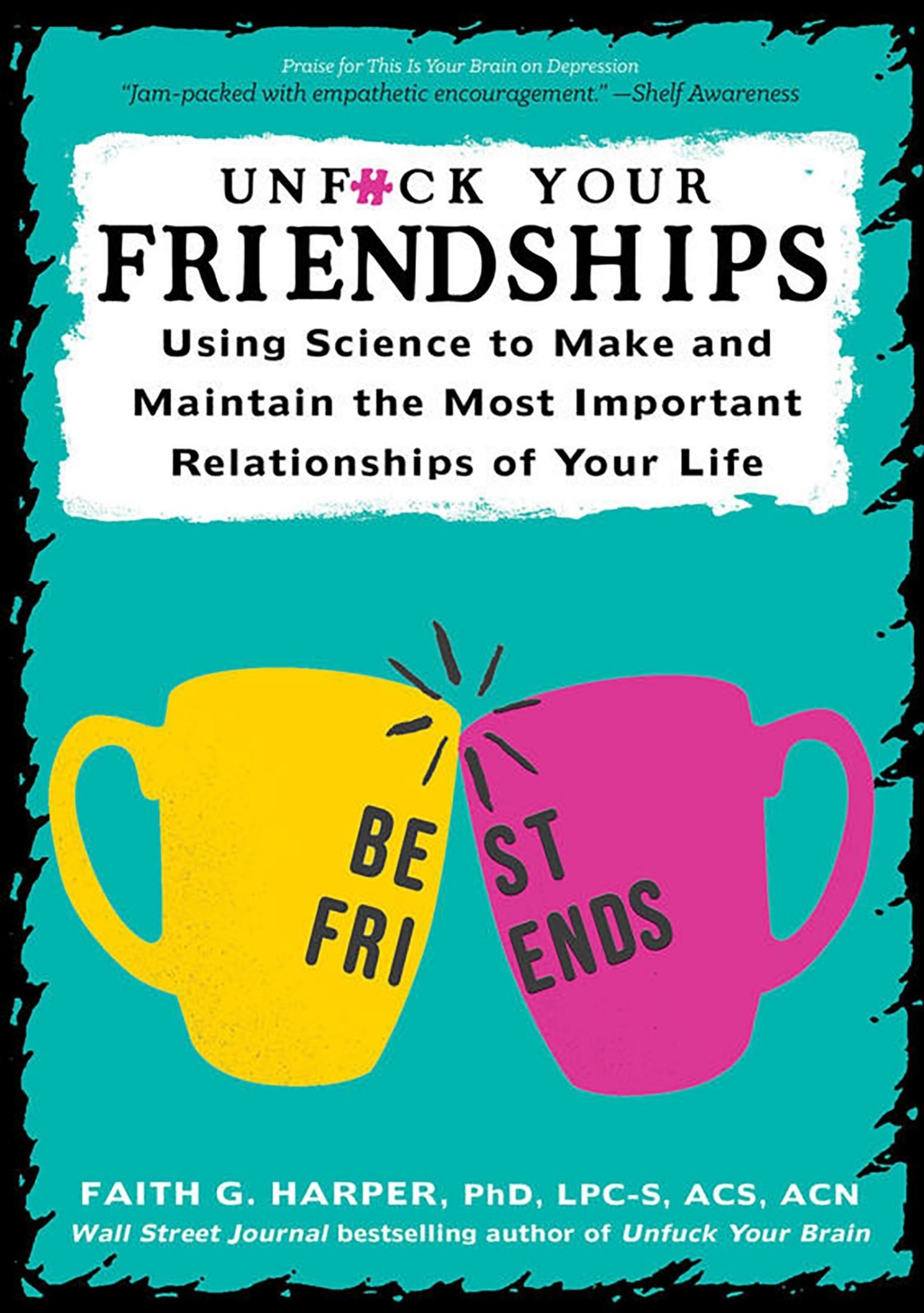
Unfuck Your Friendships (Preview)
Using Science to Make Maintain the Most Important Relationships of Your Life
We Have a Limited Amount of Physical Time and Mental Energy
And, Let’s Be Real, We Tend to Feel Like Crap About Ourselves
Some of you already have really great friends and are reading this just to hone your friend-person skill set (go you). The rest of you may be reading this because you have noticed that you don’t have the kind of friendships that you really would like to have. But no matter your situation, life is all twisty-turny, and tuning up our friend-making skills is never a waste of time. We are all continuously learning and growing and making new friends along the way.
If having friends is so fucking important to our wellbeing it should be something pretty easy to do and something we would be reasonably skilled at doing. But alas, neither are really true. There are tons of perfectly competent fully functional human beings (I’m including all of us in that category) that struggle to make friends. It’s actually pretty difficult. While there are evolutionary reasons we need friends, there are also evolutionary reasons that they are really difficult to form. And that difficulty is part of what makes them so valuable to us. And that actually makes sense, friendships are important to us and incredibly valuable because they can be so difficult to form.
We Have a Limited Amount of Physical Time and Mental Energy
Raise your hand if you are a competent human being in many areas but still find it weirdly difficult to make friends. Now look around at how many other people have their hands up along with us. This is super common and not near an indication of your unfriendability. An article in OZY Presents the Sunday Magazine from 4/11/2021 asked readers whether they found making friends hard. Nearly half said yes, and that it has gotten increasingly difficult as they have gotten older. Readers were totally self-aware in their reports that their time feels more valuable, they’ve gotten fussier about what is important to them, they are less interested in trying new things where they might forge new connections, and they’ve started to not trust people as much.
And what if you move a lot? Or even once? Another study commissioned by the people who run Patook (an app designed for making platonic friends) found that we don’t feel comfortable with making friends in a new place for about 5 years. That’s a big chunk of time somewhere feeling really fucking isolated.
Why is making friends so hard and why does it take so long? John Cacioppo, a social neuroscientist who spent his career studying loneliness, found that we have a built-in evolutionary bias to proceed on the side of caution. In an interview he did with The Atlantic in 2017, he stated:
“If I make an error and detect a person as a foe who turns out to be a friend, that’s okay, I don’t make the friend as fast, but I survive. But if I mistakenly detect someone as a friend when they’re a foe, that can cost me my life. Over evolution, we’ve been shaped to have this bias.”
So it would make sense that in a new place we would be even more on guard. And that as we gain years on the planet, it’s easier to hit social oversaturation. In the 1990s, anthropologist Robin Dunbar posited that we have a cognitive limit to the number of people with which we can maintain a social relationship over time, based on correlating primate brain size with the size of each primates average social group. He found that for humans that number is about 150. So our work team, our gym buddies, and our zucchinis all add to this number, and we can easily become oversaturated and overwhelmed.
In order to bridge the gap between evolutionary and social psychology (we need friends for survival and it’s also difficult to meet and trust new people). Enter Communicate Bond Belong (CBB) Theory to help make both of these truths make sense.
CBB theory posits that all social interactions require an expenditure of energy (fucking got that right), but not all of them are designed to fill that need for connection.
We have this constant math equation going on trying to balance investing and conserving our (social) energy and adapting to different environments and obligations. So friendship seeking is actually designed to be a pretty strategic thing we do, not an intuitive one. We are always considering if we should invest hours in a new friendship versus strengthening current ones and what are the potential safety concerns for us in any of these exchanges.
In short? We’re busy. And overwhelmed. And not just in a “hahahaha, that’s life tho!” kind of way but in a very real neurological kind of way. So making that process more conscious can be incredibly helpful to our goals around having quality friendships.
And, Let’s Be Real, We Tend to Feel Like Crap About Ourselves
Of course, the overwhelm isn’t the entirety of it. Our own self-worth is also a pretty exhausting hobgoblin to live with. In all the research on combating loneliness, a huge portion of the interventions found to be useful are about dealing with our own wonky wiring. That is, helping us read others more accurately. The most useful treatment for people who struggle to make friends is treating their maladaptive social cognition. That is, their low self-worth. We tend to think that people hate us (or at least don’t like us) and don’t want us around.
And even if our self-worth is fine, another big issue, especially for my neurodiverse people, is missing cues. Some of us don’t catch when we accidentally did say or do something that upset someone else, and we’re going blithely along our way, thinking everything is fine. You know, social skills. That nebulous and broad category that defines all the spoken and unspoken rules about navigating communications and interactions with others. Something that you don’t have to be neurodiverse to struggle with.
Good news though. Skills are learned abilities, not innate ones. Social skills don’t spring fully formed from a natural aptitude at peopleing. People constantly tell me how good I appear at connecting with others, and the truth is all my social skills were learned clunkily and were very hard won. And my inner self is still a deeply awkward 11 year old.
If the issue is primarily your own sense of worth, this is where therapy can be useful. There may be some trauma to unpack, especially related to how you were raised and how that is affecting your present. Doing some self-propelled work around your attachment style (chances are it’s not secure attachment, right?) can also be helpful.
If it is mostly a matter of social skills, that is likely more the domain of an occupational therapist, a skills trainer, or a coach. Especially if you’re neurodiverse. It can also be super helpful to check out books or videos about nonverbal communication like facial expressions and body language. Joe Navarro is a former FBI agent who is a specialist in non-verbal body language. His interest in the field started when he immigrated to the US from Cuba and was plopped in an American school without speaking the language. All of his early communication was nonverbal, which led to his career. His book What Every Body Is Saying is super useful, even if you are already pretty decent at reading body language, and maybe lifesaving if you struggle with it.
Other social skills tools that can be helpful include initiating and maintaining conversations in ways that are setting appropriate, connecting to empathy, and asserting boundaries.