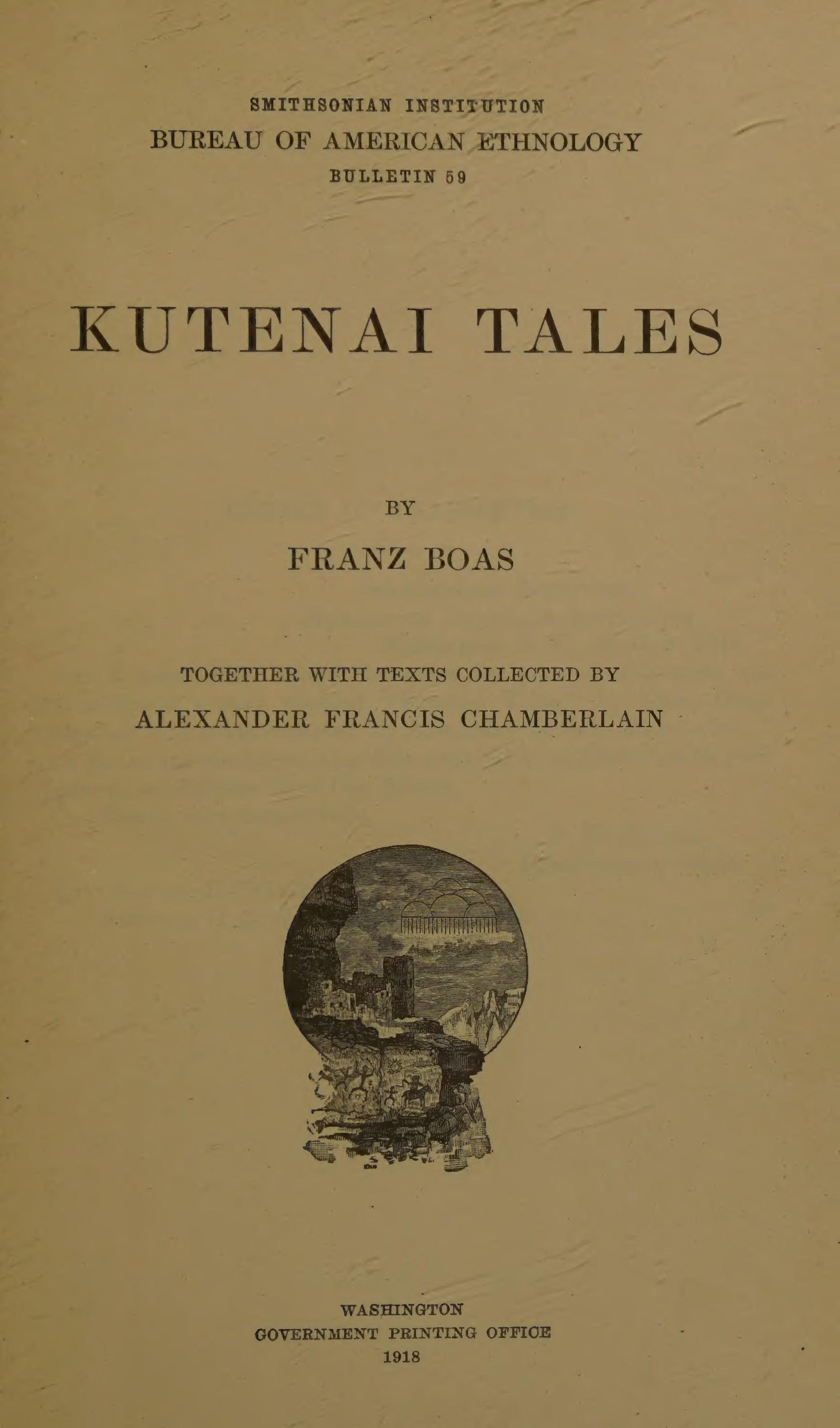
Franz Boas
Together with texts collected by Alexander Francis Chamberlain
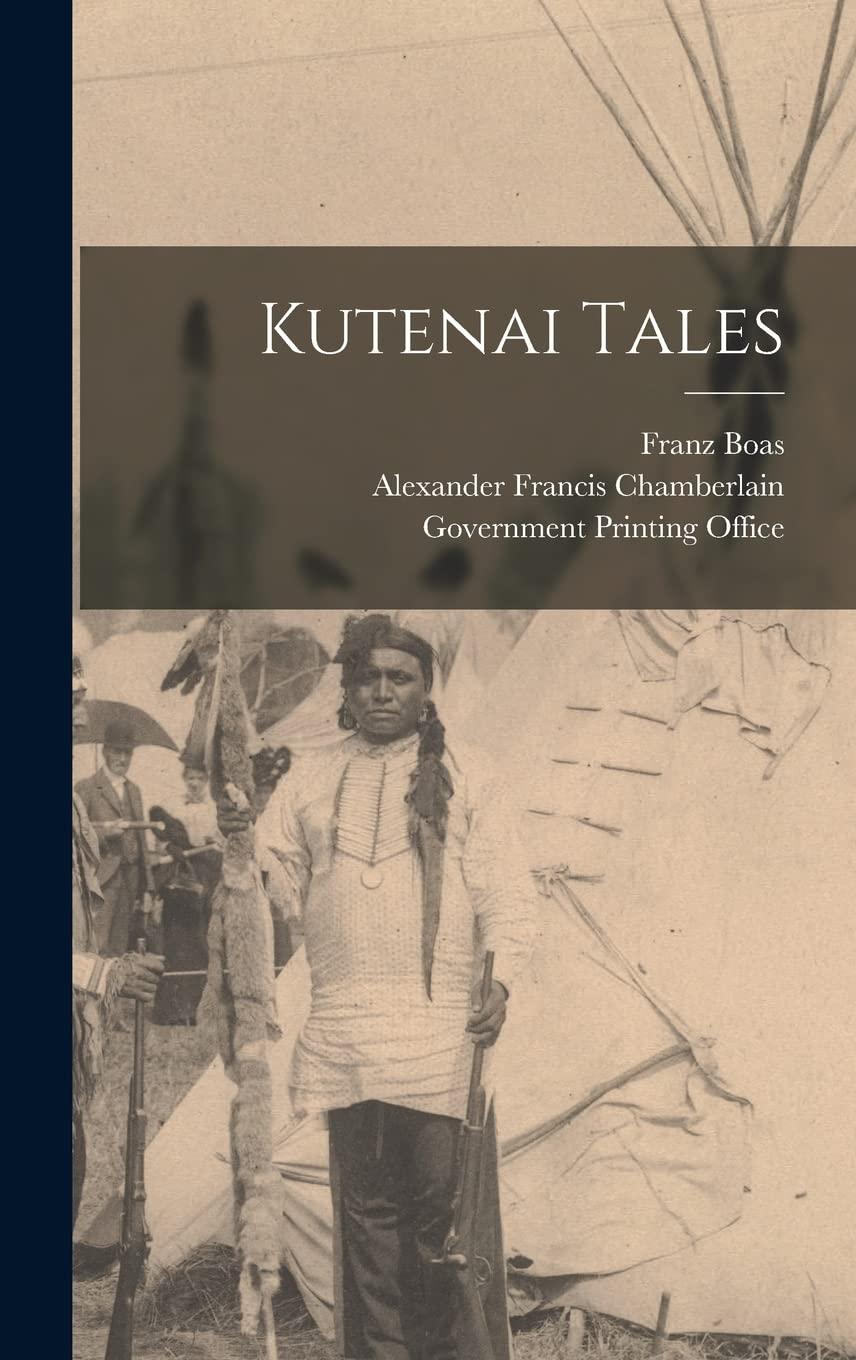
Kutenai Tales
Bulletin 59 of the Bureau of American Ethnology (Smithsonian Institution)
I. Texts Collected by Alexander F. Chamberlain in 1891 (Nos. 1–44)
11. Coyote and the Manitou avitii the Hat
21. The Youth who Killed the Chiefs
23. The Frenchman and Uis Daughters
[Nos. 32–37. Lower Kutenai. Told by Angi McLaughlin]
[Nos. 38–44. Description of Dances, Games, and Hunting]
II. Texts Collected by Franz Boas (Nos. 45–77)
[No. 45. Told by Pierre Andrew]
45. Rabbit, Coyote, Wolf, and Grizzly Bear
[Nos. 46 and 47. Told by Pierre Numa and Pierre Andrew]
[Nos. 48–50. Told by Mission Joe and Felix Andrew]
[No. 51. Told by Felix Andrew (recorded by Robert T. Aitken)]
55. The People Try to Kill Ya.ukue’kam
60. Coyote Kills Panther and Liberates the Salmon
62. Coyote Juggles with His Eyes
Letter of Transmittal
Smithsonian Institution,
Bureau of American Ethnology,
Washington, D. 0., March 3, 1915.
Sir: I respectfully submit herewith for your consideration the manuscript of a work entitled “Kutenai Tales,” by Franz Boas, “ together with texts collected by Alexander Francis Chamberlain,” with the recommendation that this material be published, with your approval, as Bulletin 59 of this Bureau.
Yours, very respectfully,
F. W. Hodge,
Ethnologist-in-Charge.
Dr. Charles D. Walcott,
Secretary of the Smithsonian Institution.
Preface
THE following collection of Kutenai tales embraces a series of texts collected by the late Alexander F. Chamberlain in 1891, and another one collected by me in the summer of 1914.
The texts collected by Dr. Chamberlain were told by two men— Paul, who, according to information received in 1914, lived near St, Eugene Mission, and who had spent some time among the Blackfeet; and Michel, who belonged to the same region. The name of the narrator of the Lower Kutenai tales is given in “The International Congress of Anthropology” (Chicago, 1894) as Angi McLaughlin. The texts recorded by Chamberlain are brief. It should be remembered that these were recorded on the first field expedition ever undertaken by Dr. Chamberlain, and that it requires a considerable amount of practice to record long tales. This accounts to a great extent for the fragmentary character of his notes.
Among/the texts collected by me, one was told by Pierre Andrew, a man about 33 years of age, who has a good command of English. He is not able, however, to interpret with any considerable degree of accuracy the grammatical forms of Kutenai, so that his own translation is always a rather free rendering of the Indian sentences. Two tales were told by Pierre Numa, an older man, who, however, spoke so rapidly that the tales had to be redictated by Pierre Andrew, who served as interpreter. Three other tales were told in the same way by Mission Joe, a man about 60 years old, whose dictation was repeated by Felix Andrew, a young man who speaks English very well, but whose ability to interpret the Indian texts word by word was even less than that of Pierre Andrew. One tale was told by Felix Andrew himself and was recorded by Mr. Robert T. Aitken. The rest of the stories were told by Barnaby, a man about 60 years of age, who, after very short practice, learned to speak slowly and distinctly, and whose dictation was perfectly satisfactory. All these tales were recorded without translation; and the translation was made later on, in part with the assistance of Pierre Andrew, in part with that of Felix Andrew. All my informants were Upper Kutenai, and the revision of Chamberlain’s tales was also made by Upper Kutenai; so that the dialectic forms of the Lower Kutenai have probably disappeared.
It is interesting to note that Barnaby refused to tell the Mosquito story (p. 25), because, as he said, it was proper for children, not for adults.
I wish to express my sincere thanks for much kindly assistance rendered to me in the course of my work by Rev. F. E. Lambot, O. M. I., and the Sisters in charge of the Government School of St. Eugene.
Franz Boas
Columbia University
New York
Alphabet
Vowels
| a | e I | o u |
| (a’) | t | u, u |
| a | I | u |
| aa | el il | ou |
Consonants
| — | — | — | — | — | (dl) |
| p | t | ts | k, ku | q | — |
| p! | t! | ts! | k!, k!u | q! | — |
| — | s | — | (x)[1] | x | l |
| m | n | — | — | — | — |
h, w, y, ’
| . | long sounds. |
| : | very long sounds. |
| — | short sounds. |
| ‘ | principal stress accent. |
| ‘ | secondary stress accent. |
| , | separate sounds, particularly in is and t.l, indicating that these sounds are not affricatives. |
| ‘ | high tone. |
| — | sinking tone. |
Description of Sounds
| e, i | represent a sound which is by. origin probably a somewhat open i. In contact with velars and palatals, it inclines toward the sound of e. When long, the sound is always slightly diphthongized, |
| o, u | represent a u with very slight rounding of lips. In contact with velars, it inclines toward the sound of o. When long, the sound is always slightly diphthongized. |
| (a“), r, u | open vowels, often followed by long consonants. |
| & | open short, about as German u in Hutte. The pronunciation of this vowel differs very much among individuals. Some pronounce a clear /; others a «. All admit that both these extreme forms are correct. |
| a, i, u | vocalic resonance of consonants. |
| e, i, u | short weak vowels, very slightly voiced. |
| e | very weak vowel of indeterminate timber, lips, palate, and tongue almost in rest position, larynx not raised. |
| aa, eh io °u diphthongized vowels, ending with a decided glottal stricture, so as to be set off from the following consonants, without, however, forming a complete glottal stop. | |
| p, t, ts, k, ku, q | strongly aspirated surd stops (ku labialized, ( velar), is is pronounced by many individuals as tc; but careful speakers, particularly old men, pronounced a clear ts, When followed by w or y, the stops lose some of the strength of their aspiration. Terminal k is somewhat palatalized, except when it follows a u. |
| p!, t!, ts!,.k!, q! | very strong globalized consonants (fortis), ts! has in its continuant part a pure s character. |
| s | as in English. |
| x | velar spirant. |
| l | voiceless I, |
| dl | voiced affricative, only in the word kudlidlus (“ butterfly”). |
| m, n | often strongly sonant, with sonancy beginning suddenly before complete labial or lingual closure. |
| ‘ | glottal stop. |
| . | aspiration. All surd stops are strongly aspirated, but the aspiration has been indicated only in words beginning with aa’. |
The primary accent is always on the penultima, the weak vowels, B, i, u, not being counted.
Kutenai Tales
By Franz Boas
Together with Texts
Collected by Alexander Francis Chamberlain
I. Texts Collected by Alexander F. Chamberlain in 1891 (Nos. 1–44)
[Nos. 1–23. Told by Paul]
1. Coyote and Fox
Coyote started. He saw Fox Coyote said: “Give me your blanket. Let us be friends.” Coyote said: “Let us go.” Fox said: “Yes, let us be friends.” Then he started. He went along. He saw people. There were many tents. Then they had a race.
2. Coyote and Locust[2]
Coyote went along. He saw Locust. He said to him: “Give me your shirt. If you give it to me, you will be my younger brother. I shall carry you.” Tie said to him: “Don’t, we shall be brothers,” Coyote started. He carried Locust. The two went. He saw Grizzly Bear coining. Locust said: “Put me off.” He was put off. There was a cliff, on the edge of which he staid. (Grizzly Bear Woman) arrived, and (Locust) scared her, and (Grizzly Bear) fell down. Coyote went back. He went around. He reached the place where Grizzly Bear lay. He ate her. He took her out of the fire. He took the meat and the fat. He ate, lie tied it up. Coyote started. He carried Locust. He went along. He saw Grizzly Bear (Man) coming. Locust said: “Put me off.” Coyote said: “It is my turn. Let me scare him.” (Grizzly Bear) arrived. Coyote became a stump. Grizzly Bear arrived. He said: “Let me bite him.” He saw it was Coyote. Coyote said: “I am Coyote. Let us start.” He knew where Locust was. Coyote said to Grizzly Bear: “Will you eat grease?” Grizzly Bear said: “Yes, I’ll eat it.” Coyote untied what he was carrying. He gave it to him. (Grizzly Bear) saw it. Grizzly Bear said: “ Did you not see an old woman ? She must have passed here.” Coyote said that he had not seen anything. Coyote said: “It is Beaver, therefore it is fat.” Grizzly Bear said: “It is not Beaver.” Coyote said: “You ought to have said, ‘It is the old woman.’” Coyote started to run. Coyote was going along. (Grizzly Bear) pursued him. Grizzly Bear thought: “ First let me bite the little one.” Grizzly Bear thought he was on the right trail. “Later on, after I have bitten him, I will bite (this one).” Grizzly Bear started. He pursued Coyote. Coyote went along. He was tired. He chased him around the tree. He fell down and thrust his hand into a (buffalo) horn. Coyote pursued Grizzly Bear. He overtook him. He struck him. Coyote turned back.
3. Coyote and Locust
Coyote went along. He saw Locust. He (Locust) carried his leg. Coyote saw it. Coyote thought: “Let me also break my leg.” Thon Coyote broke his leg. He carried it. Then Coyote started. Coyote carried his leg. He saw Locust. Locust said: “Is there anyone similar to me?” Coyote said: “I am that way, too.” Locust said: “We shall be friends,” Then Locust said: “Now, go ahead. You go first” Then Coyote started ahead. Behind him was Locust, lie went along. He thought: “I shall kill Coyote.” Then Coyote ran. He went way around. He caught up with him and went ahead. He went along. He was tired. Locust reached him. He kicked him. Locust killed Coyote. Locust started. He went along. Coyote lay there for several days. Magpie flew along. He saw Coyote lying there. He thought: “Let me eat Coyote’s eyes; he is dead.” Then Magpie ate Coyote’s eyes. Coyote came back to life. Coyote said: “A manitou passed by here. He carried his leg and killed me,” Coyote started and went back. He saw Locust, He slapped himself. Out came his corpses.[3] He said to them: “Tell me, how shall I kill him?” He was told by one of them: “He is always carrying his leg.” He was told by the other one: “I shall be a knife. I shall be on the sole of your foot. When you overtake him and he says, ‘You shall go ahead,’ you shall say, ‘You go ahead.” Locust started. Coyote was behind. Coyote ran. He overtook Locust. He kicked him. Coyote killed Locust. Enough.
4. Coyote and Grizzly Bear
Coyote went along. He saw Grizzly Bear’s dung, unchewed wild rhubarb. Coyote laughed. Coyote, took Grizzly Bear’s dung. Coyote hung Grizzly Bear’s dung on a pole in a line. He laughed. Coyote started. Grizzly Bear was staying there. He thought: “Let me go (and see) why Coyote is always laughing.” Grizzly Bear went there. He saw his dung hanging there. Grizzly Bear became angry. He thought: “Ijet me go and kill Coyote.” Grizzly Bear started. He saw Coyote coining. He thought: “What does Coyote like?” Grizzly Bear thought: “Let me make sisketoon[4] berries.” He made sisketoon berries. He staid there. He thought: “I shall bite turn right here.” Coyote went along. He saw many sisketoon berries. He went there; he ate and spit them out again. Coyote said: “If Grizzly Bear had seen this, what an amount of dung there would be!” Coyote started. Grizzly Bear was angry, lie thought: “If I don’t bite you!” Coyote went along ahead. Grizzly Bear made choke cherries just at that place.[5] Coyote went there. He ate and spit them out again. Then Coyote started. Then (Grizzly Bear thought): “ I shall bite you.” Coyote went along ahead. Just there Grizzly Bear made large rose hips. Coyote went there. He saw many rose hips. Then he ate. He stood there eating. He saw many rose hips in the bushes. He went to the place where there were many rose hips. There was Grizzly Bear. Then Coyote shut his eyes and chewed rose hips, He did not see Grizzly Bear. [He was lying there.] He went there to pick and eat them. Grizzly Bear took hold of him together with the bushes. Grizzly Bear said: “What did you say?” Coyote said: “I said, ‘I wonder whether Grizzly Bear is hungry.” Grizzly Bear said: “No, you said something else.”—“No, I said, T wonder whether Grizzly Bear is hungry.’”—“No, I didn’t mean that first; I said that before ?t” He hit him while saying so; Coyote hit Grizzly Bear with his elbow. Coyote ran off quickly. Nothing runs so fast as he was running. Coyote started. Coyote was pursued by Grizzly Bear. Coyote went along. Grizzly Bear made many turns. Grizzly Bear caught up with him. Coyote went ahead. He went along. Coyote made many turns. Then Coyote became tired. He asked for the help of the manitous. He said to them: “Tell me, what shall I do? Grizzly Bear is pursuing me.” He was told by one of them: “I shall be a river.” He was told by another one: “I shall be a tree.” He was told by another one: “I shall be a tent. Then when Grizzly Bear comes, you will come out, you will say to him, ‘Dead![6] you wish you could bite me.” A tree was bobbing up and down. He said to him: “I shall hold the tree with my feet.” He held it with his foot. (The Bear) walked across the water. He just came to the middle. He was in the middle over the water. Coyote let go of the tree [with his foot]. Then it bobbed up and down again. Grizzly Bear fell into the water. He was drowned. Enough.
5. Coyote Goes Visiting
Coyote had a tent and was married to Dog. lie told his children: “Over there is the tent of your uncles; they are never hungry; you ought to visit them.” At night Coyote slept. Early the next morning Coyote said to his wife: “Where are my clothes?” Coyote was given his clothing. Coyote dressed himself. Coyote started. He? went along. He saw the tent of Kingfisher. Coyote went there. Coyote entered the tent of Kingfisher. He sat down. Kingfisher said: “Where is my sharp horn?” He stretched his hand back. He brought it forward. He put it down in front of himself. Kingfisher took it. He said to his children: “Go and get a switch.” _His_ two children went out. They brought in two switches. Kingfisher took them. He tied up his hair over his forehead. Kingfisher hopped about. He made noise when he started. He jumped and stopped on the smoke hole. He jumped down. The two children thought they would look out. Their mother said to them: “Don’t look out! He might not find the hole in the ice where he went in.” Coyote stayed there. Kingfisher re-entered carrying two switches. He boiled them. Coyote ate. After eating, Coyote left for his tent. He got back at night. Coyote slept that night.
Dog said to her children: “To-morrow you ought to visit your uncles. There is their tent.” Coyote slept. Early next day Coyote started. He went along. He arrived at the tent of Moose. He entered the tent of Moose. He sat down. (Moose) said to his wife: “Look this way.” She looked at her husband. Moose took a knife. He cut off her nose. He took ashes. He threw them on, and it was whole again. He threw it into the fire. He rolled it in the fire. He took it out of the fire again. He said to his children: “Go and get the roots of a tree.” They brought them in. He threw these roots into the fire. He rolled them in the fire. They became guts. He took them out of the fire. He arose. He slapped his backside, and camas came out. They put it into the kettle. It was given to Coyote. He ate. He finished eating. Coyote said: “To-morrow you will visit my tent.” Coyote started back. Coyote arrived back at his tent. On the following day Moose arrived at the tent of Coyote. Coyote was seated. He said to his wife: “Look this way!” His wife looked at him. At once he cut off her nose. At once Dog ran out howling. Dog re-entered. He threw ashes on her, but her nose was not restored. Moose took ashes. He put them on her nose and it was whole again. He said to the two children: “Bring a root.” They two went out. They brought it in. He took it. He threw it into the fire. He took it out of the flic. It turned into guts. He rolled them in the fire and gave them to (Coyote). Moose said to him: “Eat.” Moose started back. Enough.
6. Coyote and Buffalo[7]
Coyote went along. There was a hull’s skull lying there, and he knocked it about. He started off. He went along. There was a hid. He went up the hill. Coyote staid there. There was noise of running. He raised his head quickly, but there was nothing. He sat down again 0?). Again there was noise of running. He saw a Buffalo Bull coming. He started to run away quickly. He went along. Then they met again. He went along.. Coyote said: “Oh, where are you staying, manitous?” He said: “Nephew, come, our(?).” Coyote saw burnt trees standing there. Coyote arrived, and sat down on top of them. Bull butted the tree. He broke it. Coyote started to run quickly. Coyote went along. He was tired. He said: “ Where are you staying, manitous?” He was told: “Nephew, come, our (?).” Coyote went. There lay a stone. He entered it Bull butted the stone. He broke it. Coyote started to run away quickly. Coyote went along. There was a (body of) water. Coyote jumped into the water. He dived. The Bull came to the water and drank. He stood there drinking. He drank it all. Coyote started. He went along. He said: “Where are you, manitous?” He heard speaking, and was told: “ Nephew, come, our (?).” The two went. , There was a little rosebush. Coyote went. He sat down on top of it. The Bull arrived. He butted it. He couldn’t break it. Again he butted it. He tore it into shreds. Coyote said: “Now let me go; I will fill a pipe for you.” The Bull said: “I don’t smoke.” Coyote said: “I will fill a pipe; I don’t know what the Bull likes to smoke.” Coyote was told: “I smoke tobacco. When I finish filling the pipe, I hold it up to the sun. It catches fire. It catches fire by means of the sun.” (Coyote) was afraid. (The Bull) smoked. He continued to smoke. The Bull said: “ I had a wife where my head lay. Let us be friends.” Coyote said: “ We will go to your wife.” The two started. The two went along, and he saw his wife among a crowd. Coyote sharpened his friend’s horns. Coyote said: “ Now go ahead. When you run along, turn this way.” The Bull went there. The Bull was seen running toward the place where Coyote was. He went past. Another Bull arrived. He shot him. Coyote killed him. The other Bull came back. He said: “ Let us go to my wives.” The two went. Coyote was told: “ Which one will you take?” Coyote said: “Let me take the larger one.” Coyote started with his wife. The two went along. He said to his wife: “Now go ahead; go up the valley and go across.” Coyote started. He went to the valley. He staid there. He saw his wife coming. He broke a stick when his wife was coming. He hit her. It did not enter her body. He laughed at his wife. He said to her: “Now go ahead.” She started, and he said to her: “Go up the valley and go across there.” Coyote started. He ran. He got there. He stopped there. His wife came. He shot her and killed her. He butchered her and skinned her. There was a flat stone, and he sat down on it. He saw Wolf coming. He thought he would hit it. He was going to get up. He couldn’t get up. He shot at that Wolf. He had no more arrows. He took off his bowstring and struck him with his bow stave. The Wolf ate that game. He ate it all. Coyote got up again. He went and took the bones. He thought he would break them up. He was told by (a bird): “ Don’t strike them.” Coyote stood there holding an ax. Then Badger pounded them. He finished breaking the bones and put the marrow into the tripe. Coyote was told: “ Take hold of my tail.” Coyote took hold of (Badger’s) tail. (Badger) finished putting in the marrow. Badger started to run away. Coyote followed him. He continued to run. The tripe was thrown back at him. Coyote licked the tripe. He thought: “ I will break it.” He was told by (a bird): “I will break it.” Coyote was told: “Start for the place where there is a plain on the hill, Coyote.” Coyote started. He was told: “Come back when you see smoke; then you shall eat grease.” (The bird) was pounding it. He finished pounding it, and put green boughs on the fire. Coyote saw the smoke. He started to come back. Coyote came back. He stood there and looked about. There was nothing there. Here (the bird) dropped a little grease. He looked up. He saw (the bird) flying off. Coyote was standing there helplessly. Coyote was without even a mouthful of (the meat of) his wife.
7. Coyote and Butterfly
Coyote went along. He heard some one singing. Coyote reached there. He saw Butterfly. Coyote thought he would steal Butterfly. He said to him: “I don’t steal men.” Coyote started.
8. Coyote and Grouse
Grouse was living in a tent and had many children. They were in her tent. Grouse started with her husband. They two were going along. Coyote was going along. He saw the tent of Grouse. Coyote reached there. He entered. There were many children. He took a bag, put them into it, and carried them along. He started. He went along. They broke the bag by scratching it, and went right through the hole. Coyote was going along. He thought: “Now I’ll eat.” He looked, and there was nothing. Coyote started.
9. Coyote and Star
Star was going along. He saw’ a child eating earth. It was Goose. He started. He saw a Golden Eagle sitting on a tree. He saw him, and he was screeching. Star also said ... (H) He went up. He reached the place where the bird was, and killed it (?).
10. Coyote and the Woman
Coyote went along. There was a hill. He arrived on top. He saw a woman. Then the woman saw Coyote. She was afraid. Then she lay down. Then Coyote started. He saw the woman lying there. He thought she was dead. Coyote said: “Why is she dead ? Let me see what killed her.” Then he looked. He did not know what had killed her. Then Coyote started toward the backside of the woman. Coyote looked. He saw her backside. He tore It. He put his finger in. He smelled of it. He said: “It stinks. She has been dead for a long time.” Then Coyote went on. The woman lay there. She thought: “ Let me go to Coyote; let me marry him.” Then the woman started. She got there. She said to Coyote: “Let us go to my tent.” She started; she got to her tent. She staid there.
11. Coyote and the Manitou avitii the Hat
Coyote went along. He saw a manitou having a hat made of belly fat. He touched it.. He took a piece off. He ate it. Again he broke a piece off. Again he ate it. He was told: “Go away,” He was told: “ You hurt me,” Coyote went off.
12. Coyote and the Ducks[8]
Coyote with his two children went along. There was a lake. He saw many ducks. He said to his children: “Cry!” The children cried. They cried thus: “My father’s brothers-in-law!” Coyote cried thus: “My brothers-in-law!” One Mallard Duck said to his children: “Listen! a manitou is crying.” Mallard Duck said: “Go to him (and listen to) what he is talking about.” One of them went ashore. He came to Coyote. He said to him: “What do you refer towhen you cry?” Coyote said: “Come ashore, all of you!” All the ducks came ashore. He pulled out their feathers. Enough.
13. Coyote and Owl[9]
There was a town. A child was crying. It was told: “Don’t cry, Owl will take yon.” The child cried. Owl took it. He put it into a birch-bark basket. Then there were no more children. Coyote said: “I shall cry.” At night Coyote cried. He was told: “Don’t cry, else Owl will take you.” Coyote cried aloud. Owl arrived. He said: “Give me the child.” (Coyote) was given to him. (Owl) put him into the birch-bark basket. He carried him away. Owl arrived at his tent. Coyote saw many children dancing. He took gum. He rubbed it on Owl’s eyes, and (Owl) was blind. He threw him into the fire. (Owl) was burned entirely. All the children started back to the tents of their parents.
14. Chickadee and Elk
Chickadee went along a river. On the other side he saw Elk. Chickadee said: “There is. a good place on the other side; I wish I could get across.” Elk said he would take him across. He went across in the water. (Chickadee) was riding. Elk walked in the water. He just got ashore and (Chickadee) stabbed him. Chickadee killed Elk
15. Frog and Partridge
Frog was going along. She saw Partridge. She said to him: “You shall be my husband.” He went to her tent. He arrived. He always went hunting. He killed much (game). Frog said: “Now look for your wife.” Partridge started. He found his wife. He said to her: “Where are the children?” That woman said: “They are where you come from.” The two started. He arrived at his tent. He staid there again.
16. Beaver and Turtle
Beaver and Turtle wore living together in a tent.. (Turtle) started. There was a town. He went there. He entered the. tent of the chief. The chief was asleep. Turtle cut off the chief’s head. He went out again; he passed outside to the rear of the tent. He crawled under the cover. He staid there. Tn the morning the chief was lying down. His food had been prepared. He did not arise; and the chief was shaken. He was told: “Rise, I have finished your food.” He did not arise. He was shaken again. He was told: “Arise.” He was looked at. He was dead. They searched for tracks (to discover) who had done it. Tracks were seen. The tracks did not go out again. They were looked at. (Turtle) was seen. He was there. He was brought out. He was carrying the head of the chief. Some one said: “Where is a knife?” Turtle said: “I do not fear a knife.” Some one said: “Where is a bow?” Turtle said: “I do not fear a bow.” Some one said: “Where is an ax?” Turtle said: “I do not fear an ax.” Some one said: “Pour water on him.” Turtle said: “Don’t.” Some one said: “Throw him into the water.” Turtle lied when he said he was not afraid of ax, knife, and bow. He lied when he said that he was afraid of water, for that was the place from which he had come ashore. He was taken to the water. He carried the chiefs head. He was thrown into the water. He sank. After a while there in the middle he emerged. He shook the chief’s head in the water. Some one said: “It is Turtle.” Turtle started for his tent. Turtle came home. Then Beaver made holes in all directions. He bit them off (the bows), he dragged them into his hole, then the manitous went back. (Their bows) were broken. (They said:) “My bow is bad.”
17. Skunk and Panther[10]
Skunk went along. He saw Panther. Panther was afraid of Skunk’. Panther pretended to be dead. Skunk went there. He took Panther. He carried him on his back. Skunk went along. Panther thought: “ What shall I do with him?” He thought: “ He shall put me down.” He put him down. Skunk let out his fluid. Panther arose. Panther kicked Skunk’s bucket. He broke his bucket. Panther started away. He went along, going in a circle. Skunk arrived. He saw the bucket there. He was angry. He started. He looked for Panther. He saw his tracks. Panther went along and came back to the same place. Skunk started. He saw the tracks.where (Panther) had been going. He made tracks. He knew it was the same one. He followed the tracks. He tracked him. He saw the tracks were still there. He followed the tracks. He tracked him. There was a lake. There were tracks. He drank. Skunk looked into the water. There he was. He thought he saw him. Then he broke wind. Many times he broke wind. He looked again. There he was. He broke wind again. He looked again. There he was. Then he was tired. He lay down on his back. He saw Panther. lie thought: “I will break wind against him.” Then he turned his backside to him. Panther took off his last finger-nail and put it on his arrow. He shot Skunk. Panther killed Skunk.
18. The Mosquito
Mosquito went along. He saw a town. He was told: “ Come, eat choke cherries.” Mosquito said: “I don’t eat choke cherries.” Mosquito went along. He saw a town. He was told: “ Come, you shall eat service berries.” Mosquito said: “I don’t eat service berries.” Mosquito went on. Mosquito was going along. He saw a town. He was told: “Come, you shall eat blood,” Mosquito went there. He ate blood. He ate much. His belly became big. He went out again. He broke sticks and all (?). Mosquito died. Little birds flew out of him. Those were mosquitoes. “Wuu, wuu! you are a manitou; you shall be mosquitoes.”
19. The Man and the Wasps
An old man went along. He defecated. Wasps stung his anus. He put his hand in. He soiled his hand. He shook his hand. There was a stone. He hurt his hand. He put his hand into his mouth. He tasted his excrement.
20. Lame Knee
There was a town. The chief said they would break camp in order to plant.[11] They broke camp. The chief’s wives went to draw water. There were the friends of Lame Knee. His friends said: “ You ought to steal the .chief’s wife.” Lame Knee started. He went there limping. The chief’s wife came back carrying water. He seized her. She said to him: “Let me go; the chief wants to drink.” Lame Knee said: “I will not let you go.” The woman said: “Let me go; the chief might be angry; the chief wants to drink” Then they broke camp. They went to the chief. The chief was told: “Lame Knee is holding your wife.” The chief said: “Go to him. Tell him to let her go because I am thirsty.” They went to him. He was told: “The chief says he wants you to let her go because he wants to drink” Lame Knee said: “Go to the chief; tell him that I shall not Jet her go.” They went to the chief. He was told: “Lame Knee says that he will not let her go.” The chief said, being now angry: “Ha? ha, hoya!”—“Tell him I shall not let the chief’s wife go.” (The chief) took a knife. He went there. He arrived at the place where his wife was. Lame Knee was holding the wife of the chief. (The chief) said to him: “Let go of her.” Lame Knee said: “ I shall not let go of her.” The chief went there. He cut off his head. He threw it away. The head turned over; it smiled while it was rolling along. He cut off his arm. It remained hanging down. He cut off the other arm. It was thrown away. Then both arms were off. One log was cut off. It was thrown away. The other leg was cut off. The body fell down. Then it was cut to pieces. Then the people went away and put up the tents at Where-they-used-to-sow’ Tobacco. At night the people were asleep. Some one was heard singing. The people said: “It sounds like Larne Knee, who is dead.” Lame Knee arrived. He killed the chief. He married his two wives. He took both of them.
21. The Youth who Killed the Chiefs[12]
An old man who had a daughter lived in a tent. A man arrived. He kept his daughter.[13] She had another child. It was a male. He killed him. The woman lived in the tent. She had another child. It was a girl. He kept her. The chief lived there, driving game. He skinned a buffalo cow. He started to go back. He took a travois. He started off. He put the meat into it. He started to go back. He came back. That chief did not give any meat to his parents-in-law. The old woman was hungry. The old man’s son-in-law did not give him anything to eat. She had another child, a male, She said: “Do not tell the chief that I have given birth.” She said to her father: “Early to-morrow shoot a buffalo cow. Don’t be afraid of the chief.” Early the next day the old man shot a buffalo cow. He killed a cow. (The chief) went out early. He saw the old man skinning. He went in again. He took a bow. He thought: “I will kill that old man.” The chief started. He arrived.. He said to him: “Did you kill a cow?” The old man said: “Yes, it is mine.” The chief said: “No; it is not yours, it is mine.” The chief took his bow. He did not see the youth, who was there.[14] He thought he would kill the old man. The youth arose. He took his bow. He shot the chief. He killed him. He said to his father; “Now take the meat and go back home.” He took it. He arrived at home. The youth entered the chief’s tent. At once he killed the chief’s wives. He threw them outside. He said to his father: “Go in, it shall be your tent.”
He said to his mother: “Arc there no people?” He was told: “There is a town down the river.” He was told: “The chief there is like this one was. i He does not give away any food.” The youth said: “I will start.” The youth started. He arrived there. He entered an old woman’s tent. He said to her: “I am hungry.” He was told: “We are hungry.” She took a dish. She put something into it. She gave it to him. She was told: “I said I am hungry.” The old woman said: “We are hungry. There is much food in the chief’s tent, but nobody goes in there.” The youth said: “ Fil go.” He was told by the old woman: “Don’t go.” The youth arose. He went there. He entered the chiefs tent. (The chief) was asleep. (The youth) said to him: “I have entered your tent.” (The. chief) got up from his bed. He became a rattlesnake. (The youth) took his arrow. He struck him. He knocked him down. His wives at once became rattlesnakes, and he knocked them down. He went out again. He said: “Come in, all of you, and get meat.”
The youth said: “Are there no other people?” He was told: “There is a town down the river.” The youth said: “I will start.” He was told: “The chief is bad.” He started. He arrived at the town. There an old woman was living in a tent. He entered. He said to her: “I am hungry.” He was told: “We are hungry.” She took a dish. She put something into it. She gave it to him. He said to her: “I said I am hungry.” He was told: “There is no food.” He was told: “There is much food in that tent, but nobody goes in there,” The youth said: “TH go.” He went out. He got there. He entered, and the chief was asleep. He said to him: “Get up.” The chief got up from his bed. He became a grizzly bear. The youth took his arrow and struck him. He knocked him down. At once (the chief’s) wives became grizzly bears. He knocked them down. He threw them outside. The youth went out again. He said: “Take the meat.” They took the meat.
The youth said: “Are there no other people?” He was told: “There is a town down the river.” The youth started. He arrived at the town. He entered the tent of an old woman. He said to her: “I am hungry.” He was told: “We have no food.” She took a dish and put something into the dish. She gave it to him. He spoke to her, he said: “I am hungry.” He was told: “There is much food in that tent, but nobody goes in there.” The youth said: “I’ll go.” Me was told by the old woman: “Don’t go there.” Me arose. He went out. He went there. He entered. He sat down. He said to (the chief): “Arise.” The chief got up from his bed. He became a buffalo bull. (The youth) took his arrow and struck him with it. He knocked him down. (The chief’s) wives at once became buffalo cows. He knocked them down. He threw them outside. He said: “Come and take the meat.”
22. The White Man
A white man went along. He saw (another) white man on the branch of a tree. He was chopping off the limb close to the trunk. The white man was told: “You will fall.” The white man said: “I shall not fall.” He said no more. This one started. (The other one) was chopping along. He chopped it off. He fell down.
23. The Frenchman and Uis Daughters
There lived a Frenchman and his. three daughters. He said to them: “You shall do whatever I tell you.” The Frenchman went away. There was a stump. He arrived and struck it. It opened, and it was a door. Grizzly Bear came to look, and (the Frenchman) was told: “Come!” The Frenchman entered. He took food. He ate, and after eating he was told: “You will give me your child. I shall marry her.” The Frenchman said to the Grizzly Bear: “I will give you my daughter.” He went back He arrived at home. He said to his eldest daughter, he said to her : “I told you, . Whatever I tell you, that you must do.” The girl said: “You said so.” Iler father said to her: “Let us go to-morrow.” On the following day the Frenchman went with his daughter. He arrived at the stump. The Frenchman knocked at the stump. The door opened. The Grizzly Bear came out and said to him: “Come in!” The two entered.
He prepared food. They ate. After he had finished eating, he said to his daughter: “You shall marry him.” The Frenchman went back. At night his daughter came back He said to her: “Why did you come back?” His daughter said to him: “Iwas afraid; he is a Grizzly Bear.” The Frenchman said: “He will bite us.” He said to his (next) daughter: “To-morrow we shall go to him. You shall marry him.” On the following day he went with his daughter. The two went there. He knocked at the door. (The Grizzly Bear) opened it. They entered. He prepared food. After they had eaten, the Frenchman went back. In the evening his daughter came back. He said to her: “Why did you come back? The Grizzly Bear will bite us.” He said to the youngest daughter, he said to her: “To-morrow we shall go to the Grizzly Bear. You shall marry him,” The following day they two went together. They went there together. He arrived. He knocked at the door. The Grizzly Bear opened it. They entered. He prepared the food. After they had eaten, the Frenchman went back. In the evening the woman went to sleep. She did not see where her husband slept. Early the next morning she saw her husband. He was walking about. The Frenchman thought: “I might go to my daughter to see whether he bit her.” He started. He arrived. He knocked at the door; he opened; he entered. There was his daughter; Grizzly Bear had not bitten her. He went back He came back. He said to his wife: “Goto the Grizzly Bear.” The old woman started. She arrived at her daughter’s tent. She knocked at the door. The Grizzly Bear opened it. He said to her: “ Come in!” The old woman entered. Food was prepared for her. She ate. After she had eaten in the evening, she staid there over night. At night she wanted to see how the Grizzly Bear slept. The old woman went to sleep. She did not see where he slept. In the morning she saw him walking about.
[Nos. 24–31. Told by Michel]
24. Coyote and Owl[15]
There was a tent far away. Owl was there. When a child cried, its mother said: “Don’t cry. Owl may take you!” At night, however, Owl came to the tent and took many children in his bark basket in which awls were standing. With these he killed them. Coyote said: “ I shall become a child.” Then Coyote became a child. Coyote said: “At night you shall throw me out.” At night Coyote was taken and thrown out. He was taken by Owl. Owl started back to his tent. There were many children. They were there in the tent of Owl. At night Coyote said: “To-morrow you will get gum.” The following day gum was taken. At night they danced. First Owl danced there. He perspired. Coyote said: “Later on I shall speak.” Coyote said: “Throw the gum into the fire.” The gum was thrown into the fire. It became hot. Coyote took the gum. Coyote said: “Later on Owl (shall do so).” He closed Owl’s eyes with the gum. Owl had no eyesight. He could not see. Owl was taken. Coyote himself took OwL He threw him into the fire. Owl died. Small ones flew out. Coyote said: “You shall be owls.”
25. Coyote and Trout
There was Coyote. It was winter. Coyote went along. Some one said to Coyote: “Coyote, come, come!” He went there. He saw a woman. He stole her and slept with her. He was told: “We shall start for a water hole in the ice.” The woman started. Coyote went with that woman, his wife. Then Coyote staid in the water. His wife was Trout. On the following day he was told: “We shall start to where many people are fishing; there is much food.” Then they started. There were many trout. Coyote went along. They came to a fish line. All the people were fishing. They killed trout, many trout. Coyote alone broke the hook. The people made a fish hook, a thick and big fish hook. The people were fishing. The (fish) ate the bait. Coyote was pulled out of the water. Then Coyote was taken. Then Trout was no longer Coyote’s wife. Coyote staid among the Indians.[16]
26. Skunk and Panther*[17]
There was Skunk. He was not afraid of anything. He went along. He saw Panther. He was afraid of Skunk. He thought: “Skunk is bad; Skunk may kill me.” He lay down. Skunk went along, he saw Panther. He looked at him. He thought: “Panther is smart; what may have killed him?” Skunk took Panther. He put him into his bucket. He carried him on his back. He started. He went along. Panther thought: “What may frighten Skunk?” Skunk said: “lam afraid of one thing— whistling.” He went along. He put him down. He went along. Skunk squirted out his fluid. He stopped there. Somebody whistled, and Skunk was scared. Skunk started. Panther broke his bucket. Panther started. He thought Skunk was bad. Panther started. Skunk was afraid. Panther went along. There were trees where he went. He came back here. When he went along, he came back where there were many tracks. Skunk went along. He thought Panther had lied and that he was not dead. (Skunk) started again. He got back to his bucket. His bucket was broken. He saw no Panther. He knew that he was not dead. He saw his tracks. He started (following) his tracks. Skunk went. There were many tracks. He did not see where Panther was. He looked for him. His tracks were many. He saw his tracks. There were tracks. He went. He went quickly, He thought: “I’ll kill Panther.” Panther came to a river, He climbed a tree. Skunk arrived. He drank. He saw Panther in the river. He shot him. He broke much wind. He had no more fluid. He took back his fluid. He did it and he broke wind again. He was tired. He lay down. Then he saw Panther in the tree. He shot him. Skunk killed Panther.
27. The Deluge[18]
There was a camp. There were many who picked huckleberries, Chicken Hawk had a wife. She picked huckleberries. Chicken Hawk went, He saw his wife. He did not know that Yawo’nik! had taken his wife. Yawo’nik! had taken her. He was angry. He shot him. He hit him. Yawo’nik! drank water. There was no more (water). He took it again. There was no more water, Yawo’nik! drank. Then Chicken Hawk took (pulled out) his arrow. Out came the water. There was a flood. All the people went up the mountains. The water reached there. All the people thought they would die. Chicken Hawk took off his tail. He put it up. He said: “If there is no more tail, then we shall all be lost.” The tail had four stripes. Then there was one left. He said: “If there is no stripe on my tail, then we shall all die.” It reached there. The water stopped. Then it Went down. The people went down.[19]
28. Chicken Hawk and Toad
There was the Toad. With him was Golden Eagle, Toad said [he said to him]: “Let us go! Chicken Hawk and Blue Hawk (?) shall be our husbands.” Then he was her husband. He was skillful. He caught Deer. One morning he was watching the Deer. In the morning Toad said: “Ill go with you.” Then he started. He watched the Deer and everything—mountain sheep, rams.[20] Chicken Hawk and Toad went along. His stone was hard (?), Chicken Hawk thought: “I’ll kill her.’’ He killed Toad. Chicken Hawk started back to his tent. Toad was seen by her parents. She was taken. They went to their tent. The mother of Toad was angry. The mother of Toad said: “Let us go!” They started. She said: “Chicken Hawk passes by here.” The two, Toad and her mother, staid there. Chicken Hawk was watched for. They saw Chicken Hawk coming along. Toad and her mother were in hiding. Chicken Hawk arrived. He was taken. Chicken Hawk was carried back to the tent. lie was poor. He was made to perspire over the fire (?). He was poor. Blue Hawk (?) knew that his younger brother was poor. He went. He took his younger brother. He went to take him. Blue Hawk (?) restored his younger brother. On the following day he looked for all kinds (of animals). He was well. Chicken Hawk and Blue Hawk were no longer poor.
29. Race of Frog and Antelope[21]
There was Frog. He said: “Let us go to Antelope’s tent! We will race with him.” Antelope was a fast runner, He was never beaten in racing. Frog arrived there. He said to all the Frogs: “ Do this.” AU the Frogslay down. (Frog) put down all her clothes. Antelope put down his clothes. Then he ran fast. They two stood together. He started. Antelope did not run fast. ThenFfog went fast, got ahead of Antelope, and took her clothes. She started again. All the Frogs were lying there. (Antelope) was hungry and thirsty. In the evening all the Frogs started. They got ahead of Antelope.
30. The Woman and the Giant
There were the Indians. They started. They went along. They saw a Giant, who killed them. They did not return to their tents. One woman started. She had a child. She went along. She saw the Giant. She said to him: f ‘ What is it ?” The Giant said: “ What are you doing?” The woman said to him: “This is your younger brother.” He said: “What did you do to make him so white?” She said to him: “I cooked him to make him white,” He saids “Cook me.” The woman said: “Bring wood.” He gathered wood. Then she made a pit (it was a pit for cooking). The woman pulled out grass. She took stones. She took wood. Then the Giant lay down. Then soil was taken. The woman threw it on top. She set fire to it. Then the Giant said: “Iskuku’, iskuku’, iskuku’!” Then the Giant spoke no more. Then he was dead. The woman started to go hack. She said: “Look! I killed the Giant.” Enough.
31. The Two Tsa’kap
There were two Tsa’kap, brother and sister. (The brother) was told: “Don’t go there!” He thought: “I will go there.” He started. He went along. There was a squirrel sitting on a tree. He shot at it. He did not hit it. He took his manitou arrow and shot and hit it. He killed it. He watched. There was a lake. Just in the middle he took off his clothing. He swam. A little ways out in the water there was a charr. It swallowed him.
There was his sister. The Tsa’kap had disappeared. That woman thought: “Why is there no Tsa’kap?” The woman started to the lake. She looked at the fish-line. She pulled it up. She pulled the charr out of the water. She cut it open. The Tsa’kap spoke (inside). He said: “Split it.” Then she split it. • She split the belly. The Tsa’kap arose. They two, the Tsa’kap brother and sister, went back together to their tent. She said to him: “Don’t go there.” He thought: “I will go.” He went. There was a squirrel on a tree. He shot at it. He did not hit it. He took his manitou arrow and shot. He hit it. He looked for his arrow. He went along. There was a tent. He entered. A woman was sitting there. She said to him: “What is it?” He said to her: “I am looking for my arrow.” She said to him: “Let us go! We’ll go swinging.” lie said to her: “Well.” She said to him: “You first.” He sat down. He said to her: “You first.” She said to him: “You first.” Then the Tsa’kap swung. (The rope) did not break. The Tsa’kap went down again. He said to that woman: “Now you swing!” (The rope) broke, and the woman was dead. The Tsa’kap went on and arrived at his tent.
He was told by his sister: “Don’t go that way.” He started. He saw a manitou looking for beaver. There were many manitou people. He said: “Let me take a beaver.” He killed it. lie took it. He started back. The Tsa’kap was pursued. He was told: “Put it down, it belongs to me; you stole it from me.” He said: “No; it is mine.” He went home to his tent. He said to his sister: “Have we no father?” She said to him: “No.” He thought: “Oh, if I had a father!” On the following day he said to his sister: “You told a lie. I ought to have a father?’ She said to him: “You have a father t [Your father was killed by Grizzly Bear. There is a mountain over there.” The following day the Tsa’kap started. He arrived. He said: “Come, Hl kill you !” The Grizzly Bear came. He said to the two (the Tsa’kap): “What did you say?” The Bear said: “TH kill you!” He said: “Shoot at it!” The Tsa’kap shot at a tree. It fell down. (The Tsa’kap) said to (the Grizzly Bear): “Go!” The Grizzly Bear went to the mountain. He got there. The Grizzly Bear stopped. From far away he was shot and was killed. The Tsa’kap went there. He skinned it. He took his father’s hair. He started. He arrived at the mountain. He said: “Come, Grizzly Bear, I’ll kill you!” Grizzly Bear started. He got there. He said: “What is it?” The Tsa’kap said: “I’ll kill you!” The Grizzly Bear said: “Shoot that tree!” He shot at it. The tree fell. The Grizzly Bear said: “I will not kill you, Tsa’kap.” (The Tsa’kap) said: “I will kill you.” He said to the Grizzly Bear: “Go on!” The Grizzly Bear started for the mountain. He stopped. He was shot and was killed. The Tsa’kap started. He cut him open. He took his hair. He went back to his tent. He staid there. The following day he said to his sister: “Let us move camp.” Then he started. He went across the mountains,
[Nos. 32–37. Lower Kutenai. Told by Angi McLaughlin]
32. Chipmunk and Owl*[22]
There was Frog. His grandmother was Chipmunk. Chipmunk was crying. He was hungry. He was told by his grandmother: “Go to the river; go to the other side.” When Chipmunk arrived, there were rose hips. He carried a bark basket. Then he took it. He filled it at once. Then it was full. There were willows. Chipmunk heard Owl making a noise. “Come here!” Then he started. (Owl) went to where Chipmunk was sitting. Owl said: “Let us go home to your mother.” Chipmunk said: “No; my mother died long ago.” Chipmunk was afraid. He thought: “lie will kill me.” Chipmunk said: “Cover your eyes with your hand.” Owl did so, He shut his eyes. Then Chipmunk started, going along. Owl did thus.[23] He could not get him. Then Chipmunk got home to the tent of I his grandmother. Then he entered. He said to his grandmother: “He will kill me. Hide me!” Frog said: “What shall I do?” Frog took her grandson and put him into the soup. Chipmunk died.
33. The Sun[24]
Coyote went along with Chicken Hawk. Coyote said: “Let us go there far away, where the people are making the sun.” Coyote said first: “I’ll be the sun.” (Chicken Hawk said:) “I first.” Coyote said: “No.” Then they started. They went along. Chicken Hawk said: “You shall listen to me.” Coyote said: “What is it?” Chicken Hawk said: “It is where we are going.” Coyote said: “What is it?” (Chicken Hawk said:) “Then we’ll stay over there. There will be grease. When people pass, they bite off a piece.” They arrived there. Chicken Hawk bit off a piece. “Now you,” said Chicken Hawk. Then Chicken Hawk passed. Then Coyote took it. The grease fell down. Coyote went rolling along. Then Coyote started. He went quickly. Chicken Hawk overtook him. Chicken Hawk said: “Listen to me, what I tell you.”[25] Then I he did not speak. They arrived there. Then in the evening Coyote said: “I first.” Chicken Hawk said: “No.” Then ( they started early. After a little while it was evening. Coyote arrived. The people said: “Coyote is bad.” After a little while Chicken Hawk said: “Now I, now I myself shall start.” Thus spoke Chicken Hawk. Then the sun rose. Chicken Hawk was a good sun. Coyote was angry. He thought he would shoot Chicken Hawk. Coyote’s arrow burned. His arrow and his bow were all burned. He put it down. The earth was all burned. He started running, and everything was on fire. He did not know what to do. He came to a trail and lay down there. The trail did not burn. Then Coyote said: “I am glad that I am not dead.” Enough.
34. Fox and Skunk[26]
Skunk was going along. There was Fox. He carried a pot.[27] He wanted to sit down. He put down his pot. He went along, (Skunk) said: “There is nothing I am afraid of.” He said: “The only thing I am afraid of is whistling.” Then he sat down. Fox arose, There was the sound of whistling. Skunk ran away. Fox broke the pot. Fox started. Skunk arrived, He saw that his pot was broken. He cried. He thought I he would kill Fox. Then Skunk started, He saw a river. He was going to drink. He saw Fox inside the water. Then he squirted his fluid at him. He became tired. He lay down and looked up. He saw Fox, being above. Then he turned around. He thought he would squirt his fluid at him, but Fox shot him. Enough.
35. Coyote and Caribou
There were two—(Coyote and) Caribou. Caribou started. Coyote was angry. Ue thought he would kill Caribou. Coyote said: “Why does it take you so long?” Caribou said: “I eat small grass and I quickly get fat.” Coyote killed Caribou. Coyote came along. Ue entered (Caribou’s) tent. Caribou was dead. Coyote cried. He said: “ I loved my friend.” Enough.
36. Coyote and Owl*[28]
Owl stole children. Coyote said: “ I’ll be a child.” Coyote cried in the evening. He was told; “ You make a bad noise. Owl may almost take you away.” Coyote was taken. He was thrown out of the doorway. Owl took him along. He carried him along. He said: “I am Coyote.” Owl was told: “Let us dance!” Coyote and Owl danced. Coyote killed Owl, who had stolen the children. They started back. He said: “ I killed Owl.” Enough.
37. Coyote and Deeb
He went along. Ue saw Deer. He thought he would kill him. The wind was blowing and frightened him. He did thus to it. He went on. He stood there holding (in the hand) his head thus. Coyote said: “Is that your father’s war bonnet?” The thing said: “What is it? Do you forget that you killed me?” Coyote said: “I thought it was nothing.” Enough.[29]
[Nos. 38–44. Description of Dances, Games, and Hunting]
38. Kissing Dance
The drum is beaten. Men and women dance and kiss one another. In return blankets are given. Another person is kissed and many things are given.
39. Sun Dance
They build a tent to have a Sun dance. The Sun-dance leader is master.
40. Manitou Performance
Some one was tied up. Louis was sitting behind the blanket. His manitou spoke when he was thrown back. His manitou spoke when he would roll himself about.
41. Medicine Performance
The drum is beaten, and somebody does medicine work. They take many things. They save (the patient).
42. Gambling
In gambling many things are lost—horses, blankets, shirts, bows, knives, money—everything is lost.
43. Games
Children play, dancing hand in hand in a circle, swinging their hands. Other games are dancing about squatting, and playing blind-man’s buff. Toys are made. Some child is caught: if it is a boy, a snake is given to him for a bow; if it is a girl, a snake is given to her for a digging-stick.
44. Hunting on the Plains
Across the mountains they went, out on the prairie, but they were afraid of the Piegans. They sang, traveling around there. They were afraid that the Piegans would steal their horses. They did that always when they went on the prairie. They came back when they finished rounding up the buffaloes. Then they stopped.
II. Texts Collected by Franz Boas (Nos. 45–77)
[No. 45. Told by Pierre Andrew]
45. Rabbit, Coyote, Wolf, and Grizzly Bear
There was Coyote. All at once he saw Rabbit coming. He said to him: “Why are you running?” Rabbit said: “I am running away” He went past and went on. Coyote was sitting there. He thought: “Oh, something must have happened, and I might almost have been in trouble myself!” Coyote started to run. He went along and went along. There was a little prairie. There was Wolf. Wolf was there, and saw Coyote coming. Coyote arrived, and said to Wolf: “Why are you running?”—“I am running away.” Coyote went past.. Wolf was sitting there. He thought: “Oh, something must have happened, and I might almost have been in trouble myself!” Wolf started to run. He went along and went along. There was a little prairie. There was Grizzly Bear. lie saw Wolf coming. When he was coming along and when he arrived, he said to him: “Now, why are you running?” He was told: “I am running away.” Wolf went past. Grizzly Bear staid there, and thought: “Oh, something must have happened, and I might almost have been in trouble myself I” Grizzly Bear started to run. Grizzly Bear went along and went along. There was a prairie. There he saw the three friends. He went on, and arrived there. He saw Wolf sitting there, a little farther along Coyote, a little farther along Rabbit. Grizzly Bear said to Wolf: “Now, why did you run away? There is hardly anything to run away from.” Wolf said: “I was staying there, and saw Coyote coming. When he arrived, I said to him, “Now, why are you running?” He said to me, ‘I am running away.’” Coyote was told: “And why did you run away?” He said: “I was staying there, and Rabbit came. When he arrived, I said to him, ‘Now, why?’ He said, ‘lam running away/ I thought, f Oh, something must have happened, and I myself might almost have been in trouble!’ Then I ran away.” Then Rabbit was told: “Now, why did you run away?”—“I was eating branches, the wind was blowing, the snow fell from the trees, and a branch broke off the tree; it almost fell on me. Then it made me run away. That is what I meant when I said,’ I am running away.” Then theylaughed and separated. Now it is ended.
[Nos. 46 and 47. Told by Pierre Numa and Pierre Andrew]
46. Frog and Chipmunk[30]
Frog was living in a tent, and her granddaughter was Chipmunk. Chipmunk went around. She looked for everything. Frog said to her granddaughter: “Don’t go that way.” Then Chipmunk went about again. She thought: “What did she mean me to do, that I should not walk there ?” Chipmunk thought: “I will go that way where she told me not to go.” Then she went. She saw Owl. Owl spoke, and said: “I shall bite the child.” (Chipmunk) was picking partridge berries and rose hips. On account of what had been said she did not move. Owl spoke, and said: “Your mother says we shall go home.”— “My mother died long ago.” lie said: “Your sister (says) we shall go home.” She said: “My sister died long ago.” He said: “Your mother’s sister (says) we shall go home.”— “My mother’s sister died long ago.” He said to her: “Your father’s sister says we shall go home.”— “My father’s sister died long ago.”— “Your younger sister says we shall go home.”—“My younger] sister died long ago.”- Chipmunk spoke, and said to Owl: “You look terrible; you have big eyes. Cover your eyes with your hands, then I’ll go along.” Owl covered his eyes with his hands. When Owl had covered his eyes with his hands, Chipmunk began to run. Owl tried to kill her, and scratched Chipmunk. Owl looked at his claws, and he licked off the blood that was on his claws. Then she got back to her grandmother. She said: “Grandmother, Owl is pursuing me.” She said to her granddaughter: “There is noplace where I can hide you.” Frog took her granddaughter and put her in a birch-bark basket. Chipmunk made a noise inside that basket. Frog thought she would hold her in her mouth, but it was very bad. Then she took her out of her mouth. There was soup of rotten bones. She dipped her into it. Then Frog just sat down. Owl came in. Owl spoke, and said to Frog:[31] “Did you see the child ?” Frog said: “I did not look around. I did not see her.” Owl : said: “There are her tracks.” Frog said: “I did not see the child.” Owl said: “Is there no water?’ I am thirsty.” Frog said: “There is no water?. Then Owl said: “Is there no soup?” Frog said: “There is no fluid. This is rotten bone.” Owl said: “I’ll drink of it.” Frog said: “Leave some fluid for me.” Then Owl began to drink. He saw the child was inside. Owl said: “She is inside; you told me a lie; you said that you had not seen her.” Frog spoke, and said to him: “You shall preserve her bones?’ Then Owl bit the child. Then he ate her. After he had eaten, he went out of the house. Then Frog began to cry because her granddaughter was dead. After Frog had cried, she took her bones. She hud them out and put them together. She carried them to the water. Then she threw them into the water. Frog went back to her tent. She went in and sat down. After a while, Chipmunk ran back into the tent the same way as she had been before. She was glad. She jumped at her. She embraced her. She said to her: I “I am glad, grandmother, that we meet again,” That is the end.
47. Coyote and Buffalo[32]
Coyote went along. He found the head of a Buffalo Bulk He picked it up and threw it away. Then he went on. He went along and went about and came back the same Way, there where he had gone before. He went along and came back to the place where the head was, at the same place where the head of the Bull was. It happened three times when he went along. Then he said to it: “Why, I went here before, this way where you are lying, and you lie in the same place again.” He took a stone and smashed it. He took it and scattered the pieces about. Then he started. He went and found a flat stone. He threw his blanket over it. Then he lay down. While he was lying down, he cried. He said while crying:
“Their mother Dog,[33] Qluta’ptsek and Mis-qulo’uwom ha ha ho’ya; wes wis wis!”
He heard noise of running. He arose. He looked around, and there was nothing. “Oh, I thought I heard running; but it is nothing, because there are many passers-by who did it.” He lay down again. After a little while he heard noise of running again. He raised his head quickly. He saw a Bull approaching, that ran after him. He jumped up quickly, He started to run. He was pursued. He was out of breath and was tired. Then Coyote spoke, and said: “Somebody shall help me.” He was told: “It is good, nephew, come to me.” He disappeared inside. Then the Bull arrived. He knew that (Coyote) was in there. The Bull butted it. It was a stump. He split it in two. Coyote ran away quickly. He started again. When he had gone a little ways, he was out of breath again, and he spoke again, saying: “How far are you, manitou ? I am in danger.” He was told: “Nephew, come to me, come in.” He saw it was a stone, and then he disappeared in it. The Bull arrived. He butted it and broke the stone in two. Coyote jumped up quickly and jumped away. He went along, and after a short distance he was out of breath again. Again he spoke; “I am already in danger.” Somebody spoke to him, and he was told: “Come, come to me.” That was a small bush. He disappeared inside. The Bull arrived and butted it. He missed it. He could not hit the little bush, with his horns. The Bull could just not get it. Coyote said: “Stop, stop doing this to me I You can not kill me.” The Bull said: “Well, I’ll let you go.” Coyote was told: “Now, come!” Then Coyote went near him.
Coyote said: “I’ll fill my pipe. We will smoke.” The Bull said: “It is well. Let us smoke. What shall we smoke I” Coyote said: “Let us smoke block tobacco.” The Bull said: “I don’t smoke block tobacco.” Coyote said: “What do you smoke?”—“I smoke leaf tobacco.” Coyote said: “It is well. Let us smoke it. I have some.” Then he filled his pipe. Then they smoked. Coyote said: “It will be this way in later times, when there will be many people. When they are angry at one another, they will smoke to make their hearts (feel) good.”
The Bull said: “It is well. I’ll tell you what happened to me. On this road, at the same place where my head lay, my wife was taken away from me. I had two wives. When I went for my wives, I came with them to this place. Then people came here, and I was killed.” Coyote said: “Now you will be my friend. We shall get back your wives.” Coyote looked at the horns of his friend. The points were broken off. He took his knife and sharpened them. Their points were sharpened again.
He said to him: “Now let us go.” Then the two friends went along, They saw tents, and Coyote said to his friend: “I’ll stay here. Go on, go and get your wives back,” Then the Bull went to get back his wives. He took them back. They made war on him. The Bull went back to where Coyote was staying. Then Coyote arose. He saw his friend coining. Then Coyote attacked the people. They saw there were two—the Bull and Coyote. They were afraid of them, and they left them. Then the friends went along. They were four— two men and two women. They stopped there. The Bull spoke, and said to Coyote: “Look at these my two wives! Which one do you want to take ? She shall be your wife.” Coyote looked at her. He thought: “This younger one must have strong bones. The big one must be good. I think I will take her. She must be good.” He said to the Bull: “I take this one.” They said to each other: “We will part now.” They shook hands and said good-by. Then they parted.
Coyote and his wife went off. He saw a mountain in front. He said to his wife: “That place looks like a valley. Go there. I shall go roundabout.” The Buffalo Cow went on. Coyote went another way. He went quickly. He came back ’quickly to the place where his wife was going. He arrived and sat down. After a short time the Cow arrived, Coyote thought: “I will shoot her. Then I will eat her. I am hungry.” The Cow arrived. As she walked along, Coyote shot her. He killed her. There she lay. A little ways off there was a flat stone. He sat down on the flat stone. He sat there and began to cry. He cried for his wife whom he had killed.
After a little while many wolves arrived. They ate at once what he had killed. Coyote thought he would stand up, but he stuck (to the stone). He tried to get up, but he couldn’t get off. Then the wolves ate the Cow. They ate it all. Nothing was left. Coyote just got up. He arose. His backside came off from the stone. Coyote said: “Let me stick on, let me stick on!”
He went there, and there were only bones. He thought: “Well, I will break the bones.” He piled the bones together, and he was about to break them. He was told: “Nephew, I do not allow you to break bones.” He said: “That is so.” He looked, and there was Badger. He was told: “I’ll break the bones.” He was told: “You shall hold my tail.” Then he held (Badger’s) tail. He was told: “Don’t hold on too tightly, you will badger my tail,” He did so. He did not hold the tail tightly. Badger Woman took the bladder and put the marrow into it. It was a big, round piece of marrow. Coyote was told: “I shall eat that much,” and (Badger) passed her hands close to her mouth. Coyote also said: “I’ll eat that much.” Then Badger ran away quickly, carrying the marrow. Coyote pursued her. He ran after her. Badger was eating all the time. When she had finished, she threw back the bladder. Coyote was told: “I suppose you want that.” Badger went off. Coyote took his bladder. He licked it. It was greasy.
Coyote was standing there. There were only the remains of broken bones. He thought: “I will pile them together. I will pound them to pieces.” He sat down. Coyote began to pound. He was told: “Nephew, I won’t allow you to break bones.” He saw two women. They were two birds.[34] He was told: “We will pound it. Meanwhile go and get something that you may use for a spoon. When you see that there is a fire, come back.” Coyote started. He took a root out of the ground, pounded it, and dried it. Coyote staid there. Then he saw a large fire. He went back, and when he goo hack, nothing was left. He looked up the tree, and there was one of the birds. The other one was on another tree. One carried the grease; the other one, the chopped bone. He had nothing to eat of the game he had killed. Enough.
[Nos. 48–50. Told by Mission Joe and Felix Andrew]
48. The Animals and the Sun
There was a town. A chief gave his commands. Me said: “Who will be the Sun?” Then they began to talk about it. One of them was told: “You shall be the Sun.” After this one had been told that he was to be the Sun, all heard about what was to be done. Those, who were told to be the Sun went. The name (of this one) was Raven, Then he started. It became dark. On the following morning they watched for him to come up. He came up. It was not bright enough when he came up. The day was always blackish. It was always like evening. The Sun came back. They said: “This way is bad. It is always blackish.” They said that he could not be it. Another one was looked for. Chicken Hawk was sent. It grew dark. Then Chicken Hawk started. On the following morning he went up. When he went up higher, the world looked yellow. It was always like that. He went down. In the evening the Sun came back. They said: “You can not be it. It looks like bad weather.”[35] They assembled and talked it over again. Coyote said: “I will be it.” They said: “Well.” Coyote was about to start. Coyote started. At night they slept. On the following morning Coyote went up. When he went up, it began to be hot. It was fairly warm, and then it was noon and the people cooked food. The Sun spoke, and said: “Will there be any left for me?” It was heard what he said, and they left food for him. Even when they went into the shade, it was warm. The children began to cry, for the Sun burned them. They went to the water, and they thought it would be good, but the water was hot. It was the same when the Sun went down. It became warmer and warmer until sunset. When it was dark, they felt well. They had almost been burned to death. Coyote came back. He was told: “You can not be it; you are bad. You were too hot.”
There was one woman with two children. They said: “We will go there where they are playing Sun.” The two went. They arrived there, and they were told: “Why do you come?” They said: “We heard that they play Sun,” They were told: “It is good. You shall go.” Then he, the elder one, started. They slept. The next morning he went up. In the morning it was coolish. He went high up, and they always felt comfortable. At noon it became warm, and when they were in the shade it felt comfortable. They went swimming, and they felt well. They felt cool. Then he came down. Then they felt comfortable, because the Sun was setting. At night the youth came back, and all thought that he should be the Sun. The youth was told: “You shall be the Sun.” In the evening he came back, because it was given to him to be the Sun. The other youth, the younger one, staid there. He was told: “You shall go in the evening; you shall be the Moon.” Then he went off. It had not been dark long before the Moon went up. It was always light throughout the night. On the following morning he came back. He was told: “Your elder brother shall be the Sun during the day. You shall be the Moon.” These two became the heavenly orbs [Suns], These two youths were thought to be good, and they were glad. Then it Was decided.
Coyote was angry. He thought: “I will kill the Sun.” Then he made his bow, and he also had two arrows. Then he went in the night to the place where the Sun was to come up. He staid there. On the following morning he took a good seat. He lay on his stomach. Then he aimed at the right place. The Sun rose. He aimed well and was about toshoot. Then his arrowwasburned. It burned quickly, and he threw it away. Then everything was on fire. He ran away. There was fire on each side where he was going along. He ran and went into the water. He was almost burned. He saw a trail and lay down on it. The fire arrived, and it turned back because there was no grass on the trail. He was saved. The people saw that the land was burning. Some one said: “Why is this?’’ They said: “Coyote is not here; it must be he who has done it.” Coyote said: “Later generations of people will do this. When there is a fire, they will lie down on a trail.’ Then they will be saved.” Then the people said: “Don’t do what Coyote has done. Later generations shall not play Sun.” Some one said: “Now you know what to do.” Then they were glad. They scattered. That is the end.
49. Coyote’s Contests
There was a town. Coyote was thinking about (the future). He thought there would be many generations of people. He thought of thetownwhere the people had been killed. He said to his friends: “Let us go and play with them!” They started. Coyote was their chief. Woodpecker, Flicker, Hawk, Chicken Hawk, Duck, and Bluejay, seven of them, went. They reached the town. They were told: “What do you want?” (Coyote) said: “We come to play.” He was told they would play at diving. Coyote was told: “Who will play?” He said: “Duck shall be the one.” The ( people of the town said: “Our (player) shall be Beaver.”. Some one said: “Ready!” Then they went to the shore. Coyote went there. There on shore was a canoe. He pulled out the calking, and he said to the little Duck: “I have taken the calkingout of this canoe. When you dive, come up here! You shall stick your nose up through the hole.” Then the two dived, and many people watched. Whoever should float dead on the water, he was to lose. Beaver never lost. Therefore he was selected when any one came to play with them. He was never beaten. Then they were watched. The sun was going down. Coyote had said to the little Duck: “When (you hear) shouting, thdn Beaver comes up out of the water. Then you may come up, too.” It was almost sunset. Then at the place where Beaver had dived bubbles came up; and not long after the bubbles had come up, he floated on top of the water. Then there was a noise. They were glad because he had won. Then the little Duck dived back. He knew that he would win. Then he came up,
Chief Coyote said: “Now we will go on. We have won over you.” They came to another town, and they were told: “What do you want?” (Coyote) said: “We will play.” He was told: “What will you play?” He said: “Whatever you like,” He was told: “We will play boxing.” He was told: “Whoever is knocked down, he will lose.” Coyote said to his children: “Who will play?” Flicker said: “FU be it.” He was told: “No; you will be knocked down.” He said he wanted to be the one. There was an expert boxer. He could not speak. Flicker was the younger brother. The most expert one in the town was Kneecap. Then they met. They went against each other, those who were to fight. Flicker was struck a hard blow, and at once he was thrown upward. He was always rolling about, and lost his senses. He was thrown back, and he was struck again from below. He was knocked back still farther. Hawk was sitting there, and saw that his younger brother had almost been killed. Then he went out of his own body.[36] He went up to Kneecap and struck him hard. He gave him a hard knock when he struck him. He went up to him and struck him again. Then he knocked a piece off from him. Then he knew that he could kill him, and he was given back to Flicker. It was he again.[37] Then Flicker fought him down, and that one was killed. Thus Coyote won again in a bad manner.
He said: “Now we will go.” They went, and arrived at a town. He was told: “What do you want?” Coyote said: “We will play.” He was told somebody would play eating. Much food was prepared. Coyote and his children were told: “Who will play?” Bluejay said: “I’ll be it.” Then they went into the tent. Bluejay sat down and began to talk of his great-great-grandfathers, who lived long ago, and those before them. Then he ate and talked. There was a great pile of food. He had not been talking very long before he had eaten it all. He was still hungry. Then they won. (Coyote) said: “Enough!” They went along.
At once they began to quarrel. Coyote said he would take them through swamps. Coyote was told: “You may go there alone, for you like them, therefore you say so.” Little Duck said: “We will go through little lakes.” He was told: “You may go alone. You like them, therefore you say so.” Flicker said he would take them through young dry trees. He was told: “You may go there alone. You like them, therefore you say so.” Woodpecker said he would take them through thickly wooded places. He was told: “You may go there alone. You like them, therefore you say so.” Hawk said he would take them through places with scattered trees. Thus they quarreled. They became angry at one another and separated. That is the end.
50. The War on the Sky[38]
There was a town. There was Muskrat’s brother’s widow. He thought he would marry her. Then she refused him. He was angry and shot her. The arrow was of a different kind. He made it in a different way, what he used for shooting her. Then he ran away. He said to his grandmother: “ (?)”[39] Then his face was torn up. Then the dead woman was discovered. The arrow was not known. They sent for Frog, who (was in the habit of going) all over the world. They wanted to know where that arrow came from. Then she (Frog) went into the house where the arrow was kept. She herself knewthat.it was her grandson’s arrow. She did not know what to do, because it was her grandson, and she did not want to tell on him. She spat into her hands and nodded. They thought there must be a country in the sky, and that there must be a lake. Some one said they would go on the warpath. One of them was able to shoot far. He shot upward, and a noise was heard as the point hit. Then another one shot and hit the notch of the (first) arrow. Then all of them shot, but they did not reach down. When Raven put his nose there, then it reached the ground. When they were going to start, Wolverene said: “Wait for me. It will take me two days to put away my things. It will take me two days.” He was still putting away his things when they started. Then Wolverene became angry I because he was left. When they had gone up, he took hold of (the arrows) and tore them down entirely. They all dropped down. Then the women became angry at him because they were left alone in the town. They pursued Wolverene, and he was about to be killed. They pursued Wolverene, and he was out of breath. He took up his sinews and cut himself to pieces. He changed himself into a squirrel. He put it under the belt which was around his waist. Then he went back somewhere, because he could do no more, being tired. He went around, and some one said: “Here is Wolverene.” He said: “I am not he; I am called He-who-wants-to-act-differently-from-others-and-who-does-not-care-for-what ever-may-be-done. I am shooting squirrels.”
Now, Muskrat, who had gone up, started and made a large lake. He built tents for himself, many tents, although he was only one. There was a village. Then the people reached the village. They began to make war. They tore up the tents. When the first one was broken up, a left-handed man was seen to come out. They shot (?) him in the stomach. Then, when they tore up another tent, he came out again in the same clothing that he had worn before. Uis tent was broken, and that left-handed man was shot (?). Then they began to speak, and some one said: “Maybe he is always the same one.” Then it came to be known that he was always the same one; namely, Muskrat. Some one said: “Stop shooting him— shooting at his stomach.” Then they left him.
Then they started back to the place where they had come from. There was nothing. (The arrow chain) was broken down. The manitous did not know how to get down. The war chief said: “We will wait at the drinking-place of Thunderbird.” They waited for the Thunderbird and killed him. Then his feathers were taken off. Then they gave them to every one to be their feathers. There were two friends, the Bats; and there were two friends. Golden Eagle and Young Golden Eagle—two of them. Then the good feathers were laid aside. Some one said: “Don’t touch them, they are for the friends.” The Bat friends nudged each other. They thought they were meant. Then all the feathers were given out. Then the two chief friends were given feathers. They went back to the place where they had come up, and they began to fly down. When the Bat friends were given feathers, they passed them on. They thought (the best ones) would be theirs. When (all the feathers) were gone, they knew they wore mistaken. There was nothing for them. Then the Bats flew down, spreading out their blankets. They used them for wings. The Flying Squirrel pulled out his skin and used it for wings. He used it to fly with. All the fish threw themselves down. The Sucker was the only one who was broken to pieces. All tried to restore him, but it could not be done. All the manitous touched him; and when some one tried to fix him, he put pieces of his own flesh on. They thought it would cure him, but he was not cured. There was Sucker’s brother’s widow. He always wanted her to touch him. Then she also went, to him, and his brother’s widow touched him. Then he was well again.
Those warriors who were left behind did not know how to get back, They said: “Being warriors, we shall finally reach the earth (?).” They were about to start for the place where heaven and earth meet. They were about to go to war. These were the brothers Woodpecker. They started back to go down to the place where they had come down. Then they reached the ground. When they came back, at Nelson they met the manitous, and were told: “When you go back, you will see a fish. Don’t touch it, wherever you may stay over night,” They were also told: “Don’t stay over night where there are thick trees.” Then they bewitched one another. Woodpecker and his brothers were going along; and while they were going along, they found a charr drifted ashore. Woodpecker thought he would kill it. He said to Flicker: “Many things have been done. Have you a great name, and is it right that you make trouble? (?)” Flicker was just about to touch the charr when it went back into the water, and he did not touch it. It happened that the water was rolling in toward the shore, and without his knowing it he was swallowed by the Water Monster. Then the other one started and went along. He came to a place where there were thick woods. It was getting evening, ( and he camped there over night. Then, while he was asleep, a little toad went under his blanket. Woodpecker thought what he had been told did not mean anything, and he did not mind what was said to him. Then he went to sleep. The little toad stuck on his body. It was always like that. At one time the younger brother Woodpecker died. The Water Monster had killed him. A law had been made for Woodpecker (?).
He said: “We will go around the mountains.” Then they went hunting. When the food was done, they started to come back to the lake. They came up and sat down, Then he saw Nalmu’qtse.[40] Nalmu’qtse was a large man. He was going about giving names to the country. He followed this Kutenai River. He saw Woodpecker and his brothers, and said to them: “O nephews! give me some food,” Woodpecker hated his uncle Nalmu’qtse. He was angry at him, and took a whetstone, threw it into the fire, until it was red-hot. He took the heart of a Mountain Goat and put the whetstone into it. Then he told him to open his mouth. Then he threw it, Nalmu’qtse knew that he was angry with him. He nodded his head, and (the whetstone) stood there just alongside of him. He said: “He’he he’he he’!” He said: “My brothers are angry with me. I have escaped.” The name of that place was Little Heart.[41] Then he came down the lake and saw a Water Bird[42] and a Water Ousel. He spoke to them and gave them food. He said to them: “You will go along each side of the lake. You will say, ‘You are invited, you are invited, you are invited, you are invited, you are invited?” They were told: “If you don’t come to me, your lake will be dried up?’ Then those who went on each side of the lake said so, Wherever there is a bay here, there they danced. He said to them: “All the fish shall come ashore to the tent of Woodpecker to eat (his food).” Then, when he came back, all the fish came ashore, there at the tent. Woodpecker was told: “The chief has not come back yet. He will tell you something?’ They waited for him, and the fish[43] arrived. When he arrived, he was given a pipe. Then he, Woodpecker, and his brothers, smoked. They were all men. Only one of them was a woman; namely, their younger sister (a bird with yellow breast and gray feathers). Then the sister herself saw the fish smoking and moving his eyebrows while he was smoking, He said: “Where is our grandson?” Then [I he moved his eyebrows in this direction. He moved them a little ways. Then he told them that (the grandson) was on this lake, He finished telling the news. Then he was told: “Now I am glad. Now go!” Then the fish went back into the water quickly. Then he had some food. The fish is like that. He is red on each side; that is the meat, the food (that he was given).
Now they made ready to kill the Water Monster. Woodpecker said: “I’ll go into the water; I’ll search for him.” Now they saw one person named Long Legs. He went into thewater and said; “I am Long Legs, I am Long Legs.” He was proud of himself. He had not gone far from the lake shore when he sank down. Next Woodpecker himself went along the lake shore and writ into the water. He searched for him. Then he saw (the monster). He thought he would kick him dead in the water. He intended to kick him on the head, but the blow glanced off from the head. He missed it. Then (the monster) was chased this way along the other big river. It came back this way by way of Windermere. It came back to Red Water. It thought it would go along that river, but it was stabbed by Woodpecker. The monster escaped again. It was hit on the foot. There was some blood, and the water turned red. Therefore it is named Red Water. It came back to Long-Water Bay,[44] and there it went ashore. It went ashore into a cave under water. There it went in. Woodpecker gave his war bonnet and his spear to Flicker, and said to him: “If you see it coming out of the water, say ‘AheiP” Woodpecker was ready to kill the Water Monster. He was told: “You must say this, ‘Ahei!’ Then it will be afraid of you, and you will hit it in the right place?’ Then Woodpecker stepped into the water. He waited for it. Then he was told that Flicker was going there. He stood ready to spear the monster. He said: “Ah! Flicker is waiting to spear it. He will kill the Water Monster.” Woodpecker had told him differently. He trembled for fear, for the monster looked fierce. Then he missed it. When the Water Monster saw him, it said to him, “I shall swallow you.” Then Flicker let go the spear and ran away.
Then Nalmu’qtse was told: “Start for the end of the lake and shut up the water. Don’t let it go through.” When he arrived at the end of the lake, he kicked this mountain[45] and broke a piece off. Then he made the mud solid with his knees. Then Woodpecker started in pursuit. Many were pursuing the monster. Coyote was the fastest one. He caught up with it. He carried his tomahawk pipe. He caught up with it, and was just about to strike it. Then the Water Monster looked at him, and said, “I’llswallow you,” and he ran away. Next Fox overtook Kim and took the tomahawk pipe. When he caught up to it, he looked at it, and said: “ Ahei! there is no other man like me. I shall be the first to strike the Water Monster-” He hit its head, killed it, and it was cut to pieces. Then it was cut open. Then Flicker and Duck and his wife came out. Duck and Flicker were white on each side. They washed themselves. Then Duck and Flicker and Duck’s wives, those who had been swallowed by the Water Monster in their canoe, said that while they had been in the belly of the Water Monster they had made a fire with their canoe. They had been told: “ Don’t make a big fire; it might melt the fat (of the monster),” Then Flicker was worn down to his present size.
Then the ribs on one side of the monster were cut off. They were thrown away down the river. The one side of the ribs is now a cliff below. Then the other side was thrown away, there where it was being cut up. Therefore the cliff is named Standing Rib. Then its body was cut up and was scattered about where there are people. Its flesh was to be their food. Then its body was gone entirely, and the people here had been forgotten, where it was being carved. There was no water there. Some one said: “Is that in the water there its backbone?” When it was all done, they talked among themselves. “What shall belong to these people, because we killed it on their own land?” Then they picked up the blood and scattered it. They said: “This will belong to these people. These people will be few. They will not be many. They will not increase but they will always remain; even if many make war against them, they can not be exterminated.” Now it is finished. The end.
[No. 51. Told by Felix Andrew (recorded by Robert T. Aitken)]
51. The Giant[46]
There was a town. One day two men/brothers, went out hunting. The two brothers were going along. The elder one saw a bighorn sheep and shot it. He carried it down. Then toward sunset he became hungry. He thought: “I’ll make a fire and roast a piece of meat. When I have finished eating, I will hang up the meat and dry it.” Then he threw a piece of the bighorn-sheep meat into the fire. When it was cooked, he ate it. It was without taste. He thought: “I’ll cut a piece of my own body and I’ll roast it in the .fire.” Then he cut a piece off of himself and threw it into the fire. When it was done, he ate it. It tasted good. He cut off another piece and threw it into the fire and ate it. After two days he had eaten himself entirely. Only his bones were left. Then his younger brother went home, and the following morning he thought: “I will go and look for my elder brother.” He started and went along to the place where they had been hunting. He arrived there and heard a sound. He stood still and listened. There was a hill. He heard the sound from that direction. He arrived there and went up. A little ways off there was a fire. He went there, and he heard his elder brother making that noise. He was saying: “Oh, I love my brother, and it will fake me two days to eat him!” Then he arrived there. The elder brother saw him and ran after him. He struck him with his intestines, and threw him down with them and killed him. Those at home said they ought to look for the brothers. The elder one’s wife started looking for them. The woman went along. She heard a sound somewhere. She went there, and she saw him from a little ways off sitting down. He was saying: “Oh, Hove my son! It will take me two days to eat him.” The woman went along behind a hill. Something told her: “Stick sharp stones on your clothing. He will strike you with his intestines, and the stones will cut them. Then he will not be able to catch you.” Then she stuck stones on her clothing. She went nearer. He struck her, and his intestines were torn. She carried her child. Her husband could not catch her. She started to run, and he pursued her. He was only bones. He could not run fast. She got back, and said: “My husband ate his younger brother, and he intended to bite my son. He is coming.” Then they said: “We will move camp.” Some one said: “Who has enough courage to stay and kill him when he comes ?” Coyote said: “I myself shall stay.” He was told: “Don’t.” Crane said: “I myself shall stay.” He was told: “That is good.” Then Crane and the wife and son of that man staid. They moved camp, but the three staid there. It was not long before Crane started. Then the man arrived. There was nobody left. Two only were there—his wife and his son. When he saw his wife, he said to her: “Give me the child.” She gave it to him. When he took it, he took hold of it at the two ends and tore it. He thought he would eat it. His wife said to him: “Hand it to me. I shall go and wash it. The dung is bad.” He gave it to his wife. The woman took it and carried it down to the water. Then she went behind. She threw it away. She began to run. She followed (the other people). When she reached them, she said: “He arrived at the place where we moved camp. He has killed his boy.” Then Crane was told: “Go back and kill him.” Crane went back. There was a steep bank. He made a hole for himself. The hole was as long as his legs. Then he staid there.
That man staid there. His wife did not come back’ He thought: “I’ll go and kill her.” He went in the direction in which she had gone. There was nothing there. Only his son was lying there, and he ate him. Then he started in the direction in which she had gone. He went along the steep bank, The trail passed close to the bank, and Crane staid there, He went there, and did not know that Crane was staying there. He walked past that hole. Crane saw him. He stretched out his foot quickly and kicked him over the bank, and he fell into the water. Then he was dead. Then Crane went off. Enough.
[Nos. 52–77. Told by Barnaby]
52. Nalmu’qtse
Well, I am going to tell how our grandfather Nalmu’qtse died. Nalmu’qtse was crawling about in the water. It was not (to be) long before he was to die in this world, which was to be without him. He thought: “Now let me give names to this land, so that my children may not forget me.” Then he started, and he gave names to the places of his children. He gave names to this their country. He did not arise when he was going about, but crawled on hands and feet. It was almost the best way, for there is water now where he crawled along. Therefore the rivers have that width.[47] He crawled along, even where there was much water. He saw Woodpecker and his brothers sitting in a row on the top of a mountain.
Woodpecker was still angry at Muskrat, who had lied at the time when the warriors started off, at the time when the warriors went up (to the sky), and when Wolverene tore their trail, and they knew that Muskrat had told a lie. When they wished to come down again, Wolverene had torn the trail, and they could not go down, They shot the thunderbird, and they were given its feathers and down. There were none for Woodpecker and his brothers, Then they got angry. They went to the place where the sun goes down, and there they came down and returned to their country. When they saw the people, as they were going home, they killed all. Then they saw a mountain goat not far from a lake, and they ate the goat.
They saw below Nalmu’qtse crawling along. Woodpecker was still angry; and when he saw the old man, he hated him. He knew that Nalmu’qtse was still giving names to the country. Then he wished to kill his uncle. He said to him: “Uncle!” Nalmu’qtse heard his nephew. He said: “Hai!” He was told: “TH give you to eat. Maybe you are hungry on account of your going about and giving names to the land.” Nalmu’qtse said: “Oh, I am glad!” He was told: “Open your mouth.” Woodpecker put a stone into the fire and put the hot stone into the heart of the mountain goat. Then Nalmu’qtse opened his mouth, and Woodpecker threw the heart into it. Woodpecker had manitou power, and Nalmu’qtse was the same way. When Woodpecker reached him, Nalmu’qtse knew that his nephew was evilly disposed toward him. He nodded to the heart, and it fell down on one side. Nalmu’qtse said: “UJI you will be named Little Heart.” Even though somebody was angry with him, he gave names to places, because he was walking about this world in order to give names.
(Woodpecker) was told: “Don’t sleep where there is a thick forest.” (Nalmu’qtse) turned around, and said also: “Don’t touch the charr while it is rolling in the water.” Then Nalmu’qtse crawled along in the water, and there it was where Flicker was swallowed by the Water Monster.
Nalmu’qtse went along. He thought: “I’ll stand up for a while, I’ll stretch myself.” He stood up and stretched his back. (I said Nalmu’qtse was large. When he stood up, his war bonnet touched the sky.) His war bonnet fell down; and when his hat fell down, he also fell. He said when he fell: “The place where my hat falls is to be called Ear.” Then the chief fell and died. Nalmu’qtse fell and was nearly dead, and nevertheless he named one more place.
Now I have told you how Nalmu’qtse, our great-great-grandfather generations back, died.
53. Ya.ukue’kam
Well, I’ll tell about Chief Ya.ukue’kam, the Kutenai, long ago.
(A) the Birth of Ya.ukue’kam
Frog was living in a tent. There was her granddaughter, named Young Doe. Young Doe went picking berries. Frog said to her granddaughter: “Don’t go and drink at the water hole in the ice. When you come into the house, drink here.” For a few days her granddaughter did so. One day Young Doe was picking berries again. She came to be thirsty, and thought: “Let me drink from the water hole.” She drank. Then a man put out his hand to pull her into the water. She thought she would die. She saw, however, there was a tent where she had been taken into the water. The man took her and married her. The name of this man was White Stone. She staid there. Then her husband went hunting. In the spring of the year she had a child. Then the child was called Ya.ukue’kam. His father and his mother called him Ya.ukue’kam. That man knew that his son would be a chief, therefore he gave him this name.
Then White Stone had an elder brother. That man was bad. He was quick-tempered. He was named Gray Stone. Then among these brothers, Gray Stone, the one, was always angry; the other, the younger one, was not angry. He had a strong mind. Then Ya.ukue’kam was like stones striking together (?). Gray Stone made noise inside. Then when he went around, Ya.ukue’kam was told by his mother: “Your father’s brother, Gray Stone, does not feel good when you are here. Now’you are large, go to your greatgrandmother’s tent. Her name is Frog. She loves all children and all big people who are her grandsons and her granddaughters. Frog is my grandmother. When you get there and she sees you, she will say to you: ‘My grandchild, let me see you and love you,’ You will always play there,”
Then Ya.ukue’kam started for the tent, He arrived and looked in. He saw an old woman sitting there in the rear with her back toward the door. He was afraid. Ya.ukue’kam was small, two years old. Then he was going to throw something, to throw sleep into the old woman. Frog was sitting there, and did not sleep. She became sleepy and lay down. She slept. Then Ya.ukue’kam entered. He began to play. He knew, for his mother had told him, how she was. He knew the belongings of his mother. Then he played with them in the evening and went back to his mother. When he arrived, his mother said to him: “ Why do you come back ? You oughtto stay with your grandmother.” Ya.ukue’kam said: “Iwas afraid; that old woman looks terrible.” His parents laughed at him. They said to him: “Later you will love her. All children like that old woman.” Frog was asleep. She arose and saw that the inside of her tent looked strange. She looked, and she found out a child had been there. She said: “Oh, my grandchild, my grandchild has arrived, and therefore I slept.”
In the morning Ya.ukue’kam started again, and Frog saw the evidence of a child having been there. “Nobody knows whether it is my grandson or my granddaughter.” Therefore she made a bow and a little basket. She put them down. She thought: “I was asleep when he came in. If I should go to sleep again, when he comes back I’ll know what it is.” That was the reason why she made the two kinds of toys. Frog was sleepy. She lay down and slept. Again Ya.ukue’kam came in. Therefore she vent to sleep again. Ya.ukue’kam entered. He looked, and there was the little bow and the little basket. He ran for the little bow. She had also made two figures of deer (of grass), Then he took the little bow and went out. He shot at the figure of the deer. When it was almost evening, the figure of the deer was torn to pieces. He carried it in again and went back. Frog arose. She looked at what she had made, and the little basket was hanging there. The little bow was lying there. It was broken. Then she knew that her grandchild was a boy. She said: “O grandson, grandson! He must have come while I was sound asleep,” On the following morning she thought: “Even if I do feel sleepy, I’ll not go to sleep.” She made a figure of a deer (of grass) and put it down. She lay down. She thought: “Let me lie down again.” There was Ya.ukue’kam. He looked in, and the old woman was asleep. He thought; “She is sleeping.” Then he entered. He took the little bow and the figure of the deer. Then he carried them out. He was about to play with them. Frog saw him. His clothing was bright red. The child was good-looking. She ran for him and took him. She said to him; “O grandchild, grandchild!” He said to her: “Let me go!” Then Ya.ukue’kam went out and shot at the figure. Frog had made an arrow and the figure of a deer. Then Ya.ukue’kam was seen by the old woman; and he staid’ there, on the pillow of his mother. Frog made a good place for her grandson to sit down on. She knew that he had good clothing. Therefore she made a really good place for Ya.ukue’kam to sit down.
(B) Ya.ukue’kam Obtains Arrow Wood
Now, Ya.ukue’kam m was growing up. Jie thought: “What shall I do?” Long ago there were no service berries in this world. There was just one place where there were some. Because it was not long since Ya.ukue’kam m was born, therefore he did not know this world. He said: “Hya! I wish there might be some arrow wood! Then I might make arrows.” Long ago arrow’s were made of serviceberry shoots, There were none. Therefore Ya.ukue’kam saidso. Frog said: “O grandchild, grandchild! far away there is arrow wood. Those who go to get arrow wood die there. Grizzly Bear watches the arrow wood. Whoever goes to get it, is bitten by Grizzly Bear.” Then Ya.ukue’kam m started. He arrived where two Cranes made a noise when they saw anybody. Then Grizzly Bear knew that somebody was coming. When the Cranes saw Ya.ukue’kam, they wanted to make noise. He said to them: “Oh, don’t tell Grizzly Bear! When I pass again, then you may tell him,” He started again, and saw two Marmots. They intended to whistle. He said to them: “Don’t talk now! Later on, when I pass again, you may talk.” He started again, and saw two Beavers. They intended to make a noise. He said to them: “Don’t make a noise!” Then Ya.ukue’kam saw plenty of service berries. He took much arrow wood. He threw it all over the country. He said: “Byandby there will be many people in this world. It would not be right if service berries were only in one place in the world.” Then there were service berries in every country. It was he, Ya.ukue’kam m, who did it.
Then he put the arrow wood on his back. He started back, and came to Beaver. He said to him: “Now tell Grizzly-Bear.” Then (Beaver) made a noise. Grizzly Bear heard Beaver. He said: “Ya, ya!—what does it mean? I hear noise going back.” After a little while the Marmots also made noise, and Grizzly Bear said so again. After a little while the Cranes made a noise, and Grizzly Bear spoke again. He told his children: “Go out (to see) what has been done!” His children went out, and they saw there were no more service-berry bushes. They said: “There are no more serviceberry bushes.” Then Grizzly Bear. became angry. He sang. He took his coat. The coat of Grizzly Bear is a skin. He put it on and became a grizzly bear. He went out and jumped near his children. The two (children) jumped back. He said to them: “How do I look ?” He was told: “You look terrible.” Then Grizzly Bear went out. He looked at the tracks, and he saw that it was Ya.ukue’kam He had heard that the youth had grown up and that he was to be a chief. Then he was angry at him. Then he started after the one who was going back. He came to the Beavers. He said to them: “What have you done to me ? Why did you not know that somebody passed by ?” He was told: “We were asleep?’ He went on, and he came to the Marmots. He said to them: “What have you done to me? Why didn’t you know that somebody passed by?” He was told: “We were asleep, therefore we did not know?’ He went on, and he came to the Cranes. He said to them: “What have you done to me? Why did you not know that somebody passed by?” They said: “There was a snowstorm at that time, and we were asleep. Therefore we did not know?’ He said to them: “After I have bitten Ya.ukue’kam I’ll come back and I’ll kill you?’ His servants were fooling him. Then those friends the Cranes knew it was Ya.ukue’kam. Therefore they were afraid of him. Then Grizzly Bear pursued Ya.ukue’kam. Then Ya.ukue’kam knew that Grizzly Bear was coming to kill him. He called his manitou, and Bear could not catch up with him. He made a hill. Then Grizzly Bear became tired. Ya.ukue’kam thought: “Where shall Igo so that Grizzly Bear can not bite me?” He thought: “I’ll go back to my mother, but my uncle Gray Stone is bad.” Then Ya.ukue’kam came to his mother. He said: “Grizzly Bear is pursuing me?’ Then Gray Stone said: “H6!” Gray Stone arose. He sang. He called his manitou, and he said: “I shall fkill the Grizzly Bear.” Then Gray Stone became stone. He took grease and rubbed himself all over. A large fire was made. He lay down near the fire. It was not long before Grizzly Bear arrived. He said: “Open the door!” They said to Ya.ukue’kam: “Stand there by the doorway?’ Then Grizzly Bear arrived. He saw Ya.ukue’kam standing there by the doorway. Grizzly Bear said: “Ha! Chief Ya.ukue’kam is a full-grown man. I shall kill him.” Then Gray Stone arose and lay down the other way. He became stone. He heated himself by the fire. He became very hot, and was about to burst from the heat. Then Grizzly Bear said: “Well, I’ll close my eyes. I will bite Chief Ya.ukue’kam” Then he attacked him. He bit him. Gray Stone made signs to Ya.ukue’kam. who (then) stood a little to the other side of the doorway. Grizzly Bear had his eyes shut when he bit him, and he stood biting the post. He opened his eyes and had the post in his mouth. He looked at Ya.ukue’kam. He stood on the other side of the doorway, Grizzly Bear said: “Well, I’ll close my eyes and bite Chief Ya.ukue’kam?’ Then he bit again. Gray Stone just made a sign to Ya.ukue’kam, who jumped to the other side. Grizzly Bear opened his eyes, and he stood there biting the doorway. He looked for Ya.ukue’kam,’ who was standing on the other side. Now Gray Stone had become very hot. Grizzly Bear said: “I’ll watch and bite Chief Yauk’e’ika’m?” Then Grizzly Bear opened his mouth, and Gray Stone burst from the heat.[48] He flew into the mouth of Grizzly Bear. Gray Stone went right through him, and came out U at his backside. Then Grizzly Bear fell back. Gray Stone rolled himself about and said: “I have soiled my flesh.” Thus Grizzly Bear was killed. Then Grizzly Bear was changed into a grizzly bear. He was not a person when he started from the tent. Then he changed into a grizzly bear, and he remained a grizzly bear when Gray Stone had killed him. He was no longer a man.
Chief Ya.ukue’kam stood there. He thought: “My uncle Gray Stone is skillful. He killed the grizzly bear. If it had not been for Gray Stone, Grizzly Bear would have killed me.” Ya.ukue’kam thought: “Well, let me see my grandmother Frog. What may she do if I go back to her tent 3” He said: “Well, cut off the head of ( the grizzly bear. I’ll drag it to my grandmother Frog. What may she do for me?” Then the head of the grizzly bear and its paws were cut off. Ya.ukue’kam dragged it along. He entered his grandmother’s tent. He said to her: “Grandmother, Grizzly Bear is pursuing me.” Frog said: “O grandson, grandson! what can I do for you ? What am I ? Why do you come back to me? You should go back to your parents. Your uncle Gray Stone is very skillful. He ought to kill Grizzly Bear.” Frog arose. She sang(?). She took red paint and painted her legs. She took a sharp flat stone and put it up by the doorway. She took her hammer and stood ready to strike Grizzly Bear. Frog did not see the rawhide strap with which Ya.ukue’kam was dragging the head. (The head) was lying in the doorway. When Ya.ukue’kam saw his grandmother ready (to strike), he pulled the strap. Then the grizzly-bear head dropped down under the door, Grizzly Bear put his nose into the tent. Then Frog saw Grizzly Bear put in his head where the flat stone lay. Almost the whole head of Grizzly Bear came in. Prog thought: “The head might jump at my grandson,” and she struck the grizzly-bear head. When Frog was striking it, Ya.ukue’kam pulled hard at the strap and pulled the grizzly-bear head in. Just then Frog struck it and hit her flat stone. She broke the flat stone. Then Frog saw that her grandson was fooling her. She cried because her grandson had done some damage. Therefore she cried.
(C) Ya.ukue’kam M Obtains Feathers
Then Ya.ukue’kam staid there. He said: “If there were feathers, I should feather my arrow.” Frog said: “There are feathers far off. There is a lake, and there are some ducks way out on the lake. They stay there and do not come ashore. Those who go to get feathers just pick them up along the shore. The feathers are there. They come off from the ducks.” Then Ya.ukue’kam started. When he arrived there, he carried ear ornaments. He discovered that his grandmother had spoken the truth. Way out on the lake were some ducks. It was a large (body of) water. Then Ya-ukVr kam went to the shore and sat down. He did not know how to get the ducks. He saw one there swimming not far away; but many ducks were making a noise with their mouths, playing. One Duck saw the man walking along the shore. Then (Ya.ukue’kam) sat down. He was bright red. The Duck had never seen a man. They always went to get feathers on shore. Therefore the Duck did not know (what) a man (was). Ya.ukue’kam said to the one Duck: “Come ashore for a while.” Duckthought: “He might kill me,” and did not come ashore. Ya.ukue’kam m said: “Don’t be afraid of me, I won’t kill you. I will make you (look) nice. You will be handsome.” Then Duck came ashore. It saw that the youth looked nice. He said to Duck: “I’ll take your feathers. When I have taken them, I’ll pay you forthem,” Then Duck thought: “This youth is well dressed. Maybe he will reward me well,” He said: “Well, take them!” Then Ya.ukue’kam plucked out the feathers of the Duck. He took them all off. Then Ya.ukue’kam took the ear ornament and stuck it on where he had plucked off the feathers. He said: “Now go, swim away!” Then Duck swam away there, far out to sea. (Ya.ukue’kam) said (to Duck): ““Well, move your wings!” Then the Duck stretched out its wings and moved them, Its feathers looked pretty. Thon many ducks saw the man sitting there away off. That one floating about alone started to swim ashore. They knew that the man must have called it ashore. When they saw it coming back, farther out to sea, they saw it spreading its wings. Oh, they were pretty, ha! When (the Duck) began to swim back, Ya.ukue’kam said to it: “Go back there to your relatives! They shall come ashore. I’ll make them all (look) in the same way [I in which I made you.” Then, when (the diver[49]) came back [to its relatives .after it had been finished by Ya.ukue’kam m. it was called Diver. When it arrived back where the many ducks were, they saw how its feathers were. It had pretty new ones. Diver said: “Look at me, how I am!” They said to him: “You look pretty on account of the things that are on your wings.” lie was told: “Go on, move your wings!” Then Diver moved his wings, and they saw that he looked nice. Then Diver said: “That youth said, ‘You shall go to the shore there. He will make you look the same way as I am?” Then all the ducks went ashore. Ya.ukue’kam took off the feathers of all of them. He said to them: “Now swim out again and play. It will be this way: in the fall your feathers will be long again; in the spring they will come off, and others will grow.” Then he said to the ducks: “You may fly to a nice place there back from the shore. There are lakes all over that place, and you shall visit all of them. Then in the fall come back here to this your country; but there far away it is very cold.” Then the ducks swam away. They were glad. Ya.ukue’kam made them look nice. Then they looked at one another, and all the ear ornaments had become pretty feathers. Then Ya.ukue’kam took the feathers and went back. Then Ya.ukue’kam did this. There are ducks all over the country in the summer time. Long ago the ducks did not come ashore out on the big sea. Ya’ukue\ka‘m went back to his tent.
(D) Ya.ukue’kam Obtains the Arrow Straightener
There he staid. He said: “I wish I had an arrow straightener!” Frog said: “There is none, but people die where there are arrow straighteners. Mountain-sheep Ram has them. He kills those who go to get them.” Ya.ukue’kam m started. He thought: “Let me start, even if my uncle should kill me.” The Ram was the brother of Ya.ukue’kam’s mother. He arrived there, and there was a tent. He entered. An old man with long hair was seated there. Now, this old man with, long hair was called Bighorn. Bighorn said: “What do you want?” Ya.ukue’kam said: “I want an arrow straightener.” Bighorn said: “There is none here in my tent. It is hanging on the other side of the river. I’ll take you across in my canoe.” Then he took him across. When Ya.ukue’kam was about to come, his grandmother had told him what the old man would do to him. When he had taken him across, Ya.ukue’kam was told: “Now go on, climb up the mountain! Farther along it hangs. You shall bring it.” Then Ya.ukue’kam knew that (Bighorn) intended to kill him. He went up and went on some distance. Then he went up again. He looked at the old man, who was going back in his canoe. When he was in the middle of the W’ater, he took something, put it into the water, and shook it in the water, and sang, saying:
“ I always take them across in my canoe, he he ha, he he ha! ”’
Then he put it back into the canoe and went back, Now, Ya.ukue’kam knew very well what the old man had done. He had been told by his grandmother what he would do. Then, after he bad looked at the old man, he went down the river. He saw a tent standing there, and entered. Then there was a snowstorm. It was very cold. He was told to come in. “Ila! why should my nephew be lying here?” He was told: “Come in here to your brothers and sisters!” Then Ya.ukue’kam m lay down, and they warmed him. He staid there and struck his testicles. When Bighorn went up again, he lay down and threw warm things on him, and he threw them, on himself. Thus he was not cold. He always did so. The old man lay there while the tent owner was striking his testicles. The old man said: “Hoi, there is noise of bursting eyes!” Ya.ukue’kam was a full-grown man. After a long time the tent owner again struck his testicles, and Bighorn said again what he had said before. Now he said: “Don’t let it be cold any more!” Then the old man called his manitous. Ya.ukue’kam was told: “Go on; go there quickly! The old man will soon be on this side of the water. When you get there and he comes ashore, don’t let him see you. Then, when he goes up, go behind and get into his canoe. Then go back in the canoe. Do the same as he did when he wanted to kill you. You shall do the same. When you get across in the canoe, then go up and throw warm things on yourself. Then listen; and when you hear again noise of eyes bursting, then say: ‘Don’t let it be cold anymore.’ Then come back in your canoe and go up. He will be lying there, and he will become a mountain sheep. Then take the arrow straightener.” Thus Ya.ukue’kam had been told. Then he started. He got there, and he saw the old man just coming back to this side in his canoe. (The old man) did not see him. He went up the cliff I on the bank of the river. Now Ya.ukue’kam went aboard and went back. His penis that he had moved in the water and that he shook in the water was lying in the canoe. Then Ya.ukue’kam took it. The old man looked at his canoe, and Ya.ukue’kam was already on the water, (The old man) had not been able to kill him. He said to him: “Come back to the shore!” (Ya.ukue’kam) did not look at the oldman, who said this many times. When he was in the middle of the water, he stopped there and took the old man’s penis. The old man said: “Don’t touch the thing that lies there, son.” Then, when he touched it, he said: “Don’t put it into the water.” When he put it into the water, Ya.ukue’kam sang. He said:
“ I always take them across in my canoe, he he ha, he he ha!”[50]
Then the old man cried. Ya.ukue’kam went back ashore. He entered the old man’s tent and lay down. He threw something warm on himself and lay there. Then it became very cold. Twice he heard the bursting of eyes of the old man. Ya.ukue’kam said: “Don’t let it be cold any more.” He arose. Ya.ukue’kam ka’m went across. He went up, and there he was lying. The old man had turned into a mountain sheep. Ya.ukue’kam chopped off its horn, which was to be his arrow straightener. Then he started, and he also killed that which was to be killed by the people. Then he went back to his grandmother. He staid there.
(E) Ya.ukue’kam Obtains Sinew
He said: “If there were sinew, I should put feathers on my arrow.” Frog said: “O grandson, grandson! there is no sinew. Go there. There is a tent. The name of the man is Mouse. His tent stands there. Bull Moose almost breaks his tent. You will kill him. You will take the sinew.” Then Ya.ukue’kam started and came to the tent of Mouse at A/qo‘la’ka’s.[51] He entered. Mouse said: “What do you want?” He knew it was Ya.ukue’kam. He had heard that there was a youth named Ya.ukue’kam who was to be chief. When Mouse spoke to him, “What do you want?” he whispered. Ya.ukue’kam said: “I have come.” When Ya.ukue’kam kam spoke, he spoke loud. Mouse said: “Don’t speak loud. Bull Moose might break our tent.” Ya.ukue’kam said: “Give me your bow.” He gave it to him. He looked at it. It was bad. (Mouse’s) younger brother carried meat. He said to the one who brought the meat: “Give me your bow.” He gave it to him. He looked at it. It was almost good. Then Ya.ukue’kam went out. He shot the Bull Moose, shot it again, and killed it. He said to them: “Take the meat and the skin. You shall split this skin. I shall take only one thing. I shall take the sinew.” Then Mouse and his brothers cut it up. Ya.ukue’kam went back, and arrived at his grandmother’s (tent). He staid there. Then he made an arrow. Then it was all finished.
(F) Ya.ukue’kam Obtains Flint
He said: “If I knew where there is some flint, I should get it.” Frog said: “ 0 grandson, grandson! it is far away where the flint is. The flint is a man. It is a stone. When a person arrives and intends to take it, then the stone becomes a man. Then it can not be taken.” Ya.ukue’kam thought: “I’ll go after that stone.” Then he started, and arrived at the house, and already the stone had become a man, When the stone saw him coming, it had changed its form, and there was another stone there where they get it from, which is used to hit (the flint). Those who pay can take the stone. Then it is a stone from which they get arrow points and knives. For this reason they pay for it; namely, that the flint may not transform itself. When they do not pay, it turns into a man who does not give his flesh. When Ya.ukue’kam entered, the stone had already turned into a man. ’ Flint thought: “ Ya.ukue’kam a chief; he will pay a great deal.” Flint said: “ What do you want ?” Ya.ukue’kam said: “I want flint.” Flint said: “You will pay for it. Then Lil become a stone. Then you may take me.” Ya.ukue’kam sat down. He thought: “I’ll fool him.” Then he went out. He went to Diorite,[52] and said to him: “Flint says you can not break him.” Diorite said: “Oh, Flint lies, I am strong. I break him into big pieces when I get angry. Why did he say so?” Ya.ukue’kam went out. He went back to Flint. He said to him: “Diorite always says he will break you into big pieces.” Flint said: “Oh, Diorite lies, he can not break me. I When I grease my body, I am strong.” Ya.ukue’kam went out again and came to Diorite, He said to him: “ Flint says you can not break him. He says you are lying. When he greases himself, then he is strong.” Diorite said: “Go back and tell him that LU fight with him.” Ya.ukue’kam went out again and said to Flint: “Diorite says you shall fight with him.” Then Diorite took his knife, and «also Flint. They said; “Well, let us fight!” They attacked each other and struck each other. Oh, Flint lost. Big pieces of stone were coming off from him. Then Ya.ukue’kam took the flint and diorite. He had much because they were fighting. Then he took the flint and diorite and scattered them over this world. He said: “Let flint and diorite occur all over this world. For a long time people will be here in this world. It might be difficult for them to get flint and diorite.” The friends were fighting. They did not know that Ya.ukue’kam had scattered the stones. When Ya.ukue’kam finished doing this, he told the friends: “Now stop doing this to each other, I cheated you. You will not be people any more when they come to get you. Now I have put an end to this as it was going to be first.” Then the friends lot go of each other. Ya.ukue’kam curried the flint along, and now there is flint everywhere in this world.
(G) Ya.ukue’kam obtains Bow Wood
Now, there was one thing that he did not have, a bow. When Ya.ukue’kam came back to his grandmother, he said: “Let me see where there is bow wood. I’ll get it.” Frog said: “O grandson, grandson! it is far away where bow wood is found, and those who try to get it are killed.” Ya.ukue’kam started. He went a long ways. He went along and heard a noise. His grandmother had told him that he would be near by when it would be like that. He went along and heard squirrels making a noise. That squirrel bit everybody. Ya.ukue’kam m saw a tree standing on each side of the trail. They struck each other continually. It looked terrible. The trees killed every one. If they could not kill him, the squirrels bit him. Long ago they were of the size of grizzly bears. The squirrel was big and looked terrible. Ya.ukue’kam took his spear, and, when the trees went apart, he put his spear across. Then they did not move any more, and he went through. Then the squirrels were angry and tried I to bite Ya.ukue’kam, but the squirrel was stabbed and killed. Then the squirrel was dead, and from it crept a little animal, which climbed up the tree here. Ya.ukue’kam m said: “Oh, you shall be Squirrel. There shall be many of you. You may continue to bite, but you may bite only the hands of children that play with you.” Then he chopped down the bow wood and scattered it. He said: “Let cedar grow all over this world.” Therefore cedar, that is the bow wood of the people, grows everywhere. Then Ya.ukue’kam started back.
(H) Ya.ukue’kam Goes to the End of the World
He came back to his grandmother, and he said to her: “Grandmother, how big is this world ?” Frog said: “The world is small.” Ya.ukue’kam m said: “From what place does the sun start ?” Frog said: “It is far.” Ya.ukue’kam said: “Where does the sun go to?” Frog said: “It is far where the sun goes to.” Ya.ukue’kam said: “I shall look for the place ■where the sun starts from, and later on I shall look for the place where the sun goes.”
That is all I know about what Chief Ya.ukue’kam did among the people of ancient times.
54. Coyote and Ya.ukue’kam
(A) Coyote and the Fat[53]
Coyote went along with Ya.ukue’kam. Ya.ukue’kam said, he said to Coyote: “Fat is hanging there. They bite that fat once.” Then they got there. Ya.ukue’kam bit off a piece. Then he started. Coyote arrived and bit off once. Then he went on. Then he swallowed, It tasted good, and he wanted more. He did not tell Ya.ukue’kam. Coyote turned back. He came back to where the fat was hanging. Then he ate of it. The fat fell down. It was steep where the fat was hanging. When it fell, it began to roll. Then Coyote ran after it. He bit a piece off and swallowed it. He saw that the fat was about to roll into the water where it was deep. Then he ran after it and bit off another piece. He put it down with his mouth, ran after it, and bit off another piece, and he put it down with his mouth. Then the fat fell into the water and sank. Coyote remained there. He thought he would go back and eat what he had bitten off. Then Coyote started back. He arrived where he had put down the fat with his mouth. There was no fat. It had become a white stone. Then Coyote stood there. He wanted to swallow the fat which was in the water. He thought; “ Let me heat stones.” Then he did so. When they were red-hot, he took them with sticks to where the fat was in the water.
Ya.ukue’kam was going along. He looked back, and he saw there was no Coyote. He thought Coyote was not acting right. Ya.ukue’kam went back. He came to where the fat had been hanging. There was no fat. It was steep there. He saw the tracks of Coyote going down, and also the fat and the tracks going along with it. Then he started down. Way below he saw a fire. He saw Coyote, who was there. He went down. He saw him carrying the stones with sticks to the place where the fat was in the water. Apiece of the fat came up to the top of the water. Coyote took a mouthful of the fat. When Ya.ukue’kam arrived, Coyote did not see him. Ya.ukue’kam saw his friend suffering. He said to him: “Why did you do that?” Coyote was scared. He said it tasted good. He was told: “I told you they take just one bite.” Then Ya.ukue’kam took a pole. He fastened a knife to it. He speared the fat. Then the fat was broken up. The fat came to the top of the water. Then Coyote was told: “Now eat all,” Then Coyote took the fat ashore.
(B) Coyote and the Giant
Then they started to where they were going. They were going along. Ya.ukue’kam said, he said to Coyote: “A child is hanging in a cradle. The child is crying. One does not listen to it. Don’t listen to it!” Then they arrived there. Coyote heard the child crying, Then, when Ya.ukue’kam m arrived, he went past. He did not look at the child. When Coyote arrived, he also did not look at the child, and went past; but he had not gone past far when he took pity on the child. He turned back and arrived there. He put his finger into the child’s mouth. The child sucked his fingers and found them nice. The child did not cry. Then his hand began to go into the mouth, and he knew that the child was going to swallow him. He pulled at his arm, but could not pull it out.
Then Ya.ukue’kam knew it. He looked back, and his friend Coyote was not there. The child was not crying. Ya.ukue’kam turned back, and he came to the child which was swallowing Coyote. Ya.ukue’kam took his knife and stabbed the child’s head with it.] Then the child was dead. Ya.ukue’kam took Coyote’s arm. There was no flesh on Coyote’s arm. Coyote saw that it was no child, but a giant. Then the friends went on. One of them had no flesh on his arm.
(C) Coyote and the Thunderbirds
The friends were going along. Coyote was told: “The way where we are going along you will hear birds. Do not listen to them.” Then they went along. Then they heard the birds. They made a noise. Ya.ukue’kam went past, and also Coyote. He did not listen to the birds that made a noise. Coyote said: “I am not listening to you, but lako’lsak, ko’lsak, ko’Isaki” When Coyote said so, the friends, without knowing it, were already raised from the ground. They were going up. Then they arrived there where the birds were. They had gone into their nest. These were two young thunderbirds. Both friends went in, Coyote and Ya.ukue’kam. Then they staid there. Ya.ukue’kam said to the children: “Where is the sun when your parents come back?” One of them said: “It is almost evening when the one comes back, and it is evening when the other comes back. They look terrible.” It was on rocks on one side of the mountain, and Ya.ukue’kam said to his friend: “Listen to me! If you do not listen to me, we shall die. You know they look terrible. When, one of them arrives, he will say, ‘I am glad, now my children have something to eat.’” He knew that Ya.ukue’kam was chief. Therefore he said that he was glad that his children killed him (?). Now it began to rain. The Thunderbird made a noise. Then they saw the Thunderbird flying home. Thunderbird said: “I am glad, now I have something to eat for my children.” (I forgot something. Coyote was told that when the Thunderbird would say he was glad, he would say, “Who is tired from walking? I shall take the marrow out of his leg.” Coyote was told: “When the Thunderbird says this to us, get up and say, ‘I don’t get tired, I don’t get tired; my younger brother always gets tired because he is shaped badly.’”) Then Coyote sat down again. Ya.ukue’kam was told: “Stretch your leg this way, I will pull out the marrow with my mouth.” Then Ya.ukue’kam stretched out his leg. Then Thunderbird put his mouth’there, and it was just as if Ya.ukue’kam had no more marrow. Then (Ya.ukue’kam) threw his spear and stabbed the Thunderbird with it in the nape of the neck. He killed the Thunderbird, who broke his nest while he was falling down. Then he was there. The two children were told: “When your father comes, and if he says, ‘Why is bur nest broken?’ tell him: ‘That happened when they came up.’” The two manitous were sitting down in the place that was broken. It was not long before it began to rain again, and the Thunderbird made a noise again. Then the Thunderbird flew back; and this one spoke in the same way as the other one had spoken. The Thunderbird said; “Who is tired from walking? I shall pull out the marrow from _his_ leg.” Coyote arose and said this. He said the same as before. He danced and said: “I don’t get tired from walking, I don’t get tired . from walking; my younger brother always gets tired because he is badly shaped.” Then Coyote sat down again. Thunderbird said: “Stretch your leg this way, I will pull the marrow out of it.” Ya.ukue’kam stretched out his leg the way he had done before, and his marrow was as it had been before. He threw his spear at him and killed him.
Then he said to the two children: “Now fly down with us.” One of the children said: “Sit down on my back.” Then Ya.ukue’kam sat on the back of the one. His friend was told: “You shall make a noise.” Then the young Thunderbird flew away. He flew upward. Coyote was looking on. He flew way up. Then Coyote shouted, and he began to come down. He flew by. Then he flew down to the land. Coyote was told: “Now it is yoyr turn. Sit on me, Coyote.” Coyote sat on the bird’s back. He sat on the back of the other one, and he also flew up. Then he shouted again, and he flew back down to the ground. The two friends, Coyote (and Ya.ukue’kam) were glad. He said to the (Thunderbird): “Don’tbe angry with the people. You may scare whoever lies about you.” That was Ya.ukue’kam’s prayer. Then there were no more thunderbirds. That is the reason why they do not kill any one now. The thunderbirds only make a noise.
(D) the Animals Make the Sun
The friends went along. The way the friends Coyote (and Ya.ukue’kam) were going along they heard that the sun was being made. Then they started. He was to be the sun. Perhaps the one who was to be taken would be the sun. Therefore the two went on together, Some one was to be the sun. The one who was good was to be taken, He was to be the sun. Then they arrived at that town. They were told: “To-morrow you will start” They meant Ya.ukue’kam. Then night came. Early in the morning Ya.ukue’kam started. They waited for him, and he went up. The sun was red. Because Ya.ukue’kam always’ painted his clothing with ochre, therefore his shadow was bright red. It was not hot. It was good. When he came back, he was told: “You are good. There is only one thing, everything is entirely red. Your red paint has done it.” Ya.ukue’kam could not do it because he was bright red.
Then Coyote was told: “To-morrow you shall go.” Then they slept. Early in the morning Coyote started. Then he went on. At once it was hot . At noon it was very hot. Shade was made, but it was always hot. The children were put into the water of the river, but the. water burned them. The water was entirely hot. Even cold water was hot. Then the Sun always talked. When Coyote saw a child crying, he said: “Put it into cold water;” and when he saw the people eating, he said: “You will give me something to eat, something must be left for me. I shall eat in the evening when I return.” Then the Sun told everything that was being done. Then the chief was angry. Coyote said: “Somebody stole a woman, also the man and , the woman catch each other.” Then it was evening; and when the sun had almost gone down, it remained always hot. At night Coyote came back. Then he went to where they were eating. He went there to eat what was left. He said it should be left for him.
(E) the Lynx Children
The two young Lynxes (Short Faces) arrived. There was the tent of Lynx. His wife had two children, twins. Lynx started to look for soup. His wife was to drink it in order to get milk. He arrived where the salmon were. Lynx looked for them. One day he got one. He ate it all. He staid there another night. On the following day he looked again, and he got one more. He was there a long time, but he kept nothing because he ate it at once. Then the two children grew up. One of them said to his mother: “Who is our father ?” His mother said: “Your father went that way.” He said to his mother: “What is he looking for ?” His mother said: “He is looking for salmon for you, but he did not come back.” The two children listened, and went together where somebody was to be the sun. The children said: “We will go, we shall be the sun.” Then they started. They went. They saw a lake. There was an old man. He was looking for fish. They knew it was their father. He was poor. They said to him: “What are you here for?” Lynx said, he said to them: “Long ago I had two children. Then I started to look for soup, which my wife was to drink to get milk for my children. I can not kill them.” He was told by the youths: “Well, say that again.” Lynx said: “I raise the water with you.” Then the two youths saw the water rising. Lynx said: “Let the water go down with you.” And the water went down. Then the two youths saw many salmon. They took sticks and killed the salmon. They saw their father going after them. He went after one to kill it, and they laughed at him. Lynx looked at the pile of salmon. He was told: “Now you try !” Then he knew it. He ran after them. He was glad. He knew they were his children. He was told: “ We are going where they are playing sun. You go back to your wife.”
(F) the Animals Make the Sun (Continued)
Then the two youths started, and they arrived at the town. They were told by the chief: “ To-morrow you will go.” One night passed, and early he started. Then he went up. It was almost cool. Then he came up, and it was almost warm. When it was almost noon, it was warm. Then at noon it was warm. Shade was made. Then they were not perspiring any more. When they were perspiring, they swam in the water, and they stopped perspiring. The water was always cool. The Sun did not talk. Then, when he went down, it was not warm. Then he went down, and it was not hot. After some time he went down. Some time passed, and it became dark, Then the youth came back. The chief said: “The Sun is good. He shall be the Sun,” The other one was told: “You shall go at night,” He was to be the Moon. Then it was dark. Then the other young Lynx started. He went up, and Jthe Moon shone brightly. Almost everything could be seen by the Moon. They could almost recognize things at a distance. Then the Moon was good, and he also was taken. He was to be the Moon.
Early the next day. Coyote started. He was angry at the Sun, because the chief had rejected him. He arrived at the place where the Sun rises. He staid there, aiming at the Sun. Then, when he saw the Sun coming up, he was angry. Then (the Sun) was angry with him, and made his arrow burn. (Coyote) saw that his arrow was burning. Then he threw away his arrow and his bow. Then he ran, after he had thrown away his bow and his arrow. Then the ground began to burn, and the fire pursued him. He saw that the fire had almost caught up with him. He saw there was a trail. Then he lay down quickly, and his blanket was burned over, but he could not burn, and the fire went by him. Therefore the trails do not burn. Then the two young Lynxes were Sun and Moon.
It is all finished.
55. The People Try to Kill Ya.ukue’kam
Now I will talk more about Ya.ukue’kam, how he was killed and came to life again.
There was a village, and there was the tent of Ya.ukue’kam. At one time the people became angry at him. He was now a full-grown man, and he knew that he would be killed. He thought: “Don’t let me be afraid, Don’t let me be angry at my people, only at those bad things that I have killed.” The people were afraid of him, and did not know what to do with him. Then they killed him and threw him into the river. The people were glad because they had killed Ya.ukue’kam. Then they all broke camp. Crane was told: “You shall drag a young tree. You shall cover our tracks.” Then they started. It was winter time, and they made tracks on the snow. A few days after they had broken camp in winter, Ya. ukue\ka’m was down below. The people did not know that Ya.ukue’kam’s mother had gone down into the water, and that Ya.ukue’kam was born there and had come from the water. Now, when they had thrown Ya.ukue’kam into the water in winter, then the fish ate him because he was dead. Therefore the fish did so. They ate up his body. Ya.ukue’kam knew at once that the fish wore eating of his feet, and he kicked them. He said: “Why are you eating me?” The fish said to him: “We are not angry at you*. Why do you kick us? We are restoring you.” Then Ya.ukue’kam knew himself.[54] The fishes said to him: “Go ashore! You shall go. The people went in that direction. I Don’t think that it is a long time since they broke camp, Crane dragged a young tree along to cover their tracks. They thought you would not know which way they went.” Then Ya.ukue’kam went ashore to the village site. He looked at it and saw which way they had gone. He started. After about three or four days he saw a village site. He saw that there was some fire left at the village site. He knew that they had started from there early in the morning. He started and went along. He heard Crane singing. He reached him,and said to him: “What are you doing with that young tree?” Crane said: “Several days ago Ya.ukue’kam was killed and was thrown into the water. We are afraid he may come back to life, and he will go the way we arc going and will kill everybody. I have been told to drag along this young tree, so that, if he should come back to life, he may not recognize the trail.” Then (Ya.ukue’kam) knocked Crane down. Ya.ukue’kam went on, and reached Crane’s wife. Then he knocked her down. He started, and saw somebody going along. He reached that person, and saw that it was his sister-in-law. She went along crying. She said: “My brother-in-law Ya.ukue’kam used to take me along this way. The people were afraid of him, and the other day they killed him. Now I am poor. I am hungry, for the people are not afraid of him. My husband’s brother is no more.” She carried her child on her back. Her child’s name was Duck.[55] Ya.ukue’kam poked the child with a stick The child looked at him and saw him; and Duck said to his mother: “Uncle Ya.ukue’kam is here.” Then the mother of Duck turned around and looked. There was a tree, and Ya.ukue’kam had gone behind it when his sister-in-law looked at him. There was nothing there. The woman thought her child had told a he. She struck him. She said to him: “Oh, don’t you know how I feel because my brother-in-law has been killed? The people make us suffer.” She was crying while she was naming Ya.ukue’kam; and Ya.ukue’kam did the same thing to the child; and the woman did the same again, she struck her child. Then Ya.ukue’kam said: “Why do you do that to the child? You hurt him.” The mother of Duck turned round quickly, and it was true what her son had said, Ya. ukue’ikaTn had arrived and had come back to life. Then the woman said: “I am glad that you arrived. We are poor. When your brother kills game, they take it away from him. When I go along and put up my tent, it is taken away from me; and when I go to another place and make my tent and finish it, it is taken away again. Then it is dark and I have no tent. When the hunters come back and bring much deer meat, your brother alone has not any, for they take away all the deer he kills. Then in the evening we are hungry. When the chief defecates, they call Duck, and he must rub him with his head.” Ya.ukue’kam said: “Now go on! Wien you get there, make your tent, and if any one wants to take the place that you have arranged, strike him; and put flint on the head of Duck.” He said to him: “When the chief calls you, and when he tells you to tub him with your head, then hit him with your head.” Then Duck and his mother started. Ya.ukue’kam started and went along where the snow was trodden down. He saw his younger brother. He said to him: “Don’t you kill any game?” He said: “I have killed some, but it was taken away from me; and I went hunting again, but it is like that always. If I kill game, it is taken away from me. Even if it is much, it is all taken away from me. Then in the evening, when I get home, I and my wife and child are hungry. I am poor.” Then Ya.ukue’kam said to his brother: “Go on; look for deer! and if you kill it and some one tries to take it away from you, go after him and strike him, and say: ‘Don’t take it. If you try to take it, I’ll shoot you?” Ya.ukue’kam said: “I shall not shoot deer. Later on in the morning I’ll shoot some.” Then the man started and killed a deer. Somebody went up to him and intended to take it. He went after him and struck him with a stick. He said to him: “If you try to take what I kill, I’ll kill you. You have killed my elder brother; now I’ll get angry with you.” Then they were afraid of what he had done. When Duck and his mother arrived, she cleaned a place for their tent; and when she had finished, she got firewood. Then they wanted to take it away from her, but she went after them and struck them with her ax. (In former times the people had for their axes stone hammers and antler wedges, which they used for splitting trees*) The people were afraid, for she had not done More as she did now; therefore they were afraid of her. It was almost evening when her husband arrived. He carried meat. She had a good place for their tent, and much. wood. Then at night the chief went out. He called Duck and said to him: “Duck, I am cold.” Duck went out and hit the chief with his head. He said: “Stop, stop! It hurts me. Something must be on your head.” Duck did not mind it. Then the chief fell down, Duck had killed him. Thus three were killed by Duck and his uncle —Crane and his wife were killed, and the chief was killed. They went there and looked, and there was Ya.ukue’kam, They knew he had arrived. They talked to one another, and they said to one another: “Ya.ukue’kam has arrived. He has come back to life, That is the reason why Duck and his parents have done so, for they were angry.” Then they were more afraid of Ya.ukue’kam. He was a great chief in the town.
Now I have finished telling what Ya.ukue’kam did long ago.
56. Coyote and Dog
(A) Coyote Misses the Deer
Coyote lived in a tent. His wife was Dog. It was winter time. Dog and her children with her went out for fuel. There was a stump. She chopped it down. For a long time a deer used to have a hole there in the stump that Dog chopped down. The deer was hit when it fell. There was its hole. It was broken. The deer jumped out quickly. There was snow on the ground, and Dog followed the deer. She caught up with it and caught it by the tail. She said to her children: “Go and get your parent. He shall shoot it.” The two children started to run. One was named Misqoh/wum; the other one was named Qlota’ptsekl Misqolo’wum was a boy; Q!ota’ptsek! was a girl. They arrived at their tent and spoke to their father. They said: “Mother says you should come and take the deer.” Coyote ran out quickly, He split a little tree[56] and he broke in two a bush? He went in again and pulled off quickly his hair band. He went there. He spilled rose hips, which were all the food that they had. He ate them. Then he made a bow, and he quickly made two arrows out of the bush.[57] Then he started. He got there, and his wife stood there holding the tail. He had snowshoes on his feet. There was much snow where his wife was holding the doer. First he tramped down the snow in front of her, and said to her: “Now let go!” Then Dog let go of the deer. The deer was running in the deep snow. Coyote shot. Just then (the deer) broke through the snow and fell. The arrow went over it. Then he had one more arrow, and he shot again. Just then (the deer) stood right on the snow, and the arrow went under it, Coyote had no more arrows. Then the deer left, and it escaped from Coyote. There stood Dog. She was hungry. Coyote pulled off the bowstring. He struck the deer with his bow stave. He again used the bowstring as his hair band. Then the deer ran along. He was without a bow with which to do anything.
He said to Dog: “Take the children along.” What should his wife and his children go to get? Dog and her children were tired’ She had an ax and a hammer, with which she chopped the wood. It was left there. She went back to her house. When she came back, she looked for food, and there were no more rose hips. She said to her children: “How does it happen that all our food is gone?” She was told: “Our parent did it.” Then they moved camp. They were hungry because they had nothing to eat, the deer having been saved and the rose hips also having been eaten. Then they had nothing to eat.
(B) Coyote Roasts Shrews
They started, going away. She carried her parfleche. Qlota’ptsek! was on top of it. Then Coyote started, and went the way in which the deer tracks went. Coyote went along. Then his snowshoes were heavy. He looked, and saw that there were many shrews, Therefore his snowshoes were heavy. He took a stick, He shook his snowshoes. There were a great many, When he went on on his snowshoes, there were many more, and he shook them again. There was a great pile. There was a stump. He threw it down, and it broke. He started a fire. Then he roasted the shrews. There was a pile of them, and he added more to them, Then he ate,
Dog was going along. She walked through soft snow. Qlota’ptsek! said, because her mother carried her she could see well, ( she said to her elder brother: “There our father is eating near afire.” (I made a mistake. It was Qlota’ptsek! who was going along, and it was Misqolo’wum who was being carried by his mother.) He said to his sister: “Our parent is eating by the fire.” Dog was going along. The child thought it was the deer that his father pursued, for the stump looked red. Therefore he said so. He thought the ground was bloody. They went near. The two children talked, being happy. When they came near, Dog looked that way. She saw that her children had told the truth. The ground was bloody. Now they were almost there, Dog was glad, for she was hungry She had nothing to eat. The children did not say any more. When they arrived/she looked again, and she saw that it was not meat what she thought was bloody, but it was a stump. She stopped and almost fainted from hunger. It was so because she was hungry. She saw that it was a pile of shrews. Coyote looked at her. Then Coyote rubbed [it on] his hair. She was told: “Why are you standing about there? You ought to have put down the child. Eat with them those that are spread out there. They will be for you and the children. This will be mine.” Dog took what she carried and threw it down. She took it walking about. She put it on her back. She said to him: “ There is another disappointment. I was hungry. ”
Then she started. She left Misqolo’wum crying. Then father and son, Misqolo’wum, were left behind. Qlota’ptsek! and his mother left him. Misqolo’wum was a boy, therefore he was given to Coyote. Qlota’ptsek! was a girl, therefore she was taken, by her mother. Then Misqolo’wum could not help crying. He knew that he was left by his mother. Coyote took his son and said to him “Don’t cry! As your mother is going along there, if she does not find anything to eat, she will come back.” She had nothing to eat, therefore he said so. What should she have to eat ? Then he and his son ate shrews. They finished eating together. He put the boy on his back and started. He went along.
(C) Coyote and the Beavers
There were some Beavers. He put down his son. He said to him: “I’ll take them out of the water, and we shall eat them.” Then he broke the dens of the Beavers and the beaver dams. Then there was no more water. He broke open the dens and took a young Beaver out of the water. He took another young Beaver out of the water. He tied them on his child as ear ornaments. Beaver saw him. He was going to get the best of him. He knew it was Coyote. They said to one another: “He will kill us all. Let us pretend to be dead.” When the Beavers were taken out of the water, they bled from the mouth. Then Coyote was glad. He had taken many Beavers out of the water. Then he stopped. He looked for fuel. Then he went away. The Beavers saw Coyote going away, and they told one another: “Let us go back into the water!” Then all the Beavers went into the water. All jumped back quickly into the water. They were not dead. It only looked like blood. Misqolo’wum’s ear ornaments also went into the water. They dived into their holes. They dragged Misqolo’wum in. They dragged him in. There were two holes, one on each side, and one dived into each. Then he called his father. Coyote heard his son saying: “Father, father!” There was a turn in the tunnel (into which they had gone). Coyote knew from far away that his son was calling him. He ran quickly. He got there. His son had disappeared. He heard him making noise in the water. He went there. His legs stuck out. He pulled at them, and took him out. Then he knocked down the young Beavers. He looked for the many Beavers, but only the bloody ground was left. The two young Beavers were all he got.
He made a hole in the ground. Then he made a fire and put the meat into it. When it was cooked, he took it out. He put the fat there for his son because it was soft. He himself, Coyote, was going to eat the meat. Then they ate. He looted again at his son, and he wished to eat what his son was eating, who was eating fat. He said to his son: “Let us change!” He put the meat there and took back (the fat). Then he ate. He made his son cry. After they had eaten, Coyote and his son moved camp.
(D) Death of Coyote’s Son
He went along. Coyote slipped and fell. He slid down a long distance until something stopped him. He looked at his son. He laughed at him. (Coyote) thought: “Let me make my son glad. I’ll slide down on the snow for a little while.” Then he slid down. His son did not laugh aloud. He just smiled. Then (Coyote) thought he would go back. He thought he would put him again on his back. He touched him and he saw him. He was frozen to death, He cried all the time. He said: “There is nothing that should prevent him from being glad (?)” Then he threw his things away because his son was dead. He said: “Ah! This is what people shall do when their relatives die. Then the dead will not be put into bad condition.” After Coyote had thrown his things away, he started. He went fast. There was nothing to keep him back.
(E) Coyote Tries to Steal the Sun
He went along, and he came to a town. He entered a tent there, He sat down. He saw a woman sitting with her back toward the fire. He saw a child sit ting there which had a big belly. Coyote thought: “The mother is good, but the child is bad.” The child said: “Mother, this manitou thinks his mother is good, but her child is bad.” He thought: “ The child is bad: it knows my mind.” The child said: “ Mother, the manitou thinks this child is bad: it knows my mind.” Coyote thought: “ I’ll burst his belly by kicking him.” The child said: “The manitou thinks he is bad. I will burst his belly by kicking him.” The woman did not speak. Coyote knew that it was the tent of a chief. There was another tent, which was not large. A woman came in where Coyote was. Coyote looked, and it was his wife. She said to him: “Why did you say what the child said? This is your grandson. Where is the child that went with you?” Coyote fell down crying. He said: “ He froze to death.” His wife said: “My tent is near by. Let us start.” Then it was as he had told his dead son. He told him: “Your mother is going; but if she has no one to share with her what she eats, she will turn back.” Then Dog had no one to share with her what she ate. Then she turned back. Then Coyote took her back, He entered Dog’s tent. Then she ate. His wife said to him: “ They have started deer driving.” In the evening they will come back. Don’t go in. In the morning they will do it again. Then you may go in. If you go in in the evening, they will not look at you. The chief always does that way. He is.the Sun.” At night the deer drivers came back. Then all went to the chief’s tent. They piled up the deer. Then they talked, and they boiled the meat. All the men went to the tent. Then (the meat) was being boiled. All the children went there, carrying water where the meat was being boiled. Coyote always went there. He disobeyed his wife. He went with the children who were bringing water, There at the head of the tent he threw down his blanket. They brought in water. His blanket was taken and was thrown back to the door. When Coyote took water into the tent, he saw his blanket. The child near the door always spilled water on it and cleaned his feet on it. When the meat was done, it was eaten, but nothing was given to Coyote. They were passing the food by the place where he was sitting. He stretched his hand out, but he was told: “It is not for. you; it is for the next one.” Another one who was sitting there took it. He was told: “ It is not for you; it is for him, for that child.” Then all the meat was gone, and he did not receive anything to eat. Then all went out, and there was much food left over. Coyote had nothing left over, because he was not given anything. Then all went out. Coyote said: “Give me my blanket; I put it there.” He thought that his blanket was lying at the head of the tent; therefore he said so. He was told: “It lies over there.” Coyote looked, and there was his blanket lying at the door. It was dirty and wet. Then he took it and went out. He went into the tent of his wife. He was told: “Did you eat ? Are you satiated?” Coyote said: “Oh, no! I was not given anything. I am starving.” His wife laughed at him, She said to him: “You are always like that. You always disobey me. I told you not to go in. A man who comes to this town is not given anything to eat. At a later time, another day, when they do so again, then he may go in. Then he is given enough to eat. Meat has been brought in ( for us to eat. I have boiled it. It is there. Eat.” Then Coyote began to eat. Then he was satiated and slept. Early Coyote awoke. He heard a noise. People were saying: “Hu, hu, hu!” Coyote said when he heard it (the same as) what they said. He said: “Hu, hu, hu! let me kill two bucks [I and red (?) an old grizzly bear with seven young ones.” They heard what Coyote was saying. It was frightful what he said. “Two bucks and seven grizzly bears are too heavy. Those will be nine. The people of that town don’t carry meat for one another.” Then they started, and Coyote started, too. They were going along. The chief sat down. Then behind where the chief was sitting a row of men started. Coyote got there. He went past the place where the chief was sitting. Farther ahead he sat down. The people thought: “Coyote is doing wrong. Only those who are skillful may sit at the head. Why does Coyote do so?” Then they all arrived. Sun said: “Go on to the end of this mountain. Those who go quickly shall do it.” Coyote was meant. Because he had done so, therefore they said it. Then the chief arose, and Coyote also arose. Then the chief started. He started a fire. He carried pitchwood and he started a fire. They looked at Coyote. He did not carry pitchwood. They thought Sun would be the only one who would light afire. Then Coyote put flicker feat hers on his moccasins. He ran. They looked at him; and wherever he stepped, afire started. The flicker did so. Then Coyote scared them. Then they looked at Chief Sun. He had not gone far before Coyote was way over there. Then the deer drivers started and went along. Coyote was seen coming back already. He went around in a circle. The chief had not gone far when Coyote went the same way again. Then a deer was shot where the fire was, in the circle of fire. Coyote went along, and saw two bucks. He killed both of them. He went along, and he saw seven grizzly bears—an old one and young ones. He killed them all and started back. The men had nothing, and Coyote saw them running by. He had a pile of (game) what he killed. He did not know what to do with it. He said to them: “Evidently you have no game. You ought to carry some meat home for me.” lie was told: “We do not carry meat for one another.” Then there was nobody left, and he did not know what to do with it, with the nine animals. At once he called his manitous. He told those whom he had called: “Tell me what to do with my game.” They said to him: “You think that they, those who went by, killed nothing. They blow on it and it becomes small. Then they put it into their belts.” Then Coyote blew on it, and (the game) became small. Then he put on the seven bears and the two bucks. He ran back quickly. They thought Coyote would not come home before night, because he had much game. They went along, but Coyote was able to run fast. They were not home yet before he passed them. He got home. He pulled off what he carried on his belt. He kicked it into the tent, and it was all big again, and the nine animals were piled up there. Then Coyote scared them again.
In the evening they assembled again in the chief’s tent and ate again. Coyote did not go in. They heard Coyote. There were no other men in the town. Somewhere Coyote made a noise where the women were. Coyote was afraid; for when he had gone there the day before, he was not given anything to eat. Coyote entered his wife’s tent, and she said to him: “Why don’t you go there where they are assembled to eat ?” He said: i’ Oh, yesterday I went there, and they made fun of me.” He went to the place where they were assembled. He went in and staid there. Then they were smoking. After a long time, in the evening, they went out again,
Where he was sitting, Coyote saw a skin-drying ij frame (?) belonging to his father-in-law. It was pretty. He thought: “I’ll steal it.” Then Coyote said: “ I can not go out; I’ll sleep here in this house.” Then the Sun was asleep. His father-in-law knew what he was thinking about, that he was going to steal it. The Sun did not speak. Then, after a while, in the evening Coyote saw that his father-in-law was asleep. He arose and took the drying frame and put it under his blanket. He went out again, started, and went along. He thought he was far away, and he lay down and went to sleep. Being tired, Coyote slept there. He woke up and heard people talking. He arose, and he saw that it was the tent of the Sun. He had gone far, but this happened because he had taken the drying frame. He said: “Ah ! I long for this drying frame.” He hung it up. Then Coyote went out. In the evening he came in again. They were assembled there. Then all went out again.
Coyote said: “I’ll sleep here again.” He lay down. Then he knew that Sun was asleep. It was not long before it was night. Then he took the drying frame. He went out and started. He thought: “Let me go far away.” Then he started. He went along. He ran. Then in the morning he thought that he was far away. He lay down. He was tired. Then at once he fell asleep. He continued to sleep. Then he was awakened by the noise of talking. He arose, and there he was where he had started from. He took the drying frame. He said: “What is he trying to do with me ?” and hung it up. His father-in-law, Sun, said to him: “Why are you doing that ? Do you want to go out of this my tent ? If you start here from the inside of my tent, when you lie down there, and if you think this will be your clothing, then take it and go. Don’t stop at night. Keep on walking a whole day and a whole night, until morning. Do not lie down the whole day and the whole night. Don’t stop anywhere until the next night. Then walk through that night until the morning. Just at noon you may sit down, if you think that you will sleep. Then it will be good. You will be out of my tent. Then I shall not take it back.”
Now I have told you all.
Coyote and Grizzly Bear
Coyote went along. There was a hill. He went up, and saw Grizzly Bear eating there. Coyote thought: “I’ll play with him.” He said to him: “Grizzly Bear, Short Tail!” He hid behind (the hill). Grizzly Bear heard Coyote talking, calling him bad names. Grizzly Bear thought: “You are sure to say that again.” Grizzly Bear did not look. After a while Coyote looked again at Grizzly Bear. He said to him: “Grizzly Bear, Left-handed One!” Then Grizzly Bear knew that Coyote was on the hill calling him. He pretended to eat again. He was looking without letting Coyote see it. It was not long before Coyote looked over the hill at Grizzly Bear. He said to him: “Grizzly Bear, Small Eyes!” Coyote hid again. Then Grizzly Bear ran. He pursued Coyote. It was not long before he looked over the hill again to say something to Grizzly Bear. Coyote said: “Grizzly Bear” He stopped quickly in his speech. Coyote saw that Grizzly Bear was already co_ming_ right up to him. Then Coyote began to run away. He was pursued by Grizzly Bear. Coyote said: “Things that want to catch each other do not run fast together.” Then Coyote left him behind. Coyote was going along. He turned in a circle and got up to Grizzly Bear from behind. Grizzly Bear was going along in the tracks of Coyote. Coyote heard him panting. He was getting near him. He thought he would catch up with him on the right side. Then Coyote jumped along his side. Then he jumped around on the left side of Grizzly Bear. Coyote went past. Grizzly Bear was going along, and Coyote did the same again. Grizzly Bear thought: “Now I’ll catch Coyote. I’ll bite him.” Then Coyote jumped along on the other side. Then Grizzly Bear turned to the right side quickly to catch him, but again he could not catch him. Grizzly Bear went along a short distance, and saw Coyote. He was going along tired. He overtook him. Then Coyote was looking from one side to the other. His tongue was lolling. There was a big stone. Coyote thought: “Now Grizzly Bear will bite me.” He chased him around that stone. Then Grizzly Bear was about to catch liim, and Coyote was out of breath. Coyote fell down there. He lay there for a time, and thought: “Why doesn’t Grizzly Bear bite me?” Then he felt something on his hands. lie looked at it, and saw that he had his hands in the horns of a buffalo bull. He looked at the Grizzly Bear. He was standing by his feet. (Coyote) stood up quickly and ran after him. He spoke to him in the way a bull bellows, and Coyote said: “Fff!”</verbatim> Then Coyote knew that (Grizzly Bear) was afraid of him. He pursued him. The way Grizzly Bear had done, that way Coyote did to him. He also did the same. Grizzly Bear looked from side to side over his shoulders. There was a river. He started to swim. Coyote put out one of his hands with the horn where Grizzly Bear was swimming ahead. He hit him with it. He hit his backside, and he put out the other one and withit also he hit his backside. Grizzly Bear swam across there. Coyote sat down. When Grizzly Bear was across, he looked back. Coyote was sitting down. Coyote said: “Grizzly Bear, you were going to bite me. It should be once that that Grizzly Bear bit Coyote.” Grizzly Bear did not speak. He was afraid. It is true,, Coyote was never bitten by Grizzly Bear, and he was helped by his friend Buffalo Bull. Enough.
It is finished.
58. Coyote and Fox
Well, I’ll tell you about the friends, Coyote and Fox—what they did long ago.
(A) Young Coyote and Young Fox Steal the Hoop
There were the friends. The one had a young son, and the other one also had a young son. Coyote sent out his son in the evening, and said to him: “Look for manitou power.” Then Young Coyote went out at night. The people were not yet asleep when he came back into the tent. When Fox knew that his friend was asleep, he told his son to go and look for manitou power. Then Young Fox went out. He staid out the whole night. When it was almost morning, he came back into the tent. Then Coyote arose and looked at his friend. He was sleeping with his son. They did so a long time for several months.
Then Coyote said: “I can tell by his eyes that my son has manitou power. Now let him go and get the toy” He had heard that some one had a good toy. Therefore he said so to his friend Fox. Coyote had given to his son his own manitou power, and his manitou power was Moonlight-just-touching-the-Ground. Fox gave his to his son, (It was) Darkness-of-Night.
Then they started. They went along. After they had gone along for several days, they came to a town. They arrived there, and they staid at a distance. The following afternoon they heard the people talking. They said: “Now play with your toy.” Then they saw the people coming out—all the men, women, and children. They all went there a little distance from their tents. They brought it out. Then they carried it into the camp, Then they began to shout. They saw how they began to roll it about. They heard (saw) that the thing they were rolling about had a nice sound. Then they went for it. They caught up with it and kicked it, It made a good sound. They ran for it. Only youths who were very fast could catch up with it. It was pretty and bright. Some time in the evening they stopped. They took it back to the farthest tent. At night before it was very dark Young Coyote said: “Now let us go and let us take it!” His friend said to him: “Nd, they are not yet asleep, they will see us.” It was not long before Young Coyote said: “Now let us go! Let us get it!” The friend said again: “I said no, the people are not asleep yet.” Then they staid there. After some time Young Fox knew that it was quiet. All were asleep. Young Coyote was told: “Now let us go!” Then it was seen that Young Coyote was asleep. This happened because he returned early when he was looking for manitou power. Therefore he slept soundly. He was told: “Don’t sleep! Let us go there!” Then all the people were asleep. Then they started. They got there to the farthest tent. They entered; and they saw that, although it was dark, it was easily seen, because the toy looked bright. They saw two old people asleep in the doorway. Each held a hammer. They were to knock down with the hammer whoever came to steal it. They went in secretly. (The one) went to the place where it was hanging, took hold of it, and cut the string with which it was hung up. The other one held the door open. Then it did not touch the doorway. If it had touched it, it would have given a loud sound. Then they went out. There far off they just touched it a little, and it gave a slight sound. The old couple at once got up quickly when it sounded, They looked for the hoop, but the toy had disappeared. The toy was called “hoop.” The old woman said: “The hoop is gone, Some one stole it.” Then]) both of them went out, and said: “Some one has stolen the hoop, some one has stolen the hoop!” They shouted their words. Then the people in the town said to one another: “Listen to what the old couple are saying!” They went out. They were asked: “Which way has it been taken?” It was pointed out to them. They said: “There was a little sound of it in that direction,” Then the friends were pursued. The people went out. They saw them going. Then Young Coyote was told by his friend: “Your father gave you something, use it.” Then Young Coyote untied Moonlight-just-touching-the-Ground, and their tracks were lost. It was not long before it was daylight again. He said: “He gave you something, too.” The other one then untied his moonlight. The friends were not visible, When they were about to be caught, Young Coyote was told by his friend: “Give me what you are carrying.” Then Young Fox took I the hoop. Then Young Fox untied Darkness-of-Night. Then he was lost (to his pursuers). They heard only a rattling noise. ‘They said to one another: “The other way is a rattling noise.” They went that way and overtook Young Coyote. He was caught. Young Fox was lost because he had the Darkness-oLNight. The people spoke to one another. “Don’t kill him! He shall be your toy.” Then Young Fox went back, carrying the hoop. Young Coyote was captured. Young Coyote was tied up. Then they slept again. Young Fox started back and went along. In the morning he knew that his friend had been taken. He heard them talking together and saying not to kill him. Then he went along at night. When it was almost morning, he almost arrived at his tent. Then he began to roll the hoop. It made a good sound. Then he knew that his parents would hear it. He sang, and said:
“Coyote, Coyote, your child has been killed! ’’
Coyote said: “Hiya! my son!” Then he said:
“Fox, Fox, your child has been killed’”
Coyote said: “ See! You didn’t send your son to get manitou power, and now he has been killed.” Young Fox said again:
“Coyote, Coyote, your child has been killed! ”
Coyote said: “Hiya! my little son!” Fox said: “Why did you talk, Coyote ? Don’t talk! Later on, when he arrives, we shall know whose child has been killed.” Then Coyote said no more. He was just sitting there. Then Coyote and his friend heard the noise of the hoop. They felt glad, but they also almost cried when they heard some one saying that his child had been killed. Then there was noise of the hoop. Coyote was told to open the door, Then Coyote arose and opened it. He sat down, and the hoop came rolling in. It rolled into the tent. It came along rolling. Fox was lying down. He did not move. Then they heard some one singing. The hoop rolled to where Fox was lying. It almost fell down, but went rolling on to where Coyote was sitting down. There the hoop fell down. Then they told him that Coyote’s son was dead. He fell down crying, and said: “Hiya\ my little son, my little son!” Then Young Fox arrived. He entered the tent, and he said: “I do not know what has happened, but I heard that he was taken. He was seen when they lost sight of me. They said among themselves: ‘Don’t kill him! Since you have lost sight of your toy, he shall become your toy? Then I went back.”
Then Coyote and his friends lived in the tent. Coyote often said: “Let us make war on them!” After some time his friends said to him: “Now let us make war on them! Probably the people are no longer uneasy.” Then the two friends started. Young Fox was left alone. Because he had the toy, he was not lonesome. Then the friends reached the town. They did not go near. The two stopped. When the sun was going down, they heard talking there in. the town. It was said: “Now go out to play!” It was not long before they came out. Everything that used to be done with the hoop when they were .going to play with it was done now. Then his son was taken out. They were all around him. They saw that his hair was all cut. He used to have long hair, but now he was changed, Then they kicked him hard. He started to run, and they pursued him. When they caught up with him, he was kicked again. Then Coyote pitied him. He said: “Let us go nearer! Let us take him back!” Fox said: “Wait, I’ll do something!” He made a sign with his head. Then all of a sudden Young Coyote ran fast. They could not overtake him, Fox again made a sign with his head, and Young Coyote started again. They could not catch up with him. He made a turn. Fox made a quick sign with his head. Then Young Coyote ran their way. Then all laughed because they could not overtake
Young Coyote. Even the fastest runners could, not catch up with him, Therefore they laughed about it. Young Coyote came along. They could not catch up with him at all. Then he came to where the parents were. Fox and his friend arose. Then it was known that he had taken back his son, They told one another:,, “Don’t look at Coyote and his friend! They are bad. They might kill us,” Then the friends started back. Iliya! they all cried, because they had no toy in that town. Coyote and his friend went on. They arrived at home, and they were glad.
(B) Coyote Gambles With Salmon
Then the friends lived in their tent. They had the toy. The Salmon heard that the friends Coyote and Fox had the hoop. He started to gamble with them. He thought he would win the hoop. Salmon was a good gambler, therefore they started to gamble. Long ago it was’known that Coyote was a good gambler,, but he did not keep it up. Therefore they tried their luck with him; but Fox never gambled. They thought he was a bad gambler. Then Salmon arrived, traveling by canoe, They were young men, and one (woman) their sister went with them. When they arrived, (Salmon) said to Coyote and his friend: “ Let us play!” Coyote said: “ What shall we play ?” He was told: “The hiding game (lehal),” Coyote said: “Well, let us gamble!” Then they made a fire outside, and they began to gamble. Coyote said: “Don’t let him gamble! Your son and my son shall be partners,” Then they played. It was not long before Coyote lost the game; and he played again, and Coyote lost. Then he lost everything. Young Fox and his uncle had lost the hoop. That is what they wanted to get. Coyote sat down, and said to Young Fox: “Go to your father and tell him to give me the thing striped crosswise.” Young Fox went. He said to his father: “Uncle, says you shall give him the thing striped crosswise.” Fox thought: “What does he mean ? He did not give me anything. Why should he say that ?” He said to his son: “Go to him and ask him what he means.” He went back, and Coyote was told: “My father says he doesn’t know what you mean.” Coyote said: “Oh, how should he not know it ? Go to him and tell him not to keep it from me because he likes it.” The child went back and came to his father. He said to him: “He says you should not keep it back because you like it, but give it to him, even if you should like it very much. He wants to bet with it,” Then Fox knew (what it was). Then he gave it to him. “He must mean the partridge tail.” Then he took out the partridge tail and gave it to him. He said to him: “I think he meant just this. He must have meant it.” (The boy) took it back and gave it to Coyote. He was told: “My father says you must have meant this.” Coyote said: “What else should I mean?” Fox said: “Don’t gamble for a while. I shall go.” Coyote was told: “My father said you should wait for him. He is co_min_g.” Then Fox got ready. It was not long before Coyote shouted, saying: “ You let me wait. I ought to have back already what I have lost.” Fox arrived there, and said to Young Coyote: “Let us be partners!” Then he went there, and they gambled. He moved his hands _in_ the game and sang. He sang thus:]
“Whenever I am pointed out, the gambling bone will disappear.”
And he sang also another song. He sang thus:
“If I lose, they’ll die.”
It was not long before he began to win, Salmon bet again. They gambled, and Fox won another game. Young Coyote was his partner. While Young Fox and Coyote themselves had lost, now Salmon lost everything. Salmon said: “You ought to stake against our sister,” Fox said: “It is well, since you say so.” They staked, and Salmon lost again. They had nothing else to stake. He started home, and cried because he had lost his younger sister. Fox said: “She shall be your son’s wife. My son is still too young.” Then Coyote had a daughter-in-law. She married his son.
(C) Salmon Woman Tries to Drown Coyote
The friends lived together. Then Young Coyote had a child. At once the woman began to cry. She had a canoe. Because Fox had won, therefore they had a canoe. The woman got ready at once. Coyote saw that his daughter-in-law was going home. Then Coyote also got ready to accompany his son where he was going. Fox thought: “There are bad places in that river. Let me go along. Coyote and his son might die.” Then Fox also got ready. The woman went aboard the canoe. She was told: “Wait; I’ll get aboard,” Then the woman cried. Fox said to his son: “You stay here; I’ll go along. Coyote and his son might be killed.” Then Fox went aboard, and the canoe started. The woman was seated in the bow. They traveled along. There was a cascade. They came to it. Coyote said: “Wait; paddle ashore! I’ll carry the child alongshore.” The woman did not want to do it. She cried. Then they arrived at the cascade. Fox knew that the woman was angry with them. Fox had a bladder. He told Coyote and his son: “Go into this bladder.” Then Coyote, his son, and Fox went in. Fox had his pipe in the hole of the bladder. Then the canoe upset and sank. The woman thought they were dead, but the bladder floated. Farther down the river the canoe came up again. The woman looked back, and there they were sitting together. They were not dead.
She turned back. Not far away there was another cascade, a still more terrible one. Coyote said: “Wait; I’ll carry my grandchild along the shore.” The woman did not look at him. Then they arrived there, and Fox worked again at his bladder. Coyote, Fox, and the boy went in again. He held the pipe at the edge of the hole. Then their canoe went down again. A little farther down the river the canoe emerged again. Coyote, Fox, and the child came out. The woman looked at them, and they all sat down together, and again she had not killed them.
(D) Salmon Woman Tries to Kill Coyote in Her Tent
Then the woman got back to her tent. She thought: “My brother shall kill all of them.” There was a smooth precipice there. They went ashore. The woman landed, and kicked the canoe. She thought she would upset it. Then they climbed up a bad place. The friends did not know what to do when they came to the bad place, but Fox had thrown tobacco on it. Then they went on, and the friends reached the top. There was a tent. When the woman entered, she said: “I bring them all; kill them all.” She meant (spoketo) her elder brother. When the friends arrived there, a young man was lying down. He arose and went out. Two old women also arose. Each took a dish and they went out. After some time the two came back again, carrying (the buckets) filled with dog manure. They threw it into the fire. Then all the people covered their heads and lay down. The dog manure was burning, and there was bad smoke in the house. Fox did the same thing with the bladder. After some time there was no smoke. They took off their blankets and they looked at Fox. They were all sitting there together, and again they had been unable to kill them.
Then at night they were told by an old man: “There is no salmon. At night you shall carry torches. Then you shall eat.” In the evening they started. Fox was to paddle, Young Coyote was to spear (thefish), andtheboywasto carry thetorch. Coyote wastoremain(in the tent). Coyote was told: “Don’t sleep. Look at the fire. If you should fall asleep, they will kill you.” Then, they paddled away. Fox paddled. Young Coyote was the one to spear the salmon, and the boy was to hold the torch. Coyote remained (in the tent) for some time. Coyote looked out. Coyote was told: “If you should see a small fire, then come out. Then we are about to kill one another. For that reason the fire will be thus.” It was not long before he looked out again. Then he saw that the fire in the canoe was small. Then he knew that they were about to kill one another. There on each side of the doorway stood an old person. They were holding a hammer each, ready to strike with it if any one should want to go there. Then they would strike from each side. When he saw the light in the canoe getting smaller, he intended to go out. It was not long before the boy came running in, and said: “The manitous have killed us!” Coyote thought: “I shall certainly die. That hammer is terrible. Although only an old woman is hol_ding_ it, nevertheless the hammer is made of stone, and she will kill me with it.” Coyote jumped there. He thought: “I’ll fool them!” When that old woman saw that he was about to go out, then the old people lifted their hammers to hit him. They both stood with legs apart, ready to strike Coyote, They were about to knock _him_ down. Then Coyote jumped there. He stopped quickly. The old people thought he would jump through between them, and they struck; but since Coyote stopped quickly, the old people struck each other right on their heads. They hit each other and killed each other. Then Coyote started to go to the place where they had landed. He went there and got there. Then Fox and Yo_ung_ Coyote paddled ashore, They were just tellingeach other: “Certainly the old woman has knocked down Coyote, therefore he has not come to the shore.” Then Coyote talked, and said: “I am here. The old people have not killed me. I have made trouble for them.” Then he laughed aloud. He laughed thus: “So, so, so!” Fox knew now that he had killed the old people, and that he laughed for this reason. He said to him: ( “Hurry up! Come aboard! Those who [make war on us are coming.”
(E) Fox Kills Salmon
Then Fox saw a youth coming out—thesameone whom he had seen the day before when he arrived and entered the tent. The youth went down to the river. Then he transformed himself into a salmon. He was going to attack Fox and his friends. He thought he would kill them, because he had been beaten when he had gone to play with them. (I have been all the time making a mistake. I It was Young Coyote who paddled, and Fox who speared the salmon.) Then they paddled along. They saw a salmon. Fox knew it was the youth who had come out the day before. He knew that he had turned into a salmon. When Fox was ready to throw his spear, the boy put the torch to the other side. He did this so that Fox should not hit the salmon, for the one to be speared was his elder brother. Fox knew what the boy was doing. He thought: “I’ll fool him!” The fish was coming along on one side, but he pointed the other way. He said to the youth: “Salmon is coming there.” He fooled him in regard to the side whence it was coming. The youth turned the torch, and Fox speared him. When the youth saw that Fox had fooled him, he said to him,: “Don’t hit it in the belly; hit its tail!” The youth thought the salmon would kill Fox if he should hit its tail, because then he would upset the canoe. When Fox was told: “Don’t hit its belly,” he would not listen, but he hit it in the belly. The salmon at once turned sideways. The boy saw that his brother was killed. Then he stepped on one side of the canoe, fell into the water, and became a salmon. Then he went back to his tent and arrived there. Then hesaid: “They have killed us.” He thought the one remaining might also be killed, as two had been killed. Then three had been killed.[58] Then Fox and his friends went on paddling. The youth who had been killed wore ear ornaments. They cut off his head and put it into the canoe. He also had a long braid. (In olden times the people used to do this. When they made war and some one killed a chief, they cut off his head and took it back to their country.) Then in the morning Coyote and his son were told: “Don’t look back!” They paddled on. At sunrise many people from a large camp came to make war on Fox. Coyote thought: “They are already paddling after us.” He looked back and said: “A great many are making war on us.” Fox told _him_: “Why don’t you obey me and do what I tell you? Don’t look back!” Then Coyote and his friends stopped. Nomatter how hard they tried, they could not move their canoe. Then the warriors arrived. (Fox) took the head of the youth. He lifted it up and said to them: “ Is this what you want ?” He put it into the water. It sank. Again they paddled, and their canoe moved right away. They were saved. Then the crowd stopped on the water when the head of the youth sank. Fox went on. They did not look back again.
(F) Turtle Rescues the Salmon Head
Then the one who was the father of the youth said: “Who will get this head of my son? I have one more child, a daughter. He shall marry her.” Then all the people dived. They went into the water, but could not get it. Just at noon Turtle—a young man called Turtle—said: “LU dive. Turtle, the animal, said to me I should do it, because you know Turtle is an expert diver. I’ll try.” Thus said Turtle. Then that youth said: “LU dive. You shall paddle back to the shore to your tents. To-morrow, just at noon, I’ll come out of the water; then paddle back here.” Then they went back. On the following day, just at noon, they said to one another: “Turtle was to come up at this time. Go back to him.” Then they all paddled back and waited for him. Just at noon he emerged, carrying the head of the youth. Then he took the girl. For several days she was his wife. For one or two days she did not talk. Then he teased her to make her talk, but she wouldn’t talk with him. Then he tickled her, and she laughed. Her mouth had a bad smell. He left her.
Now, I have told you about the Salmon.
59. Coyote and the Ducks[59]
Well, I’ll tell you about Coyote and his children j—what they did, a long time ago, to the Ducks.
Coyote was going along, carrying his son. He went down to a lake. It is named Where-they-fight-with-Broken-Pieces-of-Wood in-the-Lake. Coyote knew that far away there were many Ducks. He was hungry for them, but had no way of getting at them. He thought: “I’ll fool the Ducks.” He said to his son; “Go on; shout, ‘O my father’s brothers-in-law !’“ Then the child said what his father had told him. Then Coyote also cried. He shouted: “O my brothers-in-law! O my brothers-in-law!” Then one Duck was swimming farther away on the water. He said to his children: “Wait; listen [to] what the manitous are saying!” There were many Ducks. They listened to what the manitous were crying.
Someone said: “Go ashore and ask him something?[60] Then one of them went ashore, He said to him: “Why do you say that?” Coyote said: “We wanted you. You are playing nicely. We are not able to go on the water?’ The Duck started, and said: “They are wishing for us. They want to have our way of playing.” Then one of them said: “Go ashore. Take them and play with them.” Then the Ducks went ashore. They made it so that Coyote and his son should not sink, but they did not give them their feathers. Coyote and his son were told: “Now let us go together!” Then they went out together—Coyote, his son, and the Ducks. Then they played with the Ducks. While they were at play, all the Ducks flew along to another lake. They flew there. Coyote went ashore overland. When he came to the water, he swam, but the Ducks flew’ again to the other lake. All at once Coyote laid down a rule. He said to them: “It is bad for you to fly away. Don’t do it any more. Swim there through the middle of the water. Arrange yourselves in aline right across, and all of you dive together.” Then the Ducks said to one another: “It is good, what the manitou says. Let us do it!” Then the Ducks did so. At night Coyote went ashore. He stepped on shore. Then Coyote made something to stretch across the brook. Then the Ducks came diving along, and did not do anything. The first one he tied, the next one that came diving along he let go, and the last one that dived coming along he tied again. He said to the Ducks: “When you start diving, close your eyes. Don’t look!” Coyote was clever. (He thought) they might see his trap. They did so for several days. Then Coyote had much food. The Ducks just knew that they ceased to be many. They said among themselves: “We are get ting few in number.” One Duck said: “The wind is blowing from the place where Coyote’s tent is. It gives a smell of burnt fat. Now go and look into his tent.” One Duck was called Great Diver? He dived and came to Coyote’s tent. He went ashore, and saw many dried ducks. Then he knew that it was Coyote. He went back; and when he came back, he said: “It is Coyote. He is killing all of us.” Then the Ducks cried, The Ducks said among themselves: “He will do the same to us to-morrow, Look out when you dive! You will see I, whether there is anything in the stream.” Then on the following day the Ducks started diving to another lake. The first ones all looked, and it was not long before they saw something right across the water. They dived and went back. Coyote said: “Oh, you have a (good) mind! I was going to kill you all.” The Ducks did not do it any more, but flew again.
There was the tent of Lynx. He went out. The wind was blowing this way, and he smelled the burning fat. He started, following the smell, and arrived at the lake. He saw that Coyote had much to eat. Then he made him sleep; and both slept, —Coyote and his son. Lynx took the Ducks. He took Coyote by his tail and pulled it. Then he had a long tail; ( and he also took his son. He took his face and pulled it so that he had a long face. Then he started back. Coyote’s son woke up, and he saw (his father) sleeping. He saw that he had a long face and a long tail. Then the son laughed at him because he was that way. He woke him up. He looked at his son, and he saw that he was different from what he had been; and he looked at the Ducks, and there was no food. They staid there. He said to his son: “I’ll go that way.” Coyote started and saw a tent. He knew it was the tent of Lynx. He knew that he had stolen the food. He made him sleep, and he took back the Ducks. He took hold of his tail and pushed it in, and he did the same to his son. Just a little piece of the tail remained sticking out. He took his face and pushed it in, and he had a short face. Then he went back. Lynx and his son awoke. They saw how they were, and that there was no food. Therefore Coyote has a long nose and a long tail. Lynx, did it. And therefore Lynx has a short nose and a short tail. Coyote did it.
Now I have told you about Coyote, whitt he did to the ducks long ago.
60. Coyote Kills Panther and Liberates the Salmon
Well, I’ll toll you a story how Panther was killed by Coyote.
(A) Coyote Kills Panther
Coyote had a tent. He was married to Dog. In the evening Dog said: “To-morrow you shall go to your uncle. His tent is there. His name is Panther. He is not hungry, but he is very stingy.” On the following morning Coyote arose. He said: “Give me my clothes.” Dog gave Coyote his clothing. Then he started, and arrived where the tent of Panther was. He entered. Oh, there was much meat. His wife was scraping fat off a skin. His children were cleaning guts. Panther was putting feathers on his arrows. They did not look at him. He sat down, and thought: “Maybe they did not see me.” He went out again. He went back coughing. He went in again. They did not look at him, and he sat down. They did not give him anything to eat, and he was hungry when he saw the meat. He was very hungry. He went out and went home without anything to eat. He arrived at his tent.
In the evening he said: “To-morrow we will move. My food is there. T did not bring it.” Dog thought: “ He was stingy, therefore he did so.” On the following morning they moved their camp. When they got there, Coyote said to his wife: “Oh, go quickly and get meat, that you may eat!” Dog left for that tent. She entered, but they did not look at her. She sat down. She said: “I came for the food that you gave to Coyote.” They did not look at her. After a long time she went out. She did not get anything to eat. She was hungry when she saw the meat. She was poor. She went back and said: “They didn’t give me anything.”
Coyote said: “Try again. It may be given to you. It is hanging ready made by the doorway.” Dog went there again. She entered, and they did not look at her. She looked up. She saw it hanging here. It was all tied up. She said: “Is this it?” Then she took it. Panther looked around, and saw that she was taking it down. A stone was lying there. He took it; and when Dog put her arm up, he struck her with the stone. He struck her hard right on the breast. Panther said: “Oh, you bad-looking one! This is not for you. I am hunting for my children.” Then Dog ran out quickly, howling.
When she came back. Coyote heard his wife. He uttered his war cry and ran out quickly. He split a young tree to make a bow, and made a small bow for his son. He made a hammer for his wife, and for his daughter a small hammer. He said to them: “Let us go now! I’ll go against my fellow man;—you go against your fellow woman.—You shall go against your boy companion,—and you shall go against your girl companion.” Then they started. They reached there, and he said to his wife: “Open the door forme.” Then Dog opened the door for her husband, and he shot into the tent of Panther. He shot in again. Then Coyote attacked Panther. He took him and held him. When he knew that he was dead, he put him down. He looked, and just then (the female Panther) was taking the hammer from his wife. She was about to strike her with it. Then he attacked her and took it from that woman. He took it from her and struck her down. He looked, and just then his son was about to shoot with his bow. (The Panther boy) took it from him. (Coyote) shot him and killed him He looked at his daughter, and saw that she was about to be struck with her little hammer. (Coyote) attacked that girl and knocked her down. He had killed them all.
He said to them: “Now pull their skins off. Don’t tear them.” They did so. They skinned them entirely. Then they put them outside. They dragged them to an old fallen stump, and Coyote moved into Panther’s tent. Then he put feathers on his arrows. His wife scraped the fat off the skin, and his children cleaned the guts.
(B) Coyote Pretends to Be Panther
Then it was evening. Dog knew what Panther used to do, and she told Coyote about it. Then they did what Panther used to do. He arose, and called all of them. He called the Game. He said: “ Oh, come down quickly!” At once they heard noise coming down from the mountains. They put pitchwood on the fire, and the Game came in. The first one he shot. They began to come in, and the last one he also shot. Then there was no more. They slept, The following morning they went out, and there were two sheep lying there. He skinned them. Then Coyote put feathers on his arrow. Dog cleaned the fat off the skin, and the children cleaned the guts. When it was dark, Coyote did the same. He said: “Oh, it’s no use to try to do what you ought to do!” Again he called the Game. Then, when it came in, he shot. He kept on shooting all. He shot, he shot, he shot, until his arrows were spent and there was no more game. Then he slept. On the following morning he went out. There were only two of them. The big number (which he had shot) were not there. )
In the evening he heard a sound on the mountains. Those whom he had shot were making a noise. It was the noise of their suffering. Then in the evening the Game Animals said to one another: “That is not Panther. Why does he do that to us? Go and look and see who it is.” Little Flathorn started. When he arrived, he went where the wind was blowing. He smelled a stench. He went there, and saw Panther and his children piled up. He came to his tent, looked in, and saw that Coyote was there. Then he started back. He was not far away when he began to snort. Coyote said: “Oh, what does the Game say?” After a little while, when he was farther away, he snorted again; and Coyote said again: “Oh, the Game found something!” Then Little Flathorn got back and told his relatives: ( “That is not Panther; it is Coyote. I found Panther and his children piled up there, all killed.”
Then all the Game Animals said: “Let us make war on Coyote!” All said: “Well.” Then Coyote and his children arose. He called again for Game. Then. noise was heard high up on the mountains. Coyote thought the Game would begin to come down, but all at once all the Game Animals threw down stones. They all threw stones at Coyote. Then Coyote know that the Game Animals were making war on him. At once he got ready. He did as he always does when going to war. He put stripes on himself and pinned tail feathers of the red flicker on himself. Then he gave a war cry and jumped sideways. His whole tent was torn up by the stones, His son Q luta’ptsek! was knocked down. Then three, Misqolo’wum and her parents, were left over. They were jumping back and forth. Then Misqolo’wum was knocked down. Now two were left, Coyote and his wife. They two jumped back and forth. Then Dog also was knocked down, and Coyote alone was left over. He was jumping back and forth. Then there were no more stones up on the mountain, and the Game Animals did not roll down any more. They picked up some more, and after some time they found stones. Then there were no more. Coyote was standing there. They could not kill him.
Little Flathorn went that way. There a small sharp flat stone was lying. He hit Coyote with it. He said: “Well, look out, Coyote!” Coyote was standing there. He heard a noise. He said: “Hey!” It was a thin stone which made the noise. Then he put his head sideways quickly. He was listening for the noise. He was hit hard on the head and was knocked down. He began to fall, and as he was falling he said: “I’ll turn into a piece of wood.” Then a piece of wood fell from his body, and he fell into the river in the form of a plank.
(C) Coyote Steals the Salmon
He drifted down. He drifted along. He came to a town. There was a fish trap. He stopped where they went to dip water. There were two girls, who went to get water. They saw a good piece of wood, and one said: “Well, let me take it to use it for my dish!” She carried it and put fish into her dish. She did not eat all. ‘ In the evening she put it up. At night Coyote ate the fish. He went under the girl’s blanket. On the following morning the one looked for the dish, and it was with her. Her friend said to her: “Oh, you must have eaten all that was left over!” They took the fish trap ashore and ate again. At night they again put up the food that was left. When they were asleep, Coyote ate again the fish that was in the dish; and when he had eaten all, he went under the blanket of the other girt Early the other girl arose. The plank was with her. Then the girls said to each other: “Oh, you must have eaten all the food that was left!” They said: “We did not eat it. How doesit happen?” Coyote thought: “Oh, say: ‘May you not be Coyote ?’ Throw (the dish) into the water!” Then the girls said; “Oh, may you not be Coyote?” and they threw it into the water. Coyote swam on and drifted along.
(D) Coyote Liberates Salmon
He saw two girls picking berries. Coyote went ashore and transformed himself into a baby. He went there. A small child fell from his body, and a girl saw him. The girl said: “There is a child. It is nice. Let us run for it, and the one who gets there first shall have it for her child!” Then the friends ran for it. One was named Night Hawk, the other was named Snipe.[61] Night Hawk reached there first and took the child. She said: “We will both own it,” Then she carried the child back. She was glad to have the child. She was going to raise the boy; and when he was big, he was to hunt. Then they got home and staid there. In the morning I she did not pick berries, and also the following day she did not pick berries. She was prevented by her child. It was heavy. She could not carry him on her back, and he could not stay alone. Therefore she could not pick berries. Coyote saw what the one was doing. She put her hands behind the tent and knocked down salmon. Then she ate with him. In the evening the other one put her hand back behind the tent. She knocked at it, and she took out a fawn. He ate with her. That was a nice way. F6r many days the two girls did not go to pick berries on account of that child. When it was dark, he staid with the one; and when it was dark again, he staid with the other one. (The girls) said to each other: “There are not many berries left for us to eat. Let us see whether the boy can put out a fire if our home should be on fire.” The one then started a fire, and said to the child: “Now put out the fire.” The child took a stick and put out the fire. Then the two girls said: “He is clever. He may stay here. Let us go and pick berries?’ Then they started to pick berries. Coyote looked there at the back of the tent, and he saw a lake there which was filled with salmon. He went to the other side and looked behind the tent, and he saw that it was full of fawns. Then he thought: “Let me steal them.” He dug a ditch along toward the river. In the evening his mother arrived. She was glad, for the tent was not burned. It happened thus several days. Then Coyote had completed the ditch. At night Coyote thought: “To-morrow I shall steal them.” It was night. On the following day they went again to pick berries. They were not afraid now, because their child was clever. Then Coyote began to drive the salmon and the fawns. The salmon reached the large river. At once he knocked down the fawn. Then he burned the tent. He threw the fawn into the fire. Then he started. The friends had gone to pick berries. One of them looked back and saw their tent on fire. She said: “Oh, I almost knew what would happen to the child! Look how our tent looks! It is burning.” Then they went back. When they arrived there, they saw that their tent was gone. It was all burned, and there in the middle the child’s bones were burning. He was burned. They did not know that they were the fawn’s bones. They cried. The one went to get food. She looked, and there were no more fawns. The other one went there, and she also saw that there were no more salmon, and she saw the water running down in a stream to the wide river. She looked, and she saw that Coyote was driving their food which he had stolen, from them. Then they said to each other: “Oh,‘that child was Coyote, he who robbed us!” Then they pursued him. The one ran along, and gave birth to a child. The other one was running along, and also gave birth to a child. They did not know that he had slept with two. They said to Coyote, they said: “Coyote, oh, leave us something to eat for this child! There are children.” Coyote shook his blanket, and a few turned back. He said to the others, “Hayo ho !” Then he drove all of them. Then the friends cried because Coyote had stolen their food.
(E) Coyote Meets the Fisherman Wolverene
Then Coyote went along. He saw people fishing. He said to the Salmon: “Wait until I see the people!” Then the Salmon stopped. Coyote went there, and arrived where they were dancing. Some girls saw him; and when he arrived, a boy was told by his elder sisters: “Go to your father and tell him that a manitou has arrived.” The boy went back. When he came there, he said to his father: “A manitou has arrived. My elder sister told me to come.” Wolverene said: “How does he look?” The boy said: “He has a white blanket, and tail feathers of the flicker are pinned to it. He isstriped.” Wolverene said: “That is I Coyote. He is not straight.
Don’t look at him.” The boy went back. When he came back, he said to his sisters: “Father said, ‘That is Coyote. Don’t look at him. He is not straight*’” They continued to dance, and Coyote started on. He said to the Salmon; “Go ahead! Wolverene does not want us.” The chief of that town was named Wolverene,
(F) Coyote Meets the Fisherman Sparrow
Coyote went along. He came to a town. The chief of that town was named Sparrow, He said to the Salmon: “Wait! I’ll go to the people.” Coyote went there, and he saw the girls, dancing. When they saw him, they said to a boy: “Go to father and tell him that a manitou has arrived.” The boy started; and when he arrived at his father’s, he said to him: “A person has arrived.” His father said to him: “How does he look?” He said to him: “His blanket is white, and he has tail feathers of the flicker pinned to it. He is striped.” Then Sparrow said: “Go back to your sisters and tell them to take him. It is Coyote. Sometimes he carries food.” Then the boy went back. When he arrived, he said to his sisters: “That is Coyote. Your father says you should take him. Sometimes he carries food.” Then the girls took Coyote’s hand. They took him by the arms and danced with him; and while they danced, they sang, “This is Coyote; we will marry him.” After they had danced, they went there. Coyote went back to the river, and said to the Salmon: “They want us here.”
(G) Coyote Leads the Salmon Into the Fish Trap
Then they staid there. In the evening Coyote sang. He said: “It would look strange (?). Although they have a trap, they are starving. They ought to be saved (?).” Then Coyote slept. Early he said to the Salmon: “ One of you shall go into the trap.” Early he said to his wife, ‘Tell your father to go to his trap.’” The woman said so to her father. She said: “Go to the water, to your trap.” Sparrow started and went down, and he saw one salmon in it. Then he went ashore and spoke, and said: “Take the salmon ashore. There is one in the trap.” Then it was speared. They assembled and ate it. In the evening Coyote sang again, he said to the Salmon: “In the evening two of you shall go into the trap.” I In the morning he said to his wife, . Tell your father to go down I to his trap?” Sparrow went there, and he saw the salmon in the trap. He went ashore, spoke, and said: “Go and spear the salmon in the trap?’ Then they went to the water. The two were speared and were taken up. Then they assembled and ate them. In the evening Coyote sang again. He said to the Salmon; “In the evening three of you shall go into the trap.” Then Coyote slept. In the morning he said to his wife: “Tell your father to go down to his trap.” Sparrow went there, and saw three salmon. He went ashore, spoke, and said: “Spear the three salmon in the trap.” They went down and speared them. Then they assembled and ate them. Then they had almost enough to eat, because there were three salmon. In the evening Coyote went down and said to the Salmon: “Now fill up the fish trap.” In the morning he said to his wife, “Tell your father to go down early to his trap.” In the morning Sparrow went down. lie saw that the fish trap was full at that place. Then he went ashore, spoke, and said: “Boys, take your spears and spear and throw ashore the salmon. They are almost breaking the trap. There are plenty of them.” Then, they went down. It was seen that the salmon almost broke it. Then all the men speared them, and. the women carried them ashore. Then they were cut. Then they were plenty, and they were dried. Coyote staid there. He already had two children,
He said: “Now I’ll go to some other place.” Then he left his wife. When Coyote was about to leave, he put himself across the water. He said to the Salmon: “Don’t go this way. You shall go the other way.”[62]
Now I have told the whole story.
61. Origin of the Seasons
Well, I will tell you a story of what happened long ago in this world. They were staying at a certain place a long time ago, and summers and winters were long.
There was a town. It was winter time. A man named Coyote went into the tent of an old woman, who gave him food. The old woman was named Squirrel. Squirrel said: “There is no more food, and it is along time before spring will come. What shall I do ? There is no more food.” Coyote said: “Well, cry. Then if the people come in and ask you, ‘Why do you cry?’ don’t answer. When they have all spoken to you, I shall say to you, . Do you say that your food will be gone long before spring comes?’ Then you will say, ‘Yes!’“ Then Coyote went out.
Squirrel thought that what he had said was good. Then she cried. She cried aloud. The people in the town said: “What is the old woman saying?” They went (here , and questioned her. She did not speak. She was just crying aloud. Then all had questioned her, but the old woman did not speak. Coyote went there. He said to the old woman: “Do you say that you will have no more food for a long time?” Then the old woman cried no more. She said: “Yes!” The people said: “What shall we do to make spring come? ”
There was another town, and there they kept the seasons. After twelve months had passed, these people would untie the springtime and the summer time and the fall of the year. Then they would tie up again the winter. Therefore they said: “What shall we do with them?” They said among themselves: “Let us go and steal it!”
Then they started. Now, those up in the sky counted that the winter would last six months, and that six months more would pass before spring came. They arrived at that town, and said: “Whoever can walk secretly shall go there.” There was a boy. It was known that he could walk secretly. He was told: “You shall steal it.” Then he started. He almost came to the tent. He worked his manitou power. After he had done so, his manitou spoke to him, and told him what he was to do when he entered, and where it was hanging. He took some gum. He entered the tent; and when he arrived, they said: “Whoever can throw farthest shall take it, after it has been thrown out., Then he shall throw it away; and the one who is strongest shall stay on the prairie on the hillside. It will be thrown there; and when he catches it, he shall tear it at once.”
There was one very strong man. His manitou was Grizzly Bear. He was told: “You shall tear it.” Then the youth went in. He saw an old woman standing there. She said to him: “It is midwinter.” Then he said to her: “Where is the springtime?” He was told: “It is hanging there.” He said to her: “Where is the summer?” and she told him. He was holding the gum. He held it in his hand close to the fire. The old woman thought that he was warming his hands, for it was cold. She did not know that he was heating the gum. After some time it melted. Then he attacked the old woman and stuck (the gum) on her mouth. Then he went to get the thing in which she had said the springtime was kept. He pulled it off and carried it out. Then the old woman ran out quickly. She intended to speak, but could not speak. (The gum) was stuck on her mouth. It was just seen that the old woman was moving her arms, pointing in a certain direction. They went that way. When they got there, she pointed to her tent. She pointed that way. They looked in, and the springtime was gone. They looked for it, and it was known that the people were carrying it away. Then they made war on them. They wanted to kill all those who had stolen it. When they were about to overtake them, another one took hold of what they were carrying. It was he who could throw farthest. When the pursuers were almost about to overtake them, he threw it. There on the prairie on the hill the strong one was standing. He worked his manitou power and turned into a Grizzly Bear. He caught it because he was strong. The thing that contained it was strong. He tore it. There was wind. It was not long before there was no more snow, and it was spring. Therefore spring has six months, and there are six months winter. The old woman did it when there was no food.
Now I have told you how the world was long ago.[63]
62. Coyote Juggles with His Eyes
Well, I’ll tell you what Coyote did with eyes long ago. Coyote went along. He saw a man running along and stopping. Coyote went there. He saw the man running along and stopping again. He saw that he was looking up. He went on and arrived there. The man did not see him. He saw that he stopped again and that he was taking out his eyes to throw them up. Then he ran to the place where the eyes were going. The man stopped and looked up. His eyes came back down, and he had his eyes again.
Coyote thought: “Well, I’ll take his eyes,” Then he went behind him. (The man) did not see him. He stopped again. He took them out and threw them up. He started to run, Coyote also ran after them and caught the eyes. Then the man looked up, but his eyes did not come down again. He was without eyes. He went on. The one without eyes was named Snipe, Now Snipe had no eyes. He went on. Coyote went ahead there and started. He stretched out his fingers and just put them into Snipe’s orbits, Snipe almost fell down. Then he went on, and Coyote did the same again, and he almost put his fingersagain into his orbits. Snipe thought: “ It is just as though somebody was doing this. If it should happen again, even if it hurts, I shall not mind it. I shall just stretch my hands out.” Coyote did so again. Even though it hurt him, Snipe just stretched out his hands. He felt that there was a man, and he took hold of him. When Coyote knew that he was caught, he said: “Oh, don’t do anything to me! I will give youyour eyes.” Snipe would not listen. Coyote was caught. His eyes were taken out, and Snipe put on Coyote’s eyes. Then he could see again. He knew (Coyote) had taken his eyes from him. Then Snipe ran away, and Coyote had no eyes. Snipe went back to his town. When he arrived, he said: “I brought here Coyote’s eyes.” Coyote went along. He was poor. He knew there were trees. He thought the gum would be good. He felt for it, and noticed gum hanging down. He took it off and put it in. He could see with it. He looked for another one. Then it was good. He took it and stuck it on. Then Coyote had his eyes back. He started. He saw the place from which Snipe had come. He went along. It was hot, and the gum melted. It fell down, and Coyote was again without eyes. He went along. Then he was poor -again. He knew there was a creek there. He thought: “The foam will be good.” He felt for it. He found it and stuck it on, and Coyote had eyes again. He started and went along. The foam was soft. It burst, and Coyote was again without eyes. He wont along and heard a child speaking. He said: “Sister!” He also beard some one calling. “What is it?” said that child. “Here is a big berry patch.” Coyote thought: “There must be huckleberries.” He felt for them with his hands. He knew there were huckleberries. He picked off a big one and put it in his eyes. Then Coyote had eyes again. He had huckleberries for his eyes. He thought: “Now I have eyes again.” He went to where the child was calling for his sister. The child thought that his sister was coming. He did not look. When Coyote arrived, he took hold of the child, took out his eyes, and so he had eyes again. Then he went there where there were many huckleberries. He said: “Sister, here is a big berry patch.” Then he sat down. The girl went there where her younger brother was sitting. She picked berries. Coyote arose and went there. He took hold of the girl and took out her eyes.
Then he started and came to the town. There at one end was the tent of an old woman. He entered and ate. He said to her: “What are they doing in this town?” He was told: “Coyote’s eyes were brought here. They are using them to obtain good luck. After a little while my granddaughters will come. They will carry me.” He said to her: “Do you sing?” The old woman said: “I am old. Only young men and women dance.” Then he killed the old woman, took off her skin, and threw away her body. He went into her skin and sat down. After a short time her granddaughters, two girls, came. When they arrived, they said: “Grandmother, we came to get you. They are dancing again. We will take you over there,” Then they took Coyote on the back. He was carried along. While he was being carried there, he said to the girls: “I will sing, I will dance.”
When the two girls arrived, they said: “The old woman also wants to dance.” Snipe said: “Well, she also shall dance.” Then they danced. Coyote knew what was done. The old woman[64] was told: “Now you sing!” Then, while the dancing was going on, they sang—
“Try to get good luck out of Coyote’s, Coyote’s eyes’”
The old woman sang that which was said. She also said so. She was not an old woman; she was Coyote. Thore was no light where they were dancing. The two girls were told: “Let the old woman stand up. Lead her. She is poor.” Then the two girls made their grandmother stand up. They danced. They tried hard, because the old woman was singing. They were glad. They danced for a longtime. Then the old woman said: “Let go what you sing about.” They carried the eyes of Coyote. Then Coyote carried his eyes. They were dancing about. Then it was noticed that (the voice) of the old woman was going down. She was almost out of breath. Almost they could hear her no more. Then she was heard singing by the doorway. Then she was not heard any more. They stopped, and did not dance any more. They said; “Bring a light! Look for the old woman! She may have died of fatigue.” Light was made, and they looked for the old woman. Then they saw the skin lying there. The old woman was gone. Only her skin remained. They heard Coyote some distance away. He laughed, and they said: “It was Coyote, it was not the old woman, who danced. Coyote killed her. It was only her skin.”
Now I have told you what Coyote did to his eyes.
63. Coyote and Deer
I’ll tell you how Coyote made the Deer.
There was a town. Long ago the Deer used to bite the people. They never went out hunting. Only the men who were skillful went hunting. Those who were unskillful were bitten by the Deer, There was that town. They were hungry because the Deer was bad. Coyote thought: “Let me go hunting!” He was told: “Don’t go hunting! The Deer might bite you.” Coyote said: “Oh, I’ll Work my manitou power. The Deer shall not bite me.” Coyote started.
Then he worked his manitou power. He said to the manitou power: “Tell me, what shall I do to that Deer ? I want to change it. Later on there will be many people in this world. What will they do for their food? It might always kill them.” His nianitou said: “It is good. I will tell you. Go on! and if the Deer runs after you. take it and pull out its teeth and make it so that its meat shall be good, and make a tail for it.” Then Coyote started. He went, and the Deer smelled him. Then the Deer pursued him. There was a bunch of little trees in the direction from which the wind came. Coyote went around this way. lie saw a thicket . Deer made noise, and he noticed that it would go for him. He put down his bow. Then he saw the Deer coming out. Coyote ran after it and took it. He took it by the mouth and pulled out its teeth. Then he held it, and he made its body good. He took grass, nice grass, and stuck it on. After he had changed it, he let it go, and said to it: “Go on, snort! Go this way!” Then Deer snorted and went along. It put up its tail quickly. The Deer was nice. Its body was nice. Its tail was nice. Coyote said to the Deer: “Now I have finished with you. Look at yourself! Look how nice you are! Now don’t bite people! You shall be afraid of them. When you see them, you shall snort. You shall run away. Only skillful people shall kill you. Unskillful ones shall not kill you. Later on, when there are many people and when there will be enough to kill animals, you may be killed.” Then Coyote finished making things good.
Coyote started on, and he saw a Deer and killed it. He went on and killed another one. Then he went back. He carried two Deer. He reached the town. A little ways from the town, children wore playing. They just looked at him, and he scared them with the two Deer he was carrying, because they used to kill people. He said to the children: “Why are you looking at me? . Shout for joy! That is what children will say. Later on, when there are many people and when children see somebody carrying meat, they will shout for joy. Then it will be known in the town that somebody is bringing meat. Therefore the children shall shout.” The children did not know how to do it. Coyote said to them: “Say ‘Hohowu!’” Then the children all said so. When they heard what the children were saying, they all said: “Why do’your children say that?” They came out and said: “Look at Coyote! He is carrying two Deer.” Coyote was looked at. He was carrying meat. Coyote said: “Now go out hunting. I will change the Deer, and it will not bite you; but the Deer is wild.”
Now I have told what Coyote did long ago to the Deer.
64. Coyote and Tree Chief[65]
Well, I will tell you about Tree Chief.
(A) Coyote Becomes Tree Chief’s Friend
There was Coyote. Ue heard about a youth. There was a youth. He thought: “I’ll go, and the youth shall be my friend, because it is said that he is clever.” The name of this youth was Tree Chief. Coyote started. He went along. Hemet a mule. Coyote took him and rode him. Because his legs were lean, he took moss and stuffed his legs. Then he had big calves. Tree Chief’s tent was on a river. Coyote came riding along on the mule opposite (the tent). When Tree Chief’s mother saw him, the old woman said: “Oh, I wish the passer-by would be my son’s friend!” Coyote heard her talking. He went past. He left his mule and came to the old woman. He entered, and said to her: “What did you say when I passed there on the other side?” The old woman saw that he was a youth. She was pleased with him. She said to Coyote: “I said this: ‘I wish you would be my son’s friend.’” She did not know that it was Coyote. Therefore she took him to be her son’s friend. She knew that her son was to be a chief. There was Coyote in his friend’s tent.
(B) Coyote Tries to Kill Tree Chief
After several days he said to his friend: “Let us go to the town!” He knew that it was true that the youth was going to do something. He had heard there in the town while he was there [he was told] that the chief would give his daughter to that youth. Therefore he thought he would make him his friend. He wanted to kill him and take the chief’s daughter for himself. They went along a trail. The youth did not want to leave his mother’s tent. He would never ‘ go to the big town. When Coyote had become his friend, he took him along. Coyote saw a pit. It was a trap of Wolf. Coyote thought: “Here I shall kill my friend.” Then they arrived there.
Coyote was talking all the time. He pointed at everything, so that his friend should not look at the place where he was to step. Then they bad almost arrived at the pit. The pit was hardly visible because it was a trap. If anything goes along there, it falls into it; everything—deer, grizzly bear, everything—dies there in the pit. The friends went there. I They arrived; and while Coyote was pointing at different tilings, he pushed his friend. He threw him into the pit, Coyote looked, and said: “Hya, friend! I shall have no way of getting you out, for the pit is deep.” He just said so on purpose. He said to him: “Throw up your clothing, then I’ll get you up.” Coyote pulled his friend slightly. He could not get him up with his tail. His blanket was his tail. Therefore he told him that he could not do any more, but he was telling him a lie. He did not pull. Then Tree Chief threw up his war bonnet. He threw up everything. Then he was without clothing. Coyote said: “Spit up your spittle.” Then Tree Chief had no more spittle. It became sea shells. A sparrow hawk was sitting on his head. When he spat, his spittle changed into shells, and the sparrow hawk ate them. When Coyote had taken everything, he left. He had ( a shield. He had a tomahawk. He had a war bonnet. He had the sparrow hawk. His clothing was fringed.
He arrived at the town. He came out on a prairie, and shouted. The people said: “Oh, Tree Chief has arrived!” He was coming along. He came nearer, and arrived at the town. He was told: “There is the tent of the chief!” They thought that he was coming to marry the chief’s daughter, according to what the chief had said. He entered, and the place was ready prepared for him, because he was a chief. His wife was glad when he came. The girl did not know that he was Coyote. He had staid at this town already. When he came back, she did not know that he was (not) her husband. She was glad. Coyote sat down. He had the sparrow hawk. When he spat, the sparrow hawk would fly down to eat the shells. Then it flew back to his head. When his sist ers-in-law knew that his spittle was thus, they took it, and the bird would not eat any more. It was not long before the sparrow hawk was starving. Then Coyote let the sparrow hawk starve, and he had no saliva. Now, the chief had made a mistake. The name of the chief was Golden Eagle.
(C) Wolf Rescues Tree Chief
An old man named Wolf lived there. He was an expert hunter. Therefore he was named Wolf. Tn the morning Wolf started for his trap. He got there, and it was broken. He thought that there must be something in his trap. He looked down into the pit and saw a small child sitting there. He said to him: “You soiled this place for me.” The child caused him to think: “Don’t kill me. Go back to your wife, then come back with her.” Wolf started back, and arrived at his tent. He said to his wife: “Let us go! There is a child in my trap. We will take him out.” Then the couple went. They arrived, and the old woman looked for the child. She thought his eyes looked like those of Tree Chief, The child thought: “Bet who will get me first. He shall be my grandparent.” Then the old woman said: “Let us bet! Go over there and start to dig, and I’ll go here and I will also begin to dig. Whoever first gets down to him shall take him. If you take him first, you may kill him. If I get him first, he shall be my grandson.” Wolf said: “Well.” Wolf thought: “The child is bad; I will kill him.” Then the old woman and her husband raced digging. Oh, the man was digging fast! The woman was not digging fast. She nodded her head. Then the old woman began to dig fast, and her husband was not fast. The old woman just went through to the pit. She felt of the child and pulled him out. She pulled him away. Then the old man also pushed his hand through, but there was no child. He said: “Ya, I missed it.” Then both went out. The old woman looked at the child. She thought: “Long ago I saw Tree Chief. His eyes were like those of this child.” Then Wolf went back to his tent. He fitted up his trap. When the old woman brought back the child, she washed him. She was glad to have a grandson.
(D) Tree Chief Provides Food for His Grandparents
Then the child was almost grown up. He said to his grandmother: “Grandmother, is there no sinew?” She said to him: “O grandson! there is none here.” The old man said to the child: “Where should he get it from?” The old woman looked for it and found a small piece. She gave it to her grandchild, and the child made a netted ring, He held it outside on the point of a stick. He brought it in, audit was loaded with birds.[66] Tie took them off and held it out again. lie took it in, and again it was loaded with birds. He said to his grandmother: “Grandmother!” The old woman looked, and there was a pile of birds. She was told: “Prepare them. Let us eat.” The old woman was glad.
In the morning he said to his grandmother: “Is there no leg skin of a yearling buffalo calf?” The old woman said: “There isn’t any.” The old man said: “Old woman, do you bring it, that there maybe some!” The old woman looked for it. She saw some. She said to him: “Here it is. It is a little piece.” The child said: “Give it, anyhow.” The child made the netted ring. He took it out. He opened the door a little farther. He went there. He said to his grandmother: “Cover your head with your blanket.” Then he began to roll the netted ring to the door. He said to the ring: “Surprise them a little; the old man does not like me.” Then the netted ring rolled along there. The boy said: “Go away, go away, go away, grandmother! The game will hook you.” There was noise of running, but the old woman and the old man would not get up. When he threw back his blanket, he saw the game jumping into the tent. It was about to hook them. Then the boy threw his lance and killed it. He went there. He said to her: “Grandmother, cut it up.” The old woman arose, and saw a yearling. She was glad. Then she skinned it. He said to his grandmother: “Don’t spill the guts. Put them behind in the tent, and also the hair.” She put the coagulated blood inside. He said to her: “Grandmother, put it also behind in the tent.” Then the old woman cut it up and dried the meat. In the evening they slept. Early next morning the boy arose, and he said: “Grandmother, I’ll eat pemmican.” The old woman said: “There is no pemmican.” The child said: “You put it away. Look!” The old woman went there, She looked at the guts. They had become pemmican, His grandmother took a piece, and also the old man, and they all ate pemmican. In the morning the boy said: “Grandmother, is there no edge piece of the skin of a buffalo cow?” She said: “There is none.” The old man said: “There is some; give it to the child,” She looked and found it. She said to her grandson: “There is a small piece.” He said to his grandmother: “Anyway, give it to me.” She gave it to him. He made a larger netted ring, the same as before, and he made it in the same way as the day before, when he killed the yearling. That was his blanket. On the same day the boy killed a cow and made a blanket for his grandmother.
Across the river from where the tent was there was the town where Coyote was married. The youth said to his grandmother: “Grandmother, give me pemmican; I’ll draw water.” His grandmother gave him pemmican. The youth knew already that at the river he was going to see the chief’s daughter. He took the pemmican, started, and went to the river. He saw the giri and gave it to her. He said to her: “Take it back home and eat it. Don’t let that man see it. If your mother asks who owns this pemmican, say to her, ‘The one who draws water all the time gave it to me?” Then the girl started back. She was the daughter of the chief Golden Eagle. The youth also went back.
In the morning he said to his grandmother: “Is there no leg part of the skin of a bull?” The old woman said: “There is none.” The old man said: “There is some; give it to the child.” She found it and gave it to him. She said to him: “Here! It is small.” He said: “Even though it is small, give it to me.” He made a large netted ring. He worked his manitou power; and although the edge of the skin was small, it became a large netted ring. He did the same way as he had done with the yearling. Just as he had done that, he killed the bull, Then the old man also had a blanket. There was a painting in the center of it, When she had put the coagulated blood in the skin and put it away, and when she brought it out the next day, it was tanned, and there was a painting in the center of the blanket. Then the grandparents and the grandson all had blankets. They had much pemmican and many parfleches.
He said to his grandmother: “Give me pemmican. I’ll draw water. I’ll eat it on my way.” She said to her grandson: “You eat it too quickly.” He said to her: “ I give it to the water carrier.” Then he went to draw water. When he came to the water, the girl also came. He gave it to her. He said to her: “Eat it. If your mother asks you who gave it to you, .then say to her, “That one gave it to me himself who goes to the river to draw water.’” He said to her: “Don’t give any of it to the man, your elder sister’s husband.”
(E) Tree Chief Visits the Town of Golden Eagle
The people in that town were very hungry. There were no buffaloes. Tree Chief had hidden them. He was angry at Coyote. Therefore he had hidden the buffaloes. He said to the girl: “Tomorrow prepare my seat; I’ll go to your tent.” The girl went back, When she entered the tent, she gave the pemmican to her mother, Then she ate. Her father also ate, and she gave some to her elder sister, Coyote’s wife, while Coyote lay asleep. He felt uneasy. He looked sideways at his wife. He said to her: “It looks as though you were eating something,” His wife did not look at him. Her mother said: “Who owns this pemmican?” She said to her: “The one who always draws water gave it to me.” Chief Golden Eagle thought: “Now I’ll see who owns what I eat.”
Golden Eagle went out, took a feather of his body, and threw it up. There was a tree. Where he threw it, (the feather) became an eagle. He always used to make eagles, and therefore his name was Golden Eagle. He spoke, and said: “Here on the tree a golden eagle is sitting. Let all the children, youths, big men, and old men, shoot at it! Whoever kills it shall marry my daughter, the one who remains.” Then they all took their bows. The people of that town went out. It was a big town. There were many boys, youths, men, and old men, and all shot at it. Golden Eagle said: “Every one shall have one shot.” Then they all shot. Coyote shot once. He shot, shot. Then they laughed at him. They all shot, but no one hit it. Tree Chief knew that they were shooting at the golden eagle. He was not told about it because he was small. They thought he would not be able to do it. He just discovered through his manitou power what was happening. He made a small bow and a small arrow. He started. He went there. He arrived, and all the people were outside. They saw the boy coming, shooting away while he was coming along. Then just from the edge where they were he shot. Only a few’ saw the boy. Coyote was still shooting, shooting. Coyote just shot again. When the child shot, they knew that he had hit the golden eagle. It fell down. Coyote saw it fall down. He ran after it. When it reached the ground, he took hold of it. He saw that it was not his arrow. Then he took out his arrow and exchanged it (for Tree Chief’s arrow), He began to run. He had (the bird) on his arrow’. He said: “ Father-in-law, father-in-law’!” He shouted. He said to his father-in-law: “I killed the golden eagle.” One man said to Coyote: “Try to be sensible. Whatever may have happened, this is not it. Look at it! It is a prairie chicken you are carrying. There, that boy has it on his arrow. He shot it.” Coyote looked at what he W’as carrying. It was a prairie chicken. Then they all laughed at what Coyote had done. lie thought he would take Eagle’s other daughter, because he had fooled Golden Eagle before. He thought he ought to marry both his daughters. Then all went into the tent. They said: “The boy is too small to have a wife.” But Golden Eagle thought: “ Even if the boy is small, I’ll take him to be the husband of my daughter.”
At night, when the people slept, Tree Chief’s grandmother came. She carried the golden eagle. His grandmother said to him: “Who killedit?” Hesaid: “Idid.” Shesaidtohim: “ What did you kill it with?” He said to her: “With my bow here.” His bow was small. The old woman thought: “Now my grandson may leave me, because Eagle Chief was not without high rank, Maybe he did not do it.”
In the evening he went to get water, and again he saw the girl. He said to her: “To-morrow at noon I shall come,” The girl knew that he had shot the golden eagle, It was he who had given her pemmican. Then she started again, On the following day he said to his grandmother: “I shall give you the golden eagle that I brought yesterday, This is what I won by playing. I won a woman, I shall go there.” The old woman said: “Whose daughter is she?” The youth said: “She is Golden Eagle’s daughter,” The old woman said: “If he were not chief, I should not give you up.” The old woman cried. Her grandson said to her: “Don’t cry! I shall not leave you.” The old woman said: “Do you want to carry meat along?” The boy said: “To-morrow there will be much meat in that town. I shall make it.” The old woman said: “It is well. Your wife will come for meat. The eagle will eat it.”
In the evening the boy started. He went behind the tents. He made himself look the way he used to be when he was with his mother. His clothing was fringed, He had a shield and he had a tomahawk. He had a little hammer and he had a war bonnet, and on his. head was a sparrow hawk. His saliva was shells. He had everything that he used to have when he was with his mother. He started for the town, and he was a large youth. Wien he came out of the prairie, he shouted, and the people in the town heard it. They said: “Well, Tree Chief arrives.” They looked at him, and they saw him coming. Then they went out. He arrived. He was told: “There is the chief’s tent.” On the day before, when he shot the eagle, he was not recognized. Only the girl and Golden Eagle knew that he was the one who had shot the golden eagle on the previous day. Then the girl shook his bed. She prepared the seat where her husband was to sit. Then he went there. He entered. His place was prepared. He sat down, The girl had prepared the place for Sparrow Hawk to sit down, Coyote was sitting there. Then there were two friends who had each a sparrow hawk. After some time he spat, and his saliva turned into shells. The Sparrow Hawk screeched, flew down, and ate the shells. Then Coyote was angry. He was ashamed.
(F) Tree Chief Provides Food for the People
At night, when Tree Chief slept, he knew that the people in the town were starving. In the morning he said to his wife: “Tell your father to look at the fortune-telling place,” Then she started. In the morning the woman said to her father: “He says you shall look at your fortune-telling place.” Then Golden Eagle looked at his fortunetelling place. He saw many tracks of buffalo cows. He went out and shouted. Then the youths said: “Make the buffalo fence strong.” Then the buffalo fence was made strong. Tree Chief went along. There was a large prairie. He began to pile up the manure of buffaloes, much of the same kind. After he had piled it up, he shouted at it. He said to it: “ Hu, hu, hu, ya!” Then all the buffalo dung arose and became buffalo cows. Then he rounded them up. Then he started. Just as soon as he arrived at the buffalo fence, he saw many buffaloes coming. The people told one another: “The buffaloes are coming. Be careful! Don’t let them disperse!” The buffaloes arrived. They did not disperse, and they all I went over the precipice. They were piled up. Many buffaloes filled up the buffalo drive. Then all the people took them. They said: “Take everything. Take even the skin,” Then they were all taken up the hillside. Tree Chief came up the hill. He sat down, and all were taken. Chief Golden Eagle had taken the fat of the buffaloes. He saw his son-in-law, who did not go down. He remained sitting on top. Then all the fat buffaloes had been taken, (The chief)said to his daughter: “Tree Chief is tired. Therefore he did not come down. Here is a fat cow. Take it. It also has good hair. That shall be your blanket.” When Tree Chief came back, one buffalo cow came along behind the others. It was old, thin, and full of sores. It also slid down from above. It stopped up there. It was so old that it was not good to be eaten, therefore it was not looked at. Tree Chief knew what his father-in-law had said when he took one fat cow. Then he went down. He went to the lean buffalo, the sore one. He let it slide down. His wife came, and he said to her: “Why did you take that buffalo ? There are many people. They ought to take what slides down, Let us go and skinit!” She went and skinned it. Then Coyote laughed at them because they skinned one sore one. Coyote spoke, and said to him: “Why do you dothat ? That kind is not eaten. Leave this cow lying there. Eagle has taken a fat one with good hair on it for a blanket for your wife.” They did not look at Coyote, (and did not listen to) what he said. Golden Eagle thought: “He wants it, therefore he didnot speak.” But Coyote laughed at them. Then Tree Chief skinned it.
Tree Chief gave his arrow to his wife. He said to her: “Don’t touch it! Don’t touch the dogs and children with it!” Then he skinned it. The chief looked (to see) who had most fat when they scraped off all the fat. He went to his son-in-law. He was skinning the old cow. Then he saw that it was the fattest buffalo.
Coyote saw that his friend had given his arrow to his wife, and he also gave his arrow to his wife. He said to her: “Keep it. Don’t let it touch anything.” The wife of Tree Chief stood there. The woman forgot what she had been fold by her husband. When her hungry dog saw the meat, it tried to oat the blood. The woman did not know that she touched it with the arrow that she was holding ; (but when she did so, the dog) fell down and died. Tree Chief said to his wife: “I told you not to touch it. Touch it again with your arrow.” The woman touched the dog with the arrow, and it came to life again. ;
Coyote saw what had happened. He passed by a dog, struck it, and killed it. He told his wife: “Why did you do that ? I told you not to touch it with the arrow. Touch it again with it.” The woman touched it again, but it still lay there. It did not come to life again.
Tree Chief said to his wife: “Go there and touch the dog with my arrow! Whoever owns a dog likes it.” The woman went there and touched the dog with the arrow. It came to life again. Then Coyote was laughed at by the crowd.
Tree Chief said to his wife after she had skinned (the buffalo): “Carry the meat there into our tent!” It was bloody, and the woman did not know what to do. Tree Chief said to his wife: “Carry it _in_ your blanket!” The woman carried it in her blanket. The woman thought she would spill the guts. He said to her: “Don’t spill them! Carry them in with the stomach.” Then the woman carried the stomach, and did not spill the guts.
Night came. Her blanket was bloody. Then the woman thought she wouldwash her blanket. Her husband said to her: “Don’t wash it! Just put it aside; and also the stomach and the guts, put them aside too, also the skin; put the coagulated blood into it and put it aside.” Then the woman did as her husband told her.
Coyote saw what his friend and his sister-in-law were doing, and he told his wife to do the same. She carried it in her blanket. When evening came. Coyote’s wife did the same as Tree Chief’s wife was doing,
Early in the morning Tree Chief and his wife arose, Then they ate. He said to his wife: “Where is the pemmican ? I’ll eat.” She said to him: “Is there any pemmican?” He laughed, and said to her: “You brought it in. There it is.” His wife said to him: “Is that pemmican? Those were guts.” He said to her: “Bring it out and look at it.” Then the woman pulled it out slowly. It was heavy. She looked at it, and it had turned into pemmican. There were no more buffalo guts. Then it was eaten. He said to her: “Pull out your blanket.” She said to him: “Is there one? There was one, but it was all bloody.” He said to her: “Pull it out and look at it.” The woman took the bloody blanket. It was no more that way. It had become a new one with beautiful stripes. He said to his wife: “Look also at the other things we put aside.” The woman looked at the skin which she had put aside. It had become a tanned skin with a painting in the middle, although it had been full of sores with bad hair, for it had been an old buffalo cow. Its fur was very good.
After Coyote had watched what his friend was doing, he did the same, but nothing happened. His wife’s blanket remained stiff, and the skin that she had put aside remained rawhide, and the stomach which she had put aside remained as before. It was buffalo dung. His wife cried, because he had given her trouble. Tree Chief said to his sister-in-law: “Don’t cry! Put them back again.” Then the woman, the wife of Coyote, put back again her own blanket, the rawhide, and the guts, but Golden Eagle did just the same as Tree Chief. He did the same to him. He was glad when he saw what his son-in-law had done, but his other son-in-law made _him_ ashamed. He was ashamed on account of what he had done.
After a while, Tree Chief told his sister-in-law: “Look again at the things you have put aside. Eat pemmican with the children.” The woman looked at it, and it had turned into pemmican. Coyote had not been able to do it. And there were also two blankets. She looked at them, and both were good. Then Tree Chief finished his good work,
At night Coyote said to his wife: “Oh, tell your father to look at his fortune-telling place.” Coyote started. Now, Coyote was going to play. Early in the morning Golden Eagle looked at his fortune-telling place. There were no tracks. He came in again. Coyote went along. There was some manure. He piled it up; and after piling it up, he yelled at the buffaloes; but the buffalo manure did not move. He tried to drive the buffaloes, but he could not move them. He ran back. He went along, and came to the town. He went up a hill, and he said: “The buffaloes have dispersed.” He shouted his words. He said: “The bridegroom is staying with his wife!” He meant Tree Chief by these words. (They used to call bridegrooms those who had not been married long.) Then the people of the town went down when Coyote had said this. They laughed at him, because the day before many buffaloes had been killed; but now they did not move. The people prepared the meat and the skins. Then Coyote entered his tent, and Tree Chief lay there. Coyote said also what Tree Chief had said before, when he spoke on the hill. Tree Chief arose. He said to Coyote: “What did you say ? Say it again. Don’t you know what you did when you pushed me into the trap of Wolf?” Then Tree Chief took a firebrand. He wanted to kill Coyote. He might have killed him. Therefore he took up the firebrand. Then Coyote was struck, He was struck while he was running out. He was told: “We shall never meet again. If you want to die, come back to me,”
That is the end of the story of Tree Chief. He would have been the greatest one if he had not fought with Coyote.
(G) the End of the World
Now I’ll finish the story of Tree Chief’s fight with Coyote.
When Coyote and his friend fought, Coyote was beaten away westward. Coyote was being beaten. Although we do not know the place where the sun goes down, there Coyote was left. He was told: “You shall stay here. Don’t go about any more through the whole world. Later on, at the end of the world, I’ll see you again. I shall go back that way where the sun rises. There I shall stay. When the chief says that this world shall be no more, then I’ll arise. I’ll come back. You, Coyote, will also arise, and you shall come back. In the middle of the world we shall meet. Then we shall shake hands.”
This is the very last of the story of -what the friends Tree Chief and Coyote did long ago, and what they will do at the end of the world.
65. Raven
Well, I’ll tell you about Raven.
(A) the Origin of Death
There was a town. The chief spoke, and said: “Everybody shall die twice.” Everybody wished for what the chief said; but Raven did not want it because he eats eyes. Since he was chief, his word was taken.
After some days the chief spoke, and said: “Let us kill Raven’s children!” They said: “Shoot at a grass figure, and the girls shall get fuel. Then you shall shoot Raven’s son, and you shall chop a tree down and make it fall on his daughter.” Now they shot at the grass figure, and Raven’s son was shot. The girls chopped down a tree; and when the tree was about to fall, Raven’s daughter was thrown under it. They talked, and said: “Raven’s son has been shot,” and they said: “A tree fell on Raven’s daughter.” Raven said: “Now they shall die twice.” He was told: “You are a chief, and already you have spoken.”
(B) Why the Ant Has a Thin Waist
Then, when they were talking, Ant tightened his belt in order to bury the dead. He almost cut himself in two, and was small after that.
(C) Raven Hides the Game
Then Raven could not succeed. He had had two children. Then Raven was angry. He hid himself and hid all the buffaloes. (Both) were lost, Raven and the game. All went on, but he was lost. It was not known where Raven had gone. It was known that he had done it. For a long time they were hungry. After a long time they all became thin.
Raven thought: “Let me go to the town to see if they are starving,” Then he started. He transformed himself into a raven. He flew away and flew back to the town. He flew about above the town. He saw that there was nothing moving. He know that they must be hungry, Away he flew.
They said: “What shall we do with Raven that we may catch him ?” They said: “Don’t go out to-morrow. Beaver shall be the only one to go out, for he is wise. He will know what to do.” Then the next day they did not move. He went out. He went some distance. lay down, and lay on his back hungry. His stomach was empty, and he lay there just like dead.
Raven staid there. He thought again: “I’ll go back to the town.” He transformed himself into a raven. He flew away and flew to the town. He saw Beaver lying a little ways off. He thought: “Oh, Beaveris wise, but he doesn’t know where the buffaloes are.” Since he had become a raven, he thought: “ Let me eat Beaver’s eyes.” He flew down. He sat down on Beaver’s belly. Because he thought he was dead, he was not afraid. Beaver took him. Then Beaver said: “1 caught Raven.”
All ran out to get Raven. He almost got away from Beaver, because Beaver was hungry and weak. Raven was fat and strong. Then the people arrived. Raven was caught and taken to the chiefs tent. They all went in. The tent was ballasted. It was a big tent, and they were all around it. Coyote climbed upto the top of the tent. Coyote was looking in through the smoke hole. Then they spoke. They said to Raven: “Now, tell us, what did you do with the game? The poor children are hungry. You have hidden it.” Raven did not speak. He wept. He cried, because he was to die. They were not to kill him, because he was a chief, because it was a town. He wore around his neck the eyes of buffaloes. They took off his neckwear and ate it. They told him: “ Quick, speak!” Raven did not speak. He looked up, and saw Coyote there in the smoke hole. He knew that Coyote was a coward. He thought: “Now I’ll be saved.” Raven said: “Which way shall I put my head ?” He shouted. He saw Coyote, who was scared. He thought: “Now I shall not die.” They said to him: “Quick, speak!” He shouted louder, and said: “ Which way shall I put my head ?” Then Coyote flew up, and Raven jumped out. He flew out. He was saved. Coyote was scolded.
Raven flew straight up, and was lost to sight. Magpie had clear eyes. He said: “ Qo,qo, qo!” Coyote became angry. He took dirt and threw it into his eyes. Magpie did not shut his eyes. He was looking up. Then his eyes began to water. They were filled with dirt. Therefore they are this way. lie said: “Raven flew back this way.”
Then at night they held a council. They said: “ Who will go the way he flew back?” Then they said: “Jack Rabbit and Hare.” On the following day the two youths started, They went along. There was a river there. The wind blew toward them, and they took his scent. Then they started, going up the river. They saw a tent. It was the tent of two old women, They arrived there. They did not know what it was. They saw many tracks of buffaloes. They said to each other: “What shall we do?” One said: “We will work our supernatural powers.” One turned into a jack rabbit.[67] The other became a stone. They staid there. One of the old women went to draw water. She went to a water hole in the ice. There she saw a little dog near the water hole. She did not like it, and pushed it into the water hole. Then the young dog was cold, The old woman went back. The other old woman also went to draw water. She saw the pup there at the water hole. It was almost frozen to death, She pitied it. It was thin. She took it and started carrying it. She went in, and said to her companion: “ Why did you ( do that?” She said to her: “ It is poor; it will eat bones. They must all be starved. Therefore this pup came here.” The other old woman went to get an anvil stone to pound dried meat. She went along, and there was a good stone. She started to carry it. She did not know that she had thrown into the water the one young man, and that the other one was a stone. She carried it in. Then the two youths worked their manitou powers. They staid there in the teat of the old women. They staid there several days. Then the two youths ate. The old women did not know it. The two slept together during the night. On the following morning the one was again a dog, and the other was a stone. The two youths saw what happened when the buffaloes came to that tent every night. There was a bladder hanging by the door, and there was a bunch of claws hanging there. When the buffaloes came back, they shook the bladder and the claws.
At night they said to each other: “Let us start back to the town where they are hungry! Let us take back the buffaloes!7 7 Then they started. They saw a great number of buffaloes. One of the youths burst the bladder with a stick; the other took the bunch of claws. Then the one started. That one was first. Then the other one started. There at the source of the river, where the buff aloes were, there he shook the claws and sang, saying: “Qwa, qwa, Jack Rabbit! Qwa. qwa, Jack Rabbit! Bring the game!”
The two old women saw the game going by. They said to each other: “The game is passing along.” The one shook the bladder. It made no noise. It had burst. The other one went to get the claws. They were not there. She looked for the dog. She thought she would send it in pursuit to get them back. It was not there. Then she knew that he was singing, and that he was the one. She said: “Why did you take that little dog? He has done it. He has stolen our game. I knew by his eyes that he was Jack Rabbit. Therefore I put him into the water, and you brought him in.”
Then the two old women took hammers, and they went to the trail of the game in the snow. They stood on each side, ready to strike with their hammers. They thought they would strike Jack Rabbit.
One scabby bull was left behind. The youth came back, and saw the two women ready to strike him. Then he ran after the scabby bull. He transformed himself into a jack rabbit. lie held on with his teeth to the bull’s testicles, and was hanging down between his legs. One of the old women struck it and flattened out one leg (of the scabby bull). The other old woman struck him on the other leg and made it flat. Then all the parfteches in the tent began to roll out; and because the fat and marrow began to roll, the other old woman ran after it. She caught it, and it dragged her along. The other one ran after it, and the fat and marrow were rolling this way. She took it, and it dragged her along. They could not hold it. They fell down crying.
Now I have told how Raven stole the game.
66. The Deluge[68]
Well, I’ll tell how Chicken Hawk killed the Water Monster.
There was the tent of Chicken Hawk and his wife Grouse. Chicken Hawk went hunting, and Grouse picked huckleberries. For several days Grouse picked berries near a lake. Then she would start again. She perspired and wanted to drink. Grouse went to the water of that lake. Then she drank and she swam. After swimming, she went to the shore again. Then she noticed that the water was rising. She looked at it, and there it was where something came ashore. She saw that it was the Water Monster. He came ashore, and said to her: “I want you; I’ll take you!” She loved Chicken Hawk when the Water Monster spoke to her. She was afraid that he would kill her. Then she thought thus, she was told: “Fil eat huckleberries.” Then she gave them to him. In the evening she started back. She loved her husband, Chicken Hawk. There were no huckleberries which Chicken Hawk was to eat. Even though she had picked until the evening, she had done badly. Then she went back to her tent, and arrived when it was very dark. When she arrived. Chicken Hawk was already there. She gave it to him. She was afraid. She said to him: “I did not get many huckleberries. I felt ill. I did not pick berries. T have been lying down all day.” When Grouse was going back, she saw the bird grouse; who was her manitou. Therefore she was called Grouse. She knocked it down. She took it, and at night she took a piece of it into her mouth. She said: “I have a headache; I will not eat.” She lay down. She groaned. After a little while she got up again. She vomited. She vomited yellow water, That was the bird that she had swallowed. She was not sick at all. She did so because she was afraid of her husband, whom she deceived.
In the. morning Chicken Hawk went out hunting. Grouse said: “Even though I am not feeling well, I’ll go to pick berries. Yesterday I did badly picking huckleberries.” Grouse left, and she did the same with the Water Monster. She did also the same, and picked berries for Chicken Hawk. When she arrived at the house, she groaned still more. Early the next day Grouse said: “Although I am sick, Fil go and pick berries. If I should happen to die, you would not eat any more of the fruit that I pick.” Then Grouse started again.
Chicken Hawk felt uneasy. He thought: “Maybe my wife is not sick. I’ll go there where she is picking berries.” Chicken Hawk started. He came to the place where his wife was — She was singing. He thought he knew that she was not sick. He stood there. When it was almost evening, Grouse started for the lake. She said: “I’ll give something to eat to my husband the Water Monster.” Chicken Hawk looked on, (and saw) his wife going and singing. She went to the shore. He saw the Water Monster coming out of the water. Grouse went there. She carried the huckleberries. WTien the Water Monster came ashore, he opened his mouth, and she emptied the huckleberries into his mouth. Then Grouse sat down. The Water Monster was coming ashore. Then Grouse shouted, and she and the Water Monster laughed and made noise. When it was almost evening, the Water Monster went back into the water. Then Grouse started for home. She sang. She said: “It is getting evening, and I have done badly picking huckleberries for my husband Chicken Hawk.”
Then Chicken itawk was angry. He went back. Chicken Hawk thought: “I’ll kill the Water Monster. He is bad. He kills people. He wants to kill me doing this to my wife.” Then he went back He arrived at home. After a while, when it was dark, he heard his wife groaning on the trail. He knew that she was not sick. Grouse came in. Her head was tied up. She gave huckleberries to her husband, and said to him: “I was still more sick, and the berries are bad.” Chicken Hawk did not eat the huckleberries. He put them back, and said to his wife: “I’ll not eat them. The leaves and twigs are bad. If you want me to eat them, wash them. Then I’ll eat them.” Grouse lay down. She said: “ I will not wash them. I am very ill. I will lie down.” Then, after she had slept, in the morning Grouse said: “I’ll pick berries again. There are many huckleberries. I like to do it,”
Chicken Hawk said: “Take care!” Chicken Hawk did not say anything else. Then it was said that Grouse and the Water Monster should die. Grouse started, Chicken Hawk took his two arrows, and he worked his manitou power over his arrows. The Water Monster is skillful. Therefore Chicken Hawk worked his manitou power over his arrow, to shoot the Water Monster with it. Then he started. When he arrived where she was, he heard Grouse singing along. Then he went there. The Water Monster also came ashore, Then they met on shore. He arrived there. They did not see him when he came there. The Water Monster had already eaten the huckleberries which Grouse had picked. Chicken Hawk arrived. He said to him: “O friend!” The Water Monster looked at him, and at once he shot at him. The Water Monster said: “I’ll swallow him.” Chicken Hawk was not afraid of him. The Water Monster was hit. Then he went towards the water. Grouse went to Chicken Hawk, and said to him: “My husband Chicken Hawk, I love you.” Chicken Hawk said: “I will not take pity on you. You brought me into trouble.” Grouse was shot and was killed. There where Grouse lay a bird flew up. Chicken Hawk said: “You shall be grouse, You shall be eaten.”
Then Chicken Hawk started. When the Water Monster sank down in the water in the middle of the lake, he lay down, for he was wounded in the belly. After a while he died. He drank the whole lake. He drank all the rivers and all the creeks and little lakes. There was no more water, For several days the people looked for water, but everything was dry. They were about to die; it happened on account of thirst. Chicken Hawk did it. He said: “I’ll try to get back the water, If I am. clever, we shall drink again, but it is dangerous. The Water Monster may make war on me in another way.” Chicken Hawk sang, then he went along to the place where the Water Monster lay. Chicken Hawk pulled his arrow out of the wound of the Water Monster. Then the water came flowing out, and the people drank. They were all saved. Then the people of the town went back to the shore.
Now, it was seen that the water was rising. They went farther away from the shore. The water reached up there. They went still farther away from the shore, and again the water reached there. They climbed the mountains. The water rose, rose, rose. They went to the top of a mountain, It was still rising, and it seemed that in a little time all the land would be gone. Then Chicken Hawk sang in the same way. The chicken hawk was his manitou; that is, the bird chicken hawk. Therefore he was called Chicken Hawk. He opened his sacred bundle (which contained) the tail of the bird chicken hawk. He placed it upright, and said to the people: “Watch this tail. If the water passes the three stripes of the tail, then the world will come to an end. We shall all be drowned. The Water Monster will kill us all. If I am clever, the water will go down, and we shall be saved.” Then they watched the tail that Chicken Hawk had put up. Chicken Hawk sang. Then the water reached the first stripe. The water also passed the second stripe. Chicken Hawk was singing, and the water also reached the third stripe. Then it was seen that the water ceased to rise. They said to Chicken Hawk that it had ceased to rise. He said: “Watch it!” Chicken Hawk was singing. He was told: “The water is going down again.” Then he said: “Now we shall not die.” He sang. Then the water went down. Then they all went down. They came down to the foot of the mountain. Then the water reached back to its own place, and everybody was glad.
Now I have told you what Chicken Hawk and the Water Monster did in olden times.
67. Wolf
Well, now I will tell you what Wolf did long ago.
There was a town, and a man was named Wolf. He was married to a woman in another camp. Her name was Doe. When his wife made moccasins for him, they were bad. When she made moccasins for her elder brothers, they were good. Wolf was angry. He left his wife. He went back to his town. When he arrived, he said: “Let us start for my wife’s town. Let us fight them!” Then they started. When they arrived, his brother-in-law knew it. He had manitou power. Therefore he knew that they were angry at him. The two-year-old Buck sang, lie said to his Wife: “The Wolves are mad at us.” He dug a hole, and let his wife and his son go in. Then the many warriors arrived where the young Buck was sitting. Because he was working his manitou power, he had become a deer, ( and he became what his name was. He went up a mountain, He went up there to the top. Wolf killed all the people. He looked for his brother-in-law. Where those who had been killed were piled up, he did not see his brother-in-law, lie knew that he had manitou power. He thought: “I shall not be able to kill him.” He went to his seat and sang. Then he became a wolf. He looked; and because he was working his manitou power, he saw the tracks of his brother-in-law. Then he went that way, He looked, and saw him on top of a mountain. His brother-in-law was standing there, facing this way. Wolf went up. Then the one who had become a young buck saw him. Wolf started to go up to him. He just began to go up; and when Wolf arrived, there was another high mountain. He went down, and went up toward the top. I When Wolf was going down, at the place where his brother-in-law had been standing, there were his tracks. He saw another high mountain on the other side, and he was standing on top. Again Wolf went up. The Buck saw the Wolf starting, and went down to a river. He thought: “I’ll go to my father’s mother, Fish.”[69] Fish’s tent was on the other side of the river. When Wolf stepped down to the place where his brother-in-law had been standing, he was not there. He saw his tracks going down. He followed them. Wolf thought: hFish is bad. Maybe he will not give him to me. If I do not catch him, and if he enters his grandfather’s tent, I shall not be able to get him.” He started. When the Buck arrived and went in, Fish was sitting inside. Fish was tdld by his grandson: “Put me somewhere. Wolf is pursuing me.” Fish did not look at him. Buck spoke again, Fish did not lookathim. He said while he was smoking: “Sak,sak,sak,sak,sak!” (Buck) said again: “Hurry up! The Wolf is close by. He is coming along.” Fish said: “What you say is bad. He is your brother-in-law. You loved each other. Why is he angry at you?” Buck said: “Hurry up! Wolf has almost arrived. Hefll bite me.” Fish said: “Is he a wolf?” Buck said: “Yes, he has become a wolf.” Fish said: “Can you transform yourself into a deer?” Buck said: “He is just outside. I became a man again when I came in.” Fish said: “Lie down there!” The Buck lay down. Fish touched his mittens, which were mittens of deer (skin), He threw them on Buck, and said: “Don’t move!” Buck thought: “I thought he would do something for me, therefore I came in.” There was just one mitten which Fish threw on him. Buck was big, and his legs stuck out, Then he saw Wolf come in.
Buck thought he would be seen by Wolf, and did not turn his eyes from those of Wolf, who did not see him. Now Wolf retransformed himself into a man. When he was about to enter the tent of Fish, he said to him: “Didn’t you see Buck?” He did not look at him. He did the same as he had done with Buck. He did the same. (Wolf) was coaxing him. After a while Fish spoke, and said to him: “Your talk is bad. He is your brother-in-law. You loved each other, Why are you angry at him?” Fish said: “Did Buck transform himself into game?” Wolf said? “Yes, he transformed himself.” Fish said: “Why should he come into my tent if he is a deer? If he should come into my tent, he would become a man. Go out. Maybe he went into the water. Game does that.” Then Wolf went out. Fish made a figure of grass. He hurriedly threw it out of the smoke hole. The figure became a deer, which stood there on the other side of the water. When Wolf went out, he saw Buck standing in the water on the other side. Wolf went in again, and said to Fish: “Give me a canoe. T see a deer on the other side.” Fish said: “You said you became a Wolf, and Buck became a deer. Later on, when a wolf runs after a deer and it goes into the water of a river, then a wolf also will swim across.” Wolf said: “Is that so?” Wolf went out.
He transformed himself into a wolf. He became one. Then he swam across. Fish had told a lie. It was not a deer standing in the water; it was grass that he had made into a deer. It was not a deer that was standing in the*water; it was grass. When Wolf had gone out again, Buck arose, and said to Fish: “Take me across, so that I may kill him, for he killed all my relatives.” Then Fish arose, took his blanket, and put it on him. He took his belt and took his hat. He took his mittens. Buck said: “Hurry up! He is about to swim across.” Fish said: “He is still here.” Then he went out and launched his canoe. He did not hurry. The Wolf had almost gotten across. Then Fish and Buck went aboard. Fish took his paddle, put it into the water, and pushed with it. , He almost caught up with Wolf. Then he put the paddle in on the other side. He paddled, and caught up with Wolf, Then Buck was about to shoot ( Wolf, who did not see him. He touched his canoe, and it made a little noise. Wolf heard the canoe. He looked at it, and Buck was standing in the water, about to shoot him. Wolf said to him: “O brother-in-law! I love you. Don’t kill me!” Buck said: “I shall not take pity on you, for you have killed all my relatives.” The Wolf was shot and killed. Fish said: “Go back to your wife. Your son is poor.”
Now I have told all that happened in olden times.
68. Skunk
Well, I’ll tell you what happened, what the brothers Skunk and Fisher did long ago.
Skunk and his brother lived ‘ in a tent. Fisher was his younger brother. There also was the tent of Frog and her granddaughters, Chipmunk and Big Chipmunk.
Chipmunk was hungry for meat, and said: “Haom, haom!” Her grandmother said to her: “O granddaughter, granddaughter! what do you mean ?” Chipmunk said: “I am hungry-” Her grandmother said to her: “Take whatever you hunger for.” Chipmunk said: “I am hungry for meat,” Her grandmother said to her: “Take a little piece of dried meat. Eat it.” Chipmunk did not take it. She was told: “Do you want fresh meat?” She replied: “Yes.” Then her grandmother, Frog, said to her: “Go to Fisher. He shall be youy husband. Don’t look at Skunk. He is bad. Only Fisher shall be your husband. Fisher never is hungry. He is a skillful hunter.”
Then the sisters Chipmunk and Big Chipmunk started. Their grandmother said to them: “When you get there, stay at a distance. After awhile, in the evening you will see Fisher coming back. Then you may go near.” When the sisters arrived (at the tent), they staid at a little distance. Skunk knew already that the two girls were coming. He had manitou power; therefore he knew that they were there. He was always pounding bones. He worked his manitou power. He took his younger brother’s blanket, put it on, and went out, and his manitou pounded bones. Chipmunk said: “Let us go near! There is Fisher, He is at home.” She was told by her ejder sister: “That is not Fisher who came out, it is Skunk.” Chipmunk said: “Where Fisher came out, there is always the noise of Skunk pounding (bones) inside.” She was told by her elder sister: “It is not Skunk ■who makes the noise. Skunk’s manitou does it.” After a while Chipmunk insisted. Then her elder sister said: “Well, let us go, but do not feel badly about it if it is not Fisher. You urge me very much. Our grandmother said, after a while, in the evening, when Fisher comes home, then we should go there,”
Then they started. When they arrived, they entered, and saw Skunk alone, nobody else, Skunk gave them meat. Then they ate. He said: “Your grandmother wants me to marry you.” Skunk prepared a place in the rear of the tent, He said to them: “Stay here.” Then the sisters went to the rear of the tent and staid there. Skunk was pounding dried meat all the time.
Then Fisher came home. He said to his elder brother: “Go and get some water, I want to drink.” He threw his drinking horn to him. Fisher’s water was far away. Skunk thought: “Fisher might take the girls.” Then he arose. Skunk took dried meat and threw it backward to the sisters. Skunk said: “Divide-de-de-deit?’ When he was almost going out, he said: “Don’t move-ve-ve-ve!” Then Skunk started. He thought: “Fisher’s water is far away, I shall go to my water.” Then he arrived there and dipped it up. Skunk started to run. He thought: “I want to get back quickly. He might take those girls.” I He came back and gave the water to his younger brother. Fisher took it, and knew that it was Skunk’s water. Therefore he threw it back, Skunk was told: “This is not my water, it is your water.” He was given another horn, and was told: “Draw some of my water.” Skunk started. He just dipped up the water and came back. He came back quickly, and spilled it while running. Now there remain many little lakes, the result of what Skunk spilled while walking. Then he came home and gave the water to his brother.
After Fisher had drunk, he said to Skunk: “Go and get my game.” Fisher had known while he was away that the two girls had arrived, and that they wanted him, and that Skunk had already taken them. Therefore he was angry at Ids elder brother, Fisher took entrails, He painted the entrails of the game red. These entrails are called “rectum.” Then Skunk was told to bring in the meat. He was given the painted entrails. He was told: “Go quickly, because the sun is getting low.” Then Skunk thought that Fisher might take those two girls. Again he took dried meat and threw it backward. Hesaid: “Divide-de-de-deit. Don’t move-ve-ve-ve!” Then Skunk started, When he came to the place where the meat was, he tied it with that line. He did not know that it was entrails. He thought it was a line. It was painted red. He put it on his back. When he arose, the tump line broke. Then Skunk said: “Oh, I broke my brother’s tump line!” Then it became cold.
When Skunk started, Fisher said: “Now come out! Why did you come here early ? Later on, when I came back, then you ought to have come. Now eat meat! After you have eaten, we will move away.” Then the sisters ate meat.
When they had eaten, they were told: “Now let us move! Skunk is bad. He has manitou power. He will kill us all,” Fisher said: “There in the corner of the tent are all his rotten bones. Take them all out.” Then the sisters took out Skunk’s bones.
Fisher said: “Where shall we go? Skunk knows the place where my tent is.” Chipmunk said: “Let us go to my tent!” Then they started. They entered; but Fisher could not go in, for it was too small. Then Big Chipmunk said: “Let us go to my tent!” When they arrived, they went in, but Fisher could not go in. Fisher said: “Then let us go to my tent, although Skunk knows the place of my tent!” Then Fisher worked his manitou power, and two trees stood there. He transformed himself, and became a real fisher. He transformed one of his wives, and she became a real big chipmunk; and he transformed his other wife, and she became a real chipmunk. Then they climbed one of the trees.
They staid there. Then Skunk, when there was a wind storm, which Fisher had made, and therefore it was cold, thought his elder brother would cause him to freeze to death. Then Skunk was cold. He left his tump line at the door. He did not know that it was entrails. He thought: “I’ll leave this meat.” Then, when it was dark, he left it. He went on. When he came back, he knew that they had moved camp. There was no fire. Then he cried. He thought: “I’ll die, because it is cold.” Skunk said: (?) “Chief, chief!”[70] He looked for his rotten bones. They were all gone. Then he saw that there was one rotten bone in a hole. He went in. He was glad. He thought: “Now I am saved.” He staid there that night. Early in the morning he was heard talking. Then the sisters were asked: “Big Chipmunk, did you take out all his rotten bones?” Big Chipmunk said: “I took them all.” Chipmunk said: “There is one bone that I did not tafke.” Then Fisher said: “Then Skunk will kill us all. He is bad. That rotton bone is his manitou. Now he can not die. He will make war on us. ”
Skunk came out. He sang. He worked his manitou power. Then he became a real skunk. Long ago the skunk was large. He killed everything, even strong animals. When he became a real skunk, he sang, and said: “Burnt rocks, burnt rocks, remains of a burnt bone!” He finished singing. He said: “There is a faint sound on the other side.” Then he sent out his fluid, and the tree was no longer standing there. Then he sent his fluid to the other side, and the tree was no longer standing there. There were two trees left. He sent, his fluid to one of them. Fisher and his wives came out quickly and jumped across to the other tree. He sent his fluid to the other side, and they jumped again to the other tree, Fisher and his wives. Skunk sent out his fluid, Then Chipmunk was tired and fell down. Skunk went to Chipmunk and sent his fluid into her mouth. Then her belly swelled up. Then he shot with his fluid at Fisher’s (other) wife, and Big Chipmunk also fell down; and as he had done to Chipmunk, he did to her also. Then only Fisher remained. After some time Skunk shot his fluid again. Then Fisher became tired and also fell down. He killed Fisher’s wives and Fisher,
Skunk staid there. He took the sisters, and he restored them to life. Then they became his wives.
Skunk said: “Where shall we go now ? Fisher is bad. If he should come to life, he will kill us all.” Big Chipmunk said: “Let us go to my tent!” When Skunk had killed them all, he became a man again, and the sisters became women. They were no more a real big chipmunk and a chipmunk. Then Big Chipmunk started for her tent. They entered. It was too small. Skunk said: “Come out!” BigChipmunk came out. Then Skunk shot his fluid, and the stone broke. Then it was a large place. They entered. At night they lay down. Skunk lay in the middle, and his wives were on each side. After some time, when it was dark, his wives did not sleep. He said to them: “Let us sleep! I am tired.” They did not listen to him, but they tickled him. They did this so that he should not go to sleep. Then Skunk became very sleepy. He said to them: “It’s enough. Let us play later on,” They tickled him “again. Then Skunk slept; and even though they tickled him, he did not wake up. The sisters saw that Skunk was really dead asleep; and they said to each other: “Now let-us go to Fisher!” They arose. They took Skunk The help was on a mountain, and they turned Skunk the other way. His head was toward the door, and his legs lay toward the mountains. Then the sisters went out again. They sang. They worked their manitou power, and the size of Big Chipmunk’s hole was almost the size of Skunk. The stones squeezed him all over. Then Big Chipmunk and her sister went back to where Fisher lay.
When they got there, they restored him to life; and when Fisher arose, he saw his wives. He said to them; “Where is Skunk?” They said to him: “He is in a bole in the mountain.” He said to them: “Let us go to a far-away country. Skunk is bad. No matter how strong the stones you made, he will break them, he will come out again.” Then Fisher and his wives started and left the country.
Skunk was asleep. He woke up, and knew that his wives hurt him. He said: “Move away a little! You hurt me!” They did not move; and he said again: “Move away a little!” He pushed them, and he noticed that (what he touched) was hard. Then he moved, and everything was tight on his body. He was in a hole in the rock. It was ail around him on each side of his body and on top of his body. He could not move. Then he cried. He thought: “ I must die.” He knew that he even used to break rocks. Then he sent out his fluid. He went on sending out his fluid, sending out his fluid, sending out his fluid. After he had sent out his fluid for some time, he could move a leg. He went on sending out his fluid, and he could move all around. For a long time he sent out his fluid, and then the space was large. He could not see the daylight. He thought: “Let me lie the other way,” and he turned the other way.” Then he sent out his fluid again. After some time he saw a little hole. The rocks opened. He said: “Oh, it looks like a star!” He sent his fluid again. Then the hole was larger. Now he was tired sending out his fluid. He thought : “Now let me see how large the hole is.” He took out his musk bag and put it on the end of his bow. He stuck it out.
Raven was going along at this time. He saw what Skunk was doing, He stood there outside; and when Skunk put out his musk bag here in front of Raven, he passed it in front of him. He did not look at it. After some time Skunk took his musk bag in again. He smelled of it, and said: “It might smell like the eye of Raven. Maybe he is coming this way. He is one who is always going about.” (Raven) had not looked at it, because he knew that (Skunk) would smell of it. Therefore he had not looked at it. (Skunk) put it out again. Skunk sang, and said:
“Hap ho he ha! hap ho he ha I hap ho he ha!”
Raven transformed himself into a raven. He became a real raven. He took hold of Skunk’s musk bag with his bill. Then he flew away, because he had become a real raven, therefore he could fly. Skunk noticed the flapping of the wings of Raven, and said: “Oh!” He pulled in his bow quickly. His musk bag was gone. Then he cried, and said: “(?) ... chief, chief!” for his power had been taken away from him; therefore he cried. He said (to himself): ( “You always make too much noise about your ears. Now, listen whether the sky will make noise!” Then Skunk listened. He noticed that Raven went right up. Then it came down making a noise. Then the noise stopped. He said: “There, farther along, I walk about. Here, on this side, went down the noise from the sky.” Skunk was lying there. He took his knife and cut off his leg. He pushed it out. Because the hole was small, he could not get out. Therefore he did so. He cut off his leg. He pushed it out. He also cut off the other one and pushed it out. He cut off his arm and put it out, too. Now there was, one arm left. He cut it off, and it rolled out. Then all his limbs were gone. He sang, and said:
”Let my back roll out,
Let my back roll out?”
Then his back rolled out. Then he rolled out. He rolled _hims_elf on his one arm. He took the other one and stuck it on. He took his leg, and he stuck on both of them. Then Skunk arose. Then Skunk stood up. He was bad. He had no entrails. Then he went and took leaves and put them in. Then he was almost good.
He started to the place where Raven had flown, there across the mountains.[71] He went along. He went across the mountains, and he went along the prairie. [Far away he came to a town. When Raven had arrived, he had transformed himself into a man. Then he said: “ I have brought with me Skunk’s musk bag.” Then they were all glad. They said: “Now Skunk will no longer kill everything. He has no musk bag.” Then they played withit. They played with it for a long time. Then Skunk came. A man was seen coming along. He was told: “Who are you?” Skunk said: “I come from that prairie over there. I am named Coming-from-the-Prairie-far-away-with-Head-washed-with-White-Clay-carrying-my-Bow-Sideways.” He was told: “Over there is the tent of the chief. His name is Raven. He just came to this town and brought Skunk’s musk bag. Now, there is also a chief named Grizzly Bear.” There were two chiefs in this town. Skunk went to Raven’s tent. Raven brought out the musk bag. He worked over it, and it became a pup. Skunk did not go in. The pup was tied up at the doorway. It went to him and was glad. He said: “What did they do to me, Tso’t?” It knew him; therefore it did so. But Raven did not know that it was he. Then Skunk sat down. He was given food. Then he ate. The food was bad, for there was nothing in him. He did not eat much. He did not eat more, because his insides were bad, because he was dry inside. He was told by Grizzly Bear: “You should go on.” He arose. Skunk went out, and where he stood up, there Was meat. A child said: “There lies some meat.” Raven said: “Don’t eat it. He dropped it from his mouth. Children must not eat it. I’ll eat it myself.” Skunk entered Grizzly Bear’s tent and was given food. Here again he could not eat much. When he stopped, he went out; and there was meat again where he stood up, and Grizzly Bear himself ate it. It was what Skunk had eaten. Because he had no belly, when he ate, it went right through him.
Then, when it was about evening, Raven went out. He said; “Come out and play! You have a toy.” Then they all went out. Then they brought out the pup. A little distance away they put it down. Then they kicked it. It ran, and they ran after it. When they caught up with it, they kicked it. Then Skunk had pity on his musk bag. When it saw him, it almost ran up to him. Then he nodded his head the other way. Skunk thought: “I am thirsty. It might hurt me. Later on, to-morrow, I’ll take it back.” At night they stopped playing.. Then skunk went to the river. He jumped in and soaked himself. In the morning and all day he soaked himself. When the sun was going down, they played again. He thought: “I’ll take back my musk bag.” They went on playing, Then Skunk sat down a little ways off. He thought: “It might hurt me.” They chased it toward him, and it went there. Then it turned back and came back. Then he nodded his head to it, and it came running this way. It came, and they could not catch up with it. Then Skunk turned himself toward it, and his musk bag went to him. It got into him again and threw him down. Skunk got up. They said to one another: “Don’t look at him, for it is Skunk. He himself took back his musk bag.” Their toy was gone.
Now I have told what Skunk and his brother did.
69. Frog and Antelope[72]
Well, I’ll tell you how, long ago, Frog won over Antelope,
There was a town. It was named Fish Hawk Nest.[73] Antelope was chief. Antelope runs fast. Even the best runners were beaten by Antelope. He was a manitou, and won over everybody. There was a town of Frogs. Then Chief Frog thought: “I’ll cheat Antelope.” He said to his tribe: “Let us play with Antelope!” They said to him: “What shall we do with Antelope? He runs fast.” He said to them: “We shall go, all of us. We shall play with him.” Then he told his people what to do. All the Frogs said: “Well, your thoughts are good.” That chief said: “I’ll go alone. Later on, if he agrees, to-morrow we shall go.” The Frog said: “It is well.” Then he started. When he arrived at Antelope’s (tent), Antelope said to Frog: “Why do you come to my tent ?” Frog said: “I come here to see if you are not afraid to run a race with me.” Antelope laughed. He thought: “Even if he runs fast, I can easily do (leave behind) what Frog says.” Frog was told: “If you agree, my property shall be your property. You may give it to me.” Frog said: “Go; I am glad. I’ll take your property.” Then they laughed at him because he could not do (leave) what Antelope said. Frog said: “To-morrow just at noon I’ll come, accompanied by my tribe.” Then Frog started. When he came home, he said to his tribe: “Now we will cheat Antelope and his children.” On the following morning the Frogs started, all of them. There were many. The women went along with the men Frogs. When they almost came to the town, the chief Frog said: “Before any one comes out, go and lie down on the trail they go. Just at that distance jump! You shall be that far apart.” Then the Frogs went to the starting place, and all of them lay down on the way they were to run. They lay down up to the point, where the track turned. When this was all done, others went to the town. They said: “The Frogs have come to play with us.” Then all of them went out. They went to the starting place. Then the Frogs bet their property. All their clothing was blue. Then they bet with them. They staked much, because they thought the Frogs would be beaten. They thought they themselves would w in. Thus they spoke among themselves. Then Antelope stood up. Tie laughed at his enemy. Frog was lying there. Then he looked at Antelope. They said: “Now start!” Then Frog jumped up. Antelope laughed. His enemy looked funny to him. (Antelope) did not run fast when Frog gave his first jump. Then another Frog lay there and jumped up, and all the Frogs did so. Then Antelope did not go very fast. He had not gone far when he was left behind. Then Antelope ran more quickly. He was left far behind. He ran fast : but even when he ran fast, the Frogs were ahead of him. Then he arrived at the turning place; and when he got there, the Frogs lay down in the opposite direction. Then Antelope turned back, but the Frogs were always ahead of him. Then Antelope tried hard. He knew that he would be beaten. Antelope was not yet near the starting point when Frog arrived. Then all laughed; but the people were sick at heart, because Frog had won. Frog was looked at. He was not out of breath, because he had just given one jump and then had not moved any more. He just jumped back from there. Therefore he was not out of breath, but Antelope was puffing. He lay on his back, and said: “You beat me. Frog,” Then Frog took what he had won. He went back, and those who lay down did not move. In the evening they went back, and it was heard by all that Frog had beaten Antelope.
Now I have told how Frog beat Antelope in olden times.
70. The Star Husband
Well, I’ll tell a story of how a girl was married to a star.
The people of olden times lived in a tent. Two girls went out. When they were about to go to sleep, one of them looked up. She saw many stars. She saw a small one, and said: “That is a nice little star [hanging] there. I’ll marry him.” Then the two girls laughed when she said so. They went in again. After they had slept, early in the morning she woke up. There was talking, and she knew that those were not the voices of her parents. She arose, and. she saw that she did not know the people. She was sitting down next to an old man. She knew that she was married to him. She saw many other young men. She thought; “When there are many youths, why don’t they marry me? My husband is old,” He said to her: “Here I am! The other night you said to me, ‘You little nice one! Marry me?’ Now I have taken you.” She looked at the large stars. Now, these were the young men; The little stars were the old ones. Then the girl cried when she saw that she had [left] been taken away from her country. She staid there. The star women were digging roots. The girl went along with them, She was told: “Don’t break the ground where there is a tree?’ The girl thought: “What do the stars mean?” There was a tree, and she dug up ( the ground. The ground was just thin. She thought she would look, and down below she saw this world. She recognized her relatives walking about. Then she cried. She made something, and tied herself to it, and let herself down. Then she met her relatives. They said to her: “Where did you go? We lost you.” She said: “When I said I would marry the little star, then after I had slept, when I woke up, I saw a star coming down for me. I married the star. That little one was an old man. The large stars were young people.” Then she told what she had done and how she had come dowm The Star noticed that the girl was not coining back. He looked for her. She had. gone down again. At night they slept. The next morning when they got up, it was noticed that the girl would not rise. They looked at her for a long time. Then it became known that she was dead. She was killed by the Star whom she had left. He struck her down.
Now I have told you what a girl did.
71. Little Sun
Well, TH tell you about Little Sun.
There was a town, Chicken Hawk Nest. The chief said: “I’ll go out to fight. Who among the young men can run fast?” Little Sun said: “I’ll start.” Tt was already noontime, but he did not start. They thought he would start. When the sun was nearly setting, they began to play ball. When they had finished, Little Sun went there, They thought he would not get there, for it was far. The place where he was to go was called Kqawakmituk ([?] River). There was a town at Kqawakmituk. When the sun was setting, they played football. The game was going on, and Little Sun was seen going along dragging his blanket. They thought: “He must have started from Fish Hawk-Nest?’ He did not look as though he were strong. He was small. They did not know that he was a fast runner. I They said to him: “There is the tent of the chief.” The name of this chief was Not-sitting-do wn-Long. He went in. Then they all went in to hear the news. The chief from whom Little Sun came was called Crazy Old Woman.
Then they filled the pipe for Chief Not-sitting-down-Long. The Chief, said: “Now speak! Why did you come?” Little Sun said: “The chief made a request that some one should go on the w arpath. Nobody wanted to come, but I came.” The chief was seated. He said: “After how many days shall the warriors start?” Little Sun said: “He spoke this morning, and said, ‘ For three days work on arrow wood and bow staves. Put feathers on your arrows. Then, when everything is done, on the fourth day they shall start.” They said to Little Sun: “When did you start?” He said: “This evening.” Then it was known that he was a runner. They said to him: “ It shall be so. In three days they also shall start. They will all be ready. On the fourth day they will not go far and stop. On the fifth day they will meet on Low Hills,”
It was dark, and Little Sun staid over night. He staid there in the morning. At noon Little Sun was not ready to go. At sunset he started back, dragging his blanket. They began to peel their arrow wood. In the town Fish Hawk Nest they played ball in the evening. Just when they had finished their game, Little Sun was seen. He came dragging his blanket. He entered the tent of the chief. They assembled, and they were going to listen to what the chief would say. He said: “Yesterday after I started, I reached there just after the game was over,” He was asked: “How high was the sun when you got there?” He said: “I just said so,” He was told: “They were playing ball when you started.” He said: “ Why, at the place to which I went they had just finished their game when I arrived,” Then it was known that he was a runner. He was told: “What did the chief say?” He said; “He will do just as you said, Four days from to-day you will meet at Low Hills. The chief will not go, but his son will go. Now I have told the news,” And all said: “Yes,”
Then they made arrows and bows. After four days they went on the warpath. They stopped over night. The people of Kqawak- mituk started also. They did not go far, and staid over night. In the morning they went to Low Hills, and just at noon they met. Many started—a crowd—and they went along. Scouts went ahead. They did not see anything. They went on. Now they were hungry.
There were two friends. One was called Pipe Lighter. Some time before this, Pipe Lighter had told his friend what he would do His friend had forgotten. Then the friend of Pipe Lighter became hungry. At once he remembered what he had been told. They were going along, and the friend of Pipe Lighter thought: “Well, let me try!” There was a tree, and there was a burl on it. Pipe Lighter was addressed: “ Pipe Lighter! “He said:“ What is it ?” Hewastold: “A bear.” He said: “Where is it ?” He was told: “Farther on, on a tree.” They said to one another: “Hold on!” They whispered, because the bear was wild. Therefore they whispered, so as not to scare it away. They looked at what they referred-to. It was a burl. Then Pipe Lighter took out his arrow. He went there softly. Then they said to one another: “Behold, he will make a mistake!” Then they looked at it, and they laughed at him. They did not make any noise when they laughed at him. Pipe Lighter went there and looked around to see it. Then he aimed at it. The people were laughing. He shot. There was a noise of an arrow striking wood, but already he had another arrow ready to shoot. Then they laughed aloud, because he was shooting at wood. He shot again, and hit something soft. His arrow stuck out, and there was the noise of a bear. It was seen that the wood was moving. The bear started to run up the tree. It stopped; and while they were looking at it for a little while, it fell down. It w’as killed. Then Pipe Lighter and his friend scared the people. They began to eat the bear.
After they had eaten it, they went on. They went along. Nothing was seen yet, and they were again hungry. Now, there were two other friends. The one knew what his friend had told him. There was a brook, and they went to the water. His friend said to him: ‘‘What did you say?” (I do not know the names of the friends.) The friend said: “Friend!” He said: “What?” He was told: “There is acharr.” He said: “Wait, wait! There are many.” They said to each other: “Wait! There are charrs.” Then the friends were looked at. The one put on what he was going to use as a spear. He did not look. He was not looking there at the water. Then he went along softly. Then it was seen that he was about to spear wood. Now they laughed and whispered. Then he threw his spear, and it struck something soft. It moved and became a chart. It was taken out of the water. It was eaten. It was small. They were not satiated, because there were many.
They started again. They wanted to see what was happening. They arrived, and did not see anything. Then in the evening they went on. At night those who were the last talked, and said: “Wait! It smells like people.” It was very dark. Then they smelled the people. They went there, and Started afire. Then they saw tracks of people. Wolf Hat said: “Let us start, here where I am going. You go along.” It was very dark. Then Wolf Hat started. He went along. Wolf Hat smelled the people. They went along. Then in the morning the wide trail of the warriors was seen. There also were warriors. They were going to fight against the Kutenai. They followed the trail, going along.
The friends went ahead to see what was going on. One was named Lamb Hat, the other was named Raven Hat. They went to a valley and went on. After they reached the other side,. one of them said: “Go, friend! I can not do much with you, friend.” He saw that down below there was a town. They were about to put up a tent. One man pointed right toward them. Then Lamb Hat and Raven Hat stopped. They stood there. When the one person pointed their way, many looked at them. Lamb Hat was standing there. He said to his friend: “You might be in some difficulty.” His friend said to him also: “You might be in some difficulty.” Then the one standing ahead was looked at. He jumped around, and a lamb started up the mountain. Lamb Hat had become a lamb. Then the one standing behind stood there. Then a bird flew that way. A small magpie flew that way to the head of the one standing there. It stopped there and flew away again. Then Raven Hat had turned into a stump. The people all laughed, because that man had made a mistake when he said that people had appeared on the one side. They said to him: “We shot the parents of the lamb. Therefore it is there. The other one is a stump. You see, a bird flew to it.” Then they laughed. The one who had seen it thought: “They were persons. When the lamb goes behind there, it will become a man: and when the bird flies away, it will also become a man again.”
Then the friends Lamb Hat and Raven Hat saw each other. They said: “Indeed, I did something.” The other one said: “Indeed, I also did something.” They talked together. “Indeed, let us watch for a while!” Then they looked secretly at their enemies. After a while they saw that they were beginning again to make their tents ready. They said to each other: “Let us start back!” Then they started and went along.
When it was almost dark, their many friends saw them coming. When they arrived there, they said: “We saw our enemies. They saw us. We tried unsuccessfully to do something.” Then they started. Now it was night. They went along, and they arrived at the town of their enemies. It was a bad place. There were rough bowlders around there. They could not go down. The same one, Lamb Hat, said: “Come here, the way I am going!” They went that way, and started. Lamb Hat said: “When I am going to step, come this way also.” Then they started, going down. They did nof make any noise on the stones. Even though there were small stones, they did not make any noise stepping on them. Then they, all went down to the place where there was good grass, and they surrounded the place where the enemy was encamped. Then they watched for them. They stood there. Early in the morning ( they threw up something. They saw it clearly, and they said: “Now fight them!” Then they blew whistles and fought the enemy.
Crazy Old Woman’s son was the youngest one. He had not seen any fighting. He thought: “I’ll go with Chief Not-sitting-down- Long. Whatever he does, I’ll do.” Then Not-sitting-down-Long began to pursue them, and the youth named Rattling Claws did not turn his eyes from the chief, Not-sitting-down-Long. Then he heard that the town was being destroyed. They said: “Ha, he! There is nobody like me [no man]. I hold Chief Harelip with my knife. His clothing is fringed on one side.” The two friends, Not-sitting-down- Long and Rattling Claws, went along. The friends were already way in the town. They did not look at the tents. They went’to the middle. There was a tent there in the middle. Not-sitting- down-Long jumped quickly to the head of the tent and stabbed him there. He said: “Ha, he! There is nobody like me. I am the first to hold down with my knife Chief Harelip.” Then Rattling Claws also spoke, and said: “Ha, he! There is nobody like me. I am the first to count coup for Chief Not-sitting-down-Long.” Then Not- sitting-down-Long did not pull out his spear, and Rattling Claws also did not pull out his spear from the place where he had stabbed him. Then the noise stopped.
Very early in the morning all the enemies had been killed. The two friends stood there. The people went there. They looked, and it was seen that the friends Not-sitting-down-Long and Rattling Claws had killed the chief. Then it was seen that it was Chief Harelip. Then they started back.
The one who had seen the people the day before always thought: “I have seen people. It is sure that they have turned into a lamb and a bird. I shall not sleep to-night.” Then he did so. At night when they slept, he hid himself. He went away higher up. There were trees where he lay down. He did not sleep. Then he staid there. When he saw that it was morning, he heard some noise- His people were fighting. He thought: “Didn’t I tell you ?” Then he listened. Very early in the morning he saw that they were all killed. The enemies assembled and sang. They shouted for joy. When they went back, he cried. He was heard above. They said to one another: “Don’t look at him! He will carry the news back. He is the only one left.” He was left there crying.
They started back. After several days they arrived at the place from which they had started. They sat down. During the days when they were fighting, the elder brothers of Rattling Claws always said: “Oh, Rattling Claws counted coup for Not-sitting-down — Long.” Now he was chief. Then, when they sat down to separate, the brothers of Rattling Claws spoke again, and said: “O Rattling Claws! Chief Not-sitting-down-Long first counted coup for him. He held down with his spear Chief Harelip.” Then they arose again. Not-sitting-down-Long said: “Why do you say that? He just counted coup for me. I have made Rattling Claws my chief, for he did this, although he was a youth. Now, if you say this, he shall not be my chief. The grizzly bear will never be taken away from him.” Thus Not-sitting-down-Long spoke badly. Then they separated.
They went home to Fish Hawk Nest. They shouted with joy. The people of the town went out. The warriors were seen coming home. They looked to see who was chief. The file of people was seen, and one was walking far ahead. It was seen that he was to be the chief. He was not recognized. When they arrived, it was known that it was Rattling Claws. Then they entered the tent of Crazy Old Woman, Crazy Old Woman spoke (and said): “Well, tell the news! What has been done?” Those who arrived spoke, and said: “What must, we say? Rattling Claws held down with his spear Chief Harelip. He counted coup.” Then Crazy Old Woman was glad on account of his son, who was chief warrior, although he was still a boy. He was going to be clever. Then they went out. At night the chief went out. He spoke, and said: “My children, I am glad that you have arrived, that your warriors are not dead, that you have killed (the enemy). To-morrow you shall not go out. The day after to-morrow you will not be tired any more, and you may go out hunting. You will hunt bighorn sheep. It will give good smell to your wives. They will grease their hair with the tail fat of the bighorn sheep.”
On the next day they did not go out. On the following day one son of Crazy Old Woman went out. He ran fast. Then the hunter started. The fast runner thought he would bring home meat early. He went along and saw a bighorn sheep. He followed it the whole day, but he could not catch it. Rattling Claws went with one of his elder brothers. He went along. His elder brother thought: “How is Rattling Claws going to look? Let me deceive him.” Then he said to him: “Grizzly Bear is following us, Rattling Claws.” He ran away quickly. Then his elder brother laughed at him, They went on. Now, the elder brother saw that a grizzly bear was following them. He said to his younger brother: “A grizzly bear is following us.” ( The elder one ran away. Rattling Claws thought: “He is deceiving me.” And he did not mind him. Then the grizzly bear took him and killed him. The elder brother rolled down to the water.
At night they came home. They told: “ Rattling Claws has been bitten by a grizzly bear.” It was not long before they spoke, and said: “Crazy Old Woman’s son fell down.”- After some time, late at night, Chief Crazy Old Woman went out, and said: “What has happened? You must have done something when you were out fighting; therefore the misfortune happened. That is the reason.” Then he went back into his tent. They went in, and he was told: “It is this way: Chief Not-sitting-down-Long held with his spear Chief Harelip and counted coup, When they started back, they always said: ‘Not-sitting-down-Long held down with his spear the chief? Then, when they arrived at Low Hill, they said: ‘Rattling Claws held down with his spear Chief Harelip, Not-sitting-down- Long counted coup for Rattling Claws? Then (Not-sitting-down- Long) spoke there, and said: ‘The grizzly bear will never be taken away from him? ”
Now, I have told it.
72. Pine Cone
Now I’ll tell about Pine Cone.
There was a party traveling. They were encamped at Timbered Hollow. Two friends went hunting to a place named Bottle. The friends went along and shot a mountain goat. There were rocks in the center of the precipice. They made a fire to roast the game, One of the friends was called Lamb Hat, the other one was called Wolverene Hat. The one was eating the brisket. They were sitting there eating. They said to each other: “O friend! what would you do?” They knew that the place that they had passed was bad. The only good place was narrows Therefore they said so to each other. They said to each other: “What would you do if we should be attacked?” Lamb Hat said: “O friend! I should work my manitou power, and I should go right up this precipice.” Then Wolverene Hat was asked; “What would you do?” He said: “I should work my manitou power, and I should go back the same way we came through. ’ ’
It was not long before one of them looked, and he saw that already they were pursued by enemies. The way they came was a narrow hdge (good place). Then the enemies came. They said to each other: “We are attacked.” Both stood up quickly. One climbed Up the precipice. The other one, when the attacking party came, went back. When the enemies saw them stand up at the place where the two stood, a lamb was seen going up, and a wolverene also came from there. The wolverene had in its mouth the brisket. They were not looked at. The wolverene went past the place where the crowd was. They thought it was a wolverene, and they also thought it was a lamb, and then they were not looked at. When they arrived at the place where the fire was, they looked about for them. They looked all over. There was nothing. They said to one another: “Maybe that wolverene that went past us was he, and maybe the lamb that went by was he.” Then the lamb went out of sight. It went around and went down. Then it became a man again. The other one went along the bottom, below the precipice, and also became a person again. Then there was no lamb, and the other one was no longer a wolverene. Then they met again. They spoke the truth when they said they would work their manitou power. Then they started.
Now, the enemies of the friends were Kuyo’kwe. Then the Kuyo’kwe looked for the tracks of the friends; and they saw that the lamb had become a person, and that the wolverene—what they thought was a wolverene—was the other one. They looked carefully for the tracks. They knew that when the lamb and the wolverene had gone out of sight, both had become men again. They looked for their tracks and followed them. Then they met again. The two went back. They were pursued along their trail.
The friends went back. They saw a lake. They went out to the water. They saw a man on the shore of the lake. They went there. They knew it was Pine Cone. Pine Cone was an old man. He was hunting muskrats. When they arrived, they said to him: “Run away! They come in pursuit of us.” Pine Cone said: “You tell a lie, Lamb Hat.” He was told: “We tell the truth. The Kuyo’kwe come in pursuit of us.” Pine Cone .said again: “You tell a lie. Where should they come from to pursue us?” Then the friends looked back, and where they had come from they saw them. The Kuyo’kwe came out to the lake. Pine Cone was told: “Look! There are the Kuyo’kwe. They are many.” Then Pine Cone was left, and they went on, He looked and saw them. ■ The enemies looked terrible. Then he started to run. The Kuyo’kwe arrived. The Kuyo’kwe saw that he was an old man, and they said to one another: “Don’t kill him, for he is old!”
The Kuyo’kwe went along. Pine Cone took off his blanket and tied it with rushes.[74] He tied his blanket over them. He thought the Kuyo’kwe would think it was he. They saw that it was only his blanket. They did not look at it. The grass was standing there with the blanket on, When he was overtaken, he took his pointed arrow and shot the Kuyo’kwe. The point did not pierce them. The Kuyo’kwe thought that the old man would kill them. They looked at the arrow which he shot. Then they laughed at him, because Pine Cone’s arrow had not pierced them. He shot all his arrows, and the points did not pierce the Kuyo’kwe. They made fun of Pine Cone, and they thought they would not kill him. After playing with him, they would go on in the direction where Lamb Hat and his friend had gone. After arriving at their camp, they were going to fight with them. Now, Pine Cone had one arrow left. There was no point to it. He shot at a Kuyo’kwe, pierced him, and killed him. When the Kuyo’kwe saw that Pine Cone had killed one of them, they spoke among themselves. “Kill him, for Pine Cone has killed one of us!” He had no more arrows. He started to run. He thought the Kuyo’kwe could not kill him. Then he had no more arrows. He thought: “I must die, for I have no more arrows.” They pursued him. He thought he would be shot. Then he moved about his bow on his back. He did this for the purpose that when the Kuyo’kwe should shoot him, he would throw off the arrows. When they reached him, they struck him and knocked him down. Then the Kuyo’kwe cried because Pine Cone had killed one of them. Then they started back to their own country.
When Lamb Hat and his friend came back to the town, they said: “A great number of Kuyo’kwe are pursuing us. Maybe they have killed Pine Cone.” They were waiting for the Kuyo’kwe to come. They talked among themselves: “Now let us go! Maybe the Kuyo’kwe do not come because they are fighting with Pine Cone.” Then they went the way the two friends had come. They arrived at the lake. They went out to it, ( and they saw Pine Cone lying there and one Kuyo’kwe lying there. Then it was known that Pine Cone had killed him. The Kuyo’kwe had gone back when Pine Cone had killed one of them. That lake where Pine Cone was lying is now called Pine Cone.[75]
Now I have told about Pine Cone.
73. The Kuyo’kwe
Now, I’ll tell how an old woman killed all the Kuyo’kwe.
They were camping about. One day they camped at Smoky Place, as it is called. On the following day they moved on. Only one old woman remained on the village site. She was pounding (bones). Therefore she did not go. On the following day she was going to leave in the direction where the others had gone. Then at night she boiled the bones. She was going to take the fat along. She thought: “I’ll boil all of them to-night. Early to-morrow morning I shall start.”
Then the Kuyo’kwe followed the tracks of the people. It was winter and good traveling. The Kuyo’kwe arrived at Smoky Place. When they arrived at the village site, they saw a fire burning. They came there, and the warriors looked into the tent. They saw one old woman. They said to one another: “Let us go in. We are cold. Let us stay here over night in her tent. It is cold.” They entered. They sat down. The old woman saw the Kuyo’kwe enter. She saw that there were many warriors. She was afraid. They, took off their clothes, their moccasins, their loggings, and their shirts, and dried them. The old woman arose. She went out and brought in fuel. She put it on the fire. Then there was a great fire. The Kuyo’kwe said: “ The old woman is good. She knows that we are cold, and she makes a fire for us.” I The old woman went there. She untied a parfleche and took out lard. She took two sticks and put the fat on the fire. Then the fire blazed up. Then it melted. The Kuyo’kwe laughed, and said: “That is a good old woman. She knows we are cold. She makes a fire for us. She sees that we are hungry, and she prepares food for us.” Then the old woman saw that the fat was really melted. She just stirred it. All the Ku- yo’kwe were without clothing. They were drying it. The old woman moved it about, and then all the grease caught fire. The Kuyo’kwe jumped back. When the old woman saw what they were doing, she ran out quickly. She started to run. She took the fat of the bones that she was boiling. She did not know how to hold’ the light. She was holding a torch. She put it on her head to serve as a light, When she ran out, she ran. She noticed that the Kuyo’kwe said: “Pursue her! Strike her on the headf” The old woman went out. She knew which way she was going, The Ku- yq’kwe went along. It was very dark. They saw which way she went. They began to know it, because she had a light. They knew that she had just put a fire on her head. She did not take it off. Therefore the Kuyo’kwe knew where she went. She had taken the fire. There was a cliff, and she threw the torch down and jumped aside. She laydown. Then the Kuyo’kwe followed the old woman. Now the fastest runner had almost overtaken her. He did not see that she had taken off the torch quickly, and that she had just thrown it over the cliff. They thought it was still the old woman. When the fire was falling, he just jumped down. He did not know that there was a cliff. Then the many Kuyo’kwe jumped down, All went down over the high bank. Then they were all killed. The old woman got up again. She heard the Kuyo’kwe below groaning. She went back to her tent. There was nobody there. She had killed them all.
She thought: “My son is not a chief. I’ll go to him. He shall come.” Then she started. She traveled the way they had gone. Then she arrived, and entered the tent of her son. She said to him: “ Go on; go to my tent. I killed all the Kuyo’kwe. Some of them are not dead. Kill them. Much is their property. Take some good clothing. You are not a chief. Then you will be a chief.” Then the youth started. After a while the old woman told about what had happened. Then all started. When they got there; the youth had already killed all those who were not dead. He had killed them and taken their property. Then the youth became a chief.
Now, I have told how the old woman killed all the Kuyo’kwe.
74. The Great Epidemic
Well, I’ll tell a story of what happened long ago.
The people were living there, and at once they had an epidemic. They died. All died. Then they went about. They told one another the news. Among all the Kutenai there was sickness. They arrived at one town, and told the news to one another. It was everywhere the same. At one town they did not see anybody. They were all dead. Only one person was left. One day the one that was left was cured. He was a man. He was alone. He thought: “Well, let me go around this world to see if there is any place where there is any one. If there is no one left, I won’t see it again. There is nobody. Nobody ever comes on a visit.” Then he started in his canoe. He went about in it. He started in his canoe, and came to the last camp of the Kutenai. When he arrived by the water where the people used to be, there was nobody; and when he went about, he saw only dead ones, no signs (of a living person). He knew that nobody, was left. There were no signs (of life). After the one who was alive had left, not having seen anything, he went along in his canoe. He arrived where there had been a towiL Iio went out, and there were only dead ones. There was nobody in the town. He started to go back. Then he came to the last place where Kutenai lived. He went to the town, and dead bodies were all piled up inside the tents. He always went about, and he knew that all the people were gone. He was crying as he went along. He thought: “I am the only one left in this country, for the dogs also are dead.” When he came to the farthest village, he went about, and he saw some footprints of people/ They had a tent. There were no dead bodies. Farther away there was the village site. He knew there must be two or three (alive). He even saw footprints—large ones and smaller ones. He did not know if there were three. He knew some one was saved. He went on in his canoe, and thought: “I’ll paddle that way. Those who lived here used to go that way. If it is a man, he might have moved.” Then he started in his canoe. He went along in his canoe, and saw above there two black bears eating berries. He thought: “I’ll go and shoot them. If I shoot them, I’ll eat them. I’ll dry them. Then I’ll see if any one is left. After I have dried the meat, I’ll look for them. I have seen footprints of people. They might be hungry men or women. They shall eat.” Then he started, and went there where the bears were. He arrived, and saw that they were not bears, but women. He saw one older one, and the other one a girl. He thought: “I am glad to see people. Let me take that woman to be my wife.” Then he went and took hold of the girl. The girl spoke, and said to her mother: “Mother, I see a man.” Her mother looked. The woman saw that her daughter was telling the truth. She saw a man taking her daughter. Then the woman and the girl and the youth cried, because they saw that all the Kutenai were dead. When they saw each other, they all cried together. The older woman said: “Don’t take my daughter. She is still small. Take me. You shall be my husband. Later on, when this my daughter is large, she shall be your wife. Then you shall have children.” Then the youth married the older woman. It was not long before the woman said: “ Now I see that my daughter is grown up. Now she may be your wife. It is good if you have children. Her body is strong now.” Then the youth took the girl for his wife. Then the Kutenai increased from these.
Now I have told what happened long ago. Enough.
75. The Giant
There was a town. All the youths were eaten by a giant. Then an old woman and her husband cried, for their children were dead. Every day the giant went to that town at night. There, at the far end, was a tent. He went there, and he saw an old man and an old woman. He thought: “I’ll sleep, and in the morning I?ll eat the old man and the old woman.” Then he slept. Early in the morning the old couple cried. While crying, the old woman arose. She was about to start a fire, when she saw some one sleeping. She looked at him. It was the giant. She told her husband: “Look at the giant sleeping in our tent!” The husband arose, took his knife, and cut off the giant’s head. He shouted. The people said: “Why are the old couple glad? They were crying.” They went there, and the giant was lying there. They had killed him.
Now I have told what the old couple did long ago.
76. The Giant[76]
Well, III tell you what happened to a newly married man among the people of olden times who became a giant.
There was a town. There was a newly married youth. He went hunting. The newly married youth was a skillful hunter, (I do not know his name.) He killed a mountain sheep. He skinned it. After skinning it, he felt hungry, He thought: “I will dry some of it, so that it may be light. I will carry it to-morrow. It is far, and it would be heavy if I should not dry it.” Then he made a place to dry it. He began to cut up the meat, and hung it up. He was about to hang almost all on his drying frame. There were two thin pieces of meat lying there. He did not know where they fell off from. He was hungry. He thought: “I’ll eat it,” He nut the meat on the foe; and when it was done, he ate. It tasted good. What he had killed did not taste that way. He thought: “What may it be, that it tastes so good?” He looked at it for some time, but he did not see where it had come from. Then he sat down. When it was dark, he felt a pain here. He looked, and he saw that his own flesh was missing. He looked at it, and he saw that a knife had done it. Then he knew’that it was his own flesh that tasted good. He thought: “Well, I’ll cut off another piece of my flesh.” He cut it off, put it on the fire, and when it was done he ate it Then he saw that it tasted good. He wanted some more. He began to cook his flesh on the fire, and, although he had eaten, he wanted, some more. Then there was no more flesh on his legs. It was late at night, and he was still eating his flesh. Then in the morning he was still eating, He wanted more. He could not stop eating. It was evening again, and he had eaten all his flesh. He had gnawed it off, and only bones remained. He ate his own eyes, and only the orbits remained. He even ate his own tongue. He ate his whole body. Only his intestines remained lying there. His intestines remained, and his throat. It was that way; he did not eat his intestines and his stomach. Only his bones remained; and he did not eat his brains and his marrow, but there was no more flesh on his skull. He was sitting down. Then lie would not look any more at the mountain sheep. Three days passed, and he did not return to his town. Then one of his elder brothers went to look for him. He followed his tracks. He went along, and saw where his younger brother had killed the mountain sheep. He could see his tracks below. He went along. There was a creek. He saw a fire. His younger brother was there. He was not dead. He thought: “Maybe his leg is broken, and therefore he does not go home.” He went there and spoke to him. He said: “Oh, I love my elder brother! I’ll keep myself alive for two days with him.” (The elder brother) saw him sitting there. He looked strange. Only his bones remained. He said to him: “What did you do, that you look like this?” He was told: “I am no more a human being, I have become a giant. Don’t come near me! I love you,” Th^n (the elder brother) went there. He was taken hold of. He thought: “There are only bones. He is not strong.” The giant took hold of him and killed him and ate him. On the following day his next younger brother said: “TH go. If I do not come back, I shall have died.” Then the youth started. He also arrived, and he also was killed. On the following day the remaining one started. The boy said: “I also may die. I love my elder brothers. They are all dead now, so I will die, too.” The youth went on. He was small. He saw a manitou. He was told: “Go there!. Your eldest brother who went out first is there. He ate all your elder brothers. He became a giant.” .Then the youth was told plainly by the manitou that (his elder brother) had been changed into a giant, and how he had killed the two who went there. He was told what to do. Then he started. He arrived, and saw his elder brother. He looked terrible. He was pitiable, He said: “My younger brother, I love you. I have become a giant. I’ll eat you.” Then (the boy) did what the manitou had told him, and he could not kill him. (The boy) went back. He saw that (the giant) followed him. The boy arrived at the town. He said: “A giant pursues me. My brother has become a giant. He ate my elder brothers who went there.
He could not eat me. Now he is pursuing me.” Then they moved away. The giant’s wife staid behind. The young woman said: “I want to stay. I love my husband.” The youth said to her: “lie is no longer the one who used to love you. He is terrible.” The woman did not want to leave. Then they moved away. The woman staid behind. She thought; “He loves me.” It was not long before she. heard him coming along the way the boy had come- Some one said: “Oh, I love my little son! I’ll eat him. I love my wife. I’ll eat her.” Then she saw him coming. She saw ‘that he looked terrible. He was no longer a human being. She thought: “Don’t let me be afraid; he is my husband.” Then she did not move, and he arrived. She said to him: “My husband, I love you. What makes you like this?” That man the giant said: “I am no longer a human being.” He arrived at his tent. He sat down. He said to her: “Give me my son!” She gave him to (her husband), who made him dance. He held him tightly. The giant said: “I love my little son. I’ll eat him.” He held him tightly and made him dance. He made him defecate. Now the woman knew that he was about to kill him. She said to him: “Give him to me for a little while. I’ll go and wash him. His excrement is bad. Then when I bring him back you may eat him.” He let hirri go. The woman started. After she had washed him, she ran away where the people had gone. After some ‘time, when his wife did not arrive, the giant went out. He looked for his wife. He knew that she had deceived him. Then he started the way they had gone. The many people were going along. They said: “What shall we do with him? How shall we kill him?” They said: “Let us try (and see) if we can kill him.” There was a cliff ; and below it was a lake, a deep lake. It was deep. Then they dug a hole in the cliff, and one man staid there. He said: “I’ll kick down the giant. He will be drowned in the deep lake.” Then the people staid a little ways off. The giant was seen coming along. A little ways off he was heard coming. He was talking. He said: “When I overtake you. I’ll eat all of you. My brother whom I ate tasted good to me.” Then the many people were afraid when he said that he would eat all of them. They thought of running away, The one who was about to kill him said: “Don’t move! If I can not kill him, then you may run away.” Then nobody moved. Then the giant arrived. The trail was close to the edge of the cliff. There staid the one who was going to kill him. Then the giant arrived. He was kicked hard. When he saw that he was about to be kicked, he tried to take hold of the leg, but he missed it . He began to fall. The cliff was high. At the bottom he fell into the water; and because only his bones remained, he could not swim, and sank at once, They looked for him a long time, but he was not seen again. Thus the giant was killed.
Now I have told you how a person long ago became quickly a giant.
77. The Mother-in-law Taboo
Long ago the people used to be ashamed of each other. Mother- in-law and son-in-law could not talk to each other. They could not look I at their faces. When mother-in-law and son-in-law met, they were afraid of each other. Those who were not ashamed of the mother-in-law were known not to love her. Whoever was much ashamed of his mother-in-law was known to love her very much. The reason why he is ashamed is that then his mother-in-law will never get angry at him and never scold him. Whoever is not ashamed of his mother-in-law is known to be always angry at her, and never afraid to scold his mother-in-law. The people held it this way in olden times. Now they forget how their grandparents used to do, because they met white people. This is the way the mother- in-law and son-in-law did, and why they are not ashamed of each other any more.
III. Abstracts and Comparative Notes
The folk tales of the Kutenai show intimate relations to the tales of the tribes of the plateaus, as well as to those of the plains east of the mountains. A considerable number of tales are common to the Kutenai and the neighboring Salish tribes, particularly the Okan agon. There are also a considerable number of identical tales found among the Kutenai and the Blackfeet.
It seems that the scries of Transformer tales centering around Nalmu’qtse and Ya.ukue’kam are peculiar to the Kutenai, although the tale of the origin of arrows is also known to the Okanagon. These talcs are quite distinct from the Transformer tales of the Shuswap and Thompson Indians, and also from the tales of Old One as found among the Blackfoot. In 1891 I was told that when human beings were first created, they arose before they were quite finished, and danced until they fell down dead. Then human beings were created who became the ancestors of the Indians.
So far as the incomplete material allows us to judge, one of the most characteristic traits of Kutenai folk tales is the systematic development of animal society. Frog is the old grandmother of Muskrat, the Chipmunks, and Doe. Her brother, Owl, is hostile to her grandchildren. The fish Kk’kkrm is the grandfather of Doe, but his relationship to Frog is not stated. The Chipmunks are the wives of Fisher. Chicken Hawk’s wife is Grouse. Coyote’s wife is Dog. Their children are Misqolo’wum and Q !ota/ptsek!. Coyotes’ brothers are Moose and Kingfisher. The only animal that is married to various people is Doe, but it is not certain whether the same Doe is meant every time. She is the wife of White Stone. Their child is Ya.ukue’kam Ya.ukue’kam brother, is the father of Duck. The Doe is also married to Wolf, and at another place to Lynx. Lynx and Doe have two sons, who are Sun and Moon. The other animals do not seem to be related to this group, but live in the same village, and are either friends or enemies.
It is one of the characteristic traits of Kutenai and Okanagon mythology that the tales are welded together into connected groups. This tendency is not as marked as it is among the Navaho and probably also the Ute tribes, but it sets off the Kutenai tales clearly from the disconnected tales of the Shuswap and Thompson Indians.
In our series one group of tales centers around the creation of the sun. The first part of the story relates to the origin of the brothers who finally become sun and moon. Rabbit finds his sister Doe, whom he hides in the tent of his grandmother Frog. Lynx marries the Doe, and their children are two boys. The couple are deserted; and when the boys grow up, they come to the place where the sun is being made (see p. 285).
The second part of the story begins with the origin of Ya.ukue’kam, who also goes to the place where the sun is being made and tries his powers. The story of his origin is briefly as follows: Frog’s granddaughter, Doe, is taken into the water by White Stone, whom she marries. Their son is Ya.ukue’kam, who in a number of exploits obtains for the use of mankind arrow wood, the arrow straightener, sinew, flint, and the bow stave (see p. 290). Then he goes with Coyote to the place where the sun is being made. They pass a number of dangers—the fat, the giant, and the thunderbirds (see p, 285).
When the various parties meet, one after another tries to act as the Sun, and finally the sons of the Lynx are accepted.
We have no other incidents that are clearly connected with this tale, but I suspect strongly that the tale of the deluge produced by the Chicken Hawk may connect in a similar way with the story of the Sun (see p. 304).
On account of Ya.ukue’kam’s great powers, the people are afraid of him and drown him. The fish resuscitate him; and he follows the people, finds his brother’s wife and her son, and tells them to resist those who maltreat them. He kills the chief, and the people are even more afraid of him (see p. 291). This passage recalls the story of Coyote’s son (see MAFLS 13:00). Finally Ya.ukue’kam goes to the cast end of the world (see p. 291).
The second cycle, apparently independent of the former one, is that of the war against the sky.
Nalmu’qtse crawls about in the country, and his tracks form the rivers (see p. 288). During this period Muskrat kills his sister-in-law and escapes to the sky. The animals make a chain of arrows and climb up, but Wolverene tears the chain. The animals fight with Muskrat. When they find the arrow chain broken, they kill the thunderbird, and with its feathers they fly down. The Bat and the Flying Squirrel, who receive no feathers, sail down. The Sucker jumps down and breaks its bones. The Woodpecker family are not given feathers. They climb down the sky, and reach the earth in the west, passing through the horizon (see p. 288). They meet Nalmu’qtse and try to kill him by throwing into his mouth a red- hot stone wrapped in a goat heart. Nalmu’qtse causes it to fall aside. He warns the woodpeckers not to sleep in wooded places and not to touch a charr floating in the water (see pp. 288,289). The Woodpeckers disobey; and when they sleep in a wooded place, a toad sticks to the body of one of them. When Flicker touches a chair, he and his wife Duck are swallowed by a water monster. In order to find out where Flicker is, Woodpecker sends out birds to invite the fish to his tent. They come led by their grandfather (a fish with thick head). They smoke, and the fish indicates by signs that Flicker is in the lake. The Woodpeckers try in vain to kill the water monster, which escapes along the Columbia River. At Red Water, near Windermere, it is wounded: therefore the water is red there. It escapes into a cave. Nalmu’qtse is told to stop up the outlet of the river, and he makes the portage separating Columbia Lakes from Kootenai River by molding the soil with his knees. Fox kills the monster. They cut it up, and Flicker and his wife Duck come out. The flesh of the monster is thrown about to serve as food for the people (sec p. 289).
Then Nalmu’qtse arises, his head touches the sky, his hat falls down, and he himself falls over and dies.
In the Okanagon tales the making of the bow and arrow, which forms a large part of the Ya.ukue’kam tradition, is connected with the war on the sky. The most connected form of the tale has been recorded by Albert S. Gatschet (Globus, vol. 52, p. 137). The animals make war against the sky in order to obtain the fire. They are unable to reach the sky with their arrows. The Wren decides to make a bow and arrow. First he kills an elk (here is introduced the story of Chickadee and Elk, p. 304). The Wolf tries to steal the elk, and Wren throws red-hot stones wrapped in fat into his mouth. He uses the rib of the elk for making his bow. lie obtains the feathers for his arrow by allowing the eagle to carry him into his nest. He obtains flint by causing the ormers of flint to fight. Then he goes to the place where the animals shoot the arrows up to the sky. He meets Coyote, (Here is introduced a story of the small animal that is able to shoot trees. See Blackfoot, de Josselin de Jong VKAWA 15:13; Uhlenbeck VKAWA 16:02; Pend d’Oreilles, Teit MAFLS 12:54.)
The Wren kills Coyote, and Fox resuscitates him. Coyote meets the Wren a second time. They gamble, and he wins Wren’s clothing. He goes on, and meets young Grouse, whom he kills. The old Grouse then scares him so that he falls down a precipice (see p. 293). Wren recovers his arrows, makes the arrow chain, and the animals climb up. When Grizzly Bear climbs up, the chain breaks, owing to his weight. Then Eagle, Beaver, and Turtle are sent to obtain the fire. (See Lillooet, JAFL 29:59:00, where other references are given.)
The Turtle falls down from the sky and kills a person. Then follows the story of the Turtle who asks to be thrown into the water (see p. 305). The story closes with the return of the animals.
In the following I give brief abstracts of the tales recorded in the present volume and of those published by me in the “ Verhandlungen der Berliner Gesellschaft fur Anthropologic, Ethnologie und Urgo schichte,” 1891. The page references to both series are given in the margin. Those in parentheses refer to the series of Kutenai tales published in the “ Verhandlungen der Berliner Gesellschaft fiir Anthropologic, Ethnologic und Urgeschichte.” Comparative notes have been added, which, however, do not claim to be exhaustive. References to the Tahltan and Kaska relate to manuscripts by Mr. James A. Teit to be published in the “Journal of American Folk-Lore.” I have used the following abbreviations:
| AA | “American Anthropologist.” |
| AmAnt | “American Antiquarian and Oriental Journal.” |
| BAAS | Reports of the British Association for the Advancement of Science. |
| BAM | Bulletin of the American Museum of Natural History. |
| BArchS Baessler-Archiv, Supplement. | |
| BBAE — ..Bulletin of the Bureau of American Ethnology. | |
| CNAE | “Contributions to North American Ethnology” (United States Geographical and Geological Survey of the Rocky Mountain Region, J, W. Powell in charge). |
| CL | Publications of the Carnegie Institution. |
| CU | Columbia University Contributions to Anthropology. |
| FL | “Folklore.” |
| FM | Anthropological Publications of the Field (Columbian) Museum. |
| GSCan | Memoirs of the Geological Survey of Canada. |
| JAFL. | “Journal of American Folk-Lore.” |
| JAI | “Journal of the Anthropological Institute of Great Britain and Ireland.” |
| JE | Publications of the Jesup North Pacific Expedition. |
| MAFLS | Memoirs of the American Folk-Lore Society. |
| PAES | Publications of the American Ethnological Society. |
| Pa AM | Anthropological Papers, American Museum of Natural History. |
| RBAE | Annual Report of the Bureau of (American) Ethnology. |
| TRSC | Transactions of the Royal Society of Canada. |
| UCal | California Publications in American Archaeology and Ethnology. |
| UPenn | Anthropological Publications of the University Museum of the University of Pennsylvania. |
| VAEU | “Verhandlungen der Berliner Gesellschaft fiir Anthropologic, Ethnologic, und Urgeschichte.” |
| VKAWA | “Verhandelingen der Koninklijke Akademie van Wetonschappen te Amsterdam.” |
| Boas, Sagen | Franz Boas, Indianische Sagen von der Nord-Pacifischen KMe Amerikas. |
| Curtin, Creation Myths | Jeremiah Curtin, Creation Myths of Primitive America. |
| Curtin, Modoc | Jeremiah Curtin, Myths of the Modocs. |
| Curtisj N. A. Indians | Edward 8. Curtis, The North American Indians. |
| Cushing, Folk Tales | Frank Hamilton Cushing, Zuni Folk Tales. |
| Dahnhardt, Natursagen | Oskar Dahnhardt, Natursagen. |
| Grinnell, Lodge Tales | George Bird Grinnell, Blackfoot Lodge Tales. |
| Leland | Charles G. Leland, The Algonquin Legends of New England. |
| Matthews | Washington Matthews, Ethnography and Philology of the Hidatsa (Mise. Publ. No. 7, U. S. Geological Survey, F. V. Hayden in charge). |
| Merriam | I C. Hart Merriam, The Dawn of the World. |
| Petitot | Emile Petitot, Traditions Indiennes du Canada Nord-Ouest |
| Rand | S. T, Rand, Legends of the Miemacs. |
| Russell, Expl. in Far North | Frank Russell, Explorations in the Far North (University of Iowa, 1898). |
| Schoolcraft, Hiawatha | H, R. Schoolcraft. The Myth of Hiawatha (Philadelphia, 1856). |
1. The Sun (4 versions: Nos. 33, 48, 54, and VAEU 25:41:00). First Version.—Coyote asks Chicken Hawk to accompany him to the place where the Sun is being made. Coyote wants to try first to act as the Suh. Chicken Hawk tells him that on their way they will pass grease, and that in passing he may take one bite. Coyote disobeys, takes more than one bite, and the grease falls down and rolls down a precipice with Coyote. They reach the place where the Sun is being made. Coyote walks along the sky. but is found unsatisfactory. Chicken Hawk follows, and is found to be a good Sun.[77] Coyote is envious and tries to shoot him.[78] His bow and arrows catch fire, and the earth begins to burn. He lies down on a trail, which does not burn, and he is saved.[79]
Second Version.—The animals try who is to be the Sun. When Raven acts as the Sun, it is dark. When Chicken Hawk tries, the sky is yellow, When Coyote tries, it is hot. He tells everything he sees. When he returns, they tell him that he is too hot and too talkative. A woman has two children, who arrive, and try in their turn. When the first one goes along the sky, it is comfortable; and when the sun sets, it is cool. He is selected as Sun. The younger brother is selected to act as the Moon.[80] Coyote is envious and shoots the Sun at sunrise.[81] His arrow catches fire, the earth begins to burn, and he eaves himself by lying down on a trail. Far this reason trails do not burn.[82]
Third Version.—Coyote and Ya.ukue’kam m are traveling along. Ya.ukue’kam tells Coyote that they will pass a piece of fat, and that he may take one bite. After they pass, Coyote turns back in order to have another bite, and the fat rolls down. He runs after it. The fat falls into the water and sinks. When he goes back on his tracks, all the fat has been transformed into white stone. In order to get the fat that has fallen into the water, he heats stones, intending to boil it. Ya.ukue’kam misses Coyote, and finds that the fatis gone. He follows down to the water, and sees Coyote engaged in heating atones. Yauk’e’ika’m makes a spear and spears the fat, which breaks up and floats.—They go on, and Ya uk^ka m tells Coyote not to pay any attention if he should hear a child crying. After they pass the child, Coyote turns back and puts his finger into the child’s mouth. The child sucks the finger and pulls in Coyote’s arm. When Ya.ukue’kam notices that the child is silent,he turns back and kills the child with his knife. All the flesh on Coyote B arm has been sucked off. The child was a giant.—They go on, and Yauk’e’ika’m tells Coyote not to listen if he should hear birds crying. Coyote disobeys, and finds himself in the nest of the thunderbirds together with Ya.ukue’kam m. Ya.ukue’kam m asks the young thunderbirds when the old birds come back. They reply that they come back in the evening in the form of a thundercloud. Ya.ukue’kam m tells Coyote that the thunderbird will ask whether he is tired, and that he is to reply that his younger brother Ya.ukue’kam m is tired. When this happens, Ya.ukue’kam m is told by the old thunderbird to stretch out his leg, because the bird wants to suck out the marrow. At this moment Ya.ukue’kam kills the thunderbird with his spear. The same is repeated when the old male thunderbird comes back. When the old birds are dead, Ya.ukue’kam sits on the hack of one of the young thunderbirds, which flies up, and then carries him down, while Coyote is shouting. Then Coyote sits on the back of the other thunderbird; and when he shouts, the bird takes him down. Yanik^ka m ordains that , thunderbirds may only scaro people who lie about them.[83] Ya.ukue’kam and Coyote reach the place where the Sun is being made. Ya.ukue’kam m is tried; but the day is red because his clothing is painted with ochre. Coyote is tried, but when he acts as the Sun, it is too hot; and he tells what the people are doing, and asks them to leaye some food for him. The two eons of the Lynx arrive. They have been brought up by their mother, who had been deserted by Lynx. He had gone to catch salmon for making soup for his wife. The young Lynxes meet him, and he tells them that he is tinable to catch salmon. The boys show him how to catch salmon. When the Lynx children arrive at the place where the animals try to make the Sun, one of them goes up and is found a satisfatory sun.[84] Then they send the other one up as the Moon. Coyote is envious and shoots at the rising sun,[85] which sets his arrow on fire. The fire pursues him. He lies down on a trail and covers himself with a blanket. The fire passes over him without hurting him. Therefore trails do not bum.[86]
Fourth Version[87] (VAEU 23).—Hare’s wife (a small red bird) has deserted him and (162) lives with a red hawk. Hare finds tracks of elks (not moose, as given in the original), and goes home to make snowshoes. The animals start in pursuit of the elks. When Hare goes to get wood for his snowshoes, he meets Doe, He wishes to marry her. She refuses him. He goes home and tells his grandmother Frog what has happened. She informs him that the Doe is his sister. Hare takes her home, and she lives in the tent. Her presence is unknown to the other people. Hare goes out to pursue the elks. His grandmother tells him to put mittens on his feet in place of his snowshoes. When going out, he meets Raven and other hunters, who are returning empty handed. They maltreat him, but he goes on. He meets Woodpecker, a diver, and Wolf. He passes the game hunters, and meets Hawk and his wife, who pelt him with snow. Only Weasel, Fox, and young Wolf are ahead of him. On the following day he meets them. They return, because they are unable to overtake the elks.
Hare puts on his mittens and soon overtakes the elks. With one arrow he kills (163) one-half of them, and with the second the rest. He butchers them and shakes the fat, which becomes small in size. He fills the stomachs with blood, piles them up, and . tells them to burst if any one should carry them. He carries the fat home, shakes it, and it assumes its former size. He feeds his child, and throws some fat into the fire in order to inform his brother Duck, who comes and is given food. He sends his brother to tell the people that they may go to bring in the meat. He wishes that Hawk should select the stomachs. Bear demands the ribs; Wolf, the legs; Raven, the eyes. Hawk loads the stomachs on the back of his wife. Hare follows them, steps on her snowshoes, so that she falls. The blood runs over her, and she freezes to death. The skins are carried into Frog’s tent. When within a few days they are ready tanned, the people grow suspicious, and find the tracks of Doe. Lynx finds the place where the girl stopped, tears out four hairs, which he puts on the ground. The hairs impregnate her when she urinates. Doe gives birth to a child. The people bear it crying, and discover the Doe. In order to discover the unknown father of the child, Frog orders the men to take up the child.[88] Coyote, Raven, and others take it, but the child continues to cry. Lynx comes back from hunting. He buries his clothing and strike-alight under stones, When the people see Lynx coming, the child quiets down; and (164) when he takes it up, it does not cry any more. They maltreat Lynx, extinguish the fires, and desert him, Doe, and their child.[89]
Lynx is a good hunter. After some time Doe has a second son. The people are starving. Lynx’s grandmother, Magpie, cornea to look after her grandson? He feeds her. In summer Lynx goes to fish salmon. He makes a fish weir. When the boys are grown up, their mother sends them to the place where the sun is being made. She tells them that they will pass their father’s fishing-place. The boys start and reach the place where the sun is being made. Raven is the sun; it is dark and cold. Coyote acts as sun; it is very hot, and he tells the people to keep food for him. Because he runs home quickly the day is short. He tells everything he has seen in the daytime. The sons of Lynx are tried, and one is made the sun, the other the moon.[90] Coyote is (165) envious, and shoots the sun at sunrise. His arrows catch fire, fall down, and set fire to the grass.[91]
2. The War on the Sky [92] and Nalmu’qtse (3 versions: Nos. 50, 52, and VAEU 25:45:00). First Version.—Muskrat wants to marry his brother’s widow. She refuses him, and he kills her with an arrow which differs in style from the tribal arrows.[93] The people try to find out who killed her, and call in Frog, Muskrat’s grandmother. Although she knows what has happened, she declines to tell, and answers by signs. The people think that the Sky people have killed the woman, and decide to make war on the Sky. They shoot arrows up to the Sky and make a chain.[94] Since it is not quite long enough, Raven puts his beak at the lower end. Then it reaches the ground. When the animals are ready to go up, Wolverene asks them to wait for two days because he has to put away his tilings. When he comes back, he finds the animals have gone. He becomes angry and tears down the chain of arrows. The remaining people pursue Wolverene, who, when almost overtaken, cuts up himself and becomes a squirrel, which he puts under his own belt. When somebody thinks he recognises him, he says that he is hunting squirrels.—Muskrat has made a large lake in the sky and put up many tents around it. When the people attack the village, a left-handed man comes out, This happens in every tent, and the people recognize that there is only one person, Muskrat. They go back; and when they come to the place whete the arrow chain had been, it is gone. They go to the drinking-place of Thunderbird, kill him, and*distribute his feathers. While these are being distributed, two bats expect to be given the best feathers, but finally nothing is left for them. They spread out their blankets and sail down. Flying Squirrel pulls out his skin and sails down. The Sucker throws himself down and is broken to pieces. When his brother’s widow touches him, he is cured.—The w arriors Flicker, the Woodpeckers and their sister (a bird with yellow breast and gray feathers), have been left in the sky. They walk to the place where heaven and earth meet. At Nelson they meet supernatural beings, who tell them never to touch a fish and not to stay over night in the woods. They find a charr which has drifted ashore. Flicker tries to kill it, but is swallowed by it and taken into the lake.[95] They camp in the woods, and a toad crawls under Woodpecker’s blanket and sticks to his body. The others go on and meet Nalmu’qtse, who was crawling along Kootenai River naming the country. He asks the Woodpeckers, his nephews, for some food. They put a red-hot stone into the 79 heart of a mountain goat, and try to throw it into his mouth.[96] They miss, and the place is called Little Heart. Woodpecker sends two water birds to invite in all the Fish, telling them that the lake will be dried up if they should not come. The birds dance at every bay, inviting the Fish. The chief of the Fish, K!/k!om\ is the last to arrive. He is given a pipe; and Woodpecker, his brothers, and the Fish smoke. The Fish inquires for his grandson; that is, the Flicker that had been swallowed by the water monster; and he moves his eyebrows, showing that Flicker is in the lake. As a reward he is given meat, -which may now 6« seen as a red spot on each side of die body. The Woodpeckers make ready to kill the water monster. The first who tries to attack him is Long Legs, who, however, is swallowed. Woodpecker tries next. He intends to kick the monster, but the blow glances off. The monster is chased along Kootenai River and comes back by way of Windermere to Red Water. Woodpecker hits it on the foot. Its blood makes the water red. At Long-Water Bay the monster tildes in a cave under water. Flicker takes Woodpecker’s war bonnet and spear and tries to chase the monster out of the water. When the monster appears, Flicker is afraid, and drops the spear. Nalmu’qtse is asked to dam up the end of the lake and to prevent the escape of the monster. He breaks off a piece of the mountain and solidifies it with his knees, making the portage between Columbia River and Kootenai River. Woodpecker continues the pursuit; but when the monster looks at him, he becomes afraid and is unable to kill it. The Fox finally takes a tomahawk, kills the monster, and cuts it up. Flicker and Duck come out. They have become white in the stomach of the monster. While in its stomach, they made a fire with their canoe. The monster had asked them not to make too large a fire, because it might melt its fat. The Flicker had been worn down to its present size.
They cut off the ribs of the monster and throw them down the river, where they become a cliff. The body is cut up and scattered about. It becomes the food of the people. They forget the Kutenai, and only a little blood is left, which they scatter over the country. For this reason the Kutenai are few.[97]
Second Kersion.—Nalmu’qtse is called the grandfather of the Kutenai. He is a man of giant size, and never stands up. He knows that he is about to die, and travels over the country, giving names to places. Wherever he crawls, a river flows.[98] He meets the Woodpecker brothers and their sister sitting on a mountain. They have come down from the sky after the animals have made war on Muskrat (as told before). They are angry because they have not been given any feathers to fly down. Woodpecker tries to kill the people; and when he meets his uncle Nalmu’qtse. he tries to kill him too. He throws a heart containing a red-hot stone at him, pretending that it is food.[99] Nalmu’qtse nods, and it falls down, and the place is called Little Heart. Nalmu’qtse warns Woodpecker, telling him not to touch a chart and not to sleep in dense woods. The Woodpeckers disobey, and Flicker is swallowed by a water monster.[100] Nalmu’qtse crawls along and decides to stand up. When he rises, his war bonnet touches the sky. It falls, and he also falls, saying that the place will be called Ear.
Third Version (VAEU 23)/—The father of Muskrat[101] has two wives. After his death Muskrat wants to marry his second wife, who refuses him. He shoots her with an arrow of unknown design. He lies down, pretending to be sick. The people find the dead woman, and inquire for the owner of the arrow. Muskrat smells of it, and says it came from the sky. They make war against the sky. Coyote shoots up an arrow without reaching it. Other animals try in vain. Finally two Hawks shoot. Their first arrow strikes the sky after flying one day and one night. They make a chain of arrows,[102] which Raven completes by putting his beak in the nock of the last arrow. Wolverene asks the other animals to wait, because he wants to look after his traps. They leave before he returns; therefore he is angry and tears down the arrows, which are transformed into a mountain (Mount Baker, near Cranbrook, B. C.). Muskrat has climbed up into the sky, where he makes tents along the shore of a lake. The houses are dirty. He shoots from the houses, passing under ground from one to the other. Woodpecker discovers that there is only one persoli. Muskrat, whom they kilt When they find the arrow chain broken, they snare thunderbird, put on his feathers, and fly down. Those who receive feathers are transformed into birds; the others, into fish and land mammals. Coyote sails down, steering with his tail. The Sucker breaks all his bones. He is given new ones: therefore the sucker’s body is now full of bones.
3. Ya.ukue’kam (No. 53).—Frog warns her granddaughter, Young Doe, not to drink at a water hole. She disobeys,[103] and is pulled down by a man named White Stone, who lives in the water, and marries her, Their son is Ya. uk^Aam.^White Stone’s brother, Gray Stone, dislikes Ya.ukue’kam, who is sent by his mother to visit his great-grand mother Frog. Yauk’e’ika’m goes; and when he sees the old Frog Wo man, he is afraid.[104] Hfe makes her sleep and plays in the tent. He goes back to his mother, who wants him to stay with Jiis great-grandmother. When Frog wakes, she notices that somebody has been there. She makes a small bow and a small basket, and hangs them up. Ya.ukue’kam in gets back, makes her sleep again, and plays with the bow, which he breaks. When the Frog wakes, she says that her grandchild must have been ahoy, because he had been playing with a bow. Next time the Frog captures him. When Ya.ukue’kam is growing up, he asks the Frog Woman for arrow wood and service-berry wood.[105] She warns him, but he sets out to obtain the wood from the Grizzly Bear, who owns it. Cranes, Marmots, and Beavers are Grizzly Bear’s watchmen, appointed to warn him of the arrival of strangers. The youth bribes them to be quiet until he returns. He takes the service-berry bushes and makes his escape. The animals make a noise; Grizzly Bear assumes his animal form, and pursues Ya.ukue’kam. The animals make excuses, but the Bear threatens to kill them after having overtaken Ya.ukue’kam, who causes a hill to rise behind him. which detains Grizzly Bear. Thus arrow wood is obtained. He goes to his mother’s tent, and Gray Stone promises to kill Grizzly Bear. Gray Stone rubs himself with grease and becomes a stone, which is heated by the fire. He orders Ya.ukue’kam to stand next to the doorway. Grizzly Bear, when trying to bite him, closes his eyes; Ya.ukue’kam steps aside, and the Bear bites the post. Meanwhile Gray Stone becomes so hot, that the stone almost bursts. Just when the Bear opens his mouth, the fragments of the stone fly about; Gray Stone goes right through Grizzly Bear, who dies. After this the Grizzly Bear remains a bear. Ya.ukue’kam m skins the grizzly bear, and drags the skin which is attached to the head into Frog Woman’s tent. She is afraid of the grizzly bear. She paints her legs red and standa in the doorway, holding a hammer. She had put up a sharp stone in the doorway. Ya.ukue’kam drags the grizzly-bear skin in, and Frog strikes it; but Y^ukV^a m jerks it at that moment, so that she strikes the stone, which she breaks. Ya.ukue’kam m asks for feathers for his arrow. He is told that ducks on a lake own the feathers. He goes there, wearing ear ornaments. Ya.ukVf ka m, who is painted red, asks one of the Ducks to come ashore, asks for his feathers, and promises to pay him with his ear ornaments. The Duck obeys, and becomes very beautiful. When the other Ducks see it, they all go ashore, and he takes their feathers, lie adorns all of them.[106] Thus feathers are obtained.
Ya.ukue’kam goes to obtain the arrow straightener from Bighorn Sheep. He goes to Bighorn Sheep, who tells him that the arrow straightener is on the other side of the river. When he is climbing the mountain, Bighorn goes back across the river in his canoe. He puts the penis of the Bighorn into the water, by means of which he produces a snowstorm. Ya.ukue’kam knows what is coining. He finds a tent, and is taken care of by his brothers and sisters, (probably animals) that live there. The house owner counteracts Bighorn’s charm by striking his testicles. Bighorn thinks he hears the bursting of Ya.ukue’kam’s eyes, and Bighorn causes the cold to stop. While it is cold. Bighorn is throwing warm things on himself. After some time Bighorn Sheep returns to look for Ya.ukue’kam. After the Bighorn has crossed the river. Ya.ukue’kam goes into his canoe, crosses the river, and does the same as the Bighorn has done. A snowstorm arises, and he goes into Bighorn Sheep’s tent and throws warm things on himself. When he hears the noise of eyes bursting, he says, “Don’t let it be cold any more!” After all this has happened, the old man has been transformed info a mountain sheep, and Ya.ukue’kam takes the arrow straightener. Thus man obtains the arrow straightener.
In order to obtain sinew, Ya.ukue’kam goes to the tent of Mouse, who is afraid of the Bull Moose, which almost breaks the tent. He obtains first a poor bow, then a good bow, kills the Moose for Mouse, and takes the sinew. Thus man obtains sinew.[107] He goes to obtain Flint.[108] Flint is a man. If a person pays him well, he transforms himself into stone, and allows pieces to be broken off. When Ya.ukue’kam m arrives, Flint retains the form of a man, because he expects high pay. Ya.ukue’kam m tells Flint that Diorite Man claims to be stronger than Flint. By carrying tales from one to the other he causes them to quarrel and to fight. When they strike each other, large pieces of flint and diorite fall off. and he is able to obtain the stone he needs. Thus he produces flint and tough stone for the use of man.
Ya.ukue’kam goes to obtain bow wood. Two squirrels as large as grizzly bears stand on each side of a trail. He kills them. From the body creeps the small squirrel of our times. He passes between two moving trees, which crush any one who passes between them. He keeps them apart by putting his spear across.[109] Then he scatters the cedar wood.
Ya.ukue’kam’.m asks his mother where the sun rises, and he fells her that he is going there.
-
The People try to kill Ya.ukue’kam (No. 55).—The people kill Ya.ukue’kam and throw him into the river. Then they break camp and order Crane to drag a young tree to cover their tracks. The fish nibble at the drowned man’s body, and he awakes. He kicks the fish, but. they say that they are restoring him. He follows the people, meets Crane, whom he kills. He also kills Crane’s wife. When he approaches the people, he sees his sister-in-law, who is lagging behind and who is crying. She carries her child, Duck, on her back. The child recognizes him and tells his mother, who, however, disbelieves him. Ya.ukue’kam shows himself, and she tells him that the people take aw ay his brother’s game, and that Duck has to render menial services to the chief, that they also take away the tent site that she is preparing. Ya.ukue’kam tells his brother and his sister-in-law to resist the people.[110] The people are afraid when the two act independently. The chief, after defecating, calls Duck to clean him, and Duck kills him with arrow points that he has attached to his head.[111] Ya.ukue’kam shows himself, and the people are afraid of him.
-
Coyote and Tree Chief[112] (2 versions: No. 64 and VAEU 23:166).—Coyote passes Tree Chief’s tent. Tree Chief’s mother likes him, and wishes him to become her son’s friend. The two friends go out. When they pass Wolf’s trap, Coyote diverts the attention of his friend and pushes him in. He pretends to be unable to pull him out. He induces him to throw out all his clothing, including a hawk, which he carries on his head, and his saliva. Then he leaves him and goes to the town where a chief lives who has two daughters. The chief, Golden Eagle, believes that he is Tree Chief. Wolf and his wife find Tree Chief in the trap. He has taken the form of a young child. Wolf wants to kill him: his wife wants to raise him. They agree that whoever reaches him first shall do with him what he pleases. Wolf’s wife digs through the ground very quickly and rescues him.[113]
Tree Chief asks Wolf Woman for sinew, which the boy uses for making a netted ring. He holds it up, and it is full of birds. Next he asks for the leg skin of a yearling buffalo calf. He makes a netted ring, rolls it into the tent, and tells the woman to cover her head. It becomes a buffalo, which he kills. He tells the woman to put the blood and guts behind the tent. On the following day they are transformed into pemmican. Coyote has married one of the daughters of Golden Eagle. Tree Chie takes some pemmican, and goes to the river to draw water. There he meets the chief’s daughter, to whom he gives the pemmican. Next the boy asks for the leg part of the skin of a buffalo bull. He obtains a buffalo in the same way as before. He puts the blood in the skin and puts it away. On the next day the blood has been transformed into pemmican; the skin, into a painted blanket. He goes again to draw water, and tells the girl to say that she has received pemmican from the one whom she saw at the river.
Tree Chief hides the buffalo, and the people in the village of Golden Eagle are starving. Golden Eagle throws up a feather of his body, which becomes an eagle, which is perched on a tree. He arranges a contest, and orders every one to try to shoot the eagle. Each is to have one shot. Coyote shoots repeatedly, but does not hit the eagle. Tree Chief appears, and hits the eagle. Coyote pretends that his arrow had hit it; but when he is carrying along the bird on his arrow, it is seen that it is a prairie chicken. The boy goes back to the Wolf. In the evening he meets the girl again, and tells her that on the following day at noon he will show himself. He goes to the village in the same form as he used to have. The people arc puzzled, because he himself and Coyote look alike. Tree Chief’s saliva turns into shells, which are eaten by the sparrow hawk that sits on the youth’s head; while Coyote has lost this art, and his hawk is starving.
Tree Chief tells the chief, his father-in-law, to look at his fortune-telling place. The chief sees tracks of buffalo cows, and sends the people to go hunting. Tree Chief goes ahead, piles up buffalo chips, which he transforms into buffaloes. The people kill the buffaloes. Tree Chief takes an old mangy buffalo cow. He is laughed at by Coyote. Tree Chief takes it home. He gives his arrow to his wife, and tells her not to touch any one with it. Wien he is skinning the mangy cow, it turns into a fat buffalo. A dog tries to get some of the meat. The woman touches it with the arrow, and the dog falls down dead. When she touches it again, the dog revives. Coyote also kills a dog, and tries to revive it by touching it with an arrow, but he is unsuccessful, Tree Chief’s wife carries the meat in her blanket into her tent. On the following morning the blood is transformed into pemmican; the skin, into a painted blanket. Coyote is unable to imitate this feat. Coyote tries to make buffalo out of buffalo chips, but is unable to do so. Finally Tree Chief gets impatient, and strikes Coyote with a firebrand, intending to kill him.
Coyote runs westward, while Tree Chief goes eastward. Tree Chief says both will come back at the end of the world.
Second Version (VAEU 23).—Tree Chief is Coyote’s friend. Golden Eagle asks Tree Chief to marry his daughter. The two young men start, and on the way Coyote throws Tree Chief into a pit. He asks for the bird which Tree Chief carries on his head, for his blanket and saliva. He puts these on, leaves Tree Chief in the pit, and goes to the village of Golden Eagle, where he marries the girl. Tree Chief transforms himself into an infant. The owner of the pit and his wife try who can reach the child first. Tree Chief by magic makes the soil loose where the woman is digging, so that she reaches him first. When the boy is a few years old, he asks for a snare in order to catch birds. He sets it, moves his hands, and the snare is full of birds. He asks for the skin of a buffalo calf and makes a netted ring. He tells the old people to lie down, and rolls the ring against the tent. The ring becomes a buffalo calf, which he kills. The intestines, which the woman puts away according to the boy’s orders, are transformed into pemmican. The same happens to the skin of a one-year-old buffalo, which is transformed into a young bull, which he kills. He tells the old people that he is Tree Chief. He goes to the river and meets Golden Eagle’s younger daughter, whom he marries. The people are starving because the buffaloes have disappeared. Tree Chief tells the hunters to wait at a buffalo drive. By kicking buffalo chips he transforms them into buffaloes, which are driven to a precipice. There are two buffaloes for each hunter. Tree Chief selects an old lean one for himself. He tells his wife not to strike their dog. When she disobeys. the dog falls down dead. He tells her to strike the dog again, and the dog revives. Coyote is unable to imitate this. Tree Chief drives away Coyote, reminding him that he had tried to kill him,
-
Coyote and Fox[114] (No. 1).—Coyote asks Fox for his blanket, They race. (This is probably a reference to the tale of Coyote borrowing Fox’s blanket and being carried away by the wind.)
-
Coyote and Locust (No. 2).—Coyote carries Locust. They meet a Grizzly Bear, Coyote puts Locust down at the edge of a cliff. Locust scares the female Grizzly Bear, who falls down the cliff and dies? Coyote and Locust eat the body. Later on they meet the male Grizzly Bear, Coyote is put down and turns into a stump, which the Grizzly Bear tries to bite. Coyote is retransformed and gives fat to the bear to eat. He says it is beaver fat. The bear asks whether they have seen the female Grizzly Bear, After first denying to have seen her, Coyote tells the Bear that he (the Bear) has eaten his wife’s fat. Coyote runs away, pursued by the Bear. Coyote falls, and his hands strike a buffalo horn, with which he scares away the Grizzly Bear.[115]
-
Coyote and Grizzly Bear[116] (No. 57),—Coyote secs Grizzly Bear feeding, and calls him name.[117] Grizzly Bear pursues him. While they are running, Coyote jumps over the Bear. The Bear chases him around a stone. Coyote falls down and falls on the horns of a buffalo, which stick on his hands. Coyote rises, and with the horns frightens away the Bear. The Bear swims the river, and is hit with the horns.
-
Coyote and Locust[118] (No. 3).—Locust is carrying his leg. Coyote envies him, and breaks his own kg too. The two make friends. Coyote goes ahead, and is kicked by Locust, who kills him. When Magpie picks at Coyote’s eyes,[119] Coyote revives. He slaps himself, and the dung tells him[120] that he will become a knife attached to Coyote’s foot. Locust goes ahead, and Coyote kills him.
-
Coyote and Grizzly Bear (No. 4).—Coyote makes fun of Grizzly Bear’s dung.[121] In order to catch Coyote, the Bear first creates service berries, then wild cherries, which Coyote does not eat. Then he creates rose hips; when Coyote is eating these, Grizzly Bear catches him, together with the bushes. Coyote pleads that he did not offend Grizzly Bear. When Grizzly Bear tries to hit him, Coyote runs away. He calls for the help of his manitous. One of these becomes a river; another, a log which lies across the river and bobs up and down; a third one becomes a tent. Coyote is told to come out of the tent as soon as the Grizzly Bear appears, and to abuse him. When the Bear reaches the river, he tries to cross on the bobbing log. Coyote holds the log, but lets go of it while the Bear is crossing over it. The Grizzly Bear falls off and is drowned.[122]
-
Coyote goes visiting[123] (No. 5),—Coyote’s wife is Dog. Coyote sends his children to visit their uncles. They go to Kingfisher, who stretches his hand back to get his sharp horn. Kingfisher sends his two children to bring two switches. He ties his hair over his forehead, and jumps from the top of the tent into the water through a hole in the ice. He comes back carrying two switches filled with fish. The following day Dog sends her children to visit their uncle Moose. Moose cuts off his wife’s nose, throws ashes on the cut, which heals up at once. He sends his children to get roots, which are rolled in the ashes of the wife and become guts. He slaps himself, and camas appears. On the following day Coyote tries in vain to imitate him.
-
Coyote and Buffalo[124] (2 versions: Nos. 6 and 47), First Version,—Coyote finds the skull of a buffalo bull. Ue kicks it. After a while he hears a noise and sees Buffalo coming in pursuit. His manitous hide him in the stump of a burnt tree, which the Buffalo shatters; next in a stone, which he also shatters; in a pond, which Buffalo drinks; in a rose bush, which Buffalo can not tear to pieces. Coyote asks for peace and offers to smoke with Buffalo. Buffalo says that he lights his pipe by holding it up to the sun. Buffalo’s wife had been taken away by other Buffaloes, and he had been killed. Coyote sharpens Buffalo’s horns, and the two set out to recover Buffalo’s wives. They overcome the other Buffaloes, and Coyote receives the larger Buffalo Cow, which is to be his wife. He sends her ahead, and tries to shoot her in a valley. The arrow does not enter her body. Finally he kills her. After butchering her, he aits on a stone. Wolf comes and eats the Buffalo, and Coyote is unable to get up until the meat has been eaten.[125] He pounds the bones and tries to extract the marrow. A bird tells him that he must not pound them,[126] that Badger is to do so. While Badger is pounding, Coyote is asked to take hold of Badger’s tail.
The marrow is put into a bladder. Badger runs away, eats it, and throws back the empty bladder. Coyote intends to break the remaining bones, and is told by a bird that the bird will do it. Coyote is sent away and told to return when he sees smoke. When he returns, the birds have flown away with what remains of the Buffalo.
Second Version.—Coyote finds the head of a Buffalo Bull,[127] passes it three times, and breaks it with a stone. He covers a flat rock with his blanket, and lies down singing. He hears Buffalo coming in pursuit. He runs away. When he is tired, he calls on his manitous. The first one has the form of a stump, in which Coyote hides. Buffalo breaks it in two. The next one is a stone, which Buffalo also breaks in two. The third one is a bush, which Buffalo can not tear. They make peace and smoke together. Coyote institutes the peace pipe. Buffalo tells Coyote that other Buffaloes took away his two wives and. killed him. Coyote sharpens Buffalo’s horns, and they overcome the other Buffaloes and take back the two wives. Buffalo gives to Coyote one of his wives, which Coyote selects because she is not as strong as the other one. Coyote sends his Buffalo wife ahead and kills her. He sits down on a stone and cries for the wife whom he has killed. Wolves come and eat the Cow, while Coyote is unable to get up.[128] After the Wolves have disappeared, the stone lets him go. He is about to break the bones to extract the marrow, when Badger forbids him to break the bones, and offers to break them himself. Coyote holds on to Badger’s tail while Badger is pounding the bones. Badger puts the marrow into the bladder and runs away with the marrow, eating it. He throws back the bladder. Coyote intends to pound the remaining bones. Two birds forbid him to do so, and tell him that they themselves will pound them. Coyote is sent to make a spoon. When he comes back, the birds fly away with the chopped bone.
-
Coyote and Butterfly (No. 17).—Coyote hears Butterfly singing. (The story is unintelligible.)
-
Coyote and Grouse[129] (No. 8).—While Grouse and husband are away. Coyote enters the tent, puts their children into a bag. and carries them away. The children break the bag and escape.
-
Coyote and Star (No. 9).—(Unintelligible.)
-
Coyote and the Woman[130] (No. 10).—A woman sees Coyote coming. She ia afraid and lies down, pretending to bo dead. Coyote comes up to examine her, and thinks she has been dead for a long time.
-
Coyote and the Manitou with the Hat [131] (No. 11).—Coyote meets a manitou whose hat is made of fat. He eats of it and hurts the manitou.
-
Coyote and the Ducks (3 versions: Nos. 12, 59, and VAEU 25:47:00). First Tt-r- s^ion—Coyote and his two children reach a lake on which there are many ducks. He tells his children to wail for his brother in-law. A Mallard Duck comes ashore to hear what is going on. The others follow, and Coyote pulls out their feathers.[132]
Second Torsion.—Coyote tells his son to wail for his brother-in-law. The Ducks hear him. One comes ashore, and says that he wants to play with them. They go from one lake to an adjoining one. The Ducks fly; Coyote and his son walk. Coyote stretches a net across the connecting river and induces the Ducks to swim. Then he catches them, takes them home, and dries them. The surviving Ducks discover what he is doing and fly away, Lynx steals Coyote’s ducks, and pulls Ms /ace and his tail long. When Coyote discovers this, and when he overtakes Lynx while asleep, he takes back the ducks and pushes in Ms tail and face.[133]
Third Version.—In this version the tale forms an incident of the tale of Coyote and Dog. (See p. 299.)
-
Coyote and Owl[134] (3 versions: Nos. 13, 24, and 36). First Version.—Owl carries away crying children. Coyote pretends to be a child and cries. Owl asks for the child. He is put into the birch-bark basket of Owl, who carries him home. The children dance in Owl’s tent. Coyote closes Owl’s eyes with gum, and throws him into the fire. The children return.
Second Version.—Owl carries the children away in a bark basket, the inside of which is set with awls. Coyote pretends to be a child, and is carried away by an Owl. He sends the children to get gum. Owl dances; and when he gets hot, Coyote gums up his eyes and bums him. The ashes are transformed into owls.
Third Version.—Coyote transforms himself into a child. When he cries, he is thrown out of the tent, and Owl carries him along. He induces Owl to dance, and kills him.
-
Coyote and Trout (No. 25).—In winter Coyote meets a Trout Woman, marries her, and follows her into the water, which they Teach by jumping into a water hole. The Trout goes to a place where people are fishing, saying that there is much food there. Coyote breaks the hook. The people make a large hook, by means of which they pull him out of the water. When he is all out, the people club him. He shouts, saying that he is not a trout, but Coyote. He resumes his former shape.
-
Coyote and Caribou (No. 35).—Caribou grows fat by eating young grass. When he is fat, Coyote kills him and then mourns for him.
-
Coyote and Deer (No. 37).—Coyote intends to kill Deer, and in pursuing him is frightened by the wind. He kills Deer, who is holding his own head. He asks whether he is holding Deer’s father’s war bonnet. The story is not by any means clear.
-
Coyote’s Contests [135] (No. 49L—The people of several towns have killed Coyote’s relatives. Coyote asks Woodpecker, Flicker, Hawk, Chicken Hawk, and Bluejay to accompany him and to have contests with these people. In the first town they have a diving-contest, in which Duck is matched against Beaver. According to Coyote’s instruction, Duck hides under a canoe and breathes through a knot holo. After Beaver has come up, Duck comes up too. In the second town they have a wrestling-match. Flicker wrestles with Kneecap and is almost defeated. Hawk sends his supernatural power to help Flicker. When Kneecap is almost overcome, Flicker finishes the contest alone. In a third town they have an eating-match, which is won by Bluejay, Then Coyote and his friends begin to quarrel, each wanting to go to a different place. Coyote wants to go to swamps, Duck to lakes, Flicker to dry trees, Woodpecker to thick woods, Hawk to scattered trees. They separate accordingly.
-
Coyote and Dog (2 versions: No. 56 and VAEU 23:167),—Coyote’s wife. Dog, and her two children, cut fuel. When the tree falls, a deer jumps out, wlrch Dog holds. The children call Coyote to kill it. When they call him. he spills the rose hips on which they are living, makes a bow, and goes to shoot the deer. He tramps down the snow and tells Dog to let go of the deer. His first arrow passes over the deer, which breaks through the snow. The second one passes under it. The deer escapes. Coyote travels along on his snowshoes, and finds that they are full of shrews, which he roasts. Dog is carrying her daughter on her back. She sees the fire, and thinks that Coyote has killed the deer. Dog and her daughter leave Coyote and his son. Coyote reaches a lake and catches young beavers, which he ties to his son as ear ornaments. While he is away, the beavers revive, and drag the boy into the water. Coyote returns to eave the boy, and kills the bea vers. He gives the heaver fat to his son, while he eats the meat, but afterwards he exchanges meat and fat. Coyote plays sliding down a hill. While he is doing so, his son freezes to death.[136] On going on, he comes to a town in which he finds a woman and her child. The child knows his thoughts. He discovers that the child is his grandson. He rejoins his wife, the Dog. When the hunters return in the evening inn th venison, Coyote enters the tent; but they pretend not to see him, and soil his blanket. When he returns, his wife tells him that only hunters are allowed to take part in the evening meal. On the following day he joins them, and says he will kill two bucks and a grizzly bear with seven young ones. When they are out, Coyote sits down at the head of the line of hunters. The people claim that this is improper, because he has not obtained any game. The chief of the hunters, Sun, carries pitchwood for starting a fire. Coyote puts flicker feathers in his moccasin, and when he runs fire starts. He surrounds the deer with fire and kills them. The hunters say that every hunter must carry his own game. Coyote calls his manitous, who tell him that the hunters blow on their game to make it small. He doos the same, and carries home seven bears and two bucks. When he kicks the game into the tent, it assumes its natural size. In the evening he does not join tne feasters until his wife tells him that he may go. In the Sun’s tent he sees a shield (drying-frame?), which he steals. After walking a long distance, he lies down to sleep, and on the following morning finds that he is back in the Sun’s tent. This is repeated until the Sun tells him that he must walk a whole day and a whole night before lying down.[137]
Second Version (VAEU 23).—Coyote’s wife, Dog, goes gathering wood and catches a deer. She sends her daughter to Coyote to kill it. Coyote has no arrows, and makes two. He travels slowly because the snow is deep. He tells his wife to let go of the deer. He misses it. He tells his wife that they will pursue the deer, and asks her to follow. The woman packs up the tent and follows. Coyote feels that his snow- shoes are heavy, and finds that they are full of mice, which he fries. He gives one pile to his wife and daughter, and keeps another for himself and son. The dog and her daughter desert him. She goes to the Sun, who marries the daughter. Coyote consoles his son, saying that Dog will come back when she has nothing to eat. He catches beavers, and uses two young beavers as ear ornaments for his son. He goes to get wood. The beavers revive and pull the boy into the water. Coyote rescues him. He goes with his son to a place where two lakes are, connected by a small river. He cries, sitting on the shore of the lake. The D neks ask him why he is crying. The Ducks offer to play with him. They dive and fly from one lake to the other. In this game Coyote is almost drowned. In order to take revenge, he splits a tree and spreads it. Thus he places it in the river. He tells the ducks to swim from one river to the other, and every day a few are caught in the trap.[138] Coyote takes them to his tent and singes off the feathers. Lynx smells the burning feathers, causes Coyote to sleep, steals the ducks, and pulls out the nose and legs of Coyote and of his son, In return Coyote and his son kick in Lynx’s face and break his tail.[139] Lynx is frightened and runs away. Coyote goes to search for his wife, and finds her in the Sun’s house. His daughter is holding an ugly child, which hears his thoughts when he thinks that the child is ugly. He wishes to kick the child. The child moves, and thus produces a gale, which starts their fire. The hunters come back, and all the women must leave before they begin to oat. Coyote is also sent away because he has not been out hunting. When he does not go, the hunters soil his blanket and do not give him anything to eat. The woman feeds him. Sun is blind. Wolf tries to restore her eyesight, and after four attempts he succeeds. On the following day Coyote joins the hunters, who go out carrying torches. Coyote does not carry any fire. When he puts feathers into his snowshoes, he produces fire with every step. The chief tests the running-powers of men by letting two run in a circle in opposite directions. Coyote kills seven grizzly bears and two deer. The hunters shake the game in order to make it small, and leave him. Coyote learns from his dung advisers what to do with the animals. He blows on them, and they shrink. He puts them into his belt and runs home. He is allowed to eat with the hunters. One day he leaves in order to visit his son. He steals the Sun’s torch. After walking some distance, he lies down to sleep; and when he awakes, be finds he is back in the Sun’s house. After thia has happened three times, the Sun tells him that he must run for three days and three nights without stopping, and then the Sun will not return to him.
-
Coyote and Fox [140] (No. 58).—Coyote and Fox send their sons to obtain supernatural power. Coyote’s son returns soon; Fox’s son stays away the whole night. The one receives as his power moonlight; the other, darkness.[141] The two boys go to a village in which the people play with a hoop. Young Coyote wants to steal it; Young Fox wants to wait until morning. When Young Fox is ready to start, Young Coyote is asleep. The hoop is in a tent in which two people stand watching the doorway, each holding a hammer.[142] The two pass, take the hoop, which touches the doorway a little and makes a sound. The two old people awake and call the other people, who pursue the boys. Young Coyote carries the hoop. When he becomes tired, he gives it to Young Fox. ‘ Young Coyote is caught, and the people say they will not kill him. Young Fox rolls the hoop ahead and sings, saying that Young Coyote has been killed. Old Coyote understands that Young Fox has been killed. The hoop rolls into the tent, and falls down where Coyote is sitting. Then he knows that his own son has been captured. Old Coyote and Fox make war on the people who have captured Young Coyote. They find the people using Young Coyote in place of their hoop. Fox makes a sign to him, and Young Coyote runs away and makes his escape.
Salmon hears about the hoop, and tries to win it by gambling with Coyote. Coyote and his partner Young Fox lose the hoop. Coyote sends Young Fox to Old Fox to borrow his partridge tail. Fox plays with Young Coyote as partner against Salmon, and wins back what Coyote has lost. Salmon loses his daughter, who is then married to Young Coyote.
The couple have a child. They travel in their canoe to the Salmon country. Fox accompanies them. The woman is seated in the bow of the canoe. They reach a dangerous place. Fox, Coyote, and his son enter a bladder. Fox has his pipe[143] in the hole of the bladder. The canoe upsets above the falls and sinks; but they come up unharmed below the falls, drifting down in the bladder. The same happens at another place.
When they reach the Salmon country, the woman climbs a steep precipice, on which she hopes to kill Coyote and Fox. Fox throws tobacco on it, and they are able to climb it. The woman asks her elder brother to kill Fox and Coyote. Ue throws dog manure into the fire in order to suffocate them, but Fox saves them in his bladder.[144] They are sent out to fish salmon during the night. Coyote stays behind in the tent, and is warned not to fall asleep, because the people will kill him. He is also told to come out if he should see a small fire, which would indicate that Fox and Coyote were fighting with the Salmon people. Two old persons stand in the doorway; and when Coyote sees the light of the canoe getting small, he rushes out. Coyote deceives the old people, who kill each other with their hammers. Coyote goes aboard the canoe.
The woman’s brother transforms himself into a salmon. A Salmon boy, who accom — panics them, moves his torch bo that Fox shall not hit the salmon with his spear. The boy tells Fox to strike the salmon tail. If he should have done so, the salmon would have upset the canoe. Fox knows this, and strikes the stomach of the salmon. They cut off its head. Coyote is told not to look back. He disobeys, and the canoe can not be moved. The pursuers are satisfied when Fox throws the salmon head into the water, and the canoe moves on.
The people are sent to dive for the salmon head, and the one who succeeds in getting it is promised the Salmon chief’s daughter.[145] Turtle succeeds, and marries the girl, who refuses to talk. When he makes her laugh by tickling her, he finds that her mouth has a foul smell, and he leaves her.
-
Coyote Kills Panther and Liberates the Salmon (No. 60).—Coyote’s wife, Dog, sends him to visit Panther. He finds him engaged in making arrows, while his wife is cleaning skins. They refuse to give him food. He sends his wife, telling her that their meat is hanging close to the doorway. Panther scolds her. When she returns, Coyote makes a bow for himself and his son, and a hammer for his wife and his daughter. They attack Panther, and eventually kill 1dm and his family. They skin them and throw the bodies out of the tent.
Coyote acts as Panther used to do: he calls the game, which appears, and which he shoots. Since he shoots too much, the game disappears, except two animals. The animals suffer, and say that they recognize that it is Coyote who has shot too many of them. They send Little Flathorn, who discovers the bodies of the Panthers. The animals make war on Coyote. They throw stones down from the mountains. Coyote paints himself and puts on his war dress. His wife and his children are killed by the stones. and finally he himself is hit.
He transforms himself into a plank [146] and drifts down the river. He lands at a fish trap. Two girls find him and carry him to the tent. When they put fish on the plank, it eats the fish. They recognize that he is Coyote, and throw him into the water.
He sees two girls picking berries, and transforms himself into an infant, which they carry home. The girls stay at home, watching the child. Coyote sees that when one of the girls stretches her hand backward, salmon fall down; and that when the other one stretches out her hands, a fawn falls down. When the berries are all eaten, they deliberate whether they may leave the child alone and tell him to put out the fire. Since he is able to do so, they go out. When the girls are gone, he discovers the salmon and fawns behind the tent. He digs a ditch to the river. On the following day he completes the ditch and drives the salmon into the river. He throws the fawn into the fire and leaves it. He sets fire to the house. When the girls come back, they find the salmon gone, They think that the bones in the fireplace are those of the child. Finally they recognize that they have been fooled by Coyote, and ask him to leave some food, He shakes his blanket, and a few of the salmon turn back<
He meets Wolverene, who is fishing. Wolverene’s sister announces his arrival; and Wolverene says that the visitor is Coyote, and asks her not to look at him. For this reason Coyote does not give them salmon. He meets Sparrow, who is fishing. When his arrival is announced, Sparrow accepts him, and his daughter marries him. Therefore he leaves salmon there. On the following morning he tells the salmon to go into the fish trap, first one, then two, then three, and finally many. Coyote leaves his wife, and closes the passage between Columbia Lakes and Kootenai River.
-
Origin of the Seasons [147] (No. 61).—Coyote goes to Squirrel to ask for food. She has no more, and tells him that spring is still far away. He tells her what to do. Squirrel cries, and says there will be no food until spring. The seasons are kept in another town; and after twelve months of winter, the owners untie the bag containing spring, summer, and fall. The people start to steal the summer season, They go to a town in the sky, and Lynx is sent ahead to enter the tent. The people are placed outside at intervals, the strongest one farthest away from the tent.[148] The Lynx boy goes into the tent. and two old women tell him where the springtime is hanging. He heats some gum by the fire; and when it is melted, he sticks it on the mouths of the old women. Then he takes down the bag containing the spring. The women can not speak, but finally the people discover that the bag containing the spring is being carried away. The animals throw it from one to another, and at last to the grizzly bear who tears the bag; then the heat comes outs and the snow melts.
-
Coyote Juggles with his Eyes[149] (No. 62).—Coyote sees a man, Snipe, who takes his eyes out of their sockets and throws them up. Then they fall back. Coyote steals the eyes. He puts his fingers into the eyes of Snipe, who finally catches him, tears out Coyote’s eyes, puts them into his own eye sockets, and takes Coyote’s eyes to his tent. Coyote finds some gum and puts it into his orbits; but when it is hot, the gum melts. He puts some foam into his orbits; it bursts, and he is blind again. He picks huckleberries, which he uses for eyes. Then he meets two children who are picking huckleberries, takes out the eyes of one of them, and uses them for his own. On his way to the town he hears that the people are using Coyote’s eyes to obtain good luck. He kills the old woman who gives him this information, shakes her body out of her skin, and assumes her shape.[150] When the granddaughters of the old woman come, he asks them to take him to the place where the people are playing with Coyote’s eyes. Then he dances, and during the dance he lakes away the eyes,
-
Coyote and Deer[151] (No. 63).—The deer kills the people. Coyote resolves to pull out its teeth. When the deer gets his scent, it pursues him. Coyote catches the deer and pulls out its teeth and makes a tail of grass for it. He tells the deer to snort when it sees people. He kills two deer and comes to the town, and people are scared when they see him carrying the deer.
-
Raven (No. 65),—A chief wishes that everybody shall die twice. Everybody agrees except Raven, who wants to eat the eyes of corpses. His decision is accepted. The people kill Raven’s two children, and he wishes in vain to have the previous decision reversed.[152]
Ant tightens his belt, in order to bury the dead, For that reason the ant has a narrow waist.[153]
Raven is hungry and hides the buffalo.[154] The people are starving. They ask Beaver to pretend to be dead. Raven appears and wants to eat Beaver’s eyes. Beaver holds him, and the people capture him. Raven is taken into the tent where the people are assembled. Coyote sits on top of the smoke hole. Raven refuses to tell where he has hidden the game. Finally he shouts and frightens Coyote, who falls down. Then Raven flies away through the smoke hole. Magpie has good eyes, and sees in what direction Raven is flying, This makes Coyote angry, and he throw’s dust into Magpie’s eyes. Therefore magpies’ eyes water. The people send Jack Rabbit (Dog?) and Hare to look for game. They reach a tent inhabited by two old women. They see the tracks of buffaloes. The one transforms herself into a pup; the other one, into a stone. The dog lies down near a water hole. One of the old women wants to throw the pup into the water; the other one pities the pup and takes it home. The other woman takes the stone home in order to use it as an anvil A bladder and a bunch of claws are hanging in the doorway. When the buffaloes come in, these two give notice by their noise. At night the one boy breaks the bladder with a stick; the other one steals the claws. When the boys are some distance away, they shake the claws and sing, calling the buffaloes. The game runs out of the tent. The women find that the bladder is broken and the rattle taken away. The women with lifted hammers stand by the side of the trail of the game. The two youths hang on with their teeth to the testicles of a buffalo bull. The women strik e it, and mate it# sides flat. All the pemmican in the house rolls out. Thus the game is secured by the people.
-
The Deluge (2 versions: Nos. 27 and 661 First Version.—Chicken Hawk’s wife picks huckleberries. A sea monster abducts her.[155] Chicken Hawk shoots the mom ster, which drinks all the water.[156] When Chicken Hawk pulls out his arrow, the water streams out.[157] and there is a deluge. Chicken Hawk takes off his tail and puts it up, saying that if the water rises higher than the stripes on his tail the people will die. The water stops before reaching the last stripe, and then goes down again.[158]
Second Version.—Chicken Hawk’s wife, Grouse, picks huckleberries. When swimming in a lake, the water monster threatens to kill her. She pours the huckleberries into its mouth. When she goes home, she pretends to have been unable to pick huckleberries because she felt ill. When she goes out again, she meets the sea monster, who becomes her lover. When going home, she pretends to be sick. Finally Chicken Hawk goes out to watch her. He sees her with the sea monster. When his wife comes home, he tells her that the huckleberries are bad, and asks her to wash them. On the following day Chicken Hawk follows her, and shoots the water monster with one of his two arrows. With the other one he shoots his wife, whom he transforms into a grouse. The water monster goes back into the lake and drinks lake and rivers. Then he dies. The people almost die of thirst. Chicken Hawk pulls out the arrow, and the people are able to drink again. The water rises, and the people climb the mountains. He places his tail upright, and says that if the water should pass the third stripe of the tail the world would come to an end. The water stops rising before reaching the last stripe, and goes down again.
-
Chickadee and Elk [159] (No. 14).—Chickadee wishes to cross a river, and asks Elk to take him across. While Elk is carrying him, Chickadee kills him.
-
Frog and Partridge (No. 15).—Frog Woman marries Partridge. After a while Partridge finds his first wife, and they go back to their children.
-
Beaver and Turtle[160] (No. 16)*—Turtle goes after the head of a chief while he is asleep. lie is captured the next morning. The people threaten to cut off his head: Turtle says he does not fear a knife. They threaten to shoot him: he says he does not fear a bow. They threaten to chop him up: he says he does not fear an ax. They threaten to drown him, and he asks them not to do it. When he is thrown into the water, he swims away, shaking the head of the chief. The people try to pursue him; but Beaver gnaws through their bows, and the pursuers go back.
-
Skunk and Panther[161] (3 versions: Nos. 17, 26, and 34). First Version.— Panther sees Skunk coming, and pretends to be dead. Skunk carries him on his back. Skunk puts Panther down and covers him with his bucket, which Panther breaks. When Skunk comes back, he sees Panther’s tracks. Panther climbs a tree. Skunk sees Panther’s reflection in the water.[162] He tries to hit him in the water with his fluid. When he is unable to do so, he lies down and sees Panther in the tree. He turns to shoot him; but Panther kills him with his arrow, which he points with his claw..
Second Version,—Panther sees Skunk coming, and pretends to be dead. Skunk puts him into a bucket and carries him along. Skunk says he is afraid only of whistling. Somebody whistles. Skunk is scared, puts down Panther, who breaks the bucket. Skunk finds Panther’s tracks. Panther climbs a tree. When Skunk drinks, he sees Panther’s reflection, and tries to kill him in the water by means of his fluid. When he is tired, he lies down and sees Panther in the tree. He shoots him and kills him.
Third Fermion.—Skunk finds Fox, whom he puts into a pot. Tie says that he is afraid of whistling. Somebody whistles. Skunk runs away. Fox breaks the pot and escapes. Skunk pursues Fox, who hides in a tree. Skunk sees Fox’s reflection in the water,[163] and tries to kill him. When Skunk is tired. Fox shoots him.
-
Chicken Hawk and Toad (No. 28).—(This story is almost unintelligible.) Chicken Hawk and Blue Hawk are hunters. Toad and Golden Eagle (?) marry them. Chicken Hawk kills Toad. Toad’s parents find her, and try to kill Chicken Hawk. They capture him and put him over the fire. Blue Hawk knows what is happening to his brother, and rescues him.
-
Chipmunk and Owl[164] (2 versions: Nos. 32 and 46). First Version,—Frog is the grandmother of Chipmunk. She sends her to the river, where she gathers rose hips. She meets Owl, who pretends that Chipmunk’s mother wishes her to accompany Owl. Chipmunk asks Owl to cover his eyes, and runs away. She runs back to her grandmother, and asks her to hide her. Frog puts her into a kettle of soup, in which Chipmunk is drowned.
Second Version,—Frog warns her granddaughter, Chipmunk, not to go to the river. She disobeys, and meets Owl, who tries to seduce her by saying that her relatives want her to accompany him. She always replies that the particular relative is dead. Chipmunk asks Owl to cover his eyes, and escapes. Owl just succeeds in scratching Chipmunk’s back. Chipmunk asks her grandmother to hide her. When she puts her into a basket, Chipmunk makes a noise. When she puts her into her mouth, she can not hold her. She puts her into a kettle with soup. Owl arrives. Frog says that she has not seen Chipmunk. Owl asks for a drink, discovers the soup, drinks it, and finds Chipmunk in the bottom. He kills her. Frog washes the bones of Chipmunk, and revives her.
-
Mosquito[165] (No. 18).—Mosquito is invited to eat choke cherries and service berries, but declines. He is offered blood, and drinks a great deal. He is killed, and small mosquitoes fly out of his body.
-
Race of Frog and Antelope[166] (2 versions: Nos. 29 and 69). First Version. — Frog and his friends go to Antelope’s tent in order to play. They stake their clothing. Frog makes his people lie down along the race course. When Antelope is running, one Frog after another appears ahead of him.
Second Fermion.—Chief Frog goes with his people to Fish Hawk Nest, the town of Antelope, in order to race with him. They stake their property, The men and women Frogs lie down along the race track. Frog stakes his blue clothing. Antelope laughs at Frog. In the beginning Antelope does not run fast; but when he finds that Frogs are always ahead of him, he runs faster and faster until he is exhausted.
-
The Two Tsa’kap (No. 31).—There area brother and sister Tsa’kap. The boy bathes in a lake, and is swallowed by a charr, His sister catches the charr on the hook, and. cuts it open. The brother speaks inside, and comes out.[167] They go back to their tent. The sister warns him not to shoot a squirrel. He disobeys. When he shoots, his arrow falls down in a tent, in which he finds a woman, who compels him to undergo a swinging-contest. When the Tss/kap swings, the rope does not break. When the woman swings, it breaks and she is killed.[168] The sister warns him not to go in a certain direction. He disobeys, and kills a beaver. The supernatural people say that he stole it from them. He returns home and asks his sister for their father. The sister first prevaricates, and then tells him that their father has been killed by a grizzly bear. The brother goes to kill the grizzly bear. He shows his strength by shooting at a tree, which falls over. He kills the grizzly bear with his arrow, skins it, and takes his father’s scalp. He returns, and he and his sister move camp.
-
TheMink (VAEU 23),—Mink has three brothers. He is the lover of the Grizzly- Bear woman, and Grizzly Bear tries to kill the brothers. He gives them, a basket which he said contains berries. As soon as Bear is gone, Mink opens the basket and finds it contains bear hair with which he was to be poisoned. Bear sees this and rushes after them. He kills the brothers. Only Mink survives. Mink makes a small pit and throws something into it, which is transformed into a girl. He throws her away. He repeats this experiment, and finds a boy, whom he raises. When he sees the Bear on the other side of the river, he jumps into the water. The Bear tries to get him, makes a raft, drifts down, the river. Here Mink kills him. He meets Bear’s brothers, transforms himself into a fly, but is seen by the Bears. Then he transforms himself into a very small fly, which the Bear swallows without noticing it. He kills the Bear with his knife.[169] At Bonner’s Ferry he builds a salmon weir under an overhanging rock. Every day the weirs are found empty, except that of Mink. The people see a meteor coming down, which empties the weirs. The meteor is a basket. The thieves leave the basket and carry the fish back. The animals discover that the rope by which the meteor is let down is a snake. Owl and Lynx cut the snake. They find that in the basket there are a buffalo, a mountain goat, a frog, and a turtle. These are transformed into stones. The people try to kill the frog by striking it with sticks, but they are unable to do so. For this reason the place is named Strong Belly.
-
Wolf (No. 67).—Wolf is married to Doe. He does not like the moccasins that his wife makes, and therefore goes to fight his brothers-in-law. The Buck hides his wife and son in a hole, and transforms himself into a deer. He goes up a mountain. The Wolves kill the people, but can not find Wolfs brother-in-law. Wolf follows the tracks of his brother-in-law; but whenever he reaches one mountain, Buck is on the following one. Finally Buck goes to his father’s father, the fish K!/k!om\ who is smoking. The Fish throws his mittens on the Buck, and thus hides him. Wolf enters Fish’s tent, but does not see his brother-in-law. He asks for him, but the Fish denies having scon him. Fish makes the figure of a deer of grass, throws it out of the smoke hole, and it becomes a deer, which stands on the other side of the river. When Wolf sees it, he swims across the river in order to get it. Then the Fish launches his canoe and goes aboard with Buck. They catch up with Wolf and kill him.
-
Skunk[170] (No. 68).—Skunk and his younger brother Fisher live in one tent; Frog and his granddaughters Chipmunk and Big Chipmunk, in another one. The Chipmunks want to get meat; and Frog sends them to Fisher, but warns them to beware of Skunk. She tells them that Fisher always gets home in the evening. The girls wait at some distance from the tent. Skunk causes his guardian spirit to pound bones in the tent, while he himself goes out dressed like Fisher. Big Chipmunk insists that the person who came out is Fisher, and finally persuades her elder sister to go in with her. When Fisher comes home, he sends Skunk for water. Skunk is afraid to go far away, and goes to his own spring. Fisher sends him back to get water from his spring[171] and to bring in the game. He gives him a tump-line made of entrails.[172] Skunk is afraid that Fisher may take the girls, but has to go. Fisher causes a gale to overtake Skunk. The tump-line breaks repeatedly, and he is almost frozen to death Meanwhile Fisher finds the girls, and with them leaves the tent. He tells them to remove all the rotten bones, because one of these is Skunk’s guardian. They go first to Chipmunk’s hole, then to Big Chipmunk’s, but both are too small. They climb a tree at the place where Fisher lives. When Skunk succeeds in getting home, he finds the tent empty, and after searching finds a single rotten bone that Big Chipmunk had left. Then he pursues the fugitives. By means of the bone, which is his guardian spirit, he finds the tree. He shoots it with his fluid, and it falls.[173] Fisher and his wife jump to another tree, but finally they fall down and are killed. Skunk restores the sisters, and they go to Big Chipmunk’s tent. It is too small, but by shooting his fluid into it he enlarges it. They sleep in the tent. When Skunk is sound asleep, the women leave him and go to search for Fisher. They reduce the size of the tent by means of their supernatural power, so that it becomes as small as before. They restore Fisher to life and move away. When Skunk is awakened; he finds himself in the narrow hole, unable to move. He succeeds in enlarging it a little by means of his fluid, and sees an opening. He pushes out his musk bag at the end of his bow; and Raven, who happens to fly by, takes it away. Skunk cuts off his legs and his arms,[174] and puts one part of his body after another out of the hole. When outside, he puts himself together, but parts of his entrails have been lost. He puts leaves in their place. Raven takes the musk bag to his village. He transforms it into a pup, and they play with it. Skunk reaches the village and is given food, which, however, falls right through him. He goes out, and sees the children playing with the pup. He makes signs to it, and the pup runs towards him. It is re transformed into his musk bag, which he takes away.[175]
-
The Star Husband[176] (No. 70).—Two girls sleep outside and see many stars. One of them says that she wants to marry a small star that she sees there. When she wakes, she finds herself sitting next to an old man, who tells her that he is the star. The large stars are young men; the small stars, old ones. She goes out digging roots, and against the commands of the people breaks the ground near a tree. She can look down, and secs her relatives walking about. She makes a rope and lets herself down. At home she tells what has happened, and on the following morning she is found dead, killed by the star.
-
The Woman and the Giant[177] (2 versions: No, 30 and VAEU 25:51:00). First Version,—A woman who is traveling with her child meets a Giant. The Giant asks her how it happens that her son is bo white. She tells him that she cooked him in order to make him white. He asks to be treated in the same way, and is killed.
Second Version.—A woman has gone out berrying, and puts her child down in the grass. A giant steps up to her and asks why the child, whom he calls his brother, is so white. The woman says that this is the result of roasting. The giant asks to be roasted too. The woman puts him into an oven, covers him over with stones, lights the fire, and kills him.—A giant who sits on the bank of a river is overtaken by some boys, who kill him by shooting him from behind.
-
The Giant (2 versions: Nos. 51 and 76), First Version.—Two brothers go out hunting. The eider one shoots a bighorn sheep. He starts a lire, and dries the meat over the fire. He roasts a piece of the meat, and does not like the taste. Then he cuts a piece of flesh from his body, roasts it, and likes the taste. He eats himself entirely. The younger brother goes out to search after him. He sees a fire, and hears his brother saying, “I love my brother, and it will take me two days to eat him.” The transformed brother pursues him, strikes him with his intestines, and kills him. The elder brother’s wife goes out to search for her husband. Something tells her to put sharp stones on her clothing. She does bo. The man strikes her with his intestines, but tears them. She runs home and tells the people what has happened. They move camp. The man’s wife and his son alone remain. Crane stays near by. The transformed man comes. He takes the child and tears it in two. The woman offers to wash it, goes out, and runs away. She tells the people what has happened. Crane hides in a hole near a steep bank. When the man pursues his wife, he passes this place, and Crane kicks him into the water, where he is drowned.
Second Version.—A young man goes hunting sheep and dries the meat. Suddenly he sees two slices of meat, which he eats and which he likes. When he sits down, he feels a pain, and sees that he has eaten of his own flesh. He cuts one piece after another from his body until only bones and intestines remain. After three days one of his elder brothers goes to look for him. When he finds him, the transformed brother says that he loves him, but kills and eats him. Thus he kills all his brothers. The youngest one is warned by his guardian spirit. The boy makes his escape, and tells the people to leave. The hunter’s wife stays behind with her son. When the man arrives, he holds his son tightly and makes him dance. The woman pretends that she wants to wash the child, and runs away. When she reaches the people, they make a hole next to a cliff, and one of them kicks him ihto the water, where he is drowned.
-
Rabbit, Coyote, Wolf, and Grizzly Bear (No. 45).—Rabbit runs past Coyote, saying that he has been scared. Coyote follows, passes Wolf, and tells him that he has been scared. Wolf passes Grizzly Bear and scares him. They all reach a prairie, where they ait down and ask one another what frightened them. One accuses the other, while Rabbit finally says that snow fell from the trees and frightened him. They laugh and separate.
-
Lame Knee[178] (No. 20).—The chief orders the people to break camp in order to plant tobacco. The young men tell Lame Knee to take away the chief’s wife. He holds her when she comes to draw water. The chief is told that Lame Knee is holding his wife. He sends repeatedly, ordering him to let her go, but Lame Knee refuses. Then the chief cuts off Lame Knee’s head, which rolls away smiling. He cute off his arms and his legs. When the people are asleep, they hear the voice of Lame Knee, who has come back to life. He kills the chief and marries his wives.
-
The Youth who Killed the Chiefs[179] (No. 21).—The daughter of an old man is married to a chief, who kills all her sons, while he allows her daughters to live. The chief hunts buffaloes, but is stingy, and does not give any food to his parents-in-law. The woman has a son, but conceals the fact from her husband.[180] When the boy grows up. the woman tells her father to shoot a buffalo cow . The chief demands it, but the woman’s father refuses to give it up. When the chief tries to kill the woman’s father, her son shoots him. The youth enters the chief’s tent, kills his wives, and gives the tent to his mother. He goes traveling, and reaches a village in which the people are hungry. A woman gives him a little to eat; and when he is not satisfied. she tells him that the chief is rich but stingy. The youth goes into his tent. The chief becomes a rattlesnake, which he kills. Then he gives meat to the people. He goes down the river to another village, where the same happens with the Grizzly- Bear chief. He goes on down the river, and the same happens to the Buffalo chief.
-
Little Sun (No. 71).—The chief at Fish Hawk Nest, Crazy Old Woman, wants, to go to war, and calls for a runner. Little Sun offers to go. He starts when the people begin to play ball in the afternoon. He arrives at the place to which he had been sent, which is far distant, before the people stop playing ball in the evening. He arrives dragging his blanket. He tells Chief Not Sitting Down Long what is wanted. He tells the chief that his people are to work for three days preparing bows and arrows, and then to start. They are to meet at Low Hills, In the afternoon Little Sun starts back, dragging his blanket, and arrives at Fish Hawk Nest in the evening, After four days they start, and meet at Low Hills at noon. Among the warriors are Pipe Lighter and his friend. They are hungry. Pipe Lighter shoots at a burl on a tree, which is transformed into a bear. The first time his arrow strikes, it sounds like wood. The second time he kills the bear. The people are afraid of him. When the people are hungry again, his friend spears a piece of wood in the water, which is transformed into a charr. The first time he strikes it, it is wood; the second time, it is a fish. In the evening they reach the village of their enemies. Two scouts, Lamb Hat and Raven Hat, go out and see the village of the enemy. The people (except one man, who is suspicious) think they are animals. Lamb Hat transforms himself into a lamb, and is able, with the other warriors, to go down a slope of loose stones without making any noise. Crazy Old Woman’s son, Rattling Claws, goes with Not Sitting Down Long, who captures Chief Hare Lip, and shouts that he is holding him. Rattling Claws counts coup for the chief. Early in the morning all the enemies have been killed. The one man, who had been suspicious, keeps away. In the morning he sees that the village has been destroyed. The warriors spare him and let him carry the news back to his people. While the warriors are going back, Rattling Claws brags, and says that Chief Not Sitting Down Long counted coup for him. The chief becomes angry, and wishes him to be killed by a grizzly bear. They arrive at Fish Hawk Nest, Rattling Claws going ahead, indicating that he is chief warrior. Chief Crazy Old Woman tells them to rest and then to go out hunting. Rattling Claws and one of his older brothers go hunting bighorn sheep. The elder brother tries to frighten him, saying that he is being pursued by a bear. When a grizzly bear is really coming, and the elder brother warns Rattling Claws, lie does not believe him, and is killed by the bear. This is due to the wish of Chief Not Sitting Down Long, whom he had offended.
-
Pine Cone (No. 72),—Two friends. Lamb Hat and Wolverene Hat, are hunting mountain goat. When enemies come, the one transforms himself into a mountain goat, which climbs the steep mountain, The other one becomes a wolverene, and runs back along a ledge upon which they are standing. The enemies pursue them, and the friends reach an old man named Pine Cone, who is hunting muskrats. They warn him, but he disbelieves them. When he sees the enemies coming, he hides, and puts his blanket over a figure made of rushes, intending to deceive the enemies. The enemies find him, and he tries to shoot them. His arrows hit them, but do not pierce them. His last arrow has no point. and with it he kills one of the enemies, who then attack him. He tries to ward off their arrows with his bow, but is killed. The enemies go back. When the people of the two friends reach the lake, they find the body of Pine Cone.
-
The Kuyo’kwe (No. 73).—The people are moving camp, and a woman is left behind boiling bones. The Kuyo’kwe arrive and look into the tent. They enter, take off their clothing, and the woman makes a fire for them and gives them to eat. She throws melting fat into the fire, which startles the KuyoTwe. She takes this opportunity to run away. She carries a torch. The Kuyo’kwe pursue her. She reaches a cliff and throws down the torch, while she herself jumps aside.[181] The KuyoTwe believe that they are still following her, and fall down the precipice. The woman follows the people, and tells her son to take the property of the dead enemies. Thus the boy becomes a chief.
-
The Great Epidemic (No. 74).—During an epidemic all the people die. One man only is left. He travels from one camp to another, trying to find survivors. He sees some tracks, and thinks that some people must have survived. He notices what he believes to be two black bears, follows them, and finds a woman and her daughter. He marries first the woman, then her daughter, and the present Kutenai are their descendants.
-
The Giant (No. 75),—The people in a village are eaten by a Giant. An old couple live at the end of the village. The Giant enters their tent, and says that he will eat them in the morning. The old woman wakes up. She calls her husband, who cuts off the Giant’s head.
-
The Man and the Wasps (No. 19).
-
The White Man (No. 22).—A white man is chopping off a branch on which he is sitting. He is warned, but continues until he falls down.
-
The Frenchman and his Daughters [182] (No. 23).—A Frenchman has three daughters. When walking in the woods, he finds a stump, which is the home of the Grizzly Bear. The Grizzly Bear demands to marry the Frenchman’s daughter. He takes the eldest daughter to the stump. She marries the Grizzly Bear, but runs away in the evening because she is afraid. The same happens with the next daughter. The third daughter goes to the Grizzly Bear and stays with him. The young woman’s mother goes to see how she fares. During the night the Grizzly Bear is invisible. In the morning she sees him again.
-
The Mother-in-law Taboo (No. 77).—The men were ashamed to talk to their mothers-in-law. Only those who disliked their mothers-in-law talked to them.
IV. Vocabulary
The following vocabulary contains a selection of the more important stem-words, prefixes, and suffixes, together with examples showing the use of these stems. So far as possible, these examples have been taken from the texts. The Kutenai-English vocabulary has been arranged in such order that sounds which are closely related stand near together. The order selected is vowels, labials, dentals, palatals, velars, laterals. This results in the following order of sounds:
| a | y | p | t | k | l |
| r, i | w | p! | t! | k! | |
| o, u, v | h | m | s | q | |
| ts | q! | ||||
| ts! | x | ||||
| n |
The long lists of nouns beginning with aa‘k- have been placed together. I have embodied in this list a long list of nouns collected by Dr. Chamberlain, which I have not checked. I have kept these separate, because it is impossible to distinguish between aa^-, dak!-, aa‘q-, a^!-.
In the verbal forms I have generally given the stem without ending and without prefix. This is indicated by hyphens at the beginning and at the end of the word. Prefixes have been marked by a following hyphen and the abbreviation pr., although they may also take verbal prefixes. Suffixes have been marked by a preceding hyphen and the abbreviation suff. References are to page and line of the preceding texts; 256.161, for instance, means p. 256, line 161. Words marked Eel. were obtained from a young Lower Kutenai named James Keluwat; those marked Aitken were collected by Mr. Robert T. Aitken, who accompanied me part of the time I spent among the Kutenai.
Kutenai-English
a’ oh!*
a. pr. out of. (See an-t ak-)
-a- verbal stem 256*182
-tn- > -os+n (see -as- two)
(n^ao’klue’ the one, the other 64.12. (See oH«-)
-ay- to steal, to cheat 38.8; 244*7
-wt- to shout for joy 188*44
-apak/en^ to pin, to stick into 138.244; 170.105
-apes- to bo straight 171.224
apkok!^ head of tent 134.174
araak land, country 76.73
(a ma’te t post 94.157 [perhaps a^-maiet]) at but, however
-at- to name 122.56
ata- pr. above 256*161. (See na^a)
-as- to be two 236.129
ats- pr. stealthily, secretly 180*32 atsa^wats! husband’s brother 122.44 a’tse. brother’s wife
a’tso pottery dish, kettle, bucket 32.12 (a^tsu’la bag 17.5 [perhaps Og^isuia]) -atskup- to break wind 48.4 ats/po’ wolverene 74.19 ats/mil great-grandfather 278.12 an- pr. out of (away from speaker) 178.13 a:n- pr. more 56.1 a’na necklace 214.61
aWan magpie 4.15
-anaxa’m- to go out 90.59
-anaxaka- to go to war (= to go out for something?) 76*72
-anate’ to hunt (—to go out?) 124.67
-amkte - to be heavy 128.45
-anisa- to practice witchcraft 76.82 antsu- pr. behind 202.274
-a’nzo- to reach, to overtake
ak- pr. out of (toward speaker) 180.37
akamen- pr. around 136.231 dak- prefix of noun[183]
Oa’ma’&t tent pole, post
aatsu’la bag 17.5
ua‘ka’wu tent cover
a^kawu’k/o’ parting of hair a^ka’mal corral (-kamal) (akamen- around. [See in alphabetical order preceding this group]) a’^ka’mt belt 74.27 (iamt) a’^ka-k water hole 38.9 aa’ka’kfo. trap 162.42 aa‘kaql/lncrin eye 4*14 (-qlil) a^ka’qlne’ face 72.5 (-q/ne‘)
aakazapa’kna^m orbit 182.2 (-xapai). (See a^kmd’alaxapa’kna’Tn) a^kaxa’pqle’ rapids, cascade 154.226, 235 (-xapqle ) aakaxnwla’nam flesh 42*37 (<pna-fa) a^‘ka’l bag aalkey hand 142*36 (-fay) aa’ktLla’na m tent 11*4 (-t.la) a^kets tent pole, stick 14,14 (-[#*)
a^ ketsk’a’la’k branch of a tree 33.9 (-tskla-lak) a^k/tsqa fish trap 176.253 (-hM-)
a^k- prefix of noun afkdsqlahe’ynam finger (-ts-qta-hey) afkrtsqlaekama’lak talons of birds (4s’^(i-/jey[?]-h-ma?ol) af kdsqla’kna m toe (-ts-q’a-k) Kei. afkdsqla’kam a root found in swamps (Aitken) of kdsqfalu’ptcrk hoof of deer or cattle a^kdsla’ame’ plain afkdslaqlo^na berry cake (Aitken) afkd tslqad bark of tree (-tslqal) afkdslka^kvl coal (-tslkakil) a^kdsfl^e n tree 3.9 (-fe/tam) af km/kina’m thigh, parents 98.244
(^ kmdalaxapa’kna’m orbit 274.3, (See Oa’kaxapa’kna’m) afkmomaliwka^knam embroidered vest (Aitken) afkm/mokl cliff 2.4 (-wohf) afkmoka’knam rib 80.189 (-noioi) afkmusu^klpon place with scattered trees 72.74 (-nusukfp&n) dakmu^kweit pitfall 190.33 afknukxume k it is rock 112.8 Oa’kmoqua’ako pitchwood, torch 136.221; 266.36 (-nug«a-h) afkmuqo’ykak fist (-n[u]-goyhx-£). (See afqo’ytka k wrist) a^hnu^le’ tomahawk 80.173 aa‘kcnuqlef et prairie 192.6 (-nug-^0 aakmoqlola’tit a small hawk afkmu^qlyuk ya’q/e t tobacco seeds (afkmu^qlyuk flower Kei.) afkcnuqlma^na bird’s tail 152.181 afkmuqtla’nuk flat stones 170.117 (muqlla-nuk). (See aakikts.Wnuk) afkmuqllami/kluen sharp, flat stones afkmuql^la’kla^ko’ plank, board 170.125 afkmuqWoxona’td a small, gray bird afkmuql(/lam bald-headed eagle a^Lwxc/ttHufc brook 162.37 (-w^onuk) aa‘kmu’lam snake 52,10 a^kmu/lmark marrow 15.14 (-nt^mft) afkmm/tuk river 30.8 (-wmfi-i^) afkmku’ma’l (buffalo) calf afhnkla^lik toe (probably aa‘kmq.Wlek [nqla point; -Itk foot]) afkmklu’mat cradle 112.43 (/nkhtmal) afk/nqat fat on top of tail of bighorn sheep 258.239 afkdnqa n (a^k/nq/am ? Kei.) top afk^nqanu^qla m crown of head affkinqa^lna m forehead cqfkdnqo’ frame of tent afktnqtr’wa wing, feather 74.49 (-nqowa) afkmqu^m’yu shoulder a^k/nqod stem of tobacco plant afkmqla’wo’k stick 118.192 (-nqla-wok) afkcnqla’qa arrow point 264.68 (-ng/a-ga) a^kmqlafqat fish tail (-nqla-qat) afkmqla’lqa sinew 74.26 aakmqlu’tsak fawn 172.165 afkcnqkufko’ fire 38.4 t^qlu-ko) afkmxamuh/lak a piece of dried meat 230.11 aa‘ktnlu’mtn arm above elbow a^kcnlqa^yka^k whirlpool
a^k- prefix of noun
(-ahk- see in alphabetical order following this group) afkckmqowuxoniyi’e s flapping of wings (-k-nqowaxo-mc’k) afk/kpuk! backside 18*7 (kpuk!)
a^ kcktslla’nuk flat stone 64*84 (-k-tsUa-nuk). (See aa^muq!la’nuk) aaktkne’lam hair rings made of brass spirals
afhkqapxoniy^e’S flapping of wings (-^[pj-xo-mt’A) afktkqlalamn^luk bend in river (Aitken) (-k-qlala-nmit-uk) a^kckqla>laWit hollow place in ground \-k-qlala4ed) aa‘kikql&lawuqle’d hollow place in mountain side (-k-qlala-wuq-led) afhkqladak/aqltdnuk hollow place with dry timber 260,2 (-k~qlala-k!aqlunuk) a^kikdefyam name 76.101 (-kd-eyam) Oa’kik.lite’yam noise 148.99 (-kM-e’yam) afkdcdu’nam village, town 31.1 (-kdu) afktqlyet talking 138*275
aa‘kdalaqu’nok cave under water 80.152 (probably aak/qlalaqu’nok^ from ^^H’^^a-ytt-^)
a^kdc’nqan cyclone, dust storm
a^kdlwey heart, mind, innermost part 62.49 (dwey)
afk/lmak! cherry (Prunus demissa) 6.11 (-Imak!)
afkdmi’yd sky 72,12 (4miyd) afkdno’hos star 17*9 ( Inohos) afkdklakvfkot season 180*23 (4k!aku4ut) af kdqla’nil song Kei.
afkdqfanotsa’ko maak! burnt bone. (See aa‘q!ono’nko’) afkdqlakufpklo’ fence post, rail
afkdqtaflukp bunch of dew hoofs of deer 216.111 (dqlal-ukp). (See a’fkukp claw, finger nail)
afkdqlaluqlpwaql (af kMalu’kwak) a black bird with white spots, size of a robin (Aitken)
afkdlxo’ body Kei
(-dou- see in alphabetical list following this group) afkowa’sklo- place for drying meat 272.9 (-was-klo) afko’wal onion afkowa’lwok birch (-wo k tree, wood) afkuwukde^d mountain 76.97 (-wuM^Z) aa‘kumaqldlna m eyelashes (-qlil eye) aa‘ku/fme’ wind
a^ko^mo’ fruit of Viburnua opulus a^kumle’d frost (-led country, weather) o^t/una/ three-pointed fish spear ga*Wtthi ^ neck
a’fkukp claw, finger nail 58.2 (-u^p)
a^kukts/ke n bladder 64.1
afkukdakoSwum locust 1.7
afkokluatsdnko’ hair ribbon, worn in front 126*15 afkokf^‘tswum cinch (-wum belly) afkok.^atsk/^k’O’ ear ornament 130.103 au’ kok,fualsdsq!a’ynam finger ring (-ds-q!ahey) aa‘kok!%teka’lma bridle, halter aa’ko^ala’akna’m back (-kla-lak) a^‘kokluplo dal red cedar aa‘ku’k!pa-k heel (4dp-a k) afkukfpaxma’ko’ firebrand 210.454
a^‘k- prefix of noun a^kuW^kam root 10.12 a^kuf kipmurk! ear ornament 98.214 (-klp-mak!) aukukfpla^mk^^ nape of neck 114.99 (Jt!p-lam-kak) a^kuWple^d foot of mountain 224*131 (-k!p4ed) a^ku/qwa’t! ear (-qvml!) aako’quimt! bottle (also place name) 260*3 Gt/fe/g^nuri rattle aakuqnuy’kxy ashes Kei «□’^gMaun intestines 11.14
Oa’kuqsala’na’m nose 11.11 (-qsala) a^ku’qla skin 210.448 (gia) a^kufqla’nt clothing 9.8
aakuqlQ’wo fish line, fish hook 38.14; 39*2 a^ku^qla^m hair (-^[?]-ia’m)
o^kuqla’laak- buffalo drive (-qlala hollow in ground) 204.307 o^Wgir horn 3*10 (-gie*)
aakuqle/et an edible root (?) 248*20. (See a^kuq/^et) aakuqlckfa’lna m calf of leg 190.9 (-qltklal) aakuqhdpe n young tree 188.19 (-qlupcn)
Qukuqlo la^na m beard Kei. a^ku/ql^ad rice (a^qlu^qad?) a^‘k^qlo^ strawberry (o^Wo’?) aa‘kuq!yum£‘n’a side hill 204*320 (-q!yu-mtn*a) a^kuqlyu’mukl cliff 102.323 (-qlyu-muk!). (See a^ktni/mwk!) aakuqfyuklalaxwe’et doorway 94.147 (~q!yu-k!a-laxweet) a^koylyul^et mountain 46,7 Gq!yu-leet) a^kuqfmi/ko^ ashes 10.1 (-q!rnv-ko)
Qakuqfno’kuat nest 114.101 (-g/no^at). (See a^qo’^q^a a^ku^qlnuk lake 44.12 (-q/nuk) a^kuqUaydtUn corpse 5.3 a^kuqlla^m hair. (See a^^gia’m)
QakuqH^et berry, fruit 172.17 (-qf-leet ?) a^kufq!l\fl stripe, painting, writing 224.124 (-qllil) Uq koxnVyam fir ewood 124.102 «a’h^o pipe stem 78.124
GahiSefwi; pipe-stem wood (Alnus incana) a^ku/late penis 102.325 fy/kv/lak body, meat 2.7 a^WVltvl leaf of pine; green boughs 16.6; 240.235 aakigu’kwa war bonnet 192*50 a^kif^yat! side 142*22 (-wiyat!) a^kwd! wing, shoulder 98.251 a^kwirt! ice a^kwi^tsa’k elbow, ankle, wrist, knuckle u^hcum belly (-wttm) tfakwo’k bark for canoe aa‘ku’aktta(/se s) its bushes 92,112 a^kwo^qHa dried skin aa’kp/tsna’m food (-pds) aa‘knia/na’m trail 68.68 (-ma)
a^kma^es xa’alt&n (=dog’s trail) Milky Way aa‘kma’k!t&uk yellow fluid 220.28 (-mojb/Cs-ufc) aakma’q/arn egg, testicle 102.3 (-inaqlan)
u^‘E prefix of noun
(-a^w- see in alphabetical order following this group) Ojj’hknug/^nul; white etone 88.13 (-wngtanufc) a^kmoqto^marl tobacco 62.44 fiQ*tooro?wm seat 192.66 (-?no-xo) aakm&h/puq lungs Oa’ktaptse^knam. forearm 7,11 (-taptsefk) aa‘kcnuqtapte/k^ elbow ao*imiatapls/^na‘m wrist
a^kt^pncr whetstone, strike-a-light 76.105 (-te) ^fksaq! leg 3.13 (sag!) a^ktsa^mal knife 106.383 aakts^ka rawhide strap 96.193 aaknenmt/xo act of falling 170.124 (-nm-mo-ro) (ak^k! see in alphabetical order following this group) au‘knu’lmak marrow 15.12 (-nuimaA). (See Qa kcnu’lma h) Ou kxa’shark breast piece of game 260.8 af^kda^m head 192.73 (-ta’wi) a’fk.la t! arm 180.55 (-lot!) a’akM back 264,85 aa‘k.laqp/sqap tripe 15.12 afk.la’xwe. valley aah.la’xwrk! pit for cooking 44.2 (-laxwrk!) afk.Wjte t property 90.38 afk.letsate’yam dream (deits-at-cyam) afk.l^kna m foot, tracks 142.38 (?ft)
Cakdel see in alphabetical order following this group) ^ak.lo’ snow 126.22 (Ju) tffk.l&m’ bat 74.51 o^Jumt/nirm throat 274.32 (-tana) af h. h/m<r k co tt on wood a^kduk.l^et noise 168.81 (-luk-leet) atfkduktsuTno^en wound 224.107 aa'kd</uh!wa shadow 116.144 afk! arrow 72.3
a^akfwQ*^ arrow wood, service-berry wood 92.85 afkfayukwa’ana‘rn> hat 88.54 (-kfayukwa) GaklawatsMiko- graveyard afkla^mc hole, pit 192.37 (-Fame) Oa’iaw/na valley 14.13 afkaslaka’knam nostril aa. hiant/uko. sharp stones 82.25 afklanu’lek rough, sharp stone (-klanudek) afkla’nqoft) smoke hole 9.12 aa‘k!aku’xa drinking-place 74.48 aa‘k!arakpo k! hips afk/ak.li/nuk place with dry trees 72.69 (-Fa-Etatufe) afklaq hole in ice 88.5. (See azafEr£) a^klalqayt snowshoes 128,45 afklaqlt/had swamp a^klaf^qlyu leg part of skin 196.123 afk!t/lak shore a^hlalakaTkna’m navel afklala^kp anus 96*169
a^k- prefix of noun
(V k!ataxUN^et doorway 96.191 a^k/al^et largest rivers aa‘kfalu’kuil tracks in snow 122,13 a^klahVko trail in snow 218.133 aa’ktaima’na m mouth 64.102 (kla-lum) daklofflmo’k hoop 146.57 a^k!almok^a’et light 156.279 a^kfo^neis saddle a^kfu^nka’k nose, beak 164.82 (-feAm-icri) a^kiwatsqla’yna’m finger ring (Jtfwa-tsq! a-hey) a^k/ma^ma’! cheek
(dg^^^) ^e ^ alphabetical order at end of this group)
Qaqa’oxal otter a^qay/nmek wave a’aqat tail (-qat) 164.82 aaqoytik.l^k^n leggings 266.19 Oa’qatwu’mlat coat 1.8 (-gai-wuw-wji) (a^qa^U- see in alphabetical order at end of this group) a^ qatskana’mke’ joint aaqa’tsko’ flint 104.371 aaT qanqtyum/na hillside (a place name) 94.135 (-qan-qfyu-mrrra) a^panl^natdxaVyam bed a^qaxapk.la^na m armpit (-qaxa~pkdat!)
(aqa [J> see in alphabetical order at end of thia group) a’a’qal cloud a^qala^mla scalp (-Qa^a’m-M) a^qalwVyat! side of body
Oa’qalpaln^yam historical tale 126.117 (-qal-pal-me*k) a^qalq/anoxwa^ myth 142,1 (-qal-q!anoxwate) aaqeya’mlapskakdeSM name of place near Nelson aa’qo’ytka k wrist (?), (See a^kmuqofykak fist) a^qo’wai fur, hair 208.41 (^wai) a^qu’pa^t! bud UaQo’pal cone of pine or larch 264.101 eia^^’^ ^ 15.1 a^qonak/lmakf limb (-mak! bone) aaqunkMa’k fog aa'qoka'pma*l infant (until the time when it is taken off the cradle board) a^q^kam fringes (-qukam) ^qoku^wum housefly Oaqok.la^klo saddlebag a^qo’klarm beaver holes in water 130.91 (-^/am) aa‘qo ‘qol bark rope a^qu’qfwufc spruce-bark basket aa’qo ‘quat nest. (See a^kuq!no ^at) aa‘qu’qwat! (or aaku’qwat!) ear n^quqt entrails 232.66 a^qo^yiup foam 184.45
a^qo^qildupenqo^wa insides of quills aa’qufflrw’nuk gray stone 94.138 (-qupma-nuk aaqo l calf of leg (-go?) a^qa’ln^a. a place name 104.353
«/£- prefix of noun
a^qo^qp^k leaf 222,69
afqolMqpes Apocynum cannabinum
aaqoul^kpe kna^na Salix desertorum
aa’qu/lum parfl^che 128.42
aa‘qulu’k!pko‘ stump 2.11 (-qulu-k!p-ko)
aa‘qwatq!altka’kna’m eyebrow
(-oqt^ see in alphabetical order at end of this group)
a^to’ black bear, one year old
(-a^fug/^D jaee ^ alphabetic^ order at end of this group)
(d^a-)
a^qsv^kl^itn^mu summer 100.268
(aqts~)
(aqts^pmala-) > (see in alphabetical order at end of this group)
(-agntis-) afa‘qanuk (a’qla) (-aqiuk!-) (aq!a) , a^qlasak a’a'q!a*n
anvil 216.99 Ha-w£ ?)
(see in alphabetical order at end of this group)
edge (see also aqlas in alphabetical order at end of this group) 98,220 handle
a^qla’na k knee 80.17; remains of broken bones 64.109 a^qftfnuk deep water
a^qlanuk.Wet prairie on side of hill 182.62 (-qlan-uk-leet) aa’qfa’nkme island
a^qfankVtsqa beaver dam 130.9
a^qlanqatslWe n place with thick trees 72.72 (^an-qa-rfs’lae’n) afq!a’nq!ak notch of arrow 72.16 aa‘q!a’nq!me wae k throat (?) (aa‘q!uwa’ek windpipe [?]) a^qltFnlup milt of fish
Oa’qfanlupXama’ko’ lump, wart
(aa’qako^ see in alphabetical order at end of this group)
M^qlal gloves a^qla’le- antlers 124.99 a^qialik^kna’m eyebrows 78.13 (‘g/ai^[ait]). (Also cq/q!uGtq!a’l;ka^ a^‘q/o^wuk! thigh a^q^ta-l fat 2.7 a^qfutsa’n^k passer-ny (not used in modern speech) 60.15 a^qlutskla^lakna^na little twig 222.69. (See v^kdsk/^la^k) aaqfaTnfFaWO k w il low a^u’nfrn. tooth 188.16 a^qlonakVlma^k! (or a^qonak/lma kl) limbs 240.227 a^ql^na q white blanket 174.222 (aa*q!ufnal) Oaqlu^^mal travois 29.2 a^q!onc/uko’ no’ukuey burnt stones 236.125. (See aa\j!a'na*k) a^ql^ko’ strawberry, raspberry a^‘qfok.lu^pqa small feathers, bird’s down 86.19 a^qluk.Wmna m saliva 192.53 (-qf-uk-lum)
Ua’qlox^mal^et bow and arrows; “plant standing up/. used for arrowshafts 190.1 af^qlul canoe calking aa’qfu’te excrement 276.91 aa‘q!ulu’mko’ grave aaqfu’lha vein, sinew a^qlu^lukp backside 238.197
Gq’^- prefix of noun
WORDS IU Ofll- RECORDED BY CHAMBERLAIN [184]
^kauma^ksok Skukum Chuck (below Finlay Creek) aakapmates yu’wat! hornet. (See yu^wat!) a^kam white pine, bark used for making canoes afkcnnokin a fish, sp (?) aa’kamtsmka’k^nd’m^ lower jaw. (See ayfcmtontem&r^lna*™ chin) afka’tak Sand Creek, Warren Creek a^kanakalmu^ko’ field a^han^xo’ Tobacco River a^kan^k.lel Missoula, a place about four miles from Sand Point, Idaho aa’kanka’wok stick aa“kankaxnuk.lulmukna’e’ t window afkankaltsdka noose (in rope) aa‘kankome’ika fireweed (Epilobium angustifolium) afkanlixuna^e’t lightning a^kako^wok region inhabited by the Lower Kutenai
‘ afka^klos Finlay Creek
Oa’kakolmite’yuk region of a camping-place on the trail to the Lower Kutenai a^kak.lu^lal (also Uakok.lv/lal) juniper (Juniper communis) ^’hlat^tna’in old lodge a^kala/lnju/al sack-cloth, also name of a man a^kaldknam stockings, socks a^kalme’et eye of needle a^kalnolatako^ko’ steam a^kiy^nik! Kutenai of Pend d’Oreille and St. Ignace aakcskak.teet Joseph’s Prairie, at Cranbrook, B.C, afkdslak.lu’lal gum tree da’hno’mtih^na crackers, biscuit a^kendlxal gunpowder afke’nuk thigh of bird aa’kinukota’te k a medium-sized, gray bird a^ktnu’kmak three-pointed fish spear a^ktnv/kluk Kicking Horse River afkmuk.luxona^a Artemisia discolor; A. frigida; Bigelovia graveolens. (See af ku o k.laixww’ate‘0
afkinuk.luxoko^ awt/mo medicine made of Artemisia discolor afkcnuk.lohona’te t a small, gray bird afkmuzle’etha’na Hot Springs, Ainsworth, B.C. afkSnhas breast of bird a^Wnskwal Carex scoparia a^kmka/vurk dragon fly , Oa’kinkamtemka’k^w chin a^kmko’kol sand a^ktnku^a l wheat (Lower Kutenai a^kmkowaflaT) a^kmqai kaxluk^^tse s handle of tin cup afkihakwkwYet a small, gray bird a^k^kduk longitudinal strips on sides and bottom of canoe aa‘kila’kt8u (also a^kola^ktsu) thread aakilaktsumu ^in seam
aa’^ prefix of noun afkilalaqai eye of potato aakilu^atspu’kna’m braces, suspendens. (See trohifu^waisipu^Im^]) Oa’^tawhwo fc Cherry Creek o^llko^R^^ strings for tying up parfl^cho uffko^ points of bark canoe Ua’ioa’pia stomach of partridge a^karn^wm lower lip
afkuMakilukpc/zal small ornamental pieces on border of root kettle (ydtske ) a^ko^nak apple peel, rind
afku’no’k Barnard, B.C.; also sluice box a^kuno^kyo’k berries of Philadelphus Lewigii o^toiwo^ binding strips at pointed ends of canoe Oa^uni^ef frost, rime t^i^u'# Ar alia nudicaulis a^ku^kinat bladder of fish flu’io^a’iii shin (ifko^kyu bent side strips on top of canoe aa‘kukwat/lil wad of gun afkokayuklalmE(w (also aa‘kol^yok!alEma) upper lip aako’ko. bridge
hutsttkokopk/n’e’ I shall make a bridge (Au-t^f-ftoio[p]-^n“ne*) a4*jtu£/jmu stock of gun (^^[uj-^p-wu)
Oa’kukpanmitu’kxo’ Bonner’s Ferry (Go’£[t£]-fcp(a]-7imtZu£-;ro’) aakukpetskf^la’k knot in tree (aa^[tt]’^[f]^Ffl?ai butt end of branch) afku’kplc quill end of feather afkukplu!l(A pepper da*)^.^^^^) palm, of hand (ao‘fc[u]-Ha[f]-ft^-nam) Od’fcu^.M.^^a’m) sole of foot (aa+fc[iz]-fc.£a£[?]-k#-n^ afkuok.laixunrf^ Artemisia discolor, used for headache aakuk.la/zal Lower Kootenay River Ga^uiJu^a stalk aa’ihlfcjw’fc’tatefcpu’fcfna’m) suspenders afkuk.luka’tslo- moccasin string, lacings oa’koquatse’qa gills (of fish) aakolawittfyal moss (Lillagenilla rupestris) afkx/lam eel da’jtoiainW^na^Tn) hair of head Oa’koltfncrm palate Oa’^o^naA moss (Lill age nil la rupestris) aa‘kula’ko bag, pouch, pocket Go^i/iawi powder flask aa’fcoiu^ats handle (of tin pail). (See aakuk.luka’tsbr and a^kuluqa’tslum) aa‘kuluqa’tsluTTi shoe lacing afkolu’xpe’ fence post afkytfmlup Nelson aa’kw/Mo- screw, buckle of belt afllhw/hro’ wicker fish weir aakwiteltfet hill a^ktsofk.le Wild Horse Creek a^k.lafxa fish spear ^Etam-aM^na-™) turnip a^kMlxo’ square pieces forming border of root basket aaktlilkaku’pko’ hoe (?)
aalk- prefix of noun
a^‘klam region of Fort Steele and St. Eugene Mission o’a k! am a^ku’qtnuk St. Mary’s Lake a’^klam aa‘tonmil tuk St. Mary’s River
a’a&ne s Was a
af^klne s a^toVqlnuk Hanson’s Lake
of skins’s a^hnuxo^nuk Hanson’s Creek
-afe£- to go (dual) 34.11
-akou- to stab 108.442
-akouk<sup>u<sup>n- to try 252.63
-atone- to call guardian spirit 8.1
akinek! relatives, parents 96.188
-akM- to question 180,17
ak!la(n) different 72.15
aqa fat 80.187
aQaW- pi’ therefore 92.84
aqat!- pr. a little ways off 276.104
-Ooga- to be strange 90.45
-aqte- to untie 2.16
-aqtuql^- in mouth 220.25
aqsa- pr. under blanket, under cover 102.298
-aqts- to break 64.117
dg^(wa?a)- white (akin) 42.37 (ogt^f-ymata)
-aqnits- to fool 228.83
afqla inside 90.45
-aqluto- to smell aq.fa thicket 188.21 aqlan- pr. into (woods) agios edge 276.113
-aq!akou- to be on fire; to perspire 120.207
★axe to go
tsltna’xe’ he starts 1.1
wa^xe’ he arrives 2.4
stee- he goes along 2.9
-a^nr to taste 82.7
-ai suft grass 256.159
-oi- thick, stout, wide 39.3
al’a moss 190.8
ata friend (used by women to designate a woman friend) 170.135 — ata — verbal stem
-alakm- to put on with hand 230.24
-atazo^- to put on back 232.77
-atas- to divide 232.48
al/tske^l reciprocal term used by brother and sister 44.8
-a^w./i(n«) burning food 162.47
-atam(i)- to endeavor, to try hard 70.37 alqa brain
oigoft- pr. across 21.3
2 oh 86.39 ,
-e^a(^n)- to put up 224.123
iya’mu game, cattle, buffalo 212.23
-ip- dead 70.18. (See -up-)
-?m/^- to swallow 80,174
ct- to make, to do
-daqna- ‘to get ready 78,136
~detd to bury 212.19
-dei/l(ek) to bet 152.198
-ddda- to make a house 74,34
-dek to act 66.34
-delxo- to increase 82.204
-dk^ to make with, hand 1.5
-dk!ou- to do with a point (i. e., to kill with arrow) 86.18
-dqa- to stop
-dxo’umek to Jie down 60.9
-rtaa> to sharpen[185]
-ituk/sa- to tie 2.8
-dwasfjdo)- to dry meat 82.5
-dw£8(qa)’t -dwds- to stop, to stay 46.7; 158.35
-dmo(k!oy to sow 26.5
-dnumotsfte)- to make a law 76.96
dktk- pr. up (?) 4.1
-dkfan- to butcher 196.144
-itqana(qa)~ to pick up 204.31
~dq!an(kck)~ to lay down 268.46
-dqla’nwm- to come back to life 4.16
-dqfanxo- to tan skin 208.409
(-etxanun-)
qa.edxa’me’nqa’mek not sitting down a long time 248.15
\c)t.la tent, house, lodge 1.5; 9.6
-ddutsu- to hide 42,13
-ddtkjnatd- to propose a plan 232.39
-d!(qay to be full 46.23
^t!^wo^ to be ten 180.23
dtuwu’nwo one hundred
-d!na- to stretch out 114.96
d!na- pr. over 60.9
-dfkfo- cold 126.105. (Also -isqat!-)
-d!qao(xa)- to come together, to put together, to pile up 66.18; 134.168
-d!(xa)- to bite 3.6 (perhaps d-xa to do with teeth)
-cs- to own 198.168
-cs(k!o)- to shoot 44.23
-isakpiu- to sit down 62.79
-t8t’- to hurt, to wound 182.26
-/se(qa)- sharp 62.57
-t8e (ka'te*)- to look terrible 80.163
~e8€*l- pr. very 98.252
-tun- pr. self
-ant- pr. self
-iskaxamete- to lose 52.7
-isqaw^ts- to stand holding 50,18
<sqaq!anaq!ne'’nd- to nod 78.109
dskd. to look for or at something 24.6
(-wdskek- to look, intr.) 180,57
“(t)tfk!ala’k branch of tree 57.8
-£teqawa’qa (l)~ to walk along shore (?) 76.83
s’tslnat! cedar 108.449
^t)tslla’e’n tree 3.9
-m- to be 62.69
-tnqa’ptek to become 74.24
^‘a kesmqameSike. they two sat down 114.104 (-kcs- two)
~malaqa’aake’ those who are in line 130.71
(ts’)fna^Wn^- he had something to put in 78.134
tn^nihl enemy 256.186
cne’sin horsefly
in/stin molar and canine teeth
tn/teka gopher inu’tlkv grouse
(-mmai) to pay
-rtenmak- to pay 106.384
-rn’^a- to be six 180.28
/nta edge, shore 2*4
/nt»uk! mouse
^entse- to mind 76*93
- cnk! al
ia’nta oxakt&nkla’ te*k the two jumped to the back of the tent 92*116 (?an/o- oxa-kes-tnkla-t^k)
~(t)nqowa wing 74,49
/nlcrk chicken hawk 42*2
-tk- to eat 2.6
“tktfpk&tek to camp over night 76.91
«’^d monster, giant 42*33
-ekdme k’) to run 3.4
(-^:i/uu?(jf see -e’tfuwo’- to be ten)
qa.ch t!uv)O nine 136.208
-then auff. with foot 8.9
(-^pa4^])s -ukpak- to be disposed
saiiltkpakta’pse’ he hated him 86*27; he disliked it 216.91 (safari-1-)
-^tkpak-
sa’hanlukpa’kle. he hated him 76.104
sukdukpa’kte’ he likes it
ktumna’nlukpa^ he pitied it 242.276
ekttk- pr. up 256.162
-^taon^Mu)- to rub (with) 124.7
-dctuqo- to wash 80.182
-ekseatt)- to scratch 58.19
-ektein(uq)- to sink 78.141
^ktsek- to catch 52.1
-tktfiatet- to lay out place for tent 124*95
-(’)E&y name 84*5
^klna’Tnu relative 168.93
cqol a small magpie (?) 64,113
^ pr. behind 4*8; 254,125
-fZffcnh to come (?) 78.116
-tZo- to cry 20.2
-iZaZo cave 80.152
d<n- pr. may be 86.3
-dinkloma’te’k to cover head with blanket 196*130
-eleik- out of the top of something
-ilkt- to mean 152, 182
-dwa- to shoot 82,3
-dlwar gum 20.9
-dwaM- to work 66.1; 250.2
-(t)lwey- mind, heart 76.106
qalwefyne. he thought thus 122.52
-dwdsk- to watch 92,89. (See pistol-)
-etourk! cherry 6.11
-dta(xa)- to lick off 16.1
-(^«o’fros star 17.9
•dkd- to scold, to quarrel 72.64
-dk-
-dkdwey- wise 214.35 (-dk-dwey)
~(d)ke’ to say 218.128
-dko- to make a fire 272.9
dqa- pr. some distance hack 92.88
-dqawtsqokv- to float 98.24
-dq!ok^~ to be in danger 60.26
-dxo- to feel 66.3
u- pr. down (always with -n if away from speaker, or with -k if towards speaker). (See un-, ut-)
o‘u white goose
-o’ya- to bo warm 102.3
-oydlaptuaU)- to scare 252.69
uwa’ha no!
-uuoku- to arise 24.2
-oho- (ou-) to know 72.9
up- pr. from water to land 178.266
-up- to die 8.1. (See -ip-)
-upd- to kill 4.9
-upogv- to drown 8.1
o pa l! whitefish 150.341
-up/(ga)~ to be foolish
-upiyttl^- stingy 164.5
upm- pr. sideways, about 74.29
-upthnmit-
n’uptfinmddw^yxomek he trembled for fear 80,162 (-[j]Zw^ mind)
-ups(t)- to take one’s own 190.7
(n’Jupsauv^OflWz^ he stood ready to spear 80.155 (fups-awitea-km-m-ne^
upskil- pr. still 144,33
-upxa- to know, to see 64.115
um(e) pr. below 254.118
^umais- to laugh 5.12
-um^s- to break 26.6
-omo- to walk 76.77
(tt^uWMigaJpaine^zo’- he makes a mistake 254.132
‘U’mqol- to swallow 222.87. (See -t’rnqol-)
-ute- to want, desire 62.107
-ut/me’- to be warm 37.13
-us- first 4.7
-utspat!- to he helpful
un- pr. down (away from speaker) 184.43
onek last 210,469
(n’)un aga/o gniy^Zun^- he helps 60.2
-ond- to be afraid 50.17
ut- pr. down (towards speaker)
-u£ auff. fluid 82.197 a^kmmi’tuk river
-oho ashes 10.1
-okoy(qa)- wild 190.55
.-(u)W season 180.19
-trM^)’ to be all 66.31
-utp claw 58.2
-uktuk- to smell bad 160.377
’-liftman(ga)- to be crazy, foolish -ttto(ga)- to be slim 240.223 -(u)toiai bladder 64*100
-uJ^ntri- to see at a distance indistinctly 256.191 -«bin- to rise 60.13; 138.275 -o^(e’)’ to be one 72.65
okM- pr. at once 30.6 ok^fd- pr. at once 55.1 ukfvnrt- pr. at once 180.4 (n’)«i:/e?z(a^) he walks about 62.77 -ul/u(n)- to open 34.3 -ug suff. in water 8.1; 21.3 -(u)&pufc<™ root 10*12 ^klq^a because 60.15 -ouqa~ short 164.8, 83 -oqvofjko pitchwood 136.221 (-io fire) oqo- pr, in 152.218 o’qouk8 inside 136.233
(nJi^o’jtaRn^me’i he went out of himself 70.46 -oqoqlu’kod- to be black -uqtapts&k! elbow 7.11
-u^yTm(m-e^) to move camp 46.18 -uqlawo- (juklawo-T) to fish 38.12; 39.2 ^ia^t clothing 9.4 ^tyufleet’) mountain 46.7 -uqlwiya- to swallow 76.88 (^)u^ei; to defecate 124.69 — uia pipe stem -wia — to do 68.73
-uiu- to be deep 110.12
-uMs meat, flesh, body 2.7
-ula‘1 green boughs 16.6 ya- pr. on each side 62.73 ya ke^ (verbal noun) where there is 84.56 Ya.ukue’kam name of a culture hero 112.43 ya’wo below water 48–39; below 122.14 yawo’unek.r bright red; water monster 80.161 -yapUa- to be farthest, last 268.12 -yaptea(hn)- to push in (?) 164.79 yama’kpa’l red-headed woodpecker 80,152 yam‘u smoke 16.4, 7 ya’Maps curdled blood 196.143 .
yusul- (?) 94.153
-yan.ru- to starve 192.75
yajtwu’la’k Longwater Bay 78.151 .^(le’^)- to be steep 110.9
-yaq- to break (a stick) 14.11 (yaq!- 64.94)
ya’qa fish trap 170*136
yaqtfnteU flying squirrel 76*63
yagso^mil canoe 70.13
-yaql- to break. (See -yag-)
ya’q^t tobacco 154,249
-yax- to come into contact, to reach, to get
-qunyaxa- to touch 19.2
-tslcnyax^ to go to get back 62*60
dsfwyaxaklo- to dip water 196.162 (ts!m-ya&ha-k!o)
-mdyaxa- to pursue 7.13
-yd- euff. time
wanuydna’m’u winter time 178.4
walkwa.cydne’ evening 36.1
yes—ke entirety
y/ske~ size 108.437
y^sa’ske- number 168.78
y’sledtke. world 92.82
y/tskc cooking-basket
ydskefpne’ pottery vessel
-ye^ku- to be five (from hey hand ?)
kye^ko^nmi’yd the fifth day 250*31
ye^ku’nwo fifty
-ytksdle’k to stay over night 76.81
-ytk’ta- to be spilled 196.142
-ydna’nts(te*) to be pleased with something, to wish for something 222.74
yu- pr. up 20.9
ytr’wa go ahead!
yu^wat! yellow-jacket, hornet, wasp 26.1
-j/wna(ga)- to be many, much 60.15; 74.34
-yukva war bonnet 80.153
-yuk!kwika(te’) to miss, to fail to obtain 78*149
-yuk!kuakatd- to be saved 214.71
ic- pr. to arrive
wa’xe’ he arrives 184.67
walkin’e- he brings it 184.35
wa’- pr. up (uaha- 166.28)
wa witskdkpie’ he looked up 16.9
wamdak!o’une‘ he shot upward 72*14
waha’ no! 134.193
wa’mad! buck 136.204
-wa milnilkd- snowstorm 234.102
wa’ta’k frog 88.3
mat!- pr. across (over a high object)
wat/mdtek/n’e. he kicked him across 84.61
qanalwatfa’xe. he went across 254.116
was- pr. quickly
- wasaqana’ane‘ he hurried 194.102
wa’srt axa’ze’ he comes back quickly 62.78
wasa’qanern tobacco 13.12
wa’t8kana dried meat 216.1
-wats!- to dive 70.9
-wats!- to play 72.55
-wan- to move 8.7
wanla’Uw he moved his arm 180.55
wanugVn‘4J he moved it in the water 100*289 ,
wanafeate^nr) he is ready to go 250*34
-wanagc(na)- to go to war 226.14
wtm^y^Wm’o) -winter 178*4
wanuy/f^ne it is winter time
wa^nmo blood 206.358
-w(fc)~ to take away
w«Wt/Z?W his wife is taken away from him 62.51
wo£jn?$nc. it is taken from him 166.54
w’fcwts a bird sp.? 64*120
-wagf^-ne’) to be thick
-waq!av)u- to carry meat 104,362
waqlo’pes rose hips 7.2
-waknkfalalu’ne’ it is snowing
walu’nak tongue 274*30
-waine- to vomit 220,28
waloqlk&ku’ti^ne’) (wa?u;rfa>,W^|ne■) it is raining 114.86, 106
wa’Z&w yesterday 250.41
wallwayrtipie it is evening 76.9
w- (f)
wcstla’la seven 136.207
wuxa’atsa eight
-wiyat!- side of body 142.22
wet!- to be deep 192.44; 278*118
-wd! wing, shoulder 98.251
wet’qkupqoqlamake’ne’ a blow glances off from head 78.144 (-qkup-qo~q-la’mra- &n-ne)
-ws- to stand
n^twesqa’an& he stood still 82.13
la’Qwa’kmewesu’kyne’ he emerges again 70*26 (fo-a-a^r-7>me-w^“U^ne‘)
qa wesqa’qne’ he stands thus 254.122
wtsqu’lek it floats
-wtsfek) to sweat in sweat lodge
wesi’al sweat lodge
w/suk!® a small bird, yellow at tip of feathers, with tip on head 194,118
-wds-
tunwakake8wds‘a’q!a^ legs stick out 228,58 (tunwa-k-a-kis-WLte-^^
nawdskpayat/lne’ he was waited for 78.123
u?tsvjrte a small, gray bird living on lake shore 78*113
-wetskek- to look 166.28
-wetskil- to watch for something 82.22
-w^sg/nt^nc) to climb 64.12
-Wf?(gah large 58.16
kw/lqlc bighorn sheep 82*3
wdma'pe*» rectum. 232,68
w/lmal rattlesnake 31*5 wdlna’in early 36.2; 66.39 -wo. bow
%‘fc.Zajbwo^ s his bow stave 15.7
swu’ute he has a bow 52*10
n’d’wukune’teik he made a bow for himself 68*59
-wu- to touch
wuqkupx(/une, he touched him roughly 192.42
wukfo^ne’ he hits it 60*34
wu^qa)- to be long 164.66
uu’saq! long-leg 78.139
qawule/tpier not far 64.83
ytsmwosa’qlke’ the length of his legs 84*53
wu/u water 70.12
-wup- to be new 208.406
-wum belly, stomach 80.185
wduu’mne’ his belly is big 25.11
wt/m’crl wild rhubarb 5*12 wt/ne’ gambling-bone 152.195 wunmana’m^ alive 268.15
-wouku -wood 60.33
-u’ufcu(at)- to see 226.21 (wou-h-i)
-wukuqa- to find 72.5
ui^qHc fisher 230.2
uo’qlka’ soup 46.35. (See ho’qHca)
h& oh! 86.31
hdi oh! 86.3
hao’m. (exclamation) 230*6
Jia- to have; to be 70,37;
-haqa^ne- to have 148.121; to be born 92.84
-hate. to have
huna’ate’ I have it
nuk(/ane’ he has an arrow
-(yu)Afl(^ne’) he rubs it on 20.9
ha—kr place 80.185
hanklampiakc place where there is a hole in a mountain 14.12
-ha- demonstrative verbal prefix.[186]
-hantms’qqa- to smell 254.109
Jiakumsikciite’) to smell of 238.204
Jianokuet(te‘) to drag 96.184.193
AahnitZnt^’) to pull 44.17
-halukme- noise 60.13
-haluhwaxniyam to whistle 40.9
-hawesqa’anr he stands
-haictskaxu’ktse’ to swing 44.26
-hatvcs&akana’na’m to dance squatting 52.8
-hawttsk/ne- he stands holding
nawrtsqatk/n e it holds it by the tail 15.13 (qat- tail)
naw/tsxanc he stands biting 94.157
-haw/tenod- to coax 228.65
qanawd3</’me' wind blows a certain way 168.85
Jiayaxa- to go and get 92.9
-hawasxo- to sing 16.12
ha’phohe’ha (exclamation) 238.207
ham- prefix of color terms
-hamqoqluku’lakatl^^ blackish sky 66.9
namqok!oko\lnc it is black
-hamat- to give 206.353
J Many of the following verbs in Ad contain presumably this prefix.
-ha’mdzcqkat/le^k to slide on snow 132.126
-hamaxu^e’ to fall 88.56
ha’tea mother’s brother and sister’s child (reciprocal term) 76.104
-hatelect- it is a well-hidden place 192.38 (ha-atedeet)
-hate!ala(qa)- to be sleepy 90.55
-kan-
-hanugfuya’a(tc) to swallow (-uqlunya )
-hanuxo- to fiy
-Aanmuito- to boil 134.17 (-huko- to boil)
-hanquxal- sun dance 50.24
-hangkrko- fire 64.115
-hanlukp(ga)- to run 48.25
-hanaq-, -hanqa- to sit down
ya^qaha^nqame^ke’ where he was seated 136.211
sanaqna’kse sitting there 132.14
-hanil-
nanilwok^nzn’lne’ they waited 74.48
-(Aa)noAos red 128.59. (See 78,135)
^Qn’ii^o.ho^e’) she broke it 96.204
Ju/nqlo muskrat 74,33
hakdl- pr. (See -fc?)
nakdwtteqa’a^ it stands in it 37.4
-hako- to butt 60,23
-Aafeupfmah^we’) to stop over night 250.53
-hhma^ to be bloody 58.2
hakol- to get (milk) 118.169
-hakwa- to howl 140.2
(n^ohitis^h^‘i to pant 140.2
ha’ksa (exclamation) 90.47; 230.7
-haqfalikwa.d- to catch fire 120.229
-hakqtyrt- to talk, to discuss 66.2; 216,79. (See -uqlwiya-)
-hakq!uwasxo’nme k to cough
-hakqlme^ to burst 104.339
-hakdateulwttekd- to look secretly 254.144
-hakded- noise 168.69
^hakduq!^wiyaxa- to wish
-haMakdonuk- dry trees 72.69,
(qd)hak!ou- to pass (?) 238.2
-h^- to swim 218.8
ia.^ph^Ti/he’ it was taken ashore 170.136 (^p-i-h^m-^ne’) w^i: he washes his body, bathes
-haqai- to roll 240.226
-haqanak !aq la’ha ■ I swamp 72.65
-haq^nd to drive game 29.1. (See -halqqancl-)
-haqan(ke)- to call 130.106 (Aagon-^)
diaqal-
naqalpalne^ne’ he talks 72.59. (See -pal-)
-haqosa- (?)
naqousaq!maxo’ume:k he sat down on top 12.9
Jiaqoka’m- fringed 202,276
-haqul- to travel by canoe 150.158
-haqwil- to dance 37.11
(qa)haqou’u’mrne’ they were assembled 138.279
-haqtuq!ua- to put in 112.5
-haqlsftqld- to have clear eyes 214.74 (-qld eye)
-haqloyd(qa)- green
-haq/awu- to carry meat 188.47
-haq!a-ko*- to be on fire 174,182 (aqla-ko- ?); to perspire 120.207
-haqfa’naqfner to nod 194.102
-haqlanklo^ttek) limping 26.9
q!o’xwalq!afn’ko^ Wounded-Knee 26,9
-haqlanqotsllaen place with thick trees, forest 76.81; 86.43 (-ha-q!anqo-Wdae*n) diaqfanqoq^attqa)- round (-ha-q/anqo-q^at-ne )
-haqiafo^x^he ) to shout 166,47
-haqlakkuadforie) to be on fire 68.65; (172,171)
-haqlma- to do suddenly
diaq/maxo- to scare 116.13
nukVhaq!ma’k^ suddenly he entered 12.13
naqlmaleffone he awoke 138.274
qanaqlmakdmqfoku’pse’ fire started 136,226
-haqlnuk- lake (ha-q!nuk)
n^‘q^nalhoq/nukn^na little lakes 72.67
-haqdcsak- to cut hair 148.129
dial-
nalxo’unr he carries on back 4.2
nalkfln*^ he carries in hand 80.173
n^tskalk/n e- he takes it 134.182
na^ano^r he goes hunting 82.2 na^um/n’e+ wind blows 164.61 kalnuku^pqa swift
-halqok!almaxa- to kiss (-kla-lma mouth)
-haluk.lit^afx^ne’) to shout 210.437
-halatsuk^ya’m(ne’’) to whisper 252.67 (-als~ secretly)
-halaq^nd- to drive game 134.167. (See -haq^nd)
-halnuqu- to carry torches 156.266
-halk/kwas- to pant
-Auitou- to carry water 134.173
yudialhaqlakudw it is burnt on top (daqla-ku-’)
diala’flne^ to faint 130.67
-Ao^oTua/(e i) to be proud 78.14
-halitet- to marry (AataJri/fd^‘J to be married 152.208)
-hahnqloylo kua’afa^ to Utter war cry 166.37
-halikinaal/ti(ne ) there is evidence of some one laving been present 90.49
dialones- to go away 128.42
-haluqkffidwfymi/^^^ to use a spoon 64.114
haiga’ oh! 12.6
-halwats! to gamble 70.32
-AiiwHtp(ga)- to run 244.4. (See dianlukp- under -Ann-)
“AaZni^ua^- to bleed from mouth 130.96
-halnukp- to be ashamed 208.424
-halqo ma’t- to surround 148.128
dalqlat!^- to pick berries 88.4
-halq/ahait- lehal 150,161
M oh! 94.14
he^ yes
he he ha burden of song 100.291
-hey- hand
manefpie. he covers it with his hand
l^nlaqdh^^t’ he put his hand back 9.7
a^be^e-s his hand 72.11
heyd (exclamation) 82.17
h^mo pine
-tos- to give food 29.3; 174.208
hesan- pr. away. (See hosan-)
-henehe- a game, dancing in circle 52.8
-tokhst- to count coup 256.182
-fadekxaqkcn- to put into water 100.289 (-hdekxa-<f^ton~)
-hduk- to be dry 78.116 (A.^uS-)
-hdkt- to make noise 82.16
-hdkupxou- to blow 138.245
-Au- to finish
-huk^m- to finish something (-Au-tan-)
-huV&k- to finish, eating 130,86
kulat/qna ready 96.195
-hul ak.lt. to be full grown 92.119
-hunmtilak.le- to be full grown 102.305
hu-te. to use
ho’ya well! go on! let me go on! 84.1
-hoydll- to drive 174,202
-huwas- to be hungry 82.4
-hupa- to be first 74.37
-hupu(qa)- to be crazy 256.166
-Aupwnafc(nr) snow falls from trees 57.7
-Aumas- to be dry 222.1 (-Au-mas-)
-hutogsa- to tie hair in knot (?)
-hutkawumako- belly swells up (-wum belly)
-hut!- to freeze 234.103
hosan- pr. away. (See hesan-)
no sanozunga^ne- be ran away 68.65
hosanmiy/tkc. to-day 250.48
-huts- pr. towards
nutsi/xe. he approaches 124.9
nutsu’k’U’ne’ water rises 118.189
-huts- to lie
nutskefpfit’ he lies, speaks untruth. 86.16
-huisqan- to be lengthwise 170.104, (See — magun — crosswise) kutsqa’nqtlel striped lengthwise
-hutein- to start
notscnqkupekdm&k he started running 58.18
-hunuq/me*- to skin 15.4
-huko- red-hot 68.75; to boil; cooked, done 272.14
-hukuya^katti)- to be dangerous 224.103
-hukoydxonfy- to feel uneasy 220.41 (-ilxo body)
-huk^(qapqa)- to be wild 190,55
-hukv,nu- to raise, (See -ulnuj
-hubAuk- tired 60.19
hukjukpa(me*k) lonesome 148.122
diukfwn- to be open 144.52
-hkl^enkdne’n- open it! 148.102
-huk/uky^- it is (day) light 68.52; -hoq!ukiyd- to shine 120.217 -huk!nuq!lurria thirsty 42.29
-hoq- to win 72.63
-huqaxo- to fall 110.8
-Au^nafme^) to break camp 84.4
m^wiiuy^w they broke camp 276.71
Jiuqtutsko- to extinguish fire 172.173
-huq!yuyk!ou- to grasp with beak 240.209
ho’qtka rotten bone 234,87. (See w/qlka.)
-hoqtko- it melts 80,187
hul- pr. from land towards water 100,263; 240.209
Jtuluqu- to swim 142.43 (-hul-uq-)
-hulpal- to hear, to listen 92.107 (hul-pal). (See pal)
-hulnakto- to fill pipe 62.39, 46
hya. (exclamation) 148.95 pa. brother’s daughter
-payo’t-
qlakpayotdlne it is forgotten 82,196
pa’pa grandmother (said by male), grandfather, grandson 88.27 papa’la’m leaves of tobacco plant
pa’mtk nevertheless 86.41
pa ts- pr. apart
pa’tscnm/t- to scatter 106.418
pat! nephew 64,94
-paqts- to be thin 272.12
-paq/ame‘” to burst 184.47
pa l weak disjunctive, but 78.125
-pat-
-haqalpahie^ to talk 72,60
-klapal(td€‘k) to listen 102.316
-k^^(ne’) to hear, to listen 66.24; 92,107
wdka’nilpalnexu^ he made big noise 98.219; 220.54
pa’l’ya mittens 228.57
pa’lkei woman 26.12
-pis- fo let go
piSek/we. he let it go with hand 90.51 (-hn-)
-pitsqa- to be afraid
prtsqalvrfyne’ he is afraid 174.185 (p,‘t«ga-Jwy-nr)
-pits food
aakp/tswm food
p/tsa’k spoon
pctsek/meik he eats while going 198.187
-p^^-
pdsxo’ype’ he chops oS 104,343
p/kfaks long ago 88.2
po’po hammer 128.35 p^sUn American (=Boston)
pU q!s night hawk 172.152
ma mother 94,138
ma but 94.138
-ma trail
dd’iWM’m a trail 62.51
n^mcmti/^’ trail is wide 254.111
w^aWmne’ it is a long trail
-ma- (long objects)
kfalmanmi’tuk a wide river 86.1
-may^ season
lumedyd spring of year 100.258 mtdyo’k weasel -mat-
mah^axu)(date he spits it out 6.8,12
-male to leave 134*172 ma’teit! whitefish
-masfe*)- to be dry 64,117 masts don’t! 58,3
-mate to be dirty 194*84
-mateqak
Ma’malêleqala’ak big toe (-ai- wide) man^ pr. past
manqlankdmek he went past 84*60 man- pr. back
lamanwdskik/lne he looks back 158.343
-man- to cover 58*17 nufoSa flicker 80.18 mwk! bone 84.31 -maqan- crosswise ma’qak later on 126.106 -maq!an egg, testicle 102.3 -mtui/nefxo’)- to slap
Wm a berry, sp. (?) 270,32
mQi(M)- pr. sideways 150.17
malu’qttil striped sideways 150,170
-mai-suff. together, with 130.85; 166.42
-malen- to open
malmk/alm^n’e he opened his mouth 220.51
-malak bone
aa’Ekwafal’ skull (Ofl^-fo’m-maJai)
-me suffix
a^kla’ome hole yrtslke’me pot
-miyd day
yssmwunmiydtke the whole night 144.9 naqsanmi’yrt several days 88.6 a^kdmi’yrt sky 86.51 tsdmi’yd evening 68.52
ktsdmetdnu’qka going at night (=moon) 68.5
-md- to throw 68.65 ,
mdxa- to shoot 74.32
misquloSuWo m name of Coyote’s daughter 60.11
m/tsu lt a email water fowl, long, slender neck, white belly, dark back 98.246 mdsqotko’Idina’ a bush with white berries, not edible 126.14 mdtfqafqaB chickadee 176.231 -mcnxoqa- to jump 96,168; 246,45 -mek reflexive ending of verbs in -ne m/ka even 66*25 m/iba’n but 98*219 -fntt(umt’g)- to emerge
riawak!mosu’qune it emerges 110.39 (n-^-wa-Ji-mo-u^s-u^-ne’)
-mu suff. by means of huixffnrw shooting with it 72*3
-moxune’ to fall into, to hit 192.39
fedotot^a»’ while he was away 232.64
sanmuxo^ne^ to pile up 168*87
sanmolkdn’e’ he had a pile 136.237
moqkupnoxmqa/rfie’k he runs 60.18
mo/q!une- young beaver 130.92
-mnugM-, mEnuqka-
yaqa^nahuaHmEnicqk^sker where the sun sets 86.21 (ya-qanLwatLmEnuqk^
t- pr. into, always with n going, or with k coming. (See Un-, tifc ) tc^g oh if!
daptsek forearm, elbow 7.11
-tnmoxu(n^‘) it is dark 266*41 tat/ elder brother 68.53
ta^nal reed (7), rushes (?) 264.65
-idxa^(nc) to fall 132.124
ta-kfa’te squirrel 74*27 ta/xa then 1.5 ta^ta later on 3.7 faL pr. can
-tyno suff. mutually, together with sw/timo friends 1.2 alaqalt/tpno parents and children
t/tr granddaughter of woman; grandmother of girl; mother-in-law 184.67; 58*22 t/tu father of male
t/tqa’t! man 166.42
tm- pr. going into 88.32; 90.61
latnalk/ne’ he carried it back into 90*61
hW pr. coming into 92.116
ttkpn/txane’ he pulled it in 96.208
-tek reflexive suffix of transitive verbs in -te t/tlet! father’s sister (said by woman) 58*14 t/lna old woman 3.4
tdna/niu wife, old woman 26.6; 62,55
trfna/ako hare (?) 216.81 turn- pr. back
tuwuVrtxo^me k he Uy on his back 246.62
fuwuninmux^ he fell back 96.17 tuwuixo’uai diorite 106*394 to’hol charr 44.14 tuHs/ak! thumb dunak- to be lean 216.95 tunwa- pr. out of, out of woods (Lower Kutenai (uw-)
tunwakahsurts’aqla^ne’ his two legs stuck out 228.58
itun^a Kutenai 254.112
-bta(ke’) (tent) is covered 214.53
duqlts- news 78.132
tuqllsqake/pie. to tell news 250.5
tuqfteqa’mna bird. small animal 196.121
tu^a almost 66.3
d.la tent, house aakrt.la’nam tent 8.5 ri’drtWQtek he made a tent for himself 74,34 acrwtfa^ne. there is a tent 9.5
-Ua- to knock
tlaxo^nw to knock at door 202.291
tlamuxo- to drum
Uawo gun 90.5 (t!a-wu)
tla’wu’mka bowstring 128.27
t!aKpcs(wukntfna) a little bush 60.33
tlaptel/nwa’s cricket
-tlapte- to stick on 98.234; 2 52.9 3
Ha’tka uvula
-tlateland’^k/ns) to tramp on something 126.2
-Hanako’u(nc) to burst by heat 96.168
-tautgiy^ne’) to snort 168.89
tla’nquts partridge 152.181
tlaqu’ww. netted ring 194.117
tlaqla’la’mne’ they talk together 278.2
-Haqts- to hurt
tlaqtseyxo^m^k he hurt his hand 26.3 (ia^f.s-A^-^o^m^’fc)
-i/aio^fne-) to make noise 92.92 (tla-loy^ne.
tlena’mu grease 110.2
tluk.lun’maku’tine. two seasons
s- pr. along
sakqa’o^’ it lies here
sagla’n’e’ it hangs
sa’ndMmne there is a house
^o-, saw- pr. there (demonstrative)
sausaqa^ne. he staid there 2.14
nsaAm’, sa^n- to be bad ^n’e’ it is bad 58,25 . sakhanle/tw it is a bad place 256.153 sa’hanlukpa’kte’ he hated him 76,104 sa^kdsa ndw/yne’ he is still angry 86.26
, sa^nla Piegans 52.13
-sa’ntga)- to be tired 204,316
sak (exclamation) 226.43
-saE
ksak/me-k tired walking 114.109
8akd- pr. still
sa>kilsa ndwFyne. he is still angry 86.26
sakno’ktse’k he is starving 176.251
ksano’^kteiytnh/teqa starving, although having a fish trap 176.251
-sm~ there stands (s-n-)
scnk! ala’$wi/tene’ there is a door 34.4
saq- to lie
saq(qaa)- to lie down
saqzal- there 96.201; 98.24; 130.105
-saq!- leg
afksa’q!na‘m leg 3.13 wu’saq! long, leg 78,139 lusaqla’lne’ leg is cut off 28.3
talitri- to marry 164.2. (See -halitet-)
still blanket 1.2; 154.26
&/n‘a’ beaver 70.11
-sm akpa’me’k he wants to act his own way 74.3
stk- fat 50.4
-8il~ pr. continuative 35.9; 40.5
su father of girl
soya?pe Englishman 33.8
-so^k- to be good 58.39
suk^t^e. it is a good place 100.26
ksukVaka’te- plenty 168.8
suk^nohu’se’ bright red 90.71
sukMzofume’k he took a good seat 68.62
sukud’upXane. he sees well 128.53
swa’ panther 164.8
Bwa’qfanw salmon 176.252
swcts-. there stands
su’dsle./tpve’ there is a hill 12.2
swrtsnu’kune’ there is a stone 26.3
swtn daughter 270,44
swindle’I sister’s daughter (said by woman)
sw friend (used by man to designate male friend) 222.85 std(e k) to stake in gambling 150.18 st/u^al female
-(stau’m- always with qa- not)
qasteu’mqaqa^ne’ he is wise, skillful 70.38
-3nemsik(qaay it smells of 252.104
skat relation between sister’s husband and wife’s brother 224.9
sk/nkuts coyote 1.1
sdshnku^tetek to act foolishly 210.434
-shk- a flat object is somewhere 12.1
skiktellafnuqleld flat country (=prairie) (see under flat)
-skddl- a flat object is still there *82.197
sqlu^o” service berry 92,104
-te and 2.5
to- pr. future 1.8
-tea- to be small
huteatdanana’ne’ I have a small house
kteaqu’na small 50.4
teale.^mana’ne’ a place is small 234.93
tea. younger brother 70.39
teafhal grass 50.4
-teamal knife 10.9
tea^tsa grass figure representing deer 90.6
tea’kap a spirit (?) 44.8
-tedkd- to refuse 72.2
tea^qa partridge berry 58.8
teaqan- pr. into a pile of things; up river
teaqa’nateqlaM^ne’ he stretched his hand into it 18.8 tefmalteaqana’xe he started up river 216.83 teaqa’haks source of river 216.119
-teEma k! very, strongly
teEma’ktke’ine’ to speak the truth 98,215
teEmaklqa^^ne’ he is strong 180.41
teRjna’klcTutfmileYt^ it was really hot 116.152
teEma’k!dwu’qt.fe. the real fisher 234.98
teiya younger brother 184.61
teMne xtVamek he wants to eat more 272.23
tedlfnafna) pup (of dog) 216,92
-tse-ite’ suit to cause 164.76
tsFtsqo’m water ousel 78.113
tshn only 74.24
-tsn- to catch, to hold
Utnkt’ne he catches it
tsaepufne it squeezes him
tsrnm^fgaV^ ) something happens 55.4
ts/nla shrew 128.46
t8tns(ke’^’) he did not mean it 192.44 (-^- to say) ta^afto^ir) it looks nice 188.29
tae^Wte) he sees it 58.2
-tsek!- to destroy
tet’k!xane’ to break with teeth
isiklkdwe to split with hand 44.19
tSik/e n- pr. on one side 256.174
-tstklmalcnfa’n’e ) he makes a mistake 128.55
-tsd- to be dark 66.3
tsu sister of girl 58.11
tsu’u milk 118*170; breast 166,33
teu’wak! fish hook 39.3
teu’m&ku) bubble (-^^ water) 70*25 tsout name of a dog 242.255 -tsutil- to suck 112.51
(fcXsguna^L’ft^^ spear 80.165 -teunok/Otf to open (rock) 238,193 tsw(kfo’une‘) to pierce 264.78 tsukuta'te*) to take 2.7
tsukokfy’n’e’ tsuhzqk^/n^e’ tsuk^atu’vnal tsufyia’ma’ne’)
to take with hand 106.411
to take with hand out of water 98,212 slave
to comb (4tr’m head)
-tsui^- to start a fire 136.221
tsuku’pXane’ to light a pipe 13.13 tsuklnaf^ne ) to invite to a feast 78.115 tsuktotVyal spear 80*15?
-tsula bag
a^tsu^la bag 17*5
-tspuq!^- to be soft 184.47
-Ufca(^)’ to give 104.361
dsklalak branch. (See [j]^Haia‘jt) ptt8tskfalakxo’une’ he chops off .a branch
-Uq!ahey finger (-hey hand)
-tsxa(n^’) to talk 66.3
tsxa’malktsala’m^^ to shake hands 62,73 d»lak^- to like 206,371
(k)t8!ak!hncfkv a different way. (See ahtta) dsfaq^ to rub, to oil 94.143 ts/apu’na ant 212.18
is!tn- pr. to start away from speaker 2.2 ts/Ema’kl- hard
-tsknak- to run
ts/tk- pr. to start towards speaker 152.189
te/tiqlcnhu’pse’ it burnt quickly 68.64
-tslupna- to shut 46.29; 94.157 tslup’n^kot autumn 100.257 ts!ofuW.O’ fish hawk ts!outs!i/q!^a fish-hawk nest 244.3
-t^lkakd- coal
yunatMkak/lne- there is much coal dMyaJl bark of tree
hulutslqalxo^^ne’ I tear off bark
-tslla- pr. flat
af kcktsll^ 7Wuk flat stone 64,84 skcktslWnuql^d prairie 204,309 -Isllaen tree
qa\kilhaq!a'nqu*Ma^ there is a forest 86,43 n- prefix of indicative forms of all verba beginning with an h nJ- prefix of indicative forms of all verbs beginning with a vowel na this 60.21 naa/tr girl 126.11 nao^kl^e the other one 68.48 (See olk!^ naw^spal son-in-law, father-in-law 29.3, 4; 200.236 na^hek birch-bark basket 58.25; 90.51 na^pit if 90.52 ; 226.37
-nam suff. some one (indefinite subject) wamZra red paint 96,190 -nanftrsa (?)
Vapko’kl^afrn’texa, he might jump to the head of the tent 96.2 na’mlat! a species of chipmunk 230.4 na^ta above 204.33; 212.3. (See ata-) natt/nek! sun, moon 13.13; 120.224 naBt/tfjtwm chief 29,4 nt/na younger sister of girl 58.14, 15 alna’na sisters 78*126 nana^t^mo sisters 230.17
-nona suff, small 44,13; 55.6; 76.92 naFnka orphan
iann’n^a^gai orphan adopted by me n^’ia young gopher nrfksaq master 50.25 na^ktayo fox 1.1
-naq- to swim 58.27 naqa- some one 268.61; 270.3 nagan- pr. probably, about 36.3; 62.71; 2 70.26 naqanqtfisa about three 270.26 naqa\l- pr. 62.71
na^qpo^k soup 58.26, 34
c/gsa- pr. several 4*13; 88,6; 144.12, 19. (See naga-, naqan-. naq/an- pr. into woods na^ne’ caribou 50.1 — nat — to continue
nalaql/ltk golden eagle 74.52 nt/lmet! badger 64.96, 100 nalmi/qtse’ name of a hero 80.166; 84.1 nutmuina^‘t (nalmexnafyet) a small woodpecker 80.153, 159, 161 ne’ that one 8.12; 9.13; 86*9 ndsia’hal youth 30.1; 126.11
ndsta’halqflikltfrw youth about to marry
nrtsna’pku moose 10.7; 11.5 n/’nhaks there is water 86*9 m’nko thou 44.28; thine 29,14 -neyax- to send for some one 72.6 nSte’ shade 66.26, 41; 116.152 nilo’^at doe 88.3 ndlya p mountain sheep 168.72 n/ltuk^p antelope 244.2 n/lsek buffalo bull 60.1, 5, 17 n/lko iron, money 52.6
ndko’uts!ap arrow point of metal 106.383 n/lksaq porcupine ndxamyu^Wt! snail
nup/k/a mauitou 5,1; 94.134; 224.9 nuzm’a thunder 74,48
-w/^ok! cliff 2.4; 84.52; 278.118 — nui — to pursue 15.15; 26.8; 58.22; 60.19 -not.
sk^kjnotxon/le’k there is a rattling noise 146.74, 75 -(noAos)-, ‘nos- red 78.135, 147; 90.71; 96.19 -nusu’kfpon place with scattered trees 72.74 a^katusu’klpon
nu’ku(ey) etone 60.7, 27; 94.142
-nuku^ in compounds 60.8; 64.83; 88.19 -no kak rib 80.189
-(noW!)-
tslinaw^nol^e’ite’ they dragged them 168.59 (also 248.11; 250.35, 38) nuktsa’qleit hummingbird
(k’uktsa’ql^l pointed eye) nuktsnaqla^nka’in snipe 184.31 nu’k,loj^ elk fawn -(«ui/»)-
hun’onyiinu’kfune’ I know how to get it. (See 98.217)
-(nok/^n)- to get out (to open) 76.72 -nuqa’kou pitchwood 168.69; 266.36 -nuq-
a^kinUqle^et prairie 55.6; 180.39
-nu$u- to smoke 266.3
-tknoquku- to smoke a pipe (= to eat smoke) 62.4
-w$£a- to go up, to rise 66*21; 68.43
ktsdme^tilnu’qka moon (—the one going up at night) 68.55 yu’wa’kmnuqka’iw he went up on high 66.8
-nuqlum- white a^kminuqlu’nuk white stone 88.13 kianuqlu’mna rabbit kianuqlo’q/u’lokp bumblebee (= white end) nuqlu’kiu&n loon
*noqlvm- to break 90,60, 63
-nuq!- (?)
knu’q!lam’ long-haired one (Chinaman) -nuqfta-
aaktnuqlla’nu^^ sharp, flat stones 96.191 — nuru — to fly 212.29; 214.7; to run away 80.165
WnuxuzAntr?n a race 1.6
-nuZ-
-nulklo- to aim, to stab 68.63; 80.159
nawdxnulxo^nG’ he stood ready to pound 96.192
nu^la old man
nu’Va’qana husband 84,32; Frenchman S4J
-nubnak marrow 64.101
-nma- to cany
qalsanma’xo’ one who carried three
la’aimaxo/une’’ he carried two 188.4 (am < aMiw)
-nmahi year
-nmiyd day
-nmituk river 8.3; 80,190; 86,10
««few- to boil something 266.7, 8
-nmok! cliff. (See -num*ok!)
-nmu(xo)- to pile; to throw many things 82.201; 118.195; 130.68
-nk!un- to point
qa^nanklundlne’ it was pointed that way 180.55, 56
-nqo. (?) frame of tent
-nqowa feathers 86.18; 98.208
k.lunqowa^xo’ feathers coming off 98.213
-nq!a- point 9.7; 14.3; 62.56, 57
^/oito- fire 80.186; 128.57; 136.233; 266.13
-nl/kxo.
kianl/kzo’ woodchuck
to prefix of participle and interrogative 5.4
i- pr. coming, motion towards speaker. (See ata, ts/eto)
ka- pr. my 58.14
-ka- to take
la’upkaklo^^w he took it out of fire 2.7
klupkd’^nqo l what he had taken out of water 130.98
^a stiff, some one (indefinite object) 92.92
tsxanatka’ane. she told some one 268.64
dca- arrow 15.6
n’amahfl^- he had two arrows 68.59 « n-os-n?na-h-ne‘)
hid (exclamation) 228.92
iflfl where 96 486; iaza 78.129
-kamal corral
skckiska’mad there are two corrals
ka’min I 44.37, 38; 78.139. (See ka- my)
kamina’la we, our 70.11
-ka*mt- belt
aa’ka’Tnta’Tri somebody’s belt
-ht(^) to look
tseika’tr he sees
Ti’iieiai^’ it looks terrible 90.42
koa ^qakafte’ how do I look? 92.117
namak!tsaxJcatde’tdine^^ it looks yellowish 66.15
suMat^jne’ plenty 92.1
katikakdlsaq! Blackfoot Indians
ka^tskats a bird, yellow breast and gray wings 78.126
kanqlusque’ikak mallard duck 19.8, 10
kakiyaxa’kukp Rattling-Claws (a name) 256–175
ka’aken wolf 194.81
kakta’Jcit! Hare Lip (a name) 256.173
kaqla’le’ bull moose 104.35, (See kdqfa’le bull elk)
ka’xax turtle 160.362
-fca(acu)- to fall n’o’niiteu^r it fell down 96.196 kaxu’lok goose 17.1
Mc/w’fe thorn bush (?) ka’ltert shrew 130*68, 86 ka’alka ghost -fee^- to say qakef^e he said so 1*1 slutske’ene- he lied 23.2; 58.38
kia’wa ts fool hen, grouse (?) 17.1; 218.3 kiaptlaha’nrtsqlah^^ little finger kiapHaha’nlukp claw 25.2
kianu’kxo goat 86*23 kianuqlu’mna rabbit 55*1 kianuqlu’lupq bumblebee kianq!ai(na’na) two-year-old buck 226.11 kianl/k!xo‘ woodchuck 92.96
kiakqa’louk a hawk, Bp. (?) 70.5 (Hagia^o^fe 42.3) kiakxa’za l something tied together (?) H^tzo” fish 118.182
Haqfnu’k&a’’t golden eagle 42 *1 198*207 kiaqfaku’tats sparrow hawk 192*54, 76 kia’qUa duck 98.21 (kia’qla 19.13) kiyu’kmul digging-stick 52.11 ki’ipnuk! white clay *k a. dual
lfeasnufe“/ste*fe two children 9.10,13
n ^anakesxfVmW henwdkesql/lne.
they two went out 9.9
you have big eyes (htn-wtl-hs-qld-ne”)
-ki!s-
n^ntakitsxo’^n^ he chopped it off close to edge 33*9
qa^nkitsxo’^w he chopped along 33.11
-kite tent pole
a’a ket» tent pole
-keteqa fish trap 176.253
-krt8!za to gnaw (-zo with teeth) 274.39
ksano^ktsgpnk/tsqa they are starving with their fish trap 176.251
~ktn suft with hand 188.11, 16
tlaplslaWrce he stuck it on 188.26
teaantfaki-n bad gambler 150.157
kcndzzdz (King George) Canadian
-ha(‘Wy)- to think about something
kindwi’ytik he thinks about it 68.1
silkinilwiyteya’ate. he is thinking about it 68*2
-fe^fe- to cook 42.37, 38
-H&- to make noise, to puff, to howl 146.55, 64 ; 218.125 (-ia£- 146*57) n’anmuqkupnoxo^ne lkek^ she ran out howling 11*8 (n-tm-mu-jhp-
noxone-?-fetfe-wa-ferme’ i)
IdkckfliokVi’lne’ without noise of stones 256.157 (Zti-iffc-noi^^ne’)
-Idk-
naga’nfctfegc/Tnefe he jumped sideways 170*106
-feri- (with demonstratives yaferi-, Auk?-, safer?-, gafe^-)
-krfhaq/anqots/laSen thicket 76.81, 90 (dMae’n tree)
ya’akiVanofmke when they had been hunting 82.12
-kd- plural
hunakduwgawala’ane’ we stand
kdh/lka pemmican 196.146; 208.396, 39 7
hlqla^le bull elk. (See kaqlad^ bull moose)
-ko- suff. fire
qfapku’pse’ everything is burnt 174.195
naq!akofune’ it is burning 174*194
l!anoko’u(ne) it burst by heat 96.168
ko’o tent site 122*29; 266.5
-kup- raw
ke’iko’p raw, purple
bi/pei owl 58,7, 9
ku’po’kf black woodpecker
dcumaL to be bloody 208.403, 405
ko’s pipe 154*230
ku’stol whistle 256.164
ko^uko’ toad 76*92
kokt mother’s sister 58.13
kodli'dlu# butterfly 16.13
-hil-
kulwiya’tfne. left-handed 74.37
kw/se. food 134.185; 166*22
-kiyukpuktse(te) to initiate, to send a hoy to get manitou power 146.91
-Lpafwi) to wait
nawdskpayal/lner he was waited for 116*141 (7i-Aawi7^-£pa[^a]-^^nr)
-kpuk! backside 18.7; 64.87
ktuna’xa Kutenai (perhaps kduuntn-axe going out to valley; modern Kutenai would be fciu’na’m)
kts/tsqad spruce
ktsf/qUa prairie chicken 200.239
kqla’to^^tsin horse 52.5, 14 (= elk dog)
-kqfowas(po)- to cough
laqa\rtalkekqtowasw^ he came back there coughing 166.12 (la-quoxal-
k-kqfowas-xo-ney-k^me ‘k)
-kqlu- to laugh
qakqlu’n’p he laughed thus 156.301
wdWkql^Ti’e’ he laughed aloud 132*127
kda’ula grizzly bear 2.9, 12
-h^onan- to fight 106.407
-k.le- name 74.3; 226,16
-kdmq/o- to play, toy 52.9; 90.71; 98.219
-k.lu town, village 62.59; 74*24
haakdo’^er those in the town 70.11, 39
^Jwb to divine
sa’kdkdu’kmul used for divination 184.66
-h water, fluid (compare -g« in water)
n’uitfne’iktine’ water is warm 66.28
yahknoM/JPe’ where there is red water 78,150
klayu^ hat 254.107; 260.12
-Wapal- to listen 170*122; 182,30
klapalt/lek he listened 160.13
-k!a(me) hole 23.1, opening. (See words beginning with -kla and -k/ala)
n’dklamdine’ he made a hole 226.12
-kla mcna valley 14*12, 13; 254*116
-klasla’Jkak nostril
-klatn^’^o) sharp (stones) 82*25
4danqot smoke hole 9*12
-k!aak lair of a deer, hole (?) 126.4, 5
-k/aqayt snowshoes 128.45
-klaqlahal swamp 72*65
-k!ax(mek)
ts!mKaKq!mak!axndkse’ he struck him suddenly 70.47
-klalakak navel
a^ klolaka’kna’ m navel
aa‘kojc! alcalde’s his back 240.23
-klalwxapak- berry patch
skdkdhudklalaxapa’kse there is a large berry patch 184*50
-k/ataxekp anus 25,1; 26,2
-klalajMWUtt doorway 144.48; 166.26 (-klalaxweet 34.4)
-klaleet large river
ajdaldet Kootenay River
-(Hajlmu mouth 96.167, 168 .
-hlalmukwfd et light 186,86; 266.42
tsaok/aalmi’yitna’na a Little light (shining) through a hole 238.192
-kloalmo^ hoop 146.58, 59
kldklo^d a fish with large head and thin tail 78.123; 226.33
-klo- suff. with, point 2*7; 72.16
jt/u^wifMiW shell 192.53
-i/umno- to be poor
k!umnaqaqtfane- he is poor 42.15, 16; 110.33
khdstitl larch
-klan nose (of man)
-klunkak bill, beak, nose (of an animal) 70.16; 96*19 7; 164,84
k!u’qune lynx (= short face)
-klpu’kam root 11.12
-^(ci) suff. with knife
lu qualdsne it was cut off 28,1 (=it was deprived of it with a knife) lusaqlqa’lne his leg was cut off 28.3 (lu-saq!-qa4-ne)
qa- not 3.3, 5.11; 144*33, 35
go- thus
qakdine’ he said thus 1*1
qaqa^ne he is thus 4.5
qato’ukune’ he cried thus . 19*7
qalwdyw he thought so 62,69
ga- pr. along
qaosaqa’ane he staid 5.14; 9.15
qaka nklondlne he pointed at them hither 254,119
laqaknanklondlne he pointed at them thither 192.41
yooqanakdhaqwu’m^ generations 68.2,
qanalwa’tslw they play along 70,19
qaknu’te he came pursuing her 64.105
qakaVakanoponu’kune it came flying out 224.107 w
qa’kdhaqa’ane‘ it is right along there 92,88
-ga- to be
yunaqrfqne there are many 1*5
tSEmaklqa^ne he is strong 180*41
-qadkd!uwu- (see also [^fot/#w]) to be nine
qaixofktsek he playa ball with bat. (See qay- to roll)
vertopal_88072f39d87c43d797e3011574e009cc/media/image2.jpeg

quo-, qaw- pr. there (demonstrative) 48.8
qaosaqa’ane’ he staid there 2,4; 6.6; 14.13
qaoxa’xe he arrived there 2.6; 15.8
qooxaV dktf ne just there he made it 6.11
qawakal/kiW he comes to his own tracks
-(ha)qay- to roll 196.13; 210.466
t&mlhaqayeqa’mek he will roll himself 52.2 (ta-za^Aa-ga^H-^-mrjfr)
gayaga-pr. through 7.15; 74.59
qayaqa’uo half, middle 8.8
qayoaqa’la’m yearling buffalo calf 196.124
qaha- pr. along
-qaps- pr. like
qapsqaqa’ane. it is like (it) 198.204
sdqa^psqa&sqldlne his eyes were like — 194.9 (sd-qaps-qa-kts-qld-ne)
qa/psin something, what 66.35 90.34
-qat tail 126.7
qalyuuakaqfal^^^ he put the tail up quickly 188.29 (qal-yu-wa-kaq/al- qat-ne)
qatuT pr. can not. (See ga- not, tai- can)
qataltsxa/ne he can not speak 70.38
~qa twumlaat shirt 82,25
gas- pr, alongside of 80.175
-qas^ to break to pieces
qafsxane he bit a piece off 48,10 (qas-x-ne’)
qasncnqa’mek he cut himself to pieces 74.26 (qasmtn^qa-mek)
qaspdVo ^ crane 84.37
qa’snal shield 192.57; 202.277
qa’sklo male
-qaslJoq!wek to be disappointed 130.74
-ga te- to come from a place 66.35; 86.8
qa’teuk fresh meat 230.12
qan- pr. along there
qana’xe he went along 60.2
qanlafUe he struck it 3.11
-qan- plural 222,98
umqanmitu’fcnne’ rivers are long (wu-gan-nmitufc-n^*)
tpwqanxa'*mne they went in 72.58
~qa’b.k& he was named thus 88.13. (See -kde)
-qaqas- to stop 62.36, 66
qaqask/n’e he stops
-qa noxunuk- a creek is somewhere 274.41. (See qa- along)
-gal-
qalqa’atse he went around in a circle 60.3
iugyvWa&gfGafs I who walk about 240.22
qa’la somebody 60.2, 92.9; who? 72.57, 248.3
qa'la*n‘ whoever 70.34
qalaWnw straight upward 214.73
qa’alcn just 76.86, 87 (qa’ha^n 44.12)
(quit) child 136.235; 160.358
aqa ‘ltfe s his child 42.34
alaqa’ltfes his children 70,35; 92.111
n’asqa’lte she had two children 66.33
-qalsa- to be three 60.5; 250.24
galsaqa’lte- he has three children 34.1
qe-‘na (qi’n-a) behold 98.242; 170.135 ; 252.71
go’ there, that 14.12, 13; 15.11
-qu stiff. in water. (See ^)
nonaqt/n’e’ he fell into the water 8.1
-qupal spruce cone 260.1
Ga’qu’pal spruce cone
-gumto(zo)- to jump 126.6; 156.285, 291
-qutal ax 15.1
a^qu^t^l ax
qu’skt! trout 39.1, 6
gun- pr. contact
qunya’xane’ he touched it 60.1; 76.67
qo na’xe’ he visits 74.57
qunatsa’a%ane’ he poked him 122.48
gawhmiamuhve’ he stabbed him with it 114.99
go^a:^ come! 60.21, 27
-qokfam beaver’s house 130.91, 104, 105. (See -i/a[me’l hole)
qo^e n raven 74.17; (gu^e n) 212.1
-gog«^ nest
qpVqoug swan
qoqu^ke bluejay 72.59
-gogt/n^’) to do something on purpose 192.44
-go^tsfala-
skikgog^tslala^ne’ it lay there wet 134.19
-qoqlokul- black
kamqoq/o’kul black
(-gtqmia-) gray
aa‘gu.pWmz£ gray stone 88,19
-quluklpko stump 126.3, 4 (in derivatives -quluklpkup-)
-q^a^te)
sukq^wa^te’ it has good hair 204.327
-q^wat ear
kuwtdqnwa’tie’s mule (= his big-ears) 190.7
-qsa- to go, to move (?)
qsama’lne to go together 126.2; 134.154
qsaklo’une’ to dip
-qsala nose 11.7, 9
Oa’feugaa^ti nose 11.11
-ganukg- to crawl 86.25
-gkup- quickly 3.4; 12.3, 10; 70.41
-qqa^tse’ he goes about 58.2, 3, (See -qa t#-)
-qxa- (perhaps better -kxa, from -k- towards speaker)
lao^nil‘a\pMqku^ he struck again from underneath 70.44 (fa^n-^u)-
gxa^kupdaldtd-ne)
tsxalyaqxa dalUi^pse’ will strike from each side 156.278 (Is^aZ-y^gxa-iai-iupse )
-qlafo^j qla(lm)~ to skin 168.58, 59
-qlarl-
n^tkekqla^lalqa ^tse’ he went way around 4.1; 7.14
-qle horn 3,10; 14.3
Oa’ku’qle- horn 3.1; 62.56
-gM eye 46.29; 94.153, 158
a^kaql/l’ciS his eye 58.18
-qlupin young tree 120.11; 126.14; 166.38; 188.19
-qla- plural
ats!mdq!aliik!p^ his grandfathers 72,60
kaqfakfa^mst my saddles
kaqlaka’ko’ my traps
kaqfaka'ma*U my corrals
qlawa^tsl/nme’k he was out of breath 60.19, 25; 74.25; 9 4.136
-qfawuka- to scrape, to cut tobacco
kqfawu’ukarl plug tobacco
-qlaha- qfa- to bang, 180.35, 45
-qfa- to break
q!a&/uner it is broken 126.3
qlaxomu’n’e’ he chopped with it 128.35
-qlap- all, entire (before suffixes)
qla’pc all 20.1
q!apkv/un€’ he was burnt entirely 20,10
qfapxa’mek he ate himself entirely 82.1 (qfap-xa-me’k)
qfa pit- all, entire (before independent verbs) 84,7; 94.143
qfa’pqa’l kingfisher 9.5, 7, 8
-qfan- to hang 166.29, (See -qfaha-)
-qfan- flat, spread out
qa\)xal\tq!ankikqa’ane he lay down there quietly 120,232 a^qtana’k^na’m knee
yu’wesqfa’na k Knee-Cap (a name) 70.4
skckq!anv’ukune it is flooded
haq!an*uqlf/tke' where there is a level place (on a hill) 16.3 qa qla^nmoqtslmu’k^ie’ there was a flat prairie 154.245 afqfanquts’fa’e’n thickly-wooded place 72.71; 76.81 qayaaqawaaqfanq!l/lnw he made a mark in the center 198,183 -qlanquqwat- round
naqlanquqwatqa^ne’ it is round
-qfanlupxamako- there is a lump, excrescence, on surface 252.64, 69 -qlakpafae k) to forget 50.19; 82.196; 114.8 9; 206.356
-qfakpa(kit) to kill by striking 70.34; 74.25; 250.6
-q!ax- to tie up (for shamanistic performance)
kqlaxna’mnam some one who is tied Up 52,1
-qfal- to stretch out 3.9
qaV dlnaqkupq falsa’qlne he stretched his leg out quickly 84.61 nfa’kaq!alk/n e’ he stretched it out 200.234 (n-a’-ka-qfal-km-ne’)
-qfaV&ak- eyebrows 78.128, 130
q!aluk.le./t(ne^ noise stopped 256.185 (duk-fad-ne*)
-q/eyd
nakqley/tfie’ they talked 74.41
-gfa mal to be dirty 27.6 (?)
skekqfamtflne. he lay (there) dirty 134.19
qlu’me a fish sp. 76.65
-qlu'mne*- to sleep 66.21
q!u’tsaats chipmunk 46.2; 58.1
-qlutee’^te’) to tickle 160.377; 236.156
qtoj&za’me-fc, he made a fire 80.186, 187
qluntka- pr. around 256.159
qluntkalhawasx^ he sings going around 52,13
-qlupma fleshy 190.7. (See -xma)
Ic/ldqlc/x^masa’qfane’ he also had no flesh on legs 272.25
bfa’klfan’aqformale’et different kind of tree (?) 190.1
qlu’lwa^ rose hip 7.1
-qly^ top (?)
afkuqtyukjaia^ doorway 94.147
afqanqtyum/n’a hillside 94,135
wo^kaqfyule.dtke- end of mountain 136.217
qa’witeq! ayute.dtpie- top of mountain 226,16
-q!wiya(te) to swallow
kfunuqJ^iya’ate’ he swallowed him 86.46
-qlma- lightly
wu^qfmaxo^ne’ he touched it lightly 146.55
wo qi^ma^Tve kdtpie a little while
sq-ma^witeltnqfa^ntee. it stuck out a little 252.78
-qlnu- to climb
- wa qlanu’n e. he climbed up 214.55
nulqankaqoq^u’ne he climbed across the water 8,8
-qlnuk lake
Oa’ku’qfnuk 76.99; 78.112
kwdlqtnok a big lake 74.33
-qfnukua. t gold en eagl e 17.1
kiaq!nv>‘kuat golden eagle 198.17
-qUtil stripe, mart 208.406
kqayaqa’umha’qflil middle stripe 224.125
-ya- euff. with teeth, with mouth
q!a’pxane‘ he ate all 64.89; 84.32
kaw/texa standing biting 94.158
sukuwfan^ise it tastes good 272.14
-ya- to put, to place
^oqoxak/n-e’ he put it into it 76.106
lao-qoMwa^mne’ he went back aboard 152.218
ya uncie (father’s brother) 88.25; 94.138
xa’pei camas 11,1
-yama- light (?)
tdzamaqa’ane it is heavy 272.7
-yai(ifnufcw)- to save
xath/n’e. he saved himself 214.5
wtknu’kvne’ he was saved 68.71
xatk^nukudn’e’ he saves him
-atkax’niyat^mal reciprocal relation between parents-in-law and children-indaw, intermediate relative dead
xa’tea uncle (mother’s brother)
-^a’atsa- to be four 62.66
kra’tea’nm^yd four days 250.26
gate tn- pr. both
xatemqawrft!ne‘ both ears
^temdteuk&tfte’ he took both 28.9
-xanzo (-a’nxo ?) to overtake 3.1
xa’xas skunk 23.12; 230.2
-ya(ye) to reach
^yu ya^ya’m one who reached the top 74.32
qaofflxa/fmne- they reached there 76.71
-xai- pr. future, always with is- (toiL) 76.75; 84.33
-ya?- euft with saw
yf/?(r) child 84.33
yute’fnr O child 102.332
ya?na’?ej? nephew, niece (sister’s child, said by woman)
xafaltsin dog 60.11; 164.2; horse 190*14
HEO- suff. with back, with body, by striking
ptsxo’unu put me off! 2.4
ne/xo^ne. he carried him 2.2
qanaltsBqan’m^n^^qa’^’ he flew into it 96.168 qakilaqhnawka’ane’ he scared them 136.227
xun- pr. into fire (zim—qu into water)
xunakin/lne. he was thrown into fire 37.13 xunmdqu’lne. he throws it into water
xunmdqul/lne’ it was thrown into water 23.5
pna ought 26.8; 76.85, 93
-xma flesh 42.37; 96.171 aa‘kaxmala’nam, flesh
-
suff. passive
pt&xx/lne’ he was put off 2*4
-
suff. object
qakdlne. he said to him (qa-ke-l-ne^)
I- pr. evidently, must be
k.lsa’kqlnuk it must be a lake 72.12
fa- pr. again, also
lak/use- again there is nothing 64.9 laok!ueYse’ one more 88.56
-la - back, in turn 2.1
lafa outside 226.51. (See ia’ia’jb)
k.laiahedq^wom they were outside 200.226
law’ya’I huckleberries 184.51
la’wo female elk 21.1
laps- pr., lapsil- pr. again 60.25, 31; 148.117
tern. a switch for stringing fish, twig (?) 9.9, 10 ^cr ’hi head
a^k. la^ma’m head 78.143
-la(mal) blanket 264.67
slama’lne’ it is a blanket 204.342
n’anu^’nlatimo’me fc he shook his blanket 174,209
datiyil- pr, always rioKk!ucnla\t$pdtshaxqaiyd^ at once he was always rolling about 70.42
n’ upstartjyir/kpw he was always eating
4attqkat(km)- to go to get r^ukHateqkatk/ne’ he went to get one 118*194
-lat! arm 180.55
la’tuq! duck 70.6; 80.18
la’is^nc the other side 162.28; 236.131
la n’ moccasin 224.5
la’na come! 62,38; 240.22
la^nta. rear part of tent, back of fire; outer side of tent, at bottom, all around 97 sla^tjyil a’n taqanaqn^ he always sat with back to fire 88.32
lafq!a part of tent near door laq!anxo’unal door 94,146; 96.196
lalaqlaqa’ne’ he choked while eating
-lax- to complete
laxa’qol he arrived at water 268.12
k.lalaxa’lkin one who carried it back 194.111
la’xa bed 198.199
vertopal_88072f39d87c43d797e3011574e009cc/media/image3.jpeg

laxlo^mal widow, widower la’lcrk outside
-lal(te’) to strike
qanla’lte’ he struck it 15.5 gaoxala’lte’ he hit it there debate”) to say “yes” -le.rt weather, country 16.3 ytsle.Sl.se there is a mountain 46.2 sahanlc. Style’ it is bad weather 66.18 l<t- pr. without
L!â’lamîn’ it is empty 72.62 fctuzfc»ne’ there is no water L!â’lamîn’ it is not’bloody -litd clothing
a^kMtStone’s your clothing 244*20
suk.lit/tyie good clothing 244.39 ditrt-
tse*kaUt/tyie' he looked around 60*13 hun’oulitStyie’ I know a place
ISse paddle 228.96
-U.^‘ to sleep
k^wSVets sound asleep 144.44
skikASitsne he lay asleep 144.42 n’askik.kSitse’ two were asleep 216*106 -kn pr. may 250,30
htnknVute- you may want it 64.107 letyie on the other side 100.281; 226.34 ~lik foot
aakd/kna’m foot, tracks 24.8 qanaqlSk^ie’ he kicked it 24.3
-M> noise (?)
qaatektk.kknatStyie’ he made noise inside 58.24 to’u awl 37*4 io» fir lu- nothing
lu’n‘e‘ nothing 3.2
luente’ he made it nothing 98.233
luqkupqsala’ate’ quickly he cut off the nose 11.7
-Zu snow a’^k’lu snow
tv,- other side, far side
k.luha’kqlnuk lake on other side 162.56 k.lohanitsllc/en tree on other side 236.131 lu’n’o beyond, far away 72.61
loa’q!mawisqa’ane’ he jumped a little to the other side 94*155 lunu/yd springtime 100.258; 180.45
lune/tie brother-in-law, sister-in-law (all kinds), intermediate relative dead. 72.1; 76.69
lu’kpu. buffalo cow 29.2, 7 touk!u wood 128*35; 130.99 dukfpuk-
ats!rrulq’aluk!pukaAmre s his great-grandfather 72.6 duklmo- to roast 128.5 lukfmoxa’mek he roasted it 82.7 luqua- (see lu- other side, far side)
luqtealitM/Wne k he lay down the other way 94.151
luq^m’ko- to melt 184.42 tAEma’klil’oqU’n^ it melted strongly by heat
-Iwey mind, heart 60.14; 132.144
klupxalwi’yte’ one who knows mind 132.144
-lnohou3 star 17.9
klaqsa’Inoko’s how many stars?
Ika’m’u child 17.9
Ikamn/’ntik children 188,45
-Iqlofa- (-dqlol^-) to be in danger (?) 60.26 nulq^k^w he is wise
English-Kutenai
aboard, he went back lao-qoxaxa’mne. (see -xa-)
about, probably upm- pr. nagan- pr.
about three naqanqa’lsa
above ata- pr., na’ata across alqan- pr.
(over a high object) wat!- pr.
he climbed across the water nu’lqanl-a qoqfunu’ne’ (see -q!nu-)
he kicked him across watlmdte’kdn’e’ (see wat!-)
he went across qanalwatla’xe’ (see wat!-) act, to -iiek (see -<(-)
to act foolishly sdsktwku^tstrk (see skdnkuts)
he wants to act his own way Siirakpa’me’k afraid, to be -onrt-, -pdsqa-
he is afraid prtsqalwe’ync (see -pdsqa-) again ta-, laps-, lapsil-, pr.
again there is nothing lalo’us& (see la-) aim, to -nulklo- (see -nul-) alive wtinman^m all, to be ^‘^(ej-
all (before independent verbs) qfapil- (see -qlap-); (before suffixes) -q!ap-) q/^pe’ (see -q!ap-)
almost tu^a
along J-j go-, qaha-, pr
along there qan- pr.
he went along qa-na’xe‘ (see qan-)
it is right along there qa^kdhaqa^ne- (see qa- pr,)
they play along qanalwa’tstne’ (see qa- pr.) alongside of qas- pr.
also la- pr.
always -lat^il- pr.
he was always eating rdupsladp/ilYkine’ (see -lattyil-)
at once he was always rolling about n’o’k!uinla’atiydllsha\aiydmo’x^^ (see -lat^il-)
American (—Boston) pysttn and -ts
angry, he is still sybdsa^ndue^yne- (see -sahan-, -sahl-) animal, small tuq/tsqa^na ankle aykzvVtsab ant tsfaxu’na antelope ndltuklop antlers a^qla’le’ anus -kfalaxekp, aa‘k!ala’x&p anvil a^qanuk
apart pa ts- pr.
Apocynum cannabinum a^qola’qpe s (see aaTqoula’qpck) approaches, he nutsa/zr (see -huts-) Ar alia nu di caulis a^ko’uk C arise, to -uwo^u- arm a’a‘k,lat!, -lat!
he moved his arm wanla’t/ne’ (see -uan-) arm above elbow a^ktnlu’mm (see also foheaxm) armpit aaqaxapk.la’Una^m around q/untka-, akamin-f qai-, pr.
arrive, to w- pr.
he arrived at water laxa’qo‘1 (see -lax-)
he arrived there gaoia^e’ (see qaa-)
he arrives wa^- (see w- pr. and -axe ) arrow -h-) aa‘k!
he has an arrow naka^ne. (see -ha-)
he had two arrows naka^ne’ (see -ka-)
arrow point a^ktnqla’qa
(of metal) mlW^tslap (see ndlko) arrow wood a’ak!wo‘h (see aak!) Artemisia discolor, frigida a^ktnuk.luxona’ka C; used for headache aa*ku*o*kdai- xuna’ate’t C
medicine made of aflL^ui.tohfta^ta aw/mo C (see aa’ktnuk.lulona’ka) ashamed, to be -hainukp-
ashes a^ku^t^ ‘ko ^ aa'kuq!mifko*, -oko ashore up- pr.
asleep, sound ^4’rfs (see -hits-)
he lay asleep skck.teitsne. (see le^ts-)
two were asleep n’askikdecise. (see -l^ts-) assembled, they were (qafaqowu’m’ne. autumn tstup’na’kot
away hosan- (hesan-), Is!in-, pr.
he ran away nosanoxunga^ne- (see Aosan-)
awl lo’u
awoke, he naqtmale’jtsne (see -haqtma-) ax aa‘qu’ta’lf -qutal
back tuw-, man- pr.; -la*-
he fell back fuwTii^ww^‘f (see tuw-)
he lay on his back tuwuVttxo’^mek (see tuw-)
he looks back lamanudskikdlne’ (see man-) back a’^kdak, -klalakak, a‘kouk!alcfakna’m
with back -xo- suff.
backside a^qfv’lukp, a^kdkpuk^ -kpuk!
bad, to be -sahan-
it is bad saha’nv
it is a bad place sa^hanlei’tne. (see -sahan-) badger na’lmet!
bag aa’tsu’la, tsula, a^kal, a^kula’ko (?) C X ball, he plays — with bat -qaixo’ktse k bark of tree a^k/tslqa’^ 4s!qaal
I tear off bark hulute/qalxo’une’ (see -tslqa^) bark for canoe a^‘too’A, a?o*£am C Barnard, B.C. aaibu^wfc C
basket, birch-bark na’’he’k spruce-bark aatqu/q!wuk
bat a^kdo‘ml
bathe, to na^qtsek (see -haq^-)
be, to -qa-, -ha-, -tn-
there are many yunaqft/ane- (see -qa-)
beak a^kWnka^k, -k/unkak
bear, black, one year old a’qto.
beard a^kuqlolax^nam beaver a/w*a'
young beaver mc/q!un& beaver dam a^qlankdtsqa beaver holes in water, beaver’s house a^qo^Wa’m, -qoklam because o^Wq^na
become, to -mqafpte’k (see -tm-)
bed la’xa, aaqankknatdxaVyam behind anteu-j #-, pr. behold! qe^na belly a’a‘fcwumt -wum
belly swells Up -hutkawumako-
his belly is big wdwu’mnv (see -mm)
below ym(e) prt, ya’wo belt a’akamt, -kamt- bend in river aukckqlalanmi’tuk berry a^ku-qH^et (see also service berry, strawberry, etc.) partridge berry tsa’qa
berries of Philadelphus Lowisii a^kuna^kyo k C berry, a, sp. (?) ma’xa berry cake a^kd^laq/o^na berry patch -Walaxapak-
there is a large berry patch skdkd’urdklala^ (see -klulaxapak-) bet, to -detdl(e k) (see -d-) beyond ^’n o (see fu)- big, large -wtHqa-) -uil(qa)-
his belly is large wrZmi’fnne’ (see -wum)
Bigelovia graveolens aa’kmuk.luxona’ka 0
bill, beak -Wunkak
birch V kowa’lwo‘ k
bird tuqdsq^mna
a small bird, yellow at tip of feathers, with tip on head wdsuk!» a bird, yellow breast and gray wings ka/tskerte
a small, gray bird, living on lake shore wdswets
a small, gray bird aakikakudcwi’et C
a small, gray bird a^hnugMoxona^td, aahnukdohonaHed C
a medium-sized, gray bird aukmukota/te-k C
a black bird with white spots, size of a robin aa’kdqfaluqipwaq!
a bird, sp. (?) W&ufcs
biscuit o^LvnoWdWna C
bite -rt!(xa)- (perhaps d-xa to do with teeth, see -Xa) he bit a piece off qa’sxanr (see -qas-)
black, to be -oqoqfu’ko l-
black kamqoqfo’kul (see -gogtokul-) it is black namqok!ok(/ulne- (see ham-)
Blackfoot Indians kat^akdlsaq!
bladder aa‘kuktsdken, -[u^ktscken (of fish) afku’kmat G blanket se^t!, -la(mal)
white blanket Oa’qfu’na’q
it is a blanket slama’lne (see -?a[ma0)
bleed from mouth, to -Wnuitett- blood wa^nmo
curdled blood ya’tlaps
to be bloody -hakurnal-f -kumal-
it is not bloody Muwi’ine- (see kt-) blow, to -hdkupxou-
wind blows naiuw’n^. (see -hal-)
wind blows a certain way qanawdso^me’ (see -ha-) bluejay qoqu’ske
board aa ktnuq!ula’ kl^Jko ■
body -ulaks, afkdlxo^ aa‘ku’lak with body -xo- stiff.
boil, to — Aanmuto — (see -hanuxo-), -huko- to boil something -nmufcu-
bone -wifaA, ma’k!
burnt bone a^kdqlan’otea’ko maak!
rotten bone ho’qtka
remains of broken bones a^qla’na’k
Bonner’s Ferry aa’kukpanmitu’kxo’ 0 bonnet, war -yukva, aa‘kiyu’kwa
border, square pieces forming— of root basket a^kd^lxo’ 0
small ornamental pieces on border of root kettle afkutekakilukpo’xal C born, to be -haqa’^ne’ (see — Aa-) both £at$m — pr.
both ears wtstnqawa’Une (see xatecn-) he took both Xa’niats!Emg’i?akᵘ (see xateen-) bottle aa‘ko’quwit!
boughs, green -uia’l, afku’la’l bow -wo.
he made a — for himself n*rt'wukunc'leik (see -wo‘) bow stave, his aa‘kM:wc/ute’3 (see -wo-)
bow and arrows aaqlo^maUSet bowstring tla^wu^ka (see -t.fa-) braces a^kHu^atspu’kna’m C brain alqa branch (of tree) -afkdskfa/la’k, -(’)tsk!ala’kt dskfalakf he chops off a branch pctetek!alakxo’une (see -tskle-lak) break, to -qla-^ -umets-f -aqts-, -yaq!-> -noq/^m-
(a stick) -yaq-
(camp) -Augna(me‘£)
(to pieces) -qas- (wind) -atskup-
(with teeth) te/k!xane (see dsckl-) (
she broke it -han’u^od’xo’ufjw)
it is broken q!a$o’une (see -qla-)
breast tsu’u
(of bird) afh’nhas 0
breast pieces of game a^ta/sl-cr^ breath, he was out of q/awadsWnmek bridge a^ko^ko’ 0 ,
I shall make a, bridge hutsrtkokopkm‘e (see c^’to^io’) C
bridle aa‘kok!uatska’lma
bright red suk^nohu^e’ (see -^b), yawo’^nek!
brings, he — it walkin’e (see w- pr.)
brook aa‘kmu%o’unuk
brother (said by sister) aldtsked
brother, elder, tat!
brother, younger tsa’f tsiya
brother’s daughter pa.
brother’s wife a’tse
brother-in-law (all kinds), intermediate relative dead tuna’Ue
bubble t3u’m(o kty buck ua’ma’tl two-year-old buck kianq!al(na’na)
bucket a’tso
buckle of belt ^kwdtsko. C bud afqu’pa’t!
buffalo iy(dmu
buffalo bull ndlse’k
buffalo calf aQ^inh^a^
yearling buffalo calf qaya^qedla’m (see gayaqa-)
buffalo cow lu’kjAi.
buffalo drive aakuqla’loak’
bumblebee kianuqhdlupq, (= white end) kianuqlo qlu’lo kp (see -nuqlum-) burden of song he he ha
burning, it is naq!ako’une. (see -ko-)
burning food -alikwa.dtdne’)
it is burnt on top yu’haihaq!aku’ne‘ (see -hot-)
it burnt quickly tstdqtanku’pse
he was burnt entirely q!apku’une (see -qlap-)
everything is burnt qlapkv/pse (see -ko-)
burst., to -paql^e-, -hakqfme
to burst by heat -Uanokofu(ne) (see also -£o-)
bury, to -deUi (see -d-)
bush, a — with white berries, not edible mdsqoyko‘Idina.
a little bush Ua'pts(wukn<dna)
its bushes a^h^afc«a(/se’s)
but at, mdksa’n, mat (weak disjunctive) pa’l
butcher, to -dklan-
butt, to -hako-
butt end of branch (see aokukpdskla’lak) C butterfly ko’did dins
calf of leg afkuqlckla’lna’m, afqol
call, to -A«ga«(ie)-
to call guardian spirit -akme-
eamae xa’pei
camp, to, over night -tk^ycksdlek
can tai- pr.
Canadian kendzerdz (King George)
can not qatal- pr.
he can not speak qataltsxa’n’e (see gatai-)
canoe yaqso^mil
canoe calking a’fqul (?)
canoe, longitudinal strips on sides and bottom of a^kdkluk C canoe, side strips on top of, bent Oa’kfr’kyu C
canoe, binding strips at pointed ends of aafAunwfc C
Carex scoparia a^kdnskwal caribou na’%ane’ carry, to -nma-
to carry meat -haq!awu-, -waq!awu- to carry torches -halnuc^- (see -hal-) to carry water -kalkou- (see -hal-) he carried him nalxo’une’ (see -Kal- -zo-suff.)
he carried two la.aimaxc/^ne’ (see-nma-)
he carried it back into latnalkdne’ (see ten-)
one who carried it back kFalaxaflkin (see -lax-)
one who carried three qalsanma’xo. (see -nma-)
he carries in hand naffe/uv (see -hal-)
cascade a^ kaxa’pqU . catch, to -tem-, -ektsck-
he catches it tsenkdner (see -Isen-) cattle iya’mu
hoof of a^ketsqlalu’pta k. cause -tseite. stiff, cave -ilala (?)
cave under water aakdalaqu’no’k cedar e’tslna t!
red cedar aakoklupltr’lal charr to’hol cheat, to -ay- cheek a^ktma’ma’l cherry aa‘k/lmak!t -elmcrkl Cherry Creek OoMfeanosfeowtrfe C chickadee mdslqa’qas chicken hawk dnla’k chief nost/^en child (gaZZ), xa’l(e’)j Ika’wu
O child! xaZ^Tnr (see xa’l[e’])
she had two children n’asqa’ltc (see [gaZZ])
he has three children qalsaqa’ltc (see -gated-) chin aa‘kiYdcamtsmka”k^ C
Chinaman knu’qllam’ (= long-haired one) (see -nuq!-) chipmunk q!u’tsaats
a species of chipmunk na’mlat!
choked, he — while eating lalaqfaqa’ne’
chopped, he — along qaankitexo’une’ (see -kits-)
he chopped it off close to edge n’entakitsxo’^nc (see -kits-) he chopped with it qlaxomu’n’t’ (see -q!a-) he chops off petsxtfune’ (see -pets-)
he chops off a branch pd8tsk!alabxo’une’ (see -tsklalak) cinch aakokNa’tswum
claw -ukp, a’akukp) kiaptlaha’nlukp (see kiapt’aha’ndsq’aha^ clay, white ke’^nuk!
cliff -nmok!, -w/m ok!, a^km/nvo’k^ a^kuqlyu^muk!
climb, to -q!nu-, -wdsq!nu(ne’)
he climbed across the water nwlqanka’qoq.^nu’ne’ (see -g/nu-) he climbed up wa’qtanu’n e- (see -q!nu-)
clothing -uqla’nt, a^ku’qla’nt (see a^ku’qla^ -litet good clothing suk.lit/tine‘ (see -Hid) your clothing a^kditc’tone’s (see -litet)
cloud a’^qal
coal a^ht$!lan^l9 -tslkakd-
there is much coal yu natslkafa’lne (see -tslkakd-)
coat a^qaiwu’mlat
coax, to -hawdtsno t- (see -ha-)
cold -dlklo-
color terms, prefix of Aam-
comb, to tsu^iaW^uj
come! ^^‘a, qo^ka’n’
to come (?) -^n)- (see if-) to come back to life -:^/a’nzdm- he came back there coughing laqa> oxalktkqlowasxo^^ (see -^/ou’£is[xo]-) he comes back quickly wa>sd’axa’xe (see was-) to come from a place -qa’ts. to come together -rt!qao(xa)-
he comes to his own tracks qawakaldkgie (see gno-) coming, motion towards speaker k- pr.
feathers coining off Wuz^ow’wo’ (see -nqowa)
complete, to -lax-
cone of pine, larch, spruce a^gtVpalf -qupal
contact gun- pr.
to come into contact -yax-
continuative sd- pr
continue, to -mr^
cook, to -k^k-
cooked, to boil -Aw to cooking-basket yd take corpse a^kuqllaydtlin corral -it™!, a^ka’mal my corrals kaqtaka’madt (see -q!a-) there are two corrals skckeska^mal (see -toner?) cottonwood a^kdu’mak
cough, to -ig/owa^xo)-, -hakql^wasxo^me k
he came back there coughing laqa^omrtkekqlowas^ (see -^/owas[iD]-)
country am*a*fc, -led coup, to count dublest- cover, to -man
to cover head with blanket -dcnkloma’tek he covers it with his hand mane^ne. (see -hey-) (tent) is covered tuto(?nej
coyote skdn buds
cracker aa‘tooWubuiz?ta C
cradle a^kenklu’mad
crane qaspdl’o’ku crawl, to -qanuks- erazy, to be -utan(ga)-, -hupo(qa)- creek, a — is somewhere -ganozunK^- cricket t!aptsldnwa*s crosswise -maqan-
crown of head Oadwqanu’qla’m (seo ^’^nga’n)
cry, to -t?a-
he cried thus ga^vk^ne (see ga-) cut, to — hair -Aag/tsab-
to cut tobacco -gfawuto
he cut himself to pieces qasntnqa’mek (see -gas-)
cut, to
his leg is cut off lusaqtqa^lne. (see -saq!-, -g[a])
it was cut off lu’qualt’sne’ (see -g[a])
quickly he cut off the nose luqkupqsala’ate- (see ?u-) cyclone afkddnqan dance, to -kaqwil-
dance squatting, to -Aaw;s£/ahma’na’m (see -ha-)
sun dance -Aanguyo£- (see -Atmuyo)
danger, to be in -dqlofa-, (dqtokv-) dangerous, to be -Aujhi^affcaUj)- dark, to be -tsd-
it is dark -tamotu(n*r)
daughter swtn day mmiyd, — mlyd (day) light, it is divAlvkyd^- dead -ip — deep, to be -u?^-, ^d!- deer hoof ‘ a^kiteqlalu’plak
bunch of dew hoofs of deer afkdqlaflukp
defecate, to (n’)uxie-fe desire, to -ute- destroy, to -teckt- die, to — tip — different ak!la(n)
a different way (k)ts!akdana’ke digging-stick kiyu’kmul diorite tuwti&pzna?
dip, to qsakfo’une’ (see -qsa-)
to dip water -tshnyaxak/o- (see -yax- dirty, to be -mats, -q!o‘mal
he lay (there) dirty sktkq!uma’lne- (see -qfo mal) disappointed, to be -qasVoqfwek discuss, to -hakqtyd- dish of pottery a’tso disliked, he — it sa-nldcpakta’pse. (see -^pafc[te]) disposed, to be <-r£pa^[te])
. distance, some — back dqa. pr. dive, to -waist- divide, to -^os-
divination, used for aa’kdk.lu’kmul (see -k.luk-)
divine, to — S.iut — do, to -ula-t -d- to do something on purpose -qoqufnfa) to do with a point (L e., kill with arrow) -ttk!ou- (see -d-) doe nilo^q^at dog xa’altein done, cooked, to boil -huko- don’tl maate
door laqfan^una’l (see la^qta)
there is a door sinklala’wuri/tsne. (see -Stn-)
doorway afkuqtyuktalaxw^ et (see -q!yu-, — ktalaxawuet, a^klalazuwe’et) down (away from speaker) un — pr.
towards speaker) tA:- pr.
down, bird’s a^qlok.lu’pqa
drag, to -hanok&ei(te‘) (see -Aa-)
they dragged them tsfcnawes’nokue’ite’ (see [-nolM]-)
dragon fly aa‘kenka’mark 0 dream aa‘k defeats yam drinking-place a^klaku’xa drive, to -hoyd!t-
to drive game -haloqaniV (see -hal-), -haqaml drown, to -upuqu- (see -up-) drum, to Hamuxo- (see ~t!a-) dry, to be -mas^)-, -hduk-f -bumas
to dry meat -dwa8(k!o)-
dried meat wa’tskana
a piece of dried meat a^kenxamulu’lak dual -kes- duck kia’qfla, la’tuq!
dust storm a^kddnqan
eagle, bald-headed a^ kmuqlo’la ■ m
eagle, golden naiagi/^^. See -q!nuk^att kiaqfnu’kva’t ear a^ku’qwa’t!, a^qu’qwat!, -q^wat
both ears xafeenqawa’tlne’ (see xatsen-)
ear ornament a^kok!uafek!rdk!o\ a^ku’kfpma’k!
early wdlna’m
eat, to -tk-
he was always eating xCupsl^t^giVdkpie (see -lat$il-)
he eats while going prtsekdmetk (see -pits)
he ate all q!a’pxane‘ (see -xa- suff.)
he ate himself entirely q/apxa’mek (see -q!ap~) edge dnta, aqlas, a^qfasak eel a^ko’la’m C egg u^kma’q!a’nt -maq!an eight wuxa’afea (see we-)
elbow -uqtapfeek!^ dapfee*kt a^‘kwi’tsa’k, adkenuqtaptsdkina’m (seoauktapfeefikna’m) elder brother tat!
elk, bull kdqfa’le.
fawn nu’kdouku female la’wo
emerges, he — again la-awa*kmewtsu'kunc’ (see -wes-)
it emerges n. awaklmosu’qune’ (see -mu[wesu!q]-) empty, it is letqawu’mne’ (see Itt-) endeavor, to -adsen(t)- enemy end nek!
Englishman soya’pe
entered, suddenly he nuWuiqlma’kikqa’ane^ (see -haqlma-)
entire (before independent verbs) q’apil- (see qa!p~), (before suffixes) -q!ap- he was burnt entirely q!apku’une (see -q!ap~) he ate himself entirely q/apxa’me’k (see -q!ap-)
entirety yes—ke’
the whole night yesenwunmiye’tke’ (see -miyet)
world, the yesledfke’ (see yes—ke’), ytsle.Vfeke’ (see -le.d) entrails a’^quqt
Epilobium angnstifolium, fire weed a^toiliom^iba C even mZfca
evening fedmi’ytt (see -miyrt), walkwa.tydne’ (see -yet-y wa’lkua)
evidence, there is — of some one having been present -Aaiihna^tjt^’) evidently I- pr.
(exclamations) sak, ha^phoh/ha^ hao’m’, ha’ksa, kadt heyd, hya*, hakya^ he excrement aa‘q!u’le’
excrescence on surface, there is a ’g/(m?upzamah-
extinguish fire, to -hugfutsko-
eye a^kaqle’lnam. -qld
his eyes were like sdga^psqaktsql/lne. (see *qap&-)
of needle a^ka Im Vet C
of potato a^kfifafa’qai C
eyebrow a^qwatqfaleka’kna’m
eyebrows afqlaltka’kna m, -qfalxkak-
eyelashes afkumaql/lnam
face aa‘ka’q!ne-
fail, to — to obtain -yuk!kuaka(te’)
faint, to -^^^^(ne*)
fall, to -hfru)-, -huqaxo-, takraxo’^ne’), -Hamâ’lak’aua?ê. (?)
he fell back tui^u?wm^ (see tuw )
it fell down nfa’nilkaxu’n’e. (see -io[ru]-)
to fall into -mozun tr
he fell into the water nonaqu’n^e’ (see -q^)
act of falling Ga^enw/xo
snow falls from trees -hupumak^ne)
far away lu’n o (see Zu-)’
far side Zu-, luq^a-
not far qawule/tfne’ (see -wu[ga]-)
farthest, to be -yapHa-
father (of girl) su, (of male) t/tu
father’s brother aw
father’s sister (said by woman) t/lt&t!
father-in-law nawa’spal
fat -Sek-, a/qh/ta’f aqa
fat on top of tail of bighorn sheep aa^k/nqa*t
fawn Opktnqlu’ts’ak
feather a^hnqo^wa, -nqowa
quill end of feather afku’kple’ C
small feathers a^qlok.lu’pqa
feathers coming off kdunqowaFxo’ (see -nqowa)
feel, to -clxo, -ukpak-, -tkpak-
female st/u’k^al
fence post a^kdqlaku’pk!o\ a^kolu’xpe C
field a^kanakalmu’ko, C
fifth, the — day kye^o^mi:fyd (see -y/^M-)
fifty yetku’nwo (see -y^iku-)
fight, to -LZagoncm-
figure, grass — representing deer tsa’^tsa
fill pipe, to -hulnaklo-
find, to -wul’«ga- (see -u?uA«[ai]-)
finger a/kdsq’ah/yna’m, -tsqlahey
little finger kiapt!ah^niteqfahai'na*m
finger nail a’fkukp
finger ring aa'klwateq!a'yna*mt aakokfaots/sqla’yna’m
finish, to -Au
to finish eating — AuTri — (see -Au-)
to finish something — Aufcum — (see -Au-)
Finlay Creek aa‘ktfk!o‘s C fir lo^
fire afkmqlufko\ danqlodo- (see damtxo-), do- suff., -nqfoko-
to be on fire -aq!akou-, -haqlado’-, -haqlalckwattyno’)
to extinguish fire -huqfutsko-
to make a fire -dko- into fire $un- pr.
he was thrown into fire xunakint’lne (see raw-)
to start a fire -tsuk^ firebrand a^kuklpaxma^ko’ fireweed (Epilobium angustifolium) afdankomS(k(i firewood OadoxnSyam first (to be) -hupa^ -us- fish kiadxo’
a species of fish (?) a^damodin C
a species of fish, qf^me
a fish with large head and thin tail kl/klo^
to fish -uqtawo^ fisher vu’qtle
the real fisher tsEmad!dwu’qt!e (see -tssmadf) fish hawk tslofuts!o’ fish line Oakuqfafuo fish trap afkdtsqa, ddsqa) ya^qa fish weir, wicker (%‘ta^ro’ 0 fist afkmuqo’yka’k five, to be -ye^ku-
flapping of wings aahl^qowaxoniyitys, afkdqapponiyVe’s flat -q!an-j -ts/la- pr.
a flat object is still there -sk&il-
fiat stones aadtnuqfta^nuk, audits IlcSnofk
a flat object is somewhere -skd-
flat country (= prairie) sk&tslla’nuqle’d (see tsllo) flesh aadaxmala^na’m (see also -xma), -ulaks, -xma
he also had no flesh on legs l^litql</x^GSaf qlane (see -q/urma) fleshy -qtuxma flicker ma^a flint a^qtftsko.
float, to -elqawtsqokv- (?)
it floats utsguded (see -w^-)
flooded, it is 3kdq/ano’ukune’ (see -qlan-) flower a^kmufqlyvd Kei.
fluid -uh Buff., du.
yellow fluid a^dmadltsuk fly, to -nwru-, danuxo-
he flew into it qanaits%qan’mSnxou^^^ (see -xou-)
it came flying out ga^’aFmozonu^ne’ (see ga- pr*) flying squirrel yaqa’nla’ It foam OaQOuqH/tup fog afqunkfadad
food -pds^ aadp/tsna’m (see -pds), kw/se
fool, to — agnJs — fool hen hia^wa’ts foolish, to be -upfqa)-, -uktm(m(qa)-
to act foolishly 3Mun dic’toted (see ^i/n^w^J
foot -iff, ayhl/Anafn
with foot, -c&n suff.
foot of mountain a^kuklptyd forearm -taptsek, ^ktaptse^kna’m forehead a^tonqa^lna’m forest -haqlanqotsllacn
there is a forest qa^tolhaqla’nqu’tslla’in (see -ts!laern) forget, to -q!akpa(me’k)
forgotten, it is qlakpayot/lne. (see -payot-) four, to be -za^a.
four days kxatsa’nmVyd (see -xa’atsa-) fox na^k/^yo freeze, to -hut!-
Frenchman nu’Va’qana (see m/’ta) fresh meat qa^tsuk
friend (used by women to designate a woman friend) -ata friend (used by man to designate male friend) 8uu
. friends swt/tpno (see -timo)
fringed -haqoka’m-
fringes a^qu’kam frog wa’ta’k
from land towards water hul- pr, from water to land up- pr.
frost a^buml^d, a^kunl^et C
fruit a^kuqiiyet
fruit of Viburnus opulus a^Wmo.
full, to be -d!(qa)- fur fl^qt/wat future ts-, tsxal-, pr. gamble, to -halwats! gambler, bad ksa^nyjd’n (see -ton) gambling-bone w/ne game iya^mu game, dancing in circle -henehe- generations yaaqanakdhaqwu’mke’ (see qa- pr.) get, to -yax-
to get (milk) -hako’l-
to get out -(nokl^tn)-
ghost ka’alka
giant e’ka
gills (of fish) aakoquatsyqa 0
girl na.u’ir
give, to -t$ka(tori)-, -hamat-
to give food -tos-
glances, a blow — off from head udlqkupqo^qlam’ak/nre gloves a^qtad gnaw, to -kds!xa-
go, to -aze\ -gsa-, dual -atok-
he goes about -qq^^tse”
he goes along skaxe. (see -are’)
go ahead! yu^wa to go away -hatones- go on! hc/ya to go out -anaza’m-
g°! i°
go along, to qa*na'xe‘ (se -qan-)
they two went out n’anaL’^rc/ynne. (see -hs-)
to go together qsama’lne. (see -qsa-)
to go up -nuqka-
he went up on high yu’wakmnuqka’w e (see -nugAa-)
to go and get -hayoxa-
to go to get 4attqkat(km)-
he went to get one n’ukHat’qkatk/n’e’ (see -ta^iai^n]-)
to go to get back -tsknyaXa- (see -yax-)
to go to war — wntigana-f -anazaia — (=to go out for something?) going at night (= moon) ktsdmetdnu’qka (see -miyd)
going into tm- pr.
he went across qanalwat!a’x& (see wat!-)
he went back aboard Zao’goxax^^mnc. (see -za-)
they went in t(naqanxa’’Tnrw. (see -gem-) he went out of himself (n)uqo’kxamu’me‘k he went way around n’ dkikqla^lalqa^tse’ (see -qlad-) he went around in a circle qalqt/atse’ (see -qal-) goat kianu’kxo good, to be -sojc-
it has good hair sukquwa^te’ (see -gwwoa[£e’])
it is a good place suk.led tine’ (see -souK)
he took a good seat suk^xo’^rne’k (see -soH*-)
goose kaxu’lok
white goose o’u
gopher endtska
young gopher na’)ka
granddaughter (of woman) tdte grandfather pa’pa
his grandfathers ats’mdq/aluk/puka’m’e s (see -q’a-, -luktpuk-) great-grandfather atslmil
grandmother (said by male) pa’pa
(of girl) tdte‘ grandson pa’pa grasp, to — with beak -huq!yu’k!ou- grass tsa’hal, -al suff.
grass figure representing deer tsa’atsa
grave a^qlulu’mko’
graveyard a^k/awatsfe’iko’ gray (-quxma-) grease ttma’mu green -haqloyd^qa)- grizzly bear kda’wla grouse (?) kia’wats, inu’Uke’ grown, to be full -hulakde’-, -hunme^kde. (see -hu-) gum -dlwa’
gum tree a^kitslak.lu’lal C gun tied wo (see -t!a-) gunpowder aa‘kendlxal C hair aa‘qo’wat, Oa’ku’qla’m, a^kuqlla’m (?)
hair of head aa‘AoZumi:azA(na’m) C ,
it has good hair sukquwa’ate’ (see -gttwa[te*]) long-haired one (Chinaman) knu’qllam’ (see -nuq!-)
half qayaqa’wo (see qayaqa-) halter aa‘kok!uatska’lma hammer pt/po hand a^key, -hey-
his hand aa‘kdie’s (see -hey-)
he put his hand hack Id’ntaqahe’pae (see -hey-)
he covers it with his hand manear (see -hey-) with hand -ken stiff.
to make with hand -dken- (see -d-) handle a’a*q!a*n
(of tin pail) afkolu’qpats C
(of tin cup) aa’kmqai kaxlukPa’tse’s C hang, to -q!m-y -q/aha-
it hangs saqla’n’e (see s-)
Hanson’s Creek a’amines a^kinuxo’Unuk C
Hanson’s Lake a’a‘bine8 a^ku’qlnuk 0 happens, something tsmmal(qa!ane hard tslEma’k!- hare (?) Ulna!aka
Hare Lip (a name) kak!a’akit!
hat aQ^Uayukwa’ana m, k!ayu’kPa
hated, he—-him sa’nlikpakUdpse (see-&pak[te])t sa’hanl^ (“ he fel t bad) (see -sahn-, -Jcpak [le])
have, to -ha-, -haqa’ane, -hate (see -ha-)
I have it huna’ate’ (see -ha-)
he has an arrow naka^ne. (see -ha-)
he had two arrows n’amaWan^’ (see -h-)
he has a bow wu^te’ (see -woj
you have big eyes htnwslktsqldlne (see -kcs-)
to have clear eyes -haqtsf’.qld- hawk, a species of (?) kiakqa’louk
a small hawk afktnoqlota’tit head a’ak.ler’m, -la^m
of tent apko’kfu
hear, to -Awipfl^iw)- (see -pal-) heart a^kdlwey, -Iwey, -(c)lwey- heavy, to be -antkle-
it is heavy ldxamaqa’ane (see -xama-) heel aakuAk!pa’k helps, he (n’)un’agatog??^ helpful, to be -utspat!- hide, to -d.latsu- hill aakwitsldet (?) C hill afqanqijyumdn’a (see -qlyu-)
Hillside (a place name) afqanqtyumdn’a hips a^Ma’akpo’k! C hit, to -moxun’e.
he hit it there gaoxata^tr (see *io^4e’])
he hits it wub/o’^ne’ (see -wu-) hoe (?) afklilkaku’pkty C hold, to -tecn-
it holds it by the tail nawdsqatkc’n’e’ (see -Ao»)
hole (?) -k/Oak, -Warmer), a^kfa^me (see also -w) he made a hole nldkfam^^ne. (see -Ha[mr]) hole in ice, water hole o/a‘ka’k, a^k/aq where there,is a hole in a mountain hanWam^nake’ (see ha—Je‘) hollow place in ground aak&qladale’d
hollow place in mountain side aa. kikqladawuqle’’t hollow place with dry timber aa‘kdcqla^akfaqlu’nuk hoof of deer or cattle aa'kdsq!alu'pta*k hook a^kuqla’wo, tm/wak!
hoop a^k/^almo’k, ~k!aalmo’k horn aa*ku'qle't -qle hornet au‘kapmate’8 yu^wat! C horse xa’altsin, kq!a^laxafaltsin (= elk dog), horsefly ine/si n
hot, it was really Ts!êts!êłwa’lag̲amê.i’tine’ (see -tSEmerk!) Hot Springs, Ainsworth, B.C, aahnuxle^etno/na C house, tent -t.la, -fylda
to make a house, tent -M.la- (see -d-) there is a house, tent ^a n^Ja^mne. (see a-) housefly Qaqol^ujum however at howl, to -hakwa-, -kik-
she ran out howling n^anmuqkupnoxo^ne’lktkwakdme’k (see -kik-) huckleberries lawfya I hummingbird nuktsa’qleil hundred dl^vyufnmo (see d!utvo) hungry, to be -Auwas-
hunt, to -anaxe’ (= to go out?)
he goes hunting naVana/xc (see -A a?-)
when they had been hunting ya’akd’ana’mke’ (see -M-) hurried, he waaganyaner (see was-) hurt, to -ese -, -tfaqts-
he hurt his hand tfaqtseyxo^^mek (see dlaqts-) busband nu‘Va’qana (see nu^ia) husband’s brother atsa^wats!
I ka’min ice a^kwvtl if n^pit in oqo- pr. in water -g“? -uq, suff. increase, to -ddxo- (see -d-) indicative forms of all verbs beginning with an h, prefix of n- of all verbs beginning with a vowel n’-
infant (until the time when it is taken off the cradle board) aaqoka’pma’l initiate, to (see manitou) -kjyukpuktee (te*) innermost part a^kdlwey inside o^qo^s (see oqo-), ^qla
(of water) yafwo
(of quills) aaqo^q/lduptnqo’wa (see a^qouqlVlup) interrogative and participle, of verbs beginning with h, w, y, prefix k-
of verbs beginning with vowel k!.- of monosyllabic verbs kl~
intestines a^ku/qtnam
into t-, (away from speaker) ten- pr. (towards speaker) ttk- pr.
(a pile of things) tsaqan- pr.
into fire m> pr.
into water run—g«
into woods aqfan-, naqlan^ pr.
invite to a feast, to tofeWa(ne’)
iron n/iSo
island au’qia’rikirie
jaw, lower o^tanteinto^mrm) G joint aaqatskana’mke
Joseph’s Prairie, at Cranbrook, B.C. a^hskakddet C jump, to -mmxo ga-, -guwT?a$(xo)-
he might jump to the head of the tent Vapko’k^na’m’te^xa (see ^nam’fe xa [?]) he jumped sideways naqa^nkikqa’ine’k (see -kik-)
he jumped a little to the other aide Iwdqlmawesqa’^^.
the two jumped to the back of the tent fo Wu oxakestnktftek (see -cnklat-) juniper a^’^aEW^af C, aEso aa’kok.lu’lal just ga^n
kettle of pottery a’tso
kicked, he —him across waHmdtekdn-p (see wall-)
he kicked it qo.naqldkxa7ie (see -hk)
Kicking Horse River a^Enu^.Eul: 0 kill, to -up^- (see -up )
by striking -glakpaQcit) kingfi sh er qla’pqa ■ £
kiss, to -halqoklalma^ (see -Aa?-)
knee Oa’qla’nak, aaqfana’kana m (see -q!an-) ’ Knee-Cap (a name) yu wtsqlafna^ (see -q!an-) knife ^ite^tna?, -tsamal
with knife -g(a) euff.
knock, to -Ha-
(at door) Haxo’une (see -Ha-) knot in tree aakukpdsk/a^la k C know, to -upxa-? -ohp-
I know how to get it hun’onyilnvfkl^w (see -[nu^]-)
I know a place ‘ hun’o^itdt^ne’ (see -UtiH)
one who knows mind klupxoFun’yte (see -luey) knuckle a^‘kwi’tsa’k
Kootenay River UfJMdet (see -klaleet)
Kootenay River, Lower Oa’^uE^xa? G
Kutenai toWxa
Kutenai of Pend d’Oreille and St. Ignace aa‘kiye’nek!
lacings a^kuk.luka’tslo’ C lair of a deer -k!aak lake -haq!nuk-t q^^qlnuk^ -qlnuk
a big lake kwdlqlnok (see -qlnuk)
it must be a lake kdsa’kqlnuk (see I- pr.)
lake on other side hduha’kqhiuk (see Su-)
little lakes n’aga’na^og/mzb^n^ (see -haqlnuk-)
land om’ai
larch aa‘q(/pal, kfu’stit!
large -uH($a)-
last, to be -yapHa-
last one’k
later on mxdqak, ta’xta
laugh, to -kq!u-t -umate-
he laughed aloud wdk&q/u’ne- (see -kq!u-)
he laughed thus qdkq!ufn‘e. (see -kq!u-)
law, to make a -dnumo’ts^te)-
lay down, to -dq!an(kck)-
lay out place for tent, to -tk^iatd-
leaf aa‘qoula’qptk
leaf of pine a^ku/la l
leaves of tobacco plant papaHa’m
lean, to be -tunak-
leave, to -mate’
left-handed kulwiya’ttne’ (see -£ui-)
leg a’d^qf. -sag!-) a^ks^qfna’m (see -sag/-)
leg is cut off lusaqta’lne (see -saq!-, -q[a])
long leg wu’saq! (see -saq!-, -wu[qd\-)
leg part of skin adkla^qtyu
length of his legs, the y^nwosa’q/ke’ (see -wug[a]-)
leggings ad q^ tik. Wk^a
lehal -halqtdhaU-
lengthwise, to be -hutsqan-
striped lengthwise kutsqa’nqllel (see -hutsqan-)
let go, to -pts-
let me go on I ho’ya
he let it go with hand ptstkt’ne. (see -pts-)
level place (on a hill), where there is a haqfan’uqle dtke (see -q!an-)
lick off, to -dta(xa)-
lie, to (to recline) -sag-,
it lies here sahqa^n^’ (see s- pr.)
to lie down saq^qafj- (see -sag-), -dxo^me’k (see -d-)
he lay on his back tuwul’dxc/umek (see tuw-)
he lay (there) dirty skekqt^pna’bw (see -q!o‘mal)
it lay there wet skckqoqutstala’pw’ (see -qo^telala)
he lay down there quietly qa’ozaVdq!ank&qa’ane’ (see -q!an-)
he lay down the other way lutpLalitzo’vwie-k (see luqva-) ‘
lie, to (to speak untruth) -huts- (see -ke^-)
light (not heavy) -yama-
light (?) adktalmok^cdet, -klalmukwa^‘t
a little light (shining) through a hole tsafldaflm^yitna’iw (see -kfalmukwa^e’t) light a pipe, to tsuku^px^nc (see -tsukv-)
lightly -qtma-
he touched it lightly tutt^g/mayo’^^- (see -qlma-)
lightiling ad kanlixitna’eL t C
like, to -tslak^ .
he likes it su^^ufcpa^Ee’ (see -dtpai[te])
like -gaps- pr.
it is like (it) qapsqaqa^^ne (see -qaps-)
his eyes were like sdqa^psqahsqb/lne’ (see -qaps-)
limb adqonakdlmak!
limping -haqtankto^^te’b)
line, those who are in -malaqa’adke’
lip, lower o^‘iowi^na’m C
upper lip a^*h>fob^fc/afonj(na+7n), also afkokwiyok/alEma C
listen, to -kfapal-, -hulpal(w) (see -pal-)
he listened ktapaltdlek (see -ktapal-)
little, it stuck out a sqlma^witslmqfa^ntse’ (see -qlma-) a little while wo‘q!t^aane’kt’t$nt’ (see -q!ma-)
locust a^kuk.lakf/wum
lodge, tent, house -(e)t.la
old lodge a^kalat.la/tna m C
lonesome hukMtpa(^ (see -hukduk-)
long, to be -^(ga)-
long ago p/kfa’ks
(long objects) -ma-
long-haired one (Chinaman) knu’qftam’ (see -nuq!-)
Long water Bay yaakwu’la’k
look, to -kat(e)t -wdskek-
to look for or at something -dskd-
how do I look? to look secretly to look terrible it looks terrible
koa’\akafte (see -fcai[r])
-hak+latsulwdskd-
-tse'fka'te*)
n,wkate/pie‘ (see -feaife-])
he looked around tee’kalitdtine’ (see -litd-) he looked up wa^dskdkiW (see w- pr.) he looks back lamanwrtskikdlw (see man,-) it looks nice t&nlaikateSine’)
it looks yellowish namakltsa^kat.ledrtpie’ne’ (see -hl[e‘J) loon nuqht/kta&n (see -nuqlum-) lose, to -cskaxamete- lump da qlanlupXama’ko. (see a^q/a’nlup)
there is a lump, excrescence, on surface -qlanlupxamako- (see -q!an-) lungs aa‘kmvlu’pwq
lynx k/u’q^e’ ( = short face) magpie fl’n’an
a small magpie (?) eg o’I make, to -d-
I shall make a bridge hutsdkokopkdn’e’ (see aako’ko” 0) to make a fire -dko- he made a fire qloukoxa’m&k to make a house, tent -dd.la- (see <(-) he made a tent for himself n^tdda’^k (see <?a) to make a law -taW)-(s(^)- to make with hand -dken- (see -d-) he made a bow for himself n’itWW/e^ (see -w) he made a hole Ti^tae^e’ (see -Ha[^e’]) just there he made it qooxaVdkdn e‘ (see qao-) he made a mark in the center qayaagawaaq!anqtt^^ (see -q!an-) he made it nothing luente’ (see lu-) male qa’sk/o mallard duck kang!usqwe\kak man t/tqat! manitou nup/k/a .
to send a boy to get manitou power -fejyu£‘putoe(f£‘) many, to be -yuna(ga)-
there are many ^nagazane‘ (see -ga ) mark -qll^l
he made a mark in the center qayaaqawaaq!anq!ldlw (see -q!an-) marrow aakmu’lma k; -nulmak marry, to -halitd-. -salite t-
married, to be -halalit/t^ne)
master na’ksaq
may -kn pr.
may be dm- pr.
mean, to -ilckt
he did not mean it tem^ke’ine ‘) means, by — of -mu suff, meat •ulaks, afku’tak
to dry meat -rtwas(k!o)- dried meat wa’tskfjna
a piece of dried meat aakmramulu/luk
fresh meat qa’teuk
medicine made of Artemisia discolor aakmukduzona’oka awu^o (see afkmuk.- luxona’ka) C
melt, to luc^m’ko-
it melted strongly by heat teEmd/klil’o^mk^pse (see luq^cnko-)
it molts -hoq/ko*-
middle qayaqa’wo (see qayaqa-)
milk tsu’u
Milky Way (= dog’s trail) a^hna^cs xa’attsm (see a^bn-^na’m)
milt of fish afqla’nlup
mind afk/lwey, -(c)lwey~, dwey
mind, to -mtee-
miss, to -yuk!kvaka(te*)
Missoula, a place about 4 m, from Sand Point, Idaho afkanu’kded C
mistake, he makes a (ny)umnaq(jkpalnedro-, -tetklmalcn^kdn’e)
mittens pa’l’ya
moccasin la’n’
money ndlko
monster, giant e’ka
moon nata/ne’k!
moon (=the one going up at night) ktsclme^tilnu’qka (see -nuqka-, -miyd) moose ndsna’pku
bull moose kaqla’le’
more a:n- pr.
one more laokl^e.dse’ (see la-)
moss a^kola’anak C, aka, (Lillagenilla rupestris) afkolawite’yal C
mother ma
mother-in-law Idle
mother’s brother ha’tsa, xa’tsa
mother’s sister ko’kt
motion towards speaker k- pr.
mountain -uqlyu^leet), a^kuwuk.le’d, afkoqfyule’et end of mountain wo/kaq!yule,dtke’ (see -qlyu-) foot of mountain a^kuklple’d
there is a mountain ycsle/tM’ (see -led), sakq!yule£t,s’ (see -le.d)
mouse dntsuk!
mouth a’aklalma’na’m, (-k!a)lma
in mouth -aqtuqfu-
with mouth -za- suff.
move, to -wan-, (?) -qsa-
he moved his arm wanla’t/ne (see -wan-)
he moved it in the water wanuqkc’n’e (see -wan-) to move camp -uquna(me‘k)
much -^na($a)-
much coal, there is yu’natstkakdlnc (see -tslkakd-) mule (=his big-ears) k^udlq^wa’tic’s (see -quWQt) muskrat ha’nqlo must be l-
must be a lake, it kdsa’kqlnuk (see I- pr,)
mutually -^mo suff . my ka- pr, myth %’ qaiqlanoxwa’ te ■
name adkek.ldyam, -(e)k.ley -k.le’
he was named thus -qa’k.Uk- name, to -at-
(names of culture heroes) j/a.tiWjk’m, Nalmu’qtse)
(name of a dog) tsout
(of Coyote’s daughter) w^gulo^o’m
(of a man) adkala>laa’al C
(of place near Nelson) adqtya’mlapskak.lcdtskc
(place name) aaqo . la^ka ■, a^ ko’quwitl
(of region inhabited by Lower Kutenai) adkako*'™0 ^ C
(of region of a camping place on the trail to the Lower Kutenai) adkakolmitdyuk C
(of region of Fort Steele and St. Eugene Mission) a’^klam C
(St. Mary’s Lake) a’fidam afku’qtnuk 0 (see offklam) C
(St. Mary’s River) a’fklam afkenmi’tuk (see a’ fklam) C
(Wild Horse Creek) afktsa’kdc C
(Skukum Chuck, below Finlay Creek) a^huma^o^ C navel afklalaka’kna’m, -klalakak neck afko’fkak
nape of neck afkuklpladmka^knaTn
necklace a’na
Nelson afkya’mlu’p C
nephew pat!, (sister’s child, said by woman) awina^ff (see au^e])
nest afkuqlno’k^at, a’qtr’quat, -qoq^at
fish-hawk nest Ula^tslxVql^a (see tslo’^tslo’) nevertheless pa’mek new, to be -wup- news -tuqlts-
to tell news tuqltsqake’inc (seo -tuq!ts-)
niece (sister’s child, said by woman) mlncPlejl (see pi^^])
(brother’s daughter) pa’
sister’s daughter (said by woman) swina’lcl (see swyn) night hawk plcqls
nine, to be -qa.ikd!uwo- (see [-£M/Uwo]), qa.ik/t!uwo (see -ga-) no! waha’’, uwa’ha
there is no water letu’k^ne^ (see Id-)
nock of arrow afqla’nqlak 0
nod, to ‘haq!a*naq!nei-t -tsqaqlanaqlnc’ml-
noise afkdukddet, afkek.litdyam, — hakded-, -halukme- (see ^a-, -lek — [?])
to make noise -hdkc-, -tlalo’^^nc), -kik-
he made noise inside qa‘atskckd’knat/tpic (see -kit-)
he made big noise wrtka’nilpalnexu’nc (see -pal-)
without noise of stones letkek/nok^dlnc (see -kik-) noose (on rope) aa‘fcanWfe/£a C
nose afk!u'nka*k, -kfunkafy -bion, afkuqsala’na’m, -gsala
nostril -klasla’^ak, a^klaslctka’kna m (?) not qa-
not far q^wule/tpuw (see -wu[ga]-) nothing Zu-, lu’n e- (see Zu-)
he made it nothing luente’ (see Zu-)
again there is nothing ZaZo^e. (see Za-) number y&a’skc (see yes—ie*) object -Z- suff, off, a little ways aqat!- pr. oh & a.
oh! h£t hal’ya’, hait hfr
oh if! taaq oil, to -ts!aqa- old man nu/Tla old woman t/lnar tdna’mu once, at okfad-^ okfatnl-, uk/und-, pr. (gee -ojt/^e*]-) one, to be -okfa(e )-
the one (w’Joo’^’
one hundred ct!uwu’nwo (see -d^wo’-) onion afko^wal only Is fan
open, to -mafan-) -uk!u(n)-r -(nokfaenfa
to open (rock) -tsunohfo^- to be open -huktae’n- (?) he opened his mouth mafanklalma’n’e (see -mu?m-) opening, hole -kfafme’)
orbit afkmd’afaxapa’knam^ a^kaxapa’kna’m
ornamental pieces on border of root kettle, small afkutskakilukpo’xal C orphan WWa
orphan adopted by roe kana^nka^qdt (see nflz’nfca) other, the (n’)ao'kfa*e.
the other one nao’kfae
the other side la’ls^ne^ on the other side I/pie- other side Zu-, huffa-
lake on other side k.luha’kqfnuk (see Zu-)
he lay down the other way luq^litxoumek (see Zuguu-) otter aarqa’oxal ought zma our kamina’la (see ka’min) out of a- pr.
out of (away from speaker) an- pr.
out of (towards speaker) ak- pr.
out of woods tunwa- pr. (Lower Kutenai fun-)
his two legs stuck out tunwakahswi’ tsa’qlne’ (see Zunwa-)
out of the top of something -€‘1^
outer side of tent, at bottom, all around Za”nta outside Za^, la’farfc
they were outside kjalaha’quwom (see la’a) over ctIna- pr.
overtake, to -zun#o, (?) -<iWo- owl ku’pfy
own, to -£S-
own way, he wants to act his &n’akpa’me‘k paddle fa’se
paint, red nam/t’a
vertopal_88072f39d87c43d797e3011574e009cc/media/image4.jpeg

paint i ng a^ ku^qlli . I
palate a^ kola?norm C .
palm of hand (^‘hufe.^fna^m) 0
pant, to -halkckwas- (see -hal-)t (n)hakwasykme k (see -Aniwa-) panther sW
parents akyiek!, a^to^klna’m
parents and children ala. quite’t^mo (see ^mo)
parfl^che a^qu’lum
(participle and interrogative pr.) im
parting of hair a^kau^klo.
partridge tl^n ‘quts
pass (?), to (ga)Aai/ou-
. passer-by a^qlutscdnek (not used in modern speech)
passive -2- miff.
past man- pr.
he went past manqlanWme’k (see man-)
pay, to (-mma#), -ettnmato (see [-;nmai])
peel, apple ayko’nuk G
pemmican AJWZAa
penis a^Wtate
pepper «^‘hfepWZai C
perspire, to -hwtfa-ko’-t -aq!akou-
Philadelphug Lcwieii, berries of aa‘kuno’‘kyo’k C
pick berries, to -halqfat’ei-
pick up, to -itgana(ga)-
piece he bit off, a qa^sx^ne. (see -gas-)
to break to pieces -qos-
he cut himself to pieces gosiungc/m^k (see -gas-)
Piegan sa’nla (see sahan-)
pierce, to ^u^fo^ne’)
pile, to -nmu(zo)-
he had a pile sanmolkt’n’e’ (see -mozun’e-)
to pile up sanmuxo’iile’k (see -mozun’r), -d!qao(xd)-
pin, to -apakbn-
pine h^mo
white pine tr^crm C
pipe tor’s
to fill pipe -hulnak!<r
pipe stem a^ko^la, -ula
pipe-stem wood (Alnua incana) ^‘iuWw^ (see a^ko^la)
pit a^k!af(^me,
(for cooking) a^kda’xwek!
pitchwood -nuqa’ko^ a^tonoq^a’ako, -oq^a^ko
pitfall aa’ kcnykweit
pitied, he — it klumnabiluhpaktt^ (see ^ipaiffe])
place An—Ar
place for drying meat a^koua’sklo.
place with thick trees a^qlanqatsliyen, -haq’anqotsllae’n thickly-wooded place a^q/anquts/la’en (see -q!an-)
place with dry trees aa’AZaHi/nuA
place with scattered trees d^nm^/po’n, -nu^uQ/pcn
it is a bad place w’famfe/i?w (see caftan-)
it is a good place eutola’ttfie’ (see ^Gyta)
it is a well-hidden place •Aatstet-
to place ^a.
plain aadttola’ame’ plank aakmuq^lalla’^o’ “plant standing up,” used for arrowshafts a^qlox^malSti play, to -k.ltnqlo-^ -wato!-
they play along qanalwa’tolw (see qu- pr*)
he plays hall with bat -qaixo’ktse k
pleased with something, to be -ydna’ntsfe)
plenty sitk^ukatCine’ (see -^a^P, ksuk^aka’te’ (see -souk-) plural -kd-t ~qla-3 -qan- pocket aadulado (?) C point, to -nklun-
point -nqla-
with point d!o- suff.
(pointed eye) kluktoa’qlef (see nuktoa’qlef)
he pointed at them hither qaka’nklon/lne (see qa- pr.)
he pointed at them thither laqa’nanklondlne (see qa- pr.) it was pointed that way qa^nanklun/lne (see -nklun-) points of bark canoe a’^ko’ C poked him, he qunatoc/axanc’ (see qun-) poor, to be dlumna-
he is poor klumnaqaqafane (see -klumna-) porcupine n/lksaq post a”me/let
pot Yauk’e’ika’m (see -m^’) pouch afhulado (?) C powder flask afkoledam C prairie afktnuql/et (see ^nug-), skdtslla^nuql/d (see -toHa-) there was a flat prairie qa’qla^moqto!inudant’ (see -q/an-) prairie on side of hill aaqlanukMet
prairie chicken ktot/qlla probably nagan- pr.
property afk.IS fed
propose a plan. to -rt.lefynatd- proud, to be JksZ*a2;wf(e*ik) puff, to dik- pull, to Aofenl:/^^’) (see -Aa-)
he pulled it in Ukfu/tx^ne’ (see td-) pup (of dog) ted!(na’na) purple ie^crp (see -kup-) pursue, to -wtyoza- (see -^o#-), -nuf-
he came pursuing her qaknu’te’ (see gu-pr,) push in, to (?) -yaptoa(ktn)- put, to -xa-
he put his hand back la’ntaqahejne (see dey-)
to put in daqtuql^a-
rto put into water ddedxaqktn-
to put on back -aZazou- (see -ata)
to put on with hand — aZahn — (see -ata)
to put together ^tlqao(^a)-
to put up -eya(hn)-
he had something to put in (?) (^’JtnaZgana^^fc’
he put it into it n’ogo^^n^’ (see -xa-)
put, to -ra-
put me off! p^zy^nu (see -po- suff.)
he was put off pcsxo’lne’ (see 4- auft)
quarrel, to -^h!-
question, to -tiEM-
quickly -qkup-t was- pr.
quickly he cut off the nose luqkupqsala’ate- (see lu-)
he comes hack quickly wedsd’wxa’x^ (see was-)
it burnt quickly tshlqlanku’pse’
he stretched his leg out quickly qal\t!naqkupq!al$^ (see -q!al-) quietly he lay down there qedoxaV dqlanktkqa’ ^ne (see -qlan-) quill end of feather aa*ku'kple' C quills, insides of aaqouq!ldupmqt/wa rabbit kianuqlu’mna (see also -nughm-) race, a fcaZnttzu^ima’fti (see -nuzu*) rail a^kAqlaku^pklo’
raining, it is wa?og/fc“Wff(nd’)
raise, to *hukunu- rapide a^kaxedpqle- raspberry a^qlvfka. rattle a^ka’q^mad
bunch of dew hoofs of deer a^kAqledlukp
rattlesnake wdlmad
Rattling-Claws (a name) k^kiywxedkukp
rattling noise, there is a skck^notxons’le’k (see -noi-) raven go^we^n
raw -kup-, ke^kop (see -tup-)
reach, to -ra^’), -a’up-, -yaz-
one who reached the top kyu’xa’xa’m (see -za[r^])
they reached there qaoxxwa^mne’ (see ’^a[^’]) ready kulatdqna (see -Au-)
to get ready -daqna- (see -d-)
he is ready to go wanaiat^ne*)
he stood ready to spear (n^upsau^Ma^nza^nr rear part of tent, back of fire Icd’nta rectum uAma’pes
red -(noAos)-, nos-, -(Aa)noAos
bright red sufafyahu’se’ (see ^o„£-), yawo’unM
red-hot -huko- reed (?) ta’nal reflexive ending of verbs in -n^’ -mek
suffix of transitive verbs in -te. -te k
refuse, to -tsakd.
relation between sister’s husband and wife’s brother skat
relation, reciprocal, between parents-in-law and children-in-law, intermediate relative dead nitkax’niyatu’m^
relation, reciprocal, between brother and sister aldtskeil
relative (^kfna’mu
relatives ak(nek!
remains of broken bones aa‘q!a’na’k
rhubarb, wild w</Wa*i
rib -no‘Mf a^ino^a^na^Tn
ribbon, hair, worn in front aukokluatsdnko.
rice aukuSqfuwl
rime aa’kunle’et C rind aa'k<r'nak C ring, netted Uaqu’mo’
fi nger ring of kok f^atsi tsqla’yna *m
hair rings made of brass spirals aak&ndla-m rise, to -nuqka-, -uknu-
water rises nutsu’lpne (see -huts-) river -nmituk, afkmmdtuk (see -nA) a wide river k!almanmiftuk (see ~m-) rivers are long wuganmi/iz^nr (see -gan-) largest rivers afklal^et, -klaleet
roast, to 4uk!mo-
he roasted it lukfmoxtdme k (see -luklmo-) rock, it is aa‘ZmuHu’mr£ roll, to -haqai-, -(ha)qay-
he will roll himself tsxalhaqayeqa’me^k (see -[Aa]gay-)
at once he was always rolling about n’o^umla\l&^ttsha\aiydmo\onaH&^^ (see ddtqyil-)
root -klpt/kam7 aa‘kuk!pi/ka’mt -(u)k!puka m
an edible root (?) afkuqle’et
a root found in swamps afhtsqfa’kam rope, bark a^qo^qal rose hip waqlo’^pes, q!u’lwaa
round -haqfanqoq^at^qa)-, -qlanquqwat- (see -q!an~)
it is round naqlanquqwatqa’one’ (see -q!an-) mb, to -ts!aqa-
rub (with), to -i^xon^t™)-
he rubs it on -yuhakdne (see -Aa[l/ne]-)
run, to -halnukup(qa)-f -hanlukp(qa)- (see -hanuxo-), -tk^mek), -ts/tnak- to run away -nnxa-
he ran away no ^anoantnga^ne. (see hosan-)
she ran out howling n’anmuqkupnom ^ne’lktkwt^ (see -kik-)
he runs moqkupnoxrunqa’me’k rushes (?) ta’nal sack-cloth afkala^aa’al C saddle afkli/n^s
my saddles kaqlaklo’ndt (see -q!a~) saddlebag a^qokda^k/o saliva aa‘q!uk domnam
Salix desertorum aa‘qoula’kpe‘kna’na (see aaqo^la’qpik) salmon swa’q^mo sand aakcnkc/ko l C Sand Creek a^ka^tak C save, to -pii(Amufcw)-
to be saved -yuklk^akatcl- (see -yuM«afca[£e*J)
he saved himself xaikdn’e- see -za^hnuB*]-)
he was saved xaifcnu^itune’ (see -zu^ftmul^]-)
he saves him xatkjnukudrre (see -ial[hniz^]-) saw, with <pZ suff. say, to -ke?, -(^)^.
he said bo qakdfie (see 4e<-)
he said thus gaie^e- (see go-)
he said to him gai/?n^ (see -i-)
to say “yes” 4ehd(te) &calp a^qalid’mla
scare, to -haqtmaxo- (see -haq!ma-), -oyd!axwa(t)- he scared them qakilaq.fmaxokafane’ (see -xou-) scatter, to padsenmed- (see pads-) scold, to -elkel- scrape, to -qlawuka- scratch, to -^s^.(Z)- screw a^kw/tsko’ C seam aa‘fcilaktsumu”in (see aakil^ktsu) C season a^kdklaku’kod, -mayd, ~(u)kot
two seasons t!ukdun*maku'tiner seat aakmoxo^na’m
where he was seated ya’qaha/nqame’ke (see -hanaq-) secretly ats- pr.
to look secretly -hakjatsulwdshl- see, to -wufc^ai)-, -upra-
to see at a distance indistinctly -uJ^nak-
he sees tse^ka^e. (see -hi[e’]) he sees it foe^h/tr)
seeds, tobacco a^ktnvfqlyuk ya/qled self -(Sen-, -esne-, pr.
send for some one, to -neyax-
service berry sqfu^o.
service-berry wood a’a'Wwo*k (see ajd)
sets, where the sun yaqa^nalwatlmEnuqkafshe (see -mnuqka-) seven westla^la (see we-) several na’qsa- pr.
several days naqsanm^yd (see -miyd) shade mfle shadow Uakdo^lwa
shake hands, to tsw’malktsala’mne (see-toxa [n'e*]) .
shook his blanket, he n^anuxo’^nlat^mo^me’k (see 4a[?naZ]) sharp -^e(ga)-
sharp (stones) -k!a(nofuko‘) sharpen, to -e’tax-
sheep, bighorn kwe^lqle. (see -wrZ[ga]-) mountain sheep n/lya*p
shell klu^mtsaki#) shield qa’snal shin a^h/kn^m C shine, to -hoqluk^d- (see -huklukyd^-) shirt -qa ■ twumlaat shoe lacing aa’kuluqa’tslwn 0
shoot, to -es(klo)-, -dwa-, mdxa- (see -md-), -haqlaxo’^lne) he shot upward wow^.V^e’ (see w-) shooting with it kmdxa’m’u (see -mu) shore dnta, a^kla’lak short, -ouqa- shoulder a^ngu’mf^u, a^kwdl, -wd!
shout, to -haluk.litdy^x^ne’) (see -hal-)
to shout for joy -awu£- shrew tsdnla, ka^tad shut, to -Wupnfr side aa‘kwi’yat!
side of body a^gaM^yat!, •wiyat!-
vertopal_88072f39d87c43d797e3011574e009cc/media/image5.jpeg

side a^kwVyat!
on each side ya~ pr.
on one side W.klen- pr.
on the other side lef^e
the other side laftspeie
sideways upen-, mal(u)- pr.
striped sideways malu’qftil (see mcZfu]-) sinew a^qfu’lka, aakenqla’lqa sing, to -hawasxo-
he sings going around qfuntkalhawasxoSmek (see q!wntka~)
sink, to <tam(ug)-
sister (said by brother) ai/tefa^
sister (of girl) tsu
younger sister (of girl) nafna
sisters nanc/^t^no (see na’no)
sister-in-law (all kinds), intermediate relative dead lunafUe sister’s child ha’tsa, (said by woman) xalna’ltil (see xtf?^’]) sister’s daughter (said by woman) swina’le’l (see swen)
sit down, to -(Safynu-, -hanaq-j -hanqa- they two sat down -en’a’ke^enqame’ike’ he sat down on top naqousaq!maxo\me’k (see -haqosa-) he always sat with back to fire sla diyil’a^n’taqanagna’kse’ (see la^nta) not sitting down a long time qa.edxaymernqa’me‘k (see -[rtaamm]-) sitting there sanaqna’kse. (see -hanaq-)
six, to be -m’inesa-
size y/ske. (see yes—fa*)
skillful qastsu^mqaqa’^n^ (see -stsu^m-)
skin, to -gZa(Zr), -hunuqfme-
skin a^ku’qla
dried skin a^Jcwt/qUa .
tan skin, to -dqfanxo-
white (skin) aqts!((zmah)-
skull aa‘kdum’alak (see -maldk)
skunk xa’xas
sky a^idm^yd (see -miyet), aakd.mi’yd
blackish sky hamqoqlukudakat.leddin^- (see ham-)
slap, to -maq!ne*(zo)~
slave tsuk^atu’mal (see teufewfa'ic*])
sleep, to -qfu’mne*-, -le^ts-
sleepy, to be -hatelala^qa)-
slide on snow, to -ha'mduqkat/le*k
slim, to be -4ih(ga)-
sluice box Uj^u^wfe 0
small, to be -tea
small ktsaqu’na (see -tea-), -nana
I have a small house (or tent) hutsatJanana’ne’ (see -Isa-)
a place is small teale’etfnana’ne’ (see -tsa-) smell, to -aqluk!-) -hanem&qqa- (see -ha-)
to smell of -Aafa»u;^(£e*) (see -Aa-)
it smells of -inmwtfe(gaa)- to smell bad -#faufa
smoke, to -nuga
to smoke a pipe (=■ eat smoke) -ftowguV (see -n^-)
smoke yapvu
smoke hole -klanqo’t, a^kla’nqo^l)
snail nclxamyu^wat!
snake <V&muTaMm
snipe nuifmtg.V’nSa’m
snort, to -tfanukqlaSuffine)
snow du, a’aklu (see -Ju), a’fk.lo’
snow falls from trees -Aupuma^ne*)
it is snowing -walmkfalalu’ne’ snowshoes -fc/aqayt, a^kl^qayt snowstorm -wa’milnilkd-
so, he thought qabvi’yne’ (see qa-)
socks oa^ai’/ina-m C
soft to be dspuql^Ci-
aole of foot aaAuhlaEl/AGMrnt) C
some one iWga, (indefinite object) -^a suff., (indefinite subject) -nam suff, somebody qa’la something qa’psin son-in-law nawa’spal song aa‘kdq!(/nil soup nafqpouk, wo’q!ka’
source of river teaga’haks (see tsagan-)
sowj to -*tmo(A/o)-
sparrow hawk Haqfaku’tate
speak the truth, to tsEJna’kikdpie^ (see -tsEmcrk!)
he can not speak qataltsxa’n’r (see gatui-) spear (fcjtsguno’^nzo’m’u, teukloli’yal
fish spear ofkda’xa C
three-pointed fish spear a^’^o^nai, aQ*hwzI?naIj G spilled, to be -yddta- spirit (?), a tea’kap spite it out, he matqlaxwa’ate (see -mai-) split with hand, to tsddkdn’e (see -feck!-) spoon p/tsa’k (see -pets; see also -Mug£2n^rn^m spread out -g/an-
spring of year, springtime luma/yd (see also «Ma^ri)
spruce ktsdtsqal
squeezes him, it t^nzu’n’e’ (see -teen-)
Squirrel tcrkla’te
stab, to -nulklo. (see -nuk), -afcou-
he stabbed him with it guna ^inzamu^rc’ (see gun-)
stake in gambling, to -8^?(el) stalk afkuk.lu’faa C stand, to -wes-
he stands hawesqa’ane (see -Aa-)
he stands thus ga*w^gazane’ (see -w<s-)
we stand hunakdu\‘Sqawala’an^’ (see -kd-)
there stands -mt*-, sm-
it stands in it waA/iwrfaga^ne’ (see Aa^?-)
he stands biting naw/te$an^ (see -Aa-) standing biting ta/t*?a (see -^a- Buff.) to stand holding -«gauc
he stands holding -Aaw^A/n’e’ (seo -Aa-)
stand, to -w«-
he stood ready to pound »^^^«6’ (see -nuL)
he stood still n’^wsga^ra’ (see -W’$-)
star aaWn</AM7 -(^Enc/Aos, -EnoAo^s
how many stars? klaq&a’lm/ho’s (see 4nohous)
start, to telcna’xe (see -or)/-Autsm-
to start away from speaker ts!m- pr.
to start towards speaker tshk- pr.
to start a fire -teuto
fire started qanaqfmafaleTiqfoku’pse’ (see -haqlma-)
he started running n&tecnqkupekdmek (see -Autem-)
he started up river tehnaltsaqancdze (see tsaqan-) starve, to -yanxu-
heis starving -sakn&‘ktsek
starving, although having a fish trap k$anoiXkts$mkdteqa (see -sabuy’kfsefa -fatsga)
stay, to -tiw4s(ga)-, -dwtte-
to stay over night -ydcsdlek, -hakupfailna’mne)
he staid gaosaqa^ne^ (see qa- pr.)
he staid there sa.osaga^n^’ (see «ao-), gaMagaza7W (see goo-)
steal, to -ay-
stealthily ate- pr.
steam aakalnolatako*'ko. C
steep, to be -yaq^le’et)-
stem of tobacco plant apkdnqo-l
stick aakmqla’uo’k, aa’kanka’wofa a’a‘fate
stick into, to -apafam-
to stick on -Hapts-
he stuck it on ttaptelakdn e (see -fan)
legs stick out tunwakakawds’a’q!ane^ (see -wete-)
his two legs stuck out tunuaJcafasu’i’te’a’qlne (see tunwa-,
it stuck out a little sq/7na^wtelinqlar/Jntee’ (see -gfma-J still upskily sakd-, pr.
he is still angry sa’-I;.dsanriw«zi/ne’ (see saAan-, safal-)
stingy -upfyd!^-
stock of gun aadcuk!pwu C
stockings aa‘kaldkna’m C
stomach -wum
of partridge aa‘fa)a’pla G
stone w^(^)f -nuto
flat stone a^fabUllo/nub (see -tella-)
gray stone aa‘quzma’nuk (see [-gur/na-])
rough, sharp stone aaklonu’lek
white stone aakTfanuqlu’nuk (see -nugium-)
burnt stones a^q!ono’uko^ no’^ey
flat stones ^‘Amug/io^nu^
sharp stones aa*faan(fl^kQ't -klain.o^o’)
sharp, fiat stones aa’fanuqfta’nu’fauen (see -nuqlla-)
stop (intransitive), to duvs(ga)-, -dwtte-j — dga — (see -/0, *gagas-
he stops gagastore’ (see -gagas-)
stopped, noise g/a?uEWt<nr
stout -al-
straight, to be -apet-
straight upward qala’k’ne’s
strange, to be -aaqa-
strap, rawhide adhtelt’ka
strawberry adqfu’ko’, adku’qlo.
stretch out, to -dlna-, *q!al-
he stretched his leg out quickly qalrd!naqkupq!alsa’q!ne. (see -q!al~)
he stretched it out n’a^kaq’alkdn’e’ (see -q!al-)
he stretched his hand into it tsaqa^natsqtah^^ (see teaqan-)
strike, to -?a?(te)
he struck it qanla’lte. (see gan-, -ta ?[&•])
will strike from each side texalyaqxa^lalta’pse. (see -qxa-)
he struck again from underneath lao^nil’ayqxaqkux plait dlw (see -qxa-)
he struck him suddenly ts!inhakq!mak!ax?ie^kser (see -ta[??w’A])
by striking -yo- suff.
strike-adight adket^pno’
string, moccasin adkuk.luka^telo. C
strings for tying up parfl^che adkilkaxnilkc/lom C
stripe -qtlcil, adku^q’li l
middle stripe kqayaqa^wuha’qflil (see -qUef)
striped sideways mal^qUil (see ma?[u]-)
strong, he is tsErnak/qa^ne’ (see -qa-) -tsEma’k!)
strongly -tsEmak!-
stump -qulukfpko, adquht/klpko.
suck, to -tsutil-
suddenly, to do -haq!mu-
suddenly he entered nukuhaqtma’kekqa’ane. (see -haqlma-)
summer adqsu^kWtna’mu
sun natal wk!
sun dance -haquxol- (see -fcawyo-)
surround, to -halqo*ma*t-
suspenders adkuk.lu’kuatek^^ adkilu^alspu^kna^m C
swallow, to -u’mqol-, -dmqol-, -hanuqt^ya^te) (see -han-)t -uq!wiya-, -q!wiya(te’) he swallowed him k!unuq!uwiya’ate’ (see -gZmyafte*])
swamp adktaqla’ha’l, -kfaqlahal, -haqanakfaqla’ha’l
swan qu’qouq
sweat in sweat lodge, to. -Wfs(rd)
sweat lodge wcsi’al (see -Wfsfcfc])
swells up, belly -/mtdawunuiJro-
swift kalnukufpqa (see -hal-)
swim, to ■ -nag-, -haqa-t -huluqu- (see hul-)
swing, to -hawcskazu’ktse. (see -ha-)
switch for stringing fish ?a mT
tail -gai, a’dqat
bird’s tail adkmuq!ma’ana
fish tail adkmqta^qa’t
he put the tail up quickly qalyuwa’kaqtalq^tfne’ (see -qat)
take, to ?5u^(azte ), da
to take away (?) -wa-
to take one’s own -nps(0”
to take with hand tsukokv/nre’ (see feu^fa’^’])
to take with hand out of water teukuqkvt’nre (see to^c/te*])
it was taken ashore la.u’pkaqhpi/ln€‘ (see -haqa-)
his wife is taken away from him waWf/?nr (see -wad-)
it is taken from him uakjndlne (see -wak-)
take, to feu^^ie ), -ka-
what he had taken out of water kfupka’anqo‘l (see -Ao)
he took a good seat ^uAwxo^TneA (see -sottA-)
he took both Xa’niats!Emg’i?akᵘ’ (?) (see xutem-)
he took it out of fire la’upkak!o’une’ (see -ha-)
he takes it nfatekalk/n’e (see -AaZ-) tale, historical afqalpaine^yam
talk, to -iaxa(n‘e‘), -hagalpalnet- (see -paZ-), -hdkglyd-
he talks naqalpalne’ne’ (see -Aaga?-)
they talk together tfaqtadtVmne’
they talked nakqfay/tiue (see -qleyd)
talking afktqlyel
talons of birds aa“A^gZ(j^AamazZaA taste, to -orne’
it tastes good sufcu^ne’^ (see — xa- euff.) tear off bark, I hulutslqalpo’^ne’ (see -W.qaff) teeth, with -xa — suit
molar and canine teeth in/stin tell news, to tuqlteqakefane’ (see -tuqfte-)
she told some one texanatka’^rte. (see -Aa) ten, to be ~(t!uwo-
tent -tda, -(ty.la, a/ht.la’na’m (see -tda)
part of tent near door la’qfa
he made a tent for himself nfatet^^k (see -tda)
(tent) is covered -tuklxoflne’)
tent cover afka’wu
tent frame -ngo; aa‘k/nqo’
outer aide of tent, at bottom, all around la^nta
rear part of tent, back of fire laFnta
tent pole a^kds; a^ma’let; -kits, -[i]ts tent site ke/o
terrible, it looks n’^e^taf^ testicle -magian, a^kma’qla’n that go’
that one ne. then ta’xa
there (demonstrative) soo-, saw- pr., -sagxafa, qao-t qaw- pr., ger along there qan- pr.
it is right along there ga’AtZAaga^nr (see ga- pr.)
he arrived there qaoxa’xe’ (see gao-)
he staid there sa usagazane’ (see sao-), qaosaga’ane. (see goo-)
just there he made it qooxaVetk/n^’ (see gao) there stands -sW-s-, -sin-
there is a hill swrtsle’/tfne (see -swrts-)
there is a stone swif^nu^toie’ (see -sw^-) therefore aga(Z)- pr.
thick, to be -wag^-ra*) thick -al-
thicket -kdhaqlanqots/la’en (see -kd-)t aqta
thigh afkm/k!na’mt aa‘q!o’‘wukl
(of bird) Oa’ke’nuk 0 thin, to be -paqts- thine n/nko
think about something, to -kn(dwiy)-
he is thin_ki_ng about it silkpiilwiyteya’ft’e, kinelwdytik (see -h[rhtj/]-) he thought thus or so qalwdyne’ (see qa-t -[e^iuey-)
thirsty -huh !nuq! luma
this na
thorn bush (?) kala’wa’k
thou n?n£o
thread afkila’ktsu (also afkola’ktsu) C
three, to be -qalsa-
he has three children qalsaqa’lte’ (see -qalsa-) throat e^fc^um^na mj afqfa’nqlmcuack
through qayaqa- pr,.
throw, to -mti-
to throw many things -nmu(3»)-
he was thrown into fire xunakim’lne’ (see run-) thumb tu’tsla’k!
thunder nu'm*a
thus qa-
he said thus qakdpw’ (see go-)
he cried thus qalo’^nc (see qa-)
he is thus qaqa’onc (see qa~)
tickle, to -q!utse’i(te’)
tie, to -ituk!sa
to tie hair in knot (?) -huto’qsa-
to tie up (for shamanistic performance) -q!ax-
some one who is tied up kqfaxna^mnam (see -q!ax-)
something tied together (?) toha^ci
time -yd- suff.
tired -huk.luk-
to be tired -sa’n(ga)-
tired walking ksakdmck (see -sak-)
toad kf/uko’
tobacco ya’q/at (see -yaq!~), wasa’qana‘n, afkmoqto ‘ma’l
plug tobacco kq!awu’uka’l (see -q/awuka-)
stem of tobacco plant afkdnqod
tobacco seeds afkinu’q/yuk ya’qfd
Tobacco River afkanu’xo. C
to cut tobacco -qlawuka-
to-day hosanmiydtke‘
toe afkdsq/a’kna’m, afkenk!a’alik
big toe kla^le’matsqak^ma’ak (see -matsqak)
together -mat suff.
together with -t(mo suff.
tomahawk afhnu’qle’
tongue walw’nak
tooth afqMntrn’
top afk/nqa’n (afkdnqla’n), (?) -qlyu-
to be on top of water -mutwisu’q)-
torch aa*kinoqua'ako
touch, to — gun^fj — (see -yoz-), -wu-
he touched him roughly wuqkupxo’une- (see -w-)
he touched it qunya’x^ne’ (see gun-)
he touched it lightly w^/maxo^ne- (see -g/mcV)
towards -huts- pr.
motion towards speaker k- pr.
towards speaker and out of ah- pr, towards speaker and into t^-
town ag’hLWna’m, -k.lu
those in the town ha^.lo^^e’ (see -k.lu)
toy -k.hnqlo-
trauks a^k,lJknam
(in snow) a^klaWk^il
his tracks a^kl/kfe’s (see -hk)
trail aa’kma’na‘70, -ma
it is a long trail wumana^mne’ (see -ma) (in snow) a^klalu^o (see a^k/al^k^il) trail is wide n’a^mowi^ne’ (?) (see -ma) tramp on something, to -t/atefaane^ck/ne) trap a^ka’klo’
fish trap a^k/tsqa, -kdsqa, ya’qa ‘ my traps kaqlok^ko’ (see -q!a-) travel by canoe, to -haqut- travois aa‘q!uk(/ma
tree -tsllavn, -(ijts.W&n, OakttsHa^e’n (see place, thicket) young tree -qlupin, a^kuqlu’pe’n
different kind of tree (?) kfa^kllan’aq/o’Xumaletet (see -qluxma) tree on other side k.lohanctslla’e’n (see iu-) dry trees -haklakjanuk-
trembled for fear, he n’upi/cnmddu€<yxome'k (see -uptknmit-) tripe a^k. laqp/s qap trout qu’stct!
try, to -akoulVen-
to try hard -afom(0-
turn, in -la’-
turnip a^k^maWk^ia’m) G
turtle k^xax
twig la’m’
little twig a^qlutskfa^lakna^ia two -as, -ai-^> -as+n (see -as)
to be two -os-
two children Ikamukv/stek (see -&$-)
she had two children n’asqa’lte’ (see [gaii])
two seasons tlukAunmaku’tine’ uncle (father’s brother) za
(mother’s brother) xa’lsa, ha’tsa under blanket, under cover aqsa- pr. uneasy, to feel -hukoydxonei- (see -hukuya[katei\) untie, to -aqte-
up -Jkkfc-, dkik- pr,, yu’-, wa*- up river tsaqan- pr.
use, to -hu—te‘
to use a spoon -haliufywtene^
uvula tfa’tka
valley a^tam/iTa, -kfa’mcna, a^k^^we
vein a^qlu^lka
verbal stem -a-, -ala- very -teEma’k!, -tse‘l pr, vessel, pottery a’teo, ytM^fme’ (see y/tske) vest, embroidered ^Lmomafaohr’fcnam G
Vibumus opulus, fruit of aa‘Aozmo’ village — A.Zu, oa‘AfA Juznam visits, he qo’na’xe. (see gun-) vomit, to (?) -waZne — wad of gun ^‘AuAwa^^ZfZ 0 wait, to -Apa(me’i)
they waited nanilwokutnxa’lne (see -AamZ-)
he was waited for nawdskpayatdlne’ (see -Apafmr A], -wris-) walk, to -omo-
I who walk about kuqavha’alkq^ts (see -qal-) to walk along shore (?) -dsqawa~qa’(l)- he walks about (n?)uA/m(azr)
want, to -uir
you may want it htnltn’o’ule. (see -Zin) he wants to act his own way sen’akpa’mek he wants to eat more tsemwxa^mek
war,, to go to — wanag^na-, -onozaAa — war cry, to utter -halcnqlaylo’^a’ ^me*k) warm, to be -u^-mr-, -o*ya-
Warren Creek a^h^tak C
wart a^q!anlupxaTiuFko’ (see a^qfa’nlup)
Waga a’Rhine’s wash, to -iktaqo-
he washes his body na’qteek (see -Aag^-) watch, to -ilwttek-
to watch for something — WfUAiZ — (see -wdstok-)
water -Au, wu’u
water is warm n’u/fm^A^ne. (see -Au)
there is no water Idu’l&ne’ (see Id-) he arrived at water laxa’qo‘1 (see -tax-) deep water aa‘q!a’nuk there is water n/‘nha/ks
it was thrown into water wnmdqu’lne’ (see xun-) he throws it into water xunmdqu’lne‘ (see run-) where there is red water ya’knoso’jcue. (see -Au)
water fowl, a small (long, slender neck, white belly, dark back) me’tsuk water hole a^/Aa’A water monster yawo^nek!
water ousel tsdteqcrm wave a^qay/nme^k we kamina’la (see WWn) weasel mo^o’A weather -le.it
it is bad weather sahanletdtpie~ (see -h.rt) weir, fish aa‘AtmzAzo‘ C well! h</ya
well, he sees sukfyVupXane’ (see -^A-)
wet, it lay there skekq&fHstala’ine’ (see -qoq^tslala-) what qa’psin
wheat aa’kenku’la’l, aaktnkowa’lal (Lower Kutenai) C
where Aa^
where there is (verbal noun) ya—Ar
where there is a hole in a mountain hankfam^nake’ (gee ha—Ar) where there is a level place (on a hill) haq!an*uqle*dtke. (see -q!an~)
whetstone a^ktc^mo’
while he was away kscakrnu’xo. (seo -moxtwrcr) whirlpool a^Wnlqa^ykak whisper, to -halatsuWyafrn(nc’) (see -hfd~) whistle ku’stol
whistle to -halukwaxmyam (see -ha-) white -nuqlum- whitefish ma? ted!, o’pad!
who? qa’la
whoever qa^la’n. (see qa’la)
whole night, the yesmu^nmiydtke (see -miyd). (See entirety) wide -al- widow, widower laxlo”mal wife t/lna wild ^koy(qa)-
to be wild -huk^edqapqa)- (see -Aui?uya[Wq]-)
willow aa‘q!uma’a^o’k win, to -hoq- wind a^ku’me
wind blows nalum/ne’ (see -hat-)
wind blows a certain way qanawtt3o’’me- (see -ha~) window aakanka’nukdulmuk^ G windpipe o^qf^w^ek (see aa'q!a'nq!m#*wa*k) wing d^nqowa^ Qakenqfr’wa, -wet!, a^kwd! winter wanu^ydna^‘o) (see -yd-)
it is winter time wanuydt^ne (see wanutyrinc/wro]) (see -yd-)
wise -dkdwey- (see -dk-)
he is wise qast$u’mqaqa’ane‘ (sec -$f^utjm-)f nulq!(/kune’ (see -lq!ol>) wish, to -hakduq^iyaxar
to wish for something -ydna’nts(te’) witchcraft, to practice ~antsa- with -mat suff.
shooting with it kmdxa’m’u (see — mt) with body or back -xo — suff.
with foot -dan suff.
with hand -ken suff.
with knife, -q(a) suff.
with mouth, with teeth, -xa- suit
with point -Wo- suff. with saw -xal suff.
without ii?- pr.
wolf kafJ^e*n wolverene ats!po woman pa^lke^ wood louk!^) -wo^k# woodchuck kianldWxo’, kianh’kxo’ (see -nh^xo*) woodpecker, black ku’po’k!
red-headed woodpecker yarna’kpa’l a small woodpecker nalmuxna^yi t work, to -dwat!-
world ydiet’Ike’ (see yt»—ke’)t ytsle./t^ke’ (?) wound aa^Jufcteuwryrn to wound -ise’-
Wounded Knee q!o*malq!a'nko' (see -^a^Zani/o^fte’^])
wrist a^qo’ytka’k; aadwi’tsa’k; aahnkatapte/ltyia ni (see afklaptse’ikna’m), writing afku’qlli’l
year -nmakut
yellow fluid af kina’klt^uk
yellowish, it looks named!tsa\kaLle’Mine’w (see -kat [c])
yellow-jacket yu’^wat!
yes he^
yesterday wa’lkwa
youth nrtsla’hal
youth about to marry ndstadalqHikla’ma’l (see ndsta’hal)
[1] Only in Coyotes pronunciation.
[2] See No. 57, p. 140.
[3] Two pieces of dung.
[4] Service berries.
[5] Similar to rose hips (qfw’iwa), but larger.
[6] An exclamation similar to “Confound it!”
[7] See p. 60.
[8] See p. 160
[9] See pp. 37, 50.
[10] See pp. 40, 48.
[11] The planting of tobacco is meant.
[12] According to Barnaby, a Blackfoot tale.
[13] Evidently he had married the girl, and he was in the habit of preserving the lives of his daughters, but killing his sons.
[14] Evidently this is the son, who had grown up meanwhile.
[15] See pp. 20, 50.
[16] It was explained, to me that when Coyote was caught, he was clubbed, and shouted: “I am no trout, I am Coyote!”
[17] See pp. 23, 48.
[18] See p. 218.
[19] Chicken Hawk put up his tail, and said that if the water should cover the four stripes on the tail, then the people would all die.
[20] That means he was hunting deer, mountain sheep, and other animals.
[21] See p. 244.
[22] See p. 58.
[23] Owl stretched out his hand to catch Chipmunk, and scratched him.
[24] See pp. 66,116.
[25] Seep. 110.
[26] Seepp. 23, 40.
[27] That is, Fox was in the pot that Skunk was carrying.
[28] See pp. 20, 37.
[29] This story was not known to my informants. It seems to mean that Coyote intended to kill Deer and in pursuing him was frightened by the wind. It seems that then he shot Deer, and Deer was standing there holding his own head in his hands. He did not recognize it, and asked the Deer: 41 Is that your father’s war bonnet?”
[30] Seep. 46.
[31] Frog is Owl’s sister.
[32] For another version see p. 12.
[33] Dog is Coyote’s wife; Qluta’ptsek and Misqulo’uwom are his children.
[34] Species unknown.
[35] The narrator said that many others were tried, but he did not remember their names See pp. 48,116.
[36] This was explained that his supernatural power went out of his own body to attack the enemy.
[37] That is to say, Hawk’s power had entered Flicker, and now left him again.
[38] For another version see p. 87.
[39] My Interpreters did not understand this sentence. The word so-q!anee do is derived from aakaqfne (“face”).
[40] See pp. 87 et seq.
[41] Name of a place east of Nelson, which was given its name by Nalmu’qtse owing to this incident.
[42] A small gray bird living on the Jake shore.
[43] A small fish with large head and small tail.
[44] South of Windermere.
[45] Pointed out by the narrator.
[46] See p. 272.
[47] That Is, the rivers were formed on the trail which he made by crawling along.
[48] Here the narrator indicated the flying about of the stone by clapping his hands.
[49] The duck had bean transformed into a diver called mitsuk, smaller than a loon, with a long slender neck, white belly, and dark back.
[50] My interpreter could not translate the words of this song, but explained it in the way given here.
[51] This is a small hill on the south side of St. Marys River, an isolated part of the lowest terrace in the valley of the Kootenay River. The hill is called Aa qoda ka’s.
[52] Or some other tough stone.
[53] See p. 48.
[54] Probably “came to his senses.”
[55] Species unknown.
[56] Species unknown.
[57] Species unknown; a bush with white berries that are not edible.
[58] The two old people and the Salmon.
[59] See p. 19.
[60] Mot-head (?).
[61] The species is uncertain. It was described as a bird smaller than a snipe, whose call is “Bust!”
[62] This is the portage between Columbia Lakes and Kootenay River.
[63] The young man who stole the bag containing the spring was Lynx.
[64] That la, Coyote.
[65] Literally, “different kind o( tree.”
[66] A bird smaller than a robin, yellow at the tips of the feathery with a single leather on top of its head.
[67] Evidently an error, for later on he is a pup.
[68] See p. 40.
[69] Species unknown; a small fish with large head and small tail.
[70] My interpreter could not translate this sentence.
[71] Through Crow’s Nest Pass.
[72] See p. 42.
[73] A place in Tobacco Plains.
[74] A brittle grass with round stems growing in the lake, s offer than reed and larger than rushes.
[75] Alkali Lake, about 20 miles south of Windermere.
[76] See p. 82.
[77] See discussion in Boas RBAE 43:07:00 (references to Okan agon, Shus wap, Thompson, Tsimshian, Wasco, Wishram); see also, Coeur d’Alfene (Teit MAFLS 13:03).
[78] Shoshoni (Lowie Pa AM 06:12, 253).
Ute (Powell RBAE 1^2).
[79] Thompson (Teit MAFLS 06:39, 74).
[80] See discussion in Boas RBAE 43:07:00 (references to Okan agon, Shus wap, Thompson, Tsimshian, Wasco, Wishram); see also, Coeur d’Alfene (Teit MAFLS 13:03).
[81] Shoshoni (Lowie Pa AM 06:12, 253).
Ute (Powell RBAE 1^2).
[82] Thompson (Teit MAFLS 06:39, 74).
[83] Apache, Jicari] la (Russell J A 111207)*
Arapaho (Dorsey and Kroeber FM 5:383,387),
Assiniboin (Lewie Pa AM 4’170).
Beaver (Goddard Pa AM 13:54).
Chilcotin (Farrand JE 212)*
Chippewayan (Goddard PaAM 10:48; Lowie ibid. 192; Petitot 359; much distorted in Lofthouse, Transactions Canadian Institute 10:46)*
Dog-rib (Betitot 323).
Gros Ventre (Kroeber PaAM 02:28).
Hare (Petitot 144).
Kato (Teit J A F L 37:17:00).
Okanagan (Gatschet, Globus 52137)*
Ponca (Dorsey CNAE 6:30,215)*
Sanpail (Gould MAFLS 11:108)*
Shoshoni (Dowie PaAM 06:55?).
Shuswap (Teit JE 12:49; Dawson TRSC 32; Boas, Sagen 4).
Sia (Stevenson RBAE 11:48).
Thompson (Teit MAFLS 06:45; also 76; 11:57).
Ute, Uinta (Mason JAFL 23318).
[84] See discussion in Boas, RBAE 31: 727 (references to Okanagan, Shuswap, Thompson, Tsimshian. Wasco, Wishram).
[85] Shoshoni (Lewie PaAM 2 3 52,253).
Ute (Powell RBAE 01:52).
[86] Thompson (Teit MAFLS $;39, 74).
[87] Shuswap (Boas, Sagen 9).
Thompson (TeitMAFLS 6:37,11:11; JE 06:35; Hill-Tout BAAS 65:534J.
[88] Lillooet (Teit JAFL 30:28:00).
Nootka (Boas, Sagon 108).
Shuswap (Boas, Sagen 9; Toit JE 13:24).
Thompson (Tdt MAFLS 06:37; JE 11:35; Hill-Tout BAAS 77:54:00).
[89] See R B A E 44:04:00.
[90] See discussion in Boas BRAE 43:07:00 (references to Okanagon, Shuswap, Thompson, Tsimshian, Wasco, Wishram).
[91] Shoshoni (Lowie Fa AM 06:12, 253).
Ute (Powell RBAE 1.52).
[92] iLfliooet (JAFL 30:11:00).
Okanagan.(Hill-Tout JAI41:146; Gatschet, Globus 54:17:00; Teit MAFLS 12:25).
Pend d’Oreilles(Teit MAFLS 12:58).
Shuswap (Teit IE 14:29),
Thompson (Teit JE 12:06; Boas, Sagen 17).
See also San pail (Gould MAFLS 12:47, 108).
[93] Lillooet (Teit JAFL 30:26:00).
Shus wap (Teit J E 13:19).
Thompson (Teit JE 8:361,362).
[94] See discussion in Boas RBAE 45:24:00.
[95] See discussion in Boas RBAE 41:11:00, 659, 687, 718, 86 8.
[96] See discussion in Boas RBAE 42:22:00; also Alsea (personal communication from Leo J. Frachtenberg), Hidatsa (Matthews 67).
[97] Coeur d’ARne (Teit MAFLS 13:02).
Nea rerc£ (Mayer-Farrand MAFLS 13:29).
Shuswap (Teit JE 2:661,6 62,66 5–66 7).
Thompson (Teit MAFLS 07:20; JE 12:15).
[98] Chippewayan (much distorted in Loft house, Transactions Canadian Institute 10:44).
Dog-Rib (Sir John Franklin, Narrative of a Second Expedition to the Shorea of the Polar Sea [London, 1828], p. 293).
Etheneldeli (Caribou-Eaters), (Samuel Hearne, A Journey from Prince of Wales’s Fort in Hudson’s Bay, to the Northern Ocean (London, 1795], p. 343).
Kato (Goddard UCal 08:08).
Kaska (Teit J A F L 30 :444).
[99] See discussion in Boas R B A E 31^82. Also Hid at a a (Mat thews 67).
[100] See discussion in Boas RBAE 41:11:00, 65 9,‘68 7, 718, 868.
[101] Liilooet (Teit JAFL 30:26:00).
Shus wap (Teit JE 13:19).
Thompson (Teit JE 8:361,362),
[102] See discussion in Boas BBAE 45:24:00.
[103] Blackfoot (Uhlenbeck VKAWA 18:56, 158).
Hidatsa (Matthews 68).
Shus Wap (Teit J E 2^74,694), etc.
Takei ma (Sapir UPenn 2:125,157).
[104] Shuswap (Toit JE 2:64)3).
[105] Beaver (Goddard PaAM 13:55).
Gros Ventre (Kroeber PaAM 1:88-90)*
Kaska (Teit JAFL 37:17:00).
Okanagon (Gatschet, Globus 54:17:00),
Thompson (Tell MAFL9 07:16),
[106] See p. 290, No, 18.
[107] Karta (Teit JAFL 37:18:00).
[108] Kalapooya (information given by A. 8. Gatschet).
Shuswap (Teit JE 2: 645; Dawson TRSC 1891 : 35).
Thompson (Teit MAFLS 6: 76).
Tillamook (Boas JAFL’ll: 144).
See Boas, RBAE 31: 612, No. 5.
[109] See Boas, RBAE 31: 613, No. 9.
[110] Takei ma (Sapir UPenn 02:20).
Thompson (Teit MAFLS 06:25).
[111] Qiiinanlt (Farrand JE 03:40).
[112] Arapaho (Dorsey and Kroeber FM 5:348,372).
Assfnlboin (Lowie Pa AM 134).
Blackfoot (Uhlenbeck VKAWA 12:30; 15:40; Whaler PaAM 02:47).
Cheyenne (Kroeber J A 15:50).
Crow (Simms FM 06:51).
liidatsa (Matthews 63).
Kutenai (Boas VAEU23:166).
Nez PareS (Mayer-Farrand MAFLS 13:39).
Ojibwa (de Josselin de Jong BArchS 5:2; only beginning).
Okanagon (Teit MAFLS 12:25).
Omaha (Dorsey CNAE 06:55, 604).
Pawnee (Dorsey CI 5 11:39, 164 , 280 et 3f%.).
Shoshoni (Lowie Pa A M 06:34).
Shuswap (Teit JE 03:35).
Teton (Curtis, N. A. Indians 04:51).
[113] See Blackfoot (Uhlenbeck VKAWA 14:57)
[114] Okanagon (Hill-Tout JAI 43:32:00).
Shus wap (Boas, Sagem 6; Teit JE 2,-634, 742).
Thompson (Teit MAKES 11:8).
[115] The idea of a person being frightened by the sudden flying up of birds or by a sudden movement, and caused to fall down a cliff, is rather widely spread.
AssinIbofn (Lewie PaAM 05:50).
LiUooet (Teit JAFL 30:05:00, an incomplete version of the story of Coyote and Grouse).
OJibwa ((Jones PAES 7:43,191, 415).
Okanagon (Gatschet, Globus 54:18:00).
Pawnee (Dorsey CI 66:39:00),
Pend d’Oreilles (Teit MAFLS 12:54),
Sanpoil (Gould MAFLS 12:41).
Shuswap (Teit JE 02:29, 740).
[116] Assiniboin (Lowie PaAM 06:01).
Blackfoot (Wissler PaAM 02:32; Uhlenbeck VKAWA 13:03).
Cree (Russell, Expl. in Far North 209)*
Shoshoni (Lowie Fa AM 02:27 7; Lowie-St. Clair JAFL 26:26:00).
[117] Shus wap (Teit JE 12:54).
Ute (RBAE 01:54), etc.
[118] Nez Pared (Spinden JAFL 21:23).
Perhaps Shus wap (Teit J E 2:655)*
[119] Nez Percd (MAFLS 11; Mayer-Far rand 151; Spinden 180).
[120] Chilcotin (Farrand JE 02:16).
Chinook (Boas BBAE 21:32).
Flathead (Wilson, Trans. Ethn. Soc. of London, 1866, 09:12).
Kaska (Teit JAFL30:444).
Kathlamet (Boas BBAE 26:45:00).
LiDooet (Teit JAFL 30:08:00, 317).
Nez Perci (Mayer-Farrand MAFLS 13:21).
Okanagon (Teit MAFLS 11:73–75).
Shoshoni (Lowie Pa AM 05:57, 241, 254).
Shuswap (Teit JE 12:35).
Tahltan (Teit MS).
Takeima (Sapir UPenn 03:05, 83).
Thompson (Teit MAFLS 06:30, GO; MAFLS 11:2; JE 11:54).
[121] Assiniboin (Lowie PaAM 06:01).
Blackfoot (Wissler PaAM 02:32; Uhlenbeck VKAWA 13:03).
Cree (Russell, Expl. in Far North 209)*
Shoshoni (Lowie Fa AM 02:27 7; Lowie-St. Clair JAFL 26:26:00).
[122] See Waterman JAFL 27:43:00, “Crane Bridge.”
[123] See discussion in Boas RBAE 42:34:00; also Nez Percd (MAFLS 11: Mayer-Farrand 164; Spinden, 181); Osage (Dorsey FM 07:13, 15); Shoshoni (Lowie-St. Clair JAFL 22:266); Thompson (Teit MAFLS 11:6); Zuni (Edward S, Handy JAFL 31).
A number of Californian tales of unsuccessful Imitation may perhaps be distantly related to the tale of the bungling host. See Wishosk (Kroeber JAFL 18:102); Yana (Sapir U Cal 12:31.
[124] AssiDiboiii (Lowie Pa AM 06:02).
Nez Fercti (Spinden MAFLS 14:10).
Okanagan (Teit MAFLS 12:16).
Shoshoni (Lewie Pa AM 06:36 [first part only]).
Shus wap (Boas, Sagen 6).
Thompson (Teit JE 11:28; MAFLS 11:32).
See Thompson (Teit MAFLS 06:29).
[125] Assiniboin (Lowie Pa AM 9:108,112).
Shuswap (Teit J E 12:33 (here it is merely said that Coyote is too lazy to rise], 741).
Thompson (Teit MAFLS 11:7).
[126] See Sanpoll (Gould MAFLS 12:44).
[127] AssiDiboiii (Lowie Pa AM 06:02).
Nez Fercti (Spinden MAFLS 14:10).
Okanagan (Teit MAFLS 12:16).
Shoshoni (Lewie Pa AM 06:36 [first part only]).
Shus wap (Boas, Sagen 6).
Thompson (Teit JE 11:28; MAFLS 11:32).
See Thompson (Teit MAFLS 06:29).
[128] Assiniboin (Lowie Pa AM 9:108,112).
Shuswap (Teit J E 12:33 (here it is merely said that Coyote is too lazy to rise], 741).
Thompson (Teit MAFLS 11:7).
[129] Caddo (Dorsey CI 42:42:00).
Pawnee (Dorsey CI 66:38:00).
Shoshoni (Lowie PaAM 2:258,259,261)
[130] Assiniboin (Lewie PaAM 4:110,204).
Blackfoot (Wissler PaAM 02:36; de Josselin de Jong VKAWA 14:18).
Crow (Simms FM 06:44).
[131] Blackfoot (de Josselin de Jong VKAWA 15:12; Uhknbcck VKAWA 15:57).
Caddo (Dorsey CI41:100).
Crow (Simms FM 06:45).
Hupa (Goddard UCal 03:47).
[132] See p. 290, note 4.
[133] Blackfoot (Uhlenbeck VKAWA 15:56).
Chippewayan (Lofthouse, Transactions Canadian Institute 10:44).
Nez Perce (Mayer-Farrand MAFLS 11:140,112).
Shoshoni (Lewie Pa AM 06:36).
Shuswap (Teit JE 2.678).
Sia (Stevenson RBAE 13:28).
Thompson (Teit MAFLS 06:38; JE 11:36).
Tillamook (Boas JAFL 13:22).
Ute. Uinta (Mason JAFL 23501).
[134] Arapaho (Dorsey and Kroeber FM 08:59 [Big Owl]).
BeUabella (Boas, Sagen 241).
Bellacoola (Boas, Sagen 249),
Chilcotin (Farrand JE 02:36).
Chinook (BBAE 21:50).
Coinox (Boas, Sagan 89).
Cowlchan (Boas, Sagen 49).
Fraser Delta (Hill-Tout AT 48:07:00).
Hopi (Voth FM 10:53).
Kato (Goddard UCal 08:56).
Kutenai (Int. Congr. of Anth., Chicago, 1,894,283, 284; E. F. Wilson, Our Forest Children, 1890,3:166).
LUIooet (Teit JAFL 30:14:00).
Micmac (Rand 183).
Nez Pored (MAFLS 11: Mayer-Farrand 176; Spinden 192).
Osage (Dorsey FM 07:41).
Rivers Inlet (Boas, Sagen 224).
Shoshoni (Lowie FaA M 06:48).
Shuswap (Teit JE 13:38).
Squamish (Boas, Sagen 57; Rill-Tout BAAS 79:05:00).
StsEe lis (Rill-Tout AI 39:47:00)
Thompson (Teit MAFLS 07:03; 11:26; JE 12:25).
Ute (Powell RBAE 01:45)
[135] The following are parallels of similar matches:
Climbing:
Chinook (BBAE 20:57).
Coos (Frachtenberg CU 02:31).
Luisefio (Du Bois UCal 10:28).
Nez Percd (Spinden MAFLS 14:14).
Quinault (Farrand IE 03:43).
Shuswap (Boas, Sagen 2; Teit JE 12:45).
Wishram (PAES 03:27).
Diving:
Alsea (personal communication from L. J, Frachtenberg).
Chinook (BBAE 20:57).
Comox (Boas, Sagen 79).
Nez Parte (Spinden MAFLS 14:14).
Pawnee (Dorsey CI 62:48:00).
Quinault f Farrand JE 03:43).
Shoshoni (Lowie Pa AM 06:37).
Shooting:
Chinook (Boas, BBAE 20:58),
Kathlamet (Boas, BBAE 27:07:00).
Nootka (Boas, Sagen 107).
Tlingit (Boas, Sagen 319).
Wrestling:
Shoshoni (Lowie Pa AM 06:37).
Wishram (Sapir PAES 03:29).
See also Kathlamet (Boas, BBAE 26:138); Thompson (Teit JE 8:244,245, 340; MAFLS 6:67);
Lillooet (Teit JAFL 30:19:00).
Eating:
Luisefio (Du Bois UCftl 10:28).
Shoshoni (Lowie Pa AM 06:37).
Sweat house:
See Boas, BBAE 31:807,808; also Yana (Sapir UCal9:69, smoke test).
Waking:
Kathlamet (Boas BBAE 26:115); Luisefio (Du Bols UCal 8:149); Quinault (Farrand JE 03:44)
Harpooning:
Chinook (Boas BBAE 20:33, 58).
Tillamook (Boas JAFL 11:25).
Yana (Sapir UCal 10:11).
Gambling:
Chinook (Boas BBAE 20:34).
Quinault (Farrand JE 03:53).
Tillamook (Boas JAFL 11:31).
Wishram (Sapir PAES 03:21, 85).
See also Boas BBAE 44:32:00; Yana (Sapir UCal 10:09 ft $££.); Luisefio (Du Bois UCal 10:28 et seq.).
[136] Blackfoot (Uhlenbeck VKAWA 16:11).
[137] For the attempted theft see:
Nez Perce (MAFLS11; Mayer-Farrand 173; Spinden 186).
Okanagon (Hill-Tout JAI 43:24:00).
[138] See p. 296, No. 18.
[139] See p. 296, footnote 4.
[140] Compare the related tales:
Pawnee (Dorsey CI 62:51:00),
Shus wap (Teit JE 12:42),
Thompson (Teit MAFLS 06:32; JE 13:13; also Teit MAFLS 11:2).
[141] Nez Perce (Mayer-Farrand MAFLS 13:22).
[142] See p. 304, No. 30.
[143] Shuswap (Teit JE 12:24).
[144] See Boag RBAE 44:28:00; algo Blackfoot (Uhlenbeck VKAWA 15:37).
[145] Okanagan (Hill-Tout JAI 43:40:00).
Shuswap (Teit JE 2:676)*
Thompson (Teit MAFLS 07:01, 11:25; JE 8^40).
[146] For the second part see:
Coeur d’Alfene (Teit MAFLS 13:01).
Flathead (Wilson, Trans. Ethn. Boc. of London. 1866, 09:13).
Hupa (Goddard UCal 03:04).
Lillooet (Teit A 30:03:00).
Nez Percfe (Spinden J A 21:15; Mayer-Farrand MAFLS 11:139)*
Okanagon (Hill-Tout JAI 43:26:00; Teit MAFLS 12:07, 70)*
Sanpoil (Gould MAFLS 12:41),
Seshelt (Hill-Tout JAI 34:43:00).
Shoshoni (Lowie PaAM 06:35, 278)*
Shuswap (Teit JE 12:29. 741).
Thompson (Teit MAFLS 06:27, 28; 11:7; JE 11:25, 301; Hill-Tout BAAS 1908:19:00; 13:27; Boas, Sagcn 18).
Wishram (Sapir PAES 2:3).
Also Caddo (Dorsey CI 41:61,108).
[147] Assiniboin (Lowie PaAM 05:41).
Chippewayan(Petitot373; a much-distorted version, Lofthouse, Transactions Canadian Institute 10:43).
Crow (Simms FM 06:43).
Gros Ventre (Kroeber PaAM 02:05).
Ojibwa (Carson JAFL 38:12:00; Jones PAES 7, pt. 2, 469).
Shoshoni (Lowie-St. Clair JAFL 26:39:00).
Shuswap (Teit JE 12:24; see also 671).
Slavey (Bell JAFL 14^6).
Thompson (Teit MAFLS 11:3).
Yana (Sapir UCal 12:31).
See also Chilcotin (Farrand JE 02:25).
[148] Kaska (Teit JAFL 37:23:00).
Shoshoni (Lowie PaAM 06:05).
Thompson (Teit MAFLS 6:33,11:2).
[149] Apache, Jicarilla (Mooney AA 14:17).
Arapaho (Dorsey and Kroeber FM 05:52).
Assiniboin (Dowie FaAM 05:57).
Blackfoot (Wissler Pa AM 29; Grinnell, Lodge Tales 153; Uhknbcck VKAWA 16:15).
Caddo (Dorsey CI 42:43:00).
Cheyenne (Kroeber JAFL 15:48).
Comanche (Lowie-St. Clair JAFL 26:38:00).
Cree (Russell, Expl, in Far North 215).
Gros Ventre (Kroeber FaAM 02:10).
Hopi (Voth FM 11:14).
Navaho (Matthews MAFLS 06:30).
Nez Pered (Spinden JAFL 21:19; Maycr-Farrand MAFLS 13:35).
Shoshoni (Lowie-St. Clair JAFL 26:29:00; FaAM 06:32).
Shus wap (Boas, Sagen 7; Teit JE 12:32).
Sia (Stevenson RBAE 13:33).
Thompson (Teit JE 11:32).
Ute, Uinta (Mason JAFL 28:15:00).
Zuhi (Cushing, Folk Tales 262,268; Handy JAFL 31).
[150] Alsea (personal communication from L. J. Trachtenberg).
Assiniboin (Lowie FaAM 4:147,157).
Blackfoot (Wissler Pa AM 04:32).
Chippewayan (Lofthouse Transactions Canadian Institute 10:44),
Chukchee (Bogoras JE 08:45).
Coos (Trachtenberg CU 03:31, [169]).
Cree (John McLean, Canadian Savage Folk, 74).
Eskimo (Boas BAM 18:05).
Fox (Jones PAES 06:55).
Haida (Swanton BBAE 29:110,118, 136,160).
Menominee (Hoffman 133).
Nez PercS (Spinden A 24:31:00; Mayer-Farrand MAFLS 13:36, 173).
Ojibwa (Jones PAES 7:147,263,401; Schoolcraft, Hiawatha 4 0; de Josselin de Jong B Arch S 05:14; Speck
G SCan 71:34k
Omaha (Dorsey CNAE 10:01).
Pawnee (Dorsey CI 61:50:00, 442,506; see also MAFLS 12:10).
Shoshoni (Lowie FaAM 2:241,243, 260).
Shuswap (Teit’JE 2:676,694).
StsEe’lis (Hill-Tout JAL 39:49:00).
Takelma (Sapir UPenn 161).
Thompson (Teit JE 8:[213], 239, 212, 266, 309; MAFLS 07:03).
Tillamook (Boas JAFL 13:17).
Wishram (Sapir PAES 03:51).
Yana (Sapir UCal 11:38, 216; Curtin, Creation Myths, 318, 359).
Zunl (Cushing, Folk Tales 461).
[151] Blackfoot (Grinnell, Lodge Tales 140).
Caddo (Dorsey CI 41:50:00).
Cheyenne (Kroeber JAFL 15:41).
Menominee (Skinner FaAM 19:51).
Pawnee (Dorsey CI 60:07:00).
Shus wap (Teit J E 12:53).
Tahllan (Teit MS),
Thompson (Teit MAFLS 11:3).
[152] Apache, Jicarilla (Goddard PaAM 11:14; Russell JAFL 15:18).
Arapaho (Dorsey and Kroeber FM 5:17,81).
Assiniboin (Lowie PaAM 4:104)*
Blackfoot (Wlssler PaAM 2:20,21; de Josselin de Jong VKAWA 14:29; Grinnell, Lodge Tales 138, 272).
Caddo (Dorsey CI 41:14,15).
Cheyenne (Kroeber JAFL 15:41).
Cceur d’Alene (Teit MAFLS 13:05).
Comanche (Lewie-St. Clair J A 26:39:00).
Coos (Frachtenberg CU 01:43; also 04:41).
DlegueAo (Du Bois JAFL 14:183)*
Dog-Rib (Sir John Franklin, Narrative of a Second Expedition to the Shores of the Polar Sea [London, 1828], p* 293).
Eskimo (David Crants, Historic von Grimland 262).
Hare (Petitot 115).
Kaska (Teit JAFL 30:444)*
Klamath (Gatschet CNAE 03:43),
Lillooct (Teit JAFL 30:56:00).
Maida (Dixon BAM 17:43, 46,47; PAES 4:29,51; Merriam 55).
Miwok (Merriam 55,132).
Navaho (MAFLS 06:17).
Pawnee (Dorsey CI 59:44:00, MAFLS 8:17)*
Porno (Merriam 213).
Quinsuit (Ferrand JE 03:51).
Sanpoil (Gould MAFLS H :106).
Shasta (Dixon JAFL 23:19; Trachtenberg-Farrand JAFL 31:29:00).
Shoshoni (Lowie PaAM 2£39).
Shus wap (Teit JE 14:26).
Tahltan (Teit MS)*
Takelma (Sapir UPenn 03:39).
Thompson (Teit JE 13:29, 330; Teit MAFLS 11:1)*
Ute (Powell RBAE 1:45)*
Wintun (Curtin, Creation Myths, 163,174).
Wishosk (Kroeber JAFL 18:96,99).
Yana (Sapir UCal 10:31).
See also Luiseno (Du Bois UCal 8:134,145).
[153] Thompson (Teit MAKLS 06:25).
[154] Apache, Jicarilla (Goddard PaAM 11:32; Russell JAFL 15:19).
Arapaho (FM 09:35).
Beaver (Goddard PaAM 14:10).
Blackfoot (Wissler PaAM 02:50; Uhlenbeck VKAWA 15:44; Grinnell, Lodge Tales 145).
Chippewayan (Petitot 379; Lowie PaAM 13:04).
Comanche (Lowie-St Clair JAFL 26:40:00).
Gros Ventre (Kroeber PaAM 02:05).
Kaska (Teit JAFL 37:21:00).
Nez PercS (Mayer-Farrand MAFLS 13:42),
Pawnee (Dorsey CI 59:43:00).
Thompson (Teit JE 12:01).
See also Caddo (Dorsey CI 41:10:00).
[155] Assiniboin (Lowie PaAM 06:57;.
Beilocoola (Boas, Sagen 247).
Caddo (Dorsey CI 42:06:00),
Cheyenne (Kroeber JAFL 16:04;.
Chippewayan (Petito* 407; Lowie PaAM 04:07),
Chukchee (Bogoras JE 08:20).
Cree (Russell, Expl. in Far North 202).
Liilooet (Teit JAFL 30:34:00).
Ojibwa (Jones J A 29:379,387; Schoolcraft, Hiawatha 26 5).
Passamaquoddy (Leland 273).
Shuswap (Teit JE 14:04, 725).
Sioux (Wilier JAFL 23:15).
Thompson (Teit MAFLS 07:23; JE 14:12).
Ts’EtsIa’ut (Boas JAFL 13:19).
Tungus (A. Schiefner, Baron Gerhard von MaydoU’s Tungusisohc Sprachproben [Melanges aslatiques tires du Bulletin de IJ academic imperiale des sciences St. Petersburg, 12:49]).
Yana (distantly related) (Sapir UCal 11:36).
[156] Chilula (Goddard UCal 16:01).
Huron (Hale JAFL 04:01),
Luiseiio (Du Bois UCal 10:36).
Micmac (Speck JAFL 28:52:00 [frog keeps water in bladders]).
[157] Kaska (Teit J AFL 37:19:00).
[158] A Beaver story (Goddard PaAM 13:57) may refer to a similar deluge.
[159] Apache, Jicarilla (Goddard PaAM 11:48; Russell JAFL 15:23).
Assiniboin (Lowie PaAM 07:22),
Chilcotin (Farrand JE 02:40).
Nez Perce (Spinden JAFL 21:21).
Okanagon (Gatschet, Globus 54:17:00).
Osage (Dorsey FM 7:15,16).
Pawnee (Dorsey CI 66:33:00).
Sanpoll (Gould MAFLS 12:47).
Shoshoni (Lowie PaAM 2:267)*
Shuswap (Teit JE 14:31).
Thompson (Teit MAFLS 07:16).
Ute (Kroeber JAFL 18:30).
Ute, Uinta (Mason JAFL 28:16:00),
Wichita (Dorsey CI 21^71).
Zuni (Cushing, Folk Tales 243).
See also Caddo (Dorsey CI 41:99); Maidu (Dixon BAM 18:23).
[160] Biloxi (J. 0. Dorsey JAFL 06:49),
Blackfoot (Wissler PaAM 04:40).
Cherokee (Mooney RBAE 23:38).
Cheyenne (Kroeber JAFL 16:09).
Dakota (Wissler JAFL 22:06).
Hopi (Voth FM 11:02).
Kickapoo (Jones PAES 09:39).
Laguna (Parsons Pueblo-Indian Folk-Tales, No. X, JAFL 31).
Menominee (Skinner PaAM 19:32).
Micmacand Passamaquoddy (Leland 56),
Natchez (Swanton JAFL 29:13:00).
Ojibwa (Jones JAFL 35:08:00; PAES 7 [pt. 2]: 117, 343; Radin GSCan 4 09:01).
Okanagon (Gatschet, Globus 54:18:00),
Osage (Dorsey FM 07:16).
Pawnee (Dorsey MAFLS 12:35; CI 59.469).
Ponca (Dorsey CNAE 10:35; JAFL 04:27).
See also Celebes (Revue des traditions populates 14: 547); Philippine I, (Bayliss JAFL 21:47); Visayan (Millington and Maxfield JAFL 20:316); Ceylon (Jataka No. 543, ed, Fausboll, 6,161, 12); Bunnah (Journal Royal Asiatic Society n, s, 24); China (Stanislas Julien, Les AvadAnas 1.201); Angola (Chatelain MAFLS 03:34; A. Seidel, Geschichten arid Lieder der Afrikaner 153); North American negroes (Harris, Uncle Remus 53; Parsons JAFL 30:171,181, 225, where other references to American negro versions will be found),
Compare the corresponding tale of the crayfish (Schildbdrgerbuch, edited by Bobertag 41) and of Brer Rabbit (JAFL 03:28; Harris, Uncle Remus 25; Fortier MAFLS 02:35; Parsons MAFLS 13:15); Brazil (Herbert Smith, Brazil, The Amazons and the Coast 551), (Quoted after D£hnhardt, Natursagen4:44,)
See also Chinook (Boas BBAE 20:121); Quinault (Farrand JE 2:91); Snohomish (Haeberlin, personal information).
[161] Okanagon (Hill-Tout JAI 43:28:00).
Sanpoil (Gould MAFLS 12:46).
Shoshoni (Lowie PaAM 06:31).
[162] Assiniboin (Lowie Pa AM 05:49).
Bellacoola (Boas, Sagen 253; JE 02:24).
Blackfoot (Uhlenbook VKAWA 13:04; Wissier PaAM 02:29; Grinnell, Lodge Tales 157).
Caddo (Dorsey CI 41^7).
Chllrotin (Farrand JE 02:28).
Camox (Boas, Sagen 56, 80),
Haida (Swanton BBAE 34:29:00; JE 09:25).
Kaska (Teit JAFL 37:13:00).
Kwakiutl (Boas* Sagan 168; Rep. U. 8, Nat. Mus. 1901:13:00).
Nootka (Boas, Sagen 114).
Ojibwa (Jones PAES 08:57, 179).
Osage (Dorsey EM 07:17).
Quinanlt (Farrand JE 03:40, 123).
Shus wap (Teit JE 14:33).
Tabltan (Teit MS).
Thompson (Teit MAFLS 06:45).
Tsimshian (Boas BBAE 43:21:00).
Sen also Dahnhardt, NatursaEjen 07:50; Pochutla, Mexico (Boas JAFL 25:305); Chatino, Mexico. (Boas JAFL 25:237); Bahama Islands (Parsons MAFLS 14:46).
[163] See note 1, above.
[164] Okanagon (Hill-Tout JAI 41:143); Sanpoil (Gould MAFLS il:105).
[165] Lillooet (Teit JAFL 30:11:00).
Shuswap (Teit JE 13:49).
Thompson (Teit MAFLS 6:5 6; JE 2:229,335).
[166] Algonquin (E. R. Young, Algonquin Indian Tales, p, 246).
Apache, Jicarilla (Goddard PaAM 11:57).
Arikara (Dorsey CI 19:23).
Caddo (Dorsey Cl 42:44:00).
Cherokee (Mooney RBAE 23:31).
Cora (K, T. Preuss, Die Nayarit-Expedition, Leipzig, 1912, p. 209).
Eskimo, Asiatic (Bogoras BBAE 68).
Natchez (Swanton JAFL 29:22:00 [No. 101).
Oaxaca (P. Radin and A. Espinosa, El Folklore de Oaxaca, pp. 124,193; Boas JAFL 28:34:00).
OJibws (Radin GSCan 43, 44),
Piegan (Michelson JAFL 35:49:00).
Sanpoil (Gould MAFLS 12:51).
Tara humare (Lumhoitz, Unknown Mexico, 06:02).
Thompson (Teit JE 8:3 9 5; JAFL 29:32:00 6).
Zuhi (Cushing, Zuni Folk-Tales, p. 277).
See D^hnhardt, Natursagen 04:54; Araucanian, Brazil, Cherokee, NANegro, Tupi; for North American negroes, also Parsons JAFL 32:54:00, 225; also Kamerun, Cross River (Alfred Mansfeld, Urwald Dokumente, Berlin, 1908, p. 224); Hottentot (Leonhard Schultze, Aus Nam&land und Kalahari, Jena, 1907, p. 528); Visayan (Millington and Maxfield JAFL 25:15:00).
[167] See discussion. Boas RBAE 41:11:00; 639,687, 718, 868.
[168] Apache, Jicarilla (Mooney A A 14:30).
Arapaho (Dorsey and Kroeber FM 05:11),
Assiniboin (Lowie PaAM 06:37), Blackfoot (Wissler PaAM 02:57).
Chinook (Boas BBAE 20:21),
Cree (Russell, Expl. In Far North 205),
Fox (Jones PAES 02:43),
Gros Ventre (Kroeber PaAM 02:27).
Hupa (Goddard VCal 03:08 [sea-saw]).
Lillooet (Teit JAFL 31:10:00).
Modoc (Curtin 154), Osage (Dorsey FM 07:26).
Pawnee (Dorsey CI59:179,474, also 235 [slide]).
Ponca (Dorsey CNAE 08:41; JAFL 02:14; Am Ant 10:37).
Quinault (Farrand JE 03:22).
Seshelt (Hill-Tout JAI 34:49:00).
Shoshoni (Lowie PaAM 2:260,262).
Thompson (Teit JE 12:12),
Yana (Sapir VCal 12:54 [elastic tree]).
[169] See discussion in Bow RBAE 41:11:00, 659, 68 7, 718, 868.
[170] Achomawi (Dixon JAFL 23:43).
Cons (Frachtenberg-St. Clair JAFL 22:35).
Kathlamct (Boas, BBAE 28:09:00).
Shuswap (Teit JE 14:32).
Tak el ma (Sapir UPenn 03:05).
Ute, Uinta (Mason JAFL 28:11:00).
Yana (Sapir UCal 11:13).
See also Lillooet (Teit JAFL 25:318); Shuswap (Teit JE 2:684); Thompson (Teit MAFLS 07:07; JE 8:213,345).
[171] Shoshoni ( Lewie Pa AM 2:238,239).
Shuswap (Teit JE 13:58).
[172] Lillooet (Teit JAFL 30:09:00).
Thompson (Teit MAFLS 06:26; JE 12:57; Boas, Sagen 18)*
Ute, Uinta (Mason JAFL 28:21:00),
[173] Shus wap (Teit IE 12:36).
Takelma (Sapir UPenn 02:53).
Thompson (Teit MAFLS 06:35, 82; JE 11:28, 253).
See also JAFL 29:13:00.
[174] Takelma (Sapir UPenn 03:33).
Yana (S^pir UCal 11:04).
[175] See Boas RBAE 31:56:00 9, No.3 8; 706.
[176] Arikara (Dorsey CI 17:14).
Assiniboin (Dowie PaAM 06:51).
Blackfoot (Wissler PaAM 02:58; W. McClintock, The Old North Trail491).
Caddo (Dorsey CI 41:27:00, 29).
Chflcotin (Farrand JE 02:28).
Dakota (Riggs CNAE 10:30).
Gros Ventre (Kroeber PaAM 02:40).
Kaska (Teit JAFL 37:37:00).
Koasati (personal information from Dr. J, R. Swanton).
Mictnac (Rand 160, 306).
Otoe (Kercheval JAFL 09:19).
Pawnee (Dorsey CI 59: 56; Grinnell JAFL 05:17).
Quinault (Farrand JE 03:48).
Shus wap (Teit JE 13:27).
Songish (Boas, Sagen 62).
Tahltan (Teit MS).
Thompson (Teit MAFLS 11:7).
Ts’ete’aut (Boas JAFL 10:39),
Wichita (Dorsey CI 21:2®S).
See also Arapaho (Dorsey and Kroeber FM 5:321); Crow (Simms FM 07:01).
[177] See discussion in Boas RBAE 43:42:00 et seq.; also Chippewayan (Lofthouse, Transactions Canadian Institute 10:50).
Sanpoil (Gould MAFLS 11:105)*
[178] Blackfoot (Wissler PaAM 04:23).
[179] Arapaho (FM 09:58).
Blackfoot (Wissler Fa AM 02:53; Grinnell, Lodge Tales 29).
See also Dakota (Riggs CNAE 9:101); Omaha (Dorsey CNAE 6:48).
[180] See MAE 45:17:00.
[181] Blackfoot (Uhlenbeck VKAWA 13:171,197).
Kaska (Teit JAFL 37:11:00).
Shoshoni (Lowie Pa AM 06:33).
Ts’ets ’aut (Boas JAFL 10:45).
Ute, Uinta (Mason JAFL 28:16:00).
[182] a See Bolte und PoHvka, Anmerkungen zu den Kinder- r. Hansmarchen tier Bruder Grimm, 2: 229.
[183] All nouns of this group have been entered here, because in many cases the exact form of the stem has not been ascertained,
[184] The following words have been entered as a group by themselves, because it is impossible to distinguish from the collector’s orthography the sounds i, k!t qf qf.
[185] Many of the verbs beginning with d~t ri-, are derived from d- to do; but in many cases the derivation is uncertain.
[186] Many of the following verbs in ha contain presumably this prefix.