James John Bell
Beyond The Monkey Wrench Gang
The Fiction of Earth First!
I was mailed a box containing a programmable coffee machine that I never ordered. I later received a bill and promptly called the manufacturer. I finally got through to the company after speaking a series of words like “bill” and “problem” to some robo-operator software program. However, the voice that answered was another robot, offering me yet another list of options. In my rage, I recalled a science fiction story by Philip K. Dick, where the characters faced a similar problem. I spoke clearly into my phone and said, “Pizzled.” After the robot asked me to repeat myself, a human operator finally picked up.
“What does ‘pizzled’ signify?” the machine asked. “Can you define it in terms of alternate semantic symbols?”
“‘Pizzled,’” he stated, “means the condition of a product that is manufactured when no need exists. It indicates the rejection of objects on the grounds that they are no longer wanted.”
——“Autofac,” Philip K. Dick, 1955
I’ve since learned that robo-operator programs are set to immediately queue to a human upon hearing a number of key words, like “cancel” or “bomb”—ah, the power of employing the right words at the right time. The power of language to impact reality is one of the underlying currents in some of the best literature, especially science fiction and fantasy. This same literature has gone on to inspire some of the world-changing political movements of our day. It is no coincidence that powerful stories and movements go hand in hand.
In her book Ceremony, Native American author Leslie Marmon Silko uses the theme of incantational words to explain the invasion of the white man. A circle of witches are performing black magic, and the head witch intones: “What I have is a story, go ahead and laugh if you want to, but as I tell the story, it will begin to happen.”
There are many stories that underlie the systems that shape our world. In a very real sense, many of the most powerful stories are invisible, even dismissed by most people as being inconsequential. For example, focus on the jokes told in the US. Sadly, there are many more misogynist than feminist anecdotes and many more racist than anti-racist jokes in circulation. These are just a small part of the many unacknowledged stories that define what is normal and explain the status quo. In so doing, they define our sense of what kind of a world is possible.
The telling of any story functions covertly by suppressing alternative or contrary emplotments of the same events. To tell a previously “untold story” is an act that can be extraordinarily disruptive to the existing social order. Narrative scholar Ross Chambers argues that such storytelling acts to produce authority where there is currently no power and is a means of converting historical weakness into discursive strength. He goes on to say that “as such, it appears as a major weapon against alienation, an instrument of self-assertion and an ‘oppositional practice’ of significance.” Thus, the new story begins to erode the old and triggers the telling of other stories of the same kind. This aggregation of similar stories creates a highly charged consciousness of solidarity among teller and listener.
A new story doesn’t need or rely on literature to spread. It spreads in public places, as well as through our daily actions and political resistance. Such stories have informed, and are informing, the radical environmental movement. They’re the stories that we share. They’re our language, which has spread to the depths of popular culture, appearing in places like The Simpsons and The X-Files. They’re stories embedded and written in the nonhuman language of the wild landscapes that remain protected due to our actions—places with names like Headwaters Forest, Cove/Mallard and Warner Creek.
The stories that have inspired Earth First! during the last 25 years have come in many forms. It is worth reflecting for a moment on those stories that first appeared on dead trees—in books. Grace Paley, feminist author, poet laureate and anti-war radical wrote, “No one writes alone. If a literature is coming, there’s a political movement too, know it or not. A movement gives literature power, and literature is a fuel to the movement/’ Clearly, Ed Abbey’s The Monkey Wrench Gang is the book most often associated with Earth First!, yet there are many more.
When working at a basecamp, giving a workshop or up in a treesit, you get handed or recommended many a book. Below are quotes pulled from some of the books that have found me through the wilds that is the Earth First! movement.
“I’m telling you this because the people of your culture are in much the same situation. Like the people of Nazi Germany, they are the captives of a story.”
I sat there blinking for a while. “I know of no such story/’ I told him at last.
“You mean you’ve never heard of it?”
“That’s right.”
Ishmael nodded. “That’s because there’s no need to hear of it. There’s no need to name it or discuss it. Every one ofyou knows it by heart by the time you’re six or seven.... And you hear it incessantly, because every medium of propaganda, every medium of education pours it out incessantly.... It’s like the humming of a distant motor that never stops, it becomes a sound that’s no longer heard at all.”
—Ishmael, Daniel Quinn, 1992
A man answers an ad in a local newspaper from a teacher looking for serious pupils, only to find himself alone in an abandoned office with a full-grown gorilla named Ishmael. A creature of immense wisdom, Ishmael has a story to tell that extends over the lifespan of the Earth.*
“Tomorrow we are going to track the most violent storm in recorded history/’ he said. “It will break tomorrow, probably by noon, and it will kill thousands, probably tens of thousands of people. If it persists beyond a few hours, it may kill millions.”
—Heavy Weather, Bruce Sterling, 1994
Earth’s climate has been drastically changed by the greenhouse effect. Tornadoes of almost unimaginable force roam the open spaces of Texas; on their trail is a ragtag band of computer experts and atmospheric scientists who live to hack heavy weather.*
They won’t stop killing the whales. They make dog and cat food out of them, face creams, lipstick. They kill the whales to feed the dogs, so the dogs can shit on the pavement, and the people can walk in it. A kind of natural cycle.
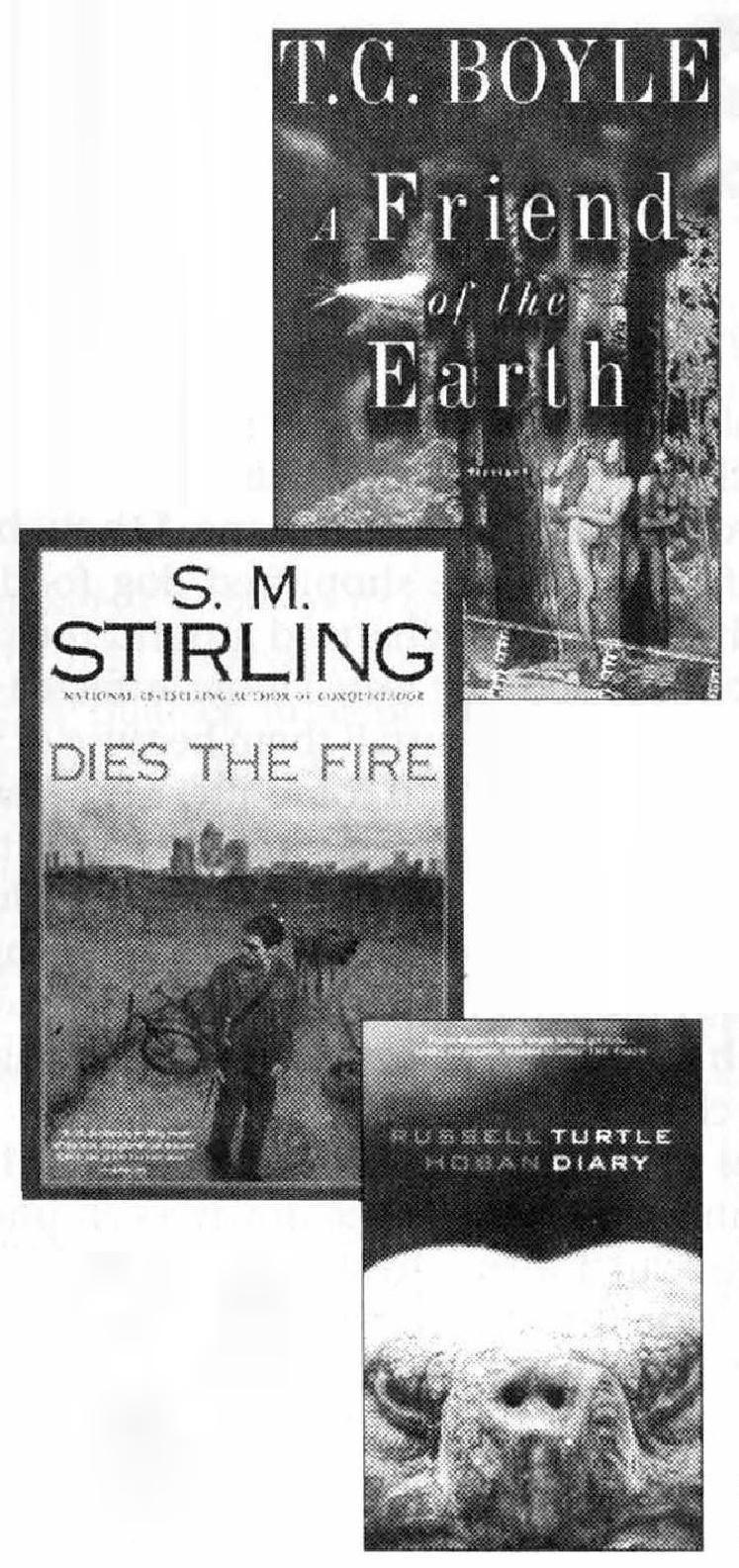
—Turtle Diary, Russell Hoban, 1975
A lonely, embittered man and a woman separately find something very stirring about the sea turtles at the London Zoo. They form an odd camaraderie as they plot to return the turtles to the ocean.
“But take that very first step!” He laughs wildly. “Take that first step, perform an act of resistance of even the smallest kind, and suddenly your perception changes. Reality changes. You see it can be done. It might take time, but.../’ He laughs again. “Yeah! You bet it can be done! Let’s go celebrate your first act.” He hits the dashboard, hard. “Here’s to resistance!”
—The Gold Coast, Kim Stanley Robinson, 1988
The books in Robinson’s Three Californias trilogy (The Wild Shore, The Gold Coast and Pacific Edge) tell of three futures: a post-nuclear struggle for survival and rebirth; a developer’s dream gone mad; and a world that has rediscovered harmony with nature, yet must fight to preserve its idyllic way of life from the resurgent forces of greed and exploitation.
James John Bell is a co-founder of the smartMeme Strategy and Training Project (www.smartmeme.com) and the editor of LastWizards.com. He is a Northwest writer and occasional contributor to the Earth First! Journal.
More Anarchist and Environmental Fiction
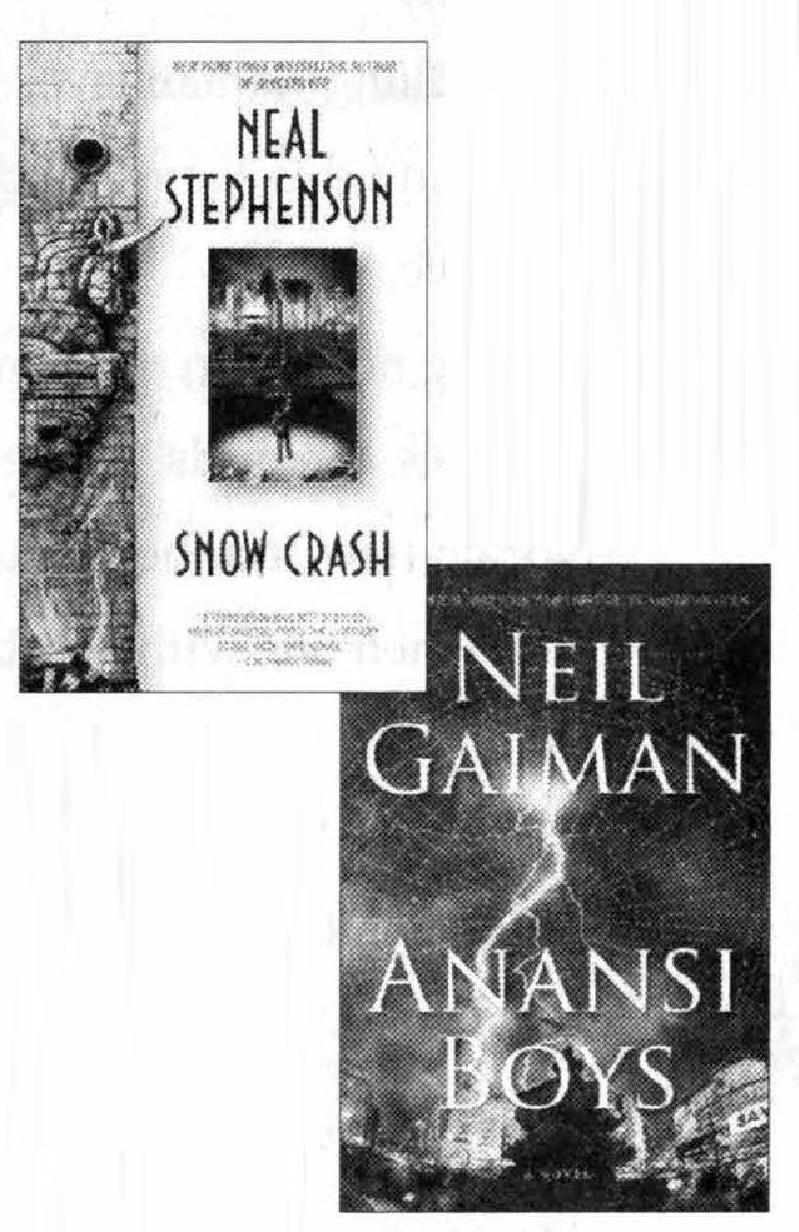
Anansi Boys, Neil Gaiman, 2005
Dies the Fire, S.M. Stirling, 2004
Singularity Sky, Charles Stross, 2003
Spectacular Happiness, Peter D. Kramer, 2001
A Friend of the Earth, T.C. Boyle, 2000
The Telling, Ursula K. Le Guin, 2000
Sick Puppy, Carl Hiassen, 2000
Perdido Street Station, China MiSville, 2000
Flyboy Action Figure Comes with Gasmask, Jim Munroe, 1999
Greenhouse Summer, Nonnan Spinrad, 1999
Antarctica, Kim Stanley Robinson, 1998
The Beach, Alex Garland, 1997
The Family Tree, Sheri S. Tepper, 1997
Anarchist Farm, Jane Doe, 1996
The Girl Who Owned a City, O.T. Nelson, 1995
Gaia’s Toys, Rebecca Ore, 1995
Zodiac, Neal Stephenson, 1995
City Death, Stephen Booth, 1993
The Elementals, Morgan Llywelyn, 1993
The Fifth Sacred Thing, Starhawk, 1993
Snow Crash, Neal Stephenson, 1992
Synners, Pat Cadigan, 1991
Hermetech, Storm Constantine, 1991
H, She and It, Marge Piercy, 1991
Jurassic Park, Michael Crichton, 1990
Earth, David Brin, 1990
Radio Free Albetnuth, Philip K. Dick, 1985
Eclipse: A Song Called Youth, John Shirley, 1985
Quest for the Faradawn, Richard Ford, 1982
Camp Concentration, Thomas M. Disch, 1980
Kampus, James E. Gunn, 1977
Trouble on Triton, Samuel R. Delany, 1976
Ecotopia, Ernest Callenbach, 1975
The Dispossessed, Ursula K. Le Guin, 1974
The Sheep Look Up, John Brunner, 1972
Red Moon and Black Mountain, Joy Chant, 1970
Setting Free the Bears, John Irving, 1969
Agent of Chaos, Norman Spinrad, 1967
The Drought, J.G. Ballard, 1965
We, Eugene Zamyatin, 1924
The Secret Agent, Joseph Conrad, 1906
Frankenstein, Mary Shelley, 1831