John Boyd Wilson
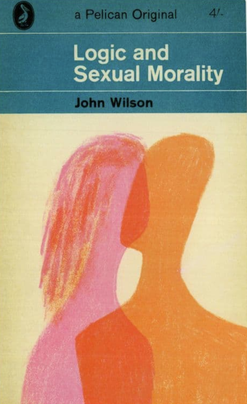
Logic and Sexual Morality
Chapter I: Who Are the Experts?
Progress and Rationality in Morals
Chapter 2: Distortions and Propaganda
Chapter 4: Adults and Teenagers
Chapter 5: Possibilities in Education
Chapter 7: The Acquisitive Society
Part Four: Sex and the Individual
Chapter 9: The Human Condition
Be Sensible but Don’t Be ‘sensible’
Know What You Want and What You Can Stand
John Wilson was born in 1928 and educated at Winchester and New College, Oxford, where he took first class degrees in Classics and Philosophy. From 1954–61 he taught those subjects at King’s School, Canterbury, where he became Second Master in 1959. He was professor of Religion at Toronto University from 1961–2 and in 1963 he went to the University of Sussex as a lecturer in Philosophy, becoming a university proctor in 1964. He has just been appointed Director of the Farmington Trust Unit at Oxford for research into moral education.
John Wilson’s father was a minister in the Church of England, and he and his elder brothers and sister were acclimatized to free and frank discussion in the family circle of everything, including sex, from their earliest years. Although he is trained in classics and analytic philosophy he is most interested in applying these to practical problems, particularly in education and personal relationships. He has written ten books on philosophy, education, religion, and canoeing, which include Public Schools and Private Practice, Reason and Morals, and Philosophy and Religion. His interests include depth psychology, music, literature, competitive games, and science fiction.
Penguin Books Ltd, Harmondsworth, Middlesex, England
Penguin Books Inc., 3300 Clipper Mill Road, Baltimore 11, Md, U.S.A.
Penguin Books Pty Ltd, Ringwood, Victoria, Australia
—
First published 1965
—
Copyright © John Wilson, 1965
—
Made and printed in Great Britain by Cox & Wyman Ltd, London, Reading, and Fakenham Set in Monotype Imprint
This book is sold subject to the condition that it shall not, by way of trade, be lent, re-sold, hired out, or otherwise disposed of without the publisher’s consent in any form of binding or cover other than that in which it is published
Preface
It is now some time since philosophers stopped being sages who told us about Ultimate Reality or The Meaning of Life Nowadays they do not even tell us what moral principles to adopt; and modern analytic philosophy is usually regarded as an expertise reserved for professional philosophers Consequently the attempt to apply it to sexual morality will inevitably seem unreal and even absurd to some: while to others — since it is applied in a highly diluted form-it is bound to seem unscholarly.
However, this is an age in which very few educated people will accept any authority uncritically. Even if philosophers did now pose as sages, hardly anybody would listen to them: and quite right too. The philosopher is not able, and should not try, to take the weight of moral decision off our shoulders. What he can do is to help us make our own moral decisions for ourselves. When we have a situation of malaise, anxiety, break-down or even chaos — and surely the sexual situation is just this — then those of us who have the perspicacity and courage to see that we have got to make up our own minds must go back to first principles No longer blindly accepting authority, we have to go back to the beginning and start again: and for this we need the philosopher, since starting again means looking with fresh eyes at arguments and opinions which we may have too casually accepted or dismissed. When there is a break-down we have to overhaul the whole machine. This is hard work, but it is much more rewarding than trying to patch up a machine which we can only pretend is in good working order.
This work can only be done properly by the use of more honest, realistic and effective forms of communication about sex than those we now use. Writing books is a large-scale but rather primitive form of communication, our society needs more person-to-person discussion, questions, broadcasts, lectures, seminars, classroom periods ana so on Provided they start from first principles, and are not incompetent attempts to indoctrinate, it is these methods that will benefit us the most: and I should judge the success of this book by whether it encourages the reader along these lines rather than by any other standard.
JOHN WILSON
Introduction
There are large numbers of people who display the utmost confidence in telling other people what to do, and who show little hesitation in laying down rules and principles about how they should conduct their private lives. I am not one of these. If I thought that there was any single set of rules and principles about sexual behaviour whose rationality could be clearly demonstrated, I should be the first to advocate it. But I do not think there is. So if the reader is looking for a new version of the Ten Commandments, or a declaration of sexual independence, or any kind of ‘answer to the sex problem , he should look elsewhere. I do not think he will gain much by looking for this sort of thing, but that is another matter.
On the other hand, it would be dishonest of me to pretend that I am not going to say something radical. The difficulty is to make clear the way in which it is radical: and this is also the difficulty of making clear what sort of book this is. This is worth trying to do, because one of the most disgraceful things about what is said and written on moral matters is that different kinds of talk very often get muddled up. We ought to regard it as surprising if a person whose business it is to give a factual report on people’s private lives in a newspaper also feels entitled to make moral judgements about them; if & judge, whose job it is to administer the law, also sets up as a moralist, who condemns criminals in a way which has nothing to do with the law; if a moralist whose function is presumably to inculcate a set of moral standards, also claims to speak as a social scientist and tell us why people do not live up to them; if a psychologist or social scientist, who is supposed to explain human behaviour, tries also to advocate one type of behaviour as against another. This is not to say that one man ought to do one job and one job only: but it is to say that the jobs are different, and that if he is going to do more than one he ought at least to make it abundantly clear what he is supposed to be doing at any one time.
The chief job I want to do is not to examine sexual behaviour and give it good and bad marks, but to examine the ways in which we think, argue, feel, and act about sex as a whole, to show that some of these ways are plainly irrational and suggest others that might be more rational This seems to me not only an important task, but a task which must be done if we are to make any progress. The reason why, in my view, no one is in a position to lay down a detailed code of sexual morality with rational certainty is precisely because we do not yet know — and have not tried very hard to find out — how to approach the whole question rationally. The stream of our thinking, as it were, is muddied right from the source. To say this is to say far more than that we are often prejudiced or unreasonable, or confused, about sex. It goes far deeper than that, as I shall try to show.
Before there was such a thing as scientific method, people argued about whether the earth was round or Hat. But behind this particular question lay another question, logically prior to the first: the question of how to settle the dispute. This second question was perhaps never faced as squarely as it should have been, but it still lay behind the views of various parties. Thus, many people held the earth to be fiat because (as they thought) the Bible said it was, whereas others held it to he round because of certain scientific observations and experiments. Today we are all agreed that it is unreasonable to use the Bible to settle questions of this kind. But it would be inadequate to write off those who stuck to the Bible as merely ‘prejudiced’ or ‘confused’. The point is rather that they were using a totally wrong method: that they conceived the dispute in totally wrong terms. Our subsequent progress in science is largely due to our having found the right way of doing science: from this, in a sense, everything followed — though not without a lot of hard work.
Now an example closer to our own subject — indeed, perhaps central to it. In discussing matters of morality people hold various views about what is right and wrong. They take sides. Of course there is nothing wrong with this: but in a way the results are rather disappointing. In sharp contrast to the progress of science, it is not clear that, for all the discussions we have been having for countless millennia, very much progress has been made. In some matters — sex is one of them — there is no more agreement than there ever has been. Indeed, we might almost say that the only things we ail agree on are those which all human beings have always agreed on, like the undesirability of murder, theft, lying, and so on. Now it is at least possible that this disappointing situation is partly due to our not pursuing the right method for settling moral questions. And in fact it is plain that different people use quite different methods, not all of which can be right. Some claim to have their morality given them by God, others claim to know what is right and wrong by ‘intuition’ or ‘conscience’, others think it is just a question of working out what makes for the greatest happiness of the greatest number, others again think it is just a matter of taste. It is hardly surprising that we do not make much progress.
If there is anything to be said about the respective rationality of different methods of settling moral questions, it is likely to be radical in its results, just as the establishment of scientific method produced radical results. Consider-, for instance, the view held by most philosophers in this country for some decades: I do not propose to defend it here, though T shall do so later They claim that we cannot prove statements about morals as we can prove statements of fact that the whole logic of moral arguments is different, and has to be different, from arguments about facts. Now if this is true, it is plainly radical. Plenty of people have thought, and still think, that truths of morality can be proved in the same sort of hard-and-fast way as truths of science or mathematics, or that you can somehow ‘see’ what is right and wrong in the same sort of way as you can see something to be round or square If they were convinced to the contrary, it is likely that their actual moral beliefs would undergo drastic changes.
This is the sort of thing that I want to do in this book, and the sort of thing we should all do much more often. What makes it hard to do is that we have to la’ our own individual beliefs on one side, in order to inspect them objectively along with those of other people. Obviously we cannot both take sides in the game, and inspect the rules with a view to improving them, at the same time, We have, as it were, to take a firm step backwards away from our own particular views, admitting in principle not just that we may be ‘prejudiced’ or ‘unreasonable’ but also that we may be pursuing a totally misconceived method. We may be bewitched or dominated by certain ways and styles of thinking that effectively block our progress. In order to break the spell, we have to struggle as hard as we can to take this step backwards, to get outside ourselves, to be our own masters.
I do not want the reader to suppose that the only way to take this step backwards is to become a philosopher. There are other approaches which have the same effect; and we can contrast these with the philosopher’s approach in the following example. Suppose we were living in a society where religious prejudice was much more intense than it is now: say, in the Middle Ages, when members of different sects persecuted each other and burned each other at the stake. Of course discussion about which religious beliefs were right and which wrong would rage furiously, and as a religious believer I might feel very strongly that some were right and others wrong. But I could also take a step back in at least three different ways:
-
As a philosopher I might think that the logical status of these beliefs was not secure enough for us to feel justified in imposing them upon other people. This is not to say simply that we ought to be tolerant; that is, indeed, a good reason for not imposing on other people and for not bullying minorities, but it is a political reason and not a philosophical one. My point as a philosopher would be that nobody can, logically, have the right to feel sure about religious beliefs in the same way as, for instance, we have the right to feel sure that the earth is round or that arsenic kills people. Thus my objection to torturing people in order to save their souls would not be just that this is intolerant or undemocratic, for if it really does save their souls, it seems rather silly to make this objection. My objection would be rather that we cannot, as rational people, claim to know for certain that it really does.
-
But I might also look at the matter from an educational point of view. As a schoolmaster, indeed, perhaps paid by a particular religious organization to teach the views of that sect, I should only concern myself with how to teach these views most effectively. But the notion of education (as opposed to indoctrination) would be useful for me, if I wanted to look on my work as a schoolmaster more objectively: it would, so to speak, give me a point of view’ to step backwards into, a criterion with which to judge my work. I should feel as an educationalist that my job was to help my pupils to think for themselves and not to indoctrinate them with any set of beliefs. The reaction of my pupils would be a useful guide to me, just as much as a philosophical understanding that religious beliefs are not subject to cast-iron proof. I should not find much difficulty, in principle at least, in teaching them science, or Latin, or history, because they would see readily enough that I was teaching things which were generally agreed. But they would react quite differently to religious or moral indoctrination ; they would know that I was trying to sell something, trying to indoctrinate rather than educate. And if I had any love for my pupils at all, I should ooject as an educationalist to having them caned for not buying what I was trying to sell, for not accepting my indoctrination meekly, even thoughasa religious believer I might be quite convinced that the beliefs I was selling were true beliefs.
-
Again, I might look on the religious situation with the eyes of an anthropologist. I would take my step backwards by trying to pretend that I had just come from a foreign country or some other planet, in order to see the situation with fresh eyes. I might notice, for instance, that there was something peculiar about religion, both in society and in the individual’s mind. There might be special laws about it, laws which seemed inconsistent with the sort of laws generally in force m the society; and the economic system of the society might seem specially designed to reinforce, and be reinforced by, a certain kind of religious belief. Individuals might have peculiar irrational feelings which applied to religion, but to nothing else, and they might behave about religion in ways which would be tantamount to insanity in other contexts. If I was a good anthropologist, I would be able to give a good description of these social and individual peculiarities, to characterize and sketch their main features, and perhaps co show how they were related to other features in society. I could thus show, at the very least, that there was a severe disturbance, a sort of mental sickness, in the society and its individuals, because of which these peculiarities were produced as symptoms
I have used the words’‘philosopher’, educationalist , and ‘anthropologist’ to describe these three approaches; but it must not be supposed that these represent three expertises, in the same sense that physics or medicine are expertises. We must not suppose that there are expert philosophers, educationalists, and anthropologists each with complete mastery over a certain set of facts, and whose word is law. In the most important sense, each of these approaches is essentially an amateur approach. Certainly there are some people who are better at these approaches than others, but even the best of them can only clarify and persuade — they cannot prove in the way that a scientist can prove. The approaches are open to anybody.
Very often, indeed, it is the real amateurs who do best. Some of the things that ‘expert’ philosophers and educationalists have said in the past have never, thank goodness, been believed by sensible people And if we want to obtain a clear and helpful picture of human individuals or human society, it is still often better to turn to novelists and dramatists than to the social scientists. This is because so much depends, not upon having a long professional training or a high I Q , but simply upon noticing things with which we are in a sense all familiar. Jane Austen, who moved in a strictly limited social circle, probably saw far less than most of us do nowadays: but she noticed far more
These are the three approaches which I shall use in this book. I have not described them as fully as I might have done, and I cannot pretend that they do not to some extent overlap. But I have tried to keen them as distinct as possible. In Part One, I shall be almost entirely concerned with the philosophical approach: that is, with the logic and rationality of our thinking about sex. In Part Two, I shall look at sex from the educationalist s point of view: in Part Three, my purpose will be to present an anthropological picture of our society, and »n Part Four, a psychological picture of its individuals To this I have added a short epilogue.
One last point before we begin. In the example we took just now from religious belief in the Middle Ages, all three approaches suggested a picture which would probably have been unacceptable to fanatical believers. If a programme could be deduced from this picture, it would have been of the form: “Look, we can’t logically be half so certain of our beliefs as we think we are; we’re indoctrinating our children with religion instead of educating them about it; and as human beings we’re pretty irrational, perhaps even a bit mad, about religion. So the first thing we must do is to recognize all this, fix up some kind of truce, and get off to a fresh start’; and this programme would probably have also seemed unacceptable, disappointing, or perhaps even shocking, to a great many believers. Yet such a programme, as most people would nowadays agree, would have been the only rational one and the only realistic one (in any sense of ‘realistic’ worth having).
I hope to make it clear in what follows that the position about sex is far more like this than most people think. To put it brutally, anyone who seriously claims to ‘know the answer’, and claims the right to insert that answer into other people’s minds, seems to me either a fool or a knave. He is a fool if he really thinks he knows: and he is a knave if he has doubts, but behaves as if he was certain. Many people persuade themselves into this sort of folly or knavery because they think that ‘public decency must be preserved’, or ‘adolescents must be taught a definite code of morals’, or ‘we must have fixed standards of right and wrong’. In my view this does not lessen their folly and knavery: it increases them Unless we are prepared to value truth and reason above other things, there is not much hope for us.
Part One: Sex and Logic
Chapter I: Who Are the Experts?
Anything which is a serious subject of study is likely to have its experts. These may be only soi-disant experts, like ‘experts’ in astrology or palmistry, or they may be real experts. One good way of discovering how we think about sex, as a serious subject, is to consider who these are and what their alleged expertise consists of. But as soon as we start to consider this, we are confronted by a curious gap in the ranks of experts. Experts in sex, so far as this society is concerned, do not seem to be logically on all fours with other kinds of experts.
A man from Mars — they are very naive on Mars — might be forgiven for supposing that those regarded as experts In sex in our society would be those who had had considerable sexual experience. He might thereby induce that for some kinds of sexual information, at least, we would turn, not to unmarried clergymen or moral welfare workers, but to people like Madame de Pompadour ana Casanova, or whoever the modern equivalents of these may be. He might think that brides-to-be who wished to know how to please their men would be placed in the hands either of an experienced courtesan or an experienced seducer But unfortunately it seems that experts in sex have to be socially respectable: indeed the more expert they are, and the higher their position of authority and leadership, the more respectable they have to be. So the Martian would have guessed wrong.
This is a logical as well as a sociological oddity. Experts in art are expected to have had a wider and deeper experience of paintings than other people; experts on Africa should have spent a lor of time in that country, and have discovered a great deal about it at first hand, experts at swimming are supposed to have passed at least some of their time actually in the water. This is not to deny the value of experts in sex who are not Casanovas. It is possible that someone who had, for instance, studied seduction as a matter of analytic psychology, or someone who has knowledge of God’s will on the subject, might be said to know a great deal worth knowing about seduction. Nor is it necessary for a doctor to have suffered from a disease himself if he is to cure it effectively. Bur equally plainly people like Casanova knew something, however low we may rate the value of such knowledge. Moreover, it seems rash to discredit this knowledge too quickly. What people like Casanova knew is of intense interest to vast numbers of people. Faced with a clergyman saying ‘I will make you pure in heart’, a psychologist saying ‘I will make you sane and mature’, a marriage guidance counsellor saying ‘I will make you contented and adjusted in your marriage’, and Casanova saying I will teach you my skill’, quite a lot of people might choose Casanova. They miglit be wrong; but it would be hard to prove them wrong without taking Casanova seriously.
We have to realize, before assessing the respectable expertises, that it is not clear in what sense we really want to know about sex at all. Of course we are wonied and anxious about it, talk about it endlessly, and even hire psychologists and sociologists to do research Into it. But in the most important sense, we do not want to know. There is a conspiracy of silence, and a lack of proper communication. That this is true is, I should guess, immediately recognizable to most of us from our own experience ; but it is important to characterize it correctly. The key point is that our attitude is not empirical. In one sense, indeed, we are at last prepared to find out the facts. We collect statistics and produce things like the Kinsey Report.[1] This we are willing to do, because it is not too frightening. To learn the percentage of people in the state of Texas addicted to bestiality or necrophilia is interesting, but hardly bears very heavily on our own experience, and even the clinical rehearsal of statistics concerning the number of more normal ‘sexual outlets’ does not really upset us too much. But in a more important sense we are not prepared to find out the facts — not prepared, I mean, as respectable citizens: our private lives are another matter. We are not concerned to find out what sex is like in human experience: what sort of feelings, physical and emotional, it generates; what sort of effect one can have on one’s sexual partner, and vice versa. We are not willing to talk about it, tell our children about it, conduct experiments about it, or even face up to it squarely as individuals.
Whatever reasons there may be against seeking experience — and of course such reasons are often overwhelming, as in the case of drug addiction — there is one big logical reason for it: and this is that the attitude of someone who seeks experience, and is willing to pay due attention to the facts of feeling and emotion, is a great improvement on any doctrinaire attitude. If we are concerned to learn the nature of seduction — what it is actually like to seduce or be seduced, what seduction is — then we must have experienced it ourselves. To take another parallel: it might be in principle possible to list the features which any poem must include if it is to be a good poem, but this is a very different thing from being an expert in. English literature. In order to grasp a poem properly, and to get across the merits of a poem to others, one has to have experienced those merits oneself, from inside the poem, not from outside it.
This point comes out even more clearly if we consider one expertise which is relevant to sex, though there is no particular logical difficulty about the way in which it is relevant. We all know that biology is supposed to tell us the hard, physical facts about sexuality: that is part of its job. Biological instruction about sex has had a reasonably long history in our schools, and an even longer one in parental instruction. It is about the only form of sexual instruction which i.s thoroughly respectable. But even here our desire for respectability has infected our logic: in a sexual context, we no longer use biology in the same way as we use it in other contexts. I suppose we would say, if asked, that the purpose of teaching this sort of thing to children is to make sex, in its purely physiological aspects, appear as natural and acceptable: to teach them ‘the facts of life’. Actually, amoment’s thought should convince us that we do nothing of the kind.
There are well-established criteria for the communication of scientific facts like the biological facts of sex: criteria which our actual teaching does not satisfy. Few things could be more unnatural and unreal than, for instance, the sketchy and formalized diagrams labelled ‘the female reproductive system’ or ‘the male generative organs’. Children want to know, amongst other things, what the sexual anatomy of human beings actually looks like: they need to become familiarized with it, at home with it, no longer frightened of it or hypnotized by it. For this purpose photographs would be better than diagrams, and a visible illustration from real life better than either. But even though manv parents (somewhat ostentatiously and absurdly) often appear naked before their children, with the express purpose of familiarizing the children with sexual anatomy, we still have a strong prejudice against what the law calls ‘indecent exposure
If we are to be honest, then, we must admit that ostensibly we teach biology in schools in order to familiarize children with sex (as well as for other purposes); but in practice we object to such familiarity, on the vague grounds that sex is and ought to be regarded in a magical (or meaningful, or religious) light If we genuinely wanted to achieve such familiarity, we would show children our own and other people’s naked bodies, allow them to watch the act of copulation, and so forth. This we find shocking; indeed, we even feel serious qualms about letting them watch the copulation of animals, presumably because we feel that it is sufficiently like our own to detract from the magic. Yet when the biology mistress wants to teach children about flowers, or worms, or other things sufficiently unlike human bemgs to seem safe, she will have no hesitation in getting them co observe these creatures in action — indeed, it would be regarded as very unscientific and inefficient teaching if the children did not do this sort of field work. For this reason out biological instruction has a curiously grudging quality about it; we feel, perhaps, that we really must teach the basic facts, so that our children shall not feel too curious or too anxious, but that we de not want to ‘devalue’ sex by making it ‘too ordinary’.
This domination by the magic of sex is something which, if not watched very closely, can have very unfortunate consequences for the logic of the sexual expertises I w ant to consider: that is, the expertises of religion, morality, and psychology (in which I include the social sciences in general). It is plain that sex is a religious issue, a moral issue, and a psychological issue; the expertises, whatever their logical nature, are certainly not irrelevant. But equally it is plain that they are the sort of expertises about which we are more likely to think irrationally than, say, about physics or mathematics. Our religion, our sense of right and wrong, and our psychological knowledge are ah obviously guides of some kind, who will tell us something useful; but equally they are the sort of guides whom yve may easily feel tempted to bribe, so that they will tell us what we want to hear.
The temptations are not precisely similar in all three cases. All three involve a commitment, which may be uncritical, to some kind of authority. Religious authority has the advantage of being visibly represented by a church and the officials of that church, and the advantage of a long tradition which is, on the whole, reputable. The authority of * conscience’, ‘public morality’, or ‘our sense of right and wrong’ has no visible representatives, in the sense that nobody is actually paid to be a moralist; but it is perhaps all the more dear to us for being more individualistic, something we can find in our own minds without having to take on trust, and therefore something which we might feel more certain about. The authority of psychologists and other social scientists has the advantage of being fashionable and sounding scientific which in this day and age is a considerable advantage. We must be very careful not to fall victims to any of these.
Central to the whole question of what use we make of these expertises is our attitude to beliefs as a whole. Most people, even the most rational and judicious of philosophers, would agree that human beings are not rational in their beliefs — particularly perhaps in the field of religion and morality. Reason cuts very little ice. But it is less widely appreciated that most human beings do not even think they ought to be rational about certain kinds of belief. In their everyday lives, and in matters of scientific and empirical fact, they accept certain standards of rationality: that is, they believe where there is good evidence for belief, and remain uncommitted where there is not. They do not, on the whole, believe in fairies; they believe firmly that the earth is round; and they remain uncommitted about whether there is life on other planets, because we simply do not have enough evidence. But in religion and morality they do not feel called to accept these standards,
Precisely what standards of rationality suit the fields of religion and morality is a very hard question; we do not know exactly what sort of justification is appropriate for such beliefs. What we can and must say, however, is that some sort of justification is necessary. We cannot and must not allow ourselves to believe exactly what we like. If we did, we should be able to make no distinction between ourselves and madmen who believe that they are pursued by Martians or that there are invisible little men swinging on the lampshade. We must have some way of disqualifying those whose religion demands human sacrifice or whose morality insists on putting Jews in gas chambers. In other words, we must be able to produce some kind of reasons, some publicly acceptable defence, for our beliefs. Our own feelings, intuitions, hunches, faith, consciences, or whatever are not good enough.
Hence we cannot abdicate from rationality, if we wish to remain sane and human. We must go through some rational process of assessment, weighing evidence, discussion, and considered judgement. Reasoning about religion and morality mav be different from reasoning about other things, but it is still reasoning: the rules of the game may be different, but there are still rules. We sometimes try to evade this by saying things like ‘You can t work everything out by logic’, or ‘Reason can only take you so far’, or * Religion is a matter of faith rather than reason’: but this is a mistake. Plenty of things are needed as well as reason, and whatever we mean by ‘faith’, ‘conscience’, ‘intuition’, or ‘insight’ may be some of these things. But they cannot be substitutes for reason.
Those who do not really accept this — and I am afraid there are many — are really cheating if they claim to engage in any kind of rational discussion or consideration of sexual problems, or indeed any other problems of this sort. They seem to be playing the same game as those who accept the importance of rationality, but in reality they are not, because they do not accept the rules of the game. They do nor feel subject to any rules of evidence or justification at all. If they were thoroughly honest, they would say something like ‘I just feel this is right, that’s all’, or ‘Well, this is true for me. anyway’, or ‘Being what I am, I couldn’t possibly believe so-and-so’. Then at least we would all know where we were. For there are some rules which must surely apply to any rational consideration: one rule must be that we should start by regarding the question as an open question, that we must not think that we already know the answer; and another rule must be that to justify a belief we must give some kind of publicly acceptable evidence for it Those who do not accept these rules would do well not to pretend to rational discussion at all.
Acceptance of these rules means, more often than we might like, that we have to end up by saying simply ‘We don’t know the answer’. Of course we all like co have answers, and some of us find it psychologically intolerable not to have them. But very often we just do not know, and then the only sensible thing to do is to admit it — just as we admit it in scientific matters. We may Indeed suggest a policy to work by for the time being, a kind of interim answer; but we should suggest it tentatively, and should hardly be willing to force it upon other people.
Religion
We have to start by accepting that religious beliefs are for the most part neither certain nor obvious The issue here has nothing to do with the reasons which any of us may have for holding tins or that belief: it is simply that we must face the fact that a grea* manv wise and unprejudiced people — people whom we cannot write off as blind, or ill-informed, or malicious, or wicked — are agnostic or atheistic in their opinions. However strong the arguments for this or that belief, either these arguments are not obviously strong, or they have not been presented properly, or possibly they are not good arguments at all Not only is there no public agreement about the truth of any particular beliefs, there is no agreement about what is to count as evidence for such truth and what is not — there is a basic problem of verification.[2] This does not mean that one cannot reasonably hold a great many beliefs: but it does mean that one cannot claim to know with certainty, in the way that one can claim to know with certainty that the earth goes round the sun. his should make a significant difference, not only to the way in which one holds one’s own beliefs, but still more to the spirit in which one might try to persuade others of them .
What is important from our viewpoint, however, is that even if certain features of a religious creed can rationally be maintained, it does not follow that other features can be deduced from them with anything like the certainty claimed by most believers. Consider the Christian religion. It is not implausible to believe as I do, that there is a God ; that He is love; and that Christ was His Son, at least in the sense that Christ exemplified God and His nature to a degree approaching perfection It is also reasonable to suppose that we can gain n.general idea, of what Christ taught and did through the Gospels. (The same could be argued for Mohammed and the Koran, or for the Buddha, or for many other creeds.) But from these propositions, even assuming that they are true, it does not at all follow’ that we can give a detailed outline of Christian (or Mohammedan, or Buddhist) morality. Certainly we may give some weight to the early interpreters of Jesus, such as St Paul and St Augustine; but we may also just as reasonably suppose them to be. like all of us, prejudiced by their particular circumstances and intellectual climate. Moreover, we cannot reasonably claim that the Gospels illustrate and report Christ’s opinions in detail There are a good many reasons why prejudice and misunderstanding should have crept in, as, indeed, it plainly has in many cases. We cannot, therefore, be sure, on a basis of one or two texts, what Christ thought, or what He said, or in what sense and over what fields He intended His words to apply. To say this is to say no more than we should think when faced with any documents nearly twenty centuries old, written by various hands, in a language different from that of the person they describe. We know, in the case of many religions, that the will and intentions of the oiiginal founder have been perverted and distorted both by those who reported him and by the church or organization which replaced him.
We cannot, then, be certain of j esus’ views on sexual morality. We can be certain that He propounded the principles of love, forgiveness, understanding, and repentance; and of other general features of His nature and doctrine, unless the Gospels are totally erroneous, we may also fee! reasonably sure. All we can do, then, is to try and deduce from these general principles the particular details of moral conduct with which we are concerned. It is helpful, if you are a Christian, to ask ‘Would Jesus, being what He was, always wish to prevent divorce?’ or ‘Is it ever the act of a loving person to sleep with someone to whom he is not married?’ But it is not helpful, indeed it is wildly irrational, to try and prove by scripture or authority that Christ actually laid down, beyond the shadow of a doubt, that in no conceivable case should any two people get divorced, or engage in extra-marital intercourse. You may be able to build up some sort of case, but it is bound to be a very uncertain one, because it will necessarily depend on the faithful transmission of His words throughout the centuries, and on the supposition that those words were intended in precisely the sense, and with precisely the sphere of reference, that you yourself believe. Both of these are fatal weaknesses. Much of what Jesus said is ambiguous, setm-poetical, metaphorically rather than scientifically true, and much of what He was supposed to have said has probably been interpolated. By relying on scripture for detailed guidance rather than a general picture, therefore, we commit our religion to a very weak vessel.
Still less can we rely, as far as sexual morality goes, on the authority of the early or later church. Here, if anywhere, Christianity suffered from the prejudice of its primitive leaders. Few of us today can wholly sympathize with St Paul’s views on sex and marriage, and anyone who has read the writings of St Jerome and other early fathers on the same subject (if he can conquer his natural disgust) can hardly give rational and sane assent to them. There are, in any event, many contradictory authorities throughout the ages. In view of all this, I do not think anyone can rationally claim certainty; though, of course, almost everybody has tried. Christianity has at one time or another been used to defend total sexual abstinence, monogamic marriage, polygamy, polyandry, and free love. It so happens that we find ourselves in a culture which approves, publicly at least, of strict monogamy and no premarital intercourse But this tells us nothing about the will of God.
Can we salve anything positive and constructive out of this uncertainty? Only if we are prepared to admit the uncertain points, and concentrate on our points of agreement. There are certain virtues and ways of life which meet with the approval, not only of all religious creeds (according to their public professions, at least), but also of all serious thinkers. These are the virtues of love, forgiveness, understanding, generosity, unselfishness, and kindness. This may seem an unexciting and unoriginal list, but it is one of which we need to be constantly reminded. If you believe, as I do, in a loving Father Who sent His Son to preach and demonstrate these virtues, and Who will help us to practise them if we ask Him, then — to say nothing of other aspects of faith — you have an immense backing and support for this programme. Thus, if God is our Father, all men are brothers: we must love each other, in a far stronger sense than anything suggested by an optimistic programme of social utility. Any religion, firmly and faithfully held, will back these values in a way that nothing else can back them. For religious people — so at least they believe — have an advantage over unbelievers ‘they have a source of power which will create these values in their own lives, and turn them from a hopeful humanitarian programme into reality.
Religion, then, can be used to support values in sexual and other morality, once we have determined chose values. Can it also be used to determine them? Not in the way we are accustomed io use it, by trying to use scripture or authority to reinforce our own prejudices. But there is anotner way. To learn a religion is to learn to speak a new language, to regard men and the world in a new light. Jesus certainly carried or much of His teaching in this way. Instead of laying down rules about forgiveness, or trying to describe it scientifically, He showed us what forgiveness was like — and not only by such masterpieces of imaginative instruction as the parable of the Prodigal Son, but by His own actions and death. Not only in the Gospels, but in many non-Christian religious writings, we are imaginatively instructed in this way; we acquire a new grasp of how people feel in their hearts, of how they react on each other, of how their actions appear in the light of love and understanding. That is partly why, in the Gospels, there is very little talk of morality, and very few rules laid down, but a very great deal of picture-painting, and a very great deal of talk about general attitudes and the inner heart of man. Jesus was not a moralist after the tradition of modern moralists: He was something far greater.
Quite apart from the supernatural claims of religion (which there is not space to discuss here), therefore, it has ‘mmense merits as a technique of instructs on. This instruction is imaginative and not scientific. Unbelievers who admit this may well claim that it is merely an unfortunate accident that this imaginative instruction has been cast in a religious form, and that it could just as well be carried on without becoming involved in any dubious supernaturalism. This may be so, but it does not lessen the value of the instruction, all the same. It is a common error to suppose that just because the first chapter of Genesis, for instance, is not scientifically true it is therefore insignificant and nninstrucLve We should continually remember that great works of literature and drama are also not scientifically true: but they are none the worse for that, since they are not supposed to be science at all. We seem condemned to a narrow-minded state in which we either accept science and exclude other forms of instruction, or vice versa. Today the prestige of science stands high, and we desperately need, not to counteract it, but to add to it, by learning to acquire non-scientific or imaginative techniques of learning. Of these techniques religion is not the least important: indeed it is in some ways the very archetype of them. For the man of religion regards the world, not merely as a collection of material objects which we can exploit for our own advantage, but as something aliye, something through which God moves and breathes. He, most of all, is aware of other people as real human beings, as ends in themselves, possessing depth, significance, and Infinite variety: not simply as pawns or machines. It is for this form of perception, rather than for moral rules, that we should turn to religion.
A great manj Christians would object strongly to much of the above, and if it is taken as a description of the Christian religion, an objection is certainly in order. To have a religion, or to believe in Christianity, entails believing far more, and far more coherently, than I have mentioned. To be a Christian is not merely to believe in God, Jesus, and love, and to use the Bible as a means of imaginative instruction. However, I have been concerned to present a picture which might be acceptable to the Christian primarily as a rational person, a picture of what can with rational certainty be taken from Christianity and applied to sexual morality. What I have presented is a minimal case: I have made no attempt to demonstrate the tone, feel, or logic of Christianity or any other religion as a whole
It seems to me important, however (and not merely for personal reasons), that Christians should accept that those who do not want to assert more than this minimal case are genuinely of their number. This is not merely a verbal issue about who we are going to call ‘Christians’. It is a verbal issue, but it should not be an arbitrary one, for a great deal turns on it. My own beliefs extend considerably beyond this minimal case, but there are many people whose beliefs do not, and it seems to me ridiculously arrogant to deny that they are Christians in at least one important sense — that they are professed followers of Christ and accept Him not merely as a great ethical teacher like Socrates or the Buddha, but as in some sense divine and capable of giving us some kind of divine or special help in our lives. I do not see why ‘Christian should be reserved for those who attach themselves to one particular church or sect, who accept the authority of St Paul or other Christian fathers, who acknowledge the superior wisdom of pope or bishop or apostolic tradition, or who believe that any text in the Bible is necessarily genuine and important. The sense of ‘Christian’ whereby it means ‘a professed follower of Christ’ seems to me more important and fundamental than any other sense
The practical issues that turn on this can be boiled down, in this instance as in so many others, to the importance of keeping good communications. Since religion is plainly important, and since it is unclear exactly how its importance is to be deployed in matters of morality and other matters, we must at all costs achieve a situation in which the varying disputants can learn from each other. Though we cannot simply lump everybody together if we are gomg to do justice to people’s beliefs at all we can at least keep the game as open as possible. Those who wish to state only the minimal case have a lor to learn from those whose beliefs are more fully organized: but they cannot learn this if they are excluded by a refusal to grant them the title of ‘Christians’ — and hence, by implication, a refusal to grant them the facilities and communication-system of the same organization. The effect is to encourage such people to discard their beliefs altogether, since they meet with no organized support. Conversely those who wish to state a great deal more than the minimal case have need of the challenge presented by the uncertainty of the first group, and by excluding this group, they avoid the challenge.
I have spoken of Christianity as an organization, but this is actually a pious hope rather than a fact. Christians, particularly if they are Anglicans, like to believe that. Christendom is in some sense united; and this may be true, for there can be a certain communality of feeling and intercourse even when the actual denominations are about as sharply divided as they could be. Part of the reason for the divisions is that the various churches and sects regard themselves primarily as powergiving or autiionty-holding organizations, and only secondarily as truth-finding or help -giving organizations Hence there are perennial disputes about who holds what power or authority; there could not rationally be disputes of the same kind about who is going to find the truth or give assistance to suffering humanity, for tasks of the second kind hardly require doctrinal or canonic agreement. To expect highly orthodox Christians to welcome within their ranks those who profess to be followers of Christ but profess little else may seem unduly optimistic, when Christendom itself is a divided house. But both may per haps be achieved if Christians can realize that their task is one of inquiry about the will of God and not only one of propagandizing that will in so far as thev know it (and how far is this?).
If this cannot be achieved, the practical use of Christianity as a technique for assistance in our sexual morality, or indeed in any other problems, may well become less and less. Although the religious approach to such problems is in theory, as must be obvious to any unbiased person, of immense potential importance and immensely illuminating, whatever particular views one holds, it will inevitably become unacceptable if it can be interpreted merely as a form of attempted indoctrination, or as an effort to deploy authoritarian principles into the lives of people who do not accept those principles. Non-Christians will resent this, and will quickly come to take no notice of religion whatsoever, even when its approach should be perfectly acceptable. This has already happened with the Roman Catholics and other extremist sects, and a great deal of what they could teach us is left untaught. We may soon reach a position where, for instance, religion cannot be taught in schools at all unless the child’s parents sign a statement agreeing to, or demanding, a particular type of religious indoctrination. We shall then have what we are on the way towards having already; a great number of sharply differentiated minority groups, and very little genuine communication between them
But religion, and the religious approach to morality, can of course be taught without indoctrination, though it is not easy. If Christians can encourage the teaching of it in this way, there is hope that it may play an increasingly important part in our approach to sexual morality. Certainly it is badly needed — not as an antidote to the scientific or psychological approaches, but as a supplement to them. At the very least, and whatever may be the truth about Christianity or any other religion, the religious approach is an essential tool. It is important that both believers and non-believers should appreciate where tney stand in this matter, for unless they do, the one may find themselves denied a chance to use the tool, and the other may find themselves denied a chance to profit from that use.
Right and Wrong
By far the most common view on moral matters, whether sexual or otherwise, may be summed up in the sentence ‘Everybody knows the difference between right and wrong.’ Nearly every right-wing author on morality writes as if there were no doubt as to how we ought to behave; we all really know, excep t perhaps in our weaker moments, what is right and what is not; we all have (presumably infallible) consciences which tell us what to do. Thus daring the Profumo affair in this country many people were found to say that ‘everybody knows’ adultery to be wrong (of course ‘adultery’ is a loaded word); that we should not be surprised if an adulterer were also proved to be a liar, since such a man obviously pays no attention to his conscience; and even that it is all the fault of the Bishop of Woolwich[3] for ‘saying that there is no difference between right and wrong’ (which of course he did not). To such people it would seem virtually inconceivable that anyone should seriously question whether extra-marital relationships were right or wrong. We are all supposed to know.
The role of reason in ethics is, of course, a well-known philosophical problem and I can do no more here than outline a few important points.[4] The first is the difference between judgements of fact and judgements of value. A matter of fact, of observation, of experience, of description, of what is, is one thing; a matter of value, of morality, of idealism, of what is right or what ought to be, is quite another. In point of strict logic, no amount of facts can prove that something is valuable, good, right, or to be chosen: words of value (‘ought’, ‘good’, ‘right’, etc.) are in a quite d’fferent logical category from the purely descriptive woids which we use to formulate our factual observations. Two men may agree entirely about the facts, but assign quite different values to them: and there is no way of proving one wrong and the other right. This is not to say, of course, that matters of morality or value are wholly outside the sphere of rational discourse — that it is not worth our while arguing about them at all. We may talk intelligently, to take a parallel case, about whether one piece of music or one painting or one book is better than another, and though there is no strict proof, our talk can rationally persuade other people. We direct someone’s attention to certain facts, or give him certain new experiences, or show him the facts from a new angle, and, as a result of this, he may come to change his morality or his values. No question of indoctrination arises here; we communicate, and if we do so efficiently, other people may come to change their minds of their own free will. But the value of this process does not lie in the dogmatic making of value-judgements, 01 firm assertions of morality: it lies in the skill with which we present new pictures and new experiences, the skill with which we communicate facts and feelings. To reiterate assertions of morality may make for social cohesion, encourage people in time of war, deter potential delinquents, and serve other social or political purposes but it does not help to solve any problems.
We may still feel, of course, that there are some things which we just cannot bring ourselves to believe or to do. One might say ‘T couldn’t Uve with myself if I did that’. Ultimately our values are of our own choosing, and no doubt many of our choices are forced upon us by our heredity and environment — or are at least the product of those factors, Given a conscience of a certain type, there are certain things which we cannot bring ourselves to do without guilt and unhappiness. But to appreciate this is not at all to say that we ‘know the difference between right and wrong’, nor to claim the right to know what is good for other people.
In fact we cannot know what is right and wrong in many cases. If we are agreed about a certain end or objective — say, a society in which property is secure — then we might without much difficulty agree about the means for achieving this end — teaching children not to steal, punishing theft, and so on. We could then say that we knew it was right not to steal, though all we really know, of course, is that we want a secure society and that therefore we do not want theft. But in other cases we are simply not sure. We might be unsure about our ends (do we want enjoyable lives or unselfish ones, contentment or excitement?) or about our means (we want happy children but how do we bring them up?). Often we just do not know’. We may feel very strongly: but feeling is not the same as knowing. The former is private and need obey no rules: the latter must justify itself by the light of publicly accepted rules of evidence and reasoning.
Most people, though on the whole irrational in their attitude to their own moral beliefs, like to have it both ways. That is to say, they like to pretend that their beliefs have some kind of rational and authoritative backing, though in fact the beliefs are the product of their own feelings, for which they then scrape up whatever authority happens to be nearest or fits most plausibly. Today, as in the past, authorities like ‘the word of God’, ‘conscience’, ‘what every decent person feels’, ‘tradition’, ‘the basic values of our society’, ‘civilization’, and others are often invoked. Since the rise of psychology and the social sciences, however, there has been a strong tendency to use ‘what psychologists say’ as a bogus authority, a quick way of settling moral problems As we shall be dealing with psychology next, this will be a convenient place to consider the dangers of this tendency.
Most of us are always anxious, consciously or unconsciously, to assert our own values and our own morality in a perennial attempt to reassure ourselves and to convince other people. Most of us, perhaps, are fairly transparent when we try and do this but psychologists and social scientists have an advantage which increases their power to deceive. Just as we look to doctors, not only for factual knowledge, hut also for a cure, so we look to psychologists, not only for information about what the human mind is actually like, but also for guidance on what it ought to be like. There is, however, a vital difference between doctors and psychologists. It is generally agreed — by the patient as well as the doctor — what is to count as a ‘cure’ in physical medicine; and this is to say that the value-judgements of doctors and patients about what a human body ought to be like are in accord — so much so, indeed, that we do not normally need to express them. We are all opposed to colds, cancer, stomachaches, and so on; and when we call in a doctor we ask him to get rid of these things (which we ali agree to be bad) and replace them by ‘normal’ functioning of the body, by ‘health’, But vie are not by any means agreed about what the human mind ought to be like. Certainly few of us wish to become schizophrenic, impotent, or victims to continual nightmares; and of course there are plenty more cases where nobody would disagree with thegeneral opinion about whatis to count as‘mental health’or a ‘cure’ But there are also plenty of cases where there does exist genuine disagreement. Is homosexuality a disease — something about which we should wish to use words like ‘neurotic’, ‘maladjusted’, ‘unhealthy’, and ‘needing to be cured’? It is fashionable in our society to think so; but it was fashionable in ancient Athens to think otherwise. Some homosexuals will yield to the current mode, and seek to be ‘cured’; others will say outright that there is nothing wrong with them — that they are simply different from heterosexuals, and that if only society would allow them a place and not discriminate against them, they could be perfectly happy. This is only one case of serious doubt about our values.
If we consider other societies and other ages, indeed, we shall see the very wide variety of opinions and values which can be and have been entertained on sexual issues. Consider the sexual mores of the ancient Spartans, republican Rome, the Eskimos, Victorian England, the South Sea Islanders, and Provence in the ninth century. It seems very difficult, if one is sufficiently well-informed about what wise and happy people outside our own society have believed and practised, to state dogmatically what is ‘healthy’ and what is not, what is to count as a ‘perversion’ and what is ‘normal’, what is ‘mature’ behaviour and what is ‘irresponsible’ or ‘maladjusted’. We note here another difference between physical and mental health: whereas we can reasonably say that what is physically ‘normal’ in the sense of ‘statistically average’ is often also ‘normal’ in the sense of ‘healthy’, we cannot say this about what is supposed to be mentally ‘normal’. Throughout the world every society has always wanted its. individuals to be active, able to run, not to suffer pain, to live long and be strong, etc., etc.; by and large, we regard disease as exceptional. But the demands made by society on the individual in respect of his mental ‘normalcy’ vary very widely; unlike physical health, what is regarded as mentally ‘normal’ differs from age to age and clime to clime.
Hence we need to beware of the introduction of valuejudgements, either m an overt or covert form. It is the covert, concealed form which is the more dangerous Psychologists are fond of using certain words which contain an implicit judgement of value, and arguments which move subtly from fact to value. The unconscious argument, that what is ‘normal’ in the sense of very common in our society’ or ‘usual’ is ‘normal’ in the sense of ‘right and proper’ or ‘healthy’, still carries great weight in the minds of most people. What is ‘abnormal’ is hence stigmatized as ‘perverse’. People who do not fit easily into our society — perhaps for the very good reason that our society is in some ways radically unhealthy or insane — are described, with cunning ambiguity, as maladjusted’, and those who do not wish to shoulder some of the responsibilities which this society loads on to its individuals are called immature’, even though a member of another society might regard such responsibilities as wholly absurd.
In general, then, we need much more care in making or accepting value-judgements than most psychologists, or indeed most ordinary people, are prepared to use. These judgements are difficult to avoid,, inasmuch as people want to know what they ought to do, and approach psychologists and other advisers for advice. The important thing to appreciate is that a value-judgement is only useful if it is shown to follow from the individual’s own desires and ends, just as the doctor’s advice and medicine ought to be taken only if the individual wants to get rid of such-and-such symptoms. The general form of advice should be: ‘If you want A, B, and C, then do P, Q, and R; on the other hand, if you want D, E, and F, then do X, Y, and Z.’ Thus a man might come for advice about his marriage, but the advice must depend on what sort of marriage he wants it to be, and whether in fact he really wants to keep his marriage going at all. Naturally, if you are a member of some advisory body which believes as an article of faith that it is always, or nearly always, better to keep marriages going than to break them up, then your advice is bound to be prejudiced, and you will inevitably make value-judgements which are not in accordance with the wishes of the person seeking advice You may even try to back them up with psychological fact, or to mix the two: ‘mature’ people, you may say, do not break up marriages — to do so is ‘irresponsible’. But this is cheating.
Psychology and Social Science
There is some difficulty in considering techniques and approaches which rely on some specialized knowledge of human nature or the human mind, because even the titles of such techniques are unclear because of their obvious importance, however, it is worth spending a little time becoming aware of this confusion. Many psychologists, sociologists, and so forth w’ill tell you that their disciplines are clear-cut and logically adult, and will produce sentences beginning ‘Sociology is...’ or ‘The difference between psychology and psychoanalysis is ...’ without turning a hair. However, the literature of the subject reveals a far more muddled picture, and the sentences frequently contradict each other.
One might reasonably suppose that psychology dealt with the individual, and sociology with society as a whole, or individuals in their mass or group aspects. There is a good deal of truth in this; yet one is rather worried to hear the terms ‘individual psychology’ and ‘social psychology’. There is also something called ‘social science’ which is not the same as sociology. Nor must we omit anthropology, normally confined to ‘the study of societies other than our own’ (to quote one leading anthropologist), though this seems a rather curious definition: what happens when the Eskimos start studying the U.S.A, or the Samoans send their anthropologists to London? The border line between the specialized methods of psychoanalysis and the more general approach of a consultant psychologist has also narrowed with the years; nor are we entirely clear how much the actual behaviour of the brain concerns psychology, and how much it comes under the physical sciences. All this should make one pause before making statements beginning with ‘Psychologists agree that...’ or ‘We learn from sociology that...
This confusion is not (or not entirely) the fault of those who practise these disciplines, but arises from the difficulty of deciding precisely what sort of evidence is relevant to any particular problem (Thus, if we find that a physical study of the brain and its rhythms can tell us much more about what a person or a society is likely to do next than any amount of other observation, then all these various disciplines will have to include such study if they are to be effective.) At present we are not even certain what sort of evidence is important. In other words, the confusion about the titles and scope of these subjects only reflects certain important logical difficulties, and these in turn should make us remember certain points of logic which we need to bear in mind when we are considering what is said by psychologists and social scientists, either about sex or about other matters.[5]
The first of these points concerns the logical status of the statements made by psychologists and others. To some extent these studies have been put on a footing which is logically the same as, or at least analogous to, that of the physical sciences. By this I mean particularly that both the facts which are stated, and the language in which they are stated, are unambiguous; so also are the hypotheses and theories adduced to explain those facts. For instance, we may as sociologists collect statistics about the divorce rate in England for the year 1961–2, and find that out of x marriages there were y divorces. This is unambiguous in the sense that we all know exactly what is meant by ‘divorce’: there is no difficulty in verifying whether a divorce has taken place; and similarly there is no doubt about how many divorces have taken place. If we then go on to observe that (for example) nearly all the marriages which ended in divorce are childless, and suggest that childlessness is part of the explanation why these marriages end in divorce, this too (though of course it is not very plausible) is logically clear — we all know if a married couple have children or not. But now, suppose we try and collect statistics about which marriages are happy This is not so easy: not because we need more money, more research workers, more interviews, etc. to find out the facts, but because happiness is not a fact m the same sense that divorce or childlessness are facts; or to put it another way, ‘happy’ is not a clear and unambiguous term. How, after all, can one really verify whether a marriage is ‘happy’? People mean different things by happiness. Then, if we go on to say that ‘happy’ marriages are those in which the wife ‘gives way’ to the husband ‘in all important matters’, we get into even deeper water. For it is by no means always clear which cases would count as cases of the wife’s ‘giving way’, and who is to say what is ‘an important matter’? In this instance, both fact and theory, and the language in which both are expressed, are uncertain.
A very great deal of the work done by psychologists and others is non-scientific in this sense: that is, the ‘facts’ which they collect are not unambiguous and the language in which these ‘facts’ are stated not unequivocal. Most of the common words we use in reference to people, as opposed to the words we use to describe physical objects, are in this sense vague and uncertain. What precise facts do we point to when we use words like ‘happy’, ‘pleasure’, ‘love’, ‘affection’, ‘jealousy’, ‘sexual attraction’, and so on? To one person a girl might seem to be ‘in love’, to another she is just ‘infatuated’; to an outsider a child seems ‘angry’ or ‘tiresome’, to ‘ts mother it may seem ‘in need of attention’ or just ‘tired’. It is impossible to build up a precise science so long as the basic facts and language — the individual bricks of which the scientific edifice is to be built — remain imprecise.
The position is worse when we turn to more specialized forms of psychology’ — in particular to psychoanalytic theory. Here we are told that though in a sense a child loves his father, in another sense he ‘really wants’ to kill him; that ‘unconsciously’ a husband arid wife hate each other, though ostensibly they may seem to be in love; that artistic creation is in some significant sense a substitute for sexual gratification; that when you dream of pouring wine into a bottle you are really expressing a wish to sleep with your mother. All this is told to us from the standpoint of a highly specialized theory, with a full apparatus of technical terms, but it is difficult to see how it can be conclusively verified. Of course this is not to say that it could not be Psychoanalysts could point to various features of our experience which might be thought to support their case — to things like dreams, slips of the tongue, cases of mental aberration, and so on; they could also claim to have produced cures on the basis of their theories; and they could say (as they usually end by saying) that the process of psychoanalysis itself is the only really convincing way of finding out the truth of their admittedly dark assertions.
About the quasi-mystical talk of psychoanalysts, and the more plausible but still unverifiable statements of less specialized psychologists, one feels and should feel curiously ambivalent. On the one hand, one feels annoyed at the imprecision of the whole thing: there is hardly a single proposition of any real significance — that is, which is directly and powerfully relevant to the course of our everyday lives — which is conclusively verifiable. This feeling, if carried to excess, may make one end up by writing off the whole subject as a lot of nonsense. On the other hand, one feels — at least when reading some of the literate or hearing about some of the cases — that there is something in it. If one cannot feel quite certain in any scientific sense about the precise truth of what is said, at least one feels somehow illuminated, or more clear, or more perceptive about men’s minds than one was before. Here too one can easily go to extremes and become a devoutly uncritical Freudian or Jungian or Adlerian or whatever. Normally, however, one swings rather uncertainly between these two poles of feeling
This is right and proper, because in our present state of psychic knowledge we can have no certainty. We should neither write off these theories altogether nor embrace them whole-heartedly; an attitude of critical interest and concern is the only proper one. For these theories are often illuminating, only not in the way that scientific theories are illuminating. We may not be able to verify them conclusively, nor make predictions based on them (the acid test of any scientific theory). Nevertheless, they are not nonsense: they deal with reality, and deal with it helpfully. Whilst we must not forget that a great deal of the work of empirical psychology and other studies relating to human behaviour is straightforward and scientific, it is worth while trying to describe the way in which non-scientific psychology is helpful.
These studies give us illumination primarily by changing our general outlook. They do this by freeing our minds of the domination imposed on them by certain ways of looking at things, making us as it were remove our blinkers, persuading us to adopt a different standpoint, to put on a new pair of spectacles. It is roughly true to say, for instance, that before Freud human beings were not consistently regarded as operating according to the laws of cause and effect, and hence as amenable to scientific study. Our attitude towards them was much more influenced by magic: we did not consider it proper to demand reasons or causes for all their behaviour. If somebody did something, and we were asked why he did it, we often answered simply ‘Well, he just did it’; much as if, before Newton, someone might have said ‘What do you mean, why do apples fall downwards? They just do ‘ Things like dreams, slips of the tongue, insanity, and sexual perversions were regarded as the result of ‘pure chance’, ‘freewill’, ‘possession by a devil’, or some other pseudo-cause which really explained nothing at all. Freud took the phenomena of the human mind seriously, just as Newton took the everyday phenomena of what we now call gravity seriously, he made us think that there must be reasons for these phenomena.
Freud did this by propounding a general theory about the causes operative in human beings: and besides making us take the human machine seriously, so to speak, this theory also made us look on human beings as possessing depth, in a way which we had never done before. Men are not now regarded as merely the sum of their conscious desires and overt behaviour; we now have the more three-dimensional picture of them as possessing unconscious minds, repressed wishes, hidden desires and fears. We have exchanged the flat, two-dimensional model of a man as a purely conscious being for the more solid, deeper model of a man with many levels of consciousness and many levels of desire; of an entity who has a history, whose experiences from infancy onwards are still with him in an important sense. Hence we can say things like ‘Yes, they appear to love each other, and they might even sincerely claim that they did: but if you watch what they actually do to each other and how they think of each other — perhaps particularly when they are off their guard, or dreaming, or letting their thoughts wander — you might equally well say that they really hate each other.’ Our new picture of an entity with different levels of thought and feeling allows us to describe and understand the possibility of conflict, or of two feelings, apparently contradictory, coexisting at the same time n the same person.
This painting of new and significant pictures is in some ways more like what is done in literature and the arts. A good novelist or dramatist does not merely entertain us, he also instructs us, though he does not state facts and theories as the scientist does. He shows us a picture of a man in a certain position (Oedipus, Othello, Raskolnikov, Zhivago) who reacts in a certain way, and somehow we are thereby enabled to understand more about human nature. We moralize less, we are less doctrinaire in our approach, we sympathize more, we begin to see what it is like to be this sort of person Great thinkers in all fields introduce us to something new in precisely this way, and thereby as it were thaw us out of the frozen postures and attitudes towards people which previously dominated not only our theories but even our observations. For our observations depend on the stance we adopt to the things observed, on the spectacles we wear when we look at them.[6]
I may seem to have strayed rather far from the subject in hand, but the reader will easily see the close and important connexion with what we saw earlier about the difficulty of communicating the feel of sexual and other experience, the difficulty of getting across to people all those many experiences and thoughts which are connected with sex. For this purpose the non-verifiable aspects of psychology, particularly depth psychology, are of immense importance; of greater importance, indeed, than the communication of those hard but meagre facts of an unambiguous nature that we have so far managed to amass. It is right that people should be less concerned with empirical psychology and more concerned -with the depth psychology which derives ultimately from Freud, because the latter is in its way more directly relevant to their own lives and problems than the former. We have here a very powerful technique of communication, and we can vastly increase its powxr if we make good use of literature, drama, and other artistic media. For these can directly show us aspects of life by selecting significant features of it for our inspection and presenting them to us in microcosmic form.
At the same time we must remember how few of the statements of depth psychology , or indeed of any form of psychology which is not purely empirical, are properly verifiable, and hence how few can be regarded as certainly true. We need here to beware just as much of the ‘popular psychology’ which finds a place in the women’s magazines, the little booklets on sex and elsewhere, as of the highly specialized and mystic-sounding utterances served up to us by some psychoanalysts. This is a point which we would do well to remember when reflecting on the degree of expertise with which we should credit psychology and the social sciences.
There is, of course, a good deal more to be said, both about these particular points, and about the logic of psychology and social science in general. Before making a final criticism, let us be clear at all costs that our chief hope for the future lies in this field despite all the difficulties we have noted. For in order to decide how we should think, feel, and behave, it is obvious that we need to find out how and why we actually do think, feel, and behave, and with what results. We need a science of human nature, a science based, like every’ other science, on observation, hypothesis, and prediction. We have a long way to go, and in particular we need, not only a great many more unambiguous facts and straightforward theories, but the kind of psychological illumination mentioned above, without which we do not even know how to look or how to observe Our present state is as if we were trying to observe physical objects without having proper colour vision, or without being able to judge perspective, as if we all wore blinkers or different-coloured spectacles. We need to free ourselves, in order to observe. How much we can actually believe to have been established by psychology and the social sciences is an important question; but it is less important, in my view, than to be able to adopt a scientific or realistic attitude towards human beings — to be able to regard them clinically, and not moralistically or magically We need, to speak more practically, far less vague talk and advice and far more research and hard thinking If we are not prepared to spend money and time on understanding ourselves, it is not only pointless but dangerous to spend it on providing ourselves with bigger and better machines.
We are concerned, however, with these subj’ects as they are actually preached and practised today; and here there is one more danger to notice. Like almost all professions and institutions, psychology and the social sciences inevitably serve the imagined interests of the society in which they are carried on. Not only industrial psychologists hired by industry, or Army psychiatrists hired by the War Office, but to some extent all the great host of psychologists, social workers, educationalists, and others are hired and paid to keep society running smoothly: to iron out the kinks, to get the ‘maladjusted’ to adjust, to prevent trouble Society is prepared to accept recommendations for change, provided that the change does not threaten established values orwell-entrenched practices. But no one could reasonably expect a psychologist to give advice which threatened soc’ety. If a psychiatrist thought that a homosexual who came to him needed to practise homosexuality, he could not advise this; there is a law against it. He would be unlikely to receive sympathetic attention (or an increase in his government grant) if he launched a bitter attack upon the capitalist system, or marriage, or religion, England, moreover, is more liberal than most in this respect; imagine the fate of a psychologist m South Africa supporting his patients in denouncing the colour bar. or of a social scientist in the U.S.S.R. confirming someone in religious belief
It may be thought that these problems need not arise: the psychologist’s and sociologist’s job is to state the facts, and not make value-judgements. But, as we have seen, this is hard to avoid; and w hen somebody comes (as thousands of people now do every day) to a psychologist for guidance, it is often impossible to avoid. The psychologist can either help them to adjust to society, or confirm them in their protest and rebellion against it. What he says to someone in Nazi Germany, for instance, is either of the form: ‘Relax, forget about the persecuted Jews, adjust; why not join all the other boys in the Nazi Party and shoulder your responsibilities?’ or else of the form: ‘Yes, you are quite right to protest and society is quite wrong; go ahead — you’ll find it uncomfortable, but you’re quite right to rebel.’ This dilemma is inescapable. It may be that the strict psychoanalyst, who does not (or is not supposed to) give any advice, but merely elicits his patient’s past history and secret feelings, can avoid it, but a full analysis of this kind takes a long time, and for every case of such a sort there are a thousand where shortage cf time, if nothing else, makes it inevitable that the adviser should express his own opinions.
The average popular psychologist,[7] to judge by his writings, is thoroughly content with the public ideals of this society. He believes in a nice, middle-class marriage, with two or three children, a bijou residence, a dog, a lawn to mow, and some pleasant neighbours; a ‘responsible’ job, a hobby, a moderate devotion to the things of the spirit, religion (provided there is not too much emotion about it), and above all social respectability and hygiene. He is against, ‘promiscuity’, ‘perversion’, and any kind of sexual viotence (often labelled ‘sadistic’ or ‘masochistic’, and disapproved of) He believes in everybody being thoroughly nice to each other, obligated to each other in accordance with the standard middle-class morality now current, and not in any way aggressive He does not believe in Macbeth, Antony and Cleopatra, Lancelot, Beethoven, or Tristan and Isolde Of course much of this is misleading. Probably he is overworked by a stingy society which talks a lot about mental health but will not pay for it; he is faced by too many real neurotics and psychotics , who need adjustment before they can live happily in any society, to worry too much about how much society itself is at fault. His first concern, since he is so placed, must be to keep people going; after all, there are politicians whose job it is supposed to be to keep society sane and heaithy, despite the increase in the standard of living. So we need not be too hard on him. But we must take what he says with several grains of salt all the same.
In lumping psychology and all the social sciences together I have inevitably omitted many aspects of these studies which can be of great use as techniques of learning about sex, and though there is not space to consider them all fully, some of the more important should be briefly mentioned. The dissemination of statistical knowledge, for instance, such as the Kinsey Report, is by no means to be despised, even though it has not led to any verifiable theories about the causes or explanation of sexual behaviour. For a child who is anxious about his own masturbation it can be very comforting to know that a very large number of young people indulge in the same practice, and even those whom we describe tendentiously as ‘perverts’ may feel less isolated, less unique, if they realize how many other people share their tastes. Even more useful is some knowledge of anthropology: the realization that there are, and have been, other societies which practise quite different sexual moralities can do more to clear away prejudice and doctrinaire attitudes than hours of intense argument. I ike travel, anthropology broadens the mind Equally valuable are the sociological studies of parts and aspects of our own society, which set out the facts in an unprejudiced and scientific manner, and allow the reader to perceive the vast differences in behaviour and values which occur even within our own society.
The general merit of these and other aspects of social and psychological study is that they permit the student to acquire a feeling of control over the subject-matter of sexual morality. The very existence of objective techniques, even if they do not provide us with any very startling conclusions, gives us a feeling of security, a sense that we do at least possess some tools which we can use to good effect. By this means our worries and anxieties, our internal fears and desires, become to some extent externalized, and we can begin to tackle them together, as real problems and not neurotic ones. The basis of communication, at least, has been laid by the mere fact that we accept these problems as objective problems, problems which we desire to tackle scientificially and realistically Moreover, the problems are thereby made to some degree respectable, so that we can talk about them with somewhat less of the feeling that we are treading on forbidden territory. Social studies and psychology are now acceptable subjects: books are written on them by respectable people, they are taught by professors and lecturers in respectable universities, they can be discussed in most social circles (if not all). There may still be a big gap between the sociological textbooks and the actual worries of individual people; but the gap is narrowing.
Progress and Rationality in Morals[8]
Most of the points we have made in this chapter have been negative ones. Neither religion, nor our own consciences, nor the expertise of the psychologist, nor any other alleged authority, can make our moral choices for us. It is only we ourselves who can decide what is right and wrong, though we may use these and other authorities as useful guides, chiefly because they offer us methods or ways of looking at moral problems which may be helpful. But the reader may still feel in doubt about our exact position here. He may think: ‘That’s all very well, but is there a real right and wrong that we can find our for ourselves? Or is it just a matter for our arbitrary decision? How do we know that we are making any progress in our morality? Is there such a thing as progress? And how do we know that certain ways of looking at moral problems are useful, if we do not have any ultimate standards to judge by?’ These are difficult questions, but it would be dishonest of me not to say something about them, however brief.
We must uistinguish two points, (i) We have to make our own moral choices. This is not the result of a particular philosophical theory which might be opposed to some other theory, e.g that we can let God choose for us, or obey our consciences. It is a necessary truth of logic. Whenever we use moral language and describe things as ‘good’, ‘right’, ‘desirable’, etc., we are betting, We may justify this bet by reference to an authority — ‘because God tells us that it is good’, ‘because my conscience tells me it’s right’ — but this only means that we have placed an earlier bet on God or on our consciences. The acceptance o£ a moral authority is itself a moral decision. We have to make the initial move of saying ‘we ought to do what God tells us’, or ‘it is right to obey our consciences’. We cannot get out of making some kind of bet, of staking our money in something We may prefer to stake all our money on one authority in a lump sum, so to speak, or we may prefer to make piecemeal bets on different numbers as they come up. But if we value something, it is we who value it, even if we only value it because somebody else tells us it is valuable.
But this is quite different from saying (2) that our values are ‘arbitrary’ or ‘a matter of taste’: or that one reason for a moral belief is as good as another, so that morality is ultimately an irrational thing. This is false, though it is not easy to see why. We may first list three obvious cases of irrationality:
-
The man who simply refuses to face facts. Someone mignt say ‘It is right to steal’, and on another occasion ‘We ought to have a society where people can feel secure’. Then he is either ignorant of, or refuses to face, the truth that these are factually inconsistent: you cannot have both stealing and a secure society. Or someone might say ‘It’s all right for me to smoke, but it’s not all right for me to run an extra risk of getting cancer’: and then, if the statistics show that these aims are inconsistent, he would be irrational in his beliefs.
-
The man who makes a mistake in ordinary logic. Thus a man might argue: ‘A Jot of negroes are shiftless and stupid: so, although everyone who isn’t shiftless and stupid ought to be allowed to vote, no negroes ought to be allowed to vote.’ This is a very simple case, and as I have set it out the fallacy is obvious — there may be some negroes who should vote, because some may not be shiftless and stupid. But usually the argument is not set out so clearly, and there are in fact plenty of cases of mistaken logic and hence of ii rationality.
-
The roan who is unaware of the difference between a moral judgement and the expression of a selfish desire To call something good commits the speaker to calling anything which is similar in the relevant respects good also. ‘Good’ does not just mean ‘1 approve’ or T like’. It means ‘I commend it for having certain characteristics.’ Thus someone might say that it was good to preserve the lives of human beings, and avoid causing them pain. If we then found him killing and torturing Jews, we should say ‘Jews are human beings too, you know, so if you have a rule that human beings shouldn’t be killed, you can’t kill Jews and be consistent.’ He might then change his rule, and claim that only the lives of non-Jews ought to be preserved. We should then want to make quite sure that he really believed this rule; we could say ‘You mean that, even if it turned out that you yourself had Jewish blood, you wouldn’t think it light to have your life preserved:’ Then the chances are that the man might hesitate about what rule he was actually subscribing to, and the whole point of our attack was tc ensure that he was actually following some rule, whereby he had to make similar judgements about similar cases, rather than just doing whatever he felt like. Morality is a matter of following rules: and one form of irrationality is not to follow the rules consistently.
All these kinds of irrationality are failures in being consistent. But it must be acknowledged that a person could be cons’stent and yet (as we should think) extremely wicked. It is quite possible to hold consistently sadistic principles, or fanatical principles about the treatment of Jews and negroes, and so long as such a person faced facts, reasoned logically, and followed his own rules consistently, we could not — for air thing we have said so far-call him irrational Butthere is another kind of irrationality which approximates more closely to what we mean by ‘unreasonable’, ‘irresponsible’, or even ‘mad’. It is important that we do not load those words with our own moral values, otherwise we shall not get an unbiased criterion of rationality. It is too easy to write off those with whom we disagree as ‘unreasonable’ or ‘crazy just as we sometimes describe those who do not let us do what we want as ‘intolerant’, or those who hold strong political views unlike our own as ‘extremist’. But there is, nevertheless, at least the possibility of an unprejudiced criterion.
Suppose a man had a moral rule that you ought always to kill people with red hair, or those whose names began with Q, or any lorry-driver that you met on a Tuesday. We object to these rules as unreasonable, not because such a man would be in a minority, but because the rules would have no obvious point or purpose. They would hardly seem like moral rules at all, but more like arbitrary whims. This is because the point of moral rules is to serve human desires and human nature. His rules do not seem connected with his desires in any way: today being a Tuesday seems to have no bearing on who should live or die The man may choose to have this sort of rule: but unless he can show that his choice is related to his desires we can call it irrational.
In the same way, it is a sufficient prima facie answer to a demand for some kind of justification to say Because I like it’ or ‘Because it satisfies me’. It would be senseless to reply ‘Because I don’t like it’ or ‘Because that’s just what I don’t want to do’. Our choices must relate to our desires, or to the desires of others in so far as they are our own desires too. Moreover, anyone who accepts life as a human being at all thereby accepts the whole apparatus of desire and satisfaction. It is only in terms of this apparatus that we can talk of justifications for morality at all. To ask ‘What is the point of satisfying desires?’, if it is intelligible, is in effect to ask ‘What is the point of living?’ For the notion of a conscious and animate creature without desires, goals, and objectives is not intelligible.
This suggests two criteria for rationality. First, we want as many desires satisfied as possible. To accept animate life as good is co accept the satisfaction of desire as good otherwise we might as well be pigs or cabbages. We want as much satisfaction as we can get Second, we want to be in as good a position as possible to know what our desires actually are, and to be able to satisfy them, These criteria lie very close to the notion of sanity. Thus (i) a person who had no desires at all, a very apathetic or totally withdrawn person, would border on madness; and a person whose desires constantly conflicted, so that his ego was little more than a battleground of opposing desires, would equally verge on some form of insanity, such as schizophrenia Similarly (2) the person who is totally unaware of the nature of his own desires, whose internal communications were wholly disrupted, so to speak, would be in a very poor position to satisfy his desires, just as poor as the position of a person who was not aware of the facts of the external world. He too would be more or less insane.
Moral progress thus essentially depends on the increased satisfaction of desire and on good communications within the self. These two criteria are interlinked. For the whole difficulty with morality is to know what our desires actually are, and the discovery of the unconscious mind has raised this sort of knowledge to a position of prime importance, A clear sense can now be given to the notion of unconscious desires and motives, and we may hope to persuade people that their conscious desires are not their real ones. The sad st the Jew-hater, and others may thus be open to rational persuasion. Tins process of persuasion depends on those contexts of communication — the psychoanalytic context is the model case — that are designed co increase awareness and enlarge the imagination.
Engaging in these contexts — that is, becoming more aware of our desires and how best to satisfy them — precisely is making progress in morality. Moral ability is a kind of skill, analogous to learning to swim or to walk and not a kind of factual knowledge. The criterion of such progress which der’ves from the two criteria of rationality is the recognition that our desires are better satisfied. Thus a child who consciously wants A may by this process come to realize that what he ‘really wants’ is B; he learns more facts about the external world and becomes more aware of his own nature. To choose on this basis is to make a rational choice; to choose otherwise — to obtain one’s moral values out of the air, so to speak — is to a greater or lesser extent arbitrary.
These criteria may also be used as a basis for concepts which are frequently deployed by psychologists and others, such as ‘maturity’, ‘normality’, and ‘mental health’. These are generally used as evaluative terms If values are ultimately a matter of decision, then rational values will be a matter of rational decision; and this, as we have seen, depends in practice on the full use of certain methods — in particular, on the recognition of one’s own unconscious wants and desires. It would not be too misleading to say that what is ‘really right and wrong’ (mature or immature, normal or abnormal, healthy or unhealthy) is what the rational person, i.e. the person who makes full use of these methods, comes to think is right or wrong. This goes some way towards meeting both the truth that people choose their own values, and the demand for some kind of objectivity.
There are alternative ways of making the same point. The recognition of one’s own desires defines not only ‘maturity’ but also, in one important sense, freedom of choice and flexibility . The rational person is not compelled by his own desires, because he knows what they are, and can handle them and deploy them in accordance with his will. Again, because he can understand and incorporate more of his desires than the non-rational man, he will be a larger person than the latter: his consciousness will be fuller, and he will not feel so threatened by parts of his personality which (if he were non-rational) he would not understand or not be able to face.
I am here describing a process of which psychoanalysis is, or at least is supposed to be, the model case (I make no claims about its practical efficacy.) In this process the individual is not subject to demands, orders, force, threats or any kind of external pressure. He is not even given advice (though he may be given interpretations which he can accept or reject). The individual is simply given a milieu, a context of communication, in which he may come to see himself for what he is and change himself as he wishes; in which he is educated, rather than magically ‘cured’. Its general purpose may be stated in many ways, not the least admirable of which is Freud’s remark ‘Where id was, there ego shall be.’ But it must not be thought that psychoanalysis is the only, or even (for most people in most situations’) the best, way of making moral progress. It is merelv one context, which may suit certain people in certain situations, amongst manv other contexts of learning. Thus a rational opinion about physical medicine, or mathematics, or many other questions, is best gained by attending to the hard facts of the external world and the rules by which we know that these subjects are governed: psychoanalysis would be irrelevant. Nevertheless, in most moral questions, and in all questions that relate to desires about which we feel confused and uncertain, the psychoanalytic context offers an ideal to which other contexts of communication approximate to a greater or lesser degree, and for this reason, if for no other, the context is logically very important.
This quasi-utilitarian account may seem unsatisfactory in that it fuls to take account of other people’s desires. We are accustomed to regard morality as essentially inter-personal. This is not necessarily always the case: I could live on a desert island bv myself, and still have rules about getting up early in the morning, or not getting drunk, backed by feelings of conscience and in other respects similar to those rules that we usuallv call ‘moral’. But even if we make morality by definition an inter-personal affair, it remains true chat the reasons we give for our moral choices must be our reasons: that is, they must relate to our desires, for tnese are the desiies that (if we are rational) should animate our wills and choices. The liberal, or anyone who wishes to advocate what we should normallv call an unselfish morality, has to show that this morality pays off in terms of our own desires. There is plainly no point, for instance, in loving people unless it is in some way satisfying; to accept an ideal, however high-minded, that could not be underwritten in this way would be irrational, and indistinguishable from the acceptance of ideals which we would all agree to be lunatic
A brief justification of this sort of ideal -1 have neither scope nor need to justify it fully — would depend on the psychological importance for all human beings of the ability to love and to communicate. This is necessary, not only (as we have seen) in order to make moral progress, but as an end in itself. To identify with other people, to regard and treat them as equals, to count them and their interests as having equal validity with oneself and one’s own interests are necessary preconditions for the satisfaction of one’s own desires. To hate, to feel superior or inferior, to adopt master-slave relationships rather than relationships of equality is to place oneself in a hostile and unsatisfying world. To put it in the least high-minded way I can think of, you get more out of people if you identify with them; and, incidentally, not only out of people but out of animals and even inanimate objects.
Woolly notions like ‘a respect for life’, ‘doing good to others’, ‘giving rather than receiving’, etc., may thus, I believe, be firmly sponsored by psychological facts. Some of the most penetrating intuitions into these facts, and some of the most effective statements of them, may be found in the New Testament, though there are plenty of other sources. A less poetic and more scientific account lies in the pages of Freud and others. On this point I do not want to impose my own judgement on the reader But we must remember how easily ideals that are tied to the fact of human nature may get distorted into ideals that are not. The Christian virtue of charity has often been so twisted that its altruism and self-denial, by attempting the psychologically impossible, become bogus and more dangerous than a little healthy selfishness: and the psychoanalytic concepts of sanity and integration may easily come to mean no more than adjustment to the demands of a particular community. Facing the facts of our own natures is very hard work; it is not surprising that original insights become lost. Our resistance to the task is enormous, and it is just this kind of resistance that is our chief enemy.
Chapter 2: Distortions and Propaganda
We can hardly pretend that we are now intellectually ‘emancipated’ about sex, though it is still quite common to find people taking the wholly bogus line that sex is now treated as a subject like any other. The amount of discussion has indeed in recent years been vast — too vast: perhaps, but the quality of the discussion is as much dominated by magic as it has ever been. Simply because Havelock Ellis and Marie Stopes have written, we are not thereby freed from all psychic chains; indeed, one suspects that Ellis and Stopes had psychic chains of their own, as all of us have People who deny the existence of a conceptual and intellectual problem are usually those who pretend to a false ‘emancipation’: those who do not wish to face the problem at all, or who have perhaps been so bored or disgusted by the vast quality of talk and writing about sex that they prefer not to discuss the subject. Yet for most of us it remains a very live issue, and anybody who looks at our society today can see that even the most ardent followers of Shelley or D. H. Lawrence are not yet dwelling in a sexual paradise to which the rest of us need only follow them. For all the ‘emancipation’ that has gone on, we are in just as much of a mess as before: the mess is a different mess, that is all.
Into what kinds of conceptual distortion and propaganda does this magical bewitchment lead us? We could begin by listing a number of current attitudes which should be immediately recognizable:
-
The authoritarian attitude, which sticks to laying down fairly strict rules This attitude is essentially moralistic, and is usually reinforced by reference to religion. This attitude says in effect: ‘You know quite well what the rules are, though I 11 repeat them now in case you’ve forgotten; very well then, be good and resist temptation.’ In case any liberally-minded person should think otherwise, it is as well to remember that there are probably more books of this kind produced than of any other.
-
The paternal attitude, a kind of modern version of the above. It represents the shift from Victorian to modern morality, a change which seems to have done remarkably little to solve any problems. The tone is not really liberal. Rules and ideals, particularly ideals, are laid down, loosely hitched to a watered-down version of psychoanalytic theory; they are vaguer than the authoritarian rules, but the reader is still made to feel that he ought to be living up to them, and that if he does not he is in some way a failure. The difference is similar to that between a father who says * Be good, or you’ll catch it!’ and the father who says, ‘I don’t want to force you, son, but wouldn’t you like to be a mature, integrated personality, and make me and mother happy? Wed, then!’
-
The ‘sensible’ attitude, exemplified by most books on marriage and by the puzzle coiner’ section of women s magazines. This attitude is largely dictated by social morality and cultural requirements. Since we are married, they will tell us how co ger on with our wives; since we want to get married and not ‘cheapen ourselves’, they will tell us how to treat our boyfriends: since we sometimes feel like making love, they will tell us how far it is socially proper to do this.
-
The aggressive attitude, as found in the writings of D. H. Lawrence and Norman Mailer. This represents a more violent sort of reaction to the authoritarian attitude, and shows a desire to break through the rules at all costs, without worrying about whether they serve useful purposes. These people are not liberals (or even pseudo-liberals), because they have something to sell — contact with ‘the dark forces in the blood’, the ‘ideal orgasm’, and so on They are doctrinaires, though the doctrine is different.[9]
These four attitudes, which are of course only a selection from many, are comparatively unsophisticated. What is more worrying is the attitude adopted by sophisticated people. I am not here using ‘sophisticated’ as an unqualified word of praise, but to refer to that comparatively small group who have a good knowledge of those studies which are relevant to sex: people who have read their Freud, Malinowski, Fromm, Money-Kyrle, Mead, Isaacs, de Beauvoir, and so on. The worrying thing is that these people, despite their knowledge, maintain a remarkable silence. As B ichard Wollheim wrote in Encounter (January 1962), on the subject of sexual morality; ‘There was a lime not so long ago when those who regarded themselves as free minds tried to work their way towards a solution on these matters. This is no longer true, and it seems to me a serious thing.’
The reasons for this silence are not clear. It may be partly because, being so sophisticated, they feel that the whole subject is far too complex for them to voice any intelligent and reputable opinion, It may be partly due to the prevalent distaste, not only in the philosophical world but in other academic circles also, for anything which might remotely resemble preaching or moralizing; and this distaste may be allied to an equally strong distaste, common amongst academics, for saying anything in public which is not strictly within one’s expert field — it is, after all, no one’s actual business to present a rational view of sex. It may also be, though this is perhaps no more than an unworthy suspicion, that they do not wish to voice views that are too radical, for fear of public opinion.
My own experience of sophisticated circles, such as it is, suggests that this last suspicion is in fact unworthy, so far as most sophisticated people are concerned, and also that none of the above reasons really get to the bottom of the matter. I should guess that what really accounts for the strange silence is the general feeling of hopelessness about sex, a hopelessness rather like that which many intelligent people feel today about politics. They feel, perhaps, that theory is here so divorced from practice, that our sexual behaviour is so far removed from the powers of reason, as to make it hardly worth while to work out a critique of the present or a programme for the future. As with politics, there is a feeling of ‘Yes, the whole thing is unreal and awful, but what can we do about it?’ Perhaps they would hardly wish to defend this feeling logically, since however awful a situation is one can always do something about it, and presumably the more awful it is the more call there is for thought and action. But the silence is, I think, very understandable in this light: hopelessness of this kind is something which we all feel — if not about sex or politics, perhaps about religion, or the problem of war, or about our own private lives.
Not many people, however sophisticated, can continue to feel hopeless in this way without eventually acquiescing in, if not positively supporting, the existing state of affairs. If they do not positively endorse the status quo, they accept it: if not as intellectuals, at least in their private lives, and probably in what they pass on to their children. In general they will side with the liberals, but when they express their liberalism it usually turns out to be no more than a slightly more sophisticated version of what unsophisticated liberals think.
This brief selection of attitudes can be simplified still further. Most writers on sex made use of a standaid dichotomy in categorizing their own or other people’s attitudes On one side of this dichotomv stand those whom we may call authoritarian, strict, puritanical, or moralistic. They want to ‘keep sex in its place’ by hard-and-fast rules, possibly derived from religion, and they are in favour of taboos on sexual language and behaviour. On the other stand the liberals or progressives. They are in favour of a more permissive attitude towards sex, at least so far as law and convention are concerned; they want to bi ing sex out into the open, and teach people to incorporate it into their lives in a mature and meaningful way. To them sex is important, but not shameful: it may even appear as something beautiful or of potentially spiritual significance.
It is easy to identify these two attitudes in practice. Thus, in the Lady Chatterley controversy the prosecution stands on one side, the defence on the other; writers of official Christian pamphlets on sex are authoritarian, writers like Eustace Chesser (together with most authors of modern sexual guide-books) are liberal; those opposed to the Wolfenden proposals to legalize adult homosexuality are moralists, those in favour progressives. Authoritarians use words like ‘lax’, ‘immoral’, and ‘promiscuous’ as ammunition: the answering shots are ‘old-fashioned’, ‘Victorian’, and ‘puritanical’. The dichotomy is observable in almost every practical situation or academic discussion, so that it becomes difficult to speak of sex a t all without being listed as a member of one party or the other. The possibility of making other distinctions is thereby severely diminished.
Yet there is at least one other distinction which is much more important: the distinction between those who believe in what I shall call the fallacy of discrimination and those who do nor. The fallacy runs as follows:
(a) x is an activity which can be of great value or significance for human beings;
(b) therefore people ought to use discrimination when they do x; (c} therefore we must teach them that they should only do x in forms restricted by rules, precepts, principles, or ideals, because otherwise x will become devalued, meaningless, irresponsible, or posi tively wicked.
All those influenced by this fallacy believe in discrimination, in the sense that people should accept some forms of the activity as valuable, and reject others as cheap. People must be taught to behave selectively and meaningfully. The criteria of selection and meaningfulness will vary, of course, according to the beliefs of the speaker, but they will always be a priori in nature. Thus for authoritarians some forms of sex must be rejected because they are wrong or immoral or not in accordance with Christianity ; for liberals, some forms must be rejected because they are ‘immature’, ‘meaningless’, ‘purely animal’, or not based on ‘real relationships’. It will be seen that most people, on whichever side of the standard dichotomy they find themselves, are influenced by this fallacy. Plenty of writers can be found to say that sex is a matter of Christian morality, or a matter of taking ‘adult’ attitudes, or a matter of mutual perceptivity and awareness, or something of the kind ; but few to say that it can take all sorts of legit imate forms, including just good fun Indeed, it is a measure of the fallacy’s influence that anyone who claimed that sex should be, for the most part, just a matter of physical enjoyment would immediately be accused of insensitivity, immorality, incapacity for deep relationships, and practically every other crime.
The argument in which I have outlined the fallacy contains (at least) one illegitimate move, and one key ambiguity. The illegitimate move is easily seen and dismissed. It does not follow from (b) people ought to use discrimination that (c) we must teach people anything specific For it is not clear that we know what to teach in all cases, and if anything is a case where we do not know, it is surely sex. In other words, we may believe something to be a matter of great importance yet still refuse to lay down a programme of laws, conventions, or instruction, on the eminently reasonable grounds that we do not know why or how it is important. In such cases we cannot instruct, ordain, or legislate without indoctrinating All we can do is to communicate with other people, and try to find out more by personal experience and expert enquiry. Any a priori sexual morality is a clear case of a pretence to knowledge where there is only ignorance.
The ambiguity is more interesting: it lies in the concept of discrimination. Discrimination need not entail rejection, though in the step from (b) to (c) it is made to do so. The fact that some forms of x have high value does not mean that other forms are cheap, meaningless, or in any way despicable This becomes obvious if we assign various values to x. Suppose x equals eating, or reading, or listening to music, or making friends. All these activities can be conducted at a high level — a gourmet’s dinner, Shakespeare. Beethoven, having a really close and deep friendship. But we do not thereby have io say that bread and cheese, thrillers, pop songs, or casual acquaintances are despicable. We may say they are ‘inferior’, but only in the sense that they are less satisfying, by abstract comparison, when compared with the ‘higher’ forms of the activity, though it would be truer to say that they satisfied different aspects of our personalities. In this sense we can and no doubt should discriminate: but it is unnecessary to discriminate in the sense of excluding or rejecting all forms except the ‘higher’ ones.
Not only unnecessary, but surely unwise. We might look with some suspicion on the man who could only’ enjoy five-star dinners or the late Beethoven quartets, and who had one or two intimate friends but. no acquaintances. It is he, if anyone, whom we could suspect of incapacity — incapacity for ordinary human desires and unsophisticated pleasures. Our ultimate argument would be that h’‘s range is too narrow; that a man who enjoys Shakespeare and science fiction gets more out of life than a man who only enjoys Shakespeare. Put more generally, the more forms of x one can enjoy and learn from the better, other things being equal. Of course it is commonly held that other things are not equal, that indulgence in ‘lower forms of x spoils one for the ‘higher But this is at best doubtful, and in many cases — food, music, literature, and friendship are obvious ones — it is plainly untrue. It seems, on the contrary, that those who are best at enjoying (say) music not only enjoy the best pieces more than other people, but enjoy a wider variety of pieces Similarly one would expect the man who has a real talent for friendship or love to have a wide range of relationships, varying from the casual to the profound.
The fallacy of discrimination is an immense handicap to us in all walks of life: for instance, it is largely responsible for the cleavage between highbrow and lowbrow. Even in the examples of x given above, the pull of the fallacy is still felt’ many people think that it is somehow disreputable, if not positively wrong, to enjoy things like eating food enthusiastically with one’s fingers, listening to juke boxes, reading thrillers, and so on. They feel that if you do such things, then somehow you can’t really enjoy Proust and Beethoven, even if appearances are otherwise. With sex, however, the fallacy is not only common, but orthodox belief. If its supporters were presented with somebody who had a wide range of sexual relationships, from the purely physical to the profound and lasting they would try their hardest to prove that his casual, ‘meaningless’ relationships detracted from his more ‘responsi ble’ ones; and if that proved impossible, they would try to deny his existence. Of 9ourse there are often good reasons for rejecting and excluding various forms of any activity. If one can only afford three gramophone records, one would reject pop songs and buy Beethoven. Similarly, if one wishes for a profound and lasting relationship with one woman, the very shortage of man-hours will preclude one’s spending very much time with others. But this sort of discrimination is forced on one by reality: by space, time, and hard facts. Again, one may have the misfortune to be saddled with a conscience or a type of sensitivity which prevents one from taking unalloyed pleasure in reading thrillers or sleeping with girls for whom one feels no deep affection. If so, of course, there may be no point in kicking against one’s own psychic pricks. But this is not a cause for seifcongratulation, it is just bad luck.
It is never quite clear whether supporters of the fallacy, when challenged for their reasons, want to claim that this wide range of relationships is logically or psychologically impossible (or undesiiable). Thus one might be inclined to say, ‘You can’t treat a woman both as a “real person” and as just something to sleep with’, in an endeavour to make the logical point that the two are conceptually contradictory. But this is a mistake, because one can look at people and things in more than one way. You can look at a cathedral as a purely’ functional structure, as an artistic creation, or as a house of God: no one way of looking at it or treating it necessarily excludes the others. Similarly you can look at a human being as a ‘real person’, as a plumber, as a member of a platoon, as an opponent in a game of tennis, and so on. There may be excellent reasons why we should all cultivate certain particularly important ways of looking at people, it is to these we refer when we say things like ‘You can’t treat men like pawns’ or ‘Every human being ‘s an end in himself’ or ‘We are all equal in the eyes of God . But that does not mean that it must, logically, be wrong for a general to look on his soldiers, sometimes, merely as members of a platoon, or that this makes it logically impossible for him to regard them, at other times, as human beings or ‘realpeople’.
To claim that it is psychologically impossible presumabl means that we cannot, because of certain basic truths about human nature, regard a sexual partner in more than one way. But this is obviously false. One can quite well, in different moods or at different times of one s life, regard the same woman as a goddess, a companion, or merely a nice body to take to bed. Most of us may, indeed, rind it difficult to be flexible enough for such a variety of outlooks, but it is just this lack of flexibili ty that our criticism is complaining of. Again, to claim that it is psychologically undesirable seems simply doctrinaire. If we restrict ourselves to wearing one particular pair of spectacles — for example to regarding men as pawns or members of a platoon — it is possible that we shall find it increasingly difficult to put on other pairs — for example, co regard them as human beings, or friends. But this too is an argument against lack of flexibility, not an argument against one particular pair of spectacles in itself. Not every pair of spectacles is justified (one might look on people as objects on which to unload one’s sadism); but if it is to be attacked it must be attacked on its own ground, or else proved to be so addictive that any indulgence in it lessens flexibility.
We appreciate the fact that many people cannot, without overwhelming feelings of guilt or internal insecurity, adopt more than a very narrow range of attitudes and outlooks in relation to other people. There are people who, as it were, have to treat their women as goddesses or life-long partners all the time: they keep that particular pair of spectacles on, because if they take them oft or put on others the light blinds them or the new colours confuse them. They cannot live with themselves, or accept themselves, if they do things that seem to them inconsistent with their adopted outlook; if, for instance, they enjoy themselves with other women, or even if they treat their chaste goddesses as passionate females. In much the same way there are people who cannot live with themselves if they kill, and hence become pacifists; and, in brief, all those people who erect an ideal for themselves — usually described as ‘integrity’ — which is restrictive, and designed to keep then” minds In one piece by rejecting notions and activities which seem io threaten the monolithic kind of security that they desire.
Those influenced by the fallacy, however, do not create the impression that discrimination (in the sense which involves rejection and exclusion) is a pity. The tiuth is rather that they use the concept as a rationalized justification for their own feelings of guilt, fear, inadequacy, or whatever: and it is significant that those forms of activity stigmatized as ‘lower’, ‘meaningless’, ‘wicked’. or whatever pejorative terms happen to be fashionable, are mostly forms of sensual pleasure. (‘Animal’ pleasure, as they would say.) They have bought their moral, intellectual, or aesthetic sophistication at too high a price: the price of being unable to enjoy the simple pleasures of the senses or the sentiments without feeling uncomfortable. (Compare the modern use of ‘sentimental’ as a pejorative term; nowadays we have to be ‘astringent’ instead.) Unconsciously the argument is: ‘I can only enjoy sex under conditions which involve self-denial, or social approval, or long bouts of sympathetic communication; therefore other forms of sex must be wrong because of the absence of such conditions; therefore these conditions must be the appropriate moral criteria for sex.’ There is a good deal of evidence that in our society (and most industrialized societies) people find it hard to enjoy themselves sensually without paying conscience-money in the form of some kind of hard work. Hence the insistence on the hard work of morality, or of having to make relationships ‘meaningful’; hence the refusal to relax and enjoy it. No doubt we are sufficiently aware that we are guilty, fearful, and tormented, but let us at least regret it rather than elevate our feelings to the status of moral principles.
To argue against the fallacy is not, of course, to argue for hedonism. Perhaps the strongest objection to it is that it inhibits the experimental attitude. Amid a host of a priori principles, we hardly ever hear the suggestion that we are only likely to find out much about sex by experience and experimentation. One might argue that the fashionable ideals of awareness, communication, understanding, and so forth would be best served by this sort of empiricism. But no. our relationships must be ‘meaningful’. Thus we are not only forbidden to enjoy ourselves, but also forbidden to learn anything except by approved methods — and the amount that can be learned about people via sex is of course immense: a few hours in bed are often worth weeks of verbal communication. Moreover, the ideal of love (which, however interpreted, might be common ground) demands understanding, and love has physical roots which must be watered if the flower is not to be diseased or distorted. Opponents of the fallacy are not merely good-time boys and girls; they can produce an idealistic case, if one is required.
Mostly, however, such people are too busy getting on with the enjoyable business of living to air their views about sex — or literature, or art, or anything else. That is why the fallacy is so rarely challenged. It is a fair guess that the highbrows are more aware that there is something wrong with sex in our society, and hence more prone to suggest remedial principles based on some form of discrimination, whereas some other people simply carve out as pleasant a sex life as they can for themselves without worrying about society at all. However that may be, it would be as well if novelists, critics, moralists, and other writers on sex could sometimes remember that the fallacy is a fallacy; that there are many people who do not share it, but whose sex lives seem to be none the worse for that; and that there is still some bitter relevance in the saying that those who can, do, and those who can’t, teach.
To say all this, of course, is to say nothing about the actual difficulties which people might experience in coming to adopt such an attitude, or putting into practice the view that sex can be enjoyed straightforwardly, without the restrictions imposed by the fallacy of discrimination. It is simply to say that if people could do so, it mignt be an improvement and not, as almost everybody now supposes, a lapse into moral decadence or spiritual devaluation. It may well be that fundamental features of our society and our education will have to be altered for it to be possible for people to adopt this attitude without overwhelming feelings of guilt, or other symptoms. Nobody would think of advising someone to take his sexual life lightly, if in fact such advice merely had the effect of weighing him down more heavily.
This point is important, since there does exist an attitude, popularized by many writers since the First World War, which regards all our sexual problems as due simply to the unfortunate fact that public morality and social propriety are too strict. According to th is school of thought, the factors responsible for our present situation are cultural factors. All we have to do is simply to let ourselves go, in complete freedom, and we shall all be happy. Many writers of this school seem to look back on a sort of Golden Age when there were no sexual inhibitions, an Eden before the fall. They cast wistful glances, which are rarely keen enough to observe the true facts, at primitive societies (usually in Polynesia) which they imagine to be in this blissful state.[10] To them there is no problem: the whole thing is delightfully simple and straightforward This attitude is of course wildly naive. We are not Polynesians, and (more important) we are not educated as Polynesians are educated in their early years. Whatever factors stand in the way of straightforward sexual enjoyment, those factors consist of more than the real or imagined purrtanism of parsons and schoolmasters. Those who hold this view tend faciiely to ascribe all their difficulties to the tyranny of an authoritarian father-figure, rather after the manner of Samuel Butler in The Way of All Flesh. Such figures do exist, but they must not be used as excuses for every mortal weakness.
On the other hand, once we have corrected the distortions Induced bv the fallacy of discrimination, we must not take too pessimistic a view about the possibilities of change. Just because revolutions do not achieve their ends, we do not therefore deny their necessity, and refuse to accept any change at all. The efforts of the human race towards sexual happiness are likely to be spasmodic and partial, and we must accept this. We must not throw up our hands, as many people do in their individual lives, and try and make the best of what we regard as an inevitably bad job. However deep the causes of our aberrations in thought, feeling, and behaviour lie, they are changeable: it is simply a question of searching tor them with enough patience.
It is worth while considering the concepts and language which, influenced by one form or other of the fallacy of discrimination, we normally use when descr’bing our sexual experiences. For the fallacy, after ali, is only a sophisticated rationalization of what we think our behaviour ought to be like, a justification made to suit our own psychological convenience. To discover our real attitude we need to pay attention to common usage; and there is one feature in particular which is highly relevant to out own society. Most of the words in which attempts at sexual contact are described borrow from a vocabulary more suited to military contexts. Words like ‘conquest’, ‘yield’, ‘struggle’, and ‘resistance’, and phrases like ‘letting down one’s defences’, ‘giving in’, and many others all suggest something like an army besieging a town, or trying to invade someone else’s territory. Such metaphors, indeed, are frequently and openiy used by poets in sexual contexts; and they do not misrepresent the true situation.[11] Sexual relationships are in this respect basically hostile. It is not too much to say that there is a sort of war between the sexes: generally speaking, men are out to make conquests, and girls to defend themselves so far as they think it necessary to do so. Alternatively, we could vary the metaphor and say that men are out to capture or possess something which girls have, and girls regard this as a kind of treasure which it is their job to keep closely guarded.
All this suggests another feature which distinguishes the various attitudes, mentioned earlier: namely, that we regard sex not as a mutually enjoyable and beneficial activity, but as a possession: as something to be bartered, captured, stolen, bought, and sold. Tne question ‘Would you like to play tennis with me?’ is logically different, for most people, from the question ‘Would you like to sleep with me?’, because concepts connected with possession come into play wdth the second question in a way in which they do not come into play with the first. Here again phrases like ‘losing hei virginity’ give the game away. Unlike Milton’s Comus,[12] we do not feel that Beauty is Nature’s coin, must not be hoarded, But must be current’; but like him, we regard sexual charms in the same light as we regard money. We may or may not wish to spend it. but it remains something which is essentially ours. The analogies of war and competitive economics, therefore, are not too far from the mark.
Concepts like ‘fidelity’, ‘marriage’, and even ‘love’ tend to follow this pattern. ‘Fidelity’ means keeping a sexual contract, analogous to an economic contract, whereby both partners agree not to spend money except on each other this, for us, is the basis of ‘marriage’. ‘Love’, in a sexual sense, is supposed to imply a similar situation: the concept is so used that if one is ‘in love’ with someone, or even if one ‘loves’ him or her it is supposed to follow that one can have no proper sexual interest in anyone else. Even more obsessive is the concept of specifically ‘romantic’ love; this too implies sexual fidelity, and ‘romantic’ is thereby contrasted w ith ‘ promiscuous’, ‘animal’, and other unfashionable concepts. Without discussing these and cognate concepts at length, we need only contrast our attitude to sexual relationships with our attitude to the ordinary relationship of friendship; although friendship too can be possessive, it is generally recognized that this is abnormal and undesirable, whereas in sexual relationships we accept it as the norm.
If we regard sex as a magic possession, a sacred object, the rules, taboos, and loaded concepts that follow from this view are readily comprehensible. Anything that is magic or sacred is ipso facto dangerous: handling it is like handling dynamite. Therefore its use must be circumscribed by rules of the most stringent kind. Some of these rules may reflect the actual dangers of sex in reality (or what passes as reality in our turbulent and repressed society): thus, it is reasonable for a girl to dislike rape, and if she lives in a society where there are rapists, her sex is a real danger to her in this sense. But many of the rules, and the whole of the desire to have rules at any cost and in any form, reflect our own nebulous fear of these dangers, our fear of sex itself. Hence we insist on providing sex with a metaphysic. that is, with a set of principles not based on empirical fact to which we can always refer our problems. To these principles we resign our decisions, much as some religious believers resign the conduct of their lives in certain aspects to the authority of a church: the empirical merits of the principles or the church do not very much matter. Feeling insecure and unsafe, we thereby feel that we must cling to something.
Metaphysical principles can always be quarried from somewhere: and though strict religion and Victorian morality are unfashionable, other more vague but equally potent principles have begun to take their place, and to do what is essentially the same job. The most popular of the new principles are a conflation of two general notions. The first and simpler is that conformity with what is statistically average in a society is a good thing: the key word here is ‘normal’, and the key fallacy is that what is ‘normal’ in the sense of ‘statistically average’ is also ‘normal’ in the sense of ‘healthy*. The second notion is a kind of rarefaction of the religious concept of a personal god. Instead of talking about the will of God, or referring directly to scriptural or ecclesi?stica’ authority, reference is made to ‘nature’ and (indirectly) to an unspecified Gwding Hand or Master Planner somewhere. The key word here is ‘natural’; and the fallacy is essentially similar to the one mentioned above. The particular danger of this conflation which makes up the current modern sexual metaphysic is chat it appears, at least on paper, to be more sophisticated than old-style religion, and therefore less obviously open to attack. Phrases fixe ‘the purpose of sex’, sex is meant to be’, ‘nature has designed sex for ...’, and so on, all carry concealed value-judgements or a concealed appeal to a sort of pantheistic metaphysic, whereby one ought to do what nature wants, and nature is given a capital letter as if it were a person.
I should like to end this section by considering one or two examples of concealed metaphvsics. My purpose is not to pillory the authors of these passages; on the contrary, I have selected those authors for whom I have an unusual respect, simply to show how metaphysics may bewitch even the best of us It will be appreciated that this is in no sense an assessment of the authors’ work as a whole. I am only trying to drive home a simple but important pomt of logic.
1. First, an example from Kenneth Walker’s popular book The Physiology of Sex, in which he makes reference to homosexuality.[13] Now it is a most important question whether homosexuality is mentally unhealthy. But unfortunately we are not clear about what would count as evidence one way or the other. The homosexuals in ancient Athens or Sparta, and those of other societies, cannot simply be written otf as ‘perverts’ or ‘deviates’: and Walker admits, quoting Havelock Ellis, that ‘Artistic aptitude of one kind or another, and a love of music, are found among a large proportion of educated inverts’; nor does he at all imply that in their non-sexual relationships and achievements homosexuals are in any way inferior to their fellows. But his own judgement on homosexuality is expressed in a single sentence: ‘Yet at the same time it must be regarded as a highly abnormal form of sexuality, since it entirely excludes the primary end for which sex exists.’ This is plainly not a simple factual statement: he is not saying that homosexuality is ‘highly abnormal’ in the sense merely that very few people are homosexuals It is a value-judgement, homosexuals, according to Walker, are ‘pathological’ (another loaded term), and one ought to prevent them occurring at al’, and ‘cure’ them if they do occur. But on what is this value-judgement based? ‘The primary end for which sex exists’ (sc. reproduction) is suggested as the criterion, but (as Walker himself sees earlier) if we are only to engage in sexual activities which are biologically productive we should have to cut out contraceptives, sexual intercourse for women past the age of child-bearing, kisses, caresses, and practically everything else. Anyway, why should we obey natural biology? Most of what man does is in some sense artificial or ‘against nature’, .Lurking not very far behind Walker’s statement is some half-submerged idea about ‘what nature intends’, ‘the purpose designed by nature’, or ‘what sex is meant to be’. All these represent value-judgements, and though everyone is entitled to his own value-judgements, they must nut be allowed to pass unchallenged.
2. Next, an example from one of the roost widely-read of all sexual handbooks’, Dr Van de Velde’s Ideal Marriage.[14] It is worth quoting in full:
Voluptuous pleasure alone, however refined and varied, cannot bring real happiness, without that solace to the soul w hich humanity desires, and must forever seek. Such pleasure is not only condemned by Moral Theologians and Heidelberger Confessors; Agnostic and Rationalist Ethics are equally severe in their judgement. No person of fine aesthetic insight or emotional nature can think for a moment of winning happiness from sensuality without any psychic element No such person can or will consent to play the love-play Ideal Marriage requires, to perform genital stimulation, if Love does not inspire them; Love that unifies flesh and soui. Otherwise they would be impossible, for they would inspire instinctive loathing and repulsion, [his italics throughout]
The italics suggest that the author feels strongly; and the capital letters suggest that the strength of his feeling derives from metaphysics. ‘Moral Theologians’ seem to take on the status of a group of experts; ‘Rationalist Ethics’ appears as a coherent and well-known body of authoritative doctrine; and ‘Ideal Marriage’ is apparently thought of as a sort of abstract entity, like one of Plato’s Forms, All these are suspicious; but the most striking thing is that the author is out to denigrate ‘voluptuous pleasure alone’ at all costs.
The arguments are the usual ones: (a) it cannot bring ‘real’ happiness, (b) all ethical experts condemn it, (c) no civilized person could contemplate it anyway. I do not wish to consider these arguments in full, since they are not deployed in full. But it is plain that the general object is to discredit sensuality (a} as stupid, since it does not bring happiness, (b) as wrong, since experts condemn it, and above all (c) as uncivilized, base, ‘animal’. But, of course, (a) it might well bring happiness: and we need not be put off by the author’s talk of ‘real’ happiness, as if happy sensualists only thought they were happy (poor fools I); (i) the ‘experts’ might be wrong, and anyway are there any real experts? (c) is it really true that ‘no person of fine aesthetic insight or emotional nature can think for a moment’ of such a thing? Would ‘they’ (sc., I suppose, ‘love-play’ and ‘genital stimulation’) really be ‘impossible’ ? Is it a fact that ‘they would inspire instinctive loathing’? One s doubts are increased by the suspicion that the author is deliberately using down-to-earth physiological terms like ‘perform genital stimulation’ in order to browbeat us into regarding the whole thing (without ‘Love that unifies flesh and soul’) as base and animal-like.
The general objection, however, is that the passage is doctrinaire. One does not feel that the author is engaged on a factual thesis. He has not carefully observed cases of sensuality, and found them only to occur where the person has no ‘fine aesthetic insight’; nor does he really want to claim, as an empirical proposition, that all people of fine aesthetic insight’ find sensuality repulsive. It may be, of course, that he would turn the whole thing into a tautology, by refusing to count anybody as a person of ‘fine aesthetic insight’ unless he found sensuality repulsive, or alternatively by denying aesthetic insight to anyone who plainly did not find it repulsive, But tautologies tell us nothing about the facts. It is as if he felt that anyone who engaged in sensuality without love must, somehow, be incapable of aesthetic perception or love; and this ‘must* is neither the ‘must’ of empirical facts, nor the ‘must’ of a tautology. It is an a priori ‘must’, the ‘must’ of metaphysics.
3. Finally, a longer example from an article by David Holbrook in the Cambridge magazine Granta (17 February 1902), entitled ‘Morals and the University’. David Holbrook is one of the leading liberals in the sexual field, and is certainly not dominated by metaphysics in any very obvious sense. Yet despite all the good sense that he talks, metaphysics creep in, though they are hard to detect.
One interesting thing is that, tn a way typical of modern liberals, Holbrook does not want to tell people what to do in so direct a way as used to be fashionable. Yet he still wants to tell them by implication. ‘If I found one of my daughters in bed with a man at the age of seventeen, say, at home, I would strongly express my disapproval. After she is twenty-one she may do as she pleases.’ So far his disapproval might only suggest a desire to enforce conventional standards (for which there is a good deal to be said), not a belief that pre-marital intercourse was actually wrong. But ‘my disapproval, however, would express what I felt to be a better standard, a value, meant for one thing to convey the gravity of sexual relationships .. I could now imply that chastity until marriage is a better standard ...’ ‘Certainly in many ways chastity until marriage seems a possible, normal, and good aim, and implies a better way to enter the loverelationship,’ All this is tentatively put, but the upshot is fairly clear. He thinks pre-marital intercourse is undesirable.
Why does he think this? He does not take the authoritarian attitude that it is just plain wrong. But he regards pre-marital intercourse as somehow inferior, inadequate, not serious enough, and to be despised; not that he would express shocked horror and contempt at it, but rather that he would try to get people to see its ‘shabbiness’. This he thinks he can do (and I have no doubthecan) bypersuasivehbeialtalk;‘... love in young people may be both grave and impetuous, the world well lost, in a Romeo or Antony spirit... This is a great creative thing, but is quite different from superficial relationships of the ‘sex game’ kind. As a parent, with my son and daughters, I would want to thrash all this out, over any situation that arose with a lover of theirs. I want only to bring them sympathetically to search their consciences and their best attitudes ...’
“We have here a clear case of the fallacy of discrimination. With sex, casual relationships must somehow be wrong, simply because they are not deep or ‘grave’ relationships. So they are described with loaded terms, like ‘superficial’, ‘shabby’, ‘neurotic’, and ‘inadequate’. Of course the purely descriptive element in these terms may well be justified: in other words, compared to a life-long love a casual sexual affair is indeed ‘superficial’ and may even be said to be ‘inadequate’, if by that we mean that casual affairs are not enough for human beings, in the same way that potato crisps and cocktail snacks are inadequate as a meal. The fallacy lies in passing a value-judgement against them merely because they are not something else. Of course cocktail snacks are not a meal, and of course if on every occasion one has such snacks one always spoils one’s next meal, then no doubt they are to be condemned. But this is certainly not proved, and seems prima facie unlikely.
The metaphysic behind the fallacy is not obvious: it may go no further than the mere idee fixe that human beings can only do one sort of thing with sex, and therefore that it had better be something serious. But there is a trace of a more absolute metaphysics in two passages: ‘... to use E. M. Forster’s character’s words, “personal relationships are everything”. And .. if they are everything, then one isn’t trivial about them.’ Again: ‘The sad truth is that while sensual and superficial sex may assuage anxiety for “the poor benefit of a bewildering minute”, it does not provide for the love-need which is the true grail of the quest.’ Here we have an inkling of the degree to which the ‘love-need’ or ‘personal relationships’ are a dominating concept. It is not that such an ideal is necessarily silly or doctrinaire in itself, but that we are supposed to exclude from our personal behaviour anything which is inconsistent with it even on paper. In other words, to claim the ideal, and then to make out an empirical case that casual relationships positively prevent one from attaining it, would be a perfectly rational undertaking. But to claim the ideal, and then debar all behaviour that does not directly lead to it, is plainly irrational. That Is what comes of believing, even in a casual metaphor, in ‘the true grail of the quest’. Gathering flowers by the wayside is wrong, ipso facto, because it is not part of the quest.
Holbrook says at the end of his article; ‘I would want the sexual adventures of the young at Cambridge to be as beautiful and responsible as mine were beautiful and irresponsible’ This is to exclude from life, or at least from sexual behaviour, the category of fun, of irresponsible enjoyment, of beauty and pleasures which do not necessarily have to be meaningf ul. There may, of course, be good reasons for treating sex in this way, just as there are good reasons for so treating opium and cocaine. But if so, they have yet to be shown. Our basic objection is that the case, though presented more ably and more liberally than is usual, is nevertheless at bottom a doctrinaire one and not an empirical one. Like many liberal theses, it does not impose detailed or severe rules on behaviour, but it does impose a severe weight — more severe than the authoritarians impose — on the individual conscience. To keep (or break) a few clear-cut rules and do what you like the rest of the time is easier on the conscience than to keep searching it in the light of ‘personal relationships’ or ‘the true grail of the quest’. This is not an argument against the thesis itself: only against its right to be called liberal. But it is a point to remember whenever such theses come up, as in these days they do with increasing frequency, for public inspection and approval.[15]
Chapter 3: Some Steps Forward
The Way Ahead
If and when we really succeed in clearing our minds of the doctrinaire metaphysics that I have attacked in the last section, we are apt to have a feeling of being lost. We may have learned that there are no true experts who will give us ready-made answers, and w’e may have learned not to invent answers for ourselves on the basis of a fabricated metaphysics. But we still have to tackle the problems of sex at various levels; we have to decide what laws to make, what sort of education to provide, what kind of political and economic system we want, and what choices to make in our individual lives. In following sections of this book we shall be considering these problems separately; but meanwhile, can we give ourselves any logical guidance on our decisions as a whole?
i The first point is precisely to realize that the problems of sex do indeed occur at different levels, and in different contexts, and that therefore we must not expect a single programme to be rational and effective in all of them. T o take a parallel: we might agree that, ideally, people ought to cooperate with each other rather than compete, and that they should work because they liked it and not just to make money As a goal to work towards, this might be a perfectly rational programme, and it could be implemented in various ways — by trying to make work more interesting, by educating people cooperatively rather than competitively, and so on. But it would not follow from this that we ought now to pass laws attempting to impose this situation, for it might be that most people are just not very cooperative, and need a financial incentive to work In that case the laws would not fit the people they were made for, they would only fit our blueprint for the future; and this is not the business of law-making, but of other activities, as perhaps education. In the same sort of way it may be that ideally democracy is the best form of government, but to impose, or even perhaps to permit, democracy in a society whose individuals are simply not mature enough to make it work would be foolish.
These are examples in which we distinguish the context of law-making from the context of ideals or long-term goals. Similar examples in sexual morality are not hard to find. For instance, we might agree that ideally there should not be a prostitute class. But it does not follow that this class should be legally forbidden; indeed, if it is always going to exist anyway, whatever the law, it might seem silly or rash to pass laws against it. We might rather suppose that law-making was not the appropriate means for attaining our objective. In other words, the framing of ideals is one job, and the framing of laws is another. They do not have to coincide. Any guilt we may feel about the discrepancy should be directed, not at the laws, but at ourselves and our society for making it psychologically and sociologically impossible to operate ideal laws.
We must also distinguish the context of framing ideals from the context of individual decision. Being the sort of person I am, there are certain things I cannot do — not, at least, without serious damage to the framework of life which I have built up. These may be things which, ideally, I ought to do, but which in practice I ought not to do. To say that I ought ideally to do them is really to say that I ought to be a different sort of person: and of course this is very well worth saying, because there may be something I can do about it — I might be able to educate myself to be different, or pray harder, or undergo psychoanalysis But it does not follow from this that I ought to do these actions while I am the sort of person that I am. I ought, no doubt, to look after my aged mother; but if I am, unfortunately, the sort of person who always quarrels with her and makes her feel unhappy, then practically I ought not to look after her, but perhaps arrange for her to live happily elsewhere.
In the field of sex this kind of distinction has to be made very often and very firmly, precisely because our ideals are likely to be so far removed from our actual psychological situation. If my wife gets innocent enjoyment from lunching with her boss, I ought to say ‘yes’ when she asks me for permission. This would be the rational answer on the level of idealism. But if I have such a jealous nature that, in fact, I treat her very badly whenever she returns from these outings, then on the practical level it might be wiser for me to say ‘no’. Of course I ought then to investigate why I have this jealous nature, and what can be done to change it. Similarly, I might believe that I should be able to get the most out of sex, and also be able to give the most, if I had homosexual affairs as well as heterosexual ones. But if in fact I have been so born or brought up that I find the idea of a homosexual affair extremely repulsive, nothing much might be gained by my entering upon such an affair.
2. The second point — and it needs to be made very quickly after the first — is that anything can, in principle, be changed. We too easily forget the context of idealism, and the importance of changing our own natures: we forget that there already exist techniques for doing this, and that there will soon be more and better techniques. Faced with so many practical decisions, we are apt to shrug off this task by saying ‘Oh, well, that’s human nature, you’ll never change that.’ Not only moralists in the sexual field, but also political idealists and men of religion, correctly insist upon the importance of changing human nature. We do well, of course, to be cautious and slightly scared of the techniques of change that may become available to us. But the horrors of Brave New World and 1984 do not consist in the mere increase of knowledge, in the mere existence of advanced techniques in those societies, but in the misapplication of those techniques. Any new tool of knowledge is necessarily double-edged: this is an excellent reason for being very careful wnich edge we use, but it is not a good reason for refusing to forge it.
The importance of this particular context of activity can hardly be stressed too much. This is primarily because our activities in other contexts are apt to seem, on close inspection, very disappointing. Politicians and moralists may pass new laws and make up new sets of rules, out somehow we seem to be always stuck, with the same problems; the glorious day of freedom and happiness for all never seems to dawn. We know enough to adapt the world of nature to ourselves with some efficiency; but we know so little of human nature that any problem which concerns it seems to remain unsolved, whatever laws we make or whatever moral codes we set up. A religious person would put this point by saying that everything depends on our basic attitude to God and our neighbours, a psychoanalyst by saying that everything depends on our inner selves, our own sanity; and we all know by common sense and experience alone that, apart from grave material misfortunes like not having enough to eat or being tortured by the Gestapo, our happiness depends primarily on what sort of people we are.
This is nowhere more obvious than in sex. Puritans from St Jerome onwards may harangue us from one side, and liberals from Shelley onwards from another; in the last hundred years there have been considerable changes in law, convention, politics, economics, and education; and more recently we have been able to inspect and read about societies with different sexual mores from our own, from Polynesia to Greenland. Yet somenow we still have the same dreary set of problems, and we shed the same tears that we have always shed. We have the same dull authoritarians, and the same tedious rebels; the same feelings of guilt, and the same desperate efforts to coerce ourselves within some established framework of convention and morality, however flimsy it is shown to be If this is ‘human nature’, it is time we did something about it.
These two points, (i) the distinction between different contexts of decision and (2) our ability to change ourselves, tell us something about the kind of changes we should look for. Our examples in (1) were of societies and individuals who could not do what they ideally ought to do. They were, so to speak, imprisoned or compelled by parts of their own natures: possessiveness, bad temper, fear of homosexuality, and so on One universal criterion of change for the better, then, will be that such change will be liberating. It should enable the individual or the society to be flexible, to be freed from compulsion. Any programme we put forward for change, therefore, should have as at least one of its objectives an increase of human freedom. This will apply to our laws and conventions, our educational system, our economics and politics, and to whatever other fields of activity affect our sexual lives.
When we consider the logic of moral choice, this can indeed be the only rational objective. For ultimately all we can do when choosing what sort of liv es to lead is to look at the facts, keep calm, and choose: though of course ‘looking at the facts’ is a very complicated business. There is no indubitable ‘answer’, no ready-made metaphysic which will do this work for us: vie have to do it ourselves. The burden of choice is made heavier in that we can, given time and techniques, change any of the facts which we do not like, including the facts of our own natures But we have to bear this burden; and in order to bear it properly, to choose to the best of our ability, we need to be free and tn control. We need to ensure that it is i eally we who are doing the choosing, and not simply our conventions, or our economic system, or our fears, or the sort of upbringing we have had.
Hence change, if it is to increase freedom, should work by increasing our awareness and understanding. For only by understanding ourselves and our society can we gain the freedom that we need. In situations like the sexual situation, where there is a big gap between ideals and practice and where we may not even be sure of the ideals, by far the most important point of any programme must be to make such changes as will improve our awareness and understanding. This means, in practice, that we have to improve two things: communication and experimentation In all problems to which we do not know the answer, even comparatively straightforw ard problems like those of natural science, it is essential that we should be able to communicate and to experiment. Without these, we cannot learn.
This is true in all fields, not only in sex. A society can only be effectively maintained if there is some kind of body which knows what is going on. Members who represent particular areas or particular social classes meet and talk: without this communication proper government is impossible. If the society is in trouble, faced by an enemy or a food shortage, there must be means of experimentation to overcome this: the society must be able to try out new weapons or new ways of growing food Without this it will never solve its problems, and may ultimately perish. Hence, over and above the individual questions that may arise and the specific decisions that have to be taken, there is the all-important question of whether the society is properly organized to deal with such questions: whether the communication and experimentation is good enough to ensure that it makes the right individual decisions. Any programme intended to improve the individual decisions must start by improving the general context in which they are taken.
There is a close parallel here between society and the individual. Just as a society can only increase its freedom, and hence its power of making the right decisions, by learning more about what is going on within itself, so the individual can only improve his own situation by increasing his own awareness of himself and the way in which his mind works. As we noticed in the last chapter, this is primarily a matter of struggling free from bewitchment and enchantment. Societies and individuals become obsessed with certain ideas or by certain feelings, and are hence inevitably compelled by them. Freedom consists in recognizing them, and thereby breaking the spell. In this sense we might say that all beneficial change must be of the same kind as that which is supposed to occur in psychoanalysis, though to say this is not to take sides with Freud in particular or psychoanalysis in general. It is simply to say that we must be fully conscious of what we are doing, before we can hope to make the right changes
In the last chapter our object was to free our minds of the bewitchment of doctrinaire and metaphysical notions. This may serve as a model for the kind of change that we need to make in other fields. Logic or philosophy may liberate, our intelligences: but of course our compulsions go far deeper than that. We need to look closely, not only at the logic of the way we talk, but also at the way in ■which we feel and act, at the laws we make, the economic system we maintain, and so on. This we shall do in the rest of this book. Meanwhile, however, we can see that what we have done already is part of the same process: the process of becoming aware of ourselves at all levels — the conceptual, emotional, and even the unconscious.
At each of these levels we meet the same kind of opposition. Our notion of what is right and proper in sexual morality may express itself intellectually by a highly-developed metaphysic; or it may emerge in a framework of law and social convention; or it may be no more than a vague but powerful feeling of fear and guilt somewhere at the bottom of our own minds. But none of these expressions are simply invented by human beings because (as it were) they have nothing better to do: they have a particular part to play, a special function to fulfil. They are not accidental. To borrow and extend a term from psychoanalysis, they are the product of resistance. We allow ourselves to be bewitched because we are frightened of something in ourselves or in our society: we fear it will burst out and overwhelm us, and because we cannot (or will not) face it squarely and rationally we resist all attempts to make us do so, preferring to cope w ith our fear by concocting magic spells and rituals designed to avert disaster. We firmly believe in these spells and rituals, because for us they are our only defence against what we fear; to us they are not forms of bewitchment at all, but bulwarks which protect us from our own terrifying natures.
Besides fulfilling this psychological role, these expressions of our fear may also have a more objective part to play. For instance. we are frightened at the aggressiveness of human beings in general and of ourselves in particular: as a result, we feel guilty about the idea of committing murder, and express this feeling in our laws and our morality. We acquire, as it were, a compulsion not to kill; this gives us a feeling of psychological safety. But it is also true that laws against murder, and the general willingness of people to keep these laws, are in fact essential if we are io have any sort of organized society: they have a value in reality, as well as in our own minds Of course our attempt to block and mask our own aggressiveness by feelings of guilt, laws, convention, morality, and religious metaphysic may not be very efficient, either from the viewpoint of our own inner feelings of security or from the viewpoint of social reality. In practice, people often sufi’er seriously because their aggressiveness is too well or too badly masked, and in society, although we have learnt to keep laws about killing within the state, we do not seem to have prevented international killing in the form of war.
From this it follows that these expressions of fear must be taken seriously. They cannot simply be overridden or discounted, since they arise as attempts to meet a real need; not very efficient attempts, perhaps, and not very rational attempts, hut the best we have managed so far. To throw them aside without further ado would he like pulling away the props from a sagging building. Tnat is why we are bound to use a method akin to psychoanalysis: we have to reach a proper understanding of our present compulsions, to disentangle them bit by bit, before we can discard them. We can only discard them when we have fully recognized them for what they are, and then we shall not need them, because we shall have replaced them by a better understanding, and a fuller control.
This kind of change, what we have called liberating change, is a slow process, but it is the only one which brings lasting results If we try other methods, one of two things is bound to happen: either we fail, or we merely replace one compulsion or bewitchment with another. In the first instance, we fail because >t is useless to try simply to demolish the metaphysical beliefs, or the mner fears, of a person who just cannot afford to give up those beliefs or fears If they minister, however inefficiently, to his psychological need, by blocking or masking his fears, then he will retain them until he feels strong enough to overcome those fears by hirnsdf. We strengthen him, not by trying to demolish his beliefs, but by going over them with him piece by piece, trying to free him from the spell and to give him the control that comes from detachment. In the second case, we may hold out sufficient inducement to a person for him to abandon his beliefs or fears in toto; but we can only do this by giving him another metaphysic or playing on another fear, and this brings him no more freedom than oefore
To use other methods than those we are advocating is rather like tampering with the balanced ecology of nature, or interfering with the social life of a primitive society. If we trv to exterminate rabbits without really knowing what we are doing, either the rabbits somehow resist us, or else by exterminating them we make conditions mote favourable for other pests like foxes. If we try to Europeanize a primitive people in the wrong way, either they resist our attempts, or else they take on the worst features of European behaviour without the better features. This is not, of course, to say that either nature or primitive societies are perfect. Both are often inefficient, and contain serious defects which should be changed Moreover, violent change can often he the lesser of two evils (the extermination of rabbits in Australia and the British occupation of India are two examples) It would be doctrinaire to suppose that all methods of change other than the psychoanalytic method must always be useless or positively dangerous. Nevertheless, as these parallels may show, they are likely to be both if we are dealing with a field like the sexual field, where our knowledge is considerably less than our knowledge of ecology or primitive societies
To advocate that there should be liberating change in this sense is not necessarily to advocate sexual libertarianism. The difference is an important one. The purpose of liberating change, that works through increased understanding, communication, and experiment, is to improve our general position in relation to any problem with which we are faced. We are here saying simply that we must know what we are doing; and hence that, whatever other factors must be considered, and whatever particular moves may he made in dealing with a particular problem, we must at least ensure that they increase our capacity for knowing what we are doing. Thus it would be doctrinaire tc assert, of any society at any particular time, that it ought to pass laws enforcing total democracy or total dictatorship; at this level, everything depends on the facts about that particular society. But we can always say that, whatever it does, it must pass such laws as will increase its ability to understand itself, improve communications and facilitate experimentation. For only so can it survive and progress. In certain circumstances, as in time of war or some other serious crisis, this might involve appointing a dictator, for the situation might be such that the necessary speed in understanding, communicating, and experimenting could only be produced if one man had dictatorial powers. (If Churchill’s powers nad been dissipated during the 1939–45 war, there is little doubt that the flexibility of our society, its general ability to meet new situations, and its control of its own actions, would have been seriously diminished.)
In the same way it would be possible to believe in liberating change, whilst also advocating a very strict sexual morality. Suppose you thought that a liberal morality would make people into sex addicts (like drug addicts), or would increase the incidence of rape, or would make everybody much less hardworking and more hedonistic: then you have a case for a strict morality. This case is not only quite consistent with a belief in liberating change, but can even rely on it. For plainly , if you are right about the facts, a liberal morality would simply exchange the compulsions of a stricter morality for a set of worse compulsions ; and these, together with the increase in social chaos, would hinder rather than help the process of self-understanding and controlled experiment which is the object of liberating change.
But you would only be able to support this position if you were prepared to make changes, not necessarily towards a liberal morality, but towards a position in which we could be convinced that a liberal morality would involve the dire consequences which you claim for it. Otherwise you would be simply guessing about the facts, and you might be guessing wrong, For instance, you would have to support measures designed to increase our knowledge and communication about sex, and you would have to support experiments designed to shed some light on the results of various kinds of sexual morality. If you are right in your opinion, these measures will confirm it: if you are wrong, they will demolish it — and rightly.
Perhaps we can formalize our ideas about liberating change a little more exactly, by borrowing again from the language of psychoanalysis. Whenever we consider specific changes or proposals, both for individuals and for society, we always have our eye on two opposite but equally important things. One is the necessity for survival and stability, the importance of keeping the desires of the individual and the pressures in society under some kind of control, the need for the individual and the society to be integrated. The other is the necessity for progress and change, for satisfying the deshes of people, for allowing the forces in the individual and in society to find expression. We may call the first the conscience or super-ego, and the second the id, that part which consists of desires that constantly seek satisfaction. Then the importance of liberating change is the importance of achieving a satisfactorv relationship between the two forces, of how to satisfy our desires as fully as possible whilst still remaining individually and socially integrated: and this will obviously depend a great deal upon there being good communication between super-ego and id. In other words, the ego must mediate between the two by becoming more aware and understanding, by freeing itself from the bewitchment which is thrust upon it by the inefficient and primitive compromises that the super-ego and the id have reached.
The crude nature of these compromises we have already noted, when we considered our ways of dealing with our own aggressiveness. In the sexual field also it is fairly plain that our compromises are inefficient. Just as we keep laws within sovereign states but commit mass murder on the international scale, so we keep to a code of public morality but behave quite differently in our private lives The super-ego and the id have hardly compromised at all: they have, as it were, agreed to occupy different territories. We give the super-ego its due by forbidding prostitutes and otherwise professing the highest public standards of sexual behaviour; the id claims its pound of flesh iu sex crimes, sexual fantasies and day-dreams, the use of sex in advertising, the cinema, and literature, and the numerous sexual ‘perversions’ that indicate the id’s unwillingness to suppress its desires entirely. The often hysterical tones of writers and speakers, both on the authoritarian side and on the libertarian, also indicate the uneasiness of the compromise; it is as though such people had temporarily lost their egos and had surrendered their reason to either super-ego or id.
In such a situation, which approximates to a breakdown, the importance of liberating change becomes even greater. For the really dangerous thing is not that we pay too much attention to super-ego on the one hand or id on the other; it is that if the cleavage is too great, if the communication between them is too bad, we can satisfy the demands of neither. There is a real breakdown, a kind of schizophrenia. Our ego disappears in the war between the two, so that we can be neither stable and integrated, nor in a position to satisfy our desires more fully. In this sense there is not, or should not be, a real conflict between the two forces. The ego needs both integration and satisfaction: our job is to strengthen it so that it can control the situation and reach a proper balance..
Any programme, therefore, must above all provide the conditions for this task. All we have really done so far is to draw a vital distinction. On the one hand we have our metaphysics, our morality, our laws and social conventions, our feelings of guilt and fear. These all have at least a psychological part to play, and it will not do simply to scoff at them or demolish them without further ado just because they are irrational. But on the other hand, over and above all this, we must have the means o inspecting these psychological and social props, becoming aware of their nature, experimenting with them, and assessing their worth. In other words, it is madness to look for a single morality, a single code of behaviour, that should run through the lives of individuals and societies at all levels. Sometimes people should stick to the existing props, but sometimes they should experiment. We have to make a clear distinction, not only in theory but in practice, between these two activities.
Thus it would be quite logical (I am not here concerned with practical difficulties, though I should be surprised if they overrode this logic) to retain a particular social morality and educate people to retain the particular kind of sexual conscience they now have, whilst simultaneously’ allowing a certain number of years for sexual experimentation — years during which individuals were not subject to the penalties of the morality — which each individual could use for the business of learning. The years of adolescence might seem suitable. Or we could encourage the development of certain communities whose sexual mores differed from the accepted standard, in order to see what sort of results these differences had. Or we could devote certain times every year, when the accepted morality would be temporarily suspended, so that people could experiment and communicate without fear. All these have parallels in other societies; I am not concerned so much to recommend them here, as to point out that we need to give some practical form to the idea of experiment and liberating change. The only real formalization we have at present is for individuals, when they reach the point of desperation, to spend long hours with their psychoanalysts. Th i s is expensive and uneconomic.
The importance of giving liberating change a practical form, so that it will be available to all individuals, derives from the nature of the subject. Unlike fields of inquiry where our methodology ts clear (as in the natural sciences), sex is not something that we can safely leave in the hands of experts. This is not because tne experts may be biased, or unskilful, or dangerous: it is because each individual has necessarily to learn about sex for himself. A physicist can find out about electricity, and an electrician can build the circuits: all we have to do is turn the switch. But sex is part of ourselves in a way that electricity is not. In the same sort of way there can, in a sense, be ‘experts’ in religion, but the job of such people is not. like that of the physicist, simply to find out ‘answers’ that can then be immediately translated into practice to our advantage: it is to teach us to use the expert techniques for ourselves. We do not all have to become physicists, though physics is important: but, if religion is important, we do all have to become, in some sense, religious.
Here again there is a parallel with psychoanalytic method. We cannot expect a psychoanalyst to do all the work and give us the fruits of his researches in a series of short imperatives: ‘Do this’, ‘Live like that’, and so on. Law-makers and moralists may do this sort of thing, and we have seen that their work may be useful in keeping society coherent. But in order to make any progress we have to develop our own awareness. The psychoanalyst’s help lies in making us notice things about ourselves, allowing us to experiment with our feelings and become more conscious of them. So too with most techniques that concern human beings rather than the external world of nature: the literary critic does not simply tell us about poetry — he gets us ro see certain poems more clearly and deeply.
Hence there can be no sense in any programme which leaves everything to the experts, however highly developed their expertise. Experts may, indeed, suggest the kind of experiments that should be carried out, and the kind of way in which they should be handled, but it is we ourselves who have to experiment on ourselves and learn thereby. To try to keep society and sexual behaviour exactly as it is, and hope that the research workers will eventually tell us the answer, is to misunderstand the whole nature of the subject. It is not logically necessary that all controlling rules, all our present morality, should be suspended — nor perhaps even that a large part of it should be. But it is logically necessary, if we accept the necessity of liberating change, that enough of it should be suspended to allow each individual to benefit from that change.
Final Vistas
We have given some indication of the way ahead, of the method of progress we should adopt. Strictly speaking, this should be enough. If we were discussing science, we should be content to clarify the scientific method; we do not have to wute science fiction to predict where that method will take us. To try to make such predictions, or at least to put them forward as detailed objectives, would be to impose a metaphysic or a personal prejudice on the method, and thereby to rob it of much of its value. Nevertheless it is tempting, and can Be useful, to give some general description of the problems which we are likely to face: or, if not that, at least some indication of the increased breadth of outlook which will confront us.
The parallel with science fiction is fairly close. For the process of liberating change will give us increasing control over our own natures. At this point we recall the fact that there is nothing immutable about those natures: we can make of ourselves what we wish, both in the sexual field and in other fields. This is liable to make our present anxieties and problems look very small, though it does not make them any less real and important. We have to take our present decisions on the basis of certain data, certain facts about ourselves and other people that cannot be changed in the immediately foreseeable future. Thus, we might decide that, girls in our society being what they are, early sexual experience is bound to upset them, and therefore we ought to discourage it. But if we had, as no doubt one day we shall have, the power to make girls different from what they now are — by genetical adaptation, say, or a different form of early education — then we should be faced with a much wider problem.
To ask what our sexual lives ideally ought to be is to ask what sort of creatures human beings ought to be; and. given wide powers of changing human nature, we plainly cannot give a permanent answer to such a question. We might conceive of an ‘ideal’ human being, with an ‘ideal’ sex life: but even if we cannot detect any faults in our picture, it would always be open for someone fat in the future, armed with more knowledge of the possibilities of changing human nature, to make a more exciting and fuller picture, to which we would have given our assent if we had only been imaginative enough to form it for ourseives. To ask this question would be like asking what the ideal’ symphony is. We might answer that (say) Beethoven’s Ninth was as near the ideal as anyone had yet got, but of course there might be a super-Bee tho ven in the future, someone who had learned to do more things with music than Beethoven could. He too could not claim to have ‘achieved the ideal’, since a super-super-Beethoven might in due course make him look small.
Even the deptn psychologists can give us little help, if we insist on looking as far ahead as we are looking now. Our conception of ‘human nature’ is more superficial than theirs, m that we take more for granted and regard more features as anmutable — features which they might claim to be alterable by undergoing a deep psychoanalysis. But their conception of ‘human nature’ is based on what are, for the present, immutable facts also. No psychoanalyst has yet suggested, to my knowledge, the possibility of (say) abolishing human aggression altogether, or making human beings asexual, or in any other way making a complete alteration of the human life-story: nor would any such suggestion have much practical point, since we are very far from being able to do such things Yet such things are logically possible and it may be that some day we shall do them.
There are some choices, however, which may not he far in the future and to which we shall have to accustom ourselves. For instance, we may have to choose between bringing up human beings to be heterosexual, bringing them up to be homosexual, and bringing them up to De ambisexual. We may have the power to add to ‘normal’ sexual pleasures the pleasures of those we now characterize as ‘masochist’ and ‘sadist’. We may be able to make societies that are monogamous, polygamous, or promiscuous, just as we choose. Moreover, certain facts that may now deter us from one or the other choice — which, as it were, take care or the problem for us — may soon be alterable. Thus the argument that we cannot have homosexuality if the race is to survive falls down as soon as we can produce children artificially ; theargument that sadism is bad, because the poor sadist cannot enjoy normal sexual expression, will not do if we can produce people who enjoy normal expression and sadism; and the argument that monogamy is desirable, because children need two (and only two) permanent parental figures, falls down if it turns out that children are actually much happier with a larger number of ‘parents’.
In making such ciioices we shall have to look for features, or principles, of a more permanent kind. Two of these we have already noticed in the last section: the importance of stability and integration on the one hand, and of the development and expansion of the personality on the other. It would, indeed, be difficult to conceive of a human being, who, whatever he might think or feel, and whatever powers he had, did not wish (a) to remam a whole person, consciously in control of his personality and not subject to disruptive and unstabihzing influences, and (b) to increase his satisfaction, enlarging and developing his personality along new lines. Nor to desire these things is, almost by definition, not to accept life and consciousness as good. Of course this is a logically possible position, and I do not know of any argument which could force anyone to accept life rather than reject it, for all arguments would have to point to some desirable feature within life, and if the whole of life is rejected no such pointing is going to be effective. It is quite possible for people to abdicate altogether, to refuse to play the game of life; and then it is no good showing them how they might improve their position tn the game, if they are really serious in thinking that the game as a whole is not worth playing under any conditions. I do not think one can, in a strict sense, argut, somebody out of suicide, though this is not to say that suicide is, in a wider sense, always a rational action
However that maybe, those of us who wish to stay in the game are bound to use these two criteria, the criteria of integration and development, in some form or other. Our judgements on sexual morality will be — or ought to be — based on them, and we shall always have to consider what effect our sexual behaviour has on the rest of our personality, in relation to the criteria. Thus, if it is true now (of course it may not always be true in the future) that early sexual experience for girls is disruptive, and puts them into a state of instability, this would be an adequate argument against it. The argument would not be overwhelming, since it might be true that such experience satisfies the second criterion, and makes them develop in new and exciting ways. We should then have to balance the two factors, and no doubt arrive at some kind of compromise. Again, if we found that promiscuity was addictive and compulsive, i.e. it restricted our general development and the acquisition of new and important experiences, that would count fairly against it; but if we regarded it as a useful means of learning and communicating, that would count for it.
It is evident that these are not moral arguments, in the sense of ‘moral’ to which we are accustomed. What we normally describe as moral’ matters fall in quite different spheres: the sphere of law-making, bringing up young children, responding to our social and individual consciences, keeping the conventions, and so on. We have already seen that these contexts have their own importance. But in the present context, where our concern is with long-range choices and decisions, what we normally call ‘morality’ itself becomes part of our subjectmatter, and has to be inspected as such. The arguments which we now have to use are moral in a deeper sense: that is, they are concerned with the characters of human beings and with what is best for those characters. But since we have the power to change both the individual character and the social framework we have to use arguments which do not depend on specific characteristics of individuals and society.
An example will help to make this clear. There are two current attitudes to homosexuality in our society. Some think it a vice, a crime, a piece of wickedness; others think it a disease, a neurosis, an unfortunate maladjustment of the personality. It is fairly plain, without the need for lengthy argument, tnat these are, as it were, short-range attitudes and not long-term ones. They derive from the kind of consciences and upbringing we have, and the kind of social morality we are accustomed to. If we took the standard libertarian line we could argue, first, that adult homosexuality cannot reasonably be said to interfere with other people, so that there is no case for making laws against it or applying social sanctions to it. Secondly, we say that there is no obvious way in which homosexuality damages the human personality, as drug addiction damages it. To produce children, enjoy sleeping with women, and have a happy marriage ate objectives which may not commend themselves to all people, and it is not easy to prove that they ought to commend themselves to all people. Certainly we cannot prove this on any metaphysical theory. And thirdly, when we view the lives of homosexuals (in so far as these are not deranged or made unhappy by social pressures or feelings of guilt induced by society), we do not observe that they are in any obvious way less productive, happy, or well-balanced than the lives of heterosexuals.
But we do not thereby commit ourselves to saying that it is a matter of taste whether we should be homosexual or not. For of any two lives, it is possible to say that one satisiies our two criteria better than the other, and though there is no question proving this in any strict sense of ‘prove’, there are ways of showing it. Our objection to the homosexual life is that it is too restrictive and, in a sense, too easy. A male homosexual does not become involved, at least as deeply, with one half of the world, the half consisting of women. His experience, understanding, and capacity for feeling and demonstrating love are thereby grossly curtailed This is not to say that other curtailments, perhaps just as severe or more so, may not vitiate the lives of some heterosexuals: but at least, so to speak, they enter the arena. If our sexual preferences have to be focused on one sex or the other (an important condition which is by no means proven), then there is a lot to be said for focusing on people who are different from ourselves, and who hence have more to teach us. Although we require much more knowledge to make a proper choice — for instance, if the homosexual life compensates for this deficiency by greater cultural creativitv we might have to think again — in principle we can say that we would more reasonably choose the heterosexual life.
Of course all this is not only tentative, but in a sense academic, since at present we do not know enough about the psychology of homosexuals or heterosexuals to know how far their sexual behaviour affects the rest of their personalities. But it may help to give some idea of how the criteria of choice, in this kind of long-range context, should operate. Both criteria have to be firmly kept in the forefront of our vision, since there is always a temptation to forget one or the other. Thus, it is possible to be the sort of person who wants to try out all the heights and depths of new experience, without regard for the loss of control and integration that may ensue; or the sort of person who keeps his whole life calm and balanced, on an even keel, and thereby misses all sorts of chances of learning and developing his personality. These two mistakes, two forms of extremism, are open to us today; and they will always be open — more open, indeed, as we acquire fuller and fuller powers over our own natures. We shall always be able to be either cowardly or foolhardy.
As human beings develop throughout history, they evolve ideals which summarize the position that they reach at any particular time. Thus up to about 600 B.u. most societies held an ideal not dissimilar from the notion of the Law as it appears in the Old Testament. With the coming of Jesus, the Buddha, and other religious figures men felt themselves capable of a new ideal. which we may call the ideal of love. This ideal summarizes a new sort of personality, a personality which they could conceive of themselves adopting; even though it might oe very difficult in practice, it was m principle attainable. This ideal is still operative in the world today, and might well be thought to be the most satisfactory joint statement of our two criteria so far made. We find it hard to live up to. since a large part of our personalities is still stuck at what we may here, for the sake of brevity, call the Old Testament level. But the notion of love obviously fits in very well both with the criterion of integration and with the criterion of development. It car be given a fuller and more detai led meaning not only by men of religion but also by psychologists: and we may well choose to stand by it, as a single criterion which for practical purposes embraces our two criteria, until we nave something better.
But we must realize that something better may be found, and that we must not exalt the notion of love into a metaphysic any more than we can exalt our social morality. In so far as the notion is profitable, it depends upon a new understanding of hard psychological fact. It is not a metaphysical ‘deal, but a practical one: indeed, it is perhaps misleading to call it an ideal at all — it is, rather, a good working principle. For example, we have to realize that love is no more a magic thing than sex is. To be able to love, we need a great many things, which we accept in childhood and as adults. We need, particularly as children, to get what we desire: food, warmth, security, affection, encouragement, success. We need, throughout life, the security provided by an organized community, with laws or conventions that will prevent other people trampling on our lives. We need also a sufficient ability to identify our own interests with those of other people: it is this ability which permits us to be generous, unselfish, concerned with other people, and able to work and think on their behalf. In order to acquire this ability, we need not only success in satisfying our own desires, but also enough communication and participation in mutually satisfying activities to give us a knowledge and insight into the minds and hearts of other people. One cannot love somebody if one is not interested in him: understanding and knowledge are not sufficient conditions of love, but they are necessary ones.
A change in the ideal of love would necessarily follow from a change in our psychological awareness. This would not falsify the ideal as the best working principle of its time; it would merely show it to be inadequate, in something like the same way as Einstein showed Newton to be inadequate. We might prefer to find a new word to describe the new working principle gained by our new knowledge, or we might choose to enlarge or change the meaning of ‘love’ and retain the old word For instance, if those writers are correct who claim that ‘love’ as we at present interpret it gives no adequate opportunity for the expression of that violence and aggression which is in all human beings, then we must either find some new words to express our new ideal (perhaps ‘passion’ would do), or else reinterpret Tove’ so as to include within it the notion of expressing aggression. In practice it does not much matter which we do, so long as we do it consciously and are clear about it.
As we make progress we should expect to find our two criteria ever more fully satisfied. Our first step — and it is a long one — will necessarily be to put human beings in full control of themselves, and fully available to enjoy and develop all the things that human beings can. This means, in effect, putting human beings in touch with their own unconscious minds. It is hard to imagine the full consequences of this, because our awareness is at present very tenuous. We must try to picture a race ot people whose desires are as passionate as those of the infant, who are able to satisfy those desi res with an intensity of pleasure compared with which our present pleasures must seem lukewarm; who are able to deploy infinitely more energy than even the most vigorous of us; whose talents and productive abilities are far greater; and who nevertheless exercise a complete control over their personalities, so that their life is, in one sense, as calm and secure as it is exciting. This is hard to visualize, but it is worth trying to do, if only to remind ourselves that we cannot be content with the poor and shoddy versions of human beings that we now are. Given this sort of advance, it is anybody’s guess what form our sexual behaviour will take. Certainly it will be more pleasurable, and less compulsive. It will probably be more varied, both as regards its object and its means of expression. And it will not be subject to guilt, magic, or metaphysics.
Even this, of course, is hardly the final vista. For we shall have been working only with man as he is, with the potentialities that he at present has. The possibility ofchanging man’s nature still more radically, perhaps by biochemical methods, and turning him into some entity which is something more than human, is a perfectly real one. We might enlarge his brain, increase the intensity of his emotions and improve his ability to control them, make him bisexual or even invent a third sex, 01 decide co abolish what we now recognize as sex altogether in favour of some still more exciting and fruitful activity. These are the thoughts of science fiction, but they are worth thinking, if only to reduce our present problems to their right proportions.
Summary of Part One
-
There are no experts in sexual morality, as there are experts in other fields. This is because all moral questions, as distinct from questions of fact, are ultimately matters of our own decision. Nobody can form our own values for us. Nevertheless, certain disciplines (including religion and psychology) can help us to arrive at the most rational decisions. We must not accept their authority as ultimate, hut they’ provide us with useful methods for making up our own mind. Prog-ess in morality depends on increased awareness, particularly’ the recognition of our own desires.
-
Nearly all of us are at present bewitched by one or another view of sex which is doctrinaire or metaphysical, i.e. not based on empirical facts but on some a priori view of The purpose’ or The true meaning’ of sex. These views range from the old-fashioned authoritarian rules to the aggressive and rebellious attitude of some modern writers. All commit the ‘fallacy of discrimination’, and all must be avoided.
-
Improvement can only come by better communication, both ,n society and within the individual’s own mind. Any changes made must be liberating, i.e must result in an unproved communication-system. At the same time these changes must not be forced. Our attitude should be experimental and empirical. In the not-too-distant future we shall be able to influence human nature far more than we now can: our criteria will be (1) integration 01 harmony and (2) development or ‘progress’. These two aims have both to be constantly borne in mind. Meanwhile the notion of love summarizes these aims in the most adequate way so far achieved. This notion depends for its merit not on some doctrinaire ‘idea’ of altruism, but on psychological fact; and it may be changed or enlarged as our knowledge advances.
Part Two: Sex and Education
Chapter 4: Adults and Teenagers
The logical mistakes, and errors of reason on the purely intellectual plane, which we have discussed in Part One are by no means the only symptoms of our irrationality in the field of sex. Nor are they the most obvious. The bewitchment and enchantment of which we are victims, the feeling of being confronted with magic and dangerous forces, the conspiracy of silence, the refusal to adopt an empirical attitude — all these emerge even more clearly in the realm of education.
This is because education forces us to take action. We are compelled to teach, or to refuse to teach, our children and adolescents; and from what we teach, or do not teach, it becomes very plain how we fail to live up to rational standards. Our private metaphysics and emotional prejudices remain private only so long as we are private citizens; once we take on the role of educators, they come out into the open. This in turn is due to the fact that all education is necessarily based on some form of communication. The teacher has to get in touch, in some way, with the person taught. In so far as be teaches, he cannot hide.
Let us begin by considering some examples. First, an extract from a talk on sex at a coeducational school:
Teacher: ... and so you will realize that sex is not something to be taken lightly. It’s something to be kept for marriage. Your mothers and fathers are decent people: they expect you to be in at a reasonable hour in the evening, not to be out all night kissing and petting. Of course there’s nothing wrong with sex. it can be a source of great pleasure: but you’ve got to be responsible about it, take a mature and grown-up attitude towards it. No girl wants to take the risk of getting into trouble, and no right-minded boy would want her to take it. Now, if any of you have any problems, there’s Canon Phillips down at the church or Miss Snaith on the Moral Welfare Committee, they’ll be only too pleased to help , . Meanwhile, something like this was going on in the minds of the audience:
girl: ... the same old stuff you read in the magazines on the problem page ... I wonder what Robin Williams thinks of it all, I do like him, will he take me to the Palais tonight ... coo, my ma and pa are adult and responsible all right, they don’t seem to have any sex at all any more ... great pleasure, well yes it’s exciting with Robin, only he keeps trying to do funny things with me, I don’t want to offend him though, otherwise he’ll take Sylvia instead .. no, I don’t want to get into trouble, do you think those life pills really work, anyway we needn’t go all the way ... oh lord, not Miss Snaith, what does she know’ about it, I bet no one’s ever made love to her, I mean not ever ...
boY:... I’ve heard all this before, what’s all the fuss about... kept for marriage, that’s silly, I don’t want to marry someone who doesn’t like making love like Jennifer, do I... what’s a grown-up attitude anyway, grown -ups don’t seem to do so well at it ... what does he know about great pleasure, I bet he’s never had a girl like Sylvia, coo the things she says when I get her in the car... hasn’t he ever heard of contraceptives, the silly idiot... am I a right-minded boy, I don’t know, all my friends seem to do the same, I mean it’s only natural isn’t it ... oh lord, everyone knows Canon Phillips is after the choir-boys, only he’s too scared to do anything because he’d lose his job ...
It should also be said that about 5 % oftheaudience were reading books under their desks (Ian Fleming, Mickey Spillane, ‘Valentine’, and ‘.Hollywood Stories’); about 16% were thinking about sex, but along quite different and more direct lines; and about 20% were not listening at all.
This sort of talk and audience-reaction are not unusual, and if the latter is considered unsatisfactory, it should certainly not be put down to the fault of the teacher. All things considered — and I do not intend to sound patronizing, because I have tried it and know the difficulties involved — he was doing his job very well. It points rather to the conspiracy of silence and the lack of communication which I am trying to characterize.
In February of 1962 I attended a sort of Brains Trust at a grammar school, to which the audience of teenagers and their parents put questions about sex, religion, and morality. The kind of questions that came from the parents were: ‘Would the panel say why so few children today seem to absorb what we teach them about religion and morality?’, ‘Since we are all agreed that the Christian attitude to sex can be the only right one, why is there so much dispute about what to teach our children?’, ‘What does the panel suggest can be done to stop the flood of provocative and pornographic literature and films which seduce the present generation?’, and so on. The headmaster, also a member of the Brains Trust, was frankly amazed at these questions. He knew the parents well. Very few of them were practising Christians, and practically none of them were absolutely clear in their own minds about the reasons for and against various types of sexual behaviour. Yet in the twinkling of an eye, and with a unanimity at once admirable and pathetic, they pretended to a solid front of orthodox morality, in the passionate desire entertained by almost all parents that their children should be more respectable than themselves. Their own behaviour-patterns and principles (in so fat as they had any clear principles at all) were so totally unlike their questions that it was difficult to believe them to be the same parents that consulted him, in private, about the most intimate matters relating to their own lives and those of their sons. A woman whose question read ‘How are we to teach young people today that the family must come first?’ had appeared in the headmaster’s study three days before, proclaiming that she was about to desert her husband for a lover with whom she had been sleeping for the last two years.
Under these circumstances it was not surprising that the teenagers present did not ask many questions. The only ones forthcoming were devised by a capable prefect who felt that the show must go on, and took comparatively harmless forms such as ‘Does the panel think that the increased divorce rate is due to the last war?’ or ‘In what ways do the children of broken homes suffer?’ Afterwards I collected the slips of paper on which the teenagers had written their questions, which another prefect rather reluctantly relinquished They contained questions like ‘Is it in fact true that men prefer their wives to be virgins on marriage? I don’t and none of my friends do. Are we in the minority?’, ‘Can you really know whether you wanr to marry a girl before you sleep with her?’, and ‘Aren’t there some societies which are just as good as ours but practise quite different sexual moralities?’ These seemed to me intelligent questions; but of course they never had a chance, and the teenagers were quite right to withdraw them
In case it should be thought that I am merely making fun of a form of communication which should essentially be private by picking on public examples, let me now quote from a recording made of a private conversation between a girl of sixteen and her parents:
mother: Why don’t you ever talk to us about things, Betty? You must have some problems, you came m ever so unhappy last night. Tell your mum what it is, dear (Silence.’)
father: If it’s about George, I can speak to him if you like, you know: it’s often helpful —
girl: Please, Dad, don’t. (Silence.)
father: Well, what is it then?
girl: I don’t want to talk about it, why should I?
mother: Well, naturally we’re worried about you, Betty, you don’t seem yourself these days. Is it something you don’t know about your own body, dear, or —
girl: Oh, mum, I learned all that years ago. No. it’s just that — oh, I don ‘t know’, I feel all sorts of things when George — oh, I don’t know. (Silence.)
mother: You should be having fun, dear, before you settle down and get married, you know we’re looking forward to your finding some nice man —
girl: Yes, I know whatyow want, you want me to grow up the same as you, and live in a dull old house and get all the meals and not have any sex or passion or anything — ■ oh, it’s no good talking to you, you’ve got your lives, you aren’t going to change —
mother: We haven’t done too badly, dear, not really.
girl: I know, mum, but it’s all so difficult, there’s so much I want, the books are no good, nobody tells the truth ...
father: Well, when I was your age, Betty, I made your mother much happier than this boy seems to make you.
girl: Did you? Did he, mum?
mother: Well, I don’t know, dear, of course there were some difficulties, I can’t really remember.
girl. Oh, it’s no good talking to you.
Finally, a conversation I had about a year ago with a boy in my house at The King’s School, Canterbury. He was a very able boy, who had already got an award to an Oxford college, and had come in originally to ask how he should spend his time at Oxford:
boy: And what about girls sir?
me: Well, what about them?
boY: I mean, how much time should one spend on them?
me. Well, you’re not homosexually inclined, so far as I know, so I should think you’d probably want to spend some time on them, wouldn’t you?
BOY: Yes, but what I mean is, should one sleep with them or not?
me: It depends on all sorts of things. What do you think?
BOY: I know what 1 think, I want, to know what jum think.
me (evasively): Well, I think one should be very careful about all this, I mean, one doesn’t want to hurt people’s feelings, and it isn’t just a game, you know, and —
boy: Yes, well, you’re paid to say that sort of thing, aren’t you? I mean, the parents wouldn’t like it if you told us that sleeping with girls was quite O.K., provided you were careful about everything.
me: O.K., then why ask?
boy ; Oh, I thought you might be inclined to tell the truth for a change I mean, you know as well as I do that all the points against don’t really add up to a complete prohibition. First, contraceptives and other methods can make it quite safe. Second, girls don’t by any means always suffer — often they are helped by it psychologically. Third, so far from spoiling one’s future marriage it assists one to make a wise choice. Fourth, lots of other societies do it and it doesn’t seem to do them any harm; on the contrary, consider Polynesia before the missionaries came along — a much better sexual atmosphere than ours. Fifth —
me: O.K., so you know all this, so O.K. Why come to me?
boy: Well, as I say, I thought you might give me one or two tips about how to handle girls. You know, how to seduce them without hurting them, and so forth.
me: No, I don’t really think I can — boy . Oh, well, thanks for the coffee, anyway.
I do not wish to multiply examples indefinitely, and only quote the above in an attempt to add a touch of realism to a subject which very easily degenerates into a series of moral platitudes, statistics, and pious expression of belief. At the time I collected these illustrations, educational authorities from The Times Educational Supplement downwards were feeling vaguely that they ought to do something about the sex problem m schools. Encouraged by the exhortations of such members of the Christian faith who had nothing better to do, and spurred into action by tales of schoolgills with contraceptives in their handbags, they decided, in certain areas at least, to launch a campaign, not so much in a fervour of moral righteousness, as with a rather ill-defined feeling that the pub’ic would expect something to be done. (‘Of course it’s not as bad as people make out, but I suppose we ought to do something,’ as one Director of Education said.) What they did was to send round various members of the church or the medical profession to the schools in their area to Talk to the Children about Sex. These talks usually lasted about an hour, and were attended by the whole school. I heard quite a few of these talks. One or two were quite sensible, but of course cut no real ice. Most were completely off any point which could conceivably have worried the children. Some were grotesque, and would have been funny had they not been tragic. I cannot resist quoting a few of the remarks
‘We all know, of course, that homosexuality stunts the growth of the human spirit’ (this to an aud’ence including sixth-form classicists who had just read Plato’s Symposium).
‘Remember that children from broken homes will always suffer from weak personalities’ (three senior prefects, perhaps the most competent and happiest boys their school has ever had, being present — all from broken homes).
‘Some of you will be worrying about what happens when you approach the age of puberty’ (this to a group of 16-year-olds).
‘What the New Testament says about sex is only common sense, and any decent person knows in his heart that it is true’ (the audience on this occasion was international, and included three Chinese boys, a Hindu girl, and two Somalis).
‘No really great author needs to use obscene language’ (unfortunately some of the boys had done Shakespeare’s Troilus and Cressida as a set text).
‘When women reach the age of about forty-five, sex becomes unimportant’ (at this point my mother walked out).
‘The male organ, normally (sic) called the penis, must be washed at least once a day, and coated with talcum powder.’ I really cannot think of any possible comment for this one.
While this vague bat rather frightening recrudescence of second-hand Puritanism was going on in the schools, the correspondence columns of The Times — a journal unfortunately not widely read by teenagers — contained all sorts of letters about statistics for sex crimes, the divorce rate, earlier puberty, broken homes, and so on. Meanwhile the flood of books from the presses, fulminating, advising, analysing, denouncing, reassuring, and being terribly sensible about the sex problem, became even more copious than usual, and could be seen in large numbers on the bookstalls among the other paperbacks — Forever Amber side by side with Common-sense about Sex, and The Difficulties of Adolescence jostling Lady Chatterley. At the same time the romantic magazines for girls, particularly those consisting almost entirely of strip cartoons such as Marilyn and Valentine, and the more direct and quasi-pornographic literature for the male sex, maintained their usual immense circulation.[16] At the same time, too, in cars, woods, fields, back rooms, flatlets, and beaches, adolescents and adults continued to kiss, pet, and sometimes even sleep with each other; parents and schoolmasters continued to worry and deprecate; the churches continued to lament the decay of religion and morality; and the technology on which our society is based continued, inevitably, to make money the measure of all things,
All this presents a fairly horrifying picture: more horrifying, however, in its demonstration of our total inability to talk, think, or feel straight about sex than in any moral aspect which this or that person, with this or that particular axe to grind, might care to assign to it. We are like children trying to teach each other how to play a game, without knowing what the game is, what its rules are, how to explain them to the other children, or even whether the other children want to play. Nor is our own age or our own society unique in these respects. The confusion which baffles and frightens us, filling us with despair, pity, or anger, according to our natures, has occurred before, and is occurring now in other societies still staggering beneath the hammer-blows of a new technology or new social conditions for which their individual upbringing and mental outlook is proving quite inadequate.
If this point be established, perhaps we can now reduce our difficulties of communication — those initial and logically prior difficulties which shroud all the really tough problems of life in darkness — to some kind of coherent and logical order.
1. The first point to grasp is that our approach, initially at least must be one of communication, and not of indoctrination, moral suasion, law-making, or force. Those who think they know all the answers will hardly bother to read what follows: they need only collect enough votes and pass laws making people do what the indoctrinators think they ought to do, and stopping them from doing what they think they ought not to do. The majority of us still consider the problem to these terms: that is, we think that the problem consists of applying and enforcing an already agreed answer, and not in trying to discover what the answer should be. We seek to give young people and their parents a new injection of idealism, moral fibre, strength of character, religion, and so on, to inoculate them against loose living and the lusts of the flesh. Without going into too much detail there are three main reasons why this attitude will not do:
(a) We do not have the logical right to be sure of the answers.
Moral issues are not susceptible of proof, or at least not susceptible of the kind of proof which applies to matters of fact and which must command the assent of all rational people. Moreover, if we were entitled to be sure of some moral issues, this is certainly not one of them: unlike murder, theft, assault, and so on, sexual morality is not a matter about wnich people are agreed. There are intelligent, sincere, well-informed, and unprejudiced people in all camps. No one’s claim to knowledge is strong enough to justify indoctrination.
(b) Me do not have the political right to enforce the answers, even if we had the logical right to be sure of them It is supposed to be characteristic of our liberal democracy, as against totalitarian states, that we do not curtail the freedom of the individual unless we can clearly demonstrate that his use of this freedom cur tails the freedom of others (as it clearlv does in the cases of murder and assault and rape). No doubt there is a sense in which everyone’s actions affect everyone else; but if two adults sleep together, only a totalitarian outlook would allow one to say that is a matter for state control or the pressure of public convention To prevent or hinder it would be unwarrantable interference with the freedom of the individual.
(c) Short of brain-washing, mass hypnotism, or the most ruthlessly totalitarian forms of law-making, we cannot in practice enforce these answers on either adolescents or adults. The social situation (and in particular the economic situation, in which teenagers are financially independent) is such that any changes we desire will in fact be brought about more efficiently by communication than by any attempt at indoctrination. In other words, we are more likely to be heard if we talk rationally, as equals to equals, than if we use propaganda. Indoctrination is more likely to alienate people in a free country: by a sort of inverse correlation, they are likely to fly the more readily into the opposite camp.
2. The second main difficulty arises from the position of adults vis-a-vis children and adolescents. Of course this is an immense subject in itself, but without entering into the more subtle psychological aspects, and keeping our eye on the particular issue of sex, we may list the following points:
(a) Adults seem unwilling to own up to the feelings which they have, or had when they were younger. They forget, or seem to forget, or pretend to forget, what it was like to have the sexual desires and feelings that a teenager has. In particular they fail to make adolescents realize the strength of those desires as a common human heritage, as something which the adults have already faced in the past and perhaps still face. Quite a lot of adolescents are frightened and in some sense ashamed of their feelings, particularly when (as is to some extent the case with us all) they tend in directions which our culture does not approve of. Urges towards homosexuality, towards rape, sadism, masochism, and other forms of expression which our culture describes as ‘perversions’ are very widely felt. Few adults admit to them — though there are lurid films and lurid books enough to make it abundantly clear that they exist — and consequently they forfeit the respect of the adolescent. Either he thinks chat the adult is inhuman, in which case it is no good talking to him because he cannot understand, or he thinks that the adult is refusing to own up, in which case it is no good talking to him because he will not be honest
(b) Many teenagers think that the difference in age and social position between them and adults makes communication impossible. This is not an immutable law of nature; it is rather that, as the years pass, the minds and morality of adults become more and more absorbed by what we may conveniently call ‘the establishment’.[17] They find it increasingly more difficult to resist the public morality, since their time and energies are now increasmgly devoted to their own economic and social success: they have to work, to bring up their children, to keep up their own social position, and have no time nor inclination to criticize, doubt, or question, much less to lebel. Moreover, the social position itself gives them a vested interest in a particular morality. If you are a respectable middle-class or low-er-class husband or wife, living in a respectable area n a nice bijou residence, making sure that your children are clean and well-behaved, and hoping for a slightly increased standard of living above all else, you are hardly likely to advocate or even tolerate any form of sexual freedom or licence It is not in your interest to do so. You stand for those things which you have made your life — for respectable marriage, a steady job, a settled existence, cleanliness, and orthodox morality. None of these merit a sneer; but inevitably the impression arises that there is no use talking to you on any subject which might seem to threaten these values, because your mind is already made up.
(c) Nearly all adults are conceived by children and adolescents as being in a position of authority over them, and their parents and teachers, of course, actually are so. Hence they will resist instruction in this subject as in others, only to a far gieatei extent. It is. in some sense of the word, natural for older children to conduct a kind of ritual war with the authorities set over them, even if the authority is a teacher in an ordinary school teaching some entirely valid subject like mathematics. They will fight even harder at any attempt made by authority to control their personal lives, and, as one notices very often in schools, those that fight the hardest are often the most able and spirited. The position is aggravated by the fact that, by and large, they accept the authority of a teacher of mathematics, for instance, partly because it is reasonably plain even to the dimmest or most rebellious child that in this society one has to learn how to add and subtract, whereas it is not at all clear that author ities who teach sexual morality are, in any logical sense, authorities at all. Children are very quick to detect any uncertainty in a teacher’s expertise, and the more we attempt indoctrination, as against communication, the more resistance (or apathetic withdrawal) we shall meet.
(d) Finally as has often been noted, the world today is different from the world of yesterday. People are apt to represent this sort of charge, if not as a moral degeneration, at least as a slipping away from standards and features of life which are understood, and therefore seem secure, to standards and features which seem like a confused or disintegrated version of the earlier ones. But this is very misleading, the change is a change, not necessarily either a degeneration or an improvement In much the same spirit people lament the lower purchasing power of the pound steiling; but this would only be a cause for lamentation if in fact our incomes gave us a lower standard of living than they used to, which is certainly not the case. Many values have changed because of changing conditions, and not because people have decided to change them: thus the continued devaluation of currency, and the hire purchase system, have resulted in a change in the value we put on thrift and saving money in general. So today it has become more plain than it was thirty years ago that our society is founded upon money-making and acquisition, and not (as we used to pretend) upon religion or religious morality; that success, and not decency, pays — in any coinage, at least, that our society shows any real respect for; and that the divorce between public and private morality is now so obvious and so openly acknowledged that it is naive for anyone, be he teacher or parent, even to pretend that the public standard is supposed to be an empirical fact rather than a pious hope. Adults naturally adjust to these changes, if they adjust at all. in a slow and recalcitrant manner. But the children accept them completely, because they have grown up in them. Hence there is an inevitable barrier.
3. The two points above are of general application, and would apply mutatis mutandis to most forms of communication on moral issues of this sort. We ought, however, to consider certain more practical difficulties. These have usually been neglected because it has been felt, not only that the kind of approach which we make to teenagers is satisfactory, but that the form of communication is also adequate; not only that we say the right things to them in the right way, but that we say them in the right milieu and in the right language. Yet this is plainly untrue.
(a) First, our milieux of communication are hopelessly inadequate The parent-child talk, the chat in the housemaster’s study, the lecture by the biology mistress or the clergyman, the little booklets by the B.M.A., and the answers to letters on the problem pages of women’s magazines — none of these begins to achieve any real communication. We need to have the subject discussed, with no holds barred, in the way already approved in the case of other subjects: i.e. in small groups, with perhaps a group leader whom the children admire and trust; in which the group-members will thrash their own questions out for themselves without fear or favour. The chief thing to aim at here is the abolition of artificiality, which means the abolition of feelings of guilt, of shame, and (to speak more practically) of being watched. This means, probably, that the group leader should often be one of the children themselves; the presence of authority is inhibiting.
(b) Our language is also inadequate. When groups of people discuss sex, in any sense of that phrase, they either talk in a high-minded and clinical way (with their public masks on, as it were) which is totally unreal because disconnected with any actual sexual experience, or else they exchange dirty jokes, suggestive hints, vulgar laughter, and so on, which is perhaps real enough but not very constructive for solving problems. This corresponds to, and is largely generated by, an appalling fission in our language. On the one hand there exist clinical words or polite euphemisms ( anus’, ‘vagina’, ‘sleeping with’, ‘orgasm’): on the otner there exist the words in common usage (the reader may supply these for himself). The former are totally unreal to anyone except a biologist or doctor; the latter are forbidden in public usage. This means, virtually, that it is impossible to talk straight. Words and phrases in the clinical language, like ‘penetration’, ‘emission of semen’, ‘homosexual practices’, and so on, simply do not call to life, in the mind of the ordinary person, the actual experiences to which they refei Rather do they generate an unpleasant kind of second-hand, cellophane-sheathed, hygienic, and generally nasty set of feelings which is enough to put anyone off sex for good On the other hand the proscribed language, though real enough, carries by reason of its illegality the opposite connotations, its use — when one is not simply indulging in pointless swearing — makes one feel vaguely dirty , indecent, animal-like. Moreover, our sexual language is overloaded with implications of value. There is, so far as we know, no word which spans the gap between ‘promiscuous’ and ‘chaste’[18]; the former is pejorative and the latter laudatory; so that, in this language, there is no way of even expressing, let alone advocating, an actual way of behaviour between the two. Ifone is not chaste one is promiscuous, and that is that. Similarly words like ‘immoral’, ‘philanderer’, and so forth maim discussion by precluding the issues. The domination of language in this sphere, as in others, cannot be overestimated: we can only think and talk in available words, and the effort of thought and expression outside the framework of language which has been handed down to us is, for most people, too great to undertake. We are slaves as much to our language as to our prejudices.
These three major difficulties appear at once curious and intolerable, if we compare them with the difficulties experienced in other fields of communication. Let us suppose, for instance, that as parents and teachers we are anxious to help children and adolescents choose the right career. Now it is true that, in this context, the above three difficulties will be experienced to some extent. Some schoolmasters, for instance, will try and indoctrinate their pupils to follow certain careers rather than others. they will induce them, perhaps, to adopt a profession or ‘vocation’ rather than encourage them to go into business (there are still a lot of academic people who regard business as slightly sordid). They will feel sure that Bloggs, a rather confused adolescent, ‘really’ wants to go into the Church, or that Sloggs, a potential leader of men, ought to go into the colonial educational department rather than become a tycoon of Industry. Secondly, the adults may forget their’own feelings when they chose their own careers — their intense desire for status, money, not to be tied to an office desk, and so on. They may also, because of their established social position, regard some careers as respectable and more worth while: they may encourage the student to join a good firm, and dissuade him from trying to be an artist or a beachcomber. They may exert their educational authority wrongly, through ignorance of how the world has changed and hence of the changing values which might be attached to different choices of career. Thirdly, they might talk to their students too much in private, and not allow careers to be discussed in the open amongst groups of boys and girls: and they’ might use loaded language so as to influence the students’ choices illegitimately (‘vocation’ is an obviously loaded word). All this is perfectly true.
But how insignificant is the effect of these difficulties in this sphere, when compared with the sphere of sex! First, adults do not seem to have anything like such a sharp and heavy axe to grind; the average careers master does not desperately want to indoctrinate his boys — in general it is true to say that he wants to do the best he can for each of them. Secondly, most parents and teachers are fully prepared to admit their own mistakes when undertaking their own careers, and are, if anything, over-anxious to prevent the young from making them; they want the young to succeed where they have failed, and on the whole they give them every encouragement to do so. If an adolescent sees a new opening in a changed world, and makes a success of a career that did not exist twenty years ago, his parents regard him with pride, they praise his initiative, his originality, his ability to absorb new experience and think for himself. Thirdly, and most obvious of all, parents and teachers are only too pleased to discuss the careers of their charges in the open. Schools arrange for people in ail walks of life to come and lecture about their professions: questions are asked, discussions are frequent, and the whole subject is discussed, for the most part, frankly and freely. It is possible for a boy or a girl to visit factories, farms, ships, R.xl.F stations, units of the Army, hospitals, and practically anywhere else he might wish to make his career, bl or is there any serious conceptual or linguistic impediment to any discussion of this subject. If Idealists try to sell the notion of a ‘vocation’, there are plenty of employers who sell the advantages of luncheon vouchers and an expense account.
Much the same applies to most other subjects which might be relevant to adult-teenager communication. In schools we might discuss the colour bar, the comparative lives of people in Greenland, Africa, Australia, and Japan, the merits and demerits of unilateral disarmament, the role of science in the modern world, and all sorts of other subjects which allow plenty of room for value-judgements and personal opinion. Though there is quite enough prejudice and indoctrination on these subjects, it does not reach nearly the same intensity, nor extend anything like so widely, as in the sphere of sexual morality. If some educational authority proposed to undertake these discussions in the same way as we now undertake discussions about sex, we should regard that authority as wildly insane. Sex, with us, suffers as a subject of discourse in the same way and to the same extent as (say) the colour bar suffers in South Africa or the southern states of the U.S.A., as the question of Communism suffered under the McCarthy regime in America, or as the subject of religious belief suffered during the witch-hunts and inquisitions of the Middle Ages. The atmosphere is such that genuine communication becomes virtually impossible.
I stress this point, because without an atmosphere of genuine communication very little can be achieved by writing any book or by advancing any set of beliefs, even if the contents of the book or beliefs are sane and sensible. For when there is a state of war any beliefs are regarded primarily as ammunition, either for your side or for the enemy’s. Whether you are D H Lawrence or the Archbishop of Canterbury, a school prefect or a beatnik, an A. S. Neill or a Dr Arnold, your opinions are not likely to be considered for then intrinsic truth, but as an attack or a defence in relation to the various armed camps. On the other hand, given appropriate methods and forms of communication, one can reasonably hope that individuals will be able to sort out what is sane from what is insane by themselves. That is why I am dealing with the problem of communication before tackling any other part of this subject, because in a way it is the whole subject. This is true in more senses than one, as we shall see.
It is not hard to mention briefly the features of genuine communication which would advance this subject’ not hard, because these features already exist in relation to other subjects. We need group discussions, in which both boys and girls participate. We need the removal of the ban on sexual language, so that we can talk in actualities and not in second-hand words. We need representation of the opinions of all parties on the radio and the television. We need the inclusion of this subject (and of personal relationships in general) in the normal school curriculum; not necessarily, or even preferably, taught over the desk-tops *n the class-room, but undehaken perhaps in a more informal manner which is yet regarded as a normal and acceptable part of school life. We need a wholly impartial fact-finding body, to give us whatever facts can be discovered and are relevant without feeling the least pressure or desire to obscure certain facts or present them in a way which ministers to the prejudices of any party. All these we would naturally regard as essential, if we were tackling any other subject.
To demand this, however, is really to demand a total change in our attitude about sex as a whole, and it is in this sense also that communication and the ability to communicate make up the whole problem. One inevitably feels caught up in a vicious circle. A society which is prejudiced about sex will, of course, also be prejudiced about the communication of sexual opinion — and precisely to rhe same extent, just as a society prejudiced about religion will not permit the broadcasting of opinions contrary to its own. Our organs of public communication, such as the B.B.C., are not and cannot be expected to be media for communication in those fields where we are prejudiced. This is not the fault of the B.B.C.; it only reflects its society. We give it, if only by lack of protest, the task of preserving our prejudices. It cannot afford to broadcast certain types of sexual opinion, because the protest would be too great, just as it cannot afford to broadcast atheist or agnostic views. (The only anti-Christian opinion broadcast over many years was that of Bertrand Russell, tn a dialogue with Father Coplestone on the Third Programme The discussion was too highbrow for most people to follow, and very few of us listen to the Third Programme anyway.) In the same way schools, which are (sociologically speaking) instruments of society and not its leaders, cannot afford to enter upon subjects which might shock, offend, or disrupt either parental loyalty, state backing, or their own internal harmony.
Even with an impartial fact-finding body similar considerations apply. If an impartial body of physicians had agreed in the Victorian age that masturbation did not, as was widely held, ‘stunt the growth’, and in fact exercised no ill effects that could be verified, their findings would probably have been either suppressed or discredited. Religious believers in our own age would not be willing to accept the findings of any body that proved prolonged virginity in women to have bad psychic effects, even assuming that we were agreed about what would count as ‘proof’ and ‘bad psychic effects’ in this case. Nor would many of us welcome the statistical opinion that, when both partners in a marriage have lived with each other for some time before getting married, the marriage is less likely than other marriages to end in divorce or separation.
One is familiar with this situation, this apparently unbreakable vicious circle, in other fields of education also. At the time of writing there are many complaints that children are no longer educated in religious belief and practice co the extent that they once were. In an article in a prominent newspaper, the chaplain of a Cambridge college says that boys who arrive at his college from various schools ‘no longer take religion seriously’. It is interesting to compare this case with the case of sexual morality, for it is not only parallel to it tut importantly connected with it. In matters of belief, as in sexual morality, adults are today uncertain, but they do not li&e to admit it for the most part. Because of their uncertainty, indoctrination is inefficient; and because of their unwillingness to admit uncertainty, communication is vitiated The only way to interest young people tn religion today is to interest them i n it, not to attempt to inculcate it. How many young people will turn out as religious believers if we engage in a programme of full and free communication is, of course, anyone’s guess, and it is precisely the uncertainty of this that frightens us. We do not want free communication, because this might lead to adolescents making up their minds in a way which we would regard as unsatisfactory. Hence we adopt a policv, when we are prepared to be liberal about religion at all which says in effect* ‘We will discuss this with you, and naturally try to answer any questions you may put, and you may make up your own minds, but of course we shall be disappointed if you do not arrive at those conclusions which please us, and indeed we may turn nasty and think less of you for it.’ Any teenager with guts naturally regards this attitude with even more contempt than an attitude of straightforward authoritarianism, which is at least honest.
In all these cases, we feel inclined to say, the only hope lies in educating the educators. But it is not enough to note this situation merely, adding a ‘Quis custodiet ipsos custodes?’ or a ‘Physician, heal thyself’. For in fact, although prejudice, doctrinaire thinking, and various other forms of mental disease are of course transmitted from generation to generation, progress is sometimes made. In some fields, at least, we have science where before we had magic: and where there was doubt, terror, and violence, we now have understanding and sanity. It is perhaps naively optimistic to suppose that such progress is possible in fields relating directly to the mind of man, but we must remember that even progress in physical science was made possible only by the liberation of the human mind from the fetters of magic and prejudice. In a sense, indeed, the important step forward in all such cases is the acquisition of mental freedom: freedom from the domination of certain prejudices, certain standard ways of thinking, certain doctrinaire attitudes. It is for this reason alone that there is any point in writing or talking about this subject at all.
But though books can help, and may if properly used be really valuable, neither books nor anything else can be a substitute for good communication. We still in practice regard as central or suitable for sexual or moral instruction certain milieux which are plainly unsuitable and should be not central: the lecture, the class-room period, the parental talk, and so on. We then allow certain alleged expertises (biology, psychology, religion) to deploy themselves in these milieux. But, first the milieux are not good for communication; and secondly, we cannot be sure about the status of these alleged expertises. Here we must try to say something about the informal techniques of communication, for however valuable approaches to sex in terms of biology, psychology, or relig’on may be, one cannot avoid the feeling that they are all somehow rather unreal-, that there is still a vast gulf between these expertises and the actual demands of individuals. To some extent this is inevitable: no subject can be expected to meet the exact needs of everyone who studies it, and even in subjects whose methodology is quite plain, like Latin or mathematics, individual pupils still need personal teachers who will adjust and interpret the information to suit their needs. In other words, though we have said a lot about the expertises in abstracto, we need also to say something about the actual teaching or communication of them.
Communication, in this context as in others, is a better word than teaching, because ‘ teaching’ implies that we know exactly what information we want to get across, whereas meeting individual demands in this way is not really a matter of getting information or moral principles across at all (even if we knew what, information or principles to get across), It is rather a matter of meeting individuals on their own ground and talking to them, and getting them to talk, in ways that are useful. To state the problem like this, however, is comparatively easy: it is very much harder to lay down any rules or principles for dealing with it. One rather sophisticated parent, who at least realized that the problem of helping her son was a problem of communication, asked the boy ‘What’s the matter, Michael? I don’t want to talk you into anything, I just want to communicate with you,’ and was answered ‘Well, I don’t want to communicate with you.’ This seemed to bring matters to a full stop.
Sometimes, indeed, one is inclined to be rather depressed about the whole subject of communication, and say things like ‘Either you are good at communicating with young people or you’re not, and there’s nothing much you can do about it’; just as people sometimes say ‘Either you’re a teacher or you’re not, you can’t learn to be one.’ Of course there is some truth in this; but it is not the whole truth, and there are certain points which can profitably be mentioned. Indeed, it is arguable that once people are fully aware that the pro blem is one of communication (and not one of moralizing and indoctrination, or just a matter of indifference) there will be a considerable improvement m people’s powers of communication, by their very recognition of the problem. So it is worth saying something about the informal techniques which we have at our disposal.
The first point is immensely important, and is apt to be missed by more sophisticated writers who have little practical experience of teenagers and children. It is that those who write and talk with most authority on the subject of sexual morality (and most other subjects) consistently overestimate the intelligence, idealism, and verbal ability of their audiences. Teachers, for instance, have of course considerably higher I.Q.s than the vast majority of their pupils, and no doubt this is right and proper: but any competent teacher knows that his own intellectual abilities count for very little compared with his ability to make his subject comprehensible and real to the pupils
In particular, the assumption is often unconsciously made that the only proper or effective way of communicating is by words: and though of course the medium of conversation, argument, and dialectic possesses a force and a subtlety not shared by other media, we have to face the fact that most teenagers are not verbally receptive nor themselves verbally fluent. (Nor are most adults.) Adults too readily assume, particularly if they very much enjoy and value verbal communication, that all they have to do is to sit teenagers down in the right atmosphere and talk to them in the right way; all their problems will then come pouring out, and by a few skilful sentences they can set them right, ideally, this may be possible: man is a linguistic animal, and certainly there is no reason why teenagers of all tastes and I.Q.s snould not be able to talk fluently, if only they were educated to do so, as at present they are not. Further, it >s true that the best model we have for informal communication in this field is the model of psychoanalysis: that is, we should be out, not to moralize or dictate, but to listen, to help the individual to see his own problems and make up his own mind, and in an amateur way generally to play the part of an analyst. But it is not easy — some claim it is impossible — to psychoanalyse those below a certain level of intelligence and verbal ability, and the fact is that we have to face large numbers of people for whom the medium of talk has a limbed value. When adults face an uncooperative and uncummurncative teenager (the two generally go together), they tend to think that he is not talking properly because he is surly, or guilty, or frightened. In reality he may not be talking properly because he cannot. The fashionable emphasis we place on verbal communication, and upon an egalitarian view of human abilities, may make this an unpalatable point: but it has to be swallowed all the same.
The medium of talk alone also, in a sense, destroys its own efficacy. For the teenager will realize that what is required of him — the only thing that is required — is intense conversation, fluency, the ability to understand the concepts and language of another person, and so on. He knows that he is no good at this, and his lack of confidence makes things worse in consequence. We need, therefore, a milieu where talk is not the only thing required. Many people will talk quite fluently when engaged in some activity, but become virtually paralysed if they are expected to do nothing but talk. Providing a milieu creates talk naturally: the talk arises from the activity itself, and is not felt to be artificially demanded.
There are, of course, hundreds of milieux which can be usefully employed for children and teenagers in this way, either not employing talk at all or employing it in the way just mentioned. Films and television, for instance, generate more thought and feeling in most people than any amount of talk; and though these are inadequate as media of communication unless reinforced by discussion or some form of inter-personal contact, plaiiily fai more use could be made of them. A short film on the ways of life of different societies, or various aspects of our own society, would cut more ice for most teenagers than any number of books on anthropology. The production of films by pupils themselves, a pract ice beginning to be adopted by some schools, is also most valuable. Mime and the drama, of course, are the most obviously useful ways of teaching people to face their own problems and to understand themselves imaginatively, by making them act out the plots and characterizations of the play or the charade. Though it sounds naive to say so, I have seen several young thugs cured of being young thugs by oeing persuaded to act the parts of young thugs on the. stage The drama provides a microcosm of real-life situations far more real to actors and audience than can be presented by anv other method.
Much can also be learnt by obviously inter-sexual media of communication such as dances, parties, and other activities, whether related co pleasure or work. If an intelligent adult is present on such occasions, and can be accepted by the teenagers without reserve, talk will arise naturally out of actual events, and its informal quality will frequently reveal more both to the talker and the listener than a set debate or a planned conversation. Talk will arise also out of games, class-room teaching, joint activities such as building, canoeing, camping, making music, and many others. In my own limited experience I have also found that taking a tape-recording of various sessions, activities, and conversations, and playing it back to the participants, not only amuses them but also leads to much greater awareness of their own natures and behaviour. No doubt filming them, with a soimd-track, would have even better results.
For improving the understanding and imagination we turn naturally to literature and the arts. Here, as always, we must be careful to use material which has a direct appeal and concern to the students; and informal discussions which arise out of this can be very valuable. Modern authors are likely to be more useful than the classics: most teachers who want to start a discussion might well prefer to use writers like Hemingway, Salinger, Amis, Wain, and others to use Dickens and Thackeray; though of course the best writers are still the best, and it does not require very much teaching to make teenagers appreciate the humanity of Shakespeare and Sheridan, or even of Chaucer. Music and the plastic arts also have an obvious role to play in eliciting and clarifying feelings and emotive understanding; and the opera, or its modern equivalent the musical, provides a wide and still largely untilled field.
Nevertheless, we cannot and should not avoid verba! communication, and if anything helpful can be said to improve the quality and results of the numberless talks that go on every day between parent and child, or teacher and pupil, we must try to say it. First, as already suggested, the talk should be made to arise informally, out of some action or event or interest of the child’s, rather than artificially. Secondly, it helps if the child is put in a position best described as one of willing dependence during the conversation. If you stand a teenager a drink, or invite him to come for a ride in your new sports car, you stand a better chance of getting him to talk while he is drinking or riding. The .ime-honoured ties of food and drink offered and accepted still hold good; moreover, it is very difficult for anybody to be effectively aggressive or surly with a glass of beer in one hand and a sandwich in the other Thirdly, you must talk as equals and this means eschewing value-judgements, not adopting either a moralistic or a therapeutic attitude, not losing your temper, not being patronizing, and all the other things which are easier to state than to avoid. Fourthly, it is often a good notion to canvass the other person’s opinion rather than to try to persuade him to canvass yours. People usually face their own problems better when they are helping other people to solve theirs; and to ask for the help of the teenager is often a more effective way of helping him than saying ‘I want to help you’ — which can, indeed, be more infuriating than stating outright that you consider him wicked, tiresome, dangerous, obnoxious, or just a bore. For in the first case you are treating him merely as a patient; whereas in the second you are at least reacting to him as a person.
These are perhaps the most important rules, but there are many others, most of which apply to all forms of rational communication. Do not try to out-talk him, and do not use arguments ad hominem. Introduce as much humour as possible; by putting the whole subject in proportion it allows him to talk more freely. Humour is a recognized social bond of communication: if you are prepared to share a joke with him, and he with you, you have a big advantage. Do not try to gloss over facts; and be the first to talk openly, and in frank language, about sexual behaviour. It often helps if you yourself confess to some of the feelings or behaviour that may be bothering him; confess to these in your own past, and show that they worried you at the time, and you are much more likely to extract a confession from him. Enable him to feel superior by comparing his own advantages (of physical attraction, in particular) favourably with yours. In short, do everything to avoid the chief obstacle to this sort of communication: the feeling on his part that you are in some way speaking from a superior position which he can never reach, that you do not understand his position, and that you are trying to get him to make himself vulnerable just so that you can wound him.
Of course you may keep these rules and still fail As with most kinds of communication, and most social organizations also, the important thing is not so much what rules are laid down or kept, but the spirit in which they are administered or obeyed. Thus if you try hard to work the tricks mentioned above, you may find yourself engaged in keeping up a transparent deception. In your anxiety to communicate you will use artificially produced jokes, make artificial confessions of your own difficulties, be artificially frank, and so on. The answer to this is not to make the deception so good that it is not transparent. For, first, teenagers are very quick to notice artificiality, and you are unlikely to fool all of the people all of the time; and secondly, a deception will not really do the job, even if you get away with it The communication must take place in a different spirit.
This is a difficult problem, which affects adults and teenagers alike. Very often the two simply do not wish to communicate at all: an adult would not naturally want to take a surly teenager for a ride in a sports car, and a teenager would not naturally want to talk to his parents about feminine fashions or the 1914 war. It thus seems that we are driven either mto dishonesty and a pretended interest, or else into a severance of communication. Tell a teenager to accompany his parents to church just to humour them, and he will think you are asking him to do something dishonest and immoral, something which stains his integrity and makes him lose face with himself; tell an adult to profess an interest in pop music and motor-bikes, and he will think you are asking him to act an impossibly bogus part Yet the picture of a group of adults attending church while teenagers roar round and round them on motor-bikes playing pop records, dramatically improbable though it is, still has enough truth in it to worry us and make us feel that we ought io do something. But what?
Ultimately there is no answer to this except to cultivate the general qualities of sympathy and interest in the affairs of others. To say that everyone ought to be interested tn church, motor-bikes, and pup music is to overstate the case; though none of these are dull things, and it is in a sense our fault, or at least our deficiency, if we cannot on some occasions find them interesting. But to say that everyone should be concerned with his fellow-beings is surely reasonable. Adults ought to want to communicate with teenagers, and vice versa, in a way which eliminates any artificiality in following the rules mentioned above. They may look artificial, and without the backing of a spirit of interest and sympathy they may prove so; but in fact they are only rules which any interested and sympathetic person would naturally adopt in dealing with his fellows. And it would be odd if such a person could not find at least some things among his fellows’ interests in which he himself could be interested, if only for their sake.
We feel tempted to say that successful communication depends on love: but this is apt to be misinterpreted. A strong attachment or deep affection is not required; ideally, no doubt, we should love everybody strongly and deeply, but in our sublunary state our affections are inevitably localized. If an adult professes that he loves little children or teenagers, one is naturally suspicious, and not without reason: it probably argues some deficiency or malfunction in other areas of his life. But a spirit of interest, a desire to communicate as equals, and the ability to feel and show that you are on his side, as it were, should be within your reach. Nor is it necessarily dishonest to keep the rules, even if you do not naturally follow each particular rule, for the keeping of them can be a way to train yourself in interest and sympathy. If you show willing, and are gracious about it, people will foigive any apparent artificiality.
The above suggestions for the application of informal techniques in dealing with sexual morality are, of course, inevitably bound to appear sparse and ill-organized We shall be in a better position to see clearly when we have made some analysis of the sexual situation in our society in the next chapters, since we shall then be able to perceive some of the specific difficulties and anxieties which the techniques of communication should overcome. But, whatever our opinions on sexual morality, it is important that we should realize two points which I have endeavoured to make in this section. First, all these techniques of communication should be used as I have described, irrespective of our own views on sexual moraiity; and second, the informal techniques that I have mentioned so briefly are as important, or more important, than the professional expertises outlined earlier. It is in this field chat much work still remains to be done; and it will be a valuable point gained at this stage if we realize this, even if we still feel uncertain about howto do the work In this, as in all such problems, the willingness to try is more than half the battle.
Chapter 5: Possibilities in Education
Nobody knows the answer to the sex problem; indeed, I have been at some pains to show that it is irrational to look for an ‘answer’ in any simple sense. Our business as educationalists is rather to look for a proper context of education in which progress may be made. Hence we shall briefly consider the various opportunities for improvement in the educational field, in so far as they relate to sexual problems. For here, if anywhere, we should expect some practical results; if there is any organization which can help with these problems, it is the school I do not, of course, suggest that the importance of parents and other individuals in the whole educational process is less than that of schoolteachers — indeed, it is plainly greater. But the fact remains that we do pay teachers to cope with childr en and teenagers, and we should demand that their job should be done as well as possible.
How well it is possible for them to do this job, however, will depend on what society as a whole expects from its schools and its teachers. Here I want to say very strongly that, with certain exceptions, society does not want the teachers to tackle the problem of the child’s sexual morality, oi indeed any other kind of morality except on terms dictated by society itself. Mr and Mrs Bloggs do not want the schoolteacher to teach Jimmie Bloggs any other kind of morality except that which Mr and Mrs Bloggs themselves approve (even if they do not practise it). Generally they are not even willing for the teacher to regard Jimmie Bloggs as a free agent in the matter, and to discuss various views and possibilities with him w ith the object of letting him make up his own mind In a word, they want Jimmie indoctrinated. This is not particularly wicked of them, because as members of a society they naturally want their son brought up so that he will conform to that society and succeed in it. They want him to be ‘a good boy’, not so much in the eyes of God or in the light of eternal truth, as in the eyes of their neighbours and in the opinion of the police force, the probation officers, future employers, and society ±n generah They accept the teacher as an expert in arithmetic, history, and the French language, but they do not accept him as an expert in morality. In this of course they are right If there are experts in morality, we do not know who they are, and one might not want to put a great deal of money on their being the schoolmasters. But it will not do to regard teachers as mere pipes through which to pour parental opinion on morality.
It is a more open question, however, whether or not educators — and this includes parents as well as schoolmasters — ought in principle to give the child any moral values at all. We may admit all the logical points made in Part One, to the general effect that we cannot strictly prove matters of morality and that we cannot justifiably claim to know, in any firm sense, what is right and wrong We may also admit that educators should do more than merely transmit, uncritically, the values of one generation to another But we could still make out a case for saying that it is an essentia! part of the educator’s j‘ob to give the child a firm framework of belief: if not precisely ‘a faith to live by’, at least a secure set of values and principles. We could claim that, irrespective of the difficulties of justifying any one set of principles against any other, children needed some set of principles for their psychological security.
This particular point can be (and has been) developed at much greater length. Wc could talk about the need for a firm framework of values, if only as something which the child and adolescent could react against: something for him to cut his teeth on, as it were. We could point out, further, the practical impossibility of any programme which taught the child no values at all It seems to be an inevitable feature of any system of upbringing that the child will learn to regard some things as bad and wrong, and others as good and right, if only by reference to the commands of its parents or by imitation of their attitudes; and since parents cannot avoid giving commands and having attitudes, it seems foolish to suggest that they can avoid inculcating some kind of morality in the chila. We could add that even if the parents try to preserve as neutral an attitude as possible, the mind of the child is such that it will inevitably fill the gaps in for itself, making up its own morality which may well be harsher and more irrational than any morality which the parents indoctrinate.
It could thus be argued that, since we are necessarily engaged with the child’s moral values, we ought to face up to the task squarely, and make sure that the child is given a set of values sufficiently firm for it not to feel lost and hopeless. Yet we also feel worried about the dangers of indoctrination This is not simply because we fear that the indoctrinated values may be mistaken: it is rather because we conceive of education primarily as a way of getting people to stand on their own feet and adopt their own values. We object to indoctrination as a form of compulsion, irrespective of what actual values are indoctrinated. Consequently we may be inclined to settle for a rather uneasy compromise, the nature of which is dictated more by our own authoritarian or liberal prejudices than by any more objective criterion. Some of the time we will indoctrinate, and some of the time we will leave it to the child to make up his own mind.
The objections to such a compromise are many. First, we do not know how much of the time to be authoritarian and how much of the time to be liberal Second, we do not know in what areas to play either part: is sexual behaviour, for instance, one of the areas where we must give the child ‘a faith to live by’, or one of the areas where we can afford to be liberal? Similar prob lems arise with other matters, such as religion or aesthetic taste. Thirdly, if we accept the logical difficulties in justifying values, we do not know exactly what platform to stand on when we are being authoritative: are we to speak with the voice of God, of society, of conscience, or what? It becomes fairly plain that, if we favour this sort of compromise, we shall find ourselves consciously or unconsciously adopting the criteria that happen to be fashionable in our lime and our society. Thus, one often hears it said that children and adolescents must not be allowed to ‘go too far’, both in behaviour and belief. But the criterion of ‘going too far’ so obviously depends on contemporary fashion as to be logically worthless. Perhaps Calvin was right not to allow skirts to reveal the feminine ankle; or perhaps the Polynesians were right to encourage erotic play. The notion of ‘going too far’ is not helpful
The problem can, however, be solved by making a number of important distinctions, which in the practice of education are usually blurred. We can distinguish at least three different objectives:
-
To educate the child about values, by rational communication;
-
To equip itto survive in society by teaching it how people react to certain kinds of talk or behaviour;
-
To give it the security of a firm framework.
It is with the first of these that we are generally concerned in this book: there is no point in enlarging on it here. The second can oe taught without indoctrination, since it consists in showing the child not a set of values, but a set of facts — the facts that if it steals, uses bad language, breaks windows, etc. certain consequences follow. The third can also be taught without indoctrination, once we realize that there are other ways of giving the child a firm framework besides claiming an absolute objectivity for our own moral beliefs.
The child gains a firm framework, not by the parents or educators claiming to speak with divine or intuitive knowledge, nor generally by what sort of justification they would give for their own values; the firmness of the framework depends chiefly on the clarity and definity with which the educators educate In the child’s early years, indeed, the question of justification for moral values does not arise in the context of rational communication, and as soon as it aoes arise, it can be dealt with by that method. Otherwise all we have to do is to lay down a clear and definite framework for the child to live by. This can be done, for the most part, by controlling its behaviour rather than its opinions, and by providing it with an adult figure or figures who represent an unambiguous and unequivocal source of authority and control. In so far as talk about values is required — and I do not think it is required for most of the time — it can take the form of simple imperatives or expressions of personal disapproval, which do not even appear to claim any objective justification No doubt the child, particularly the young child, inevitably takes adult commands and disapproval as m some sense an ‘objective standard’, but this hardly matters. The child is bound to take some standard as ‘objective’, until it is increasingly able, by rational communication, to face tne doubts and difficulties of morality with its own judgement. This really means only that the child draws no distinction between ‘subjective and ‘objective’ morality until it becomes rational.
The adult therefore needs to be definitive, honest, and straightforward: he does not need to claim to know anything. He can be as firm and as strict as he thinks is good for the child: but he will take care to maintain the distinction between the purely educational device of giving the child a secure framework on the one hand, and the quite different business of assessing values. He need not be concerned with justifying his commands and expressions of disapproval, in so far as these relate only co the framework which he is trying to build for the child it is enough that he is m a position of authority. In this context reasons like ‘Because I’m bigger than you are and it’s my house’ are adequate. In so far as the child can think and communicate; then of course the adult’s Job is quite different: his Job is then to communicate, not to make rules.
Honesty is important, because the chief reason why this distinction is not used in practice is the adult’s own feeling of uncertainty about ins values. He thus feels tempted to present the child with a framework of rules which, he hopes or believes, have some kind of absolute objective backing: they are what God ordains, what every decent person knows to be right, or what his conscience tells him. He is not content to make the rules, m one sense, arbitrary: that is, dependent upon his own subjective likes and dislikes and his own straightforward commands. But by doing this honestly and definitely, he can give the child a much more clearly visible and secure framework, both to grow into and to grow out of, than by the essentially dishonest process of pretending that the framework has some absolute backing.
In Chapter 2 we noticed the way in which people constantly lose grip of the distinction between rational communication, which is morally neutral, and the assertion of value-judgements. Educationalists tend to do this more than most people: and one reason for this is their anxiety lest, if they talk co children and adolescents in a way which is morally neutral, without trying to impose value-judgements on them at all. they will leave them floundering around, hopelessly lost, without any values with which to face life, and lacking the secure framework we have just spoken of. Consequently there is a tendency to look with disfavour on any attempt to abolish indoctrination root and branch. However, we have seen that, this anxiety and this disfavour are unmerited, since it is possible to present the child with a set of values without trying to underwrite them objectivelv.
This tendency on the part of educationalists is doubly unfortunate, in that those who do indulge in rational communication of a useful kind nearly always spoil it by an admixture of propaganda Any child or adolescent who wants, at any time to communicate without having values shoved down his throat is likely to be put off, and will escape the benefits of the good part of what is said, from an instinctive dislike of propaganda We must remember that, though there are times when children want, to be told what to do and what their elders think right, there are also times when they want to communicate rationally, i.e. without their elders trying to sell them anything. If somebody tries very hard to sell you something, you are often put off by his attempt, and may well refuse to buy even though the article is a very good one. Even if indoctrinatory talk were sometimes necessary, there would still be many occasions in which talk of a morally neutral kind was needed: and this is conspicuously lacking.
To illustrate this, let us take a look at an article[19] about how the Profumo affair should be put to adolescents The author starts off promisingly: ‘I would base my discussion of the matter on what little I know of Kleinian and other post-Freudian psychology. Arnd I would make the discussion a cultural one rather than a moral one.’ This looks as if he is going to be morally neutral, and stick to psychological facts. He does indeed advance psychological considerations which are (in my view) extremely helpful and illuminating: but to these are added judgements of value from which one might well violently dissent . Discussing Christine Keeler as ‘the image woman’ — one of those who ‘disturb us profoundly by appearing to enjoy forbidden things without conscience’, he adds* ‘fn our deeper desires we would dearly love to do these things uninhibitedly but we suppress our urges to do so. She seems to be totally abandoned to them, as we would like to be. Consequently, since we spend a great deal of our inward energy sitting on our own libidinal urges of this kind, we are enraged when we see someone apparently enjoying the release of these controls without remorse ...’
At this point we wonder which way the author is going to jump. Is he on the Side of conscience or inhibition, or is he in favour of ‘enjoying the release of these controls’? If it is true that ‘we spend a great deal of our inward energy sitting on our own libidinal urges’, perhaps he would be in favour of more release from control. Or perhaps he is going to stay on morally neutral ground, pointing out the facts, and leaving it to adolescents to choose for themselves. But this is too much to hope for. A little later there follows this passage:
The ideal must be divided from the real woman before we can go much further. While we may suppose from the image and the conscienceless ‘confessions’ that the woman is living that happy reckless life of abandoned sex which we would all 5 dearly like to live, the truth about the person is bound to be something very different. To live without conscience is to live in a very unreal way In the adult to try to live so inevitably brings suffering and fear. We may secretly envy the woman her lovers, her fortune, her reclame. We shall not envy her her io instability, her attentions from gunmen, and her inevitable entanglements in distressing circumstances.
A psychiatrist would probably give the condition a name. It would not be opprobrious but diagnostic. It would imply various incapacities — the inability to accept certain aspects of 15 reality and the compulsive need to live in an enclosed fantasy which fails to touch life and inner needs at certain essential points.
It would largely imply the failure to be able to form stable and satisfying relationships, and their implicit commitments, 20 responsibilities, and depths. Having reached this point I find I have a moral value which I can communicate to my adolescents: the figures who gain public reclame by their personal lapses are not in fact leading grander or better lives than ours, but are living in sadder and lesser ways, falling short even of 25 their own best potentialities.
What would an intelligent and critical adolescent think about this?’ Rather than guess, I asked one, and here reproduce the substance of his comments, which seem to me to be well-founded, whether or not they are typical of adolescent reaction as a whole:
-
The implied or overt judgements of value are many: ‘a very unreal way’ (lines 6–7), ‘incapacities’ (14), ‘inability’ (14), ‘compulsive’ (15), ‘essentiaT (16), ‘stable’ (18), satisfying’ (19), and so on. The author seems to think that, by calling in a psychiatrist who would give the condition a name’ which ‘would not be opprobrious but diagnostic’, he can escape responsibility for his own — and the psychiatrist’s — valuejudgements. Plainly if the psychiatrist’s name for the condition is going to ‘imply various incapacities’, then it is not simply diagnostic, and it is opprobrious No wonder the author ends up by ‘finding’ a moral value. He has found it because he has built it for himself.
-
Psychiatrists may give names to conditions, but it is a matter of choice whether we regard these conditions as healthy or unhealthy. They cannot be proved to be unhealthy by psychiatric fiat. Perhaps the ‘inaoility to accept certam aspects of reality’ is not always a bad thing; it is characteristic of man, as opposed to other creatures, precisely that he does not always accept reality but prefers to change it to suit his desires.
-
If ‘to live without conscience is to live in a very unreal way’ and if to try to live so ‘inevitably brings suffering and fear’ (7–8), we might at least be told w hat sort of conscience we cannot or must not live without Everybody knows types of conscience vary. If we felt sexual guilt in as little degree as some Polynesians did once, would the author allow us more sexual freedom? If not, why notr And if so, might it not be a good thing to take sides against our conscience, to try and change it?
-
The author appears to argue as follows: ‘Ifp then q and r: we don’t want q and r, therefore we mustn’t want/)’; where/) is ‘abandoned sex’, q is suffering, fear, instability, etc., and r is failure to be able to form stable and satisfying relationships’. But do q and r necessarily follow from p, either in theory or practice? Couldn’t we be the sort of people who could get p without q or P It seems very rash to say that nobody ever does, and rasher still to say nobody ever could, get without what the author says p inevitably brings’. If in our society individuals can’t get p without the accompanying disadvantages (and are these causally linked with p, or do they just accompany it by misfortune?), then we had better change our society.
-
Even if one could not get/) without q and r, one might still think it worth while to nave p and put up with q and r, just as one might prefer to drink and have a hangover rather than Jo neither. The author says at one point that a ‘lite of abandoned sex’ is something ‘which we would ail dearly like to live’: yet says later that people who do this’ are not in fact leading grander or better lives than ours, but are living in sadder and lesser ways’ But if ‘aoandoned sex’ is a desideratum, then there is at least one way in which these people are living a better life chan ours, one sense in which they have more than we do and not less.
-
(A less formal comment.) Is it really plausible to say that people like Profumo and Keeler — and don’t forget Aspasia and Lais and Casanova and Don Juan and Julius Caesar and Alexander the Great and lots of others — aren’t leading at least grander lives than most of us? Surely even if they have to pay for’t, which is doubtful, the sort of lives they lead might be worth it? How would Caesar and Alexander react if the author said to them: ‘Julius, Alex, the trouble with your lives is that you’re living in a very unreal way. in an enclosed fantasy which fails to touch life and inner needs, and you can’t form stable and satisfying relationships’? They might well say that it was we who were ‘living in an unreal way’. Of course ordinary people envy the grand — and of course in one way they’re right to envy them, because they have the power to fulfil their desires to a much greater degree than the rest of us have.
Notwithstanding the force of these comments, it seems to me that when the author is talking pure psychology ■ that is, con fining himself to fact — he is talking very good sense. Even this, however, may be simply because I myself happen to look with favour on post-Freudian psychology just as he does; and this may be a prejudice, which I should hate to have to prove in public. I should be a bit more hesitant than the author in making psychological generalizations about the sort of person that one who leads a life of ‘abandoned sex’ must be; I should incline tG the view that some promiscuous people are like those he describes, and others are quite unlike But I might be wrong
What is striking is that the author clearly has a very good idea of the technique of rational communication: when he gets the adolescents to notice things about our society and its psychological motivations, he does so ven’ well. Without trying to patronize, I should guess him to be a brilliant teacher and educator But this makes it all the more pity that he confuses this role with the role of the indoctrinator. It appears to be a disease which afflicts even the most liberal and the most able and which is so deeply-rooted that probably none of us — myself included — can hope to wholly escape it. But if we are sincere as educators, we must try our best.
Of course there are many problems which arise out of the variety of aims which we have in educating people, we shall consider some of them later. Meanwhile the extent to which the illegitimate aim of indoctrination prevails is not fully appreciated. It is plain that we are not likely to improve the existing sexual situation unless we allow teachers and educators a somewhat freer hand. For the existing situation calls for a good deal of change and reform; if teachers are supposed to do nothing but pipe the water of parental morality, there is obviously a serious blockage Indoctrination does not work: we need education instead. It is regrettably true though many profess otherwise, that social values shape education rather than vice versa. Of course education has an enormous potential: it produces the future generation in one way or another, and is thus in principle capable of totally altering the social set-up. In practice, however, education reflects the demands of society, so faithfully that it fulfils very little of this potential, and changes come from the pressure of other, less consciously-directed forces — from a changing economy or new scientific inventions. This is not to say that education does not fulfil many useful tasks it teaches the individual to be able to survive in society, to acquire various skills and pastimes of a useful or instructive nature, and even in some cases to develop a genuine love of truth and beauty. But in general it does not fulfil the task of promoting social reform. Since most education is financed by society, perhaps this is hardly surprising.
Our own education passes on the technological values of our society with remarkable faithfulness, By and large, it is devoted to giving children the skills they will need to conform, and if possible to make good, in an industrialized society. For this purpose, we have a system of tests and examinations designed to make sure that the children are giving of their best; that is, to make sure that their intelligences and aptitudes are being developed along lines that will be useful to society. The curriculum is made up from a blend of academic tradition (including subjects like Latin. French grammar, and English literature), basic skills (reading, writing and arithmetic), and the particular demands made by the technology at the time (today mostly science and mathematics), with a sprinkling of subjects thought to be morally beneficial (religious instruction and talks on sex) All the emphasis is upon achievement rather than cooperation, upon competition rather than personal relationships, and hence upon intense instruction in various subjects rather than intense education in living for various children.
Naturally there are a good many exceptions to this. There are schools, particularly perhaps the public boarding schools, which make some effort to educate in community living, though in effect their social function is to maintain the position of the middle or upper classes from which their pupils come, by inculcating the values and behaviour-patterns of those classes at school.[20] A good deal of what are significantly known as ‘extra-curricular activities’, such as games, music, and drama, also contribute to cooperative personal relationships and learning to live with people. Sixth-form general periods allow opportunities for criticism of society, and increased awareness of other people frequently results from many class-room periods, particularly on the arts side. Some effort is made by most schoolteachers to take a personal interest in their children as people, and not merely as fledgelings who must learn how to fly in the way that society demands.
In general, though, these features are the exception rather than the rule. The teacher has a job to do — he is paid to turn out the finished product, the boy who has passed his examinations, the girl who knows how to behave. He dare not and cannot teach anything very seriously, or very effectively, that goes against social demands. It is not just that he cannot teach a new code of heterodox morality for fear that the headmaster, or the parents, or the state or local authorities will object. it is rather that the whole set-up is geared to objectives which he must, perforce, try to get the children to achieve — even though he may try to introduce new objectives of bis own, he will have little time and less energy to spend on them The children are as aware of this as anyone else They hope for the rewards that society has to offer, particularly as they reach their teens and can see those rewa rds more clearly; and they know that obtaining the rewards, in so far as it depends on their school at ah. depends primarily upon achieving the technical qualifications required for better-paid jobs. Fora few people, indeed, the development of a certain type of character has social value: a school prefect at a good school, for instance, may have a distinct advantage over a boy who gave a lot of trouble, at least if both of them wish to enter a job or profession which considers this sort of thing important. But this too is dictated by society No school in its senses would think of educating children to oppose social values it would either be closed dow n by the authorities, or fail to attract many pupils.
All this has a profound moral and psychological effect on the children. Even though very little moralizing or indoctrinating bv any direct methods may take place, even though indeed many academics may be more opposed to money-making and statusseeking than most members of society, nevertheless the mere facts that the rewards are dictated by society, and hence that teachers have to spend most of their time assisting their pupils to compete for such rewards, indicate clearly to the children that it is the achieving of these rewards that is the most important thing in life. The simple fact that nobody spends much time talking to the children about themselves, encouraging them to grow out of their fears, telling them about other people, getting them to cooperate with each other in communal enterprises, helping them to be secure within themselves no matter what status or income their talents allow them to achieve, of itself suggests that these things are comparatively unimportant. Personal relationships are not examined in the G C.E.
I am not suggesting that any serious-minded teacher could conscientiously fail to equip a child to survive, or even to make good, in our highly competitive society. Such failure would be cruel to the child, and this is one of the basic objections to the extremist ‘progressive’ schools that spring up from time to time But we must realize that it is very difficult to do this without indoctrination. If he wants a child not to use indecent language, for instance, it is not likely to be very effective if he says ‘There’s nothing wrong with this language really, it’s just that people don’t like it, so I should avoid it if I were you.’ This is the truth, but it requires a good deal of sophistication on the part of the child, and a good deal more time and energy than the teacher can afford, to make it stick. The simpler method of saying ‘That’s bad language, stop it’ is more generally effective. But, of course, it is indoctrinatory. Similarly, if he wants a child who really should not be dcing academic subjects at all to pass some examination, in order that he can earn a reasonable salary after he leaves school, it is not likely to cut much ice if he says ‘Look, these subjects don’t really suit you at all, and I don’t really see why you should be studying them; but if you want to get such-and-such a job, you’d better work and pass the examinations.’ It would be more effective, because more wholehearted, to put the whole of his moral weight behind his learning and virtually force him through the examinations. Although you can do more by honesty and reason with children and teenagers than is generally supposed, you cannot do much in an environment which is geared to values which are opposed to honesty and reason; or, at least, you can do a certain amount, but it is unlikely to help the child very much, and may hinder him disastrously.
The virtues inculcated in schools include conscientiousness, conformity, hygiene, a sense of responsibility, punctuality, the ability to acquire and achieve, and the ability to compete successfully with one’s fellows. The ability to create is valued if it results in some publicly demonstrable achievement: the ability to enjoy is hardly valued at all. This is shown, par excellence, in our segregation system. Whatever the respective merits, or demerits, of public schools, grammar schools, secondary modern and comprehensive schools, it is noticeable that a great deal of emphasis is placed on the status of schools. The peck’ng order, roughly, is: top public schools, top grammar schools, lesser public schools, ordinary grammar schools, followed by the rest (with the secondary modern at the bottom). This order is partly based on social class, but chiefly on academic achievement. Grammar schools are considered more socially desirable, and taken more seriously, than secondary moderns because they contain the elite: and the elite is defined as those with enough brains to get an education which will enable them to do well-paid and worthwhile jobs after they leave No doubt we would all publicly profess that all children were equal in the eyes of God but this profession is not reflected in our behaviour.
As other authors[21] have pointed out, a competitive system leading to a meritocracy is in many respects worse, rather than better than the old days when competition was less tense, and privilege or the lack of it largely dictated one’s educational and social future. The privileged public-school classes now have to compete and work for a living: otherwise they will not gain the academic qualifications (such as attendance at a university) which coday they need for getting a top job; and thousands of working-class children now have the chance of rising via the grammar schools, which they never had before, and hence also have the stress and strain of competition. There is more tension all round, more emphasis on hard work and achievement; less time for the relaxed use of leisure and the enjoyment of personal relationships Status, which is a more fluid thing than class and has largely replaced the notion of class, is now within the reach of all.
Young children and teenagers have no defence against these social forces working through education, because no attempt is made to defend them: not, at least, with regard to their sexual outlook Despite Freud, children are not deemed to be concerned with sex at all (except as elementary biology) in their early years, and no effort is made in this field whatsoever. When they reach the age of puberty, some schools make a vague attempt to teach something; but as many people still suppose the age of puberty to be fifteen, and this is also the school-leaving age, it is no wonder that the attempt bears little fruit. As usually happens when the pupils’ behaviour or feelings are in question (as opposed to their potential for achievement), teachers have to spend most of their time ‘keeping the children out of trouble’. This means, in the case of younger children, preventing them from using ‘bad language’ or indulging in ‘dirty habits of a kind calculated to upset the parents and local authorities — drawing obscene pictures, little boys taking little girls into the lavatory and lifting up their skirts, and so on. In the case of adolescents it means, obviously, making sure that the boys and girls do not ‘go too far’; how f ar this is depends on the particular teacher, but in general kisses are allowed (though not on school premises) though more intimate caresses are not. In private schools, particularly girls’ boarding schools where the staff are frightened of the girls getting nto trouble (in the old-fashioned sense), the pupils are often not allowed any sex at all.
It has been powerfully argued that single-sex boarding schools in particular are bad, because they increase homosexuality; and more generally, that mixing the sexes is good Unfortunately those who put forward such arguments belong to the pseudo-liberal school of thought, which can be more of a menace than old-time authoritarianism The idea is that boys and girls should learn to regard each other as comrades, colleagues. friends, and equals, and that apart from the merits of this attitude, the mutual nervousness experienced by both sexes will be diminished by educating them together. Of course there is much truth in this: men from old-style single-sex boarding schools who regard women as a race apart, and whose hearts are still really with ‘the chaps’ back at school or in whatever male group-substitute they find for school after they leave, present a depressing picture. On the other hand, women are in some sense a race apart: to pretend that girls are, as it were, like boys only with slight anatomical differences is thoroughly bogus. Adolescent boys and girls have, and ought to have, very strong sexual feelings towards each other: feedings which are not adequately catered for by allowing them io work together, act on the stage together, and occasionally hold hands on the dance floor. I know of one coeducational school where tne rule allows boys and girls to go for walks together, and even to go into the woods: but not to go more than ten yards into the woods. A liberal headmaster subsequently extended this distance to twenty. Between this sort of attitude, and the attitude of several headmistresses of girls’ boarding schools who ordain that their girls shall, on meeting boys from the local public school, ‘cast their eyes down to the ground in a modest fashion’, there seems little to choose.
Perhaps the most horrifying thing is that there is so little ‘trouble’ at coeducational boarding schools. If the position were merely that the living conditions provide, as Shaw said, * the maximum of temptation with the minimum of opportunity’, it would not be too bad; but it seems that some such schools, at least, are able not only to prevent their pupils sleeping with each other but even to persuade them that they do not want to — or, at least, to persuade them that this is ‘going too far’ or ‘the sort of thing no decent boy/girl would do’. This is indoctrination with a vengeance: and personally I prefer the boarding school monastic system, -where nowadays (if the boys at some schools are anything to go by) the two sexes lead a comparatively monastic life during term, but chase each other in a fairly uninhibited fashion in the holidays.
At the universities — though this affects only the small elite who attend them — the position is much the same, or even worse. There virtually no effort is made at all to ensure that the students are liberated from the atmosphere of competition and tension that I have mentioned. A good deal of time is spent, at some universities, on ensuring that the students’ work goes well; forms of communication between dons and students, like the tutorial system, are in this respect valuable. But, firstly, dons are rarely chosen for their ability to communicate with the younger generation about problems which really concern them (and these are often sexual); and secondly, little provision is made for such communication anyway, since to discuss physics or Anglo-Saxon is rather different from discussing sex. The students are left with virtually no framework for living at all; they have been freed from the compulsive framework of school discipline, which at least helped to keep them sane, thrown into a very different environment in which the only thing really demanded of them is academic success, and expected to remain balanced, happy, and able to absorb the multifarious wisdom with which they are surrounded. No wonder some authorities are worried about the suicide rate at some universities, and about the amount of anxiety felt by the isolated students
The vast majority who do not go to a university, or some other place of advanced learning, are left to struggle along as best they can. Youth clubs and other social sendees do their best, but it is not a very good best, for their efforts are largely vitiated by the fact that they too represent the establishment and have to pass on its moral principles. The club must be respectable, even if it means that a lot of teenagers prefer to roam the streets instead of joining it. Youth clubs and other communal enterprises, which try to fill the gap left by an educational system which throws adolescents into the outside world at the peak of the crisis period of their adolescence, are on the whole more liberal than they used to be, but there are still a lot of people who talk as if teenagers actually preferred standing at draughty street-corners to joining a community, as a matter of principle But of course, they want a community, and have to make their own wherever they can: other communities, however nberally-run, are not thePs. They neither represent the wishes of the average teenager, nor make any effort to cope with his problems. They appear to him as trying to educate him change him, improve him, or sell him something — religion, morality, a decent, respectable life. But he does not want to be sold anything So he stays outside.
In general, then, education moulds the children and the teenagers (though not always very successfully! to fit the pattern and the values of society. This is not a very surprising conclusion, though it is one which we are apt to forget m an age which spends a good deal of money and time on teacher-training, books about the philosophy of education, educational psychology, and so on, We pretend that teachers and educators have a free hand in shaping the mind and soul of children; but in fact, in almost every society, their hands are tied by the br utal factors of money, time, and accepted values. There is, of course, a good deal more to be said about the moulding of our children by education, but in this context T am only anxious to make the general point that it does little to offset the social causes of our sexual distortions that I mentioned earlier
All this may induce a profound depression, and a feeling that the vicious circle which we mentioned earlier cannot be broken. Society dictates certain values to individuals, who grow up and maintain the same values: if change comes at all, it comes haphazardly, by teenagers having more money or parents becoming less strict. (Haphazard change is, at best, a mixed blessing.) However, there is one reason why we should believe the field of education to offer a good hope of change: briefly, because it deals directly with people in their formative period, and can induce that conscious awareness and understanding which is necessary for conscious control. It is incumbent on those working in this field, more than on most workers, not to despair: though it is also incumbent on them to realize how heavily the dice are loaded against them. For both these reasons the notion of educational work being ‘vocational’, in some sense in which (say) working in a bank is not ‘vocational I is not an unreasonable notion. If by direct communication with our children we cannot make them saner and happier than we are, then indeed we might feel inclined to abandon the idea of making progress altogether, and yet it is precisely on our own sanity and happiness that efficient communication depends. Though education is causally dependent, to some extent, on sociological factors (chiefly on money and what money can buy for a society, such as leisure and a high school-leaving age), it is still the best bet. for reform.
But there is another reason why psychological and educational factors have some sort of claim to prior importance This is because they represent, for us, the best point of application. Most of us have very little power to alter the face of society, but we do have the power, in some degree, to improve our own minds (and the minds of children, if we are parents or educators), whatevei society may do Our ambience in this respect may be limited, but in so far as we are free agents at all, the ambience exists. Sociologically, many vital factors may be out of our control, we may be oppressed by a tyranny or hampered by an establishment, overwhelmed by inevitable economic change, engulfed in wars, slumps, famines, and so on. But as Individuals, we have some control over our own lives, our own attitudes, our own sanity. So we can make a start; and perhaps the best start towards social change is change in an increasing number of individuals
Sociologists would be the first to admit that their subject borders, in one direction, on factors which operate on individuals whilst they are still not fully grown: that is, on factors of psychology and education. To disentangle psychology and education would for oui purposes be foolish, for we are not here concerned with those usages of the word ‘education’ which refer solely or chiefly to values already established in our society, by which an ‘educated’ man is a man who has learnt certain social skills and is ‘cultured’ — that is, who has absorbed a good deal of what we call culture. We are concerned with mental health In relation to sex, and though this could nave close connexions with concepts which are in common use, such as ‘schoolteaching’, the connexions are at present regrettably remote. This is, of course, because we do not regard education primarily as a means of producing sane people: we regard it as a means of producing people who will fit into society.
If our education is to be primarily directed towards sanity, then it will in general effect, if not in conscious expertise, be psychoanalytic and therapeutic. It will recognize that the child inevitably suffers from factors which, at present anyway, we can do little about: the strength of its own desires, its strictly limited means of expression, inevitable frustration, its ambivalent relationships to its parents, and many other things necessarily produce a situation which the child cannot cope with in the sanest and most rational way, unassisted as it is by reason, Knowledge, efficient sense-perception, imagination, understanding, and all the tools which adults have at their disposal. Hence the child makes errors; and these errors persist throughout life unless corrected. Unfortunately the most dangerous errors are often the earliest, and hence the most difficult to detect and correct; and this is, in brief, the justification for a general psychoanalytic approach to education.[22]
I am not a psychoanalyst, and would not venture to give even the barest outline of the chief features of our psychological hi story which education needs to correct. What is important, however, is that education should be able to adapt itself to tliis task as a whole; and not merely to the task of correction either, but to the whole task of developing personality, the task of giving the individual strength, integration, energy, means of expression, a wide consciousness, and a steady will. From this certain broad conclusions follow, which we may consider in order.
-
Our forms of education must be adapted to this end. We must not conceive it as a matter of teaching subjects, but as the business of developing people. This means big changes It means making the academic and scholastic tradition, and the whole tradition of publicly verifiable achievement and competition of which this is a part, subservient to the need of the individual child. This m turn means that the relationships of the child with his fellows — the school community or lesser groups — must attract more of our attention than his academic abilities. Such an attitude at present hardly pervades state education, and is found in the public boarding schools only in a form distorted by middle-class values.
-
Having conceived the idea of a community as a background for the individual child to develop his personality, our activities m education must be angled so as to lay stress on what is communal rather than what is competitive: individual acquisition and status should be played down, and group enterprises encouraged. This has been said over and over again by liberal educationalists, but in fact it is still the scholarship-winners, the star athletes, and other ‘top people’ who get all the attention, because we are not really convinced of the importance of avoiding competition The measurement of individual achievement is an obsession with us Political and educational ideals, which in recent history have shown a declension from privilege to merit and from merit to equality, art still wholly the ideals of competing individuals. A belief in equality is no real improvement over a belief in privilege or meritocracy: people still continue to compete, to measure themselves — only this time they measure to see that they are equal, rather than to see that they are getting what they deserve or what they are privileged to get. We need to get away from the notion of achievement and competition altogether.
-
In such a group a sane attitude to sex would stand a chance; but only if the child has the opportunity to enter such a group from its earliest years. The family is, of course, potentially a group of this kind, controlled by rhe parents, but in our dislocated and detribalized society we cannot rely on families being large enough, or the parents sane enough, to form such groups. Consequently we need, what a great many parents would welcome, much more development of the creche and nursery-school system* somewhere, at least, where we can be sure that the young child has enough communication of the right sort, and a chance to unload the tensions that bis early upbringing has engendered This is as much a sociological point as an educational one; often a child can acquire a group of friends without the need for a school, but often he cannot, or else he cannot find anywhere suitable to play, or else there is nobody (or nobody suitable) to supervise him . In such cases — and they are many — we must make provision.
-
We also need direct sexual instruction, appropriate to the age and individual inclinations of the child. The danger here is that we shall, as usual, reflect our own insanity either we shall sti’l feel that the whole thing is wicked and shameful, or else we shall adopt a brashly frank attitude which as it were insists that the children shall be more interested in sex than they really are. But it is reasonable to suppose that erotic play in young children should not be discouraged; and that as they approach the age of puberty, teenagers should be give# concrete and imaginative instruction of all kinds. Concrete instruction should Include teaching in the use of contraceptives and of sexual techniques. More important, perhaps, are the forms of communication already mentioned, which Involve teaching self-knowledge, imagination, and sympathetic understanding If we could do this we might be able to create something now sadly lacking: some sense of style in sexual relationships, as opposed to the present furtiveness, sordidity, and tongue-tied love-making. The total lack of any adequate or attractive ritual or convention in these relationships itself bears witness to our failure to include them in our education; as in so many contexts, teenagers learn no conventions of behaviour from adults, so that their own are naturally primitive and inarticulate.
-
This involves placing sexual relationships in some context of communication, and coeducation is plainly necessary from this point of view. To include sex is not to exclude other activities in which both sexes can join: it should, indeed, be to enhance and energize them. An educational community will naturally contain both sexes, because the world contains both sexes. Our aim will be to show, in contrast both to existing coeducational schools and other schools, that boys and girls can communicate in all sorts of ways, sexually and asexualiy. Much of the obsession with petting and intercourse arises, quite simply, from its scarcity value Intercourse is naturally regarded as magic and exciting because it is frowned on; like smoking, only worse. To place intercourse in its proper context, by regarding it as natural, pleasant, and often exciting, but as only one of many ocher natural, pleasant, and exciting activities, would take a good deal of the edge off the magic.
-
The whole curriculum needs to be critically reassessed. Perhaps it would be more precise to say ‘assessed’, since to all appearances it has simply accrued from various sources that have not been evaluated from the child’s point of view — from a stubborn academic and linguistic tradition on the one hand, which insists on teaching Latin and modern languages as if they were Latin, and from the pressures of a technological society, which insists that schools must teach more science in order that our technology can keep up with its international Joneses. What subjects will emerge with honours from this assessment is doubtful. One might hazard a reasonable guess that, since our object is to develop human beings, we ought to lay more stress on the humanities: the subjects of English literature, history, human geography, and others seem the best candidates Nor is it any more than academic inertia and timidity that excludes psychology, economics, philosophy, and sociology from schools; the myth that boys and girls are incapable of learning them, and the apparently contradictory myth that they are morally dangerous, are designed to cover the fact that we are afraid to teach them. It is anybody’s guess, however, what a proper curriculum would look like: I point here only to the desperate need for revision.
-
Earlier we noticed various techniques and types of learning by communication in addition to those normally covered by schools today These techniques must be incorporated if we are to have any chance of developing sane individuals. I need not repeat the importance of games, drama, mime, music and the arts, religion, and so on. The most important thing mentioned, however, and the one which most urgently needs to be incorporated is the communication achieved by a small group of children, supervised by an adult or a senior figure of some kind. Here we have, albeit m a very amateur way, a ready-made therapeutic technique, all the more efficient because it is essentially informal. The prototype, or perhaps indeed the model, of this is already found in all cases where a teacher or youth leader is capable of vastly improving the communication of children and teenagers by forming a group round himself and talking over the problems and interests of the particular members. It is important that the need for this sort of education should be officially recognized and provided for in all schools
-
W. need to select and train teachers with a view to the above kind of education, rather than, as now, with a view to academic efficiency and qualifications. What is required of a good educationalist is not a degree or a diploma, great intelligence, or even great powers of exposition, but sanity. The teacher, above ail must know himself and want to help others to know themselves. His training should be largely devoted to this end. There are a great many people who are good at this, who have no academic qualifications, and who would welcome the chance to do a job which is, after all, more worth while than stuffing information into the heads of unwilling children. At present there is war — a typical case of war in our competitive society — between the teachers and the children, and between the teaching profession and other professions Questions of status, power, and money arise everywhere. No wonder communication is so bad; and we shall not remedy it without altering our concept of a teacher, in accordance with our concept of education .
It is, of course, comparatively easy to outline a new scheme of education in this way, without taking account of the difficulties; and rather than continue to delineate Utopia more fully (in any case a rash undertaking, since we must not pretend to detailed knowledge), it will be more profitable to consider one or two basic obstacles which we will have to surmount. It is clear that our sexual distortions in adult life, the kind of sexual education we are going *o give our children, features of our social set-up, factors of individual psychology, the legal position, and many other aspects of our life interact on each other, so that it is impossible to deal with sex in vacuo. In a sense, once given a new outlook for society and the individual, a new way of looking at sex, the general outlines of sexual education will draw themselves. Further progress towards a detailed account of education depends chiefly on our being able to recognize the conflict which we are going to have to face if we seriously want to adopt a new outlook.
One obvious conflict is going to arise from the position of our society in the world Suppose it true that our standard of living, or perhaps our very survival, depend on our children learning certain skills — the skills needed to sustain and improve our technology. From an ideally educational viewpoint we might w ish to teach them quite different skills. What do we do? This is a real conflict, not a neurotic one; there is a tendency on the pari of educationalists to pretend that the needs of a sovereign state m a particular political position coincide with the needs of a human being, but this has only to be stated in this form to be seen to be highly improbable. To this problem there is no quick answer. We could, perhaps, alter the economic structure of our society: we could try to lower our population, make ourselves self-supporting, abandon any serious attempt to be a first-class power, accept a cut in our standards of living, and retain an education suited to human needs rather than a cut-throat world But this may be absurdly unrealistic today, just as it would have been in 1939; we do not have to commit suicide just because we believe in psychology. If, then, we have to sustain our technology, and allow it to influence our education, we must make this choice consciously, and draw a sharp distinction between learning for purposes of survival and learning for purposes of human development. Children will accept this distinction easily enough — indeed they will prefer it. But at all costs we must not allow’ the clarity of our ideals to be distorted, it is one thing to make a realistic compromise, but another to allow oneself to be indoctrinated by society.
Compromise with society is going to be an inevitable feature of any progressive educational system, and the guiding principle here should be the same as that just mentioned, If society demands certain things, and as educators we regard this as the only reason for the child learning those things, then we must make this as clear to the child as we can, and rely upon his own realism to draw the vital distinction between things that are really good and things that are socially expedient, or expedient to him as a member of a partially insane society If society will penalize the child for a certain type of sexual behaviour, it is unfair not to make this clear to him, and unfair also so to educate him that he finds it difficult or impossible to conform. But it is equally unfair, and much more dangerous for education as a whole, to encourage him to believe that the dictates of society in these respects are the commandments of God. Thus we must draw a sharp distinction, in our educational practice, between controlling the child’s behaviour on the one hand, in which our control may be very stringent, and leaving his intelligence, perception, and judgement quite free on the other. Only by such a distinction can we avoid both chaos and conformism; and it is a. ti agic feature of our age in particular that most young people seem to choose either rebellion or conformity. No one has taught them that it is possi ble to have one persona for satisfying the establishment, and another persona for being oneself.
Doctrinaire opinion, of course, regards this as dishonest; and so, m a sense, it is. But failure to draw the distinction leads to a greater dishonesty, and ultimately to a greater loss of moral integrity. Any idealist or reformist has co face the fact that there is a good deal wrong with society. Since, by virtue of being an idealist, he is not prepared to conform totally with society, he has two choices. Frist, he can be a total rebel in respect of all features of society which he disapproves of, acting always from, principle, and never being prepared to compromise his ideals. The objection to this is that it is ineffective as a technique of reform and hence, in the last analysis, selfish. The man is more concerned with keeping his hands clean than actually achieving his reforms. He may achieve something by the force of example — people have a curious admiration for the monolithic, uncompromising person — but it is more likely that he will waste his time making flamboyant gestures that suit his own psychic convenience. The alternative is that he should work and plan, in a more utilitarian way, to achieve his reforms; and this means compromise. He loses integrity only if, in compromising and in working, as it were, as a fifth column in society, he sells his soul. To keep one’s ideals and objectives pure is indeed difficult. But the man who refuses to compromise on principle, and prefers to keep his hands clean, has lost his integrity already ; for he has sold his soul, not to society, but to his own tyrannical conscience.
Meanwhile the teacher, as well as the child, has problems, particularly the teacher of liberal views which are bound to appear dangerous to society. ‘All this sounds very well on paper’, the practising teacher may feel, ‘but what in fact are we to do?’ Being a practising teacher myself, perhaps I may here be permitted to outline a few of the considerations which have influenced me personally. First, and by far the most important, a teacher’s job is to teach, and not to indoctrinate. Many teachers make the same mistake as those against whom they are reacting, and end by becoming as irrational and indoctrinatory as they are. It is not the teacher’s business to All his pupils with his views, or to persuade them to believe what he thinks: his business is to advance views w hich seem to him worthy of consideration, and which he believes will help his pupils to think Whether they are his own views is irrelevant. I should regard it as most immoral to persuade my pupils of the truth of my own personal views on God, sex, morality, or indeed anything whatsoever; apart from anything else, no sane person has the right to claim knowledge of the truth on these matters with any certainty.
This is a principle which any conscientious teacher has continually to uphold, and of which he must continually remind himself. The temptation to make people think as you do is always present. Moreover, a great man” young people — and this is often as true at the universities as it is in schools — increase the temptation by themselves demanding to know what you think They want the truth. ‘the answer’ to their problems Moreover, the effect of one’s personality and general attitude to life inevitably makes itself felt, however objective one tries to be. Certainly both as a housemaster and as a tutor n philosophy I have found that, with many students, something not too unlike the transference in psychoanalysis takes place: the students become attached to the teacher Tt may be because the teacher helps them, or is kind to them, or is prepared ‘to come down to their level’ (as teachers somewhat patronizingly say); it may be because they admire him, or because fie reminds them of their fathers, or because he is the exact opposite of their fathers, or practically anything.
How far this is desirable I am frankly unsure. It may be that such students need to attach themselves to somebody, and perhaps the teacher is better than nothing. What I am sure of is that the teacher, like the psychoanalyst, must not meddle. An attitude of objective and reasonably detached benevolence (though this sounds rather depressing) is the only one possible Most teachers would admit that the chief difficulty here lies in the personality of the teacher himself. To obtain the hero-worship of a boy in one’s house, or the adoration of an attractive girl student, is of course flattering, and one can only resist the flattery by having a greater desire to educate rather than enslave, and to turn out people who stand on their own feet rather than to add to one’s fan-club. Again, the chief point here is to recognize the problem. Quite a few teachers indoctrinate and enslave without having the faintest idea that they are doing it, just as quite a few teachers never have to face the problem at all, because they are not the sort of people who affect students in this way.[23]
Secondly, teachers have to face the fact that they are not free to say what they like. By this I do not mean that they might get the sack, or that they might be imprisoned for un-British activities, or that the parents would complain, or even that they would be unlikely to receive promotion — though all these are possibilities. I mean rather that they are paid to do a certain job. and though this job does not necessarily include indoctrination, it certainly excludes persuading pupils of the merit 01 certain beliefs 01 behaviour, and even excludes conniving at certain behaviour. If I had taught my boys at The King’s School at Canterbury to believe in free love or Communism, I should have been taking my salary under false pretences. It may be that everyone ought to believe in free love and Communism, but this can never stand as an acceptable reason for breaking what is in effect an unwritten contract. This is because such breaches destroy trust to such an extern that it is never worth it. If too many teachers did it, they would soon find Gestapo men standing by their side, appointed by society to see that teachers did not teach anything dangerous. It behoves society to allow the teacher latitude, but it also behoves the teacher not to take unfair advantage of it.
Much of course depends on the context in which you work. A public school is kept going, financially, by the parents, who have a right to disapprove of some kinds of teaching, though in practice they allow the schools an almost incredible latitude At a university the position is different, but it would be a mistake to seek absolute freedom even here. It may be that the only ultimate ideal of a university is the pursuit of truth , but what the parents of the students think what the state thinks, and what society as a whole thinks do affect the problem. Students at universities are frequently punished — or peihaps one should say’ disciplined’ — for imrr oral behaviour on the grounds that such behaviour ‘brings the university into disrepute’. This seems to me a very wise acknowledgement of that fact that no institutions, not even universities, are completely unshackled. Almost every don at the university might, be thoroughly in favour of free love and Communism, but it would still be improper of them to teach such things, or to connive at such behaviour — at least in flagrant cases The state gives its financial support to the university on the unwritten understanding that they will not do these things. Ultimately the proper answer to a student who does them is not ‘This is wicked, so we will punish you’ but something like ‘If you do this sort of thing the university’s stock goes down, and if there was a lot of it we shouldn’t have a university at all, so we will deter you as hard as we can.’
In my experience it is best to be quite honest, both at the school and the university level, about this problem when talking to students. If you say to a boy ‘It’s wicked to date girls/eat fish and chips in the street/‘masturbate/wear long hair, so I’ll punish you’, most boys over the age of twelve will either resent it or regard you as an old-fashioned idiot. If you say Look, both my views and your views on these matters are quite irrelevant, but the establishment won’t stand for such things, so if you do them 1’11 half kill you’, at least everybody knows where they are. and on the whole, they behave better if you say the second than if you say the first Personally I have always tended to be rather strict about this kind of behaviour, not because I regard it as wicked, but because it is important that students should learn to play along with the establishment, and to refuse to do so is just stupid and rebellious. One can, fortunately, exercise quite a strict control over a pupil’s behaviour whilst allowing him complete freedom of thought — and whilst also letting him know that you are, if not on his side, not against him . Very often, during the more obviously absurd and irrational rituals through which public schoolboys have to pass, when boys under my care were behaving with perfect propriety, I have exchanged a wink with one of them. I am not sure whether this constitutes disloyalty, but I think it is a fair compromise.
Of course this policy, as I have said earlier, demands a lot of time and trouble on the teacher’s part, and not a little sophistication on the part of the pupil. I would not recommend it for all cases. Everything depends on what sort of relationship the teacher manages to establish with the pupil. Rut then, this is all-important for the whole of education, not merely in relation to sex and teenagers, A good teacher can work almost any system to advantage: a bad teacher, none. That is why there is little point in laying down blue-prints for educational systems; nor has that been my aim in this chapter. For the first and in a sense the only step towards being a good teacher, or learning how to educate, is awareness: awareness of the social set-up, of the student, and above all of oneself. Without this awareness no systems, plans, blueprints, research, or government grants are likely to be very profitable It is this sort of awareness that I have tried to increase in this Part of the book
Summary of Part Two
-
Our doctrinaire and ‘magical’ treatment of sex makes our sex education unreal and ineffective. Because adults do not own up to their own desires, young people are given no idea of what sex is actually like, but are fobbed off by a weak mixture of biology and doctrinaire ethics.
-
Communication is poorer in this field than anywhere else; and in fact little attempt is made to communicate. Parents and teachers apply an inefficient indoctrination. The distinction between communication and indoctrination must be firmly grasped and rigidly observed. We should not foist our own moral values on the young. Nor do we need to; ‘a firm frame work for living’ may be given to young people without indoctrination, which they rightly regard as dishonest .
-
Our educational system in general is designed not for communication nor for the development of feeling and emotion but to indoctrinate our own values. These are the values of a modern technology, which are essentially anti-sex. A revision of the system designed to create and improve contexts of communication between teacher and pupil, and the use of different curricula and different criteria of selecting teachers, would alone allow psychological education, in the field of sex and elsewhere, to assume its rightful precedence.
Part Three: Sex and Society
Chapter 6: Law and Convention
As we noticed in Chapter 3, the context of law-making differs from other contexts of decision. Our law-making cannot follow, simply and without consideration, from our making of moral decisions. Yet there is obviously going to be some kind of connexion between the two: nobody could reasonably say that they are in no way related. What we have to analyse, then, is this relationship; we have to describe the kind of laws we make, and the kind of theory of law-making (perhans an unconsciously-held theory) that lies behind them.
The position is complicated by the wide range of social and legal sanctions. Anybody who has served in H.M.F. will be aware of the existence of rules like Section 40 of the Army Act, which can be used to penalize anyone for ‘conduct prejudicial to good order and military discipline’. They are the means by which the establishment covers itself, in case it has failed to include all possible behaviour which it wishes to penalize . In civil life we appear more liberal; eithei there is a law against certain behaviour or there is not — though even this dichotomy is too abrupt, since the law is often unclear or not always enfoiced. But in any case there are other social sanctions besides those of the law: sanctions which it is too weak a description to call the sanctions of ‘convention’. If a man loses his job because he commits adultery with another man’s wife, he suffers more than the mild reproof of someone who is ‘unconventional’ what he suffers is oppression. For this reason I have lumped legal and conventional sanctions together in this chapter.
So far as the legal position is concerned, many writers of a liberal turn of mind have given wide publicity to the oddly anomalous nature of our laws about sex. Their case is perhaps sufficiently familiar, and we may summarize it as follows:
The laws penalizing homosexuality and other so-called perversions, abortion, the use of ‘obscene’ language, indecent exposure’, and so on, and the whole corpus of law concerning marriage which makes divorce at once arduous and expensive, are not at all in accordance with the allegedly liberal and democratic basis of our law-making. In a word, they are totalitarian. This is because they do not measure up to the liberal principle of not making laws which restrict the freedom of any individual, unless that individual is likely to restrict the freedom of other individuals Thus we make laws against theft and assault, because we wish to preserve the individual’s anility to enjoy his property freely, and to walk the streets in freedom and security. Thieves and assailants, to put it another way, interfere with other people’s freedom
Certain types of sexual behaviour, of course, do so interfere: rape, and perhaps the seduction of minors, are obvious cases. But to claim that, for instance, to walk down the street with no clothes on or to practise homosexuality with another adult interferes with other individuals is to extend the concept of interference beyond all reasonable bounds. By this extension, any action could be said to ‘interfere’ with other people, and though it is true that in some sense everything that anyone does affects everyone else, we can perfectly well draw a sensible line. ‘Indecent exposure’ is analogous to wearing pink shoes or having blue hair, rather than to theft or assault. If somebody wanted a law against pink shoes or blue hair, on the grounds that they interfered’ with his Sunday walk, we should tell him to look the other way or forget about it; and it is significant that we are not prepared to take this line with ‘indecent exposure’[24].
The whole point of the liberal theory of law-making, as opposed to totalitarian practice, is to maintain individual freedom. This is difficult enough to do, and it is only after a hard struggle that in certain parts of the world — Britain is fortunate in this respect — one is allowed to do more or less as one likes unless one interferes with other people; apart, that is, from one’s sexual behaviour. To lose this ground would be fatal, and it is likely to be lost unless we consciously support the liberal theory all the time For the temptations to Interfere with other people’s business are potent and perennial. What lies behind the liberal theory is the important view that the individual should be able to get along happily without having to impose his will on others: that he should not mind if other people wear pink shoes, have coloured skins, Jewish noses, or red hair, walk the streets naked, and so on. It is no business of anyone else whether a man makes love to his wife, another woman, another man, an animal, or a pillar-box.
This gives the liberal theory a considerable attraction. But there are certain difficulties about it which we have to face. We must first be clear that what the liberal theory is trying to do is to disaualify us in principle from translating our moral views into law except under certain specific conditions, i.e., when one individual is interfering with another. Thus, it is not that supporters of the liberal theory think that consenting homosexuality between adults is perfectly all right from a moral point of view in deed they may have the strongest moral objections to it. The point is that they do not think we have the right to turn our moral views into law. The general objections to this theory add up to the claim that, human nature being what it is, you simply cannot run a society on this sort of liberal basis.
-
The first objection is perhaps not very serious It is that there are borderline cases, cases where we are not sure whether Interference is going on or not. We might quote as a parallel the problem of noise abatement. If I play my wireless rather loud, so that you can hear it in the next room when you are trying to work, are we to count this as interference or not? If we are, then we are entitled to pass a law (if we can think of a practicable law to pass) stopping me from playing my wireless above a certain noise-level, or at certain times of uay. If we are not, then such a law would be tyrannical We are all familiar with such cases. But it is a sufficient answer, perhaps, to sav chat our familiarity with them as borderline cases shows that we can, in practice, successfully make compromises. We may disagree here and there in particular instances but these instances do not prevent the general application of the piinciple of non-interference over a very wide area of agreement.
-
The second objection is more serious, but still not fatal. It is to the effect that there is such a thing as unseen interference: that it is naive to suppose that all interference consists of things hke hitting people on the head or stealing from them. It is quite possible that sexual behaviour does interfere in a very real sense with other individuals, by adversely aff ecting society as a whole. This is a case which liberal reformists have in general not faced. It could be held, for instance, that if we are all to work hard enough to keep up our exports and maintain our standard of living, we must not be allowed to enjoy ourselves too much. (In fact, all we are doing here is io make an unconscious argument explicit: it is precisely this sort of feeling which gives rise to tyrannical laws and an oppressive morality.) Now this case might be true; for some societies it plainly has Peen. In the early days of Republican Rome, for instance, individual Romans had to be full-time farmers and fighting machines any tendency to use sex for anything except increasing the population had to be repressed, if the society was to survive; and it is not surprising to find a dour morahsm in such conditions, even though the moralism dropped off very quickly when the conditions changed. But there is no reason to believe this to be true of our own society. Certainly, a good deal in our society would change ‘f our sexual morality changed; or, more precisely, a change in the latter would certainly be accompanied by a change in the former. But there is no indication that it would be a change for the worse, or that our survival depends on the refusal to change. We do not know enough sociology to settle this question, but we know enough history, or ought to know enough, to reject tyranny in cases where it cannot be shown to be plainly necessary.
-
In the last objection it was claimed that certain kinds of morality were necessary for the benefit of society, and that these should be legally enforced. The weakness of this objection was that we could not be certain enough which kind of moralitv was beneficial to justify oppressive and restrictive laws. The thira objection attempts to avoid this weakness, and the claim is that all societies need some kind of legally-enforced morality; we may not be certain which, and perhaps it may not even greatly matter, but at least there must be some legally-enforced modes of sexual behaviour to hold society together. The connexion between sexual morality in our private lives and the good order of society in general is certainly close, and unless society establishes some public code it is likely to fly apart at the seams.
There are various possible answers to this objection. First, we can say that the case is simply not established. It may be perfectly possible to have a law-abiding society, whilst leaving the private lives of individuals perfectly free. After all, it was once thought that society could not hold together unless all its members held the same religious beliefs, but this nas been shown to be false. Secondly, we can point out that there are more causes than one for a breakdown in society: loss of integration may arise not from too few laws, but from too many. By not acknow ledging minority groups we may be acting not only in an oppressive but also in a short-sighted way: we might create a general contempt for the law, or, by refusing to allow the minority groups a voice, fail to perceive the changes which our society ought to make, if it is to survive and adapt. Thirdly, even if we allowed that the liberal theory made for a looser form of society, we might claim that the advantages of this outweighed the disadvantages. England is not so tightly-integrated a society as early Rome or early Sparta, but we might st 11 prefer it to them.
-
The final objection is more interesting, and does necessitate a revision in the liberal theory. The main point here is that it is impossible to get any clear idea of what is to count as interference without prior reference to what the ‘ordinary man’, or ‘the reasonable person’, or ‘the decent citizen’ counts as interference. What ‘interferes’ with a person depends on what the person is like. If the sight of pi ik shoes or blue hair caused the average citizen tc fall down ant froth at the mouth, then these things interfere with nim. If the presence of Jews, or coloured people, or people without any clothes, or prostitutes make the ‘ordinary citizen’ go hot and cold all over, give him a fit of the shakes, and put him off his food, then such people interfere with him. It, may be that they do not intend to interfere, and t may be that the ‘ordinary citizen’ is neurotic, fussy, prejudiced, or even mad. But once we allow ourselves to say when the citizen is prejudiced or mad, and when he is not, we are ourselves engaged in moral judgements, and the concept of interference becomes useless for the purposes of the liberal theory. For we car now say, as indeed is often said, that for instance ‘Any decent citizen finds nudity intolerable,’ ‘Any right-thinking German can’t stand the presence of Jews,’ ‘Any pure-blooded American gets upset if he has to go to school with coloured people,’ and so on.
Since we all dislike oppression (even though we may differ about what is oppressive and what is not), it would be to our mutual advantage to try to produce some principle of the sort which the liberal theory proposes. This can be done, though it is not so clear-cut a principle as the one we started with, and may seem no more than a vague plea tor tolerance. The principle is this: because we have conflicting ideas of what is right and wrong, let us first hesitate before translating these ideas mto law. Let us consider whether we are, in fact, ‘interfered with’ by the people we wish to ostracize legally, using our own standards of what counts as interference if we like. Then, if we can honestly say that we are interfered with, let us still hesitate before maxing laws. For it is politically advantageous to us ah if we become the sort of people, so far as we possibly can, who are not interfered with by the actions of others. It is a weakness in us that we find Jews, nudity, negroes, etc., intolerable. It is our fault, It seems, therefore, more sensible to put up with them
Of course there are kinds of interference which it would be utopian to expect people to put up with, but these can be fairly easily classified. It seems difficult to lead any sort of reasonable human existence if things like murder, assault, breach of contract, and theft are not counted as interference. We could hardly have any sort of society if this were so. Even this is, in principle, a pity: it would be nice if people did not mind being stolen from, because it would then be nice for those whom we now call thieves. If I did not mind being hit, the juvenile delinquents could let off steam without any harm being done. But we have not yet reached this level of independence. Yet it remains true that the more self-contained we are, the better. And it is surely possible to lead a satisfactory life without finding all sorts of things intolerable. If I find myself frothing at the mouth when I see various forms of sexual behaviour, or Jews, or negroes, then I must remember that I could, in principle, be the sort of person who did not froth. I could go to a doctor, or to a psychiatrist; or I could just put up with it.
In this form the liberal theory seems to me plainly sensible. Moreover, in this form it gives us an attitude which will be helpful not only in law-making but in the application of other social sanctions. The principle is that, except in cases which make human life impossible (murder, assault, etc.), whenever we object or feel hostility to other people’s behaviour, it is our fault, and the onus is on us to change. Of course we might also say that the position is mitigated if the other people refrain from such behaviour: but if they do so, they must do so out of charity, and not because of any Kind of pressure from us.
This is important, because law shades off imperceptibly into convention. We need to spend a little tune showing how this happens, and giving some kind of account of the ways in which conventional pressure is applied to sexual morality. The beginning of the no-man’s-land can be found in those many sexual laws which are rarely and unpredictably enforced. The laws of obscenity and censorship, for instance, are totally unclear — their enforcement, or lack of enforcement, reflects and is no doubt intended to reflect the prevailing attitude either of the general public or of that small part of the public which holds actual power. Spasmodically, we allow certain oooks to be printed, where before we banned them: at one time we apparently tolerate a woman’s right to sell her body for money, and at another time we drive her otf the streets. We are here in the fascinating area, not so much of strict morality, but of what is called ‘public decency . This is an interesting concept. With both law-makmg and conventional sanctions, we are apparently concerned not with what is bad but with what looks bad. We all know, for instance, that we cannot stop prostitution tn some form or other, whatever laws we make — though we might drive poor prostitutes out of business. But because we do not like the sight of prostitutes in Park Lane we make the laws. It is as if we were concerned with hygiene rather than morality.
This vagueness about what is actually legal and what is not, of course, works very much to the advantage of the establishment. If you have a vague law, like Section 40 of the Army Act, you can use it when you like and abandon it when you like. No body knows where they are. It is like the concept of political’ crimes in totalitarian countries: the great merit, from the
Sex and Society totalitarian establishment’s point of view, of having such a thing as ‘political’ crime is that you can always squash anybody whom you think to be dangerous. That is why the first step taken towards freedom by many societies is to get the establishment to codify the laws in some form or other: to get those in power to say more precisely what one cau do and what one cannot do. and what the penalties for particular crimes are. We can see this in the publication of the Twelve Tables in ancient Rome, the Code of Dracon in ancient Athens, and even Magna Carta in England. In each case these codifications were extracted, under pressures from tne authorities by those wiio suffered under their depredations, depredations which were the worse for being unspecified.
In a competitive society, however, there are other forms of penalty besides legal ones, and this is why conventional oppression, as we have called it, can be so effective. In the case of a great many professions — the church, medicine, politics, schoolteaching, the law — and even in many industrial firms also, the employees have to live up to a certain type of sexual morality. This convention is not usually stated, either in sooken or written words, but it is generally understood and enforced An employee not adhering to this morality, and being detected, is sacked, The morality varies from job to job, of course in the church you cannot get away with divorce, whereas in most professions, if you are sufficiently discreet, you can. Rut you cannor acquire a leputation as an adulterer, a philanderer, a homosexual, a ‘loose woman’, and so on, without fear of losing your job.
Almost equally effective is the fear of being debarred from promotion. The establishment nowadays wears a liberal mask, and sexual offenders are not usually left to starve unless their offence has created a public scandal. They are often permitted to remain in their professions, but forced to move to another pari of the country, or preferably out of it altogether. They know, of course, that they have no hope of oreferment, in as much as those responsible for making appointments are likely to know of their misdemeanours. This attitude on the part of the establishment is not primarily a moralistic one. The feeling is not that the offender is wicked, but that he is untrustworthy; and naturally, since people in professional positions know what Is expected of them, there is often a good deal of truth in this. A doctor who sleeps with his patients, for instance, is either very foolish indeed, or suffering from such intense sexual compulsion that he cannot help it; and in either case it is arguable that he would be likely to bring discredit on the profession. The establishment is interested in the public image.
Other forms of conventional pressure depend very much on one’s circumstances: that is, on how much one needs the goodwill of one’s neighbours for leading a reasonably pleasant life, and what sort of neighbours one has. Those who own their own houses, or at least do not have the owners living on the premises, naturally have more freedom than those who live in digs, where the landlady (not unreasonably) wishes to keep the place ‘respectable’. Those who live in tightly-integrated communities — a small village, for instance, or a housing estate — may find that their neighbours raise their eyebrows at any ‘gomgs-on’, whereas London fiat-dwellers find themselves left in comparative peace. All this is fairly obvious; but the amount of pressure must not be underestimated. We all depend on tolerable relationships with the community in which we live, and we all need some form of human intercourse on the level of friendship and acquaintance; consequently to run the lisk of putting one’s neighbours’ backs up by one’s sexual behaviour is not such a light matter as it may seem. Most of us, after all, do not live in Chelsea or Hollyw ood.
So long as people have the conventions that they do have, there is no defence against conventional pressures. That is why attempts to reform the law, however desirable, ao no more than nibble at the problem: for the most part, in any case, the law does not affect the well-to-do — rich homosexuals and prostitutes can afford their own houses and their own sexual partners, and even abortions are obtainable for money, like most other things in our society. Reform of the law can, indeed, protect the poor from being directly penalized by imprisonment, but it cannot give them a respected place in society, or any hope of rising in the social or economic scale, so long as the majority of people are prepared to apply conventional sanctions.
The strength of these sanctions, and the existence of tyrannical laws, are significant in as much as they show how greatly we fear the occurrence of heterodox sexual behaviour, at least in public. Moreover, since more and more jobs and professions are becoming ‘respectable’, in the sense that individuals who do them are expected to conform to a certain moral code rather than merely trade their skills for money, the total force of such pressures is probably on the increase. We are more and more insistent that people should conform to public standards of what we call ‘decency’, that we should be surrounded by what seems safe rather than what is eccentric, that things should be clean and tidy. This is far more than a mild preference for tidiness and decency — both concepts which have their uses: it amounts to a passion for surface morality. It is significant that so many teenagers, in a clumsy and unconscious endeavour to protest against this conformity, have had to protest so violently: by wearing clothes peculiar to themselves, adopting a special language and so forth. The choice seems to be between total conformity or total non-conformity (though of course nonconformists tend to form their own tribe, and conform to that instead).
In thisbriefsketch we have used theterm ‘the establishment’; and it is convenient, and perhaps may be instructive, to say a little more about the concept. For a good deal of this rather amateur and intuitive social analysis depends on getting the feel of things, and the concept of the establishment is essentially something you have to get the feel of. What has already been said about legal and conventional sanctions — parti cularly conventional sanctions — may already have given some of this ‘feel’. In order to learn what is disapproved of in any society or institution — a village, a housing estate, a school, an officers’ mess — one proceeds more by groping than by asking for a set of written rules and conventions. What one is groping after is some idea of what sort of behaviour and what sort of talk is likely to cause trouble — frowns, raised eyebrows, shocked expressions, hostility and anger, and so on. This is an experience which must be common to all of us. The object of one’s groping is ‘the establishment’.
The term has been widely used with different meanings. Its original use was more political in cone, and the word was usually printed with a capital E, to refer to the power elite in Britain. This was, at the time, alleged to consist of people like city magnates, the bosses of party caucuses, the Archbishop of Canterbury, the Editor of The Times, and so on. It might also be extended to cover people like senior civil servants, headmasters of famous public schools, bishops, and so on. This usage can be quite valid, but can only be really satisfactory if it is employed to designate the people who actually hold political power. In Britain, however, it is not at all clear who these are; hence the temptation to extend it to anyone in a high position who might seem to stand for the established order of things, and who had some apparent connexion with the real centres of power This temptation has ultimately resulted in the word being used to stand, not so much for real people, as for certain conservative or reactionary forces in the social scene. But there is still a great deal of confusion in its use which needs clarifying.
‘The Establishment’ seems a bad way to describe the power-holders, even assuming that we know what sort of power we are talking about, and who holds it, for it implies that those in power are necessarily of a certain turn of mind, namely conservative or reactionary. This may work well for Britain (though even here it is doubtful), but obviously works less well for countries like Germany or the U.S.A. The usage therefore seems unsatisfactory and sometimes dangerous. On the other hand, although this may sound intolerably vague to those who like their social forces to be as real and concrete as possible, the establishment’ seems a good way to describe what I would define, if pressed for a definition, as the super-ego of any community or institution. Now this cannot be identified with any person or persons. It frequently happens in communities that a certain piece of behaviour causes trouble, even though most or all of the individuals in that community may, If approached as private individuals, regard that behaviour with equanimity. It Is when they are in their public role, speaking as it were with a public voice and wearing a public mask, that they display (rather than show themselves to be) ‘the establishment . The display consists, not of an individual’s real opinion, but of what he feels obliged to say in committee, as a member of a Moral Welfare group, as a voter on some public issue, as a parent indoctrinating his children, as a teacher trying to inculcate citizenship and decent behaviour, and so forth.
The ways in which the super-ego or public conscience of a community shows itself are very various. Only those of us whose consciences bear li ttle or no relation to the public moralitv — and these will be very few — can fail to display ‘the establishment’ at some time or other; yet it cannot be properly identified with any of us Those who are in positions of public authority have ‘establishment’ roles to play: in parents, housemasters, clergymen, and so forth these roles are obvious, but they are not too difficult to see in anyone who is expected by virtue of his position to set an example of loyalty to any institution — a business company, a ship, or whatever. What offends the establishment is very hard to write down or codify. the rules are essentially unwritten. This is because the function of the establishment is, or should be, to defend the community against disruption and disintegration, and one cannot with certainty predict and hence proscribe all possible sources of danger in this field. Hence the game must be kept open: and the rules like Section 40 of the Army Act which we noted earlier are thus essential to any establishment, if it does not wish to become involved in retrospective or hurried legislation.
It is difficult not to speak of the establishment as if it were a person or people, just as it is difficult to avoid using metaphors like ‘the voice of conscience’; nor is any great harm done if we personify it in this way, provided we know what we are doing. The important thing is to get the feel of it, and not to be doctrinaire in either opposing it or bowing down to it, both in practice and in principle. An establishment of some kind seems necessary, just as a super-ego is necessary. We have argued earlier in this chapter that it should restrict itself to a policy of non-interference in law -making, and we may hope also that it may also abate the forms of conventional pressure which we have remarked. But it should by now be fairly plain that the written laws are only crystallizations of the establishment, which itself extends far beyond civil and criminal law; so that, in the last resort, we’ can only hope for effective change by bringing about a change in the establishment.
Nevertheless, it would be silly to suppose that legal reform was valueless. From a psychological point of view we may see little difference between social hostility or ostracism and imprisonment: but in practice the difference is very great indeed It is not nice to be shunned by your neighbours, but there are always some people who may befriend you; and it is far worse to lose your liberty, quite apart from the subsequent social disadvantages that this may entail.
As we have already seen in Part i, the context of law-making is such that we cannot say outright what laws should actually be made, without taking into account all the details and specific circumstances. All we have noted so far is that the laws which relate to sex are not on all fours with the rest of our laws: there is something odd about them, the desire to restrict and interfere with individuals who are not themselves interfering with other peoole. It is conceivable that there might be facts of a psychological kind which would justify this; but one gets the impression that the sex laws, like our views on sex generally, are not based on empirical fact but on doctrinaire belief.
This is not to say that the law has no part to play in sexual affairs. But this part is in essence the same as the part it plays elsewhere’ that is, to protect the individual. In practice this boils down to three types of case:
-
Protection against overt interference, as in the case of rape
-
Protection against breach of contract, as when a man contracts to support a woman in marriage but in fact leaves her with six children and no money.
-
Protection of minors, as when children are produced but the home is inadequate for the purposes of bringing them up. Of course the questions which cases of these types raise are not easy questions to answer; but they can all be answered perfectly well without the need for metaphysics or state interference in the sphere of private morality.
For example, the question of what sort of contract a man and a woman should make, if they wish to live together, is a question for the individual man and woman to answer themselves. Of course they may answer it wrongly, but the business of the law is to protect contracts of whatever kind, not to recognize certain types of contracts only. It is, after all, quire conceivable that different sorts of contracts suit different sorts of people; this is a psychological issue, not a legal one. Again, it is the law’s business to ensure that children are brought up satisfactorily, but it is not the law’s business to decide what counts as a satisfactory upbringing. This again is a psychological question In point of fact, we really do not know whether it is desirable to try to persuade parents who wish to part to remain together; whethei in fact two parents, rather than a group of parents working in common, represent the best sort of set-up for rearing children; or whether we would bt justified, in the interests of the children, in partially abrogating the existing right, of any two people to produce a child if they wish Ml these are open questions: but they are not matters for the law to decide.
In brief, then, the law may and should operate for the protection of individuals, particularly for those who are most likely to suffer from the depredations of others; in the held of sexual morality these will chiefly consist of women and children. Economic security can be the subject of legislation. But emotional security cannot, and by trying to legislate for it we only cause more trouble than before. If the law spent less time trying to enforce principles of sexual morality which are in practice largely obsolete or obsolescent, and more time ensuring that individuals did not suffer financially, at the hands of other ■individuals or by reason of their marital position, its job would be well done. Moreover, and this is perhaps not so small a point as it appears, the vast diminution of the number of cases that concern sexual morality would not only save us all a good deal of time, money, and trouble, but also save those unfortunate individuals who have to become involved in them a good deal of suffering and anxiety.
It remans true chat we are faced with a large number of very difficult practical problems in the sphere of law-making. The difficulties arise from three sources. One is that we have not been clear about delimiting the area of law-making this I hope to have cleared up in discussing the liberal theory . The second is that we are not sure what laws will be effective for specific purposes: thus, it is plain that we must legally discourage rape and venereal disease, since these plainly interfere with other people, but we may not be sure what sort of penalties will deter people from actually committing rape and actually spreading the disease These are sociological and psychological problems, and we must leave them to the experts A third source of difficulty, however, is howto make and apply effective Jaws for particular purposes without indoctrinating people on the side, as it were. This is a difficulty analogous to the problems about child education and indoctrination that we tackled in Chanter 5, and we must try to say something about it here.
To take some obvious examples, we have in our society a serious problem about venereal disease and a serious problem about illegitimate births We have seen that the temptation is to settle the problem at one bloW by refusing to draw the distinction between law and morality. If somehow we got it into people’s heads that sexual intercourse before marriage was just wrong (or immature, or to be despised — the kind of value-terms we use hardly matters), then V.D. and illegitimacy would be greatly diminished. So we construct legal and conventional sanctions which are designed to support these moral judgements: we make it difficult for people to have children outside the marriage contract, difficult for them to get contraceptives, difficult for them to find somewhere where they can sleep together Even though we behave more liberally nowadays, we still — putting it mildly — hesitate before taking measures which might help, such as instructing the young in the use of contraceptives. I would not go so far as to say that the signs that used to appear in public lavatories — ‘Clean Living is the only Safeguard * — are indoctnnatory signs, but they border on it. In any case, the temptation is clear One writer exemplifies it perfectly by saying that, if people were allowed to marry at the age of puberty, illegitimacy could be abolished: the couple would simply get married. Then, one is supposed to think, everything would be all right, because the child would be legitimate; any marriage is better than none.
Of course the problems could be palliated and partly solved, precisely by making our laws and conventions less moralistic. If one special kind of marriage contract were not regarded as an essential part of respectability, nobody would bother very much about legitimacy. Other problems, again, could be solved by making a clear distinction between morality and other things: we could perfectly well demand that everyone should have a medical check-up to see if he or she had V.D., and pass a law to this effect, without implying anything in the nature of a moral judgement about sex. But certain problems still remain, such as the problem of rape. Something helpful may still be said, even about how to tackle those problems which society, as it were, brings upon itself by failing to delimit the area of law-making properly. It is, after all, arguable whether what we call the ‘seduction of minors’ does in all cases do plain damage to the minors; but society thinks it does, and there are laws about it. How should these laws be presented?
Our principles here should be. precisely the same as those we would apply in non-sexual cases. Supposing we catch somebody doing something which society disapproves of and thinks itself entitled to make a law about. Suppose, for the sake of example, it is a juvenile delinquent who has committed theft or rape. Then there are a number of things which we can say to him:
-
You have done x, and we will now penalize you in order to deter you from doing it again; we will, so to speak, frighten you oft it.
-
You have done x, and we will rationally persuade you — perhaps by putting you on probation, or sending you to a psychoanalyst — that x is not a good thing to do; we will arrange a context of communication for you which — we hope — will result in your coming to think that you no longer want to do x.
-
You have done x, and we will now re-indoctrinate you against doing x. since your original indoctrination from your parents and schoolmasters does not seem to have worked; we v 11 do this via the probation officers, or the Borstal institution, or perhaps even the psychoanalyst.
-
You have done x, and x is just not the sort of thing which this society allows; we are not saying that society is right, but these are the rules of the game, and x is cheating. So either on this occasion, 01 if you do it again you can leave this society and go elsewhere.
The business of applying laws (we are not here talking about making laws) is exactly like that of applying any set of rules. We do not have to make any moral judgements. In this light, 1, 2, and 4 above are rational approaches, because they involve no indoctrination. Whether 3 is a rational approach depends on the attitude of our juvenile delinquent. If he thinks himself quite entitled to do x, and that society is wrong to stop him, then 3 would be indoctrinatory. But he might regard himself as suffering from an unfortunate mental compulsion, a disease. In that case he would want the compulsion to be removed, the disease to be cured. We might be willing to do this for him without having co commit ourselves about whethei it really was a disease that needed a ‘cure’, for individuals are entitled to change themselves, by medicine or psychoanalysis or any other way, if they wish. In that case 3 would not be, in our pejorative sense, indoctrinatory It would be a simple case of applied medicine.
Of the alternatives 1, 2, and 4, there is a lot to be said for 4 First, there is a point of principle. There may be -1 think there are — a lot of people, perhaps particularly juveniles, who simply do not like this sort of society. Treatments 1 and 2 do not involve Indoctrination, but they do involve making the individual subject to rules of a game which he may not wish to play 1 involves punishing him because he is cheating. and if he does not want to play this seems unjustified. 2 at least involves making him spend a lot of time in rational communication, which is not too bad; but if his mind is made up — and he may be right, after all — it seems somewhat of an imposition 4 does at least give him a simple choice — either play the game we play here, or go elsewhere and play another.
Secondly, a practical point: I adduce it with some hesitation, because this is a matter of psychology ana not logic. But it is at least possible that there are many delinquents who would refrain from going against the law if it were presented in this light. Young people in particular often forget the advantages of the social game. Even for a really tough criminal, it is after all nice to have things like a transport system, electricity, medicine, enough food, and perhaps even a police force. If they were presented with a straight choice of whether to play or not, I suspect nearly all of them would choose to play. Some, of course, who are psychological cases, might choose to play but not be able to, and these would have to be dealt with by other methods – presumably method 3. But, for all my admiration of psychology, I think it likely that there are far fewer ‘psychological cases’, in this sense, than we suppose; and that a tougn policy of type 4 might soon pay very good dividends. It is a curious feature of our treatment of crime that we are frightened of being tough, but appear not to care whether or not we indoctrinate people, which is far worse.
It would be perfectly practicable to arrange areas for those people who do not wish to play by our rules; to play by some other rules inside such areas would not only leave them free, but also probably teach them a valuable lesson about what sort of rules they really want 10 play by. Most of them, I suspect, would want to return fairly quickly from a society where there were no rules against stealing, and we could have them back when we were convinced that their opinions about what rules were sensible had genuinely changed. On the other hand, it is possible that they would prefer to stay in some areas: areas, say, in which the rules about sex were different, but other rules remained the same. This would teach us a lesson
In practice, we blur the distinctions between these four types of treatment The practical disadvantage of this is that we fail to identify the delinquent properly: he may be someone who is in favour of the rules, but needs a sharp reminder; someone who has an open mind about the rules, and can be rationally persuaded that our rules are the right ones; someone who is in favour of the rules, but through psychic weakness cannot keep them; or someone who is convinced that the rules are not those he wishes to play by. Treatments 1, 2, 3, and 4 fit these cases respectively, and to distinguish the treatments is a help towards the practical difficulties of distinguishing the cases. The situation needs to be put before the delinquent clearly; he can choose what case he comes into, though of course we should need to be sure that his choice is a genuine one.
In the same way, we are really not clear what things like Borstal institutions are for. Sometimes we make them tough, which suggests they are harsh reminders of what their occupants know already, which fits 1. Sometimes we hire people to talk rationally to them, as psychoanalysts are supposed to talk, which fits 2. Sometimes we describe them as ‘remedial’ or ‘curative’, and hire people to sell the establishment’s point of view, which fits 3, And the existence of such institutions, like that of prisons, suggests that we may simply be anxious to keep them out of the rest of society, as in 4. Problems concerned with delinquency are difficult, but it would be a help if we at least knew what we were trying to do on any particular occasion
It is very evidently true that, in the sphere of sex at least, many of our difficulties cannot be settled either, as we have tried to do, by clarifying the logic of making and presenting laws, or even by expert opinion on what to do with particular offenders in particular cases. Most of our sex criminals — and they form a very large percentage of all criminals — can sensibly be viewed as the product of a society which is itself sexually diseased, and which will inevitably produce people who adopt certain behaviour-patterns. This is a sociological and psychological problem, and not a legal one. But it is not simply the problem of ‘preventing crime’, it is the problem of deciding what sort of behaviour should count as crime and what should not, and the more general problem of making our society (including our laws) fit human nature as it is. Libertarians m the field of sex, for instance, would argue that if we repress normal sexual intercourse, indeed if we do not actively encourage children and adults to express themselves in this way, then we are bound inevitably to continue facing the same dreary parade of homosexuals, rapists, pimps, prostitutes, child molesters, and others. If this were true, it would make legal considerations seem somewhat superficial. Law and convention, as we have seen throughout this chapter, are in certain respects of great importance, But there is another sense in which they tend merely to reflect sociological and psychological conditions, and we must beware of confusing the two.
Chapter 7: The Acquisitive Society
One of the most curious things about our society is that there are all sorts of things which most intelligent people disapprove of, or treat as a joke, but which nevertheless we all seem to live by. We are either amused or irritated by status-seeking, advertising, the old school tie, the social ‘snob’ magazines, and British ciass-distinctions. Yet we seem unable to plan our lives without taking serious account of such things. We are concerned that our children should go to the ‘right’ school, that our company’s advertising should be effective, that we ourselves should occupy a place, if not at the top of the scale of class or status, at least not at the bottom All sorts of penetrating and amusing books are written showing the absurdity, or bogusness, or perhaps even immorality of various common phenomena: the * planned obsolescence’ racket of the motor industry , tire hidden persuasion of advertising, the build-up of a pop singer and his records, the fashion racket, the status racket, the success racket in general. We are sophisticated: we know they are all rackets. But we do not seem to be able to help engaging in them just the same.
What makes this curious is not that some of us have to take certain things in our society into account, even though we may disapprove of them — as when a person who disapproves of the public school system nevertheless sends his sons to a good public school, because he wants them to get all the social advantages they can. This is perfectly understandable and perfectly reasonable; there will always be minority groups who have to accept features of society which they dislike, and it is not wicked or dishonest of such groups to accommodate themselves to such features. Nor. again, is it a question of all of us sometimes yielding to temptations which we know should be resisted, in the way one might yield to a temptation to be dishonest or sadistic. For, first, it is not just a few of us who in some sense disapprove or mock at these social features, but nearly all of us who think about them at all: status-seeking and ‘snob’ magazines are now a kind of joke, and feature regularly as subject-matter for cartoons in the national newspapers; and secondly, we do not exactly regard these features as plainly immoral — it is not outright wickedness that we yield to when we try to improve our social class or advertise our company’s products.
The curiosity consists in our feeling somehow forced or jockeyed into taking part in all these things, not exactly against our will, perhaps, but not exactly whole-heartedly either, we somehow find ourselves doing so There appears to be no other alternative, no other goals or way of life that we can plausibly adopt. Some of us, indeed, acquire ideals which diverge very sharply from such things: we may devote our lives to Communism, or go out to feed the starving millions of Asia, or save the souls of the pagan millions of Africa, or we may try to live Bohemian or beatnik lives. But more of us feel such moves to be extremist; and yet we do not feel satisfied either. We feel that in some way these social features operate like parts of a machine which is not in our control; they are just there, to be accepted but taken with several grains of salt. By mocking and occasionally fulminating at them we preserve our individuality and perhaps our consciences; but we still live by them, or at least with them.[25]
This is like playing a game, a game which we all seem to be forced to play, but some of whose rules appear silly. Who has made up the rules? We find it hard to make any plausible identifications here: not many of us think it is all the fault of the wicked government, or the wicked capitalists, or the wicked bureaucracy Much the same difficulty faces us when we move into the international sphere. Here the rules are not only silly but dangerous to the point of disaster: we all seem to be involved in major wars each of which is worse than the last. Who made up these rules? Why is it that these wars seem inevitable? Is it all the fault of the wicked Germans Russians, Chinese, and so on? Again there is a hornd inevitability, an out-of-control feeling about the whole thing which makes such identifications unlikely. Yet we feel that to put these features down simply to ‘human nature’, whether they are national or international phenomena, is not to say very much.
It is also odd that little has been written on our own society which endeavours to link our sexual morality with other social features. A good deal of work has been done on sex and the law, statistics for sex crimes, the divorce rate, and so on; but practically nothing about why we hold the sexual morality that we do hold (publicly, at least), when other societies hold quite different moralities and practise quite different behaviour-patterns. Those writers who object to the restrictiveness of the current morality are usually content to ascribe it vaguely to the influence of ‘puritanism’ or ‘the church’ Both these, of course, are safe targets; but one cannot help suspecting that the important targets lie elsewhere, and that perhaps they are not attacked precisely because they are so important, Still less has it been suggested that a liberal morality can help us to give ourselves a way of living which might avoid the social features mentioned above Various ideals are put forward, we must be more unselfish, we must concentrate more on the things of the mind, we must put our faith in science or the church, we must work harder for our country, and so on. It is not put forward as an ideal that we ought to relax and enjoy ourselves, or that we should devote ourselves to sensual pleasures; indeed, such is the tone of our society that it would be logically odd to describe these as ‘ideals’ at all.[26]
Yet we might well feel that some kind of radical revision in our thinking is required; and it is significant that this kind of revision is not discussed in any public milieu wuth which most of us are very familiar — and certainly not in any context w’hich gives us hope of doing something practical about it Politics, when it is not simply concerned with party warfare, seems still to be primarily a matter of economics: it may occasionally touch these basic social questions, but the touch is a very light one, confined to placing an occasional finger on the public schools, homosexuality, and so on Religion offers us a set of concepts which apply to our individual souls, but not a set which enables us to see what the tone of society ought to be like, or even to see what we ought, as social beings rather than individual believers, to adopt as a new way of life in this present age. The popular sociologists give us interesting glimpses behind the scenes[27], but perhaps their main effect is simpiy to make us feel more in the know’ than we did before, which is pleasant but ultimately not very edifying, The professional sociologists and psychologists, with one or two notable exceptions, say very little that has direct practical relevance, and when they do, they often do not say it verj clearly. Communism fills the bill in some ways, but as a theory it seems dated, naive, and dogmatic, and has little attraction for sophisticated people who have a high standard of living, quite apart from its imperialistic connotations.
For these and other reasons most of us, when we take time off to think at all, feel rather lost and hopeless. I stress this feeling, because it is one which is apt to be suppressed We may be socially successful, and in some sense happy in our social achievements, and hence forget to consider these problems at all. Or we may feel so hopeless about ever seeing our way through them that we prevent ourselves, perhaps deliberately, from thinking about them at all. Or we may escape them by throwing our thoughts and energies into quite different channels — it may be some ideal, or our jobs, or simply cultivating our gardens. Or else — and this is a disease which increasingly besets the sophisticated — we may adjust to the role of observer and social critic so well that we forget the reality and intensity of these problems, as we point out things from the touch-line, we miss those things which only a player of the game can appreciate.
With all this in mind, let us now make some observations on our society; they apply, I think, to almost all advanced technological societies that now exist. From an economic point of view’ our society is chiefly distinguished by the importance of money, and the role played by buying and selling in the open market. The features of free competition, capitalism, and industrialization produce an economy which is usually expanding and always changing. This contrasts sharply, for instance, with the life of a primitive tribe or the settled feudalism of the Middle Ages. It is primarily an acquisitive society, in which the possession of property or money is considered more socially desirable than most other things: more desirable, for instance, than intelligence, cultural know ledge, holiness, membership of a particular family, athletic prowess, or the privileges of being very old, all of which are prominent features in other societies. Of course these features also have their force in our society, but to a far lesser extent than the power of money.
This has had obvious social consequences. First, the role of the individual is uncertain, because in so far as he has a social role at all it is determined by money: and money is a very fluid thing, much more fluid than membership of a family or of a social class which is determined by birth, and which is consequently immutable. The demarcation of classes, for instance, is far less abrupt than in the Middle Ages, when serfs were serfs, clerks clerks, and barons barons Today one can do what the next man does, provided one has the money to do it; and if you cannot exactly buy class, you can buy it for your children through an expensive education. This fluidity in our society has far-reaching consequences on the individual: far more possibilities are open to him, and hence his position and the framework of his life are far more uncertain. On the one hand, the sky is the limit: he may make a lot of money by selling second-hand cars, or win the pools. On the other hand, he may sink right to the bottom, if he fails to survive and make good in a competitive economy.
Secondly, the possibilities of easier communication and mobility created by economic development have spelt the death of closely-knit communities. We have lost our small groups, whose members are born and die together: we are ‘detribalized’. There are various reasons for this. People will move about the country in pursuit of money; and industrial economy tends to centralization — the vast majority of our population lives in large, sprawling conurbations. Media of communication and transport — the newspaper, radio, television, train, car, and aeroplane — make such mobility possible. Many men work in one place and live in another; others live in nameless parts of a huge city with out even knowing their nearest neighbours. Young people quit villages for the more exciting life of the town. All this, too, has important effects on the individual. We no longer feel supported and reinforced in our lives by constant association with a small group, and by the permanence of a small community. We no longer meet regularly for communal purposes, such as going to church, bringing in the harvest, and so on, on occasions when the group operates together for work or pleasure: our meetings are mass meetings, where we probably do not know the person next to us — at a Cup Final, a race track, a cinema. This has profound effects on our security despite all the advantages of our highly-developed technology, we feel lonely and isolated, lacking the communal framework of familiarity, regularized behaviour-patterns, common acquaintances, an d common tasks. The solidarity of the group has gone; though, of course, this remains a constant human need, and is tending to reappear in new forms.
The third consequence has been less often noticed, and bears more directly on sexual morality. Because of the social fluidity and the lack of communal life, our time and mental energies become more and more devoted to obtaining security by the only method which this sort of society seems to offer: the amassing of wealth and material possessions. We feel that by acquiring by building a wall of material possessions round ourselves, we shall achieve safety and be better off in all senses than the next man. Moreover, we are on our own; having lost the security of the group, we exist as isolated competitors in a harsh world Our mental answer (so to speak) to this isolation is hard work. We feel the necessity to work, not only to survive economically, but because it is the only means of achieving security; we are on our own, and feel that we must shoulder the mental burdens which, in a closely-knit community governed by comparatively unchanging rules and principles, could have been shrugged off on to the established regime.
These consequences, and other features of a technological society, tend to reinforce each other. The importance attached to money-making, to production, to efficiency, and co ‘success’, combined with fluidity and uncertainty in other aspects of our life — particularly in the lack of an established religion or enduring moral principles — inevitably leads us to seek our security in acquisition rather than in communication with our fellows. The type of efficiency demanded by industrialization, moreover, places a great weight of responsibility on the individual, a type of responsibility which p “imitive peoples do not share. In this society a man has to be clean, hygienic, ‘properly dressed’, has to turn up on time and master enough of the complex skills by which our society functions to make a living, has to understand the machinery of transport and domestic living which our high economic standards have put into his hands, and has to cooperate economically and socially with his fellows (though not to communicate with them as people) in a highly complicated fashion. All this puts a great emphasis on the virtues of acquisition, technical skill, conscientiousness, thrift, ability to exploit, and a sense of what we can only call technological responsibility.
Whatever our sexual morality, it is evident that the nature of sexual pleasure and sexual activity is in direct antithesis to these social pressures. Sex is, or should be. a form of communication: the most basic form, indeed, known to man It is not surprising, under existing social circumstances, that we should have lost the art of this communication. For the acquisitive attitude, the attitude of hard work, hygiene, responsibility, conscience, status-seeking, and loneliness is directly opposed to communication, which involves the ability to give oneself, to enjoy, to relax, to be content with what you have, and to accept other people as people and not view them as pawns in a competitive game. Through the isolation and fear induced by uncertainty and detribalization, we have got out of the habit of communication To communicate is now an effort for us, because there is no communal framework of communication, and because we do not find it easy, in the absence of such a framework, to make one for ourselves.
Consequently it is to be expected that we should view sexual pleasure and sex itself in the way we do: not as an activity of communication, but as a possession which can be preserved jealously, bartered, bought and sold, grabbed, competed for, yielded, and so on. Because of the great power of sex in the human mind, and because the treatment of sex as a possession does not, in fact, suit human psychology or make for human happiness, we find that sex causes us fear and anxiety; our view does not fit the facts, and the facts are very powerful ones. Hence we are frightened of sex, because we do not allow it a chance to express itself in the proper way, and yet cannot help but feel its force and pressure. Hence, as we have said earlier, sex is to us a magic thing: something dangerous, explosive, and inevitably associated with feelings of guilt, shame, anxiety, and desperation. It is as if we believed that each of us had in himself a powerful and unpredictable demon, which had to be placated by highly complex rules and principles, and which could only be allowed out when held by a strong chain, and on specified occasions. We feel that if we gave the demon its nead when it wanted, it would run away with us.
We may well wonder how such a society as we have described grew up, and whether it compares unfavourably with societies of a different kind. This is an important question, if only because there is a tendency io look on ‘primitive’ societies as utopias, paradisal gardens which have escaped our problems and to which we must return. In fact ‘primitive’ (by which we here mean technologically undeveloped) societies vary very greatly, and very few of them approach paradise. Wt may best compare these societies and our own with the difference between childhood and adolescence A primitive society, in this sense, is a tightly-knit group with a firmly-established set of values, a religion which retains the support of almost all its members, and a fairly rigid, narrow framework of communal life. As with a child compared to an adolescent, its members have fewer choices and possibilities open to them compared to the members of more advanced societies. their lives are led for them by traditional patterns of behaviour which are handed down from one generation to the next with little change. They are, perhaps, more contented than we, because their lives are more fixed and secure, and because they are backed by the support of the community; but they are, in a sense, not such fully-developed people as we, because they have had no opportunities for change and expansion.
It appears that, so far as the human race has developed hitherto at least, security and contentment can only be gained by the existence of a fairly rigid tramework of living. This framework has usually been provided by economic and political pressure: the necessity to make a living, and to survive in the face of other tribes, imposes on every society a set of social imperatives which its members must obey Even where the external pressures are comparatively weak, however, we find that the security of the group depends on a fixed framework of behaviour which its members in a sense invent for themselves, though they view it as religious or moral belief, or as inherited convention, or as tradition. In certain areas members may be left free to behave as they like; but in other areas their behaviour will be governed by rules which, in many primitive societies, seem to us unbelievably complex and irrational. Thus in Polynesia before the advent of the Christian missionaries, individuals were able to enjoy a quite remarkable degree of sexual freedom (though this did not apply to those of noble blood); but on the other hand their other relationships were dominated by a vast corpus of ritualistic conventions, which it might take a stranger a long time co master thoroughly. Again, no question of atheism or agnosticism arose in Polynesia: the established religion remained established.[28]
We must not imagine, then, that primitive societies are in any important sense ‘more free’ than our own. any more than a child is more free than an adolescent They may be more contented, and be less subject to neurosis, but their lives are limited in the same way that a child’s life is limited, by being inexorably governed by external demands (or demands which the tribe views as external). Moreover, this contentment is not stable or permanent. The advent of new ideas, new ways of doing things, and above all new economic possibilities has led practically every primitive society to break up its old patterns. They are prepared to abandon their integrated communities and traditional values for the glittering prizes offered by a more advanced technology . This step is an inevitable one, because no community and particularly no primitive communiiy-satisfies the desires of all its members, even if the desires were unconscious. You may not know that you want cars and plumbing if you have never seen either, but once you have seen them, you will try and get them.
Further, the community is not likely to be flexible enough to incorporate these new demands into its traditional patterns. The patterns were set to achieve security, not to act as guides for progress, and when new developments come, it usually means the break-up of the community. In just the same way, when the adolescent is presented with the possibility of new achievements and acquisitions, he will not wish to remain with his parents, because his parents’ values and patterns of behaviour do not cater for his new interests and demands. A whole new world is open to him, and he will feel the traditional world of his parents as irksome, even if it has in fact provided him. with security as a child: certainly he will leave it for the new prizes tempting him, even if he does so with some reluctance. It is possible that the parental framework may be flexible enough to allow the adolescent to change the pattern of his life and turn in new directions, and yet still to preserve constant communication between the family community and the growing boy, but it is unlikely
This point is particularly relevant to our own society, since now for the first time in human history the majority of members of a social group are no longer completely tied down by the necessity of survival. Science and technology have freed us — or should have freed us — from the compulsion of having to spend almost all our time in feeding, clothing, and warming ourselves, and in protecting ourselves from the hostile forces of nature and other men. Hence there is no longer any framework provided by external forces, which of itself gives direction and meaning to our lives, and saves us from anxiety, doubt, and worrying about how our time should be spent. Further, since we have as it were grown out of our social childhood, and left behind us the assistance of a tightly-knit community with its own established values, we find the compulsive force of economic necessity is not replaced by any other controlling power, such as an accepted religion, a common idealism, or a unifying social purpose of any sort. Thus we are left to ourselves.
In such a position it is no wonder that features like juvenile delinquency , neurosis, psychosomatic illness, boredom, anxiety, guilt, and others have increased in proportion as our technological development ana affluence have increased. For it is the lack of a unifying purpose rather than poverty or danger that produces such symptoms Compare, for instance, the feeling of unity and purpose in Britain in 1940 with the total absence of any such feeling today. In war, there is a common enemy who by his very existence draws us together; there are real dangers, which leave us no time or inclination to worry about our own neuro tic problems; there is real and significant work to be done, which gives us no opportunity for frittering our lives away in a compulsive effort to make money for its own sake or to acquire more luxuries, more status-symbols, more possessions of any kind. The more leisure and freedom the technology gives us, the more we have to fill the vacuum left by the removal of real incentives by inventing incentives of our own Work takes on a compulsive quality: we do it, not for the pleasure it gives us. but in order to keep up with other members of society in the activity of acquiring possessions; or else we use it as a drug, to escape from boredom
Our attitude to pleasure suffers from the same disease. For the first time we have achieved an economic position which gives us a great deal of leisure and every available means for enjoying ourselves, and yet we have never been so incapable of real enjoyment. Like our work, our pleasure has a hectic, febrile quality: we grab it with both hands and find that it evanesces under our touch. We are unable to relax properly, to ‘listen to ourselves’. We begin to feel guilty unless we are ‘doing something useful’. We make excessive use of the drugs which we have discovered — nicotine and alcohol are only the most obvious — plenty of other things are used as drugs, music and literature among them. A good many of our pleasures are related to making money; most others are essentially competitive ; very few involve undertaking some creative activity which gives us permanent satisfaction.
Before going more closely into the sexual symptoms of this state of affairs, let us remember that our attitude to sex is part of a general attitude towards our own desires and their expression. In a technological society, where as we have seen stress is laid on virtues appropriate to the technology and reinforcing it, we repress the natural emergence of our feelings to a far greater extent than that practised by other societies. In ancient Greece or Rome it was not always a cause of shame for a grown man to weep or show affection for another man: in England we regard this as effeminate. Anger must be denied its expression, because it leads to trouble. Hunger must be appeased in a polite and genteel way. Toy must not be unconfined: anyone singing in the streets incurs suspicion. People must not be trusted to drink when they feel like it, because drunkenness may result, and drunkenness is a nuisance, as well as being disreputable. There is nothing on which we can expend excess aggression, nothing we can smash, because everything with which we are surrounded is the property of some other individual or the state, and consequently not to be smashed with impunity. All we can do is to buy larger cars, and drive them faster.
These symptoms have justly been associated with puritanism, and with that general movement of feeling which is connected with Luther, Kant, and protestant Christianity in general. However, it will not do to ascribe them solely to this movement, for the movement itself is derived from, or at least accompanies, the kind of detribalization and technological development that we have outlined. My own view is that moral and religious outlooks are, for the most part, rationalizations of feelings that spring from psychological and economic causes: though moral and religious beliefs may, of course, still be true. We need to remember that plenty of people who do not, as perhaps most people in our society do not, accept the doctrines of this movement nevertheless appear to feel its effects. Authoritarian Christianity may be a declining religion, and nobody today may believe in the doctrine of original sin or the puritanical beliefs of Cromwell: but the sense of guilt remains.
The religious influence is of course of great importance not least because even the most intelligent and perceptive writers identify the opposition as religious. I quote a passage from Lawrence Durrell which not only illustrates this point but which is very much to our general purpose, it is given through the mouth of what I take to be his most perceptive character, Pursewarden:
Our topic , . is the same, always and irremediably the same — I spell the word for you: l-o-v-e. Four letters, each letter a volume! The point faible of the human psyche, the very site of the carcinoma maxima! How, since the Greeks, has it got mixed up with the cloaca maxima? It is a complete mystery to which the Jews hold the key unless my history is faulty. For this gifted and troublesome race which has never known art, but exhausted its creative processes purely in the construction of ethical systems, has fathered on us all, literally impregnated the Western European psyche with, the whole range of ideas based on ‘ race’ and sexual containment in the furtherance of the race.. But where the devil do these fantasies of purified bloodstreams come from? Am I wrong to turn to the fearful prohibitions listed in Leviticus for an explanation of the manic depressive firry of Plymouth Brethren and a host of other dismal sectarians? We have had our testicles pinched for centuries by the Mosaic Law; hence the wan and pollarded look of our young girls and boys. Hence the mincing effrontery of adults willed to perpetual adolescence! But in my conception of the four-letter word — which I am surprised has not been blacklisted with the other three by the English printer -1 am somewhat bold and sweeping. I mean the whole bloody range-from the little greenstick fractures of the human heart right up to its higher spiritual connivance with the — well, the absolute ways of nature, if your like.[29]
The racial religious theory (if one may legitimately saddle a novelist with a theory at all) will not do, because concepts like ‘impregnating the Western European psyche’ are too simple We want to know how the Jews managed to carry out this indoctrination; why Christianity took over the Mosaic Law so whole-heartedly, rather than Jesus’s doctrine of love; why the Reformation succeeded in some countries and not in others ■ and many other things besides. We want to fill in the gaps between the ‘fearful prohibitions listed in Leviticus’ and the sense of guilt which exists in people who have not only never read Leviticus, but (consciously at least) disown all beliefs of a religious or racialist nature. Of course this gap can be filled, and no doubt Durrell could fill some of it for us. But once we start trying to fill it, we at once become involved in other fields, such as economics and depth psychology, This applies to any attempt to palm the whole thing off on to religion. The roots of our sexual guilt are far too deep to make it worth while taking a swipe at the tree-trunk: we shall only hurt our knuckles. And even if we saw it down it will grow again.
Nevertheless writers like Durrell help to make us aware of the sexual tone of our society, in a way that makes a more detailed account seem pedestrian. But sometimes it is useful to be pedestrian. As with the social phenomena we mentioned earlier, we have the awful feeling that even the finest reformist writing (we think again of Shelley and D. H. Lawrence) is destined to cut no ice We may perhaps sympathize with it: we read the passages and say ‘Yes, yes, ah, if only things were different!’ Perhaps because they are the work of novelists and poets we do not really regard them as practical at all: they are fiction, like the rest of their work. If only this sort of thing appeared in a pamphlet by the Minister of Education, or a sermon by the Archbishop of Canterbury! But we know it never will.
In a pedestrian way, then, let us briefly consider the intensely depressing picture that our society presents to us. Consider, for instance, the incidence of rape, sexual assault, and seduction of minors, the illegitimate births and abortions; the deviates rendered miserable by the intolerance of society, the divorce rate; the impotence of men and frigidity of women; the masturbation and the pitiful graffiti on the walls of men s lavatories.[30] Consider also the legitimate but hardly less pitiful forms of sexual enjoyment: the pin-ups, the films of sex and violence, the sex magazines, the strip-tease shows, the dirty jokes, the obscene language, the pornographic literature, the call-girls, the prostitutes, the hormone advertisements, the advertisements for slimming, underweai, nighties, and increasing sexual potency Consider, finally, the immense amount of worry, anxiety, and panic caused by adultery, by the fear of not being attractive or desirable, the terror of getting old, and the doubts and difficulties of being young. This is not a pretty picture; and though nineteenth-century Polynesia was not a paradise, it is not surprising that it might have seemed so in comparison with our own society.
These are the activities of people who are incapable of sexual enjoyment in a free and straightforward fashion. There may be many reasons for this incapability, reasons of a more profound nature than we have yet mentioned, connected with the depth psychology of the individuals concerned, but it is evident at least that the social causes we have outlined have a great deal to do with the situation. Not being able to enjoy sex straightforwardly, we nevertheless cannot escape it altogether, so we absorb it in the indirect and unreal forms of pin-ups, strip-tease shows, and so on. Not being able to communicate so as to enjoy the sexual company of girls, some of us have to rape them. Regarding sex as taboo, we delight ourselves by raising a corner of the veil and peeping at it. Regarding it as dangerous and a cause of guilt, some of us are unable to enjoy it in its natural form at all and become impotent, or deviates, or narcissists All this follows from a society which does not permit or encourage its members to face their own desires and satisfy them, and insists on the importance of individual competitive effort.
We shall go more fully into the effects of this on the individual in the next Part. Here it is important to note that in this society the position is becoming worse rather than better. For like most industrialized societies, in which money is all-Important, our own society is tending towards democracy and egalitarianism standards of living for what used to be called ‘the working classes’ have been raised, and are still being raised, so that sociologically speaking there are very few working-class people left, and more and more people are adopting middle class standards of respectability and sexual behaviour. The ideals of a property-owning democracy, of affluence and the possibility of success — through state education and individual effort — for all, of a conformist society which allows each individual as wide a sphere of possession and acquisition as he can get, are as directlv opposed to personal communication and love as the economic tyranny of the worst days of nineteenth-century capitalism. Though few of us are starving, more of us are competing. In addition, as society becomes more complex more and more restrictions are inevitably placed on the individual, and more than ever individuals are required to live up to the standards imposed by the technology. The day of working-class people living in happy communication with each other in slum areas, without the inhibitions of the respectable middle classes, and forced by economic pressure to rely on each other, is over — if, Indeed, it ever existed.
We have observea the three main consequences which have followed from our general economic and social position, and which themselves contribute to our distorted view of sex. First, because of the fluidity of a monetary society, people have become declassified: that is, no longer certain of their class or social role. Second, because of its isolation and the absence of communal groups, they have become detribalized: that is, lacking the psychological support and reinforcement of a tribal network of communication and relationships. Third, because of the importance attached to wealth and competition, they have become dehumanized: that is, no longer able to enjoy sexual and other pleasures and relationships in security and freedom from guilt and fear. All these features reinforce each other.
If this picture is a fair one, and if we wished to change the picture, what sort of methods would we use? It is fairly easy to say what the picture ought in principle to look like: all we have to do is, as it were, to reverse the colours in which it is now painted. However, this turns out not to be very helpful. Of course we must avoid economic anxiety and insecurity; of course a luxurious standard of living is less important than to enjoy one’s iob; of course people ought to cooperate more and compete less; of course we ought to fit jobs to people and not vice versa: of course we need more equal and cooperative relationships and a less severe distinction between government and governed, between ‘they’ and ‘we’. All these are truisms. But if they are truisms, why is it that they do not find practical expression?
Basically the reason is that the methods which we instinctively think of are not those appropriate to the situation. We are accustomed to think in political terms, and the sphere of politics, as in this society we delimit it, is quite inadequate to make the sort of changes we might wish if we do not like the present picture as I have painted it For the picture is not really a political one: it is a sociological one. It does not concern the distribution of power or wealth, the conflict of class with class, or party with party, or any of the things with which politici ans — rightly or wrongly — normally concern themselves. It concerns rather the tone of our society, the kind of feelings and psychological forces that operate, the social framework as it concerns human relationships.
From the vie wpoint of anyone who wishes to bang about a change in human relationships, a good deal of what normally counts as politics and economics is largely irrelevant. but we are so accustomed to thinking in political terms that we frequently deceive ourselves. A simple and classic case is the nationalization of the railways (and other large concerns), which was at one time thought to offer hope of affecting the attitude of the railway workers and the average citizen towards the railways. We now see this to be a pipe-dream Whatever may be the political or economic merits or demerits of this, it has olainly done little to affect the basic attitude of the employees to their work and their lives: for instance, neither they nor the rest of us think of the railways as any more ‘ours’ than we ever did. rhe human relationships, the attitudes to work and to their fellow men remain unchanged. This is unfortunately not only true of almost every political measure enacted bv right-wing parties but also likely to be true of measures advocated by left-wing parties. These measures may, by accident, bring a change of human attitudes, but there is no conscious awareness of this. Politicians are concerned with tne distribution of rewards and ‘good things’ as we now conceive them: they are not generally concerned with altering our attitude about what we conceive a ‘good thing’ to be. They are not concerned with human relationships in this milieu: only with our economic relationships and those features of our lives which are ‘political’ in the present narrow sense of the word.
From our point of view, the chief area where reform is needed is not the economic sector at all. The criteria of distributing wealth, success, prestige, and so on are important, but, to us at least, not as important as how people in general view these things Our interest in the affluent society is not how to keep it affluent, make it more affluent, or make it more justly and equitably affluent: it is to determine how people can be turned away from an acquisitive attitude to an attitude more favourable to communication — how they may be enabled, so to speak, to think less about affluence altogether. For this purpose we naturally think more about how they live than about what they earn. On the other hand, it is not to be supposed that, for all our pleadings, very many people will be prepared to forget about their standard of thing in an ideal quest for something so nebulous as ‘a good framework of communication’; or at least, not for some time.
However, before dismissing this ideal as a very long-term project, we must notice that political and economic forces in society often move too fast for us, hi the sense that they do then work on the minds of individuals long before we are ready with any sort of plan to redress any disadvantages they may have. The industrial revolution, which went its own sweet way without very many restrictions, in this sense took us by surprise: and we are still suffering from its defects as well as enjoying its merits. Some defects, like its aesthetic horrors and its oppression of the working classes, have been at least noticed, and in some cases removed; others, such as its general effect on human relationships, have received less attention. We are all too busy enjoying the higher standard of living which its technology allows us One must be careful not to underrate this. However utopian, socialist, idealist, or merely nostalgic our ideas, however much we like the (largely unhistorical) notion of small, decentralized groups of medieval guildsmen and villagers working in happy harmony, we all like our cars, our wireless sets, our typewriters, oui gramophone records, our holidays by the sea, and our electricity. Nor is it merely a question of personal luxuries: communication with other people (and other nations), higher education, medical research, and a host of other things which are good on any criteria all depend on a highly efficient technology, which not only gives us the inventions necessary to enjoy these advantages, but also gives society the money and the time necessary ro make good use of them. We must not try to put the clock back just because we want to hear it chime prettily. Yet there is still good reason to believe that the technology has brought with it disadvantages which have already overtaken us. It has not been for very long that in one or two societies, like our own, almost everybody — for the first time in human history — has enough to eat, a roof over his head, and tolerably adequate medical attention when he is ill; but it has been for long enough to be able to recognize the debit balance as well.
This comes out in all sorts of ways. The currently fashionable thing to say is that ‘the welfare state has destroyed initiative’, and there is some truth in this Economic pressur es, which keep people sane, are less fierce and less continuous, and then absence leaves room for the self-generated pressures of a more neurone sort — the desire for unnecessary money, for status, for possessions, and so on. Having had to fight to live, many people now find that they can only live sanely if they have to fight; and a lot of fighting is now unnecessary, since the battle for economic security has been permanently won by science and the welfare state. Men and women find themselves thrown back on their own resources, only to find that they do not have any It appears to them that they have, as it were, nothing else to do except repeat the behaviour -patterns which once made for survival, in the forms now available to them; where once they strove, rationally, to acquire enough wealth to live, they now strive, irrationally, to acquire more wealth, status, prestige, etc, than their neighbours
Some symptoms of this are more obvious than others. The increase in mental ill-health seems to have gone hand in hand with an increase in affluence — a somewhat sinister fact for those who think .hat politics should be chiefly concerned with economic standards and the distribution of wealth Religion and other unifying communal forces have declined: and the feeling of isolation has grown stronger. The respectability which comes with affluence does not help — many people in the new housing estates feel more alone than they used to feel in a slum area. Adult and juvenile crime still persists, and some forms of it are on the increase. Although there is no longer competition to survive, competition for wealth and prestige — or for the symbols of wealth and prestige — has intensified, and the general result is more tension rather than less. Housewives with more time on their hands than they used to have become depressed, by their isolation within the four walls of their nouse; business men become depressed by the rat-race; parents become more concerned with their children’s educational success All these symptoms, and many others, point to the need for better communication.
Why is it that we are all aware of these problems, but little is done about them? One reason may be that it is difficult to suggest practical remedies, but we should be ill-advised to regard this as the only, or even the chief, reason. More important is the fact that our society is not organised to deal with problems of this type. Admittedly sociologists and psychologists may find it hard to suggest anything practical — indeed, they may not even agree about the situation; but even if they did, and if they had remedies to hand, it is unlikely that their opinions would carry much weight. For we are governed and organized in terms of politics, not in terms of sociology It is nobody’s job to give the sort of lead we require. This is partly the reason why so many people complain that politics is unexciting, and in particular that the left-wing politicians have nothing new or idealistic to offer. For the situation has changed with the increase of affluence, any new and idealistic notions will probably lie in the realm of sociology, not in the realm of politics at all. I do not think this is generally realized by politicians.
This is not, of course, to argue that the government of the country should be turned over to expert sociologists: for one thing, nc sociologists are expert enough even in their own field; and for another, their own field does not cover anything like enough ground. Politics and economics are still very important. It is reasonable to say. however, that as we become more concerned with the social framework in terms of human relationships, and less worried about economic security, we should put more effort and organization into sociology. Again, this does not mean that professors of sociology should run the government: all it means is that those in power, whether or not they call themselves politicians, must conceive their leadership in terms of human relationships to a greater extent than they now do. With increased affluence cases of injustice, tyranny, oppression, inequality, and so on tend to become either less common or less important; and the turther increase of affluence itself is chiefly a matter of economic expertise and not of party politics. Our attention must necessarily focus more and more on human problems, in so far as these are amenable to political or sociological solutions.
This is to remin d ourselves of a theme we have already noticed in Chapter 3. the need for an organization which permits communication and experiment. What sort of answers we would give to this particular problem is a matter of guesswork, but we can at least say that our organization is not a dequate to face the problems squarely and tackle them competently To say this is not to blame sociologists for not working hard enough, but to blame ourselves for a social system which makes inadequate provision for experiment.
It is still possible, however, to demonstrate at least the kind of answer that our particular problem requires. The question of how to arrange a framework of living in which free and cooperative relationships are more possible than they now are has, after all, been tackled in some quarters, and recognized in a great many. Thus W. Whyte’s description of an American suburban housing estate which is designed to meet the need for communication is in some respects very encouraging.[31] There is Jess loneliness, more “togetherness”, less crime and divorce, and it might even be said more happiness (at least in the sense of contented adjustment) on the estate than elsewhere But this has been purchased at the price of freedom. Intellectuals and other eccentrics are faintly disapproved of. the woman who would rather listen to a Mozart opera than have coffee with the girls is regarded as odd. Sexual non-conformity is discouraged. These are familiar features; it is obviously difficult to provide for security except by providing communal values and principles, the enforcement of which alienates eccentrics. Herein lies our problem In nearly all societies the critical and eccentric are as it were driven off the playing-field, and virtually forced to adopt the position of critics and reporters on the touch-line. Yet societies need them, if only for the value of their criticism; and, of course, they need society.
There is an answer to this, but it requires a good deal more thought and planning than has yet been devoted to it First, it is a practicable proposition to have decentralized communities (either of the kind described by Whyte or of other kinds), provided we do not insist that they should be economically viable or centre on the economic lives of their members. This was the mistake made by nineteenth-century reformists and others; the notion of a self-supporting, small community proved unworkable We must accept the fact, and the desirabiiity, of economic centralization, and this no doubt means that a man’s economically productive work will be done outside the community No doubt also this is a pity, and judicious economic decentralization may be able to help a little But in any case there is no reason to despair. The number of man-hours we need to occupy with maintaining our standard of living need not be very great, particularly if we remember the advent of automation and the progress of science and technology in general. We may regret the dissociation of working-place and living-place, and we may also regret the fact that technological production involves many people in jobs which they do not enjoy. We may be able to do something about both these, but it will be a very long business, and meanwhile the notion of a residential community remains both practicable and important
Granted this, we have a good deal more freedom. Most of the population in industrialized societies such as our own live in or near large towns, and it should not be impossible to devise residential communities, reasonably near the working-places of their members, which would be diverse enough both to suit every taste and to provide us with further information about their difficulties. Within these communities provision could be made for communal activities and improved communications of all kinds. The education of the community’s children could go on within the community; the conununity could be to some extent self-governing, so that individuals could play a real part in arranging the framework of their owm lives; there would be scope for unifying activities of all kinds — religious, cultural, athletic, and purely social There would be provision for the different age-groups: the needs of the very young, the teenagers, and the old could be catered for. The feeling of isolation would be diminished, and the feeling of communal security increased.
The success of such communities, from our point of view, would depend on the recognition of the problems of our acquisitive society. If stress were laid, both in education and in adult relationships, on those activities and values which contributed to cooperation rather than competition, to mutual pleasure rather than individual prestige it would be quite possible to transform the social scene in a comparatively short time Of course this is asking a lot but there is a good deal of evidence to show that many people would welcome such a change. Dissatisfaction with the rat-race, with the intense competition, with the need to ‘keep up with the Joneses’ is widespread; and many people search for, create, or enjoy clubs and community groups of all sorts in which they can, as it were, opt out of the race and be themselves. Even the popularity of Butlin’s holiday camps can be largely attributed to the fact that individuals feel isolated: they want to go somewhere where the children are looked after, and where they can make friends without any feeling of rivalry. Even bingo is popular more as a form of communication than as a way of winning a lot of money: a bingo hall is somewhere you can go and meet people, wthout having to talk very much, indulging in a fairly simple activity which does not call for qualities such as intelligence that might make other people feel inferior or under-privileged.
There is, indeed, no lack of desire for what we might call egalitarian communication: for activities w’hich do not involve competition or any feeling that one’s status or personal qualities are in question. Hence the popularity of activities based on pure chance, where no one can shine. The scope of such activities could be significantly extended, however. It would not require great educational changes to include activities such as singing, building, gardening, acting, gymnastic displays, and many others. The difficulty is rather to achieve the valuable communication and security provided by these communal activities without penalizing the eccentrics. There will always be some people who prefer to read Plato rather than go to the communal dance, or to listen to Beethoven rather than a pop smger, or to argue about God rather than to talk vaguely about nothing in particular.
One obvious answer to this is to provide communities of different kinds for different kinds of people. Our egalitarianism is opposed to this sort of thing: but it must be recognized that people are different. They have different cultural tastes, different levels of intelligence, different likes and dislikes. Thus one may make a rough distinction between highbrows and the rest, and provide highbrow communities where there are less communal dances and more Plato. How separatist one should be about this problem is a matter of opinion; certainly one is aware that total dissociation of intellectuals from other people has many disadvantages, for the intellectuals as well as for the rest. But, on the other hand, one does not want to browbeat people into resigning their own interests and values simply for the sake of ‘togetherness’. We have here an obvious problem, to solve which we need more experience of community living. No doubt there is an optimum point for separation and association within a community: it might vary from individual to individual, but it could be in principle discovered, given enough research and understanding
But this does not solve the basic problem of freedom within the community, for any community will have eccentrics. Here we must take our stand firmly on the principle of non-interference described in the last chapter. Tolerance Is something which can be learned, and learned quite quickly in a community which is specially designed to cater for the security of its members. A good deal of the desire to interfere with other people’s lives comes from dissatisfaction with one’s own life, and we may hope that improvement in communication may increase toleration by increasing contentment The economic security of the members does not depend on the community, and the increased psychological security thereby produced should both improve the confidence of the eccentrics to be eccentric, and at the same time make the eccentrics appear less of a threat to the ordinary members. At the same time, the principle of non-interference has got to be consciously adopted, learned by heart, constantly guarded and watched over, and as it were written into the constitution of the community. It is in connexion with points of this sort that the addition of sociological advisers to the community would seem, advantageous.
A great many British people instinctively shrink from communal life of any kind, but the chief reason, perhaps, is the fear of interference. Hence the vital importance of this point. One can so easily envisage a community which allows one no privacy, which raises its eyebrows at eccentricity of sexual conduct, of dress, of public behaviour in general; which comes to resent the individual having any privacy at all, or failing to ‘pull his weight’ in corporate enterprises. Only the principle of non-interference can check this tendency. Fortunately a diversity of communities can help to solve the problem, just as a diversity of sovereign states helps to solve the problem of freedom on an international plane. Those that do not like totalitarianism may escape (if they can) to freer countries; and in the case of the smaller communities we are talking about, totalitarianism could quickly result in a continuous drop in membership. If people, misguidedly, want a very rigid code of public morality, they can have a community which enforces one: passionate freedom-lovers can form a community where anything goes.
There is not space here to discuss further details of community living, which is an immense sociological problem in itself. I am concerned only to point out the importance of this to our own context, For our ability to increase personal freedom, and to improve contentment by improving communication, depends on the existence of such communities in one form or another. We shall not grow out of our acquisitive attitude by will-power: we have, rather, to fill the vacuum which should be occupied by communication and mutually beneficial intercourse of all kinds. Unless the vacuum is thus filled, the possessive and acquisitive attitude is bound to reappear. Hence we desperately need communities based on human social and psychological needs, and not, as has hitherto been the case with all communities, based on the haphazard dictates of economy, on some extrahuman ideal, or on mere chance. For the first iime in history we have the chance to form our own social framework: we are sufficiently self-conscious sociologically and psychologically to grasp the point, to free ourselves from frameworks imoosed upon us by non-human factors. Our sexual morality, and our capacity to love, are not likely to improve unless we take that chance.
A good deal of research has. of course, been done and is now being done on community living, research whose professional expertise may make some of the above remarks seem somewhat naive. Unfortunately, however, too much of this research deals with what from our point of view are inessentials, though I am far from saying that the research is not by some criteria significant. Thus the pronounced interest in architectural design, town and communiiyplanning, landscaping and social amenities is doubtless very desirable. But it is not primarily these features which concern us, or perhaps those who are considering whether to join a community or not. If we are wondering whether to live in a genuine community, as opposed to an architectural arrangement which is designed for our economic convenience, we shall be primarily interested in how far it will restrict our freedom and how far enable us to fulfil our wants. Of course many of our wants are economic or a question of convenience: it is important to us that the shops should be near, that there should be parking space, that the children should have some where to play, and so on. But an integrated community — and it is this integration that is our chief concern — should meet other needs as well.
Here it is simply a matter of ‘the establishment’; and this, of course, is what we worry about most when we wonder, for instance, whether to live in college or in an apartment, in a boarding house or a private flat, with our parents or alone. I am not sure whether research can, in principle, achieve very much here until we have actually experimented with a community where ‘the establishment’ observes the principle of non-interference, and so far as I know, no genuine or integrated community of this type exists. The chief difficulty is the difficulty of establishing such a community. This is not because there are not plenty of people who would be only too willing to live in such a community, nor because the money would be hard to find, nor again because our society would not tolerate a community of such a kind (there are laws, but one’s home is still reasonably private, and in any case a policy of large-scale law-breaking is not required). It is rather that we shall be likely to bring into our community our own illiberal and interfering moralities. There are indeed times when one feels that the defects of individual psychology are so great that no community could work any better than they do at present. But this is a despairing view, and it is also inadequate, in so much as the social milieu is one of the factors responsible forthese individual defects. The vicious circle must be broken somewhere: and this is one of the points of attack.
‘Experimental communities’ are now out of fashion; and, of course, such communities in the past were never really experimental in the sense we require. Br’efly, this is because they were based on some kind of metaphysical principle, or some kind of doctrinaire morality not wholly guided by fact. Some of the wilder nineteenth-century communities were based on fantastic minority doctrines, such as vegetarianism, pacifism, some curious religious sectarianism, or a vague belief in the importance of getting back to nature. Even the modern kibbutzim in Israel, which offer an interesting and in some ways attractive illustration, tend to be based on doctrinaire premisses, though they have been responsible for some fascinating experiments, notably in child upbringing. But a properly ‘experimental community’ will have as its sole object to investigate possible frameworks of relationships with a view to human happiness: not with a view to doctrines, external ideals, or external pressures, We want to find out how human beings can best live freely and cooperatively, not how they can best live as socialists, or Christians, or agriculturalists. I hope in this chapter at least to have shown the possibility of such experiments, along with theii desirability.
Summary of Part Three
-
Laws relating to sex are still governed by doctrinaire considerations; and the force of convention, together with other pressures used by ‘the establishment’, is even more powerful. The correct criterion of the right to apply any form of pressure, legal or otherwise, must be based solely on whether one individual interferes with another. The whole notion of liberalism as opposed to totalitarianism is based on this criterion. I here is no reason to suppose that the integration of society necessitates any other ‘public morality’ than this.
-
We live in an acquisitive society, caught up in a rat-race which we dislike but seem compelled to run. Our society is anti-hedonistic, which results in various symptoms of sexual malaise (rape, perversions, strip shows, pornography, etc ) and a general feeling of anxiety about sex. We are (i) uncertain of our social roles, (2)inneedof amorefixedand ‘tribal’ communityto live in, (3) alienated from our work, in which we take little pleasure.
-
Our sexual malaise is intimately connected with our economic and political forms of life, which are competitive rather than cooperative But. the solution would not be ‘political’ in the usual sense. It would be rather a sociological matter — we should have to change the form of what we now regard as our ‘private lives’, rather than the form of our economy. The establishment of residential communities designed to facilitate communication and cooperation would be a step towards this solution.
Part Four: Sex and the Individual
Chapter 8: Men and Women
Unless we delude ourselves by imagining that ‘society’ is an entity in itself, we realize that to talk about ‘society’ is to talk about individuals and organizations consistmg of individuals. These organizations may indeed change in an unconscious and unplanned manner: as a result of geographical, climatic, political, or economic happenings which are beyond their control, or which they make happen without being aware of the results on themselves as individuals Most social change, indeed, is of this kind. But if we are out for greater awareness, for change that is consciously and intelligently planned, then we must address ourselves to the intelligences of individuals The last chapter may have left us with the impression that there are ‘social pressures’ from which individuals, poor things, suffer. But of course individuals create these pressures, because they create society. The suffering is self-generated and self-imposed.
How do individuals in our society actually feel about sex? When we consider sex from this viewpoint, the viewpoint of individual psychology, we should recognize certain difficulties. The most important of these is to delimit the subject: to decide what is to count as ‘sex’ and what is not. Tias difficulty does not arise, or does not arise so acutely, when we talk of sex in the context of law and convention, or of political and economic systems. In these contexts ‘sex’ refers to overt physical behaviour of a kind which we can easily specify; there may be some borderline cases, such as kissing, but by and large we preserve a fairly’ clear distinction between sexual and non-sexual behaviour. When we probe deeper, however, we run into trouble. For ‘sex’, as experienced by the individual, is by no means merely a physical thing, and if we were so to delimit it we should find ourselves turning our eyes away from what might be the most important part of the matter. If, for example, we decided that when an actual orgasm occurred there was sex, and when it did not occur there was no sex, we should obviously be applying far too stringent criteria: a great many women, for instance, do not experience orgasm in their sexual intercourse — and yet, rightly, we still call that intercourse sexual.
Even in its most obvious physical manifestations, for instance when a boy and a girl sleep with each other, we are sometimes too apt to assume that their motivation can be simply written oft as ‘sexual desire’. In fact a great many other causes operate besides mere animal passion. Some people engage in intercourse because they seek warmth and affection, others to prove that they are not impotent, others through tear of losing the love of their partners, others in a desperate starch for love, and others again merely because it seems the last and logical stage in a relationship, almost as if they were following a ritual. These considerations apply a fortiori to other behaviour which at least borders on the sexual, such as kissing, petting, dating, pinups, pop singers, and erotic literature. In these and many other parts of our lives we are moved by psychological forces which it is superficial to describe simply as ‘the sex urge’.
Toenter into all the motivation which affects us when engaged in any activity chat might be reasonably described as sexual would be to enter into the whole realm of depth psychology. Here we have a dilemma which faces equally those who write about sex professionally and those who think about it >n relation only to their own private lives. The dilemma is this: if we confine ourselves merely to obvious and overt sexual behaviour, not only shall we be taking a superficial view of sex, but we shall also distort the overt behaviour itself. Sex can never be merely physical, though this is not to say that sexual behaviour requires some kind of moral or spiritual justification. We mean rather that physical desire, even if it were not accompanied by other desires of a quite different kind, is in some sense artificially or culturally directed. It has a history. There are reasons why we are sometimes roused and sometimes not roused; why some like blondes and others brunettes; why suggestive underclothing is more exciting than nakedness; why some are homosexual and others heterosexual, some passionate and others frigid. Whether the history is as Freud has described it may not be certain; and whether it is a history in which some episodes are ugly or crippling, and ought to be changed, is also doubtful. But it is fairly plain that to isolate one kind of physical behaviour and put it into a separate compartment labelled ‘sex’ is likely to be misleading.
On the other hand, if we do go deeper into the matter it becomes very difficult not to take sides. Some people follow Freud, others Jung, others Adler; some people are strongly attracted to the sexual mores of Polynesia and rely on anthropology to explain our situation, ochers cake a Marxist line and hold that the answers lie in the realms of economics and politics The difficulty with all this is that we cannot be certain that any of these specific docti ines are correct: all may be important, but none are proven. Consequently one is not surprised to see that individuals of different temperaments tend to believe those doctrines which suit their particular dispositions. This is natural, but hardly helpful.
This is perhaps the chief reason why so much that is written on sex and the individual is unconstructive, If we take the first line, and do not go very deeply into the psychology of the matter, we shall be apt to do no more than produce a set of truisms or half-truths. Of course we all want to give and receive pleasure and love; we all want to be free and happy, unobsessed and uncompelled, potent and energetic, without worries and anxieties; and probably most of us want to be reasonably well adjusted to our societies, not homosexual, sadistic, or ‘perverted’. But somehow we do not get what we want, and we wish to know why not. But to find this out seems to involve plumping for one particular school of thought we seem to have to commit ourselves totally to Freud, or the behaviourists, or some other highly-developed and semi-technical theory. Apart from the hard work involved in understanding such theories, we naturally feel unwilling to make total commitments of this kind, and for most of us life is too short to scrutinize them all. Consequently the semi-technical books written by followers of the various schools of thought pass most of us by.
I think it is possible to escape from this dilemma, for two reasons. First, a description of overt sexual phenomena does not necessarily have to be superficial So long as we resist the temptation to try to sell something, and look at our situation with truly objective eyes, it is quite possible to notice things which help us to understand the state we are in. Secondly, and this is really an alternative statement of the first reason, the main features of depth psychology do not necessarily have to be technical. As we saw in Chapter I, its chief function’s to persuade us to look at quite common phenomena in a new way. Hence it is possible to arm ourselves, to some extent at least, with this weapon without having to take sides in the partisan struggle between theorists. As with many new ideas, a fairly clear distinction can be drawn between the general impact of a theory and the details with which it is worked out. It is possible, for instance, to feel the logical force of Darwinism and Marxism without being an expert in biology and economics. So too with Freud and other pioneers in the realm of depth psychology.
I propose therefore to draw as clear a distinction as I can between what we may call the surface phenomena of sex, as it applies to the individual in our society, and the deeper problems with which depth psychology presents us. In this chapter, therefore, we shall be primarily trying to look at the surface phenomena in an intelligent and objective way — trying to characterize the situation properly by noticing the right things In the next chapter we shall be considering questions of a more radical nature.
The overt feelings of individuals about sex are hard to come by, because honesty (particularly honesty with oneself) is hard to come by. Perhaps the least misleading way of approaching it will be by giving a series of selected quotations from actual individuals. Let us have ladies first:
A girl of 14: ‘You’ve got to have a boy friend, haven’t you? I mean, everybody has, otherwise who do you go out with, you feel sort of lonely Of course I don’t actually go to bed with them — still, everything but, and you can have quite a lot of fun that way, and anyway boys like it, don’t they?’
A girl of 16: ‘Well, of course I want to get married to a nice boy, what else is a girl to do? I’m not going to spend all my life doing typing, I can tell you. My Ma tells me I’m pretty, so I expect I’ll get one all right, though you can’t ever really tell the serious ones from the ones that just want to lark about.’
A girl of 21: ‘I quite like my job, you know, you meet a lot of interesting people and travel, but I w ant to settle down soon, with a home of my own and all. Only the men you meet are so awful, either they’re dull as anything or else they’re just out for a good time.’
A girl of 30: ‘No, I haven’t really met anyone I wanted to marry except those that are married already! I’ve had affairs with men but they’ve never lasted; it doesn’t do to get too fond of them anyway, you know they’ll leave you sooner or later. Make the most of it while it lasts, I say.’
A wife of 22: ‘Peter and me get along all right, really; of course I don’t see much of him, he’s at the works all day and pretty tired at night. We sleep together when we feel like it, once or twice a week, you know, when he’s in the mood. Still, he always gives me my money regular, and he doesn’t go after other women like some.’
A wife of 31: ‘Of course Alf’s not romantic any more, you can’t expect that, and I don’t really mind him spending so much time with his friends, he enjoys it, anyway, we’ve got the children. If ever he goes after a girl I give him the sharp side of my tongue, I can tell you!’
A girl of 35: ‘Yes, men are all right, but really the strongest feelings I’ve had were for girls, like at school; I don’t mean perversion or any thing, but somehow it seemed to be more intense, if you know what I mean.’
A girl of 18: ‘I (ike being kissed and cuddled, but I don’t want them to sleep with me properly, you know what I mean? I don’t like the idea of someone else right inside me. Boys always want to go too far, don’t they? They don’t really pay you any attention, they just want your body.’
A wife of 40. ‘Men always want something different. Mike hardly sleeps with me any more nowadays, I never know what he’s domg I can’t leave him though, where could I go? And he is my husband I suppose sex doesn’t matter, but I want to feel he loves me.’
A girl of 19: ‘I wish men wouldn’t shilly-shally: I’ve got a boy friend who just hasn’t got any go at all, lie lets me decide things all the time. He’s quite nice, but he hangs around sometimes wondering whether he dare kiss me or nor! It’s too daft for words.’
A. girl of 18. ‘I don’t mind sleeping with my boy, it’s very nice sometimes, but sometimes he wants to do all sorts of peculiar things, they aren’t natural. I don’t know what to do, I don’t want to lose him.’
And now some men:
A boy of 16: ‘Of course I want girls, who doesn’t? It’s a bit frightening, though, I don’t really know what to do when it comes to the point. There aren’t any books about it or anything, and I daren’t ask my old man, he wouldn’t like it.’
A boy of 8: ‘Well, I don’t mind getting married if I find someone nice, but I want some fun first. The trouble is, all girls seem to want you to hang around them permanently, like. I’ve slept with a few, but it’s sometimes more trouble thai> it’s worth.’
A boy of 20 . T can’t make women out, they never seem to know what they want One day a girl wants you to make love to her, and the next she doesn’t. You have to pay them so much attention first as well, it comes expensive. Otherwise they feel cheap, you know.’
A married man of 32: ‘I love my wife, of course, still I’m not saying I wouldn’t like a blonde or two if I had the chance, but it wouldn’t be fair really, and anyway it’s too difficult That sort of carrying-on never pays.’
A married man of 40: ‘Well, either my wife’s frigid or there’s something wrong with me: she doesn’t seem to respond at all. just, lies there not moving or saying anything. I do everything I can but it doesn’t seem to be any good, perhaps women are just like that.’
A single mar of 50: ‘Yes, I still have affairs with women; I finish with them when they get too possessive that’s no good. But it’s nice to have a woman around the place If only they didn’t interfere with you. then I might think about getting married.’
A boy of 18: ‘I’d like to be able to get someone like Brigitte Bardot, that’d be wonderful I suppose you need money and a car for that sort of thing, though Girls like a bit of glamour and status.’
A married man of 37: ‘The trouble is, women don’t really want you as a person, they want to get married and have security, I don’t blame them, it’s a man’s world. My wife’s O.K., she doesn’t try to boss me around, and she’s not too bad in bed.’
A boy of 15: Girls are silly, they giggle all the rime I wouldn’t mind getting one or tw o of the ones I know where I want them, though. Trouble is, they might tell their mums.’
A boy of 19: ‘I quite like girls, but it’s much easier to get on with men; with girls you have to keep up a conversation, like, they expect a lot from a mail, and what does he get out of it? You take them out for the evening and pay for them, and probably no more than a goodnight kiss at the end of it all.’
These few samples only cover certain aspects of sexual feeling, and are not meant to be representative of the inner doubts, fears, and desires which are present in each of us. In particular I have not made any attempt seriously to reproduce the feelings of aggression, and the variants and mutations of those feelings, which rarely reach the point of linguistic expression by one individual to another. But it is as well to start with what is consciously felt and, sometimes, said. Of course there are many other pieces of evidence. We have only to turn the pages of any quasi-pornographic magazines, or the women’s magazines, to get a rough idea of those desires which the individual will accept as part of himself, even though there may be others which lie too deep for even his own acceptance. We can observe the behaviour of ourselves, or our friends, or read about the behaviour of other people as portrayed by various writers and critics I do not want to multiply evidence which each of us, if we take the trouble, can get for himself: my purpose is only to set the stage for a few obvious generalizations.
First, there appears to be a substantial difference between the expressed feelings of women and those of men. Women seem to want security in a way that men do not. They want this security to take the form of a man who is attentive to them, loves them, is faithful to them, and will permit them to have a home and children. They do not fit very well into our competitive society since their real objectives are marriage and a family, and not a successful career. They get their status and social success, for the most part, through their husbands. They regard sex primarily as a means of feeling loved and wanted, not as an amusement or a means of communication. They do not want to be aggressive, and they want male aggression to take certain forms and not other forms; thus, the man must be determined and capable of taking the initiative, but he must be civilized, kind, attentive, and not given to sexual violence. Men, on the other hand, are more overtly aggressive: they appear polygamous, fond of freedom, prepared to tolerate marriage or even seek it, but not prepared to forgo then right to make an attempt on whatever women they want, unless such an attempt leads to more trouble than it is worth. To them sex is a keen pleasure, which includes the pleasure of conquest and subjugation: to enjoy it, they wish to equip themselves with the social weapons necessary for such conquest, such as money, status, charm, or anything else that will get a girl. To men, sex is not associated so closely with feelings of personal dependence or loyalty, oi even necessarily with the production of children within marriage: it is an end in itself. —
Secondly, neither men nor women seem to be particularly satisfied with their sex lives. The reasons they give for this partly attribute the blame to social convention, and partly reflect the apparent fact that the two sexes want different things. One can observe without much difficulty, however, that to some extent the fault lies in themselves. Younger people will admit this, and own up to fears, desires, and hopes more readily than the older; when people reach their twenties or thirties, they feel socially guilty about such things. Few older women, for instance, particularly if they come from the so-called ‘educated’ classes, will confess to an intense and serious interest in the love stories of the women’s magazines; and men of the same class feel slightly shame-faced il caught with a pornographic book or picture. Yet adolescents absorb such stuff in large quantities without blushing. Adults feel that they should have matured sufficiently to grow out of it; and. more important, they have as it were made their sexual beds and must lie on them, so that it seems to them pointless (and perhaps depressing) to face up to desires which they feel they will never satisfy. Naturally, however, they are aware of not gaming their objectives; and though as usual everybody thinks it is everybody else’s fault, most would admit that the blame does not lie entirely with an oppressive society.
Thirdly, people feel fundamentally uncertain about the whole position. They know that they have various desi.es and fears, but do not know how to evaluate them. Not only are their sex lives ungoverned by any specific morality, but they are not even clear about what they think will bring them satisfaction. In effect, they drift,, Women drift into what they think is their life’s ambition, marriage and a family, and then they complain about it. Men drift from girl to girl, conquering when they can and being defeated on numerous occasions, they may marry or not marry, but both states seem to nave very real disadvantages. Though they realize their unhappy position, few seem to have any very solid ideas about how to cope with it. Women do not always say ‘This is my life, being married to mv husband; there is no alternative, and I must make the best of it,’ and men do not always say ‘Well, if my wife is no good sexually, I will simply go out and get other ‘women.’ Neither seems certain about how to behave; they coexist uneasily, because they can see no way out, Most people, in fact, at some time of their lives, come to terms with their sex lives, and (perhaps unconsciously) unwillingly accept a compromise. The terms they conie co may improve, but probably deteriorate with time, as they get older and less adapted for sexual attraction.
Fourthlv, it is not at all clear in what sense each sex realty desires the other. Certainty neither does so unequivocally. I do not mean that some people are homosexual, but that even among heterosexuals the purposes for which one person wants someone of the opposite sex are very varied. Girls often find their most intense and romantic love-affairs (for that is what they are) at an early age, with other girls; the same applies to bovs. It may be added that some men plainly prefer to spend much of their time with their own sex (in the office, in the pub, playing rugger, and so on): one might almost say that they want women to sleep with, to cook their food, look after their houses, and bring up their children, but not to talk to or do things with. Girls, again, appear to dress more for the benefit of other girls than to attract men: the world of fashion only makes sense on this assumption. Not only the two sexes, but different people within those sexes, want different things
We can find different similes to describe the total situation, depending on which aspect of it we choose to stress. Those who are struck by what is called ‘the battle of the sexes’ and the different aims of men and women, may plausibly liken the situation to a war. Women are like a city which may be besieged by an army or threatened by a force which it is uncertain whether to accept as friendly or repel as hostile. The invading men attempt to get possession of the city and its treasures: and the more defensive barriers the city erects, the more aggressive they may become Both sides feel obscurely that this position is unsatisfactory, but neither knows how it ought to behave. If it were a time of peace, the men outside would enter the city peaceably and without feeling the need to sack and ravage it, and the women in the city would open the gates freely and without fear. But because it is wartime, the best they can do by way of communication is to make uneasy’ treaties The existence of these treaties may lessen the amount of actual fignting, but because they are wartime treaties, their terms reflect the war, and each party is really out for its own ends Parts of the city and parts of the invading army may make treaties with each other and keep to them, even if their terms are absurd, because after spending some time in the siege anything seems better to them than to continue the war: it is too unprofitable and too much work Each householder in the city would like, ideally, to welcome the handsome, distinguished commander-in-chief, and leave the rest outside; and each soldier in the army would like to occupy the city’s most beautiful and desirable palace But in fact the slow infiltration of the outside forces does little to satisfy the desires of either party, and even less to abolish the state of war altogether.
This seems to me a fruitful simile, but others are also plausible. We have already noticed in earlier chapters that our sexual language and behaviour is shot through and through with the notion of possession: and we could thereby construct a simile in terms of an uneasy system of barter and trade, the rules of which are not quite clear. It is possible to regard both prostitution and marriage in these terms, and certainly the notion of possession which this simile brings out is just as important as the notions of attack and defence on which the comparison with war is based. Again, we could regard our sexual behaviour as analogous to a primitive religion which is on the point of breaking down. Some things are still felt as taboo, others as having a kind of magical power or being potentially explosive; but the religion as a whole no longer enjoys our full support, so that we feel uncertain about the whole thing. Or we could view it as analogous to the meeting of alien peoples: neither is quite sure what the other wants out of him, or what he himself wants out of the other; there are difficulties of communication, and a lot of tittle is spent sniffing around each other, as it were, and going through r ituals of talk and behaviour as a means of self-defence.
All these similes, however, serve to remind us of three essential points:
-
There is no effective system of communication whereby people can signal their different wants clearly and easily,
-
Different people want different things.
-
We are often unsure about exactly what we want.
It is, I think, a striking fact that most writers try to deal with the last two of these points by telling us what we ‘really’ want or what we ought to want, and make little attempt to deal with the ■first point at ail. To do this is co go too fast. Logically, our approach should be something like this: ‘We want different things; very w’ell, let us arrange to signal our wants clearly, and then at least we shall know where we are, and perhaps have a better chance of getting what we want. Next, let us see if we can remedy the difference between our various wants without trying to tel! people what they ought and ought not to want, without browbeating them. Perhaps we can encourage people to satisfy the wants of others, without failing to satisfy their own wants; perhaps we can reach some kind of agreement to satisfy each other’s wants, a sort of social contract. Perhaps too we can persuade people, by imaginative instruction, so to sympathize with the wants of others as to be willing to satisfy them, not just as a matter of contract but as a matter of charity. After this, there will no doubt still be conflicts between people, and conflicts within people: that is, we shall still have some conflicting wants, and still be sometimes uncertain about what we want. We may need to turn to the depth psychologists or to other expert techniques to help us here, but at least we can make a good start on the first part of the problem.’
1. To begin with, then, it is plain that we do not signal our wants clearly. This is not primarily the fault of society. Liberal societies, at least, allow many forms of sexual expression, and the satisfaction of many wants. There is nothing in the statute book to prevent communication of this sort. Consider the immense variety of sexual w ants, and the total inadequacy of any conventions of communication. Some people are homosexual, and some are heterosexual. Of the heterosexuals (about homosexuals I cannot speak from experience) some want to indulge in petting, others in what I believe is called ‘heavy.petting’, others again in full intercourse. Of those that wish to indulge in full intercourse, some like their sex fairly calm and relaxed, others like elements of aggression, sadism, and masochism in it. Other people again want sexual activity of a more peculiar kind still, perhaps connected with certain kinds of clothing or certain physical types of intercourse. It would be, to say the least, extremely useful and time-saving if one knew into which category people came: on this issue, at any rate, most of us feel reasonably certain about our wants.
Feelings towards particular individuals on particular occasions are also inadequately signalled. There are, of course, certain conventions about this; in some circles, for instance, for a man to ask a girl to come to his flat after a certain hour, and certainly to ask her for the week-end, is tantamount to signalling a desire to sleep with her. But in general the conventions are extremely clumsy, and their clumsiness causes not only much waste of time but a good deal of anxiety on both sides. Most people form reasonably definite pictures of others from a sexual standpoint; but a proper exchange of pictures is rare. Eventually it may become plain to a man, fur instance, that the girl ‘doesn’t think of him in that way’, or to a girl that the man ‘isn’t serious’; but it may take a long time, and a good deal of stress and strain.
Neither the sex war, nor any of our other similes, would exist if there were proper communication. It would still be possible, of course, for people not to tell the truth, to signal falsely, but the temptations to do this would obviously be less if the conventions were well known. In business, most people abide by their word because it pays; it would otherwise be difficult or impossible to do business at all. It is because we do not put the communication aspect of sex on a more businesslike footing that we cause each other and ourselves needless anxiety.
Naturally there are psychological forces at work, which hinder our communication. We feel guilty, we do not want to be slapped in the face, we are frightened of other people and our own desires, we hesitate to admit to our wants, and sg on. The techniques for overcoming these aifficulties consist of the kind of enlargement of awareness of which we have spoken earlier. But even as we are, I du not think the difficulties are insuperable. In this context at least, though we are plainly strongly influenced by our unconscious fears, we are not necessarily their complete slaves. This may be a case for simply using our common sense to communicate clearly, backed by a certain amount of courage and will-power.
Part of the difficulty is certainly the sheer lack of an adequate language in which to signal We have a few endearments, a few words like ‘ attractive’, and the very hard-worked phrase ‘I love you’, which can mean quite different things on different lips. The vast range of sexual feeling and desire would justify a considerable vocabulary. We may feel love in the sense of an almost complete fusion of personalities, we may feel romantic love, we may feel affection, tenderness, possessiveness, the desire to dominate or be dominated, the desire to caress in a pleasant and friendly manner, the desire to be as intimate as possible, and many other things. All these need their own terms both to express what we seek and what we find, what we want and what we have got. The minor tragedies which are caused by the misunderstandings that arise when a man and a woman, for instance, both say ‘I love you’ would alone justify our working towards greater clarity.
Evolving a more precise language would bring more advantages than we might think It would not only enable us to communicate more clearly, but actively encourage us to do so. For one of our fears is precisely that we do not know how to say what we want to say; we are frightened of being misunderstood, of declaring our hand wrongly or misleadingly. Another fear may result simply from the fact that our feelings often have no proper names, and like all unnamed things, we feel them to be uncontrolled, uncharted, and dangerous.
We too often assume our language to be adequate for purposes of everyday life. So long as we are concerned with the external world, this assumption is a fair one; though as soon as we wish to control the external world efficiently through science, we have to invent a new language to do it with But the assumption is wholly unfair when we are dealing with our own feelings and wants, Here, even at the everyday level, our langauge is confused, inadequate, and insufficiently delicate as a tool. Incidentally, this may be one of the most important reasons why psychology and sociology find it so hard to get off the ground: it is impossible to find out the causes for feelings if we cannot even name them with any precision. We have to identify objects before we can talk about them.
The importance of an effective context of communication goes far beyond the improvement of our language. It includes providing milieux in which the language can best be used. There is an interesting parallel here between the sex war and international relations. Just as it is possible to focus our attention too exclusively on the moral aspect of sex — to charge straight ahead and tell people that they ought to be good, that they ought to want so-and-so, that they ought to be such-and-such a kind of people — so it is possible to ascribe war and other difficulties between nations to the wickedness of the Germans, the sloth of Britain, the. treachery of Russia, the selfishness of China, and so forth. Obviously there may be much truth in this moral approach, but it does not seem to enable us to make a great deal of progress. Another and perhaps better way is to concentrate on international communications, on the fact that difficulties arise through mutual misunderstanding. This is not simply a question of different nations speaking different languages, though that is a part of it. It is a question of arranging fruitful intercourse between nations; of allowing peoples to m ingle freely in ways which will make them comprehensible to each other.
Just as we tend to keep ourselves to ourselves too much as a nation, so in the sex war there are few fruitful contexts of communication between those of different groups. Women have their own coteries, and men theirs; homosexuals and heterosexuals rarely swap experiences oi even jokes. The reason why a man rarely knows what goes on in the mind of a woman is not solely that women are mysterious and puzzling creatures, nor solely that the woman herself does not know: it is that he does not always ask, and she certainly hardly ever tells him. Men and women meet in different contexts: as potential lovers, or potential enemies; but they rarely meet in a context designed primarily for the exchange of information about each other.
2. This leads us to our next task, the business of trying somehow to reconcile the different wants of different individuals Here of course there are greater difficulties of principle, because wants may conflict, and to remedy this situation a proper context of communication may not be enough. To take an extreme example, if the world consisted of two sadists on a desert island, ooth disliking pain intensely, it would be insufficient for them merely to talk to each other and try to understand each other. They would either have to leave each other alone, or come to some sort of working arrangement. For further progress we should have to import a psychoanalyst. We might, of course — and this casts an interesting light on our problem — regard the psychoanalyst primarily as someone who precisely does produce a better context of communication, someone whose techniques enable the sadists to understand each other and themselves in a way which they could not do by their own unaided efforts. But before we turn to specialist techniques, we can consider simpler methods.
Many wants can be reconciled if we are prepared to admit and recognize the wants of other people. I use ‘recognize’ here more in the sense in which it is used in international diplomacy: that is, to acknowledge them, to grant them equal status with one’s own wants, to regard them as in principle acceptable. This notion stands in contrast to, for example, being shocked by them, regarding them as immoral or discreditable, or even looking upon them as wants which oneself could never conceivably entertain To regard them as morally wrong is not helpful; and to see them as someth ingwe could never feel ourselves is unwise, since all or nearly all human wants are latent in all or nearly all human beings. In other words, we have to learn to identify — a stronger word than ‘sympathize’ — with other people in respect of their wants and feelings.
We are here reminded of the criterion of love, mentioned in Chapter 3; though I do not want to make use of a moral criterion here, and in any case the use of the word is so vague as to be often unhelpful. We are here concerned, not with the moral desirability of being charitable, but with the practical helpfulness of being able to identify with other people and grant full recognition to their wants. The point of this is not that people should attain to a high moral or spiritual standard of abstract benevolence, but that they should adopt a more efficient version of the social contract. For by the process of identification we become more prepared to fulfil the wants of other people, more willing to accept the variety of desires chat is the human heritage.
Perhaps I may be permitted an autobiographical example to make this clearer. In my adolescence I was invited for the weekend by a man who turned out to be a practising homosexual. At this time I was intellectually unsure whether homosexuality was a vice, a disease, or just a matter of taste; but because of a slight horror, suspicion, fear, or distrust of homosexual practices, I refused to cooperate with my host, This has always struck me as an irrational action, and certainly an uncharitable one. The man was a confirmed homosexual who would not change, and who found it hard to get any sexual satisfaction in this society. I was a confirmed heterosexual, and I reallv cannot claim in my own defence that I was frightened of being turned to homosexuality (not consciously frightened, at least). Undoubtedly part of my refusal was due to a complete incomprehension of what it felt like to have homosexual leanings, why the man wanted such a thing; and this in turn was partly because I have never had, or never consciously admitted to having, any homosexual feelings myself at any time.
It is significant that I have never found very many people who blame me for failing to recognize the man’s wants and failing to allow him to satisfy them. In matters of sex we generally believe, either that some wants are quite simply wicked, or that they are addictions which should not be nourished, or at least that we have a perfect right to keep ourselves to ourselves — if other people are starving, that’s just too bad. But if we take any of these attitudes, we must expect that many people will lead frustrated and disappointed lives, for we shall not be enjoying a very well-developed social contract. We have to learn that it is not primarily our business to make people good, but to make them happy; and that it is not primarily our business to decide what makes them happy, but theirs. There are cases where we can rationally say that we ought to refuse to satisfy someone’s want, because it is ‘bad for him’, but they are far fewer than we imagine. To refuse money to a beggar on the grounds that it may pauperize him may sound rational enough; but we may be beggars ourselves one day.
More progress still can be made in reconciling the wants of different people if we can learn to enlarge our own wants. This does not mean subjecting ourselves to the pull of a greater number of desires, but being prepared to enjoy more things than we at present enjoy, as opposed to being prepared merely to put up with them in a spirit of sympathy. It is chiefly a matter of admitting wants which are latent in ourselves, and of not being obsessed with other wants which are conscious. For instance, a man may spend his time chasing one particular type of girl because he is obsessed by a conscious desire for that sort of girl — say, a remote-looking fashion model. At the same time he does not admit to desires which might lead him to include within his scope a different sort of girl — say, a kindly, affectionate, and buxom blonde. Such a man has narrowed his desires to such a fine point that we could plausibly describe his behaviour as compulsive; and certainly such narrow desires are more difficult to reconcile with each other than a set of desires which covered a wider area.
We here touch upon the whole business of attraction, and it is worth glancing at the problem it raises in this light, though I cannot hope to solve it. One of the most difficult things to settle, and one of the disturbing features of our society, is the apparently undeniable fact that some people (among women if not among men) are very attractive and others very unattractive. This is not just, or not even chiefly, a matter of personality: it is a matter of looks. The consequence is that some women get a lot of attention of a certain kind, and others get hardly any (they may get married, but that is different). Which of the two comes off the better is an open question ; but as a matter of reconciling wants rather than as a matter of values, the position is unsatisfactory. Men just do not want unattractive women; and women, though they may mean something different by the word, do not want unattractive men. This appears to be insoluble.
However, from what we said earlier it seems that the position can be at least mitigated by the enlargement of wants. Attraction is a subjective notion: being attractive is not just a question of having all one’s features and not being a hump-backed dwarf. We regard some people as attractive because we have so narrowed our desires, like the man in our last example, as to exclude other people. It is forgivable that we should prefer one person to another, both physically and otherwise; it is not forgivable that the other ‘unattractive’ people should bore us, that we should write them off sexually altogether. We do so only because our minds are set in a particular rigid mould. The mould can be melted and changed, even though it may be difficult to do so.
3. So much, then, for the kind of moves which we can try to make by our own efforts, without going very deeply into matters of psychology. But of course our own efforts are puny and it rapidly becomes plain that we need more knowledge. We move on to an intermediary stage in the attempt to reconcile different wants, which now becomes conjoined with the other difficulty, the difficulty that we are often unsure about what we want. In order to overcome these difficulties, we plainly have to penetrate below the surface: we have to discover what we are really like. But we do not have to plunge straight into the technicalities of depth psychology. We can still do a great deal by taking a long, hard look at ourselves on the level of common sense: there need be no great gulf fixed between our own observations and the findings of expert psychoanalysts.
To illustrate this I shall consider one particular problem, or perhaps set. of problems, which arise from a prominent feature in the situation noted earlier in this chapter: the different wants and objectives of men and women. There is, I believe, a special problem here concerned with the nature of women in particular; again I cannot hope to solve it, but it will serve as an illustration, at least, of the sort of understanding and assistance we can gain by ourselves.[32]
We have already noted that, in general, women seek security rather than conquest; that they are not careerists; and that they do not enjoy sex for its own sake so much as for the feeling of being loved and wanted which it may, under certain circumstances, give them. The fallacy of discrimination, described in Chapter 2, applies to women par excellence: they feel that certain conditions must exist befoie sex is tolerable. For most women, these conditions are either marriage, engagement, or what they call ‘being in love’, The truism that women are monogamous and men polygamous is correct, in that women want a man of their own, and in that men want a woman of their own and other women as well.
Consequently women spend a great deal of time trying to get a man of their own, and trying to hang on to him. In this they regard their sexual urges as enemies as much as friends, for these urges prompt them to squander what they consider to be their sexual treasures, and these treasures must not be squandered — partly because they feel that they can only spend them once, that they are theieby committed in some way, and partly because they do not want to make themselves ‘cheap’, they want to barter those treasures for the security of a man. To them their sex is an object to be preserved, not a natural desire io be expressed.
Women also want children and a home, and this in turn necessitates the kind of security a man can give. From a social point of view, it necessitates marriage. Women are more concerned with these aims than with expressing themselves in other directions. The comparative lack of achievement in women when compared with men does not arise from lack of talent, nor from lack of educational or social opportunity: it arises from lack of interest. The ‘emancipation of w omen’ has had minimal results, because it is possible to be socially emancipated but remain psychologically much as one always was.
To say that women are ‘inferior’ to men would be to express a silly prejudice, but I think we must face the fact that they are in some significant sense more dependent than men, and to that extent more insecure. For their happiness and security they need the action and attention of men, much more than men need the action and attention of women. Psychob igically, women have never been emancipated, for they have always been tied to men. Precisely what this tie consists in is uncertain: one could say that what they need from men is the opportunity to have a home they can run, or the chance to have children, or the protection, tenderness, and passion of a particular man, or the chance of leading their lives, as it were, through the man of their choice. But in all these cases the essential dependence of women on men emerges.
The dependence causes serious difficulties. One of them is quite simply that many men do not want women dependent on them, or not by the rules which are in force in this society. Many men might prefer the sexual system of ancient Rome or ancient Greece, or any number of societies. Another difficulty is that it is contradictory to be dependent and yet claim to be in some sense equal. It strikes one, perhaps, that since the early days of Christianity we have been engaged in a process which has culminated in women being theoretically regarded as the equals of men, and in our paying lip-service to a sexual morality which seems to be based on feminine rather than masculine wants; and that this suits neither male nor female psychology.
It is unlikely that the causes for what we call ‘feminine’ characteristics are wholly or even chiefly biological, in as mu ch as there are some societies in which most of these characteristics are absent. Nor are the causes to be found chiefly in the pressures and conventions of our particular society: those conventions are themselves the product of psychological forces. (Thus, it is not an accident that it is a slight social stigma for a woman to be unmarried.) There is therefore a strong case for considering feminine psychology in its own right.
What we regard as ‘feminine’ characteristics, however, undoubtedly derive to some extent from historical causes. In most early societies two biological factors dictate the roles or the two sexes: the superior muscular strength of men, and the fact that women actually conceive and bear the children. Both these are necessary for survival; and the easiest arrangement is plainly that the men play the role of coping with external dangers (fighting, hunting, planning the life of the family and tribe vis-a-vis the outside world), while the women ensure the survival of the tribe by bearing children, looking after the home, and in general mmistering to the needs of the men. Hence their role becomes a passive and ancillary rather than ar active and independent one. The survival of a woman — certainly her value to the tribe — depends on her getting a man to protect her, being able to bear children, and in general fulfilling her passive and ancillary role adequately enough to be tolerated, desired, or regarded as indispensable.
History has moved on since those days, in that musculai strength is no longer at a premium, and women can acquire the skills needed to play the male role. Child-bearing and child-rearing can still handicap the female, but to nothing like the same extent. But though history has moved, feminine psychology (and male psychology too, for that matter) has not moved with it. This is because there is a good deal more inertia in our psychological inheritance than in the more rapidly changing circumstances of the external world. Exactly how the psychic tradition of the male and female roles Is passed on is uncertain; particularly doubtful are the Freudian theories, whi ch place great stress on the anatomical ‘deficiencies’ of the girl-child, and on the difficulties of the transference from the mother as loveobject to the father. Penis-envy ana the Electra complex are both difficult to verify. But we need not commit oursfelves wholeheartedly to Freudian theory to see roughly what happens.
Irrespective of how much parents stress sexual differences — and they usually stress them a great deal, consciously or unconsciously — the child soon knows that it is a boy or a ‘girl’. It fills out the meaning of this concept by reference to its parent of the same sex: and this, in encapsulated form, is how the tradition gets handed down. Girls try to be like mother (or an elder sister), and boys like father (or an elder brother). This means that girls see themselves as child-rearers (hence playing with dolls) and home-minders, as pretty, neat, able to get male attention and support, playing a passive and receptive role rather than an aggressive one: reacting to the male rather than taking the initiative. The boy, on the other hand, wishes to be like father: independent, doing a job which gives him status in the outside world, aggressive, big, strong, successful, conquering. The girl wants to be desired: the boy to get what he desires Hence in general boys are more trouble than girls in an overt, aggressive way: girls learn to toe the line, even though they may not be very successful in living up to what they have come to regard as ‘a good girl’.
All this is certainly reinforced by their attitudes to the opposite-sex parent. Girls admire their fathers, and want their attention, but they do not want to emulate them. They want to have their attention as their mothers have it. Boys do not want to be like their mothers, though they want their mothers’ love; they want to possess their mothers as their fathers possess them. Hence the pattern is set, not only by emulation of an archetype of the same sex, but by forming an archetypal relationship with the opposite sex: and this is obviously true, however much one cares to swallow of the more extravagant-sounding sexual theories of the Freudians.
In this case-history the girls have, m one way, afar harder task. For gills are not bom passive: they are born as aggressive as boys. But the social role and family role does not permit this aggression. Initiative is less desirable than acceptability for girls; whereas boys are, in a sense, supposed to be naugnty, daring, aggressive, brave, independent, successful It is almost as if girls have to be good girls, whereas boys are allowed to develop their desires, skills, strength, ambitions and general abilities — they are encouraged to develop themselves as people. Hence one remarkable feature of most societies. that women are treated as women first, and people second. There are women’s magazines, The woman’s angle’, jobs considered specially suitable for women, and so on. Of course some of this is sense; but the implication of having a special woman’s page in a newspaper is that women are not really interested in the bulk of the paper in the way that men are. In other words, men are the norm; women, so to speak, are a different sex, and have to be specially catered for.
This is not wholly an indictment of women, since men suffer from the opposite fault: that is, they tend to regard women simply as opportunities for sexual activity, and do not sufficiently regard them as people. A great many men prefer the company of other men at all times except in bed; by contrast, this is not true of women. This is not surprising, since women seek their objectives and security through men (usually by way of marriage), whereas men do not in the same way seek their objectives and security through women, they seek other things, usually the experience of pleasure and conquest. Male aggression, as we have seen, is badly channelled, and results in symptoms that women would never subscribe to. War is the most obvious example; but it is also significant that there are eight times as many male juvenile delinquents as female, pro tanto.
Enough has been said to show that this situation is not due simply to male prejudice, though of course it is true that a great many men prefer that women should play this subordinate and dependent role, because they are frightened of what might happen if they really were emancipated. But the situation is far from satisfactory, primarily because the objectives of the two sexes are so different that there can never be more than an uneasy compromise between them, a kind of barter. The male offers the woman security and promises fidelity; the woman offers her charms and domestic services But today the uneasiness is consi derable: because men do not want to be faithful, and to some degree are discontented with sharing their lives with a sex which remains, au fond, ancillary and not fully equal; and women are no longer contented, or not wholly contented, to be ancillary. They want social as well as domestic success. It is arguable that, from the viewpoint simply of contentment, a more patriarchal system works better, a system in which the ancillary role of women is firmly defined, men are left free, and women do not vainly yearn to step outside their position as wives and mothers. Add polygamy to diminish the problem of unmarried women, and there is much to be said for the system.
But of course we cannot put the clock back; and in any case, it is plainly to be desired that both men and women should develop their personalities to their full extent. To this end we might wish to devise methods for diminishing the tendency of men to be over-aggressive, and the tendency of women to be dependent, Both these tendencies can, in the course of time, be overcome. The adjustment of social and economic factors would be a good start: women are still in a significant sense economically dependent on men, and handicapped by the economic disadvantage of child-bearing and child-rearing. These handicaps can be lessened and in some cases totally abolished. But it would be naive to suppose that the psychological factors, originating in childhood, will yield quickly and easily to political moves of this kind. We require a totally new concept of what a woman is — a concept of women as people in their own right, not committed to dependence on men, not socially or psychically forced into marriage or child-bearing, able to give themselves as freely, generously, and fearlessly as men, and so forth. We require also a concept of men as people who do not have to take the initiative in an over-aggressive manner, who do not have to conquer, plunder, and make war. Obviously these two concepts support each other: if women took the initiative, men would rapidly cease to regard them primarily as a prize or a prey. Conversely, and this no doubt is how women would prefer to put the matter, if men ceased to regard women as essentially dependent, women would rapidly cease to be so — though I am not wholly convinced that this is as true a way of putting it as the former. In any case, the two notions go hand in hand, there is no point in allocating blame. We may say equally truly that men keep women in subjection, and that women choose a dependent role for themselves. What is required is that they should be able to regard each other as true equals. We have a long way co go before this is achieved.
It must be remembered, however, that there are societies — albeit very different in other respects also from ours — in which the sexual roles are t< a great extent reversed. They cannot, therefore, be regarded »s in principle irreversible, even though the extreme rarity of such societies betokens the difficulty of reversing them. In our own society the various factors which determine these roles are inextricably interwoven: it is difficult to know how much of wffiat we regard as ‘fem inine’ and ‘masculine’ depends on parental attitude, biological difference, or the standard case-history of the human infant conceived in terms of depth psychology. Here we are concerned with factors of the last type; and we are reasonably confident that such factors play the major part.
We might well feel inclined to ask what the practical value of th is kind of survey is. To this there are several answers. Pursuing the line which we have so far taken in this chapter, we might say that in order to be clear about our own wants and those of other people it is essential to understand their origin, even if we cannot do very much about them. It helps men to identify with women if they can gain understanding of what women are, and why they are like that; and, of course, vice versa It helps women to know what they want — perhaps, having done a little psychology, we may risk the phrase ‘what they really want’ — if they gain more insight into their own case-histories. And it helps both to make smoother compromises, to achieve better communication, and hence to obtain their respective desires more fully.
More importantly than this, however, it gives us some indication of what kinds of things need to be changed, if we are dissatisfied with the situation in general and wish to change it. We can already see why it is that so many attempts to change the situation by political, economic, or social changes are, as we noticed in Chapter 3, disappointing. It is because they fail to get to the root of the problem, and because the root of the problem is often psychological. Once we see this, we are apt to feel that it really makes little difference whether we change our metaphysics or our economic system, what is preached from the pulpit or taught in the secondary schools, whether our laws permit or prevent teenagers from doing this, that, or the other thing, whether we open up more careers for women or confine them more strictly to the home. This would be a mistake, of course, these decisions are not only important in their own right, but also important in that they may, if we decide rightly, improve the possibilities of communication and experiment, and hence improve our chances or getting to the root of the problem. But if our feeling is that we shall not get very far unless we can form some satisfactory idea of what the basic psychological determinants of our own natures are, then it is justified.
What we then choose to do is, of course, a matter of moral judgement. I have suggested above that the over-aggressiveness of men and the dependence of women make it difficult to reconcile their wants, and this might be a good reason for revising the upbringing of girls and boys in a radical manner. But it is quite possible to think that men ought to be very aggressive and women ought to be dependent; and if we think that, then we must be prepared to put up with the consequent conflicts of wants. In the same way, it is possible to say that what I have called ‘the sex war’ is, so far from being undesirable, an enjoyable game which we ought not to stop. In that case, one might regard the conflict of wants, the paucity of good communication, the feelings of uncertainty, and all the rest not as symptoms of disease, but as part of the enjoyable changes and chances of life.
Nobody can logically prove this view to be false, but I do not think it is one which commends itself to most experienced people ■ the average reaction is as we described i t at the beginning of this chapter — people feel dissatisfied with the situation. There is need of some remedy, and in putting forward the considerations of this chapter I have tried to suggest remedies that seem morally neutral — the social contract, the improvement of communication, and so on. However, it may be that situations arise in which we have to make radical moral judgements if we are to change the situation effectively at all. In that case, we must not be frightened to make them.
Thus, to take the example we have just been considering, if it were thought that the timidity of women about sex, and the male tendency to regard sex in the light of conquest, were undesirable, we should probably have to introduce some kind of erotic play into the upbringing of young children. If this seems to us horrifying, immoral, or in other respects undesirable, then again we must take the consequences. What we cannot rationally do is to identify the factors which lead to an unpleasant situation, refuse to change them, and continue to complain about the situation. If timidity and aggression are things which women and men acquire in their early years, and are so deeply mgrained that they are unlikely to grow out ot them in the normal course of events, then either we must change our style of upbringing or else put up with the unpleasant consequences.
It should by now be evident that our customary views on sex are liable to be even more doctrinaire than we at first imagined. We have learnt that we cannot base our views on any kind of metaphysic, or on some supposedly absolute set of moral values which we perceive intuitively. We have also learnt that neirher law, politics, economics nor (in the restricted sense of the word) education can give us all the help we need: to base our views on these alone would also be doctrinaiie. Any sensible view will have to be based on individual psychology, though this does not, of course, exclude the importance of other approaches. In the next chapter we shall see what can be learnt from this standpoint.
Chapter 9: The Human Condition
We have said enough in the last chapter to show that depth psychology has some force. It would, indeed, be generally agreed that the experiences of infancy and early childhood are more important than was thought before the time of Freud. Not only in our sexual behaviour, but in other respects also, we are profoundly influenced by what happens to us in our early years. It would be also agreed that if we want to undo harm which w as caused in this period, one reasonable way would be to try to take the sufferer back in time, as it weres so that we may get to the root of the problem; and that this involves putting him in touch with childhood desires which were once conscious, but which he has since repressed so that they have now become unconscious. To say all this is not to describe the actual merits of psychoanalysis as a technique, much less to take sides with one psychoanalytic school: it is simply to admit that human beings are affected by their early histories., just as societies are
However, the edge of depth psychology’ cuts much deeper than this. We are often insensitive to it, because most of us -egard psychoanalysis primarily as a curative technique, and not as offering a new picture of the human condition as a whole. We are apt to think that its findings apply only to the ‘abnormal’ or ‘perverted’, those who are in some obvious sense neurotic or peculiar. But this is not so. The fact that human desires, feelings, and behaviour have a causative history in early childhood is a fact that applies to us all; and it has the gravest consequences.
Its general force is not unlike the force of discoveries of Darwin and Marx, or even of the Renaissance scientists. Man liked to picture himself as (under God) self-determined, selfcreated, and self-controlled; at the centre of the universe , ana ow’ng nothing to nature. Progressive discoveries broke down this picture. From Copernicus onwards scientists showed that the earth was not the centre of the universe. Darwin showed that man evolved, painfully and slowly, from the animals; that, as a race, he has a past history which goes to make him what he is. Marx showed that the economic systems used by men went a long way to determine their moral and social beliefs, often without their being aware or this influence. Freud showed that tc the influences of biological inheritance and economic determination we must add the influences of the unconscious mind. So far from standing at the centre of the universe, in complete control of our lives, we have been shown, it seems, to be far more imprisoned than we had wished to believe.[33]
To admit this much is not to take a more despairing view of human nature, nor to deny the existence of free will. Indeed, we should see that we are only just beginning to get a clear idea about what human nature is actually’ like, instead of feeding ourselves with myths and wishful beliefs: so that, by this increased knowledge, we are beginning to gain that increase in control over ourselves which will enaole us to gam true freedom. However, it is not always easv to face up to what may seem to be the brutality of the picture presented by depth psychology; indeed, many of the psychologists themselves have endeavoured to soften its colours unduly, as we shall see.
1. The first point is that many of the concepts of which we make use in describing our feelings as adults cannot be applied in the same sense to infants and young children. What we describe as ‘love’, ‘reason’, ‘morality’, ‘friendship’, ‘the attraction of the opposite sex’, and so forth, are feelings or dispositions which are built up by the child in the course of its contact with its environment. They are constructs from its experience: growing up is the process of learning (consciously or unconsciously) to acquire these dispositions, feelings, and abilities. In practice, the child learns to acquire them by attaching its feelings and emotions to the very limited world of its experience. Thus the child learns how to love its mother by first desiring the mother’s breast and her caresses, the food, warmth, and feeling of security she gives; then, as it becomes capable of grasping the idea of a person, it becomes capable of loving its mother. By an extension of this, it may become capable of loving other people; and its love-relationships will obviously depend to a great extent on its early relationship with the mother.
In its early years, the child s experience is so limited and its nature so primitive that adult concepts do not apply. Unlike most animals, it is born with few basic instincts: its desires are not diversified or set in a rigid mould. Compared with animals, it is born prematurely — it has no specialized talents and is at the mercy of its environment to a far greater extent even than the highest mammals, and for a logger time. The intensity of its desires is not less, of course, simply because it cannot make its will felt. These desires are therefore inevitably focused on the objects within its experience: on its own body, its mother s breast, its own inner feelings. The child is born with the ability to love, but it has to learn to develop this ability out of its more primitive desires.
Most of us would, I think, recognize that certain adult feelings and interests are learnt by the child in its way. Children are not born with the desire to do philosophy, or a desire to become Prime Minister; children do not know what philosophy or Prime Ministers are. They are born with the ability to develop such desires; but the desires are developed by transferring them to various objects at different stages of the child’s life. What begins as a general urge, an undifferentiated desire, ends up by being differentiated into all the specific desires that adults have. How we choose to describe the original desire does not matter in this context: Freud would say it was sexual in nature, Adler that it resembles the desire for power, others that it resembles the desire for food, and others again are content to describe it simply as a desire to gain pleasure or satisfaction. What is important is that the desire is not sophisticated: it is, as surely one would expect, simple, intense and general in its nature.
Plainly, therefore, adults do not love in the same sense that infants love. If we want to make sense of the stages of development by which the child comes to love in an adult sense, we shall have to use terms more appropriate to the environment of the infant: that is, we shall have to concentrate on what happens to the simple, primitive desire with which it is born. This is why psychologists make so much of things like breast-feeding excretion, and the part played by different features of the child’s body, such as its mouth and its sexual organs. The reason for this is not that psychologists simply wish to uncover what is discreditable (as we think) in our early years: it is that precisely such things as these form the child’s earliest experiences. Its environment is limited.
It is surprising how often this simple point is missed — chiefly because of a fear that, if we engage in causal explanations of this kind, things like love and friendship will somehow be shown to be ‘unreal’. Suttie, for instance, objects to Freud that ‘“Expression” for Freud is merely an evacuation ... guilt is an apprehension of personal loss; grief is its realization, pity is inconceivable, love is unreal’, and later ‘I merely wish to show that love, not “selfish appetite”, is the mainspring of social life.’[34] What Suttie seems not to have understood is that to describe, historically and causally, how the child comes to be capable of what in adults we call ‘expression’, ‘guilt’, ‘grief’, ‘pity’, and ‘love’ — to describe the simpler elements out of which these feelings are built up — is not to discredit or devalue the feelings themselves. Thus, we all know well enough that children are born without any idea of having consideration for others this is something they have to learn. We can say, then, if we like, that they are born ‘selfish’; though this is not a moral judgement, since children are too young to understand about morality — they do not have the opportunity to be selfish or unselfish, the concept simply does not apply to them. Hence we can say, if we like that ‘human beings are basically selfseeking’. But this is simply to say that, as children, we have to learn to have consideration for others: it is not to say that adult unselfishness is unreal. One might just as well say that the ability to do mathematics was ‘unreal’ because we were not born with the knowledge that the square root of nine is three.
Freud may be right or wrong, in the general outlines of his story of how the child builds up feelings like ‘pity’, ‘love’, etc. But that they are built up is surely undeniable. All we are really asserting here is that they have a history, and that we clarify that history by using terms appropriate to its early stages, since it is those early stages that are important. To take a parallel, we might attempt a historical explanation of how what we call ‘a democratic society’, such as we have today, came into existence. This would involve going far back into past history, into an era when concepts like democracy did not apply. We would see how, by passing through this and that sort of experience, human beings gradually came to build up the notion of a democratic society by a combination of simpler elements — perhaps the desire for freedom, the idea that everyone ought to have some say in the government, the notion that minorities should be tolerated, and so on. This would not make democracy ‘unreal’, but it would show how it was built up of less sophisticated elements,
2. The second point, to put it melodramatically, is that the human situation is tragic. The child has intense desires, and very few means of expression; the undifferentiated quality of its desire and its comparative helplessness in its environment put it at a disadvantage compared with other animals. Inevitably, however well-disposed its parents and however much its desires are satisfied, frustrations spring up. To put it absurdly, its desires are too big for its boots It wants everything that it wants, and it wants it now. But reality is not like that: reality makes you wait for things, makes you control yourself, and often denies you satisfaction altogether. This is an impossibly hard lesson for the child, who unlike the adult does not possess things like patience, reason, and self-control. It has to cope with the dissonance between reality and desire by itself, armed with no tools except a loud voice and the ability to move a little. Obviously it lacks the means to cope effectively; it therefore handles its norrifying problems in a crude and primitive fashion, by means of simple reactions such as guilt and fear. Hence a large part of the desires and the personality of human beings are, inevitably, repressed: they are toe much for the conscious person to handle, particularly in the age of childhood. Human beings are thus only a part of what they could be; they are beset with conflicts, unsatisfied desires, fear, guilt, and so forth; and a very skilled hand is needed if this situation is to be remedied.
Hence the ‘normal’ or ‘natural’ condition of man is profoundly unsatisfactory. On this view man is radically unlike other animals: he is a freak, something thrown up by nature without proper provision for his happiness, a permanently discontented animal. There will be plenty of things in everyone’s mind, which went wrong in his childhood, which he has to be educated out of. If we want to improve the human condition, we must regard the process not as one of building on to an already sound structure, but as one of recouping what has been lost: of enlarging and thereby strengthening the consciousness, of recovering something of the strength and energy of our desires, of freeing them from guilt and fear which blended with them almost at their very inception.
Our adult experience — particularly the experience of those creative artists who have most profoundly penetrated the depths of the human soul — bears some witness to this basic human tragedy. In some moods, at least, we feel, if we are honest with ourselves, that as we grow older we lose something: some of us, indeed, may spend a large part of our time consciously or unconsciously searchirg for what we have lost. Our energies slacken and become inhibited; the strength and glory of our desires, whether satisfied or not, fade away rapidly; our loves and hates seem only pale shadows of what they once were: and we lose, above all, the spontaneity and joy that we once had. Man is plainly far below what he could be: even the greatest of us are full of fears, doubts, guilt, conflict, uncertainty, and hatred. He .s unique on this planet; and we have no reason to believe blindly that nature provides perfectly for all species. It seems more than likely that human infancy presents virtually insuperable problems and difficulties, and that in bringing up our children we do no more than make the best of a bad job, and mitigate a systematically impossible situation.
Before Freud, this view was most effectively expressed in religious or metaphysical terms. Man is a fallen creature, systematically laden with guilt and evil through his human inheritance. His sin is original and ingrained: part of the human condition. He has lapsed from, or at least falls short of, a state of grace His cure consists, not in following nature (which is also imperfect) nor merely in setting right one or two minor mistakes which the human race has made through lack of technical skill, but in redemption: in a change of heart which pervades the whole of his being, and gives him freedom, integrity and power. Man requires, not minor adiustment, but total salvation. His striving must and should always be, not towards a tolerable compromise, but towards perfection. He is aware, through his conscience or sense of guilt, of his immense shortcomings, and he needs his guilt purged, his sins washed away, in order that he may flourish as he was meant to flourish[35]
Such is the religious view: and the parallel with the Freudian view’ is remarkably close. It is possible, and justifiable, to criticize Freud’s theories both in details and in their general bearing: a good deal of what he says is doctrinaire and unverifiable, and no doubt quite a lot is positively mistaken, hut sufficient work has been done by his successors to show that the origins of human guilt are very early indeed, and very potent: early and potent enough, at least, to suggest that the religious picture described above is substantially nearer the truth than the optimistic liberalism which has been popular for the last few decades. Such optimism about human nature usually springs from local conditions, and arises as an antidote to authoritarianism or despair. We believe, quite rightly, that progress is possible: that if we abolish the mortmain of capitalism, or Old-Testament religion, or whatever tyranny holds sway, human beings will develop naturally and rightly of their own accord. But we thereby ascribe to a local tyranny difficulties which are far more endemic in the human situation than we suppose. When the tyrannies are removed, when the revolution has done its work, we are disappointed. This has happened all through human history; it is like continuing to bet on all sorts of numbers on the roulette board, only to find that zero comes up every time.
I have described this view as tragic, but that is a one-sided description. It is only tragic if contrasted with a picture in terms of which human beings are, as it were, basically all light, and had no radical problems about their own nature. The other side of the coin, whose obverse side is tragedy, is the corresponding glory and uniqueness of the human species. These two sides are related. We should naturally expect that a creature who relied on education rather than rigid instinct, who had intelligence and the power to choose, whose potentialities were greater and more varied in so much as his basic desires were not fixed on specific goals as are the instincts of animals, would pay the sort of price that one would anticipate for these abilities. To take a parallel, it is plain that in a sense human beings are more tragic than robots could be, but also that they are more glorious. Unlike robots and animals, we have the power of adjusting our own environment, of being conscious, of using language and tools. All these arise because we have far more paths down which to turn than animals have: and it is not surprising that, when we are young and helpless, we often turn down the wrong paths.
3. The third point, however, is rather more brutal. We have seen how the infant begins by desiring, intensely and simply, certain things; and these desires, of course, remain at a fairly high level of intensity and simplicity for some years What these things are is an open question; but it is geneially agreed that the nature of the desire is at least partly sexual in nature. (‘Sexual’ does not of course carry precisely the same meaning as when we use the word in adult contexts, but it is a fair word to use to convey the general tone or quality of the child’s desire.) This desire, along with other desires (such as the desire to remove or destroy whatever interferes with the child’s pleasure), becomes transferred to different things as the child grows. Thus we may say, in a certain sense, that these things are substitutes for the things originally desired.
Now there is a sense in which a substitute is not necessarily something inferior or second-best One player may substitute for another, and play better than he. If I have run out of coffee, I use cocoa as a substitute, and, since I like cocoa just as much, I have lost nothing. But in general this is not what happens in our early years. What happens is more like the case of a man who always wanted to be, say, an engine-driver, but could not be (perhaps he could not pass the examinations, or perhaps there were too many engine-drivers already). So he becomes a ticket-collector instead, and, as a substitute for his original desire, perhaps he drives his private car very fast, or — if he cannot pass the driving test — keeps mowing the lawn because he enjoys controlling the lawn-mower. The chances are that his substitutes are not as good as the real thing. He has transferred some of his original desire to cars and lawn-mowers, but some of it is still left unsatisfied.
With infantile desires the position is even worse than this. The man who wanted to be an engine-driver has two things on his side: first, he is conscious of his position, and can make an effort co get as much satisfaction out of his substitutes as possible ; and second, he may conceivably succeed, because he has a number of alternatives ooen to him — if cars and lawn-mowers do not satisfy him, he can try aeroplanes or tanks. But infants do not have these advantages. The impossibility of attaining the objects of their desire is brutally ground into them by life: a boy cannot in fact own his mother or get rid of his younger brother of whom he is naturally jealous. The harshness of the lesson is part of the reason why many of these desires are not conscious in us as adults: we repress them at an early age, because they are too frightening to face, and too impossible to satisfy. Alternative methods of satisfaction are hard to find, and we do not have the skill, patience, or opportunity to find them until we are much older. By this time we have, as it were, forgotten what it was we originally wanted: but the desire is still potent, though unconscious, within us.
This is to say that, when over the years we transfer our infantile desires from simple objects to the objects desired by adults, a good deal of the desire gets left behind. Hence the substitutes, as we have seen, are apt to seem pale and thm. The situation is made more tolerable for us, just because we no longer have the conscious desires of Infancy with us. to compare with our adult desires, so our substitutes do not seem as pale and thin as they might seem. But there is now a.strong sense in which we can say that the things from which we derive pleasure as adults are a second-best. I am not here taking into account the fact that the unconscious desires, that remain with us as adults, may be of a kind that we have to fight against (such as the desire to destroy); nor the fact that we have to fight even against the mere recognition of less unpalatable desires, just because we cannot bear their intensity and the impossibility of ever satisfying them. These make the position worse. But the central point is this: that there is a sense in which, as human beings, we can never get what we really want. For what we really want, with a large part of our mind, is to satisfy desires which we had as infants, and which were consequently related to infantile objects.
These three points, taken together, shed a good deal of new light on our position as individuals in relation to our sexual lives. I do not wish here to take sides with one particular school of psychology — that is a matter of individual decision — and then describe in more detail our case-histories as sexual beings. What I want to do is to show how these points make a substantial difference to our general outlook on life, and on our particular decisions.
What strikes us first is that, granted the tragic aspect of our existence, we should expect to find ourselves trying to mitigate or escape from the tragedy. And of course we do find ourselves doing precisely this. I am not thinking here of obvious measures designed to turn our minds away from the horrid vision, such as escaping into fantasy, neurosis, drink, or drugs; but rather of more serious human undertakings that nevertheless fulfil the same purposes. These activities do, of course, fulfil other purposes also, and to say that they act as an escape is not to denigrate them, since human beings can use almost anything as an escape if they set their minds to it.
It is fairly plain, for instance, that a good deal of religious belief is used as a substitute form of satisfaction. The elements of childhood desires and fears are all there an omnipotent fath er, just and wise, but inflicting punishment when we deserve it; the figure of an ideal mother with her child, chaste and benevolent; the rewards for good behaviour, and the promise of eternal life and pleasure provided we become the sort of people that Father wants. To say all this is not to say that there Is no God, no hell, no Blessed Virgin, and no heaven it is to say only that human beings use these beliefs to make the losses of childhood, and the desires of childhood, more tolerable. In an important sense religion is the more valuable in that it does embrace all the childhood elements, and hence contains a great amount of psychic truth. The Genesis story of Adam and Eve, for instance, in effect states the Freudian story in mythical form, and states it, perhaps, with more imaginative and telling effect.[36]
Most metaphysics, whether religious or not, performs the same function; and in so far as it does so, v-e would naturally come to regard it as a less satisfactory method of approaching the human condition than the approach of psychology. In a sense, metaphysics and morality and other approaches deal with the same facts, or at least incorporate the same worries, as psychology deals with, but they deal with those facts in a clumsier and less realistic fashion They do not/ace the facts. Thus in so far — only in so far — as our belief in God is an attempt to compensate for the loss of our own fathers, or for our recognition that our own fathers are not (as we may have thought as children) omnipotent and all-protecting, it is a clumsy attempt. It w ould be preferable to learn to accept the fact that our fathers are human: and this means accepting the strength of our own feelings about our fathers that we had as children. Of course this is hard for us: the feelings were intense, and we have repressed them. But it would be better to accept the facts if we could.
But in order to accept the facts we first have to recognize them. As we saw in Chapter 3, we often resist such recognition, because some of the facts are unpleasant. It is on the detection and overcoming of resistances that the reasonableness not only of our metaphysics but our morality chiefly depends For example, let us suppose (I do not think the point is really in any doubt) that human beings have in them a strong element of aggressiveness, violence, and the desire to destroy. In childhood this element is powerful and intense. We ‘grow out of it’, but w hat this means is that we tiansfer it to other objects and other tasks. Instead, say, of w anting to kill our fathers and smash our younger brothers we learn to want to put our aggression and energy into our work and play: we tackle a problem in our jobs, or tackle another player on the football field. But this transference is not always successful: a lot of the original, primitive, and simple aggressiveness is left behind and remains at the unconscious level. Often it is touched off and expresses itself in action; then we do things like fight wars, persecute the Jews, quarrel with our friends, lose our tempers, and so on. When we do these things we are often amazed: such behaviour is not part of our picture of ourselves as civilized beings.
Not only our surprise would be less, but also our ability to control our own natures would be more, if we enlarged our picture to include those features which we have not taken into account. Instead of pretending that we w ere civilized in the sense that we like to think, we should recognize that we have not made a very good job of channelling our aggressiveness. This would be a necessary preliminary to any attempt to channel it more effectively. We now see that a question about how far our aggressive feelings — and this would apply to our sexual feelings also — should be permitted expression has two sides to it. We have, indeed, to consider what social damage such expression would do: plainly we cannot allow murder, or else we could not have a society But we have also to consider human nature. if the feelings are not allowed adequate expression in some controlled form, they will break out in other haphazard forms which may well be worse and will certainly be unexpected.
Thus some writers (notably Norman Mailer)[37] have argued powerfully for more overt aggression. Things like boxing, bear-baiting. public hangings, rape, and other expressions of violence may be ugly, and may also do obvious harm both to other people and to animals; but it may be that those who do them thereby purge themselves of aggiessive and sexual feelings which, if repressed, might break out elsewhere in more dangerous forms in an atomic war, for instance. We may have to face the fact that our feelings are much more aggressive and violent than we like to admit, and that they will break out somewhere; and we might, for lack of any more acceptable means of expression, be prepared to meur a little social damage for the sake of ensuring that these feelings were properly purged. We may have to choose between accepting a limited amount of violence and sadism and running the risk of violence and sadism on a large scale, as in Nazi Germany.
Again, it is not at all clear how much of our civilization is built up on sexual repression. It may be that if we opened the doors to hedonism, freeing ourselves from guilt and the compulsion to work and acquire, much less actual work would be done. Some of us mignt not regret this: the prospect of a happier life, even at a lower standard of living, is not wholly displeasing. Many of us wish that life were more like what we imagine life on an island in the South Seas to be (though usually we imagine wrongly). But then we might wonder whether the progress of science, and particularly of medicine, would continue as quickly as we hope: it is possible that the long and painstaking process of scientific research, to mention only one feature of advanced civilizations, might be more than a hedonistic society could manage. And since it is not much fun living on an island in the South Seas if you are scourged by disease, we might think twice about throwing away our present advantages.
All this is simply to say that the use of depth psychology enables us to take human nature into account, and hence helps us to make our rules and principles of individual and social decisions less arbitrary, clumsy, and unreal. But there remains another, deeper question which depth psychology poses We have seen earlier in this book that the concept of an individual being adjusted to his society is not adequate to establish what is mentally healthy and what is not. It is not muchhelp beingtold to adjust to society, if we are not sure whether it may not be society that is unhealthy rather than ourselves. But now the further question arises: in what sense and how far ought we to ‘adjust’ to our own case-histories? How far ought we to accept that the desires of our childhood must remain forever unsatisfied, that we can never get what we really want, or at least what we wanted and unconsciously still want?
Psychologists make much of the idea of acceptance. The ability to accept one’s position as an adult emotionally, to be able to mourn and admit the loss of our childhood loves and desires, to feel the force of our unconscious desires and recognize fully that they are still our desires — this is obviously an essential preliminary if we are going to be able to put those desires from us and not be continually tormented by them, if we are to transfer them to new objects which we can, as adults, attain. This ability is a large part of achieving happiness; and it might seem as if there was everything to be said for it, and nothing to be said against it. I should suspect, indeed, that most psychologists still believe the matter to rest safely there: after all. is this process not merely and precisely the process of facing facts?
But a question remains Facing the facts is one thing: what you do about them is another. We have a choice, once we realize the nature of our unconscious desires, between disowning any particular form of desire on the one hand, and appropriating it on the other. This comes out in the following example, in which I am not so much concerned with the correctness of the psychological details as with the point of logic: suppose a man had in h’s childhood such a relationship with his mother that, as an adult, he feels a particular attraction towards a type of woman who is enigmatic, difficult to get on with, and in many respects does not make him happy, but who nevertheless appears to him mysterious, alluring, and exciting, so that (if he succeeds in winning her) she does make him wildly happy in certain respects — or if it is not accurate to say ‘she makes him happy’ in these respects, certainly she gives him intense pleasure of a profound kind. Now suppose he is choosing between whether to live with a woman of this type or of the opposite type (someone who lacks this particular allure but in other ways would be a pleasant partner). Which is he to choose?
I want to make it clear that it remains an open decision, even if the man fully recognizes and understands the nature of the allure and its origins . To put it in Freudian terms, his ego may be so strengthened (perhaps in psychoanalysis) that he is no longer compelled to pick the alluring woman. But his desire for such a woman has not vanished. He can disown it or appropriate it, turn his back on it, or recognize it as legitimately a part of his life and aims. His choice now seems to lie between disowning the desire, thus having a life which is pleasant but not profoundly exciting by marrying the nice girl, and appropriating the desire, thus having a life which may not be pleasant or even (in the accepted sense of the word) happy, but which includes occasions on which his deepest needs are being met to some extent. In other words, the alluring woman satisfies something at least of a desire (perhaps the desire for his mother) which is much more intense and profound than any satisfaction given him by the nice girl.
It seems to me that this is an open choice, and that the man might rationally do either. What I want to stress is that the decision to ‘adjust’ to himself and his past history, to be ‘happy’ and ‘contented’ rather than choose a life of profound excitement and some discontent, is not necessarily the right decision. If you said to the man: ‘Look, you know you only want that “alluring” woman because you wanted your mother when you were young; well, you must grow up — you can’t have your mother, so accept it and marry the nice girl who will make you happy ’, he might reasonably answer ‘I know I can’t have my mother, but I want as much of her as I can get; the alluring woman can give me something of the same sort of satisfaction and the nice girl can’t give me any; and this is more important to me than what you cal! “happiness”. ’
It could perhaps be argued that if the man were totally free and aware, completely in control of his desires and wholly able to transfer them where he wished, he could in principle transfer them to the nice girl, so that she would satisfy him in the same intense way as the alluring girl would have; and since the nice girl has other advantages, it would be the only rational choice to marry her But this is a very theoretical argument. In fact we cannot transfer our desires exactly where we like, however thoroughly psychoanalysed we may be. As human beings we necessarily have to accept the limitations of our history. Of course we may evolve techniques which w’ill make us more free; in the course of time we may be able to choose at will whom and what to love. But this is an ideal point which is unlikely ever to be reached in practice. In practice we have, to accept certain immutable facts about ourselves; and granted those facts, cases of this sort can always arise.
Thus the question ‘How far ought we to put away our childish desires?’ must be always considered an open question, and we should strongly resist any attempt to foreclose it. As human beings we are always trying to close the gap between our desires and reality, between what we want and the world we live in. There are two ways of closing this gap: either we can modify our wants, or we can modify the world. In general, and very reasonably , we prefer to do the latter. If we cannot, we may have to do the former. But it is a pity. Of course, if and when we can modify the direction of our wants without abating the intensity of their satisfaction, then we have lost nothing But we should view with suspicion any attempt to cut down our wants. We have to fight against the tragic human condition; if we simply accept it and adjust to it too easily, it becomes not tragic but merely pathetic.
There are, of course, the best of reasons for pursuing aims like contentment, happiness, tranquillity, and so on But there are also the best of reasons for not losing touch with our deepest desires, for not giving up. This is not simply because noble suffering is better than resignation: such a proposition would be far too general, and very doubtful. A better reason is that the struggle is necessary if we are to make any progress in the human condition. Man’s progress is precisely due to the fact that he is the only animai who adjusts the world to his wants, rather than having his wants biologically determined so that they fit in with the world. To relinquish this ability is, in part, to relinquish one’s human status.
1) Naturally, specific decisions will take the form of a compromise; and there is a good deal to say on the other side. First, if we are to struggle effectively we must have, as it were, a reasonably large and secure base of happiness and contentment from which to operate, and to which we can return when the struggle gets too much for us. In principle we might claim there to be an optimum for human beings, or for each different individual, stated in terms of how much time and energy he can spare to make progress by trying to adjust the world and meet his deepest needs, and how much he needs to be happy and contented. Here we are just stating the terms in which the compromise has to be made. To take simple cases, it is plainly useless to spend a great deal of time thinking about how to be happy if in fact this makes you so unhappy that you cease to be able to think straight; similarly, one might be prepared to nay the price of obtaining a deeper insight into one’s needs the price being long periods of severe depression (alternating with periods of profounder vision and understanding), but if the depression is so bad that the periods of vision and understanding cease to be fruitful, then one is not getting value for money.
In general most people approach this in a doctrinaire way. Many people, perhaps particularly in their adolescence, are all for plumbing the heights and depths of experience: it seems to them nobler and more exciting to seek new visions and new pleasures rather than mere tranquillity. Often this takes the form simply of revolt against those who are older and more settled; but among the more sophisticated it may take the form of some metaphysic or philosophy of life. (‘Beat’ philosophies, Zen, and Existentialism often fulfil this role.) The older, on the other hand, have made their compromise: they have put away the desires of their youth, and will be in favour of things like stability, being sensible, being contented, having an ordered life, and so forth. Their philosophies will support them in these opinions. It may, of course, be true that certain periods of one’s life might rationally be devoted to finding new visions, and other (later) periods to being tranquil and living by some accepted standard But on the whole this simplified picture looks too simple. It must surely be true that, as human beings, we need to do both all the time. the difficulty is to hnd the optimum amount of each, the amount which suits each individual.
2) Secondly, we might point out that the abandonment of the state of infancy is in principle, to a great extent, inevitable. It is important to see why this is so. It is not just that, in practice, life moves on, and the objects of our childhood desires are forever lost to us For in principle we might always be able to replace them To take an example from science fiction, it would be conceivable to reproduce the circumstances of clu.ahood or infancy in such a way that our desires could be satisfied. If, say, one childhood desire is to kill, we could build robots so life-like that the child was deceived, and equip him with the means of ‘killing’ as many of them as he wanted. If, as Freud says, the boy-child wants to sleep with his mother, we could build a mother-robot, andnewbiological techniques could bedeveloped to enable the child to do what he wants* We could conceive of surrounding each individual, whether as a child or as an adult, with an ‘ideal’ world: that is, a world which would respond totally to his wants. There is nothing logically absurd about this however fantastic it might seem
It would be hard to see any reason why such an ‘ideal’ world was not, in fact, ideal. Since our ideals are dictated by our wants, and our wants are totally satisfied, there seems to be nothing we could object to, however much our prejudices militate against the idea of ‘everything being done for us by science’. And after all, is not this precisely what we trv to do with our lives at the present time? We try to arrange them so that our wants are satisfied as far as possible; we have difficulties with other people whose wants conflict, and we lack the techniques to satisfy as many wants as we should wish, but we regard these two points as obstacles which we should like to see removed. A robot environment might remove them; and however ‘inhuman’ it sounded, if it did in fact satisfy our wants, there seems no reason why we should not be ideally happy in it.
By this token things like art, literature, music, intellectual and scientific endeavour, indeed the whole of what we call ‘culture’ or ‘civilization’ would fly out of the window. For it is plain enough that these things are substitutes — efficient substitutes or inefficient ones, but still substitutes — for the satisfactions that we seek in childhood, and have to relinquish. If these satisfactions can be given us, we should not need to seek substitutes. Prima facie we might seem to have lost something by throwing a way what we are accustomed to regard as man’s greatest achievements; but in fact, \i from the point of view of giving happiness they are nothing but desperate attempts to re-create our childhood, then to throw them away when we have more efficient means of re-creating it seems only sensible. Of course cultural creations are more sophisticated than childhood pleasures, but sophistication, by this argument, is itself something which we learn to value only because we are forced to abandon naive enjoyments.
I do not think there is anything wrong with the logic of this argument, but there are certain considerations which make it to a large degree inapplicable, (i) First, we have to survive and defend ourselves against hostile forces. Imagine the human race in little boxes, with wires attached to our heads, and machines to work on our brains so that we are wholly and perfectly satisfied. Life is one long feeling of bliss, contentment, excitement, pleasure, and so on. Now we could not logically object to this on any such grounds as that some human want was not being satisfied, or that we were missing something: we assume in our picture that the happiness-machines do not miss anything — or if they do, we can always build it into a newer and better machine. Our objection is rather that we are now in a state of false security: false, because we have refused to grow’ up and remain on the watch for potential dangers. Perhaps a new disease will arise, or the Martians will invade. Of course we could build machines that might take care of most eventualities, but it remains true that we ought ourselves to remain conscious and on the watch: on the watch, not only for possible dangers, but for new ways of being happy, new experiences and potentialities for human beings. The possibilities both of danger and of new benefits are infinite: this is the reason why we cannot resign from the position of strugglers and fighters. We have to grow up in order to cope with the world, and this remains true, however well-developed our scientific techniques.
3) Secondly, it might be impossible in principle to create an environment which satisfied infantile wants totally. Phis would be true, if infantile wants were such that nothing could, logically, satisfy all of them in full. I think this is the case, though it might be disputed by some psychologists. It is probable (a) that human infants want so much so quickly that no mechanism could, in principle, give it to them. If a baby wants something immediately, and wants all of it; and if any mechanism is bound to take some time (however small) in giving that thing, and is bound to give one part of it before the baby gets all of it, then it seems to follow that complete satisfaction is beyond the grasp of science. It is also likely (6) that infants have contradictory wants. A small child might want his father to be dead, and yet somehow at the same time want him to be protective and alive. Again, he might want both to feel replete with food immediately and to have the pleasure of going through the process of eating, and this too would be contradictory . Under such circumstances, if they prevail, total satisfaction becomes logically impossible.
4) Thirdly, and perhaps the most important of all our points, the abandonment of the state of infancy is inevitable if we wish to be human. A prime characteristic of human beings is that they are conscious; other characteristics go along with this, such as the ability to talk, decide, intend, choose, reason, and so forth. Consciousness, however, arises only as the result of the conflict between the desires of the infant and the harshness of reality, of the facts. In Freudian terms, the ego is built up precisely out of the interrelation between the id and the external world. We become aware and conscious because we have to deal with the world: if there were no problems or difficulties, no obstacles to overcome, there would be no need for such a mediator as the ego.
Now it is true that we often feel the weight of consciousness as a burden. There have been many religions, for instance, which stress the ultimate bliss of unselfconsciousness and the desirability of ‘merging oneself with the Infinite’: one thinks of the Buddhist Nirvana or even of the Christian concept of being ‘one with God’ Moreover, some of the most wonderful experiences of our lives are those in which we appear to ‘lose ourselves’: perhaps when we are totally in love, or when we are members of some joint enterprise such as an exploratory expedition, or a group of people fighting a war. The burden of the self is lifted from our shoulders and we seem to experience a new freedom, or perhaps even ecstasy. Works of art, too, are often praised for the same quality: ‘it really takes you out of yourself’, we say. And w quote a piece of evidence of an entirely different kind, we may well believe that such is the effort of maintaining the ego that all of us need to become unconscious for almost a third of our lives in the process we call sleep
But it does not follow from this that we would wish to abdicate from consciousness altogether. Indeed, it is not clear that the activities we have mentioned all involve a total loss of consciousness. Sleep certainly does, but some of the others appear to have no point unless we are, in some sense, still conscious and capable of enjoying them. How much of oneself one wishes to be ‘taken out of’ is an open question. When we remember that along with consciousness go things like memory, the awareness of time, the ability to communicate, and many others, we can see that in the ‘ ideal’ robotic environment these things would not and could not be developed The price is too heavy . if we are to be human we must be conscious, and if we are to be conscious we must go through the difficulties that alone can create consciousness in the human animal
From these points we can see clearly that compromise is inevitable; though this does not excuse us from making the best compromise we can. Nor need we be despondent about the fact that we have to compromise. To say that the human condition is both tragic and glorious is really to state, in somewhat poetic terms, some of the reasons why human beings are not like instinct-controlled animals. To say that we transfer out desires from one obj’ect to another, so that the second object can be called a substitute, is just to say something — though something helpful — about the fact that human beings have a history. There can be few of us who would deny these facts, or have them otherwise. It is possible for people to abdicate from their human status — indeed, there is a sense in which all of us do this very often, in a kind of piecemeal fashion, But to those people, those who wish wholeheartedly not to play the game of human existence at all, there is nothing to be said.
To ask how far these considerations are relevant to the sexual lives of individuals is now perhaps unnecessary., Plainly they are relevant in some ways, but not in others. Thus I have said nothing, or very little, by way of giving a specific story of the human case-history. Exactly what happens in the early years, exactly what infants desire and what they transfer their desires to as time goes on, exactly what sort of relationships prevail between them and their parents, exactly what weight is to be attached to inherited, anatomical, parental, cultural, and social factors respectively — this is a question for the experts. And of course it is the job of each of us to gc into these questions as deeply as each of us can, tor from their answers we shall gain information that is relevant to our mdivi dual lives and individual decisions in matters of sex.
But whilst we are engaged in this process, we have to live and make decisions. No doubt the most important decision we can make is precisely to gc through the process: that is, our first choice must be to gain more knowledge of ourselves by this method. But we still have to make decisions on the basis of the knowledge we already have. Here we face the sort of problems and considerations I have advanced in this chapter. Briefly, they are considerations about what it is to be a human being, and what sort of problems human problems are, in the light of depth psychology. At root, they are not legal, or economic, or moral, or metaphysical, or even perhaps educational problems (though they are educational in a sense): they are problems of the human psyche. Our most important lesson is to learn to regard them as such.
If I had, finally, to draw a moi al from these considerations, it would be simply that in general human beings do not devote themselves conscientiously enough to the task of finding out what they want and getting it. Some of us know what we want, or think we know: but we lack the moral courage to try to achieve it, because we are beaten down by life. We over-value things like security, we become timid and resigned, and perhaps we create for ourselves a morality’ or a metaphysic to prop up our resignation. We compromise too soon. Others of us, uncertain what we want, still lack the courage to try out new experiences and new forms of living, which alone wiii provide a context in which we can learn our true wants. These faults are everywhere apparent, but nowhere more than in our sexual lives.
The importance of sex in depth psychology, and hence in human nature, is such that we cannot, as fully-fledged human beings, compromise our sexual lives easily and facilely with any hope of success, V/e are unlikely to find the optimum compromise, between intensity of satisfaction on the one hand and contentment on the other, without a good deal of time and a good deal of experiment. Whatever our sexual objectives — and no doubt these will be substitutes for earlier objectives — there are good reasons for saying that we ought to pursue them if only in order to find out the precise nature of our own wants. We may be forced, as it were, to work through certain desires in order to understand our own natures. The tragic side of human sexual activity is that most people seem either to work at satisfying their desires without gaining any understanding, or else to deny themselves satisfaction, equally without any increase in awareness of their own natures. There is a slight balance in favour of the former fault, since if one has experiences it is always possible that one may learn from them, whereas if one simply turns one’s back on a part of life one cannot learn anything. But, of course, this balance may be redressed by the countervailing lack of contentment and tranquillity suffered by those who will not deny themselves or resign themselves to anything
Perhaps, therefore, our moral should be stated in different terms. Perhaps we should say, not that people should be more adventurous or that they should be more willing to compromise, for both these are partial accounts, but that people should try to enjoy and find satisfaction in the process of learning itself. By this J do not mean book-learning: I mean learning through the adventure of life, learning by risking one’s neck, learning (inevitably) by suffering. We must try to prefer, to be the sort of people that prefer, a life of this sort, so that we shall not have to narrow the circle of our consciousness, shrinking back inside the shells built by convention or simply our own fear. It is possible to develop this characteristic: indeed, once it is fairly well developed, one may begin to think that it is the process of learning itself, as much as any other feature, which gives human life dignity and meaning. As human beings, we have a fighting chance. So let us fight, and enjoy the battle.
Summary of Part Four
-
Changes in education and society depend ultimately on changes in individuals. These can only come through greater psychological awareness. We can accept the general merits of depth psychology without having to attach ourselves rigidly to one or another school of psychological theorists. Most people show themselves uncertain and dissatisfied in their approach to sex and enjoyment of it. Sexual behaviour is like a war, or a ritual: communication is poor.
-
Much could be done by comparatively simple methods: (i) signalling our sexual wants clearly to each other, (2) accepting the wants of others even though they are not our own, (3) enlarging our own wants to correspond with the wants of others. But many problems need a further understanding of psychology. The dependence of women, and the clash between female and male psychology in general, exemplifies this.
-
Depth psychology gives us a much deeper picture of ourselves. We have to accept (1) that our adult capacities of love, friendship, imagination, reason, etc. are not found in infants, but have to be built up from more primitive feelings; (2) that in this process we have to abandon our intense infantile desires, so that there is a sense in which human life is trag’c; (3) that we have to accept substitutes for our original desires, which may bring us diminished satisfaction. Nevertheless this is a necessary part of growing up: it is logically impossible for us to return to an infantile state altogether, although we often unconsciously try to do so
-
Although this is in a sense tragic, there is also a sense in which man’s ability to control his environment consciously is his chief glory. Evervthing depends on keeping up the struggle; for we can never be truly satisfied with the status quo. Our ability co make progress in the field of sex depends on our refusal to accept any compromise as permanent.
Epilogue
Judging from the reactions to what I have said and written elsewhere on this subject, I should guess that readers of the present work could, at this point, be reasonably divided into two groups Group A will feel that I have not fulfilled the promise I made in the Introduction to say something radical about sex. I have not advocated the abolition of monogamy, the encouragement of sexual orgies, or temple prostitution: indeed. I have not advocated any specific behaviour at all. I have not struck the same blows for freedom or radical reform that were struck by Shelley, Marie Stopes, or D. H. Lawrence. Group B, on the other hand, will feel that I have been far too radical. For though I have not encouraged any new forms of sexual behaviour, I have not discouraged them either. I have left the field wide open: and it is just this which strikes this group as radical. No binding rules, no sensible principles, no high and clearly-delineated ideals have been put forward nothing has been said which will ‘give young people something to live by ’.
Both groups may consequently be inclined to describe what I have said as impractical’. The first wants a charter for freedom and radical reform; the second wants a charter which will maintain order and social stability; and I have not given any kind of charter at all. However, the instinctive reaction of the second group points more directly to the truth of the matter, for what I have tried to do is to outline a new method for dealing with sexual questions, and it is fairly plain that if this method were followed the results would indeed be radical. What I hope to have done, in othei words, is to knock the bottom out of the usual irrational — more precisely, anti-rational — methods which are customary in our society.
It is not my job to take my readers to task for prejudices which may be only of my own imagining: but it is precisely on this point, I think, that it is very difficult for any of us to be completely honest and to deliver a balanced judgement. Each of us tends towards membership of either Group A or Group B. Group A will ostensibly welcome the method I have advocated in such terms as communication, experiment, liberating change, the empirical approach, and the abolition of metaphysical and doctrinaire opinions. But its members will extend such a welcome partly, at least, because they suppose that the use of this method will show their own liberal views to be right. To pul it brutally, is it not the case that many of us who advocate free discussion and communication about sex do so because we want freer sexual expression for ourselves? The man who discusses sex in a ‘liberal’ way with a girl in order to seduce her afterwards is a model case of this, but by no means the only case. Quite a lot of people, including the most respectable, lead second-hand sex lives bv continually advocating a liberal point of view. But this is only to pay lip-service to free discussion and to the truth: we really have our own axes to grind, and if the discussion does not end with the kind of truth we want we shall accuse our opponents of being ‘repressed’, or ‘siding with the establishment’, or ‘playing safe’, or ‘not putting forward any practical proposals for reform’.
Group B, if they are honest with themselves, will realize equally that they only side with free discussion and the empirical approach so long as they do not too greatly disturb established values. It is not accidental that sex is covered up, and that free discussion does not flourish. As one headmaster rather honestly put it: ‘We can’t let them discuss completely freely, who knows what ideas they might get hold of!’ Nor is this confined to educational or social situations: each of us has his own ‘established values’, and dislikes entering upon any discussion which is likely to threaten them. To be brutal again, is it not the case that the prime motives of Group B members ‘n allowing discussion and communication about sex are to remedy a situation which has become somewhat desperate, and to reinforce the old values by new methods? The headmaster faced with what is currently called ‘sixth form rebellion’ will employ the methods of rational discussion, but he will inevitably — for he has a job to do — employ them in order to quash the rebellion or at least mitigate It. Such people, if the discussion does not go the way they want, are likely to accuse their opponents of being ‘rebellious’, or ‘too liberal for unsophisticated people’, or of ‘not providing a firm framework for the young and the ignorant’, or, like the accusation of those in Group A, of ‘not putting forward any practical proposals’.
It is easy to see how far both groups are from accepting this method in practice. How many of us, when actually faced with some sexual decision, sit down quietly and attempt to work out, by a consideration of the facts and the use of our imagination, what course of action will lead to the greatest happiness of the greatest number? We are very far from approaching such decisions even in the spirit of utilitarianism, let alone in the light of its particular principles. The Group A teenager, washing to establish his independence from his parents by a kind of symbolic sexual rebellion, certainly does not wish to do this; and the Group B parents do not want their teenage daughter to consider whether she should sleep with her boy-friend in these terms at all. To avoid the unbearable freedom of thought which our method advocates, people will fly to almost any kind of metaphysical or doctrinaire view to settle the matter for them — even, in extreme cases, to a view which entails denying that the matter should be settled by rational considerations at all.
If I thought that this freedom were really unbearable, I should not have written. In fact, however, the desire to attach more importance to truth and reason than to one’s own prejudices can easily become one of the strongest human desires. Truth has the habit of growing on one, and though the search for it may not lead immediately to a state of beatific contentment, the refusal to search for it rapidly becomes the cause of even greater discontent. Honesty with oneself, also, can become a habit. It is something that comes, not as a gift from the gods, nor necessarily by a herculean effort, but by practice. One needs only to form the full intention and to take the first steps: the rest is much easier than one might suppose.
*
A good deal of the above is repetitious, but I should like the reader to have it firmly in mind before considering what sort of conclusions follow from the argument of this book. To recapitulate briefly: I have tried to show that there is no firmly-established case for any single fund of sexual morality. In Part One we saw that such a morality could not be built upon intuition or metaphysics: in Part Two that we were not entitled to indoctrinate our children about sex, but only obliged to educate them; in Part Three that our society suffered from a sexual malaise, which could only be cured by sociological rather than political changes, ana in Part Four that individuals were equally unhappy and uncertain about their sexual situation, any change in which had to be conceived in terms of depth psychology . In all Parts we noticed that, despite certain things about the situation which would seem unsatisfactory to everybody, a lot could be done without committing ourselves to any one sort of morality. Thus in Part Three it was left open what sort of morality society should have, and in Part Four what sort of morality the individual should have: what we said was to the effect that communications should be improved, that we should begin by putting ourselves in a better position to choose. This too was the burden of our thesis in Parts One and Two.
What sort of action would follow logically from this thesis? Certain kinds of action have already been suggested in the course of the book. All these were concerned with establishing a context for communication and experiment in education, in society, and for the individual. It would need another book to formulate them adequately and in sufficient detail to constitute a full programme of research: the present work is designed to justify suggestions of this kind, and to create the will to adopt them. But if we consider (by way of recapitulation) such possibilities as sexual experimentation in schools, straightforward signalling of sexual wants between individuals, availability of different versions of what we now call marriage’, the establishment of different social groups with different sexual mores, experimental periods in the life of each individual, and experimentation with radically different kinds of upbringing for very young children, we shall see that it is idle to pretend that they are not in some sense revolutionary.
The rejection of this kind of proposal would have to be based either (a) on some Kind of anti-empirical view of sexual morality, to refute which I could only repeat the whole argument of this book again; or (b) on the view that ‘people will never stand for it’, to which I can only say that part of my purpose in writing is to persuade them not only to stand for it but to demand it; or (c) on the view that there is good evidence that such experiments would be intolerably dangerous. This last is, of course, a logically possible position: experiments which might result in blowing up the world are plainly unwise (though we seem ready enough to undertake them in some instances) But I doubt whether there is really good evidence for it If the vast majority of psychologists and sociologists were to state unequivocally that such experiments would be fatal, then I should have to reconsider; though if those who consider themselves moralists were to state this, I should not be deterred. It would be odd, however, if those whose job it is to inquire into human behaviour were to commit themselves against any improvement in communication or experiment: one would suspect that they would be speaking, as they so often do, not as social scientists but as moralists in disguise. In any case, if I may throw in a make-weight but not unimportant argument, there is a good deal of sexual experimentation going on already, and these proposals could be considered, in part at least, as proposals to institutionalize this experimentation and have it out in the open, where we can at least learn from it.
It is even barely possible, I suppose, that a clear case can be established that the process of communication itself, if improved in the ways I have suggested, would do similar damage. In that case, again, it would presumably be sensible either to abandon efficient communication altogether, or to accept the damage and enjoy the advantages that went with it. But if this case can be established, we might as well give up altogether. For we would here be being told that it is harmful even to talk about sexual morality, let alone conduct experiments: and if we cannot even talk, there is not much hope of progress. In that event we should be living in a police state, and I should have to consider emigrating.[38]
Assuming that we are allowed, at least in some measure, co be rational — that is, to experiment and communicate — the reader may well wonder which way the improved exper imentation and communication will point. This is anybody’s guess. Of course I can guess for myself, but my guess must not be taken as a moral judgement, much less as advice to anybody. I should guess a number of guesses which may have no connexion with each other. I should guess that Freud is, by and large, right; that out society is far too puritanical for its own health; that we should find it desirable to educate children out of guilt- and fear-feelings about sex by methods which might now appear to us shocking; that different patterns of sexual behaviour, different marriage contracts, and different social set-ups suit different people; that we should work towards a state of affairs in which there is much less talk about sex, much less worry and anxiety, much less pursuit of pseudo-sexual objects (I am thinking of things like pop singers and ‘glamour’), much more actual sexual enjoyment, a much wider range of sexual relationships, and a much greater ability to learn from sexual experience and use it to strengthen and enlarge our own and other people’s personalities. But these may involve things which human beings either cannot, or for some reason should not, do. All my guesses may be wrong.
*
Finally, there may be a group of readers who expect practical advice. I hes’tate to do this, because I have no particular expertise as a psychoanalyst or a counsellor, and nobody takes advice anyway — people just use it for their own purposes, and the only thing that is helpful is a clarification of what their own purposes really are This can, in general, only be done on a person-to-person basis. But tire following considerations may not be entirely worthless.
Be Sensible but Don’t Be ‘sensible’
‘Be sensible!’ or ‘Be reasonable!’ are commands usually intended to stop people doing things. Since we don’t in fact know what is really sensible or reasonable in sexual behaviour, there is no point in pretending thar we do. A ‘sensible’ attitude to sex usually means thinking about it but not doing anything. This is directly contrary to the empirical or experimental attitude I have been trying to advocate. ‘Don’t do anything you may regret’ is one of the stupidest pieces of advice ever given. If one took it, one would never learn anything at all: to learn something, you have to start by makmg mistakes and doing it badly — and of course you will regret this later. But this is how one learns.
On the other hand, you know what some mistakes are already: you have your own criteria of what is sensible. It is not sensible (in this society) to have illegitimate children, seauce minors, bring up children before you know that you and your wife (or husband) can produce a happy fannly, and so on. You know all this. what you have to do is to remember that you know it. If you use your reason properly, two things should happen first, you should not be carried away from what you know to be true; and second, you should not be hoodwinked into believing things that you don’t know to be true. You should be sensible, but not ‘sensible’.
Know What You Want and What You Can Stand
It’s no good pretending to be more rational than you are. For instance, you may be convinced that you ought not to mind your boy-friend seducing you, or your girl-friend being unfaithful, or whatever. But if you do mind, you must admit it: not only to yourself, but to the other person. It is too easy to be carried away by some prevailing fashion or image. Some girls picture themselves as free, independent women, when what they really want is a husband, children, a dog, and a small bijou residence. Some men see themselves as faithful and domestic husbands, when what they really want is plenty of male society and an occasional blonde. (And, of course, vice versa in both cases.)
Often people get themselves into a relationship where they know quite well that they are not getting what they want, but suppose that they can turn into a different sort of person who will come to enjoy it, or at least be able to stand it. a his is nearly always a mistake. You can’t change yourself as much as you think, and this sort of thing gets more and more difficult to stand. It’s better to give it up and start again. What you have to ask yourself is not ‘Is this the sort of relationship I picture myself in?’ but ‘Does this relationship make me happy?’ You usually know rhe answer to this question: the difficulty is to face it honestly.
Find Out What the Other Person Wants
There’s only one way to do this — ask. Don’t rely on your feminine intuition, or your experience of women. Above all, don’t rely on popular generalizations. One writer advises teenage girls: ‘Play hard to get. It is tne most certain method of maintaining and increasing a man’s interest. The serious reason’, she adds delightfully, ‘is chat reticence on your part prevents you being cheap in his eyes and soiled in your own.’[39] I expect there are plenty of men like this, Some aren’t. Again, there are probably lots of women who like to be treated masterfully, or as if they were children. Others like to be treated as equals. You have to ask.
Of course that doesn’t give you all the answers. Lots of people don’t know what they want: you have to play it by ear, and use your imagination. Lots more people won’t tell you because they’re frightened. (They usually call it ‘modest’ or ‘reticent ’.) Often you can’t push your questions too far, or they get angry. You may feel that someone who doesn’t even want to talk straight isn’t worth much anyway, but that’s a bit harsh. It’s best to be as nice to the other person as you can. and induce him/her to say what he/she wants. If you don’t you waste a lot of time, and sometimes get into a hopeless muddle.
Clarify Your Contracts
Once you both have some idea of what you each want, you may be able to do business. This business may consist of anything from a single date to a lifetime of marital bliss, via sleeping together, cosy chats about modern an, or anything you like. I call it business because it ought to be business-like in this sense, that the area of common agreement should be as clearly defined as possible This Is, in effect, a contract between you. To clarify this contract, and in particular to make it clear when you want to change it, does not ‘take all the mystery out of it’, but certainly takes out a lot of the anxiety and frustration. You must know where you are before you can enjoy it, whatever it is.
As in 3 above, don’t suppose that the contract is understood without being clearly defined. Both before and after marriage but particularly after, nearly everyone is bitterly disappointed by the failure of what happens to live up to what he/she pictured. This happens over money, over the sharing of work, over the taking of decisions, and over the physical aspects of sex. It isn’t only that people change when they get married (though that’s also true): it’s that people just don’t bother to find out what sort of contract they want, or to define it clearly.
Treat People as Equals
If you don’t treat people as equals, the whole business of clarifying wants and contracts is made much more difficult. To adopt an ‘active’ or ‘superior’ role is to make someone else’s contract for him to adopt a ‘passive’ or ‘inferior’ one is to invite someone else to make your contract for you. Neither works, because sooner or later you will have to face the fact that you are a person with a will and desires which have equal validity with those of anyone else. You might just as well start by behaving as one. The traditionally active’ role played by men, and the ‘passive’ role of women, militates against this; in so far as you can avoid playing either of these roles without too much psychological disturbance, you should try to do so
The most common way of failing to treat people as equals is to suppose that only your values, and your sort of contract, are the right ones, and that everybody else must be either immoral, slightly mad, or very cunning. For instance, I myself prefer contracts with women who like to regard themselves as equals, who take the initiative as much as I do, who are sexually generous rather than ‘modest’ or ‘reticent’, and who do not demand constant attention or wooing. When I make this clear, those women who hate the idea of such contracts react by thinking, either that I am playing a line’ (i.e. acting a part m order to seduce them), or that I am psychologically peculiar, or else simply that I am wicked. All these are possible: but it is also possible that I mean what I say. In the same way, I am of course tempted to think that these women ‘can’t really like to be treated as dolls, or have all the decisions made for them, or remain enigmatic and mysterious’. But they do. It suits them. They are not (or not all) just acting or being stupid
Clarity is not the only reason why you should treat people as equals. Unless you are prepared, in any relationship, to count someone’s wants as equally valid with your own, you stand no chance of loving the person in any very fruitful sense. To love a person (as opposed to a master or a slave) is to love an equal. If you start by counting someone as an equal, you have a much better chance of identifying with that person: his/her happiness, wants, needs, desires and inclinations may then come to be felt by you as if they were your own; and this, plus understanding, is something ‘ike love. Love is, in effect, a deep form of communication, and adequate communication between two people can only proceed on a basis of equality. This is as true for brief and casual relationships as for life-long partnerships..[40]
Put Your Heart Into It
If you have got clarity, and have at least some idea and intention of loving people as equals, it is far from silly to say that from then on a lot depends on hard work and enthusiasm. Whatever kind of business you agree to do, do it heartily and not apathetically or resentfully. (This again applies to all kinds of business, from making bright conversation at dinner to what ought to be a night of wild passion but usually turns out to be a bit dull.) All relationships and forms of communication need emotional backing if they are to be more than/wst business: that is, if they are to be deeply satisfying, instructive, invigorating, helpful, or even merely enjoyable or amusing. Pretending to emotions you do not fed will make it worse: but mustering some kind of effort, or throwing yourself into whatever kind of relationship it is, makes it more than an academic exercise.
People are apt to feel that everything should ‘come naturally’ or ‘be spontaneous’. So it should: but it doesn’t. Nearly all happily married people, for instance, will claim to have made their mariiage: it didn’t just happen. There is a place for will-power, the conscious direction of emotional effort, only it must beyour effort, not the effort you think you ought tn make because somebody has told you so, or the effort which is easiest to make because it is less frightening and runs on well-oiled if rather predictable grooves. If you put your heart into it. you will make your own manners, your own conventions, your own context of communication. Manners and conventions, in the simplest sense of these words, are important, but you must make them mean something by making them yours. And there is no reason why you should not borrow some from an older generation, if they work well
Say ‘yes’ to Life
There are, and ought to be, plenty of cases in which you will still be in doubt. For such cases I can only offer one rule. It is a purely personal rule, and since the experience from which I have derived t is very limited, it may not be worth much. But it concerns this very limitation of experience. I suppose that, in fact, my life so far has contained as much experience and as many relationships as the lives of most people. It has been a reasonably full life: but my chief regret is that it has not been full enough. What I regret is not the occasions on which I have suffered, or made a fool of myself, or made choices which led to trouble: I regret rather the occasions on which I could have said ‘Yes’ to life, and in fact said ‘No*. The same is true in my relationships to other people. I repent not so much of the damage I have caused them by doing something, but the damage I have caused by not doing something: it is the missed opportunities of helping people, of enlarging their experience, of loving them, that worry my conscience — the sins of omission rather than of commission The most tragic thing in life would be to lie on one’s death-bed thinking of all the things one had not done, the experiences one had not had, but would have liked to. So if I had to push people at all, I should try to push them into fuller lives, to persuade them to say ‘Yes’ to life and not to say ‘No’. On this earth, at least, we only have one life: and we might as well make the most of it.[41]
Further Reading
Those who wish to pursue the issues raised in this hook will find I hope, that most ’general’ books on the subject of sex are not very rewarding, and that they can best clarify their opinions by gaining a greater knowledge of two expertises — moral philosophy and depth psychology Those who are unacquainted with modern analytic philosophy may like to start with my own Thinking with Concepts (C.U.P.). This is an easy book, and from it the reader may move with confidence to more advanced writers Of these, R M Hare (The Language of Morais and Freedom and Reason, O.U.P.) is the most useful. If you still find such works rather dry, J.-P. Sartre’s short essay Existentialism is a Humanism deals with the same subject in a less abstract way: but it is wise to check the insight of the existentialist philosophers against the more arid but also more reliable logical inquiries of the British analysts.
In depth psychology Freud’s own works are still amongst the most readable, particularly Introductory Lectures to Psychoanalysis and Civilisation and its Discontents: though anything by Melanie Klein, Susan Isaacs, Joan Riviere and R E. Money-Kyrle (particularly the latter’s Man’s Picture of his World) will be found illuminating. Easily available are also J. C. Flugel’s Man, Morals and Society and A. Storr’s The Integrity of the Personality, both in Penguins.
There are plenty of other titles, some of which I have mentioned in the footnotes above. But what is required for both these expertises is not so much wide reading as mastery of particular skills They are not factual subjects but special ways of looking at things: the one, a way of looking at language and concepts: the other, a way of looking at human behaviour and motivation. ‘Getting the feel’ of the subject is the important thing: and this can be done by a real understanding of a few books only. Those mentioned above are, I think, among the best for giving the reader a grasp of the general method of approach, there is not much point in reading more widely until this method has been properly mastered.
Index
‘Abnormal’, 36, 68
B.B.C., the, 115
Biology, 21
Censorship, 259
Christianity (and religion in general), 25–31, 187–8, 241, 250
Coeducation, 139–40
Communication, 79 ff., 106, 108, no ft., 181–2, 216–19, 258, 262–3
Conscience, 23–4, 32, 34
Depth psychology, 40–44, 205–8, 232 ff.
Discrimination, fallacy of, 59 ff., 72
Durrell, L., 187–8
Empirical approach, 20, 260–61
Equality, 53, 263–4
Establishment, the, 166–8, 200
Freudianism, 206, 225, 232–3, 235-6-238
Holbrook, D., 71–4 Homosexuality, 35, 91–2
Indoctrination, 107, 127 ff
Integrity. 150
Kinsey, T., 20, 46
Law, proper function of, 169 ff.
Lawrence, D. H., 56
Liberalism, 158 ff.
‘Liberating change’, 78 ff.
‘Love’, 93–4, 220, 234
‘Magic’, 22, 67, 80—81
Mailer, N., 56, 243
Metaphysics, 68, 70, 73
Milton, 67
‘Nature’, 68 ‘Normal , 36, 68
Original sin, 237
Penalties, appropriate, 172 ff.
Politics, relevance of, 191–2
Polynesia, 65, 128, 189
Primitive societies, 183–5
Puritanism, 187–9
Rationality, 23–5, 33–4, 47–54
Residential communities, 196–201
St Jerome, 27
‘Sex’, ambiguity of word, 205–6
Sexual language, 66—7, 111
Sex war, the, 66. 214
Teacher, advice for the practising. 150–5.3
Technology, virtues and vices of, 148, 192–3
Transference in teaching, 151
Van de Velde, T. H., 70–71
Verification, 10–11, 25, 39–40
Vocation, 112–13
Walker, K., 69
Wants, recognition of, 229 ff., 261–2
enlargement of, 221–22 reconciliation of, 219 ff.
Whyte. W. 195–6
Woliheim, R., 57
Women, problem of, 222 ff.
[1] A. C Kinsey and others, Sexual Behaviour in the Human Male, and Sexual Behaviour in the Human Female (W B Saunders).
[2] For this problem see New Essays in Philosophical Theology, edited by A. Flew (S.C.M. Press), and John Wilson, Philosophy and Religion (O.U.P.).
[3] The author of Honest to God (Penguin Books).
[4] But see also pp. 47–54, and notes.
[5] For further reading on this problem see especially P. Winch, The Idea of a Social Science (Routledge); R. S. Peters, The Concept of Motivation (Routledge), and A Mackintyre, The Unconscious (Routledge).
[6] See especially John Wisdom, Philosophy and Psychoanalysis (Blackwell).
[7] It would be unnecessary, and perhaps slightly odious, to give a lot of precise references here, and I shall content myself with quoting Professor H. J. Eysenck (Uses and Abuses of Psychology, Penguin Books, p. 191):
“There is one other group who may be recommended to ponder deeply the implications of the various conceptions of what is normal and what is natural. That is the group of people who write books on the future of marriage and issue recommendations regarding improvements in the functioning of this sacred institution Having perused two-score at least of such books, many of them by eminent statesmen and philosophers, I have come to the conclusion that they are based almost entirely on the assumption that the whole population is made up of individuals with an I Q. of at least 180, all highly educated, adhering to certain ethical conception’s of unparalleled loftiness, and all resembling the author like an unending collection of monozygotic twins. It would be amusing, were it not so tragic, that these are serious attempts to come to grips with a serious problem.”
[8] This is of course a central problem in moral philosophy. For further reading see especially R. M. Hare, Freedom and Reason (O.U.P.); S. Toulmin, The Place of Reason in Ethics (C.U.P.); John Wilson, Reason and Morals (C.U .P ) and P.H. Nowell-Smith, Ethics (Penguin Books).
[9] I am conscious of not having done sufficient justice to a great many doctrinaire attitudes, of which this is only one instance. Its intensity, and total dissimilarity to the authoritarian, paternal, and ‘sensible’ attitudes, can be seen from these two passages and the works in which they appear:
“In sex we have our basic, most elemental being. Here we have our most elemental contact. It is from the hypogastric plexus and the sacral ganglion that the dark forces of manhood and womanhood sparkle. From the dark plexus of sympathy run out the acute, intense sympathetic vibrations direct to the corresponding pole. Or so it should be, in genuine passionate love. There is no mental interference. There is even no interference of the upper centres. Love is supposed to be blind.
(D. H. Lawrence, Fantasia of the Unconscious, Heinemann, p. 168)”
“But to be with it is to have grace, is to be closer to the secrets of that inner unconscious life which will nourish you if you can hear it, for you are then nearer to that God which every hipster believes is located in the senses of his body, that trapped, mutilated and nonetheless megalomaniacal God who is It who is energy, life, sex, force, the Yoga’s prana, the Reichian’s orgone, Lawrence’s ‘blood’, Hemingway’s ‘good’, the Shavian life-force; ‘It’; God; not the God of the churches but the unachievable whisper of mystery within the sex, the paradise of limitless energy and perception just beyond the next wave of the next orgasm.
(Norman Mailer, in Protest, Panther Books, p. 300)”
“To do justice to these and other attitudes would require another book, for they are generally based on a profound disbelief in rules and reason. Where rules are inadequate or misguided (as in the field of sexual behaviour our own rules plainly are) irrationalism is bound to flourish. The particular form of irrationalism which is common among the younger generation is not, I think, intended as a coherent theory: it has produced many works ofliterature (Jack Kerouac and Norman Mailer are fairly typical), but no seriously-argued thesis, although much of the thought has been deeply influenced by existentialist writers. All I can do here is to make the obvious points that reason and rules are necessary in order to fulfil human needs and to obtain satisfaction; that their use does not preclude spontaneity, ‘genuine passionate love’, the ‘whisper of mystery ’, or even ‘kicks ’; and that the irrationalist mo v ement is best taken as an emotional reaction — perhaps in a sense a desirable reaction — against reason and rules of the wrong kind. However many young people may ostensibly be committed to irrationalism as a quasi-theory, there are (I belike) very few who could honestly profess themselves satisfied with a totally irrational or ‘spontaneous’ sex-life, most of them are as anxious and uncertain as the rest of us.
See also William Barrett’s Irrational Man (Mercury Books), Chanter 3, and Walter Kaufmann’s introduction to his selections (Existentialism from Dostoevsky to Sartre, Meridian Books).”
[10] Cf. G. H. Seward, Sex and the Social Order, p. 84 (Penguin Books’):
“It is naively assumed by the layman that savages allow sex to run rampant. Nothing could be further from the truth All cultures impose restrictions on sexual expression, sometimes more elaborate than those in our own civilization. Nevertheless, some groups regard sex as pleasurable in its own right and encourage their children to regard it in this way.”
[11] E.g., Shakespeare’s Pape of Lucrece, lines 428–48.
[12] The argument between Comus and the Ladv well illustrates many of the points made in this chapter; in particular, the case for chastity made out by the Lady is a classic piece of ill-contrived metaphysics.
[13] Penguin Books,pp. 128–9. Cf. AnthonyStorr in Sexual Deviation . pp. 12–13 (Penguir. Books), who tackles the problem more openly:
“Since what is sexually deviant ana what normal cannot accurately be determined, it might be thought that to write upon sexual deviation is an impossible task. Nevertheless, it is probable that the readers to whom this book is addressed would agree in broad outline as to what is considered sexually abnormal in our own society. We should all, for instance, concur in regarding a man whose sexual desire is directed exclusively towards small children as abnormal (a view which would almost certainly be shared by the man himself); and we should probably all agree that the exhibitionistic exposure of the genitals is a deviant way of obtaining sexual gratification. But there would certainly be disagreement upon homosexuality, since there are some who vehemently condemn homosexual behaviour, whilst others look upon it as perfectly normal.
Although it may be impossible to define normality in sexual behaviour even within the confines of a single society , there do exist other standards in terms of which it is possible to make comparative appraisals. One such standard is that of emotional maturity, a concept which is found under various guises in the writings of every psychodynamic school. It is a standard to which no human being ever attains and is therefore an ideal at which to aim rather than an actual achievement. But, although the emphasis varies from writer to writer, there is so much agreement upon what constitutes maturity that the concept [provides a useful yardstick against which to measure deviation, whether this be in the sexual or in some other field of human behaviour.
I am still not certain, after reading this passage several times, whether the author intends ‘normal’ and ‘abnormal’ (and also ‘maturity’) as descriptive or an evaluative term. Phrases like ‘accurately determined ’, ‘standard ’, ‘yardstick ’, and ‘measure deviation’ suggest that he intends them to refer to empirical facts; but other phrases, like ‘an ideal at which to aim ’, and the general tenor of the passage, suggest that they carry evaluative implications as well. He may, of course, simply be saying: ‘Look, we may not entirely agree about what’s mentally healthy, but we do more or less agree, so let’s take that as a working basis ’; and since his Pook is a description and explanation of various types of sexual behaviour, rather than a piece of moralizing designed to sell the reader something, there is no particular harm done.
It is interesting that Storr refrains from any attempt to justify ‘maturity’ or ‘normality’ by metaphysical means, but suggests en passant two other criteria (unless I am reading these criteria into what he writes’). First, there is the notion of the exclusiveness of the man whose desire is directed towards small children; and secondly, the recognition by the man himself that the direction of his desires is unsatisfactory. Later he calks of the ‘compulsive substitution of something else for heterosexual intercourse’. These criteria seem to me much more hopeful, and I discuss them on pp. 75–95.”
[14] Heinemann, pp. 284–5.
[15] Some further examples of a more obvious kind may be useful:
I. of a metaphysic based on ‘the purposes of Nature ’, arising from a failure to observe the distinction between facts and values;
(i) J A. Hadfield (Psychology and Morals, Methuen, Chapter ij) ;
“There is no fundamental antagonism between biology and morality; moral laws are the enunciation of the higher laws of biology [his italics] .. It is generally agreed that the chief end of nature is the reproduction of the species and perpetuation of a healthy race. Nature has various means of securing this ... For the establishment and maintenance of family life monogamous instincts were developed. It is true, then, that man is a polygamous animal, but it is just as true that man is a monogamous animal [bis italics]. The one represents an earlier, the other a later, phase in evolution ... The man who lives polygamously is not living ‘according to nature’, as he imagines; he has simply failed to keep pace with nature. He has been arrested in his development, which should have progressed from the polygamous to the monogamous, and from this to the paternal phase.”
(ii) O. Schwarz (The Psychology of Sex, Penguin books, pp 218–19).
“The proof that monogamous permanent marriage is part of human nature can be offered in several ways [his italics] ... We tend instinctively towards a definite or permanent form of sex relationship, and every normal and mature human being must want to achieve this aim. The permanency of marriage is thus revealed as a biological fact, as a result of maturation and proof of achieved maturity, and not. as commonly assumed, as a primarily moral postulate [his italics].”
1) of the fallacy of discrimination:
(i) H. E. Root (God, Sex and War, Fontana, pp. 40–41):
“... any use of sex, or any marriage relationship, which deliberately precludes the procreation of children, must be defective. It is a denial of wholeness. Casual sex, uncontrolled promiscuity, is based on another assumption. It assumes that sexual fulfilment can be achieved at a superficial level of personal relationship, without total commitment and the responsibilities that go with it. Obviously there are different degrees of superficiality Not all sexual relationships outside marriage are equally far from the ideal. But even so, there is a strong case, empirical as well as theological, for saying that their tendency is always to trivialize or to cheapen.”
(The reader should consider the effect of the loaded words ‘casual’, ‘uncontrolled’, ‘promiscuity’, ‘superficial’, ‘ideal’ and ‘trivialize’.)
(ii) H. W. Montefiore (ibid, pp 89–90):
“Now, so far as sex is concerned, the good of the beloved is something more than giving and taking physical gratification . It would seem clear that only where lover and beloved share their lives without reserve can the act of sexual intercourse be a fitting physical expression, and so fulfil the law of love. To quote from Peter Bertocci’s The Human Venture in Sex, Love and Marriage, ‘Unmarried persons are free from the awesome problem of creatively unifying two lives.’ Unmarried persons who have sexual relations are isolating the pleasures and relation of sex from the whole nexus of personal relations between man and woman. When sexual intercourse is thus isolated, it is given an importance on its own which results in the loss of its true meaning and satisfaction [my italics].”
[16] I have not dealt directly with the problem of pornographic and quasi-pornographic literature. A rational view would partly depend on the general points of logic made in Chapter 6: and see also rote 1 to the Epilogue (pp. 275 -6). Rut it might partly depend also on the sociological and psychological facts about the effects of such literature on young people. In this case, as in so many others, the truth is that we simply do not have enough of these facts. Plenty of people are confident in their guesses, but such guesses are usually no more than projections of their own fears or desires.
[17] For a fuller discussion of this term see Chapter b, pp. 166–8.
[18] Words like ‘selective’ or ‘discriminating’ are not specifically sexual in their reference.
[19] By David Holbrook.
[20] See John Wilson. Public Schools and Private Practice (Allen and Unwin).
[21] Notably Michael Young, The Rise of the Meritocracy (Thames and Hudson, 1958; Penguin Books, 1961).
[22] Books on this subject tend to be rather out of touch with the educational system as it exists in practice. The best are Alfred Adler’s, in particular The Education of Children, and What Life Should Mean to You (Allen and Unwin).
[23] But there is, of course, always some kind of transference in the context of teaching, just as (in a still weaker sense) there is in all human relationships. It is not always the most popular or ‘glamorous’ teachers who affect their pupils the most strongly.
The ability of A to learn from B depends very largely on whether A can identify with B, or make a positive transference towards him. and on whether B can make a proper use of this transference. This applies to all contexts of learning from people, and even (by extension) to contexts of learning from books and other impersonal media Hence it is rather depressing to see how little attention is paid to the transference at schools, universities, and other institutions. Probably we are doing no more than scratch at the surface of our pupils’ capacity to learn.
[24] For the best discussion of this subject see H. L. A. Hart, Law, Liberty and Morality (O.U.P.).
[25] This results in a curious kind of double think, well summarized in Peiffer’s cartoons (see the selection Sick, Sick, Sick, Fontana Books). Our attitude is at once sophisticated and impotent: sophisticated, in that we are aware of our status -seeking and can make jokes about it; and impotent, in that we cannot evade it (though we try to do so by pretending that it is funny).
[26] Cf. Erich Fromm. The Fear of Freedom and Man for Himself (Routledge); and compare G. H. Seward. Sex and the Social Order, p 95, (Penguin Books):
“The apparent over-valuation of sex, however, is somewhat spurious. It does not represent an elevation of sex as a biological impulse or of the erotic as an art. The frantic quality that characterizes a great deal of sexual expression in our society is symptomatic of underlying ego-insecurity. People in our competitive, individualized society have an exorbitant need for affection and reassurance. It is this need for human response rather than a genuine sexual desire which leads them into the tense, clutching types of relationship so prevalent among us.”
[27] E.g. Vance Packard, The Hidden Persuaders (Longmans, 1957; Penguin Books, i960).
[28] See B. Malinowski, Sex and Repression in Savage Society (Routledge); M. Mead, Sex and Temperament in Three Primitive Societies (Morrow): and Bengt Danielsson, Love in the South Seas (Ace Books).
[29] Clea, pp. 131–2 (Faber paperback edition).
[30] But not, interestingly enough, on the walls of women’s; at least in general These graffiti, as some readers will know, are often very detailed, and quite an eye-opener to anyone who has not come across the rawer forms of sexual expression As a genuine and original source of what people actually do, in fantasy if not in fact, they deserve rather more serious psychological treatment than has yet been given them
[31] W. Whyte, The Organization Man (Penguin Books).
[32] On the psychology of women see particularly Simone de Beauvoir, The Second Sex and Nature of the Second Sex (Four Square Books). In the latter (p. 287) she writes:
What is certain is that today it is very difficult for women io accept at the same time that status as autonomous individuals and their womanly destiny, this is the source of that blundering and restlessness which sometimes cause them to be considered a ‘lost sex’. And no doubt it is more comfortable to submit to a blind enslavement than to work for liberation: the dead, for that matter, are better adapted to the earth than are the living, In all respects a return to the past is no more possible than it is desirable. What must be hoped for is that the men for their part will unreservedly accept the situation that is coming into existence; only then will women be able to live in that situation without anguish. Then Laforgue’s prayer will be answered: ‘Ah, young women, when will you be our brothers, our brothers in intimacy without ulterior thought of exploitation? When shall we clasp hands truly?’
[33] On this point and depth psychology in general there are an immense number of works. For the purposes of this book the reader may find the following amongst the most helpful:
S. Freud, Three Essays on Sexuality (Hogarth Press).
S. Freud, Civilisation and its Discontents (Hogarth Press).
S. Freud, Introductory Lectures on Psychoanalysis (Hogarth Press).
J. Flugel, Man, Morals and Society (Penguin Books) H. Marcuse, Eros and Civilization (Vintage Books).
P. Ri eft, Freud (Gollancz).
A. Storr, The Integrity of the Personality (Penguin Books)
[34] Ian D. Suttie, in The Origins of Love and Hate (Penguin Books).
[35] The New Testament and other Christian writings are, of course, not the only religious documents to contain an immense quantity of psychological truth; the same points are found in the documents of any ‘salvation-type’ religion (e g in the worship of Isis or Mithras, and in the Eleusinian mysteries of ancient Greece). For this subject see especially Freud’s Moses and Monotheism, and C. G Jung’s Psychology and Religion (Routledge).
[36] Genesis, h—iv.
[37] See his ‘The White Negro’ (in Protest, Panther Books).
[38] It is a little disturbing to see so able and well-known a writer as M. Mead flirting with censorship (Male and Female, Penguin Books, pp 389 -90)
“When one writes in a way that is easily accessible to all interested citizens, I believe one should put oneself in those readers’ place, and not force them either to accept or reject interpretations the implications of which they would not have chosen to hear had they been fully aware of them.”
She has a footnote on this:
“This is one of the most serious criticisms that can be levelled at the way in which the Kinsey report was permitted to become [my italics] a best-seller. The sudden removal of a previously guaranteed reticence has left many young people singularly defenceless in just those areas where their desire to conform was protected by a lack of knowledge of the extent of non-conformity.”
She continues in the text:
“We have certainly not reached a stage in social awareness when ordinarily functioning men and women can afford to carry about with them a knowledge of the cultural psychodynamics that unites them with psychopath and criminal, or those whose inability to bear the strains of the culture has driven them to alcoholism or illness as a defence against them. At the very moment of our acceptance of the fact of our common humanity and our responsibility as citizens to improve a world in which such casualties occur, we must also, at least as the world is organized today, push away such detailed knowledge.”
The following comments are relevant:
(a) We must distinguish between forcing people to do things (whether to ‘accept or reject interpretations’, or anything else), and making information available.
(b) Anyone who seriously believes in liberalism, and particularly in treating people as equals, is necessarily against the former and in favour of the latter. For a sociologist, or anyone else, deliberately to suppress information is to arrogate a right which he has not been given: namely, the right to treat other people as children, and the right to decide their values for them
(c) Individuals in particular contexts, or society as a whole, may give experts the right to withhold information I may think it best if the doctor does not tell me the details of my illness or whether I am likely to die: and we may collectively grant a government the right to withhold certain information for reasons of national security. But mandates of this kind must be clearly given, and their terms clearly defined. Thus in the case of censorship of pornographic literature, it would be possible for us to ask to be treated as children, by saying in effect ‘We do not want even to be able to read this horrible stuff: prevent us, withhold it from us, limit our freedom.’ But there is no doubt that, even if we considered particular instances of this kind to be justified, we should regard the mere use of an argument of this type to be highly dangerous, as tending tow ards totalitarianism and a failure to preserve freedom ; and, in fact, most of us think that questions of censorship should be decided by reference to the effect of such literature on those over whom we have (or think we have) a mandate as superiors, e.g. over children.
(d) It is not clear that the availabiity of knowledge (a s opposed to anything that we could plausibly call a forcible abolition of reticence) is psychologically damaging. Thus it might be true that those who want to know will not be harmed by what they read in books, and that those who are too frightened to want to know will not read the books anyway. There are two difficulties here; (i) the difficulty of deciding wffiat is to count as ‘damaging’, which is ultimately a matter of moral choice; and (2) the difficulty of finding out enough facts about the actual effects of certain pieces of knowledge. Even if these difficulties were cleared up, which they certainly have not been, the points made in (b) and (c) above would be sufficient to make us hesitate before entering on a headlong flight from commonly-accepted liberal principles.
[39] Barbara Cartland, Sex for Teenagers.
[40] Cf A. Storr (Sexual Deviation, Penguin Booles, p. 14):
Solitary sexual activity is ultimately unsatisfying just because it is solitary. Sexual intercourse may be said to be one aspect, perhaps the most basic and important aspect, of a relationship between persons. In ideally mature form it is a relationship between a man and a woman in which giving and taking is equal .. But this wonderfully enriching experience is only possible when the two people concerned have achieved a relationship in which, at least during the actual process of love-making, each is able to confront the other exactly as they are, with no reserves and no pretences, and in which there is no admixture of childish dependence or fear.
[41] Cf. W. Beran Wolfe (How to be Happy Though Human, Penguin Books, p. 225):
Boil it down to essentials and the problem of life is as simple as a penny-in-the-slot machine, You put in your penny and you get your piece of chocolate nicely wrapped in silver foil. If you do not risk your penny, you get nothing. And it will not avail you one whit to call the machine bad names, to cast ashes on your head and bewail your past sins, to shake your fist at those who have contributed their pennies and are enjoying their rewards, to believe that you have been discriminated against by a harsh fate, to rail about the uselessness of all penny-in-the-slot machines, or to question the wisdom of this particular type of cosmic arrangement.